WO2016181956A1 - 結合型アミノ酸のキラル分析方法及びキラル分析システム - Google Patents
結合型アミノ酸のキラル分析方法及びキラル分析システム Download PDFInfo
- Publication number
- WO2016181956A1 WO2016181956A1 PCT/JP2016/063835 JP2016063835W WO2016181956A1 WO 2016181956 A1 WO2016181956 A1 WO 2016181956A1 JP 2016063835 W JP2016063835 W JP 2016063835W WO 2016181956 A1 WO2016181956 A1 WO 2016181956A1
- Authority
- WO
- WIPO (PCT)
- Prior art keywords
- amino acid
- fragment
- chiral analysis
- amino acids
- carbon
- Prior art date
- Legal status (The legal status is an assumption and is not a legal conclusion. Google has not performed a legal analysis and makes no representation as to the accuracy of the status listed.)
- Ceased
Links
- QZCUGSDVKOPFPN-UHFFFAOYSA-N CNC(CC(O)=O)C(OC)=O Chemical compound CNC(CC(O)=O)C(OC)=O QZCUGSDVKOPFPN-UHFFFAOYSA-N 0.000 description 1
Images


Classifications
-
- G—PHYSICS
- G01—MEASURING; TESTING
- G01N—INVESTIGATING OR ANALYSING MATERIALS BY DETERMINING THEIR CHEMICAL OR PHYSICAL PROPERTIES
- G01N30/00—Investigating or analysing materials by separation into components using adsorption, absorption or similar phenomena or using ion-exchange, e.g. chromatography or field flow fractionation
- G01N30/02—Column chromatography
- G01N30/04—Preparation or injection of sample to be analysed
- G01N30/06—Preparation
-
- G—PHYSICS
- G01—MEASURING; TESTING
- G01N—INVESTIGATING OR ANALYSING MATERIALS BY DETERMINING THEIR CHEMICAL OR PHYSICAL PROPERTIES
- G01N30/00—Investigating or analysing materials by separation into components using adsorption, absorption or similar phenomena or using ion-exchange, e.g. chromatography or field flow fractionation
- G01N30/02—Column chromatography
- G01N30/62—Detectors specially adapted therefor
- G01N30/74—Optical detectors
-
- G—PHYSICS
- G01—MEASURING; TESTING
- G01N—INVESTIGATING OR ANALYSING MATERIALS BY DETERMINING THEIR CHEMICAL OR PHYSICAL PROPERTIES
- G01N30/00—Investigating or analysing materials by separation into components using adsorption, absorption or similar phenomena or using ion-exchange, e.g. chromatography or field flow fractionation
- G01N30/02—Column chromatography
- G01N30/62—Detectors specially adapted therefor
- G01N30/78—Detectors specially adapted therefor using more than one detector
-
- G—PHYSICS
- G01—MEASURING; TESTING
- G01N—INVESTIGATING OR ANALYSING MATERIALS BY DETERMINING THEIR CHEMICAL OR PHYSICAL PROPERTIES
- G01N30/00—Investigating or analysing materials by separation into components using adsorption, absorption or similar phenomena or using ion-exchange, e.g. chromatography or field flow fractionation
- G01N30/02—Column chromatography
- G01N30/88—Integrated analysis systems specially adapted therefor, not covered by a single one of the groups G01N30/04 - G01N30/86
-
- G—PHYSICS
- G01—MEASURING; TESTING
- G01N—INVESTIGATING OR ANALYSING MATERIALS BY DETERMINING THEIR CHEMICAL OR PHYSICAL PROPERTIES
- G01N33/00—Investigating or analysing materials by specific methods not covered by groups G01N1/00 - G01N31/00
- G01N33/48—Biological material, e.g. blood, urine; Haemocytometers
- G01N33/50—Chemical analysis of biological material, e.g. blood, urine; Testing involving biospecific ligand binding methods; Immunological testing
- G01N33/68—Chemical analysis of biological material, e.g. blood, urine; Testing involving biospecific ligand binding methods; Immunological testing involving proteins, peptides or amino acids
-
- G—PHYSICS
- G01—MEASURING; TESTING
- G01N—INVESTIGATING OR ANALYSING MATERIALS BY DETERMINING THEIR CHEMICAL OR PHYSICAL PROPERTIES
- G01N30/00—Investigating or analysing materials by separation into components using adsorption, absorption or similar phenomena or using ion-exchange, e.g. chromatography or field flow fractionation
- G01N30/02—Column chromatography
- G01N30/04—Preparation or injection of sample to be analysed
- G01N30/06—Preparation
- G01N2030/067—Preparation by reaction, e.g. derivatising the sample
-
- G—PHYSICS
- G01—MEASURING; TESTING
- G01N—INVESTIGATING OR ANALYSING MATERIALS BY DETERMINING THEIR CHEMICAL OR PHYSICAL PROPERTIES
- G01N30/00—Investigating or analysing materials by separation into components using adsorption, absorption or similar phenomena or using ion-exchange, e.g. chromatography or field flow fractionation
- G01N30/02—Column chromatography
- G01N30/88—Integrated analysis systems specially adapted therefor, not covered by a single one of the groups G01N30/04 - G01N30/86
- G01N2030/8809—Integrated analysis systems specially adapted therefor, not covered by a single one of the groups G01N30/04 - G01N30/86 analysis specially adapted for the sample
- G01N2030/8813—Integrated analysis systems specially adapted therefor, not covered by a single one of the groups G01N30/04 - G01N30/86 analysis specially adapted for the sample biological materials
- G01N2030/8818—Integrated analysis systems specially adapted therefor, not covered by a single one of the groups G01N30/04 - G01N30/86 analysis specially adapted for the sample biological materials involving amino acids
-
- G—PHYSICS
- G01—MEASURING; TESTING
- G01N—INVESTIGATING OR ANALYSING MATERIALS BY DETERMINING THEIR CHEMICAL OR PHYSICAL PROPERTIES
- G01N30/00—Investigating or analysing materials by separation into components using adsorption, absorption or similar phenomena or using ion-exchange, e.g. chromatography or field flow fractionation
- G01N30/02—Column chromatography
- G01N30/88—Integrated analysis systems specially adapted therefor, not covered by a single one of the groups G01N30/04 - G01N30/86
- G01N2030/8809—Integrated analysis systems specially adapted therefor, not covered by a single one of the groups G01N30/04 - G01N30/86 analysis specially adapted for the sample
- G01N2030/8877—Integrated analysis systems specially adapted therefor, not covered by a single one of the groups G01N30/04 - G01N30/86 analysis specially adapted for the sample optical isomers
-
- G—PHYSICS
- G01—MEASURING; TESTING
- G01N—INVESTIGATING OR ANALYSING MATERIALS BY DETERMINING THEIR CHEMICAL OR PHYSICAL PROPERTIES
- G01N2560/00—Chemical aspects of mass spectrometric analysis of biological material
-
- G—PHYSICS
- G01—MEASURING; TESTING
- G01N—INVESTIGATING OR ANALYSING MATERIALS BY DETERMINING THEIR CHEMICAL OR PHYSICAL PROPERTIES
- G01N30/00—Investigating or analysing materials by separation into components using adsorption, absorption or similar phenomena or using ion-exchange, e.g. chromatography or field flow fractionation
- G01N30/02—Column chromatography
- G01N30/62—Detectors specially adapted therefor
- G01N30/72—Mass spectrometers
- G01N30/7233—Mass spectrometers interfaced to liquid or supercritical fluid chromatograph
-
- G—PHYSICS
- G01—MEASURING; TESTING
- G01N—INVESTIGATING OR ANALYSING MATERIALS BY DETERMINING THEIR CHEMICAL OR PHYSICAL PROPERTIES
- G01N30/00—Investigating or analysing materials by separation into components using adsorption, absorption or similar phenomena or using ion-exchange, e.g. chromatography or field flow fractionation
- G01N30/02—Column chromatography
- G01N30/86—Signal analysis
- G01N30/8675—Evaluation, i.e. decoding of the signal into analytical information
- G01N30/8679—Target compound analysis, i.e. whereby a limited number of peaks is analysed
Definitions
- the present invention relates to a bonded amino acid chiral analysis method and a bonded amino acid chiral analysis system.
- Bonded amino acids are compounds formed by binding amino acids in a chain by amide bonds (peptide bonds), and exist in vivo as proteins and peptides, and are important components along with sugars and lipids.
- An ⁇ -amino acid in which an amino group is bonded to a carbon to which a carboxyl group is bonded ( ⁇ carbon) is a chiral molecule in which D-form and L-form of optical isomers having an optical center of ⁇ -carbon exist except for glycine.
- Most of the conjugated amino acids present in the living body are composed of L-amino acids, and the optical isomer D-amino acids are extremely limited biomolecules such as peptidoglycan constituents present on the cell walls of bacteria. Has been considered.
- Identification and quantification of amino acid residues of conjugated amino acids such as proteins are generally performed using separation techniques such as chromatography on amino acids generated by hydrolysis using heat or acid. Artifacts caused by isomerization in which L and L forms convert to each other may occur, which hinders accurate analysis of endogenous chiral molecules.
- Non-Patent Document 1 after hydrolyzing a protein with deuterated hydrochloric acid, the ratio of amino acid residue D-form to L-form (% D:% D: LC / ESI-MS / MS equipped with a chiral column).
- a chiral analysis method for calculating D / (D + L)) is disclosed.
- the amino acid isomerized during the hydrolysis process has a hydrogen atom bonded to the ⁇ carbon substituted with a deuterium atom.
- the distinction is made by utilizing the fact that the mass to charge ratio is different.
- a hydrogen atom contained in the side chain may also be replaced with a deuterium atom, and the hydrogen atom contained in the side chain is heavy.
- Artifacts substituted with hydrogen atoms cannot be distinguished from those in which the hydrogen atom bonded to the ⁇ -carbon is replaced with deuterium atoms in mass spectrometry. Therefore, it includes a problem that the accuracy is remarkably lowered in chiral analysis of amino acid residues contained in a very small amount in bound amino acids.
- an aspect of the present invention is to provide artifacts generated during the process of analyzing bound amino acids, and D-amino acid residues and / or L-amino acid residues inherent in the bound amino acids. It is an object of the present invention to provide a chiral analysis method and chiral analysis system for linked amino acids that can be distinguished with high accuracy.
- a step of hydrolyzing a conjugated amino acid using a heavy aqueous solution of dehydrochloric acid and / or heavy water a step of optically resolving D-form and L-form of an amino acid generated by the hydrolysis, A step of generating a fragment from the optically resolved amino acid, and a step of selecting and analyzing a predetermined fragment containing an ⁇ -carbon and not containing a side chain from the generated fragments by mass spectrometry.
- a method for chiral analysis of conjugated amino acids is provided.
- an optical resolution unit that optically resolves a D-form and an L-form of an amino acid generated by hydrolyzing a conjugated amino acid using deuterated aqueous hydrochloric acid and / or heavy water;
- a fragment generation unit that generates a fragment from optically resolved amino acids, and a mass analysis unit that selects and analyzes a predetermined fragment that includes ⁇ -carbon and does not include a side chain from the generated fragments.
- a chiral analysis system for conjugated amino acids is provided.
- the present invention is a binding type capable of discriminating between artifacts generated during the process of analysis of bound amino acids and D-amino acid residues and / or L-amino acid residues inherent in the bound amino acids with high accuracy.
- An amino acid chiral analysis method and a chiral analysis system can be provided.
- the chiral analysis method for conjugated amino acids in this embodiment includes a step of hydrolyzing conjugated amino acids using deuterated aqueous hydrochloric acid and / or heavy water, and optical resolution of D and L isomers of amino acids generated by the hydrolysis.
- artifacts generated during the process of analyzing bound amino acids and D-amino acid residues and / or L-amino acid residues present in the bound amino acids are highly accurate. Can be identified.
- Bonded amino acids are compounds formed by binding amino acids in a chain by amide bonds (peptide bonds) and exist, for example, as proteins and peptides in vivo.
- the hydrolysis of a bonded amino acid is generally a reaction in which water reacts with a bonded amino acid to obtain a free amino acid as a decomposition product.
- a known hydrolysis method can be applied using deuterated hydrochloric acid heavy water, heavy water, etc., for example, using the hydrolysis method described in Non-Patent Document 1. Can do.
- the hydrolysis conditions such as temperature, concentration of deuterated hydrochloric acid and heavy water, and time can be arbitrarily set.
- free amino acids obtained by such hydrolysis may include those that maintain the configuration of linked amino acid residues and those that are isomerized during the process.
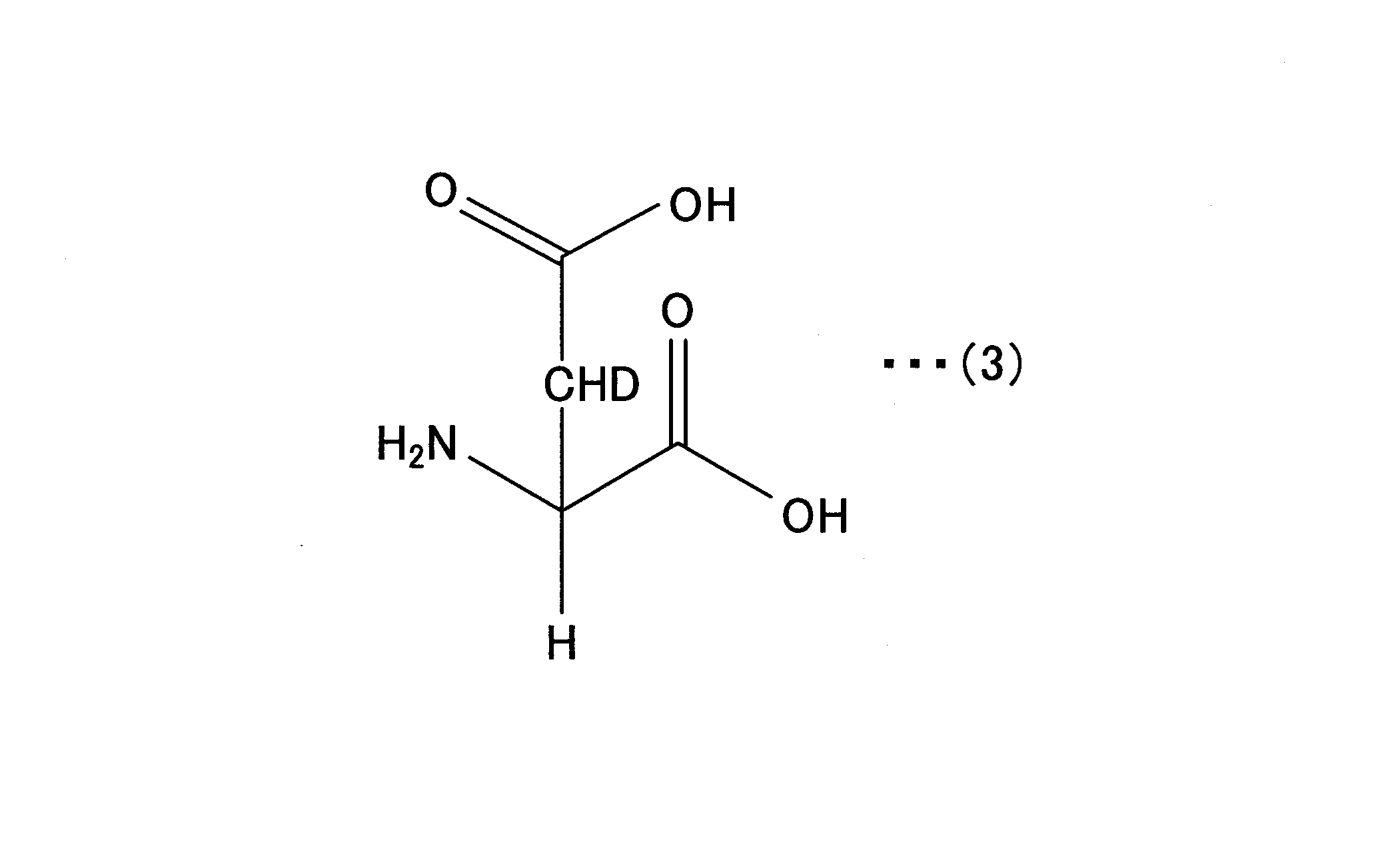
- aspartic acid obtained by hydrolyzing a conjugated amino acid and not isomerized during the process is represented by chemical formulas (2) to (4).
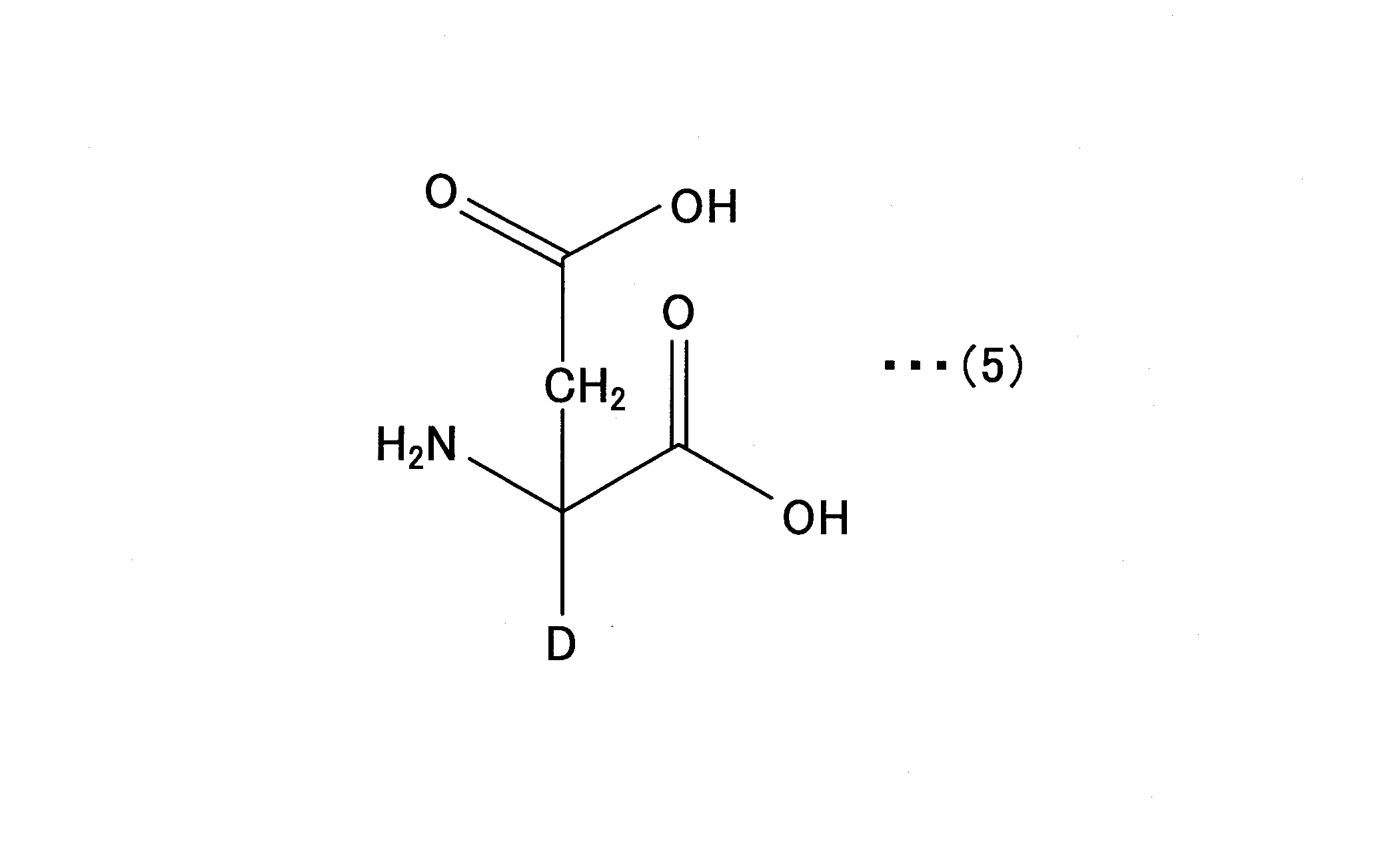
- aspartic acid obtained by hydrolyzing a conjugated amino acid and isomerized during the process is represented by chemical formulas (5) to (7).
- D-form and L-form of amino acid obtained by hydrolyzing the conjugated amino acid are optically resolved.
- the method for optically resolving amino acid D-form and L-form is not particularly limited, but there are methods that utilize differences in properties in crystallization, optical rotation, and enzymatic reaction, diastereomeric methods, and phase distribution with different asymmetric elements.
- the method to use etc. are mentioned.
- a chromatography method using a stationary phase (column) having chiral recognition ability is preferable.
- fragments are further generated by fragmentation for each of the optically resolved amino acids or amino acid derivatives.
- fragmentation by fragmentation, one or more fragments having a smaller mass than the amino acid or amino acid derivative before fragmentation can be generated.
- Such a fragment can be generated by heat, pressure, molecular collision, etc. for each of the optically resolved D-form and L-form, for example, using a molecular collision mechanism provided in a mass spectrometer. Can be made.
- aspartic acid generates, for example, a fragment containing an ⁇ carbon and no side chain, as shown in chemical formula (8). At this time, a fragment containing an ⁇ carbon and / or a side chain may also be generated.
- the generated fragments are separated and detected based on mass by mass spectrometry, and a predetermined fragment containing ⁇ -carbon and not containing a side chain is selected and analyzed. Specifically, it is possible to distinguish between a predetermined fragment containing an ⁇ carbon and no side chain, in which a hydrogen atom bonded to the ⁇ carbon is not substituted with a deuterium atom.
- a predetermined fragment containing an ⁇ carbon and no side chain in which a hydrogen atom bonded to the ⁇ carbon is not substituted with a deuterium atom.
- the structure of the fragment can be estimated by, for example, analyzing a mass spectrometry spectrum of a standard product in which the amino acid to be analyzed is substituted with an isotope.
- Amino acids may be derivatized.
- the derivatizing reagent used for derivatizing the amino acid is not particularly limited, but 4-fluoro-7-nitrobenzofurazane, 4-fluoro-7-nitro-2,1,3-benzoxadiazole, o-phthalaldehyde, phenyl isothiocyanate, fluorescamine, dansyl chloride and the like.
- the chiral analysis method for a conjugated amino acid includes a D-form and an L-form of an amino acid residue having a side chain containing a hydrogen atom that is included in the conjugated amino acid and can be substituted with a deuterium atom in the hydrolysis step. Suitable for identifying analysis.
- the D-form and L-form of all amino acid residues contained in the conjugated amino acid may be analyzed using the coupled amino acid chiral analysis method in this embodiment, or may be substituted with a deuterium atom. Only D-form and L-form of amino acid residues having a side chain containing a hydrogen atom may be analyzed.
- the group containing a hydrogen atom that can be substituted with a deuterium atom is not particularly limited, and examples thereof include a methylene group, such as a methylene group bonded to an electron-withdrawing group such as a carboxyl group.
- the amino acid having a methylene group bonded to a carboxyl group is not particularly limited, and examples thereof include aspartic acid (Asp) and glutamic acid (Glu).
- chiral analysis method for linked amino acids in this embodiment can be applied not only to naturally occurring linked amino acids but also to artificially synthesized linked amino acids.
- FIG. 1 is a diagram showing an example of the configuration of a coupled amino acid chiral analysis system 100 according to the present embodiment.
- the coupled amino acid chiral analysis system 100 according to the present embodiment is an optical resolution unit that optically resolves D-form and L-form of amino acids generated by hydrolyzing conjugated amino acids using deuterated aqueous hydrochloric acid and / or heavy water.
- 104 a fragment generation unit 106 that generates an ⁇ -carbon-containing fragment that does not include a side chain for the optically resolved amino acid, and a mass analysis unit 108 that detects the generated fragment by mass spectrometry.
- the coupled amino acid chiral analysis system 100 may further include a hydrolysis unit 102 that hydrolyzes the coupled amino acid by reacting with heavy water.
- the combined amino acid chiral analysis system 100 may further include an amino acid separation unit 103 that separates each amino acid hydrolyzed by the hydrolysis unit 102 when the combined amino acid includes a plurality of types of amino acids. Good.
- the coupled amino acid chiral analysis system 100 may include an information analysis data processing unit that analyzes detected information in the mass analysis unit 108, or is not limited to the mass analysis unit 108, and may be separately provided.
- the information analysis data processing unit 110 that analyzes the detected information may be included.
- the hydrolysis unit 102 includes, for example, a mechanism that hydrolyzes the bound amino acid in a reaction thermostat that can dry a sample containing the bound amino acid and maintain the sample in a vacuum state.
- the hydrolysis unit 102 may be configured to perform the hydrolysis process off-line instead of being incorporated into the chiral analysis system 100 as a specific device.
- the amino acid separation unit 103 includes, for example, a reverse phase microcolumn and the like, and separates the target amino acid from other components.
- the amino acid separation unit 103 may be integrated with the optical resolution unit 104.
- the optical resolution unit 104 includes a separation mechanism by chromatography using a stationary phase that recognizes the optical activity of the sample after hydrolysis, for example.
- the fragment generation unit 106 has, for example, a mechanism for fragmentation by applying energy such as molecular collision to the sample after optical division.
- the mass analyzer 108 is, for example, a mechanism that ionizes a sample, separates and detects fragment ions according to the mass-to-charge ratio by an electric / magnetic action, etc., and obtains a mass spectrum related to the mass-to-charge ratio and the detection intensity. Is provided.
- the information analysis unit 108 includes, for example, a mechanism that selects a target fragment ion from the mass spectrum, performs qualitative and quantitative analysis, and outputs calibration, ratio data, and the like.
- the configuration of the information analysis unit 108 includes an arbitrary computer CPU, memory, a program loaded in the memory, a storage unit such as a hard disk for storing the program, and an arbitrary combination of hardware and software centering on a network connection interface. It is realized by.
- the coupled amino acid chiral analysis system 100 having such a configuration has high artifacts generated during the coupled amino acid analysis process and D-amino acid residues and / or L-amino acid residues inherent in the coupled amino acids. Can be identified by accuracy.
- the NBD derivatives of amino acids were analyzed using a two-dimensional HPLC-FL-MS / MS system.
- the apparatus configuration and analysis conditions of the two-dimensional HPLC-FL-MS / MS system are as follows.
- the NBD derivative of each amino acid was separated using the first-dimensional column in the amino acid separation unit 103.
- the D-form and L-form of each amino acid were separated using the second dimension column in the optical resolution unit 104.
- an ion (m / z: 192) containing an ⁇ carbon and a side chain (Asp, having a side chain) derived from an NBD derivative of aspartic acid; (2) an ion derived from an NBD derivative of aspartic acid and containing an ⁇ carbon and no side chain (m / z: 237) (Asp, no side chain); (3) an ion (m / z: 247) (Glu, with side chain) derived from an NBD derivative of glutamic acid and containing an ⁇ carbon and a side chain; (4) An ion (m / z: 149) (Glu, no side chain) containing ⁇ -carbon and no side chain, derived from an NBD derivative of glutamic acid, was selected.
- (1) and (3) are intended for fragments in which the hydrogen atom bonded to the ⁇ -carbon is not replaced by a deuterium atom.
- FIG. 2 shows the result of chiral analysis of aspartic acid and glutamic acid contained in the hydrolysis product of the peptide.
- the fluorescence detection results are also shown. From the chromatograms of fluorescence and MS, the formula (D-chromatographic peak height) / (Standard D-chromatographic peak height) / ⁇ (L-chromatographic peak height) Height) / (peak height of chromatographic peak of standard product L) + (height of chromatographic peak of standard D product) / (height of chromatographic peak of standard product D) ⁇ ⁇ 100 From this,% D was calculated.
- FIG. 2 shows that D-form was detected despite the peptide synthesized with all L-form amino acids. This occurred because the hydrogen atom bonded to the ⁇ -carbon was not replaced by the deuterium atom during the isomerization reaction due to the purity of the reagent, protein binding water, deuterated hydrochloric acid used in the reaction, and protons in the sample. Presumed to be an artifact. However, as can be seen from FIG.
- the side chain derived from the NBD derivative of aspartic acid in the fragment ion (Asp, no side chain) derived from the NBD derivative of aspartic acid and containing the ⁇ carbon, the side chain derived from the NBD derivative of aspartic acid The amount of detected D-form is reduced compared to the fragment detection (including Asp, with side chain) and fluorescence detection results.
- the detection limit is calculated by the signal / noise ratio (S / N) and the detection sensitivity is compared
- S / N signal / noise ratio
- the detection sensitivity is improved by 18.5 times compared to the fluorescence detection having no discrimination / selection ability and 1.6 times compared with the fragment ion containing the side chain.
- the fragment ion (Glu, side chain) derived from the NBD derivative of glutamic acid is derived from the NBD derivative of glutamic acid, and the fragment ion (Glu, no side chain) containing ⁇ -carbon and containing no side chain is also included. Yes) and the detection amount of D body is reduced compared with the fluorescence detection result.
- the detection limit is calculated by the signal / noise ratio (S / N) and the detection sensitivity is compared, in the case of a fragment ion derived from an NBD derivative of glutamic acid and containing an ⁇ carbon and not containing a side chain, fluorescence detection and In comparison, the detection sensitivity is improved 48.3 times and 8.3 times compared to the fragment ion containing the side chain.
Landscapes
- Life Sciences & Earth Sciences (AREA)
- Health & Medical Sciences (AREA)
- Physics & Mathematics (AREA)
- Chemical & Material Sciences (AREA)
- Immunology (AREA)
- Analytical Chemistry (AREA)
- Biochemistry (AREA)
- General Health & Medical Sciences (AREA)
- General Physics & Mathematics (AREA)
- Pathology (AREA)
- Engineering & Computer Science (AREA)
- Hematology (AREA)
- Urology & Nephrology (AREA)
- Biomedical Technology (AREA)
- Molecular Biology (AREA)
- Microbiology (AREA)
- Cell Biology (AREA)
- Proteomics, Peptides & Aminoacids (AREA)
- Biotechnology (AREA)
- Spectroscopy & Molecular Physics (AREA)
- Food Science & Technology (AREA)
- Medicinal Chemistry (AREA)
- Investigating Or Analysing Biological Materials (AREA)
- Other Investigation Or Analysis Of Materials By Electrical Means (AREA)
Abstract
Description





<1次元目>
送液ポンプ:3301(資生堂社製)
カラムオーブン:3004(資生堂社製)
オートサンプラー:3033(資生堂社製)
蛍光検出器:3213(資生堂社製)
データ処理プログラム:Ezchrome Elite(資生堂社製)
<2次元目>
送液ポンプ:3201(資生堂社製)
デガッサー:3202(資生堂社製)
カラムオーブン:3014(資生堂社製)
オートサンプラー:3033(資生堂社製)
ハイプレッシャーバルブ:3011(資生堂社製)
蛍光検出器:3013(資生堂社製)
質量分析計:TQ-5500(AB Sciex社製)
データ処理プログラム:Analyst(AB Sciex社製)
・分析条件
<1次元目>
カラム:モノリス型ODSカラム(0.53mm(内径)×1000mm)
移動相:0~35min;A100%、35~55min;A100%-B100%(gradient)、55~100min;B100%、100~130min;C100%、130~180min;A100%
移動相の流速:25μL/min
A:5質量%アセトニトリル、0.05質量%トリフルオロ酢酸水溶液
B:18質量%アセトニトリル、0.05質量%トリフルオロ酢酸水溶液
C:85質量%アセトニトリル水溶液
<2次元目>
カラム:SumichiralOA-3200S(1.5mm(内径)×250mm)
グルタミン酸用の移動相:0.8質量%ギ酸のアセトニトリル/メタノール(体積比:80/20)溶液
アスパラギン酸用の移動相:1質量%ギ酸のアセトニトリル/メタノール(体積比:50/50)溶液
移動相の流速:150μL/min
蛍光検出装置:励起波長470nm、蛍光波長530nmにおける蛍光強度を計測
質量分析装置:イオン化電圧5500V、温度600℃で生成した親イオン(m/z:299(Asp);313(Glu))について、衝突エネルギー37eV(Asp);21eV(Glu)を与えて得られたフラグメントイオンを計測
質量分析装置は、フラグメント生成部106及び質量分析部108に対応する。
(1)アスパラギン酸のNBD誘導体由来の、α炭素及び側鎖を含むイオン(m/z:192)(Asp、側鎖有)と、
(2)アスパラギン酸のNBD誘導体由来の、α炭素を含み、かつ側鎖を含まないイオン(m/z:237)(Asp、側鎖無)と、
(3)グルタミン酸のNBD誘導体由来の、α炭素及び側鎖を含むイオン(m/z:247)(Glu、側鎖有)と、
(4)グルタミン酸のNBD誘導体由来の、α炭素を含み、かつ側鎖を含まないイオン(m/z:149)(Glu、側鎖無)とを選択した。
なお、蛍光、MSのそれぞれのクロマトグラムから、式
(D体のクロマトのピークの高さ)/(標準品のD体のクロマトのピークの高さ)/{(L体のクロマトのピークの高さ)/(標準品のL体のクロマトのピークの高さ)+(D体のクロマトのピークの高さ)/(標準品のD体のクロマトのピークの高さ)}×100
により、%Dを算出した。
Claims (10)
- 重塩酸重水溶液及び/又は重水を用いて結合型アミノ酸を加水分解させる工程と、
該加水分解により生成したアミノ酸のD体とL体を光学分割する工程と、
該光学分割されたアミノ酸からフラグメントを生成させる工程と、
該生成したフラグメントの中から、質量分析によりα炭素を含み、かつ側鎖を含まない所定のフラグメントを選択して解析する工程と、
を有することを特徴とする結合型アミノ酸のキラル分析方法。 - 前記加水分解により生成したアミノ酸のD体とL体をクロマトグラフィー法により光学分割することを特徴とする請求項1に記載の結合型アミノ酸のキラル分析方法。
- 前記加水分解により生成したアミノ酸を誘導体化する工程をさらに有し、
該誘導体化されたアミノ酸のD体とL体を光学分割することを特徴とする請求項1に記載の結合型アミノ酸のキラル分析方法。 - 前記フラグメントを生成させる工程において、前記光学分割されたアミノ酸のD体とL体それぞれについて前記フラグメントを生成させ、
前記解析する工程において、前記光学分割されたアミノ酸のD体とL体それぞれについて、α炭素を含み、かつ側鎖を含まない前記所定のフラグメントを選択し、該D体の前記所定のフラグメント及びL体の前記所定のフラグメントに基づき、前記結合型アミノ酸に元々含まれる前記アミノ酸のD体又はL体の存在比率を解析する請求項1に記載の結合型アミノ酸のキラル分析方法。 - 前記解析する工程において、前記所定のフラグメントは、α炭素を含むとともに側鎖を含まず、前記α炭素に結合した水素原子が重水素原子で置換されていないフラグメントである請求項4に記載の結合型アミノ酸のキラル分析方法。
- 前記フラグメントを生成させる工程において、熱、圧力又は分子衝突により、前記アミノ酸から前記フラグメントを生成することを特徴とする請求項1に記載の結合型アミノ酸のキラル分析方法。
- 重塩酸重水溶液及び/又は重水を用いて結合型アミノ酸を加水分解させることにより生成したアミノ酸のD体とL体を光学分割する光学分割部と、
該光学分割されたアミノ酸からフラグメントを生成させるフラグメント生成部と、
該生成したフラグメントの中から、質量分析によりα炭素を含み、かつ側鎖を含まない所定のフラグメントを選択して解析する質量分析部を有することを特徴とする結合型アミノ酸のキラル分析システム。 - 重塩酸重水溶液及び/又は重水を用いて前記結合型アミノ酸を加水分解させる加水分解部をさらに有することを特徴とする請求項7に記載の結合型アミノ酸のキラル分析システム。
- 前記質量分析部には、前記検出された情報を解析する情報解析データ処理部を有することを特徴とする請求項7に記載の結合型アミノ酸のキラル分析システム。
- さらに、前記検出された情報を解析する情報解析データ処理部を有することを特徴とする請求項7に記載の結合型アミノ酸のキラル分析システム。
Priority Applications (6)
| Application Number | Priority Date | Filing Date | Title |
|---|---|---|---|
| CN201680014056.XA CN107407668B (zh) | 2015-05-11 | 2016-05-10 | 结合型氨基酸的旋光性分析方法及旋光性分析系统 |
| SG11201707908UA SG11201707908UA (en) | 2015-05-11 | 2016-05-10 | Chiral analysis method of bound amino acid and chiral analysis system |
| EP16792681.5A EP3296734A4 (en) | 2015-05-11 | 2016-05-10 | Chiral analysis method and chiral analysis system for bound-type amino acid |
| JP2017517945A JP6296382B2 (ja) | 2015-05-11 | 2016-05-10 | 結合型アミノ酸のキラル分析方法及びキラル分析システム |
| AU2016260274A AU2016260274A1 (en) | 2015-05-11 | 2016-05-10 | Chiral analysis method and chiral analysis system for bound-type amino acid |
| US15/555,862 US10753911B2 (en) | 2015-05-11 | 2016-05-10 | Chiral analysis method of bound amino acid and chiral analysis system |
Applications Claiming Priority (2)
| Application Number | Priority Date | Filing Date | Title |
|---|---|---|---|
| JP2015-096959 | 2015-05-11 | ||
| JP2015096959 | 2015-05-11 |
Publications (1)
| Publication Number | Publication Date |
|---|---|
| WO2016181956A1 true WO2016181956A1 (ja) | 2016-11-17 |
Family
ID=57248060
Family Applications (1)
| Application Number | Title | Priority Date | Filing Date |
|---|---|---|---|
| PCT/JP2016/063835 Ceased WO2016181956A1 (ja) | 2015-05-11 | 2016-05-10 | 結合型アミノ酸のキラル分析方法及びキラル分析システム |
Country Status (8)
| Country | Link |
|---|---|
| US (1) | US10753911B2 (ja) |
| EP (1) | EP3296734A4 (ja) |
| JP (1) | JP6296382B2 (ja) |
| CN (1) | CN107407668B (ja) |
| AU (1) | AU2016260274A1 (ja) |
| SG (1) | SG11201707908UA (ja) |
| TW (1) | TW201702577A (ja) |
| WO (1) | WO2016181956A1 (ja) |
Cited By (3)
| Publication number | Priority date | Publication date | Assignee | Title |
|---|---|---|---|---|
| JP2018189446A (ja) * | 2017-04-28 | 2018-11-29 | 山田 健一 | 脂質由来のラジカル体の検出方法およびラジカル体由来の化合物 |
| JPWO2018167986A1 (ja) * | 2017-03-17 | 2019-07-25 | 株式会社島津製作所 | クロマトグラフ用データ処理装置 |
| JP2024516784A (ja) * | 2021-04-02 | 2024-04-17 | 安徽国▲タイ▼生物科技有限公司 | ペプチド鎖加水分解試薬、その製造方法及びその使用 |
Families Citing this family (2)
| Publication number | Priority date | Publication date | Assignee | Title |
|---|---|---|---|---|
| CN108469467B (zh) * | 2018-03-27 | 2020-06-26 | 湖南大学 | 一种基于化学衍生反应和光谱形变分析定量理论的手性药物质谱定量分析方法 |
| CN119827689B (zh) * | 2025-03-18 | 2025-08-19 | 乌兰察布市检验检测中心 | 一种马铃薯氨基酸液相色谱串联质谱的定量分析方法 |
Family Cites Families (6)
| Publication number | Priority date | Publication date | Assignee | Title |
|---|---|---|---|---|
| ATE366744T1 (de) * | 1992-06-05 | 2007-08-15 | Scripps Research Inst | Verknüpftes d-protein und verfahren zur identifizierung von rezeptor aktivität modulierenden verbindungen |
| JP4783496B2 (ja) * | 2000-11-02 | 2011-09-28 | 株式会社トクヤマ | アミノ酸誘導体の光学異性体の分離方法 |
| US7601542B2 (en) * | 2006-02-08 | 2009-10-13 | Florida State University Research Foundation | Analytical method for protein mapping using hydrogen/deuterium exchange |
| US8945933B2 (en) * | 2009-10-12 | 2015-02-03 | The Board Of Trustees Of The Leland Stanford Junior University | Liquid chromatography-mass spectrometry methods for multiplexed detection and quantitation of free amino acids |
| CN102824900A (zh) * | 2012-08-28 | 2012-12-19 | 吉尔生化(上海)有限公司 | 一种手性分离多种侧链保护氨基酸的方法 |
| CN104275169A (zh) * | 2013-07-01 | 2015-01-14 | 希施生物科技(上海)有限公司 | 一种手性分离多种基本氨基酸的方法 |
-
2016
- 2016-05-10 AU AU2016260274A patent/AU2016260274A1/en not_active Abandoned
- 2016-05-10 EP EP16792681.5A patent/EP3296734A4/en not_active Withdrawn
- 2016-05-10 JP JP2017517945A patent/JP6296382B2/ja active Active
- 2016-05-10 SG SG11201707908UA patent/SG11201707908UA/en unknown
- 2016-05-10 CN CN201680014056.XA patent/CN107407668B/zh not_active Expired - Fee Related
- 2016-05-10 US US15/555,862 patent/US10753911B2/en not_active Expired - Fee Related
- 2016-05-10 WO PCT/JP2016/063835 patent/WO2016181956A1/ja not_active Ceased
- 2016-05-11 TW TW105114596A patent/TW201702577A/zh unknown
Non-Patent Citations (3)
| Title |
|---|
| MIYAMOTO TETSUYA ET AL.: "Generation of Enantiomeric Amino Acids during Acid Hydrolysis of PeptidesDetected by the Liquid Chromatography/Tandem Mass Spectroscopy", CHEMISTRY & BIODIVERSITY, vol. 7, no. 6, 2010, pages 1644 - 1650, XP055328578 * |
| See also references of EP3296734A4 * |
| TETSUYA MIYAMOTO: "Tanpakushitsu ni Fukumareru D-Amino Acid Zanki no Kenshutsu ni Kansuru Kenkyu", HAKUSHI RONBUN (OYO SEIMEI KOGAKU SENKO), 24 March 2011 (2011-03-24), pages 76 - 139, XP055328584, Retrieved from the Internet <URL:http://repository.dl.itc.u-tokyo.ac.jp/dspace/bitstream/2261/51311/2/39-087042.pdf> [retrieved on 20160722] * |
Cited By (5)
| Publication number | Priority date | Publication date | Assignee | Title |
|---|---|---|---|---|
| JPWO2018167986A1 (ja) * | 2017-03-17 | 2019-07-25 | 株式会社島津製作所 | クロマトグラフ用データ処理装置 |
| US11567046B2 (en) | 2017-03-17 | 2023-01-31 | Shimadzu Corporation | Data-processing device for chromatograph |
| JP2018189446A (ja) * | 2017-04-28 | 2018-11-29 | 山田 健一 | 脂質由来のラジカル体の検出方法およびラジカル体由来の化合物 |
| JP2024516784A (ja) * | 2021-04-02 | 2024-04-17 | 安徽国▲タイ▼生物科技有限公司 | ペプチド鎖加水分解試薬、その製造方法及びその使用 |
| JP7554522B2 (ja) | 2021-04-02 | 2024-09-20 | 安徽国▲タイ▼生物科技有限公司 | ペプチド鎖加水分解試薬、その製造方法及びその使用 |
Also Published As
| Publication number | Publication date |
|---|---|
| EP3296734A4 (en) | 2018-12-26 |
| JPWO2016181956A1 (ja) | 2018-02-01 |
| AU2016260274A1 (en) | 2017-10-12 |
| JP6296382B2 (ja) | 2018-03-20 |
| US20180045690A1 (en) | 2018-02-15 |
| EP3296734A1 (en) | 2018-03-21 |
| TW201702577A (zh) | 2017-01-16 |
| CN107407668A (zh) | 2017-11-28 |
| CN107407668B (zh) | 2020-07-03 |
| SG11201707908UA (en) | 2017-10-30 |
| US10753911B2 (en) | 2020-08-25 |
Similar Documents
| Publication | Publication Date | Title |
|---|---|---|
| JP6296382B2 (ja) | 結合型アミノ酸のキラル分析方法及びキラル分析システム | |
| JP5374363B2 (ja) | ペプチド混合物を評価する方法 | |
| Shen et al. | Sensitive bromine-labeled probe D-BPBr for simultaneous identification and quantification of chiral amino acids and amino-containing metabolites profiling in human biofluid by HPLC/MS | |
| Tao et al. | Copper (II)-assisted enantiomeric analysis of D, L-amino acids using the kinetic method: chiral recognition and quantification in the gas phase | |
| Cristea et al. | Proteomics techniques and their application to hematology | |
| Julka et al. | Quantification in proteomics through stable isotope coding: a review | |
| JP5030586B2 (ja) | アミノ官能性化合物の分析方法及び装置 | |
| US20130105684A1 (en) | Analyte mass spectrometry quantitation using a universal reporter | |
| Mommen et al. | Unbiased selective isolation of protein N-terminal peptides from complex proteome samples using phospho tagging (PTAG) and TiO2-based depletion | |
| Harada et al. | Biaryl axially chiral derivatizing agent for simultaneous separation and sensitive detection of proteinogenic amino acid enantiomers using liquid chromatography–tandem mass spectrometry | |
| Jansson | Strategies for analysis of isomeric peptides | |
| Zhang et al. | Protein lysine acetylation analysis: current MS-based proteomic technologies | |
| Koehler et al. | Isobaric peptide termini labeling utilizing site-specific N-terminal succinylation | |
| Jeanne Dit Fouque et al. | Purification and quantification of an isomeric compound in a mixture by collisional excitation in multistage mass spectrometry experiments | |
| Sakamoto et al. | Development of derivatization reagents bearing chiral 4-imidazolidinone for distinguishing primary amines from other amino acids and application to the liquid chromatography-tandem mass spectrometric analysis of miso | |
| Russell et al. | Characterization and quantification of intact 26S proteasome proteins by real-time measurement of intrinsic fluorescence prior to top-down mass spectrometry | |
| KR20100009479A (ko) | 물성이 조절된 가변질량 라벨링제와 이를 이용한 아미노산 서열 및 단백질 다중 정량 동시 분석방법 | |
| Liu et al. | Simultaneous chirality separation of amino acids and their derivative by natamycin based on mobility measurements | |
| Pepino et al. | Resolution, quantification, and reliable determination of enantiomeric excess of proteinogenic and non‐proteinogenic amino acids by comprehensive two‐dimensional gas chromatography | |
| Ning et al. | Analytical aspects of proteomics: 2009–2010 | |
| US20080044857A1 (en) | Methods For Making And Using Mass Tag Standards For Quantitative Proteomics | |
| JP3534191B1 (ja) | 質量分析法を利用するペプチドc末端アミノ酸配列解析方法 | |
| Miyagi et al. | Deuterium Labeling of Isoaspartic and Isoglutamic Acids for Mass Spectrometry Analysis | |
| Toyo'oka | Development of Benzofurazan− bearing Fluorescence Labeling Reagents for separation and detection in high− performance liquid chromatography | |
| Shi et al. | A Facile and High-Sensitivity Method for Determining Proteinogenic Amino Acid Enantiomers by Integrating Chiral Phosphinate Derivatizing, 31P NMR and Parallel Reaction Monitoring |
Legal Events
| Date | Code | Title | Description |
|---|---|---|---|
| 121 | Ep: the epo has been informed by wipo that ep was designated in this application |
Ref document number: 16792681 Country of ref document: EP Kind code of ref document: A1 |
|
| ENP | Entry into the national phase |
Ref document number: 2017517945 Country of ref document: JP Kind code of ref document: A |
|
| WWE | Wipo information: entry into national phase |
Ref document number: 15555862 Country of ref document: US |
|
| WWE | Wipo information: entry into national phase |
Ref document number: 11201707908U Country of ref document: SG |
|
| ENP | Entry into the national phase |
Ref document number: 2016260274 Country of ref document: AU Date of ref document: 20160510 Kind code of ref document: A |
|
| NENP | Non-entry into the national phase |
Ref country code: DE |
|
| WWE | Wipo information: entry into national phase |
Ref document number: 2016792681 Country of ref document: EP |