WO2016190356A1 - フォトルミネッセント材料 - Google Patents
フォトルミネッセント材料 Download PDFInfo
- Publication number
- WO2016190356A1 WO2016190356A1 PCT/JP2016/065460 JP2016065460W WO2016190356A1 WO 2016190356 A1 WO2016190356 A1 WO 2016190356A1 JP 2016065460 W JP2016065460 W JP 2016065460W WO 2016190356 A1 WO2016190356 A1 WO 2016190356A1
- Authority
- WO
- WIPO (PCT)
- Prior art keywords
- sodalite
- less
- weight
- silver
- photoluminescent material
- Prior art date
- Legal status (The legal status is an assumption and is not a legal conclusion. Google has not performed a legal analysis and makes no representation as to the accuracy of the status listed.)
- Ceased
Links
Classifications
-
- C—CHEMISTRY; METALLURGY
- C09—DYES; PAINTS; POLISHES; NATURAL RESINS; ADHESIVES; COMPOSITIONS NOT OTHERWISE PROVIDED FOR; APPLICATIONS OF MATERIALS NOT OTHERWISE PROVIDED FOR
- C09K—MATERIALS FOR MISCELLANEOUS APPLICATIONS, NOT PROVIDED FOR ELSEWHERE
- C09K11/00—Luminescent materials, e.g. electroluminescent or chemiluminescent
- C09K11/08—Luminescent materials, e.g. electroluminescent or chemiluminescent containing inorganic luminescent materials
- C09K11/64—Luminescent materials, e.g. electroluminescent or chemiluminescent containing inorganic luminescent materials containing aluminium
- C09K11/646—Silicates
-
- C—CHEMISTRY; METALLURGY
- C01—INORGANIC CHEMISTRY
- C01B—NON-METALLIC ELEMENTS; COMPOUNDS THEREOF; METALLOIDS OR COMPOUNDS THEREOF NOT COVERED BY SUBCLASS C01C
- C01B33/00—Silicon; Compounds thereof
- C01B33/20—Silicates
- C01B33/26—Aluminium-containing silicates, i.e. silico-aluminates
-
- C—CHEMISTRY; METALLURGY
- C01—INORGANIC CHEMISTRY
- C01B—NON-METALLIC ELEMENTS; COMPOUNDS THEREOF; METALLOIDS OR COMPOUNDS THEREOF NOT COVERED BY SUBCLASS C01C
- C01B33/00—Silicon; Compounds thereof
- C01B33/20—Silicates
- C01B33/26—Aluminium-containing silicates, i.e. silico-aluminates
- C01B33/28—Base exchange silicates, e.g. zeolites
-
- C—CHEMISTRY; METALLURGY
- C09—DYES; PAINTS; POLISHES; NATURAL RESINS; ADHESIVES; COMPOSITIONS NOT OTHERWISE PROVIDED FOR; APPLICATIONS OF MATERIALS NOT OTHERWISE PROVIDED FOR
- C09K—MATERIALS FOR MISCELLANEOUS APPLICATIONS, NOT PROVIDED FOR ELSEWHERE
- C09K11/00—Luminescent materials, e.g. electroluminescent or chemiluminescent
- C09K11/08—Luminescent materials, e.g. electroluminescent or chemiluminescent containing inorganic luminescent materials
-
- C—CHEMISTRY; METALLURGY
- C09—DYES; PAINTS; POLISHES; NATURAL RESINS; ADHESIVES; COMPOSITIONS NOT OTHERWISE PROVIDED FOR; APPLICATIONS OF MATERIALS NOT OTHERWISE PROVIDED FOR
- C09K—MATERIALS FOR MISCELLANEOUS APPLICATIONS, NOT PROVIDED FOR ELSEWHERE
- C09K11/00—Luminescent materials, e.g. electroluminescent or chemiluminescent
- C09K11/08—Luminescent materials, e.g. electroluminescent or chemiluminescent containing inorganic luminescent materials
- C09K11/58—Luminescent materials, e.g. electroluminescent or chemiluminescent containing inorganic luminescent materials containing copper, silver or gold
-
- C—CHEMISTRY; METALLURGY
- C09—DYES; PAINTS; POLISHES; NATURAL RESINS; ADHESIVES; COMPOSITIONS NOT OTHERWISE PROVIDED FOR; APPLICATIONS OF MATERIALS NOT OTHERWISE PROVIDED FOR
- C09K—MATERIALS FOR MISCELLANEOUS APPLICATIONS, NOT PROVIDED FOR ELSEWHERE
- C09K11/00—Luminescent materials, e.g. electroluminescent or chemiluminescent
- C09K11/08—Luminescent materials, e.g. electroluminescent or chemiluminescent containing inorganic luminescent materials
- C09K11/64—Luminescent materials, e.g. electroluminescent or chemiluminescent containing inorganic luminescent materials containing aluminium
-
- F—MECHANICAL ENGINEERING; LIGHTING; HEATING; WEAPONS; BLASTING
- F21—LIGHTING
- F21V—FUNCTIONAL FEATURES OR DETAILS OF LIGHTING DEVICES OR SYSTEMS THEREOF; STRUCTURAL COMBINATIONS OF LIGHTING DEVICES WITH OTHER ARTICLES, NOT OTHERWISE PROVIDED FOR
- F21V9/00—Elements for modifying spectral properties, polarisation or intensity of the light emitted, e.g. filters
- F21V9/30—Elements containing photoluminescent material distinct from or spaced from the light source
-
- G—PHYSICS
- G02—OPTICS
- G02F—OPTICAL DEVICES OR ARRANGEMENTS FOR THE CONTROL OF LIGHT BY MODIFICATION OF THE OPTICAL PROPERTIES OF THE MEDIA OF THE ELEMENTS INVOLVED THEREIN; NON-LINEAR OPTICS; FREQUENCY-CHANGING OF LIGHT; OPTICAL LOGIC ELEMENTS; OPTICAL ANALOGUE/DIGITAL CONVERTERS
- G02F1/00—Devices or arrangements for the control of the intensity, colour, phase, polarisation or direction of light arriving from an independent light source, e.g. switching, gating or modulating; Non-linear optics
- G02F1/01—Devices or arrangements for the control of the intensity, colour, phase, polarisation or direction of light arriving from an independent light source, e.g. switching, gating or modulating; Non-linear optics for the control of the intensity, phase, polarisation or colour
- G02F1/13—Devices or arrangements for the control of the intensity, colour, phase, polarisation or direction of light arriving from an independent light source, e.g. switching, gating or modulating; Non-linear optics for the control of the intensity, phase, polarisation or colour based on liquid crystals, e.g. single liquid crystal display cells
- G02F1/133—Constructional arrangements; Operation of liquid crystal cells; Circuit arrangements
- G02F1/1333—Constructional arrangements; Manufacturing methods
- G02F1/1335—Structural association of cells with optical devices, e.g. polarisers or reflectors
- G02F1/1336—Illuminating devices
-
- G—PHYSICS
- G02—OPTICS
- G02F—OPTICAL DEVICES OR ARRANGEMENTS FOR THE CONTROL OF LIGHT BY MODIFICATION OF THE OPTICAL PROPERTIES OF THE MEDIA OF THE ELEMENTS INVOLVED THEREIN; NON-LINEAR OPTICS; FREQUENCY-CHANGING OF LIGHT; OPTICAL LOGIC ELEMENTS; OPTICAL ANALOGUE/DIGITAL CONVERTERS
- G02F1/00—Devices or arrangements for the control of the intensity, colour, phase, polarisation or direction of light arriving from an independent light source, e.g. switching, gating or modulating; Non-linear optics
- G02F1/01—Devices or arrangements for the control of the intensity, colour, phase, polarisation or direction of light arriving from an independent light source, e.g. switching, gating or modulating; Non-linear optics for the control of the intensity, phase, polarisation or colour
- G02F1/13—Devices or arrangements for the control of the intensity, colour, phase, polarisation or direction of light arriving from an independent light source, e.g. switching, gating or modulating; Non-linear optics for the control of the intensity, phase, polarisation or colour based on liquid crystals, e.g. single liquid crystal display cells
- G02F1/133—Constructional arrangements; Operation of liquid crystal cells; Circuit arrangements
- G02F1/1333—Constructional arrangements; Manufacturing methods
- G02F1/1335—Structural association of cells with optical devices, e.g. polarisers or reflectors
- G02F1/1336—Illuminating devices
- G02F1/133614—Illuminating devices using photoluminescence, e.g. phosphors illuminated by UV or blue light
Definitions
- the present invention relates to a photoluminescent material.
- the “photoluminescent material” means “a material used for an application utilizing photoluminescence (that is, a phenomenon of emitting visible light by irradiating light)”.
- a photoluminescent material that emits visible light (generally, light having a wavelength of 380 nm or more and less than 830 nm) by light irradiation is used for lighting devices, backlights for liquid crystal display devices, and the like.
- Various techniques have been proposed for this photoluminescent material.
- Patent Document 1 describes a light emitting device including an assembly of oligo atomic metal clusters confined in a molecular sieve.
- Patent Document 1 describes zeolites, porous oxides, aluminosilicon phosphates, gallophosphates, zinc phosphates, titanosilicates, and aluminosilicates as molecular sieves.
- photoluminescence is actually confirmed only in zeolite 3A containing silver clusters (Example 3).
- Patent Document 2 describes a silver-supported zeolite phosphor obtained by a drying treatment at 100 ° C. or lower under normal pressure.
- Non-Patent Document 1 proposes to use sodalite containing silver and an oxalate anion as an optical data recording material.
- Patent Documents 1 and 2 it is known that a silver-containing zeolite can be used as a photoluminescent material, but a photoluminescent material using sodalite instead of zeolite is Conventionally, little is known. Note that the sodalite containing silver and oxalate anion described in Non-Patent Document 1 needs to use oxalate, which is a dangerous substance, for its production.
- Sodalite was obtained as a by-product of A-type zeolite, but it was thought that there was little industrial use.
- the present invention has been made paying attention to such circumstances, and an object thereof is to obtain a novel photoluminescent material using sodalite.
- a photoluminescent material can be obtained by adding silver atoms to sodalite without containing an oxalate anion. Furthermore, in order to impart photoluminescence properties to silver atom-containing sodalite, it is necessary to change the heat treatment temperature according to the difference in silver atom content, and zinc atoms are also included in addition to silver atoms. I found it necessary. The present invention based on this finding is as follows.
- a sodalite containing 0.05% by weight or more and less than 10% by weight of silver atoms (excluding sodalite containing an oxalate anion), which emits visible light when irradiated with light. Cent material.
- the photoluminescent material according to any one of [17] to [29], wherein the wavelength of light to be irradiated is 230 nm or more and 360 nm or less.
- a photoluminescent material which is a sodalite containing 18% by weight or more and less than 31% by weight of silver atoms and 7% by weight or more and 17% by weight or less of zinc atoms and emits visible light when irradiated with light.
- the photoluminescent material according to any one of [33] to [44], wherein the wavelength of light to be irradiated is from 230 nm to 420 nm.
- the photoluminescent material according to [48], wherein the content of silver atoms is 31% by weight or more and 50.5% by weight or less.
- the photoluminescent material according to [48], wherein the silver atom content is 31 wt% or more and 50 wt% or less.
- the photoluminescent material according to [48], wherein the silver atom content is 31 wt% or more and 49 wt% or less.
- An illumination device including a light source and the photoluminescent material according to any one of [1] to [64].
- the illumination device according to [66] which is a backlight for a liquid crystal display device.
- Sodalite containing 0.05% by weight or more and less than 10% by weight of silver atoms is produced by ion exchange, and 50 sodalites after ion exchange are produced.
- the manufacturing method of a photoluminescent material including heat-processing at the temperature of 850 degreeC or more.
- Sodalite containing 10% by weight or more and less than 18% by weight of silver atoms is produced by ion exchange, and the sodalite after ion exchange is less than 300 ° C.
- the manufacturing method of the photoluminescent material including heat-processing at the temperature of.
- a sodalite containing 18% by weight or more and less than 31% by weight of silver atoms and 7% by weight or more and 17% by weight or less of zinc atoms is produced by ion exchange, and the sodalite after ion exchange is 50 ° C or higher and 850 ° C.
- the manufacturing method of a photoluminescent material including heat-processing at the following temperature.
- Sodalite containing 31% by weight or more and less than 51% by weight of silver atoms and 0.5% by weight or more and 11% by weight or less of zinc atoms is manufactured by ion exchange, and the sodalite after ion exchange is 300 ° C or more.
- the photoluminescent material of the present invention is divided into the following four modes depending on the silver atom content.
- the content of silver atoms and zinc atoms in the photoluminescent material of the present invention is a value based on the entire photoluminescent material (that is, silver atom-containing sodalite or silver atom and zinc atom-containing sodalite). It is. (1) Sodalite containing 0.05% by weight or more and less than 10% by weight of silver atom (excluding sodalite containing oxalate anion). (2) Sodalite containing 10% by weight or more and less than 18% by weight of silver atoms produced through heat treatment at a temperature of less than 300 ° C. (except for sodalite containing oxalate anions).
- first photoluminescent material “sodalite of (1) above” is referred to as “first photoluminescent material”
- second photoluminescent material is referred to as “second photoluminescent material”
- (3 ) Sodalite ” may be referred to as“ third photoluminescent material ”
- “ (4) sodalite ” may be referred to as“ fourth photoluminescent material ”.
- These first to fourth photoluminescent materials are sodalites containing silver atoms and have a common feature that they are used for applications utilizing photoluminescence.
- the first and second photoluminescent materials are characterized by not containing an oxalate anion. Because of this feature, oxalate, which is a hazardous material, is not used in the manufacture of the first and second photoluminescent materials. In addition, the third and fourth photoluminescent materials do not require an oxalate anion, and it is not necessary to use an oxalate that is a dangerous substance for the production thereof.
- the photoluminescent material of the present invention can be produced by heat-treating the obtained ion exchange sodalite after ion exchange of sodalite. In the present specification, drying at a temperature higher than room temperature is included in the heat treatment. Sodalite is easily available as a by-product of A-type zeolite that is currently mass-produced at low cost.
- the average particle size of sodalite as a raw material is preferably 0.05 ⁇ m or more and 500 ⁇ m or less, more preferably 0.5 ⁇ m or more and 50 ⁇ m or less.
- the preferable range of the average particle diameter of the photoluminescent material of the present invention obtained from sodalite is the same.
- the average particle size of sodalite as a raw material and the photoluminescent material of the present invention can be measured by laser diffraction and laser scattering methods. For this measurement, for example, a laser diffraction particle size distribution measuring apparatus “SALD-2100” manufactured by Shimadzu Corporation can be used.
- the ion exchange of sodalite for producing a photoluminescent material containing silver atoms can be carried out by stirring and holding sodalite in a silver ion-containing aqueous solution (for example, a silver nitrate aqueous solution).
- a silver ion-containing aqueous solution for example, a silver nitrate aqueous solution.
- the silver ion concentration in the aqueous solution can be appropriately adjusted according to the silver atom content of the photoluminescent material of the present invention, as shown in the following examples.
- sodalite for the production of photoluminescent materials containing silver and zinc atoms stirs and holds sodalite in aqueous solutions containing silver ions and zinc ions (eg aqueous solutions of silver nitrate and zinc sulfate) Can be done. Further, first, sodalite is stirred and held in a zinc ion-containing aqueous solution (for example, zinc sulfate aqueous solution), and then a silver ion aqueous solution (for example, silver nitrate aqueous solution) is added to the suspension, followed by stirring and holding.
- a zinc ion-containing aqueous solution for example, zinc sulfate aqueous solution
- a silver ion aqueous solution for example, silver nitrate aqueous solution
- sodalite may be stirred and held in a silver ion aqueous solution, and then the aqueous solution containing zinc ions may be added to the suspension, followed by stirring and holding to perform ion exchange.
- the zinc ion exchange sodalite is collected by filtration, and then the obtained zinc ion exchange sodalite is stirred and held in an aqueous solution containing silver ions.
- the silver ion-exchanged sodalite is filtered, and then the obtained silver ion-exchanged sodalite is converted into the zinc ion-containing aqueous solution.
- Ion exchange may be performed with stirring and holding in the inside.
- the silver ion and zinc ion concentration in the aqueous solution can be appropriately adjusted according to the content of silver atoms and zinc atoms in the photoluminescent material of the present invention, as shown in the following examples.
- the ion exchange time (that is, the stirring and holding time of sodalite in the ion-containing aqueous solution) is usually 1 hour or more and 10 hours or less, preferably 5 hours or less.
- the obtained ion exchange sodalite is preferably filtered from the suspension and washed with water. Further, the ion exchange sodalite obtained by filtration may be further stirred and held in an ion-containing aqueous solution to repeat the ion exchange treatment.
- the heat treatment temperature of the obtained ion exchange sodalite is preferably 50 ° C. or higher. In the heat treatment at a temperature of less than 50 ° C., it takes a lot of time to dry the obtained ion exchange sodalite, which is not desirable industrially.
- the upper limit of the heat treatment temperature is preferably 850 ° C. It is known that the structure of sodalite is broken by a heat treatment exceeding 850 ° C.
- the heat treatment may be performed in an inert gas (for example, nitrogen) atmosphere or in an air atmosphere.
- the second photoluminescent material (silver atom content: 10 wt% or more and less than 18 wt%) needs to be manufactured through a heat treatment at a temperature of less than 300 ° C.
- the fourth photoluminescent material (content of silver atoms: 31 wt% or more and less than 51 wt%) needs to be manufactured through a heat treatment at a temperature of 300 ° C. or more.
- the silver atom content is 10 wt% or more and less than 18 wt%
- the obtained silver atom-containing sodalite emits visible light when the heat treatment temperature is 300 ° C. or more.
- the obtained silver atom and zinc atom-containing sodalite does not emit visible light when the heat treatment temperature is less than 300 ° C.
- the silver atom content is 0.05 wt% or more and less than 10 wt% (first photoluminescent material) and when the silver atom content is 18 wt% or more and less than 31 wt% ( In the case of the third photoluminescent material), a photoluminescent material that emits visible light by light irradiation can be obtained by any heat treatment at a temperature of 300 ° C. or higher or lower than 300 ° C.
- the heat treatment temperature for producing the photoluminescent material is different because the form of silver atoms required for light emission differs in sodalite due to the difference in the content of silver atoms. It is estimated to be.
- silver atoms are presumed to exist in the form of silver ions in sodalite obtained by low-temperature heat treatment.
- sodalite obtained by high-temperature heat treatment silver atoms are presumed to be in the form of silver ions or silver clusters, or part of them are in the form of silver ions and the rest are in the form of silver clusters. Is done.
- the present invention is not limited to such estimation.
- the second and fourth photoluminescent materials are specified by the heat treatment temperature, which is a manufacturing condition, in addition to the contents of silver atoms and zinc atoms.
- the first and third photoluminescent materials may also be specified by the heat treatment temperature, which is a manufacturing condition, in addition to the contents of silver atoms and zinc atoms.
- the temperature of the heat treatment for producing the first photoluminescent material is preferably 50 ° C. or higher and 850 ° C. or lower, more preferably 100 ° C. or higher and 700 ° C. or lower, and further preferably 150 ° C. or higher and 600 ° C. or lower.
- the heat treatment time for producing the first photoluminescent material is preferably 1 hour or more and 24 hours or less, more preferably 2 hours or more and 24 hours or less.
- the temperature of the heat treatment for producing the second photoluminescent material needs to be lower than 300 ° C., preferably 50 ° C. or higher and lower than 300 ° C., more preferably 100 ° C. or higher and 270 ° C. or lower, further preferably Is 150 ° C. or higher and 250 ° C. or lower.
- the heat treatment time for producing the second photoluminescent material is preferably 1 hour to 24 hours, more preferably 2 hours to 16 hours.
- the temperature of the heat treatment for producing the third photoluminescent material is preferably 50 ° C. or higher and 850 ° C. or lower, more preferably 100 ° C. or higher and 700 ° C. or lower, and further preferably 150 ° C. or higher and 600 ° C. or lower.
- the heat treatment time for producing the third photoluminescent material is preferably 1 hour or more and 24 hours or less, more preferably 2 hours or more and 24 hours or less.
- the temperature of the heat treatment for producing the fourth photoluminescent material needs to be 300 ° C. or higher and 850 ° C. or lower, preferably 300 ° C. or higher and 700 ° C. or lower, more preferably 350 ° C. or higher and 650 ° C. or lower. More preferably, it is 400 degreeC or more and 600 degrees C or less.
- the heat treatment time for producing the fourth photoluminescent material is preferably 1 hour or longer and 12 hours or shorter, more preferably 2 hours or longer and 8 hours or shorter.
- the photoluminescent material of the present invention obtained after the heat treatment described above can emit visible light by irradiation with light even when placed in water, and therefore it is not necessary to perform sealing or the like to block moisture.
- the first and second photoluminescent materials having a silver atom content of less than 18% by weight zinc atoms are not necessary for light emission.
- the first and second photoluminescent materials may also contain zinc atoms.
- the third and fourth photoluminescent materials having a silver atom content of 18% by weight or more require zinc atoms in addition to silver atoms for light emission.
- the reason why zinc atoms are required when the silver atom content is increased is that the form of silver atoms required for light emission differs in sodalite due to the difference in silver atom content as described above. Presumed.
- the present invention is not limited to such estimation.
- the content of silver atoms and zinc atoms can be measured by the methods described in the following examples.
- the photoluminescent material of the present invention may contain atoms other than silver atoms and zinc atoms (hereinafter referred to as “other atoms”) and / or ions (hereinafter referred to as “other ions”).
- other atoms include transition metal atoms other than silver and zinc, alkali metal atoms, alkaline earth metal atoms, and halogen atoms.
- other ions include ammonium ions and halide ions.
- the first and second photoluminescent materials do not contain an oxalate anion.
- the third and fourth photoluminescent materials may contain an oxalate anion.
- the content of silver atoms in the first photoluminescent material is 0.05 wt% or more and less than 10 wt%, preferably 0.1 wt% or more and less than 10 wt%, more preferably 0.2 wt%. % To 9% by weight, more preferably 0.3% to 8% by weight.
- the first photoluminescent material may contain zinc atoms.
- the content of zinc atoms in the first photoluminescent material is preferably 0% by weight to 25% by weight, more preferably 0.5% by weight to 25% by weight, and even more preferably 1% by weight to 25% by weight. % By weight or less, particularly preferably 5% by weight or more and 25% by weight or less.
- the content of silver atoms in the second photoluminescent material is 10 wt% or more and less than 18 wt%, preferably 10 wt% or more and 17.8 wt% or less, more preferably 10 wt% or more and 17. 5 wt% or less, more preferably 10 wt% or more and 17 wt% or less.
- the second photoluminescent material may contain zinc atoms.
- the content of zinc atoms in the second photoluminescent material is preferably 0% by weight to 21% by weight, more preferably 0.5% by weight to 21% by weight, and even more preferably 1% by weight to 21% by weight. % By weight or less, particularly preferably 5% by weight or more and 21% by weight or less.
- the content of silver atoms in the third photoluminescent material is 18% by weight or more and less than 31% by weight, preferably 18.5% by weight or more and less than 31% by weight, more preferably 19% by weight or more and 31% by weight. %, More preferably 19.5 wt% or more and less than 31 wt%.
- the content of zinc atoms in the third photoluminescent material is 7% by weight to 17% by weight, preferably 7.5% by weight to 17% by weight, more preferably 8% by weight to 17% by weight. % Or less, more preferably 8.5% by weight or more and 17% by weight or less.
- the silver atom and zinc atom-containing sodalite when the silver atom content is 18% by weight or more, the zinc atom content does not exceed 17% by weight.
- the silver atom content in the fourth photoluminescent material is 31 wt% or more and less than 51 wt%, preferably 31 wt% or more and 50.5 wt% or less, more preferably 31 wt% or more and 50 wt%. % Or less, more preferably 31 wt% or more and 49 wt% or less.
- the content of zinc atoms in the fourth photoluminescent material is 0.5 wt% or more and 11 wt% or less, preferably 0.6 wt% or more and 11 wt% or less, more preferably 0.7 wt%. % To 11% by weight, more preferably 0.8% to 11% by weight. In the silver atom and zinc atom-containing sodalite, when the silver atom content is 31% by weight or more, the zinc atom content does not exceed 11% by weight.
- the wavelength of light applied to the first photoluminescent material is preferably 200 nm or more and less than 380 nm, more preferably 220 nm or more and 370 nm or less, and further preferably 230 nm or more and 360 nm or less.
- the wavelength of light applied to the second photoluminescent material is preferably 200 nm or more and less than 380 nm, more preferably 220 nm or more and 370 nm or less, and further preferably 230 nm or more and 360 nm or less.
- the wavelength of light applied to the third photoluminescent material is preferably 200 nm or more and less than 430 nm, more preferably 220 nm or more and 420 nm or less, and further preferably 230 nm or more and 420 nm or less.
- the wavelength of light applied to the fourth photoluminescent material is preferably 200 nm or more and less than 430 nm, more preferably 220 nm or more and 420 nm or less, and further preferably 230 nm or more and 420 nm or less.
- the third and fourth photoluminescent materials are not only irradiated in the ultraviolet region having a wavelength of less than 380 nm, but also in the visible region having a wavelength of 380 nm or more. Can emit visible light.
- the photoluminescent material of the present invention can be used, for example, in a lighting device. Moreover, the photoluminescent material of this invention can be used in the luminescent coating material for anti-counterfeiting, such as a banknote, a cash voucher, or a card, for example.
- the photoluminescent material of the present invention exhibits photoluminescence even in the presence of water, it is useful as a raw material for light-emitting paints used for banknotes exposed to various environments. In these applications, the photoluminescent material of the present invention may be used alone or in combination of two or more. Further, the photoluminescent material of the present invention may be used in combination with other photoluminescent materials.
- the present invention also provides a lighting device including a light source and the photoluminescent material of the present invention.
- a known light source such as a mercury lamp or LED can be used.
- the light source an LED that does not use mercury causing environmental pollution and has high energy efficiency is preferable.
- the illumination device of the present invention can be used as a light used in daily life such as a fluorescent lamp or a backlight for a liquid crystal display device.
- the light source can be covered with glass and a photoluminescent material can be secured inside or outside the glass using a binder (eg, a transparent epoxy resin). Further, the light source may be covered with glass kneaded with the photoluminescent material of the present invention. Furthermore, by covering the light source with paper kneaded with the photoluminescent material of the present invention, an illumination device that emits soft light such as a row lamp can be manufactured.
- a binder eg, a transparent epoxy resin
- sodalite manufactured by Tosoh Corporation having the following characteristics was used. Average particle size: about 1 ⁇ m Contains Na + ions as cation capable of ion exchange. Ion exchange capacity: about 8.3 meq / g
- Sodalite Example 1 containing 0.05 to 10% by weight of silver atoms (Production of silver atom-containing sodalite) Ion exchange treatment was performed by stirring and holding sodalite (5 g) in an aqueous solution of silver nitrate (1000 mL, silver ion concentration 0.41 mmol / L) at room temperature for 1 hour. Next, sodalite was filtered from the suspension and washed with water to obtain wet silver ion exchange sodalite. The obtained silver ion-exchanged sodalite was heat-treated at 500 ° C. for 4 hours in an air atmosphere to produce a silver atom-containing sodalite.
- Example 2 (Production of silver atom and zinc atom-containing sodalite) Ion exchange treatment by stirring and holding sodalite (5 g) in an aqueous solution of silver nitrate and zinc sulfate (1000 mL, silver ion concentration 5.2 mmol / L, zinc ion concentration 23.3 mmol / L) for 1 hour at room temperature Went. Subsequently, sodalite was filtered from the suspension and washed with water to obtain wet silver ion and zinc ion exchange sodalite. The obtained silver ion and zinc ion-exchanged sodalite was heat-treated at 50 ° C. for 16 hours in an air atmosphere to produce silver atoms and zinc atom-containing sodalite.
- the sodalites of Examples 1 and 2 containing 0.05% by weight or more and less than 10% by weight of silver atoms produced through heat treatment at a temperature of 300 ° C. or more and less than 300 ° C. Visible light was emitted by light irradiation. Moreover, in the sodalite of this aspect, visible light was emitted by light irradiation regardless of the presence or absence of zinc atoms.
- Sodalite Example 3 containing 10% by weight or more and less than 18% by weight of silver atom production of silver atom-containing sodalite
- Sodalite (5 g) was stirred and held at room temperature in an aqueous solution of silver nitrate (1000 mL, silver ion concentration 2.1 mmol / L) for an ion exchange treatment.
- sodalite was filtered from the suspension and washed with water to obtain wet silver ion exchange sodalite.
- the obtained silver ion-exchanged sodalite was heat-treated at 230 ° C. for 6 hours in an air atmosphere to produce a silver atom-containing sodalite.
- Comparative Example 1 production of sodalite containing silver atoms and zinc atoms
- Ion exchange treatment by stirring and holding sodalite (5 g) in an aqueous solution of silver nitrate and zinc sulfate (1000 mL, silver ion concentration 5.2 mmol / L, zinc ion concentration 23.3 mmol / L) for 1 hour at room temperature Went.
- sodalite was filtered from the suspension and washed with water to obtain wet silver ion and zinc ion exchange sodalite.
- the obtained silver ion and zinc ion exchange sodalite was subjected to a heat treatment at 500 ° C. for 4 hours in an air atmosphere to produce silver atom and zinc atom-containing sodalite.
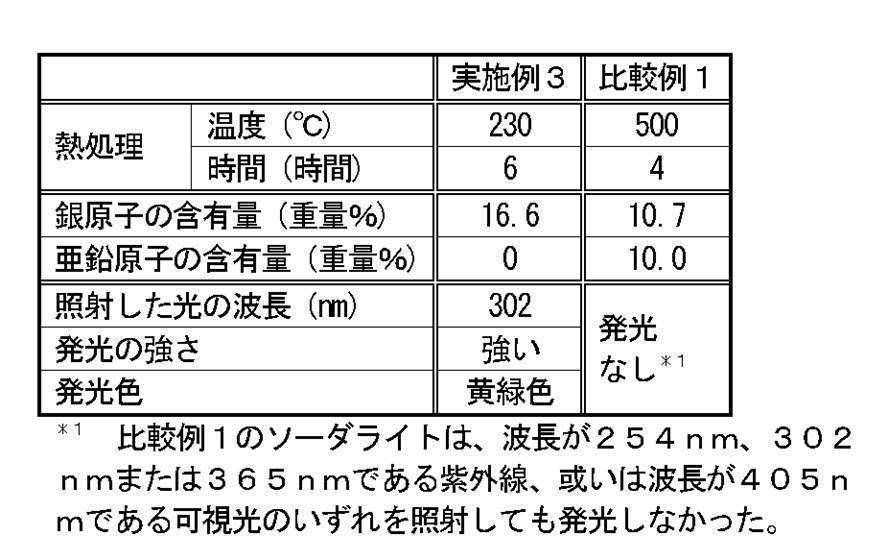
- the silver atom-containing sodalite of Example 3 produced through heat treatment at a temperature of less than 300 ° C. is irradiated with light.
- the silver atom-containing zinc atom-containing sodalite of Comparative Example 1 produced through heat treatment at a temperature of 300 ° C. or higher did not emit light.
- Sodalite Example 4 containing 18% by weight or more and less than 31% by weight of silver atom (production of silver atom and zinc atom-containing sodalite) Ion exchange treatment by stirring and holding sodalite (5 g) in an aqueous solution of silver nitrate and zinc sulfate (1000 mL, silver ion concentration 10.3 mmol / L, zinc ion concentration 20.7 mmol / L) at room temperature for 1 hour Went. Subsequently, sodalite was filtered from the suspension and washed with water to obtain wet silver ion and zinc ion exchange sodalite. The obtained silver ion and zinc ion exchange sodalite was subjected to a heat treatment at 230 ° C. for 6 hours in an air atmosphere to produce silver atoms and zinc atom-containing sodalite.
- Example 5 (Production of silver atom and zinc atom-containing sodalite) Sodalite (5 g) was first stirred and held in an aqueous solution of zinc sulfate (1000 mL, zinc ion concentration 103.3 mmol / L) for 1 hour at room temperature, and then a high concentration aqueous solution of silver nitrate (10 mL, silver ion) (Concentration 2.49 mol / L) was added to adjust the silver ion concentration in the aqueous solution after the addition to 24.7 mmol / L, and the mixture was further stirred and held at room temperature for 1 hour for ion exchange treatment.
- zinc sulfate 1000 mL, zinc ion concentration 103.3 mmol / L
- a high concentration aqueous solution of silver nitrate (10 mL, silver ion) (Concentration 2.49 mol / L) was added to adjust the silver ion concentration in the aqueous solution after the addition to 24.7 m
- sodalite was filtered from the suspension and washed with water to obtain wet silver ion and zinc ion exchange sodalite.
- the obtained silver ion and zinc ion-exchanged sodalite was heat-treated at 50 ° C. for 16 hours in an air atmosphere to produce silver atoms and zinc atom-containing sodalite.
- Example 6 production of sodalite containing silver atoms and zinc atoms
- sodalite 5 g
- an ion exchange treatment by stirring and holding at 40 ° C. for 1 hour in an aqueous solution of zinc sulfate (1000 mL, zinc ion concentration 20.6 mmol / L).
- the light was collected by filtration and washed with water to obtain wet zinc ion exchange sodalite.
- the same zinc ion exchange operation was repeated two more times with respect to the total amount of the obtained zinc ion exchange sodalite to obtain zinc ion exchange sodalite.
- This zinc ion exchange sodalite was stirred and held at room temperature for 1 hour in an aqueous solution of silver nitrate (1000 mL, silver ion concentration 25.8 mmol / L), and then the sodalite was suspended from the suspension. The solution was collected by filtration and washed with water to obtain wet silver ion and zinc ion exchange sodalite. The obtained silver ion and zinc ion-exchanged sodalite was subjected to a heat treatment at 400 ° C. for 4 hours in an air atmosphere to produce silver atoms and zinc atom-containing sodalite.
- Comparative Example 2 production of sodalite containing silver atoms and zinc atoms
- Ion exchange treatment by stirring and holding sodalite (5 g) in an aqueous solution of silver nitrate and zinc sulfate (1000 mL, silver ion concentration 15.5 mmol / L, zinc ion concentration 18.1 mmol / L) for 1 hour at room temperature Went.
- sodalite was filtered from the suspension and washed with water to obtain wet silver ion and zinc ion exchange sodalite.
- the obtained silver ion and zinc ion exchange sodalite was subjected to a heat treatment at 230 ° C. for 6 hours in an air atmosphere to produce silver atoms and zinc atom-containing sodalite.
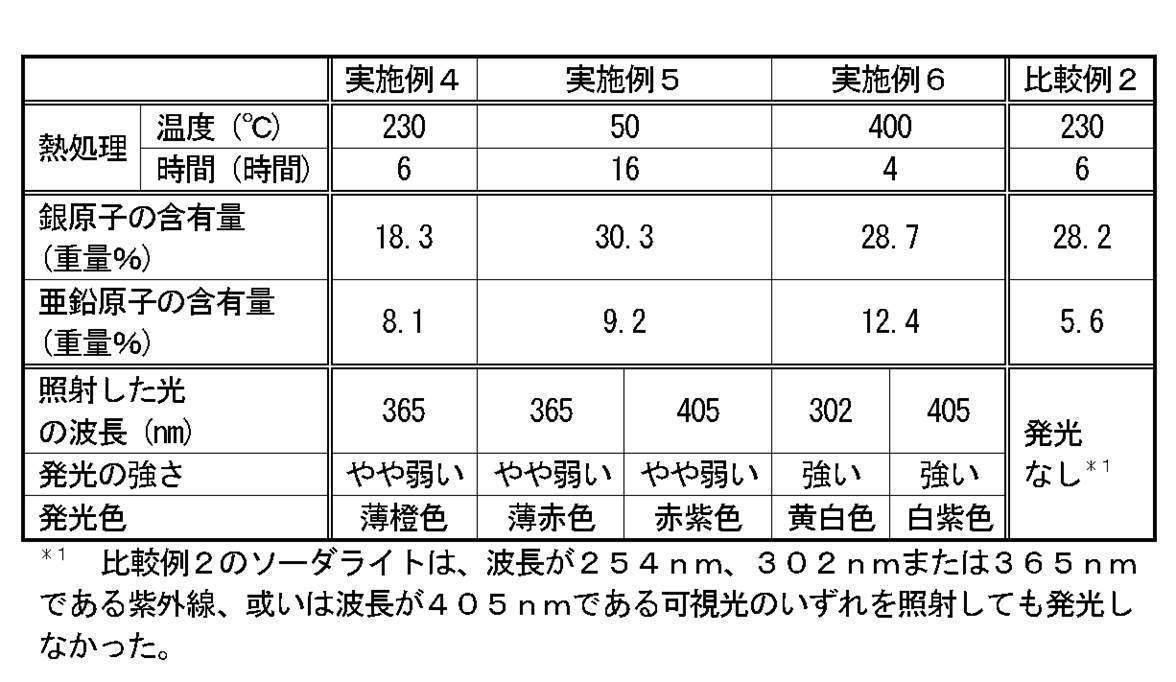
- the silver atom and zinc atom-containing sodalite of Comparative Example 2 in which the zinc atom content is less than 7 wt% is Visible light did not emit visible light, but the silver atoms and zinc atom-containing sodalites of Examples 4 to 6 containing 7 wt% or more and 17 wt% of zinc atoms emitted visible light.
- the silver atom and zinc atom-containing sodalite of Examples 4 and 5 produced through a heat treatment at a temperature of less than 300 ° C., and the Examples produced through a heat treatment at a temperature of 300 ° C. or higher. Both of the 6 silver atoms and the zinc atom-containing sodalite emitted visible light when irradiated with light.
- Sodalite Example 7 containing 31% by weight or more and less than 51% by weight of silver (production of sodalite containing silver atoms and zinc atoms) Ion exchange treatment by stirring and holding sodalite (5 g) in an aqueous solution of silver nitrate and zinc sulfate (1000 mL, silver ion concentration 20.6 mmol / L, zinc ion concentration 15.5 mmol / L) for 1 hour at room temperature Went. Subsequently, sodalite was filtered from the suspension and washed with water to obtain wet silver ion and zinc ion exchange sodalite. The obtained silver ion and zinc ion exchange sodalite was subjected to a heat treatment at 500 ° C. for 4 hours in an air atmosphere to produce silver atom and zinc atom-containing sodalite.
- Example 8 (Production of silver atom and zinc atom-containing sodalite) Ion exchange treatment by stirring and holding sodalite (5 g) in an aqueous solution of silver nitrate and zinc sulfate (1000 mL, silver ion concentration 36.1 mmol / L, zinc ion concentration 7.8 mmol / L) at room temperature for 1 hour Went. Subsequently, sodalite was filtered from the suspension and washed with water to obtain wet silver ion and zinc ion exchange sodalite. The obtained silver ion and zinc ion exchange sodalite was subjected to a heat treatment at 500 ° C. for 4 hours in an air atmosphere to produce silver atom and zinc atom-containing sodalite.
- Comparative Example 3 production of sodalite containing silver atoms and zinc atoms
- Ion exchange treatment by stirring and holding sodalite (5 g) in an aqueous solution of silver nitrate and zinc sulfate (1000 mL, silver ion concentration 46.4 mmol / L, zinc ion concentration 3.9 mmol / L) for 1 hour at room temperature Went.
- sodalite was filtered from the suspension and washed with water to obtain wet silver ion and zinc ion exchange sodalite.
- the obtained silver ion and zinc ion exchange sodalite was subjected to a heat treatment at 500 ° C. for 4 hours in an air atmosphere to produce silver atom and zinc atom-containing sodalite.
- Comparative Example 4 production of sodalite containing silver atoms and zinc atoms
- Ion exchange treatment by stirring and holding sodalite (5 g) in an aqueous solution of silver nitrate and zinc sulfate (1000 mL, silver ion concentration 20.6 mmol / L, zinc ion concentration 15.5 mmol / L) for 1 hour at room temperature Went.
- sodalite was filtered from the suspension and washed with water to obtain wet silver ion and zinc ion exchange sodalite.
- the obtained silver ion and zinc ion exchange sodalite was subjected to a heat treatment at 230 ° C. for 6 hours in an air atmosphere to produce silver atoms and zinc atom-containing sodalite.
- the temperature is less than 300 ° C.
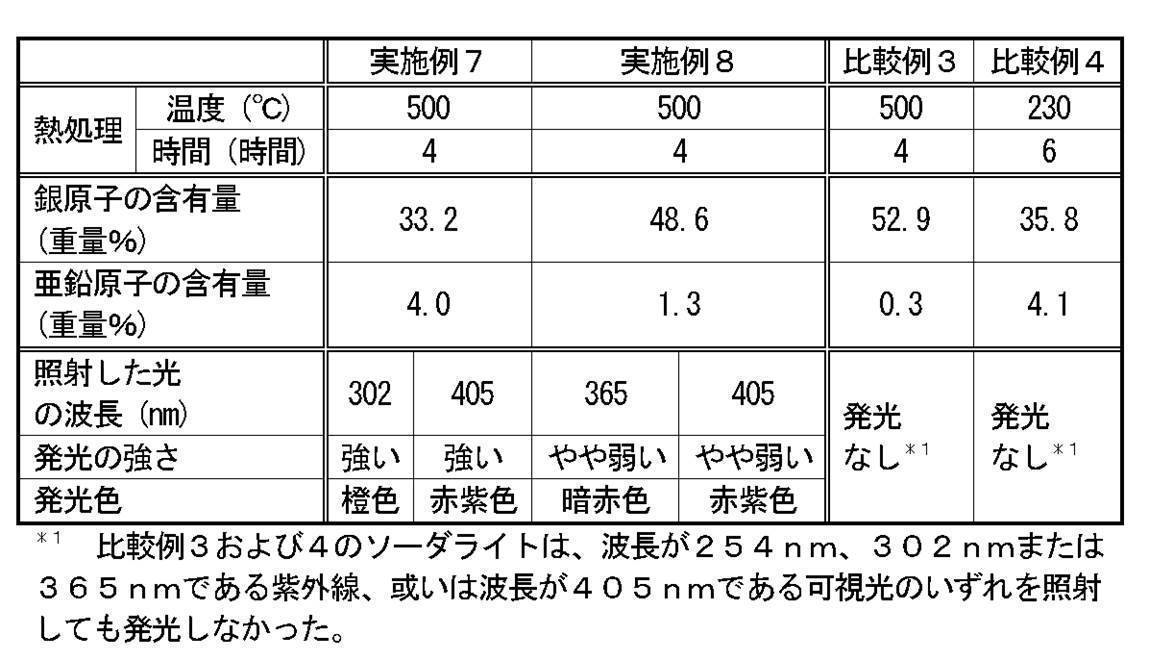
- the silver atom- and zinc atom-containing sodalite of Comparative Example 4 produced through heat treatment in the embodiment did not emit visible light even when irradiated with light, but was produced through heat treatment at a temperature of 300 ° C. or higher.
- the silver and zinc atom-containing sodalites of Examples 7 and 8 emitted visible light.
- the silver atom and zinc atom containing sodalite of the comparative example 3 whose silver atom content exceeds 51 weight% and zinc atom content is less than 0.5 weight% are 300 degreeC or more in temperature. Despite being manufactured through heat treatment, it did not emit visible light even when irradiated with light.
- the photoluminescent material of the present invention (that is, silver atom-containing sodalite or silver atom and zinc atom-containing sodalite) can be used in anti-counterfeit luminescent paints and lighting devices such as banknotes.
Landscapes
- Chemical & Material Sciences (AREA)
- Organic Chemistry (AREA)
- Inorganic Chemistry (AREA)
- Physics & Mathematics (AREA)
- Engineering & Computer Science (AREA)
- Materials Engineering (AREA)
- Nonlinear Science (AREA)
- Spectroscopy & Molecular Physics (AREA)
- Mathematical Physics (AREA)
- Crystallography & Structural Chemistry (AREA)
- General Physics & Mathematics (AREA)
- Optics & Photonics (AREA)
- Life Sciences & Earth Sciences (AREA)
- General Life Sciences & Earth Sciences (AREA)
- Geology (AREA)
- General Engineering & Computer Science (AREA)
- Luminescent Compositions (AREA)
- Silicates, Zeolites, And Molecular Sieves (AREA)
- Led Device Packages (AREA)
Abstract
Description
[3] 銀原子の含有量が、0.2重量%以上9重量%以下である前記[1]に記載のフォトルミネッセント材料。
[4] 銀原子の含有量が、0.3重量%以上8重量%以下である前記[1]に記載のフォトルミネッセント材料。
[7] 亜鉛原子の含有量が、1重量%以上25重量%以下である前記[5]に記載のフォトルミネッセント材料。
[8] 亜鉛原子の含有量が、5重量%以上25重量%以下である前記[5]に記載のフォトルミネッセント材料。
[11] 熱処理の温度が、150℃以上600℃以下である前記[9]に記載のフォトルミネッセント材料。
[13] 熱処理の時間が、2時間以上24時間以下である前記[9]~[11]のいずれか一つに記載のフォトルミネッセント材料。
[15] 照射する光の波長が、220nm以上370nm以下である前記[1]~[13]のいずれか一つに記載のフォトルミネッセント材料。
[16] 照射する光の波長が、230nm以上360nm以下である前記[1]~[13]のいずれか一つに記載のフォトルミネッセント材料。
[19] 銀原子の含有量が、10重量%以上17.5重量%以下である前記[17]に記載のフォトルミネッセント材料。
[20] 銀原子の含有量が、10重量%以上17重量%以下である前記[17]に記載のフォトルミネッセント材料。
[23] 亜鉛原子の含有量が、1重量%以上21重量%以下である前記[21]に記載のフォトルミネッセント材料。
[24] 亜鉛原子の含有量が、5重量%以上21重量%以下である前記[21]に記載のフォトルミネッセント材料。
[26] 熱処理の温度が、100℃以上270℃以下である前記[17]~[24]のいずれか一つに記載のフォトルミネッセント材料。
[27] 熱処理の温度が、150℃以上250℃以下である前記[17]~[24]のいずれか一つに記載のフォトルミネッセント材料。
[29] 熱処理の時間が、2時間以上16時間以下である前記[17]~[27]のいずれか一つに記載のフォトルミネッセント材料。
[31] 照射する光の波長が、220nm以上370nm以下である前記[17]~[29]のいずれか一つに記載のフォトルミネッセント材料。
[32] 照射する光の波長が、230nm以上360nm以下である前記[17]~[29]のいずれか一つに記載のフォトルミネッセント材料。
[35] 銀原子の含有量が、19重量%以上31重量%未満である前記[33]に記載のフォトルミネッセント材料。
[36] 銀原子の含有量が、19.5重量%以上31重量%未満である前記[33]に記載のフォトルミネッセント材料。
[38] 亜鉛原子の含有量が、8重量%以上17重量%以下である前記[33]~[36]のいずれか一つに記載のフォトルミネッセント材料。
[39] 亜鉛原子の含有量が、8.5重量%以上17重量%以下である前記[33]~[36]のいずれか一つに記載のフォトルミネッセント材料。
[42] 熱処理の温度が、150℃以上600℃以下である前記[40]に記載のフォトルミネッセント材料。
[44] 熱処理の時間が、2時間以上24時間以下である前記[40]~[42]のいずれか一つに記載のフォトルミネッセント材料。
[46] 照射する光の波長が、220nm以上420nm以下である前記[33]~[44]のいずれか一つに記載のフォトルミネッセント材料。
[47] 照射する光の波長が、230nm以上420nm以下である前記[33]~[44]のいずれか一つに記載のフォトルミネッセント材料。
[50] 銀原子の含有量が、31重量%以上50重量%以下である前記[48]に記載のフォトルミネッセント材料。
[51] 銀原子の含有量が、31重量%以上49重量%以下である前記[48]に記載のフォトルミネッセント材料。
[53] 亜鉛原子の含有量が、0.7重量%以上11重量%以下である前記[48]~[51]のいずれか一つに記載のフォトルミネッセント材料。
[54] 亜鉛原子の含有量が、0.8重量%以上11重量%以下である前記[48]~[51]のいずれか一つに記載のフォトルミネッセント材料。
[56] 熱処理の温度が、350℃以上650℃以下である前記[48]~[54]のいずれか一つに記載のフォトルミネッセント材料。
[57] 熱処理の温度が、400℃以上600℃以下である前記[48]~[54]のいずれか一つに記載のフォトルミネッセント材料。
[59] 熱処理の時間が、2時間以上8時間以下である前記[48]~[57]のいずれか一つに記載のフォトルミネッセント材料。
[61] 照射する光の波長が、220nm以上420nm以下である前記[48]~[59]のいずれか一つに記載のフォトルミネッセント材料。
[62] 照射する光の波長が、230nm以上420nm以下である前記[48]~[59]のいずれか一つに記載のフォトルミネッセント材料。
[64] ソーダライトの平均粒子径が、0.5μm以上50μm以下である前記[1]~[62]のいずれか一つに記載のフォトルミネッセント材料。
[66] 液晶表示装置用バックライトである前記[66]に記載の照明装置。
[69] イオン交換後のソーダライト中の銀原子の含有量が、0.2重量%以上9重量%以下である前記[67]に記載の方法。
[70] イオン交換後のソーダライト中の銀原子の含有量が、0.3重量%以上8重量%以下である前記[67]に記載の方法。
[73] イオン交換後のソーダライト中の亜鉛原子の含有量が、1重量%以上25重量%以下である前記[71]に記載の方法。
[74] イオン交換後のソーダライト中の亜鉛原子の含有量が、5重量%以上25重量%以下である前記[71]に記載の方法。
[76] 熱処理の温度が、150℃以上600℃以下である前記[67]~[74]のいずれか一つに記載の方法。
[78] 熱処理の時間が、2時間以上24時間以下である前記[67]~[76]のいずれか一つに記載の方法。
[81] イオン交換後のソーダライト中の銀原子の含有量が、10重量%以上17.5重量%以下である前記[79]に記載の方法。
[82] イオン交換後のソーダライト中の銀原子の含有量が、10重量%以上17重量%以下である前記[79]に記載の方法。
[85] イオン交換後のソーダライト中の亜鉛原子の含有量が、1重量%以上21重量%以下である前記[83]に記載の方法。
[86] イオン交換後のソーダライト中の亜鉛原子の含有量が、5重量%以上21重量%以下である前記[83]に記載の方法。
[88] 熱処理の温度が、100℃以上270℃以下である前記[79]~[86]のいずれか一つに記載の方法。
[89] 熱処理の温度が、150℃以上250℃以下である前記[79]~[86]のいずれか一つに記載の方法。
[91] 熱処理の時間が、2時間以上16時間以下である前記[79]~[89]のいずれか一つに記載の方法。
[94] イオン交換後のソーダライト中の銀原子の含有量が、19重量%以上31重量%未満である前記[92]に記載の方法。
[95] イオン交換後のソーダライト中の銀原子の含有量が、19.5重量%以上31重量%未満である前記[92]に記載の方法。
[97] イオン交換後のソーダライト中の亜鉛原子の含有量が、8重量%以上17重量%以下である前記[92]~[95]のいずれか一つに記載の方法。
[98] イオン交換後のソーダライト中の亜鉛原子の含有量が、8.5重量%以上17重量%以下である前記[92]~[95]のいずれか一つに記載の方法。
[100] 熱処理の温度が、150℃以上600℃以下である前記[92]~[98]のいずれか一つに記載の方法。
[102] 熱処理の時間が、2時間以上24時間以下である前記[92]~[100]のいずれか一つに記載の方法。
[105] イオン交換後のソーダライト中の銀原子の含有量が、31重量%以上50重量%以下である前記[103]に記載の方法。
[106] イオン交換後のソーダライト中の銀原子の含有量が、31重量%以上49重量%以下である前記[103]に記載の方法。
[108] イオン交換後のソーダライト中の亜鉛原子の含有量が、0.7重量%以上11重量%以下である前記[103]~[106]のいずれか一つに記載の方法。
[109] イオン交換後のソーダライト中の亜鉛原子の含有量が、0.8重量%以上11重量%以下である前記[103]~[106]のいずれか一つに記載の方法。
[111] 熱処理の温度が、350℃以上650℃以下である前記[103]~[109]のいずれか一つに記載の方法。
[112] 熱処理の温度が、400℃以上600℃以下である前記[103]~[109]のいずれか一つに記載の方法。
[114] 熱処理の時間が、2時間以上8時間以下である前記[103]~[112]のいずれか一つに記載の方法。
[116] ソーダライトの平均粒子径が、0.5μm以上50μm以下である前記[67]~[114]のいずれか一つに記載の方法。
(1)0.05重量%以上10重量%未満の銀原子を含有するソーダライト(但し、シュウ酸アニオンを含有するソーダライトを除く)。
(2)300℃未満の温度での熱処理を経て製造された、10重量%以上18重量%未満の銀原子を含有するソーダライト(但し、シュウ酸アニオンを含有するソーダライトを除く)。
(3)18重量%以上31重量%未満の銀原子および7重量%以上17重量%以下の亜鉛原子を含有するソーダライト。
(4)300℃以上850℃以下の温度での熱処理を経て製造された、31重量%以上51重量%未満の銀原子および0.5重量%以上11重量%以下の亜鉛原子を含有するソーダライト。
以下の実施例および比較例では、以下の特性を有する東ソー社製のソーダライトを使用した。
平均粒子径:約1μm
イオン交換可能な陽イオンとしてNa+イオンを含有
イオン交換容量:約8.3meq/g
以下の実施例および比較例で得られた銀原子含有ソーダライト中の銀原子の含有量、並びに銀原子および亜鉛原子含有ソーダライト中の銀原子および亜鉛原子の含有量を、日本電子社製「JSM-6010PLUS/LA」を用いたエネルギー分散型X線分析(EDS、加速電圧15kV)によって測定した。結果を下記表に示す。
以下の実施例および比較例で得られた銀原子含有ソーダライトまたは銀原子および亜鉛原子含有ソーダライトに、VILBER LOURMAT社製「VL-4LC」を使用して波長が254nm、302nmまたは365nmである紫外線を照射し、或いは綺麗堂社より入手した「UV-LED12灯」を使用して波長が405nmである可視光を照射し、発光の強さおよび発光色を目視で観察した。結果を下記表に示す。
実施例1(銀原子含有ソーダライトの製造)
ソーダライト(5g)を硝酸銀の水溶液(1000mL、銀イオン濃度0.41mmol/L)中にて室温で1時間撹拌および保持して、イオン交換処理を行った。次いで懸濁液からソーダライトをろ取し、水洗して、湿潤状態の銀イオン交換ソーダライトを得た。得られた銀イオン交換ソーダライトに、大気雰囲気下、500℃で4時間の熱処理を施して、銀原子含有ソーダライトを製造した。
ソーダライト(5g)を、硝酸銀および硫酸亜鉛の水溶液(1000mL、銀イオン濃度5.2mmol/L、亜鉛イオン濃度23.3mmol/L)中にて室温で1時間撹拌および保持して、イオン交換処理を行った。次いで懸濁液からソーダライトをろ取し、水洗して、湿潤状態の銀イオンおよび亜鉛イオン交換ソーダライトを得た。得られた銀イオンおよび亜鉛イオン交換ソーダライトに、大気雰囲気下、50℃で16時間の熱処理を施して、銀原子および亜鉛原子含有ソーダライトを製造した。

実施例3(銀原子含有ソーダライトの製造)
ソーダライト(5g)を、硝酸銀の水溶液(1000mL、銀イオン濃度2.1mmol/L)中にて室温で1時間撹拌および保持して、イオン交換処理を行った。次いで懸濁液からソーダライトをろ取し、水洗して、湿潤状態の銀イオン交換ソーダライトを得た。得られた銀イオン交換ソーダライトに、大気雰囲気下、230℃で6時間の熱処理を施して、銀原子含有ソーダライトを製造した。
ソーダライト(5g)を、硝酸銀および硫酸亜鉛の水溶液(1000mL、銀イオン濃度5.2mmol/L、亜鉛イオン濃度23.3mmol/L)中にて室温で1時間撹拌および保持して、イオン交換処理を行った。次いで懸濁液からソーダライトをろ取し、水洗して、湿潤状態の銀イオンおよび亜鉛イオン交換ソーダライトを得た。得られた銀イオンおよび亜鉛イオン交換ソーダライトに、大気雰囲気下、500℃で4時間の熱処理を施して、銀原子および亜鉛原子含有ソーダライトを製造した。
実施例4(銀原子および亜鉛原子含有ソーダライトの製造)
ソーダライト(5g)を、硝酸銀および硫酸亜鉛の水溶液(1000mL、銀イオン濃度10.3mmol/L、亜鉛イオン濃度20.7mmol/L)中にて室温で1時間撹拌および保持して、イオン交換処理を行った。次いで懸濁液からソーダライトをろ取し、水洗して、湿潤状態の銀イオンおよび亜鉛イオン交換ソーダライトを得た。得られた銀イオンおよび亜鉛イオン交換ソーダライトに、大気雰囲気下、230℃で6時間の熱処理を施して、銀原子および亜鉛原子含有ソーダライトを製造した。
ソーダライト(5g)を、まず硫酸亜鉛の水溶液(1000mL、亜鉛イオン濃度103.3mmol/L)中にて室温で1時間撹拌および保持したのち、そこに高濃度の硝酸銀の水溶液(10mL、銀イオン濃度2.49mol/L)を添加して、添加後の水溶液中の銀イオン濃度を24.7mmol/Lに調整した後、室温でさらに1時間撹拌および保持してイオン交換処理を行った。次いで懸濁液からソーダライトをろ取し、水洗して、湿潤状態の銀イオンおよび亜鉛イオン交換ソーダライトを得た。得られた銀イオンおよび亜鉛イオン交換ソーダライトに、大気雰囲気下、50℃で16時間の熱処理を施して、銀原子および亜鉛原子含有ソーダライトを製造した。
ソーダライト(5g)を、まず硫酸亜鉛の水溶液(1000mL、亜鉛イオン濃度20.6mmol/L)中にて40℃で1時間撹拌および保持してイオン交換処理を行ったのち、懸濁液からソーダライトをろ取し、水洗して、湿潤状態の亜鉛イオン交換ソーダライトを得た。得られた亜鉛イオン交換ソーダライト全量に対して、同様の亜鉛イオン交換操作をあと2回繰り返し、亜鉛イオン交換ソーダライトを得た。この亜鉛イオン交換ソーダライト全量を、硝酸銀の水溶液(1000mL、銀イオン濃度25.8mmol/L)中にて室温で1時間撹拌および保持してイオン交換処理を行ったのち、懸濁液からソーダライトをろ取し、水洗して、湿潤状態の銀イオンおよび亜鉛イオン交換ソーダライトを得た。得られた銀イオンおよび亜鉛イオン交換ソーダライトに、大気雰囲気下、400℃で4時間の熱処理を施して、銀原子および亜鉛原子含有ソーダライトを製造した。
ソーダライト(5g)を、硝酸銀および硫酸亜鉛の水溶液(1000mL、銀イオン濃度15.5mmol/L、亜鉛イオン濃度18.1mmol/L)中にて室温で1時間撹拌および保持して、イオン交換処理を行った。次いで懸濁液からソーダライトをろ取し、水洗して、湿潤状態の銀イオンおよび亜鉛イオン交換ソーダライトを得た。得られた銀イオンおよび亜鉛イオン交換ソーダライトに、大気雰囲気下、230℃で6時間の熱処理を施して、銀原子および亜鉛原子含有ソーダライトを製造した。
実施例7(銀原子および亜鉛原子含有ソーダライトの製造)
ソーダライト(5g)を、硝酸銀および硫酸亜鉛の水溶液(1000mL、銀イオン濃度20.6mmol/L、亜鉛イオン濃度15.5mmol/L)中にて室温で1時間撹拌および保持して、イオン交換処理を行った。次いで懸濁液からソーダライトをろ取し、水洗して、湿潤状態の銀イオンおよび亜鉛イオン交換ソーダライトを得た。得られた銀イオンおよび亜鉛イオン交換ソーダライトに、大気雰囲気下、500℃で4時間の熱処理を施して、銀原子および亜鉛原子含有ソーダライトを製造した。
ソーダライト(5g)を、硝酸銀および硫酸亜鉛の水溶液(1000mL、銀イオン濃度36.1mmol/L、亜鉛イオン濃度7.8mmol/L)中にて室温で1時間撹拌および保持して、イオン交換処理を行った。次いで懸濁液からソーダライトをろ取し、水洗して、湿潤状態の銀イオンおよび亜鉛イオン交換ソーダライトを得た。得られた銀イオンおよび亜鉛イオン交換ソーダライトに、大気雰囲気下、500℃で4時間の熱処理を施して、銀原子および亜鉛原子含有ソーダライトを製造した。
ソーダライト(5g)を、硝酸銀および硫酸亜鉛の水溶液(1000mL、銀イオン濃度46.4mmol/L、亜鉛イオン濃度3.9mmol/L)中にて室温で1時間撹拌および保持して、イオン交換処理を行った。次いで懸濁液からソーダライトをろ取し、水洗して、湿潤状態の銀イオンおよび亜鉛イオン交換ソーダライトを得た。得られた銀イオンおよび亜鉛イオン交換ソーダライトに、大気雰囲気下、500℃で4時間の熱処理を施して、銀原子および亜鉛原子含有ソーダライトを製造した。
ソーダライト(5g)を、硝酸銀および硫酸亜鉛の水溶液(1000mL、銀イオン濃度20.6mmol/L、亜鉛イオン濃度15.5mmol/L)中にて室温で1時間撹拌および保持して、イオン交換処理を行った。次いで懸濁液からソーダライトをろ取し、水洗して、湿潤状態の銀イオンおよび亜鉛イオン交換ソーダライトを得た。得られた銀イオンおよび亜鉛イオン交換ソーダライトに、大気雰囲気下、230℃で6時間の熱処理を施して、銀原子および亜鉛原子含有ソーダライトを製造した。
Claims (17)
- 0.05重量%以上10重量%未満の銀原子を含有するソーダライト(但し、シュウ酸アニオンを含有するソーダライトを除く)であり、光の照射によって可視光を発光するフォトルミネッセント材料。
- 50℃以上850℃以下の温度での熱処理を経て製造された請求項1に記載のフォトルミネッセント材料。
- 照射する光の波長が、200nm以上380nm未満である請求項1または2に記載のフォトルミネッセント材料。
- 300℃未満の温度での熱処理を経て製造された、10重量%以上18重量%未満の銀原子を含有するソーダライト(但し、シュウ酸アニオンを含有するソーダライトを除く)であり、光の照射によって可視光を発光するフォトルミネッセント材料。
- 熱処理の温度が、50℃以上300℃未満である請求項4に記載のフォトルミネッセント材料。
- 照射する光の波長が、200nm以上380nm未満である請求項4または5に記載のフォトルミネッセント材料。
- 18重量%以上31重量%未満の銀原子および7重量%以上17重量%以下の亜鉛原子を含有するソーダライトであり、光の照射によって可視光を発光するフォトルミネッセント材料。
- 50℃以上850℃以下の温度での熱処理を経て製造された請求項7に記載のフォトルミネッセント材料。
- 照射する光の波長が、200nm以上430nm未満である請求項7または8に記載のフォトルミネッセント材料。
- 300℃以上850℃以下の温度での熱処理を経て製造された、31重量%以上51重量%未満の銀原子および0.5重量%以上11重量%以下の亜鉛原子を含有するソーダライトであり、光の照射によって可視光を発光するフォトルミネッセント材料。
- 照射する光の波長が、200nm以上430nm未満である請求項10に記載のフォトルミネッセント材料。
- 光源および請求項1~11のいずれか一項に記載のフォトルミネッセント材料を含む照明装置。
- 液晶表示装置用バックライトである請求項12に記載の照明装置。
- イオン交換によって0.05重量%以上10重量%未満の銀原子を含有するソーダライト(但し、シュウ酸アニオンを含有するソーダライトを除く)を製造し、イオン交換後のソーダライトを50℃以上850℃以下の温度で熱処理することを含む、フォトルミネッセント材料の製造方法。
- イオン交換によって10重量%以上18重量%未満の銀原子を含有するソーダライト(但し、シュウ酸アニオンを含有するソーダライトを除く)を製造し、イオン交換後のソーダライトを300℃未満の温度で熱処理することを含む、フォトルミネッセント材料の製造方法。
- イオン交換によって18重量%以上31重量%未満の銀原子および7重量%以上17重量%以下の亜鉛原子を含有するソーダライトを製造し、イオン交換後のソーダライトを50℃以上850℃以下の温度で熱処理することを含む、フォトルミネッセント材料の製造方法。
- イオン交換によって31重量%以上51重量%未満の銀原子および0.5重量%以上11重量%以下の亜鉛原子を含有するソーダライトを製造し、イオン交換後のソーダライトを300℃以上850℃以下の温度で熱処理することを含む、フォトルミネッセント材料の製造方法。
Priority Applications (5)
| Application Number | Priority Date | Filing Date | Title |
|---|---|---|---|
| CN201680029934.5A CN107614660B (zh) | 2015-05-26 | 2016-05-25 | 光致发光材料 |
| EP16800060.2A EP3305873A4 (en) | 2015-05-26 | 2016-05-25 | PHOTOLUMINESCENT MATERIAL |
| JP2017520780A JP6839421B2 (ja) | 2015-05-26 | 2016-05-25 | フォトルミネッセント材料 |
| KR1020177036442A KR102604160B1 (ko) | 2015-05-26 | 2016-05-25 | 광발광 재료 |
| US15/574,591 US10619093B2 (en) | 2015-05-26 | 2016-05-25 | Photoluminescent material |
Applications Claiming Priority (2)
| Application Number | Priority Date | Filing Date | Title |
|---|---|---|---|
| JP2015-106391 | 2015-05-26 | ||
| JP2015106391 | 2015-05-26 |
Publications (1)
| Publication Number | Publication Date |
|---|---|
| WO2016190356A1 true WO2016190356A1 (ja) | 2016-12-01 |
Family
ID=57393437
Family Applications (1)
| Application Number | Title | Priority Date | Filing Date |
|---|---|---|---|
| PCT/JP2016/065460 Ceased WO2016190356A1 (ja) | 2015-05-26 | 2016-05-25 | フォトルミネッセント材料 |
Country Status (6)
| Country | Link |
|---|---|
| US (1) | US10619093B2 (ja) |
| EP (1) | EP3305873A4 (ja) |
| JP (1) | JP6839421B2 (ja) |
| KR (1) | KR102604160B1 (ja) |
| CN (1) | CN107614660B (ja) |
| WO (1) | WO2016190356A1 (ja) |
Cited By (1)
| Publication number | Priority date | Publication date | Assignee | Title |
|---|---|---|---|---|
| JP2021195425A (ja) * | 2020-06-11 | 2021-12-27 | レンゴー株式会社 | フォトルミネッセント材料の製造方法 |
Families Citing this family (1)
| Publication number | Priority date | Publication date | Assignee | Title |
|---|---|---|---|---|
| KR102150764B1 (ko) * | 2018-11-23 | 2020-09-02 | 한국과학기술원 | 할로겐 함유 소달라이트 소결체 및 이의 제조방법 |
Citations (2)
| Publication number | Priority date | Publication date | Assignee | Title |
|---|---|---|---|---|
| JPS50142482A (ja) * | 1974-04-01 | 1975-11-17 | ||
| JPH04126530A (ja) * | 1990-09-14 | 1992-04-27 | Nitto Denko Corp | 抗菌性液体分離膜 |
Family Cites Families (4)
| Publication number | Priority date | Publication date | Assignee | Title |
|---|---|---|---|---|
| US4942119A (en) * | 1988-08-03 | 1990-07-17 | Ozin Geoffrey A | Photosensitive, radiation sensitive, thermally sensitive and pressure sensitive silver sodalite materials |
| US20100194265A1 (en) | 2007-07-09 | 2010-08-05 | Katholieke Universiteit Leuven | Light-emitting materials for electroluminescent devices |
| FR2963357B1 (fr) * | 2010-08-02 | 2016-05-13 | Rengo Co Ltd | Materiau photoluminescent contenant de l'ion d'argent |
| JP2012122064A (ja) * | 2010-11-17 | 2012-06-28 | Ehime Univ | ゼオライトを担体とする蛍光体及びその製造方法 |
-
2016
- 2016-05-25 WO PCT/JP2016/065460 patent/WO2016190356A1/ja not_active Ceased
- 2016-05-25 JP JP2017520780A patent/JP6839421B2/ja active Active
- 2016-05-25 KR KR1020177036442A patent/KR102604160B1/ko active Active
- 2016-05-25 US US15/574,591 patent/US10619093B2/en active Active
- 2016-05-25 EP EP16800060.2A patent/EP3305873A4/en not_active Withdrawn
- 2016-05-25 CN CN201680029934.5A patent/CN107614660B/zh active Active
Patent Citations (2)
| Publication number | Priority date | Publication date | Assignee | Title |
|---|---|---|---|---|
| JPS50142482A (ja) * | 1974-04-01 | 1975-11-17 | ||
| JPH04126530A (ja) * | 1990-09-14 | 1992-04-27 | Nitto Denko Corp | 抗菌性液体分離膜 |
Non-Patent Citations (5)
| Title |
|---|
| KAIHERIMAN,M ET AL.: "Photoluminescence properties of Tb3+-doped sodalite under VUV-UV light excitation", JOURNAL OF LUMINESCENCE, vol. 157, 16 September 2014 (2014-09-16), pages 411 - 415, XP029078934 * |
| MAIMAITINAISIER,A ET AL.: "Luminescence Properties of Cu Doped Natural Sodalite Under Ultraviolet-Vis Excitation", CHINESE JOURNAL OF LUMINESCENCE, vol. 34, no. 12, December 2013 (2013-12-01), pages 1596 - 1602, XP055500859 * |
| See also references of EP3305873A4 * |
| STEIN,A ET AL.: "Silver Sodalites-A Chemistry Approach Towards Reversible Optical Data Storage", JOURNAL OF THE SOCIETY OF PHOTOGRAPHIC SCIENCE AND TECHNOLOGY OF JAPAN, vol. 53, no. 4, 1990, pages 322 - 328, XP055335442 * |
| TODD, LT ET AL.: "U.V. Absorption Band in Ge- Doped Sodalite Powders", JOURNAL OF THE ELECTROCHEMICAL SOCIETY, February 1980 (1980-02-01), pages 435 - 438, XP055335447 * |
Cited By (2)
| Publication number | Priority date | Publication date | Assignee | Title |
|---|---|---|---|---|
| JP2021195425A (ja) * | 2020-06-11 | 2021-12-27 | レンゴー株式会社 | フォトルミネッセント材料の製造方法 |
| JP7591778B2 (ja) | 2020-06-11 | 2024-11-29 | レンゴー株式会社 | フォトルミネッセント材料の製造方法 |
Also Published As
| Publication number | Publication date |
|---|---|
| JPWO2016190356A1 (ja) | 2018-03-15 |
| US10619093B2 (en) | 2020-04-14 |
| US20180148642A1 (en) | 2018-05-31 |
| EP3305873A4 (en) | 2019-02-20 |
| CN107614660A (zh) | 2018-01-19 |
| JP6839421B2 (ja) | 2021-03-10 |
| KR102604160B1 (ko) | 2023-11-20 |
| CN107614660B (zh) | 2021-07-16 |
| KR20180011788A (ko) | 2018-02-02 |
| EP3305873A1 (en) | 2018-04-11 |
Similar Documents
| Publication | Publication Date | Title |
|---|---|---|
| Saif et al. | Novel non-toxic and red luminescent sensor based on Eu3+: Y2Ti2O7/SiO2 nano-powder for latent fingerprint detection | |
| JP5438728B2 (ja) | 銀イオンを含有するフォトルミネッセント材料 | |
| Phuruangrat et al. | Synthesis and characterization of europium‐doped zinc oxide photocatalyst | |
| Saif | Synthesis of down conversion, high luminescent nano-phosphor materials based on new developed Ln3+: Y2Zr2O7/SiO2 for latent fingerprint application | |
| Yagoub et al. | The effects of Eu-concentrations on the luminescent properties of SrF2: Eu nanophosphor | |
| JP5252621B2 (ja) | 粘土を主成分とするフレキシブル蛍光フィルム | |
| BR112016014309B1 (pt) | Luminóforo de sulfeto de zinco, processo para fabricação de um luminóforo de sulfeto de zinco e método para detecção e/ou verificação de uma característica de segurança | |
| JP6839421B2 (ja) | フォトルミネッセント材料 | |
| Ghubish et al. | Novel fluorescent nano-sensor based on amino-functionalization of Eu3+: SrSnO3 for copper ion detection in food and real drink water samples | |
| JP5781477B2 (ja) | フォトルミネッセント材料 | |
| JP6893655B2 (ja) | フォトルミネッセント材料 | |
| WO2018003848A1 (ja) | 蛍光体及び発光装置 | |
| JP6865433B2 (ja) | フォトルミネッセント材料 | |
| Ansari | Comparative structural, optical, and photoluminescence studies of YF3: Pr, YF3: Pr@ LaF3, and YF3: Pr@ LaF3@ SiO2 core–shell nanocrystals | |
| CN104726102B (zh) | 荧光防伪材料及其制备方法 | |
| Liang et al. | Efficient ultraviolet to far‐red spectral conversion: Tb3+, Cr3+ co‐doped Zn0. 5Mg0. 5Al2O4 phosphors and their application | |
| JP5279134B2 (ja) | 板状蛍光体とその利用 | |
| JP4982812B2 (ja) | 真空紫外光励起用蛍光体 | |
| JP4315371B2 (ja) | 赤外可視変換蛍光体 | |
| CN108328644A (zh) | 一种规则棒状多孔Er/Eu-ZnO复合材料及其制备方法 | |
| Song et al. | Synthesis of Red‐Emitting AgGd 0.9 Eu 0.1 (MoO 4) 2 Phosphors by Precipitation at Room Temperature | |
| JP2014234455A (ja) | 蛍光体及びその製造方法 | |
| Saifa et al. | New Eu 3: La2Ti2O7/SiO2 nanophosphor powder were prepared and optimized for latent fingerprint detection application from most relevant nonporous forensic surfaces. | |
| Raju et al. | Results in Chemistry | |
| CN105733582A (zh) | 一种稀土磷酸盐绿色荧光粉及其制备方法 |
Legal Events
| Date | Code | Title | Description |
|---|---|---|---|
| 121 | Ep: the epo has been informed by wipo that ep was designated in this application |
Ref document number: 16800060 Country of ref document: EP Kind code of ref document: A1 |
|
| ENP | Entry into the national phase |
Ref document number: 2017520780 Country of ref document: JP Kind code of ref document: A |
|
| WWE | Wipo information: entry into national phase |
Ref document number: 15574591 Country of ref document: US |
|
| NENP | Non-entry into the national phase |
Ref country code: DE |
|
| ENP | Entry into the national phase |
Ref document number: 20177036442 Country of ref document: KR Kind code of ref document: A |
|
| WWE | Wipo information: entry into national phase |
Ref document number: 2016800060 Country of ref document: EP |