WO2016194531A1 - チタン酸アルカリおよび摩擦材 - Google Patents
チタン酸アルカリおよび摩擦材 Download PDFInfo
- Publication number
- WO2016194531A1 WO2016194531A1 PCT/JP2016/063370 JP2016063370W WO2016194531A1 WO 2016194531 A1 WO2016194531 A1 WO 2016194531A1 JP 2016063370 W JP2016063370 W JP 2016063370W WO 2016194531 A1 WO2016194531 A1 WO 2016194531A1
- Authority
- WO
- WIPO (PCT)
- Prior art keywords
- potassium
- mol
- titanate
- oxide
- atom
- Prior art date
- Legal status (The legal status is an assumption and is not a legal conclusion. Google has not performed a legal analysis and makes no representation as to the accuracy of the status listed.)
- Ceased
Links
Classifications
-
- F—MECHANICAL ENGINEERING; LIGHTING; HEATING; WEAPONS; BLASTING
- F16—ENGINEERING ELEMENTS AND UNITS; GENERAL MEASURES FOR PRODUCING AND MAINTAINING EFFECTIVE FUNCTIONING OF MACHINES OR INSTALLATIONS; THERMAL INSULATION IN GENERAL
- F16D—COUPLINGS FOR TRANSMITTING ROTATION; CLUTCHES; BRAKES
- F16D69/00—Friction linings; Attachment thereof; Selection of coacting friction substances or surfaces
- F16D69/02—Composition of linings ; Methods of manufacturing
- F16D69/027—Compositions based on metals or inorganic oxides
- F16D69/028—Compositions based on metals or inorganic oxides containing fibres
-
- C—CHEMISTRY; METALLURGY
- C01—INORGANIC CHEMISTRY
- C01G—COMPOUNDS CONTAINING METALS NOT COVERED BY SUBCLASSES C01D OR C01F
- C01G23/00—Compounds of titanium
-
- C—CHEMISTRY; METALLURGY
- C01—INORGANIC CHEMISTRY
- C01G—COMPOUNDS CONTAINING METALS NOT COVERED BY SUBCLASSES C01D OR C01F
- C01G23/00—Compounds of titanium
- C01G23/003—Titanates
- C01G23/005—Alkali titanates
-
- C—CHEMISTRY; METALLURGY
- C09—DYES; PAINTS; POLISHES; NATURAL RESINS; ADHESIVES; COMPOSITIONS NOT OTHERWISE PROVIDED FOR; APPLICATIONS OF MATERIALS NOT OTHERWISE PROVIDED FOR
- C09K—MATERIALS FOR MISCELLANEOUS APPLICATIONS, NOT PROVIDED FOR ELSEWHERE
- C09K3/00—Materials not provided for elsewhere
- C09K3/14—Anti-slip materials; Abrasives
-
- F—MECHANICAL ENGINEERING; LIGHTING; HEATING; WEAPONS; BLASTING
- F16—ENGINEERING ELEMENTS AND UNITS; GENERAL MEASURES FOR PRODUCING AND MAINTAINING EFFECTIVE FUNCTIONING OF MACHINES OR INSTALLATIONS; THERMAL INSULATION IN GENERAL
- F16D—COUPLINGS FOR TRANSMITTING ROTATION; CLUTCHES; BRAKES
- F16D69/00—Friction linings; Attachment thereof; Selection of coacting friction substances or surfaces
- F16D69/02—Composition of linings ; Methods of manufacturing
-
- F—MECHANICAL ENGINEERING; LIGHTING; HEATING; WEAPONS; BLASTING
- F16—ENGINEERING ELEMENTS AND UNITS; GENERAL MEASURES FOR PRODUCING AND MAINTAINING EFFECTIVE FUNCTIONING OF MACHINES OR INSTALLATIONS; THERMAL INSULATION IN GENERAL
- F16D—COUPLINGS FOR TRANSMITTING ROTATION; CLUTCHES; BRAKES
- F16D69/00—Friction linings; Attachment thereof; Selection of coacting friction substances or surfaces
- F16D69/02—Composition of linings ; Methods of manufacturing
- F16D69/025—Compositions based on an organic binder
- F16D69/026—Compositions based on an organic binder containing fibres
-
- C—CHEMISTRY; METALLURGY
- C01—INORGANIC CHEMISTRY
- C01P—INDEXING SCHEME RELATING TO STRUCTURAL AND PHYSICAL ASPECTS OF SOLID INORGANIC COMPOUNDS
- C01P2004/00—Particle morphology
- C01P2004/60—Particles characterised by their size
- C01P2004/61—Micrometer sized, i.e. from 1-100 micrometer
-
- C—CHEMISTRY; METALLURGY
- C01—INORGANIC CHEMISTRY
- C01P—INDEXING SCHEME RELATING TO STRUCTURAL AND PHYSICAL ASPECTS OF SOLID INORGANIC COMPOUNDS
- C01P2006/00—Physical properties of inorganic compounds
- C01P2006/12—Surface area
-
- C—CHEMISTRY; METALLURGY
- C01—INORGANIC CHEMISTRY
- C01P—INDEXING SCHEME RELATING TO STRUCTURAL AND PHYSICAL ASPECTS OF SOLID INORGANIC COMPOUNDS
- C01P2006/00—Physical properties of inorganic compounds
- C01P2006/80—Compositional purity
- C01P2006/82—Compositional purity water content
-
- F—MECHANICAL ENGINEERING; LIGHTING; HEATING; WEAPONS; BLASTING
- F16—ENGINEERING ELEMENTS AND UNITS; GENERAL MEASURES FOR PRODUCING AND MAINTAINING EFFECTIVE FUNCTIONING OF MACHINES OR INSTALLATIONS; THERMAL INSULATION IN GENERAL
- F16D—COUPLINGS FOR TRANSMITTING ROTATION; CLUTCHES; BRAKES
- F16D13/00—Friction clutches
- F16D13/58—Details
- F16D13/60—Clutching elements
- F16D13/64—Clutch-plates; Clutch-lamellae
-
- F—MECHANICAL ENGINEERING; LIGHTING; HEATING; WEAPONS; BLASTING
- F16—ENGINEERING ELEMENTS AND UNITS; GENERAL MEASURES FOR PRODUCING AND MAINTAINING EFFECTIVE FUNCTIONING OF MACHINES OR INSTALLATIONS; THERMAL INSULATION IN GENERAL
- F16D—COUPLINGS FOR TRANSMITTING ROTATION; CLUTCHES; BRAKES
- F16D2200/00—Materials; Production methods therefor
- F16D2200/0034—Materials; Production methods therefor non-metallic
- F16D2200/0039—Ceramics
- F16D2200/0043—Ceramic base, e.g. metal oxides or ceramic binder
-
- F—MECHANICAL ENGINEERING; LIGHTING; HEATING; WEAPONS; BLASTING
- F16—ENGINEERING ELEMENTS AND UNITS; GENERAL MEASURES FOR PRODUCING AND MAINTAINING EFFECTIVE FUNCTIONING OF MACHINES OR INSTALLATIONS; THERMAL INSULATION IN GENERAL
- F16D—COUPLINGS FOR TRANSMITTING ROTATION; CLUTCHES; BRAKES
- F16D2200/00—Materials; Production methods therefor
- F16D2200/006—Materials; Production methods therefor containing fibres or particles
-
- F—MECHANICAL ENGINEERING; LIGHTING; HEATING; WEAPONS; BLASTING
- F16—ENGINEERING ELEMENTS AND UNITS; GENERAL MEASURES FOR PRODUCING AND MAINTAINING EFFECTIVE FUNCTIONING OF MACHINES OR INSTALLATIONS; THERMAL INSULATION IN GENERAL
- F16D—COUPLINGS FOR TRANSMITTING ROTATION; CLUTCHES; BRAKES
- F16D2200/00—Materials; Production methods therefor
- F16D2200/006—Materials; Production methods therefor containing fibres or particles
- F16D2200/0065—Inorganic, e.g. non-asbestos mineral fibres
-
- F—MECHANICAL ENGINEERING; LIGHTING; HEATING; WEAPONS; BLASTING
- F16—ENGINEERING ELEMENTS AND UNITS; GENERAL MEASURES FOR PRODUCING AND MAINTAINING EFFECTIVE FUNCTIONING OF MACHINES OR INSTALLATIONS; THERMAL INSULATION IN GENERAL
- F16D—COUPLINGS FOR TRANSMITTING ROTATION; CLUTCHES; BRAKES
- F16D65/00—Parts or details
- F16D65/02—Braking members; Mounting thereof
- F16D65/04—Bands, shoes or pads; Pivots or supporting members therefor
- F16D65/092—Bands, shoes or pads; Pivots or supporting members therefor for axially-engaging brakes, e.g. disc brakes
Definitions
- the present invention relates to an alkali titanate and a friction material.
- Potassium titanate is a material useful as a friction material for friction sliding members such as brake linings, disk pads, and clutch fading, which constitute braking devices in automobiles, railway vehicles, aircraft, industrial machinery, and the like.
- the potassium titanates represented by the general formula K 2 O ⁇ nTiO 2 (n is an integer of 1 to 12)
- 6 potassium titanates in which n is 6 have a tunnel structure crystal structure. It is known that friction materials containing potassium titanate fibers (fibrous particles) are particularly excellent in heat resistance and the like.
- the fiber-like potassium titanate is not only poor in moldability due to its bulk, but also difficult to handle in a friction material due to its low fluidity and difficult to handle.
- Patent Document 1 Japanese Patent Laid-Open No. 2008-110918.
- a non-fiber-like potassium titanate a powder having a diameter of 3 ⁇ m or less, a length of 5 ⁇ m or more, and a length-to-diameter ratio (aspect ratio) of 3 or more when observed with an electron microscope is 0. Those containing 7 to 1.3% are disclosed.
- potassium titanate has high adhesion, there has been a technical problem that when producing a friction material, it tends to adhere to a raw material mixer or pad molding machine, and the yield tends to decrease.
- the present invention provides an alkali titanate in which the content ratio of the fiber-like potassium titanate is highly reduced and the adhesion is greatly reduced, and the friction containing the alkali titanate is provided.
- the purpose is to provide materials.
- the present invention (1) For 1 mole of 6 titanic acid, 0.5-2.2 mol of potassium oxide in terms of potassium atom, 0.05 to 1.4 mol of sodium oxide in terms of sodium atom, Contains 0 to 1.4 moles of lithium oxide in terms of lithium atoms, The total content of potassium oxide converted to potassium atom, sodium oxide converted to sodium atom and lithium oxide converted to lithium atom with respect to 1 mol of 6 titanic acid is 1.8 to 2.3 mol, An alkali titanate characterized by a monophasic rate of 85 to 100%, a fiber rate of 0 to 10% by volume, and a moisture content of 0 to 1.0% by mass; (2) For 1 mole of 6 titanic acid, 0.9 to 2.2 mol of potassium oxide in terms of potassium atom, 0.05 to 1.1 mol of sodium oxide in terms of sodium atom, Contains 0 to 0.2 moles of lithium oxide in terms of lithium atoms, The alkali titanate according to the above (1) having a fiber ratio of 0 to 7.0% by volume and
- the alkali titanate of the present invention comprises 0.5 to 2.2 mol of potassium oxide in terms of potassium atom, 0.05 to 1.4 mol of sodium oxide in terms of sodium atom, Contains 0 to 1.4 moles of lithium oxide in terms of conversion,
- the total content of potassium oxide converted to potassium atom, sodium oxide converted to sodium atom and lithium oxide converted to lithium atom with respect to 1 mol of 6 titanic acid is 1.8 to 2.3 mol,
- the monophase ratio is 85 to 100%
- the fiber ratio is 0 to 10% by volume
- the water content is 0 to 1.0% by mass.
- the alkali titanate of the present invention is 0.5 to 2.2 mol of potassium oxide in terms of potassium atom and 0.05 to 1 of sodium oxide in terms of sodium atom with respect to 1 mol of 6 titanic acid (Ti 6 O 12 ). .4 mol, containing 0 to 1.4 mol of lithium oxide in terms of lithium atom.
- the alkali titanate of the present invention contains 0.5 to 2.2 mol of potassium oxide in terms of potassium atom per 1 mol of 6 titanic acid (Ti 6 O 12 ), and 0.9 to 0.9 in terms of potassium atom.
- the amount is preferably 2.2 mol, and more preferably 1.2 to 2.2 mol of potassium oxide in terms of potassium atom.
- the alkali titanate of the present invention contains 0.05 to 1.4 mol of sodium oxide in terms of sodium atom per mol of 6 titanic acid (Ti 6 O 12 ), and 0.05 to 1.4 mol of sodium oxide in terms of sodium atom. 1.1 mol is preferable, and 0.05 to 0.8 mol of sodium oxide is more preferable in terms of sodium atom.
- the alkali titanate of the present invention preferably contains 0 to 1.4 mol of lithium oxide in terms of lithium atom and 1 to 0.2 mol of lithium oxide in terms of lithium atom with respect to 1 mol of 6 titanate. It is more preferable that 0 mol of lithium oxide is included (not included) in terms of atoms.
- the alkali titanate of the present invention has a total content of potassium oxide converted to potassium atom, sodium oxide converted to sodium atom and lithium oxide converted to lithium atom to 1.8 to 2.3 mol per 1 mol of 6 titanate.
- the total content is preferably 1.8 to 2.2 mol, and the total content is more preferably 1.9 to 2.2 mol.
- the content of potassium oxide in terms of potassium atom per 1 mol of 6 titanate, the content of sodium oxide in terms of sodium atom per 1 mol of 6 titanate, and the conversion of lithium atom per 1 mol of 6 titanate is within the above range, and potassium oxide converted to potassium atom per mole of 6 titanic acid, sodium oxide converted to sodium atom per mole of 6 titanic acid and lithium atom converted to 1 mole of 6 titanic acid
- the composition of the alkali titanate of the present invention can be easily controlled by adjusting the mixing ratio of the titanium compound and the alkali metal compound in the raw material mixture during the preparation of the alkali titanate.
- the content of lithium oxide in terms of lithium atom relative to 1 mol of 6 titanic acid means a value measured by the following method. That is, alkali titanate, Na 2 O 2 and NaOH are placed in a zirconia crucible and heated to melt. Then, it is allowed to cool, and water and HCl are added and dissolved.
- the dissolved liquid is collected, and the content of 6 titanic acid can be determined by quantifying Ti with an aluminum reduction-iron ammonium sulfate (III) titration method.
- Other metal elements (potassium, sodium, lithium)
- the content can be determined by ICP emission spectroscopy.
- the alkali titanate of the present invention is one in which the main crystal has a tunnel structure similar to potassium hexatitanate, and usually all potassium oxide, sodium oxide and lithium oxide are present in the crystal structure. Including those that partially exist outside the crystal structure.
- the alkali titanate of the present invention has a main crystal having a tunnel structure in the same manner as potassium hexatitanate, but may contain titanium dioxide or the like as an impurity.
- the main crystals of the alkali metal titanate of the present invention is represented by the following general formula K a Na b Li c Ti 6 O 13 (However, 0.5 ⁇ a ⁇ 2.2, 0.05 ⁇ b ⁇ 1.4, 0 ⁇ c ⁇ 1.4, and 1.8 ⁇ a + b + c ⁇ 2.3.)
- K a Na b Li c Ti 6 O 13 (However, 0.5 ⁇ a ⁇ 2.2, 0.05 ⁇ b ⁇ 1.4, 0 ⁇ c ⁇ 1.4, and 1.8 ⁇ a + b + c ⁇ 2.3.)
- K a Na b Li c Ti 6 O 13 (However, 0.5 ⁇ a ⁇ 2.2, 0.05 ⁇ b ⁇ 1.4, 0 ⁇ c ⁇ 1.4, and 1.8 ⁇ a + b + c ⁇ 2.3.)
- the potassium titanate of the present invention has a single phase conversion rate of 85 to 100%, preferably 87 to 100%, more preferably 89 to 100%.
- the single phase conversion rate of alkali titanate means a value calculated by the following method. That is, the diffraction pattern of the obtained alkali titanate was measured with a powder X-ray diffractometer (X-ray source: CuK ⁇ ray, model name: X'Part-ProMPD, manufactured by Panalytical), and titanium of the obtained diffraction pattern From the height of the main peak of acid alkali and impurities, it means the single phase conversion rate calculated by the following formula.
- the potassium titanate of the present invention has a fiber ratio of 0 to 10% by volume, preferably 0 to 7% by volume, and more preferably 0 to 5% by volume. preferable.
- the potassium titanate of the present invention has a specific composition, the fiber ratio is low as described above, the moldability is excellent, and the fluidity is high so that it can be easily and uniformly dispersed in the friction material. .
- the fiber ratio of alkali titanate means a value calculated by the following method. That is, 0.001 to 0.01 g of alkali titanate is added to 10 g of water, and 0.3 g of water is stirred while water is stirred for 5 minutes to disperse the alkali titanate.
- the separated water containing potassium titanate is put into 10 g of water and passed through a membrane filter having a pore size of 0.2 ⁇ m. The filter is dried, platinum is deposited by ion sputtering (manufactured by Hitachi Science Systems, Ltd.), and then the scanning electron microscope model name is S-4700 (manufactured by Hitachi High-Technologies Corporation).
- each crystal particle is surrounded by the smallest rectangle, and the two of the two orthogonal axes are the shorter (thickness) and the longer (length) Each of the above particles is measured. Then, each measured crystal particle is regarded as a columnar shape, the short axis is the diameter of the column, the long axis is the length (height) of the column, and the total volume of alkali titanate and the volume of the fiber-like material are calculated from the following formulas: Ask for.
- the fibrous material is a particle having a major axis of 5 ⁇ m or more, a minor axis of 3 ⁇ m or less, and an aspect ratio (ratio of “major axis / minor axis” measured by the above method) of 3 or more.
- Total volume of alkali titanate (cm 3 ) (minor axis (cm) / 2) 2 ⁇ 3.14 ⁇ major axis (cm)
- Volume of fiber-like material (cm 3 ) (minor axis of fiber-like particle (cm) / 2) 2 ⁇ 3.14 ⁇ major axis of fiber-like particle (cm)
- the fiber ratio is calculated from the following calculation formula using the total volume of the alkali titanate calculated by the above formula and the volume of the fiber-like material.
- Fiber ratio (volume%) (volume of fiber-like material / total volume of alkali titanate) ⁇ 100
- the potassium titanate of the present invention has a water content of 0 to 1.0% by mass, preferably 0 to 0.8% by mass, more preferably 0 to 0.6% by mass. preferable.
- the potassium titanate of the present invention has a moisture content within the above range, the adhesion can be easily reduced.
- the potassium titanate of the present invention preferably has an adhesion degree of 0 to 7.0 g / m 2 , more preferably 0 to 6.0 g / m 2 , and 0 to 4.0 g / m 2. Those of 2 are particularly preferred.
- the potassium titanate of the present invention has a specific composition, the degree of adhesion is low as described above, and for this reason, it is possible to produce a friction material while greatly suppressing a decrease in yield.
- the degree of adhesion of potassium titanate means a value calculated by the following method.
- a multi-tester (MT-1001 manufactured by Seishin Enterprise Co., Ltd.) was fitted with a sieve with 2 mm mesh, 0.9 mm wire diameter, 200 cc tapping cell, 30 mm height spacer, and the feeder level was set to 6. Fill the tapping cell with alkali titanate until it is fully cut. The tapping cell filled with the alkali titanate is rotated 90 ° vertically and held for 1 minute to discharge the alkali titanate in the tapping cell.
- Adhesion amount (g) mass of tapping cell after discharging alkali titanate (g) ⁇ mass of tapping cell before filling with alkali titanate (g)
- Adhesion degree (g / m 2 ) Amount of adhesion (g) / Surface area inside tapping cell (m 2 )
- the potassium titanate of the present invention preferably has a specific surface area of 0.1 to 20 m 2 / g, more preferably 0.2 to 18 m 2 / g, and 0.3 to 16 m 2 / g. Some are more preferred.
- the specific surface area of alkali titanate is measured by a BET method using a specific surface area measuring machine (manufactured by Cantachrome Instruments) at a degassing temperature of 350 ° C. and a degassing time of 45 minutes. Means the desired value.
- the potassium titanate of the present invention preferably has an average particle size of 2 to 100 ⁇ m, more preferably 5 to 90 ⁇ m, and even more preferably 8 to 80 ⁇ m.
- the average particle size of potassium titanate is about 10000 obtained potassium titanate particles using a particle size / shape distribution measuring instrument (PITA-2 type manufactured by Seishin Enterprise Co., Ltd.). Measuring the area of the projected image of the particle, the diameter of the circle having the same area as that area, and the diameter at which the cumulative volume is 50% when the volume frequency distribution when converted to a sphere having the diameter is obtained Shall mean.
- the potassium titanate of the present invention specifically, a preferable average particle diameter of 2 ⁇ 100 [mu] m a specific surface area of 0.1 ⁇ 16m 2 / g, a specific surface area of 0.2 ⁇ 14m 2 / More preferably, the average particle size is 5 to 90 ⁇ m and the specific surface area is 0.3 to 12 m 2 / g and the average particle size is 8 to 80 ⁇ m.
- the potassium titanate of the present invention more specifically, and specific surface area is the average particle diameter of 50 ⁇ 80 [mu] m in 0.3 ⁇ 1.4m 2 / g, a specific surface area of 5.0 ⁇ 16m 2 / g having an average particle diameter of 8 to 40 ⁇ m.
- the average particle diameter is 0.3 to 1.4 m 2 / g. Those having a diameter of 50 to 80 ⁇ m are preferred.
- an alkali titanate in which the content of the fiber-like potassium titanate is highly reduced and the adhesion is greatly reduced.
- the method for producing the alkali titanate of the present invention is not particularly limited as long as it is a method capable of producing the alkali titanate of the present invention having the composition and physical properties.
- a method for producing the alkali titanate of the present invention for example, a raw material mixture containing a titanium compound and an alkali metal compound is heated, heated and fired under specific conditions, cooled, and the obtained cooled product is used.
- a method of pulverizing can be mentioned (hereinafter, this production method is appropriately referred to as a method for producing an alkali titanate of the present invention).
- the titanium compound serves as a titanium source for producing an alkali titanate by firing, and preferably an alkali 6 titanate can be suitably prepared.
- the titanium compound is, for example, selected from compounds such as titanium dioxide, titanium suboxide, orthotitanic acid or a salt thereof, metatitanic acid or a salt thereof, titanium hydroxide, peroxotitanic acid or a salt thereof, or a titanium ore such as ilmenite.
- titanium dioxide is preferable. Titanium dioxide can be suitably used as a titanium compound because it is excellent in mixing and reactivity with an alkali metal compound and is inexpensive.
- Titanium dioxide is preferably a rutile type titanium dioxide or anatase type titanium dioxide, and more preferably anatase type titanium dioxide.
- rutile type titanium dioxide as the titanium compound, potassium titanate having a large crystal diameter (small specific surface area) can be easily obtained.
- the average particle size of the titanium compound is preferably from 0.1 to 10 mm, more preferably from 0.5 to 10 mm, and even more preferably from 0.5 to 1 mm because of easy handling.
- the average particle diameter of a titanium compound means the value measured in accordance with the screening test method of the chemical product of JISK0069.
- the form of the titanium compound is preferably an aggregate or a granulated body, and the titanium compound can be uniformly mixed with the alkali metal compound by taking the form of an aggregate or granulated body.
- the aggregate or granulated body of the titanium compound is preferably an aggregate (including granules) or granulated body of titanium dioxide.
- the titanium compound aggregate is an n + 1 order in which n-order particles of the titanium compound are aggregated, such as secondary particles in which the primary particles of the titanium compound are aggregated or tertiary particles in which the secondary particles of the titanium compound are aggregated. It means coarse particles (including granules) expressed as particles (n is an integer of 1 or more) having an average particle size of 0.1 mm or more. Moreover, in this application document, the granulated body of a titanium compound means that whose average particle diameter formed by granulating a titanium compound is 0.1 mm or more.
- the aggregate or granulated body of the titanium compound has an average particle diameter of 0.1 mm or more, suitably 0.5 to 10 mm, 0 A thickness of 5 to 1 mm is more suitable.
- the average particle diameter of the aggregate or granulated body of a titanium compound means the value measured according to the screening test method of the chemical product of JISK0069.
- Aggregates of titanium dioxide include those produced from titanium sulfate and titanyl sulfate (sulfuric acid method titanium oxide), and those produced by oxidizing or hydrolyzing titanium tetrachloride in the gas phase (gas phase method titanium oxide). And those produced by neutralizing or hydrolyzing titanium tetrachloride aqueous solution or alkoxy titanium.
- Titanium dioxide produced by neutralizing or hydrolyzing sulfuric acid method titanium oxide, gas phase method titanium oxide, titanium tetrachloride aqueous solution or alkoxy titanium is usually pulverized in aggregated particles (clinker) obtained in the production process,
- the final product, such as titanium oxide for pigments, is prepared after particle size adjustment is performed by crushing or classification treatment to remove coarse particles.
- titanium dioxide is agglomerated as a titanium compound. When using the aggregate, it is preferable to use the clinker as it is.
- the clinker When the clinker is used as an aggregate of titanium dioxide, the clinker can be uniformly mixed while suppressing the sticking of the mixture when mixed with the potassium compound, and as a result, without performing processing such as component adjustment.
- the target potassium titanate can be produced.
- Examples of granulated titanium dioxide include those obtained by granulating commercially available fine titanium oxide by spray drying, and those obtained by adding a binder to commercially available fine titanium oxide and kneading and granulating.
- the inner wall of a mixing device such as a vibration mill can be used even when mixed with a potassium compound using a mechanical mixing device such as a vibration mill that has a high pulverization energy. It is possible to effectively prevent the mixture from adhering to or sticking to the mixture, and to mix uniformly.
- the alkali metal compound is an alkali metal source (K, Na or Li) when the alkali titanate of the present invention is produced by firing, and the alkali 6 titanate of the present invention can be suitably prepared. Preferably there is.
- Examples of the alkali metal compound include a potassium compound, a sodium compound, and a lithium compound.
- a potassium compound 1 or more types chosen from potassium oxide, potassium carbonate, potassium hydroxide, potassium oxalate etc. can be mentioned, for example, It is preferable that it is potassium carbonate.
- Examples of the sodium compound include one or more selected from sodium oxide, sodium carbonate, sodium hydroxide, sodium oxalate, and the like, and sodium carbonate is preferable.
- Examples of the lithium compound include one or more selected from lithium oxide, lithium carbonate, lithium hydroxide, lithium oxalate, and the like, and lithium carbonate is preferable.
- alkali metal compounds are easily melted or decomposed during the firing reaction to cause a reaction with the titanium compound, and even after decomposition, impurities such as carbon dioxide and water are not easily left in the product.
- the mixture containing the titanium compound and the alkali metal compound has a general formula K a Na b Li c Ti 6 O 13 (0.5 ⁇ a ⁇ 2.2, 0.05 ⁇ b ⁇ 1.4, 0 ⁇ c ⁇ 1). .4, 1.8 ⁇ a + b + c ⁇ 2.3), it is efficient to use an amount corresponding to the composition expressed in the mixing step, but in consideration of volatilization in the subsequent firing step, an alkali metal
- the compound is preferably contained in an amount of 0 to 15 mol% excess, more preferably 5 to 15 mol% in excess of the theoretical amount of alkali atoms calculated from the above general formula, more preferably 10 to 14 mol. It is more preferable to contain it in% excess.
- the raw material mixture may contain a titanium compound and an alkali metal compound, and further contain a metal titanium powder or a titanium hydride powder.
- the metal titanium powder or the titanium hydride powder is oxidized to form titanium. Since it becomes titanium dioxide constituting acid alkali, in the alkali titanate manufacturing method of the present invention, the metal titanium powder or titanium hydride powder described later is included in the titanium source of alkali titanate to obtain the above mixing ratio. To do.
- the composition of the alkali titanate as the final product can be easily controlled by adjusting the mixing ratio of the titanium compound and the alkali metal compound in the raw material mixture.
- the raw material mixture preferably contains 85 to 100% by mass, more preferably 85 to 97% by mass of the titanium compound and alkali metal compound when converted to solid content.
- the raw material mixture may further contain an alkaline earth metal compound such as a magnesium compound or a barium compound in addition to the titanium compound and the alkali metal compound.
- an alkaline earth metal compound such as a magnesium compound or a barium compound in addition to the titanium compound and the alkali metal compound.
- the shape of the obtained potassium titanate is easily suppressed while suppressing the formation of fibrous crystals during the firing treatment described later.
- the desired shape can be controlled.
- the raw material mixture contains a small amount of another compound such as an inorganic oxide in addition to the titanium compound and the alkali metal compound to the extent that it does not affect the production of potassium titanate. It may be.
- the inorganic oxide examples include one or more selected from Fe 2 O 3 , Al 2 O 3 , SiO 2 , CeO 2 , WO 3 , ZrO 2 , Zr (CO 3 ) 2 , CaCO 3, and the like. .
- the content ratio of the inorganic oxide in the mixture is 5 in total when converted to solid content.
- the content is preferably at most mass%, more preferably at most 3 mass%, further preferably at most 1 mass%.
- a raw material mixture adds a predetermined amount of alcohol at the time of preparation.
- the alcohols include methanol, ethanol, amyl alcohol, allyl alcohol, propargyl alcohol, ethylene glycol, propylene glycol, erythrol, 2-ptene-1,4-diol, glycerin, pentaerythritol, arabit, sorbit, and peptide.
- One or more selected from polyethylene glycol, polypropylene glycol, polyglycerin and the like can be mentioned, and among these, methanol or ethanol having a relatively low boiling point is preferable.
- the raw material mixture can be prepared by mixing a desired amount of a titanium compound, an alkali metal compound, and, if necessary, the above inorganic oxide as described above, but the titanium compound and the alkali metal compound are pulverized and mixed.
- the temperature inside the mixing apparatus is heated above the boiling point of the alcohol to be added and pulverized and mixed while the alcohol is vaporized.
- the raw material mixture preferably further contains a predetermined amount of additives such as an anti-agglomeration agent and a lubricant.
- the additive is preferably one that does not remain in the potassium titanate obtained by decomposition, combustion or vaporization when firing a raw material mixture containing a titanium compound and a potassium compound.
- examples thereof include celluloses, fatty acids, saccharides, cereals, ureas, polymers and the like.
- the additive include methylcellulose, lignin, wood powder, pulp powder, natural fiber powder, stearic acid, ammonium stearate, sorbitan distearate, xylose, glucose, galactose, sucrose, starch, dextrin, etc.
- wood powder, pulp powder, and natural fiber powder that are solid powder or solid pellet are preferable.
- the content ratio in the mixture of the above alcohols and additives Is preferably from 0.1 to 3.0 mass%, more preferably from 0.3 to 1.0 mass%.
- the raw material mixture may further contain titanium metal powder or titanium hydride powder, if necessary.
- the content of metal titanium powder or titanium hydride powder in the raw material mixture is preferably 0.01 to 0.2 mol, preferably 0.03 to 0.1 mol, per 1 mol of titanium atoms in the titanium compound. It is more preferable that
- the raw material mixture contains titanium metal powder or titanium hydride powder, it can be burned at the same time in the reaction vessel at the time of firing, which will be described later, to suppress the uneven temperature distribution inside the reaction vessel and to carry out the reaction more uniformly As a result, potassium titanate having the target composition can be easily obtained.
- the raw material mixture can be prepared by mixing a titanium compound, an alkali metal compound and, if necessary, the above inorganic oxide and the like.
- a dry mixing method or a wet mixing method can be used. Any of them can be employed, but a dry mixing method is preferred from the viewpoint of simplifying the process.
- Mixing of the titanium compound and the alkali metal compound and the inorganic oxide added as necessary is preferably performed using a known mixing means, such as a vibration mill, a vibration rod mill, a vibration ball mill, a bead mill.
- a vibration mill such as a vibration mill, a vibration rod mill, a vibration ball mill, a bead mill.
- mechanical pulverizing means such as a turbo mill and a planetary ball mill is preferable, and a vibrating rod mill filled with a rod-shaped rod as a pulverizing medium is more preferable.
- the mixing conditions are preferably an amplitude range of 2 mm to 6 mm and a processing time of 10 minutes to 120 minutes.
- the titanium compound and the alkali metal compound can be mixed while being co-ground, and powder with a certain particle size can be crushed between the rods, while being treated with a ball mill. It is possible to suppress over-pulverization of fine powder.
- titanium oxide when used as the titanium compound, titanium oxide originally has strong adhesion due to the hydroxyl groups present on the surface, and the specific surface area increases as the particle size decreases.
- the pulverized material is easily fixed inside, mixing by using a vibrating rod mill suppresses the adhesion of the pulverized material, and enables uniform pulverization and mixing as compared with other mixing methods.
- titanium dioxide is prevented from sticking inside the apparatus and can be mixed uniformly.
- the mixed solvent includes pure water, alcohol, acetone, MEK, THF, and the like.
- a surfactant or a dispersant in combination in order to improve the dispersibility of the mixed powder and to mix it uniformly.
- the raw material mixture containing the titanium compound and the alkali metal compound is preferably heated and fired at a firing temperature of 950 ° C. to 1050 ° C. or 1150 ° C. to 1400 ° C.
- the firing temperature is from 950 ° C. to 1050 ° C.
- particle growth in the longitudinal direction (major axis direction) of the alkali titanate is inhibited, and a spherical alkali titanate having a small aspect ratio can be produced.
- the firing temperature is 1150 ° C. to 1400 ° C.
- grain growth is promoted, and the thickness (short diameter) of the obtained fired powder becomes thicker (longer).
- the firing temperature is preferably 1150 ° C. to 1400 ° C.
- a method for firing As a method for firing, a method of firing in a state where the raw material mixture is charged in a reaction vessel, a method of firing after adding a binder or the like to the raw material mixture to form a molded body of a desired shape, and a raw material mixture
- a method of introducing into a rotary kiln or the like and firing in a fluidized state can be mentioned.
- a method of firing in a fluidized state such as a rotary kiln or the like is preferred.
- reaction vessel and the furnace material used at the time of firing those made of ceramics are preferable, and specific examples include those made of a ceramic material such as alumina.
- specific examples include those made of a ceramic material such as alumina.
- shape of the reaction vessel and the furnace material used at the time of firing include a cylindrical object, a columnar object having a recess, a rectangular object having a recess, and a dish.
- a sheet material made of a material that carbonizes during firing at the contact portion with the ceramic reaction vessel or furnace material.
- the sheet material made of a material that is carbonized at the time of firing is preferably made of a material that is burned off at the time of firing and does not generate a softened material or a fluid.
- the material is selected from paper, natural fiber, bark, thermosetting resin, or the like. One or more of these may be mentioned.
- the sheet material made of a material that is carbonized during firing is paper, for example, a material that is hard to be carbonized and softened, such as vinyl chloride, is preferably not bonded, so-called unbleached kraft paper, both-bleached kraft paper, Examples include wrapping paper such as single gloss, corrugated base paper, newspaper paper, high-quality paper, medium-quality paper, recycled paper, book paper, cast-coated paper, art paper, PPC paper, and the like.
- the sheet material made of a material that carbonizes during firing is natural fiber, for example, cotton, hemp, silk, etc.
- a thermosetting resin for example, A phenol resin, an epoxy resin, a melamine resin, etc. are mentioned.
- Examples of the form of the sheet material made of a material that carbonizes during firing include a sheet, a woven fabric, a non-woven fabric, or a bag.
- the alkali metal compound in the raw material mixture melts at the time of firing due to the presence of a sheet material made of a material that carbonizes during firing at the contact portion with the ceramic reaction vessel or furnace material. It is possible to prevent the molten alkali metal compound from penetrating into the ceramic reaction vessel or furnace material.
- the above-mentioned sheet material is suitable for, for example, the loss of potassium compounds and the penetration of potassium compounds into the ceramic reaction vessel by introducing the mixture after standing at the bottom inside the recess provided in the ceramic reaction vessel. It can be avoided.
- the loss of the potassium compound and the penetration of the potassium compound into the ceramic reaction vessel can be further improved. It can be suitably avoided.
- the maximum firing temperature is preferably 970 ° C. to 1040 ° C., more preferably 1200 ° C. to 1350 ° C.
- the single phase conversion rate of the obtained alkali titanate can be improved and the fiber ratio can be reduced.
- the rate of temperature increase up to the maximum firing temperature is not particularly limited, but is preferably 2 ° C./min to 70 ° C./min.
- the firing time at the highest firing temperature is preferably 10 minutes or more, and more preferably 20 to 480 minutes.
- the rate of temperature decrease from the maximum firing temperature to 500 ° C. is preferably 2 ° C./min to 300 ° C./min.
- the alkali titanate fired product obtained by the firing treatment is pulverized.
- the pulverizing means for performing the pulverization include the same mixing means used when mixing the titanium compound and the alkali metal compound, and include a vibration mill (vibrating rod mill, vibration ball mill, etc.), an impact pulverizer (high speed).
- a vibration mill vibrating rod mill, vibration ball mill, etc.
- an impact pulverizer high speed
- One or more types selected from a rotary mill, a high-speed rotary mill with a built-in classifier, a container driving medium mill, a medium agitating mill, an airflow type pulverizer, etc., and a vibrating rod mill is preferable. More preferably, when the calcined powder obtained in the calcining step is pulverized in combination with a vibration mill and an impact pulverizer, the fiber ratio in the alkali titanate can be easily reduced.
- the pulverization conditions are preferably an amplitude range of 2 to 6 mm, a firing rate of 20 to 100 kg / hour, and a treatment time of 1.5 to 7.5 hours. .
- the pulverization conditions are as follows: the rotational speed is 40,000 to 100,000 rpm, the firing powder charging speed is 20 to 100 kg / hour, and the treatment time is 1.5 to 7.5 Time is preferred.
- the fired product obtained by the firing treatment includes potassium titanate crystals having an increased length in the columnar thickness (minor axis) direction, but many of them are relatively strongly adhered aggregates, By the above pulverization treatment, it can be pulverized to a desired particle size.
- the pulverized product obtained by the above pulverization treatment can be further subjected to a classification treatment or a sieving treatment as necessary to obtain a desired alkali titanate. Since the obtained potassium titanate is excellent in heat resistance, it can be suitably used as a friction modifier.
- an alkali titanate in which the content of the fiber-like potassium titanate is highly reduced and the adhesion is greatly reduced.
- the friction material of the present invention includes the alkali titanate of the present invention.
- the friction material according to the present invention include, for example, a friction material including a base fiber, a friction modifier made of an alkali titanate according to the present invention, and a binder.
- the base fiber examples include one or more selected from resin fibers such as aramid fibers, metal fibers such as steel fibers and brass fibers, carbon fibers, glass fibers, ceramic fibers, rock wool, and wood pulp. These base fibers are used to improve the dispersibility and adhesion with the binder, such as aminosilane-based, epoxysilane-based or vinylsilane-based silane-based coupling agents, titanate-based coupling agents, or phosphate ester surfaces. You may process and use.
- resin fibers such as aramid fibers, metal fibers such as steel fibers and brass fibers, carbon fibers, glass fibers, ceramic fibers, rock wool, and wood pulp.
- These base fibers are used to improve the dispersibility and adhesion with the binder, such as aminosilane-based, epoxysilane-based or vinylsilane-based silane-based coupling agents, titanate-based coupling agents, or phosphate ester surfaces. You may process and use.
- friction modifiers in addition to the alkali titanate of the present invention, other friction modifiers may be used in combination as long as the effects of the present invention are not impaired.
- Other friction modifiers include, for example, vulcanized or unvulcanized natural rubber, synthetic rubber powder, cashew resin powder, resin powder, organic powder such as rubber dust, carbon black, graphite powder, molybdenum disulfide, barium sulfate, carbonic acid Calcium, clay, mica, talc, diatomaceous earth, antigolite, sepiolite, montmorillonite, zeolite, inorganic powders such as sodium trititanate, sodium pentatitanate, and potassium titanate, metals such as copper, aluminum, zinc, and iron One or more types selected from powders, oxide powders such as alumina, silica, chromium oxide, titanium oxide, and iron oxide are listed.
- thermosetting resins such as phenol resin, formaldehyde resin, melamine resin, epoxy resin, acrylic resin, aromatic polyester resin, urea resin, natural rubber, nitrile rubber, butadiene rubber, styrene butadiene rubber, chloroprene rubber, Thermoplastics such as polyisoprene rubber, acrylic rubber, high styrene rubber, elastomers such as styrene propylene diene copolymer, polyamide resin, polyphenylene sulfide resin, polyether resin, polyimide resin, polyether ether ketone resin, thermoplastic liquid crystal polyester resin
- organic binders such as resins and inorganic binders such as alumina sol, silica sol, and silicone resin can be exemplified.
- components such as a rust preventive, a lubricant, and an abrasive can be blended as necessary.
- the method for producing the friction material of the present invention is not particularly limited, and can be suitably produced according to a conventionally known method for producing a friction material.
- a base material fiber is dispersed in a binder, and a friction material composition is blended by combining a friction modifier and other components blended as necessary.
- An example is a method of preparing and then injecting the composition into a mold and pressurizing and heating to form a binder.
- the binder is melt-kneaded in a twin screw extruder, compounded from the side hopper in combination with the base fiber, the friction modifier and other components blended as necessary.
- An example is a method of machining into a desired shape after molding.
- the friction material composition is dispersed in water or the like and made on a paper making net, dehydrated and made into a sheet, it is heated and pressed with a press machine to form a binder.
- An example is a method of appropriately cutting and polishing the obtained friction material to obtain a desired shape.
- the friction material of the present invention has a stable coefficient of friction because the alkali titanate of the present invention is used as a friction material material. Therefore, the friction material of the present invention is used as a brake member material used in automobiles, railway vehicles, aircraft, various industrial equipment, etc., for example, a clutch facing material and a brake material such as a brake lining and a disk pad. The improvement effect of function and stabilization can be exhibited.
- Example 1 Raw materials As titanium raw materials (titanium compounds), 54.27 kg of titanium oxide having a specific surface area of 9 m 2 / g (purity 98.8% manufactured by COSMO CHEMICAL CO., LTD.) And titanium oxide having a specific surface area of 1.6 m 2 / g ( Rio Tinto Fer et Titan Inc. 94.7%) 47.60 kg.
- alkali raw material alkali metal compound
- potassium carbonate made by Unid Co., Ltd., purity 99.9%
- sodium carbonate purity 99.5% made by Tokuyama Corporation
- lithium carbonate manufactured by Sichuan Tianqi lithium industries, Inc., 98.8% purity
- Raw material powder raw material mixture
- denatured alcohol manufactured by Sankyo Chemical Co., Ltd.
- a vibrating rod mill Chuo Kako Co., Ltd.
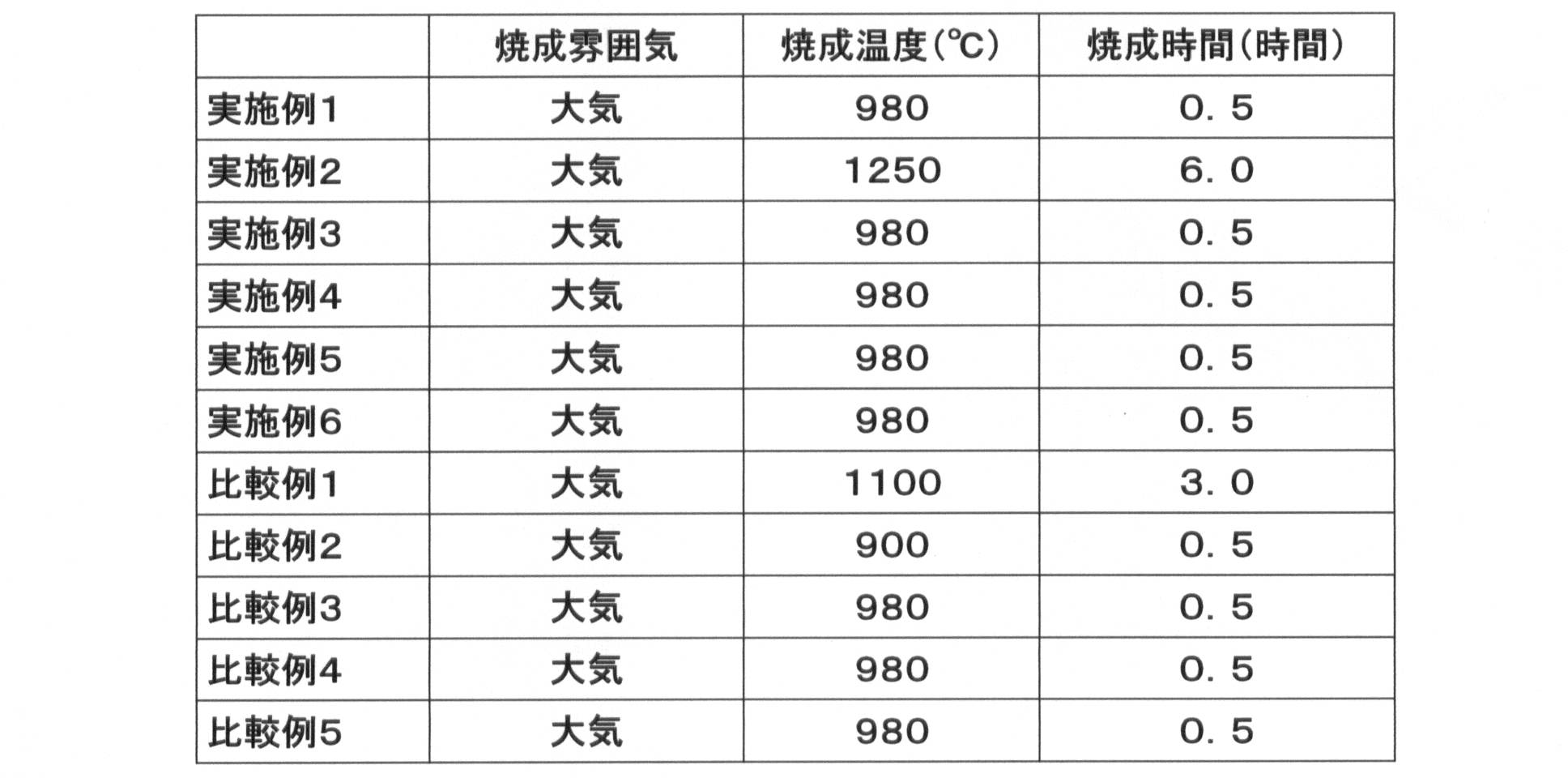
- the mixed raw material powder (raw material mixture) is put in a slag bowl made of cordierite and mullite, and in a box-type electric furnace (manufactured by Motoyama Co., Ltd.), as shown in Table 2, a firing temperature of 980 ° C. Then, a baking treatment was performed for 0.5 hour.
- Pulverization The obtained fired powder was charged at a rate of 50 kg / h into a vibrating rod mill (Chuo Kako Co., Ltd.) and subsequently into an ACM pulverizer (Hosokawa Micron Co., Ltd.) for pulverization.
- the obtained alkali titanate contains 1.9 mol of potassium oxide in terms of potassium atom and 0.1 mol of sodium oxide in terms of sodium atom with respect to 1 mol of 6 titanate (based on 1 mol of 6 titanate).
- the total content of potassium oxide converted to potassium atom, sodium oxide converted to sodium atom and lithium oxide converted to lithium atom is 2.0 mol), and the main crystal has a tunnel structure similar to potassium hexatitanate. It was to be taken.
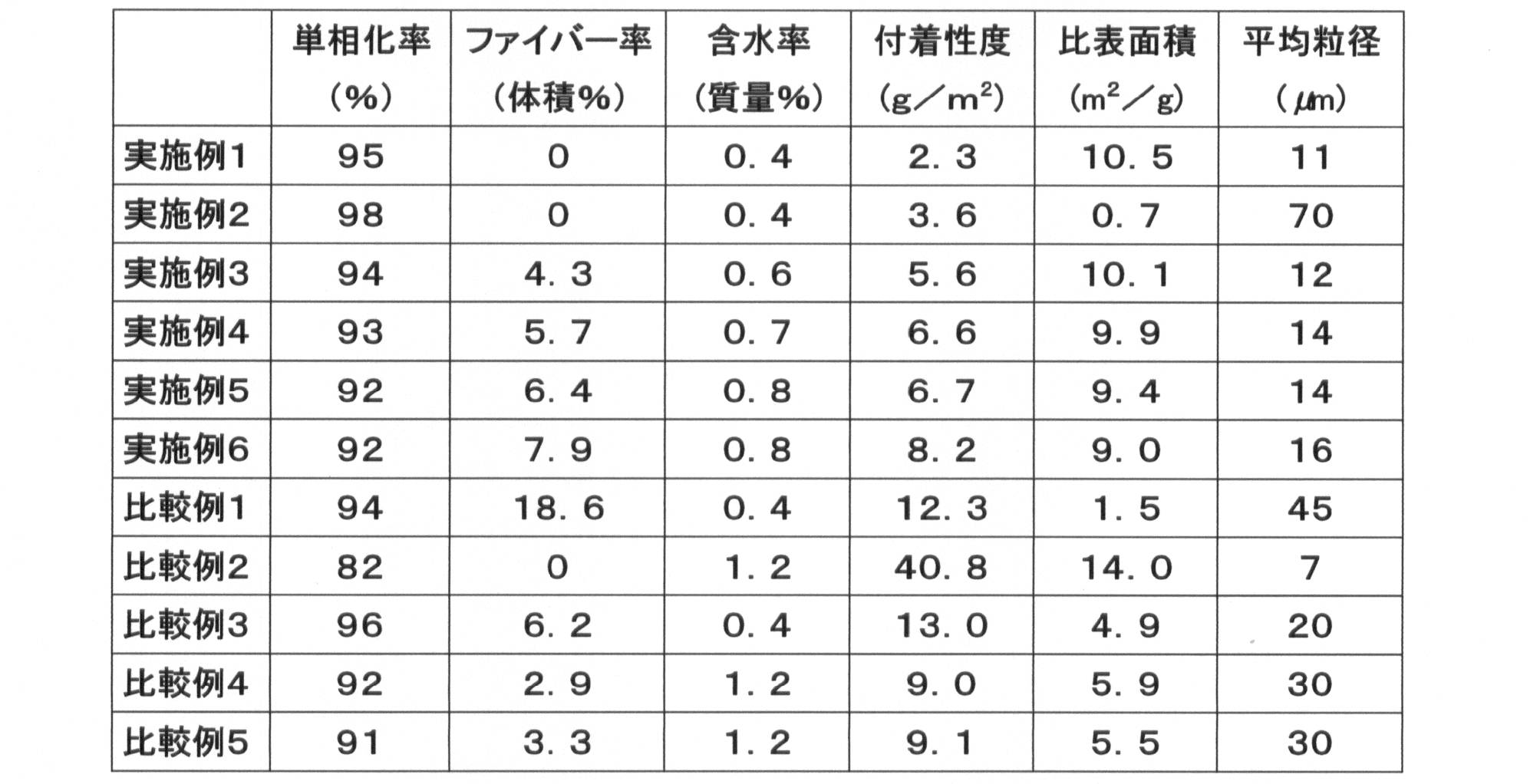
- Table 3 shows the single phase conversion rate, fiber rate, moisture content, degree of adhesion, specific surface area, and average particle size of the alkali alkali titanate obtained. The methods for measuring these physical properties are as shown in the main text of the specification.
- Example 2 In “1. Raw material”, the amount of each raw material was changed as shown in Table 1, and the alkali titanate was obtained in the same manner as in Example 1 except that the firing conditions of “3. Firing” were changed as shown in Table 2.
- the obtained alkali titanate contains 1.9 mol of potassium oxide in terms of potassium atom and 0.1 mol of sodium oxide in terms of sodium atom with respect to 1 mol of 6 titanate (based on 1 mol of 6 titanate).
- the total content of potassium oxide converted to potassium atom, sodium oxide converted to sodium atom and lithium oxide converted to lithium atom is 2.0 mol), and the main crystal has a tunnel structure similar to potassium hexatitanate. It was to be taken.
- Table 3 shows the single phase conversion rate, fiber rate, moisture content, degree of adhesion, specific surface area, and average particle size of the alkali alkali titanate obtained.
- alkali titanate was obtained in the same manner as in Example 1 except that the amount of each raw material was changed as shown in Table 1.
- the obtained alkali titanate contains 1.3 mol of potassium oxide in terms of potassium atom and 0.7 mol of sodium oxide in terms of sodium atom with respect to 1 mol of 6 titanate (based on 1 mol of 6 titanate).
- the total content of potassium oxide converted to potassium atom, sodium oxide converted to sodium atom and lithium oxide converted to lithium atom is 2.0 mol), and the main crystal has a tunnel structure similar to potassium hexatitanate. It was to be taken.
- Table 3 shows the single phase conversion rate, fiber rate, moisture content, degree of adhesion, specific surface area, and average particle size of the alkali alkali titanate obtained.
- Example 4 In “1. Raw material”, alkali titanate was obtained in the same manner as in Example 1 except that the amount of each raw material was changed as shown in Table 1.
- the obtained alkali titanate contains 1.0 mol of potassium oxide in terms of potassium atom and 1.0 mol of sodium oxide in terms of sodium atom with respect to 1 mol of 6 titanate (based on 1 mol of 6 titanate).
- the total content of potassium oxide converted to potassium atom, sodium oxide converted to sodium atom and lithium oxide converted to lithium atom is 2.0 mol), and the main crystal has a tunnel structure similar to potassium hexatitanate. It was to be taken.
- Table 3 shows the single phase conversion rate, fiber rate, moisture content, degree of adhesion, specific surface area, and average particle size of the alkali alkali titanate obtained.
- alkali titanate was obtained in the same manner as in Example 1 except that the amount of each raw material was changed as shown in Table 1.
- the obtained alkali titanate is 1.8 mol of potassium oxide in terms of potassium atom, 0.1 mol of sodium oxide in terms of sodium atom, and 0.1 mol of lithium oxide in terms of lithium atom with respect to 1 mol of 6 titanate.
- the crystals had a tunnel structure similar to potassium hexatitanate.
- Table 3 shows the single phase conversion rate, fiber rate, moisture content, degree of adhesion, specific surface area, and average particle size of the alkali alkali titanate obtained.
- alkali titanate was obtained in the same manner as in Example 1 except that the amount of each raw material was changed as shown in Table 1.
- the obtained alkali titanate has 0.8 mol of potassium oxide in terms of potassium atom, 0.6 mol of sodium oxide in terms of sodium atom, and 0.6 mol of lithium oxide in terms of lithium atom with respect to 1 mol of 6 titanate.
- the crystals had a tunnel structure similar to potassium hexatitanate.
- Table 3 shows the single phase conversion rate, fiber rate, moisture content, degree of adhesion, specific surface area, and average particle size of the alkali alkali titanate obtained.
- the main crystals of the alkali metal titanate is the Examples 1 to 6, K, Na, did not show a impurity phase comprising Li, general formula K a Na b Li c Ti 6 O 13 (where 0. 5 ⁇ a ⁇ 2.2, 0.05 ⁇ b ⁇ 1.4, 0 ⁇ c ⁇ 1.4, 1.8 ⁇ a + b + c ⁇ 2.3)). there were.
- alkali titanate was obtained by the same method as in Example 1 except that the firing conditions were changed as shown in Table 2.
- the obtained alkali titanate contains 1.9 mol of potassium oxide in terms of potassium atom and 0.1 mol of sodium oxide in terms of sodium atom with respect to 1 mol of 6 titanate (based on 1 mol of 6 titanate).
- the total content of potassium oxide converted to potassium atom, sodium oxide converted to sodium atom and lithium oxide converted to lithium atom is 2.0 mol), and the main crystal has a tunnel structure similar to potassium hexatitanate. It was to be taken.
- Table 3 shows the single phase conversion rate, fiber rate, moisture content, degree of adhesion, specific surface area, and average particle size of the alkali alkali titanate obtained.
- alkali titanate was obtained by the same method as in Example 1 except that the firing conditions were changed as shown in Table 2.
- the obtained alkali titanate contains 1.9 mol of potassium oxide in terms of potassium atom and 0.1 mol of sodium oxide in terms of sodium atom with respect to 1 mol of 6 titanate (based on 1 mol of 6 titanate).
- the total content of potassium oxide converted to potassium atom, sodium oxide converted to sodium atom and lithium oxide converted to lithium atom is 2.0 mol), and the main crystal has a tunnel structure similar to potassium hexatitanate. It was to be taken.
- Table 3 shows the single phase conversion rate, fiber rate, moisture content, degree of adhesion, specific surface area, and average particle size of the alkali alkali titanate obtained.
- alkali titanate was obtained by the same method as in Example 1 except that the amount of each raw material was changed as shown in Table 1.
- the obtained alkali titanate contains 2.0 mol of potassium oxide in terms of potassium atom with respect to 1 mol of 6 titanate (potassium oxide in terms of potassium atom and 1 atom in terms of sodium atom with respect to 1 mol of 6 titanate).
- the total content of sodium oxide and lithium oxide in terms of lithium atoms is 2.0 mol), and the main crystal has a tunnel structure similar to potassium hexatitanate.
- Table 3 shows the single phase conversion rate, fiber rate, moisture content, degree of adhesion, specific surface area, and average particle size of the alkali alkali titanate obtained.
- alkali titanate was obtained by the same method as in Example 1 except that the amount of each raw material was changed as shown in Table 1.
- the obtained alkali titanate contains 0.4 mol of potassium oxide in terms of potassium atom and 1.6 mol of sodium oxide in terms of sodium atom with respect to 1 mol of 6 titanate (based on 1 mol of 6 titanate).
- the total content of potassium oxide converted to potassium atom, sodium oxide converted to sodium atom and lithium oxide converted to lithium atom is 2.0 mol), and the main crystal has a tunnel structure similar to potassium hexatitanate. It was to be taken.
- Table 3 shows the single phase conversion rate, fiber rate, moisture content, degree of adhesion, specific surface area, and average particle size of the alkali alkali titanate obtained.
- alkali titanate was obtained by the same method as in Example 1 except that the amount of each raw material was changed as shown in Table 1.
- the obtained alkali titanate is 0.4 mol of potassium oxide in terms of potassium atom, 0.1 mol of sodium oxide in terms of sodium atom, and 1.6 mol of lithium oxide in terms of lithium atom with respect to 1 mol of 6 titanate.
- the total content of potassium oxide in terms of potassium, sodium oxide in terms of sodium and lithium oxide in terms of lithium with respect to 1 mol of 6 titanic acid is 2.1 mol
- the crystals had a tunnel structure similar to potassium hexatitanate.
- Table 3 shows the single phase conversion rate, fiber rate, moisture content, degree of adhesion, specific surface area, and average particle size of the alkali alkali titanate obtained.
- Example 7 A friction material was produced using the alkali titanate obtained in Example 1.
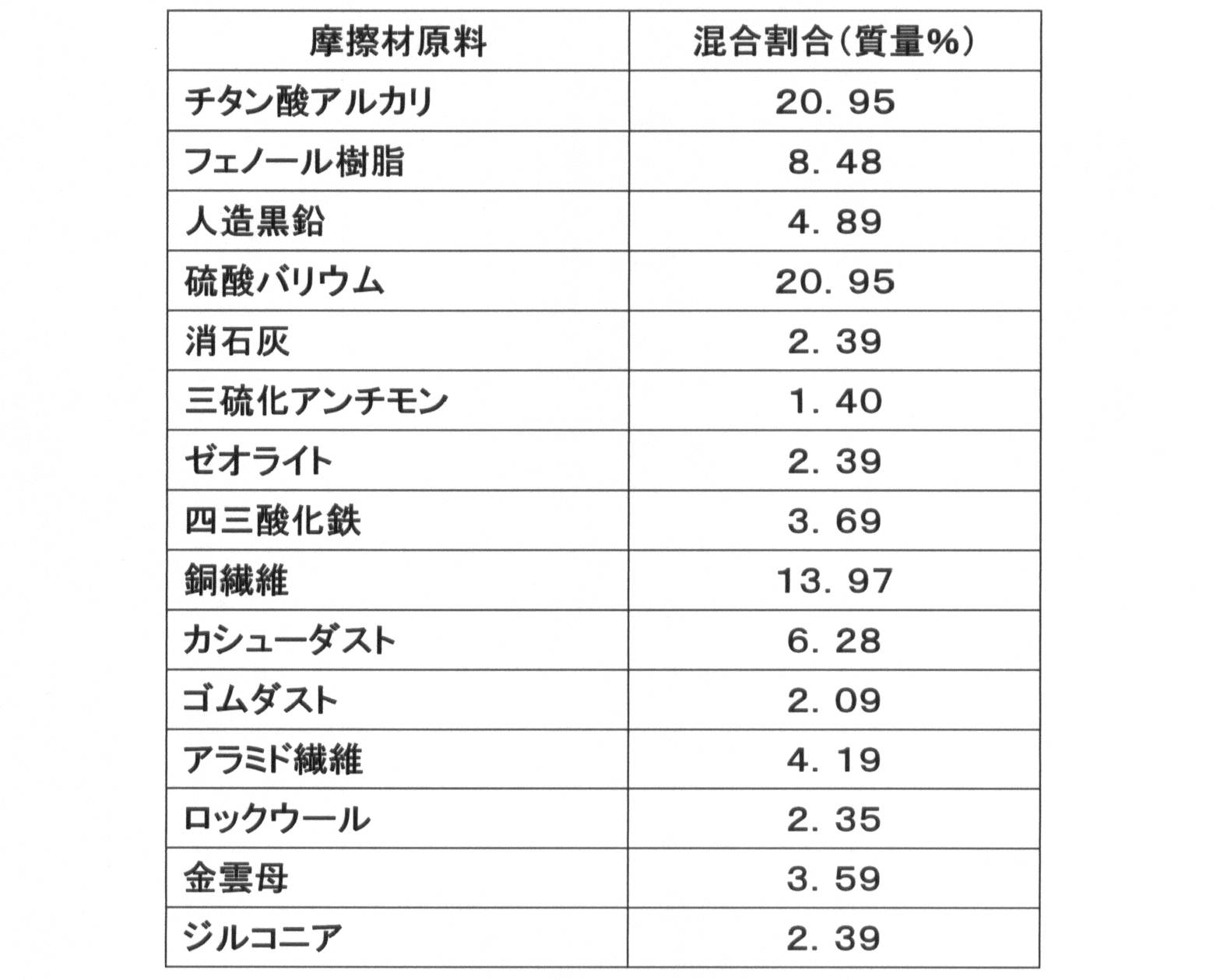
- the friction material together with the alkali titanate prepared in Example 1, phenol resin, artificial graphite, barium sulfate, slaked lime, antimony trisulfide, zeolite, iron trioxide (Fe3O4), copper fiber, cashew dust, rubber dust, aramid
- a friction material raw mixed powder was obtained.
- the obtained friction material raw material mixed powder was preformed at 200 kgf / cm 2 , the obtained preform was preheated at 70 ° C. for 2 hours, then thermoformed at 180 ° C.
- AK-MASTER which is a European standard for friction material evaluation.
- Table 5 shows the average friction coefficient of CHARACTERISTIC VALUE (AK-MASTER CHAPTER3).
- Example 8 A friction material was produced in the same manner as in Example 7 except that the alkali titanate obtained in Example 1 was changed to the alkali titanate obtained in Example 2, and was obtained in the same manner as in Example 7. The average friction coefficient of the friction material was determined. The results are shown in Table 5.
- the alkali titanate obtained in Examples 1 to 6 is 0.5 to 2.2 mol of potassium oxide in terms of potassium atom and sodium oxide in terms of sodium atom with respect to 1 mol of 6 titanate.
- 0.05 to 1.4 mol, 0 to 1.4 mol of lithium oxide in terms of lithium atom, potassium oxide in terms of potassium atom, sodium oxide in terms of sodium atom and lithium atom in terms of 1 mol of 6 titanic acid The total content of lithium oxide is 1.8 to 2.3 mol, the single phase conversion rate is 85 to 100%, the fiber rate is 0 to 10% by volume, and the moisture content is 0 to 1.0% by mass.
- the content ratio of the fiber-like potassium titanate is highly reduced, and an alkali titanate with significantly reduced adhesion can be provided. Further, it can be seen from Table 5 that the friction material obtained using the above alkali titanate shows a satisfactory friction material evaluation result and shows a friction coefficient comparable to that of a friction material in practical use.
- the alkali titanate obtained in Comparative Examples 1 to 5 does not have a specific composition (Comparative Example 3 and Comparative Example 4), or the single phase conversion rate is low (Comparative Example). 2) Since the fiber ratio is high (Comparative Example 1) and the water content is high (Comparative Example 2, Comparative Example 4 and Comparative Example 5), the fiber-like potassium titanate content is high and the moldability is high. It can be seen that it is inferior in dispersibility or inferior in adhesion.
Landscapes
- Chemical & Material Sciences (AREA)
- Organic Chemistry (AREA)
- Engineering & Computer Science (AREA)
- General Engineering & Computer Science (AREA)
- Inorganic Chemistry (AREA)
- Life Sciences & Earth Sciences (AREA)
- Environmental & Geological Engineering (AREA)
- General Life Sciences & Earth Sciences (AREA)
- Geology (AREA)
- Mechanical Engineering (AREA)
- Materials Engineering (AREA)
- Inorganic Compounds Of Heavy Metals (AREA)
Abstract
Description
また、チタン酸カリウムは付着性が高いことから、摩擦材を作製する際に、原料の混合機やパッド成形機へ付着し易く、歩留まりを低下させ易いという技術課題が存在していた。
(1)6チタン酸1モルに対し、
カリウム原子換算で酸化カリウムを0.5~2.2モル、
ナトリウム原子換算で酸化ナトリウムを0.05~1.4モル、
リチウム原子換算で酸化リチウムを0~1.4モル
含み、
6チタン酸1モルに対する、カリウム原子換算した酸化カリウム、ナトリウム原子換算した酸化ナトリウムおよびリチウム原子換算した酸化リチウムの合計含有量が1.8~2.3モルであり、
単相化率が85~100%、ファイバー率が0~10体積%、含水率が0~1.0質量%である
ことを特徴とするチタン酸アルカリ、
(2)6チタン酸1モルに対し、
カリウム原子換算で酸化カリウムを0.9~2.2モル、
ナトリウム原子換算で酸化ナトリウムを0.05~1.1モル、
リチウム原子換算で酸化リチウムを0~0.2モル
含み、
ファイバー率が0~7.0体積%、含水率が0~0.8質量%である上記(1)に記載のチタン酸アルカリ、
(3)6チタン酸1モルに対し、
カリウム原子換算で酸化カリウムを1.2~2.2モル、
ナトリウム原子換算で酸化ナトリウムを0.05~0.8モル
リチウム原子換算で酸化リチウムを0モル
含み、
6チタン酸1モルに対する、カリウム原子換算した酸化カリウム、ナトリウム原子換算した酸化ナトリウムおよびリチウム原子換算した酸化リチウムの合計含有量が1.9~2.2モルであり、
ファイバー率が0~5.0体積%、含水率が0~0.6質量%である
上記(1)または(2)に記載のチタン酸アルカリ、
(4)上記(1)~(3)のいずれかに記載のチタン酸アルカリを含むことを特徴とする摩擦材
を提供するものである。
本発明のチタン酸アルカリは、6チタン酸1モルに対し、カリウム原子換算で酸化カリウムを0.5~2.2モル、ナトリウム原子換算で酸化ナトリウムを0.05~1.4モル、リチウム原子換算で酸化リチウムを0~1.4モル含み、
6チタン酸1モルに対する、カリウム原子換算した酸化カリウム、ナトリウム原子換算した酸化ナトリウムおよびリチウム原子換算した酸化リチウムの合計含有量が1.8~2.3モルであり、
単相化率が85~100%、ファイバー率が0~10体積%、含水率が0~1.0質量%である
ことを特徴とするものである。
本発明のチタン酸アルカリは、チタン酸アルカリの調製時において、原料混合物中における、チタン化合物とアルカリ金属化合物との混合割合を調整することにより、その組成を容易に制御することができる。
すなわち、チタン酸アルカリとNa2O2とNaOHをジルコニア坩堝に入れて、加熱して溶融する。その後放冷し、水とHClを加えて溶解する。溶解した液分を分取し、Tiについてはアルミニウム還元-硫酸アンモニウム鉄(III)滴定法により定量して6チタン酸の含有量を決定することができ、その他の金属元素(カリウム、ナトリウム、リチウム)についてはICP発光分光法により定量することにより、その含有量を決定することができる。
また、本発明のチタン酸アルカリは、主結晶が6チタン酸カリウムと同様にトンネル構造を採るものであるが、不純物として、二酸化チタン等を含むものであってもよい。
本発明のチタン酸アルカリの主結晶は、下記一般式
KaNabLicTi6O13
(ただし、0.5≦a≦2.2、0.05≦b≦1.4、0≦c≦1.4、1.8≦a+b+c≦2.3である。)
により表すことができる。上記一般式において、a、b、cおよびa+b+cの好ましい範囲やより好ましい範囲等は、上述したとおりである。
すなわち、粉末X線回折装置(X線源:CuKα線、パナリティカル社製 型式名:X’Part-ProMPD)により、得られたチタン酸アルカリの回折パターンを測定し、得られた回折パターンのチタン酸アルカリと不純物のメインピークの高さから、以下の計算式により算出される単相化率を意味する。
単相化率(%)=I/(I+S)×100
(ただし、I:チタン酸アルカリ(一般式KaNabLicTi6O13(0.5≦a≦2.2、0.05≦b≦1.4、0≦c≦1.4、1.8≦a+b+c≦2.3))の2θ=0~50°における最強ピークの高さ、S:全ての不純物のメインピークの高さの和である。)
なお、不純物としては、TiO2等を挙げることができる。
すなわち、チタン酸アルカリ0.001~0.01gを水10gに投入し、水を5分間撹拌してチタン酸アルカリを分散させながら0.3g分取する。分取したチタン酸カリウムを含んだ水を水10gに投入し、孔径0.2μmのメンブランフィルターに通す。フィルターを乾燥し、イオンスパッター((株)日立サイエンスシステムズ製)により白金を蒸着後、走査型電子顕微鏡 型式名:S-4700((株)日立ハイテクノロジーズ製)により一視野に粒子数が100以上程度となるような倍率で撮影を行い、得られた画像(5視野以上)を基に、画像解析式粒度分布測定ソフトウェア 型式名:Mac-View Ver.4((株)マウンテック製)を用いて、各結晶粒子を最小の長方形で囲み、直交する二つの軸のうち短い方を太さ(短径)、長い方を長さ(長径)として500個以上の粒子を各々測定する。
次いで、測定された各結晶粒子を円柱状とみなし、短径を円柱の直径、長径を円柱の長さ(高さ)として、以下の計算式よりチタン酸アルカリの総体積とファイバー状物の体積を求める。ファイバー状物は、長径5μm以上、短径3μm以下、アスペクト比(上記方法で測定される「長径/短径」の比)が3以上の粒子である。
チタン酸アルカリの総体積(cm3)=(短径(cm)/2)2×3.14×長径(cm)
ファイバー状物の体積(cm3)=(ファイバー状粒子の短径(cm)/2)2×3.14×ファイバー状粒子の長径(cm)
上記式により算出したチタン酸アルカリの総体積とファイバー状物の体積を用いて以下の計算式よりファイバー率を算出する。
ファイバー率(体積%)=(ファイバー状物の体積/チタン酸アルカリの総体積)×100
すなわち、乾燥させたビーカーにチタン酸アルカリを約10g投入し、105℃で1時間加熱した後、デシケーターで室温まで冷却して質量を測定し、下記式により含水率を算出する。
含水率(質量%)=(加熱後のチタン酸アルカリの質量(g)/加熱前のチタン酸アルカリの質量(g))×100
すなわち、マルチテスター(セイシン企業(株)社製 MT-1001)に、目開き2mm、線径0.9mmの篩、200ccのタッピングセル、高さ30mmのスペーサーを取り付け、フィーダーレベルを6に設定し、タッピングセルに摺り切りいっぱいまでチタン酸アルカリを充填する。チタン酸アルカリを充填したタッピングセルを縦に90°回転し、1分間保持することで、タッピングセル内のチタン酸アルカリを排出する。チタン酸アルカリを排出後、チタン酸アルカリ充填前のタッピングセルの質量とチタン酸アルカリ排出後のタッピングセルの質量(g)から、以下の計算式により算出される値を付着量とする。
付着量(g)=チタン酸アルカリ排出後のタッピングセルの質量(g)-チタン酸アルカリ充填前のタッピングセルの質量(g)
付着性度(g/m2)=付着量(g)/タッピングセルの内側の表面積(m2)
なお、本出願書類において、チタン酸カリウムの平均粒径は、得られたチタン酸カリウム粒子10000個程度について、粒度・形状分布測定器((株)セイシン企業製 PITA-2型)を用いて各粒子の投影像の面積を測定し、その面積と同じ面積を有する円の直径と、当該直径を有する球に換算した時の体積頻度分布を求めたときの、累積体積が50%となる直径を意味するものとする。
本発明のチタン酸カリウムとして、より具体的には、比表面積が0.3~1.4m2/gで平均粒径が50~80μmであるものや、比表面積が5.0~16m2/gで平均粒径が8~40μmであるものを挙げることができ、中でも、ファイバー率を0~10体積%に制御する上では、比表面積が0.3~1.4m2/gで平均粒径が50~80μmであるものが好適である。
本発明のチタン酸アルカリを製造する方法は、本発明のチタン酸アルカリの組成、物性を有するものを製造し得る方法であれば特に制限されない。
本発明のチタン酸アルカリを製造する方法としては、例えば、チタン化合物およびアルカリ金属化合物を含む原料混合物を、昇温し、特定の条件で加熱、焼成した後、冷却し、得られた冷却物を粉砕処理する方法を挙げることができる(以下、本製造方法を、適宜、本発明のチタン酸アルカリの製法と称する)。
チタン化合物としては、例えば、二酸化チタン、亜酸化チタン、オルトチタン酸またはその塩、メタチタン酸またはその塩、水酸化チタン、ペルオクソチタン酸またはその塩等の化合物や、イルメナイト等のチタン鉱石から選ばれる一種以上を挙げることができ、これ等のチタン化合物のうち二酸化チタンが好ましい。二酸化チタンは、アルカリ金属化合物との混合性および反応性に優れ、また安価であることから、チタン化合物として好適に使用することができる。
チタン化合物としてルチル型の二酸化チタンを使用することにより、結晶径が大きい(比表面積が小さい)チタン酸カリウムを容易に得ることができる。
なお、本出願書類において、チタン化合物の平均粒径は、JIS K 0069の化学製品のふるい分け試験方法に従って測定した値を意味する。
チタン化合物の凝集体または造粒体としては、二酸化チタンの凝集体(顆粒を含む)または造粒体が好ましい。
また、本出願書類において、チタン化合物の造粒体とは、チタン化合物を造粒してなる平均粒径が0.1mm以上であるものを意味する。
カリウム化合物としては、例えば、酸化カリウム、炭酸カリウム、水酸化カリウム、シュウ酸カリウム等から選ばれる一種以上を挙げることができ、炭酸カリウムであることが好ましい。
ナトリウム化合物としては、例えば、酸化ナトリウム、炭酸ナトリウム、水酸化ナトリウム、シュウ酸ナトリウム等から選ばれる一種以上を挙げることができ、炭酸ナトリウムであることが好ましい。
リチウム化合物としては、例えば、酸化リチウム、炭酸リチウム、水酸化リチウム、シュウ酸リチウム等から選ばれる一種以上を挙げることができ、炭酸リチウムであることが好ましい。
上記アルコール類としては、メタノール、エタノール、アミルアルコール、アリルアルコール、プロパギルアルコール、エチレングリコール、プロピレングリコール、エリトロール、2-プテン-1,4-ジオール、グリセリン、ペンタエリトリット、アラビット、ソルビット、ペプチット、ポリエチレングリコール、ポリプロピレングリコール、ポリグリセリン等から選ばれる一種以上を挙げることができ、これらのなかでも沸点の比較的低いメタノールまたはエタノールが好ましい。
原料混合物中における金属チタン粉または水素化チタン粉の含有量は、チタン化合物中のチタン原子1モルに対して0.01~0.2モルであることが好ましく、0.03~0.1モルであることがより好ましい。
上記焼成温度が950℃~1050℃であれば、チタン酸アルカリの長手方向(長径方向)の粒子成長が阻害され、アスペクト比が小さく球形状のチタン酸アルカリを製造することができ、また、上記焼成温度が1150℃~1400℃であれば粒成長が促進され、得られる焼成粉の太さ(短径)がさらに太く(長く)なる。
比表面積が0.3~1.4m2/gで平均粒径が50~80μmのチタン酸カリウムを収率良く得る上では、上記焼成温度が1150℃~1400℃であることが好ましい。
また、上記シート材は、例えば、セラミックス製反応容器に設けられる凹部の内壁全体に設置した上で混合物を導入することにより、カリウム化合物のロスや、カリウム化合物のセラミックス製反応容器への浸透をより好適に回避することができる。
最高焼成温度の焼成時間は、10分間以上であることが好ましく、20~480分間であることがより好ましい。
また、上記最高焼成温度から500℃までの降温速度は、2℃/分~300℃/分であることが好ましい。
最高焼成温度からの降温速度を上記のとおり規定することにより、得られるチタン酸アルカリのファイバー率を一層低減することができる。
上記粉砕を行う粉砕手段としては、上記チタン化合物およびアルカリ金属化合物の混合時に使用する混合手段と同様のものを挙げることができ、振動ミル(振動ロッドミル、振動ボールミル等)、衝撃型粉砕機(高速回転ミル、分級機内蔵型高速回転ミル、容器駆動媒体ミル、媒体攪拌式ミル、気流式粉砕機等)等から選ばれる一種以上を挙げることができ、振動ロッドミルが好ましい。より好ましくは、上記焼成工程で得られた焼成粉を振動ミルおよび衝撃型粉砕機を組み合わせて粉砕すると、チタン酸アルカリ中のファイバー率を低減しやすくなる。
得られたチタン酸カリウムは、耐熱性に優れることから、摩擦調整剤等として好適に使用することができる。
本発明の摩擦材は、本発明のチタン酸アルカリを含むことを特徴とするものである。
これ等の基材繊維は、分散性および結合剤との密着性向上のためにアミノシラン系、エポキシシラン系またはビニルシラン系等のシラン系カップリング剤、チタネート系カップリング剤あるいはリン酸エステル等の表面処理を施して用いてもよい。
他の摩擦調整剤として、例えば、加硫または未加硫の天然ゴム、合成ゴム粉末、カシュー樹脂粉末、レジンダスト、ゴムダスト等の有機物粉末、カーボンブラック、黒鉛粉末、二硫化モリブデン、硫酸バリウム、炭酸カルシウム、クレー、マイカ、タルク、ケイソウ土、アンチゴライト、セピオライト、モンモリロナイト、ゼオライト、三チタン酸ナトリウム、五チタン酸ナトリウム、8チタン酸カリウム等の無機質粉末、銅、アルミニウム、亜鉛、鉄等の金属粉末、アルミナ、シリカ、酸化クロム、酸化チタン、酸化鉄等の酸化物粉末等から選ばれる一種以上が挙げられる。
従って、本発明の摩擦材は、自動車、鉄道車両、航空機、各種産業用機器類等に用いられる制動部材用材料、例えばクラッチフェーシング用材料およびブレーキライニングやディスクパッド等のブレーキ用材料等として、制動機能の向上、安定化の改善効果を発揮することができる。
1.原料
チタン原料(チタン化合物)として、比表面積9m2/gの酸化チタン(COSMO CHEMICAL CO., LTD.社製 純度98.8%)54.27kgと、比表面積1.6m2/gの酸化チタン(Rio Tinto Fer et Titane inc.社製 94.7%)47.60kgとを使用した。
また、アルカリ原料(アルカリ金属化合物)として、炭酸カリウム(Unid Co., Ltd.社製、純度99.9%)27.09kg、炭酸ナトリウム(株式会社トクヤマ社製 純度99.5%)1.03kg、炭酸リチウム(Sichuan Tianqi lithium industries, inc.製 純度98.8%)0kgを各々使用した。
上記各原料の使用量を表1に示す。
振動ロッドミル(中央化工機(株)製)に、上記量の原料と、変性アルコール(三協化学株式会社製)を投入して、20分混合することにより、混合原料粉(原料混合物)を得た。
上記混合原料粉(原料混合物)をコージライトとムライトの材質の匣鉢にいれ、箱型電気炉(株式会社モトヤマ社製)にて、表2に示すように、大気中、焼成温度980℃で0.5時間焼成処理を行った。
得られた焼成粉を、50kg/hの速度で、振動ロッドミル(中央化工機株式会社製)、引き続きACMパルベライザー(ホソカワミクロン社製)に投入し、粉砕を行った。
得られたチタン酸アルカリは、6チタン酸1モルに対し、カリウム原子換算で酸化カリウムを1.9モル、ナトリウム原子換算で酸化ナトリウムを0.1モル含むものであり(6チタン酸1モルに対する、カリウム原子換算した酸化カリウム、ナトリウム原子換算した酸化ナトリウムおよびリチウム原子換算した酸化リチウムの合計含有量が2.0モルであるものであり)、主結晶が6チタン酸カリウムと同様にトンネル構造を採るものであった。
得られたチタン酸アルカリの単相化率、ファイバー率、含水率、付着性度、比表面積、平均粒径を表3に示す。これら物性の測定方法は、明細書本文に示した通りである。
「1.原料」において、それぞれの原料量を表1のとおり変更し、「3.焼成」の焼成条件を表2の通り変更した以外は実施例1と同じ方法でチタン酸アルカリを得た。
得られたチタン酸アルカリは、6チタン酸1モルに対し、カリウム原子換算で酸化カリウムを1.9モル、ナトリウム原子換算で酸化ナトリウムを0.1モル含むものであり(6チタン酸1モルに対する、カリウム原子換算した酸化カリウム、ナトリウム原子換算した酸化ナトリウムおよびリチウム原子換算した酸化リチウムの合計含有量が2.0モルであるものであり)、主結晶が6チタン酸カリウムと同様にトンネル構造を採るものであった。
得られたチタン酸アルカリの単相化率、ファイバー率、含水率、付着性度、比表面積、平均粒径を表3に示す。
「1.原料」において、それぞれの原料量を表1のとおり変更した以外は実施例1と同じ方法でチタン酸アルカリを得た。
得られたチタン酸アルカリは、6チタン酸1モルに対し、カリウム原子換算で酸化カリウムを1.3モル、ナトリウム原子換算で酸化ナトリウムを0.7モル含むものであり(6チタン酸1モルに対する、カリウム原子換算した酸化カリウム、ナトリウム原子換算した酸化ナトリウムおよびリチウム原子換算した酸化リチウムの合計含有量が2.0モルであるものであり)、主結晶が6チタン酸カリウムと同様にトンネル構造を採るものであった。
得られたチタン酸アルカリの単相化率、ファイバー率、含水率、付着性度、比表面積、平均粒径を表3に示す。
「1.原料」において、それぞれの原料量を表1のとおり変更した以外は実施例1と同じ方法でチタン酸アルカリを得た。
得られたチタン酸アルカリは、6チタン酸1モルに対し、カリウム原子換算で酸化カリウムを1.0モル、ナトリウム原子換算で酸化ナトリウムを1.0モル含むものであり(6チタン酸1モルに対する、カリウム原子換算した酸化カリウム、ナトリウム原子換算した酸化ナトリウムおよびリチウム原子換算した酸化リチウムの合計含有量が2.0モルであるものであり)、主結晶が6チタン酸カリウムと同様にトンネル構造を採るものであった。
得られたチタン酸アルカリの単相化率、ファイバー率、含水率、付着性度、比表面積、平均粒径を表3に示す。
「1.原料」において、それぞれの原料量を表1のとおり変更した以外は実施例1と同じ方法でチタン酸アルカリを得た。
得られたチタン酸アルカリは、6チタン酸1モルに対し、カリウム原子換算で酸化カリウムを1.8モル、ナトリウム原子換算で酸化ナトリウムを0.1モル、リチウム原子換算で酸化リチウムを0.1モル含むものであり(6チタン酸1モルに対する、カリウム原子換算した酸化カリウム、ナトリウム原子換算した酸化ナトリウムおよびリチウム原子換算した酸化リチウムの合計含有量が2.0モルであるものであり)、主結晶が6チタン酸カリウムと同様にトンネル構造を採るものであった。
得られたチタン酸アルカリの単相化率、ファイバー率、含水率、付着性度、比表面積、平均粒径を表3に示す。
「1.原料」において、それぞれの原料量を表1のとおり変更した以外は実施例1と同じ方法でチタン酸アルカリを得た。
得られたチタン酸アルカリは、6チタン酸1モルに対し、カリウム原子換算で酸化カリウムを0.8モル、ナトリウム原子換算で酸化ナトリウムを0.6モル、リチウム原子換算で酸化リチウムを0.6モル含むものであり(6チタン酸1モルに対する、カリウム原子換算した酸化カリウム、ナトリウム原子換算した酸化ナトリウムおよびリチウム原子換算した酸化リチウムの合計含有量が2.0モルであるものであり)、主結晶が6チタン酸カリウムと同様にトンネル構造を採るものであった。
得られたチタン酸アルカリの単相化率、ファイバー率、含水率、付着性度、比表面積、平均粒径を表3に示す。
実施例1~実施例6のチタン酸アルカリの主結晶は、K、Na、Liを含む不純物相が見られなかったことから、一般式KaNabLicTi6O13(ただし、0.5≦a≦2.2、0.05≦b≦1.4、0≦c≦1.4、1.8≦a+b+c≦2.3である。)で示されるチタン酸アルカリに含まれるものであった。
「3.焼成」において、焼成条件を表2のとおり変更した以外は実施例1と同じ方法でチタン酸アルカリを得た。
得られたチタン酸アルカリは、6チタン酸1モルに対し、カリウム原子換算で酸化カリウムを1.9モル、ナトリウム原子換算で酸化ナトリウムを0.1モル含むものであり(6チタン酸1モルに対する、カリウム原子換算した酸化カリウム、ナトリウム原子換算した酸化ナトリウムおよびリチウム原子換算した酸化リチウムの合計含有量が2.0モルであるものであり)、主結晶が6チタン酸カリウムと同様にトンネル構造を採るものであった。
得られたチタン酸アルカリの単相化率、ファイバー率、含水率、付着性度、比表面積、平均粒径を表3に示す。
「3.焼成」において、焼成条件を表2のとおり変更した以外は、実施例1と同じ方法でチタン酸アルカリを得た。
得られたチタン酸アルカリは、6チタン酸1モルに対し、カリウム原子換算で酸化カリウムを1.9モル、ナトリウム原子換算で酸化ナトリウムを0.1モル含むものであり(6チタン酸1モルに対する、カリウム原子換算した酸化カリウム、ナトリウム原子換算した酸化ナトリウムおよびリチウム原子換算した酸化リチウムの合計含有量が2.0モルであるものであり)、主結晶が6チタン酸カリウムと同様にトンネル構造を採るものであった。
得られたチタン酸アルカリの単相化率、ファイバー率、含水率、付着性度、比表面積、平均粒径を表3に示す。
「1.原料」において、それぞれの原料量を表1のとおり変更した以外は、実施例1と同じ方法でチタン酸アルカリを得た。
得られたチタン酸アルカリは、6チタン酸1モルに対し、カリウム原子換算で酸化カリウムを2.0モル含むものであり(6チタン酸1モルに対する、カリウム原子換算した酸化カリウム、ナトリウム原子換算した酸化ナトリウムおよびリチウム原子換算した酸化リチウムの合計含有量が2.0モルであるものであり)、主結晶が6チタン酸カリウムと同様にトンネル構造を採るものであった。
得られたチタン酸アルカリの単相化率、ファイバー率、含水率、付着性度、比表面積、平均粒径を表3に示す。
「1.原料」において、それぞれの原料量を表1のとおり変更した以外は、実施例1と同じ方法でチタン酸アルカリを得た。
得られたチタン酸アルカリは、6チタン酸1モルに対し、カリウム原子換算で酸化カリウムを0.4モル、ナトリウム原子換算で酸化ナトリウムを1.6モル含むものであり(6チタン酸1モルに対する、カリウム原子換算した酸化カリウム、ナトリウム原子換算した酸化ナトリウムおよびリチウム原子換算した酸化リチウムの合計含有量が2.0モルであるものであり)、主結晶が6チタン酸カリウムと同様にトンネル構造を採るものであった。
得られたチタン酸アルカリの単相化率、ファイバー率、含水率、付着性度、比表面積、平均粒径を表3に示す。
「1.原料」において、それぞれの原料量を表1のとおり変更した以外は、実施例1と同じ方法でチタン酸アルカリを得た。
得られたチタン酸アルカリは、6チタン酸1モルに対し、カリウム原子換算で酸化カリウムを0.4モル、ナトリウム原子換算で酸化ナトリウムを0.1モル、リチウム原子換算で酸化リチウムを1.6モル含むものであり(6チタン酸1モルに対する、カリウム原子換算した酸化カリウム、ナトリウム原子換算した酸化ナトリウムおよびリチウム原子換算した酸化リチウムの合計含有量が2.1モルであるものであり)、主結晶が6チタン酸カリウムと同様にトンネル構造を採るものであった。
得られたチタン酸アルカリの単相化率、ファイバー率、含水率、付着性度、比表面積、平均粒径を表3に示す。

実施例1で得られたチタン酸アルカリを用いて摩擦材を作製した。
摩擦材原料として、実施例1で作製したチタン酸アルカリとともに、フェノール樹脂、人造黒鉛、硫酸バリウム、消石灰、三硫化アンチモン、ゼオライト、四三酸化鉄(Fe3O4)、銅繊維、カシューダスト、ゴムダスト、アラミド繊維、ロックウール、金雲母およびジルコニアを表4に示す混合割合で混合することにより、摩擦材原料混合粉とした。
得られた摩擦材原料混合粉を200kgf/cm2で予備成形し、得られた予備成形物を70℃で2時間予熱した後、180℃、400kgf/cm2で熱成形を行い、次いで、250℃で3時間熱処理することにより、縦20mm、横50mm、厚さ16mmの摩擦材を得た。
得られた摩擦材の摩擦係数を、摩擦材評価の欧州規格であるAK-MASTERに準拠して測定した。CHARACTERISTIC VALUE(AK-MASTER CHAPTER3)の摩擦係数の平均値を表5に示す。
実施例1で得られたチタン酸アルカリを実施例2で得られたチタン酸アルカリに変更した以外は、実施例7と同様にして摩擦材を作製し、実施例7と同様の方法で得られた摩擦材の摩擦係数の平均値を求めた。結果を表5に示す。

また、表5より、上記チタン酸アルカリを用いて得られた摩擦材は、良好な摩擦材評価結果を示し、実用化されている摩擦材にくらべ、遜色ない摩擦係数を示すことが分かる。
Claims (4)
- 6チタン酸1モルに対し、
カリウム原子換算で酸化カリウムを0.5~2.2モル、
ナトリウム原子換算で酸化ナトリウムを0.05~1.4モル、
リチウム原子換算で酸化リチウムを0~1.4モル
含み、
6チタン酸1モルに対する、カリウム原子換算した酸化カリウム、ナトリウム原子換算した酸化ナトリウムおよびリチウム原子換算した酸化リチウムの合計含有量が1.8~2.3モルであり、
単相化率が85~100%、ファイバー率が0~10体積%、含水率が0~1.0質量%である
ことを特徴とするチタン酸アルカリ。 - 6チタン酸1モルに対し、
カリウム原子換算で酸化カリウムを0.9~2.2モル、
ナトリウム原子換算で酸化ナトリウムを0.05~1.1モル、
リチウム原子換算で酸化リチウムを0~0.2モル
含み、
ファイバー率が0~7.0体積%、含水率が0~0.8質量%である請求項1に記載のチタン酸アルカリ。 - 6チタン酸1モルに対し、
カリウム原子換算で酸化カリウムを1.2~2.2モル、
ナトリウム原子換算で酸化ナトリウムを0.05~0.8モル
リチウム原子換算で酸化リチウムを0モル
含み、
6チタン酸1モルに対する、カリウム原子換算した酸化カリウム、ナトリウム原子換算した酸化ナトリウムおよびリチウム原子換算した酸化リチウムの合計含有量が1.9~2.2モルであり、
ファイバー率が0~5.0体積%、含水率が0~0.6質量%である
請求項1または請求項2に記載のチタン酸アルカリ。 - 請求項1~請求項3のいずれかに記載のチタン酸アルカリを含むことを特徴とする摩擦材。
Priority Applications (4)
| Application Number | Priority Date | Filing Date | Title |
|---|---|---|---|
| CN201680031852.4A CN107614438B (zh) | 2015-06-02 | 2016-04-28 | 碱金属钛酸和磨擦材料 |
| US15/578,806 US10156277B2 (en) | 2015-06-02 | 2016-04-28 | Alkali-metal titanate and friction material |
| EP16802968.4A EP3305729A4 (en) | 2015-06-02 | 2016-04-28 | ALKALI METAL TITANATE AND REAGENT |
| JP2017521747A JP6706615B2 (ja) | 2015-06-02 | 2016-04-28 | チタン酸アルカリおよび摩擦材 |
Applications Claiming Priority (2)
| Application Number | Priority Date | Filing Date | Title |
|---|---|---|---|
| JP2015-111948 | 2015-06-02 | ||
| JP2015111948 | 2015-06-02 |
Publications (1)
| Publication Number | Publication Date |
|---|---|
| WO2016194531A1 true WO2016194531A1 (ja) | 2016-12-08 |
Family
ID=57440553
Family Applications (1)
| Application Number | Title | Priority Date | Filing Date |
|---|---|---|---|
| PCT/JP2016/063370 Ceased WO2016194531A1 (ja) | 2015-06-02 | 2016-04-28 | チタン酸アルカリおよび摩擦材 |
Country Status (6)
| Country | Link |
|---|---|
| US (1) | US10156277B2 (ja) |
| EP (1) | EP3305729A4 (ja) |
| JP (1) | JP6706615B2 (ja) |
| CN (1) | CN107614438B (ja) |
| TW (1) | TWI660914B (ja) |
| WO (1) | WO2016194531A1 (ja) |
Cited By (3)
| Publication number | Priority date | Publication date | Assignee | Title |
|---|---|---|---|---|
| WO2019058761A1 (ja) * | 2017-09-21 | 2019-03-28 | 東邦チタニウム株式会社 | チタン酸アルカリ金属、チタン酸アルカリ金属の製造方法および摩擦材 |
| CN111561530A (zh) * | 2020-04-23 | 2020-08-21 | 浙江万赛汽车零部件股份有限公司 | 一种高温500度耐磨型刹车片及其制备方法 |
| KR20200129149A (ko) * | 2018-03-13 | 2020-11-17 | 도호 티타늄 가부시키가이샤 | 티탄산 알칼리 금속, 티탄산 알칼리 금속의 제조 방법 및 마찰재 |
Families Citing this family (1)
| Publication number | Priority date | Publication date | Assignee | Title |
|---|---|---|---|---|
| CN110873138B (zh) * | 2019-10-25 | 2021-11-02 | 山东金麒麟股份有限公司 | 防锈摩擦颗粒、制备方法及用途 |
Citations (4)
| Publication number | Priority date | Publication date | Assignee | Title |
|---|---|---|---|---|
| US3320025A (en) * | 1963-09-11 | 1967-05-16 | Bichowsky Foord Von | Process for the preparation of a titanate containing two alkali metals |
| JPH0328126A (ja) * | 1989-06-23 | 1991-02-06 | Titan Kogyo Kk | 六チタン酸ナトリウム微細粒子粉末及びその製造方法 |
| JPH04202099A (ja) * | 1990-11-30 | 1992-07-22 | Kawatetsu Mining Co Ltd | チタン酸アルカリウィスカーの製造方法 |
| JP2014103032A (ja) * | 2012-11-21 | 2014-06-05 | Sony Corp | 二次電池用活物質、二次電池用電極、二次電池、電池パック、電動車両、電力貯蔵システム、電動工具および電子機器 |
Family Cites Families (12)
| Publication number | Priority date | Publication date | Assignee | Title |
|---|---|---|---|---|
| DE2015401A1 (de) * | 1970-04-01 | 1971-10-21 | Bayer | Verfahren zur Herstellung faserförmiger Alkalihexatitanate |
| JPS51122700A (en) * | 1975-03-20 | 1976-10-26 | Natl Inst For Res In Inorg Mater | Process for production of fiberous alkali metal titanate |
| AU557164B2 (en) * | 1984-03-30 | 1986-12-11 | Otsuka Kagaku Kabushiki Kaisha | Preparation of fibrous alkali metal titanate |
| US5147579A (en) * | 1989-07-17 | 1992-09-15 | Tam Ceramics, Inc. | Moisture resistant sodium titanate and potassium titanate |
| JP4090530B2 (ja) * | 1997-02-28 | 2008-05-28 | Jfeミネラル株式会社 | 非繊維状チタン酸カリウムの製造方法 |
| JP3584312B1 (ja) * | 2003-12-02 | 2004-11-04 | 株式会社四国総合研究所 | 酸化チタン膜の成膜方法 |
| CN101485015A (zh) * | 2006-06-05 | 2009-07-15 | T/J技术公司 | 碱金属钛酸盐及它们的合成方法 |
| EP2138461B1 (en) * | 2007-03-29 | 2019-01-09 | Toho Titanium CO., LTD. | Method for production of alkali titanate, method for production of hollow powder of alkali titanate, alkali titanate and hollow powder thereof produced by the methods, and friction material comprising the alkali titanate or the hollow powder thereof |
| KR101539791B1 (ko) * | 2007-08-30 | 2015-07-27 | 이시하라 산교 가부시끼가이샤 | 티탄산 화합물, 티탄산 화합물의 제조 방법, 티탄산 화합물을 포함하는 전극 활물질, 및 전극 활물질을 이용한 축전 디바이스 |
| CN101186710B (zh) * | 2007-12-19 | 2010-06-02 | 山东大学 | 六钛酸钾/六钛酸钠晶须复合陶瓷摩擦材料及其制备方法 |
| JP4982397B2 (ja) | 2008-01-28 | 2012-07-25 | Jfeミネラル株式会社 | 非繊維状チタン酸カリウム |
| US20160344025A1 (en) * | 2014-01-24 | 2016-11-24 | National Institute Of Advanced Industrial Science And Technology | Titanate compound, alkali metal titanate compound and method for producing same, and power storage device using titanate compound and alkali metal titanate compound as active material |
-
2016
- 2016-04-28 EP EP16802968.4A patent/EP3305729A4/en not_active Withdrawn
- 2016-04-28 US US15/578,806 patent/US10156277B2/en active Active
- 2016-04-28 JP JP2017521747A patent/JP6706615B2/ja active Active
- 2016-04-28 CN CN201680031852.4A patent/CN107614438B/zh active Active
- 2016-04-28 WO PCT/JP2016/063370 patent/WO2016194531A1/ja not_active Ceased
- 2016-05-11 TW TW105114545A patent/TWI660914B/zh active
Patent Citations (4)
| Publication number | Priority date | Publication date | Assignee | Title |
|---|---|---|---|---|
| US3320025A (en) * | 1963-09-11 | 1967-05-16 | Bichowsky Foord Von | Process for the preparation of a titanate containing two alkali metals |
| JPH0328126A (ja) * | 1989-06-23 | 1991-02-06 | Titan Kogyo Kk | 六チタン酸ナトリウム微細粒子粉末及びその製造方法 |
| JPH04202099A (ja) * | 1990-11-30 | 1992-07-22 | Kawatetsu Mining Co Ltd | チタン酸アルカリウィスカーの製造方法 |
| JP2014103032A (ja) * | 2012-11-21 | 2014-06-05 | Sony Corp | 二次電池用活物質、二次電池用電極、二次電池、電池パック、電動車両、電力貯蔵システム、電動工具および電子機器 |
Non-Patent Citations (2)
| Title |
|---|
| M.B.CORTIE ET AL.: "et al., Thermal Stability of (KxNayH1-x-y)2Ti6O13 Nanofibers", EUR.J.INORG.CHEM., vol. 2011, no. 33, November 2011 (2011-11-01), pages 5087 - 5095, XP055332367, ISSN: 1434-1948 * |
| See also references of EP3305729A4 * |
Cited By (8)
| Publication number | Priority date | Publication date | Assignee | Title |
|---|---|---|---|---|
| WO2019058761A1 (ja) * | 2017-09-21 | 2019-03-28 | 東邦チタニウム株式会社 | チタン酸アルカリ金属、チタン酸アルカリ金属の製造方法および摩擦材 |
| JP6494884B1 (ja) * | 2017-09-21 | 2019-04-03 | 東邦チタニウム株式会社 | チタン酸アルカリ金属、チタン酸アルカリ金属の製造方法および摩擦材 |
| EP3686158A4 (en) * | 2017-09-21 | 2021-06-09 | Toho Titanium Co., Ltd. | ALKALINE METAL TITANATE AS WELL AS PROCESS FOR THE MANUFACTURE OF THE SAME, AND FRICTION PAD |
| US11566677B2 (en) | 2017-09-21 | 2023-01-31 | Toho Titanium Co., Ltd. | Alkali metal titanate, method for producing alkali metal titanate, and friction material |
| KR20200129149A (ko) * | 2018-03-13 | 2020-11-17 | 도호 티타늄 가부시키가이샤 | 티탄산 알칼리 금속, 티탄산 알칼리 금속의 제조 방법 및 마찰재 |
| EP3766836A4 (en) * | 2018-03-13 | 2022-03-16 | Toho Titanium Co., Ltd. | ALKALI METAL TITANATE, PROCESS FOR THE PRODUCTION OF ALKALI METAL TITANATE AND FRICTION MATERIAL |
| KR102546481B1 (ko) * | 2018-03-13 | 2023-06-22 | 도호 티타늄 가부시키가이샤 | 티탄산 알칼리 금속, 티탄산 알칼리 금속의 제조 방법 및 마찰재 |
| CN111561530A (zh) * | 2020-04-23 | 2020-08-21 | 浙江万赛汽车零部件股份有限公司 | 一种高温500度耐磨型刹车片及其制备方法 |
Also Published As
| Publication number | Publication date |
|---|---|
| US20180163805A1 (en) | 2018-06-14 |
| US10156277B2 (en) | 2018-12-18 |
| CN107614438B (zh) | 2020-03-06 |
| JPWO2016194531A1 (ja) | 2018-03-22 |
| CN107614438A (zh) | 2018-01-19 |
| EP3305729A1 (en) | 2018-04-11 |
| JP6706615B2 (ja) | 2020-06-10 |
| TWI660914B (zh) | 2019-06-01 |
| TW201708117A (zh) | 2017-03-01 |
| EP3305729A4 (en) | 2019-04-17 |
Similar Documents
| Publication | Publication Date | Title |
|---|---|---|
| CN101679067B (zh) | 碱金属钛酸盐和碱金属钛酸盐空心体粉末及其制法、以及含有碱金属钛酸盐和碱金属钛酸盐空心体粉末的摩擦材料 | |
| JP6329526B2 (ja) | チタン酸カリウムの製造方法 | |
| CN107108256B (zh) | 多孔钛酸盐化合物颗粒及其制造方法 | |
| JP5205638B2 (ja) | チタン酸アルカリの製造方法 | |
| JP2009114050A (ja) | チタン酸アルカリの中空体粉末及びその製造方法、並びにこれを含む摩擦材 | |
| CN106232525B (zh) | 钛酸钾的制造方法 | |
| JP6706615B2 (ja) | チタン酸アルカリおよび摩擦材 | |
| JP6371105B2 (ja) | チタン酸カリウムの製造方法 | |
| JP2010030813A (ja) | チタン酸アルカリ複合粒子及びこれを含む摩擦材 | |
| JP2009114051A (ja) | 中空体粉末及びその製造方法、並びにこれを含む摩擦材 | |
| JP6494884B1 (ja) | チタン酸アルカリ金属、チタン酸アルカリ金属の製造方法および摩擦材 | |
| HK1141505B (en) | Sodium hexatitanate and method for production thereof |
Legal Events
| Date | Code | Title | Description |
|---|---|---|---|
| 121 | Ep: the epo has been informed by wipo that ep was designated in this application |
Ref document number: 16802968 Country of ref document: EP Kind code of ref document: A1 |
|
| ENP | Entry into the national phase |
Ref document number: 2017521747 Country of ref document: JP Kind code of ref document: A |
|
| WWE | Wipo information: entry into national phase |
Ref document number: 15578806 Country of ref document: US |
|
| NENP | Non-entry into the national phase |
Ref country code: DE |
|
| WWE | Wipo information: entry into national phase |
Ref document number: 2016802968 Country of ref document: EP |