WO2016194812A1 - サーバ装置、データ提供方法、プログラム及びデータ処理システム - Google Patents
サーバ装置、データ提供方法、プログラム及びデータ処理システム Download PDFInfo
- Publication number
- WO2016194812A1 WO2016194812A1 PCT/JP2016/065716 JP2016065716W WO2016194812A1 WO 2016194812 A1 WO2016194812 A1 WO 2016194812A1 JP 2016065716 W JP2016065716 W JP 2016065716W WO 2016194812 A1 WO2016194812 A1 WO 2016194812A1
- Authority
- WO
- WIPO (PCT)
- Prior art keywords
- data
- processed
- processing
- folding
- workpiece
- Prior art date
- Legal status (The legal status is an assumption and is not a legal conclusion. Google has not performed a legal analysis and makes no representation as to the accuracy of the status listed.)
- Ceased
Links
Images





Classifications
-
- G—PHYSICS
- G06—COMPUTING OR CALCULATING; COUNTING
- G06Q—INFORMATION AND COMMUNICATION TECHNOLOGY [ICT] SPECIALLY ADAPTED FOR ADMINISTRATIVE, COMMERCIAL, FINANCIAL, MANAGERIAL OR SUPERVISORY PURPOSES; SYSTEMS OR METHODS SPECIALLY ADAPTED FOR ADMINISTRATIVE, COMMERCIAL, FINANCIAL, MANAGERIAL OR SUPERVISORY PURPOSES, NOT OTHERWISE PROVIDED FOR
- G06Q30/00—Commerce
- G06Q30/02—Marketing; Price estimation or determination; Fundraising
- G06Q30/0201—Market modelling; Market analysis; Collecting market data
-
- D—TEXTILES; PAPER
- D06—TREATMENT OF TEXTILES OR THE LIKE; LAUNDERING; FLEXIBLE MATERIALS NOT OTHERWISE PROVIDED FOR
- D06F—LAUNDERING, DRYING, IRONING, PRESSING OR FOLDING TEXTILE ARTICLES
- D06F35/00—Washing machines, apparatus, or methods not otherwise provided for
-
- D—TEXTILES; PAPER
- D06—TREATMENT OF TEXTILES OR THE LIKE; LAUNDERING; FLEXIBLE MATERIALS NOT OTHERWISE PROVIDED FOR
- D06F—LAUNDERING, DRYING, IRONING, PRESSING OR FOLDING TEXTILE ARTICLES
- D06F89/00—Apparatus for folding textile articles with or without stapling
- D06F89/02—Apparatus for folding textile articles with or without stapling of textile articles to be worn, e.g. shirts
-
- D—TEXTILES; PAPER
- D06—TREATMENT OF TEXTILES OR THE LIKE; LAUNDERING; FLEXIBLE MATERIALS NOT OTHERWISE PROVIDED FOR
- D06F—LAUNDERING, DRYING, IRONING, PRESSING OR FOLDING TEXTILE ARTICLES
- D06F95/00—Laundry systems or arrangements of apparatus or machines; Mobile laundries
-
- G—PHYSICS
- G06—COMPUTING OR CALCULATING; COUNTING
- G06Q—INFORMATION AND COMMUNICATION TECHNOLOGY [ICT] SPECIALLY ADAPTED FOR ADMINISTRATIVE, COMMERCIAL, FINANCIAL, MANAGERIAL OR SUPERVISORY PURPOSES; SYSTEMS OR METHODS SPECIALLY ADAPTED FOR ADMINISTRATIVE, COMMERCIAL, FINANCIAL, MANAGERIAL OR SUPERVISORY PURPOSES, NOT OTHERWISE PROVIDED FOR
- G06Q10/00—Administration; Management
- G06Q10/20—Administration of product repair or maintenance
-
- G—PHYSICS
- G06—COMPUTING OR CALCULATING; COUNTING
- G06Q—INFORMATION AND COMMUNICATION TECHNOLOGY [ICT] SPECIALLY ADAPTED FOR ADMINISTRATIVE, COMMERCIAL, FINANCIAL, MANAGERIAL OR SUPERVISORY PURPOSES; SYSTEMS OR METHODS SPECIALLY ADAPTED FOR ADMINISTRATIVE, COMMERCIAL, FINANCIAL, MANAGERIAL OR SUPERVISORY PURPOSES, NOT OTHERWISE PROVIDED FOR
- G06Q30/00—Commerce
- G06Q30/02—Marketing; Price estimation or determination; Fundraising
-
- G—PHYSICS
- G06—COMPUTING OR CALCULATING; COUNTING
- G06Q—INFORMATION AND COMMUNICATION TECHNOLOGY [ICT] SPECIALLY ADAPTED FOR ADMINISTRATIVE, COMMERCIAL, FINANCIAL, MANAGERIAL OR SUPERVISORY PURPOSES; SYSTEMS OR METHODS SPECIALLY ADAPTED FOR ADMINISTRATIVE, COMMERCIAL, FINANCIAL, MANAGERIAL OR SUPERVISORY PURPOSES, NOT OTHERWISE PROVIDED FOR
- G06Q50/00—Information and communication technology [ICT] specially adapted for implementation of business processes of specific business sectors, e.g. utilities or tourism
- G06Q50/10—Services
-
- H—ELECTRICITY
- H04—ELECTRIC COMMUNICATION TECHNIQUE
- H04L—TRANSMISSION OF DIGITAL INFORMATION, e.g. TELEGRAPHIC COMMUNICATION
- H04L67/00—Network arrangements or protocols for supporting network services or applications
- H04L67/01—Protocols
- H04L67/12—Protocols specially adapted for proprietary or special-purpose networking environments, e.g. medical networks, sensor networks, networks in vehicles or remote metering networks
-
- H—ELECTRICITY
- H04—ELECTRIC COMMUNICATION TECHNIQUE
- H04L—TRANSMISSION OF DIGITAL INFORMATION, e.g. TELEGRAPHIC COMMUNICATION
- H04L67/00—Network arrangements or protocols for supporting network services or applications
- H04L67/50—Network services
- H04L67/535—Tracking the activity of the user
Definitions
- the present invention relates to a server device, a data providing method, a program, and a data processing system.
- a washing machine that reads clothing information from a storage unit added to clothing, determines washing operation conditions based on the clothing information, and performs washing according to the determined washing operation conditions (for example, Patent Document 1). reference).
- JP 2004-173729 A Japanese Patent No. 4899223 Japanese Patent No. 5299934 Japanese Patent No. 5317239
- a company that sells processed materials such as clothing obtains sales information about which processed materials are sold at what time by using POS (Point of sale system) data. Can do.
- the sales company wants to obtain not only the sales information that can be acquired but also the usage information about how the object to be processed purchased by the user is used and use it for the development strategy of the object to be processed.
- the questionnaire has a small amount of data and is easily influenced by human subjectivity.
- Fixed-point observation has a small amount of data obtained like a questionnaire, becomes qualitative data, is easily affected by observers, and is easily affected by observation points. That is, the questionnaire and the fixed point observation by the observer were not reliable as the usage information. As a result, the sales company has not been able to properly grasp the information regarding the processed object after the purchase.
- the predetermined aspect of the present invention provides a server device, a data providing method, and a data providing method capable of appropriately grasping data related to an object to be processed such as clothing after purchase, using data acquired by a device that performs folding or the like. And it aims at providing a data processing system.
- the server device is processing object data transmitted from one or more folding devices that folds a processing object, and the folding device relates to the processing object read from the processing object by the folding device.
- a receiving unit that receives the processed object data including the related data, a storage unit that stores the aggregated data in which the processed object data is aggregated, and analysis on predetermined data in the aggregated data
- An analysis unit ; and a providing unit that provides an analysis result obtained by the analysis unit to a predetermined information processing apparatus.
- the predetermined aspect of the present invention it is possible to appropriately grasp information related to an object to be processed such as clothing after purchase, using data acquired by an apparatus that performs folding or the like.
- FIG. 1 It is a figure which shows an example of schematic structure of the data processing system in embodiment. It is a figure which shows an example of schematic structure of the hardware of the folding apparatus in embodiment. It is a figure which shows an example of schematic structure of the hardware of the server apparatus in embodiment. It is a figure which shows an example of the to-be-processed object to which the relevant data was added. It is a figure which shows an example of the function regarding the data processing of a folding device. It is a figure which shows an example of the to-be-processed object data memorize
- FIG. 1 is a diagram (system configuration diagram) illustrating an example of a schematic configuration of a data processing system 1 according to an embodiment of the present invention.
- a plurality of folding devices 10A, 10B,..., A server device 20, and a plurality of information processing devices 30A, 30B,... Can communicate with each other via a network N.
- the data processing system 1 is configured.
- reference numeral 10 is used when it is not necessary to individually distinguish the folding devices.
- reference numeral 30 is used when it is not necessary to distinguish information processing apparatuses individually.
- the number connected to the network N may be one.
- the folding device 10 is connected to the network N and is a device that can automatically unfold, recognize, or fold an object to be processed.
- the folding device 10 may be a device that sequentially folds the workpieces to be processed by inputting the workpieces one by one from the user, or the workpieces are batch-loaded and 1 inside the device. It may be an apparatus that selects sheets one by one and folds the selected objects to be processed in order.
- the folding device 10 may be a device having a washing and / or drying function, instead of a device having only a folding function.
- the folding device 10 may pick up the objects to be processed one by one using a robot arm from the washing tub after drying, and fold the picked-up objects to be processed.
- any method can be used as long as the object to be processed can be finally folded (including sorting unfolded objects) with respect to the unfolding method and the folding method for folding the object to be processed in the folding apparatus 10. May be used.
- the “object to be treated” is typically an object to be washed / dried, for example, fabric such as clothing and towels, deformability represented by film, paper, sheet and the like.
- a thin object is included, and the shape may be a rectangle such as towels, or may be a substantially rectangle such as a T-shirt or a running shirt.
- Such a deformable thin object may be accommodated in a net (for example, a laundry net) during washing, dehydration, drying, or the like.
- the object to be processed may be anything that can be used for washing and / or drying.
- the folding device 10 reads data related to the object to be processed (hereinafter also referred to as related data) from the object to be folded, and data including the related data (hereinafter also referred to as object data). ) To the server device 20 via the network N.
- related data data related to the object to be processed
- object data data including the related data
- “Related data” refers to, for example, processing company sales company data, processing object identification information, processing object type data, processing object purchase date / time data, and processing object user data, Data including at least one.
- the “processed object data” is the number of times the processed object is processed by the folding device 10 for each predetermined period, the total number of processed times the processed object is processed by the folding apparatus 10, and the processed object is used. It is data including at least one of data indicating whether or not it is continuing. That is, the “processing object data” is data including data regarding the number of times the processing object is processed by the folding device 10.
- the reading of the related data in the folding device 10 when the user puts the processing objects one by one into the folding device 10, for example, optical reading is performed by holding the processing object over the position where the reading device is provided.
- the device may read the relevant data.
- the movement of the holding mechanism that holds the workpiece moves the workpiece to the position of the reading device provided at a predetermined position, and the reading device optically transfers the related data. You may read it.
- a reading device may be arranged where the object to be processed is placed, and the reading device may read related data when the object to be processed is placed.
- a wireless IC chip such as an RFID (Radio Frequency IDentification) tag is attached to the object to be processed, the reading device may read related data by electromagnetic induction or radio waves.
- the server device 20 is a server computer connected to the network N, and a server function is realized by a predetermined server program operating on the server computer.
- the server device 20 accumulates the workpiece data transmitted from the folding device 10, and analyzes the aggregated data obtained by collecting the accumulated workpiece data, thereby using the workpiece after purchase.
- the analysis result of the situation or the like can be provided to a sales company or the like (hereinafter also referred to as a predetermined company).
- the server apparatus 20 can appropriately grasp data on the processed object after purchase by accumulating and analyzing the processed object data appropriately transmitted from one or a plurality of folding apparatuses 10. .
- the “aggregated data” refers to, for example, data indicating the total result of the total number of times of processing in the folding apparatus 10 for each type of object to be processed, data indicating the average of the total number of times of processing, and predetermined data
- the data includes at least one of data indicating the average number of times of processing of the object to be processed for each period.
- “Providing the analysis result to a predetermined company” means, for example, sending an email including the analysis result to the information processing apparatus 30 of the predetermined company, printing the analysis result, For example, the information processing apparatus 30 of a predetermined company can browse the analysis result on the Web. In addition, as long as a predetermined company can grasp an analysis result, the provision method is not ask
- the server apparatus 20 may be configured to execute the above-described functions for storing, analyzing, and providing data in one or a plurality of apparatuses.
- the information processing apparatus 30 is a computer connected to the network N and capable of mutual communication with the server apparatus 20.
- the information processing apparatus 30 is, for example, a computer of a company that desires to obtain an analysis result related to an object to be processed.
- the network N is a communication line or a communication network related to information processing including, for example, the Internet or a LAN (local area network) built in a building.
- the specific configuration of the network N is not particularly limited as long as it is configured to be able to transmit and receive data with the folding device 10, the server device 20, and the information processing device 30, and is wired or wireless. It doesn't matter.
- the network N can be configured to include a plurality of types of communication lines, communication networks, and various network devices.
- the network N is a base station that is wirelessly connected to the folding device 10, a wireless LAN access point (such as a WiFi router), a mobile communication network that is connected to the base station, and an access point connected via a router or modem.
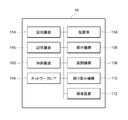
- FIG. 2 is a diagram illustrating an example of a hardware configuration of the folding device 10 according to the embodiment.
- the folding device 10 includes a control device 102, a mounting body 104, a holding mechanism 106, a deployment mechanism 108, a folding mechanism 110, an imaging device 112, a reading device 114, a storage device 116, and a network I / F. (Interface) 118 is provided at least.
- the control device 102 is, for example, a CPU (Central Processing Unit), and controls the unfolding processing and folding processing of the processing object using the recognition result of the image captured by the image capturing device 112.
- the control device 102 recognizes an image of the object to be processed placed on the mounting body 104 and detects the outer shape of the object to be processed or detects the end point of the object to be processed.
- the control device 102 recognizes a position (for example, an end point) to be held of the object to be processed, a position to be folded based on the image recognition result of the object to be processed, and controls the unfolding mechanism and the folding mechanism.
- control device 102 controls the related data read by the reading device 114 to be stored in the storage device 116.
- the control device 102 aggregates related data stored in the storage device 116 and generates workpiece data. Further, the control device 102 performs control so that the workpiece data is transmitted to the server device 20 via the network I / F 118.
- the mounting body 104 is used when the workpiece is unfolded or folded, and is a table, plate, rod, or thread that can place the workpiece.
- the mounting body 104 may be rotatable and / or movable, and the object to be processed is mounted by the movement of the holding mechanism 106.
- the holding mechanism 106 holds a part of an object to be processed that has been put into the apparatus, for example, an end point.
- the holding mechanism 106 is moved by the unfolding mechanism 108 to place the workpiece on the mounting body 104 and change the holding position of the workpiece so as to hold the end point of the workpiece.
- the unfolding mechanism 108 moves the holding mechanism 106 based on the image recognition result of the control device 102 with respect to the image obtained by imaging the workpiece placed on the placement body 104, and is placed on the placement body 104. Expand the workpiece to be processed. Finally, when a predetermined end of the object to be processed is held and developed, the type of the object to be processed is recognized by image recognition. When the type of the workpiece is recognized, the folding position of the workpiece is determined, and the workpiece can be folded based on the folding position.
- the folding mechanism 110 folds the workpiece based on the folding position determined by the type recognition of the control device 102.
- a program including a process of folding using the holding mechanism 106 and the mounting body 104 may be set in the control device 102 in advance for each type of object to be processed.
- the imaging device 112 is provided at a position where an object to be processed placed on the mounting body 104 can be imaged, images the object to be processed in a timely manner, and outputs the captured image to the control device 102.
- the reading device 114 is a device that can read related data added to the object to be processed.
- the reader 114 may be a reader of the wireless IC chip.
- the reading device 114 may be an imaging device or a light receiving device that can recognize the special paint or pattern.
- the related data read by the reading device 114 may be used for speeding up the expansion and folding of the object to be processed.
- the control device 102 can recognize the type of clothing faster and more accurately than the recognition of the type of clothing by image recognition by reading the type of clothing in the related data.
- the storage device 116 is, for example, a nonvolatile memory, and stores workpiece data.
- the storage device 116 may store a control program executed by the folding device 10 and the like.
- the network I / F 118 is an interface between a device having a communication function and the folding device 10.
- the network I / F 118 is connected via a network N such as a LAN (Local Area Network) or a WAN (Wide Area Network) constructed by a data transmission path such as a wired and / or wireless line.
- a network N such as a LAN (Local Area Network) or a WAN (Wide Area Network) constructed by a data transmission path such as a wired and / or wireless line.
- the folding device 10 may have a washing mechanism and a drying mechanism.
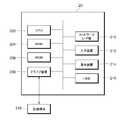
- FIG. 3 is a diagram illustrating an example of a schematic configuration of hardware of the server device 20 according to the embodiment.
- the server device 20 includes a CPU 202, a RAM (Random Access Memory) 204, a ROM (Read Only Memory) 206, a drive device 208, a network I / F 210, an input device 212, a display device 214, and an HDD ( Hard Disk Drive) 216. These components are connected to each other via a bus so as to be able to transmit and receive data.
- a bus so as to be able to transmit and receive data.
- the CPU 202 is a control unit that controls each device, calculates data, and processes in the computer.
- the CPU 202 is an arithmetic unit that executes a program for accumulating and analyzing data stored in the RAM 204 or the ROM 206.
- the CPU 202 receives workpiece data from the network I / F 210 and the like, calculates and processes the data, and outputs the calculation result to the display device 214 and the storage device.
- the RAM 204 is, for example, a main storage unit.
- the RAM 204 is a storage device that stores or temporarily stores programs and data such as OS (Operating System) and application software that are basic software executed by the CPU 202.
- OS Operating System
- application software that are basic software executed by the CPU 202.
- the ROM 206 is a storage device that stores data related to application software, for example.
- the drive device 208 reads the program from the recording medium 218, for example, a CD-ROM or SD card, and installs it in the storage device.
- the recording medium 218 stores a predetermined program, and the program stored in the recording medium 218 is installed in the server device 20 via the drive device 208.
- the installed predetermined program can be executed by the server device 20.
- the network I / F 210 is an interface between the peripheral device having a communication function and the server device 20.
- the network I / F 210 is connected via a network N such as a LAN or a WAN constructed by a data transmission path such as a wired and / or wireless line.
- the input device 212 includes a keyboard having cursor keys, numeric input, various function keys, and the like, a mouse and a slide pad for selecting keys on the display screen of the display device 214, and the like.
- the input device 212 is a user interface for a user to give an operation instruction to the CPU 202 or input data.
- the display device 214 is configured by an LCD (Liquid Crystal Display) or the like, and performs display according to display data input from the CPU 202. Note that the input device 212 and the display device 214 may be provided outside the server device 20.
- LCD Liquid Crystal Display
- the HDD 216 is a storage device that can store a large amount of data.
- the HDD 216 stores, for example, tabulated data obtained by tabulating the workpiece data.
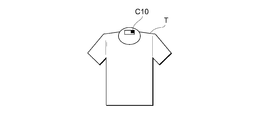
- FIG. 4 is a diagram illustrating an example of a workpiece to which related data is added.
- the workpiece T is a T-shirt and related data is stored in the wireless IC chip C10 embedded in the tag portion of the T-shirt.
- the wireless IC chip C10 may be embedded in the workpiece T itself, not the tag portion.
- the company that sells the object to be processed T adds the wireless IC chip C10 storing the related data to the object to be processed T.
- the related data includes, for example, information such as company name, clothing type (T-shirt, long-sleeved shirt, trousers, skirt, towel, etc.), shape, color, size (dimension), and the like.
- the folding device 10 reads data from the wireless IC chip C10 to speed up the process of recognizing the type of the object to be processed T, accumulate the read data, and make a journal for each object to be processed. Can be.
- the server device 20 can perform analysis using the purchase date and time.
- each function of the data processing system 1 will be described by taking clothing as an example of an object to be processed and related data stored in a wireless IC chip as an example.
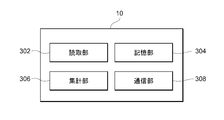
- FIG. 5 is a diagram illustrating an example of functions related to data processing of the folding device 10.
- the folding device 10 includes a reading unit 302, a storage unit 304, a totaling unit 306, and a communication unit 308.
- the reading unit 302 is realized by, for example, the reading device 114 and the like, and reads related data from the wireless IC chip of the object to be processed.
- the read related data is stored in the storage unit 304. If the user knows the position of the wireless IC chip, the reading unit 302 can read the wireless IC chip by bringing the wireless IC chip closer to the reading unit 302 when the user inserts the folding device 10. Good.
- the reading unit 302 may read related data from the wireless IC chip at a predetermined timing during the process of unfolding and folding the workpiece. For example, at the time of final deployment of the workpiece, the workpiece is often deployed at a predetermined position in the apparatus, and the tag position can be easily determined. Therefore, the reading unit 302 can read the related data by moving the holding mechanism 106 so that the position of the determined tag is brought close to the position of the reading unit 302.
- the storage unit 304 is realized by the storage device 116, for example, and stores workpiece data including related data read by the reading unit 302.
- the totaling unit 306 is realized by, for example, the control device 102 and counts the number of times the related data is stored for each piece of clothing identification information of the related data.
- the stored number of times represents the number of times that the object to be processed has been processed by the folding device 10 and the number of times that the object to be processed T has been used by the user. This makes it possible to analyze how many times the workpiece T has been used after purchase.
- the counting unit 306 may perform this count every predetermined period. Assuming that the predetermined period is one month, the counting unit 306 can count the number of times of processing and the number of times of use for each month. As a result, it is possible to analyze the usage status of the object to be processed for each season.
- the communication unit 308 is realized by, for example, the network I / F 118 or the like, and transmits the workpiece data stored in the storage unit 304 to the server device 20.
- the transmission timing may be a timing at which the workpiece data is updated, a timing at the end or beginning of the month, or the like.
- FIG. 6 is a diagram illustrating an example of workpiece data stored in the storage unit 304.
- the processing object data includes data on sales company, clothing ID, clothing type, purchase date and time, user, ongoing use, total number of processing times, and processing frequency.
- Sales company data is data on clothing sales companies.
- the sales company data is data that can identify Company A, Company B, Company C, Company D, and the like.
- the clothing ID is identification information for each clothing that the sales company owns. If the sales company is the same and the same product, the same ID may be given to the clothing ID, or a unique ID may be given to each clothing. When a unique ID is assigned to each piece of clothing, the type of clothing may be indicated using a part of the ID. For example, the upper few digits of the ID indicate the type of clothing, and the number of remaining digits can be unique for each clothing.
- data such as A-001, A-002, and A-003 is used for the clothing ID.
- Clothing type data is data for identifying clothing such as T-shirts, long-sleeved shirts, trousers, skirts, and towels.
- the purchase date / time data is data of the purchase date / time acquired when the cash register is used for accounting at the dealer of the sales company.
- User data is, for example, data on adult men, adult women, children men, children women, and the like.
- the user data may be set by a sales company by a person who is assumed to use the object to be processed, or may be registered by the user when the folding apparatus 10 reads the user data.
- the processing frequency data is data representing the number of times that the processing object is put into the “folding device” and the folding process is performed every predetermined period. In the example shown in FIG. 6, the number of times is counted every month.
- the ongoing data is “ ⁇ ” for the workpieces that are no longer used, and “O” for the clothing that is being used. For example, in the processing frequency data, if the count value is 0 for 12 consecutive months, it is determined that the clothing is no longer used, and “ ⁇ ” is set in the data that is being used continuously. If there is at least one month with a count of 1 or more within 12 months, it is determined that the clothing is in use, and “O” is set in the ongoing data.
- the total processing frequency data is data representing the total processing frequency of each month of the processing frequency data. For example, in the processing frequency data, if the processing period is equal to or longer than a predetermined period and the total number of processing times is large, it can be estimated that the object to be processed is excellent in durability or preferred by the purchaser.
- the processing frequency data indicates that 5 folds were performed in January of 2010, and 4 folds were performed in April of 2011. It represents that.
- the clothing ID “A-001” is folded three times in March 2011 and is not continuously used thereafter.
- the processing object data shown in FIG. 6 is transmitted from the folding device 10 of each home to the server device 20, and the server device 20 can easily acquire a large amount of the processing object data. Moreover, basically, the purchaser only has to put the used object to be processed into the folding device 10, so that the purchaser is not forced to perform complicated processing.
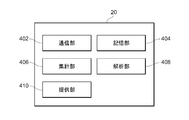
- FIG. 7 is a diagram illustrating an example of functions related to data processing of the server device 20 in the embodiment.
- the server device 20 includes a communication unit 402, a storage unit 404, a totaling unit 406, an analysis unit 408, and a providing unit 410.
- the communication unit 402 is realized by, for example, the network I / F 210 or the like, and receives workpiece data or the like from the folding device 10. In addition, the communication unit 402 transmits the analysis result to the information processing apparatus 30 by e-mail or the like. Therefore, the communication unit 402 functions as a transmission unit and a communication unit.
- the storage unit 404 is realized by, for example, the HDD 216, the RAM 204, the ROM 206, or the like, and stores total data obtained by totaling the workpiece data.
- the aggregation unit 406 is realized by, for example, the CPU 202 or the RAM 204 as a work memory, and performs aggregation on predetermined data in the received workpiece data. “Calculate” means to count the total number of times or to calculate an average.
- the aggregated data includes, for each type of object to be processed, first data indicating a total result of the total number of times processed by the folding device 10, second data indicating an average of the total number of times of processing, and the number of processes per predetermined period. At least one of the third data indicating the average of is included.
- the analysis unit 408 is realized by, for example, the CPU 202 or the RAM 204 as a work memory, and analyzes predetermined data in the aggregated data. For example, the analysis unit 408 may analyze the use time of the object to be processed and the number of uses of this use time using the third data of the aggregate data. Thereby, the fashion of a to-be-processed object and a user's liking can be grasped
- the analysis unit 408 may analyze the durability of the workpiece using the first data or the second data of the aggregate data. For example, it can be determined that the durability is higher as the total number of times the workpiece to be processed is processed by the folding device 10 is larger.
- the providing unit 410 is realized by, for example, the CPU 202, the network I / F 210, and the like, and includes the analysis result by the analyzing unit 408 in an e-mail or the like, and provides it to, for example, a predetermined information processing apparatus 30 of a sales company. Thereby, the sales company can grasp the data regarding the processed object after the purchase, and can use it for the development strategy of the processed object.
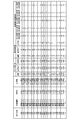
- FIG. 8 is a diagram illustrating an example of aggregated data stored in the storage unit 404.
- the total data includes data of a sales company, a clothing type, a clothing ID, a user, the number of data totals, the total number of processes, and the number of uses for each year.
- the sales company data is data for each “sales company” included in the workpiece data transmitted from each folding device 10 in each household.
- sales company data may be sorted for each sales company, such as company A, company B, company C, and company D.
- the clothing type data is “clothing type” data included in the workpiece data transmitted from each folding device 10 in each household.
- the clothing type data may be sorted for each clothing type, such as T-shirts, long-sleeved shirts, trousers, skirts, towels, and the like.
- the clothing ID is a “clothing ID” included in the workpiece data transmitted from each folding device 10 in each household.
- the clothing ID is collected for each clothing ID such as “A-001”, “A-002”, “A-003”, “A-004”, or “A-005”.
- User data is “user” data included in the workpiece data transmitted from each folding device 10 in each household.
- the user data includes data of “adult male”, “adult female”, “child male”, or “child female”.
- the number of data totals is data aggregated using “in use” and “total number of processes” included in the processing object data transmitted from each folding device 10 in each household.
- the “total number” of the data total number indicates the total number of times the clothes having the same clothes ID are processed in each folding device 10 in each household.
- End of use of the data total count indicates the total number of “total number of processing times” in which “in use” is included in the workpiece data and “ ⁇ ” is applicable. “In use” of the data total number indicates the total number of “total number of processes” corresponding to “ ⁇ ” included in the workpiece data.
- the total number of times of processing is an average value of the number of times of processing aggregated by using “in use” and “total number of times of processing” included in the processing object data transmitted from each folding device 10 of each household.
- the “total number” of the total number of times of processing indicates the average number of times that the clothing having the same clothing ID is processed in each folding device 10 in each household.
- End of use of the total number of processing times indicates an average value of “total number of processing times” in which “continuing use” included in the workpiece data corresponds to “ ⁇ ”.
- In use of the total number of processes indicates an average value of “total number of processes” corresponding to “ ⁇ ” included in the workpiece data.
- the number of times of processing per year is the average number of times of processing of clothing of the same clothing ID per year included in the processing object data transmitted from each folding device 10 in each home.
- the total value of the number of processings per year becomes the “total” of the total number of processings.
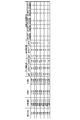
- FIG. 9 is a diagram illustrating an example of the filtering result of the analysis process A.
- the analysis unit 408 extracts only data in which the clothing type is “long sleeve shirt” and the user is “adult male”.
- the clothing ID corresponding to the clothing type “long sleeve shirt” and the user “adult male” is “A-001”, “A-002”, “A-010”, “D-001”, “D-002”, and “D-003”.
- the numerical values of “use end” of the total number of processing times are “72”, “40”, “19”, “86”, “94”, and “102” in order from the top.
- the analysis unit 408 performs a t-test on two samples with non-equal variance in the total number of processing at the sales companies “Company A” and “Company D”, and the p-value is 0.035, which is 5%.
- the risk rate is as follows.
- the analysis unit 408 can not only classify and extract necessary data but also perform statistical processing such as t-test.
- a sales company can evaluate which sales company has a good design / material, etc. by evaluating the difference between itself and other companies.
- the numerical values of “end of use” of the total number of processing of the clothing IDs “D-001”, “D-002”, and “D-003” in “Company D” are “86”, “94”, In contrast to “102”, the value of “end of use” of the total number of processing of the clothing IDs “A-001”, “A-002”, and “A-010” in “Company A” is “72”. , “40”, “19”.
- Company A the clothing with the clothing ID “A-001” is used or processed most, and the total number of processings decreases in the order of the clothing IDs “A-002” and “A-010”. In addition, if it is limited to Company A, the difference in the numerical value of “end of use” of the total number of processing is large. In other words, Company A can build a sales strategy for long-sleeved shirts for adult men with reference to the design and materials of clothing ID “A-001” in the future.
- the long-sleeved shirt of Company A has a tendency to decrease the number of processing times in each year. This decreasing trend is considered to be a normal trend. This is because the number of times the object is used decreases as time elapses after purchase.
- long-sleeved shirts from Company D are significantly more processed in 2011.
- an analysis of variance is preferably performed.
- Long-sleeved shirts tend to be used from autumn to winter and spring. Therefore, if the winter of 2011 is particularly cold, the long-sleeved shirt of Company D is highly likely to be evaluated by the purchaser as having excellent cold resistance compared to the long-sleeved shirt of Company A.
- ⁇ Analysis process B> when the clothing type is “long sleeve shirt” and the user focuses on clothing corresponding to “adult female”, the analysis unit 408 can filter only the corresponding data.
- FIG. 10 is a diagram illustrating an example of the filtering result of the analysis process B.
- the analysis unit 408 extracts only data in which the clothing type is “long sleeve shirt” and the user is “adult female”.
- the clothing ID corresponding to the clothing type “long sleeve shirt” and the user “adult female” is “B-001”, “B-002”, “B-003”, “B-004”, “B-005”, “B-006”, “C-001”, “C-002”, “C-003”, and “C-004”.
- the numerical value of “end of use” of the total number of processes is “29”, “76”, “30”, “89”, “29”, “68”, “14”, “18”, “18”, “ 17 ”and“ 15 ”.
- the analysis unit 408 performs a t-test on two samples with non-equal variance in the total number of processing at the sales company “Company B” and “Company C”.
- the p-value is 0.01 and 5%
- the risk rate is as follows.
- the results of the above t-test may indicate that the long sleeved shirt of Company B is more favored by buyers than the long sleeved shirt of Company C, which can withstand repeated use. High nature. Therefore, a sales company other than Company B is more likely to have the purchaser use it many times after purchase by referring to the design and material of Company B's long-sleeved shirt.
- the numerical values of “end of use” of the total number of processing of the clothing IDs “B-002”, “B-004”, and “B-006” in “Company B” are “76” and “89”, respectively.
- And “68” while the clothing IDs “B-001”, “B-003”, and “B-005” are “29”, “30”, and “29”.
- the analysis unit 408 performs a t-test on two samples with non-equal variance in the total number of processing in the above two groups, the p value is 0.008, and the risk rate is 5% or less.
- the total number of times the clothes that have been used are processed is “B-001”, “B-003”, “B-002”, “B-004”, and “B-006”. And more than the group of “B-005”.
- Company B for example, has a group of clothing IDs “B-002”, “B-004”, and “B-006”, and clothing IDs “B-001”, “B-003”, and “B- By comparing with the “005” group, it is possible to build a sales strategy for long-sleeved shirts with reference to the design and material between the two groups.
- the long-sleeved shirt of Company B shows that the number of treatments in fiscal 2012 is greater than the number of treatments in other years when compared with the number of treatments in each year. If the winter of 2012 is particularly cold, the long-sleeved shirt of Company B is more likely to be evaluated by the purchaser as having better cold resistance than Company C.
- the analysis unit 408 can perform data analysis focusing on a predetermined company, predetermined data, and the like, and can provide information useful for a sales company.
- FIG. 11 is a flowchart illustrating an example of a reading process of the folding device 10 according to the embodiment. The process shown in FIG. 11 is executed, for example, every time a user inputs a workpiece into the folding apparatus 10 or when the holding mechanism 106 holding the workpiece moves to the position of the reading device 114. Or
- step S102 the reading unit 302 determines whether or not the related data of the object to be processed added to the object to be processed can be read. For example, the reading unit 302 determines that reading is possible when the wireless IC chip storing the related data with the reading device 114 is within a predetermined distance. If reading is possible (step S102—YES), the process proceeds to step S104. If reading is not possible (step S102—NO), the process returns to step S102.
- step S104 the reading unit 302 reads related data from the object to be processed.
- step S106 the reading unit 302 determines whether all related data has been read. For example, the reading unit 302 may determine that all have been read when a predetermined time has elapsed since the last reading, or may have read all by pressing a button or the like provided on the folding device 10. You may judge. If all the related data has been read (step S106-YES), the process proceeds to step S108, and if all the related data has not been read (step S106-NO), the process returns to step S102.
- step S108 the reading unit 302 stores all the read data in the storage unit 304. Note that step S106 and step S108 may be interchanged.
- the processing shown in FIG. 11 allows the folding device 10 to read related data without forcing the user to perform complicated processing.
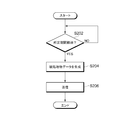
- FIG. 12 is a flowchart illustrating an example of processing data transmission processing of the folding device 10 according to the embodiment. The process shown in FIG. 12 is executed at a predetermined timing, for example.
- step S202 the counting unit 306 determines whether or not a predetermined time has passed by an internal timer.
- the predetermined period is, for example, January. If the predetermined period has elapsed (step S202—YES), the process proceeds to step S204. If the predetermined period has not elapsed (step S202—NO), the process returns to step S202.
- step S204 the totaling unit 306 counts the number of times the related data is stored within a predetermined time, and based on this count value, totals the total number of processes and the processing frequency, and sets data in use.
- the processing object data is generated.
- step S206 the communication unit 308 transmits the generated aggregate data to the server device 20.
- the generation of the workpiece data may be performed every time related data is stored. Further, the processing in step S202 may be replaced with determination of whether or not related data is newly stored.
- the folding device 10 can generate processed object data for analyzing the processed object after purchase, and can transmit the processed object data to the server device 20.
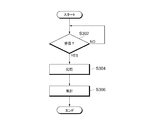
- FIG. 13 is a flowchart illustrating an example of the process data reception process of the server device 20 according to the embodiment. The process shown in FIG. 13 is executed each time the workpiece data is received from each folding device 10 in each household.
- step S302 shown in FIG. 13 the communication unit 402 determines whether or not the processing object data has been received from each folding device 10 in each household. If the workpiece data is received (step S302—YES), the process proceeds to step S304. If the workpiece data is not received (step S302—NO), the process returns to step S302.
- step S304 the storage unit 404 stores the received workpiece data.
- step S306 the tabulation unit 406 tabulates data based on the stored workpiece data and generates tabulated data.
- the server device 20 can acquire and store the workpiece data from each folding device 10 in each household.
- FIG. 14 is a flowchart illustrating an example of analysis and provision processing of the server device 20 in the embodiment. The processing shown in FIG. 14 is executed when an administrator or the like gives an analysis instruction using the aggregated data.
- step S402 shown in FIG. 14 the analysis unit 408 determines whether or not an analysis is instructed by an operation of an administrator or the like.
- the analysis instruction includes selection of predetermined data in the aggregated data, selection of statistical processing, and the like. If there is an analysis instruction (step S402-YES), the process proceeds to step S404, and if there is no analysis instruction (step S402-NO), the process returns to step S402.
- step S404 the analysis unit 408 performs predetermined analysis processing. For example, an object ID is selected, an object type is selected, a t-test is performed, and an analysis of variance is performed.
- step S406 the providing unit 410 provides the analysis result of the analyzing unit 408 to a predetermined sales company.
- the server device 20 can perform an analysis on the processed object after purchase, and the sales company receives the analysis result to help in product development of the processed object. Can do.
- the processing object data that can be acquired by each folding device in each home is accumulated in the database on the network, and is classified by the sales company, clothing type, etc. to which attention is paid.
- the usage information of the object to be processed can be obtained with high accuracy.
- the data obtained with the folding device has a large amount of data and is highly reliable because it is based on objective numerical values, compared to questionnaires and fixed point observations by observers. Comparison between sales companies and comparison of the number of uses between products in the same sales company can be performed. By evaluating these differences, it can be used in the development strategy of clothing that can be used more after purchase. As a result, it can contribute to the improvement of the image power, brand power, and future sales of clothing sales companies.
- the present invention can be implemented by adding the number of times of processing performed by the folding device 10 which is data requested to the sales company and transmitting the data to the server device 20.
- the CPU 202 reads out this program from the ROM 206 and executes it, so that one or more of the above-mentioned units are loaded onto the RAM 204. Alternatively, a plurality of units are generated on the RAM 204.
- the data processing described in the above embodiment may be realized as a program for causing a computer to execute.
- the data processing described above can be realized by installing this program from a server or the like and causing the computer to execute it.
- the recording medium 218 is a recording medium that records information optically, electrically, or magnetically, such as a CD-ROM, flexible disk, magneto-optical disk, etc., or information electrically, such as a ROM or flash memory.
- Various types of recording media such as a semiconductor memory for recording can be used.
- the folding device 10 in the above-described embodiment may be a washing machine, a dryer, or a laundry dryer.
- the washing machine, the dryer, or the washing / drying machine is provided with a reading device that reads related data, and if processing object data including the related data read by the reading device is transmitted to the server device, the above-described embodiment is achieved. It can have the same effect.
- the washing machine, the dryer, the washing dryer, and the folding device are collectively referred to as a processing device that processes an object to be processed. That is, this processing apparatus is an apparatus capable of executing at least one of the processes such as washing, dewatering, drying, unfolding, folding, and sorting.
- the workpiece data described in the embodiment may include data related to folding of the workpiece.
- the analysis unit 408 may perform analysis using data regarding the folding.
- the data related to the folding of the workpiece includes data that can be acquired using an image captured by the imaging device 112 of the folding device 10, data that can be acquired by a load sensor provided on the holding mechanism 106 or the mounting body 104, and the like. .
- the data that can be acquired using the captured image of the object to be processed includes at least one of the following data: dirt, scratches, wrinkles, shape change (including elongation and shrinkage), color fading, and color transfer.
- control device 102 can recognize the design and pattern of the clothing from the clothes ID and the like, and detect the dirt and scratch by comparing the design and pattern data with the image recognition result. be able to.
- the detected dirt and scratch data is included in the workpiece data.
- the sales company can grasp, for example, how much of the garment with the special coating is used and how much the special coating is peeled off by examining the dirt and the total number of treatments.
- the sales company should consider the damage and the total number of treatments, etc., for example, to understand how much of the clothes that are said to be difficult to scratch are used and how much they will be damaged. Can do.
- control device 102 can detect wrinkles by extracting edges from the captured image and collating the recognition result of the clothing design or pattern acquired from the clothing ID or the like with the edges.
- the detected wrinkle data is included in the workpiece data.
- the sales company can grasp, for example, how much the wrinkle is likely to be formed by considering the wrinkle and the total number of treatments.
- control device 102 can calculate data on the shape of the clothing such as the length and the width of the clothing from the image of the clothing.
- the calculated shape data is included in the workpiece data.
- the sales company can grasp, for example, how much the shape is changed by examining the shape data together with the total number of processing, for example.
- the control device 102 collates the recognition result of the clothing design or pattern acquired from the clothing ID or the like with the image recognition result, thereby reducing the color fading or the like on the same clothing.
- Color transfer can be detected. Data relating to the detected color fading and color transfer is included in the workpiece data.
- the sales company can grasp, for example, how much the color changes, for example, by examining the data regarding the color fading and color transfer and the total number of processing.
- the weight of the object to be processed can be measured by a load sensor provided in the holding mechanism 106, the mounting body 104, or the like.
- the measured workpiece weight data is included in the workpiece data.
- the sales company can grasp how much it is used, for example, how difficult it is to dry by considering the weight data and the total number of processing times.
- control device 102 of the folding device 10 determines the type of clothing by image recognition of the object to be processed at the time of folding, the control device 102 compares the clothing type included in the related data with the determined clothing type. However, when they are different, priority may be given to the type of image recognition. In this case, if the folding device 10 has a wireless IC chip reader / writer, an error in the clothing type stored in the wireless IC chip can be corrected.
- related data of a plurality of clothes stored in the folding device 10 can be stored in another storage medium.
- related data can be stored in the external storage medium via this interface.
- the external storage medium is, for example, a storage medium of a mobile terminal such as a smartphone, an SD card, a USB memory, or the like.
- the related data stored in the external storage medium can be input to the other folding device to shorten the time required for folding. .
- the folding device can be informed in advance of clothing that may be folded.
- folding candidates can be narrowed down, so that the folding time can be shortened.
- the data regarding the folding of the object to be processed may be the number of times the holding position of the holding mechanism 106 is changed until the type of the object to be processed is determined.
- the analysis unit 408 may perform analysis using data regarding the folding. Thereby, for example, the processing object having a large number of changes described above is provided to the manufacturer of the folding apparatus 10 so that the unfolding algorithm of the processing object having the large number of changes is corrected so that the number of changes is small. Can give you an opportunity to be.
- the reading device reads related data at the time of washing and / or drying, and the reading device reads the related data at the time of folding, so that Differences in related data read at the time can be analyzed. For example, it is possible to analyze what to-be-processed objects are washed and / or dried and are not folded by being taken out by the user before folding.
- the processing frequency may include only the latest month.
- the processing frequency of the past month may be included in the total data on the server device 20 side.
- the clothing type and user data may be attributes that allow the clothing ID to be specified. In this case, it is not necessary to include the clothing type and user data in the related data.
- the actual user may be recorded on a wireless IC chip or the like using a reader / writer for the folding device 10.
- different users exist for the same object ID, and if the users are different, the data is managed and totaled separately. Thereby, even if it is a to-be-processed object of the same to-be-processed object ID, the use condition etc. by a user's difference can be grasped
- the server device 20 may have a totaling function of the folding device 10.
- the folding device 10 transmits the read related data to the server device 20 each time, and the server device 20 counts and counts the related data.
- the family attribute may be recorded on the wireless IC chip of the object to be processed by the user operation from the reader / writer of the folding apparatus 10.
- the attributes include father, mother, son 1, son 2, and the like.
- a family attribute may be added to the workpiece data. As a result, it becomes possible to analyze the usage status of the object to be processed for each individual of the family.
- the type of the object to be processed included in the related data read by the folding device 10 may be used to collate with the result of the type recognition of the image recognition of the object to be processed. As a result, it is possible to check whether or not the type discrimination result by image recognition is correct.
- the reading device 114 may be provided in the mounting body 104, the holding mechanism 106, or the like.
Landscapes
- Engineering & Computer Science (AREA)
- Business, Economics & Management (AREA)
- Strategic Management (AREA)
- Finance (AREA)
- Development Economics (AREA)
- Accounting & Taxation (AREA)
- Marketing (AREA)
- Physics & Mathematics (AREA)
- Theoretical Computer Science (AREA)
- General Physics & Mathematics (AREA)
- General Business, Economics & Management (AREA)
- Economics (AREA)
- Entrepreneurship & Innovation (AREA)
- Tourism & Hospitality (AREA)
- Textile Engineering (AREA)
- Human Resources & Organizations (AREA)
- Health & Medical Sciences (AREA)
- General Health & Medical Sciences (AREA)
- Game Theory and Decision Science (AREA)
- Signal Processing (AREA)
- Computer Networks & Wireless Communication (AREA)
- Primary Health Care (AREA)
- Medical Informatics (AREA)
- Computing Systems (AREA)
- Data Mining & Analysis (AREA)
- General Engineering & Computer Science (AREA)
- Computer Hardware Design (AREA)
- Operations Research (AREA)
- Quality & Reliability (AREA)
- Management, Administration, Business Operations System, And Electronic Commerce (AREA)
Abstract
Description
<システム構成>
図1は、本発明の一実施形態によるデータ処理システム1の概略構成の一例を示す図(システム構成図)である。同図に示すように、複数の折り畳み装置10A、10B、・・・と、サーバ装置20と、複数の情報処理装置30A、30B、・・・とが、ネットワークNを介して相互に通信可能に接続されることにより、データ処理システム1が構成される。以降、折り畳み装置を個別に区別する必要がない場合は、符号10を用いる。また、情報処理装置を個別に区別する必要がない場合は、符号30を用いる。なお、折り畳み装置10及び情報処理装置30について、ネットワークNに接続される数は1つであってもよい。
次に、データ処理システム1内の各装置のハードウェア構成について説明する。図2は、実施形態における折り畳み装置10のハードウェア構成の一例を示す図である。図2に示すように、折り畳み装置10は、制御装置102、載置体104、保持機構106、展開機構108、折り畳み機構110、撮像装置112、読取装置114、記憶装置116、及びネットワークI/F(Interface)118を少なくとも備える。
図4は、関連データが付加された被処理物の一例を示す図である。図4に示す例では、被処理物Tは、Tシャツであり、関連データは、Tシャツのタグ部分に埋め込まれた無線ICチップC10に記憶されているとする。なお、無線ICチップC10はタグ部分ではなく、被処理物T自体に埋め込まれるようにしてもよい。
図5は、折り畳み装置10のデータ処理に関する機能の一例を示す図である。図5に示す例では、折り畳み装置10は、読取部302、記憶部304、集計部306、及び通信部308を有する。
次に、解析部408による集計データの解析処理の具体例について説明する。解析処理Aでは、衣類種類が「長袖シャツ」で、使用者が「大人男性」に該当する衣類に着目した場合、解析部408は、該当するデータのみをフィルタリングすることができる。
解析処理Bでは、衣類種類が「長袖シャツ」で、使用者が「大人女性」に該当する衣類に着目した場合、解析部408は、該当するデータのみをフィルタリングすることができる。
次に、データ処理システム1の各動作について説明する。図11は、実施形態における折り畳み装置10の読取処理の一例を示すフローチャートである。図11に示す処理は、例えば、ユーザから折り畳み装置10に被処理物を投入する度に実行されたり、又は被処理物を保持した保持機構106が読取装置114の位置まで移動したときに実行されたりする。
実施形態で説明した被処理物データは、被処理物の折り畳みに関するデータを含んでもよい。解析部408は、この折り畳みに関するデータを用いて解析を行ってもよい。被処理物の折り畳みに関するデータは、折り畳み装置10の撮像装置112により撮像された画像を用いて取得できるデータや、保持機構106や載置体104に設けられた荷重センサなどにより取得できるデータを含む。
20 サーバ装置
114 読取装置
202 CPU
204 RAM
206 ROM
216 HDD
402 通信部
404 記憶部
406 集計部
408 解析部
410 提供部
Claims (10)
- 被処理物を折り畳む1又は複数の折り畳み装置から送信された被処理物データであって、前記折り畳み装置が前記被処理物から読み取った当該被処理物に関連する関連データを含む、前記被処理物データを受信する受信部と、
前記被処理物データが集計された集計データを記憶する記憶部と、
前記集計データ内の所定のデータに対して解析を行う解析部と、
前記解析部による解析結果を、所定の情報処理装置に提供する提供部と、
を備えるサーバ装置。 - 前記関連データは、前記被処理物の販売会社データ、前記被処理物の識別情報、前記被処理物の種類データ、前記被処理物の購入日時データ、及び前記被処理物の使用者データのうち、少なくとも1つを含む、請求項1に記載のサーバ装置。
- 前記被処理物データは、前記被処理物が前記折り畳み装置により処理された所定期間毎の処理回数、前記被処理物が前記折り畳み装置により処理された総処理回数、及び前記被処理物が使用継続中であるか否かを示すデータのうち、少なくとも1つを含む、請求項2に記載のサーバ装置。
- 前記集計データは、前記被処理物の種類毎に、前記総処理回数の集計結果を示す第1データ、前記総処理回数の平均を示す第2データ、及び前記所定期間毎の処理回数の平均を示す第3データのうち、少なくとも1つを含む、請求項3に記載のサーバ装置。
- 前記解析部は、
前記第3データを用いて、前記被処理物の使用時期及び該使用時期の使用回数を解析し、又は前記第1データ又は前記第2データを用いて、前記被処理物の耐久性を解析する、請求項4に記載のサーバ装置。 - 前記被処理物データは、前記被処理物の折り畳みに関するデータを含み、
前記解析部は、
前記被処理物の折り畳みに関するデータを用いて、前記被処理物に関する解析を行う、請求項1乃至5いずれか一項に記載のサーバ装置。 - 前記被処理物の折り畳みに関するデータは、前記被処理物の汚れ、傷、しわ、形状変化、色落ち、色移り、及び重さを示すデータのうち、少なくとも1つを含む、請求項6に記載のサーバ装置。
- コンピュータが、
被処理物を折り畳む1又は複数の折り畳み装置から送信された被処理物データであって、前記折り畳み装置が前記被処理物から読み取った当該被処理物に関連する関連データを含む、前記被処理物データを受信し、
前記被処理物データが集計された集計データを記憶部に記憶し、
前記集計データ内の所定のデータに対して解析を行い、
前記解析の結果を、所定の情報処理装置に提供する、
データ提供方法。 - コンピュータに、
被処理物を折り畳む1又は複数の折り畳み装置から送信された被処理物データであって、前記折り畳み装置が前記被処理物から読み取った当該被処理物に関連する関連データを含む、前記被処理物データを受信し、
前記被処理物データが集計された集計データを記憶部に記憶し、
前記集計データ内の所定のデータに対して解析を行い、
前記解析の結果を、所定の情報処理装置に提供する、
処理を実行させるプログラム。 - 被処理物を折り畳む1又は複数の折り畳み装置と、サーバ装置とがネットワークを介して接続されたデータ処理システムであって、
前記折り畳み装置が前記被処理物から読み取った当該被処理物に関連する関連データを含む、被処理物データを該前記サーバ装置に送信する送信部と、
前記送信部により送信された被処理物データを受信する受信部と、
前記被処理物データが集計された集計データを記憶する記憶部と、
前記集計データ内の所定のデータに対して解析を行う解析部と、
前記解析部による解析結果を、所定の情報処理装置に提供する提供部と、
を備えるデータ処理システム。
Priority Applications (6)
| Application Number | Priority Date | Filing Date | Title |
|---|---|---|---|
| KR1020177037671A KR20180022718A (ko) | 2015-05-29 | 2016-05-27 | 서버 장치, 데이터 제공 방법, 프로그램 및 데이터 처리 시스템 |
| CN201680031175.6A CN107851266A (zh) | 2015-05-29 | 2016-05-27 | 服务器装置、数据提供方法、程序及数据处理系统 |
| JP2017521900A JP6738328B2 (ja) | 2015-05-29 | 2016-05-27 | サーバ装置、データ提供方法、プログラム及びデータ処理システム |
| CA2987559A CA2987559A1 (en) | 2015-05-29 | 2016-05-27 | Server device, data providing method, program, and data processing system |
| US15/577,473 US11037176B2 (en) | 2015-05-29 | 2016-05-27 | System, method and device for folding subjects |
| EP16803247.2A EP3306552A4 (en) | 2015-05-29 | 2016-05-27 | SERVER DEVICE, DATA PROCESSING PROCESS, PROGRAM AND DATA PROCESSING SYSTEM |
Applications Claiming Priority (2)
| Application Number | Priority Date | Filing Date | Title |
|---|---|---|---|
| JP2015110069 | 2015-05-29 | ||
| JP2015-110069 | 2015-05-29 |
Publications (1)
| Publication Number | Publication Date |
|---|---|
| WO2016194812A1 true WO2016194812A1 (ja) | 2016-12-08 |
Family
ID=57442264
Family Applications (1)
| Application Number | Title | Priority Date | Filing Date |
|---|---|---|---|
| PCT/JP2016/065716 Ceased WO2016194812A1 (ja) | 2015-05-29 | 2016-05-27 | サーバ装置、データ提供方法、プログラム及びデータ処理システム |
Country Status (7)
| Country | Link |
|---|---|
| US (1) | US11037176B2 (ja) |
| EP (1) | EP3306552A4 (ja) |
| JP (1) | JP6738328B2 (ja) |
| KR (1) | KR20180022718A (ja) |
| CN (1) | CN107851266A (ja) |
| CA (1) | CA2987559A1 (ja) |
| WO (1) | WO2016194812A1 (ja) |
Cited By (1)
| Publication number | Priority date | Publication date | Assignee | Title |
|---|---|---|---|---|
| CN110894658A (zh) * | 2018-08-23 | 2020-03-20 | 无锡小天鹅电器有限公司 | 洗涤控制方法、装置以及衣物处理装置 |
Families Citing this family (1)
| Publication number | Priority date | Publication date | Assignee | Title |
|---|---|---|---|---|
| CN108755067B (zh) * | 2018-06-21 | 2020-11-06 | 金华优地工业设计有限公司 | 全自动衣物运载与衣架分离回收方法 |
Citations (3)
| Publication number | Priority date | Publication date | Assignee | Title |
|---|---|---|---|---|
| JPH096851A (ja) * | 1995-06-19 | 1997-01-10 | Omron Corp | 衣服回収システムおよび衣服管理システム |
| WO2007007591A1 (ja) * | 2005-07-08 | 2007-01-18 | Matsushita Electric Industrial Co., Ltd. | 衣類たたみ機 |
| JP2011115207A (ja) * | 2009-11-30 | 2011-06-16 | Ist Corp | 布製品の折り畳みシステム |
Family Cites Families (7)
| Publication number | Priority date | Publication date | Assignee | Title |
|---|---|---|---|---|
| JPS5317239B2 (ja) | 1974-09-13 | 1978-06-07 | ||
| JP4086634B2 (ja) | 2002-11-25 | 2008-05-14 | 三洋電機株式会社 | 洗濯機及び乾燥機 |
| US20070021283A1 (en) * | 2005-07-19 | 2007-01-25 | Richard Leifer | System and method for the automated folding of textiles |
| KR20120095922A (ko) | 2009-10-19 | 2012-08-29 | 세븐 드리머스 래버러토리스, 인코퍼레이션 | 절첩 장치 및 절첩 방법 |
| CA2819588C (en) | 2010-12-01 | 2019-09-17 | Seven Dreamers Laboratories, Inc. | Deformable thin object spreading device and deformable thin object spreading method |
| US8630892B2 (en) * | 2011-08-31 | 2014-01-14 | Accenture Global Services Limited | Churn analysis system |
| CN103726262B (zh) * | 2012-10-15 | 2016-04-20 | 佛山市顺德区盛熙电器制造有限公司 | 一种基于rfid技术的洗衣机以及洗衣信息采集系统 |
-
2016
- 2016-05-27 EP EP16803247.2A patent/EP3306552A4/en not_active Ceased
- 2016-05-27 CN CN201680031175.6A patent/CN107851266A/zh active Pending
- 2016-05-27 JP JP2017521900A patent/JP6738328B2/ja active Active
- 2016-05-27 CA CA2987559A patent/CA2987559A1/en not_active Abandoned
- 2016-05-27 US US15/577,473 patent/US11037176B2/en active Active
- 2016-05-27 KR KR1020177037671A patent/KR20180022718A/ko not_active Withdrawn
- 2016-05-27 WO PCT/JP2016/065716 patent/WO2016194812A1/ja not_active Ceased
Patent Citations (3)
| Publication number | Priority date | Publication date | Assignee | Title |
|---|---|---|---|---|
| JPH096851A (ja) * | 1995-06-19 | 1997-01-10 | Omron Corp | 衣服回収システムおよび衣服管理システム |
| WO2007007591A1 (ja) * | 2005-07-08 | 2007-01-18 | Matsushita Electric Industrial Co., Ltd. | 衣類たたみ機 |
| JP2011115207A (ja) * | 2009-11-30 | 2011-06-16 | Ist Corp | 布製品の折り畳みシステム |
Non-Patent Citations (1)
| Title |
|---|
| See also references of EP3306552A4 * |
Cited By (1)
| Publication number | Priority date | Publication date | Assignee | Title |
|---|---|---|---|---|
| CN110894658A (zh) * | 2018-08-23 | 2020-03-20 | 无锡小天鹅电器有限公司 | 洗涤控制方法、装置以及衣物处理装置 |
Also Published As
| Publication number | Publication date |
|---|---|
| CN107851266A (zh) | 2018-03-27 |
| KR20180022718A (ko) | 2018-03-06 |
| JP6738328B2 (ja) | 2020-08-12 |
| US20180150853A1 (en) | 2018-05-31 |
| EP3306552A4 (en) | 2019-01-16 |
| JPWO2016194812A1 (ja) | 2018-03-22 |
| US11037176B2 (en) | 2021-06-15 |
| CA2987559A1 (en) | 2016-12-08 |
| EP3306552A1 (en) | 2018-04-11 |
Similar Documents
| Publication | Publication Date | Title |
|---|---|---|
| WO2014013649A1 (ja) | 電子機器および方法 | |
| CN104766413B (zh) | 信息处理装置及其控制方法 | |
| US20170116591A1 (en) | Information processing device and screen setting method | |
| JP6648508B2 (ja) | 購買行動分析プログラム、購買行動分析方法、及び購買行動分析装置 | |
| JP6395657B2 (ja) | サーバおよびプログラム | |
| JP6738328B2 (ja) | サーバ装置、データ提供方法、プログラム及びデータ処理システム | |
| US20180075711A1 (en) | Merchandise registration device and merchandise registration program | |
| CN110042640A (zh) | 用于组织待处理的洗涤物的方法和用于组织洗涤物的系统 | |
| CN104299131B (zh) | 信息处理装置及其控制方法 | |
| US20160350931A1 (en) | Depth-based image element removal | |
| JP6949611B2 (ja) | 商品登録装置及びそのプログラム | |
| JP6375924B2 (ja) | 商品登録装置、商品特定方法及びプログラム | |
| US9355395B2 (en) | POS terminal apparatus and commodity specification method | |
| JP7342943B2 (ja) | 販売管理システム、店舗装置、販売管理方法、およびプログラム | |
| JP6261529B2 (ja) | Pos端末及びプログラム | |
| JP6963292B2 (ja) | 布製品識別システム及び布製品識別方法 | |
| JP2008129900A (ja) | 自動販売機 | |
| JP2022034829A (ja) | 情報処理装置、及び、情報処理方法 | |
| JP6426905B2 (ja) | 利用者情報管理システム及び利用者情報管理方法 | |
| JP7838625B2 (ja) | 商品推奨装置、方法、およびプログラム | |
| CN112381608B (zh) | 基于大数据多标记的电子商务商品推荐方法 | |
| CN114150470B (zh) | 衣物推荐方法、装置、设备及存储介质 | |
| US20180060693A1 (en) | Object recognition apparatus | |
| CN116881487B (zh) | 推荐方法、装置、电子设备及存储介质 | |
| JP7735780B2 (ja) | 情報収集装置、情報収集方法及びプログラム |
Legal Events
| Date | Code | Title | Description |
|---|---|---|---|
| 121 | Ep: the epo has been informed by wipo that ep was designated in this application |
Ref document number: 16803247 Country of ref document: EP Kind code of ref document: A1 |
|
| ENP | Entry into the national phase |
Ref document number: 2017521900 Country of ref document: JP Kind code of ref document: A |
|
| ENP | Entry into the national phase |
Ref document number: 2987559 Country of ref document: CA |
|
| WWE | Wipo information: entry into national phase |
Ref document number: 15577473 Country of ref document: US |
|
| NENP | Non-entry into the national phase |
Ref country code: DE |
|
| ENP | Entry into the national phase |
Ref document number: 20177037671 Country of ref document: KR Kind code of ref document: A |
|
| WWE | Wipo information: entry into national phase |
Ref document number: 2016803247 Country of ref document: EP |