WO2016197946A1 - 抗体药物偶联物、中间体、制备方法、药物组合物及应用 - Google Patents
抗体药物偶联物、中间体、制备方法、药物组合物及应用 Download PDFInfo
- Publication number
- WO2016197946A1 WO2016197946A1 PCT/CN2016/085275 CN2016085275W WO2016197946A1 WO 2016197946 A1 WO2016197946 A1 WO 2016197946A1 CN 2016085275 W CN2016085275 W CN 2016085275W WO 2016197946 A1 WO2016197946 A1 WO 2016197946A1
- Authority
- WO
- WIPO (PCT)
- Prior art keywords
- group
- substituted
- mmol
- unsubstituted
- etoac
- Prior art date
- Legal status (The legal status is an assumption and is not a legal conclusion. Google has not performed a legal analysis and makes no representation as to the accuracy of the status listed.)
- Ceased
Links
- 0 C[C@@](C(O[C@@](CC(N(C)c(cc(CC(C)=CC=C[C@]([C@@](*)(C1)N2)OC)cc3OC)c3Cl)=O)[C@]3(C)O[C@]3[C@](C)[C@]1OC2=O)=O)N(C)C(CCSC(CC(N1C[C@]2CC[C@](CC(N*)=O)CC2)=O)C1=O)=O Chemical compound C[C@@](C(O[C@@](CC(N(C)c(cc(CC(C)=CC=C[C@]([C@@](*)(C1)N2)OC)cc3OC)c3Cl)=O)[C@]3(C)O[C@]3[C@](C)[C@]1OC2=O)=O)N(C)C(CCSC(CC(N1C[C@]2CC[C@](CC(N*)=O)CC2)=O)C1=O)=O 0.000 description 11
- FPGIJMCNASHWLO-UHFFFAOYSA-N CC(C)(C)OC(NCC(C)(C)COCC(C)(C)COCCC(O)=O)=O Chemical compound CC(C)(C)OC(NCC(C)(C)COCC(C)(C)COCCC(O)=O)=O FPGIJMCNASHWLO-UHFFFAOYSA-N 0.000 description 1
- NJENDZZTPYNGHU-UHFFFAOYSA-N CC(CC(N1CCC(NCCOCCC(ON(C(CC2)=O)C2=O)=O)=O)=O)C1=O Chemical compound CC(CC(N1CCC(NCCOCCC(ON(C(CC2)=O)C2=O)=O)=O)=O)C1=O NJENDZZTPYNGHU-UHFFFAOYSA-N 0.000 description 1
- IKWITONPCQGQCD-UHFFFAOYSA-N CC(CCC(O)=O)(C#N)SSC Chemical compound CC(CCC(O)=O)(C#N)SSC IKWITONPCQGQCD-UHFFFAOYSA-N 0.000 description 1
- PBPUCKISTXASET-UHFFFAOYSA-N CC(CCC(ON(C(CC1)=O)C1=O)=O)(C#N)SSC Chemical compound CC(CCC(ON(C(CC1)=O)C1=O)=O)(C#N)SSC PBPUCKISTXASET-UHFFFAOYSA-N 0.000 description 1
- FBGNLEKRSRSPJA-UHFFFAOYSA-N CC(NCCOCC(C(OC)=O)OC)=O Chemical compound CC(NCCOCC(C(OC)=O)OC)=O FBGNLEKRSRSPJA-UHFFFAOYSA-N 0.000 description 1
- XKEKKGKDCHCOSA-UHFFFAOYSA-N CCCCC(NC)=O Chemical compound CCCCC(NC)=O XKEKKGKDCHCOSA-UHFFFAOYSA-N 0.000 description 1
- XYGPUDWBQQIRCO-NSHDSACASA-N C[C@@H](C(O)=O)OCCOCCOCCNC(OC(C)(C)C)=O Chemical compound C[C@@H](C(O)=O)OCCOCCOCCNC(OC(C)(C)C)=O XYGPUDWBQQIRCO-NSHDSACASA-N 0.000 description 1
- GRIMJCDKCVXADX-YRCSDLLESA-N C[C@@H](C(O)O[C@@H](CC(N(C)c1cc(C/C(/C)=C/C=C/[C@H]([C@@](C2)(N3)O)OC)cc(OC)c1Cl)=O)[C@@](C)(C1)O[C@@]1(C)[C@H]2OC3=O)OCCCSSC Chemical compound C[C@@H](C(O)O[C@@H](CC(N(C)c1cc(C/C(/C)=C/C=C/[C@H]([C@@](C2)(N3)O)OC)cc(OC)c1Cl)=O)[C@@](C)(C1)O[C@@]1(C)[C@H]2OC3=O)OCCCSSC GRIMJCDKCVXADX-YRCSDLLESA-N 0.000 description 1
- RZNXZDQYPJREEE-DTTHWKJQSA-N C[C@@H](C(O[C@@H](CC(N(C)c(cc(C/C(/C)=C/C=C/[C@H]([C@@](C1)(N2)O)OC)cc3OC)c3Cl)=O)[C@]3(C)O[C@H]3[C@H](C)[C@H]1OC2=O)=O)OCCCS Chemical compound C[C@@H](C(O[C@@H](CC(N(C)c(cc(C/C(/C)=C/C=C/[C@H]([C@@](C1)(N2)O)OC)cc3OC)c3Cl)=O)[C@]3(C)O[C@H]3[C@H](C)[C@H]1OC2=O)=O)OCCCS RZNXZDQYPJREEE-DTTHWKJQSA-N 0.000 description 1
- FWCKFJUCVABTET-JHPAYFFMSA-N C[C@@H]([C@@H]1O[C@@]1(C)[C@H](CC(N(C)c(cc(C/C(/C)=C/C=C/[C@H]([C@@](C1)(N2)O)OC)cc3OC)c3Cl)=O)OC(CCOCCS)=O)[C@H]1OC2=O Chemical compound C[C@@H]([C@@H]1O[C@@]1(C)[C@H](CC(N(C)c(cc(C/C(/C)=C/C=C/[C@H]([C@@](C1)(N2)O)OC)cc3OC)c3Cl)=O)OC(CCOCCS)=O)[C@H]1OC2=O FWCKFJUCVABTET-JHPAYFFMSA-N 0.000 description 1
- SAKJXXAEBFONEH-VVGYXSHKSA-N C[C@@H]([C@@H]1O[C@@]1(C)[C@H](CC(N(C)c1cc(C/C(/C)=C/C=C/[C@H]([C@@](C2)(N3)O)OC)cc(OC)c1Cl)=O)OC(COCCCS)=O)[C@H]2OC3=O Chemical compound C[C@@H]([C@@H]1O[C@@]1(C)[C@H](CC(N(C)c1cc(C/C(/C)=C/C=C/[C@H]([C@@](C2)(N3)O)OC)cc(OC)c1Cl)=O)OC(COCCCS)=O)[C@H]2OC3=O SAKJXXAEBFONEH-VVGYXSHKSA-N 0.000 description 1
- CFTSWRKRWZALEP-YAWMCTGMSA-N C[C@@H]([C@@H]1O[C@@]1(C)[C@H](CC(N(C)c1cc(C/C(/C)=C/C=C/[C@H]([C@@](C2)(N3)O)OC)cc(OC)c1Cl)=O)OC(COCCCS)O)[C@H]2OC3=O Chemical compound C[C@@H]([C@@H]1O[C@@]1(C)[C@H](CC(N(C)c1cc(C/C(/C)=C/C=C/[C@H]([C@@](C2)(N3)O)OC)cc(OC)c1Cl)=O)OC(COCCCS)O)[C@H]2OC3=O CFTSWRKRWZALEP-YAWMCTGMSA-N 0.000 description 1
- OPIWYURZBXKPNW-PYORNXFESA-N C[C@@H]([C@@H]1O[C@@]1(C)[C@H](CC(N(C)c1cc(C/C(/C)=C/C=C/[C@H]([C@@](C2)(N3)O)OC)cc(OC)c1Cl)=O)OC(COCCCSSC)=O)[C@H]2OC3=O Chemical compound C[C@@H]([C@@H]1O[C@@]1(C)[C@H](CC(N(C)c1cc(C/C(/C)=C/C=C/[C@H]([C@@](C2)(N3)O)OC)cc(OC)c1Cl)=O)OC(COCCCSSC)=O)[C@H]2OC3=O OPIWYURZBXKPNW-PYORNXFESA-N 0.000 description 1
- AVOKVTYZQFPAMV-BWBSYLFYSA-N C[C@@](C1)([C@H](C[C@]([C@@H](/C=C/C=C(\C)/Cc(cc2N(C)C(C3)=O)cc(OC)c2Cl)OC)(N2)O)OC2=O)O[C@@]1(C)[C@H]3OC(COCCCSSC)=O Chemical compound C[C@@](C1)([C@H](C[C@]([C@@H](/C=C/C=C(\C)/Cc(cc2N(C)C(C3)=O)cc(OC)c2Cl)OC)(N2)O)OC2=O)O[C@@]1(C)[C@H]3OC(COCCCSSC)=O AVOKVTYZQFPAMV-BWBSYLFYSA-N 0.000 description 1
- SXZDJVUEJUUMCV-XELMGCSESA-N C[C@](C1)([C@H](C[C@]([C@@H](/C=C/C=C(\C)/Cc(cc2OC)cc(N(C)C(C3)=O)c2Cl)OC)(N2)O)OC2=O)O[C@@]1(C)[C@H]3OC(CCOCCSSC)=O Chemical compound C[C@](C1)([C@H](C[C@]([C@@H](/C=C/C=C(\C)/Cc(cc2OC)cc(N(C)C(C3)=O)c2Cl)OC)(N2)O)OC2=O)O[C@@]1(C)[C@H]3OC(CCOCCSSC)=O SXZDJVUEJUUMCV-XELMGCSESA-N 0.000 description 1
- NKUZQMZWTZAPSN-UHFFFAOYSA-N O=C(CBr)ON(C(CC1)=O)C1=O Chemical compound O=C(CBr)ON(C(CC1)=O)C1=O NKUZQMZWTZAPSN-UHFFFAOYSA-N 0.000 description 1
Images


Classifications
-
- A—HUMAN NECESSITIES
- A61—MEDICAL OR VETERINARY SCIENCE; HYGIENE
- A61K—PREPARATIONS FOR MEDICAL, DENTAL OR TOILETRY PURPOSES
- A61K47/00—Medicinal preparations characterised by the non-active ingredients used, e.g. carriers or inert additives; Targeting or modifying agents chemically bound to the active ingredient
- A61K47/50—Medicinal preparations characterised by the non-active ingredients used, e.g. carriers or inert additives; Targeting or modifying agents chemically bound to the active ingredient the non-active ingredient being chemically bound to the active ingredient, e.g. polymer-drug conjugates
- A61K47/51—Medicinal preparations characterised by the non-active ingredients used, e.g. carriers or inert additives; Targeting or modifying agents chemically bound to the active ingredient the non-active ingredient being chemically bound to the active ingredient, e.g. polymer-drug conjugates the non-active ingredient being a modifying agent
- A61K47/68—Medicinal preparations characterised by the non-active ingredients used, e.g. carriers or inert additives; Targeting or modifying agents chemically bound to the active ingredient the non-active ingredient being chemically bound to the active ingredient, e.g. polymer-drug conjugates the non-active ingredient being a modifying agent the modifying agent being an antibody, an immunoglobulin or a fragment thereof, e.g. an Fc-fragment
- A61K47/6835—Medicinal preparations characterised by the non-active ingredients used, e.g. carriers or inert additives; Targeting or modifying agents chemically bound to the active ingredient the non-active ingredient being chemically bound to the active ingredient, e.g. polymer-drug conjugates the non-active ingredient being a modifying agent the modifying agent being an antibody, an immunoglobulin or a fragment thereof, e.g. an Fc-fragment the modifying agent being an antibody or an immunoglobulin bearing at least one antigen-binding site
- A61K47/6851—Medicinal preparations characterised by the non-active ingredients used, e.g. carriers or inert additives; Targeting or modifying agents chemically bound to the active ingredient the non-active ingredient being chemically bound to the active ingredient, e.g. polymer-drug conjugates the non-active ingredient being a modifying agent the modifying agent being an antibody, an immunoglobulin or a fragment thereof, e.g. an Fc-fragment the modifying agent being an antibody or an immunoglobulin bearing at least one antigen-binding site the antibody targeting a determinant of a tumour cell
- A61K47/6855—Medicinal preparations characterised by the non-active ingredients used, e.g. carriers or inert additives; Targeting or modifying agents chemically bound to the active ingredient the non-active ingredient being chemically bound to the active ingredient, e.g. polymer-drug conjugates the non-active ingredient being a modifying agent the modifying agent being an antibody, an immunoglobulin or a fragment thereof, e.g. an Fc-fragment the modifying agent being an antibody or an immunoglobulin bearing at least one antigen-binding site the antibody targeting a determinant of a tumour cell the tumour determinant being from breast cancer cell
-
- A—HUMAN NECESSITIES
- A61—MEDICAL OR VETERINARY SCIENCE; HYGIENE
- A61K—PREPARATIONS FOR MEDICAL, DENTAL OR TOILETRY PURPOSES
- A61K31/00—Medicinal preparations containing organic active ingredients
- A61K31/33—Heterocyclic compounds
- A61K31/395—Heterocyclic compounds having nitrogen as a ring hetero atom, e.g. guanethidine or rifamycins
- A61K31/535—Heterocyclic compounds having nitrogen as a ring hetero atom, e.g. guanethidine or rifamycins having six-membered rings with at least one nitrogen and one oxygen as the ring hetero atoms, e.g. 1,2-oxazines
- A61K31/5365—Heterocyclic compounds having nitrogen as a ring hetero atom, e.g. guanethidine or rifamycins having six-membered rings with at least one nitrogen and one oxygen as the ring hetero atoms, e.g. 1,2-oxazines ortho- or peri-condensed with heterocyclic ring systems
-
- A—HUMAN NECESSITIES
- A61—MEDICAL OR VETERINARY SCIENCE; HYGIENE
- A61K—PREPARATIONS FOR MEDICAL, DENTAL OR TOILETRY PURPOSES
- A61K31/00—Medicinal preparations containing organic active ingredients
- A61K31/33—Heterocyclic compounds
- A61K31/395—Heterocyclic compounds having nitrogen as a ring hetero atom, e.g. guanethidine or rifamycins
- A61K31/535—Heterocyclic compounds having nitrogen as a ring hetero atom, e.g. guanethidine or rifamycins having six-membered rings with at least one nitrogen and one oxygen as the ring hetero atoms, e.g. 1,2-oxazines
- A61K31/537—Heterocyclic compounds having nitrogen as a ring hetero atom, e.g. guanethidine or rifamycins having six-membered rings with at least one nitrogen and one oxygen as the ring hetero atoms, e.g. 1,2-oxazines spiro-condensed or forming part of bridged ring systems
-
- A—HUMAN NECESSITIES
- A61—MEDICAL OR VETERINARY SCIENCE; HYGIENE
- A61K—PREPARATIONS FOR MEDICAL, DENTAL OR TOILETRY PURPOSES
- A61K39/00—Medicinal preparations containing antigens or antibodies
- A61K39/395—Antibodies; Immunoglobulins; Immune serum, e.g. antilymphocytic serum
- A61K39/44—Antibodies bound to carriers
-
- A—HUMAN NECESSITIES
- A61—MEDICAL OR VETERINARY SCIENCE; HYGIENE
- A61K—PREPARATIONS FOR MEDICAL, DENTAL OR TOILETRY PURPOSES
- A61K47/00—Medicinal preparations characterised by the non-active ingredients used, e.g. carriers or inert additives; Targeting or modifying agents chemically bound to the active ingredient
- A61K47/50—Medicinal preparations characterised by the non-active ingredients used, e.g. carriers or inert additives; Targeting or modifying agents chemically bound to the active ingredient the non-active ingredient being chemically bound to the active ingredient, e.g. polymer-drug conjugates
- A61K47/51—Medicinal preparations characterised by the non-active ingredients used, e.g. carriers or inert additives; Targeting or modifying agents chemically bound to the active ingredient the non-active ingredient being chemically bound to the active ingredient, e.g. polymer-drug conjugates the non-active ingredient being a modifying agent
- A61K47/68—Medicinal preparations characterised by the non-active ingredients used, e.g. carriers or inert additives; Targeting or modifying agents chemically bound to the active ingredient the non-active ingredient being chemically bound to the active ingredient, e.g. polymer-drug conjugates the non-active ingredient being a modifying agent the modifying agent being an antibody, an immunoglobulin or a fragment thereof, e.g. an Fc-fragment
- A61K47/6801—Drug-antibody or immunoglobulin conjugates defined by the pharmacologically or therapeutically active agent
- A61K47/6803—Drugs conjugated to an antibody or immunoglobulin, e.g. cisplatin-antibody conjugates
- A61K47/68033—Drugs conjugated to an antibody or immunoglobulin, e.g. cisplatin-antibody conjugates the drug being a maytansine
-
- A—HUMAN NECESSITIES
- A61—MEDICAL OR VETERINARY SCIENCE; HYGIENE
- A61P—SPECIFIC THERAPEUTIC ACTIVITY OF CHEMICAL COMPOUNDS OR MEDICINAL PREPARATIONS
- A61P35/00—Antineoplastic agents
-
- C—CHEMISTRY; METALLURGY
- C07—ORGANIC CHEMISTRY
- C07D—HETEROCYCLIC COMPOUNDS
- C07D498/00—Heterocyclic compounds containing in the condensed system at least one hetero ring having nitrogen and oxygen atoms as the only ring hetero atoms
- C07D498/12—Heterocyclic compounds containing in the condensed system at least one hetero ring having nitrogen and oxygen atoms as the only ring hetero atoms in which the condensed system contains three hetero rings
- C07D498/18—Bridged systems
-
- C—CHEMISTRY; METALLURGY
- C07—ORGANIC CHEMISTRY
- C07K—PEPTIDES
- C07K16/00—Immunoglobulins [IG], e.g. monoclonal or polyclonal antibodies
- C07K16/18—Immunoglobulins [IG], e.g. monoclonal or polyclonal antibodies against material from animals or humans
- C07K16/32—Immunoglobulins [IG], e.g. monoclonal or polyclonal antibodies against material from animals or humans against translation products of oncogenes
Definitions
- the invention particularly relates to antibody drug conjugates, intermediates (toxins with linkers), methods of preparation, pharmaceutical compositions and uses.
- a typical antibody drug conjugate comprises a monoclonal antibody that binds to a cancer cell surface specific antigen.
- These antibodies include proteins on the surface of immune system B cells and T cells, such as CD20, CD22, and human epidermal growth factor receptor 2 (Her2) and prostate specific membrane antigen (PSMA). These specific antibodies are linked to highly toxic drugs via a cleavable linker. Such drugs are designed to cause cancer cell death by inducing irreversible DNA damage or interfering with cell division.
- ADCs antibody drug conjugates
- the first antibody drug conjugate approved by the FDA is Melota (Gentuzumab/Ozomib) developed by Wyeth in the United States for the treatment of acute myeloid leukemia in 2000, but due to some adverse effects As well as security considerations, the drug was withdrawn 10 years after its launch. Since then, the technology for attaching antibodies to drugs has made great progress. Using a linker with a suitable biological half-life, the researchers were able to ensure that the antibody drug conjugate reached the target cell and reduced its side effects.
- Kadcyla (trastuzumab emtansine, T-DM1) was approved for the treatment of metastatic breast cancer.
- Kadcyla combines the antibody Herceptin, which treats breast cancer, with the toxin, which is licensed by ImmunoGen. The drug's 2015 sales were nearly $700 million.
- Antibody drug conjugates are likely to be the next blockbuster drug to bring a sustainable source of income.
- the synergy between biomedicine and clinical trials has led to the continued success of the antibody drug conjugate technology platform.
- These common results indicate the use of humanized monoclonal antibody technology as a target-directed therapeutic administration effort.
- most of the antibody drug conjugates in development have used the aristatins of Seattle Genetics or the maytansinoid of ImmunoGen as effective toxins.
- companies such as Spirogen are also developing other toxins for the next generation of antibody drug conjugates, such as PBD.
- Maytansinoid alkaloids were first isolated from East African shrubs, F. sylvestris (US 389611, JP 01006282, JP 63233986), and are a class of highly cytotoxic compounds as anticancer agents. Many of the maytansinoid derivatives prepared by people have high anticancer activity, which is 100 to 1000 times that of the traditional anticancer drug vinblastine or paclitaxel. (J. Med. Chem., 1978, 21, 31-37, Chem. Pharma. Bull., 1984, 3441-3451, J. Med. Chem. 2006, 49, 4392-4408, Chem. Pharm. Bull. 2004 , 52(1) 1-26, WO2011039721, WO2012/061590, WO2014/094453).
- the maytansinoid analogs DM1 and DM4 are reported by Chari, R. V. J. et al. in the patents US Pat. No. 5,208,020, US Pat. No. 5,416,064 and J. Med. Chem, 2006, 49, 4392-4408.
- Patents WO2004/103272, EP0425235 report conjugates of maytansin analogs DM1 and DM4 and their anticancer activity.
- a typical antibody drug conjugate consists of a drug, a linker unit and an antibody.
- the choice of specific antibodies and drugs depends on the particular disease and has a significant impact on the safety and efficacy of the conjugate.
- the stability of the ligation unit and the method of coupling to the antibody play a decisive role in the development of the ADC drug.
- Factors that determine the efficacy of antibody drug conjugates include the stability of the linker unit and its cleavage sensitivity, cell surface internalization, transport, and release of cytotoxin.
- T-DM1 which readily degrades and releases toxins before endocytosis of antigen binding protein (Abu), causes side effects.
- the ratio of the drug/antibody obtained by coupling with the antibody is low and the distribution changes are relatively large, and it is difficult to accurately control the efficacy and safety (WO2012/061590A1, WO201139721). Therefore, it is an urgent technical problem to find an antibody drug conjugate with high stability, good water solubility and high cytotoxin release efficiency, specificity, high cytotoxicity and good anticancer effect.
- the technical problem to be solved by the present invention is to overcome the poor stability, low cleavage sensitivity of the antibody drug conjugate linking unit in the prior art, low cell cell surface internalization, transport and cytotoxic release efficiency, poor cytotoxicity, specificity
- the invention relates to an antibody drug conjugate, an intermediate (toxin toxin with a linker), a preparation method, a pharmaceutical composition and application thereof.
- the antibody drug conjugate of the invention has very high cytotoxicity, good anticancer effect and good market application prospect.
- the present invention provides an antibody drug conjugate as shown in Formula IB,
- Z is a nitrogen atom, Or an oxygen atom, when Z is an oxygen atom, R 1 does not exist; when Z 1 is Or a nitrogen atom, R 1 is hydrogen or a C 1 -C 4 alkyl group (the C 1 -C 4 alkyl group such as methyl, ethyl, propyl, butyl, isopropyl, isobutyl) Or a tert-butyl group, preferably a methyl group) or R 1 , Z and a C atom to which they are attached and R 6 or R 7 are bonded to form a 4-6 membered cyclic structure (preferably a six membered ring structure, said six membered ring) Shape structure );
- R 2 is hydrogen or a halogen-substituted C 1 -C 4 alkyl group (the halogen described in the halogen-substituted C 1 -C 4 alkyl group may be fluorine, chlorine or bromine, the halogen substituted
- the C 1 -C 4 alkyl group may be a halogen-substituted methyl group, a halogen-substituted ethyl group, a halogen-substituted propyl group, a halogen-substituted isopropyl group, a halogen-substituted butyl group, a halogen-substituted isobutyl group or a halogen substituent.
- Tert-butyl group preferably halogen-substituted methyl group, said halogen-substituted methyl group preferred );
- p is 0, 1, 2, 3, 4, 5, 6, 7, 8, 9 or 10 (preferably 0, 1 or 2);
- n 0 or 1
- n 0, 1, 2, 3, 4, 5, 6, 7, 8, 9 or 10 (preferably 0, 1 or 2);
- Y1 is an oxygen atom, a chemical bond (preferably a single bond) or Wherein x2 is an integer from 1 to 24 (eg, 1, 2, 3, 4, 5, 6, 7, 8, 9, or 10);
- q is 0, 1, 2, 3, 4, 5, 6, 7, 8, 9 or 10 (preferably 0, 1 or 2);
- R 3 and R 4 are independently hydrogen, cyano or a substituted or unsubstituted C 1 -C 4 alkyl group (the unsubstituted C 1 -C 4 alkyl group such as methyl, ethyl, propyl, Butyl, isopropyl, isobutyl or tert-butyl, preferably methyl or isopropyl; substituted C 1 -C 4 alkyl such as substituted methyl, substituted ethyl, substituted C a substituted butyl group, a substituted isopropyl group, a substituted isobutyl group or a substituted tert-butyl group, preferably a substituted methyl group, said substituted methyl group being preferred
- the substitution in the substituted or unsubstituted C 1 -C 4 alkyl group described in the above R 3 or R 4 means a C 1 -C 4 alkoxy group (the C 1 - Alkoxy groups of C 4 such
- x is 0, 1, 2, 3, 4, 5, 6, 7, 8, 9 or 10 (preferably 0, 1 or 2);
- R 8 is a substituted or unsubstituted C 1 -C 4 alkyl group (the substituted or unsubstituted C 1 -C 4 alkyl group such as a substituted or unsubstituted methyl group, a substituted or unsubstituted ethyl group) , substituted or unsubstituted propyl, substituted or unsubstituted isopropyl, substituted or unsubstituted butyl, substituted or unsubstituted isobutyl or substituted or unsubstituted tert-butyl, preferably substituted or unsubstituted a propyl group, the substituted propyl group is preferred ), Y is 1, 2, 3, 4, 5, 6, 7, 8, 9, or 10; y1 is 0 or 1; in the substituted or unsubstituted C 1 -C 4 alkyl group described in R 81 Said substitution means Substituted; t is 1 or 2
- R 6 is hydrogen, a substituted or unsubstituted C 1 -C 12 alkyl group (the substituted or unsubstituted C 1 -C 12 alkyl group is preferably a substituted or unsubstituted C 1 -C 4 alkyl group;
- the substituted or unsubstituted C 1 -C 4 alkyl group is preferably a methyl group, an ethyl group, a propyl group, an isopropyl group, a butyl group, an isobutyl group or a t-butyl group, further preferably a methyl group) or r is 1, 2, 3, 4, 5, 6, 7, 8, 9, 10, 11 or 12;
- R 7 is hydrogen, a substituted or unsubstituted C 1 -C 12 alkyl group (the substituted or unsubstituted C 1 -C 12 alkyl group is preferably a substituted or unsubstituted C 1 -C 4 alkyl group;
- the substituted or unsubstituted C 1 -C 4 alkyl group is preferably a methyl group, an ethyl group, a propyl group, an isopropyl group, a butyl group, an isobutyl group or a t-butyl group, more preferably a methyl group, a substituted or unsubstituted C 1 - Alkoxy group of C 12 (the substituted or unsubstituted C 1 -C 12 alkoxy group is preferably a substituted or unsubstituted C 1 -C 4 alkoxy group; said substituted or unsubstituted C 1 -C 4 Alkoxy is preferably methoxy,
- mAb represents a monoclonal antibody, such as Herceptin;
- k is any of 1-8 (preferably any of 1-6), and represents the molar ratio (or ratio, DAR for short) of the drug in the brackets to the monoclonal antibody mAb;
- the compound as shown in Formula IB is not the following compound:
- Z is an oxygen atom or Y1 is an oxygen atom.
- R 2 is a halogen-substituted C 1 -C 4 alkyl group; and R 3 and R 4 are independently hydrogen and cyanide; The group may be substituted or unsubstituted with a C 1 -C 4 alkyl group, but R 3 and R 4 are not hydrogen at the same time.
- the antibody drug conjugate as shown in Formula IB is preferably an antibody drug conjugate as shown in Formula Ib or Ib1,
- a butyl group an isobutyl group or a tert-butyl group, more preferably a methyl group, a substituted or unsubstituted C 1 -C 12 alkoxy group (the substituted or unsubstituted C 1 -C 12 alkoxy group is preferred) a substituted or unsubstituted C 1 -C 4 alkoxy group; the substituted or unsubstituted C 1 -C 4 alkoxy group is preferably a methoxy group, an ethoxy group, a propoxy group, an isopropoxy group or a butoxy group.
- mAb represents a monoclonal antibody, such as Herceptin;
- k is any value from 1-8, indicating the molar ratio of the drug in the brackets to the monoclonal antibody mAb;
- Y 2 is Where x2 is an integer from 1 to 24; Q2 is T1 is 0, 1, 2, 3, 4, 5 or 6;
- the antibody drug conjugate of the formula IB is further preferably any of the following compounds:
- the invention also provides an intermediate (toxin with a linker) as shown in Formula IA:
- R 51 is H, C 1 -C 4 alkyl (the C 1 -C 4 alkyl group such as methyl, ethyl, propyl, butyl, isopropyl, isobutyl or tert-butyl, Preferred methyl), Or halogen (the halogen is preferably F, Cl, Br or I), y is 1, 2, 3, 4, 5, 6, 7, 8, 9 or 10, and R 9 is H or C 1 -C 4 Alkyl (the C 1 -C 4 alkyl group such as methyl, ethyl, propyl, butyl, isopropyl, isobutyl or tert-butyl).
- Z is nitrogen, Or an oxygen atom, when Z is an oxygen atom, R 1 does not exist; when Z is Or a nitrogen atom, R 1 is a C 1 -C 4 alkyl group (the C 1 -C 4 alkyl group such as methyl, ethyl, propyl, butyl, isopropyl, isobutyl or tertiary) Butyl, preferably methyl) or R 1 , Z and the C atom to which they are attached and R 6 or R 7 are bonded to form a 4-6 membered cyclic structure (preferably a six membered ring structure, said six membered ring structure) E.g And R 2 is a halogen-substituted C 1 -C 4 alkyl group (the halogen described in the halogen-substituted C 1 -C 4 alkyl group may be fluorine, chlorine or bromine, said "halogen"
- the C 1 is a C 1 -C 4 alkyl
- Y 2 is Where x2 is an integer from 1 to 24; Q2 is R 52 is hydrogen or halogen (preferably F, Cl, Br or I).
- the intermediate (toxin with a linker) as shown in Formula IA is further preferably any of the following compounds:
- the carbon with * represents a chiral carbon atom or an achiral carbon, and its configuration may be R, S or a racemate.
- the preparation method of the antibody drug conjugate as shown in Formula IB can be a conventional method and condition for the cross-linking reaction in the art, and can be specifically referred to the literature Gail D. Lewis Phillips, et al., Cancer. Res., 2008, 68, 9280 and Teemu T. Junttila, et al., Breast. Cancer. Res. Treat., 2011, 128, 347, the entire contents of which is hereby incorporated by reference.
- the organic solvent is preferably one or more of an amide solvent, a sulfoxide solvent, and an ether solvent.
- the amide solvent is preferably N,N dimethylformamide (DMF) and/or dimethylacetamide (DMA); and the sulfoxide solvent is preferably dimethyl sulfoxide (DMSO).
- the ether solvent is preferably tetrahydrofuran.
- the mass to volume ratio of the intermediate (toxin of the linker) IA to the organic solvent is preferably 0.1 mg/mL to 100 mg. /mL.
- the pH 6-8 may be achieved by a buffer; the buffer solution is usually a low salt buffer, preferably a phosphate buffer solution.
- a buffer solution of potassium phosphate and potassium dihydrogen phosphate or a buffer solution of boric acid buffer such as boric acid and sodium borate.
- the temperature of the crosslinking reaction is preferably 4 ° C to 37 ° C (preferably room temperature).
- the progress of the crosslinking reaction can be monitored by a conventional test method (such as TLC, HPLC or NMR) in the art, generally When the intermediate IA disappears, it is the end point of the reaction.
- a conventional test method such as TLC, HPLC or NMR
- the preparation method of the antibody drug conjugate as shown in Formula IB is preferably carried out under the protection of a protective gas, when the preparation method of the antibody drug conjugate as shown in Formula IB is carried out under protective gas protection
- the protective gas is preferably nitrogen.
- the method for preparing an antibody drug conjugate as shown in Formula IB preferably comprises the steps of: subjecting a monoclonal antibody (for example, Herceptin) to a buffer solution having a pH of 6-8 (for example, 7.5). The dialysis is carried out, and then the intermediate IA and an organic solvent are added to carry out the crosslinking reaction.
- a monoclonal antibody for example, Herceptin
- a buffer solution having a pH of 6-8 for example, 7.5.
- the present invention also provides a method for preparing the antibody drug conjugate according to the formula Ib or Ib1, which comprises the steps of: an intermediate (with a linker in an organic solvent at a pH of 6-8) The toxin) Ia or the intermediate Ia1 is cross-linked with a monoclonal antibody (for example, Herceptin) to obtain the antibody drug conjugate Ib or Ib1;
- a monoclonal antibody for example, Herceptin
- the present invention also provides the use of the antibody drug conjugate as shown in Formula IB and/or the intermediate (linked toxin) of Formula IA for the preparation of a medicament for treating and/or preventing cancer. .
- the invention also provides the use of one or more of the compounds of formula Ib, Ib1, Ia and Ia1 for the manufacture of a medicament for the treatment and/or prevention of cancer.
- the cancer may be a cancer conventional in the art, including but not limited to breast cancer, lymphoma, lung cancer, liver cancer, colon cancer, head and neck cancer, bladder cancer, kidney cancer, esophageal cancer, gallbladder cancer.
- the tumor cells of the cancer include, but are not limited to, Her2 positive human BT474 breast tumor cells, Her2 low expressed human MCF-7 breast tumor cells or human breast tumor MCF7 translocated with Her2 in MCF-7. -Her2 stabilized cell line.
- the invention also provides a pharmaceutical composition
- a pharmaceutical composition comprising an antibody drug conjugate and/or intermediate IA as shown in Formula IB as previously described, and one or more pharmaceutically acceptable excipients.
- the invention also provides a pharmaceutical composition
- a pharmaceutical composition comprising an antibody drug conjugate as shown in Formula Ib, an antibody drug conjugate as shown in Formula Ib1, Intermediate Ia and Intermediate Ia1 as previously described One or more, and one or more pharmaceutically acceptable excipients.
- the pharmaceutically acceptable excipient refers to a conventional pharmaceutical excipient in the pharmaceutical field, and is an antibody drug conjugate of the present invention added to solve the moldability, effectiveness, stability and safety of the preparation.
- All other conventional pharmaceutical materials such as diluents (such as sodium carboxymethyl starch), binders (such as povidone, etc.), disintegrants (such as microcrystalline cellulose, etc.), lubricants (such as stearic acid) Magnesium, micronized silica gel, etc.), as well as other adjuvants.
- the above-mentioned excipients may be selected as needed, and the antibody drug conjugate of the present invention is formulated into a pharmaceutical preparation according to a conventional method in the art; the pharmaceutical preparations are various conventional dosage forms in the art, such as tablets, powders, pills, capsules. Agents, granules, oral liquids, dry suspensions or pills.
- alkyl is a branched or straight-chain saturated aliphatic hydrocarbon group having the specified number of carbon atoms; as defined in the C 1 -C 4 alkyl group, it is included in a linear or branched structure. A group having 1, 2, 3 or 4 carbon atoms.
- C 1 -C 4 alkyl specifically includes methyl, ethyl, n-propyl, isopropyl, n-butyl, t-butyl, isobutyl and the like.
- alkoxy refers to a group formed by linking an alkyl group to an oxygen atom, that is, RO-, and R is an alkyl group.
- halogen means fluorine, chlorine, bromine, iodine or hydrazine.
- TBDPS means a tert-butyldiphenylsilyl group.
- the reagents and raw materials used in the present invention are commercially available in the present invention, and the room temperature refers to an ambient temperature of 10 ° C to 35 ° C.
- the positive progress of the present invention is that the present invention designs and synthesizes a series of novel antibody drug conjugates which are structurally stable and stable to acid and peptidase cathepsins.
- the antibody drug conjugates designed and synthesized by the present invention use a stable ether bond. The connection is made to significantly improve water solubility and stability. Both in vivo and in vitro activity tests have shown that they have higher cytotoxicity, and some of the conjugates have better or nearer cytotoxicity than T-DM1.
- the series of conjugate synthesis steps are simple, the yield is much higher than T-DM1, and it is also convenient for further structural modification to improve the physicochemical properties and biological activity of the conjugate, and has good market application. prospect.
- Figure 1 is a graph showing growth inhibition of BT474 by T-CE-040 and T-DM1.
- Figure 2 is a graph showing growth inhibition of MCF-7 by T-CE-040 and T-DM1.
- Figure 3 is a graph showing growth inhibition of MCF-7-Her2 by T-CE-040 and T-DM1.
- Figure 4 is a graph showing growth inhibition of BT474 by T-CE-063 and T-DM1.
- Figure 5 is a graph showing growth inhibition of MCF-7 by T-CE-063 and T-DM1.
- Figure 6 is a graph showing growth inhibition of MCF-7-Her2 by T-CE-063 and T-DM1.
- the crude product 3 (13.2 g, 0.1 mol) from the previous step was dissolved in 100 mL of anhydrous methanol, and thiourea (15.2 g, 0.2 mol) was added.
- the reaction solution was stirred at room temperature overnight, and the material was completely consumed by a TLC spot plate, and methanol was removed by distillation under reduced pressure. 200 mL of water was added to the residue, and extracted three times with dichloromethane (100 mL ⁇ 3).
- n-Butyllithium (8.8 mL, 2.5 mol/mL, 22 mmol) was added to a 40 mL dry tetrahydrofuran solution cooled to -78 ° C under N2.
- Acetonitrile (1.1 mL, 21.2 mmol) was dissolved in 10 mL dry THF.
- the reaction solution was stirred at -78 ° C for half an hour.
- Compound 4 (2.96 g, 20 mmol) was dissolved in 20 mL of tetrahydrofuran and added dropwise. After the addition was completed, the reaction solution was gradually warmed to room temperature and stirred for 3 hours. The reaction mixture was cooled to 0 ° C, EtOAc (EtOAc m.
- reaction product of the previous step 5 (2.8 g, 15 mmol) was dissolved in 10 mL of ethanol, argon was applied three times, and 8M sodium hydroxide solution (4 mL, 32 mmol) was slowly added. The reaction solution was heated to reflux under argon overnight. The reaction solution was cooled to room temperature, diluted with hydrochloric acid (pH 2), and extracted twice with dichloromethane (50 mL ⁇ 3). The crude product was purified using EtOAc EtOAcjjjjjjj LCMS (ESI) m / z 209.1 (M + H) +.
- N-Methyl-L-alanine (618 mg, 6.0 mmol) was dissolved in 15 mL of ethylene glycol dimethyl ether and 15 mL of water. Triethylamine (1.7 mL g, 12 mmol) was added and stirred vigorously. The reaction product of the previous step 8 (2.1 g, 6 mmol) was dissolved in 15 mL of ethylene glycol dimethyl ether and added dropwise over about 5 minutes.
- the reaction solution was stirred at room temperature for 2 hours, the organic solvent was removed under reduced pressure, and 10 mL of water was added, and the mixture was adjusted to pH 2 with 1M diluted hydrochloric acid, and extracted three times with ethyl acetate (50 mL ⁇ 3), and the organic phase was combined and washed three times with saturated brine. (50 mL ⁇ 3), dried over anhydrous sodium sulfate and concentrated.
- the crude product was purified using EtOAc EtOAc EtOAc EtOAc LCMS (ESI) m / z 340.1 (M + H) +.
- CE-017 (30 mg, 0.034 mmol) was dissolved in 0.5 mL of ethyl acetate.
- the reaction solution was stirred under a nitrogen atmosphere for 2 hours.
- the mixture was extracted three times with ethyl acetate (20 mL ⁇ 3).
- CE-023 The synthesis procedure of CE-023 is consistent with CE-024, using CE-016 as the starting material.
- CE-024 (18 mg, 0.02 mmol) was dissolved in 2 mL of N,N-dimethylformamide and <RTIgt; The reaction was stirred room temperature for 12 hours, the reaction was filtered and the filtrate directly using preparative HPLC (CH 3 CN in H 2 O-0.05% TFA from 5% to 95%) to give product 13.7mg CE-005, as a white solid. The yield was 65%.
- triphenylphosphine (12 g, 45.8 mmol) was dissolved in 200 mL of tetrahydrofuran, cooled in an ice water bath, and stirred. Diethyl azodicarboxylate (DEAD) (8.0 g, 45.8 mmol) was added and stirring was continued for 5 minutes.
- DEAD Diethyl azodicarboxylate
- Compound 4-2 (8.3 g, 36.2 mmol) in 50 mL of tetrahydrofuran and thioacetic acid (4.13 g, 54.3 mmol) were added. The reaction solution was allowed to warm to room temperature and stirred overnight.
- the reaction product 5-2 (3.3 g, 11.4 mmol) in the previous step was dissolved in a mixed solution of 60 mL of methanol and 30 mL of water under a nitrogen atmosphere, and potassium carbonate (4 g, 28.9 mmol) was added. The reaction solution was stirred at room temperature for 2 hours under a nitrogen atmosphere. Methyl methylthiosulfonate (3.0 g, 23.8 mmol) was added. The reaction solution was stirred at room temperature for 2 hours under a nitrogen atmosphere.
- reaction product of the previous step 6-2 160 mg, 0.549 mmol was dissolved in 5 mL of dry methylene chloride, and dicyclohexylcarbodiimide DCC (80 mg, 0.388 mmol) was added and stirred at room temperature for 30 min and filtered.
- the compound 6-2-P 1 was used as a raw material, and the synthesis procedure of CE-029 was consistent with CE-011.
- the compound 6-2-P 2 was used as a raw material, and the synthesis procedure of CE-030 was consistent with CE-011.
- Hexane-1-carboxylic acid succinimide ester (20 mg, 0.06 mmol, SMCC). The reaction solution was stirred at room temperature overnight under a nitrogen atmosphere. Filtration and purification of the filtrate by preparative HPLC afforded 11.5 g of product, product s.
- 2-Methylallyl alcohol 1-3 (10 g, 139 mmol) and imidazole (18.9 g, 278 mmol) were sequentially dissolved in 200 mL of dichloromethane, cooled to 0 ° C in ice water, and t-butyldiphenylchlorosilane was added portionwise. (57 g, 208 mmol).
- the reaction solution was allowed to warm to room temperature and stirred for 2 hours. It was quenched by the addition of 100 mL of water and extracted three times with dichloromethane (100 mL ⁇ 3). The organic phase was combined and washed with brine (3 mL)
- the crude product was purified by silica gel chromatography eluting elut elut elut elut elut
- n-Butyllithium (2.5 M, 13 mL 32.1 mmol) was added to a solution of 100 mL of dry tetrahydrofuran cooled to -78 ° C under N2.
- Acetonitrile (1.6 mL, 30.7 mmol) was dissolved in 10 mL dry tetrahydrofurane.
- the reaction solution was stirred at -78 ° C for half an hour.
- Compound 4-3 (10 g, 29.2 mmol) was dissolved in 20 mL of tetrahydrofuran and added dropwise. After the addition was completed, the reaction solution was gradually warmed to room temperature and stirred for 3 hours.
- the reaction solution was cooled to 0 ° C, and the reaction was quenched slowly with dilute hydrochloric acid (0.5 M, 20 mL), and extracted three times with ethyl acetate (100 mL ⁇ 3). The organic phase was combined and washed three times with saturated brine (100 mL ⁇ 3) Dry over anhydrous sodium sulfate and concentrate.
- the crude product was purified using silica gel chromatography eluting elut elut elut elut elut LCMS (ESI) m/z 384.2 (M+H) +
- reaction product 5-3 (3 g, 7.8 mmol) from the previous step was dissolved in dichloromethane (30 mL), and methyl methylthiosulfonate (1.2 mL, 11.7 mmol) and triethylamine (1.6 mL, 11.7 mmol).
- the reaction solution was stirred at room temperature overnight under a nitrogen atmosphere.
- 1 mL of dilute hydrochloric acid 30 mL and 100 mL of dichloromethane were added, and the organic layer was separated, dried over anhydrous sodium sulfate and evaporated.
- the crude product was purified by EtOAc EtOAcjjjjjjjjjj
- reaction product 6-3 (3.2 g, 7.45 mmol) was dissolved in 30 mL of tetrahydrofuran, and then tetrabutylammonium fluoride (22 mL, 22 mmol, 1M in THF) was added. The reaction was stirred at room temperature overnight. The reaction was quenched by the dropwise addition of 1N EtOAc (3 mL). The crude product was purified by EtOAcjjjjjjjjjjjjj
- reaction product 7-3 (1.18 g, 6.17 mmol) in the previous step was dissolved in 100 mL of dichloromethane, and trimethoxysulfonium tetrafluoroborate (1.83 g, 12.35 mmol) and 1,8-bismethylaminonaphthalene ( 2.7 g, 12.35 mmol).
- the reaction was stirred at room temperature overnight. Filtration, washing with 30 mL of dichloromethane, and the filtrate was washed with 1M EtOAc EtOAc.
- the crude product was purified by EtOAc EtOAcjjjjjjjjjjj
- reaction product 9-3 (700 mg, 3.9 mmol) from the previous step was dissolved in dichloromethane (10 mL) and methyl methylthiosulfonate (0.5 mL, 14mmoL) and triethylamine (0.6mL, 4.3mmol). The reaction solution was stirred at room temperature overnight under a nitrogen atmosphere. After adding 1 mL of dilute hydrochloric acid (15 mL) and 50 mL of methylene chloride, the organic layer was separated, dried over anhydrous sodium sulfate, and evaporated. LCMS (ESI) m / z 225.1 (M + H) +.
- reaction product 10-3 (1.2 g, 5.35 mmol) and HOSu (700 mg, 6.08 mmol) were dissolved in 20 mL of dichloromethane, and then EDC-HCl (1.2 g, 6.28 mmol) was added.
- the reaction solution was stirred at room temperature for 2 hours. After adding 30 mL of water and ethyl acetate, the mixture was extracted three times (50 mL ⁇ 3).
- the crude product was purified by silica gel chromatography eluting elut elut elut elut elut elut elut LCMS (ESI) m / z 339.0 (M + H) +.
- N-methyl-L-alanine (560 mg, 5.28 mmol) was dissolved in 20 mL of ethylene glycol dimethyl ether and 20 mL of water. Triethylamine (1.5 mL, 10.56 mmol) was added and stirred vigorously. The reaction product of the previous step, 12-3 (1.7 g, 5.29 mmol), was dissolved in 20 mL of ethylene glycol dimethyl ether and added dropwise over about 5 minutes.
- the reaction solution was stirred at room temperature for 3 hours, the organic solvent was removed under reduced pressure, 10 mL of water was added, and the mixture was adjusted to pH 3 with 1M diluted hydrochloric acid, and extracted three times with ethyl acetate (50 mL ⁇ 3), and the organic phase was combined and washed three times with saturated brine. (50 mL ⁇ 3), dried over anhydrous sodium sulfate and concentrated.
- the crude product was purified by silica gel chromatography eluting elute LCMS (ESI) m / z310.0 ( M + H) +.
- reaction product of the previous step 12-3 (360 mg, 1.165 mmol) was dissolved in 10 mL of methanol, and 0.5 mL of thionyl chloride was slowly dropped dropwise. The reaction solution was stirred at room temperature for 2 hr and then evaporated. 50 mL of ethyl acetate was added, and 20 mL of a saturated sodium hydrogencarbonate solution was added slowly, the organic phase was separated, dried over anhydrous sodium sulfate and evaporated.
- CE-014, CE-015 synthesis steps are the same as CE-012, CE-013, using 14-P 2 as raw material.
- CE-015 (40 mg, 0.047 mmol) was dissolved in 0.6 mL of ethyl acetate.
- Dithiothreitol DTT (18 mg, 0.12 mmol) was dissolved in 1.2 mL of methanol, and a potassium phosphate buffer solution of pH 7.5 was added. mL.
- the reaction solution was stirred under a nitrogen atmosphere for 2 hours.
- Ethyl acetate was extracted three times (20 mL ⁇ 3), and the organic phase was combined and washed twice with saturated brine (20 mL ⁇ 3), dried over anhydrous sodium sulfate and evaporated.
- CE-032 (30 mg, 0.037 mmol) was dissolved in 4 mL of N,N-dimethylformamide and EtOAc (24 mg, 0.074 mmol). The reaction solution was stirred overnight at room temperature, filtered and the filtrate directly using preparative HPLC (CH 3 CN in H 2 O-0.05% TFA from 5% to 95%) to give product 20.4mg CE-004, as a white solid. The yield was 54%. LCMS (ESI) m / z 1024.2 (M + H) +.
- n-Butyllithium (2.5 M, 17.6 mL, 43.2 mmol) was added to a solution of 150 mL of dry tetrahydrofuran cooled to -78.
- Acetonitrile (1.8 g, 44.8 mmol) was dissolved in 10 mL of dry tetrahydrofuran.
- the reaction solution was stirred at -78 ° C for half an hour.
- Compound 2-5 (4 g, 39.2 mmol) was dissolved in 20 mL of tetrahydrofuran and added dropwise. After the addition was completed, the reaction solution was gradually warmed to room temperature and stirred for 3 hours.
- reaction product of the previous step 3-5 (2.86 g, 20 mmol) was dissolved in 20 mL of ethanol, argon was applied three times, and 8 M sodium hydroxide solution (10 mL, 80 mmol) was slowly added. The reaction solution was heated to reflux under argon overnight. The reaction mixture was cooled to room temperature, diluted with EtOAc EtOAc (EtOAc)EtOAc. The crude product was purified using EtOAc EtOAc EtOAc (EtOAc: LCMS (ESI) m / z163.1 ( M + H) +.
- reaction product 4-5 (810 mg, 5 mmol) from the previous step was dissolved in 15 mL of dichloromethane under argon, and methyl methylthiosulfonate (0.65 mL, 18mmoL) and triethylamine (0.8 mL) were added. The reaction solution was stirred at room temperature under argon overnight. Add 1M of dilute hydrochloric acid 40 mL, and extract with ethyl acetate three times (50 mL ⁇ 3). The organic phase is combined, washed with saturated brine (50 mL), dried over anhydrous sodium sulfate. One step reaction. LCMS (ESI) m / z 209.1 (M + H) +.
- reaction product 5-5 (730 mg, 3.5 mmol) and HOSu (445 mg, 3.85 mmol) in the previous step were dissolved in 20 mL of methylene chloride, and EDC (800 mg, 4.2 mmol) was added.
- the reaction solution was stirred at room temperature for 2 hours.
- 30 mL of water and 50 mL of ethyl acetate were added, and the organic phase was separated, washed with saturated brine (3 mL) (50 mL ⁇ 3), dried over anhydrous sodium sulfate.
- LCMS m / z 306.1 (M + H) +.
- N-methyl-L-alanine (190 mg, 1.8 mmol) was dissolved in 10 mL of ethylene glycol dimethyl ether and 10 mL of water. Triethylamine (0.5 mL, 3.6 mmol) was added and stirred vigorously. The reaction product 6-5 (550 mg, 1.8 mmol) from the previous step was dissolved in 5 mL of ethylene glycol dimethyl ether and added dropwise over about 5 minutes.
- the reaction solution was stirred at room temperature for 3 hours, the organic solvent was removed under reduced pressure, 10 mL of water was added, and the mixture was adjusted to pH 3 with 1M diluted hydrochloric acid, and extracted three times with ethyl acetate (3 ⁇ 50 mL), and the organic phase was combined and washed three times with saturated brine. (50 mL ⁇ 3), dried over anhydrous sodium sulfate and concentrated.
- the crude product was purified by silica gel chromatography eluting elut elut elut elut elut eluting LCMS (ESI) m / z293.1 ( M + H) +.
- the intermediate CE-017 was replaced with CE-022, and the subsequent reaction was carried out to obtain the compound CE-002.
- N-hydroxysuccinimide (1.5 g, 12.8 mmol) was dissolved in 15 mL of N,N-dimethylformamide, cooled to 0 ° C, trifluoroacetic anhydride (1.8 mL, 12.8 mmol) was added and stirred 10 minute.
- reaction product 2-6 (1.0 g, 3.2 mmol) in the previous step was dissolved in 15 mL of N,N-dimethylformamide, cooled to 0 ° C, stirred, and 2,4,6-trimethylpyridine (774.4 mg, 6.4 mmol), the above reaction solution was added. Stir to room temperature and stir overnight. The reaction was quenched by the addition of 1N EtOAc (EtOAc)EtOAc.
- EtOAc 1N EtOAc
- the crude product was purified by preparative HPLC (CH 3 CN in H 2 O-0.05% TFA from 5% to 95%) to give 752mg purified product 3-6 as a white solid, 80% yield.
- reaction product 3-6 700 mg, 2.4 mmol was dissolved in 10 mL of dichloromethane and 3 mL of trifluoroacetic acid. The reaction mixture was stirred at room temperature for 4 hr. LCMS (ESI) m / z 195.2 (M + H) +.
- reaction product 4-6 (300 mg, 1.6 mmol) was dissolved in 40 mL of acetonitrile, and triethylamine (315 mg, 3.2 mmol) and N,N'-disuccinimidyl carbonate (798 mg, 3.2 mmol). The reaction was stirred at room temperature overnight. Concentrated and the crude product purified by preparative HPLC (CH 3 CN in H 2 O-0.05% TFA from 5% to 95%) to give 188mg purified product 5-6 as a white solid, yield 35%. LCMS (ESI) m / z 336.2 (M + H) +.
- DM1 N2'-deacetyl-N2'-(3-indolyl-1-oxopropyl) maytansin
- reaction product 2-7 (19.6 g, 0.1 mol) and triethylamine (16.6 mL, 0.12 mol) in the previous step were dissolved in 150 mL of dichloromethane. Acetone was cooled to 0 ° C and methanesulfonyl chloride (8.5 mL, 0.11 mol) was added dropwise. The reaction solution was allowed to warm to room temperature and stirred for 2 hours. The reaction was quenched by the addition of 50 mL of EtOAc.
- reaction solution was cooled to 0 ° C, and the reaction was quenched by slowly adding 20 mL of a saturated ammonium chloride solution, and 150 mL of water was added thereto, and ethyl acetate was extracted three times (100 mL ⁇ 3), and the organic phases were combined and washed three times (100 mL ⁇ 3).
- the mixture was washed with saturated brine (100 mL) Purification by column chromatography on silica gel eluting EtOAc (EtOAc:EtOAc:EtOAc: LCMS (ESI) m/z 297.1 (M+H) +
- reaction product 4-7 (12 g, 40 mmol) in the previous step was dissolved in 50 mL of methanol, and nitrogen was replaced three times, and 200 mg of 10% palladium carbon dry powder was added.
- the reaction liquid was replaced with hydrogen three times, and stirred at room temperature overnight in a hydrogen atmosphere. Nitrogen was replaced by 3 times, 50 mL of dichloromethane was added, filtered, washed with dichloromethane, and the filtrate was concentrated to give 8.0 g of crude product as a pale yellow oil.
- reaction product 5-7 (10.3 g, 50 mmol) and triethylamine (8.3 mL, 60 mmol) were dissolved in 80 mL of dichloromethane, and then cooled to 0 ° C, and methanesulfonyl chloride (4.4 mL, 55 mmol) was slowly added dropwise.
- the reaction solution was allowed to warm to room temperature and stirred for 2 hours.
- the reaction was quenched by the addition of 50 mL of water, and the organic phase was separated and washed with brine (3 mL) Dry and concentrate to give a crude product as a pale yellow oil.
- reaction product 7-7 (1.66 g, 6.3 mmol) from the previous step was dissolved in a mixed solvent of 20 mL of methanol and 10 mL of water, and lithium hydroxide (0.76 g, 31.5 mmol) was added.
- the reaction solution was stirred at room temperature under nitrogen for 2 hr, and methyl methylthiosulfonate (0.95 g, 7.6 mmol) was added. The reaction was continued to stir at room temperature overnight.
- 1-carboxylic acid succinimide ester (20 mg, 0.06 mmol) was stirred at room temperature under nitrogen overnight.
- the reaction mixture was filtered and purified by preparative EtOAc EtOAc EtOAc LCMS (ESI) m / z 1075.4 (M + H) +.
- reaction product 2-8 (3.9 g, 24.7 mmol) was dissolved in 40 mL of THF, cooled to 0 ° C, and 1M borane tetrahydrofuran solution (29 mL, 29 mmol) was added dropwise. The reaction solution was allowed to warm to room temperature and stirred for 2 hours. Reaction liquid cooling To 0 ° C, 3N sodium hydroxide solution (10 mL, 30 mmol) was added dropwise, 15 mL of 30% aqueous hydrogen peroxide was slowly added, and the reaction mixture was stirred at room temperature overnight. After adding 200 ml of diethyl ether, the organic phase was separated, washed with saturated brine (50 mL ⁇ 3), dried over anhydrous sodium sulfate and evaporated.
- the crude product 4-8 (2.54 g, 10.0 mmol) was dissolved in 20 mL of N,N-dimethylformamide, and potassium thioacetate (2.3 g, 20 mmol) was added. The reaction mixture was stirred at room temperature. EtOAc (3 mL, EtOAc) The crude product was purified by EtOAc EtOAcjjjjjj LCMS (ESI) m/z 235.2 (M+H) +
- reaction product of the previous step 5-8 (1.87 g, 8 mmol) was dissolved in 20 mL of methanol and 10 mL of water. To the solvent, lithium hydroxide (0.78 g, 32 mmol) was added. The reaction solution was stirred at room temperature under nitrogen for 2 hr, and methyl methylthiosulfonate (1.2 g, 9.6 mmol) was added. The reaction was continued to stir at room temperature overnight.
- - Carboxylic acid succinimide ester 22 mg, 0.065 mmol
- the reaction mixture was filtered, and purified by preparative HPLC to yield 9 g of product s.
- reaction product 2-9 (8.6 g, 50 mmol) and triethylamine (8.3 mL, 60 mmol) were dissolved in 80 mL of dichloromethane, then cooled to 0 ° C, and methanesulfonyl chloride MsCl (4.3 mL, 55 mmol) was slowly added dropwise. .
- the reaction solution was allowed to warm to room temperature and stirred for 2 hours.
- the reaction was quenched by the addition of 50 mL of water, and the organic phase was separated, washed with brine (3 mL) .
- LCMS (ESI) m / z251.1 ( M + H) +,
- reaction product 4-9 (2.3 g, 10 mmol) from the previous step was dissolved in a mixed solvent of 25 mL of methanol and 10 mL of water under a nitrogen atmosphere, and lithium hydroxide (0.98 g, 40 mmol) was added. The reaction solution was stirred at room temperature under nitrogen for 2 hr, and methyl methylthiosulfonate (1.5 g, 12 mmol) was added. The reaction was continued to stir at room temperature overnight.
- 1-carboxylic acid succinimide ester 22 mg, 0.065 mmol was stirred at room temperature overnight under nitrogen. The reaction mixture was filtered, and purified by preparative HPLC to yield 9.0 g of product s.
- reaction product of the previous step 3-10 (23 g, 0.1 mol) and ethyl L-lactate (23.6 g, 0.2 mol) were dissolved in 150 mL of N,N-dimethylformamide, cooled to 0 ° C, and slowly added in portions.
- Sodium hydrogen (8 g, 60% content, suspended in mineral oil, 0.2 mol). The reaction solution was allowed to warm to room temperature and stirred overnight.
- reaction product 4-10 (11.3 g, 45 mmol) from the previous step was dissolved in 50 mL of methanol, and the nitrogen was replaced three times, and 200 mg of a 10% palladium carbon dry powder was added.
- the reaction liquid was replaced with hydrogen three times, and stirred at room temperature overnight in a hydrogen atmosphere. Nitrogen was replaced by 3 times, 50 mL of dichloromethane was added, filtered, and washed with dichloromethane, and the filtrate was concentrated to give 7.2 g of crude product as a pale yellow oil.
- reaction product 5-10 (6.5 g, 40 mmol) and triethylamine (6.6 mL, 48 mmol) were dissolved in 50 mL of dichloromethane, then cooled to 0 ° C, and methanesulfonyl chloride (3.5 mL, 44 mmol) was slowly added dropwise. The reaction solution was allowed to warm to room temperature and stirred for 2 hours. The reaction was quenched by the addition of 50 mL of EtOAc. EtOAc (EtOAc)
- reaction product 7-10 (1.76 g, 8 mmol) from the previous step was dissolved in a mixed solvent of 20 mL of methanol and 10 mL of water, and lithium hydroxide (0.78 g, 32 mmol) was added.
- the reaction solution was stirred at room temperature under nitrogen for 2 hr, and methyl methylthiosulfonate (1.2 g, 9.6 mmol) was added. The reaction was continued to stir at room temperature overnight.
- - Carboxylic acid succinimide ester 22 mg, 0.065 mmol
- the reaction solution was filtered and purified directly by preparative HPLC to give 12 mg of product CE-037, a white solid with a yield of 78%.
- reaction product 2-11 (3.6 g, 21.4 mmol) and EDC-HCl (4.93 g, 25.7 mmol) from the previous step were dissolved in 50 mL of dichloromethane, and HOSU (2.96 g, 25.7 mol) was added.
- the reaction solution was stirred at room temperature for 2 hours.
- 50 mL of water and ethyl acetate the mixture was extracted three times (50 mL ⁇ 3), and the organic phase was combined and washed three times with saturated brine (50 mL ⁇ 3), dried over anhydrous sodium sulfate and evaporated.
- the crude product was purified by silica gel chromatography eluting elut elut LCMS (ESI) m / z267.1 ( M + H) +.
- reaction product 2-13 24 g, 0.1 mol
- triethylamine 16.6 mL, 0.12 mol
- methanesulfonyl chloride 8.5 mL, 0.11 mol
- the reaction solution was allowed to warm to room temperature and stirred for 2 hours.
- the reaction was quenched by the addition of 50 mL of water, and the organic phase was separated, and then washed with brine (3 mL).
- reaction product 3-13 (15.9 g, 0.05 mol) and L-lactide ethyl ester (11.8 g, 0.1 mol) were dissolved in 80 mL of N,N-dimethylformamide, and cooled to 0 ° C.
- Sodium hydrogen (4 g, 60% content, suspended in mineral oil, 0.1 mol) was added. The reaction solution was allowed to warm to room temperature and stirred overnight.
- reaction solution was cooled to 0 ° C, and the reaction was quenched by slowly adding 20 mL of a saturated ammonium chloride solution, and 150 mL of water was added thereto, and ethyl acetate was extracted three times (100 mL ⁇ 3), and the organic phases were combined and washed three times (50 mL ⁇ 3).
- the mixture was washed with saturated brine (50 mL)
- the crude product was purified by silica gel column chromatography (EtOAc:EtOAc:EtOAc LCMS (ESI) m / z 341.7 (M + H) +,
- reaction product 4-13 (13.6 g, 40 mmol) in the previous step was dissolved in 50 mL of methanol, and nitrogen was replaced three times, and 200 mg of 10% palladium carbon dry powder was added.
- the reaction liquid was replaced with hydrogen three times, and stirred at room temperature overnight in a hydrogen atmosphere. Nitrogen was replaced by 3 times, 50 mL of dichloromethane was added, filtered, washed with dichloromethane, and the filtrate was concentrated to give a crude product (10.0 g) as a pale yellow oil.
- reaction product 5-13 (2.5 g, 10 mmol) in the previous step was dissolved in 30 mL of acetone, cooled to 0 ° C in an ice water bath, and Jones reagent (3 g, 30 mmol) was slowly added dropwise, and the addition was completed in about 10 minutes.
- the reaction mixture was stirred at room temperature, and the mixture was stirred overnight. The mixture was stirred and evaporated to dryness.
- the product was a light yellow oil which was used directly in the next reaction.
- reaction product 6-13 (264 mg, 1 mmol) from the previous step was dissolved in 10 mL of toluene under nitrogen, and the mixture was warmed to reflux, and 7 (264 mg, 1 mmol) was slowly added dropwise, and the reaction mixture was refluxed overnight.
- the reaction product of the previous step 8-13 (1.83 g, 5.7 mmol) was dissolved in 50 mL of methanol and 20 mL of water, and K 2 CO 3 (4 g, 28.7 mmol) was added. The reaction was stirred at room temperature for 3 h. After the reaction of the raw materials was completed, methanol was removed under reduced pressure, 50 mL of water was added, 1N HCl was added dropwise to adjust the pH to 4-5, and ethyl acetate was extracted three times (50 mL ⁇ 3), and the organic phases were combined and washed with saturated brine (50 mL). The residue was dried over anhydrous sodium sulfate (MgSO4). LCMS (ESI) m / z 293.1 (M + H) +.
- reaction product 10-13 (28 mg, 0.03 mmol) from the previous step was dissolved in dichloromethane (28 mL) and trifluoroacetic acid (4.2 ml) was slowly added. The reaction was stirred at room temperature for 2 h. After the reaction of the starting material was completed, the residue was evaporated to dryness.
- reaction product 11-13 (18.3 mg, 0.023 mmol) from the previous step was dissolved in 2 mL DMF, and HOSU (13.2 mg, 0.11 mmol) and EDCI (21 mg, 0.11 mmol) were added. The reaction was stirred at room temperature for 2 h. Purification directly by preparative HPLC gave 2 mg of product, product s. LCMS (ESI) m / z 880.3 (M + H) +.
- reaction product 1-14 (3.2 g, 10 mmol) from the previous step was dissolved in 20 mL of N,N-dimethylformamide, and sodium azide (715 mg, 11 mmol) was added. The reaction solution was stirred to 50 ° C and stirred overnight. The reaction solution was cooled to room temperature, and the reaction was quenched with 50 mL of water, and the mixture was extracted with ethyl acetate (3 mL) (30 mL ⁇ 3). The organic phase was combined and washed three times with saturated brine (30 mL ⁇ 3). The product was purified by silica gel column chromatography (EtOAcEtOAcEtOAcEtOAcEtOAc
- reaction product 2-14 (2.2 g, 8 mmol) from the previous step was dissolved in 40 mL of tetrahydrofuran and 5 mL of water, and triphenylphosphine (2.62 g, 10 mmol) was added. The reaction was stirred at room temperature overnight. The tetrahydrofuran was removed under reduced pressure, and 20 mL of 1N diluted hydrochloric acid was added, and ethyl acetate was washed three times (20 mL ⁇ 3), and the aqueous phase was lyophilized to obtain 1.6 g of crude product 3-14 as a pale yellow oil.
- the reaction product 3-14 (1.25 g, 5 mmol) in the previous step was dissolved in 20 mL of methanol and 5 mL of water, and lithium hydroxide monohydrate (840 mg, 20 mmol) was added. The reaction was stirred at room temperature for 3 h. After the reaction of the starting material was completed, the methanol was removed under reduced pressure, and then, 5 mL of a saturated sodium hydrogen carbonate solution and a 30 mL ice water bath were added and the mixture was cooled to 0 ° C, and Boc 2 O (1.3 g, 6 mmol) was added thereto, and the mixture was stirred at room temperature for 2 h.
- the organic layer was purified by silica gel chromatography eluting elut elut elut LCMS (ESI) m / z322.3 ( M + H) +.
- reaction product 2-15 (14.9 g, 0.04 mol) and triethylamine (6.64 mL, 0.048 mol) were dissolved in 80 mL of dichloromethane, cooled to 0 ° C, and methanesulfonyl chloride (3.4 mL, 0.044 mol) was added dropwise. ). The reaction solution was allowed to warm to room temperature and stirred for 2 hours. The reaction was quenched by the addition of 50 mL of water, and the organic layer was evaporated.
- reaction product 3-15 (18 g, 0.04 mol) and L-lactide ethyl ester (9.44 g, 0.08 mol) were dissolved in 100 mL of N,N-dimethylformamide, cooled to 0 ° C, and slowly added in portions.
- Sodium hydrogen (3.2 g, 60% content, suspended in mineral oil, 0.08 mol). The reaction solution was allowed to warm to room temperature and stirred for 4 h.
- reaction solution was cooled to 0 ° C, and the reaction was quenched by slowly adding 10 mL of a saturated ammonium chloride solution, and 100 mL of water was added thereto, and ethyl acetate was extracted three times (100 mL ⁇ 3), and the organic phases were combined and washed three times (100 mL ⁇ 3).
- the mixture was washed with saturated brine (100 mL)
- the crude product was purified by silica gel column chromatography (EtOAc:EtOAc:EtOAc LCMS (ESI) m/z 473.1 (M+H) +
- reaction product 4-15 (4.7 g, 10 mmol) in the previous step was dissolved in 50 mL of methanol, and the nitrogen was replaced three times, and 200 mg of 10% palladium carbon dry powder was added.
- the reaction liquid was replaced with hydrogen three times, and stirred at room temperature overnight in a hydrogen atmosphere. Nitrogen was replaced by 3 times, 50 mL of dichloromethane was added, filtered, washed with dichloromethane, and the filtrate was concentrated to give 3.8 g of crude product as a pale yellow oil.
- the reaction product of the previous step 6-15 (4.6 g, 10 mmol) was dissolved in 20 mL of N,N-dimethylformamide and sodium azide (715 mg, 11 mmol) was added. The reaction solution was stirred to 50 ° C and stirred overnight. The reaction solution was cooled to room temperature, and the reaction was quenched with 50 mL of water, and the mixture was extracted with ethyl acetate (3 mL) (30 mL ⁇ 3). The organic phase was combined and washed three times with saturated brine (30 mL ⁇ 3). The product was purified by silica gel column chromatography (EtOAc (EtOAc)
- reaction product 7-15 (2.0 g, 5 mmol) from the previous step was dissolved in 30 mL of tetrahydrofuran and 5 mL of water, and triphenylphosphine (1.57 g, 6 mmol) was added. The reaction was stirred at room temperature overnight. The tetrahydrofuran was removed under reduced pressure, 20 mL of 1N diluted hydrochloric acid was added, and ethyl acetate was washed three times (20 mL ⁇ 3), and the aqueous phase was lyophilized to give 820 mg of crude product 8-15 as a pale yellow oil. LCMS (ESI) m / z 382.3 (M + H) +.
- the reaction product of the previous step 8-15 (1.14 g, 3 mmol), was dissolved in 20 mL of methanol and 5 mL of water, and lithium hydroxide monohydrate (630 mg, 15 mmol) was added. The reaction was stirred at room temperature for 3 h. The reaction until starting material methanol was completely removed under reduced pressure, saturated sodium bicarbonate solution was added 3mL 30mL and was cooled to 0 deg.] C ice-water bath, was added Boc 2 O (785mg, 3.6mmol) , warmed to room temperature stirred for 2h.
- the organic layer was purified by silica gel column chromatography eluting elut elut elut eluting LCMS (ESI) m / z 453.9 (M + H) +, 475.9 (M + Na) +.
- the crude product 12-15 (12 mg, 0.015 mmol) was obtained fromjjjjjjjjjjjj The organic phase was extracted three times with dichloromethane (20 mL ⁇ 3), and the mixture was washed three times with saturated brine (20 mL ⁇ 3), dried over anhydrous sodium sulfate and concentrated to give a crude product. Yellow solid with a yield of 26%.
- the crude product 12-15 (9 mg, 0.01 mmol) and the compound 9 (7 mg, 0.03 mmol) were dissolved in a mixed solvent of 1 mL of ethylene glycol dimethyl ether and 1 mL of water, and 0.2 mL of a saturated sodium hydrogencarbonate solution was added.
- the reaction mixture was stirred at rt EtOAc EtOAc (EtOAc m. ) m/z 1000.4 (M–H 2 O) + .
- reaction product 2-16 (17 g, 0.1 mol) and triethylamine (16.6 mL, 0.12 mol) in the previous step were dissolved in 150 mL of dichloromethane. Acetone was cooled to 0 ° C and methanesulfonyl chloride (8.5 mL, 0.11 mol) was added dropwise. The reaction solution was allowed to warm to room temperature and stirred for 2 hours. The reaction was quenched by the addition of 50 mL of water. The organic phase was separated, washed with brine (3 mL), dried over anhydrous sodium sulfate .
- reaction product 3-16 (24.4 g, 0.1 mol) and L-ethyl lactate (20.8 g, 0.2 mol) in the previous step were dissolved in 150 mL of N,N-dimethylformamide and cooled to 0 ° C.
- Sodium hydrogen (8 g, 60% content, suspended in mineral oil, 0.2 mol) was added. The reaction solution was allowed to warm to room temperature and stirred overnight.
- reaction solution was cooled to 0 ° C, and the reaction was quenched by slowly adding 20 mL of a saturated ammonium chloride solution, and 150 mL of water was added thereto, and ethyl acetate was extracted three times (100 mL ⁇ 3), and the organic phases were combined and washed three times (100 mL ⁇ 3). The mixture was washed with saturated brine (100 mL) The crude product was purified by silica gel column chromatography (EtOAc:EtOAc:EtOAc LCMS (ESI) m / z 253.1 (M + H) +.
- reaction product 4-16 (7.6 g, 30 mmol) in the previous step was dissolved in 50 mL of methanol, and the nitrogen was replaced three times, and 200 mg of 10% palladium carbon dry powder was added.
- the reaction liquid was replaced with hydrogen three times, and stirred at room temperature overnight in a hydrogen atmosphere. Nitrogen was replaced by 3 times, 50 mL of dichloromethane was added, filtered, and washed with dichloromethane, and the filtrate was concentrated to give 4.8 g of crude product as a pale yellow oil.
- the crude product 6-16 (2 g, 8.3 mmol) was dissolved in 20 mL of N,N-dimethylformamide, and potassium thioacetate (1.89 g, 16.6 mmol) was added. The reaction mixture was stirred at room temperature. EtOAc (3 mL, EtOAc) The crude product was purified by silica gel chromatography eluting elut elut elut LCMS (ESI) m / z 221.1 (M + H) +.
- reaction product 7-16 (1.58 g, 7.2 mmol) from the previous step was dissolved in a mixed solvent of 20 mL of methanol and 10 mL of water, and lithium hydroxide (0.87 g, 36 mmol) was added. The reaction solution was stirred at room temperature under nitrogen for 2 hr, and methyl methylthiosulfonate (1.1 g, 8.7 mmol) was added. The reaction was continued to stir at room temperature overnight.
- - Carboxylic acid succinimide ester 28 mg, 0.085 mmol
- the reaction mixture was filtered and purified by preparative HPLC to afford 12 g of product of EtOAc (EtOAc)
- reaction product of the previous step 2-17 (1.95 g, 8.7 mmol) was dissolved in 15 mL of THF, cooled to 0 ° C, and 1N borane tetrahydrofuran (10 mL, 10 mmol) was added dropwise with stirring. The reaction solution was allowed to warm to room temperature and stirred for 2 hours. The reaction solution was cooled to 0 ° C, 3N sodium hydroxide solution (3.4 mL, 10 mmol) was added dropwise, and 5 mL of 30% double was added slowly. Oxygen water, the reaction solution was allowed to warm to room temperature and stirred overnight. After adding 50 mL of diethyl ether, the organic phase was separated, washed with saturated brine (30 mL ⁇ 3), dried over anhydrous sodium sulfate, and evaporated.
- the crude product 4-17 (2.16 g, 9 mmol) was dissolved in 20 mL of N,N-dimethylformamide, and potassium thioacetate (2.0 g, 18 mmol) was added. The reaction mixture was stirred at room temperature. EtOAc (3 mL, EtOAc) The crude product was purified by silica gel chromatography eluting elut elut elut LCMS (ESI) m / z 235.3 (M + H) +.
- reaction product 5-17 (1.87 g, 8 mmol) of the previous step was dissolved in a mixed solvent of 20 mL of methanol and 10 mL of water under a nitrogen atmosphere, and lithium hydroxide (0.78 g, 32 mmol) was added. The reaction solution was stirred at room temperature under nitrogen for 2 hr, and methyl methylthiosulfonate (1.2 g, 9.6 mmol) was added. The reaction was continued to stir at room temperature overnight.
- - Carboxylic acid succinimide ester (23.4 mg, 0.07 mmol), stirred at room temperature under nitrogen overnight. The reaction mixture was filtered, and purified by preparative HPLC to give 11.
- the CE-051 synthesis step was consistent with CE-035.
- Phosphorus oxychloride (7.7 mL, 83.4 mol) and DMF (39 ml) were added to a 25 mL flask, stirred at room temperature for 30 min, cooled to 0 ° C in an ice water bath, and compound 2-19 (6.5 g, 41.7 mmol) was dissolved in 39 mL DMF.
- the mixture was slowly added dropwise to the flask, and the reaction solution was allowed to warm to room temperature and stirred overnight. After adding 100 mL of a saturated sodium hydrogencarbonate solution, the mixture was stirred for 10 hours, and ethyl acetate (50 mL ⁇ 3) was evaporated.
- the reaction product of the previous step 8-19 (0.7 g, 3 mmol) was dissolved in a mixed solvent of 20 mL of methanol and 5 mL of water, and lithium hydroxide (0.36 g, 15 mmol) was added. The reaction solution was stirred at room temperature under nitrogen for 2 hr, and methyl methylthiosulfonate (0.57 g, 4.5 mmol) was added. The reaction was continued to stir at room temperature overnight.
- Example 20 Synthesis route of CE-054, 055
- reaction product 5-20 (436 mg, 2 mmol) and Pd(PPh 3 ) 4 (12 mg, 0.01 mmol) were placed in a dry Schlenk tube, argon was replaced three times, 15 mL of 1,4-dioxane was added, and the temperature was raised to 100 ° C. Stir for 1 hour. The reaction solution was cooled to room temperature, and then evaporated, mjjjjjj LCMS (ESI) m / z 175.7 (M + H) +.
- reaction product of the previous step 6-20 (1.74 g, 10 mmol), was dissolved in 20 mL of THF, cooled to 0 ° C, and 1 M borane tetrahydrofuran solution (12 mL, 12 mmol) was added dropwise. The reaction solution was allowed to warm to room temperature and stirred for 2 hours. The reaction solution was cooled to 0 ° C, 3N sodium hydroxide solution (4 mL, 12 mmol) was added dropwise, and 6 mL of 30% aqueous hydrogen peroxide was slowly added, and the reaction mixture was stirred at room temperature overnight. After adding 80 ml of diethyl ether, the organic phase was separated, washed with saturated brine (30 mL ⁇ 3), dried over anhydrous sodium sulfate, and evaporated.
- the reaction product of the previous step 9-20 (125 mg, 0.5 mmol) was dissolved in a mixed solvent of 3 mL of methanol and 2 mL of water, and lithium hydroxide monohydrate (210 g, 5 mmol) was added.
- the reaction solution was stirred at room temperature for 2 hr under nitrogen atmosphere, and methyl methylthiosulfonate (126 mg, 1 mmol) was added.
- the reaction was continued to stir at room temperature overnight.
- After adding 5 mL of water and ethyl acetate the mixture was extracted three times (20 mL ⁇ 3), and the organic phase was combined and washed with brine (3 mL, 3), dried over anhydrous sodium sulfate and evaporated.
- the crude product was purified by EtOAc EtOAcjjjjjj LCMS (ESI) m / z 241.7 (M + H) +.
- the reaction product 2-21 (5 g, 11 mmol) in the previous step was dissolved in a mixed solvent of 50 mL of methanol and 5 mL of water, and lithium hydroxide (1.32 g, 55 mmol) was added.
- the reaction solution was stirred at room temperature for 2 hours, methanol was removed under reduced pressure, and 50 mL of water was added thereto, and dichloromethane (50 mL ⁇ 3) was added, and the organic phase was combined, washed with saturated brine (3 mL) (50 mL ⁇ 3), dried over anhydrous sodium sulfate ,concentrate.
- the crude product was purified by EtOAc EtOAcjjjjjj LCMS (ESI) m / z 345.2 (M + H) +.
- reaction product of the previous step 3-21 (3.2 g, 9.3 mmol) and the compound M1 (3.2 g, 14 mmol) were dissolved in 100 mL of N,N-dimethylformamide, cooled to 0 ° C, and sodium hydrogen was slowly added in portions ( 0.75 g, 60% content, suspended in mineral oil, 18.6 mmol). The reaction solution was allowed to warm to room temperature and stirred for 3 h.
- the reaction solution was cooled to 0 ° C, and the reaction was quenched by slowly adding 20 mL of a saturated ammonium chloride solution, and 50 mL of water was added thereto, and the mixture was extracted three times with dichloromethane (50 mL ⁇ 3), and the organic phases were combined and washed three times (100 mL ⁇ 3). The mixture was washed with saturated brine (100 mL)
- the crude product was purified by silica gel column chromatography eluting elut elut elut elut elut elut LCMS (ESI) m / z479.2 ( M + H) +.
- reaction product of the previous step 4-21 (1.4 g, 3 mmol) was dissolved in 20 ml of THF, and 1N TBAF in tetrahydrofuran (4.5 ml, 4.5 mmol). The reaction mixture was stirred at room temperature for 5 hours, and then added with 50 mL of water and ethyl acetate (50 mL ⁇ 3), and the organic phase was combined and washed three times with saturated brine (50 mL ⁇ 3), dried over anhydrous sodium sulfate and evaporated. The crude product was purified by EtOAcjjjjjjjj LCMS (ESI) m / z 241.1 (M + H) +.
- reaction product of the previous step 5-21 (0.55 g, 2.3 mmol), was dissolved in 20 mL of acetone, cooled to 0 ° C in ice water, and the freshly prepared Jones reagent (0.46 g, 4.6 mmol) was slowly added dropwise, and the addition was completed in about 2 minutes.
- the reaction solution was stirred to room temperature and stirred overnight.
- the reaction was quenched by adding 1 mL of isopropyl alcohol.
- reaction product of the previous step, 7-21 (0.5 g, 1.9 mmol), was dissolved in 20 mL of methanol, and nitrogen was replaced three times, and 30 mg of 10% palladium carbon dry powder was added.
- the reaction liquid was replaced with hydrogen three times, and stirred at room temperature overnight in a hydrogen atmosphere. Nitrogen was replaced by 3 times, 20 mL of dichloromethane was added, filtered, and washed with dichloromethane, and the filtrate was concentrated to give a crude product (0.32 g) as a pale yellow oil.
- LCMS (ESI) m / z 179.1 (M + H) +.
- the reaction product 10-21 (170 mg, 0.72 mmol) from the previous step was dissolved in a mixed solvent of 10 mL of methanol and 5 mL of water under a nitrogen atmosphere, and lithium hydroxide (86 mg, 3.6 mmol) was added. The reaction solution was stirred at room temperature for 2 hr under nitrogen atmosphere, and methyl methylthiosulfonate (140 mg, 1.1 mmol) was added. The reaction was continued to stir at room temperature overnight. After adding 20 mL of water and ethyl acetate, the mixture was extracted three times (30 mL ⁇ 3), and the organic phase was combined and washed with brine (3 mL, 3), dried over anhydrous sodium sulfate and evaporated. The crude product was purified by EtOAc EtOAc EtOAc EtOAc LCMS (ESI) m / z 227.1 (M + H) +.
- the crude product 3-22 (2.7 g, 10.0 mmol) was dissolved in 20 mL of N,N-dimethylformamide, and potassium thioacetate (2.3 g, 20 mmol) was added. The reaction mixture was stirred at room temperature. EtOAc (3 mL, EtOAc) The crude product was purified by silica gel chromatography eluting elut elut LCMS (ESI) m / z 248.2 (M + H) +.
- reaction product of the previous step 4-22 (2 g, 8 mmol) was dissolved in a mixed solvent of 20 mL of methanol and 10 mL of water, and lithium hydroxide (0.78 g, 32 mmol) was added. The reaction solution was stirred at room temperature under nitrogen for 2 hr, and methyl methylthiosulfonate (1.2 g, 9.6 mmol) was added. The reaction was continued to stir at room temperature overnight.
- the reaction product of the previous step 7-22 (15 mg, 0.02 mmol) was dissolved in a mixed solvent of 0.5 mL of ethyl acetate and 0.5 mL of methanol, and dithiothreitol DTT (15 mg, 0.10 mmol) was dissolved in 0.5 mL.
- - Carboxylic acid succinimide ester (23 mg, 0.07 mmol), stirred at room temperature under nitrogen overnight.
- the reaction mixture was filtered and purified by preparative EtOAc EtOAc EtOAc
- Hexaethylene hexaethylene glycol (11.3 mL, 45 mmol) was dissolved in 80 mL of dry tetrahydrofuran, 50 mg of sodium metal was added, and stirred at room temperature until the sodium block was completely reacted, tert-butyl acrylate (4.35 mL, 30 mmol) was added and stirred at room temperature overnight. The tetrahydrofuran was removed under reduced pressure, and ethyl acetate (80 mL) was evaporated. Purification of 8 g of product 2-23 as a colorless oil, yield 65%. LCMS (ESI) m / z 432.9 (M + Na) +.
- reaction product 2-23 (2.05 g, 5 mmol) and triethylamine (0.85 mL, 6 mmol) were dissolved in 30 mL of dichloromethane, cooled to 0 ° C, and methanesulfonyl chloride (0.45 mL, 5.5 mmol) was slowly added dropwise. .
- the reaction solution was allowed to warm to room temperature and stirred for 2 hours.
- the reaction was quenched by the addition of water (30 mL), EtOAc (EtOAc m.
- reaction product 3-23 (2.5 g, 5 mmol) was dissolved in 20 mL of N,N-dimethylformamide, and sodium azide (390 mg, 6 mmol) was added. The reaction solution was stirred at 50 ° C for 4 hours. The reaction solution was cooled to room temperature, and the reaction was quenched with water (30 mL), EtOAc (EtOAc) (EtOAc) The product was purified by silica gel column chromatography (EtOAcEtOAcEtOAcEtOAcEtOAc LCMS (ESI) m / z 436.3 (M + H) +.
- reaction product 4-23 (1.74 g, 4 mmol) from the previous step was dissolved in 30 mL of tetrahydrofuran and 5 mL of water, and triphenylphosphine (1.31 g, 5 mmol) was added. The reaction was stirred at room temperature overnight. The tetrahydrofuran was removed under reduced pressure, and 10 mL of 1N diluted hydrochloric acid was added, and ethyl acetate was washed three times (20 mL ⁇ 3), and the aqueous phase was lyophilized to obtain 1.5 g of crude product 5-23 as a pale yellow oil.
- LCMS (ESI) m / z 410.3 (M + H) +.
- the number of final conjugated CE-040 per Herceptin antibody was determined by absorbance at 252 nm and 280 nm of the conjugate and LC-MS detection, and the conjugate was tested for conjugate by polymerase.
- the drug-to-antibody ratio (DAR) of CE-040 to Herceptin was determined by LC-MS to be 3.46:1.
- 5 mM TCEP was added to give a ratio of TCEP to antibody of 2.5:1 (molar equivalent), reacted at 25 ° C for 2 hours and continuously stirred to mix the reactants.
- CE-063 was added to give a ratio of CE-063 to antibody of 10:1 (molar equivalent), and DMSO was added to the DMAO in a total volume of 10%, and reacted at 25 ° C for 2 hours with constant stirring to mix the reactants.
- the conjugate was then dialyzed against a phosphate buffered saline solution at pH 7.4 overnight, followed by filtration through a 0.22 micron filter. Store at 4 ° C.
- the number of final conjugated CE-063 of each Herceptin antibody was determined by HIC detection and the conjugate was tested for conjugate by polymer.
- the ratio of CE-063 to Herceptin (DAR) determined by HIC was 3.52:1.
- antibody-conjugated drugs of the invention can be prepared by reference to Examples 24-25.
- Her2-positive human BT474 breast tumor cells (abbreviated as BT474), Her2 low-expression human MCF-7 breast tumor cells (abbreviated as MCF-7), and MCF-7-expressing Her2 human breast tumor MCF7-Her2 stable cells Strain (MCF-7-Her2 for short)
- MCF-7 Her2-positive human BT474 breast tumor cells
- MCF-7 Her2 low-expression human MCF-7 breast tumor cells
- MCF-7-Her2 Her2-positive human BT474 breast tumor cells
- MCF-7 Her2 low-expression human MCF-7 breast tumor cells
- MCF-7-Her2 stable cells Strain MCF-7-Her2 stable cells Strain
- BT474, MCF7-Her2 and MCF-7 were digested with 0.25% (vol/vol) trypsin, the cells were exfoliated, then suspended in 100 ul of complete medium, and 2,000 cells were seeded in 96-well plates for culture. Incubate overnight at 37 ° C, then add 100 ul of T-CE-040 and T-CE-063 antibody drug conjugates with different concentration gradients and complete medium. Add 50ul after 120 hours Fluorescent cell activity assay reagent Luminescent, Promega) performs relative cell proliferation assays.
- T-CE-040, T-CE-063 and T-DM1 tumor cell growth inhibition curves are shown in Figure 1 - Figure 6, where the abscissa indicates the drug concentration (ie ADC concentration); the ordinate indicates the cell survival rate ( %).
- T-CE-040 can effectively inhibit the proliferation of the above three tumor cells, and the effect is comparable to or superior to T-DM1.
Landscapes
- Health & Medical Sciences (AREA)
- Chemical & Material Sciences (AREA)
- Life Sciences & Earth Sciences (AREA)
- Organic Chemistry (AREA)
- Bioinformatics & Cheminformatics (AREA)
- Engineering & Computer Science (AREA)
- Medicinal Chemistry (AREA)
- General Health & Medical Sciences (AREA)
- Animal Behavior & Ethology (AREA)
- Pharmacology & Pharmacy (AREA)
- Public Health (AREA)
- Veterinary Medicine (AREA)
- Epidemiology (AREA)
- Immunology (AREA)
- Cell Biology (AREA)
- Oncology (AREA)
- Chemical Kinetics & Catalysis (AREA)
- Nuclear Medicine, Radiotherapy & Molecular Imaging (AREA)
- General Chemical & Material Sciences (AREA)
- Molecular Biology (AREA)
- Proteomics, Peptides & Aminoacids (AREA)
- Biochemistry (AREA)
- Genetics & Genomics (AREA)
- Biophysics (AREA)
- Microbiology (AREA)
- Mycology (AREA)
- Medicines Containing Antibodies Or Antigens For Use As Internal Diagnostic Agents (AREA)
- Peptides Or Proteins (AREA)
- Medicinal Preparation (AREA)
- Nitrogen And Oxygen Or Sulfur-Condensed Heterocyclic Ring Systems (AREA)
- Pharmaceuticals Containing Other Organic And Inorganic Compounds (AREA)
Abstract
Description


Claims (14)
- 一种如式IB所示的抗体药物偶联物,
 其中:Z为氮原子、或氧原子,当Z1为氧原子时,R1不存在;当Z为
 或氮原子时,R1为氢或C1~C4的烷基或者R1、Z以及与它们连接的C原子和R6或R7连接成为4-6元环状结构;
 R2为氢或卤素取代的C1~C4的烷基;p为0、1、2、3、4、5、6、7、8、9或10;m为0或1;n为0、1、2、3、4、5、6、7、8、9或10;Y1为氧原子、化学键或其中x2为1-24的整数;
 q为0、1、2、3、4、5、6、7、8、9或10;R3和R4独立地为氢、氰基或者取代或未取代C1~C4的烷基,所述的R3或R4中所述的取代或未取代C1~C4的烷基中所述的取代是指被C1~C4的烷氧基所取代;x为0、1、2、3、4、5、6、7、8、9或10;Q1为
 其中,R8为取代或未取代C1~C4的烷基、

 y为1、2、3、4、5、6、7、8、9或10;y1为0或1;所述的R8中所述的“取代或未取代C1~C4的烷基”中所述的取代是指被
 所取代;t为1或2;t1为0、1、2、3、4、5或6;
 R6为氢、取代或未取代C1~C12的烷基或r为1、2、3、4、5、6、7、8、9、10、11或12;
 R7为氢、取代或未取代C1~C12的烷基、取代或未取代C1~C12的烷氧基或
 mAb表示单克隆抗体;k为1-8中的任一数值;所述的如式IB所示的化合物不为下列化合物:

- 根据权利要求1所述的如式IB所示的抗体药物偶联物,其特征在于,当所述的R1为C1~C4的烷基时,所述的C1~C4的烷基为甲基、乙基、丙基、丁基、 异丙基、异丁基或叔丁基;和/或,当所述的R1、Z以及与它们连接的C原子和R6或R7连接成为4-6元环状结构时,所述的4-6元环状结构为六元环状结构,所述的六元环状结构优选

 和/或,当所述的R2为卤素取代的C1~C4的烷基时,所述的卤素取代的C1~C4的烷基中所述的卤素为氟、氯或溴;和/或,当所述的R2为卤素取代的C1~C4的烷基时,所述的卤素取代的C1~C4的烷基为卤素取代的甲基、卤素取代的乙基、卤素取代的丙基、卤素取代的异丙基、卤素取代的丁基、卤素取代的异丁基或卤素取代的叔丁基;和/或,所述的p为0、1或2;和/或,所述的n为0、1或2;和/或,所述的q为0、1或2;和/或,当Y1为化学键时,所述的化学键为单键,和/或,当Y1为时,所述的
 中,x2为1、2、3、4、5、6、7、8、9或10;
 和/或,当所述的R3和R4独立地为取代或未取代C1~C4的烷基时,所述的未取代的C1~C4的烷基为甲基、乙基、丙基、丁基、异丙基、异丁基或叔丁基;和/或,当所述的R3和R4独立地为取代或未取代C1~C4的烷基时,所述的取代的C1~C4的烷基为取代的甲基、取代的乙基、取代的丙基、取代的丁基、取代的异丙基、取代的异丁基或取代的叔丁基;和/或,当所述的R3和R4中所述的取代或未取代C1~C4的烷基中所述的取代是指被C1~C4的烷氧基所取代时,所述的C1~C4的烷氧基为甲氧基、乙氧基、丙氧基、丁氧基、异丙氧基、异丁氧基或叔丁氧基;和/或,所述的x为0、1或2;和/或,当Q1为时,所述的
 中R8为取代或未取代C1~C4的烷基时,所述的取代或未取代的C1~C4的烷基为取代或未取代的甲基、取代或未取代的乙基、取代或未取代的丙基、取代或未取代的异丙基、取代或未取代的丁基、取代或未取代的异丁基或者取代或未取代的叔丁基;
 和/或,当所述的R6为取代或未取代C1~C12的烷基时,所述的取代或未取代C1~C12的烷基为取代或未取代C1~C4的烷基;和/或,当所述的R7为取代或未取代C1~C12的烷基时,所述的取代或未取代C1~C12的烷基为取代或未取代C1~C4的烷基;和/或,当所述的R7为取代或未取代C1~C12的烷氧基时,所述的取代或未取代C1~C12的烷氧基为取代或未取代C1~C4的烷氧基;mAb为单克隆抗体,例如赫赛汀。
- 根据权利要求2所述的如式IB所示的抗体药物偶联物,其特征在于,当所述的R2为卤素取代的甲基时,所述的卤素取代的甲基为
 和/或,当所述的R3和R4独立地为取代的甲基时,所述的取代的甲基为
 和/或,当Q1为时,所述的
 中所述的R8为取代的丙基时,所述的取代的丙基为

 和/或,当所述的R6为取代或未取代C1~C4的烷基时,所述的取代或未取代C1~C4的烷基为甲基、乙基、丙基、异丙基、丁基、异丁基或叔丁基;和/或,当所述的R7为取代或未取代C1~C4的烷基时,所述的取代或未取代C1~C4的烷基为甲基、乙基、丙基、异丙基、丁基、异丁基或叔丁基;和/或,当所述的R7为取代或未取代C1~C4的烷氧基时,所述的取代或未取代C1~C4的烷氧基为甲氧基、乙氧基、丙氧基、异丙氧基、丁氧基、异丁氧基或叔丁氧基。
- 根据权利要求1所述的如式IB所示的抗体药物偶联物,其特征在于,其为如式Ib或Ib1所示的抗体药物偶联物,
 如式Ib或Ib1所示的抗体药物偶联物中,各字母和基团的定义均同权利要求1-3任一项所述;Y为氧原子或化学键;Y2为其中x2为1-24的整数;Q2为
 t1为0、1、2、3、4、5或6。

- 根据权利要求1-4中至少一项所述的如式IB所示的抗体药物偶联物,其特征在于,其为下列任一化合物:
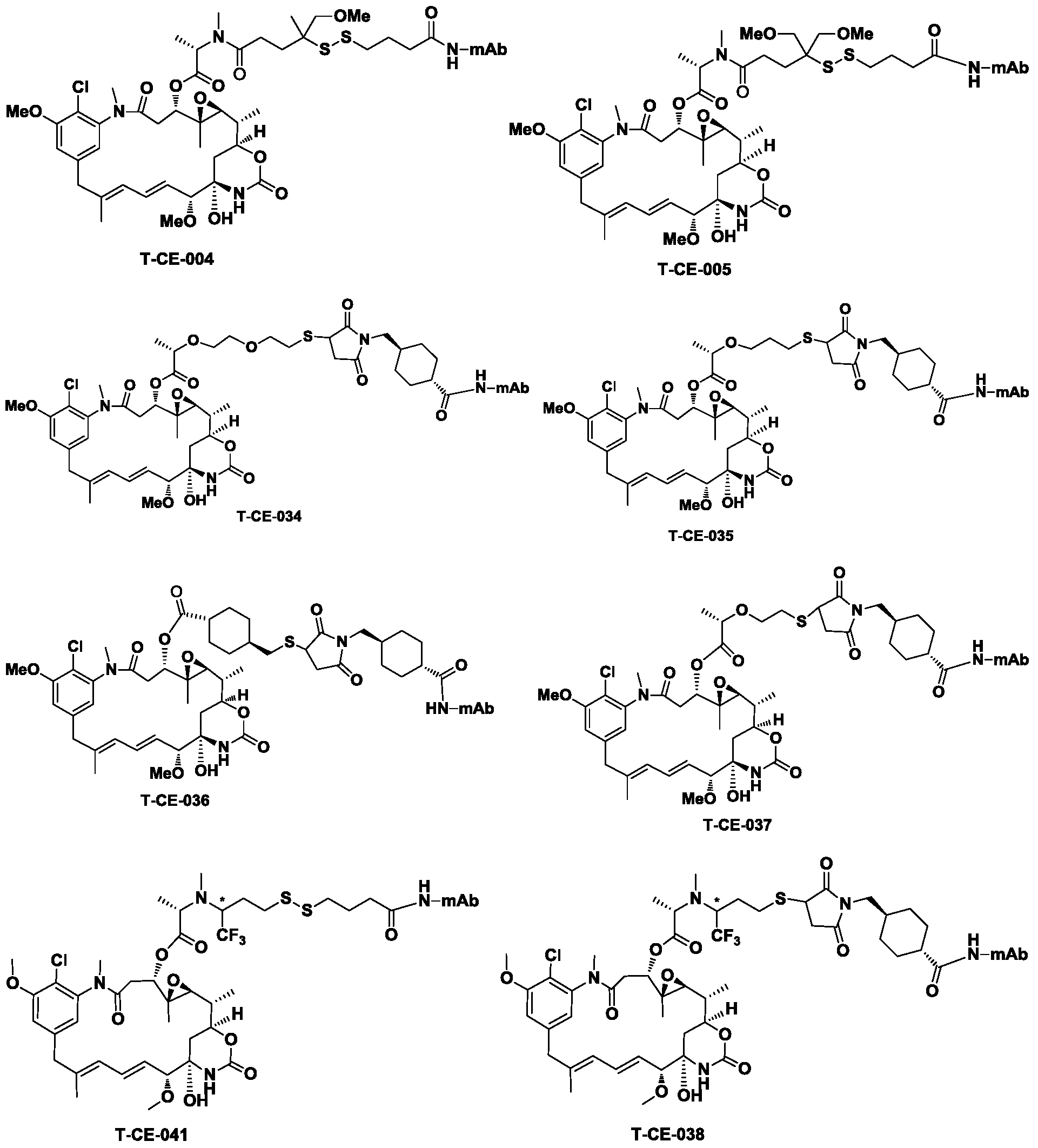


- 一种如式IA所示的中间体:
 如式IA所示的化合物中,各字母和基团的定义均同权利要求1-3任一项所述;Q3为t为1或2;t1为0、1、2、3、4、5或6;
 R51为H、C1~C4的烷基、
 或卤素,y为1、2、3、4、5、6、7、8、9或10,R9为H或C1~C4的烷基。

- 根据权利要求6所述的如式IA所示的中间体,其特征在于,当所述的R51为C1~C4的烷基时,所述的C1~C4的烷基为甲基、乙基、丙基、丁基、异丙基、异丁基或叔丁基;和/或,当R51为卤素时,所述的卤素为F、Cl、Br或I;和/或,当所述的R9为C1~C4的烷基时,所述的C1~C4的烷基为甲基、乙基、丙基、丁基、异丙基、异丁基或叔丁基。
- 根据权利要求6所述的如式IA所示的中间体,其特征在于,其为如式Ia或Ia1所示的中间体:

 其中,如式Ia和如式Ia1所示的中间体中各字母和基团的定义均同权利要求6或7所述;如式Ia所示的中间体中,R5为H、C1~C4的烷基(例如甲基、乙基、丙基、丁基、异丙基、异丁基或叔丁基)、
 y为1、2、3、4、5、6、7、8、9或10,y1为0或1;R9为H或C1~C4的烷基,R9中所述的C1~C4的烷基优选甲基、乙基、丙基、丁基、异丙基、异丁基或叔丁基;
 如式Ia1所示的中间体中,R52为氢或卤素,所述的卤素优选F、Cl、Br或I。
- 根据权利要求6-8中至少一项所述的如式IA所示的中间体,其特征在于,其为下列任一化合物:


- 一种如权利要求1-5任一项所述的如式IB所示的抗体药物偶联物的制备方法,其特征在于,其包括以下步骤:有机溶剂中,pH为6-8条件下,将中间体IA与单克隆抗体进行交联,得到抗体药物偶联物IB即可;
 如式IA和如式IB所示的化合物中,各字母和基团的定义均同权利要求1-9任一项所述。
- 根据权利要求1-5中至少一项所述的如式IB所示的抗体药物偶联物和/或根据权利要求6-9中至少一项所述的如式IA所示的中间体在制备治疗和/或预防癌症的药物中的应用。
- 根据权利要求11所述的应用,其特征在于,所述的癌症为乳腺癌、淋巴癌、肺癌、肝癌、结肠癌、头颈癌、膀胱癌、肾癌、食道癌、胆囊癌、卵巢癌、胰腺癌、胃癌、宫颈癌、甲状腺癌、前列腺癌、皮肤癌包括鳞状细胞癌;白细胞过多症、急性淋巴细胞性白血病、急性成淋巴细胞性白血病、B细胞淋巴瘤、T细胞淋巴瘤、霍奇金淋巴瘤、非霍奇金淋巴瘤、毛细胞淋巴瘤、伯基特淋巴瘤、急性和慢性髓细胞性白血病、骨髓增生异常综合征、前髓细胞白血病、纤维肉瘤、横纹肌肉瘤、星形细胞瘤、神经目细胞瘤、胶质瘤、神经鞘瘤、黑色素瘤、精原细胞瘤、畸胎癌、骨肉瘤、着色性干皮病、角质黄色瘤、甲状腺滤泡癌或卡波西肉瘤。
- 根据权利要求11或12所述的应用,其特征在于,所述的癌症的肿瘤细胞为Her2阳性的人BT474乳腺肿瘤细胞、Her2低表达的人MCF-7乳腺肿瘤细胞或在MCF-7外转Her2的人乳腺肿瘤MCF7-Her2稳转细胞株。
- 一种药物组合物,其包含根据权利要求1-5中至少一项所述的如式IB所示的抗体药物偶联物和/或根据权利要求6-9中至少一项所述的如式IA所示的中间体,以及一种或多种药学上可接受的辅料。
Priority Applications (3)
| Application Number | Priority Date | Filing Date | Title |
|---|---|---|---|
| JP2018516616A JP6802840B2 (ja) | 2015-06-09 | 2016-06-08 | 抗体薬物複合体、中間体、その製造方法、薬学的組成物及び応用 |
| EP16806844.3A EP3308801A4 (en) | 2015-06-09 | 2016-06-08 | ANTIBODY-ACTIVE CONJUGATE, INTERMEDIATE PRODUCT, METHOD OF MANUFACTURE, PHARMACEUTICAL COMPOSITION AND USE THEREOF |
| US15/580,895 US10449258B2 (en) | 2015-06-09 | 2016-06-08 | Antibody drug conjugate, intermediate, preparation method, pharmaceutical composition and uses thereof |
Applications Claiming Priority (2)
| Application Number | Priority Date | Filing Date | Title |
|---|---|---|---|
| CN201510313585.7 | 2015-06-09 | ||
| CN201510313585 | 2015-06-09 |
Publications (1)
| Publication Number | Publication Date |
|---|---|
| WO2016197946A1 true WO2016197946A1 (zh) | 2016-12-15 |
Family
ID=57503099
Family Applications (1)
| Application Number | Title | Priority Date | Filing Date |
|---|---|---|---|
| PCT/CN2016/085275 Ceased WO2016197946A1 (zh) | 2015-06-09 | 2016-06-08 | 抗体药物偶联物、中间体、制备方法、药物组合物及应用 |
Country Status (5)
| Country | Link |
|---|---|
| US (1) | US10449258B2 (zh) |
| EP (1) | EP3308801A4 (zh) |
| JP (1) | JP6802840B2 (zh) |
| CN (1) | CN106243127B (zh) |
| WO (1) | WO2016197946A1 (zh) |
Families Citing this family (5)
| Publication number | Priority date | Publication date | Assignee | Title |
|---|---|---|---|---|
| CN107469089B (zh) * | 2016-06-07 | 2022-01-07 | 北京键凯科技股份有限公司 | 一种peg连接子及配基药物偶联物 |
| CN109651224B (zh) * | 2018-12-19 | 2022-05-10 | 苏州昊帆生物股份有限公司 | 一种荧光蛋白质交联剂及其制备方法 |
| CN109608379B (zh) * | 2018-12-19 | 2022-04-01 | 苏州昊帆生物股份有限公司 | 一种蛋白质交联剂马来酰亚胺-二聚乙二醇-丙烯酸琥珀酰亚胺酯的制备方法 |
| CN111228520B (zh) * | 2020-01-19 | 2021-04-02 | 东华大学 | 一种细胞膜包覆的超小四氧化三铁纳米团簇及其制备和应用 |
| CN115353476B (zh) * | 2022-08-19 | 2024-03-26 | 安阳工学院 | 一种马来酰亚胺-酰胺-低聚乙二醇-丙酸的合成方法 |
Citations (2)
| Publication number | Priority date | Publication date | Assignee | Title |
|---|---|---|---|---|
| CN103269712A (zh) * | 2010-11-03 | 2013-08-28 | 伊缪诺金公司 | 包含新型安丝菌素衍生物的细胞毒性剂 |
| CN103319599A (zh) * | 2013-05-27 | 2013-09-25 | 上海交联药物研发有限公司 | 一种抗人ErbB2抗体—美登木素偶联物及其应用 |
Family Cites Families (20)
| Publication number | Priority date | Publication date | Assignee | Title |
|---|---|---|---|---|
| US389611A (en) | 1888-09-18 | Semaphore | ||
| JPS63233986A (ja) | 1987-03-23 | 1988-09-29 | Sagami Chem Res Center | 新規メイタンシノイド |
| JPS646282A (en) | 1987-03-23 | 1989-01-10 | Sagami Chem Res | Production of maitansinoids |
| US5208020A (en) | 1989-10-25 | 1993-05-04 | Immunogen Inc. | Cytotoxic agents comprising maytansinoids and their therapeutic use |
| CA2026147C (en) | 1989-10-25 | 2006-02-07 | Ravi J. Chari | Cytotoxic agents comprising maytansinoids and their therapeutic use |
| US8088387B2 (en) | 2003-10-10 | 2012-01-03 | Immunogen Inc. | Method of targeting specific cell populations using cell-binding agent maytansinoid conjugates linked via a non-cleavable linker, said conjugates, and methods of making said conjugates |
| EP1651162B1 (en) | 2003-05-20 | 2015-10-21 | ImmunoGen, Inc. | Improved cytotoxic agents comprising new maytansinoids |
| NZ551180A (en) * | 2004-06-01 | 2009-10-30 | Genentech Inc | Antibody drug conjugates and methods |
| UA108598C2 (xx) | 2008-04-30 | 2015-05-25 | Високоефективні кон'югати та гідрофільні зшиваючі агенти (лінкери) | |
| JP5784592B2 (ja) * | 2009-06-03 | 2015-09-24 | イミュノジェン・インコーポレーテッド | 抱合方法 |
| UY32913A (es) | 2009-10-02 | 2011-04-29 | Sanofi Aventis | Nuevos maitansinoides y el uso de dichos maitansinoides para preparar conjugados con un anticuero |
| CN104640572B (zh) | 2012-05-15 | 2018-04-27 | 索伦托医疗有限公司 | 药物偶联物,偶联方法,及其用途 |
| CN103866245B (zh) | 2012-12-18 | 2016-08-24 | 宁夏东方钽业股份有限公司 | 一种铌合金靶材及其制备方法 |
| CN103333246B (zh) | 2012-12-21 | 2015-09-16 | 百奥泰生物科技(广州)有限公司 | 一种抗egfr受体的肿瘤生长抑制剂及其制备方法和用途 |
| WO2014134457A2 (en) | 2013-02-28 | 2014-09-04 | Immunogen, Inc. | Conjugates comprising cell-binding agents and cytotoxic agents |
| HK1219423A1 (zh) | 2013-02-28 | 2017-04-07 | Immunogen, Inc. | 包含细胞结合剂及细胞毒素剂的轭合物 |
| HK1219422A1 (zh) | 2013-02-28 | 2017-04-07 | Immunogen, Inc. | 包含细胞结合剂及细胞毒素剂的轭合物 |
| EP3964237B1 (en) | 2013-03-15 | 2026-02-18 | Regeneron Pharmaceuticals, Inc. | Biologically active molecules, conjugates thereof, and therapeutic uses |
| WO2014194030A2 (en) | 2013-05-31 | 2014-12-04 | Immunogen, Inc. | Conjugates comprising cell-binding agents and cytotoxic agents |
| WO2015000062A1 (en) | 2013-07-05 | 2015-01-08 | Avidbiologics Inc. | Egfr antibody conjugates |
-
2016
- 2016-06-08 EP EP16806844.3A patent/EP3308801A4/en not_active Withdrawn
- 2016-06-08 JP JP2018516616A patent/JP6802840B2/ja not_active Expired - Fee Related
- 2016-06-08 US US15/580,895 patent/US10449258B2/en active Active
- 2016-06-08 CN CN201610404576.3A patent/CN106243127B/zh not_active Expired - Fee Related
- 2016-06-08 WO PCT/CN2016/085275 patent/WO2016197946A1/zh not_active Ceased
Patent Citations (2)
| Publication number | Priority date | Publication date | Assignee | Title |
|---|---|---|---|---|
| CN103269712A (zh) * | 2010-11-03 | 2013-08-28 | 伊缪诺金公司 | 包含新型安丝菌素衍生物的细胞毒性剂 |
| CN103319599A (zh) * | 2013-05-27 | 2013-09-25 | 上海交联药物研发有限公司 | 一种抗人ErbB2抗体—美登木素偶联物及其应用 |
Non-Patent Citations (4)
| Title |
|---|
| JAIN, N. ET AL.: "Current ADC Linker Chemistry", PHARMRES, vol. 32, no. 11, 11 March 2015 (2015-03-11), pages 3526 - 3540, XP035553874, ISSN: 0724-8741 * |
| JAIN, N. ET AL.: "Current ADC Linker Chemistry", PHARMRES., vol. 32, no. 11, 11 March 2015 (2015-03-11), pages 3526 - 3540, XP035553874, ISSN: 0724-8741 * |
| LEWIS, P.G. ET AL.: "Targeting HER2-Positive Breast Cancer with Trastuzumab-DMl, an Antibody-Cytotoxic Drug Conjugate", CANCER RES., vol. 68, no. 22, 15 November 2008 (2008-11-15), pages 9280 - 9290, XP055013498, ISSN: 2321-7758 * |
| See also references of EP3308801A4 * |
Also Published As
| Publication number | Publication date |
|---|---|
| US20180161446A1 (en) | 2018-06-14 |
| CN106243127A (zh) | 2016-12-21 |
| CN106243127B (zh) | 2021-01-26 |
| JP6802840B2 (ja) | 2020-12-23 |
| EP3308801A1 (en) | 2018-04-18 |
| JP2018521123A (ja) | 2018-08-02 |
| EP3308801A4 (en) | 2019-02-27 |
| US10449258B2 (en) | 2019-10-22 |
Similar Documents
| Publication | Publication Date | Title |
|---|---|---|
| CN107428801B (zh) | 用于偶联和治疗的哈米特林(hemiasterlin)衍生物 | |
| KR20230022211A (ko) | 고안정성 친수성 연결 단위를 갖는 캄프토테신 약물 및 이의 접합체 | |
| CN121843944A (zh) | 大环化合物及其抗体-药物偶联物 | |
| KR20240017343A (ko) | 화학적 결합 링커 및 그의 용도 | |
| KR102046862B1 (ko) | Cti 약물작용발생단을 함유하는 이관능성 세포독성제 | |
| WO2024175069A1 (zh) | 喜树碱衍生物及其偶联物以及其制备方法和医药用途 | |
| CN106243127B (zh) | 抗体药物偶联物、中间体、制备方法、药物组合物及应用 | |
| AU2024288808A1 (en) | Linker-drug molecule and antibody drug conjugate, preparation method therefor and use thereof | |
| CN117430660B (zh) | 奥瑞他汀f类似物及其抗体药物偶联物与应用 | |
| WO2024235130A9 (zh) | 多环化合物及其制备方法和用途 | |
| US20100324302A1 (en) | Processes for making epothilone compounds and analogs | |
| HK1232526B (zh) | 抗体药物偶联物、中间体、制备方法、药物组合物及应用 | |
| HK1232526A1 (zh) | 抗体药物偶联物、中间体、制备方法、药物组合物及应用 | |
| CN107660208B (zh) | 包含cti药效团的双功能细胞毒性剂 | |
| WO2025228384A1 (en) | Antibody-drug conjugates and use thereof | |
| WO2025228381A1 (en) | Antibody-drug conjugate and use thereof | |
| CA3297799A1 (en) | Linker-drug molecule and antibody drug conjugate, preparation method therefor and use thereof | |
| TW202506691A (zh) | Sting促效劑化合物及其結合物 | |
| WO2025261469A1 (zh) | 喜树碱衍生物、抗体、药物偶联物、及其组合物和应用 | |
| WO2026069006A1 (en) | Ras inhibitor antibody-drug conjugates and methods of use thereof | |
| WO2026098196A1 (zh) | 海鞘素类化合物、其偶联物及其制备方法和用途 | |
| TW202434302A (zh) | 包含類鐸受體7/8雙重促效劑化合物之抗體藥物複合體 | |
| WO2025232845A1 (zh) | 具有靶向作用的偶联物及其制备方法和用途 | |
| WO2025232116A1 (zh) | 具有靶向作用的偶联物及其制备方法和用途 | |
| WO2026067624A1 (zh) | 一种包含亲水基团的配体-药物偶联物及其在医药上的应用 |
Legal Events
| Date | Code | Title | Description |
|---|---|---|---|
| 121 | Ep: the epo has been informed by wipo that ep was designated in this application |
Ref document number: 16806844 Country of ref document: EP Kind code of ref document: A1 |
|
| WWE | Wipo information: entry into national phase |
Ref document number: 15580895 Country of ref document: US |
|
| ENP | Entry into the national phase |
Ref document number: 2018516616 Country of ref document: JP Kind code of ref document: A |
|
| NENP | Non-entry into the national phase |
Ref country code: DE |
|
| WWE | Wipo information: entry into national phase |
Ref document number: 2016806844 Country of ref document: EP |
|
| WWW | Wipo information: withdrawn in national office |
Ref document number: 2016806844 Country of ref document: EP |