WO2016199644A1 - 化粧料 - Google Patents
化粧料 Download PDFInfo
- Publication number
- WO2016199644A1 WO2016199644A1 PCT/JP2016/066233 JP2016066233W WO2016199644A1 WO 2016199644 A1 WO2016199644 A1 WO 2016199644A1 JP 2016066233 W JP2016066233 W JP 2016066233W WO 2016199644 A1 WO2016199644 A1 WO 2016199644A1
- Authority
- WO
- WIPO (PCT)
- Prior art keywords
- silicone
- cosmetic composition
- cosmetic
- group
- eyelashes
- Prior art date
- Legal status (The legal status is an assumption and is not a legal conclusion. Google has not performed a legal analysis and makes no representation as to the accuracy of the status listed.)
- Ceased
Links
Classifications
-
- A—HUMAN NECESSITIES
- A61—MEDICAL OR VETERINARY SCIENCE; HYGIENE
- A61K—PREPARATIONS FOR MEDICAL, DENTAL OR TOILETRY PURPOSES
- A61K8/00—Cosmetics or similar toiletry preparations
- A61K8/18—Cosmetics or similar toiletry preparations characterised by the composition
- A61K8/72—Cosmetics or similar toiletry preparations characterised by the composition containing organic macromolecular compounds
- A61K8/84—Cosmetics or similar toiletry preparations characterised by the composition containing organic macromolecular compounds obtained by reactions otherwise than those involving only carbon-carbon unsaturated bonds
- A61K8/89—Polysiloxanes
- A61K8/891—Polysiloxanes saturated, e.g. dimethicone, phenyl trimethicone, C24-C28 methicone or stearyl dimethicone
- A61K8/894—Polysiloxanes saturated, e.g. dimethicone, phenyl trimethicone, C24-C28 methicone or stearyl dimethicone modified by a polyoxyalkylene group, e.g. cetyl dimethicone copolyol
-
- A—HUMAN NECESSITIES
- A61—MEDICAL OR VETERINARY SCIENCE; HYGIENE
- A61K—PREPARATIONS FOR MEDICAL, DENTAL OR TOILETRY PURPOSES
- A61K8/00—Cosmetics or similar toiletry preparations
- A61K8/18—Cosmetics or similar toiletry preparations characterised by the composition
- A61K8/72—Cosmetics or similar toiletry preparations characterised by the composition containing organic macromolecular compounds
- A61K8/91—Graft copolymers
-
- A—HUMAN NECESSITIES
- A61—MEDICAL OR VETERINARY SCIENCE; HYGIENE
- A61K—PREPARATIONS FOR MEDICAL, DENTAL OR TOILETRY PURPOSES
- A61K8/00—Cosmetics or similar toiletry preparations
- A61K8/02—Cosmetics or similar toiletry preparations characterised by special physical form
- A61K8/0241—Containing particulates characterized by their shape and/or structure
- A61K8/027—Fibers; Fibrils
-
- A—HUMAN NECESSITIES
- A61—MEDICAL OR VETERINARY SCIENCE; HYGIENE
- A61K—PREPARATIONS FOR MEDICAL, DENTAL OR TOILETRY PURPOSES
- A61K8/00—Cosmetics or similar toiletry preparations
- A61K8/18—Cosmetics or similar toiletry preparations characterised by the composition
- A61K8/30—Cosmetics or similar toiletry preparations characterised by the composition containing organic compounds
- A61K8/31—Hydrocarbons
-
- A—HUMAN NECESSITIES
- A61—MEDICAL OR VETERINARY SCIENCE; HYGIENE
- A61K—PREPARATIONS FOR MEDICAL, DENTAL OR TOILETRY PURPOSES
- A61K8/00—Cosmetics or similar toiletry preparations
- A61K8/18—Cosmetics or similar toiletry preparations characterised by the composition
- A61K8/72—Cosmetics or similar toiletry preparations characterised by the composition containing organic macromolecular compounds
- A61K8/73—Polysaccharides
-
- A—HUMAN NECESSITIES
- A61—MEDICAL OR VETERINARY SCIENCE; HYGIENE
- A61K—PREPARATIONS FOR MEDICAL, DENTAL OR TOILETRY PURPOSES
- A61K8/00—Cosmetics or similar toiletry preparations
- A61K8/18—Cosmetics or similar toiletry preparations characterised by the composition
- A61K8/72—Cosmetics or similar toiletry preparations characterised by the composition containing organic macromolecular compounds
- A61K8/84—Cosmetics or similar toiletry preparations characterised by the composition containing organic macromolecular compounds obtained by reactions otherwise than those involving only carbon-carbon unsaturated bonds
- A61K8/89—Polysiloxanes
- A61K8/895—Polysiloxanes containing silicon bound to unsaturated aliphatic groups, e.g. vinyl dimethicone
-
- A—HUMAN NECESSITIES
- A61—MEDICAL OR VETERINARY SCIENCE; HYGIENE
- A61K—PREPARATIONS FOR MEDICAL, DENTAL OR TOILETRY PURPOSES
- A61K8/00—Cosmetics or similar toiletry preparations
- A61K8/18—Cosmetics or similar toiletry preparations characterised by the composition
- A61K8/72—Cosmetics or similar toiletry preparations characterised by the composition containing organic macromolecular compounds
- A61K8/84—Cosmetics or similar toiletry preparations characterised by the composition containing organic macromolecular compounds obtained by reactions otherwise than those involving only carbon-carbon unsaturated bonds
- A61K8/89—Polysiloxanes
- A61K8/896—Polysiloxanes containing atoms other than silicon, carbon, oxygen and hydrogen, e.g. dimethicone copolyol phosphate
- A61K8/898—Polysiloxanes containing atoms other than silicon, carbon, oxygen and hydrogen, e.g. dimethicone copolyol phosphate containing nitrogen, e.g. amodimethicone, trimethyl silyl amodimethicone or dimethicone propyl PG-betaine
-
- A—HUMAN NECESSITIES
- A61—MEDICAL OR VETERINARY SCIENCE; HYGIENE
- A61Q—SPECIFIC USE OF COSMETICS OR SIMILAR TOILETRY PREPARATIONS
- A61Q1/00—Make-up preparations; Body powders; Preparations for removing make-up
- A61Q1/02—Preparations containing skin colorants, e.g. pigments
- A61Q1/04—Preparations containing skin colorants, e.g. pigments for lips
-
- A—HUMAN NECESSITIES
- A61—MEDICAL OR VETERINARY SCIENCE; HYGIENE
- A61Q—SPECIFIC USE OF COSMETICS OR SIMILAR TOILETRY PREPARATIONS
- A61Q1/00—Make-up preparations; Body powders; Preparations for removing make-up
- A61Q1/02—Preparations containing skin colorants, e.g. pigments
- A61Q1/10—Preparations containing skin colorants, e.g. pigments for eyes, e.g. eyeliner, mascara
-
- A—HUMAN NECESSITIES
- A61—MEDICAL OR VETERINARY SCIENCE; HYGIENE
- A61Q—SPECIFIC USE OF COSMETICS OR SIMILAR TOILETRY PREPARATIONS
- A61Q5/00—Preparations for care of the hair
-
- A—HUMAN NECESSITIES
- A61—MEDICAL OR VETERINARY SCIENCE; HYGIENE
- A61Q—SPECIFIC USE OF COSMETICS OR SIMILAR TOILETRY PREPARATIONS
- A61Q5/00—Preparations for care of the hair
- A61Q5/06—Preparations for styling the hair, e.g. by temporary shaping or colouring
-
- A—HUMAN NECESSITIES
- A61—MEDICAL OR VETERINARY SCIENCE; HYGIENE
- A61K—PREPARATIONS FOR MEDICAL, DENTAL OR TOILETRY PURPOSES
- A61K2800/00—Properties of cosmetic compositions or active ingredients thereof or formulation aids used therein and process related aspects
- A61K2800/40—Chemical, physico-chemical or functional or structural properties of particular ingredients
- A61K2800/48—Thickener, Thickening system
-
- A—HUMAN NECESSITIES
- A61—MEDICAL OR VETERINARY SCIENCE; HYGIENE
- A61K—PREPARATIONS FOR MEDICAL, DENTAL OR TOILETRY PURPOSES
- A61K2800/00—Properties of cosmetic compositions or active ingredients thereof or formulation aids used therein and process related aspects
- A61K2800/40—Chemical, physico-chemical or functional or structural properties of particular ingredients
- A61K2800/59—Mixtures
- A61K2800/594—Mixtures of polymers
Definitions
- the present invention is a cosmetic composition containing a silicone-modified polysaccharide compound as a film forming agent having a good feeling of use and a spinnable thickener, and in particular, a cosmetic for hair useful as a cosmetic for eyelashes (mascara, etc.).
- the present invention relates to a material composition.
- the cosmetic composition may be simply referred to as cosmetic.
- the stringiness is a property in which a liquid pulls a thread when a highly viscous liquid is dropped or a rod is put into the liquid and pulled up quickly. In order to apply this to various uses, a stringiness and an appropriate consistency according to the purpose are required.
- Eyelash cosmetics can be used as the use of the thread composition.
- Eyelash cosmetics are used because they have the effect of clarifying the eyes by making the eyelashes look long and beautiful.
- a spinnable composition according to the purpose and imparting a long rush effect and a volume-up effect.
- Patent Document 1 describes a spinnable composition in which a lysine derivative-modified silicone and a silicone-modified polysaccharide compound are blended together, and it is described that it has an effect of causing a long lash of eyelashes.
- Patent Document 2 describes a technique in which fibers are blended with an adhesive film forming agent in eyelash cosmetics, and the fibers are applied to the eyelashes to increase the eyelashes.
- Patent Document 3 describes an oily gelling agent comprising a silicone-modified polysaccharide compound and a polyether-modified silicone, and a cosmetic containing the gelling agent.
- the eyelash cosmetics containing fibers as described in Patent Document 2 have a high long lash effect, but when the fibers are excessively applied to the eyelashes, an unnatural finish is obtained.
- an oily gelling agent composed of a silicone-modified polysaccharide compound and a polyether-modified silicone as described in Patent Document 3 does not provide sufficient viscosity and gloss, and is insufficient as a cosmetic for eyelashes. It was.
- the present invention has been made in view of the above circumstances, and an object thereof is to provide a cosmetic composition having excellent adhesion.
- an object is to provide a cosmetic composition that is excellent in the effect of making eyelashes look long without blending fibers and can impart a natural gloss feeling.
- the present inventors have obtained good spinnability by using a silicone-modified polysaccharide compound and an acrylic-silicone graft copolymer as components of a cosmetic composition. It has been found that a cosmetic composition having excellent adhesion can be obtained. Furthermore, when this cosmetic composition was used as a cosmetic for eyelashes, it discovered that it was excellent in the volume-up effect, and was excellent in the long rush effect and the glossiness, and came to make this invention.
- the present invention provides a cosmetic composition containing a silicone-modified polysaccharide compound and an acrylic-silicone graft copolymer. Furthermore, a cosmetic composition for hair, in particular for eyelashes, is provided.
- the cosmetic composition of the present invention has extremely excellent adhesion.
- the cosmetic obtained from the composition is excellent in the eyelash volume-up effect, and can impart a long lash effect and a glossy feel to the eyelashes without blending fibers. Therefore, the composition is particularly suitably used as a hair cosmetic such as a eyelash cosmetic.
- the cosmetic composition of the present invention is characterized by containing a combination of a silicone-modified polysaccharide compound and an acrylic-silicone graft copolymer.
- the blending ratio (parts by mass) of the silicone-modified polysaccharide compound and the acrylic-silicone graft copolymer is 98: 2 to 6 : 94 (49: 1 to 1: 15.7), more preferably 95: 5 to 10:90 (19: 1 to 1: 9).
- a silicone-modified polysaccharide compound and an acrylic-silicone graft copolymer Is preferably 90:10 to 10:90 (9: 1 to 1: 9), more preferably 75:25 to 25:75 (3: 1 to 1: 3). It is good to be.
- a silicone-modified polysaccharide compound and an acrylic-silicone graft copolymer Is preferably 90:10 to 10:90 (9: 1 to 1: 9), more preferably 75:25 to 25:75 (3: 1 to 1: 3). It is good to be.
- each component will be described in detail.
- the silicone-modified polysaccharide compound is a compound having one or more silicone residues bonded to a hydroxyl group in a saccharide constituting the polysaccharide compound.
- the compound is obtained by reacting a hydroxyl group of a polysaccharide compound with a terminal isocyanate group-containing silicone compound.
- the polysaccharide compound is preferably pullulan.
- the silicone residue is preferably represented by the following general formula (1).
- R 1 s are each independently an unsubstituted or substituted monovalent hydrocarbon group having 1 to 10 carbon atoms
- R 2 are independently of each other an unsubstituted or substituted C 1-10 carbon atom.
- the average number of bonds (substitution degree) of the silicone residue is 0.5 to 2.5, preferably 1 to 2 per unit sugar (for example, glucose in the case of pullulan) of the polysaccharide compound. It is. When the average number of bonds is too small, sufficient oil solubility cannot be imparted to the resulting composition, and when it is too large, it is difficult to produce the compound itself.
- the silicone-modified polysaccharide compound has an average molecular weight of 50,000 to 10,000,000, preferably about 80,000 to 5,000,000.
- the average molecular weight can be usually determined as the number average molecular weight or weight average molecular weight in terms of polystyrene in gel permeation chromatography analysis using toluene, tetrahydrofuran (THF) or the like as a developing solvent.
- the silicone-modified polysaccharide compound has one or more of the silicone residues represented by the above formula (1) bonded to a hydroxyl group in the glucose of pullulan, and the average number of bonds of the silicone residues is 0 per glucose unit. .5 to 2.5 pieces, preferably 1 to 2 pieces.
- Examples of the unsubstituted or substituted monovalent hydrocarbon group represented by R 1 to R 3 in the above formula (1) include, for example, methyl group, ethyl group, propyl group, isopropyl group, butyl group, isobutyl group, tert- Alkyl groups such as butyl group, pentyl group, hexyl group, cyclohexyl group, heptyl group and octyl group, alkenyl groups such as vinyl group and allyl group, aryl groups such as phenyl group, and aralkyl groups such as benzyl group, these groups In which some or all of the hydrogen atoms are substituted with halogen atoms such as fluorine, bromine, chlorine, or cyano groups, such as chloromethyl group, chloropropyl group, bromoethyl group, trifluoropropyl group, and cyanoethyl group Is mentioned.
- an unsubstituted or halogen-substituted monovalent hydrocarbon group particularly an unsubstituted monovalent hydrocarbon group is preferable, and an alkyl group or an aryl group is more preferable. More particularly, a methyl group, an ethyl group, and a phenyl group are desirable from the viewpoint of ease of synthesis, stability of the compound, and the like.
- n is an integer of 1 to 10, preferably an integer of 1 to 6, a is 0 or 1, preferably 0, b is 0, 1 or 2, Preferably it is 0.
- the silicone-modified polysaccharide compound can be represented by the following general formula (2).
- B is a hydrogen atom or a silicone residue represented by the above formula (1)
- c is a number from 100 to 20,000.
- the silicone-modified polysaccharide compound of the present invention is obtained by reacting the hydroxyl group of the polysaccharide compound with the terminal isocyanate group-containing silicone compound.
- a terminal isocyanate group-containing silicone compound represented by the following general formula (3) with a polysaccharide compound, preferably a hydroxyl group of pullulan.
- the reaction may be carried out according to a conventionally known method. For example, the method described in JP-A-8-134103 may be used.
- pullulan and the compound of the above formula (3) may be mixed in a solvent such as methyl acetate or N-methylpyrrolidone and reacted at 20 to 150 ° C. for 1 to 10 hours.
- a catalyst for forming a urethane bond such as triethylamine may be used.
- the mixing ratio of pullulan and the compound of formula (3) is preferably such that the average number of bonds (substitution degree) of the silicone compound per unit of glucose depends on the amount of pullulan introduced into the three hydroxyl groups per unit of glucose. What is necessary is just to adjust suitably in the quantity used as 0.5-2.5 pieces.
- the silicone-modified polysaccharide compound of the present invention may be a commercially available product.
- TSPL tri (trimethylsiloxy) silylpropylcarbamic acid pullulan
- TSPL-30-D5 manufactured by Shin-Etsu Chemical Co., Ltd.
- TSPL-30-ID manufactured by Shin-Etsu Chemical Co., Ltd.
- isododecane and the like can be used.
- the compounding amount of the silicone-modified polysaccharide compound may be 0.1 to 25% by mass, preferably 0.3 to 15% by mass, and more preferably 1.0 to 25% by mass with respect to the total mass of the cosmetic composition. It is 10% by mass, more preferably 1.5 to 6% by mass.
- the blending amount exceeds the above upper limit value, the feeling of use of the cosmetic becomes heavy. Moreover, if it is less than the said lower limit, since sufficient spinnability, thickening, and adhesiveness are not obtained for cosmetics, it is unpreferable.
- the acrylic-silicone graft copolymer is a graft copolymer composed of an acrylic polymer and polysiloxane, and in particular, a graft copolymer obtained by grafting a dimethylpolysiloxane chain to an acrylic polymer chain.
- a graft copolymer in which the trunk polymer is an acrylic polymer and the branch polymer is an organopolysiloxane is preferable in terms of adhesion, flexibility of the coating, and gloss.
- the acrylic-silicone graft copolymer may be a known one and is not particularly limited.
- the acrylic-silicone graft copolymer may be used alone or in combination of two or more as required.
- the acrylic-silicone graft copolymer can be obtained, for example, by reacting an acrylic monomer with an organopolysiloxane having a radical polymerizable group.
- the organopolysiloxane compound having a radical polymerizable group is called a silicone macromonomer, and is an organopolysiloxane compound having a radical polymerizable group only at one end, and known compounds can be used.
- the organopolysiloxane include dialkylorganopolysiloxane, and dimethylpolysiloxane is particularly preferable.
- the degree of polymerization of siloxane is, for example, 3 to 500, preferably 9 to 200.
- radical polymerizable group examples include (meth) acryloxymethyl group, (meth) acryloxypropyl group, (meth) acryloxydecyl group, styryl group, ⁇ -methylstyryl group and the like. Preferably, it is a (meth) acryloxypropyl group.
- Acrylic polymer chains are derived from acrylic monomers.
- acrylic monomers include methyl (meth) acrylate, ethyl (meth) acrylate, isopropyl (meth) acrylate, n-butyl (meth) acrylate, t-butyl (meth) acrylate, and (meth) acrylic acid.
- examples include cyclohexyl, 2-ethylhexyl (meth) acrylate, tridecyl (meth) acrylate, stearyl (meth) acrylate, isostearyl (meth) acrylate, behenyl (meth) acrylate, and the like.
- a combination of the above may also be used.
- it is methyl (meth) acrylate.
- esterified carboxyl groups such as acrylic acid, is preferable because the acrylic odor of a copolymer is reduced.
- a radical polymerizable silane compound may be further copolymerized.
- the silane compound include ⁇ -methacryloxypropyltrimethoxysilane, ⁇ -methacryloxypropylmethyldimethoxysilane, ⁇ -methacryloxypropyldimethylmethoxysilane, ⁇ -methacryloxypropyltriethoxysilane, and ⁇ -methacryloxypropylmethyldiethoxy.
- ⁇ -methacryloxypropyltriethoxysilane is used.
- the ratio of each component constituting the copolymer is not particularly limited.
- the organopolysiloxane compound having a radical polymerizable group is 1 to 97% by weight, preferably 5 to 90% by weight, and the acrylic monomer is 0.5 to 95% by weight, preferably 2 to 60% by weight.
- the radical polymerizable silane compound is 0.5 to 10% by weight, preferably 2 to 7% by weight.
- radical polymerizable compounds include carboxylic acids such as (meth) acrylic acid, fumaric acid and maleic acid, hydroxyalkyl esters such as hydroxyethyl (meth) acrylate and hydroxypropyl (meth) acrylate, and (meth) acrylamide.
- fluorine-substituted alkyl esters such as perfluorooctylethyl (meth) acrylate, perfluorobutylethyl (meth) acrylate, styrene, acrylonitrile, vinyl acetate, vinyl pyrrolidone, polyoxyethylene mono (meth) acrylate, Polyoxypropylene mono (meth) acrylate, polyoxy (ethylene propylene) mono (meth) acrylate, polycaprolactone mono (meth) acrylate, tris (trimethylsiloxy) silylpropyl methacrylate, tris (to Methylsiloxy) silyl styrene are exemplified.
- the copolymerization method is not particularly limited, and any conventionally known solution polymerization, emulsion polymerization, suspension polymerization, or bulk polymerization method can be applied.
- solution polymerization is used because of the uniformity of the polymer and the ease of adjusting the molecular weight.
- the solvent used in this case is preferably a solvent capable of uniformly dissolving the above components and the polymer, and includes toluene, xylene, ethanol, isopropyl alcohol, n-butanol, acetone, methyl ethyl ketone, methyl isobutyl ketone, ethyl acetate, acetic acid.
- the polymerization initiator may be a normal radical initiator such as an organic peroxide such as benzoyl peroxide or dicumyl peroxide, or an azo compound such as azobisisobutyronitrile.
- the molecular weight of the acryl-silicone copolymer is not particularly limited, but the weight average molecular weight in terms of polystyrene by GPC is preferably 3,000 to 200,000, more preferably 5,000 to 100,000. If the amount is less than the lower limit, the effect on the hair is not sufficient, and if the upper limit is exceeded, the usability when blended into a cosmetic tends to be deteriorated.
- the acrylic-silicone graft copolymer of the present invention is preferably a commercially available product.
- a (alkyl acrylate / dimethicone) copolymer defined by a cosmetic label is used.
- Commercially available products include KP-543, KP-545, KP-549, KP-550, and KP-545L manufactured by Shin-Etsu Chemical Co., Ltd. as those dissolved in a solvent.
- the blending amount of the acrylic-silicone graft copolymer may be 0.1 to 31% by mass, preferably 0.3 to 16% by mass, more preferably 1%, based on the total mass of the cosmetic composition. 0.0 to 10% by mass, more preferably 1.5 to 6% by mass.
- the blending amount exceeds the above upper limit value, the feeling of use of the cosmetic becomes heavy. Moreover, if it is less than the said lower limit, since sufficient spinnability, thickening, and glossiness cannot be obtained for cosmetics, it is unpreferable.
- the cosmetic composition of the present invention may further contain a nonionic surfactant.
- the nonionic surfactant is not particularly limited. Of these, silicone emulsifiers are preferred. Any known silicone emulsifier can be used in the art. Examples of such a silicone emulsifier include polyoxyalkylene-modified silicone, polyglycerin-modified silicone, sugar alcohol-modified silicone and the like. When a particularly high thickening effect is desired, it is preferable to use one or more selected from polyoxyalkylene-modified silicone and polyglycerin-modified silicone.
- polyoxyalkylene-modified silicone examples include PEG-11 methyl ether dimethicone, PEG / PPG-20 / 22 butyl ether dimethicone, PEG-3 dimethicone, PEG-9 methyl ether dimethicone, PEG- 10 dimethicone, PEG-9 polydimethylsiloxyethyl dimethicone, lauryl PEG-9 polydimethylsiloxyethyl dimethicone, PEG / PPG-18 / 18 dimethicone, cetyl PEG / PPG-10 / 1 dimethicone, (dimethicone / (PEG-10 / 15 )) Cross polymer, (PEG-15 / lauryl dimethicone) cross polymer, (PEG-10 / lauryl dimethicone) cross polymer and (PEG-15 / lauryl dimethicone) cross polymer, (PEG-15 / Etc. can be used uril polydi
- polyglycerin-modified silicone examples include polyglyceryl-3 disiloxane dimethicone, polyglyceryl-3 polydimethylsiloxyethyl dimethicone, lauryl polyglyceryl-3 polydimethylsiloxyethyl dimethicone, bisbutyldimethicone polyglyceryl-3 , (Dimethicone / polyglycerin-3) crosspolymer, (lauryl dimethicone / polyglycerin-3) crosspolymer, (polyglyceryl-3 / laurylpolydimethylsiloxyethyl dimethicone) crosspolymer, and the like can be used. You may use these as a mixture with arbitrary oil-based components.
- the blend amount of the nonionic surfactant is 0.1 to 10% by mass, preferably 1.5 to 4% by mass with respect to the total mass of the cosmetic composition. If the amount is less than the lower limit, sufficient adhesion cannot be obtained. If the amount is more than the upper limit, the coating film has no uniformity, and a natural finish may not be obtained.
- the cosmetic composition of the present invention may further contain a wax.
- this wax is a raw material which can be normally mix
- synthetic hydrocarbon waxes such as ceresin, ozokerite, microcrystalline wax, polyethylene wax, carnauba wax, rice wax, rice bran wax, jojoba wax (including extremely hydrogenated jojoba oil), waxes derived from plants such as candelilla wax, whales Examples include wax derived from animals such as wax, beeswax and snow wax, silicone wax, and the like. These waxes may be used alone or in combination of two or more.
- the blending amount of the wax is 3 to 20% by mass, preferably 5 to 13% by mass with respect to the total mass of the cosmetic composition. If the amount is less than the lower limit value, sufficient volume feeling cannot be obtained, and if it is more than the upper limit value, the uniformity of the coating film is lost and a beautiful finish may not be obtained.
- the cosmetic composition of the present invention may further contain a liquid oil.
- the liquid oil include volatile oil and non-volatile oil. Controlling the volatility is very important in terms of usability in eyelash cosmetics.
- the volatile oil is not particularly limited as long as it is a raw material that can be usually blended into cosmetics.
- Examples include cyclopentasiloxane, cyclohexasiloxane, disiloxane, trisiloxane, dimethicone (1.5cs, 2cs), methyltrimethicone, isododecane, isohexadecane, undecane, and tridecane.
- These commercial products include KF-96 series, KF-995 and TMF-1.5 manufactured by Shin-Etsu Chemical Co., Ltd.
- the cosmetic composition of the present invention can contain an organically modified clay mineral as necessary.
- the organically modified clay mineral is not particularly limited as long as it is a raw material that can be usually blended in cosmetics, and preferred examples include dimethyl distearyl ammonium hectorite, dimethyl distearyl ammonium bentonite, and dimethyl distearyl ammonium modified montmorillonite. Examples of such raw materials include BENTONE 38VCG (dimethyl distearyl ammonium hectorite) and BENTONE 34 (dimethyl distearyl ammonium bentonite) manufactured by ELEMENTIS SPECIALTIES.
- the organically modified clay mineral may be used alone or in combination of two or more.
- the synthetic organically modified bentonite may be pre-expanded oil.
- examples of such raw materials include BENTONE GEL ISDV, BENTONE GEL MIOV, and BENTONE GEL VS-5V manufactured by ELEMENTIS SPECIALTIES.
- the cosmetic composition of the present invention can further contain a carbonate ester as necessary.
- the carbonate ester is not particularly limited as long as it is a raw material that can be usually blended in cosmetics.
- a cyclic carbonate and a ring-opened carbonate can be used. More specifically, ethylene carbonate, dialkyl carbonate (C14, 15), diethylhexyl carbonate, dicaprylyl carbonate, butylene carbonate, and propylene carbonate are exemplified, and propylene carbonate is preferable.
- These carbonate esters may be used alone or in combination of two or more.
- the cosmetic composition of the present invention can further contain a coating agent as necessary.
- the coating agent is not particularly limited as long as it is a raw material that can be usually blended in cosmetics.
- latex such as polyvinyl alcohol, polyvinyl pyrrolidone, polyvinyl acetate, alkyl polyacrylate, dextrin, cellulose derivatives such as alkyl cellulose and nitrocellulose, silicone resin such as trimethylsiloxysilicic acid, silicone-modified polynorbornene, fluorine-modified silicone Silicone resin such as resin, fluororesin, aromatic hydrocarbon resin, polymer emulsion resin, terpene resin, polybutene, polyisoprene, alkyd resin, polyvinylpyrrolidone modified polymer, rosin modified resin, polyurethane and the like are used.
- silicone-based coating agents are particularly preferred, and among them, trimethylsiloxysilicic acid [commercially available products such as KF-7312J and X-21-5250 (both manufactured by Shin-Etsu Chemical Co., Ltd.)] and silicone-modified polynorbornene [ As a commercial product, NBN-30-ID (manufactured by Shin-Etsu Chemical Co., Ltd.) and the like] can be used.
- the coating agent may be used alone or in combination of two or more.
- the cosmetic composition of the present invention may contain a pigment as necessary.
- the pigment is not particularly limited as long as it is generally used in makeup cosmetics.
- Inorganic pigments such as chromium oxide, cobalt titanate, bismuth oxychloride, titanium-mica pearl pigments; red 201, red 202, red 204, red 205, red 220, red 226, red 228, Organic pigments such as zirconium, barium or aluminum lakes such as red 405, orange 203, yellow 205, yellow 4, yellow 5, blue 1, blue 404, green 3, etc .; chlorophyll, ⁇ -carotene, etc. Natural pigments; dyes and the like. Moreover, the thing hydrophobized with silicone etc. can also be used. These pigment
- fibers may be blended as necessary. Fibers may be used as long as they are blended in order to impart a long lash effect that makes eyelashes appear long, and to form a uniform cosmetic film, and are generally used in cosmetics. Examples thereof include synthetic fibers such as nylon and polypropylene, artificial fibers such as rayon, natural fibers such as cellulose, and semisynthetic fibers such as acetate artificial silk. Further, the thickness of these fibers is 3 to 12 denier (hereinafter simply referred to as “D”), and the length is 0.1 to 4 mm, which is more preferable from the viewpoint of making the eyelashes look long and make the eyes stand out. .
- D denier
- Fibers may be used after being surface-treated as necessary.
- the surface treatment agent include fluorine compounds, silicone compounds, powders, oil agents, gelling agents, polymer emulsions, and surfactants. These may be used alone or in combination of two or more. Among these, those that have been hydrophobically treated with silicone or fluorine are particularly preferred in view of the effect of making eyelashes appear thick and long, and making the eyes stand out, and the sustainability thereof.
- the cosmetic composition of the present invention may contain a sugar fatty acid ester as necessary.
- Sugar fatty acid esters are blended for the purpose of thickening and gelling cosmetics, and can be expected to improve adhesion and stability at high temperatures. Examples of commercially available products include Leo Pearl KL2, Leo Pearl TL2, Leo Pearl TT2, Leo Pearl MKL2, and Leo Pearl ISK2 manufactured by Chiba Flour Milling Co., Ltd., but are not limited thereto.
- One or more sugar fatty acid esters can be used.
- the cosmetic composition of the present invention may contain an oil-absorbing powder as necessary.
- silicone composite powder [KSP-100, KSP-300, KSP-411, and KSP-441 (all manufactured by Shin-Etsu Chemical Co., Ltd.) etc. are commercially available]
- silicone rubber powder [KMP-598 is commercially available (Manufactured by Shin-Etsu Chemical Co., Ltd.)]
- porous powders such as nylon powder.
- Fine silica particles having a high specific surface area for thickening and gelling cosmetics for example, fine powders such as fumed silica and precipitated silica having a BET specific surface area of 50 m 2 / g or more, particularly about 100 to 400 m 2 / g).
- Silica and the like are often used.
- fine particle silica include Aerosil R972 and Aerosil 200 manufactured by Nippon Aerosil Co., Ltd.
- Embodiments of the cosmetic composition of the present invention are not particularly limited.
- various cosmetics such as emulsions, creams, foundations, lipsticks, eye shadows, eye liners, body makeup formulations, hair cosmetics and the like.
- Product It can also be used as non-aqueous oily cosmetics such as gloss, stick concealer, and casting foundation.
- it is suitably used as a hair cosmetic.
- the cosmetic for hair is a cosmetic used for human hair such as hair, eyebrows and eyelashes, and examples thereof include hair setting agents, hair creams and mascaras.
- the thickening evaluation is an observation of how much thickened by mixing the following components compared to the viscosity of the raw material alone. Evaluates as ⁇ when thickening is confirmed, evaluates as ⁇ when extremely high thickening is confirmed, evaluates as ⁇ when slight thickening is confirmed, and when thickening cannot be confirmed X was evaluated. It should be noted that the composition containing the wax was not evaluated for thickening because the thickening due to the formation of the crystal structure of the wax was remarkable.
- the cosmetic composition When using the cosmetic composition for eyelashes, it is important that the cosmetic composition has excellent adhesiveness in order to give the eyelashes a volume feeling. In order to control adhesion, it is necessary to impart strong spinnability and to control viscosity. As shown in Comparative Examples 1 to 4 described in Table 1 above, if any one of the silicone-modified polysaccharide compound and the acrylic-silicone graft copolymer is not included, the resulting cosmetic composition is inferior in spinnability, and Is inferior to thickening. In contrast, the cosmetic composition of the present invention has good spinnability.
- the blending ratio of the silicone-modified polysaccharide compound and the acrylic-silicone graft copolymer is between 19: 1 and 1: 9, good spinnability can be imparted and the viscosity can be freely set. It is possible to control.
- the blending ratio is 99: 1, 1:19, the spinnability is good, but the thickening is slightly inferior. Therefore, the blending ratio of the silicone-modified polysaccharide compound and the acrylic-silicone graft copolymer is more preferably between 19: 1 and 1: 9.
- the cosmetic composition can have spinnability by combining the silicone-modified polysaccharide compound and the wax, but the spinnability is determined by the cosmetic composition of the present invention. It is inferior to the spinnability of.
- Example 8 to 10 Comparative Examples 5 to 7
- An oily cosmetic composition was prepared according to the formulation shown in Table 2. Each composition was evaluated for spinnability and thickening according to the above criteria.
- a cosmetic composition not containing an acryl-silicone graft copolymer does not provide good spinnability and is inferior in thickening.
- the cosmetic composition of the present invention has good spinnability and thickening.
- a nonionic surfactant is further added to the mixture of the silicone-modified polysaccharide compound and the acrylic-silicone graft copolymer, The spinnability of the composition is further improved, and a strong spinnability can be obtained. This effect is achieved in a wide range between HLB 4.0-14.5.
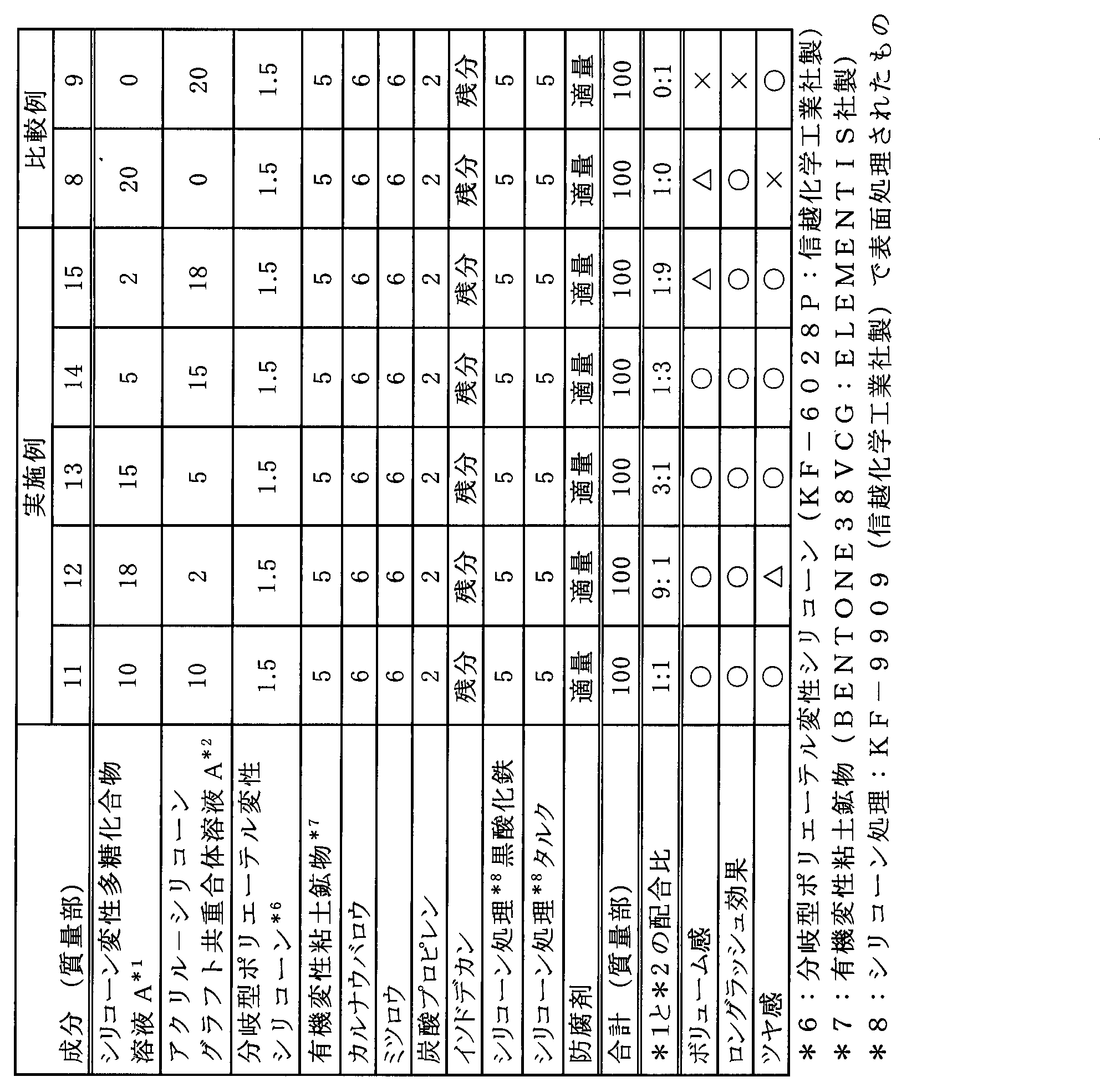
- Examples 11 to 15, Comparative Examples 8 and 9 A cosmetic for eyelashes was prepared according to the formulation shown in Table 3. The volume, long rush effect, and gloss of each cosmetic were evaluated according to the following evaluation criteria.
- the cosmetic composition of the present invention When used for eyelashes, it is intended to give the eyelashes a volume-up effect, a long lash effect, a glossy feeling, and the like. As shown in Table 3 above, the cosmetic of Comparative Example 8 does not provide a sufficient gloss, and the Comparative Example 9 does not provide a sufficient volume and long lash effect. In contrast, the cosmetic of the present invention containing a silicone-modified polysaccharide compound and an acrylic-silicone graft copolymer improves the volume-up effect, the long lash effect, and the gloss.
- the cosmetics have a good eyelash volume increase effect, long lash effect, and glossiness. It becomes a fee.
- the volume feeling is greatly improved by using the silicone-modified polysaccharide compound and the acrylic-silicone graft copolymer in combination. .
- This effect is a synergistic effect by using a silicone-modified polysaccharide compound and an acrylic-silicone graft copolymer in combination.
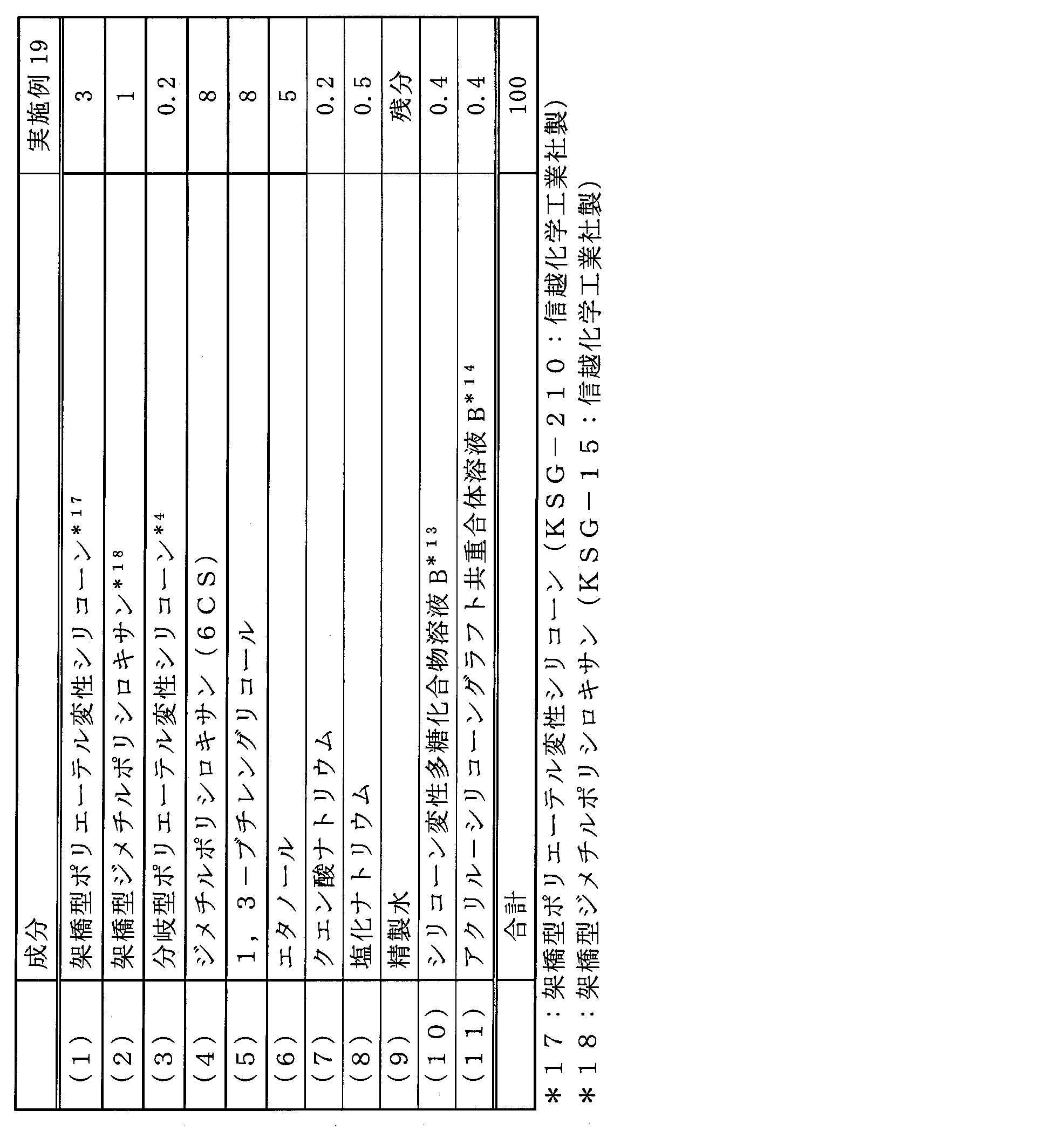
- This mascara was excellent in adhesion, and was excellent in volume-up effect, long rush effect, glossiness, and makeup sustaining effect.
- the mascara was excellent in adhesion, glossy, and makeup lasting effect.
- the lipstick was excellent in adhesion, glossy, and makeup lasting effect. From this, the cosmetic composition of the present invention can be used as non-aqueous oily cosmetics such as gloss, stick concealer, and casting foundation.
- the head hair cream imparted a glossy feel to the hair, and the usability was good.
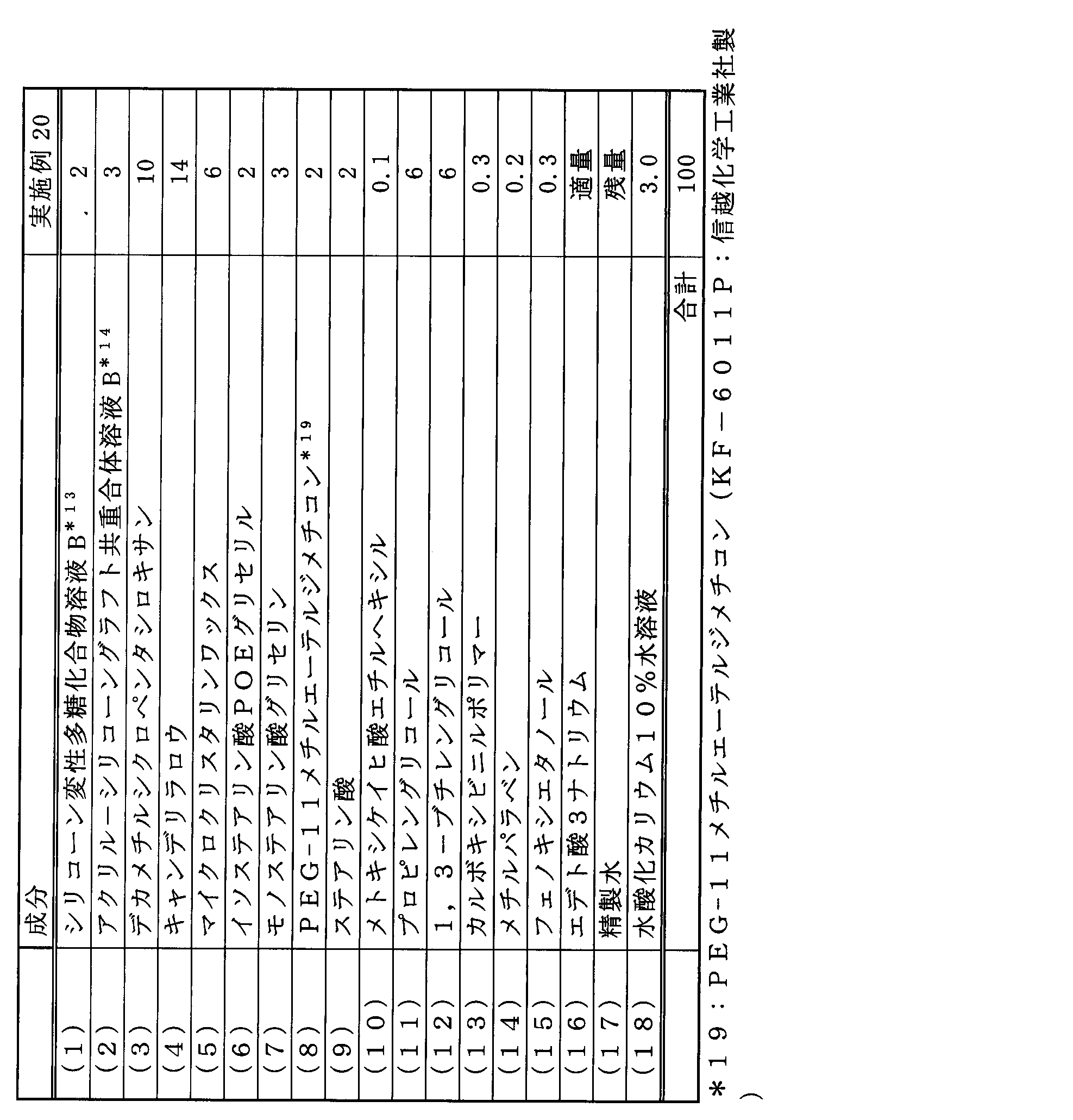
- Example 20 Hair wax ⁇ Manufacture of hair wax>
- This hair wax gave gloss to the hair and the set feeling was good.
- the cosmetic composition of the present invention has extremely excellent adhesion.
- the cosmetic obtained from the composition is excellent in the eyelash volume-up effect, and can impart a long lash effect and a glossy feel to the eyelashes without blending fibers. Therefore, the composition is particularly preferably used as a hair cosmetic such as eyelash cosmetic.
- the cosmetic composition of the present invention is also suitably used for non-aqueous oily cosmetics such as gloss, stick concealer, and casting foundation.
Landscapes
- Life Sciences & Earth Sciences (AREA)
- Health & Medical Sciences (AREA)
- Animal Behavior & Ethology (AREA)
- General Health & Medical Sciences (AREA)
- Public Health (AREA)
- Veterinary Medicine (AREA)
- Birds (AREA)
- Epidemiology (AREA)
- Cosmetics (AREA)
Abstract
Description
以下、各成分について詳細に説明する。
シリコーン変性多糖化合物とは、多糖化合物の構成糖にある水酸基に結合するシリコーン残基の1以上を有する化合物である。該化合物は多糖化合物の水酸基と末端イソシアネート基含有シリコーン化合物とを反応させて得られる。多糖化合物とは、好ましくはプルランである。シリコーン残基は好ましくは下記一般式(1)で表される。

式(1)中、R1は互いに独立に、炭素数1~10の、非置換もしくは置換の1価炭化水素基であり、R2は互いに独立に、炭素数1~10の、非置換もしくは置換の1価炭化水素基又は-OSi(R3)3で示されるシロキシ基であり、R3は互いに独立に、炭素数1~8の、非置換もしくは置換の1価炭化水素基であり、nは1~10の整数であり、aは0又は1であり、bは0、1又は2である。

上記式(2)中、Bは水素原子又は上記式(1)で表されるシリコーン残基であり、cは100~20,000の数である。

(R1、R2、n、a、及びbは上記の通りである)
反応は、従来公知の方法に従えばよく、例えば特開平8-134103号公報に記載の方法等を用いることができる。詳細には、酢酸メチル、N-メチルピロリドン等の溶媒下にて、プルランと上記式(3)の化合物を混合し、20~150℃で1~10時間反応させればよい。該反応にはトリエチルアミン等のウレタン結合形成用触媒を使用してもよい。プルランと上記式(3)の化合物の混合比率は、プルランが有するグルコース単位当たりの3個の水酸基への導入量に応じて、好ましくはグルコース1単位あたりシリコーン化合物の平均結合数(置換度)が0.5~2.5個となる量で、適宜調整されればよい。
アクリル-シリコーングラフト共重合体はアクリルポリマーとポリシロキサンからなるグラフト共重合体であり、特にはアクリルポリマー鎖にジメチルポリシロキサン鎖がグラフト結合してなるグラフト共重合体である。幹ポリマーがアクリルポリマーであり枝ポリマーがオルガノポリシロキサンであるグラフト共重合体であることにより、付着性、被膜の柔軟性、及びツヤ感の点から好ましい。該アクリル-シリコーングラフト共重合体は公知のものであってよく、特に制限されない。アクリル-シリコーングラフト共重合体は必要に応じて1種で使用しても、2種以上を併用してもよい。
本発明の化粧料組成物はさらにノニオン界面活性剤を含有していてもよい。ノニオン界面活性剤は特に限定されるものではない。中でもシリコーン乳化剤が好ましい。シリコーン乳化剤は当該分野における公知のいずれを用いることができる。このようなシリコーン乳化剤としては、ポリオキシアルキレン変性シリコーン、ポリグリセリン変性シリコーン、糖アルコール変性シリコーンなどが挙げられる。特に高い増粘効果を所望する場合には、ポリオキシアルキレン変性シリコーン及びポリグリセリン変性シリコーンの中から選ばれる1種又は2種以上を用いることが好ましい。
本発明の化粧料組成物はさらにワックスを含有していてもよい。該ワックスは通常化粧料に配合できる原料であれば、特に限定されない。例えばセレシン、オゾケライト、マイクロクリスタリンワックス、ポリエチレンワックス等の合成炭化水素ワックス、カルナウバロウ、ライスワックス、コメヌカロウ、ホホバワックス(極度に水添したホホバ油を含む)、キャンデリラロウなどの植物由来のワックス、鯨ロウ、ミツロウ、雪ロウなどの動物由来のワックス、シリコーンワックス等が挙げられる。これらワックスは1種単独でも2種以上を併用してもよい。
本発明の化粧料組成物には液状油分がさらに配合されるのがよい。液状油分としては例えば揮発性油及び不揮発性油が挙げられる。揮発性をコントロールすることは、睫毛用化粧料においては使用感の面で非常に重要である。
下記において、配合量は特に指定のない限り質量%である。
なお、表1、2における曳糸性及び増粘性は下記に基づき評価されたものである。
曳糸性評価は、化粧料組成物の中へ棒を入れて手早く引き上げたときに、組成物が糸をひく度合を観察したものである。強い糸引きが確認できるときに○と評価し、極めて強い糸引きが確認できるときに◎と評価し、弱い糸引きが確認できるときに△と評価し、糸引きが確認できないときに×と評価した。
増粘性評価は、下記成分を混合することによって原料単体の粘性に比較してどの程度増粘したかを観察したものである。増粘性が確認できたときに○と評価し、極めて高い増粘性が確認できたときに◎と評価し、僅かな増粘性が確認できたときに△と評価し、増粘性が確認できないときに×と評価した。尚、ワックスを配合した組成物はワックスの結晶構造の形成による増粘性が著しいため、増粘性を評価しなかった。
表1に示す処方によって油性の化粧料組成物を調製した。各組成物について曳糸性及び増粘性を上記基準に従い評価した。

表2に示す処方によって油性の化粧料組成物を調製した。各組成物について曳糸性及び増粘性を上記基準に従い評価した。
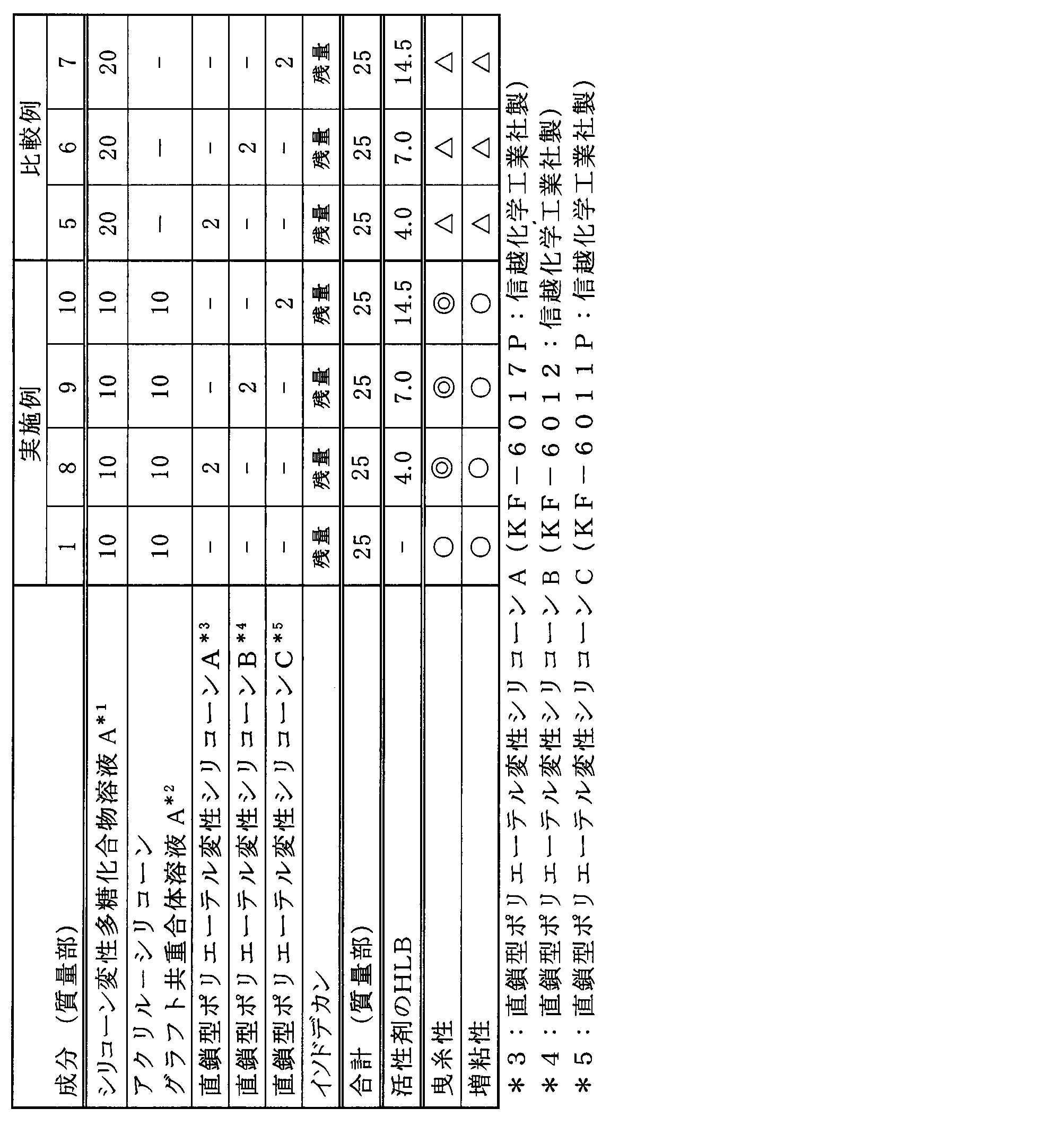
表3に示す処方によって睫毛用化粧料を調製した。各化粧料のボリューム感、ロングラッシュ効果、ツヤ感を、以下の評価基準に従い評価した。
専門パネル(10名)により、睫毛に各試料(睫毛用化粧料)を5回塗布し、塗布前後の睫毛のボリュームを目視により観察し、官能でボリューム感を評価した。評価基準は睫毛のボリュームが極めて増えたと感じた場合には5点、若干増えたと感じた場合には3点、塗布前と変化を感じなかった場合には1点とし、その合計点を算出した。下記指標に基づく結果を表3に示す。
○:合計点が40点以上
△:合計点が21~39点
×:合計点が20点以下
専門パネル(10名)により、睫毛に各試料(睫毛用化粧料)を5回塗布し、塗布前後の睫毛の長さを目視により観察し、官能でロングラッシュ効果を評価した。評価基準は睫毛が極めて長くなったと感じた場合には5点、若干長くなったと感じた場合には3点、塗布前と変化を感じなかった場合には1点とし、その合計点を算出した。下記指標に基づく結果を表3に示す。
○:合計点が40点以上
△:合計点が21~39点
×:合計点が20点以下
専門パネル(10名)により、睫毛に各試料(睫毛用化粧料)を5回塗布し、塗布前後の睫毛のツヤを目視により観察し、官能でツヤ感を評価した。評価基準は睫毛のツヤが極めて良くなったと感じた場合には5点、若干良くなったと感じた場合には3点、塗布前と変化を感じなかった場合には1点とし、その合計点を算出した。下記指標に基づく結果を表3に示す。
○:合計点が40点以上
△:合計点が21~39点
×:合計点が20点以下
マスカラ処方(W/O)
<マスカラの製造>
A:成分(1)~(12)を80℃まで加熱し、均一に混合した。
B:成分(13)~(15)を80℃まで加熱し、均一に混合した。
C:BをAに添加して乳化し、室温まで冷却した。
D:Cを容器に充填し、マスカラを得た。

マスカラ処方(O/W)
<マスカラの製造>
A:成分(1)~(5)を80℃まで加熱し、均一に混合した。
B:成分(6)~(13)を95℃まで加熱し、均一に混合した。
C:BをAに添加して乳化し、その後室温まで冷却した。
D:Cを容器に充填し、マスカラを得た。

口紅
<口紅の製造>
A:成分(1)~(6)を90℃まで加熱し、均一に混合した。
B:成分(7)~(13)を加えて70℃まで加熱し、均一に混合した。
C:Bに3本ローラーで分散した成分(14)~(20)を加えて70℃まで加熱して均一に混合し、その後室温まで冷却した。
D:Cを容器に充填し、口紅を得た。

頭髪用クリーム
<頭髪用クリームの製造>
A:成分(1)~(4)を均一に混合した。
B:成分(5)~(9)を均一に混合した。
C:BをAに添加して乳化し、表6に示す成分(10)~(11)を加えて均一に混合した。
D:Cを容器に充填し、頭髪用クリームを得た。
ヘアワックス
<ヘアワックスの製造>
A:成分(11)~(17)を80℃まで加熱し、均一に混合した。
B:成分(1)~(10)を90℃まで加熱し、均一に混合した。
C:BをAに添加して乳化し、その後室温まで冷却し、(18)を加えて中和した。
D:Cを容器に充填し、ヘアワックスを得た。
Claims (8)
- シリコーン変性多糖化合物及びアクリル-シリコーングラフト共重合体を含有する化粧料組成物。
- 化粧料組成物全体の質量に対して、シリコーン変性多糖化合物を0.1~25質量%、アクリル-シリコーングラフト共重合体を0.1~31質量%でそれぞれ含有する、請求項1記載の化粧料組成物。
- 多糖化合物がプルランである、請求項1又は2記載の化粧料組成物。
- 更に、ノニオン界面活性剤を含む、請求項1~3のいずれか1項記載の化粧料組成物。
- 更に、ワックスを含む、請求項1~4のいずれか1項記載の化粧料組成物。
- 毛髪用である請求項1~5のいずれか1項記載の化粧料組成物。
- 睫毛用である請求項1~5のいずれか1項記載の化粧料組成物。
- シリコーン変性多糖化合物が、プルランのグルコースにある水酸基に結合する下記一般式(1)で示されるシリコーン残基の1以上を有し、該シリコーン残基の平均結合数がグルコース1単位当たり0.5~2.5個である、請求項3~7のいずれか1項記載の化粧料組成物

Priority Applications (4)
| Application Number | Priority Date | Filing Date | Title |
|---|---|---|---|
| EP16807351.8A EP3308767A4 (en) | 2015-06-10 | 2016-06-01 | COSMETIC |
| KR1020177035104A KR20180012770A (ko) | 2015-06-10 | 2016-06-01 | 화장료 |
| CN201680033117.7A CN107613951A (zh) | 2015-06-10 | 2016-06-01 | 化妆材料 |
| US15/580,578 US20180133144A1 (en) | 2015-06-10 | 2016-06-01 | Cosmetic |
Applications Claiming Priority (2)
| Application Number | Priority Date | Filing Date | Title |
|---|---|---|---|
| JP2015117355A JP2017001983A (ja) | 2015-06-10 | 2015-06-10 | 化粧料 |
| JP2015-117355 | 2015-06-10 |
Publications (1)
| Publication Number | Publication Date |
|---|---|
| WO2016199644A1 true WO2016199644A1 (ja) | 2016-12-15 |
Family
ID=57503901
Family Applications (1)
| Application Number | Title | Priority Date | Filing Date |
|---|---|---|---|
| PCT/JP2016/066233 Ceased WO2016199644A1 (ja) | 2015-06-10 | 2016-06-01 | 化粧料 |
Country Status (6)
| Country | Link |
|---|---|
| US (1) | US20180133144A1 (ja) |
| EP (1) | EP3308767A4 (ja) |
| JP (1) | JP2017001983A (ja) |
| KR (1) | KR20180012770A (ja) |
| CN (1) | CN107613951A (ja) |
| WO (1) | WO2016199644A1 (ja) |
Cited By (3)
| Publication number | Priority date | Publication date | Assignee | Title |
|---|---|---|---|---|
| JPWO2021187306A1 (ja) * | 2020-03-18 | 2021-09-23 | ||
| WO2023068123A1 (ja) * | 2021-10-22 | 2023-04-27 | 信越化学工業株式会社 | シリコーン変性プルラン、該変性プルランを含む組成物、並びに化粧料 |
| US11845810B2 (en) | 2018-12-31 | 2023-12-19 | Dow Silicones Corporation | Silicon glycan and method of preparing same |
Families Citing this family (10)
| Publication number | Priority date | Publication date | Assignee | Title |
|---|---|---|---|---|
| JP7426821B2 (ja) * | 2019-12-27 | 2024-02-02 | 花王株式会社 | 皮膚外用剤組成物 |
| TWI868280B (zh) * | 2019-12-27 | 2025-01-01 | 日商花王股份有限公司 | 皮膚外用劑組成物 |
| US12569426B2 (en) | 2020-04-01 | 2026-03-10 | Kao Corporation | Topical skin preparation composition |
| KR102906775B1 (ko) * | 2020-04-01 | 2025-12-31 | 카오카부시키가이샤 | 화장 방법 |
| US12569427B2 (en) * | 2020-04-01 | 2026-03-10 | Kao Corporation | Makeup application method |
| CN115427013B (zh) * | 2020-04-01 | 2024-12-20 | 花王株式会社 | 皮肤外用剂组合物 |
| JP2026522702A (ja) * | 2023-06-30 | 2026-07-08 | ロレアル | 疎水性修飾プルラン化合物及び水性相造膜剤を含有するw/oエマルション組成物 |
| FR3154001B3 (fr) | 2023-10-16 | 2025-11-07 | Oreal | Compositions d’émulsion contenant un composé de polysaccharide hydrophobiquement modifié et un filmogène en phase aqueuse |
| WO2025006854A1 (en) * | 2023-06-30 | 2025-01-02 | L'oreal | O/w-emulsion compositions containing a hydrophobically-modified polysaccharide compound and an aqueous phase film former |
| FR3164623B1 (fr) * | 2024-07-18 | 2026-07-24 | Lvmh Rech | Composition de soin et/ou de maquillage non-transfert |
Citations (10)
| Publication number | Priority date | Publication date | Assignee | Title |
|---|---|---|---|---|
| JP2704730B2 (ja) * | 1988-07-12 | 1998-01-26 | 株式会社コーセー | 化粧料 |
| JPH1029910A (ja) * | 1996-05-16 | 1998-02-03 | Shiseido Co Ltd | 化粧料 |
| JPH11302140A (ja) * | 1997-05-30 | 1999-11-02 | Shiseido Co Ltd | 化粧料及びその処理方法 |
| JP2001278729A (ja) * | 2000-03-28 | 2001-10-10 | Shiseido Co Ltd | 油中水型乳化組成物 |
| JP2009102251A (ja) * | 2007-10-23 | 2009-05-14 | Shiseido Co Ltd | 油性固形化粧料 |
| JP2010229094A (ja) * | 2009-03-27 | 2010-10-14 | Shiseido Co Ltd | 凹凸補正用皮膚外用剤 |
| JP2013194047A (ja) * | 2012-03-23 | 2013-09-30 | Shiseido Co Ltd | 油中水型乳化化粧料 |
| JP2013216583A (ja) * | 2012-04-04 | 2013-10-24 | Shin-Etsu Chemical Co Ltd | 化粧料 |
| JP2014218468A (ja) * | 2013-05-09 | 2014-11-20 | 信越化学工業株式会社 | 油性増粘剤、増粘油性組成物及び化粧料 |
| JP2014221721A (ja) * | 2013-05-13 | 2014-11-27 | 信越化学工業株式会社 | 油性化粧料 |
Family Cites Families (6)
| Publication number | Priority date | Publication date | Assignee | Title |
|---|---|---|---|---|
| FR2795635B1 (fr) * | 1999-06-30 | 2006-09-15 | Oreal | Mascara comprenant des polymeres filmogenes |
| JP4164209B2 (ja) * | 1999-10-28 | 2008-10-15 | 信越化学工業株式会社 | 化粧料 |
| DE602005001295T2 (de) * | 2004-06-08 | 2008-01-31 | Shiseido Co. Ltd. | Kosmetische Zusammensetzung enthaltend ein spezifisches Terpolymer |
| JP4971686B2 (ja) * | 2006-05-25 | 2012-07-11 | 株式会社 資生堂 | 曳糸性組成物およびそれを用いた睫毛用化粧料、毛髪用化粧料 |
| JP5072318B2 (ja) * | 2006-10-25 | 2012-11-14 | 株式会社 資生堂 | 油性ゲル化剤、ゲル組成物及びこれを含む化粧料 |
| JP2009013107A (ja) * | 2007-07-04 | 2009-01-22 | Shiseido Co Ltd | 皮膚損傷修復用組成物 |
-
2015
- 2015-06-10 JP JP2015117355A patent/JP2017001983A/ja active Pending
-
2016
- 2016-06-01 EP EP16807351.8A patent/EP3308767A4/en not_active Withdrawn
- 2016-06-01 KR KR1020177035104A patent/KR20180012770A/ko not_active Withdrawn
- 2016-06-01 WO PCT/JP2016/066233 patent/WO2016199644A1/ja not_active Ceased
- 2016-06-01 US US15/580,578 patent/US20180133144A1/en not_active Abandoned
- 2016-06-01 CN CN201680033117.7A patent/CN107613951A/zh active Pending
Patent Citations (10)
| Publication number | Priority date | Publication date | Assignee | Title |
|---|---|---|---|---|
| JP2704730B2 (ja) * | 1988-07-12 | 1998-01-26 | 株式会社コーセー | 化粧料 |
| JPH1029910A (ja) * | 1996-05-16 | 1998-02-03 | Shiseido Co Ltd | 化粧料 |
| JPH11302140A (ja) * | 1997-05-30 | 1999-11-02 | Shiseido Co Ltd | 化粧料及びその処理方法 |
| JP2001278729A (ja) * | 2000-03-28 | 2001-10-10 | Shiseido Co Ltd | 油中水型乳化組成物 |
| JP2009102251A (ja) * | 2007-10-23 | 2009-05-14 | Shiseido Co Ltd | 油性固形化粧料 |
| JP2010229094A (ja) * | 2009-03-27 | 2010-10-14 | Shiseido Co Ltd | 凹凸補正用皮膚外用剤 |
| JP2013194047A (ja) * | 2012-03-23 | 2013-09-30 | Shiseido Co Ltd | 油中水型乳化化粧料 |
| JP2013216583A (ja) * | 2012-04-04 | 2013-10-24 | Shin-Etsu Chemical Co Ltd | 化粧料 |
| JP2014218468A (ja) * | 2013-05-09 | 2014-11-20 | 信越化学工業株式会社 | 油性増粘剤、増粘油性組成物及び化粧料 |
| JP2014221721A (ja) * | 2013-05-13 | 2014-11-27 | 信越化学工業株式会社 | 油性化粧料 |
Cited By (9)
| Publication number | Priority date | Publication date | Assignee | Title |
|---|---|---|---|---|
| US11845810B2 (en) | 2018-12-31 | 2023-12-19 | Dow Silicones Corporation | Silicon glycan and method of preparing same |
| JPWO2021187306A1 (ja) * | 2020-03-18 | 2021-09-23 | ||
| WO2021187306A1 (ja) * | 2020-03-18 | 2021-09-23 | 信越化学工業株式会社 | 化粧品組成物 |
| JP7360541B2 (ja) | 2020-03-18 | 2023-10-12 | 信越化学工業株式会社 | 化粧品組成物 |
| US12539266B2 (en) | 2020-03-18 | 2026-02-03 | Shin-Etsu Chemical Co., Ltd. | Cosmetic composition |
| WO2023068123A1 (ja) * | 2021-10-22 | 2023-04-27 | 信越化学工業株式会社 | シリコーン変性プルラン、該変性プルランを含む組成物、並びに化粧料 |
| JP2023062923A (ja) * | 2021-10-22 | 2023-05-09 | 信越化学工業株式会社 | シリコーン変性プルラン、該変性プルランを含む組成物、並びに化粧料 |
| JP7704647B2 (ja) | 2021-10-22 | 2025-07-08 | 信越化学工業株式会社 | シリコーン変性プルラン、該変性プルランを含む組成物、並びに化粧料 |
| JP2025118906A (ja) * | 2021-10-22 | 2025-08-13 | 信越化学工業株式会社 | シリコーン変性プルラン、該変性プルランを含む組成物、並びに化粧料 |
Also Published As
| Publication number | Publication date |
|---|---|
| EP3308767A4 (en) | 2019-01-09 |
| KR20180012770A (ko) | 2018-02-06 |
| US20180133144A1 (en) | 2018-05-17 |
| EP3308767A1 (en) | 2018-04-18 |
| JP2017001983A (ja) | 2017-01-05 |
| CN107613951A (zh) | 2018-01-19 |
Similar Documents
| Publication | Publication Date | Title |
|---|---|---|
| JP2017001983A (ja) | 化粧料 | |
| JP6024587B2 (ja) | 油性化粧料 | |
| JP6035932B2 (ja) | 皮膜形成性重合体を含む化粧料 | |
| JP6622162B2 (ja) | 化粧料及び化粧料の製造方法 | |
| JP2020075881A (ja) | 化粧料 | |
| JP6412406B2 (ja) | 油中水型乳化化粧料 | |
| JP2022152038A (ja) | 固形化粧料 | |
| CN114727942A (zh) | 油包水型乳化化妆品 | |
| JP2019089715A (ja) | 化粧料の製造方法 | |
| CN115427010A (zh) | 化妆方法 | |
| JP6999415B2 (ja) | 水中油型乳化化粧料 | |
| EP4230191A1 (en) | Emulsion composition | |
| JP7481831B2 (ja) | 油中水型乳化化粧料 | |
| CN110545791B (zh) | 化妆品 | |
| TW202228632A (zh) | 油中水型乳化組成物 | |
| JP6452495B2 (ja) | 油中水型乳化化粧料 | |
| JP2022065569A (ja) | 乳化組成物 | |
| JP2022163539A (ja) | 油中水型乳化組成物 | |
| JP2002068941A (ja) | 油中水型化粧料 |
Legal Events
| Date | Code | Title | Description |
|---|---|---|---|
| 121 | Ep: the epo has been informed by wipo that ep was designated in this application |
Ref document number: 16807351 Country of ref document: EP Kind code of ref document: A1 |
|
| ENP | Entry into the national phase |
Ref document number: 20177035104 Country of ref document: KR Kind code of ref document: A |
|
| WWE | Wipo information: entry into national phase |
Ref document number: 15580578 Country of ref document: US |
|
| NENP | Non-entry into the national phase |
Ref country code: DE |
|
| WWE | Wipo information: entry into national phase |
Ref document number: 2016807351 Country of ref document: EP |