WO2016199674A1 - 融合タンパク質又は複合タンパク質、細胞内送達用担体、部分ペプチド、細胞膜透過促進剤、dna、及びベクター - Google Patents
融合タンパク質又は複合タンパク質、細胞内送達用担体、部分ペプチド、細胞膜透過促進剤、dna、及びベクター Download PDFInfo
- Publication number
- WO2016199674A1 WO2016199674A1 PCT/JP2016/066455 JP2016066455W WO2016199674A1 WO 2016199674 A1 WO2016199674 A1 WO 2016199674A1 JP 2016066455 W JP2016066455 W JP 2016066455W WO 2016199674 A1 WO2016199674 A1 WO 2016199674A1
- Authority
- WO
- WIPO (PCT)
- Prior art keywords
- fusion protein
- egfp
- amino acid
- tat
- dna
- Prior art date
- Legal status (The legal status is an assumption and is not a legal conclusion. Google has not performed a legal analysis and makes no representation as to the accuracy of the status listed.)
- Ceased
Links
Images





Classifications
-
- C—CHEMISTRY; METALLURGY
- C12—BIOCHEMISTRY; BEER; SPIRITS; WINE; VINEGAR; MICROBIOLOGY; ENZYMOLOGY; MUTATION OR GENETIC ENGINEERING
- C12N—MICROORGANISMS OR ENZYMES; COMPOSITIONS THEREOF; PROPAGATING, PRESERVING, OR MAINTAINING MICROORGANISMS; MUTATION OR GENETIC ENGINEERING; CULTURE MEDIA
- C12N15/00—Mutation or genetic engineering; DNA or RNA concerning genetic engineering, vectors, e.g. plasmids, or their isolation, preparation or purification; Use of hosts therefor
- C12N15/09—Recombinant DNA-technology
- C12N15/63—Introduction of foreign genetic material using vectors; Vectors; Use of hosts therefor; Regulation of expression
- C12N15/70—Vectors or expression systems specially adapted for E. coli
-
- A—HUMAN NECESSITIES
- A61—MEDICAL OR VETERINARY SCIENCE; HYGIENE
- A61K—PREPARATIONS FOR MEDICAL, DENTAL OR TOILETRY PURPOSES
- A61K38/00—Medicinal preparations containing peptides
- A61K38/16—Peptides having more than 20 amino acids; Gastrins; Somatostatins; Melanotropins; Derivatives thereof
-
- A—HUMAN NECESSITIES
- A61—MEDICAL OR VETERINARY SCIENCE; HYGIENE
- A61K—PREPARATIONS FOR MEDICAL, DENTAL OR TOILETRY PURPOSES
- A61K39/00—Medicinal preparations containing antigens or antibodies
- A61K39/395—Antibodies; Immunoglobulins; Immune serum, e.g. antilymphocytic serum
-
- A—HUMAN NECESSITIES
- A61—MEDICAL OR VETERINARY SCIENCE; HYGIENE
- A61K—PREPARATIONS FOR MEDICAL, DENTAL OR TOILETRY PURPOSES
- A61K47/00—Medicinal preparations characterised by the non-active ingredients used, e.g. carriers or inert additives; Targeting or modifying agents chemically bound to the active ingredient
- A61K47/30—Macromolecular organic or inorganic compounds, e.g. inorganic polyphosphates
- A61K47/42—Proteins; Polypeptides; Degradation products thereof; Derivatives thereof, e.g. albumin, gelatin or zein
-
- A—HUMAN NECESSITIES
- A61—MEDICAL OR VETERINARY SCIENCE; HYGIENE
- A61K—PREPARATIONS FOR MEDICAL, DENTAL OR TOILETRY PURPOSES
- A61K47/00—Medicinal preparations characterised by the non-active ingredients used, e.g. carriers or inert additives; Targeting or modifying agents chemically bound to the active ingredient
- A61K47/50—Medicinal preparations characterised by the non-active ingredients used, e.g. carriers or inert additives; Targeting or modifying agents chemically bound to the active ingredient the non-active ingredient being chemically bound to the active ingredient, e.g. polymer-drug conjugates
-
- C—CHEMISTRY; METALLURGY
- C07—ORGANIC CHEMISTRY
- C07K—PEPTIDES
- C07K14/00—Peptides having more than 20 amino acids; Gastrins; Somatostatins; Melanotropins; Derivatives thereof
- C07K14/005—Peptides having more than 20 amino acids; Gastrins; Somatostatins; Melanotropins; Derivatives thereof from viruses
-
- C—CHEMISTRY; METALLURGY
- C07—ORGANIC CHEMISTRY
- C07K—PEPTIDES
- C07K14/00—Peptides having more than 20 amino acids; Gastrins; Somatostatins; Melanotropins; Derivatives thereof
- C07K14/435—Peptides having more than 20 amino acids; Gastrins; Somatostatins; Melanotropins; Derivatives thereof from animals; from humans
- C07K14/46—Peptides having more than 20 amino acids; Gastrins; Somatostatins; Melanotropins; Derivatives thereof from animals; from humans from vertebrates
- C07K14/47—Peptides having more than 20 amino acids; Gastrins; Somatostatins; Melanotropins; Derivatives thereof from animals; from humans from vertebrates from mammals
-
- C—CHEMISTRY; METALLURGY
- C07—ORGANIC CHEMISTRY
- C07K—PEPTIDES
- C07K14/00—Peptides having more than 20 amino acids; Gastrins; Somatostatins; Melanotropins; Derivatives thereof
- C07K14/435—Peptides having more than 20 amino acids; Gastrins; Somatostatins; Melanotropins; Derivatives thereof from animals; from humans
- C07K14/705—Receptors; Cell surface antigens; Cell surface determinants
- C07K14/70596—Molecules with a "CD"-designation not provided for elsewhere
-
- C—CHEMISTRY; METALLURGY
- C07—ORGANIC CHEMISTRY
- C07K—PEPTIDES
- C07K19/00—Hybrid peptides, i.e. peptides covalently bound to nucleic acids, or non-covalently bound protein-protein complexes
-
- C—CHEMISTRY; METALLURGY
- C07—ORGANIC CHEMISTRY
- C07K—PEPTIDES
- C07K7/00—Peptides having 5 to 20 amino acids in a fully defined sequence; Derivatives thereof
- C07K7/04—Linear peptides containing only normal peptide links
- C07K7/08—Linear peptides containing only normal peptide links having 12 to 20 amino acids
-
- C—CHEMISTRY; METALLURGY
- C12—BIOCHEMISTRY; BEER; SPIRITS; WINE; VINEGAR; MICROBIOLOGY; ENZYMOLOGY; MUTATION OR GENETIC ENGINEERING
- C12N—MICROORGANISMS OR ENZYMES; COMPOSITIONS THEREOF; PROPAGATING, PRESERVING, OR MAINTAINING MICROORGANISMS; MUTATION OR GENETIC ENGINEERING; CULTURE MEDIA
- C12N15/00—Mutation or genetic engineering; DNA or RNA concerning genetic engineering, vectors, e.g. plasmids, or their isolation, preparation or purification; Use of hosts therefor
- C12N15/09—Recombinant DNA-technology
-
- C—CHEMISTRY; METALLURGY
- C12—BIOCHEMISTRY; BEER; SPIRITS; WINE; VINEGAR; MICROBIOLOGY; ENZYMOLOGY; MUTATION OR GENETIC ENGINEERING
- C12N—MICROORGANISMS OR ENZYMES; COMPOSITIONS THEREOF; PROPAGATING, PRESERVING, OR MAINTAINING MICROORGANISMS; MUTATION OR GENETIC ENGINEERING; CULTURE MEDIA
- C12N7/00—Viruses; Bacteriophages; Compositions thereof; Preparation or purification thereof
-
- C—CHEMISTRY; METALLURGY
- C07—ORGANIC CHEMISTRY
- C07K—PEPTIDES
- C07K16/00—Immunoglobulins [IG], e.g. monoclonal or polyclonal antibodies
-
- C—CHEMISTRY; METALLURGY
- C07—ORGANIC CHEMISTRY
- C07K—PEPTIDES
- C07K2319/00—Fusion polypeptide
- C07K2319/01—Fusion polypeptide containing a localisation/targetting motif
- C07K2319/02—Fusion polypeptide containing a localisation/targetting motif containing a signal sequence
-
- C—CHEMISTRY; METALLURGY
- C07—ORGANIC CHEMISTRY
- C07K—PEPTIDES
- C07K2319/00—Fusion polypeptide
- C07K2319/01—Fusion polypeptide containing a localisation/targetting motif
- C07K2319/03—Fusion polypeptide containing a localisation/targetting motif containing a transmembrane segment
-
- C—CHEMISTRY; METALLURGY
- C07—ORGANIC CHEMISTRY
- C07K—PEPTIDES
- C07K2319/00—Fusion polypeptide
- C07K2319/01—Fusion polypeptide containing a localisation/targetting motif
- C07K2319/10—Fusion polypeptide containing a localisation/targetting motif containing a tag for extracellular membrane crossing, e.g. TAT or VP22
-
- C—CHEMISTRY; METALLURGY
- C07—ORGANIC CHEMISTRY
- C07K—PEPTIDES
- C07K2319/00—Fusion polypeptide
- C07K2319/20—Fusion polypeptide containing a tag with affinity for a non-protein ligand
- C07K2319/21—Fusion polypeptide containing a tag with affinity for a non-protein ligand containing a His-tag
-
- C—CHEMISTRY; METALLURGY
- C07—ORGANIC CHEMISTRY
- C07K—PEPTIDES
- C07K2319/00—Fusion polypeptide
- C07K2319/40—Fusion polypeptide containing a tag for immunodetection, or an epitope for immunisation
- C07K2319/43—Fusion polypeptide containing a tag for immunodetection, or an epitope for immunisation containing a FLAG-tag
-
- C—CHEMISTRY; METALLURGY
- C07—ORGANIC CHEMISTRY
- C07K—PEPTIDES
- C07K2319/00—Fusion polypeptide
- C07K2319/60—Fusion polypeptide containing spectroscopic/fluorescent detection, e.g. green fluorescent protein [GFP]
-
- C—CHEMISTRY; METALLURGY
- C07—ORGANIC CHEMISTRY
- C07K—PEPTIDES
- C07K7/00—Peptides having 5 to 20 amino acids in a fully defined sequence; Derivatives thereof
- C07K7/04—Linear peptides containing only normal peptide links
- C07K7/06—Linear peptides containing only normal peptide links having 5 to 11 amino acids
Definitions
- the present invention relates to a fusion protein or complex protein, a carrier for intracellular delivery, a partial peptide, a cell membrane permeation enhancer, DNA, and a vector.
- DDS drug delivery systems
- TAT peptide that is a transcription factor of HIV is known (see Patent Document 1).
- a ligand recognizes a receptor present on the cell surface, binds to the cell surface, is taken into the cell membrane, and binds to the endosome. Then, after binding to the endosome, the ligand is released from the endosome, and the ligand is released into the cell, whereby the ligand is taken into the cell.
- the TAT peptide Since the TAT peptide has a low ability to detach from endosomes (hereinafter sometimes referred to as “endosome detachment” in the present specification), the target active ingredient cannot be sufficiently released into the cell, and the cell membrane permeability is low. There is a problem that it is low.
- membrane fusion peptides such as HA2 (derived from a virus), B18 (derived from a sea urchin), and B55 (derived from a sea urchin), which are factors related to membrane fusion during virus infection and fertilization, are known. Since these peptides are excellent in endosome releasability, it is considered that they can be used as peptides for intracellular delivery with high cell membrane permeability.
- HA2, B18, and B55 are not human-derived peptides, there is a concern that immunogenicity may occur when applied to DDS.
- human-derived peptides that are not only excellent in cell membrane permeability but also less likely to produce immunogenicity are required as peptides for intracellular delivery.
- the present invention has been made in view of the above circumstances, and an object of the present invention is to provide a fusion protein or a complex protein that is excellent in cell membrane permeability and includes a partial peptide derived from humans and suitable for intracellular delivery. And Furthermore, the present invention includes a carrier for intracellular delivery comprising such a fusion protein or a complex protein, a partial peptide and a cell membrane permeation enhancer comprising the partial peptide, a DNA encoding the partial peptide, and the DNA incorporated therein. The purpose is to provide vectors.
- the present inventors have found that a partial peptide consisting of a part of amino acid residues of IZUMO1, CD9, and syncytin1, which are membrane fusion-related proteins derived from humans, has excellent endosome detachment properties, and thus complete the present invention. It came. More specifically, the present invention provides the following.
- a partial peptide consisting of at least 7 consecutive amino acid residues in the amino acid sequence encoded by the DNA according to any one of (a) to (d) below:
- A DNA having a base sequence encoding the amino acid sequence set forth in SEQ ID NO: 1, 2, or 3
- B DNA having a base sequence capable of hybridizing under stringent conditions with a base sequence complementary to the base sequence encoding the amino acid sequence set forth in SEQ ID NO: 1, 2, or 3
- C DNA having a nucleotide sequence encoding an amino acid sequence in which one or more amino acids are substituted, deleted and / or added in the amino acid sequence of SEQ ID NO: 1, 2, or 3
- D DNA comprising a base sequence encoding an amino acid sequence having 90% or more homology with the amino acid sequence shown in SEQ ID NO: 1, 2, or 3
- a carrier for intracellular delivery comprising the fusion protein or complex protein according to (1) or (2).
- B DNA having a base sequence capable of hybridizing under stringent conditions with a base sequence complementary to the base sequence encoding the amino acid sequence set forth in SEQ ID NO: 1, 2, or 3
- C DNA having a nucleotide sequence encoding an amino acid sequence in which one or more amino acids are substituted, deleted and / or added in the amino acid sequence of SEQ ID NO: 1, 2, or 3
- a cell membrane permeation enhancer comprising the partial peptide according to (5).
- a fusion protein or a complex protein that is excellent in cell membrane permeability and includes a partial peptide derived from humans and suitable for intracellular delivery.
- a carrier for intracellular delivery comprising such a fusion protein or a complex protein, a partial peptide and a cell membrane permeation enhancer comprising the partial peptide, a DNA encoding the partial peptide, and the DNA are incorporated.
- Provided vectors can be provided.
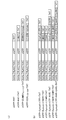
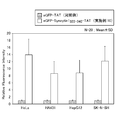
- the graph of the fluorescence intensity about an eGFP-TAT fusion protein, an eGFP-HA2-TAT fusion protein, and an eGFP-Syncytin1 (FP) -TAT fusion protein is shown.
- eGFP-TAT fusion protein (final concentration 10 ⁇ M)
- eGFP-IZUMO1 57-113 -TAT fusion protein final concentration 1 ⁇ M
- eGFP-IZUMO1 81-113 -TAT fusion protein final concentration 1 ⁇ M
- eGFP-IZUMO1 81-113 -TAT fusion protein final concentration 1 ⁇ M
- eGFP-IZUMO1 81-113 -TAT fusion protein (final concentration 1 ⁇ M)
- eGFP-IZUMO1 81-113 ⁇ A graph of fluorescence intensity is shown for the TAT fusion protein (final concentration 10 ⁇ M).
- eGFP-TAT fusion protein (final concentration 10 ⁇ M), eGFP-IZUMO1 57-113 -TAT fusion protein (final concentration 1 ⁇ M), eGFP-IZUMO1 57-75 -TAT fusion protein (final concentration 1 ⁇ M), eGFP-IZUMO1 57-75 ⁇ TAT fusion protein (final concentration 10 ⁇ M), eGFP-IZUMO1 76-94 -TAT fusion protein (final concentration 1 ⁇ M), eGFP-IZUMO1 76-94 -TAT fusion protein (final concentration 10 ⁇ M), eGFP-IZUMO1 95-113 -TAT fusion
- the graph of the fluorescence intensity about protein (final concentration 1 micromol) is shown.
- HeLa human cervical cancer cell
- HA431 human epithelial cell cancer cell
- HepG2 human hepatoma cell
- SH human neuroblastoma cell
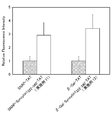
- the fluorescence intensity graphs for SNAP-Syncytin1 322-340 -TAT fusion protein, SNAP-TAT fusion protein, ⁇ -Gal-Syncytin1 322-340 -TAT fusion protein and ⁇ -Gal-TAT fusion protein are shown.
- the fusion protein or complex protein of the present invention comprises a partial peptide consisting of at least 7 consecutive amino acid residues in the amino acid sequence encoded by the DNA described in any of (a) to (d) below, It has a ligand that is bound directly or indirectly to the peptide and has the ability to bind to the cell surface.
- A DNA having a base sequence encoding the amino acid sequence set forth in SEQ ID NO: 1, 2, or 3
- B DNA having a base sequence capable of hybridizing under stringent conditions with a base sequence complementary to the base sequence encoding the amino acid sequence set forth in SEQ ID NO: 1, 2, or 3
- C DNA having a nucleotide sequence encoding an amino acid sequence in which one or more amino acids are substituted, deleted and / or added in the amino acid sequence of SEQ ID NO: 1, 2, or 3
- D DNA comprising a base sequence encoding an amino acid sequence having 90% or more homology with the amino acid sequence shown in SEQ ID NO: 1, 2, or 3
- the fusion protein or complex protein of the present invention has a high endosome detachability due to the partial peptide having the above-described configuration, and thus can exhibit excellent cell membrane permeability.
- the “fusion protein” of the present invention refers to a protein in which the partial peptide is bound to one or more other proteins.
- the “complex protein” of the present invention refers to a complex in which the partial peptide and a component other than a protein (for example, a low molecular compound, a nucleic acid, a sugar chain, a nanoparticle, etc.) are bound.
- the partial peptide in the fusion protein or composite protein of the present invention is a peptide consisting of at least 7 consecutive amino acid residues in the amino acid sequence encoded by the DNA described in any of (a) to (d) above.
- amino acid sequence described in SEQ ID NO: 1 is a part of the fusion core helix peptide near the N-terminus of human-derived membrane fusion-related protein IZUMO1, and corresponds to positions 76 to 113 when counted from the N-terminal side of IZUMO1 It is an amino acid sequence represented by the amino acid residue.
- the partial peptide has high endosome detachment properties and excellent cell membrane permeability, and therefore corresponds to positions 76-94 when counted from the N-terminal side of IZUMO1.
- the amino acid sequence represented by the amino acid residue (SEQ ID NO: 4), the amino acid sequence represented by the amino acid residue corresponding to positions 81 to 113 when counted from the N-terminal side of IZUMO1 (SEQ ID NO: 5), or the N-terminal of IZUMO1 The amino acid sequence (SEQ ID NO: 6) represented by the amino acid residue corresponding to positions 95 to 113 when counted from the side is particularly preferred.
- amino acid sequence shown in SEQ ID NO: 2 is a part of the second extracellular loop peptide near the C-terminus of human-derived membrane fusion-related protein CD9, and is located at positions 113 to 194 when counted from the N-terminal side of CD9. Is an amino acid sequence represented by the amino acid residue corresponding to
- the partial peptide has high endosome detachability and excellent cell membrane permeability, and therefore corresponds to positions 115 to 133 when counted from the N-terminal side of CD9.
- the amino acid sequence represented by the amino acid residue (SEQ ID NO: 7), the amino acid sequence represented by the amino acid residue corresponding to positions 138 to 151 when counted from the N-terminal side of CD9 (SEQ ID NO: 8), or the N-terminus of CD9 The amino acid sequence (SEQ ID NO: 9) represented by amino acid residues corresponding to positions 182-190 when counted from the side is particularly preferred.
- the amino acid sequence set forth in SEQ ID NO: 3 is the amino acid sequence of the FP peptide involved in membrane fusion in the TM domain on the C-terminal side that constitutes human-derived membrane fusion-related protein Syncytin1, and is counted from the N-terminal side of Syncytin1 Is the amino acid sequence represented by the amino acid residues corresponding to positions 320-340.
- the partial peptide has high endosome detachment properties and excellent cell membrane permeability, and therefore corresponds to positions 322 to 340 when counted from the N-terminal side of Syncytin1.
- the amino acid sequence represented by the amino acid residue (SEQ ID NO: 44) is preferable, and the amino acid sequence (SEQ ID NO: 10) represented by the amino acid residue corresponding to positions 321 to 334 when counted from the N-terminal side of Syncytin1 is particularly preferable.
- the number of amino acid residues constituting the partial peptide of the present invention is at least 7 consecutive amino acid residues in the amino acid sequence encoded by the DNA according to any one of (a) to (d) above, It is not particularly limited, and can be appropriately selected according to the number of amino acid residues encoded by SEQ ID NOs: 1-3. For example, at least 10, 12, 15, 18 amino acid residues constituting the partial peptide of the present invention are encoded by the amino acid sequence encoded by the DNA described in any one of (a) to (d) above. 20 amino acids, 30 amino acids, 40 amino acids, 50 amino acids, 60 amino acids, 60 amino acids, 70 amino acids, etc.
- the upper limit thereof is not particularly limited, and for example, 75 amino acid residues constituting the partial peptide of the present invention are encoded by the DNA encoded by the DNA according to any one of (a) to (d) above. Below, 65 or less, 55 or less, 45 or less, 35 or less, 25 or less, 22 or less, 17 or less, 16 or less, 14 or less, 13 or less, etc. May be.
- a DNA variant or homolog having a base sequence encoding the amino acid sequence described in any one of SEQ ID NOs: 1 to 10 is complementary to the base sequence encoding the amino acid sequence described in any of SEQ ID NOs: 1 to 10 90% or more (preferably 92% or more, preferably) of DNA having a base sequence that can hybridize with a stringent base sequence under stringent conditions, or a base sequence encoding the amino acid sequence of any one of SEQ ID NOs: 1 to 10 More preferably, it includes DNA having a base sequence having a homology of 95% or more, more preferably 99% or more.
- Examples of the “stringent conditions” capable of hybridizing with a base sequence complementary to the base sequence described in any of SEQ ID NOs: 1 to 10 include, for example, 40 to 70 ° C. (preferably, in a normal hybridization buffer) The reaction is carried out at 50 to 67 ° C., more preferably 60 to 65 ° C., in a washing solution having a salt concentration of 15 to 300 mM (preferably 15 to 150 mM, more preferably 15 to 60 mM, still more preferably 30 to 50 mM). The conditions for performing the cleaning are listed.
- the DNA encoding the amino acid sequence of the partial peptide of the present invention encodes an amino acid sequence in which one or more amino acids are substituted, deleted, and / or added in the amino acid sequence of any one of SEQ ID NOs: 1 to 10.
- DNA having a base sequence is also included.
- “one or more” usually refers to within 3 amino acids, preferably within 2 amino acids.
- the partial peptide when the number of amino acid residues of the partial peptide is small (for example, when the number of amino acid residues of the partial peptide is 7 to 10) and the number of amino acids to be mutated is large (for example, within 3 amino acids) In some cases, the partial peptide can easily maintain the cell membrane permeability by being mutated to another amino acid so that the nature of the mutated amino acid side chain is preserved.
- hydrophobic amino acids A, I, L, M, F, P, W, Y, V
- hydrophilic amino acids R, D, N, C, E, Q, G, H, K, S, T
- amino acids having aliphatic side chains G, A, V, L, I, P
- amino acids having hydroxyl group-containing side chains S, T, Y
- sulfur atom-containing side chains An amino acid (C, M) having a carboxylic acid and an amide-containing side chain (D, N, E, Q), an amino acid having a base-containing side chain (R, K, H), an aromatic-containing side chain
- the amino acid (H, F, Y, W) which can be mentioned can be mentioned (In addition, all the alphabets in the said parenthesis represent the single letter mark of an amino acid).
- the amino acid sequence of the partial peptide of the present invention is preferably highly homologous to the amino acid sequence described in any one of SEQ ID NOs: 1 to 10.
- the amino acid sequence of the partial peptide of the present invention is preferably 90% or more, more preferably 92% or more, and 95% or more (96%) with the amino acid sequence of any one of SEQ ID NOs: 1 to 10. More preferably, 97% or more, 98% or more, 99% or more).
- a protein having an amino acid sequence modified by deletion, addition and / or substitution by another amino acid residue to one amino acid sequence maintains its biological activity. (Mark, DF et al., Proc. Natl. Acad. Sci.
- amino acid sequence in which one or more amino acids are substituted, deleted, and / or added in the amino acid sequence described in any of SEQ ID NOs: 1 to 10 is also homologous to the amino acid sequence described in any of SEQ ID NOs: 1 to 10 Higher is preferable.
- an amino acid sequence in which one or more amino acids are substituted, deleted and / or added in the amino acid sequence described in any of SEQ ID NOs: 1 to 10, and the amino acid sequence described in any of SEQ ID NOs: 1 to 10, Is preferably 85% or more, more preferably 90% or more, and even more preferably 95% or more (96% or more, 97% or more, 98% or more, 99% or more).
- the “DNA” in the present invention may be either a sense strand or an antisense strand (for example, can be used as a probe), and the shape thereof may be either single-stranded or double-stranded. Further, it may be genomic DNA, cDNA, or synthesized DNA.
- the method for obtaining DNA is not particularly limited, but a method for obtaining cDNA by reverse transcription from mRNA (for example, RT-PCR method), a method for preparing from genomic DNA, and a method for synthesis by chemical synthesis. And publicly known methods such as a method of isolating from a genomic DNA library or a cDNA library (see, for example, JP-A-11-29599).
- the partial peptide of the present invention can be prepared, for example, by chemical synthesis by a known solid phase peptide synthesis method such as Fmoc synthesis method. It can also be produced by using a transformant into which an expression vector containing DNA encoding the amino acid sequence of the partial peptide has been introduced. That is, first, the transformant is cultured under appropriate conditions to synthesize a protein (partial peptide) encoded by the DNA.
- a host for obtaining a transformant may be any host that is compatible with a vector and can be transformed.
- a known natural cell such as a bacterium, yeast, animal cell, or insect cell, or an artificially established host. Examples thereof include cells (see JP-A-11-29599).
- An expression vector for obtaining a transformant can be prepared by inserting the above DNA into an appropriate vector.
- the “appropriate vector” is not particularly limited as long as it can be replicated and maintained in various prokaryotic and / or eukaryotic hosts, and can be appropriately selected depending on the purpose of use.
- the method for introducing the vector can be appropriately selected depending on the type of the vector and the host.
- the DNA may be configured so as to be included in a protein synthesized by a tag (6 ⁇ His, FLAG, etc.), a thrombin recognition sequence (TCS), or the like, if necessary.
- a tag (6 ⁇ His, FLAG, etc.
- TCS thrombin recognition sequence
- the culture of the transformant is appropriately selected from known nutrient media according to the type of transformant so that the partial peptide can be easily obtained in large quantities, and the temperature, pH of the nutrient medium, culture time, etc. It can be carried out with appropriate adjustment (for example, see JP-A-11-29599).
- the partial peptide of this invention can be obtained by collect
- the method for isolating and purifying the partial peptide is not particularly limited, and is a known method such as a method using solubility, a method using a difference in molecular weight, a method using charge, etc. No. 29599).
- Ligand The ligand in the fusion protein or complex protein of the present invention has the ability to bind to the cell surface.
- ligands capable of binding to the cell surface include molecular recognition showing specific interaction with specific target substances (receptors, etc.) on the cell surface, such as sugar chains, proteins, and antigens as cell-selective markers. More specifically, examples include antibodies, lectins, cytokines, hormones, neurotransmitters, peptides (TAT, polyarginine, etc.), sugar chains (chitin, chitosan, hyaluronic acid, etc.). In particular, it is preferable to use an antibody because of its high cell selectivity.
- a low-molecular antibody for example, an antibody having a molecular weight of 10 to 100 kDa
- a single-chain antibody (scFv), Fab, domain antibody, or diabody can be preferably used.
- the ligand binds directly or indirectly to the partial peptide.
- the binding method can be appropriately selected depending on the type of ligand.
- the ligand is an antibody
- a fusion protein of the partial peptide and the antibody can be prepared by genetic engineering in the same manner as the partial peptide described above.
- the partial peptide and the antibody may be bound indirectly via the linker by inserting an amino acid sequence to be a linker between the partial peptide and the antibody, and directly without using the linker. You may couple
- the number of amino acid residues serving as a linker is not particularly limited, and may be, for example, 1 to 100 amino acid residues in consideration of the number of amino acid residues in the entire protein.
- amino acid sequence to be a linker examples include a flexible linker (SEQ ID NO: 11) that repeats GGGGS three times.
- the peptide itself encoded by the amino acid sequence serving as a linker may be designed so as to have high cell membrane permeability, and the cell membrane permeability of the fusion protein may be further enhanced.
- the peptide itself is designed to have high homology with the amino acid sequence described in any one of SEQ ID NOs: 1 to 10. For example, it may be designed to be 70% or more, 80% or more, 90% or more, 95% or more, and the like.
- the ligand is not a protein such as an antibody (for example, when the ligand is a low molecular weight compound or a sugar chain)
- the functional group present at the terminal or inside of the partial peptide in order to bind the ligand directly to the partial peptide can be used for chemical bonding.
- Examples of the chemical bonding mode at that time include an amide bond, a thioether bond, and an ester bond.
- the indirect binding between the partial peptide and the ligand is mainly performed when it is difficult to bind directly or when it is preferable to bind indirectly. Indirect coupling can be performed via a linker.
- the linker in this case (that is, the linker when the ligand is not a protein) is not particularly limited as long as it is a molecule having a reactive group at both ends and a structure capable of linking two molecules.
- the sex group include a maleimide group, an aldehyde group, and an NHS ester.
- Specific examples of the linker when the ligand is not a protein include polyethylene glycol.
- the combination of the partial peptide and the ligand of the present invention takes into account the properties of the partial peptide and the ligand, the structure correlation, etc. It is possible to select a coupling method suitable for the combination.
- the fusion protein or complex protein of the present invention may contain an active ingredient having physiological activity (hereinafter, sometimes referred to as “active ingredient”) in the molecule.
- the fusion protein or complex protein of the present invention may not contain an active ingredient in the molecule.
- the fusion protein or complex protein of the present invention and the active ingredient For example, a complex with a nucleic acid or the like may be formed.
- the active ingredient is a protein
- a fusion protein of the partial peptide, the active ingredient, and a protein (such as an antibody) that further acts as a ligand is genetically engineered in the same manner as the partial peptide described above.
- the amino acid sequence to be a linker may be inserted between each peptide in the same manner as the above-described ligand, so that each peptide may be indirectly bound via the linker, Each peptide may be bound directly.
- the same linker as that inserted between the ligand and the partial peptide can be used.
- the region where each peptide is located is not particularly limited.
- the fusion protein may be designed so that the partial peptide, the active ingredient, and the ligand are in this order from the N-terminal side.
- the fusion protein may be designed so that the active ingredient, ligand, and partial peptide are ordered from the N-terminal side, and the fusion protein is designed so that the active ingredient, partial peptide, and ligand are ordered from the N-terminal side.
- the active ingredient may act as a ligand.
- the fusion protein of the present invention may be composed of only the ligand and the partial peptide.
- the active ingredient is a protein
- an antibody scFv, Fab, domain antibody, Diabody, etc.
- a cytotoxic toxin protein Pseudomonas exotoxin, ribonuclease, etc.
- a reporter enzyme fluorescent protein, luciferase, ⁇ -galactosidase, Horseradish peroxidase, etc.
- bioactive peptides for example, an antibody (scFv, Fab, domain antibody, Diabody, etc.), a cytotoxic toxin protein (Pseudomonas exotoxin, ribonuclease, etc.), a reporter enzyme (fluorescent protein, luciferase, ⁇ -galactosidase, Horseradish peroxidase, etc.) and bioactive peptides.
- the molecular weight of the active ingredient is not particularly limited and can be appropriately selected according to the type, molecular weight, etc. of other
- the active ingredient When the active ingredient is not a protein, the active ingredient can bind directly or indirectly to the partial peptide or ligand.
- the active ingredient In order for the active ingredient to bind directly to the partial peptide or ligand, the active ingredient can be chemically bound using a functional group present at the terminal or inside the partial peptide or within the ligand. The chemical bonding mode at that time is determined according to the type of functional group that reacts with the active ingredient.
- a biotin-labeled active ingredient can be bound to a fusion protein of a partial peptide and avidin using a non-covalent bond such as avidin and biotin.
- the indirect binding between the active ingredient and the partial peptide or ligand is mainly performed when it is difficult to bind directly or when it is preferable to bind indirectly. Indirect coupling can be performed via a linker.
- a linker in this case (that is, a linker when the active ingredient is not a protein), the same linker as the above-mentioned partial peptide and ligand can be used.
- Non-protein active ingredients include, for example, low molecular weight compounds (anticancer drugs and antibiotics used in antibody-drug conjugate ADCs, fluorescent dyes such as FITC and TAMRA, reporter units for MRI and PET, etc. ), Nucleic acids (DNA and mRNA encoding suicide genes and reporter genes, siRNA, shRNA, antisense oligonucleotides, aptamers, etc.), sugar chains, radioisotopes and the like.
- low molecular weight compounds anticancer drugs and antibiotics used in antibody-drug conjugate ADCs, fluorescent dyes such as FITC and TAMRA, reporter units for MRI and PET, etc.
- Nucleic acids DNA and mRNA encoding suicide genes and reporter genes, siRNA, shRNA, antisense oligonucleotides, aptamers, etc.
- sugar chains for example, low molecular weight compounds (anticancer drugs and antibiotics used in antibody-drug conjugate ADCs, fluorescent dyes such as FIT
- the complex protein of the present invention refers to a complex in which a partial peptide is bound to a component other than a protein.
- the fusion protein described above is chemically bound to a component other than a protein.
- a partial peptide and a ligand and / or active ingredient other than a protein itself may be bound, and the partial peptide and a component other than a protein and a component other than a linker and an active ingredient may be combined. It may be what you did.
- examples of the component include, for example, a lipid (phospholipid, etc.) in addition to the above-described ligand other than a protein, an active ingredient, and a linker thereof.
- natural polysaccharides chitin, chitosan, hyaluronic acid, chondroitin sulfate, etc.
- nanoparticles such as liposomes and natural polysaccharide complexes are used as carriers in DDS.
- the complex protein of the present invention is used.
- lipids and natural polysaccharides having the ability to form nanoparticles can be used, and can be appropriately selected according to the types of active ingredients and ligands.
- components other than these proteins may be directly bound to the partial peptide, ligand, or active ingredient, or indirectly bound via a linker.
- Biopolymers such as fusion proteins have particularly low cell membrane permeability, but the present invention has high endosome detachment properties even when the fusion protein is a fusion protein with the above partial peptide, Excellent cell membrane permeability. For this reason, the fusion protein is particularly suitable for the present invention.
- the molecular weight or size of the fusion protein or composite protein of the present invention is not particularly limited.
- the molecular weight of the fusion protein or composite protein may be 100 to 1000 kDa, or the size (particle size of the fusion protein or composite protein) ) May be 1 to 200 nm.
- the fusion protein or complex protein of the present invention may contain a cationic peptide (for example, TAT peptide, polyarginine, polylysine, polyhistidine) in the molecule in order to improve cell membrane permeability.
- a cationic peptide for example, TAT peptide, polyarginine, polylysine, polyhistidine
- the cationic peptide electrostatically interacts with the cell membrane that is anionic, the permeability of the cell membrane is increased, while it interacts non-selectively with the cell and is taken into the cell. Therefore, a cationic peptide is not preferable from the viewpoint of delivering into a specific cell.
- an antibody when used as a ligand, the antibody has low cell membrane permeability.
- the antibody has to be fused with a cationic peptide such as a TAT peptide.
- a cationic peptide such as a TAT peptide.
- the fusion protein or composite protein of the present invention is excellent in cell membrane permeability, it has high cell membrane permeability even if it does not contain a cationic peptide in the molecule. Rather, since the cell selectivity is lowered by including a cationic peptide, when using a ligand having a high cell selectivity such as an antibody, the cell selectivity is not lowered, and thus these cationic peptides are not included. Is preferred.
- the carrier for intracellular delivery of the present invention comprises the above fusion protein or complex protein.
- the target cells are not particularly limited, and for example, lung cells, colon cells, rectal cells, anal cells, bile duct cells, small intestine cells, gastric cells, esophageal cells, gallbladder cells, hepatocytes, pancreatic cells, appendix cells, milk Cells, ovarian cells, cervical cells, prostate cells, kidney cells, glioblastoma cells, skin cells, lymphocytes, choriocarcinoma cells, head and neck cells, osteogenic sarcoma cells, blood cells, etc.
- Cancer cells (cervical cancer cells, lung cancer cells, colon cancer cells, rectal cancer cells, anal cancer cells, bile duct cancer cells, small intestine cancer cells, gastric cancer cells, esophageal cancer cells, gallbladder cancer cells, liver cancer cells, pancreatic cancer cells, appendix Cancer cells, breast cancer cells, ovarian cancer cells, prostate cancer cells, kidney cancer cells, central nervous system cancer cells, glioblastoma cells, neuroblastoma cells, skin cancer cells, lymphoma cells, choriocarcinoma tumor cells, head and neck Cancer cells, osteogenic sarcoma cells, blood cancer cells, epithelium It can be delivered to the carcinoma cells, etc.).
- the carrier for intracellular delivery of the present invention can be delivered into cells by a conventionally known method.
- the carrier for intracellular delivery of the present invention when the carrier for intracellular delivery of the present invention is delivered to an isolated cell, the carrier for intracellular delivery and the cell can be mixed and cultured in vitro.
- the carrier for intracellular delivery of the present invention when the carrier for intracellular delivery of the present invention is administered to animals (including animals other than humans), it is administered in vivo by oral administration, injection (intravenous injection, subcutaneous injection, intramuscular injection, etc.). Can be delivered.
- the present invention includes a cell membrane permeation enhancer comprising the above partial peptide. “Promotion of cell membrane permeation” in the present invention includes promotion of endosome withdrawal.
- the present invention relates to a partial peptide consisting of at least 7 consecutive amino acid residues in the amino acid sequence encoded by the DNA described in any of (a) to (d) above, and the partial peptide directly or indirectly. And a fusion protein having a ligand capable of binding to the cell surface and a DNA encoding the partial peptide.
- the DNA encoding the fusion protein can be prepared in the same manner as the DNA used for the synthesis of the partial peptide.
- the present invention relates to a partial peptide consisting of at least 7 consecutive amino acid residues in the amino acid sequence encoded by the DNA described in any of (a) to (d) above, and the partial peptide directly or indirectly. Or a fusion protein having a ligand capable of binding to the cell surface, or a vector in which a DNA encoding the partial peptide is incorporated.
- the vector of the present invention can be a vector similar to an appropriate vector that can be used in the synthesis of the partial peptide described above.
- sperm-side factors related to gamete recognition and fusion at the time of fertilization “IZUMO1 57-113 ” (SEQ ID NO: 12) which is a fusion core helix peptide near the N-terminus of the protein IZUMO1; a 3-amino acid sequence (CCG) characteristic of the tetraspanin family near the C-terminus of the protein CD9 of the egg-side factor
- IZUMO1 57-113 SEQ ID NO: 12
- CCG 3-amino acid sequence characteristic of the tetraspanin family near the C-terminus of the protein CD9 of the egg-side factor
- a portion of a coiled-coil structure comprising “ CD9 113-194 ” (SEQ ID NO: 2), which is a second extracellular loop peptide, and a heptad repeat structure of the protein Syncytin1 involved in the formation of placental syncytial trophoblast cells is a
- sea urchin-derived partial peptide B55 (SEQ ID NO: 19) was selected as a positive control for cell membrane-permeable peptides.
- the domain structure of the protein containing each peptide is shown in FIG. 1, and the amino acid sequence of each peptide is shown in Table 1.
- SP in “IZUMO1” indicates an N-terminal signal sequence (SP)
- TMD in “IZUMO1” indicates a transmembrane domain on the C-terminal side
- IZUMO1” “Ig-like” refers to an Ig-like domain that is one of the extracellular domains.
- TMD in “CD9” indicates four respective transmembrane domains.
- CHR (407-440a.a.)
- CHR which is a C-terminal heptad repeat sequence
- the numbers described in each domain in FIG. 1 are the numbers of amino acid residues when the amino acid residues constituting each peptide are counted from the N-terminal side in the protein that is derived from each peptide.
- regions selected as candidates for a partial peptide having human cell membrane permeability are indicated by hatching with respect to “IZUMO1” and “CD9”, and “Syncytin1 (FP)” and “Syncytin1 (NHR)”.
- “Syncytin 1 (CHR)” is indicated by the letter name of each name
- “Syncytin 1 345-422 ” is indicated by a numerical value attached to the lower side.
- eGFP fusion protein a fusion protein of each of the above partial peptides and eGFP (highly sensitive green fluorescent protein) (hereinafter referred to as the present specification)
- the fusion protein containing eGFP is sometimes referred to as “eGFP fusion protein.”
- eGFP fusion protein. was expressed and purified in E. coli and added to the cultured cells, and the localization of eGFP was observed with a fluorescence microscope.
- FIG. 2 shows a schematic diagram of a DNA construct of an eGFP fusion protein that is a human-derived membrane-acting peptide candidate (eGFP fusion protein of “Syncytin1 345-422 ” for the partial peptide of Syncytin1 ).
- FIG. 2 shows a schematic diagram of a DNA construct of an eGFP fusion protein of a partial peptide of each Syncytin1 domain.
- “6xHis” and “FLAG” indicate a base sequence encoding Tag used for purification of eGFP fusion protein
- TCS indicates a thrombin recognition sequence.
- “(G 4 S) 3 ” indicates a flexible linker in which a base sequence encoding GGGGS inserted between eGFP and Syncytin 1 (FP) is repeated three times.
- "IZUMO1 57-113” indicates a nucleotide sequence encoding the SEQ ID NO: 20 shows the nucleotide sequence encoding a "the CD 9 113-194" in SEQ ID NO: 21, a nucleotide sequence encoding a "Syncytin1 345-422"
- the nucleotide sequence shown in SEQ ID NO: 22, the nucleotide sequence encoding “Syncytin1 (FP)” is shown in SEQ ID NO: 23, the nucleotide sequence encoding “Syncytin1 (NHR)” is shown in SEQ ID NO: 24, and “Syncytin1 (CHR)” is encoded.
- the base sequence encoding “Syncytin1 (FP-NHR)” is shown in SEQ ID NO: 26
- the base sequence encoding “Syncytin1 (NHR-CHR)” is shown in SEQ ID NO: 27
- a salt encoding "Syncytin 1 (FP-NHR-CHR)" Sequence is shown in SEQ ID NO: 28.
- Each plasmid in which each of these DNAs is incorporated into pET20b is introduced into E. coli BL21-CodonPlus (DE3) -RIPL (manufactured by Agilent Technologies), cultured in 2 ⁇ YT medium at 20 ° C. for 3 days, collected. Fungus.
- the collected bacteria were suspended in 500 ⁇ L of TBS (Tris-buffered saline) (1 mM PMSF), and subjected to ultrasonic crushing using Sonifier 250 (manufactured by Branson) to collect the soluble fraction.
- TBS Tris-buffered saline
- Sonifier 250 manufactured by Branson
- the insoluble fraction was purified, and then refolded by dialysis using Slide-A-Lyser Dialysis cassette (manufactured by Thermo Scientific).
- each obtained eGFP fusion protein is added to HeLa cells, fixed with 4% paraformaldehyde after 24 hours, and eGFP using a confocal microscope FV-1000 (manufactured by Olympus). The localization of was observed. As a result, strong binding to the cell membrane was observed in the eGFP-B55 fusion protein and the eGFP-Syncintin 1 345-422 fusion protein.
- an eGFP fusion protein to which a cationic TAT peptide (SEQ ID NO: 29, YGRKKRRQRRR) that interacts with the cell membrane is added to the C terminus (hereinafter referred to as “eGFP” in this specification, and TAT at the C terminus)
- the added fusion protein is sometimes referred to as “eGFP-TAT-containing fusion protein”.
- HA2 peptide derived from influenza virus (SEQ ID NO: 30, GLFEAIEGFIENGWEGMIDGWYG) was prepared as a positive control for a cell membrane-permeable peptide.
- a schematic diagram of the DNA construct of the prepared eGFP-TAT-containing fusion protein is shown in FIG. In FIG. 3, (a) shows a schematic diagram of a DNA construct of an eGFP-TAT fusion protein and an eGFP-TAT-containing fusion protein containing HA2 or a human-derived cell membrane-permeable peptide candidate (other than Syncytin1).
- FIG. 3 shows a schematic diagram of a DNA construct of an eGFP-TAT-containing fusion protein of a partial peptide of each Syncytin1 domain.
- “6xHis” and “FLAG” indicate a base sequence encoding Tag used for purification of the eGFP fusion protein
- “TCS” indicates a thrombin recognition sequence.
- “(G 4 S) 3 ” indicates a flexible linker in which a base sequence encoding GGGGS inserted between eGFP and Syncytin 1 (FP) is repeated three times.
- eGFP-TAT fusion protein eGFP-HA2-TAT fusion protein, eGFP- CD9 113-194 -TAT fusion protein, eGFP-Syncytin1 (NHR) -TAT fusion protein, and eGFP-Syncytin1 (CHR) -TAT fusion protein
- NHR eGFP-Syncytin1
- CHR eGFP-Syncytin1
- the insoluble fraction was purified under the same conditions as “eGFP-B55” in “Preparation of eGFP fusion protein” above. did.
- the eGFP-TAT fusion protein is a control example
- the eGFP-HA2-TAT fusion protein is a reference example
- the eGFP-IZUMO1 57-113 -TAT fusion protein is Example 1, eGFP- CD9 113-194.
- eGFP-TAT fusion protein in Example 2 eGFP-Syncytin1 (FP) -TAT fusion protein in Example 3, eGFP-Syncytin1 (NHR) -TAT fusion protein in Comparative Example 1, eGFP-Syncytin1 (CHR) -TAT fusion protein Sometimes referred to as Comparative Example 2.
- the amino acid sequence of the eGFP-TAT fusion protein (control example) is SEQ ID NO: 31
- the amino acid sequence of the eGFP-HA2-TAT fusion protein (reference example) is SEQ ID NO: 32
- the amino acid sequence of (Example 1) is SEQ ID NO: 33
- the amino acid sequence of eGFP- CD9 113-194-TAT fusion protein (Example 2) is SEQ ID NO: 34
- the eGFP-Syncytin1 (FP) -TAT fusion protein (implemented) is SEQ ID NO: 34
- the amino acid sequence of Example 3) is SEQ ID NO: 35
- the amino acid sequence of eGFP-Syncytin 1 (NHR) -TAT fusion protein (Comparative Example 1) is SEQ ID NO: 36
- the final concentration of eGFP-TAT fusion protein is 10 ⁇ M
- the final concentration of eGFP-HA2-TAT fusion protein is 10 ⁇ M
- the final concentration of eGFP-IZUMO1 57-113 -TAT fusion protein is 0.
- EGFP- CD9 113-194 -TAT fusion protein to a final concentration of 5 ⁇ M
- eGFP-Syncytin1 (FP) -TAT fusion protein to a final concentration of 10 ⁇ M
- eGFP-Syncytin1 The (NHR) -TAT fusion protein was added to HeLa cells so that the final concentration was 10 ⁇ M
- the eGFP-Syncytin1 (CHR) -TAT fusion protein was added to a final concentration of 10 ⁇ M.
- eGFP-IZUMO1 57-113 -TAT fusion protein (Example 1)
- eGFP- CD9 113-194 -TAT fusion protein (Example 2)
- eGFP Regarding the -Syncytin1 (FP) -TAT fusion protein (Example 3)
- eGFP fluorescence was observed in the whole cytoplasm, similar to the eGFP-HA2-TAT fusion protein (reference example) which is a positive control.
- eGFP-Syncytin1 (FP-NHR) -TAT fusion protein and eGFP-Syncytin1 (FP-NHR-CHR) -TAT fusion protein showed the same localization as eGFP-Syncytin1 (FP). It is considered that this is a cell membrane permeation promoting effect of Syncytin 1 (FP).
- the eGFP-Syncytin1 (NHR-CHR) -TAT fusion protein was promoted to be incorporated into endosomes, but it was determined that endosomal detachment did not occur because eGFP was not localized throughout the cytoplasm.
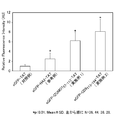
- FIGS. 4 shows a graph of fluorescence intensities for eGFP-TAT fusion protein, eGFP-HA2-TAT fusion protein, eGFP-IZUMO1 57-113 -TAT fusion protein, eGFP- CD9 113-194 -TAT fusion protein.
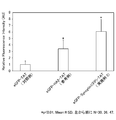
- FIG. 5 shows a graph of fluorescence intensity for eGFP-TAT fusion protein, eGFP-HA2-TAT fusion protein, eGFP-Syncytin1 (FP) -TAT fusion protein.
- fluorescence intensities in FIGS. 4 and 5 are relative fluorescence intensities of the respective fusion proteins with respect to the fluorescence intensities of “eGFP-TAT”.
- eGFP-IZUMO1 57-113 -TAT fusion protein, eGFP- CD9 113-194 -TAT fusion protein and eGFP-Syncytin1 (FP) -TAT fusion protein are significantly different from those in eGFP-TAT fusion protein. The abundance was increasing.
- eGFP-IZUMO1 57-113 -TAT fusion protein eGFP- CD9 113-194 -TAT fusion protein
- eGFP-Syncytin1 (FP) -TAT fusion protein are all more cells than eGFP-HA2-TAT fusion protein.
- the amount of internal localization increased. Therefore, IZUMO1 57-113, CD9 113-194, cell membrane permeability of the effect of Syncytin1 (FP) is higher than HA2 peptides are cell membrane permeable peptide derived from virus was confirmed.
- eGFP-IZUMO1 57-113 -TAT fusion protein has a higher intracellular fluorescence than 10 ⁇ M eGFP-HA2-TAT fusion protein even at a low concentration of 0.2 ⁇ M. It was found that the use of 57-113 can be expected to realize a more efficient drug delivery system.
- the whole cell when quenching with trypan blue, the whole cell emits red fluorescence and endosome labeling with LysoTracker cannot be performed. Therefore, the eGFP-TAT-containing fusion protein on the cell membrane surface was removed by washing with heparin / PBS. Specific operations will be described below.
- the eGFP-TAT fusion protein after purification "eGFP-TAT Preparation of containing fusion protein", eGFP-HA2-TAT fusion protein, eGFP-IZUMO1 57-113 -TAT fusion protein, eGFP-CD9 113-194 -TAT
- the fusion protein and eGFP-Syncytin1 (FP) -TAT fusion protein were added to HeLa cells, washed with heparin / PBS after 1 hour, fixed, and then observed with a confocal microscope.
- the final concentration of eGFP-TAT fusion protein is 10 ⁇ M
- the final concentration of eGFP-HA2-TAT fusion protein is 10 ⁇ M
- the final concentration of eGFP-IZUMO1 57-113 -TAT fusion protein is 1 ⁇ M.
- EGFP- CD9 113-194 -TAT fusion protein to HeLa cells so that the final concentration is 5 ⁇ M
- eGFP-Syncytin1 (FP) -TAT fusion protein is 5 ⁇ M.
- the nucleus was labeled with Hoechst, and the endosome was labeled with LysoTracker.
- an area of interest is taken for each cell, and the area where the fluorescence of eGFP in the cell is colocalized with the fluorescence of LysoTracker relative to the fluorescence of eGFP
- the ratio ie, the ratio of the area where each fusion protein is localized to the area colocalized with the endosome
- the fluorescence intensity of LysoTracker were quantified. The result is shown in FIG. As shown in FIG.
- eGFP-TAT-containing fusion proteins The peptide used as the human-derived cell membrane permeation promoting peptide is preferably shorter from the viewpoint of operability. Therefore , IZUMO1 57-75 (SEQ ID NO: 38), IZUMO1 76-94 (SEQ ID NO: 4), IZUMO1 95-113 (SEQ ID NO: 6) and IZUMO1 81-113 (SEQ ID NO: 5), the respective eGFP-TAT-containing fusion proteins are referred to as “eGFP-TAT-containing fusion proteins”.
- each fusion protein was delivered into HeLa cells, and the fluorescence intensity of eGFP incorporated into the cells was quantified.
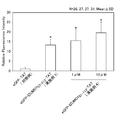
- eGFP-TAT fusion protein to a final concentration of 10 ⁇ M eGFP-IZUMO1 57-113 -TAT fusion protein to a final concentration of 1 ⁇ M
- eGFP-IZUMO1 95-113 -TAT fusion EGFP-IZUMO1 57-75 -TAT fusion protein has a final concentration of 1 ⁇ M
- eGFP-IZUMO1 76-94 -TAT fusion protein has a final concentration of 1 ⁇ M, so that the final concentration is 1 ⁇ M, or 10 ⁇ M.
- the eGFP-IZUMO1 81-113 -TAT fusion protein was added to Hela cells so that the final concentration was 1 ⁇ M or 10 ⁇ M so that the concentration was 10 ⁇ M.
- the cells were fixed 1 hour later, and the fluorescence on the cell membrane surface was quenched with trypan blue, and then observed with a confocal microscope.
- a region of interest (ROI) was taken for each cell and the fluorescence intensity of eGFP was quantified. The results are shown in FIGS.
- the eGFP-IZUMO1 81-113- TAT fusion protein is shown in Example 4
- the eGFP-IZUMO1 76-94- TAT fusion protein is shown in Example 5
- the eGFP-IZUMO1 95-113- TAT fusion protein is used.
- Example 6 The eGFP-IZUMO1 57-75 -TAT fusion protein is sometimes referred to as Comparative Example 3.
- the eGFP-IZUMO1 81-113- TAT fusion protein (Example 4) is SEQ ID NO: 39
- the eGFP-IZUMO1 76-94- TAT fusion protein (Example 5) is SEQ ID NO: 40
- eGFP-IZUMO1 95-113 is SEQ ID NO: 40
- the -TAT fusion protein (Example 6) is shown in SEQ ID NO: 41
- the eGFP-IZUMO1 57-75 -TAT fusion protein (Comparative Example 3) is shown in SEQ ID NO: 42, respectively.
- the eGFP-IZUMO1 57-75 -TAT fusion protein (Comparative Example 3) showed lower fluorescence intensity than the eGFP-TAT fusion protein (Control Example), whereas eGFP-IZUMO1 81 -113-TAT fusion protein (example 4), eGFP-IZUMO1 76-94 -TAT fusion protein (example 5), eGFP-IZUMO1 95-113 -TAT fusion protein (example 6), eGFP-TAT fusion protein (Control example) Higher fluorescence intensity was shown.
- the eGFP-IZUMO1 81-113- TAT fusion protein (Example 4) showed the highest value of about 20 times that of the eGFP-TAT fusion protein to which no peptide of IZUMO1 was added (control example). From these results, it is shown that IZUMO1 is a partial peptide consisting of amino acid residues 76-113 (SEQ ID NO: 1) having a high endosome detachment property and excellent cell membrane permeation promoting effect. It was done.
- the fragment containing a helix of 115-133 (SEQ ID NO: 7), 138-151 (SEQ ID NO: 8) or 182-190 (SEQ ID NO: 9) is also important for CD9.
- SEQ ID NO: 7 the fragment containing a helix of 115-133
- 138-151 SEQ ID NO: 8
- 182-190 SEQ ID NO: 9
- an eGFP-TAT-containing fusion protein having a nuclear localization signal sequence (NLS) added to the C-terminus hereinafter referred to as a fusion protein containing eGFP and having TAT and NLS added to the C-terminus in the present specification.
- eGFP-TAT-NLS-containing fusion protein A schematic diagram of the DNA construct of the prepared eGFP-TAT-NLS-containing fusion protein is shown in FIG.
- the meanings of “6xHis”, “FLAG”, “TCS”, and “(G 4 S) 3 ” in FIG. 10 are the same as those in FIG. "FP '" in FIG.
- eGFP-NLS fusion protein eGFP-TAT-NLS fusion protein, eGFP-HA2-TAT-NLS fusion protein, and eGFP-Syncytin1 322-340 (FP ′) -TAT -NLS fusion protein
- the product was purified under the same conditions as “eGFP” in “Preparation of eGFP fusion protein”.
- eGFP-IZUMO1 57-113- TAT-NLS fusion protein and eGFP-Syncytin1 320-340 (FP) -TAT-NLS fusion protein the insoluble fraction was added to the “eGFP- It refine
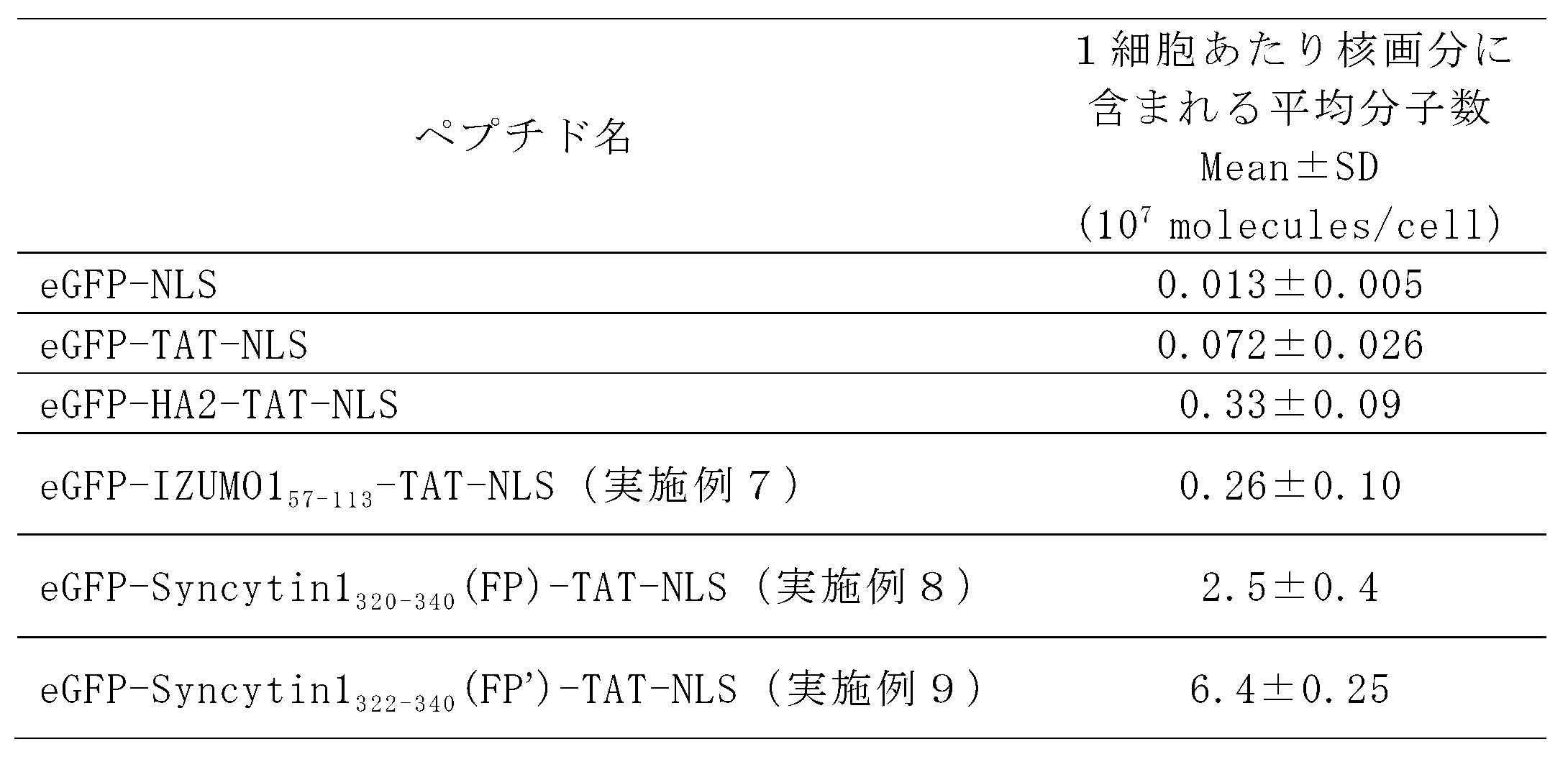
- the collected cells were solubilized using NE-PER nuclear and cytoplasmic extraction reagents (Thermo Fisher Scientific) and fractionated into a nuclear fraction and a non-nuclear fraction. Since the fusion protein remaining inside the endosome is contained in the non-nuclear fraction, the fusion protein contained in the nuclear fraction is considered to be a protein that has left the endosome. Therefore, the fusion protein contained in the nuclear fraction was quantified by Western blotting using an anti-FLAG antibody and divided by the number of cells to calculate the average number of molecules of the protein contained in the nuclear fraction per cell. The results are shown in Table 2.
- eGFP-IZUMO1 57-113 -TAT-NLS fusion protein is shown in Example 7
- eGFP-Syncytin1 320-340 (FP) -TAT-NLS fusion protein is shown in Example 8
- the ⁇ 340 (FP ′) -TAT -NLS fusion protein is sometimes referred to as Example 9.
- fusion proteins containing the partial peptides of the present invention have a high number of molecules contained in the nuclear fraction per cell and high endosome withdrawal efficiency. It was.
- the fusion protein containing FP ′ has a remarkably high number of molecules and can deliver about 20 times more molecules to the cytoplasm than “eGFP-HA2-TAT-NLS” containing HA2, which is a conventional cell membrane-permeable peptide. It was found that about 100 times as many molecules as “eGFP-TAT-NLS” can be delivered to the cytoplasm.
- eGFP-TAT-containing fusion protein ⁇ Delivery of eGFP-Syncytin1 322-340 -TAT into various human cultured cells> It was confirmed that the eGFP-TAT-containing fusion protein was taken up by human cultured cells other than HeLa cells.
- eGFP-TAT-containing fusion protein eGFP-Syncytin1 322-340 -TAT (SEQ ID NO: 45, Table 3) was used, and “eGFP-IZUMO1 57-113 -TAT fusion” in “Preparation of eGFP-TAT-containing fusion protein” above. It was prepared in the same manner as “Protein”.
- the obtained fusion protein was mixed with HeLa (human cervical cancer cell), HA431 (human epithelial cell carcinoma cell), HepG2 (human hepatoma cell), and SK-N-SH (final concentration of 5 ⁇ M). Human neuroblastoma cells).
- HeLa human cervical cancer cell
- HA431 human epithelial cell carcinoma cell
- HepG2 human hepatoma cell
- SK-N-SH final concentration of 5 ⁇ M.
- Human neuroblastoma cells Human neuroblastoma cells.
- the cells were fixed, the fluorescence on the cell membrane surface was quenched with trypan blue, and then observed with a confocal microscope. After delivery into each cell, a region of interest (ROI) was taken for each cell and the fluorescence intensity of eGFP was quantified. The result is shown in FIG.
- the eGFP-Syncytin1 322-340- TAT fusion protein is sometimes referred to as Example 10.
- the eGFP-Syncytin1 322-340 -TAT fusion protein (Example 10) showed higher fluorescence intensity than the eGFP-TAT fusion protein (control example). From this, it was shown that Syncytin1 322-340 (SEQ ID NO: 44) has a high endosome detachment property against various types of human cells and has an excellent effect of promoting cell membrane permeation.
- Syncytin1 322-340 SEQ ID NO: 44
- a SNAP tag molecular weight 19.4 kDa [Nat. Biotechnol. 21 (2003) 86-89] or ⁇ -galactosidase (molecular weight 116 kDa)
- the TAT fusion protein is the same as “eGFP-IZUMO 157-113 -TAT fusion protein” in “Preparation of eGFP-TAT-containing fusion protein” above. It was prepared by the method. Each of the obtained fusion proteins was added to HeLa cells so that the final concentration was 5 ⁇ M, and the SNAP tag and ⁇ -galactosidase ( ⁇ -Gal) incorporated into the cells were quantified according to the following method.
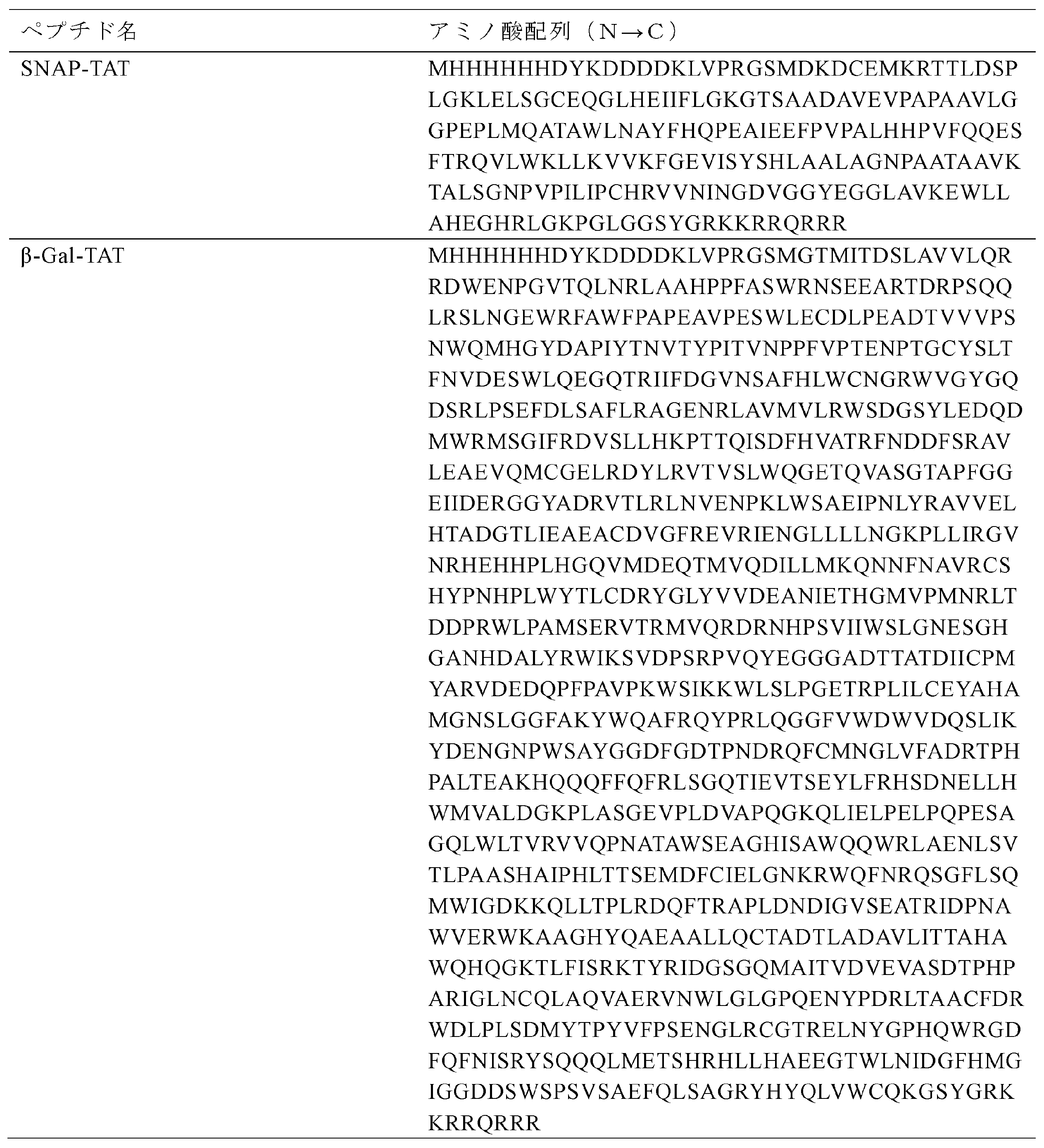
- a fusion protein using a SNAP tag instead of eGFP (SNAP-Syncytin1 322-340- TAT fusion protein, SEQ ID NO: 46, Table 3) is covalently bound to benzylguanine (BG-DY505) that has been previously fluorescently labeled.
- BG-DY505 benzylguanine
- ROI region of interest
- Example 11 A fluorescent substrate (C12-FDG) was added and the fluorescence intensity was quantified. The result is shown in FIG.
- the SNAP-Syncytin1 322-340- TAT fusion protein may be referred to as Example 11, and the ⁇ -Gal-Syncytin1 322-340- TAT fusion protein may be referred to as Example 12.
- the SNAP-Syncytin1 322-340- TAT fusion protein (Example 11) and the ⁇ -Gal-Syncytin1 322-340- TAT fusion protein (Example 12) are each added with a Syncytin1 322-340 peptide.
- the fluorescence intensity was higher than that of the SNAP-TAT fusion protein (SEQ ID NO: 48, Table 4) and ⁇ -Gal-TAT fusion protein (SEQ ID NO: 49, Table 4), which were not controlled. From these results, it was shown that Syncytin1 322-340 has a high endosome detachment property for proteins other than eGFP and has an excellent effect of promoting permeation of cell membrane.
Landscapes
- Health & Medical Sciences (AREA)
- Chemical & Material Sciences (AREA)
- Life Sciences & Earth Sciences (AREA)
- Organic Chemistry (AREA)
- Genetics & Genomics (AREA)
- General Health & Medical Sciences (AREA)
- Medicinal Chemistry (AREA)
- Engineering & Computer Science (AREA)
- Biochemistry (AREA)
- Zoology (AREA)
- Bioinformatics & Cheminformatics (AREA)
- Proteomics, Peptides & Aminoacids (AREA)
- Molecular Biology (AREA)
- Biophysics (AREA)
- Wood Science & Technology (AREA)
- Gastroenterology & Hepatology (AREA)
- Biomedical Technology (AREA)
- General Engineering & Computer Science (AREA)
- Biotechnology (AREA)
- Immunology (AREA)
- Veterinary Medicine (AREA)
- Microbiology (AREA)
- Pharmacology & Pharmacy (AREA)
- Epidemiology (AREA)
- Animal Behavior & Ethology (AREA)
- Public Health (AREA)
- Toxicology (AREA)
- Virology (AREA)
- Physics & Mathematics (AREA)
- Plant Pathology (AREA)
- Cell Biology (AREA)
- Inorganic Chemistry (AREA)
- Mycology (AREA)
- Peptides Or Proteins (AREA)
- Medicinal Preparation (AREA)
- Medicines Containing Antibodies Or Antigens For Use As Internal Diagnostic Agents (AREA)
Abstract
Description
該部分ペプチドと直接的又は間接的に結合され、かつ、細胞表面に対する結合能を有するリガンドと、
を有する、融合タンパク質又は複合タンパク質。
(a)配列番号1、2、又は3に記載のアミノ酸配列をコードする塩基配列を有するDNA
(b)配列番号1、2、又は3に記載のアミノ酸配列をコードする塩基配列に相補的な塩基配列とストリンジェントな条件下でハイブリダイズできる塩基配列を有するDNA
(c)配列番号1、2、又は3に記載のアミノ酸配列において1もしくは複数のアミノ酸が置換、欠失及び/又は付加されたアミノ酸配列をコードする塩基配列を有するDNA
(d)配列番号1、2、又は3に記載のアミノ酸配列と90%以上の相同性を有するアミノ酸配列をコードする塩基配列からなるDNA
(a)配列番号1、2、又は3に記載のアミノ酸配列をコードする塩基配列を有するDNA
(b)配列番号1、2、又は3に記載のアミノ酸配列をコードする塩基配列に相補的な塩基配列とストリンジェントな条件下でハイブリダイズできる塩基配列を有するDNA
(c)配列番号1、2、又は3に記載のアミノ酸配列において1もしくは複数のアミノ酸が置換、欠失及び/又は付加されたアミノ酸配列をコードする塩基配列を有するDNA
(d)配列番号1、2、又は3に記載のアミノ酸配列と90%以上の相同性を有するアミノ酸配列をコードする塩基配列からなるDNA
本発明の融合タンパク質又は複合タンパク質は、以下の(a)から(d)のいずれかに記載のDNAがコードするアミノ酸配列のうち少なくとも7個の連続するアミノ酸残基からなる部分ペプチドと、該部分ペプチドと直接的又は間接的に結合され、かつ、細胞表面に対する結合能を有するリガンドとを有する。
(a)配列番号1、2、又は3に記載のアミノ酸配列をコードする塩基配列を有するDNA
(b)配列番号1、2、又は3に記載のアミノ酸配列をコードする塩基配列に相補的な塩基配列とストリンジェントな条件下でハイブリダイズできる塩基配列を有するDNA
(c)配列番号1、2、又は3に記載のアミノ酸配列において1もしくは複数のアミノ酸が置換、欠失及び/又は付加されたアミノ酸配列をコードする塩基配列を有するDNA
(d)配列番号1、2、又は3に記載のアミノ酸配列と90%以上の相同性を有するアミノ酸配列をコードする塩基配列からなるDNA
本発明の融合タンパク質又は複合タンパク質における部分ペプチドは、上記(a)から(d)のいずれかに記載のDNAがコードするアミノ酸配列のうち少なくとも7個の連続するアミノ酸残基からなるペプチドである。
本発明の融合タンパク質又は複合タンパク質におけるリガンドは、細胞表面に対する結合能を有するものである。
本発明の融合タンパク質又は複合タンパク質は、生理活性を有する有効成分(以下、本明細書において、「有効成分」ということがある。)を、その分子中に含んでもよい。あるいは、本発明の融合タンパク質又は複合タンパク質が、有効成分を分子中に含まなくてもよく、この場合、例えば、細胞内送達に用いる場合に、本発明の融合タンパク質又は複合タンパク質と、有効成分(例えば、核酸等)との複合体を形成してもよい。
本発明の細胞内送達用担体は、上記の融合タンパク質又は複合タンパク質からなる。
本発明は、上記部分ペプチドからなる細胞膜透過促進剤を含む。本発明における「細胞膜透過促進」は、エンドソーム離脱性の促進を含む。
本発明は、上記(a)から(d)のいずれかに記載のDNAがコードするアミノ酸配列のうち少なくとも7個の連続するアミノ酸残基からなる部分ペプチドと、該部分ペプチドと直接的又は間接的に結合され、かつ、細胞表面に対する結合能を有するリガンドとを有する融合タンパク質、又は、上記部分ペプチドをコードするDNAを包含する。
本発明は、上記(a)から(d)のいずれかに記載のDNAがコードするアミノ酸配列のうち少なくとも7個の連続するアミノ酸残基からなる部分ペプチドと、該部分ペプチドと直接的又は間接的に結合された、細胞表面に対する結合能を有するリガンドとを有する融合タンパク質、又は、上記部分ペプチドをコードするDNAが組み込まれたベクターを包含する。
ヒト由来の細胞膜透過性を有する部分ペプチド(以下、本明細書において「ヒト由来細胞膜透過性ペプチド」ということがある。)の候補として、受精時に配偶子の認識及び融合に関係する精子側因子のタンパク質IZUMO1のN末端付近の融合コアヘリックスペプチドである「IZUMO157-113」(配列番号12)、卵子側因子のタンパク質CD9のC末端付近のテトラスパニンファミリーの特徴である3アミノ酸配列(CCG)が含まれる第2細胞外ループペプチドである「CD9113-194」(配列番号2)、及び、胎盤の合胞体性栄養膜細胞の形成に関わるタンパク質Syncytin1のヘプタッドリピート構造を含むコイルドコイル構造の部分ペプチドである「Syncytin1345-422」(配列番号13)、「Syncytin1320-340(FP)」(以下、本明細書において、「Syncytin1(FP)」ということがある。)(配列番号3)、「Syncytin1352-392(NHR)(以下、本明細書において、「Syncytin1(NHR)」ということがある。)」(配列番号14)、及び「Syncytin1407-440(CHR)(以下、本明細書において、「Syncytin1(CHR)」ということがある。)」(配列番号15)を選択した。更に、ヒト由来細胞膜透過性ペプチドの候補として、「Syncytin1(FP-NHR)」(配列番号16)、「Syncytin1(NHR-CHR)」(配列番号17)、「Syncytin1(FP-NHR-CHR)」(配列番号18)を選択した。なお、各ペプチド名に付された下付きの数字は、それぞれのペプチドを構成するアミノ酸残基について、それぞれの由来となるタンパク質においてN末端側から数えた場合のアミノ酸残基の番号である。

まず、ヒト由来細胞膜透過性ペプチドの候補が細胞膜に非選択的に結合しないことを確認するために、上記の各部分ペプチドとeGFP(高感度緑色蛍光タンパク質)との融合タンパク質(以下、本明細書において、eGFPを含む融合タンパク質を「eGFP融合タンパク質」ということがある。)を大腸菌で発現・精製し、培養細胞に添加した後のeGFPの局在を蛍光顕微鏡で観察した。作製した各種eGFP融合タンパク質のDNAコンストラクトの模式図を図2に示す。図2中、(a)は、ヒト由来膜作用性ペプチド候補のeGFP融合タンパク質(Syncytin1の部分ペプチドについては、「Syncytin1345-422」のeGFP融合タンパク質)のDNAコンストラクトの模式図を示す。(b)は、各Syncytin1ドメインの部分ペプチドのeGFP融合タンパク質のDNAコンストラクトの模式図を示す。「6xHis」、「FLAG」は、eGFP融合タンパク質の精製時に使用するTagをコードする塩基配列を示し、「TCS」は、トロンビン認識配列を示す。「(G4S)3」は、eGFPとSyncytin1(FP)との間に挿入したGGGGSをコードする塩基配列を3回繰り返したフレキシブルリンカーを示す。なお、「IZUMO157-113」をコードする塩基配列を配列番号20に示し、「CD9113-194」をコードする塩基配列を配列番号21に示し、「Syncytin1345-422」をコードする塩基配列を配列番号22に示し、「Syncytin1(FP)」をコードする塩基配列を配列番号23に示し、「Syncytin1(NHR)」をコードする塩基配列を配列番号24に示し、「Syncytin1(CHR)」をコードする塩基配列を配列番号25に示し、「Syncytin1(FP-NHR)」をコードする塩基配列を配列番号26に示し、「Syncytin1(NHR-CHR)」をコードする塩基配列を配列番号27に示し、「Syncytin1(FP-NHR-CHR)」をコードする塩基配列を配列番号28に示した。
上記「eGFP融合タンパク質の調製」において、得られた各eGFP融合タンパク質をHeLa細胞に添加し、24時間後に4%パラホルムアルデヒドで固定し、共焦点顕微鏡 FV-1000(Olympus社製)を用いてeGFPの局在の観察を行った。その結果、eGFP-B55融合タンパク質とeGFP-Syncytin1345-422融合タンパク質においては、細胞膜への強い結合が観察された。また、eGFP-CD9113-194融合タンパク質、eGFP-Syncytin1(FP)融合タンパク質、eGFP-Syncytin1(CHR)融合タンパク質、及びeGFP-Syncytin1(NHR-CHR)融合タンパク質では細胞膜への弱い結合が観察された。それ以外の融合タンパク質(eGFP-IZUMO157-113融合タンパク質、eGFP-Syncytin1(NHR)融合タンパク質、eGFP-Syncytin1(FP-NHR)融合タンパク質、及びeGFP-Syncytin1(FP-NHR-CHR)融合タンパク質)については、細胞膜への結合は全く見られなかった。
上記結合性の観察試験において、eGFP-Syncytin1345-422以外のヒト由来細胞膜透過性ペプチドの融合タンパク質については、細胞膜への強い結合が見られなかった。これを踏まえて、細胞膜と相互作用するカチオン性のTATペプチド(配列番号29、YGRKKRRQRRR)をC末端に付加したeGFP融合タンパク質(以下、本明細書において、eGFPを含み、かつ、C末端にTATが付加された融合タンパク質を「eGFP-TAT含有融合タンパク質」ということがある。)を調製し、TATを介して非選択的に細胞に取り込まれたeGFPのエンドソーム離脱をヒト由来ペプチドが促進するかどうかの検証を行った。なお、細胞膜透過性ペプチドのポジティブコントロールとしてインフルエンザウイルス由来のHA2ペプチド(配列番号30、GLFEAIEGFIENGWEGMIDGWYG)を、調製した。作製したeGFP-TAT含有融合タンパク質のDNAコンストラクトの模式図を図3に示す。図3中、(a)は、eGFP-TAT融合タンパク質、及び、HA2、又は、ヒト由来細胞膜透過性ペプチド候補(Syncytin1以外)を含むeGFP-TAT含有融合タンパク質のDNAコンストラクトの模式図を示す。(b)は、各Syncytin1ドメインの部分ペプチドのeGFP-TAT含有融合タンパク質のDNAコンストラクトの模式図を示す。図3中、「6xHis」、「FLAG」は、eGFP融合タンパク質の精製時に使用するTagをコードする塩基配列を示し、「TCS」は、トロンビン認識配列を示す。「(G4S)3」は、eGFPとSyncytin1(FP)との間に挿入したGGGGSをコードする塩基配列を3回繰り返したフレキシブルリンカーを示す。これらのeGFP-TAT含有融合タンパク質は、上記「eGFP融合タンパク質の調製」と同じ条件で発現を行った。その後、eGFP-TAT融合タンパク質、eGFP-HA2-TAT融合タンパク質、eGFP-CD9113-194-TAT融合タンパク質、eGFP-Syncytin1(NHR)-TAT融合タンパク質、及びeGFP-Syncytin1(CHR)-TAT融合タンパク質については、可溶性画分を、上記「eGFP融合タンパク質の調製」における「eGFP」と同じ条件で精製した。また、eGFP-IZUMO157-113-TAT融合タンパク質及びeGFP-Syncytin1(FP)-TAT融合タンパク質については、不溶性画分を、上記「eGFP融合タンパク質の調製」における「eGFP-B55」と同じ条件で精製した。なお、本明細書及び図面において、eGFP-TAT融合タンパク質を対照例、eGFP-HA2-TAT融合タンパク質を参考例、eGFP-IZUMO157-113-TAT融合タンパク質を実施例1、eGFP-CD9113-194-TAT融合タンパク質を実施例2、eGFP-Syncytin1(FP)-TAT融合タンパク質を実施例3、eGFP-Syncytin1(NHR)-TAT融合タンパク質を比較例1、eGFP-Syncytin1(CHR)-TAT融合タンパク質を比較例2ということがある。また、eGFP-TAT融合タンパク質(対照例)のアミノ酸配列を配列番号31に、eGFP-HA2-TAT融合タンパク質(参考例)のアミノ酸配列を配列番号32に、eGFP-IZUMO157-113-TAT融合タンパク質(実施例1)のアミノ酸配列を配列番号33に、eGFP-CD9113-194-TAT融合タンパク質(実施例2)のアミノ酸配列を配列番号34に、eGFP-Syncytin1(FP)-TAT融合タンパク質(実施例3)のアミノ酸配列を配列番号35に、eGFP-Syncytin1(NHR)-TAT融合タンパク質(比較例1)のアミノ酸配列を配列番号36に、eGFP-Syncytin1(CHR)-TAT融合タンパク質(比較例2)のアミノ酸配列を配列番号37にそれぞれ示す。
上記「eGFP-TAT含有融合タンパク質の調製」において、得られた各eGFP-TAT含有融合タンパク質をHeLa細胞へ添加し、1時間後に固定し、トリパンブルーを用いて細胞膜表面の蛍光を消光後、共焦点顕微鏡で観察した。この際、eGFP-TAT融合タンパク質は終濃度が10μMとなるように、eGFP-HA2-TAT融合タンパク質は終濃度が10μMとなるように、eGFP-IZUMO157-113-TAT融合タンパク質は終濃度が0.2μMとなるように、eGFP-CD9113-194-TAT融合タンパク質は終濃度が5μMとなるように、eGFP-Syncytin1(FP)-TAT融合タンパク質は終濃度が10μMとなるように、eGFP-Syncytin1(NHR)-TAT融合タンパク質は終濃度が10μMとなるように、eGFP-Syncytin1(CHR)-TAT融合タンパク質は終濃度が10μMとなるようにHeLa細胞へ添加した。
上記「eGFP-TAT含有融合タンパク質の細胞内への送達後の共焦点顕微鏡による観察及び蛍光強度の測定」により、IZUMO157-113、CD9113-194及びSyncytin1(FP)について細胞膜透過促進ペプチドとしての機能が示唆された。これらのeGFP-TAT含有融合タンパク質が、エンドソームを離脱していることを確認するために、エンドソームをLysoTracker Red DND-99(Life Technologies)により染色し、各eGFP-TAT含有融合タンパク質との共局在解析を行った。なお、トリパンブルーによる消光を行うと細胞全体が赤色の蛍光を発し、LysoTrackerによるエンドソームの標識はできないため、heparin/PBSで洗浄することで細胞膜表面のeGFP-TAT含有融合タンパク質の除去を行った。具体的な操作を以下に説明する。
ヒト由来細胞膜透過促進ペプチドとして使用するペプチドは、操作性の観点ではより短い方が好ましいため、最も細胞膜透過効率が高かったIZUMO157-113について、更に短く断片化したペプチドIZUMO157-75(配列番号38)、IZUMO176-94(配列番号4)、IZUMO195-113(配列番号6)及びIZUMO181-113(配列番号5)について各eGFP-TAT含有融合タンパク質を上記「eGFP-TAT含有融合タンパク質の調製」における「eGFP-IZUMO157-113-TAT融合タンパク質」と同様の方法で調製し、HeLa細胞内に、それぞれの融合タンパク質を送達し、細胞内に取り込まれたeGFPの蛍光強度を定量した。より具体的には、eGFP-TAT融合タンパク質は終濃度が10μMとなるように、eGFP-IZUMO157-113-TAT融合タンパク質は終濃度が1μMとなるように、eGFP-IZUMO195-113-TAT融合タンパク質は終濃度が1μMとなるように、eGFP-IZUMO157-75-TAT融合タンパク質は終濃度が1μM、又は10μMとなるように、eGFP-IZUMO176-94-TAT融合タンパク質は終濃度が1μM、又は10μMとなるように、eGFP-IZUMO181-113-TAT融合タンパク質は終濃度が1μM又は10μMとなるように、Hela細胞に添加した。HeLa細胞へ添加してから1時間後に固定し、細胞膜表面の蛍光をトリパンブルーにより消光した後、共焦点顕微鏡で観察を行った。それぞれの融合タンパク質のHela細胞内に送達後に、1細胞ごとに関心領域(ROI)を取り、eGFPの蛍光強度を定量化した。その結果を図7、8に示す。なお、本明細書及び図面において、eGFP-IZUMO181-113-TAT融合タンパク質を実施例4、eGFP-IZUMO176-94-TAT融合タンパク質を実施例5、eGFP-IZUMO195-113-TAT融合タンパク質を実施例6、eGFP-IZUMO157-75-TAT融合タンパク質を比較例3ということがある。また、eGFP-IZUMO181-113-TAT融合タンパク質(実施例4)を配列番号39に、eGFP-IZUMO176-94-TAT融合タンパク質(実施例5)を配列番号40に、eGFP-IZUMO195-113-TAT融合タンパク質(実施例6)を配列番号41に、eGFP-IZUMO157-75-TAT融合タンパク質(比較例3)を配列番号42に、それぞれ示す。
3種類のヒトタンパク質由来の細胞膜透過促進ペプチドを含む領域IZUMO157-113、CD9113-194、及びSyncytin1320-440について、二次構造予測サーバJPred4(http://www.compbio.dundee.ac.uk/jpred4/)を用いて、ヘリックスやβシート、コイル等の二次構造の予測を行った。その結果を、図9に示す。図9中、Hはそれぞれのペプチドにおいてヘリックスを構成する部分である。図9に示すように、IZUMO1は2本のヘリックス、CD9とSyncytin1は3本のヘリックスに分かれたことが確認された。上記のIZUMO1のペプチド配列の断片化の実験では、IZUMO1については後半のアミノ酸残基である81-110残基のヘリックス部分と、Syncytin1については前半のアミノ酸残基である321-334残基(配列番号10)のヘリックス部分を含む断片が高い細胞膜透過効率を示したことから、これらのヘリックス構造が細胞膜との相互作用に重要であることが示唆された。更に、IZUMO1とSyncytin1と同様に、CD9についても115-133(配列番号7)、138-151(配列番号8)又は182-190残基(配列番号9)のヘリックスを含む断片が重要であることが示唆された。
上記「エンドソーム離脱能検証」のとおり、eGFP-TAT含有融合タンパク質は、エンドソームから離脱していることが確認された。更に、eGFP-TAT含有融合タンパク質のエンドソーム離脱効率を定量するために、下記試験を行った。
eGFP-TAT含有融合タンパク質がHeLa細胞以外のヒト培養細胞にも取り込まれることを確認した。まず、eGFP-TAT含有融合タンパク質として、eGFP-Syncytin1322-340-TAT(配列番号45、表3)を、上記「eGFP-TAT含有融合タンパク質の調製」における「eGFP-IZUMO157-113-TAT融合タンパク質」と同様の方法で調製した。得られた融合タンパク質を、終濃度が5μMとなるように、HeLa(ヒト子宮頸癌細胞)、HA431(ヒト上皮様細胞癌細胞)、HepG2(ヒト肝癌細胞)、及び、SK-N-SH(ヒト神経芽腫細胞)に添加した。添加の1時間後に細胞を固定してから、細胞膜表面の蛍光をトリパンブルーにより消光した後、共焦点顕微鏡で観察を行った。それぞれの細胞内に送達後に、1細胞ごとに関心領域(ROI)を取り、eGFPの蛍光強度を定量化した。その結果を図11に示す。なお、本明細書及び図面において、eGFP-Syncytin1322-340-TAT融合タンパク質を実施例10ということがある。
Syncytin1322-340(配列番号44)がeGFP以外のタンパク質のエンドソーム離脱を促進できるかどうか検証した。具体的には、eGFPの代わりに、SNAPタグ(分子量19.4kDa)[Nat. Biotechnol. 21(2003)86-89]又はβ-ガラクトシダーゼ(分子量116kDa)を使用し、TAT融合タンパク質を上記「eGFP-TAT含有融合タンパク質の調製」における「eGFP-IZUMO157-113-TAT融合タンパク質」と同様の方法で調製した。得られた各融合タンパク質を、終濃度が5μMとなるように、HeLa細胞に添加し、細胞内に取り込まれたSNAPタグ及びβ-ガラクトシダーゼ(β-Gal)を下記の方法にしたがい、定量した。

Claims (8)
- 以下の(a)から(d)のいずれかに記載のDNAがコードするアミノ酸配列のうち少なくとも7個の連続するアミノ酸残基からなる部分ペプチドと、
該部分ペプチドと直接的又は間接的に結合され、かつ、細胞表面に対する結合能を有するリガンドと、
を有する、融合タンパク質又は複合タンパク質。
(a)配列番号1、2、又は3に記載のアミノ酸配列をコードする塩基配列を有するDNA
(b)配列番号1、2、又は3に記載のアミノ酸配列をコードする塩基配列に相補的な塩基配列とストリンジェントな条件下でハイブリダイズできる塩基配列を有するDNA
(c)配列番号1、2、又は3に記載のアミノ酸配列において1もしくは複数のアミノ酸が置換、欠失及び/又は付加されたアミノ酸配列をコードする塩基配列を有するDNA
(d)配列番号1、2、又は3に記載のアミノ酸配列と90%以上の相同性を有するアミノ酸配列をコードする塩基配列からなるDNA - 前記リガンドが、抗体である、請求項1に記載の融合タンパク質又は複合タンパク質。
- 請求項1又は2に記載の融合タンパク質。
- 請求項1又は2に記載の融合タンパク質又は複合タンパク質からなる、細胞内送達用担体。
- 以下の(a)から(d)のいずれかに記載のDNAがコードするアミノ酸配列のうち少なくとも7個の連続するアミノ酸残基からなる部分ペプチド。
(a)配列番号1、2、又は3に記載のアミノ酸配列をコードする塩基配列を有するDNA
(b)配列番号1、2、又は3に記載のアミノ酸配列をコードする塩基配列に相補的な塩基配列とストリンジェントな条件下でハイブリダイズできる塩基配列を有するDNA
(c)配列番号1、2、又は3に記載のアミノ酸配列において1もしくは複数のアミノ酸が置換、欠失及び/又は付加されたアミノ酸配列をコードする塩基配列を有するDNA
(d)配列番号1、2、又は3に記載のアミノ酸配列と90%以上の相同性を有するアミノ酸配列をコードする塩基配列からなるDNA - 請求項5に記載の部分ペプチドからなる細胞膜透過促進剤。
- 請求項1又は2に記載の融合タンパク質又は請求項5に記載の部分ペプチドをコードするDNA。
- 請求項7に記載のDNAが組み込まれたベクター。
Priority Applications (3)
| Application Number | Priority Date | Filing Date | Title |
|---|---|---|---|
| US15/735,108 US11535654B2 (en) | 2015-06-11 | 2016-06-02 | Fusion protein or conjugated protein, intracellular delivery carrier, partial peptide, cell membrane permeation enhancer, DNA, and vector |
| JP2017523606A JP6864364B2 (ja) | 2015-06-11 | 2016-06-02 | 融合タンパク質又は複合タンパク質、細胞内送達用担体、部分ペプチド、細胞膜透過促進剤、dna、及びベクター |
| EP16807381.5A EP3309178A4 (en) | 2015-06-11 | 2016-06-02 | FUSION PROTEIN OR CONJUGATED PROTEIN, CARRIER FOR INTRA-CELLULAR DELIVERY, PARTICLE PEPTIDE, CELL MEMBRANE PERMEATION AMPLIFIER, DNA AND VECTOR |
Applications Claiming Priority (2)
| Application Number | Priority Date | Filing Date | Title |
|---|---|---|---|
| JP2015-118432 | 2015-06-11 | ||
| JP2015118432 | 2015-06-11 |
Publications (1)
| Publication Number | Publication Date |
|---|---|
| WO2016199674A1 true WO2016199674A1 (ja) | 2016-12-15 |
Family
ID=57503622
Family Applications (1)
| Application Number | Title | Priority Date | Filing Date |
|---|---|---|---|
| PCT/JP2016/066455 Ceased WO2016199674A1 (ja) | 2015-06-11 | 2016-06-02 | 融合タンパク質又は複合タンパク質、細胞内送達用担体、部分ペプチド、細胞膜透過促進剤、dna、及びベクター |
Country Status (4)
| Country | Link |
|---|---|
| US (1) | US11535654B2 (ja) |
| EP (1) | EP3309178A4 (ja) |
| JP (1) | JP6864364B2 (ja) |
| WO (1) | WO2016199674A1 (ja) |
Cited By (3)
| Publication number | Priority date | Publication date | Assignee | Title |
|---|---|---|---|---|
| JP2019527238A (ja) * | 2016-06-06 | 2019-09-26 | アスクリピウム タイワン シーオー., エルティーディー.Asclepiumm Taiwan Co., Ltd. | 薬物送達のための抗体融合タンパク質 |
| WO2023008337A1 (ja) | 2021-07-26 | 2023-02-02 | ピューロテックバイオ株式会社 | 宿主因子lipgをターゲットとした抗b型肝炎ウイルス剤 |
| WO2025023312A1 (ja) * | 2023-07-26 | 2025-01-30 | 株式会社高研 | コラーゲン結合型膜透過性ペプチド、並びに、該ペプチド及びコラーゲン若しくはコラーゲン誘導体を含む運搬体 |
Citations (2)
| Publication number | Priority date | Publication date | Assignee | Title |
|---|---|---|---|---|
| WO2002004678A2 (en) * | 2000-07-07 | 2002-01-17 | Genetics Institute, Llc. | Methods and compositions for diagnosing and treating preeclampsia and gestational trophoblast disorders |
| JP2009539410A (ja) * | 2006-06-12 | 2009-11-19 | セントカー・インコーポレーテツド | Rantesプロキシレベルに基づくil−16活性およびil−16活性の調節を検出する方法 |
Family Cites Families (3)
| Publication number | Priority date | Publication date | Assignee | Title |
|---|---|---|---|---|
| EP0903408A3 (en) | 1992-08-21 | 2005-11-02 | Biogen, Inc. | Tat-derived transport polypeptide |
| US20070249808A1 (en) * | 2000-10-30 | 2007-10-25 | Bernard Conrad | Multiple Sclerosis-related superantigen |
| ES2347445T3 (es) * | 2004-03-30 | 2010-10-29 | Institut Gustave Roussy | Secuencia polipeptidica implicada en la modulacion del efecto inmunosupresor de las proteinas viricas. |
-
2016
- 2016-06-02 EP EP16807381.5A patent/EP3309178A4/en active Pending
- 2016-06-02 US US15/735,108 patent/US11535654B2/en active Active
- 2016-06-02 JP JP2017523606A patent/JP6864364B2/ja active Active
- 2016-06-02 WO PCT/JP2016/066455 patent/WO2016199674A1/ja not_active Ceased
Patent Citations (2)
| Publication number | Priority date | Publication date | Assignee | Title |
|---|---|---|---|---|
| WO2002004678A2 (en) * | 2000-07-07 | 2002-01-17 | Genetics Institute, Llc. | Methods and compositions for diagnosing and treating preeclampsia and gestational trophoblast disorders |
| JP2009539410A (ja) * | 2006-06-12 | 2009-11-19 | セントカー・インコーポレーテツド | Rantesプロキシレベルに基づくil−16活性およびil−16活性の調節を検出する方法 |
Non-Patent Citations (2)
| Title |
|---|
| INOUE, N. ET AL.: "The immunoglobulin superfamily protein Izumo is required for sperm to fuse with eggs", NATURE, vol. 434, 2005, pages 234 - 238, XP002994757, ISSN: 0028-0836 * |
| See also references of EP3309178A4 * |
Cited By (6)
| Publication number | Priority date | Publication date | Assignee | Title |
|---|---|---|---|---|
| JP2019527238A (ja) * | 2016-06-06 | 2019-09-26 | アスクリピウム タイワン シーオー., エルティーディー.Asclepiumm Taiwan Co., Ltd. | 薬物送達のための抗体融合タンパク質 |
| JP7239987B2 (ja) | 2016-06-06 | 2023-03-15 | アスクリピウム タイワン シーオー., エルティーディー. | 薬物送達のための抗体融合タンパク質 |
| WO2023008337A1 (ja) | 2021-07-26 | 2023-02-02 | ピューロテックバイオ株式会社 | 宿主因子lipgをターゲットとした抗b型肝炎ウイルス剤 |
| WO2025023312A1 (ja) * | 2023-07-26 | 2025-01-30 | 株式会社高研 | コラーゲン結合型膜透過性ペプチド、並びに、該ペプチド及びコラーゲン若しくはコラーゲン誘導体を含む運搬体 |
| JPWO2025023312A1 (ja) * | 2023-07-26 | 2025-01-30 | ||
| JP7725041B2 (ja) | 2023-07-26 | 2025-08-19 | 株式会社高研 | コラーゲン結合型膜透過性ペプチド、並びに、該ペプチド及びコラーゲン若しくはコラーゲン誘導体を含む運搬体 |
Also Published As
| Publication number | Publication date |
|---|---|
| EP3309178A4 (en) | 2019-05-08 |
| JPWO2016199674A1 (ja) | 2018-05-24 |
| US20180237482A1 (en) | 2018-08-23 |
| US11535654B2 (en) | 2022-12-27 |
| EP3309178A1 (en) | 2018-04-18 |
| JP6864364B2 (ja) | 2021-04-28 |
Similar Documents
| Publication | Publication Date | Title |
|---|---|---|
| Limoni et al. | Engineered exosomes for targeted transfer of siRNA to HER2 positive breast cancer cells | |
| Nakase et al. | Arginine-rich cell-penetrating peptide-modified extracellular vesicles for active macropinocytosis induction and efficient intracellular delivery | |
| JP7007423B2 (ja) | 細胞透過性ペプチド、それを含んだコンジュゲート、及びそれを含んだ組成物 | |
| JP7041187B2 (ja) | 細胞透過性ペプチド、それを含んだコンジュゲート、及びそれを含んだ組成物 | |
| Jiang et al. | GRP78-targeted ferritin nanocaged ultra-high dose of doxorubicin for hepatocellular carcinoma therapy | |
| Xiao et al. | A covalent peptide-based lysosome-targeting protein degradation platform for cancer immunotherapy | |
| Winkler et al. | EpCAM-targeted delivery of nanocomplexed siRNA to tumor cells with designed ankyrin repeat proteins | |
| Subramanian et al. | Target-specific delivery of doxorubicin to retinoblastoma using epithelial cell adhesion molecule aptamer | |
| CN101395180B (zh) | 用作细胞穿膜肽的肽 | |
| Johansson et al. | The soluble form of the tumor suppressor Lrig1 potently inhibits in vivo glioma growth irrespective of EGF receptor status | |
| AU2019216781B2 (en) | Nanoparticle-hydrogel composite for nucleic acid molecule delivery | |
| Sung et al. | The importance of valency in enhancing the import and cell routing potential of protein transduction domain-containing molecules | |
| Vadevoo et al. | IL4 receptor targeting enables nab-paclitaxel to enhance reprogramming of M2-type macrophages into M1-like phenotype via ROS-HMGB1-TLR4 axis and inhibition of tumor growth and metastasis | |
| US20190359669A1 (en) | Cell-permeable (icp)-socs3 recombinant protein and uses thereof | |
| CN104822698A (zh) | 细胞穿透肽以及包含该肽的缀合物和组合物 | |
| CN104768967A (zh) | 细胞穿透性肽、包含该肽的缀合物、及包含该缀合物的组合物 | |
| Beloor et al. | Cationic cell-penetrating peptides as vehicles for siRNA delivery | |
| Li et al. | A novel dendritic nanocarrier of polyamidoamine-polyethylene glycol-cyclic RGD for “smart” small interfering RNA delivery and in vitro antitumor effects by human ether-à-go-go-related gene silencing in anaplastic thyroid carcinoma cells | |
| Mie et al. | Development of drug-loaded protein nanoparticles displaying enzymatically-conjugated DNA aptamers for cancer cell targeting | |
| Reshadmanesh et al. | Evaluation of cellular and transcriptional targeting of breast cancer stem cells via anti-HER2 nanobody conjugated PAMAM dendrimers | |
| US20220213158A1 (en) | CHIMERIC PROTEINS FOR TARGETING dsRNA | |
| Choi et al. | Efficient siRNA delivery into tumor cells by p19-YSA fusion protein | |
| JP6864364B2 (ja) | 融合タンパク質又は複合タンパク質、細胞内送達用担体、部分ペプチド、細胞膜透過促進剤、dna、及びベクター | |
| Huang et al. | RGD4C peptide mediates anti-p21Ras scFv entry into tumor cells and produces an inhibitory effect on the human colon cancer cell line SW480 | |
| Luna Velez et al. | Delivery of antisense oligonucleotides for splice‐correction of androgen receptor pre‐mRNA in castration‐resistant prostate cancer models using cell‐penetrating peptides |
Legal Events
| Date | Code | Title | Description |
|---|---|---|---|
| 121 | Ep: the epo has been informed by wipo that ep was designated in this application |
Ref document number: 16807381 Country of ref document: EP Kind code of ref document: A1 |
|
| ENP | Entry into the national phase |
Ref document number: 2017523606 Country of ref document: JP Kind code of ref document: A |
|
| WWE | Wipo information: entry into national phase |
Ref document number: 15735108 Country of ref document: US |
|
| NENP | Non-entry into the national phase |
Ref country code: DE |
|
| WWE | Wipo information: entry into national phase |
Ref document number: 2016807381 Country of ref document: EP |