WO2016208735A1 - 塗膜 - Google Patents
塗膜 Download PDFInfo
- Publication number
- WO2016208735A1 WO2016208735A1 PCT/JP2016/068871 JP2016068871W WO2016208735A1 WO 2016208735 A1 WO2016208735 A1 WO 2016208735A1 JP 2016068871 W JP2016068871 W JP 2016068871W WO 2016208735 A1 WO2016208735 A1 WO 2016208735A1
- Authority
- WO
- WIPO (PCT)
- Prior art keywords
- coating film
- group
- metal oxide
- coating
- less
- Prior art date
- Legal status (The legal status is an assumption and is not a legal conclusion. Google has not performed a legal analysis and makes no representation as to the accuracy of the status listed.)
- Ceased
Links
Images
Classifications
-
- B—PERFORMING OPERATIONS; TRANSPORTING
- B05—SPRAYING OR ATOMISING IN GENERAL; APPLYING FLUENT MATERIALS TO SURFACES, IN GENERAL
- B05D—PROCESSES FOR APPLYING FLUENT MATERIALS TO SURFACES, IN GENERAL
- B05D3/00—Pretreatment of surfaces to which liquids or other fluent materials are to be applied; After-treatment of applied coatings, e.g. intermediate treating of an applied coating preparatory to subsequent applications of liquids or other fluent materials
- B05D3/02—Pretreatment of surfaces to which liquids or other fluent materials are to be applied; After-treatment of applied coatings, e.g. intermediate treating of an applied coating preparatory to subsequent applications of liquids or other fluent materials by baking
- B05D3/0254—After-treatment
-
- B—PERFORMING OPERATIONS; TRANSPORTING
- B05—SPRAYING OR ATOMISING IN GENERAL; APPLYING FLUENT MATERIALS TO SURFACES, IN GENERAL
- B05D—PROCESSES FOR APPLYING FLUENT MATERIALS TO SURFACES, IN GENERAL
- B05D5/00—Processes for applying liquids or other fluent materials to surfaces to obtain special surface effects, finishes or structures
- B05D5/08—Processes for applying liquids or other fluent materials to surfaces to obtain special surface effects, finishes or structures to obtain an anti-friction or anti-adhesive surface
-
- C—CHEMISTRY; METALLURGY
- C08—ORGANIC MACROMOLECULAR COMPOUNDS; THEIR PREPARATION OR CHEMICAL WORKING-UP; COMPOSITIONS BASED THEREON
- C08K—Use of inorganic or non-macromolecular organic substances as compounding ingredients
- C08K3/00—Use of inorganic substances as compounding ingredients
- C08K3/18—Oxygen-containing compounds, e.g. metal carbonyls
- C08K3/20—Oxides; Hydroxides
- C08K3/22—Oxides; Hydroxides of metals
-
- C—CHEMISTRY; METALLURGY
- C09—DYES; PAINTS; POLISHES; NATURAL RESINS; ADHESIVES; COMPOSITIONS NOT OTHERWISE PROVIDED FOR; APPLICATIONS OF MATERIALS NOT OTHERWISE PROVIDED FOR
- C09D—COATING COMPOSITIONS, e.g. PAINTS, VARNISHES OR LACQUERS; FILLING PASTES; CHEMICAL PAINT OR INK REMOVERS; INKS; CORRECTING FLUIDS; WOODSTAINS; PASTES OR SOLIDS FOR COLOURING OR PRINTING; USE OF MATERIALS THEREFOR
- C09D5/00—Coating compositions, e.g. paints, varnishes or lacquers, characterised by their physical nature or the effects produced; Filling pastes
- C09D5/02—Emulsion paints including aerosols
-
- C—CHEMISTRY; METALLURGY
- C09—DYES; PAINTS; POLISHES; NATURAL RESINS; ADHESIVES; COMPOSITIONS NOT OTHERWISE PROVIDED FOR; APPLICATIONS OF MATERIALS NOT OTHERWISE PROVIDED FOR
- C09D—COATING COMPOSITIONS, e.g. PAINTS, VARNISHES OR LACQUERS; FILLING PASTES; CHEMICAL PAINT OR INK REMOVERS; INKS; CORRECTING FLUIDS; WOODSTAINS; PASTES OR SOLIDS FOR COLOURING OR PRINTING; USE OF MATERIALS THEREFOR
- C09D5/00—Coating compositions, e.g. paints, varnishes or lacquers, characterised by their physical nature or the effects produced; Filling pastes
- C09D5/16—Antifouling paints; Underwater paints
- C09D5/1606—Antifouling paints; Underwater paints characterised by the anti-fouling agent
- C09D5/1612—Non-macromolecular compounds
- C09D5/1618—Non-macromolecular compounds inorganic
-
- C—CHEMISTRY; METALLURGY
- C09—DYES; PAINTS; POLISHES; NATURAL RESINS; ADHESIVES; COMPOSITIONS NOT OTHERWISE PROVIDED FOR; APPLICATIONS OF MATERIALS NOT OTHERWISE PROVIDED FOR
- C09D—COATING COMPOSITIONS, e.g. PAINTS, VARNISHES OR LACQUERS; FILLING PASTES; CHEMICAL PAINT OR INK REMOVERS; INKS; CORRECTING FLUIDS; WOODSTAINS; PASTES OR SOLIDS FOR COLOURING OR PRINTING; USE OF MATERIALS THEREFOR
- C09D7/00—Features of coating compositions, not provided for in group C09D5/00; Processes for incorporating ingredients in coating compositions
- C09D7/40—Additives
- C09D7/60—Additives non-macromolecular
- C09D7/61—Additives non-macromolecular inorganic
-
- C—CHEMISTRY; METALLURGY
- C09—DYES; PAINTS; POLISHES; NATURAL RESINS; ADHESIVES; COMPOSITIONS NOT OTHERWISE PROVIDED FOR; APPLICATIONS OF MATERIALS NOT OTHERWISE PROVIDED FOR
- C09D—COATING COMPOSITIONS, e.g. PAINTS, VARNISHES OR LACQUERS; FILLING PASTES; CHEMICAL PAINT OR INK REMOVERS; INKS; CORRECTING FLUIDS; WOODSTAINS; PASTES OR SOLIDS FOR COLOURING OR PRINTING; USE OF MATERIALS THEREFOR
- C09D7/00—Features of coating compositions, not provided for in group C09D5/00; Processes for incorporating ingredients in coating compositions
- C09D7/40—Additives
- C09D7/66—Additives characterised by particle size
-
- F—MECHANICAL ENGINEERING; LIGHTING; HEATING; WEAPONS; BLASTING
- F21—LIGHTING
- F21S—NON-PORTABLE LIGHTING DEVICES; SYSTEMS THEREOF; VEHICLE LIGHTING DEVICES SPECIALLY ADAPTED FOR VEHICLE EXTERIORS
- F21S41/00—Illuminating devices specially adapted for vehicle exteriors, e.g. headlamps
- F21S41/10—Illuminating devices specially adapted for vehicle exteriors, e.g. headlamps characterised by the light source
- F21S41/14—Illuminating devices specially adapted for vehicle exteriors, e.g. headlamps characterised by the light source characterised by the type of light source
- F21S41/141—Light emitting diodes [LED]
-
- F—MECHANICAL ENGINEERING; LIGHTING; HEATING; WEAPONS; BLASTING
- F21—LIGHTING
- F21S—NON-PORTABLE LIGHTING DEVICES; SYSTEMS THEREOF; VEHICLE LIGHTING DEVICES SPECIALLY ADAPTED FOR VEHICLE EXTERIORS
- F21S43/00—Signalling devices specially adapted for vehicle exteriors, e.g. brake lamps, direction indicator lights or reversing lights
- F21S43/10—Signalling devices specially adapted for vehicle exteriors, e.g. brake lamps, direction indicator lights or reversing lights characterised by the light source
- F21S43/13—Signalling devices specially adapted for vehicle exteriors, e.g. brake lamps, direction indicator lights or reversing lights characterised by the light source characterised by the type of light source
- F21S43/14—Light emitting diodes [LED]
-
- F—MECHANICAL ENGINEERING; LIGHTING; HEATING; WEAPONS; BLASTING
- F21—LIGHTING
- F21V—FUNCTIONAL FEATURES OR DETAILS OF LIGHTING DEVICES OR SYSTEMS THEREOF; STRUCTURAL COMBINATIONS OF LIGHTING DEVICES WITH OTHER ARTICLES, NOT OTHERWISE PROVIDED FOR
- F21V3/00—Globes; Bowls; Cover glasses
- F21V3/04—Globes; Bowls; Cover glasses characterised by materials, surface treatments or coatings
-
- B—PERFORMING OPERATIONS; TRANSPORTING
- B05—SPRAYING OR ATOMISING IN GENERAL; APPLYING FLUENT MATERIALS TO SURFACES, IN GENERAL
- B05D—PROCESSES FOR APPLYING FLUENT MATERIALS TO SURFACES, IN GENERAL
- B05D2601/00—Inorganic fillers
- B05D2601/20—Inorganic fillers used for non-pigmentation effect
- B05D2601/22—Silica
-
- Y—GENERAL TAGGING OF NEW TECHNOLOGICAL DEVELOPMENTS; GENERAL TAGGING OF CROSS-SECTIONAL TECHNOLOGIES SPANNING OVER SEVERAL SECTIONS OF THE IPC; TECHNICAL SUBJECTS COVERED BY FORMER USPC CROSS-REFERENCE ART COLLECTIONS [XRACs] AND DIGESTS
- Y10—TECHNICAL SUBJECTS COVERED BY FORMER USPC
- Y10T—TECHNICAL SUBJECTS COVERED BY FORMER US CLASSIFICATION
- Y10T428/00—Stock material or miscellaneous articles
- Y10T428/25—Web or sheet containing structurally defined element or component and including a second component containing structurally defined particles
Definitions
- the present invention relates to a coating film and a production method thereof, use of a coating composition, a functional member, an LED traffic light, an LED headlamp, an LED lens, a headlamp, and an outdoor display board.
- a technique for applying a coating agent made of an organic-inorganic composite material is known for the purpose of imparting antifouling property (self-cleaning) to members used outdoors such as automobiles and roofing materials (for example, patents) Reference 1 and 2).
- the nature of snow varies depending on the region or season in which the material is used. For example, the ease of snowfall of snow itself is greatly different between fluttered snow that contains a lot of moisture and powdered snow that contains little moisture. Although it is possible to change the coating film used depending on the region, it is difficult to change the coating film depending on the season, so there is a need for a coating film that can impart snow sliding properties independent of the nature of the snow to the member. Yes.
- an object of the present invention is to provide a coating film excellent in antifouling property and adhesion.
- the present inventors have found that a coating film containing a metal oxide and polymer particles and having a ten-point average roughness (Rz) within a specific range is prevented.
- the present inventors have found that the present invention is excellent in dirtiness and adhesion, and have completed the present invention.
- the present invention is as follows.
- the arithmetic average roughness with respect to the ten-point average roughness is 0.0 or more and 3.0 or less, The coating film according to [1].
- [3] The water contact angle is 40 degrees or less, The coating film according to [1] or [2].
- the hydroxyl group existing ratio on the coating film surface is 0.03 or more and 0.2 or less, The coating film according to any one of [1] to [3].
- [5] The porosity of the coating film is less than 20%.
- the average particle diameter of the metal oxide is 1.0 nm or more and 400 nm or less.
- the average particle diameter of the polymer particles is 10 nm or more and 800 nm or less, [1] to [6] The coating film according to any one of [6].
- the intermediate layer includes at least one selected from the group consisting of a urethane resin, an acrylic urethane resin, a cationic resin, and an acrylic silicone resin.
- the coating film according to [9]. includes a hard coat layer, The hard coat layer includes a metal oxide, [9] The coating film according to [9].
- the hard coat layer further includes a polyfunctional silane having 3 to 20 atomic groups represented by the following formula (1) in one molecule. [11] The coating film according to [11].
- R 1 n SiX 3-n A- (1) (Wherein R 1 represents hydrogen, an alkyl group having 1 to 10 carbon atoms, an alkenyl group, an alkynyl group, or an aryl group.
- a halogen group, a hydroxy group, a mercapto group, an amino group ( It may have a (meth) acryloyl group or an epoxy group, X represents a hydrolyzable group, n represents an integer of 0 to 2, and A represents a site containing 2 to 20 methylene groups. And may further have a substituent on the methylene group.)
- X represents a hydrolyzable group
- n represents an integer of 0 to 2
- A represents a site containing 2 to 20 methylene groups. And may further have a substituent on the methylene group.
- the application step is a step of applying both sides of the substrate simultaneously by a spray coating method or a DIP coating method, [14] The method for producing a coating film according to [14].
- Use of a coating composition comprising a metal oxide and polymer emulsion particles for imparting snow accretion prevention properties.
- the installation angle is 10 degrees or more and 140 degrees or less with respect to the ground.
- the shape of the substrate is non-planar, The functional member according to [17] or [18].
- the coating film according to the present invention is excellent in antifouling property and adhesion.
- the present embodiment a mode for carrying out the present invention (hereinafter referred to as “the present embodiment”) will be described in detail.
- the following embodiments are examples for explaining the present invention, and are not intended to limit the present invention to the following contents.
- the present invention can be appropriately modified within the scope of the gist.
- the coating film of this embodiment contains a metal oxide and polymer particles, and has a ten-point average roughness (hereinafter also referred to as “ten-point average roughness (Rz)”) of 5 nm to 300 nm.
- ten-point average roughness hereinafter also referred to as “ten-point average roughness (Rz)”
- Rz ten-point average roughness
- the coating film has a ten-point average roughness (Rz) of 5 nm to 300 nm.
- the ten-point average roughness (Rz) is preferably 20 nm to 300 nm, more preferably 20 nm to 200 nm, and still more preferably 40 nm to 120 nm.
- the 10-point average roughness (Rz) is 5 nm or more, snow sliding properties are excellent even at low temperatures, and when the 10-point average roughness (Rz) is 300 nm or less, snow sliding properties at low angles are excellent.
- the ten-point average roughness (Rz) can be controlled by the particle diameter and aspect ratio of the metal oxide and polymer particles described later, and the content ratio of the metal oxide and polymer particles. Moreover, in the coating composition applied to constitute the coating film, by nanocompositing the metal oxide and the polymer emulsion particles, or by blending a third component (alkoxysilanes described later), In a method for controlling the higher order structure of metal oxide and polymer emulsion particles, a method for mixing metal oxide and polymer emulsion particles, a method for controlling by the hydrolysis rate of alkoxysilanes, and a method for producing a coating film It can also be controlled by controlling various conditions of the drying process and the curing process. (Number) By using metal oxide or polymer emulsion particles having a large average particle diameter, the ten-point average roughness (Rz) tends to increase.
- the ten-point average roughness (Rz) is 5 nm or more and 300 nm or less from the viewpoint of improving the snow sliding performance. It can be presumed that the snow particles are melted at the interface when the snow reaches the surface of the coating film, and then melted again, thereby preventing the slipperiness of the snow.
- the mechanism of action of the present embodiment can be considered as follows (however, the mechanism of action is not limited to this).
- the coating film of this embodiment is caused by extremely reducing the contact area between the snow particles that have snowed and the coating film by controlling at least the ten-point average roughness (Rz) of the coating film. Suppresses dissolution of snow particles at the snow-snow interface.
- the coating film surface of this embodiment has a very large surface area, a large number of hydrophilic functional groups on the surface of the coating film, and the presence of low molecular components containing N atoms. Due to the fact that the water adsorbed on the water is difficult to solidify even at low temperatures, the snow particles that have been dissolved quickly are washed away, improving the snow sliding performance.
- arithmetic average roughness is also known as a physical property of surface roughness.
- the coating film of this embodiment preferably has an arithmetic average roughness (hereinafter also referred to as “arithmetic average roughness (Ra)”) of 5 nm to 100 nm, more preferably 5 nm to 60 nm, Preferably they are 5 nm or more and 20 nm or less.
- Ra arithmetic average roughness
- the arithmetic average roughness is within the above range, the melting of snow particles tends to be suppressed.
- it can be obtained by adjusting the particle diameter and aspect ratio of the metal oxide and polymer particles and controlling the conditions in the drying step.
- the surface roughness of ten-point average roughness and arithmetic average roughness can be measured by the method described in the examples described later.
- the arithmetic average roughness (Ra) relative to the ten-point average roughness (Rz) is preferably 0.0 or more and 3.0 or less, more preferably 0.01 or more and 20 or less, and still more preferably 0.02. It is 0.5 or more and more preferably 0.07 or more and 0.1 or less.
- (Ra / Rz) is in the above range, melting of snow particles tends to be suppressed.
- the above-described Rz and Ra control methods may be combined.
- the water contact angle of the coating film is preferably 40 degrees or less, more preferably 30 degrees or less, and further preferably 20 degrees or less, from the viewpoint of improving snow sliding.
- the water contact angle can be measured by the method described in Examples described later.
- the coating film of this embodiment has snow sliding properties, it is suitable for preventing snow accretion. Moreover, in order for a coating film to be used for snow accretion prevention, it is preferable to be contained and used for the functional member mentioned later.
- the coating film of this embodiment is suitable for anti-fogging because the amount of change in haze described later can be controlled to a predetermined value or less. Moreover, in order for a coating film to be used for anti-fogging, it is preferable to be contained and used for the functional member mentioned later.
- the proportion of hydroxyl groups present on the surface of the coating film is preferably 0.03 or more and 0.2 or less, more preferably 0.05 or more and 0.1 or less, and still more preferably 0.06, from the viewpoint of improving snow sliding performance. It is 0.08 or less.
- XPS measurement is performed and let the density
- the porosity of the coating film is preferably less than 20%, more preferably 15% or less, and even more preferably 10% or less, from the viewpoint of improving snow sliding properties.
- the porosity% is defined as follows.
- Porosity (%) (1.46 ⁇ (refractive index of film at 550 nm)) / 0.46 ⁇ 100
- the refractive index in the formula (2) is measured with respect to the back side of the glass substrate by measuring the reflectance for each wavelength of 230 to 800 nm using a reflection spectral film thickness meter (manufactured by Otsuka Electronics: FE-3000). It is determined by measuring the refractive index of the glass substrate using a reflection spectral film thickness meter.
- the intensity of the reflected light interfering between the glass substrate and the film at intervals of 2 nm is measured between 230 and 800 nm on the film side, and the refractive index of the glass substrate and the interference for each measured wavelength are measured.
- the refractive index and film thickness of the film are searched by calculation, and the measured values are fitted by the least square method to obtain the refractive index and film thickness (nm) of the film.
- the refractive index of air was 1
- the refractive index of silica was 1.46.
- a metal oxide is formed in a particle shape.
- the metal oxide include, but are not limited to, oxides such as silicon, aluminum, titanium, zirconium, zinc, tin, indium, gallium, germanium, antimony, and molybdenum.
- silica (silicon oxide) and zirconia (zirconium oxide) are preferable.
- These metal oxides may be used alone or in combination of two or more.
- the particulate form includes a metal oxide having an aspect ratio of 3.0 or more, which will be described later.
- the average particle size of the metal oxide is preferably 1.0 nm or more and 400 nm or less, more preferably 1.0 nm or more and 100 nm or less, still more preferably 1.0 nm or more and 50 nm or less, and still more preferably 1 0 nm or more and 10 nm or less.
- the average particle size may be controlled by combining a plurality of commercially available metal oxides having a known average particle size.
- the average particle diameter of a metal oxide can also be controlled by using a sieve having a known opening size.
- the average particle diameter of the metal oxide is the primary particle diameter when the metal oxide is present in the form of primary particles, and the aggregate particle diameter when the metal oxide is present in the form of aggregated particles ( (Secondary particle diameter) average particle diameter.
- the average particle diameter can be determined by the following method.
- the metal oxides are photographed with a transmission microscope (TEM).
- the particle diameter (biaxial average diameter, that is, the average value of the short diameter and the long diameter) of the metal oxide present in the photographed photograph is measured, and the average value of each measured particle diameter is calculated.
- the average value of the particle diameters can be the average particle diameter of the metal oxide.
- the aspect ratio (ratio of major axis to minor axis) of the metal oxide is not particularly limited, but may be 3.0 or more.
- the metal oxide include composite particles in which primary particles that are (fine) particles are connected in a bead shape, fibrous particles, acicular particles, plate-like particles, and hollow particles thereof.
- the polymer of the polymer particles is not limited to the following, but for example, polyurethane polymer, polyester polymer, poly (meth) acrylate polymer, poly (meth) acrylate-silicone copolymer Coalesce is mentioned. Among these, poly (meth) acrylate-silicone copolymers are preferable. Among the polymer particles, core-shell type polymer particles are preferable, and a poly (meth) acrylate-silicone system containing a silicone polymer as a main component of the core and copolymerized with acrylamide as a shell component. Polymer particles containing a copolymer are preferred.
- the average particle size (number average particle size of primary particles) of the polymer particles is preferably 3.0 nm or more and 800 nm or less, more preferably 5.0 nm or more and 800 nm or less, and further preferably 10.0 nm or more and 800 nm. It is as follows. By adjusting the average particle diameter of the polymer particles to the above range, the surface roughness of the coating film such as the ten-point average roughness tends to be controlled.
- the average particle diameter of the polymer particles is more preferably 10.0 nm or more and 100 nm or less, still more preferably 20 nm or more and 90 nm or less, and particularly preferably 25 nm or more and 50 nm or less.
- the number average particle size of polymer emulsion particles described later may be controlled.
- the average particle diameter of the polymer particles can be measured by the method described in Examples described later.
- the average particle size of the metal oxide is smaller than the average particle size of the polymer particles.
- the number of polymer particles (nB) and the number of metal oxide particles (nA) are preferably in a relationship of nB ⁇ nA, and more preferably in a relationship of (nA / nB)> 1.2. preferable.
- a part of the polymer particles may be coated with a component constituting the metal oxide or a component described later. From the viewpoint of controlling the surface roughness within a desired range, it is preferable that a part of the surface of the polymer particles is coated with a metal oxide and subsequently coated with a different metal oxide.
- metal oxides having different particle sizes can be used.
- the coating film of this embodiment preferably includes a base material in order to fix the coating film in a desired shape.
- the coating film is preferably obtained by applying and drying a coating composition containing a metal oxide and polymer emulsion particles described later on at least one surface of the substrate.
- the components of the base material include, but are not limited to, metals, resins, and combinations thereof.
- Specific examples of the resin include, but are not limited to, polycarbonate, polymethyl methacrylate, polyethylene terephthalate, ABS resin, and composites thereof. Among these, polycarbonate is preferable from the viewpoint of the strength of the substrate.
- the shape of the base material is not limited to the following, and examples thereof include a flat plate shape, a non-flat plate shape, a curved surface, an uneven shape, and combinations thereof.
- the coating film is a coating film that is in direct contact with the substrate, and it is preferable that the coating film further includes at least one intermediate layer on the surface in direct contact with the substrate from the viewpoint of adhesion and crack resistance against temperature difference.
- middle layer means the layer located between the outermost surface layer of a coating film, and a base material.
- the components contained in the intermediate layer are not limited to the following, but for example, acrylic emulsion resin, styrene emulsion resin, acrylic styrene emulsion resin, acrylic silicone emulsion resin, silicone emulsion resin, urethane resin, urethane emulsion resin, acrylic urethane Examples thereof include resins and acrylic silicone resins and cationic resins. Among these, it is preferable from a viewpoint of adhesiveness and a softness
- anionic polyurethane resins examples include, but are not limited to, for example, trade names “Superflex 126”, “Superflex 130”, “Superflex 150”, “Superflex” manufactured by Daiichi Kogyo Seiyaku Co., Ltd.
- Non-limiting examples of commercially available nonionic polyurethane particles include trade names “Superflex 500M”, “Superflex E2000”, and “Superflex E4800” manufactured by Daiichi Kogyo Seiyaku Co., Ltd. .
- Examples of commercially available cationic polyurethane particles include, but are not limited to, trade names “Superflex 620” and “Superflex 650” manufactured by Daiichi Kogyo Seiyaku Co., Ltd.
- the coating film of this embodiment can contain a hard coat layer from the viewpoint of scratch resistance.
- the outermost surface of the coating film may be a hard coat layer.
- middle layer in a coating film may contain the hard-coat layer.
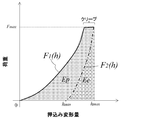
- the hard coat layer of the present embodiment has an elastic recovery rate W ER measured from a micro hardness test of 0.55 or more, and a maximum indentation deformation amount h max of 0.20 ⁇ m or more and 0.50 ⁇ m or less. It is preferable. Since it is comprised in this way, even if a hard-coat layer is a single layer, it can be compatible with the outstanding abrasion property and a softness
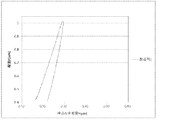
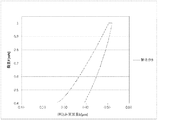
- the microhardness test in this embodiment is an indentation test using Fischer scope (model number: H-100CS) manufactured by Fischer Instruments (test condition; indenter: Vickers square pyramid diamond indenter, load condition: 1 mN / 20 sec, creep: 5 sec, unloading condition: ⁇ 1 mN / 20 sec, measuring load range 0.4 mN to 1 mN, measuring 200 points at equal intervals during loading and unloading, measuring 10 points at equal intervals during creep).
- This micro hardness test evaluates the difficulty (hardness) of deformation from the area or depth of an indentation (indentation) created by applying a constant load.
- F (load) -h An indentation deformation amount
- the elastic recovery rate W ER in the present embodiment refers to the ratio of the energy used for elastic recovery out of the total energy consumed in the micro hardness test, and is given by the following formula (6).
- W ER E e / (E e + E p ) (6)
- Martens hardness is riding the represented material hardness of the load F and the maximum indentation deformation amount h max in FIG. 1, there is a feature such calculate the hardness of conveniently material than indentation test, the elasticity of the material ⁇ Because plasticity is not considered, even if the amount of deformation is the same when the same load is applied, it is not possible to determine the difference between a material that recovers from deformation such as rubber and a material that does not recover from deformation such as soft jelly. .
- the Vickers hardness is the hardness obtained from the diagonal length of the indentation observed by the microscope attached to the test machine after the indentation test, and is more elastic than the Martens hardness.
- F 2 (h) is not a linear function
- the plastic elasticity of the coating is not necessarily reflected in the results, and there is room for improvement in terms of accuracy. It can be said that there is.
- the material is rubber. If the maximum indentation amount is small, it can be seen that the material is a hard material such as steel metal.
- the possible value of the elastic recovery rate W ER in this embodiment is 0 ⁇ W ER ⁇ 1, and from the viewpoint that the hard coat layer is not scratched (that is, scratch resistance) from the viewpoint of being damaged.
- the elastic recovery rate W ER is 0.55 or more. If it is within this range, the larger the value, the better. More specifically, the elastic recovery rate W ER is preferably 0.60 or more, and more preferably 0.65 or more.
- the hard coat coating film of the present embodiment has a maximum indentation deformation amount h max of 0.20 or more and 0.50 or less, and preferably a maximum indentation deformation amount h max from the viewpoint of impact absorbing ability when subjected to an impact. Is 0.20 or more and 0.40 or less, more preferably, the maximum indentation deformation amount h max is 0.25 or more and 0.40 or less.
- the hard coat layer can contain a metal oxide.
- a metal oxide As the above-mentioned metal oxide used for a coating film is mentioned, A silica is preferable among these.
- the hard coat layer can further contain polymer particles and hydrolyzable silicon compounds similar to those used for the coating film.
- the elastic recovery property and the maximum indentation deformation amount of the hard coat layer are measured by the methods described in Examples described later.
- the elastic recovery rate and the maximum indentation deformation amount are, for example, crosslinking density, type of crosslinking agent, coating film drying and heat treatment temperature / time, addition amount of crosslinking agent, metal oxide / hydrolyzable silicon compound / polymer.
- the abundance ratio of the particles, the particle diameter of each component, the coating thickness, the number of functional groups of the hydrolyzable silicon compound, the length of the alkyl group, and the like can be appropriately adjusted.
- the haze change amount shown below is preferably 5.0 or less, more preferably 3.0 or less, and further preferably 1.5 or less, from the viewpoint of scratching. It is.
- the haze value (H 0 ) of the hard coat coating film before the following steel wool test is measured by the method specified in JIS K7136. Further, as a steel wool test, the hard coat coating film is rubbed back and forth 5 times using steel wool (# 0) at a pressure of 130 to 150 gf / cm 2 and a speed of about 1 cm / sec. After removing the steel wool powder generated on the surface by the steel wool test, the haze value is measured again (H 1 ). The difference in haze before and after the steel wool test (H 1 -H 0 ) is defined as the amount of change in haze.
- the film thickness (thickness) of the hard coat layer of the present embodiment is preferably 200 ⁇ m or less, more preferably 0.1 ⁇ m or more and 200 ⁇ m or less, further preferably 1 ⁇ m or more and 150 ⁇ m or less, and 5 ⁇ m or more and 100 ⁇ m or less. More preferably, it is 5 ⁇ m or more and 50 ⁇ m or less.
- the film thickness is in the range of 0.1 ⁇ m or more and 200 ⁇ m or less, there is a tendency that better scratching properties can be expressed without deteriorating optical characteristics.
- the film thickness of the hard coat film is determined by sufficiently allowing the film to stand in a constant temperature and humidity room of 50% RH, and then using a known film thickness meter (for example, Spectrascope Co., Ltd., product number: MHAA-). 100 W).
- the film thickness of the hard coat layer can be adjusted to the above range by, for example, the solid content of the coating solution, the coating WET film thickness, the coating speed, and the morphology control of the coating film components.
- a pressure-sensitive adhesive layer formed on at least one surface of the hard coat layer according to this embodiment may be further provided.
- the pressure-sensitive adhesive layer generally used pressure-sensitive adhesives can be used, and are not particularly limited. Examples thereof include thermoplastic resins, thermosetting resins, rubbers and elastomers. Urethane resins, urethane resins, silicone resins and the like are preferable.
- the said adhesive may contain arbitrary appropriate additives as needed. Examples of additives include, but are not limited to, cross-linking agents, tackifiers, plasticizers, pigments, dyes, fillers, anti-aging agents, conductive materials, ultraviolet absorbers, light stabilizers, release modifiers, softening Agents, surfactants, flame retardants, antioxidants and the like.
- crosslinking agents isocyanate crosslinking agents, epoxy crosslinking agents, carbodiimide crosslinking agents, oxazoline crosslinking agents, aziridine crosslinking agents, amine crosslinking agents peroxide crosslinking agents, melamine crosslinking agents, urea crosslinking agents , Metal alkoxide crosslinking agents, metal chelate crosslinking agents, metal salt crosslinking agents, and the like.
- the thickness of the pressure-sensitive adhesive layer is preferably from 0.1 ⁇ m to 100 ⁇ m, and more preferably from 0.5 ⁇ m to 50 ⁇ m.
- a functional layer may be further provided on at least one surface of the hard coat layer according to the present embodiment.
- the functional layer include, but are not limited to, an antireflection layer, a polarizing layer, and a shock absorbing layer.
- the manufacturing method of the coating film of this embodiment consists of a metal oxide (A) (also referred to as “component (A)” or “(A) component”) and polymer emulsion particles (B) (“component (B)”,
- An application step of applying a coating composition containing “(B) component”) to a substrate a drying step of drying at 5.0 ° C. to 80 ° C., a temperature of 30 ° C. to 150 ° C., and a humidity of 40
- a coating composition prepared as described later is applied to a predetermined target material (base material).
- the coating composition of this embodiment contains a metal oxide (A) and polymer emulsion particles (B) that form polymer particles.
- the coating composition contains the metal oxide (A) and the polymer emulsion particles (B), and is preferably used for imparting snow-preventing properties to the above-described coating film.
- the coating composition preferably further contains alkoxysilanes (also referred to as “alkoxysilanes (C)”, “component (C)”, and “(C) component”)).
- alkoxysilanes (C) also referred to as “alkoxysilanes (C)”, “component (C)”, and “(C) component”.
- the coating film of this embodiment is used as a coating film for a member (for example, a roofing material for a house) installed at a low angle with respect to the ground, the metal oxide (A) and the alkoxysilanes (C). This is preferable because it can impart hydrophilicity to the surface.
- the metal oxide (A) contained in the coating composition is preferably in the form of a colloid (sol) in which the metal oxide is dispersed in a liquid.
- the colloid is not particularly limited, and examples thereof include colloidal silica, colloidal zirconia, and dry silica (fumed silica).
- metal oxide (A) Commercially available materials for forming the metal oxide (A) are not limited to the following, but for example, trade names “Snowtex-O (registered trademark)”, “Snowtex” manufactured by Nissan Chemical Industries, Ltd. -OS (registered trademark) ",” Snowtex-OXS (registered trademark) ",” Snowtex-O40 (registered trademark) ",” Light Star (registered trademark) "; Water-dispersed colloidal silica manufactured by Nalco Company, trade name” NALCO1115 “ , “Nanouse ZR-40BL (registered trademark)”, “Nanouse ZR-30BS (registered trademark)”, “Nanouse ZR-30BFN (registered trademark)”, “Nanouse ZR-30AL (registered trademark)”, “Nanouse ZR-30AS” (Registered trademark) ”,“ Nanoyouth ZR-30AH (registered trademark) ”,“ CELNAX CX-Z330H ” Registered trademark) ",” CELNAX
- silica A200 trade names “fumed silica A200”, “fumed silica A300”, and “fumed silica A380” manufactured by Nippon Aerosil Co., Ltd. may be mentioned. These can be used by dispersing in water.
- the above metal oxide (A) may be used alone or in combination of two or more.
- the polymer emulsion particles (B) contained in the coating composition are hydrolyzable silicon compounds (hereinafter referred to as “hydrolyzable silicon compounds (b1)”, particularly from the viewpoint of substrate adhesion at low temperatures and crack suppression. It is preferably obtained by polymerization of simply “(b1)”, more preferably a vinyl monomer (hereinafter also referred to as “vinyl monomer (b2)”, also simply referred to as “(b2)”). More preferably obtained by polymerization.
- the hydrolyzable silicon compound (b1) and the polymer emulsion particles are polymer emulsion particles obtained by polymerizing the vinyl monomer (b2) in the presence of water and an emulsifier.
- the emulsifier is preferably dodecylbenzenesulfonic acid and / or a derivative or isomer thereof from the viewpoint of exhibiting stable polymerizability by having both an emulsifying action and a function as a catalyst.
- the addition amount of the emulsifier is preferably 0.1 to 20 parts by mass with respect to 100 parts by mass of the solid content of the component (B) from the viewpoint of polymerization stability and particle size control.
- the content of the aqueous phase component in the polymer emulsion particles (B) is preferably 1.0% or more and 30% or less, more preferably 5.0% or more and 15%, from the viewpoint of suppressing the dissolution of snow particles. % Or less. Content rate can be measured by the method as described in the Example mentioned later.
- the polymer emulsion particles may contain any of (b1) and (b2) copolymerized, (b1) and (b2) each polymerized alone, and mixtures and composites thereof. Two or more of these may be included.
- Examples of the hydrolyzable silicon compound (b1) include, but are not limited to, compounds represented by the following formula (7), condensation products thereof, and silane coupling agents.
- SiWxRy (7) (In the formula (7), W represents an alkoxy group having 1 to 20 carbon atoms, a hydroxyl group, an acetoxy group having 1 to 20 carbon atoms, a halogen atom, a hydrogen atom, an oxime group having 1 to 20 carbon atoms, an enoxy group, or an aminoxy group.
- R is a linear or branched alkyl group having 1 to 30 carbon atoms, a cycloalkyl group having 5 to 20 carbon atoms, and At least one hydrocarbon selected from the group consisting of an unsubstituted or substituted alkyl group having 1 to 20 carbon atoms, an alkoxy group having 1 to 20 carbon atoms or an aryl group having 6 to 20 carbon atoms substituted with a halogen atom;
- the silane coupling agent is a hydrolyzable silicon compound in which a functional group having reactivity with an organic substance such as a vinyl polymerizable group, an epoxy group, an amino group, a methacryl group, a mercapto group, or an isocyanate group exists in the molecule. is there. In this, it is more preferable to use the silane coupling agent which has a vinyl polymerizable group from a viewpoint of the weather resistance of the coating film in an optical use.
- hydrolyzable silicon compound (b1) are not limited to the following.
- tetramethoxysilane, tetraethoxysilane, tetra-n-propoxysilane, tetraisopropoxysilane, tetra-n- Tetraalkoxysilanes such as butoxysilane; methyltrimethoxysilane, methyltriethoxysilane, ethyltrimethoxysilane, ethyltriethoxysilane, n-propyltrimethoxysilane, n-propyltriethoxysilane, isopropyltrimethoxysilane, isopropyltrimethoxysilane Ethoxysilane, n-butyltrimethoxysilane, n-butyltriethoxysilane, n-pentyltrimethoxysilane, n-hexyltrimethoxys
- the hydrolyzable silicon compound (b1) may be a condensation product.
- the polystyrene-reduced weight average molecular weight of the condensation product as measured by GPC (gel permeation chromatography) is preferably 200 or more and 5000 or less, more preferably 300 or more and 1000 or less.
- hydrolyzable silicon compounds (b1) may be used alone or in combination of two or more.
- the amount of the hydrolyzable silicon compound (b1) used is, as a mass ratio ((b1) / (B)) to the obtained polymer emulsion particles (B), particularly from the viewpoint of substrate adhesion at low temperatures and crack suppression.
- the range of 0.1 to 0.95 is preferable.
- the mass of the polymer emulsion particles (B) is the mass of the polymerization product obtained when the vinyl monomer (b2) and the hydrolyzable silicon compound (b1) are all polymerized.
- Examples of the vinyl monomer (b2) include, but are not limited to, N-methylacrylamide, N-methylmethacrylamide, N-ethylacrylamide, N, N-dimethylacrylamide, N, N-dimethyl.
- Examples of the (meth) acrylate include, but are not limited to, for example, a (meth) acrylic acid alkyl ester having 1 to 50 carbon atoms in the alkyl portion, and an ethylene oxide group having 1 to 100 ( Poly) oxyethylene di (meth) acrylate.
- Examples of (meth) acrylic acid alkyl ester having 1 to 50 carbon atoms in the alkyl part include, but are not limited to, methyl (meth) acrylate, ethyl (meth) acrylate, and (meth) acrylic. Examples thereof include n-butyl acid, 2-ethylhexyl (meth) acrylate, methyl cyclohexyl (meth) acrylate, cyclohexyl (meth) acrylate, lauryl (meth) acrylate, and dodecyl (meth) acrylate.
- Examples of (poly) oxyethylene di (meth) acrylate having 1 to 100 ethylene oxide groups include, but are not limited to, ethylene glycol di (meth) acrylate, di (meth) acrylic acid, and the like. Examples include diethylene glycol, diethylene glycol methoxy (meth) acrylate, and tetraethylene glycol di (meth) acrylate.
- the vinyl monomer that can be used in combination with (b2) (“vinyl monomer (b3)”, also simply referred to as “(b3)”) is not limited to the following.
- Aromatic vinyl compounds such as toluene; vinyl cyanide compounds such as acrylonitrile and methacrylonitrile; 2 (meth) acrylic acid, crotonic acid, itaconic acid, maleic acid, fumaric acid, maleic anhydride, itaconic acid, maleic acid, etc.
- Carboxyl group-containing vinyl monomers such as half esters of basic acids; 2-hydroxyethyl (meth) acrylate, 2-hydroxypropyl (meth) acrylate, 3-hydroxypropy (meth) acrylate, 2-hydroxybutyl (meth) acrylate , 3-hydroxybutyl (meth) acrylate, 4-hydroxybutyl (meth) acrylate Hydroxyalkyl esters of (meth) acrylic acid such as diato; hydroxyalkyl esters of fumaric acid such as di-2-hydroxyethyl fumarate, mono-2-hydroxyethyl monobutyl fumarate; the number of allyl alcohol and ethylene oxide groups 1 to 100 (poly) oxyethylene mono (meth) acrylate; (poly) oxypropylene mono (meth) acrylate having 1 to 100 propylene oxide groups; “Placcel FM, FA monomer” (Daicel Chemical Co., Ltd.) ), Caprolactone addition monomer trade name), other hydroxy
- the vinyl monomer (b3) having a sulfonic acid group or a sulfonate group as a reactive emulsifier is not limited to the following.
- it has a radical polymerizable double bond and is a sulfone group.
- a vinyl sulfonate compound is mentioned.
- the compound having a succinic acid group partially substituted with a group that is an ammonium salt, sodium salt or potassium salt of the sulfonic acid group is not limited to the following, but examples include allylsulfosuccinate. It is done. Examples of these commercially available products include, but are not limited to, for example, “Eleminol JS-2” (trade name, manufactured by Sanyo Chemical Co., Ltd.), “Latemul S-120”, “Latemul S-180A”, “Latemul S-180” (trade name, manufactured by Kao Corporation).
- Examples of the compound having an alkyl ether group having 2 to 4 carbon atoms or a polyalkyl ether group having 2 to 4 carbon atoms partially substituted by a group which is an ammonium salt, sodium salt or potassium salt of a sulfonic acid group include the following: For example, “AQUALON HS-10”, “AQUALON KH-1025” (trade name, manufactured by Daiichi Kogyo Seiyaku Co., Ltd.), “ADEKA rear soap SE-1025N”, “ADEKA rear soap” SR-1025 "(trade name, manufactured by Asahi Denka Kogyo Co., Ltd.).
- the polymer emulsion particles (B) are reactive. Due to the reactivity, crosslinking by a hydrazine derivative, a carboxylic acid derivative, or an isocyanate derivative tends to suppress the occurrence of cracks at low temperatures due to the improved elasticity of the coating film.
- the vinyl monomer (b2) used in the polymer emulsion particles (B) is 5.0% by mass or more and 80% by mass with respect to the total amount of monomers (100% by mass). % Or less, more preferably 10% by mass or more and 50% by mass or less, and further preferably 15% by mass or more and 40% by mass or less.
- (b2) is 80% by mass or less, the weather resistance of the coating film tends to be excellent, and when it is 5.0% by mass or more, adhesion to the substrate tends to be improved.
- the polymer particles (B) are used for the hard coat layer described above, it is preferable to have a core / shell layer structure. Furthermore, the polymer particles (B) preferably have different flexibility in the core layer and the shell layer, and the shell layer has higher hardness than the core layer from the viewpoint of the elasticity of the hard coat coating film. Is more preferable. That is, the core layer is preferably more flexible than the shell layer.
- the hardness of the hard coat layer can also be controlled, for example, by adding a hydrolyzable silicon compound (b1) to the shell layer. That is, the hardness of the hard coat coating is determined by using a hydrolyzable silicon compound (b1-3) containing 3 or more hydrolyzable functional groups as the hydrolyzable silicon compound (b1). Of the hydrolyzable silicon compound (b1-3) containing 3 or more of the above-mentioned vinyl monomers (b2-2) having secondary and / or tertiary amide groups and the total hydrolyzable silicon compound (b1) It can be controlled by defining the mass ratio to the quantity.
- the ratio of the hydrolyzable silicon compound (b1-3) component containing 3 or more hydrolyzable functional groups in the shell layer is such that the total hydrolyzable silicon compound (b1) and the secondary and / or 3 0.01 ⁇ (b1-3) / ((b1) + (b2-2)) ⁇ 0.20 as a mass ratio with respect to the total amount with the vinyl monomer having a secondary amide group (b2-2) 0.1 ⁇ (b1-3) / ((b1) + (b2-2)) ⁇ 0.3 is more preferable.
- strength of a hard-coat coating film to improve more.
- the ratio of the hydrolyzable silicon compound (b1-3) component containing 3 or more hydrolyzable functional groups in the core layer is such that the total hydrolyzable silicon
- the mass ratio of the compound (b1) to the total amount of the vinyl monomer (b2-2) having the secondary and / or tertiary amide group is (b1-3) / ((b1) + (b2 ⁇ 2)) It is preferable that ⁇ 0.20, and more preferably 0.35 or more.
- the mass ratio of the vinyl monomer (b2) contained in the polymer particles (B) is preferably 20% by mass or more, more preferably. Is 40% by mass or more, more preferably 50% by mass or more. As long as it is limited to the vinyl monomer (b2) in the core layer, it is preferably 70% by mass or more, more preferably 80% by mass or more, and further preferably 90% by mass or more.
- the coating film of this embodiment may further contain alkoxysilanes (C) in addition to the metal oxide (A) and polymer emulsion particles (B) described above.
- the hydrolyzable silicon compound (b1) described above is a component constituting the polymer emulsion particles (B) and is integrally incorporated in the component (B)
- the alkoxysilanes (C) are: The component (A) and the component (B) are added separately and independently, and are clearly distinguished from the hydrolyzable silicon compound (b1) described above.
- the alkoxysilane (C) is preferably at least one hydrolyzable silicon compound selected from the group consisting of compounds represented by the following formulas (8), (9), (10) and (1). .
- R 1 n SiX 4-n (8) (In Formula (8), R 1 may have at least one selected from the group consisting of a hydrogen atom or a halogen group, a hydroxy group, a mercapto group, an amino group, a (meth) acryloyl group, and an epoxy group). And preferably represents an alkyl group having 1 to 10 carbon atoms, an alkenyl group, an alkynyl group, or an aryl group, X represents a hydrolyzable group, and n is an integer of 0 to 3.)
- X 3 represents a hydrolyzable group
- R 2 represents an alkylene group having 1 to 6 carbon atoms or a phenylene group.
- N is 0 or 1.
- R 3 (O—Si (OR 3 ) 2 ) n —OR 3 (10)
- R 3 represents an alkyl group having 1 to 6 carbon atoms.
- N is an integer of 2 to 8.
- R 1 represents hydrogen, an alkyl group having 1 to 10 carbon atoms, an alkenyl group, an alkynyl group, or an aryl group.
- a halogen group a hydroxy group, a mercapto group, an amino group A group, a (meth) acryloyl group, or an epoxy group
- X represents a hydrolyzable group
- n is an integer of 0 to 2
- A is a site containing 2 to 20 methylene groups And may further have a substituent on the methylene group.
- alkoxysilanes (C) are not limited to the following, but include, for example, a partial hydrolysis condensate of tetramethoxysilane (for example, trade name “M silicate 51” manufactured by Tama Chemical Industries, Ltd.) Trade name “MSI51” manufactured by Colcoat Co., Ltd., trade names “MS51” and “MS56” manufactured by Mitsubishi Chemical Corporation), and a partially hydrolyzed condensate of tetoethoxysilane (for example, product name “Silicate 35” manufactured by Tama Chemical Industries, Ltd.) , “Silicate 45”, trade names “ESI40” and “ESI48” manufactured by Colcoat, Inc.), co-partial hydrolysis condensates of tetramethoxysilane and tetraethoxysilane (for example, trade name “FR- 3 ", a trade name” EMSi48 "manufactured by Colcoat Co., Ltd.).
- component (C) for example, trade names “KBE-402”, “KBM-803”, “KBM-802”, “KBE-403”, “KBM-303”, “KBM” manufactured by Shin-Etsu Chemical Co., Ltd. -1403 ",” KBM-9659 “,” KBM-585 “,” KBM-846 “,” KBM-9007 “,” KP-64 “,” KP-851 “,” KR-220L “,” KR-242A “ ”,“ KR-251 ”,“ KR-89 ”,“ KR-500 ”,“ KR-400 ”,“ KR-255 ”,“ KR-271 ”,“ KR-282 ”,“ KR-300 ”, Various silane coupling agents such as “KR-311”, “KR-212”, “KR-213”, “KR-9218” and the like can be mentioned. These may be used alone or in combination of two or more.
- Alkoxysilanes (C) can be condensed to form a condensate (C ′).
- the weight average molecular weight of the condensate (C ′) is preferably 8000 or more and 500,000 or less, more preferably 8000 or more and 200,000 or less, still more preferably 8000 or more and 100,000 or less, and still more preferably, in terms of polystyrene. They are 20000 or more and 85000 or less, More preferably, they are 10,000 or more and 50000 or less.
- the weight average molecular weight is 8000 or more, the hydrophilicity of the coating film tends to be maintained, and when it is 500,000 or more, the coating film tends to become brittle and suppress peeling.
- alkoxysilanes (C) having a weight average molecular weight in such a range
- acid in a mixed solvent of water and alcohol in the presence of an acid catalyst such as dodecylbenzenesulfonic acid.
- an acid catalyst such as dodecylbenzenesulfonic acid.
- the mass ratio of the metal oxide (A) to the polymer emulsion particles (B) is preferably 10/100 or more and 1000/100 or less, more preferably 50/100 or more and 300/100, and further preferably 80/100 or more and 250/100.
- the mass ratio ((A) / (C)) of the metal oxide (A) to the alkoxysilane (C) is 0.5 / 100 or more and 500/100 or less from the viewpoint of controlling the water contact angle within a desired range. More preferably, it is 5/100 or more and 300/100, More preferably, it is 15/100 or more and 100/100.
- the mass of the alkoxysilanes (C) is the mass in terms of SiO 2 when the alkoxysilanes (C) are completely hydrolyzed and condensed.
- the solid content of the coating composition of the present embodiment is preferably 0.1% by mass or more and 50% by mass or less, more preferably 0.2% by mass with respect to the total amount (100% by mass) of the coating composition. % To 25% by mass, more preferably 0.5% to 10% by mass.
- the solid content is 50% by mass or less, the film thickness after the drying step tends to be easily controlled to a desired film thickness.
- solid content is 0.1 mass% or more, in order to obtain a desired dry film thickness, it is not necessary to paint a coating composition thickly, and it exists in the tendency for control of a film thickness to become easy.
- the viscosity of the coating composition is preferably 0.1 mPa ⁇ s or more and 2000 mPa ⁇ s or less at 25 ° C., more preferably 1.0 mPa ⁇ s or more and 200 mPa ⁇ s or less, and further preferably 2.0 mPa ⁇ s or less. s to 50 mPa ⁇ s.
- the order of mixing when preparing the coating composition is preferably the order of component (A), component (B), and component (C).
- component (A), component (B), and component (C) For example, it is prepared as follows. After the component (A) is weighed, the component (B) is added dropwise at a rate of 0.4 g / s or more while mixing. Next, it is preferable to add the component (C) at 20 ° C. to 30 ° C. and continue stirring for 2 hours or more. By continuing the stirring for 2 hours or more, hydrolysis and condensation of the component (C) are promoted, and it is suppressed that the surface roughness of the coating film becomes too large and the contact angle of the coating film increases. Further, filtration is performed using a filter cloth having a diameter of 200 mesh or less, preferably 400 mesh or less.
- the component (A) is preferably diluted with ethanol or the like. Thereby, aggregation of a component (A) and a component (B) is suppressed, and it is suppressed that surface roughness becomes large too much.
- ethanol methanol, isopropyl alcohol, industrial alcohol, or the like can be used.
- the method for applying the above-described coating composition to the substrate is not limited to the following, but includes, for example, a spray method, a flow coating method, a roll coating method, a brush coating method, a DIP coating method (dip coating method). , Spin coating method, screen printing method, casting method, gravure printing method and flexographic printing method. Among these, from the viewpoint of productivity, a roll coating method, a screen printing method, and a gravure printing method are preferable. In addition, for the purpose of coating on a substrate having a complicated shape, a spray coating method or a DIP coating method is preferable, and when coating is performed on a flat substrate, a roll coating method is preferable.
- the DIP coating method is more preferable because both surfaces of the substrate can be applied simultaneously and are simple. That is, it is preferable that the application process of this embodiment is a process of applying both sides of the substrate simultaneously by the spray coating method or the DIP coating method, and simultaneously applying both sides of the substrate by the DIP coating method. More preferably.
- both surfaces are pretreated by corona treatment or plasma treatment, and the treatment is preferably carried out until the water contact angle is 40 degrees or less, more preferably 20 degrees or less. Thereafter, for example, the substrate can be submerged in a container of the coating composition and applied at a rate of 1.0 cm / s.
- the coating composition may be applied by a flow coating method.
- the substrate is placed at 45 to 90 degrees with respect to the ground, and the coating composition is applied from the top of the substrate with a dropper or the like so as to flow over the entire substrate.
- coating can be processed similarly to the DIP coating method.
- the thickness of the coating composition applied to the substrate is preferably 0.05 ⁇ m or more and 50 ⁇ m or less, more preferably 0.5 ⁇ m or more and 15 ⁇ m or less, and further preferably 1.0 ⁇ m or more and 10 ⁇ m or less.
- the film thickness is 50 ⁇ m or less, a uniform coating film tends to be easily obtained, which is preferable in appearance.
- the hard coat layer of the present embodiment preferably contains 5 parts by mass or more of alkoxysilanes (C) with respect to 100 parts by mass of the polymer particles (B). More preferably, it is 10 mass parts or more, More preferably, it is 35 mass parts or more.
- the alkoxysilane (C) is 5 masses per 100 mass parts of the metal oxide (A) in the hard coat layer.
- Part or more is preferably contained, more preferably 10 parts by mass or more, and still more preferably 35 parts by mass or more.
- the presence of these is, for example, observation with a scanning electron microscope (SEM), etc. Can be confirmed. That is, when the coating film of the present embodiment contains the above components (A) to (C), when this is observed with an SEM, a so-called sea-island structure can be typically observed.
- the sea part observed here may contain a metal oxide (A) and a hydrolyzable silicon compound (B).
- alkoxysilanes (C) and polymer particles (B) can be contained in the island part.
- the metal oxide (A), alkoxysilanes (C), and polymer particles (B) that can be included in the coating film of the present embodiment satisfy the above-described preferable quantitative relationship between the sea part and the island part.
- the area ratio is 100: 0 to 30:70.
- the drying process of this embodiment is a process of drying at 5.0 ° C. or higher and 80 ° C. or lower.
- Examples of the drying method include, but are not limited to, natural drying, cold air drying, hot air drying, infrared drying, and combinations thereof.
- the drying temperature in the drying step is 5.0 ° C. or higher and 80 ° C. or lower, preferably 10 ° C. or higher and 60 ° C. or lower, from the viewpoint of productivity and control of ten-point average roughness (Rz) when a coating film is formed. Yes, more preferably 20 ° C or higher and 40 ° C or lower.
- Rz ten-point average roughness
- the curing process of the present embodiment is a process for curing in an environment of 30 ° C. or higher and 150 ° C. or lower and a humidity of 40% RH or higher and 100% RH or lower. Curing under the above environment from the viewpoint of controlling the ten-point surface roughness (Rz) when the coating film is formed, and suppressing the adhesion of the coating film and various components contained in the coating composition from bleeding out.
- the curing temperature is 30 ° C. or higher and 150 ° C. or lower, preferably 60 ° C. or higher and 140 ° C. or lower, more preferably 90 ° C. or higher and 130 ° C. or lower.
- the curing humidity is 40% RH or more and 100% RH or less, preferably 60% RH or more and 95% RH or less, and more preferably 70% RH or more and 90% RH or less.
- the method for producing the hard coat layer (coating film) of the present embodiment is not particularly limited.
- a composition dissolved or dispersed in a solvent such as water is applied to the base material, followed by heat drying. It can obtain by doing.
- a solvent such as water
- the above-described components (A) to (C) are used as a water-based composition, it is not only preferable from the viewpoint of environmental burden, but also sufficient compared to conventional solvent-based coating compositions. It tends to be able to ensure film formability and moldability.
- the solid content concentration of the aqueous dispersion is preferably 0.01 to 60% by mass, more preferably 1 to 40% by mass.
- the viscosity of the aqueous dispersion is preferably 0.1 to 100,000 mPa ⁇ s at 20 ° C., and preferably 1 to 10,000 mPa ⁇ s.
- the coating method is not limited to the following, for example, spraying method, flow coating method, brush coating method, dip coating method, spin coating method, screen printing method, casting method, gravure printing method, flexographic printing method Etc.
- the coated dispersion composition can be dried by heat treatment or ultraviolet irradiation at preferably room temperature to 500 ° C., more preferably 40 ° C. to 250 ° C.
- the hard coat film of this embodiment is a single layer and has excellent optical properties and scratching properties. Accordingly, the use of the hard coat coating film is not particularly limited, and examples thereof include building materials, automobile members, electronic devices, and electrical products. Examples of building material applications include wallpaper skin materials, signboards, glass substitutes, and outer wall material top coats. Examples of automobile members include exterior members such as bumpers and door mirrors, interior members such as center panels and door panels, headlamps, rear lamp members, and glass substitute members. In electrical products, for example, it is preferably used for mobile phones, personal computers, portable game machines and the like. Further, it can also be used as a traffic signal member, a top coat material of a machine / device, or the like.
- the functional member of this embodiment contains a base material and the coating film mentioned above on this base material.
- Functional members are not limited to the following because they have excellent adhesion and antifouling properties.
- the base material of this embodiment is preferably non-planar.
- the non-planar surface include a spherical surface and a hemispherical surface.
- the functional member is preferably used at a low installation angle with respect to the ground, more preferably from 10 degrees to 140 degrees.
- Examples of the article used at such an installation angle include a roof material and a photovoltaic power generation panel.
- the coating composition of the present embodiment can impart snow-preventing properties to the substrate.
- the functional member obtained by applying the coating composition to the substrate can be used in a snowy area from the viewpoint of having a snow sliding property.
- the functional member is preferably provided in a headlamp such as a roof, a solar power generation panel, an electric wire, a steel tower for electric wires, a road sign, a traffic signal, an outdoor display board, and an automobile. Since the functional member is excellent in snow accretion prevention even when the surface temperature is low, the functional member may be provided in an outdoor member selected from the group consisting of an LED traffic light, an LED headlamp, an LED lens, and an outdoor display panel. preferable.
- the polymer emulsion particles (B) obtained by the synthesis example described below are filtered from the polymer emulsion particles (B) with a molecular weight cut-off of 50,000. The filtered filtrate and residue were evaporated to dryness. The total amount after the filtrate and residue were evaporated to dryness was defined as the total solid mass, and the mass after the filtrate was evaporated to dryness as the dry mass of the filtrate.
- the filtrate after evaporation to dryness was quantified with a pyrolysis gas chromatograph to confirm the presence or absence of nitrogen-containing components.
- a pyrolysis gas chromatography apparatus the following pyrolysis apparatus, GC (gas chromatography) apparatus, and detector MS (mass spectrometry) apparatus were used.
- Thermal decomposition apparatus Product name “2020iD” manufactured by Frontier Lab.
- GC device manufactured by Agilent technologies, trade name “7890A”
- Temperature conditions Initial temperature: 40 ° C.
- F Compound Reagent C 6 F 13 -CH 2 CH 2 -Si (CH 3) 2 Cl XPS measurement conditions Equipment used: Thermo Fisher ESCALAB250 Excitation source: Monochromatic. AlK ⁇ 15kV ⁇ 10mA Analysis size: approx. 1mm (shape is oval) Acquisition area Survey scan: 0 to 1,100eV Narrow scan: C 1s / K 2p, N 1s, Si 2p, O 1s, Cl 2p, Na 1s, Ca 2p, S 2p Since C 1s and K 2p have close peaks, we imported the data together. Pass energy Survey scan: 100eV Narrow scan: 20eV The element concentration (atomic%) of fluorine and silicon was measured by XPS, and the concentration ratio of fluorine and silicon (F / Si) was defined as the hydroxyl group presence ratio.
- Porosity Porosity (%) (1.46 ⁇ (Refractive index of film at 550 nm)) / 0.46 ⁇ 100
- the refractive index in the formula (2) is measured with respect to the back side of the glass substrate by measuring the reflectance for each wavelength of 230 to 800 nm using a reflection spectral film thickness meter (manufactured by Otsuka Electronics: FE-3000). The refractive index of the glass substrate was measured using a reflection spectral film thickness meter.
- the intensity of the reflected light interfering between the glass substrate and the film at intervals of 2 nm is measured between 230 and 800 nm on the film side, and the refractive index of the glass substrate and the interference for each measured wavelength are measured.
- the refractive index and film thickness of the film were searched for calculation, and the measured values were fitted by the least square method to obtain the refractive index and film thickness (nm) of the film.
- the refractive index of air was 1
- the refractive index of silica was 1.46.
- a mixture (2) of 185 g of dimethyldimethoxysilane and 151 g of phenyltrimethoxysilane as a core layer was added to the obtained mixture (1) over about 2 hours while maintaining the temperature in the reactor at 80 ° C. It was dripped and the liquid mixture (3) was obtained.
- the mixture (3) was stirred for about 1 hour while the temperature in the reactor was 80 ° C.
- 150 g of butyl acrylate, 30 g of tetraethoxysilane, 145 g of phenyltrimethoxysilane, and 1.3 g of 3-methacryloxypropyltrimethoxysilane as a shell layer were added to the obtained mixture (3).
- the mixture (6) was stirred for about 2 hours while the temperature in the reactor was 80 ° C. Thereafter, the mixture (6) is cooled to room temperature, filtered through a 100-mesh wire mesh, the concentration is adjusted with purified water, and the number average particle diameter of the polymer emulsion particles (B-1) (hereinafter referred to simply as “B-”) is 40 nm. 1 ”) (solid content 10% by mass, pH 3.2). The amount of the aqueous phase component of B-1 was 21%, and diethylamine was detected from the aqueous phase component.
- the mixture (3) was stirred for about 1 hour while the temperature in the reactor was 80 ° C.
- the mixture (6) was stirred for about 2 hours while the temperature in the reactor was 80 ° C. Thereafter, the mixture (6) is cooled to room temperature, filtered through a 100-mesh wire mesh, the concentration is adjusted with purified water, and polymer emulsion particles (B-2) having a number average particle diameter of 130 nm (hereinafter simply referred to as “B-”). 2 ”) (solid content 10 mass%, pH 3.2). The amount of the aqueous phase component of B-2 was 10%, and no N-containing material was detected from the aqueous phase component.
- a mixture (2) of 185 g of dimethyldimethoxysilane and 151 g of phenyltrimethoxysilane as a core layer was added to the obtained mixture (1) over about 2 hours while maintaining the temperature in the reaction vessel at 80 ° C. It was dripped and the liquid mixture (3) was obtained.
- the mixture (3) was stirred for about 1 hour while the temperature in the reactor was 80 ° C.
- 150 g of butyl acrylate, 30 g of tetraethoxysilane, 145 g of phenyltrimethoxysilane, and 1.3 g of 3-methacryloxypropyltrimethoxysilane as a shell layer were added to the obtained mixture (3).
- the mixture (6) was stirred for about 2 hours while the temperature in the reactor was 80 ° C. Thereafter, the mixture (6) is cooled to room temperature, filtered through a 100-mesh wire mesh, the concentration is adjusted with water, and polymer emulsion particles (B-3) having a number average particle diameter of 180 nm (hereinafter simply referred to as “B-”). 3 ”) (solid content 10% by mass, pH 3.9). The amount of the aqueous phase component of B-3 was 19%, and diethylamine was detected from the aqueous phase component.
- Example 1 Water-dispersed colloidal silica having an average particle size of 8 nm as a raw material for the spherical metal oxide (A) at the blending ratio shown in Table 1 (trade name “Snowtex OS (denoted as“ ST-OS ”in the table)”) 20% ethanol water was added to Nissan Chemical Industries, Ltd.
- Example 2 Water-dispersed colloidal silica having an average particle size of 8 nm as a raw material for the spherical metal oxide (A) at the blending ratio shown in Table 1 (trade name “Snowtex OS (denoted as“ ST-OS ”in the table)”) 20% ethanol water was added to Nissan Chemical Industries, Ltd.
- Example 3 A member was obtained in the same manner as in Example 2 except that the blending ratio of the coating composition was changed as shown in Table 1. Table 1 shows the evaluation results of the obtained members.
- Example 4 Water-dispersed colloidal silica having an average particle size of 15 nm as a raw material for the spherical metal oxide (A) at the blending ratio shown in Table 1 (trade name “Snowtex O (denoted as“ ST-O ”in the table)”) 20% ethanol water was added to Nissan Chemical Industries, Ltd. (solid content 20% by mass), then the polymer emulsion particles (B-3) synthesized in Synthesis Example 3 were added, and finally alkoxysilanes ( C) tetramethoxysilane oligomer MS56 (trade name, manufactured by Mitsubishi Chemical Corporation, described as “MS56” in the table) was added and stirred at room temperature for 3 hours to obtain a coating composition having a solid content of 6% by mass. .
- Example 5 A member was obtained in the same manner as in Example 2 except that the polymer emulsion particles (B-1) were used in place of the polymer emulsion particles (B-2). Table 1 shows the evaluation results of the obtained members.
- Example 6 Water-dispersed colloidal silica (A1, trade name “Snowtex OXS” (in Table 1, “ST-OXS”) is used as a raw material for the spherical metal oxide (A) at the blending ratio shown in Table 1. ”, Manufactured by Nissan Chemical Industries, Ltd., solid content of 10% by mass), and then mixed with water-dispersed colloidal silica (A2, trade name“ Snowtex O-40 (in Table 1, STO-40 ”), manufactured by Nissan Chemical Industries, Ltd.
- A1 trade name “Snowtex OXS” (in Table 1, “ST-OXS”
- STO-40 water-dispersed colloidal silica
- Example 7 Water-dispersed colloidal silica having an average particle diameter of 8 nm (trade name “Snowtex OS”, manufactured by Nissan Chemical Industries, Ltd., solid content 20 mass) as a raw material for the spherical metal oxide (A) at the blending ratio shown in Table 1. %) was added 20% ethanol water, and then the polymer emulsion particles (B-1) synthesized in Synthesis Example 1 were added. Finally, tetramethoxysilane oligomer MS56 (Mitsubishi Chemical Corporation) was used as alkoxysilanes (C). The product name and “MS56” in the table) were added and stirred at room temperature for 3 hours to obtain a coating composition having a solid content of 6% by mass.
- Snowtex OS manufactured by Nissan Chemical Industries, Ltd., solid content 20 mass
- the product name “Superflex 150” (described as “SF150” in the table) manufactured by Dai-ichi Kogyo Seiyaku Co., Ltd. is used as the intermediate layer material on the base material (polycarbonate of 5 cm ⁇ 5 cm), and the film thickness is 100 nm using a spin coater. Then, it was dried at 80 ° C. for 10 minutes to provide an intermediate layer on the substrate.
- the coating composition was applied using a dip coater so as to have a film thickness of 500 nm, then dried at 25 ° C. for 5 minutes, further dried at 40% humidity and a temperature of 130 ° C. for 10 minutes, and 30 ° C.
- the material was obtained by curing for 24 hours in the environment. Table 1 shows the evaluation results of the obtained members.
- Example 8 Polymer emulsion particles (B-1) are converted into polymer emulsion particles (B-4) (trade name “NeoCryl A-614”, acrylic emulsion made by DSM, solid content 32%, pH 8.0, viscosity 200 mPa ⁇ s, glass.
- a member was obtained in the same manner as in Example 2 except that the transition temperature was 74 ° C., the minimum film formation temperature was 10 ° C., the amount of the water phase component was 11%, and no N-containing component was detected from the water phase component. .
- Table 1 shows the evaluation results of the obtained members.
- Example 9 A member was obtained in the same manner as in Example 2 except that the blending ratio of the coating composition was changed as shown in Table 2. Table 2 shows the evaluation results of the obtained members.
- Example 10 Water-dispersed colloidal silica having an average particle diameter of 8 nm (trade name “Snowtex OS”, manufactured by Nissan Chemical Industries, Ltd., solid content 20 mass) as a raw material for the spherical metal oxide (A) at the blending ratio shown in Table 2 %) was added 20% ethanol water, and then the polymer emulsion particles (B-1) synthesized in Synthesis Example 1 were added. Finally, tetramethoxysilane oligomer MS56 (Mitsubishi Chemical Corporation) was used as alkoxysilanes (C). The product name and “MS56” in the table) were added and stirred at room temperature for 3 hours to obtain a coating composition having a solid content of 6% by mass.
- Snowtex OS manufactured by Nissan Chemical Industries, Ltd., solid content 20 mass
- a polymer emulsion particle (B-1) as an intermediate layer was applied to a base material (5 cm ⁇ 5 cm polycarbonate) using a spin coater so as to have a film thickness of 100 nm, then at 80 ° C. for 10 minutes, and further at a temperature of 120 The intermediate layer was provided on the base material by drying at 10 ° C. for 10 minutes.
- the coating composition was applied using a dip coater to a film thickness of 500 nm, then dried at 25 ° C. for 5 minutes, dried at 130 ° C. for 10 minutes, and further humidity 40% RH, temperature 30 ° C.
- the material was obtained by curing for 24 hours in the environment. Table 2 shows the evaluation results of the obtained members.
- Example 11 A member was obtained in the same manner as in Example 2 except that the blending ratio of the coating composition was changed as shown in Table 2. Table 2 shows the evaluation results of the obtained members.
- Example 12 A coating composition was obtained in the same manner as in Example 1. Next, the coating composition was applied to a substrate (5 cm ⁇ 5 cm polycarbonate) using a dip coater so as to have a film thickness of 500 nm, and then dried at 25 ° C. for 24 hours to obtain a member. Table 2 shows the evaluation results of the obtained members.
- the coating composition After applying the coating composition to a substrate (5 cm ⁇ 5 cm polycarbonate) using a dip coater so that the film thickness becomes 500 nm, the coating composition is dried at 25 ° C. for 5 minutes, and dried at a temperature of 130 ° C. for 10 minutes. Further, it was cured for 24 hours in an environment of humidity 40% RH and temperature 30 ° C. to obtain a member. Table 2 shows the evaluation results of the obtained members.
- a (A1 / A2) / B / C” represents the metal oxide (A) of each component
- polymer emulsion particles (with respect to the total amount (100% by mass) of the coating composition ( B) represents the mass ratio (mixing ratio) of the alkoxysilanes (C).
- a (A1 / A2) / B ′ / C ′” is the amount of each component of the metal oxide (A) and polymer emulsion particles (B) relative to the total amount (100% by mass) of the coating film. It represents the calculated value of the mass ratio (content ratio) of the condensate (B ′) and the condensate (C ′) of alkoxysilanes (C).
- the metal oxide (A) was magnified 50,000 to 100,000 times and adjusted so that 100 to 200 spherical metal oxide (A) particles were photographed, and a transmission micrograph was taken. Next, the particle diameter (major axis and minor axis) of each photographed metal oxide (A) was measured, and an average value thereof ((major axis + minor axis) / 2) was obtained and used as an average particle diameter.
- the elastic recovery rate W ER indicates the ratio of the energy used for the elastic recovery property out of the total energy consumed in the micro hardness test, and is given by the following formula (6).
- W ER E e / (E e + E p ) (6)
- Number average particle diameter of polymer emulsion particles The number average particle diameter of the polymer particles (C) produced by the synthesis example described later is a dynamic light scattering particle size distribution measuring device (trade name: Microtrack, manufactured by Nikkiso Co., Ltd.). UPA).
- a mixture (2) of 65 g of dimethyldimethoxysilane and 37 g of phenyltrimethoxysilane (b1-3) as a core layer was added in a state where the temperature in the reaction vessel was kept at 80 ° C. It was dripped over 2 hours and the liquid mixture (3) was obtained. Thereafter, the mixed liquid (3) was stirred for about 1 hour while the temperature in the reaction vessel was 80 ° C.
- the mixture (6) was cooled to room temperature, filtered through a 100-mesh wire mesh, the concentration was adjusted with water, and an aqueous dispersion (solid content) of polymer emulsion particles (B-5) having a number average particle diameter of 60 nm was obtained. 14% by weight, pH 3.2) was obtained.
- a mixed liquid (2) of 0.4 g of methyltrimethoxysilane, 17 g of dimethyldimethoxysilane and 11 g of phenyltrimethoxysilane (b1-3) was kept at 80 ° C. in the reaction vessel.
- the liquid mixture (3) was obtained. Thereafter, the mixed liquid (3) was stirred for about 1 hour while the temperature in the reaction vessel was 80 ° C.
- the mixture (5) is cooled to room temperature, filtered through a 100-mesh wire mesh, the concentration is adjusted with purified water, and an aqueous dispersion (solid content) of polymer emulsion particles (B-6) having a number average particle diameter of 19 nm is obtained. 6.2% by mass, pH 3.2) was obtained.
- the coating composition obtained as described above was applied to a substrate (polycarbonate plate (product number: 1600, thickness: 2 ⁇ m) manufactured by Takiron Co., Ltd.) using a bar coater so that the film thickness was 6.0 ⁇ m. Then, it dried for 30 minutes at 130 degreeC, and obtained the hard-coat coating film.
- the evaluation results are shown in Table 3.
- FIG. 2 shows the Fh curve obtained as a result of being subjected to the microhardness test.
- Example 13 A coating composition was obtained in the same manner as in Example 1 with the blending ratios shown in Table 4. Next, the coating composition was applied to a substrate (5 cm ⁇ 5 cm polycarbonate) using a dip coater so as to have a film thickness of 500 nm, and then dried at 25 ° C. for 24 hours to obtain a member. Table 4 shows the evaluation results of the obtained members.
- Example 14 A coating composition was obtained in the same manner as in Example 1 with the blending ratios shown in Table 4. Next, the coating composition was applied to a substrate (5 cm ⁇ 5 cm polycarbonate) using a dip coater so as to have a film thickness of 500 nm, and then dried at 25 ° C. for 24 hours to obtain a member. Table 4 shows the evaluation results of the obtained members.
- Example 6 A coating composition was obtained in the same manner as in Example 1 with the blending ratios shown in Table 4. Next, the coating composition was applied to a substrate (5 cm ⁇ 5 cm polycarbonate) using a dip coater so as to have a film thickness of 500 nm, and then dried at 25 ° C. for 24 hours to obtain a member. Table 4 shows the evaluation results of the obtained members.
- Example 15 A coating composition dip coater obtained in the same manner as in Example 1 was applied to the top of the hard coat layer obtained in Production Example 2 so that the film thickness was 500 nm, and then dried at 25 ° C. for 24 hours to form a member. Obtained. Table 5 shows the evaluation results of the obtained members.
- Example 16 The coating composition dip coater obtained in the same manner as in Example 1 was applied to the upper part of the hard coat layer obtained in Production Example 3 so as to have a film thickness of 500 nm, and then dried at 25 ° C. for 24 hours. Obtained. Table 5 shows the evaluation results of the obtained members.
- the coating film according to the present invention can be used for various outdoor members to which snow may adhere.
- various outdoor members to which snow may adhere.
- LED traffic lights, LED headlamps, and LED lenses that are less likely to generate heat functional components included in outdoor display boards and resin windows, from the perspective of reducing snow removal and safety Has industrial applicability.
Landscapes
- Chemical & Material Sciences (AREA)
- Engineering & Computer Science (AREA)
- Organic Chemistry (AREA)
- Life Sciences & Earth Sciences (AREA)
- Wood Science & Technology (AREA)
- Materials Engineering (AREA)
- Inorganic Chemistry (AREA)
- General Engineering & Computer Science (AREA)
- Microelectronics & Electronic Packaging (AREA)
- Optics & Photonics (AREA)
- Physics & Mathematics (AREA)
- Dispersion Chemistry (AREA)
- Health & Medical Sciences (AREA)
- Chemical Kinetics & Catalysis (AREA)
- Medicinal Chemistry (AREA)
- Polymers & Plastics (AREA)
- Paints Or Removers (AREA)
- Laminated Bodies (AREA)
- Application Of Or Painting With Fluid Materials (AREA)
Abstract
Description
[1]
金属酸化物と重合体粒子とを含み、
十点平均粗さが、5nm以上300nm以下である、
塗膜。
[2]
前記十点平均粗さに対する算術平均粗さが、0.0以上3.0以下である、
[1]に記載の塗膜。
[3]
水接触角が、40度以下である、
[1]又は[2]に記載の塗膜。
[4]
塗膜表面の水酸基存在割合が、0.03以上0.2以下である、
[1]~[3]のいずれかに記載の塗膜。
[5]
塗膜の空隙率が、20%未満である、
[1]~[4]のいずれかに記載の塗膜。
[6]
前記金属酸化物の平均粒子径が、1.0nm以上400nm以下である、
[1]~[5]のいずれかに記載の塗膜。
[7]
前記重合体粒子の平均粒子径が、10nm以上800nm以下である、
[1]~[6]のいずれかに記載の塗膜。
[8]
基材の少なくとも片面に、金属酸化物と重合体エマルジョン粒子とを含むコーティング組成物を、塗布及び乾燥して得られる、
[1]~[7]のいずれかに記載の塗膜。
[9]
基材と直接接触する塗膜であって、基材と直接接触する面に少なくとも1層の中間層を備える、
[1]~[8]のいずれかに記載の塗膜。
[10]
前記中間層は、ウレタン樹脂、アクリルウレタン樹脂、カチオン性樹脂、及びアクリルシリコーン樹脂からなる群より選ばれる少なくとも1種を含む、
[9]に記載の塗膜。
[11]
前記中間層は、ハードコート層を含み、
前記ハードコート層は、金属酸化物を含む、
[9]に記載の塗膜。
[12]
前記ハードコート層は、下記式(1)で表される原子団を1分子中に3~20個有する多官能シランをさらに含む、
[11]に記載の塗膜。
R1 nSiX3-nA- (1)
(式中、R1は水素、炭素数1~10のアルキル基、アルケニル基若しくはアルキニル基、又はアリール基を示し、これらの置換基上にさらにハロゲン基、ヒドロキシ基、メルカプト基、アミノ基、(メタ)アクリロイル基、又はエポキシ基を有していてもよく、Xは、加水分解基を示し、nは、0~2の整数であり、Aは、メチレン基を2~20個含む部位を示し、メチレン基上にさらに置換基を有してもよい。)
[13]
着雪防止用又は防曇用である、
[1]~[12]のいずれかに記載の塗膜。
[14]
金属酸化物と重合体エマルジョン粒子とを含むコーティング組成物を塗布する、塗布工程と、
5.0℃以上80℃以下で乾燥する、乾燥工程と、
30℃以上150℃以下、及び湿度40%RH以上100%RH以下の環境下で養生する、養生工程と、
を有する、[1]~[13]のいずれかに記載の塗膜の製造方法。
[15]
前記塗布工程は、スプレーコーティング法で塗布、又はDIPコーティング法で基材の両面を同時に塗布する工程である、
[14]に記載の塗膜の製造方法。
[16]
着雪防止性を付与するための、金属酸化物と重合体エマルジョン粒子とを含むコーティング組成物の利用。
[17]
基材と、該基材上に[1]~[13]のいずれかに記載の塗膜とを含む、
機能性部材。
[18]
設置角度を、地面に対して10度以上140度以下にして用いられる、
[17]に記載の機能性部材。
[19]
前記基材の形状が、非平面である、
[17]又は[18]に記載の機能性部材。
[20]
[17]~[19]のいずれかに記載の機能性部材を備える、
LED信号機、LEDヘッドランプ、LED用レンズ、ヘッドランプ、及び屋外用表示板からなる群より選択される、
屋外用部材。
本実施形態の塗膜は、金属酸化物と重合体粒子とを含み、十点平均粗さ(以下、「十点平均粗さ(Rz)」ともいう。)が5nm以上300nm以下である。金属酸化物と重合体粒子とを含むことにより、滑雪性、及び寒暖差に対する塗膜の耐クラック性に優れる。さらに、十点平均粗さ(Rz)が5nm以上300nm以下であることにより、防汚性と防曇性と密着性とのバランスに優れた塗膜となる。
空隙率(%)=(1.46-(550nmにおける膜の屈折率))/0.46×100 ・・・(2)
式(2)における屈折率は、反射分光膜厚計(大塚電子製 型式:FE-3000)を用い、230~800nmの波長ごとの反射率を測定し、ガラス基材の裏側に対して、上記反射分光膜厚計を用いてガラス基材の屈折率を測定して求める。さらに、膜側の230~800nm間を2nm間隔でのガラス基材と膜とで干渉している反射した光の強度を測定し、測定した波長ごとのガラス基材の屈折率及び干渉している反射した光の強度を用い、膜の屈折率及び膜厚を計算上サーチすることで最小二乗法により測定値のフィッティングを行い、膜の屈折率及び膜厚(nm)を求める。ここで、空気の屈折率を1、シリカの屈折率を1.46とした。
本実施形態の金属酸化物は、金属の酸化物が粒子状に形成されている。金属酸化物としては、以下に限定されるものではないが、例えば、ケイ素、アルミニウム、チタン、ジルコニウム、亜鉛、スズ、インジウム、ガリウム、ゲルマニウム、アンチモン、モリブデン等の酸化物が挙げられる。この中でも、シリカ(ケイ素酸化物)、ジルコニア(ジルコニウム酸化物)が好ましい。これらの金属酸化物は、1種のみを単独で用いてもよく、2種以上を併用してもよい。ここで、粒子状とは、後述するアスペクト比が3.0以上の金属酸化物も含む。
重合体粒子の重合体としては、以下に限定されるものではないが、例えば、ポリウレタン系重合体、ポリエステル系重合体、ポリ(メタ)アクリレート系重合体、ポリ(メタ)アクリレート-シリコーン系共重合体が挙げられる。この中でも、ポリ(メタ)アクリレート-シリコーン系共重合体が好ましい。また、重合体粒子の中でも、コアシェル型の重合体粒子であることが好ましく、コアの主成分としてシリコーン系重合体を含み、シェルの成分としてアクリルアミドが共重合されたポリ(メタ)アクリレート-シリコーン系共重合体を含む重合体粒子が好ましい。
本実施形態の塗膜は、塗膜を所望の形状で固定するために、基材を備えることが好ましい。塗膜は、この基材の少なくとも片面に、後述する金属酸化物と重合体エマルジョン粒子とを含むコーティング組成物を、塗布及び乾燥して得られることが好ましい。基材の成分としては、以下に限定されるものではないが、金属、樹脂、及びそれらの組み合わせが挙げられる。樹脂の具体例としては、以下に限定されるものではないが、例えば、ポリカーボネート、ポリメチルメタクリレート、ポリエチレンテレフタレート、ABS樹脂、及びそれらの複合物が挙げられる。この中でも、ポリカーボネートが、基材の強度の点から好ましい。
本実施形態における微小硬度試験とは、フィッシャー・インストルメンツ製フィッシャースコープ(型番:H-100CS)を用いた押込み試験(試験条件;圧子:ビッカース四角錐ダイヤモンド圧子、荷重条件:1mN/20sec、クリープ:5sec、除荷条件:-1mN/20sec、測定荷重範囲0.4mN~1mN、荷重時および除荷時にそれぞれ200点ずつ等間隔に測定、クリープ時に10点等間隔に測定)をいう。この微小硬度試験は、一定荷重を加えてできる圧痕(くぼみ)の面積又は深さから変形のしにくさ(硬さ)を評価するものであり、図1のようなF(荷重)-h(押込み変形量)曲線が得られる。ここで図1において、塗膜に圧子で連続的に0(ゼロ)からFまで荷重をかけたときの塗膜の押込み変形量を本実施形態でいう最大押込み変形量hmaxとすると、塗膜がhmax変形するために使用されたエネルギー(初期塑性変形エネルギー:Ep,initial)は下記式(3)で与えられる。


Ep=Ep,initial-Ee (5)
WER=Ee/(Ee+Ep) (6)
本実施形態の塗膜の製造方法は、金属酸化物(A)(「成分(A)」、「(A)成分」ともいう)と重合体エマルジョン粒子(B)(「成分(B)」、「(B)成分」ともいう)とを含むコーティング組成物を基材に塗布する塗布工程と、5.0℃以上80℃以下で乾燥する乾燥工程と、30℃以上150℃以下、及び湿度40%RH以上100%RH以下の環境下で養生する養生工程と、を有する。
本実施形態の塗布工程は、後述するようにして調製したコーティング組成物を、目的とする所定の材料(基材)に塗布する。
本実施形態のコーティング組成物は、金属酸化物(A)と重合体粒子を形成する重合体エマルジョン粒子(B)とを含む。コーティング組成物は、金属酸化物(A)と重合体エマルジョン粒子(B)とを含み、上述した塗膜に着雪防止性を付与するために用いられることが好ましい。また、コーティング組成物は、アルコキシシラン類(「アルコキシシラン類(C)」「成分(C)」、「(C)成分」ともいう)をさらに含むことが好ましい。アルコキシシラン類(C)を含むことによって、塗膜の表面粗さを所望の範囲に制御し、かつ、基材との密着性をより優れたものにすることができる傾向にある。特に、本実施形態の塗膜を地面に対して低角度に設置される部材(例えば、住宅の屋根材)の塗膜として用いる場合には、金属酸化物(A)及びアルコキシシラン類(C)を含むことに起因して、表面に親水性を付与することができるため好ましい。
コーティング組成物に含まれる金属酸化物(A)は、金属酸化物が液体中に分散しているコロイド(ゾル)の状態であることが好ましい。コロイドとしては、特に限定されないが、例えば、コロイダルシリカ、コロイダルジルコニア、乾式シリカ(フュームドシリカ)が挙げられる。
コーティング組成物に含まれる重合体エマルジョン粒子(B)は、特に低温時の基材密着性、及びクラック抑制の観点から、加水分解性珪素化合物(以下、「加水分解性珪素化合物(b1)」、単に「(b1)」ともいう)を重合して得られることが好ましく、より好ましくは、ビニル単量体(以下、「ビニル単量体(b2)」、単に「(b2)」ともいう)も重合して得られることがより好ましい。具体的には、水及び乳化剤の存在下で、加水分解性珪素化合物(b1)と、重合体エマルジョン粒子は、ビニル単量体(b2)とを重合して得られる、重合体エマルジョン粒子であることがより好ましい。
乳化剤としては、乳化作用と触媒としての機能を併せ持つことにより安定な重合性を発現するという観点からドデシルベンゼンスルホン酸及び又はそれらの誘導体や異性体た好ましい。乳化剤の添加量は、(B)成分の固形分100質量部に対して、重合安定性や粒子径制御の観点から0.1質量部から20質量部が好ましい。
SiWxRy ・・・(7)
(式(7)中、Wは、炭素数1~20のアルコキシ基、水酸基、炭素数1~20のアセトキシ基、ハロゲン原子、水素原子、炭素数1~20のオキシム基、エノキシ基、アミノキシ基、及びアミド基からなる群より選ばれる少なくとも1種の基を表す。Rは、直鎖状又は分岐状の炭素数が1~30個のアルキル基、炭素数5~20のシクロアルキル基、及び置換されていない又は炭素数1~20のアルキル基、炭素数1~20のアルコキシ基若しくはハロゲン原子で置換されている炭素数6~20のアリール基からなる群より選ばれる少なくとも1種の炭化水素基を表す。xは、1以上4以下の整数であり、yは、0以上3以下の整数である。また、x+y=4である。)
本実施形態の塗膜は、上述した金属酸化物(A)、重合体エマルジョン粒子(B)に加え、アルコキシシラン類(C)を、さらに含有してもよい。なお、上述した加水分解性珪素化合物(b1)は、重合体エマルジョン粒子(B)を構成する成分であり、成分(B)中に一体として組み込まれているため、アルコキシシラン類(C)は、成分(A)及び成分(B)とは別個独立して添加されるものであり、上述した加水分解性珪素化合物(b1)とは明確に区別される。
R1 nSiX4-n ・・・(8)
(式(8)中、R1は、水素原子、又はハロゲン基、ヒドロキシ基、メルカプト基、アミノ基、(メタ)アクリロイル基、及びエポキシ基からなる群より選ばれる少なくとも1種を有してもよい、炭素数1~10のアルキル基、アルケニル基、アルキニル基、若しくはアリール基を表す。Xは、加水分解性基を表し、nは0~3の整数である。)
(式(9)中、X3は、加水分解性基を表し、R2は、炭素数1~6のアルキレン基又はフェニレン基を表す。nは0又は1である。)
(式(10)中、R3は、炭素数1~6のアルキル基を表す。nは2~8の整数である。)
R1 nSiX3-nA- (1)
(式(1)中、R1は水素、炭素数1~10のアルキル基、アルケニル基若しくはアルキニル基、又はアリール基を示し、これらの置換基上にさらにハロゲン基、ヒドロキシ基、メルカプト基、アミノ基、(メタ)アクリロイル基、又はエポキシ基を有していてもよく、Xは加水分解基を示し、nは、0~2の整数であり、Aは、メチレン基を2~20個含む部位を示し、メチレン基上にさらに置換基を有してもよい。)
さらに、200メッシュ以下、好ましくは400メッシュ以下の口径のろ布を用いて濾過する。
ここで、成分(A)はエタノール等で希釈して用いることが好ましい。これにより、成分(A)と成分(B)の凝集が抑制され、表面粗さが大きくなりすぎる事が抑制される。希釈剤としては、エタノール、メタノール、イソプロピルアルコール、工業用アルコール等を用いることができる。
本実施形態の乾燥工程は、5.0℃以上80℃以下で乾燥する工程である。乾燥方法としては、以下に限定されるものではないが、例えば、自然乾燥、冷風乾燥、熱風乾燥、赤外線乾燥、及びこれらの組み合わせが挙げられる。
本実施形態の養生工程は、30℃以上150℃以下、及び湿度40%RH以上100%RH以下の環境下で養生する工程である。塗膜としたときの十点表面粗さ(Rz)を制御する観点、並びに塗膜の密着性及びコーティング組成物に含まれる各種成分がブリードアウトすることを抑制する観点から、上記環境下で養生する。養生温度は、30℃以上150℃以下であり、好ましくは60℃以上140℃以下であり、より好ましくは90℃以上130℃以下である。また、養生湿度は、40%RH以上100%RH以下であり、好ましくは60%RH以上95%RH以下であり、より好ましくは70%RH以上90%RH以下である。
本実施形態の機能性部材は、基材と、該基材上に上述した塗膜とを含む。機能性部材は、密着性及び防汚性に優れることから、以下に限定されるものではないが、例えば、建材、建物外装、窓枠、窓ガラス、構造部材、乗物の外装及び塗装、表示機器及びそのカバー、交通標識、各種表示装置、電子黒板、広告塔等の表示物;道路用、鉄道用等の遮音壁;橋梁、ガードレールの外装及び塗装、トンネル内装及び塗装、碍子、太陽電池カバー、太陽熱温水器集熱カバー等の外部で使用される電子、電気機器の外装部;農業用フィルム、ビニールハウス、温室、カメラレンズ、レンズ用フィルター、ヘッドランプレンズ、ヘッドランプカバー(内面、外面)、テールランプカバー(内面、外面)、パワコン用絶縁シート、壁紙、油水分離フィルター、衣料、繊維等が挙げられる。
後述する合成例により得られた重合体エマルジョン粒子(B)の数平均粒子径を、動的光散乱式粒度分布測定装置(日機装社製、商品名「マイクロトラックUPA」)により測定した。
後述する合成例により得られた重合体エマルジョン粒子(B)を、重合体エマルジョン粒子(B)を分画分子量50,000でろ過し、そのろ過したろ液及び残渣を蒸発乾固した。ろ液及び残渣が蒸発乾固した後の総量を全固形分質量、ろ液の蒸発乾固した後の質量をろ液の乾燥質量として、下記式から水相成分の含有率を求めた。
水相成分の含有率(%)=(重合体エマルジョン粒子(B)を分画分子量50,000でろ過した、ろ液の乾燥質量)/(重合体エマルジョン粒子(B)の全固形分質量)×100
熱分解装置:フロンティアラボ社製、商品名「2020iD」
注入口温度:320℃
GC装置:Agilent technologies社製、商品名「7890A」
カラム:J&W社製、商品名「DB-1」(0.25mm×30m、液相厚み:0.25μm)
温度条件初期温度:40℃(5Mmin保持)、昇温速度:20℃/min
注入口温度:320℃(6min保持)
注入モード:Split法、Constant flow:1mL/min
MS装置:Agilent technologies社製、商品名「5975C」
スキャン条件:SCAN m/z=10~800
検出法:イオン化法電子イオン化(EI)法
インターフェース温度:320℃
後述する実施例及び比較例で得られた部材上の塗膜を試料として、十点平均粗さ(Rz)及び算術平均粗さ(Ra)を、装置:BrukeRzXS社製商品名「Dimension Icon」を用いて、測定モード;ScanAsyst、プローブ;ScanAsyst-Air型Si3N4プローブ(先端径2nm)により、JIS B 0601-1994に準じて測定した。その結果をデータ処理し、取得した画像に傾き補正(Plane Fit X1次、Y1次)を施し、Rz及びRaを算出した。
後述する実施例及び比較例で得られた部材上の塗膜に対して、脱イオン水の滴(1.0μL)を乗せ、25℃で10秒間放置した。その後、日本国協和界面科学社製商品名「CA-X150型接触角計」を用いて初期接触角を測定した。光学塗膜に対する水の接触角が小さいほど、塗膜表面の親水性が高いことを示す。
下記(1)~(5)の操作を行った。
(1)反応容器(PFA製60mL容器)内に試料(後述する実施例及び比較例で得られた塗膜を含む部材)を置き、ArグローブBOX(露点:<-100℃)で一昼夜静置した。
(2)反応容器にフタをしてArグローブBOXから取り出した。
(3)ドラフト内でフタを開け、直ぐに下記のF化合物試薬数μLを容器内に滴下し、また直ぐフタを閉めた。
(4)所定の時間静置した後、試料を容器から取り出した。
(5)提供試料に2mmφのマスクを被せてXPS測定に供した。測定条件は、下記の通りとした。
F化合物試薬:C6F13-CH2CH2-Si(CH3)2Cl
XPS測定条件
使用機器 :サーモフィッシャー ESCALAB250
励起源 :単色化.AlKα 15kV×10mA
分析サイズ:約1mm (形状は楕円)
取込領域
Survey scan :0~1,100eV
Narrow scan :C 1s/K 2p、N 1s、Si 2p、O 1s、Cl 2p、Na 1s、Ca 2p、S 2p
C 1sとK 2pはピークが近いため、一緒にデータを取り込んだ。
Pass Energy
Survey scan :100eV
Narrow scan :20eV
XPSによりフッ素と珪素の元素濃度(atomic%)を測定し、フッ素と珪素の濃度比(F/Si)を水酸基存在割合とした。
空隙率(%)=(1.46-(550nmにおける膜の屈折率))/0.46×100 ・・・(2)
式(2)における屈折率は、反射分光膜厚計(大塚電子製 型式:FE-3000)を用い、230~800nmの波長ごとの反射率を測定し、ガラス基材の裏側に対して、上記反射分光膜厚計を用いてガラス基材の屈折率を測定して求めた。さらに、膜側の230~800nm間を2nm間隔でのガラス基材と膜とで干渉している反射した光の強度を測定し、測定した波長ごとのガラス基材の屈折率及び干渉している反射した光の強度を用い、膜の屈折率及び膜厚を計算上サーチすることで最小二乗法により測定値のフィッティングを行い、膜の屈折率及び膜厚(nm)を求めた。ここで、空気の屈折率を1、シリカの屈折率を1.46とした。
後述する実施例及び比較例で得られた部材を水平状態にし、標準の砂(ISO12103-1に規定されたアリゾナ砂(粒子密度:2.65g/cm3))を2.0g/cm2になるように均等に振り掛けた。その後、部材を垂直に立てかけ、部材表面への砂の付着程度を目視で以下の基準にて評価した。
○:砂がほとんど付着していない
△:若干砂が付着している
×:砂の付着量が多い
後述する実施例及び比較例で得られた部材を-40℃で、1時間保持した後、50℃まで昇温し、さらに1時間保持した。これを1サイクルとして、さらに5サイクル繰り返した。その後に、セロテープ(登録商標)を貼り付けて、90度の角度でセロテープ(登録商標)を剥離し、剥離した後の塗膜の状態を目視で以下の基準にて評価した。
◎:剥離がない
○:剥離が一部ある
△:剥離が半分程度ある
×:完全に剥離している
基材(5cm×5cmのポリカーボネート)を、2mm厚みのポリメチルメタクリレート樹脂基材に替えて、後述する実施例及び比較例と同様の方法により、厚み500nmの塗膜を形成し、5℃の環境下で1時間静置した。その後、水平に設置した塗膜に、5℃の水滴(約0.4cc)を滴下し、徐々に基材の角度を垂直に傾けていった。そのとき、水滴が動き始めた角度を転落角として評価した。この転落角が低い方が、雪がより滑り落ちやすく、滑雪性が高いことを示す。また20℃での転落角も同様にして評価した。
北陸地方のある場所の冬の降雪時にて、部材を地面に対して30度の角度で設置し、着雪が始まって15分程度観察し、積雪時の滑雪性を以下の基準で評価した。
○:直ぐに滑雪する(滑雪性良好)
△:徐々に滑雪する
×:滑雪しない(滑雪性不良)
後述する実施例及び比較例で得られた部材を、80℃の蒸気に10秒間、塗膜面を曝した後に、目視で曇り度合いを判定し、防曇性を以下の基準で評価した。
○:良好(曇りなし)
△:部分的に曇り有り
×:曇りあり
還流冷却器、滴下槽、温度計及び撹拌装置を有する反応器に、イオン交換水1600g、及びドデシルベンゼンスルホン酸12gを投入した後、撹拌しながら80℃に加温して混合液(1)を得た。
還流冷却器、滴下槽、温度計及び撹拌装置を有する反応器に、イオン交換水2600g、ドデシルベンゼンスルホン酸13g、及びポリオキシエチレンノニルフェニルエーテルの25%水溶液(商品名「エマルゲン950」、花王(株)製)20gを投入した後、撹拌しながら80℃に加温して混合液(1)を得た。
還流冷却器、滴下槽、温度計及び撹拌装置を有する反応器に、イオン交換水1600g、及びドデシルベンゼンスルホン酸3gを投入した後、撹拌しながら80℃に加温して混合液(1)を得た。
表1に記載の配合比率で、球状の金属酸化物(A)の原料として平均粒子径8nmの水分散コロイダルシリカ(商品名「スノーテックスOS(表中、「ST-OS」と記載する)」、日産化学工業(株)製、固形分20質量%)に20%エタノール水を加え、次に合成例1で合成した重合体エマルジョン粒子(B-1)を加えてから最後にアルコキシシラン類(C)としてテトラエトキシシラン(信越化学工業(株)製、商品名「KBE-04」、表中「TEOS」と記載する)と加えて室温で3時間撹拌して固形分6質量%のコーティング組成物を得た。
表1に記載の配合比率で、球状の金属酸化物(A)の原料として平均粒子径8nmの水分散コロイダルシリカ(商品名「スノーテックスOS(表中、「ST-OS」と記載する)」、日産化学工業(株)製、固形分20質量%)に20%エタノール水を加え、次に合成例1で合成した重合体エマルジョン粒子(B-1)を加えてから最後にアルコキシシラン類(C)としてテトラメトキシシランオリゴマーMS56(三菱化学(株)製商品名、表中「MS56」と記載する)とを加えて室温で3時間撹拌して固形分6質量%のコーティング組成物を得た。
コーティング組成物の配合比率を表1のように変更した以外は実施例2と同様にして部材を得た。得られた部材の評価結果を表1に示す。
表1に記載の配合比率で、球状の金属酸化物(A)の原料として平均粒子径15nmの水分散コロイダルシリカ(商品名「スノーテックスO(表中、「ST-O」と記載する)」、日産化学工業(株)製、固形分20質量%)に20%エタノール水を加え、次に合成例3で合成した重合体エマルジョン粒子(B-3)を加えてから最後にアルコキシシラン類(C)としてテトラメトキシシランオリゴマーMS56(三菱化学(株)製商品名、表中「MS56」と記載する)とを加えて室温で3時間撹拌して固形分6質量%のコーティング組成物を得た。
重合体エマルジョン粒子(B-1)を重合体エマルジョン粒子(B-2)に替えて用いた以外は実施例2と同様にして部材を得た。得られた部材の評価結果を表1に示す。
表1に記載の配合比率で、球状の金属酸化物(A)の原料として平均粒子径5nmの水分散コロイダルシリカ(A1、商品名「スノーテックスOXS(表1中、「ST-OXS」と記載する)」、日産化学工業(株)製、固形分10質量%)とを混合した後に、平均粒子径25nmの水分散コロイダルシリカ(A2、商品名「スノーテックスO-40(表1中、「STO―40」と記載する)」、日産化学工業(株)製、固形分20質量%)を混合し、次に20%エタノール水を加え、次に合成例1で合成した重合体エマルジョン粒子(B-1)を加えてから最後にアルコキシシラン類(C)としてテトラメトキシシランオリゴマーMS56(三菱化学(株)製商品名、表中「MS56」と記載する)とを加えて室温で3時間撹拌して固形分6質量%のコーティング組成物を得た。
表1に記載の配合比率で、球状の金属酸化物(A)の原料として平均粒子径8nmの水分散コロイダルシリカ(商品名「スノーテックスOS」、日産化学工業(株)製、固形分20質量%)に20%エタノール水を加え、次に合成例1で合成した重合体エマルジョン粒子(B-1)を加えてから最後にアルコキシシラン類(C)としてテトラメトキシシランオリゴマーMS56(三菱化学(株)製商品名、表中「MS56」と記載する)とを加えて室温で3時間撹拌して固形分6質量%のコーティング組成物を得た。
重合体エマルジョン粒子(B-1)を重合体エマルジョン粒子(B-4)(商品名「NeoCryl A-614」、DSM社製アクリルエマルジョン、固形分32%、pH8.0、粘度200mPa・s、ガラス転移温度74℃、最低成膜温度10℃水相成分量は11%、水相成分からN含有成分は検出されなかった)に替えて用いた以外は実施例2と同様して部材を得た。得られた部材の評価結果を表1に示す。
コーティング組成物の配合比率を表2のように変更した以外は実施例2と同様にして部材を得た。得られた部材の評価結果を表2に示す。
表2に記載の配合比率で、球状の金属酸化物(A)の原料として平均粒子径8nmの水分散コロイダルシリカ(商品名「スノーテックスOS」、日産化学工業(株)製、固形分20質量%)に20%エタノール水を加え、次に合成例1で合成した重合体エマルジョン粒子(B-1)を加えてから最後にアルコキシシラン類(C)としてテトラメトキシシランオリゴマーMS56(三菱化学(株)製商品名、表中「MS56」と記載する)とを加えて室温で3時間撹拌して固形分6質量%のコーティング組成物を得た。
コーティング組成物の配合比率を表2のように変更した以外は実施例2と同様にして部材を得た。得られた部材の評価結果を表2に示す。
実施例1と同様にしてコーティング組成物を得た。次に、基材(5cm×5cmのポリカーボネート)に、上記コーティング組成物を、ディップコーターを用いて膜厚が500nmとなるよう塗布した後、25℃で24時間乾燥して部材を得た。得られた部材の評価結果を表2に示す。
表2に記載の配合比率で、球状の金属酸化物(A)の原料として平均粒子径5nmの水分散コロイダルシリカ(商品名「スノーテックスOXS」、日産化学工業(株)製、固形分10質量%)に20%エタノール水を加え、次に合成例1で合成した重合体エマルジョン粒子(B-1)を加えてから最後にアルコキシシラン類(C)としてテトラメトキシシランオリゴマーMS56(三菱化学(株)製商品名、表中「MS56」と記載する)とを加えて室温で3時間撹拌して固形分6質量%のコーティング組成物を得た。
表2に記載の配合比率で、球状の金属酸化物(A)の原料として平均粒子径25nmの水分散コロイダルシリカ(商品名「スノーテックスO40」、日産化学工業(株)製、固形分20質量%)に20%エタノール水を加え、次に合成例1で合成した重合体エマルジョン粒子(B-1)を加えてから最後にアルコキシシラン類(C)としてテトラメトキシシランオリゴマーMS56(三菱化学(株)製商品名、表中「MS56」と記載する)とを加えて室温で3時間撹拌して固形分6質量%のコーティング組成物を得た。
基材(5cm×5cmのポリカーボネート)に、フッ素系樹脂(商品名「サイトップ CTX-807M」、旭硝子(株)製)を、スピンコーターを用いて膜厚が500nmとなるよう塗布した後、80℃で30分間乾燥し、次に120℃で60分養生して部材を得た。得られた部材の評価結果を表2に示す。
〔比較例4〕
合成例3で合成した重合体エマルジョン粒子(B-3)に、球状の金属酸化物(A)の原料として平均粒子径15nmの水分散コロイダルシリカ(商品名「スノーテックスO」
の順番に表2に記載の配合比率で混合、撹拌し、最後に固形分が6%となるように20%エタノール水で調整してコーティング組成物を得た。
基材(5cm×5cmのポリカーボネート)に、上記コーティング組成物を、ディップコーターを用いて膜厚が500nmとなるよう塗布した後、25℃で1週間乾燥して部材を得た。得られた部材の評価結果を表2に示す。
〔比較例5〕
表2に記載の配合比率で、球状の金属酸化物(A)の原料として平均粒子径8nmの水分散コロイダルシリカ(商品名「スノーテックスOS(表中、「ST-OS」と記載する)」、日産化学工業(株)製、固形分20質量%)に20%エタノール水を加え、次に合成例1で合成した重合体エマルジョン粒子(B-1)を加えてから最後にアルコキシシラン類(C)としてテトラエトキシシラン(信越化学工業(株)製、商品名「KBE-04」、表中「TEOS」と記載する)と加えて室温で10分のみ撹拌して固形分6質量%のコーティング組成物を得た。引き続き、すぐに、基材(5cm×5cmのポリカーボネート)に、上記コーティング組成物を、ディップコーターを用いて膜厚が500nmとなるよう塗布した後、25℃で5分間乾燥し、130℃で10分間乾燥し、更に湿度40%RH、温度30℃の環境下で24時間養生して部材を得た。得られた部材の評価結果を表2に示す。
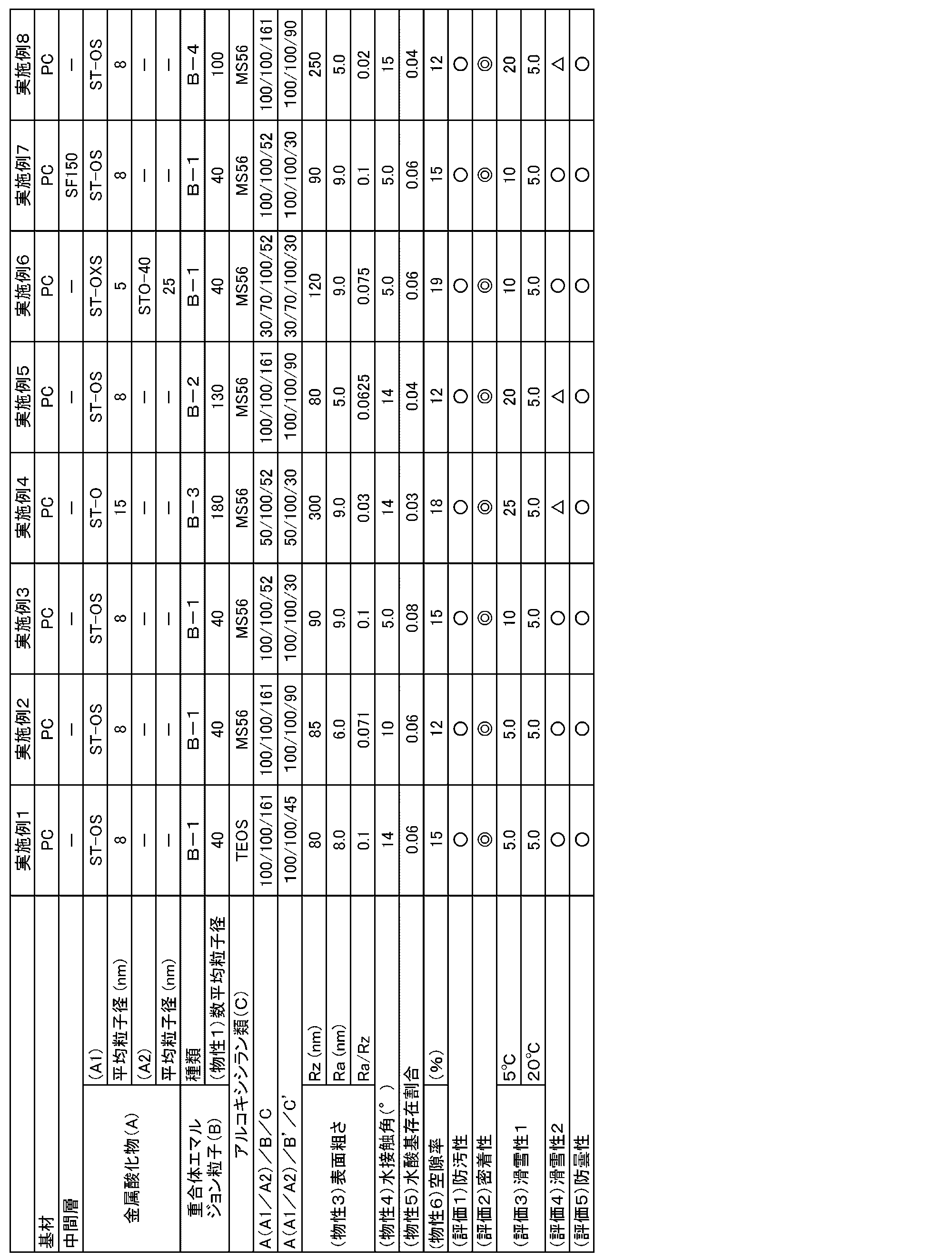
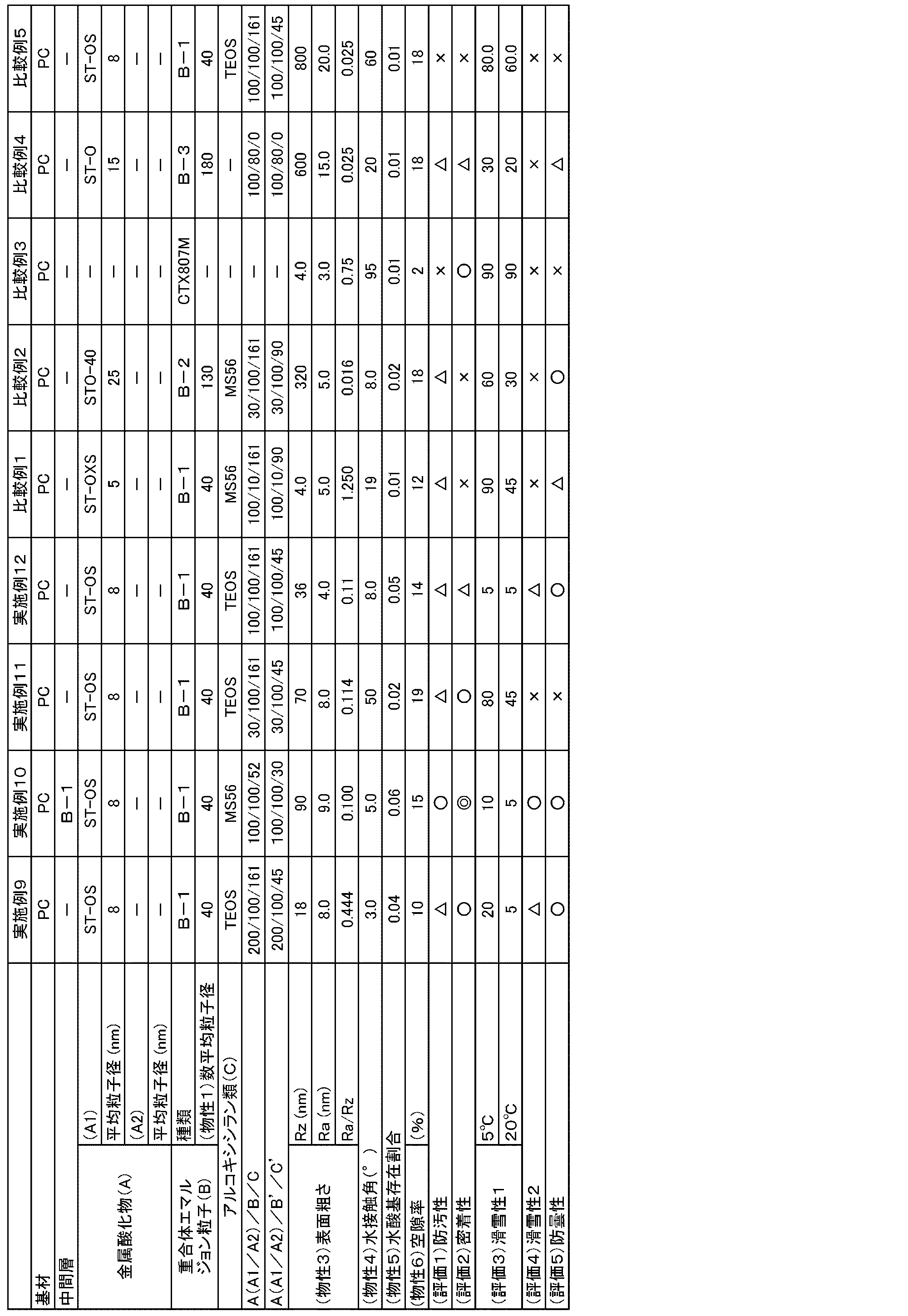
下記の製造例におけるハードコート塗膜に関する各種の物性及び評価は、下記の方法で測定及び評価した。
金属酸化物(A)について、50,000~100,000倍に拡大し、球状の金属酸化物(A)の粒子が100個~200個写るように調整して透過型顕微鏡写真を撮影した。次いで、撮影された各金属酸化物(A)の粒子径(長径と短径)を測定し、それらの平均値((長径+短径)/2)を求め、平均粒子径とした。
基材上に塗布されたハードコート塗膜の原料組成物(以下、「コーティング組成物」と称する)をハードコート塗膜としたのち、当該ハードコート塗膜の膜厚を光学式膜厚計((株)スペクトラスコープ製、品番:MHAA-100W)を用いて測定した。
後述する実施例及び比較例で製造した試験板(基材及びハードコート塗膜)について、日本国日本電色工業株式会社製濁度計NDH2000を用いて、JIS K7136に規定される方法により、ヘイズ(曇り度)を測定した。
フィッシャー・インストルメンツ製フィッシャースコープ(型番:H-100CS)を用いた押込み試験(試験条件;圧子:ビッカース四角錐ダイヤモンド圧子、荷重条件:1mN/20sec、クリープ:5sec、除荷条件:-1mN/20sec、測定荷重範囲0.4mN~1mN、荷重時および除荷時にそれぞれ等間隔に200点ずつ測定、クリープ時に等間隔に10点測定)により微小硬度を測定し、下記式(3)~(6)を荷重0.4mN~1mNの範囲で計算することにより、最大押込み変形量hmax及び弾性回復率WERを算出した。


Ep=Ep,initial-Ee (5)
WER=Ee/(Ee+Ep) (6)
後述する合成例により製造した重合体粒子(C)の数平均粒子径は、動的光散乱式粒度分布測定装置(日機装社製、商品名マイクロトラックUPA)により測定した。
ハードコート塗膜表面をスチールウール(#0)にて手で往復5回こすり、その後ティッシュペーパーやドライエアーにて表面についたスチールウールの粉を除去した後、上記「(3)ヘイズ[%]」に記載の方法で試験後の試験板のヘイズを測定し、スチールウール試験前後のヘイズ変化量から塗膜の擦過性を以下のように評価した。スチールウールで擦ったときの圧力は、130~150gf/cm2、速度は約1cm/秒であった。
ヘイズ変化量≦5.0・・・擦過性評価「○」
ヘイズ変化量>5.0・・・擦過性評価「×」
後述する製造例で得られたハードコート塗膜を、80℃の蒸気に10秒間、塗膜面を曝した後に、目視で曇り度合いを判定し、防曇性を以下の基準で評価した。
○:良好(曇りなし)
△:部分的に曇り有り
×:曇りあり
以下、後述する実施例及び比較例において用いた重合体エマルジョン粒子の合成例を記載する。
還流冷却器、滴下槽、温度計及び撹拌装置を有する反応器に、イオン交換水410g、及びドデシルベンゼンスルホン酸10%水溶液22gを投入した後、撹拌しながら80℃に加温して混合液(1)を得た。
還流冷却器、滴下槽、温度計及び撹拌装置を有する反応器に、イオン交換水1040g、及びドデシルベンゼンスルホン酸の10%水溶液(ライポンLH-200、花王(株)製)60gを投入した後、撹拌しながら80℃に加温して混合液(1)を得た。
重合体エマルジョン(B)として上記で調整した「B-5」、金属酸化物(A)として水分散コロイダルシリカ「A-1」(商品名「スノーテックスOXS」(ST-OXS)、日産化学工業(株)製、固形分10質量%、平均粒子径5nm)、及びアルコキシシラン(C)としてトリス-(トリメトキシシリルプロピル)イソシアヌレート(商品名「KBM9659」、信越化学工業(株)製)を表3に記載の固形分質量比(A:C:B質量比率)で混合した。
金属酸化物(A)として水分散コロイダルシリカ「A-2」(商品名「スノーテックスOS」(ST-OS)、日産化学工業(株)製、固形分20質量%、平均粒子径8~11nm)に変更した以外は製造例1と同様にしてハードコート塗膜を得た。評価結果を表
3に示す。
アルコキシシラン(C)として1,6―ビス(トリメトキシシリル)ヘキサン(商品名「KBM-3066」、信越化学工業(株)製)に変更した以外は実施例13と同様にしてハードコート塗膜を得た。評価結果を表3に示す。
重合体粒子(B)を用いなかった以外は、製造例1と同様にしてハードコート塗膜を得た。評価結果を表3へ示す。
重合体エマルション粒子(B)を上記で調整した「B-6」に変更した以外は、製造例1と同様にしてハードコート塗膜を得た。評価結果を表3へ示す。
アルコキシシラン(C)としてメチルトリメトキシシラン(商品名「KBM-13」、信越化学工業(株)製)に変更した以外は製造例1と同様にしてハードコート塗膜を得た。評価結果を表3に示す。
アルコキシシラン(C)としてテトラエトキシシラン(商品名「KBE-04」、信越化学工業(株)製)に変更し、さらに(C)の組成比を表3に示すように変更した以外は製造例1と同様にしてハードコート塗膜を得た。評価結果を表3に示す。
製造例1と同様の基材の片側の表面に粘着剤層として、AD-1(東日本塗料性スーパーエクセルプライマー)をスプレーにて塗布し、25℃、50%RH雰囲気下で24時間乾燥させた。その後、基材を上記粘着剤層付きとし、さらに(C)の組成比を表3に示すように変更した以外は製造例1と同様にしてハードコート塗膜を得た。評価結果を表3に示す。
アルコキシシラン(C)として3-グリシドキシプロピルトリメトキシシラン(商品名「KBM-403」、信越化学工業(株)製)に変更した以外は製造例1と同様にしてハードコート塗膜を得た。評価結果を表3に示す。また、微小硬度試験に供した結果得られたF-h曲線を図3に示す。

表4に記載の配合比率で、実施例1と同様にしてコーティング組成物を得た。次に、基材(5cm×5cmのポリカーボネート)に、上記コーティング組成物を、ディップコーターを用いて膜厚が500nmとなるよう塗布した後、25℃で24時間乾燥して部材を得た。得られた部材の評価結果を表4に示す。
表4に記載の配合比率で、実施例1と同様にしてコーティング組成物を得た。次に、基材(5cm×5cmのポリカーボネート)に、上記コーティング組成物を、ディップコーターを用いて膜厚が500nmとなるよう塗布した後、25℃で24時間乾燥して部材を得た。得られた部材の評価結果を表4に示す。
表4に記載の配合比率で、実施例1と同様にしてコーティング組成物を得た。次に、基材(5cm×5cmのポリカーボネート)に、上記コーティング組成物を、ディップコーターを用いて膜厚が500nmとなるよう塗布した後、25℃で24時間乾燥して部材を得た。得られた部材の評価結果を表4に示す。
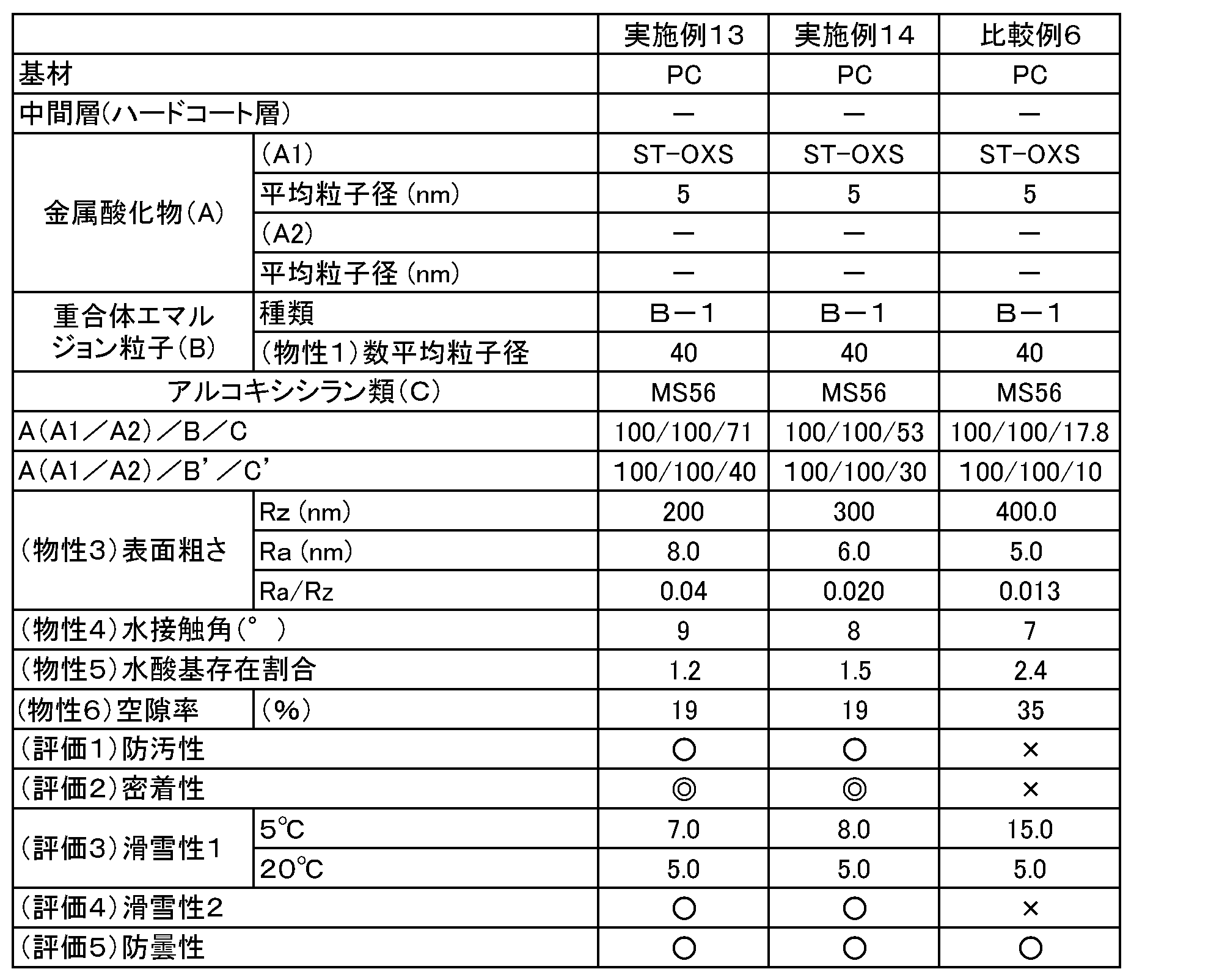
〔実施例15〕
製造例2で得たハードコート層の上部に実施例1と同様にして得たコーティング組成物ディップコーターを用いて膜厚が500nmとなるよう塗布した後、25℃で24時間乾燥して部材を得た。得られた部材の評価結果を表5に示す。
製造例3で得たハードコート層の上部に実施例1と同様にして得たコーティング組成物ディップコーターを用いて膜厚が500nmとなるよう塗布した後、25℃で24時間乾燥して部材を得た。得られた部材の評価結果を表5に示す。
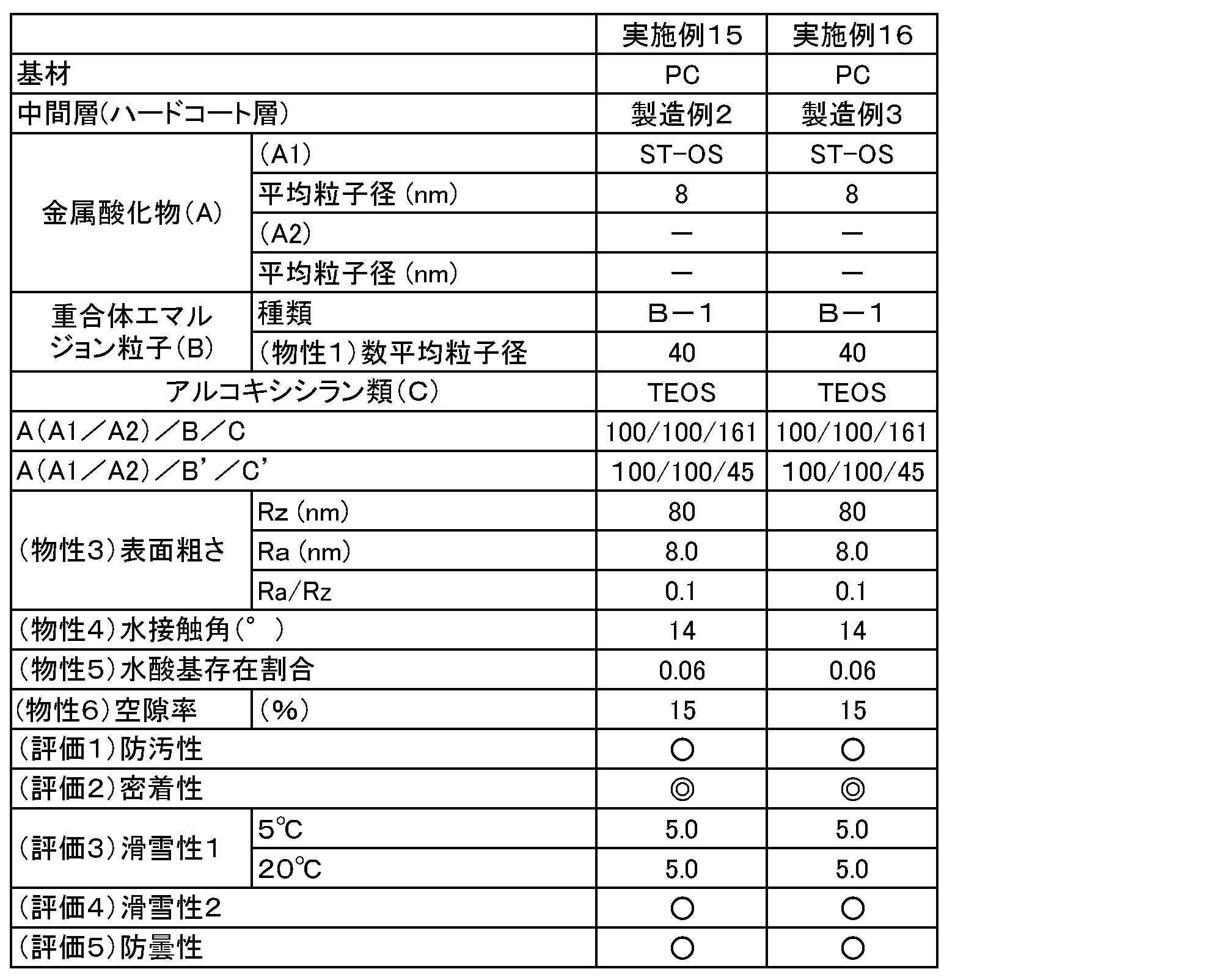
Claims (20)
- 金属酸化物と重合体粒子とを含み、
十点平均粗さが、5nm以上300nm以下である、
塗膜。 - 前記十点平均粗さに対する算術平均粗さが、0.0以上3.0以下である、
請求項1に記載の塗膜。 - 水接触角が、40度以下である、
請求項1又は2に記載の塗膜。 - 塗膜表面の水酸基存在割合が、0.03以上0.2以下である、
請求項1~3のいずれか一項に記載の塗膜。 - 塗膜の空隙率が、20%未満である、
請求項1~4のいずれか一項に記載の塗膜。 - 前記金属酸化物の平均粒子径が、1.0nm以上400nm以下である、
請求項1~5のいずれか一項に記載の塗膜。 - 前記重合体粒子の平均粒子径が、10nm以上800nm以下である、
請求項1~6のいずれか一項に記載の塗膜。 - 基材の少なくとも片面に、金属酸化物と重合体エマルジョン粒子とを含むコーティング組成物を、塗布及び乾燥して得られる、
請求項1~7のいずれか一項に記載の塗膜。 - 基材と直接接触する塗膜であって、基材と直接接触する面に少なくとも1層の中間層を備える、
請求項1~8のいずれか一項に記載の塗膜。 - 前記中間層は、ウレタン樹脂、アクリルウレタン樹脂、カチオン性樹脂、及びアクリルシリコーン樹脂からなる群より選ばれる少なくとも1種を含む、
請求項9に記載の塗膜。 - 前記中間層は、ハードコート層を含み、
前記ハードコート層は、金属酸化物を含む、
請求項9に記載の塗膜。 - 前記ハードコート層は、下記式(1)で表される原子団を1分子中に3~20個有する多官能シランをさらに含む、
請求項11に記載の塗膜。
R1 nSiX3-nA- (1)
(式中、R1は水素、炭素数1~10のアルキル基、アルケニル基若しくはアルキニル基、又はアリール基を示し、これらの置換基上にさらにハロゲン基、ヒドロキシ基、メルカプト基、アミノ基、(メタ)アクリロイル基、又はエポキシ基を有していてもよく、Xは、加水分解基を示し、nは、0~2の整数であり、Aは、メチレン基を2~20個含む部位を示し、メチレン基上にさらに置換基を有してもよい。) - 着雪防止用又は防曇用である、
請求項1~12のいずれか一項に記載の塗膜。 - 金属酸化物と重合体エマルジョン粒子とを含むコーティング組成物を塗布する、塗布工程と、
5.0℃以上80℃以下で乾燥する、乾燥工程と、
30℃以上150℃以下、及び湿度40%RH以上100%RH以下の環境下で養生する、養生工程と、
を有する、請求項1~13のいずれか一項に記載の塗膜の製造方法。 - 前記塗布工程は、スプレーコーティング法で塗布、又はDIPコーティング法で基材の両面を同時に塗布する工程である、
請求項14に記載の塗膜の製造方法。 - 着雪防止性を付与するための、金属酸化物と重合体エマルジョン粒子とを含むコーティング組成物の利用。
- 基材と、該基材上に請求項1~13のいずれか一項に記載の塗膜とを含む、
機能性部材。 - 設置角度を、地面に対して10度以上140度以下にして用いられる、
請求項17に記載の機能性部材。 - 前記基材の形状が、非平面である、
請求項17又は18に記載の機能性部材。 - 請求項17~19のいずれか一項に記載の機能性部材を備える、
LED信号機、LEDヘッドランプ、LED用レンズ、ヘッドランプ、及び屋外用表示板からなる群より選択される、
屋外用部材。
Priority Applications (5)
| Application Number | Priority Date | Filing Date | Title |
|---|---|---|---|
| JP2017525452A JP6483822B2 (ja) | 2015-06-25 | 2016-06-24 | 塗膜 |
| US15/558,479 US20180065147A1 (en) | 2015-06-25 | 2016-06-24 | Coating film |
| CA2979748A CA2979748C (en) | 2015-06-25 | 2016-06-24 | Adhesive and antifouling coating film |
| CN201680015167.2A CN107429119A (zh) | 2015-06-25 | 2016-06-24 | 涂膜 |
| EP16814504.3A EP3315571B1 (en) | 2015-06-25 | 2016-06-24 | Coating film |
Applications Claiming Priority (2)
| Application Number | Priority Date | Filing Date | Title |
|---|---|---|---|
| JP2015-127879 | 2015-06-25 | ||
| JP2015127879 | 2015-06-25 |
Publications (1)
| Publication Number | Publication Date |
|---|---|
| WO2016208735A1 true WO2016208735A1 (ja) | 2016-12-29 |
Family
ID=57585102
Family Applications (1)
| Application Number | Title | Priority Date | Filing Date |
|---|---|---|---|
| PCT/JP2016/068871 Ceased WO2016208735A1 (ja) | 2015-06-25 | 2016-06-24 | 塗膜 |
Country Status (6)
| Country | Link |
|---|---|
| US (1) | US20180065147A1 (ja) |
| EP (1) | EP3315571B1 (ja) |
| JP (1) | JP6483822B2 (ja) |
| CN (1) | CN107429119A (ja) |
| CA (1) | CA2979748C (ja) |
| WO (1) | WO2016208735A1 (ja) |
Cited By (12)
| Publication number | Priority date | Publication date | Assignee | Title |
|---|---|---|---|---|
| WO2019163918A1 (ja) * | 2018-02-23 | 2019-08-29 | 旭化成株式会社 | 高耐久防曇塗膜およびコーティング組成物 |
| WO2019181216A1 (ja) * | 2018-03-23 | 2019-09-26 | 国立研究開発法人防災科学技術研究所 | 滑雪用フィルム又はシート |
| WO2020045632A1 (ja) * | 2018-08-31 | 2020-03-05 | 旭化成株式会社 | ハードコート塗膜、ハードコート塗膜付き基材、塗料組成物及び窓材 |
| JP2020090595A (ja) * | 2018-12-04 | 2020-06-11 | 国立大学法人信州大学 | コーティング剤及びコーティング膜 |
| JP2021031620A (ja) * | 2019-08-27 | 2021-03-01 | 旭化成株式会社 | 高耐久防曇塗膜およびコーティング組成物 |
| JP2021080452A (ja) * | 2019-11-18 | 2021-05-27 | ダイキン工業株式会社 | 着雪防止被膜形成用組成物及び着雪防止被膜 |
| JP2021161231A (ja) * | 2020-03-31 | 2021-10-11 | 株式会社カネカ | 硬化性樹脂組成物 |
| JP7087177B1 (ja) | 2021-08-02 | 2022-06-20 | 長瀬産業株式会社 | 防曇層、及びその利用 |
| JP7087176B1 (ja) | 2021-08-02 | 2022-06-20 | 長瀬産業株式会社 | 防曇層、及びその利用 |
| JP7106732B1 (ja) | 2021-08-02 | 2022-07-26 | 長瀬産業株式会社 | 防曇層、及びその利用 |
| KR20220129593A (ko) * | 2020-03-04 | 2022-09-23 | 아사히 가세이 가부시키가이샤 | 적층체, 하드 코트 도막, 및 도료 조성물 |
| JP2023066032A (ja) * | 2021-10-28 | 2023-05-15 | 旭化成株式会社 | 塗料組成物、ハードコート塗膜、及びハードコート塗膜付き基材 |
Families Citing this family (7)
| Publication number | Priority date | Publication date | Assignee | Title |
|---|---|---|---|---|
| JP6577361B2 (ja) * | 2015-12-24 | 2019-09-18 | 日華化学株式会社 | 水分散体、コーティング液及び透過型スクリーンの製造方法 |
| KR20210022782A (ko) | 2016-03-14 | 2021-03-03 | 아사히 가세이 가부시키가이샤 | 고내구 방담 도막 및 코팅 조성물 |
| FR3078409B1 (fr) * | 2018-02-26 | 2021-07-09 | Valeo Vision | Element optique pour vehicule automobile |
| WO2020004628A1 (ja) * | 2018-06-29 | 2020-01-02 | 三菱ケミカル株式会社 | 滑り止め加工剤、滑り止め加工された繊維加工品、及び滑り止め加工された繊維加工品の製造方法 |
| US20200024475A1 (en) * | 2018-07-23 | 2020-01-23 | Momentive Performance Materials Inc. | Crack resistant coating composition and method of making thereof |
| JP7265682B2 (ja) * | 2020-07-13 | 2023-04-26 | 日東電工株式会社 | 防汚層付き光学フィルム |
| CN117846214A (zh) * | 2023-12-18 | 2024-04-09 | 上海二十冶建设有限公司 | 一种抗凝冰、防结露建筑板材及其制备方法 |
Citations (5)
| Publication number | Priority date | Publication date | Assignee | Title |
|---|---|---|---|---|
| JP2001106973A (ja) * | 1999-10-01 | 2001-04-17 | Showa Denko Kk | 撥水性塗料及び高撥水性表面を有する物品 |
| JP2001131480A (ja) * | 1999-10-29 | 2001-05-15 | Showa Denko Kk | 耐磨耗性撥水性塗料及び耐磨耗性撥水性表面を有する物品 |
| JP2009255490A (ja) * | 2007-05-15 | 2009-11-05 | Fujifilm Corp | 親水性部材および親水性組成物 |
| JP2011111533A (ja) * | 2009-11-26 | 2011-06-09 | Asahi Kasei E-Materials Corp | 機能性塗膜 |
| JP2014205736A (ja) * | 2013-04-10 | 2014-10-30 | 旭化成株式会社 | コーティング組成物及び積層体 |
Family Cites Families (7)
| Publication number | Priority date | Publication date | Assignee | Title |
|---|---|---|---|---|
| EP0352804B1 (en) * | 1988-07-29 | 1996-03-13 | Asahipen Corporation | Coloring high-molecular particulate material and coating composition including the same |
| JP5137352B2 (ja) * | 2006-07-28 | 2013-02-06 | 旭化成イーマテリアルズ株式会社 | 水系汚染防止用組成物および塗装物 |
| EP2212032B1 (en) * | 2007-11-19 | 2011-04-20 | E. I. du Pont de Nemours and Company | Treated plastic surfaces having improved cleaning properties |
| EP2407521B1 (en) * | 2009-03-11 | 2015-07-29 | Asahi Kasei E-Materials Corporation | Coating composition, coating film, laminate, and process for production of laminate |
| JP5692892B2 (ja) * | 2009-04-06 | 2015-04-01 | 旭化成ケミカルズ株式会社 | 塗膜及び水系有機無機複合組成物 |
| JP5625984B2 (ja) * | 2011-02-15 | 2014-11-19 | 藤倉化成株式会社 | 金属基材用ハードコート塗料組成物および成形体 |
| WO2014097309A1 (en) * | 2012-12-17 | 2014-06-26 | Asian Paints Ltd. | Stimuli responsive self cleaning coating |
-
2016
- 2016-06-24 CN CN201680015167.2A patent/CN107429119A/zh active Pending
- 2016-06-24 JP JP2017525452A patent/JP6483822B2/ja active Active
- 2016-06-24 US US15/558,479 patent/US20180065147A1/en not_active Abandoned
- 2016-06-24 WO PCT/JP2016/068871 patent/WO2016208735A1/ja not_active Ceased
- 2016-06-24 EP EP16814504.3A patent/EP3315571B1/en active Active
- 2016-06-24 CA CA2979748A patent/CA2979748C/en active Active
Patent Citations (5)
| Publication number | Priority date | Publication date | Assignee | Title |
|---|---|---|---|---|
| JP2001106973A (ja) * | 1999-10-01 | 2001-04-17 | Showa Denko Kk | 撥水性塗料及び高撥水性表面を有する物品 |
| JP2001131480A (ja) * | 1999-10-29 | 2001-05-15 | Showa Denko Kk | 耐磨耗性撥水性塗料及び耐磨耗性撥水性表面を有する物品 |
| JP2009255490A (ja) * | 2007-05-15 | 2009-11-05 | Fujifilm Corp | 親水性部材および親水性組成物 |
| JP2011111533A (ja) * | 2009-11-26 | 2011-06-09 | Asahi Kasei E-Materials Corp | 機能性塗膜 |
| JP2014205736A (ja) * | 2013-04-10 | 2014-10-30 | 旭化成株式会社 | コーティング組成物及び積層体 |
Cited By (35)
| Publication number | Priority date | Publication date | Assignee | Title |
|---|---|---|---|---|
| US11781037B2 (en) | 2018-02-23 | 2023-10-10 | Asahi Kasei Kabushiki Kaisha | High-durability antifogging coating film and coating composition |
| JPWO2019163918A1 (ja) * | 2018-02-23 | 2020-12-17 | 旭化成株式会社 | 高耐久防曇塗膜およびコーティング組成物 |
| WO2019163918A1 (ja) * | 2018-02-23 | 2019-08-29 | 旭化成株式会社 | 高耐久防曇塗膜およびコーティング組成物 |
| JP7087059B2 (ja) | 2018-02-23 | 2022-06-20 | 旭化成株式会社 | 高耐久防曇塗膜およびコーティング組成物 |
| WO2019181216A1 (ja) * | 2018-03-23 | 2019-09-26 | 国立研究開発法人防災科学技術研究所 | 滑雪用フィルム又はシート |
| JP2019167445A (ja) * | 2018-03-23 | 2019-10-03 | 国立研究開発法人防災科学技術研究所 | 難着雪・滑雪粘着フィルム又はシート |
| US12545808B2 (en) | 2018-08-31 | 2026-02-10 | Asahi Kasei Kabushiki Kaisha | Hard coating film, hard coating film-applied substrate, coating material composition, and window material |
| WO2020045632A1 (ja) * | 2018-08-31 | 2020-03-05 | 旭化成株式会社 | ハードコート塗膜、ハードコート塗膜付き基材、塗料組成物及び窓材 |
| KR20210031489A (ko) * | 2018-08-31 | 2021-03-19 | 아사히 가세이 가부시키가이샤 | 하드 코트 도막, 하드 코트 도막 형성 기재, 도료 조성물 및 창재 |
| KR102571884B1 (ko) * | 2018-08-31 | 2023-08-28 | 아사히 가세이 가부시키가이샤 | 하드 코트 도막, 하드 코트 도막 형성 기재, 도료 조성물 및 창재 |
| JPWO2020045632A1 (ja) * | 2018-08-31 | 2021-08-12 | 旭化成株式会社 | ハードコート塗膜、ハードコート塗膜付き基材、塗料組成物及び窓材 |
| JP7280271B2 (ja) | 2018-08-31 | 2023-05-23 | 旭化成株式会社 | ハードコート塗膜、ハードコート塗膜付き基材、塗料組成物及び窓材 |
| JP2020090595A (ja) * | 2018-12-04 | 2020-06-11 | 国立大学法人信州大学 | コーティング剤及びコーティング膜 |
| JP7369957B2 (ja) | 2018-12-04 | 2023-10-27 | 国立大学法人信州大学 | コーティング剤及びコーティング膜 |
| JP2021031620A (ja) * | 2019-08-27 | 2021-03-01 | 旭化成株式会社 | 高耐久防曇塗膜およびコーティング組成物 |
| JP7360274B2 (ja) | 2019-08-27 | 2023-10-12 | 旭化成株式会社 | 高耐久防曇塗膜およびコーティング組成物 |
| JP2021080452A (ja) * | 2019-11-18 | 2021-05-27 | ダイキン工業株式会社 | 着雪防止被膜形成用組成物及び着雪防止被膜 |
| JP7235988B2 (ja) | 2019-11-18 | 2023-03-09 | ダイキン工業株式会社 | 着雪防止被膜形成用組成物及び着雪防止被膜 |
| KR20220129593A (ko) * | 2020-03-04 | 2022-09-23 | 아사히 가세이 가부시키가이샤 | 적층체, 하드 코트 도막, 및 도료 조성물 |
| KR102783060B1 (ko) | 2020-03-04 | 2025-03-18 | 아사히 가세이 가부시키가이샤 | 적층체, 하드 코트 도막, 및 도료 조성물 |
| JP2021161231A (ja) * | 2020-03-31 | 2021-10-11 | 株式会社カネカ | 硬化性樹脂組成物 |
| WO2023013295A1 (ja) * | 2021-08-02 | 2023-02-09 | 長瀬産業株式会社 | 防曇層、及びその利用 |
| WO2023013228A1 (ja) * | 2021-08-02 | 2023-02-09 | 長瀬産業株式会社 | 防曇層、及びその利用 |
| JP2023021624A (ja) * | 2021-08-02 | 2023-02-14 | 長瀬産業株式会社 | 防曇層、及びその利用 |
| JP7087177B1 (ja) | 2021-08-02 | 2022-06-20 | 長瀬産業株式会社 | 防曇層、及びその利用 |
| JP2023021903A (ja) * | 2021-08-02 | 2023-02-14 | 長瀬産業株式会社 | 防曇層、及びその利用 |
| JP2023021623A (ja) * | 2021-08-02 | 2023-02-14 | 長瀬産業株式会社 | 防曇層、及びその利用 |
| WO2023013229A1 (ja) * | 2021-08-02 | 2023-02-09 | 長瀬産業株式会社 | 防曇層、及びその利用 |
| JP2023021625A (ja) * | 2021-08-02 | 2023-02-14 | 長瀬産業株式会社 | 防曇層、及びその利用 |
| JP7106732B1 (ja) | 2021-08-02 | 2022-07-26 | 長瀬産業株式会社 | 防曇層、及びその利用 |
| TWI822201B (zh) * | 2021-08-02 | 2023-11-11 | 日商長瀨產業股份有限公司 | 防霧層及其利用 |
| TWI822212B (zh) * | 2021-08-02 | 2023-11-11 | 日商長瀨產業股份有限公司 | 防霧層及其利用 |
| JP7385691B2 (ja) | 2021-08-02 | 2023-11-22 | 長瀬産業株式会社 | 防曇層、及びその利用 |
| JP7087176B1 (ja) | 2021-08-02 | 2022-06-20 | 長瀬産業株式会社 | 防曇層、及びその利用 |
| JP2023066032A (ja) * | 2021-10-28 | 2023-05-15 | 旭化成株式会社 | 塗料組成物、ハードコート塗膜、及びハードコート塗膜付き基材 |
Also Published As
| Publication number | Publication date |
|---|---|
| EP3315571B1 (en) | 2020-05-06 |
| CA2979748C (en) | 2021-02-16 |
| JP6483822B2 (ja) | 2019-03-13 |
| EP3315571A1 (en) | 2018-05-02 |
| US20180065147A1 (en) | 2018-03-08 |
| CN107429119A (zh) | 2017-12-01 |
| JPWO2016208735A1 (ja) | 2017-11-16 |
| EP3315571A4 (en) | 2018-05-09 |
| CA2979748A1 (en) | 2016-12-29 |
Similar Documents
| Publication | Publication Date | Title |
|---|---|---|
| JP6483822B2 (ja) | 塗膜 | |
| JP6283718B2 (ja) | 共重合体及びそれからなる親水性材料 | |
| JP6434519B2 (ja) | スルホン酸系共重合体とアミノ樹脂からなる親水性材料 | |
| CN102365315B (zh) | 有机聚硅氧烷和硬涂剂组合物以及具有硬涂层的树脂基板 | |
| CN102449072B (zh) | 有机硅氧烷树脂组合物及其层叠体 | |
| JP6239086B2 (ja) | 共重合体または組成物からなる膜 | |
| JP2008120986A (ja) | プライマー組成物及び被覆物品 | |
| JP6706059B2 (ja) | ハードコート塗膜 | |
| JP6328885B2 (ja) | コーティング組成物及び積層体 | |
| KR20170020869A (ko) | 실세스퀴옥산 중합체 코어 및 실세스퀴옥산 중합체 외층을 포함하는 경화성 중합체 및 방법 | |
| JP5692892B2 (ja) | 塗膜及び水系有機無機複合組成物 | |
| JP2020050808A (ja) | コーティング組成物 | |
| JP6573445B2 (ja) | 光学塗膜、光学塗膜の製造方法、及び反射防止膜 | |
| CN107523101B (zh) | 涂膜、涂膜的制造方法以及涂布组合物 | |
| JP5650394B2 (ja) | 複層塗膜及び複層塗膜の製造方法 | |
| JP2021138830A (ja) | クリアコート剤、クリアコート塗膜付き基材及び積層体 | |
| JP2016085239A (ja) | コーティング組成物および光学塗膜の製造方法 | |
| JP6425964B2 (ja) | 光学塗膜及び反射防止膜 | |
| JP6457866B2 (ja) | 太陽電池用のコーティング膜及びその製造方法 | |
| JP2024002168A (ja) | 塗料組成物、ハードコート塗膜、及びハードコート塗膜付き基材 |
Legal Events
| Date | Code | Title | Description |
|---|---|---|---|
| 121 | Ep: the epo has been informed by wipo that ep was designated in this application |
Ref document number: 16814504 Country of ref document: EP Kind code of ref document: A1 |
|
| ENP | Entry into the national phase |
Ref document number: 2017525452 Country of ref document: JP Kind code of ref document: A |
|
| ENP | Entry into the national phase |
Ref document number: 2979748 Country of ref document: CA |
|
| REEP | Request for entry into the european phase |
Ref document number: 2016814504 Country of ref document: EP |
|
| WWE | Wipo information: entry into national phase |
Ref document number: 15558479 Country of ref document: US |
|
| NENP | Non-entry into the national phase |
Ref country code: DE |