WO2017000840A1 - Procédé et appareil de transmission de données - Google Patents
Procédé et appareil de transmission de données Download PDFInfo
- Publication number
- WO2017000840A1 WO2017000840A1 PCT/CN2016/087065 CN2016087065W WO2017000840A1 WO 2017000840 A1 WO2017000840 A1 WO 2017000840A1 CN 2016087065 W CN2016087065 W CN 2016087065W WO 2017000840 A1 WO2017000840 A1 WO 2017000840A1
- Authority
- WO
- WIPO (PCT)
- Prior art keywords
- data
- correspondence
- type
- transmission
- transmitted
- Prior art date
- Legal status (The legal status is an assumption and is not a legal conclusion. Google has not performed a legal analysis and makes no representation as to the accuracy of the status listed.)
- Ceased
Links
Images




Classifications
-
- H—ELECTRICITY
- H04—ELECTRIC COMMUNICATION TECHNIQUE
- H04W—WIRELESS COMMUNICATION NETWORKS
- H04W72/00—Local resource management
- H04W72/50—Allocation or scheduling criteria for wireless resources
- H04W72/56—Allocation or scheduling criteria for wireless resources based on priority criteria
- H04W72/566—Allocation or scheduling criteria for wireless resources based on priority criteria of the information or information source or recipient
- H04W72/569—Allocation or scheduling criteria for wireless resources based on priority criteria of the information or information source or recipient of the traffic information
-
- H—ELECTRICITY
- H04—ELECTRIC COMMUNICATION TECHNIQUE
- H04W—WIRELESS COMMUNICATION NETWORKS
- H04W72/00—Local resource management
- H04W72/12—Wireless traffic scheduling
Definitions
- the present application relates to the field of communications, and in particular, to a data transmission method and apparatus.
- the basic form of a modern wireless communication system consists of a radio frequency node and its superior nodes.
- the most typical example is a radio frequency node: a remote radio unit (RRU) and a superordinate node of the radio frequency node: a baseband unit (Base Band Unit). , BBU) composition.
- RRU remote radio unit
- BBU Base Band Unit
- the radio node and its upper node communicate through a Common Common Radio Interface (CPRI).
- CPRI Common Common Radio Interface
- CPRI data is transmitted in a time-multiplexed manner using a dedicated network constructed by bare fiber, so the transmission cost is high.
- CPRI data can be transmitted using a public network such as Ethernet.
- the application provides a data transmission method and device, and aims to solve the problem of using a public network. How to ensure the quality of data transmission when transmitting data.
- a data transmission method includes:
- the sending node determines the type of data to be transmitted
- the sending node sorts the to-be-transmitted data according to a priority from high to low according to a preset correspondence relationship and a type of the data to be transmitted, where the correspondence relationship is a correspondence between a data type and a transmission priority;
- the sending node sequentially sends each data to be transmitted in the order indicated by the sorting result.
- the sending node determines that the type of data to be transmitted includes:
- the sending node determines the type of the data to be transmitted from the first range, where the first range includes: transmission control data, transmission synchronization data, transmission user data, and transmission maintenance management data. ;
- the transmission control data and the transmission synchronization data correspond to a high priority
- the transmission user data and the transmission maintenance management data correspond to a low priority
- the sending node determines that the type of data to be transmitted includes:
- the sending node determines the type of the data to be transmitted from the second range, and the second range includes different transmission user type data;
- the sending node determines that the type of data to be transmitted includes:
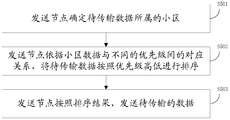
- the sending node determines a cell to which the data to be transmitted belongs
- a data transmission method includes:
- the receiving node receives the data
- the first sequence is an order in which the sending node sends the data, where the first sequence is determined by the sending node Setting a first correspondence relationship and a type of the data, and sorting the data according to a priority from high to low;
- the second sequence is obtained by the receiving node sorting the received data according to a priority from high to low according to the second correspondence and the type of the data, where the first correspondence and the first
- the two correspondences are the correspondence between the data type and the transmission priority, and the first correspondence is different from the second correspondence.
- the second correspondence includes:
- the transmission control data and the transmission synchronization data correspond to a high priority
- the transmission user data and the transmission maintenance management data correspond to a low priority
- the second correspondence includes:
- the second correspondence includes:
- a data transmission device comprising:
- a type determining module configured to determine a type of data to be transmitted
- a sorting module configured to use the preset correspondence relationship and the type of the data to be transmitted
- the data to be transmitted is sorted according to the priority from high to low, and the correspondence relationship is a correspondence between the data type and the transmission priority;
- the sending module is configured to sequentially send each data to be transmitted in the order indicated by the sorting result.
- the type determining, by the type determining module, the data to be transmitted includes:
- the type determining module is specifically configured to determine, according to the data to be transmitted, the type of the data to be transmitted from the first range, where the first range includes: transmitting control data, transmitting synchronization data, and transmitting user data. And transmission maintenance management data;
- the sorting module is configured to sort the data to be transmitted according to a priority from high to low according to a preset correspondence and a type of the data to be transmitted, where the correspondence is a correspondence between a data type and a transmission priority. Relationships include:
- the sorting module is specifically configured to sort the data to be transmitted according to a priority from high to low according to a preset correspondence relationship and a type of the data to be transmitted, and the correspondence between the data type and the transmission priority
- the method includes: for the transport layer data, the transmission control data and the transmission synchronization data correspond to a high priority, and the transmission user data and the transmission maintenance management data correspond to a low priority.
- the type determining, by the type determining module, the data to be transmitted includes:
- the type determining module is specifically configured to determine, according to the data to be transmitted, the type of the data to be transmitted from the second range, where the second range includes different transmission user type data;
- the sorting module is configured to sort the data to be transmitted according to a priority from high to low according to a preset correspondence and a type of the data to be transmitted, where the correspondence is a correspondence between a data type and a transmission priority. Relationships include:
- the sorting module is specifically configured to: according to a preset correspondence relationship and a class of the data to be transmitted
- the data to be transmitted is sorted according to the priority from high to low, and the correspondence between the data type and the transmission priority includes: corresponding relationship between different transmission user types and different priorities for the wireless layer data. .
- the type determining, by the type determining module, the data to be transmitted includes:
- the type determining module is specifically configured to determine a cell to which the data to be transmitted belongs;
- the sorting module is configured to sort the data to be transmitted according to a priority from high to low according to a preset correspondence and a type of the data to be transmitted, where the correspondence is a correspondence between a data type and a transmission priority. Relationships include:
- the sorting module is specifically configured to sort the data to be transmitted according to a priority from high to low according to a preset correspondence relationship and a type of the data to be transmitted, and the correspondence between the data type and the transmission priority Including: the correspondence between different cell data and different priorities.
- a data transmission device comprising:
- a receiving module configured to receive data
- a processing module configured to process the received data according to the first sequence or the second sequence
- the first sequence is an order in which the sending node sends the data, where the first sequence is determined by the sending node according to a preset first correspondence and a type of the data, and the data is prioritized Low sorting is obtained;
- the second sequence is obtained by the receiving module according to the second correspondence relationship and the type of the data, and the received data is sorted according to a priority from high to low, the first correspondence relationship and the first
- the two correspondences are the correspondence between the data type and the transmission priority, and the first correspondence is different from the second correspondence.
- the receiving module is further configured to: perform the received data in the second order. Before processing, according to the second correspondence and the type of the data, the received data is sorted according to priority from high to low, to obtain a second sequence;
- the second correspondence includes: for the transport layer data, the transmission control data and the transmission synchronization data correspond to a high priority, and the transmission user data and the transmission maintenance management data correspond to a low priority.
- the receiving module is further configured to: before the processing the received data in the second order, according to the second correspondence and the type of the data, the received data is prioritized by the priority Sort to low to get the second order;
- the second correspondence includes: a correspondence between different transmission user types and different priorities for the wireless layer data.
- the receiving module is further configured to: before the processing the received data in the second order, according to the second correspondence and the type of the data, the received data is prioritized by the priority Sort to low to get the second order;
- the second correspondence includes: a correspondence between different cell data and different priorities.
- the sending node determines the type of data to be transmitted, and according to the correspondence between the preset data type and the transmission priority, sorts the data to be transmitted according to the priority from high to low, and according to the priority
- the order of the sorting results is instructed to sequentially send each data to be transmitted, and the receiving node processes the received data according to the priority order determined by the sending node or the priority order determined by the sending node, thereby ensuring high priority data transmission and
- the processing that is, the priority of the important data can be used to ensure the use of the transmission network. Therefore, when the data is transmitted by using the public network, the method and apparatus described in this embodiment can make the network resources centralized and preferentially supply important data. Therefore, the quality of data transmission can be improved.
- FIG. 1 is a schematic diagram of a wireless communication scenario
- FIG. 2 is a flowchart of a data transmission method according to an embodiment of the present application.
- FIG. 3 is a flowchart of still another data transmission method according to an embodiment of the present application.
- FIG. 4 is a schematic diagram of a multi-cell wireless communication scenario
- FIG. 5 is a flowchart of still another data transmission method according to an embodiment of the present application.
- FIG. 6 is a schematic structural diagram of a data transmission apparatus according to an embodiment of the present disclosure.
- FIG. 7 is a schematic structural diagram of still another data transmission apparatus according to an embodiment of the present application.
- the embodiment of the present application provides a data transmission method and device, which can be applied in the scenario shown in FIG. 1 : a radio frequency node and its upper node form one end of wireless transceiver, and the other end of the wireless transceiver includes a wireless transceiver 2 .
- the most important function of the RF node is the radio frequency function.
- L1 is the layer 1 function of wireless communication (physical layer function), such as wireless modulation function), or L1+L2 (L2 is wireless communication).
- Layer 2 function (link layer function), such as wireless MAC frame function) or L1+L2+L3 (L3 is layer 3 function for wireless communication (network layer) Function), such as wireless PDCP function, etc.
- its superior node completes other parts of the wireless function (such as the radio node only completes the L1 function, the upper node completes the L2+L3 function), and the upper node completes the control function of the radio node at the same time.
- One end of the radio frequency node and its upper node group wireless communication system communicates wirelessly with the other end wireless transceiver 2.
- the transmission system in FIG. 1 may include a public network, and the network type may be a wired network, a wireless network, a time division multiplexing network, a packet transmission network, or the like.
- the upper node and the radio node communicate through the transport layer, and the wireless service layer data between the upper node and the wireless transceiver 2 is forwarded by the radio node.
- the radio frequency node may be a sending node or a receiving node
- the upper node may also be a sending node or a receiving node, that is, if the radio frequency node can send data to the upper node, Then, the upper node is a receiving node, and the radio node is a transmitting node; if the upper node sends data to the radio node, the upper node is a sending node, and the radio node is a receiving node.
- a data transmission method disclosed in the embodiment of the present application in this embodiment, data is transmitted between a superior node and a radio frequency node through a transport layer, that is, no matter which side is the sender, the data sent by the sender is the transport layer data.
- the method described in this embodiment includes the following steps:
- the sending node determines, according to the type of data to be transmitted, the first range.
- the first range includes: data transmission control data, transmission synchronization data, transmission user data, and transmission maintenance management data. It should be noted that the data type in the first range is only a specific case of the embodiment, and the first range may also be set according to other classification standards, which is not limited in the embodiment of the present application.
- the sending node sorts the to-be-transmitted data according to a priority from high to low according to a preset correspondence relationship and a type of the data to be transmitted.
- the corresponding relationship is a correspondence between a data type and a transmission priority. That is to say, the transmission type 1, the transmission type 2, ... the transmission type n respectively correspond to different priorities.
- the transmission control data and the transmission synchronization data correspond to a high priority
- the transmission user data and the transmission maintenance management data correspond to a low priority
- S203 The sending node sequentially sends each data to be transmitted in the order indicated by the sorting result.
- the sending node sends the data to be transmitted to the transmission system in the order indicated by the sorting result, and the transmitting system sends the data to be transmitted to the receiving node according to the receiving order of the data to be transmitted.
- the sending node determines the sending priority of each data to be sent according to the type of the data to be sent, and then sends the data to be sent according to the order of priority from high to low, thereby ensuring high Priority data is sent preferentially, so that high-priority data is preferentially occupied by the network, so that the quality of data transmission can be improved without changing the network quality.
- the upper node and The wireless transceiver 2 transmits the wireless layer data through the radio frequency node, that is, whether the sender is the sender or not, the data transmitted by the sender is the wireless layer data.
- the sending node determines, according to the second range, a type of data to be transmitted.
- the second range includes different transmission user type data. That is to say, in this embodiment, the data is classified according to the type of the transmission user.
- the sending node determines the priority of the data to be transmitted according to the correspondence between the transmission user type and the priority.
- different transmission user types can correspond to different priorities.
- the transmission user 1 corresponds to a high priority
- the transmission user 2 corresponds to a low priority.
- the sending node sets a priority identifier for each data to be transmitted according to the determined priority.
- the high priority setting identifies 1 and the low priority setting identifies 0.
- the sending node sorts the data to be transmitted according to the priority from high to low according to the identifier of the priority.
- S305 The sending node sends the data to be transmitted according to the sorting result.
- the transmission system may send the data according to the priority of the priority according to the identifier carried by the data.
- the method described in this embodiment can preferentially transmit wireless layer data with high priority, thereby improving data transmission quality.
- the radio node 1 and the radio node 2 may be two independent nodes or the same node.
- the wireless transceiver 2 and the wireless transceiver 3 may be two independent nodes or the same node, and the wireless transceivers 2, 3 are respectively connected to the radio frequency nodes 1, 2 through the cells 1 and 2.
- the method described in this embodiment includes the following steps:
- the sending node determines a cell to which the data to be transmitted belongs
- the sending node sorts the data to be transmitted according to the priority according to the correspondence between the cell data and different priorities.
- S503 The sending node sends the data to be transmitted according to the sorting result.
- the priority of the data to be sent can be determined according to the cell, thereby ensuring the data transmission quality of the key cell.
- the manner of determining the data priority according to the cell in this embodiment may be used in combination with the manner of determining the priority of the transport layer data and the radio layer data in the foregoing embodiment.
- the priority may be interleaved.
- the priority determined by which classification principle may be specified for example, the low priority transmission of the high priority cell.
- the priority of the layer data may be lower than the high priority transport layer data of the low priority cell.
- the receiving node may also adopt a method of receiving data by using a priority.
- another data transmission method disclosed in the embodiment of the present application includes the following steps:
- the receiving node receives the data and processes the received data in the first order.
- the first sequence is the order in which the sending node sends data. That is to say, in what order the sending node sends data, and the receiving node processes the data in what order.
- the processing may include: storing, demodulating, forwarding, and the like.
- the sending node sets the priority flag for the data to be sent, according to the identifier
- the data is sequentially transmitted according to the order of priority from high to low, and the transmission system also forwards the data according to the identifier of the data, and the receiving node also follows the identifier of the data. Process the received data.
- B the receiving node receives the data, and processes the received data in the second order.
- the second sequence is the order in which the receiving node sorts the data to be received according to the correspondence between the data type and the priority, that is, the receiving node has a corresponding correspondence locally, and the receiving node determines the type of the data to be received, and according to the corresponding The relationship treats the received data by priority, and processes the received data according to the sort result.
- the corresponding relationship between the locality of the receiving node and the corresponding relationship used by the receiving party is different.
- the first corresponding relationship includes at least one data type
- the corresponding priority of the data type in the first corresponding relationship is
- the corresponding priorities in the second correspondence are different.
- the method in which the receiving node described in this embodiment processes the received data can also improve the quality of data transmission.
- the data transmission method disclosed in the embodiment of the present application can improve the transmission quality of data, thereby reducing the quality requirement for the data transmission network, thereby reducing the transmission cost, and Can improve the business performance of the wireless layer and the transport layer.
- the embodiment of the present application further discloses a data transmission device, as shown in FIG. 6, comprising:
- a type determining module 601 configured to determine a type of data to be transmitted
- the sorting module 602 is configured to sort the to-be-transmitted data according to a priority from high to low according to a preset correspondence and a type of the data to be transmitted, where the correspondence is a correspondence between a data type and a transmission priority. relationship;
- the sending module 603 is configured to sequentially send each data to be transmitted in the order indicated by the sorting result.
- the specific implementation manner of the type of the data to be transmitted by the type determining module may be: determining the type of the data to be transmitted from the first range, where the first range includes: Control data, transmission synchronization data, transmission user data, and transmission maintenance management data; in this case, the correspondence between the data type and the transmission priority includes: for the transmission layer data, the transmission control data and the transmission synchronization data correspond to a high priority, and the transmission User data and transmission maintenance management data correspond to low priority.
- the specific determining manner that the type determining module determines the type of the data to be transmitted may be: determining the type of the data to be transmitted from the second range, where the second range includes different transmissions.
- User type data in this case, the correspondence between the data type and the transmission priority includes: a correspondence between different transmission user types and different priorities for the wireless layer data.
- the specific implementation manner of the type determining module for determining the type of data to be transmitted may be
- the corresponding relationship between the data type and the transmission priority includes: a correspondence between different cell data and different priorities.
- Another data transmission device disclosed in the embodiment of the present application, as shown in FIG. 7, includes:
- the receiving module 701 is configured to receive data.
- the processing module 702 processes the received data in a first order or a second order.
- the first sequence is an order in which the sending node sends the data, where the first sequence is determined by the sending node according to a preset first correspondence and a type of the data, and the data is prioritized Low sorting is obtained;
- the second sequence is obtained by the receiving module according to the second correspondence relationship and the type of the data, and the received data is sorted according to a priority from high to low, the first correspondence relationship and the first
- the two correspondences are the correspondence between the data type and the transmission priority, and the first correspondence is different from the second correspondence.
- the receiving module is further configured to: before the data is processed in the second order, according to the second correspondence and the type of the data, the received data is prioritized from high to Sorting low to get the second order;
- the second correspondence includes: for the transport layer data, the transmission control data and the transmission synchronization data correspond to a high priority, and the transmission user data and the transmission maintenance management data correspond to a low priority.
- the second correspondence includes: a correspondence between different transmission user types and different priorities for the wireless layer data.
- the second correspondence includes: correspondence between different cell data and different priorities relationship.
- the data transmission device described in the foregoing embodiments may be disposed in the upper node and the radio node, and the purpose is to improve the transmission quality of the data.
- the functions described in the methods of the embodiments of the present application may be stored in a computing device readable storage medium. Based on such understanding, a portion of the embodiments of the present application that contributes to the prior art or a portion of the technical solution may be embodied in the form of a software product stored in a storage medium, including a plurality of instructions for causing a
- the computing device (which may be a personal computer, server, mobile computing device, or network device, etc.) performs all or part of the steps of the methods described in various embodiments of the present application.
- the foregoing storage medium includes: a U disk, a mobile hard disk, a read-only memory (ROM), a random access memory (RAM), a magnetic disk, or an optical disk, and the like. .
Landscapes
- Engineering & Computer Science (AREA)
- Computer Networks & Wireless Communication (AREA)
- Signal Processing (AREA)
- Mobile Radio Communication Systems (AREA)
Abstract
La présente invention concerne un procédé et un appareil de transmission de données ; un nœud d'envoi détermine le type de données à transmettre, et sur la base d'une corrélation préétablie entre le type de données et le niveau de priorité de transmission, classe les données à transmettre de élevé à faible selon le niveau de priorité, et sur la base de l'ordre indiqué par les résultats de classement, envoie séquentiellement les données à transmettre ; et un nœud de réception traite les données reçues selon l'ordre de niveau de priorité déterminé par le nœud d'envoi ou un ordre de niveau de priorité déterminé par le nœud de réception ; il peut donc être garanti que des données ayant un niveau de priorité élevé seront envoyées et traitées de manière préférentielle, garantissant que des données importantes ont une priorité dans le réseau de transmission ; lors de l'utilisation d'un réseau public pour transmettre des données, par comparaison à une transmission non différentielle, le procédé et l'appareil présentés dans le présent mode de réalisation permettent à des ressources de réseau d'être concentrées et fournies de manière préférentielle pour des données importantes, améliorant ainsi la qualité de transmission de données.
Applications Claiming Priority (2)
| Application Number | Priority Date | Filing Date | Title |
|---|---|---|---|
| CN201510368121.6 | 2015-06-29 | ||
| CN201510368121.6A CN104994590A (zh) | 2015-06-29 | 2015-06-29 | 一种数据传输方法及装置 |
Publications (1)
| Publication Number | Publication Date |
|---|---|
| WO2017000840A1 true WO2017000840A1 (fr) | 2017-01-05 |
Family
ID=54306315
Family Applications (1)
| Application Number | Title | Priority Date | Filing Date |
|---|---|---|---|
| PCT/CN2016/087065 Ceased WO2017000840A1 (fr) | 2015-06-29 | 2016-06-24 | Procédé et appareil de transmission de données |
Country Status (2)
| Country | Link |
|---|---|
| CN (1) | CN104994590A (fr) |
| WO (1) | WO2017000840A1 (fr) |
Cited By (3)
| Publication number | Priority date | Publication date | Assignee | Title |
|---|---|---|---|---|
| CN113507422A (zh) * | 2021-06-25 | 2021-10-15 | 中标慧安信息技术股份有限公司 | 基于物联网平台的多终端数据传输控制方法和系统 |
| CN115836508A (zh) * | 2021-07-16 | 2023-03-21 | 北京小米移动软件有限公司 | 一种数据传输方法、数据传输装置及存储介质 |
| CN119629077A (zh) * | 2024-12-27 | 2025-03-14 | 广州莱万科技股份有限公司 | 一种可视化分布式数据采集方法及平台 |
Families Citing this family (16)
| Publication number | Priority date | Publication date | Assignee | Title |
|---|---|---|---|---|
| CN104994590A (zh) * | 2015-06-29 | 2015-10-21 | 上海华为技术有限公司 | 一种数据传输方法及装置 |
| CN105392204B (zh) * | 2015-11-24 | 2018-11-02 | 上海汽车集团股份有限公司 | 车辆通信方法和装置 |
| CN107509216B (zh) * | 2016-06-14 | 2020-11-03 | 富士通株式会社 | 无线网络调度方法和装置 |
| CN106230536B (zh) * | 2016-07-12 | 2018-08-03 | 上海交通大学 | 一种用于电力电子分布式控制的实时通信与同步发送系统 |
| CN108616484A (zh) * | 2016-12-09 | 2018-10-02 | 华为技术有限公司 | 一种数据传输方法及装置 |
| CN109194647B (zh) * | 2018-08-30 | 2022-02-18 | 超级魔方(北京)科技有限公司 | 数据传输方法、装置、电子设备及存储介质 |
| CN110475370A (zh) * | 2019-07-31 | 2019-11-19 | 苏州研数信息科技有限公司 | 数据建模中的智能衍生变量构造方法 |
| CN114257820A (zh) * | 2020-09-25 | 2022-03-29 | 华为技术有限公司 | 数据传输方法及相关装置 |
| CN113326124A (zh) * | 2021-05-20 | 2021-08-31 | 深圳证券通信有限公司 | 一种用于预先设定文件传输任务优先级的方法 |
| CN114760284B (zh) * | 2022-03-17 | 2024-06-25 | 厚普清洁能源(集团)股份有限公司 | 防爆控制柜、无人值守点供气化站远程控制系统及方法 |
| CN115174821A (zh) * | 2022-06-16 | 2022-10-11 | 浙江华睿科技股份有限公司 | 一种数据传输方法及装置 |
| CN115396312B (zh) * | 2022-08-10 | 2023-04-25 | 中国科学院空天信息创新研究院 | 一种数据分级处理与发送方法、系统、电子设备及介质 |
| CN116015512A (zh) * | 2022-11-30 | 2023-04-25 | 中国第一汽车股份有限公司 | 数据发送方法、时钟同步方法、装置、设备及介质 |
| CN116319596A (zh) * | 2023-02-20 | 2023-06-23 | 武汉普赛斯仪表有限公司 | 一种光纤数据传输系统及方法 |
| CN118568317B (zh) * | 2024-07-23 | 2025-01-10 | 深圳市深圳通有限公司 | 用户数据处理方法、装置、设备以及存储介质 |
| CN119561908B (zh) * | 2024-11-20 | 2026-02-03 | 中移动信息技术有限公司 | 数据分级传输方法、装置、设备、存储介质及产品 |
Citations (6)
| Publication number | Priority date | Publication date | Assignee | Title |
|---|---|---|---|---|
| CN102572962A (zh) * | 2011-05-26 | 2012-07-11 | 中兴通讯股份有限公司 | 多模基站数据传输方法及装置 |
| US20130148587A1 (en) * | 2011-12-07 | 2013-06-13 | Telefonaktiebolaget Lm Ericsson | Integrated microwave backhaul support in cellular products |
| CN103988543A (zh) * | 2013-12-11 | 2014-08-13 | 华为技术有限公司 | 无线局域网中的控制设备、网络系统及业务处理方法 |
| US20150117277A1 (en) * | 2012-07-11 | 2015-04-30 | Huawei Technologies Co., Ltd. | Data transmission method and system |
| CN104684005A (zh) * | 2015-03-10 | 2015-06-03 | 华北电力大学(保定) | 一种分布式基站中数据传输处理方法 |
| CN104994590A (zh) * | 2015-06-29 | 2015-10-21 | 上海华为技术有限公司 | 一种数据传输方法及装置 |
Family Cites Families (4)
| Publication number | Priority date | Publication date | Assignee | Title |
|---|---|---|---|---|
| CN101668314B (zh) * | 2009-09-01 | 2012-12-19 | 中兴通讯股份有限公司 | 用于无线分布系统的数据传输方法和装置 |
| CN103095605A (zh) * | 2013-01-25 | 2013-05-08 | 电子科技大学 | 一种移动物联网中融合路由器的数据传输方法及系统 |
| CN103986666A (zh) * | 2013-02-07 | 2014-08-13 | 华为技术有限公司 | 一种数据处理方法、装置和系统 |
| CN104125161B (zh) * | 2014-08-14 | 2017-09-01 | 三星电子(中国)研发中心 | 区分数据优先级的多播传输方法、系统及装置 |
-
2015
- 2015-06-29 CN CN201510368121.6A patent/CN104994590A/zh active Pending
-
2016
- 2016-06-24 WO PCT/CN2016/087065 patent/WO2017000840A1/fr not_active Ceased
Patent Citations (6)
| Publication number | Priority date | Publication date | Assignee | Title |
|---|---|---|---|---|
| CN102572962A (zh) * | 2011-05-26 | 2012-07-11 | 中兴通讯股份有限公司 | 多模基站数据传输方法及装置 |
| US20130148587A1 (en) * | 2011-12-07 | 2013-06-13 | Telefonaktiebolaget Lm Ericsson | Integrated microwave backhaul support in cellular products |
| US20150117277A1 (en) * | 2012-07-11 | 2015-04-30 | Huawei Technologies Co., Ltd. | Data transmission method and system |
| CN103988543A (zh) * | 2013-12-11 | 2014-08-13 | 华为技术有限公司 | 无线局域网中的控制设备、网络系统及业务处理方法 |
| CN104684005A (zh) * | 2015-03-10 | 2015-06-03 | 华北电力大学(保定) | 一种分布式基站中数据传输处理方法 |
| CN104994590A (zh) * | 2015-06-29 | 2015-10-21 | 上海华为技术有限公司 | 一种数据传输方法及装置 |
Cited By (4)
| Publication number | Priority date | Publication date | Assignee | Title |
|---|---|---|---|---|
| CN113507422A (zh) * | 2021-06-25 | 2021-10-15 | 中标慧安信息技术股份有限公司 | 基于物联网平台的多终端数据传输控制方法和系统 |
| CN115836508A (zh) * | 2021-07-16 | 2023-03-21 | 北京小米移动软件有限公司 | 一种数据传输方法、数据传输装置及存储介质 |
| US12587482B2 (en) | 2021-07-16 | 2026-03-24 | Beijing Xiaomi Mobile Software Co., Ltd. | Data transmission method, data transmission device, and storage medium |
| CN119629077A (zh) * | 2024-12-27 | 2025-03-14 | 广州莱万科技股份有限公司 | 一种可视化分布式数据采集方法及平台 |
Also Published As
| Publication number | Publication date |
|---|---|
| CN104994590A (zh) | 2015-10-21 |
Similar Documents
| Publication | Publication Date | Title |
|---|---|---|
| WO2017000840A1 (fr) | Procédé et appareil de transmission de données | |
| US10779195B2 (en) | Information transmission method and apparatus | |
| US11184886B2 (en) | Method, base station, and user equipment for implementing carrier aggregation | |
| TWI581607B (zh) | 處理通道狀態訊息報告的方法及其通訊裝置 | |
| US11032778B2 (en) | Uplink channel power allocation method and apparatus | |
| KR102587145B1 (ko) | 캐리어 세트 결정 방법 및 장치, 저장 매체 그리고 전자 디바이스 | |
| EP3890408A1 (fr) | Procédé et dispositif d'envoi de signaux, et procédé et dispositif de configuration de priorités | |
| CN103379651B (zh) | 传输信号的方法和装置 | |
| CN109392004A (zh) | 通信方法、基站、终端设备和系统 | |
| CN104105217A (zh) | 为多个设备到设备通信分配资源方法和装置 | |
| US20150271087A1 (en) | Evolved node-b and mobility management entity and user equipment and methods for supporting attended and unattended services | |
| US12526836B2 (en) | Handling overlapping of multiple physical uplink shared channels (PUSCHs) | |
| CN110971349B (zh) | 一种重复传输方法、终端和网络侧设备 | |
| WO2020238901A1 (fr) | Procédé de communication et dispositif associé | |
| CN102711217B (zh) | 一种通信方法、装置和系统 | |
| US10631318B2 (en) | Resource division method and apparatus | |
| CN117082566A (zh) | 数据传输方法、装置及通信设备 | |
| CN104244428B (zh) | 一种干扰协调调度方法及基站 | |
| US20180132246A1 (en) | Method and system for transmitting dynamic control plane signaling of virtual cell | |
| CN119997217A (zh) | 传输方法及装置、计算机可读存储介质 | |
| CN103596644B (zh) | 一种数据传输的方法和基站 | |
| WO2022078393A1 (fr) | Procédé de synchronisation de sn, appareil et dispositif destinés à un service de diffusion/multidiffusion, et support de stockage lisible | |
| CN118944837A (zh) | 旁链路无线信令承载传输方法、配置方法及相关设备 | |
| HK1233426A1 (en) | Evolved node-b and mobility management entity and user equipment and methods for supporting attended and unattended services | |
| CN102045845A (zh) | 上行公共控制信道的传输承载的配置方法和装置 |
Legal Events
| Date | Code | Title | Description |
|---|---|---|---|
| 121 | Ep: the epo has been informed by wipo that ep was designated in this application |
Ref document number: 16817204 Country of ref document: EP Kind code of ref document: A1 |
|
| NENP | Non-entry into the national phase |
Ref country code: DE |
|
| 122 | Ep: pct application non-entry in european phase |
Ref document number: 16817204 Country of ref document: EP Kind code of ref document: A1 |