WO2017002712A1 - 含フッ素シクロプロパンカルボン酸類の製造方法 - Google Patents
含フッ素シクロプロパンカルボン酸類の製造方法 Download PDFInfo
- Publication number
- WO2017002712A1 WO2017002712A1 PCT/JP2016/068748 JP2016068748W WO2017002712A1 WO 2017002712 A1 WO2017002712 A1 WO 2017002712A1 JP 2016068748 W JP2016068748 W JP 2016068748W WO 2017002712 A1 WO2017002712 A1 WO 2017002712A1
- Authority
- WO
- WIPO (PCT)
- Prior art keywords
- group
- fluorine
- represented
- general formula
- aromatic ring
- Prior art date
- Legal status (The legal status is an assumption and is not a legal conclusion. Google has not performed a legal analysis and makes no representation as to the accuracy of the status listed.)
- Ceased
Links
- RQEUFEKYXDPUSK-ZETCQYMHSA-N C[C@@H](c1ccccc1)N Chemical compound C[C@@H](c1ccccc1)N RQEUFEKYXDPUSK-ZETCQYMHSA-N 0.000 description 3
- 0 *[C@](CO1)OS1(=O)=O Chemical compound *[C@](CO1)OS1(=O)=O 0.000 description 2
- ZPFAVCIQZKRBGF-UHFFFAOYSA-N O=S1(OCCO1)=O Chemical compound O=S1(OCCO1)=O ZPFAVCIQZKRBGF-UHFFFAOYSA-N 0.000 description 2
- CINXXPFNGBBURT-UHFFFAOYSA-N CC(CO1)O[S]1(C)(=O)=O Chemical compound CC(CO1)O[S]1(C)(=O)=O CINXXPFNGBBURT-UHFFFAOYSA-N 0.000 description 1
- VOHHRKCLKHMUQG-UHFFFAOYSA-N CCOC(C(CC(C)OS(c1ccc(C)cc1)(=O)=O)C(OCC)=O)=O Chemical compound CCOC(C(CC(C)OS(c1ccc(C)cc1)(=O)=O)C(OCC)=O)=O VOHHRKCLKHMUQG-UHFFFAOYSA-N 0.000 description 1
Classifications
-
- C—CHEMISTRY; METALLURGY
- C07—ORGANIC CHEMISTRY
- C07D—HETEROCYCLIC COMPOUNDS
- C07D327/00—Heterocyclic compounds containing rings having oxygen and sulfur atoms as the only ring hetero atoms
- C07D327/10—Heterocyclic compounds containing rings having oxygen and sulfur atoms as the only ring hetero atoms two oxygen atoms and one sulfur atom, e.g. cyclic sulfates
-
- C—CHEMISTRY; METALLURGY
- C07—ORGANIC CHEMISTRY
- C07C—ACYCLIC OR CARBOCYCLIC COMPOUNDS
- C07C211/00—Compounds containing amino groups bound to a carbon skeleton
- C07C211/01—Compounds containing amino groups bound to a carbon skeleton having amino groups bound to acyclic carbon atoms
- C07C211/26—Compounds containing amino groups bound to a carbon skeleton having amino groups bound to acyclic carbon atoms of an unsaturated carbon skeleton containing at least one six-membered aromatic ring
- C07C211/27—Compounds containing amino groups bound to a carbon skeleton having amino groups bound to acyclic carbon atoms of an unsaturated carbon skeleton containing at least one six-membered aromatic ring having amino groups linked to the six-membered aromatic ring by saturated carbon chains
-
- C—CHEMISTRY; METALLURGY
- C07—ORGANIC CHEMISTRY
- C07C—ACYCLIC OR CARBOCYCLIC COMPOUNDS
- C07C67/00—Preparation of carboxylic acid esters
- C07C67/08—Preparation of carboxylic acid esters by reacting carboxylic acids or symmetrical anhydrides with the hydroxy or O-metal group of organic compounds
-
- C—CHEMISTRY; METALLURGY
- C07—ORGANIC CHEMISTRY
- C07C—ACYCLIC OR CARBOCYCLIC COMPOUNDS
- C07C67/00—Preparation of carboxylic acid esters
- C07C67/30—Preparation of carboxylic acid esters by modifying the acid moiety of the ester, such modification not being an introduction of an ester group
- C07C67/313—Preparation of carboxylic acid esters by modifying the acid moiety of the ester, such modification not being an introduction of an ester group by introduction of doubly bound oxygen containing functional groups, e.g. carboxyl groups
-
- C—CHEMISTRY; METALLURGY
- C07—ORGANIC CHEMISTRY
- C07C—ACYCLIC OR CARBOCYCLIC COMPOUNDS
- C07C67/00—Preparation of carboxylic acid esters
- C07C67/30—Preparation of carboxylic acid esters by modifying the acid moiety of the ester, such modification not being an introduction of an ester group
- C07C67/333—Preparation of carboxylic acid esters by modifying the acid moiety of the ester, such modification not being an introduction of an ester group by isomerisation; by change of size of the carbon skeleton
- C07C67/343—Preparation of carboxylic acid esters by modifying the acid moiety of the ester, such modification not being an introduction of an ester group by isomerisation; by change of size of the carbon skeleton by increase in the number of carbon atoms
-
- C—CHEMISTRY; METALLURGY
- C07—ORGANIC CHEMISTRY
- C07C—ACYCLIC OR CARBOCYCLIC COMPOUNDS
- C07C67/00—Preparation of carboxylic acid esters
- C07C67/48—Separation; Purification; Stabilisation; Use of additives
- C07C67/52—Separation; Purification; Stabilisation; Use of additives by change in the physical state, e.g. crystallisation
-
- C—CHEMISTRY; METALLURGY
- C07—ORGANIC CHEMISTRY
- C07C—ACYCLIC OR CARBOCYCLIC COMPOUNDS
- C07C69/00—Esters of carboxylic acids; Esters of carbonic or haloformic acids
- C07C69/74—Esters of carboxylic acids having an esterified carboxyl group bound to a carbon atom of a ring other than a six-membered aromatic ring
-
- C—CHEMISTRY; METALLURGY
- C07—ORGANIC CHEMISTRY
- C07B—GENERAL METHODS OF ORGANIC CHEMISTRY; APPARATUS THEREFOR
- C07B57/00—Separation of optically-active compounds
-
- C—CHEMISTRY; METALLURGY
- C07—ORGANIC CHEMISTRY
- C07C—ACYCLIC OR CARBOCYCLIC COMPOUNDS
- C07C2601/00—Systems containing only non-condensed rings
- C07C2601/02—Systems containing only non-condensed rings with a three-membered ring
Definitions
- the present invention relates to a method for producing fluorine-containing cyclopropanecarboxylic acids.
- Non-Patent Document 1 reports a method using a compound having two leaving groups in the molecule as a raw material as a method for producing cyclopropane diesters having no fluorine atom. (Scheme below).
- Non-Patent Document 2 reports a production method via a sulfonium salt as a production method of fluorine-containing cyclopropane diesters (the following scheme).
- Non-Patent Document 3 reports a method using bromotrifluoropropene as a method for synthesizing fluorine-containing cyclopropane monoesters
- Patent Document 1 reports a salt production method using difluoroacetaldehyde ethyl hemiacetal. (Scheme below).
- Non-Patent Document 4 reports a method of synthesizing a cyclic sulfate and a malonic diester (the following scheme).
- Patent Document 2 discloses 1,1,1-trifluoro- A method obtained by reacting 2,3-propanediol and sulfuryl chloride is known (the following scheme).
- Patent Document 3 discloses a method for obtaining a fluorine-containing cyclic sulfate by using sulfuryl chloride, triethylamine, and a diol compound (the following scheme).
- An object of the present invention is to provide an industrial production method for fluorine-containing cyclopropanecarboxylic acids.
- Non-patent document 1 describes a method for producing cyclopropane diester, but referring to this method, first, production of fluorine-containing cyclopropane dicarboxylic acids using a compound having two leaving groups in the molecule was examined. However, the target compound was not obtained (Comparative Example 4, Comparative Example 6 and Comparative Example 8 described later).
- Non-Patent Document 2 Although the method described in Non-Patent Document 2 has a good yield and is considered to be a preferable method at first glance, it is difficult to implement industrially because an expensive iodonium salt is used.
- Non-Patent Document 3 has a good yield and is considered to be a preferable method at first glance.
- the target product is an optically active substance.
- the yield is less than half. Therefore, it has been somewhat difficult to adopt as an industrial manufacturing method.
- Non-Patent Document 4 Although the method using malonic acid diester and cyclic sulfate described in Non-Patent Document 4 seems to be a preferable method at first glance, when synthesizing cyclic sulfate, the reaction becomes a two-step process, and an expensive transition metal catalyst is used. However, since it uses highly toxic carbon tetrachloride, it was difficult to implement industrially.
- An object of the present invention is to provide an industrially feasible method for producing fluorine-containing cyclopropanecarboxylic acids, which are important intermediates for pharmaceuticals.
- a “cyclic sulfate esterification step” in which a fluorine-containing cyclic sulfate is synthesized using a fluorine-containing diol compound and sulfuryl fluoride, and the fluorine-containing cyclic sulfate obtained in the above step and a malonic diester are reacted to generate fluorine.
- a “cyclopropanation step” to obtain a cyclopropane diester and a “hydrolysis step” to obtain a fluorine-containing cyclopropane monoester by hydrolyzing the fluorine-containing cyclopropane diester obtained in the above step The monoester is produced under conditions that can be easily employed industrially, and the fluorine-containing cyclopropane monoester and amine obtained in the above step are mixed to form a salt of the fluorine-containing cyclopropane monoester and amine.
- Patent Document 2 can be obtained as a preferable method because it can obtain a fluorine-containing cyclic sulfate in a high yield.
- this method uses highly toxic methylene chloride as a solvent, and when the trifluoromethyl group is replaced with a partially fluorinated difluoromethyl group, that is, the substrate of the present invention, This compound could not be obtained (Comparative Example 1 of the present application).
- Patent Document 3 can be obtained as a preferred method because it can obtain a fluorine-containing cyclic sulfate in a high yield.
- the target compound could not be obtained (Comparative Example 10).
- the target substrate in the present invention is a fluorine-containing cyclopropanecarboxylic acid having high optical purity, but once the “racemate of fluorine-containing cyclopropanecarboxylic acid” is produced, it is produced by optical resolution. Is also possible. However, when it is actually employed, optical resolution by recrystallization from the racemic body is inefficient and yield is also reduced.
- an optically active substance is used as a raw material in advance, so that the optical resolution step can be reduced, so that efficient production is possible.
- the method for producing fluorine-containing cyclopropanecarboxylic acids employed in the present invention can solve problems in each production process and is highly industrially superior.
- the present invention provides a method for producing fluorine-containing cyclopropanecarboxylic acids described in [Invention 1]-[Invention 16] below.
- the fluorine-containing diol compound represented by the general formula [1] is converted into an alkali metal hydride, alkaline earth metal hydride, alkali metal hydroxide, alkaline earth metal hydroxide, alkali metal carbonate, alkaline earth metal. It is represented by the general formula [2] by reacting with sulfuryl fluoride in the presence of at least one basic compound selected from the group consisting of carbonates, alkali metal bicarbonates, and alkaline earth metal bicarbonates.
- a method for producing a fluorine-containing cyclic sulfate is represented by reacting with sulfuryl fluoride in the presence of at least one basic compound selected from the group consisting of carbonates, alkali metal bicarbonates, and alkaline earth metal bicarbonates.
- R f represents a linear or branched fluoroalkyl group having 1 to 6 carbon atoms having one or more fluorine atoms, and * represents an asymmetric carbon.
- R f represents the same substituent as in formula [1]
- * represents an asymmetric carbon.
- a fluorine-containing cyclic sulfate is produced by the method according to any one of Inventions 1 to 4, and then the ester is reacted with a malonic acid diester represented by the general formula [3] in the presence of an inorganic base.
- R 1 and R 2 are each independently a linear, branched or cyclic (in the case of 3 or more) alkyl group, substituted alkyl group, substituted alkyl group having 6 to 18 carbon atoms.
- An aromatic ring group or a substituted aromatic ring group is represented.
- R f is the same as R f in the general formula [1] in Invention 1.
- R 1, R 2 are the same as R 1, R 2 in the formula [3]. * Represents an asymmetric carbon. ]
- invention 6 The method according to invention 5, wherein the inorganic base is an alkali metal, an alkali metal hydride, an alkaline earth metal hydride, an alkali metal hydroxide or an alkaline earth metal hydroxide.
- Invention 7 Invention 5 or Invention 6 characterized in that the fluorine-containing cyclic sulfate represented by the general formula [2] and the malonic acid diester represented by the general formula [3] are added to a solvent containing an inorganic base. The method described.
- [Invention 8] A fluorine-containing cyclopropane diester is produced by the method according to any one of Inventions 5 to 7, and then the alkali metal hydroxide, alkaline earth metal hydroxide, alkali metal carbonate, alkaline earth metal carbonate is added to the diester.
- the inclusion represented by the general formula [7] is carried out by hydrolysis in the presence of a salt, an alkali metal hydrogen carbonate, an alkaline earth metal hydrogen carbonate or a quaternary ammonium hydroxide represented by the general formula [6].
- a method for producing a fluorocyclopropane monoester is produced by the method according to any one of Inventions 5 to 7, and then the alkali metal hydroxide, alkaline earth metal hydroxide, alkali metal carbonate, alkaline earth metal carbonate is added to the diester.
- the inclusion represented by the general formula [7] is carried out by hydrolysis in the presence of a salt, an alkali metal hydrogen carbonate, an
- R 3 , R 4 , R 5 and R 6 are each independently a linear, branched or cyclic (in the case of 3 or more carbon atoms) alkyl group or substituted alkyl group having 1 to 18 carbon atoms. Group, a C6-C18 aromatic ring group or a substituted aromatic ring group. Two or more of R 3 , R 4 , R 5 and R 6 may form part of the same aliphatic ring or aliphatic aromatic ring.
- R f represents the same substituent as in general formula [1] in invention 1
- R 2 represents the same substituent as in general formula [3] in invention 5. * Represents an asymmetric carbon.
- a fluorine-containing cyclopropane monoester represented by the general formula [7] is added with an amine represented by the general formula [8], and the fluorine-containing cyclopropane monoester represented by the general formula [9]
- R 7 , R 8 and R 9 are each independently a hydrogen atom, a linear, branched or cyclic (in the case of 3 or more carbons) alkyl group having 1 to 18 carbon atoms, a substituted alkyl group, An aromatic ring group having 6 to 18 carbon atoms or a substituted aromatic ring group is represented.
- R f represents the same substituent as in general formula [1]
- R 2 represents the same substituent as in general formula [3] in Invention 5
- R 7 , R 8 , and R 9 represent general formula [8].
- R 10 a linear, branched, or cyclic (in the case of 3 or more) alkyl group, substituted alkyl group, or aromatic ring group having 6 to 18 carbon atoms, substituted aromatic
- * represents an asymmetric carbon.
- [Invention 12] A method for producing a salt of a fluorine-containing cyclopropane monoester represented by the general formula [11] and 1-phenylethylamine, comprising the following steps.
- R 2 represents the same substituent as in formula [3] in invention 5. * Represents an asymmetric carbon.
- [Cyclic sulfate esterification step] The fluorine-containing cyclic sulfate represented by the formula [13] is obtained by reacting the fluorine-containing diol compound represented by the formula [12] with an alkali metal hydride, alkali metal carbonate, alkali metal hydrogencarbonate and sulfuryl fluoride. Obtaining step.
- * represents an asymmetric carbon.
- R 3 , R 4 , R 5 and R 6 are each independently a linear, branched or cyclic (in the case of 3 or more carbon atoms) alkyl group having 1 to 18 carbon atoms, the alkyl A substituted alkyl group having a substituent on any carbon of the group, an aromatic ring group having 6 to 18 carbon atoms, or a substituted aromatic ring group having a substituent on any carbon of the aromatic ring group.
- Two or more of R 3 , R 4 , R 5 and R 6 may form part of the same aliphatic ring or aliphatic aromatic ring.
- R 2 represents the same substituent as in general formula [3] in invention 5, and * represents an asymmetric carbon.
- [Invention 14] A salt of a fluorine-containing cyclopropane monoester represented by the formula [17] and an amine.
- R 11 represents a linear or branched alkyl group having 1 to 6 carbon atoms
- R 12 , R 13 and R 14 are each independently a hydrogen atom or a straight chain having 1 to 6 carbon atoms.
- a chain or branched alkyl group is represented, and
- Ar 2 represents an aromatic ring group having 6 to 10 carbon atoms or a substituted aromatic ring group.
- * in the amine represents an asymmetric carbon.
- the present invention produces an effect that fluorine-containing cyclopropanecarboxylic acids such as fluorine-containing cyclopropane monoester salts can be produced in an industrially feasible form.
- the present invention relates to a method for producing a fluorinated cyclopropanecarboxylic acid, which is a fluorinated cyclic sulfate represented by the general formula [2] using a fluorinated diol compound represented by the general formula [1] and sulfuryl fluoride.
- Production method (cyclic sulfate esterification step), and a production method for obtaining a fluorine-containing cyclopropane diester represented by the general formula [5] by reacting the fluorine-containing cyclic sulfate obtained by the above method with malonic acid diester (Cyclopropanation step) is a production method (hydrolysis step) in which the fluorine-containing cyclopropane diester obtained by the above method is hydrolyzed to obtain the fluorine-containing cyclopropane monoester represented by the general formula [7]. .
- the fluorine-containing cyclopropane monoester obtained by the above method is reacted with an amine to form a fluorine-containing cyclopropane monoester salt represented by the general formula [9], followed by recrystallization purification (recrystallization) Step).
- This step is a step of synthesizing the fluorine-containing cyclic sulfate represented by the general formula [2] using the fluorine-containing diol compound represented by the general formula [1], a basic compound and sulfuryl fluoride.
- R f of the fluorine-containing diol compound represented by the general formula [1] is a linear or branched fluoroalkyl group having 1 to 6 carbon atoms and having one or more fluorine atoms.
- Specific compounds include trifluoromethyl group, pentafluoroethyl group, heptafluoropropyl group, nonafluorobutyl group, difluoromethyl group, 1,1-difluoroethyl group, 2,2-difluoroethyl group, 1,1 -Difluoropropyl group, 2,2-difluoropropyl group, 3,3-difluoropropyl group, 1,1-difluorobutyl group, 2,2-difluorobutyl group, 3,3-difluorobutyl group, 4,4-difluoro Butyl group, monofluoromethyl group, 1-monofluoroethyl group, 2-monofluoroeth
- a trifluoromethyl group among them, pentafluoroethyl group, heptafluoropropyl group, a nonafluorobutyl group, difluoromethyl group are preferable, a trifluoromethyl group, difluoromethyl group is particularly preferable.
- the fluorine-containing diol compound represented by the general formula [1] can be produced by, for example, the methods described in Reference Example 2, Reference Example 7 and Reference Example 11 described later.
- Examples of the basic compound used for producing the fluorine-containing cyclic sulfate represented by the general formula [2] include alkali metal hydrides, alkaline earth metal hydrides, alkali metal hydroxides, alkaline earth metal waters. Oxides, alkali metal carbonates, alkaline earth metal carbonates, alkali metal hydrogen carbonates or alkaline earth metal hydrogen carbonates, among which alkali metal hydrides, alkali metal hydroxides, alkali metal carbonates Salts, alkali metal hydrogen carbonates, alkaline earth metal carbonates, and alkaline earth metal hydrogen carbonates are preferable, and alkali metal hydrides, alkali metal carbonates, and alkali metal hydrogen carbonates are particularly preferable.
- Magnesium hydrogen carbonate, calcium hydrogen carbonate, lithium hydride, sodium hydride, potassium hydride, lithium hydroxide, sodium hydroxide, potassium hydroxide, rubidium hydroxide, cesium hydroxide, sodium carbonate, charcoal Potassium, rubidium carbonate, cesium carbonate, calcium carbonate, sodium bicarbonate, potassium bicarbonate, rubidium bicarbonate, cesium bicarbonate, magnesium bicarbonate, calcium bicarbonate are preferred, sodium hydride
- the reaction temperature for preparing the reaction solution containing the fluorine-containing diol compound and the basic compound is not particularly limited, but may be ⁇ 70 to 50 ° C., preferably ⁇ 50 to 40 ° C., 30 to 30 ° C. is particularly preferable. If the reaction temperature is lower than -70 ° C, the reaction rate becomes slow and it is difficult to employ industrially.
- the reaction time for preparing the reaction liquid containing the fluorine-containing diol compound and the basic compound is not particularly limited, but usually after reacting two raw materials, gas chromatography, liquid chromatography, NMR, etc. It is preferable that the end point is when the fluorine-containing diol compound almost disappears by the above means.
- Examples of the solvent used in this reaction include polar aprotic solvents, and ether solvents, nitrile solvents, amide solvents, ester solvents, and sulfur-containing solvents are preferable, and nitrile solvents are particularly preferable.
- polar aprotic solvents and ether solvents, nitrile solvents, amide solvents, ester solvents, and sulfur-containing solvents are preferable, and nitrile solvents are particularly preferable.
- Diisopropyl ether, dibutyl ether, methyl-tert-butyl ether, cyclopentyl methyl ether, tetrahydrofuran, acetonitrile, propionitrile, dimethylformamide, ethyl acetate, and dimethyl sulfoxide are preferable, and acetonitrile is particularly preferable.
- These solvents may be used alone or in combination.
- the reaction temperature of sulfuryl fluoride added to the reaction solution containing the fluorine-containing diol compound and the basic compound may be ⁇ 50 to + 50 ° C., preferably ⁇ 40 to + 40 ° C., particularly preferably ⁇ 30 to + 30 ° C. . If the temperature is lower than ⁇ 50 ° C., the reaction rate becomes slow and it is difficult to employ industrially. On the other hand, if the temperature is higher than 50 ° C., impurities increase due to side reactions, which is not preferable.
- the pressure condition when adding sulfuryl fluoride and reacting may be in the range of 0.001 to 2.0 MPa, preferably 0.001 to 1.5 MPa, and particularly preferably 0.001 to 1.0 MPa. If the pressure is too low, the reaction rate becomes slow and it is difficult to employ industrially. In addition, the pressure said here represents an absolute pressure.
- the amount of sulfuryl fluoride used may be 0.7 to 4.0 equivalents relative to the fluorine-containing diol compound, preferably 1 to 3.0 equivalents, and particularly preferably 1 to 2.0 equivalents. When the amount is less than 0.7 equivalent, the yield is adversely affected. When the amount is more than 4.0 equivalent, the selectivity of the reaction may be adversely affected.
- the form for introducing sulfuryl fluoride may be a form in which sulfuryl fluoride is blown into the reaction solution with a dip tube, or a form in which the sulfuryl fluoride is introduced into a sealable autoclave reactor.
- reaction time when the sulfuryl fluoride is added and reacted there is no particular limitation on the reaction time when the sulfuryl fluoride is added and reacted.
- the product can be obtained by means of gas chromatography, liquid chromatography, NMR or the like. It is preferable that the end point is the point at which the amount no longer changes.
- reaction vessel used for the reaction examples include stainless steel, Monel TM , Hastelloy TM , nickel, or a reaction vessel lined with a fluorine resin such as these metals, polytetrafluoroethylene, and perfluoropolyether resin.
- Fluorine-containing cyclic sulfate represented by the general formula [2] can be obtained by adopting general operations in organic synthesis for post-treatment.
- the crude product can be purified to a high purity by activated carbon treatment, fractional distillation, column chromatography or the like, if necessary.
- the target product may be isolated after the production of the fluorine-containing cyclic sulfate, but the solution immediately after the reaction can be used in the next cyclopropanation step as in the examples described later. Adopting this method is advantageous in terms of operability, and can be cited as one of preferred forms.
- a fluorine-containing cyclic sulfate represented by the formula [13] can be produced (note that the ester can be converted into various compounds having a difluoromethyl group and is a useful compound. is there).
- the cyclization reaction of the adduct proceeds in the reaction system via the intermediate substance (malonic ester adduct) shown in the above scheme, and as a result, a fluorinated cyclopropane diester is obtained.
- this process will be described as “first stage” and “second stage”, and “inorganic base” will be described as “inorganic base 1” and “inorganic base 2”.
- inorganic base will be described as “inorganic base 1” and “inorganic base 2”.
- R 1 and R 2 of the malonic acid diester represented by the general formula [3] are each independently a linear, branched or cyclic (in the case of 3 or more carbon atoms) alkyl group having 1 to 18 carbon atoms, substituted Represents an alkyl group, an aromatic ring group having 6 to 18 carbon atoms, or a substituted aromatic ring group;
- the substituted alkyl group is an alkyl group having a substituent such as a halogen atom or an aromatic ring group on an arbitrary carbon of the alkyl group, and the substituted aromatic ring group is a halogen atom or an aromatic on an arbitrary carbon of the aromatic ring group.
- An aromatic ring group having a substituent such as a cyclic group, a nitro group, or an alkoxy group having 1 to 6 carbon atoms.
- a substituent such as a cyclic group, a nitro group, or an alkoxy group having 1 to 6 carbon atoms.
- a methyl group, an ethyl group, a propyl group, An isopropyl group, 1-butyl group, isobutyl group, tert-butyl group, 1-cyclohexyl group, benzyl group and phenyl group are particularly preferred.
- malonic acid diester represented by the general formula [3] include dimethyl malonate, diethyl malonate, dipropyl malonate, diisopropyl malonate, dibutyl malonate, di-2-butyl malonate, diisobutyl malonate.
- the equivalent of the malonic acid diester represented by the general formula [3] may be 1 to 5 equivalents, preferably 1 to 3 equivalents, particularly preferably 1 to 1.5 equivalents, relative to the fluorine-containing cyclic sulfate. When the amount is less than 1 equivalent, the yield decreases. When an amount exceeding 5 equivalents is used, malonic acid diester remains as an impurity, and chemical purity may decrease.
- Examples of the inorganic base used in this step include alkali metals, alkali metal hydrides, alkaline earth metal hydrides, and alkali metal hydroxides. Alkaline earth metal hydroxide is used. Of these, alkali metals and alkali metal hydrides are preferred.
- the inorganic bases may be the same or different.
- the equivalent of the inorganic base may be 2 equivalents or more with respect to the malonic acid diester represented by the general formula [3]. If it is less than 2 equivalents, the yield may decrease.
- the inorganic base 1 is added in the “first stage” and the inorganic base 2 is added in the “second stage”, so that the total amount becomes 2 equivalents or more. May be added.
- reaction solvent in this step examples include ether solvents, amide solvents, aliphatic hydrocarbon solvents, and aromatic hydrocarbon solvents.
- a preferred form of this step is to perform the reaction by reacting the fluorine-containing cyclic sulfate with a malonic acid diester in the presence of an inorganic base.
- the embodiment is not particularly limited, and examples thereof include gas chromatography and NMR. It is preferable that the progress of the reaction is traced by an analysis means, and the reaction is terminated when the raw materials almost disappear.
- the progress of the reaction is traced by an analytical means such as gas chromatography or NMR after adding the inorganic base 1 in the first step, and it is an intermediate.
- the inorganic base 2 and / or in the reaction system It is possible to react by adding a reaction solvent.
- the inorganic base 1 can be added excessively in the first stage, and the unreacted portion can be used as the inorganic base 2.
- the amount of the inorganic base 2 used is an equivalent of subtracting the excess amount of the inorganic base 1, but an inorganic base can be added separately if necessary.
- the preferable reaction temperature in this step will be described.
- the reaction temperature is usually ⁇ 80 ° C. to 170 ° C., preferably ⁇ 50 ° C. to 120 ° C., more preferably ⁇ 30 to 100 ° C.
- the reaction proceeds, for example, as shown in the above scheme, When this step is reacted stepwise, a preferred embodiment is specified below.
- the temperature during the first stage reaction may be ⁇ 70 ° C. or higher, but may be ⁇ 50 ° C. to 40 ° C., preferably ⁇ 30 ° C. to 30 ° C.
- the end point of the reaction is preferably monitored by an analytical means such as gas chromatography or NMR, and the progress of the reaction is followed, and the second-stage reaction is preferably advanced when the raw materials are almost disappeared or when the reaction has stopped.
- the concentration of the reaction solution since a large amount of solid precipitates when the first stage reaction is performed, it is preferable to adjust the concentration of the reaction solution to be 0.1 to 2M, particularly preferably 0.2 to 1.5M. When the concentration is higher than 2M, stirring becomes difficult, and when the concentration is lower than 0.1M, the productivity is greatly reduced.
- the reaction temperature in the second stage may be about 40 to 150 ° C, preferably 40 to 120 ° C, more preferably 50 to 100 ° C.
- the reaction temperature in the second stage may be about 40 to 150 ° C, preferably 40 to 120 ° C, more preferably 50 to 100 ° C.
- the cyclization reaction does not proceed easily, and a long time may be required for the reaction.
- the reaction itself proceeds, but the product and the like may be decomposed to cause side reactions.
- the solid gradually disappears and is easily stirred.
- the preparation method in the reaction of this step There is no particular limitation on the preparation method in the reaction of this step.
- the mixing is performed. It is preferable to add malonic acid diester and fluorine-containing cyclic sulfate as raw materials to the liquid. At this time, it is also possible to add the malonic acid diester and the fluorine-containing cyclic sulfate to a previously prepared mixed solution after mixing the mixture with the fluorine-containing cyclic sulfate, and to mix the malonic acid diester and the fluorine-containing cyclic sulfate. You may add each separately. Moreover, after adding a reaction solvent to malonic acid diester and / or fluorine-containing cyclic sulfate as necessary, it may be added dropwise to the previously prepared mixed solution, which can be adjusted appropriately by those skilled in the art.
- the introduction time of the malonic acid diester and the fluorine-containing cyclic sulfate into the reaction system is 30 minutes to 48 hours. It is preferably 40 minutes or longer and 24 hours or shorter, particularly preferably 1 hour or longer and 12 hours or shorter. If it is less than 30 minutes, a large amount of solid may precipitate, whereas if it exceeds 48 hours, productivity may be deteriorated.
- This step is a step of obtaining the fluorine-containing cyclopropane monoester represented by the general formula [7] by hydrolyzing the fluorine-containing cyclopropane diester obtained in the above step.
- Bases used for hydrolysis of the fluorine-containing cyclopropane diester represented by the general formula [5] include alkali metal hydroxides, alkaline earth metal hydroxides, alkali metal carbonates, alkaline earth metal carbonates, and alkali metal carbonates. Examples thereof include a hydrogen salt, an alkaline earth metal hydrogen carbonate, or a quaternary ammonium hydroxide represented by the general formula [6] (in this step, these compounds may be simply referred to as “base”).
- R 3 , R 4 , R 5 and R 6 are each independently a linear, branched or cyclic (in the case of 3 or more carbon atoms) alkyl group or substituted alkyl having 1 to 18 carbon atoms.
- the substituted alkyl group is an alkyl group having a substituent such as a halogen atom, an aromatic ring group or a hydroxyl group on any carbon of the alkyl group, and the substituted aromatic ring group is a halogen atom on any carbon of the aromatic ring group
- Two or more of R 3 , R 4 , R 5 and R 6 may form part of the same aliphatic ring or aliphatic aromatic ring.
- alkali metal hydroxides, alkali metal carbonates, alkali metal hydrogen carbonates, and quaternary ammonium hydroxides are preferred, and alkali metal hydroxides and quaternary ammonium hydroxides are particularly preferred.
- the reaction temperature for hydrolysis may be ⁇ 30 to + 40 ° C., preferably ⁇ 20 to + 30 ° C., particularly preferably ⁇ 10 to + 20 ° C. At temperatures lower than ⁇ 30 ° C., the hydrolysis reaction may be slow, whereas at temperatures higher than 40 ° C., side reactions tend to occur.
- the equivalent of the base may be 1 to 5 equivalents, preferably 1 to 3 equivalents, particularly preferably 1 to 2 equivalents. When the amount is less than 1 equivalent, the yield may decrease. On the other hand, when the amount of the base exceeds 5 equivalents, side reactions such as hydrolysis of two ester sites of the fluorinated cyclopropane diester occur. Sometimes.
- reaction solvent water, an alcohol solvent, or the like can be used. Specific examples include water, methanol, ethanol, propanol, isopropanol, and butanol. Water, methanol, ethanol, propanol, and isopropanol are preferable, and water, methanol, and ethanol are particularly preferable. These solvents may be used alone or in combination of two or more.
- the post-treatment after the reaction is carried out by adding an acid to make the reaction solution acidic, and then adopting a general operation in usual organic compound synthesis such as extraction to thereby obtain a fluorine-containing cyclopropane monosilane represented by the general formula [7].
- Esters can be obtained.
- the crude product can be purified to a high purity by activated carbon treatment, fractional distillation, column chromatography or the like, if necessary.
- the acid to be added is not particularly limited, and inorganic acids such as boric acid, phosphoric acid, hydrogen chloride, hydrogen bromide, nitric acid, sulfuric acid, Examples include organic acids such as formic acid, acetic acid, oxalic acid, benzoic acid, benzenesulfonic acid, and paratoluenesulfonic acid.
- inorganic acids such as boric acid, phosphoric acid, hydrogen chloride, hydrogen bromide, nitric acid, sulfuric acid
- organic acids such as formic acid, acetic acid, oxalic acid, benzoic acid, benzenesulfonic acid, and paratoluenesulfonic acid.
- R 7 , R 8 and R 9 are each independently a hydrogen atom, a linear, branched or cyclic alkyl group having 1 to 18 carbon atoms (in the case of 3 or more carbon atoms).
- the substituted alkyl group is an alkyl group having a substituent such as a halogen atom, an amino group, a hydroxy group or an aromatic ring group on any carbon of the alkyl group.
- the substituted aromatic ring group is an aromatic ring group having a substituent such as a halogen atom, a nitro group, an alkyl group having 1 to 6 carbon atoms, or an alkoxy group having 1 to 6 carbon atoms on any carbon of the aromatic ring group. .
- Optical purity can be improved by recrystallizing a salt of a fluorine-containing cyclopropane monoester represented by the general formula [9] and an amine.
- a salt of a fluorine-containing cyclopropane monoester represented by the general formula [9] and an amine For example, according to International Publication No. 2010/041739, it is reported that the optical purity of a similar compound is improved by performing recrystallization purification using a chiral amine.
- R 7 , R 8 , and R 9 of the amine represented by the general formula [8] have an asymmetric center, use of an optically active amine is preferable because it facilitates improvement of optical purity by recrystallization. is there. That is, among the general formula [8], specifically, an amine represented by the general formula [10] is particularly preferable.
- R 7 , R 8 , and R 10 in the amine are a hydrogen atom, a linear, branched or cyclic (having 3 or more carbon atoms) alkyl group, substituted alkyl group, or substituted carbon group having 1 to 18 carbon atoms. 18 aromatic ring groups or substituted aromatic ring groups are represented.
- R 10 is a group other than a hydrogen atom, that is, a linear, branched or cyclic (in the case of 3 or more carbon) alkyl group, substituted alkyl group or substituted carbon group having 1 to 18 carbon atoms.
- the amine represented by the general formula [10] has an asymmetric center and forms a salt of a fluorine-containing cyclopropane monoester and an amine as an optically active amine.
- Ar 1 represents an aromatic ring group having 6 to 14 carbon atoms or a substituted aromatic ring group.
- the substituent in the substituted aromatic ring group has a halogen atom, a nitro group, an alkyl group having 1 to 6 carbon atoms, an alkoxy group having 1 to 6 carbon atoms, etc. on any carbon of the aromatic ring group.
- phenyl group, 1-naphthyl group, 2-naphthyl group, 1-anthracenyl group, 2-anthracenyl group, 9-anthracenyl group 2-chlorophenyl group, 3-chlorophenyl group, 4-chlorophenyl group, 2-fluoro Phenyl group, 3-fluorophenyl group, 4-fluorophenyl group, 2-bromophenyl group, 3-bromophenyl group, 4-bromophenyl group, 2-nitrophenyl group, 3-nitrophenyl group, 4-nitrophenyl group 2-methylphenyl group, 3-methylphenyl group, 4-methylphenyl group, 2-methoxyphenyl group, 3-methoxyphenyl group, 4-methoxyphenyl group, among which phenyl group, 1-naphthyl group, 2-naphthyl group, 2-nitrophenyl group, 3-nitrophenyl group, 4-nitrophenyl group, among which
- amine represented by the general formula [8] include 1-phenylethylamine, 1-phenylpropylamine, 4-phenyl-2-butylamine, 2-methyl-1-phenylpropylamine, and 1- (2-methylphenyl).
- Ethylamine 1- (3-methylphenyl) ethylamine, 1- (4-methylphenyl) ethylamine, 1- (4-ethylphenyl) ethylamine, N-methyl-1-phenylethylamine, N-methyl-1-phenylpropylamine, N-methyl-1- (4-methylphenyl) ethylamine, 1- (2-naphthyl) ethylamine, 1- (2-naphthyl) propylamine, N-methyl-1- (2-naphthyl) ethylamine, N-methyl- Examples include 1- (2-naphthyl) propylamine and 1- (1-naphthyl) ethylamine.
- 1-phenylethylamine, 1-phenylpropylamine, 1- (4-methylphenyl) ethylamine, 1- (4-ethylphenyl) ethylamine, N-methyl-1-phenethylamine, 1- (2-naphthyl) ethylamine, 1- (2-Naphtyl) propylamine and 1- (1-naphthyl) ethylamine are particularly preferred.
- amine represented by the general formula [10] represents an asymmetric carbon, and may take either R or S as a configuration with respect to the fluorine-containing cyclopropane monoester represented by the general formula [7].
- Solvents used for recrystallization purification include aliphatic hydrocarbon solvents, aromatic hydrocarbon solvents, halogenated hydrocarbon solvents, ether solvents, ketone solvents, ester solvents, nitrile solvents, alcohol solvents, Water etc. are mentioned. Of these, aliphatic hydrocarbon solvents, halogenated hydrocarbon solvents, ether solvents, ketone solvents, ester solvents, nitrile solvents, alcohol solvents, and water are preferred, aliphatic hydrocarbon solvents, ketones A system solvent, a nitrile solvent, an alcohol solvent, and water are particularly preferable.
- n-hexane, methylcyclohexane, n-heptane, methylene chloride, diisopropyl ether, tetrahydrofuran, methyl tert-butyl ether, acetone, methyl ethyl ketone, ethyl acetate, acetonitrile, methanol, ethanol, n-propanol, isopropanol and water are preferable.
- n-hexane methylcyclohexane, n-heptane, acetone, acetonitrile, methanol, ethanol, n-propanol, isopropanol, diisopropyl ether and water.
- recrystallization solvents can be used alone or in combination.
- the amount of the solvent used for the recrystallization purification is usually 1 ml or more with respect to 1 g of the crude crystal of the salt of the fluorine-containing cyclopropane monoester represented by the general formula [9] and amine. 100 ml is preferable, and 1 to 50 ml is particularly preferable.
- crystals can be deposited smoothly and efficiently by adding seed crystals.
- the amount of the seed crystal used is usually 0.0001 g or more with respect to 1 g of the crude crystal of the salt of the fluorine-containing cyclopropane monoester represented by the general formula [9] and amine, and 0.0001 to 0 0.1 g is preferable, and 0.001 to 0.05 g is particularly preferable.
- the temperature condition can be appropriately determined depending on the boiling point and freezing point of the recrystallization solvent to be used.
- the crude crystal before purification is dissolved at a temperature from about 30 ° C. to the boiling point of the recrystallization solvent, and left still or stirred. Then, crystals are precipitated while gradually lowering the temperature, and finally cooled to ⁇ 20 ° C. to room temperature (25 ° C.).
- the chemical purity and optical purity of the precipitated crystals are improved. Therefore, by collecting the precipitated crystals by filtration or the like, the inclusion of the high chemical purity and optical purity represented by the general formula [9] is achieved. A salt of a fluorine cyclopropane monoester and an amine can be obtained. Further, by repeating this recrystallization operation, a product having higher chemical purity and optical purity can be obtained.
- the crude crystals before purification can also be decolorized by dissolving them in a recrystallization solvent and treating with activated carbon.
- the purification time is usually 0.1 to 120 hours, but it varies depending on the purification conditions. Therefore, the chemical purity, optical purity, and crystal precipitation amount of the precipitated crystals are monitored and analyzed, and the yield is high in chemical purity and optical purity. It is preferable that the end point is a time point at which it can be recovered well.
- the obtained crystals can be obtained with a higher chemical purity by removing the solvent attached to the crystals with a rotary evaporator, vibration dryer, conical dryer, shelf dryer or the like.
- drying conditions it is usually possible to dry at a temperature of about 30 to 100 ° C. and a degree of vacuum of 0.0001 MPa to atmospheric pressure (0.1 MPa).
- the number of recrystallization purifications may be 1 to 7 times, preferably 1 to 5 times, particularly preferably 1 to 3 times. If the number of recrystallization purifications is small, the optical purity is not sufficiently increased. If the number of recrystallizations is too large, the yield is unfavorably lowered.
- the optical purity of the raw material for recrystallization purification purification can be performed by recrystallization from any purity.
- R 11 represents a linear or branched alkyl group having 1 to 6 carbon atoms. Specifically, it represents a methyl group, an ethyl group, a 1-propyl group, a 2-propyl group, a 1-butyl group, a 2-butyl group, a tert-butyl group, a 1-heptyl group, or a 1-hexyl group.
- Group, ethyl group, 1-propyl group, 2-propyl group, 1-butyl group, 2-butyl group and tert-butyl group are preferable, and methyl group and ethyl group are particularly preferable.
- R 12 , R 13 , and R 14 each independently represents a hydrogen atom or a linear or branched alkyl group having 1 to 6 carbon atoms. Specifically, it represents hydrogen, methyl group, ethyl group, 1-propyl group, 2-propyl group, 1-butyl group, 2-butyl group, tert-butyl group, 1-heptyl group, 1-hexyl group, Of these, hydrogen, methyl group, ethyl group, 1-propyl group, 2-propyl group, 1-butyl group, 2-butyl group and tert-butyl group are preferable, and hydrogen, methyl group and ethyl group are particularly preferable.
- Ar 2 represents an aromatic ring group having 6 to 10 carbon atoms or a substituted aromatic ring group.
- the substituent in the substituted aromatic ring group has a substituent such as a halogen atom, a nitro group, an alkyl group having 1 to 6 carbon atoms, and an alkoxy group having 1 to 6 carbon atoms on any carbon of the aromatic ring group.
- the amine in the case of a linear or branched alkyl group having 1 to 6 carbon atoms, the amine has an asymmetric center, and a salt of a fluorine-containing cyclopropane monoester and an amine as an optically active amine Form.
- the obtained salt of a fluorine-containing cyclopropane monoester represented by the general formula [9] and an amine is a useful compound as a pharmaceutical intermediate, for example.
- the cyclopropane monoester salt can be converted to fluorine-containing cyclopropane amino acids by the Curtius rearrangement reaction and hydrolysis reaction after removing the ammonium salt.
- This compound is an intermediate of a therapeutic agent for hepatitis C reported in, for example, International Publication No. 2009/134987.
- % of the analytical value represents “area%” of the composition obtained by measurement with a nuclear magnetic resonance spectrum (NMR) or a gas chromatograph mass spectrometer.
- Example 1 In a 200 ml stainless steel autoclave reactor, acetonitrile (100 ml), 3,3-difluoro-1,2-propanediol (racemic mixture, purity: 96.6 wt%, 11.6 g, 100 mmol) represented by the following formula and carbonic acid Potassium (15.2 g, 110 mmol) was added and stirred at room temperature for 1 hour. The reactor was then cooled at ⁇ 10 ° C. and sulfuryl fluoride (16.6 g, 163 mmol) was slowly introduced. The internal temperature at this time was ⁇ 5 to 2 ° C. When the introduction of sulfuryl fluoride was completed, the mixture was stirred at an internal temperature of -5 to 0 ° C.
- the desired fluorine-containing cyclic sulfate was obtained in a yield of 69.4% and 69.45 mmol.
- the obtained reaction liquid was subjected to suction filtration to remove the precipitated solid, and the filtrate was concentrated using a rotary evaporator.
- the desired fluorine-containing cyclic sulfate represented by the following formula was obtained in a yield of 58.2% and 58.3 mmol.
- Example 2 Dimethoxyethane (31.2 ml) and sodium hydride (3.93 g, 98.3 mmol) were placed in a 200 ml three-necked flask equipped with a thermometer protection tube, a Dimroth condenser tube, and a septum and replaced with nitrogen, and cooled with ice water. did. Then a mixture of diethyl malonate (7.49 g, 46.8 mmol) and dimethoxyethane (31.2 ml) was added slowly over 10 minutes. At this time, the internal temperature was 2 to 14 ° C. When the addition was completed, the mixture was stirred for 30 minutes while being cooled with ice water.
- Example 3 A 50 ml stainless steel autoclave reactor was charged with THF (17 ml) and sodium hydride (0.89 g, 22.3 mmol), cooled with ice water, and then 3,3-difluoro-1, 2-Propanediol (racemic mixture, 1.0 g, 8.9 mmol) was added in small portions. When the addition was completed, the reactor was covered and stirred for 20 minutes while cooling with ice water. Next, when the reactor was cooled with a mixture of dry ice and acetonitrile ( ⁇ 45 ° C.), the inside of the reactor was deaerated to about 0.001 MPa with a vacuum pump.
- Example 4 Diethyl malonate (0.80 g, 5.0 mmol) and THF (13 ml) were added to a 50 ml three-necked flask equipped with a thermometer protective tube, a Dimroth condenser tube and a septum, and cooled with ice water. Next, sodium hydride (0.45 g, 11.3 mmol) was added little by little. At this time, the internal temperature was 8 to 9 ° C. When the addition was completed, a dropping funnel was attached to the reactor, and the reaction solution containing the fluorine-containing cyclic sulfate represented by the following formula obtained in Example 3 was slowly dropped with the dropping funnel. At this time, the internal temperature was 3 to 7 ° C.
- Example 5 In a 200 ml stainless steel autoclave reactor, acetonitrile (100 ml), (S) -3,3-difluoro-1,2-propanediol represented by the following formula (chemical purity: 91.6 wt%, optical purity: 82.0) % Ee, 12.2 g, 100 mmol) and potassium carbonate (16.6 g, 120 mmol) were added and stirred at room temperature for 1 hour. Next, when the reactor was cooled to an internal temperature of ⁇ 5 ° C., sulfuryl fluoride (14.9 g, 146 mmol) was slowly introduced. The internal temperature at this time was ⁇ 5 to 4 ° C.
- Example 6 THF (25 ml) and sodium hydride (2.25 g, 56.2 mmol) were placed in a 200 ml three-necked flask in which the inside equipped with a thermometer protective tube, a Dimroth condenser tube, and a septum was replaced with nitrogen, and cooled with ice water. Next, a mixture of diethyl malonate (4.09 g, 25.6 mmol) and THF (17 ml) was added slowly over 30 minutes. At this time, the internal temperature was 3 to 5 ° C. When the addition was completed, the mixture was stirred for 30 minutes while being cooled with ice water.
- the residue obtained by concentration was subjected to column chromatography to obtain the desired fluorine-containing cyclopropane diester represented by the following formula in a yield of 4.5 g, a content of 17.1 mmol, and a yield of 67%.
- Example 7 THF (17 ml) and sodium hydride (2.87 g, 71.8 mmol) were placed in a 200 ml three-necked flask in which the inside equipped with a thermometer protective tube, a Dimroth condenser tube, and a septum was replaced with nitrogen, and cooled with ice water. Next, a mixture of dipropyl malonate (6.49 g, 34.5 mmol) and THF (19 ml) was added slowly over 40 minutes. The internal temperature at this time was 4 to 5 ° C. When the addition was completed, the mixture was stirred for 30 minutes while being cooled with ice water.
- the residue obtained by concentration was subjected to column chromatography to obtain the objective fluorine-containing cyclopropane diester represented by the following formula in a yield of 6.52 g, a content of 11.9 mmol, and a yield of 43%.
- Example 8 In a 200 ml stainless steel autoclave reactor, acetonitrile (100 ml), (R) -3,3-difluoro-1,2-propanediol represented by the following formula (chemical purity: 89.5 wt%, optical purity 78.2%) ee, 12.5 g, 100 mmol) and potassium carbonate (16.6 g, 120 mmol) were added and stirred at room temperature for 1 hour. The reactor was then cooled with a ⁇ 10 ° C. refrigerant and sulfuryl fluoride (14.2 g, 139 mmol) was slowly introduced. The internal temperature at this time was ⁇ 10 to 5 ° C.
- Example 9 In a stainless steel autoclave reactor, acetonitrile (850 ml), (R) -3,3-difluoro-1,2-propanediol represented by the following formula (chemical purity: 95.2 wt%, optical purity 89.7% ee, 100.1 g, 850 mmol) and potassium carbonate (141 g, 1020 mmol) were added and stirred at room temperature for 1 hour. The reactor was then cooled with a ⁇ 10 ° C. refrigerant and sulfuryl fluoride (104.1 g, 1020 mmol) was slowly introduced. The internal temperature at this time was -7 to -1 ° C.
- Example 10 THF (55 ml) and sodium hydride (4.4 g, 110 mmol) were placed in a 300 ml three-necked flask in which the inside equipped with a thermometer protective tube, a Dimroth condenser tube, and a septum was replaced with nitrogen, and cooled with ice water. Next, a mixture of diethyl malonate (8.0 g, 50 mmol) and THF (56 ml) was added slowly over 40 minutes. At this time, the internal temperature was 3 to 5 ° C. When the addition was completed, the mixture was stirred for 30 minutes while being cooled with ice water.
- the fluorine-containing cyclic sulfate (9.9 g, 50 mmol) represented by the following formula obtained in Example 8, THF (56 ml) and benzotrifluoride (2.92 g, 20 mmol) as an internal standard substance were added for 30 minutes. Slowly added over time. At this time, the internal temperature was 3 to 5 ° C.
- the dropping was completed the mixture was stirred for 1 hour while cooling with ice water. Next, it heated to the internal temperature of 66 degreeC vicinity with the oil bath, and stirred for 2.5 hours. When heating was completed, the mixture was cooled to room temperature and stirred at room temperature overnight.
- the obtained reaction solution was slowly added to a cooled mixture of sulfuric acid (0.77 g, 7.9 mmol) and water (167 ml). The internal temperature at this time was 3 to 5 ° C. The solution was then separated into two layers and the resulting aqueous layer was extracted with diisopropyl ether (twice with 170 ml). All the obtained organic layers were combined into one and concentrated using a rotary evaporator. By subjecting the residue obtained by concentration to column chromatography, the desired fluorine-containing cyclopropane diester represented by the following formula was obtained in a yield of 9.7 g, a content of 30.3 mmol, and a yield of 62%.
- Example 11 Dimethoxyethane (80 ml) and sodium hydride (10.08 g, 252 mmol) were placed in a 500 ml four-necked flask equipped with a thermometer protection tube, Dimroth cooling tube, septum, and mechanical stirrer and replaced with nitrogen, and cooled with ice water. did. Then a mixture of diethyl malonate (8.0 g, 50 mmol) and dimethoxyethane (80 ml) was added slowly over 25 minutes. At this time, the internal temperature was 3 to 5 ° C. When the addition was completed, the mixture was stirred for 30 minutes while being cooled with ice water.
- a fluorine-containing cyclic sulfate represented by the following formula (chemical purity: 90.77 wt%, optical purity: 77.3% ee, 23.02 g, 120 mmol), dimethoxyethane (80 ml), and benzotrifluor which is an internal standard substance
- a mixture of Lido (5.84 g, 40 mmol) was added slowly over 50 minutes. At this time, the internal temperature was 3 to 5 ° C.
- the dropping was completed the mixture was stirred for 1 hour while cooling with ice water. Next, it heated to the internal temperature of 80 degreeC vicinity with the oil bath, and stirred for 2 hours. When heating was completed, the mixture was cooled to room temperature and stirred at room temperature overnight.
- reaction liquid was concentrated with a rotary evaporator, and about 170 ml of the solvent was removed.
- 240 ml of diisopropyl ether was added. This solution was slowly added to a cooled mixture of sulfuric acid (2.35 g, 24 mmol) and water (300 ml). The internal temperature at this time was 3 to 5 ° C.
- the solution was then separated into two layers, and the resulting aqueous layer was extracted with diisopropyl ether (twice with 200 ml). All the obtained organic layers were combined into one and concentrated using a rotary evaporator.
- the residue obtained by concentration was subjected to column chromatography to obtain the desired fluorine-containing cyclopropane diester represented by the following formula in a yield of 25.68 g, a content of 85.83 mmol, and a yield of 72%.
- Example 12 A 200 ml four-necked flask equipped with a thermometer protective tube, a Dimroth condenser, a septum, and a mechanical stirrer was substituted with nitrogen, and THF (50 ml), n-heptane (10 ml), and sodium hydride (2.17 g, 54. 2 mmol) and heated in an oil bath at 80 ° C. When the internal temperature reached 68 ° C., diethyl malonate (4.34 g, 27.1 mmol) and a fluorine-containing cyclic sulfate represented by the following formula (chemical purity: 94.3 wt%, 5. 00 g, 27.1 mmol) was added dropwise over 5 hours.
- Example 13 A 200 ml four-necked flask equipped with a thermometer protection tube, septum, Dimroth condenser, and mechanical stirrer was purged with nitrogen. THF (45 ml) and diethyl malonate (3.31 g, 20.7 mmol) were placed in ice water. Cooled down. Next, sodium metal (0.58 g, 25.3 mmol) was added, and the mixture was stirred at an internal temperature of 6 to 9 ° C. for 2 hours, and then stirred at room temperature for 2 hours.
- the solution was then separated into two layers and the resulting aqueous layer was extracted with diisopropyl ether (3 x 30 ml). All the obtained organic layers were combined into one and concentrated using a rotary evaporator. By concentrating, the target fluorine-containing cyclopropane diester was obtained in a yield of 4.0 g, a content of 6.71 mmol, and a yield of 45%.
- Example 14 A fluorine-containing cyclopropane diester (purity: 90 wt%, 4.5 g, 17.1 mmol) represented by the following formula synthesized in Example 6 in a 300 ml three-necked flask equipped with a thermometer protective tube and a stopcock, ethanol ( (8.6 ml) and water (8.6 ml) were added and cooled with ice water. Then tetramethylammonium hydroxide 25% aqueous solution (9.4 g, 25.7 mmol) was added slowly. At this time, the internal temperature was 2-5 ° C. After completion of the addition, the mixture was stirred for 30 minutes while cooling with ice water.
- Example 15 In a 20 ml two-necked flask equipped with a thermometer protection tube and a stopcock, 1.57 ml of isopropanol was added to 1.47 g (5.67 mmol) of the fluorinated cyclopropane monoester represented by the following formula obtained in Example 14 (S ) -1-Phenylethylamine (0.76 g, 6.23 mmol) was added and heated in an oil bath at a temperature of 50 ° C. Next, 9 ml of n-heptane was added and the mixture was slowly cooled at room temperature while stirring. When the internal temperature dropped to near room temperature, the precipitated crystals were filtered.
- the obtained crystals were dried with a rotary evaporator until the weight of the crystals did not change, thereby obtaining 1.04 g of the target amine salt.
- To 0.9 g of the obtained crystals 0.9 ml of isopropanol was added and heated in an oil bath at a temperature of 50 ° C. Next, 5.4 ml of n-heptane was added and slowly cooled to room temperature at room temperature while expanding sales. Then, it cooled with ice water and filtered. The obtained crystal was dried with a rotary evaporator until the weight of the crystal was not changed, thereby obtaining 0.38 g of a target product represented by the following formula.
- Example 16 Measurement of optical purity: 3M HCl aqueous solution (5 ml, 13.9 mmol) and methyl-tert-butyl ether (10 ml) were added to the crystals obtained in Example 15 (100 mg, 0.304 mmol) and mixed until all the crystals were dissolved. Two layers were separated. To the obtained organic layer, sulfuric acid (0.1 g, 1.0 mmol), triethyl orthoformate (3.4 g, 22.7 mmol) and ethanol (15 ml) were added, and the mixture was stirred at 70 ° C. for 12 hours.
- Example 17 A fluorine-containing cyclopropane diester (purity: 73.6 wt%, 9.7 g, 30.3 mmol) represented by the following formula synthesized in Example 10 in a 300 ml two-necked flask equipped with a thermometer protective tube and a stopcock, ethanol (15 ml) and water (15 ml) were added, and the internal temperature was cooled to around 2 ° C. Then tetramethylammonium hydroxide 25% aqueous solution (16.6 g, 45.5 mmol) was added slowly. At this time, the internal temperature was 2 to 15 ° C. After completion of the addition, the mixture was stirred for 30 minutes while cooling with ice water.
- Example 18 In a 300 ml three-necked flask equipped with a thermometer protective tube and a stopcock, (R) -fluorinated cyclopropane diester represented by the following formula (purity: 78.5 wt%, 5.58 g, 18.5 mmol) and ethanol (9 0.2 ml) and water (9.2 ml) were added, and the internal temperature was cooled to around 4-5 ° C. Then 40% aqueous sodium hydroxide (3.5 g, 35.2 mmol) was added slowly. At this time, the internal temperature was 4 to 8 ° C.
- (R) -fluorinated cyclopropane diester represented by the following formula (purity: 78.5 wt%, 5.58 g, 18.5 mmol) and ethanol (9 0.2 ml) and water (9.2 ml) were added, and the internal temperature was cooled to around 4-5 ° C. Then 40% aqueous sodium hydroxide (3.5 g, 35.2
- Example 19 8.6 ml of isopropanol and 43 ml of n-heptane were added to 8.6 g of the fluorinated cyclopropane monoester represented by the following formula obtained in Example 17 in a 100 ml three-necked flask equipped with a thermometer protective tube and a stopcock. The solution was cooled with ice water and then (R) -1-phenylethylamine (4.4 g, 34.6 mmol) was added. Then, it stirred for 30 minutes at the temperature of room temperature vicinity. Next, it was confirmed that the solution became uniform by heating with an oil bath to an internal temperature of about 67 ° C. while stirring with a stir bar.
- Example 20 A fluorine-containing cyclopropane diester represented by the following formula synthesized in Example 2 in a 300 ml two-necked flask equipped with a thermometer protective tube and a stopcock (racemic mixture, purity: 58.8 wt%, 8.85 g, 22.0 mmol) ), Ethanol (11 ml) and water (11 ml) were added, and the internal temperature was cooled to around 2 ° C. Then tetramethylammonium hydroxide 25% aqueous solution (17.1 g, 26.4 mmol) was added slowly. At this time, the internal temperature was 2 to 10 ° C.
- Example 21 In a 100 ml three-necked flask equipped with a Dimroth condenser, thermometer protection tube and stopcock, 6.35 g of a fluorinated cyclopropane monoester represented by the following formula obtained in Example 20, 6.4 ml of diisopropyl ether and n-hexane 12 8 ml was added. Next, (R) -1-phenylethylamine (3.26 g, 26.9 mmol) was added and heated to an internal temperature of about 69 ° C. in an oil bath. Next, the oil bath was removed, and cooling of the solution was started at room temperature while stirring.
- a crystal of a compound represented by the following formula was added as a seed crystal around an internal temperature of 69 ° C.
- About 20 mg of seed crystals was added again at an internal temperature of around 35 ° C.
- the temperature dropped to near room temperature it was cooled with ice water.
- About 20 mg of seed crystals were added at an internal temperature of about 8 ° C.
- the mixture was stirred overnight in a low-temperature thermostatic water tank with a magnetic stirrer set to 0 ° C. (Tokyo Science Equipment Co., Ltd. PSL type).
- the precipitated crystals were cooled while the solution was cooled to 0 to 5 ° C., and dried with a rotary evaporator until the weight of the crystals was not changed.
- Example 23 27 g of isopropanol and 133 g of methylcyclohexane were added to 50.2 g of the fluorinated cyclopropane monoester represented by the following formula obtained in Example 22 in a 500 ml three-necked flask equipped with a thermometer protection tube and a stopcock. The solution was cooled with ice water and then (R) -1-phenylethylamine (22.0 g, 181.5 mmol) was added. Next, it was confirmed that the solution became uniform by heating with an oil bath to an internal temperature of 70 ° C. while stirring. Next, the oil bath was removed, and cooling of the solution was started at room temperature while stirring.
- the mixture was further stirred for 1 hour and then filtered.
- the filtered crystal was washed with a mixed solution of 5 g of isopropanol and 27 g of methylcyclohexane.
- the washed crystal was dried with a rotary evaporator until the weight of the crystal was not changed, thereby obtaining 36.7 g of the target fluorine-containing cyclopropane monoester salt in a yield of 65%.
- 27 g of isopropanol and 132 g of cyclomethylhexane were added and heated with an oil bath to an internal temperature of around 70 ° C. while stirring.
- Example 24 To a 500 ml three-necked flask equipped with a thermometer protection tube and a stopcock, 31 mL of diisopropyl ether was added to 25.1 g of the fluorinated cyclopropane monoester represented by the following formula obtained in Example 22. The solution was cooled with ice water and then (S) -1-phenylethylamine (10.9 g, 90.3 mmol) was added. Next, it was confirmed that the solution became uniform by heating with an oil bath to an internal temperature of 65 ° C. while stirring. Next, the oil bath was removed, and cooling of the solution was started at room temperature while stirring.
- Example 25 A (R) -fluorinated cyclopropane diester (purity: 73.8 wt%, 3.2 g, 10.0 mmol) represented by the following formula and ethanol (2 ml) were added to a three-necked flask equipped with a thermometer protective tube and a stopcock. In addition, the internal temperature was cooled to ⁇ 5 ° C. Next, a 48% aqueous solution (5.1 g, 20.0 mmol) of 2-hydroxyethyltrimethylammonium hydroxide was slowly added. At this time, the internal temperature was -8 to -10 ° C.
- Example 26 A 300 ml four-necked flask equipped with a thermometer protection tube, a Dimroth condenser, a septum, and a mechanical stirrer was replaced with nitrogen. 188 mmol) and heated in an oil bath at 80 ° C. When the internal temperature reached 66 ° C., dimethyl malonate (12.4 g, 93.9 mmol) and a fluorine-containing cyclic sulfate represented by the following formula (chemical purity: 94.6 wt%, 17. 3 g, 93.9 mmol) was added dropwise over 5 hours. After completion of dropping, the mixture was stirred for 3 hours while maintaining the internal temperature at 66 ° C.
- Example 27 (R) -fluorinated cyclopropane diester represented by the following formula obtained in Example 26 (purity: 66.6 wt%, 9.5 g, content of 6. 3g, 30.5mmol) and methanol (6ml) were added and the internal temperature was cooled to -8 ° C. Then a 48% aqueous solution of 2-hydroxyethyltrimethylammonium hydroxide (11.5 g, 45.7 mmol) was added slowly. At this time, the internal temperature was -8 to -1 ° C.
- the crystal was dried with a rotary evaporator until the weight of the crystal was not changed, thereby obtaining 6.5 g of a target fluorine-containing cyclopropane monoester salt.
- 11.6 mL of isopropanol and 30.5 mL of methylcyclohexane were added to the total amount of the obtained crystals, and the mixture was heated with an oil bath to an internal temperature of 75 ° C. while stirring. After confirming that the crystals dissolved and became uniform, the oil bath was removed and cooling was started while stirring. Crystals were precipitated at an internal temperature of around 60 ° C., and further stirred for 1 hour at an internal temperature of 24 ° C., followed by filtration.
- the obtained crystal was dried with a rotary evaporator until the weight of the crystal was not changed, thereby obtaining 4.7 g of a target product represented by the following formula in a yield of 49%.
- the diastereomeric excess of the target product was 83% de.
- trimethyl orthoformate and methanol were added to perform methyl esterification, and the optical purity was measured. As a result, it was 99% ee.
- 1 H-NMR dasheavy solvent: deuterated methanol, reference material: tetramethylsilane
- ⁇ ppm 1.31 (m, 1H), 1.42 (m, 1H), 1.62 (d, 3H), 2.
- 3,3-Difluorolactic acid amide was prepared with reference to International Publication No. 2014-078220. To 190 mL (1.2 mL / mmol) of water, 20 g (160 mmol, 1.0 eq) of 3,3-difluorolactic acid amide and 78 g (800 mmol, 5.0 eq) of sulfuric acid were added and stirred at 100 ° C. for 20 hours. The reaction-terminated liquid was extracted with 2-methyltetrahydrofuran, and the collected organic layer was concentrated under reduced pressure to obtain 16 g (130 mmol) of 3,3-difluorolactic acid. The yield was 81%.
- 1 H-NMR and 19 F-NMR of 3,3-difluoroethyl lactate are shown below.
- 1 H-NMR reference material; tetramethylsilane, solvent; deuterated chloroform
- ⁇ ppm 1.34 (t, 3H), 4.29 to 4.43 (m, 3H), 5.97 (dt, 1H )
- the proton of the hydroxyl group cannot be assigned.
- 19 F-NMR reference material: hexafluorobenzene set to -162.2 ppm, solvent: deuterated chloroform), ⁇ ppm; -131.0 (ddd, 1F), -129.6 (ddd, 1F).
- the reaction solution was concentrated using a rotary evaporator. After concentration until the weight of the concentrated residue reached 1681 g, 1515 ml of 4N HCl aqueous solution was added to the residue. At this time, heat was generated and the internal temperature rose to 58 ° C. Thereafter, the mixture was stirred at room temperature overnight. The solution was then cooled with ice water and the precipitate was filtered. As a result of analyzing the filtrate by 19 F-NMR, it was confirmed that the target 1,1-difluoro-2,3-propanediol was present almost quantitatively. The filtrate was concentrated on a rotary evaporator. When the weight of the concentrated residue reached 2050 g, concentration was once stopped and filtration was performed.
- the filtrate was washed with 600 ml of toluene.
- the obtained filtrate and washings were combined and concentrated on a rotary evaporator.
- the weight of the concentrated residue reached 673.5 g, it was filtered again.
- the filtrate was washed with 100 ml of toluene.
- the obtained filtrate and washings were combined and concentrated again on a rotary evaporator.
- flash distillation was performed with a distillation apparatus. As a result of distillation at a jacket of 60 to 120 ° C.
- a liquid medium having a composition of 1000 ml of distilled water, 10 g of polypeptone, 5 g of yeast extract, and 10 g of sodium chloride was prepared, and dispensed in 5 ml aliquots to a test tube ( ⁇ 1.6 cm ⁇ 15 cm). Steam sterilization for minutes was performed.
- This liquid medium is aseptically inoculated with a genetically engineered Escherichia coli that expresses a large amount of the alcohol dehydrogenase of Chiralscreen (registered trademark) OH E039 of Daicel Corporation, and cultured overnight at 30 ° C. and 160 spm.
- a preculture solution having an optical density (OD600) of 8.2 at a wavelength of 600 nm was obtained.
- a medium for main culture a liquid medium composed of yeast extract, sodium glutamate, glucose, lactose, inorganic salts, and antifoaming agent is prepared in 2500 ml of distilled water, and a culture tank with a capacity of 5 L (manufactured by Maruhishi Bioengineer, MDN) Mold 5L (S)) and steam sterilized at 121 ° C. for 30 minutes.
- This culture tank was aseptically inoculated with 5 ml of the preculture, and cultured for 40 hours with stirring at 30 ° C., aeration 0.5 vvm, to prepare a suspension with optical density (OD600) 24.
- the pH during the cultivation was adjusted to around 7.0 using a 20% aqueous sodium carbonate solution and a 42.5% aqueous phosphoric acid solution.
- the aeration was changed to 0 vvm, and 80% wt / wt of 3-chloro-1,1-difluoro-2-propanone hydrate was added to the culture solution at 6.25% wt / v (156.25 g).
- a liquid medium having a composition of 1000 ml of distilled water, 10 g of polypeptone, 5 g of yeast extract, and 10 g of sodium chloride was prepared, and dispensed in 5 ml aliquots to a test tube ( ⁇ 1.6 cm ⁇ 15 cm). Steam sterilization for minutes was performed.
- This liquid medium is aseptically inoculated with a genetically engineered Escherichia coli that expresses a large amount of the alcohol dehydrogenase of Chiralscreen (registered trademark) OH E094 from Daicel Corporation, and cultured overnight at 30 ° C. and 160 spm.
- a preculture solution having an optical density (OD600) of 6.4 at a wavelength of 600 nm was obtained.
- a medium for main culture a liquid medium composed of yeast extract, sodium glutamate, glucose, lactose, inorganic salts, and antifoaming agent is prepared in 2500 ml of distilled water, and a culture tank with a capacity of 5 L (manufactured by Maruhishi Bioengineer, MDN) Mold 5L (S)) and steam sterilized at 121 ° C. for 30 minutes.
- This culture tank was aseptically inoculated with 5 ml of the preculture, and cultured for 40 hours with stirring at 30 ° C., aeration 0.5 vvm to prepare a suspension with an optical density (OD600) 22.
- the pH during the cultivation was adjusted to around 7.0 using a 20% aqueous sodium carbonate solution and a 42.5% aqueous phosphoric acid solution.
- the aeration was changed to 0 vvm, and 90% wt / wt of 3-chloro-1,1-difluoro-2-propanone hydrate was 6.25% wt / v (156.25 g) with respect to the culture solution.
- a reductive reaction was performed at 30 ° C.
- reaction solution was cooled with a mixture of dry ice and acetonitrile ( ⁇ 45 ° C.), and a mixture of sulfuryl chloride (1.2 g, 8.9 mmol) and dichloromethane (3 ml) was added over 2 hours 30 minutes using a dropping funnel. It was dripped. The temperature of the reaction solution at this time was ⁇ 38 to ⁇ 34.7 ° C. When the addition was completed, the mixture was stirred for 2 hours at an internal temperature of about -35 ° C. Then, it stirred at room temperature overnight. As a result of analyzing the obtained reaction solution by 19 F-NMR, a complex mixture was obtained, and the target product represented by the following formula was not obtained.
- the obtained reaction solution was washed with 20 ml of water four times, and the organic layer obtained by separating the two layers was removed of the organic solvent with a rotary evaporator. Toluene was added to the concentrate to remove water azeotropically. The solution from which water was removed was filtered and concentrated with a rotary evaporator to obtain 4.6 g, 15 mmol, and a yield of 75% of the target compound represented by the following formula.
- the mixture was heated in an oil bath to an internal temperature of about 47 ° C. for 2 hours, and then stirred overnight at room temperature.
- the resulting reaction solution was mixed with 20 ml of water, and two-layer separation was performed.
- 10 ml of water and 10 ml of methyl-tert-butyl ether were added and mixed, and the two layers were separated again.
- the obtained organic layer was washed with 10 ml of water and a saturated sodium chloride aqueous solution 5 ml ⁇ 2 to separate into two layers.
- the obtained organic layer was concentrated by a rotary evaporator, and then toluene was added to carry out azeotropic dehydration.
- the internal temperature was 3 to 5 ° C.
- the mixture was stirred for 30 minutes while cooling with ice water, then heated in an oil bath and stirred at an internal temperature of about 50 ° C. for 4 hours. Thereafter, the mixture was stirred overnight at room temperature.
- the target malonic acid adduct represented by the following formula was not obtained.
- the fluorine-containing cyclopropanecarboxylic acids targeted in the present invention can be used as intermediates for pharmaceuticals and agricultural chemicals.
Landscapes
- Chemical & Material Sciences (AREA)
- Organic Chemistry (AREA)
- Crystallography & Structural Chemistry (AREA)
- Organic Low-Molecular-Weight Compounds And Preparation Thereof (AREA)
Abstract
本発明は、医農薬中間体として有用な含フッ素シクロプロパンカルボン酸類の工業的に実施可能な製造方法を提供する。含フッ素ジオール化合物とフッ化スルフリルを用いて含フッ素環状硫酸エステルを製造し(環状硫酸エステル化工程)、得られた含フッ素環状硫酸エステルとマロン酸ジエステルを反応させて含フッ素シクロプロパンジエステルを得(シクロプロパン化工程)、得られた含フッ素シクロプロパンジエステルを加水分解することで(加水分解工程)、含フッ素シクロプロパンモノエステルを得る。更に、得られた含フッ素シクロプロパンモノエステルとアミンを混合して含フッ素シクロプロパンモノエステルとアミンとの塩を形成し、再結晶精製を行う(再結晶工程)ことで、高い化学純度と光学純度を有する含フッ素シクロプロパンモノエステルまたはその塩等の含フッ素シクロプロパンカルボン酸類を製造できる。
Description
本発明は、含フッ素シクロプロパンカルボン酸類の製造方法に関する。
含フッ素シクロプロパンカルボン酸類の周辺技術として、非特許文献1に、フッ素原子を持たないシクロプロパンジエステル類の製造方法として、分子内に二つの脱離基を有する化合物を原料に用いた方法が報告されている(下記スキーム)。

また非特許文献2には含フッ素シクロプロパンジエステル類の製造方法としてスルホニウム塩を経由した製造方法が報告されている(下記スキーム)。

また非特許文献3には含フッ素シクロプロパンモノエステル類の合成法としてブロモトリフルオロプロペンを用いた方法が、また、特許文献1には、ジフルオロアセトアルデヒドエチルヘミアセタールを用いた塩の製造方法が報告されている(下記スキーム)。

シクロプロパンジエステル類の製造方法として、非特許文献4では環状硫酸エステルとマロン酸ジエステルを合成する方法が報告されている(下記スキーム)。

なお、下記式:

で示される含フッ素シクロプロパンジエステル、及び下記式:

で示される含フッ素シクロプロパンモノエステルについての製造例は知られていない。
一方、含フッ素シクロプロパンカルボン酸類の製造にあたり、それの出発原料である含フッ素環状硫酸エステルの製造方法に関連する従来技術として、特許文献2でイミダゾール存在下、1,1,1-トリフルオロ-2,3-プロパンジオールと塩化スルフリルを反応させて得る方法が知られている(下記スキーム)。
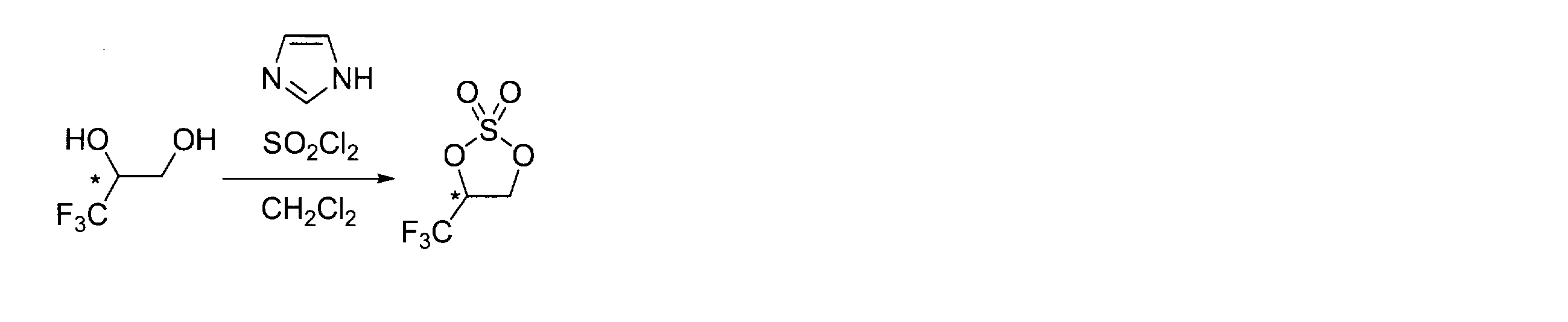
また、特許文献3では塩化スルフリルとトリエチルアミンとジオール化合物を用いることで含フッ素環状硫酸エステルを得る方法が知られている(下記スキーム)。

他方、下式:

で示される含フッ素環状硫酸エステルについての製造例は知られていない。
J. Med. Chem., 2004年, 47号, p.2511-2522
Synthesis, 2012年, 44号, p.3489-3495
Chem. Commun., 2003年, p.536-537
J. Am. Chem. Soc., 1988年, 110号, p.7538-7539
本発明の目的は、含フッ素シクロプロパンカルボン酸類の工業的な製造方法を提供することである。
シクロプロパンジエステルの製造方法としては非特許文献1に記載されているが、この方法を参考に、まず分子内に二つ脱離基を有する化合物を用いて含フッ素シクロプロパンジカルボン酸類の製造を検討したが、目的の化合物は得られなかった(後述の比較例4、比較例6及び比較例8)。
非特許文献2に記載の方法は、収率がよく、一見好ましい方法と考えられるが、高価なヨードニウム塩を使用していることから工業的に実施するには難があった。
また、非特許文献3に記載の方法は、収率がよく、一見好ましい方法と考えられるが、得られた含フッ素シクロプロパンモノエステル類はラセミ混合物であるため、目的物が光学活性体の場合、目的の光学異性体を分割すると収率は半分以下となる。従って、工業的な製造方法として採用するには幾分難があった。
非特許文献4に記載の、マロン酸ジエステルと環状硫酸エステルを用いた方法は一見好ましい方法と考えられるが、環状硫酸エステルを合成する際、反応が二段階となり、高価な遷移金属触媒を使用し、毒性の高い四塩化炭素を使用していることから工業的に実施するには難があった。
このように、含フッ素シクロプロパンカルボン酸類の製造方法は、工業規模のそれとしては、十分満足のいくものではなかった。本発明では、医薬品の重要な中間体である含フッ素シクロプロパンカルボン酸類の、工業的に実施可能な製造方法を提供することを課題とする。
そこで本発明者らは、上記課題に鑑み、鋭意検討したところ、下記スキームに示される製造方法を見出し、工業的に実施可能な含フッ素シクロプロパンモノエステル塩の製造方法を完成させた。すなわち、含フッ素ジオール化合物とフッ化スルフリルを用いて含フッ素環状硫酸エステルを合成する「環状硫酸エステル化工程」、前記工程で得られた含フッ素環状硫酸エステルとマロン酸ジエステルを反応させて含フッ素シクロプロパンジエステルを得る「シクロプロパン化工程」、前記工程で得られた含フッ素シクロプロパンジエステルを加水分解して含フッ素シクロプロパンモノエステルを得る「加水分解工程」を経由することで、従来技術と比べ工業的に容易に採用しうる条件で当該モノエステルを製造し、更に、前記工程で得られた含フッ素シクロプロパンモノエステルとアミンを混合して含フッ素シクロプロパンモノエステルとアミンとの塩を形成し、再結晶精製を行う「再結晶工程」を経ることで、高い化学純度と光学純度を有する含フッ素シクロプロパンモノエステル塩等の含フッ素シクロプロパンカルボン酸類を製造できることを見出し、本発明を完成させた。
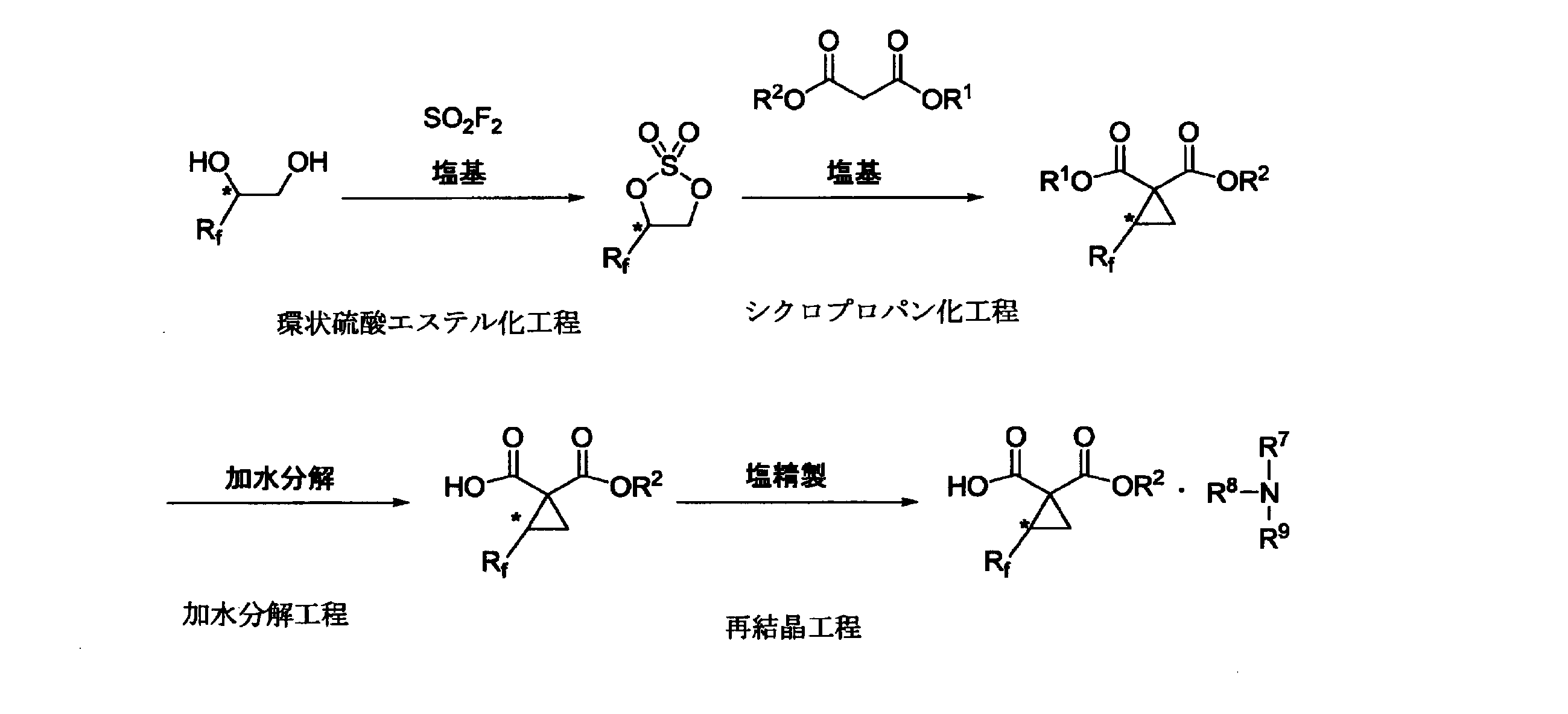
なお、本発明で採用した各工程を特許文献2や特許文献3と照らし合わせた場合、幾つか問題があった。
例えば、特許文献2の方法は高収率で含フッ素環状硫酸エステルを得ることが出来るから、一見好ましい方法として挙げられる。しかし本方法は溶媒に毒性の高い塩化メチレンを使用していること、しかもトリフルオロメチル基を部分的にフッ素化されたジフルオロメチル基、すなわち、本発明で対象とする基質に置き換えた場合、目的の化合物を得ることは出来なかった(本願の比較例1)。
また、特許文献3の方法も高収率で含フッ素環状硫酸エステルを得ることが出来るから、一見好ましい方法として挙げられる。しかし、トリフルオロメチル基をジフルオロメチル基に置き換えた場合、目的の化合物を得ることが出来なかった(比較例10)。
一方、本発明で対象とする基質は高い光学純度を持った含フッ素シクロプロパンカルボン酸類であるが、一旦「含フッ素シクロプロパンカルボン酸類のラセミ体」を製造し、それを光学分割により製造することも可能である。しかしながら、実際にそれを採用した場合、当該ラセミ体からの再結晶による光学分割は効率が悪く収率も低下する。それに対し、本発明は光学活性体を予め原料として用いることで、光学分割の工程が削減できることから、効率的な製造が可能である。
本発明で採用した含フッ素シクロプロパンカルボン酸類の製造方法は、各製造工程における問題点を解決でき、工業的にも優位性は高い。
すなわち本発明は以下の[発明1]-[発明16]に記載する含フッ素シクロプロパンカルボン酸類の製造方法を提供する。
[発明1]
一般式[1]で表される含フッ素ジオール化合物を、アルカリ金属水素化物、アルカリ土類金属水素化物、アルカリ金属水酸化物、アルカリ土類金属水酸化物、アルカリ金属炭酸塩、アルカリ土類金属炭酸塩、アルカリ金属炭酸水素塩、及びアルカリ土類金属炭酸水素塩からなる群より選ばれる少なくとも一つの塩基性化合物の存在下、フッ化スルフリルと反応させることで一般式[2]で表される含フッ素環状硫酸エステルを製造する方法。

[式中、Rfはフッ素原子をひとつ以上有する炭素数1~6の直鎖状もしくは分岐鎖状のフルオロアルキル基を表し、*は不斉炭素を表す。]

[式中、Rfは式[1]と同じ置換基を表し、*は不斉炭素を表す。]
一般式[1]で表される含フッ素ジオール化合物を、アルカリ金属水素化物、アルカリ土類金属水素化物、アルカリ金属水酸化物、アルカリ土類金属水酸化物、アルカリ金属炭酸塩、アルカリ土類金属炭酸塩、アルカリ金属炭酸水素塩、及びアルカリ土類金属炭酸水素塩からなる群より選ばれる少なくとも一つの塩基性化合物の存在下、フッ化スルフリルと反応させることで一般式[2]で表される含フッ素環状硫酸エステルを製造する方法。
[発明2]
Rfがジフルオロメチル基(CF2H)またはトリフルオロメチル基(CF3)である、発明1に記載の方法。
Rfがジフルオロメチル基(CF2H)またはトリフルオロメチル基(CF3)である、発明1に記載の方法。
[発明3]
フッ化スルフリルを反応させるときの温度が-50~+50℃の範囲である、発明1または2に記載の方法。
フッ化スルフリルを反応させるときの温度が-50~+50℃の範囲である、発明1または2に記載の方法。
[発明4]
フッ化スルフリルの使用量が0.7~4.0当量である発明1乃至3のいずれかに記載の方法。
フッ化スルフリルの使用量が0.7~4.0当量である発明1乃至3のいずれかに記載の方法。
[発明5]
発明1乃至4の何れかに記載の方法で含フッ素環状硫酸エステルを製造し、次いで、該エステルを無機塩基の存在下、一般式[3]で表されるマロン酸ジエステルと反応させることで、一般式[5]で表される含フッ素シクロプロパンジエステルを製造する方法。

[式中、R1、R2はそれぞれ独立に炭素数1から18の直鎖状、分岐鎖状もしくは環状(炭素数3以上の場合)のアルキル基、置換アルキル基、炭素数6から18の芳香環基または置換芳香環基を表す。]

[式中、Rfは発明1における一般式[1]におけるRfと同じ。R1、R2は式[3]におけるR1、R2と同じ。*は不斉炭素を表す。]
発明1乃至4の何れかに記載の方法で含フッ素環状硫酸エステルを製造し、次いで、該エステルを無機塩基の存在下、一般式[3]で表されるマロン酸ジエステルと反応させることで、一般式[5]で表される含フッ素シクロプロパンジエステルを製造する方法。
[発明6]
無機塩基がアルカリ金属、アルカリ金属水素化物、アルカリ土類金属水素化物、アルカリ金属水酸化物またはアルカリ土類金属水酸化物である、発明5に記載の方法。
無機塩基がアルカリ金属、アルカリ金属水素化物、アルカリ土類金属水素化物、アルカリ金属水酸化物またはアルカリ土類金属水酸化物である、発明5に記載の方法。
[発明7]
一般式[2]で表される含フッ素環状硫酸エステルと一般式[3]で表されるマロン酸ジエステルを、無機塩基を含む溶媒中に添加することを特徴とする、発明5または発明6に記載の方法。
一般式[2]で表される含フッ素環状硫酸エステルと一般式[3]で表されるマロン酸ジエステルを、無機塩基を含む溶媒中に添加することを特徴とする、発明5または発明6に記載の方法。
[発明8]
発明5乃至7の何れかに記載の方法で含フッ素シクロプロパンジエステルを製造し、次いで、該ジエステルにアルカリ金属水酸化物、アルカリ土類金属水酸化物、アルカリ金属炭酸塩、アルカリ土類金属炭酸塩、アルカリ金属炭酸水素塩、アルカリ土類金属炭酸水素塩または一般式[6]で表される水酸化四級アンモニウムの存在下、加水分解を行うことで一般式[7]で表される含フッ素シクロプロパンモノエステルを製造する方法。

[式中、R3、R4、R5、R6は、それぞれ独立に、炭素数1から18の直鎖状、分岐鎖状もしくは環状(炭素数3以上の場合)のアルキル基、置換アルキル基、炭素数6から18の芳香環基または置換芳香環基を表す。また、R3、R4、R5、R6の内、二つ以上が互いに同一の脂肪族環もしくは脂肪族芳香環の一部を形成するものであっても良い。]

[式中、Rfは発明1における一般式[1]と同じ置換基を表し、R2は発明5における一般式[3]と同じ置換基を表す。*は不斉炭素を表す。]
発明5乃至7の何れかに記載の方法で含フッ素シクロプロパンジエステルを製造し、次いで、該ジエステルにアルカリ金属水酸化物、アルカリ土類金属水酸化物、アルカリ金属炭酸塩、アルカリ土類金属炭酸塩、アルカリ金属炭酸水素塩、アルカリ土類金属炭酸水素塩または一般式[6]で表される水酸化四級アンモニウムの存在下、加水分解を行うことで一般式[7]で表される含フッ素シクロプロパンモノエステルを製造する方法。
[発明9]
加水分解反応における温度が-30~+40℃である、発明8に記載の方法。
加水分解反応における温度が-30~+40℃である、発明8に記載の方法。
[発明10]
一般式[7]で表される含フッ素シクロプロパンモノエステルに、一般式[8]で表されるアミンを加えて、一般式[9]で表される含フッ素シクロプロパンモノエステルとアミンとの塩を形成し、再結晶精製を行う工程を更に含む、発明8または9に記載の方法。

[式中、R7、R8、R9はそれぞれ独立に水素原子、炭素数1~18の直鎖状、分岐鎖状もしくは環状(炭素数3以上の場合)のアルキル基、置換アルキル基、炭素数6~18の芳香環基または置換芳香環基を表す。]

[式中、Rfは一般式[1]と同じ置換基を表し、R2は発明5における一般式[3]と同じ置換基を表し、R7,R8、R9は一般式[8]と同じ置換基を表す。]
一般式[7]で表される含フッ素シクロプロパンモノエステルに、一般式[8]で表されるアミンを加えて、一般式[9]で表される含フッ素シクロプロパンモノエステルとアミンとの塩を形成し、再結晶精製を行う工程を更に含む、発明8または9に記載の方法。
[発明11]
一般式[8]で表されるアミンが、一般式[10]で表されるアミンである、発明10に記載の方法。

[式中、R7、R8、R10は、それぞれ独立に、水素原子、炭素数1~18の直鎖状、分岐鎖状もしくは環状(炭素数3以上の場合)のアルキル基、置換アルキル基または炭素数6~18の芳香環基、置換芳香環基を表し、Ar1は炭素数6~14の芳香環基または置換芳香環基を表す。また、R10のうち、炭素数1~18の直鎖状、分岐鎖状もしくは環状(炭素数3以上の場合)のアルキル基、置換アルキル基または炭素数6~18の芳香環基、置換芳香環基の場合、*は不斉炭素を表す。]
一般式[8]で表されるアミンが、一般式[10]で表されるアミンである、発明10に記載の方法。
[発明12]
以下の工程を含む、一般式[11]で表される含フッ素シクロプロパンモノエステルと1-フェニルエチルアミンとの塩の製造方法。

[式中、R2は発明5における一般式[3]と同じ置換基を表す。*は不斉炭素を表す。]
[環状硫酸エステル化工程]
式[12]で表される含フッ素ジオール化合物に、アルカリ金属水素化物、アルカリ金属炭酸塩、アルカリ金属炭酸水素塩とフッ化スルフリルを反応させて式[13]に記載の含フッ素環状硫酸エステルを得る工程。


[式中、*は不斉炭素を表す。]
[シクロプロパン化工程]
前記環状硫酸エステル化工程で得られた含フッ素環状硫酸エステルに、アルカリ金属又はアルカリ金属水素化物の存在下、一般式[3]で表されるマロン酸ジエステルを反応させることで、一般式[15]で表される含フッ素シクロプロパンジエステルを得る工程。

[式中、R1、R2は、それぞれ独立に、炭素数1から18の直鎖状、分岐鎖状もしくは環状(炭素数3以上の場合)のアルキル基、置換アルキル基、炭素数6から18の芳香環基または置換芳香環基を表す。]

[式中、R1、R2は発明5における一般式[3]と同じ置換基を表し、*は不斉炭素を表す。]
[加水分解工程]
前記シクロプロパン化工程で得た含フッ素シクロプロパンジエステルにアルカリ金属水酸化物、アルカリ金属炭酸塩または一般式[6]で表される水酸化四級アンモニウムの存在下、加水分解を行うことで一般式[16]で表される含フッ素シクロプロパンモノエステルを得る工程。

[式中、R3、R4、R5、R6は、それぞれ独立に、炭素数1から18の直鎖状、分岐鎖状もしくは環状(炭素数3以上の場合)のアルキル基、該アルキル基の任意の炭素に置換基を有する置換アルキル基、炭素数6から18の芳香環基または該芳香環基の任意の炭素に置換基を有する置換芳香環基を表す。またR3、R4、R5、R6の内、二つ以上が互いに同一の脂肪族環もしくは脂肪族芳香環の一部を形成するものであっても良い。]

[式中、R2は発明5における一般式[3]と同じ置換基を表し、*は不斉炭素を表す。]
[再結晶工程]
前記加水分解工程で得られた含フッ素シクロプロパンモノエステルに光学活性1-フェニルエチルアミンを加え、式[11]で表される含フッ素シクロプロパンモノエステルと1-フェニルエチルアミンとの塩を形成し、再結晶精製操作を行う工程。

[式中、R2は一般式[3]におけるR2と同じ。]
以下の工程を含む、一般式[11]で表される含フッ素シクロプロパンモノエステルと1-フェニルエチルアミンとの塩の製造方法。
[環状硫酸エステル化工程]
式[12]で表される含フッ素ジオール化合物に、アルカリ金属水素化物、アルカリ金属炭酸塩、アルカリ金属炭酸水素塩とフッ化スルフリルを反応させて式[13]に記載の含フッ素環状硫酸エステルを得る工程。
[シクロプロパン化工程]
前記環状硫酸エステル化工程で得られた含フッ素環状硫酸エステルに、アルカリ金属又はアルカリ金属水素化物の存在下、一般式[3]で表されるマロン酸ジエステルを反応させることで、一般式[15]で表される含フッ素シクロプロパンジエステルを得る工程。
[加水分解工程]
前記シクロプロパン化工程で得た含フッ素シクロプロパンジエステルにアルカリ金属水酸化物、アルカリ金属炭酸塩または一般式[6]で表される水酸化四級アンモニウムの存在下、加水分解を行うことで一般式[16]で表される含フッ素シクロプロパンモノエステルを得る工程。
[再結晶工程]
前記加水分解工程で得られた含フッ素シクロプロパンモノエステルに光学活性1-フェニルエチルアミンを加え、式[11]で表される含フッ素シクロプロパンモノエステルと1-フェニルエチルアミンとの塩を形成し、再結晶精製操作を行う工程。
[発明13]
式[13]で表される含フッ素環状硫酸エステル。

[式中、*は不斉炭素を表す。]
式[13]で表される含フッ素環状硫酸エステル。
[発明14]
式[17]で表される含フッ素シクロプロパンモノエステルとアミンとの塩。

[式中、R11は炭素数1~6の直鎖状もしくは分岐鎖上のアルキル基を表し、R12、R13、R14は、それぞれ独立に、水素原子、炭素数1~6の直鎖状もしくは分岐鎖状のアルキル基を表し、Ar2は炭素数6~10の芳香環基または置換芳香環基を表す。また、R14のうち、炭素数1~6の直鎖状もしくは分岐鎖状のアルキル基の場合、アミンにおける*は不斉炭素を表す。]
式[17]で表される含フッ素シクロプロパンモノエステルとアミンとの塩。
[発明15]
式[18]で表される含フッ素シクロプロパンモノエステルと1-フェニルエチルアミンとの塩。

[式中、Etはエチル基を表す。]
式[18]で表される含フッ素シクロプロパンモノエステルと1-フェニルエチルアミンとの塩。
[発明16]
式[19]で表される含フッ素シクロプロパンモノエステルと1-フェニルエチルアミンとの塩。

[式中、Etはエチル基を表す。]
式[19]で表される含フッ素シクロプロパンモノエステルと1-フェニルエチルアミンとの塩。
本発明は、工業的に実施可能な形態で含フッ素シクロプロパンモノエステル塩等の含フッ素シクロプロパンカルボン酸類を製造できるという効果を奏する。
以下、本発明を詳細に説明する。以下、本発明の実施態様について説明するが、本発明は以下の実施の態様に限定されるものではなく、本発明の趣旨を損なわない範囲で、当業者の通常の知識に基づいて、適宜実施することができる。
本発明は含フッ素シクロプロパンカルボン酸類の製造方法であって、一般式[1]で表される含フッ素ジオール化合物とフッ化スルフリルを用いて一般式[2]で表される含フッ素環状硫酸エステルを得る製造方法(環状硫酸エステル化工程)、前記の方法で得られた含フッ素環状硫酸エステルとマロン酸ジエステルを反応させて一般式[5]で表される含フッ素シクロプロパンジエステルを得る製造方法(シクロプロパン化工程)、前記の方法で得られた含フッ素シクロプロパンジエステルを加水分解して一般式[7]で表される含フッ素シクロプロパンモノエステルを得る製造方法(加水分解工程)である。
更に、前記の方法で得られた含フッ素シクロプロパンモノエステルにアミンを反応させて一般式[9]で表される含フッ素シクロプロパンモノエステル塩を形成し、再結晶精製を行う工程(再結晶工程)を更に含んでもよい。
[環状硫酸エステル化工程]
まず、環状硫酸エステル化工程について説明する。本工程は一般式[1]で表される含フッ素ジオール化合物、塩基性化合物とフッ化スルフリルを用いて一般式[2]で表される含フッ素環状硫酸エステルを合成する工程である。
まず、環状硫酸エステル化工程について説明する。本工程は一般式[1]で表される含フッ素ジオール化合物、塩基性化合物とフッ化スルフリルを用いて一般式[2]で表される含フッ素環状硫酸エステルを合成する工程である。
一般式[1]で示される含フッ素ジオール化合物のRfは、フッ素原子をひとつ以上有する炭素数1~6の直鎖もしくは分岐鎖のフルオロアルキル基である。具体的な化合物としては、トリフルオロメチル基、ペンタフルオロエチル基、ヘプタフルオロプロピル基、ノナフルオロブチル基、ジフルオロメチル基、1,1-ジフルオロエチル基、2,2-ジフルオロエチル基、1,1-ジフルオロプロピル基、2,2-ジフルオロプロピル基、3,3-ジフルオロプロピル基、1,1-ジフルオロブチル基、2,2-ジフルオロブチル基、3,3-ジフルオロブチル基、4,4-ジフルオロブチル基、モノフルオロメチル基、1-モノフルオロエチル基、2-モノフルオロエチル基、1-モノフルオロプロピル基、2-モノフルオロプロピル基、3-モノフルオロプロピル基、1-モノフルオロブチル基、2-モノフルオロブチル基、3-モノフルオロブチル基、4-モノフルオロブチル基が挙げられるが、その中でもトリフルオロメチル基、ペンタフルオロエチル基、ヘプタフルオロプロピル基、ノナフルオロブチル基、ジフルオロメチル基が好ましく、トリフルオロメチル基、ジフルオロメチル基が特に好ましい。一般式[1]で表される含フッ素ジオール化合物は、例えば後述の参考例2、参考例7及び参考例11に記載した方法で製造することが出来る。
一般式[2]で表される含フッ素環状硫酸エステルを製造するのに用いられる塩基性化合物としては、アルカリ金属水素化物、アルカリ土類金属水素化物、アルカリ金属水酸化物、アルカリ土類金属水酸化物、アルカリ金属炭酸塩、アルカリ土類金属炭酸塩、アルカリ金属炭酸水素塩又はアルカリ土類金属炭酸水素塩が挙げられ、この中で、アルカリ金属水素化物、アルカリ金属水酸化物、アルカリ金属炭酸塩、アルカリ金属炭酸水素塩、アルカリ土類金属炭酸塩、アルカリ土類金属炭酸水素塩が好ましく、アルカリ金属水素化物、アルカリ金属炭酸塩、アルカリ金属炭酸水素塩が特に好ましい。具体的には水素化リチウム、水素化ナトリウム、水素化カリウム、水素化ルビジウム、水素化セシウム、水素化マグネシウム、水素化カルシウム、水酸化リチウム、水酸化ナトリウム、水酸化カリウム、水酸化ルビジウム、水酸化セシウム、水酸化マグネシウム、水酸化カルシウム、炭酸リチウム、炭酸ナトリウム、炭酸カリウム、炭酸ルビジウム、炭酸セシウム、炭酸マグネシウム、炭酸カルシウム、炭酸水素リチウム、炭酸水素ナトリウム、炭酸水素カリウム、炭酸水素ルビジウム、炭酸水素セシウム、炭酸水素マグネシウム、炭酸水素カルシウムが挙げられ、中でも水素化リチウム、水素化ナトリウム、水素化カリウム、水酸化リチウム、水酸化ナトリウム、水酸化カリウム、水酸化ルビジウム、水酸化セシウム、炭酸ナトリウム、炭酸カリウム、炭酸ルビジウム、炭酸セシウム、炭酸カルシウム、炭酸水素ナトリウム、炭酸水素カリウム、炭酸水素ルビジウム、炭酸水素セシウム、炭酸水素マグネシウム、炭酸水素カルシウムが好ましく、水素化ナトリウム、炭酸カリウム、炭酸セシウム、炭酸水素カリウム、炭酸水素セシウムが特に好ましい。
本工程における、含フッ素ジオール化合物を塩基性化合物の存在下、フッ化スルフリルと反応させる際の試剤の仕込み順については特に制限はないが、例えば、後述の実施例で示すように、最初に含フッ素ジオール化合物と塩基性化合物、そして反応溶媒を反応容器に仕込んで攪拌させて反応液を調製した後、フッ化スルフリルを導入すると良い。ここで言う含フッ素ジオール化合物と塩基性化合物とを含む反応液を調製する際の反応温度については特に制限はないが、-70~50℃であればよく、-50~40℃が好ましく、-30~30℃が特に好ましい。反応温度が-70℃より低すぎると反応速度が遅くなり、工業的に採用し難い。
含フッ素ジオール化合物と塩基性化合物とを含む反応液を調整する際の反応時間としては、特に制限はないが、通常、二つの原料を反応させた後、ガスクロマトグラフィー、液体クロマトグラフィー、NMR等の手段により、含フッ素ジオール化合物が殆ど消失した時点を終点とすることが好ましい。
本反応で使用する溶媒としては極性を有する非プロトン性溶媒が挙げられ、エーテル系溶媒、ニトリル系溶媒、アミド系溶媒、エステル系溶媒、硫黄含有溶媒が好ましく、ニトリル系溶媒が特に好ましい。具体的にはジエチルエーテル、ジイソプロピルエーテル、ジブチルエーテル、t-ブチルメチルエーテル、シクロペンチルメチルエーテル、テトラヒドロフラン、アセトニトリル、プロピオニトリル、ジメチルホルムアミド、酢酸メチル、酢酸エチル、酢酸プロピル、酢酸t-ブチル、ジメチルスルホキシド、スルホランが挙げられ、ジイソプロピルエーテル、ジブチルエーテル、メチル-tert-ブチルエーテル、シクロペンチルメチルエーテル、テトラヒドロフラン、アセトニトリル、プロピオニトリル、ジメチルホルムアミド、酢酸エチル、ジメチルスルホキシドが好ましく、アセトニトリルが特に好ましい。これらの溶媒を単独若しくは組み合わせて使用しても良い。
含フッ素ジオール化合物と塩基性化合物とを含む反応液にフッ化スルフリルを加えて反応させる温度は-50~+50℃であれば良く、-40~+40℃が好ましく、-30~+30℃が特に好ましい。温度が-50℃より低すぎると反応速度が遅くなり、工業的に採用し難い。一方、温度が50℃より高すぎると副反応によって不純物が増えることから好ましくない。
フッ化スルフリルを加えて反応させる際の圧力条件としては0.001~2.0MPaの範囲で実施すれば良く、0.001~1.5MPaが好ましく、0.001~1.0MPaが特に好ましい。圧力が低すぎると反応速度が遅くなり、工業的に採用し難い。なお、ここで言う圧力は絶対圧のことを表す。フッ化スルフリルの使用量について、含フッ素ジオール化合物に対して0.7~4.0当量であれば良く、1~3.0当量が好ましく、1~2.0当量が特に好ましい。0.7当量より少ない場合、収率に悪影響を及ぼし、4.0当量より多い場合、反応の選択性に悪影響を及ぼすことがある。
フッ化スルフリルを導入する形態としては反応液中にディップ管でフッ化スルフリルを吹き込む形式でも、密閉できるオートクレイブ反応器に導入する形式でも良い。
フッ化スルフリルを加えて反応させる際の反応時間としては、特に制限はないが、通常、フッ化スルフリルの導入が終了した後、ガスクロマトグラフィー、液体クロマトグラフィー、NMR等の手段により、生成物の量に変化がなくなった時点を終点とすることが好ましい。
反応に使われる反応容器としては、ステンレス鋼、モネルTM、ハステロイTM、ニッケル、又はこれらの金属やポリテトラフルオロエチレン、パーフルオロポリエーテル樹脂などのフッ素樹脂でライニングされた反応容器などが挙げられる。
後処理は有機合成における一般的な操作を採用することにより、一般式[2]で示される含フッ素環状硫酸エステルを得ることが出来る。粗生成物は必要に応じて活性炭処理、分別蒸留、カラムクロマトグラフィー等により高い純度に精製することが出来る。
また含フッ素環状硫酸エステルを製造した後に、目的物を単離しても良いが、後述の実施例のように反応直後の溶液を次のシクロプロパン化工程に使用することも出来る。この方法を採用することは、操作性の点で有利であり、好ましい形態の一つとして挙げられる。
本工程に記載の発明を実施することにより、式[13]で示される含フッ素環状硫酸エステルを製造できる(なお、該エステルはジフルオロメチル基を有する各種化合物へ変換可能であり、有用な化合物である)。

[シクロプロパン化工程]
次にシクロプロパン化工程について説明する。本工程は前工程(環状硫酸エステル化工程)で得られた含フッ素環状硫酸エステルを、無機塩基の存在下、一般式[3]で表されるマロン酸ジエステルを反応させて、一般式[5]で表される含フッ素シクロプロパンジエステルを製造する工程である。本工程の詳細な反応を下記スキームに示す。

次にシクロプロパン化工程について説明する。本工程は前工程(環状硫酸エステル化工程)で得られた含フッ素環状硫酸エステルを、無機塩基の存在下、一般式[3]で表されるマロン酸ジエステルを反応させて、一般式[5]で表される含フッ素シクロプロパンジエステルを製造する工程である。本工程の詳細な反応を下記スキームに示す。
なお、本工程は、上記スキーム中に示す中間物質(マロン酸エステル付加体)を経由し、反応系内で該付加体の環化反応が進行し、結果として含フッ素シクロプロパンジエステルが得られる。本工程を詳細に説明する為、本工程を「第一段階」「第二段階」とし、「無機塩基」を「無機塩基1」「無機塩基2」として説明する。なお、このように段階的に反応を行った場合でも本工程における実施態様の一つであり、この態様は、当然、本工程の発明に含まれる。
一般式[3]で表されるマロン酸ジエステルのR1、R2はそれぞれ独立に炭素数1から18の直鎖状、分岐鎖状もしくは環状(炭素数3以上の場合)のアルキル基、置換アルキル基、炭素数6から18の芳香環基または置換芳香環基を表す。置換アルキル基は、前記アルキル基の任意の炭素上にハロゲン原子、芳香環基等の置換基を有するアルキル基であり、置換芳香環基は前記芳香環基の任意の炭素上にハロゲン原子、芳香環基、ニトロ基、炭素数1~6のアルコキシ基等の置換基を有する芳香環基である。具体的にはメチル基、エチル基、プロピル基、イソプロピル基、1-ブチル基、2-ブチル基、イソブチル基、tert-ブチル基、1-ペンチル基、2-ペンチル基、3-ペンチル基、2-メチル-1-ブチル基、2-メチル-2-ブチル基、3-メチル-1-ブチル基、3-メチル-2-ブチル基、ネオペンチル基、1-ヘキシル基、2-ヘキシル基、3-ヘキシル基、2-メチル-1-ペンチル基、3-メチル-1-ペンチル基、4-メチル-1-ペンチル基、2-メチル-2-ペンチル基、3-メチル-2-ペンチル基、4-メチル-2-ペンチル基、2-メチル-3-ペンチル基、3-メチル-3-ペンチル基、2,2-ジメチル-1-ブチル基、2,3-ジメチル-1-ブチル基、3,3-ジメチル-1-ブチル基、2,3-ジメチル-2-ブチル基、3,3-ジメチル-2-ブチル基、2-エチル-1-ブチル基、1-ヘプチル基、1-オクチル基、1-ノニル基、1-デシル基、1-ウンデシル基、1-ドデシル基、1-トリデシル基、1-テトラデシル基、1-ペンタデシル基、1-ヘキサデシル基、1-ヘプタデシル基、1-オクタデシル基、1-シクロプロピル基、1-シクロペンチル基、1-シクロヘキシル基、ベンジル基、2-クロロベンジル基、3-クロロベンジル基、4-クロロベンジル基、2-フルオロベンジル基、3-フルオロベンジル基、4-フルオロベンジル基、2-ブロモベンジル基、3-ブロモベンジル基、4-ブロモベンジル基、1-フェニルエチル基、2-フェニルエチル基、フェニル基、ナフチル基、アントラセニル基、2-クロロフェニル基、3-クロロフェニル基、4-クロロフェニル基、2-フルオロフェニル基、3-フルオロフェニル基、4-フルオロフェニル基、2-ブロモフェニル基、3-ブロモフェニル基、4-ブロモフェニル基、2-ニトロフェニル基、3-ニトロフェニル基、4-ニトロフェニル基、2-メトキシフェニル基、3-メトキシフェニル基、4-メトキシフェニル基が挙げられ、この中でもメチル基、エチル基、プロピル基、イソプロピル基、1-ブチル基、2-ブチル基、イソブチル基、tert-ブチル基、1-ペンチル基、1-ヘキシル基、1-ヘプチル基、1-オクチル基、1-ノニル基、1-デシル基、1-シクロヘキシル基、ベンジル基、フェニル基、ナフチル基が好ましく、この中でもメチル基、エチル基、プロピル基、イソプロピル基、1-ブチル基、イソブチル基、tert-ブチル基、1-シクロヘキシル基、ベンジル基、フェニル基が特に好ましい。
一般式[3]で表されるマロン酸ジエステルの具体的な化合物としてはマロン酸ジメチル、マロン酸ジエチル、マロン酸ジプロピル、マロン酸ジイソプロピル、マロン酸ジブチル、マロン酸ジ-2-ブチル、マロン酸ジイソブチル、マロン酸ジtert-ブチル基、マロン酸ジペンチル、マロン酸ジヘキシル、マロン酸ジヘプチル、マロン酸ジオクチル、マロン酸ジノニル、マロン酸ジデシル、マロン酸ジシクロヘキシル、マロン酸ジベンジル、マロン酸ジフェニル、マロン酸ジナフチルが好ましく、その中でもマロン酸ジメチル、マロン酸ジエチル、マロン酸ジプロピル、マロン酸ジイソプロピル、マロン酸ジブチル、マロン酸ジイソブチル、マロン酸ジtert-ブチル、マロン酸ジシクロヘキシル、マロン酸ジベンジル、マロン酸ジフェニルが特に好ましい。
一般式[3]で表されるマロン酸ジエステルの当量としては含フッ素環状硫酸エステルに対して1~5当量であれば良く、1~3当量が好ましく、1~1.5当量がとくに好ましい。1当量より少ないと収率が低下し、5当量を超える量を用いると不純物としてマロン酸ジエステルが残存してしまい、化学純度が低下してしまうことがある。
本工程で用いる無機塩基(上記スキームで言う「無機塩基1」、および「無機塩基2」に対応する)としては、アルカリ金属、アルカリ金属水素化物、アルカリ土類金属水素化物、アルカリ金属水酸化物、アルカリ土類金属水酸化物を用いる。この中でアルカリ金属、アルカリ金属水素化物が好ましい。具体的にはリチウム、ナトリウム、カリウム、水素化リチウム、水素化ナトリウム、水素化カリウム、水素化ルビジウム、水素化セシウム、水素化マグネシウム、水素化カルシウム、水酸化リチウム、水酸化ナトリウム、水酸化カリウム、水酸化マグネシウム、水酸化カルシウムが挙げられ、中でもリチウム、ナトリウム、水素化リチウム、水素化ナトリウム、水素化カリウムが好ましく、ナトリウム、水素化ナトリウムが特に好ましい。なお、無機塩基は、それぞれ同じでも異なっていても良い。
無機塩基の当量は一般式[3]で表されるマロン酸ジエステルに対して2当量以上であれば良い。2当量より少ないと収率が低下する場合がある。なお、上記スキームのように段階的に無機塩基を加える場合は、「第一段階」で無機塩基1を添加し、「第二段階」で無機塩基2を添加し、合計2当量以上となるように加えても良い。
本工程における反応溶媒としてはエーテル系溶媒、アミド系溶媒、脂肪族炭化水素系溶媒、芳香族炭化水素系溶媒などが挙げられる。具体的にはジエチルエーテル、ジイソプロピルエーテル、ジブチルエーテル、メチル-tert-ブチルエーテル、テトラヒドロフラン、2-メチルテトラヒドロフラン、シクロペンチルメチルエーテル、ジメトキシエタン、ジメチルホルムアミド、ジメチルアセトアミド、n-ヘキサン、シクロヘキサン、n-ヘプタン、n-ノナン、n-オクタン、トルエン、キシレンが挙げられ、その中でもジエチルエーテル、ジイソプロピルエーテル、メチル-tert-ブチルエーテル、テトラヒドロフラン、シクロペンチルメチルエーテル、ジメトキシエタン、ジメチルホルムアミド、n-ヘキサン、n-ヘプタン、トルエン、キシレンが好ましく、ジイソプロピルエーテル、メチル-tert-ブチルエーテル、テトラヒドロフラン、ジメトキシエタン、ジメチルホルムアミド、n-ヘプタン、トルエンが特に好ましい。なお、本工程を、上記スキームのように第一段階、第二段階として反応させる場合もこれらの反応溶媒が適用できる。また、これらの溶媒は単独又は二つ以上の溶媒を組み合わせて使用しても良い。
本工程の好ましい形態は、含フッ素環状硫酸エステルを、無機塩基の存在下、マロン酸ジエステルと反応させて行うことであるが、実施態様に特に制限はなく、例えば、ガスクロマトグラフィー、NMR等の分析手段により、反応の進行状況を追跡し、原料がほぼ消失した時点で反応を終了させることが好ましい。また、上記スキームのように段階的に反応を進める場合、第一段階で無機塩基1を加えた後、ガスクロマトグラフィー、NMR等の分析手段により、反応の進行状況を追跡し、中間体であるマロン酸エステル付加体の生成を確認でき、原料である含フッ素環状硫酸エステルがほぼ消失した時点、または該エステルの変換率に変化が見られない時点で、反応系内に無機塩基2及び/または反応溶媒を加えて反応させることが可能である。
なお、第一段階で無機塩基1を過剰に添加し、未反応分を無機塩基2として利用することもできる。この場合、無機塩基2の使用量は無機塩基1の過剰分を差し引いた当量が目安になるが、必要に応じて無機塩基を別途追加することもできる。
本工程における好ましい反応温度について説明する。反応温度については通常、-80℃~170℃であり、好ましくは-50℃~120℃、より好ましくは-30~100℃の温度範囲で反応が進行するが、例えば上記スキームに示すように、本工程を段階的に反応させる場合、好ましい態様を以下、明記する。
まず、第一段階の反応を行う時の温度は-70℃以上であれば良いが、-50℃~40℃、好ましくは-30℃~30℃で行えば良い。反応の終点はガスクロマトグラフィー、NMR等の分析手段により、反応の進行状況を追跡し、原料がほぼ消失した時点又は、反応の進行が止まった時点で第二段階の反応を進めると良い。なお、第一段階の反応を実施すると固体が大量に析出するため、反応液の濃度を0.1から2Mとなるように調整することが好ましく、0.2から1.5Mが特に好ましい。濃度が2Mより高いと攪拌が困難になり、0.1Mより低いと生産性が大きく低下してしまう。次に、反応液の温度を上げて第二段階の反応を行う。第二段階の反応温度は40~150℃程度、好ましくは40~120℃、より好ましくは50~100℃で行えば良い。40℃より低い温度では、環化反応が進行しにくく、反応に長い時間が必要になることがある。一方、150℃を超える温度では、反応自体は進行するが、生成物等が分解し、副反応が生じる恐れがある。第二段階の反応が進行すると徐々に固体が消失して攪拌されやすくなっていく。
本工程の反応における仕込み方法については特に制限はないが、例えば後述の実施例で示すように、最初に、反応系内に反応溶媒と無機塩基とを投入して混合液とした後に、該混合液に原料のマロン酸ジエステルと含フッ素環状硫酸エステルとを加えることが好ましい。この際、マロン酸ジエステルと含フッ素環状硫酸エステルとを混合させて混合物とした後に、先に調製した混合液に加えることも可能であり、また、マロン酸ジエステルと含フッ素環状硫酸エステルとを混合させずに、それぞれ別々に加えても良い。また、マロン酸ジエステル及び/又は含フッ素環状硫酸エステルに対し、必要に応じて反応溶媒を加えた後、先に調製した混合液に滴下しても良く、当業者が適宜調整できる。
ここで、マロン酸ジエステルと含フッ素環状硫酸エステルとを混合させて混合物としたときの、マロン酸ジエステルと含フッ素環状硫酸エステルを反応系内への導入時間は30分以上48時間以下であれば良く、40分以上24時間以下が好ましく、1時間以上12時間以下が特に好ましい。30分未満では固体が大量に析出してしまうことがあり、一方、48時間を越える時間では生産性が悪くなることがある。
[加水分解工程]
次に加水分解工程について説明する。本工程は前記工程で得られた含フッ素シクロプロパンジエステルを加水分解して一般式[7]で表される含フッ素シクロプロパンモノエステルを得る工程である。
次に加水分解工程について説明する。本工程は前記工程で得られた含フッ素シクロプロパンジエステルを加水分解して一般式[7]で表される含フッ素シクロプロパンモノエステルを得る工程である。
一般式[5]で示される含フッ素シクロプロパンジエステルの加水分解に用いる塩基としてはアルカリ金属水酸化物、アルカリ土類金属水酸化物、アルカリ金属炭酸塩、アルカリ土類金属炭酸塩、アルカリ金属炭酸水素塩、アルカリ土類金属炭酸水素塩または一般式[6]で表される水酸化四級アンモニウムが挙げられる(なお、本工程では、これらの化合物を単に「塩基」と言うことがある)。

式[6]中、R3、R4、R5、R6はそれぞれ独立に炭素数1から18の直鎖状、分岐鎖状もしくは環状(炭素数3以上の場合)のアルキル基、置換アルキル基、炭素数6から18の芳香環基または置換芳香環基である。置換アルキル基は、前記アルキル基の任意の炭素上にハロゲン原子、芳香環基、水酸基等の置換基を有するアルキル基であり、置換芳香環基は前記芳香環基の任意の炭素上にハロゲン原子、芳香環基、ニトロ基、炭素数1~6のアルコキシ基等の置換基を有する芳香環基である。またR3、R4、R5、R6の内、二つ以上が互いに同一の脂肪族環もしくは脂肪族芳香環の一部を形成するものであっても良い。
この中でアルカリ金属水酸化物、アルカリ金属炭酸塩、アルカリ金属炭酸水素塩、水酸化四級アンモニウムが好ましく、アルカリ金属水酸化物、水酸化四級アンモニウムが特に好ましい。具体的には水酸化リチウム、水酸化ナトリウム、水酸化カリウム、水酸化ルビジウム、水酸化セシウム、水酸化マグネシウム、水酸化カルシウム、炭酸リチウム、炭酸ナトリウム、炭酸カリウム、炭酸ルビジウム、炭酸セシウム、炭酸マグネシウム、炭酸カルシウム、炭酸水素リチウム、炭酸水素ナトリウム、炭酸水素カリウム、炭酸水素ルビジウム、炭酸水素セシウム、炭酸水素マグネシウム、炭酸水素カルシウム、テトラメチルアンモニウムヒドロキシド、テトラエチルアンモニウムヒドロキシド、テトラプロピルアンモニウムヒドロキシド、テトラブチルアンモニウムヒドロキシド、テトラペンチルアンモニウムヒドロキシド、テトラヘキシルアンモニウムヒドロキシド、テトラへプチルアンモニウムヒドロキシド、ジメチルジオクチルアンモニウムヒドロキシド、トリオクチルメチルアンモニウムヒドロキシド、テトラオクチルアンモニウムヒドロキシド、デシルトリメチルアンモニウムヒドロキシド、ドデシルトリメチルアンモニウムヒドロキシド、ジラウリルジメチルアンモニウムヒドロキシド、ジメチルジオクタデシルアンモニウムヒドロキシド、ベンジルトリメチルアンモニウムヒドロキシド、ベンジルトリエチルアンモニウムヒドロキシド、ベンジルトリプロピルアンモニウムヒドロキシド、ベンジルトリブチルアンモニウムヒドロキシド、ベンジルトリヘプチルアンモニウムヒドロキシド、ベンジルトリヘキシルアンモニウムヒドロキシド、ベンジルトリヘプチルアンモニウムヒドロキシド、ベンジルトリオクチルアンモニウムヒドロキシド、トリメチルフェニルアンモニウムヒドロキシド、トリエチルフェニルアンモニウムヒドロキシド、トリプロピルフェニルアンモニウムヒドロキシド、トリブチルフェニルアンモニウムヒドロキシド、トリペンチルフェニルアンモニウムヒドロキシド、トリヘキシルフェニルアンモニウムヒドロキシド、トリヘプチルフェニルアンモニウムヒドロキシド、トリオクチルフェニルアンモニウムヒドロキシド、ジメチルピペリジニウムヒドロキシド、エチル-メチルピペリジニウムヒドロキシド、メチル-プロピルピペリジニウムヒドロキシド、ブチル-メチルピペリジニウムヒドロキシド、ジエチルピペリジニウムヒドロキシド、エチル-プロピルピペリジニウムヒドロキシド、ブチル-エチルピペリジニウムヒドロキシド、ジプロピルピペリジニウムヒドロキシド、ブチル-プロピルピペリジニウムヒドロキシド、ジブチルピペリジニウムヒドロキシド、2-ヒドロキシエチルトリメチルアンモニウムヒドロキシド、トリス(2-ヒドロキシエチル)メチルアンモニウムヒドロキシドが挙げられ、中でも水酸化リチウム、水酸化ナトリウム、水酸化カリウム、水酸化ルビジウム、水酸化セシウム、炭酸ナトリウム、炭酸カリウム、炭酸ルビジウム、炭酸セシウム、炭酸カルシウム、炭酸水素ナトリウム、炭酸水素カリウム、炭酸水素ルビジウム、炭酸水素セシウム、テトラメチルアンモニウムヒドロキシド、テトラエチルアンモニウムヒドロキシド、テトラブチルアンモニウムヒドロキシド、テトラヘキシルアンモニウムヒドロキシド、ベンジルトリメチルアンモニウムヒドロキシド、ベンジルトリエチルアンモニウムヒドロキシド、トリメチルフェニルアンモニウムヒドロキシド、トリエチルフェニルアンモニウムヒドロキシド、ブチル-メチルピペリジニウムヒドロキシド、2-ヒドロキシエチルトリメチルアンモニウムヒドロキシドが好ましく、水酸化ナトリム、水酸化カリウム、炭酸ナトリウム、炭酸カリウム、テトラメチルアンモニウムヒドロキシド、テトラエチルアンモニウムヒドロキシド、2-ヒドロキシエチルトリメチルアンモニウムヒドロキシドが特に好ましい。
加水分解の反応温度は-30~+40℃であれば良く、-20~+30℃が好ましく、-10~+20℃が特に好ましい。-30℃より低い温度では加水分解反応が遅くなることがあり、一方、40℃を超える温度では、副反応が生じやすくなる。
塩基の当量は1~5当量であれば良く、1~3当量が好ましく、1~2当量が特に好ましい。1当量よりも少ない場合は収率が低下してしまう恐れがあり、一方、5当量を超える塩基の量は、含フッ素シクロプロパンジエステルの、エステル部位2つが加水分解される等の副反応が生じることがある。
反応溶媒としては水、アルコール系溶媒などが採用できる。具体的には水、メタノール、エタノール、プロパノール、イソプロパノール、ブタノールが挙げられ、水、メタノール、エタノール、プロパノール、イソプロパノールが好ましく、水、メタノール、エタノールが特に好ましい。これらの溶媒は単独または二つ以上を組み合わせて使用しても良い。
含フッ素シクロプロパンジエステルに対する加水分解は、該エステルが持つ二つのエステル部位のうち、Rf基から立体的に遠い、片方のエステル(トランスの位置を採るエステル)が優先的に加水分解される。例えば、Org. Process Res. Dev., 2011年, 15号, p.1207-1211で類似化合物の選択的な加水分解が報告されているが、このように、当該エステルが選択的に加水分解されることで一般式[7]で示される含フッ素シクロプロパンモノエステルは二つの不斉炭素を有する化合物となる。この時Rf基のα位の炭素の立体配置がSの場合、もうひとつの不斉中心のそれはS又はRとなり、Rf基のα位の炭素が立体配置がRの場合、もうひとつの不斉中心のそれはR又はSとなる。
反応後の後処理は酸を添加して反応液を酸性とした後に、抽出など通常の有機化合物合成における一般的な操作を採用することにより、一般式[7]で示される含フッ素シクロプロパンモノエステルを得ることが出来る。粗生成物は必要に応じて活性炭処理、分別蒸留、カラムクロマトグラフィー等により高い純度に精製することが出来る。抽出操作をする際、溶液を酸性にするために酸を加える必要があるが、加える酸は特に制限はなく、ホウ酸、リン酸、塩化水素、臭化水素、硝酸、硫酸等の無機酸、ギ酸、酢酸、シュウ酸、安息香酸、ベンゼンスルホン酸、パラトルエンスルホン酸等の有機酸などが挙げられる。
[再結晶工程]
最後に再結晶工程について説明する。本工程は、一般式[7]で表される含フッ素シクロプロパンモノエステルに、一般式[8]で表されるアミンを加えて一般式[9]で表される含フッ素シクロプロパンモノエステルとアミンとの塩を形成し、再結晶精製する工程である。
最後に再結晶工程について説明する。本工程は、一般式[7]で表される含フッ素シクロプロパンモノエステルに、一般式[8]で表されるアミンを加えて一般式[9]で表される含フッ素シクロプロパンモノエステルとアミンとの塩を形成し、再結晶精製する工程である。
一般式[8]で示されるアミンのR7、R8、R9はそれぞれ独立に水素原子、炭素数1~18の直鎖状、分岐鎖状もしくは環状(炭素数3以上の場合)のアルキル基、置換アルキル基、炭素数6から18の芳香環基または置換芳香環基を表す。置換アルキル基は、前記アルキル基の任意の炭素上にハロゲン原子、アミノ基、ヒドロキシ基、芳香環基等の置換基を有するアルキル基である。置換芳香環基は、前記芳香環基の任意の炭素上にハロゲン原子、ニトロ基、炭素数1~6のアルキル基、炭素数1~6のアルコキシ基等の置換基を有する芳香環基である。具体的には水素原子、メチル基、エチル基、プロピル基、イソプロピル基、1-ブチル基、2-ブチル基、イソブチル基、tert-ブチル基、1-ペンチル基、2-ペンチル基、3-ペンチル基、2-メチル-1-ブチル基、2-メチル-2-ブチル基、3-メチル-1-ブチル基、3-メチル-2-ブチル基、ネオペンチル基、1-ヘキシル基、2-ヘキシル基、3-ヘキシル基、2-メチル-1-ペンチル基、3-メチル-1-ペンチル基、4-メチル-1-ペンチル基、2-メチル-2-ペンチル基、3-メチル-2-ペンチル基、4-メチル-2-ペンチル基、2-メチル-3-ペンチル基、3-メチル-3-ペンチル基、2,2-ジメチル-1-ブチル基、2,3-ジメチル-1-ブチル基、3,3-ジメチル-1-ブチル基、2,3-ジメチル-2-ブチル基、3,3-ジメチル-2-ブチル基、2-エチル-1-ブチル基、1-ヘプチル基、1-オクチル基、1-ノニル基、1-デシル基、1-ウンデシル基、1-ドデシル基、1-トリデシル基、1-テトラデシル基、1-ペンタデシル基、1-ヘキサデシル基、1-ヘプタデシル基、1-オクタデシル基、1-シクロプロピル基、1-シクロペンチル基、1-シクロヘキシル基、クロロメチル基、ブロモメチル基、シアノメチル基、2-ヒドロキシエチル基、2-アミノエチル基、2-クロロエチル基、ベンジル基、2-クロロベンジル基、3-クロロベンジル基、4-クロロベンジル基、2-フルオロベンジル基、3-フルオロベンジル基、4-フルオロベンジル基、2-ブロモベンジル基、3-ブロモベンジル基、4-ブロモベンジル基、1-フェニルエチル基、2-フェニルエチル基、フェニル基、1-ナフチル基、2-ナフチル基、1-アントラセニル基、2-アントラセニル基、9-アントラセニル基、2-クロロフェニル基、3-クロロフェニル基、4-クロロフェニル基、2-フルオロフェニル基、3-フルオロフェニル基、4-フルオロフェニル基、2-ブロモフェニル基、3-ブロモフェニル基、4-ブロモフェニル基、2-ニトロフェニル基、3-ニトロフェニル基、4-ニトロフェニル基、2-メチルフェニル基、3-メチルフェニル基、4-メチルフェニル基、2-メトキシフェニル基、3-メトキシフェニル基、4-メトキシフェニル基が挙げられ、その中でも水素、メチル基、エチル基、1-プロピル基、イソプロピル基、1-ブチル基、1-ペンチル基、1-ヘキシル基、1-ヘプチル基、1-オクチル基、1-ノニル基、1-デシル基、1-シクロヘキシル基、ベンジル基、1-フェニルエチル基、2-フェニルエチル基、フェニル基、ナフチル基、1-(1-ナフチル)エチル基、1-(2-ナフチル)エチル基、2-(1-ナフチル)エチル基、2-(2-ナフチル)エチル基を表し、その中でも水素、メチル基、エチル基、プロピル基、イソプロピル基、1-ブチル基、1-シクロヘキシル基、ベンジル基、1-フェニルエチル基、2-フェニルエチル基、フェニル基、1-(1-ナフチル)エチル基が特に好ましい。
一般式[9]で示される含フッ素シクロプロパンモノエステルとアミンとの塩を、再結晶精製を行うことで光学純度を向上させることが可能である。例えば、国際公開2010/041739号公報によれば、キラルアミンを用いて再結晶精製を行うことで、類似化合物の光学純度が向上することが報告されている。
一般式[8]で示されるアミンのR7、R8、R9に不斉中心がある場合、光学活性なアミンを用いることは再結晶で光学純度の向上を容易にすることから好ましい態様である。すなわち、一般式[8]の中でも、具体的には一般式[10]で示されるアミンが特に好ましい。当該アミンにおけるR7、R8、R10は水素原子、炭素数1から18の直鎖状、分岐鎖状もしくは環状(炭素数3以上の場合)のアルキル基、置換アルキル基または炭素数6~18の芳香環基または置換芳香環基を表す。具体的には水素、メチル基、エチル基、プロピル基、イソプロピル基、1-ブチル基、2-ブチル基、イソブチル基、tert-ブチル基、1-ペンチル基、2-ペンチル基、3-ペンチル基、2-メチル-1-ブチル基、2-メチル-2-ブチル基、3-メチル-1-ブチル基、3-メチル-2-ブチル基、ネオペンチル基、1-ヘキシル基、2-ヘキシル基、3-ヘキシル基、2-メチル-1-ペンチル基、3-メチル-1-ペンチル基、4-メチル-1-ペンチル基、2-メチル-2-ペンチル基、3-メチル-2-ペンチル基、4-メチル-2-ペンチル基、2-メチル-3-ペンチル基、3-メチル-3-ペンチル基、2,2-ジメチル-1-ブチル基、2,3-ジメチル-1-ブチル基、3,3-ジメチル-1-ブチル基、2,3-ジメチル-2-ブチル基、3,3-ジメチル-2-ブチル基、2-エチル-1-ブチル基、1-ヘプチル基、1-オクチル基、1-ノニル基、1-デシル基、1-ウンデシル基、1-ドデシル基、1-トリデシル基、1-テトラデシル基、1-ペンタデシル基、1-ヘキサデシル基、1-ヘプタデシル基、1-オクタデシル基、1-シクロプロピル基、1-シクロペンチル基、1-シクロヘキシル基、クロロメチル基、ブロモメチル基、シアノメチル基、2-ヒドロキシエチル基、2-アミノエチル基、2-クロロエチル基、ベンジル基、2-クロロベンジル基、3-クロロベンジル基、4-クロロベンジル基、2-フルオロベンジル基、3-フルオロベンジル基、4-フルオロベンジル基、2-ブロモベンジル基、3-ブロモベンジル基、4-ブロモベンジル基、1-フェニルエチル基、2-フェニルエチル基、フェニル基、1-ナフチル基、2-ナフチル基、1-アントラセニル基、2-アントラセニル基、9-アントラセニル基、2-クロロフェニル基、3-クロロフェニル基、4-クロロフェニル基、2-フルオロフェニル基、3-フルオロフェニル基、4-フルオロフェニル基、2-ブロモフェニル基、3-ブロモフェニル基、4-ブロモフェニル基、2-ニトロフェニル基、3-ニトロフェニル基、4-ニトロフェニル基、2-メチルフェニル基、3-メチルフェニル基、4-メチルフェニル基、2-メトキシフェニル基、3-メトキシフェニル基、4-メトキシフェニル基が挙げられ、その中でも水素、メチル基、エチル基、プロピル基、イソプロピル基、1-ブチル基、2-ブチル基、イソブチル基、tert-ブチル基が好ましく、水素、メチル基、エチル基が特に好ましい。
なお、R10については、水素原子以外の基、すなわち、炭素数1~18の直鎖状、分岐鎖状もしくは環状(炭素数3以上の場合)のアルキル基、置換アルキル基または炭素数6~18の芳香環基の場合、一般式[10]で示されるアミンは不斉中心を持ち、光学活性アミンとして含フッ素シクロプロパンモノエステルとアミンとの塩を形成する。
Ar1は炭素数6~14の芳香環基または置換芳香環基を表す。置換芳香環基における置換基は、該芳香環基の任意の炭素にハロゲン原子、ニトロ基、炭素数1~6のアルキル基、炭素数1~6のアルコキシ基等を有する。具体的にはフェニル基、1-ナフチル基、2-ナフチル基、1-アントラセニル基、2-アントラセニル基、9-アントラセニル基、2-クロロフェニル基、3-クロロフェニル基、4-クロロフェニル基、2-フルオロフェニル基、3-フルオロフェニル基、4-フルオロフェニル基、2-ブロモフェニル基、3-ブロモフェニル基、4-ブロモフェニル基、2-ニトロフェニル基、3-ニトロフェニル基、4-ニトロフェニル基、2-メチルフェニル基、3-メチルフェニル基、4-メチルフェニル基、2-メトキシフェニル基、3-メトキシフェニル基、4-メトキシフェニル基が挙げられ、その中でもフェニル基、1-ナフチル基、2-ナフチル基、2-ニトロフェニル基、3-ニトロフェニル基、4-ニトロフェニル基、2-メトキシフェニル基、3-メトキシフェニル基、4-メトキシフェニル基が好ましく、フェニル基、1-ナフチル基、2-ナフチル基が特に好ましい。
一般式[8]で示されるアミンは具体的には、1-フェニルエチルアミン、1-フェニルプロピルアミン、4-フェニル-2-ブチルアミン、2-メチル-1-フェニルプロピルアミン、1-(2-メチルフェニル)エチルアミン、1-(3-メチルフェニル)エチルアミン、1-(4-メチルフェニル)エチルアミン、1-(4-エチルフェニル)エチルアミン、N-メチル-1-フェニルエチルアミン、N-メチル-1-フェニルプロピルアミン、N-メチル-1-(4-メチルフェニル)エチルアミン、1-(2-ナフチル)エチルアミン、1-(2-ナフチル)プロピルアミン、N-メチル-1-(2-ナフチル)エチルアミン、N-メチル-1-(2-ナフチル)プロピルアミン、1-(1-ナフチル)エチルアミンが挙げられ、中でも1-フェニルエチルアミン、1-フェニルプロピルアミン、1-(4-メチルフェニル)エチルアミン、1-(4-エチルフェニル)エチルアミン、N-メチル-1-フェネチルアミン、1-(2-ナフチル)エチルアミン、1-(2-ナフチル)プロピルアミン、1-(1-ナフチル)エチルアミンが特に好ましい。
一般式[10]で示されるアミンの*は不斉炭素を表し、一般式[7]で示される含フッ素シクロプロパンモノエステルに対して、立体配置としてR又はSのどちらをとっても良い。
再結晶精製に用いる溶媒としては、脂肪族炭化水素系溶媒、芳香族炭化水素系溶媒、ハロゲン化炭化水素系溶媒、エーテル系溶媒、ケトン系溶媒、エステル系溶媒、ニトリル系溶媒、アルコール系溶媒、水等が挙げられる。これらのうち、脂肪族炭化水素系溶媒、ハロゲン化炭化水素系溶媒、エーテル系溶媒、ケトン系溶媒、エステル系溶媒、ニトリル系溶媒、アルコール系溶媒、水が好ましく、脂肪族炭化水素系溶媒、ケトン系溶媒、ニトリル系溶媒、アルコール系溶媒、水が特に好ましい。具体的にはn-ペンタン、n-ヘキサン、シクロヘキサン、n-ヘプタン、メチルシクロヘキサン、ベンゼン、トルエン、エチルベンゼン、キシレン、メシチレン、塩化メチレン、クロロホルム、1,2-ジクロロエタン、ジエチルエーテル、ジイソプロピルエーテル、テトラヒドロフラン、メチル-tert-ブチルエーテル、シクロペンチルメチルエーテル、アセトン、メチルエチルケトン、メチルi-ブチルケトン、酢酸エチル、酢酸n-ブチル、アセトニトリル、プロピオニトリル、メタノール、エタノール、n-プロパノール、イソプロパノール、n-ブタノール、イソブタノール等が挙げられる。その中でもn-ヘキサン、メチルシクロヘキサン、n-ヘプタン、塩化メチレン、ジイソプロピルエーテル、テトラヒドロフラン、メチル-tert-ブチルエーテル、アセトン、メチルエチルケトン、酢酸エチル、アセトニトリル、メタノール、エタノール、n-プロパノール、イソプロパノールおよび水が好ましく、特にn-ヘキサン、メチルシクロヘキサン、n-ヘプタン、アセトン、アセトニトリル、メタノール、エタノール、n-プロパノール、イソプロパノール、ジイソプロピルエーテルおよび水がより好ましい。これらの再結晶溶媒は単独または組み合わせて使用することができる。
再結晶精製に用いる溶媒の使用量としては、一般式[9]で表される含フッ素シクロプロパンモノエステルとアミンとの塩の粗結晶1gに対して、通常1ml以上使用すればよく、1~100mlが好ましく、特に1~50mlがより好ましい。
本再結晶精製においては、種結晶を加えることにより円滑に且つ効率良く結晶を析出させることができる。種結晶の使用量としては、一般式[9]で表される含フッ素シクロプロパンモノエステルとアミンとの塩の粗結晶1gに対して通常0.0001g以上使用すればよく、0.0001~0.1gが好ましく、特に0.001~0.05gがより好ましい。
温度条件としては、使用する再結晶溶媒の沸点および凝固点により適宜決めることができ、通常は約30℃から再結晶溶媒の沸点付近の温度で精製前の粗結晶を溶解し、静置下または撹拌下、徐々に降温しながら結晶を析出させ、最終的には-20℃~室温(25℃)まで冷却する。
本再結晶精製においては、析出した結晶の化学純度及び光学純度が向上するため、析出した結晶を濾過等で回収することにより、高い化学純度及び光学純度の一般式[9]で表される含フッ素シクロプロパンモノエステルとアミンとの塩を得ることができる。また本再結晶操作を繰り返すことにより、さらに高い化学純度及び、光学純度のものを得ることができる。また精製前の粗結晶は再結晶溶媒に溶解させて活性炭処理することにより脱色することもできる。
精製時間としては、通常0.1~120時間であるが、精製条件により異なるため、析出した結晶の化学純度、光学純度および結晶の析出量をモニター分析して高い化学純度と光学純度で収率良く回収できた時点を終点とすることが好ましい。
得られた結晶はロータリーエバポレーター、振動乾燥器、コニカルドライヤー、棚段乾燥機などにより結晶に付着した溶媒などを除去してより化学純度が高いものを得ることが出来る。乾燥の条件としては通常は30~100℃付近の温度で減圧度は0.0001MPaから大気圧(0.1MPa)の条件で乾燥させることが出来る。
再結晶精製を実施する回数としては1~7回であれば良く、1~5回が好ましく、1~3回が特に好ましい。再結晶精製を実施する回数が少ないと光学純度が十分に上がらず、実施する回数が多すぎると収率が低下して好ましくない。
再結晶精製の原料の光学純度については、どのような純度からでも再結晶により精製を行うことが出来るが、高ければ高いほど精製効率が高い。ラセミ混合物からの再結晶精製は効率が悪いために、原料の光学純度は30%ee以上が好ましく、70%eeが特に好ましい。
一般式[17]で表される含フッ素シクロプロパンモノエステルとアミンとの塩のうち、R11は炭素数1~6の直鎖状もしくは分岐鎖状のアルキル基を表す。具体的にはメチル基、エチル基、1-プロピル基、2-プロピル基、1-ブチル基、2-ブチル基、tert-ブチル基、1-ヘプチル基、1-ヘキシル基を表し、その中でもメチル基、エチル基、1-プロピル基、2-プロピル基、1-ブチル基、2-ブチル基、tert-ブチル基が好ましく、メチル基、エチル基が特に好ましい。
また、R12、R13、R14はそれぞれ独立に水素原子、炭素数1~6の直鎖状もしくは分岐鎖上のアルキル基を表す。具体的には水素、メチル基、エチル基、1-プロピル基、2-プロピル基、1-ブチル基、2-ブチル基、tert-ブチル基、1-ヘプチル基、1-ヘキシル基を表し、その中でも水素、メチル基、エチル基、1-プロピル基、2-プロピル基、1-ブチル基、2-ブチル基、tert-ブチル基が好ましく、水素、メチル基、エチル基が特に好ましい。
また、Ar2は炭素数6~10の芳香環基または置換芳香環基を表す。置換芳香環基における置換基は、該芳香環基の任意の炭素上にハロゲン原子、ニトロ基、炭素数1~6のアルキル基、炭素数1~6のアルコキシ基等の置換基を有する。具体的にはフェニル基、1-ナフチル基、2-ナフチル基、1-アントラセニル基、2-アントラセニル基、9-アントラセニル基、3-クロロフェニル基、4-クロロフェニル基、2-フルオロフェニル基、3-フルオロフェニル基、4-フルオロフェニル基、2-ニトロフェニル基、3-ニトロフェニル基、4-ニトロフェニル基、2-メチルフェニル基、3-メチルフェニル基、4-メチルフェニル基、2-メトキシフェニル基、3-メトキシフェニル基、4-メトキシフェニル基が挙げられ、その中でもフェニル基、1-ナフチル基、2-ナフチル基、2-クロロフェニル基、4-クロロフェニル基、2-ニトロフェニル基、4-ニトロフェニル基、2-メトキシフェニル基、4-メトキシフェニル基が好ましく、フェニル基、1-ナフチル基、2-ナフチル基が特に好ましい。
なお、R14の定義について、炭素数1~6の直鎖状もしくは分岐鎖状のアルキル基の場合、アミンは不斉中心を持ち、光学活性アミンとして含フッ素シクロプロパンモノエステルとアミンとの塩を形成する。
得られる一般式[9]で表される含フッ素シクロプロパンモノエステルとアミンとの塩は、例えば、医薬品中間体として有用な化合物である。例えば参考例12に示すようにシクロプロパンモノエステル塩はアンモニウム塩を除去後、クルチウス転移反応及び加水分解反応によって含フッ素シクロプロパンアミノ酸類に変換できる。この化合物は例えば国際公開2009/134987号報で報告されているC型肝炎治療薬の中間体である。
以下、実施例により本発明を詳細に説明するが、本発明はこれらの実施例に限定されるものではない。ここで、分析値の「%」とは、核磁気共鳴スペクトル(NMR)またはガスクロマトグラフ質量分析計によって測定して得られた組成の「面積%」を表す。
[実施例1]
200mlのステンレス製オートクレイブ反応器にアセトニトリル(100ml)、下記式で示される3,3-ジフルオロ-1,2-プロパンジオール(ラセミ混合物、純度:96.6wt%、11.6g、100mmol)と炭酸カリウム(15.2g、110mmol)を入れて室温で一時間攪拌した。

次に反応器を-10℃で冷却したらフッ化スルフリル(16.6g、163mmol)をゆっくり導入した。この時の内温は-5~2℃であった。フッ化スルフリルの導入が終了したら内温-5~0℃で2.5時間攪拌した。その後、30分かけて室温まで昇温した。得られた反応液を19F―NMRで分析した結果、目的の含フッ素環状硫酸エステルが収率69.4%、69.45mmol得られた。得られた反応液は吸引濾過することで析出していた固体を除去し、濾液をロータリーエバポレーターで濃縮した。得られた残渣をカラムクロマトグラフィーに付すことで下記式で示される目的の含フッ素環状硫酸エステルが収率58.2%、58.3mmol得られた。

目的物の1H―NMR(重溶媒:CD3CN、基準物質:テトラメチルシラン)、δppm:4.89(dq、2H)、5.25(m、1H)、6.19(dt、1H)、19F―NMR(重溶媒:CD3CN、基準物質:ヘキサフルオロベンゼンを-162.2ppmと設定)、-131.9(ddd、1F)、-130.6(ddd、1F)。
200mlのステンレス製オートクレイブ反応器にアセトニトリル(100ml)、下記式で示される3,3-ジフルオロ-1,2-プロパンジオール(ラセミ混合物、純度:96.6wt%、11.6g、100mmol)と炭酸カリウム(15.2g、110mmol)を入れて室温で一時間攪拌した。
[実施例2]
温度計保護管、ジムロート冷却管、セプタムを備え付けた内部を窒素で置換した200mlの三口フラスコにジメトキシエタン(31.2ml)と水素化ナトリウム(3.93g、98.3mmol)を入れて氷水で冷却した。次にマロン酸ジエチル(7.49g、46.8mmol)とジメトキシエタン(31.2ml)の混合物を10分掛けてゆっくり加えた。この時内温は2~14℃であった。滴下が終了したら氷水で冷やしたままで30分間攪拌した。次に下記式で示される含フッ素環状硫酸エステル(8.48g、41.3mmol)とジメトキシエタン(31.2ml)と内部標準物質であるベンゾトリフルオリド(1.50g、10.27mmol)の混合物を5分間かけてゆっくり加えた。

この時内温は3~17℃であった。滴下が終了したら氷水で冷やしながら30分間攪拌した。次にオイルバスで内温80℃付近に加熱して2.5時間攪拌した。加熱が終了したら室温まで冷却した。次にこの溶液をロータリーエバポレーターで溶媒を除去し、溶液の重量が29.3gになるまで濃縮を実施した。得られた濃縮液にジイソプロピルエーテル93.6mlを加えて希釈し、次にこの溶液を冷却した硫酸(0.73g、7.4mmol)と水(119ml)の混合液にゆっくり加えた。この時の内温は5~7℃であった。次にこの溶液を二層分離し、水層はジイソプロピルエーテルで抽出した(78ml×2)。得られた全ての有機層をひとつにまとめ、ロータリーエバポレーターで濃縮した。濃縮して得られた残渣はカラムクロマトグラフィーに付すことで、下記式で表される目的の含フッ素シクロプロパンジエステルを8.85g、(含量22.0mmol)、収率53%で得た。

目的物の1H―NMR(重溶媒:重クロロホルム、基準物質:テトラメチルシラン)、δppm:1.29(td、6H)、1.54(m、1H)、1.75(m、1H)、2.35(m、1H)、4.23(m、4H)、5.72(td、1H)、19F―NMR(重溶媒:重クロロホルム、基準物質:ヘキサフルオロベンゼンを-162.2ppmと設定)、-117.8(ddd、1F)、-111.6(ddd、1F)。
温度計保護管、ジムロート冷却管、セプタムを備え付けた内部を窒素で置換した200mlの三口フラスコにジメトキシエタン(31.2ml)と水素化ナトリウム(3.93g、98.3mmol)を入れて氷水で冷却した。次にマロン酸ジエチル(7.49g、46.8mmol)とジメトキシエタン(31.2ml)の混合物を10分掛けてゆっくり加えた。この時内温は2~14℃であった。滴下が終了したら氷水で冷やしたままで30分間攪拌した。次に下記式で示される含フッ素環状硫酸エステル(8.48g、41.3mmol)とジメトキシエタン(31.2ml)と内部標準物質であるベンゾトリフルオリド(1.50g、10.27mmol)の混合物を5分間かけてゆっくり加えた。
[実施例3]
50mlのステンレス製オートクレイブ反応器にTHF(17ml)と水素化ナトリウム(0.89g、22.3mmol)を入れて氷水で冷却し、次に下記式で表される3,3-ジフルオロ-1,2-プロパンジオール(ラセミ混合物、1.0g、8.9mmol)を少量ずつ添加した。

添加が終了したら反応器に蓋をして氷水で冷やしながら20分間攪拌した。次に反応器をドライアイスとアセトニトリルの混合物(-45℃)で冷却したら反応器内部を真空ポンプで約0.001MPaまで脱気した。その後、フッ化スルフリル(1.1g、10.8mmol)を一時間ほどかけてゆっくり導入した。圧力は0.2MPaまで上昇した。導入が完了したら冷却しながら2時間攪拌し、室温で一晩攪拌した。得られた反応液を19F―NMRで分析した結果、下記式で表される目的の含フッ素環状硫酸エステルが収率:50.7%、4.5mmol得られた。

50mlのステンレス製オートクレイブ反応器にTHF(17ml)と水素化ナトリウム(0.89g、22.3mmol)を入れて氷水で冷却し、次に下記式で表される3,3-ジフルオロ-1,2-プロパンジオール(ラセミ混合物、1.0g、8.9mmol)を少量ずつ添加した。
[実施例4]
温度計保護管、ジムロート冷却管とセプタムを備えた50mlの三口フラスコにマロン酸ジエチル(0.80g、5.0mmol)とTHF(13ml)を投入して氷水で冷却した。次に水素化ナトリウム(0.45g、11.3mmol)を少量ずつ投入した。この時内温は8~9℃であった。投入が終了したら反応器に滴下ロートを取り付け、実施例3で得られた下記式で表される含フッ素環状硫酸エステルを含む反応液を滴下ロートでゆっくり滴下した。

この時内温は3~7℃であった。そのまま氷水で冷やしたまま二時間攪拌した。次に反応液をオイルバスで加熱して内温68.8℃付近(還流状態)で一時間反応させた。得られた反応液を濾過後、析出した固体をジイソプロピルエーテル15mlで洗浄した。濾液と洗液を合わせてロータリーエバポレーターで濃縮した。その結果、下記式で表される目的の含フッ素シクロプロパンジエステルの粗体を5.3g、(含量2.4mmol)、収率54%で得た。

温度計保護管、ジムロート冷却管とセプタムを備えた50mlの三口フラスコにマロン酸ジエチル(0.80g、5.0mmol)とTHF(13ml)を投入して氷水で冷却した。次に水素化ナトリウム(0.45g、11.3mmol)を少量ずつ投入した。この時内温は8~9℃であった。投入が終了したら反応器に滴下ロートを取り付け、実施例3で得られた下記式で表される含フッ素環状硫酸エステルを含む反応液を滴下ロートでゆっくり滴下した。
[実施例5]
200mlのステンレス製オートクレイブ反応器にアセトニトリル(100ml)、下記式で示される(S)-3,3-ジフルオロ-1,2-プロパンジオール(化学純度:91.6wt%、光学純度:82.0%ee、12.2g、100mmol)と炭酸カリウム(16.6g、120mmol)を入れて室温で一時間攪拌した。

次に反応器を内温-5℃まで冷却したら、フッ化スルフリル(14.9g、146mmol)をゆっくり導入した。この時の内温は-5~4℃であった。フッ化スルフリルの導入が終了したら内温-5~0℃で3時間攪拌した。その後、15分かけて室温まで昇温した。得られた反応液を19F―NMRで分析した結果、下記式で示される目的の含フッ素環状硫酸エステルが収率:77.1%、77.1mmol得られた。

得られた反応液は吸引濾過することで析出していた固体を除去し、濾過物はトルエン30mlで洗浄した。濾液と洗浄液を合わせてロータリーエバポレーターで濃縮した。得られた残渣にトルエン65mlと水39mlを添加して抽出、二層分離をした。水層は再度トルエン26mlで抽出した。抽出溶液を合わせて濃縮・共沸脱水を実施した結果、目的の含フッ素環状硫酸エステルを12.8g、収率65.4%、65.4mmol得た。目的物の1H―NMR(重溶媒:CD3CN、基準物質:テトラメチルシラン)、δppm:4.89(dq、2H)、5.25(m、1H)、6.19(dt、1H)、19F―NMR(重溶媒:CD3CN、基準物質:ヘキサフルオロベンゼンを-162.2ppmと設定)、-131.9(ddd、1F)、-130.6(ddd、1F)。
200mlのステンレス製オートクレイブ反応器にアセトニトリル(100ml)、下記式で示される(S)-3,3-ジフルオロ-1,2-プロパンジオール(化学純度:91.6wt%、光学純度:82.0%ee、12.2g、100mmol)と炭酸カリウム(16.6g、120mmol)を入れて室温で一時間攪拌した。
[実施例6]
温度計保護管、ジムロート冷却管、セプタムを備え付けた内部を窒素で置換した200mlの三口フラスコにTHF(25ml)と水素化ナトリウム(2.25g、56.2mmol)を入れて氷水で冷却した。次にマロン酸ジエチル(4.09g、25.6mmol)とTHF(17ml)の混合物を30分掛けてゆっくり加えた。この時内温は3~5℃であった。滴下が終了したら氷水で冷やしたままで30分間攪拌した。次に実施例5で得られた下記式で示される含フッ素環状硫酸エステル(5.0g、25.6mmol)とTHF(9ml)と内部標準物質であるベンゾトリフルオリド(1.47g、10mmol)の混合物を30分かけてゆっくり加えた。

この時内温は3~4℃であった。滴下が終了したら氷水で冷やしながら3.5時間攪拌した。次にTHF(34ml)を加え、オイルバスで内温70℃付近に加熱して3時間攪拌した。加熱が終了したら室温まで冷却し、この溶液を冷却した硫酸(0.40g、4.1mmol)と水(85ml)の混合液にゆっくり加えた。この時の内温は3~5℃であった。次にこの溶液を二層分離し、水層はジイソプロピルエーテルで抽出した(100mlで二回、50mlで一回)。得られた全ての有機層をひとつにまとめ、ロータリーエバポレーターで濃縮した。濃縮して得られた残渣はカラムクロマトグラフィーに付すことで、下記式で示される目的の含フッ素シクロプロパンジエステルを収量4.5g、含量17.1mmol、収率67%で得た。

目的物の1H―NMR(重溶媒:重クロロホルム、基準物質:テトラメチルシラン)、δppm:1.29(td、6H)、1.54(m、1H)、1.75(m、1H)、2.35(m、1H)、4.23(m、4H)、5.72(td、1H)、19F―NMR(重溶媒:重クロロホルム、基準物質:ヘキサフルオロベンゼンを-162.2ppmと設定)、-117.8(ddd、1F)、-111.6(ddd、1F)。
温度計保護管、ジムロート冷却管、セプタムを備え付けた内部を窒素で置換した200mlの三口フラスコにTHF(25ml)と水素化ナトリウム(2.25g、56.2mmol)を入れて氷水で冷却した。次にマロン酸ジエチル(4.09g、25.6mmol)とTHF(17ml)の混合物を30分掛けてゆっくり加えた。この時内温は3~5℃であった。滴下が終了したら氷水で冷やしたままで30分間攪拌した。次に実施例5で得られた下記式で示される含フッ素環状硫酸エステル(5.0g、25.6mmol)とTHF(9ml)と内部標準物質であるベンゾトリフルオリド(1.47g、10mmol)の混合物を30分かけてゆっくり加えた。
[実施例7]
温度計保護管、ジムロート冷却管、セプタムを備え付けた内部を窒素で置換した200mlの三口フラスコにTHF(17ml)と水素化ナトリウム(2.87g、71.8mmol)を入れて氷水で冷却した。次にマロン酸ジプロピル(6.49g、34.5mmol)とTHF(19ml)の混合物を40分掛けてゆっくり加えた。この時の内温は4~5℃であった。滴下が終了したら氷水で冷やしたままで30分間攪拌した。次に実施例5で合成した下記式で示される含フッ素環状硫酸エステル(5.0g、28.7mmol)とTHF(19ml)と内部標準物質であるベンゾトリフルオリド(1.46g、10mmol)の混合物を30分かけてゆっくり加えた。

この時内温は3~4℃であった。滴下が終了したら氷水で冷やしながら1.5時間攪拌した。次にオイルバスで内温65℃付近に加熱して1.5時間攪拌した。加熱が終了したら室温まで冷却し、この溶液を冷却した硫酸(0.89g、9.1mmol)と水(57ml)の混合液にゆっくり加えた。この時の内温は3~5℃であった。次にこの溶液を二層分離し、水層に水20mlを加え、ジイソプロピルエーテル100mlで抽出した。得られた全ての有機層をひとつにまとめ、ロータリーエバポレーターで濃縮した。濃縮して得られた残渣はカラムクロマトグラフィーに付すことで、下記式で示される目的の含フッ素シクロプロパンジエステルを収量6.52g、含量11.9mmol、収率43%で得た。

目的物の1H―NMR(重溶媒:重クロロホルム、基準物質:テトラメチルシラン)、δppm:0.96(t、6H)、1.55(m、1H)、1.69(m、5H)、2.35(m、1H)、4.13(q、4H)、5.71(td、1H)、19F―NMR(重溶媒:重クロロホルム、基準物質:ヘキサフルオロベンゼンを-162.2ppmと設定)、-117.7(ddd、1F)、-111.5(ddd、1F)。
温度計保護管、ジムロート冷却管、セプタムを備え付けた内部を窒素で置換した200mlの三口フラスコにTHF(17ml)と水素化ナトリウム(2.87g、71.8mmol)を入れて氷水で冷却した。次にマロン酸ジプロピル(6.49g、34.5mmol)とTHF(19ml)の混合物を40分掛けてゆっくり加えた。この時の内温は4~5℃であった。滴下が終了したら氷水で冷やしたままで30分間攪拌した。次に実施例5で合成した下記式で示される含フッ素環状硫酸エステル(5.0g、28.7mmol)とTHF(19ml)と内部標準物質であるベンゾトリフルオリド(1.46g、10mmol)の混合物を30分かけてゆっくり加えた。
[実施例8]
200mlのステンレス製オートクレイブ反応器にアセトニトリル(100ml)、下記式で示される(R)-3,3-ジフルオロ-1,2-プロパンジオール(化学純度:89.5wt%、光学純度78.2%ee、12.5g、100mmol)と炭酸カリウム(16.6g、120mmol)を入れて室温で一時間攪拌した。

次に反応器を-10℃の冷媒で冷却したら、フッ化スルフリル(14.2g、139mmol)をゆっくり導入した。この時の内温は-10~5℃であった。フッ化スルフリルの導入が終了したら内温-5~0℃で3時間攪拌した。その後、30分かけて室温まで昇温した。得られた反応液を19F―NMRで分析した結果、下記式で示される目的の含フッ素環状硫酸エステルが収率74.2%、74.2mmol得られた。

反応液は0℃に冷却し、吸引濾過で析出していた固体を除去した。濾過物はトルエン30mlで洗浄した。濾液と洗浄液を合わせてロータリーエバポレーターで濃縮した。得られた残渣にトルエン100mlと水50mlを添加して抽出、二層分離をした。水層は再度トルエン20mlで抽出した。抽出溶液を合わせて濃縮・共沸脱水を実施した結果、含フッ素環状硫酸エステルの粗体を13.0g、含量87.8wt%、65.5mmol、収率65.5%で得た。目的物の1H―NMR(重溶媒:CD3CN、基準物質:テトラメチルシラン)、δppm:4.89(dq、2H)、5.25(m、1H)、6.19(dt、1H)、19F―NMR(重溶媒:CD3CN、基準物質:ヘキサフルオロベンゼンを-162.2ppmと設定)、-131.9(ddd、1F)、-130.6(ddd、1F)。
200mlのステンレス製オートクレイブ反応器にアセトニトリル(100ml)、下記式で示される(R)-3,3-ジフルオロ-1,2-プロパンジオール(化学純度:89.5wt%、光学純度78.2%ee、12.5g、100mmol)と炭酸カリウム(16.6g、120mmol)を入れて室温で一時間攪拌した。
[実施例9]
ステンレス製オートクレイブ反応器にアセトニトリル(850ml)、下記式で示される(R)-3,3-ジフルオロ-1,2-プロパンジオール(化学純度:95.2wt%、光学純度89.7%ee、100.1g、850mmol)と炭酸カリウム(141g、1020mmol)を入れて室温で一時間攪拌した。

次に反応器を-10℃の冷媒で冷却したら、フッ化スルフリル(104.1g、1020mmol)をゆっくり導入した。この時の内温は-7~-1℃であった。フッ化スルフリルの導入が終了したら内温-5~0℃で3時間攪拌した。その後、1時間かけて室温まで昇温した。得られた反応液を19F―NMRで分析した結果、下記式で示される目的の含フッ素環状硫酸エステルが収率:75.1%、638.4mmol得られた。

得られた反応液は0℃に冷却し、吸引濾過で析出していた固体を除去した。濾過物はトルエン250mlで洗浄した。濾液と洗浄液を合わせてロータリーエバポレーターで濃縮した。得られた残渣にトルエン480mlと水240mlを添加して抽出、二層分離をした。水層は再度トルエン120mlで抽出した。抽出溶液を合わせて濃縮し、トルエン60mlを加えて残存している水分を共沸脱水により除去した結果、目的の含フッ素環状硫酸エステルの粗体を121.0g、含量:94.9wt%、659.3mmol、収率77.6%で得た。
ステンレス製オートクレイブ反応器にアセトニトリル(850ml)、下記式で示される(R)-3,3-ジフルオロ-1,2-プロパンジオール(化学純度:95.2wt%、光学純度89.7%ee、100.1g、850mmol)と炭酸カリウム(141g、1020mmol)を入れて室温で一時間攪拌した。
[実施例10]
温度計保護管、ジムロート冷却管、セプタムを備え付けた内部を窒素で置換した300mlの三口フラスコにTHF(55ml)と水素化ナトリウム(4.4g、110mmol)を入れて氷水で冷却した。次にマロン酸ジエチル(8.0g、50mmol)とTHF(56ml)の混合物を40分掛けてゆっくり加えた。この時内温は3~5℃であった。滴下が終了したら氷水で冷やしたままで30分間攪拌した。次に実施例8で得られた下記式で示される含フッ素環状硫酸エステル(9.9g、50mmol)とTHF(56ml)と内部標準物質であるベンゾトリフルオリド(2.92g、20mmol)を30分かけてゆっくり加えた。

この時内温は3~5℃であった。滴下が終了したら氷水で冷やしながら1時間攪拌した。次にオイルバスで内温66℃付近まで加熱して2.5時間攪拌した。加熱が終了したら室温まで冷却し、室温下で終夜攪拌した。得られた反応液を冷却した硫酸(0.77g、7.9mmol)と水(167ml)の混合液にゆっくり加えた。この時の内温は3~5℃であった。次にこの溶液を二層分離し、得られた水層はジイソプロピルエーテルで抽出した(170mlで二回)。得られた全ての有機層をひとつにまとめ、ロータリーエバポレーターで濃縮した。濃縮して得られた残渣をカラムクロマトグラフィーに付すことで、下記式で示される目的の含フッ素シクロプロパンジエステルを収量9.7g、含量30.3mmol、収率62%で得た。

目的物の1H―NMR(重溶媒:重クロロホルム、基準物質:テトラメチルシラン)、δppm:1.29(td、6H)、1.54(m、1H)、1.75(m、1H)、2.35(m、1H)、4.23(m、4H)、5.72(td、1H)、19F―NMR(重溶媒:重クロロホルム、基準物質:ヘキサフルオロベンゼンを-162.2ppmと設定)、-117.8(ddd、1F)、-111.6(ddd、1F)。
温度計保護管、ジムロート冷却管、セプタムを備え付けた内部を窒素で置換した300mlの三口フラスコにTHF(55ml)と水素化ナトリウム(4.4g、110mmol)を入れて氷水で冷却した。次にマロン酸ジエチル(8.0g、50mmol)とTHF(56ml)の混合物を40分掛けてゆっくり加えた。この時内温は3~5℃であった。滴下が終了したら氷水で冷やしたままで30分間攪拌した。次に実施例8で得られた下記式で示される含フッ素環状硫酸エステル(9.9g、50mmol)とTHF(56ml)と内部標準物質であるベンゾトリフルオリド(2.92g、20mmol)を30分かけてゆっくり加えた。
[実施例11]
温度計保護管、ジムロート冷却管、セプタム、メカニカルスターラーを備え付けた内部を窒素で置換した500mlの四口フラスコにジメトキシエタン(80ml)と水素化ナトリウム(10.08g、252mmol)を入れて氷水で冷却した。次にマロン酸ジエチル(8.0g、50mmol)とジメトキシエタン(80ml)の混合物を25分掛けてゆっくり加えた。この時内温は3~5℃であった。滴下が終了したら氷水で冷やしたままで30分間攪拌した。次に下記式で示される含フッ素環状硫酸エステル(化学純度:90.77wt%、光学純度:77.3%ee、23.02g、120mmol)とジメトキシエタン(80ml)と内部標準物質であるベンゾトリフルオリド(5.84g、40mmol)の混合物を50分かけてゆっくり加えた。

この時内温は3~5℃であった。滴下が終了したら氷水で冷やしながら1時間攪拌した。次にオイルバスで内温80℃付近まで加熱して2時間攪拌した。加熱が終了したら室温まで冷却し、室温下で終夜攪拌した。得られた反応液をロータリーエバポレーターで濃縮し、溶媒を約170ml除去した。次にジイソプロピルエーテル240mlを加えた。この溶液を冷却した硫酸(2.35g、24mmol)と水(300ml)の混合液にゆっくり加えた。この時の内温は3~5℃であった。次にこの溶液を二層分離し、得られた水層はジイソプロピルエーテルで抽出した(200mlで二回)。得られた全ての有機層をひとつにまとめ、ロータリーエバポレーターで濃縮した。濃縮して得られた残渣をカラムクロマトグラフィーに付すことで、下記式で示される目的の含フッ素シクロプロパンジエステルを収量25.68g、含量85.83mmol、収率72%で得た。

温度計保護管、ジムロート冷却管、セプタム、メカニカルスターラーを備え付けた内部を窒素で置換した500mlの四口フラスコにジメトキシエタン(80ml)と水素化ナトリウム(10.08g、252mmol)を入れて氷水で冷却した。次にマロン酸ジエチル(8.0g、50mmol)とジメトキシエタン(80ml)の混合物を25分掛けてゆっくり加えた。この時内温は3~5℃であった。滴下が終了したら氷水で冷やしたままで30分間攪拌した。次に下記式で示される含フッ素環状硫酸エステル(化学純度:90.77wt%、光学純度:77.3%ee、23.02g、120mmol)とジメトキシエタン(80ml)と内部標準物質であるベンゾトリフルオリド(5.84g、40mmol)の混合物を50分かけてゆっくり加えた。
[実施例12]
温度計保護管、ジムロート冷却管、セプタム、メカニカルスターラーを備え付けた内部を窒素で置換した200mlの四口フラスコにTHF(50ml)とn-ヘプタン(10ml)と水素化ナトリウム(2.17g、54.2mmol)を入れて80℃のオイルバスで加熱した。内温が68℃になったところで、この内温を保ちながらマロン酸ジエチル(4.34g、27.1mmol)と下記式で示される含フッ素環状硫酸エステル(化学純度:94.3wt%、5.00g、27.1mmol)の混合物を5時間かけて滴下を行った。

滴下終了後、内温を68℃のまま1時間半撹拌した。室温に戻した後に、メチルtert-ブチルエーテル58gを加え、この溶液を1wt%硫酸水29gに滴下した。次にこの溶液を二層分離し、有機層を19F―NMRで分析した結果、下記式で示される目的の含フッ素シクロプロパンジエステルが85.83mmol(4.72g)含まれていることが分かった。収率74%であった。

温度計保護管、ジムロート冷却管、セプタム、メカニカルスターラーを備え付けた内部を窒素で置換した200mlの四口フラスコにTHF(50ml)とn-ヘプタン(10ml)と水素化ナトリウム(2.17g、54.2mmol)を入れて80℃のオイルバスで加熱した。内温が68℃になったところで、この内温を保ちながらマロン酸ジエチル(4.34g、27.1mmol)と下記式で示される含フッ素環状硫酸エステル(化学純度:94.3wt%、5.00g、27.1mmol)の混合物を5時間かけて滴下を行った。
[実施例13]
温度計保護管、セプタム、ジムロート冷却管、メカニカルスターラーを備え付けた内部を窒素で置換した200mlの四口フラスコにTHF(45ml)とマロン酸ジエチル(3.31g、20.7mmol)を入れて氷水で冷却した。次に金属ナトリウム(0.58g、25.3mmol)を入れ、内温6~9℃で2時間攪拌し、次に室温下で2時間攪拌した。その後、反応液を氷水で冷却したら下記式で示される含フッ素環状硫酸エステル(化学純度:86wt%、光学純度:78.2%ee、3.01g、14.9mmol)とTHF(7ml)と内部標準物質であるベンゾトリフルオリド(1.49g、10.2mmol)の混合物を10分かけてゆっくり加えた。

この時内温は約6℃であった。滴下が終了したら氷水で冷やしながら1時間攪拌し、その後、室温まで温度を上げた。次に金属ナトリウム(0.47g、20.3mmol)を入れて、室温下で20分攪拌した後に、オイルバスで内温67℃付近まで加熱して1.5時間攪拌した。加熱が終了したら室温まで冷却し、室温下で終夜静置した。静置後、反応液を分析した結果、下記式で示される目的の含フッ素シクロプロパンジエステルが12.1mmol、収率81%で生成していることを確認した。

静置後、得られた反応液を冷却した硫酸(0.76g、7.8mmol)と水(57ml)の混合液にゆっくり加えた。次にこの溶液を二層分離し、得られた水層はジイソプロピルエーテルで抽出した(30mlで三回)。得られた全ての有機層をひとつにまとめ、ロータリーエバポレーターで濃縮した。濃縮することで、目的の含フッ素シクロプロパンジエステルを収量4.0g、含量6.71mmol、収率45%で得た。
温度計保護管、セプタム、ジムロート冷却管、メカニカルスターラーを備え付けた内部を窒素で置換した200mlの四口フラスコにTHF(45ml)とマロン酸ジエチル(3.31g、20.7mmol)を入れて氷水で冷却した。次に金属ナトリウム(0.58g、25.3mmol)を入れ、内温6~9℃で2時間攪拌し、次に室温下で2時間攪拌した。その後、反応液を氷水で冷却したら下記式で示される含フッ素環状硫酸エステル(化学純度:86wt%、光学純度:78.2%ee、3.01g、14.9mmol)とTHF(7ml)と内部標準物質であるベンゾトリフルオリド(1.49g、10.2mmol)の混合物を10分かけてゆっくり加えた。
[実施例14]
温度計保護管と活栓を備え付けた300mlの三つ口フラスコに実施例6で合成した下記式で表される含フッ素シクロプロパンジエステル(純度:90wt%、4.5g、17.1mmol)、エタノール(8.6ml)と水(8.6ml)を加えて氷水で冷却した。

次にテトラメチルアンモニウムヒドロキシド25%水溶液(9.4g、25.7mmol)をゆっくり加えた。この時内温は2~5℃だった。添加終了後、氷水で冷やしながら30分間攪拌した。次に反応液の温度を15℃付近まで上げたら酢酸エチル50mlと3M塩酸水10mlを加えて混合・二層分離を実施した。水層は酢酸エチルで抽出した(20ml×3)。得られた有機層をひとつにまとめ、10mlの水で洗浄した。洗浄後、有機層は硫酸ナトリウムで脱水し、ろ過した。ろ液をロータリーエバポレーターで濃縮することで下記式で表される含フッ素シクロプロパンモノエステルの粗体を3.4g得た。

得られた粗体のジアステレオマー過剰率は56%deであり、ジアステレオマーが合計13.7mmol含まれていた。目的物の1H-NMR(重溶媒:重メタノール、基準物質:テトラメチルシラン)、δppm:1.27(t、3H)、1.70(ddd、1H)、1.52(ddd、1H)、2.29(m、1H)、4.21(q、2H)、5.77(td、1H)、19F―NMR(重溶媒:重メタノール、基準物質:ヘキサフルオロベンゼンを-162.2ppmと設定)-115.4(ddd、1F)、-110.0(ddd、1F)。
温度計保護管と活栓を備え付けた300mlの三つ口フラスコに実施例6で合成した下記式で表される含フッ素シクロプロパンジエステル(純度:90wt%、4.5g、17.1mmol)、エタノール(8.6ml)と水(8.6ml)を加えて氷水で冷却した。
[実施例15]
温度計保護管と活栓を備えた20mlの二つ口フラスコに実施例14で得られた下記式で示される含フッ素シクロプロパンモノエステル1.47g(5.67mmol)にイソプロパノール1.5ml、(S)-1-フェニルエチルアミン(0.76g、6.23mmol)を加え温度50℃のオイルバスで加熱した。

次にn-ヘプタン9mlを加えて攪拌しながら室温下でゆっくり冷却した。内温が室温付近まで下がったら析出した結晶をろ過した。得られた結晶はロータリーエバポレーターで結晶の重量が変化しなくなるまで乾燥することで目的のアミン塩を1.04g得た。得られた結晶0.9gにイソプロパノール0.9mlを加え、温度50℃のオイルバスで加熱した。次にn-ヘプタン5.4mlを加えて拡販しながら室温下でゆっくり室温付近の温度まで冷却した。その後、氷水で冷却し、ろ過した。得られた結晶はロータリーエバポレーターで結晶の重量が変化しなくなるまで乾燥することで下記式で示される目的物を0.38g得た。

目的物の1H―NMR(重溶媒:重メタノール、基準物質:テトラメチルシラン)、δppm:1.25(t、3H)、1.31(ddd、1H)、1.42(ddd、1H)、1.62(d、3H)、2.13(m、1H)、4.17(m、2H)、4.44(q、1H)、5.66(td、1H)、7.36~7.49(m、5H)、19F―NMR(重溶媒:重メタノール、基準物質:ヘキサフルオロベンゼンを-162.2ppmと設定)、-114.7(ddd、1F)、-108.6(ddd、1F)。ジアステレオマー過剰率は99%de以上だった。
温度計保護管と活栓を備えた20mlの二つ口フラスコに実施例14で得られた下記式で示される含フッ素シクロプロパンモノエステル1.47g(5.67mmol)にイソプロパノール1.5ml、(S)-1-フェニルエチルアミン(0.76g、6.23mmol)を加え温度50℃のオイルバスで加熱した。
[実施例16]
光学純度の測定:実施例15で得られた結晶(100mg、0.304mmol)に3M HCl水溶液(5ml、13.9mmol)、メチル-tert-ブチルエーテル(10ml)を加え、結晶が全て溶解するまで混合し、二層分離した。得られた有機層に硫酸(0.1g、1.0mmol)、オルトギ酸トリエチル(3.4g、22.7mmol)、エタノール(15ml)を加え、70℃で12時間攪拌した。反応後、溶液を濃縮し、得られた残渣に水1mlとメチル-tert-ブチルエーテル5mlを加え、分液・二層分離した。得られた有機層を再度濃縮し、得られた残渣をHPLCで分析した結果、99.1%eeだった。HPLCの分析条件はカラム:CHIRALCEL OZ-3、溶離液:n-ヘプタン/イソプロパノール=99.5/0.5、流速:1ml/min、検出器:UV 210nm、カラム温度:25℃、保持時間:(S)-体:8.4min、(R)-体:9.6min。
光学純度の測定:実施例15で得られた結晶(100mg、0.304mmol)に3M HCl水溶液(5ml、13.9mmol)、メチル-tert-ブチルエーテル(10ml)を加え、結晶が全て溶解するまで混合し、二層分離した。得られた有機層に硫酸(0.1g、1.0mmol)、オルトギ酸トリエチル(3.4g、22.7mmol)、エタノール(15ml)を加え、70℃で12時間攪拌した。反応後、溶液を濃縮し、得られた残渣に水1mlとメチル-tert-ブチルエーテル5mlを加え、分液・二層分離した。得られた有機層を再度濃縮し、得られた残渣をHPLCで分析した結果、99.1%eeだった。HPLCの分析条件はカラム:CHIRALCEL OZ-3、溶離液:n-ヘプタン/イソプロパノール=99.5/0.5、流速:1ml/min、検出器:UV 210nm、カラム温度:25℃、保持時間:(S)-体:8.4min、(R)-体:9.6min。
[実施例17]
温度計保護管と活栓を備え付けた300mlの二つ口フラスコに実施例10で合成した下記式で示される含フッ素シクロプロパンジエステル(純度:73.6wt%、9.7g、30.3mmol)、エタノール(15ml)と水(15ml)を加えて内温2℃付近まで冷却した。

次にテトラメチルアンモニウムヒドロキシド25%水溶液(16.6g、45.5mmol)をゆっくり加えた。この時内温は2~15℃であった。添加終了後、氷水で冷やしながら30分間攪拌した。次に反応液の温度を15℃付近まで上げたら酢酸エチル100mlと3M塩酸水20mlを加えて混合・二層分離を実施した。水層は酢酸エチルで抽出した(40ml×3)。得られた全ての有機層をひとつにまとめ、20mlの水で洗浄した。洗浄後、有機層は硫酸ナトリウムで脱水し、ろ過した。得られたろ液に活性炭0.6gを加えて室温で1時間を攪拌した後、ろ過した。得られたろ液をロータリーエバポレーターで濃縮することで下記式に示される目的物の粗体を8.6g得た。

ジアステレオマー過剰率は56%deであり、ジアステレオマーの合計の収率はほぼ定量的であった。目的物の1H―NMR(重溶媒:重メタノール、基準物質:テトラメチルシラン)、δppm:1.27(t、3H)、1.70(ddd、1H)、1.52(ddd、1H)、2.29(m、1H)、4.21(q、2H)、5.77(td、1H)、19F―NMR(重溶媒:重メタノール、基準物質:ヘキサフルオロベンゼンを-162.2ppmと設定)、-115.4(ddd、1F)、-110.0(ddd、1F)。
温度計保護管と活栓を備え付けた300mlの二つ口フラスコに実施例10で合成した下記式で示される含フッ素シクロプロパンジエステル(純度:73.6wt%、9.7g、30.3mmol)、エタノール(15ml)と水(15ml)を加えて内温2℃付近まで冷却した。
[実施例18]
温度計保護管と活栓を備え付けた300mlの三つ口フラスコに下記式で示される(R)-含フッ素シクロプロパンジエステル(純度:78.5wt%、5.58g、18.5mmol)とエタノール(9.2ml)と水(9.2ml)を加えて内温4~5℃付近まで冷却した。

次に40%水酸化ナトリウム水溶液(3.5g、35.2mmol)をゆっくり加えた。この時内温は4~8℃であった。氷水で冷やしながら1時間攪拌した後、酢酸エチル50mlと3M塩酸水10mlを加えて混合・二層分離を実施した。水層は酢酸エチルで抽出した(20ml×3)。得られた全ての有機層をひとつにまとめ、20mlの水で洗浄した。洗浄後、有機層は硫酸ナトリウムで脱水し、ろ過した。得られたろ液に活性炭0.2gを加えて室温で30分を攪拌した後、ろ過した。得られたろ液をロータリーエバポレーターで濃縮し、濃縮残渣にトルエンを加えて共沸脱水を行った。最後にすべての有機溶媒を除去することで下記式で示される目的物の粗体を4.68g得た。

得られた粗体のジアステレオマー過剰率は72%deであり、ジアステレオマーが合計13.6mmol含まれていた。
温度計保護管と活栓を備え付けた300mlの三つ口フラスコに下記式で示される(R)-含フッ素シクロプロパンジエステル(純度:78.5wt%、5.58g、18.5mmol)とエタノール(9.2ml)と水(9.2ml)を加えて内温4~5℃付近まで冷却した。
[実施例19]
温度計保護管と活栓を備えた100mlの三口フラスコに実施例17で得られた下記式で示される含フッ素シクロプロパンモノエステル8.6gにイソプロパノール8.6mlとn-ヘプタン43mlを加えた。

溶液を氷水で冷却し、次に(R)-1-フェニルエチルアミン(4.4g、34.6mmol)を加えた。その後、室温付近の温度で30分攪拌した。次に攪拌子で攪拌しながら内温67℃付近までオイルバスで加熱して溶液が均一になるのを確認した。次にオイルバスを取外し、攪拌しながら室温下で溶液の冷却を開始した。内温が53℃になったら種晶10mgを加えた。内温が40~50℃で結晶が析出し始めた。溶液の温度が28℃になったら氷水で冷却を行い、内温0~5℃まで冷却し、ろ過した。ろ過した結晶はイソプロパノールとn-ヘプタンを1:10で混合した溶液26mlで洗浄した。洗浄した結晶はロータリーエバポレーターで結晶の重量に変化がなくなるまで乾燥させることで目的の含フッ素シクロプロパンモノエステル塩を6.37g得た。得られた結晶6.27gにイソプロパノール6.3mlを加えて攪拌子で攪拌しながら内温70℃付近までオイルバスで加熱した。結晶は溶解し、均一になることを確認した。次にn-ヘプタンを19ml加えた。その結果、結晶が析出した。更にn-ヘプタンを19ml加えたらオイルバスを取り外して攪拌しながら冷却を開始した。内温が43℃付近になったらn-ヘプタン13mlを加えた。溶液の温度が28℃になったら氷水で冷却を行い、内温0~5℃まで冷却し、ろ過した。得られた結晶はロータリーエバポレーターで結晶の重量に変化がなくなるまで乾燥させることで下記式で示される目的物を5.66g得た。

目的物の1H―NMR(重溶媒:重メタノール、基準物質:テトラメチルシラン)、δppm:1.25(t、3H)、1.31(ddd、1H)、1.41(ddd、1H)、1.62(d、3H)、2.12(m、1H)、4.15(q、2H)、4.44(q、1H)、5.66(td、1H)、7.37~7.47(m、5H)、19F―NMR(重溶媒:重メタノール、基準物質:ヘキサフルオロベンゼンを-162.2ppmと設定)、-114.6(ddd、1F)、-108.7(ddd、1F)、ジアステレオマー過剰率は99%de以上だった。実施例16を参考に光学純度を測定した結果、99.3%eeだった。
温度計保護管と活栓を備えた100mlの三口フラスコに実施例17で得られた下記式で示される含フッ素シクロプロパンモノエステル8.6gにイソプロパノール8.6mlとn-ヘプタン43mlを加えた。
[実施例20]
温度計保護管と活栓を備え付けた300mlの二つ口フラスコに実施例2で合成した下記式で示される含フッ素シクロプロパンジエステル(ラセミ混合物、純度:58.8wt%、8.85g、22.0mmol)、エタノール(11ml)と水(11ml)を加えて内温2℃付近まで冷却した。

次にテトラメチルアンモニウムヒドロキシド25%水溶液(17.1g、26.4mmol)をゆっくり加えた。この時内温は2~10℃であった。氷水で冷やしながら1時間攪拌した後、酢酸エチル50mlと3M塩酸水10mlを加えて混合・二層分離を実施した。水層は酢酸エチルで抽出した(20ml×3)。得られた全ての有機層をひとつにまとめ、20mlの水で洗浄した。洗浄後、有機層は硫酸ナトリウムで脱水し、ろ過した。得られたろ液に活性炭0.2gを加えて室温で2時間を攪拌した後、ろ過した。得られたろ液をロータリーエバポレーターで濃縮することで下記式に示される目的物の粗体を6.35g得た。

ジアステレオマー過剰率は86%deであり、ジアステレオマーの合計の収率はほぼ定量的であった。目的物の1H―NMR(重溶媒:重メタノール、基準物質:テトラメチルシラン)、δppm:1.27(t、3H)、1.70(ddd、1H)、1.52(ddd、1H)、2.29(m、1H)、4.21(q、2H)、5.77(td、1H)、19F―NMR(重溶媒:重メタノール、基準物質:ヘキサフルオロベンゼンを-162.2ppmと設定)、-115.4(ddd、1F)、-110.0(ddd、1F)。
温度計保護管と活栓を備え付けた300mlの二つ口フラスコに実施例2で合成した下記式で示される含フッ素シクロプロパンジエステル(ラセミ混合物、純度:58.8wt%、8.85g、22.0mmol)、エタノール(11ml)と水(11ml)を加えて内温2℃付近まで冷却した。
[実施例21]
ジムロート冷却管、温度計保護管と活栓を備えた100mlの三口フラスコに実施例20で得られた下記式で示される含フッ素シクロプロパンモノエステル6.35g、ジイソプロピルエーテル6.4mlとn-ヘキサン12.8mlを入れた。

次に(R)-1-フェニルエチルアミン(3.26g、26.9mmol)を加え、オイルバスで内温69℃付近まで加熱した。次にオイルバスを取外し、攪拌しながら室温下で溶液の冷却を開始した。内温69℃付近で種晶として下記式で示される化合物の結晶を約20mg加えた。

内温35℃付近で再度種晶を約20mg加えた。室温付近まで温度が低下したら氷水で冷却を行った。内温8℃付近で種晶を約20mg加えた。その後、0℃に設定したマグネチックスターラー付低温恒温水槽(東京理科機器株式会社PSL型)で終夜攪拌した。次に溶液を0~5℃に冷やした状態で析出した結晶をろ過し、ロータリーエバポレーターで結晶の重量に変化がなくなるまで乾燥させた。次に得られた結晶にジイソプロピルエーテル12.8mlを加え、オイルバスで内温67℃付近まで加熱した。結晶が溶解していることを確認したらオイルバスを取外し、室温下でゆっくり冷却した。内温が67℃付近のときに種晶を約10mg加えた。その後、内温20℃付近で種晶を約10mg加えて暫く攪拌した結果、結晶が析出した。溶液を氷水で冷却してろ過した。得られた結晶はロータリーエバポレーターで結晶の重量に変化がなくなるまで乾燥させることで下記式で示される目的物を0.99g、収率19%で得た。

ジアステレオマー過剰率は96.9%deだった。実施例16を参考に光学純度を測定した結果、25.6%eeだった。
ジムロート冷却管、温度計保護管と活栓を備えた100mlの三口フラスコに実施例20で得られた下記式で示される含フッ素シクロプロパンモノエステル6.35g、ジイソプロピルエーテル6.4mlとn-ヘキサン12.8mlを入れた。
[実施例22]
温度計保護管と活栓を備え付けた500mlの三つ口フラスコに下記式で示される(R)-含フッ素シクロプロパンジエステル(純度:63.2wt%、128.5g、343.8mmol)とエタノール(69ml)を加えて内温を-5℃まで冷却した。

次に2-ヒドロキシエチルトリメチルアンモニウムヒドロキシドの48%水溶液(130.2g、515.7mmol)をゆっくり加えた。この時内温は-5~-2℃であった。内温を-2℃のまま8時間攪拌した後、メチルtert-ブチルエーテル258gと3.2M塩酸水261gを加えて混合し二層分離を実施した。分離した水層はメチルtert-ブチルエーテルで抽出した(103g×2)。得られた全ての有機層をひとつにまとめ、138mlの水で洗浄し、ロータリーエバポレーターで濃縮し、濃縮残渣にトルエンを加えて共沸脱水を行った(120g×2)。最後にすべての有機溶媒を除去することで下記式で示される目的物の粗体を100.3g得た。得られた粗体のジアステレオマー過剰率は65.3%deであった。

温度計保護管と活栓を備え付けた500mlの三つ口フラスコに下記式で示される(R)-含フッ素シクロプロパンジエステル(純度:63.2wt%、128.5g、343.8mmol)とエタノール(69ml)を加えて内温を-5℃まで冷却した。
[実施例23]
温度計保護管と活栓を備えた500mlの三口フラスコに実施例22で得られた下記式で示される含フッ素シクロプロパンモノエステル50.2gにイソプロパノール27gとメチルシクロヘキサン133gを加えた。

溶液を氷水で冷却し、次に(R)-1-フェニルエチルアミン(22.0g、181.5mmol)を加えた。次に攪拌しながら内温70℃までオイルバスで加熱して溶液が均一になるのを確認した。次にオイルバスを取外し、攪拌しながら室温下で溶液の冷却を開始した。内温が20℃になってからさらに1時間撹拌を続けた後にろ過を行った。ろ過した結晶はイソプロパノール5gとメチルシクロヘキサン27gの混合液で洗浄した。洗浄した結晶はロータリーエバポレーターで結晶の重量に変化がなくなるまで乾燥させることで目的の含フッ素シクロプロパンモノエステル塩を36.7g、収率65%で得た。得られた結晶全量にイソプロパノール27gとシクロメチルヘキサン132gを加えて攪拌しながら内温70℃付近までオイルバスで加熱した。結晶は溶解し均一になることを確認した後に、オイルバスを取り外して攪拌しながら冷却を開始した。内温が44℃付近で結晶が析出し、内温20℃でさらに1時間撹拌を行った後にろ過を行った。得られた結晶はロータリーエバポレーターで結晶の重量に変化がなくなるまで乾燥させることで下記式で示される目的物を29.5g、収率51%で得た。

目的物のジアステレオマー過剰率は99%de以上だった。実施例16を参考に光学純度を測定した結果、99.7%eeだった。
温度計保護管と活栓を備えた500mlの三口フラスコに実施例22で得られた下記式で示される含フッ素シクロプロパンモノエステル50.2gにイソプロパノール27gとメチルシクロヘキサン133gを加えた。
[実施例24]
温度計保護管と活栓を備えた500mlの三口フラスコに実施例22で得られた下記式で示される含フッ素シクロプロパンモノエステル25.1gにジイソプロピルエーテル31mLを加えた。溶液を氷水で冷却し、次に(S)-1-フェニルエチルアミン(10.9g、90.3mmol)を加えた。

次に攪拌しながら内温65℃までオイルバスで加熱して溶液が均一になるのを確認した。次にオイルバスを取外し、攪拌しながら室温下で溶液の冷却を開始した。内温が20℃になってからさらに1時間撹拌を続けた後にろ過を行ったところ、下記式で示される目的の含フッ素シクロプロパンモノエステル塩を15.1g、収率53%で得た。

目的物のジアステレオマー過剰率は95.0%deだった。実施例16を参考に光学純度を測定した結果、93.2%eeだった。目的物の1H―NMR(重溶媒:重メタノール、基準物質:テトラメチルシラン)、δppm:1.23(t、3H)、1.30(ddd、1H)、1.40(ddd、1H)、1.61(d、3H)、2.11(m、1H)、4.15(m、2H)、4.42(q、1H)、5.66(td、1H)、7.30~7.46(m、5H)、19F―NMR(重溶媒:重メタノール、基準物質:ヘキサフルオロベンゼンを-162.2ppmと設定)、-114.7(ddd、1F)、-108.6(ddd、1F)。
温度計保護管と活栓を備えた500mlの三口フラスコに実施例22で得られた下記式で示される含フッ素シクロプロパンモノエステル25.1gにジイソプロピルエーテル31mLを加えた。溶液を氷水で冷却し、次に(S)-1-フェニルエチルアミン(10.9g、90.3mmol)を加えた。
[実施例25]
温度計保護管と活栓を備え付けた三つ口フラスコに下記式で示される(R)-含フッ素シクロプロパンジエステル(純度:73.8wt%、3.2g、10.0mmol)とエタノール(2ml)を加えて内温を-5℃まで冷却した。

次に2-ヒドロキシエチルトリメチルアンモニウムヒドロキシドの48%水溶液(5.1g、20.0mmol)をゆっくり加えた。この時内温は-8~-10℃であった。内温を-4℃のまま4時間攪拌した後、メチルtert-ブチルエーテル7.5gと3.2M塩酸水7.5gを加えて混合し二層分離を実施した。分離した水層はメチルtert-ブチルエーテルで抽出した(3.0g×2)。得られた全ての有機層をひとつにまとめ、4.0mlの水で洗浄し、ロータリーエバポレーターで濃縮し、濃縮残渣にトルエンを加えて共沸脱水を行った(3.5g×2)。得られた粗体にイソプロパノール1.6gとメチルシクロヘキサン7.7gを加えた。溶液を氷水で冷却し、次に(R)-1-(1-ナフチル)エチルアミン(1.8g、10.5mmol)を加えた。次に攪拌しながら内温70℃までオイルバスで加熱して溶液が均一になるのを確認した。次にオイルバスを取外し、攪拌しながら室温下で溶液の冷却を開始した。内温が3℃になってからさらに1時間撹拌を続けた後にろ過を行った。得られた結晶はイソプロパノール0.3gとメチルシクロヘキサン1.5gの混合液で洗浄した。得られた結晶全量にイソプロパノール1.6gとメチルシクロヘキサン7.7gを加えて攪拌しながら内温70℃までオイルバスで加熱した。結晶は溶解し均一になることを確認した後に、オイルバスを取り外して攪拌しながら冷却を開始した。内温-5度で1時間撹拌を行った後にろ過を行った。得られた結晶はロータリーエバポレーターで結晶の重量に変化がなくなるまで乾燥させることで下記式で示される目的の含フッ素シクロプロパンモノエステル塩を0.61g、収率16%で得た。

目的物の1H―NMR(重溶媒:重メタノール、基準物質:テトラメチルシラン)、δppm:1.25(t、3H)、1.32(m、1H)、1.42(dd、1H)、1.75(d、3H)、2.14(m、1H)、4.18(m、2H)、5.38(q、1H)、5.67(td、1H)、7.62(m、4H)、7.96(t、2H)、8.15(d、1H)、19F―NMR(重溶媒:重メタノール、基準物質:ヘキサフルオロベンゼンを-162.2ppmと設定)、-117.0(ddd、1F)、-111.0(ddd、1F)。ジアステレオマー過剰率は98.6%deだった。実施例16を参考に光学純度を測定した結果、92.3%eeだった。
温度計保護管と活栓を備え付けた三つ口フラスコに下記式で示される(R)-含フッ素シクロプロパンジエステル(純度:73.8wt%、3.2g、10.0mmol)とエタノール(2ml)を加えて内温を-5℃まで冷却した。
[実施例26]
温度計保護管、ジムロート冷却管、セプタム、メカニカルスターラーを備え付けた内部を窒素で置換した300mlの四口フラスコにTHF(131ml)とn-ヘプタン(26ml)と60wt%水素化ナトリウム(7.5g、188mmol)を入れて80℃のオイルバスで加熱した。内温が66℃になったところで、この内温を保ちながらマロン酸ジメチル(12.4g、93.9mmol)と下記式で示される含フッ素環状硫酸エステル(化学純度:94.6wt%、17.3g、93.9mmol)の混合物を5時間かけて滴下を行った。

滴下終了後、内温を66℃のまま3時間撹拌した。室温に戻した後に、酢酸(5.6g)を加えた後にメチルtert-ブチルエーテル140mLを加えた。次にこの溶液を二層分離し、有機層を取り出し濃縮を行い、19F―NMRで分析した結果、下記式で示される目的の含フッ素シクロプロパンジエステルを粗重量9.5g、含量として6.3g、30.5mmol、収率32%で得た。

目的物の1H―NMR(重溶媒:重クロロホルム、基準物質:テトラメチルシラン)、δppm:1.58(m、1H)、1.78(m、1H)、2.37(m、1H)、3.77(s、3H)、3.79(s、3H)、5.74(td、1H)、19F―NMR(重溶媒:重クロロホルム、基準物質:ヘキサフルオロベンゼンを-162.2ppmと設定)、-118.0(ddd、1F)、-112.0(ddd、1F)。
温度計保護管、ジムロート冷却管、セプタム、メカニカルスターラーを備え付けた内部を窒素で置換した300mlの四口フラスコにTHF(131ml)とn-ヘプタン(26ml)と60wt%水素化ナトリウム(7.5g、188mmol)を入れて80℃のオイルバスで加熱した。内温が66℃になったところで、この内温を保ちながらマロン酸ジメチル(12.4g、93.9mmol)と下記式で示される含フッ素環状硫酸エステル(化学純度:94.6wt%、17.3g、93.9mmol)の混合物を5時間かけて滴下を行った。
[実施例27]
温度計保護管と活栓を備え付けた三つ口フラスコに実施例26で得た下記式で示される(R)-含フッ素シクロプロパンジエステル(純度:66.6wt%、9.5g、含量として6.3g、30.5mmol)とメタノール(6ml)を加えて内温を-8℃まで冷却した。

次に2-ヒドロキシエチルトリメチルアンモニウムヒドロキシドの48%水溶液(11.5g、45.7mmol)をゆっくり加えた。この時内温は-8~-1℃であった。内温をこのまま2時間攪拌した後、メチルtert-ブチルエーテル30gと2.8M塩酸水22.3gを加えて混合し二層分離を実施した。分離した水層はメチルtert-ブチルエーテルで抽出した(15g×2)。得られた全ての有機層をひとつにまとめ、12mlの水で洗浄し、ロータリーエバポレーターで濃縮し、濃縮残渣にトルエンを加えて共沸脱水を行った(15g×2)。最後にすべての有機溶媒を除去することで下記式で示される目的物の粗体を8.84g得た。

この粗体全量にイソプロパノール10.6mLとメチルシクロヘキサン30.5mLを加えた。次に(R)-1-フェニルエチルアミン(4.1g、33.5mmol)を加えた。次に攪拌しながら内温74℃までオイルバスで加熱して溶液が均一になるのを確認した。次にオイルバスを取外し、攪拌しながら室温下で溶液の冷却を開始した。内温が26℃になってからさらに1時間撹拌を続けた後にろ過を行った。結晶はロータリーエバポレーターで結晶の重量に変化がなくなるまで乾燥させることで目的の含フッ素シクロプロパンモノエステル塩を6.5g得た。得られた結晶全量にイソプロパノール11.6mLとメチルシクロヘキサン30.5mLを加えて攪拌しながら内温75℃までオイルバスで加熱した。結晶は溶解し均一になることを確認した後に、オイルバスを取り外して攪拌しながら冷却を開始した。内温が60℃付近で結晶が析出し、内温24℃でさらに1時間撹拌を行った後にろ過を行った。得られた結晶はロータリーエバポレーターで結晶の重量に変化がなくなるまで乾燥させることで下記式で示される目的物を4.7g、収率49%で得た。
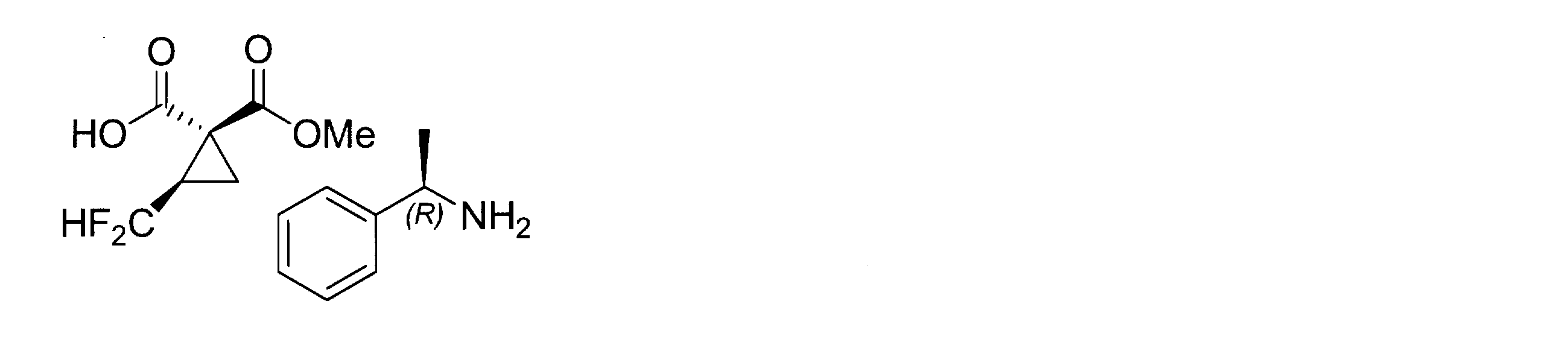
目的物のジアステレオマー過剰率は83%deだった。実施例16に記載の方法を参考にオルトギ酸トリメチル及びメタノールを加えてメチルエステル化を行い、光学純度を測定した結果、99%eeだった。1H―NMR(重溶媒:重メタノール、基準物質:テトラメチルシラン)、δppm:1.31(m、1H)、1.42(m、1H)、1.62(d、3H)、2.11(m、1H)、3.70(s、3H)、4.43(q、1H)、5.65(td、1H)、7.42(m、5H)、19F―NMR(重溶媒:重メタノール、基準物質:ヘキサフルオロベンゼンを-162.2ppmと設定)、-114.9(ddd、1F)、-108.9(ddd、1F)。
温度計保護管と活栓を備え付けた三つ口フラスコに実施例26で得た下記式で示される(R)-含フッ素シクロプロパンジエステル(純度:66.6wt%、9.5g、含量として6.3g、30.5mmol)とメタノール(6ml)を加えて内温を-8℃まで冷却した。
[参考例1]
国際公開2014-078220号公報を参考にして3,3-ジフルオロ乳酸アミドを調製した。水190mL(1.2mL/mmol)に、3,3-ジフルオロ乳酸アミド20g(160mmol、1.0eq)と硫酸78g(800mmol、5.0eq)を加えて100℃で20時間攪拌した。反応終了液を2-メチルテトラヒドロフランで抽出し、回収した有機層を減圧濃縮することにより、3,3-ジフルオロ乳酸16g(130mmol)を得た。収率は81%であった。エタノール5.5g(120mmol、1.5eq)に、3,3-ジフルオロ乳酸10g(79mmol、1.0eq)、オルトギ酸トリエチル17.8g(120mmol、1.5eq)と硫酸1.2g(12mmol、0.15eq)を加えて室温で終夜攪拌した。反応終了液の単蒸留(ジャケット:50~110℃、減圧度:5~50torr)により、3,3-ジフルオロ乳酸エチル10.6g(69mmol)を得た。収率は87%であった。3,3-ジフルオロ乳酸エチルの1H-NMRと19F-NMRを以下に示す。1H-NMR(基準物質;テトラメチルシラン、溶媒;重クロロホルム)、δ ppm;1.34(t、3H)、4.29~4.43(m、3H)、5.97(dt、1H)、ヒドロキシル基のプロトンは帰属できず。19F-NMR(基準物質;ヘキサフルオロベンゼンを-162.2ppmと設定、溶媒;重クロロホルム)、δ ppm;-131.0(ddd、1F)、-129.6(ddd、1F)。
国際公開2014-078220号公報を参考にして3,3-ジフルオロ乳酸アミドを調製した。水190mL(1.2mL/mmol)に、3,3-ジフルオロ乳酸アミド20g(160mmol、1.0eq)と硫酸78g(800mmol、5.0eq)を加えて100℃で20時間攪拌した。反応終了液を2-メチルテトラヒドロフランで抽出し、回収した有機層を減圧濃縮することにより、3,3-ジフルオロ乳酸16g(130mmol)を得た。収率は81%であった。エタノール5.5g(120mmol、1.5eq)に、3,3-ジフルオロ乳酸10g(79mmol、1.0eq)、オルトギ酸トリエチル17.8g(120mmol、1.5eq)と硫酸1.2g(12mmol、0.15eq)を加えて室温で終夜攪拌した。反応終了液の単蒸留(ジャケット:50~110℃、減圧度:5~50torr)により、3,3-ジフルオロ乳酸エチル10.6g(69mmol)を得た。収率は87%であった。3,3-ジフルオロ乳酸エチルの1H-NMRと19F-NMRを以下に示す。1H-NMR(基準物質;テトラメチルシラン、溶媒;重クロロホルム)、δ ppm;1.34(t、3H)、4.29~4.43(m、3H)、5.97(dt、1H)、ヒドロキシル基のプロトンは帰属できず。19F-NMR(基準物質;ヘキサフルオロベンゼンを-162.2ppmと設定、溶媒;重クロロホルム)、δ ppm;-131.0(ddd、1F)、-129.6(ddd、1F)。
[参考例2]
ジムロート冷却管、温度計保護管、活栓、メカニカルスターラーを備え付けた5Lの四つ口フラスコに3,3-ジフルオロ乳酸エチル606g(3.93mol)とエタノール3.6Lをいれて内温10℃程度まで冷却する。つぎに水素化ホウ素ナトリウム223g(5.90mol)を4時間かけてゆっくりと投入する。この時内温は10~30℃であった。投入が終了したら内温は20~30℃で2時間攪拌し、室温で終夜攪拌した。反応液をガスクロマトグラフィーで分析した結果、原料の消失を確認した。次にロータリーエバポレーターを用いて反応液を濃縮した。濃縮残分の重量が1681gになるまで濃縮したら残分に4N HCl水溶液を1515ml加えた。この時発熱して内温は58℃まで上昇した。その後、室温で終夜攪拌した。次に溶液を氷水で冷却して析出物をろ過した。濾液を19F―NMRで分析した結果、目的の1,1-ジフルオロ-2,3-プロパンジオールがほぼ定量的に存在していることを確認した。この濾液をロータリーエバポレーターで濃縮した。濃縮残渣の重量が2050gになったら濃縮を一度止め、濾過を実施した。濾過物はトルエン600mlで洗浄した。得られた濾液と洗浄液を合わせてロータリーエバポレーターで濃縮した。濃縮残渣の重量が673.5gになったら再度ろ過した。濾過物はトルエン100mlで洗浄した。得られた濾液と洗浄液を合わせてロータリーエバポレーターで再び濃縮した。濃縮残渣の重量が515.6gになったら蒸留装置でフラッシュ蒸留を実施した。ジャケット60~120℃、圧力を0.001MPaで蒸留を実施した結果、下記式で示される3,3-ジフルオロ-1,2-プロパンジオールを394.9g、純度:83.7wt%、目的物を3.002mol、収率76.4%で得た。

目的物の1H―NMR(重溶媒:重アセトニトリル、基準物質:テトラメチルシラン)、δppm:3.61(m、2H)、3.72(m、1H)、5.79(td、1H)、19F-NMR(重溶媒:重アセトニトリル、基準物質:ヘキサフルオロベンゼンを-162.2ppmと設定)、-130.9(ddd、1F)、-128.2(ddd、1F)
ジムロート冷却管、温度計保護管、活栓、メカニカルスターラーを備え付けた5Lの四つ口フラスコに3,3-ジフルオロ乳酸エチル606g(3.93mol)とエタノール3.6Lをいれて内温10℃程度まで冷却する。つぎに水素化ホウ素ナトリウム223g(5.90mol)を4時間かけてゆっくりと投入する。この時内温は10~30℃であった。投入が終了したら内温は20~30℃で2時間攪拌し、室温で終夜攪拌した。反応液をガスクロマトグラフィーで分析した結果、原料の消失を確認した。次にロータリーエバポレーターを用いて反応液を濃縮した。濃縮残分の重量が1681gになるまで濃縮したら残分に4N HCl水溶液を1515ml加えた。この時発熱して内温は58℃まで上昇した。その後、室温で終夜攪拌した。次に溶液を氷水で冷却して析出物をろ過した。濾液を19F―NMRで分析した結果、目的の1,1-ジフルオロ-2,3-プロパンジオールがほぼ定量的に存在していることを確認した。この濾液をロータリーエバポレーターで濃縮した。濃縮残渣の重量が2050gになったら濃縮を一度止め、濾過を実施した。濾過物はトルエン600mlで洗浄した。得られた濾液と洗浄液を合わせてロータリーエバポレーターで濃縮した。濃縮残渣の重量が673.5gになったら再度ろ過した。濾過物はトルエン100mlで洗浄した。得られた濾液と洗浄液を合わせてロータリーエバポレーターで再び濃縮した。濃縮残渣の重量が515.6gになったら蒸留装置でフラッシュ蒸留を実施した。ジャケット60~120℃、圧力を0.001MPaで蒸留を実施した結果、下記式で示される3,3-ジフルオロ-1,2-プロパンジオールを394.9g、純度:83.7wt%、目的物を3.002mol、収率76.4%で得た。
[参考例3]
参考例2で得られた3,3-ジフルオロ-1,2-プロパンジオールには水分が16.3wt%含まれているのでトルエンによる脱水を実施した。ディーンスターク装置、温度計保護管、活栓を取り付けた300mlの三口フラスコに得られた参考例2で得られた留分30gとトルエン100mlを入れてジャケット125~130℃で共沸脱水を実施した。水分の共沸が確認できなくなったら終了した。フラスコに残った残液を二層分離することで収量21.9g、収率87%で得た。水分をカールフィッシャー水分計で測定した結果、水分量は0.47wt%であった。
参考例2で得られた3,3-ジフルオロ-1,2-プロパンジオールには水分が16.3wt%含まれているのでトルエンによる脱水を実施した。ディーンスターク装置、温度計保護管、活栓を取り付けた300mlの三口フラスコに得られた参考例2で得られた留分30gとトルエン100mlを入れてジャケット125~130℃で共沸脱水を実施した。水分の共沸が確認できなくなったら終了した。フラスコに残った残液を二層分離することで収量21.9g、収率87%で得た。水分をカールフィッシャー水分計で測定した結果、水分量は0.47wt%であった。
[参考例4]
前培養の培地として、蒸留水1000ml、ポリペプトン10g、酵母エキス5g、塩化ナトリウム10gの組成からなる液体培地を調製し、試験管(φ1.6cm×15cm)に5mlずつ分注し、121℃で15分間の蒸気滅菌を行った。この液体培地に、株式会社ダイセルのChiralscreen (登録商標) OH E039のアルコール脱水素酵素を大量発現する遺伝子組換え大腸菌を白金時で無菌的に接種し、30℃、160spmで一晩培養を行い、波長600nmでの光学濃度(OD600)8.2の前培養液を得た。本培養の培地として、蒸留水2500mlに酵母エキス、グルタミン酸ナトリウム、グルコース、ラクトース、無機塩類、消泡剤からなる液体培地を調製し、容量5Lの培養槽((株)丸菱バイオエンジ製、MDN型5L(S))に張り込み、121℃で30分間の蒸気滅菌を行った。この培養槽に前培養液を無菌的に5ml接種し、30℃、通気0.5vvm、攪拌しながら40時間培養し、光学濃度(OD600)24の懸濁液を調製した。培養時のpHは20%炭酸ナトリウム水溶液、42.5%リン酸水溶液を用いてpH7.0付近に調整した。培養終了後、通気を0vvmに変更し、培養液に対して80%wt/wtの3-クロロ-1,1-ジフルオロ-2-プロパノン水和体を6.25%wt/v(156.25g)添加し、ギ酸脱水素酵素により補酵素の再生を行いながら20℃、pH6.2で還元反応を24時間行った。反応後の変換率は96%、光学純度は83.0%ee(R)であった。反応後の培養液から減圧蒸留(内圧19.2kPa、蒸気温度57~61℃)により80gの(R)-1-クロロ-3,3-ジフルオロイソプロピルアルコールの水溶液を443g回収した。目的物の1H―NMR(重溶媒:重クロロホルム、基準物質:テトラメチルシラン)、δppm:3.72(m、2H)、4.03(m、1H)、5.86(td、1H)、19F―NMR(重溶媒:重クロロホルム、基準物質:ヘキサフルオロベンゼンを-162.2ppmと設定)、-132.2(ddd、1F)、-130.6(ddd、1F)
前培養の培地として、蒸留水1000ml、ポリペプトン10g、酵母エキス5g、塩化ナトリウム10gの組成からなる液体培地を調製し、試験管(φ1.6cm×15cm)に5mlずつ分注し、121℃で15分間の蒸気滅菌を行った。この液体培地に、株式会社ダイセルのChiralscreen (登録商標) OH E039のアルコール脱水素酵素を大量発現する遺伝子組換え大腸菌を白金時で無菌的に接種し、30℃、160spmで一晩培養を行い、波長600nmでの光学濃度(OD600)8.2の前培養液を得た。本培養の培地として、蒸留水2500mlに酵母エキス、グルタミン酸ナトリウム、グルコース、ラクトース、無機塩類、消泡剤からなる液体培地を調製し、容量5Lの培養槽((株)丸菱バイオエンジ製、MDN型5L(S))に張り込み、121℃で30分間の蒸気滅菌を行った。この培養槽に前培養液を無菌的に5ml接種し、30℃、通気0.5vvm、攪拌しながら40時間培養し、光学濃度(OD600)24の懸濁液を調製した。培養時のpHは20%炭酸ナトリウム水溶液、42.5%リン酸水溶液を用いてpH7.0付近に調整した。培養終了後、通気を0vvmに変更し、培養液に対して80%wt/wtの3-クロロ-1,1-ジフルオロ-2-プロパノン水和体を6.25%wt/v(156.25g)添加し、ギ酸脱水素酵素により補酵素の再生を行いながら20℃、pH6.2で還元反応を24時間行った。反応後の変換率は96%、光学純度は83.0%ee(R)であった。反応後の培養液から減圧蒸留(内圧19.2kPa、蒸気温度57~61℃)により80gの(R)-1-クロロ-3,3-ジフルオロイソプロピルアルコールの水溶液を443g回収した。目的物の1H―NMR(重溶媒:重クロロホルム、基準物質:テトラメチルシラン)、δppm:3.72(m、2H)、4.03(m、1H)、5.86(td、1H)、19F―NMR(重溶媒:重クロロホルム、基準物質:ヘキサフルオロベンゼンを-162.2ppmと設定)、-132.2(ddd、1F)、-130.6(ddd、1F)
[参考例5]
参考例4で回収した(R)-1-クロロ-3,3-ジフルオロイソプロピルアルコール水溶液から該アルコールの含量が30gとなるように水溶液を一部取り出し、氷冷しながら、48%水酸化ナトリウム水溶液1.0当量を滴下した。滴下は内部の温度を確認しながら、0~3℃を維持するように行った。滴下後、1℃で120分間攪拌し、閉環反応を実施した。反応後、蒸留により蒸気温度50~70℃(大気圧)で、生成した(S)-2-ジフルオロメチルエチレンオキシドを17g回収し、後述の分析条件で光学純度を分析したところ83.1%eeであった。目的物の1H-NMR(重溶媒:重クロロホルム、基準物質:テトラメチルシラン)、δppm:2.8-2.9(m、2H)、3.27(m、1H)、5.56(td、1H)、19F―NMR(重溶媒:重クロロホルム、基準物質:ヘキサフルオロベンゼンを-162.2ppmと設定)、-125.2(ddd、1F)、-122.5(ddd、1F)
参考例4で回収した(R)-1-クロロ-3,3-ジフルオロイソプロピルアルコール水溶液から該アルコールの含量が30gとなるように水溶液を一部取り出し、氷冷しながら、48%水酸化ナトリウム水溶液1.0当量を滴下した。滴下は内部の温度を確認しながら、0~3℃を維持するように行った。滴下後、1℃で120分間攪拌し、閉環反応を実施した。反応後、蒸留により蒸気温度50~70℃(大気圧)で、生成した(S)-2-ジフルオロメチルエチレンオキシドを17g回収し、後述の分析条件で光学純度を分析したところ83.1%eeであった。目的物の1H-NMR(重溶媒:重クロロホルム、基準物質:テトラメチルシラン)、δppm:2.8-2.9(m、2H)、3.27(m、1H)、5.56(td、1H)、19F―NMR(重溶媒:重クロロホルム、基準物質:ヘキサフルオロベンゼンを-162.2ppmと設定)、-125.2(ddd、1F)、-122.5(ddd、1F)
[参考例6]
参考例5で得た2-ジフルオロメチルエチレンオキシドに対して、2-ナフタレンチオールを1.1当量、トリエチルアミンを1.1当量添加し、スルフィドに誘導し、分析試料とした。高速液体クロマトグラフィーのカラムにはダイセル社製のCHIRALCEL OD-H(4.6mm×25cm、粒子径5μm)を用い、移動相はn-ヘキサン/IPA=95/5、流速0.7ml、カラム温度15℃、検出波長230nmで得られるピークの面積により光学純度を算出した。それぞれのエナンチオマーの保持時間は、R体が24.2min、S体が27.4minであった。
参考例5で得た2-ジフルオロメチルエチレンオキシドに対して、2-ナフタレンチオールを1.1当量、トリエチルアミンを1.1当量添加し、スルフィドに誘導し、分析試料とした。高速液体クロマトグラフィーのカラムにはダイセル社製のCHIRALCEL OD-H(4.6mm×25cm、粒子径5μm)を用い、移動相はn-ヘキサン/IPA=95/5、流速0.7ml、カラム温度15℃、検出波長230nmで得られるピークの面積により光学純度を算出した。それぞれのエナンチオマーの保持時間は、R体が24.2min、S体が27.4minであった。
[参考例7]
参考例5で得た(S)-2-ジフルオロメチルエチレンオキシド17gに20%硫酸水溶液を0.2当量添加し、50℃で8時間攪拌を行った。反応後は、水酸化ナトリウムで溶液のpHを5に調整を行い、ろ過により無機塩を取り除いた後に、減圧蒸留(内圧1.5kPa、蒸気温度80~81℃)を行うことにより、17gの(S)-3,3-ジフルオロ-1,2-プロパンジオールを得た。また、後述の分析条件で光学純度を分析したところ83.1%eeであった。目的物の1H―NMR(重溶媒:重アセトニトリル、基準物質:テトラメチルシラン)、δppm:3.61(m、2H)、3.72(m、1H)、5.79(td、1H)、19F―NMR(重溶媒:重アセトニトリル、基準物質:ヘキサフルオロベンゼンを-162.2ppmと設定)、-130.9(ddd、1F)、-128.2(ddd、1F)
参考例5で得た(S)-2-ジフルオロメチルエチレンオキシド17gに20%硫酸水溶液を0.2当量添加し、50℃で8時間攪拌を行った。反応後は、水酸化ナトリウムで溶液のpHを5に調整を行い、ろ過により無機塩を取り除いた後に、減圧蒸留(内圧1.5kPa、蒸気温度80~81℃)を行うことにより、17gの(S)-3,3-ジフルオロ-1,2-プロパンジオールを得た。また、後述の分析条件で光学純度を分析したところ83.1%eeであった。目的物の1H―NMR(重溶媒:重アセトニトリル、基準物質:テトラメチルシラン)、δppm:3.61(m、2H)、3.72(m、1H)、5.79(td、1H)、19F―NMR(重溶媒:重アセトニトリル、基準物質:ヘキサフルオロベンゼンを-162.2ppmと設定)、-130.9(ddd、1F)、-128.2(ddd、1F)
[参考例8]
参考例7で得た(S)-3,3-ジフルオロ-1,2-プロパンジオールに対して、無水酢酸2.5当量、ピリジン2.5当量を反応させ、ジアセトキシ体に誘導し、分析試料とした。ガスクロマトグラフィーのカラムにはアジレント・テクノロジー社製のCyclosil-B(0.25mm×30m×0.25μm)を用い、キャリアガスは窒素、圧力は163kPa、カラム温度は50℃(5min)、50~150℃(5℃/min)、150℃(15min)、気化室・検出器(FID)温度は230℃の分析条件で得られるピークの面積により光学純度を算出した。それぞれのエナンチオマーの保持時間は、R体が16.3min、S体が17.2minであった。立体配置は公知の情報を元に決定した。
参考例7で得た(S)-3,3-ジフルオロ-1,2-プロパンジオールに対して、無水酢酸2.5当量、ピリジン2.5当量を反応させ、ジアセトキシ体に誘導し、分析試料とした。ガスクロマトグラフィーのカラムにはアジレント・テクノロジー社製のCyclosil-B(0.25mm×30m×0.25μm)を用い、キャリアガスは窒素、圧力は163kPa、カラム温度は50℃(5min)、50~150℃(5℃/min)、150℃(15min)、気化室・検出器(FID)温度は230℃の分析条件で得られるピークの面積により光学純度を算出した。それぞれのエナンチオマーの保持時間は、R体が16.3min、S体が17.2minであった。立体配置は公知の情報を元に決定した。
[参考例9]
前培養の培地として、蒸留水1000ml、ポリペプトン10g、酵母エキス5g、塩化ナトリウム10gの組成からなる液体培地を調製し、試験管(φ1.6cm×15cm)に5mlずつ分注し、121℃で15分間の蒸気滅菌を行った。この液体培地に、株式会社ダイセルのChiralscreen (登録商標) OH E094のアルコール脱水素酵素を大量発現する遺伝子組換え大腸菌を白金時で無菌的に接種し、30℃、160spmで一晩培養を行い、波長600nmでの光学濃度(OD600)6.4の前培養液を得た。本培養の培地として、蒸留水2500mlに酵母エキス、グルタミン酸ナトリウム、グルコース、ラクトース、無機塩類、消泡剤からなる液体培地を調製し、容量5Lの培養槽((株)丸菱バイオエンジ製、MDN型5L(S))に張り込み、121℃で30分間の蒸気滅菌を行った。この培養槽に前培養液を無菌的に5ml接種し、30℃、通気0.5vvm、攪拌しながら40時間培養し、光学濃度(OD600)22の懸濁液を調製した。培養時のpHは20%炭酸ナトリウム水溶液、42.5%リン酸水溶液を用いてpH7.0付近に調整した。培養終了後、通気を0vvmに変更し、培養液に対して90%wt/wtの3-クロロ-1,1-ジフルオロ-2-プロパノン水和体を6.25%wt/v(156.25g)添加し、グルコース脱水素酵素により補酵素の再生を行いながら30℃、pH6.0で還元反応を24時間行った。反応後の変換率99%光学純度は89.2%ee(S)であった。反応後の培養液から減圧蒸留(内圧19.2kPa、蒸気温度57~61℃)により85gの(S)-1-クロロ-3,3-ジフルオロイソプロピルアルコールの水溶液を526g回収した。目的物の1H―NMR(重溶媒:重クロロホルム、基準物質:テトラメチルシラン)、δppm:3.72(m、2H)、4.03(m、1H)、5.86(td、1H)、19F―NMR(重溶媒:重クロロホルム、基準物質:ヘキサフルオロベンゼンを-162.2ppmと設定)、-132.2(ddd、1F)、-130.6(ddd、1F)
前培養の培地として、蒸留水1000ml、ポリペプトン10g、酵母エキス5g、塩化ナトリウム10gの組成からなる液体培地を調製し、試験管(φ1.6cm×15cm)に5mlずつ分注し、121℃で15分間の蒸気滅菌を行った。この液体培地に、株式会社ダイセルのChiralscreen (登録商標) OH E094のアルコール脱水素酵素を大量発現する遺伝子組換え大腸菌を白金時で無菌的に接種し、30℃、160spmで一晩培養を行い、波長600nmでの光学濃度(OD600)6.4の前培養液を得た。本培養の培地として、蒸留水2500mlに酵母エキス、グルタミン酸ナトリウム、グルコース、ラクトース、無機塩類、消泡剤からなる液体培地を調製し、容量5Lの培養槽((株)丸菱バイオエンジ製、MDN型5L(S))に張り込み、121℃で30分間の蒸気滅菌を行った。この培養槽に前培養液を無菌的に5ml接種し、30℃、通気0.5vvm、攪拌しながら40時間培養し、光学濃度(OD600)22の懸濁液を調製した。培養時のpHは20%炭酸ナトリウム水溶液、42.5%リン酸水溶液を用いてpH7.0付近に調整した。培養終了後、通気を0vvmに変更し、培養液に対して90%wt/wtの3-クロロ-1,1-ジフルオロ-2-プロパノン水和体を6.25%wt/v(156.25g)添加し、グルコース脱水素酵素により補酵素の再生を行いながら30℃、pH6.0で還元反応を24時間行った。反応後の変換率99%光学純度は89.2%ee(S)であった。反応後の培養液から減圧蒸留(内圧19.2kPa、蒸気温度57~61℃)により85gの(S)-1-クロロ-3,3-ジフルオロイソプロピルアルコールの水溶液を526g回収した。目的物の1H―NMR(重溶媒:重クロロホルム、基準物質:テトラメチルシラン)、δppm:3.72(m、2H)、4.03(m、1H)、5.86(td、1H)、19F―NMR(重溶媒:重クロロホルム、基準物質:ヘキサフルオロベンゼンを-162.2ppmと設定)、-132.2(ddd、1F)、-130.6(ddd、1F)
[参考例10]
参考例9で回収した85gの(S)-1-クロロ-3,3-ジフルオロイソプロピルアルコール水溶液を氷冷しながら、48%水酸化ナトリウム水溶液1.0当量を滴下した。滴下は内部の温度を確認しながら、0~3℃を維持するように行った。滴下後、1℃で120分間攪拌し、閉環反応を実施した。反応後、蒸留により蒸気温度50~70℃(大気圧)で、生成した(R)-2-ジフルオロメチルエチレンオキシドを49g回収し、参考例6の分析条件で光学純度を分析したところ89.1%eeであった。目的物の1H―NMR(重溶媒:重クロロホルム、基準物質:テトラメチルシラン)、δppm:2.8-2.9(m、2H)、3.27(m、1H)、5.56(td、1H)、19F―NMR(重溶媒:重クロロホルム、基準物質:ヘキサフルオロベンゼンを-162.2ppmと設定)、-125.2(ddd、1F)、-122.5(ddd、1F)
参考例9で回収した85gの(S)-1-クロロ-3,3-ジフルオロイソプロピルアルコール水溶液を氷冷しながら、48%水酸化ナトリウム水溶液1.0当量を滴下した。滴下は内部の温度を確認しながら、0~3℃を維持するように行った。滴下後、1℃で120分間攪拌し、閉環反応を実施した。反応後、蒸留により蒸気温度50~70℃(大気圧)で、生成した(R)-2-ジフルオロメチルエチレンオキシドを49g回収し、参考例6の分析条件で光学純度を分析したところ89.1%eeであった。目的物の1H―NMR(重溶媒:重クロロホルム、基準物質:テトラメチルシラン)、δppm:2.8-2.9(m、2H)、3.27(m、1H)、5.56(td、1H)、19F―NMR(重溶媒:重クロロホルム、基準物質:ヘキサフルオロベンゼンを-162.2ppmと設定)、-125.2(ddd、1F)、-122.5(ddd、1F)
[参考例11]
参考例10で調製した49gの(R)-2-ジフルオロメチルエチレンオキシドが含まれる水溶液に20%硫酸水溶液を0.2当量添加し、60℃で7時間攪拌を行った。反応後は、水酸化ナトリウムで溶液のpHを5に調整を行い、ろ過により無機塩を取り除いた後に、減圧蒸留(内圧1.5kPa、蒸気温度80~81℃)を行うことにより、46gの(R)-3,3-ジフルオロ-1,2-プロパンジオールを得た。また、参考例8の分析条件で光学純度を分析したところ89.2%eeであった。目的物の1H―NMR(重溶媒:重アセトニトリル、基準物質:テトラメチルシラン)、δppm:3.61(m、2H)、3.72(m、1H)、5.79(td、1H)、19F―NMR(重溶媒:重アセトニトリル、基準物質:ヘキサフルオロベンゼンを-162.2ppmと設定)、-130.9(ddd、1F)、-128.2(ddd、1F)
参考例10で調製した49gの(R)-2-ジフルオロメチルエチレンオキシドが含まれる水溶液に20%硫酸水溶液を0.2当量添加し、60℃で7時間攪拌を行った。反応後は、水酸化ナトリウムで溶液のpHを5に調整を行い、ろ過により無機塩を取り除いた後に、減圧蒸留(内圧1.5kPa、蒸気温度80~81℃)を行うことにより、46gの(R)-3,3-ジフルオロ-1,2-プロパンジオールを得た。また、参考例8の分析条件で光学純度を分析したところ89.2%eeであった。目的物の1H―NMR(重溶媒:重アセトニトリル、基準物質:テトラメチルシラン)、δppm:3.61(m、2H)、3.72(m、1H)、5.79(td、1H)、19F―NMR(重溶媒:重アセトニトリル、基準物質:ヘキサフルオロベンゼンを-162.2ppmと設定)、-130.9(ddd、1F)、-128.2(ddd、1F)
[参考例12]
実施例19で調製した下記式で示される化合物5.66g(17.2mmol)を、室温でイソプロピルエーテル(78ml)を加えて撹拌を行い、そこに1Mリン酸水溶液(43ml)を滴下した。

そのまま30分撹拌を続け、20分静置することにより2層分離を行った。水層を取り除き、水(50mL)を加えて再び30分撹拌し、20分静置した。有機層を取り出し、ロータリーエバポレーターで濃縮を行うことにより下記式で示される化合物を3.29g(15.8mmol)得た。

この化合物3.29g(15.8mmol)に室温でトルエン(32ml)、トリエチルアミン(3.20g、31.6mmol)、t-ブタノール(3.51g、47.4mmol)を加えた。その溶液を70℃に加熱を行い、そこにジフェニルリン酸アジド(6.52g、23.7mol)をゆっくり滴下した。滴下後は内温を80℃として、反応を15時間行った。反応後は、ロータリーエバポレーターで溶媒の濃縮を行い、残渣にイソプロピルエーテル(50ml)と水を加えて撹拌し二層分離を行った。有機層を取り出して、水(35ml)を加えて同様に撹拌、二層分離を行った。有機層を分離し、ロータリーエバポレーターで濃縮を行い、粗体を得た。水酸化カリウム(1.14g、20.4mmol)をメタノール(10ml)に溶解させ、上記で得た粗体に室温で加えた。その溶液を40℃で5時間反応させることにより加水分解が進行した。この溶液を氷浴で冷却し、1Mリン酸水溶液(20ml)をゆっくりと加えた。さらにイソプロピルエーテル(50ml)を加えて、30分室温で撹拌した後に二層分離を行った。有機層を取り出し、水(20ml)を加えて再び30分室温で撹拌した後に有機層を取り出し、ロータリーエバポレーターで濃縮を行うことにより、下記式で示される化合物を2.37g(9.4mmol)得た。
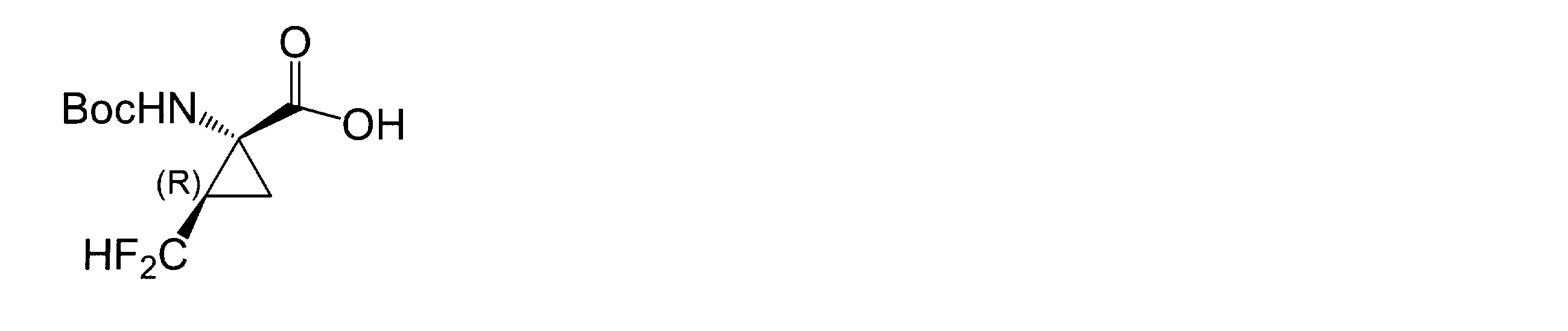
[式中、Bocはtert-ブトキシカルボニル基を表す。]
実施例19で調製した下記式で示される化合物5.66g(17.2mmol)を、室温でイソプロピルエーテル(78ml)を加えて撹拌を行い、そこに1Mリン酸水溶液(43ml)を滴下した。
[比較例1]
温度計保護管、三方コックと滴下ロートを備えた100ml三口ガラス反応器にジクロロメタン(14ml)、下記式で示される3,3-ジフルオロ-1,2-プロパンジオール((水分量:0.47%)、1.0g、8.9mmol、)、イミダゾール(1.5g、22.3mmol)を加えて室温で20分間攪拌した。

次に反応液をドライアイスとアセトニトリルの混合物(-45℃)で冷却し、滴下ロートを用いて塩化スルフリル(1.2g、8.9mmol)とジクロロメタン(3ml)の混合物を2時間30分かけて滴下した。この時の反応液の温度は-38~-34.7℃であった。滴下が終了したら二時間内温-35℃付近で攪拌した。その後、室温で一晩攪拌した。得られた反応液を19F―NMRで分析した結果、複雑な混合物を与え、下記式で示される目的物は得られなかった。

温度計保護管、三方コックと滴下ロートを備えた100ml三口ガラス反応器にジクロロメタン(14ml)、下記式で示される3,3-ジフルオロ-1,2-プロパンジオール((水分量:0.47%)、1.0g、8.9mmol、)、イミダゾール(1.5g、22.3mmol)を加えて室温で20分間攪拌した。
[比較例2]
温度計保護管と活栓を備え付けた20mlの二つ口フラスコに下記式で示されるジフルオロプロペンオキシド(ラセミ混合物、純度:44%、8.97g、42.2mmol)を入れ、氷水で内温1℃付近まで冷却した。

次に48%臭化水素酸水溶液(7.47g、44.3mmol)をゆっくり加えた。この時の温度は0~10℃であった。滴下が終了したらゆっくり室温まで温度を上げ、終夜攪拌した。次に反応液にメチル-tert-ブチルエーテル(15ml)を加えて抽出及び二層分離を行った。得られた有機層をフラッシュ蒸留装置で濃縮した結果、濃縮残分として下記式で示される目的のブロモヒドリン体の粗体9.2gを得た。

粗体中の目的物含量は80wt%、ほぼ定量的に得た。目的物の1H―NMR(重溶媒:重アセトニトリル、基準物質:テトラメチルシラン)、δppm:3.05(m、2H)、3.60(m、1H)、5.76(td、1H)、19F―NMR(重溶媒:重アセトニトリル、基準物質:ヘキサフルオロベンゼンを-162.2ppmと設定)、-130.3(ddd、1F)、-127.6(ddd、1F)
温度計保護管と活栓を備え付けた20mlの二つ口フラスコに下記式で示されるジフルオロプロペンオキシド(ラセミ混合物、純度:44%、8.97g、42.2mmol)を入れ、氷水で内温1℃付近まで冷却した。
[比較例3]
50mlのナスフラスコに比較例2で得られた下記式で示されるブロモヒドリン体(純度:80wt%、4.3g、20mmol)、パラトルエンスルホニルクロリド(5.7g、30mmol)、メチル-tert-ブチルエーテル(20ml)を加えて氷水で冷却した。

次にトリエチルアミン(3.0g、30mmol)を加えて30分攪拌した。その後、ゆっくり室温まで温度を上げて終夜で攪拌した。反応液を水20mlで四回洗浄し、ロータリーエバポレーターで溶媒を除去した。次にトルエンを加えて水分を共沸脱水で除去し、水分を除去した溶液を再度硫酸ナトリウムで脱水したら固形分をろ過した。最後にロータリーエバポレーターでトルエンを除去したら下記式で示される目的物の粗体を12.8g、34.9mmol、収率87%で得た。

目的物の1H―NMR(重溶媒:重クロロホルム、基準物質:テトラメチルシラン)、δppm:2.47(s、3H)、3.56(m、2H)、4.73(m、1H)、6.00(dt、1H)、7.37(d、2H)、7.83(d、2H)、19F―NMR(重溶媒:重クロロホルム、基準物質:ヘキサフルオロベンゼンを-162.2ppmと設定)、-132.4(ddd、1F)、-130.1(ddd、1F)
50mlのナスフラスコに比較例2で得られた下記式で示されるブロモヒドリン体(純度:80wt%、4.3g、20mmol)、パラトルエンスルホニルクロリド(5.7g、30mmol)、メチル-tert-ブチルエーテル(20ml)を加えて氷水で冷却した。
[比較例4]
温度計保護管、セプタム、三方コックを備え付けた50mlの三口フラスコに水素化ナトリウム(0.2g、5mmol)を入れて内部を窒素で置換した。次にDMF(20ml)を入れて氷水で内温2℃付近まで冷却した。次にマロン酸ジエチル(0.8g、5mmol)をゆっくり加えた。この時内温は2~4℃であった。次に比較例3で得られた下記式で示される化合物の粗体1.8g(5mmol)をゆっくり加えた。

添加が終了したら反応液をゆっくり室温まで上げて終夜で攪拌した。その後、反応液を分析した結果、下記式で示される目的のマロン酸付加体は得られなかった。
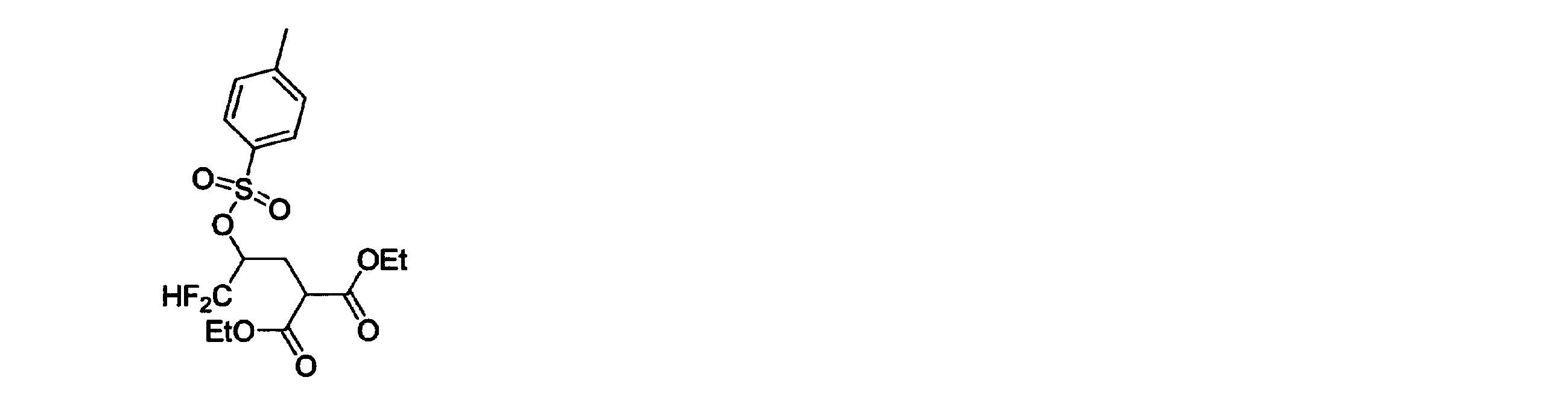
温度計保護管、セプタム、三方コックを備え付けた50mlの三口フラスコに水素化ナトリウム(0.2g、5mmol)を入れて内部を窒素で置換した。次にDMF(20ml)を入れて氷水で内温2℃付近まで冷却した。次にマロン酸ジエチル(0.8g、5mmol)をゆっくり加えた。この時内温は2~4℃であった。次に比較例3で得られた下記式で示される化合物の粗体1.8g(5mmol)をゆっくり加えた。
[比較例5]
温度計保護管と活栓を備え付けた30ml二つ口フラスコに下記式で示されるクロロヒドリン(ラセミ混合物、純度:75wt%、3.5g、20mmol)、メチル-tert-ブチルエーテル(20ml)とパラトルエンスルホニルクロリド(4.2g、22mmol)を加えて氷水で内温2℃付近まで冷却した。

次にトリエチルアミン(2.4g、24mmol)をゆっくり加えた。この時内温は2~3℃であった。添加が終了したら室温までゆっくりと温度を上げて終夜攪拌した。得られた反応液を水20mlで四回洗浄し、二層分離して得られた有機層はロータリーエバポレーターで有機溶媒を除去した。濃縮液にトルエンを加えて水分を共沸除去した。水分を除去した溶液を濾過してロータリーエバポレーターで濃縮することで下記式で示される目的物を4.6g、15mmol、収率75%で得た。

目的物の1H―NMR(重溶媒:重クロロホルム、基準物質:テトラメチルシラン)、δppm:2.45(s、3H)、3.75(m、2H)、4.73(m、1H)、5.99(dt、1H)、7.36(d、2H)、7.82(d、2H)、19F―NMR(重溶媒:重クロロホルム、基準物質:ヘキサフルオロベンゼンを-162.2ppmと設定)、-132.3(ddd、1F)、-130.1(ddd、1F)
温度計保護管と活栓を備え付けた30ml二つ口フラスコに下記式で示されるクロロヒドリン(ラセミ混合物、純度:75wt%、3.5g、20mmol)、メチル-tert-ブチルエーテル(20ml)とパラトルエンスルホニルクロリド(4.2g、22mmol)を加えて氷水で内温2℃付近まで冷却した。
[比較例6]
温度計保護管、セプタム、三方コックを備え付けた50mlの三口フラスコに水素化ナトリウム(0.2g、5mmol)を入れて内部を窒素で置換した。次にDMF(20ml)を入れて氷水で内温2℃付近まで冷却した。次にマロン酸ジエチル(0.83g、5.2mmol)をゆっくり加えた。この時内温は2~7℃であった。次に比較例5で得られた下記式で示される化合物(1.4g、5mmol)をゆっくり加えた。
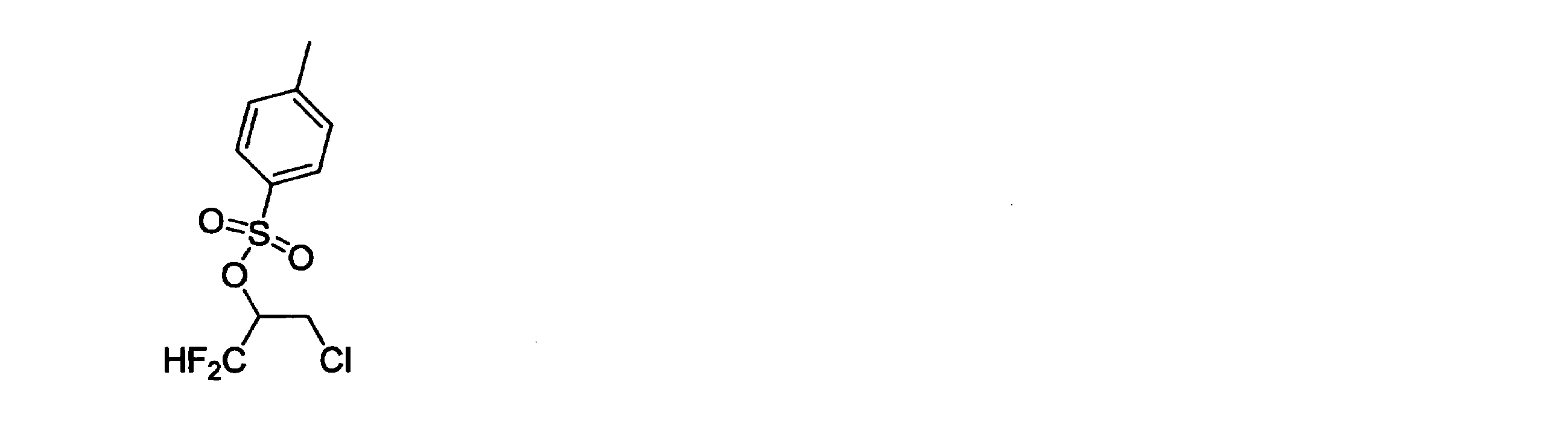
添加が終了したら反応液をゆっくり室温まで上げて終夜で攪拌した。その後、反応液を分析した結果、下記式で示されるマロン酸付加体は得られなかった。

温度計保護管、セプタム、三方コックを備え付けた50mlの三口フラスコに水素化ナトリウム(0.2g、5mmol)を入れて内部を窒素で置換した。次にDMF(20ml)を入れて氷水で内温2℃付近まで冷却した。次にマロン酸ジエチル(0.83g、5.2mmol)をゆっくり加えた。この時内温は2~7℃であった。次に比較例5で得られた下記式で示される化合物(1.4g、5mmol)をゆっくり加えた。
[比較例7]
温度計保護管、ジムロート冷却管と活栓を備え付けた100ml三つ口フラスコに参考例2で合成した下記式で示される3,3-ジフルオロ-1,2-プロパンジオール(純度:83.7wt%、5.0g、38mmol)、メチル-tert-ブチルエーテル(38ml)とパラトルエンスルホニルクロリド(21.7g、114mmol)を加えて氷水で内温2℃付近まで冷却した。

次にトリエチルアミン(15.4g、152mmol)をゆっくり加えた。添加が終了したらオイルバスで内温47℃付近まで2時間加熱して、その後室温で終夜攪拌した。得られた反応液に水20ml加えて混合し、二層分離を実施した。得られた有機層に水10mlとメチル-tert-ブチルエーテル10mlを加えて混合し、再度二層分離した。得られた有機層を水10mlと飽和塩化ナトリウム水溶液5ml×2で洗浄して二層分離した。得られた有機層はロータリーエバポレーターで溶媒を濃縮し、次にトルエンを加えて共沸脱水を実施した。濃縮残渣中にパラトルエンスルホン酸が残存していたのでメチル-tert-ブチルエーテル50mlとトルエン30mlを加え、水10mlと炭酸水素ナトリウム3.2g(38mmol)の混合液と水10mlで再度洗浄し二層分離した。得られた有機層をロータリーエバポレーターで溶媒を除去することで下記式で示される目的物の粗体を16.9g得た。
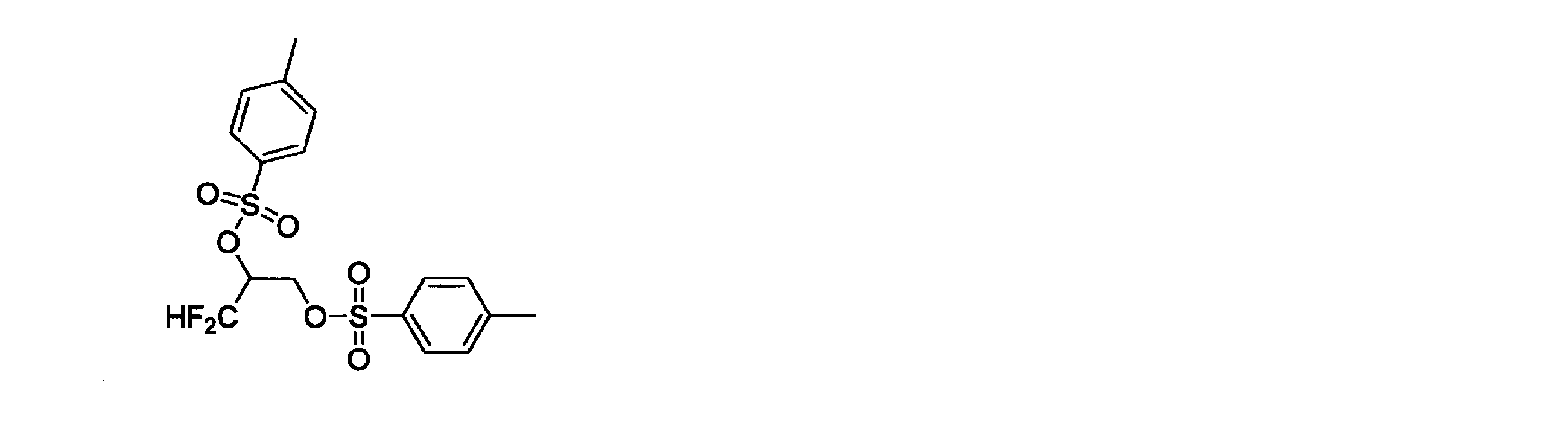
19F―NMRで分析した結果、目的物の含量は38molでほぼ定量的に反応は進行した。得られた粗体3gをカラムクロマトグラフィーに付すことで精製した目的物を2.56g得た。目的物の1H―NMR(重溶媒:重クロロホルム、基準物質:テトラメチルシラン)、δppm:2.47(s、6H)、4.17(ddd、1H)、4.26(ddd、1H)、4.69(m、1H)、5.90(dt、1H)、7.36(d、4H)、7.71(d、2H)、7.77(d、2H)、19F―NMR(重溶媒:重クロロホルム、基準物質:ヘキサフルオロベンゼンを-162.2ppmと設定)、-132.2(ddd、1F)、-128.7(ddd、1F)
温度計保護管、ジムロート冷却管と活栓を備え付けた100ml三つ口フラスコに参考例2で合成した下記式で示される3,3-ジフルオロ-1,2-プロパンジオール(純度:83.7wt%、5.0g、38mmol)、メチル-tert-ブチルエーテル(38ml)とパラトルエンスルホニルクロリド(21.7g、114mmol)を加えて氷水で内温2℃付近まで冷却した。
[比較例8]
温度計保護管、ジムロート冷却器、活栓を備え付けた50mlの三口フラスコに水素化ナトリウム(0.2g、5mmol)を入れて内部を窒素で置換した。次にDMF(20ml)を入れて氷水で内温3℃付近まで冷却した。次にマロン酸ジエチル(0.8g、5mmol)をゆっくり加えた。この時内温は3~4℃であった。次に比較例7で得られた精製した下記式で示される化合物(2.56g、6mmol)とDMF5mlの混合物をゆっくり加えた。
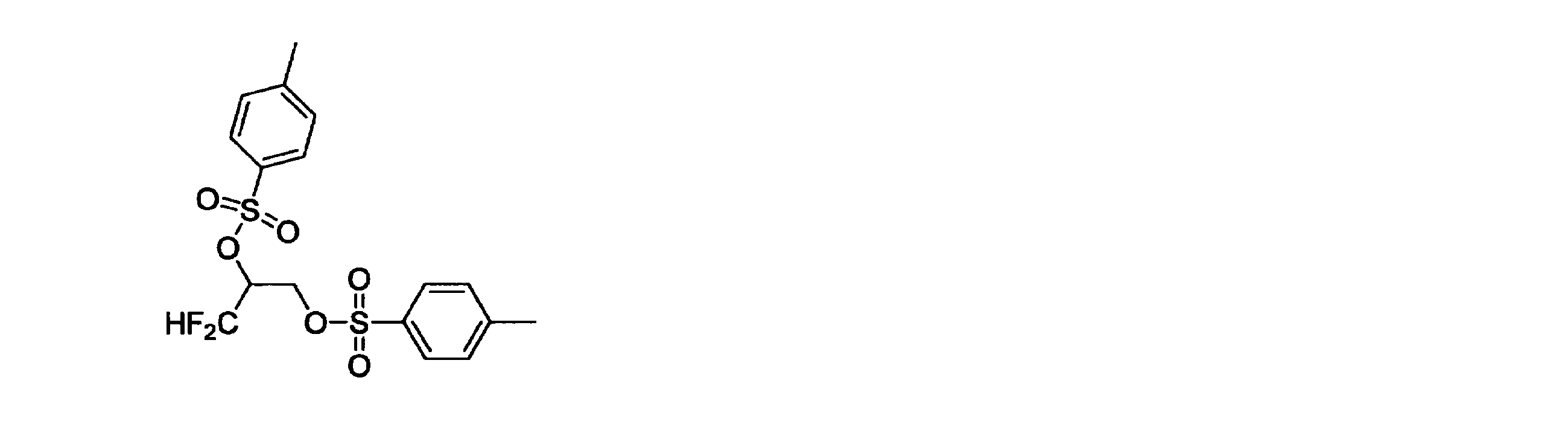
この時内温は3~5℃であった。氷水で冷やしながら30分攪拌した後にオイルバスで加熱して内温50℃付近で4時間攪拌した。その後、室温下で終夜攪拌した。得られた反応液を分析した結果、下記式で示される目的のマロン酸付加体は得られなかった。

温度計保護管、ジムロート冷却器、活栓を備え付けた50mlの三口フラスコに水素化ナトリウム(0.2g、5mmol)を入れて内部を窒素で置換した。次にDMF(20ml)を入れて氷水で内温3℃付近まで冷却した。次にマロン酸ジエチル(0.8g、5mmol)をゆっくり加えた。この時内温は3~4℃であった。次に比較例7で得られた精製した下記式で示される化合物(2.56g、6mmol)とDMF5mlの混合物をゆっくり加えた。
[比較例9]
温度計保護管、活栓とジムロート冷却管を備え付けた100ml三口フラスコにDBU(2.62g、17.2mmol)とTHF(29.7ml)を入れて氷水で冷却した。次にマロン酸ジエチル(2.76g、17.2mmol)を加えて氷水で冷やしたまま30分間攪拌した。その後、室温付近まで温度を上げたら下記式で示される含フッ素環状硫酸エステル(ラセミ混合物、3.0g、17.2mmol)、THF5.7mlと内部標準物質であるベンゾトリフルオリド(1.46g、10mmol)の混合物をゆっくり加えた。

この時の内温は22~37℃であった。その後、室温下で二時間攪拌した。次にこの反応液にDBU(3.14g、20.7mmol)を加え、オイルバスで加熱して内温65℃付近で1時間45分加熱した。反応液を室温まで冷却し、NMRで分析した結果、下記式で示される目的のシクロプロパン類は確認できなかった。

温度計保護管、活栓とジムロート冷却管を備え付けた100ml三口フラスコにDBU(2.62g、17.2mmol)とTHF(29.7ml)を入れて氷水で冷却した。次にマロン酸ジエチル(2.76g、17.2mmol)を加えて氷水で冷やしたまま30分間攪拌した。その後、室温付近まで温度を上げたら下記式で示される含フッ素環状硫酸エステル(ラセミ混合物、3.0g、17.2mmol)、THF5.7mlと内部標準物質であるベンゾトリフルオリド(1.46g、10mmol)の混合物をゆっくり加えた。
[比較例10]
温度計保護管、三方コックと滴下ロートを備えた100ml三口ガラス反応器にTHF(19ml)、下記式で示される3,3-ジフルオロ-1,2-プロパンジオール(水分量0.47%、5.6g、50mmol)、トリエチルアミン(13.7g、135mmol)を加えて室温で20分間攪拌した。

次に反応液を-5℃の冷媒で冷却し、内温を0℃とした。滴下ロートを用いて塩化スルフリル(8.1g、60mmol)とジクロロメタン(11ml)の混合物を、内温を0℃で維持したまま15分かけて滴下した。滴下が終了して、内温を20℃まで昇温し、1時間攪拌を行うことにより変換率は100%となった。得られた反応液を19F―NMRで分析した結果、複雑な混合物を与え、その中に下記式で示される目的物は得られなかった。

温度計保護管、三方コックと滴下ロートを備えた100ml三口ガラス反応器にTHF(19ml)、下記式で示される3,3-ジフルオロ-1,2-プロパンジオール(水分量0.47%、5.6g、50mmol)、トリエチルアミン(13.7g、135mmol)を加えて室温で20分間攪拌した。
本発明で対象とする含フッ素シクロプロパンカルボン酸類は、医薬、農薬の中間体として利用できる。
Claims (16)
- 一般式[1]で表される含フッ素ジオール化合物を、アルカリ金属水素化物、アルカリ土類金属水素化物、アルカリ金属水酸化物、アルカリ土類金属水酸化物、アルカリ金属炭酸塩、アルカリ土類金属炭酸塩、アルカリ金属炭酸水素塩、及びアルカリ土類金属炭酸水素塩からなる群より選ばれる少なくとも一つの塩基性化合物の存在下、フッ化スルフリルと反応させることで一般式[2]で表される含フッ素環状硫酸エステルを製造する方法。


- Rfがジフルオロメチル基(CF2H)またはトリフルオロメチル基(CF3)である、請求項1に記載の方法。
- フッ化スルフリルを反応させるときの温度が-50~+50℃の範囲である、請求項1または2に記載の方法。
- フッ化スルフリルの使用量が0.7~4.0当量である請求項1乃至3のいずれかに記載の方法。
- 請求項1乃至4の何れかに記載の方法で含フッ素環状硫酸エステルを製造し、次いで、該エステルを無機塩基の存在下、一般式[3]で表されるマロン酸ジエステルと反応させることで、一般式[5]で表される含フッ素シクロプロパンジエステルを製造する方法。


- 無機塩基がアルカリ金属、アルカリ金属水素化物、アルカリ土類金属水素化物、アルカリ金属水酸化物またはアルカリ土類金属水酸化物である、請求項5に記載の方法。
- 一般式[2]で表される含フッ素環状硫酸エステルと一般式[3]で表されるマロン酸ジエステルを、無機塩基を含む溶媒中に添加することを特徴とする、請求項5または請求項6に記載の方法。
- 請求項5乃至7の何れかに記載の方法で含フッ素シクロプロパンジエステルを製造し、次いで、該ジエステルにアルカリ金属水酸化物、アルカリ土類金属水酸化物、アルカリ金属炭酸塩、アルカリ土類金属炭酸塩、アルカリ金属炭酸水素塩、アルカリ土類金属炭酸水素塩または一般式[6]で表される水酸化四級アンモニウムの存在下、加水分解を行うことで一般式[7]で表される含フッ素シクロプロパンモノエステルを製造する方法。


- 加水分解反応における温度が-30~+40℃である、請求項8に記載の方法。
- 一般式[7]で表される含フッ素シクロプロパンモノエステルに、一般式[8]で表されるアミンを加えて、一般式[9]で表される含フッ素シクロプロパンモノエステルとアミンとの塩を形成し、再結晶精製を行う工程を更に含む、請求項8または9に記載の方法。


- 一般式[8]で表されるアミンが、一般式[10]で表されるアミンである、請求項10に記載の方法。

- 以下の工程を含む、一般式[11]で表される含フッ素シクロプロパンモノエステルと1-フェニルエチルアミンとの塩の製造方法。

[環状硫酸エステル化工程]
式[12]で表される含フッ素ジオール化合物に、アルカリ金属水素化物、アルカリ金属炭酸塩、アルカリ金属炭酸水素塩とフッ化スルフリルを反応させて式[13]に記載の含フッ素環状硫酸エステルを得る工程。


[シクロプロパン化工程]
前記環状硫酸エステル化工程で得られた含フッ素環状硫酸エステルに、アルカリ金属又はアルカリ金属水素化物の存在下、一般式[3]で表されるマロン酸ジエステルを反応させることで、一般式[15]で表される含フッ素シクロプロパンジエステルを得る工程。


[加水分解工程]
前記シクロプロパン化工程で得た含フッ素シクロプロパンジエステルにアルカリ金属水酸化物、アルカリ金属炭酸塩または一般式[6]で表される水酸化四級アンモニウムの存在下、加水分解を行うことで一般式[16]で表される含フッ素シクロプロパンモノエステルを得る工程。


[再結晶工程]
前記加水分解工程で得られた含フッ素シクロプロパンモノエステルに光学活性1-フェニルエチルアミンを加え、式[11]で表される含フッ素シクロプロパンモノエステルと1-フェニルエチルアミンとの塩を形成し、再結晶精製操作を行う工程。

- 式[13]で表される含フッ素環状硫酸エステル。

- 式[17]で表される含フッ素シクロプロパンモノエステルとアミンとの塩。

- 式[18]で表される含フッ素シクロプロパンモノエステルと1-フェニルエチルアミンとの塩。

- 式[19]で表される含フッ素シクロプロパンモノエステルと1-フェニルエチルアミンとの塩。

Priority Applications (5)
| Application Number | Priority Date | Filing Date | Title |
|---|---|---|---|
| EP16817820.0A EP3315497B1 (en) | 2015-06-29 | 2016-06-24 | Method for producing fluorine-containing cyclopropane carboxylic acid compound |
| CN201680039133.7A CN107709309B (zh) | 2015-06-29 | 2016-06-24 | 含氟环丙烷羧酸类的制造方法 |
| JP2017526315A JP6923805B2 (ja) | 2015-06-29 | 2016-06-24 | 含フッ素シクロプロパンカルボン酸類の製造方法 |
| US15/741,020 US10450291B2 (en) | 2015-06-29 | 2016-06-24 | Method for producing fluorine-containing cyclopropane carboxylic acid compound |
| US16/562,214 US10793540B2 (en) | 2015-06-29 | 2019-09-05 | Method for producing fluorine-containing cyclopropane carboxylic acid compound |
Applications Claiming Priority (2)
| Application Number | Priority Date | Filing Date | Title |
|---|---|---|---|
| JP2015129628 | 2015-06-29 | ||
| JP2015-129628 | 2015-06-29 |
Related Child Applications (2)
| Application Number | Title | Priority Date | Filing Date |
|---|---|---|---|
| US15/741,020 A-371-Of-International US10450291B2 (en) | 2015-06-29 | 2016-06-24 | Method for producing fluorine-containing cyclopropane carboxylic acid compound |
| US16/562,214 Continuation US10793540B2 (en) | 2015-06-29 | 2019-09-05 | Method for producing fluorine-containing cyclopropane carboxylic acid compound |
Publications (1)
| Publication Number | Publication Date |
|---|---|
| WO2017002712A1 true WO2017002712A1 (ja) | 2017-01-05 |
Family
ID=57609377
Family Applications (1)
| Application Number | Title | Priority Date | Filing Date |
|---|---|---|---|
| PCT/JP2016/068748 Ceased WO2017002712A1 (ja) | 2015-06-29 | 2016-06-24 | 含フッ素シクロプロパンカルボン酸類の製造方法 |
Country Status (5)
| Country | Link |
|---|---|
| US (2) | US10450291B2 (ja) |
| EP (1) | EP3315497B1 (ja) |
| JP (1) | JP6923805B2 (ja) |
| CN (1) | CN107709309B (ja) |
| WO (1) | WO2017002712A1 (ja) |
Cited By (3)
| Publication number | Priority date | Publication date | Assignee | Title |
|---|---|---|---|---|
| CN109456303A (zh) * | 2018-11-20 | 2019-03-12 | 武汉联续流化学科技有限公司 | 微通道反应器连续合成硫酸乙烯酯和硫酸4-甲基乙烯酯的方法 |
| JP2019131530A (ja) * | 2018-02-02 | 2019-08-08 | 上海康鵬科技有限公司 | 硫酸エステルの生成方法 |
| CN112225719A (zh) * | 2020-09-30 | 2021-01-15 | 湖南阿斯达新材料有限公司 | 一种环状硫酸酯的合成方法 |
Families Citing this family (5)
| Publication number | Priority date | Publication date | Assignee | Title |
|---|---|---|---|---|
| JP6923805B2 (ja) * | 2015-06-29 | 2021-08-25 | セントラル硝子株式会社 | 含フッ素シクロプロパンカルボン酸類の製造方法 |
| CN109232246A (zh) * | 2018-10-30 | 2019-01-18 | 上海应用技术大学 | 一种3-甲基环丁基-1,1-二羧酸二乙酯的合成工艺 |
| CN110818674A (zh) * | 2019-11-25 | 2020-02-21 | 九江天赐高新材料有限公司 | 硫酸乙烯酯的制备方法 |
| CN115093390A (zh) * | 2022-05-12 | 2022-09-23 | 临沂小篆新材料科技有限公司 | 一种制备硫酸乙烯酯的工艺 |
| CN117069736B (zh) * | 2023-08-16 | 2025-12-05 | 合肥国轩高科动力能源有限公司 | 季戊四醇双环硫酸酯的制备方法 |
Citations (6)
| Publication number | Priority date | Publication date | Assignee | Title |
|---|---|---|---|---|
| JP2006328011A (ja) * | 2005-05-27 | 2006-12-07 | Central Glass Co Ltd | 光学活性1,1,1−トリフルオロ−2,3−エポキシプロパンの製造方法 |
| JP2008230970A (ja) * | 2007-03-16 | 2008-10-02 | Daikin Ind Ltd | 含フッ素ジオール化合物の製造方法 |
| US20110201825A1 (en) * | 2008-10-22 | 2011-08-18 | Central Glass Company, Limited | Method for Producing Fluorosulfuric Acid Ester |
| US20110213176A1 (en) * | 2008-11-11 | 2011-09-01 | Akihiro Ishii | Process for Producing alpha Substituted Ester |
| US20110245529A1 (en) * | 2008-10-10 | 2011-10-06 | Kaneka Corporation | Method for producing optically active vinylcyclopropanecarboxylic acid derivative and optically active vinylcyclopropaneamino acid derivative |
| US20150175626A1 (en) * | 2013-12-23 | 2015-06-25 | Gilead Sciences, Inc. | Synthesis of an antiviral compound |
Family Cites Families (3)
| Publication number | Priority date | Publication date | Assignee | Title |
|---|---|---|---|---|
| WO2009134987A1 (en) | 2008-04-30 | 2009-11-05 | Enanta Pharmaceuticals, Inc. | Difluoromethyl-containing macrocyclic compounds as hepatitis c virus inhibitors |
| TW201422610A (zh) | 2012-11-15 | 2014-06-16 | Merck Sharp & Dohme | 作爲pde10抑制劑之經二級醇取代之三唑 |
| JP6923805B2 (ja) * | 2015-06-29 | 2021-08-25 | セントラル硝子株式会社 | 含フッ素シクロプロパンカルボン酸類の製造方法 |
-
2016
- 2016-06-24 JP JP2017526315A patent/JP6923805B2/ja active Active
- 2016-06-24 EP EP16817820.0A patent/EP3315497B1/en active Active
- 2016-06-24 US US15/741,020 patent/US10450291B2/en active Active
- 2016-06-24 WO PCT/JP2016/068748 patent/WO2017002712A1/ja not_active Ceased
- 2016-06-24 CN CN201680039133.7A patent/CN107709309B/zh active Active
-
2019
- 2019-09-05 US US16/562,214 patent/US10793540B2/en active Active
Patent Citations (6)
| Publication number | Priority date | Publication date | Assignee | Title |
|---|---|---|---|---|
| JP2006328011A (ja) * | 2005-05-27 | 2006-12-07 | Central Glass Co Ltd | 光学活性1,1,1−トリフルオロ−2,3−エポキシプロパンの製造方法 |
| JP2008230970A (ja) * | 2007-03-16 | 2008-10-02 | Daikin Ind Ltd | 含フッ素ジオール化合物の製造方法 |
| US20110245529A1 (en) * | 2008-10-10 | 2011-10-06 | Kaneka Corporation | Method for producing optically active vinylcyclopropanecarboxylic acid derivative and optically active vinylcyclopropaneamino acid derivative |
| US20110201825A1 (en) * | 2008-10-22 | 2011-08-18 | Central Glass Company, Limited | Method for Producing Fluorosulfuric Acid Ester |
| US20110213176A1 (en) * | 2008-11-11 | 2011-09-01 | Akihiro Ishii | Process for Producing alpha Substituted Ester |
| US20150175626A1 (en) * | 2013-12-23 | 2015-06-25 | Gilead Sciences, Inc. | Synthesis of an antiviral compound |
Non-Patent Citations (2)
| Title |
|---|
| BURGESS, K. ET AL.: "Synthesis of a Valuable Cyclopropyl Chiron for Preparation of 2,3- Methanoamino Acids", THE JOURNAL OF ORGANIC CHEMISTRY, vol. 58, no. 14, 1993, pages 3767 - 3768, XP002060010 * |
| KARADEOLIAN, A. ET AL.: "Examination of Homo- [3+2]-Dipolar Cycloaddition: Mechanistic Insight into Regio and Diastereoselectivity", THE JOURNAL OF ORGANIC CHEMISTRY, vol. 72, no. 26, 2007, pages 10251 - 10253, XP055342754 * |
Cited By (6)
| Publication number | Priority date | Publication date | Assignee | Title |
|---|---|---|---|---|
| JP2019131530A (ja) * | 2018-02-02 | 2019-08-08 | 上海康鵬科技有限公司 | 硫酸エステルの生成方法 |
| KR20190094077A (ko) * | 2018-02-02 | 2019-08-12 | 상하이 켐스펙 코포레이션 | 황산염의 제조 방법 |
| KR102133644B1 (ko) | 2018-02-02 | 2020-07-13 | 상하이 켐스펙 코포레이션 | 황산염의 제조 방법 |
| CN109456303A (zh) * | 2018-11-20 | 2019-03-12 | 武汉联续流化学科技有限公司 | 微通道反应器连续合成硫酸乙烯酯和硫酸4-甲基乙烯酯的方法 |
| CN112225719A (zh) * | 2020-09-30 | 2021-01-15 | 湖南阿斯达新材料有限公司 | 一种环状硫酸酯的合成方法 |
| CN112225719B (zh) * | 2020-09-30 | 2022-08-05 | 湖南阿斯达新材料有限公司 | 一种环状硫酸酯的合成方法 |
Also Published As
| Publication number | Publication date |
|---|---|
| US20190389831A1 (en) | 2019-12-26 |
| EP3315497A1 (en) | 2018-05-02 |
| CN107709309B (zh) | 2020-10-09 |
| EP3315497A4 (en) | 2018-11-21 |
| EP3315497B1 (en) | 2020-01-08 |
| JP6923805B2 (ja) | 2021-08-25 |
| CN107709309A (zh) | 2018-02-16 |
| US10450291B2 (en) | 2019-10-22 |
| JPWO2017002712A1 (ja) | 2018-04-19 |
| US20180186763A1 (en) | 2018-07-05 |
| US10793540B2 (en) | 2020-10-06 |
Similar Documents
| Publication | Publication Date | Title |
|---|---|---|
| JP6923805B2 (ja) | 含フッ素シクロプロパンカルボン酸類の製造方法 | |
| US9061991B2 (en) | Method for producing 1-amino-1-alkoxycarbonyl-2-vinylcyclopropane | |
| JP5662345B2 (ja) | (r)−及び(s)−3−アミノ−1−ブタノールのエナンチオマー混合物の分離 | |
| JP6926254B2 (ja) | (シクロペンチル[d]ピリミジン−4−イル)ピペラジン化合物を調製する方法 | |
| JP2017137267A (ja) | 環状硫酸エステルの製造方法 | |
| US8937204B1 (en) | Processes for isolating fluorinated products | |
| JP6823266B2 (ja) | 光学活性含フッ素アルキルエチレンオキシドの工業的な製造方法 | |
| US11518729B2 (en) | Processes for preparing 5,5-dimethyl-2-oxo-3-cyclopentene-1-carboxylate compounds and 3,5,5-trimethyl-2-oxo-3-cyclopentene-1-carboxylate compounds from 3,3-dimethyl-1-butene-1,4-dicarboxylate compounds and 1,3,3-trimethyl-1-butene-1,4-dicarboxylate compounds, and 1,3,3-trimethyl-1-butene-1,4-dicarboxylate compounds | |
| JP3719318B2 (ja) | 1−エチル−5−ヒドロキシピラゾールの製法 | |
| US20090030246A1 (en) | Process for fluorination using 1,1,2,2-tetrafluoroethyl-n,n-dimethylamine | |
| US7408084B2 (en) | Process for producing optically active β-amino alcohol | |
| US9409843B2 (en) | Method for producing 1,1,1,5,5,5-hexafluoroacetylacetone | |
| US20100267940A1 (en) | Method for Producing 4-Deoxy-4-Fluoro-D-Glucose Derivative | |
| US20050075501A1 (en) | Ammonium compounds bearing and electrophilic fluorine, reagent containing same, method using same and synthesis method for obtaining them | |
| JP4568002B2 (ja) | 光学活性な2−フルオロ−1,3−ジオール誘導体およびその製造方法 | |
| JP4278938B2 (ja) | トリフルオロメチル置換2−アルコキシアセトフェノン誘導体の製造方法 | |
| US20190016662A1 (en) | Method of producing acid halide solution and method of producing monoester compound | |
| WO2007043407A1 (ja) | 光学活性含フッ素ベンジルアルコールの製造方法 | |
| CN107531624B (zh) | 吡咯烷化合物 | |
| JP2017202992A (ja) | (トリフルオロメチル)マロン酸エステルの製造方法 | |
| JP2998178B2 (ja) | 光学活性2―アルカノールの製造方法 | |
| JP4410509B2 (ja) | 4,4,4−トリフルオロ−2,3−エポキシブタン酸エステルの製造方法 | |
| CN114269718A (zh) | 含氮含氟化合物的制造方法 | |
| WO2004007433A1 (ja) | アシルアセトニトリル化合物の製造方法 | |
| WO2019087810A1 (ja) | 2-デオキシ-2-フルオロ-グルコースの製造方法 |
Legal Events
| Date | Code | Title | Description |
|---|---|---|---|
| 121 | Ep: the epo has been informed by wipo that ep was designated in this application |
Ref document number: 16817820 Country of ref document: EP Kind code of ref document: A1 |
|
| ENP | Entry into the national phase |
Ref document number: 2017526315 Country of ref document: JP Kind code of ref document: A |
|
| NENP | Non-entry into the national phase |
Ref country code: DE |
|
| WWE | Wipo information: entry into national phase |
Ref document number: 2016817820 Country of ref document: EP |