WO2017006760A1 - リチウムイオン二次電池正極用バインダー - Google Patents
リチウムイオン二次電池正極用バインダー Download PDFInfo
- Publication number
- WO2017006760A1 WO2017006760A1 PCT/JP2016/068449 JP2016068449W WO2017006760A1 WO 2017006760 A1 WO2017006760 A1 WO 2017006760A1 JP 2016068449 W JP2016068449 W JP 2016068449W WO 2017006760 A1 WO2017006760 A1 WO 2017006760A1
- Authority
- WO
- WIPO (PCT)
- Prior art keywords
- binder
- positive electrode
- lithium ion
- ion secondary
- secondary battery
- Prior art date
- Legal status (The legal status is an assumption and is not a legal conclusion. Google has not performed a legal analysis and makes no representation as to the accuracy of the status listed.)
- Ceased
Links
Classifications
-
- H—ELECTRICITY
- H01—ELECTRIC ELEMENTS
- H01M—PROCESSES OR MEANS, e.g. BATTERIES, FOR THE DIRECT CONVERSION OF CHEMICAL ENERGY INTO ELECTRICAL ENERGY
- H01M4/00—Electrodes
- H01M4/02—Electrodes composed of, or comprising, active material
- H01M4/62—Selection of inactive substances as ingredients for active masses, e.g. binders, fillers
- H01M4/621—Binders
- H01M4/622—Binders being polymers
-
- C—CHEMISTRY; METALLURGY
- C08—ORGANIC MACROMOLECULAR COMPOUNDS; THEIR PREPARATION OR CHEMICAL WORKING-UP; COMPOSITIONS BASED THEREON
- C08L—COMPOSITIONS OF MACROMOLECULAR COMPOUNDS
- C08L101/00—Compositions of unspecified macromolecular compounds
-
- C—CHEMISTRY; METALLURGY
- C08—ORGANIC MACROMOLECULAR COMPOUNDS; THEIR PREPARATION OR CHEMICAL WORKING-UP; COMPOSITIONS BASED THEREON
- C08L—COMPOSITIONS OF MACROMOLECULAR COMPOUNDS
- C08L33/00—Compositions of homopolymers or copolymers of compounds having one or more unsaturated aliphatic radicals, each having only one carbon-to-carbon double bond, and only one being terminated by only one carboxyl radical, or of salts, anhydrides, esters, amides, imides or nitriles thereof; Compositions of derivatives of such polymers
- C08L33/02—Homopolymers or copolymers of acids; Metal or ammonium salts thereof
-
- H—ELECTRICITY
- H01—ELECTRIC ELEMENTS
- H01B—CABLES; CONDUCTORS; INSULATORS; SELECTION OF MATERIALS FOR THEIR CONDUCTIVE, INSULATING OR DIELECTRIC PROPERTIES
- H01B1/00—Conductors or conductive bodies characterised by the conductive materials; Selection of materials as conductors
- H01B1/20—Conductive material dispersed in non-conductive organic material
-
- H—ELECTRICITY
- H01—ELECTRIC ELEMENTS
- H01M—PROCESSES OR MEANS, e.g. BATTERIES, FOR THE DIRECT CONVERSION OF CHEMICAL ENERGY INTO ELECTRICAL ENERGY
- H01M10/00—Secondary cells; Manufacture thereof
- H01M10/05—Accumulators with non-aqueous electrolyte
- H01M10/052—Li-accumulators
- H01M10/0525—Rocking-chair batteries, i.e. batteries with lithium insertion or intercalation in both electrodes; Lithium-ion batteries
-
- H—ELECTRICITY
- H01—ELECTRIC ELEMENTS
- H01M—PROCESSES OR MEANS, e.g. BATTERIES, FOR THE DIRECT CONVERSION OF CHEMICAL ENERGY INTO ELECTRICAL ENERGY
- H01M4/00—Electrodes
- H01M4/02—Electrodes composed of, or comprising, active material
- H01M4/13—Electrodes for accumulators with non-aqueous electrolyte, e.g. for lithium-accumulators; Processes of manufacture thereof
-
- H—ELECTRICITY
- H01—ELECTRIC ELEMENTS
- H01M—PROCESSES OR MEANS, e.g. BATTERIES, FOR THE DIRECT CONVERSION OF CHEMICAL ENERGY INTO ELECTRICAL ENERGY
- H01M4/00—Electrodes
- H01M4/02—Electrodes composed of, or comprising, active material
- H01M4/13—Electrodes for accumulators with non-aqueous electrolyte, e.g. for lithium-accumulators; Processes of manufacture thereof
- H01M4/136—Electrodes based on inorganic compounds other than oxides or hydroxides, e.g. sulfides, selenides, tellurides, halogenides or LiCoFy
-
- H—ELECTRICITY
- H01—ELECTRIC ELEMENTS
- H01M—PROCESSES OR MEANS, e.g. BATTERIES, FOR THE DIRECT CONVERSION OF CHEMICAL ENERGY INTO ELECTRICAL ENERGY
- H01M4/00—Electrodes
- H01M4/02—Electrodes composed of, or comprising, active material
- H01M4/13—Electrodes for accumulators with non-aqueous electrolyte, e.g. for lithium-accumulators; Processes of manufacture thereof
- H01M4/139—Processes of manufacture
-
- H—ELECTRICITY
- H01—ELECTRIC ELEMENTS
- H01M—PROCESSES OR MEANS, e.g. BATTERIES, FOR THE DIRECT CONVERSION OF CHEMICAL ENERGY INTO ELECTRICAL ENERGY
- H01M4/00—Electrodes
- H01M4/02—Electrodes composed of, or comprising, active material
- H01M4/13—Electrodes for accumulators with non-aqueous electrolyte, e.g. for lithium-accumulators; Processes of manufacture thereof
- H01M4/139—Processes of manufacture
- H01M4/1397—Processes of manufacture of electrodes based on inorganic compounds other than oxides or hydroxides, e.g. sulfides, selenides, tellurides, halogenides or LiCoFy
-
- H—ELECTRICITY
- H01—ELECTRIC ELEMENTS
- H01M—PROCESSES OR MEANS, e.g. BATTERIES, FOR THE DIRECT CONVERSION OF CHEMICAL ENERGY INTO ELECTRICAL ENERGY
- H01M4/00—Electrodes
- H01M4/02—Electrodes composed of, or comprising, active material
- H01M4/36—Selection of substances as active materials, active masses, active liquids
- H01M4/58—Selection of substances as active materials, active masses, active liquids of inorganic compounds other than oxides or hydroxides, e.g. sulfides, selenides, tellurides, halogenides or LiCoFy; of polyanionic structures, e.g. phosphates, silicates or borates
- H01M4/5825—Oxygenated metallic salts or polyanionic structures, e.g. borates, phosphates, silicates, olivines
-
- H—ELECTRICITY
- H01—ELECTRIC ELEMENTS
- H01M—PROCESSES OR MEANS, e.g. BATTERIES, FOR THE DIRECT CONVERSION OF CHEMICAL ENERGY INTO ELECTRICAL ENERGY
- H01M4/00—Electrodes
- H01M4/02—Electrodes composed of, or comprising, active material
- H01M2004/026—Electrodes composed of, or comprising, active material characterised by the polarity
- H01M2004/028—Positive electrodes
-
- H—ELECTRICITY
- H01—ELECTRIC ELEMENTS
- H01M—PROCESSES OR MEANS, e.g. BATTERIES, FOR THE DIRECT CONVERSION OF CHEMICAL ENERGY INTO ELECTRICAL ENERGY
- H01M2220/00—Batteries for particular applications
- H01M2220/30—Batteries in portable systems, e.g. mobile phone, laptop
-
- Y—GENERAL TAGGING OF NEW TECHNOLOGICAL DEVELOPMENTS; GENERAL TAGGING OF CROSS-SECTIONAL TECHNOLOGIES SPANNING OVER SEVERAL SECTIONS OF THE IPC; TECHNICAL SUBJECTS COVERED BY FORMER USPC CROSS-REFERENCE ART COLLECTIONS [XRACs] AND DIGESTS
- Y02—TECHNOLOGIES OR APPLICATIONS FOR MITIGATION OR ADAPTATION AGAINST CLIMATE CHANGE
- Y02E—REDUCTION OF GREENHOUSE GAS [GHG] EMISSIONS, RELATED TO ENERGY GENERATION, TRANSMISSION OR DISTRIBUTION
- Y02E60/00—Enabling technologies; Technologies with a potential or indirect contribution to GHG emissions mitigation
- Y02E60/10—Energy storage using batteries
-
- Y—GENERAL TAGGING OF NEW TECHNOLOGICAL DEVELOPMENTS; GENERAL TAGGING OF CROSS-SECTIONAL TECHNOLOGIES SPANNING OVER SEVERAL SECTIONS OF THE IPC; TECHNICAL SUBJECTS COVERED BY FORMER USPC CROSS-REFERENCE ART COLLECTIONS [XRACs] AND DIGESTS
- Y02—TECHNOLOGIES OR APPLICATIONS FOR MITIGATION OR ADAPTATION AGAINST CLIMATE CHANGE
- Y02T—CLIMATE CHANGE MITIGATION TECHNOLOGIES RELATED TO TRANSPORTATION
- Y02T10/00—Road transport of goods or passengers
- Y02T10/60—Other road transportation technologies with climate change mitigation effect
- Y02T10/70—Energy storage systems for electromobility, e.g. batteries
Definitions
- the present invention provides a binder for a lithium ion secondary battery positive electrode capable of imparting excellent high rate discharge characteristics to the positive electrode for a lithium ion secondary battery, a positive electrode for a lithium ion secondary battery containing the binder, and lithium including the positive electrode
- the present invention relates to an ion secondary battery.
- secondary batteries as power sources for vehicles such as electric vehicles, electric motorcycles and electric vehicles is expanding.
- a secondary battery used for such a vehicle power source is required to operate not only in a high energy density but also in a wide temperature range.
- the electrode of the secondary battery is usually an active material and a conductive additive for a binder solution in which a binder for an electrode (hereinafter sometimes simply referred to as a binder) is dissolved in a solvent or a dispersion in which the binder is dispersed in a dispersion medium.
- An electrode mixture slurry (hereinafter sometimes simply referred to as a slurry) mixed with an electrode is applied to a current collector, and the solvent and dispersion medium are removed by a method such as drying to obtain an active material, a conductive additive, and a current collector. It is manufactured by binding each part.
- PVdF polyvinylidene fluoride
- CMC carboxymethylcellulose
- SBR styrene-butadiene rubber latex
- an oil-soluble radical initiator used in producing a binder resin contained in the binder composition by polymerization remains in the binder composition. It has been found that by-products generated by the reaction of an initiator or an oil-soluble radical initiator with an electrolytic solution cause an increase in internal resistance, thereby degrading the high rate discharge characteristics of the battery.
- the present invention suppresses an increase in the internal resistance of a lithium ion secondary battery and can provide a high rate discharge characteristic, a binder for a lithium ion secondary battery positive electrode, a positive electrode using the binder, a lithium ion secondary
- the main purpose is to provide batteries and electrical equipment.
- the present inventors diligently studied to solve the above problems. As a result, by setting the content of the oil-soluble radical initiator in the binder for the positive electrode of the lithium ion secondary battery to a predetermined value or less, the internal resistance of the electrode is reduced, and the lithium ion secondary excellent in high rate discharge characteristics The inventors have found that a battery can be obtained and have completed the present invention. That is, the present invention provides the following aspects of the invention.
- Item 1 A binder for a lithium ion secondary battery positive electrode comprising a binder resin and 500 ppm or less of an oil-soluble radical initiator.
- the lithium ion secondary battery positive electrode binder according to Item 1 wherein the oil-soluble radical initiator is at least one selected from the group consisting of an organic peroxide, an azo compound, and a redox initiator.
- Item 3. Item 3.
- the binder resin is poly (meth) acrylic acid, polyoxyethylene, polyvinyl alcohol, styrene-butadiene rubber latex, polyacrylonitrile, polyethylene, polypropylene, polybutadiene, polytetrafluoroethylene, ethylene-vinyl acetate copolymer, Item 4.
- Binder for lithium ion secondary battery positive electrode Item 5.
- the alkyl-modified carboxyl group-containing copolymer contains 0.1 to 10 parts by mass of (meth) acrylic acid alkyl ester having 18 to 24 carbon atoms in the alkyl group with respect to 100 parts by mass of (meth) acrylic acid.
- Item 5. The lithium ion secondary battery positive electrode binder according to Item 4, which is copolymerized at a ratio.
- Item 6. A positive electrode for a lithium ion secondary battery, comprising an active material, a conductive additive, and the binder for a lithium ion secondary battery positive electrode according to any one of Items 1 to 5.
- Item 8. Item 8.
- a lithium ion secondary battery comprising the positive electrode for a lithium ion secondary battery according to Item 6 or 7.
- Item 9. Item 9.
- Item 10. Use of a composition containing a binder resin and 500 ppm or less of an oil-soluble radical initiator as a binder for a lithium ion secondary battery positive electrode.
- Item 11 The manufacturing method of the binder for lithium ion secondary battery positive electrodes provided with the process of mixing binder resin and 500 ppm or less of oil-soluble radical initiators.
- the content of the oil-soluble radical initiator in the binder for the lithium ion secondary battery positive electrode is set to a predetermined value or less.
- the lithium ion secondary battery positive electrode binder of the present invention can reduce the internal resistance of the electrode, and can impart excellent high rate discharge characteristics to the lithium ion secondary battery.
- the positive electrode for lithium ion secondary batteries using the said binder, a lithium ion secondary battery, and an electric equipment can be provided.
- the lithium ion secondary battery according to the present invention has excellent high rate discharge characteristics as compared with conventional lithium ion secondary batteries, and it is possible to achieve both high functionality and low cost of the battery. It is possible to expand the usage applications.
- the binder for a lithium ion secondary battery positive electrode of the present invention the positive electrode for a lithium ion secondary battery using the binder, the lithium ion secondary battery, and the electric device will be described in detail.
- the binder for a lithium ion secondary battery positive electrode of the present invention is characterized by containing a binder resin and 500 ppm or less of an oil-soluble radical initiator.
- the oil-soluble radical initiator is used for producing a binder resin by free radical polymerization of monomers.
- an oil-soluble radical initiator Preferably, an organic peroxide, an azo compound, a redox initiator, etc. are mentioned.
- One kind of oil-soluble radical initiator may be used alone, or two or more kinds may be used in combination. In the present invention, even when two or more kinds of oil-soluble radical initiators are contained, the content of the oil-soluble radical initiator in the binder is 500 ppm or less.
- oil-soluble radical initiator examples include ⁇ , ⁇ ′-azoisobutyronitrile, 2,2′-azobis-2,4-dimethylvaleronitrile, 2,2′-azobismethylisobutyrate, peroxyl, Examples include benzoyl oxide, lauroyl peroxide, cumene hydroperoxide, and tertiary butyl hydroperoxide. Of these, ⁇ , ⁇ '-azoisobutyronitrile is preferable from the viewpoint of easy handling and excellent stability.
- the binder resin is a monomer free radical polymer, and is produced by free radical polymerization using the oil-soluble radical initiator described above.
- Specific examples of the binder resin include a monomer suspension polymer, emulsion polymer, dispersion polymer, and precipitation polymer.
- binder resin examples include poly (meth) acrylic acid, polyoxyethylene, polyvinyl alcohol, styrene-butadiene rubber latex, polyacrylonitrile, polyethylene, polypropylene, polybutadiene, polytetrafluoroethylene, ethylene-vinyl acetate copolymer, ethylene And a copolymer containing an alkali metal neutralized unsaturated carboxylic acid and vinyl alcohol, an alkyl-modified carboxyl group-containing copolymer, and the like.
- an alkyl-modified carboxyl group-containing copolymer is preferably used from the viewpoint of easy availability of materials and binding properties due to affinity with a conductive auxiliary agent.
- Binder resin may be used individually by 1 type and may be used in combination of 2 or more types.
- the alkyl-modified carboxyl group-containing copolymer suitable as the binder resin in the present invention contains 0.1 to 10 (meth) acrylic acid alkyl ester having 18 to 24 carbon atoms in the alkyl group with respect to 100 parts by weight of (meth) acrylic acid.
- the copolymer is preferably copolymerized at a ratio of about part by mass.
- (meth) acrylic acid is a general term for “acrylic acid and methacrylic acid”, and the same applies to those similar to this.
- examples of (meth) acrylic acid include acrylic acid, ⁇ -methylacrylic acid, and methacrylic acid, and acrylic acid and methacrylic acid are preferably used.
- (Meth) acrylic acid may be used alone or in combination of two or more.
- the (meth) acrylic acid alkyl ester having an alkyl group having 18 to 24 carbon atoms refers to an ester of (meth) acrylic acid and a higher alcohol having an alkyl group having 18 to 24 carbon atoms.
- Examples include stearyl acrylate, eicosanyl acrylate, behenyl acrylate, tetracosanyl acrylate, stearyl methacrylate, eicosanyl methacrylate, behenyl methacrylate, tetracosanyl methacrylate, and the like.
- stearyl (meth) acrylate and (meth) acrylic are inexpensive and easily available, and from the viewpoint of excellent coatability of the binder made of the resulting copolymer, and from the viewpoint of binding strength.
- Acid eicosanyl, behenyl (meth) acrylate, and tetracosanyl (meth) acrylate are preferably used.
- the (meth) acrylic acid alkyl ester having 18 to 24 carbon atoms in the alkyl group for example, a commercially available product such as “Blemmer VMA70” manufactured by NOF Corporation may be used.
- the (meth) acrylic acid alkyl ester having 18 to 24 carbon atoms in the alkyl group may be used alone or in combination of two or more.
- the combination of (meth) acrylic acid constituting the alkyl-modified carboxyl group-containing copolymer and the (meth) acrylic acid alkyl ester having an alkyl group having 18 to 24 carbon atoms is independent of each other. They may be combined, or one or both may be used in combination of two or more.
- the ratio of the alkyl (meth) acrylate alkyl ester having 18 to 24 carbon atoms in the alkyl group is not particularly limited, but the electrode mixture from the current collector From the viewpoint of preventing exfoliation and detachment of the active material and imparting excellent binding durability to repeated charge and discharge, preferably 0.1 to 10 parts by mass with respect to 100 parts by mass of (meth) acrylic acid About 0.1 to 5 parts by mass.
- a compound having two or more ethylenically unsaturated groups is also used. It may be polymerized. Although it does not restrict
- conductive assistants such as carbon fibers, and current collectors such as aluminum and copper
- pentaerythritol diallyl ether pentaerythritol triallyl ether
- pentaerythritol tetra More preferred are pentaerythritol allyl ether such as allyl ether, diethylene glycol diallyl ether, polyethylene glycol diallyl ether, and polyallyl saccharose.
- these compounds having two or more ethylenically unsaturated groups may be used alone or in combination of two or more.
- the ratio when using a compound having two or more ethylenically unsaturated groups is preferably 0.5 parts by mass or less, more preferably 100 parts by mass of (meth) acrylic acid.
- the amount is about 0.001 to 0.5 parts by mass, more preferably about 0.01 to 0.2 parts by mass.
- the weight average molecular weight of the alkyl-modified carboxyl group-containing copolymer contained in the binder of the present invention is not particularly limited, and examples thereof include about 10,000 to 10,000,000.
- the weight average molecular weight is a value obtained by measurement by gel permeation chromatography (GPC) using standard polystyrene styrene.
- (meth) acrylic acid a (meth) acrylic acid alkyl ester having an alkyl group having 18 to 24 carbon atoms, a compound having two or more ethylenically unsaturated groups used as necessary
- the method for obtaining an alkyl-modified carboxyl group-containing copolymer by copolymerizing is not particularly limited, and these raw materials are stirred in a solvent in an inert gas atmosphere and polymerized using an oil-soluble radical initiator.
- a usual method such as a method can be used.
- the polymerization method is not particularly limited, and usual emulsion polymerization, suspension polymerization, dispersion polymerization, solution polymerization, precipitation polymerization and the like can be used, and preferably emulsion polymerization, suspension polymerization, dispersion polymerization method, precipitation polymerization are used.
- the inert gas include nitrogen gas and argon gas.
- (meth) acrylic acid As a solvent used for copolymerization, (meth) acrylic acid, (meth) acrylic acid alkyl ester having an alkyl group having 18 to 24 carbon atoms, and ethylenically unsaturated group to be used as needed are used.
- the compound having at least one is dissolved, but is not particularly limited as long as it does not dissolve the alkyl-modified carboxyl group-containing copolymer produced by copolymerization and does not inhibit the reaction.
- the solvent include chain hydrocarbons such as normal pentane, normal hexane, isohexane, normal heptane, normal octane and isooctane; alicyclic hydrocarbons such as cyclopentane, methylcyclopentane, cyclohexane and methylcyclohexane; benzene, Aromatic hydrocarbons such as toluene, xylene and chlorobenzene; halogenated hydrocarbons such as ethylene dichloride; esters such as ethyl acetate and isopropyl acetate; ketones such as methyl ethyl ketone and methyl isobutyl ketone.
- a solvent may be used individually by 1 type and may be used in combination of 2 or more type.
- the oil-soluble radical initiator used for copolymerization is not particularly limited as long as it is an oil-soluble radical oil-soluble radical initiator.
- ⁇ , ⁇ ′-azoisobutyronitrile, 2,2′-azobis-2,4-dimethylvaleronitrile, 2,2′-azobismethylisobutyrate, benzoyl peroxide, lauroyl peroxide, cumene hydro Peroxide, tertiary butyl hydroperoxide, etc. are mentioned.
- ⁇ , ⁇ '-azoisobutyronitrile is preferable from the viewpoint of easy handling and excellent stability.
- the amount of the oil-soluble radical initiator used is not particularly limited, but is preferably about 0.00003 to 0.002 mol per 1 mol of (meth) acrylic acid, for example.
- the amount of the oil-soluble radical initiator used is less than 0.00003 mol, the reaction rate becomes slow, which may not be economical.
- the usage-amount of an oil-soluble radical initiator exceeds 0.002 mol, since superposition
- the remaining oil-soluble radical initiator is 500 ppm or less, preferably 300 ppm or less, more preferably 200 ppm or less in the binder. That is, the ratio of the oil-soluble radical initiator contained in the binder to the binder resin contained in the binder is about 500 ppm or less by mass ratio.
- the method for reducing the residual initiator is not particularly limited.
- a method for reducing the amount of the oil-soluble radical initiator used a method for heating, a method for adding a reaction terminator, and a compatibility with the oil-soluble radical initiator.
- a method of washing with a solvent the method of washing with a solvent compatible with the oil-soluble radical initiator described below is preferable.
- One of these methods may be performed, or two or more methods may be combined.
- the reaction temperature is not particularly limited, but is preferably about 50 to 90 ° C, more preferably about 55 to 75 ° C.
- the reaction temperature is less than 50 ° C., the viscosity of the reaction solution increases, and it may not be possible to stir uniformly.
- reaction temperature exceeds 90 degreeC, reaction advances rapidly and reaction control may become impossible.
- the reaction time varies depending on the reaction temperature and cannot be determined unconditionally, but is usually about 0.5 to 5 hours.
- the solvent is removed by centrifugal filtration, a new solvent is added again, the mixture is stirred, and the solvent is removed by centrifugal filtration. Thereby, the residual initiator contained in resin can be reduced.
- An alkyl-modified carboxyl group-containing copolymer can be obtained by heating the reaction solution to, for example, about 80 to 130 ° C. and distilling off the solvent. When the heating temperature is less than 80 ° C., drying may take a long time. Moreover, when heating temperature exceeds 130 degreeC, the solubility to liquid media, such as water, of the alkyl-modified carboxyl group-containing copolymer obtained may deteriorate.
- the volume average particle size of the alkyl-modified carboxyl group-containing copolymer thus obtained is not particularly limited, but is preferably about 0.1 to 50 ⁇ m, more preferably about 0.5 to 30 ⁇ m. More preferably, it is about ⁇ 20 ⁇ m.
- the volume average particle diameter is less than 0.1 ⁇ m, the amount of binder necessary for sufficiently binding the active material in the electrode increases, and as a result, the binder coats the surface of the active material, resulting in rate characteristics. May decrease.
- the volume average particle diameter of the copolymer exceeds 50 ⁇ m, there is a possibility that the dispersion of the conductive auxiliary agent becomes non-uniform and resistance increases.
- volume average particle diameter may be 100 to 1000 ⁇ m.
- SALD-7100 laser diffraction particle size distribution analyzer
- the binder comprising the alkyl-modified carboxyl group-containing copolymer of the present invention is used for an electrode, it is usually used by being dissolved or dispersed in a liquid medium such as water described later.
- ⁇ Positive electrode> As described above, by using the binder for a lithium ion secondary battery positive electrode of the present invention as a positive electrode, excellent high rate discharge characteristics can be imparted to the positive electrode for a lithium ion secondary battery.
- the positive electrode in the present invention is manufactured, for example, as follows.
- a positive electrode active material, a conductive additive, a binder of the present invention, and a liquid medium such as water are mixed to form a paste slurry as a positive electrode mixture.
- the positive electrode for a lithium ion secondary battery of the present invention can be obtained.
- the binder of the present invention may be used by dissolving in a liquid medium in advance, or the powdered binder of the present invention and a positive electrode active material may be mixed in advance, and then the liquid medium may be added and used.
- the well-known positive electrode active material used with a lithium ion secondary battery can be used.
- Specific examples of the positive electrode active material include lithium iron phosphate (LiFePO 4 ), lithium manganese phosphate (LiMnPO 4 ), lithium cobalt phosphate (LiCoPO 4 ), lithium iron pyrophosphate (Li 2 FeP 2 O 7 ), cobalt Lithium oxide composite oxide (LiCoO 2 ), spinel type lithium manganate composite oxide (LiMn 2 O 4 ), lithium manganate composite oxide (LiMnO 2 ), lithium nickelate composite oxide (LiNiO 2 ), lithium niobate composite oxide (LiNbO 2), ferrate lithium composite oxide (LiFeO 2), lithium magnesium acid complex oxide (LiMgO 2), lithium composite oxide of calcium acid (LiCaO 2), cuprate lithium composite oxide (LiCuO 2 ), lithium
- the conductive auxiliary agent is not particularly limited as long as it has conductivity, but carbon powder is preferable.
- carbon powder those commonly used, for example, acetylene black (AB), ketjen black (KB), graphite, carbon fiber, carbon tube, graphene, amorphous carbon, hard carbon, soft carbon, glassy carbon And carbon materials such as carbon nanofibers and carbon nanotubes.
- a conductive support agent may be used individually by 1 type, and may be used in combination of 2 or more types.
- carbon nanofibers and carbon nanotubes are preferable from the viewpoint of improving conductivity, and carbon nanotubes are more preferable.
- the amount used is not particularly limited, but is preferably about 30 to 100% by mass, and more preferably about 40 to 100% by mass of the total conductive auxiliary.
- the amount of carbon nanotube used is less than 30% by mass, a sufficient conductive path is not ensured between the positive electrode active material and the positive electrode current collector, and a sufficient conductive path may not be formed particularly in high-speed charge / discharge.
- Carbon nanofiber refers to a fibrous material having a thickness of several nanometers to several hundred nanometers, and one having a hollow structure is particularly referred to as a carbon nanotube.
- carbon nanotubes such as single-walled carbon nanotubes and multi-walled carbon nanotubes. These are produced by various methods such as a vapor phase growth method, an arc discharge method, and a laser evaporation method, but the production method is not particularly limited.
- the amount of the conductive auxiliary used in the positive electrode is not particularly limited.
- the total amount of the positive electrode active material, the conductive auxiliary, and the binder is 100% by mass, it is preferably about 1.5 to 20% by mass. Preferably, it is about 2.0 to 10% by mass.
- the electroconductivity of a positive electrode may not fully be improved as the usage-amount of a conductive support agent is less than 1.5 mass%.
- the amount of the conductive auxiliary agent used exceeds 20% by mass, the ratio of the positive electrode active material is relatively reduced. Therefore, it is difficult to obtain a high capacity during charge / discharge of the battery, and when water is used as the liquid medium.
- the carbon powder of the conductive auxiliary agent repels water, causing aggregation of the positive electrode active material, and because it is small compared to the positive electrode active material, the surface area increases and the amount of binder used increases. This is not preferable.
- the amount of the binder of the present invention used in the positive electrode is not particularly limited.
- the total amount of the positive electrode active material, the conductive additive, and the binder is 100% by mass, preferably 0.5% by mass to 30% by mass.
- it is 1 mass% or more and 20 mass% or less, More preferably, 2 mass% or more and 8 mass% or less are mentioned.
- the amount of the binder is too large, the resistance in the electrode of the positive electrode may increase and the high rate discharge characteristics may be deteriorated. Moreover, when there are too few binders, a charge / discharge cycle characteristic may fall.
- liquid medium examples include water and non-aqueous media.
- non-aqueous medium examples include aliphatic hydrocarbons such as n-octane, isooctane, nonane, decane, decalin, pinene, and chlorododecane; cyclic aliphatic hydrocarbons such as cyclopentane, cyclohexane, cycloheptane, and methylcyclopentane.
- Aromatic hydrocarbons such as styrene, chlorobenzene, chlorotoluene, ethylbenzene, diisopropylbenzene, cumene; alcohols such as methanol, ethanol, propanol, isopropanol, butanol, benzyl alcohol, glycerin; acetone, methyl ethyl ketone, cyclopentanone, Ketones such as isophorone; ethers such as methyl ethyl ether, diethyl ether, tetrahydrofuran and dioxane; lactos such as ⁇ -butyrolactone and ⁇ -butyrolactone Lactams such as ⁇ -lactams; chain and cyclic amides such as dimethylformamide, N-methylpyrrolidone and dimethylacetamide; nitriles such as methylene cyanohydrin, ethylene cyanohydrin, 3,3′-
- non-aqueous medium a mixture of lacquer, gasoline, naphtha, kerosene, etc. can be used.
- water is preferable from the viewpoint of solubility and economy, and it is preferable to adjust the pH of the solution to 6 to 8 using an alkali component such as sodium hydroxide.
- the content of the copolymer in the entire solution or dispersion is preferably 0.2.
- the pH of the slurry is preferably 4 to 10, more preferably 5 to 9, and still more preferably 6 to 8.
- the pH is 4 or less, battery performance may be deteriorated due to corrosion of the positive electrode current collector, deterioration of the electrolytic solution, or the positive electrode active material.
- the pH is 10 or more, the positive electrode current collector composed of a metal such as aluminum is corroded, and the battery performance may be deteriorated.
- a pH adjusting agent may be used for the purpose of adjusting the pH of the slurry.
- the pH adjuster include a pH acid adjuster and a pH alkali adjuster.
- the pH adjusting agent include inorganic acids such as hydrochloric acid, sulfuric acid, phosphoric acid, and nitric acid; and organic acids such as formic acid, acetic acid, propionic acid, and citric acid.
- the pH adjusting agent include inorganic alkalis such as sodium hydroxide, potassium hydroxide, and lithium hydroxide; organic alkalis such as ammonia, methylamine, and ethylamine.
- an additive may be used to improve the coating property of the slurry or improve the charge / discharge characteristics.
- these additives include cellulose polymers such as carboxymethylcellulose, methylcellulose, and hydroxypropylcellulose, polyacrylates such as sodium polyacrylate, polyvinyl alcohol, polyethylene oxide, polyvinylpyrrolidone, and (meth) acrylic acid-vinyl.
- examples thereof include alcohol copolymers, maleic acid-vinyl alcohol copolymers, modified polyvinyl alcohol, polyethylene glycol, ethylene-vinyl alcohol copolymers, and polyvinyl acetate partially saponified products.
- An additive may be used individually by 1 type and may be used in combination of 2 or more types.
- the use ratio of these additives is not particularly limited, but is preferably less than 300 parts by weight, more preferably 30 parts by weight or more and 250 parts by weight with respect to 100 parts by weight of the alkyl-modified carboxyl group-containing copolymer constituting the binder. Part or less, more preferably 40 parts by mass or more and 200 parts by mass or less. If it is such a range, the electrode excellent in smoothness can be obtained.
- Such an additive may be used by adding to a binder, or may be used by adding to the above slurry.
- a conventional binder such as a water-soluble compound such as styrene butadiene copolymer-containing emulsion, butadiene acrylonitrile copolymer-containing emulsion, PVdF-containing emulsion, or polytetrafluoroethane polymer-containing emulsion may be used in combination.
- the material of the positive electrode current collector is not particularly limited as long as it has electronic conductivity and can supply current to the held positive electrode material.
- Examples of the material for the positive electrode current collector include conductive substances such as C, Ti, Cr, Mo, Ru, Rh, Ta, W, Os, Ir, Pt, Au, and Al, and two or more kinds of these conductive substances.
- the shape of the positive electrode current collector is not particularly limited, and examples thereof include a foil shape and a three-dimensional shape.
- a three-dimensional shape fused metal, mesh, woven fabric, non-woven fabric, expanded, etc.
- a high capacity density electrode can be obtained even with a binder having low adhesion to the positive electrode current collector, and high rate charge / discharge The characteristics are also good.
- the primer layer can be formed by applying a binder mixed with a carbon-based conductive additive on the positive electrode current collector to a thickness of 0.1 ⁇ m to 50 ⁇ m.
- the conductive aid for the primer layer carbon powder is preferable.
- the capacity density can be increased, but input / output characteristics may be deteriorated.
- the conductive assistant is carbon-based, the input / output characteristics are easily improved.
- Examples of the carbon-based conductive assistant include KB, AB, VGCF, graphite, graphene, and carbon tube.
- a conductive support agent may be used individually by 1 type, and may be used in combination of 2 or more types.
- KB or AB is preferable from the viewpoint of conductivity and cost.
- the binder for the primer layer is not limited as long as it can bind the carbon-based conductive aid.
- an aqueous binder such as the binder of the present invention, PVA, CMC, sodium alginate, etc.
- the primer layer is melted when the active material layer is formed, and the effect may not be exhibited remarkably. Therefore, when using such an aqueous binder, the primer layer may be crosslinked in advance.
- the cross-linking material include zirconia compounds, boron compounds, titanium compounds, and the like, and it is preferable to add about 0.1 to 20% by mass with respect to the amount of the binder when forming the primer layer slurry.
- the primer layer thus produced can improve the capacity density by using an aqueous binder in a foil-like positive electrode current collector. Furthermore, even if charging / discharging is performed at a high current, the polarization is small, so that high rate charging / discharging characteristics are improved.
- the primer layer has the same effect not only in the foil-shaped positive electrode current collector but also in the three-dimensional positive electrode current collector.
- the positive electrode for a lithium ion secondary battery of the present invention is, for example, a lithium ion secondary using a positive electrode active material comprising a metal oxide represented by the following composition formula 1 on the surface of the active material particles and the binder of the present invention. It may be a positive electrode for a battery.
- Composition formula 1 Li ⁇ M ⁇ O ⁇
- M is at least one metal element selected from the group consisting of Al, Ti, Cr, Mn, Fe, Co, Ni, Cu, Zr, Nb, Mo, Ag, Ta, W, and Ir. 0 ⁇ ⁇ ⁇ 6, 1 ⁇ ⁇ ⁇ 5, and 0 ⁇ ⁇ 12. Among these, from the viewpoint of heat resistance, M is preferably Zr.
- a positive electrode active material having a metal oxide on the surface of an active material particle means that the metal oxide is provided as an overcoat layer on the electrode surface of the positive electrode, and the metal oxide is a positive electrode active material. That the particle surface is coated, and that both are performed.
- the positive electrode active material by providing a metal oxide on the surface of the active material particles, a decrease in the positive electrode active material capacity due to the dissolution of lithium in the positive electrode active material, which is a concern when using the aqueous binder as in the present invention, and The oxidative decomposition of the aqueous binder during charging can be prevented, and the high rate discharge characteristics can be further improved.
- a positive electrode active material having an operating voltage exceeding 4 V can be used in a conventional electrolyte.
- the transition metal lithium phosphate compound in which the transition metal is Ni or Co has a very high divalent to tetravalent or tetravalent to divalent redox potential, and thus may take electrons from the electrolyte and oxidatively decompose.
- metal oxide as an overcoat layer on the electrode surface of the positive electrode and covering the surface of the active material particles with the metal oxide.
- a method for coating the surface of the active material particles with the metal oxide is not particularly limited, and a conventional method such as a dipping method in which a predetermined amount of the active material powder is added to a predetermined amount of the coating liquid containing the metal oxide and then mixed.
- a simpler method includes a method in which metal oxide fine particles are sprayed on the active material particles by spraying. According to this method, the surface of the active material particles can be suitably coated with the metal oxide.
- the spray coating method can be performed easily and is advantageous in terms of cost.
- a similar method can be used for coating a metal oxide on the electrode surface.
- the thickness of the metal oxide overcoat layer on the electrode surface is preferably about 0.1 to 10 ⁇ m. If the thickness is less than 0.1 ⁇ m, there may be a case where the decrease in the positive electrode active material capacity and the oxidative decomposition of the aqueous binder during charging cannot be sufficiently prevented. On the other hand, when the thickness exceeds 10 ⁇ m, not only the electrode thickness increases and the battery capacity decreases, but also the high-rate discharge characteristics tend to deteriorate because the battery impedance is improved.
- the positive electrode active material can include a mixture of a metal oxide and a conductive additive on the surface of the active material particles.
- a method in which a mixture of a metal oxide and a carbon precursor is previously provided on the particle surface and carbonized by a heat treatment method may be employed.
- the heat treatment method is a non-oxidizing atmosphere (reducing atmosphere, inert atmosphere, reduced pressure atmosphere, etc., which is difficult to oxidize), and heat treatment is performed at about 600 to 4,000 ° C. to carbonize the carbon precursor, This is a method of developing conductivity.
- the carbon precursor is not particularly limited as long as it can be a carbon material by heat treatment, and examples thereof include glucose, citric acid, pitch, tar, and a binder material used for an electrode.
- the proportion of the carbon precursor is preferably about 0.5 to 20% by mass.
- the proportion of the carbon precursor is less than 0.5% by mass, the conductivity of the positive electrode may not be sufficiently improved.
- the proportion of the carbon precursor exceeds 20% by mass, the carbon repels water during the production of the aqueous slurry, so that it is difficult to uniformly disperse and the possibility of causing the aggregation of the positive electrode active material tends to increase. is there.
- the positive electrode active material is a carbon-coated powder or when a carbon-based conductive aid is used, the carbon repels water during the preparation of the aqueous slurry, so that the positive electrode active material is uniformly in the slurry.
- a surfactant As the surfactant, saponins, phospholipids, peptides, tritons and the like are effective, and about 0.01 to 0.1% by mass of the surfactant may be added to the whole slurry.
- the positive electrode for a lithium ion secondary battery of the present invention can be used to make the lithium ion secondary battery of the present invention.
- materials usually used in lithium ion secondary batteries can be used.
- Li, C, Mg, Al, Si, Ti, Zn, Ge, Ag, Cu, In, Sn from the viewpoint that the region of the discharge plateau can be observed within the range of 0 to 1 V (vs. lithium potential).
- at least one element selected from the group consisting of Pb and alloys or oxides using these elements are preferred.
- the element is preferably Al, Si, Zn, Ge, Ag, Sn, etc.
- the alloy is Si—Al, Al—Zn, Si—Mg, Al—Ge, Si—Ge, Each combination of Si—Ag, Zn—Sn, Ge—Ag, Ge—Sn, Ge—Sb, Ag—Sn, Ag—Ge, Sn—Sb, and the like is preferable.
- the oxide include SiO, SnO, and SnO 2. CuO, Li 4 Ti 5 O 12 and the like are preferable.
- Si-based material it is more preferable to use a Si-based material because not only energy density but also high rate discharge characteristics can be improved.
- SiO that decomposes into two components: a solid electrolyte having lithium ion conductivity in an initial charge and a material capable of reversibly inserting and extracting lithium.
- a lithium salt is preferable as the electrolyte salt.
- the lithium salt is not particularly limited, and specific examples include lithium hexafluorophosphate, lithium perchlorate, lithium tetrafluoroborate, lithium trifluoromethanesulfonate, and lithium trifluoromethanesulfonate. . These lithium salts can be used singly or in combination of two or more. Since the above lithium salt has high electronegativity and is easily ionized, it has excellent charge / discharge cycle characteristics and can improve the charge / discharge capacity of the secondary battery.
- the solvent for the electrolyte for example, propylene carbonate, ethylene carbonate, dimethyl carbonate, diethyl carbonate, ⁇ -butyrolactone and the like can be used, and these solvents can be used singly or in combination of two or more.
- propylene carbonate alone, a mixture of ethylene carbonate and diethyl carbonate, or ⁇ -butyrolactone alone is suitable.
- the mixing ratio of the mixture of ethylene carbonate and diethyl carbonate can be arbitrarily adjusted in a range where one component is 10% by volume or more and 90% by volume or less.
- the electrolyte of the lithium ion secondary battery of the present invention may be a solid electrolyte or an ionic liquid. According to the lithium ion secondary battery having the above-described structure, it can function as a lithium ion secondary battery excellent in high rate discharge characteristics.
- the structure of the lithium ion secondary battery is not particularly limited, but can be applied to existing battery forms and structures such as a stacked battery and a wound battery.
- the lithium ion secondary battery provided with the positive electrode of the present invention has good safety, it can be used as a power source for various electric devices (including vehicles using electricity).
- Examples of electrical devices include air conditioners, washing machines, televisions, refrigerators, freezers, air conditioners, notebook computers, tablets, smartphones, computer keyboards, computer displays, desktop computers, CRT monitors, printers, integrated computers, mice, Hard disk, computer peripherals, iron, clothes dryer, window fan, walkie-talkie, blower, ventilation fan, TV, music recorder, music player, oven, range, toilet seat with washing function, warm air heater, car component, car navigation, flashlight, humidification Karaoke machine, portable karaoke machine, ventilation fan, dryer, air purifier, mobile phone, emergency light, game machine, blood pressure monitor, coffee mill, coffee maker, kotatsu, copy machine, disc changer, radio, shaver, juicer, Ureder, water purifier, lighting equipment, dehumidifier, dish dryer, rice cooker, stereo, stove, speaker, trouser press, vacuum cleaner, body fat scale, weight scale, health meter, movie player, electric carpet, electric kettle, electric Stand, electric kettle, electronic game machine, portable game machine, electronic dictionary, electronic notebook,
- ⁇ Preparation of binder> (Example 1) In a 500 mL four-necked flask equipped with a stirrer, thermometer, nitrogen blowing tube and cooling tube, 45 g (0.625 mol) of acrylic acid and (meth) acrylic acid having an alkyl group with 18 to 24 carbon atoms BLEMMER VMA70 as an alkyl ester (manufactured by NOF Corporation, stearyl methacrylate 10-20 parts by mass, eicosanyl methacrylate 10-20 parts by mass, behenyl methacrylate 59-80 parts by mass, tetracosanyl methacrylate content 1 part by mass 0.45 g of the following mixture), 150 g of normal hexane, and 0.081 g (0.00035 mol) of 2,2′-azobismethylisobutyrate were charged.
- the amount of the remaining initiator was measured by gas chromatography (column: capillary column Rtx-200, length 30 m ⁇ inner diameter 0.53 mm, manufactured by Shimadzu Corporation, column temperature: 160 ° C., detector: FID).
- Example 2 ⁇ Preparation of LiFePO 4 positive electrode> (Example 2) 1 g of the alkyl-modified carboxyl group-containing copolymer (a) obtained in Example 1 was dissolved in water, and the pH was adjusted to 6 to 8 using a 6% by mass sodium hydroxide aqueous solution to obtain a 10% by mass binder aqueous solution. Produced. 60 parts by mass of the aqueous binder solution, 90 parts by mass of lithium iron phosphate as the positive electrode active material, 2 parts by mass of carbon nanotubes as the conductive additive, and 2 parts by mass of ketjen black were added with water and stirred to obtain a solid content concentration. Of 40% by mass was prepared as a slurry-like positive electrode mixture.
- test positive electrode After applying and drying the above mixture on an aluminum foil having a thickness of 20 ⁇ m, the aluminum foil and the coating film are closely bonded with a roll press machine (manufactured by Ono Roll Co., Ltd.), followed by heat treatment (during decompression, 180 C. for 3 hours or more) to produce a test positive electrode.
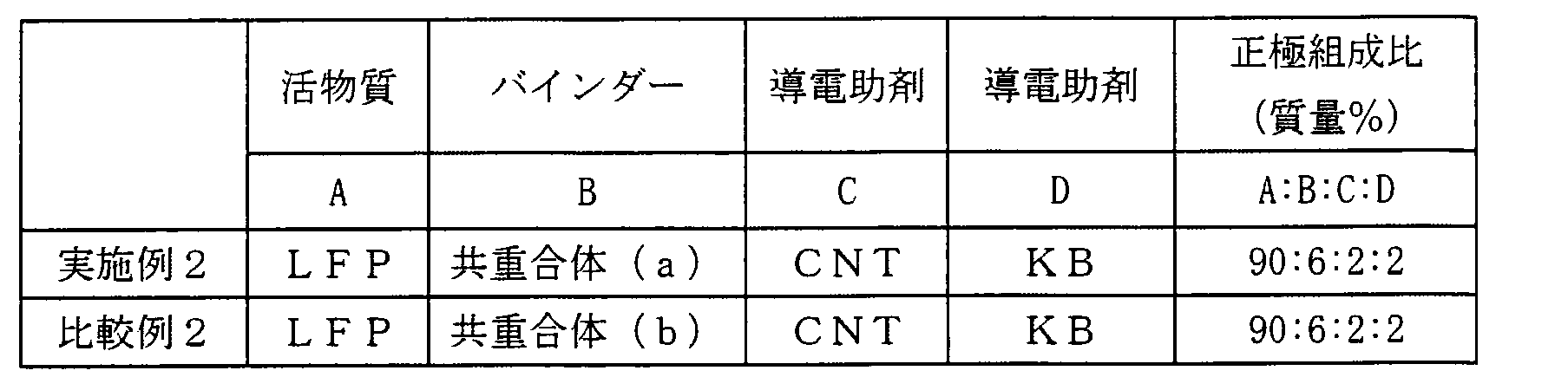
- Table 2 shows the composition of the test positive electrode. In this test positive electrode, the positive electrode capacity density was 0.7 mAh / cm 2 (average thickness of active material layer: 35 ⁇ m).
- Example 2 a positive electrode for comparison was prepared in the same manner as in Example 2 except that the copolymer was changed to the alkyl-modified carboxyl group-containing copolymer (b) instead of the alkyl-modified carboxyl group-containing copolymer (a). Prepared and evaluated. Table 2 shows the composition of the comparative positive electrode.
- LFP lithium iron phosphate
- CNT carbon nanotube
- KB ketjen black
- Example 3 Using the test positive electrode obtained in Example 2, metallic lithium as a counter electrode, a glass filter (GA-100 manufactured by Advantech) as a separator, and ethylene carbonate (EC) and diethyl carbonate (DEC) as an electrolyte solution in a volume ratio of 1: A coin cell (CR2032) having a solution in which LiPF 6 was dissolved at a concentration of 1 mol / L in the solvent mixed in 1 and 1% by mass of the additive for electrolyte solution vinylene carbonate (VC) was prepared, and the environment at 30 ° C. Below, aging treatment of 2 cycles was performed at 0.2C.
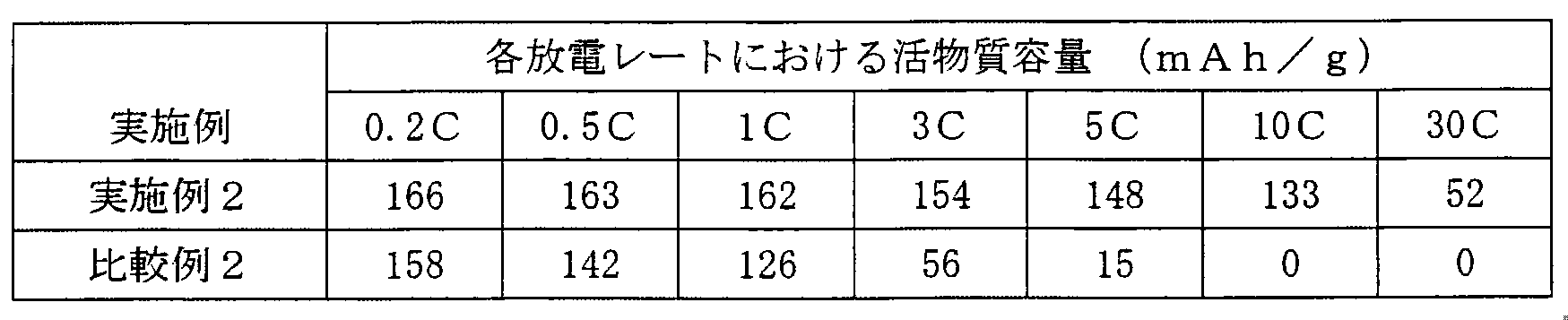
- Example 3 The coin cell of Example 3 was subjected to a high rate discharge test in a 30 ° C. environment. As conditions for the high rate discharge test, the battery was charged at 0.5 C and discharged at a rate of 0.5 C, 1 C, 3 C, 5 C, 10 C, and 30 C. The cut-off potential was set to 4.2 to 2.0 V (vs. Li + / Li). Table 3 shows the active material capacity at each discharge rate as a result of the high rate discharge test. Table 4 shows the average potential (V vs. Li + / Li) at each discharge rate as a result of the high rate discharge test. When the active material capacity is 0 mAh / g, the average potential at the time of discharge cannot be measured.
- Comparative Example 3 A battery assembly and a high rate discharge test were conducted in the same manner as in Example 3 except that the comparative positive electrode obtained in Comparative Example 2 was used. The results are shown in Tables 3 and 4.
Landscapes
- Chemical & Material Sciences (AREA)
- Chemical Kinetics & Catalysis (AREA)
- Engineering & Computer Science (AREA)
- Electrochemistry (AREA)
- General Chemical & Material Sciences (AREA)
- Materials Engineering (AREA)
- Manufacturing & Machinery (AREA)
- Inorganic Chemistry (AREA)
- Health & Medical Sciences (AREA)
- Medicinal Chemistry (AREA)
- Polymers & Plastics (AREA)
- Organic Chemistry (AREA)
- Crystallography & Structural Chemistry (AREA)
- Physics & Mathematics (AREA)
- Dispersion Chemistry (AREA)
- Spectroscopy & Molecular Physics (AREA)
- Battery Electrode And Active Subsutance (AREA)
- Addition Polymer Or Copolymer, Post-Treatments, Or Chemical Modifications (AREA)
Abstract
Description
項1. バインダー樹脂と、500ppm以下の油溶性ラジカル開始剤とを含む、リチウムイオン二次電池正極用バインダー。
項2. 前記油溶性ラジカル開始剤が、有機過酸化物、アゾ化合物及びレドックス開始剤からなる群より選ばれた少なくとも1種である、項1に記載のリチウムイオン二次電池正極用バインダー。
項3. 前記バインダー樹脂が、モノマーの懸濁重合体、乳化重合体、分散重合体、または沈殿重合体である、項1または2に記載のリチウムイオン二次電池正極用バインダー。
項4. 前記バインダー樹脂が、ポリ(メタ)アクリル酸、ポリオキシエチレン、ポリビニルアルコール、スチレン-ブタジエンゴムラテックス、ポリアクリロニトリル、ポリエチレン、ポリプロピレン、ポリブタジエン、ポリテトラフルオロエチレン、エチレン-酢酸ビニル共重合体、エチレン性不飽和カルボン酸アルカリ金属中和物とビニルアルコールを含む共重合体、及びアルキル変性カルボキシル基含有共重合体からなる群より選ばれた少なくとも1種を含有する、項1~3のいずれかに記載のリチウムイオン二次電池正極用バインダー。
項5. 前記アルキル変性カルボキシル基含有共重合体は、(メタ)アクリル酸100質量部に対して、アルキル基の炭素数が18~24である(メタ)アクリル酸アルキルエステルが0.1~10質量部の割合で共重合されてなる、項4に記載のリチウムイオン二次電池正極用バインダー。
項6. 活物質、導電助剤、および項1~5のいずれかに記載のリチウムイオン二次電池正極用バインダーを含む、リチウムイオン二次電池用正極。
項7. 前記活物質、前記導電助剤、及び前記バインダーの合計質量に対して、前記バインダーが、0.5~30質量%含まれている、項6に記載のリチウムイオン二次電池用正極。
項8. 項6または7に記載のリチウムイオン二次電池用正極を備える、リチウムイオン二次電池。
項9. 項8に記載のリチウムイオン二次電池を用いた電気機器。
項10. バインダー樹脂と、500ppm以下の油溶性ラジカル開始剤とを含む組成物の、リチウムイオン二次電池正極用バインダーへの使用。
項11. バインダー樹脂と、500ppm以下の油溶性ラジカル開始剤とを混合する工程を備える、リチウムイオン二次電池正極用バインダーの製造方法。
本発明のリチウムイオン二次電池正極用バインダーは、バインダー樹脂と、500ppm以下の油溶性ラジカル開始剤とを含むことを特徴とする。
上記のとおり、本発明のリチウムイオン二次電池正極用バインダーを正極に用いることにより、リチウムイオン二次電池用正極に対して優れた高率放電特性を付与できる。
正極活物質としては、特に制限されず、リチウムイオン二次電池で使用される公知の正極活物質が使用できる。正極活物質の具体例としては、リン酸鉄リチウム(LiFePO4)、リン酸マンガンリチウム(LiMnPO4)、リン酸コバルトリチウム(LiCoPO4)、ピロリン酸リチウム鉄(Li2FeP2O7)、コバルト酸リチウム複合酸化物(LiCoO2)、スピネル型マンガン酸リチウム複合酸化物(LiMn2O4)、マンガン酸リチウム複合酸化物(LiMnO2)、ニッケル酸リチウム複合酸化物(LiNiO2)、ニオブ酸リチウム複合酸化物(LiNbO2)、鉄酸リチウム複合酸化物(LiFeO2)、マグネシウム酸リチウム複合酸化物(LiMgO2)、カルシウム酸リチウム複合酸化物(LiCaO2)、銅酸リチウム複合酸化物(LiCuO2)、亜鉛酸リチウム複合酸化物(LiZnO2)、モリブデン酸リチウム複合酸化物(LiMoO2)、タンタル酸リチウム複合酸化物(LiTaO2)、タングステン酸リチウム複合酸化物(LiWO2)、リチウム-ニッケル-コバルト-アルミニウム複合酸化物(LiNi0.8Co0.15Al0.05O2)、リチウム-ニッケル-コバルト-マンガン複合酸化物(LiNi0.33Co0.33Mn0.33O2)、Li過剰系ニッケル-コバルト-マンガン複合酸化物、酸化マンガンニッケル(LiNi0.5Mn1.5O4)、酸化マンガン(MnO2)、バナジウム系酸化物、硫黄系酸化物、シリケート系酸化物などが挙げられる。正極活物質は、1種類単独で使用してもよいし、2種類以上を組み合わせて使用してもよい。
導電助剤は、導電性を有していれば、特に制限されないが、炭素粉末が好ましい。炭素粉末としては、通常用いられているもの、例えば、アセチレンブラック(AB)、ケッチェンブラック(KB)、黒鉛、カーボンファイバー、カーボンチューブ、グラフェン、非晶質炭素、ハードカーボン、ソフトカーボン、グラッシーカーボン、カーボンナノファイバー、カーボンナノチューブ等の炭素材料が挙げられる。導電助剤は、1種類単独で使用してもよいし、2種類以上を組み合わせて使用してもよい。
液状媒体としては、水や、非水系媒体が挙げられる。非水系媒体としては、例えば、n-オクタン、イソオクタン、ノナン、デカン、デカリン、ピネン、クロロドデカンなどの脂肪族炭化水素類;シクロペンタン、シクロヘキサン、シクロヘプタン、メチルシクロペンタンなどの環状脂肪族炭化水素類;スチレン、クロロベンゼン、クロロトルエン、エチルベンゼン、ジイソプロピルベンゼン、クメンなどの芳香族炭化水素類;メタノール、エタノール、プロパノール、イソプロパノール、ブタノール、ベンジルアルコール、グリセリンなどのアルコール類;アセトン、メチルエチルケトン、シクロペンタノン、イソホロンなどのケトン類;メチルエチルエーテル、ジエチルエーテル、テトラヒドロフラン、ジオキサンなどのエーテル類; γ-ブチロラクトン、δ-ブチロラクトンなどのラクトン類;β-ラクタムなどのラクタム類;ジメチルホルムアミド、N-メチルピロリドン、ジメチルアセトアミドなどの鎖状・環状のアミド類;メチレンシアノヒドリン、エチレンシアノヒドリン、3,3'-チオジプロピオニトリル、アセトニトリルなどのニトリル基含有化合物類;ピリジン、ピロールなどの含窒素複素環系化合物;エチレングリコール、プロピレングリコールなどのグリコール類;ジエチレングリコール、ジエチレングリコールモノエチルエーテル、ジエチレングリコールエチルブチルエーテルなどのジエチレングリコール類;ギ酸エチル、乳酸エチル、乳酸プロピル、安息香酸メチル、酢酸メチル、アクリル酸メチルなどのエステル類などが例示される。また、非水系媒体としては、ラッカー、ガソリン、ナフサ、ケロシンなどの混合物を用いることができる。上記液状媒体の中でも溶解性及び経済性の観点から水が好ましく、水酸化ナトリウム等のアルカリ成分を用いて溶液のpHを6~8に調整して用いるのが好ましい。
正極集電体の材料は、電子伝導性を有し、保持した正極材料に通電し得るものであれば、特に制限されない。正極集電体の材料としては、例えば、C、Ti、Cr、Mo、Ru、Rh、Ta、W、Os、Ir、Pt、Au、Al等の導電性物質、これら導電性物質の二種類以上を含有する合金(例えば、ステンレス鋼)などが挙げられる。電気伝導性が高く、電解液中の安定性と耐酸化性がよい観点から、正極集電体の材料としてはC、Al、ステンレス鋼等が好ましく、さらに材料コストの観点からAl等が好ましい。
本発明のリチウムイオン二次電池用正極を用い、本発明のリチウムイオン二次電池とすることができる。
本発明の正極を具備したリチウムイオン二次電池は、安全性が良好であることから、様々な電気機器(電気を使用する乗り物を含む)の電源として利用することができる。
(実施例1)
撹拌機、温度計、窒素吹き込み管及び冷却管を備えた500mL容の四つ口フラスコに、アクリル酸45g(0.625モル)、アルキル基の炭素数が18~24である(メタ)アクリル酸アルキルエステルとしてのブレンマーVMA70(日本油脂株式会社製、メタクリル酸ステアリル10~20質量部、メタクリル酸エイコサニル10~20質量部、メタクリル酸ベヘニル59~80質量部、メタクリル酸テトラコサニルの含有量が1質量部以下の混合物)0.45g、ノルマルヘキサン150g、及び2,2'-アゾビスメチルイソブチレート0.081g(0.00035モル)を仕込んだ。次いで、均一に撹拌、混合した後、反応容器の上部空間、原料及び溶媒中に存在している酸素を除去するために、溶液中に窒素ガスを吹き込んだ。次いで、窒素雰囲気下、60~65℃に保持して4時間反応させた。反応終了後、冷却し、遠心ろ過により脱液した。脱液したポリマーにノルマルヘキサン100gを加え、攪拌し、遠心ろ過で脱液することにより洗浄を行った。得られたポリマーを90℃に加熱して、残存ノルマルヘキサンを留去し、さらに、110℃、10mmHgにて8時間減圧乾燥することにより、白色微粉末状のアルキル変性カルボキシル基含有共重合体(a)を43g得た。得られたアルキル変性カルボキシル基含有共重合体(a)について以下の方法により残存する開始剤量を評価した。結果を表1に示す。
撹拌機、温度計、窒素吹き込み管及び冷却管を備えた500mL容の四つ口フラスコに、アクリル酸45g(0.625モル)、アルキル基の炭素数が18~24である(メタ)アクリル酸アルキルエステルとしてのブレンマーVMA70(日本油脂株式会社製、メタクリル酸ステアリル10~20質量部、メタクリル酸エイコサニル10~20質量部、メタクリル酸ベヘニル59~80質量部、メタクリル酸テトラコサニルの含有量が1質量部以下の混合物)0.45g、ノルマルヘキサン150g、及び開始剤としての2,2'-アゾビスメチルイソブチレート0.081g(0.00035モル)を仕込んだ。次いで、均一に撹拌、混合した後、反応容器の上部空間、原料及び溶媒中に存在している酸素を除去するために、溶液中に窒素ガスを吹き込んだ。次いで、窒素雰囲気下、60~65℃に保持して4時間反応させた。反応終了後、生成したスラリーを70℃に加熱して、ノルマルヘキサンを留去し、白色微粉末状のアルキル変性カルボキシル基含有共重合体(b)を42g得た。得られたアルキル変性カルボキシル基含有共重合体(b)について実施例1と同様の操作を行い、残存する開始剤量を評価した。結果を表1に示す。

(実施例2)
実施例1で得られたアルキル変性カルボキシル基含有共重合体(a)1gを水に溶解し、6質量%水酸化ナトリウム水溶液を用いpHを6~8に調整して10質量%のバインダー水溶液を作製した。得られたバインダー水溶液60質量部、正極活物質としてリン酸鉄リチウム90質量部、導電助剤としてカーボンナノチューブ2質量部、ケッチェンブラック2質量部に対して水を加えて撹拌し、固形分濃度が40質量%のスラリー状の正極合剤を調製した。厚さ20μmのアルミニウム箔上に前記合剤を塗布・乾燥後、ロールプレス機(大野ロール株式会社製)により、アルミニウム箔と塗膜とを密着接合させ、次に、加熱処理(減圧中、180℃、3時間以上)して、試験正極を作製した。表2に試験正極の組成を示した。本試験正極においての、正極容量密度は0.7mAh/cm2(活物質物質層の平均厚み:35μm)とした。
実施例2において、アルキル変性カルボキシル基含有共重合体(a)に代えて、アルキル変性カルボキシル基含有共重合体(b)に変更した以外は実施例2と同様の操作にて比較用の正極を作製し、評価した。表2に比較用正極の組成を示した。
(実施例3)
実施例2で得られた試験正極と、対極に金属リチウムを用い、セパレータとしてガラスフィルター(アドバンテック製 GA-100)、電解液としてエチレンカーボネート(EC)とジエチルカーボネート(DEC)とを体積比1:1で混合した溶媒にLiPF6を1mol/Lの濃度で溶解し、電解液用添加剤ビニレンカーボネート(VC)を1質量%添加した溶液を具備したコインセル(CR2032)を作製し、30℃の環境下で0.2Cで2サイクルのエージング処理を行った。
実施例3のコインセルについて、30℃環境下で高率放電試験を行った。高率放電試験の条件としては、0.5Cで充電し、0.5C、1C、3C、5C、10C、30Cの各レートで放電を行った。なお、カットオフ電位は、4.2-2.0V(vs.Li+/Li)に設定した。表3に高率放電試験結果の各放電レートにおける活物質容量を示す。表4に高率放電試験結果の各放電レートにおける平均電位(V vs.Li+/Li)を示す。活物質容量が0mAh/gの際は放電時の平均電位が測定出来ないため、-で示す。
比較例2で得られた比較用正極を用いた以外は、実施例3と同様にして電池組み立て、高率放電試験を実施した。結果を表3及び4に示す。

Claims (11)
- バインダー樹脂と、500ppm以下の油溶性ラジカル開始剤とを含む、リチウムイオン二次電池正極用バインダー。
- 前記油溶性ラジカル開始剤が、有機過酸化物、アゾ化合物及びレドックス開始剤からなる群より選ばれた少なくとも1種である、請求項1に記載のリチウムイオン二次電池正極用バインダー。
- 前記バインダー樹脂が、モノマーの懸濁重合体、乳化重合体、分散重合体、または沈殿重合体である、請求項1または2に記載のリチウムイオン二次電池正極用バインダー。
- 前記バインダー樹脂が、ポリ(メタ)アクリル酸、ポリオキシエチレン、ポリビニルアルコール、スチレン-ブタジエンゴムラテックス、ポリアクリロニトリル、ポリエチレン、ポリプロピレン、ポリブタジエン、ポリテトラフルオロエチレン、エチレン-酢酸ビニル共重合体、エチレン性不飽和カルボン酸アルカリ金属中和物とビニルアルコールを含む共重合体、及びアルキル変性カルボキシル基含有共重合体からなる群より選ばれた少なくとも1種を含有する、請求項1~3のいずれかに記載のリチウムイオン二次電池正極用バインダー。
- 前記アルキル変性カルボキシル基含有共重合体は、(メタ)アクリル酸100質量部に対して、アルキル基の炭素数が18~24である(メタ)アクリル酸アルキルエステルが0.1~10質量部の割合で共重合されてなる、請求項4に記載のリチウムイオン二次電池正極用バインダー。
- 活物質、導電助剤、および請求項1~5のいずれかに記載のリチウムイオン二次電池正極用バインダーを含む、リチウムイオン二次電池用正極。
- 前記活物質、前記導電助剤、及び前記バインダーの合計質量に対して、前記バインダーが、0.5~30質量%含まれている、請求項6に記載のリチウムイオン二次電池用正極。
- 請求項6または7に記載のリチウムイオン二次電池用正極を備える、リチウムイオン二次電池。
- 請求項8に記載のリチウムイオン二次電池を用いた電気機器。
- バインダー樹脂と、500ppm以下の油溶性ラジカル開始剤とを含む組成物の、リチウムイオン二次電池正極用バインダーへの使用。
- バインダー樹脂と、500ppm以下の油溶性ラジカル開始剤とを混合する工程を備える、リチウムイオン二次電池正極用バインダーの製造方法。
Priority Applications (6)
| Application Number | Priority Date | Filing Date | Title |
|---|---|---|---|
| CN201680026985.2A CN107615533A (zh) | 2015-07-09 | 2016-06-22 | 锂离子二次电池正极用粘合剂 |
| PL16821230.6T PL3322009T3 (pl) | 2015-07-09 | 2016-06-22 | Spoiwo do elektrod dodatnich baterii wtórnych litowo-jonowych |
| KR1020177033414A KR102541092B1 (ko) | 2015-07-09 | 2016-06-22 | 리튬이온 이차전지 양극용 바인더 |
| EP16821230.6A EP3322009B1 (en) | 2015-07-09 | 2016-06-22 | Binder for lithium ion secondary battery positive electrodes |
| JP2017527164A JP6999416B2 (ja) | 2015-07-09 | 2016-06-22 | リチウムイオン二次電池正極用バインダー |
| US15/742,681 US10541416B2 (en) | 2015-07-09 | 2016-06-22 | Binder for lithium ion secondary battery positive electrodes |
Applications Claiming Priority (2)
| Application Number | Priority Date | Filing Date | Title |
|---|---|---|---|
| JP2015137926 | 2015-07-09 | ||
| JP2015-137926 | 2015-07-09 |
Publications (1)
| Publication Number | Publication Date |
|---|---|
| WO2017006760A1 true WO2017006760A1 (ja) | 2017-01-12 |
Family
ID=57685635
Family Applications (1)
| Application Number | Title | Priority Date | Filing Date |
|---|---|---|---|
| PCT/JP2016/068449 Ceased WO2017006760A1 (ja) | 2015-07-09 | 2016-06-22 | リチウムイオン二次電池正極用バインダー |
Country Status (9)
| Country | Link |
|---|---|
| US (1) | US10541416B2 (ja) |
| EP (1) | EP3322009B1 (ja) |
| JP (1) | JP6999416B2 (ja) |
| KR (1) | KR102541092B1 (ja) |
| CN (1) | CN107615533A (ja) |
| HU (1) | HUE059555T2 (ja) |
| PL (1) | PL3322009T3 (ja) |
| TW (1) | TWI692905B (ja) |
| WO (1) | WO2017006760A1 (ja) |
Cited By (1)
| Publication number | Priority date | Publication date | Assignee | Title |
|---|---|---|---|---|
| WO2018168520A1 (ja) * | 2017-03-16 | 2018-09-20 | 株式会社クラレ | 非水電解質電池用バインダー組成物、並びにそれを用いた非水電解質電池用バインダー水溶液、非水電解質電池用スラリー組成物、非水電解質電池用電極、及び非水電解質電池 |
Families Citing this family (5)
| Publication number | Priority date | Publication date | Assignee | Title |
|---|---|---|---|---|
| WO2016021405A1 (ja) * | 2014-08-08 | 2016-02-11 | 住友電気工業株式会社 | ナトリウムイオン二次電池用正極およびナトリウムイオン二次電池 |
| DE102018127410A1 (de) * | 2018-11-02 | 2020-05-07 | Technische Universität Darmstadt | Kathode und ein Verfahren zur Herstellung einer Kathode |
| JPWO2022196040A1 (ja) * | 2021-03-18 | 2022-09-22 | ||
| JP2024113718A (ja) * | 2023-02-10 | 2024-08-23 | ヤンマーホールディングス株式会社 | 作業機械の制御方法、作業機械用制御プログラム、作業機械用制御システム及び作業機械 |
| US12561016B2 (en) * | 2023-05-03 | 2026-02-24 | Lindsey C. Grochowski | Accessory for a computer mouse |
Citations (2)
| Publication number | Priority date | Publication date | Assignee | Title |
|---|---|---|---|---|
| JP2012014920A (ja) * | 2010-06-30 | 2012-01-19 | Nippon Zeon Co Ltd | 二次電池用バインダー、製造方法、二次電池負極用組成物、及び二次電池 |
| WO2013111291A1 (ja) * | 2012-01-25 | 2013-08-01 | トヨタ自動車株式会社 | 非水電解質二次電池およびその製造方法 |
Family Cites Families (11)
| Publication number | Priority date | Publication date | Assignee | Title |
|---|---|---|---|---|
| CN100414765C (zh) * | 2000-09-05 | 2008-08-27 | 三星Sdi株式会社 | 锂电池 |
| JP2008204829A (ja) | 2007-02-21 | 2008-09-04 | Mitsui Chemicals Inc | 電気化学セル電極用バインダー |
| US20080206641A1 (en) | 2007-02-27 | 2008-08-28 | 3M Innovative Properties Company | Electrode compositions and electrodes made therefrom |
| JP2010527133A (ja) * | 2007-05-15 | 2010-08-05 | エルジー・ケム・リミテッド | 二次電池およびその製造方法 |
| US8377595B2 (en) * | 2007-07-19 | 2013-02-19 | Sumitomo Seika Chemicals Co., Ltd. | Gelling agent for batteries |
| US8217127B2 (en) * | 2007-12-28 | 2012-07-10 | Sumitomo Seika Chemicals Co., Ltd. | (Meth)acrylic acid/alkyl (meth)acrylate ester copolymer and cosmetic preparation containing the same |
| JP5259373B2 (ja) | 2008-12-19 | 2013-08-07 | 日本エイアンドエル株式会社 | 非水電解液二次電池電極用バインダー |
| WO2013176093A1 (ja) * | 2012-05-21 | 2013-11-28 | ダイキン工業株式会社 | 電極合剤 |
| JP6206484B2 (ja) | 2013-03-29 | 2017-10-04 | 日本ゼオン株式会社 | 二次電池電極用バインダー組成物及びその製造方法、二次電池電極用スラリー組成物、二次電池用電極、並びに、二次電池 |
| US10044041B2 (en) * | 2013-05-23 | 2018-08-07 | Lg Chem, Ltd. | Binder for secondary batteries and secondary battery including the same |
| JP2017062868A (ja) * | 2014-01-20 | 2017-03-30 | 住友精化株式会社 | 非水電解質二次電池の電極用バインダー、当該バインダーを含む非水電解質二次電池用電極、及び当該電極を備える非水電解質二次電池 |
-
2016
- 2016-06-22 JP JP2017527164A patent/JP6999416B2/ja active Active
- 2016-06-22 EP EP16821230.6A patent/EP3322009B1/en active Active
- 2016-06-22 US US15/742,681 patent/US10541416B2/en active Active
- 2016-06-22 CN CN201680026985.2A patent/CN107615533A/zh active Pending
- 2016-06-22 WO PCT/JP2016/068449 patent/WO2017006760A1/ja not_active Ceased
- 2016-06-22 HU HUE16821230A patent/HUE059555T2/hu unknown
- 2016-06-22 KR KR1020177033414A patent/KR102541092B1/ko active Active
- 2016-06-22 PL PL16821230.6T patent/PL3322009T3/pl unknown
- 2016-06-27 TW TW105120178A patent/TWI692905B/zh not_active IP Right Cessation
Patent Citations (2)
| Publication number | Priority date | Publication date | Assignee | Title |
|---|---|---|---|---|
| JP2012014920A (ja) * | 2010-06-30 | 2012-01-19 | Nippon Zeon Co Ltd | 二次電池用バインダー、製造方法、二次電池負極用組成物、及び二次電池 |
| WO2013111291A1 (ja) * | 2012-01-25 | 2013-08-01 | トヨタ自動車株式会社 | 非水電解質二次電池およびその製造方法 |
Non-Patent Citations (1)
| Title |
|---|
| See also references of EP3322009A4 * |
Cited By (3)
| Publication number | Priority date | Publication date | Assignee | Title |
|---|---|---|---|---|
| WO2018168520A1 (ja) * | 2017-03-16 | 2018-09-20 | 株式会社クラレ | 非水電解質電池用バインダー組成物、並びにそれを用いた非水電解質電池用バインダー水溶液、非水電解質電池用スラリー組成物、非水電解質電池用電極、及び非水電解質電池 |
| JPWO2018168520A1 (ja) * | 2017-03-16 | 2020-01-16 | 株式会社クラレ | 非水電解質電池用バインダー組成物、並びにそれを用いた非水電解質電池用バインダー水溶液、非水電解質電池用スラリー組成物、非水電解質電池用電極、及び非水電解質電池 |
| JP7110170B2 (ja) | 2017-03-16 | 2022-08-01 | 株式会社クラレ | 非水電解質電池用バインダー組成物、並びにそれを用いた非水電解質電池用バインダー水溶液、非水電解質電池用スラリー組成物、非水電解質電池用電極、及び非水電解質電池 |
Also Published As
| Publication number | Publication date |
|---|---|
| EP3322009B1 (en) | 2022-06-15 |
| KR20180029197A (ko) | 2018-03-20 |
| HUE059555T2 (hu) | 2022-11-28 |
| US10541416B2 (en) | 2020-01-21 |
| JP6999416B2 (ja) | 2022-02-04 |
| TW201709596A (zh) | 2017-03-01 |
| KR102541092B1 (ko) | 2023-06-07 |
| CN107615533A (zh) | 2018-01-19 |
| US20180205086A1 (en) | 2018-07-19 |
| EP3322009A1 (en) | 2018-05-16 |
| JPWO2017006760A1 (ja) | 2018-05-24 |
| TWI692905B (zh) | 2020-05-01 |
| EP3322009A4 (en) | 2018-12-12 |
| PL3322009T3 (pl) | 2022-10-24 |
Similar Documents
| Publication | Publication Date | Title |
|---|---|---|
| JP5686332B2 (ja) | リチウムイオン二次電池正極用バインダー、このバインダーを含むリチウムイオン二次電池用正極、この正極を用いたリチウムイオン二次電池及び電気機器 | |
| CN111052467B (zh) | 锂离子电池或电容器用电极材料、电极、电池、电容器、电子设备、该电极材料的制造方法 | |
| JP7139342B2 (ja) | 非水電解質二次電池用電極合剤 | |
| WO2015108109A1 (ja) | 非水電解質二次電池の電極用バインダー、当該バインダーを含む非水電解質二次電池用電極、及び当該電極を備える非水電解質二次電池 | |
| WO2014207967A1 (ja) | 非水電解質二次電池用負極合剤、この合剤を含む非水電解質二次電池用負極及びこの負極を備えた非水電解質二次電池並びに電気機器 | |
| JP6999416B2 (ja) | リチウムイオン二次電池正極用バインダー | |
| WO2017168947A1 (ja) | 非水電解質二次電池電極用バインダー、非水電解質二次電池用電極合剤、非水電解質二次電池用電極、非水電解質二次電池、および電気機器 | |
| JP7223699B2 (ja) | 非水電解質二次電池電極用バインダー、非水電解質二次電池用電極合剤、非水電解質二次電池用電極、非水電解質二次電池、及び電気機器 | |
| JP5999683B2 (ja) | 高温特性に優れたリチウムイオン二次電池用正極、この正極を具備するリチウムイオン二次電池及びこの二次電池を用いた電気機器 | |
| JP7223700B2 (ja) | 非水電解質二次電池電極用バインダー、非水電解質二次電池用電極合剤、非水電解質二次電池用電極、非水電解質二次電池、及び電気機器 |
Legal Events
| Date | Code | Title | Description |
|---|---|---|---|
| 121 | Ep: the epo has been informed by wipo that ep was designated in this application |
Ref document number: 16821230 Country of ref document: EP Kind code of ref document: A1 |
|
| ENP | Entry into the national phase |
Ref document number: 20177033414 Country of ref document: KR Kind code of ref document: A |
|
| ENP | Entry into the national phase |
Ref document number: 2017527164 Country of ref document: JP Kind code of ref document: A |
|
| WWE | Wipo information: entry into national phase |
Ref document number: 15742681 Country of ref document: US |
|
| NENP | Non-entry into the national phase |
Ref country code: DE |
|
| WWE | Wipo information: entry into national phase |
Ref document number: 2016821230 Country of ref document: EP |