WO2017006850A1 - 生体物質の付着抑制能を有するイオンコンプレックス材料及びその製造方法 - Google Patents
生体物質の付着抑制能を有するイオンコンプレックス材料及びその製造方法 Download PDFInfo
- Publication number
- WO2017006850A1 WO2017006850A1 PCT/JP2016/069602 JP2016069602W WO2017006850A1 WO 2017006850 A1 WO2017006850 A1 WO 2017006850A1 JP 2016069602 W JP2016069602 W JP 2016069602W WO 2017006850 A1 WO2017006850 A1 WO 2017006850A1
- Authority
- WO
- WIPO (PCT)
- Prior art keywords
- carbon atoms
- group
- linear
- branched alkyl
- alkyl group
- Prior art date
- Legal status (The legal status is an assumption and is not a legal conclusion. Google has not performed a legal analysis and makes no representation as to the accuracy of the status listed.)
- Ceased
Links
- 0 CCCC(C)CCC(C*1)CC1C(C*C)CC(C)C Chemical compound CCCC(C)CCC(C*1)CC1C(C*C)CC(C)C 0.000 description 8
Images
Classifications
-
- C—CHEMISTRY; METALLURGY
- C09—DYES; PAINTS; POLISHES; NATURAL RESINS; ADHESIVES; COMPOSITIONS NOT OTHERWISE PROVIDED FOR; APPLICATIONS OF MATERIALS NOT OTHERWISE PROVIDED FOR
- C09D—COATING COMPOSITIONS, e.g. PAINTS, VARNISHES OR LACQUERS; FILLING PASTES; CHEMICAL PAINT OR INK REMOVERS; INKS; CORRECTING FLUIDS; WOODSTAINS; PASTES OR SOLIDS FOR COLOURING OR PRINTING; USE OF MATERIALS THEREFOR
- C09D143/00—Coating compositions based on homopolymers or copolymers of compounds having one or more unsaturated aliphatic radicals, each having only one carbon-to-carbon double bond, and containing boron, silicon, phosphorus, selenium, tellurium, or a metal; Coating compositions based on derivatives of such polymers
- C09D143/02—Homopolymers or copolymers of monomers containing phosphorus
-
- C—CHEMISTRY; METALLURGY
- C08—ORGANIC MACROMOLECULAR COMPOUNDS; THEIR PREPARATION OR CHEMICAL WORKING-UP; COMPOSITIONS BASED THEREON
- C08F—MACROMOLECULAR COMPOUNDS OBTAINED BY REACTIONS ONLY INVOLVING CARBON-TO-CARBON UNSATURATED BONDS
- C08F230/00—Copolymers of compounds having one or more unsaturated aliphatic radicals, each having only one carbon-to-carbon double bond, and containing phosphorus, selenium, tellurium or a metal
- C08F230/02—Copolymers of compounds having one or more unsaturated aliphatic radicals, each having only one carbon-to-carbon double bond, and containing phosphorus, selenium, tellurium or a metal containing phosphorus
-
- C—CHEMISTRY; METALLURGY
- C09—DYES; PAINTS; POLISHES; NATURAL RESINS; ADHESIVES; COMPOSITIONS NOT OTHERWISE PROVIDED FOR; APPLICATIONS OF MATERIALS NOT OTHERWISE PROVIDED FOR
- C09D—COATING COMPOSITIONS, e.g. PAINTS, VARNISHES OR LACQUERS; FILLING PASTES; CHEMICAL PAINT OR INK REMOVERS; INKS; CORRECTING FLUIDS; WOODSTAINS; PASTES OR SOLIDS FOR COLOURING OR PRINTING; USE OF MATERIALS THEREFOR
- C09D133/00—Coating compositions based on homopolymers or copolymers of compounds having one or more unsaturated aliphatic radicals, each having only one carbon-to-carbon double bond, and at least one being terminated by only one carboxyl radical, or of salts, anhydrides, esters, amides, imides, or nitriles thereof; Coating compositions based on derivatives of such polymers
- C09D133/04—Homopolymers or copolymers of esters
- C09D133/14—Homopolymers or copolymers of esters of esters containing halogen, nitrogen, sulfur or oxygen atoms in addition to the carboxy oxygen
- C09D133/16—Homopolymers or copolymers of esters containing halogen atoms
-
- C—CHEMISTRY; METALLURGY
- C09—DYES; PAINTS; POLISHES; NATURAL RESINS; ADHESIVES; COMPOSITIONS NOT OTHERWISE PROVIDED FOR; APPLICATIONS OF MATERIALS NOT OTHERWISE PROVIDED FOR
- C09D—COATING COMPOSITIONS, e.g. PAINTS, VARNISHES OR LACQUERS; FILLING PASTES; CHEMICAL PAINT OR INK REMOVERS; INKS; CORRECTING FLUIDS; WOODSTAINS; PASTES OR SOLIDS FOR COLOURING OR PRINTING; USE OF MATERIALS THEREFOR
- C09D201/00—Coating compositions based on unspecified macromolecular compounds
- C09D201/02—Coating compositions based on unspecified macromolecular compounds characterised by the presence of specified groups, e.g. terminal or pendant functional groups
-
- C—CHEMISTRY; METALLURGY
- C09—DYES; PAINTS; POLISHES; NATURAL RESINS; ADHESIVES; COMPOSITIONS NOT OTHERWISE PROVIDED FOR; APPLICATIONS OF MATERIALS NOT OTHERWISE PROVIDED FOR
- C09D—COATING COMPOSITIONS, e.g. PAINTS, VARNISHES OR LACQUERS; FILLING PASTES; CHEMICAL PAINT OR INK REMOVERS; INKS; CORRECTING FLUIDS; WOODSTAINS; PASTES OR SOLIDS FOR COLOURING OR PRINTING; USE OF MATERIALS THEREFOR
- C09D5/00—Coating compositions, e.g. paints, varnishes or lacquers, characterised by their physical nature or the effects produced; Filling pastes
- C09D5/16—Antifouling paints; Underwater paints
- C09D5/1656—Antifouling paints; Underwater paints characterised by the film-forming substance
- C09D5/1662—Synthetic film-forming substance
- C09D5/1668—Vinyl-type polymers
Definitions
- the present invention relates to an ion complex material having an ability to suppress adhesion of biological substances and a method for producing the same. Specifically, the present invention relates to a coating film having an ability to suppress adhesion of biological materials, a method for producing the coating film, a copolymer obtained by polymerizing a specific monomer mixture, and a coating film having a specific composition It relates to a composition.
- Coating materials having the ability to suppress the adhesion of various biological substances have been proposed in order to suppress the adhesion of biological substances to medical instruments, such as artificial dialysers, artificial organs, and medical instruments.
- Non-Patent Document 1 copolymerizes 2-methacryloyloxyethyl phosphorylcholine (MPC) having a similar molecular structure with phospholipid as a charge neutralizing unit and 3- (trimethoxysilyl) propyl methacrylate having a silane coupling group.
- MPC 2-methacryloyloxyethyl phosphorylcholine
- Patent Document 1 describes a coating film obtained by heat-treating a film formed from a polymer-containing coating solution having a phosphate ester group at 200 to 450 ° C.
- a heating device such as an oven or a hot plate is necessary for the heat treatment.
- Patent Document 2 a novel acrylic phosphate amine salt obtained by reacting an amine with an acidic acidic phosphate ester monomer in the presence of water and selectively proceeding an acid-base reaction.
- a monomer (half salt) and a method for producing the same are described.
- This amine salt (half salt) monomer is described as having a wide range of uses and usefulness in the field of photosensitive resins as a rubber elasticity imparting and oil-soluble substance modifier.
- the polymerization reactivity of the monomer itself in water and the ability of the obtained polymer to suppress adhesion to a biological substance are unknown.
- Patent Document 3 discloses a one-pack type adhesive for adhesion to a tooth containing 2-methacryloyloxyethylphenyl hydrogen phosphate and 1,6-bis (methacryloxy-2-ethoxycarbonylamino) -2,2,4-trimethylhexane.
- a photopolymerization type adhesive is disclosed, but the ability of the obtained polymer to adhere to a biological substance is unclear.
- the commercially available product of acid phosphooxyethyl methacrylate (PMA) used as a raw material for the polymer contained in the coating film of Patent Document 1 has many impurities (the target substance contains only half or less). ), The exact number of moles of counter ions cannot be determined; since PMA contains dimethacrylate as an impurity, it tends to be three-dimensional (gelled) using PMA; and PMA has a room temperature at pH ⁇ 4.
- PMA acid phosphooxyethyl methacrylate
- the present invention aims to further improve the ability to suppress adhesion of biological substances in a coating film and to improve the handling of the composition for forming a coating film in the production thereof.
- the present invention provides a coating film having a biomaterial adhesion-inhibiting ability, a method for producing the coating film, a copolymer obtained by polymerizing a specific monomer mixture, and a coating film forming composition having a specific composition.
- T a and T b each independently represent a hydrogen atom or a linear or branched alkyl group having 1 to 5 carbon atoms
- Q a and Q b each independently represent a single bond, an ester bond or an amide bond
- R a and R b each independently represents a linear or branched alkylene group having 1 to 10 carbon atoms which may be substituted with a halogen atom
- U a1 represents an aryl group having 6 to 10 carbon atoms or a linear or branched alkyl group having 1 to 5 carbon atoms
- U a2 represents a hydrogen atom
- U a3 represents an alkali metal
- U b1 , U b2 and U b3 each independently represent a hydrogen atom or a linear or branched alkyl group having 1 to 5 carbon atoms
- An ⁇ represents an anion selected from the group consisting of halide ion, in
- the monomer mixture further comprises the following formula (C): [Where: Each T c independently represents a hydrogen atom or a linear or branched alkyl group having 1 to 5 carbon atoms; Q c represents a single bond, an ether bond or an ester bond; R c is a linear or branched alkyl group having 1 to 18 carbon atoms, a cyclic hydrocarbon group having 3 to 10 carbon atoms, an aryl group having 6 to 10 carbon atoms, or an aralkyl group having 7 to 15 carbon atoms.
- U a1 represents an aryl group having 6 to 10 carbon atoms or a linear or branched alkyl group having 1 to 5 carbon atoms
- U a2 represents a hydrogen atom
- U a3 represents an alkali metal
- U b1 , U b2 and U b3 each independently represent a hydrogen atom or a linear or branched alkyl group having 1 to 5 carbon atoms
- An ⁇ represents an anion selected from the group consisting of halide ions, inorganic acid ions, hydroxide ions and isothiocyanate ions
- a composition for forming a coating film comprising a solvent comprising a solvent.
- the copolymer is further represented by the following formula (c): [Where: R c is a linear or branched alkyl group having 1 to 18 carbon atoms, a cyclic hydrocarbon group having 3 to 10 carbon atoms, an aryl group having 6 to 10 carbon atoms, or an aralkyl group having 7 to 15 carbon atoms. Or an aryloxyalkyl group having 7 to 15 carbon atoms (wherein the aryl moiety may be substituted with a linear or branched alkyl group having 1 to 5 carbon atoms which may be substituted with a halogen atom). ) The composition of said 3 containing the repeating unit containing the organic group represented by these.
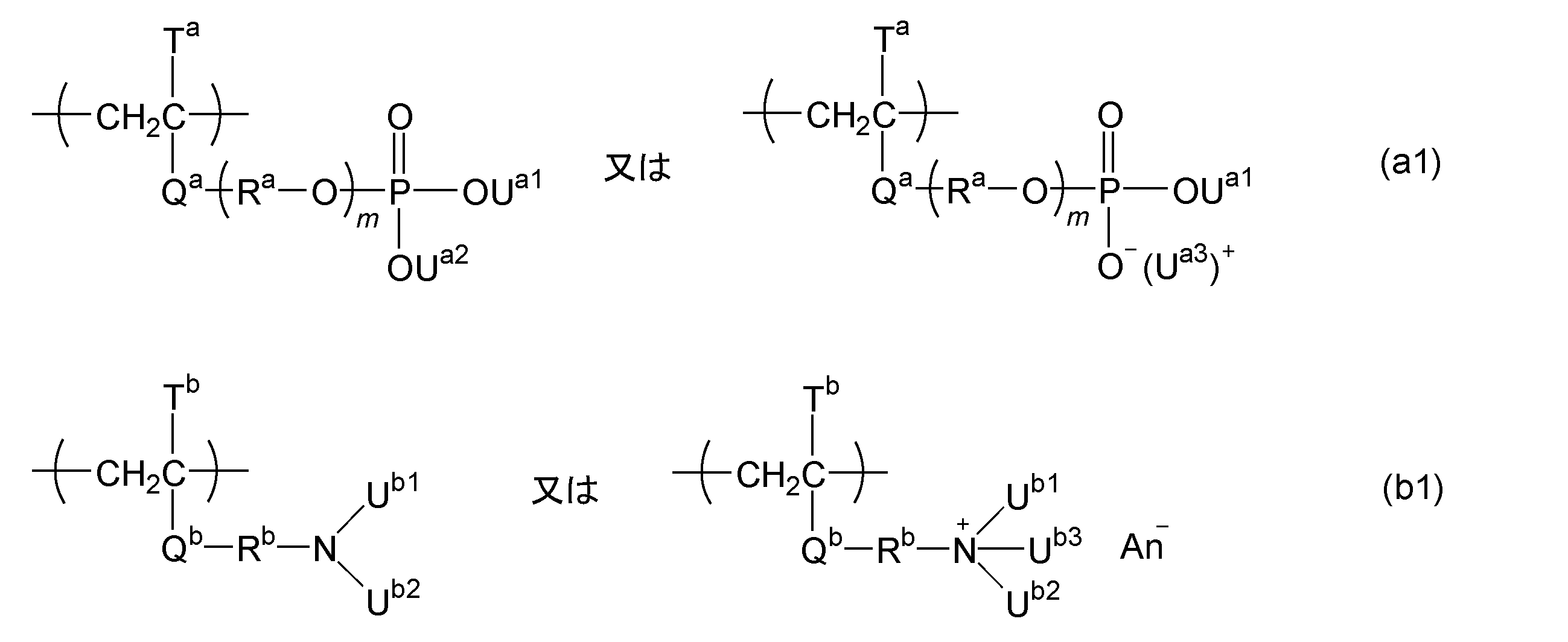
- the copolymer has the following formulas (a1) and (b1): [Where: T a and T b each independently represent a hydrogen atom or a linear or branched alkyl group having 1 to 5 carbon atoms; Q a and Q b each independently represent a single bond, an ester bond or an amide bond; R a and R b each independently represents a linear or branched alkylene group having 1 to 10 carbon atoms which may be substituted with a halogen atom; U a1 represents an aryl group having 6 to 10 carbon atoms or a linear or branched alkyl group having 1 to 5 carbon atoms, U a2 represents a hydrogen atom or U a3 represents an alkali metal; U b1 , U b2 and U b3 each independently represent a hydrogen atom or a linear or branched alkyl group having 1 to 5 carbon atoms; An ⁇ represents an anion selected from the group consisting of halide ion, inorganic
- the copolymer is further represented by the following formula (c1): [Where: Each T c independently represents a hydrogen atom or a linear or branched alkyl group having 1 to 5 carbon atoms; Q c represents a single bond, an ether bond or an ester bond; R c is a linear or branched alkyl group having 1 to 18 carbon atoms, a cyclic hydrocarbon group having 3 to 10 carbon atoms, an aryl group having 6 to 10 carbon atoms, or an aralkyl group having 7 to 15 carbon atoms.
- the copolymer is further represented by the following formula (c): [Where: R c is a linear or branched alkyl group having 1 to 18 carbon atoms, a cyclic hydrocarbon group having 3 to 10 carbon atoms, an aryl group having 6 to 10 carbon atoms, or an aralkyl group having 7 to 15 carbon atoms. Or an aryloxyalkyl group having 7 to 15 carbon atoms (wherein the aryl moiety may be substituted with a linear or branched alkyl group having 1 to 5 carbon atoms which may be substituted with a halogen atom). ) 8.
- the copolymer has the following formulas (a1) and (b1): [Where: T a and T b each independently represent a hydrogen atom or a linear or branched alkyl group having 1 to 5 carbon atoms; Q a and Q b each independently represent a single bond, an ester bond or an amide bond; R a and R b each independently represents a linear or branched alkylene group having 1 to 10 carbon atoms which may be substituted with a halogen atom; U a1 represents an aryl group having 6 to 10 carbon atoms or a linear or branched alkyl group having 1 to 5 carbon atoms, U a2 represents a hydrogen atom, and U a3 represents an alkali metal; U b1 , U b2 and U b3 each independently represent a hydrogen atom or a linear or branched alkyl group having 1 to 5 carbon atoms; An ⁇ represents an anion selected from the group consisting of halide ion, inorgan
- the copolymer is further represented by the following formula (c1): [Where: Each T c independently represents a hydrogen atom or a linear or branched alkyl group having 1 to 5 carbon atoms; Q c represents a single bond, an ether bond or an ester bond; R c is a linear or branched alkyl group having 1 to 18 carbon atoms, a cyclic hydrocarbon group having 3 to 10 carbon atoms, an aryl group having 6 to 10 carbon atoms, or an aralkyl group having 7 to 15 carbon atoms.
- the copolymer is further represented by the following formula (c): [Where: R c is a linear or branched alkyl group having 1 to 18 carbon atoms, a cyclic hydrocarbon group having 3 to 10 carbon atoms, an aryl group having 6 to 10 carbon atoms, or an aralkyl group having 7 to 15 carbon atoms. Or an aryloxyalkyl group having 7 to 15 carbon atoms (wherein the aryl moiety may be substituted with a linear or branched alkyl group having 1 to 5 carbon atoms which may be substituted with a halogen atom). ) 14.
- a cell culture container comprising a coating film containing at least a part of a surface.
- the coating film of the present invention comprises an anion represented by formula (a), a cation represented by formula (b), a copolymer optionally containing a hydrophobic group represented by formula (c), and a solvent. It can form by passing through the process of apply
- the coating film of the present invention can avoid the disadvantage caused by the impurities of PMA by using, for example, the compound represented by the formula (A) instead of PMA, and the hydrolysis resistance of the coating film is also improved. Can be made.
- the coating film of the present invention is formed by forming an ion bond (ion complex) between the anion represented by the formula (a) and the cation represented by the formula (b), so that the glass, metal, metal-containing compound or Can be fixed regardless of the type of substrate, such as metalloid-containing compounds, activated carbon, or resins (synthetic resins and natural resins).
- aqueous solvents water, phosphate buffered saline (PBS), alcohol It becomes a coating film with excellent durability.
- PBS phosphate buffered saline
- a hydrophobic group represented by the formula (c) as occasion demands, a film having good adhesion to a resin such as plastic and better durability to an aqueous solvent after fixing is obtained.
- the pH of the coating film forming composition is adjusted in advance with a pH adjuster or the like, or the dried coating film is washed with an aqueous solution containing water and / or an electrolyte.
- the coating film is excellent in ability to suppress adhesion of biological substances.
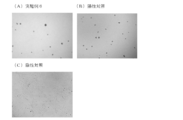
- Test Example 2 After culturing for 4 days, the results of observation of cell attachment to the plates of Example 6, positive control, and negative control using an inverted microscope are shown.
- halogen atom means a fluorine atom, a chlorine atom, a bromine atom or an iodine atom.
- the “alkyl group” means a linear or branched, monovalent group of a saturated aliphatic hydrocarbon.
- Examples of the “linear or branched alkyl group having 1 to 5 carbon atoms” include, for example, methyl group, ethyl group, n-propyl group, isopropyl group, n-butyl group, isobutyl group, s-butyl group, and t-butyl group.
- n-pentyl group 1-methylbutyl group, 2-methylbutyl group, 3-methylbutyl group, 1,1-dimethylpropyl group, 1,2-dimethylpropyl group, 2,2-dimethylpropyl group or 1-ethylpropyl group Groups.
- linear or branched alkyl group having 1 to 18 carbon atoms in addition to the examples of “straight or branched alkyl group having 1 to 5 carbon atoms”, hexyl group, heptyl group, octyl group, nonyl group, Examples include a decyl group, an undecyl group, a dodecyl group, a tridecyl group, a tetradecyl group, a pentadecyl group, a hexadecyl group, a heptadecyl group, an octadecyl group, or isomers thereof.
- a linear or branched alkyl group having 1 to 5 carbon atoms which may be substituted with a halogen atom means the above linear or branched alkyl group having 1 to 5 carbon atoms, or The straight chain or branched alkyl group having 1 to 5 carbon atoms and substituted with one or more halogen atoms.
- Examples of “a linear or branched alkyl group having 1 to 5 carbon atoms” are as described above.
- a linear or branched alkyl group having 1 to 5 carbon atoms substituted with one or more halogen atoms means that one or more arbitrary hydrogen atoms of the linear or branched alkyl group having 1 to 5 carbon atoms are , Means substituted with a halogen atom, and examples include fluoromethyl group, difluoromethyl group, trifluoromethyl group, chloromethyl group, dichloromethyl group, trichloromethyl group, bromomethyl group, iodomethyl group, 2, Examples include 2,2-trifluoroethyl group, 2,2,2-trichloroethyl group, perfluoroethyl group, perfluorobutyl group, and perfluoropentyl group.
- ester bond means —C ( ⁇ O) —O— or —O—C ( ⁇ O) —
- amide bond means —NHC ( ⁇ O) — or —C ( ⁇ O) NH—
- ether bond means —O—.
- the “linear or branched alkylene group having 1 to 10 carbon atoms which may be substituted with a halogen atom” means a linear or branched alkylene group having 1 to 10 carbon atoms, or one or more halogen atoms. Means a linear or branched alkylene group having 1 to 10 carbon atoms and substituted with
- the “alkylene group” means a divalent organic group corresponding to the alkyl group.
- Examples of “linear or branched alkylene group having 1 to 10 carbon atoms” include methylene group, ethylene group, propylene group, trimethylene group, tetramethylene group, 1-methylpropylene group, 2-methylpropylene group, dimethylethylene.
- ethylethylene group pentamethylene group, 1-methyl-tetramethylene group, 2-methyl-tetramethylene group, 1,1-dimethyl-trimethylene group, 1,2-dimethyl-trimethylene group, 2,2-dimethyl- Trimethylene group, 1-ethyl-trimethylene group, hexamethylene group, octamethylene group, decamethylene group and the like.
- ethylene group, propylene group, octamethylene group and decamethylene group are preferable, for example, ethylene group, Number of carbon atoms such as propylene group, trimethylene group, tetramethylene group Or more preferably a linear or branched alkylene group of 5, in particular an ethylene group or a propylene group is preferable.
- a linear or branched alkylene group having 1 to 10 carbon atoms substituted with one or more halogen atoms means that one or more arbitrary hydrogen atoms of the alkylene group are replaced with halogen atoms. In particular, those in which some or all of the hydrogen atoms of the ethylene group or propylene group are replaced with halogen atoms are preferred.
- the “cyclic hydrocarbon group having 3 to 10 carbon atoms” is a monocyclic or polycyclic saturated or partially unsaturated aliphatic hydrocarbon having 3 to 10 carbon atoms.
- monovalent or bicyclic monovalent groups of saturated aliphatic hydrocarbons having 3 to 10 carbon atoms are preferable.
- the number of carbon atoms is 3 such as a cyclopropyl group, a cyclobutyl group, or a cyclohexyl group.
- a bicycloalkyl group having 4 to 10 carbon atoms such as a bicyclo [3.2.1] octyl group, bornyl group, or isobornyl group.
- the “aryl group having 6 to 10 carbon atoms” means a monocyclic or polycyclic monovalent aromatic hydrocarbon group having 6 to 10 carbon atoms, such as phenyl Group, naphthyl group or anthryl group.
- the “aryl group having 6 to 10 carbon atoms” may be substituted with one or more of the above “linear or branched alkyl groups having 1 to 5 carbon atoms which may be substituted with a halogen atom”.
- the “aralkyl group having 7 to 15 carbon atoms” refers to a group —R—R ′ (wherein R represents the above “alkylene group having 1 to 5 carbon atoms”, and R ′ represents the above Represents an aryl group having 6 to 10 carbon atoms), and examples thereof include a benzyl group, a phenethyl group, and an ⁇ -methylbenzyl group.
- the aryl part of the “aralkyl group having 7 to 15 carbon atoms” may be substituted with one or more of the above “linear or branched alkyl group having 1 to 5 carbon atoms which may be substituted with a halogen atom”. Good.
- the “aryloxyalkyl group having 7 to 15 carbon atoms” refers to the group —R—O—R ′ (wherein R represents the above “alkylene group having 1 to 5 carbon atoms” and R 'Represents the above "aryl group having 6 to 10 carbon atoms”), and examples thereof include a phenoxymethyl group, a phenoxyethyl group, and a phenoxypropyl group.
- the aryl part of the “aryloxyalkyl group having 7 to 15 carbon atoms” is substituted with one or more of the above “linear or branched alkyl group having 1 to 5 carbon atoms which may be substituted with a halogen atom”. May be.
- alkali metal means an alkali metal, and examples thereof include lithium, sodium, potassium, and cesium.
- halide ion means fluoride ion, chloride ion, bromide ion or iodide ion.
- inorganic acid ion means carbonate ion, sulfate ion, phosphate ion, hydrogen phosphate ion, dihydrogen phosphate ion, nitrate ion, perchlorate ion or borate ion.
- the above An ⁇ is preferably a halide ion, sulfate ion, phosphate ion, hydroxide ion and isothiocyanate ion, and particularly preferably a halide ion.
- the (meth) acrylate compound means both an acrylate compound and a methacrylate compound.
- (meth) acrylic acid means acrylic acid and methacrylic acid.
- examples of biological materials include proteins, sugars, nucleic acids, cells, and combinations thereof.
- fibrinogen bovine serum albumin (BSA), human albumin, various globulins, ⁇ -lipoprotein, various antibodies (IgG, IgA, IgM), peroxidase, various complements, various lectins, fibronectin, lysozyme, von Wille Brand factor (vWF), serum ⁇ -globulin, pepsin, ovalbumin, insulin, histone, ribonuclease, collagen, cytochrome c, such as glucose, glucose, galactose, mannose, fructose, heparin, hyaluronic acid, eg, nucleic acid, deoxyribonucleic acid (DNA), ribonucleic acid (RNA) such as fibroblasts, bone marrow cells, B lymphocytes, T lymphocytes, neutrophils, erythrocytes, platelets, macrophage, and others.
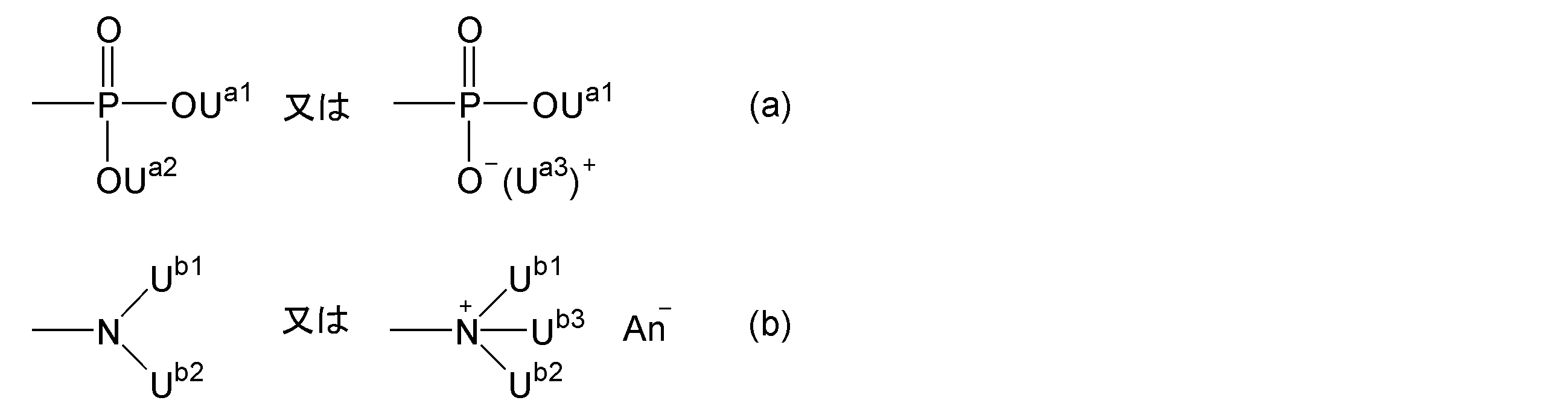
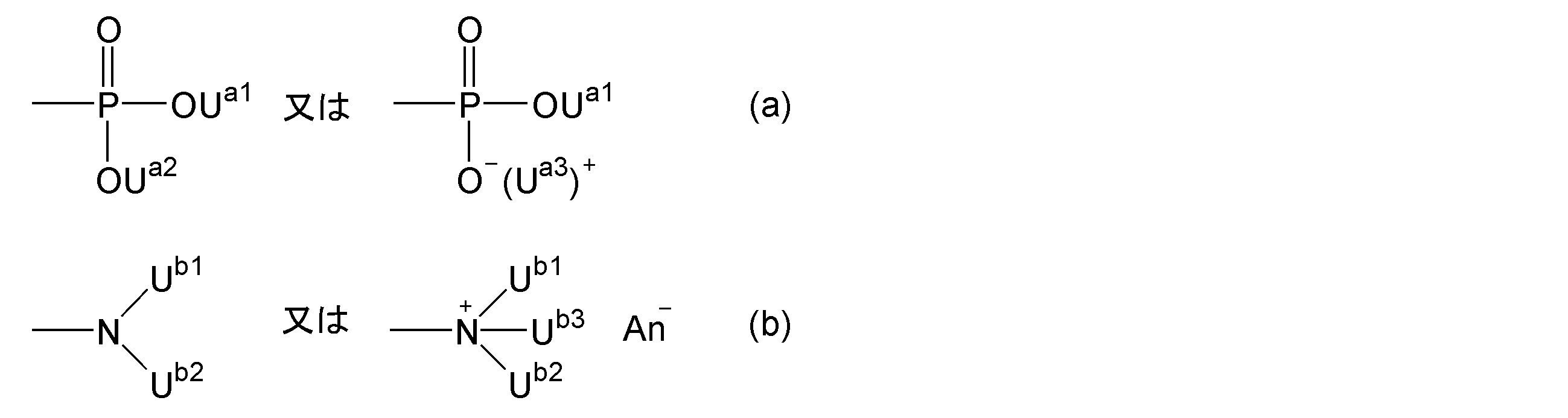
- the coating film of the present invention is a copolymer comprising (i) a repeating unit containing an organic group represented by the following formula (a) and a repeating unit containing an organic group represented by the following formula (b):
- U a1 represents an aryl group having 6 to 10 carbon atoms or a linear or branched alkyl group having 1 to 5 carbon atoms
- U a2 represents a hydrogen atom
- U a3 represents an alkali metal
- U b1 , U b2 and U b3 each independently represent a hydrogen atom or a linear or branched alkyl group having 1 to 5 carbon atoms;
- An ⁇ represents a halide ion, an inorganic acid ion, a hydroxyl group It represents an anion selected from the group consisting of physical ions and isothiocyanate ions], and
- a coating film forming composition containing a solvent is obtained by a method including a step of applying to a substrate.
- the copolymer according to the coating film of the present invention is further represented by the following formula (c): [Wherein, R c represents a linear or branched alkyl group having 1 to 18 carbon atoms, a cyclic hydrocarbon group having 3 to 10 carbon atoms, an aryl group having 6 to 10 carbon atoms, or 7 to 7 carbon atoms. 15 aralkyl groups or aryloxyalkyl groups having 7 to 15 carbon atoms (wherein the aryl moiety is substituted with a linear or branched alkyl group having 1 to 5 carbon atoms which may be substituted with a halogen atom). May represent)]
- the repeating unit containing the organic group represented by these may be included.
- the copolymer according to the coating film of the present invention includes a repeating unit containing an organic group represented by the above formula (a), a repeating unit containing an organic group represented by the above formula (b), and optionally the above formula. If it is a copolymer containing the repeating unit containing the organic group represented by (c), there will be no restriction
- the repeating unit containing an organic group represented by the above formula (c) includes a repeating unit containing an organic group represented by the above formula (a) and an organic group represented by the above formula (b). It is different from the repeating unit containing.
- the polymer includes a monomer containing an organic group represented by the above formula (a), a monomer containing an organic group represented by the above formula (b), and an organic group represented by the above formula (c) in some cases.
- a monomer containing an organic group represented by the above formula (a) a monomer containing an organic group represented by the above formula (b), and an organic group represented by the above formula (c) in some cases.
- examples of the copolymer include vinyl polymer polymer reacted with olefin, polyamide, polyester, polycarbonate, polyurethane and the like. Among these, vinyl polymer polymer or (meth) acrylate compound reacted with olefin was polymerized. A (meth) acrylic polymer is desirable.
- the ratio of the repeating unit containing an organic group represented by the formula (a) in the copolymer according to the coating film of the present invention is 3 mol% to 80 mol%.
- the copolymer which concerns on this invention may contain the repeating unit containing the organic group represented by 2 or more types of formula (a).
- the ratio of the repeating unit containing an organic group represented by the formula (b) in the copolymer according to the coating film of the present invention is 3 mol% to 80 mol%.
- the copolymer which concerns on this invention may contain the repeating unit containing the organic group represented by 2 or more types of formula (b).
- the ratio of the repeating unit containing the organic group represented by the formula (c) in the copolymer according to the present invention is the balance obtained by subtracting the above formulas (a) and (b) from the total copolymer. For example, it is 0 mol% to 90 mol%.
- the copolymer which concerns on this invention may contain the repeating unit containing the organic group represented by 2 or more types of formula (c).
- Examples of the solvent contained in the coating film forming composition of the present invention include water, phosphate buffered saline (PBS), and alcohol.
- the concentration of the solid content in the composition for forming a coating film according to the present invention is preferably 0.01 to 50% by mass in order to form a coating film uniformly.
- the concentration of the copolymer in the composition for forming a coating film is preferably 0.01 to 4% by mass, more preferably 0.01 to 3% by mass, particularly preferably 0.01 to 2% by mass, More preferably, the content is 0.01 to 1% by mass.
- the concentration of the copolymer is 0.01% by mass or less, the concentration of the copolymer in the resulting coating film forming composition is too low to form a coating film having a sufficient film thickness, and 4% by mass or more. If this is the case, the storage stability of the composition for forming a coating film is deteriorated, and there is a possibility that precipitation or gelation of the dissolved matter occurs.
- composition for forming a coating film of the present invention in addition to the copolymer and the solvent, other substances can be added as needed as long as the performance of the coating film obtained is not impaired.
- other substances include preservatives, surfactants, primers that enhance adhesion to the substrate, fungicides, and sugars.
- a step of further adjusting in advance the pH in the composition for forming a coating film May be included.
- a pH adjusting agent is added to the composition containing the copolymer and the solvent, and the pH of the composition is 3.5 to 8.5, more preferably 4.0 to 8.0. May be implemented.
- the kind and amount of the pH adjuster that can be used are appropriately selected according to the concentration of the copolymer, the abundance ratio of the anion and cation, and the like.
- pH adjusters include ammonia, diethanolamine, pyridine, N-methyl-D-glucamine, organic amines such as tris (hydroxymethyl) aminomethane; alkali metal hydroxides such as potassium hydroxide and sodium hydroxide; Alkali metal halides such as potassium and sodium chloride; inorganic acids such as sulfuric acid, phosphoric acid, hydrochloric acid and carbonic acid or alkali metal salts thereof; quaternary ammonium cations such as choline or mixtures thereof (for example, phosphate buffered saline) Etc.).
- alkali metal hydroxides such as potassium hydroxide and sodium hydroxide
- Alkali metal halides such as potassium and sodium chloride
- inorganic acids such as sulfuric acid, phosphoric acid, hydrochloric acid and carbonic acid or alkali metal salts thereof
- quaternary ammonium cations such as choline or mixtures thereof (for example, phosphate buffered saline)
- ammonia, diethanolamine, sodium hydroxide, choline, N-methyl-D-glucamine, and tris (hydroxymethyl) aminomethane are preferable, and ammonia, diethanolamine, sodium hydroxide, and choline are particularly preferable.
- the present invention provides (i) a repeating unit containing an organic group represented by the above formula (a), a repeating unit containing an organic group represented by the above formula (b), and optionally the above formula (c). It is related with the composition for coating film formation containing the copolymer containing the repeating unit containing the represented organic group, (ii) solvent, and (iii) pH adjuster by the case. Specific examples of the copolymer, the solvent and the pH adjuster are as described above.
- the coating film forming composition according to the present invention is applied to a substrate and dried to form a coating film.
- the substrate for forming the coating film of the present invention include glass, metal, metal-containing compound or metalloid-containing compound, activated carbon or resin.
- Metals are typical metals: (alkali metals: Li, Na, K, Rb, Cs; alkaline earth metals: Ca, Sr, Ba, Ra), magnesium group elements: Be, Mg, Zn, Cd, Hg; aluminum group Element: Al, Ga, In; rare earth element: Y, La, Ce, Pr, Nd, Sm, Eu; tin group element: Ti, Zr, Sn, Hf, Pb, Th; iron group element: Fe, Co, Ni Soil acid element: V, Nb, Ta, Chromium group element: Cr, Mo, W, U; Manganese group element: Mn, Re; Precious metal: Cu, Ag, Au; Platinum group element: Ru, Rh, Pd, Os , Ir, P
- the metal-containing compound or metalloid-containing compound is, for example, a metal oxide as a basic component, a ceramic, a semiconductor such as silicon, a metal oxide or metalloid oxide (silicon Oxides, alumina, etc.), metal solids or metalloid carbides, metal nitrides or metalloid nitrides (silicon nitride, etc.), inorganic solid materials such as molded bodies of inorganic compounds such as metal borides or metalloid borides, aluminum , Nickel titanium, stainless steel (SUS304, SUS316, SUS316L, etc.).
- the resin may be a natural resin or a derivative thereof, or a synthetic resin.
- the natural resin or derivative thereof include cellulose, cellulose triacetate (CTA), nitrocellulose (NC), and cellulose in which dextran sulfate is immobilized.
- Resins include polyacrylonitrile (PAN), polyester-based polymer alloy (PEPA), polystyrene (PS), polysulfone (PSF), polyethylene terephthalate (PET), polymethyl methacrylate (PMMA), polyvinyl alcohol (PVA), polyurethane (PU) , Ethylene vinyl alcohol (EVAL), polyethylene (PE), polyester (PE), polypropylene (PP), polyvinylidene fluoride (PVDF), various ion exchange resins or polyethersulfone (ES) are preferably used. Since the coating film of the present invention can be formed by low-temperature drying, it can also be applied to resins having low heat resistance.
- the coating film forming composition is applied to at least a part of the surface of the substrate.
- coating method There is no restriction
- coating methods such as a normal spin coat, dip coat, and a solvent cast method, are used.
- the drying process of the coating film according to the present invention is performed in the air or in a vacuum, preferably in the temperature range of ⁇ 200 ° C. to 200 ° C.
- the solvent in the composition for forming a coating film is removed by the drying process, and the formulas (a) and (b) of the copolymer according to the present invention form ionic bonds and are completely fixed to the substrate.
- the coating film can be formed, for example, by drying at room temperature (10 ° C. to 35 ° C., for example, 25 ° C.). However, in order to form the coating film more rapidly, it is dried at, for example, 40 ° C. to 50 ° C. Also good. Further, a drying process at an extremely low temperature to a low temperature (around ⁇ 200 ° C. to ⁇ 30 ° C.) by freeze drying may be used. Freeze-drying is called vacuum freeze-drying, and is a method in which what is usually dried is cooled with a refrigerant and the solvent is removed by sublimation in a vacuum state. Common refrigerants used in freeze drying include a mixed medium of dry ice and methanol ( ⁇ 78 ° C.), liquid nitrogen ( ⁇ 196 ° C.), and the like.
- drying temperature When the drying temperature is ⁇ 200 ° C. or lower, an uncommon refrigerant must be used, so that it is not versatile, and it takes a long time for drying due to solvent sublimation, resulting in poor efficiency.
- the drying temperature is 200 ° C. or higher, the ion binding reaction on the surface of the coating film proceeds excessively, the surface loses hydrophilicity, and the biological substance adhesion suppressing ability is not exhibited.
- a more preferable drying temperature is 10 ° C. to 180 ° C., and a more preferable drying temperature is 25 ° C. to 150 ° C.
- At least one selected from water and an aqueous solution containing an electrolyte is used. You may implement the process wash
- the aqueous solution containing the water and the electrolyte may be heated in the range of 40 ° C. to 95 ° C., for example.
- the aqueous solution containing the electrolyte is preferably PBS, physiological saline (containing only sodium chloride), Dulbecco's phosphate buffered saline, Tris buffered saline, HEPES buffered saline, and veronal buffered saline. Particularly preferred.
- the coating film does not elute even if washed with water, PBS, alcohol or the like, and remains firmly fixed to the substrate. Even if the formed coating film adheres to the biological material, it can be easily removed by washing with water or the like thereafter, and the surface of the substrate on which the coating film of the present invention is formed has the ability to suppress the adhesion of the biological material.
- the coating film of the present invention for example, there is a coating film for a filter of an artificial dialyzer.
- the coating film of the present invention is a coating film on a synthetic resin (for example, PES, PS, PSF and NC) used for a filter.
- the sticking property and durability after fixing are also good.
- the form of the substrate is not particularly limited, and examples thereof include substrates, fibers, particles, gel forms, and porous forms, and the shape may be flat or curved. In the case of particles, the particle size is, for example, 5 to 1000 nm.
- the particles may be colloids (foam, emulsion (latex), suspension (suspension), etc .; for example, selenium colloid)) dispersed in a solvent.
- the coating membrane forming composition according to the present invention is passed through the inside of a hollow fiber-shaped filter made of the above material, for example, having a diameter of 0.1 to 500 ⁇ m. Then, it can be produced through a drying step and a washing step (hot water (for example, 40 ° C. to 95 ° C.) washing). If necessary, treatment with ⁇ rays, ethylene oxide, autoclave, etc. may be performed for sterilization.
- the film thickness of the coating film of the present invention is preferably 10 to 1000 mm, more preferably 10 to 500 mm, and most preferably 10 to 300 mm.
- the coating film of the present invention has an ability to suppress adhesion of biological substances, it can be suitably used as a coating film for medical substrates.
- medical substrates for example, leukocyte removal filter, blood transfusion filter, virus removal filter, minute clot removal filter, blood purification module, artificial heart, artificial lung, blood circuit, artificial blood vessel, vascular bypass tube, medical tube, artificial valve, cannula, stent Suitable for catheters, intravascular cartels, balloon catheters, guide wires, sutures, indwelling needles, shunts, artificial joints, artificial hip joints, blood bags, blood storage containers, surgical aids, anti-adhesion membranes, wound dressings, etc. Can be used.
- the blood purification module refers to a module having a function of circulating blood outside the body to remove waste and harmful substances in the blood, such as an artificial kidney, a toxin adsorption filter and a column.
- the coating film of the present invention is useful as a coating film for cell culture containers such as flasks, dishes, and plates, and various research instruments with reduced protein adhesion.
- the coating film of the present invention is a cosmetic material, a material for contact lens care products, a fiber processing agent for skin care, a diagnostic drug material for biochemical research, and an enzyme immunoassay (ELISA) method widely used in clinical diagnostic methods.
- the coating film of the present invention is useful as a coating film for toiletries, personal care products, detergents, pharmaceuticals, quasi drugs, fibers, and antifouling materials.
- a copolymer containing repeating units of the following formulas (a1) and (b1) is particularly preferably used.
- T a and T b each independently represent a hydrogen atom or a linear or branched alkyl group having 1 to 5 carbon atoms
- Q a and Q b each independently represent a single bond
- an ester R a and R b each independently represent a linear or branched alkylene group having 1 to 10 carbon atoms which may be substituted with a halogen atom
- U a1 represents a carbon atom
- U a2 represents a hydrogen atom
- U a3 represents an alkali metal
- U b1 , U b2 and U b3 each independently represent a linear or branched alkyl group having a hydrogen atom or a carbon atom number of 1 to 5, an - is a halide ion, an inorganic acid ion, a hydroxide ion and isothiocyanates
- the copolymer contained in the composition for forming a coating film of the present invention may further contain a repeating unit represented by the following formula (c1).
- each T c independently represents a hydrogen atom or a linear or branched alkyl group having 1 to 5 carbon atoms
- Q c represents a single bond, an ether bond or an ester bond
- R c represents A linear or branched alkyl group having 1 to 18 carbon atoms, a cyclic hydrocarbon group having 3 to 10 carbon atoms, an aryl group having 6 to 10 carbon atoms, an aralkyl group having 7 to 15 carbon atoms, or the number of carbon atoms
- m represents an integer of 0 to 6, preferably an integer of 1 to 6, more preferably an integer of 1 to 5, and particularly preferably 1.
- the ratio of the repeating unit represented by the formula (a1) contained in the copolymer according to the present invention is 3 mol% to 80 mol%.
- the copolymer which concerns on this invention may contain the repeating unit represented by 2 or more types of formula (a1).
- the ratio of the repeating unit represented by the formula (b1) contained in the copolymer according to the present invention is 3 mol% to 80 mol%.
- the copolymer which concerns on this invention may contain the repeating unit represented by 2 or more types of formula (b1).
- the ratio of the repeating unit represented by the formula (c1) contained in the copolymer according to the present invention may be the balance obtained by subtracting the above formulas (a1) and (b1) from the total copolymer. Is, for example, 0 mol% to 90 mol%.
- the copolymer which concerns on this invention may contain the repeating unit represented by 2 or more types of formula (c1).
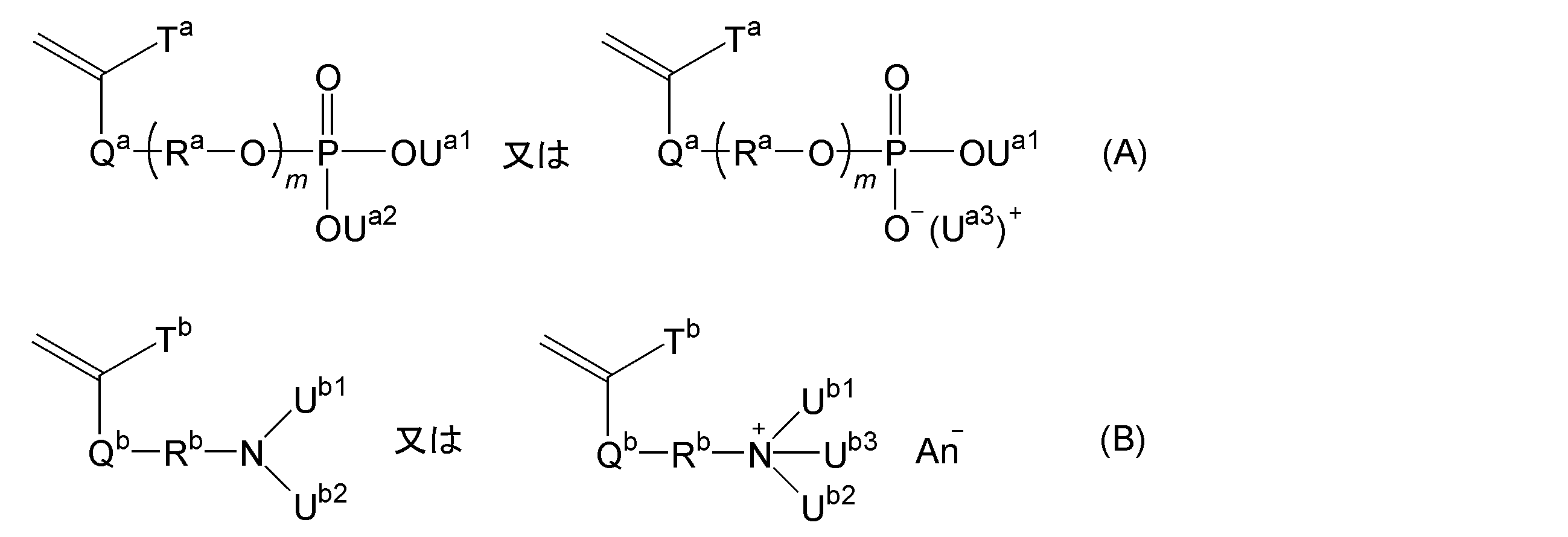
- the present invention also includes the following formulas (A) and (B):
- T a and T b each independently represent a hydrogen atom or a linear or branched alkyl group having 1 to 5 carbon atoms;
- Q a and Q b each independently represent a single bond, an ester bond or an amide bond;
- R a and R b each independently represents a linear or branched alkylene group having 1 to 10 carbon atoms which may be substituted with a halogen atom;
- U a1 represents an aryl group having 6 to 10 carbon atoms or a linear or branched alkyl group having 1 to 5 carbon atoms,
- U a2 represents a hydrogen atom, and
- U a3 represents an alkali metal;
- U b1 , U b2 and U b3 each independently represent a hydrogen atom or a linear or branched alkyl group having 1 to 5 carbon atoms;
- An ⁇ represents an anion selected from the group consisting of halide ion, inorganic acid ion, hydro
- the copolymer of the present invention further has the following formula (C):
- Each T c independently represents a hydrogen atom or a linear or branched alkyl group having 1 to 5 carbon atoms;
- Q c represents a single bond, an ether bond or an ester bond;
- R c is a linear or branched alkyl group having 1 to 18 carbon atoms, a cyclic hydrocarbon group having 3 to 10 carbon atoms, an aryl group having 6 to 10 carbon atoms, or an aralkyl group having 7 to 15 carbon atoms.
- an aryloxyalkyl group having 7 to 15 carbon atoms (wherein the aryl moiety may be substituted with a linear or branched alkyl group having 1 to 5 carbon atoms which may be substituted with a halogen atom).
- It may be a copolymer obtained from a monomer mixture containing a compound represented by:
- T a , T b and T c a hydrogen atom, a methyl group or an ethyl group is preferable, and a hydrogen atom or a methyl group is more preferable.
- Q a , Q b and Q c are preferably a single bond or an ester bond, and more preferably an ester bond.
- R a and R b a linear or branched alkylene group having 1 to 5 carbon atoms is preferable, and a methylene group, an ethylene group, or a propylene group is more preferable.
- R c is preferably a linear or branched alkyl group having 4 to 18 carbon atoms or a cycloalkyl group having 3 to 10 carbon atoms, and includes a butyl group, a pentyl group, a hexyl group or an isomer thereof, or a cyclohexyl group. More preferred.
- U a1 is preferably a phenyl group, a methyl group, an ethyl group, an n-propyl group, an isopropyl group, an n-butyl group, an isobutyl group, an s-butyl group or a t-butyl group, and is preferably a phenyl group, a methyl group or an ethyl group.
- N-propyl group or n-butyl group is more preferable, phenyl group, methyl group or ethyl group is more preferable, phenyl group is most preferable,
- U a2 is preferably a hydrogen atom, and U a3 is a sodium ion or Potassium ions are preferred, and
- U b1 , U b2 and U b3 are preferably a hydrogen atom, a methyl group, an ethyl group or a t-butyl group.
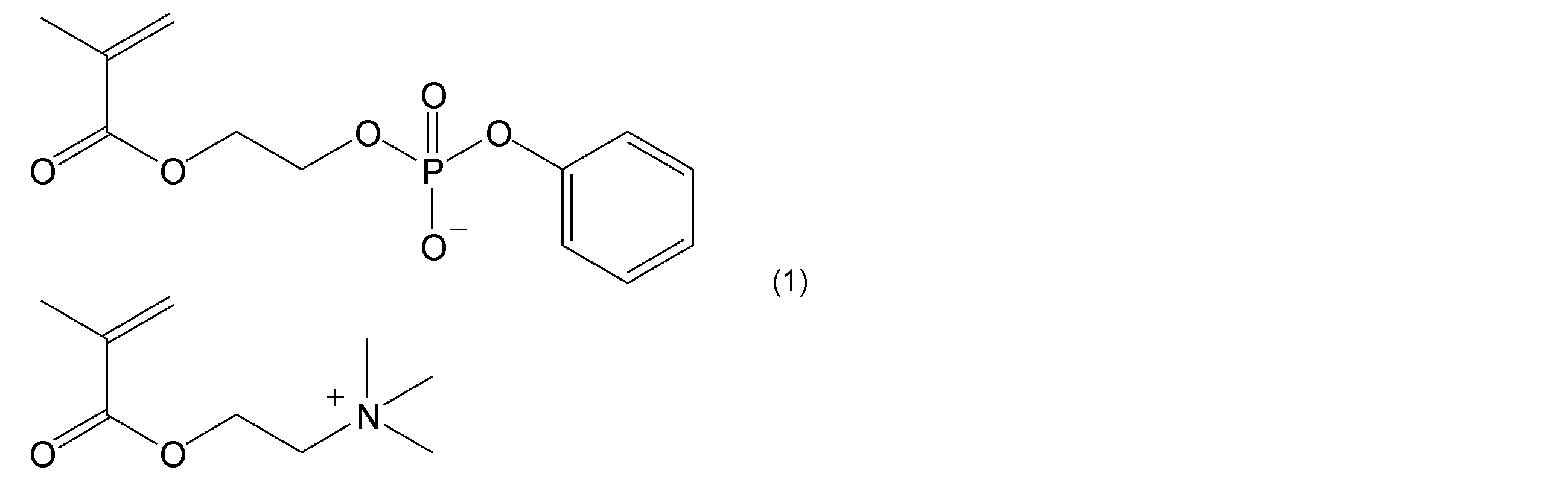
- Specific examples of the above formula (A) include phenyl vinylphosphonate, 2- (meth) acryloyloxyethylphenyl hydrogen phosphate or an alkali metal salt thereof, 2- (meth) acryloyloxyethyl methyl hydrogen phosphate or an alkali metal thereof.
- the salt include 2- (meth) acryloyloxyethyl ethyl hydrogen phosphate or an alkali metal salt thereof, among which 2- (meth) acryloyloxyethyl phenyl hydrogen phosphate or an alkali metal salt thereof is preferably used.
- 2-methacryloyloxyethyl phenyl hydrogen phosphate can be prepared, for example, according to the method described in Polymer Degradation and Stability 91 (2006) 2683-2690.
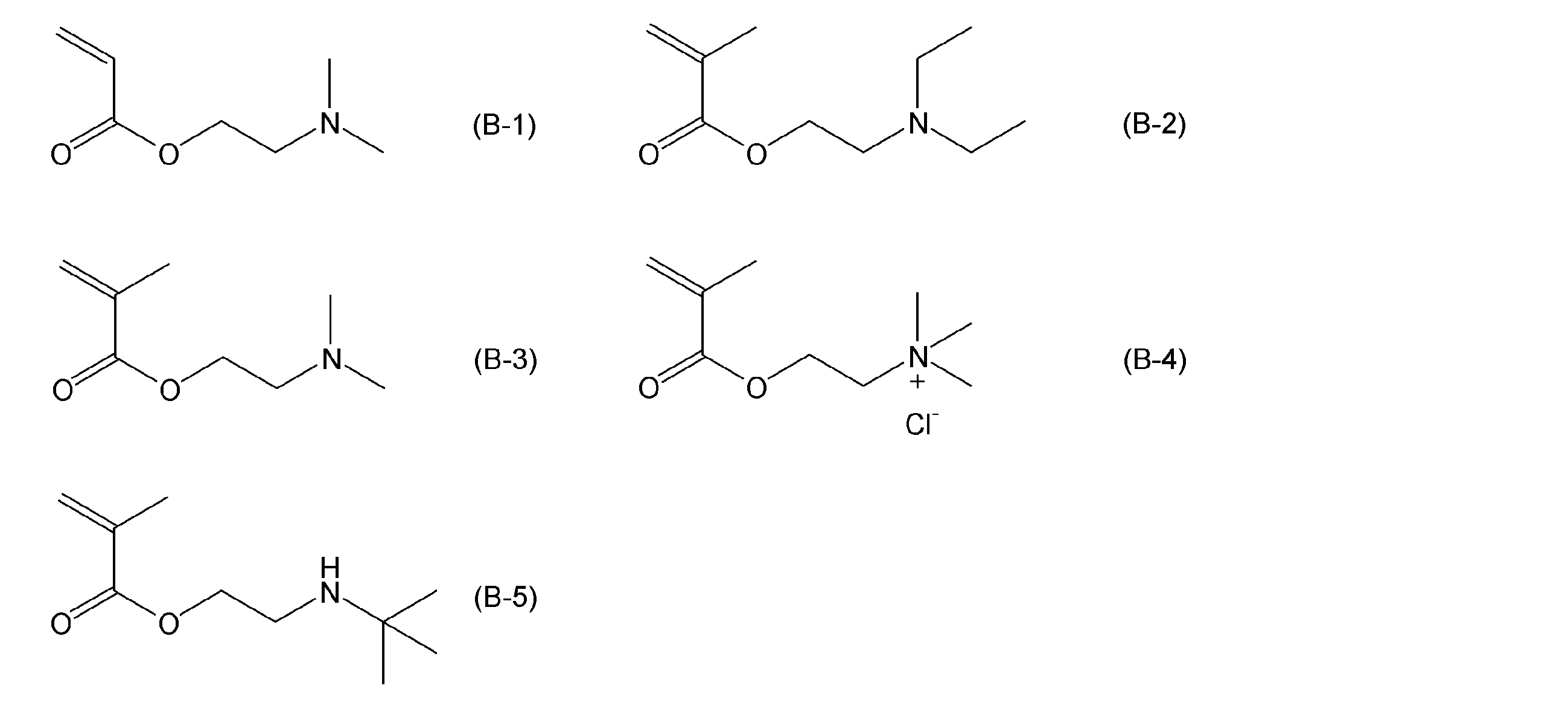
- formula (B) examples include dimethylaminoethyl (meth) acrylate, diethylaminoethyl (meth) acrylate, dimethylaminopropyl (meth) acrylate, 2- (t-butylamino) ethyl (meth) acrylate, and methacryloylcholine.
- dimethylaminoethyl (meth) acrylate, methacryloylcholine chloride or 2- (t-butylamino) ethyl (meth) acrylate is preferably used.
- Cyclic alkyl esters of (meth) acrylic acid such as cyclohexyl (meth) acrylate and isobornyl (meth) acrylate
- Aralkyl esters of (meth) acrylic acid such as benzyl (meth) acrylate and phenethyl (meth) acrylate
- Styrene Styrene monomers such as methyl styrene and chloromethyl styrene
- vinyl ether monomers such as methyl vinyl ether and butyl vinyl ether
- vinyl ester monomers such as vinyl acetate and vinyl propionate.
- butyl (meth) acrylate or cyclohexyl (meth) acrylate is preferably used.
- the ratio of the compound represented by the formula (A) to the whole monomer forming the copolymer is 3 mol% to 80 mol%. Moreover, 2 or more types may be sufficient as the compound represented by Formula (A).
- the ratio of the compound represented by the formula (B) to the whole monomer forming the copolymer is 3 mol% to 80 mol%. Moreover, 2 or more types may be sufficient as the compound represented by Formula (B).
- the ratio of the compound represented by the formula (C) to the whole monomer forming the copolymer may be the balance obtained by subtracting the ratios of the formulas (A) and (B). To 90 mol%. Moreover, 2 or more types may be sufficient as the compound represented by Formula (C).
- the copolymer according to the present invention can be synthesized by methods such as radical polymerization, anionic polymerization, and cationic polymerization, which are general methods for synthesizing acrylic polymer or methacrylic polymer.
- the form can be various methods such as solution polymerization, suspension polymerization, emulsion polymerization and bulk polymerization.
- the composition for forming a coating film according to the present invention may be prepared by diluting a desired copolymer to a predetermined concentration with a desired solvent. Furthermore, the coating film forming composition according to the present invention may be prepared from the copolymer-containing varnish of the present invention.
- the copolymer-containing varnish of the present invention comprises a compound represented by the above formulas (A), (B) and optionally (C) in a solvent in a total concentration of 0.01% by mass to 20% by mass of both compounds. It can prepare by the manufacturing method including the process made to react (polymerize) by.
- the solvent in the polymerization reaction may be water, an alcohol such as a phosphate buffer or ethanol, or a mixed solvent combining these, but it is preferable to include water or ethanol. It is preferable that 10% by mass or more and 100% by mass or less of water or ethanol is contained in the solvent in the polymerization reaction. More preferably, water or ethanol is contained in an amount of 50% by mass to 100% by mass. More preferably, it contains 80% by mass or more and 100% by mass or less of water or ethanol. It is particularly preferable to contain water or ethanol in an amount of 90% by mass to 100% by mass. Most preferably, the sum of water and ethanol is 100% by mass.
- the concentration of the compound represented by the formula (A) or the formula (B) in the reaction solvent is 0.01% by mass or more, and for example, 1% by mass to 50% by mass. More preferably, it can be 2 to 40% by mass, more preferably 3 to 30% by mass, and most preferably 4 to 25% by mass. .
- the phosphoric acid group-containing monomer is a monomer that easily associates, when dropped into the reaction system, it may be dropped little by little in the reaction solvent so that it can be quickly dispersed.
- reaction solvent may be heated (for example, 40 ° C. to 100 ° C.) in order to increase the solubility of the monomer and polymer.
- polymerization initiators include 2,2′-azobis (isobutyronitrile), 2,2′-azobis (2-methylbutyronitrile), 2,2′-azobis (2,4-dimethylvaleronitrile) ) (Wako Pure Chemicals product name: VA-065, 10 hour half-life temperature: 51 ° C.), 2,2′-azobis (4-methoxy-2,4-dimethylvaleronitrile), 1,1′-azobis (cyclohexane -1-carbonitrile), 1-[(1-cyano-1-methylethyl) azo] formamide, 2,2′-azobis [2- (2-imidazolin-2-yl) propane] dihydrochloride (pure Wako) Pharmaceutical product name: VA-044, 10 hour half-life temperature: 44 ° C., 2,2′-azobis [2- (2-imidazolin-2-yl) propane] (Wako
- the addition amount of the polymerization initiator is 0.05% by mass to 10% by mass with respect to the total weight of the monomers used for the polymerization.
- the reaction conditions are as follows.
- the reaction vessel is heated to 50 ° C. to 200 ° C. with an oil bath or the like and stirred for 1 hour to 48 hours, more preferably 80 ° C. to 150 ° C. for 5 hours to 30 hours.
- the inventive copolymer is obtained.
- the reaction atmosphere is preferably a nitrogen atmosphere.
- all the reactants may be put into a reaction solvent at room temperature and then heated to the above temperature for polymerization, or a mixture of the reactants may be partially or partially added in a preheated solvent. You may drip at a time.
- the copolymer of the present invention comprises a mixture containing the compound represented by the above formulas (A), (B) and optionally (C), a solvent and a polymerization initiator. It can be prepared by a production method including a step of dropping and reacting (polymerizing) a solvent maintained at a temperature higher than the 10-hour half-life temperature.
- the molecular weight of the copolymer according to the present invention may be about several thousand to several million, preferably 5,000 to 5,000,000. More preferably, it is 10,000 to 2,000,000.
- any of a random copolymer, a block copolymer, and a graft copolymer may be used, and the copolymerization reaction itself for producing the copolymer is not particularly limited, and includes radical polymerization, ionic polymerization, and photopolymerization.
- a method synthesized in a known solution such as polymerization, macromer, polymerization using emulsion polymerization, or the like can be used.
- any one of the copolymers of the present invention can be used alone, or a plurality of copolymers can be mixed and the ratio thereof can be changed.
- the weight average molecular weight of the copolymer shown in the following synthesis examples is a measurement result by Gel Filtration Chromatography (hereinafter abbreviated as GFC).
- GFC Gel Filtration Chromatography
- a mixed solution containing all the above components that had been sufficiently stirred and became homogeneous was introduced into the dropping funnel.
- 16.02 g of pure water and 1.82 g of ethanol were separately put into a three-necked flask with a cooling tube, and this was nitrogen-flowed and heated to the reflux temperature while stirring.
- the dropping funnel into which the mixed solution was introduced was set in a three-necked flask, and the mixed solution was dropped into a boiling liquid of pure water and ethanol over 0.5 hours.
- the above environment was maintained for 24 hours.
- 33.65 g of a colloidal copolymer varnish having a solid content of about 9.90% by mass was obtained.
- a mixed solution containing all the above components that had been sufficiently stirred and became homogeneous was introduced into the dropping funnel.
- 433.94 g of pure water and 37.20 g of ethanol were separately put into a three-necked flask equipped with a cooling tube, and this was nitrogen-flowed and heated to the reflux temperature while stirring.
- the dropping funnel into which the mixed solution was introduced was set in a three-necked flask, and the mixed solution was dropped into a boiling liquid of pure water and ethanol over 0.5 hours.
- the above environment was maintained for 24 hours.
- After cooling for 24 hours 506.05 g of a colloidal copolymer varnish having a solid content of about 1.64% by mass was obtained.
- Example 1 25.51 g of water and 6.49 g of ethanol were added to 1.00 g of the copolymer-containing varnish obtained in Polymerization Example 1, and the mixture was sufficiently stirred to prepare a coating film forming composition.
- the obtained coating film forming composition was spin coated on the silicon wafer at 1500 rpm / 30 sec. Thereafter, the uncured film-forming composition adhering to the coating film was thoroughly washed with PBS and pure water, and the film thickness of the coating film on the silicon wafer was confirmed with an optical interference film thickness meter. However, it was 19cm.
- Example 2 9.44 g of water and 22.03 g of ethanol were added to 1.00 g of the copolymer-containing varnish obtained in the above Polymerization Example 2, and the mixture was sufficiently stirred to prepare a coating film forming composition.
- the obtained coating film forming composition was spin coated on the silicon wafer at 1500 rpm / 30 sec. Thereafter, the uncured film-forming composition adhering to the coating film was thoroughly washed with PBS and pure water, and the film thickness of the coating film on the silicon wafer was confirmed with an optical interference film thickness meter. However, it was 178cm.
- a varnish obtained by dissolving 1.00 g of polystyrene (manufactured by Aldrich) in 99.00 g of toluene is spin-coated on the film sensor side at 3500 rpm / 30 sec with a spin coater, and 205 ° C./1 min.
- a QCM sensor (PS) was obtained by drying.
- Example 3 (Creation of coating QCM sensor (PS))
- the composition for forming a coating film prepared in Example 2 was spin-coated on the QCM sensor (PS) at 3500 rpm / 30 sec. Thereafter, the uncured composition for forming a coating film, which was excessively applied as a washing step, was washed twice each with PBS and ultrapure water to obtain a coated QCM sensor (PS).
- Example 4 (Creation of coating QCM sensor (NC))
- the QCM sensor (NC) was spin-coated with the coating film forming composition prepared in Example 1 at 3500 rpm / 30 sec. Thereafter, the uncured composition for forming a coating film, which was excessively applied as a cleaning step, was washed twice each with PBS and ultrapure water to obtain a coating QCM sensor (NC).
- Example 5 (Creation of coating QCM sensor (NC))
- the coating QCM sensor (NC) was obtained in the same manner as in Example 4 except that the coating film forming composition prepared in Example 1 was replaced with the coating film forming composition prepared in Example 2. It was.
- Example 1 Adhesion amount test of biological substances in FBS; QCM-D measurement
- PS coated QCM sensor
- NC coated QCM sensor
- E4 manufactured by Q-Sense
- PBS was allowed to flow until a stable baseline was established in which the frequency change was 1 Hz or less in 1 hour.
- PBS was allowed to flow for about 10 minutes with a stable baseline frequency of 0 Hz.
- Example 6> The following treatment steps were performed in order to prepare a cell culture plate provided with the coating film of the present invention.
- Treatment 1 The coating film forming composition prepared in Example 2 was filtered using a filter having a mesh size of 0.22 ⁇ m, and then 200 ⁇ L was added to a well of a 96-well cell culture plate (BD Bioscience, # 351172). (Solid content 1% by mass) / well was added and allowed to stand at room temperature for 1 hour, after which excess varnish was removed.
- Treatment 2 It was dried overnight at 50 ° C. using an oven (manufactured by Advantech Toyo Co., Ltd., dryer FC-612). Then, after adding 200 microliters of sterilized water per well, it removed and wash
- Example 2 Cell adhesion inhibitory effect> (Preparation of coating plate) The coated cell culture plate obtained in Example 6 was used. As a positive control sample, a commercially available cell low adhesion plate (Corning, # 3474) was used. As a negative control, a 96-well cell culture plate (BD Bioscience, # 351172) without coating was used.
- Mouse embryo fibroblast C3H10T1 / 2 (DS Pharma Biomedical) was used as the cell.
- the medium used for cell culture is BME medium (manufactured by Thermo Fisher Scientific) containing 10% FBS (manufactured by HyClone) and L-glutamine-penicillin-streptomycin stabilizing solution (manufactured by Sigma-Aldrich). It was.
- the cells were statically cultured for 2 days or more using a petri dish (10 mL of medium) having a diameter of 10 cm while maintaining a 5% carbon dioxide concentration in a 37 ° C./CO 2 incubator.
- the cells were washed with 5 ml of PBS, and 1 mL of trypsin-EDTA solution (manufactured by Invitrogen) was added to detach the cells, and suspended in 10 mL of the above medium. After centrifuging this suspension (manufactured by Tommy Seiko Co., Ltd., model number LC-200, 1000 rpm / 3 minutes, room temperature), the supernatant was removed, and the above medium was added to prepare a cell suspension.
- trypsin-EDTA solution manufactured by Invitrogen
- Cell attachment experiment To the plate prepared above, 100 ⁇ L of each cell suspension was added so as to be 2 ⁇ 10 3 cells / well. Thereafter, the sample was allowed to stand in a CO 2 incubator at 37 ° C. for 4 days while maintaining a 5% carbon dioxide concentration.
- the container having the coating film of the present application coated on the surface is useful as a cell culture container.
Landscapes
- Chemical & Material Sciences (AREA)
- Organic Chemistry (AREA)
- Life Sciences & Earth Sciences (AREA)
- Engineering & Computer Science (AREA)
- Materials Engineering (AREA)
- Wood Science & Technology (AREA)
- Health & Medical Sciences (AREA)
- Chemical Kinetics & Catalysis (AREA)
- Medicinal Chemistry (AREA)
- Polymers & Plastics (AREA)
- Paints Or Removers (AREA)
- Addition Polymer Or Copolymer, Post-Treatments, Or Chemical Modifications (AREA)
Abstract
Description
1.下記式(A)及び(B):

[式中、
Ta及びTbは、それぞれ独立して、水素原子又は炭素原子数1乃至5の直鎖若しくは分岐アルキル基を表し;
Qa及びQbは、それぞれ独立して、単結合、エステル結合又はアミド結合を表し;
Ra及びRbは、それぞれ独立して、ハロゲン原子で置換されていてもよい炭素原子数1乃至10の直鎖若しくは分岐アルキレン基を表し;
Ua1は、炭素原子数6乃至10のアリール基又は炭素原子数1乃至5の直鎖若しくは分岐アルキル基を表し、Ua2は、水素原子を表し、Ua3は、アルカリ金属を表し;
Ub1、Ub2及びUb3は、それぞれ独立して、水素原子又は炭素原子数1乃至5の直鎖若しくは分岐アルキル基を表し;
An-は、ハロゲン化物イオン、無機酸イオン、水酸化物イオン及びイソチオシアネートイオンからなる群から選ばれる陰イオンを表し;
mは、0乃至6の整数を表す]
で表される化合物を少なくとも含むモノマー混合物を重合させることにより得られる、共重合体。

[式中、
Tcは、それぞれ独立して、水素原子又は炭素原子数1乃至5の直鎖若しくは分岐アルキル基を表し;
Qcは、単結合、エーテル結合又はエステル結合を表し;
Rcは、炭素原子数1乃至18の直鎖若しくは分岐アルキル基、炭素原子数3乃至10の環式炭化水素基、炭素原子数6乃至10のアリール基、炭素原子数7乃至15のアラルキル基又は炭素原子数7乃至15のアリールオキシアルキル基(ここで、前記アリール部分は、ハロゲン原子で置換されていてもよい炭素原子数1乃至5の直鎖若しくは分岐アルキル基で置換されていてもよい)を表す]
で表される化合物を含む、上記1に記載の共重合体。
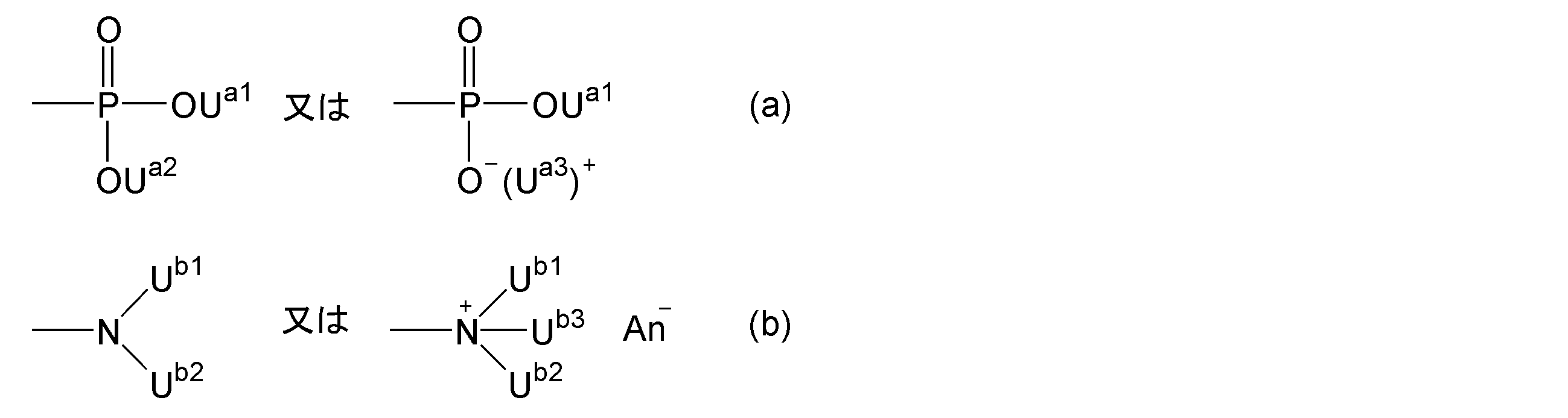
(式中、
Ua1は、炭素原子数6乃至10のアリール基又は炭素原子数1乃至5の直鎖若しくは分岐アルキル基を表し、Ua2は、水素原子を表し、Ua3は、アルカリ金属を表し;
Ub1、Ub2及びUb3は、それぞれ独立して、水素原子又は炭素原子数1乃至5の直鎖若しくは分岐アルキル基を表し;
An-は、ハロゲン化物イオン、無機酸イオン、水酸化物イオン及びイソチオシアネートイオンからなる群から選ばれる陰イオンを表す)及び
(ii)溶媒
を含む、コーティング膜形成用組成物。

[式中、
Rcは、炭素原子数1乃至18の直鎖若しくは分岐アルキル基、炭素原子数3乃至10の環式炭化水素基、炭素原子数6乃至10のアリール基、炭素原子数7乃至15のアラルキル基又は炭素原子数7乃至15のアリールオキシアルキル基(ここで、前記アリール部分は、ハロゲン原子で置換されていてもよい炭素原子数1乃至5の直鎖若しくは分岐アルキル基で置換されていてもよい)を表す]
で表される有機基を含む繰り返し単位を含む、上記3に記載の組成物。

[式中、
Ta及びTbは、それぞれ独立して、水素原子又は炭素原子数1乃至5の直鎖若しくは分岐アルキル基を表し;
Qa及びQbは、それぞれ独立して、単結合、エステル結合又はアミド結合を表し;
Ra及びRbは、それぞれ独立して、ハロゲン原子で置換されていてもよい炭素原子数1乃至10の直鎖若しくは分岐アルキレン基を表し;
Ua1は、炭素原子数6乃至10のアリール基又は炭素原子数1乃至5の直鎖若しくは分岐アルキル基を表し、Ua2は、水素原子又を表し、Ua3は、アルカリ金属を表し;
Ub1、Ub2及びUb3は、それぞれ独立して、水素原子又は炭素原子数1乃至5の直鎖若しくは分岐アルキル基を表し;
An-は、ハロゲン化物イオン、無機酸イオン、水酸化物イオン及びイソチオシアネートイオンからなる群から選ばれる陰イオンを表し;
mは、0乃至6の整数を表す]
で表される繰り返し単位を含む、上記3又は4に記載の組成物。

[式中、
Tcは、それぞれ独立して、水素原子又は炭素原子数1乃至5の直鎖若しくは分岐アルキル基を表し;
Qcは、単結合、エーテル結合又はエステル結合を表し;
Rcは、炭素原子数1乃至18の直鎖若しくは分岐アルキル基、炭素原子数3乃至10の環式炭化水素基、炭素原子数6乃至10のアリール基、炭素原子数7乃至15のアラルキル基又は炭素原子数7乃至15のアリールオキシアルキル基(ここで、前記アリール部分は、ハロゲン原子で置換されていてもよい炭素原子数1乃至5の直鎖若しくは分岐アルキル基で置換されていてもよい)を表す]
で表される繰り返し単位を含む、上記3乃至5の何れか1項に記載の組成物。

(式中、
Ua1は、炭素原子数6乃至10のアリール基又は炭素原子数1乃至5の直鎖若しくは分岐アルキル基を表し、Ua2は、水素原子を表し、Ua3は、アルカリ金属を表し;
Ub1、Ub2及びUb3は、それぞれ独立して、水素原子又は炭素原子数1乃至5の直鎖若しくは分岐アルキル基を表し;
An-は、ハロゲン化物イオン、無機酸イオン、水酸化物イオン及びイソチオシアネートイオンからなる群から選ばれる陰イオンを表す)
と、溶媒とを含むコーティング膜形成用組成物を、基体に塗布する工程、
を含む方法により得られるコーティング膜。

[式中、
Rcは、炭素原子数1乃至18の直鎖若しくは分岐アルキル基、炭素原子数3乃至10の環式炭化水素基、炭素原子数6乃至10のアリール基、炭素原子数7乃至15のアラルキル基又は炭素原子数7乃至15のアリールオキシアルキル基(ここで、前記アリール部分は、ハロゲン原子で置換されていてもよい炭素原子数1乃至5の直鎖若しくは分岐アルキル基で置換されていてもよい)を表す]
で表される有機基を含む繰り返し単位を含む、上記7に記載のコーティング膜。

[式中、
Ta及びTbは、それぞれ独立して、水素原子又は炭素原子数1乃至5の直鎖若しくは分岐アルキル基を表し;
Qa及びQbは、それぞれ独立して、単結合、エステル結合又はアミド結合を表し;
Ra及びRbは、それぞれ独立して、ハロゲン原子で置換されていてもよい炭素原子数1乃至10の直鎖若しくは分岐アルキレン基を表し;
Ua1は、炭素原子数6乃至10のアリール基又は炭素原子数1乃至5の直鎖若しくは分岐アルキル基を表し、Ua2は、水素原子を表し、Ua3は、アルカリ金属を表し;
Ub1、Ub2及びUb3は、それぞれ独立して、水素原子又は炭素原子数1乃至5の直鎖若しくは分岐アルキル基を表し;
An-は、ハロゲン化物イオン、無機酸イオン、水酸化物イオン及びイソチオシアネートイオンからなる群から選ばれる陰イオンを表し;
mは、0乃至6の整数を表す]
で表される繰り返し単位を含む、上記7又は8に記載のコーティング膜。

[式中、
Tcは、それぞれ独立して、水素原子又は炭素原子数1乃至5の直鎖若しくは分岐アルキル基を表し;
Qcは、単結合、エーテル結合又はエステル結合を表し;
Rcは、炭素原子数1乃至18の直鎖若しくは分岐アルキル基、炭素原子数3乃至10の環式炭化水素基、炭素原子数6乃至10のアリール基、炭素原子数7乃至15のアラルキル基又は炭素原子数7乃至15のアリールオキシアルキル基(ここで、前記アリール部分は、ハロゲン原子で置換されていてもよい炭素原子数1乃至5の直鎖若しくは分岐アルキル基で置換されていてもよい)を表す]
で表される繰り返し単位を含む、上記7乃至9の何れか1項に記載のコーティング膜。
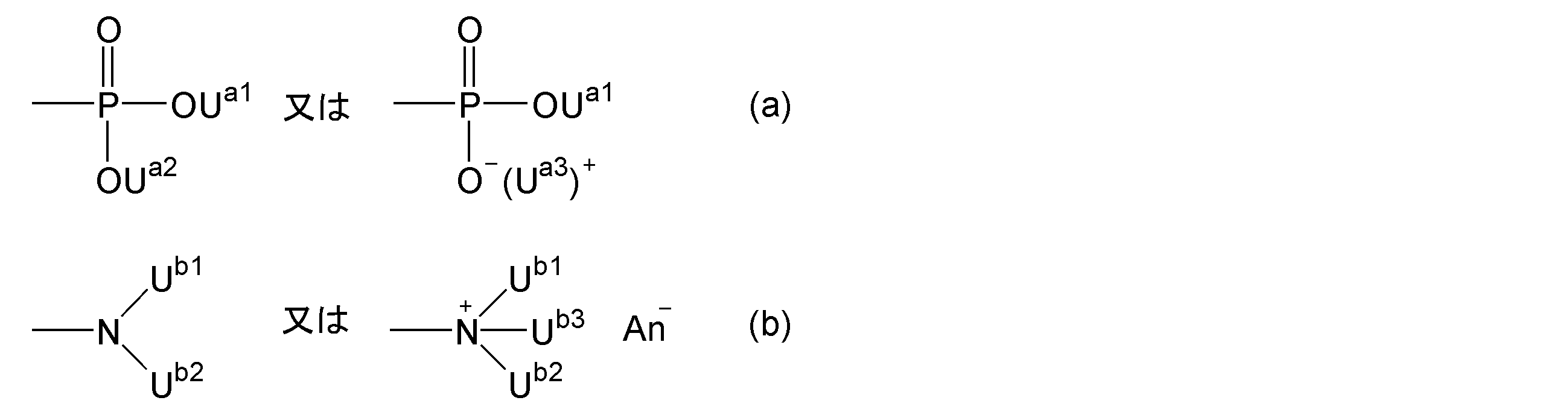
(式中、
Ua1は、炭素原子数6乃至10のアリール基又は炭素原子数1乃至5の直鎖若しくは分岐アルキル基を表し、Ua2は、水素原子を表し、Ua3は、アルカリ金属を表し;
Ub1、Ub2及びUb3は、それぞれ独立して、水素原子又は炭素原子数1乃至5の直鎖若しくは分岐アルキル基を表し;
An-は、ハロゲン化物イオン、無機酸イオン、水酸化物イオン及びイソチオシアネートイオンからなる群から選ばれる陰イオンを表す)
と、溶媒とを含むコーティング膜形成用組成物を、基体に塗布する工程、
を含むコーティング膜の製造方法。

[式中、
Rcは、炭素原子数1乃至18の直鎖若しくは分岐アルキル基、炭素原子数3乃至10の環式炭化水素基、炭素原子数6乃至10のアリール基、炭素原子数7乃至15のアラルキル基又は炭素原子数7乃至15のアリールオキシアルキル基(ここで、前記アリール部分は、ハロゲン原子で置換されていてもよい炭素原子数1乃至5の直鎖若しくは分岐アルキル基で置換されていてもよい)を表す]
で表される有機基を含む繰り返し単位を含む、上記13に記載のコーティング膜の製造方法。
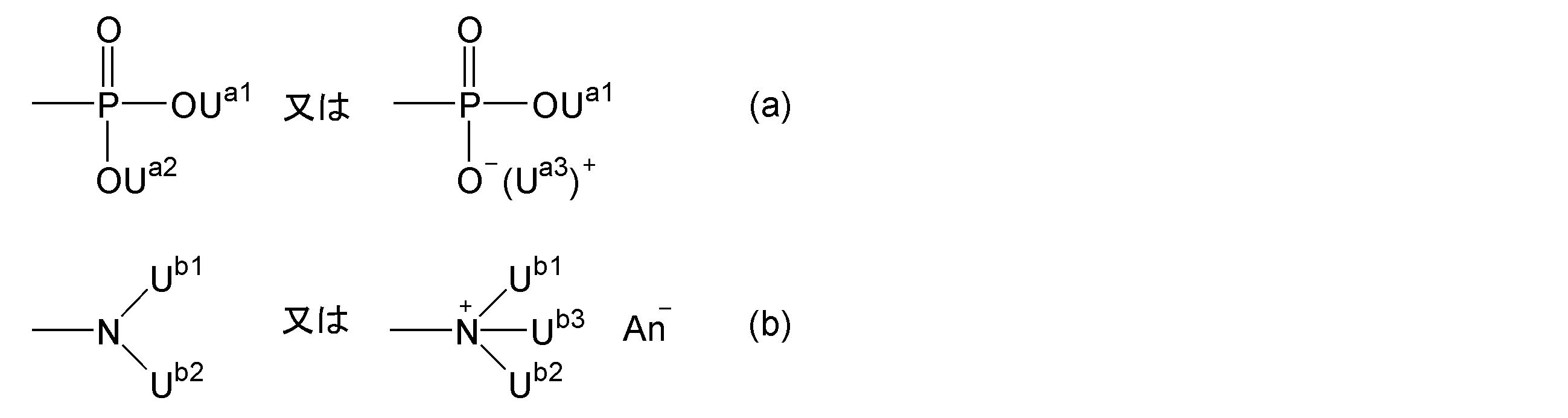
(式中、
Ua1は、炭素原子数6乃至10のアリール基又は炭素原子数1乃至5の直鎖若しくは分岐アルキル基を表し、Ua2は、水素原子を表し、Ua3は、アルカリ金属を表し;
Ub1、Ub2及びUb3は、それぞれ独立して、水素原子又は炭素原子数1乃至5の直鎖若しくは分岐アルキル基を表し;
An-は、ハロゲン化物イオン、無機酸イオン、水酸化物イオン及びイソチオシアネートイオンからなる群から選ばれる陰イオンを表す)
を含むコーティング膜を、少なくとも一部の表面に備えることを特徴とする、細胞培養容器。
本発明において用いられる用語は、他に特に断りのない限り、以下の定義を有する。
本発明において、「無機酸イオン」とは、炭酸イオン、硫酸イオン、リン酸イオン、リン酸水素イオン、リン酸二水素イオン、硝酸イオン、過塩素酸イオン又はホウ酸イオンを意味する。
上記An-として好ましいのは、ハロゲン化物イオン、硫酸イオン、リン酸イオン、水酸化物イオン及びイソチオシアネートイオンであり、特に好ましいのはハロゲン化物イオンである。
本発明のコーティング膜は、(i)下記式(a)で表される有機基を含む繰り返し単位と、下記式(b)で表される有機基を含む繰り返し単位とを含む共重合体:

[式中、Rcは、炭素原子数1乃至18の直鎖若しくは分岐アルキル基、炭素原子数3乃至10の環式炭化水素基、炭素原子数6乃至10のアリール基、炭素原子数7乃至15のアラルキル基又は炭素原子数7乃至15のアリールオキシアルキル基(ここで、前記アリール部分は、ハロゲン原子で置換されていてもよい炭素原子数1乃至5の直鎖若しくは分岐アルキル基で置換されていてもよい)を表す]
で表される有機基を含む繰り返し単位を含んでもよい。
pH調整剤の例としては、アンモニア、ジエタノールアミン、ピリジン、N-メチル-D-グルカミン、トリス(ヒドロキシメチル)アミノメタン等の有機アミン;水酸化カリウム、水酸化ナトリウム等のアルカリ金属水酸化物;塩化カリウム、塩化ナトリウム等のアルカリ金属ハロゲン化物;硫酸、リン酸、塩酸、炭酸等の無機酸又はそのアルカリ金属塩;コリン等の4級アンモニウムカチオン、あるいはこれらの混合物(例えば、リン酸緩衝生理食塩水等の緩衝液)を挙げることができる。これらの中でも、アンモニア、ジエタノールアミン、水酸化ナトリウム、コリン、N-メチル-D-グルカミン、トリス(ヒドロキシメチル)アミノメタンが好ましく、特にアンモニア、ジエタノールアミン、水酸化ナトリウム及びコリンが好ましい。
本発明のコーティング膜を形成するための基体としては、ガラス、金属、金属含有化合物若しくは半金属含有化合物、活性炭又は樹脂を挙げることができる。金属は、典型金属:(アルカリ金属:Li、Na、K、Rb、Cs;アルカリ土類金属:Ca、Sr、Ba、Ra)、マグネシウム族元素:Be、Mg、Zn、Cd、Hg;アルミニウム族元素:Al、Ga、In;希土類元素:Y、La、Ce、Pr、Nd、Sm、Eu;スズ族元素:Ti、Zr、Sn、Hf、Pb、Th;鉄族元素:Fe、Co、Ni;土酸元素:V、Nb、Ta、クロム族元素:Cr、Mo、W、U;マンガン族元素:Mn、Re;貴金属:Cu、Ag、Au;白金族元素:Ru、Rh、Pd、Os、Ir、Pt等が挙げられる。金属含有化合物若しくは半金属含有化合物は、例えば基本成分が金属酸化物で、高温での熱処理によって焼き固めた焼結体であるセラミックス、シリコンのような半導体、金属酸化物若しくは半金属酸化物(シリコン酸化物、アルミナ等)、金属炭化物若しくは半金属炭化物、金属窒化物若しくは半金属窒化物(シリコン窒化物等)、金属ホウ化物若しくは半金属ホウ化物などの無機化合物の成形体など無機固体材料、アルミニウム、ニッケルチタン、ステンレス(SUS304、SUS316、SUS316L等)が挙げられる。
特に粒子の場合には、粒子が溶媒中に分散したコロイド(フォーム、エマルション(ラテックス)、サスペンジョン(懸濁液)等;例えば、セレニウムコロイド)等であってもよい。
例えば人工透析器のフィルター用コーティング膜とする場合は、上記素材で作成された例えば直径0.1乃至500μmの中空糸形状をしたフィルターの内側に本発明に係るコーティング膜形成用組成物を通液し、その後乾燥工程、洗浄工程(熱水(例えば40℃乃至95℃)洗浄等)を経て作製することができる。
必要に応じて、滅菌のためにγ線、エチレンオキサイド、オートクレーブ等の処理がされる場合もある。
また、本発明のコーティング膜は、フラスコ、ディッシュ、プレート等の細胞培養容器や、蛋白質の付着を抑えた各種研究用器具のコーティング膜として有用である。
また、本発明のコーティング膜は、化粧品用材料、コンタクトレンズケア用品用材料、スキンケア用繊維加工剤、生化学研究用診断薬用材料、臨床診断法で広く用いられている酵素免疫測定(ELISA)法やラテックス凝集法、イムノクロマトグラフ法における非特異的吸着を抑制するためのブロッキング剤、酵素や抗体などの蛋白質を安定化するための安定化剤としても有用である。
さらに本発明のコーティング膜は、トイレタリー、パーソナルケア用品、洗剤、医薬品、医薬部外品、繊維、防汚材向けのコーティング膜としても有用である。
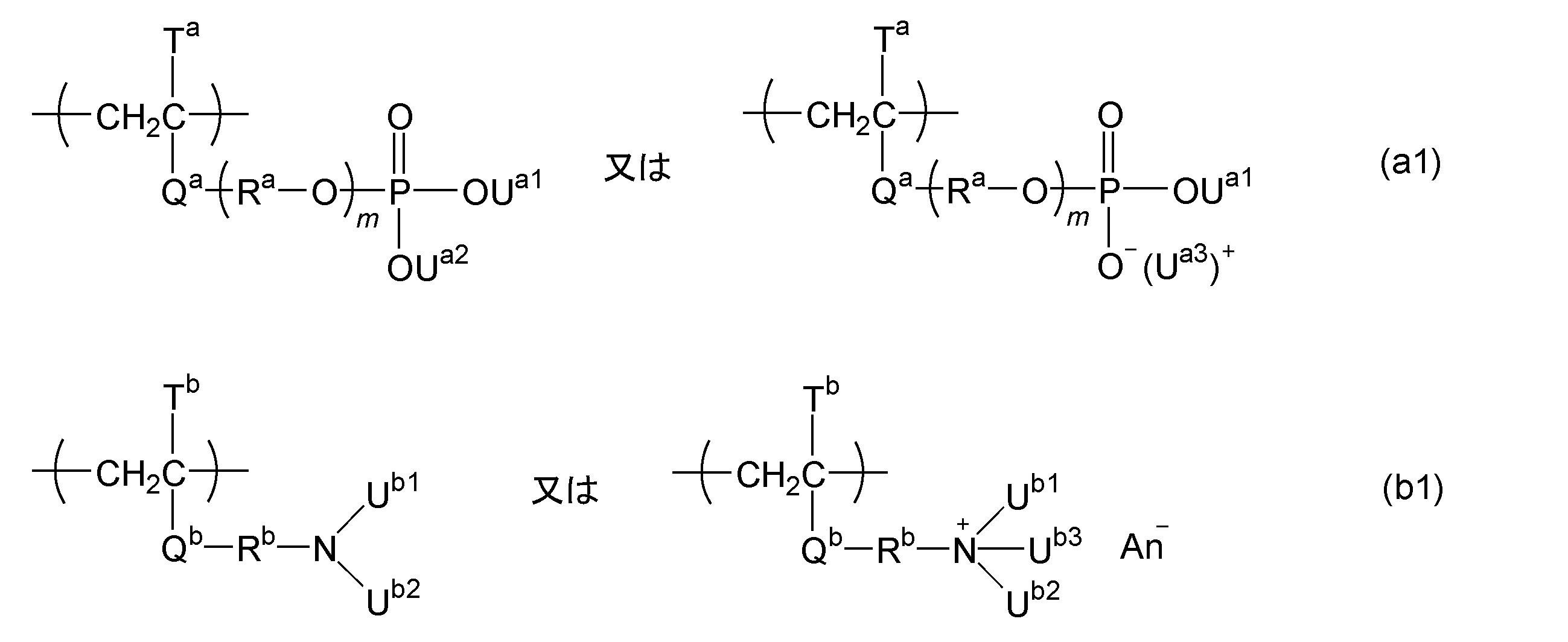

Ta及びTbは、それぞれ独立して、水素原子又は炭素原子数1乃至5の直鎖若しくは分岐アルキル基を表し;
Qa及びQbは、それぞれ独立して、単結合、エステル結合又はアミド結合を表し;
Ra及びRbは、それぞれ独立して、ハロゲン原子で置換されていてもよい炭素原子数1乃至10の直鎖若しくは分岐アルキレン基を表し;
Ua1は、炭素原子数6乃至10のアリール基又は炭素原子数1乃至5の直鎖若しくは分岐アルキル基を表し、Ua2は、水素原子を表し、Ua3は、アルカリ金属を表し;
Ub1、Ub2及びUb3は、それぞれ独立して、水素原子又は炭素原子数1乃至5の直鎖若しくは分岐アルキル基を表し;
An-は、ハロゲン化物イオン、無機酸イオン、水酸化物イオン及びイソチオシアネートイオンからなる群から選ばれる陰イオンを表し;
mは、0乃至6の整数を表す]
で表される化合物を含むモノマー混合物を、溶媒中にて反応(重合)させることにより得られる共重合体に関する。

Tcは、それぞれ独立して、水素原子又は炭素原子数1乃至5の直鎖若しくは分岐アルキル基を表し;
Qcは、単結合、エーテル結合又はエステル結合を表し;
Rcは、炭素原子数1乃至18の直鎖若しくは分岐アルキル基、炭素原子数3乃至10の環式炭化水素基、炭素原子数6乃至10のアリール基、炭素原子数7乃至15のアラルキル基又は炭素原子数7乃至15のアリールオキシアルキル基(ここで、前記アリール部分は、ハロゲン原子で置換されていてもよい炭素原子数1乃至5の直鎖若しくは分岐アルキル基で置換されていてもよい)を表す]
で表わされる化合物を含むモノマー混合物より得られる共重合体であってよい。


式(B)で表される化合物の、上記共重合体を形成するモノマー全体に対する割合は、3モル%乃至80モル%である。また、式(B)で表される化合物は、2種以上であってもよい。
式(C)で表される化合物の、上記共重合体を形成するモノマー全体に対する割合は、上記式(A)及び(B)の割合を差し引いた残部であってもよいが、例えば0モル%乃至90モル%である。また、式(C)で表される化合物は、2種以上であってもよい。
本発明に係るコーティング膜形成用組成物は、所望の共重合体を、所望の溶媒にて所定の濃度に希釈することにより調製してもよい。
さらに本発明に係るコーティング膜形成用組成物は、本発明の共重合体含有ワニスから調製してもよい。本発明の共重合体含有ワニスは、上記式(A)、(B)及び場合により(C)で表される化合物を、溶媒中で、両化合物の合計濃度0.01質量%乃至20質量%にて反応(重合)させる工程を含む製造方法により調製することができる。
水への溶解性、イオンバランス及びモノマーとの相互作用を考慮した場合、2,2’-アゾ(2-メチル-N-(2-ヒドロキシエチル)プロピオンアミド、2,2’-アゾビス(N-(2-カルボキシエチル)-2-メチルプロピオンアミジン)n-水和物、4,4’-アゾビス(4-シアノペンタン酸)、2,2’-アゾビス[2-(2-イミダゾリン-2-イル)プロパン]二塩酸塩、2,2’-アゾビス[2-(2-イミダゾリン-2-イル)プロパン]二硫酸塩二水和物、2,2’-アゾビス[2-(2-イミダゾリン-2-イル)プロパン]、2,2’-アゾビス(2-メチルプロピオンアミジン)二塩酸塩及びペルオキソ二硫酸から選ばれることが好ましい。
有機溶媒への溶解性、イオンバランス及びモノマーとの相互作用を考慮した場合、2,2’-アゾビス(2,4-ジメチルバレロニトリル)又は2,2’-アゾビス(イソブチロニトリル)を用いることが望ましい。
限定されない。
下記合成例に示す共重合体の重量平均分子量はGel Filtration Chromatography(以下、GFCと略称する)による測定結果である。測定条件等は次のとおりである。
(測定条件)
・装置:Prominence(島津製作所製)
・GFCカラム:OHpak SB-804 HQ (8.0mmID×300mL)
・流速:0.5 mL/min
・溶離液:イオン性水溶液、および、エタノール混合水溶液
・カラム温度:40℃
・検出器:RI
・注入濃度:ポリマー固形分0.1質量%
・注入量:100μL
・検量線:三次近似曲線
・標準試料:ポリエチレンオキサイド(Agilent社製)×10種
窒素雰囲気下、ジクロロりん酸フェニル(東京化成工業(株)製)60.01g(0.28mol)、テトラヒドロフラン204.02g、トリエチルアミン60.43g(0.60mol)を1L四つ口フラスコに入れ、0℃に冷却し、30分間撹拌した。メタクリル酸2-ヒドロキシエチル(Aldrich社製)37.02g(0.28mol)をテトラヒドロフラン51.00gに溶解した溶液を0℃で1時間かけて滴下し、0℃でさらに4時間撹拌した。超純水5.12gとテトラヒドロフラン51.00gの混合液を0℃で1時間かけて滴下し、0℃でさらに4時間撹拌した。その後、25℃に昇温し、25℃でさらに19時間撹拌した。反応液をPTFE製メンブレンフィルターでろ過し、テトラヒドロフラン20.00gでケーキ洗浄し、ろ液中の溶媒を減圧下で留去して濃縮液を得た。別の300ml四つ口フラスコに5M水酸化ナトリウム水溶液75.09gを入れ、17~23℃で濃縮液78.36gを滴下することで、白色の結晶が析出した。結晶をろ過し、純水10.30gで3回ケーキ洗浄し、結晶を減圧下で乾燥した。乾燥した結晶にジエチルエーテル180.00gを加えて撹拌し、PTFE製のメンブレンフィルターでろ過し、結晶を乾燥することで2-メタクリロイルオキシエチルフェニルヒドロジェンホスフェートナトリウム塩を白色粉末として32.51g(収率37.1%)得た。液体クロマトグラフィーによる測定を行った結果、純度は99.3%であった。
1H-NMR(400MHz,DMSO-d6)1.84(s,3H),3.95(t,2H),4.18(t,2H),5.65(s,1H),5.98(s,1H),6.94(t,1H)7.13(d,2H),7.20(t,2H)
上記合成実施例で得られた2-メタクリロイルオキシエチルフェニルヒドロジェンホスフェートナトリウム塩2.00gを純水10.90gに溶解し、0.2μmフィルターにて濾過した。その水溶液にエタノール1.21g、メタクリロイルコリンクロリド80%水溶液(東京化成工業(株)製)1.68g、2,2’-アゾビス(N-(2-カルボキシエチル)-2-メチルプロピオンアミジン)n-水和物(製品名;VA-057、和光純薬工業(株)製)0.02gを、20℃以下に保ちながら順に加えた。十分に攪拌して均一となった上記全てのものが入った混合液を滴下ロートに導入した。一方で、別途純水16.02g、エタノール1.82gを冷却管付きの3つ口フラスコに入れ、これを窒素フローし、撹拌しながらリフラックス温度まで昇温した。この状態を維持しつつ、上記混合液を導入した滴下ロートを3つ口フラスコにセットし、0.5時間かけて混合液を純水とエタノールの沸騰液内に滴下した。滴下後、24時間上記環境を維持した。24時間後に冷却することで固形分約9.90質量%のコロイド状の共重合体ワニス33.65gを得た。
上記合成実施例で得られた2-メタクリロイルオキシエチルフェニルヒドロジェンホスフェートナトリウム塩2.00gを純水9.86gに溶解し、0.2μmフィルターにて濾過した。その水溶液にエタノール9.86g、メタクリロイルコリンクロリド80%水溶液(東京化成工業(株)製)1.68g、メタクリル酸ブチル(東京化成工業(株)製)1.84g、2,2’-アゾビス(2,4-ジメチルバレロニトリル)(製品名;V-65、和光純薬工業(株)製)0.03gを、20℃以下に保ちながら順に加えた。十分に攪拌して均一となった上記全てのものが入った混合液を滴下ロートに導入した。一方で、別途純水3.86g、エタノール23.01gを冷却管付きの3つ口フラスコに入れ、これを窒素フローし、撹拌しながらリフラックス温度まで昇温した。この状態を維持しつつ、上記混合液を導入した滴下ロートを3つ口フラスコにセットし、0.5時間かけて混合液を純水とエタノールの沸騰液内に滴下した。滴下後、24時間上記環境を維持した。24時間後に冷却することで固形分約9.74質量%の共重合体ワニス52.18gを得た。得られたワニスのGPCにおけるメインピークの重量平均分子量は約4,500であった。
アシッドホスホオキシエチルメタクリレート(製品名;ホスマーM、ユニケミカル社製、純度91.8%)6.00gとメタクリル酸2-(ジメチルアミノ)エチル4.12g(東京化成工業(株)製)と2,2’-アゾ(2-メチル-N-(2-ヒドロキシエチル)プロピオンアミド)(製品名;VA-086、和光純薬(株)製)0.10gを、純水12.40gとエタノール12.40gに溶解して20℃以下に保ちながら順に加えた。十分に攪拌して均一となった上記全てのものが入った混合液を滴下ロートに導入した。一方で、別途純水433.94g、エタノール37.20gを冷却管付きの3つ口フラスコに入れ、これを窒素フローし、撹拌しながらリフラックス温度まで昇温した。この状態を維持しつつ、上記混合液を導入した滴下ロートを3つ口フラスコにセットし、0.5時間かけて混合液を純水とエタノールの沸騰液内に滴下した。滴下後、24時間上記環境を維持した。24時間後に冷却することで固形分約1.64質量%のコロイド状の共重合体ワニス506.05gを得た。
半導体評価用の市販のシリコンウェハをそのまま用いた。
上記重合実施例1で得られた共重合体含有ワニス1.00gに、水25.51g、エタノール6.49gを加えて十分に攪拌し、コーティング膜形成組成物を調製した。得られたコーティング膜形成組成物を、上記シリコンウェハに1500rpm/30secでスピンコートした。その後、コーティング膜上に付着している未硬化の膜形成用組成物をPBSと純水で十分に洗浄を行って、光学式干渉膜厚計でシリコンウェハ上のコーティング膜の膜厚を確認したところ19Åであった。
上記重合実施例2で得られた共重合体含有ワニス1.00gに、水9.44g、エタノール22.03gを加えて十分に攪拌し、コーティング膜形成組成物を調製した。得られたコーティング膜形成組成物を、上記シリコンウェハに1500rpm/30secでスピンコートした。その後、コーティング膜上に付着している未硬化の膜形成用組成物をPBSと純水で十分に洗浄を行って、光学式干渉膜厚計でシリコンウェハ上のコーティング膜の膜厚を確認したところ178Åであった。
上記重合比較例1で得られた共重合体含有ワニス10.00gに、水2.51g、エタノール3.89gを加えて十分に攪拌し、コーティング膜形成組成物を調製した。得られたコーティング膜形成組成物を、上記シリコンウェハに1500rpm/30secでスピンコートした。その後、コーティング膜上に付着している未硬化の膜形成用組成物をPBSと純水で十分に洗浄を行って、光学式干渉膜厚計でシリコンウェハ上のコーティング膜の膜厚を確認したところ75Åであった。
Au蒸着された水晶振動子(Q-Sense,QSX304)を、UV/オゾン洗浄装置(UV253E、フィルジェン(株)製)を用いて10分間洗浄し、直後に2-アミノエタンチオール(東京化成工業(株)製)0.0772gをエタノール1000mLに溶解した溶液中に24時間浸漬した。エタノールでセンサー表面を洗浄後自然乾燥し、ポリスチレン(Aldrich社製)1.00gをトルエン99.00gに溶解したワニスをスピンコーターにて3500rpm/30secで膜センサー側にスピンコートし、205℃/1min乾燥することでQCMセンサー(PS)とした。
Au蒸着された水晶振動子(Q-Sense,QSX304)を、UV/オゾン洗浄装置(UV253E、フィルジェン(株)製)を用いて10分間洗浄し、直後に2-アミノエタンチオール(東京化成工業(株)製)0.0772gをエタノール1000mLに溶解した溶液中に24時間浸漬した。エタノールでセンサー表面を洗浄後自然乾燥し、コロジオン(5%)(Aldrich社製)1.00gをプロピレングリコールモノメチルエーテル(協和発酵社製)4.56gに溶解したワニスをスピンコーターにて3500rpm/30secで膜センサー側にスピンコートし、150℃/30sec乾燥することでQCMセンサー(NC)とした。
(コーティングQCMセンサー(PS)の作成)
上記、QCMセンサー(PS)に、実施例2で調製したコーティング膜形成用組成物を3500rpm/30secでスピンコートした。その後、洗浄工程として過剰についた未硬化のコーティング膜形成用組成物をPBSと超純水にて各2回ずつ洗浄し、コーティングQCMセンサー(PS)とした。
(コーティングQCMセンサー(PS)の作成)
実施例2で調製したコーティング膜形成用組成物を、比較実施例1で調製したコーティング膜形成用組成物に代えた以外は、実施例3と同様に実施して、コーティングQCMセンサー(PS)を得た。
(コーティングQCMセンサー(NC)の作成)
上記、QCMセンサー(NC)に、実施例1で調製したコーティング膜形成用組成物を3500rpm/30secでスピンコートした。その後、洗浄工程として過剰についた未硬化のコーティング膜形成用組成物をPBSと超純水にて各2回ずつ洗浄し、コーティングQCMセンサー(NC)とした。
(コーティングQCMセンサー(NC)の作成)
実施例1で調製したコーティング膜形成用組成物を、実施例2で調製したコーティング膜形成用組成物に代えた以外は、実施例4と同様に実施して、コーティングQCMセンサー(NC)を得た。
(FBS中の生体由来物質の付着量試験;QCM-D測定)
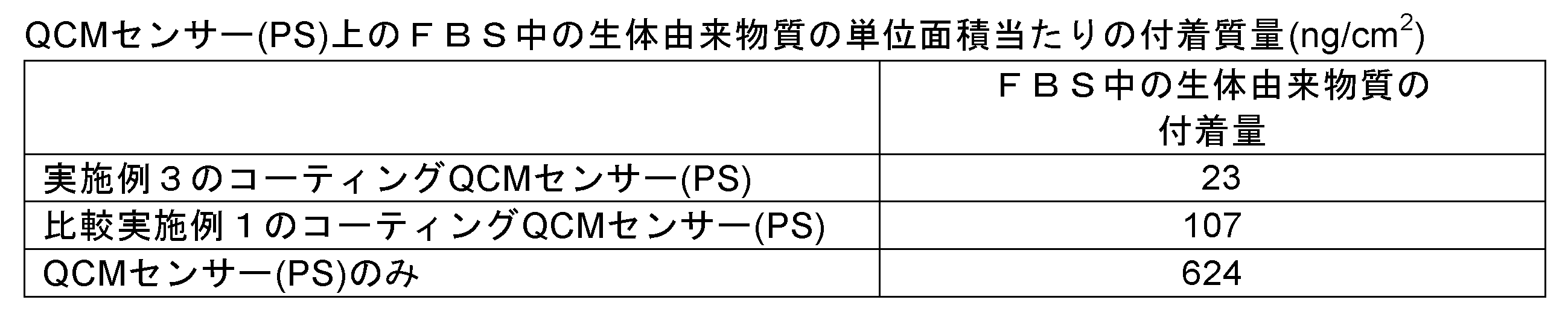
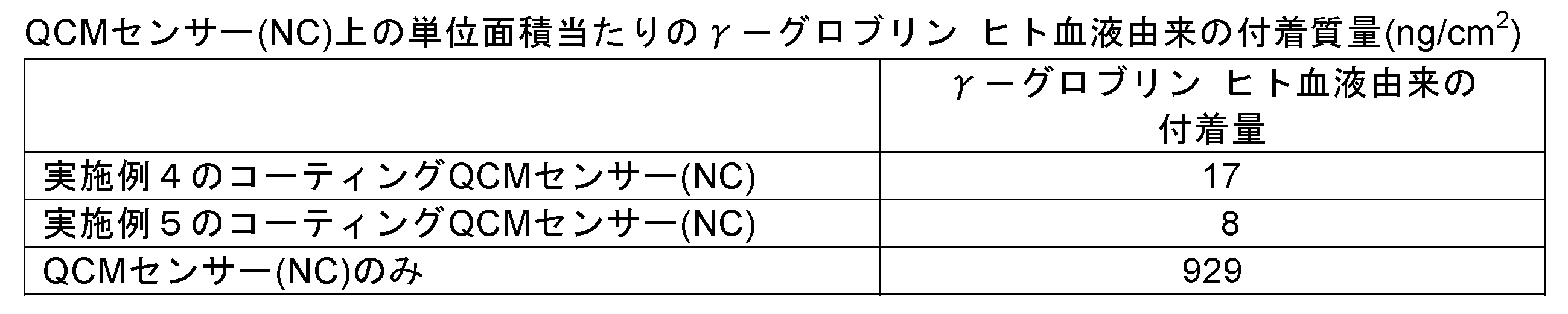
上記実施例3及び比較実施例1で得られたコーティングQCMセンサー(PS)、並びに上記実施例4及び5で得られたコーティングQCMセンサー(NC)を、それぞれ散逸型水晶振動子マイクロバランスQCM-D(E4、Q-Sense社製)に取り付け、周波数の変化が1時間で1Hz以下となる安定したベースラインを確立するまでPBSを流した。次に、安定したベースラインの周波数を0Hzとして約10分間PBSを流した。引き続き、41010 ・ Basal Medium Eagle (BME), no Glutamine(サーモフィッシャーサイエンティフィック(株)製)に15wt%のウシ血清(FBS)、L-Glutamine、抗生物質としてペニシリンとストレプトマイシンを添加した溶液、又はγ-グロブリン ヒト血液由来(Aldrich社製)0.1gをPBS1Lに溶解した液を約30分流し、その後再びPBSを約20分流した後の11次オーバートーンの吸着誘起周波数のシフト(Δf)を読み取った。分析のためにQ-Tools(Q-Sense社製)を使用して、吸着誘起周波数のシフト(Δf)を、Sauerbrey式で説明される吸着誘起周波数のシフト(Δf)を単位面積当たりの質量(ng/cm2)と換算したものをFBS中の生体由来物質の付着量又はγ-グロブリン ヒト血液由来の付着量として表1、2に示す。なお、陰性対象としては、コーティング処理をしていないQCMセンサー(PS)又はQCMセンサー(NC)を用いた。
以下の各処理工程を順番に実施し、本発明のコーティング膜を備える細胞培養プレートを調製した。
処理1:実施例2で調製したコーティング膜形成組成物を、メッシュサイズが0.22μmのフィルターを用いてろ過した後、96穴細胞培養プレート(BDバイオサイエンス社製、#351172)のウェルに200μL(固形分1質量%)/ウェルとなるよう添加し、室温にて1時間静置後、過剰のワニスを除去した。
(コーティングプレートの調製)
実施例6で得られたコーティングされた細胞培養プレートを用いた。陽性対照のサンプルとしては、市販の細胞低接着プレート(コーニング社製、#3474)を用いた。陰性対照としては、コーティングを施していない96穴細胞培養プレート(BDバイオサイエンス社製、#351172)を用いた。
細胞は、マウス胚線維芽細胞C3H10T1/2(DSファーマバイオメディカル社製)を用いた。細胞の培養に用いた培地は、10%FBS(HyClone社製)とL-グルタミン-ペニシリン-ストレプトマイシン安定化溶液(Sigma-Aldrich社製)を含むBME培地(サーモフィッシャーサイエンティフィック社製)を用いた。細胞は、37℃/CO2インキュベーター内にて5%二酸化炭素濃度を保った状態で、直径10cmのシャーレ(培地10mL)を用いて2日間以上静置培養した。引き続き、本細胞をPBS5mlで洗浄した後、トリプシン-EDTA溶液(インビトロジェン社製)1mLを添加して細胞を剥がし、上記の培地10mLにてそれぞれ懸濁した。本懸濁液を遠心分離((株)トミー精工製、型番LC-200、1000rpm/3分、室温)後、上清を除き、上記の培地を添加して細胞懸濁液を調製した。
上記にて調製したプレートに対して、それぞれの細胞懸濁液を2×10³cells/wellとなるように各100μL加えた。その後、5%二酸化炭素濃度を保った状態で、37℃で4日間CO2インキュベーター内にて静置した。
培養4日間後、実施例6のプレート、陽性対照、及び陰性対照のプレートに対する細胞の付着を倒立型顕微鏡(オリンパス(株)製、CKX31)による観察 (倍率:40倍)に基づき比較した。実施例6のプレート、及び陽性対照いずれのプレートでも、細胞の付着はほとんど見られなかった。各プレートの結果(培養4日間後)を図1に示す。また、Cell Counting Kit-8溶液(同仁化学研究所製)を1ウェル当たり10μL添加し、37℃で2時間CO2インキュベーター内にて静置した。その後、吸光度計(MolecularDevices社製、SpectraMax)で450nmの吸光度を測定した。各測定値は、それぞれ培地のみを添加したウェルでの測定値を差し引いた。その結果を表3に示す。

この結果から、本願のコーティング膜が表面にコーティングされている容器は、細胞培養容器として有用である。
Claims (14)
- 下記式(A)及び(B):

[式中、
Ta及びTbは、それぞれ独立して、水素原子又は炭素原子数1乃至5の直鎖若しくは分岐アルキル基を表し;
Qa及びQbは、それぞれ独立して、単結合、エステル結合又はアミド結合を表し;
Ra及びRbは、それぞれ独立して、ハロゲン原子で置換されていてもよい炭素原子数1乃至10の直鎖若しくは分岐アルキレン基を表し;
Ua1は、炭素原子数6乃至10のアリール基又は炭素原子数1乃至5の直鎖若しくは分岐アルキル基を表し、Ua2は、水素原子を表し、Ua3は、アルカリ金属を表し;
Ub1、Ub2及びUb3は、それぞれ独立して、水素原子又は炭素原子数1乃至5の直鎖若しくは分岐アルキル基を表し;
An-は、ハロゲン化物イオン、無機酸イオン、水酸化物イオン及びイソチオシアネートイオンからなる群から選ばれる陰イオンを表し;
mは、0乃至6の整数を表す]
で表される化合物を少なくとも含むモノマー混合物を重合させることにより得られる、共重合体。 - モノマー混合物が、さらに下記式(C):

[式中、
Tcは、それぞれ独立して、水素原子又は炭素原子数1乃至5の直鎖若しくは分岐アルキル基を表し;
Qcは、単結合、エーテル結合又はエステル結合を表し;
Rcは、炭素原子数1乃至18の直鎖若しくは分岐アルキル基、炭素原子数3乃至10の環式炭化水素基、炭素原子数6乃至10のアリール基、炭素原子数7乃至15のアラルキル基又は炭素原子数7乃至15のアリールオキシアルキル基(ここで、前記アリール部分は、ハロゲン原子で置換されていてもよい炭素原子数1乃至5の直鎖若しくは分岐アルキル基で置換されていてもよい)を表す]
で表される化合物を含む、請求項1に記載の共重合体。 - (i)下記式(a)で表される有機基を含む繰り返し単位と、下記式(b)で表される有機基を含む繰り返し単位とを含む共重合体:
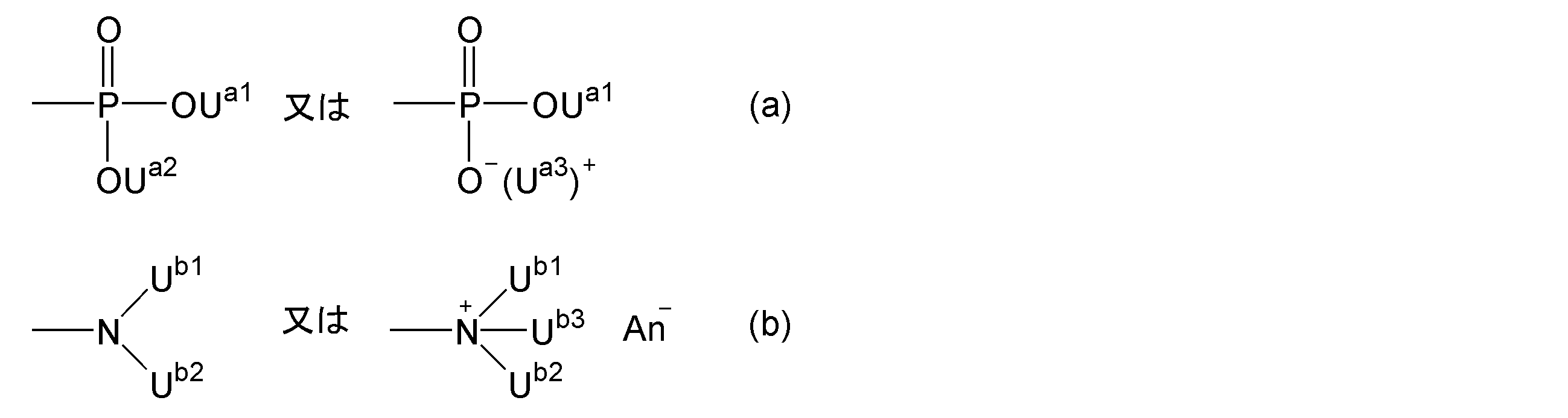
(式中、
Ua1は、炭素原子数6乃至10のアリール基又は炭素原子数1乃至5の直鎖若しくは分岐アルキル基を表し、Ua2は、水素原子を表し、Ua3は、アルカリ金属を表し;
Ub1、Ub2及びUb3は、それぞれ独立して、水素原子又は炭素原子数1乃至5の直鎖若しくは分岐アルキル基を表し;
An-は、ハロゲン化物イオン、無機酸イオン、水酸化物イオン及びイソチオシアネートイオンからなる群から選ばれる陰イオンを表す)及び
(ii)溶媒
を含む、コーティング膜形成用組成物。 - 共重合体が、さらに下記式(c):

[式中、
Rcは、炭素原子数1乃至18の直鎖若しくは分岐アルキル基、炭素原子数3乃至10の環式炭化水素基、炭素原子数6乃至10のアリール基、炭素原子数7乃至15のアラルキル基又は炭素原子数7乃至15のアリールオキシアルキル基(ここで、前記アリール部分は、ハロゲン原子で置換されていてもよい炭素原子数1乃至5の直鎖若しくは分岐アルキル基で置換されていてもよい)を表す]
で表される有機基を含む繰り返し単位を含む、請求項3に記載の組成物。 - 共重合体が、下記式(a1)及び(b1):
[式中、
Ta及びTbは、それぞれ独立して、水素原子又は炭素原子数1乃至5の直鎖若しくは分岐アルキル基を表し;
Qa及びQbは、それぞれ独立して、単結合、エステル結合又はアミド結合を表し;
Ra及びRbは、それぞれ独立して、ハロゲン原子で置換されていてもよい炭素原子数1乃至10の直鎖若しくは分岐アルキレン基を表し;
Ua1は、炭素原子数6乃至10のアリール基又は炭素原子数1乃至5の直鎖若しくは分岐アルキル基を表し、Ua2は、水素原子を表し、Ua3は、アルカリ金属を表し;
Ub1、Ub2及びUb3は、それぞれ独立して、水素原子又は炭素原子数1乃至5の直鎖若しくは分岐アルキル基を表し;
An-は、ハロゲン化物イオン、無機酸イオン、水酸化物イオン及びイソチオシアネートイオンからなる群から選ばれる陰イオンを表し;
mは、0乃至6の整数を表す]
で表される繰り返し単位を含む、請求項3又は4に記載の組成物。 - 共重合体が、さらに下記式(c1):

[式中、
Tcは、それぞれ独立して、水素原子又は炭素原子数1乃至5の直鎖若しくは分岐アルキル基を表し;
Qcは、単結合、エーテル結合又はエステル結合を表し;
Rcは、炭素原子数1乃至18の直鎖若しくは分岐アルキル基、炭素原子数3乃至10の環式炭化水素基、炭素原子数6乃至10のアリール基、炭素原子数7乃至15のアラルキル基又は炭素原子数7乃至15のアリールオキシアルキル基(ここで、前記アリール部分は、ハロゲン原子で置換されていてもよい炭素原子数1乃至5の直鎖若しくは分岐アルキル基で置換されていてもよい)を表す]
で表される繰り返し単位を含む、請求項3乃至5何れか1項に記載の組成物。 - 下記式(a)で表される有機基を含む繰り返し単位と、下記式(b)で表される有機基を含む繰り返し単位とを含む共重合体:
(式中、
Ua1は、炭素原子数6乃至10のアリール基又は炭素原子数1乃至5の直鎖若しくは分岐アルキル基を表し、Ua2は、水素原子を表し、Ua3は、アルカリ金属を表し;
Ub1、Ub2及びUb3は、それぞれ独立して、水素原子又は炭素原子数1乃至5の直鎖若しくは分岐アルキル基を表し;
An-は、ハロゲン化物イオン、無機酸イオン、水酸化物イオン及びイソチオシアネートイオンからなる群から選ばれる陰イオンを表す)
と、溶媒とを含むコーティング膜形成用組成物を、基体に塗布する工程、
を含む方法により得られるコーティング膜。 - 共重合体が、さらに下記式(c):

[式中、
Rcは、炭素原子数1乃至18の直鎖若しくは分岐アルキル基、炭素原子数3乃至10の環式炭化水素基、炭素原子数6乃至10のアリール基、炭素原子数7乃至15のアラルキル基又は炭素原子数7乃至15のアリールオキシアルキル基(ここで、前記アリール部分は、ハロゲン原子で置換されていてもよい炭素原子数1乃至5の直鎖若しくは分岐アルキル基で置換されていてもよい)を表す]
で表される有機基を含む繰り返し単位を含む、請求項7に記載のコーティング膜。 - 共重合体が、下記式(a1)及び(b1):

[式中、
Ta及びTbは、それぞれ独立して、水素原子又は炭素原子数1乃至5の直鎖若しくは分岐アルキル基を表し;
Qa及びQbは、それぞれ独立して、単結合、エステル結合又はアミド結合を表し;
Ra及びRbは、それぞれ独立して、ハロゲン原子で置換されていてもよい炭素原子数1乃至10の直鎖若しくは分岐アルキレン基を表し;
Ua1は、炭素原子数6乃至10のアリール基又は炭素原子数1乃至5の直鎖若しくは分岐アルキル基を表し、Ua2は、水素原子を表し、Ua3は、アルカリ金属を表し;
Ub1、Ub2及びUb3は、それぞれ独立して、水素原子又は炭素原子数1乃至5の直鎖若しくは分岐アルキル基を表し;
An-は、ハロゲン化物イオン、無機酸イオン、水酸化物イオン及びイソチオシアネートイオンからなる群から選ばれる陰イオンを表し;
mは、0乃至6の整数を表す]
で表される繰り返し単位を含む、請求項7又は8に記載のコーティング膜。 - 共重合体が、さらに下記式(c1):

[式中、
Tcは、それぞれ独立して、水素原子又は炭素原子数1乃至5の直鎖若しくは分岐アルキル基を表し;
Qcは、単結合、エーテル結合又はエステル結合を表し;
Rcは、炭素原子数1乃至18の直鎖若しくは分岐アルキル基、炭素原子数3乃至10の環式炭化水素基、炭素原子数6乃至10のアリール基、炭素原子数7乃至15のアラルキル基又は炭素原子数7乃至15のアリールオキシアルキル基(ここで、前記アリール部分は、ハロゲン原子で置換されていてもよい炭素原子数1乃至5の直鎖若しくは分岐アルキル基で置換されていてもよい)を表す]
で表される繰り返し単位を含む、請求項7乃至9何れか1項に記載のコーティング膜。 - 乾燥工程後に得られた膜を、さらに水及び電解質を含む水溶液からなる群より選ばれる少なくとも1種の溶媒で洗浄する工程を含む、請求項7乃至10の何れか1項に記載のコーティング膜。
- 生体物質の付着抑制能を有する、請求項7乃至11の何れか1項に記載のコーティング膜。
- 下記式(a)で表される有機基を含む繰り返し単位と、下記式(b)で表される有機基を含む繰り返し単位とを含む共重合体:
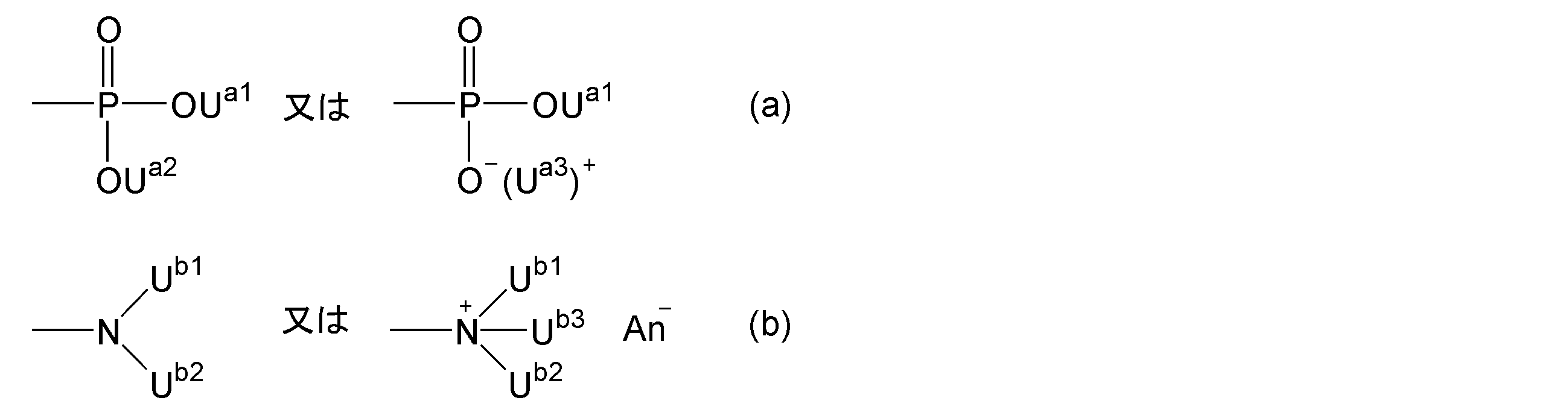
(式中、
Ua1は、炭素原子数6乃至10のアリール基又は炭素原子数1乃至5の直鎖若しくは分岐アルキル基を表し、Ua2は、水素原子を表し、Ua3は、アルカリ金属を表し;
Ub1、Ub2及びUb3は、それぞれ独立して、水素原子又は炭素原子数1乃至5の直鎖若しくは分岐アルキル基を表し;
An-は、ハロゲン化物イオン、無機酸イオン、水酸化物イオン及びイソチオシアネートイオンからなる群から選ばれる陰イオンを表す)
と、溶媒とを含むコーティング膜形成用組成物を、基体に塗布する工程、
を含むコーティング膜の製造方法。 - 共重合体が、さらに下記式(c):

[式中、
Rcは、炭素原子数1乃至18の直鎖若しくは分岐アルキル基、炭素原子数3乃至10の環式炭化水素基、炭素原子数6乃至10のアリール基、炭素原子数7乃至15のアラルキル基又は炭素原子数7乃至15のアリールオキシアルキル基(ここで、前記アリール部分は、ハロゲン原子で置換されていてもよい炭素原子数1乃至5の直鎖若しくは分岐アルキル基で置換されていてもよい)を表す]
で表される有機基を含む繰り返し単位を含む、請求項13に記載のコーティング膜の製造方法。
Priority Applications (5)
| Application Number | Priority Date | Filing Date | Title |
|---|---|---|---|
| KR1020177030375A KR20180023886A (ko) | 2015-07-03 | 2016-07-01 | 생체 물질의 부착 억제능을 갖는 이온 콤플렉스 재료 및 그 제조 방법 |
| US15/741,366 US20190002727A1 (en) | 2015-07-03 | 2016-07-01 | Ion complex material having function of inhibiting adhesion of biological substance and method for manufacturing the same |
| EP16821319.7A EP3318585A4 (en) | 2015-07-03 | 2016-07-01 | Ion complex material having ability to inhibit adhesion of biological materials, and method for producing same |
| JP2017527420A JPWO2017006850A1 (ja) | 2015-07-03 | 2016-07-01 | 生体物質の付着抑制能を有するイオンコンプレックス材料及びその製造方法 |
| CN201680026556.5A CN107531851A (zh) | 2015-07-03 | 2016-07-01 | 具有抑制生物材料附着的能力的离子复合物材料及其制造方法 |
Applications Claiming Priority (2)
| Application Number | Priority Date | Filing Date | Title |
|---|---|---|---|
| JP2015-134401 | 2015-07-03 | ||
| JP2015134401 | 2015-07-03 |
Publications (1)
| Publication Number | Publication Date |
|---|---|
| WO2017006850A1 true WO2017006850A1 (ja) | 2017-01-12 |
Family
ID=57685259
Family Applications (1)
| Application Number | Title | Priority Date | Filing Date |
|---|---|---|---|
| PCT/JP2016/069602 Ceased WO2017006850A1 (ja) | 2015-07-03 | 2016-07-01 | 生体物質の付着抑制能を有するイオンコンプレックス材料及びその製造方法 |
Country Status (6)
| Country | Link |
|---|---|
| US (1) | US20190002727A1 (ja) |
| EP (1) | EP3318585A4 (ja) |
| JP (1) | JPWO2017006850A1 (ja) |
| KR (1) | KR20180023886A (ja) |
| CN (1) | CN107531851A (ja) |
| WO (1) | WO2017006850A1 (ja) |
Cited By (3)
| Publication number | Priority date | Publication date | Assignee | Title |
|---|---|---|---|---|
| WO2017217336A1 (ja) * | 2016-06-15 | 2017-12-21 | 日産化学工業株式会社 | 凍結保存用容器 |
| WO2019078027A1 (ja) * | 2017-10-18 | 2019-04-25 | 富士フイルム株式会社 | 硬化性組成物、膜、硬化物、医療用部材 |
| US12291701B2 (en) | 2017-09-26 | 2025-05-06 | Nissan Chemical Corporation | Cell culture container having minute volume |
Families Citing this family (1)
| Publication number | Priority date | Publication date | Assignee | Title |
|---|---|---|---|---|
| WO2021167037A1 (ja) * | 2020-02-19 | 2021-08-26 | 日産化学株式会社 | 生体物質付着抑制剤 |
Citations (9)
| Publication number | Priority date | Publication date | Assignee | Title |
|---|---|---|---|---|
| JPS5710653A (en) * | 1980-06-23 | 1982-01-20 | Taisei Kako Kk | Water-soluble of water-dispersible thermosetting coating composition |
| JPS6042403A (ja) * | 1983-04-22 | 1985-03-06 | カセラ・アクチエンゲゼルシヤフト | 架橋された親水性コポリマ−、その製造法及びその使用方法 |
| JPH01266126A (ja) * | 1988-04-19 | 1989-10-24 | Dainippon Ink & Chem Inc | 硬化性樹脂組成物 |
| JPH07215814A (ja) * | 1994-01-27 | 1995-08-15 | Kuraray Co Ltd | 抗菌性歯科用組成物 |
| JP2001279164A (ja) * | 2000-03-30 | 2001-10-10 | Kansai Paint Co Ltd | 塗料組成物 |
| JP2002047118A (ja) * | 2000-05-22 | 2002-02-12 | Kuraray Co Ltd | 抗菌性組成物 |
| JP2014120410A (ja) * | 2012-12-19 | 2014-06-30 | Toyo Ink Sc Holdings Co Ltd | 二次電池電極形成用組成物、二次電池電極、及び二次電池 |
| WO2014196650A1 (ja) * | 2013-06-07 | 2014-12-11 | 日産化学工業株式会社 | 生体物質の付着抑制能を有するイオンコンプレックス材料及びその製造方法 |
| WO2016093293A1 (ja) * | 2014-12-10 | 2016-06-16 | 日産化学工業株式会社 | 生体物質の付着抑制能を有するイオンコンプレックス材料及びその製造方法 |
Family Cites Families (1)
| Publication number | Priority date | Publication date | Assignee | Title |
|---|---|---|---|---|
| WO2013099901A1 (ja) * | 2011-12-28 | 2013-07-04 | Jsr株式会社 | 細胞接着防止剤 |
-
2016
- 2016-07-01 EP EP16821319.7A patent/EP3318585A4/en not_active Withdrawn
- 2016-07-01 WO PCT/JP2016/069602 patent/WO2017006850A1/ja not_active Ceased
- 2016-07-01 JP JP2017527420A patent/JPWO2017006850A1/ja active Pending
- 2016-07-01 US US15/741,366 patent/US20190002727A1/en not_active Abandoned
- 2016-07-01 CN CN201680026556.5A patent/CN107531851A/zh active Pending
- 2016-07-01 KR KR1020177030375A patent/KR20180023886A/ko not_active Withdrawn
Patent Citations (9)
| Publication number | Priority date | Publication date | Assignee | Title |
|---|---|---|---|---|
| JPS5710653A (en) * | 1980-06-23 | 1982-01-20 | Taisei Kako Kk | Water-soluble of water-dispersible thermosetting coating composition |
| JPS6042403A (ja) * | 1983-04-22 | 1985-03-06 | カセラ・アクチエンゲゼルシヤフト | 架橋された親水性コポリマ−、その製造法及びその使用方法 |
| JPH01266126A (ja) * | 1988-04-19 | 1989-10-24 | Dainippon Ink & Chem Inc | 硬化性樹脂組成物 |
| JPH07215814A (ja) * | 1994-01-27 | 1995-08-15 | Kuraray Co Ltd | 抗菌性歯科用組成物 |
| JP2001279164A (ja) * | 2000-03-30 | 2001-10-10 | Kansai Paint Co Ltd | 塗料組成物 |
| JP2002047118A (ja) * | 2000-05-22 | 2002-02-12 | Kuraray Co Ltd | 抗菌性組成物 |
| JP2014120410A (ja) * | 2012-12-19 | 2014-06-30 | Toyo Ink Sc Holdings Co Ltd | 二次電池電極形成用組成物、二次電池電極、及び二次電池 |
| WO2014196650A1 (ja) * | 2013-06-07 | 2014-12-11 | 日産化学工業株式会社 | 生体物質の付着抑制能を有するイオンコンプレックス材料及びその製造方法 |
| WO2016093293A1 (ja) * | 2014-12-10 | 2016-06-16 | 日産化学工業株式会社 | 生体物質の付着抑制能を有するイオンコンプレックス材料及びその製造方法 |
Non-Patent Citations (2)
| Title |
|---|
| DER-JANG LIAW ET AL.: "Polymerization and application of 2- methacryloyloxyethyl phenyl phosphate in coatings", DIE ANGEWANDTE MAKROMOLEKULARE CHEMIE, vol. 214, 1994, pages 169 - 178, XP055344910 * |
| See also references of EP3318585A4 * |
Cited By (6)
| Publication number | Priority date | Publication date | Assignee | Title |
|---|---|---|---|---|
| WO2017217336A1 (ja) * | 2016-06-15 | 2017-12-21 | 日産化学工業株式会社 | 凍結保存用容器 |
| US11470841B2 (en) | 2016-06-15 | 2022-10-18 | Nissan Chemical Corporation | Cryopreservation vessel |
| US12291701B2 (en) | 2017-09-26 | 2025-05-06 | Nissan Chemical Corporation | Cell culture container having minute volume |
| WO2019078027A1 (ja) * | 2017-10-18 | 2019-04-25 | 富士フイルム株式会社 | 硬化性組成物、膜、硬化物、医療用部材 |
| JPWO2019078027A1 (ja) * | 2017-10-18 | 2020-11-26 | 富士フイルム株式会社 | 硬化性組成物、膜、硬化物、医療用部材 |
| US11130831B2 (en) | 2017-10-18 | 2021-09-28 | Fujifilm Corporation | Curable composition, film, cured product, and medical member |
Also Published As
| Publication number | Publication date |
|---|---|
| KR20180023886A (ko) | 2018-03-07 |
| CN107531851A (zh) | 2018-01-02 |
| EP3318585A4 (en) | 2018-06-20 |
| JPWO2017006850A1 (ja) | 2018-04-19 |
| US20190002727A1 (en) | 2019-01-03 |
| EP3318585A1 (en) | 2018-05-09 |
Similar Documents
| Publication | Publication Date | Title |
|---|---|---|
| JP7131585B2 (ja) | 生体物質の付着抑制能を有するイオンコンプレックス材料及びその製造方法 | |
| JP6835114B2 (ja) | 生体物質の付着抑制能を有するイオンコンプレックス材料及びその製造方法 | |
| US20200369999A1 (en) | Cell culture container capable of long-term culture and method for manufacturing same | |
| WO2018016463A1 (ja) | 薄膜段差被覆性を有するコーティング膜、該膜を備える構造基体 | |
| WO2017006850A1 (ja) | 生体物質の付着抑制能を有するイオンコンプレックス材料及びその製造方法 | |
| JP6417818B2 (ja) | 滅菌済コーティング膜 | |
| JP7616203B2 (ja) | 生体物質付着抑制剤 | |
| JP7501374B2 (ja) | 生体物質への適合性を有するポリマーの製造方法 | |
| WO2015133461A1 (ja) | 生体物質の付着抑制能を有するイオンコンプレックス材料 |
Legal Events
| Date | Code | Title | Description |
|---|---|---|---|
| 121 | Ep: the epo has been informed by wipo that ep was designated in this application |
Ref document number: 16821319 Country of ref document: EP Kind code of ref document: A1 |
|
| ENP | Entry into the national phase |
Ref document number: 2017527420 Country of ref document: JP Kind code of ref document: A |
|
| ENP | Entry into the national phase |
Ref document number: 20177030375 Country of ref document: KR Kind code of ref document: A |
|
| NENP | Non-entry into the national phase |
Ref country code: DE |
|
| WWE | Wipo information: entry into national phase |
Ref document number: 2016821319 Country of ref document: EP |