WO2017007521A1 - Non-malleable obfuscator for sparse functions - Google Patents
Non-malleable obfuscator for sparse functions Download PDFInfo
- Publication number
- WO2017007521A1 WO2017007521A1 PCT/US2016/026072 US2016026072W WO2017007521A1 WO 2017007521 A1 WO2017007521 A1 WO 2017007521A1 US 2016026072 W US2016026072 W US 2016026072W WO 2017007521 A1 WO2017007521 A1 WO 2017007521A1
- Authority
- WO
- WIPO (PCT)
- Prior art keywords
- computer program
- obfuscated
- processors
- polynomial
- input
- Prior art date
- Legal status (The legal status is an assumption and is not a legal conclusion. Google has not performed a legal analysis and makes no representation as to the accuracy of the status listed.)
- Ceased
Links
Classifications
-
- G—PHYSICS
- G06—COMPUTING OR CALCULATING; COUNTING
- G06F—ELECTRIC DIGITAL DATA PROCESSING
- G06F21/00—Security arrangements for protecting computers, components thereof, programs or data against unauthorised activity
- G06F21/60—Protecting data
-
- G—PHYSICS
- G06—COMPUTING OR CALCULATING; COUNTING
- G06F—ELECTRIC DIGITAL DATA PROCESSING
- G06F21/00—Security arrangements for protecting computers, components thereof, programs or data against unauthorised activity
- G06F21/10—Protecting distributed programs or content, e.g. vending or licensing of copyrighted material ; Digital rights management [DRM]
- G06F21/12—Protecting executable software
- G06F21/14—Protecting executable software against software analysis or reverse engineering, e.g. by obfuscation
-
- H—ELECTRICITY
- H04—ELECTRIC COMMUNICATION TECHNIQUE
- H04L—TRANSMISSION OF DIGITAL INFORMATION, e.g. TELEGRAPHIC COMMUNICATION
- H04L9/00—Cryptographic mechanisms or cryptographic arrangements for secret or secure communications; Network security protocols
- H04L9/002—Countermeasures against attacks on cryptographic mechanisms
-
- H—ELECTRICITY
- H04—ELECTRIC COMMUNICATION TECHNIQUE
- H04L—TRANSMISSION OF DIGITAL INFORMATION, e.g. TELEGRAPHIC COMMUNICATION
- H04L2209/00—Additional information or applications relating to cryptographic mechanisms or cryptographic arrangements for secret or secure communication H04L9/00
- H04L2209/16—Obfuscation or hiding, e.g. involving white box
Definitions
- the present invention relates to a system for obfuscating a computer program and, more particularly, to a system for obfuscating a computer program containing any polynomial-size set of point functions to protect sensitive information in the computer program.
- obfuscation is the act of creating obfuscated code (i.e. source or machine code that is difficult for humans to understand).
- obfuscators transform readable code into obfuscated code using various techniques. The following are prior art in obfuscation algorithms.
- Literature Reference No. 2 considers the notion of cryptographic obfuscation. This work provides strong impossibility results of the strong notion of cryptographic obfuscation for general functions in the plain model (i.e., not in Random Oracle Model (ROM)). This work does not consider non-malleability.
- Literature Reference No. 3 provides strong point obfuscation from strong pseudorandom functions with super-polynomial hardness in the plain model. Such a program is important because it represents password-based access control to other systems.
- Literature Reference No. 4 provides how to obfuscate some classes of functions in the ROM and achieve the obfuscations in a composable way.
- the work considers the obfuscation for the class of graph access functions which are more generic that point functions, but it does not consider non-malleability of the obfuscation.
- Literature Reference No. 5 considers the obfuscation of polynomial ordered bounded decision diagrams (POBDDs) in the weaker notion of obfuscation, referred to as Indistinguishability Obfuscation (iO).
- POBDDs polynomial ordered bounded decision diagrams
- iO Indistinguishability Obfuscation
- a POBDD is used as an acyclic graph with vertices and edges representing variables and binary values, respectively. iO does not guarantee the protection of sensitive information of the circuit.
- Literature Reference No. 6 provides a general purpose obfuscation for ail polynomial-size circuit in the notion of iO, which satisfies a weaker form of security under the cryptographic multi-linear encoding. Due to the underlying building block, the obfuscation scheme is impractical because even to obfuscate a simple program, the size of the obfuscated program is too large to be deployed in practice. For example, an obfuscated program for a 16 bit string equality test has 30 gigabytes (GB) and its execution time exceeds 30 minutes.
- GB gigabytes
- the present invention relates to a system for obfuscating a computer
- the system comprises one or more processors and a non-transitory computer-readable medium having executable instructions encoded thereon such that when executed, the one or more processors perform multiple operations.
- the system receives, as input, sensitive data of an unprotected computer program P.
- a random oracle is used to algebraically hide a set of polynomial-size point functions representing the sensitive data.
- a set of obfuscated instructions internally hiding the sensitive data is output.
- the set of obfuscated instructions are used to transform the unprotected computer program P into a protected, obfuscated computer program ⁇ ' that is accepting of the set of polynomial-size point functions.
- the obfuscated computer program P' is written to a non-volatile computer-readable medium.
- a random oracle is used to algebraically hide a set of polynomial-size point functions of a computer program P, resulting in an obfuscated computer program P' that is accepting of the set of polynomial-size point functions.
- the set of polynomial-size point functions comprise sensitive information, and the obfuscated computer program P' is not vulnerable to an adversary.
- an adversary is prevented from modifying the obfuscated computer program P' to another re-obfuscated computer program
- the obfuscated computer program P' is evaluated with an input, wherein if the input is one of the set of polynomial-size point functions, then the obfuscated computer program P' will be evaluated to output I , and 0 otherwise.
- the present invention also comprises a method for causing a processor to perform the operations described herein.
- the present invention also comprises a
- FIG. 1 is a block diagram depicting the components of a system for
- FIG. 2 is an illustration of a computer program product according to
- FIG. 3 is a flow diagram illustration operations of the system for obfuscating a computer program according to embodiments of the present invention.
- the present invention relates to a system for obfuscating a computer
- any element in a claim that does not explicitly state "means for” performing a specified function, or “step for” performing a specific function, is not to be interpreted as a "means” or “step” clause as specified in 35 U.S.C. Section 1 12, Paragraph 6.
- the use of "step of or “act of in the claims herein is not intended to invoke the provisions of 35 U.S.C. 1 12, Paragraph 6.
- the above labels may change their orientation.
- the first is a system for obfuscating a computer program.
- the system is typically in the form of a computer system operating software or in the form of a "hard-coded" instruction set. This system may be incorporated into a wide variety of devices that provide different functionalities, such as a robot or other device.
- the second principal aspect is a method, typically in the form of software, operated using a data processing system (computer).
- the third principal aspect is a computer program product.
- the computer program product generally represents computer-readable instructions stored on a non-transitory computer-readable medium such as an optical storage device, e.g., a compact disc (CD) or digital versatile disc (DVD), or a magnetic storage device such as a floppy disk or magnetic tape.
- a non-transitory computer-readable medium such as an optical storage device, e.g., a compact disc (CD) or digital versatile disc (DVD), or a magnetic storage device such as a floppy disk or magnetic tape.
- a non-transitory computer-readable medium such as an optical storage device, e.g., a compact disc (CD) or digital versatile disc (DVD), or a magnetic storage device such as a floppy disk or magnetic tape.
- Other, non- limiting examples of computer-readable media include hard disks, read-only memory (ROM), and flash-type memories.
- FIG. 10 A block diagram depicting an example of a system (i.e., computer system
- the computer system 100 is configured to perform calculations, processes, operations, and/or functions associated with a program or algorithm.
- certain processes and steps discussed herein are realized as a series of instructions (e.g., software program) that reside within computer readable memory units and are executed by one or more processors of the computer system 100. When executed, the instructions cause the computer system 100 to perform specific actions and exhibit specific behavior, such as described herein.
- the computer system 100 may include an address/data bus 102 that is
- processor 104 configured to communicate information. Additionally, one or more data processing units, such as a processor 104 (or processors), are coupled with the address/data bus 102.
- the processor 104 is configured to process information and instructions.
- the processor 104 is a microprocessor.
- the processor 104 may be a different type of processor such as a parallel processor, or a field programmable gate array.
- the computer system 100 is configured to utilize one or more data storage units.
- the computer system 100 may include a volatile memory unit 106 (e.g., random access memory ("RAM”), static RAM, dynamic RAM, etc.) coupled with the address/data bus 102, wherein a volatile memory unit 106 is configured to store information and instructions for the processor 104.
- RAM random access memory
- static RAM static RAM
- dynamic RAM dynamic RAM
- the computer system 100 further may include a non-volatile memory unit 108 (e.g., read-only memory (“ROM”), programmable ROM (“PROM”), erasable programmable ROM (“EPROM”), electrically erasable programmable ROM “EEPROM”), flash memory, etc.) coupled with the address/data bus 102, wherein the non- volatile memory unit 108 is configured to store static information and instructions for the processor 104.
- the computer system 100 may execute instructions retrieved from an online data storage unit such as in "Cloud” computing.
- the computer system 100 also may include one or more interfaces, such as an interface 110, coupled with the address/data bus 102.
- the one or more interfaces are configured to enable the computer system 100 to interface with other electronic devices and computer systems.
- the communication interfaces implemented by the one or more interfaces may include wireline (e.g., serial cables, modems, network adaptors, etc.) and/or wireless (e.g., wireless modems, wireless network adaptors, etc.) communication technology.
- the computer system 100 may include an input device 112 coupled with the address/data bus 102, wherein the input device 1 12 is configured to communicate information and command selections to the processor 100.
- the input device 112 is an alphanumeric input device, such as a keyboard, that may include alphanumeric and/or function keys.
- the input device 112 may be an input device other than an alphanumeric input device.
- the computer system 100 may include a cursor control device 114 coupled with the address/data bus 102, wherein the cursor control device 114 is configured to communicate user input information and/or command selections to the processor 100.
- the cursor control device 1 14 is implemented using a device such as a mouse, a track-ball, a track-pad, an optical tracking device, or a touch screen. The foregoing notwithstanding, in an aspect, the cursor control device
- the cursor control device 114 is directed and/or activated via input from the input device 112, such as in response to the use of special keys and key sequence commands associated with the input device 1 12.
- the cursor control device 114 is configured to be directed or guided by voice commands.
- the computer system 100 further may include one or more
- a storage device 1 16 coupled with the address/data bus 102.
- the storage device 1 16 is configured to store information and/or computer executable instructions.
- the storage device 116 is a storage device such as a magnetic or optical disk drive
- a display device 1 18 is coupled with the address/data bus 102, wherein the display device 1 18 is configured to display video and/or graphics.
- the display device 1 18 may include a cathode ray tube (“CRT'), liquid crystal display
- LCD liquid crystal
- FED field emission display
- plasma display or any other display device suitable for displaying video and/or graphic images and alphanumeric characters recognizable to a user.
- the computer system 100 presented herein is an example computing
- the non-limiting example of the computer system 100 is not strictly limited to being a computer system.
- an aspect provides that the computer system 100 represents a type of data processing analysis that may be used in accordance with various aspects described herein.
- other computing systems may also be
- one or more operations of various aspects of the present technology are controlled or implemented using computer-executable instructions, such as program modules, being executed by a computer.
- program modules include routines, programs, objects, components and/or data structures that are configured to perform particular tasks or implement particular abstract data types.
- an aspect provides that one or more aspects of the present technology are implemented by utilizing one or more distributed computing environments, such as where tasks are performed by remote processing devices that are linked through a communications network, or such as where various program modules are located in both local and remote computer-storage media including memory-storage devices.
- FIG. 2 An illustrative diagram of a computer program product (i.e., storage device) embodying the present invention is depicted in FIG. 2.
- the computer program product is depicted as floppy disk 200 or an optical disk 202 such as a CD or DVD.
- the computer program product generally represents computer-readable instructions stored on any compatible non-transitory computer-readable medium.
- the term "instructions” as used with respect to this invention generally indicates a set of operations to be performed on a computer, and may represent pieces of a whole program or individual, separable, software modules.
- Non-limiting examples of "instruction” include computer program code (source or object code) and "hard-coded" electronics
- the "instruction” is stored on any non-transitory computer-readable medium, such as in the memory of a computer or on a floppy disk, a CD-ROM, and a flash drive. In either event, the instructions are encoded on a non-transitory computer-readable medium.
- the sensitive information is hardcoded in the set of point functions.
- ROM Random Oracle Model
- a truly random source is assumed; such a source is typically instantiated with an implementation of an appropriate cryptographic hash function.
- the present invention provides the following security and efficiency
- a second guarantee is a non-malleability guarantee, which means that given the obfuscated program, no adversary can modify it to another re-obfuscated program, which is related to the original one. For instance, in the case of a program representing several point functions, an adversary cannot remove, add or edit points (or hidden secrets) to the obfuscated program.
- O obfuscation algorithm
- Program Obfuscation In general, a program obfuscator, Obf, is a type of program compiler, which takes as input some description of a program P and outputs a "scrambled"-but-functionally-equivalent program description P'.
- -> denotes a mapping function
- F n denotes a function to be obfuscated.
- the output-length m 1, but this does not have to be the case in general.
- This sparse function family also provides a good illustration of the security notion guaranteed by a non-malleable obfuscation of a program that implements password checking.
- an attacker receives a copy of the obfuscated program 0(F PW ⁇ , where O is the obfuscation algorithm according to various embodiments of the present invention and F ⁇ pw,n] ' s a function that takes as input an //-bit string (for some known integer ;/), checks if the string is in a hidden list PW, and then outputs Yes ( 1 ) or No (0).
- the security property guaranteed by the non- malleable obfuscation algorithm O is that the code 0(F PW ) acts like a "house of cards" in the sense that any such attempted alteration to the program will totally destroy all hidden information in 0(F PW ), namely, the list PW.
- the attacker A may be able to produce a "similar-looking program" code P* that in fact embeds his desired point x*, but the remaining passwords in the mauled program P* will have no discemable relationship or correlation with the original, honest list of passwords PW.
- the program 0(F PW ) is "non-malleable.”
- the algorithm O in fact, produces a similar security guarantee for any sparse function family, not just the password-checker family.
- Point circuits Formally, the obfuscation algorithm according to various embodiments of the present invention takes as input the description of a "plaintext p(n)-point circuit" for hidden points y a in and
- any (general) sparse function may be obfuscated using the
- FIG. 3 is a flow diagram depicting operations performed by the system described herein.
- a sparse function of a computer program is encoded.
- a computer program having any polynomial-size set of sparse functions is obfuscated.
- sensitive information on the obfuscated program is protected from being discovered by an adversary.
- G is (the description of) a multiplicative group of order q
- g is a uniformly chosen generator of is the output of an
- the non-malleable obfuscator O for Boolean poly(n)-point circuits, in the random oracle model, is as follows:
- the present invention can be used to allow for the ability to obfuscate
- the described method transforms an unprotected (i.e., in the clear) access control program/software into a completely protected one (i.e., obfuscated software that is resistant to reverse engineering and analysis) that can be used as a subsystem or component in a larger computer system.
- a completely protected one i.e., obfuscated software that is resistant to reverse engineering and analysis
- a large private computer system e.g., commercial servers, computing clusters of private companies, etc.
- there might exist many individuals who need a root access, each with a distinct password e.g., system and network administrators or employees of a company).
- the method described herein provides a way to protect and transform such password checking programs, along with the passwords, in an executable form.
- a large computer system can be deployed with this executable obfuscated software (i.e., a set of instructions) such that if a person requests an access to the system by providing a password (i.e., an input string), then the system first runs the executable obfuscated software on the password (e.g., an input to the obfuscated software). If the execution of the obfuscated software outputs 1 , then the computer system grants an access to the person. Otherwise, the computer system denies the access.
- a password i.e., an input string
- the security guarantee is that even if an adversary intrudes into a computer system and obtains the obfuscated software, the adversary will not be able to find nor alter the passwords internally maintained by the obfuscated software.
- this obfuscated software is resistant to reverse engineering and analysis, is resistant to modifications without completely destroying its functionality, and does not reveal the passwords stored in it.
Landscapes
- Engineering & Computer Science (AREA)
- Theoretical Computer Science (AREA)
- Computer Security & Cryptography (AREA)
- Software Systems (AREA)
- Physics & Mathematics (AREA)
- General Physics & Mathematics (AREA)
- General Engineering & Computer Science (AREA)
- Computer Hardware Design (AREA)
- Multimedia (AREA)
- Technology Law (AREA)
- Health & Medical Sciences (AREA)
- Bioethics (AREA)
- General Health & Medical Sciences (AREA)
- Signal Processing (AREA)
- Computer Networks & Wireless Communication (AREA)
- Storage Device Security (AREA)
- Information Retrieval, Db Structures And Fs Structures Therefor (AREA)
Abstract
Described is a system for obfuscating a computer program. Sensitive data of an unprotected computer program is received as input. A random oracle is used to algebraically hide a set of polynomial-size point functions representing the sensitive data. The system outputs a set of obfuscated instructions internally hiding the sensitive data. The set of obfuscated instructions are used to transform the unprotected computer program into a protected, obfuscated computer program that is accepting of the set of polynomial-size point functions. The obfuscated computer program is written to a non-volatile computer-readable medium.
Description
[0001] NON-MALLEABLE OBFUSCATOR FOR SPARSE FUNCTIONS
[0002] CROSS-REFERENCE TO RELATED APPLICATIONS
[0003] This is a Non-Provisional application of U.S. Provisional Application No.
62/190,435, filed in the United States on July 9, 2015, entitled, "Non-Malleable Obfuscator for a Polynomial Set of Sparse Functions," which is incorporated herein by reference in its entirety.
[0004] BACKGROUND OF INVENTION
[0005] (1) Field of Invention
[0006] The present invention relates to a system for obfuscating a computer program and, more particularly, to a system for obfuscating a computer program containing any polynomial-size set of point functions to protect sensitive information in the computer program.
[0007] (2) Description of Related Art
[0008] In software development, obfuscation is the act of creating obfuscated code (i.e. source or machine code that is difficult for humans to understand).
Programmers may deliberately obfuscate code to conceal its purpose or its logic, in order to prevent tampering, deter reverse engineering, or as a puzzle or recreational challenge for someone reading the source code. Programs known as obfuscators transform readable code into obfuscated code using various techniques. The following are prior art in obfuscation algorithms.
The work described in Literature Reference No. 1 (see the List of Incorporated Literature References as provided below) considers the notion of non-malleable cryptographic obfuscation. It provides the first construction of non-malleable obfuscation for the class of multi-point programs, which accepts
a constant number of points from the input domain and obfuscates them using access to a Random Oracle (i.e., in the Random Oracle Model (ROM)).
[00010] Further, the work described in Literature Reference No. 2 considers the notion of cryptographic obfuscation. This work provides strong impossibility results of the strong notion of cryptographic obfuscation for general functions in the plain model (i.e., not in Random Oracle Model (ROM)). This work does not consider non-malleability. [0001 1 ] Literature Reference No. 3 provides strong point obfuscation from strong pseudorandom functions with super-polynomial hardness in the plain model. Such a program is important because it represents password-based access control to other systems. However, the obfuscation is achieved only for the family of point functions where a point function associated with a secret value x takes a string x' as input and outputs 1 if x = otherwise it outputs 0. A primary limitation of this work is that the system can handle only a single password rather than many.
[00012] Additionally, the work disclosed in Literature Reference No. 4 provides how to obfuscate some classes of functions in the ROM and achieve the obfuscations in a composable way. The work considers the obfuscation for the class of graph access functions which are more generic that point functions, but it does not consider non-malleability of the obfuscation. [00013] Literature Reference No. 5 considers the obfuscation of polynomial ordered bounded decision diagrams (POBDDs) in the weaker notion of obfuscation, referred to as Indistinguishability Obfuscation (iO). A POBDD is used as an acyclic graph with vertices and edges representing variables and binary values,
respectively. iO does not guarantee the protection of sensitive information of the circuit.
[00014] Finally, Literature Reference No. 6 provides a general purpose obfuscation for ail polynomial-size circuit in the notion of iO, which satisfies a weaker form of security under the cryptographic multi-linear encoding. Due to the underlying building block, the obfuscation scheme is impractical because even to obfuscate a simple program, the size of the obfuscated program is too large to be deployed in practice. For example, an obfuscated program for a 16 bit string equality test has 30 gigabytes (GB) and its execution time exceeds 30 minutes.
[00015] Thus, a continuing need exists for a non-malleable obfuscator for
obfuscating a polynomial number of points rather than a constant number and also provides security according to a stronger notion of obfuscation than existing methods.
[00016] SUMMARY OF THE INVENTION
[00017] The present invention relates to a system for obfuscating a computer
program and, more particularly, to a system for obfuscating a computer program containing any polynomial-size set of point functions to protect sensitive information in the computer program. The system comprises one or more processors and a non-transitory computer-readable medium having executable instructions encoded thereon such that when executed, the one or more processors perform multiple operations. The system receives, as input, sensitive data of an unprotected computer program P. A random oracle is used to algebraically hide a set of polynomial-size point functions representing the sensitive data. A set of obfuscated instructions internally hiding the sensitive data is output. The set of obfuscated instructions are used to transform the unprotected computer program P into a protected, obfuscated computer program
Ρ' that is accepting of the set of polynomial-size point functions. The obfuscated computer program P' is written to a non-volatile computer-readable medium.
[00018] A random oracle is used to algebraically hide a set of polynomial-size point functions of a computer program P, resulting in an obfuscated computer program P' that is accepting of the set of polynomial-size point functions. The set of polynomial-size point functions comprise sensitive information, and the obfuscated computer program P' is not vulnerable to an adversary.
[00019] In another aspect, an adversary is prevented from learning the set of
polynomial-size point functions.
[00020] In another aspect, an adversary is prevented from modifying the obfuscated computer program P' to another re-obfuscated computer program,
[00021 ] In another aspect, the obfuscated computer program P' is evaluated with an input, wherein if the input is one of the set of polynomial-size point functions, then the obfuscated computer program P' will be evaluated to output I , and 0 otherwise.
[00022] In another aspect, the present invention also comprises a method for causing a processor to perform the operations described herein.
[00023] Finally, in yet another aspect, the present invention also comprises a
computer program product comprising computer-readable instructions stored on a non-transitory computer-readable medium that are executable by a computer having a processor for causing the processor to perform the operations described herein.
[00024] BRIEF DESCRIPTION OF THE DRAWINGS
[00025] The objects, features and advantages of the present invention will be
apparent from the following detailed descriptions of the various aspects of the invention in conjunction with reference to the following drawings, where:
[00026] FIG. 1 is a block diagram depicting the components of a system for
obfuscating a computer program according to embodiments of the present invention;
[00027] FIG. 2 is an illustration of a computer program product according to
embodiments of the present invention; and
[00028] FIG. 3 is a flow diagram illustration operations of the system for obfuscating a computer program according to embodiments of the present invention.
[00029] DETAILED DESCRIPTION
[00030] The present invention relates to a system for obfuscating a computer
program and, more particularly, to a system for obfuscating a computer program containing any polynomial-size set of point functions to protect sensitive information in the computer program. The following description is presented to enable one of ordinary skill in the art to make and use the invention and to incorporate it in the context of particular applications. Various modifications, as well as a variety of uses in different applications will be readily apparent to those skilled in the art, and the general principles defined herein may be applied to a wide range of aspects. Thus, the present invention is not intended to be limited to the aspects presented, but is to be accorded the widest scope consistent with the principles and novel features disclosed herein.
[00031 ] In the following detailed description, numerous specific details are set forth in order to provide a more thorough understanding of the present invention. However, it will be apparent to one skilled in the art that the present invention may be practiced without necessarily being limited to these specific details. In other instances, well-known structures and devices are shown in block diagram form, rather than in detail, in order to avoid obscuring the present invention.
[00032] The reader's attention is directed to all papers and documents which are filed concurrently with this specification and which are open to public inspection with this specification, and the contents of all such papers and documents are incorporated herein by reference. All the features disclosed in this specification, (including any accompanying claims, abstract, and drawings) may be replaced by alternative features serving the same, equivalent or similar purpose, unless expressly stated otherwise. Thus, unless expressly stated otherwise, each feature disclosed is one example only of a generic series of equivalent or similar features.
[00033] Furthermore, any element in a claim that does not explicitly state "means for" performing a specified function, or "step for" performing a specific function, is not to be interpreted as a "means" or "step" clause as specified in 35 U.S.C. Section 1 12, Paragraph 6. In particular, the use of "step of or "act of in the claims herein is not intended to invoke the provisions of 35 U.S.C. 1 12, Paragraph 6.
[00034] Please note, if used, the labels left, right, front, back, top, bottom, forward, reverse, clockwise and counter-clockwise have been used for convenience purposes only and are not intended to imply any particular fixed direction.
Instead, they are used to reflect relative locations and/or directions between
various portions of an object. As such, as the present invention is changed, the above labels may change their orientation.
[00035] Before describing the invention in detail, first a list of cited literature
references used in the description is provided. Next, a description of various principal aspects of the present invention is provided. Following that is an introduction that provides an overview of the present invention. Finally, specific details of the present invention are provided to give an understanding of the specific aspects.
[00036] ( 1 ) List of Incorporated Literature References
[00037] The following references are cited and incorporated throughout this
application. For clarity and convenience, the references are listed herein as a central resource for the reader. The following references are hereby
incorporated by reference as though fully included herein. The references are cited in the application by referring to the corresponding literature reference number, as follows:
1. Ran Canetti and Mayank Varia. 2009. Non-malleable
Obfuscation. In Proceedings of the 6th Theory of Cryptography Conference on Theory of Cryptography (TCC Ό9), Omer Reingold (Ed.). Springer- Verlag, Berlin, Heidelberg, 73-90.
2. Boaz Barak, et al. On the (im)possibility of obfuscating
programs. In Joe, Kilian, editor, Advances in Cryptology - Crypto 2001, volume 2139 of Lecture Notes in Computer Science, pages 1-18, Santa Barbara, CA, USA, August 19-23, 2001. Springer.
3. Hoeteck Wee. On obfuscating point functions. In Harold N.
Gabow and Ronald Fagin, editors, 37* Annual ACM Symposium
on Theory of Computing, pages 523-532, Baltimore, Maryland, USA, May 22-24, 2005. ACM press.
4. Benjamin Lynn, et al. Positive results and techniques for
obfuscation, Advances in Cryptology - Eurocrypt 2004, volume 3027 of Lecture Notes in Computer Science, pages 20-39, Interlaken, Switzerland, May 2-6, 2004. Springer.
5. Shafi Goldwasser and Guy N. Rothblum. On best-possible
obfuscation. In Salil P. Vadhan, editor, TCC 2007: 4* Theory of Cryptography Conference, volume 4392 of Lecture Notes in Computer Science, pages 194-213, Amsterdam, The Netherlands, February 21-24, 2007. Springer.
6. Sanjam Garg, et al. Candidate indistinguishability obfuscation and functional encryption for all circuits. In 54th Annual
Symposium on Foundations of Computer Science, pages 40-49, Berkeley, CA, USA, October 26-29, 2013. IEEE Computer Society Press.
7. Jonathan Katz, Yehuda Lindell, Chapter 7: Introduction to
Modem Cryptography, 2007, Chapman & Hall/CRC.
8. Mihir Bellare and Phillip Rogaway, Random Oracles Are
Practical: A Paradigm for Designing Efficient Protocols,
Proceedings of the 1st ACM conference and Communication Security, CCS 93, page 62 - 73, 1993, ACM, New York, NY, USA.
[00038] (2) Principal Aspects
[00039] Various embodiments have three "principal" aspects. The first is a system for obfuscating a computer program. The system is typically in the form of a computer system operating software or in the form of a "hard-coded" instruction set. This system may be incorporated into a wide variety of devices that provide
different functionalities, such as a robot or other device. The second principal aspect is a method, typically in the form of software, operated using a data processing system (computer). The third principal aspect is a computer program product. The computer program product generally represents computer-readable instructions stored on a non-transitory computer-readable medium such as an optical storage device, e.g., a compact disc (CD) or digital versatile disc (DVD), or a magnetic storage device such as a floppy disk or magnetic tape. Other, non- limiting examples of computer-readable media include hard disks, read-only memory (ROM), and flash-type memories. These aspects will be described in more detail below.
[00040] A block diagram depicting an example of a system (i.e., computer system
100) of the present invention is provided in FIG. I. The computer system 100 is configured to perform calculations, processes, operations, and/or functions associated with a program or algorithm. In one aspect, certain processes and steps discussed herein are realized as a series of instructions (e.g., software program) that reside within computer readable memory units and are executed by one or more processors of the computer system 100. When executed, the instructions cause the computer system 100 to perform specific actions and exhibit specific behavior, such as described herein.
[00041 ] The computer system 100 may include an address/data bus 102 that is
configured to communicate information. Additionally, one or more data processing units, such as a processor 104 (or processors), are coupled with the address/data bus 102. The processor 104 is configured to process information and instructions. In an aspect, the processor 104 is a microprocessor.
Alternatively, the processor 104 may be a different type of processor such as a parallel processor, or a field programmable gate array.
[00042] The computer system 100 is configured to utilize one or more data storage units. The computer system 100 may include a volatile memory unit 106 (e.g., random access memory ("RAM"), static RAM, dynamic RAM, etc.) coupled with the address/data bus 102, wherein a volatile memory unit 106 is configured to store information and instructions for the processor 104. The computer system 100 further may include a non-volatile memory unit 108 (e.g., read-only memory ("ROM"), programmable ROM ("PROM"), erasable programmable ROM ("EPROM"), electrically erasable programmable ROM "EEPROM"), flash memory, etc.) coupled with the address/data bus 102, wherein the non- volatile memory unit 108 is configured to store static information and instructions for the processor 104. Alternatively, the computer system 100 may execute instructions retrieved from an online data storage unit such as in "Cloud" computing. In an aspect, the computer system 100 also may include one or more interfaces, such as an interface 110, coupled with the address/data bus 102. The one or more interfaces are configured to enable the computer system 100 to interface with other electronic devices and computer systems. The communication interfaces implemented by the one or more interfaces may include wireline (e.g., serial cables, modems, network adaptors, etc.) and/or wireless (e.g., wireless modems, wireless network adaptors, etc.) communication technology.
[00043] In one aspect, the computer system 100 may include an input device 112 coupled with the address/data bus 102, wherein the input device 1 12 is configured to communicate information and command selections to the processor 100. In accordance with one aspect, the input device 112 is an alphanumeric input device, such as a keyboard, that may include alphanumeric and/or function keys. Alternatively, the input device 112 may be an input device other than an alphanumeric input device. In an aspect, the computer system 100 may include a cursor control device 114 coupled with the
address/data bus 102, wherein the cursor control device 114 is configured to communicate user input information and/or command selections to the processor 100. In an aspect, the cursor control device 1 14 is implemented using a device such as a mouse, a track-ball, a track-pad, an optical tracking device, or a touch screen. The foregoing notwithstanding, in an aspect, the cursor control device
114 is directed and/or activated via input from the input device 112, such as in response to the use of special keys and key sequence commands associated with the input device 1 12. In an alternative aspect, the cursor control device 114 is configured to be directed or guided by voice commands.
[00044] In an aspect, the computer system 100 further may include one or more
optional computer usable data storage devices, such as a storage device 1 16, coupled with the address/data bus 102. The storage device 1 16 is configured to store information and/or computer executable instructions. In one aspect, the storage device 116 is a storage device such as a magnetic or optical disk drive
(e.g., hard disk drive ("HDD"), floppy diskette, compact disk read only memory ("CD-ROM"), digital versatile disk ("DVD")). Pursuant to one aspect, a display device 1 18 is coupled with the address/data bus 102, wherein the display device 1 18 is configured to display video and/or graphics. In an aspect, the display device 1 18 may include a cathode ray tube ("CRT'), liquid crystal display
("LCD"), field emission display ("FED"), plasma display, or any other display device suitable for displaying video and/or graphic images and alphanumeric characters recognizable to a user. [00045] The computer system 100 presented herein is an example computing
environment in accordance with an aspect. However, the non-limiting example of the computer system 100 is not strictly limited to being a computer system. For example, an aspect provides that the computer system 100 represents a type of data processing analysis that may be used in accordance with various aspects
described herein. Moreover, other computing systems may also be
implemented. Indeed, the spirit and scope of the present technology is not limited to any single data processing environment. Thus, in an aspect, one or more operations of various aspects of the present technology are controlled or implemented using computer-executable instructions, such as program modules, being executed by a computer. In one implementation, such program modules include routines, programs, objects, components and/or data structures that are configured to perform particular tasks or implement particular abstract data types. In addition, an aspect provides that one or more aspects of the present technology are implemented by utilizing one or more distributed computing environments, such as where tasks are performed by remote processing devices that are linked through a communications network, or such as where various program modules are located in both local and remote computer-storage media including memory-storage devices.
[00046] An illustrative diagram of a computer program product (i.e., storage device) embodying the present invention is depicted in FIG. 2. The computer program product is depicted as floppy disk 200 or an optical disk 202 such as a CD or DVD. However, as mentioned previously, the computer program product generally represents computer-readable instructions stored on any compatible non-transitory computer-readable medium. The term "instructions" as used with respect to this invention generally indicates a set of operations to be performed on a computer, and may represent pieces of a whole program or individual, separable, software modules. Non-limiting examples of "instruction" include computer program code (source or object code) and "hard-coded" electronics
(i.e. computer operations coded into a computer chip). The "instruction" is stored on any non-transitory computer-readable medium, such as in the memory of a computer or on a floppy disk, a CD-ROM, and a flash drive. In either event, the instructions are encoded on a non-transitory computer-readable medium.
[00047] (3) Introduction
[00048] Described is a system to obfuscate a computer program (and evaluate the resulting obfuscated program) containing any polynomial-size set of point functions to protect the sensitive information in it from reverse engineering or tampering in the Random Oracle Model (ROM) (see Literature Reference No. 8 for a description of the ROM). The sensitive information is hardcoded in the set of point functions. In the ROM, a truly random source is assumed; such a source is typically instantiated with an implementation of an appropriate cryptographic hash function.
[00049] The present invention provides the following security and efficiency
guarantees. One is a virtual black box guarantee, which means that given the obfuscated program as its input, no computationally efficient adversary can learn anything important about the sensitive information inside it, which is hardcoded in such point functions. A second guarantee is a non-malleability guarantee, which means that given the obfuscated program, no adversary can modify it to another re-obfuscated program, which is related to the original one. For instance, in the case of a program representing several point functions, an adversary cannot remove, add or edit points (or hidden secrets) to the obfuscated program.
[00050] The invention described herein is an obfuscation algorithm, called O, which non-malleably obfuscates all sparse functions, given access to a random oracle. Before describing the specific details of the present invention, a few key technical terms are defined to provide the reader with a general understanding of the intended meaning of the terms. The definitions provided below are not intended to convey the entire scope of each term. Rather, they are intended to
supplement the rest of the specification in more accurately explaining the terms used.
[00051 ] Program Obfuscation: In general, a program obfuscator, Obf, is a type of program compiler, which takes as input some description of a program P and outputs a "scrambled"-but-functionally-equivalent program description P'.
[00052] The goal of cryptographic program obfuscation is to compile program code P into program code P' so that P' can still be executed (i.e., P' produces the same outputs per input as the program P does), but so that the program code P' is somehow rendered "unintelligible" to any (potentially malicious) entity that has a copy of P'. The "unintelligibility" property is proven based on a
(hopefully, typical) cryptographic hardness assumption, like the intractability of factoring or finding (perhaps multi-linear) discrete logarithms. Different types of obfuscators provide different, concrete security guarantees.
[00053] The goal of non-malleable obfuscation is to compile programs P into
obfuscated programs P\ so that no efficient attacker A, who holds a copy of the obfuscated program P', is able to maul the program P' into a functionally- distinct-but-related program P*. (A formal definition is given in Literature Reference No. 1)
[00054] Sparse Functions: A sparse function family {Fn} is any set of (polynomial- time computable) functions Fn : {0,1}" -> {0,l}n (for any positive integers «, m) where, specifically, there exists a polynomial p =/>(«)» so that for all positive integers //, each function Fn in the family outputs a non-zero value on at most p\n) inputs x in {0,l}n. -> denotes a mapping function, and Fn denotes a function to be obfuscated.
[000S5] For example, the "password-checking function" (family), which (for each /;) takes as input a password-attempt x in {0,l}n, compares it against a list of passwords PW, and outputs 1 if x is in PW, and 0 otherwise, is a sparse function (family) when the size of the set PW is bounded by a fixed polynomial p = p(n) for all password-lengths n. For this family, the output-length m = 1, but this does not have to be the case in general.
[00056] This sparse function family also provides a good illustration of the security notion guaranteed by a non-malleable obfuscation of a program that implements password checking. Suppose an attacker receives a copy of the obfuscated program 0(FPW}, where O is the obfuscation algorithm according to various embodiments of the present invention and F{pw,n] 's a function that takes as input an //-bit string (for some known integer ;/), checks if the string is in a hidden list PW, and then outputs Yes ( 1 ) or No (0).
[000S7] Now suppose the attacker wishes to maul the program O(Fpw) by either (maliciously) deleting one of the passwords in the password-checking program (or perhaps adding a new hidden password to PW thai only the
attacker/adversary knows). The security property guaranteed by the non- malleable obfuscation algorithm O is that the code 0(FPW) acts like a "house of cards" in the sense that any such attempted alteration to the program will totally destroy all hidden information in 0(FPW), namely, the list PW. In other words, the attacker A may be able to produce a "similar-looking program" code P* that in fact embeds his desired point x*, but the remaining passwords in the mauled program P* will have no discemable relationship or correlation with the original, honest list of passwords PW. Thus, in this sense, the program 0(FPW)
is "non-malleable." The algorithm O, in fact, produces a similar security guarantee for any sparse function family, not just the password-checker family.
[00058] Point circuits: Formally, the obfuscation algorithm according to various embodiments of the present invention takes as input the description of a "plaintext p(n)-point circuit" for hidden points ya in
 and
and

an arbitrary polynomial p =p(n). The Boolean p(n)-point circuit

itself may take as input an «-bit string x, then it checks for


[00059] This already directly captures the notion of sparse Boolean (i.e., 0/1 -valued- output) functions, but it was observed that a simple "encoding trick" allows one to obfuscate "general sparse functions" (i.e., sparse functions that may output a bit-string on at most p(n) inputs). Namely, for each input on which the function outputs a string .v (the string v that is output may differ between distinct inputs
 , an associated set of inputs defined as


is the bit-length of the string m. The idea is that the Boolean point circuit
bit-inputs), corresponding

to the general point circuit

'

bit m. of the string m to which point yi maps in the general circuit.
[00060] Therefore, any (general) sparse function may be obfuscated using the
algorithm O by first encoding it as a Boolean point circuit, then running O.
[00061 ] (4) Specific Details of the Invention
[00062] Below is a description of the obfuscation algorithm O of the present
invention. Its security will be based on the (plain) discrete logarithm described in Literature Reference No. 7, which is briefly described below for
completeness. The full security proof is given in Literature Reference No. 8. A description of a sparse function of a computer program is provided above, which gives multiple secret polynomial points to be accepted by the program. Given the secret polynomial points, a random oracle is used to hide the points algebraically, resulting in an obfuscated program that is accepting of those points. A random oracle is an oracle that responds to every unique query with a random response chosen uniformly from its output domain. If a query is repeated, it responds the same way every time that query is submitted. Given the obfuscated program, no adversary can discover or modify sensitive information (i.e., secret points) from the obfuscated computer program. FIG. 3 is a flow diagram depicting operations performed by the system described herein. In a first operation 300, a sparse function of a computer program is encoded. In a second operation 302, a computer program having any polynomial-size set of sparse functions is obfuscated. In a third operation 304, sensitive information on the obfuscated program is protected from being discovered by an adversary.
[00063] The (plain) discrete logarithm assumption described in Literature Reference No. 7 is as follows: be a randomized algorithm that

takes as input security parameter 1n, and outputs a tuple where q is a

//-bit prime, G is (the description of) a multiplicative group of order q, and g is a uniformly chosen generator of is the output of an

algorithm Gen on input 1n, where 1n is an unary representation of its security parameter (i.e., desired strength of security).
[00064] The discrete logarithm assumption states that for uniform (for finite


[00065] The non-malleable obfuscator O for Boolean poly(n)-point circuits, in the random oracle model, is as follows:
[00066] Given oracle access to a random permutation //,
Input: for any (fixed) polynomial -point circuit


1. Extract the point y from the description of and


random permute the order of the

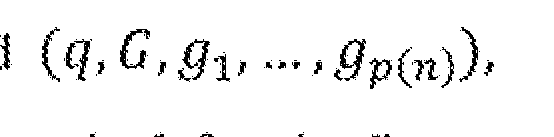
2. Sample a discrete logarithm instance


3. Sample vector uniformly.

4. Compute the group elements

5. Sample uniform random coins
 6.
6.
 query the random oracle H to obtain
denotes bit-string concatenation.


canonical manner.
8. Sample vector uniformly.

9. Set "zero-test parameter In the

present invention, the above function, for fixed
over inputs v is called the "generalized chameleon hash function."
10. Interpret each bit-string yy as an element of Fq, using the same (but arbitrary) canonical manner as above. for any vector a* such

that the inner product {a, a*) = 0. For example, vector

is even.
12. In the finite field Fq> find the many, unique degree


polynomials such that for all


[00067] To evaluate any program of the form on any

 bit input point x when additionally given oracle access (i.e. the ability to query) to the same random permutation H, proceed as follows:
1. Query the random oracle H to obtain


2. Interpret x* as a vector u in (in the same canonical fashion as
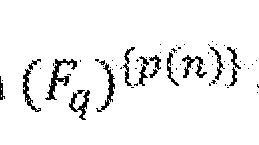
in the construction above).

4. Evaluate the generalized chameleon hash function on //* to obtain an element /* in Fq. That is, compute the value

[00068] The present invention can be used to allow for the ability to obfuscate
software executables that will allow them to keep adversaries from discovering sensitive information embedded in the software, particularly in the case of software that contains significant algorithmic intellectual property. In addition,
obfuscated software is more difficult to corrupt because only the input/output behavior is known, preventing an adversary from further probing.
[00069] The described method transforms an unprotected (i.e., in the clear) access control program/software into a completely protected one (i.e., obfuscated software that is resistant to reverse engineering and analysis) that can be used as a subsystem or component in a larger computer system. In particular, consider the following real application example. A large private computer system (e.g., commercial servers, computing clusters of private companies, etc.) requires one to provide a password to gain a root access to it. Furthermore, there might exist many individuals who need a root access, each with a distinct password (e.g., system and network administrators or employees of a company). In such a case, one needs a software or hardware which internally and privately maintains a set of several passwords, one or more for each of the individuals, takes an input string from a person, checks whether the input string matches one of the internal passwords, and grants an access to the person if the input string is indeed one of the passwords and denies the access request otherwise.
[00070] The method described herein, referred to as an obfuscator, provides a way to protect and transform such password checking programs, along with the passwords, in an executable form. One can use the method O (obfuscator) described above, which takes as an input a set of passwords and outputs an executable software of access control, which is a set of obfuscated instructions internally hiding the passwords. This output is resistant to reverse engineering and analysis and does not reveal the passwords stored in it. Therefore, the input to O is a set of passwords in the form of a software or file containing them, and the output of O is a set of obfuscated instructions for a password checking program.
[00071 ] A large computer system can be deployed with this executable obfuscated software (i.e., a set of instructions) such that if a person requests an access to the system by providing a password (i.e., an input string), then the system first runs the executable obfuscated software on the password (e.g., an input to the obfuscated software). If the execution of the obfuscated software outputs 1 , then the computer system grants an access to the person. Otherwise, the computer system denies the access.
[00072] The security guarantee is that even if an adversary intrudes into a computer system and obtains the obfuscated software, the adversary will not be able to find nor alter the passwords internally maintained by the obfuscated software. In other words, this obfuscated software is resistant to reverse engineering and analysis, is resistant to modifications without completely destroying its functionality, and does not reveal the passwords stored in it.
Claims
1. A system for obfuscating a computer program, the system comprising:
one or more processors and a non-transitory computer-readable medium having executable instructions encoded thereon such that when executed, the one or more processors perform an operation of:
receiving, as input, sensitive data of an unprotected computer program P\ using a random oracle to algebraically hide a set of polynomial-size point functions representing the sensitive data,
outputting a set of obfuscated instructions internally hiding the sensitive data;
using the set of obfuscated instructions to transform the unprotected computer program P into a protected, obfuscated computer program P' that is accepting of the set of polynomial-size point functions; and
writing, by the one or more processors, the obfuscated computer program P' to a non-volatile computer-readable medium.
2. The system as set forth in Claim 1 , wherein the one or more processors further perform an operation of preventing an adversary from learning the set of polynomial-size point functions.
3. The system as set forth in Claim 2, wherein the one or more processors further perform an operation of preventing an adversary from modifying the obfuscated computer program P' to another re-obfuscated computer program.
4. The system as set forth in Claim 3, wherein the one or more processors further perform an operation of evaluating the obfuscated computer program P' with an input, wherein if the input is one of the set of polynomial-size point
functions, then the obfuscated computer program P' will be evaluated to output 1, and 0 otherwise.
5. The system as set forth in Claim 1, wherein given the obfuscated computer
 program P', the one or more processors further perform an operation of
preventing an adversary from modifying the obfuscated computer program P' to another re-obfuscated computer program.
6. The system as set forth in Claim 1, wherein the one or more processors further perform an operation of evaluating the obfuscated computer program P' with an input, wherein if the input is one of the set of polynomial-size point functions, then the obfuscated computer program P' will be evaluated to output 1, and 0 otherwise.
7. A computer-implemented method for obfuscating a computer program,
comprising:
an act of causing one or more processors to execute instructions stored on a non-transitory memory such that upon execution, the one or more processors perform operations of:
receiving, as input, sensitive data of an unprotected computer program P; using a random oracle to algebraically hide a set of polynomial-size point functions representing the sensitive data,
outputting a set of obfuscated instructions internally hiding the sensitive data;
using the set of obfuscated instructions to transform the unprotected computer program P into a protected, obfuscated computer program P' that is accepting of the set of polynomial-size point functions; and
writing, by the one or more processors, the obfuscated computer program P' to a non-volatile computer-readable medium.
8. The method as set forth in Claim 7, wherein the one or more processors further perform an operation of preventing an adversary from learning the set of polynomial-size point functions.
9. The method as set forth in Claim 8, wherein the one or more processors further perform an operation of preventing an adversary from modifying the obfuscated computer program P' to another re-obfuscated computer program.
10. The method as set forth in Claim 9, wherein the one or more processors further perform an operation of evaluating the obfuscated computer program P' with an input, wherein if the input is one of the set of polynomial-size point functions, then the obfuscated computer program P' will be evaluated to output 1, and 0 otherwise.
1 1. The method as set forth in Claim 7, wherein given the obfuscated computer program P', the one or more processors further perform an operation of preventing an adversary from modifying the obfuscated computer program P' to another re-obfuscated computer program.
12. The method as set forth in Claim 7, wherein the one or more processors further perform an operation of evaluating the obfuscated computer program P' with an input, wherein if the input is one of the set of polynomial-size point functions, then the obfuscated computer program P' will be evaluated to output 1, and 0 otherwise.
13. A computer program product for obfuscating a computer program, the
computer program product comprising computer-readable instructions stored on a non-transitory computer-readable medium that are executable by a
computer having one or more processors for causing the processor to perform operations of:
receiving, as input, sensitive data of an unprotected computer program P\ using a random oracle to algebraically hide a set of polynomial-size point functions representing the sensitive data,
outputting a set of obfuscated instructions internally hiding the sensitive data;
using the set of obfuscated instructions to transform the unprotected computer program P into a protected, obfuscated computer program P' that is accepting of the set of polynomial-size point functions; and
writing, by the one or more processors, the obfuscated computer program P' to a non-volatile computer-readable medium.
14. The computer program product as set forth in 13, further comprising
instructions for causing the one or more processors to further perform an operation of preventing an adversary from learning the set of polynomial-size point functions.
15. The computer program product as set forth in 14, further comprising
instructions for causing the one or more processors to perform an operation of preventing an adversary from modifying the obfuscated computer program P' to another re-obfuscated computer program.
16. The computer program product as set forth in Claim 15, further comprising instructions for causing the one or more processors to perform an operation of evaluating the obfuscated computer program P' with an input, wherein if the input is one of the set of polynomial-size point functions, then the obfuscated computer program P' will be evaluated to output 1, and 0 otherwise.
17. The computer program product as set forth in 13, further comprising instructions for causing the one or more processors to perform an operation of preventing an adversary from modifying the obfuscated computer program P' to another re-obfuscated computer program.
18. The computer program product as set forth in Claim 13, further comprising instructions for causing the one or more processors to perform an operation of evaluating the obfuscated computer program P' with an input, wherein if the input is one of the set of polynomial-size point functions, then the obfuscated computer program P' will be evaluated to output 1, and 0 otherwise.
Priority Applications (2)
| Application Number | Priority Date | Filing Date | Title |
|---|---|---|---|
| CN201680031724.XA CN107667368B (en) | 2015-07-09 | 2016-04-05 | System, method and storage medium for obfuscating computer program |
| EP16821765.1A EP3320636A4 (en) | 2015-07-09 | 2016-04-05 | NON-MALLABLE OBSCURCISER FOR RARE FUNCTIONS |
Applications Claiming Priority (2)
| Application Number | Priority Date | Filing Date | Title |
|---|---|---|---|
| US201562190435P | 2015-07-09 | 2015-07-09 | |
| US62/190,435 | 2015-07-09 |
Publications (1)
| Publication Number | Publication Date |
|---|---|
| WO2017007521A1 true WO2017007521A1 (en) | 2017-01-12 |
Family
ID=57685965
Family Applications (1)
| Application Number | Title | Priority Date | Filing Date |
|---|---|---|---|
| PCT/US2016/026072 Ceased WO2017007521A1 (en) | 2015-07-09 | 2016-04-05 | Non-malleable obfuscator for sparse functions |
Country Status (4)
| Country | Link |
|---|---|
| US (1) | US10198584B2 (en) |
| EP (1) | EP3320636A4 (en) |
| CN (1) | CN107667368B (en) |
| WO (1) | WO2017007521A1 (en) |
Families Citing this family (5)
| Publication number | Priority date | Publication date | Assignee | Title |
|---|---|---|---|---|
| US10452865B2 (en) * | 2016-12-30 | 2019-10-22 | Mitsubishi Electric Research Laboratories, Inc. | Method and systems using privacy-preserving analytics for aggregate data |
| GB2612217B (en) * | 2019-08-01 | 2024-04-03 | Sky Cp Ltd | Secure media delivery |
| GB2586065B (en) | 2019-08-01 | 2023-02-15 | Sky Cp Ltd | Secure media delivery |
| US11456855B2 (en) * | 2019-10-17 | 2022-09-27 | Arm Limited | Obfuscating data at-transit |
| CN113688439A (en) * | 2021-08-30 | 2021-11-23 | 中国电信股份有限公司 | Data processing method, device, device and storage medium based on obfuscation circuit |
Citations (1)
| Publication number | Priority date | Publication date | Assignee | Title |
|---|---|---|---|---|
| US20090307500A1 (en) * | 2006-02-06 | 2009-12-10 | Taichi Sato | Program obfuscator |
Family Cites Families (4)
| Publication number | Priority date | Publication date | Assignee | Title |
|---|---|---|---|---|
| CA2327911A1 (en) * | 2000-12-08 | 2002-06-08 | Cloakware Corporation | Obscuring functions in computer software |
| US20080059624A1 (en) * | 2006-08-22 | 2008-03-06 | Groz Marc M | Method and system for protected calculation and transmission of sensitive data |
| US8171306B2 (en) * | 2008-11-05 | 2012-05-01 | Microsoft Corporation | Universal secure token for obfuscation and tamper resistance |
| WO2014154271A1 (en) * | 2013-03-27 | 2014-10-02 | Irdeto B.V. | Data processing |
-
2016
- 2016-04-05 WO PCT/US2016/026072 patent/WO2017007521A1/en not_active Ceased
- 2016-04-05 CN CN201680031724.XA patent/CN107667368B/en active Active
- 2016-04-05 EP EP16821765.1A patent/EP3320636A4/en not_active Withdrawn
- 2016-04-05 US US15/091,541 patent/US10198584B2/en active Active
Patent Citations (1)
| Publication number | Priority date | Publication date | Assignee | Title |
|---|---|---|---|---|
| US20090307500A1 (en) * | 2006-02-06 | 2009-12-10 | Taichi Sato | Program obfuscator |
Non-Patent Citations (5)
| Title |
|---|
| RAN CANETTI ET AL.: "Non-malleable Obfuscation", IN: PROCEEDINGS OF THE 6TH THEORY OF CRYPTOGRAPHY CONFERENCE (TCC 2009, vol. 5444, 15 March 2009 (2009-03-15), pages 73 - 90, XP047029897 * |
| RAN CANETTI ET AL.: "Obfuscating Point Functions with Multibit Output", IN: PROCEEDINGS OF THE 27TH ANNUAL INTERNATIONAL CONFERENCE ON THE THEORY AND APPLICATIONS OF CRYPTOGRAPHIC TECHNIQUES (EUROCRYPT 2008, vol. 4965, pages 489 - 508, XP047030424 * |
| See also references of EP3320636A4 * |
| SHAFI GOLDWASSER ET AL.: "On Best-Possible Obfuscation", IN: PROCEEDINGS OF THE 4TH THEORY OF CRYPTOGRAPHY CONFERENCE (TCC 2007, vol. 4392, 21 February 2007 (2007-02-21), pages 194 - 213, XP019055614, DOI: doi:10.1007/978-3-540-70936-7_11 * |
| ZVIKA BRAKERSKI ET AL.: "Obfuscating Conjunctions", IN: PROCEEDINGS OF THE 33RD ANNUAL CRYPTOLOGY CONFERENCE (CRYPTO 2013, vol. 8043, 18 August 2013 (2013-08-18), pages 416 - 434, XP047038136, DOI: doi:10.1007/978-3-642-40084-1_24 * |
Also Published As
| Publication number | Publication date |
|---|---|
| US20170316214A1 (en) | 2017-11-02 |
| EP3320636A1 (en) | 2018-05-16 |
| CN107667368A (en) | 2018-02-06 |
| US10198584B2 (en) | 2019-02-05 |
| CN107667368B (en) | 2020-12-22 |
| EP3320636A4 (en) | 2019-02-27 |
Similar Documents
| Publication | Publication Date | Title |
|---|---|---|
| Wang et al. | A novel hybrid color image encryption algorithm using two complex chaotic systems | |
| US10778423B2 (en) | Reusable fuzzy extractor based on the learning-with-error assumption secure against quantum attacks | |
| Liu et al. | Quantum image encryption algorithm based on four-dimensional chaos | |
| CN105024803B (en) | Behavior fingerprint in white box realization | |
| US10198584B2 (en) | Non-malleable obfuscator for sparse functions | |
| Berndt et al. | Algorithm substitution attacks from a steganographic perspective | |
| Zhu et al. | Image encryption algorithm with an avalanche effect based on a six-dimensional discrete chaotic system | |
| Huang et al. | A new two‐dimensional mutual coupled logistic map and its application for pseudorandom number generator | |
| Koppu et al. | A fast enhanced secure image chaotic cryptosystem based on hybrid chaotic magic transform | |
| CN105184115B (en) | For including to the method in white box realization by implicit integrality or credibility check | |
| CN107111965A (en) | Secret tampering detection system, secret computing device, secret tampering detection method, and program | |
| Liu et al. | A color image encryption scheme based on a novel 3d chaotic mapping | |
| US10798075B2 (en) | Interface layer obfuscation and usage thereof | |
| US10509918B1 (en) | One-time obfuscation for polynomial-size ordered binary decision diagrams (POBDDs) | |
| Mondal et al. | A practical key-recovery attack on LWE-based key-encapsulation mechanism schemes using Rowhammer | |
| EP4127981A1 (en) | Systems, methods, and storage media for creating secured transformed code from input code using a neural network to obscure a function | |
| Chhotaray et al. | Hardening circuit-design ip against reverse-engineering attacks | |
| Guanghui et al. | Chaotic Image Encryption Based on Running‐Key Related to Plaintext | |
| Sihwail et al. | A new image encryption method using an optimized smart codebook | |
| Li et al. | Securely outsourcing ID3 decision tree in cloud computing | |
| Milani et al. | An efficient method for digital image encryption based on improved chaotic map | |
| Nini et al. | Security analysis of a three‐dimensional rotation‐based image encryption | |
| Popoola | Data Integrity Using Caesar Cipher and Residue Number System | |
| Li et al. | Image traceable privacy protection scheme based on blockchain and homomorphic encryption | |
| Abdallah | Securing Online 3D Web-Based Models |
Legal Events
| Date | Code | Title | Description |
|---|---|---|---|
| 121 | Ep: the epo has been informed by wipo that ep was designated in this application |
Ref document number: 16821765 Country of ref document: EP Kind code of ref document: A1 |
|
| NENP | Non-entry into the national phase |
Ref country code: DE |
|
| WWE | Wipo information: entry into national phase |
Ref document number: 2016821765 Country of ref document: EP |
|
| WWW | Wipo information: withdrawn in national office |
Ref document number: 2016821765 Country of ref document: EP |