WO2017010008A1 - 繊維機械部品用鋼板およびその製造方法 - Google Patents
繊維機械部品用鋼板およびその製造方法 Download PDFInfo
- Publication number
- WO2017010008A1 WO2017010008A1 PCT/JP2015/070444 JP2015070444W WO2017010008A1 WO 2017010008 A1 WO2017010008 A1 WO 2017010008A1 JP 2015070444 W JP2015070444 W JP 2015070444W WO 2017010008 A1 WO2017010008 A1 WO 2017010008A1
- Authority
- WO
- WIPO (PCT)
- Prior art keywords
- less
- textile machine
- content
- steel sheet
- machine parts
- Prior art date
- Legal status (The legal status is an assumption and is not a legal conclusion. Google has not performed a legal analysis and makes no representation as to the accuracy of the status listed.)
- Ceased
Links
Images


Classifications
-
- C—CHEMISTRY; METALLURGY
- C21—METALLURGY OF IRON
- C21D—MODIFYING THE PHYSICAL STRUCTURE OF FERROUS METALS; GENERAL DEVICES FOR HEAT TREATMENT OF FERROUS OR NON-FERROUS METALS OR ALLOYS; MAKING METAL MALLEABLE, e.g. BY DECARBURISATION OR TEMPERING
- C21D9/00—Heat treatment, e.g. annealing, hardening, quenching or tempering, adapted for particular articles; Furnaces therefor
- C21D9/46—Heat treatment, e.g. annealing, hardening, quenching or tempering, adapted for particular articles; Furnaces therefor for sheet metals
-
- B—PERFORMING OPERATIONS; TRANSPORTING
- B22—CASTING; POWDER METALLURGY
- B22D—CASTING OF METALS; CASTING OF OTHER SUBSTANCES BY THE SAME PROCESSES OR DEVICES
- B22D11/00—Continuous casting of metals, i.e. casting in indefinite lengths
- B22D11/001—Continuous casting of metals, i.e. casting in indefinite lengths of specific alloys
-
- B—PERFORMING OPERATIONS; TRANSPORTING
- B22—CASTING; POWDER METALLURGY
- B22D—CASTING OF METALS; CASTING OF OTHER SUBSTANCES BY THE SAME PROCESSES OR DEVICES
- B22D11/00—Continuous casting of metals, i.e. casting in indefinite lengths
- B22D11/12—Accessories for subsequent treating or working cast stock in situ
- B22D11/124—Accessories for subsequent treating or working cast stock in situ for cooling
-
- C—CHEMISTRY; METALLURGY
- C21—METALLURGY OF IRON
- C21D—MODIFYING THE PHYSICAL STRUCTURE OF FERROUS METALS; GENERAL DEVICES FOR HEAT TREATMENT OF FERROUS OR NON-FERROUS METALS OR ALLOYS; MAKING METAL MALLEABLE, e.g. BY DECARBURISATION OR TEMPERING
- C21D1/00—General methods or devices for heat treatment, e.g. annealing, hardening, quenching or tempering
- C21D1/26—Methods of annealing
-
- C—CHEMISTRY; METALLURGY
- C21—METALLURGY OF IRON
- C21D—MODIFYING THE PHYSICAL STRUCTURE OF FERROUS METALS; GENERAL DEVICES FOR HEAT TREATMENT OF FERROUS OR NON-FERROUS METALS OR ALLOYS; MAKING METAL MALLEABLE, e.g. BY DECARBURISATION OR TEMPERING
- C21D1/00—General methods or devices for heat treatment, e.g. annealing, hardening, quenching or tempering
- C21D1/26—Methods of annealing
- C21D1/28—Normalising
-
- C—CHEMISTRY; METALLURGY
- C21—METALLURGY OF IRON
- C21D—MODIFYING THE PHYSICAL STRUCTURE OF FERROUS METALS; GENERAL DEVICES FOR HEAT TREATMENT OF FERROUS OR NON-FERROUS METALS OR ALLOYS; MAKING METAL MALLEABLE, e.g. BY DECARBURISATION OR TEMPERING
- C21D1/00—General methods or devices for heat treatment, e.g. annealing, hardening, quenching or tempering
- C21D1/84—Controlled slow cooling
-
- C—CHEMISTRY; METALLURGY
- C21—METALLURGY OF IRON
- C21D—MODIFYING THE PHYSICAL STRUCTURE OF FERROUS METALS; GENERAL DEVICES FOR HEAT TREATMENT OF FERROUS OR NON-FERROUS METALS OR ALLOYS; MAKING METAL MALLEABLE, e.g. BY DECARBURISATION OR TEMPERING
- C21D6/00—Heat treatment of ferrous alloys
- C21D6/002—Heat treatment of ferrous alloys containing Cr
-
- C—CHEMISTRY; METALLURGY
- C21—METALLURGY OF IRON
- C21D—MODIFYING THE PHYSICAL STRUCTURE OF FERROUS METALS; GENERAL DEVICES FOR HEAT TREATMENT OF FERROUS OR NON-FERROUS METALS OR ALLOYS; MAKING METAL MALLEABLE, e.g. BY DECARBURISATION OR TEMPERING
- C21D6/00—Heat treatment of ferrous alloys
- C21D6/005—Heat treatment of ferrous alloys containing Mn
-
- C—CHEMISTRY; METALLURGY
- C21—METALLURGY OF IRON
- C21D—MODIFYING THE PHYSICAL STRUCTURE OF FERROUS METALS; GENERAL DEVICES FOR HEAT TREATMENT OF FERROUS OR NON-FERROUS METALS OR ALLOYS; MAKING METAL MALLEABLE, e.g. BY DECARBURISATION OR TEMPERING
- C21D6/00—Heat treatment of ferrous alloys
- C21D6/008—Heat treatment of ferrous alloys containing Si
-
- C—CHEMISTRY; METALLURGY
- C21—METALLURGY OF IRON
- C21D—MODIFYING THE PHYSICAL STRUCTURE OF FERROUS METALS; GENERAL DEVICES FOR HEAT TREATMENT OF FERROUS OR NON-FERROUS METALS OR ALLOYS; MAKING METAL MALLEABLE, e.g. BY DECARBURISATION OR TEMPERING
- C21D6/00—Heat treatment of ferrous alloys
- C21D6/02—Hardening by precipitation
-
- C—CHEMISTRY; METALLURGY
- C21—METALLURGY OF IRON
- C21D—MODIFYING THE PHYSICAL STRUCTURE OF FERROUS METALS; GENERAL DEVICES FOR HEAT TREATMENT OF FERROUS OR NON-FERROUS METALS OR ALLOYS; MAKING METAL MALLEABLE, e.g. BY DECARBURISATION OR TEMPERING
- C21D8/00—Modifying the physical properties of ferrous metals or ferrous alloys by deformation combined with, or followed by, heat treatment
- C21D8/02—Modifying the physical properties of ferrous metals or ferrous alloys by deformation combined with, or followed by, heat treatment during manufacturing of plates or strips
- C21D8/021—Modifying the physical properties of ferrous metals or ferrous alloys by deformation combined with, or followed by, heat treatment during manufacturing of plates or strips involving particular fabrication steps or treatments of ingots or slabs
-
- C—CHEMISTRY; METALLURGY
- C21—METALLURGY OF IRON
- C21D—MODIFYING THE PHYSICAL STRUCTURE OF FERROUS METALS; GENERAL DEVICES FOR HEAT TREATMENT OF FERROUS OR NON-FERROUS METALS OR ALLOYS; MAKING METAL MALLEABLE, e.g. BY DECARBURISATION OR TEMPERING
- C21D8/00—Modifying the physical properties of ferrous metals or ferrous alloys by deformation combined with, or followed by, heat treatment
- C21D8/02—Modifying the physical properties of ferrous metals or ferrous alloys by deformation combined with, or followed by, heat treatment during manufacturing of plates or strips
- C21D8/0247—Modifying the physical properties of ferrous metals or ferrous alloys by deformation combined with, or followed by, heat treatment during manufacturing of plates or strips characterised by the heat treatment
-
- C—CHEMISTRY; METALLURGY
- C21—METALLURGY OF IRON
- C21D—MODIFYING THE PHYSICAL STRUCTURE OF FERROUS METALS; GENERAL DEVICES FOR HEAT TREATMENT OF FERROUS OR NON-FERROUS METALS OR ALLOYS; MAKING METAL MALLEABLE, e.g. BY DECARBURISATION OR TEMPERING
- C21D9/00—Heat treatment, e.g. annealing, hardening, quenching or tempering, adapted for particular articles; Furnaces therefor
- C21D9/0081—Heat treatment, e.g. annealing, hardening, quenching or tempering, adapted for particular articles; Furnaces therefor for slabs; for billets
-
- C—CHEMISTRY; METALLURGY
- C22—METALLURGY; FERROUS OR NON-FERROUS ALLOYS; TREATMENT OF ALLOYS OR NON-FERROUS METALS
- C22C—ALLOYS
- C22C38/00—Ferrous alloys, e.g. steel alloys
-
- C—CHEMISTRY; METALLURGY
- C22—METALLURGY; FERROUS OR NON-FERROUS ALLOYS; TREATMENT OF ALLOYS OR NON-FERROUS METALS
- C22C—ALLOYS
- C22C38/00—Ferrous alloys, e.g. steel alloys
- C22C38/001—Ferrous alloys, e.g. steel alloys containing N
-
- C—CHEMISTRY; METALLURGY
- C22—METALLURGY; FERROUS OR NON-FERROUS ALLOYS; TREATMENT OF ALLOYS OR NON-FERROUS METALS
- C22C—ALLOYS
- C22C38/00—Ferrous alloys, e.g. steel alloys
- C22C38/002—Ferrous alloys, e.g. steel alloys containing In, Mg, or other elements not provided for in one single group C22C38/001 - C22C38/60
-
- C—CHEMISTRY; METALLURGY
- C22—METALLURGY; FERROUS OR NON-FERROUS ALLOYS; TREATMENT OF ALLOYS OR NON-FERROUS METALS
- C22C—ALLOYS
- C22C38/00—Ferrous alloys, e.g. steel alloys
- C22C38/02—Ferrous alloys, e.g. steel alloys containing silicon
-
- C—CHEMISTRY; METALLURGY
- C22—METALLURGY; FERROUS OR NON-FERROUS ALLOYS; TREATMENT OF ALLOYS OR NON-FERROUS METALS
- C22C—ALLOYS
- C22C38/00—Ferrous alloys, e.g. steel alloys
- C22C38/04—Ferrous alloys, e.g. steel alloys containing manganese
-
- C—CHEMISTRY; METALLURGY
- C22—METALLURGY; FERROUS OR NON-FERROUS ALLOYS; TREATMENT OF ALLOYS OR NON-FERROUS METALS
- C22C—ALLOYS
- C22C38/00—Ferrous alloys, e.g. steel alloys
- C22C38/18—Ferrous alloys, e.g. steel alloys containing chromium
- C22C38/22—Ferrous alloys, e.g. steel alloys containing chromium with molybdenum or tungsten
-
- C—CHEMISTRY; METALLURGY
- C22—METALLURGY; FERROUS OR NON-FERROUS ALLOYS; TREATMENT OF ALLOYS OR NON-FERROUS METALS
- C22C—ALLOYS
- C22C38/00—Ferrous alloys, e.g. steel alloys
- C22C38/18—Ferrous alloys, e.g. steel alloys containing chromium
- C22C38/24—Ferrous alloys, e.g. steel alloys containing chromium with vanadium
-
- C—CHEMISTRY; METALLURGY
- C22—METALLURGY; FERROUS OR NON-FERROUS ALLOYS; TREATMENT OF ALLOYS OR NON-FERROUS METALS
- C22C—ALLOYS
- C22C38/00—Ferrous alloys, e.g. steel alloys
- C22C38/18—Ferrous alloys, e.g. steel alloys containing chromium
- C22C38/26—Ferrous alloys, e.g. steel alloys containing chromium with niobium or tantalum
-
- C—CHEMISTRY; METALLURGY
- C22—METALLURGY; FERROUS OR NON-FERROUS ALLOYS; TREATMENT OF ALLOYS OR NON-FERROUS METALS
- C22C—ALLOYS
- C22C38/00—Ferrous alloys, e.g. steel alloys
- C22C38/18—Ferrous alloys, e.g. steel alloys containing chromium
- C22C38/28—Ferrous alloys, e.g. steel alloys containing chromium with titanium or zirconium
-
- C—CHEMISTRY; METALLURGY
- C22—METALLURGY; FERROUS OR NON-FERROUS ALLOYS; TREATMENT OF ALLOYS OR NON-FERROUS METALS
- C22C—ALLOYS
- C22C38/00—Ferrous alloys, e.g. steel alloys
- C22C38/18—Ferrous alloys, e.g. steel alloys containing chromium
- C22C38/32—Ferrous alloys, e.g. steel alloys containing chromium with boron
-
- C—CHEMISTRY; METALLURGY
- C22—METALLURGY; FERROUS OR NON-FERROUS ALLOYS; TREATMENT OF ALLOYS OR NON-FERROUS METALS
- C22C—ALLOYS
- C22C38/00—Ferrous alloys, e.g. steel alloys
- C22C38/18—Ferrous alloys, e.g. steel alloys containing chromium
- C22C38/40—Ferrous alloys, e.g. steel alloys containing chromium with nickel
-
- C—CHEMISTRY; METALLURGY
- C22—METALLURGY; FERROUS OR NON-FERROUS ALLOYS; TREATMENT OF ALLOYS OR NON-FERROUS METALS
- C22C—ALLOYS
- C22C38/00—Ferrous alloys, e.g. steel alloys
- C22C38/18—Ferrous alloys, e.g. steel alloys containing chromium
- C22C38/40—Ferrous alloys, e.g. steel alloys containing chromium with nickel
- C22C38/44—Ferrous alloys, e.g. steel alloys containing chromium with nickel with molybdenum or tungsten
-
- C—CHEMISTRY; METALLURGY
- C22—METALLURGY; FERROUS OR NON-FERROUS ALLOYS; TREATMENT OF ALLOYS OR NON-FERROUS METALS
- C22C—ALLOYS
- C22C38/00—Ferrous alloys, e.g. steel alloys
- C22C38/18—Ferrous alloys, e.g. steel alloys containing chromium
- C22C38/40—Ferrous alloys, e.g. steel alloys containing chromium with nickel
- C22C38/46—Ferrous alloys, e.g. steel alloys containing chromium with nickel with vanadium
-
- C—CHEMISTRY; METALLURGY
- C22—METALLURGY; FERROUS OR NON-FERROUS ALLOYS; TREATMENT OF ALLOYS OR NON-FERROUS METALS
- C22C—ALLOYS
- C22C38/00—Ferrous alloys, e.g. steel alloys
- C22C38/18—Ferrous alloys, e.g. steel alloys containing chromium
- C22C38/40—Ferrous alloys, e.g. steel alloys containing chromium with nickel
- C22C38/48—Ferrous alloys, e.g. steel alloys containing chromium with nickel with niobium or tantalum
-
- C—CHEMISTRY; METALLURGY
- C22—METALLURGY; FERROUS OR NON-FERROUS ALLOYS; TREATMENT OF ALLOYS OR NON-FERROUS METALS
- C22C—ALLOYS
- C22C38/00—Ferrous alloys, e.g. steel alloys
- C22C38/18—Ferrous alloys, e.g. steel alloys containing chromium
- C22C38/40—Ferrous alloys, e.g. steel alloys containing chromium with nickel
- C22C38/50—Ferrous alloys, e.g. steel alloys containing chromium with nickel with titanium or zirconium
-
- C—CHEMISTRY; METALLURGY
- C22—METALLURGY; FERROUS OR NON-FERROUS ALLOYS; TREATMENT OF ALLOYS OR NON-FERROUS METALS
- C22C—ALLOYS
- C22C38/00—Ferrous alloys, e.g. steel alloys
- C22C38/18—Ferrous alloys, e.g. steel alloys containing chromium
- C22C38/40—Ferrous alloys, e.g. steel alloys containing chromium with nickel
- C22C38/54—Ferrous alloys, e.g. steel alloys containing chromium with nickel with boron
-
- C—CHEMISTRY; METALLURGY
- C21—METALLURGY OF IRON
- C21D—MODIFYING THE PHYSICAL STRUCTURE OF FERROUS METALS; GENERAL DEVICES FOR HEAT TREATMENT OF FERROUS OR NON-FERROUS METALS OR ALLOYS; MAKING METAL MALLEABLE, e.g. BY DECARBURISATION OR TEMPERING
- C21D2211/00—Microstructure comprising significant phases
- C21D2211/004—Dispersions; Precipitations
Definitions
- the present invention relates to a steel sheet for textile machine parts having excellent wear resistance and toughness and a method for producing the same.
- Textile machine parts such as knitting needles, needle plates, sinkers, selectors, and jacks used in knitting machines are required to have wear resistance, so generally high-carbon steel quenching and tempering materials are used. Yes. In these textile machine parts, abrasive wear occurs due to impurities such as Al 2 O 3 and SiO 2 contained in the yarn.
- the knitted fabric is damaged by the broken portion of the knitted needle, causing a problem in the commercial value of the fabric.
- the selector and the needle plate collide with each other and the needle plate is broken. Since the needle plate is fixed to the knitting machine body while being held by several wires, the broken needle plate cannot be easily replaced.
- Patent Documents 1 to 4 describe parts for textile machinery that are excellent in strength, toughness, and corrosion resistance, and are used for applications such as felt needles, sewing needles, and knitted needles.
- wear resistance is improved and service life is improved by adding Cr, Mo, V, etc. based on medium carbon steel.
- Patent Documents 5 to 13 describe stainless steel used for loom members.
- or patent documents 13 by specifying the total precipitation amount of carbides, such as Ti and Nb, based on martensitic stainless steel, it is strengthened and the abrasion of the steel plate which contacts a fiber is suppressed. Corrosion resistance is improved by generating a passive film with Cr.
- the cause of wear of textile machine parts was impurities such as Al 2 O 3 and SiO 2 contained in the yarn having a diameter of about 3 ⁇ m.
- impurities such as Al 2 O 3 and SiO 2 contained in the yarn having a diameter of about 3 ⁇ m.
- inferior yarns with many impurities can be used.
- Such yarn contains impurities having a diameter of about 5 ⁇ m, such as K 2 O and CaO, which are slightly coarser than before, and it has been found that the influence of these coarse impurities is large.
- Patent Document 1 to Patent Document 4 by simply using one of Cr, Mo and V carbides or composite carbides to improve the wear resistance, the wear resistance is insufficient and coarse contaminants. Wear cannot be suppressed, and the frequency of replacement of textile machine parts has increased.
- the evaluation of the toughness of the loom members is an index for evaluating the bendability by a bending test.
- textile machine parts have a very complicated form of wear, so there is a tendency to improve wear resistance by simply using a high-strength material without revealing the cause of wear in the worn parts. There is a possibility that the wear resistance of the textile machine part cannot be improved appropriately.
- the present invention has been made in view of these points, and an object of the present invention is to provide a steel sheet for textile machine parts that can be manufactured at low cost and has good wear resistance and toughness, and a method for manufacturing the same.
- the steel sheet for textile machine parts described in claim 1 is mass%, C: 0.60% or more and 1.25% or less, Si: 0.50% or less, Mn: 0.30% or more and 1.20%.
- P 0.03% or less
- S 0.03% or less
- Cr 0.30% or more and 1.50% or less
- Nb 0.10% or more and 0.50% or less
- Fe Nb-containing carbides having an inevitable impurity and having a particle diameter of 0.5 ⁇ m or more are present in the matrix at a density of 3000 / mm 2 or more and 9000 / mm 2 or less.
- the steel plate for a textile machine component according to claim 2 is the steel plate for a textile machine component according to claim 1, wherein Ti: 0% (including no addition) or more and 0.50% or less, B: It contains 0% (including no addition) or more and 0.005% or less.
- a steel plate for a textile machine component according to claim 3 is the steel plate for a textile machine component according to claim 1 or 2, wherein Mo: 0% (including no additive) or more and 0.50% or less, It contains at least one of V: 0% (including no addition) to 0.50% or less, Ni: 0% (including no addition) to 2.0% or less.
- the manufacturing method of the steel plate for textile machine parts described in Claim 4 is a manufacturing method of the steel plate for textile machine parts by which slab heat processing is performed after casting, Comprising:
- the heating temperature of the slab heat treatment is set according to the C content and Nb content so that the Z value shown is 6 or more and 20 or less, and the center of the slab is fixed from the liquidus temperature during casting.
- the casting conditions are adjusted so that the average cooling rate during cooling to the phase line temperature is equal to or less than the Z value.
- C from 0.60% to 1.25%
- Si from 0.50%
- Mn from 0.30% to 1.20%
- P 0.03% or less of S, 0.30% or more and 1.50% or less of Cr, 0.10% or more and 0.50% or less of Nb, with the balance being Fe and inevitable impurities, Can be manufactured at low cost.
- carbides having a particle diameter of 0.5 ⁇ m or more containing Nb are present in the matrix at a density of 3000 pieces / mm 2 or more, the wear resistance is good, and the particle diameter containing Nb is 0.5 ⁇ m or more. Since the carbide exists in the matrix at a density of 9000 pieces / mm 2 or less, the toughness is good.
- Steel plates for textile machine parts are 0.60% or more and 1.25% or less of C (carbon), 0.50% or less of Si (silicon), 0.30% or more and 1.20% or less of Mn (manganese), 0.03% or less of P (phosphorus), 0.03% or less of S (sulfur), 0.30% or more and 1.50% or less of Cr (chromium), 0.10% or more and 0.50% or less of Nb (Niobium) is contained, and the balance consists of Fe (iron) and inevitable impurities.
- the steel plate for textile machine parts is Ti (titanium) of 0% (including no addition) or more and 0.50% or less and 0% (including no addition) or more and 0.005 as necessary. % Or less B (boron) is preferably contained.
- the steel sheet for textile machine parts is 0% (including no additive) or more and 0.50% or less of Mo (molybdenum), 0% (including no addition) or more and 0.50% or less as necessary. It is preferable to contain any one or more of V (vanadium) and Ni (nickel) of 0% (including no addition) or more and 2.0% or less.
- C is an element necessary for improving the strength of the steel sheet, and the content needs to be 0.60% or more to ensure the strength for use in textile machine parts.
- the C content exceeds 1.25%, coarse undissolved carbides increase, which causes deterioration factors such as impact characteristics. Therefore, the C content is set to 0.60% or more and 1.25% or less.
- the Si is added as a deoxidizing material in the steelmaking stage, but no deoxidation failure occurs even if it is not added. Further, if the Si content increases, the toughness deteriorates, and if it exceeds 0.50%, the toughness for use in textile machine parts may not be ensured. Therefore, the Si content is 0.50% or less (including no addition), and preferably 0.30% or less.
- Mn is an element effective for improving the hardenability of steel, and if the content is less than 0.30%, the hardenability cannot be sufficiently improved. However, if the Mn content exceeds 1.20% and is contained in a large amount, it leads to hardening and deteriorates manufacturability and toughness. Therefore, the Mn content is set to be 0.30% or more and 1.20% or less.
- the content is as small as possible. Therefore, the P content and the S content are both 0.03% or less.
- Cr is an element having the effect of improving the hardenability of steel, the effect of improving the strength of the steel plate, the effect of improving the wear resistance of the steel plate, and the effect of suppressing the coarsening of cementite during annealing. .
- action by Cr it is necessary to make content of Cr 0.30% or more.
- Cr may adversely affect the solution treatment of cementite in the heat treatment during the quenching process. If the Cr content exceeds 1.50%, the amount of undissolved cementite increases during the quenching process. Can be a factor. Therefore, the Cr content is set to be 0.30% or more and 1.50% or less.
- Nb forms a very hard Nb-containing carbide in the steel in the cooling process after casting, and contributes to improvement of wear resistance, particularly abrasive wear resistance. Further, Nb contributes to improvement of toughness by refining crystal grains during quenching. In order to exhibit these actions by Nb, the Nb content needs to be 0.10% or more. However, when Nb is added in a large amount, Nb-containing carbide is excessively generated, and this Nb-containing carbide becomes a starting point of fracture and a crack propagation path, which causes deterioration of toughness. Further, in order to ensure good toughness after tempering heat treatment in applications where the C content level is relatively high, it is important to suppress the Nb content to 0.50% or less. Therefore, the Nb content is set to 0.10% or more and 0.50% or less.
- Ti like Nb, forms a very hard Ti-containing carbide in the steel in the cooling process after casting, and contributes to wear resistance.
- TiC that is re-dissolved during hot rolling or the like and precipitated during hot rolling or cooling contributes to improving toughness by refining crystal grains during quenching.
- the bonding force between Ti and N is strong, when B is added, the formation of BN is prevented, and it is effective in extracting the effect of improving the hardenability of B. Therefore, it is preferable to add Ti as necessary, and in order to achieve the above-described functions by Ti, it is effective to make the Ti content 0.01% or more.
- the Ti content exceeds 0.50%, a large amount of Ti-based carbides are present in the steel sheet and tend to cause toughness deterioration. Therefore, when Ti is contained, the Ti content is set to 0.50. % Or less is preferable.
- B is an element effective for improving hardenability, and is preferably added as necessary.
- the B content needs to be 0.0003% or more.
- the hardenability improvement effect by B is saturated when the B content is 0.005%. Therefore, when B is contained, the B content is preferably 0.005% or less.
- Both Mo and V are effective elements for improving toughness, and are preferably added as necessary. In order to exhibit the effect of improving toughness due to Mo, it is effective to set the Mo content to 0.1% or more. However, Mo and V are relatively expensive elements, and excessive addition causes an increase in cost. Therefore, when at least one of Mo and V is contained, the content of Mo and the content of V are reduced. It is preferable to set it to 0.50% or less.
- Ni is an element effective for improving hardenability and low temperature toughness, and is preferably added as necessary. In order to achieve the effect of improving the hardenability and the low temperature toughness by Ni, it is effective to make the Ni content 0.1% or more. However, excessive addition of Ni is a factor that impairs economic efficiency. Therefore, when adding Ni, the Ni content is preferably set to 2.0% or less.
- the steel sheet for textile machine parts which is the final part after the tempering heat treatment, is 3000 pieces / mm 2 or more and 9000 pieces of carbide containing Nb or Nb and Ti and having a particle diameter of 0.5 ⁇ m or more.
- the metal structure is present in the matrix at a density of / mm 2 or less, the wear resistance is improved and the adverse effect of impairing toughness can be avoided.
- the carbide containing Nb is a hard carbide containing NbC as a main component
- the carbide containing Nb and Ti is a hard carbide containing (Nb, Ti) C as a main component (hereinafter referred to as “Nb, Ti) C”).
- Nb, Ti hard carbide containing (Nb, Ti) C as a main component
- Whether or not the precipitated particles contained in the steel correspond to hard carbide can be confirmed by microscopic analysis using EDX or the like. Moreover, about the hard carbide confirmed in this way, each area is measured, the diameter of the perfect circle which has the same area is calculated, and this diameter is made into the particle diameter of a hard carbide.
- the hard carbide in the steel has a particle size of 0.5 ⁇ m or more and less than 3000 pieces / mm 2 , the effect of improving the wear resistance by the hard carbide is insufficient and sufficient wear resistance for textile machine parts is obtained. There is a possibility that it cannot be secured.
- the number of hard carbide particles having a particle size of 0.5 ⁇ m or more is more than 9000 / mm 2 , these hard carbides become the starting point of fracture and crack propagation path, leading to deterioration of toughness. Therefore, in the steel plate for textile machine parts, hard carbide having a particle diameter of 0.5 ⁇ m or more is present in the matrix at a density of 3000 / mm 2 or more and 9000 / mm 2 or less.
- Steel sheets for textile machine parts are manufactured through casting, hot rolling and tempering heat treatment.
- hard carbide containing Nb or hard carbide containing Nb and Ti is precipitated in the steel in the cooling process.
- the casting conditions are adjusted so as to be equal to or less than the Z value represented by a certain formula (1).
- the cooling rate is extremely slow (for example, 1 ° C./min or less), it is considered that the productivity is greatly adversely affected. Therefore, cooling is performed at a cooling rate of 5 ° C./min or more.
- the Z value represented by the formula (1) is an average cooling rate for cooling the center part of the slab from the liquidus temperature to the solidus temperature during casting according to the C content, Nb content and slab heating temperature. Is an index representing the allowable upper limit value (° C./min). Moreover, if the heating temperature is the same, the higher the Z value, the more the hard carbide tends to become coarser.
- the particle size and density of the Nb-containing carbide precipitated in the steel are affected by the slab heating temperature and its cooling rate in the subsequent process of the casting process, but the cooling process in the casting process has a greater effect.
- the lower limit of the average cooling rate is preferably 5 ° C./min.
- the Z value is 20 or less.
- the slab heat treatment can re-dissolve part of the Nb-containing carbide precipitated in the slab by using heating of the slab such as continuous cast slab in hot rolling after casting.
- the hard carbide becomes finer and the toughness is improved.
- the heating temperature T can be set to 1100 ° C. or higher and 1350 ° C. or lower as in general hot rolling.
- the heating and holding time in the slab heat treatment (the time for the slab center to be ⁇ 50 ° C. or higher of the steel material heating temperature T) is preferably 30 minutes or more and 240 minutes or less.
- the heating temperature T of the slab heat treatment is set according to the C content and Nb content in the steel so that the Z value is 6 or more and 20 or less, and the heating temperature T of the slab heat treatment thus set is set.
- the casting conditions are adjusted based on the Z value calculated based on the above.
- the temperature of finish rolling is set to, for example, 800 ° C. or more and 900 ° C. or less, and the winding temperature is set to, for example, 630 ° C. or less.
- the steel sheet after hot rolling is subjected to annealing and cold rolling.
- the conditions of annealing can be adjusted as necessary. Specifically, it is preferable to heat and hold, for example, for 10 to 50 hours in a temperature range below Ac 1 point, which is a temperature at which austenite starts to be generated.
- cold rolling may be performed as necessary, annealing may be performed again, and annealing and cold rolling may be repeated a plurality of times.
- the conditions for cold rolling can also be adjusted as necessary.
- the steel plate after annealing and cold rolling in this way has a matrix in the annealed structure as a ferrite phase, and is subjected to a tempering heat treatment such as quenching and tempering.
- the tempering heat treatment is performed after the steel sheet after annealing and cold rolling is processed into a part shape, and is tempered to a hardness of, for example, 53 to 62 HRC by quenching and tempering.
- the tempering heat treatment is performed under general conditions except that the solution temperature is 1000 ° C. or less so that the distribution state of the already adjusted hard carbide does not collapse.
- the metal structure of the steel sheet after the tempering heat treatment is a martensite structure containing hard carbide.
- the steel sheet for textile machine parts 0.6% or more and 1.25% or less of C, 0.50% or less of Si, 0.30% or more and 1.20% or less of Mn; Contains P of 03% or less, S of 0.03% or less, Cr of 0.30% or more and 1.50% or less, Nb of 0.10% or more and 0.50% or less, the balance being Fe and inevitable impurities Therefore, unlike comparatively expensive stainless steels such as the prior arts of Patent Document 5 to Patent Document 13 described above, it can be manufactured at low cost and is suitable for application to parts of, for example, thousands of textile machines. ing.
- carbides having a particle diameter of 0.5 ⁇ m or more containing Nb are present in the matrix at a density of 3000 / mm 2 or more and 9000 / mm 2 or less.
- the effect of improving wear resistance by the hard carbide containing Nb can be secured, and the deterioration of toughness due to excessive formation of hard carbide can be prevented, so that the wear resistance and toughness are good.
- the steel sheet for textile machine parts can improve wear resistance and toughness by containing Ti as necessary, by an effect of improving wear resistance and toughness by a hard carbide containing Ti.
- the steel plate for textile machine parts can improve hardenability by containing B as needed.
- B when B is contained, the generation of BN due to the combination of B and N can be prevented by containing Ti, and the effect of improving hardenability by B can be easily achieved.
- the steel sheet for textile machine parts can improve toughness, hardenability and low temperature toughness by containing at least one of Mo, V and Ni as required.
- the solid carbide of the hard carbide containing Nb it is possible to prevent the solid carbide of the hard carbide containing Nb from proceeding excessively during the slab heat treatment. Therefore, it is easy to control the particle size and density of the hard carbide, and it is possible to manufacture a steel sheet for textile machine parts having good wear resistance and toughness utilizing the action of the hard carbide.
- the value of the average cooling rate during cooling the center part of the slab from the liquidus temperature to the solidus temperature during casting is expressed by the equation (1) using the heating temperature T set as described above.
- Table 1 shows the chemical composition of the steel sheet that is the base material of the textile machine part.
- Each steel slab shown in Table 1 was melted and a 30 kg steel ingot for melting and solidification experiments was cut out. Moreover, the steel ingot was melted in a crucible furnace to obtain molten steel, and a solidified ingot simulating a slab in which the cooling rate during casting was changed by controlling the cooling rate during solidification was obtained.
- molten steel 5 was obtained in which a steel block was melted by the heat generated by the heater 4 in a cylindrical crucible 3 covered with a heat insulating material 2.
- the cylindrical crucible 3 is placed on a stage 7 that can be moved up and down via a refractory brick 6. Then, from the state where the molten steel temperature was 1700 ° C., the cylindrical crucible 3 in which the molten steel 5 was accommodated was moved to the cooling zone in which the water-cooling coil 8 was disposed by lowering the stage 7 to solidify the molten steel 5.
- the temperature of the molten steel 5 and the solidified ingot where the molten steel 5 has solidified is monitored by a thermocouple 9 installed at the center of the cylindrical crucible 3, and cooled from the liquidus temperature to the solidus temperature.
- the lowering speed of the stage 7, the heat generation amount of the heater 4, and the heat removal amount of the water cooling coil 8 were adjusted so that the average cooling rate became a predetermined value in the range of 5 ° C./min to 20 ° C./min.
- the solidified ingot obtained in this way simulates a slab whose cooling rate is controlled at the center of the slab during casting.
- this solidified ingot is used as a simulated slab, and the average cooling rate of the cooling is regarded as an average cooling rate during cooling from the liquidus temperature to the solidus temperature at the center of the slab during casting.
- Each of the simulated slabs was processed in the order of hot rolling, annealing, cold rolling, annealing and tempering heat treatment to produce an impact test piece having a thickness of 1.8 mm.
- this steel sheet was further subjected to cold rolling and annealing repeatedly to produce a wear test piece having a thickness of 0.2 mm.
- the impact test piece and the wear test piece were tempered to a temper hardness of 62 HRC by tempering heat treatment.
- the heating temperature is 1250 to 1350 ° C. and held for 60 minutes
- the finishing temperature is 850 ° C.
- the winding temperature is 590 ° C.
- the hot rolled sheet thickness is 3.5 mm (3.0 mm by grinding). ) was obtained.
- annealing it heated to 690 degreeC and hold
- tempering heat treatment heat treatment was performed at 830 ° C. for 15 minutes, and then oil cooling was performed to 60 ° C. to obtain a tempered material having a tempered hardness of 740 HV according to the composition.
- Each tempered material was in the range of ⁇ 15 HV with a Vickers hardness tester.
- the steel plate before the tempering heat treatment was mirror-polished on a cross section (L cross section) parallel to the rolling direction and the plate thickness direction, and then etched with Murakami reagent (alkaline solution of red blood salt). Observed. Moreover, the image was processed, the number of Nb containing carbide
- the number of particles having a particle diameter of 0.5 ⁇ m or more present in the observation area of 90 ⁇ 60 ⁇ m ⁇ 20 fields was counted, and based on this result, the number was converted to the number per 1 mm 2 .
- the particle diameter is a value corresponding to the equivalent circle diameter of the particle area, and particles having a particle diameter of 0.5 ⁇ m or more were picked up by image processing.
- FIG. 2 schematically shows a yarn path wear test method. After the tempering heat treatment, a strip-shaped test piece 11 having a thickness of 0.2 mm, a length in the longitudinal direction of 60 mm, and a length in the width direction of 20 mm is fixed with a jig, After the load of 2N was applied, the yarn 12 was rubbed against the surface of the test piece 11.
- the wear scar depth of each test piece 11 is measured with a laser microscope, and the wear resistance as a steel plate for textile machine parts is determined to be acceptable if the specific wear amount is less than 0.6 ⁇ 10 ⁇ 7 mm 3 / Nm. It was judged. Note that streak-like wear marks similar to those collected on the market of textile machine parts were observed on the friction surface of the test piece 11.
- Fig. 3 shows the shape of the impact test piece.
- the test piece 21 in the impact test has a plate thickness of 1.8 mm, a length in the longitudinal direction of 55 mm, a length in the width direction of 10 mm, and a length in the direction perpendicular to the rolling direction (T direction).
- a U1 notch 22 of R1 mm was provided in the center of the direction.
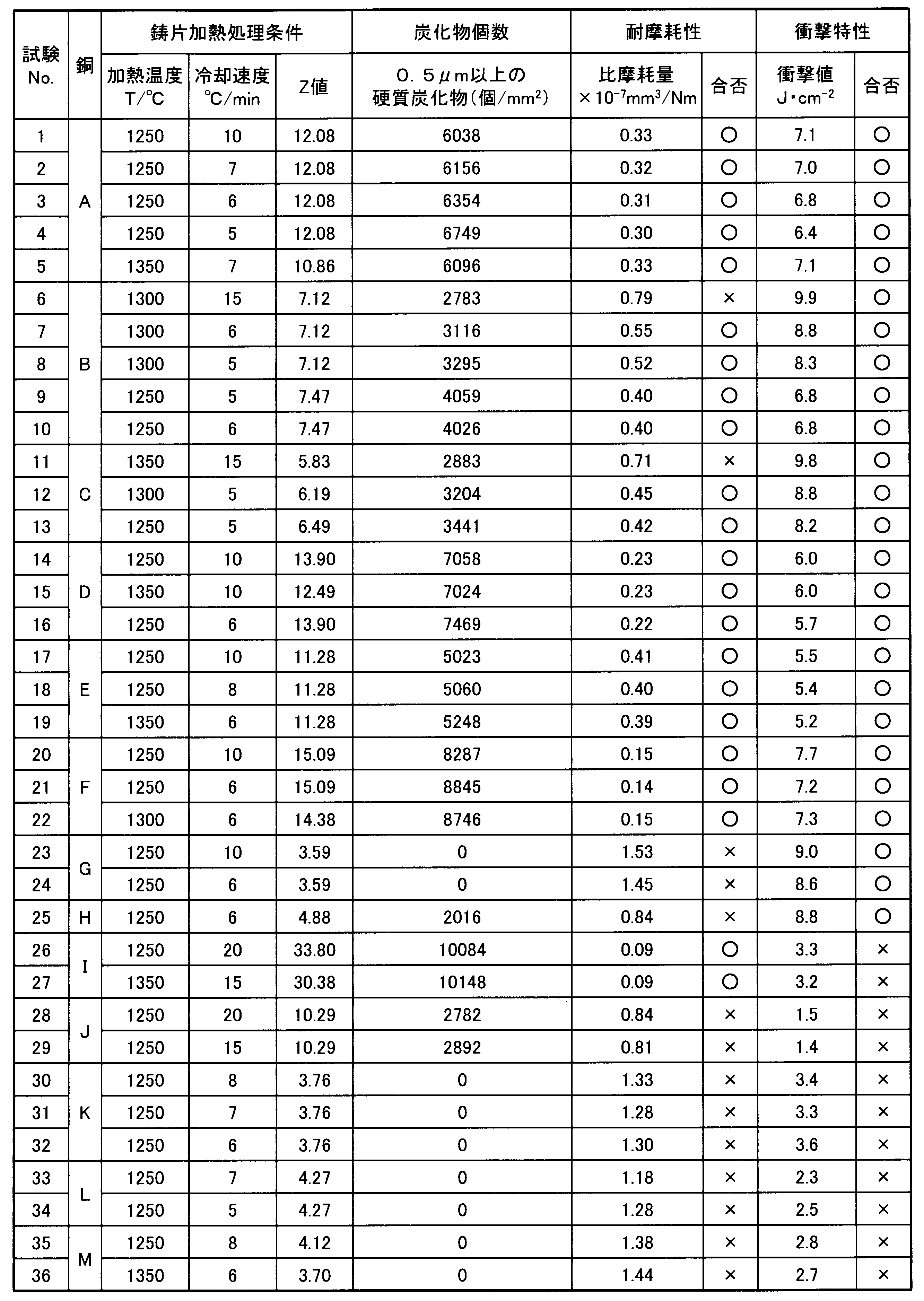
- Table 2 shows the slab heat treatment conditions, the measurement results of the density of the hard carbide, the results of the yarn path wear test, and the results of the impact test.
- the heating temperature T of the slab heat treatment is set so that the Z value represented by the formula (1) is 6 or more and 20 or less with predetermined chemical components, and the simulated slab
- the example of the present invention in which the cooling rate of the simulated slab was controlled so that the average cooling rate value during cooling of the central part from the liquidus temperature to the solidus temperature was equal to or less than the Z value has a particle size of 0.5 ⁇ m.
- the number of the above hard carbides was adjusted to 3000 to 9000 / mm 2 . As a result, it was excellent in wear resistance and excellent in toughness and high impact characteristics.
- No. 11 had a Z value of less than 6 and a cooling rate value greater than the Z value, so that the number of hard carbides was less than 3000 pieces / mm 2 , and the wear resistance was insufficient.
- No. 25 had a small content of Nb and C, so the number of hard carbides was less than 3000 / m 2 , and the wear resistance was insufficient.
- the present invention can be used for textile machine parts such as knitting needles, needle plates, sinkers, selectors and jacks used in knitting machines.
Landscapes
- Chemical & Material Sciences (AREA)
- Engineering & Computer Science (AREA)
- Mechanical Engineering (AREA)
- Materials Engineering (AREA)
- Metallurgy (AREA)
- Organic Chemistry (AREA)
- Physics & Mathematics (AREA)
- Thermal Sciences (AREA)
- Crystallography & Structural Chemistry (AREA)
- Heat Treatment Of Sheet Steel (AREA)
- Heat Treatment Of Steel (AREA)
Abstract
Description

Claims (4)
- 質量%で、C:0.60%以上1.25%以下、Si:0.50%以下、Mn:0.30%以上1.20%以下、P:0.03%以下、S:0.03%以下、Cr:0.30%以上1.50%以下、Nb:0.10%以上0.50%以下を含有し、残部がFeおよび不可避的不純物からなり、
粒子径0.5μm以上のNb含有炭化物が、3000個/mm2以上9000個/mm2以下の密度でマトリックス中に存在する
ことを特徴とする繊維機械部品用鋼板。 - 質量%で、Ti:0%(無添加を含む。)以上0.50%以下、B:0%(無添加を含む。)以上0.005%以下を含有する
ことを特徴とする請求項1記載の繊維機械部品用鋼板。 - 質量%で、Mo:0%(無添加を含む。)以上0.50%以下、V:0%(無添加を含む。)以上0.50%以下、Ni:0%(無添加を含む。)以上2.0%以下のうちのいずれか1種以上を含有する
ことを特徴とする請求項1または2記載の繊維機械部品用鋼板。 - 鋳造後に鋳片加熱処理が施される繊維機械部品用鋼板の製造方法であって、
鋳片加熱処理の加熱温度をTとし、
Y=2.43-6000/(T+273)とし、
X=0.68(Nb含有量)+0.10(C含有量)-10Yとして、
Z値=3.24exp(4.61X)の式で示すZ値が6以上20以下となるようにC含有量およびNb含有量に応じて鋳片加熱処理の加熱温度を設定し、かつ、鋳造の際に鋳片中心部を液相線温度から固相線温度まで冷却する間の平均冷却速度の値がZ値以下となるように鋳造条件を調整する
ことを特徴とする繊維機械部品用鋼板の製造方法。
Priority Applications (5)
| Application Number | Priority Date | Filing Date | Title |
|---|---|---|---|
| US15/743,985 US20180202022A1 (en) | 2015-07-16 | 2015-07-16 | Steel sheet for textile machinery parts and method for manufacturing the same |
| KR1020187000249A KR20180015726A (ko) | 2015-07-16 | 2015-07-16 | 섬유 기계 부품용 강판 및 그 제조 방법 |
| EP15898320.5A EP3323904A4 (en) | 2015-07-16 | 2015-07-16 | STEEL PLATE FOR TEXTILE MACHINE PART AND MANUFACTURING METHOD THEREFOR |
| CN201580081621.XA CN107849650B (zh) | 2015-07-16 | 2015-07-16 | 纤维机械部件用钢板及其制造方法 |
| PCT/JP2015/070444 WO2017010008A1 (ja) | 2015-07-16 | 2015-07-16 | 繊維機械部品用鋼板およびその製造方法 |
Applications Claiming Priority (1)
| Application Number | Priority Date | Filing Date | Title |
|---|---|---|---|
| PCT/JP2015/070444 WO2017010008A1 (ja) | 2015-07-16 | 2015-07-16 | 繊維機械部品用鋼板およびその製造方法 |
Publications (1)
| Publication Number | Publication Date |
|---|---|
| WO2017010008A1 true WO2017010008A1 (ja) | 2017-01-19 |
Family
ID=57757210
Family Applications (1)
| Application Number | Title | Priority Date | Filing Date |
|---|---|---|---|
| PCT/JP2015/070444 Ceased WO2017010008A1 (ja) | 2015-07-16 | 2015-07-16 | 繊維機械部品用鋼板およびその製造方法 |
Country Status (5)
| Country | Link |
|---|---|
| US (1) | US20180202022A1 (ja) |
| EP (1) | EP3323904A4 (ja) |
| KR (1) | KR20180015726A (ja) |
| CN (1) | CN107849650B (ja) |
| WO (1) | WO2017010008A1 (ja) |
Cited By (1)
| Publication number | Priority date | Publication date | Assignee | Title |
|---|---|---|---|---|
| CN111373064A (zh) * | 2017-08-25 | 2020-07-03 | 日铁日新制钢株式会社 | 韧性优异的耐磨损性钢板 |
Families Citing this family (6)
| Publication number | Priority date | Publication date | Assignee | Title |
|---|---|---|---|---|
| CN109141611B (zh) * | 2018-08-16 | 2020-11-10 | 马鞍山钢铁股份有限公司 | 一种钢卷重量自动核查的方法 |
| KR102329386B1 (ko) * | 2019-11-08 | 2021-11-19 | 가부시키가이샤 도쿠슈 긴조쿠 엑셀 | 고탄소 냉연 강판 및 그 제조 방법 그리고 고탄소강제 기계 부품 |
| CN112301274B (zh) * | 2020-09-30 | 2022-01-18 | 首钢集团有限公司 | 一种非焊接耐磨构件用钢及其制备方法 |
| EP4324952A4 (en) * | 2021-06-18 | 2025-10-15 | Jfe Steel Corp | COLD-ROLLED STEEL SHEET, STEEL COMPONENTS, METHOD FOR PRODUCING COLD-ROLLED STEEL SHEET AND METHOD FOR PRODUCING STEEL COMPONENTS |
| WO2022264948A1 (ja) * | 2021-06-18 | 2022-12-22 | Jfeスチール株式会社 | 鋼製部品および鋼製部品の製造方法 |
| CN115341154A (zh) * | 2022-09-21 | 2022-11-15 | 南通瑞泰针业有限公司 | 一种高韧性、高强度缝纫机针 |
Citations (4)
| Publication number | Priority date | Publication date | Assignee | Title |
|---|---|---|---|---|
| JPS512617A (ja) * | 1974-06-27 | 1976-01-10 | Kobe Steel Ltd | Kakyosekikosenzai |
| JPH01132838A (ja) * | 1987-08-27 | 1989-05-25 | Kanai Hiroyuki | 紡機用トラベラ |
| JP2010216008A (ja) * | 2009-02-17 | 2010-09-30 | Nisshin Steel Co Ltd | 高強度機械部品用素材鋼板およびその製造方法並びに高強度機械部品製造方法 |
| WO2014207879A1 (ja) * | 2013-06-27 | 2014-12-31 | 日新製鋼株式会社 | 疲労特性に優れる耐摩耗性鋼材およびその製造方法 |
Family Cites Families (5)
| Publication number | Priority date | Publication date | Assignee | Title |
|---|---|---|---|---|
| JP4303644B2 (ja) * | 2004-06-07 | 2009-07-29 | 新日本製鐵株式会社 | 耐粒界割れ性と靭性の優れた高炭素鋼板の製造法 |
| US20140013915A1 (en) * | 2011-03-25 | 2014-01-16 | Nisshin Steel Co., Ltd. | Steel plate with excellent durability for band-shaped die-cutting blade, and band-shaped die-cutting blade |
| JP5660220B2 (ja) * | 2011-09-09 | 2015-01-28 | 新日鐵住金株式会社 | 中炭素鋼板、焼き入れ部材およびそれらの製造方法 |
| JP5854831B2 (ja) * | 2011-12-28 | 2016-02-09 | 日新製鋼株式会社 | 疲労特性に優れる耐摩耗性鋼材およびその製造方法 |
| CN104032221B (zh) * | 2014-03-18 | 2016-07-06 | 北京科技大学 | 一种铌微合金化高碳铬轴承钢及其热轧生产方法 |
-
2015
- 2015-07-16 US US15/743,985 patent/US20180202022A1/en not_active Abandoned
- 2015-07-16 CN CN201580081621.XA patent/CN107849650B/zh not_active Expired - Fee Related
- 2015-07-16 WO PCT/JP2015/070444 patent/WO2017010008A1/ja not_active Ceased
- 2015-07-16 EP EP15898320.5A patent/EP3323904A4/en not_active Withdrawn
- 2015-07-16 KR KR1020187000249A patent/KR20180015726A/ko not_active Ceased
Patent Citations (4)
| Publication number | Priority date | Publication date | Assignee | Title |
|---|---|---|---|---|
| JPS512617A (ja) * | 1974-06-27 | 1976-01-10 | Kobe Steel Ltd | Kakyosekikosenzai |
| JPH01132838A (ja) * | 1987-08-27 | 1989-05-25 | Kanai Hiroyuki | 紡機用トラベラ |
| JP2010216008A (ja) * | 2009-02-17 | 2010-09-30 | Nisshin Steel Co Ltd | 高強度機械部品用素材鋼板およびその製造方法並びに高強度機械部品製造方法 |
| WO2014207879A1 (ja) * | 2013-06-27 | 2014-12-31 | 日新製鋼株式会社 | 疲労特性に優れる耐摩耗性鋼材およびその製造方法 |
Cited By (1)
| Publication number | Priority date | Publication date | Assignee | Title |
|---|---|---|---|---|
| CN111373064A (zh) * | 2017-08-25 | 2020-07-03 | 日铁日新制钢株式会社 | 韧性优异的耐磨损性钢板 |
Also Published As
| Publication number | Publication date |
|---|---|
| US20180202022A1 (en) | 2018-07-19 |
| CN107849650A (zh) | 2018-03-27 |
| KR20180015726A (ko) | 2018-02-13 |
| EP3323904A4 (en) | 2019-02-27 |
| EP3323904A1 (en) | 2018-05-23 |
| CN107849650B (zh) | 2019-10-25 |
Similar Documents
| Publication | Publication Date | Title |
|---|---|---|
| JP6117140B2 (ja) | 繊維機械部品用鋼板およびその製造方法 | |
| WO2017010008A1 (ja) | 繊維機械部品用鋼板およびその製造方法 | |
| JP6880245B1 (ja) | 高炭素冷延鋼板およびその製造方法並びに高炭素鋼製機械部品 | |
| JP5854831B2 (ja) | 疲労特性に優れる耐摩耗性鋼材およびその製造方法 | |
| JP5581205B2 (ja) | 疲労寿命が優れている高炭素鋼板およびその製造方法 | |
| JP5484103B2 (ja) | 高強度機械部品用素材鋼板およびその製造方法並びに高強度機械部品製造方法 | |
| JP6089131B2 (ja) | 高炭素冷延鋼板及びその製造方法 | |
| CN105378127B (zh) | 疲劳特性优良的耐磨性钢材及其制造方法 | |
| JP2009299189A (ja) | 精密打抜き用高炭素鋼板 | |
| JP4530268B2 (ja) | 衝撃特性に優れた高炭素鋼部材及びその製造方法 | |
| JP6118872B1 (ja) | 繊維機械部品 | |
| JP4159009B2 (ja) | 疲労特性に優れた打抜き部品用鋼板 | |
| KR102115277B1 (ko) | 강판 및 그 제조 방법 | |
| TWI794118B (zh) | 鋼製零件以及鋼製零件的製造方法 | |
| JP6652005B2 (ja) | ベイナイト鋼レール | |
| JP2011256447A (ja) | 被削性に優れた高強度鋼、およびその製造方法 | |
| JP4718315B2 (ja) | 耐摩耗性高Cr鋳鉄および耐摩耗部材 | |
| JP2017160519A (ja) | ばね用鋼 | |
| JP2017155310A (ja) | 手引き鋸 |
Legal Events
| Date | Code | Title | Description |
|---|---|---|---|
| 121 | Ep: the epo has been informed by wipo that ep was designated in this application |
Ref document number: 15898320 Country of ref document: EP Kind code of ref document: A1 |
|
| ENP | Entry into the national phase |
Ref document number: 20187000249 Country of ref document: KR Kind code of ref document: A |
|
| WWE | Wipo information: entry into national phase |
Ref document number: 15743985 Country of ref document: US |
|
| NENP | Non-entry into the national phase |
Ref country code: DE |
|
| WWE | Wipo information: entry into national phase |
Ref document number: 2015898320 Country of ref document: EP |
|
| NENP | Non-entry into the national phase |
Ref country code: JP |