WO2017017994A1 - 逆浸透膜用洗浄剤、洗浄液、および洗浄方法 - Google Patents
逆浸透膜用洗浄剤、洗浄液、および洗浄方法 Download PDFInfo
- Publication number
- WO2017017994A1 WO2017017994A1 PCT/JP2016/059149 JP2016059149W WO2017017994A1 WO 2017017994 A1 WO2017017994 A1 WO 2017017994A1 JP 2016059149 W JP2016059149 W JP 2016059149W WO 2017017994 A1 WO2017017994 A1 WO 2017017994A1
- Authority
- WO
- WIPO (PCT)
- Prior art keywords
- cleaning
- membrane
- reverse osmosis
- osmosis membrane
- cleaning agent
- Prior art date
- Legal status (The legal status is an assumption and is not a legal conclusion. Google has not performed a legal analysis and makes no representation as to the accuracy of the status listed.)
- Ceased
Links
- 0 *[C@](CC1)NC1=O Chemical compound *[C@](CC1)NC1=O 0.000 description 1
- NQRYJNQNLNOLGT-UHFFFAOYSA-N C1CCNCC1 Chemical compound C1CCNCC1 NQRYJNQNLNOLGT-UHFFFAOYSA-N 0.000 description 1
- WHNWPMSKXPGLAX-UHFFFAOYSA-N C=CN(CCC1)C1=O Chemical compound C=CN(CCC1)C1=O WHNWPMSKXPGLAX-UHFFFAOYSA-N 0.000 description 1
- HNJBEVLQSNELDL-UHFFFAOYSA-N O=C1NCCC1 Chemical compound O=C1NCCC1 HNJBEVLQSNELDL-UHFFFAOYSA-N 0.000 description 1
- YAMHXTCMCPHKLN-UHFFFAOYSA-N O=C1NCCN1 Chemical compound O=C1NCCN1 YAMHXTCMCPHKLN-UHFFFAOYSA-N 0.000 description 1
Images

Classifications
-
- B—PERFORMING OPERATIONS; TRANSPORTING
- B01—PHYSICAL OR CHEMICAL PROCESSES OR APPARATUS IN GENERAL
- B01D—SEPARATION
- B01D65/00—Accessories or auxiliary operations, in general, for separation processes or apparatus using semi-permeable membranes
- B01D65/02—Membrane cleaning or sterilisation ; Membrane regeneration
-
- B—PERFORMING OPERATIONS; TRANSPORTING
- B01—PHYSICAL OR CHEMICAL PROCESSES OR APPARATUS IN GENERAL
- B01D—SEPARATION
- B01D65/00—Accessories or auxiliary operations, in general, for separation processes or apparatus using semi-permeable membranes
- B01D65/02—Membrane cleaning or sterilisation ; Membrane regeneration
- B01D65/06—Membrane cleaning or sterilisation ; Membrane regeneration with special washing compositions
-
- B—PERFORMING OPERATIONS; TRANSPORTING
- B01—PHYSICAL OR CHEMICAL PROCESSES OR APPARATUS IN GENERAL
- B01D—SEPARATION
- B01D65/00—Accessories or auxiliary operations, in general, for separation processes or apparatus using semi-permeable membranes
- B01D65/08—Prevention of membrane fouling or of concentration polarisation
-
- B—PERFORMING OPERATIONS; TRANSPORTING
- B01—PHYSICAL OR CHEMICAL PROCESSES OR APPARATUS IN GENERAL
- B01D—SEPARATION
- B01D71/00—Semi-permeable membranes for separation processes or apparatus characterised by the material; Manufacturing processes specially adapted therefor
- B01D71/06—Organic material
- B01D71/56—Polyamides, e.g. polyester-amides
-
- B—PERFORMING OPERATIONS; TRANSPORTING
- B08—CLEANING
- B08B—CLEANING IN GENERAL; PREVENTION OF FOULING IN GENERAL
- B08B3/00—Cleaning by methods involving the use or presence of liquid or steam
- B08B3/04—Cleaning involving contact with liquid
-
- B—PERFORMING OPERATIONS; TRANSPORTING
- B08—CLEANING
- B08B—CLEANING IN GENERAL; PREVENTION OF FOULING IN GENERAL
- B08B3/00—Cleaning by methods involving the use or presence of liquid or steam
- B08B3/04—Cleaning involving contact with liquid
- B08B3/041—Cleaning travelling work
-
- B—PERFORMING OPERATIONS; TRANSPORTING
- B08—CLEANING
- B08B—CLEANING IN GENERAL; PREVENTION OF FOULING IN GENERAL
- B08B3/00—Cleaning by methods involving the use or presence of liquid or steam
- B08B3/04—Cleaning involving contact with liquid
- B08B3/08—Cleaning involving contact with liquid the liquid having chemical or dissolving effect
-
- C—CHEMISTRY; METALLURGY
- C11—ANIMAL OR VEGETABLE OILS, FATS, FATTY SUBSTANCES OR WAXES; FATTY ACIDS THEREFROM; DETERGENTS; CANDLES
- C11D—DETERGENT COMPOSITIONS; USE OF SINGLE SUBSTANCES AS DETERGENTS; SOAP OR SOAP-MAKING; RESIN SOAPS; RECOVERY OF GLYCEROL
- C11D1/00—Detergent compositions based essentially on surface-active compounds; Use of these compounds as a detergent
- C11D1/02—Anionic compounds
-
- C—CHEMISTRY; METALLURGY
- C11—ANIMAL OR VEGETABLE OILS, FATS, FATTY SUBSTANCES OR WAXES; FATTY ACIDS THEREFROM; DETERGENTS; CANDLES
- C11D—DETERGENT COMPOSITIONS; USE OF SINGLE SUBSTANCES AS DETERGENTS; SOAP OR SOAP-MAKING; RESIN SOAPS; RECOVERY OF GLYCEROL
- C11D1/00—Detergent compositions based essentially on surface-active compounds; Use of these compounds as a detergent
- C11D1/02—Anionic compounds
- C11D1/12—Sulfonic acids or sulfuric acid esters; Salts thereof
- C11D1/22—Sulfonic acids or sulfuric acid esters; Salts thereof derived from aromatic compounds
-
- C—CHEMISTRY; METALLURGY
- C11—ANIMAL OR VEGETABLE OILS, FATS, FATTY SUBSTANCES OR WAXES; FATTY ACIDS THEREFROM; DETERGENTS; CANDLES
- C11D—DETERGENT COMPOSITIONS; USE OF SINGLE SUBSTANCES AS DETERGENTS; SOAP OR SOAP-MAKING; RESIN SOAPS; RECOVERY OF GLYCEROL
- C11D3/00—Other compounding ingredients of detergent compositions covered in group C11D1/00
- C11D3/02—Inorganic compounds ; Elemental compounds
- C11D3/04—Water-soluble compounds
- C11D3/042—Acids
-
- C—CHEMISTRY; METALLURGY
- C11—ANIMAL OR VEGETABLE OILS, FATS, FATTY SUBSTANCES OR WAXES; FATTY ACIDS THEREFROM; DETERGENTS; CANDLES
- C11D—DETERGENT COMPOSITIONS; USE OF SINGLE SUBSTANCES AS DETERGENTS; SOAP OR SOAP-MAKING; RESIN SOAPS; RECOVERY OF GLYCEROL
- C11D3/00—Other compounding ingredients of detergent compositions covered in group C11D1/00
- C11D3/16—Organic compounds
- C11D3/26—Organic compounds containing nitrogen
- C11D3/28—Heterocyclic compounds containing nitrogen in the ring
-
- C—CHEMISTRY; METALLURGY
- C11—ANIMAL OR VEGETABLE OILS, FATS, FATTY SUBSTANCES OR WAXES; FATTY ACIDS THEREFROM; DETERGENTS; CANDLES
- C11D—DETERGENT COMPOSITIONS; USE OF SINGLE SUBSTANCES AS DETERGENTS; SOAP OR SOAP-MAKING; RESIN SOAPS; RECOVERY OF GLYCEROL
- C11D3/00—Other compounding ingredients of detergent compositions covered in group C11D1/00
- C11D3/16—Organic compounds
- C11D3/26—Organic compounds containing nitrogen
- C11D3/32—Amides; Substituted amides
-
- C—CHEMISTRY; METALLURGY
- C11—ANIMAL OR VEGETABLE OILS, FATS, FATTY SUBSTANCES OR WAXES; FATTY ACIDS THEREFROM; DETERGENTS; CANDLES
- C11D—DETERGENT COMPOSITIONS; USE OF SINGLE SUBSTANCES AS DETERGENTS; SOAP OR SOAP-MAKING; RESIN SOAPS; RECOVERY OF GLYCEROL
- C11D3/00—Other compounding ingredients of detergent compositions covered in group C11D1/00
- C11D3/16—Organic compounds
- C11D3/26—Organic compounds containing nitrogen
- C11D3/33—Amino carboxylic acids
-
- C—CHEMISTRY; METALLURGY
- C11—ANIMAL OR VEGETABLE OILS, FATS, FATTY SUBSTANCES OR WAXES; FATTY ACIDS THEREFROM; DETERGENTS; CANDLES
- C11D—DETERGENT COMPOSITIONS; USE OF SINGLE SUBSTANCES AS DETERGENTS; SOAP OR SOAP-MAKING; RESIN SOAPS; RECOVERY OF GLYCEROL
- C11D7/00—Compositions of detergents based essentially on non-surface-active compounds
- C11D7/22—Organic compounds
- C11D7/32—Organic compounds containing nitrogen
- C11D7/3263—Amides or imides
-
- B—PERFORMING OPERATIONS; TRANSPORTING
- B01—PHYSICAL OR CHEMICAL PROCESSES OR APPARATUS IN GENERAL
- B01D—SEPARATION
- B01D2321/00—Details relating to membrane cleaning, regeneration, sterilization or to the prevention of fouling
- B01D2321/16—Use of chemical agents
- B01D2321/168—Use of other chemical agents
-
- B—PERFORMING OPERATIONS; TRANSPORTING
- B01—PHYSICAL OR CHEMICAL PROCESSES OR APPARATUS IN GENERAL
- B01D—SEPARATION
- B01D61/00—Processes of separation using semi-permeable membranes, e.g. dialysis, osmosis or ultrafiltration; Apparatus, accessories or auxiliary operations specially adapted therefor
- B01D61/02—Reverse osmosis; Hyperfiltration ; Nanofiltration
- B01D61/025—Reverse osmosis; Hyperfiltration
-
- C—CHEMISTRY; METALLURGY
- C11—ANIMAL OR VEGETABLE OILS, FATS, FATTY SUBSTANCES OR WAXES; FATTY ACIDS THEREFROM; DETERGENTS; CANDLES
- C11D—DETERGENT COMPOSITIONS; USE OF SINGLE SUBSTANCES AS DETERGENTS; SOAP OR SOAP-MAKING; RESIN SOAPS; RECOVERY OF GLYCEROL
- C11D2111/00—Cleaning compositions characterised by the objects to be cleaned; Cleaning compositions characterised by non-standard cleaning or washing processes
- C11D2111/10—Objects to be cleaned
-
- Y—GENERAL TAGGING OF NEW TECHNOLOGICAL DEVELOPMENTS; GENERAL TAGGING OF CROSS-SECTIONAL TECHNOLOGIES SPANNING OVER SEVERAL SECTIONS OF THE IPC; TECHNICAL SUBJECTS COVERED BY FORMER USPC CROSS-REFERENCE ART COLLECTIONS [XRACs] AND DIGESTS
- Y02—TECHNOLOGIES OR APPLICATIONS FOR MITIGATION OR ADAPTATION AGAINST CLIMATE CHANGE
- Y02A—TECHNOLOGIES FOR ADAPTATION TO CLIMATE CHANGE
- Y02A20/00—Water conservation; Efficient water supply; Efficient water use
- Y02A20/124—Water desalination
- Y02A20/131—Reverse-osmosis
Definitions
- the present invention relates to an RO membrane cleaning agent and a cleaning agent that effectively recovers performance, and an RO membrane cleaning method using the same.
- an aromatic polyamide RO membrane that can be operated at a low pressure and has excellent desalting performance has been widely used. Since the aromatic polyamide RO membrane has low resistance to chlorine, it cannot be treated with chlorine under the operating conditions like the cellulose acetate RO membrane, and contamination by microorganisms and organic matter is cellulose acetate. There is a problem that it is more likely to occur than conventional RO membranes. The resistance to alkali is higher in the aromatic polyamide RO membrane than in the cellulose acetate RO membrane, and it is possible to perform cleaning under alkaline conditions of pH 10 or higher.
- Non-patent Document 1 ⁇ Alkaline agents (such as sodium hydroxide) ⁇ Surfactant (such as sodium lauryl sulfate) ⁇ Chelating agents (EDTA, etc.)
- RO membrane when an RO membrane is used to treat raw water containing a large amount of inorganic or organic matter in a wastewater recovery system or seawater desalination facility, contaminants containing inorganic and organic matter adhere to the RO membrane. In the case of such a deposit, the cleaning effect may be insufficient even when the cleaning chemical is used.
- a water supply containing a polymer polyalkylene glycol, a nonionic surfactant, saccharides and proteins is treated with an RO membrane, these TOC components adhere to the membrane, and the performance of the membrane gradually decreases. It is extremely difficult to restore the performance of this RO membrane with the above conventional cleaning chemicals.
- Sodium hypochlorite is a powerful drug against microorganisms and organic matter, but aromatic polyamide RO membranes have low resistance to chlorine, so sodium hypochlorite is used to clean aromatic polyamide RO membranes. Is not used.
- a chlorine-based disinfectant it is known that free chlorine is reduced using a reducing agent and then supplied to the RO membrane (Patent Document 1).
- Patent Document 2 describes a cleaning method in which a hydrophilic organic solvent such as ethanol or methanol and a surfactant are combined. Ethanol and methanol have a low flash point and are not practical.
- Patent Document 3 describes a cleaning agent using an alkyl ether of ethylene glycol. Since ethylene glycol alkyl ethers have a hydrophilic group and a hydrophobic group and have a structure close to that of a monohydric alcohol, they are highly harmful. Since ethylene glycol alkyl ethers have a strong irritating odor, they are also specified in the PRTR (Environmental Pollution Discharge Transfer Registration) method, and the working environment evaluation value is 5 mg / L or less, and the use concentration cannot be increased.
- PRTR Endvironmental Pollution Discharge Transfer Registration
- Patent Document 4 describes that when a polyol is used as a cleaning agent, a monohydric alcohol, ether, ketone and amide can be used in combination as an organic solvent.
- a monohydric alcohol, ether, ketone and amide can be used in combination as an organic solvent.
- Patent Document 4 only formamide is mentioned as a specific example, and there is no mention of a specific cleaning effect by combined use or single use of the agent.
- Patent Document 4 is merely a description of a polyol as a solvent, and does not mention any use under alkaline conditions.
- Patent Document 5 describes a disinfectant for water treatment containing an acid and a corrosion inhibitor and a compound containing an amide group and / or a urea group such as N, N-dimethylacetamide.
- Patent Document 6 describes a disinfectant for water treatment containing an acid, a corrosion inhibitor, and an organic acid having an amino group in the molecule such as asparagine.
- Patent Documents 5 and 6 are all bactericides and are not intended for cleaning the membrane. Amides and organic acids are used as stabilizers for acids and corrosion inhibitors, and nothing is described about the cleaning effect of these components themselves.
- the conventional cleaning agent when a RO membrane used for water treatment, in particular, an aromatic polyamide RO membrane is contaminated and the performance such as permeation flux, differential pressure, and desalination rate is lowered, the conventional cleaning agent is sufficient. It is an object of the present invention to provide an RO membrane cleaning agent and cleaning liquid that can effectively remove contaminants that cannot be removed, and an RO membrane cleaning method using the same.
- aliphatic amides and / or aromatic amides particularly water-soluble and relatively low molecular weight aliphatic amides.
- / or aromatic amides have been found to provide a high cleaning effect on contaminants adhering to aromatic polyamide RO membranes.
- the gist of the present invention is as follows.
- a reverse osmosis membrane cleaning agent comprising an aliphatic amide and / or an aromatic amide.
- R 11 represents a hydrogen atom, an alkyl group having 1 to 3 carbon atoms, an N-containing heterocyclic group or an aromatic group, each of which may have a substituent.
- R 12 represents a hydrogen atom or an alkyl group having 1 to 3 carbon atoms which may have a substituent.
- R 13 represents a hydrogen atom or an alkyl group having 1 to 3 carbon atoms.
- the aliphatic amide is one or more selected from asparagine, glutamine, formamide, acetamide, N, N-dimethylformamide, and N, N-dimethylacetamide, and the aromatic A cleaning agent for a reverse osmosis membrane, wherein the group amide is one or more selected from nicotinamide, benzamide, aminobenzamide, phthalamide, and hippuric acid.
- a reverse osmosis membrane cleaning solution comprising the reverse osmosis membrane cleaner according to any one of [1] to [9].
- the amide bond site of the amide compound has a structure similar to the polyamide bond of the RO membrane, especially the amide bond of the aromatic polyamide. It is believed that it penetrates in between and has the same affinity for contaminants as the membrane surface, which facilitates exfoliation of the contaminants.
- the RO membrane to be cleaned may be a polyamide RO membrane such as an aromatic polyamide RO membrane or a cellulose acetate RO membrane.
- the present invention is particularly effective for cleaning an aromatic polyamide RO membrane.
- the present invention is particularly effective for RO membranes that are used for seawater desalination or wastewater treatment and are not contaminated with various pollutants, so that a sufficient cleaning effect cannot be obtained with conventional cleaning agents.
- the cleaning agent for RO membrane of the present invention contains an amide compound.
- the cleaning agent for RO membrane of the present invention is usually prepared by dissolving an amide compound, an alkaline agent used as necessary, other chemicals, a solvent and the like in water.
- cleaning agent refers to a product prepared by setting the concentration of an amide compound or other chemicals higher than in use for the distribution and storage of products.
- cleaning solution refers to a solution obtained by diluting this cleaning agent with water and adjusting the concentration to actually clean the film surface.
- the amide compound is preferably water-soluble from the viewpoint of affinity with the RO membrane.
- the amide compound those having a relatively low molecular weight of 300 or less, particularly 200 or less, are preferred from the viewpoint of permeating between the RO membrane and the contaminant and showing a good cleaning effect.
- the molecular weight of the amide compound is too large, it is difficult to penetrate between the RO membrane and the contaminant, and a good cleaning effect cannot be obtained.
- the amide compound is preferably a compound represented by the following formula (I).
- R 11 represents a hydrogen atom, an alkyl group having 1 to 3 carbon atoms, an N-containing heterocyclic group or an aromatic group, each of which may have a substituent.
- R 12 represents a hydrogen atom or an alkyl group having 1 to 3 carbon atoms which may have a substituent.
- R 13 represents a hydrogen atom or an alkyl group having 1 to 3 carbon atoms.
- examples of the substituent that the alkyl group of R 11 may have include a carboxyl group (—COOH), an amino group (—NH 2 ), a hydroxy group (—OH), and the like.
- the N-containing heterocyclic group is preferably an N-containing unsaturated heterocyclic group, and specific examples include a pyridyl group, an imidazolyl group, an indolyl group, a thiazolyl group, a triazinyl group, a pyrazinyl group, and a pyrimidinyl group.
- examples of the aromatic group include aromatic hydrocarbon groups such as a phenyl group, a naphthyl group, and an indenyl group.
- N-containing heterocyclic groups and aromatic groups are substituted with a carboxyl group (—COOH), amino group (—NH 2 ), aminocarbonyl group (—CONH 2 ), hydroxy group (—OH), alkyl group (—C n H 2n + 1 ) and the like.
- Examples of the substituent that the alkyl group of R 12 may have include a carboxyl group (—COOH), an amino group (—NH 2 ), a hydroxy group (—OH), and the like.
- amide compounds include the following.
- amide compounds as the aliphatic amide, asparagine, glutamine, formamide, acetamide, N, N-dimethylformamide, and N, N-dimethylacetamide are particularly preferable.
- aromatic amide nicotinamide, benzamide, aminobenzamide, phthalamide, and hippuric acid are preferable.
- An amide compound may be used alone or in combination of two or more.
- the cleaning agent for RO membrane of the present invention may contain an alkali agent, a cleaning agent, and a solvent necessary for cleaning the RO membrane, in addition to the amide compound.
- alkali metal hydroxides such as sodium hydroxide and potassium hydroxide can be used.
- cleaning agents examples include surfactants and dispersants.
- Surfactants include anionic surfactants such as alkylbenzene sulfonates such as sodium dodecylbenzene sulfonate, alkyl sulfates such as sodium dodecyl sulfate, and nonionic surfactants such as polyalkylene glycol monoalkyl ethers such as diethylene glycol monomethyl ether. Surfactant etc. can be mentioned.
- anionic surfactants are particularly preferable in terms of dispersion effect.
- Dispersants include ethylenediaminetetraacetic acid (EDTA), glycol etherdiaminetetraacetic acid (EGTA), polyphosphoric acid, phosphonobutanetricarboxylic acid (PBTC), phosphonic acid, polymaleic acid, citric acid, oxalic acid, gluconic acid and their Chelating agents such as salts can be mentioned.
- EDTA ethylenediaminetetraacetic acid
- EGTA glycol etherdiaminetetraacetic acid
- PBTC phosphonobutanetricarboxylic acid
- phosphonic acid polymaleic acid
- citric acid citric acid
- oxalic acid gluconic acid
- Chelating agents such as salts can be mentioned.
- the reverse osmosis membrane cleaning agent of the present invention may further contain an N-containing saturated heterocyclic compound.
- the N-containing saturated heterocyclic ring contained in the N-containing saturated heterocyclic compound is not particularly limited as long as it is a saturated heterocyclic ring having a nitrogen atom as a ring constituent atom.
- the N-containing saturated heterocyclic ring is preferably a 5-membered ring or a 6-membered ring, more preferably a 5-membered ring.
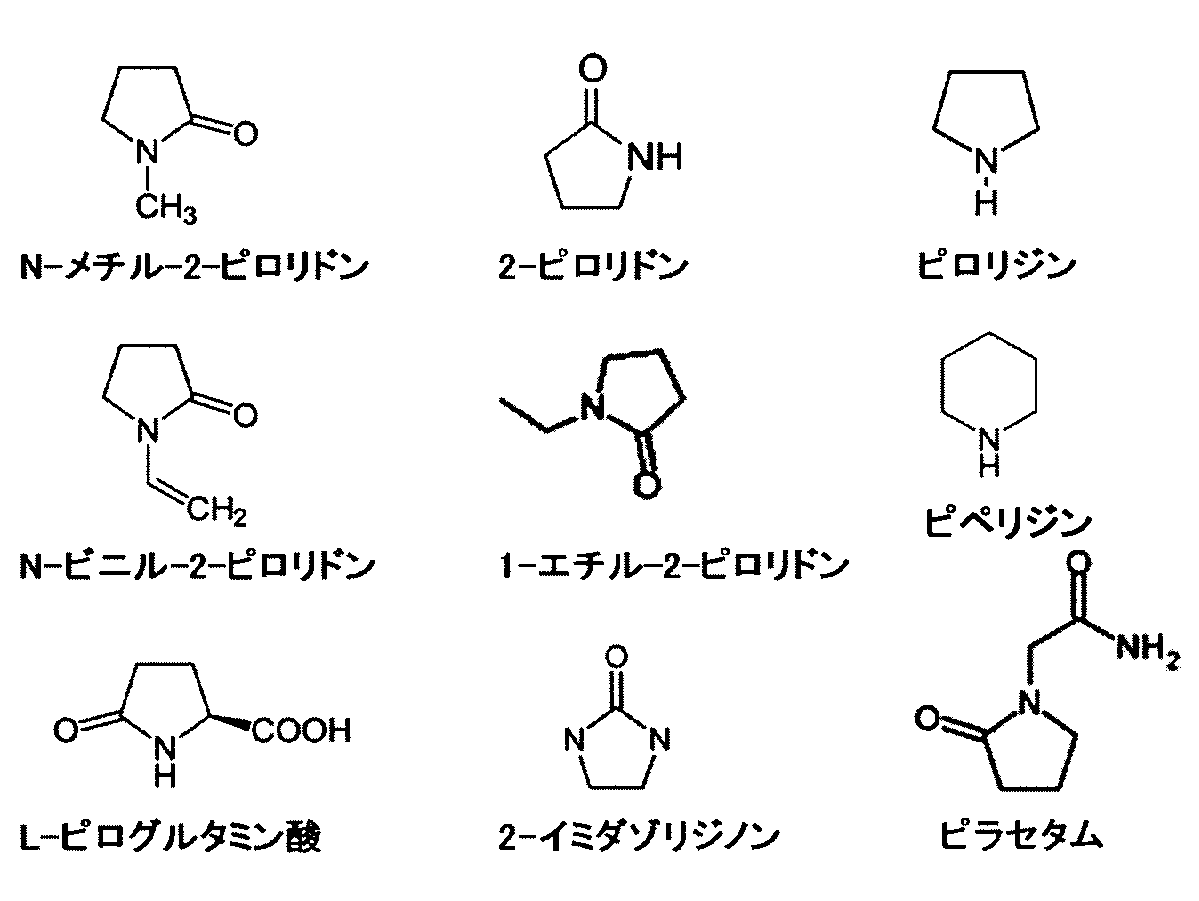
- Examples of the N-containing saturated heterocyclic ring include 5-membered rings such as pyrrolidine ring, pyrrolidone ring, imidazolidine ring and imidazolidinone ring, and 6-membered rings such as piperidine ring and piperazine ring.
- Formula (1) includes a pyrrolidine ring and a pyrrolidone ring.
- Formula (2) includes an imidazolidine ring and an imidazolidinone ring.
- R 1 and R 2 each independently represent a hydrogen atom or a hydrocarbon group having 1 to 4 carbon atoms which may have a substituent.
- Q 1 to Q 4 each independently represent two hydrogen atoms, an oxygen atom, a hydrogen atom and an arbitrary substituent, or two arbitrary substituents.
- the “substituent” is a functional group or atom other than a hydrogen atom, and a halogen atom is also included in the substituent.
- examples of the hydrocarbon group of R 1 and R 2 include an alkyl group, an alkenyl group, and an alkynyl group.
- examples of the alkyl group include a methyl group (—CH 3 ) and an ethyl group (—CH 2 CH 3 ).
- examples of the alkenyl group include a vinyl group (—CH ⁇ CH 2 ).
- examples of the substituent that these hydrocarbon groups may have include an aminocarbonyl group, a carboxyl group, an amino group, a hydroxy group, and a halogen atom.
- an aminocarbonylmethyl group (—CH 2 C (O) NH 2 ) and the like can be mentioned as a group in which an aminocarbonyl group is substituted for a methyl group.
- Examples of optional substituents for Q 1 to Q 4 include a carboxyl group (—COOH), an amino group (—NH 2 ), a hydroxy group (—OH), and a halogen atom.
- N-containing saturated heterocyclic compound examples include the following compounds.
- N-containing saturated heterocyclic compounds may be used singly or in combination of two or more.
- Solvents include alcohols such as ethanol, polyols such as ethylene glycol, propylene glycol and butanediol, amines such as monoethanolamine, diethanolamine and triethanolamine, ketones such as acetone, dimethyl ether, diethyl ether and diethylene glycol monomethyl. Examples include ethers such as ether.
- the cleaning agent for RO membrane of the present invention may be a one-agent type in which an amide compound, an alkaline agent, a cleaning agent, etc. are mixed in advance, and a two-agent type in which a part of these is supplied as another agent, Or the dosage form beyond it may be sufficient.
- the RO membrane cleaning liquid of the present invention prepared by diluting the RO membrane cleaning agent of the present invention with water may also be a one-drug type, a two-drug type, or a higher dosage form.
- the RO membrane may be washed with a cleaning solution containing an amide compound and then washed with a cleaning solution containing another cleaning agent.
- the RO membrane cleaning agent of the present invention has a concentration of each drug suitable for the RO membrane cleaning solution of the present invention described later when diluted to about 5 to 100 times by weight with water, preferably pure water. Each drug concentration is adjusted to be about 5 to 100 times the drug concentration in the RO membrane cleaning solution.
- the cleaning agent for RO membrane of the present invention is prepared as an aqueous solution, or all or part of it as a powder or solid.
- the cleaning solution for RO membrane of the present invention is an aqueous solution obtained by diluting the cleaning agent for RO membrane of the present invention with water.
- the RO membrane cleaning solution of the present invention is adjusted to a predetermined concentration by diluting the RO membrane cleaning agent of the present invention with water and, if necessary, adding an alkali agent, a cleaning agent, other solvents, etc. It may be what you did.
- the RO membrane cleaning liquid of the present invention may be prepared directly at a predetermined drug concentration without going through the RO membrane cleaning agent of the present invention.
- the concentration of the amide compound in the cleaning solution for RO membrane of the present invention varies depending on the type of amide compound used, the pH of the cleaning solution, the presence / absence of combination of other cleaning agents, the type and concentration, etc. It is preferable that the content be about 0.5% by weight, particularly about 0.5 to 5% by weight.
- the amide compound concentration is lower than the above lower limit, the effect of cleaning the RO membrane by using the amide compound cannot be sufficiently obtained. Even if the amide compound concentration is higher than the above upper limit, the cleaning effect may be lowered, and the nitrogen content of the cleaning waste liquid is unnecessarily increased.
- the RO membrane cleaning liquid of the present invention is preferably adjusted to alkali or acidic in view of its cleaning effect.
- the pH is preferably 8 or more, particularly 10 to 14.
- the membrane permeability may not be sufficiently recovered by cleaning.
- the pH of the cleaning liquid is preferably 14 or less, more preferably 11 or more and 13 or less.
- the pH is 4 or less, preferably 1 to 3. If it is this range, sufficient cleaning effect will be acquired.
- the cleaning solution for RO membrane of the present invention is prepared to have the above-mentioned preferable pH by adding an alkaline agent or an acidic agent.
- the pH is preferably less than 8, and it can be used as a cleaning agent in combination with a surfactant.
- the concentration of the surfactant in the RO membrane cleaning liquid of the present invention is preferably 100 to 10,000 mg / L, particularly 300 to 5000 mg / L. Is preferred.
- the surfactant concentration in the RO membrane cleaning liquid of the present invention is too low, the dispersion effect by the surfactant and the effect of improving the cleaning action cannot be sufficiently obtained. If the surfactant concentration in the cleaning liquid for RO membrane of the present invention is too high, the association of the surfactant is rather strong and the cleaning effect may be reduced.
- the concentration of the dispersant in the RO membrane cleaning liquid of the present invention is preferably 100 to 20000 mg / L, and particularly preferably 1000 to 10,000 mg / L. . If the dispersant concentration in the RO membrane cleaning liquid of the present invention is too low, the dispersion and cleaning effects by the dispersant cannot be sufficiently obtained. If the concentration of the dispersant in the cleaning liquid for RO membrane of the present invention is too high, the cleaning effect does not increase with respect to the concentration.
- the concentration of the N-containing saturated heterocyclic compound in the RO membrane cleaning liquid is 0.1 to 10% by weight, particularly 0.5 to 5% by weight. It is preferable to set the degree.
- the concentration of the N-containing saturated heterocyclic compound is lower than the lower limit, it is not possible to sufficiently obtain the RO membrane cleaning effect by using the N-containing saturated heterocyclic compound. Even if the concentration of the N-containing saturated heterocyclic compound is higher than the above upper limit, the cleaning effect may be reduced, and the nitrogen content of the cleaning waste liquid is unnecessarily increased.
- the cleaning agent for RO membrane of the present invention is prepared by mixing water with an amide compound and an alkali agent, an acidic agent, a cleaning agent, other solvents and the like that are blended as necessary.
- the cleaning agent for RO membrane of the present invention may be prepared as a powder or solid in whole or in part.
- the RO membrane cleaning solution of the present invention is prepared by diluting the thus prepared RO membrane cleaning agent of the present invention with water, preferably pure water, and if necessary, an alkaline agent, a cleaning agent, other solvents, etc. It is manufactured by adding.
- the RO membrane cleaning solution of the present invention can also be produced directly by the same method as described above without passing through the RO membrane cleaning agent of the present invention.
- the method for cleaning the RO membrane using the RO membrane cleaning liquid of the present invention is not particularly limited as long as the RO membrane is brought into contact with the cleaning liquid.
- immersion cleaning is performed in which a cleaning liquid is introduced to the raw water side of the RO membrane module and allowed to stand. Circulating cleaning in which the cleaning liquid is circulated may be performed before and / or after this immersion cleaning.
- the cleaning agent for RO membrane and the cleaning solution for RO membrane of the present invention are in a two-agent type or more, they may be mixed and used for cleaning, or sequentially cleaned using different agents. You may make it perform. For example, after washing with a washing solution containing an amide compound, washing may be carried out with a washing solution containing other chemicals.
- cleaning with an alkaline aqueous solution not containing an amide compound can be performed after cleaning with the RO membrane cleaning liquid of the present invention.
- the alkaline agent of the alkaline aqueous solution those described above as the alkaline agent used in the RO membrane cleaning liquid of the present invention can be used.
- the pH of the aqueous alkaline solution is preferably pH 10 or more, particularly pH 11 to 13 from the viewpoints of cleaning effect and handleability.
- acid cleaning effective for removing scales and metal colloids may be performed.
- an aqueous solution containing one or more acids such as hydrochloric acid, nitric acid, citric acid and oxalic acid can be used.
- the pH of the aqueous acid solution is preferably pH 4 or less, particularly pH 1 to 3 from the viewpoint of cleaning effect and handleability.
- the immersion cleaning time with the RO membrane cleaning liquid of the present invention and other cleaning liquids is not particularly limited as long as the recovery rate of the target membrane performance can be obtained.
- the immersion cleaning time is usually about 2 to 24 hours.
- the circulation cleaning time is not particularly limited as long as the target film performance recovery rate can be obtained.
- the circulation cleaning time is usually about 0.5 to 3 hours.
- the cleaning procedure is not particularly limited.
- the acid cleaning with the acid aqueous solution is performed before the cleaning with the RO membrane cleaning liquid of the present invention, it is effective for removing scale components.
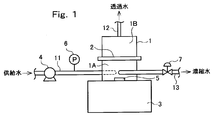
- the RO membrane supply water is supplied from the pipe 11 to the raw water chamber 1A below the flat membrane cell 2 in which the RO membrane of the sealed container 1 is set by the high pressure pump 4.
- the sealed container 1 is composed of a lower case 1a on the raw water chamber 1A side and an upper case 1b on the permeate water chamber 1B side, and a flat membrane is formed between the lower case 1a and the upper case 1b.
- the cell 2 is fixed via an O-ring 8.
- the flat membrane cell 2 is configured such that the permeate side of the RO membrane 2A is supported by the porous support plate 2B.
- the raw water chamber 1 ⁇ / b> A below the flat membrane cell 2 is stirred by rotating the stirring bar 5 with the stirrer 3.
- the RO membrane permeated water is taken out from the pipe 12 through the permeated water chamber 1B on the upper side of the flat membrane cell 2.
- the concentrated water is taken out from the pipe 13.
- the pressure in the sealed container 1 is adjusted by a pressure gauge 6 provided in the water supply pipe 11 and a pressure adjusting valve 7 provided in the concentrated water outlet pipe 13.
- Permeation flux [m 3 / (m 2 ⁇ day)] permeate flow rate [m 3 / day] / membrane area [m 2 ] ⁇ temperature conversion coefficient [ ⁇ ]
- Desalination rate [%] (1 ⁇ permeated water conductivity [mS / m] / concentrated water conductivity [mS / m]) ⁇ 100
- Example I-1 Comparative Examples I-1 to 4
- the following cleaning tests were performed using the following cleaning solutions.
- Example 1 pH 12 sodium hydroxide aqueous solution containing 2% by weight of nicotinamide, 1500 mg / L sodium dodecyl sulfate and 5000 mg / L sodium gluconate
- Comparative Example I-1 pH 12 sodium hydroxide aqueous solution
- Comparison Example I-2 pH 12 sodium hydroxide aqueous solution containing 2 wt% propylene glycol, 1500 mg / L sodium dodecyl sulfate and 5000 mg / L sodium gluconate
- Comparative Example I-3 2 wt% ethanol PH 12 sodium hydroxide aqueous solution containing 1500 mg / L sodium dodecyl sulfate and 5000 mg / L sodium gluconate
- Comparative Example I-4 1% by weight diethylene glycol monomethyl ether, 1500 mg / L sodium dodecyl sulfate, 5000mg / L PH 12 sodium hydroxide aqueous solution containing sodium gluconate
- Aromatic polyamide RO membrane “TM-820A” (new membrane, permeation flux 0.6 [m 3 / (m 2 ⁇ day)]) manufactured by Toray Industries, Inc. is loaded into the RO device in the seawater desalination RO system. I drove for years. The membrane after operation was taken out from the RO apparatus and disassembled to obtain a flat membrane sample of the contaminated membrane. This flat membrane sample was cut into a circle and installed in the flat membrane test apparatus shown in FIGS. 1 and 2 that can be loaded with a membrane of the same size, and the test was performed according to the following procedure.
- Example I-1 and Comparative Examples I-1 to I-4 the desalting rate of the RO membrane after washing was almost equal to the desalting rate of the RO membrane before washing, which was about 98 to 99%.
- Example II-1 pH 12 sodium hydroxide aqueous solution containing 2% by weight of nicotinamide
- Example II-2 pH 12 sodium hydroxide aqueous solution containing 4% by weight of nicotinamide
- Example II-3 2% by weight PH 12 sodium hydroxide aqueous solution containing 2% by weight nicotinamide and 2% by weight N-methyl-2-pyrrolidone
- Example II-4 pH 12 sodium hydroxide aqueous solution containing 1% by weight benzamide
- Example II- 5 aqueous solution of pH 2.6 containing 2% by weight p-aminobenzamide and 2% by weight citric acid
- Comparative Example II-1 pH 12 sodium hydroxide aqueous solution
- Comparative Example II-2 pH 12 sodium hydroxide aqueous solution containing 2 wt% nicotinic acid
- Comparative Example II-3 pH 12 containing 2 wt% benzoic acid
- Comparative Example II-4 pH 12 sodium hydroxide aqueous solution containing 2% by weight of ethanol
- Comparative Example II-5 pH 12 sodium hydroxide aqueous solution containing 2% by weight of acetone
- Comparative Example II-6 PH 12 sodium hydroxide aqueous solution containing 2 wt% propylene glycol
- Comparative Example II-7 Citric acid (2 wt%) aqueous solution of pH 2.6
- Example III-1 pH 12 sodium hydroxide aqueous solution containing 2% by weight nicotinamide and 1500 mg / L sodium dodecylbenzenesulfonate
- Example III-2 2% by weight asparagine and 1500 mg / L dodecyl PH 12 sodium hydroxide aqueous solution containing sodium benzenesulfonate
- Example III-3 pH 12 sodium hydroxide aqueous solution containing 2 wt% formamide and 1500 mg / L sodium dodecylbenzenesulfonate
- Example III-4 PH 12 sodium hydroxide aqueous solution containing 2 wt% N, N-dimethylacetamide and 1500 mg / L sodium dodecylbenzenesulfonate
- Example III-5 2 wt% N, N-dimethylacetamide and 2 wt% % Piperidine and 1500 mg / L dodecylben PH 12 sodium hydroxide aqueous solution containing sodium zen
- Comparative Example III-1 pH 12 sodium hydroxide aqueous solution containing 1500 mg / L sodium dodecylbenzenesulfonate
- Comparative Example III-2 pH 12 containing 2 wt% ethanol and 1500 mg / L sodium dodecylbenzenesulfonate
- Comparative Example III-3 pH 12 sodium hydroxide aqueous solution containing 2% by weight isopropanol and 1500 mg / L sodium dodecylbenzenesulfonate
- Comparative Example III-4 2% by weight propylene glycol PH 12 sodium hydroxide aqueous solution containing 1500 mg / L sodium dodecylbenzene sulfonate
- Comparative Example III-5 pH 12 sodium hydroxide aqueous solution containing 2 wt% ethylene glycol and 1500 mg / L sodium dodecyl benzene sulfonate ratio
- Example III-6 pH 12 sodium hydroxide aqueous solution
- ⁇ Test method> A flat membrane is cut into a circular shape from an aromatic polyamide RO membrane “ES-20” (new membrane) manufactured by Nitto Denko Corporation and installed in the flat membrane test apparatus shown in FIGS. A washing test was performed according to the procedure.
- Example II-5 As can be seen from the comparison between Example II-5 and Comparative Example II-7, the cleaning effect can be enhanced even in combination with an acidic cleaning agent.
- Example II-3 and Example III-5 the combined use of an N-containing saturated heterocyclic compound results in the penetration / peeling action of the amide compound and the penetration / hydrophilization action of the N-containing saturated heterocyclic compound. A good cleaning effect can be obtained.
- a cleaning solution using nicotinamide has a high cleaning effect.
Landscapes
- Chemical & Material Sciences (AREA)
- Chemical Kinetics & Catalysis (AREA)
- Engineering & Computer Science (AREA)
- Organic Chemistry (AREA)
- Oil, Petroleum & Natural Gas (AREA)
- Wood Science & Technology (AREA)
- Life Sciences & Earth Sciences (AREA)
- Water Supply & Treatment (AREA)
- Inorganic Chemistry (AREA)
- Nanotechnology (AREA)
- General Chemical & Material Sciences (AREA)
- Separation Using Semi-Permeable Membranes (AREA)
- Detergent Compositions (AREA)
Abstract
Description
・ アルカリ剤(水酸化ナトリウムなど)
・ 界面活性剤(ラウリル硫酸ナトリウムなど)
・ キレート剤(EDTAなど)

本発明による作用機構の詳細は明らかではないが、以下の通り考えられる。
洗浄時のアルカリ条件における剥離効果、加水分解効果に加えて、脂肪族アミド及び/又は芳香族アミド(以下「アミド化合物」と称す場合がある。)の汚染物質への浸透・剥離効果、更にはアニオン系界面活性剤を併用した場合のアニオン系界面活性剤による汚染物質への浸透・剥離効果、分散剤を併用した場合の分散剤による無機物の分散・キレート効果、N含有飽和複素環を有する化合物(以下「N含有飽和複素環化合物」と称す場合がある。)を併用した場合のN含有飽和複素環化合物の汚染物質への浸透・親水化効果を付与すること、特にアミド化合物とアニオン系界面活性剤を併用した場合の浸透・剥離効果の向上効果により、これらが相乗的に作用してアルカリ洗浄効果を向上させることができる。
本発明において、洗浄対象となるRO膜は、芳香族ポリアミド系RO膜等のポリアミド系RO膜であってもよく、酢酸セルロース系RO膜であってもよい。本発明は、特に、芳香族ポリアミド系RO膜の洗浄に有効である。本発明は、海水淡水化あるいは排水処理に使用され、様々な汚染物質で汚染されているために、従来の洗浄剤では十分な洗浄効果を得ることができないRO膜に特に有効である。
本発明のRO膜用洗浄剤は、アミド化合物を含むことを特徴とするものである。本発明のRO膜用洗浄剤は、通常、アミド化合物と、必要に応じて用いられるアルカリ剤、その他の薬剤や溶媒等を水に溶解させて調製される。
アミド化合物としては、RO膜との親和性の観点から、水溶性であることが好ましい。アミド化合物としては、RO膜と汚染物質の間に浸透して良好な洗浄効果を示す観点から、分子量300以下、特に200以下の比較的低分子量のものが好ましい。アミド化合物の分子量が大き過ぎると、RO膜と汚染物質の間に浸透し難く、良好な洗浄効果が得られない。


本発明のRO膜用洗浄剤には、アミド化合物以外に、RO膜の洗浄に必要なアルカリ剤や洗浄薬剤、溶媒が含有されていてもよい。

本発明のRO膜用洗浄液は、本発明のRO膜用洗浄剤を水で希釈してなる水溶液である。本発明のRO膜用洗浄液は、本発明のRO膜用洗浄剤を水で希釈すると共に、更に、必要に応じて、アルカリ剤、洗浄薬剤、他の溶媒等を添加して所定の濃度に調整したものであってもよい。
本発明のRO膜用洗浄剤は、水にアミド化合物と、必要に応じて配合されるアルカリ剤、酸性薬剤、洗浄薬剤、その他の溶媒等を混合して調製される。本発明のRO膜用洗浄剤は、全てもしくはその一部が粉末、固形物として調製されても良い。
本発明のRO膜用洗浄液を用いてRO膜を洗浄する方法としては、この洗浄液にRO膜を接触させればよく、特に制限はない。通常、RO膜モジュールの原水側に洗浄液を導入して静置する浸漬洗浄が行われる。この浸漬洗浄の前及び/又は後に洗浄液を循環する循環洗浄を行ってもよい。
RO膜の透過流束、脱塩率は、それぞれ下記式より算出した。
透過流束[m3/(m2・day)]=透過水流量[m3/day]/膜面積[m2]×温度換算係数[-]
脱塩率[%]=(1-透過水電気伝導度[mS/m]/濃縮水電気伝導度[mS/m])×100
以下の洗浄液を用いて、以下に示す洗浄試験を行った。
実施例1:2重量%のニコチンアミドと、1500mg/Lのドデシル硫酸ナトリウムと、5000mg/Lのグルコン酸ナトリウムを含む、pH12の水酸化ナトリウム水溶液
比較例I-1:pH12の水酸化ナトリウム水溶液
比較例I-2:2重量%のプロピレングリコールと、1500mg/Lのドデシル硫酸ナトリウムと、5000mg/Lのグルコン酸ナトリウムを含む、pH12の水酸化ナトリウム水溶液
比較例I-3:2重量%のエタノールと、1500mg/Lのドデシル硫酸ナトリウムと、5000mg/Lのグルコン酸ナトリウムを含む、pH12の水酸化ナトリウム水溶液
比較例I-4:1重量%のジエチレングリコールモノメチルエーテルと、1500mg/Lのドデシル硫酸ナトリウムと、5000mg/Lのグルコン酸ナトリウムを含む、pH12の水酸化ナトリウム水溶液
東レ社製 芳香族ポリアミド系RO膜「TM-820A」(新膜、透過流束0.6[m3/(m2・day)])を海水淡水化ROシステムにおけるRO装置に装填し、3年間運転した。運転後の膜をRO装置から取り出して解体し、汚染膜の平膜試料を入手した。この平膜試料を円形に切り取り、同サイズの膜を装填できる、図1,2に示す平膜試験装置に設置して、以下の手順で試験を行った。
(2) その後、各洗浄液を供給して洗浄を行った。洗浄操作は、いずれも、2時間の循環洗浄→15時間の浸漬洗浄→2時間の循環洗浄の順で行った。循環洗浄時の運転圧力は0.2MPaとした。
(3) その後、上記(1)と同様に、洗浄後の純水の透過流束と脱塩率を求めた。
(4) 下記式で回復率を算出した。
回復率[-]=(洗浄後の透過流束)/(新膜の透過流束)

以下の洗浄液を用いて、以下に示す洗浄試験を行った。
実施例II-1:2重量%のニコチンアミドを含む、pH12の水酸化ナトリウム水溶液
実施例II-2:4重量%のニコチンアミドを含む、pH12の水酸化ナトリウム水溶液
実施例II-3:2重量%のニコチンアミドと、2重量%のN-メチル-2-ピロリドンを含む、pH12の水酸化ナトリウム水溶液
実施例II-4:1重量%のベンズアミドを含む、pH12の水酸化ナトリウム水溶液
実施例II-5:2重量%のp-アミノベンズアミドと、2重量%のクエン酸を含む、pH2.6の水溶液
比較例II-2:2重量%のニコチン酸を含む、pH12の水酸化ナトリウム水溶液
比較例II-3:2重量%の安息香酸を含む、pH12の水酸化ナトリウム水溶液
比較例II-4:2重量%のエタノールを含む、pH12の水酸化ナトリウム水溶液
比較例II-5:2重量%のアセトンを含む、pH12の水酸化ナトリウム水溶液
比較例II-6:2重量%のプロピレングリコールを含む、pH12の水酸化ナトリウム水溶液
比較例II-7:pH2.6のクエン酸(2重量%)水溶液
実施例III-2:2重量%のアスパラギンと、1500mg/Lのドデシルベンゼンスルホン酸ナトリウムを含む、pH12の水酸化ナトリウム水溶液
実施例III-3:2重量%のホルムアミドと、1500mg/Lのドデシルベンゼンスルホン酸ナトリウムを含む、pH12の水酸化ナトリウム水溶液
実施例III-4:2重量%のN,N-ジメチルアセトアミドと、1500mg/Lのドデシルベンゼンスルホン酸ナトリウムを含む、pH12の水酸化ナトリウム水溶液
実施例III-5:2重量%のN,N-ジメチルアセトアミドと、2重量%のピペリジンと、1500mg/Lのドデシルベンゼンスルホン酸ナトリウムを含む、pH12の水酸化ナトリウム水溶液
実施例III-6:2重量%のピラセタムと、1500mg/Lのドデシルベンゼンスルホン酸ナトリウムを含む、pH12の水酸化ナトリウム水溶液
実施例III-7:0.5重量%のp-アミノベンズアミドと、1500mg/Lのドデシルベンゼンスルホン酸ナトリウムを含む、pH12の水酸化ナトリウム水溶液
実施例III-8:2重量%のフタルアミド酸と、1500mg/Lのドデシルベンゼンスルホン酸ナトリウムを含む、pH12の水酸化ナトリウム水溶液
比較例III-2:2重量%のエタノールと、1500mg/Lのドデシルベンゼンスルホン酸ナトリウムを含む、pH12の水酸化ナトリウム水溶液
比較例III-3:2重量%のイソプロパノールと、1500mg/Lのドデシルベンゼンスルホン酸ナトリウムを含む、pH12の水酸化ナトリウム水溶液
比較例III-4:2重量%のプロピレングリコールと、1500mg/Lのドデシルベンゼンスルホン酸ナトリウムを含む、pH12の水酸化ナトリウム水溶液
比較例III-5:2重量%のエチレングリコールと、1500mg/Lのドデシルベンゼンスルホン酸ナトリウムを含む、pH12の水酸化ナトリウム水溶液
比較例III-6:2重量%のジエチレングリコールモノメチルエーテルと、1500mg/Lのドデシルベンゼンスルホン酸ナトリウムを含む、pH12の水酸化ナトリウム水溶液
比較例III-7:2重量%のモノエタノールアミンと、1500mg/Lのドデシルベンゼンスルホン酸ナトリウムを含む、pH12の水酸化ナトリウム水溶液
日東電工社製 芳香族ポリアミド系RO膜「ES-20」(新膜)から平膜を円形に切り取り、同サイズの膜を装填できる図1,2に示す平膜試験装置に設置し、以下の手順で洗浄試験を行った。
(2) 次いで、非イオン性界面活性剤を含む水溶液(200mg/LセミクリーンKG(横浜油脂工業)水溶液)を0.75MPaで3日間通水して汚染膜を作成した。この汚染膜について、上記(1)と同様に、純水の透過流束と脱塩率を求めた。
(3) その後、各洗浄液を供給して洗浄を行った。洗浄操作は、いずれも、2時間の循環洗浄→15時間の浸漬洗浄→2時間の循環洗浄の順で行った。循環洗浄時の運転圧力は0.2MPaとした。
(4) その後、上記(1)と同様に、純水の透過流束と脱塩率を求めた。
(5) 下記式で回復率を算出した。
回復率[-]=(洗浄後の透過流束)/(新膜の透過流束)


本出願は、2015年7月27日付で出願された日本特許出願2015-147779に基づいており、その全体が引用により援用される。
2 平膜セル
2A RO膜
2B 多孔質支持板
3 スターラー
4 高圧ポンプ
5 撹拌子
6 圧力計
7 圧力調整バルブ
8 Oリング
Claims (14)
- 脂肪族アミド及び/又は芳香族アミドを含むことを特徴とする逆浸透膜用洗浄剤。
- 請求項1において、前記脂肪族アミド及び/又は芳香族アミドが水溶性であることを特徴とする逆浸透膜用洗浄剤。
- 請求項1又は2において、前記脂肪族アミド及び/又は芳香族アミドの分子量が300以下であることを特徴とする逆浸透膜用洗浄剤。
- 請求項1ないし3のいずれか1項において、前記脂肪族アミド及び/又は芳香族アミドが下記式(I)で表される化合物であることを特徴とする逆浸透膜用洗浄剤。

- 請求項4において、前記脂肪族アミドが、アスパラギン、グルタミン、ホルムアミド、アセトアミド、N,N-ジメチルホルムアミド、及びN,N-ジメチルアセトアミドから選ばれる1種又は2種以上であり、前記芳香族アミドが、ニコチンアミド、ベンズアミド、アミノベンズアミド、フタルアミド、及び馬尿酸から選ばれる1種又は2種以上であることを特徴とする逆浸透膜用洗浄剤。
- 請求項1ないし5のいずれか1項において、アルカリ条件下で使用されることを特徴とする逆浸透膜用洗浄剤。
- 請求項1ないし6のいずれか1項において、更にN含有飽和複素環を有する化合物を含むことを特徴とする逆浸透膜用洗浄剤。
- 請求項1ないし7のいずれか1項において、更にアニオン系界面活性剤を含むことを特徴とする逆浸透膜用洗浄剤。
- 請求項1ないし8のいずれか1項において、更に分散剤を含むことを特徴とする逆浸透膜用洗浄剤。
- 請求項1ないし9のいずれか1項に記載の逆浸透膜用洗浄剤を含む逆浸透膜用洗浄液。
- 請求項10において、pH8以上のアルカリ性であることを特徴とする逆浸透膜用洗浄液。
- 請求項1ないし9のいずれか1項に記載の逆浸透膜用洗浄剤、あるいは請求項10又は11に記載の逆浸透膜用洗浄液を用いることを特徴とする逆浸透膜の洗浄方法。
- 請求項12において、前記逆浸透膜が芳香族ポリアミド系逆浸透膜であることを特徴とする逆浸透膜の洗浄方法。
- 請求項12又は13において、前記逆浸透膜が海水淡水化あるいは排水処理に使用されたものであることを特徴とする逆浸透膜の洗浄方法。
Priority Applications (7)
| Application Number | Priority Date | Filing Date | Title |
|---|---|---|---|
| KR1020177035218A KR102278440B1 (ko) | 2015-07-27 | 2016-03-23 | 역침투막용 세정제, 세정액 및 세정 방법 |
| EP16830099.4A EP3329983B1 (en) | 2015-07-27 | 2016-03-23 | Use of cleaning liquid to clean a reverse osmosis membrane |
| CN201680039616.7A CN107735164B (zh) | 2015-07-27 | 2016-03-23 | 反渗透膜用洗净剂、洗净液及洗净方法 |
| SG11201800038YA SG11201800038YA (en) | 2015-07-27 | 2016-03-23 | Agent, liquid, and method for cleaning reverse osmosis membrane |
| US15/743,922 US10780400B2 (en) | 2015-07-27 | 2016-03-23 | Agent, liquid, and method for cleaning reverse osmosis membrane |
| AU2016299517A AU2016299517B2 (en) | 2015-07-27 | 2016-03-23 | Reverse osmosis membrane cleaning agent, cleaning liquid, and cleaning method |
| IL256591A IL256591B (en) | 2015-07-27 | 2017-12-26 | Material, liquid and method for cleaning a reverse osmosis membrane |
Applications Claiming Priority (2)
| Application Number | Priority Date | Filing Date | Title |
|---|---|---|---|
| JP2015147779A JP6090377B2 (ja) | 2015-07-27 | 2015-07-27 | 水処理用ポリアミド系逆浸透膜用洗浄剤、洗浄液、および洗浄方法 |
| JP2015-147779 | 2015-07-27 |
Publications (1)
| Publication Number | Publication Date |
|---|---|
| WO2017017994A1 true WO2017017994A1 (ja) | 2017-02-02 |
Family
ID=57884231
Family Applications (1)
| Application Number | Title | Priority Date | Filing Date |
|---|---|---|---|
| PCT/JP2016/059149 Ceased WO2017017994A1 (ja) | 2015-07-27 | 2016-03-23 | 逆浸透膜用洗浄剤、洗浄液、および洗浄方法 |
Country Status (10)
| Country | Link |
|---|---|
| US (1) | US10780400B2 (ja) |
| EP (1) | EP3329983B1 (ja) |
| JP (1) | JP6090377B2 (ja) |
| KR (1) | KR102278440B1 (ja) |
| CN (1) | CN107735164B (ja) |
| AU (1) | AU2016299517B2 (ja) |
| IL (1) | IL256591B (ja) |
| SG (1) | SG11201800038YA (ja) |
| TW (1) | TWI764864B (ja) |
| WO (1) | WO2017017994A1 (ja) |
Cited By (3)
| Publication number | Priority date | Publication date | Assignee | Title |
|---|---|---|---|---|
| JP2018149500A (ja) * | 2017-03-14 | 2018-09-27 | 株式会社明電舎 | 濾過膜評価方法及び濾過膜評価装置 |
| US20220212167A1 (en) * | 2019-04-08 | 2022-07-07 | Asahi Kasei Medical Co., Ltd. | Polyamide medium for purifying protein-containing solution and method for producing polyamide medium |
| JP2023536825A (ja) * | 2020-07-30 | 2023-08-30 | ジボダン エス エー | (-)-アンブロックスを精製するための方法 |
Families Citing this family (5)
| Publication number | Priority date | Publication date | Assignee | Title |
|---|---|---|---|---|
| CN109804050B (zh) * | 2016-08-24 | 2021-05-04 | 沙特基础工业全球技术公司 | N,n-二甲基乙酰胺作为稀释蒸汽系统的洗涤油 |
| JP6468305B2 (ja) * | 2017-03-07 | 2019-02-13 | 栗田工業株式会社 | 水処理薬品及びその調製方法、並びにポリアミド系逆浸透膜の洗浄方法 |
| US11738310B2 (en) | 2019-12-31 | 2023-08-29 | Industrial Technology Research Institute | Method for cleaning membrane |
| TW202235605A (zh) | 2020-11-17 | 2022-09-16 | 日商東京應化工業股份有限公司 | 膜洗淨液及膜之洗淨方法 |
| CN113304616A (zh) * | 2021-06-08 | 2021-08-27 | 徐州禹慧环境科技研究院有限公司 | 一种中空纤维超滤膜清洗剂 |
Citations (11)
| Publication number | Priority date | Publication date | Assignee | Title |
|---|---|---|---|---|
| JPH01503044A (ja) * | 1986-06-27 | 1989-10-19 | ジーエイエフ・コーポレーション | 農業用乳剤組成物 |
| JPH06100898A (ja) * | 1992-03-20 | 1994-04-12 | Unilever Nv | 食器洗浄方法及び濯ぎ助剤組成物 |
| JPH09506661A (ja) * | 1993-12-14 | 1997-06-30 | ザ、プロクター、エンド、ギャンブル、カンパニー | ポリアミノ酸とポリアルキレングリコールとを含有する液体洗濯洗剤 |
| JP2001507750A (ja) * | 1997-01-09 | 2001-06-12 | バイエル・アクチエンゲゼルシヤフト | 表面のクリーニング法 |
| JP2001161811A (ja) * | 1999-12-13 | 2001-06-19 | Aisei:Kk | 人工透析装置用洗浄剤 |
| JP2004082021A (ja) * | 2002-08-28 | 2004-03-18 | Toray Ind Inc | 水処理用殺菌剤、水処理方法および水処理装置 |
| JP2004244345A (ja) * | 2003-02-13 | 2004-09-02 | Toray Ind Inc | 水処理用殺菌剤、水処理方法および水処理装置 |
| WO2009069296A1 (ja) * | 2007-11-28 | 2009-06-04 | Kao Corporation | バイオフィルム除去剤 |
| JP2009247992A (ja) * | 2008-04-07 | 2009-10-29 | Japan Organo Co Ltd | 純水製造方法および純水製造装置 |
| JP2013223835A (ja) * | 2012-04-20 | 2013-10-31 | Nitto Denko Corp | 膜ファウリングの評価方法および分離膜の洗浄方法 |
| JP2015155534A (ja) * | 2014-01-17 | 2015-08-27 | 住友重機械工業株式会社 | バイオフィルム分解剤及びバイオフィルムの分解方法 |
Family Cites Families (18)
| Publication number | Priority date | Publication date | Assignee | Title |
|---|---|---|---|---|
| JPS5551406A (en) | 1978-10-12 | 1980-04-15 | Ebara Infilco Co Ltd | Removal of contaminant of membrane |
| US4496470A (en) * | 1981-01-12 | 1985-01-29 | The B. F. Goodrich Company | Cleaning composition |
| US4357254A (en) * | 1981-01-12 | 1982-11-02 | Chemical Sciences, Inc. | Cleaning composition |
| JPS588502A (ja) | 1981-07-07 | 1983-01-18 | Kurita Water Ind Ltd | 膜分離装置の洗浄方法 |
| US5294644A (en) | 1986-06-27 | 1994-03-15 | Isp Investments Inc. | Surface active lactams |
| DE4408478A1 (de) * | 1994-03-14 | 1995-09-21 | Bayer Ag | Mittel zur Wasserbehandlung |
| JPH0957067A (ja) | 1995-08-28 | 1997-03-04 | Toray Ind Inc | 逆浸透膜分離方法およびその装置 |
| US6399553B1 (en) * | 1997-06-05 | 2002-06-04 | The Clorox Company | Reduced residue hard surface cleaner |
| KR20060002757A (ko) | 2003-02-25 | 2006-01-09 | 쿠리타 고교 가부시키가이샤 | 선택성 투과막의 세정제 및 세정방법 |
| JP5772083B2 (ja) | 2011-03-09 | 2015-09-02 | 栗田工業株式会社 | 逆浸透膜の阻止率向上方法、阻止率向上処理剤及び逆浸透膜 |
| JP5914973B2 (ja) * | 2011-03-09 | 2016-05-11 | 栗田工業株式会社 | 透過膜の阻止率向上方法及び阻止率向上処理剤 |
| US9707520B2 (en) * | 2012-01-18 | 2017-07-18 | Nch Corporation | Composition, system, and method for treating water systems |
| WO2013180136A1 (ja) * | 2012-05-28 | 2013-12-05 | 花王株式会社 | 医療器具洗浄機用洗浄剤組成物 |
| CN102921305A (zh) * | 2012-10-25 | 2013-02-13 | 贵阳时代沃顿科技有限公司 | 一种反渗透膜中残留芳香胺类物质的清洗剂及清洗方法 |
| FR3007036B1 (fr) * | 2013-06-18 | 2015-06-19 | Arkema France | Composition utile pour l'elimination d'etiquettes |
| US9163202B2 (en) * | 2013-08-02 | 2015-10-20 | Eastman Chemical Company | Aqueous cleaning compositions including an alkyl 3-hydroxybutyrate |
| US9249378B2 (en) * | 2013-08-02 | 2016-02-02 | Eastman Chemical Company | Aqueous cleaning compositions having enhanced properties |
| JP6090362B2 (ja) | 2015-05-20 | 2017-03-08 | 栗田工業株式会社 | ポリアミド系逆浸透膜の洗浄液、および洗浄方法 |
-
2015
- 2015-07-27 JP JP2015147779A patent/JP6090377B2/ja active Active
-
2016
- 2016-03-23 SG SG11201800038YA patent/SG11201800038YA/en unknown
- 2016-03-23 EP EP16830099.4A patent/EP3329983B1/en active Active
- 2016-03-23 AU AU2016299517A patent/AU2016299517B2/en active Active
- 2016-03-23 US US15/743,922 patent/US10780400B2/en active Active
- 2016-03-23 WO PCT/JP2016/059149 patent/WO2017017994A1/ja not_active Ceased
- 2016-03-23 KR KR1020177035218A patent/KR102278440B1/ko active Active
- 2016-03-23 CN CN201680039616.7A patent/CN107735164B/zh active Active
- 2016-04-11 TW TW105111228A patent/TWI764864B/zh active
-
2017
- 2017-12-26 IL IL256591A patent/IL256591B/en unknown
Patent Citations (11)
| Publication number | Priority date | Publication date | Assignee | Title |
|---|---|---|---|---|
| JPH01503044A (ja) * | 1986-06-27 | 1989-10-19 | ジーエイエフ・コーポレーション | 農業用乳剤組成物 |
| JPH06100898A (ja) * | 1992-03-20 | 1994-04-12 | Unilever Nv | 食器洗浄方法及び濯ぎ助剤組成物 |
| JPH09506661A (ja) * | 1993-12-14 | 1997-06-30 | ザ、プロクター、エンド、ギャンブル、カンパニー | ポリアミノ酸とポリアルキレングリコールとを含有する液体洗濯洗剤 |
| JP2001507750A (ja) * | 1997-01-09 | 2001-06-12 | バイエル・アクチエンゲゼルシヤフト | 表面のクリーニング法 |
| JP2001161811A (ja) * | 1999-12-13 | 2001-06-19 | Aisei:Kk | 人工透析装置用洗浄剤 |
| JP2004082021A (ja) * | 2002-08-28 | 2004-03-18 | Toray Ind Inc | 水処理用殺菌剤、水処理方法および水処理装置 |
| JP2004244345A (ja) * | 2003-02-13 | 2004-09-02 | Toray Ind Inc | 水処理用殺菌剤、水処理方法および水処理装置 |
| WO2009069296A1 (ja) * | 2007-11-28 | 2009-06-04 | Kao Corporation | バイオフィルム除去剤 |
| JP2009247992A (ja) * | 2008-04-07 | 2009-10-29 | Japan Organo Co Ltd | 純水製造方法および純水製造装置 |
| JP2013223835A (ja) * | 2012-04-20 | 2013-10-31 | Nitto Denko Corp | 膜ファウリングの評価方法および分離膜の洗浄方法 |
| JP2015155534A (ja) * | 2014-01-17 | 2015-08-27 | 住友重機械工業株式会社 | バイオフィルム分解剤及びバイオフィルムの分解方法 |
Non-Patent Citations (1)
| Title |
|---|
| See also references of EP3329983A4 * |
Cited By (5)
| Publication number | Priority date | Publication date | Assignee | Title |
|---|---|---|---|---|
| JP2018149500A (ja) * | 2017-03-14 | 2018-09-27 | 株式会社明電舎 | 濾過膜評価方法及び濾過膜評価装置 |
| US20220212167A1 (en) * | 2019-04-08 | 2022-07-07 | Asahi Kasei Medical Co., Ltd. | Polyamide medium for purifying protein-containing solution and method for producing polyamide medium |
| US12383884B2 (en) * | 2019-04-08 | 2025-08-12 | Asahi Kasei Medical Co., Ltd. | Polyamide medium for purifying protein-containing solution and method for producing polyamide medium |
| JP2023536825A (ja) * | 2020-07-30 | 2023-08-30 | ジボダン エス エー | (-)-アンブロックスを精製するための方法 |
| JP7808084B2 (ja) | 2020-07-30 | 2026-01-28 | ジボダン エス エー | (-)-アンブロックスを精製するための方法 |
Also Published As
| Publication number | Publication date |
|---|---|
| IL256591A (en) | 2018-02-28 |
| SG11201800038YA (en) | 2018-02-27 |
| CN107735164B (zh) | 2021-03-26 |
| EP3329983A1 (en) | 2018-06-06 |
| CN107735164A (zh) | 2018-02-23 |
| JP6090377B2 (ja) | 2017-03-08 |
| IL256591B (en) | 2021-07-29 |
| US10780400B2 (en) | 2020-09-22 |
| JP2017023976A (ja) | 2017-02-02 |
| KR102278440B1 (ko) | 2021-07-15 |
| TW201706035A (zh) | 2017-02-16 |
| EP3329983B1 (en) | 2021-08-11 |
| US20180257038A1 (en) | 2018-09-13 |
| TWI764864B (zh) | 2022-05-21 |
| AU2016299517A1 (en) | 2018-01-25 |
| AU2016299517B2 (en) | 2020-10-15 |
| EP3329983A4 (en) | 2019-03-13 |
| KR20180045859A (ko) | 2018-05-04 |
Similar Documents
| Publication | Publication Date | Title |
|---|---|---|
| JP6090377B2 (ja) | 水処理用ポリアミド系逆浸透膜用洗浄剤、洗浄液、および洗浄方法 | |
| TWI704221B (zh) | 逆滲透膜之洗淨液、及洗淨方法 | |
| JP5910696B1 (ja) | 逆浸透膜の洗浄剤、洗浄液、および洗浄方法 | |
| JP6364751B2 (ja) | 芳香族ポリアミド系逆浸透膜の洗浄剤及び洗浄方法 | |
| WO2013179775A1 (ja) | 透過膜の洗浄剤及び洗浄方法 | |
| JP6090378B2 (ja) | 逆浸透膜用洗浄液、および洗浄方法 | |
| JP6090376B2 (ja) | 水処理用ポリアミド系逆浸透膜用洗浄剤、洗浄液、および洗浄方法 | |
| JP2018122205A (ja) | 逆浸透膜の洗浄方法 | |
| JP2018122206A (ja) | 逆浸透膜の洗浄方法 | |
| JP2018015694A (ja) | 選択性透過膜の洗浄剤、洗浄液、および洗浄方法 | |
| JP5839087B1 (ja) | 酢酸セルロース系逆浸透膜の洗浄液及びその製造方法 |
Legal Events
| Date | Code | Title | Description |
|---|---|---|---|
| 121 | Ep: the epo has been informed by wipo that ep was designated in this application |
Ref document number: 16830099 Country of ref document: EP Kind code of ref document: A1 |
|
| ENP | Entry into the national phase |
Ref document number: 20177035218 Country of ref document: KR Kind code of ref document: A |
|
| WWE | Wipo information: entry into national phase |
Ref document number: 11201800038Y Country of ref document: SG |
|
| WWE | Wipo information: entry into national phase |
Ref document number: 15743922 Country of ref document: US |
|
| ENP | Entry into the national phase |
Ref document number: 2016299517 Country of ref document: AU Date of ref document: 20160323 Kind code of ref document: A |
|
| NENP | Non-entry into the national phase |
Ref country code: DE |
|
| WWE | Wipo information: entry into national phase |
Ref document number: 2016830099 Country of ref document: EP |