WO2017025165A1 - Materialien für elektronische vorrichtungen - Google Patents
Materialien für elektronische vorrichtungen Download PDFInfo
- Publication number
- WO2017025165A1 WO2017025165A1 PCT/EP2016/001205 EP2016001205W WO2017025165A1 WO 2017025165 A1 WO2017025165 A1 WO 2017025165A1 EP 2016001205 W EP2016001205 W EP 2016001205W WO 2017025165 A1 WO2017025165 A1 WO 2017025165A1
- Authority
- WO
- WIPO (PCT)
- Prior art keywords
- formula
- groups
- compound
- aromatic ring
- organic
- Prior art date
- Legal status (The legal status is an assumption and is not a legal conclusion. Google has not performed a legal analysis and makes no representation as to the accuracy of the status listed.)
- Ceased
Links
- 0 CCCC(c(cc(-c1cc(C=CC[C@@](C)(*)C2)c2[o]1)c(C(CCC)=O)c1)c1-c1cc(C=CC=*(C)*)c(C)[o]1)=O Chemical compound CCCC(c(cc(-c1cc(C=CC[C@@](C)(*)C2)c2[o]1)c(C(CCC)=O)c1)c1-c1cc(C=CC=*(C)*)c(C)[o]1)=O 0.000 description 5
- FSJQOTBSTJBEAI-UHFFFAOYSA-N CCCC(c(c(C)c1)cc(Br)c1C(CCC)=O)=O Chemical compound CCCC(c(c(C)c1)cc(Br)c1C(CCC)=O)=O FSJQOTBSTJBEAI-UHFFFAOYSA-N 0.000 description 1
- WEJZFLICXHQJJW-UHFFFAOYSA-N CCCC(c(cc(c(C(CCC)=O)c1)Cl)c1-c1cc2ccccc2[o]1)=O Chemical compound CCCC(c(cc(c(C(CCC)=O)c1)Cl)c1-c1cc2ccccc2[o]1)=O WEJZFLICXHQJJW-UHFFFAOYSA-N 0.000 description 1
- PKRRNTJIHGOMRC-UHFFFAOYSA-N OB(c1cc2ccccc2[o]1)O Chemical compound OB(c1cc2ccccc2[o]1)O PKRRNTJIHGOMRC-UHFFFAOYSA-N 0.000 description 1
Classifications
-
- C—CHEMISTRY; METALLURGY
- C07—ORGANIC CHEMISTRY
- C07D—HETEROCYCLIC COMPOUNDS
- C07D493/00—Heterocyclic compounds containing oxygen atoms as the only ring hetero atoms in the condensed system
- C07D493/02—Heterocyclic compounds containing oxygen atoms as the only ring hetero atoms in the condensed system in which the condensed system contains two hetero rings
- C07D493/04—Ortho-condensed systems
-
- C—CHEMISTRY; METALLURGY
- C07—ORGANIC CHEMISTRY
- C07D—HETEROCYCLIC COMPOUNDS
- C07D497/00—Heterocyclic compounds containing in the condensed system at least one hetero ring having oxygen and sulfur atoms as the only ring hetero atoms
- C07D497/02—Heterocyclic compounds containing in the condensed system at least one hetero ring having oxygen and sulfur atoms as the only ring hetero atoms in which the condensed system contains two hetero rings
- C07D497/04—Ortho-condensed systems
-
- C—CHEMISTRY; METALLURGY
- C09—DYES; PAINTS; POLISHES; NATURAL RESINS; ADHESIVES; COMPOSITIONS NOT OTHERWISE PROVIDED FOR; APPLICATIONS OF MATERIALS NOT OTHERWISE PROVIDED FOR
- C09B—ORGANIC DYES OR CLOSELY-RELATED COMPOUNDS FOR PRODUCING DYES, e.g. PIGMENTS; MORDANTS; LAKES
- C09B1/00—Dyes with anthracene nucleus not condensed with any other ring
-
- C—CHEMISTRY; METALLURGY
- C09—DYES; PAINTS; POLISHES; NATURAL RESINS; ADHESIVES; COMPOSITIONS NOT OTHERWISE PROVIDED FOR; APPLICATIONS OF MATERIALS NOT OTHERWISE PROVIDED FOR
- C09B—ORGANIC DYES OR CLOSELY-RELATED COMPOUNDS FOR PRODUCING DYES, e.g. PIGMENTS; MORDANTS; LAKES
- C09B23/00—Methine or polymethine dyes, e.g. cyanine dyes
- C09B23/14—Styryl dyes
- C09B23/148—Stilbene dyes containing the moiety -C6H5-CH=CH-C6H5
-
- C—CHEMISTRY; METALLURGY
- C09—DYES; PAINTS; POLISHES; NATURAL RESINS; ADHESIVES; COMPOSITIONS NOT OTHERWISE PROVIDED FOR; APPLICATIONS OF MATERIALS NOT OTHERWISE PROVIDED FOR
- C09B—ORGANIC DYES OR CLOSELY-RELATED COMPOUNDS FOR PRODUCING DYES, e.g. PIGMENTS; MORDANTS; LAKES
- C09B57/00—Other synthetic dyes of known constitution
-
- C—CHEMISTRY; METALLURGY
- C09—DYES; PAINTS; POLISHES; NATURAL RESINS; ADHESIVES; COMPOSITIONS NOT OTHERWISE PROVIDED FOR; APPLICATIONS OF MATERIALS NOT OTHERWISE PROVIDED FOR
- C09B—ORGANIC DYES OR CLOSELY-RELATED COMPOUNDS FOR PRODUCING DYES, e.g. PIGMENTS; MORDANTS; LAKES
- C09B57/00—Other synthetic dyes of known constitution
- C09B57/001—Pyrene dyes
-
- C—CHEMISTRY; METALLURGY
- C09—DYES; PAINTS; POLISHES; NATURAL RESINS; ADHESIVES; COMPOSITIONS NOT OTHERWISE PROVIDED FOR; APPLICATIONS OF MATERIALS NOT OTHERWISE PROVIDED FOR
- C09B—ORGANIC DYES OR CLOSELY-RELATED COMPOUNDS FOR PRODUCING DYES, e.g. PIGMENTS; MORDANTS; LAKES
- C09B57/00—Other synthetic dyes of known constitution
- C09B57/008—Triarylamine dyes containing no other chromophores
-
- C—CHEMISTRY; METALLURGY
- C09—DYES; PAINTS; POLISHES; NATURAL RESINS; ADHESIVES; COMPOSITIONS NOT OTHERWISE PROVIDED FOR; APPLICATIONS OF MATERIALS NOT OTHERWISE PROVIDED FOR
- C09K—MATERIALS FOR MISCELLANEOUS APPLICATIONS, NOT PROVIDED FOR ELSEWHERE
- C09K11/00—Luminescent materials, e.g. electroluminescent or chemiluminescent
- C09K11/06—Luminescent materials, e.g. electroluminescent or chemiluminescent containing organic luminescent materials
-
- H—ELECTRICITY
- H10—SEMICONDUCTOR DEVICES; ELECTRIC SOLID-STATE DEVICES NOT OTHERWISE PROVIDED FOR
- H10K—ORGANIC ELECTRIC SOLID-STATE DEVICES
- H10K50/00—Organic light-emitting devices
- H10K50/10—OLEDs or polymer light-emitting diodes [PLED]
- H10K50/11—OLEDs or polymer light-emitting diodes [PLED] characterised by the electroluminescent [EL] layers
-
- H—ELECTRICITY
- H10—SEMICONDUCTOR DEVICES; ELECTRIC SOLID-STATE DEVICES NOT OTHERWISE PROVIDED FOR
- H10K—ORGANIC ELECTRIC SOLID-STATE DEVICES
- H10K50/00—Organic light-emitting devices
- H10K50/10—OLEDs or polymer light-emitting diodes [PLED]
- H10K50/14—Carrier transporting layers
- H10K50/15—Hole transporting layers
-
- H—ELECTRICITY
- H10—SEMICONDUCTOR DEVICES; ELECTRIC SOLID-STATE DEVICES NOT OTHERWISE PROVIDED FOR
- H10K—ORGANIC ELECTRIC SOLID-STATE DEVICES
- H10K85/00—Organic materials used in the body or electrodes of devices covered by this subclass
- H10K85/60—Organic compounds having low molecular weight
- H10K85/615—Polycyclic condensed aromatic hydrocarbons, e.g. anthracene
-
- H—ELECTRICITY
- H10—SEMICONDUCTOR DEVICES; ELECTRIC SOLID-STATE DEVICES NOT OTHERWISE PROVIDED FOR
- H10K—ORGANIC ELECTRIC SOLID-STATE DEVICES
- H10K85/00—Organic materials used in the body or electrodes of devices covered by this subclass
- H10K85/60—Organic compounds having low molecular weight
- H10K85/615—Polycyclic condensed aromatic hydrocarbons, e.g. anthracene
- H10K85/626—Polycyclic condensed aromatic hydrocarbons, e.g. anthracene containing more than one polycyclic condensed aromatic rings, e.g. bis-anthracene
-
- H—ELECTRICITY
- H10—SEMICONDUCTOR DEVICES; ELECTRIC SOLID-STATE DEVICES NOT OTHERWISE PROVIDED FOR
- H10K—ORGANIC ELECTRIC SOLID-STATE DEVICES
- H10K85/00—Organic materials used in the body or electrodes of devices covered by this subclass
- H10K85/60—Organic compounds having low molecular weight
- H10K85/649—Aromatic compounds comprising a hetero atom
- H10K85/657—Polycyclic condensed heteroaromatic hydrocarbons
- H10K85/6574—Polycyclic condensed heteroaromatic hydrocarbons comprising only oxygen in the heteroaromatic polycondensed ring system, e.g. cumarine dyes
-
- C—CHEMISTRY; METALLURGY
- C09—DYES; PAINTS; POLISHES; NATURAL RESINS; ADHESIVES; COMPOSITIONS NOT OTHERWISE PROVIDED FOR; APPLICATIONS OF MATERIALS NOT OTHERWISE PROVIDED FOR
- C09K—MATERIALS FOR MISCELLANEOUS APPLICATIONS, NOT PROVIDED FOR ELSEWHERE
- C09K2211/00—Chemical nature of organic luminescent or tenebrescent compounds
- C09K2211/10—Non-macromolecular compounds
- C09K2211/1003—Carbocyclic compounds
- C09K2211/1007—Non-condensed systems
-
- C—CHEMISTRY; METALLURGY
- C09—DYES; PAINTS; POLISHES; NATURAL RESINS; ADHESIVES; COMPOSITIONS NOT OTHERWISE PROVIDED FOR; APPLICATIONS OF MATERIALS NOT OTHERWISE PROVIDED FOR
- C09K—MATERIALS FOR MISCELLANEOUS APPLICATIONS, NOT PROVIDED FOR ELSEWHERE
- C09K2211/00—Chemical nature of organic luminescent or tenebrescent compounds
- C09K2211/10—Non-macromolecular compounds
- C09K2211/1003—Carbocyclic compounds
- C09K2211/1011—Condensed systems
-
- C—CHEMISTRY; METALLURGY
- C09—DYES; PAINTS; POLISHES; NATURAL RESINS; ADHESIVES; COMPOSITIONS NOT OTHERWISE PROVIDED FOR; APPLICATIONS OF MATERIALS NOT OTHERWISE PROVIDED FOR
- C09K—MATERIALS FOR MISCELLANEOUS APPLICATIONS, NOT PROVIDED FOR ELSEWHERE
- C09K2211/00—Chemical nature of organic luminescent or tenebrescent compounds
- C09K2211/10—Non-macromolecular compounds
- C09K2211/1003—Carbocyclic compounds
- C09K2211/1014—Carbocyclic compounds bridged by heteroatoms, e.g. N, P, Si or B
-
- C—CHEMISTRY; METALLURGY
- C09—DYES; PAINTS; POLISHES; NATURAL RESINS; ADHESIVES; COMPOSITIONS NOT OTHERWISE PROVIDED FOR; APPLICATIONS OF MATERIALS NOT OTHERWISE PROVIDED FOR
- C09K—MATERIALS FOR MISCELLANEOUS APPLICATIONS, NOT PROVIDED FOR ELSEWHERE
- C09K2211/00—Chemical nature of organic luminescent or tenebrescent compounds
- C09K2211/10—Non-macromolecular compounds
- C09K2211/1018—Heterocyclic compounds
-
- C—CHEMISTRY; METALLURGY
- C09—DYES; PAINTS; POLISHES; NATURAL RESINS; ADHESIVES; COMPOSITIONS NOT OTHERWISE PROVIDED FOR; APPLICATIONS OF MATERIALS NOT OTHERWISE PROVIDED FOR
- C09K—MATERIALS FOR MISCELLANEOUS APPLICATIONS, NOT PROVIDED FOR ELSEWHERE
- C09K2211/00—Chemical nature of organic luminescent or tenebrescent compounds
- C09K2211/10—Non-macromolecular compounds
- C09K2211/1018—Heterocyclic compounds
- C09K2211/1025—Heterocyclic compounds characterised by ligands
- C09K2211/1059—Heterocyclic compounds characterised by ligands containing three nitrogen atoms as heteroatoms
-
- C—CHEMISTRY; METALLURGY
- C09—DYES; PAINTS; POLISHES; NATURAL RESINS; ADHESIVES; COMPOSITIONS NOT OTHERWISE PROVIDED FOR; APPLICATIONS OF MATERIALS NOT OTHERWISE PROVIDED FOR
- C09K—MATERIALS FOR MISCELLANEOUS APPLICATIONS, NOT PROVIDED FOR ELSEWHERE
- C09K2211/00—Chemical nature of organic luminescent or tenebrescent compounds
- C09K2211/10—Non-macromolecular compounds
- C09K2211/1018—Heterocyclic compounds
- C09K2211/1025—Heterocyclic compounds characterised by ligands
- C09K2211/1088—Heterocyclic compounds characterised by ligands containing oxygen as the only heteroatom
-
- H—ELECTRICITY
- H10—SEMICONDUCTOR DEVICES; ELECTRIC SOLID-STATE DEVICES NOT OTHERWISE PROVIDED FOR
- H10K—ORGANIC ELECTRIC SOLID-STATE DEVICES
- H10K2101/00—Properties of the organic materials covered by group H10K85/00
- H10K2101/10—Triplet emission
-
- Y—GENERAL TAGGING OF NEW TECHNOLOGICAL DEVELOPMENTS; GENERAL TAGGING OF CROSS-SECTIONAL TECHNOLOGIES SPANNING OVER SEVERAL SECTIONS OF THE IPC; TECHNICAL SUBJECTS COVERED BY FORMER USPC CROSS-REFERENCE ART COLLECTIONS [XRACs] AND DIGESTS
- Y02—TECHNOLOGIES OR APPLICATIONS FOR MITIGATION OR ADAPTATION AGAINST CLIMATE CHANGE
- Y02E—REDUCTION OF GREENHOUSE GAS [GHG] EMISSIONS, RELATED TO ENERGY GENERATION, TRANSMISSION OR DISTRIBUTION
- Y02E10/00—Energy generation through renewable energy sources
- Y02E10/50—Photovoltaic [PV] energy
- Y02E10/549—Organic PV cells
Definitions
- the present application relates to heteroaromatic compounds of a formula (I) defined in more detail below, which are suitable for use as
- the present invention generally relates to electronic devices containing organic materials. These are preferably understood as meaning organic electroluminescent devices (OLEDs).
- OLEDs organic electroluminescent devices
- TTA Annihilation
- a matrix in the emitting layer is understood as meaning those compounds which are present in the emitting layer of the device but do not represent emitter compounds, ie, which are not or only insignificantly involved in the light emission of the emitting layer.
- Emitter connections are accordingly understood as meaning compounds of the emitting layer which emit light during operation of the device.
- the term fluorescent emitter according to the present application comprises compounds in which the
- Light emission is done out of a singlet state.
- the compounds are highly temperature stable. Again, the compounds have a low triplet level, and therefore are particularly suitable for use as a matrix compound in the art
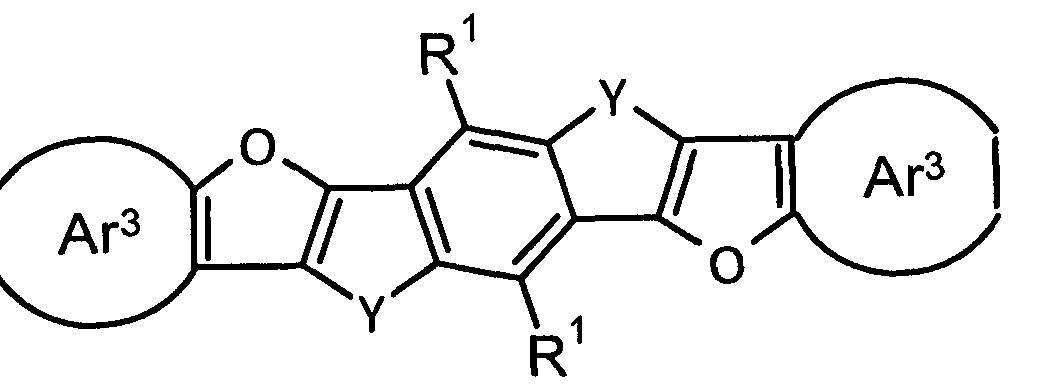
- R 1 is a benzene ring, each of which may be substituted with R 1 ; is chosen the same or different at every occurrence
- Y is the same or different at each occurrence C (R 2 ) 2 or
- aromatic ring systems with 6 to 30 aromatic ring systems with 6 to 30 aromatic ring systems with 6 to 30 aromatic ring systems with 6 to 30 aromatic ring systems with 6 to 30 aromatic ring systems with 6 to 30 aromatic ring systems with 6 to 30 aromatic ring systems with 6 to 30 aromatic ring systems with 6 to 30 aromatic ring systems with 6 to 30 aromatic ring systems with 6 to 30 aromatic ring systems with 6 to 30 aromatic ring systems with 6 to 30 aromatic ring systems with 6 to 30 aromatic
- Ring atoms or heteroaromatic ring systems having 5 to 30 aromatic ring atoms, each of which may be substituted by R 3 radicals;
- Ring atoms wherein two or more R 5 may be linked together and form a ring; and wherein said Alkyl groups, aromatic ring systems and heteroaromatic ring systems may be substituted with F or CN.
- Two adjacent units Ar 1 , Ar 2 and Ar 3 are always condensed together via a common bond, in the way that two benzene rings are condensed via a common bond to a naphthyl group.
- the bonds through which the Ar 1 , Ar 2 and Ar 3 groups are fused together are bonds between two C atoms, preferably between two sp 2 -hybridized C atoms.
- Formula (I) thus corresponds to the following preferred formula (IC)
- An aryl group in the context of this invention contains 6 to 40 aromatic ring atoms, none of which represents a heteroatom.
- An aryl group within the meaning of this invention either becomes a simpler one
- aromatic cycle ie benzene, or a fused aromatic polycycle, for example naphthalene, phenanthrene or anthracene, understood.
- a condensed aromatic polycycle consists in the context of the present application of two or more with each other
- a heteroaryl group in the context of this invention contains from 5 to 40 aromatic ring atoms, at least one of which represents a heteroatom. The heteroatoms of the heteroaryl group are preferred
- a heteroaryl group in the sense of this invention is understood as meaning either a simple heteroaromatic cycle, for example pyridine, pyrimidine or thiophene, or a fused heteroaromatic polycycle, for example quinoline or carbazole.
- a condensed heteroaromatic polycycle consists of two or more simple heteroaromatic rings condensed together. By condensation between cycles it is to be understood that the cycles share at least one edge with each other.
- An aryl or heteroaryl group which may be substituted in each case by the abovementioned radicals and which may be linked via any position on the aromatic or heteroaromatic compounds is understood in particular to mean groups which are derived from benzene, naphthalene, anthracene, phenanthrene, pyrene, Dihydropyrenes, chrysene, perylene, triphenylene, fluoranthene, benzanthracene, benzphenanthrene, tetracene, pentacene, benzopyrene, furan, benzofuran, isobenzofuran, dibenzofuran, thiophene, benzothiophene, isobenzothiophene, dibenzothiophene, pyrrole, indole, isoindole, carbazole, pyridine, quinoline, Isoquinoline, acridine, phenanthridine, benzo-5,6-quino
- An aromatic ring system in the sense of this invention contains 6 to 40 C atoms in the ring system and does not comprise any heteroatoms as aromatic ring atoms. An aromatic ring system in the sense of this invention therefore contains no heteroaryl groups. Under an aromatic ring system
- Ring system in the context of this invention is to be understood as a system which does not necessarily contain only aryl groups, but in which several aryl groups by a single bond or by a non-aromatic moiety, such as one or more optionally substituted C, Si, N, O - or S-atoms, can be connected.
- the non-aromatic unit preferably comprises less than 10% of the atoms other than H, based on the total number of H atoms
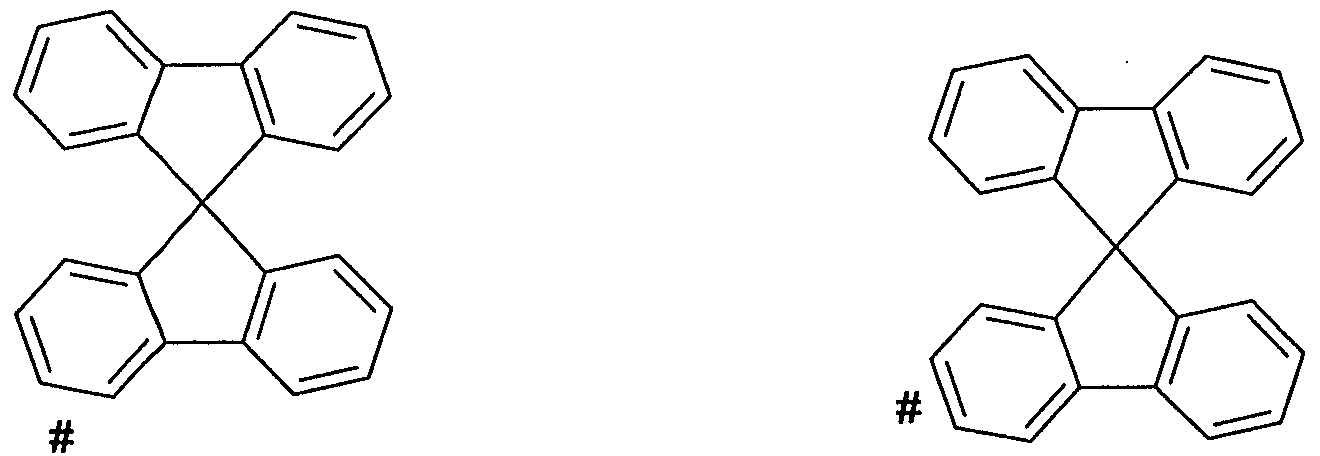
- Systems such as 9,9'-spirobifluorene, 9,9'-diaryl fluorene, triarylamine, diaryl ethers and stilbene as aromatic ring systems in the context of this invention are understood, and also systems in which two or more aryl groups, for example by a linear or cyclic alkyl , Alkenyl or alkynyl group or by a silyl group. Furthermore, systems in which two or more aryl groups over
- Ringsystems understood in the context of this invention, such as systems such as biphenyl and terphenyl.
- a heteroaromatic ring system in the context of this invention contains 5 to 40 aromatic ring atoms, of which at least one
- Ring systems are preferably selected from N, O and / or S.
- a heteroaromatic ring system corresponds to the abovementioned definition of an aromatic ring system, but has at least one
- Heteroatom as one of the aromatic ring atoms. It differs from an aromatic ring system within the meaning of the definition of the present application, which according to this definition can not contain a heteroatom as an aromatic ring atom.
- Ring atoms or a heteroaromatic ring system with 5 to 40 aromatic ring atoms are understood in particular groups which are derived from the groups mentioned above under aryl groups and heteroaryl groups and also from biphenyl, terphenyl, quaterphenyl, fluorene, spirobifluorene, dihydrophenanthrene, dihydropyrene,
- the radicals are methyl, ethyl, n-propyl, i-propyl, n-butyl, i-butyl, s-butyl, t-butyl, 2-methylbutyl, n-pentyl, s-pentyl, cyclopentyl, neo Pentyl, n-hexyl, cyclohexyl, neo-hexyl, n-heptyl,
- the compounds of the formula (I) are symmetrical, relative to a mirror plane through the center and perpendicular to the
- asymmetric compounds in particular those which are symmetrical with respect to the skeleton of the formula (I), but are asymmetric as a whole because of their substitution.
- Ar 1 preferably corresponds to one of the formulas (Ar 1 -1) and (Ar 1 -2) shown below
- Formula (Ar 1 -1) Formula (Ar 1 -2) where the bonds marked with * are those bonds via which the relevant group Ar 1 is fused to the two adjacent groups Ar 2 .
- Particularly preferred among the formulas (Ar 1 -1) and (Ar 1 -2) is the formula (Ar 1 -1).
- the groups R 1 are preferably H.
- Ar 2 is preferably selected from groups of the formula (Ar 2 -1).
- the group Y is C (R 2 ) 2.
- Particularly preferred is the choice of Ar 2 according to formula (Ar 2 -1), and the simultaneous choice of Y as C (R 2 ) 2 .
- Ar 3 is preferably identical or different at each occurrence selected from benzene, pyridine, pyrimidine, pyrazine, pyridazine, pyrrole, furan, thiophene, benzofuran, benzothiophene, dibenzofuran, dibenzothiophene, fluorene, spirobifluorene, indenofluorene, naphthalene and anthracene, each with radicals R 3 may be substituted.
- radicals R 3 each with radicals R 3 may be substituted.
- benzene, naphthalene, fluorene and spirobifluorene each of which may be substituted by radicals R 3 .
- no more than three groups X in a six-membered ring are equal to N.
- no more than two adjacent groups C are equal to N.
- Preferred groups R 1 are identically or differently selected on each occurrence from H, F, CN, alkyl groups having 1 to 20 C atoms, aromatic ring systems having 6 to 30 aromatic ring atoms and
- heteroaromatic ring systems with 5 to 30 aromatic ring atoms; wherein two or more radicals R 1 may be linked together and form a ring; and wherein said alkyl groups, aromatic ring systems and heteroaromatic ring systems may be substituted with R 4 and may be preferably substituted with F or CN.
- Preferred groups R 2 are the same or different in each occurrence selected from straight-chain alkyl groups having 1 to 20 carbon atoms,
- branched or cyclic alkyl groups having 3 to 20 carbon atoms, aromatic ring systems having 6 to 18 aromatic ring atoms, and heteroaromatic ring systems having 5 to 18 aromatic ring atoms, where said groups may be substituted by R 4 radicals.
- Particularly preferred groups R 2 are the same or different at each instance selected from methyl, ethyl, propyl, butyl, pentyl, hexyl, heptyl, octyl, nonyl, decyl, and phenyl, which may each be substituted with radicals R 4 and are preferably unsubstituted
- Preferred groups R 3 are identically or differently selected on each occurrence from H, F, CN, alkyl groups having 1 to 20 C atoms, aromatic ring systems having 6 to 30 aromatic ring atoms and
- heteroaromatic ring systems with 5 to 30 aromatic ring atoms; wherein two or more R 3 may be linked together and form a ring; and wherein said alkyl groups, aromatic ring systems and heteroaromatic ring systems may be substituted with R 4 and may be preferably substituted with F or CN.
- variable groups are preferred.
- Y is C (R 2 ) 2 ;
- the groups Ar 3 correspond to a formula selected from the
- the compound of the formula (I) is preferably characterized in that the value for its triplet level is greater than the value divided by 2 for its singlet level.
- the values for singlet energy level and triplet energy level are determined by quantum mechanical calculation, as indicated in the exemplary embodiments of WO 2015/036080, section A).
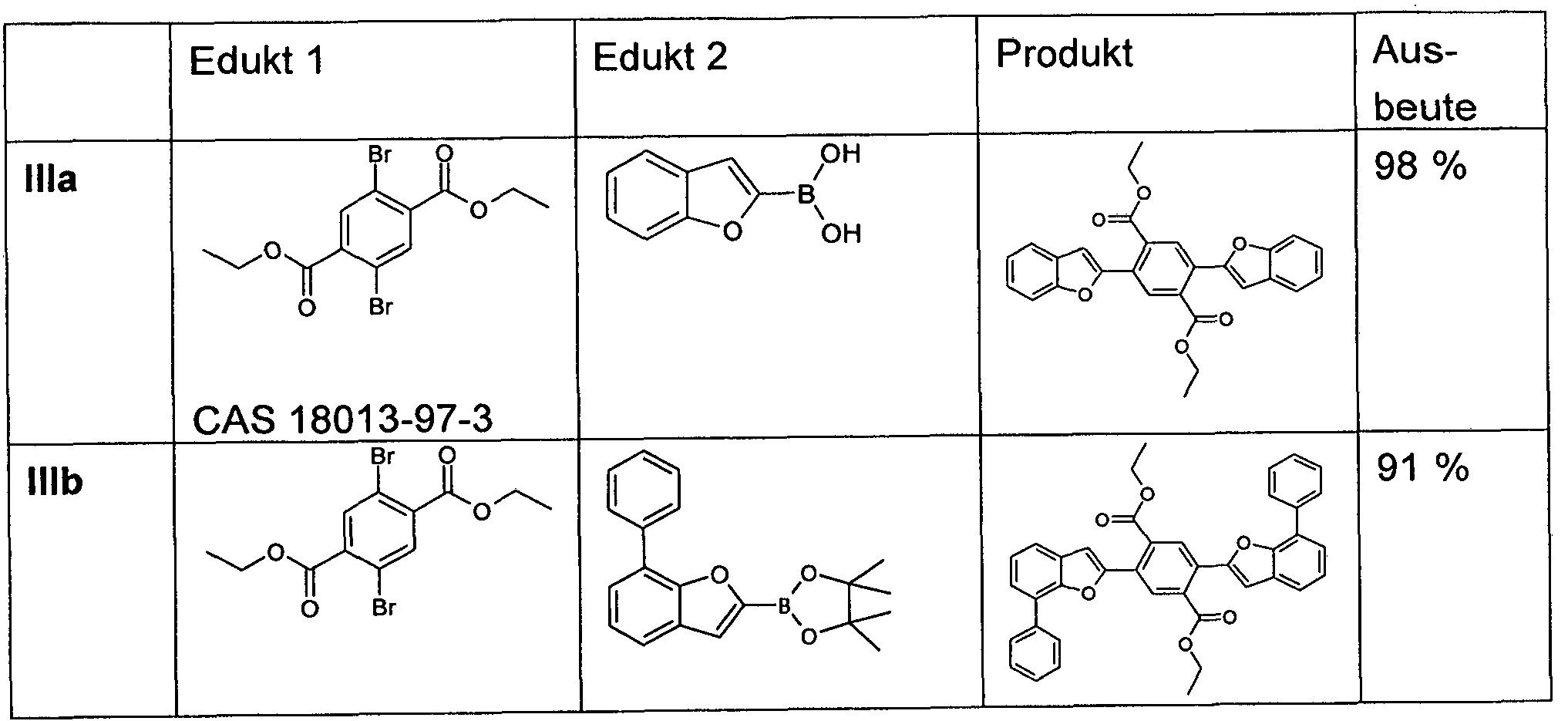
- two furan-containing groups I which also comprise the unit Ar 3 , are connected to the central unit Ar 1 via an organometallic coupling reaction.
- the central unit is difunctional, so that two equivalents of the furan-containing compound react with one equivalent of the central unit Ar 1 .
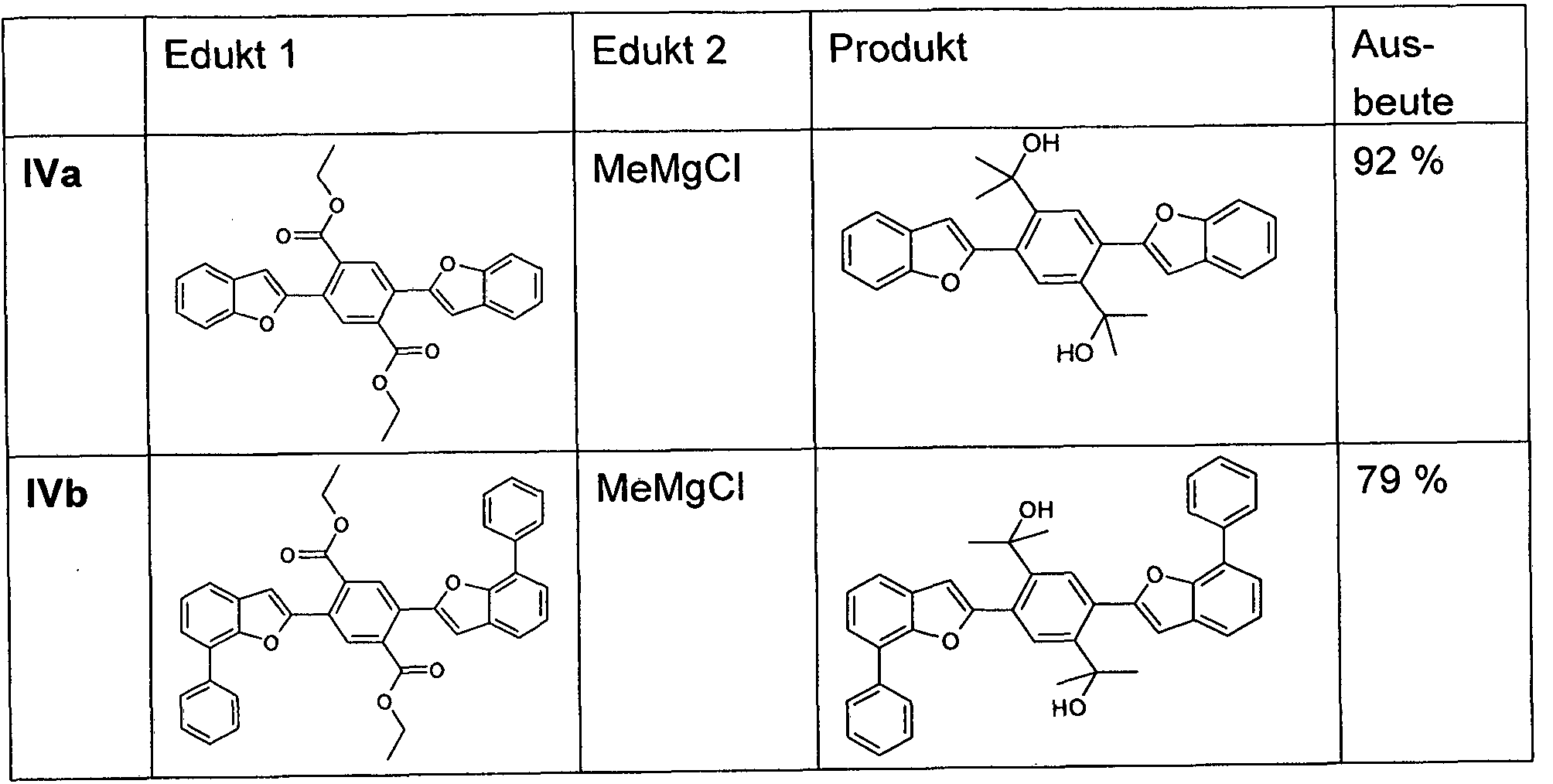
- the double-occurring ring closure reaction which forms the units Ar 2 is prepared. This is done by reducing two ester groups on the unit Ar 1 to a tertiary alcohol group, preferably by an alkylmagnesium compound.
- the double-occurring ring-closing reaction is carried out by adding acid.
- the skeleton of the compound of the formula (I) is obtained.
- This can be further modified as shown in the general scheme under A-2, preferably by bromination and subsequent introduction of aromatic groups by organometallic coupling reaction.
- R1, R2, R any organic radical
- the subject of the present application is therefore also a process for the preparation of compounds of the formula (I), characterized in that the compound is formed by the following steps carried out in the present order:
- a ring closure reaction of this tertiary alcohol group to form an alkylene bridge between the Ar 1 unit and the furan ring can be used as monomers for producing corresponding oligomers, dendrimers or polymers.
- Suitable reactive leaving groups are, for example, bromine, iodine, chlorine, boronic acids, boronic acid esters, amines,
- Alkenyl or alkynyl groups with terminal C-C double bond or C-C triple bond oxiranes, oxetanes, groups which undergo a cycloaddition, for example a 1, 3-dipolar cycloaddition, such
- dienes or azides for example, dienes or azides, carboxylic acid derivatives, alcohols and silanes.
- Another object of the invention are therefore oligomers, polymers or
- Formula (I), wherein the bond (s) to the polymer, oligomer or dendrimer at any, in formula (I) with R 1 , R 2 or R 3 substituted positions may be located.
- the compound is part of a side chain of the oligomer or polymer or constituent of the main chain.
- An oligomer in the context of this invention is understood as meaning a compound which is composed of at least three monomer units.
- a polymer in the context of the invention is understood as meaning a compound which is composed of at least ten monomer units.
- the polymers, oligomers or dendrimers according to the invention may be conjugated, partially conjugated or non-conjugated.
- the oligomers or polymers of the invention may be linear, branched or dendritic.
- the units of the formula (I) can be linked directly to one another or they can be linked to one another via a divalent group, for example via a substituted or unsubstituted alkylene group, via a heteroatom or via a divalent aromatic or heteroaromatic group.
- branched and dendritic structures for example, three or more units of formula (I) may be linked via a trivalent or higher valent group, for example via a trivalent or higher valent aromatic or heteroaromatic group, to a branched or dendritic oligomer or polymer.
- the corresponding polymers comprising units of the formula (I) can be used, for example, as triplet-control polymer for triplet triplet annihilation.
- the groups of formula (I) can replace anthracene groups equivalent.
- the repeat units according to formula (I) in oligomers, dendrimers and polymers the same preferences apply as above for
- the monomers according to the invention are homopolymerized or copolymerized with further monomers.
- Suitable and preferred comonomers are selected from fluorenes (eg according to EP 842208 or WO 00/22026), spirobifluorenes (eg according to EP 707020, EP 894107 or WO 06/061181), paraphenylenes (eg. according to WO 1992/18552), carbazoles (eg according to WO 04/070772 or WO 2004/113468), thiophenes (eg according to fluorenes (eg according to EP 842208 or WO 00/22026), spirobifluorenes (eg according to EP 707020, EP 894107 or WO 06/061181), paraphenylenes (eg. according to WO 1992/18552), carbazoles (eg according to WO 04/070772 or WO 2004/113468), thiophenes (eg according to
- EP 1028136 dihydrophenanthrenes (for example according to WO 2005/014689 or WO 2007/006383), cis and trans indenofluorenes (for example according to WO
- ketones eg according to
- Oligomers and dendrimers usually contain other units, such as emitting (fluorescent or phosphorescent) units, such as.
- emitting (fluorescent or phosphorescent) units such as.
- Vinyltriarylamines for example according to WO 2007/068325
- phosphorescent metal complexes for example according to WO 2006/003000
- charge transport units especially those based on triarylamines.
- the polymers and oligomers according to the invention are generally prepared by polymerization of one or more types of monomer, of which at least one monomer in the polymer leads to repeat units of the formula (I).
- Suitable polymerization reactions are known in the art and described in the literature.
- Particularly suitable and preferred polymerization reactions which lead to C-C or C-N bonds are the following: (A) SUZUKI polymerization;
- Literature for example in WO 2003/048225, WO 2004/037887 and WO 2004/037887, described in detail.
- formulations of the compounds according to the invention are required. These formulations may be, for example, solutions, dispersions or emulsions. It may be preferable to use mixtures of two or more solvents for this purpose. Suitable and preferred solvents are, for example, toluene, anisole, o-, m- or p-xylene,
- Methyl benzoate mesitylene, tetralin, veratrole, THF, methyl THF, THP, chlorobenzene, dioxane, phenoxytoluene, especially 3-phenoxytoluene, (-) - fenchone, 1, 2,3,5-tetramethylbenzene, 1,2,4,5 -Tetramethylbenzene, 1-
- Triethylene glycol dimethyl ether diethylene glycol monobutyl ether
- Tripropylene glycol dimethyl ether Tripropylene glycol dimethyl ether, tetraethylene glycol dimethyl ether, 2-isopropylnaphthalene, pentylbenzene, hexylbenzene, heptylbenzene,
- the invention therefore further provides a formulation, in particular a solution, dispersion or emulsion containing at least one compound according to formula (I) or at least one polymer, oligomer or dendrimer comprising at least one unit according to formula (I) and at least one solvent, preferably an organic solvent.
- a formulation in particular a solution, dispersion or emulsion containing at least one compound according to formula (I) or at least one polymer, oligomer or dendrimer comprising at least one unit according to formula (I) and at least one solvent, preferably an organic solvent.
- the compounds according to the invention are suitable for use in electronic devices, in particular in organic electroluminescent devices (OLEDs). Depending on the substitution, the compounds are used in different functions and layers.
- OLEDs organic electroluminescent devices
- the compounds according to the invention can be used in any function in the organic electroluminescent device,
- Another object of the invention is therefore the use of a
- the electronic device is preferably selected from the group consisting of organic integrated circuits (OICs), organic field effect transistors (OFETs), organic thin film transistors (OTFTs), organic light emitting transistors (OLETs),
- OICs organic integrated circuits
- OFETs organic field effect transistors
- OTFTs organic thin film transistors
- OLETs organic light emitting transistors
- organic solar cells organic solar cells (OSCs), organic optical detectors, organic photoreceptors, organic field quench devices
- OLEDs organic electroluminescent devices
- Another object of the invention is an electronic device containing at least one compound of formula (I).
- the electronic device is selected from those given above
- an organic electroluminescent device comprising anode, cathode and at least one emitting layer, characterized in that at least one organic layer contains at least one compound according to formula (I).
- an organic electroluminescent device comprising the anode, cathode and at least one emitting layer containing at least one compound of the formula (I).
- the organic electroluminescent device may also contain further layers. These are, for example, selected from in each case one or more hole injection layers, hole transport layers, hole blocking layers,
- Electron transport layers electron injection layers, electron blocking layers, exciton blocking layers, intermediate layers
- the sequence of layers of the organic electroluminescent device is preferably the following: anode hole injection layer
- Hole transport layer-emitting layer electron transport layer electron injection layer cathode In this case, not all of the layers mentioned must be present, and additional layers may additionally be present, for example an electron-blocking layer adjacent to the emitting layer on the anode side, or one
- the organic electroluminescent device according to the invention may contain a plurality of emitting layers. Particularly preferred In this case, these emission layers have a total of a plurality of emission maxima between 380 nm and 750 nm, so that overall white emission results, ie, in the emitting layers
- emissive compounds that can fluoresce or phosphoresce and that emit blue or green or yellow or orange or red light.
- three-layer systems ie systems having three emitting layers, wherein preferably at least one of these layers contains at least one compound according to formula (I) and wherein the three layers show blue, green and orange or red emission (for the basic structure see, for example, US Pat WO 2005/011013).
- a single-use emitter compound emitting in a wide wavelength range may also be suitable.
- the compound of the invention is particularly suitable for
- an emitter compound preferably a blue emitting emitter compound, particularly preferred for a blue fluorescent emitter compound.
- the compound is used as a matrix compound in an emitting layer, it is preferred that they have triplet triplet annihilation or
- Triplet-Triplet-Fusion allowed This is understood to mean a mechanism in which two triplet states each combine to form a singlet state, which increases the efficiency of the singlet OLED. Therefore, when the compound of the formula (I) is used as the matrix material in the emitting layer, it is preferable that the triplet levels of the materials of the layers adjacent to the emitting layer are larger than those of the compound of the formula (I). Furthermore, it is preferred that the triplet level of the emissive compound present in the emissive layer together with the compound of formula (I) is higher than the triplet level of the compound of formula (I). If the compound according to the invention is used as matrix material, it can be used in combination with any emissive compounds known to the person skilled in the art. It is preferably used in combination with the preferred emitting compounds given below, especially the preferred fluorescent compounds given below.
- Electroluminescent device containing a mixture of an emitting compound and a matrix compound, the following applies:
- the emissive layer is preferably between 0.1 and 50.0%, more preferably between 0.5 and 20.0%, and most preferably between 1.0 and 10.0%. Accordingly, the proportion of the matrix material or the matrix materials is preferably between 50.0 and 99.9%, particularly preferably between 80.0 and 99.5%, and very particularly preferably between 90.0 and 99.0%.
- the compounds of the formula (I) are used as hole transport materials in a hole-transporting layer.
- a hole-transporting layer This may be any layer arranged between the anode and the emitting layer, for example a hole injection layer, a hole transport layer or an electron blocking layer.
- it is a hole transport layer, i. a layer located between the hole injection layer and the electron blocking layer or the emitting layer.
- Electron blocking layer used so the compound as Pure material, ie in a proportion of 100%, be used in the hole transport layer, or it can be used in combination with one or more other compounds.
- Preferred p-type dopants according to the present invention are those organic electron acceptor compounds
- the compound of the formula (I) is used as an emitting compound in an emitting layer, it is preferably a blue one
- fluorescent emitting compound It is preferred in this case in combination with at least one further compound
- Compounds are selected from the preferred classes of matrix compounds mentioned below.
- Particularly suitable as phosphorescent emitting compounds are compounds which emit light, preferably in the visible range, when suitably excited, and also contain at least one atom of atomic number greater than 20, preferably greater than 38 and less than 84, particularly preferably greater than 56 and less than 80.
- Preferred as phosphorescent emitting compounds are compounds which
- Preferred fluorescent emitters are in addition to the compounds of the invention selected from the class of arylamines.
- An arylamine in the context of this invention is understood as meaning a compound which contains three substituted or unsubstituted aromatic or heteroaromatic ring systems bonded directly to the nitrogen. At least one of these aromatic or heteroaromatic is preferred
- Ring systems a fused ring system, more preferably having at least 14 aromatic ring atoms.
- Preferred examples of these are aromatic anthracene amines, aromatic anthracenediamines, aromatic pyrenamines, aromatic pyrenediamines, aromatic
- aromatic anthracenamine is understood as meaning a compound in which a diarylamino group is bonded directly to an anthracene group, preferably in the 9-position.
- An aromatic anthracenediamine is understood to mean a compound in which two diarylamino groups are bonded directly to an anthracene group, preferably in the 9,10-position.
- Aromatic pyrenamines, pyrenediamines, chrysenamines and chrysenediamines are defined analogously thereto, the diarylamino groups on the Pyrene are preferably bonded in the 1-position or in the 1, 6-position.
- emitters are indenofluoreneamines or -diamines, for example according to WO 2006/108497 or WO 2006/122630, benzoindeno-fluorenamines or -diamines, for example according to WO 2008/006449, and dibenzoindenofluoreneamines or -diamines, for example according to
- Indenofluorene derivatives with fused aryl groups are preferred.
- Preferred fluorescent emitting compounds are shown in the following table:
- Compounds are aromatic amines, especially triarylamines, e.g.
- carbazole derivatives eg CBP, N, N-biscarbazolylbiphenyl
- WO 2005/039246 e.g.
- JP 2004/288381 e.g., JP 2004/288381
- EP 1205527 e.g., EP 1205527
- WO 2008/086851 bridged carbazole derivatives, for. B. according to WO 2011/088877 and
- WO 2011/128017 Indenocarbazolderivate, z. B. according to WO 2010/136109 and WO 2011/000455, Azacarbazolderivate, z. B. according to EP 1617710, EP 1617711, EP 1731584, JP 2005/347160, Indolocarbazolderivate, z. B. according to WO 2007/063754 or WO 2008/056746, ketones, z. B. according to WO 2004/093207 or WO 2010/006680, phosphine oxides, sulfoxides and sulfones, for. B. according to WO 2005/003253, oligophenylenes, bipolar
- Matrix materials e.g. B. according to WO 2007/137725, silanes, z. B. according to WO 2005/111172, azaborole or boronic esters, z. B. according to WO 2006/117052, Triazine derivatives, e.g. B. according to WO 2010/015306, WO 2007/063754 or WO 2008/056746, zinc complexes, for. B. according to EP 652273 or
- WO 2009/062578 aluminum complexes, e.g. B. BAIq, Diazasilol- and
- Tetraazasilol derivatives eg. B. according to WO 2010/054729 and diazaphosphole derivatives, z. B. according to WO 2010/054730.
- Preferred matrix materials for use in combination with fluorescent emitting compounds are besides the
- oligoarylenes containing condensed aromatic groups in particular the oligoarylenes containing condensed aromatic groups, the oligoarylenevinylenes (eg DPVBi or spiro-DPVBi according to EP 676461), the polypodal metal complexes (eg according to WO 2004/081017), the hole-conducting compounds (e.g. WO 2004/058911), the electron-conducting compounds, in particular ketones, phosphine oxides, sulfoxides, etc. (for example according to US Pat
- Particularly preferred matrix materials are selected from the classes of oligoarylenes containing naphthalene, anthracene, benzanthracene and / or pyrene or atropisomers of these compounds, the oligoarylenevinylenes, the ketones, the phosphine oxides and the sulfoxides.
- Very particularly preferred matrix materials are selected from the classes of oligoarylenes containing anthracene, benzanthracene, benzphenanthrene and / or pyrene or atropisomers of these compounds.
- an oligoarylene is to be understood as meaning a compound in which at least three aryl or arylene groups are bonded to one another.
- Suitable charge transport materials as used in Lochinjetechnischs Inc. Hole transport layer or electron blocking layer or in the electron transport layer of the organic according to the invention
- Electroluminescent device can be used in addition to the compounds of the invention, for example, the compounds disclosed in Y. Shirota et al., Chem. Rev. 2007, 107 (4), 953-1010 or other materials, such as those used in the prior art in these layers.
- indenofluorenamine derivatives for example according to WO 06/122630 or WO 06/100896 which are described in US Pat
- EP 1661888 disclosed amine derivatives, hexaazatriphenylene derivatives (for example according to WO 01/049806), aromatic fused amine derivatives (for example according to US Pat. No. 5,061,569), the amine derivatives disclosed in WO 95/09147, monobenzoindenofluoreneamines (for example according to US Pat WO 08/006449),
- Dibenzoindenofluoreneamines eg according to WO 07/140847
- spirobifluorene amines eg according to WO 2012/034627 or WO 2013/120577
- fluorene amines eg according to WO 2014/015937, WO 2014 / 015938 and
- low work function metals, metal alloys or multilayer structures of various metals are preferable, such as
- Alkaline earth metals alkali metals, main group metals or lanthanides (eg Ca, Ba, Mg, Al, In, Mg, Yb, Sm, etc.). Furthermore, are suitable
- an alloy of magnesium and silver in multilayer structures, it is also possible, in addition to the metals mentioned, to use further metals which have a relatively high work function, such as, for example, As Ag or Al, which then usually combinations of metals, such as Ca / Ag, Mg / Ag or Ba / Ag are used. It may also be preferred between a metallic one
- Cathode and the organic semiconductor to introduce a thin intermediate layer of a material with a high dielectric constant are alkali metal or alkaline earth metal fluorides, but also the corresponding oxides or carbonates (eg LiF, U 2 O, BaF 2, MgO, NaF, CsF, CS 2 CO 3, etc.). Furthermore, for that Lithium quinolinate (LiQ) can be used.
- the layer thickness of this layer is preferably between 0.5 and 5 nm.
- the anode high workfunction materials are preferred.
- the anode has a work function greater than 4.5 eV. Vacuum up.
- metals with a high redox potential such as Ag, Pt or Au, are suitable for this purpose.
- metal / metal oxide electrodes eg Al / Ni / NiOx, Al / PtOx
- at least one of the electrodes must be transparent or
- anode materials are conductive mixed metal oxides. Particularly preferred are indium tin oxide (ITO) or indium zinc oxide (IZO). Preference is still given
- conductive, doped organic materials in particular conductive doped polymers.
- the device is structured accordingly (depending on the application), contacted and finally sealed, since the life of the devices according to the invention is shortened in the presence of water and / or air.
- Organic electroluminescent device characterized in that one or more layers are coated by a sublimation process.
- the materials in vacuum sublimation are at an initial pressure less than 10 "5 mbar, preferably less than 10 -6 mbar evaporated. However, it is also possible that the initial pressure is even lower, for example less than 10 -7 mbar
- organic electroluminescent device characterized in that one or more layers with the OVPD (organic Vapor phase deposition) method, or be coated with the aid of carrier. in this case, the materials at a pressure between 10 "5 mbar and 1 bar are applied.
- OVPD organic Vapor phase deposition
- OVJP Organic Vapor Jet Printing
- an organic electroluminescent device characterized in that one or more layers of solution, such. B. by spin coating, or with any printing process, such.
- any printing process such.
- screen printing flexographic printing, nozzle printing or offset printing, but particularly preferably LITI (Light Induced Thermal Imaging,
- the layer containing one or more compounds of formula (I) is applied from solution. This is preferably the emitting layer of an organic electroluminescent device.
- the electronic devices containing one or more compounds according to the invention can be used in displays, as light sources in illumination applications and as light sources in medical and / or cosmetic applications (for example light therapy).
- the organic phase is expanded with 300 mL of ethyl acetate and the phases separated.
- the aqueous phase is extracted twice with ethyl acetate.
- the combined organic phases are dried over sodium sulfate and then taken under
- inventive OLEDs and OLEDs according to the prior art is carried out according to a general method according to WO 04/05891 1, based on the conditions described here
- the substrates used are glass substrates which are coated with structured ITO (indium tin oxide) of thickness 50 nm.
- the OLEDs have in principle the following layer structure: substrate / buffer / hole injection layer 1 (95% HTL1 + 5% HIL, 20 nm) / hole transport layer (HTL2, thickness given in Table 1) /
- Emission layer 20 nm
- ETL electron transport layer
- EIL electron injection layer
- cathode is formed by a 100 nm thick aluminum layer.
- the buffer used is a 20 nm thick layer of Clevios P VP Al 4083 (obtained from Heraeus Clevios GmbH, Leverkusen) by spin coating. All remaining materials are thermally evaporated in a vacuum chamber.
- the structure of the OLEDs is shown in Table 1. The materials used are shown in Table 3.
- H1: D1 (95%: 5%) here means that the material H1 is present in a proportion by volume of 95% and D1 in a proportion of 5% in the layer.
- the OLEDs are characterized by default. For this purpose, the electro-energy spectra are recorded, the current efficiency (measured in cd / A) and the external quantum efficiency (EQE, measured in percent) as a function of the luminance, assuming a Lambertian
- the compounds H1 and H2 according to the invention are used individually as a matrix in the emitting layer of OLEDs (structure see Table 3).
- the compound D is used as the emitter material of the emitting layer.
- the resulting OLEDs are E1 and E2. They show very good external quantum efficiency (EQE) at deep blue emission (Table 2).
- Hole transport material is used in the hole transport layer, also shows a good external quantum efficiency at deep blue emission (Table 2). This proves the good suitability of the invention
Landscapes
- Chemical & Material Sciences (AREA)
- Organic Chemistry (AREA)
- Engineering & Computer Science (AREA)
- Materials Engineering (AREA)
- Physics & Mathematics (AREA)
- Spectroscopy & Molecular Physics (AREA)
- Optics & Photonics (AREA)
- Electroluminescent Light Sources (AREA)
- Heterocyclic Carbon Compounds Containing A Hetero Ring Having Oxygen Or Sulfur (AREA)
Abstract
Description






Claims


Priority Applications (5)
| Application Number | Priority Date | Filing Date | Title |
|---|---|---|---|
| JP2018506901A JP6749999B2 (ja) | 2015-08-12 | 2016-07-13 | 電子素子のための材料 |
| EP16739025.1A EP3335253B1 (de) | 2015-08-12 | 2016-07-13 | Materialien für elektronische vorrichtungen |
| US15/751,969 US10790456B2 (en) | 2015-08-12 | 2016-07-13 | Materials for electronic devices |
| KR1020187006760A KR102607963B1 (ko) | 2015-08-12 | 2016-07-13 | 전자 소자용 물질 |
| CN201680047019.9A CN107925007B (zh) | 2015-08-12 | 2016-07-13 | 用于电子器件的材料 |
Applications Claiming Priority (2)
| Application Number | Priority Date | Filing Date | Title |
|---|---|---|---|
| EP15180777 | 2015-08-12 | ||
| EP15180777.3 | 2015-08-12 |
Publications (1)
| Publication Number | Publication Date |
|---|---|
| WO2017025165A1 true WO2017025165A1 (de) | 2017-02-16 |
Family
ID=54014490
Family Applications (1)
| Application Number | Title | Priority Date | Filing Date |
|---|---|---|---|
| PCT/EP2016/001205 Ceased WO2017025165A1 (de) | 2015-08-12 | 2016-07-13 | Materialien für elektronische vorrichtungen |
Country Status (7)
| Country | Link |
|---|---|
| US (1) | US10790456B2 (de) |
| EP (1) | EP3335253B1 (de) |
| JP (1) | JP6749999B2 (de) |
| KR (1) | KR102607963B1 (de) |
| CN (1) | CN107925007B (de) |
| TW (1) | TWI713565B (de) |
| WO (1) | WO2017025165A1 (de) |
Cited By (33)
| Publication number | Priority date | Publication date | Assignee | Title |
|---|---|---|---|---|
| WO2018069167A1 (de) | 2016-10-10 | 2018-04-19 | Merck Patent Gmbh | Elektronische vorrichtung |
| WO2018083053A1 (de) | 2016-11-02 | 2018-05-11 | Merck Patent Gmbh | Materialien für elektronische vorrichtungen |
| WO2018095839A1 (de) | 2016-11-22 | 2018-05-31 | Merck Patent Gmbh | Verbrückte triarylamine für elektronische vorrichtungen |
| WO2018114882A1 (de) | 2016-12-22 | 2018-06-28 | Merck Patent Gmbh | Materialien für elektronische vorrichtungen |
| WO2018157981A1 (de) | 2017-03-02 | 2018-09-07 | Merck Patent Gmbh | Materialien für organische elektronische vorrichtungen |
| WO2018197447A1 (de) | 2017-04-25 | 2018-11-01 | Merck Patent Gmbh | Verbindungen für elektronische vorrichtungen |
| WO2018234346A1 (en) | 2017-06-23 | 2018-12-27 | Merck Patent Gmbh | Materials for organic electroluminescent devices |
| WO2018234220A1 (de) | 2017-06-21 | 2018-12-27 | Merck Patent Gmbh | Materialien für elektronische vorrichtungen |
| WO2019002190A1 (en) | 2017-06-28 | 2019-01-03 | Merck Patent Gmbh | MATERIALS FOR ELECTRONIC DEVICES |
| WO2019020654A1 (en) | 2017-07-28 | 2019-01-31 | Merck Patent Gmbh | SPIROBIFLUORENE DERIVATIVES FOR USE IN ELECTRONIC DEVICES |
| WO2019048443A1 (de) | 2017-09-08 | 2019-03-14 | Merck Patent Gmbh | Materialien für elektronische vorrichtungen |
| WO2019115577A1 (en) | 2017-12-15 | 2019-06-20 | Merck Patent Gmbh | Substituted aromatic amines for use in organic electroluminescent devices |
| WO2019175149A1 (en) | 2018-03-16 | 2019-09-19 | Merck Patent Gmbh | Materials for organic electroluminescent devices |
| WO2020178230A1 (en) | 2019-03-04 | 2020-09-10 | Merck Patent Gmbh | Ligands for nano-sized materials |
| WO2023052272A1 (de) | 2021-09-28 | 2023-04-06 | Merck Patent Gmbh | Materialien für elektronische vorrichtungen |
| WO2023052314A1 (de) | 2021-09-28 | 2023-04-06 | Merck Patent Gmbh | Materialien für elektronische vorrichtungen |
| WO2023052275A1 (de) | 2021-09-28 | 2023-04-06 | Merck Patent Gmbh | Materialien für elektronische vorrichtungen |
| WO2023052313A1 (de) | 2021-09-28 | 2023-04-06 | Merck Patent Gmbh | Materialien für elektronische vorrichtungen |
| WO2023094412A1 (de) | 2021-11-25 | 2023-06-01 | Merck Patent Gmbh | Materialien für elektronische vorrichtungen |
| WO2023117837A1 (de) | 2021-12-21 | 2023-06-29 | Merck Patent Gmbh | Verfahren zur herstellung von deuterierten organischen verbindungen |
| WO2023152346A1 (de) | 2022-02-14 | 2023-08-17 | Merck Patent Gmbh | Materialien für elektronische vorrichtungen |
| WO2023222559A1 (de) | 2022-05-18 | 2023-11-23 | Merck Patent Gmbh | Verfahren zur herstellung von deuterierten organischen verbindungen |
| WO2024013004A1 (de) | 2022-07-11 | 2024-01-18 | Merck Patent Gmbh | Materialien für elektronische vorrichtungen |
| WO2024133048A1 (en) | 2022-12-20 | 2024-06-27 | Merck Patent Gmbh | Method for preparing deuterated aromatic compounds |
| WO2024170605A1 (en) | 2023-02-17 | 2024-08-22 | Merck Patent Gmbh | Materials for organic electroluminescent devices |
| WO2024218109A1 (de) | 2023-04-20 | 2024-10-24 | Merck Patent Gmbh | Materialien für elektronische vorrichtungen |
| WO2024240725A1 (de) | 2023-05-25 | 2024-11-28 | Merck Patent Gmbh | Tris[1,2,4]triazolo[1,5-a:1',5'-c:1'',5''-e][1,3,5]triazin-derivate zur verwendung in organischen elektrolumineszenzvorrichtungen |
| WO2025012253A1 (en) | 2023-07-12 | 2025-01-16 | Merck Patent Gmbh | Materials for electronic devices |
| WO2025021855A1 (de) | 2023-07-27 | 2025-01-30 | Merck Patent Gmbh | Materialien für organische lichtemittierende vorrichtungen und organische sensoren |
| WO2025132547A1 (en) | 2023-12-21 | 2025-06-26 | Merck Patent Gmbh | Mechanochemical method for deuterating organic compounds |
| WO2025132551A1 (de) | 2023-12-22 | 2025-06-26 | Merck Patent Gmbh | Materialien für elektronische vorrichtungen |
| WO2025196145A1 (en) | 2024-03-22 | 2025-09-25 | Merck Patent Gmbh | Materials for organic light emitting devices |
| WO2025210013A1 (de) | 2024-04-04 | 2025-10-09 | Merck Patent Gmbh | Verbindungen für elektronische vorrichtungen, insbesondere verbindungen für oleds |
Families Citing this family (1)
| Publication number | Priority date | Publication date | Assignee | Title |
|---|---|---|---|---|
| CN109134418B (zh) * | 2018-08-20 | 2023-11-28 | 东莞伏安光电科技有限公司 | 一类二苯并吡喃七元稠环单元及其衍生物和制备方法与应用 |
Citations (4)
| Publication number | Priority date | Publication date | Assignee | Title |
|---|---|---|---|---|
| WO2006122630A1 (de) * | 2005-05-20 | 2006-11-23 | Merck Patent Gmbh | Verbindungen für organische elektronische vorrichtungen |
| DE102006025846A1 (de) * | 2006-06-02 | 2007-12-06 | Merck Patent Gmbh | Neue Materialien für organische Elektrolumineszenzvorrichtungen |
| JP2010045281A (ja) * | 2008-08-18 | 2010-02-25 | Konica Minolta Holdings Inc | 有機エレクトロルミネッセンス素子材料、有機エレクトロルミネッセンス素子、表示装置及び照明装置 |
| DE102009052428A1 (de) * | 2009-11-10 | 2011-05-12 | Merck Patent Gmbh | Verbindung für elektronische Vorrichtungen |
Family Cites Families (5)
| Publication number | Priority date | Publication date | Assignee | Title |
|---|---|---|---|---|
| JP5007988B2 (ja) * | 2005-10-27 | 2012-08-22 | 国立大学法人名古屋大学 | 多環縮環化合物およびそれらの製造法ならびに多環縮環化合物を用いる有機電界発光素子 |
| JP5692011B2 (ja) * | 2011-11-08 | 2015-04-01 | コニカミノルタ株式会社 | 有機エレクトロルミネッセンス素子材料、有機エレクトロルミネッセンス素子、表示装置、並びに照明装置 |
| US8921578B2 (en) * | 2011-12-12 | 2014-12-30 | State of Oregan Acting by and Through the State Board of Higher Education on Behalf of the University of Oregan | Heteroatomic indenofluorenes |
| US9947879B2 (en) * | 2013-03-15 | 2018-04-17 | Idemitsu Kosan Co., Ltd. | Anthracene derivative and organic electroluminescence element using same |
| KR102174919B1 (ko) * | 2013-12-03 | 2020-11-05 | 엘지디스플레이 주식회사 | 유기 발광 소자 및 유기 발광 표시장치 |
-
2016
- 2016-07-13 KR KR1020187006760A patent/KR102607963B1/ko active Active
- 2016-07-13 JP JP2018506901A patent/JP6749999B2/ja not_active Expired - Fee Related
- 2016-07-13 US US15/751,969 patent/US10790456B2/en active Active
- 2016-07-13 WO PCT/EP2016/001205 patent/WO2017025165A1/de not_active Ceased
- 2016-07-13 EP EP16739025.1A patent/EP3335253B1/de active Active
- 2016-07-13 CN CN201680047019.9A patent/CN107925007B/zh active Active
- 2016-08-09 TW TW105125319A patent/TWI713565B/zh not_active IP Right Cessation
Patent Citations (4)
| Publication number | Priority date | Publication date | Assignee | Title |
|---|---|---|---|---|
| WO2006122630A1 (de) * | 2005-05-20 | 2006-11-23 | Merck Patent Gmbh | Verbindungen für organische elektronische vorrichtungen |
| DE102006025846A1 (de) * | 2006-06-02 | 2007-12-06 | Merck Patent Gmbh | Neue Materialien für organische Elektrolumineszenzvorrichtungen |
| JP2010045281A (ja) * | 2008-08-18 | 2010-02-25 | Konica Minolta Holdings Inc | 有機エレクトロルミネッセンス素子材料、有機エレクトロルミネッセンス素子、表示装置及び照明装置 |
| DE102009052428A1 (de) * | 2009-11-10 | 2011-05-12 | Merck Patent Gmbh | Verbindung für elektronische Vorrichtungen |
Cited By (36)
| Publication number | Priority date | Publication date | Assignee | Title |
|---|---|---|---|---|
| EP4113643A1 (de) | 2016-10-10 | 2023-01-04 | Merck Patent GmbH | Elektronische vorrichtung |
| WO2018069167A1 (de) | 2016-10-10 | 2018-04-19 | Merck Patent Gmbh | Elektronische vorrichtung |
| EP4255151A2 (de) | 2016-10-10 | 2023-10-04 | Merck Patent GmbH | Spiro[fluoren-9,9'-(thio)xanthen] verbindungen |
| WO2018083053A1 (de) | 2016-11-02 | 2018-05-11 | Merck Patent Gmbh | Materialien für elektronische vorrichtungen |
| WO2018095839A1 (de) | 2016-11-22 | 2018-05-31 | Merck Patent Gmbh | Verbrückte triarylamine für elektronische vorrichtungen |
| WO2018114882A1 (de) | 2016-12-22 | 2018-06-28 | Merck Patent Gmbh | Materialien für elektronische vorrichtungen |
| WO2018157981A1 (de) | 2017-03-02 | 2018-09-07 | Merck Patent Gmbh | Materialien für organische elektronische vorrichtungen |
| WO2018197447A1 (de) | 2017-04-25 | 2018-11-01 | Merck Patent Gmbh | Verbindungen für elektronische vorrichtungen |
| WO2018234220A1 (de) | 2017-06-21 | 2018-12-27 | Merck Patent Gmbh | Materialien für elektronische vorrichtungen |
| WO2018234346A1 (en) | 2017-06-23 | 2018-12-27 | Merck Patent Gmbh | Materials for organic electroluminescent devices |
| WO2019002190A1 (en) | 2017-06-28 | 2019-01-03 | Merck Patent Gmbh | MATERIALS FOR ELECTRONIC DEVICES |
| EP4603562A2 (de) | 2017-07-28 | 2025-08-20 | Merck Patent GmbH | Spirobifluorenderivate zur verwendung in elektronischen vorrichtungen |
| WO2019020654A1 (en) | 2017-07-28 | 2019-01-31 | Merck Patent Gmbh | SPIROBIFLUORENE DERIVATIVES FOR USE IN ELECTRONIC DEVICES |
| WO2019048443A1 (de) | 2017-09-08 | 2019-03-14 | Merck Patent Gmbh | Materialien für elektronische vorrichtungen |
| WO2019115577A1 (en) | 2017-12-15 | 2019-06-20 | Merck Patent Gmbh | Substituted aromatic amines for use in organic electroluminescent devices |
| WO2019175149A1 (en) | 2018-03-16 | 2019-09-19 | Merck Patent Gmbh | Materials for organic electroluminescent devices |
| WO2020178230A1 (en) | 2019-03-04 | 2020-09-10 | Merck Patent Gmbh | Ligands for nano-sized materials |
| WO2023052313A1 (de) | 2021-09-28 | 2023-04-06 | Merck Patent Gmbh | Materialien für elektronische vorrichtungen |
| WO2023052272A1 (de) | 2021-09-28 | 2023-04-06 | Merck Patent Gmbh | Materialien für elektronische vorrichtungen |
| WO2023052314A1 (de) | 2021-09-28 | 2023-04-06 | Merck Patent Gmbh | Materialien für elektronische vorrichtungen |
| WO2023052275A1 (de) | 2021-09-28 | 2023-04-06 | Merck Patent Gmbh | Materialien für elektronische vorrichtungen |
| WO2023094412A1 (de) | 2021-11-25 | 2023-06-01 | Merck Patent Gmbh | Materialien für elektronische vorrichtungen |
| WO2023117837A1 (de) | 2021-12-21 | 2023-06-29 | Merck Patent Gmbh | Verfahren zur herstellung von deuterierten organischen verbindungen |
| WO2023152346A1 (de) | 2022-02-14 | 2023-08-17 | Merck Patent Gmbh | Materialien für elektronische vorrichtungen |
| WO2023222559A1 (de) | 2022-05-18 | 2023-11-23 | Merck Patent Gmbh | Verfahren zur herstellung von deuterierten organischen verbindungen |
| WO2024013004A1 (de) | 2022-07-11 | 2024-01-18 | Merck Patent Gmbh | Materialien für elektronische vorrichtungen |
| WO2024133048A1 (en) | 2022-12-20 | 2024-06-27 | Merck Patent Gmbh | Method for preparing deuterated aromatic compounds |
| WO2024170605A1 (en) | 2023-02-17 | 2024-08-22 | Merck Patent Gmbh | Materials for organic electroluminescent devices |
| WO2024218109A1 (de) | 2023-04-20 | 2024-10-24 | Merck Patent Gmbh | Materialien für elektronische vorrichtungen |
| WO2024240725A1 (de) | 2023-05-25 | 2024-11-28 | Merck Patent Gmbh | Tris[1,2,4]triazolo[1,5-a:1',5'-c:1'',5''-e][1,3,5]triazin-derivate zur verwendung in organischen elektrolumineszenzvorrichtungen |
| WO2025012253A1 (en) | 2023-07-12 | 2025-01-16 | Merck Patent Gmbh | Materials for electronic devices |
| WO2025021855A1 (de) | 2023-07-27 | 2025-01-30 | Merck Patent Gmbh | Materialien für organische lichtemittierende vorrichtungen und organische sensoren |
| WO2025132547A1 (en) | 2023-12-21 | 2025-06-26 | Merck Patent Gmbh | Mechanochemical method for deuterating organic compounds |
| WO2025132551A1 (de) | 2023-12-22 | 2025-06-26 | Merck Patent Gmbh | Materialien für elektronische vorrichtungen |
| WO2025196145A1 (en) | 2024-03-22 | 2025-09-25 | Merck Patent Gmbh | Materials for organic light emitting devices |
| WO2025210013A1 (de) | 2024-04-04 | 2025-10-09 | Merck Patent Gmbh | Verbindungen für elektronische vorrichtungen, insbesondere verbindungen für oleds |
Also Published As
| Publication number | Publication date |
|---|---|
| CN107925007A (zh) | 2018-04-17 |
| CN107925007B (zh) | 2020-01-17 |
| EP3335253A1 (de) | 2018-06-20 |
| KR102607963B1 (ko) | 2023-11-29 |
| TW201726684A (zh) | 2017-08-01 |
| KR20180039679A (ko) | 2018-04-18 |
| JP2018531890A (ja) | 2018-11-01 |
| US10790456B2 (en) | 2020-09-29 |
| TWI713565B (zh) | 2020-12-21 |
| JP6749999B2 (ja) | 2020-09-02 |
| EP3335253B1 (de) | 2019-08-21 |
| US20180240985A1 (en) | 2018-08-23 |
Similar Documents
| Publication | Publication Date | Title |
|---|---|---|
| EP3335253B1 (de) | Materialien für elektronische vorrichtungen | |
| EP3131901B1 (de) | Materialien für elektronische vorrichtungen | |
| EP2705552B1 (de) | Verbindungen für elektronische vorrichtungen | |
| EP3057947B1 (de) | Materialien für elektronische vorrichtungen | |
| EP3033405B1 (de) | Materialien für elektronische vorrichtungen | |
| EP2922932B1 (de) | Materialien für elektronische vorrichtungen | |
| EP3052477B1 (de) | Triarylamin-substituierte benzo[h]chinolin-derivate als materialien für elektronische vorrichtungen | |
| EP3341349A1 (de) | 6,9,15,18-tetrahydro-s-indaceno[1,2-b:5,6-b']difluoren- derivate und ihre verwendung in elektronischen vorrichtungen | |
| EP3259330A1 (de) | Materialien auf basis von spirobifluorenderivaten für elektronische vorrichtungen | |
| WO2015131976A1 (de) | Materialien für elektronische vorrichtungen | |
| WO2014106522A1 (de) | Materialien für elektronische vorrichtungen | |
| EP3080229A1 (de) | Materialien für elektronische vorrichtungen | |
| EP3017016A1 (de) | Materialien für elektronische vorrichtungen | |
| EP3535240A1 (de) | Materialien für elektronische vorrichtungen | |
| EP2915199A1 (de) | Elektronische vorrichtung | |
| DE102009052428A1 (de) | Verbindung für elektronische Vorrichtungen | |
| EP2931698A1 (de) | Materialien für elektronische vorrichtungen | |
| EP2941469A2 (de) | Materialien für elektronische vorrichtungen | |
| EP3615542A1 (de) | Verbindungen für elektronische vorrichtungen | |
| EP2984150B1 (de) | Materialien für elektronische vorrichtungen | |
| WO2016096069A1 (de) | Verbindungen für elektronische vorrichtungen | |
| EP4634166A1 (de) | Materialien für elektronische vorrichtungen | |
| EP3394036A1 (de) | Materialien für elektronische vorrichtungen |
Legal Events
| Date | Code | Title | Description |
|---|---|---|---|
| 121 | Ep: the epo has been informed by wipo that ep was designated in this application |
Ref document number: 16739025 Country of ref document: EP Kind code of ref document: A1 |
|
| ENP | Entry into the national phase |
Ref document number: 2018506901 Country of ref document: JP Kind code of ref document: A |
|
| WWE | Wipo information: entry into national phase |
Ref document number: 15751969 Country of ref document: US |
|
| NENP | Non-entry into the national phase |
Ref country code: DE |
|
| ENP | Entry into the national phase |
Ref document number: 20187006760 Country of ref document: KR Kind code of ref document: A |
|
| WWE | Wipo information: entry into national phase |
Ref document number: 2016739025 Country of ref document: EP |