WO2017027600A1 - GEMINAL SUBSTITUTED AMINOBENZISOXAZOLE COMPOUNDS AS AGONISTS OF α7-NICOTINIC ACETYLCHOLINE RECEPTORS - Google Patents
GEMINAL SUBSTITUTED AMINOBENZISOXAZOLE COMPOUNDS AS AGONISTS OF α7-NICOTINIC ACETYLCHOLINE RECEPTORS Download PDFInfo
- Publication number
- WO2017027600A1 WO2017027600A1 PCT/US2016/046367 US2016046367W WO2017027600A1 WO 2017027600 A1 WO2017027600 A1 WO 2017027600A1 US 2016046367 W US2016046367 W US 2016046367W WO 2017027600 A1 WO2017027600 A1 WO 2017027600A1
- Authority
- WO
- WIPO (PCT)
- Prior art keywords
- radical
- alkyl
- amine
- isoxazol
- chloro
- Prior art date
- Legal status (The legal status is an assumption and is not a legal conclusion. Google has not performed a legal analysis and makes no representation as to the accuracy of the status listed.)
- Ceased
Links
- 0 *C(*)(C1CCC2CC1)[C@@]2Nc1c[o]c2c1c(*)c(*)c(*)c2* Chemical compound *C(*)(C1CCC2CC1)[C@@]2Nc1c[o]c2c1c(*)c(*)c(*)c2* 0.000 description 15
- WMOROONYDHDWCI-RRKGBCIJSA-N CCCC(CCC(C12CC1)=C)[C@H]2N Chemical compound CCCC(CCC(C12CC1)=C)[C@H]2N WMOROONYDHDWCI-RRKGBCIJSA-N 0.000 description 2
- QCSVCBZYRKBOAV-UHFFFAOYSA-N CC(c(c(C=O)ccc1Cl)c1Cl)=C Chemical compound CC(c(c(C=O)ccc1Cl)c1Cl)=C QCSVCBZYRKBOAV-UHFFFAOYSA-N 0.000 description 1
- FRQIVNLKLUPMKB-RRKGBCIJSA-N CCCC(CCC=CC12CC1)[C@H]2N Chemical compound CCCC(CCC=CC12CC1)[C@H]2N FRQIVNLKLUPMKB-RRKGBCIJSA-N 0.000 description 1
- YFWGPJRMTZJWJG-YQYDADCPSA-N CCCC(CCC=CC12CC1)[C@H]2NC1=[O](CC=C)c2c1ccc(Cl)c2F Chemical compound CCCC(CCC=CC12CC1)[C@H]2NC1=[O](CC=C)c2c1ccc(Cl)c2F YFWGPJRMTZJWJG-YQYDADCPSA-N 0.000 description 1
- NGZSXXVMGQNVJT-QVDQXJPCSA-N CCCC(CCCC12CC1)[C@H]2N Chemical compound CCCC(CCCC12CC1)[C@H]2N NGZSXXVMGQNVJT-QVDQXJPCSA-N 0.000 description 1
- GHNSQFHBGJHAMG-PIJUOVFKSA-N CCCCC(C1)CC=CC2(CC2)[C@@H]1N Chemical compound CCCCC(C1)CC=CC2(CC2)[C@@H]1N GHNSQFHBGJHAMG-PIJUOVFKSA-N 0.000 description 1
- AUTDGJYYHZNGJZ-VDMFXUGISA-N C[C@@H](c1ccccc1)/N=C1\C2(CC2)N2CCC1CC2 Chemical compound C[C@@H](c1ccccc1)/N=C1\C2(CC2)N2CCC1CC2 AUTDGJYYHZNGJZ-VDMFXUGISA-N 0.000 description 1
- OVSYVGHNEHSUBT-BBRMVZONSA-N C[C@@H](c1ccccc1)N[C@@H]1C2(CC2)N2CCC1CC2 Chemical compound C[C@@H](c1ccccc1)N[C@@H]1C2(CC2)N2CCC1CC2 OVSYVGHNEHSUBT-BBRMVZONSA-N 0.000 description 1
Classifications
-
- C—CHEMISTRY; METALLURGY
- C07—ORGANIC CHEMISTRY
- C07D—HETEROCYCLIC COMPOUNDS
- C07D453/00—Heterocyclic compounds containing quinuclidine or iso-quinuclidine ring systems, e.g. quinine alkaloids
- C07D453/02—Heterocyclic compounds containing quinuclidine or iso-quinuclidine ring systems, e.g. quinine alkaloids containing not further condensed quinuclidine ring systems
-
- A—HUMAN NECESSITIES
- A61—MEDICAL OR VETERINARY SCIENCE; HYGIENE
- A61P—SPECIFIC THERAPEUTIC ACTIVITY OF CHEMICAL COMPOUNDS OR MEDICINAL PREPARATIONS
- A61P25/00—Drugs for disorders of the nervous system
-
- A—HUMAN NECESSITIES
- A61—MEDICAL OR VETERINARY SCIENCE; HYGIENE
- A61P—SPECIFIC THERAPEUTIC ACTIVITY OF CHEMICAL COMPOUNDS OR MEDICINAL PREPARATIONS
- A61P25/00—Drugs for disorders of the nervous system
- A61P25/18—Antipsychotics, i.e. neuroleptics; Drugs for mania or schizophrenia
-
- A—HUMAN NECESSITIES
- A61—MEDICAL OR VETERINARY SCIENCE; HYGIENE
- A61P—SPECIFIC THERAPEUTIC ACTIVITY OF CHEMICAL COMPOUNDS OR MEDICINAL PREPARATIONS
- A61P25/00—Drugs for disorders of the nervous system
- A61P25/24—Antidepressants
-
- A—HUMAN NECESSITIES
- A61—MEDICAL OR VETERINARY SCIENCE; HYGIENE
- A61P—SPECIFIC THERAPEUTIC ACTIVITY OF CHEMICAL COMPOUNDS OR MEDICINAL PREPARATIONS
- A61P25/00—Drugs for disorders of the nervous system
- A61P25/28—Drugs for disorders of the nervous system for treating neurodegenerative disorders of the central nervous system, e.g. nootropic agents, cognition enhancers, drugs for treating Alzheimer's disease or other forms of dementia
-
- C—CHEMISTRY; METALLURGY
- C07—ORGANIC CHEMISTRY
- C07D—HETEROCYCLIC COMPOUNDS
- C07D453/00—Heterocyclic compounds containing quinuclidine or iso-quinuclidine ring systems, e.g. quinine alkaloids
Definitions
- the present invention relates to novel geminal substituted aminobenzisoxazole compounds, and pharmaceutical compositions of the same, that are suitable as agonists or partial agonists of the cc7- nicotinic acetylcholine receptor, and methods of preparing these compounds and compositions, and the use of these compounds and compositions in methods of maintaining, treating and/or improving cognitive function.
- methods of administering the compound or composition to a patient in need thereof for example a patient with a cognitive deficiency and/or a desire to enhance cognitive function, that may derive a benefit therefrom.
- Alzheimer's disease Many forms of cognitive disease represent a steadily growing medical and social problem of our aging societies around the world.
- the prevalence of cognitive disease for example dementia in North America, is approximately 6 to 10% of the population, with Alzheimer's disease accounting for a substantial portion of these cases.
- many other neurological and psychiatric disorders may display symptoms of cognitive impairment.
- the main pathological features of Alzheimer's disease may relate to intraneuronal neurofibrillary tangles, formation of amyloid beta plaques and/or neurodegeneration of mainly cholinergic and, in later stages, also serotonergic, noradrenergic, and other neurons, resulting in deficiencies of acetylcholine and other neurotransmitters.
- Some theories suggest that the gradual development of an acetylcholine signaling deficiency may be responsible for the early clinical manifestations of cognitive disease.
- acetylcholine esterase inhibitors may ameliorate the cognitive deficits in patients with cognitive disease.
- the most widely used acetylcholine esterase inhibitor is donepezil hydrochloride (Aricept ® ).
- cholinergic deficits reductions in neurotransmitter and/or receptor levels
- schizophrenia, major depressive disorder, and Parkinson's disease are observed in other disorders where there are cognitive deficits, such as schizophrenia, major depressive disorder, and Parkinson's disease.
- Nicotinic acetylcholine receptors form a large family of ion channels which are activated by the neurotransmitter acetylcholine which is produced in the body (Galzi and Changeux, l Neuropharmacol. 1995, 34, 563-582).
- a functional nAChR consists of five subunits which may be different (certain combinations of al-9 and ⁇ 1-4, ⁇ , ⁇ , ⁇ subunits) or identical (a7-9). This leads to the formation of a diversity of subtypes which differ in the distribution in the muscles, the nervous system and other organs (McGehee and Role, Annu. Rev. Physiol. 1995, 57, 521-546).
- nAChR Activation of nAChR leads to influx of cations into the cell and to stimulation of nerve cells or muscle cells. Selective activation of individual nAChR subtypes restricts this stimulation to the cell types which have a corresponding nAChR subtype and is thus able to avoid unwanted side effects such as, for example, stimulation of nAChRs in the muscles.
- Clinical experiments with nicotine and experiments in various animal models indicate that central nicotinic acetylcholine receptors are involved in learning and memory processes (e.g. Rezvani and Levin, Biol. Psychiatry 2001, 49, 258-267).
- Nicotinic acetylcholine receptors of the alpha7 subtype have a particularly high concentration in regions of the brain which are important for learning and memory, such as the hippocampus and the cerebral cortex (Seguela et al., J. Neurosci. 1993, 13, 596-604).
- the l nAChR has a particularly high permeability for calcium ions, modulates neurotransmission, influences the growth of axons and, in this way, modulates neuronal plasticity (Broide and Leslie, Mol. Neurobiol. 1999, 20, 1-16).
- WO 2003/055878 describes a variety of agonists of the al nAChR said to be useful for improving cognition.
- WO 2003/055878 suggests that certain agonists of the al nAChR are useful for improving perception, concentration, learning or memory, especially after cognitive impairments like those occurring for example in situations/diseases/syndromes such as mild cognitive impairment, age- associated learning and memory impairments, age-associated memory loss, Alzheimer's disease, schizophrenia and certain other cognitive disorders.
- An aspect of the invention provides a geminal substituted aminobenzisoxazole compound represente
- R 1 and R 2 independently represent an unbranched Ci-C 4 -alkyl radical or a branched
- C 3 -C 4 -alkyl radical or the C(R : )(R 2 ) moiety forms a (3-4 membered)- carbocycle, wherein R 1 and R 2 taken together represent a C 2 -C 3 -alkyl di- radical; wherein the unbranched Ci-C 4 -alkyl radical, the branched C 3 -C - alkyl radical, and the C 2 -C 3 -alkyl di-radical may be independently substituted with up to 4 radical substituents comprising: -D, -F, -CI, -CN,
- R 3 independently represents -H; an unbranched Ci-C 4 -alkyl radical; a branched
- R 4 , R 5 , R 6 , and R 7 independently represent -H, -D, halogen radical, -CN, an unbranched Ci-C 4 - alkyl radical, a branched C 3 -C 4 -alkyl radical, a C 3 -C 6 -cycloalkyl radical, an unbranched -OCi-C 4 -alkyl, a branched or cyclic -OC 3 -C 4 -alkyl, -N(R 8 )(R 9 ), -(CO)N(R 8 )(R 9 ), -NR 8 (CO)(R 9 ), -SO.d-d-alkyl, -S0 2 N(R 8 )(R 9 ), -(CH 2 ) m S0 2 C 1 -C 4 -alkyl, -(CH 2 ) m S0 2 N(R 8 )(R 9 ), -N(R 8 )S0 2 d-
- aryl radical or the heteroaryl radical may be independently substituted with up to 5 radical substituents comprising: -D, halogen radical, -CN, -OR 8 , -(CH 2 ) m OR 8 , -N(R 8 )(R 9 ), -NR 8 (CO)(R 9 ), -(CH 2 ) m N(R 8 )(
- R 8 and R 9 independently represent -H; an unbranched Ci-C 6 -alkyl radical, a branched
- n independently represents an integer from 1 to 6;
- An aspect of the invention relates to the geminal substituted aminobenzisoxazole compound represented by Formu
- An aspect of the invention relates to the geminal substituted aminobenzisoxazole compound represented by Formula (la), wherein R 1 and R 2 independently represent an unbranched Ci-alkyl radical and said compo
- An aspect of the invention relates to the geminal substituted aminobenzisoxazole compound represented by Formula (la), wherein R 1 and R 2 taken together represent a C 2 -alkyl di- radical and said compound is represented by Formula (Ilia):
- An aspect of the invention relates to the geminal substituted aminobenzisoxazole compound represented by Formula (lb):
- An aspect of the invention relates to the geminal substituted aminobenzisoxazole compound represented by Formula (lb), wherein R 1 and R 2 independently represent an unbranched Ci-alkyl radical and said comp
- An aspect of the invention relates to the geminal substituted aminobenzisoxazole compound represented by Formula (lb), wherein R 1 and R 2 taken together represent a C 2 -alkyl di- radical and said compound is represented by Formula (Illb):
- An aspect of the invention relates to a single stereoisomer of the geminal substituted aminobenzisoxazole compound represented by Formula (la) or (lb), Formula (Ila) or (lib), or Formula (Ilia) or (Illb), or a pharmaceutically acceptable salt thereof.
- An aspect of the invention relates to a single enantiomer or a single diastereomer of the geminal substituted aminobenzisoxazole compound represented by Formula (la) or (lb), Formula (Ila) or (lib), or Formula (Ilia) or (Illb), or a pharmaceutically acceptable salt thereof.
- An aspect of the invention relates to a pharmaceutical composition
- a pharmaceutical composition comprising the geminal substituted aminobenzisoxazole compound represented by Formula (la) or (lb), Formula (Ila) or (lib), or Formula (Ilia) or (Illb), or a pharmaceutically acceptable salt thereof; and at least one pharmaceutically acceptable carrier, excipient or diluent.
- An aspect of the invention relates to a method comprising administering to a patient in need thereof an effective dose of a geminal substituted aminobenzisoxazole compound represented by Formula (la) or (lb), Formula (Ila) or (lib), or Formula (Ilia) or (Illb), or a pharmaceutically acceptable salt thereof; or administering to the patient a pharmaceutical composition comprising an effective dose of the geminal substituted aminobenzisoxazole compound represented by Formula (la) or (lb), Formula (Ila) or (lib), or Formula (Ilia) or (Illb), or a pharmaceutically acceptable salt thereof, and at least one pharmaceutically acceptable carrier, excipient or diluent.
- Another aspect of the invention provides a method of treating a patient in need thereof, comprising: administering to the patient an effective dose of a geminal substituted
- aminobenzisoxazole compound represented by Formula (la) or (lb), Formula (Ila) or (lib), or Formula (Ilia) or (Illb), or a pharmaceutically acceptable salt thereof, and at least one pharmaceutically acceptable carrier, excipient or diluent.
- Another aspect of the invention provides a method of maintaining, treating, curing and/or improving at least one cognitive function in a patient in need thereof, comprising: administering to the patient an effective dose of a geminal substituted aminobenzisoxazole compound represented by Formula (la) or (lb), Formula (Ila) or (lib), or Formula (Ilia) or (Illb), or a pharmaceutically acceptable salt thereof; or administering to the patient a pharmaceutical composition comprising an effective dose of the geminal substituted aminobenzisoxazole compound represented by Formula (la) or (lb), Formula (Ila) or (lib), or Formula (Ilia) or (Illb), or a pharmaceutically acceptable salt thereof, and at least one pharmaceutically acceptable carrier, excipient or diluent.
- a geminal substituted aminobenzisoxazole compound represented by Formula (la) or (lb), Formula (Ila) or (lib), or Formula (Ilia) or (Illb
- a pharmaceutically acceptable salt thereof comprising an
- Another aspect of the invention provides a method of maintaining, treating, curing and/or improving at least one cognitive function in a patient in need thereof, comprising: administering to the patient an effective dose of a geminal substituted aminobenzisoxazole compound represented by Formula (la) or (lb), Formula (Ila) or (lib), or Formula (Ilia) or (Illb), or a pharmaceutically acceptable salt thereof; or administering to the patient a pharmaceutical composition comprising an effective dose of the geminal substituted aminobenzisoxazole compound represented by Formula (la) or (lb), Formula (Ila) or (lib), or Formula (Ilia) or (Illb), or a pharmaceutically acceptable salt thereof, and at least one pharmaceutically acceptable carrier, excipient or diluent.
- a geminal substituted aminobenzisoxazole compound represented by Formula (la) or (lb), Formula (Ila) or (lib), or Formula (Ilia) or (Illb
- a pharmaceutically acceptable salt thereof comprising an
- Another aspect of the invention provides a method of treating a patient diagnosed as having a cognitive impairment, comprising: administering to the an effective dose of a geminal substituted aminobenzisoxazole compound represented by Formula (la) or (lb), Formula (Ila) or (lib), or Formula (Ilia) or (Illb), or a pharmaceutically acceptable salt thereof; or administering to the patient an effective dose of a pharmaceutical composition comprising the geminal substituted aminobenzisoxazole compound represented by Formula (la) or (lb), Formula (Ila) or (lib), or Formula (Ilia) or (Illb), or a pharmaceutically acceptable salt thereof, and at least one pharmaceutically acceptable carrier, excipient or diluent.
- a geminal substituted aminobenzisoxazole compound represented by Formula (la) or (lb), Formula (Ila) or (lib), or Formula (Ilia) or (Illb
- a pharmaceutically acceptable salt thereof comprising the geminal substituted aminobenzisoxazole compound
- Another aspect of the invention provides a method of treating a patient in need thereof, comprising: administering to the patient, for example, a patient diagnosed with having a cognitive impairment, Limited Cognitive Impairment, Mild Cognitive Impairment, Alzheimer's disease, and/or schizophrenia, a geminal substituted aminobenzisoxazole compound represented by Formula (la) or (lb), Formula (Ila) or (lib), or Formula (Ilia) or (Illb), or a pharmaceutically acceptable salt thereof; or administering to the patient a pharmaceutical composition comprising an effective dose of the geminal substituted aminobenzisoxazole compound represented by Formula (la) or (lb), Formula (Ila) or (lib), or Formula (Ilia) or (Illb), or a pharmaceutically acceptable salt thereof, and at least one pharmaceutically acceptable carrier, excipient or diluent; such that the patient may derive a benefit therefrom.
- a geminal substituted aminobenzisoxazole compound represented by Formula (la) or (lb), Formula (
- Another aspect of the invention provides a method of treating one or more symptoms associated with a cognitive impairment, comprising administering to a patient an effective dose of a geminal substituted aminobenzisoxazole compound represented by Formula (la) or (lb), Formula (Ila) or (lib), or Formula (Ilia) or (Illb), or a pharmaceutically acceptable salt thereof; or administering to the patient a pharmaceutical composition comprising an effective dose of the geminal substituted aminobenzisoxazole compound represented by Formula (la) or (lb), Formula (Ila) or (lib), or Formula (Ilia) or (Illb), or a pharmaceutically acceptable salt thereof, and at least one pharmaceutically acceptable carrier, excipient or diluent; wherein the patient suffers from, or has been diagnosed as having, a cognitive impairment.
- a geminal substituted aminobenzisoxazole compound represented by Formula (la) or (lb), Formula (Ila) or (lib), or Formula (Ilia) or (Illb), or
- Another aspect of the invention provides a method of improving cognition of a patient in need thereof, comprising: administering to the patient a geminal substituted aminobenzisoxazole compound represented by Formula (la) or (lb), Formula (Ila) or (lib), or Formula (Ilia) or (Illb), or a pharmaceutically acceptable salt thereof; or administering to the patient a pharmaceutical composition comprising an effective dose of the geminal substituted aminobenzisoxazole compound represented by Formula (la) or (lb), Formula (Ila) or (lib), or Formula (Ilia) or (Illb), or a pharmaceutically acceptable salt thereof, and at least one pharmaceutically acceptable carrier, excipient or diluent.
- Another aspect of the invention provides a method of improving cognition in a patient suffering from a cognitive impairment, such as a cognitive impairment associated with either schizophrenia or Alzheimer's disease, for example mild Alzheimer's disease, moderate Alzheimer's disease, severe Alzheimer's disease, or mild-to-moderate Alzheimer's disease, comprising administering an effective dose of a geminal substituted aminobenzisoxazole compound represented by Formula (la) or (lb), Formula (Ila) or (lib), or Formula (Ilia) or (Illb), or a pharmaceutically acceptable salt thereof; or administering to the patient a pharmaceutical composition comprising an effective dose of the geminal substituted aminobenzisoxazole compound represented by Formula (la) or (lb), Formula (Ila) or (lib), or Formula (Ilia) or (Illb), or a pharmaceutically acceptable salt thereof, and at least one pharmaceutically acceptable carrier, excipient or diluent.
- a cognitive impairment such as a cognitive impairment associated with either schizophrenia or Alzheimer's disease, for example mild Alzheimer
- Another aspect of the invention provides a method of treating a patient suffering from, diagnosed with having, or suffers from one or more symptoms associated with, a cognitive impairment, for example, Alzheimer's disease, dementia of an Alzheimer's type, MCI, LCI, or schizophrenia, comprising: administering to the patient an effective dose of a geminal substituted aminobenzisoxazole compound represented by Formula (la) or (lb), Formula (Ila) or (lib), or Formula (Ilia) or (Illb), or a pharmaceutically acceptable salt thereof; or administering to the patient a pharmaceutical composition comprising an effective dose of the geminal substituted aminobenzisoxazole compound represented by Formula (la) or (lb), Formula (Ila) or (lib), or Formula (Ilia) or (Illb), or a pharmaceutically acceptable salt thereof, and at least one pharmaceutically acceptable carrier, excipient or diluent.
- a cognitive impairment for example, Alzheimer's disease, dementia of an Alzheimer's type, MCI, LCI, or schizophrenia
- the method of treating a patient suffering from, diagnosed with having, or suffers from one or more symptoms associated with, a cognitive impairment may provide said patient at least one of the following: (i) treats, minimizes progression of, prevents the deterioration of, or reduces the rate of detioraration of, one or more symptoms associated with the cognitive impairment; (ii) treats the cognitive impairment; (iii) improves cognition in said cognitively impaired patient; (iv) improves one or more behavioral symptoms associated with the cognitive impairment; (v) provides a pro-cognitive effect; (vi) provides a pro-cognitive effect in at least one of the following: visual motor, learning, delayed memory, or executive function, or (vii) provides a positive effect on clinical function in said cognitively impaired patient.
- Another aspect of the invention provides a method of treating a patient previously treated, or currently being treated, with an AChEI, that is suffering from, or has been diagnosed with having, a cognitive impairment, for example, Alzheimer's disease, dementia of an Alzheimer's type, MCI, LCI, or schizophrenia, comprising: administering to the patient an effective dose of a geminal substituted aminobenzisoxazole compound represented by Formula (la) or (lb), Formula (Ila) or (lib), or Formula (Ilia) or (Illb), or a pharmaceutically acceptable salt thereof; or administering to the patient a pharmaceutical composition comprising an effective dose of the geminal substituted
- aminobenzisoxazole compound represented by Formula (la) or (lb), Formula (Ila) or (lib), or Formula (Ilia) or (Illb), or a pharmaceutically acceptable salt thereof, and at least one pharmaceutically acceptable carrier, excipient or diluents; wherein the method improves one or more symptoms associated with the cognitive impairment in the previously, or currently, AChEI treated patient.
- Another aspect of the invention provides a method of treating a patient suffering from, or diagnosed with having a cognitive impairment, comprising: administering to the patient an effective dose of a geminal substituted aminobenzisoxazole compound represented by Formula (la) or (lb), Formula (Ila) or (lib), or Formula (Ilia) or (Illb), or a pharmaceutically acceptable salt thereof; or administering to the patient a pharmaceutical composition comprising an effective dose of the geminal substituted aminobenzisoxazole compound represented by Formula (la) or (lb), Formula (Ila) or (lib), or Formula (Ilia) or (Illb), or a pharmaceutically acceptable salt thereof, and at least one
- Another aspect of the invention provides a method of improving cognition in a patient diagnosed as having a probable cognitive disease, comprising: administering to the patient an effective dose of a geminal substituted aminobenzisoxazole compound represented by Formula (la) or (lb), Formula (Ila) or (lib), or Formula (Ilia) or (Illb), or a pharmaceutically acceptable salt thereof; or administering to the patient an effective dose of a pharmaceutical composition comprising the geminal substituted aminobenzisoxazole compound represented by Formula (la) or (lb), Formula (Ila) or (lib), or Formula (Ilia) or (Illb), or a pharmaceutically acceptable salt thereof, and at least one pharmaceutically acceptable carrier, excipient or diluent.
- a geminal substituted aminobenzisoxazole compound represented by Formula (la) or (lb), Formula (Ila) or (lib), or Formula (Ilia) or (Illb
- a pharmaceutically acceptable salt thereof comprising the geminal substituted aminobenzis
- Another aspect of the invention provides a method of improving or substantially improving one or more symptoms in a cognitve disease patient, comprising: administering to the patient an effective dose of a geminal substituted aminobenzisoxazole compound represented by Formula (la) or (lb), Formula (Ila) or (lib), or Formula (Ilia) or (Illb), or a pharmaceutically acceptable salt thereof; or administering to the patient an effective dose of a pharmaceutical composition comprising the effective dose of the geminal substituted aminobenzisoxazole compound represented by Formula (la) or (lb), Formula (Ila) or (lib), or Formula (Ilia) or (Illb), or a pharmaceutically acceptable salt thereof, and at least one pharmaceutically acceptable carrier, excipient or diluent.
- a geminal substituted aminobenzisoxazole compound represented by Formula (la) or (lb), Formula (Ila) or (lib), or Formula (Ilia) or (Illb
- a pharmaceutically acceptable salt thereof comprising the effective dose
- Another aspect of the invention provides a method of slowing the rate of deterioration of at least one symptom in a cognitve disease patient, comprising: administering to the patient an effective dose of a geminal substituted aminobenzisoxazole compound represented by Formula (la) or (lb), Formula (Ila) or (lib), or Formula (Ilia) or (Illb), or a pharmaceutically acceptable salt thereof; or administering to the patient the pharmaceutical composition comprising the geminal substituted aminobenzisoxazole compound represented by Formula (la) or (lb), Formula (Ila) or (lib), or Formula (Ilia) or (Illb), or a pharmaceutically acceptable salt thereof, and at least one pharmaceutically acceptable carrier, excipient or diluent.
- Another aspect of the invention provides a method of treating one or more symptoms associated with a cognitive disease in a patient suffering therefrom, comprising: administering to the patient an effective dose of a geminal substituted aminobenzisoxazole compound represented by Formula (la) or (lb), Formula (Ila) or (lib), or Formula (Ilia) or (Illb), or a pharmaceutically acceptable salt thereof; or administering to the patient an effective dose of a pharmaceutical composition comprising the geminal substituted aminobenzisoxazole compound represented by Formula (la) or (lb), Formula (Ila) or (lib), or Formula (Ilia) or (Illb), or a pharmaceutically acceptable salt thereof, and at least one pharmaceutically acceptable carrier, excipient or diluent [0032] Another aspect provides a method of minimizing or substantially halting the rate of progression of one or more cognitive diseases in a patient suffering from a cognitive disease, comprising: administering to the patient an effective dose of a geminal substituted
- aminobenzisoxazole compound represented by Formula (la) or (lb), Formula (Ila) or (lib), or Formula (Ilia) or (Illb), or a pharmaceutically acceptable salt thereof, and at least one pharmaceutically acceptable carrier, excipient or diluent.
- Another aspect of the invention provides a method of substantially stopping or reversing progression of one or more cognitive diseases, in a patient suffering therefrom, comprising:
- Another aspect of the invention provides a method of treating dementia, comprising: administering to a patient in need thereof an effective amount of a geminal substituted
- Another aspect of the invention provides a method of treating dementia, comprising: administering to a patient in need thereof an effective amount of a geminal substituted
- aminobenzisoxazole compound represented by Formula (la) or (lb), Formula (Ila) or (lib), or Formula (Ilia) or (Illb), or a pharmaceutically acceptable salt thereof, and at least one pharmaceutically acceptable carrier, excipient or diluent.
- Another aspect of the invention provides a method of treating dementia, comprising: administering to a patient in need thereof an effective amount of a geminal substituted
- Another aspect of the invention provides a method of treating dementia, comprising: administering to a patient in need thereof an effective amount of a geminal substituted
- aminobenzisoxazole compound represented by Formula (la) or (lb), Formula (Ila) or (lib), or Formula (Ilia) or (Illb), or a pharmaceutically acceptable salt thereof, and at least one pharmaceutically acceptable carrier, excipient or diluent; wherein the pharmaceutical composition is in the form of a tablet.
- Another aspect of the invention provides a method of treating a patient having a cognitive disease and being administered an acetylcholine esterase inhibitor, comprising: administering to a patient in need thereof an effective amount of a geminal substituted aminobenzisoxazole compound represented by Formula (la) or (lb), Formula (Ila) or (lib), or Formula (Ilia) or (Illb), or a pharmaceutically acceptable salt thereof; or administering to the patient an effective dose of a pharmaceutical composition comprising a geminal substituted aminobenzisoxazole compound represented by Formula (la) or (lb), Formula (Ila) or (lib), or Formula (Ilia) or (Illb), or a pharmaceutically acceptable salt thereof, and at least one pharmaceutically acceptable carrier, excipient or diluent; wherein the treatment comprises halting the administration of the acetylcholine esterase inhibitor prior to treating with the geminal substituted aminobenzisoxazole compound represented by Formula (la) or (lb), Formula (
- Figure 1 Illustrates a 3-D representation of the formed crystal of (i?)-2,2-dimethyl-N- ((R)- 1 -phenylethyl)quinuclidin-3 -amine fumarate .
- Figure 2 Illustrates a 3-D representation of the formed crystal of (i?)-N-((i?)-l - phenylethyl)-r-azaspiro[cyclopropane-l,2'-bicyclo[2.2.2]octan]-3'-amine bis(4- methylbenzenesulfonate) .
- An embodiment of the present invention provides a geminal substituted
- R 1 and R 2 independently represent an unbranched Ci-C 4 -alkyl radical or a branched
- C 3 -C 4 -alkyl radical or the C ⁇ R ⁇ R 2 ) moiety forms a (3-4 membered)- carbocycle, wherein R 1 and R 2 taken together represent a C 2 -C 3 -alkyl di- radical; wherein the unbranched Ci-C 4 -alkyl radical, the branched C 3 -C - alkyl radical, and the C 2 -C 3 -alkyl di-radical may be independently substituted with up to 4 radical substituents comprising: -D, -F, -CI, -CN,
- R 3 independently represents -H; an unbranched Ci-C 4 -alkyl radical; a branched
- R 4 , R 5 , R 6 , and R 7 independently represent -H, -D, halogen radical, -CN, an unbranched Ci-C - alkyl radical, a branched C 3 -C -alkyl radical, a C 3 -C 6 -cycloalkyl radical, an unbranched -Od-C 4 -alkyl, a branched or cyclic -OC 3 -C 4 -alkyl, -N(R 8 )(R 9 ), -(CO)N(R 8 )(R 9 ), -NR 8 (CO)(R 9 ), -SOzd-C.-alkyl, -S0 2 N(R 8 )(R 9 ), -(CH 2 ) m S0 2 C 1 -C 4 -alkyl, -(CH 2 ) m S0 2 N(R 8 )(R 9 ), -N(R 8 )S0 2 d-C
- aryl radical or the heteroaryl radical may be independently substituted with up to 5 radical substituents comprising: -D, halogen radical, -CN, -OR 8 , -(CH 2 ) m OR 8 , -N(R 8 )(R 9 ), -NR 8 (CO)(R 9 ), -(CH 2 ) m N(R 8 )(R 9 ), an unbranched C C 6 -alkyl radical, a branched C 3 -C 6 -alkyl radical, a C 3 -C 6 -cycloalkyl radical, a Ci-C 6 -hydroxyalkyl radical, a Ci-C 2 -haloalkyl radical, or -OCi-C 2 -haloalkyl radical; and wherein the aryl radical or the heteroaryl radical may be independently substituted with up to 5 radical substituents comprising: -D, halogen radical, -CN, -OR 8 , -(CH 2 )
- R 8 and R 9 independently represent -H; an unbranched Ci-C 6 -alkyl radical, a branched
- n independently represents an integer from 1 to 6;
- the geminal substituted aminobenzisoxazole compound represented by Formula (la) may comprise the R 3 independently representing -H; an unbranched Ci- C 4 -alkyl radical, such as an unbranched Ci-C 3 -alkyl radical or Ci-C 2 -alkyl radical; a branched C 3 -C - alkyl radical, such as a branched C 3 -alkyl radical; or a C 3 -C -cycloalkyl radical, such as a C 3 - cycloalkyl radical; wherein the unbranched Ci-C 4 -alkyl radical, such as the unbranched Ci-C 3 -alkyl radical or Ci-C 2 -alkyl radical; the branched C 3 -C 4 -alkyl radical, such as the branched C 3 -alkyl radical; or the C 3 -C 4 -cycloalkyl radical, such as the C 3 -cycloalkyl radical, such as the C 3 -
- the geminal substituted aminobenzisoxazole compound represented by Formula (la) may comprise the R 1 and R 2 independently representing an unbranched Ci-alkyl radical, wherein said compound is represented by Formula (Ila):
- the geminal substituted aminobenzisoxazole compound represented by Formula (la) may comprise the R 1 and R 2 taken together represent a C 2 -alkyl di- radical, wherein said compound
- the geminal substituted aminobenzisoxazole compound represented by Formula (lb) may comprise the R 1 and R 2 independently representing an unbranched Ci-alkyl radical, wherein said compound is represented by Formula (lib):
- the geminal substituted aminobenzisoxazole compound represented by Formula (lb) may comprise the R 1 and R 2 taken together represent a C 2 -alkyl di- radical, wherein said compound is represented by Formula (Illb):
- the geminal substituted aminobenzisoxazole compound represented by Formula (la) or (lb), Formula (Ila) or (lib), or Formula (Ilia) or (Illb), may comprise R 4 , R 5 , R 6 , and R 7 independently representing -H, -D, halogen radical, -CN, an unbranched C 1 -C3- alkyl radical, a branched C 3 -C 4 -alkyl radical, a C 3 -C 5 -cycloalkyl radical, an unbranched -OC 1 -C4- alkyl, a branched or cyclic -OC 3 -C 4 -alkyl, -N(R 8 )(R 9 ), -(CO)N(R 8 )(R 9 ), -NR 8 (CO)(R 9 ), -S0 2 Ci-C 2 - alkyl, -S0 2 N(R 8 )(R 9 ),
- aryl radical or the heteroaryl radical may be independently substituted with up to 5 radical substituents, for example, up to 4 radical substituents or up to 3 radical substituents, comprising: -D, halogen radical, -CN, -OR 8 , -(CH 2 ) m OR 8 , -N(R 8 )(R 9 ), -NR 8 (CO)(R 9 ), -(CH 2 ) m N(R 8 )(R 9 ),
- R 8 and R 9 may independently represent -H, an unbranched Ci-C 6 -alkyl radical, such as -CH 3 or -CH 2 CH 3 , a branched C 3 -C 6 -alkyl radical, such as -CH(CH 3 ) 2 , or a C 3 -C
- the geminal substituted aminobenzisoxazole compound represented by Formula (la) or (lb), Formula (Ila) or (lib), or Formula (Ilia) or (Illb), may comprise R 4 and R 5 independently representing -H, -D, -F, -CI, -Br, -CN, an unbranched Ci-C 3 -alkyl radical, a branched C 3 -C 4 -alkyl radical, a C 3 -C 4 -cycloalkyl radical, -CHF 2 , -CH 2 F, -CF 3 , an unbranched -Od-C 3 -alkyl, a branched or cyclic -OC 3 -alkyl, -OCF 3 , -S0 2 CH 3 , -S0 2 N(CH 3 ) 2 , or -N(R 8 )S0 2 CH 3 ; wherein the alkyl portion of the unbranched Ci-
- the geminal substituted aminobenzisoxazole compound represented by Formula (la) or (lb), Formula (Ila) or (lib), or Formula (Ilia) or (Illb), may comprise R 4 and R 5 independently representing -H, -D, -F, -CI, -CH 3 , -CH 2 CH 3 , a cyclopropyl radical, -CHF 2 , -CH 2 F, -CF 3 , -OCH 3 , -OCH 2 CH 3 , -OCH(CH 3 ) 2 , -OCF 3 , -S0 2 CH 3 , -S0 2 N(CH 3 ) 2 , or -N(H)S0 2 CH 3 .
- the geminal substituted aminobenzisoxazole compound represented by Formula (la) or (lb), Formula (Ila) or (lib), or Formula (Ilia) or (Illb), may comprise R 4 and R 5 independently representing -H, -D, or halogen radical, for example, -F, -CI, or -Br.
- R 4 and R 5 may independently represent -H, -D, -F, or -CI, such as -H, -D, or -F.
- R 4 and R 5 may independently represent -H or -D.
- R 4 may independently represent -H or -D
- R 5 may independently represent -F or -CI, such as -F.
- R 4 may independently represent -F or -CI, such as -F
- R 5 may independently represent -H or -D.
- the geminal substituted aminobenzisoxazole compound represented by Formula (la) or (lb), Formula (Ila) or (lib), or Formula (Ilia) or (Illb), may comprise R 6 independently representing -F, -CI, -Br, -CN, an unbranched Ci-C 4 -alkyl radical, a branched C 3 - C 4 -alkyl radical, a C 3 -C 6 -cycloalkyl radical, an unbranched -OCi-C 4 -alkyl, a branched or cyclic -OC 3 -C 4 -alkyl, -N(R 8 )(R 9 ), -(CO)N(R 8 )(R 9 ), -NR 8 (CO)(R 9 ), -S0 2 d-C 4 -alkyl, -S0 2 N(R 8 )(R 9 ), -(CH 2 ) m S0 2 C
- R 8 and R 9 may independently represent -H, an unbranched Ci-C 6 -alkyl radical , such as -CH 3 or -CH 2 CH 3 , a branched C 3 -C 6 -alkyl radical, such as -CH(CH 3 ) 2 , or a C 3 -C 6 -cycloalkyl radical, such as a cyclopropyl radical, or the N(R 8 )(R 9 ) moiety forms a cycle, wherein R 8 and R 9 taken together represent a C 2
- the geminal substituted aminobenzisoxazole compound represented by Formula (la) or (lb), Formula (Ila) or (lib), or Formula (Ilia) or (Illb), may comprise R 6 independently representing -F, -CI, -Br, -CN, an unbranched Ci-C 4 -alkyl radical, a branched C 3 - C 4 -alkyl radical, a C 3 -C 4 -cycloalkyl radical, an unbranched -OCi-C 4 -alkyl, a branched or cyclic -OC 3 -C 4 -alkyl, -OCHF 2 , -OCH 2 F, -OCF 3 , -OCH 2 CF 3 , -N(R 8 )(R 9 ), -(CO)N(R 8 )(R 9 ), -NR 8 (CO)(R 9 ), -S0 2 CH 3 , -S0 2
- aryl radical or the heteroaryl radical may be independently substituted with up to 5 radical substituents, for example, up to 4 radical substituents or up to 3 radical substituents, comprising: -D, -F, -CI, -Br, -CN, -OR 8 , -(CH 2 ) m OR 8 , -N(R 8 )(R 9 ), -NR 8 (CO)(R 9 ),
- R 8 and R 9 may independently represent -H, an unbranched Ci-C 6 -alkyl radical, such as -CH 3 or -CH 2 CH 3 , a branched C 3 -C 6 -alkyl radical, such as -CH(CH 3 ) 2 , or a C 3
- the geminal substituted aminobenzisoxazole compound represented by Formula (la) or (lb), Formula (Ila) or (lib), or Formula (Ilia) or (Illb), may comprise R 6 independently representing -F, -CI, -Br, -CN, -CH 3 , -CH 2 CH 3 , cyclopropyl radical, -CHF 2 , -CH 2 F, -CF 3 , -CH 2 CF 3 , -OCH 3 , -OCH 2 CH 3 , -OCH(CH 3 ) 2 , -O-cyclopropyl, -OCHF 2 , -OCH 2 F, -OCF 3 , -OCH 2 CF 3 , -S0 2 CH 3 , a phenyl radical or a heteroaryl radical, such as an N-pyrazole radical, a furan radical, a thiophene radical, an imidazole radical, an
- R 8 and R 9 may independently represent -H, an unbranched Ci-C 6 -alkyl radical , such as -CH 3 or -CH 2 CH 3 , a branched C 3 -C 6 -alkyl radical, such as - CH(CH 3 ) 2 , or a C 3 -C 6 -cycloalkyl radical, such as a cyclopropyl radical,
- the geminal substituted aminobenzisoxazole compound represented by Formula (la) or (lb), Formula (Ila) or (lib), or Formula (Ilia) or (Illb), may comprise R 6 independently representing -F, -CI, -Br, -CN, -CH 3 , -CH 2 CH 3 , cyclopropyl radical, -CHF 2 , -CH 2 F, -CH 2 CF 3 , -CF 3 , -CH 2 CF 3 , -OCH 3 , -OCH 2 CH 3 , -OCH(CH 3 ) 2 , -O-cyclopropyl, -OCF 3 , -S0 2 CH 3 , a phenyl radical or a heteroaryl radical, such as an N-pyrazole radical, a furan radical, a thiophene radical, an imidazole radical, an oxazole radical, a thiazole radical,
- R 6 may independently represent -F, -CI, -Br, -CN, -CH 3 , -CH 2 CH 3 , cyclopropyl radical, -CHF 2 , -CH 2 F, -CF 3 , -CH 2 CF 3 , -OCH 3 , -OCH 2 CH 3 , -OCH(CH 3 ) 2 , -O-cyclopropyl, or -OCF 3 .
- R 6 may independently represent -F, -CI, -Br, -CH 3 , or -OCH 3 , such as R 6 may independently represent -F, -CI, -CH 3 , or -OCH 3 .
- the geminal substituted aminobenzisoxazole compound represented by Formula (la) or (lb), Formula (Ila) or (lib), or Formula (Ilia) or (Illb), may comprise R 7 independently representing -H, -D, -F, -CI, -Br, -CN, an unbranched Ci-C 4 -alkyl radical, a branched C 3 -C 4 -alkyl radical, a C 3 -C 6 -cycloalkyl radical, an unbranched -OCi-C 4 -alkyl, a branched or cyclic -OC 3 -C 4 -alkyl, -N(R 8 )(R 9 ), -(CO)N(R 8 )(R 9 ), -NR 8 (CO)(R 9 ), -S0 2 C 1 -C 4 -alkyl, -S0 2 N(R 8 )(R 9 ), -(CH
- aryl radical or the heteroaryl radical may be independently substituted with up to 5 radical substituents, for example, up to 4 radical substituents or up to 3 radical substituents, comprising: -D, -F, -CI, -Br, -CN, -OR 8 , -(CH 2 ) m OR 8 , -N(R 8 )(R 9 ), -NR 8 (CO)(R 9 ), -(CH 2 )
- R 8 and R 9 may independently represent -H, an unbranched Ci-C 6 -alkyl radical, such as -CH 3 or -CH 2 CH 3 , a branched C 3 -C 6 -alkyl radical, such as -CH(CH 3 ) 2
- the geminal substituted aminobenzisoxazole compound represented by Formula (la) or (lb), Formula (Ila) or (lib), or Formula (Ilia) or (Illb), may comprise R 7 independently representing -H, -D, -F, -CI, -CN, an unbranched Ci-C 3 -alkyl radical, a branched C 3 -C 4 -alkyl radical, a C 3 -C 4 -cycloalkyl radical, unbranched -OCi-C 3 -alkyl, a branched or cyclic -OC 3 -C 4 -alkyl, -OCHF 2 , -OCH 2 F, -OCF 3 , -OCH 2 CF 3 ; wherein the alkyl portion of the unbranched Ci-C 3 -alkyl radical, the branched C 3 -C 4 -alkyl radical, the C 3 -C 4 -cycloalky
- R 8 and R 9 may independently represent -H, an unbranched Ci-C 6 -alkyl radical, such as -CH 3 or -CH 2 CH 3 , a branched C 3 -C 6 -alkyl radical, such as -CH(CH 3 ) 2 , or a C 3 -C 6 -cycloalkyl radical, such as a
- the geminal substituted aminobenzisoxazole compound represented by Formula (la) or (lb), Formula (Ila) or (lib), or Formula (Ilia) or (Illb), may comprise R 7 independently representing -H, -D, -F, -CI, -CN, -CH 3 , -CH(CH 3 ) 2 , cyclopropyl radical, cyclobutyl radical, -CH 2 F, -CHF 2 , -CF 3 , -CH 2 CF 3 , -OCH 3 , -OCH 2 CH 3 , -OCH(CH 3 ) 2 ,
- R 7 may independently represent -H, -D, -F, -CI, -CN, -CH 3 , cyclopropyl radical, cyclobutyl radical, -CH 2 F, -CHF 2 , -CF 3 , -OCH 3 , -OCH 2 CH 3 , -OCH(CH 3 ) 2 , -O-cyclopropyl, or -OCF 3 , such as R 7 may independently represent -H, -D, -F, -CI, -CH 3 , -OCH 3 , -OCH 2 CH 3 , or -CF 3 , for example, R 7 may independently represent -H, -D, -F, -CI, -CH 3 , or -OCH 3 .
- the geminal substituted aminobenzisoxazole compound represented by Formula (la) or (lb), Formula (Ila) or (lib), or Formula (Ilia) or (Illb), may comprise: R 4 and R 5 independently representing -H or -D, R 5 and R 7 independently representing -H or -D, R 4 and R 7 independently representing -H or -D, or R 4 , R 5 , and R 7 independently representing -H or -D; and R 6 independently representing -H, -D, -F, -CI, -Br, -CN, an unbranched Ci-C 3 -alkyl radical, for example, -CH 3 or -CH 2 CH 3 , a branched C 3 -C 4 -alkyl radical, a cyclopropyl radical, a cyclobutyl radical, -CHF 2 , -CH 2 F, -CF 3 , -CH 2 CF 3 , an unbranched Ci-C 3 -
- a branched or cyclic -OC 3 -C 4 -alkyl such as -OCH(CH 3 ) 2 or -O-cyclopropyl, -OCHF 2 , -OCH 2 F, -OCF 3 , -OCH 2 CF 3 , -S0 2 CH 3 , a phenyl radical or a heteroaryl radical, such as an N- pyrazole radical, a furan radical, a thiophene radical, an imidazole radical, an oxazole radical, a thiazole radical, a pyridyl radical, a pyrazine radical, a pyrimidine radical, or an oxadiazole radical; wherein the alkyl portion of the unbranched Ci-C 3 -alkyl radical, branched C 3 -C 4 -alkyl radical, unbranched -OCi-C 3 -alkyl, or the branched
- the geminal substituted aminobenzisoxazole compound represented by Formula (la) or (lb), Formula (Ila) or (lib), or Formula (Ilia) or (Illb), may comprise R 4 independently representing -H, -D, or a halogen radical, for example -H, -D, -F, or -CI, such as -H, -D, or -F; R 5 independently representing -H, -D, or a halogen radical, for example -H, -D, -F, or -CI, such as -H, -D, or -F; R 6 independently representing -H, -D, -F, -CI, -Br, -CN, an unbranched Ci-C 3 -alkyl radical, for example, -CH 3 or -CH 2 CH 3 , -CH(CH 3 ) 2 , a cyclopropyl radical, a cyclobutyl
- the geminal substituted aminobenzisoxazole compound represented by Formula (la) or (lb), Formula (Ila) or (lib), or Formula (Ilia) or (Illb), may comprise R 4 independently representing -H, -D, or a halogen radical, for example -H, -D, -F, or -CI, such as -H, -D, or -F; R 5 independently representing -H, -D, or a halogen radical, for example -H, -D, -F, or -CI, such as -H, -D, or -F; R 6 independently representing -H, -D, -F, -CI, -Br, -CN, an unbranched Ci-C 3 -alkyl radical, for example, -CH 3 or -CH 2 CH 3 , -CH(CH 3 ) 2 , a cyclopropyl radical, a cyclobutyl
- the geminal substituted aminobenzisoxazole compound represented by Formula (la) or (lb), Formula (Ila) or (lib), or Formula (Ilia) or (Illb), may comprise R 4 independently representing -H, -D, or a halogen radical, for example -H, -D, -F, or -CI, such as -H, -D, or -F; R 5 independently representing -H, -D, or a halogen radical, for example -H, -D, -F, or -CI, such as -H, -D, or -F; R 6 independently representing -H, -D, -F, -CI, -Br, -CN, -CH 3 , -CH 2 CH 3 , -CH(CH 3 ) 2 , a cyclopropyl radical, a cyclobutyl radical, -CHF 2 , -CH 2 F, -
- R 4 may independently represent -H, -D, -F, or -CI, such as -H, -D, or -F;
- R 5 may independently represent -H, -D, -F, or -CI, such as -H, -D, or -F:
- R 6 may independently represent -F, -CI, -Br, -CN, -CH 3 , -CH 2 CH 3 , a cyclopropyl radical, -CHF 2 , -CH 2 F, -CF 3 , -CH 2 CF 3 , -OCH 3 , -OCH 2 CH 3 , -OCH(CH 3 ) 2 , -O-cyclopropyl, or -OCF 3 , such as -F, -CI, -Br, -CH 3 , or -OCH 3 , or such as -F, -CI, -CH 3 , or -CF
- R 4 independently represents -H, and at least one of R 5 , R 6 , and R 7 does not independently represent -H;
- R 5 independently represents -H, and at least one of R 4 , R 6 , and R 7 does not independently represent -H;
- R 6 independently represents -H, and at least one of R 4 , R 5 , and R 7 does not independently represent -H; or
- R 7 independently represents -H, and at least one of R 4 , R 5 , and R 6 does not independently represent -H.
- the geminal substituted aminobenzisoxazole compound represented by Formula (la) or (lb), Formula (Ila) or (lib), or Formula (Ilia) or (Illb), may comprise R 8 , R 9 , or both R 8 and R 9 , independently representing -H; an unbranched Ci-C 6 -alkyl radical, such as -CH 3 or -CH 2 CH 3 , a branched C 3 -C 6 -alkyl radical, such as -CH(CH 3 ) 2 ; or a C 3 -C 6 -cycloalkyl radical, such as a cyclopropyl radical or a cyclobutyl radical.
- R 8 and R 9 may independently represent -H, -CH 3 , -CH 2 CH 3 , -CH(CH 3 ) 2 , a cyclopropyl radical, or a cyclobutyl radical, such as independently represent -H, -CH 3 , or -CH 2 CH 3 .
- the geminal substituted aminobenzisoxazole compound represented by Formula (la) or (lb), Formula (Ila) or (lib), or Formula (Ilia) or (Illb), may comprise an N(R 8 )(R 9 ) moiety, wherein the N(R 8 )(R 9 ) moiety forms a cycle, wherein R 8 and R 9 taken together represent a C 2 -C 6 -alkyl di-radical or a (3-6 membered)-heteroalkyl di-radical; wherein the (3-6 membered)-heteroalkyl di-radical comprises at least one ring atom selected from the group consisting of oxygen, nitrogen, and sulfur, with the proviso that when the at least one ring atom is nitrogen, the nitrogen is independently substituted with -H, an unbranched Ci-C 4 -alkyl radical, a branched C 3 -C - alkyl radical, a C 3 -C 4 -
- the N(R 8 )(R 9 ) moiety may form a cycle, wherein R 8 and R 9 taken together represent a C 2 -alkyl di-radical, a C 3 -alkyl di-radical, C -alkyl di-radical, or C 5 - alkyl di-radical, such as a C 2 -alkyl di-radical.
- the N(R 8 )(R 9 ) moiety may, for example, form a cycle wherein the R 8 and R 9 taken together represent a (3-6 membered)-heteroalkyl di-radical, such as (4-5 membered)-heteroalkyl di-radical; wherein the (3-6 membered)-heteroalkyl di-radical comprises at least one ring atom selected from the group consisting of oxygen, nitrogen, and sulfur, with the proviso that when the at least one ring atom is nitrogen, the nitrogen is independently substituted with -H; an unbranched Ci-C 4 -alkyl radical, such as -CH 3 , -CH 2 CH 3 , or -CH 2 CH 2 CH 3 , a branched C 3 -C 4 - alkyl radical, such as -CH(CH 3 ) 2 ; a C 3 -C 4 -cycloalkyl radical; -(CO)-unbranched Ci-
- the N(R 8 )(R 9 ) moiety may form a cycle, wherein R 8 and R 9 taken together represent a (4-5 membered)-heteroalkyl di-radical, wherein the (4-5 membered)-heteroalkyl di-radical comprises at least one ring atom selected from the group consisting of oxygen or nitrogen, with the proviso that when the at least one ring atom is nitrogen, the nitrogen is independently substituted with -H; -CH 3 , -CH 2 CH 3 , -CH(CH 3 ) 2 , a cyclopropyl radical. -(CO)CH 3 , -(CO)CH 2 CH 3 , -(S0 2 )CH 3 , or -(S0 2 )CH 2 CH 3 .
- the geminal substituted aminobenzisoxazole compound represented by Formula (la) or (lb), Formula (Ila) or (lib), or Formula (Ilia) or (Illb), may comprise racemic mixture of enantiomers, a mixture of diastereomers, a single enantiomer, or a single diastereomer, of the compound, or a pharmaceutically acceptable salt thereof.
- the geminal substituted aminobenzisoxazole compound represented by Formula (la) or (lb), Formula (Ila) or (lib), or Formula (Ilia) or (Illb), may comprise a mixture of tautomers, substantially a single tautomer form, or a single tautomer form, such as a tautomer contained within the geminal substituted aminobenzisoxazole ring system or a tautomer resulting from one or more substitutents substituted on the geminal substituted aminobenzisoxazole ring system, for example, a tautomer may be contained within the geminal substituted aminobenzisoxazole ring system or one or more substitutents substituted on the geminal substituted aminobenzisoxazole ring system containing a heteroaryl ring nitrogen adjacent to a heteroaryl ring carbon substituted with a hydroxyl group.
- geminal substituted aminobenzisoxazole compound represented by Formula (la) or (lb), Formula (Ila) or (lib), or Formula (Ilia) or (Illb) may include, collectively or individually, the compounds listed below, and single enantiomers and pharmaceutically acceptable salts thereof:
- geminal substituted aminobenzisoxazole compound represented by Formula (la) or (lb), Formula (Ila) or (lib), or Formula (Ilia) or (Illb) may include, collectively or individually, the compounds listed below, and single enantiomers and pharmaceutically acceptable salts thereof:
- geminal substituted aminobenzisoxazole compound represented by Formula (la) or (lb), Formula (Ila) or (lib), or Formula (Ilia) or (Illb) may include, collectively or individually, the single enantiomers listed below, and pharmaceutically acceptable salts thereof:
- geminal substituted aminobenzisoxazole compound represented by Formula (la) or (lb), Formula (Ila) or (lib), or Formula (Ilia) or (Illb) may include, collectively or individually, the single enantiomers listed below, and pharmaceutically acceptable salts thereof:
- geminal substituted aminobenzisoxazole compound represented by Formula (la) or (lb), Formula (Ila) or (lib), or Formula (Ilia) or (Illb) may include, collectively or individually, the single enantiomers listed below, and pharmaceutically acceptable salts thereof:
- geminal substituted aminobenzisoxazole compound represented by Formula (la) or (lb), Formula (Ila) or (lib), or Formula (Ilia) or (Illb) may include, collectively or individually, the single enantiomers listed below, and pharmaceutically acceptable salts thereof:
- the geminal substituted aminobenzisoxazole compounds of the present invention represented by Formula (la) or (lb), Formula (Ila) or (lib), or Formula (Ilia) or (Illb), or a pharmaceutically acceptable salt thereof, may be more potent against al nAChR
- aminobenzisoxazole compounds of the present invention represented by Formula (la) or (lb), Formula (Ila) or (lib), or Formula (Ilia) or (Illb), or a pharmaceutically acceptable salt thereof, may be at least 1.5 times more potent against al nAChR than against a 5-HT 3 serotonin receptor, as determined by the al nAChR Binding Assay and the [ H]BRL 43694 competition binding assay, respectively, such as at least 2 times more potent, at least 3 times more potent, at least 4 times more potent, at least 5 times more potent, at least 6 times more potent, at least 7 times more potent, at least 8 times more potent, at least 9 times more potent, at least 10 times more potent, at least 15 times more potent, at least 20 times more potent, or at least 25 times more potent against al nAChR than against a 5-HT 3 serotonin receptor, as determined by the al nAChR Binding Assay and the [ H]
- treating includes the generally accepted meaning which encompasses improving, modifying, decreasing, prohibiting, preventing, restraining, minimizing, slowing, halting, stopping, curing, and/or reversing a symptom associated with a disease and/or a disease.
- Treatment may include both therapeutic and prophylactic administration.
- treatment of a cognitive impairment, in a patient diagnosed as having a cognitive impairment may include, but is not limited to, curing the cognitive impairment, preventing the deterioration of one or more symptoms associated with the cognitive impairment; improving cognition in a patient suffering from the cognitive impairment, slowing the progression of the cognitive impairment and/or modifying the cognitive impairment.
- the term "effective dose” (or “dose”), unless otherwise specified, is understood to include a thereapeutically acceptable dose, a thereapeutically acceptable amount, a thereapeutically effective dose, a thereapeutically effective amount, a pharmaceutically acceptable dose, a pharmaceutically acceptable amount, a pharmaceutically effective dose, or a pharmaceutically effective amount.
- LCI Limited Cognitive Impairment
- MCI Mild Cognitive Impairment
- Alzheimer's disease or dementia of an Alzheimer' s-type or
- Alzheimer's disease may include, unless otherwise specified, any of the sub-diagnostic categories used to characterize the type or degree of cognitive impairment in a patient for treatment purposes.
- a commonly referenced diagnostic scale for characterizing the degree of cognitive impairment for a patient with Alzheimer's disease includes the 3 -stage Alzheimer Disease Model.
- the 3-stages consist of: mild stage (also referred to as “early Alzheimer's disease” or “mild Alzheimer's disease” or “early stage Alzheimer's disease” or “mild dementia of an Alzheimer's- type”), moderate stage (also referred to as “middle Alzheimer's disease” or “moderate Alzheimer's disease” or “middle stage Alzheimer's disease” or “moderate dementia of an Alzheimer's-type”), and severe stage (also referred to as "late Alzheimer's disease” or “severe Alzheimer's disease” or “late stage Alzheimer's disease” or “severe dementia of an Alzheimer's-type”).
- pre-Alzheimer' s disease For patients with a condition that has not progressed to the point of mild stage Alzheimer's disease, they may be diagnosed as having pre-Alzheimer' s disease. It is also not uncommon for treatment purposes to characterize stages together, such as pre-Alzheimer' s disease-to-mild stage Alzheimer's disease, mild- to-moderate Alzheimer's disease, or moderate-to-severe Alzheimer's disease.
- Another useful diagnostic scale that is used in characterizing the degree of cognitive impairment for a patient having Alzheimer's disease is the Seven Stage Alzheimer's Disease Model (sometimes known as the "Seven Stage Global Deterioration Scale" or the "Reisberg Scale”).
- This diagnostic scale divides the progression of the cognitive disorder associated with Alzheimer's disease as follows: Stage 1-no Alzheimer's disease (generally characterized by absence of impairment, no impairment, or normal function), Stage 2-pre-Alzheimer's disease (generally characterized by minimal impairment, normal forgetfulness, or very mild cognitive decline), Stage 3 -early-stage Alzheimer's disease (generally characterized by a noticeable cognitive decline, early confusional/mild cognitive impairment, or mild cognitive decline), Stage 4-early-stage/mild Alzheimer's disease (also referred to as late
- Stage 5- middle -stage/moderate Alzheimer's also referred to as early dementia/moderate Alzheimer's disease and generally characterized by moderately severe cognitive decline
- Alzheimer's disease includes all of the above named diagnostic catagories or disease characterizations.
- Alzheimer's disease it is also not uncommon for a physician to categorize any one or more of the above noted states of Alzheimer's disease as being probable, for example, probable mild-to-moderate Alzheimer's disease or probable severe Alzheimer's disease, when their diagnosis does not include, for example a physical biopsy or other definitive analysis.
- Mild Cognitive Impairment is considered by some to be an intermediate stage between normal aging and the onset of Alzheimer's disease.
- MCI may be characterized by persistent forgetfulness, but may lack some or many of the more debilitating symptoms of Alzheimer's disease.
- Another set of criteria that may characterize a patient as having mild cognitive impairment suitable for treatment includes a patient that meets the following: 1) memory complaints corroborated by an informant, 2) objective memory impairment for age and education, 3) normal general cognitive function, 4) intact activities of daily living, and 5) the patient does not meet criteria for dementia.
- a patient characterized as having mild cognitive impairment may not yet have a clinical cognitive deficit.
- Mild cognitive impairment may also be distinguished from senile dementia in that mild cognitive impairment involves a more persistent and troublesome problem of memory loss for the age of the patient. On the clinical diagnostic scale, mild cognitive impairment is followed, in increased severity, by Alzheimer's disease.
- Limited Cognitive Impairment describes a cognitive impairment (i. e. , symptoms or conditions), which precedes mild cognitive impairment on a clinical diagnostic scale, and includes any chronic or temporary impairment in cognition, learning or memory that prevents or reduces the ability of a patient from achieving their individual potential in these areas.
- LCIs may include minor impairments to memory associated with focus and concentration (e.g., accuracy and speed of learning and recalling information), working memory (e.g., used in decision making and problem solving), cognition, focus, mental quickness, and mental clarity.
- stereoisomer refers to a molecule capable of existing in more than one spatial atomic arrangement for a given atomic connectivity (e.g., enantiomers, meso compounds, and diastereomers). As used herein, the term “stereoisomer” means either or both enantiomers and diastereomers.
- the geminal substituted aminobenzisoxazole compounds of the present invention represented by Formula (la) or (lb), Formula (Ila) or (lib), or Formula (Ilia) or (Illb), or a pharmaceutically acceptable salt thereof, may contain one or more stereogenic centers. Accordingly, compounds of this invention can exist as either individual stereoisomers or mixtures of two or more stereoisomers. A compound of the present invention will include both mixtures (e.g., racemic mixtures) and also individual respective stereoisomers that are substantially free from another possible stereoisomer.
- substantially free of other stereoisomers means less than 25% of other stereoisomers, less than 10% of other stereoisomers, less than 5% of other stereoisomers, less than 2% of other stereoisomers, or less than "X"% of other stereoisomers (wherein X is a number between 0 and 100, inclusive) are present.
- the geminal substituted aminobenzisoxazole compounds of the present invention represented by Formula (la) or (lb), Formula (Ila) or (lib), or Formula (Ilia) or (Illb), or a pharmaceutically acceptable salt thereof, may contain one or more tautomeric forms. Accordingly, compounds of this invention can exist as either individual tautomers or mixtures of tautomeric forms. A compound of the present invention will include both mixtures (e.g., mixtures of tautomeric forms) and also individual respective tautomers that are substantially free from another possible tautomer.
- the geminal substituted aminobenzisoxazole compounds of the present invention represented by Formula (la) or (lb), Formula (Ila) or (lib), or Formula (Ilia) or (Illb), or a pharmaceutically acceptable salt thereof, may contain one or more geometric isomers. Accordingly, compounds of this invention can exist as either geometric isomers or mixtures of geometric isomers. A compound of the present invention will include both mixtures (e.g., mixtures of geometric isomers) and also individual respective geometric isomers that are substantially free from another possible geometric isomer.
- haloalkyl refers to an alky group having from 1 to 5 halogen substituents independently selected from -F, -CI, -Br, and -I.
- a haloalkyl may represent a -CF 3 group, a -CC1 3 group, a -CH 2 CF 3 group, or a -CF 2 CF 3 group.
- heteroaryl refers to an aromatic ring system comprising at least one or more hetero- ring atoms, such as two, three, four, or five hetero- ring atoms, independently selected from N, O, and S.
- Suitable heteroaryl groups may include a single ring, for example, thienyl, pyridyl, thiazolyl, pyrazinyl, pyrimidyl, imidazolyl, furanyl, isothiazolyl, pyrazolyl, triazolyl, tetrazolyl, isoxazolyl, oxazolyl, pyrrolyl, pydridazinyl, triazinyl, oxadiazolyl, and furazanyl.
- Sutiable heteroaryl groups may include a fused ring system, for example, a six-six fused ring system, a six-five fused ring system, or a five-six fused ring system, such as benzothienyl, quinolyl, benzofuranyl, benzothiazolyl, benzisothiazolyl, benzisoxazolyl, benzimidazolyl, indolyl, benzoxazolyl, isoquinolinyl, cinnolinyl, indazolyl, indolizinyl, phthalazinyl, isoindolyl, purinyl, benzofurazanyl, benzothiophenyl, benzothiazolyl, quinazolinyl, quinoxalinyl, naphthridinyl, and furopyridinyl.
- a fused ring system for example, a six-six fused ring system, a six
- Suitable "heterocycloalkyl” groups include those having at least one or more hetero- ring atoms, such as two or three hetero- ring atoms, independently selected from at least one ring atom selected from the group consisting of oxygen, nitrogen, and sulfur, with the proviso that when the at least one ring atom is nitrogen, the nitrogen is independently substituted with -H, an unbranched Ci- C 4 -alkyl radical, a branched C 3 -C 4 -alkyl radical, a C 3 -C 4 -cycloalkyl radical, -(CO)-unbranched Ci- C 4 -alkyl, -(CO)-branched C 3 -C -alkyl, -(S0 2 )-unbranched Ci-C -alkyl, or -(S0 2 )-branched C 3 -C - alkyl, and with the further proviso that when the at least one ring atom is sulfur, the sulfur may be
- Suitable heterocycloalkyl groups may include, for example, tetrahydrofurano, tetrahydropyrano, morpholino, pyrrolidino, piperidino, piperazino, azetidino, azetidinono, oxindolo, oxetano, dihydroimidazolo, and pyrrolidinono.
- the pharmaceutically acceptable salt of the geminal substituted aminobenzisoxazole compounds represented by Formula (la) or (lb), Formula (Ila) or (lib), or Formula (Ilia) or (Illb), according to the present invention may be acid addition salts with inorganic or organic acids.
- these salts include acid addition salts with, for instance, mineral acids such as hydrochloric acid, hydrobromic acid, hydriodic acid, sulfuric acid, nitric acid or phosphoric acid; organic acids, for example carboxylic acids or sulfonic acids, such as formic acid, acetic acid, propionic acid, oxalic acid, malonic acid, succinic acid, fumaric acid, maleic acid, lactic acid, malic acid, tartaric acid, citric acid, benzoic acid, p-toluenesulfonic acid, benzene sulfonic acid,
- mineral acids such as hydrochloric acid, hydrobromic acid, hydriodic acid, sulfuric acid, nitric acid or phosphoric acid
- organic acids for example carboxylic acids or sulfonic acids, such as formic acid, acetic acid, propionic acid, oxalic acid, malonic acid, succinic acid, fumaric acid, maleic acid, lactic
- a pharmaceutical composition may comprise a geminal substituted aminobenzisoxazole compound represented by Formula (la) or (lb), Formula (Ila) or (lib), or Formula (Ilia) or (Illb), or a pharmaceutically acceptable salt thereof, and at least one
- the geminal substituted aminobenzisoxazole compounds represented by Formula (la) or (lb), Formula (Ila) or (lib), or Formula (Ilia) or (Illb), or a pharmaceutically acceptable salt thereof are suitable for use as medicaments for the treatment and/or prophylaxis of diseases in humans and/or animals.
- the invention relates to a method comprising administering to a patient in need thereof an effective dose of a geminal substituted aminobenzisoxazole compound represented by Formula (la) or (lb), Formula (Ila) or (lib), or Formula (Ilia) or (Illb), or a pharmaceutically acceptable salt thereof; or administering to the patient a pharmaceutical composition comprising the geminal substituted aminobenzisoxazole compound represented by Formula (la) or (lb), Formula (Ila) or (lib), or Formula (Ilia) or (Illb), or a pharmaceutically acceptable salt thereof, and at least one pharmaceutically acceptable carrier, excipient or diluent.
- the geminal substituted aminobenzisoxazole compound represented by Formula (la) or (lb), Formula (Ila) or (lib), or Formula (Ilia) or (Illb), or a pharmaceutically acceptable salt thereof act as ligands, in particular as a7-nAChR agonists.
- a method of treating a patient in need thereof comprising administering a geminal substituted aminobenzisoxazole compound represented by Formula (la) or (lb), Formula (Ila) or (lib), or Formula (Ilia) or (Illb), or a pharmaceutically acceptable salt thereof.
- a method of treating a patient in need thereof comprising administering a pharmaceutical composition comprising a geminal substituted aminobenzisoxazole compound represented by Formula (la) or (lb), Formula (Ila) or (lib), or Formula (Ilia) or (Illb), or a pharmaceutically acceptable salt thereof.
- the patient may suffer from a cognitive impairment or suffers from one or more symptoms associated with a cognitive impairment, such as Limited Cognitive Impairment (LCI), Mild Cognitive Impairment (MCI), Alzheimer's disease, dementia of an Alzheimer's-type, schizophrenia, schizophreniform disorder, schizoaffective disorder, delusional disorder, positive symptoms of schizophrenia, negative symptoms of schizophrenia, schizophrenia with dementia, or major depressive disorder.
- LCI Limited Cognitive Impairment
- MCI Mild Cognitive Impairment
- Alzheimer's disease dementia of an Alzheimer's-type
- schizophrenia schizophreniform disorder
- schizoaffective disorder schizoaffective disorder
- delusional disorder positive symptoms of schizophrenia
- negative symptoms of schizophrenia schizophrenia with dementia
- major depressive disorder a cognitive impairment
- a method of treating Alzheimer's disease comprising administering a geminal substituted aminobenzisoxazole compound represented by Formula (la) or (lb), Formula (Ila) or (lib), or Formula (Ilia) or (Illb), or a pharmaceutically acceptable salt thereof.
- a method of treating Alzheimer's disease comprising administering a pharmaceutical composition comprising a geminal substituted aminobenzisoxazole compound represented by Formula (la) or (lb), Formula (Ila) or (lib), or Formula (Ilia) or (Illb), or a pharmaceutically acceptable salt thereof.
- a pharmaceutical composition comprising a geminal substituted aminobenzisoxazole compound represented by Formula (la) or (lb), Formula (Ila) or (lib), or Formula (Ilia) or (Illb), or a pharmaceutically acceptable salt thereof.
- a method of treating cognitive impairment associated with Alzheimer's disease comprising administering a geminal substituted aminobenzisoxazole compound represented by Formula (la) or (lb), Formula (Ila) or (lib), or Formula (Ilia) or (Illb), or a pharmaceutically acceptable salt thereof.
- a method of treating cognitive impairment associated with Alzheimer's disease comprising administering a pharmaceutical composition comprising a geminal substituted aminobenzisoxazole compound represented by Formula (la) or (lb), Formula (Ila) or (lib), or Formula (Ilia) or (Illb), or a pharmaceutically acceptable salt thereof.
- a pharmaceutical composition comprising a geminal substituted aminobenzisoxazole compound represented by Formula (la) or (lb), Formula (Ila) or (lib), or Formula (Ilia) or (Illb), or a pharmaceutically acceptable salt thereof.
- a method of treating dementia of an Alzheimer' s-type in a patient comprising administering a geminal substituted aminobenzisoxazole compound represented by Formula (la) or (lb), Formula (Ila) or (lib), or Formula (Ilia) or (Illb), or a pharmaceutically acceptable salt thereof.
- a method of treating dementia of an Alzheimer' s-type in a patient comprising administering a pharmaceutical composition comprising a geminal substituted aminobenzisoxazole compound represented by Formula (la) or (lb), Formula (Ila) or (lib), or Formula (Ilia) or (Illb), or a pharmaceutically acceptable salt thereof.
- a pharmaceutical composition comprising a geminal substituted aminobenzisoxazole compound represented by Formula (la) or (lb), Formula (Ila) or (lib), or Formula (Ilia) or (Illb), or a pharmaceutically acceptable salt thereof.
- a method of treating cognitive impairment associated with dementia of an Alzheimer's-type in a patient comprising administering a geminal substituted aminobenzisoxazole compound represented by Formula (la) or (lb), Formula (Ila) or (lib), or Formula (Ilia) or (Illb), or a pharmaceutically acceptable salt thereof.
- a method of treating cognitive impairment associated with dementia of an Alzheimer's-type in a patient comprising administering a pharmaceutical composition comprising a geminal substituted aminobenzisoxazole compound represented by Formula (la) or (lb), Formula (Ila) or (lib), or Formula (Ilia) or (Illb), or a pharmaceutically acceptable salt thereof.
- a pharmaceutical composition comprising a geminal substituted aminobenzisoxazole compound represented by Formula (la) or (lb), Formula (Ila) or (lib), or Formula (Ilia) or (Illb), or a pharmaceutically acceptable salt thereof.
- a method of treating cognitive impairment associated with schizophrenia in a patient in need thereof comprising administering a geminal substituted aminobenzisoxazole compound represented by Formula (la) or (lb), Formula (Ila) or (lib), or Formula (Ilia) or (Illb), or a pharmaceutically acceptable salt thereof.
- a method of treating cognitive impairment associated with schizophrenia in a patient in need thereof comprising administering a pharmaceutical composition comprising a geminal substituted aminobenzisoxazole compound represented by Formula (la) or (lb), Formula (Ila) or (lib), or Formula (Ilia) or (Illb), or a pharmaceutically acceptable salt thereof.
- the geminal substituted aminobenzisoxazole compounds represented by Formula (la) or (lb), Formula (Ila) or (lib), or Formula (Ilia) or (Illb), or a
- the geminal substituted aminobenzisoxazole compounds represented by Formula (la) or (lb), Formula (Ila) or (lib), or Formula (Ilia) or (Illb), or a pharmaceutically acceptable salt thereof are particularly suitable for improving cognition, providing procognitive effects, improving perception, improving concentration, improving learning or memory, improving one or more aspects of cognition, e.g., one or more of: executive function, memory (e.g., working memory), social cognition, visual learning, verbal learning and speed of processing, especially after or associated with cognitive impairments like those occurring for example in situations/diseases/syndromes such as mild cognitive impairment, age- associated learning and memory impairments, age-associated memory loss
- Parkinson's disease dyskinesias associated with dopamine agonist therapy in Parkinson's Disease, progressive nuclear palsy, dementia with corticobasal degeneration, amyotrophic lateral sclerosis (ALS), Huntington's disease, multiple sclerosis, thalamic degeneration, Creutzfeld-Jakob dementia, HIV dementia, schizophrenia (e.g., paranoid type, disorganized type, catatonic type, and
- schizophreniform disorder schizoaffective disorder
- delusional disorder positive symptoms of schizophrenia, negative symptoms of schizophrenia, schizophrenia with dementia, Korsakoff s psychosis, depression, anxiety, mood and affective disorders, bipolar disorder, major depressive disorder, traumatic brain injury, chronic traumatic encephalopathy, withdrawal symptoms associated with smoking cessation and dependent drug cessation, Gilles de la Tourette's Syndrome, age-related macular degeneration, glaucoma, neurodegeneration associated with glaucoma, treatment of cognitive deficits following coronary artery bypass graft surgery, treatment (including amelioration, prevention or delay of progression) of sleep disorders (e.g., narcolepsy, excessive daytime sleepiness, nocturnal sleep disruption and/or cataplexy), cognitive deficits associated with sleep disorders, treatment (including amelioration, prevention or delay) of progression of fatigue, or use for facilitation of emergence from general anesthesia.
- sleep disorders e.g., narcolepsy, excessive daytime sleepiness, nocturnal
- the geminal substituted aminobenzisoxazole compounds represented by Formula (la) or (lb), Formula (Ila) or (lib), or Formula (Ilia) or (Illb), or a pharmaceutically acceptable salt thereof can be employed alone or in combination with other active ingredients for the prophylaxis and treatment of acute and/or chronic pain (for a classification, see “Classification of Chronic Pain, Descriptions of Chronic Pain Syndromes and Definitions of Pain Terms", 2 nd edition, Meskey and Begduk, editors; IASP Press, Seattle, 1994), especially for the treatment of cancer-induced pain and chronic neuropathic pain like, for example, that associated with diabetic neuropathy, postherpetic neuralgia, peripheral nerve damage, central pain (for example as a consequence of cerebral ischaemia) and trigeminal neuralgia, and other chronic pain such as, for example, lumbago, backache, or rheumatic pain.
- these active ingredients are also suitable for the therapy of primary acute pain of any origin and
- the invention relates to a method comprising administering to a patient in need thereof, such as a patient suffering from, or diagnosed as having, a cognitive impairment or having one or more symptoms associated with a cognitive impairment, an effective dose of a geminal substituted aminobenzisoxazole compound represented by Formula (la) or (lb), Formula (Ila) or (lib), or Formula (Ilia) or (Illb), or a pharmaceutically acceptable salt thereof; or administering to the patient a pharmaceutical composition comprising the geminal substituted aminobenzisoxazole compound represented by Formula (la) or (lb), Formula (Ila) or (lib), or Formula (Ilia) or (Illb), or a pharmaceutically acceptable salt thereof, and at least one pharmaceutically acceptable carrier, excipient or diluent.
- the method may treat and/or improve the one or more symptoms associated with a cognitive impairment and/or the cognitive impairment.
- the cognitive impairment is Alzheimer's disease, dementia of
- a certain embodiment of the present invention provides a method of improving one or more cognitive symptoms, improving one or more behavioral symptoms, or both, associated with a cognitive impairment, comprising: administering to a patient in need thereof an effective dose of a geminal substituted aminobenzisoxazole compound represented by Formula (la) or (lb), Formula (Ila) or (lib), or Formula (Ilia) or (Illb), or a pharmaceutically acceptable salt thereof; or administering to the patient a pharmaceutical composition comprising an effective dose of the geminal substituted aminobenzisoxazole compound represented by Formula (la) or (lb), Formula (Ila) or (lib), or Formula (Ilia) or (Illb), or a pharmaceutically acceptable salt thereof, and at least one pharmaceutically acceptable carrier, excipient or diluent.
- the cognitive impairment is Alzheimer's disease, dementia of an Alzheimer's type, or schizophrenia.
- the method provides a pro-cognitive effect in a patient suffering from, or diagnosed as having, a cognitive disease or dementia, comprising: administering to a patient in need thereof an effective dose of a geminal substituted aminobenzisoxazole compound represented by Formula (la) or (lb), Formula (Ila) or (lib), or Formula (Ilia) or (Illb), or a pharmaceutically acceptable salt thereof; or administering to the patient a pharmaceutical composition comprising an effective dose of the geminal substituted
- aminobenzisoxazole compound represented by Formula (la) or (lb), Formula (Ila) or (lib), or Formula (Ilia) or (Illb), or a pharmaceutically acceptable salt thereof, and at least one pharmaceutically acceptable carrier, excipient or diluent; wherein the method provides at least one of the following: visual motor, learning, delayed memory, or executive function; for example provides a pro-cognitive effect, exclusive of attention, in said patient; for example provides a pro-cognitive effect in at least one of the following: visual motor, learning, delayed memory, or executive function.
- a certain embodiment of the present invention provides a method of treating a patient with a cognitive disease, comprising: administering to the patient a daily dose of a pharmaceutical composition comprising a geminal substituted aminobenzisoxazole compound represented by Formula (la) or (lb), Formula (Ila) or (lib), or Formula (Ilia) or (Illb), or a pharmaceutically acceptable salt thereof, and at least one pharmaceutically acceptable carrier, excipient or diluent.
- a pharmaceutical composition comprising a geminal substituted aminobenzisoxazole compound represented by Formula (la) or (lb), Formula (Ila) or (lib), or Formula (Ilia) or (Illb), or a pharmaceutically acceptable salt thereof, and at least one pharmaceutically acceptable carrier, excipient or diluent.
- the method provides a pro-cognitive effect in a patient suffering from, or diagnosed as having, schizophrenia, for example, paranoid type schizophrenia, disorganized type schizophrenia, catatonic type schizophrenia, undifferentiated type schizophrenia, schizophreniform disorder, schizoaffective disorder, delusional disorder, positive symptoms of schizophrenia, negative symptoms of schizophrenia, or schizophrenia with dementia, comprising: administering to a patient in need thereof an effective dose of a geminal substituted aminobenzisoxazole compound represented by Formula (la) or (lb), Formula (Ila) or (lib), or Formula (Ilia) or (Illb), or a pharmaceutically acceptable salt thereof; or administering to a patient in need thereof, a pharmaceutical composition comprising an effective dose of a geminal substituted aminobenzisoxazole compound represented by Formula (la) or (lb), Formula (Ila) or (lib), or Formula (Ilia) or (Illb), or a pharmaceutically acceptable salt thereof, and
- any one of the above-noted embodiments includes wherein the daily dose is an initial daily dose.
- a geminal substituted aminobenzisoxazole compound represented by Formula (la) or (lb), Formula (Ila) or (lib), or Formula (Ilia) or (Illb), or a pharmaceutically acceptable salt thereof; or administering to the patient a pharmaceutical composition comprising an effective dose of a geminal substituted
- aminobenzisoxazole compound represented by Formula (la) or (lb), Formula (Ila) or (lib), or Formula (Ilia) or (Illb), or a pharmaceutically acceptable salt thereof, and at least one pharmaceutically acceptable carrier, excipient or diluents.
- the present invention provides a method of improving cognition in a patient suffering from Alzheimer's disease, dementia of an Alzheimer's type, or schizophrenia, comprises: administering to the patient a geminal substituted aminobenzisoxazole compound represented by Formula (la) or (lb), Formula (Ila) or (lib), or Formula (Ilia) or (Illb), or a pharmaceutically acceptable salt thereof; or administering to the patient a pharmaceutical composition comprising an effective dose of a geminal substituted aminobenzisoxazole compound represented by Formula (la) or (lb), Formula (Ila) or (lib), or Formula (Ilia) or (Illb), or a pharmaceutically acceptable salt thereof, and at least one pharmaceutically acceptable carrier, excipient or diluents.
- a method of treating or improving one or more symptoms associated with a cognitive disease and/or a cognitive impairment in a patient in need thereof comprising: administering to the patient an effective dose of a geminal substituted aminobenzisoxazole compound represented by Formula (la) or (lb), Formula (Ila) or (lib), or Formula (Ilia) or (Illb), or a pharmaceutically acceptable salt thereof; or administering to the patient a pharmaceutical composition comprising the geminal substituted aminobenzisoxazole compound represented by Formula (la) or (lb), Formula (Ila) or (lib), or Formula (Ilia) or (Illb), or a pharmaceutically acceptable salt thereof, and at least one pharmaceutically acceptable carrier, excipient or diluent.
- any one of the above-noted embodiments, wherein the method specifically includes treating a symptom associated with a cognitive disease.
- any one of the above-noted embodiments, wherein the patient has been diagnosed as having a cognitive disease wherein the patient has been diagnosed as having a cognitive disease.
- any one of the above-noted embodiments, wherein the patient has been diagnosed as having Alzheimer's disease wherein the patient has been diagnosed as having Alzheimer's disease.
- any one of the above-noted embodiments, wherein the method specifically includes treating a symptom associated with Alzheimer's disease.
- any one of the above-noted embodiments, wherein the method specifically includes disease modification of Alzheimer's disease.
- any one of the above-noted embodiments, wherein the patient has been diagnosed as having mild-to-moderate Alzheimer's disease.
- any one of the above-noted embodiments, wherein the patient has been diagnosed as having schizophrenia any one of the above-noted embodiments, wherein the patient has been diagnosed as having schizophrenia.
- any one of the above-noted embodiments, wherein the method specifically includes treating a symptom associated with positive symptoms of schizophrenia.
- any one of the above-noted embodiments, wherein the method specifically includes preventing progression of positive symptoms of schizophrenia.
- any one of the above-noted embodiments, wherein the method specifically includes the patient has been diagnosed as having positive symptoms of schizophrenia.
- any one of the above-noted embodiments, wherein the method specifically includes treating a symptom associated with negative symptoms of schizophrenia.
- any one of the above-noted embodiments, wherein the method specifically includes preventing progression of negative symptoms of schizophrenia.
- any one of the above-noted embodiments, wherein the method specifically includes the patient has been diagnosed as having negative symptoms of schizophrenia.
- any one of the above-noted embodiments, wherein the method specifically includes treating a symptom associated with schizophrenia with dementia is provided.
- any one of the above-noted embodiments, wherein the method specifically includes the patient has been diagnosed as having schizophrenia with dementia.
- any one of the above-noted embodiments, wherein the method specifically includes the patient has been diagnosed as having major depressive disorder.
- any one of the above-noted embodiments, wherein the method specifically includes the patient has been diagnosed as having a disease associated with chronic inflammation, including atherosclerosis, rheumatoid arthritis and inflammatory bowel diseases.
- any one of the above-noted embodiments, wherein the pharmaceutical composition is in the form of a tablet.
- the invention also includes pharmaceutical preparations which, besides inert, nontoxic, pharmaceutically suitable excipients, adjuvants and carriers, contain one or more geminal substituted aminobenzisoxazole compounds represented by Formula (la) or (lb), Formula (Ila) or (lib), or Formula (Ilia) or (Illb), or a pharmaceutically acceptable salt thereof, or consist of one or more geminal substituted aminobenzisoxazole compounds represented by Formula (la) or (lb), Formula (Ila) or (lib), or Formula (Ilia) or (Illb), or a pharmaceutically acceptable salt thereof, and processes for producing these preparations.
- pharmaceutical preparations which, besides inert, nontoxic, pharmaceutically suitable excipients, adjuvants and carriers, contain one or more geminal substituted aminobenzisoxazole compounds represented by Formula (la) or (lb), Formula (Ila) or (lib), or Formula (Ilia) or (Illb), or a pharmaceutically acceptable salt thereof, and processes for
- a geminal substituted aminobenzisoxazole compound represented by Formula (la) or (lb), Formula (Ila) or (lib), or Formula (Ilia) or (Illb), or a pharmaceutically acceptable salt thereof may be formulated for administration in solid or liquid form.
- a geminal substituted aminobenzisoxazole compound represented by Formula (la) or (lb), Formula (Ila) or (lib), or Formula (Ilia) or (Illb), or a pharmaceutically acceptable salt thereof may be formulated for administration in a capsule, a tablet, or a powder form.
- a geminal substituted aminobenzisoxazole compound represented by Formula (la) or (lb), Formula (Ila) or (lib), or Formula (Ilia) or (Illb), or a pharmaceutically acceptable salt thereof may be formulated alone or as part of a pharmaceutical composition, suitable for oral administration, such as in a capsule or tablet, intravenous
- parenteral administration parenteral administration, topical administration, or transdermal administration, such as in a patch, to a patient in need thereof.
- a geminal substituted aminobenzisoxazole compound represented by Formula (la) or (lb), Formula (Ila) or (lib), or Formula (Ilia) or (Illb), or a pharmaceutically acceptable salt thereof may be administered as a pharmaceutical composition, for example, in the presence of carriers, adjuvants, excipients, diluents, fillers, buffers, stabilizers, preservatives, lubricants, and the like, for example, administered as a pharmaceutical composition (e.g.
- formulation comprising at least a geminal substituted aminobenzisoxazole compound represented by Formula (la) or (lb), Formula (Ila) or (lib), or Formula (Ilia) or (Illb), or a pharmaceutically acceptable salt thereof, together with one or more pharmaceutically acceptable carriers, adjuvants, excipients, diluents, or other materials well known to those skilled in the art.
- the term "pharmaceutically acceptable”, unless otherwise specified, includes the generally accepted meaning which encompasses combinations, compounds, materials, compositions, and/or dosage forms which are, within the scope of sound medical judgment, suitable for consumption by humans without excessive toxicity, irritation, allergic response, or other problem or complication, commensurate with a reasonable benefit/risk ratio.
- Suitable pharmaceutically acceptable carriers, adjuvants, excipients, and diluents can include, but are not limited to, lactose, dextrose, sucrose, sorbitol, mannitol, starches, gum, acacia, calcium phosphate, alginates, tragacanth, gelatin, calcium silicate, microcrystalline cellulose, polyvinylpyrrolidone, cellulose, water syrup, methyl cellulose, methyl and propyl hydroxybenzoates, talc, magnesium stearate, and mineral oil.
- Pharmaceutically acceptable carriers, adjuvants and vehicles that may be used in the pharmaceutical compositions of this invention include, but are not limited to, ion exchangers, alumina, aluminum stearate, lecithin, serum proteins, such as human serum albumin, buffer substances such as phosphates, glycine, sorbic acid, potassium sorbate, partial glyceride mixtures of saturated vegetable fatty acids, water, salts or electrolytes, such as protamine sulfate, disodium hydrogen phosphate, potassium hydrogen phosphate, sodium chloride, zinc salts, colloidal silica, magnesium trisilicate, polyvinyl pyrrolidone, cellulose-based substances, polyethylene glycol, sodium carboxymethylcellulose, polyacrylates, waxes, polyethylene- polyoxypropylene -block polymers, polyethylene glycol and wool fat.
- ion exchangers alumina, aluminum stearate, lecithin
- serum proteins such as human serum albumin
- buffer substances such as phosphat
- the formulations can additionally include, but are not limited to, pharmaceutically acceptable lubricating agents, glidants, wetting agents, emulsifying and suspending agents, preserving agents, sweetening agents, and/or flavoring agents.
- the pharmaceutical compositions of the present invention may be formulated so as to provide quick release, immediate release, sustained release, or delayed release of a geminal substituted aminobenzisoxazole compound represented by Formula (la) or (lb), Formula (Ila) or (lib), or Formula (Ilia) or (Illb), or a pharmaceutically acceptable salt thereof, after administration to the patient by employing procedures well-known in the art.
- Another embodiment of the invention further comprises methods of making
- composition comprising admixing at least a geminal substituted aminobenzisoxazole compound represented by Formula (la) or (lb), Formula (Ila) or (lib), or Formula (Ilia) or (Illb), or a pharmaceutically acceptable salt thereof, together with one or more pharmaceutically acceptable carriers, excipients, buffers, adjuvants, stabilizers, or other materials.
- the geminal substituted aminobenzisoxazole compounds represented by Formula (la) or (lb), Formula (Ila) or (lib), or Formula (Ilia) or (Illb), or a pharmaceutically acceptable salt thereof are to be present in these preparations in a concentration of from 0.1 to 99.5% by weight, preferably from 0.5 to 95% by weight, of the complete mixture.
- the pharmaceutical preparations may also contain other active pharmaceutical ingredients.
- the novel active ingredients can be converted in a known manner into conventional formulations such as tablets, coated tablets, pills, granules, aerosols, syrups, emulsions, suspensions and solutions, using inert, nontoxic, pharmaceutically suitable excipients or solvents.
- the therapeutically active compound should in each case be present in a concentration of about 0.5 to 90% by weight of the entire mixture, i.e., in amounts which are sufficient to reach the stated dose range.
- the formulations are produced, for example, by extending the active ingredients with solvents and/or excipients, where appropriate with use of emulsifiers and/or dispersants, it being possible for example when water is used as diluent where appropriate to use organic solvents as auxiliary solvents.
- administration may take place in a conventional way, for example, orally, transdermally or parenterally, especially perlingually or intravenously.
- administration may also take place by inhalation through the mouth or nose, for example, with the aid of a spray, or topically via the skin.
- the geminal substituted aminobenzisoxazole compounds represented by Formula (la) or (lb), Formula (Ila) or (lib), or Formula (Ilia) or (Illb), or a pharmaceutically acceptable salt thereof may be administered in amounts of about 0.01 to 10 mg/kg, on oral administration, for example, about 0.05 to 5 mg/kg, of body weight to achieve effective results.
- LCMS (A) Instrument: Shimadzu LCMS 2020; Mobile phase A: 4L H20 ⁇ 1.5 mL TFA, Mobile phase B: 4L ACN ⁇ 0.75 mL TFA; Method name: 10- 80AB_4MIN_2W; Flow Rate: 0.8 mL/min.; Gradient: 10%-80%; Column: Boston Green ODS 2.1x30 mm, 3 ⁇ ; Column temperature: 50 °C; Wavelength: 220 nm & 254 nm.
- LCMS (B) Instrument: Agilent 1200 Series; Mobile phase A: 4L H20 ⁇ 1.5 ml TFA, Mobile phase B: 4L ACN ⁇ 0.75 mL TFA; Method name: 5-95AB_R_2W; Flow Rate: 1.5 mL/min.; Gradient: 5%-95%; Column: Chromolith@Flash RP-18e 25x2 mm; Column temperature: 50 °C; Wavelength: 220 nm & 254 nm.
- LCMS (C) Instrument: Agilent 1200 Series; Mobile phase A: 4L H20 ⁇ 2 mL NH3H20; Mobile phase B: Acetonitrile; Method name: 5-95CD_4.5MIN_2W; Flow Rate: 0.8 mL/min.; Gradient: 5%-95%; Column: Chromolith@Flash RP-18e 25x2 mm; Column temperature 50 °C; Wavelength: 220 nm & 254 nm.
- LCMS (D) Instrument: Agilent 1200 Series; Mobile phase A: 4L H20 ⁇ 1.5 mL TFA, Mobile phase B: 4L ACN ⁇ 0.75 mL TFA; Method name: 5- 95AB_R_4MIN_2W; Flow Rate: 0.8 mL/min.; Gradient: 5%-95%; Column: Chromolith@Flash RP- 18e 25x2 mm; Column temperature: 50 °C; Wavelength: 220 nm & 254 nm.
- LCMS (E) Instrument: Agilent 1200 Series; Mobile phase A: 4L H20 ⁇ 1.5 ml TFA, Mobile phase B: 4L ACN ⁇ 0.75 mL TFA; Method name: 5-95AB_R; Flow Rate: 1.5 mL/min. ; Gradient: 5%-95%; Column: Chromolith@Flash RP-18e 25x2 mm; Column temperature: 50 °C; Wavelength: 220 nm & 254 nm.
- LCMS (F) Instrument: Agilent 1200 Series; Mobile phase A: 4L H20 ⁇ 2 ml NH3H20, Mobile phase B: Acetonitrile; Method name: 5-95CD_2MIN_ 2W; Flow Rate: 1.2 mL/min.; Gradient: 5%-95%; Column: XBrige Shield RP-18 2.1x50 mm, 5 ⁇ ; Column temperature: 30 °C; Wavelength: 220 nm & 254 nm.
- LCMS (G) Instrument: Agilent 1200 Series; Mobile phase A: 4L H20 ⁇ 2 mL NH3H20, Mobile phase B: Acetonitrile; Method name: 10-80CD_4MIN _2W; Flow Rate: 0.8 mL/min.; Gradient: 10%-80%; Column: XBridge C-18 2.1x50 mm, 5 ⁇ ; Column temperature: 40 °C; Wavelength: 220 nm & 254 nm.
- LCMS (H) Instrument: Agilent 1200 Series; Mobile phase A: 4L H20 ⁇ 1.5 mL TFA, Mobile phase B: 4L ACN ⁇ 0.75 mL TFA; Method name: 10- 80AB_4MIN_2W; Flow Rate: 0.8 mL/min.; Gradient: 10%-80%; Column: Xtimate C-18, 2.1x30 mm, 3 ⁇ ; Column temperature: 50 °C; Wavelength: 220 nm & 254 nm.
- LCMS (I) Instrument: Agilent 1200 Series; Mobile phase A: 4L H20 ⁇ 2 mL NH3H20, Mobile phase B: Acetonitrile; Method name:0-60CD_4.5MIN_2W; Flow Rate: 0.8 ml/min.; Gradient: 0%-60%; Column: XBrige Shield RP-18 2.1x50 mm, 5 ⁇ ; Column temperature 50 °C; Wavelength: 220 nm & 254 nm.
- LCMS (J) Instrument: Agilent 1200 Series; Mobile phase A: 4L H20 ⁇ 2mL NH3H20, Mobile phase B: Acetonitrile; Method name: 10-80CD_2MIN_POS_2W; Flow Rate: 1.2ml/min.; Gradient: 10%-80%; Column: Xbridge C-18 2.1x50 mm, 5 ⁇ ; Column
- LCMS (K) Instrument: Shimadzu LCMS 2020; Mobile phase A: 4L H20 ⁇ 1.5mL TFA, Mobile phase B: 4L ACN ⁇ 0.75 mL TFA; Method name: 0- 30AB_2MIN_2W; Flow Rate: 1.2 mL/min.; Gradient: 0%-30%; Column: Chromolith@Flash RP-18E 25x2 mm; Column temperature: 50 °C; Wavelength: 220 nm & 254 nm.
- LCMS (L) Instrument: Shimadzu LCMS 2020; Mobile phase A: 4L H20 ⁇ 1.5mL TFA, Mobile phase B: 4L ACN ⁇ 0.75 mL TFA;Method name: 0-30AB_4MIN_2W; Flow Rate: 0.8 mL/min.; Gradient: 0%-30%;Column: Chromolith@Flash RP-18E 25x2 mm; Column temperature: 50 °C; Wavelength: 220 nm & 254 nm.
- LCMS (M) Instrument: Shimadzu LCMS 2020; Mobile phase A: 4L H20 ⁇ 1.5mL TFA, Mobile phase B: 4L ACN ⁇ 0.75 mL TFA; Method name: 0- 60AB_2MIN_2W; Flow Rate: 1.2 mL/min.; Gradient: 0%-60%; Column: Chromolith@Flash RP-18E 25x2 mm; Column temperature: 50 °C; Wavelength: 220 nm & 254 nm.
- LCMS (N) Instrument: Shimadzu LCMS 2020; Mobile phase A: 4L H20 ⁇ 1.5mL TFA, Mobile phase B: 4L ACN ⁇ 0.75 mL TFA; Method name: 0- 60AB_4MIN_2W; Flow Rate: 0.8 mL/min.; Gradient: 0%-60%; Column: Chromolith@Flash RP-18E 25x2 mm; Column temperature: 50 °C; Wavelength: 220 nm & 254 nm.
- LCMS (O) Instrument: Agilent 1200 Series LCMS; Mobile phase A: 4L H20 ⁇ 2mL NH3H20, Mobile phase B: CAN; Method name: 0-30CD_2MIN_POS_2W; Flow Rate: 1.0 mL/min.; Gradient: 0%-30%; Column: Xbridge C18 2.1x50 mm, 5um; Column temperature: 40 °C; Wavelength: 220 nm & 254 nm.
- LCMS (P) Instrument: Agilent 1200 Series LCMS; Mobile phase A: 4L H20 ⁇ 2mL NH3H20, Mobile phase B: CAN; Method name: 0-60CD_2MIN_POS_2W; Flow Rate: 1.0 mL/min.; Gradient: 0%-60%; Column: Xbridge C18 2.1x50 mm, 5um; Column temperature: 40 °C; Wavelength: 220 nm & 254 nm.
- LCMS (Q) Instrument: Agilent 1200 Series LCMS; Mobile phase A: 4L H20 ⁇ 2mL NH3H20, Mobile phase B: CAN; Method name: 0-60CD_4MIN_2W; Flow Rate: 0.8 mL/min.; Gradient: 0%-60%; Column: Xbridge C18 2.1x50 mm, 5um; Column temperature: 40 °C; Wavelength: 220 nm & 254 nm.
- LCMS (R) Instrument: Agilent 1200 Series LCMS; Mobile phase A: 4L H20 ⁇ 1.5mL TFA, Mobile phase B: 4L ACN ⁇ 0.75 mL TFA; Method name: 10- 80AB_2MIN_2W; Flow Rate: 1.2 mL/min.; Gradient: 10%-80%; Column: Xtimate C18, 2.1x30mm, 3um; Column temperature: 50 °C; Wavelength: 220 nm & 254 nm.
- LCMS (S) Instrument: Agilent 1200 Series LCMS; Mobile phase A: 4L H20 ⁇ 2mL NH3H20, Mobile phase B: CAN; Method name: 30- 90CD_4MIN_POS_2W; Flow Rate: 0.8 mL/min.; Gradient: 30%-90%; Column: Xbridge C18 2.1x50 mm, 5um; Column temperature: 40 °C; Wavelength: 220 nm & 254 nm.
- LCMS (T) Instrument: Agilent 1200 Series LCMS; Mobile phase A: 4L H20 ⁇ 1.5mL TFA, Mobile phase B: 4L ACN ⁇ 0.75 mL TFA; Method name: 5- 95AB_15MIN_YMC; Flow Rate: 1.0 mL/min.; Gradient: 5%-95%; Column: YMC-Pack ODS-A 5 ⁇ 150x4.6mm; Column temperature: 50 °C; Wavelength: 220 nm & 254 nm.
- LCMS (U) Instrument: Agilent 1200 Series LCMS; Mobile phase A: 4L H20 ⁇ 1.5mL TFA, Mobile phase B: 4L ACN ⁇ 0.75 mL TFA; Method name: 0- 30AB_2MIN_2W; Flow Rate: 1.2 mL/min.; Gradient: 0%-30%;Column: Chromolith@Flash RP-18E 25x2 mm; Column temperature: 50 °C; Wavelength: 220 nm & 254 nm.
- LCMS (V) Instrument: Agilent 1200 Series LCMS;Mobile phase A: 4L H20 ⁇ 1.5mL TFA, Mobile phase B: 4L ACN ⁇ 0.75 mL TFA;Method name: 0- 30AB_4MIN_2W; Flow Rate: 0.8 mL/min.; Gradient: 0%-30%;Column: Chromolith@Flash RP-18E 25x2 mm; Column temperature: 50 °C; Wavelength: 220 nm & 254 nm.
- LCMS (W) Instrument: Agilent 1200 Series LCMS; Mobile phase A: 4L H20 ⁇ 1.5mL TFA, Mobile phase B: 4L ACN ⁇ 0.75 mL TFA; Method name: 0- 60AB_2MIN_2W; Flow Rate: 1.2 mL/min.; Gradient: 0%-60%; Column: Chromolith@Flash RP-18E 25x2 mm; Column temperature: 50 °C; Wavelength: 220 nm & 254 nm.
- LCMS (X) Instrument: Agilent 1200 Series LCMS; Mobile phase A: 4L H20 ⁇ 1.5mL TFA, Mobile phase B: 4L ACN ⁇ 0.75 mL TFA; Method name: 0- 60AB_4MIN_2W; Flow Rate: 0.8 mL/min.; Gradient: 0%-60%; Column: Chromolith@Flash RP-18E 25x2 mm; Column temperature: 50 °C; Wavelength: 220 nm & 254 nm.
- LCMS (Y) Instrument: Shimadzu LCMS 2020; Mobile phase A: 4L H20 ⁇ 1.5 ml TFA, Mobile phase B: 4L ACN ⁇ 0.75 mL TFA; Method name: 5-95AB_R_2W; Flow Rate: 1.5 mL/min.; Gradient: 5%-95%; Column: Chromolith@Flash RP-18e 25x2 mm; Column temperature: 50 °C; Wavelength: 220 nm & 254 nm.
- LCMS (Z) Instrument: Shimadzu LCMS 2020; Mobile phase A: 4L H20 ⁇ 1.5 mL TFA, Mobile phase B: 4L ACN ⁇ 0.75 mL TFA; Method name: 5- 95AB_R_4MIN_2W; Flow Rate: 0.8 mL/min.; Gradient: 5%-95%; Column: Chromolith@Flash RP- 18e 25x2 mm; Column temperature: 50 °C; Wavelength: 220 nm & 254 nm.
- LCMS (AA) Instrument: Agilent 1200 Series LCMS; Mobile phase A: 4L H20 ⁇ 2mL NH 3 H 2 0, Mobile phase B: ACN; Method name: 10-80CD_2MIN_NEG; Flow Rate: 1.2 mL/min.; Gradient: 10%-80%; Column: Xbridge C18 2.1x50 mm, 5 ⁇ ; Column temperature: 40 °C; Wavelength: 220 nm & 254 nm.
- LCMS (BB) Instrument: Agilent 1200 Series LCMS; Mobile phase A: 4L H20 ⁇ 1.5mL TFA, Mobile phase B: 4L ACN ⁇ 0.75 mL TFA;Method name: 0- 60AB R 2W; Flow Rate: 1.5 mL/min.; Gradient: 0%-60%;Column: Chromolith@Flash RP-18E 25x2 mm; Column temperature: 50 °C; Wavelength: 220 nm & 254 nm.
- LCMS (CC) Instrument: Agilent 1200 Series LCMS; Mobile phase A: 4L H20 ⁇ 1.5mL TFA, Mobile phase B: 4L ACN ⁇ 0.75 mL TFA;Method name: 0- 30AB_R_2W; Flow Rate: 1.5 mL/min.; Gradient: 0%-30%;Column: Chromolith@Flash RP-18E 25x2 mm; Column temperature: 50 °C; Wavelength: 220 nm & 254 nm.
- LCMS (DD) LCMS (DD)
- Instrument Agilent 1200 Series LCMS
- Mobile phase A 4L H20 ⁇ 1.5mL TFA
- Mobile phase B 4L ACN ⁇ 0.75 mL TFA
- Methodhod name 10- 80AB R 2W
- Flow Rate 1.5 mL/min.
- Gradient 10%-80%
- Column Chromolith@Flash RP-18E 25x2 mm
- Column temperature 50 °C
- Wavelength 220 nm & 254 nm.
- LCMS (EE) Instrument: Agilent 1200 Series; Mobile phase A: 1L H20 ⁇ 0.375mL TFA, Mobile phase B: 4L ACN ⁇ 0.75 mL TFA; Method name: WUXIAB00; Flow Rate: 0.6 -l .OmL/min; Gradient: 0%-80%-100%; Column: Agilent 5 TC-C18 50x2.1 mm;
- LCMS (FF) LCMS (FF)
- Instrument Agilent 1200 Series
- Mobile phase A 1L H20 ⁇ 0.375mL TFA
- Mobile phase B 4L ACN ⁇ 0.75 mL TFA
- Method name WUXIAB01
- Flow Rate 0.8 -l .OmL/min
- Gradient l%-90%-100%
- Column Agilent 5 TC-C18 50x2.1 mm;
- LCMS (GG) Instrument: Agilent 1200 Series; Mobile phase A: 1L H20 ⁇ 0.375mL TFA, Mobile phase B: 4L ACN ⁇ 0.75 mL TFA; Method name: WUXIAB10; Flow Rate: 0.8 -l .OmL/min; Gradient: 10%-100%; Column: Agilent 5 TC-C18 50x2.1 mm; Column temperature: 50 °C; Wavelength: 220 nm & 254 nm.
- LCMS Conditions 2 (“LCMS (2)"): Instrument Apparatus: Agilent 1260 Bin. Pump: G1312B, degasser; autosampler, ColCom, DAD: Agilent G1315D, 220-320 nm, MSD: Agilent LC/MSD G6130B ESI, pos/neg 100-800, ELSD Alltech 3300 gas flow 1.5 mL/min., Gas
- Example 2A 2 -dimethylquinuclidin(N-borane)-3-one (A- 2)
- Example 4A (+/-)-2,2-dimethylquinuclidin-3 -amine (rac-A-4)
- Example 6A (i?)-N-(2,2-dimethylquinuclidin-3-ylidene)-l-phenylethanamine ((i?)-A-6)
- Example 7A (i?)-2,2-dimethyl-N-((i?)-l-phenylethyl)quinuclidin-3-amine ((R,R)-A-7)
- the dihydrochloride salt of compound (i?)-A-4 can be also obtained either by adding HC1 to accelerate the reaction, or directly from the isolated freebase, to give compound (i?)-A-4 dihydrochloride as a white solid.
- 1H-NMR CD30D, 400 MHz: 3.72-3.64 (m, 2H), 3.60 (s, 1H), 3.42-3.33 (m, 2H), 2.40-2.39 (m, 1H), 2.25-2.11 (m, 3H), 2.03-1.97 (m, 1H), 1.71 (s, 3H), 1.69 (s, 3H).
- TheA ditosylate salt form of compound (i?)-A-4 can also be prepared by dissolving compound (i?)-A-4 (20 g, 130 mmol) in anhydrous dichloromethane (200 mL), followed by addition of 4-methylbenzenesulfonic acid (49 g, 260 mmol). The mixture was stirred at 25 °C for 12 hours and then concentrated in vacuo. Anhydrous ethanol (40 mL) and anhydrous methanol (4 mL) were added, and the mixture was stirred at 25 °C for 12 hours. The solids were collected by filtration and dried in vacuo to give compound (R)-A-4 ditosylate (45 g, 70% yield) as a white solid.
- Example 10A ( ⁇ -dimethyl-N-i ⁇ -l-phenylethy quinuclidin-S-amine ((S,S)-A-1)
- Example 11 A (5)-2,2-dimethylquinuclidin-3 -amine ((S)-A-4)
- Example 14A r-azaspiro[cyclopropane-l,2'-bicyclo[2.2.2]octan]-3'-one oxime hydrochloride (A- 10) [00237] To a mixture of compound A-9 (1.0 g, 6.6 mmol) in anhydrous ethanol (5 mL) was added hydroxylamine hydrochloride (0.48 g, 7.0 mmol) at room temperature. The mixture was stirred at 100 °C for 2 hours. On completion, the solution was cooled to room temperature, resulting in formation of a precipitate. The precipitation was collected by filtration to give compound A-10 (0.80 g, 60% yield) as a white solid.
- Example 15A (+/-)- -azaspiro[cyclopropane-l,2'-bicyclo[2.2.2]octan]-3'-amine (rac-A-
- Example 16A (i?)-l-phenyl-N-( r-azaspiro[cyclopropane-l,2'-bicyclo[2.2.2]octan]-3'- ylidene)ethanamine ((i?)-A-12) Ti(EtO) 4 ' tO
- Example 17A (i?)-N-((i?)-l-phenylethyl)-l '-azaspiro[cyclopropane-l,2'- bicyclo [2.2.2] octan] -3 '-amine ((R,R)-A- 13)
- Example 18A (i?)-r-azaspiro[cyclopropane-l,2'-bicyclo[2.2.2]octan]-3'-amine ((i?)-A- 11)
- the ditosylate salt form of compound (i?)-A-ll can also be prepared by dissolving compound (i?)-A-ll (18 g, 1 12 mmol) in anhydrous dichloromethane ( 180 mL) followed by addition of 4-methylbenzenesulfonic acid (39 g, 225 mmol). The mixture was stirred at 25 °C for 4 hours and then concentrated in vacuo. Anhydrous ethanol (500 mL) and anhydrous methanol (5 mL) were added, and the mixture was stirred for 12 hours. The solid was collected by filtration and dried in vacuo to give compound (i?)-A-ll ditosylate (47 g, 84% yield) as a white solid.
- Example 19A (5)-l -phenyl-N-(l '-azaspiro[cyclopropane-l,2'-bicyclo[2.2.2]octan]-3'- ylidene)ethanamine ((S)-A-12) Ti(EtO) 4 ' toluene. l l o u C' 48 h
- Example 20A ( ⁇ -N-i ⁇ -l-phenylethy -l '-azaspiroCcyclopropane-l ⁇ '- bicyclo [2.2.2] octan] -3 '-amine ((S,S)- A- 13)
- Example 21A 2]octan]-3'-amine (( )-A-ll) (S " A " 11
- Example 2B 4-chloro-2-fluoro-N-hydroxybenzimidoyl chloride (compound-B-3)
- Example 4B 4-chloro-2,3-difluoro-N-hydroxybenzimidoyl chloride (B-6)
- Example 5B 2-fluoro-N-hydroxy-4-methoxybenzimidoyl chloride (B-8)
- compound B-8 was prepared from 2-fluoro-4- methoxybenzaldehyde :
- Compound B-7 (3.0 g, white solid, 90% yield) was prepared from 2-fluoro-4- methoxybenzaldehyde (3.0 g, 19 mmol) and hydroxylamine hydrochloride (4.1 g, 58 mmol), using ethanol and water as the solvent without triethylamine with a reaction time of 2.5 hours at 25 °C.
- Compound B-8 (0.77 g, yellow gum, crude) was prepared from compound B-7 (0.5 g, 3.0 mmol) and N-chlorosuccinimide (0.40g, 3.0 mmol) with a reaction time of 10 hours at 0-15 °C.
- Example 6B 3,4-dichloro-2-fluorobenzaldehyde (B-9)
- compound B-13 was prepared from 4-chloro-2-fluoro- 3 -methoxybenzaldehyde :
- Compound B-13 (2.5 g, white solid, crude) was prepared from compound B-12 (2.5 g, 12 mmol) with a reaction time of 3 hours.
- compound B-17 was prepared from 2,3-difluoro-4- methylbenzaldehyde :
- Compound B-18 (0.90 g, white solid, 83% yield) was prepared from 3-chloro-2,4- difluorobenzaldehyde (1.0 g, 5.7 mmol) and used in next step without further purification.
- Example 12B (2,5-difluoro-4-methylphenyl)methanol (B-20)
- Compound B-22 (1.6 g crude) was prepared from compound B-21 (1.4 g, 8.9 mmol) with a reaction temperature of 20 °C and a reaction time of 15 hours and purified by silica gel
- N N - dimethylformamide (12.6 g, 173 mmol) was added slowly and the mixture was stirred at -70 °C for another 0.5 hour.
- the reaction was quenched with aqueous ammonium chloride (250 mL) and extracted with ethyl acetate (3 ⁇ 250 mL). The combined organic extracts were concentrated in vacuo to give compound B-24 (6 g, crude) as a yellow oil.
- Example 16B 4-chloro-2-fluoro-N-hydroxy-3-methylbenzimidoyl chloride (B-26)
- compound B-26 was prepared from compound B-24: [00305] Compound B-25 (0.4 g crude) was prepared from compound B-24 (5.0 g, 29 mmol) with a reaction temperature of 20 °C and a reaction time of 15 hours and purified by silica gel
- compound B-28 was prepared from 4-chloro-2,5- difluorobenzaldehyde :
- Example 18B 4-chloro-3-ethoxy-2-fluoro-N-hydroxybenzimidoyl chloride (B-30)
- compound B-30 was prepared from 4-chloro-3-ethoxy- 2-fluorobenzaldehyde :
- Example 21B 4-chloro-2-fluoro-3-(trifluoromethyl)benzaldehyde (B-34)
- Example 24B -chloro-2-fluoro-3-isopropoxybenzaldehyde (B-38)
- Example 25B 4-chloro-2-fluoro-N-hydroxy-3-isopropoxybenzimidoyl chloride (B-40)
- N-hydroxybenzimidoyl chloride intermediate (1 eq.) in methanol (7 mL/mmol imidoyl chloride intermediate) was added dropwise over 30 min. to a solution of amine A-NH 2 (1.2-2 eq.) and triethylamine (2 eq) in methanol (5-10 mL/mmol imidoyl chloride intermediate) at room temperature. The resulting mixture was stirred at room temperature for 30 min. On completion, the reaction mixture was concentrated in vacuo and purified by prep-HPLC to give the N-hydroxyimidamide intermediate.
- Example 2 (i?)-6-chloro-N-(2,2-dime1hylquinuclidin-3-yl)-7-fluorobenzo[d]isoxazol-3- amine
- Example 5 (i?)-6-chloro-N-(2,2-dimethylquinuclidin-3-yl)-7-methoxybenzo[d] isoxazol- 3 -amine hydrochloride ((R)-5)
- Example 7 (i?)-N-(2,2-dimethylquinuclidin-3-yl)-7-fluoro-6-methylbenzo[d]isoxazol-3- amine
- Example 10 (i?)-6-chloro-N-(2,2-dimethylquinuclidin-3-yl)-7-methylbenzo[d]isoxazol- 3 -amine hydrochloride ((i?)-10)
- Example 11 (i?)-6-chloro-N-(2,2-dimethylquinuclidin-3-yl)-5-fluorobenzo[d]isoxazol-3- amine hy
- Example 12 (i?)-6-chloro-N-(2,2-dimethylquinuclidin-3-yl)-7-ethoxybenzo[d]isoxazol- 3
- Example 13 (i?)-7-chloro-N-(2,2-dimethylquinuclidin-3-yl)-6-methylbenzo[d]isoxazol- 3 -amine hydrochloride ((i?)-13)
- Example 14 (i?)-6-chloro-N-(2,2-dimethylquinuclidin-3-yl)-7- (trifluoromethyl)benzo[d]isoxazol-3-amine hydrochloride ((i?)-14)
- Example 15 (i?)-6-chloro-N-(2,2-dimethylquinuclidin-3-yl)-7- isopropoxybenzo[d]isoxazol-3-amine hydrochloride ((i?)-15)
- (i?)-16 was also prepared by dissolving the freebase form of compound (R)-16 in 0.2 M hydrochloric acid solution and lyophilized to give:
- Example 17 (i?)-6-chloro-7-fluoro-N-(l '-azaspiro[cyclopropane-l,2'- bicyclo[2.2.2]octan]-3'-yl)benzo[d]isoxazol-3-amine hydrochloride ((i?)-17)
- Example 19 (i?)-6,7-dichloro-N-( l'-azaspiro[cyclopropane-l,2'-bicyclo[2.2.2]octan]-3'- yl)b
- Example 20 (i?)-6-chloro-7-methoxy-N-( l'-azaspiro[cyclopropane-l,2'-bicyclo[2.2.2] octan]-3'-yl)benzo[d]isoxazol-3-amine hydrochloride ((i?)-20)
- Example 21 (i?)-6-methyl-N-(l '-azaspiro[cyclopropane-l,2'-bicyclo[2.2.2]octan]-3'-yl) benzo[d]isoxazol-3-amine hydrochloride ((i?)-21)
- Example 22 (i?)-7-fluoro-6-methyl-N-( r-azaspiro[cyclopropane-l,2'- bi
- Example 23 (i?)-7-chloro-6-fluoro-N-(l '-azaspiro[cyclopropane-l,2'- bi
- Example 24 (i?)-5-fluoro-6-methyl-N-(r-azaspiro[cyclopropane-l,2'- bicy '-yl) benzo[d]isoxazol-3-amine hydrochloride ((i?)-24)
- Example 25 (i?)-6-chloro-7-methyl-N-( l'-azaspiro[cyclopropane-l,2'- bi
- Example 26 (i?)-6-chloro-5-fluoro-N-(l '-azaspiro[cyclopropane-l,2'- bicyclo[2.2.2]octan]-3'-yl)benzo[d]isoxazol-3-amine hydrochloride ((R)-26)
- Example 27 (i?)-6-chloro-7-ethoxy-N-(l '-azaspiro[cyclopropane-l,2'- bicyclo[2.2.2]octan]-3'-yl)benzo[d]isoxazol-3-amine hydrochloride ((i?)-27)
- Example 28 (i?)-7-chloro-6-methyl-N-(l'-azaspiro[cyclopropane-l,2'- bicyclo[2.2.2]octan]-3'-yl)benzo[d]isoxazol-3-amine hydrochloride ((i?)-28)
- Example 30 (i?)-6-chloro-7-isopropoxy-N-(l'-azaspiro[cyclopropane-l,2'- b
- Example 31 (i?)-2,2-dimethyl-N-((i?)-l-phenylethyl)quinuclidin-3-amine monofumarate ((R,R)-A-7 mon
- Unit cell 1 1.4272 12.7814 13.9040 90.000 90.000 90.000
- a large collection of crystals from the same batch was also analyzed with powder diffraction, in order to check the match between the crystal structure, obtained by single -crystal diffraction, with the characteristics of the whole batch of crystals.
- Powder diffraction was performed on a Bruker D8 Advance with a Vantec-1 detector with an effective angle of about 3 degrees with a step size of 0.0166 degrees.
- the pattern was measured in reflection mode in a Bragg-Brentano geometry using a Johansson monochromator with a focusing curved Ge 1 1 1 crystal.
- the diffraction pattern was measured at room temperature (20 °C) using monochromatic Cu Kalphal radiation in the range of 5-50 degrees 2theta with variable slits, resulting in a 12mm constant footprint.
- Example 32 (i?)-N-((i?)-l-phenylethyl)-l'-azaspiro[cyclopropane-l,2'- bicyclo[2.2.2]octan]-3'-amine bis(4-methylbenzenesulfonate) ((i?J?)-A-13 bis(4- methylbenzenesu
- SH-SY5Y cells stably expressing human ot7 nicotinic acetylcholine receptors, grown to confluency in 175 cm 2 flasks, were washed briefly with warm PBS containing (in mm): ( 150 NaCl, 8 K 2 HP0 4 , 2 KH 2 P0 4 , pH 7.4, 37°C) and scraped into cold phosphate buffer. Cells were washed by centrifugation for 3 min at 500 ⁇ g and resuspended in 10 mL of ice-cold phosphate buffer. The suspension was homogenized for 10 sec using an Ultraturax and centrifuged for 30 min at 45,000 xg.
- the pellet was resuspended in phosphate buffer (0.5 mL per original flask).
- SH-SY5Y membranes (30 ⁇ g protein) were incubated in a total volume of 2 mL in 50 mM phosphate buffer with 0.05 nM [ 125 I]-aBgt and serial dilutions of test compound. Nonspecific binding was determined in the presence of a-bungarotoxin ( 1 ⁇ ). Samples were incubated for 120 min at 37°C. The reaction was terminated by filtration through Whatman GFA/E filter paper (presoaked overnight in 0.3% polyethyleneimine in PBS), using a Brandel Cell Harvester. Each condition was measured in duplicate.
- L concentration of radioligand in the assay
- K D affinity of the radioligand for the receptor
- [ H]BRL 43694competition binding assay was performed under contract by Cerep Poitiers, France following the methods described in Hope, A.G et al., "Characterization of a human 5-hydroxytryptamine3 receptor type A (h5-HT3R-AS) subunit stably expressed in HEK 293 cells " Brit. J. Pharmacol., (1996) 118: 1237-1245.
- the pellet was thawed and resuspended in ice cold homogenization buffer (Tris 50 mM, EGTA 5.0 mM, phenylmethylsulphonylfluoride 0.1 mM, pH 7.6) and homogenized.
- the homogenate was centrifuged at 48,000 g for 10 minutes at 40°C.
- the resulting pellet was resuspended in ice cold binding buffer comprising (in mM): NaCl 140, KC1 2.8, CaCl 2 1.0; MgCl 2 , 2.0; HEPES 10 (pH 7.4) and centrifuged as above.
- the pellet was resuspended in ice cold binding buffer and the protein concentration was determined by the method of Lowry et al., "Protein measurement with the Folin phenol reagent " J. Biol. Chem., (1953) 193, 265-275).
- the membrane homogenate was adjusted to a protein concentration of approximately 600 mg/mL in binding buffer.
- Assay tubes were loaded with equal volumes of binding buffer containing [ H]BRL 43694 and test compound and 0.5 mL of membrane homogenate in a total reaction volume of 1 ml. Binding was initiated by the addition of the membrane homogenate and allowed to proceed for 120 min. at room temperature.
- Bound and free radioligand were separated by the addition of 3 ml of ice-cold binding buffer and immediate vacuum filtration through pre-soaked (0.1% (v/v) polyethyleneimine) Whatman GF/B filters. Filters were washed with a further 2 x 3 mL applications of binding buffer and counted for radioactivity using a scintillation counter.
Landscapes
- Chemical & Material Sciences (AREA)
- Organic Chemistry (AREA)
- Health & Medical Sciences (AREA)
- Engineering & Computer Science (AREA)
- Bioinformatics & Cheminformatics (AREA)
- Biomedical Technology (AREA)
- Neurology (AREA)
- Neurosurgery (AREA)
- General Chemical & Material Sciences (AREA)
- Life Sciences & Earth Sciences (AREA)
- Veterinary Medicine (AREA)
- Medicinal Chemistry (AREA)
- Nuclear Medicine, Radiotherapy & Molecular Imaging (AREA)
- Public Health (AREA)
- Pharmacology & Pharmacy (AREA)
- Chemical Kinetics & Catalysis (AREA)
- Animal Behavior & Ethology (AREA)
- General Health & Medical Sciences (AREA)
- Psychiatry (AREA)
- Hospice & Palliative Care (AREA)
- Pain & Pain Management (AREA)
- Pharmaceuticals Containing Other Organic And Inorganic Compounds (AREA)
- Nitrogen Condensed Heterocyclic Rings (AREA)
Abstract
The present invention relates to novel geminal substituted aminobenzisoxazole compounds, and pharmaceutical compositions of the same, that are suitable as agonists or partial agonists of α7- nAChR, and methods of preparing these compounds and compositions, and the use of these compounds and compositions in methods of maintaining, treating and/or improving cognitive function. In particular, methods of administering the compound or composition to a patient in need thereof, for example a patient with a cognitive deficiency and/or a desire to enhance cognitive function, that may derive a benefit therefrom.
Description
GEMINAL SUBSTITUTED AMINOBENZISOXAZOLE COMPOUNDS
AS AGONISTS OF <x7-NICOTINIC ACETYLCHOLINE RECEPTORS
CROSS REFERENCE TO RELATED APPLICATION
[0001] This application claims the benefit of priority from U.S. Provisional Application No. 62/204,230, filed August 12, 2015. The foregoing related application, in its entirety, is incorporated herein by reference.
FIELD OF THE INVENTION
[0002] The present invention relates to novel geminal substituted aminobenzisoxazole compounds, and pharmaceutical compositions of the same, that are suitable as agonists or partial agonists of the cc7- nicotinic acetylcholine receptor, and methods of preparing these compounds and compositions, and the use of these compounds and compositions in methods of maintaining, treating and/or improving cognitive function. In particular, methods of administering the compound or composition to a patient in need thereof, for example a patient with a cognitive deficiency and/or a desire to enhance cognitive function, that may derive a benefit therefrom.
BACKGROUND OF THE INVENTION
[0003] Many forms of cognitive disease represent a steadily growing medical and social problem of our aging societies around the world. The prevalence of cognitive disease, for example dementia in North America, is approximately 6 to 10% of the population, with Alzheimer's disease accounting for a substantial portion of these cases. It is also recognized that many other neurological and psychiatric disorders may display symptoms of cognitive impairment. Some believe the main pathological features of Alzheimer's disease may relate to intraneuronal neurofibrillary tangles, formation of amyloid beta plaques and/or neurodegeneration of mainly cholinergic and, in later stages, also serotonergic, noradrenergic, and other neurons, resulting in deficiencies of acetylcholine and other neurotransmitters. Some theories suggest that the gradual development of an acetylcholine signaling deficiency may be responsible for the early clinical manifestations of cognitive disease.
Consequently, some believe that compounds that improve cholinergic functioning, such as acetylcholine esterase inhibitors may ameliorate the cognitive deficits in patients with cognitive disease. The most widely used acetylcholine esterase inhibitor is donepezil hydrochloride (Aricept®). In addition to Alzheimer's disease, cholinergic deficits (reductions in neurotransmitter and/or receptor levels) are observed in other disorders where there are cognitive deficits, such as schizophrenia, major depressive disorder, and Parkinson's disease.
[0004] Nicotinic acetylcholine receptors (nAChR) form a large family of ion channels which are activated by the neurotransmitter acetylcholine which is produced in the body (Galzi and Changeux, l
Neuropharmacol. 1995, 34, 563-582). A functional nAChR consists of five subunits which may be different (certain combinations of al-9 and β1-4,γ,δ,ε subunits) or identical (a7-9). This leads to the formation of a diversity of subtypes which differ in the distribution in the muscles, the nervous system and other organs (McGehee and Role, Annu. Rev. Physiol. 1995, 57, 521-546). Activation of nAChR leads to influx of cations into the cell and to stimulation of nerve cells or muscle cells. Selective activation of individual nAChR subtypes restricts this stimulation to the cell types which have a corresponding nAChR subtype and is thus able to avoid unwanted side effects such as, for example, stimulation of nAChRs in the muscles. Clinical experiments with nicotine and experiments in various animal models indicate that central nicotinic acetylcholine receptors are involved in learning and memory processes (e.g. Rezvani and Levin, Biol. Psychiatry 2001, 49, 258-267). Nicotinic acetylcholine receptors of the alpha7 subtype (a7 nAChR) have a particularly high concentration in regions of the brain which are important for learning and memory, such as the hippocampus and the cerebral cortex (Seguela et al., J. Neurosci. 1993, 13, 596-604). The l nAChR has a particularly high permeability for calcium ions, modulates neurotransmission, influences the growth of axons and, in this way, modulates neuronal plasticity (Broide and Leslie, Mol. Neurobiol. 1999, 20, 1-16).
[0005] WO 2003/055878 describes a variety of agonists of the al nAChR said to be useful for improving cognition. WO 2003/055878 suggests that certain agonists of the al nAChR are useful for improving perception, concentration, learning or memory, especially after cognitive impairments like those occurring for example in situations/diseases/syndromes such as mild cognitive impairment, age- associated learning and memory impairments, age-associated memory loss, Alzheimer's disease, schizophrenia and certain other cognitive disorders.
BRIEF SUMMARY OF THE INVENTION
[0006] An aspect of the invention provides a geminal substituted aminobenzisoxazole compound represente

wherein:
R1 and R2 independently represent an unbranched Ci-C4-alkyl radical or a branched
C3-C4-alkyl radical; or the C(R:)(R2) moiety forms a (3-4 membered)- carbocycle, wherein R1 and R2 taken together represent a C2-C3-alkyl di- radical; wherein the unbranched Ci-C4-alkyl radical, the branched C3-C - alkyl radical, and the C2-C3-alkyl di-radical may be independently substituted
with up to 4 radical substituents comprising: -D, -F, -CI, -CN,
-CH3, -CH2CH3, =0, or -OR3;
R3 independently represents -H; an unbranched Ci-C4-alkyl radical; a branched
C3-C4-alkyl radical; or a C3-C -cycloalkyl radical; wherein the unbranched Ci-C4-alkyl radical, the branched C3-C -alkyl radical, and the C3-C - cycloalkyl radical may be independently substituted with up to 4 radical substituents comprising: -D, -F, -CI, -CN, =0, -OH, -OCi-C4-alkyl, or - OCF3; and
R4, R5, R6, and R7 independently represent -H, -D, halogen radical, -CN, an unbranched Ci-C4- alkyl radical, a branched C3-C4-alkyl radical, a C3-C6-cycloalkyl radical, an unbranched -OCi-C4-alkyl, a branched or cyclic -OC3-C4-alkyl, -N(R8)(R9), -(CO)N(R8)(R9), -NR8(CO)(R9), -SO.d-d-alkyl, -S02N(R8)(R9), -(CH2)mS02C1-C4-alkyl, -(CH2)mS02N(R8)(R9), -N(R8)S02d-C4-alkyl, an aryl radical, or a heteroaryl radical; wherein the alkyl portion of the unbranched Ci-C -alkyl radical, the branched C3-C -alkyl radical, the C3-C6- cycloalkyl radical, the unbranched -OCi-C -alkyl, the branched or cyclic -OC3-C -alkyl, the -S02Ci-C -alkyl, the -(CH2)mS02Ci-C -alkyl, or the -N(R8)S02Ci-C -alkyl, may be independently substituted with up to 5 radical substituents comprising: -D, halogen radical, =0, -OR8, -(CH2)mOR8, -N(R8)(R9), -NR8(CO)(R9), -(CH2)mN(R8)(R9), -S02d-C4-alkyl,
-S02N(R8)(R9), -(CH2)mS02d-C4-alkyl, -(CH2)mS02N(R8)(R9),
-N(R8)S02C1-C4-alkyl, -(CO)(CH2)mR8, -(CO)N(R8)(R9), an unbranched d- C6-alkyl radical, a branched C3-C6-alkyl radical, a C3-C6-cycloalkyl radical, a Ci-C6-hydroxyalkyl radical, a Ci-C2-haloalkyl radical, or -OCi-C2-haloalkyl radical; and wherein the aryl radical or the heteroaryl radical may be independently substituted with up to 5 radical substituents comprising: -D, halogen radical, -CN, -OR8, -(CH2)mOR8, -N(R8)(R9), -NR8(CO)(R9), -(CH2)mN(R8)(R9), -S02d-C4-alkyl, -S02N(R8)(R9), -(CH2)mS02C1-C4- alkyl, -(CH2)mS02N(R8)(R9), -N(R8)S02C C4-alkyl, -(CO)(CH2)mR8, -(CO)N(R8)(R9), an unbranched Ci-C6-alkyl radical, a branched C3-C6-alkyl radical, a C3-C6-cycloalkyl radical, a Ci-C6-hydroxyalkyl radical, a Ci-C2- haloalkyl radical, or -OCi-C2-haloalkyl radical;
R8 and R9 independently represent -H; an unbranched Ci-C6-alkyl radical, a branched
C3-C6-alkyl radical; a C3-C6-cycloalkyl radical; or the N(R8)(R9) moiety forms a cycle, wherein R8 and R9 taken together represent a C2-C6-alkyl di- radical or a (3-6 membered)-heteroalkyl di -radical; wherein the (3-6 membered)-heteroalkyl di-radical comprises at least one ring atom selected
from the group consisting of oxygen, nitrogen, and sulfur, with the proviso that when the at least one ring atom is nitrogen, the nitrogen is independently substituted with -H, an unbranched Ci-C4-alkyl radical, a branched C3-C - alkyl radical, a C3-C4-cycloalkyl radical, -(CO)-unbranched Ci-C4-alkyl, -(CO)-branched C3-C4-alkyl, -(S02)-unbranched Ci-C4-alkyl, or
-(S02)-branched C3-C4-alkyl, and with the further proviso that when the at least one ring atom is sulfur, the sulfur may be independently substituted with 0 to 2 =0; wherein the C2-C6-alkyl di -radical or the alky portion of said (3-6 membered)-heteroalkyl di-radical may be independently substituted with up to 5 radical substituents comprising: -D, halogen radical, =0, an unbranched Ci-C6-alkyl radical, or a branched C3-C6-alkyl radical; and
m independently represents an integer from 1 to 6;
or a pharmaceutically acceptable salt thereof.
[0007] An aspect of the invention relates to the geminal substituted aminobenzisoxazole compound represented by Formu
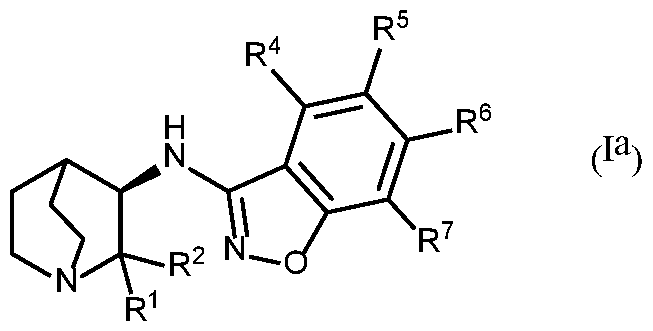
[0008] An aspect of the invention relates to the geminal substituted aminobenzisoxazole compound represented by Formula (la), wherein R1 and R2 independently represent an unbranched Ci-alkyl radical and said compo

[0009] An aspect of the invention relates to the geminal substituted aminobenzisoxazole compound represented by Formula (la), wherein R1 and R2 taken together represent a C2-alkyl di- radical and said compound is represented by Formula (Ilia):

[0010] An aspect of the invention relates to the geminal substituted aminobenzisoxazole compound represented by Formula (lb):

[0011] An aspect of the invention relates to the geminal substituted aminobenzisoxazole compound represented by Formula (lb), wherein R1 and R2 independently represent an unbranched Ci-alkyl radical and said comp

[0012] An aspect of the invention relates to the geminal substituted aminobenzisoxazole compound represented by Formula (lb), wherein R1 and R2 taken together represent a C2-alkyl di- radical and said compound is represented by Formula (Illb):

[0013] An aspect of the invention relates to a single stereoisomer of the geminal substituted aminobenzisoxazole compound represented by Formula (la) or (lb), Formula (Ila) or (lib), or Formula (Ilia) or (Illb), or a pharmaceutically acceptable salt thereof.
[0014] An aspect of the invention relates to a single enantiomer or a single diastereomer of the geminal substituted aminobenzisoxazole compound represented by Formula (la) or (lb), Formula (Ila) or (lib), or Formula (Ilia) or (Illb), or a pharmaceutically acceptable salt thereof.
[0015] An aspect of the invention relates to a pharmaceutical composition comprising the geminal substituted aminobenzisoxazole compound represented by Formula (la) or (lb), Formula (Ila) or (lib), or Formula (Ilia) or (Illb), or a pharmaceutically acceptable salt thereof; and at least one pharmaceutically acceptable carrier, excipient or diluent.
[0016] An aspect of the invention relates to a method comprising administering to a patient in need thereof an effective dose of a geminal substituted aminobenzisoxazole compound represented by Formula (la) or (lb), Formula (Ila) or (lib), or Formula (Ilia) or (Illb), or a pharmaceutically acceptable salt thereof; or administering to the patient a pharmaceutical composition comprising an effective dose of the geminal substituted aminobenzisoxazole compound represented by Formula (la) or (lb), Formula (Ila) or (lib), or Formula (Ilia) or (Illb), or a pharmaceutically acceptable salt thereof, and at least one pharmaceutically acceptable carrier, excipient or diluent.
[0017] Another aspect of the invention provides a method of treating a patient in need thereof, comprising: administering to the patient an effective dose of a geminal substituted
aminobenzisoxazole compound represented by Formula (la) or (lb), Formula (Ila) or (lib), or Formula (Ilia) or (Illb), or a pharmaceutically acceptable salt thereof; or administering to the patient a pharmaceutical composition comprising an effective dose of the geminal substituted
aminobenzisoxazole compound represented by Formula (la) or (lb), Formula (Ila) or (lib), or Formula (Ilia) or (Illb), or a pharmaceutically acceptable salt thereof, and at least one pharmaceutically acceptable carrier, excipient or diluent.
[0018] Another aspect of the invention provides a method of maintaining, treating, curing and/or improving at least one cognitive function in a patient in need thereof, comprising: administering to the patient an effective dose of a geminal substituted aminobenzisoxazole compound represented by Formula (la) or (lb), Formula (Ila) or (lib), or Formula (Ilia) or (Illb), or a pharmaceutically acceptable salt thereof; or administering to the patient a pharmaceutical composition comprising an effective dose of the geminal substituted aminobenzisoxazole compound represented by Formula (la) or (lb), Formula (Ila) or (lib), or Formula (Ilia) or (Illb), or a pharmaceutically acceptable salt thereof, and at least one pharmaceutically acceptable carrier, excipient or diluent.
[0019] Another aspect of the invention provides a method of maintaining, treating, curing and/or improving at least one cognitive function in a patient in need thereof, comprising: administering to the patient an effective dose of a geminal substituted aminobenzisoxazole compound represented by Formula (la) or (lb), Formula (Ila) or (lib), or Formula (Ilia) or (Illb), or a pharmaceutically acceptable salt thereof; or administering to the patient a pharmaceutical composition comprising an effective dose of the geminal substituted aminobenzisoxazole compound represented by Formula (la) or (lb), Formula (Ila) or (lib), or Formula (Ilia) or (Illb), or a pharmaceutically acceptable salt thereof, and at least one pharmaceutically acceptable carrier, excipient or diluent.
[0020] Another aspect of the invention provides a method of treating a patient diagnosed as having a cognitive impairment, comprising: administering to the an effective dose of a geminal substituted aminobenzisoxazole compound represented by Formula (la) or (lb), Formula (Ila) or (lib), or Formula (Ilia) or (Illb), or a pharmaceutically acceptable salt thereof; or administering to the patient an effective dose of a pharmaceutical composition comprising the geminal substituted aminobenzisoxazole compound represented by Formula (la) or (lb), Formula (Ila) or (lib), or Formula (Ilia) or (Illb), or a pharmaceutically acceptable salt thereof, and at least one pharmaceutically acceptable carrier, excipient or diluent.
[0021] Another aspect of the invention provides a method of treating a patient in need thereof, comprising: administering to the patient, for example, a patient diagnosed with having a cognitive impairment, Limited Cognitive Impairment, Mild Cognitive Impairment, Alzheimer's disease, and/or schizophrenia, a geminal substituted aminobenzisoxazole compound represented by Formula (la) or (lb), Formula (Ila) or (lib), or Formula (Ilia) or (Illb), or a pharmaceutically acceptable salt thereof;
or administering to the patient a pharmaceutical composition comprising an effective dose of the geminal substituted aminobenzisoxazole compound represented by Formula (la) or (lb), Formula (Ila) or (lib), or Formula (Ilia) or (Illb), or a pharmaceutically acceptable salt thereof, and at least one pharmaceutically acceptable carrier, excipient or diluent; such that the patient may derive a benefit therefrom.
[0022] Another aspect of the invention provides a method of treating one or more symptoms associated with a cognitive impairment, comprising administering to a patient an effective dose of a geminal substituted aminobenzisoxazole compound represented by Formula (la) or (lb), Formula (Ila) or (lib), or Formula (Ilia) or (Illb), or a pharmaceutically acceptable salt thereof; or administering to the patient a pharmaceutical composition comprising an effective dose of the geminal substituted aminobenzisoxazole compound represented by Formula (la) or (lb), Formula (Ila) or (lib), or Formula (Ilia) or (Illb), or a pharmaceutically acceptable salt thereof, and at least one pharmaceutically acceptable carrier, excipient or diluent; wherein the patient suffers from, or has been diagnosed as having, a cognitive impairment.
[0023] Another aspect of the invention provides a method of improving cognition of a patient in need thereof, comprising: administering to the patient a geminal substituted aminobenzisoxazole compound represented by Formula (la) or (lb), Formula (Ila) or (lib), or Formula (Ilia) or (Illb), or a pharmaceutically acceptable salt thereof; or administering to the patient a pharmaceutical composition comprising an effective dose of the geminal substituted aminobenzisoxazole compound represented by Formula (la) or (lb), Formula (Ila) or (lib), or Formula (Ilia) or (Illb), or a pharmaceutically acceptable salt thereof, and at least one pharmaceutically acceptable carrier, excipient or diluent.
[0024] Another aspect of the invention provides a method of improving cognition in a patient suffering from a cognitive impairment, such as a cognitive impairment associated with either schizophrenia or Alzheimer's disease, for example mild Alzheimer's disease, moderate Alzheimer's disease, severe Alzheimer's disease, or mild-to-moderate Alzheimer's disease, comprising administering an effective dose of a geminal substituted aminobenzisoxazole compound represented by Formula (la) or (lb), Formula (Ila) or (lib), or Formula (Ilia) or (Illb), or a pharmaceutically acceptable salt thereof; or administering to the patient a pharmaceutical composition comprising an effective dose of the geminal substituted aminobenzisoxazole compound represented by Formula (la) or (lb), Formula (Ila) or (lib), or Formula (Ilia) or (Illb), or a pharmaceutically acceptable salt thereof, and at least one pharmaceutically acceptable carrier, excipient or diluent.
[0025] Another aspect of the invention provides a method of treating a patient suffering from, diagnosed with having, or suffers from one or more symptoms associated with, a cognitive impairment, for example, Alzheimer's disease, dementia of an Alzheimer's type, MCI, LCI, or schizophrenia, comprising: administering to the patient an effective dose of a geminal substituted aminobenzisoxazole compound represented by Formula (la) or (lb), Formula (Ila) or (lib), or Formula (Ilia) or (Illb), or a pharmaceutically acceptable salt thereof; or administering to the patient a
pharmaceutical composition comprising an effective dose of the geminal substituted aminobenzisoxazole compound represented by Formula (la) or (lb), Formula (Ila) or (lib), or Formula (Ilia) or (Illb), or a pharmaceutically acceptable salt thereof, and at least one pharmaceutically acceptable carrier, excipient or diluent. For example, the method of treating a patient suffering from, diagnosed with having, or suffers from one or more symptoms associated with, a cognitive impairment, may provide said patient at least one of the following: (i) treats, minimizes progression of, prevents the deterioration of, or reduces the rate of detioraration of, one or more symptoms associated with the cognitive impairment; (ii) treats the cognitive impairment; (iii) improves cognition in said cognitively impaired patient; (iv) improves one or more behavioral symptoms associated with the cognitive impairment; (v) provides a pro-cognitive effect; (vi) provides a pro-cognitive effect in at least one of the following: visual motor, learning, delayed memory, or executive function, or (vii) provides a positive effect on clinical function in said cognitively impaired patient.
[0026] Another aspect of the invention provides a method of treating a patient previously treated, or currently being treated, with an AChEI, that is suffering from, or has been diagnosed with having, a cognitive impairment, for example, Alzheimer's disease, dementia of an Alzheimer's type, MCI, LCI, or schizophrenia, comprising: administering to the patient an effective dose of a geminal substituted aminobenzisoxazole compound represented by Formula (la) or (lb), Formula (Ila) or (lib), or Formula (Ilia) or (Illb), or a pharmaceutically acceptable salt thereof; or administering to the patient a pharmaceutical composition comprising an effective dose of the geminal substituted
aminobenzisoxazole compound represented by Formula (la) or (lb), Formula (Ila) or (lib), or Formula (Ilia) or (Illb), or a pharmaceutically acceptable salt thereof, and at least one pharmaceutically acceptable carrier, excipient or diluents; wherein the method improves one or more symptoms associated with the cognitive impairment in the previously, or currently, AChEI treated patient.
[0027] Another aspect of the invention provides a method of treating a patient suffering from, or diagnosed with having a cognitive impairment, comprising: administering to the patient an effective dose of a geminal substituted aminobenzisoxazole compound represented by Formula (la) or (lb), Formula (Ila) or (lib), or Formula (Ilia) or (Illb), or a pharmaceutically acceptable salt thereof; or administering to the patient a pharmaceutical composition comprising an effective dose of the geminal substituted aminobenzisoxazole compound represented by Formula (la) or (lb), Formula (Ila) or (lib), or Formula (Ilia) or (Illb), or a pharmaceutically acceptable salt thereof, and at least one
pharmaceutically acceptable carrier, excipient or diluent; wherein the method provides a positive effect on cognition or a positive effect on clinical function in said cognitively impaired patient, and wherein said patient has been previously treated or is currently being treated with an AChEI.
[0028] Another aspect of the invention provides a method of improving cognition in a patient diagnosed as having a probable cognitive disease, comprising: administering to the patient an effective dose of a geminal substituted aminobenzisoxazole compound represented by Formula (la) or (lb), Formula (Ila) or (lib), or Formula (Ilia) or (Illb), or a pharmaceutically acceptable salt thereof;
or administering to the patient an effective dose of a pharmaceutical composition comprising the geminal substituted aminobenzisoxazole compound represented by Formula (la) or (lb), Formula (Ila) or (lib), or Formula (Ilia) or (Illb), or a pharmaceutically acceptable salt thereof, and at least one pharmaceutically acceptable carrier, excipient or diluent.
[0029] Another aspect of the invention provides a method of improving or substantially improving one or more symptoms in a cognitve disease patient, comprising: administering to the patient an effective dose of a geminal substituted aminobenzisoxazole compound represented by Formula (la) or (lb), Formula (Ila) or (lib), or Formula (Ilia) or (Illb), or a pharmaceutically acceptable salt thereof; or administering to the patient an effective dose of a pharmaceutical composition comprising the effective dose of the geminal substituted aminobenzisoxazole compound represented by Formula (la) or (lb), Formula (Ila) or (lib), or Formula (Ilia) or (Illb), or a pharmaceutically acceptable salt thereof, and at least one pharmaceutically acceptable carrier, excipient or diluent.
[0030] Another aspect of the invention provides a method of slowing the rate of deterioration of at least one symptom in a cognitve disease patient, comprising: administering to the patient an effective dose of a geminal substituted aminobenzisoxazole compound represented by Formula (la) or (lb), Formula (Ila) or (lib), or Formula (Ilia) or (Illb), or a pharmaceutically acceptable salt thereof; or administering to the patient the pharmaceutical composition comprising the geminal substituted aminobenzisoxazole compound represented by Formula (la) or (lb), Formula (Ila) or (lib), or Formula (Ilia) or (Illb), or a pharmaceutically acceptable salt thereof, and at least one pharmaceutically acceptable carrier, excipient or diluent.
[0031] Another aspect of the invention provides a method of treating one or more symptoms associated with a cognitive disease in a patient suffering therefrom, comprising: administering to the patient an effective dose of a geminal substituted aminobenzisoxazole compound represented by Formula (la) or (lb), Formula (Ila) or (lib), or Formula (Ilia) or (Illb), or a pharmaceutically acceptable salt thereof; or administering to the patient an effective dose of a pharmaceutical composition comprising the geminal substituted aminobenzisoxazole compound represented by Formula (la) or (lb), Formula (Ila) or (lib), or Formula (Ilia) or (Illb), or a pharmaceutically acceptable salt thereof, and at least one pharmaceutically acceptable carrier, excipient or diluent [0032] Another aspect provides a method of minimizing or substantially halting the rate of progression of one or more cognitive diseases in a patient suffering from a cognitive disease, comprising: administering to the patient an effective dose of a geminal substituted
aminobenzisoxazole compound represented by Formula (la) or (lb), Formula (Ila) or (lib), or Formula (Ilia) or (Illb), or a pharmaceutically acceptable salt thereof; or administering to the patient an effective dose of a pharmaceutical composition comprising the geminal substituted
aminobenzisoxazole compound represented by Formula (la) or (lb), Formula (Ila) or (lib), or Formula
(Ilia) or (Illb), or a pharmaceutically acceptable salt thereof, and at least one pharmaceutically acceptable carrier, excipient or diluent.
[0033] Another aspect of the invention provides a method of substantially stopping or reversing progression of one or more cognitive diseases, in a patient suffering therefrom, comprising:
administering to the patient an effective dose of a geminal substituted aminobenzisoxazole compound represented by Formula (la) or (lb), Formula (Ila) or (lib), or Formula (Ilia) or (Illb), or a pharmaceutically acceptable salt thereof; or administering to the patient an effective dose of a pharmaceutical composition comprising the geminal substituted aminobenzisoxazole compound represented by Formula (la) or (lb), Formula (Ila) or (lib), or Formula (Ilia) or (Illb), or a pharmaceutically acceptable salt thereof, and at least one pharmaceutically acceptable carrier, excipient or diluent.
[0034] Another aspect of the invention provides a method of treating dementia, comprising: administering to a patient in need thereof an effective amount of a geminal substituted
aminobenzisoxazole compound represented by Formula (la) or (lb), Formula (Ila) or (lib), or Formula (Ilia) or (Illb), or a pharmaceutically acceptable salt thereof; or administering to the patient an effective dose of a pharmaceutical composition comprising the effective amount of the geminal substituted aminobenzisoxazole compound represented by Formula (la) or (lb), Formula (Ila) or (lib), or Formula (Ilia) or (Illb), or a pharmaceutically acceptable salt thereof, and at least one
pharmaceutically acceptable carrier, excipient or diluent; wherein said effective amount is administered in an effective dose.
[0035] Another aspect of the invention provides a method of treating dementia, comprising: administering to a patient in need thereof an effective amount of a geminal substituted
aminobenzisoxazole compound represented by Formula (la) or (lb), Formula (Ila) or (lib), or Formula (Ilia) or (Illb), or a pharmaceutically acceptable salt thereof; or administering to the patient an effective dose of a pharmaceutical composition comprising the geminal substituted
aminobenzisoxazole compound represented by Formula (la) or (lb), Formula (Ila) or (lib), or Formula (Ilia) or (Illb), or a pharmaceutically acceptable salt thereof, and at least one pharmaceutically acceptable carrier, excipient or diluent.
[0036] Another aspect of the invention provides a method of treating dementia, comprising: administering to a patient in need thereof an effective amount of a geminal substituted
aminobenzisoxazole compound represented by Formula (la) or (lb), Formula (Ila) or (lib), or Formula (Ilia) or (Illb), or a pharmaceutically acceptable salt thereof, wherein the geminal substituted aminobenzisoxazole compound represented by Formula (la) or (lb), Formula (Ila) or (lib), or Formula (Ilia) or (Illb), or a pharmaceutically acceptable salt thereof, is administered in the form of a pharmaceutical composition comprising at least one pharmaceutically acceptable carrier, excipient or diluent.
[0037] Another aspect of the invention provides a method of treating dementia, comprising: administering to a patient in need thereof an effective amount of a geminal substituted
aminobenzisoxazole compound represented by Formula (la) or (lb), Formula (Ila) or (lib), or Formula (Ilia) or (Illb), or a pharmaceutically acceptable salt thereof; or administering to the patient an effective dose of a pharmaceutical composition comprising the geminal substituted
aminobenzisoxazole compound represented by Formula (la) or (lb), Formula (Ila) or (lib), or Formula (Ilia) or (Illb), or a pharmaceutically acceptable salt thereof, and at least one pharmaceutically acceptable carrier, excipient or diluent; wherein the pharmaceutical composition is in the form of a tablet.
[0038] Another aspect of the invention provides a method of treating a patient having a cognitive disease and being administered an acetylcholine esterase inhibitor, comprising: administering to a patient in need thereof an effective amount of a geminal substituted aminobenzisoxazole compound represented by Formula (la) or (lb), Formula (Ila) or (lib), or Formula (Ilia) or (Illb), or a pharmaceutically acceptable salt thereof; or administering to the patient an effective dose of a pharmaceutical composition comprising a geminal substituted aminobenzisoxazole compound represented by Formula (la) or (lb), Formula (Ila) or (lib), or Formula (Ilia) or (Illb), or a pharmaceutically acceptable salt thereof, and at least one pharmaceutically acceptable carrier, excipient or diluent; wherein the treatment comprises halting the administration of the acetylcholine esterase inhibitor prior to treating with the geminal substituted aminobenzisoxazole compound represented by Formula (la) or (lb), Formula (Ila) or (lib), or Formula (Ilia) or (Illb), or a pharmaceutically acceptable salt thereof.
BRIEF DESCRIPTION OF THE DRAWINGS
[0039] Figure 1 : Illustrates a 3-D representation of the formed crystal of (i?)-2,2-dimethyl-N- ((R)- 1 -phenylethyl)quinuclidin-3 -amine fumarate .
[0040] Figure 2: Illustrates a 3-D representation of the formed crystal of (i?)-N-((i?)-l - phenylethyl)-r-azaspiro[cyclopropane-l,2'-bicyclo[2.2.2]octan]-3'-amine bis(4- methylbenzenesulfonate) .
DETAILED DESCRIPTION OF THE INVENTION
[0041] An embodiment of the present invention provides a geminal substituted
aminobe

R1 and R2 independently represent an unbranched Ci-C4-alkyl radical or a branched
C3-C4-alkyl radical; or the C^R^R2) moiety forms a (3-4 membered)- carbocycle, wherein R1 and R2 taken together represent a C2-C3-alkyl di- radical; wherein the unbranched Ci-C4-alkyl radical, the branched C3-C - alkyl radical, and the C2-C3-alkyl di-radical may be independently substituted with up to 4 radical substituents comprising: -D, -F, -CI, -CN,
-CH3, -CH2CH3, =0, or -OR3;
R3 independently represents -H; an unbranched Ci-C4-alkyl radical; a branched
C3-C4-alkyl radical; or a C3-C4-cycloalkyl radical; wherein the unbranched Ci-C4-alkyl radical, the branched C3-C4-alkyl radical, and the C3-C4- cycloalkyl radical may be independently substituted with up to 4 radical substituents comprising: -D, -F, -CI, -CN, =0, -OH, -OCi-C4-alkyl, or -OCF3; and
R4, R5, R6, and R7 independently represent -H, -D, halogen radical, -CN, an unbranched Ci-C - alkyl radical, a branched C3-C -alkyl radical, a C3-C6-cycloalkyl radical, an unbranched -Od-C4-alkyl, a branched or cyclic -OC3-C4-alkyl, -N(R8)(R9), -(CO)N(R8)(R9), -NR8(CO)(R9), -SOzd-C.-alkyl, -S02N(R8)(R9), -(CH2)mS02C1-C4-alkyl, -(CH2)mS02N(R8)(R9), -N(R8)S02d-C4-alkyl, an aryl radical, or a heteroaryl radical; wherein the alkyl portion of the unbranched Ci-C -alkyl radical, the branched C3-C -alkyl radical, the C3-C6- cycloalkyl radical, the unbranched -OCi-C -alkyl, the branched or cyclic -OC3-C -alkyl, the -S02Ci-C -alkyl, the -(CH2)mS02Ci-C -alkyl, or the -N(R8)S02Ci-C4-alkyl, may be independently substituted with up to 5 radical substituents comprising: -D, halogen radical, =0, -OR8, -(CH2)mOR8, -N(R8)(R9), -NR8(CO)(R9), -(CH2)mN(R8)(R9), -S02d-C4-alkyl,
-S02N(R8)(R9), -(CH2)mS02C1-C4-alkyl, -(CH2)mS02N(R8)(R9),
-N(R8)S02C1-C4-alkyl, -(CO)(CH2)mR8, -(CO)N(R8)(R9), an unbranched C C6-alkyl radical, a branched C3-C6-alkyl radical, a C3-C6-cycloalkyl radical, a Ci-C6-hydroxyalkyl radical, a Ci-C2-haloalkyl radical, or -OCi-C2-haloalkyl radical; and wherein the aryl radical or the heteroaryl radical may be independently substituted with up to 5 radical substituents comprising: -D, halogen radical, -CN, -OR8, -(CH2)mOR8, -N(R8)(R9), -NR8(CO)(R9), -(CH2)mN(R8)(R9), -S02Ci-C4-alkyl, -S02N(R8)(R9), -(CH2)mS02d-C4- alkyl, -(CH2)mS02N(R8)(R9), -N(R8)S02d-C4-alkyl, -(CO)(CH2)mR8, -(CO)N(R8)(R9), an unbranched Ci-C6-alkyl radical, a branched C3-C6-alkyl
radical, a C3-C6-cycloalkyl radical, a Ci-C6-hydroxyalkyl radical, a Ci-C2- haloalkyl radical, or -OCi-C2-haloalkyl radical;
R8 and R9 independently represent -H; an unbranched Ci-C6-alkyl radical, a branched
C3-C6-alkyl radical; a C3-C6-cycloalkyl radical; or the N(R8)(R9) moiety forms a cycle, wherein R8 and R9 taken together represent a C2-C6-alkyl di- radical or a (3-6 membered)-heteroalkyl di-radical; wherein the (3-6 membered)-heteroalkyl di-radical comprises at least one ring atom selected from the group consisting of oxygen, nitrogen, and sulfur, with the proviso that when the at least one ring atom is nitrogen, the nitrogen is independently substituted with -H, an unbranched Ci-C4-alkyl radical, a branched C3-C4- alkyl radical, a C3-C4-cycloalkyl radical, -(CO)-unbranched Ci-C4-alkyl, -(CO)-branched C3-C4-alkyl, -(S02)-unbranched Ci-C4-alkyl, or
-(S02)-branched C3-C4-alkyl, and with the further proviso that when the at least one ring atom is sulfur, the sulfur may be independently substituted with 0 to 2 =0; wherein the C2-C6-alkyl di-radical or the alky portion of said (3-6 membered)-heteroalkyl di-radical may be independently substituted with up to 5 radical substituents comprising: -D, halogen radical, =0, an unbranched Ci-C6-alkyl radical, or a branched C3-C6-alkyl radical; and
m independently represents an integer from 1 to 6;
or a pharmaceutically acceptable salt thereof.
[0042] In certain embodiments, the geminal substituted aminobenzisoxazole compound represented by Formula (la) may comprise the R1 and R2 independently representing an unbranched Ci-C3-alkyl radical, such as an unbranched Ci-C2-alkyl radical; or the C^R^R2) moiety forms a (3-4 membered)-carbocycle, wherein R1 and R2 taken together represent a C2-C3-alkyl di-radical; wherein the unbranched Ci-C3-alkyl radical, such as the unbranched Ci-C2-alkyl radical; and the C2-C3-alkyl di-radical may be independently substituted with up to 4 radical substituents, such as up to 3 radical substituents, comprising: -D, -F, -CI, -CN, -CH3, -CH2CH3, =0, or -OR3, such as -OCF3. For example, in certain embodiments, the geminal substituted aminobenzisoxazole compound represented by Formula (la) may comprise the R1 and R2 independently representing an unbranched Ci-C2-alkyl radical; or the C(R:)(R2) moiety forms a (3-4 membered)-carbocycle, wherein R1 and R2 taken together represent a C2-C3-alkyl di-radical; wherein the unbranched Ci-C3-alkyl radical, such as the unbranched Ci-C2-alkyl radical; and the C2-C3-alkyl di-radical may be independently substituted with up to 4 radical substituents, such as up to 3 radical substituents, comprising: -D, -F, -CI, -CN, =0, or -OR3, such as -OCF3.
[0043] In certain embodiments, the geminal substituted aminobenzisoxazole compound represented by Formula (la) may comprise the R3 independently representing -H; an unbranched Ci- C4-alkyl radical, such as an unbranched Ci-C3-alkyl radical or Ci-C2-alkyl radical; a branched C3-C -
alkyl radical, such as a branched C3-alkyl radical; or a C3-C -cycloalkyl radical, such as a C3- cycloalkyl radical; wherein the unbranched Ci-C4-alkyl radical, such as the unbranched Ci-C3-alkyl radical or Ci-C2-alkyl radical; the branched C3-C4-alkyl radical, such as the branched C3-alkyl radical; or the C3-C4-cycloalkyl radical, such as the C3-cycloalkyl radical, may be independently substituted with up to 4 radical substituents, such as up to 3 radical substituents, comprising: -D, -F, -CI, -CN, =0, -OH, -Od-C4-alkyl, or -OCF3.
[0044] In certain embodiments, the geminal substituted aminobenzisoxazole compound represented by Formula (la) may comprise the R1 and R2 independently representing an unbranched Ci-alkyl radical, wherein said compound is represented by Formula (Ila):

[0045] In certain embodiments, the geminal substituted aminobenzisoxazole compound represented by Formula (la) may comprise the R1 and R2 taken together represent a C2-alkyl di- radical, wherein said compound

[0046] In certain embodiments, the geminal substituted aminobenzisoxazole compound represented by Formula (lb) may comprise the R1 and R2 independently representing an unbranched Ci-alkyl radical, wherein said compound is represented by Formula (lib):

[0047] In certain embodiments, the geminal substituted aminobenzisoxazole compound represented by Formula (lb) may comprise the R1 and R2 taken together represent a C2-alkyl di- radical, wherein said compound is represented by Formula (Illb):

-N(R8)S02Ci-C2-alkyl, may be independently substituted with up to 5 radical substituents, for example, up to 4 radical substituents or up to 3 radical substituents, comprising: -D, halogen radical, =0, -OR8, -(CH2)mOR8, -N(R8)(R9), -NR8(CO)(R9), -(CH2)mN(R8)(R9), -S02d-C2-alkyl,
-S02N(R8)(R9), -(CH2)mS02d-C2-alkyl, -(CH2)mS02N(R8)(R9), -N(R8)S02d-C2-alkyl,
-(CO)(CH2)mR8, -(CO)N(R8)(R9), an unbranched Ci-C4-alkyl radical, a branched C3-C4-alkyl radical, a C3-C5-cycloalkyl radical, a Ci-C -hydroxyalkyl radical, a Ci-C2-haloalkyl radical, or -OCi-C2- haloalkyl radical; and wherein the aryl radical or the heteroaryl radical may be independently substituted with up to 5 radical substituents, for example, up to 4 radical substituents or up to 3 radical substituents, comprising: -D, halogen radical, -CN, -OR8, -(CH2)mOR8, -N(R8)(R9), -NR8(CO)(R9), -(CH2)mN(R8)(R9), -S02Ci-C2-alkyl, -S02N(R8)(R9), -(CH2)mS02Ci-C2-alkyl,
-(CH2)mS02N(R8)(R9), -N(R8)S02Ci-C2-alkyl, -(CO)(CH2)mR8, -(CO)N(R8)(R9), an unbranched d- C4-alkyl radical, a branched C3-C -alkyl radical, a C3-C5-cycloalkyl radical, a Ci-C -hydroxyalkyl radical, a Ci-C2-haloalkyl radical, or -OCi-C2-haloalkyl radical; and wherein R8 and R9 may independently represent -H, an unbranched Ci-C6-alkyl radical, such as -CH3 or -CH2CH3, a branched C3-C6-alkyl radical, such as -CH(CH3)2, or a C3-C6-cycloalkyl radical, such as a cyclopropyl radical, or the N(R8)(R9) moiety forms a cycle, wherein R8 and R9 taken together represent a C2-C6- alkyl di-radical, such as a a C2-C5-alkyl di-radical, or a (3-6 membered)-heteroalkyl di-radical, such as a (3-5 membered)-heteroalkyl di-radical; and wherein m may independently represents an integer from 1 to 6, for example, an integer from 1 to 4, such as 1 to 2, 2 to 3, or 3 to 4.
[0049] In certain embodiments, the geminal substituted aminobenzisoxazole compound represented by Formula (la) or (lb), Formula (Ila) or (lib), or Formula (Ilia) or (Illb), may comprise R4 and R5 independently representing -H, -D, -F, -CI, -Br, -CN, an unbranched Ci-C3-alkyl radical, a branched C3-C4-alkyl radical, a C3-C4-cycloalkyl radical, -CHF2, -CH2F, -CF3, an unbranched -Od-C3-alkyl, a branched or cyclic -OC3-alkyl, -OCF3, -S02CH3, -S02N(CH3)2, or -N(R8)S02CH3; wherein the alkyl portion of the unbranched Ci-C3-alkyl radical, the branched C3-C -alkyl radical, the C3-C -cycloalkyl radical, the unbranched -OCi-C3-alkyl, or the branched or cyclic -OC3-alkyl, may be independently substituted with up to 5 radical substituents, for example, up to 4 radical substituents or up to 3 radical substituents, comprising: -D, -F, -CI, -OR8, =0, -CH3, -CHF2, -CH2F, -CF3,
cyclopropyl radical, cyclobutyl radical, or -OCF3; and wherein R8 may independently represent -H, -CH3, or -CH2CH3.
[0050] In certain embodiments, the geminal substituted aminobenzisoxazole compound represented by Formula (la) or (lb), Formula (Ila) or (lib), or Formula (Ilia) or (Illb), may comprise R4 and R5 independently representing -H, -D, -F, -CI, -CH3, -CH2CH3, a cyclopropyl radical, -CHF2, -CH2F, -CF3, -OCH3, -OCH2CH3, -OCH(CH3)2, -OCF3, -S02CH3, -S02N(CH3)2, or -N(H)S02CH3.
[0051] In certain embodiments, the geminal substituted aminobenzisoxazole compound represented by Formula (la) or (lb), Formula (Ila) or (lib), or Formula (Ilia) or (Illb), may comprise R4 and R5 independently representing -H, -D, or halogen radical, for example, -F, -CI, or -Br. For example, in certain embodiments, R4 and R5 may independently represent -H, -D, -F, or -CI, such as -H, -D, or -F. In certain embodiments, R4 and R5 may independently represent -H or -D. In certain embodiments, R4 may independently represent -H or -D, and R5 may independently represent -F or -CI, such as -F. In certain embodiments, R4 may independently represent -F or -CI, such as -F, and R5 may independently represent -H or -D.
[0052] In certain embodiments, the geminal substituted aminobenzisoxazole compound represented by Formula (la) or (lb), Formula (Ila) or (lib), or Formula (Ilia) or (Illb), may comprise R6 independently representing -F, -CI, -Br, -CN, an unbranched Ci-C4-alkyl radical, a branched C3- C4-alkyl radical, a C3-C6-cycloalkyl radical, an unbranched -OCi-C4-alkyl, a branched or cyclic -OC3-C4-alkyl, -N(R8)(R9), -(CO)N(R8)(R9), -NR8(CO)(R9), -S02d-C4-alkyl, -S02N(R8)(R9), -(CH2)mS02C1-C4-alkyl, -(CH2)mS02N(R8)(R9), -N(R8)S02d-C4-alkyl, an aryl radical, or a heteroaryl radical; wherein the alkyl portion of the unbranched Ci-C4-alkyl radical, the branched C3- C4-alkyl radical, the C3-C6-cycloalkyl radical, the unbranched -OCi-C -alkyl, the branched or cyclic -OC3-C4-alkyl, the -S02d-C4-alkyl, the -(CH2)mS02C1-C4-alkyl, or the -N(R8)S02d-C4-alkyl, may be independently substituted with up to 5 radical substituents, for example, up to 4 radical substituents or up to 3 radical substituents, comprising: -D, -F, -CI, -Br, =0, -OR8, -(CH2)mOR8, -N(R8)(R9), -NR8(CO)(R9), -(CH2)mN(R8)(R9), -S02C C4-alkyl, -S02N(R8)(R9), -(CH2)mS02d-C4-alkyl, -(CH2)mS02N(R8)(R9), -N(R8)S02d-C4-alkyl, -(CO)(CH2)mR8, -(CO)N(R8)(R9), an unbranched C C6-alkyl radical, a branched C3-C6-alkyl radical, a C3-C6-cycloalkyl radical, a Ci-C6-hydroxyalkyl radical, a Ci-C2-haloalkyl radical, or -OCi-C2-haloalkyl radical; and wherein the aryl radical or the heteroaryl radical may be independently substituted with up to 5 radical substituents, for example, up to 4 radical substituents or up to 3 radical substituents, comprising: -D, -F, -CI, -Br, -CN, -OR8, -(CH2)mOR8, -N(R8)(R9), -NR8(CO)(R9), -(CH2)mN(R8)(R9), -S02d-C4-alkyl, -S02N(R8)(R9), -(CH2)mS02d-C4-alkyl, -(CH2)mS02N(R8)(R9), -N(R8)S02d-C4-alkyl, -(CO)(CH2)mR8,
-(CO)N(R8)(R9), an unbranched Ci-C6-alkyl radical, a branched C3-C6-alkyl radical, a C3-C6- cycloalkyl radical, a Ci-C6-hydroxyalkyl radical, a Ci-C2-haloalkyl radical, or -OCi-C2-haloalkyl radical; and wherein R8 and R9 may independently represent -H, an unbranched Ci-C6-alkyl radical ,
such as -CH3 or -CH2CH3, a branched C3-C6-alkyl radical, such as -CH(CH3)2, or a C3-C6-cycloalkyl radical, such as a cyclopropyl radical, or the N(R8)(R9) moiety forms a cycle, wherein R8 and R9 taken together represent a C2-C6-alkyl di-radical, such as a a C2-C5-alkyl di-radical, or a (3-6 membered)- heteroalkyl di-radical, such as a (3-5 membered)-heteroalkyl di-radical; and wherein m may independently represents an integer from 1 to 6, for example, an integer from 1 to 4, such as 1 to 2, 2 to 3, or 3 to 4.
[0053] In certain embodiments, the geminal substituted aminobenzisoxazole compound represented by Formula (la) or (lb), Formula (Ila) or (lib), or Formula (Ilia) or (Illb), may comprise R6 independently representing -F, -CI, -Br, -CN, an unbranched Ci-C4-alkyl radical, a branched C3- C4-alkyl radical, a C3-C4-cycloalkyl radical, an unbranched -OCi-C4-alkyl, a branched or cyclic -OC3-C4-alkyl, -OCHF2, -OCH2F, -OCF3, -OCH2CF3, -N(R8)(R9), -(CO)N(R8)(R9), -NR8(CO)(R9), -S02CH3, -S02N(R8)(R9), -CH.CH.SOzd-C.-alkyl, or -N(R8)S02CH3, an aryl radical, or a heteroaryl radical; wherein the alkyl portion of the unbranched Ci-C4-alkyl radical, the branched C3- C4-alkyl radical, the C3-C4-cycloalkyl radical, the unbranched -OCi-C4-alkyl, the branched or cyclic -OC3-C -alkyl, or the -CH2CH2S02Ci-C -alkyl, may be independently substituted with up to 5 radical substituents, for example, up to 4 radical substituents or up to 3 radical substituents, comprising: -D, -F, -CI, -Br, =0, -OR8, -(CH2)mOR8, -N(R8)(R9), -NR8(CO)(R9), -(CH2)mN(R8)(R9), -S02d-C4- alkyl, -S02N(R8)(R9), -(CH2)mS02C1-C4-alkyl, -(CH2)mS02N(R8)(R9), -N(R8)S02C!-C4-alkyl, -(CO)(CH2)mR8, -(CO)N(R8)(R9), an unbranched Ci-C6-alkyl radical, a branched C3-C6-alkyl radical, a C3-C6-cycloalkyl radical, a Ci-C6-hydroxyalkyl radical, a Ci-C2-haloalkyl radical, or -OCi-C2- haloalkyl radical; and wherein the aryl radical or the heteroaryl radical may be independently substituted with up to 5 radical substituents, for example, up to 4 radical substituents or up to 3 radical substituents, comprising: -D, -F, -CI, -Br, -CN, -OR8, -(CH2)mOR8, -N(R8)(R9), -NR8(CO)(R9), -(CH2)mN(R8)(R9), -S02C C4-alkyl, -S02N(R8)(R9), -(CH^SO^-C.-alkyl,
-(CH2)mS02N(R8)(R9), -N(R8)S02C1-C4-alkyl, -(CO)(CH2)mR8, -(CO)N(R8)(R9), an unbranched C C6-alkyl radical, a branched C3-C6-alkyl radical, a C3-C6-cycloalkyl radical, a Ci-C6-hydroxyalkyl radical, a Ci-C2-haloalkyl radical, or -OCi-C2-haloalkyl radical; and wherein R8 and R9 may independently represent -H, an unbranched Ci-C6-alkyl radical, such as -CH3 or -CH2CH3, a branched C3-C6-alkyl radical, such as -CH(CH3)2, or a C3-C6-cycloalkyl radical, such as a cyclopropyl radical, or the N(R8)(R9) moiety forms a cycle, wherein R8 and R9 taken together represent a C2-C6- alkyl di-radical, such as a a C2-C5-alkyl di-radical, or a (3-6 membered)-heteroalkyl di-radical, such as a (3-5 membered)-heteroalkyl di-radical; and wherein m may independently represents an integer from 1 to 6, for example, an integer from 1 to 4, such as 1 to 2, 2 to 3, or 3 to 4.
[0054] In certain embodiments, the geminal substituted aminobenzisoxazole compound represented by Formula (la) or (lb), Formula (Ila) or (lib), or Formula (Ilia) or (Illb), may comprise R6 independently representing -F, -CI, -Br, -CN, -CH3, -CH2CH3, cyclopropyl radical, -CHF2, -CH2F, -CF3, -CH2CF3, -OCH3, -OCH2CH3, -OCH(CH3)2, -O-cyclopropyl, -OCHF2, -OCH2F,
-OCF3, -OCH2CF3, -S02CH3, a phenyl radical or a heteroaryl radical, such as an N-pyrazole radical, a furan radical, a thiophene radical, an imidazole radical, an oxazole radical, a thiazole radical, a pyridyl radical, a pyrazine radical, a pyrimidine radical, or an oxadiazole radical; wherein the phenyl radical or the heteroaryl radical, such as the N-pyrazole radical, the furan radical, the thiophene radical, the imidazole radical, the oxazole radical, the thiazole radical, the pyridyl radical, the pyrazine radical, the pyrimidine radical, or the oxadiazole radical, may be independently substituted with up to 5 radical substituents, for example, up to 4 radical substituents or up to 3 radical substituents, comprising: -D, -F, -CI, -Br, -CN, -OR8, -(CH2)mOR8, -N(R8)(R9), -NR8(CO)(R9),
-(CH2)mN(R8)(R9), -(CO)(CH2)mR8, -(CO)N(R8)(R9), an unbranched d-Cg-alkyl radical, a branched C3-C6-alkyl radical, a C3-C6-cycloalkyl radical, a Ci-C6-hydroxyalkyl radical, a Ci-C2-haloalkyl radical, or -OCi-C2-haloalkyl radical; and wherein R8 and R9 may independently represent -H, an unbranched Ci-C6-alkyl radical , such as -CH3 or -CH2CH3, a branched C3-C6-alkyl radical, such as - CH(CH3)2, or a C3-C6-cycloalkyl radical, such as a cyclopropyl radical, or the N(R8)(R9) moiety forms a cycle, wherein R8 and R9 taken together represent a C2-C6-alkyl di-radical, such as a a C2-C5-alkyl di-radical, or a (3-6 membered)-heteroalkyl di-radical, such as a (3-5 membered)-heteroalkyl di- radical; and wherein m may independently represents an integer from 1 to 6, for example, an integer from 1 to 4, such as 1 to 2, 2 to 3, or 3 to 4.
[0055] In certain embodiments, the geminal substituted aminobenzisoxazole compound represented by Formula (la) or (lb), Formula (Ila) or (lib), or Formula (Ilia) or (Illb), may comprise R6 independently representing -F, -CI, -Br, -CN, -CH3, -CH2CH3, cyclopropyl radical, -CHF2, -CH2F, -CH2CF3, -CF3, -CH2CF3, -OCH3, -OCH2CH3, -OCH(CH3)2, -O-cyclopropyl, -OCF3, -S02CH3, a phenyl radical or a heteroaryl radical, such as an N-pyrazole radical, a furan radical, a thiophene radical, an imidazole radical, an oxazole radical, a thiazole radical, a pyridyl radical, a pyrazine radical, a pyrimidine radical, or an oxadiazole radical; wherein the phenyl radical or the heteroaryl radical, such as the N-pyrazole radical, the furan radical, the thiophene radical, the imidazole radical, the oxazole radical, the thiazole radical, the pyridyl radical, the pyrazine radical, the pyrimidine radical, or the oxadiazole radical, may be independently substituted with up to 5 radical substituents, for example, up to 4 radical substituents or up to 3 radical substituents, comprising: -D, -F, -CI, -Br, -CN, -OR8, -CH3, cyclopropyl radical, -CHF2, -CH2F, -CF3, -CH2CF3, -OCF3, or -OCH2CF3. For example, in certain embodiments, R6 may independently represent -F, -CI, -Br, -CN, -CH3, -CH2CH3, cyclopropyl radical, -CHF2, -CH2F, -CF3, -CH2CF3, -OCH3, -OCH2CH3, -OCH(CH3)2, -O-cyclopropyl, or -OCF3. In certain embodiments, R6 may independently represent -F, -CI, -Br, -CH3, or -OCH3, such as R6 may independently represent -F, -CI, -CH3, or -OCH3.
[0056] In certain embodiments, the geminal substituted aminobenzisoxazole compound represented by Formula (la) or (lb), Formula (Ila) or (lib), or Formula (Ilia) or (Illb), may comprise R7 independently representing -H, -D, -F, -CI, -Br, -CN, an unbranched Ci-C4-alkyl radical, a branched C3-C4-alkyl radical, a C3-C6-cycloalkyl radical, an unbranched -OCi-C4-alkyl, a branched or
cyclic -OC3-C4-alkyl, -N(R8)(R9), -(CO)N(R8)(R9), -NR8(CO)(R9), -S02C1-C4-alkyl, -S02N(R8)(R9), -(CH2)mS02C1-C4-alkyl, -(CH2)mS02N(R8)(R9), -N(R8)S02C1-C4-alkyl, an aryl radical, or a heteroaryl radical; wherein the alkyl portion of the unbranched Ci-C -alkyl radical, the branched C3-C -alkyl radical, the C3-C6-cycloalkyl radical, the unbranched -OCi-C -alkyl, the branched or cyclic -OC3-C4-alkyl, the -S02Ci-C4-alkyl, the -(CH2)mS02Ci-C4-alkyl, or the
-N(R8)S02Ci-C4-alkyl, may be independently substituted with up to 5 radical substituents, for example, up to 4 radical substituents or up to 3 radical substituents, comprising: -D, -F, -CI, -Br, =0, -OR8, -(CH2)mOR8, -N(R8)(R9), -NR8(CO)(R9), -(CH2)mN(R8)(R9), -S02d-C4-alkyl,
-S02N(R8)(R9), -(CH2)mS02C1-C4-alkyl, -(CH2)mS02N(R8)(R9), -N(R8)S02d-C4-alkyl,
-(CO)(CH2)mR8, -(CO)N(R8)(R9), -OCF3 an unbranched d-C6-alkyl radical, a branched C3-C6-alkyl radical, a C3-C6-cycloalkyl radical, a Ci-C6-hydroxyalkyl radical, a Ci-C2-haloalkyl radical, or -OCi- C2-haloalkyl radical; and wherein aryl radical or the heteroaryl radical may be independently substituted with up to 5 radical substituents, for example, up to 4 radical substituents or up to 3 radical substituents, comprising: -D, -F, -CI, -Br, -CN, -OR8, -(CH2)mOR8, -N(R8)(R9), -NR8(CO)(R9), -(CH2)mN(R8)(R9), -S02C1-C4-alkyl, -S02N(R8)(R9), -(CH2)mS02d-C4-alkyl,
-(CH2)mS02N(R8)(R9), -N(R8)S02d-C4-alkyl, -(CO)(CH2)mR8, -(CO)N(R8)(R9), -OCF3, an unbranched Ci-C6-alkyl radical, a branched C3-C6-alkyl radical, a C3-C6-cycloalkyl radical, a Ci-C6- hydroxyalkyl radical, a Ci-C2-haloalkyl radical, or -OCi-C2-haloalkyl radical; and wherein R8 and R9 may independently represent -H, an unbranched Ci-C6-alkyl radical, such as -CH3 or -CH2CH3, a branched C3-C6-alkyl radical, such as -CH(CH3)2, or a C3-C6-cycloalkyl radical, such as a cyclopropyl radical, or the N(R8)(R9) moiety forms a cycle, wherein R8 and R9 taken together represent a C2-C6- alkyl di-radical, such as a a C2-C5-alkyl di-radical, or a (3-6 membered)-heteroalkyl di-radical, such as a (3-5 membered)-heteroalkyl di-radical; and wherein m may independently represents an integer from 1 to 6, for example, an integer from 1 to 4, such as 1 to 2, 2 to 3, or 3 to 4.
[0057] In certain embodiments, the geminal substituted aminobenzisoxazole compound represented by Formula (la) or (lb), Formula (Ila) or (lib), or Formula (Ilia) or (Illb), may comprise R7 independently representing -H, -D, -F, -CI, -CN, an unbranched Ci-C3-alkyl radical, a branched C3-C4-alkyl radical, a C3-C4-cycloalkyl radical, unbranched -OCi-C3-alkyl, a branched or cyclic -OC3-C4-alkyl, -OCHF2, -OCH2F, -OCF3, -OCH2CF3; wherein the alkyl portion of the unbranched Ci-C3-alkyl radical, the branched C3-C4-alkyl radical, the C3-C4-cycloalkyl radical, the unbranched -OCi-C3-alkyl, or the branched or cyclic -OC3-C4-alkyl, may be independently substituted with up to 5 radical substituents, for example, up to 4 radical substituents or up to 3 radical substituents, comprising: -D, -F, -CI, -Br, =0, -OR8, -(CH2)mOR8, -N(R8)(R9), -NR8(CO)(R9),
-(CH2)mN(R8)(R9), -(CO)(CH2)mR8, -(CO)N(R8)(R9), -OCF3, an unbranched d-C6-alkyl radical, a branched C3-C6-alkyl radical, a C3-C6-cycloalkyl radical, a Ci-C6-hydroxyalkyl radical, a Ci-C2- haloalkyl radical, or -OCi-C2-haloalkyl radical; and wherein R8 and R9 may independently represent -H, an unbranched Ci-C6-alkyl radical, such as -CH3 or -CH2CH3, a branched C3-C6-alkyl radical,
such as -CH(CH3)2, or a C3-C6-cycloalkyl radical, such as a cyclopropyl radical, or the N(R8)(R9) moiety forms a cycle, wherein R8 and R9 taken together represent a C2-C6-alkyl di-radical, such as a a C2-C5-alkyl di-radical, or a (3-6 membered)-heteroalkyl di-radical, such as a (3-5 membered)- heteroalkyl di-radical; and wherein m may independently represents an integer from 1 to 6, for example, an integer from 1 to 4, such as 1 to 2, 2 to 3, or 3 to 4.
[0058] In certain embodiments, the geminal substituted aminobenzisoxazole compound represented by Formula (la) or (lb), Formula (Ila) or (lib), or Formula (Ilia) or (Illb), may comprise R7 independently representing -H, -D, -F, -CI, -CN, -CH3, -CH(CH3)2, cyclopropyl radical, cyclobutyl radical, -CH2F, -CHF2, -CF3, -CH2CF3, -OCH3, -OCH2CH3, -OCH(CH3)2,
-O-cyclopropyl, -OCHF2, -OCH2F, -OCF3, or -OCH2CF3. For example, in certain embodiments, R7 may independently represent -H, -D, -F, -CI, -CN, -CH3, cyclopropyl radical, cyclobutyl radical, -CH2F, -CHF2, -CF3, -OCH3, -OCH2CH3, -OCH(CH3)2, -O-cyclopropyl, or -OCF3, such as R7 may independently represent -H, -D, -F, -CI, -CH3, -OCH3, -OCH2CH3, or -CF3, for example, R7 may independently represent -H, -D, -F, -CI, -CH3, or -OCH3.
[0059] In certain embodiments, the geminal substituted aminobenzisoxazole compound represented by Formula (la) or (lb), Formula (Ila) or (lib), or Formula (Ilia) or (Illb), may comprise: R4 and R5 independently representing -H or -D, R5 and R7 independently representing -H or -D, R4 and R7 independently representing -H or -D, or R4, R5, and R7 independently representing -H or -D; and R6 independently representing -H, -D, -F, -CI, -Br, -CN, an unbranched Ci-C3-alkyl radical, for example, -CH3 or -CH2CH3, a branched C3-C4-alkyl radical, a cyclopropyl radical, a cyclobutyl radical, -CHF2, -CH2F, -CF3, -CH2CF3, an unbranched -OCi-C3-alkyl, such as -OCH3 or
-OCH2CH3, a branched or cyclic -OC3-C4-alkyl, such as -OCH(CH3)2 or -O-cyclopropyl, -OCHF2, -OCH2F, -OCF3, -OCH2CF3, -S02CH3, a phenyl radical or a heteroaryl radical, such as an N- pyrazole radical, a furan radical, a thiophene radical, an imidazole radical, an oxazole radical, a thiazole radical, a pyridyl radical, a pyrazine radical, a pyrimidine radical, or an oxadiazole radical; wherein the alkyl portion of the unbranched Ci-C3-alkyl radical, branched C3-C4-alkyl radical, unbranched -OCi-C3-alkyl, or the branched or cyclic -OC3-C4-alkyl, may be independently substituted with up to 5 radical substituents, for example, up to 4 radical substituents or up to 3 radical substituents, comprising: -D, -F, -CI, =0, -OCH3, -OCH2CH3, -OCH(CH3)2, -CH3, -CH2CH3, cyclopropyl radical, -CHF2, -CH2F, -CF3, -CH2CF3, -OCF3, or -OCH2CF3; and wherein the phenyl radical or the heteroaryl radical may be independently substituted with up to 5 radical substituents, for example, up to 4 radical substituents or up to 3 radical substituents, comprising: -D, -F, -CI, -Br, -CN, -OCH3, -OCH2CH3, -OCH(CH3)2, -CH3, -CH2CH3, cyclopropyl radical, -CHF2, -CH2F, -CF3, -CH2CF3, -OCF3, or -OCH2CF3.
[0060] In certain embodiments, the geminal substituted aminobenzisoxazole compound represented by Formula (la) or (lb), Formula (Ila) or (lib), or Formula (Ilia) or (Illb), may comprise R4 independently representing -H, -D, or a halogen radical, for example -H, -D, -F, or -CI, such as
-H, -D, or -F; R5 independently representing -H, -D, or a halogen radical, for example -H, -D, -F, or -CI, such as -H, -D, or -F; R6 independently representing -H, -D, -F, -CI, -Br, -CN, an unbranched Ci-C3-alkyl radical, for example, -CH3 or -CH2CH3, -CH(CH3)2, a cyclopropyl radical, a cyclobutyl radical, -CHF2, -CH2F, -CF3, -CH2CF3, an unbranched -OCi-C3-alkyl, such as -OCH3 or -OCH2CH3, -OCH(CH3)2, -O-cyclopropyl, -OCHF2, -OCH2F, -OCF3, -OCH2CF3, -S02CH3, a phenyl radical or a heteroaryl radical, such as an N-pyrazole radical or an oxadiazole radical; and R7 independently representing -H, -D, -F, -CI, -CN, an unbranched Ci-C3-alkyl radical, for example, -CH3 or -CH2CH3, -CH(CH3)2, a cyclopropyl radical, a cyclobutyl radical, -CHF2, -CH2F, -CF3, -CH2CF3, an unbranched -OCi-C3-alkyl, such as -OCH3 or -OCH2CH3, -OCH(CH3)2,
-O-cyclopropyl, -OCHF2, -OCH2F, -OCF3, -OCH2CF3; wherein the alkyl portion of the unbranched Ci-C3-alkyl radical, -CH(CH3)2, unbranched -OCi-C3-alkyl, -OCH(CH3)2, or -O-cyclopropyl, may be independently substituted with up to 5 radical substituents, for example, up to 4 radical substituents or up to 3 radical substituents, comprising: -D, -F, -CI, =0, -OCH3, -OCH2CH3, -OCH(CH3)2, -CH3, -CH2CH3, cyclopropyl radical, -CHF2, -CH2F, -CF3, -OCF3, or -OCH2CF3; and wherein the phenyl radical or the heteroaryl radical may be independently substituted with up to 5 radical substituents, for example, up to 4 radical substituents or up to 3 radical substituents, comprising: -D, -F, -CI, -Br, -CN, -OCH3, -OCH2CH3, -OCH(CH3)2, -CH3, -CH2CH3, cyclopropyl radical, -CHF2, -CH2F, -CF3, -OCF3, or -OCH2CF3.
[0061] In certain embodiments, the geminal substituted aminobenzisoxazole compound represented by Formula (la) or (lb), Formula (Ila) or (lib), or Formula (Ilia) or (Illb), may comprise R4 independently representing -H, -D, or a halogen radical, for example -H, -D, -F, or -CI, such as -H, -D, or -F; R5 independently representing -H, -D, or a halogen radical, for example -H, -D, -F, or -CI, such as -H, -D, or -F; R6 independently representing -H, -D, -F, -CI, -Br, -CN, an unbranched Ci-C3-alkyl radical, for example, -CH3 or -CH2CH3, -CH(CH3)2, a cyclopropyl radical, a cyclobutyl radical, -CHF2, -CH2F, -CF3, -CH2CF3, an unbranched -OCi-C3-alkyl, such as -OCH3 or -OCH2CH3, -OCH(CH3)2, -O-cyclopropyl, -OCHF2, -OCH2F, -OCF3, -OCH2CF3, or -S02CH3; and R7 independently representing -H, -D, -F, -CI, -CN, an unbranched Ci-C3-alkyl radical, for example, -CH3 or -CH2CH3, -CH(CH3)2, a cyclopropyl radical, a cyclobutyl radical, -CHF2, -CH2F, -CF3, or -CH2CF3, an unbranched -OCi-C3-alkyl, such as -OCH3 or -OCH2CH3, -OCH(CH3)2,
-O-cyclopropyl, -OCHF2, -OCH2F, -OCF3, or -OCH2CF3; wherein the alkyl portion of the unbranched Ci-C3-alkyl radical, -CH(CH3)2, the cyclopropyl radical, the cyclobutyl radical, the unbranched -OCi-C3-alkyl, -OCH(CH3)2, or -O-cyclopropyl, may be independently substituted with up to 5 radical substituents, for example, up to 4 radical substituents or up to 3 radical substituents, comprising: -D, -F, -CI, =0, -OCH3, -OCH2CH3, -OCH(CH3)2, -CH3, -CH2CH3, cyclopropyl radical, -CHF2, -CH2F, -CF3, -OCF3, or -OCH2CF3.
[0062] In certain embodiments, the geminal substituted aminobenzisoxazole compound represented by Formula (la) or (lb), Formula (Ila) or (lib), or Formula (Ilia) or (Illb), may comprise
R4 independently representing -H, -D, or a halogen radical, for example -H, -D, -F, or -CI, such as -H, -D, or -F; R5 independently representing -H, -D, or a halogen radical, for example -H, -D, -F, or -CI, such as -H, -D, or -F; R6 independently representing -H, -D, -F, -CI, -Br, -CN, -CH3, -CH2CH3, -CH(CH3)2, a cyclopropyl radical, a cyclobutyl radical, -CHF2, -CH2F, -CF3, -CH2CF3, -OCH3, -OCH2CH3, -OCH(CH3)2, -O-cyclopropyl, or -OCF3; and R7 independently representing -H, -D, -F, -CI, -CN, -CH3, -CH2CH3, -CH(CH3)2, a cyclopropyl radical, a cyclobutyl radical, -CHF2, -CH2F, -CF3, -CH2CF3, -OCH3, -OCH2CH3, -OCH(CH3)2, -O-cyclopropyl, or -OCF3.
[0063] For example, in certain embodiments, R4 may independently represent -H, -D, -F, or -CI, such as -H, -D, or -F; R5 may independently represent -H, -D, -F, or -CI, such as -H, -D, or -F: R6 may independently represent -F, -CI, -Br, -CN, -CH3, -CH2CH3, a cyclopropyl radical, -CHF2, -CH2F, -CF3, -CH2CF3, -OCH3, -OCH2CH3, -OCH(CH3)2, -O-cyclopropyl, or -OCF3, such as -F, -CI, -Br, -CH3, or -OCH3, or such as -F, -CI, -CH3, or -OCH3; and R7 may independently represent -H, -D, -F, -CI, -CN, -CH3, -CH2CH3, -CH(CH3)2, a cyclopropyl radical, a cyclobutyl radical, -CHF2, -CH2F, -CF3, -CH2CF3, -OCH3, -OCH2CH3, -OCH(CH3)2, -O-cyclopropyl, or -OCF3, such as -H, -D, -F, -CI, -CH3, -OCH3, -OCH2CH3, or -CF3, for example, R7 may independently represent -H, -D, -F, -CI, -CH3, or -OCH3.
[0064] In certain embodiments, the geminal substituted aminobenzisoxazole compound represented by Formula (la) or (lb), Formula (Ila) or (lib), or Formula (Ilia) or (Illb), at least one of R4, R5, R6, and R7 does not independently represent -H. For example, in certain embodiments, R4 independently represents -H, and at least one of R5, R6, and R7 does not independently represent -H; R5 independently represents -H, and at least one of R4, R6, and R7 does not independently represent -H; R6 independently represents -H, and at least one of R4, R5, and R7 does not independently represent -H; or R7 independently represents -H, and at least one of R4, R5, and R6 does not independently represent -H.
[0065] In certain embodiments, the geminal substituted aminobenzisoxazole compound represented by Formula (la) or (lb), Formula (Ila) or (lib), or Formula (Ilia) or (Illb), may comprise R8, R9, or both R8 and R9, independently representing -H; an unbranched Ci-C6-alkyl radical, such as -CH3 or -CH2CH3, a branched C3-C6-alkyl radical, such as -CH(CH3)2; or a C3-C6-cycloalkyl radical, such as a cyclopropyl radical or a cyclobutyl radical. For example, R8 and R9 may independently represent -H, -CH3, -CH2CH3, -CH(CH3)2, a cyclopropyl radical, or a cyclobutyl radical, such as independently represent -H, -CH3, or -CH2CH3.
[0066] In certain embodiments, the geminal substituted aminobenzisoxazole compound represented by Formula (la) or (lb), Formula (Ila) or (lib), or Formula (Ilia) or (Illb), may comprise an N(R8)(R9) moiety, wherein the N(R8)(R9) moiety forms a cycle, wherein R8 and R9 taken together represent a C2-C6-alkyl di-radical or a (3-6 membered)-heteroalkyl di-radical; wherein the (3-6 membered)-heteroalkyl di-radical comprises at least one ring atom selected from the group consisting of oxygen, nitrogen, and sulfur, with the proviso that when the at least one ring atom is nitrogen, the
nitrogen is independently substituted with -H, an unbranched Ci-C4-alkyl radical, a branched C3-C - alkyl radical, a C3-C4-cycloalkyl radical, -(CO)-unbranched Ci-C4-alkyl, -(CO)-branched C3-C - alkyl, -(S02)-unbranched Ci-C -alkyl, or -(S02)-branched C3-C -alkyl, and with the further proviso that when the at least one ring atom is sulfur, the sulfur may be independently substituted with 0 to 2 =0; wherein the C2-C6-alkyl di-radical or the alky portion of said (3-6 membered)-heteroalkyl di- radical may be independently substituted with up to 5 radical substituents, for example, up to 4 radical substituents or up to 3 radical substituents, comprising: -D, halogen radical, =0, an unbranched Ci- C6-alkyl radical, or a branched C3-C6-alkyl radical.
[0067] In certain embodiments, the N(R8)(R9) moiety may form a cycle, wherein R8 and R9 taken together represent a C2-C6-alkyl di-radical, such as a C2-C5-alkyl di-radical or C3-C4-alkyl di-radical; wherein the C2-C6-alkyl di-radical, such as a C2-C5-alkyl di-radical or C3-C4-alkyl di-radical, may be independently substituted with up to 5 radical substituents, for example, up to 4 radical substituents or up to 3 radical substituents, comprising: -D, halogen radical, =0, an unbranched Ci-C6-alkyl radical, or a branched C3-C6-alkyl radical. For example, the N(R8)(R9) moiety may form a cycle, wherein R8 and R9 taken together represent a C2-alkyl di-radical, a C3-alkyl di-radical, C -alkyl di-radical, or C5- alkyl di-radical, such as a C2-alkyl di-radical.
[0068] In certain embodiments, the N(R8)(R9) moiety may, for example, form a cycle wherein the R8 and R9 taken together represent a (3-6 membered)-heteroalkyl di-radical, such as (4-5 membered)-heteroalkyl di-radical; wherein the (3-6 membered)-heteroalkyl di-radical comprises at least one ring atom selected from the group consisting of oxygen, nitrogen, and sulfur, with the proviso that when the at least one ring atom is nitrogen, the nitrogen is independently substituted with -H; an unbranched Ci-C4-alkyl radical, such as -CH3, -CH2CH3, or -CH2CH2CH3, a branched C3-C4- alkyl radical, such as -CH(CH3)2; a C3-C4-cycloalkyl radical; -(CO)-unbranched Ci-C4-alkyl;
-(CO)-branched C3-C4-alkyl; -(S02)-unbranched Ci-C4-alkyl; or -(S02)-branched C3-C4-alkyl; and with the further proviso that when the at least one ring atom is sulfur, the sulfur may be independently substituted with 0 to 2 =0; wherein the alky portion of said (3-6 membered)-heteroalkyl di-radical may be independently substituted with up to 5 radical substituents, for example, up to 4 radical substituents or up to 3 radical substituents, comprising: -D, halogen radical, =0, an unbranched Ci- C6-alkyl radical, or a branched C3-C6-alkyl radical. For example, the N(R8)(R9) moiety may form a cycle, wherein R8 and R9 taken together represent a (4-5 membered)-heteroalkyl di-radical, wherein the (4-5 membered)-heteroalkyl di-radical comprises at least one ring atom selected from the group consisting of oxygen or nitrogen, with the proviso that when the at least one ring atom is nitrogen, the nitrogen is independently substituted with -H; -CH3, -CH2CH3, -CH(CH3)2, a cyclopropyl radical. -(CO)CH3, -(CO)CH2CH3, -(S02)CH3, or -(S02)CH2CH3.
[0069] In certain embodiments, the geminal substituted aminobenzisoxazole compound represented by Formula (la) or (lb), Formula (Ila) or (lib), or Formula (Ilia) or (Illb), may comprise racemic mixture of enantiomers, a mixture of diastereomers, a single enantiomer, or a single
diastereomer, of the compound, or a pharmaceutically acceptable salt thereof. In certain embodiments, the geminal substituted aminobenzisoxazole compound represented by Formula (la) or (lb), Formula (Ila) or (lib), or Formula (Ilia) or (Illb), may comprise a mixture of tautomers, substantially a single tautomer form, or a single tautomer form, such as a tautomer contained within the geminal substituted aminobenzisoxazole ring system or a tautomer resulting from one or more substitutents substituted on the geminal substituted aminobenzisoxazole ring system, for example, a tautomer may be contained within the geminal substituted aminobenzisoxazole ring system or one or more substitutents substituted on the geminal substituted aminobenzisoxazole ring system containing a heteroaryl ring nitrogen adjacent to a heteroaryl ring carbon substituted with a hydroxyl group.
[0070] The chemical names and structure diagrams used herein to describe the compounds of the present invention, supra and infra, were created with the use of ChemBioDraw Ultra® Version 12.0 (available from Cambridge Soft Corp., Cambridge, Mass.).
[0071] In certain embodiments, specific examples of the geminal substituted aminobenzisoxazole compound represented by Formula (la) or (lb), Formula (Ila) or (lib), or Formula (Ilia) or (Illb) may include, collectively or individually, the compounds listed below, and single enantiomers and pharmaceutically acceptable salts thereof:
6-chloro-N-(2,2-dimethylquinuclidin-3-yl)benzo[d]isoxazol-3-amine;
6-chloro-N-(2,2-dimethylquinuclidin-3-yl)-7-fluorobenzo[d]isoxazol-3-amine;
N-(2,2-dimethylquinuclidin-3-yl)-6-methoxybenzo[d]isoxazol-3-amine;
6,7-dichloro-N-(2,2-dimethylquinuclidin-3-yl)benzo[d]isoxazol-3-amine;
6- chloro-N-(2,2-dimethylquinuclidin-3-yl)-7-methoxybenzo[d]isoxazol-3-amine;
N-(2,2-dimethylquinuclidin-3-yl)-6-methylbenzo[d]isoxazol-3-amine;
N-(2,2-dimethylquinuclidin-3-yl)-7-fluoro-6-methylbenzo[d]isoxazol-3-amine;
7- chloro-N-(2,2-dimethylquinuclidin-3-yl)-6-fluorobenzo[d]isoxazol-3-amine;
N-(2,2-dimethylquinuclidin-3-yl)-5-fluoro-6-methylbenzo[d]isoxazol-3-amine;
6-chloro-N-(2,2-dimethylquinuclidin-3-yl)-7-methylbenzo[d]isoxazol-3-amine;
6-chloro-N-(2,2-dimethylquinuclidin-3 -yl)-5 -fluorobenzo [d] isoxazol-3 -amine ;
6- chloro-N-(2,2-dimethylquinuclidin-3-yl)-7-ethoxybenzo[d]isoxazol-3-amine;
7- chloro-N-(2,2-dimethylquinuclidin-3-yl)-6-methylbenzo[d]isoxazol-3-amine;
6-chloro-N-(2,2-dimethylquinuclidin-3-yl)-7-(trifluoromethyl)benzo[d]isoxazol-3-amine; 6-chloro-N-(2,2-dimethylquinuclidin-3-yl)-7-isopropoxybenzo[d]isoxazol-3-amine;
6-chloro-N-( 1 '-azaspiro[cyclopropane- 1 ,2'-bicyclo [2.2.2] octan] -3 '-yl)benzo [d] isoxazol-3 - amine;
6-chloro-7-fluoro-N-( l'-azaspiro[cyclopropane-l,2'-bicyclo[2.2.2]octan]-3'- yl)benzo [d]isoxazol-3 -amine ;
6-methoxy-N-( 1 '-azaspiro [cyclopropane- 1 ,2'-bicyclo [2.2.2]octan] -3 '-yl)benzo [d]isoxazol-3 - amine;
6,7-dichloro-N-(r-azaspiro[cyclopropane-l,2'-bicyclo[2.2.2]octan]-3'-yl)benzo [d]isoxazol-3- amine;
6-chloro-7-methoxy-N-(r-azaspiro[cyclopropane-l,2'-bicyclo[2.2.2] octan]-3'- yl)benzo [d]isoxazol-3 -amine ;
6- methyl-N-( 1 '-azaspiro [cyclopropane- 1 ,2'-bicyclo [2.2.2] octan] -3 '-yl)benzo [d] isoxazol-3 - amine;
7- fluoro-6-methyl-N-(r-azaspiro[cyclopropane-l,2'-bicyclo[2.2.2]octan]-3'- yl)benzo [d]isoxazol-3 -amine ;
7-chloro-6-fluoro-N-(l'-azaspiro[cyclopropane-l,2'-bicyclo[2.2.2]octan]-3'- yl)benzo [d]isoxazol-3 -amine ;
5- fluoro-6-methyl-N-(r-azaspiro[cyclopropane-l,2'-bicyclo[2.2.2]octan]-3'- yl)benzo [d]isoxazol-3 -amine ;
6- chloro-7-methyl-N-(r-azaspiro[cyclopropane-l,2'-bicyclo[2.2.2]octan]-3'- yl)benzo [d]isoxazol-3 -amine ;
6-chloro-5-fluoro-N-(l'-azaspiro[cyclopropane-l,2'-bicyclo[2.2.2]octan]-3'- yl)benzo [d]isoxazol-3 -amine ;
6- chloro-7-ethoxy-N-(r-azaspiro[cyclopropane-l,2'-bicyclo[2.2.2]octan]-3'- yl)benzo [d]isoxazol-3 -amine ;
7- chloro-6-methyl-N-(r-azaspiro[cyclopropane-l,2'-bicyclo[2.2.2]octan]-3'- yl)benzo [d] isoxazol -3 -amine ;
6-chloro-N-(r-azaspiro[cyclopropane-l,2'-bicyclo[2.2.2]octan]-3'-yl)-7- (trifluoromethyl)benzo [d]isoxazol-3 -amine ; and
6-chloro-7-isopropoxy-N-(l'-azaspiro[cyclopropane-l,2'-bicyclo[2.2.2]octan]-3'- yl)benzo [d]isoxazol-3 -amine .
[0072] In certain embodiments, specific examples of the geminal substituted aminobenzisoxazole compound represented by Formula (la) or (lb), Formula (Ila) or (lib), or Formula (Ilia) or (Illb) may include, collectively or individually, the compounds listed below, and single enantiomers and pharmaceutically acceptable salts thereof:
6-chloro-7-(difluoromethyl)-N-(r-azaspiro[cyclopropane-l,2'-bicyclo[2.2.2]octan]-3'- yl)benzo[d]isoxazol-3-amine;
6-chloro-7-(difluoromethyl)-N-(2,2-dimethylquinuclidin-3-yl)benzo[d]isoxazol-3-amine;
6-chloro-N-(r-azaspiro[cyclopropane-l,2'-bicyclo[2.2.2]octan]-3'-yl)-7- (trifluoromethoxy)benzo[d]isoxazol-3-amine;
6-chloro-N-(2,2-dimethylquinuclidin-3-yl)-7-(trifluoromethoxy)benzo[d]isoxazol-3-amine;
6-chloro-7-cyclopropoxy-N-(r-azaspiro[cyclopropane-l,2'-bicyclo[2.2.2]octan]-3'- yl)benzo [d]isoxazol-3 -amine ;
6-chloro-7-cyclopropoxy-N-(2,2-dimethylquinuclidin-3-yl)benzo[d]isoxazol-3-amine;
6-chloro-N-(l '-azaspiro[cyclopropane-l,2'-bicyclo[2.2.2]octan]-3'-yl)-7 -(2,2,2- trifluoroethyl)benzo [d] isoxazol -3 -amine ;
6-chloro-N-(2,2-dimethylquinuclidin-3-yl)-7-(2,2,2-trifluoroethyl)benzo[d]isoxazol-3-amine;
6-chloro-N-(r-azaspiro[cyclopropane-l,2'-bicyclo[2.2.2]octan]-3'-yl)-7 -(2,2,2- trifluoroethoxy)benzo [d] isoxazol-3 -amine ;
6-chloro-N-(2,2-dimethylquinuclidin-3-yl)-7-(2,2,2-trifluoroethoxy)benzo[d]isoxazol-3- amine;
6-chloro-7-isopropyl-N-(l '-azaspiro[cyclopropane-l,2'-bicyclo[2.2.2]octan]-3'- yl)benzo[d]isoxazol-3-amine; and
6-chloro-N-(2,2-dimethylquinuclidin-3-yl)-7-isopropylbenzo[d]isoxazol-3-amine.
[0073] In certain embodiments, specific examples of the geminal substituted aminobenzisoxazole compound represented by Formula (la) or (lb), Formula (Ila) or (lib), or Formula (Ilia) or (Illb) may include, collectively or individually, the single enantiomers listed below, and pharmaceutically acceptable salts thereof:
(i?)-6-chloro-N-(2,2-dimethylquinuclidin-3-yl)benzo[d]isoxazol-3-amine;
(5)-6-chloro-N-(2,2-dimethylquinuclidin-3-yl)benzo[d]isoxazol-3-amine;
(i?)-6-chloro-N-(2,2-dimethylquinuclidin-3-yl)-7-fluorobenzo[d]isoxazol-3-amine;
(5)-6-chloro-N-(2,2-dimethylquinuclidin-3-yl)-7-fluorobenzo[d]isoxazol-3-amine;
(i?)-N-(2,2-dimethylquinuclidin-3-yl)-6-methoxybenzo[d]isoxazol-3-amine;
(5)-N-(2,2-dimethylquinuclidin-3-yl)-6-methoxybenzo[d]isoxazol-3-amine;
(i?)-6,7-dichloro-N-(2,2-dimethylquinuclidin-3-yl)benzo[d]isoxazol-3-amine;
(5)-6,7-dichloro-N-(2,2-dimethylquinuclidin-3-yl)benzo[d]isoxazol-3-amine;
(i?)-6-chloro-N-(2,2-dimethylquinuclidin-3-yl)-7-methoxybenzo[d]isoxazol-3-amine;
(5)-6-chloro-N-(2,2-dimethylquinuclidin-3-yl)-7-methoxybenzo[d]isoxazol-3-amine;
(i?)-N-(2,2-dimethylquinuclidin-3-yl)-6-methylbenzo[d]isoxazol-3-amine;
(5)-N-(2,2-dimethylquinuclidin-3-yl)-6-methylbenzo[d]isoxazol-3-amine;
(i?)-N-(2,2-dimethylquinuclidin-3-yl)-7-fluoro-6-methylbenzo[d]isoxazol-3-amine;
(5)-N-(2,2-dimethylquinuclidin-3-yl)-7-fluoro-6-methylbenzo[d]isoxazol-3-amine;
(i?)-7-chloro-N-(2,2-dimethylquinuclidin-3-yl)-6-fluorobenzo[d]isoxazol-3-amine;
(5)-7-chloro-N-(2,2-dimethylquinuclidin-3-yl)-6-fluorobenzo[d]isoxazol-3-amine;
(i?)-N-(2,2-dimethylquinuclidin-3-yl)-5-fluoro-6-methylbenzo[d]isoxazol-3-amine;
(S) -N-(2,2 -dimethylquinuclidin-3 -yl) -5 -fluoro-6 -methylbenzo [d] isoxazol-3 -amine ;
(i?)-6-chloro-N-(2,2-dimethylquinuclidin-3-yl)-7-methylbenzo[d]isoxazol-3-amine;
(5)-6-chloro-N-(2,2-dimethylquinuclidin-3-yl)-7-methylbenzo[d]isoxazol-3-amine;
(i?)-6-chloro-N-(2,2-dimethylquinuclidin-3-yl)-5-fluorobenzo[d]isoxazol-3-amine;
(5)-6-chloro-N-(2,2-dimethylquinuclidin-3-yl)-5-fluorobenzo[d]isoxazol-3-amine;
(i?)-6-chloro-N-(2,2-dimethylquinuclidin-3-yl)-7-ethoxybenzo[d]isoxazol-3-amine;
(5)-6-chloro-N-(2,2-dimethylquinuclidin-3-yl)-7-ethoxybenzo[d]isoxazol-3-amine;
(i?)-7-chloro-N-(2,2-dimethylquinuclidin-3-yl)-6-methylbenzo[d]isoxazol-3-amine;
(5)-7-chloro-N-(2,2-dimethylquinuclidin-3-yl)-6-methylbenzo[d]isoxazol-3-amine;
(i?)-6-chloro-N-(2,2-dimethylquinuclidin-3-yl)-7-(trifluoromethyl)benzo[d]isoxazol-3-amine;
(¾-6-chloro-N-(2,2-dimethylquinuclidin-3-yl)-7-(trifluoromethyl)benzo[d]isoxazol-3-amine;
(i?)-6-chloro-N-(2,2-dimethylquinuclidin-3-yl)-7-isopropoxybenzo[d]isoxazol-3-amine;
(5)-6-chloro-N-(2,2-dimethylquinuclidin-3-yl)-7-isopropoxybenzo[d]isoxazol-3-amine;
(i?)-6-chloro-N-(r-azaspiro[cyclopropane-l,2'-bicyclo[2.2.2]octan]-3'-yl)benzo[d]isoxazol-3- amine;
(5)-6-chloro-N-(r-azaspiro[cyclopropane-l,2'-bicyclo[2.2.2]octan]-3'-yl)benzo[d]isoxazol-3- amine;
(i?)-6-chloro-7-fluoro-N-( 1 '-azaspiro [cyclopropane- 1 ,2'-bicyclo [2.2.2] octan] -3 '- yl)benzo[d]isoxazol-3-amine;
(<S)-6-chloro-7-fluoro-N-( 1 '-azaspiro [cyclopropane- 1 ,2'-bicyclo [2.2.2] octan] -3 '- yl)benzo[d]isoxazol-3-amine;
(i?)-6-methoxy-N-( 1 '-azaspiro [cyclopropane- 1 ,2'-bicyclo [2.2.2] octan] -3 '-yl)benzo [d]isoxazol- 3 -amine;
(5)-6-methoxy-N-(l'-azaspiro[cyclopropane-l,2'-bicyclo[2.2.2]octan]-3'-yl)benzo[d]isoxazol- 3 -amine;
(i?)-6,7-dichloro-N-(l'-azaspiro[cyclopropane-l,2'-bicyclo[2.2.2]octan]-3'-yl)benzo
[d]isoxazol-3-amine;
(5)-6,7-dichloro-N-(l'-azaspiro[cyclopropane-l,2'-bicyclo[2.2.2]octan]-3'-yl)benzo
[d]isoxazol-3-amine;
(i?)-6-chloro-7-methoxy-N-(l'-azaspiro[cyclopropane-l,2'-bicyclo[2.2.2] octan]-3'- yl)benzo [d]isoxazol-3 -amine ;
(5)-6-chloro-7-methoxy-N-(l'-azaspiro[cyclopropane-l,2'-bicyclo[2.2.2] octan]-3'- yl)benzo [d]isoxazol-3 -amine ;
(i?)-6-methyl-N-( 1 '-azaspiro [cyclopropane- 1 ,2'-bicyclo [2.2.2] octan] -3 '-yl)benzo [d] isoxazol-3 - amine;
(<S)-6-methyl-N-( 1 '-azaspiro [cyclopropane- 1 ,2'-bicyclo [2.2.2] octan] -3 '-yl)benzo [d] isoxazol-3 - amine;
(i?)-7-fluoro-6-methyl-N-(l'-azaspiro[cyclopropane-l,2'-bicyclo[2.2.2]octan]-3'- yl)benzo [d]isoxazol-3 -amine ;
(5)-7-fluoro-6-methyl-N-(r-azaspiro[cyclopropane-l,2'-bicyclo[2.2.2]octan]-3'- yl)benzo [d]isoxazol-3 -amine ;
(i?)-7-chloro-6-fluoro-N-(l'-azaspiro[cyclopropane-l,2'-bicyclo[2.2.2]octan]-3'- yl)benzo [d]isoxazol-3 -amine ;
(5)-7-chloro-6-fluoro-N-( l'-azaspiro[cyclopropane-l,2'-bicyclo[2.2.2]octan]-3'- yl)benzo [d]isoxazol-3 -amine ;
(R)-5 -fluoro-6-methyl-N-( 1 '-azaspiro [cyclopropane- 1 ,2'-bicyclo [2.2.2]octan] -3 '- yl)benzo [d]isoxazol-3 -amine ;
(5)-5-fluoro-6-methyl-N-(r-azaspiro[cyclopropane-l,2'-bicyclo[2.2.2]octan]-3'- yl)benzo [d]isoxazol-3 -amine ;
(i?)-6-chloro-7-methyl-N-(r-azaspiro[cyclopropane-l,2'-bicyclo[2.2.2]octan]-3'- yl)benzo [d]isoxazol-3 -amine ;
(5)-6-chloro-7-methyl-N-(r-azaspiro[cyclopropane-l,2'-bicyclo[2.2.2]octan]-3'- yl)benzo [d]isoxazol-3 -amine ;
(i?)-6-chloro-5-fluoro-N-(r-azaspiro[cyclopropane-l,2'-bicyclo[2.2.2]octan]-3'- yl)benzo [d]isoxazol-3 -amine ;
(5)-6-chloro-5-fluoro-N-(r-azaspiro[cyclopropane-l,2'-bicyclo[2.2.2]octan]-3'- yl)benzo [d]isoxazol-3 -amine ;
(i?)-6-chloro-7-ethoxy-N-( l '-azaspiro [cyclopropane- 1 ,2'-bicyclo [2.2.2] octan] -3 '- yl)benzo [d]isoxazol-3 -amine ;
(5)-6-chloro-7-ethoxy-N-(l '-azaspiro[cyclopropane-l,2'-bicyclo[2.2.2]octan]-3'- yl)benzo [d] isoxazol -3 -amine ;
(i?)-7-chloro-6-methyl-N-(r-azaspiro[cyclopropane-l,2'-bicyclo[2.2.2]octan]-3'- yl)benzo[d]isoxazol-3-amine;
(iS)-7-chloro-6-methyl-N-( 1 '-azaspiro [cyclopropane- 1 ,2'-bicyclo [2.2.2] octan] -3 '- yl)benzo[d]isoxazol-3-amine;
(i?)-6-chloro-N-( l'-azaspiro[cyclopropane-l,2'-bicyclo[2.2.2]octan]-3'-yl)-7- (trifluoromethyl)benzo[d]isoxazol-3-amine;
(5)-6-chloro-N-( l'-azaspiro[cyclopropane-l,2'-bicyclo[2.2.2]octan]-3'-yl)-7- (trifluoromethyl)benzo[d]isoxazol-3-amine;
(i?)-6-chloro-7-isopropoxy-N-(l '-azaspiro[cyclopropane-l,2'-bicyclo[2.2.2]octan]-3'- yl)benzo[d]isoxazol-3-amine; and
(5)-6-chloro-7-isopropoxy-N-(l '-azaspiro[cyclopropane-l,2'-bicyclo[2.2.2]octan]-3'- yl)benzo [d]isoxazol-3 -amine .
[0074] In certain embodiments, specific examples of the geminal substituted aminobenzisoxazole compound represented by Formula (la) or (lb), Formula (Ila) or (lib), or Formula (Ilia) or (Illb) may include, collectively or individually, the single enantiomers listed below, and pharmaceutically acceptable salts thereof:
(i?)-6-chloro-7-(difluoromethyl)-N-( 1 '-azaspiro [cyclopropane- 1 ,2'-bicyclo [2.2.2] octan] -3 '- yl)benzo [d]isoxazol-3 -amine ;
(5)-6-chloro-7-(difluoromethyl)-N-(r-azaspiro[cyclopropane-l,2'-bicyclo[2.2.2]octan]-3'- yl)benzo [d]isoxazol-3 -amine ;
(i?)-6-chloro-7-(difluoromethyl)-N-(2,2-dimethylquinuclidin-3-yl)benzo[d]isoxazol-3-amine;
(5)-6-chloro-7-(difluoromethyl)-N-(2,2-dimethylquinuclidin-3-yl)benzo[d]isoxazol-3-amine;
(i?)-6-chloro-N-(r-azaspiro[cyclopropane-l,2'-bicyclo[2.2.2]octan]-3'-yl)-7- (trifluoromethoxy)benzo[d]isoxazol-3-amine;
(5)-6-chloro-N-(r-azaspiro[cyclopropane-l,2'-bicyclo[2.2.2]octan]-3'-yl)-7- (trifluoromethoxy)benzo[d]isoxazol-3-amine;
(i?)-6-chloro-N-(2,2-dimethylquinuclidin-3-yl)-7-(trifluoromethoxy)benzo[d]isoxazol-3- amine;
(5)-6-chloro-N-(2,2-dimethylquinuclidin-3-yl)-7-(trifluoromethoxy)benzo[d]isoxazol-3- amine;
(i?)-6-chloro-7-cyclopropoxy-N-(r-azaspiro[cyclopropane-l,2'-bicyclo[2.2.2]octan]-3'- yl)benzo [d] isoxazol -3 -amine ;
(5)-6-chloro-7-cyclopropoxy-N-(r-azaspiro[cyclopropane-l,2'-bicyclo[2.2.2]octan]-3'- yl)benzo[d]isoxazol-3-amine;
(i?)-6-chloro-7-cyclopropoxy-N-(2,2-dimethylquinuclidin-3-yl)benzo[d]isoxazol-3-amine;
(5)-6-chloro-7-cyclopropoxy-N-(2,2-dimethylquinuclidin-3-yl)benzo[d]isoxazol-3-amine;
(i?)-6-chloro-N-(r-azaspiro[cyclopropane-l,2'-bicyclo[2.2.2]octan]-3'-yl)-7-(2,2,2- trifluoroethyl)benzo [d]isoxazol-3 -amine ;
(5)-6-chloro-N-(r-azaspiro[cyclopropane-l,2'-bicyclo[2.2.2]octan]-3'-yl)-7-(2,2,2- trifluoroethyl)benzo [d]isoxazol-3 -amine ;
(i?)-6-chloro-N-(2,2-dimethylquinuclidin-3-yl)-7-(2,2,2-trifluoroethyl)benzo[d]isoxazol-3- amine;
(¾-6-chloro-N-(2,2-dimethylquinuclidin-3-yl)-7-(2,2,2-trifluoroethyl)benzo[d]isoxazol-3- amine;
(i?)-6-chloro-N-(r-azaspiro[cyclopropane-l,2'-bicyclo[2.2.2]octan]-3'-yl)-7 -(2,2,2- trifluoroethoxy)benzo [d] isoxazol-3 -amine ;
(5)-6-chloro-N-(r-azaspiro[cyclopropane-l,2'-bicyclo[2.2.2]octan]-3'-yl)-7 -(2,2,2- trifluoroethoxy)benzo [d] isoxazol-3 -amine ;
(i?)-6-chloro-N-(2,2-dimethylquinuclidin-3-yl)-7-(2,2,2-trifluoroethoxy)benzo[d]isoxazol-3- amine;
(5)-6-chloro-N-(2,2-dimethylquinuclidin-3-yl)-7-(2,2,2-trifluoroethoxy)benzo[d]isoxazol-3- amine;
(i?)-6-chloro-7-isopropyl-N-(r-azaspiro[cyclopropane-l,2'-bicyclo[2.2.2]octan]-3'- yl)benzo [d]isoxazol-3 -amine ;
(5)-6-chloro-7-isopropyl-N-(l'-azaspiro[cyclopropane-l,2'-bicyclo[2.2.2]octan]-3'- yl)benzo [d]isoxazol-3 -amine ;
(i?)-6-chloro-N-(2,2-dimethylquinuclidin-3-yl)-7-isopropylbenzo[d]isoxazol-3-amine; and
(¾-6-chloro-N-(2,2-dimethylquinuclidin-3-yl)-7-isopropylbenzo[d]isoxazol-3-amine.
[0075] In certain embodiments, specific examples of the geminal substituted aminobenzisoxazole compound represented by Formula (la) or (lb), Formula (Ila) or (lib), or Formula (Ilia) or (Illb) may include, collectively or individually, the single enantiomers listed below, and pharmaceutically acceptable salts thereof:
(i?)-6-chloro-N-(2,2-dimethylquinuclidin-3-yl)benzo[d]isoxazol-3-amine;
(i?)-6-chloro-N-(2,2-dimethylquinuclidin-3-yl)-7-fluorobenzo[d]isoxazol-3-amine;
(i?)-6,7-dichloro-N-(2,2-dimethylquinuclidin-3-yl)benzo[d]isoxazol-3-amine;
(i?)-6-chloro-N-(2,2-dimethylquinuclidin-3-yl)-7-methoxybenzo[d]isoxazol-3-amine;
(i?)-N-(2,2-dimethylquinuclidin-3-yl)-6-methylbenzo[d]isoxazol-3-amine;
(i?)-7-chloro-N-(2,2-dimethylquinuclidin-3-yl)-6-fluorobenzo[d]isoxazol-3-amine;
(i?)-6-chloro-N-(2,2-dimethylquinuclidin-3-yl)-7-methylbenzo[d]isoxazol-3-amine;
(i?)-6-chloro-N-(r-azaspiro[cyclopropane-l,2'-bicyclo[2.2.2]octan]-3'-yl)benzo[d]isoxazol-3- amine;
(i?)-6-methoxy-N-( 1 '-azaspiro [cyclopropane- 1 ,2'-bicyclo [2.2.2] octan] -3 '-yl)benzo [d]isoxazol- 3 -amine; and
(i?)-7-fluoro-6-methyl-N-( 1 '-azaspiro [cyclopropane- 1 ,2'-bicyclo [2.2.2] octan] -3 '- yl)benzo [d]isoxazol-3 -amine .
[0076] In certain embodiments, specific examples of the geminal substituted aminobenzisoxazole compound represented by Formula (la) or (lb), Formula (Ila) or (lib), or Formula (Ilia) or (Illb) may include, collectively or individually, the single enantiomers listed below, and pharmaceutically acceptable salts thereof:
(i?)-6-chloro-N-(2,2-dimethylquinuclidin-3-yl)-7-fluorobenzo[d]isoxazol-3-amine;
(i?)-6,7-dichloro-N-(2,2-dimethylquinuclidin-3-yl)benzo[d]isoxazol-3-amine;
(i?)-6-chloro-N-(2,2-dimethylquinuclidin-3-yl)-7-methoxybenzo[d]isoxazol-3-amine; and
(i?)-6-chloro-N-(r-azaspiro[cyclopropane-l,2'-bicyclo[2.2.2]octan]-3'-yl)benzo[d]isoxazol-3- amine.
[0077] In certain embodiments, the geminal substituted aminobenzisoxazole compounds of the present invention represented by Formula (la) or (lb), Formula (Ila) or (lib), or Formula (Ilia) or (Illb), or a pharmaceutically acceptable salt thereof, may be more potent against al nAChR
(according to the al nAChR Binding Assay (Ki)) than against a 5-HT3 serotonin receptor (according to the [ H]BRL 43694 competition binding (Ki)). For example, the geminal substituted
aminobenzisoxazole compounds of the present invention represented by Formula (la) or (lb), Formula (Ila) or (lib), or Formula (Ilia) or (Illb), or a pharmaceutically acceptable salt thereof, may be at least
1.5 times more potent against al nAChR than against a 5-HT3 serotonin receptor, as determined by the al nAChR Binding Assay and the [ H]BRL 43694 competition binding assay, respectively, such as at least 2 times more potent, at least 3 times more potent, at least 4 times more potent, at least 5 times more potent, at least 6 times more potent, at least 7 times more potent, at least 8 times more potent, at least 9 times more potent, at least 10 times more potent, at least 15 times more potent, at least 20 times more potent, or at least 25 times more potent against al nAChR than against a 5-HT3 serotonin receptor, as determined by the al nAChR Binding Assay and the [ H]BRL 43694 competition binding assay, respectively.
[0078] As used herein, the term "treating" (or "treat" or "treatment"), unless otherwise specified, includes the generally accepted meaning which encompasses improving, modifying, decreasing, prohibiting, preventing, restraining, minimizing, slowing, halting, stopping, curing, and/or reversing a symptom associated with a disease and/or a disease. Treatment may include both therapeutic and prophylactic administration. For example, treatment of a cognitive impairment, in a patient diagnosed as having a cognitive impairment, may include, but is not limited to, curing the cognitive impairment, preventing the deterioration of one or more symptoms associated with the cognitive impairment; improving cognition in a patient suffering from the cognitive impairment, slowing the progression of the cognitive impairment and/or modifying the cognitive impairment.
[0079] As used herein, the term "effective dose" (or "dose"), unless otherwise specified, is understood to include a thereapeutically acceptable dose, a thereapeutically acceptable amount, a thereapeutically effective dose, a thereapeutically effective amount, a pharmaceutically acceptable dose, a pharmaceutically acceptable amount, a pharmaceutically effective dose, or a pharmaceutically effective amount.
[0080] As used herein, the term "cognitive impairment," unless otherwise specified, includes at least one of the following: Limited Cognitive Impairment (LCI), Mild Cognitive Impairment (MCI), Alzheimer's disease (or dementia of an Alzheimer' s-type) or a particular stage of Alzheimer's disease, inclusive of pre-Alzheimer's disease, early Alzheimer's disease, mild Alzheimer's disease, moderate Alzheimer's disease, severe Alzheimer's disease, pre-Alzheimer's-to-mild Alzheimer's disease, mild-to-moderate Alzheimer's disease, moderate-to-severe Alzheimer's disease, schizophrenia (for example, paranoid type schizophrenia, disorganized type schizophrenia, catatonic type schizophrenia, undifferentiated type schizophrenia), cognitive impairment associated with schizophrenia, schizophreniform disorder, schizoaffective disorder, delusional disorder, positive symptoms of schizophrenia, negative symptoms of schizophrenia, or schizophrenia with dementia.
[0081] Alzheimer's disease may include, unless otherwise specified, any of the sub-diagnostic categories used to characterize the type or degree of cognitive impairment in a patient for treatment purposes. A commonly referenced diagnostic scale for characterizing the degree of cognitive impairment for a patient with Alzheimer's disease includes the 3 -stage Alzheimer Disease Model. The 3-stages consist of: mild stage (also referred to as "early Alzheimer's disease" or "mild
Alzheimer's disease" or "early stage Alzheimer's disease" or "mild dementia of an Alzheimer's- type"), moderate stage (also referred to as "middle Alzheimer's disease" or "moderate Alzheimer's disease" or "middle stage Alzheimer's disease" or "moderate dementia of an Alzheimer's-type"), and severe stage (also referred to as "late Alzheimer's disease" or "severe Alzheimer's disease" or "late stage Alzheimer's disease" or "severe dementia of an Alzheimer's-type"). For patients with a condition that has not progressed to the point of mild stage Alzheimer's disease, they may be diagnosed as having pre-Alzheimer' s disease. It is also not uncommon for treatment purposes to characterize stages together, such as pre-Alzheimer' s disease-to-mild stage Alzheimer's disease, mild- to-moderate Alzheimer's disease, or moderate-to-severe Alzheimer's disease. Another useful diagnostic scale that is used in characterizing the degree of cognitive impairment for a patient having Alzheimer's disease is the Seven Stage Alzheimer's Disease Model (sometimes known as the "Seven Stage Global Deterioration Scale" or the "Reisberg Scale"). This diagnostic scale divides the progression of the cognitive disorder associated with Alzheimer's disease as follows: Stage 1-no Alzheimer's disease (generally characterized by absence of impairment, no impairment, or normal function), Stage 2-pre-Alzheimer's disease (generally characterized by minimal impairment, normal forgetfulness, or very mild cognitive decline), Stage 3 -early-stage Alzheimer's disease (generally characterized by a noticeable cognitive decline, early confusional/mild cognitive impairment, or mild cognitive decline), Stage 4-early-stage/mild Alzheimer's disease (also referred to as late
confusional/mild Alzheimer's, and generally characterized by moderate cognitive decline), Stage 5- middle -stage/moderate Alzheimer's (also referred to as early dementia/moderate Alzheimer's disease and generally characterized by moderately severe cognitive decline), Stage 6-middle
dementia/moderately severe Alzheimer's disease (also referred to as middle-stage/moderate to late- stage/severe Alzheimer's disease and generally characterized by severe cognitive decline), and Stage 7-late-stage/severe Alzheimer's disease (also referred to as severe dementia or failure-to-thrive, and generally characterized by very severe cognitive decline). It is also not uncommon for treatment purposes to characterize stages together, such as pre-Alzheimer' s disease-to-mild stage Alzheimer's disease, mild-to-moderate Alzheimer's disease, or moderate-to-severe Alzheimer's disease. As used herein, unless otherwise specified, Alzheimer's disease includes all of the above named diagnostic catagories or disease characterizations. It is also not uncommon for a physician to categorize any one or more of the above noted states of Alzheimer's disease as being probable, for example, probable mild-to-moderate Alzheimer's disease or probable severe Alzheimer's disease, when their diagnosis does not include, for example a physical biopsy or other definitive analysis.
[0082] Mild Cognitive Impairment (MCI) is considered by some to be an intermediate stage between normal aging and the onset of Alzheimer's disease. For example, MCI may be characterized by persistent forgetfulness, but may lack some or many of the more debilitating symptoms of Alzheimer's disease. Another set of criteria that may characterize a patient as having mild cognitive impairment suitable for treatment includes a patient that meets the following: 1) memory complaints
corroborated by an informant, 2) objective memory impairment for age and education, 3) normal general cognitive function, 4) intact activities of daily living, and 5) the patient does not meet criteria for dementia. In general, a patient characterized as having mild cognitive impairment may not yet have a clinical cognitive deficit. Mild cognitive impairment may also be distinguished from senile dementia in that mild cognitive impairment involves a more persistent and troublesome problem of memory loss for the age of the patient. On the clinical diagnostic scale, mild cognitive impairment is followed, in increased severity, by Alzheimer's disease.
[0083] Limited Cognitive Impairment (LCI) describes a cognitive impairment (i. e. , symptoms or conditions), which precedes mild cognitive impairment on a clinical diagnostic scale, and includes any chronic or temporary impairment in cognition, learning or memory that prevents or reduces the ability of a patient from achieving their individual potential in these areas. For example, LCIs may include minor impairments to memory associated with focus and concentration (e.g., accuracy and speed of learning and recalling information), working memory (e.g., used in decision making and problem solving), cognition, focus, mental quickness, and mental clarity.
[0084] The term "stereoisomer" refers to a molecule capable of existing in more than one spatial atomic arrangement for a given atomic connectivity (e.g., enantiomers, meso compounds, and diastereomers). As used herein, the term "stereoisomer" means either or both enantiomers and diastereomers.
[0085] The geminal substituted aminobenzisoxazole compounds of the present invention represented by Formula (la) or (lb), Formula (Ila) or (lib), or Formula (Ilia) or (Illb), or a pharmaceutically acceptable salt thereof, may contain one or more stereogenic centers. Accordingly, compounds of this invention can exist as either individual stereoisomers or mixtures of two or more stereoisomers. A compound of the present invention will include both mixtures (e.g., racemic mixtures) and also individual respective stereoisomers that are substantially free from another possible stereoisomer. The term "substantially free of other stereoisomers" as used herein means less than 25% of other stereoisomers, less than 10% of other stereoisomers, less than 5% of other stereoisomers, less than 2% of other stereoisomers, or less than "X"% of other stereoisomers (wherein X is a number between 0 and 100, inclusive) are present.
[0086] The geminal substituted aminobenzisoxazole compounds of the present invention represented by Formula (la) or (lb), Formula (Ila) or (lib), or Formula (Ilia) or (Illb), or a pharmaceutically acceptable salt thereof, may contain one or more tautomeric forms. Accordingly, compounds of this invention can exist as either individual tautomers or mixtures of tautomeric forms. A compound of the present invention will include both mixtures (e.g., mixtures of tautomeric forms) and also individual respective tautomers that are substantially free from another possible tautomer.
[0087] The geminal substituted aminobenzisoxazole compounds of the present invention represented by Formula (la) or (lb), Formula (Ila) or (lib), or Formula (Ilia) or (Illb), or a pharmaceutically acceptable salt thereof, may contain one or more geometric isomers. Accordingly,
compounds of this invention can exist as either geometric isomers or mixtures of geometric isomers. A compound of the present invention will include both mixtures (e.g., mixtures of geometric isomers) and also individual respective geometric isomers that are substantially free from another possible geometric isomer.
[0088] The term "haloalkyl" refers to an alky group having from 1 to 5 halogen substituents independently selected from -F, -CI, -Br, and -I. For example, a haloalkyl may represent a -CF3 group, a -CC13 group, a -CH2CF3 group, or a -CF2CF3 group.
[0089] The term "heteroaryl" refers to an aromatic ring system comprising at least one or more hetero- ring atoms, such as two, three, four, or five hetero- ring atoms, independently selected from N, O, and S. Suitable heteroaryl groups may include a single ring, for example, thienyl, pyridyl, thiazolyl, pyrazinyl, pyrimidyl, imidazolyl, furanyl, isothiazolyl, pyrazolyl, triazolyl, tetrazolyl, isoxazolyl, oxazolyl, pyrrolyl, pydridazinyl, triazinyl, oxadiazolyl, and furazanyl. Sutiable heteroaryl groups may include a fused ring system, for example, a six-six fused ring system, a six-five fused ring system, or a five-six fused ring system, such as benzothienyl, quinolyl, benzofuranyl, benzothiazolyl, benzisothiazolyl, benzisoxazolyl, benzimidazolyl, indolyl, benzoxazolyl, isoquinolinyl, cinnolinyl, indazolyl, indolizinyl, phthalazinyl, isoindolyl, purinyl, benzofurazanyl, benzothiophenyl, benzothiazolyl, quinazolinyl, quinoxalinyl, naphthridinyl, and furopyridinyl.
[0090] Suitable "heterocycloalkyl" groups include those having at least one or more hetero- ring atoms, such as two or three hetero- ring atoms, independently selected from at least one ring atom selected from the group consisting of oxygen, nitrogen, and sulfur, with the proviso that when the at least one ring atom is nitrogen, the nitrogen is independently substituted with -H, an unbranched Ci- C4-alkyl radical, a branched C3-C4-alkyl radical, a C3-C4-cycloalkyl radical, -(CO)-unbranched Ci- C4-alkyl, -(CO)-branched C3-C -alkyl, -(S02)-unbranched Ci-C -alkyl, or -(S02)-branched C3-C - alkyl, and with the further proviso that when the at least one ring atom is sulfur, the sulfur may be independently substituted with 0 to 2 =0. Suitable heterocycloalkyl groups may include, for example, tetrahydrofurano, tetrahydropyrano, morpholino, pyrrolidino, piperidino, piperazino, azetidino, azetidinono, oxindolo, oxetano, dihydroimidazolo, and pyrrolidinono.
[0091] The pharmaceutically acceptable salt of the geminal substituted aminobenzisoxazole compounds represented by Formula (la) or (lb), Formula (Ila) or (lib), or Formula (Ilia) or (Illb), according to the present invention may be acid addition salts with inorganic or organic acids. Specific examples of these salts include acid addition salts with, for instance, mineral acids such as hydrochloric acid, hydrobromic acid, hydriodic acid, sulfuric acid, nitric acid or phosphoric acid; organic acids, for example carboxylic acids or sulfonic acids, such as formic acid, acetic acid, propionic acid, oxalic acid, malonic acid, succinic acid, fumaric acid, maleic acid, lactic acid, malic acid, tartaric acid, citric acid, benzoic acid, p-toluenesulfonic acid, benzene sulfonic acid,
naphthalenedisulfonic acid, isethionic acid, glucuronic acid, gluconic acid, methane sulfonic acid or ethanesulfonic acid; or acidic amino acids such as aspartic acid or glutamic acid.
[0092] In certain embodiments, a pharmaceutical composition may comprise a geminal substituted aminobenzisoxazole compound represented by Formula (la) or (lb), Formula (Ila) or (lib), or Formula (Ilia) or (Illb), or a pharmaceutically acceptable salt thereof, and at least one
pharmaceutically acceptable carrier, excipient or diluent.
[0093] In certain embodiments, the geminal substituted aminobenzisoxazole compounds represented by Formula (la) or (lb), Formula (Ila) or (lib), or Formula (Ilia) or (Illb), or a pharmaceutically acceptable salt thereof, are suitable for use as medicaments for the treatment and/or prophylaxis of diseases in humans and/or animals.
[0094] In certain embodiments, the invention relates to a method comprising administering to a patient in need thereof an effective dose of a geminal substituted aminobenzisoxazole compound represented by Formula (la) or (lb), Formula (Ila) or (lib), or Formula (Ilia) or (Illb), or a pharmaceutically acceptable salt thereof; or administering to the patient a pharmaceutical composition comprising the geminal substituted aminobenzisoxazole compound represented by Formula (la) or (lb), Formula (Ila) or (lib), or Formula (Ilia) or (Illb), or a pharmaceutically acceptable salt thereof, and at least one pharmaceutically acceptable carrier, excipient or diluent.
[0095] In certain embodiments, the geminal substituted aminobenzisoxazole compound represented by Formula (la) or (lb), Formula (Ila) or (lib), or Formula (Ilia) or (Illb), or a pharmaceutically acceptable salt thereof, act as ligands, in particular as a7-nAChR agonists.
[0096] In certain embodiments, a method of treating a patient in need thereof, comprising administering a geminal substituted aminobenzisoxazole compound represented by Formula (la) or (lb), Formula (Ila) or (lib), or Formula (Ilia) or (Illb), or a pharmaceutically acceptable salt thereof. In certain embodiments, a method of treating a patient in need thereof, comprising administering a pharmaceutical composition comprising a geminal substituted aminobenzisoxazole compound represented by Formula (la) or (lb), Formula (Ila) or (lib), or Formula (Ilia) or (Illb), or a pharmaceutically acceptable salt thereof. For example, the patient may suffer from a cognitive impairment or suffers from one or more symptoms associated with a cognitive impairment, such as Limited Cognitive Impairment (LCI), Mild Cognitive Impairment (MCI), Alzheimer's disease, dementia of an Alzheimer's-type, schizophrenia, schizophreniform disorder, schizoaffective disorder, delusional disorder, positive symptoms of schizophrenia, negative symptoms of schizophrenia, schizophrenia with dementia, or major depressive disorder.
[0097] In certain embodiments, a method of treating Alzheimer's disease, such as preventing the progression or disease modification of the Alzheimer's disease, in a patient in need thereof, comprising administering a geminal substituted aminobenzisoxazole compound represented by Formula (la) or (lb), Formula (Ila) or (lib), or Formula (Ilia) or (Illb), or a pharmaceutically acceptable salt thereof. For example, in certain embodiments, a method of treating Alzheimer's disease, such as preventing the progression or disease modification of the Alzheimer's disease, in a patient in need thereof, comprising administering a pharmaceutical composition comprising a geminal
substituted aminobenzisoxazole compound represented by Formula (la) or (lb), Formula (Ila) or (lib), or Formula (Ilia) or (Illb), or a pharmaceutically acceptable salt thereof. In certain embodiments, a method of treating cognitive impairment associated with Alzheimer's disease, such as preventing the progression or disease modification of the Alzheimer's disease, in a patient in need thereof, comprising administering a geminal substituted aminobenzisoxazole compound represented by Formula (la) or (lb), Formula (Ila) or (lib), or Formula (Ilia) or (Illb), or a pharmaceutically acceptable salt thereof. For example, in certain embodiments, a method of treating cognitive impairment associated with Alzheimer's disease, such as preventing the progression or disease modification of the Alzheimer's disease, in a patient in need thereof, comprising administering a pharmaceutical composition comprising a geminal substituted aminobenzisoxazole compound represented by Formula (la) or (lb), Formula (Ila) or (lib), or Formula (Ilia) or (Illb), or a pharmaceutically acceptable salt thereof.
[0098] In certain embodiments, a method of treating dementia of an Alzheimer' s-type in a patient, such as preventing the progression or disease modification of the dementia of an Alzheimer' s- type, in need thereof, comprising administering a geminal substituted aminobenzisoxazole compound represented by Formula (la) or (lb), Formula (Ila) or (lib), or Formula (Ilia) or (Illb), or a pharmaceutically acceptable salt thereof. For example, in certain embodiments, a method of treating dementia of an Alzheimer' s-type in a patient, such as preventing the progression or disease modification of the dementia of an Alzheimer's-type, in need thereof, comprising administering a pharmaceutical composition comprising a geminal substituted aminobenzisoxazole compound represented by Formula (la) or (lb), Formula (Ila) or (lib), or Formula (Ilia) or (Illb), or a pharmaceutically acceptable salt thereof. In certain embodiments, a method of treating cognitive impairment associated with dementia of an Alzheimer's-type in a patient, such as preventing the progression or disease modification of the dementia of an Alzheimer's-type, in need thereof, comprising administering a geminal substituted aminobenzisoxazole compound represented by Formula (la) or (lb), Formula (Ila) or (lib), or Formula (Ilia) or (Illb), or a pharmaceutically acceptable salt thereof. For example, in certain embodiments, a method of treating cognitive impairment associated with dementia of an Alzheimer's-type in a patient, such as preventing the progression or disease modification of the dementia of an Alzheimer's-type, in need thereof, comprising administering a pharmaceutical composition comprising a geminal substituted aminobenzisoxazole compound represented by Formula (la) or (lb), Formula (Ila) or (lib), or Formula (Ilia) or (Illb), or a pharmaceutically acceptable salt thereof.
[0099] In certain embodiments, a method of treating cognitive impairment associated with schizophrenia in a patient in need thereof, comprising administering a geminal substituted aminobenzisoxazole compound represented by Formula (la) or (lb), Formula (Ila) or (lib), or Formula (Ilia) or (Illb), or a pharmaceutically acceptable salt thereof. In certain embodiments, a method of treating cognitive impairment associated with schizophrenia in a patient in need thereof, comprising
administering a pharmaceutical composition comprising a geminal substituted aminobenzisoxazole compound represented by Formula (la) or (lb), Formula (Ila) or (lib), or Formula (Ilia) or (Illb), or a pharmaceutically acceptable salt thereof.
[00100] In certain embodiments, the geminal substituted aminobenzisoxazole compounds represented by Formula (la) or (lb), Formula (Ila) or (lib), or Formula (Ilia) or (Illb), or a
pharmaceutically acceptable salt thereof, can, because of their pharmacological properties, be employed, alone or in combination with other active ingredients, for the treatment and/or prevention of cognitive impairments, for example, Alzheimer's disease, dementia of an Alzheimer' s-type, or schizophrenia. Because of their selective effect as a7-nAChR agonists, the geminal substituted aminobenzisoxazole compounds represented by Formula (la) or (lb), Formula (Ila) or (lib), or Formula (Ilia) or (Illb), or a pharmaceutically acceptable salt thereof, are particularly suitable for improving cognition, providing procognitive effects, improving perception, improving concentration, improving learning or memory, improving one or more aspects of cognition, e.g., one or more of: executive function, memory (e.g., working memory), social cognition, visual learning, verbal learning and speed of processing, especially after or associated with cognitive impairments like those occurring for example in situations/diseases/syndromes such as mild cognitive impairment, age- associated learning and memory impairments, age-associated memory loss, vascular dementia, craniocerebral trauma, stroke, dementia occurring after strokes (post-stroke dementia), post-traumatic brain syndrome, post-traumatic stress disorder, general concentration impairments, concentration impairments in children with learning and memory problems, attention deficit hyperactivity disorder, autism spectrum disorder, Fragile X syndrome, Alzheimer's disease, Lewy body dementia, dementia with degeneration of the frontal lobes, including Pick's syndrome, frontotemporal dementia,
Parkinson's disease, dyskinesias associated with dopamine agonist therapy in Parkinson's Disease, progressive nuclear palsy, dementia with corticobasal degeneration, amyotrophic lateral sclerosis (ALS), Huntington's disease, multiple sclerosis, thalamic degeneration, Creutzfeld-Jakob dementia, HIV dementia, schizophrenia (e.g., paranoid type, disorganized type, catatonic type, and
undifferentiated type), schizophreniform disorder, schizoaffective disorder, delusional disorder, positive symptoms of schizophrenia, negative symptoms of schizophrenia, schizophrenia with dementia, Korsakoff s psychosis, depression, anxiety, mood and affective disorders, bipolar disorder, major depressive disorder, traumatic brain injury, chronic traumatic encephalopathy, withdrawal symptoms associated with smoking cessation and dependent drug cessation, Gilles de la Tourette's Syndrome, age-related macular degeneration, glaucoma, neurodegeneration associated with glaucoma, treatment of cognitive deficits following coronary artery bypass graft surgery, treatment (including amelioration, prevention or delay of progression) of sleep disorders (e.g., narcolepsy, excessive daytime sleepiness, nocturnal sleep disruption and/or cataplexy), cognitive deficits associated with sleep disorders, treatment (including amelioration, prevention or delay) of progression of fatigue, or use for facilitation of emergence from general anesthesia.
[00101] In certain embodiments, the geminal substituted aminobenzisoxazole compounds represented by Formula (la) or (lb), Formula (Ila) or (lib), or Formula (Ilia) or (Illb), or a pharmaceutically acceptable salt thereof, can be employed alone or in combination with other active ingredients for the prophylaxis and treatment of acute and/or chronic pain (for a classification, see "Classification of Chronic Pain, Descriptions of Chronic Pain Syndromes and Definitions of Pain Terms", 2nd edition, Meskey and Begduk, editors; IASP Press, Seattle, 1994), especially for the treatment of cancer-induced pain and chronic neuropathic pain like, for example, that associated with diabetic neuropathy, postherpetic neuralgia, peripheral nerve damage, central pain (for example as a consequence of cerebral ischaemia) and trigeminal neuralgia, and other chronic pain such as, for example, lumbago, backache, or rheumatic pain. In addition, these active ingredients are also suitable for the therapy of primary acute pain of any origin and of secondary states of pain resulting therefrom, and for the therapy of states of pain which were formerly acute and have become chronic.
[00102] In certain embodiments, the invention relates to a method comprising administering to a patient in need thereof, such as a patient suffering from, or diagnosed as having, a cognitive impairment or having one or more symptoms associated with a cognitive impairment, an effective dose of a geminal substituted aminobenzisoxazole compound represented by Formula (la) or (lb), Formula (Ila) or (lib), or Formula (Ilia) or (Illb), or a pharmaceutically acceptable salt thereof; or administering to the patient a pharmaceutical composition comprising the geminal substituted aminobenzisoxazole compound represented by Formula (la) or (lb), Formula (Ila) or (lib), or Formula (Ilia) or (Illb), or a pharmaceutically acceptable salt thereof, and at least one pharmaceutically acceptable carrier, excipient or diluent. For example, the method may treat and/or improve the one or more symptoms associated with a cognitive impairment and/or the cognitive impairment. For example, in certain embodiments, the cognitive impairment is Alzheimer's disease, dementia of an Alzheimer's type, or schizophrenia.
[00103] A certain embodiment of the present invention provides a method of improving one or more cognitive symptoms, improving one or more behavioral symptoms, or both, associated with a cognitive impairment, comprising: administering to a patient in need thereof an effective dose of a geminal substituted aminobenzisoxazole compound represented by Formula (la) or (lb), Formula (Ila) or (lib), or Formula (Ilia) or (Illb), or a pharmaceutically acceptable salt thereof; or administering to the patient a pharmaceutical composition comprising an effective dose of the geminal substituted aminobenzisoxazole compound represented by Formula (la) or (lb), Formula (Ila) or (lib), or Formula (Ilia) or (Illb), or a pharmaceutically acceptable salt thereof, and at least one pharmaceutically acceptable carrier, excipient or diluent. For example, in certain embodiments, the cognitive impairment is Alzheimer's disease, dementia of an Alzheimer's type, or schizophrenia.
[00104] In a certain embodiment of the present invention, the method provides a pro-cognitive effect in a patient suffering from, or diagnosed as having, a cognitive disease or dementia, comprising: administering to a patient in need thereof an effective dose of a geminal substituted
aminobenzisoxazole compound represented by Formula (la) or (lb), Formula (Ila) or (lib), or Formula (Ilia) or (Illb), or a pharmaceutically acceptable salt thereof; or administering to the patient a pharmaceutical composition comprising an effective dose of the geminal substituted
aminobenzisoxazole compound represented by Formula (la) or (lb), Formula (Ila) or (lib), or Formula (Ilia) or (Illb), or a pharmaceutically acceptable salt thereof, and at least one pharmaceutically acceptable carrier, excipient or diluent; wherein the method provides at least one of the following: visual motor, learning, delayed memory, or executive function; for example provides a pro-cognitive effect, exclusive of attention, in said patient; for example provides a pro-cognitive effect in at least one of the following: visual motor, learning, delayed memory, or executive function.
[00105] A certain embodiment of the present invention provides a method of treating a patient with a cognitive disease, comprising: administering to the patient a daily dose of a pharmaceutical composition comprising a geminal substituted aminobenzisoxazole compound represented by Formula (la) or (lb), Formula (Ila) or (lib), or Formula (Ilia) or (Illb), or a pharmaceutically acceptable salt thereof, and at least one pharmaceutically acceptable carrier, excipient or diluent.
[00106] In a certain embodiment of the present invention, the method provides a pro-cognitive effect in a patient suffering from, or diagnosed as having, schizophrenia, for example, paranoid type schizophrenia, disorganized type schizophrenia, catatonic type schizophrenia, undifferentiated type schizophrenia, schizophreniform disorder, schizoaffective disorder, delusional disorder, positive symptoms of schizophrenia, negative symptoms of schizophrenia, or schizophrenia with dementia, comprising: administering to a patient in need thereof an effective dose of a geminal substituted aminobenzisoxazole compound represented by Formula (la) or (lb), Formula (Ila) or (lib), or Formula (Ilia) or (Illb), or a pharmaceutically acceptable salt thereof; or administering to a patient in need thereof, a pharmaceutical composition comprising an effective dose of a geminal substituted aminobenzisoxazole compound represented by Formula (la) or (lb), Formula (Ila) or (lib), or Formula (Ilia) or (Illb), or a pharmaceutically acceptable salt thereof, and at least one pharmaceutically acceptable carrier, excipient or diluents; wherein the method provides at least one of the following: visual motor, learning, delayed memory, or executive function; for example provides a pro-cognitive effect, exclusive of attention, in said patient; for example provides a pro-cognitive effect in at least one of the following: visual motor, learning, delayed memory, or executive function.
[00107] In an embodiment of the present invention, any one of the above-noted embodiments, includes wherein the daily dose is an initial daily dose.
[00108] In a certain embodiment of the present invention provides a method of improving cognition of a patient in need thereof, comprising: administering to the patient a geminal substituted aminobenzisoxazole compound represented by Formula (la) or (lb), Formula (Ila) or (lib), or Formula (Ilia) or (Illb), or a pharmaceutically acceptable salt thereof; or administering to the patient a pharmaceutical composition comprising an effective dose of a geminal substituted
aminobenzisoxazole compound represented by Formula (la) or (lb), Formula (Ila) or (lib), or Formula
(Ilia) or (Illb), or a pharmaceutically acceptable salt thereof, and at least one pharmaceutically acceptable carrier, excipient or diluents. For example, in certain embodiments, the present invention provides a method of improving cognition in a patient suffering from Alzheimer's disease, dementia of an Alzheimer's type, or schizophrenia, comprises: administering to the patient a geminal substituted aminobenzisoxazole compound represented by Formula (la) or (lb), Formula (Ila) or (lib), or Formula (Ilia) or (Illb), or a pharmaceutically acceptable salt thereof; or administering to the patient a pharmaceutical composition comprising an effective dose of a geminal substituted aminobenzisoxazole compound represented by Formula (la) or (lb), Formula (Ila) or (lib), or Formula (Ilia) or (Illb), or a pharmaceutically acceptable salt thereof, and at least one pharmaceutically acceptable carrier, excipient or diluents.
[00109] In a certain embodiment of the present invention provides a method of treating or improving one or more symptoms associated with a cognitive disease and/or a cognitive impairment in a patient in need thereof, comprising: administering to the patient an effective dose of a geminal substituted aminobenzisoxazole compound represented by Formula (la) or (lb), Formula (Ila) or (lib), or Formula (Ilia) or (Illb), or a pharmaceutically acceptable salt thereof; or administering to the patient a pharmaceutical composition comprising the geminal substituted aminobenzisoxazole compound represented by Formula (la) or (lb), Formula (Ila) or (lib), or Formula (Ilia) or (Illb), or a pharmaceutically acceptable salt thereof, and at least one pharmaceutically acceptable carrier, excipient or diluent.
[00110] In an embodiment of the present invention, any one of the above-noted embodiments, wherein the method specifically includes treating a symptom associated with a cognitive disease.
[00111] In an embodiment of the present invention, any one of the above-noted embodiments, wherein the method specifically includes improving a symptom associated with a cognitive disease.
[00112] In an embodiment of the present invention, any one of the above-noted embodiments, wherein the method specifically includes preventing progression of a cognitive disease.
[00113] In an embodiment of the present invention, any one of the above-noted embodiments, wherein the patient has been diagnosed as having a cognitive disease.
[00114] In an embodiment of the present invention, any one of the above-noted embodiments, wherein the patient has been diagnosed as having Alzheimer's disease.
[00115] In an embodiment of the present invention, any one of the above-noted embodiments, wherein the method specifically includes treating a symptom associated with Alzheimer's disease.
[00116] In an embodiment of the present invention, any one of the above-noted embodiments, wherein the method specifically includes improving a symptom associated with Alzheimer's disease.
[00117] In an embodiment of the present invention, any one of the above-noted embodiments, wherein the method specifically includes preventing progression of Alzheimer's disease.
[00118] In an embodiment of the present invention, any one of the above-noted embodiments, wherein the method specifically includes disease modification of Alzheimer's disease.
[00119] In an embodiment of the present invention, any one of the above-noted embodiments, wherein the patient has been diagnosed as having mild-to-moderate Alzheimer's disease.
[00120] In an embodiment of the present invention, any one of the above-noted embodiments, wherein the patient has been diagnosed as having dementia of an Alzheimer's type.
[00121] In an embodiment of the present invention, any one of the above-noted embodiments, wherein the method specifically includes treating a symptom associated with schizophrenia.
[00122] In an embodiment of the present invention, any one of the above-noted embodiments, wherein the method specifically includes improving a symptom associated with schizophrenia.
[00123] In an embodiment of the present invention, any one of the above-noted embodiments, wherein the method specifically includes preventing progression of schizophrenia.
[00124] In an embodiment of the present invention, any one of the above-noted embodiments, wherein the patient has been diagnosed as having schizophrenia.
[00125] In an embodiment of the present invention, any one of the above-noted embodiments, wherein the method specifically includes treating a symptom associated with positive symptoms of schizophrenia.
[00126] In an embodiment of the present invention, any one of the above-noted embodiments, wherein the method specifically includes improving a symptom associated with positive symptoms of schizophrenia.
[00127] In an embodiment of the present invention, any one of the above-noted embodiments, wherein the method specifically includes preventing progression of positive symptoms of schizophrenia.
[00128] In an embodiment of the present invention, any one of the above-noted embodiments, wherein the method specifically includes the patient has been diagnosed as having positive symptoms of schizophrenia.
[00129] In an embodiment of the present invention, any one of the above-noted embodiments, wherein the method specifically includes treating a symptom associated with negative symptoms of schizophrenia.
[00130] In an embodiment of the present invention, any one of the above-noted embodiments, wherein the method specifically includes improving a symptom associated with negative symptoms of schizophrenia.
[00131] In an embodiment of the present invention, any one of the above-noted embodiments, wherein the method specifically includes preventing progression of negative symptoms of schizophrenia.
[00132] In an embodiment of the present invention, any one of the above-noted embodiments, wherein the method specifically includes the patient has been diagnosed as having negative symptoms of schizophrenia.
[00133] In an embodiment of the present invention, any one of the above-noted embodiments, wherein the method specifically includes treating a symptom associated with schizophrenia with dementia.
[00134] In an embodiment of the present invention, any one of the above-noted embodiments, wherein the method specifically includes improving a symptom associated with schizophrenia with dementia.
[00135] In an embodiment of the present invention, any one of the above-noted embodiments, wherein the method specifically includes preventing progression of schizophrenia with dementia.
[00136] In an embodiment of the present invention, any one of the above-noted embodiments, wherein the method specifically includes the patient has been diagnosed as having schizophrenia with dementia.
[00137] In an embodiment of the present invention, any one of the above-noted embodiments, wherein the method specifically includes treating a symptom associated with major depressive disorder.
[00138] In an embodiment of the present invention, any one of the above-noted embodiments, wherein the method specifically includes improving a symptom associated with major depressive disorder.
[00139] In an embodiment of the present invention, any one of the above-noted embodiments, wherein the method specifically includes preventing progression of major depressive disorder.
[00140] In an embodiment of the present invention, any one of the above-noted embodiments, wherein the method specifically includes the patient has been diagnosed as having major depressive disorder.
[00141] In an embodiment of the present invention, any one of the above-noted embodiments, wherein the method specifically includes the patient has been diagnosed as having a disease associated with chronic inflammation, including atherosclerosis, rheumatoid arthritis and inflammatory bowel diseases.
[00142] In an embodiment of the present invention, any one of the above-noted embodiments, wherein the pharmaceutical composition is in the form of a tablet.
[00143] Pharmaceutical Compositions
[00144] In certain embodiments, the invention also includes pharmaceutical preparations which, besides inert, nontoxic, pharmaceutically suitable excipients, adjuvants and carriers, contain one or more geminal substituted aminobenzisoxazole compounds represented by Formula (la) or (lb), Formula (Ila) or (lib), or Formula (Ilia) or (Illb), or a pharmaceutically acceptable salt thereof, or consist of one or more geminal substituted aminobenzisoxazole compounds represented by Formula (la) or (lb), Formula (Ila) or (lib), or Formula (Ilia) or (Illb), or a pharmaceutically acceptable salt thereof, and processes for producing these preparations.
[00145] A geminal substituted aminobenzisoxazole compound represented by Formula (la) or (lb), Formula (Ila) or (lib), or Formula (Ilia) or (Illb), or a pharmaceutically acceptable salt thereof, may be formulated for administration in solid or liquid form. For example, a geminal substituted aminobenzisoxazole compound represented by Formula (la) or (lb), Formula (Ila) or (lib), or Formula (Ilia) or (Illb), or a pharmaceutically acceptable salt thereof, may be formulated for administration in a capsule, a tablet, or a powder form. For example, a geminal substituted aminobenzisoxazole compound represented by Formula (la) or (lb), Formula (Ila) or (lib), or Formula (Ilia) or (Illb), or a pharmaceutically acceptable salt thereof, may be formulated alone or as part of a pharmaceutical composition, suitable for oral administration, such as in a capsule or tablet, intravenous
administration, parenteral administration, topical administration, or transdermal administration, such as in a patch, to a patient in need thereof.
[00146] A geminal substituted aminobenzisoxazole compound represented by Formula (la) or (lb), Formula (Ila) or (lib), or Formula (Ilia) or (Illb), or a pharmaceutically acceptable salt thereof, may be administered as a pharmaceutical composition, for example, in the presence of carriers, adjuvants, excipients, diluents, fillers, buffers, stabilizers, preservatives, lubricants, and the like, for example, administered as a pharmaceutical composition (e.g. , formulation) comprising at least a geminal substituted aminobenzisoxazole compound represented by Formula (la) or (lb), Formula (Ila) or (lib), or Formula (Ilia) or (Illb), or a pharmaceutically acceptable salt thereof, together with one or more pharmaceutically acceptable carriers, adjuvants, excipients, diluents, or other materials well known to those skilled in the art. As used herein, the term "pharmaceutically acceptable", unless otherwise specified, includes the generally accepted meaning which encompasses combinations, compounds, materials, compositions, and/or dosage forms which are, within the scope of sound medical judgment, suitable for consumption by humans without excessive toxicity, irritation, allergic response, or other problem or complication, commensurate with a reasonable benefit/risk ratio.
[00147] Suitable pharmaceutically acceptable carriers, adjuvants, excipients, and diluents, can include, but are not limited to, lactose, dextrose, sucrose, sorbitol, mannitol, starches, gum, acacia, calcium phosphate, alginates, tragacanth, gelatin, calcium silicate, microcrystalline cellulose, polyvinylpyrrolidone, cellulose, water syrup, methyl cellulose, methyl and propyl hydroxybenzoates, talc, magnesium stearate, and mineral oil. Pharmaceutically acceptable carriers, adjuvants and vehicles that may be used in the pharmaceutical compositions of this invention include, but are not limited to, ion exchangers, alumina, aluminum stearate, lecithin, serum proteins, such as human serum albumin, buffer substances such as phosphates, glycine, sorbic acid, potassium sorbate, partial glyceride mixtures of saturated vegetable fatty acids, water, salts or electrolytes, such as protamine sulfate, disodium hydrogen phosphate, potassium hydrogen phosphate, sodium chloride, zinc salts, colloidal silica, magnesium trisilicate, polyvinyl pyrrolidone, cellulose-based substances, polyethylene glycol, sodium carboxymethylcellulose, polyacrylates, waxes, polyethylene- polyoxypropylene -block polymers, polyethylene glycol and wool fat.
[00148] The formulations can additionally include, but are not limited to, pharmaceutically acceptable lubricating agents, glidants, wetting agents, emulsifying and suspending agents, preserving agents, sweetening agents, and/or flavoring agents. The pharmaceutical compositions of the present invention may be formulated so as to provide quick release, immediate release, sustained release, or delayed release of a geminal substituted aminobenzisoxazole compound represented by Formula (la) or (lb), Formula (Ila) or (lib), or Formula (Ilia) or (Illb), or a pharmaceutically acceptable salt thereof, after administration to the patient by employing procedures well-known in the art.
[00149] Another embodiment of the invention further comprises methods of making
Pharmaceutical Composition, comprising admixing at least a geminal substituted aminobenzisoxazole compound represented by Formula (la) or (lb), Formula (Ila) or (lib), or Formula (Ilia) or (Illb), or a pharmaceutically acceptable salt thereof, together with one or more pharmaceutically acceptable carriers, excipients, buffers, adjuvants, stabilizers, or other materials.
[00150] In certain embodiments, the geminal substituted aminobenzisoxazole compounds represented by Formula (la) or (lb), Formula (Ila) or (lib), or Formula (Ilia) or (Illb), or a pharmaceutically acceptable salt thereof, are to be present in these preparations in a concentration of from 0.1 to 99.5% by weight, preferably from 0.5 to 95% by weight, of the complete mixture.
Besides the geminal substituted aminobenzisoxazole compounds represented by Formula (la) or (lb), Formula (Ila) or (lib), or Formula (Ilia) or (Illb), or a pharmaceutically acceptable salt thereof, the pharmaceutical preparations may also contain other active pharmaceutical ingredients.
[00151] In certain embodiments, the novel active ingredients can be converted in a known manner into conventional formulations such as tablets, coated tablets, pills, granules, aerosols, syrups, emulsions, suspensions and solutions, using inert, nontoxic, pharmaceutically suitable excipients or solvents. In these cases, the therapeutically active compound should in each case be present in a concentration of about 0.5 to 90% by weight of the entire mixture, i.e., in amounts which are sufficient to reach the stated dose range.
[00152] In certain embodiments, the formulations are produced, for example, by extending the active ingredients with solvents and/or excipients, where appropriate with use of emulsifiers and/or dispersants, it being possible for example when water is used as diluent where appropriate to use organic solvents as auxiliary solvents.
[00153] In certain embodiments, administration may take place in a conventional way, for example, orally, transdermally or parenterally, especially perlingually or intravenously. In certain embodiments, administration may also take place by inhalation through the mouth or nose, for example, with the aid of a spray, or topically via the skin.
[00154] In certain embodiments, the geminal substituted aminobenzisoxazole compounds represented by Formula (la) or (lb), Formula (Ila) or (lib), or Formula (Ilia) or (Illb), or a pharmaceutically acceptable salt thereof, may be administered in amounts of about 0.01 to 10 mg/kg,
on oral administration, for example, about 0.05 to 5 mg/kg, of body weight to achieve effective results.
[00155] EXAMPLES
[00156] Analytical instrument model:
Table 1

[00157] LCMS:
[00158] LCMS Conditions A ("LCMS (A)"): Instrument: Shimadzu LCMS 2020; Mobile phase A: 4L H20 \ 1.5 mL TFA, Mobile phase B: 4L ACN \ 0.75 mL TFA; Method name: 10- 80AB_4MIN_2W; Flow Rate: 0.8 mL/min.; Gradient: 10%-80%; Column: Boston Green ODS 2.1x30 mm, 3 μπι; Column temperature: 50 °C; Wavelength: 220 nm & 254 nm.
[00159] LCMS Conditions B ("LCMS (B)"): Instrument: Agilent 1200 Series; Mobile phase A: 4L H20 \ 1.5 ml TFA, Mobile phase B: 4L ACN \ 0.75 mL TFA; Method name: 5-95AB_R_2W; Flow Rate: 1.5 mL/min.; Gradient: 5%-95%; Column: Chromolith@Flash RP-18e 25x2 mm; Column temperature: 50 °C; Wavelength: 220 nm & 254 nm.
[00160] LCMS Conditions C ("LCMS (C)"): Instrument: Agilent 1200 Series; Mobile phase A: 4L H20 \ 2 mL NH3H20; Mobile phase B: Acetonitrile; Method name: 5-95CD_4.5MIN_2W; Flow Rate: 0.8 mL/min.; Gradient: 5%-95%; Column: Chromolith@Flash RP-18e 25x2 mm; Column temperature 50 °C; Wavelength: 220 nm & 254 nm.
[00161] LCMS Conditions D ("LCMS (D)"): Instrument: Agilent 1200 Series; Mobile phase A: 4L H20 \ 1.5 mL TFA, Mobile phase B: 4L ACN \ 0.75 mL TFA; Method name: 5-
95AB_R_4MIN_2W; Flow Rate: 0.8 mL/min.; Gradient: 5%-95%; Column: Chromolith@Flash RP- 18e 25x2 mm; Column temperature: 50 °C; Wavelength: 220 nm & 254 nm.
[00162] LCMS Conditions E ("LCMS (E)"): Instrument: Agilent 1200 Series; Mobile phase A: 4L H20 \ 1.5 ml TFA, Mobile phase B: 4L ACN\0.75 mL TFA; Method name: 5-95AB_R; Flow Rate: 1.5 mL/min. ; Gradient: 5%-95%; Column: Chromolith@Flash RP-18e 25x2 mm; Column temperature: 50 °C; Wavelength: 220 nm & 254 nm.
[00163] LCMS Conditions F ("LCMS (F)"): Instrument: Agilent 1200 Series; Mobile phase A: 4L H20 \ 2 ml NH3H20, Mobile phase B: Acetonitrile; Method name: 5-95CD_2MIN_ 2W; Flow Rate: 1.2 mL/min.; Gradient: 5%-95%; Column: XBrige Shield RP-18 2.1x50 mm, 5 μιη; Column temperature: 30 °C; Wavelength: 220 nm & 254 nm.
[00164] LCMS Conditions G ("LCMS (G)"): Instrument: Agilent 1200 Series; Mobile phase A: 4L H20 \ 2 mL NH3H20, Mobile phase B: Acetonitrile; Method name: 10-80CD_4MIN _2W; Flow Rate: 0.8 mL/min.; Gradient: 10%-80%; Column: XBridge C-18 2.1x50 mm, 5μιη; Column temperature: 40 °C; Wavelength: 220 nm & 254 nm.
[00165] LCMS Conditions H ("LCMS (H)"): Instrument: Agilent 1200 Series; Mobile phase A: 4L H20 \ 1.5 mL TFA, Mobile phase B: 4L ACN \ 0.75 mL TFA; Method name: 10- 80AB_4MIN_2W; Flow Rate: 0.8 mL/min.; Gradient: 10%-80%; Column: Xtimate C-18, 2.1x30 mm, 3μιη; Column temperature: 50 °C; Wavelength: 220 nm & 254 nm.
[00166] LCMS Conditions I ("LCMS (I)"): Instrument: Agilent 1200 Series; Mobile phase A: 4L H20 \ 2 mL NH3H20, Mobile phase B: Acetonitrile; Method name:0-60CD_4.5MIN_2W; Flow Rate: 0.8 ml/min.; Gradient: 0%-60%; Column: XBrige Shield RP-18 2.1x50 mm, 5μιη; Column temperature 50 °C; Wavelength: 220 nm & 254 nm.
[00167] LCMS Conditions J ("LCMS (J)"): Instrument: Agilent 1200 Series; Mobile phase A: 4L H20 \ 2mL NH3H20, Mobile phase B: Acetonitrile; Method name: 10-80CD_2MIN_POS_2W; Flow Rate: 1.2ml/min.; Gradient: 10%-80%; Column: Xbridge C-18 2.1x50 mm, 5μιη; Column
temperature: 40 °C; Wavelength: 220 nm & 254 nm.
[00168] LCMS Conditions K ("LCMS (K)"): Instrument: Shimadzu LCMS 2020; Mobile phase A: 4L H20 \ 1.5mL TFA, Mobile phase B: 4L ACN \ 0.75 mL TFA; Method name: 0- 30AB_2MIN_2W; Flow Rate: 1.2 mL/min.; Gradient: 0%-30%; Column: Chromolith@Flash RP-18E 25x2 mm; Column temperature: 50 °C; Wavelength: 220 nm & 254 nm.
[00169] LCMS Conditions L ("LCMS (L)"): Instrument: Shimadzu LCMS 2020; Mobile phase A: 4L H20 \ 1.5mL TFA, Mobile phase B: 4L ACN \ 0.75 mL TFA;Method name: 0-30AB_4MIN_2W; Flow Rate: 0.8 mL/min.; Gradient: 0%-30%;Column: Chromolith@Flash RP-18E 25x2 mm; Column temperature: 50 °C; Wavelength: 220 nm & 254 nm.
[00170] LCMS Conditions M ("LCMS (M)"): Instrument: Shimadzu LCMS 2020; Mobile phase A: 4L H20 \ 1.5mL TFA, Mobile phase B: 4L ACN \ 0.75 mL TFA; Method name: 0-
60AB_2MIN_2W; Flow Rate: 1.2 mL/min.; Gradient: 0%-60%; Column: Chromolith@Flash RP-18E 25x2 mm; Column temperature: 50 °C; Wavelength: 220 nm & 254 nm.
[00171] LCMS Conditions N ("LCMS (N)"): Instrument: Shimadzu LCMS 2020; Mobile phase A: 4L H20 \ 1.5mL TFA, Mobile phase B: 4L ACN \ 0.75 mL TFA; Method name: 0- 60AB_4MIN_2W; Flow Rate: 0.8 mL/min.; Gradient: 0%-60%; Column: Chromolith@Flash RP-18E 25x2 mm; Column temperature: 50 °C; Wavelength: 220 nm & 254 nm.
[00172] LCMS Conditions O ("LCMS (O)"): Instrument: Agilent 1200 Series LCMS; Mobile phase A: 4L H20 \ 2mL NH3H20, Mobile phase B: CAN; Method name: 0-30CD_2MIN_POS_2W; Flow Rate: 1.0 mL/min.; Gradient: 0%-30%; Column: Xbridge C18 2.1x50 mm, 5um; Column temperature: 40 °C; Wavelength: 220 nm & 254 nm.
[00173] LCMS Conditions P ("LCMS (P)"): Instrument: Agilent 1200 Series LCMS; Mobile phase A: 4L H20 \ 2mL NH3H20, Mobile phase B: CAN; Method name: 0-60CD_2MIN_POS_2W; Flow Rate: 1.0 mL/min.; Gradient: 0%-60%; Column: Xbridge C18 2.1x50 mm, 5um; Column temperature: 40 °C; Wavelength: 220 nm & 254 nm.
[00174] LCMS Conditions Q ("LCMS (Q)"): Instrument: Agilent 1200 Series LCMS; Mobile phase A: 4L H20 \ 2mL NH3H20, Mobile phase B: CAN; Method name: 0-60CD_4MIN_2W; Flow Rate: 0.8 mL/min.; Gradient: 0%-60%; Column: Xbridge C18 2.1x50 mm, 5um; Column temperature: 40 °C; Wavelength: 220 nm & 254 nm.
[00175] LCMS Conditions R ("LCMS (R)"): Instrument: Agilent 1200 Series LCMS; Mobile phase A: 4L H20 \ 1.5mL TFA, Mobile phase B: 4L ACN \ 0.75 mL TFA; Method name: 10- 80AB_2MIN_2W; Flow Rate: 1.2 mL/min.; Gradient: 10%-80%; Column: Xtimate C18, 2.1x30mm, 3um; Column temperature: 50 °C; Wavelength: 220 nm & 254 nm.
[00176] LCMS Conditions S ("LCMS (S)"): Instrument: Agilent 1200 Series LCMS; Mobile phase A: 4L H20 \ 2mL NH3H20, Mobile phase B: CAN; Method name: 30- 90CD_4MIN_POS_2W; Flow Rate: 0.8 mL/min.; Gradient: 30%-90%; Column: Xbridge C18 2.1x50 mm, 5um; Column temperature: 40 °C; Wavelength: 220 nm & 254 nm.
[00177] LCMS Conditions T ("LCMS (T)"): Instrument: Agilent 1200 Series LCMS; Mobile phase A: 4L H20 \ 1.5mL TFA, Mobile phase B: 4L ACN \ 0.75 mL TFA; Method name: 5- 95AB_15MIN_YMC; Flow Rate: 1.0 mL/min.; Gradient: 5%-95%; Column: YMC-Pack ODS-A 5μιη 150x4.6mm; Column temperature: 50 °C; Wavelength: 220 nm & 254 nm.
[00178] LCMS Conditions U ("LCMS (U)"): Instrument: Agilent 1200 Series LCMS; Mobile phase A: 4L H20 \ 1.5mL TFA, Mobile phase B: 4L ACN \ 0.75 mL TFA; Method name: 0- 30AB_2MIN_2W; Flow Rate: 1.2 mL/min.; Gradient: 0%-30%;Column: Chromolith@Flash RP-18E 25x2 mm; Column temperature: 50 °C; Wavelength: 220 nm & 254 nm.
[00179] LCMS Conditions V ("LCMS (V)"): Instrument: Agilent 1200 Series LCMS;Mobile phase A: 4L H20 \ 1.5mL TFA, Mobile phase B: 4L ACN \ 0.75 mL TFA;Method name: 0-
30AB_4MIN_2W; Flow Rate: 0.8 mL/min.; Gradient: 0%-30%;Column: Chromolith@Flash RP-18E 25x2 mm; Column temperature: 50 °C; Wavelength: 220 nm & 254 nm.
[00180] LCMS Conditions W ("LCMS (W)"): Instrument: Agilent 1200 Series LCMS; Mobile phase A: 4L H20 \ 1.5mL TFA, Mobile phase B: 4L ACN \ 0.75 mL TFA; Method name: 0- 60AB_2MIN_2W; Flow Rate: 1.2 mL/min.; Gradient: 0%-60%; Column: Chromolith@Flash RP-18E 25x2 mm; Column temperature: 50 °C; Wavelength: 220 nm & 254 nm.
[00181] LCMS Conditions X ("LCMS (X)"): Instrument: Agilent 1200 Series LCMS; Mobile phase A: 4L H20 \ 1.5mL TFA, Mobile phase B: 4L ACN \ 0.75 mL TFA; Method name: 0- 60AB_4MIN_2W; Flow Rate: 0.8 mL/min.; Gradient: 0%-60%; Column: Chromolith@Flash RP-18E 25x2 mm; Column temperature: 50 °C; Wavelength: 220 nm & 254 nm.
[00182] LCMS Conditions Y ("LCMS (Y)"): Instrument: Shimadzu LCMS 2020; Mobile phase A: 4L H20 \ 1.5 ml TFA, Mobile phase B: 4L ACN \ 0.75 mL TFA; Method name: 5-95AB_R_2W; Flow Rate: 1.5 mL/min.; Gradient: 5%-95%; Column: Chromolith@Flash RP-18e 25x2 mm; Column temperature: 50 °C; Wavelength: 220 nm & 254 nm.
[00183] LCMS Conditions Z ("LCMS (Z)"): Instrument: Shimadzu LCMS 2020; Mobile phase A: 4L H20 \ 1.5 mL TFA, Mobile phase B: 4L ACN \ 0.75 mL TFA; Method name: 5- 95AB_R_4MIN_2W; Flow Rate: 0.8 mL/min.; Gradient: 5%-95%; Column: Chromolith@Flash RP- 18e 25x2 mm; Column temperature: 50 °C; Wavelength: 220 nm & 254 nm.
[00184] LCMS Conditions AA ("LCMS (AA)"): Instrument: Agilent 1200 Series LCMS; Mobile phase A: 4L H20 \ 2mL NH3 H20, Mobile phase B: ACN; Method name: 10-80CD_2MIN_NEG; Flow Rate: 1.2 mL/min.; Gradient: 10%-80%; Column: Xbridge C18 2.1x50 mm, 5μιη; Column temperature: 40 °C; Wavelength: 220 nm & 254 nm.
[00185] LCMS Conditions BB ("LCMS (BB)"): Instrument: Agilent 1200 Series LCMS; Mobile phase A: 4L H20 \ 1.5mL TFA, Mobile phase B: 4L ACN \ 0.75 mL TFA;Method name: 0- 60AB R 2W; Flow Rate: 1.5 mL/min.; Gradient: 0%-60%;Column: Chromolith@Flash RP-18E 25x2 mm; Column temperature: 50 °C; Wavelength: 220 nm & 254 nm.
[00186] LCMS Conditions CC ("LCMS (CC)"): Instrument: Agilent 1200 Series LCMS; Mobile phase A: 4L H20 \ 1.5mL TFA, Mobile phase B: 4L ACN \ 0.75 mL TFA;Method name: 0- 30AB_R_2W; Flow Rate: 1.5 mL/min.; Gradient: 0%-30%;Column: Chromolith@Flash RP-18E 25x2 mm; Column temperature: 50 °C; Wavelength: 220 nm & 254 nm.
[00187] LCMS Conditions DD ("LCMS (DD)"): Instrument: Agilent 1200 Series LCMS; Mobile phase A: 4L H20 \ 1.5mL TFA, Mobile phase B: 4L ACN \ 0.75 mL TFA;Method name: 10- 80AB R 2W; Flow Rate: 1.5 mL/min.; Gradient: 10%-80%;Column: Chromolith@Flash RP-18E 25x2 mm; Column temperature: 50 °C; Wavelength: 220 nm & 254 nm.
[00188] LCMS Conditions EE ("LCMS (EE)"): Instrument: Agilent 1200 Series; Mobile phase A: 1L H20 \ 0.375mL TFA, Mobile phase B: 4L ACN \ 0.75 mL TFA; Method name: WUXIAB00;
Flow Rate: 0.6 -l .OmL/min; Gradient: 0%-80%-100%; Column: Agilent 5 TC-C18 50x2.1 mm;
Column temperature: 50 °C; Wavelength: 220 nm & 254 nm.
[00189] LCMS Conditions FF ("LCMS (FF)"): Instrument: Agilent 1200 Series; Mobile phase A: 1L H20 \ 0.375mL TFA, Mobile phase B: 4L ACN \ 0.75 mL TFA; Method name: WUXIAB01; Flow Rate: 0.8 -l .OmL/min; Gradient: l%-90%-100%; Column: Agilent 5 TC-C18 50x2.1 mm;
Column temperature: 50 °C; Wavelength: 220 nm & 254 nm.
[00190] LCMS Conditions GG ("LCMS (GG)"): Instrument: Agilent 1200 Series; Mobile phase A: 1L H20 \ 0.375mL TFA, Mobile phase B: 4L ACN \ 0.75 mL TFA; Method name: WUXIAB10; Flow Rate: 0.8 -l .OmL/min; Gradient: 10%-100%; Column: Agilent 5 TC-C18 50x2.1 mm; Column temperature: 50 °C; Wavelength: 220 nm & 254 nm.
[00191] LCMS Conditions 1 ("LCMS (1)"): Instrument: Agilent 1100 Bin. Pump: G1312A, degasser; autosampler, ColCom, DAD: Agilent G1315B, 210 nm, MSD: Agilent LC/MSD G1956B ESI, pos/neg 100-800; MS parameters: Source: ESI, Capillary voltage: 3000V, Drying gas flow: 12 L/min., Nebulizer Pressure 60 psig, Drying Gas Temperature: 350°C, Fragmentor 70, MS scan: MS range 100-800 (positive and negative mode), Flow into MS 0.4 mL/min.; Mobile phase A: 95% acetonitrile + 5% 10 mM ammonium bicarbonate in water; Mobile phase B: 10 mM ammonium bicarbonate in water pH = 9.0; Flow Rate: 0.8 mL/min; Linear Gradient: t=0 min 5% A, t = 3.5 min 98% A, t=6 min 98% A; Column: Phenomenex Gemini NX (C18, 50x2.0 mm, particle size: 3 μιη); Column temperature: 25°C; Detection DAD: Wavelength 220-320 nm.
[00192] LCMS Conditions 2 ("LCMS (2)"): Instrument Apparatus: Agilent 1260 Bin. Pump: G1312B, degasser; autosampler, ColCom, DAD: Agilent G1315D, 220-320 nm, MSD: Agilent LC/MSD G6130B ESI, pos/neg 100-800, ELSD Alltech 3300 gas flow 1.5 mL/min., Gas
Temperature: 40°C; MS parameters: Source: ESI, Capillary voltage: 3000V, Drying gas flow: 12 L/min., Nebulizer Pressure 60 psig, Drying Gas Temperature: 350°C, Fragmentor 70, MS scan: MS range 100-800 (positive and negative mode), Flow into MS 0.4 mL/min.; Mobile phase A: 0.1% formic acid in acetonitrile; Mobile phase B: 0.1% formic acid in water; Flow Rate: 1 mL/min; Linear gradient: t=0 min 5% A, t=1.6min 98% A, t=3 min 98% A; Column: Waters XSelect (C18, 30x2.1 mm, particle size 3.5μιη); Column temperature: 35°C; Detection DAD: Wavelength 220-320 nm.
[00193] LCMS (3): Instrument Apparatus: Agilent 1260 Bin. Pump: G1312B, degasser;
autosampler, ColCom, DAD: Agilent G1315D, 220-320 nm, MSD: Agilent LC/MSD G6130B ESI, pos/neg 100-800, ELSD Alltech 3300 gas flow 1.5 mL/min., Gas Temperature: 40°C; MS parameters: Source: ESI, Capillary voltage: 3000V, Drying gas flow: 12 L/min., Nebulizer Pressure 60 psig, Drying Gas Temperature: 350°C, Fragmentor 70, MS scan: MS range 100-800 (positive and negative mode), Flow into MS 0.4 mL/min.; Mobile phase A: 0.1% formic acid in acetonitrile; Mobile phase B: 0.1% formic acid in water; Flow: 0.8mL/min; Linear Gradient: t=0 min 5% A, t = 3.5 min 98% A, t=6 min 98% A; Water XSelect (C18, 50x2.1 mm, particle size: 3.5 μιη); Column temperature: 35 °C; Detection: DAD: Wavelength 220-320 nm.
[00194] Preparative HPLC (1): MS instrument type: Agilent Technologies G1956B Quadrupole LC-MS; HPLC instrument type: Agilent Technologies 1200 preparative LC; column: Phenomenex Gemini-NX(C 18, 100x21.2mm, 10μ); flow: 25 ml/min; column temp: RT; eluent A: 99% acetonitrile + 1% 10 mM ammonium bicarbonate in water pH=9.0, eluent B: lOmM ammonium bicarbonate in water pH=9.0; detection: DAD (220-320 nm); detection: MSD (ESI pos/neg) mass range: 100 - 800; fraction collection based on MS and DAD.
[00195] GCMS:
[00196] GCMS Conditions Instrument: SHIMADZU GCMS-QP2010 Ultra; Carrier gas: He; Column Flow: 1.5mL/min; Injector: 250 °C; Split Ratio: 100: 1 ; Column: HP-5MS
15mx0.25mmx0.25um; FILM From: 40 °C (holding 3min) to 250 °C (holding 3min) at the rate of 25°C/min.
[00197] cSFC Analytical:
[00198] cSFC Analytical Conditions: Flow rate: 3mL/min; Wavelength: 220 nm; and Column temperature: 35°C, were used for each of the specified conditions below:
[00199] cSFC Analytical Conditions A ("cSFC analytical (A)"): Column: Chiralpak OD-3
100x4.6mm I.D., 3um; Mobile phase: ethanol (0.05% diethylamine ("DEA") in C02 from 5% to 40%.
[00200] cSFC Analytical Conditions B ("cSFC analytical (B)"): Column: Chiralpak OD-3
100x4.6mm I.D., 3um; Mobile phase: methanol (0.05% DEA) in C02 from 5% to 40%.
[00201] cSFC Analytical Conditions C ("cSFC analytical (C)"): Column: Chiralpak OD-3
100x4.6mm I.D., 3um; Mobile phase: 40% ethanol (0.05% DEA) in C02.
[00202] cSFC Analytical Conditions D ("cSFC analytical (D)"): Column: Chiralpak AY-3
100x4.6mm I.D., 3um; Mobile phase: ethanol (0.05% DEA) in C02 from 5% to 40%.
[00203] cSFC Analytical Conditions E ("cSFC analytical (E)"): Column: Chiralpak OJ-3
100x4.6mm I.D., 3um; Mobile phase: ethanol (0.05% DEA) in C02 from 5% to 40%.
[00204] cSFC Analytical Conditions F ("cSFC analytical (F)"): Column: Chiralpak OJ-3
100x4.6mm I.D., 3um; Mobile phase: methanol (0.05% DEA) in C02 from 5% to 40%.
[00205] cSFC Analytical Conditions G ("cSFC analytical (G)"): Column: Chiralpak AD-3
100x4.6mm I.D., 3um; Mobile phase: ethanol (0.05% DEA) in C02 from 5% to 40%.
[00206] cSFC Analytical Conditions H ("cSFC analytical (H)"): Column: Chiralpak AD-3
100x4.6mm I.D., 3um; Mobile phase: methanol (0.05% DEA) in C02 from 5% to 40%.
[00207] For each final compound prepared below that indicates the presence of a salt associated with the final compound (i.e., a salt complex), the specific molar equivalence of salt included in the final compound, unless specified, was not determined.
[00208] Example 1A: quinuclidin(N-borane)-3-one (A-l)
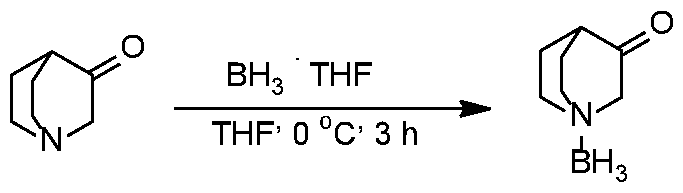
A"1
[00209] To a mixture of quinuclidin-3-one (0.20 kg, 1.6 mol) in tetrahydrofuran (1 L) at 0 °C was added dropwise 1 M borane in tetrahydrofuran ( 1.8 L, 1.8 mol). The mixture was stirred at 0 °C for 3 hours. On completion, the solution was quenched by methanol, evaporated and purified by silica gel chromatography (petroleum ether: ethyl acetate = 10: 1) to give compound A-l (0.19 kg, 86% yield) as a white solid.
[00210] Example 2A: 2 -dimethylquinuclidin(N-borane)-3-one (A- 2)

A"1 A"2
[00211] To a mixture of compound A-l (20 g, 0.14 mol) in tetrahydrofuran (200 inL) at 0 °C was added sodium hydride (8.6 g, 60%, 0.22 mol) in portions. The reaction was stirred for 30 minutes. Iodomethane (31 g, 0.22 mol) in tetrahydrofuran (30 mL) was added dropwise to the mixture at 0 °C, and the reaction was stirred at room temperature for 2 hours, and then cooled to 0 °C. Sodium hydride (8.6 g, 60%, 0.22 mol) was added in portions, and stirring was continued for 30 minutes.
Iodomethane (31 g, 0.22 mol) in tetrahydrofuran (30 mL) was again added dropwise to the mixture at 0 °C, and the reaction was stirred at room temperature for another 2 hours. On completion, the reaction was quenched with saturated ammonium chloride aqueous solution and concentrated in vacuo. The residue was purified by silica gel chromatography (petroleum ether: ethyl acetate = 10: 1) to give compound A-2 ( 14 g, 58% yield) as a white solid.
[00212] Example 3A: 2,2

[00213] To a mixture of compound A-2 (0.50 g, 3.0 mmol) in anhydrous ethanol (2 mL) was added hydroxylamine hydrochloride (0.21 g, 3.0 mmol) at room temperature. The mixture was stirred at 100 °C for 2 hours. On completion, the solution was cooled to room temperature, resulting in formation of a precipitate. The precipitation was collected by filtration to give compound A-3 (0.48 g, 96% yield) as a white solid. LCMS (K): tR=l .093 min., (ES+) m/z (M+H)+ = 169.1.
[00214] Example 4A: (+/-)-2,2-dimethylquinuclidin-3 -amine (rac-A-4)

rac"A"4
[00215] To a mixture of compound A-3 (0.60 g, 2.9 mmol) in n-propyl alcohol (6 mL) was added sodium n-propoxide (67 mg, 2.9 mmol sodium in 1 mL n-propyl alcohol) at room temperature. The solution was heated to 100 °C, and sodium (0.67 g, 29 mmol) was added in portions. The mixture was stirred at this temperature for 8 hours. On completion, the mixture was poured into water ( 1 mL), concentrated in vacuo, diluted with dichloromethane and filtered. The resulting filtrate was concentrated in vacuo to give rac-A-4 (0.40 g, 89% yield) as a yellow oil. LCMS (K): tR=0.988 min., (ES+) m/z (M+H)+ = 155.1.
[00216] Example 5A: 2,2

[00217] To a solution of 20% trifluoroacetic acid / dichloromethane (150 mL, v/v) at 0 °C was added portionwise compound A-2 (45 g, 0.27 mol). The mixture was stirred at room temperature overnight. On completion, the pH was adjusted to 8 by addition of saturated aqueous potassium carbonate solution at 0 °C. The mixture was extracted with dichloromethane (2 χ 200 mL). The combined organic layers were dried with sodium sulfate and concentrated in vacuo to give compound A-5 (40 g, 98% yield) as a white solid. i-NMR (CD3OD, 400 MHz): 3.37-3.36 (m, 2H), 2.98-2.97 (m, 2H), 2.39-2.38 (m, 1H), 2.10-2.09 (m, 4H), 1.34 (s, 6H).
[00218] Example 6A: (i?)-N-(2,2-dimethylquinuclidin-3-ylidene)-l-phenylethanamine ((i?)-A-6)

[00219] To a solution of compound A-5 (7.2 g, 47 mmol) and (i?)-l -phenylethanamine (6.8 g, 56 mmol) in toluene ( 140 ml) was added titanium tetraethoxide (32 g, 0.14 mol), and the mixture was heated at reflux for 72 hours. On completion, the mixture was cooled to room temperature and poured into saturated aqueous potassium carbonate solution (500 mL). Ethyl acetate (500 mL) was added, and the mixture was stirred vigorously for 10 minutes and filtered over celite. The layers were separated, and the water layer was extracted with ethyl acetate (3 χ 500 mL). The combined organic layers were dried with sodium sulfate and concentrated in vacuo to give compound (i?)-A-6 (13 g, crude, 52% purity by LCMS) as a yellow oil. The material was used for the next step without further purification. LCMS (J): tR=1.337, (ES+) m/z (M+H)+ = 257.1.
[00220] Example 7A: (i?)-2,2-dimethyl-N-((i?)-l-phenylethyl)quinuclidin-3-amine ((R,R)-A-7)

[00221] To a solution of compound (R)-A-6 (13 g, 26 mmol, 52 % purity) in methanol (130 mL) at 0 °C was added sodium borohydride (5.0 g, 0.13 mol). The mixture was stirred for 30 minutes at 0 °C, then allowed to warm to room temperature and stirred overnight. On completion, the reaction was poured into saturated aqueous potassium carbonate (500 mL), and the mixture was extracted with ethyl acetate (2 χ 500 mL). The combined organic layers were dried over sodium sulfate and concentrated in vacuo to give 11 g of a clear oil. The crude product was purified by silica gel chromatography (petroleum ether: ethyl acetate = 5: 1) to give compound (i?J?)-A-7 (7.3 g, 58% yield for two steps) as a clear oil. ¾-NMR (CD3OD, 400 MHz): δ 7.34-7.26 (m, 4H), 7.22-7.18 (m, 1H), 3.78-3.73 (m, 1H), 3.35-3.18 (m, 1H), 3.06-3.01 (m, 1H), 2.61-2.53 (m, 2H), 2.32 (s, 1H), 1.81-1.78 (m, 1H), 1.63-1.54 (m, 2H), 1.44-1.42 (m, 1H), 1.41 (s, 3H), 1.31 (d, J=6.8 Hz, 3H), 1.30-1.26 (m, 1H), 1.21(s, 3H).
[00222] Example 8A:

[00223] To a solution of compound (R,R)- A- 7 (5.3 g, 21 mmol) in methanol (100 mL) was added 10% palladium / carbon, 50% wet (1.5 g) under nitrogen. The suspension was degassed in vacuo and purged with hydrogen several times. The resulting mixture was stirred at room temperature overnight under hydrogen (50 psi). On completion, the reaction mixture was filtered, and the filtrate was concentrated in vacuo to give freebase compound (i?)-A-4 (3.0 g, 93% yield) as a white semi-solid. ¾-NMR (CD3OD, 400 MHz): 3.28-3.24 (m, 2H), 2.79-2.73 (m, 3H), 1.92-1.90 (m, 1H), 1.76-1.73 (m, 3H), 1.45-1.44 (m, 1H), 1.31 (s, 3H), 1.29 (s, 3H).
[00224] The dihydrochloride salt of compound (i?)-A-4 can be also obtained either by adding HC1 to accelerate the reaction, or directly from the isolated freebase, to give compound (i?)-A-4 dihydrochloride as a white solid. 1H-NMR (CD30D, 400 MHz): 3.72-3.64 (m, 2H), 3.60 (s, 1H), 3.42-3.33 (m, 2H), 2.40-2.39 (m, 1H), 2.25-2.11 (m, 3H), 2.03-1.97 (m, 1H), 1.71 (s, 3H), 1.69 (s, 3H).
[00225] TheA ditosylate salt form of compound (i?)-A-4 can also be prepared by dissolving compound (i?)-A-4 (20 g, 130 mmol) in anhydrous dichloromethane (200 mL), followed by addition of 4-methylbenzenesulfonic acid (49 g, 260 mmol). The mixture was stirred at 25 °C for 12 hours and then concentrated in vacuo. Anhydrous ethanol (40 mL) and anhydrous methanol (4 mL) were added, and the mixture was stirred at 25 °C for 12 hours. The solids were collected by filtration and dried in
vacuo to give compound (R)-A-4 ditosylate (45 g, 70% yield) as a white solid. IH-NMR (CD30D, 400 MHz): 7.71-7.69 (d, J = 8.0 Hz, 4H), 7.26-7.24 (d, J = 7.6 Hz, 4H), 3.66-3.58 (m, 3H), 3.39-3.34 (m, 2H), 2.37-2.34 (m, 7H), 2.09 (s, 3H), 1.99-1.93 (m, 1H), 1.64 (s, 3H), 1.60 (s, 3H).
[00226] Example 9 lidin-3-ylidene)-l-phenylethanamine ((S)-A-6)
 ACOH' 4A MS' toluene, reflux. 72 h
A"5 (S)"A 6
[00227] To a solution of compound A-5 (4.1 g, 27 mmol) and (<S)-l -phenylethanamine (3.9 g, 32 mmol) in toluene (40 mL) were added acetic acid (1.6 g, 27 mmol) and 4A-molecular sieve ( 1.0 g). The mixture was heated at reflux for 72 hours. On completion, the mixture was cooled to room temperature and concentrated in vacuo to give compound (S)-A-6 (8.5 g, crude) as a yellow oil. LCMS showed 38% purity. This material was used for the next step directly without further purification. LCMS (J): tR=1.228, (ES+) m/z (M+H)+ = 257.2.
[00228] Example 10A: (^^^-dimethyl-N-i^-l-phenylethy quinuclidin-S-amine ((S,S)-A-1)

[00229] To a solution of compound (S)-A-6 (8.5 g, 13 mmol, 38 % purity) in methanol (80 mL) at 0 °C was added sodium borohydride (2.4 g, 63 mmol). The reaction was stirred for 30 minutes at 0 °C, then allowed to warm to room temperature and stirred overnight. On completion, the mixture was poured into saturated aqueous potassium carbonate ( 100 mL) and extracted with ethyl acetate (2 χ 100 mL). The combined organic layers were dried over sodium sulfate and concentrated in vacuo to give 8.0 g of a clear oil. The crude product was purified by silica gel chromatography (petroleum ether: ethyl acetate = 5: 1) to give compound {S,S)-A-1 ( 1.8 g, 26% yield for two steps) as a clear oil. l -
NMR (CD3OD, 400 MHz): δ 7.34-7.28 (m, 4H), 7.22-7.19 (m, 1H), 3.78-3.73 (m, 1H), 3.27-3.21 (m, 1H), 3.08-3.04 (m, 1H), 2.65-2.58 (m, 2H), 2.34 (s, 1H), 1.84-1.82 (m, 1H), 1.65-1.56 (m, 2H), 1.45- 1.43 (m, 1H), 1.36 (s, 3H), 1.31 (d, J=6.8 Hz, 3H), 1.23(s, 3H), 1.15-1.14 (m, 1H).
[00230] Example 11 A: (5)-2,2-dimethylquinuclidin-3 -amine ((S)-A-4)

[00231] To a solution of compound (S,S)-A-7 (1.8 g, 7.0 mmol) in methanol (40 mL) was added 10% palladium/ carbon, 50% wet (0.4 g) under nitrogen. The suspension was degassed in vacuo and purged with hydrogen several times. The resulting mixture was stirred under hydrogen (50 psi) at
room temperature overnight. On completion, the reaction mixture was filtered, and the filtrate was concentrated in vacuo to give compound (S)-A-4 ( 1.0 g, 93% yield) as a white semi- solid. ¾-NMR
(CD3OD, 400 MHz): 3.44-3.36 (m, 2H), 3.03-2.93 (m, 2H), 2.90 (s, 1H), 2.07-2.02 (m, 1H), 1.92-1.85
(m, 3H), 1.65-1.58 (m, 1H), 1.43 (s, 3H), 1.39 (s, 3H).
[00232] Example 12A:

A 8
[00233] To a mixture of quinuclidin-3-one (30 g, 0.24 mol) in ethanol / water (0.65 L, 2.5 : 1) was added dimethylamine (49 g, 0.36 mol) in one portion, followed by formaldehyde (28 g, 0.36 mol) in one portion at room temperature. After stirring at room temperature for 10 min, the reaction mixture was heated to reflux for 3 hours, and then stirred at 70 °C for 16 hours. TLC showed the starting material was consumed completely. The reaction mixture was cooled to room temperature and concentrated in vacuo. The residue was purified by distillation to give compound A-8 ( 14 g, 43% yield) as yellow oil. GCMS: tR=5.629, (EI+) m/z (M) = 137.2.
[00234] Example 13A: r- .2]octan]-3'-one (A-9)

A 8 A 9
[00235] To a solution of trimethylsulfoxonium iodide (42 g, 0.19 mol) in anhydrous
tetrahydrofuran (500 mL) at 0 °C was added sodium hydride (7.6 g, 0.19 mol). The reaction mixture was stirred at 0 °C for 1 hour, and compound A-8 (20 g, 0.15 mol) was added dropwise. The mixture was allowed to warm to room temperature and stirred for 16 hours. GCMS showed the reaction was completed. The reaction was quenched with saturated aqueous ammonium chloride solution and filtered. The filtrate was concentrated in vacuo, diluted with dichloromethane (200 mL) and water (200 mL) and extracted with dichloromethane (3 χ 600 mL). The combined organic layers were washed with brine (2 χ 400 mL), dried over anhydrous sodium sulfate, filtered and concentrated in vacuo. The residue was purified by aluminum oxide column chromatography [petroleum ether : ethyl acetate = 5 : 1] to give compound A-9 (4.8 g, 22% yield) as a white solid. GCMS: tR=7.253, (EI+) m/z (M+H)+ = 151.1, ¾-NMR (CDC13, 400 MHz): δ 3.09-3.03 (m, 4H), 2.56-2.55 (m, 1H), 2.05-2.00 (m, 4H), 1.40-1.39 (m, 2H), 1.14-1.12 (m, 2H).
[00236] Example 14A: r-azaspiro[cyclopropane-l,2'-bicyclo[2.2.2]octan]-3'-one oxime hydrochloride (A- 10)
 [00237] To a mixture of compound A-9 (1.0 g, 6.6 mmol) in anhydrous ethanol (5 mL) was added hydroxylamine hydrochloride (0.48 g, 7.0 mmol) at room temperature. The mixture was stirred at 100 °C for 2 hours. On completion, the solution was cooled to room temperature, resulting in formation of a precipitate. The precipitation was collected by filtration to give compound A-10 (0.80 g, 60% yield) as a white solid.
[00238] Example 15A: (+/-)- -azaspiro[cyclopropane-l,2'-bicyclo[2.2.2]octan]-3'-amine (rac-A-
11)

[00239] To a mixture of compound A-10 (1.0 g, 4.9 mmol) in n- propyl alcohol ( 10 mL) was added sodium propoxide (0.40 g, 4.9 mmol sodium in 2 mL n-propyl alcohol) at room temperature. The solution was heated to 100 °C, and sodium (1.1 g, 49 mmol) was added in portions. The mixture was stirred at this temperature for 8 hours. On completion, the mixture was poured into water (2 mL), concentrated in vacuo, diluted with dichloromethane and filtered. The resulting filtrate was concentrated in vacuo to give rac-A-11 (0.50 g, 67% yield) as a yellow oil.
[00240] Example 16A: (i?)-l-phenyl-N-( r-azaspiro[cyclopropane-l,2'-bicyclo[2.2.2]octan]-3'- ylidene)ethanamine ((i?)-A-12)
 Ti(EtO)4' tO|uene> 1 10 °C 48 h
(R)"A"12
[00241] To a solution of compound A-9 (2.0 g, 13 mmol) in anhydrous toluene (30 mL) was added (i?)-l-phenylethanamine (1.6 g, 13 mmol) and ethyl titanate (9.1 g, 40 mmol). The resulting mixture was stirred at 1 10 °C for 48 hours. On completion, the reaction was quenched with saturated aqueous potassium carbonate (100 mL) and extracted with ethyl acetate (3 χ 100 mL). The combined organic layers were washed with brine, dried over sodium sulfate and concentrated in vacuo to give compound (i?)-A-12 (3.2 g, crude) as a yellow oil, which was used for next step without further purification. LCMS (J): tR=1.594, (ES+) m/z (M+H)+ = 255.1.
[00242] Example 17A: (i?)-N-((i?)-l-phenylethyl)-l '-azaspiro[cyclopropane-l,2'- bicyclo [2.2.2] octan] -3 '-amine ((R,R)-A- 13)

[dichloromethane: methanol = 5 : 1] to give compound (R,R)-A-13 (1.1 g, 41% yield for two steps) as a yellow oil. ¾-NMR (CD3OD, 400 MHz): 7.34-7.28 (m, 4H), 7.24-7.22 (m, 1H), 3.66-3.63 (m, 1H), 3.01-2.89 (m, 1H), 2.74-2.73 (m, 1H), 2.72-2.65 (m, 3H), 1.90-1.79 (m, 2H), 1.70-1.65 (m, 1H), 1.55- 1.51 (m, 1H), 1.37-1.35 (m, 1H), 1.29 (d, J=6.4 Hz, 3H), 1.12-1.07 (m, 1H) , 0.85-0.80 (m, 1H), 0.59- 0.47 (m, 2H).
[00244] Example 18A: (i?)-r-azaspiro[cyclopropane-l,2'-bicyclo[2.2.2]octan]-3'-amine ((i?)-A- 11)

[00245] To a mixture of compound (i?J?)-A-13 (1.4 g, 5.5 mmol) in anhydrous methanol (15 mL) was added 10% palladium hydroxide/ carbon, 50% wet (600 mg) under nitrogen. The suspension was degassed in vacuo and purged with hydrogen several times. The resulting mixture was stirred under hydrogen (40 psi) at 28 °C for 5 hours. On completion, the reaction mixture was filtered, and the filtrate was concentrated in vacuo to give compound (i?)-A-ll (0.75 g, 90% yield) as a light yellow oil. ¾-NMR (CD3OD, 400 MHz): 3.04-2.94 (m, 2H), 2.82-2.76 (m, 3H), 1.92-1.84 (m, 2H), 1.79- 1.70 (m, 2H), 1.46-1.43 (m, 1H), 1.00-0.95 (m, 1H), 0.82-0.77 (m, 1H), 0.58-0.49 (m, 2H).
[00246] The ditosylate salt form of compound (i?)-A-ll can also be prepared by dissolving compound (i?)-A-ll (18 g, 1 12 mmol) in anhydrous dichloromethane ( 180 mL) followed by addition of 4-methylbenzenesulfonic acid (39 g, 225 mmol). The mixture was stirred at 25 °C for 4 hours and then concentrated in vacuo. Anhydrous ethanol (500 mL) and anhydrous methanol (5 mL) were added, and the mixture was stirred for 12 hours. The solid was collected by filtration and dried in vacuo to give compound (i?)-A-ll ditosylate (47 g, 84% yield) as a white solid. IH-NMR (CD30D, 400 MHz): 7.71-7.69 (d, J = 8.0 Hz, 4H), 7.26-7.24 (d, J = 8.0 Hz, 4H), 3.82-3.81 (m, 1H), 3.58-3.50 (m, 3H), 3.48-3.38 (m, 1H), 2.53-2.52 (m, 1H), 2.38 (s, 6H), 2.18-2.06 (m, 4H), 1.46-1.43 (m, 1H), 1.38-1.29 (m, 2H), 1.23-1.20 (m, 1H).
[00247] Example 19A: (5)-l -phenyl-N-(l '-azaspiro[cyclopropane-l,2'-bicyclo[2.2.2]octan]-3'- ylidene)ethanamine ((S)-A-12)
 Ti(EtO)4' toluene. l l o uC' 48 h
A"9
[00248] To a solution of compound A-9 (2.0 g, 13 mmol ) in anhydrous toluene (30 mL) was added (iS)-l -phenylethanamine ( 1.6 g, 13 mmol) and ethyl titanate (9.1 g,40 mmol). The resulting mixture was stirred at 1 10 °C for 48 hours. On completion, the reaction was quenched with saturated aqueous potassium carbonate (100 mL) and extracted with ethyl acetate (5 x 30 mL). The combined organic layers were washed with brine, dried over sodium sulfate and concentrated in vacuo to give compound (S)-A-12 (2.3 g, crude) as a yellow oil, which was used for the next step without further purification. LCMS (J): tR=1.295, (ES+) m/z (M+H)+ = 255.1.
[00249] Example 20A: (^-N-i^-l-phenylethy -l '-azaspiroCcyclopropane-l^'- bicyclo [2.2.2] octan] -3 '-amine ((S,S)- A- 13)

[00250] To a mixture of compound (S)-A-12 (2.3 g, crude) in anhydrous methanol (25 mL) was added sodium borohydride (1.0 g, 25 mmol) slowly at 0 °C. The resulting mixture was stirred at room temperature overnight. On completion, the reaction was quenched by water (8 mL) and extracted with ethyl acetate (3 χ 25 mL). The combined organic layers were concentrated in vacuo and purified by silica gel chromatography [dichloromethane: methanol = 5 : 1] to give compound ( , )-A-13 (1.0 g, 37%) yield for two steps) as a yellow oil. i-NMR (CD3OD, 400 MHz): 7.32-7.25 (m, 4H), 7.22-7.18 (m, lH), 3.64-3.58 (m, 1H), 3.02-2.99 (m, 1H), 2.89-2.86 (m, 1H), 2.76-2.64 (m, 3H), 1.85-1.76 (m, 2H), 1.67-1.65 (m, 1H), 1.52-1.50 (m, 1H), 1.34-1.32 (m, 1H), 1.26 (d, J=6.4 Hz, 3H), 1.08-1.04 (m, 1H) , 0.82-0.78 (m, 1H), 0.56-0.46 (m, 2H).
[00251] Example 21A: 2]octan]-3'-amine (( )-A-ll)
 (S "A"11
(S'S) A 13 1 '
[00252] To a mixture of compound ($,Λ)-Α-13 (1.0 g, 3.9 mmol) in anhydrous methanol (10 mL) was added 10% palladium hydroxide/ carbon, 50% wet (400 mg) under nitrogen. The suspension was degassed in vacuo and purged with hydrogen several times. The mixture was stirred under hydrogen (40 psi) at 28 °C for 5 hours. On completion, the reaction mixture was filtered, and the filtrate was concentrated in vacuo to give compound (S)-A-ll (0.55 g, 92% yield) as a light yellow oil. ¾-NMR
(CD3OD, 400 MHz): 3.04-2.94 (m, 2H), 2.82-2.75 (m, 3H), 1.97-1.84 (m, 2H), 1.79-1.74 (m, 2H), 1.47-1.43 (m, 1H), 1.00-0.95 (m, 1H), 0.81-0.76 (m, 1H), 0.58-0.49 (m, 2H).
[00253] General .
 N'hydroxyjmjdOyi
chiorjde
[00254] A mixture of aldehyde (1 eq.), hydroxylamine hydrochloride (1.3-2 eq.) and triethylamine (2 eq.) in dichloromethane (1.2-2.5 mL/mmol aldehyde) was stirred at room temperature for 16 hours. On completion, the reaction mixture was diluted with water and extracted with dichloromethane (3 χ 20 mL). The combined organic layers were washed with water and brine, dried over anhydrous sodium sulfate and concentrated in vacuo to give the oxime intermediate. This intermediate was either purified by silica gel chromatography or used without further purification in the next step.
[00255] To a solution of oxime intermediate (1 eq.) in dichloromethane (10 mL) at 0 °C was added a solution of N-chlorosuccinimide (1.2 eq.) in N, N-dimethylformamide (0.5 mL). The mixture was stirred at 30 °C for 1 hour. On completion, the reaction mixture was diluted with water and extracted with dichloromethane (3 x 10 mL). The combined organic layers were washed with water and brine, dried over anhydrous sodium sulfate, filtered and concentrated in vacuo to give Ν- hydroxyimidoyl chloride intermediate, which was used crude in the next reaction without further purification.
[00256] Example IB -chlorobenzo[d]isoxazol-3-amine (B-l)

[00257] To a solution of N-hydroxyacetamide (3.1 g, 41 mmol) in dry N,N-dimethylformamide (60 mL ) at room temperature was added potassium 7-butoxide (4.6 g, 41 mmol). After stirring for 30 minutes, 4-chloro-2-nitrobenzonitrile (5.0 g, 27 mmol) was added, and stirring was continued for another 4.5 hours. On completion, the reaction mixture was poured into a mixture of brine (60 mL) and ethyl acetate (60 mL). The organic phase was separated, dried over anhydrous sodium sulfate, filtered and concentrated to dryness. The residue was purified by silica gel chromatography
[petroleum ether: ethyl acetate = 3: 1] to afford compound B-l (3.1 g, 66% yield) as a pale yellow solid. i-NMR (DMSO- 6, 400 MHz): δ 7.84-7.82 (d, J=8.8 Hz, 1H), 7.65-7.64 (d, J=1.2 Hz, 1H), 7.33-7.31 (dd, J=1.2 Hz, J=8.8 Hz, 1H), 6.52 (s, 2H).
[00258] Example 2B: 4-chloro-2-fluoro-N-hydroxybenzimidoyl chloride (compound-B-3)

B 2 B 3
[00259] To a solution of 4-chloro-2-fluorobenzaldehyde (2.6 g, 16.4 mmol) in ethanol/water (45 mL, 8/1, v/v) at room temperature was added hydroxylamine hydrochloride (2.3 g, 32.8 mmol) and sodium acetate (4.0 g, 49.2 mmol). The reaction was stirred for 1 hour until TLC showed the reaction was complete. The mixture was concentrated in vacuo, and the residue was triturated from water, collected by filtration, washed with water and dried in vacuo to afford compound B-2 (2.7 g, white solid, 96% yield), which was used as such in the next step. LCMS (2): tR=1.856 min., (ES+) m/z (M+H)+ = 174.0. ^ NMR ^OO MHz, DMSO-d6) δ 11.83 (s, 1H), 8.16 (s, 1H), 7.87 - 7.63 (m, 1H), 7.62 - 7.41 (m, 1H), 7.31 (d, J= 7.9 Hz, 1H).
[00260] To a solution of compound B-2 (2.7 g, 15.6 mmol) in N,N-dimethylformamide (25 mL) at room temperature was added N-chlorosuccinimide (2.1 g, 15.6 mmol). The reaction was stirred for 1.5 hours until TLC showed the reaction was complete. The solution was diluted with ethyl acetate and water and filtered through Celite to remove particles. The layers were separated, and the organic layer was washed with water and brine (2x), dried with sodium sulfate, filtered, and concentrated in vacuo to afford compound B-3 (2.7 g, white solid, 84% yield), which was used as such in the next step. 1H
NMR (300 MHz, DMSO- d6) δ 12.73 (s, 1H), 7.75 - 7.65 (m, 1H), 7.65 - 7.57 (m, 1H), 7.47 - 7.37
(m, 1H).
[00261] Example 3B: (4

B"4
[00262] To a solution of l-chloro-2,3-difluorobenzene (1.0 g, 6.7 mmol) in dry tetrahydrofuran (15 mL) under nitrogen at -70 °C was added dropwise lithium diisopropylamide (2 M in
tetrahydrofuran , 4.0 mL, 8.1 mmol). The reaction was stirred at -70 °C for 0.5 hour, then N,N- dimethyl formamide (1.5 g, 20 mmol) was added dropwise, and stirring was continued at -70 °C for another 0.5 hour. On completion, the reaction mixture was quenched with saturated aqueous ammonium chloride (15 mL) and extracted with ethyl acetate (3 x 15 mL). The combined organic layers were washed with brine, dried over anhydrous sodium sulfate, filtered and concentrated in vacuo. The residue was purified by silica gel chromatography [petroleum ether: ethyl acetate = 10: 1] to give compound B-4 (1.0 g, 85% yield) as a white solid. ¾-NMR (CDC13, 400 MHz): δ 10.31 (s, 1H), δ 7.65-7.63 (m, 1H), 7. 38-7.32 (m, 1H).
[00263] Example 4B: 4-chloro-2,3-difluoro-N-hydroxybenzimidoyl chloride (B-6)

[00264] Following general procedure Al, compound B-6 was prepared from compound B-4:
[00265] Compound B-5 (0.29 g, white solid, 89% yield) was prepared from compound B-4 (0.30 g, 1.7 mmol) and purified by silica gel chromatography [petroleum ether: ethyl acetate = 10: 1]. LCMS (B): (ES+) m/z (M+H)+ = 192.1, tR=0.742.
[00266] Compound B-6 (0.28 g, white solid, crude) was prepared from compound B-5 (0.29 g, 1.5 mmol). TLC [petroleum ether: ethyl acetate = 3: 1]: Rf = 0.4.
[00267] Example 5B: 2-fluoro-N-hydroxy-4-methoxybenzimidoyl chloride (B-8)

[00268] Following general procedure Al, compound B-8 was prepared from 2-fluoro-4- methoxybenzaldehyde :
[00269] Compound B-7 (3.0 g, white solid, 90% yield) was prepared from 2-fluoro-4- methoxybenzaldehyde (3.0 g, 19 mmol) and hydroxylamine hydrochloride (4.1 g, 58 mmol), using ethanol and water as the solvent without triethylamine with a reaction time of 2.5 hours at 25 °C. The product was purified by column chromatography [petroleum ether: ethyl acetate = 10: 1]. TLC
[petroleum ether: ethyl acetate = 5: 1]: Rf= 0.29. ^-NMR (CDC13, 400 MHz): δ 8.51-8.47 (m, 1H),
8.30 (s, 1H), 7.67-7.62 (m, 1H), 6.76-6.72 (m, 1H), 6.67-6.62 (m, 1H), 3.83 (s, 3H).
[00270] Compound B-8 (0.77 g, yellow gum, crude) was prepared from compound B-7 (0.5 g, 3.0 mmol) and N-chlorosuccinimide (0.40g, 3.0 mmol) with a reaction time of 10 hours at 0-15 °C.
LCMS (B): tR=0.684 min, (ES+) m/z (M+H)+ = 204.1.
[00271] Example 6B: 3,4-dichloro-2-fluorobenzaldehyde (B-9)

B 9
[00272] To a solution of 1, 2-dichloro-3-fluorobenzene (2.5 g, 15.2 mmol) in tetrahydrofuran (15 mL) at -78 °C was added lithium diisopropylamide (2 M in tetrahydrofuran n-heptane, 11.5 mL, 23 mmol). The reaction was stirred for 0.5 hour. ThenN N-dimethylformamide (3.33g, 45 mmol) was added, and the reaction was stirred at -78 °C for another 0.5 hour. On completion, the reaction was quenched with water and extracted with ethyl acetate (3 x 15 mL). The combined organic layers were washed with water and brine, dried over anhydrous sodium sulfate and concentrated in vacuo to give compound B-9 (2.8 g, crude) as yellow oil.
[00273] Example 7B: 3,4-dichloro-2-fluoro-N-hydroxybenzimidoyl chloride (B-ll)

B"9 B"10 B"11
[00274] Following general procedure Al, compound B-ll was prepared from compound B-9.
[00275] Compound B-10 (2.3 g, white solid, crude) was prepared from compound B-9 (2.8 g, 15 mmol) with a reaction time of 5 hours and purified by silica gel chromatography [petroleum ether: ethyl acetate = 10: 1] . LCMS (J): (ES+) m/z (M+H)+ = 208.0, tR=0.786.
[00276] Compound B-ll (2.2 g, white solid, crude) was prepared from compound B-10 (2.3 g, 1 1 mmol) with a reaction time of 3 hours. TLC [petroleum ether: ethyl acetate = 8: 1] : Rf = 0.5.
[00277] -chloro-2-fluoro-N-hydroxy-3-methoxybenzimidoyl chloride (B-13)

B 12 B 13
[00278] Following general procedure Al, compound B-13 was prepared from 4-chloro-2-fluoro- 3 -methoxybenzaldehyde :
[00279] Compound B-12 (2.0 g, white solid, crude) was prepared from 4-chloro-2-fluoro- 3- methoxybenzaldehyde (2.5 g, 13 mmol) and purified by silica gel chromatography [petroleum ether: ethyl acetate = 10: 1] .
[00280] Compound B-13 (2.5 g, white solid, crude) was prepared from compound B-12 (2.5 g, 12 mmol) with a reaction time of 3 hours. TLC [petroleum ether: ethyl acetate = 5 : 1] : Rf = 0.7.
[00281] Exam -fluoro-N-hydroxy-4-methylbenzimidoyl chloride (B-15)

B"14 B"15
[00282] Following general procedure Al, compound B-15 was prepared from 2-fluoro-4-methyl benzaldehyde:
[00283] Compound B-14 ( 1.8 g, white solid, crude) was prepared from 2-fluoro-4-methyl benzaldehyde (2.0 g, 14.5 mmol) with a reaction time of 2 hours and purified by silica gel chromatography [petroleum ether: ethyl acetate = 15: 1] . 1H-NMR (CDC13, 400 MHz): δ 8.55-8.35 (m, 2H), 7.62-7.61 (m, 1H), 6.99-6.92 (m, 2H), 2.38 (s, 3H).
[00284] Compound B-15 (2.5 g, white solid, crude) was prepared from compound B-14 (2.0 g, 13 mmol) with a reaction time of 1.5 hours. TLC [petroleum ether: ethyl acetate = 5: 1] : Rf = 0.7.
[00285] Example 10B: 2,3-difluoro-N-hydroxy-4-methylbenzimidoyl chloride (B-17)

B"16
[00286] Following general procedure Al, compound B-17 was prepared from 2,3-difluoro-4- methylbenzaldehyde :
[00287] Compound B-16 (1.0 g, white solid, 91% yield) was prepared from 2,3-difluoro-4- methylbenz aldehyde (1.0 g, 6.4 mmol) and purified by silica gel chromatography [petroleum ether: ethyl acetate = 10: 1]. LCMS (J): (ES+) m/z (M+H)+ = 172.1, tR=1.279.
[00288] Compound B-17 (0.60 g, white solid, crude) was prepared from compound B-16 (0.50 g, 3.2 mmol) with a reaction of 16 hours. TLC [petroleum ether: ethyl acetate = 5: 1] : Rf = 0.5.
[00289] Exam le 11B: 3-chloro-2 4-difluoro-N-h drox benzimido l chloride B-19

B"18 B"19
[00290] Following general procedure Al, compound B-19 was prepared from 3-chloro-2,4- difluorobenzaldehyde :
[00291] Compound B-18 (0.90 g, white solid, 83% yield) was prepared from 3-chloro-2,4- difluorobenzaldehyde (1.0 g, 5.7 mmol) and used in next step without further purification.
[00292] Compound B-19 (0.80 g, white solid, crude) was prepared from compound B-18 (0.90 g, 4.7 mmol) with a reaction time of 16 hours at room temperature. TLC [petroleum ether: ethyl acetate = 8: 1]: Rf = 0.75.
[00293] Example 12B: (2,5-difluoro-4-methylphenyl)methanol (B-20)

[00294] To a solution of compound 2,5-difluoro-4-methyl -benzoic acid (2.00 g, 11.6 mmol, 1.00 eq) in tetrahydrofuran (30 mL) at 0 °C was added dropwise BH3 THF (1 M, 29.1 mL, 2.50 eq). The reaction was stirred at 30 °C for 15 hours. On completion, the reaction was quenched with methanol (60 mL) and concentrated in vacuo to give compound B-20 (1.8 g, yellow solid, crude). IH-NMR (CD3OD, 400 MHz): δ 7.15-7.10 (m, 1H), 7.00-6.94 (m, 1H), 4.61 (s, 2H), 2.26 (s, 3H).
[00295] Example 13B: 2,5-difluoro-4-methylbenzaldehyde (B-21)

B"20 B"21
[00296] To a solution of compound B-20 (1.80 g, 11.4 mmol, 1.00 eq) in toluene (15.00 mL) was added manganese dioxide (9.90 g, 114 mmol, 10.0 eq). The mixture was stirred at 80 °C for 16 hours. The reaction mixture was filtered and the filtrate was concentrated in vacuo to give compound B-21 (1.5 g, 84% yield) as a yellow solid. 1H-NMR (CDC13, 400 MHz): δ 10.29 (m, 1H), 7.54-7.48 (m, 1H), 7.07-7.03 (m, 1H), 2.38-2.34 (m, 3H).
[00297] Ex -difluoro-N-hydroxy-4-methylbenzimidoyl chloride (B-23)

B"21 B"22 B"23
[00298] Following general procedure Al, compound B-23 was prepared from compound B-21:
[00299] Compound B-22 (1.6 g crude) was prepared from compound B-21 (1.4 g, 8.9 mmol) with a reaction temperature of 20 °C and a reaction time of 15 hours and purified by silica gel
chromatography [petroleum ether: ethyl acetate = 20: 1] . 1H-NMR (CDC13, 400 MHz): δ 8.30 (s, lH), 7.65 (s, 1H), 7.45-7.38 (m, 1H), 7.02-6.91 (m, 1H), 2.30 (s, 3H).
[00300] Compound B-23 (1.6 g, crude) was prepared from compound B-22 (1.6 g, 9.35 mmol) with a reaction temperature of 18 °C and a reaction time of 3 hours. TLC [petroleum ether: ethyl acetate = 10: 1] : Rf = 0.5.
[00301] Example 15B -chloro-2-fluoro-3-methylbenzaldehyde (B-24)

B"24
[00302] To a solution of diisopropylamine (1.5 eq) in tetrahydrofuran (80 mL) at -70 °C was added n-butyllithium (2.5 M in n-hexane, 21 mL, 52 mmol) at -70 °C under nitrogen and the reaction was stirred at -15 °C for 0.5 hour. Then the reaction solution was cooled to -70 °C and l-chloro-3- fluoro-2-methylbenzene was added. The mixture was stirred for another 0.5 hour at -70 °C. Finally N, N - dimethylformamide (12.6 g, 173 mmol) was added slowly and the mixture was stirred at -70 °C for another 0.5 hour. One completion, the reaction was quenched with aqueous ammonium chloride (250 mL) and extracted with ethyl acetate (3 χ 250 mL). The combined organic extracts were concentrated in vacuo to give compound B-24 (6 g, crude) as a yellow oil.
[00303] Example 16B: 4-chloro-2-fluoro-N-hydroxy-3-methylbenzimidoyl chloride (B-26)

[00304] Following general procedure Al, compound B-26 was prepared from compound B-24:
[00305] Compound B-25 (0.4 g crude) was prepared from compound B-24 (5.0 g, 29 mmol) with a reaction temperature of 20 °C and a reaction time of 15 hours and purified by silica gel
chromatography [petroleum ether: ethyl acetate = 20: 1]. 1H-NMR (CDC13, 400 MHz): δ 8.34 (s, 1H), 7.89 (s, 1H), 7.56-7.53 (m, 1H), 7.20-7.18 (m, 1H), 2.34 (s, 3H).
[00306] Compound B-26 (0.52 g, crude) was prepared from compound B-25 (0.5 g, 2.67 mmol) with a reaction temperature of 16 °C and a reaction time of 14 hours. TLC [petroleum ether: ethyl acetate = 9: 1]: Rf=0.5.
[00307] Exa -28)

B"27
[00308] Following general procedure Al, compound B-28 was prepared from 4-chloro-2,5- difluorobenzaldehyde :
[00309] Compound B-27 (1.5 g, white solid, 92% yield) was prepared from 4-chloro-2,5- difluorobenzaldehyde (1.5 g, 8.5 mmol) with a reaction time of 12 hours and purified by silica gel chromatography [petroleum ether: ethyl acetate = 50: 1-5: 1]. ^-NMR (DMSO, 400 MHz): δ 11.90 (s, 1H), 8.16 (t, J=8.0 Hz, 1H), 7.76-7.66 (m, 2H).
[00310] Compound B-28 (0.60 g, yellow oil, crude) was prepared from compound B-27 (0.50 g, 2.6 mmol) with a reaction time of 12 hours. TLC [petroleum ether: ethyl acetate = 10: 1]: Rf = 0.40.
[00311] Example 18B: 4-chloro-3-ethoxy-2-fluoro-N-hydroxybenzimidoyl chloride (B-30)

[00312] Following general procedure Al, compound B-30 was prepared from 4-chloro-3-ethoxy- 2-fluorobenzaldehyde :
[00313] Compound B-29 (0.80 g, white solid, 74% yield) was prepared from 4-chloro-3-ethoxy-2- fluorobenzaldehyde ( 1.0 g, 4.9 mmol) with a reaction time of 3 hours and purified by silica gel chromatography [petroleum ether: ethyl acetate = 5: 1].
[00314] Compound B-30 (1.0 g, yellow oil, crude) was prepared from compound B-29 (0.80 g, 3.5 mmol) with a reaction temperature of 25 °C and a reaction time of 3 hours. TLC [petroleum ether: ethyl acetate = 8: 1]: Rf = 0.7.
[00315] Example 19B: 3-chloro-2-fluoro-4-methylbenzaldehyde (B-31)

B 31
[00316] To a mixture of compound 2-chloro-l-fluoro-3-methylbenzene (2.0 g, 14 mmol) in anhydrous tetrahydrofuran (20 mL) at -70 °C under nitrogen was added dropwise n-butyllithium (2.5 M in n-hexane, 8.3 mL, 21 mmol). The mixture was stirred at -70 °C for 0.5 hour, and N, N- dimethylformamide (0.14 g, 1.9 mmol) was added dropwise. The reaction was stirred at -70 °C for another 0.5 hour. Then the reaction was quenched with saturated ammonium chloride solution (30 mL) at 0 °C and extracted with ethyl acetate (2 χ 30 mL). The combined organic layers were washed with brine (2 χ 20 mL), dried with anhydrous sodium sulfate, filtered and concentrated in vacuo to give compound B-31 (2.0 g, crude) as a yellow solid. 1H-NMR (CDC13, 400 MHz): 5 10.31 (s, 1H), 7.67 (t, J=7.2 Hz, 1H), 7.17 (dd, J=8.0 Hz, 1H), 2.48 (s, 3H).
[00317] -33)

[00318] Following general procedure Al, compound B-33 was prepared from compound B-31:
[00319] Compound B-32 (0.80 g, white solid,74% yield) was prepared from compound B-31 (1.0 g, 5.8 mmol) with a reaction time of 2 hours and purified by silica gel chromatography [petroleum ether: ethyl acetate = 50: 1-10: 1]. 1H-NMR (CDC13, 400 MHz): δ 8.34 (s, 1H), 7.87 (s, 1H), 7.55 (t, J=7.6 Hz, 1H), 7.05 (d, J=8.0 Hz, 1H), 2.42 (s, 3H).
[00320] Compound B-33 (0.90 g, yellow solid, crude) was prepared from compound B-32 (0.80g, 4.3 mmol) with a reaction time of 12 hours. TLC [petroleum ether: ethyl acetate = 10: 1]: Rf = 0.75.
[00321] Example 21B: 4-chloro-2-fluoro-3-(trifluoromethyl)benzaldehyde (B-34)

[00322] To a solution of l-chloro-3-fluoro-2-(trifluoromethyl)benzene (0.50 g, 2.5 mmol) at -70 °C was added dropwise lithium diisopropylamide (2 M in tetrahydrofuran, 3.8 mmol, 1.9 mL). The reaction was stirred at -70 °C for 0.5 hour, then N, N - dimethylformamide (0.55 g, 7.6 mmol) was added slowly, and stirring was continued at -70 °C for another hour. The reaction was quenched with water (10 mL) and extracted with ethyl acetate (3 x 10 mL). The combined organic layers were concentrated in vacuo, and the residue was purified by silica gel chromatography
[petroleum ether: ethyl acetate = 10: 1] to give B-34 (0.40 g, 70% yield) as a yellow solid. 1H-NMR (CDC13, 400 MHz): 510.28 (s, 1H), 7.95-7.90 (t, J=10.0 Hz, 1H), 7.40-7.37 (d, J=l 1.2 Hz, 1H).
[00323] Example 22B: 4-chloro-2-fluoro-N-hydroxy-3-(trifluoromethyl)benzimidoyl chloride (B-
36)

[00324] Following general procedure Al, compound B-36 was prepared from compound B-34:
[00325] Compound B-35 (0.40 g, yellow solid, 62% yield) was prepared from compound B-34 (0.60 g, 2.7 mmol) with a reaction time of 14 hours and used in next step without further purification.
[00326] Compound B-36 (0.40 g, white solid, crude) was prepared from compound B-35 (0.38 g, 1.6 mmol). TLC [petroleum ether: ethyl acetate = 8: 1] . Rf = 0.6.
[00327] Example 23B: l

B 37
[00328] A mixture of 2-chloro-6-fluoro-phenol (5.0 g, 34 mmol), isopropyl iodide (12 g, 68 mmol) and potassium carbonate (19 g, 0.14 mol) in N, N - dimethylformamide (30 mL) was stirred at 60 °C for 12 hours. On completion, the reaction was diluted with water (30 mL) and extracted with ethyl acetate (2 χ 30 mL). The combined organic phases were washed with brine (3 χ 20 mL), dried with anhydrous sodium sulfate and concentrated in vacuo. The residue was purified by silica gel chromatography [petroleum ether: ethyl acetate = 1:0] to give compound B-37 (5.0 g, 78% yield) as a colorless oil. ^-NMR (CDC13, 400 MHz): δ 7.17-7.15 (m, 1H), 7.04-6.93 (m, 2H), 4.55-4.46 (m, 1H), 1.38-1.36 (d, J=6.4 Hz, 6H).
[00329] Example 24B: -chloro-2-fluoro-3-isopropoxybenzaldehyde (B-38)

B 37 B 38
[00330] To a solution of compound B-37 (2.0 g, 11 mmol) at -70 °C under nitrogen was added dropwise lithium diisopropylamide (2 M in tetrahydrofuran, 8.0 mL, 16 mmol). The reaction was stirred at -70 °C for 1 hour. Then N, N - dimethylformamide (1.7 g, 23 mmol) was added slowly, and stirring was continued at -70 °C for another 0.5 hour. The reaction was quenched with saturated ammonium chloride solution (30 mL) and extracted with ethyl acetate (2 x 30 mL). The combined organic extracts were washed with water (20 mL), dried with anhydrous sodium sulfate and concentrated in vacuo to give compound B-38 (3.0 g, 27% purity, 35% yield) as a yellow solid.
GCMS: m/z = 216.0, tR= 5.600 min.
[00331] Example 25B: 4-chloro-2-fluoro-N-hydroxy-3-isopropoxybenzimidoyl chloride (B-40)

B 38 B 39 B 40
[00332] Following general procedure Al, compound B-40 was prepared from compound B-38:
[00333] Compound B-39 (600 mg, yellow solid, 69% yield) was prepared from compound B-38 (3.0 g, 27% purity) with a reaction temperature of 20 °C and a reaction time of 4 hours and purified by silica gel chromatography [petroleum ether: ethyl acetate = 50: 1-10: 1] . 1H-NMR (CDC13, 400 MHz): δ 8.31 (s, 1H), 8.00 (s, 1H), 7.40 (t, J=8.0 Hz, 1H), 7.17 (dd, J=8.4 Hz, J=1.6 Hz, 1H), 4.56- 4.47 (m, 1H), 1.38 (d, J=6.4 Hz, 6H).
[00334] Compound B-40 (0.70 g, yellow oil, crude) was prepared from compound B-39 (0.60g, 2.6 mmol) using dichloromthane as solvent with a reaction temperature of 20 °C and a reaction time of 12 hours. TLC [petroleum ether: ethyl acetate = 10: 1] : Rf = 0.61.
[00335] General Procedure Bl: Synthesis of Aminobenzoisoxazoles.

N"hydr°xyimid°yl N"hydr°xyimidamide Amjnobenzojsoxazo|e
chloride
[00336] N-hydroxybenzimidoyl chloride intermediate (1 eq.) in methanol (7 mL/mmol imidoyl chloride intermediate) was added dropwise over 30 min. to a solution of amine A-NH2 (1.2-2 eq.) and triethylamine (2 eq) in methanol (5-10 mL/mmol imidoyl chloride intermediate) at room temperature. The resulting mixture was stirred at room temperature for 30 min. On completion, the reaction mixture was concentrated in vacuo and purified by prep-HPLC to give the N-hydroxyimidamide intermediate.
[00337] A mixture of N-hydroxyimidamide intermediate and base, in an appropriate solvent, was heated until the reaction was judged complete by LCMS. The mixture was filtered, concentrated in vacuum and purified by prep-HPLC to give the the aminobenzoisoxazole product.
[00338] Example 1:
[00339] Preparation of 6-chloro-N-(2,2-dimethylquinuclidin-3-yl)benzo[d]isoxazol-3-amine hydrochloride (rac-1)
 [00340] To a solution of compound B-l (0.10 g, 0.6 mmol) and 2,2-dimethyl-quinuclidin-3-one (0.18 g, 1.2 mmol) in chlorobenzene (10 mL) at 25 °C was added portion-wise titanium(IV) isopropoxide (1.7 g, 6.0 mmol). The resulting solution was stirred at 140 °C for 12 hours. On completion, the mixture was cooled to 0 °C, and methanol (2.0 mL) was added via, followed by sodium borohydride (0.23 g, 6.0 mmol) in portions. The reaction was stirred at 25 °C for 12 hours, then quenched with saturated aqueous potassium carbonate solution, resulting in the formation of a solid. The mixture was filtered, and the filtrate was extracted with dichloromethane (3 x 10 mL). The combined organic layers were washed with brine, dried over anhydrous sodium sulfate, filtered and concentrated in vacuo. The residue was purified by prep-HPLC [Instrument: GX-I; Column: Xtimate C18 150 x 25 mm, particle size: 5 μπι; Mobile phase: 21-55% acetonitrile in H20 (add 0.1% TFA, v/v)] . The resulting solid was dissolved in 0.2 N hydrochloric acid and again lyophilized to give rac-l (10 mg, 2.0% yield) as a white solid. LCMS (B): tR=0.677 min., (ES+) m/z (M+H)+ = 306.1. i-NMR (CD3OD, 400 MHz): δ 7.91 (d, J=8.4 Hz, 1H), 7.51 (d, J=1.6 Hz, 1H), 7.30 (dd, J=1.6 Hz, J=8.4 Hz, 1H), 3.93 (m, 1H), 3.72-3.67 (m, 2H), 3.36-3.31 (m, 2H), 2.42-2.41 (m, 1H), 2.37-2.36 (m, 1H), 2.17- 2.10 (m, 2H), 1.92 (m, 1H), 1.78 (s, 3H), 1.52 (s, 3H).
ExamplePreparation of (i?)-6-chloro-N-(2,2-dimethylquinuclidin-3-yl)benzo[d]isoxazol-3-amine ((*)-!)

[00341] To a solution of (R)-A-4 (202 mg, 1.3 mmol) and triethylamine (139 mg, 1.4 mmol) in methanol (5 mL) at room temperature was added a solution of compound B-3 (286 mg, 1.4 mmol) in methanol (10 mL) over 4 hours using a syringe pump. Upon complete addition, the mixture was filtered and concentrated in vacuo, and the residue was purified by silica gel column chromatography [chloroform: 7M NH3 in methanol = 1 :0 to 9: 1] to afford (i?)-B-3-l ( 147 mg, 46% yield) as a white solid. LCMS ( 1): tR=2.847 min., (ES+) m/z (M+H)+ = 326.2.
[00342] To a solution of (i?)-4-chloro-N-(2,2-dimethylquinuclidin-3-yl)-2-fluoro-N'- hydroxybenzimidamide (i?)-B-3-l (197 mg, 0.6 mmol) in dimethylsulfoxide (5 mL) was added potassium tertbutoxide ( 100 mg, 0.9 mmol). The mixture was stirred at room temperature for 1 hour. The solution was put on an SCX column and eluted with methanol. The product was eluted from the column using 3.5M ammonia in methanol, concentrated and purified by silica gel column chromatography [chloroform: 7M NH3 in methanol = 1/0 to 9/1] . The resulting product was further purified by preparative HPLC (1) and lyophilized to afford (i?)-l (70 mg, 38% yield) as a white solid: LCMS (3): tR=2.444 min., (ES+) m/z (M+H)+ = 306.0; 1H NMR (300 MHz, Chloroform-d) δ 7.45 - 7.39 (m, 2H), 7.21 (dd, J = 8.4, 1.6 Hz, 1H), 4.46 (d, J = 8.2 Hz, 1H), 3.70 - 3.63 (m, 1H), 3.33 - 3.19
(m, 2H), 2.82 - 2.67 (m, 2H), 2.08 (h, J = 3.0 Hz, 1H), 1.82 - 1.61 (m, 3H), 1.49 - 1.40 (m, 4H), 1.31 (s, 3H).
[00343] Example 2: (i?)-6-chloro-N-(2,2-dime1hylquinuclidin-3-yl)-7-fluorobenzo[d]isoxazol-3- amine

[00344] Following general procedure B l, compound (R)-2 was prepared from compound B-6:
[00345] Compound (i?)-B-6-l (71 mg, yellow solid, crude) was prepared from compound B-6 (50 mg, 0.22 mmol) and (i?)-A-4 (34 mg, 0.22 mmol). The product was used in the next step without further purification. LCMS (G): (ES+) m/z (M+H)+ = 344.1, tR=2.36.
[00346] A mixture of compound (i?)-B-6-l (71 mg, 0.20 mmol) and potassium carbonate (85 mg, 0.60 mmol) in N, N-dimethylformamide (3.0 mL) was stirred at 120 °C for 2 hours. On completion, the reaction mixture was filtered, concentrated in vacuo and purified by prep-HPLC [Instrument: GX- I; Column: Xtimate C18 150x25 mm, particle size: 5 μπι; Mobile phase: 20-50% acetonitrile in H20 (add 0.1% TFA, v/v)] . The resulting solid was dissolved in 0.2 Ν hydrochloric acid and again lyophilized to give:
[00347] Compound (R)-2 ( 17 mg, 21% yield) as a white solid: cSFC analytical tR=2.10 min., purity: 97.05%; LCMS (FF): tR=2.40 min., 322.1 m/z (M+1); IH-NMR (CD3OD, 400 MHz): δ 7.76- 7.74 (d, J=8.4 Hz 1H), 7.38-7.36 (m, 1H), 3.93 (m, 1H), 3.71-3.66 (m, 2H), 3.36-3.32 (m, 2H), 2.42 (m, 1H), 2.37-2.36 (m, 1H), 2.17-2.1 1 (m, 2H), 1.94-1.93 (m, 1H), 1.79 (s, 3H), 1.52 (s, 3H).
[00348] Example 3: (i?)-N-(2,2-dimethylquinuclidin-3-yl)-6-methoxybenzo[£/]isoxazol-3-amine hydrochl

[00349] Following general procedure B l, compound (i?)-3 was prepared from compound B-8:
[00350] Compound (i?)-B-8-l (0.22 g, white solid, 39% yield) was prepared from compound B-8 (0.4 g, 1.7 mmol), triethylamine (0.35 g, 3.4 mmol) and (i?)-A-4 (0.26 g, 1.7 mmol) with a reaction time of 2 hours. The product was purified by prep-HPLC [Instrument: GX-A; Column: Phenomenex Gemini C18 250x50 mm, particle size: 10 μιη; Mobile phase: 24-54% acetonitrile in H20 (add 0.05% NH3 H20, v/v)] . TT-NMR (CDC13, 400 MHz): δ 7.29 (t, J=8.4 Hz, 1H), 6.85-6.78 (m, 2H), 3.84 (s, 3H), 3.30-3.26 (m, 1H), 3.04 (m, 1H), 2.90 (s, 1H), 2.72-2.62 (m, 2H), 1.86-1.85 (m, 1H), 1.74 (s, 1H), 1.68-1.63 (m, 1H) , 1.51-1.45 (m, 2H) , 1.28 (s, 3H) , 0.99 (s, 3H).
[00351] A mixture of compound (i?)-B-8-l (0.10 g, 0.31 mmol) and potassium carbonate (129 mg, 0.93 mmol) in N, N-dimethylformamide (4 mL) was degassed and purged with nitrogen 3 times at 15 °C, and then stirred at 150 °C for 2 hours under nitrogen atmosphere. The reaction mixture was filtered, concentrated in vacuo, and purified by prep-HPLC [Instrument: GX-B; Column: Phenomenex Synergi C18 150x30 mm, particle size: 4 μπι; Mobile phase: 17-47% acetonitrile in H20 (add 0.1% TFA, v/v)] . The resulting solid was dissolved in 0.2 M hydrochloric acid and lyophilized to give compound (i?)-3 (46 mg, 43% yield) as a white solid : cSFC analytical (D) tR=2.51 min., chiral purity: 88%.
[00352] A solution of compound (i?)-3 at 88% chiral purity (0. lOg) in 3 mL of methanol was purified by cSFC (Instrument: SFC A; Column: Chiralpak AY-H -250x30mm, I.D., 10 μπι; Mobile phase: ethanol (0.05% DEA) in C02) at room temperature. The collected fractions were concentrated at room temperature and lyophilized. The resulting solid was dissolved in 0.2 M hydrochloric acid and again lyophilized to give:
[00353] Compound (i?)-3 (28 mg, 61% yield) as a white solid : cSFC analytical (D) tR=2.51 min., purity: 100%; LCMS (FF): tR=2.199 min., (ES+) m/z (M+H)+ = 302.1 ; 1H-NMR (CD3OD, 400 MHz): δ 7.75 (d, J=8.4 Hz, IH), 6.94 (d, J=1.6 Hz, IH), 6.87 (dd, J=2.0 Hz, J=8.8 Hz, IH), 3.90 (s, IH), 3.87 (s, 3H), 3.73-3.66 (m, 2H), 3.35-3.27 (m, 2H), 2.41-2.35 (m, 2H),2.16-2.09 (m, 2H), 1.95- 1.91 (m, IH), 1.77 (s, 3H) , 1.52 (m, 3H).
[00354] Example 4: (i?)-6,7-dichloro-N-(2,2-dimethylquinuclidin-3-yl)benzo[d]isoxazol-3-amine hydrochloride ((i?)-4)

[00355] Following general procedure B l, compound (R)-4 was prepared from compound B-ll :
[00356] Compound (i?)-B-ll-l (96 mg, white solid, 43% yield) was prepared from compound fill (0.15 g, 0.62 mmol) and (i?)-A-4 (94 mg, 0.62 mmol) with a reaction time of 4 hours. The product was purified by prep-HPLC [Instrument: GX-C; Column: Phenomenex Gemini C 18 250x50 mm, particle size: 10 μπι; Mobile phase: 32-62% acetonitrile in H20 (add 0.05%ammonia-ACN, v/v)] . LCMS (J): (ES+) m/z (M+H)+ = 360.1, tR=1.28.
[00357] A solution of compound (i?)-B-ll-l (70 mg, 0.19 mmol) and potassium phosphate (0.12 g, 0.58 mmol) in N, N-dimethylformamide (3.0 mL) was stirred at 150 °C for 1 hour. On completion, the reaction mixture was filtered and concentrated in vacuo. The residue was purified by prep-HPLC [Instrument: GX-I; Column: Xtimate C 18 150x25mm, particle size: 5 μπι; Mobile phase: 18-48% acetonitrile in H20 (add 0.1%TFA-ACN, v/v)] . The resulting product was lyophilized, dissolved in 0.2 N hydrochloric acid and again lyophilized to give:
[00358] Compound (R)-4 (30 mg, 45% yield) as a white solid: cSFC analytical(D) tR=2.39 min., purity: 98.65%; LCMS (FF): tR=2.53 min., 340.1 m/z (M+1); IH-NMR (CD3OD, 400 MHz): δ 7.92 (d, J=8.4 Hz, 1H), 7.47 (d, J=8.4 Hz, 1H), 3.95 (m, 1H), 3.76-3.69 (m, 2H), 3.39-3.37 (m, 2H), 2.45- 2.38 (m, 2H), 2.19-2.13 (m, 2H), 1.98-1.92 (m, 2H), 1.81 (m, 1H), 1.44-1.40 (S, 3H), 1.55 (m,3H).
[00359] Example 5: (i?)-6-chloro-N-(2,2-dimethylquinuclidin-3-yl)-7-methoxybenzo[d] isoxazol- 3 -amine hydrochloride ((R)-5)

[00360] Following general procedure B l, compound (R)-5 was prepared from compound B-13:
[00361] Compound (i?)-B-13-l (75 mg, white solid, 17% yield) was prepared from compound B- 13 (0.30 g, 1.26 mmol) and (i?)-A-4 (0.19 g, 1.3 mmol). The product was purified by prep-HPLC [Instrument: GX-C; Column: Phenomenex Gemini 250x50 mm, particle size: 10 μπι; Mobile phase: 24-54% acetonitrile in H20 (add 0.5% NH3 H20, v/v)] . LCMS (J): (ES+) m/z (M+H)+ = 354.1, tR= 1.17.
[00362] A solution of compound (i?)-B-13-l (65 mg, 0.18 mmol) and potassium phosphate (0.12 g, 0.55 mmol) in N, N-dimethylformamide ( 1.5 mL) was stirred at 150 °C for 1 hours. On completion, the reaction mixture was filtered and concentrated in vacuo. The residue was purified by prep-HPLC [Instrument: GX-B; Column: Welch Ultimate AQ-C18 150x30 mm, particle size: 5 μπι; Mobile phase: 37-67% acetonitrile in H20 (add 0.1% TFA-ACN, v/v)] . The resulting solid was dissolved in 0.2 N hydrochloric acid and again lyophilized to give:
[00363] Compound (R)-5 (30 mg, 49% yield) as a white solid: cSFC analytical (D) tR=2.23 min., purity: 96.74%; LCMS (FF): tR=2.08 min., (ES+) m/z (M+H)+ = 336.1 ; IH-NMR (CD3OD, 400 MHz): δ 7.58 (d, J=8.4 Hz, 1H), 7.29 (d, J=8.4 Hz, 1H), 4.26 (m, 3H), 3.95 (s, 1H), 3.75-3.68 (m, 2H), 3.38-3.30 (m, 2H), 2.47-2.38 (m, 2H), 2.19-2.12 (m, 2H), 1.98-1.91 (m, 1H), 1.81 (s, 3H), 1.54 (s, 3H).
[00364] Example 6: (i?)-N-(2,2-dimethylquinuclidin-3-yl)-6-methylbenzo[d]isoxazol-3- amine hyd

[00365] Following general procedure B l, compound (R)-6 was prepared from compound B-15:
[00366] Compound (i?)-B-15-l (75 mg, white solid, 18% yield) was prepared from compound B- 15 (0.25 g, 1.3 mmol) and (i?)-A-4 (0.21 g, 1.3 mmol) with a reaction time of 1 hour. The product was
purified by prep-HPLC [Instrument: GX-C; Column: Phenomenex Gemini 250x50 mm, particle size: 10 μιη; Mobile phase: 26-56% acetonitrile in H20 (add 0.5% NH3 H20, v/v)] . LCMS (J): (ES+) m/z

[00367] A solution of compound (i?)-B-15-l (65 mg, 0.21 mmol) and potassium phosphate (0.14 g, 0.64 mmol) in N, N-dimethylformamide ( 1.5 mL) was stirred at 150 °C for 1 hour. On completion, the reaction mixture was filtered and concentrated in vacuo. The residue was purified by prep-HPLC [Instrument: GX-B; Column: Welch Ultimate AQ-C18 150x30 mm, particle size: 10 μπι; Mobile phase: 37-67% acetonitrile in H20 (add 0.1% TFA-ACN, v/v)] . The resulting solid was dissolved in 0.2 N hydrochloric acid and again lyophilized to give:
[00368] Compound (R)-6 (30 mg, 49% yield) as a white solid: cSFC analytical (D) tR=2.35 min., purity: 100%; LCMS (FF): tR=1.97 min., (ES+) m/z (M+H)+ = 286.2; 1H-NMR (CD3OD, 400 MHz): δ 7.78 (d, J=6.4 Hz, 1H), 7.21 (s, 1H), 7.1 1 (d, J=7.2 Hz, 1H), 3.92 (s, 1H), 3.69 (m, 2H), 3.32-3.29 (m, 2H), 2.47-2.3 (m, 5H), 1.91 (m, 1H), 1.77 (s, 3H), 1.51 (s, 3H).
[00369] Example 7: (i?)-N-(2,2-dimethylquinuclidin-3-yl)-7-fluoro-6-methylbenzo[d]isoxazol-3- amine

[00370] Following general procedure B l, compound (i?)-7 was prepared from compound B-17:
[00371] Compound (i?)-B-17-l (0.15 g, white solid, 31% yield) was prepared from compound B- 17 (0.30 g, 1.5 mmol) and (R)-A-4 (0.23 g, 1.5 mmol) with a reaction time of 2 hours. The product was purified by prep-HPLC [Instrument: GX-A; Column: Phenomenex Gemini C18 250x50 mm; particle size: 10 μιη; Mobile phase: 28-58% acetonitrile in H20 (add 0.05% NH3 H20, v/v)] . LCMS (J): (ES+) m/z (M+H)+ = 324.2, tR=1.183.
[00372] A mixture of compound (i?)-B-17-l (0.10 g, 0.31 mmol) and potassium phosphate (0.20 g, 0.93 mmol) in N, N - dimethylformamide (10 mL) was stirred at 150 °C for 0.5 hour. On completion, the reaction mixture was filtered and concentrated in vacuo. The residue was purified by prep-HPLC [Instrument: GX-I; Column: Welch Ultimate AQ-C 18 150x30 mm; particle size: 5 μπι; Mobile phase: 23-53% acetonitrile in H20 (add 0.1% TFA, v/v)] . The resulting solid was dissolved in 0.2 Ν hydrochloric acid and again lyophilized to give:
[00373] Compound (i?)-7 (60 mg, 57% yield) as a white solid: cSFC analytical (D) tR=2.091 min., purity: 99.28%; LCMS (FF): tR=2.416 min., (ES+) m/z (M+H)+ = 324.1 ; ¾-NMR (CD3OD, 400 MHz): δ 7.64-7.62 (d, J=8.4 Hz, 1H), 7.16-7.13 (m, 1H), 3.95 (s, 1H), 3.75-3.68 (m, 2H), 3.38- 3.35 (m, 1H), 3.31-3.30 (m, 1H), 2.46-2.42 (m, 4H), 2.40-2.37 (m, 1H), 2.18-2.13 (m, 2H), 1.98-1.91 (m, 1H), 1.81 (s, 3H), 1.55 (s, 3H).
[00374] Example 8: (i?)-7-chloro-N-(2,2-dimethylquinuclidin-3-yl)-6-fluorobenzo[d]isoxazol-3- amine

[00375] Following general procedure B l, compound (R)-8 was prepared from compound B-19:
[00376] Compound (i?)-B-19-l (0.30 g, white solid, 45% yield) was prepared from compound B- 19 (0.44 g, 1.9 mmol) and (R)-A-4 (0.30 g, 1.9 mmol) with a reaction time of 16 hours. The product was purified by prep-HPLC [Instrument: GX-C; Column: Phenomenex Gemini C 18 250x50 mm, particle size: 10 μπι; Mobile phase: 30-60% acetonitrile in H20 (add 0.5% ammonia, v/v)] . LCMS (J): (ES+) m/z (M+H)+ = 344.1, tR= 1.198.
[00377] A mixture of compound (i?)-B-19-l (0.10 g, 0.29 mmol) and potassium phosphate (0.19 g, 0.87 mmol) in N, N - dimethylformamide (10 mL) was stirred at 150 °C for 0.5 hour. On completion, the reaction mixture was filtered and concentrated in vacuo. The residue was purified by prep-HPLC [Instrument: GX-B; Column: Welch Ultimate AQ-C18 150x30 mm; particle size: 5 μπι; Mobile phase: 23-53% acetonitrile in H20 (add 0.1% TFA, v/v)] . The resulting solid was dissolved in 0.2 Ν hydrochloric acid and again lyophilized to give:
[00378] Compound (R)-8 (60 mg, 57% yield) as a white solid: cSFC analytical (D) tR=2.091 min., purity: 97.28%; LCMS (FF): tR=2.416 min., (ES+) m/z (M+H)+ = 324.1 ; ¾-NMR (CD3OD, 400 MHz): 57.93-7.90 (m, 1H), 7.28-7.23 (t, J=9.2 Hz, 1H), 3.95 (s, lH), 3.75-3.67 (m, 2H), 3.38- 3.37 (m, 2H), 2.44-2.38 (m, 2H), 2.20-2.13 (m, 2H), 1.99-1.95 (m, 1H), 1.81 (s, 3H), 1.54 (s, 3H).
[00379] Example 9: (i?)-N-(2,2-dimethylquinuclidin-3-yl)-5-fluoro-6-methylbenzo[d]isoxazol-3- amine

[00380] Following general procedure B l, compound (R)-9 was prepared from compound B-23:
[00381] Compound (i?)-B-23-l (0.15 g, white solid, 8% yield over 2 steps) was prepared from compound B-23 (0.9 g, 4.4 mmol) and (R)-A-4 (0.67 g, 4.38 mmol) with a reaction time of 2 hours. The product was purified by prep-HPLC [Instrument: GX-B; Column: Phenomenex Gemini C18 150 30 mm; particle size: 10 μιη; Mobile phase: 10-40% acetonitrile in H20 (add 0.1% TFA-ACN, v/v)] . LCMS (J): (ES+) m/z (M+H)+ = 324.3, tR=0.93.
[00382] A mixture of compound (i?)-B-23-l (0.12 g, 0.37 mmol) and potassium phosphate (0.24 g, 1.1 1 mmol) in N, N-dimethylformamide (5 mL) was stirred at 150 °C for 1 hour. On completion, the reaction mixture was filtered, concentrated in vacuo and purified by prep-HPLC [Instrument: GX-B;
Column: Welch Ultimate AQ-C18 150x30 mm; particle size: 5 μιη; Mobile phase: 20-40%
acetonitrile in H20 (add 0.1% TFA, v/v)] . The resulting solid was dissolved in 0.2 N hydrochloric acid and again lyophilized to give:
[00383] Compound (R)-9 (40 mg, 35% yield) as a white solid: cSFC analytical (M) tR=3.687 min., purity: 98.95%; LCMS (FF): tR=2.041 min., (ES+) m/z (M+H)+ = 304.2; ¾-NMR (CD3OD, 400 MHz): δ 7.61 (d, J=9.2 Hz, IH), 7.32 (d, J=6.4 Hz, IH), 3.94 (s, IH), 3.74-3.68 (m, 2H), 3.38- 3.36 (m, 2H), 2.41-2.37 (m, 5H), 2.18-2.12 (m, 2H), 1.98-1.91 (m, IH), 1.80 (s, 3H), 1.54 (s, 3H).
[00384] Example 10: (i?)-6-chloro-N-(2,2-dimethylquinuclidin-3-yl)-7-methylbenzo[d]isoxazol- 3 -amine hydrochloride ((i?)-10)

[00385] Following general procedure B l, compound (i?)-10 was prepared from compound B-26:
[00386] Compound (i?)-B-26-l (0.12 g, white solid, 20% yield over 2 steps) was prepared from compound B-26 (0.3 g, 1.3 mmol) and (R)-A-4 (0.21 g, 1.3 mmol) with a reaction time of 2 hours. The product was purified by prep-HPLC [Instrument: GX-B; Column: Phenomenex Gemini C18 150x30 mm; particle size: 5 μιη; Mobile phase: 40-44% acetonitrile in H20 (add 0.1 % TFA-ACN, v/v)] . LCMS (J): (ES+) m/z (M+H)+ = 340.1, tR=0.61.
[00387] A mixture of compound (i?)-B-26-l (0.12 g, 0.37 mmol) and potassium carboate (0.15 g, 1.1 mmol) in N, N - dimethylformamide (2 mL) was stirred at 150 °C for 2 hours. On completion, the reaction mixture was filtered and concentrated in vacuo. The residue was purified by prep-HPLC
[Instrument: GX-B; Column: Welch Ultimate AQ-C18 150x30 mm; particle size: 5 μπι; Mobile phase: 36-66% acetonitrile in H20 (add 0.1% TFA, v/v)] . The resulting solid was dissolved in 0.2 Ν hydrochloric acid and again lyophilized to give:
[00388] Compound (R)-1 (60 mg, 38% yield) as a white solid: cSFC analytical (D) tR=2.136 min., purity: 99.75%; LCMS (FF): tR=2.165 min., (ES+) m/z (M+H)+ = 320.1 ; ¾-NMR (CD3OD, 400 MHz): δ 7.77 (d, J=8.0 Hz, IH), 7.31 (d, J=8.4 Hz, IH), 3.95 (s, IH), 3.75-3.69 (m, 2H), 3.38- 2.29 (m, 2H), 2.49 (s, 3H), 2.46-2.44 (m, 2H), 2.20-2.13 (m, 2H), 1.97-1.91 (m, IH), 1.81 (s, 3H), 1.54 (s, 3H).
[00389] Example 11: (i?)-6-chloro-N-(2,2-dimethylquinuclidin-3-yl)-5-fluorobenzo[d]isoxazol-3- amine hy

[00390] Following general procedure B l, compound (i?)-ll was prepared from compound B-28:
[00391] Compound (i?)-B-28-l (0.30 g, white solid, 34% yield over two steps) was prepared from compound B-28 (0.60 g, 2.7 mmol) and (i?)-A-4 (0.41 g, 2.7 mmol). The product was purified by prep-HPLC [Instrument: GX-A; Column: Phenomenex Gemini C18 250x50 mm, particle size: 10 μιη; Mobile phase: 33-63% acetonitrile in H20 (add 0.05% NH3 H20, v/v)] . LCMS (J): tR=1.275 min., 344.1 m/z (M+l).
[00392] A solution of compound (i?)-B-28-l (0.25 g, 0.73 mmol) and potassium carbonate (0.20 g, 1.5 mmol) in N, N-dimethylformamide (3.0 mL) was stirred at 150 °C for 1 hour. On completion, the reaction mixture was filtered, concentrated in vacuo and purified by prep-HPLC[Instrument: GX- B; Column: Welch Ultimate AQ C18 150x30 mm, particle size: 5 μιη; Mobile phase: 22-52% acetonitrile in H20 (add 0.1% TFA-ACN, v/v)]. The resulting solid was dissolved in 0.2 N
hydrochloric acid and again lyophilized to give:
[00393] Compound (i?)-ll (100 mg, 38% yield) as a white solid: cSFC analytical (D) tR=3.058 min., chiral purity: 91%;
[00394] A solution of compound (R)-ll at 91% chiral purity (55 mg, 0.14 mmol) in 4 mL of methanol was purified by SFC (Instrument: SFC A; Column: AD-5 μπι; Mobile phase: 50% methanol (0.01% NH3 H20) in C02) at room temperature and lyophilized. The resulting solids was dissolved in 0.2 M hydrochloric acid solution and again lyophilized to give:
[00395] Compound (i?)-ll (25 mg, 49% yield) as a white solid : cSFC analytical ( D) tR=2.036 min., purity: 100%; LCMS (GG): tR=2.10 min., (ES+) m/z (M+H)+ = 324.1; 1H-NMR (CD3OD, 400 MHz): δ 7.89 (d, J=8.4 Hz, IH), 7.67 (d, J=5.6 Hz, IH), 3.94 (s, IH), 3.75-3.68 (m, 2H), 3.35-3.28 (m, 2H), 2.45-2.38 (m, 2H), 2.19-2.13 (m, 2H), 1.96-1.90 (m, IH), 1.78 (s, 3H), 1.52 (s, 3H).
[00396] Example 12: (i?)-6-chloro-N-(2,2-dimethylquinuclidin-3-yl)-7-ethoxybenzo[d]isoxazol- 3

[00397] Following general procedure Bl, compound (i?)-12 was prepared from compound B-30:
[00398] Compound (i?)-B-30-l (0.20 g, white solid, 30% yield over two steps) was prepared from compound B-30 (0.49 g, 2.0 mmol) and (i?)-A-4 (0.20 g, 1.3 mmol). The product was purified by prep-HPLC [Instrument: GX-A; Column: Phenomenex Gemini C18 250x50 mm, particle size: 10 μιη; Mobile phase: 35-55% acetonitrile in H20 (add 0.5% NH3 H20, v/v)]. LCMS (J): (ES+) m/z (M+H)+ = 370.2, tR= 1.226 min.
[00399] A solution of compound (R*i?)-B-30-l (0.18 g, 0.49 mmol) and potassium carbonate (0.13 g, 0.97 mmol) in N, N-dimethylformamide (8 mL) was stirred at 150 °C for 1 hour. On completion, the reaction mixture was filtered and concentrated in vacuo. The residue was purified by prep-HPLC [Instrument: GX-H; Column: Phenomenex Synergi C18 250x50 mm, particle size: 10 μπι;
Mobile phase: 50-80% acetonitrile in H20 (add 0.5% NH3 H20, v/v)] . The resulting solids was dissolved in 0.2 M hydrochloric acid solution and again lyophilized to give:
[00400] Compound (i?)-12 (70 mg, 37% yield) as a white solid: cSFC analytical ( D) tR=2.167 min., purity: 94.10%; LCMS (GG): tR=2.175 min., (ES+) m/z (M+H)+ = 350.1 ; 1H-NMR (CD3OD, 400 MHz): δ 7.57 (d, J=8 Hz, IH), 7.30 (d, J=8.4 Hz, IH), 4.48 (dd, J=14 Hz, J=7.2 Hz, 2H), 3.95 (s, IH), 3.74-3.68 (m, 2H), 3.38-3.30 (m, 2H), 2.44-2.38 (m, 2H), 2.19-2.12 (m, 2H), 1.98-1.91 (m, IH), 1.81 (s, 3H), 1.54 (s, 3H), 1.44 (t, J=6.8, 3H).
[00401] Example 13: (i?)-7-chloro-N-(2,2-dimethylquinuclidin-3-yl)-6-methylbenzo[d]isoxazol- 3 -amine hydrochloride ((i?)-13)

[00402] Following general procedure B l, compound (i?)-13 was prepared from compound B-33:
[00403] Compound (i?)-B-33-l (0.50 g, white solid, 68% yield over two steps) was prepared from compound B-33 (0.45 g, 2.0 mmol) and compound (R)-A-4 dihydrochloride (0.46 g, 2.0 mmol) with 5 equivalent of triethyl amine. The product was purified by prep-HPLC [Instrument: HPLC-A; Column: Phenomenex Synergi C 18 250x50 mm, particle size: 10 μπι; Mobile phase: 28-53% acetonitrile in H20 (add 0.05% NH3 H20, v/v)] . LCMS (J): (ES+) m/z (M+H)+ = 340.1, tR= 1.212 min.
[00404] A solution of compound (i?)-B-33-l (100 mg, 0.29 mmol) and potassium carbonate (0.12 g, 0.88 mmol) in N, N-dimethylformamide (2.0 mL) was stirred at 150 °C for 1 hour. On completion, the reaction mixture was filtered and concentrated in vacuo. The residue was purified by prep-HPLC [Instrument: GX-B; Column: Welch Ultimate AQ C 18 150x30 mm, particle size: 4 μπι; Mobile phase: 28-58% acetonitrile in H20 (add 0.1% TFA, v/v)] . The resulting solid was dissolved in 0.2 Ν hydrochloric acid and again lyophilized to give to give:
[00405] Compound (i?)-13 (60 mg, 57% yield) as a white solid: cSFC analytical (D) tR=2.525 min., purity: 98.18%; LCMS (GG): tR= 2.15 min., 320.2 m/z (M+l); 1H-NMR (CD3OD, 400 MHz): δ 7.76 (d, J=8.0 Hz, IH), 7.22 (d, J=8.0 Hz, IH), 3.93 (s, IH), 3.74-3.66 (m, 2H), 3.36-3.28 (m, 2H), 2.51 (s, 3H), 2.46-2.36 (m, 2H), 2.21-2.06 (m, 2H), 1.96-1.89 (m, IH), 1.79 (s, 3H), 1.52 (s, 3H).
[00406] Example 14: (i?)-6-chloro-N-(2,2-dimethylquinuclidin-3-yl)-7- (trifluoromethyl)benzo[d]isoxazol-3-amine hydrochloride ((i?)-14)

[00407] Following general procedure B l, compound (i?)-14 was prepared from compound B-36:
[00408] Compound (i?)-B-36-l (0.15 g, yellow solid, 26% yield over 2 steps) was prepared from compound B-36 (0.45 g, 1.6 mmol) and (i?)-A-4 (0.25 g, 1.6 mmol). The product was purified by prep-HPLC [Instrument: GX-C; Column: Phenomenex Gemini C18 250x50 mm; particle size: 10 μπι; Mobile phase: 37-67% acetonitrile in H20 (add 0.05% NH3 H20, v/v)] . LCMS (J): (ES+) m/z (M+H)+ = 394.1, tR=1.406.
[00409] A mixture of compound (i?)-B-36-l (0.12 g, 0.30 mmol) and potassium phosphate (0.19 g, 0.91 mmol) in N, N - dimethylformamide (20 mL) was stirred at 150 °C for 0.5 hour. On completion, the reaction mixture was filtered and concentrated in vacuo. The residue was purified by prep-HPLC [Instrument: GX-B; Column: Welch Ultimate AQ C18 150x30 mm; particle size: 5 μπι; Mobile phase: 30-60% acetonitrile in H20 (add 0.1% TFA, v/v)] . The resulting solid was dissolved in 0.2 Ν hydrochloric acid and again lyophilized to give:
[00410] Compound (i?)-14 (80 mg, 64% yield) as a white solid: cSFC analytical (Ν) tR=3.292 min., purity: 98.02%; LCMS (GG): tR=2.291 min., (ES+) m/z (M+H)+ = 374.1 ; ¾-NMR (CD3OD, 400 MHz): δ 8.19 (d, J=8.4 Hz, IH), 7.55 (d, J=8.4 Hz, IH), 3.97 (s, IH), 3.75-3.70 (m, 2H), 3.39- 3.37 (m, 2H), 2.45-2.40 (m, 2H), 2.20-2.13 (m, 2H), 1.99-1.96 (m, IH), 1.82 (s, 3H), 1.54 (s, 3H).
[00411] Example 15: (i?)-6-chloro-N-(2,2-dimethylquinuclidin-3-yl)-7- isopropoxybenzo[d]isoxazol-3-amine hydrochloride ((i?)-15)

[00412] Following general procedure B l, compound (i?)-15 was prepared from compound B-40:
[00413] Compound (i?)-B-40-l (0.20 g, white solid, 28% yield over two steps) was prepared from compound B-40 (0.50 g, 1.9 mmol) and (i?)-A-4 ditosylate (0.94 g, 1.9 mmol) using 4 equivalents of triethylamine. The product was purified by prep-HPLC [Instrument: GX-H; Column: Boston pH-lex 150x25, particle size: 10 μιη; Mobile phase: 40-70% water (0.05% NH3.H20)-ACN. LCMS (J): (ES+) m/z (M+H)+ = 384.1, tR= 1.355min.
[00414] A mixture of compound (i?)-B-40-l(0.20 g, 0.52 mmol) and potassium carbonate (0.22 g, 1.6 mmol) in N, N-dimethylformamide (5.0 mL) was stirred at 150 °C for 1 hour. On completion, the reaction mixture was filtered and concentrated in vacuo. The residue was purified by prep-HPLC
[Instrument: GX-B; Column: Welch Ultimate AQ-C18 150x30mm; particle size 5um; Mobile phase: 40-70% acetonitrile in water (0.1%TFA)-CAN] . The resulting solids were dissolved in 0.2 M hydrochloric acid solution and again lyophilized to give:
[00415] Compound (i?)-15 (0.15 g, 79% yield) as a white solid: cSFC analytical (D) tR=2.089 min., purity: 100%; LCMS (GG): tR= 2.279 min., 364.2 m/z (M+l); 1H-NMR (MeOD, 400 MHz): δ 7.59-7.55 (m, IH), 7.3 l(d, J=8.0 Hz, , IH), 5.00-4.89(m, IH), 3.94 (s, IH), 3.75-3.69 (m, 2H), 3.38-
3.30 (m, 2H), 2.43-2.38 (m, 2H), 2.19-2.1 1 (m, 2H), 1.95-1.94 (m, 1H), 1.81 (s, 3H), 1.54 (s,
(d, J=6.0 Hz, 6H)
[00416] Example 16:
[00417] Preparation of 6-chloro-N-(r-azaspiro[cyclopropane-l,2'-bicyclo[2.2.2]octan]-3' yl)benzo[d]isoxazol-3-amine hydrochloride (rac-16)

[00418] To a solution of compound B-l (0.10 g, 0.6 mmol) and 2-cyclopropyl-quinuclidin-3-one (0.18 g, 1.2 mmol) in chlorobenzene (10 mL) at 25 °C was added portion-wise titanium(IV) isopropoxide (1.7 g, 6.0 mmol). The resulting solution was stirred at 140 °C for 12 hours. On completion, the mixture was cooled to 0 °C, and methanol (2.0 mL) was added, followed by sodium borohydride (0.23 g, 6.0 mmol) in portions. The reaction was stirred at 25 °C for 12 hours, then quenched with saturated aqueous potassium carbonate solution, resulting in the formation of a solid. The mixture was filtered, and the filtrate was extracted with dichloromethane (3 x 10 mL). The combined organic layers were washed with brine, dried over anhydrous sodium sulfate, filtered and concentrated in vacuo. The residue was purified by prep-HPLC [Instrument: GX-I; Column: Xtimate C18 150 x 25 mm, particle size: 5 μπι; Mobile phase: 20-50% acetonitrile in H20 (add 0.1% TFA, v/v)] . The resulting solid was dissolved in 0.2 Ν hydrochloric acid and again lyophilized to give rac- 16 (5.1 mg, 2.8% yield) as a white solid. LCMS (B): tR=0.670 min., (ES+) m/z (M+H)+ = 304.1. ¾- ΝΜΡν (CD3OD, 400 MHz): δ 7.88 (d, J=8.4 Hz, 1H), 7.50 (s, 1H), 7.32-7.29 (m, 1H), 4.19-4.18 (m, 1H), 3.54-3.45 (m, 2H), 3.43-3.39 (m, 2H), 2.62-2.61 (m, 1H), 2.31 (m, 1H), 2.20-2.16 (m, 2H), 1.94 (m, 1H), 1.36-1.35 (m, 2H), 1.20-1.19 (m, 2H).
[00419] Preparation of (i?)-6-chloro-N-(r-azaspiro[cyclopropane-l,2'-bicyclo[2.2.2]octan]-3'- yl)

[00420] To a solution of (i?)-A-ll (400 mg, 2.6 mmol) and triethylamine (332 mg, 3.3 mmol) in methanol (10 mL) at room temperature was added a solution of compound B-3 (574 mg, 2.8 mmol) in methanol (18 mL) over 4 hours using a syringe pump. The mixture was stirred for an additional 12 hours, concentrated, taken up in chloroform, washed with aqueous sodium carbonate and concentrated. The residue was purified by silica gel column chromatography [chloroform: methanol = 1 :0 to 9: 1] to afford compound (i?)-B-3-2 (528 mg, 62% yield) as a white solid. LCMS (1): tR=3.036 min., (ES+) m/z (M+H)+ = 324.2.
[00421] To a solution of compound (i?)-B-3-2 (498 mg, 1.5 mmol) in N,N-dimethylformamide ( 10 mL) under argon atmosphere was added potassium carbonate (425 mg, 3.1 mmol). The mixture was heated at 120 °C for 50 minutes. The solution was put on an SCX column and eluted with methanol. The product was eluted from the column using 3.5 M ammonia in methanol, concentrated and purified by silica gel column chromatography [chloroform: methanol = 1 :0 to 9: 1] . The resulting product was further purified by preparative HPLC ( 1) to give compound (i?)-16 (285 mg, 61% yield) as a white solid after lyophilization: cHPLC analytical [Column: Chiralcel OD-H, 250x4.6 mm, particle size: 5 μπι; Flow: 1.0 mL/min; Column temp: 25 °C; Eluent: 0.1% diethylamine in
Heptane/Ethanol = 9/1; detection: DAD (220-320 nm)] tR=4.542 min., purity: 97%; LCMS ( 1):
tR=3.412 min., (ES+) m/z (M+H)+ = 304.1; 1H NMR (300 MHz, Chloroform-d) δ 7.47 - 7.38 (m, 2H), 7.24 - 7.18 (m, IH), 4.25 (d, J = 8.1 Hz, IH), 3.87 - 3.77 (m, IH), 3.13 - 2.75 (m, 4H), 2.45 - 2.36 (m, IH), 1.85 - 1.70 (m, 3H), 1.53 - 1.37 (m, IH), 1.02 - 0.90 (m, IH), 0.90 - 0.78 (m, IH), 0.74 - 0.63 (m, 2H).
[00422] Chiral Purification:
[00423] Compound (i?)-16 (280 mg, 0.90 mmol, 97% chiral purity) in heptane/ethanol was purified by preparative chiral HPLC (Column: Chiralcel OD, 250x20 mm, particle size: 10 μπι; Flow: 18 mL/min; Column temp: 25 °C; Eluent: 0.2% diethylamine in Heptane/Ethanol = 9/1; detection: DAD (220-320 nm)). The collected fractions were concentrated at room temperature, taken up in methanol and purified by SCX chromatography. The resulting product was lyophilized to give compound (i?)-16 (249 mg, 89%) as a white solid: cHPLC analytical tR=4.532 min., purity: 100%.
[00424] (i?)-16 was also prepared by dissolving the freebase form of compound (R)-16 in 0.2 M hydrochloric acid solution and lyophilized to give:
[00425] Compound (i?)-16 hydrochloride as a white solid : cSFC analytical ( D) tR=2.037 min., purity: 100%; LCMS (GG): tR=2.019 min., (ES+) m/z (M+H)+ = 304.1 ; 1H-NMR (CD3OD, 400 MHz): δ 7.94 (d, J=8.4 Hz, IH), 7.48 (s, IH), 7.29 (dd, J=8.4 Hz, J=1.6 Hz, IH), 4.19 (d, J=2.4 Hz, IH), 3.71-3.31 (m, 4H), 2.63-2.61 (m, 2H), 2.43-2.36 (m, 2H), 2.16-2.07 (m, 2H), 1.96-1.90 (m, IH), 1.78 (s, 3H), 1.52 (s, 3H).
[00426] Preparation of (5)-6-chloro-N-( r-azaspiro[cyclopropane-l,2'-bicyclo[2.2.2]octan]-3'- yl)b

[00427] To a solution of (S)-A-ll (43 mg, 0.3 mmol) and triethylamine (29 mg, 0.3 mmol) in methanol (3 mL) at room temperature was added a solution of compound B-3 (59 mg, 0.3 mmol) in methanol (2.4 mL) over 4 hours using a syringe pump. Upon complete addition, the mixture was
filtered, concentrated, taken up in chloroform, washed with aqueous potassium carbonate and concentrated. The residue was purified by silica gel column chromatography [chloroform: methanol = 1 :0 to 9: 1] to afford compound (£)-B-3-2 (51 mg, 55% yield) as a white solid. LCMS ( 1): tR=3.021 min., (ES+) m/z (M+H)+ = 324.0.
[00428] To a solution of compound (S)-B-3-2 (57 mg, 0.2 mmol) in N,N-dimethylacetamide (3 mL) was added potassium tertbutoxide (40 mg, 0.4 mmol). The mixture was stirred at room temperature for 40 minutes. The solution was put on an SCX column and eluted with methanol. The product was eluted from the column using 3.5 M ammonia in methanol, concentrated and purified by preparative HPLC ( 1) to give compound (S)-16 ( 17 mg, 32% yield) as a white solid after
lyophilization: cHPLC analytical [Column: Chiralcel OD-H, 250x4.6 mm, particle size: 5 μπι; Flow: 1.0 mL/min; Column temp: 25 °C; Eluent: 0.1% diethylamine in Heptane/Ethanol = 9/1 ; detection: DAD (220-320 nm)] tR=l 1.159 min., purity: 97%; LCMS (1): tR=3.402 min., (ES+) m/z (M+H)+ = 304.2; 1H NMR (300 MHz, Chloroform-d) δ 7.47 - 7.37 (m, 2H), 7.23 - 7.18 (m, 1H), 4.25 (d, J = 8.6 Hz, 1H, exchange with D20), 3.87 - 3.77 (m, 1H), 3.14 - 2.74 (m, 4H), 2.46 - 2.37 (m, 1H), 1.86 - 1.64 (m, 3H), 1.53 - 1.37 (m, 1H), 1.02 - 0.91 (m, 1H), 0.91 - 0.79 (m, 1H), 0.74 - 0.62 (m, 2H).
[00429] Example 17: (i?)-6-chloro-7-fluoro-N-(l '-azaspiro[cyclopropane-l,2'- bicyclo[2.2.2]octan]-3'-yl)benzo[d]isoxazol-3-amine hydrochloride ((i?)-17)

[00430] Following general procedure B l, compound (i?)-1 was prepared from compound B-6:
[00431] Compound (i?)-B-6-2 (70 mg, yellow solid, crude) was prepared from compound B-6 (50 mg, 0.22 mmol) and (i?)-A-ll (34 mg, 0.22 mmol). The product was used for the next step without further purification. LCMS (J): (ES+) m/z (M+H)+ = 342.1, tR=1.163.
[00432] A mixture of compound (i?)-B-6-2 (70 mg, 0.20 mmol) and potassium carbonate (85 mg, 0.60 mmol) in N, N-dimethylformamide (3.0 mL) was stirred at 120 °C for 2 hours. On completion, the reaction mixture was filtered, concentrated in vacuo and purified by prep-HPLC [Instrument: GX- I; Column: Xtimate C18 150x25 mm, particle size: 5 μπι; Mobile phase: 20-50% acetonitrile in H20 (add 0.1% TFA, v/v)] . The resulting solid was dissolved in 0.2 Ν hydrochloric acid and again lyophilized to give:
[00433] Compound (R)-17 ( 15 mg, 20% yield) as a white solid: cSFC analytical tR=1.90 min., purity: 98.10%; LCMS (FF): tR=2.40 min., 322.1 m/z (M+1); IH-NMR (CD3OD, 400 MHz): δ 7.75- 7.72 (d, J=8.4 Hz 1H), 7.38-7.34 (m, 1H), 4.21-4.20 (m, 1H), 3.71 -3.54 (m, 2H), 3.52-3.39 (m, 2H), 2.65-2.63 (m, 1H), 2.35-2.29 (m, 1H), 2.21-2.17 (m, 2H), 2.00-1.93 (m, 1H), 1.45-1.33 (m, 2H), 1.30- 1.19 (m, 2H).
[00434] Example 18: (i?)-6-methoxy-N-(l '-azaspiro[cyclopropane-l,2'-bicyclo[2.2.2]octan]-3'- yl)b

[00435] Following general procedure B l, compound (i?)-18 was prepared from compound B-8:
[00436] Compound (i?)-B-8-2 (0.21 g, white solid, 33% yield) was prepared from compound B-8 (0.40 g, 2.0 mmol), triethylamine (0.40 g, 3.9 mmol) and (i?)-A-ll (0.30 g, 2.0 mmol) with a reaction time of 2 hours. The product was purified by prep-HPLC [Instrument: GX-A; Column: Phenomenex Gemini C18 250x50 mm, particle size: 10 μιη; Mobile phase: 19-49% acetonitrile in H20 (add 0.05% NH3 H20, v/v)] . ¾-NMR (CDC13, 400 MHz): δ 7.19 (t, J=8.2 Hz, 1H), 6.80-6.73 (m, 2H), 3.81 (s, 3H), 3.1 1-3.05 (m, 2H), 2.86-2.79 (m, 2H), 2.74-2.70 (m, 1H), 1.92 (m, 1H), 1.74-1.64 (m, 2H), 1.51- 1.42 (m, 2H), 1.00-0.96 (m, 1H) , 0.77-0.73 (m, 1H) , 0.64-0.60 (m, 1H) , 0.32 (m, 1H).
[00437] A mixture of compound (i?)-B-8-2 (0.10 g, 0.31 mmol) and potassium phosphate (199 mg, 0.94 mmol) in N, N-dimethylformamide (4 mL) was degassed and purged with nitrogen 3 times at 15 °C, and then stirred at 150 °C for 1 hour under nitrogen atmosphere. The reaction mixture was filtered, concentrated in vacuo and purified by prep-HPLC [Instrument: GX-B; Column: Phenomenex Synergi C18 150x30 mm, particle size: 4 μπι; Mobile phase: 18-48% acetonitrile in H20 (add 0.1% TFA, v/v)] . The resulting solid was dissolved in 0.2 M hydrochloric acid and lyophilized to give:
[00438] Compound (R)-18 (48 mg, 46% yield) as a white solid : cSFC analytical (D) tR=2.39 min., purity: 100%; LCMS (FF): tR=2.053 min., (ES+) m/z (M+H)+ = 300.1 ; ¾-NMR (CD3OD, 400 MHz): δ 7.78 (d, J=8.8 Hz, 1H), 6.93 (s, lH), 6.88 (d, J=8.8 Hz, 1H), 4.15 (s, 1H), 3.86 (s, 3H), 3.68- 3.55 (m, 1H), 3.50-3.46 (m, 1H), 3.46-3.38 (m, 2H),2.60 (d, J=2.4 Hz, 1H), 2.36-2.30 (m, 1H), 2.20- 2.17 (m, 2H), 1.99-1.95 (m, 1H) , 1.41-1.36 (m, 2H) , 1.27-1.19 (m, 2H).
[00439] Example 19: (i?)-6,7-dichloro-N-( l'-azaspiro[cyclopropane-l,2'-bicyclo[2.2.2]octan]-3'- yl)b
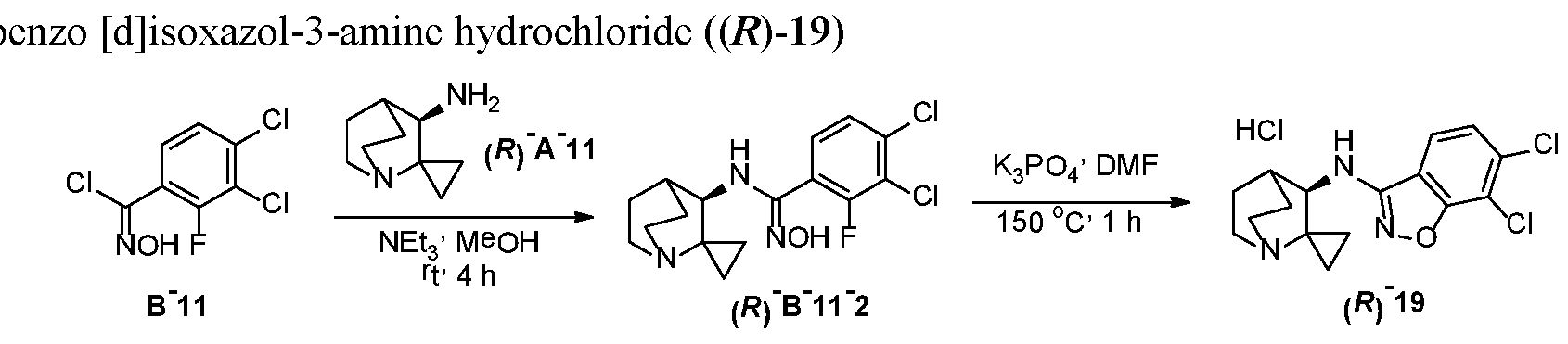
[00440] Following general procedure B l, compound (i?)-19 was prepared from compound B-ll :
[00441] Compound (i?)-B-ll-2 (96 mg, white solid, 43% yield) was prepared from compound fill (0.15 g, 0.62 mmol) and (i?)-A-ll (94 mg, 0.62 mmol) with a reaction time of 4 hours. The product was purified by prep-HPLC [Instrument: GX-A; Column: Phenomenex Gemini C 18 250x50 mm, particle size: 10 μπι; Mobile phase: 32-62% acetonitrile in H20 (add 0.05%ammonia-ACN, v/v)] . LCMS (J): (ES+) m/z (M+H)+ = 358.1, tR=1.30.
[00442] A solution of compound (i?)-B-ll-2 (60 mg, 0.17 mmol) and potassium phosphate (70 mg, 0.5 mmol) in N, N-dimethylformamide (3.0 mL) was stirred at 150 °C for 1 hour. On completion, the reaction mixture was filtered and concentrated in vacuo. The residue was purified by prep-HPLC [Instrument: GX-B; Column: Welch Ultimate AQ-C18 150x30mm, particle size: 5 μπι; Mobile phase: 30-60% acetonitrile in H20 (add 0.1%TFA-ACN, v/v)] . The resulting solid was dissolved in 0.2 N hydrochloric acid and again lyophilized to give:
[00443] (i?)-6,7-dichloro-N-( l'-azaspiro[cyclopropane-l,2'-bicyclo[2.2.2]octan]-3'- yl)benzo[d]isoxazol-3-amine hydrochloride compound (i?)-19 (20 mg, 35% yield) as a white solid: cSFC analytical(D) tR=2.28 min., purity: 99.25%; LCMS (FF): tR=2.41 min., 338.0 m/z (M+l); 1H- NMR (CD3OD, 400 MHz): δ 7.86 (d, J=8.4 Hz, 1H), 7.48 (d, J=8.8 Hz, 1H), 4.23 (m, 1H), 3.66-3.58 (m, 2H), 3.51-3.42 (m, 2H), 2.66-2.65 (m, 1H), 2.37-2.31 (m, 1H), 2.24-2.20 (m, 2H), 2.03-1.97 (m, 1H), 1.44-1.40 (m, 2H), 1.28-1.22 (m, 2H).
[00444] Example 20: (i?)-6-chloro-7-methoxy-N-( l'-azaspiro[cyclopropane-l,2'-bicyclo[2.2.2] octan]-3'-yl)benzo[d]isoxazol-3-amine hydrochloride ((i?)-20)

[00445] Following general procedure B l, compound (i?)-20 was prepared from compound B-13:
[00446] Compound (i?)-B-13-2 (75 mg, white solid, 17% yield) was prepared from compound B- 13 (0.30 g, 1.3 mmol) and (i?)-A-ll (0.19 g, 1.3 mmol) with a reaction time of 1 hour. The product was purified by prep-HPLC [Instrument: GX-C; Column: Phenomenex Gemini 250x50 mm, particle size: 10 μιη; Mobile phase: 24-54% acetonitrile in H20 (add 0.5% NH3 H20, v/v)] . LCMS (J): (ES+) m/z (M+H)+ = 354.1, tR=l .17.
[00447] A solution of compound (i?)-B-13-2 (50 mg, 0.14 mmol) and potassium phosphate (90 mg, 0.42 mmol) in N, N-dimethylformamide (1.5 mL) was stirred at 150 °C for 1 hour. On completion, the reaction mixture was filtered and concentrated in vacuo. The residue was purified by prep-HPLC [Instrument: GX-B; Column: Phenomenex Gemini C18 150x30 mm, particle size: 10 μπι; Mobile phase: 37-67% acetonitrile in H20 (add 0.1% TFA-ACN, v/v)] . The resulting solid was dissolved in 0.2 N hydrochloric acid and again lyophilized to give:
[00448] Compound (R)-2 (30 mg, 63% yield) as a white solid: cSFC analytical (D) tR=2.27 min., purity: 100%; LCMS (FF): tR=2.08 min., (ES+) m/z (M+H)+ = 334.1 ; 1H-NMR (CD3OD, 400 MHz): δ 7.54 (d, J=8.0 Hz, 1H), 7.30 (d, J=8.4 Hz, 1H), 4.23-4.22 (m, 1H), 4.19 (s, 3H), 3.67-3.58 (m, 2H), 2.52-2.42 (m, 2H), 2.66-2.64 (m, 1H), 2.37-2.31 (m, 1H), 2.24-2.20 (m, 2H), 2.00-1.98 (m, 1H), 1.43-1.36 (m, 2H), 1.28-1.22 (m, 2H).
[00449] Example 21: (i?)-6-methyl-N-(l '-azaspiro[cyclopropane-l,2'-bicyclo[2.2.2]octan]-3'-yl) benzo[d]isoxazol-3-amine hydrochloride ((i?)-21)

[00450] Following general procedure B l, compound (R)-21 was prepared from compound B-15:
[00451] Compound (i?)-B-15-2 (200 mg, white solid, 25% yield) was prepared from compound B- 15 (0.50 g, 2.67 mmol) and (i?)-A-ll (0.41 g, 1.3 mmol) with a reaction time of 1.5 hours. The product was purified by prep-HPLC [Instrument: GX-C; Column: Phenomenex Gemini 250x50 mm, particle size: 10 μιη; Mobile phase: 26-56% acetonitrile in H20 (add 0.5% NH3 H20, v/v)] . LCMS (J): (ES+) m/z (M+H)+ = 304.2, tR= 1.10.
[00452] A solution of compound (i?)-B-15-2 (120 mg, 0.21 mmol) and potassium phosphate (0.25 g, 1.19 mmol) in N, N-dimethylformamide (2 mL) was stirred at 150 °C for 1 hour. On completion, the reaction mixture was filtered, concentrated in vacuo and purified by prep-HPLC [Instrument: GX- C; Column: Phenomenex Gemini C18 250x50 mm, particle size: 10 μπι; Mobile phase: 33-63% acetonitrile in H20 (add 0.05% ammonia-ACN, v/v)] . The resulting solid was dissolved in 0.2 N hydrochloric acid and again lyophilized to give:
[00453] Compound (i?)-21 (45 mg, 53% yield) as a white solid: cSFC analytical (D) tR=2.21 min., purity: 99.7%; LCMS (FF): tR=1.94 min., (ES+) m/z (M+H)+ = 284.2; 1H-NMR (CD3OD, 400 MHz): δ 7.81 (d, J=8.4 Hz, 1H), 7.22 (s, lH), 7.14 (d, J=8.4 Hz, 1H), 4.21-4.20 (m, 1H), 3.71-3.69 (m, 1H), 3.58-3.57 (m, 1H), 3.51-3.40 (m, 2H), 2.64-2.62 (m, 1H), 2.49 (s, 3H), 2.36-2.33 (m, 1H), 2.23-2.18 (m, 2H), 1.98-1.97 (m, 1H), 1.46-1.38 (m, 2H), 1.29-1.21 (m, 2H).
[00454] Example 22: (i?)-7-fluoro-6-methyl-N-( r-azaspiro[cyclopropane-l,2'- bi

[00455] Following general procedure B l, compound (i?)-22 was prepared from compound B-17:
[00456] Compound (i?)-B-17-2 (0.20 g, white solid, 42% yield) was prepared from compound B- 17 (0.30 g, 1.5 mmol) and (i?)-A-ll (0.22 g, 1.5 mmol). The product was purified by prep-HPLC
[Instrument: GX-H; Column: Phenomenex Gemini C18 250x50 mm; particle size: 10 μπι; Mobile phase: 26-56% acetonitrile in H20 (add 0.05% NH3 H20, v/v)] . LCMS (J): (ES+) m/z (M+H)+ = 322.2, tR= l .181.
[00457] A mixture of compound (i?)-B-17-2 (0.10 g, 0.29 mmol) and potassium phosphate (0.20 g, 0.87 mmol) in N, N - dimethylformamide ( 10 mL) was stirred at 150 °C for 0.5 hour. On completion, the reaction mixture was filtered and concentrated in vacuo. The residue was purified by prep-HPLC [Instrument: GX-B; Column: Xtimate C 18 150x25 mm; particle size: 5 μπι; Mobile phase: 17-47%
acetonitrile in H20 (add 0.1% TFA, v/v)] . The resulting solid was dissolved in 0.2 N hydrochloric acid and again lyophilized to give:
[00458] Compound (R)-22 (55 mg, 52% yield) as awhite solid: cSFC analytical (D) tR=l .994 min., purity: 98.53%; LCMS (FF): tR=2.371 min., (ES+) m/z (M+H)+ = 302.1 ; ¾-NMR (CD3OD, 400 MHz): δ 7.60-7.58 (d, J=8.4 Hz, IH), 7.18-7.14 (m, IH), 4.22 (d, J=2.4 Hz, IH), 3.68-3.58 (m, 2H), 3.52-3.44 (m, 2H), 2.66-2.64 (m, IH), 2.43-2.42 (d, J=2.0 Hz, 3H), 2.38-2.31 (m, IH), 2.23-2.20 (m, 2H), 2.00-1.94 (m, IH), 1.43-1.34 (m, 2H), 1.27-1.21 (m, 2H).
[00459] Example 23: (i?)-7-chloro-6-fluoro-N-(l '-azaspiro[cyclopropane-l,2'- bi

[00460] Following general procedure B l, compound (R)-23 was prepared from compound B-19:
[00461] Compound (i?)-B-19-2 (0.21 g, yellow solid, 31% yield over 2 steps) was prepared from compound B-19 (0.45 g, 2.0 mmol) and (i?)-A-ll (0.30 g, 2.0 mmol) with a reaction time of 2 hours. The product was purified by prep-HPLC [Instrument: GX-H; Column: Phenomenex Gemini C 18 250x50 mm; particle size: 10 μιη; Mobile phase: 24-54% acetonitrile in H20 (add 0.05% NH3 H20, v/v)] . LCMS (J): (ES+) m/z (M+H)+ = 342.1, tR=1.183.
[00462] A mixture of compound (i?)-B-19-2 (0.20 g, 0.59 mmol) and potassium phosphate (0.37 g, 1.8 mmol) in N, N - dimethylformamide (20 mL) was stirred at 150 °C for 1 hour. On completion, the reaction mixture was filtered and concentrated in vacuo. The residue was purified by prep-HPLC
[Instrument: GX-B; Column: Welch Ultimate AQ-C18 150x30mm; particle size: 5 μπι; Mobile phase: 22-52% acetonitrile in H20 (add 0.1% TFA, v/v)] . The resulting solid was dissolved in 0.2 Ν hydrochloric acid and again lyophilized to give:
[00463] Compound (i?)-23 (50 mg, 24% yield) as a white solid: cSFC analytical (D) tR=l .835 min., purity: 98.24%; LCMS (GG): tR=2.096 min., (ES+) m/z (M+H)+ = 322.1 ; ¾-NMR (CD3OD, 400 MHz): δ 7.90 (dd, J=8.8 Hz, J=2.4 Hz, IH), 7.25 (t, J=8.8 Hz, IH), 4.22 (d, J=2.4 Hz, IH), 3.70- 3.50 (m, 2H), 3.49-3.44 (m, 2H), 2.66-2.64 (m, IH), 2.43-2.42 (d, J=2.0 Hz, 3H), 2.38-2.31 (m, IH), 2.23-2.19 (m, 2H), 2.01-1.98 (m, IH), 1.44-1.37 (m, 2H), 1.28-1.23 (m, 2H).
[00464] Example 24: (i?)-5-fluoro-6-methyl-N-(r-azaspiro[cyclopropane-l,2'- bicy '-yl) benzo[d]isoxazol-3-amine hydrochloride ((i?)-24)

[00466] Compound (i?)-B-23-2 (0.15 g, white solid, 40% yield over two steps) was prepared from compound B-23 (0.20 g, 0.97 mmol) and (i?)-A-ll (0.15 g, 0.97 mmol) with a reaction of 3 hours. The product was purified by prep-HPLC [Instrument: GX-A; Column: Phenomenex Gemini C 18 250x50 mm, particle size: 10 μπι; Mobile phase: 28-58% acetonitrile in H20 (add 0.05% ammonia, v/v)] . LCMS (J): (ES+) m/z (M+H)+ = 322.2, tR=1.67 min.
[00467] A solution of compound (i?)-B-23-2 (0.15 g, 0.47 mmol) and potassium carbonate (0.19 g, 1.4 mmol) in N, N-dimethylformamide (6.0 mL) was stirred at 150 °C for 2 hours. On completion, the reaction mixture was filtered and concentrated in vacuo. The residue was purified by prep-HPLC [Instrument: GX-h; Column: Phenomenex Gemini C18 250x50 mm, particle size: 10 μπι; Mobile phase: 33-63% acetonitrile in H20 (add 0.05% TFA, v/v)] . The resulting solids was dissolved in 0.2 M hydrochloric acid solution and again lyophilized to give:
[00468] Compound (i?)-24 (30 mg, 20% yield) as a white solid: cSFC analytical (D) tR=l .804 min., purity: 99.49%; LCMS (EE): tR= 2.03 min., 302.2 m/z (M+l); 1H-NMR (CD3OD, 400 MHz): δ 7.47 (d, J=8.4 Hz, 1H), 7.19 (d, J=6.4 Hz, 1H), 4.09-4.08 (m, 1H), 3.56-3.45 (m, 2H), 3.40-3.31 (m, 2H), 2.52-2.51 (m, 1H), 2.29-2.19 (m, 4H), 2.1 1-2.07 (m, 2H), 1.90-1.85 (m, 1H), 1.33-1.26 (m, 2H), 1.15-1.1 1 (m, 2H).
[00469] Example 25: (i?)-6-chloro-7-methyl-N-( l'-azaspiro[cyclopropane-l,2'- bi

[00470] Following general procedure B l, compound (R)-25 was prepared from compound B-26:
[00471] Compound (i?)-B-26-2 (0.12 g, white solid, 26% yield over two steps) was prepared from compound B-26 (0.30 g, 1.35 mmol) and (i?)-A-ll (0.21 g, 1.35 mmol) with a reaction time of 2 hours and a reaction temperature of 20 °C. The product was purified by prep-HPLC [Instrument: GX- C; Column: Phenomenex Gemini C18 250x50 mm, particle size: 10 μπι; Mobile phase: 27-57% acetonitrile in H20 (add 0.05% ammonia, v/v)] . LCMS (J): (ES+) m/z (M+H)+ = 307.1, tR=1.68 min.
[00472] A solution of compound (i?)-B-26-2 (0.12 g, 0.33 mmol) and potassium phosphate (0.21 g, 0.98 mmol) in N, N-dimethylformamide (3.0 mL) was stirred at 150 °C for 1 hour. On completion, the reaction mixture was filtered and concentrated in vacuo. The residue was purified by prep-HPLC [Instrument: GX-C; Column: Phenomenex Gemini C 18 250x50 mm, particle size: 10 μπι; Mobile phase: 28-48% acetonitrile in H20 (add 0.05% TFA, v/v)] . The resulting solids was dissolved in 0.2 M hydrochloric acid solution and again lyophilized to give:
[00473] Compound (i?)-25 (30 mg, 25% yield) as a white solid: cSFC analytical (D) tR=l .996 min., purity: 100.00%; LCMS (EE): tR= 2.17 min., 318.1 m/z (M+l); 1H-NMR (CD3OD, 400 MHz):
δ 7.73 (d, J=8.4 Hz, 1H), 7.32 (d. J=8.4 Hz, 1H), 4.23-4.22 (m. 1H). 3.72-3.58 (m, 2H), 3.52-3.41 (m, 2H), 2.65-2.64 (m, 1H), 2.49 (S. 3H), 2.38-2.32 (m, 1H), 2.23-2.17 (m, 2H), 2.04-1.94 (m, 1H), 1.43- 1.35 (m, 2H), 1.27-1.23 (m, 2H).
[00474] Example 26: (i?)-6-chloro-5-fluoro-N-(l '-azaspiro[cyclopropane-l,2'- bicyclo[2.2.2]octan]-3'-yl)benzo[d]isoxazol-3-amine hydrochloride ((R)-26)

[00475] Following general procedure B l, compound (R)-26 was prepared from compound B-28:
[00476] Compound (i?)-B-28-2 (0.20 g, white solid, 32% yield over two steps) was prepared from compound B-28 (0.40 g, 1.8 mmol) and (i?)-A-ll (0.27 g, 1.8 mmol). The product was purified by prep-HPLC [Instrument: GX-H; Column: Phenomenex Synergi C 18 150^25 mm, particle size: 10 μιη; Mobile phase: 26-56% acetonitrile in H,0 (add 0.5% NH3 H20, v/v)] . LCMS (J): (ES+) m/z (M+H)+ = 342.1, tR= 1.206 min.
[00477] A solution of compound (/?)-B-28-2 (0.18 g, 0.53 mmol) and potassium carbonate (0.22 g, 1.6 mmol) in N, N-dimethylformamide (5.0 mL) was stirred at 150 °C for 1 hour. On completion, the reaction mixture was filtered and concentrated in vacuo. The residue was purified by prep-HPLC
[Instrument: GX-H; Column: Phenomenex Gemini C18 150x25 mm, particle size: 10 μπι; Mobile phase: 40-70% acetonitrile in H20 (add 0.5% NH3 H20, v/v)] . The resulting solid was dissolved in 0.2 N hydrochloric acid and again lyophilized to give:
[00478] Compound (R)-26 (0. 10 g, 53% yield) as a white solid: cSFC analytical (D) tR= 1.776 min., purity: 98.06%; LCMS (GG): tR= 2.086 min., 322.1 m/z (M+l); 1H-NMR (CD3OD, 400 MHz): δ 7.84 (d, J=8.4 Hz, 1H), 7.67 (d. J=5.6 Hz, 1H), 4.21-4.21 (m, 1H), 3.68-3.41 (m, 4H), 2.66-2.63 (m, 1H), 2.37-2.31 (m, 1H), 2.23-2.18 (m, 2H), 2.00-1.95 (m, 1H), 1.46-1.35 (m, 2H), 1.27-1.23 (m, 2H).
[00479] Example 27: (i?)-6-chloro-7-ethoxy-N-(l '-azaspiro[cyclopropane-l,2'- bicyclo[2.2.2]octan]-3'-yl)benzo[d]isoxazol-3-amine hydrochloride ((i?)-27)

[00480] Following general procedure B l, compound (R)-21 was prepared from compound B-30:
[00481] Compound (i?)-B-30-2 (0.20 g, white solid, 30% yield over two steps) was prepared from B-30 (0.50 g, 2.0 mmol) and compound (i?)-A-ll (0.20 g, 1.3 mmol). The product was purified by prep-HPLC [Instrument: GX-A; Column: Phenomenex Gemini C 18 250x50 mm, particle size: 10
μηι; Mobile phase: 36-66% acetonitnle in H20 (add 0.5% NH3 H20, v/v)]. LCMS (J): (ES+) m/z (M+H)+ = 368.1, tR= 1.264 min.
[00482] A solution of compound (i?)-B-30-2 (0.20 g, 0.54 mmol) and potassium carbonate (0.15 g, 1.1 mmol) in N, N-dimethylformamide (5 mL) was stined at 150 °C for 1 hour. On completion, the reaction mixture was filtered and concentrated in vacuo. The residue was purified by prep-HPLC
[Instrument: GX-H; Column: Phenomenex Synergi C18 250x50 mm, particle size: 10 μπι; Mobile phase: 50-80% acetonitrile in H20 (add 0.5% NH3 H20, v/v)]. The resulting solids was dissolved in 0.2 M hydrochloric acid solution and again lyophilized to give:
[00483] Compound (i?)-27 (70 mg, 34% yield) as a white solid : cSFC analytical ( D) tR=l .997 min., purity: 98.60%; LCMS (GG): tR=2.200 min., (ES+) m/z (M+H)+ = 348.1; 1H-NMR (CD3OD, 400 MHz): δ 7.54 (dd, J=8.4 Hz, J=2.4 Hz , IH), 7.30 (d, J=8.8 Hz, IH), 4.46 (q, J=7.2 Hz, 2H), 4.22 (s, IH), 3.71-3.58 (m, 2H), 3.52-3.33 (m, 2H), 3.65-3.64 (m, IH), 2.37-2.31 (m, IH), 2.23-2.20 (m, 2H), 2.02-1.95 (m, IH), 1.45-1.36 (m, 5H), 1.27-1.22 (m, 2H).
[00484] Example 28: (i?)-7-chloro-6-methyl-N-(l'-azaspiro[cyclopropane-l,2'- bicyclo[2.2.2]octan]-3'-yl)benzo[d]isoxazol-3-amine hydrochloride ((i?)-28)

[00485] Following general procedure Bl, compound (i?)-28 was prepared from compound B-33:
[00486] Compound (i?)-B-33-2 (0.50 g, white solid, 69% yield over two steps) was prepared from compound B-33 (0.45 g, 2.0 mmol) and compound (i?)-A-ll ditosyiate (1.0 g, 2.0 mmol) with 5 equivalent of triethyl amine. The product was purified by prep-HPLC [Instrument: HPLC-A; Column: Phenomenex Synergi C18 250x50 mm, particle size: 10 μπι; Mobile phase: 28-53% acetonitrile in H20 (add 0.05% NH3 H20, v/v)] . LCMS (J): (ES+) m/z (M+H)+ = 338.1, tR= 1.228 min.
[00487] A solution of compound (i?)-B-33-2 (150 mg, 0.44 mmol) and potassium phosphate (0.28 g, 1.3 mmol) in N, N-dimethylformamide (2.0 mL) was stined at 150 °C for 1 hour. On completion, the reaction mixture was filtered and concentrated in vacuo. The residue was purified by prep-HPLC [Instrument: GX-B; Column: Welch Ultimate AQ C18 150x30 mm, particle size: 4 μπι; Mobile phase: 30-60% acetonitrile in H20 (add 0.1% TFA, v/v)] . The resulting solid was dissolved in 0.2 Ν hydrochloric acid and again lyophilized to give:
[00488] Compound (R)-28 (40 mg, 25% yield) as a white solid: cSFC analytical (D) tR=2.293 min., purity: 99.76%; LCMS (GG): tR= 2.13 min., 318.1 m/z (M+l); 1H-NMR (CD3OD, 400 MHz): δ 7.78 (d, J=8.0 Hz, IH), 7.24 (d, J=8.4 Hz, IH), 4.21 (d, J=2.4 Hz, IH), 3.69-3.45 (m, 4H), 2.66- 2.63 (m, IH), 2.51 (s, 3H), 2.36-2.30 (m, IH), 2.21-2.16 (m, 2H), 1.97-1.94 (m, IH), 1.44-1.36 (m. 2H), 1.28-1.17 (m, 2H).
[00489] Example 29: (i?)-6-chloro-N-(l'-azaspiro[cyclopropane-l,2'-bicyclo[2.2.2]octan]-3'-yl)-
7-(trifluoromethyl)benzo[d]isoxazol-3-amine hydrochloride ((i?)-29)

[00490] Following general procedure Bl, compound (i?)-29 was prepared from compound B-36:
[00491] Compound (i?)-B-36-2 (0.26 g, white solid, 43% yield over 2 steps) was prepared from compound B-36 (0.50 g, 1.8 mmol) and (i?)-A-ll (0.28 g, 1.8 mmol). The product was purified by prep-HPLC [Instrument: GX-C; Column: Phenomenex Gemini C18 250x50 mm; particle size: 10 μπι; Mobile phase: 38-68% acetonitrile in H20 (add 0.05% NH3 H20, v/v)]. LCMS (J): (ES+) m/z (M+H)+

[00492] A mixture of compound (i?)-B-36-2 (0.15 g, 0.38 mmol) and potassium phosphate (0.24 g, 1.2 mmol) in N, N - dimethylformamide (20 mL) was stirred at 150 °C for 0.5 hour. On completion, the reaction mixture was filtered and concentrated in vacuo. The residue was purified by prep-HPLC [Instrument: GX-C; Column: Phenomenex Gemini C18 250x50 mm; particle size: 10 μπι; Mobile phase: 45-75% acetonitrile in H20 (add 0.05% NH3 H20, v/v)]. The resulting solid was dissolved in 0.2 N hydrochloric acid and again lyophilized to give:
[00493] Compound (R)-29 (130 mg, 83% yield) as a white solid: cSFC analytical (D) tR=1.643 min., purity: 96.86%; LCMS (GG): tR=2.371 min., (ES+) m/z (M+H)+ = 302.1; i-NMR (CD3OD, 400 MHz): δ 8.15 (d, J=8.4 Hz, 1H), 7.55 (d, J=8.4 Hz, 1H), 4.24 (d, J=2.4 Hz, 1H), 3.68-3.59 (m, 2H), 3.53-3.45 (m, 2H), 2.67-2.66 (m, 1H), 2.38-2.32 (m, 1H), 2.24-2.17 (m, 2H), 2.03-1.96 (m, 1H), 1.43-1.37 (m, 2H), 1.28-1.24 (m, 2H).
[00494] Example 30: (i?)-6-chloro-7-isopropoxy-N-(l'-azaspiro[cyclopropane-l,2'- b

[00495] Following general procedure Bl, compound (i?)-30 was prepared from compound B-40:
[00496] Compound (i?)-B-40-2 (0.40 g, white solid, 56% yield over two steps) was prepared from compound B-40 (0.50 g, 1.9 mmol) and compound (i?)-A-ll di-tosylate (0.94 g, 1.9 mmol) using 4 equivalents of triethylamine. The product was purified by prep-HPLC [Instrument: GX-H; Column: Boston pH-lex 150x25mm, particle size: 10 μπι; Mobile phase: 40-70% acetonitrile in H20 (add 0.05% ammonia, v/v)]. LCMS (J): (ES+) m/z (M+H)+ = 382.1, tR= 1.364min.
[00497] A mixture of compound (i?)-B-40-2 (0.20 g, 0.52 mmol) and potassium carbonate (0.22 g, 1.6 mmol) in N, N-dimethylformamide (5.0 mL) was stirred at 150 °C for 1 hour. On completion, the reaction mixture was filtered and concentrated in vacuo. The residue was purified by prep-HPLC [Instrument: GX-B; Column: Welch Ultimate AQ-C18 150x30mm , particle size:5um; Mobile phase: 40-70% acetonitrile in water(0.1%TFA)-CAN] : The resulting solids were dissolved in 0.2 M hydrochloric acid solution and again lyophilized to give:
[00498] Compound (R)-3 (50 mg, 26 % yield) as a white solid: cSFC analytical (D) tR=1.841 min., purity: 100%; LCMS (GG): tR= 2.275 min., 362.2 m/z (M+l); 1H-NMR (CD3OD, 400 MHz): δ 7.59 (d, J=8.8 Hz, 1H), 7.30 (d, J=8.8 Hz, 1H), 4.99-4.93 (m, 1H), 4.21 (d, J=2.4 Hz, 1H), 3.69-3.44 (m, 4H), 2.69-2.64 (m, 1H), 2.38-2.32 (m, 1H), 2.23-2.16 (m, 2H), 2.02-1.94 (m, 1H), 1.46-1.21 (m, 10H).
[00499] Crystallization experiments
[00500] Example 31: (i?)-2,2-dimethyl-N-((i?)-l-phenylethyl)quinuclidin-3-amine monofumarate ((R,R)-A-7 mon

[00501] A solution of 2,2-dimethyl-N-((i?)-l-phenylethyl)quinuclidin-3-amine (41 mg, 0.16 mmol, 1.6/98.4 mixture of diastereoisomers) in ethyl acetate was filtered through a 20 micron PTFE filter, concentrated and taken up in diethyl ether (4 mL). Next, a 0.8 M solution of fumaric acid in diethyl ether/methanol (9: 1, v/v, 0.16 mmol, 2.0 mL) was added. An oily precipitate formed that turned into small needles. The mixture was concentrated and taken up in methanol (1 mL). Ethyl acetate (10 mL) was added, and the mixture was left to stand over weekend, during which time crystals formed. The solvent was decanted, and the crystals were washed with ethyl acetate (3 x 2 mL) and dried in vacuo to afford (i?J?)-A-7 monofumarate (57 mg, 96% yield) as colorless crystals. 1H NMR (300 MHz, DMSO-tQ δ 7.41 - 7.26 (m, 4H), 7.26 - 7.16 (m, 1H), 6.42 (s, 2H), 3.69 (q, J = 6.5 Hz, 2H), 3.38 - 3.12 (m, 2H), 2.99 - 2.84 (m, 2H), 2.38 - 2.31 (m, 1H), 2.06 - 1.91 (m, 1H), 1.80 - 1.37 (m, 7H), 1.34 (s, 3H), 1.23 (d, J = 6.6 Hz, 3H).
[00502] Single-crystal diffraction was performed on a Nonius KappaCCD single-crystal diffractometer using graphite monochromated Mo Ka radiation. During the measurement the crystal was cooled to -65 °C. Diffraction images were integrated using Eval l4. Intensity data were corrected for Lorentz and polarization effects. A semi empirical multi scan absorption correction was applied (SADABS).
[00503] The structure was solved by SHELXT. This structure solution shows that the relative configuration of the bulk crystal is either (R,R) or (S,S) [and not (R,S) or (S,R)] . Refinement was performed with standard methods (refinement against F2 of all reflections with SHELXL97) with
anisotropic displacement parameters for the non -hydrogen atoms. All hydrogen atoms were placed at calculated positions and refined riding on the parent atoms. The right enantiomer (the (R,R) versus the (S,S) form) was determined by careful examination of the Bijvoet pairs. This analysis showed that the vast majority of the crystal consists of the (R,R) form. Coordinate data from the X-ray analysis of the formed crystal of (i?J?)-A-7 monofumarate are shown in Table 2, and its 3-D representation is shown in Figure 1.
Table 2:
X-ray Data:
Unit cell: 1 1.4272 12.7814 13.9040 90.000 90.000 90.000
Space group: P 21 21 21

H16A 0.672575 0.738984 0.799054
H16B 0.753323 0.809268 0.731982
C17 0.349716 0.877165 0.605596
H17A 0.271052 0.873601 0.631606
H17B 0.347983 0.859876 0.537681
H17C 0.38031 0.947384 0.613851
C18 0.42793 0.799636 0.658441
C19 0.367159 0.69317 0.659148
H19A 0.416303 0.642605 0.691936
H19B 0.353753 0.67037 0.593525
H19C 0.292837 0.698941 0.692432
O20 0.534838 0.55045 0.500354
021 0.494626 0.700972 0.428969
C22 0.508916 0.601753 0.429062
C23 0.488106 0.548365 0.334472
H23 0.44921 0.585217 0.28547
C24 0.522344 0.451892 0.317715
H24 0.565229 0.41667 0.365464
C25 0.49606 0.396184 0.226392
026 0.544441 0.303217 0.223974
H26 0.472243 0.766134 0.334473
027 0.437705 0.431251 0.163092
[00504] A large collection of crystals from the same batch was also analyzed with powder diffraction, in order to check the match between the crystal structure, obtained by single -crystal diffraction, with the characteristics of the whole batch of crystals. Powder diffraction was performed on a Bruker D8 Advance with a Vantec-1 detector with an effective angle of about 3 degrees with a step size of 0.0166 degrees. The pattern was measured in reflection mode in a Bragg-Brentano geometry using a Johansson monochromator with a focusing curved Ge 1 1 1 crystal. The diffraction pattern was measured at room temperature (20 °C) using monochromatic Cu Kalphal radiation in the range of 5-50 degrees 2theta with variable slits, resulting in a 12mm constant footprint.
[00505] Combining SXRD and PXRD:
[00506] Using the data from single crystal diffraction a powder diffraction pattern was simulated with Cu Kalphal radiation in the range of 5-50 degrees 2theta with a step size of 0.02 degrees using Mercury software. Using the Bruker TOPAS software, for the calculated powder diffraction pattern the lattice cell parameters are adjusted to compensate for the temperature difference of Powder diffraction (20°C) and the single crystal diffraction (-65 °C). Comparing the corrected calculated powder pattern with the measured powder pattern, we find an excellent fit leaving no measured diffraction peaks unassigned. Measuring extra diffraction peaks not corresponding to the corrected calculated powder pattern could indicate the presence of another chemical species/diastereomer [the (R,S) or (S,R) form] . If a significant/substantial amount of another diastereomer and/or species would
be present, in a separate crystalline phase, this would most probably create new diffraction peaks, which we don't see. Therefore, there is no indication that a form different from the (R,R) form is present in the crystalline batch.
[00507] Example 32: (i?)-N-((i?)-l-phenylethyl)-l'-azaspiro[cyclopropane-l,2'- bicyclo[2.2.2]octan]-3'-amine bis(4-methylbenzenesulfonate) ((i?J?)-A-13 bis(4- methylbenzenesu

(R'R)"A"13 biS(4"methylbenzenesu|fonate)
[00508] To a solution of N-((i?)-l-phenylethyl)-l'-azaspiro[cyclopropane-l,2'- bicyclo[2.2.2]octan]-3'-amine (100 mg, 0.39 mmol, 1.6/98.4 mixture of diastereoisomers) in ethyl acetate was added dropwise a solution of p-toluenesulfonic acid monohydrate (148 mg, 0.78 mmol). The resulting suspension was heated to reflux, and methanol was added until the precipitate had almost completely dissolved. The mixture was allowed to cool to room temperature and left to stand over weekend. The solvent was decanted, and the crystals were washed with ethyl acetate (5 mL) and dried in vacuo to afford compound (i?J?)-A-13 bis(4-methylbenzenesulfonate) (180 mg, 77% yield) as colorless crystals. 1H NMR (300 MHz, DMSO-d6) δ 9.46 (br s, 1H), 9.14 (br s, 1H), 8.83 (br s, 1H), 7.64 - 7.53 (m, 2H), 7.53 - 7.37 (m, 7H), 7.19 - 7.10 (m, 4H), 4.60 - 4.38 (m, 1H), 3.91 - 3.72 (m, 1H), 3.61 - 3.21 (m, 4H), 2.72 - 2.58 (m, 1H), 2.30 (s, 6H), 2.08 - 1.80 (m, 4H), 1.53 (d, J = 6.3 Hz, 3H), 1.47 - 1.02 (m, 4H). Single crystal X-ray analysis of (i?J?)-A-13 bis(4 - methylbenzenesulfonate) was performed by the same technique as in Example 31. This analysis showed the absolute configuration to be (R,R) form. Coordinate data from the X-ray analysis of the formed crystal are shown in Table 3, and its 3-D representation is shown in Figure 2.
Table 3:
X-ray Data:
Unit cell: 6.3474 7.2244 16.0360 86.00 81.74 83.81
Space group: PI

H05B 0.974034 0.156197 0.438879
C06 0.888221 0.378212 0.517515
H06A 1.042812 0.374087 0.51816
H06B 0.839124 0.498969 0.491477
C07 0.502405 0.176995 0.559251
H07A 0.423689 0.088676 0.597585
H07B 0.419399 0.216624 0.512973
C08 0.534685 0.345601 0.606488
H08A 0.461284 0.334961 0.664456
H08B 0.473046 0.459735 0.578721
C09 0.773988 0.356413 0.60767
H09 0.794689 0.463512 0.639888
CIO 0.875901 0.1761 0.647124
H10 1.031592 0.185032 0.643218
Nil 0.788382 0.142702 0.738391
H11A 0.65707 0.09706 0.743984
HUB 0.865823 0.052082 0.759138
C12 0.77872 0.308263 0.793704
H12 0.675254 0.408674 0.774181
C13 0.996841 0.381607 0.784542
H13A 0.998788 0.466616 0.828587
H13B 1.024981 0.446913 0.729781
H13C 1.106018 0.278118 0.789409
C14 0.696056 0.245364 0.883823
C15 0.478603 0.272261 0.911931
H15 0.383874 0.324746 0.874724
C16 0.832113 0.168243 0.939809
H16 0.979931 0.149786 0.921508
C17 0.754286 0.118007 1.022058
H17 0.848507 0.064564 1.059281
C18 0.400266 0.222081 0.994679
H18 0.252585 0.23986 1.013349
C19 0.53849 0.14626 1.049525
H19 0.485334 0.113759 1.105808
S40 0.498256 0.69953 0.398074
041 0.363831 0.556807 0.432234
042 0.5702 0.794389 0.463747
043 0.670496 0.637166 0.336137
C44 0.335563 0.873233 0.346304
C45 0.148375 0.832254 0.320669
H45 0.102025 0.71279 0.332608
C46 0.3997 1.050889 0.329127
H46 0.527559 1.07927 0.346229
C47 0.028371 0.968926 0.276979
H47 -0.097946 0.939998 0.25878
C48 0.277841 1.186772 0.287149
H48 0.321841 1.307413 0.277075
C49 0.091987 1.146817 0.259878
C50 -0.041675 1.298321 0.215853
H50A -0.091455 1.397477 0.253841
H50B -0.163659 1.246965 0.199416
H50C 0.044225 1.347845 0.166019
S55 0.29597 0.82788 0.785536
056 0.062941 0.851015 0.792039
057 0.393757 0.673164 0.736701
058 0.385583 1.00313 0.756908
C60 0.3539 0.773904 0.889816
C61 0.191446 0.767955 0.956468
H61 0.048387 0.79671 0.947195
C62 0.56471 0.732661 0.903811
H62 0.676677 0.737724 0.858718
C63 0.238985 0.719703 1.03692
H63 0.127138 0.715798 1.082109
C64 0.608063 0.684134 0.984687
H64 0.751042 0.655036 0.99401
C65 0.447722 0.677031 1.052338
C66 0.50188 0.626002 1.140419
H66A 0.607394 0.704208 1.152632
H66B 0.559396 0.496191 1.144137
H66C 0.373575 0.644888 1.180964
[00509] Example 33:
[00510] Human a7 nAChR Binding Assay
[00511] The ability of compounds to displace binding of radioactive ligands from human a l nAChR was determined, as a measure of the affinity of the compounds for these ligand-gated ion channels. The [125I]-aBungarotoxin competition binding assay was performed under contract by Cerep Poitiers, France following published the methods (Sharpies et al , J Neurosci. 2000;
20(8):2783-91). "SH-SY5Y cells stably expressing human ot7 nicotinic acetylcholine receptors, grown to confluency in 175 cm2 flasks, were washed briefly with warm PBS containing (in mm): ( 150 NaCl, 8 K2HP04, 2 KH2P04, pH 7.4, 37°C) and scraped into cold phosphate buffer. Cells were washed by centrifugation for 3 min at 500 χ g and resuspended in 10 mL of ice-cold phosphate buffer. The suspension was homogenized for 10 sec using an Ultraturax and centrifuged for 30 min at 45,000 xg. The pellet was resuspended in phosphate buffer (0.5 mL per original flask). SH-SY5Y membranes (30 μg protein) were incubated in a total volume of 2 mL in 50 mM phosphate buffer with 0.05 nM [125I]-aBgt and serial dilutions of test compound. Nonspecific binding was determined in the presence of a-bungarotoxin ( 1 μΜ). Samples were incubated for 120 min at 37°C. The reaction was terminated by filtration through Whatman GFA/E filter paper (presoaked overnight in 0.3%
polyethyleneimine in PBS), using a Brandel Cell Harvester. Each condition was measured in duplicate. Filters were counted for radioactivity using a scintillation counter. The results were expressed as a percent inhibition of control specific binding obtained in the presence of the test compounds where Inhibition (%) = 100 - [(measured specific binding/control specific binding) x 100].
[00512] The IC50 values (concentration causing a half-maximal inhibition of control specific binding) and Hill coefficients (nH) were determined by non-linear regression analysis of the competition curves generated with mean replicate values using Hill equation:
A-D
Y=D+[ -
1 +(C/C50
where Y = specific binding, A = left asymptote of the curve, D = right asymptote of the curve, C = compound concentration, C50 = IC50, and nH = slope factor.
[00513] This analysis was performed using software developed at Cerep (Hill software) and validated by comparison with data generated by the commercial software SigmaPlot® 4.0 for Windows® (© 1997 by SPSS Inc.). The inhibition constants (¾ ) were calculated using the Cheng Prusoff equation:
(1 +L/Ko)
where L = concentration of radioligand in the assay, and KD = affinity of the radioligand for the receptor.
[00514] A scatchard plot is used to determine the KD. Results are provided in Table 4 (reported as h-ot7 Ki (μΜ)).
[00515] [3H]BRL 43694 competition binding (h-5HT3 Ki (μΜ))
[00516] [ H]BRL 43694competition binding assay was performed under contract by Cerep Poitiers, France following the methods described in Hope, A.G et al., "Characterization of a human 5-hydroxytryptamine3 receptor type A (h5-HT3R-AS) subunit stably expressed in HEK 293 cells " Brit. J. Pharmacol., (1996) 118: 1237-1245.
[00517] In brief, Chinese Hamster Ovary (CHO) cells stably expressing human 5-HT3 serotonin receptors, grown to confluence in 175 cm2 flasks. Following aspiration of the culture medium, cells were harvested by mechanical agitation in ice cold PBS containing (in mM): (150 NaCl, 8 K2HP04, 2 KH2P04, pH 7.4, 37°C), centrifuged at 4,000 g for 10 min and subsequently stored as a cell pellet at - 80 C. When required, the pellet was thawed and resuspended in ice cold homogenization buffer (Tris 50 mM, EGTA 5.0 mM, phenylmethylsulphonylfluoride 0.1 mM, pH 7.6) and homogenized. The homogenate was centrifuged at 48,000 g for 10 minutes at 40°C. The resulting pellet was resuspended in ice cold binding buffer comprising (in mM): NaCl 140, KC1 2.8, CaCl2 1.0; MgCl2, 2.0; HEPES 10 (pH 7.4) and centrifuged as above. The pellet was resuspended in ice cold binding buffer and the
protein concentration was determined by the method of Lowry et al., "Protein measurement with the Folin phenol reagent " J. Biol. Chem., (1953) 193, 265-275). The membrane homogenate was adjusted to a protein concentration of approximately 600 mg/mL in binding buffer. Assay tubes were loaded with equal volumes of binding buffer containing [ H]BRL 43694 and test compound and 0.5 mL of membrane homogenate in a total reaction volume of 1 ml. Binding was initiated by the addition of the membrane homogenate and allowed to proceed for 120 min. at room temperature. Bound and free radioligand were separated by the addition of 3 ml of ice-cold binding buffer and immediate vacuum filtration through pre-soaked (0.1% (v/v) polyethyleneimine) Whatman GF/B filters. Filters were washed with a further 2 x 3 mL applications of binding buffer and counted for radioactivity using a scintillation counter.
[00518] The results were expressed as a percent inhibition of control specific binding obtained in the presence of the test compounds where Inhibition (%) = 100 - [(measured specific binding/control specific binding) x 100].
[00519] The IC50 values (concentration causing a half-maximal inhibition of control specific binding) and Hill coefficients (nH) were determined by non-linear regression analysis of the competition curves generated with mean replicate values using Hill equation
A-D
Y=D+[ ]
1 +(C/C5ofH
where Y = specific binding, A = left asymptote of the curve, D = right asymptote of the curve, C = compound concentration, C50 = IC50, and nH = slope factor. This analysis was performed using software developed at Cerep (Hill software) and validated by comparison with data generated by the commercial software SigmaPlot® 4.0 for Windows® (© 1997 by SPSS Inc.).
[00520] The inhibition constants (¾ ) were calculated using the Cheng Prusoff equation
(HL/Ko)
where L = concentration of radioligand in the assay, and KD = affinity of the radioligand for the receptor.
[00521] A scatchard plot is used to determine the KD. Results are provided in Table 4 (reported as h-5HT3 Ki (μΜ)).
Table 4:

[00522] For reference, the literature reported al nAChR agonist AQW051 has a Kj of 255 nM in the above described assay provided by Cerep (lit: ¾ = 28 nM; radioligand binding assay using recombinantly expressed human al -nAChR and [125I] a-BTX radioligand; Feuerbach et al , Br. J.
Pharmacol., 2014, doi: 10.1 1 1 1/bph.13001).
[00523] Example 34:
[00524] Novel Object Recognition Task:
[00525] The Novel Object Recognition (NOR) task is a behavioral assay commonly used to evaluate cognition, particularly recognition memory, in rodent models of CNS disorders. This test is based on the spontaneous tendency of rodents to spend more time exploring a novel object compared to a familiar one. The choice to explore the novel object reflects the use of learning and recognition
memory. The assay is commonly used to evaluate potential therapeutic agents for Alzheimer's disease, other neurodegenerative diseases and psychiatric disorders.
[00526] Procedure:
[00527] Male Wistar rats (Harlan Laboratories) weighing 350-400 grams were housed under a reversed light cycle and are tested during the dark cycle. Testing was done under low lux conditions, measured to be~2-7 lux under red light. Animals were habituated and weighed one day prior to testing. During habituation, animals were placed in a cylindrical arena and allowed to explore for 3 minutes. Training (Tl) was conducted approximately 24 hours later, with one set of identical objects placed on opposite sides of the arena. Animals were allowed to explore the objects in 3 -minute sessions. Animals were dosed with a designated treatment 15-60 minutes prior to testing depending on the pharmacokinetic profile of the compound before the start of Tl . Drug or vehicle was dosed subcutaneously based on body weight at 5 mL/kg. Testing (T2) was done at 48 hours after Tl .
During testing, one familiar object is replaced with a novel object. Animals were allowed to explore both objects in 3 -minute sessions.
[00528] Equipment Specification:
[00529] Animals were tracked using Noldus Ethovision XT (EthoVision XT version: 8.5, Noldus Inc. Wageningen, Netherlands) tracking software, using a 2 centimeter (cm) perimeter for each object as a separate zone. The test arena consisted of a cylinder, 80 cm diameter with 40 cm high walls of black acrylic that was opaque and matte. Objects were custom fabricated shapes (cone and bullet) similar in overall size (8cm high x 8cm diameter) and were counterbalanced between treatment groups.
[00530] Data Analysis and Statistics:
[00531] Contact time was defined as the amount of time (seconds) an animal spent within the 2 cm perimeter of an object. All animals that had <5 seconds total contact time were excluded from the study. Statistical significance was determined using a Mann Whitney U-test and the criterion was set at p<0.05.
[00532] Results:
[00533] Natural forgetting in an object recognition task in male Wistar rats (n = 4-20/group). Test compound was administered via sub-cutaneous administration 30 minutes before Tl . Test compounds improved object recognition using a 48-hour retention interval (mean ± SEM). *p < 0.05 = novel (N) vs. familiar (F) object. Results are illustrated in Table 5.
Table 5:
 [00534] All publications and patent applications mentioned in this specification are herein incorporated by reference to the same extent as if each individual publication or patent application was specifically and individually indicated to be incorporated by reference.
[00535] While preferred embodiments of the present invention have been shown and described herein, it will be obvious to those skilled in the art that such embodiments are provided by way of example only. It is intended that the following claims define the scope of the invention and that methods and structures within the scope of these claims and their equivalents be covered thereby.
NAI-1501917171vl
Claims
1. A compound represented by Formula (la) or Formula (lb)

wherein:
R1 and R2 independently represent an unbranched Ci-C4-alkyl radical or a branched
C3-C4-alkyl radical; or the C(R:)(R2) moiety forms a (3-4 membered)- carbocycle, wherein R1 and R2 taken together represent a C2-C3-alkyl di- radical; wherein the unbranched Ci-C4-alkyl radical, the branched C3-C - alkyl radical, and the C2-C3-alkyl di-radical may be independently substituted with up to 4 radical substituents comprising: -D, -F, -CI, -CN,
-CH3, -CH2CH3, =0, or -OR3;
R3 independently represents -H; an unbranched Ci-C -alkyl radical; a branched
C3-C -alkyl radical; or a C3-C -cycloalkyl radical; wherein the unbranched Ci-C -alkyl radical, the branched C3-C -alkyl radical, and the C3-C - cycloalkyl radical may be independently substituted with up to 4 radical substituents comprising: -D, -F, -CI, -CN, =0, -OH, -OCi-C4-alkyl, or - OCF3; and
R4, R5, R6, and R7 independently represent -H, -D, halogen radical, -CN, an unbranched Ci-C4- alkyl radical, a branched C3-C4-alkyl radical, a C3-C6-cycloalkyl radical, an unbranched -OCi-C4-alkyl, a branched or cyclic -OC3-C4-alkyl, -N(R8)(R9), -(CO)N(R8)(R9), -NR8(CO)(R9), -SO.d-d-alkyl, -S02N(R8)(R9), -(CH2)mS02C1-C4-alkyl, -(CH2)mS02N(R8)(R9), -N(R8)S02d-C4-alkyl, an aryl radical, or a heteroaryl radical; wherein the alkyl portion of the unbranched Ci-C4-alkyl radical, the branched C3-C4-alkyl radical, the C3-C6- cycloalkyl radical, the unbranched -OCi-C -alkyl, the branched or cyclic -OC3-C -alkyl, the -S02Ci-C -alkyl, the -(CH2)mS02Ci-C -alkyl, or the -N(R8)S02Ci-C -alkyl, may be independently substituted with up to 5 radical substituents comprising: -D, halogen radical, =0, -OR8, -(CH2)mOR8, -N(R8)(R9), -NR8(CO)(R9), -(CH2)mN(R8)(R9), -S02d-C4-alkyl,
-S02N(R8)(R9), -(CH2)mS02C1-C4-alkyl, -(CH2)mS02N(R8)(R9),
-N(R8)S02C1-C4-alkyl, -(CO)(CH2)mR8, -(CO)N(R8)(R9), an unbranched d- C6-alkyl radical, a branched C3-C6-alkyl radical, a C3-C6-cycloalkyl radical, a
Ci-C6-hydroxyalkyl radical, a Ci-C2-haloalkyl radical, or -OCi-C2-haloalkyl radical; and wherein the aryl radical or the heteroaryl radical may be independently substituted with up to 5 radical substituents comprising: -D, halogen radical, -CN, -OR8, -(CH2)mOR8, -N(R8)(R9), -NR8(CO)(R9), -(CH2)mN(R8)(R9), -S02C1-C4-alkyl, -S02N(R8)(R9), -(CH2)mS02C1-C4- alkyl, -(CH2)mS02N(R8)(R9), -N(R8)S02C1-C4-alkyl, -(CO)(CH2)mR8, -(CO)N(R8)(R9), an unbranched Ci-C6-alkyl radical, a branched C3-C6-alkyl radical, a C3-C6-cycloalkyl radical, a Ci-C6-hydroxyalkyl radical, a Ci-C2- haloalkyl radical, or -OCi-C2-haloalkyl radical;
R8 and R9 independently represent -H; an unbranched Ci-C6-alkyl radical, a branched
C3-C6-alkyl radical; a C3-C6-cycloalkyl radical; or the N(R8)(R9) moiety forms a cycle, wherein R8 and R9 taken together represent a C2-C6-alkyl di- radical or a (3-6 membered)-heteroalkyl di -radical; wherein the (3-6 membered)-heteroalkyl di-radical comprises at least one ring atom selected from the group consisting of oxygen, nitrogen, and sulfur, with the proviso that when the at least one ring atom is nitrogen, the nitrogen is independently substituted with -H, an unbranched Ci-C4-alkyl radical, a branched C3-C - alkyl radical, a C3-C -cycloalkyl radical, -(CO)-unbranched Ci-C -alkyl, -(CO)-branched C3-C4-alkyl, -(S02)-unbranched Ci-C4-alkyl, or
-(S02)-branched C3-C -alkyl, and with the further proviso that when the at least one ring atom is sulfur, the sulfur may be independently substituted with 0 to 2 =0; wherein the C2-C6-alkyl di-radical or the alky portion of said (3-6 membered)-heteroalkyl di-radical may be independently substituted with up to 5 radical substituents comprising: -D, halogen radical, =0, an unbranched Ci-C6-alkyl radical, or a branched C3-C6-alkyl radical; and
m independently represents an integer from 1 to 6;
or a pharmaceutically acceptable salt thereof.
2. The compound of claim 1, wherein R4 independently represents -H, -D, or halogen radical.
3. The compound of claim 1 or claim 2, wherein R4 independently represents -H, -D, -F, or -CI.
4. The compound of any one of claims 1-3, wherein R4 independently represents -H, -D, or -F.
5. The compound of any one of claims 1-4, wherein R4 independently represents -H or -D.
6. The compound of any one of claims 1-5, wherein R5 independently represents -H, -D, or halogen radical.
7. The compound of any one of claims 1-6, wherein R5 independently represents -H, -D, -F, or -CI.
8. The compound of any one of claims 1-7, wherein R5 independently represents -H or -D.
9. The compound of any one of claims 1-7, wherein R5 independently represents -F.
10. The compound of any one of claims 1-9, wherein R6 independently represents -H, -D, -F, -CI, -Br, -CN, an unbranched Ci-C4-alkyl radical, a branched C3-C4-alkyl radical, a C3-C6-cycloalkyl radical, an unbranched -OCi-C4-alkyl, a branched or cyclic -OC3-C4-alkyl, -N(R8)(R9),
-(CO)N(R8)(R9), -NR8(CO)(R9), -S02d-C4-alkyl, -S02N(R8)(R9), -(CH2)mS02C1-C4-alkyl, -(CH2)mS02N(R8)(R9), -N(R8)S02Ci-C -alkyl, an aryl radical, or a heteroaryl radical; wherein the alkyl portion of the unbranched Ci-C -alkyl radical, the branched C3-C -alkyl radical, the C3-C6- cycloalkyl radical, the unbranched -OCi-C -alkyl, the branched or cyclic -OC3-C -alkyl, the -S02Ci- C4-alkyl, the -(CH2)mS02Ci-C -alkyl, or the -N(R8)S02Ci-C -alkyl, may be independently substituted with up to 5 radical substituents comprising: -D, -F, -CI, -Br, =0, -OR8, -(CH2)mOR8, -N(R8)(R9), -NR8(CO)(R9), -(CH2)mN(R8)(R9), -S02d-C4-alkyl, -S02N(R8)(R9), -(CH2)mS02C1-C4-alkyl, -(CH2)mS02N(R8)(R9), -N(R8)S02d-C4-alkyl, -(CO)(CH2)mR8, -(CO)N(R8)(R9), an unbranched d- C6-alkyl radical, a branched C3-C6-alkyl radical, a C3-C6-cycloalkyl radical, a Ci-C6-hydroxyalkyl radical, a Ci-C2-haloalkyl radical, or -OCi-C2-haloalkyl radical; and wherein the aryl radical or the heteroaryl radical may be independently substituted with up to 5 radical substituents comprising: -D, -F, -CI, -Br, -CN, -OR8, -(CH2)mOR8, -N(R8)(R9), -NR8(CO)(R9), -(CH2)mN(R8)(R9), -S02C C4- alkyl, -S02N(R8)(R9), -(CH2)mS02d-C4-alkyl, -(CH2)mS02N(R8)(R9), -N(R8)S02d-C4-alkyl, -(CO)(CH2)mR8, -(CO)N(R8)(R9), an unbranched Ci-C6-alkyl radical, a branched C3-C6-alkyl radical, a C3-C6-cycloalkyl radical, a Ci-C6-hydroxyalkyl radical, a Ci-C2-haloalkyl radical, or -OCi-C2- haloalkyl radical.
11. The compound of any one of claims 1-10, wherein R6 independently represents -H, -D, -F, -CI, -Br, -CN, an unbranched Ci-C4-alkyl radical, a branched C3-C4-alkyl radical, a C3-C4-cycloalkyl radical, an unbranched -OCi-C -alkyl, a branched or cyclic -OC3-C -alkyl, -OCHF2, -OCH2F, -OCF3, -OCH2CF3, -N(R8)(R9), -(CO)N(R8)(R9), -NR8(CO)(R9), -S02CH3, -S02N(R8)(R9), -CH2CH2S02Ci-C -alkyl, or -N(R8)S02CH3, an aryl radical, or a heteroaryl radical; wherein the alkyl portion of the unbranched Ci-C -alkyl radical, the branched C3-C -alkyl radical, the C3-C -cycloalkyl radical, the unbranched -OCi-C -alkyl, the branched or cyclic -OC3-C -alkyl, or the -CH2CH2S02Ci-
C4-alkyl, may be independently substituted with up to 5 radical substituents comprising: -D, -F, -CI, -Br, =0, -OR8, -(CH2)mOR8, -N(R8)(R9), -NR8(CO)(R9), -(CH2)mN(R8)(R9), -S02C1-C4-alkyl, -S02N(R8)(R9), -(CH2)mS02C1-C4-alkyl, -(CH2)mS02N(R8)(R9), -N(R8)S02C1-C4-alkyl,
-(CO)(CH2)mR8, -(CO)N(R8)(R9), an unbranched Ci-C6-alkyl radical, a branched C3-C6-alkyl radical, a C3-C6-cycloalkyl radical, a Ci-C6-hydroxyalkyl radical, a Ci-C2-haloalkyl radical, or -OCi-C2- haloalkyl radical; and wherein the aryl radical or the heteroaryl radical may be independently substituted with up to 5 radical substituents comprising: -D, -F, -CI, -Br, -CN, -OR8, -(CH2)mOR8, -N(R8)(R9), -NR8(CO)(R9), -(CH2)mN(R8)(R9), -S02d-C4-alkyl, -S02N(R8)(R9), -(CH2)mS02C1-C4- alkyl, -(CH2)mS02N(R8)(R9), -N(R8)S02C C4-alkyl, -(CO)(CH2)mR8, -(CO)N(R8)(R9), an unbranched Ci-C6-alkyl radical, a branched C3-C6-alkyl radical, a C3-C6-cycloalkyl radical, a Ci-C6- hydroxyalkyl radical, a Ci-C2-haloalkyl radical, or -OCi-C2-haloalkyl radical.
12. The compound of any one of claims 1-11, wherein R6 independently represents -F, -CI, -Br, -CN, -CH3, -CH2CH3, cyclopropyl radical, -CHF2, -CH2F, -CF3, -CH2CF3, -OCH3, -OCH2CH3, -OCH(CH3)2, -O-cyclopropyl, -OCF3, -S02CH3, a phenyl radical, or an N-pyrazole radical, or an oxadiazole radical; wherein the phenyl radical, the N-pyrazole radical, or the oxadiazole radical may be independently substituted with up to 5 radical substituents comprising: -D, -F, -CI, -Br, -CN, -OR8, -(CH2)mOR8, -N(R8)(R9), -NR8(CO)(R9), -(CH2)mN(R8)(R9), -(CO)(CH2)mR8,
-(CO)N(R8)(R9), an unbranched Ci-C6-alkyl radical, a branched C3-C6-alkyl radical, a C3-C6- cycloalkyl radical, a Ci-C6-hydroxyalkyl radical, a Ci-C2-haloalkyl radical, or -OCi-C2-haloalkyl radical.
13. The compound of any one of claims 1-12, wherein R6 independently represents -F, -CI, -Br, -CN, -CH3, -CH2CH3, cyclopropyl radical, -CHF2, -CH2F, -CF3, -CH2CF3, -OCH3, -OCH2CH3, -OCH(CH3)2, -O-cyclopropyl, -OCF3, -S02CH3, a phenyl radical, an N-pyrazole radical, or an oxadiazole radical; wherein the phenyl radical, the N-pyrazole radical, or the oxadiazole radical may be independently substituted with up to 5 radical substituents comprising: -D, -F, -CI, -Br, -CN, -OR8, -CH3, cyclopropyl radical, -CHF2, -CH2F, -CF3, -OCF3, or -OCH2CF3.
14. The compound of any one of claims 1-13, wherein R6 independently represents -F, -CI, -Br, -CN, -CH3, -CH2CH3, cyclopropyl radical, -CHF2, -CH2F, -CF3, -CH2CF3, -OCH3, -OCH2CH3, -OCH(CH3)2, -O-cyclopropyl, or -OCF3.
15. The compound of any one of claims 1-14, wherein R6 independently represents -F, -CI, -Br, -CH3, or -OCH3.
16. The compound of any one of claims 1-15, wherein R6 independently represents -F, -CI, -CH3, or -OCH3.
17. The compound of any one of claims 1-16, wherein R7 independently represents -H, -D, -F, -CI, -Br, -CN, an unbranched Ci-C4-alkyl radical, a branched C3-C -alkyl radical, a C3-C6-cycloalkyl radical, an unbranched -OCi-C4-alkyl, a branched or cyclic -OC3-C4-alkyl, -N(R8)(R9),
-(CO)N(R8)(R9), -NR8(CO)(R9), -SO.d-C.-alkyl, -S02N(R8)(R9), -(CH2)mS02C1-C4-alkyl, -(CH2)mS02N(R8)(R9), -N(R8)S02C!-C4-alkyl, an aryl radical, or a heteroaryl radical; wherein the alkyl portion of the unbranched Ci-C4-alkyl radical, the branched C3-C4-alkyl radical, the C3-C6- cycloalkyl radical, the unbranched -OCi-C4-alkyl, the branched or cyclic -OC3-C4-alkyl, the -S02Ci- C4-alkyl, the -(CH2)mS02Ci-C4-alkyl, or the -N(R8)S02Ci-C4-alkyl, may be independently substituted with up to 5 radical substituents comprising: -D, -F, -CI, -Br, =0, -OR8, -(CH2)mOR8, -N(R8)(R9), -NR8(CO)(R9), -(CH2)mN(R8)(R9), -S02C C4-alkyl, -S02N(R8)(R9), -(CH^^O.d-C.-alkyl, -(CH2)mS02N(R8)(R9), -N(R8)S02C1-C4-alkyl, -(CO)(CH2)mR8, -(CO)N(R8)(R9), -OCF3, an unbranched Ci-C6-alkyl radical, a branched C3-C6-alkyl radical, a C3-C6-cycloalkyl radical, a Ci-C6- hydroxyalkyl radical, a Ci-C2-haloalkyl radical, or -OCi-C2-haloalkyl radical; and wherein aryl radical or the heteroaryl radical may be independently substituted with up to 5 radical substituents comprising: -D, -F, -CI, -Br, -CN, -OR8, -(CH2)mOR8, -N(R8)(R9), -NR8(CO)(R9),
-(CH2)mN(R8)(R9), -S02C!-C4-alkyl, -S02N(R8)(R9), -(CH^SO^-C.-alkyl,
-(CH2)mS02N(R8)(R9), -N(R8)S02C1-C4-alkyl, -(CO)(CH2)mR8, -(CO)N(R8)(R9), -OCF3, an unbranched Ci-C6-alkyl radical, a branched C3-C6-alkyl radical, a C3-C6-cycloalkyl radical, a Ci-C6- hydroxyalkyl radical, a Ci-C2-haloalkyl radical, or -OCi-C2-haloalkyl radical.
18. The compound of any one of claims 1-17, wherein R7 independently represents -H, -D, -F, -CI, -CN, an unbranched Ci-C3-alkyl radical, a branched C3-C4-alkyl radical, a C3-C4-cycloalkyl radical, an unbranched -OCi-C3-alkyl, a branched or cyclic -OC3-C4-alkyl; wherein the alkyl portion of the unbranched Ci-C3-alkyl radical, the branched C3-C4-alkyl radical, the C3-C4-cycloalkyl radical, the unbranched -OCi-C3-alkyl, or the branched or cyclic -OC3-C4-alkyl, may be independently substituted with up to 5 radical substituents comprising: -D, -F, -CI, -Br, =0, -OR8, -(CH2)mOR8, -N(R8)(R9), -NR8(CO)(R9), -(CH2)mN(R8)(R9), -(CO)(CH2)mR8, -(CO)N(R8)(R9), -OCF3, an unbranched Ci-C6-alkyl radical, a branched C3-C6-alkyl radical, a C3-C6-cycloalkyl radical, a Ci-C6- hydroxyalkyl radical, a Ci-C2-haloalkyl radical, or -OCi-C2-haloalkyl radical.
19. The compound of any one of claims 1-18, wherein R7 independently represents -H, -D, -F, -CI, -CN, -CH3, -CH(CH3)2, cyclopropyl radical, cyclobutyl radical, -CH2F, -CHF2, -CF3, -CH2CF3, -OCH3, -OCH2CH3, -OCH(CH3)2, -O-cyclopropyl, -OCF3, or -OCH2CF3.
20. The compound of any one of claims 1-19, wherein R7 independently represents -H, -D, -F, -CI, -CH3, -OCH3, -OCH2CH3, or -CF3.
The compound of any one of claims 1-20, wherein R7 independently represents -H, -D, -F, -CH3, or -OCH3.
The compound of any one of claims 1-21, wherein R4 and R5 independently represent -H or
23. The compound of any one of claims 1-21, wherein R5 and R7 independently represent -H or -D.
24. The compound of any one of claims 1-21, wherein R4 and R7 independently represent -H or -D.
25. The compound of any one of claims 1-21, wherein R4, R5, and R7 independently represent -H or -D.
26. The compound of any one of claims 1-25, wherein R6 independently represents -F.
27. The compound of any one of claims 1-25, wherein R6 independently represents -CI.
28. The compound of any one of claims 1-25, wherein R6 independently represents -CH3.
29. The compound of any one of claims 1-25, wherein R6 independently represents -OCH3.
30. The compound of any one of claims 26-28, wherein R7 independently represents -H or -D.
31. The compound of any one of claims 26-28, wherein R7 independently represents -F.
32. The compound of any one of claims 26-28, wherein R7 independently represents -CI.
33. The compound of any one of claims 26-28, wherein R7 independently represents -CH3.
34. The compound of any one of claims 26-28, wherein R7 independently represents -OCH3.
35. The compound of any one of claims 1-34, wherein R independently represents -H; an unbranched Ci-C6-alkyl radical; a branched C3-C6-alkyl radical; a C3-C6-cycloalkyl radical.
36. The compound of any one of claims 1-35, wherein R9 independently represents -H; an unbranched Ci-C6-alkyl radical; a branched C3-C6-alkyl radical; a C3-C6-cycloalkyl radical.
37. The compound of any one of claims 1-34, wherein the N(R8)(R9) moiety forms a cycle, wherein R8 and R9 taken together represent a C2-C6-alkyl di-radical or a (3-6 membered)-heteroalkyl di-radical; wherein the (3-6 membered)-heteroalkyl di-radical comprises at least one ring atom selected from the group consisting of oxygen, nitrogen, and sulfur, with the proviso that when the at least one ring atom is nitrogen, the nitrogen is independently substituted with -H, an unbranched Ci- C4-alkyl radical, a branched C3-C4-alkyl radical, a C3-C4-cycloalkyl radical, -(CO)-unbranched Ci- C4-alkyl, -(CO)-branched C3-C4-alkyl, -(S02)-unbranched Ci-C4-alkyl, or -(S02)-branched C3-C4- alkyl, and with the further proviso that when the at least one ring atom is sulfur, the sulfur may be independently substituted with 0 to 2 =0; wherein the C2-C6-alkyl di-radical or the alky portion of said (3-6 membered)-heteroalkyl di-radical may be independently substituted with up to 5 radical substituents comprising: -D, halogen radical, =0, an unbranched Ci-C6-alkyl radical, or a branched C3-C6-alkyl radical.
38. The compound of any one of claims 1-34, wherein the N(R8)(R9) moiety forms a cycle, wherein R8 and R9 taken together represent a C2-C2-alkyl di-radical.
39. The compound of any one of claims 1-38, wherein m independently represents an integer from 1 to 4.
40. The compound of any one of claims 1-39, wherein m independently represents an integer from 1 to 2.
41. The compound of any one of claims 1-40, wherein the compound is represented by Formula (la).
42. The compound of claim 41, wherein R1 and R2 independently represent an unbranched Ci- alkyl radical and said compound is represented by Formula (Ila):

43. The compound of claim 41, wherein R1 and R2 taken together represent a C2-alkyl di-radical and said compound is represented by Formula (Ilia):

The compound of any one of claims 1-40, wherein the compound is represented by Formula
45. The compound of claim 44, wherein R and R independently represent an unbranched C alkyl radical and said compound

46. The compound of claim 44, wherein R1 and R2 taken together represent a C2-alkyl di-radical and said compound is represented by Formula (Illb):

47. The compound of any one of claims 1-46, wherein the compound is the pharmaceutically acceptable salt thereof.
48. The compound of any one of claims 1-47, wherein the compound is a single enantiomer or a single diastereomer.
49. The compound of claim 48, wherein the compound is a single enantiomer.
50. The compound of claim 48, wherein the compound is a single diastereomer.
51. The compound of any one of claims 1-50, wherein the compound is selected from the group consisting of:
6-chloro-N-(2,2-dimethylquinuclidin-3 -yl)benzo [d] isoxazol-3 -amine;
6-chloro-N-(2,2-dimethylquinuclidin-3-yl)-7-fluorobenzo[d]isoxazol-3-amine;
N-(2,2-dimethylquinuclidin-3-yl)-6-methoxybenzo[d]isoxazol-3-amine;
6,7-dichloro-N-(2,2-dimethylquinuclidin-3-yl)benzo[d]isoxazol-3-amine;
6- chloro-N-(2,2-dimethylquinuclidin-3-yl)-7-methoxybenzo[d]isoxazol-3-amine;
N-(2,2-dimethylquinuclidin-3-yl)-6-methylbenzo[d]isoxazol-3-amine;
N-(2,2-dimethylquinuclidin-3-yl)-7-fluoro-6-methylbenzo[d]isoxazol-3-amine;
7- chloro-N-(2,2-dimethylquinuclidin-3-yl)-6-fluorobenzo[d]isoxazol-3-amine;
N-(2,2-dimethylquinuclidin-3-yl)-5-fluoro-6-methylbenzo[d]isoxazol-3-amine;
6-chloro-N-(2,2-dimethylquinuclidin-3-yl)-7-methylbenzo[d]isoxazol-3-amine;
6-chloro-N-(2,2-dimethylquinuclidin-3 -yl)-5 -fluorobenzo [d] isoxazol-3 -amine ;
6- chloro-N-(2,2-dimethylquinuclidin-3-yl)-7-ethoxybenzo[d]isoxazol-3-amine;
7- chloro-N-(2,2-dimethylquinuclidin-3-yl)-6-methylbenzo[d]isoxazol-3-amine;
6-chloro-N-(2,2-dimethylquinuclidin-3-yl)-7-(trifluoromethyl)benzo[d]isoxazol-3-amine; 6-chloro-N-(2,2-dimethylquinuclidin-3-yl)-7-isopropoxybenzo[d]isoxazol-3-amine;
6-chloro-N-( 1 '-azaspiro[cyclopropane- 1 ,2'-bicyclo [2.2.2] octan] -3 '-yl)benzo [d] isoxazol-3 - amine;
6-chloro-7-fluoro-N-( l'-azaspiro[cyclopropane-l,2'-bicyclo[2.2.2]octan]-3'- yl)benzo [d]isoxazol-3 -amine ;
6-methoxy-N-( 1 '-azaspiro [cyclopropane- 1 ,2'-bicyclo [2.2.2]octan] -3 '-yl)benzo [d]isoxazol-3 - amine;
6,7-dichloro-N-(r-azaspiro[cyclopropane-l,2'-bicyclo[2.2.2]octan]-3'-yl)benzo [d]isoxazol-3- amine;
6-chloro-7-methoxy-N-(l '-azaspiro[cyclopropane-l,2'-bicyclo[2.2.2] octan]-3'- yl)benzo [d]isoxazol-3 -amine ;
6- methyl-N-( 1 '-azaspiro [cyclopropane- 1 ,2'-bicyclo [2.2.2] octan] -3 '-yl)benzo [d] isoxazol-3 - amine;
7- fluoro-6-methyl-N-(r-azaspiro[cyclopropane-l,2'-bicyclo[2.2.2]octan]-3'- yl)benzo [d]isoxazol-3 -amine ;
7-chloro-6-fluoro-N-( l'-azaspiro[cyclopropane-l,2'-bicyclo[2.2.2]octan]-3'- yl)benzo [d]isoxazol-3 -amine ;
5- fluoro-6-methyl-N-(r-azaspiro[cyclopropane-l,2'-bicyclo[2.2.2]octan]-3'- yl)benzo [d]isoxazol-3 -amine ;
6- chloro-7-methyl-N-(r-azaspiro[cyclopropane-l,2'-bicyclo[2.2.2]octan]-3'- yl)benzo [d]isoxazol-3 -amine ;
6-chloro-5-fluoro-N-( l'-azaspiro[cyclopropane-l,2'-bicyclo[2.2.2]octan]-3'- yl)benzo [d]isoxazol-3 -amine ;
6- chloro-7-ethoxy-N-(r-azaspiro[cyclopropane-l,2'-bicyclo[2.2.2]octan]-3'- yl)benzo [d]isoxazol-3 -amine ;
7- chloro-6-methyl-N-(r-azaspiro[cyclopropane-l,2'-bicyclo[2.2.2]octan]-3'- yl)benzo [d]isoxazol-3 -amine ;
6-chloro-N-(r-azaspiro[cyclopropane-l,2'-bicyclo[2.2.2]octan]-3'-yl)-7- (trifluoromethyl)benzo[d]isoxazol-3-amine; and
6-chloro-7-isopropoxy-N-(r-azaspiro[cyclopropane-l,2'-bicyclo[2.2.2]octan]-3'- yl)benzo [d]isoxazol-3 -amine ;
and single enantiomers and pharmaceutically acceptable salts thereof.
52. The compound of any one of claims 1-50, wherein the compound is selected from the group consisting of:
6-chloro-7-(difluoromethyl)-N-( l '-azaspiro[cyclopropane- 1 ,2'-bicyclo[2.2.2]octan] -3 '- yl)benzo [d]isoxazol-3 -amine ;
6-chloro-7-(difluoromethyl)-N-(2,2-dimethylquinuclidin-3-yl)benzo[d]isoxazol-3-amine;
6-chloro-N-(r-azaspiro[cyclopropane-l,2'-bicyclo[2.2.2]octan]-3'-yl)-7- (trifluoromethoxy)benzo[d]isoxazol-3-amine;
6-chloro-N-(2,2-dimethylquinuclidin-3-yl)-7-(trifluoromethoxy)benzo[d]isoxazol-3-amine;
6-chloro-7-cyclopropoxy-N-(r-azaspiro[cyclopropane-l,2'-bicyclo[2.2.2]octan]-3'- yl)benzo [d]isoxazol-3 -amine ;
6-chloro-7-cyclopropoxy-N-(2,2-dimethylquinuclidin-3-yl)benzo[d]isoxazol-3-amine;
6-chloro-N-(r-azaspiro[cyclopropane-l,2'-bicyclo[2.2.2]octan]-3'-yl)-7 -(2,2,2- trifluoroethyl)benzo [d] isoxazol-3 -amine ;
6-chloro-N-(2,2-dimethylquinuclidin-3-yl)-7-(2,2,2-trifluoroethyl)benzo[d]isoxazol-3-amine;
6-chloro-N-(r-azaspiro[cyclopropane-l,2'-bicyclo[2.2.2]octan]-3'-yl)-7 -(2,2,2- trifluoroethoxy)benzo [d] isoxazol-3 -amine ;
6-chloro-N-(2,2-dimethylquinuclidin-3-yl)-7-(2,2,2-trifluoroethoxy)benzo[d]isoxazol-3- amine;
6-chloro-7-isopropyl-N-(l '-azaspiro[cyclopropane-l,2'-bicyclo[2.2.2]octan]-3'- yl)benzo[d]isoxazol-3-amine; and
6-chloro-N-(2,2-dimethylquinuclidin-3-yl)-7-isopropylbenzo[d]isoxazol-3-amine;
and single enantiomers and pharmaceutically acceptable salts thereof.
53. The compound of any one of claims 1-51, wherein the compound is selected from the group consisting of:
(i?)-6-chloro-N-(2,2-dimethylquinuclidin-3-yl)benzo[d]isoxazol-3-amine;
(5)-6-chloro-N-(2,2-dimethylquinuclidin-3-yl)benzo[d]isoxazol-3-amine;
(i?)-6-chloro-N-(2,2-dimethylquinuclidin-3-yl)-7-fluorobenzo[d]isoxazol-3-amine;
(5)-6-chloro-N-(2,2-dimethylquinuclidin-3-yl)-7-fluorobenzo[d]isoxazol-3-amine;
(i?)-N-(2,2-dimethylquinuclidin-3-yl)-6-methoxybenzo[d]isoxazol-3-amine;
(5)-N-(2,2-dimethylquinuclidin-3-yl)-6-methoxybenzo[d]isoxazol-3-amine;
(i?)-6,7-dichloro-N-(2,2-dimethylquinuclidin-3-yl)benzo[d]isoxazol-3-amine;
(5)-6,7-dichloro-N-(2,2-dimethylquinuclidin-3 -yl)benzo [d] isoxazol-3 -amine ;
(i?)-6-chloro-N-(2,2-dimethylquinuclidin-3-yl)-7-methoxybenzo[d]isoxazol-3-amine;
(5)-6-chloro-N-(2,2-dimethylquinuclidin-3-yl)-7-methoxybenzo[d]isoxazol-3-amine;
(i?)-N-(2,2-dimethylquinuclidin-3-yl)-6-methylbenzo[d]isoxazol-3-amine;
(5)-N-(2,2-dimethylquinuclidin-3-yl)-6-methylbenzo[d]isoxazol-3-amine;
(i?)-N-(2,2-dimethylquinuclidin-3-yl)-7-fluoro-6-methylbenzo[d]isoxazol-3-amine;
(5)-N-(2,2-dimethylquinuclidin-3-yl)-7-fluoro-6-methylbenzo[d]isoxazol-3-amine;
(i?)-7-chloro-N-(2,2-dimethylquinuclidin-3-yl)-6-fluorobenzo[d]isoxazol-3-amine;
(5)-7-chloro-N-(2,2-dimethylquinuclidin-3-yl)-6-fluorobenzo[d]isoxazol-3-amine;
(i?)-N-(2,2-dimethylquinuclidin-3-yl)-5-fluoro-6-methylbenzo[d]isoxazol-3-amine;
(5)-N-(2,2-dimethylquinuclidin-3-yl)-5-fluoro-6-methylbenzo[d]isoxazol-3-amine;
(i?)-6-chloro-N-(2,2-dimethylquinuclidin-3-yl)-7-methylbenzo[d]isoxazol-3-amine;
(5)-6-chloro-N-(2,2-dimethylquinuclidin-3-yl)-7-methylbenzo[d]isoxazol-3-amine;
(i?)-6-chloro-N-(2,2-dimethylquinuclidin-3-yl)-5-fluorobenzo[d]isoxazol-3-amine;
(5)-6-chloro-N-(2,2-dimethylquinuclidin-3-yl)-5-fluorobenzo[d]isoxazol-3-amine;
(i?)-6-chloro-N-(2,2-dimethylquinuclidin-3-yl)-7-ethoxybenzo[d]isoxazol-3-amine;
(5)-6-chloro-N-(2,2-dimethylquinuclidin-3-yl)-7-ethoxybenzo[d]isoxazol-3-amine;
(i?)-7-chloro-N-(2,2-dimethylquinuclidin-3-yl)-6-methylbenzo[d]isoxazol-3-amine;
(5)-7-chloro-N-(2,2-dimethylquinuclidin-3-yl)-6-methylbenzo[d]isoxazol-3-amine;
(i?)-6-chloro-N-(2,2-dimethylquinuclidin-3-yl)-7-(trifluoromethyl)benzo[d]isoxazol-3-amine;
(5)-6-chloro-N-(2,2-dimethylquinuclidin-3-yl)-7-(trifluoromethyl)benzo[d]isoxazol-3-amine;
(i?)-6-chloro-N-(2,2-dimethylquinuclidin-3-yl)-7-isopropoxybenzo[d]isoxazol-3-amine;
(5)-6-chloro-N-(2,2-dimethylquinuclidin-3-yl)-7-isopropoxybenzo[d]isoxazol-3-amine;
(i?)-6-chloro-N-( 1 '-azaspiro [cyclopropane- 1 ,2'-bicyclo [2.2.2] octan] -3 '-yl)benzo [d]isoxazol-3 - amine;
(<S)-6-chloro-N-( 1 '-azaspiro [cyclopropane- 1 ,2'-bicyclo [2.2.2] octan] -3 '-yl)benzo [d]isoxazol-3 - amine;
(i?)-6-chloro-7-fluoro-N-(r-azaspiro[cyclopropane-l,2'-bicyclo[2.2.2]octan]-3'- yl)benzo [d]isoxazol-3 -amine ;
(5)-6-chloro-7-fluoro-N-(r-azaspiro[cyclopropane-l,2'-bicyclo[2.2.2]octan]-3'- yl)benzo [d]isoxazol-3 -amine ;
(i?)-6-methoxy-N-(r-azaspiro[cyclopropane-l,2'-bicyclo[2.2.2]octan]-3'-yl)benzo[d]isoxazol- 3 -amine;
(<S)-6-methoxy-N-( 1 '-azaspiro [cyclopropane- 1 ,2'-bicyclo [2.2.2] octan] -3 '-yl)benzo [d] isoxazol- 3 -amine;
(i?)-6,7-dichloro-N-(r-azaspiro[cyclopropane-l,2'-bicyclo[2.2.2]octan]-3'-yl)benzo
[d]isoxazol-3-amine;
(5)-6,7-dichloro-N-(l '-azaspiro[cyclopropane-l,2'-bicyclo[2.2.2]octan]-3'-yl)benzo
[d]isoxazol-3-amine;
(i?)-6-chloro-7-methoxy-N-( l'-azaspiro[cyclopropane-l,2'-bicyclo[2.2.2] octan]-3'- yl)benzo [d]isoxazol-3 -amine ;
(5)-6-chloro-7-methoxy-N-(l'-azaspiro[cyclopropane-l,2'-bicyclo[2.2.2] octan]-3'- yl)benzo[d]isoxazol-3-amine;
(i?)-6-methyl-N-( l'-azaspiro[cyclopropane-l,2'-bicyclo[2.2.2]octan]-3'-yl)benzo[d]isoxazol-3- amine;
(5)-6-methyl-N-( l'-azaspiro[cyclopropane-l,2'-bicyclo[2.2.2]octan]-3'-yl)benzo[d]isoxazol-3- amine;
(i?)-7-fluoro-6-methyl-N-( 1 '-azaspiro [cyclopropane- 1 ,2'-bicyclo [2.2.2] octan] -3 '- yl)benzo[d]isoxazol-3-amine;
(5)-7-fluoro-6-methyl-N-( 1 '-azaspiro [cyclopropane- 1 ,2'-bicyclo [2.2.2] octan] -3 '- yl)benzo[d]isoxazol-3-amine;
(i?)-7-chloro-6-fluoro-N-( l'-azaspiro[cyclopropane-l,2'-bicyclo[2.2.2]octan]-3'- yl)benzo [d]isoxazol-3 -amine ;
(5)-7-chloro-6-fluoro-N-( l'-azaspiro[cyclopropane-l,2'-bicyclo[2.2.2]octan]-3'- yl)benzo [d]isoxazol-3 -amine ;
(R)-5 -fluoro-6-methyl-N-( 1 '-azaspiro [cyclopropane- 1 ,2'-bicyclo [2.2.2]octan] -3 '- yl)benzo [d]isoxazol-3 -amine ;
(5)-5-fluoro-6-methyl-N-(r-azaspiro[cyclopropane-l,2'-bicyclo[2.2.2]octan]-3'- yl)benzo [d]isoxazol-3 -amine ;
(i?)-6-chloro-7-methyl-N-( l'-azaspiro[cyclopropane-l,2'-bicyclo[2.2.2]octan]-3'- yl)benzo [d]isoxazol-3 -amine ;
(5)-6-chloro-7-methyl-N-(r-azaspiro[cyclopropane-l,2'-bicyclo[2.2.2]octan]-3'- yl)benzo [d]isoxazol-3 -amine ;
(i?)-6-chloro-5-fluoro-N-(r-azaspiro[cyclopropane-l,2'-bicyclo[2.2.2]octan]-3'- yl)benzo [d]isoxazol-3 -amine ;
(5)-6-chloro-5-fluoro-N-(r-azaspiro[cyclopropane-l,2'-bicyclo[2.2.2]octan]-3'- yl)benzo [d]isoxazol-3 -amine ;
(i?)-6-chloro-7-ethoxy-N-( l '-azaspiro [cyclopropane- 1 ,2'-bicyclo [2.2.2] octan] -3 '- yl)benzo [d]isoxazol-3 -amine ;
(5)-6-chloro-7-ethoxy-N-(r-azaspiro[cyclopropane-l,2'-bicyclo[2.2.2]octan]-3'- yl)benzo [d]isoxazol-3 -amine ;
(i?)-7-chloro-6-methyl-N-(r-azaspiro[cyclopropane-l,2'-bicyclo[2.2.2]octan]-3'- yl)benzo [d]isoxazol-3 -amine ;
(5)-7-chloro-6-methyl-N-(r-azaspiro[cyclopropane-l,2'-bicyclo[2.2.2]octan]-3'- yl)benzo [d]isoxazol-3 -amine ;
(R) -6 -chloro-N-( 1 ' -azaspiro [cyclopropane - 1 ,2 '-bicyclo [2.2.2] octan] -3 '-yl) -7 - (trifluoromethyl)benzo[d]isoxazol-3-amine;
(iS) -6 -chloro-N-( 1 ' -azaspiro [cyclopropane - 1 ,2' -bicyclo [2.2.2] octan] -3 '-yl) -7 - (trifluoromethyl)benzo[d]isoxazol-3-amine;
(i?)-6-chloro-7-isopropoxy-N-(r-azaspiro[cyclopropane-l,2'-bicyclo[2.2.2]octan]-3'- yl)benzo[d]isoxazol-3-amine; and
(<S)-6-chloro-7-isopropoxy-N-( 1 '-azaspiro[cyclopropane- 1 ,2'-bicyclo [2.2.2] octan] -3 '- yl)benzo[d]isoxazol-3-amine;
and pharmaceutically acceptable salts thereof.
54. The compound of any one of claims 1-50 or 52, wherein the compound is selected from the group consisting of:
(i?)-6-chloro-7-(difluoromethyl)-N-( 1 '-azaspiro [cyclopropane- 1 ,2'-bicyclo [2.2.2] octan] -3 '- yl)benzo [d]isoxazol-3 -amine ;
(5)-6-chloro-7-(difluoromethyl)-N-( l'-azaspiro[cyclopropane-l,2'-bicyclo[2.2.2]octan]-3'- yl)benzo [d]isoxazol-3 -amine ;
(i?)-6-chloro-7-(difluoromethyl)-N-(2,2-dimethylquinuclidin-3-yl)benzo[d]isoxazol-3-amine;
(5)-6-chloro-7-(difluoromethyl)-N-(2,2-dimethylquinuclidin-3-yl)benzo[d]isoxazol-3-amine;
(i?)-6-chloro-N-(r-azaspiro[cyclopropane-l,2'-bicyclo[2.2.2]octan]-3'-yl)-7- (trifluoromethoxy)benzo[d]isoxazol-3-amine;
(5)-6-chloro-N-(r-azaspiro[cyclopropane-l,2'-bicyclo[2.2.2]octan]-3'-yl)-7- (trifluoromethoxy)benzo[d]isoxazol-3-amine;
(i?)-6-chloro-N-(2,2-dimethylquinuclidin-3-yl)-7-(trifluoromethoxy)benzo[d]isoxazol-3- amine;
(5)-6-chloro-N-(2,2-dimethylquinuclidin-3-yl)-7-(trifluoromethoxy)benzo[d]isoxazol-3- amine;
(i?)-6-chloro-7-cyclopropoxy-N-(r-azaspiro[cyclopropane-l,2'-bicyclo[2.2.2]octan]-3'- yl)benzo [d]isoxazol-3 -amine ;
(5)-6-chloro-7-cyclopropoxy-N-(r-azaspiro[cyclopropane-l,2'-bicyclo[2.2.2]octan]-3'- yl)benzo [d]isoxazol-3 -amine ;
(i?)-6-chloro-7-cyclopropoxy-N-(2,2-dimethylquinuclidin-3-yl)benzo[d]isoxazol-3-amine;
(5)-6-chloro-7-cyclopropoxy-N-(2,2-dimethylquinuclidin-3-yl)benzo[d]isoxazol-3-amine;
(i?)-6-chloro-N-(r-azaspiro[cyclopropane-l,2'-bicyclo[2.2.2]octan]-3'-yl)-7 -(2,2,2- trifluoroethyl)benzo [d] isoxazol-3 -amine ;
(5)-6-chloro-N-(r-azaspiro[cyclopropane-l,2'-bicyclo[2.2.2]octan]-3'-yl)-7 -(2,2,2- trifluoroethyl)benzo [d] isoxazol-3 -amine ;
(i?)-6-chloro-N-(2,2-dimethylquinuclidin-3-yl)-7-(2,2,2-trifluoroethyl)benzo[d]isoxazol-3- amine;
(¾-6-chloro-N-(2,2-dimethylquinuclidin-3-yl)-7-(2,2,2-trifluoroethyl)benzo[d]isoxazol-3- amine;
(i?)-6-chloro-N-(r-azaspiro[cyclopropane-l,2'-bicyclo[2.2.2]octan]-3'-yl)-7 -(2,2,2- trifluoroethoxy)benzo [d] isoxazol-3 -amine ;
(5)-6-chloro-N-(r-azaspiro[cyclopropane-l,2'-bicyclo[2.2.2]octan]-3'-yl)-7 -(2,2,2- trifluoroethoxy)benzo[d]isoxazol-3-amine;
(i?)-6-chloro-N-(2,2-dimethylquinuclidin-3-yl)-7-(2,2,2-trifluoroethoxy)benzo[d]isoxazol-3- amine;
(5)-6-chloro-N-(2,2-dimethylquinuclidin-3-yl)-7-(2,2,2-trifluoroethoxy)benzo[d]isoxazol-3- amine;
(i?)-6-chloro-7-isopropyl-N-(r-azaspiro[cyclopropane-l,2'-bicyclo[2.2.2]octan]-3'- yl)benzo [d]isoxazol-3 -amine ;
(5)-6-chloro-7-isopropyl-N-(r-azaspiro[cyclopropane-l,2'-bicyclo[2.2.2]octan]-3'- yl)benzo [d]isoxazol-3 -amine ;
(i?)-6-chloro-N-(2,2-dimethylquinuclidin-3-yl)-7-isopropylbenzo[d]isoxazol-3-amine; and
(5)-6-chloro-N-(2,2-dimethylquinuclidin-3-yl)-7-isopropylbenzo[d]isoxazol-3-amine; and pharmaceutically acceptable salts thereof.
55. The compound of any one of claims 1-51 or 53, wherein the compound is selected from the group consisting of:
(i?)-6-chloro-N-(2,2-dimethylquinuclidin-3-yl)benzo[d]isoxazol-3-amine;
(i?)-6-chloro-N-(2,2-dimethylquinuclidin-3-yl)-7-fluorobenzo[d]isoxazol-3-amine;
(i?)-6,7-dichloro-N-(2,2-dimethylquinuclidin-3-yl)benzo[d]isoxazol-3-amine;
(i?)-6-chloro-N-(2,2-dimethylquinuclidin-3-yl)-7-methoxybenzo[d]isoxazol-3-amine;
(i?)-N-(2,2-dimethylquinuclidin-3-yl)-6-methylbenzo[d]isoxazol-3-amine;
(i?)-7-chloro-N-(2,2-dimethylquinuclidin-3-yl)-6-fluorobenzo[d]isoxazol-3-amine;
(i?)-6-chloro-N-(2,2-dimethylquinuclidin-3-yl)-7-methylbenzo[d]isoxazol-3-amine;
(i?)-6-chloro-N-(r-azaspiro[cyclopropane-l,2'-bicyclo[2.2.2]octan]-3'-yl)benzo[d]isoxazol-3- amine;
(i?)-6-methoxy-N-(r-azaspiro[cyclopropane-l,2'-bicyclo[2.2.2]octan]-3'-yl)benzo[d]isoxazol- 3 -amine; and
(i?)-7-fluoro-6-methyl-N-(r-azaspiro[cyclopropane-l,2'-bicyclo[2.2.2]octan]-3'- yl)benzo [d] isoxazol -3 -amine ;
and pharmaceutically acceptable salts thereof.
56. The compound of any one of claims 1-51, 53, or 55, wherein the compound is selected from the group consisting of:
(i?)-6-chloro-N-(2,2-dimethylquinuclidin-3-yl)-7-fluorobenzo[d]isoxazol-3-amine;
(i?)-6,7-dichloro-N-(2,2-dimethylquinuclidin-3-yl)benzo[d]isoxazol-3-amine;
(i?)-6-chloro-N-(2,2-dimethylquinuclidin-3-yl)-7-methoxybenzo[d]isoxazol-3-amine; and (i?)-6-chloro-N-(r-azaspiro[cyclopropane-l,2'-bicyclo[2.2.2]octan]-3'-yl)benzo[d]isoxazol-3- amine;
and pharmaceutically acceptable salts thereof.
57. A pharmaceutical composition, comprising:
i) the compound, or pharmaceutically acceptable salt thereof, of any one of claims 1-56; and ii) at least one pharmaceutically acceptable carrier, excipient or diluent.
58. A method of treating a patient in need thereof, comprising administering to the patient the pharmaceutical composition of claim 57.
59. A method of treating a patient in need thereof, comprising administering to the patient the compound, or pharmaceutically acceptable salt thereof, of any one of claims 1-56.
60. A method of improving cognition of a patient in need thereof, comprising: administering to the patient the compound, or pharmaceutically acceptable salt thereof, of any one of claims 1-56.
61. A method of improving cognition of a patient in need thereof, comprising administering to the patient a pharmaceutical composition comprising:
i) the compound, or pharmaceutically acceptable salt thereof, of any one of claims 1-56; and ii) at least one pharmaceutically acceptable carrier, excipient or diluent.
62. A method of treating or improving one or more symptoms associated with a cognitive disease and/or a cognitive impairment in a patient in need thereof, comprising: administering to the patient the compound, or pharmaceutically acceptable salt thereof, of any one of claims 1-56.
63. A method of treating or improving one or more symptoms associated with a cognitive disease and/or a cognitive impairment in a patient in need thereof, comprising administering to the patient a pharmaceutical composition comprising:
i) the compound, or pharmaceutically acceptable salt thereof, of any one of claims 1-56; and ii) at least one pharmaceutically acceptable carrier, excipient or diluent.
64. The method of any one of claims 58-63, wherein the patient suffers from a cognitive impairment, suffers from a cognitive loss associated with a cognitive impairment, or suffers from one or more symptoms associated with a cognitive impairment.
65. The method of claim 64, wherein the cognitive impairment comprises Limited Cognitive Impairment (LCI), Mild Cognitive Impairment (MCI), Alzheimer's disease, dementia of an
Alzheimer's-type, schizophrenia, schizophreniform disorder, schizoaffective disorder, delusional disorder, positive symptoms of schizophrenia, negative symptoms of schizophrenia, schizophrenia with dementia, or major depressive disorder.
66. The method of claim 64, wherein the cognitive impairment is Limited Cognitive Impairment (LCI).
67. The method of claim 64, wherein the cognitive impairment is Mild Cognitive Impairment (MCI).
68. The method of claim 64, wherein the cognitive impairment is Alzheimer's disease.
69. The method of claim 64, wherein the cognitive impairment is dementia of an Alzheimer' s- type.
70. The method of claim 64, wherein the cognitive impairment is schizophrenia.
71. The method of claim 64. wherein the cognitive impairment is schizophreniform disorder, schizoaffective disorder, or delusional disorder.
72. The method of claim 64, wherein the cognitive impairment comprises positive symptoms of schizophrenia.
73. The method of claim 64. wherein the cognitive impainnent comprises negative symptoms of schizophrenia.
74. The method of claim 64, wherein the cognitive impairment is schizophrenia with dementia.
75. The method of claim 64, wherein the cognitive impairment is major depressive disorder.
Priority Applications (2)
| Application Number | Priority Date | Filing Date | Title |
|---|---|---|---|
| JP2018527841A JP2018523707A (en) | 2015-08-12 | 2016-08-10 | Geminal-substituted aminobenzisoxazole compounds as agonists of α7-nicotinic acetylcholine receptors |
| EP16835845.5A EP3334740A4 (en) | 2015-08-12 | 2016-08-10 | Geminal substituted aminobenzisoxazole compounds as agonists of 7-nicotinic acetylcholine receptors |
Applications Claiming Priority (2)
| Application Number | Priority Date | Filing Date | Title |
|---|---|---|---|
| US201562204230P | 2015-08-12 | 2015-08-12 | |
| US62/204,230 | 2015-08-12 |
Publications (1)
| Publication Number | Publication Date |
|---|---|
| WO2017027600A1 true WO2017027600A1 (en) | 2017-02-16 |
Family
ID=57984068
Family Applications (1)
| Application Number | Title | Priority Date | Filing Date |
|---|---|---|---|
| PCT/US2016/046367 Ceased WO2017027600A1 (en) | 2015-08-12 | 2016-08-10 | GEMINAL SUBSTITUTED AMINOBENZISOXAZOLE COMPOUNDS AS AGONISTS OF α7-NICOTINIC ACETYLCHOLINE RECEPTORS |
Country Status (5)
| Country | Link |
|---|---|
| US (1) | US10428062B2 (en) |
| EP (1) | EP3334740A4 (en) |
| JP (1) | JP2018523707A (en) |
| HK (1) | HK1253295A1 (en) |
| WO (1) | WO2017027600A1 (en) |
Families Citing this family (1)
| Publication number | Priority date | Publication date | Assignee | Title |
|---|---|---|---|---|
| CN107847494A (en) * | 2015-06-10 | 2018-03-27 | 阿考温特科学股份有限公司 | Amino benzisoxazole compounds as the nicotinic acetylcholine receptors alpha7s of α 7 |
Citations (4)
| Publication number | Priority date | Publication date | Assignee | Title |
|---|---|---|---|---|
| WO2002100858A2 (en) * | 2001-06-12 | 2002-12-19 | Pharmacia & Upjohn Company | Quinuclidine-substituted heteroaromatic compounds as ligands at nicotinic acetylcholine receptors |
| US7696238B2 (en) * | 2005-05-18 | 2010-04-13 | Gruenenthal Gmbh | Substituted benzo[d]isoxazol-3-yl amine compounds as analgesics |
| US20130217683A1 (en) * | 2004-03-25 | 2013-08-22 | Memory Pharmaceuticals Corporation | Indazoles, benzothiazoles, benzoisothiazoles, benzisoxazoles, and preparation and use thereof |
| WO2016100184A1 (en) * | 2014-12-16 | 2016-06-23 | Forum Pharmaceuticals, Inc. | Geminal substituted quinuclidine amide compounds as agonists of alpha-7 nicotinic acetylcholine receptors |
Family Cites Families (125)
| Publication number | Priority date | Publication date | Assignee | Title |
|---|---|---|---|---|
| US3666767A (en) | 1970-01-28 | 1972-05-30 | Warner Lambert Co | 2-amino-1-(2-imidazolin-2-yl)-2-imidazolines |
| US4863919A (en) | 1988-02-01 | 1989-09-05 | A. H. Robins Company, Incorporated | Method of enhancing memory or correcting memory deficiency with arylamido(and arylthiomido)-azabicycloalkanes |
| JP3087763B2 (en) | 1990-11-30 | 2000-09-11 | 三井化学株式会社 | Novel heterocyclic compound and pharmaceutical composition containing the same |
| TW300219B (en) | 1991-09-14 | 1997-03-11 | Hoechst Ag | |
| JP2553020B2 (en) | 1991-11-07 | 1996-11-13 | 吉富製薬株式会社 | Quinuclidine compound and its pharmaceutical use |
| FR2730995B1 (en) | 1995-02-23 | 1997-04-04 | Cird Galderma | BI-AROMATIC COMPOUNDS DERIVED FROM AMIDE, PHARMACEUTICAL AND COSMETIC COMPOSITIONS CONTAINING THEM AND USES THEREOF |
| US5750522A (en) | 1995-07-13 | 1998-05-12 | American Home Products Corporation | Pyrrolo 1,2-d! 1,2,4!triazine derivatives |
| EP0876379A1 (en) | 1996-01-17 | 1998-11-11 | Novo Nordisk A/S | Fused 1,2,4-thiadiazine and fused 1,4-thiazine derivatives, their preparation and use |
| US6225310B1 (en) | 1996-01-17 | 2001-05-01 | Novo Nordisk A/S | Fused 1,2,4-thiadiazine derivatives, their preparation and use |
| US6624173B1 (en) | 1997-06-30 | 2003-09-23 | Targacept, Inc. | Pharmaceutical compositions for treating and/or preventing CNS disorders |
| US7214686B2 (en) | 1997-06-30 | 2007-05-08 | Targacept, Inc. | Pharmaceutical compositions and methods for effecting dopamine release |
| US6462036B1 (en) | 1998-11-06 | 2002-10-08 | Basf Aktiengesellschaft | Tricyclic pyrazole derivatives |
| US6727070B2 (en) | 2000-02-14 | 2004-04-27 | The Board Of Regents, The University Of Texas System | Protein/solubility folding assessed by structural complementation |
| AU2001241056A1 (en) | 2000-03-09 | 2001-09-17 | Mitsubishi Pharma Corporation | Spiro compounds, process for preparing the same and use thereof as drugs |
| AU2001265840A1 (en) | 2000-06-26 | 2002-01-08 | Novo-Nordisk A/S | Use of potassium channel agonists for reducing fat food comsumption |
| US6593349B2 (en) * | 2001-03-19 | 2003-07-15 | Icagen, Inc. | Bisarylamines as potassium channel openers |
| CA2462453C (en) | 2001-10-02 | 2009-07-28 | Pharmacia & Upjohn Company | Azabicyclic-substituted fused-heteroaryl compounds for the treatment of disease |
| ATE359995T1 (en) | 2001-11-19 | 2007-05-15 | Elan Pharm Inc | AMINE 1,2 AND 1,3-DIOL COMPOUNDS AND THEIR USE IN THE TREATMENT OF ALZHEIMER'S DISEASE |
| US20030109519A1 (en) | 2001-11-30 | 2003-06-12 | Jeppe Sturis | Use of selective potassium channel openers |
| US20030125323A1 (en) | 2001-11-30 | 2003-07-03 | Jeppe Sturis | Use of selective potassium channel openers |
| US20040192594A1 (en) | 2002-01-28 | 2004-09-30 | Paul Reid | Modified neurotoxins as therapeutic agents for the treatment of diseases and methods of making |
| JP2003267977A (en) | 2002-03-14 | 2003-09-25 | Yamanouchi Pharmaceut Co Ltd | Quinuclidine derivative |
| US8299108B2 (en) | 2002-03-29 | 2012-10-30 | Novartis Ag | Substituted benzazoles and methods of their use as inhibitors of raf kinase |
| WO2003082272A1 (en) | 2002-03-29 | 2003-10-09 | Chiron Corporation | Substituted benzazoles and use thereof as raf kinase inhibitors |
| US20030235583A1 (en) | 2002-06-14 | 2003-12-25 | Jeppe Sturis | Combined use of a modulator of CD3 and a beta cell resting compound |
| AU2003281169A1 (en) | 2002-07-17 | 2004-02-02 | Warner-Lambert Company Llc | Combination of an allosteric carboxylic inhibitor of matrix metalloproteinase-13 with celecoxib or valdecoxib |
| DE10234424A1 (en) | 2002-07-29 | 2004-02-12 | Bayer Ag | Benzothiophene, benzofuran and indoleureas |
| US7176198B2 (en) | 2002-08-01 | 2007-02-13 | Pfizer Inc. | 1H-pyrazole and 1H-pyrrole-azabicyclic compounds for the treatment of disease |
| WO2004014377A1 (en) | 2002-08-13 | 2004-02-19 | Warner-Lambert Company Llc | 4-hydroxyquinoline derivatives as matrix metalloproteinase inhibitors |
| AU2003253186A1 (en) | 2002-08-13 | 2004-02-25 | Warner-Lambert Company Llc | Fused tetrahydropyridine derivatives as matrix metalloproteinase inhibitors |
| WO2004016608A1 (en) | 2002-08-14 | 2004-02-26 | Neurosearch A/S | Novel quinuclidine derivatives and their use |
| JP4648703B2 (en) | 2002-09-05 | 2011-03-09 | アベンティス・ファーマ・ソシエテ・アノニム | Novel aminoindazole derivatives as pharmaceuticals and pharmaceutical compositions containing them |
| AU2003269413A1 (en) | 2002-11-01 | 2004-05-25 | Pharmacia & Upjohn Company Llc | Nicotinic acetylcholine agonists in the treatment of glaucoma and retinal neuropathy |
| WO2004039815A2 (en) | 2002-11-01 | 2004-05-13 | Pharmacia & Upjohn Company Llc | Compounds having both alpha7 nachr agonist and 5ht antagonist activity for treatment of cns diseases |
| BR0316606A (en) | 2002-12-12 | 2005-10-11 | Aventis Pharma Sa | Aminoindazole derivatives and their use as kinase inhibitors |
| WO2005004794A2 (en) | 2003-06-09 | 2005-01-20 | Alnylam Pharmaceuticals Inc. | Method of treating neurodegenerative disease |
| WO2005016923A1 (en) | 2003-08-13 | 2005-02-24 | Neurosearch A/S | Novel quinuclidine derivatives and their pharmaceutical use |
| KR20060118472A (en) | 2003-10-16 | 2006-11-23 | 카이론 코포레이션 | Its use as an inhibitor of substituted benzazoles and RAF kinases |
| US7241773B2 (en) | 2003-12-22 | 2007-07-10 | Abbott Laboratories | 3-quinuclidinyl heteroatom bridged biaryl derivatives |
| US20050245531A1 (en) * | 2003-12-22 | 2005-11-03 | Abbott Laboratories | Fused bicycloheterocycle substituted quinuclidine derivatives |
| US20050137398A1 (en) | 2003-12-22 | 2005-06-23 | Jianguo Ji | 3-Quinuclidinyl heteroatom bridged biaryl derivatives |
| US20050137203A1 (en) * | 2003-12-22 | 2005-06-23 | Jianguo Ji | 3-quinuclidinyl amino-substituted biaryl derivatives |
| WO2006065233A1 (en) * | 2004-12-10 | 2006-06-22 | Abbott Laboratories | Fused bicycloheterocycle substituted quinuclidine derivatives |
| US20050239853A1 (en) | 2004-02-04 | 2005-10-27 | Tjeerd Barf | New compounds |
| DE602005015682D1 (en) | 2004-02-04 | 2009-09-10 | Neurosearch As | DIMERE AZACYCLIC COMPOUNDS AND THEIR USE |
| CA2567977A1 (en) | 2004-04-22 | 2006-01-05 | Memory Pharmaceutical Corporation | Indoles, 1h-indazoles, 1,2-benzisoxazoles, 1,2-benzoisothiazoles, and preparation and uses thereof |
| US7514450B2 (en) | 2004-05-19 | 2009-04-07 | Neurosearch A/S | Azabicyclic aryl derivatives |
| US8686011B2 (en) | 2004-05-24 | 2014-04-01 | Amgen Inc. | Inhibitors of 11-β-hydroxy steroid dehydrogenase type 1 |
| BRPI0510394A (en) | 2004-05-24 | 2007-11-13 | Amgen Inc | 11-beta-hydroxysteroid dehydrogenase type 1 inhibitors |
| DE602005025902D1 (en) | 2004-10-15 | 2011-02-24 | Neurosearch As | NEW AZABIC CYCLIC ARYL DERIVATIVES AND MEDICAL USE THEREOF |
| CA2591817A1 (en) | 2004-12-22 | 2006-06-29 | Memory Pharmaceuticals Corporation | Nicotinic alpha-7 receptor ligands and preparation and uses thereof |
| US20070082350A1 (en) | 2005-02-09 | 2007-04-12 | Philip Landfield | Assay and method for diagnosing and treating alzheimer's disease |
| US7897766B2 (en) | 2005-09-23 | 2011-03-01 | Abbott Laboratories | Amino-aza-adamantane derivatives and methods of use |
| CN101312968A (en) * | 2005-09-23 | 2008-11-26 | 记忆药物公司 | Indazole, benzothiazole, benzisothiazole, benzisoxazole, pyrazolopyridine, isothiazolopyridine, preparation and use thereof |
| US8106066B2 (en) | 2005-09-23 | 2012-01-31 | Memory Pharmaceuticals Corporation | Indazoles, benzothiazoles, benzoisothiazoles, benzisoxazoles, pyrazolopyridines, isothiazolopyridines, and preparation and uses thereof |
| GB0521508D0 (en) | 2005-10-21 | 2005-11-30 | Novartis Ag | Organic compounds |
| US7371862B2 (en) | 2005-11-11 | 2008-05-13 | Pfizer Italia S.R.L. | Azaindolylidene derivatives as kinase inhibitors, process for their preparation and pharmaceutical compositions comprising them |
| PE20100743A1 (en) | 2005-11-15 | 2010-11-25 | Glaxo Group Ltd | NEW PROCEDURES AND FORMULATIONS |
| JP5204662B2 (en) | 2005-11-22 | 2013-06-05 | アムジエン・インコーポレーテツド | Inhibitors of 11-β-hydroxysteroid dehydrogenase type 1 |
| TW200734338A (en) | 2006-01-16 | 2007-09-16 | Organon Nv | 6-Phenyl-1H-imidazo [4,5-c] pyridine-4-carbonitrile derivatives |
| US7687515B2 (en) | 2006-01-17 | 2010-03-30 | N.V. Organon | 6-phenyl-1H-imidazo[4,5-c]pyridine-4-carbonitrile derivatives |
| PL2018380T3 (en) | 2006-05-19 | 2012-05-31 | Abbvie Bahamas Ltd | Cns active fused bicycloheterocycle substituted azabicyclic alkane derivatives |
| CA2659762A1 (en) | 2006-06-27 | 2008-01-03 | Abbott Laboratories | Thiazoline and oxazoline derivatives and their methods of use |
| EP2041085A1 (en) | 2006-06-27 | 2009-04-01 | Abbott Laboratories | Pyrrole derivatives and their methods of use |
| ITMI20061279A1 (en) | 2006-06-30 | 2008-01-01 | Consiglio Nazionale Ricerche | SELECTIVE NICOTINIC AGONISTS FOR THE ALFA7 RECEPTOR SUBTIPLE, PROCEDURE FOR THEIR PREPARATION AND RELATED PHARMACEUTICAL COMPOSITIONS |
| AU2007275653B2 (en) * | 2006-07-20 | 2010-12-23 | Amgen Inc. | Benzo(d) isoxazole derivatives as c-kit tyrosine kinase inhibitors for the treatment of disorders associated with the over production of histamine |
| US8314119B2 (en) | 2006-11-06 | 2012-11-20 | Abbvie Inc. | Azaadamantane derivatives and methods of use |
| US8076350B2 (en) | 2006-12-22 | 2011-12-13 | Abbott Laboratories | Spirocyclic azaadamantane derivatives and methods of use |
| CL2008000596A1 (en) | 2007-03-01 | 2008-09-05 | Glaxo Group Ltd | DOSAGE FORM INCLUDING 1- (6 - [(3-CYCLLOBUTIL-2,3,4,5-TETRAHIDRO-1H-3-BENZAZEPIN-7-IL) OXI] -3-PIRIDINIL) -2-PIRROLIDINONA, A STABILIZER , A EXCIPIENT; PREPARATION PROCEDURE; AND ITS USE TO TREAT NEUROLOGICAL DISEASES. |
| CL2008000597A1 (en) | 2007-03-01 | 2008-09-05 | Glaxo Group Ltd | DOSAGE FORM INCLUDING 6- (3-CYCLLOBUTIL-2,3,4,5-TETRAHYDRO-1H-BENZO [D] AZEPIN-7-IL OXI) -N-METHYL NICOTINAMIDE, A STABILIZER AND A EXCIPIENT; PREPARATION PROCEDURE; AND ITS USE TO TREAT NEUROLOGICAL DISEASES. |
| CA2679885A1 (en) | 2007-03-23 | 2008-10-02 | Abbott Laboratories | Aminomethyl azaadamantane derivatives and use thereof as selective modulators of the alpha7- neuronal nicotinic acetylcholine receptor (nnrs) |
| EP2139891B1 (en) | 2007-03-23 | 2012-09-05 | Abbott Laboratories | 4-substituted azaadamantane derivatives and methods of use thereof |
| ATE538122T1 (en) | 2007-03-23 | 2012-01-15 | Abbott Lab | ACETAMIDE AND CARBOXAMIDE DERIVATIVES OF AZAADAMANTAN AND METHODS OF USE THEREOF |
| EP2129672B1 (en) | 2007-03-23 | 2011-05-18 | Abbott Laboratories | Azaadamantane ester and carbamate derivatives and methods of use thereof |
| WO2009017454A1 (en) | 2007-07-30 | 2009-02-05 | Astrazeneca Ab | New therapeutic combination of a gsk3 inhibitor and an a7-nicotinic agonist 960 |
| US8288389B2 (en) | 2007-09-06 | 2012-10-16 | Glaxo Group Limited | Piperazine derivative having affinity for the histamine H3 receptor |
| US20100298289A1 (en) | 2007-10-09 | 2010-11-25 | Ucb Pharma, S.A. | Heterobicyclic compounds as histamine h4-receptor antagonists |
| US20090099099A1 (en) | 2007-10-16 | 2009-04-16 | Hong Wang | Isoflavone Glycosides as Peroxisome Proliferator-Activated Receptor-alpha Modulator |
| GB0720444D0 (en) | 2007-10-18 | 2007-11-28 | Glaxo Group Ltd | Novel compounds |
| WO2009067586A1 (en) | 2007-11-21 | 2009-05-28 | Abbott Laboratories | Biaryl substituted diazabicycloalkane derivatives |
| WO2009067579A1 (en) | 2007-11-21 | 2009-05-28 | Abbott Laboratories | Biaryl substituted azabicyclic alkane derivatives as nicotinic acetylcholine receptor activity modulators |
| JP5498392B2 (en) | 2007-11-30 | 2014-05-21 | ベーリンガー インゲルハイム インターナショナル ゲゼルシャフト ミット ベシュレンクテル ハフツング | 1,5-Dihydro-pyrazolo [3,4-D] pyrimidin-4-one derivatives and their use as PDE9A modulators for the treatment of CNS disorders |
| US8383657B2 (en) | 2007-12-21 | 2013-02-26 | Abbott Laboratories | Thiazolylidine urea and amide derivatives and methods of use thereof |
| GB0800035D0 (en) | 2008-01-02 | 2008-02-13 | Glaxo Group Ltd | Compounds |
| JP2011511800A (en) | 2008-02-07 | 2011-04-14 | アボット・ラボラトリーズ | Amide derivatives as positive allosteric modifiers and methods for their use |
| US7786171B2 (en) | 2008-04-04 | 2010-08-31 | Abbott Laboratories | Amide derivatives as positive allosteric modulators and methods of use thereof |
| US8309577B2 (en) | 2008-04-23 | 2012-11-13 | Bristol-Myers Squibb Company | Quinuclidine compounds as α-7 nicotinic acetylcholine receptor ligands |
| US8546410B2 (en) | 2008-05-05 | 2013-10-01 | Abbvie Inc. | Heteroaryl-fused macrocyclic pyrimidine derivatives |
| US20110189280A1 (en) | 2008-08-29 | 2011-08-04 | Allan James Clarke | Dosage form comprising 1-isopropyl-4-hexahydro-1h-1,4-diazepine or a salt thereof |
| US20110262407A1 (en) | 2008-11-11 | 2011-10-27 | Targacept, Inc. | Treatment with alpha7 selective ligands |
| AU2010262643B2 (en) | 2009-06-19 | 2015-02-19 | Abbvie Inc. | Diazahomoadamantane derivatives and methods of use thereof |
| GB0912778D0 (en) | 2009-07-22 | 2009-08-26 | Eisai London Res Lab Ltd | Fused aminodihydro-oxazine derivatives |
| GB0912777D0 (en) | 2009-07-22 | 2009-08-26 | Eisai London Res Lab Ltd | Fused aminodihydropyrimidone derivatives |
| JO3250B1 (en) | 2009-09-22 | 2018-09-16 | Novartis Ag | Use of nicotinic acetylcholine receptor alpha 7 activators |
| JP5752691B2 (en) | 2009-09-29 | 2015-07-22 | グラクソ グループ リミテッドGlaxo Group Limited | New compounds |
| US8841289B2 (en) | 2009-10-13 | 2014-09-23 | Merck Sharp & Dohme B.V. | Heterocyclic derivatives |
| WO2011056573A1 (en) | 2009-10-28 | 2011-05-12 | Bristol-Myers Squibb Company | Azabicyclic compounds as alpha-7 nicotinic acetylcholine receptor ligands |
| US8278320B2 (en) | 2009-10-28 | 2012-10-02 | Bristol-Myers Squibb Company | Azabicyclo[2.2.1]heptane compounds as alpha-7 nicotinic acetylcholine receptor ligands |
| EP2536717B1 (en) | 2010-02-17 | 2014-06-04 | Janssen Pharmaceutica, N.V. | Aminothiazolones as estrogen related receptor-alpha modulators |
| WO2011103091A1 (en) | 2010-02-18 | 2011-08-25 | Transtech Pharma, Inc. | Phenyl-heteroaryl derivatives and methods of use thereof |
| GB201004179D0 (en) | 2010-03-12 | 2010-04-28 | Pulmagen Therapeutics Inflamma | Enzyme inhibitors |
| CN103025744A (en) | 2010-04-30 | 2013-04-03 | 百时美施贵宝公司 | Aza-bicyclic amine n-oxide compounds as alpha-7 nicotinic acetylcholine receptor ligand pro-drugs |
| WO2012028629A1 (en) | 2010-09-02 | 2012-03-08 | Glaxo Group Limited | 2 - (benzyloxy) benzamides as lrrk2 kinase inhibitors |
| PE20131394A1 (en) | 2010-09-23 | 2014-01-11 | Abbvie Inc | MONOHYDRATE OF AZA-ADAMANTAN DERIVATIVES |
| FR2966827B1 (en) | 2010-10-27 | 2014-08-22 | Kimonella Ventures Ltd | PEPTIDE COMPOUND USEFUL FOR INHIBITING AMYLOID PLATE FORMATION |
| EP2640378A4 (en) | 2010-11-18 | 2014-05-21 | Envivo Pharmaceuticals Inc | Treatment of inflammation with certain alpha-7 nicotinic acid receptor agonists in combination with acetylcholinesterase inhibitors |
| KR20140041442A (en) | 2011-02-03 | 2014-04-04 | 루핀 리미티드 | Pyrrole derivatives used as modulators of alpha7 nachr |
| JP2014076948A (en) | 2011-02-09 | 2014-05-01 | Astellas Pharma Inc | Isoquinoline amide derivative |
| EA024170B1 (en) | 2011-02-23 | 2016-08-31 | Люпин Лимитед | HETEROARYL DERIVATIVES AS ALPHA7 nAChR MODULATORS |
| EP2691368A1 (en) | 2011-03-31 | 2014-02-05 | Lupin Limited | Pyrrole derivatives as nicotinic acetylcholine receptor modulators for use in the treatment of neurodegenerative disorders such as alzheimer's and parkinson's disease |
| EP2729455B1 (en) | 2011-07-05 | 2016-09-14 | Lupin Limited | Biaryl derivatives as nachr modulators |
| EP2822946A1 (en) | 2012-03-06 | 2015-01-14 | Lupin Limited | Thiazole derivatives as alpha 7 nachr modulators |
| CA2873984A1 (en) | 2012-05-23 | 2013-11-28 | Stemergie Biotechnology Sa | Inhibitors of the activity of complex (iii) of the mitochondrial electron transport chain and use thereof |
| US9458179B2 (en) | 2012-05-24 | 2016-10-04 | Bristol-Myers Squibb Company | Quinuclidine, 1-azabicyclo[2.2.1]heptane, 1-azabicyclo [3.2.1]octane, and 1-azabicyclo[3.2.2]nonane compounds as alpha-7 nicotinic acetylcholine receptor ligands |
| JOP20130213B1 (en) | 2012-07-17 | 2021-08-17 | Takeda Pharmaceuticals Co | Oppositions to the 5-HT3 Future |
| US20150299178A1 (en) | 2012-11-12 | 2015-10-22 | Lupin Limited | Thiazole Derivatives as Alpha 7 NACHR Modulators |
| WO2014083003A1 (en) | 2012-11-27 | 2014-06-05 | Shire International Gmbh | Pro-cognitive compound |
| CN104837499B (en) | 2012-12-11 | 2018-02-23 | 诺华有限公司 | Predict the biomarker to alpha 7 nicotinic acetylcholine receptors activators for treating response |
| US9617211B2 (en) | 2013-01-16 | 2017-04-11 | Lupin Limited | Pyrrole derivatives as alpha 7 nAChR modulators |
| NZ708593A (en) | 2013-02-27 | 2018-01-26 | Mochida Pharm Co Ltd | Novel pyrazole derivative |
| AU2014229300A1 (en) | 2013-03-13 | 2015-06-11 | Lupin Limited | Pyrrole derivatives as alpha 7 nAChR modulators |
| TW201446243A (en) | 2013-06-03 | 2014-12-16 | Lupin Ltd | 4-(5-(4-chlorophenyl)-2-(2-cyclopropylacetyl)-1,4-dimethyl-1H-pyrrol-3-yl)benzenesulfonamide as alpha 7 nAChR modulator |
| AU2014282886A1 (en) | 2013-06-17 | 2015-12-17 | Lupin Limited | Pyrrole derivatives as alpha 7 nAChR modulators |
| WO2015066371A1 (en) | 2013-10-31 | 2015-05-07 | Forum Pharmaceuticals, Inc. | SPIRO-OXADIAZOLINE COMPOUNDS AS AGONISTS OF α-7-NICOTINIC ACETYLCHOLINE RECEPTORS |
| CN107847494A (en) * | 2015-06-10 | 2018-03-27 | 阿考温特科学股份有限公司 | Amino benzisoxazole compounds as the nicotinic acetylcholine receptors alpha7s of α 7 |
-
2016
- 2016-08-10 JP JP2018527841A patent/JP2018523707A/en active Pending
- 2016-08-10 EP EP16835845.5A patent/EP3334740A4/en not_active Withdrawn
- 2016-08-10 US US15/233,664 patent/US10428062B2/en not_active Expired - Fee Related
- 2016-08-10 WO PCT/US2016/046367 patent/WO2017027600A1/en not_active Ceased
- 2016-08-10 HK HK18112587.4A patent/HK1253295A1/en unknown
Patent Citations (4)
| Publication number | Priority date | Publication date | Assignee | Title |
|---|---|---|---|---|
| WO2002100858A2 (en) * | 2001-06-12 | 2002-12-19 | Pharmacia & Upjohn Company | Quinuclidine-substituted heteroaromatic compounds as ligands at nicotinic acetylcholine receptors |
| US20130217683A1 (en) * | 2004-03-25 | 2013-08-22 | Memory Pharmaceuticals Corporation | Indazoles, benzothiazoles, benzoisothiazoles, benzisoxazoles, and preparation and use thereof |
| US7696238B2 (en) * | 2005-05-18 | 2010-04-13 | Gruenenthal Gmbh | Substituted benzo[d]isoxazol-3-yl amine compounds as analgesics |
| WO2016100184A1 (en) * | 2014-12-16 | 2016-06-23 | Forum Pharmaceuticals, Inc. | Geminal substituted quinuclidine amide compounds as agonists of alpha-7 nicotinic acetylcholine receptors |
Non-Patent Citations (2)
| Title |
|---|
| DATABASE Pubchem [O] 11 July 2005 (2005-07-11), "2,2,6,6-tetramethyl-1-azabicyclo[2.2.2]octane", XP055365355, retrieved from ncbi Database accession no. 160186 * |
| See also references of EP3334740A4 * |
Also Published As
| Publication number | Publication date |
|---|---|
| JP2018523707A (en) | 2018-08-23 |
| US20170044155A1 (en) | 2017-02-16 |
| US10428062B2 (en) | 2019-10-01 |
| HK1253295A1 (en) | 2019-06-14 |
| EP3334740A4 (en) | 2019-02-06 |
| EP3334740A1 (en) | 2018-06-20 |
Similar Documents
| Publication | Publication Date | Title |
|---|---|---|
| JP5852611B2 (en) | (2S, 3R) -N- (2-((3-pyridinyl) methyl) -1-azabicyclo [2.2.2] oct-3-yl) benzofuran-2-carboxamide, novel salt form thereof and method of use thereof | |
| CN110903306B (en) | Muscarinic receptor agonists | |
| JP2005525357A (en) | Azabicyclic compounds with α7 nicotinic acetylcholine receptor activity | |
| US10370370B2 (en) | Aminobenzisoxazole compounds as agonists of α7-nicotinic acetylcholine receptors | |
| KR20200015945A (en) | Pharmaceutical compound | |
| AU2011305462B2 (en) | Monohydrate of an azaadamantane derivative | |
| JP7140781B2 (en) | Compounds, compositions and methods | |
| JP2023502857A (en) | N-(heteroaryl)quinazolin-2-amine derivatives, pharmaceutical compositions and uses thereof as LRRK2 inhibitors | |
| US10428062B2 (en) | Geminal substituted aminobenzisoxazole compounds as agonists of α7-nicotinic acetylcholine receptors | |
| IL265747B2 (en) | Crystalline polymorphs of a muscarinic acetylcholine receptor agonist | |
| CA3232949A1 (en) | Substituted hydroxymethyl pyrrolidines and medical uses thereof | |
| AU2015255201A1 (en) | Monohydrate of an azaadamantane derivative | |
| HK1159094A (en) | Amides of diazabicyclooctanes and uses thereof |
Legal Events
| Date | Code | Title | Description |
|---|---|---|---|
| 121 | Ep: the epo has been informed by wipo that ep was designated in this application |
Ref document number: 16835845 Country of ref document: EP Kind code of ref document: A1 |
|
| ENP | Entry into the national phase |
Ref document number: 2018527841 Country of ref document: JP Kind code of ref document: A |
|
| NENP | Non-entry into the national phase |
Ref country code: DE |
|
| WWE | Wipo information: entry into national phase |
Ref document number: 2016835845 Country of ref document: EP |