WO2017030132A1 - リーン車両 - Google Patents
リーン車両 Download PDFInfo
- Publication number
- WO2017030132A1 WO2017030132A1 PCT/JP2016/073950 JP2016073950W WO2017030132A1 WO 2017030132 A1 WO2017030132 A1 WO 2017030132A1 JP 2016073950 W JP2016073950 W JP 2016073950W WO 2017030132 A1 WO2017030132 A1 WO 2017030132A1
- Authority
- WO
- WIPO (PCT)
- Prior art keywords
- vehicle
- lane
- lean
- distance
- motorcycle
- Prior art date
- Legal status (The legal status is an assumption and is not a legal conclusion. Google has not performed a legal analysis and makes no representation as to the accuracy of the status listed.)
- Ceased
Links
Images







Classifications
-
- B—PERFORMING OPERATIONS; TRANSPORTING
- B60—VEHICLES IN GENERAL
- B60W—CONJOINT CONTROL OF VEHICLE SUB-UNITS OF DIFFERENT TYPE OR DIFFERENT FUNCTION; CONTROL SYSTEMS SPECIALLY ADAPTED FOR HYBRID VEHICLES; ROAD VEHICLE DRIVE CONTROL SYSTEMS FOR PURPOSES NOT RELATED TO THE CONTROL OF A PARTICULAR SUB-UNIT
- B60W30/00—Purposes of road vehicle drive control systems not related to the control of a particular sub-unit, e.g. of systems using conjoint control of vehicle sub-units
- B60W30/10—Path keeping
- B60W30/12—Lane keeping
-
- B—PERFORMING OPERATIONS; TRANSPORTING
- B60—VEHICLES IN GENERAL
- B60K—ARRANGEMENT OR MOUNTING OF PROPULSION UNITS OR OF TRANSMISSIONS IN VEHICLES; ARRANGEMENT OR MOUNTING OF PLURAL DIVERSE PRIME-MOVERS IN VEHICLES; AUXILIARY DRIVES FOR VEHICLES; INSTRUMENTATION OR DASHBOARDS FOR VEHICLES; ARRANGEMENTS IN CONNECTION WITH COOLING, AIR INTAKE, GAS EXHAUST OR FUEL SUPPLY OF PROPULSION UNITS IN VEHICLES
- B60K6/00—Arrangement or mounting of plural diverse prime-movers for mutual or common propulsion, e.g. hybrid propulsion systems comprising electric motors and internal combustion engines
-
- B—PERFORMING OPERATIONS; TRANSPORTING
- B60—VEHICLES IN GENERAL
- B60T—VEHICLE BRAKE CONTROL SYSTEMS OR PARTS THEREOF; BRAKE CONTROL SYSTEMS OR PARTS THEREOF, IN GENERAL; ARRANGEMENT OF BRAKING ELEMENTS ON VEHICLES IN GENERAL; PORTABLE DEVICES FOR PREVENTING UNWANTED MOVEMENT OF VEHICLES; VEHICLE MODIFICATIONS TO FACILITATE COOLING OF BRAKES
- B60T8/00—Arrangements for adjusting wheel-braking force to meet varying vehicular or ground-surface conditions, e.g. limiting or varying distribution of braking force
- B60T8/17—Using electrical or electronic regulation means to control braking
- B60T8/1701—Braking or traction control means specially adapted for particular types of vehicles
- B60T8/1706—Braking or traction control means specially adapted for particular types of vehicles for single-track vehicles, e.g. motorcycles
-
- B—PERFORMING OPERATIONS; TRANSPORTING
- B60—VEHICLES IN GENERAL
- B60T—VEHICLE BRAKE CONTROL SYSTEMS OR PARTS THEREOF; BRAKE CONTROL SYSTEMS OR PARTS THEREOF, IN GENERAL; ARRANGEMENT OF BRAKING ELEMENTS ON VEHICLES IN GENERAL; PORTABLE DEVICES FOR PREVENTING UNWANTED MOVEMENT OF VEHICLES; VEHICLE MODIFICATIONS TO FACILITATE COOLING OF BRAKES
- B60T8/00—Arrangements for adjusting wheel-braking force to meet varying vehicular or ground-surface conditions, e.g. limiting or varying distribution of braking force
- B60T8/17—Using electrical or electronic regulation means to control braking
- B60T8/1755—Brake regulation specially adapted to control the stability of the vehicle, e.g. taking into account yaw rate or transverse acceleration in a curve
- B60T8/17558—Brake regulation specially adapted to control the stability of the vehicle, e.g. taking into account yaw rate or transverse acceleration in a curve specially adapted for collision avoidance or collision mitigation
-
- B—PERFORMING OPERATIONS; TRANSPORTING
- B60—VEHICLES IN GENERAL
- B60W—CONJOINT CONTROL OF VEHICLE SUB-UNITS OF DIFFERENT TYPE OR DIFFERENT FUNCTION; CONTROL SYSTEMS SPECIALLY ADAPTED FOR HYBRID VEHICLES; ROAD VEHICLE DRIVE CONTROL SYSTEMS FOR PURPOSES NOT RELATED TO THE CONTROL OF A PARTICULAR SUB-UNIT
- B60W30/00—Purposes of road vehicle drive control systems not related to the control of a particular sub-unit, e.g. of systems using conjoint control of vehicle sub-units
- B60W30/02—Control of vehicle driving stability
-
- B—PERFORMING OPERATIONS; TRANSPORTING
- B60—VEHICLES IN GENERAL
- B60W—CONJOINT CONTROL OF VEHICLE SUB-UNITS OF DIFFERENT TYPE OR DIFFERENT FUNCTION; CONTROL SYSTEMS SPECIALLY ADAPTED FOR HYBRID VEHICLES; ROAD VEHICLE DRIVE CONTROL SYSTEMS FOR PURPOSES NOT RELATED TO THE CONTROL OF A PARTICULAR SUB-UNIT
- B60W30/00—Purposes of road vehicle drive control systems not related to the control of a particular sub-unit, e.g. of systems using conjoint control of vehicle sub-units
- B60W30/02—Control of vehicle driving stability
- B60W30/025—Control of vehicle driving stability related to comfort of drivers or passengers
-
- B—PERFORMING OPERATIONS; TRANSPORTING
- B60—VEHICLES IN GENERAL
- B60W—CONJOINT CONTROL OF VEHICLE SUB-UNITS OF DIFFERENT TYPE OR DIFFERENT FUNCTION; CONTROL SYSTEMS SPECIALLY ADAPTED FOR HYBRID VEHICLES; ROAD VEHICLE DRIVE CONTROL SYSTEMS FOR PURPOSES NOT RELATED TO THE CONTROL OF A PARTICULAR SUB-UNIT
- B60W30/00—Purposes of road vehicle drive control systems not related to the control of a particular sub-unit, e.g. of systems using conjoint control of vehicle sub-units
- B60W30/02—Control of vehicle driving stability
- B60W30/045—Improving turning performance
-
- B—PERFORMING OPERATIONS; TRANSPORTING
- B60—VEHICLES IN GENERAL
- B60W—CONJOINT CONTROL OF VEHICLE SUB-UNITS OF DIFFERENT TYPE OR DIFFERENT FUNCTION; CONTROL SYSTEMS SPECIALLY ADAPTED FOR HYBRID VEHICLES; ROAD VEHICLE DRIVE CONTROL SYSTEMS FOR PURPOSES NOT RELATED TO THE CONTROL OF A PARTICULAR SUB-UNIT
- B60W30/00—Purposes of road vehicle drive control systems not related to the control of a particular sub-unit, e.g. of systems using conjoint control of vehicle sub-units
- B60W30/10—Path keeping
-
- B—PERFORMING OPERATIONS; TRANSPORTING
- B60—VEHICLES IN GENERAL
- B60W—CONJOINT CONTROL OF VEHICLE SUB-UNITS OF DIFFERENT TYPE OR DIFFERENT FUNCTION; CONTROL SYSTEMS SPECIALLY ADAPTED FOR HYBRID VEHICLES; ROAD VEHICLE DRIVE CONTROL SYSTEMS FOR PURPOSES NOT RELATED TO THE CONTROL OF A PARTICULAR SUB-UNIT
- B60W30/00—Purposes of road vehicle drive control systems not related to the control of a particular sub-unit, e.g. of systems using conjoint control of vehicle sub-units
- B60W30/14—Adaptive cruise control
-
- B—PERFORMING OPERATIONS; TRANSPORTING
- B60—VEHICLES IN GENERAL
- B60W—CONJOINT CONTROL OF VEHICLE SUB-UNITS OF DIFFERENT TYPE OR DIFFERENT FUNCTION; CONTROL SYSTEMS SPECIALLY ADAPTED FOR HYBRID VEHICLES; ROAD VEHICLE DRIVE CONTROL SYSTEMS FOR PURPOSES NOT RELATED TO THE CONTROL OF A PARTICULAR SUB-UNIT
- B60W30/00—Purposes of road vehicle drive control systems not related to the control of a particular sub-unit, e.g. of systems using conjoint control of vehicle sub-units
- B60W30/14—Adaptive cruise control
- B60W30/16—Control of distance between vehicles, e.g. keeping a distance to preceding vehicle
-
- B—PERFORMING OPERATIONS; TRANSPORTING
- B62—LAND VEHICLES FOR TRAVELLING OTHERWISE THAN ON RAILS
- B62J—CYCLE SADDLES OR SEATS; AUXILIARY DEVICES OR ACCESSORIES SPECIALLY ADAPTED TO CYCLES AND NOT OTHERWISE PROVIDED FOR, e.g. ARTICLE CARRIERS OR CYCLE PROTECTORS
- B62J45/00—Electrical equipment arrangements specially adapted for use as accessories on cycles, not otherwise provided for
- B62J45/40—Sensor arrangements; Mounting thereof
- B62J45/41—Sensor arrangements; Mounting thereof characterised by the type of sensor
- B62J45/415—Inclination sensors
-
- B—PERFORMING OPERATIONS; TRANSPORTING
- B62—LAND VEHICLES FOR TRAVELLING OTHERWISE THAN ON RAILS
- B62J—CYCLE SADDLES OR SEATS; AUXILIARY DEVICES OR ACCESSORIES SPECIALLY ADAPTED TO CYCLES AND NOT OTHERWISE PROVIDED FOR, e.g. ARTICLE CARRIERS OR CYCLE PROTECTORS
- B62J45/00—Electrical equipment arrangements specially adapted for use as accessories on cycles, not otherwise provided for
- B62J45/40—Sensor arrangements; Mounting thereof
- B62J45/41—Sensor arrangements; Mounting thereof characterised by the type of sensor
- B62J45/415—Inclination sensors
- B62J45/4151—Inclination sensors for sensing lateral inclination of the cycle
-
- B—PERFORMING OPERATIONS; TRANSPORTING
- B60—VEHICLES IN GENERAL
- B60T—VEHICLE BRAKE CONTROL SYSTEMS OR PARTS THEREOF; BRAKE CONTROL SYSTEMS OR PARTS THEREOF, IN GENERAL; ARRANGEMENT OF BRAKING ELEMENTS ON VEHICLES IN GENERAL; PORTABLE DEVICES FOR PREVENTING UNWANTED MOVEMENT OF VEHICLES; VEHICLE MODIFICATIONS TO FACILITATE COOLING OF BRAKES
- B60T2201/00—Particular use of vehicle brake systems; Special systems using also the brakes; Special software modules within the brake system controller
- B60T2201/02—Active or adaptive cruise control system; Distance control
- B60T2201/022—Collision avoidance systems
-
- B—PERFORMING OPERATIONS; TRANSPORTING
- B60—VEHICLES IN GENERAL
- B60T—VEHICLE BRAKE CONTROL SYSTEMS OR PARTS THEREOF; BRAKE CONTROL SYSTEMS OR PARTS THEREOF, IN GENERAL; ARRANGEMENT OF BRAKING ELEMENTS ON VEHICLES IN GENERAL; PORTABLE DEVICES FOR PREVENTING UNWANTED MOVEMENT OF VEHICLES; VEHICLE MODIFICATIONS TO FACILITATE COOLING OF BRAKES
- B60T2230/00—Monitoring, detecting special vehicle behaviour; Counteracting thereof
- B60T2230/03—Overturn, rollover
-
- B—PERFORMING OPERATIONS; TRANSPORTING
- B60—VEHICLES IN GENERAL
- B60T—VEHICLE BRAKE CONTROL SYSTEMS OR PARTS THEREOF; BRAKE CONTROL SYSTEMS OR PARTS THEREOF, IN GENERAL; ARRANGEMENT OF BRAKING ELEMENTS ON VEHICLES IN GENERAL; PORTABLE DEVICES FOR PREVENTING UNWANTED MOVEMENT OF VEHICLES; VEHICLE MODIFICATIONS TO FACILITATE COOLING OF BRAKES
- B60T2230/00—Monitoring, detecting special vehicle behaviour; Counteracting thereof
- B60T2230/04—Jerk, soft-stop; Anti-jerk, reduction of pitch or nose-dive when braking
-
- B—PERFORMING OPERATIONS; TRANSPORTING
- B60—VEHICLES IN GENERAL
- B60W—CONJOINT CONTROL OF VEHICLE SUB-UNITS OF DIFFERENT TYPE OR DIFFERENT FUNCTION; CONTROL SYSTEMS SPECIALLY ADAPTED FOR HYBRID VEHICLES; ROAD VEHICLE DRIVE CONTROL SYSTEMS FOR PURPOSES NOT RELATED TO THE CONTROL OF A PARTICULAR SUB-UNIT
- B60W2300/00—Indexing codes relating to the type of vehicle
- B60W2300/36—Cycles; Motorcycles; Scooters
-
- B—PERFORMING OPERATIONS; TRANSPORTING
- B60—VEHICLES IN GENERAL
- B60W—CONJOINT CONTROL OF VEHICLE SUB-UNITS OF DIFFERENT TYPE OR DIFFERENT FUNCTION; CONTROL SYSTEMS SPECIALLY ADAPTED FOR HYBRID VEHICLES; ROAD VEHICLE DRIVE CONTROL SYSTEMS FOR PURPOSES NOT RELATED TO THE CONTROL OF A PARTICULAR SUB-UNIT
- B60W2300/00—Indexing codes relating to the type of vehicle
- B60W2300/50—Tilting frame vehicles
-
- B—PERFORMING OPERATIONS; TRANSPORTING
- B60—VEHICLES IN GENERAL
- B60W—CONJOINT CONTROL OF VEHICLE SUB-UNITS OF DIFFERENT TYPE OR DIFFERENT FUNCTION; CONTROL SYSTEMS SPECIALLY ADAPTED FOR HYBRID VEHICLES; ROAD VEHICLE DRIVE CONTROL SYSTEMS FOR PURPOSES NOT RELATED TO THE CONTROL OF A PARTICULAR SUB-UNIT
- B60W2400/00—Indexing codes relating to detected, measured or calculated conditions or factors
-
- B—PERFORMING OPERATIONS; TRANSPORTING
- B60—VEHICLES IN GENERAL
- B60W—CONJOINT CONTROL OF VEHICLE SUB-UNITS OF DIFFERENT TYPE OR DIFFERENT FUNCTION; CONTROL SYSTEMS SPECIALLY ADAPTED FOR HYBRID VEHICLES; ROAD VEHICLE DRIVE CONTROL SYSTEMS FOR PURPOSES NOT RELATED TO THE CONTROL OF A PARTICULAR SUB-UNIT
- B60W2520/00—Input parameters relating to overall vehicle dynamics
- B60W2520/06—Direction of travel
-
- B—PERFORMING OPERATIONS; TRANSPORTING
- B60—VEHICLES IN GENERAL
- B60W—CONJOINT CONTROL OF VEHICLE SUB-UNITS OF DIFFERENT TYPE OR DIFFERENT FUNCTION; CONTROL SYSTEMS SPECIALLY ADAPTED FOR HYBRID VEHICLES; ROAD VEHICLE DRIVE CONTROL SYSTEMS FOR PURPOSES NOT RELATED TO THE CONTROL OF A PARTICULAR SUB-UNIT
- B60W2520/00—Input parameters relating to overall vehicle dynamics
- B60W2520/12—Lateral speed
- B60W2520/125—Lateral acceleration
-
- B—PERFORMING OPERATIONS; TRANSPORTING
- B60—VEHICLES IN GENERAL
- B60W—CONJOINT CONTROL OF VEHICLE SUB-UNITS OF DIFFERENT TYPE OR DIFFERENT FUNCTION; CONTROL SYSTEMS SPECIALLY ADAPTED FOR HYBRID VEHICLES; ROAD VEHICLE DRIVE CONTROL SYSTEMS FOR PURPOSES NOT RELATED TO THE CONTROL OF A PARTICULAR SUB-UNIT
- B60W2520/00—Input parameters relating to overall vehicle dynamics
- B60W2520/14—Yaw
-
- B—PERFORMING OPERATIONS; TRANSPORTING
- B60—VEHICLES IN GENERAL
- B60W—CONJOINT CONTROL OF VEHICLE SUB-UNITS OF DIFFERENT TYPE OR DIFFERENT FUNCTION; CONTROL SYSTEMS SPECIALLY ADAPTED FOR HYBRID VEHICLES; ROAD VEHICLE DRIVE CONTROL SYSTEMS FOR PURPOSES NOT RELATED TO THE CONTROL OF A PARTICULAR SUB-UNIT
- B60W2520/00—Input parameters relating to overall vehicle dynamics
- B60W2520/18—Roll
-
- B—PERFORMING OPERATIONS; TRANSPORTING
- B60—VEHICLES IN GENERAL
- B60W—CONJOINT CONTROL OF VEHICLE SUB-UNITS OF DIFFERENT TYPE OR DIFFERENT FUNCTION; CONTROL SYSTEMS SPECIALLY ADAPTED FOR HYBRID VEHICLES; ROAD VEHICLE DRIVE CONTROL SYSTEMS FOR PURPOSES NOT RELATED TO THE CONTROL OF A PARTICULAR SUB-UNIT
- B60W2552/00—Input parameters relating to infrastructure
-
- B—PERFORMING OPERATIONS; TRANSPORTING
- B60—VEHICLES IN GENERAL
- B60W—CONJOINT CONTROL OF VEHICLE SUB-UNITS OF DIFFERENT TYPE OR DIFFERENT FUNCTION; CONTROL SYSTEMS SPECIALLY ADAPTED FOR HYBRID VEHICLES; ROAD VEHICLE DRIVE CONTROL SYSTEMS FOR PURPOSES NOT RELATED TO THE CONTROL OF A PARTICULAR SUB-UNIT
- B60W2552/00—Input parameters relating to infrastructure
- B60W2552/30—Road curve radius
-
- B—PERFORMING OPERATIONS; TRANSPORTING
- B60—VEHICLES IN GENERAL
- B60W—CONJOINT CONTROL OF VEHICLE SUB-UNITS OF DIFFERENT TYPE OR DIFFERENT FUNCTION; CONTROL SYSTEMS SPECIALLY ADAPTED FOR HYBRID VEHICLES; ROAD VEHICLE DRIVE CONTROL SYSTEMS FOR PURPOSES NOT RELATED TO THE CONTROL OF A PARTICULAR SUB-UNIT
- B60W2554/00—Input parameters relating to objects
- B60W2554/40—Dynamic objects, e.g. animals, windblown objects
- B60W2554/404—Characteristics
- B60W2554/4043—Lateral speed
-
- B—PERFORMING OPERATIONS; TRANSPORTING
- B60—VEHICLES IN GENERAL
- B60W—CONJOINT CONTROL OF VEHICLE SUB-UNITS OF DIFFERENT TYPE OR DIFFERENT FUNCTION; CONTROL SYSTEMS SPECIALLY ADAPTED FOR HYBRID VEHICLES; ROAD VEHICLE DRIVE CONTROL SYSTEMS FOR PURPOSES NOT RELATED TO THE CONTROL OF A PARTICULAR SUB-UNIT
- B60W2554/00—Input parameters relating to objects
- B60W2554/80—Spatial relation or speed relative to objects
-
- B—PERFORMING OPERATIONS; TRANSPORTING
- B60—VEHICLES IN GENERAL
- B60W—CONJOINT CONTROL OF VEHICLE SUB-UNITS OF DIFFERENT TYPE OR DIFFERENT FUNCTION; CONTROL SYSTEMS SPECIALLY ADAPTED FOR HYBRID VEHICLES; ROAD VEHICLE DRIVE CONTROL SYSTEMS FOR PURPOSES NOT RELATED TO THE CONTROL OF A PARTICULAR SUB-UNIT
- B60W2554/00—Input parameters relating to objects
- B60W2554/80—Spatial relation or speed relative to objects
- B60W2554/801—Lateral distance
-
- B—PERFORMING OPERATIONS; TRANSPORTING
- B60—VEHICLES IN GENERAL
- B60W—CONJOINT CONTROL OF VEHICLE SUB-UNITS OF DIFFERENT TYPE OR DIFFERENT FUNCTION; CONTROL SYSTEMS SPECIALLY ADAPTED FOR HYBRID VEHICLES; ROAD VEHICLE DRIVE CONTROL SYSTEMS FOR PURPOSES NOT RELATED TO THE CONTROL OF A PARTICULAR SUB-UNIT
- B60W2554/00—Input parameters relating to objects
- B60W2554/80—Spatial relation or speed relative to objects
- B60W2554/802—Longitudinal distance
-
- B—PERFORMING OPERATIONS; TRANSPORTING
- B60—VEHICLES IN GENERAL
- B60W—CONJOINT CONTROL OF VEHICLE SUB-UNITS OF DIFFERENT TYPE OR DIFFERENT FUNCTION; CONTROL SYSTEMS SPECIALLY ADAPTED FOR HYBRID VEHICLES; ROAD VEHICLE DRIVE CONTROL SYSTEMS FOR PURPOSES NOT RELATED TO THE CONTROL OF A PARTICULAR SUB-UNIT
- B60W2554/00—Input parameters relating to objects
- B60W2554/80—Spatial relation or speed relative to objects
- B60W2554/803—Relative lateral speed
-
- B—PERFORMING OPERATIONS; TRANSPORTING
- B60—VEHICLES IN GENERAL
- B60W—CONJOINT CONTROL OF VEHICLE SUB-UNITS OF DIFFERENT TYPE OR DIFFERENT FUNCTION; CONTROL SYSTEMS SPECIALLY ADAPTED FOR HYBRID VEHICLES; ROAD VEHICLE DRIVE CONTROL SYSTEMS FOR PURPOSES NOT RELATED TO THE CONTROL OF A PARTICULAR SUB-UNIT
- B60W2554/00—Input parameters relating to objects
- B60W2554/80—Spatial relation or speed relative to objects
- B60W2554/804—Relative longitudinal speed
-
- B—PERFORMING OPERATIONS; TRANSPORTING
- B60—VEHICLES IN GENERAL
- B60W—CONJOINT CONTROL OF VEHICLE SUB-UNITS OF DIFFERENT TYPE OR DIFFERENT FUNCTION; CONTROL SYSTEMS SPECIALLY ADAPTED FOR HYBRID VEHICLES; ROAD VEHICLE DRIVE CONTROL SYSTEMS FOR PURPOSES NOT RELATED TO THE CONTROL OF A PARTICULAR SUB-UNIT
- B60W2710/00—Output or target parameters relating to a particular sub-units
- B60W2710/06—Combustion engines, Gas turbines
-
- B—PERFORMING OPERATIONS; TRANSPORTING
- B60—VEHICLES IN GENERAL
- B60W—CONJOINT CONTROL OF VEHICLE SUB-UNITS OF DIFFERENT TYPE OR DIFFERENT FUNCTION; CONTROL SYSTEMS SPECIALLY ADAPTED FOR HYBRID VEHICLES; ROAD VEHICLE DRIVE CONTROL SYSTEMS FOR PURPOSES NOT RELATED TO THE CONTROL OF A PARTICULAR SUB-UNIT
- B60W2710/00—Output or target parameters relating to a particular sub-units
- B60W2710/18—Braking system
Definitions
- the present invention relates to a lean vehicle, and more particularly to a lean vehicle having an active driving support device that actively supports a driver.
- Various active driving support devices that actively support the driver are applied to the passenger car.
- an active driving support device that performs control so as to maintain the inter-vehicle distance in the traveling direction between the vehicle ahead and the host vehicle.
- Patent Document 1 proposes that such an active driving support device applied to a passenger car is applied to a lean vehicle.
- the lean vehicle is a vehicle having a body frame that leans right when turning right and leans left when turning left.
- a passenger car is a vehicle that is used for movement of a person and does not include a lean vehicle.
- the above-mentioned active driving assistance device detects the inter-vehicle distance between the vehicle ahead and the host vehicle, and increases the acceleration so that the inter-vehicle distance between the vehicle ahead and the host vehicle is maintained at a predetermined distance. Control.
- the active driving support device decelerates the host vehicle to maintain the inter-vehicle distance.
- the active driving support device accelerates the own vehicle within the traveling speed range to maintain the inter-vehicle distance.
- control by such an active driving support device is required to match the driver's feeling as much as possible.
- the control by the active driving support apparatus of Patent Document 1 may deviate from the driver's feeling depending on the actual driving situation of the lean vehicle.
- a lean vehicle has a small vehicle width.
- the vehicle width of lean vehicles is less than half the lane width. Therefore, two lean vehicles can be stopped side by side in one lane. Further, since the vehicle width is small, the lean vehicle can travel by selecting, for example, one of the right part, the left part, and the center in one lane. That is, the lean vehicle can travel by selecting a position in the left-right direction in one lane.
- the body frame tilts when turning. When the body frame of the lean vehicle is tilted, the width of the lean vehicle increases in the left-right direction of the lane.
- the inventor of the present application has realized that it is necessary to secure a certain width in the left-right direction of the lane depending on the traveling condition even if the vehicle width when standing is small. Further, when the active driving support apparatus changes the acceleration abruptly, the behavior of the lean vehicle changes. It turns out that the driver feels uncomfortable when the behavior of the vehicle changes. The inventor of the present application has realized that these uncomfortable feelings are related to jerk. The inventor of the present application has realized that by providing a limitation on jerk, it is possible to suppress a sense of discomfort given to the driver even if the absolute value of the acceleration is large. The inventor of the present application has found that it is possible to match the sense of the driver of the lean vehicle by performing control that actively supports the driver by utilizing these findings.
- a lean vehicle of the present invention leans to the right in the left-right direction of the vehicle when turning right, and leans to the left of the left-right direction of the vehicle when turning left, and a seat supported by the body frame; Including at least one front wheel, supported by the vehicle body frame, including at least one front wheel portion disposed in front of the seat in the vehicle longitudinal direction, and at least one rear wheel, and supported by the vehicle body frame.
- a lean vehicle including a rear wheel portion at least a part of which is disposed behind the seat in the vehicle front-rear direction and an active driving support device that actively supports the driver.
- the active driving support device includes: an acceleration control device that controls rotation of at least one of the front wheel portion and the rear wheel portion to control acceleration in a traveling direction; and (a) a vehicle that travels on a lane on which a lean vehicle travels. (B) away from the lean vehicle in the vehicle lateral direction of the lean vehicle, and (c) the front end of the lean vehicle in the vehicle front-rear direction is forward of the front end of the lean vehicle and the rear end thereof.
- An oblique lateral inter-vehicle distance detection unit that detects an oblique lateral inter-vehicle distance that is a distance from the lean vehicle, and an acceleration that can cause jerk in the traveling direction to be generated by the acceleration control device
- the acceleration control device is controlled in accordance with the diagonal side inter-vehicle distance detected by the diagonal side inter-vehicle distance detection unit to make the driver active while being smaller than the maximum value and larger than the minimum value.
- An active driving support control unit for assisting the vehicle wherein the acceleration control device is configured to change a speed in a traveling direction according to the diagonal side inter-vehicle distance detected by the diagonal side inter-vehicle distance detection unit.
- the active driving support control unit that actively supports the driver by controlling the acceleration control device so that the relationship between the speed and the elapsed time becomes nonlinear in the initial stage of changing the speed And having.
- the lean vehicle includes the vehicle body frame, the seat, the front wheel portion, the rear wheel portion, and the active driving support device.
- the seat, the front wheel portion, and the rear wheel portion are supported by the vehicle body frame.
- the front wheel portion includes at least one front wheel, and at least a part thereof is disposed in front of the seat in the vehicle front-rear direction.
- the rear wheel portion includes at least one rear wheel, and at least a part of the rear wheel portion is disposed behind the seat in the vehicle front-rear direction.
- the active driving support device actively supports the driver.
- the active driving support device includes an acceleration control device, an oblique lateral inter-vehicle distance detection unit, and an active driving support control unit.
- the acceleration control device controls the acceleration in the traveling direction by controlling the rotation of at least one of the front wheel portion and the rear wheel portion.
- Such lean vehicles have a smaller vehicle width than passenger cars. Therefore, there may be an oblique side vehicle traveling on the front oblique side or the rear oblique side of the lean vehicle in the lane on which the lean vehicle travels.
- the oblique side vehicle is separated from the lean vehicle in the left-right direction of the lean vehicle.
- the oblique side vehicle has a front end in front of the lean vehicle and a rear end in front of the lean vehicle in the longitudinal direction of the lean vehicle, or a front end of the lean vehicle. The rear end is behind the front end and the rear end is behind the rear end of the lean vehicle.
- the diagonal side inter-vehicle distance detection unit detects an oblique side inter-vehicle distance that is a distance between the diagonal side vehicle and the lean vehicle.
- the diagonal lateral inter-vehicle distance is a distance in a direction inclined with respect to both the vehicle front-rear direction and the vehicle left-right direction.
- the vehicle body frame of the lean vehicle tilts to the right in the vehicle left-right direction when turning right, and leans to the left in the vehicle left-right direction when turning left. Therefore, although the vehicle width when the lean vehicle is upright is small, it is necessary to secure a certain width in the vehicle left-right direction of the lean vehicle depending on the traveling condition.
- the active driving support control unit actively supports the driver by controlling the acceleration control device according to the detected oblique side-to-side distance.
- the active driving support control unit uses the distance between the oblique side vehicle and the lean vehicle in the vehicle left-right direction as well as the distance between the oblique side vehicle and the lean vehicle in the vehicle front-rear direction. Control and actively assist the driver. Therefore, it is possible to provide driving assistance that matches the driver's feeling in a situation where the oblique side vehicle travels obliquely to the lean vehicle.
- the active driving support control unit is configured so that the jerk in the traveling direction is smaller than the maximum value of the jerk that can be generated by the acceleration control device and larger than the minimum value, while the diagonal lateral inter-vehicle distance detection unit
- the driver is actively supported by controlling the acceleration control device according to the detected diagonal side-to-side distance.
- the active driving support control unit controls the speed when the acceleration control device is controlled so as to change the speed in the traveling direction according to the diagonal side-to-vehicle distance detected by the diagonal side-to-vehicle distance detection unit.
- the driver is actively supported by controlling the acceleration control device so that the relationship between the speed and the elapsed time becomes nonlinear in the initial stage of change.
- the speed of the lean vehicle may be linked to the speed of the oblique side vehicle.
- control is required for changes in both the distance in the vehicle longitudinal direction and the distance in the vehicle lateral direction. That is, finer control is required than general follow-up control in which control is performed in consideration of only the inter-vehicle distance in the vehicle longitudinal direction. Therefore, high interlocking is required for the oblique side vehicle.
- the absolute value of the acceleration of the lean vehicle increases when the oblique side vehicle accelerates or decelerates.
- the driver feels uncomfortable. Therefore, in the present invention, two limits are provided for jerk when performing driving support control according to the diagonal side-to-vehicle distance.
- the first limitation is that the jerk is smaller than the maximum value of the jerk that can be generated by the acceleration control device and larger than the minimum value.
- the second limitation is that the relationship between the speed and the elapsed time becomes nonlinear in the initial stage of changing the speed.
- the second restriction means that the acceleration changes at the initial stage of changing the speed, and the change in acceleration is not abrupt. In other words, the change in acceleration is not abrupt. In other words, the absolute value of jerk is small. Thus, even if the jerk is limited, the absolute value of the acceleration can be increased by taking time. Since the absolute value of jerk is small, even if the absolute value of acceleration is large, it is difficult for the driver to feel uncomfortable. Therefore, the active driving support control unit controls the acceleration control device according to the diagonal side-to-side distance while limiting the jerk, and actively supports the driver. It can provide suitable driving assistance.
- the lean vehicle of the present invention preferably has the following configuration.
- the slant side inter-vehicle distance detection unit is (a) traveling on the lane on which the lean vehicle is traveling, (b) being away from the lean vehicle in the vehicle lateral direction of the lean vehicle, and (c-1 A front oblique side vehicle whose front end is in front of the front end of the lean vehicle and whose rear end is in front of the rear end of the lean vehicle in the vehicle longitudinal direction of the lean vehicle; and The front diagonal side-to-side distance, which is the distance between, is detected.
- the active driving support control unit actively supports the driver by controlling the acceleration control device according to the front diagonal side inter-vehicle distance detected by the diagonal side inter-vehicle distance detection unit.
- the oblique side-to-side vehicle distance detection unit detects the front oblique side-to-side distance between the front oblique side vehicle and the lean vehicle that are in the front oblique side of the lean vehicle.
- the active driving support control unit actively supports the driver by controlling the acceleration control device according to the detected front diagonal side-to-side distance while providing the above-described limitation on jerk.
- the lean vehicle is made to follow the front diagonal side vehicle so that the diagonal side-to-side distance is maintained at a predetermined target distance. Since the absolute value of the jerk is small, it is possible to improve the followability with respect to the front oblique side vehicle while suppressing the uncomfortable feeling given to the driver. Therefore, in the situation where the front oblique side vehicle travels to the front oblique side of the lean vehicle, it is possible to perform driving assistance that suits the driver's feeling.
- the lean vehicle of the present invention preferably has the following configuration.
- the active driving support device is (d) traveling on the lane on which the lean vehicle is traveling, and (e) a rear end of the lean vehicle in the vehicle front-rear direction is greater than a rear end of the front oblique side vehicle.
- the active driving support control unit according to the front inter-vehicle distance detected by the front inter-vehicle distance detection unit and the front diagonal side inter-vehicle distance detected by the diagonal side inter-vehicle distance detection unit, The driver is actively supported by controlling the acceleration control device.
- the front vehicle has a rear end in front of the rear end of the front oblique side vehicle in the vehicle front-rear direction of the lean vehicle, and at least a part of the front vehicle overlaps the lean vehicle when viewed in the vehicle front-rear direction of the lean vehicle. It is a vehicle.
- the front inter-vehicle distance detection unit detects a front inter-vehicle distance that is a distance between the front vehicle and the lean vehicle.
- the active driving support control unit actively supports the driver by controlling the acceleration control device according to the front inter-vehicle distance and the front diagonal side inter-vehicle distance while providing the above-described limitation on jerk.
- the acceleration of the lean vehicle is controlled so that the diagonal side-to-side distance is maintained at a predetermined target distance and the front inter-vehicle distance is equal to or greater than a predetermined limit distance. Therefore, in the situation where the front oblique side vehicle and the forward vehicle travel, it is possible to perform driving assistance that matches the driver's feeling.
- the lean vehicle of the present invention preferably has the following configuration.
- the active driving support device includes an oblique side vehicle information detection unit that detects a width of the oblique side vehicle in a lateral direction of the lane, a lateral direction of the lean vehicle, or a lateral direction of the oblique lateral vehicle.
- the active driving support control unit includes a width of the oblique side vehicle in the left-right direction of the lane or the left-right direction of the lean vehicle detected by the oblique side vehicle information detection unit, and the oblique side-to-side distance.
- the acceleration control device is controlled based on the diagonal side-to-vehicle distance detected by the detection unit to actively assist the driver.
- the oblique side vehicle information detection unit of the active driving assistance device detects the width of the oblique side vehicle in the left-right direction of the lane, the left-right direction of the lean vehicle, or the left-right direction of the oblique side vehicle. To do. It can be determined from the width of the oblique side vehicle whether or not the vehicle type of the oblique side vehicle is a lean vehicle.
- the active driving support control unit provides an acceleration control device based on the diagonal side vehicle width detected by the diagonal side vehicle information detection unit and the diagonal side vehicle distance while providing the above-described limitation on jerk. To actively assist the driver. Therefore, the driving support control can be changed depending on whether the vehicle model of the oblique side vehicle is a lean vehicle. Therefore, it is possible to provide driving assistance that is more suitable for the driver's sense.
- the lean vehicle of the present invention preferably has the following configuration.
- the active driving support device includes a forward vehicle information detection unit that detects a width of the forward vehicle in a lateral direction of the lane or a lateral direction of the lean vehicle.
- the active driving support control unit is detected by the width of the front vehicle in the left-right direction of the lane or the left-right direction of the lean vehicle detected by the front vehicle information detection unit, and the front inter-vehicle distance detection unit.
- the driver is actively supported by controlling the acceleration control device based on the front inter-vehicle distance and the front diagonal side inter-vehicle distance detected by the oblique side inter-vehicle distance detection unit.
- the forward vehicle information detection unit of the active driving assistance device detects the width of the forward vehicle in the left-right direction of the lane or the left-right direction of the lean vehicle. From the width of the preceding vehicle, it can be determined whether or not the vehicle type of the preceding vehicle is a lean vehicle.
- the active driving support control unit controls the acceleration based on the width of the front vehicle detected by the front vehicle information detection unit, the front inter-vehicle distance, and the diagonal side inter-vehicle distance while providing the above-described limitation on jerk.
- the device is controlled to actively assist the driver. Therefore, the driving support control can be changed depending on whether the vehicle type of the front vehicle is a lean vehicle. Therefore, it is possible to provide driving assistance that is more suitable for the driver's sense.
- the lean vehicle of the present invention preferably has the following configuration.
- the active driving support device includes: a speed in the traveling direction of the lean vehicle; an acceleration in the traveling direction of the lean vehicle; a speed in the vehicle longitudinal direction of the lean vehicle; an acceleration in the vehicle longitudinal direction of the lean vehicle; A speed-related information detection unit that detects at least one of the speed in the vehicle left-right direction and the vehicle left-right acceleration of the lean vehicle is included.
- the active driving support control unit is based on the at least one information detected by the lean vehicle speed related information detection unit and the diagonal side inter-vehicle distance detected by the diagonal side inter-vehicle distance detection unit.
- the driver controls the acceleration control device to actively assist the driver.
- the preferred value of the diagonal side-to-side distance may change depending on the speed of the lean vehicle in the direction of travel. The same applies to the acceleration in the traveling direction of the lean vehicle, the speed and acceleration in the vehicle longitudinal direction of the lean vehicle, and the speed and acceleration in the vehicle lateral direction of the lean vehicle.
- the speed-related information detection unit detects at least one piece of information among these speeds and accelerations of the lean vehicle.
- the active driving support control unit actively supports the driver based on at least one piece of information detected by the speed related information detection unit and the diagonal side-to-side distance while providing the above-described limitation on jerk. To do. Therefore, the target distance of the diagonal side-to-side distance can be changed according to the speed or acceleration of the lean vehicle. Therefore, it is possible to provide driving assistance that is more suitable for the driver's sense.
- the lean vehicle of the present invention preferably has the following configuration.
- the active driving support device includes a tilt detection unit that detects at least one of tilt angle, tilt angle speed, and tilt angle acceleration of the lean vehicle body frame in the left-right direction of the vehicle body.
- the active driving support control unit includes the at least one information of the tilt angle, the tilt angular velocity, and the tilt angular acceleration of the vehicle body frame of the lean vehicle detected by the tilt detection unit, and the tilt The driver is actively supported by controlling the acceleration control device based on the oblique side-to-side distance detected by the side-to-side distance detecting unit.
- the tilt detection unit detects at least one of a tilt angle, a tilt angular velocity, or a tilt angular velocity of a lean vehicle body frame in the vehicle left-right direction.
- the active driving support control unit sets at least one of the lean vehicle inclination angle, the lean angular velocity, and the lean angle acceleration detected by the lean detection unit, while providing the above-described limitation on the jerk, and the oblique side Based on the inter-vehicle distance, the acceleration control device is controlled to actively assist the driver. Therefore, the driving support control can be changed according to the lean state of the lean vehicle. Therefore, it is possible to provide driving assistance that is more suitable for the driver's sense.
- the lean vehicle of the present invention preferably has the following configuration.
- the active driving support device includes: a speed of the oblique side vehicle in the vehicle longitudinal direction of the lean vehicle or the traveling direction of the lean vehicle; the oblique lateral side in the vehicle longitudinal direction of the lean vehicle or the traveling direction of the lean vehicle.
- the diagonal side vehicle in the vehicle left-right direction of the vehicle with respect to the lean vehicle The speed in the direction orthogonal to the traveling direction of the lean vehicle or the acceleration of the oblique side vehicle in the vehicle lateral direction of the lean vehicle, the direction orthogonal to the traveling direction of the lean vehicle or the vehicle lateral direction of the lean vehicle Relative acceleration of the oblique side vehicle with respect to the lean vehicle, inclination angle with
- the preferred value of the diagonal side distance may change.
- the oblique side vehicle information detection unit may detect at least one piece of information among the speed, acceleration, relative speed, and relative acceleration of the oblique side vehicle.
- the active driving support control unit provides the above-described restriction on jerk while at least one of the speed, acceleration, and relative speed information detected by the diagonal side vehicle information detection unit and the diagonal side
- the driver is actively supported based on the inter-vehicle distance. Therefore, for example, the target distance of the diagonal side inter-vehicle distance can be changed according to the change in the speed of the diagonal side vehicle. Therefore, it is possible to provide driving assistance that is more suitable for the driver's sense.
- the oblique side vehicle is separated from the lean vehicle in the left-right direction of the vehicle. Therefore, there is a high possibility that the vehicle model of the oblique side vehicle is a lean vehicle.
- the vehicle type of the oblique side vehicle is limited to a lean vehicle.
- the vehicle type of the oblique side vehicle is a lean vehicle
- the oblique side vehicle turns, the oblique side vehicle is inclined with respect to the vertical direction.
- the width of the oblique side vehicle is changed. Therefore, the preferred value of the diagonal side vehicle distance may vary depending on the inclination angle, inclination angular velocity, or inclination angular velocity of the oblique side vehicle.
- the oblique side vehicle information detection unit may detect at least one of an inclination angle, an inclination angular velocity, and an inclination angular velocity with respect to the vertical direction of the oblique side vehicle.
- the active driving support control unit provides at least one of the inclination angle, the inclination angular velocity, and the inclination angular acceleration of the oblique side vehicle detected by the oblique side vehicle information detection unit while providing the above-described restriction on the jerk.
- the acceleration control device is controlled to actively assist the driver. Therefore, the driving support control can be changed according to the state of inclination of the oblique side vehicle. Therefore, it is possible to provide driving assistance that is more suitable for the driver's sense.
- the lean vehicle of the present invention preferably has the following configuration.
- the active driving support device includes an in-lane left / right position information acquisition unit that acquires information on the position of the lean vehicle in the lane in the left / right direction of the lane.
- the active driving support control unit is detected by the information on the position of the lean vehicle in the lane in the left-right direction of the lane acquired by the right-and-left position information acquisition unit in the lane and the diagonal lateral inter-vehicle distance detection unit.
- the acceleration control device is controlled based on the diagonal lateral inter-vehicle distance to actively assist the driver.
- Lean vehicles are narrow. Therefore, the lean vehicle can travel by selecting a position in the left-right direction in the lane.
- the lane left-right position information acquisition unit acquires information on the position of the lean vehicle in the lane in the left-right direction of the lane.
- the active driving support control unit provides an acceleration control device based on the position of the lean vehicle in the lane acquired by the left / right position information acquisition unit in the lane and the diagonal lateral inter-vehicle distance while providing the above-described limitation on the jerk. To actively assist the driver. Therefore, the driving support control can be changed according to which position in the lane the lean vehicle is traveling. Therefore, it is possible to provide driving assistance that is more suitable for the driver's sense.
- the lean vehicle of the present invention preferably has the following configuration.
- the active driving support apparatus includes an oblique side vehicle information detection unit that detects a position of the oblique side vehicle in the lane in the left-right direction of the lane.
- the active driving support control unit includes a position in the lane of the oblique side vehicle in the left-right direction of the lane on which the oblique side vehicle travels detected by the oblique side vehicle information detection unit, and the diagonal
- the driver is actively supported by controlling the acceleration control device based on the oblique side-to-side distance detected by the side-to-side distance detecting unit.
- the diagonal side vehicle is separated from the lean vehicle in the left-right direction of the vehicle. Therefore, there is a high possibility that the vehicle model of the oblique side vehicle is a lean vehicle.
- the vehicle type of the oblique side vehicle is limited to a lean vehicle.
- the oblique side vehicle can travel by selecting a position in the left-right direction in the lane.
- the oblique side vehicle information detection unit detects a position in the lane of the oblique side vehicle in the left-right direction of the lane.
- the active driving support control unit is based on the position in the lane of the oblique side vehicle detected by the oblique side vehicle information detection unit and the oblique side-to-side distance while providing the above-described limitation on jerk.
- the driver is actively supported by controlling the acceleration control device. Therefore, even if the vehicle type of the oblique side vehicle is a lean vehicle, the driving support control can be changed according to the traveling position of the oblique side vehicle in the lane. Therefore, it is possible to provide driving assistance that is more suitable for the driver's sense.
- the lean vehicle of the present invention preferably has the following configuration.
- the active driving support apparatus includes a lane information detection unit that detects lane information related to the lane.
- the active driving support control unit is based on the lane information detected by the lane information detection unit and the diagonal side vehicle distance detected by the diagonal side vehicle distance detection unit. To actively assist the driver.
- the lane information detection unit detects lane information related to the lane on which the lean vehicle is traveling.
- the lane information includes, for example, information on curves, corners, intersections, junctions, junctions, traffic lights, and level crossings. Intersections include T-junctions, Y-junctions, and crossroads.
- the lane information may include restriction information such as a speed limit and traffic jam information.
- the active driving support control unit controls the acceleration control device based on the lane information detected by the lane information detection unit and the diagonal side-to-side distance while providing the above-described limitation on jerk. Is actively supported. Therefore, the driving support control can be changed according to the lane situation. Therefore, it is possible to provide driving assistance that is more suitable for the driver's sense.
- the lean vehicle of the present invention preferably has the following configuration.
- the lane information detection unit includes a width of the lane in the left-right direction of the lane or a left-right direction of the lean vehicle, a travel direction of the vehicle in a lane on the left side of the lane on which the lean vehicle travels, and the lean At least one piece of information is detected from the traveling direction of the vehicle in the lane on the right side of the lane on which the vehicle is traveling.
- the active driving support control unit is configured to generate the acceleration based on the at least one information detected by the lane information detection unit and the diagonal side vehicle distance detected by the diagonal side vehicle distance detection unit.
- the control device is controlled to actively assist the driver.
- the active driving support control unit controls the acceleration control device based on the width of the lane detected by the lane information detection unit and the diagonal side-to-side distance while providing the above-described limitation on jerk. Actively support the person. Therefore, the driving support control can be changed according to the width of the lane. Therefore, it is possible to provide driving assistance that is more suitable for the driver's sense.
- the lane information detection unit detects at least one of the traveling direction of the vehicle in the lane on the left side of the lane on which the lean vehicle travels and the traveling direction of the vehicle in the lane on the right side of the lane on which the lean vehicle travels.
- the effect of detection will be described.
- the preferred travel position of the lean vehicle in the lane may change depending on the travel direction of the vehicle on the left lane or the right lane of the lane on which the lean vehicle travels.
- the active driving support control unit controls the acceleration control device based on the traveling direction of the adjacent lane detected by the lane information detection unit and the diagonal lateral inter-vehicle distance while providing the above-described limitation on jerk. And actively assisting the driver. Therefore, the driving support control can be changed according to the traveling direction of the adjacent lane. Therefore, it is possible to provide driving assistance that is more suitable for the driver's sense.
- the lean vehicle of the present invention preferably has the following configuration.
- the active driving support device travels in a lane adjacent to the lane in which the lean vehicle travels, and is a side lane vehicle that travels in front of the lean vehicle in the vehicle longitudinal direction of the lean vehicle;
- a side lane inter-vehicle distance detection unit that detects a side lane inter-vehicle distance, which is a distance from the lean vehicle.
- the active driving support control unit includes the side lane inter-vehicle distance detected by the side lane inter-vehicle distance detection unit and the front diagonal side inter-vehicle distance detected by the oblique side lane inter-vehicle distance detection unit.
- the acceleration control device is controlled to actively assist the driver.
- a side lane vehicle may travel on the adjacent lane.
- the side lane vehicle is a vehicle that travels ahead of the lean vehicle in the longitudinal direction of the lean vehicle.
- the side lane inter-vehicle distance detection unit detects a side lane inter-vehicle distance that is a distance between the side lane vehicle and the lean vehicle.
- the active driving support control unit actively supports the driver by controlling the acceleration control device according to the side lane inter-vehicle distance and the front diagonal side inter-vehicle distance while providing the above-described limitation on jerk. .
- the distance between the side lane vehicles becomes a predetermined distance or more. Can be controlled. Therefore, in a situation where the side lane vehicle and the front oblique side vehicle travel, it is possible to perform driving assistance that matches the driver's feeling.
- the lean vehicle of the present invention preferably has the following configuration.
- the active driving support control unit is configured to maintain the front diagonal side vehicle distance at a predetermined target distance based on the front diagonal side vehicle distance detected by the diagonal side vehicle distance detection unit.
- the driver controls the acceleration control device to actively assist the driver.
- the active driving support control unit provides the above-described limitation on jerk, and based on the front diagonal side inter-vehicle distance detected by the diagonal side inter-vehicle distance detection unit, Is controlled at the predetermined target distance to actively support the driver by controlling the acceleration control device.
- the front diagonal side inter-vehicle distance is a distance in a direction inclined with respect to both the vehicle front-rear direction and the vehicle left-right direction.
- the target distance is an inter-vehicle distance between the front oblique side vehicle and the lean vehicle that are targets to be maintained.
- the active driving support control unit is not only a distance between the front oblique side vehicle and the lean vehicle in the vehicle front-rear direction but also the distance between the front oblique side vehicle and the lean vehicle in the vehicle left-right direction. Control is performed so that the inter-vehicle distance is maintained at a predetermined target distance. Therefore, it is possible to provide driving assistance that matches the driver's feeling.
- the lean vehicle of the present invention preferably has the following configuration.
- the active driving support control unit is configured to perform the front driving based on the front diagonal vehicle distance detected by the diagonal lateral vehicle distance detection unit and the front vehicle distance detected by the front vehicle distance detection unit.
- the driver is actively supported by controlling the acceleration control device so that the front inter-vehicle distance is equal to or greater than a predetermined limit distance while the diagonal side-to-side distance is maintained at a predetermined target distance.
- the active driving support control unit sets the above-described restriction on jerk while the front diagonal side inter-vehicle distance is set to a predetermined target based on the detected front diagonal side inter-vehicle distance and the front inter-vehicle distance.
- the acceleration control device is controlled to actively assist the driver so that the front inter-vehicle distance is equal to or greater than a predetermined limit distance. Therefore, in the situation where the front oblique side vehicle and the preceding vehicle travel, it is possible to perform driving assistance that is more suitable for the driver's sense.
- the limit distance is an inter-vehicle distance that becomes a limit at which the preceding vehicle and the lean vehicle approach each other.
- the vehicle front-rear direction of the lean vehicle is the front-rear direction viewed from the driver seated on the seat of the lean vehicle.
- the vehicle left-right direction of the lean vehicle is the left-right direction viewed from the driver seated on the seat of the lean vehicle.
- the vehicle front-rear direction and the vehicle left-right direction are directions parallel to the road surface.
- the traveling direction of the lean vehicle is a direction close to the vehicle front-rear direction of the lean vehicle, but does not necessarily match.
- the acceleration includes both a positive acceleration and a negative acceleration.
- the jerk includes both a positive jerk and a negative jerk.
- actively assisting the driver means performing an operation that supports the driving of the driver even if the driver is not operating.
- Actively assisting the driver includes, for example, assisting the driver by applying a brake even when the driver does not perform a brake operation.
- actively supporting the driver does not include passively supporting the driver.
- Passively supporting the driver means performing an operation that supports the driver according to the operation of the driver. Supporting the driver passively means, for example, assisting the brake when the driver performs a brake operation.
- the active driving assistance apparatus of this invention may perform the operation
- the active driving support device may assist the driver by applying a brake regardless of the braking operation of the driver. That is, actively supporting the driver may be performing an operation that supports the driving of the driver regardless of the operation of the driver.
- the active driving support device of the present invention may cancel the support operation that would have been performed if the driver did not operate when the driver operated. For example, the driver's operation may be given priority when the driver performs a brake operation at the timing when the active driving support control unit attempts to apply the brake.
- the initial stage in which the speed is changed is an initial stage of a period in which the speed is changed when the speed is changed to be substantially constant after changing the speed from a state in which the speed is substantially constant.
- the relationship between the speed and the elapsed time being non-linear means that the diagram showing the relationship between the speed and the elapsed time is not a straight line but a curve.
- controlling the acceleration control device so that the relationship between the speed and the elapsed time becomes nonlinear in the initial stage of changing the speed means that the speed and the elapsed time are changed when changing the speed other than the initial stage of changing the speed. It does not exclude that the relationship with time is non-linear. That is, when changing the speed other than the initial stage of changing the speed, the relationship between the speed and the elapsed time may be linear or non-linear. For example, after changing the speed by changing the acceleration, the speed is changed while making the acceleration constant other than zero. Then, it is assumed that the speed is changed by changing the acceleration. This is not an initial stage for changing the speed. At this time, the relationship between the speed and the elapsed time may be controlled to be nonlinear.
- the active driving support control unit of the present invention controls the acceleration control device so as to change the speed in the traveling direction according to the diagonal side-to-vehicle distance detected by the diagonal side-to-vehicle distance detection unit.
- the acceleration control device is preferably configured to apply a driving force and a braking force to at least one of the front wheel portion and the rear wheel portion.
- the acceleration control device preferably includes an engine unit and a brake.
- the engine unit applies driving force to at least one of the front wheel portion and the rear wheel portion.
- the brake applies a braking force to the rotation of at least one of the front wheel portion and the rear wheel portion.
- the active driving support control unit controls the acceleration of the lean vehicle by operating the brake.
- the active driving support control unit controls the acceleration of the lean vehicle by controlling the output of the engine unit.
- the turning radius of the lean vehicle can also be controlled by controlling the acceleration control device when the lean vehicle turns.
- the acceleration control apparatus may have a motor instead of the engine unit. The motor operates with electric power supplied from the battery of the lean vehicle.
- detecting the diagonal side-to-side distance may be detecting the shortest distance between a predetermined position of the diagonal side vehicle and a predetermined position of the lean vehicle.
- the predetermined position may change depending on the relative position of the oblique side vehicle with respect to the lean vehicle.
- detecting the diagonal side-to-side distance may be detecting the shortest distance between the diagonal side vehicle and the lean vehicle.
- the diagonal side-to-side distance detection means that the distance between the diagonal side vehicle and the lean vehicle in the longitudinal direction of the lean vehicle and the distance between the diagonal side vehicle and the lean vehicle in the lateral direction of the lean vehicle. May be detected.
- the detection of the diagonal side-to-side distance means that the inter-vehicle time between the diagonal side vehicle and the lean vehicle and the distance between the diagonal side vehicle and the lean vehicle in the vehicle left-right direction or the lane left-right direction of the lean vehicle. It may be to detect.
- the active driving support control unit of the present invention includes an oblique side-to-vehicle distance that is the shortest distance between a predetermined position of the oblique side vehicle and a predetermined position of the lean vehicle, and a position with respect to the oblique side vehicle with respect to the lean vehicle. Based on the above, the acceleration control device may be controlled to actively assist the driver.
- Controlling the acceleration control device based on the position of the lean side vehicle with respect to the lean vehicle means that the position of the lean vehicle in the lane in the left-right direction of the lane and the position in the lane of the oblique side vehicle in the left-right direction of the lane. Based on the control of the acceleration control device.
- the width of the lean vehicle in the left-right direction of the lane or the left-right direction of the vehicle may be a width of only the lean vehicle or a width including the lean vehicle and the driver. The same applies to the widths of the oblique side vehicle and the front vehicle.
- the vertical direction in the present invention is the direction perpendicular to the road surface, that is, the direction of gravity.
- the vertical direction in the present invention may be the direction of gravity or a direction perpendicular to the road surface.
- the seat indicates a sitting portion and does not include a portion that leans back.
- detecting the front inter-vehicle distance may be detecting the shortest distance between a predetermined position of the front vehicle and a predetermined position of the lean vehicle.
- the predetermined position may vary depending on the relative position of the preceding vehicle with respect to the lean vehicle. That is, detecting the front inter-vehicle distance may be detecting the shortest distance between the front vehicle and the lean vehicle. Further, detecting the front inter-vehicle distance may be detecting a distance between the front vehicle and the lean vehicle in the vehicle longitudinal direction of the lean vehicle or the traveling direction of the lean vehicle. Further, detecting the front inter-vehicle distance may be detecting the inter-vehicle time between the front vehicle and the lean vehicle.
- acquiring the position information in the lane of the lean vehicle in the left-right direction of the lane may be detecting the position with a sensor or the like, and input to the input unit of the lean vehicle by the driver It may be receiving position information.
- the receiving unit that receives information input to the input unit corresponds to the in-lane left-right position information acquisition unit.
- the target distance may be a fixed distance.
- the target distance may be changed according to the traveling situation. Specifically, for example, the target distance may be changed based on the width of the oblique side vehicle in the left-right direction of the lane or the left-right direction of the lean vehicle detected by the oblique side vehicle information detection unit. Good.
- the target distance may be changed based on the at least one information detected by the lean vehicle speed related information detection unit.
- the target distance may be changed based on the at least one information of the tilt angle, the tilt angular velocity, and the tilt angular acceleration of the vehicle body frame of the lean vehicle detected by the tilt detection unit.
- the target distance may be changed based on the at least one information detected by the oblique side vehicle information detection unit.
- the target distance may be changed based on information on the position of the lean vehicle in the lane in the left-right direction of the lane acquired by the left-right position information acquisition unit in the lane.
- the target distance may be changed based on a position in the lane of the oblique side vehicle in the left-right direction of the lane on which the oblique side vehicle travels detected by the oblique side vehicle information detection unit.
- the target distance may be changed based on the lane information detected by the lane information detection unit.
- the limit distance may be a fixed distance. Further, the limit distance may be changed according to the traveling situation, similarly to the target distance.
- the fact that the front diagonal side vehicle distance is maintained at the predetermined target distance means that the inter-vehicle time between the front diagonal side vehicle and the lean vehicle is maintained at a predetermined target time, This includes maintaining the distance between the front oblique side vehicle and the lean vehicle in the vehicle left-right direction at a predetermined distance.
- detecting the speed in the vehicle front-rear direction includes detecting a speed including a speed component in the vehicle front-rear direction.
- controlling the lean vehicle based on the vehicle longitudinal speed includes controlling the lean vehicle based on the velocity including the vehicle longitudinal component. Similar definitions apply for velocities in other directions. Similar definitions apply to the relative velocity, acceleration, and relative acceleration in the vehicle longitudinal direction or other directions.
- the longitudinal direction of the lane on which the lean vehicle travels the longitudinal direction of the lean vehicle, the traveling direction of the lean vehicle, the traveling direction of the oblique side vehicle, the longitudinal direction of the oblique side vehicle, the traveling direction of the forward vehicle, Any one of the vehicle front-rear direction of the preceding vehicle, the traveling direction of the side lane vehicle, and the vehicle front-rear direction of the side lane vehicle may be replaced with any of the remaining directions.
- the left and right direction of the lane on which the lean vehicle travels the left and right direction of the lean vehicle, the direction orthogonal to the traveling direction of the lean vehicle, the direction orthogonal to the traveling direction of the oblique side vehicle, and the vehicle left and right of the oblique side vehicle
- an end portion of a part means a portion obtained by combining the end of the part and its vicinity.
- a and B arranged in the X direction indicate the following states.
- both A and B are arranged on an arbitrary straight line indicating the X direction.
- a and B arranged in the X direction when viewed from the Y direction indicate the following states.
- both A and B are arranged on an arbitrary straight line indicating the X direction.
- either A or B may not be arranged on an arbitrary straight line indicating the X direction.
- a and B may be in contact with each other.
- a and B may be separated. C may exist between A and B.
- a being arranged in front of B indicates the following state.
- A is arranged in front of a plane passing through the foremost end of B and orthogonal to the front-rear direction.
- a and B may be aligned along the front-rear direction or may not be aligned. This definition also applies to directions other than the front-rear direction.
- a being arranged in front of B indicates the following state.
- a and B are arranged in the front-rear direction, and a portion of A facing B is disposed in front of B.
- A when the portion of the front surface of B that faces A is the foremost end of B, A is arranged in front of B.
- A when the portion of the front surface of B that faces A is not the foremost end of B, A may or may not be disposed in front of B.
- the front surface of B is a surface that can be seen when B is viewed from the front. Depending on the shape of B, the front surface of B may be composed of a plurality of surfaces instead of a single continuous surface.
- a and B are aligned in the front-rear direction when viewed in the left-right direction, and a portion of A facing B is disposed in front of B when viewed in the left-right direction.
- a and B do not have to be aligned in the front-rear direction in the three-dimensional case. This definition also applies to directions other than the front-rear direction.
- mounted, connected and coupled are used in a broad sense. Specifically, it includes not only direct attachment, connection and coupling, but also indirect attachment, connection and coupling. Further, connected and coupled are not limited to physical or mechanical connections / couplings. They also include direct or indirect electrical connections / couplings.
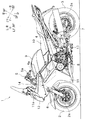
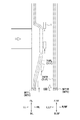
- FIG. 1 is a left side view of a motorcycle according to a specific example of an embodiment of the present invention.
- FIG. 3 is a front view of a state in which a body frame of the motorcycle of FIG. 2 is inclined.
- (A) is a figure for demonstrating the width
- (B) is a figure for demonstrating the width
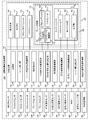
- FIG. 3 is a control block diagram of the motorcycle of FIG. 2.
- FIG. 3 is a diagram showing a configuration of a brake mechanism of the motorcycle of FIG. 2.
- FIG. 3 is a diagram showing a configuration of a brake mechanism of the motorcycle of FIG. 2.
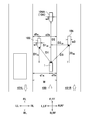
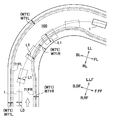
- FIG. 3 is a schematic plan view showing an example of a traveling situation of the motorcycle of FIG. 2. It is a figure for demonstrating the driving assistance control in the driving
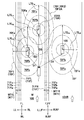
- FIG. 3 is a schematic plan view showing an example of a traveling situation of the motorcycle of FIG. 2.
- FIG. 3 is a schematic plan view showing an example of a traveling situation of the motorcycle of FIG. 2.
- FIG. 3 is a schematic plan view showing an example of a traveling situation of the motorcycle of FIG. 2.
- FIG. 3 is a schematic plan view showing an example of a traveling situation of the motorcycle of FIG. 2.
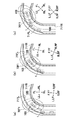
- FIG. 3 is a schematic plan view showing a traveling process of the motorcycle of FIG. 2.
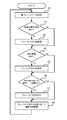
- Fig. 3 is a flowchart showing an example of a control procedure of the motorcycle shown in Fig. 2.
- FIG. 6 is a schematic plan view showing an example of a running situation of a motorcycle according to a modified example.
- the vehicle front-rear direction may be simply referred to as the front-rear direction.
- the vehicle left-right direction may be simply referred to as the left-right direction.
- An arrow F and an arrow B shown in FIG. 1 represent the front and rear in the vehicle front-rear direction, respectively, and the arrow L and the arrow R represent the left and right in the vehicle left-right direction, respectively.
- the lean vehicle 1 includes a vehicle body frame, a seat, a front wheel portion, a rear wheel portion, and an active driving support device 20.
- the vehicle body frame tilts to the right in the vehicle left-right direction when turning right, and leans to the left in the vehicle left-right direction when turning left.
- the seat, the front wheel portion, and the rear wheel portion are supported by the vehicle body frame.
- the front wheel portion includes at least one front wheel. At least a part of the front wheel portion is disposed in front of the seat in the vehicle front-rear direction.
- the rear wheel portion includes at least one rear wheel. At least a part of the rear wheel portion is disposed behind the seat in the vehicle front-rear direction.
- the active driving support device 20 actively supports the driver.
- the active driving support device 20 includes an acceleration control device 22, an oblique lateral inter-vehicle distance detection unit 21, and an active driving support control unit 60.
- the acceleration control device 22 controls the acceleration in the traveling direction of the lean vehicle 1 by controlling the rotation of at least one of the front wheel portion and the rear wheel portion.
- a lane in which the lean vehicle 1 travels is referred to as a lane 100.
- a vehicle that satisfies the following three conditions (a) to (c) is referred to as an oblique side vehicle 102.
- (B) The lean vehicle 1 is separated from the lean vehicle 1 in the vehicle left-right direction (LR direction).
- the oblique side vehicle shown in FIG. 1 has a front end in front of the front end of the lean vehicle 1 and a rear end in front of the rear end of the lean vehicle 1 in the vehicle longitudinal direction of the lean vehicle 1.
- the oblique side-to-vehicle distance detection unit 21 detects an oblique side-to-vehicle distance D0 that is a distance between the oblique side vehicle and the lean vehicle 1.
- FIG. 1 three graphs related to the speed of the lean vehicle 1 are displayed. Specifically, a graph showing the relationship between the speed (V) in the traveling direction of the lean vehicle 1 and the elapsed time (t), and a graph showing the relationship between the acceleration (A) in the traveling direction and the elapsed time (t) A graph showing the relationship between jerk (J) in the traveling direction and elapsed time (t) is displayed.
- the active driving support control unit 60 makes the jerk in the traveling direction of the lean vehicle 1 smaller than the maximum value J MAX and The acceleration control device 22 is controlled according to the detected diagonal side-to-vehicle distance D0 while being larger than the minimum value J MIN to actively assist the driver. Further, the active driving support control unit 60 changes the speed when controlling the acceleration control device 22 so as to change the speed in the traveling direction of the lean vehicle 1 according to the detected diagonal side-to-vehicle distance D0. The acceleration control device 22 is controlled to actively assist the driver so that the relationship between the speed (V) and the elapsed time (t) becomes non-linear in the initial stage.
- FIG. 1 shows, as a comparative example, three graphs related to the speed when control is performed so that the relationship between the speed (V) and the elapsed time (t) is linear in the initial stage of changing the speed. displayed.
- V speed
- t elapsed time
- the lean vehicle 1 has the following characteristics.
- the lean vehicle 1 has a smaller vehicle width than a passenger car. Therefore, in the lane 100 where the lean vehicle 1 travels, there may be an oblique side vehicle 102 that travels on the front oblique side or the rear oblique side of the lean vehicle 1.
- the oblique side vehicle 102 is separated from the lean vehicle 1 in the left-right direction of the lean vehicle 1.
- the oblique side vehicle 102 has a front end in front of the lean vehicle 1 and a rear end in front of the lean vehicle 1 in the front-rear direction of the lean vehicle 1 or a front end thereof.
- the oblique side-to-vehicle distance detection unit 21 detects an oblique side-to-vehicle distance D0 that is a distance between the oblique side vehicle 102 and the lean vehicle 1.
- the diagonal side inter-vehicle distance D0 is a distance of a line segment in a direction inclined with respect to both the vehicle front-rear direction and the vehicle left-right direction in plan view.
- the vehicle body frame of the lean vehicle 1 tilts to the right in the vehicle left-right direction when turning right, and leans to the left in the vehicle left-right direction when turning left.
- the active driving support control unit 60 actively supports the driver by controlling the acceleration control device 22 according to the detected diagonal side-to-vehicle distance D0. That is, the active driving support control unit 60 uses not only the distance between the oblique side vehicle 102 and the lean vehicle 1 in the vehicle front-rear direction but also the distance between the oblique side vehicle 102 and the lean vehicle 1 in the vehicle left-right direction.
- the driver controls the acceleration control device 22 to actively assist the driver.
- the active driving support control unit 60 detects the diagonal lateral inter-vehicle distance while making the jerk in the traveling direction smaller than the maximum value of the jerk that can be generated by the acceleration control device 22 and larger than the minimum value.
- the acceleration control device 22 is controlled according to the diagonal side inter-vehicle distance D0 detected by the unit 21 to actively assist the driver.
- the active driving support control unit 60 controls the acceleration control device 22 so as to change the speed in the traveling direction according to the diagonal side inter-vehicle distance D0 detected by the diagonal side inter-vehicle distance detection unit 21.
- the acceleration control device 22 is controlled to actively assist the driver so that the relationship between the speed and the elapsed time becomes non-linear in the initial stage of changing the speed. More specifically, for example, the diagonal side-to-vehicle distance D0 is maintained at a predetermined target distance by controlling the acceleration control device 22 according to the diagonal side-to-side distance D0 to actively assist the driver.
- the speed of the lean vehicle 1 may be linked to the speed of the oblique side vehicle 102.
- control is required for changes in both the distance in the vehicle longitudinal direction and the distance in the vehicle lateral direction. That is, finer control is required than general follow-up control in which control is performed in consideration of only the inter-vehicle distance in the vehicle longitudinal direction.
- the second limitation is that the relationship between the speed and the elapsed time becomes nonlinear in the initial stage of changing the speed.
- the second restriction means that the acceleration changes at the initial stage of changing the speed, and the change in acceleration is not abrupt. In other words, the change in acceleration is not abrupt. In other words, the absolute value of jerk is small.
- the active driving support control unit 60 controls the acceleration control device 22 according to the diagonal side inter-vehicle distance D0 while limiting the jerk, so that the driver is actively supported. Driving assistance that suits the sense of
- the lean vehicle 1 of the embodiment of the present invention is a motorcycle
- the description of the same part as the above-described embodiment of the present invention is omitted.
- the specific examples of the embodiments of the present invention include all the embodiments of the present invention described above.
- Arrows F and B shown in the drawings represent the front and rear in the vehicle front-rear direction, respectively
- arrows L and R represent the left and right in the vehicle left-right direction, respectively.
- the arrow U and the arrow D represent the upper direction and the downward direction, respectively.
- the up-down direction is a direction perpendicular to the road surface.
- FIG. 2 shows the motorcycle 1 arranged in an upright state.
- FIG. 3 shows the motorcycle 1 with the body frame 4 tilted.
- the road surface is horizontal in both FIG. 2 and FIG.
- the motorcycle 1 includes a front wheel portion 2, a rear wheel portion 3, and a vehicle body frame 4.
- a head pipe 4 a is provided at the front portion of the vehicle body frame 4.
- a steering shaft (not shown) is rotatably inserted into the head pipe 4a.
- the upper end portion of the steering shaft is connected to the handle unit 5.
- An upper end portion of a pair of left and right front forks 6 is fixed to the handle unit 5.
- a lower end portion of the front fork 6 supports the front wheel portion 2.
- the front wheel portion 2 is composed of one front wheel.
- the front wheel includes a tire and a wheel.
- the front fork 6 has a front suspension 15 (see FIG. 5) that absorbs an impact in the vertical direction.
- the front end of the swing arm 7 is swingably supported at the rear part of the body frame 4.
- the rear end portion of the swing arm 7 supports the rear wheel portion 3.
- the rear wheel portion 3 is composed of one rear wheel.
- the swing arm 7 and the vehicle body frame 4 are connected to each other via a pair of left and right rear suspensions 16 (see FIG. 5) that absorb impact in the vertical direction.
- the front wheel 2 is provided with a front brake 2a.
- the rear wheel portion 3 is provided with a rear brake 3a.
- the front brake 2a and the rear brake 3a are so-called disc brakes.
- the front brake 2a and the rear brake 3a may be brakes other than the disc brake.
- a brake converts kinetic energy into another form of energy (eg, thermal energy) or another kinetic energy.
- the front brake 2a and the rear brake 3a may be drum brakes.
- the front brake 2a and the rear brake 3a may be hydraulic brakes, mechanical brakes, or electric brakes.
- the vehicle body frame 4 supports a fuel tank 9 and a seat 10.
- the body frame 4 supports the engine unit 8.
- the engine unit 8 is located below the upper end of the seat 10. When viewed in the vertical direction, at least a part of the engine unit 8 may or may not overlap the seat 10. That is, at least a part of the engine unit 8 may or may not be located below the seat 10.
- the engine unit 8 may be a 4-stroke engine or a 2-stroke engine.
- the engine unit 8 has an engine body 8a and a transmission 8b as shown in FIG.
- the driving force output from the engine body 8a is transmitted to the rear wheel portion 3 via the transmission 8b.
- the vehicle body frame 4 supports a battery (not shown).
- the battery supplies power to electronic devices such as a control device 50 and various sensors described later.
- the motorcycle 1 includes a wireless communication device 42.
- the wireless communication device 42 is configured to receive a GNSS (Global Positioning Satellite System) signal.
- the GNSS signal includes information on the current position such as latitude and longitude.
- the wireless communication device 42 is configured to be capable of vehicle-to-vehicle communication and road-to-vehicle communication.
- Inter-vehicle communication is communication performed between vehicle-mounted communication devices.
- Road-to-vehicle communication is communication performed between a roadside communication device installed on a road and an in-vehicle communication device.
- the in-vehicle communication device transmits information such as the speed of the vehicle in which the in-vehicle communication device is mounted to the roadside communication device or the in-vehicle communication device of another vehicle.
- the roadside communication device transmits road information (signal information, regulation information, etc.) to the vehicle-mounted communication device. Further, the roadside communication device transmits information received from the in-vehicle communication device to another in-vehicle communication device.
- the information transmitted by the roadside communication device may include the presence or absence of a vehicle, the speed of the vehicle, and the like.
- the wireless communication device 42 may be configured to receive a signal transmitted from a communication center away from the road.
- the data received by the wireless communication device 42 may include map data.
- the vehicle body cover 11 includes a front cowl 11 a disposed at the front portion of the motorcycle 1.
- a headlight 12 is provided on the front cowl 11a.
- footrests 13 are respectively provided at the lower portions of the left and right sides of the motorcycle 1. Although illustration is omitted, a brake pedal is provided in front of the right footrest 13.
- the rear brake 3a is activated, and the rotation of the rear wheel portion 3 is braked.
- the rear brake 3a is operated not only by the operation of the brake pedal but also by the rear brake drive unit 3b (see FIG. 5).
- the rear brake drive unit 3b is controlled by the control device 50.
- the rear brake 3 a and the rear brake drive unit 3 b are included in the brake mechanism 19.
- the handle unit 5 has a left grip 5a (see FIGS. 2 and 3) and a right grip 5b (see FIG. 3).
- the right grip 5b is an accelerator grip.
- the accelerator grip 5b is operated to adjust the output of the engine body 8a.
- the accelerator grip 5 b is operated to adjust the opening degree of the throttle valve 18 of the engine unit 8.
- a brake lever (not shown) is provided in front of the right grip 5b. When the driver operates the brake lever, the front brake 2a is activated, and the rotation of the front wheel portion 2 is braked.
- the front brake 2a is operated not only by operation of the brake lever but also by the front brake drive unit 2b (see FIG. 5).
- the front brake drive unit 2b is controlled by the control device 50.
- the front brake 2 a and the front brake drive unit 2 b are included in the brake mechanism 19.
- the brake mechanism 19 when the front brake 2a and the rear brake 3a are hydraulic brakes will be described with reference to FIG.
- the brake mechanism 19 is not limited to the specific example of FIG.
- the brake mechanism 19 includes a reservoir tank 43, a pump 44, an accumulator 45, and valves 45a to 45c and 46a to 46c.
- the pump 44 is always operable by the motor.
- the valves 45a to 45c and 46a to 46c are controlled by the control device 50.
- the valves 45a to 45c and 46a to 46c are, for example, electromagnetic valves.
- the master cylinder 2c of the brake lever and the front brake 2a are connected by a first hydraulic path 47a.
- the master cylinder 3c of the brake pedal and the rear brake 3a are connected by a second hydraulic path 47b.
- a first front valve 45a is provided in the first hydraulic path 47a
- a first rear valve 46a is provided in the second hydraulic path 47b.
- the reservoir tank 43 is connected to a third hydraulic path 47c for sending oil from the reservoir tank 43 to the front brake 2a and the rear brake 3a.
- the reservoir tank 43 is connected to a fourth hydraulic path 47d for sending oil from the front brake 2a and the rear brake 3a to the reservoir tank 43.
- a part of the third hydraulic path 47c also serves as a part of the fourth hydraulic path 47d.
- a pump 44, an accumulator 45, a second front valve 45b, and a second rear valve 46b are provided in the third hydraulic path 47c.
- a third front valve 45c and a third rear valve 46c are provided in the fourth hydraulic path 47d.
- the first front valve 45a and the first rear valve 46a are open, and the other valves 45b, 45c, 46b and 46c are closed.
- the brake lever When the brake lever is operated in this state, the hydraulic pressure of the front brake 2a increases and the front brake 2a operates.
- the control device 50 When the control device 50 operates the front brake 2a, the control device 50 opens the second front valve 45b and closes the other valves. Thereby, the oil pumped from the pump 44 is supplied to the front brake 2a. Thereafter, in order to hold the front brake 2a in an activated state, the control device 50 closes the second front valve 45b.
- the front brake drive unit 2b includes a third hydraulic path 47c, a fourth hydraulic path 47d, a reservoir tank 43, a pump 44, an accumulator 45, and first to third front valves 45a to 45c.
- the rear brake drive unit 3b includes a third hydraulic path 47c, a fourth hydraulic path 47d, a reservoir tank 43, a pump 44, an accumulator 45, and first to third rear valves 46a to 46c.
- a display device 14 is provided in front of the handle unit 5 and behind the front cowl 11a.
- the display device 14 displays, for example, vehicle speed, engine rotation speed, various warnings, and the like.
- the handle unit 5 is provided with various switches.
- the power supply from the battery to the electric device can be started or stopped by operating the switch.
- the engine unit 8 can be started or stopped by a switch operation.
- the screen of the display device 14 can be switched by a switch operation.
- the selection item displayed on the display apparatus 14 can be selected by switch operation.
- One of a plurality of riding modes can be selected by a switch operation.
- the plurality of riding modes include a manual driving mode, a driving support mode, and an autonomous driving mode. Each mode will be described later.
- the arrows UF, DF, FF, BF, LF, and RF shown in FIGS. 2 and 3 respectively represent the upward direction, the downward direction, the forward direction, the backward direction, the left direction, and the right direction of the vehicle body frame 4.
- the vertical direction (UFDF direction) of the vehicle body frame 4 is a direction parallel to the axial direction of the head pipe 4 a of the vehicle body frame 4.
- the left-right direction (LFRF direction) of the body frame 4 is a direction orthogonal to a plane passing through the center of the body frame 4 in the width direction.
- the front-rear direction (FFBF direction) of the body frame 4 is a direction orthogonal to both the up-down direction (UFDF direction) of the body frame 4 and the left-right direction (LFRF direction) of the body frame 4.
- the body frame 4 of the motorcycle 1 tilts to the right in the left-right direction of the vehicle when turning right, and leans to the left of the left-right direction of the vehicle when turning left. .
- the left-right direction (LR direction) of the motorcycle 1 and the left-right direction (LFRF direction) of the body frame 4 do not coincide with each other in front view.
- the vertical direction (UD direction) of the motorcycle 1 and the vertical direction (UFDF direction) of the body frame 4 do not coincide with each other in a front view.
- the vehicle front-rear direction (FB direction) of the motorcycle 1 matches the front-rear direction (FFBF direction) of the body frame 4.
- the handle unit 5 When the handle unit 5 is rotated, the plane passing through the center in the width direction of the front wheels when viewed from the top and bottom is relative to the vehicle front-rear direction (FB direction) of the motorcycle 1 and the front-rear direction (FFBF direction) of the body frame 4. Tilt.
- the width including the motorcycle 1 and the driver in a state where the vehicle body frame 4 is upright is defined as an upright state width L0.
- the upright state width L0 is substantially the same as the width of the motorcycle 1 in a state where the body frame 4 is upright.
- the width including the motorcycle 1 and the driver in a state where the vehicle body frame 4 is inclined is defined as an inclined state width L1.
- the width of the motorcycle 1 in a state where the body frame 4 is inclined is defined as an inclined vehicle width L1v.
- the widths L0, L1, and L1v are the widths in the left-right direction of the lane (LLRL direction).
- the widths L0, L1, and L1v may be the width in the vehicle left-right direction (LR direction) or the width in the direction orthogonal to the traveling direction of the motorcycle 1.
- the motorcycle 1 has a steering angle sensor 30 for detecting the steering angle of the steering shaft.
- the motorcycle 1 has a stroke sensor 31 that detects the amount of expansion and contraction of the front suspension of the front fork 6.
- the motorcycle 1 has a stroke sensor 32 that detects the amount of expansion and contraction of the rear suspension.
- the motorcycle 1 has a throttle opening sensor 33 that detects the opening of the throttle valve 18.
- the motorcycle 1 has a brake sensor 34 that detects the braking force of the front wheel portion 2 by the front brake 2a.
- the motorcycle 1 has a brake sensor 35 that detects the braking force of the rear wheel portion 3 by the rear brake 3a.
- the motorcycle 1 includes a longitudinal speed sensor 36, a longitudinal acceleration sensor 37, a lateral speed sensor 38, and a lateral acceleration sensor 39.
- the front-rear speed sensor 36 detects a speed V1 FB in the vehicle front-rear direction (FB direction) of the motorcycle 1.
- the longitudinal acceleration sensor 37 detects an acceleration A1 FB in the vehicle longitudinal direction (FB direction) of the motorcycle 1.
- the left / right speed sensor 38 detects a speed V1 LR of the motorcycle 1 in the left / right direction (LR direction) of the vehicle.
- the left / right acceleration sensor 39 detects an acceleration A1 LR in the vehicle left / right direction (LR direction) of the motorcycle 1.
- the motorcycle 1 may have a sensor that detects the speed in the traveling direction.
- the motorcycle 1 may have a sensor that detects acceleration in the traveling direction.
- the longitudinal speed sensor 36, the longitudinal acceleration sensor 37, the lateral speed sensor 38, and the lateral acceleration sensor 39 correspond to the “speed related information detection unit” of the present invention.
- the control device 50 described later may detect the speed V1 FB .
- the longitudinal speed sensor 36 and the control device 50 correspond to the “speed related information detection unit” of the present invention.
- the motorcycle 1 has an IMU 40 (Inertial Measurement Unit).
- the IMU 40 is a device that measures the attitude and traveling direction of the motorcycle 1.
- the IMU 40 includes at least a three-axis gyroscope and a three-direction acceleration sensor.
- the IMU 40 detects triaxial angles or angular accelerations and accelerations in three directions.
- the three-direction acceleration is acceleration in the front-rear direction (FFBF direction) of the body frame 4, acceleration in the left-right direction (LFRF direction) of the body frame 4, and acceleration in the up-down direction (UFDF direction) of the body frame 4.
- the three axes are the yaw axis, the roll axis, and the pitch axis of the motorcycle 1.
- the yaw axis of the motorcycle 1 is an axis extending in the vertical direction (UFDF direction) of the body frame 4.
- the roll axis of the motorcycle 1 is an axis that extends in the front-rear direction (FFBF direction) of the body frame 4.
- the pitch axis of the motorcycle 1 is an axis extending in the left-right direction (LFRF direction) of the body frame 4.
- the triaxial angle refers to the yaw angle, roll angle, and pitch angle of the motorcycle 1.
- the three-axis angular velocity refers to the yaw rate, roll rate, and pitch rate of the motorcycle 1.
- the yaw angle, roll angle, and pitch angle of the motorcycle 1 are rotation angles around the yaw axis, roll axis, and pitch axis of the motorcycle 1.
- the yaw rate, roll rate, and pitch rate of the motorcycle 1 are angular velocities of rotation about the yaw axis, roll axis, and pitch axis of the motorcycle 1.
- the roll angle ⁇ 1 of the motorcycle 1 is an inclination angle of the vehicle body frame 4 in the vehicle left-right direction (LR direction).
- the roll rate ⁇ 1 of the motorcycle 1 is an inclination angular velocity of the vehicle body frame 4 inclined in the vehicle left-right direction (LR direction).
- the IMU 40 detects the inclination of the motorcycle 1 in the vehicle left-right direction (LR direction).
- the IMU 40 corresponds to the “tilt detector” of the present invention.
- the control device 50 described later may detect a roll angle or a roll rate.
- the IMU 40 and the control device 50 correspond to the “tilt detector” of the present invention.
- the IMU 40 may be referred to as a sensor 40.
- the motorcycle 1 has a front sensing unit 41 that senses the front of the motorcycle 1.
- the front sensing unit 41 may be provided anywhere as long as it can sense the front of the motorcycle 1.
- the front sensing unit 41 may be provided in the headlight 12 of the front cowl 11a, for example.
- the front sensing unit 41 includes, for example, one or more of a camera, a millimeter wave radar, a microwave radar, a laser radar, an ultrasonic sensor, an acoustic sensor, an infrared sensor, a radio / electric field sensor, a magnetic sensor, and a distance image sensor. Including.
- Such a radar and a sensor are configured to radiate millimeter waves or the like toward the front of the motorcycle 1 and receive reflected waves that are reflected back to the object.
- the camera may be monocular or compound eye.
- the front sensing unit 41 may be referred to as a sensor 41.
- the motorcycle 1 can be switched between a manual driving mode, a driving support mode, and an autonomous driving mode.
- the manual operation mode the motorcycle 1 is driven by the driver.
- control for actively supporting the driver is performed while the motorcycle 1 is driven by the driver.
- control that passively assists the driver may be performed while the motorcycle 1 is driven by the driver.
- control that actively supports the driver is performed so that the motorcycle 1 automatically travels to the target position even if the driver does not drive.
- the driving support mode may be automatically set according to the driving situation without being selected by the driver.
- the driving support mode may have a plurality of modes.
- the motorcycle 1 includes a control device 50 that controls the operation of each part of the motorcycle 1.
- the control device 50 is connected to the various sensors 30 to 41 and the wireless communication device 42 described above.
- the active driving support device 20 is configured by the various sensors, the wireless communication device 42, and the control device 50.
- the control device 50 includes, for example, a CPU (Central Processing Unit), a ROM (Read Only Memory), a RAM (Random Access Memory), and the like.
- the CPU executes information processing based on programs and various data stored in the ROM and RAM.
- the control device 50 includes, as function processing units, a lane detection unit 51, an in-lane left / right position calculation unit 52, a vehicle detection unit 53, a diagonal side vehicle distance calculation unit 54, and a diagonal side vehicle information calculation.
- Unit 55 front inter-vehicle distance calculation unit 56, forward vehicle information calculation unit 57, side lane vehicle information calculation unit 58, lane information calculation unit 59, and active driving support control unit 60.
- control device 50 includes a storage unit 49 including, for example, a ROM and a RAM.
- the storage unit 49 stores map data.
- the map data stored in the storage unit 49 may be updated with the map data received from the wireless communication device 42.
- the storage unit 49 stores an upright state width L0 of the motorcycle 1.
- the storage unit 49 may store the length of the motorcycle 1 in the vehicle front-rear direction (FB direction).
- the width of the lane 100 on which the motorcycle 1 travels is at least twice the upright state width L0 of the motorcycle 1 (see FIG. 4A).
- the lane 100 may or may not have a lane mark (for example, a white line) at the edge.
- Arrows FL, BL, LL, and RL shown in the drawings represent the forward direction, the backward direction, the left direction, and the right direction of the lane 100, respectively.
- the front-rear direction of the lane 100 is referred to as the lane front-rear direction (FLBL direction).
- the left-right direction of the lane 100 is referred to as the lane left-right direction (LLRL direction).
- a vehicle that satisfies the following three conditions is a front oblique side vehicle 103.
- (C-1) The front end of the motorcycle 1 is in front of the front end of the motorcycle 1 and the rear end thereof is in front of the rear end of the motorcycle 1 in the vehicle longitudinal direction (FB direction).
- the front oblique side vehicle 103 is included in the oblique side vehicle 102 described above. Further, in the lane 100, the front oblique side vehicle 103 is located in a region rearward (B direction) from the rear end of the front oblique side vehicle 103 and forward (F direction) from the front end of the motorcycle 1. It is a vehicle that satisfies the condition that it does not exist.
- a vehicle that is traveling on the lane 100 and at least a part of which overlaps the motorcycle 1 when viewed in the vehicle front-rear direction (FB direction) of the motorcycle 1 is referred to as a forward vehicle 104.
- the forward vehicle 104 is a vehicle that satisfies the condition that no other vehicle exists on a straight line connecting the forward vehicle 104 and the motorcycle 1.
- a vehicle whose rear end is ahead of the rear end of the front oblique side vehicle 103 in the vehicle front-rear direction (FB direction) of the motorcycle 1 is referred to as a front front vehicle 104A. That is, in the situation where the front oblique side vehicle 103 exists, the front vehicle 104 is the head front vehicle 104A.
- the front vehicle 104 in a situation where the front oblique side vehicle 103 does not exist is referred to as a single front vehicle.
- the reference number of the single front vehicle is 104B so that it can be easily distinguished from the leading front vehicle 104A.
- the lane on the left side (LL direction) of the lane 100 is referred to as a left lane 101L.
- a lane on the right side (RL direction) of the lane 100 is referred to as a right lane 101R.
- the left lane 101L and the right lane 101R are collectively referred to as the side lane 101.
- the traveling direction of the vehicle in the left lane 101L is opposite to the traveling direction of the vehicle in the lane 100.
- the traveling direction of the vehicle in the right lane 101R is the same as the traveling direction of the vehicle in the lane 100.
- white arrows displayed on the lanes 100 and 101 indicate the traveling direction of the vehicle.
- a vehicle traveling ahead (direction F) from the motorcycle 1 is referred to as a side lane vehicle 105.
- the front oblique side vehicle 103, the forward vehicle 104, and the side lane vehicle 105 are all lean vehicles.
- the vehicle types of the front oblique side vehicle 103, the forward vehicle 104, and the side lane vehicle 105 are not limited to lean vehicles.
- a passenger car may be used. Since the front oblique side vehicle 103 is separated from the motorcycle 1 in the vehicle left-right direction (LR direction), there is a high possibility that the vehicle type is a lean vehicle.
- the front oblique side vehicle 103 may be limited to a vehicle whose width in the left-right direction of the lane (LLRL direction) or the left-right direction of the vehicle (LR direction) is smaller than a predetermined value.
- the lane detection unit 51 detects the lane 100 in which the motorcycle 1 travels. To detect the lane 100 is to detect the positions of both edges of the lane 100. The lane detection unit 51 may detect the lane 100 based on the sensing result of the front sensing unit 41. For example, the lane 100 may be detected from a lane mark (for example, a white line). Further, the lane detection unit 51 may detect the lane 100 based on the GNSS signal received by the wireless communication device 42 and the map data stored in the storage unit 49 or received by the wireless communication device 42. The lane detection unit 51 may detect the lane 100 based on information other than the GNSS signal received by the wireless communication device 42. Further, the lane 100 may be detected by combining these.
- a lane mark for example, a white line
- the lane detection unit 51 detects the presence or absence of the side lane 101.
- the lane detector 51 may detect the positions of both edges of the side lane 101.
- the lane detection unit 51 detects the presence or absence of the side lane 101 based on at least one of the sensing result of the front sensing unit 41, the map data, and information other than the map data received by the wireless communication device 42. The detection of the positions of both edges of the side lane 101 is the same.
- the in-lane left / right position calculation unit 52 detects the position of the motorcycle 1 in the lane 100 in the left / right direction of the lane (LLRL direction).
- detecting the position in the lane 100 of the motorcycle 1 in the left-right direction of the lane (LLRL direction) includes, for example, the following.
- the distances d1a and d1b (see FIG. 7) between both edges of the lane 100 and a predetermined position of the motorcycle 1 in the lane left-right direction (LLRL direction) may be detected.
- only the distance (d1a or d1b) between one edge of the lane 100 and a predetermined position of the motorcycle 1 in the lane left-right direction (LLRL direction) may be detected.
- the lane 100 may be equally divided into a plurality of regions arranged in the lane left-right direction (LLRL direction) to detect which region the motorcycle 1 is in.
- the in-lane left / right position calculation unit 52 may detect the position in the lane 100 of the motorcycle 1 in the left / right direction of the lane (LLRL direction) based on the sensing result of the front sensing unit 41.
- the front sensing unit 41 may be a camera, and the position of the motorcycle 1 may be detected by detecting the position of the edge of the lane 100 from the image.
- the left-right position calculation unit 52 in the lane uses the GNSS signal received by the wireless communication device 42 without using the sensing result of the front sensing unit 41, the map data stored in the storage unit 49 or received by the wireless communication device 42, and The position may be detected based on the above. Further, the in-lane left / right position calculation unit 52 may detect the position based on the sensing result of the front sensing unit 41, the GNSS signal, and the map data.
- the vehicle detection unit 53 detects the front oblique side vehicle 103, the forward vehicle 104, and the side lane vehicle 105.
- the vehicle detection unit 53 determines the presence or absence of the front oblique side vehicle 103, the front vehicle 104, and the side lane vehicle 105 based on the sensing result of the front sensing unit 41.
- the vehicle detection unit 53 determines whether the vehicle is the front oblique side vehicle 103 or the side lane vehicle 105 based on the detection result of the lane detection unit 51.
- the diagonal side inter-vehicle distance calculation unit 54 detects a front diagonal side inter-vehicle distance D1 that is a distance between the motorcycle 1 and the front diagonal side vehicle 103.
- the front diagonal side inter-vehicle distance D ⁇ b> 1 is the shortest distance between a predetermined position of the motorcycle 1 and a predetermined position of the front diagonal side vehicle 103.
- the predetermined position of the motorcycle 1 may be, for example, the position of the front wheel unit 2 or the position of the front sensing unit 41.
- the predetermined position of the front oblique side vehicle 103 may be, for example, the rear end of the front oblique side vehicle 103.
- the predetermined position of the front oblique side vehicle 103 may change according to the position of the front oblique side vehicle 103 with respect to the motorcycle 1.
- a distance between the motorcycle 1 and the front oblique side vehicle 103 in the vehicle front-rear direction (FB direction) of the motorcycle 1 is a distance D1 FB .
- a distance between the motorcycle 1 and the front oblique side vehicle 103 in the left-right direction (LR direction) of the motorcycle 1 is defined as a distance D1LR .
- Detecting the front diagonal side inter-vehicle distance D1 may be detecting only the distance D1 FB and the distance D1 LR .
- the distance D1 FB may be a distance in the lane front-rear direction (FLBL direction)
- the distance D1 LR may be a distance in the lane left-right direction (LLRL direction).
- the oblique side-to-vehicle distance calculation unit 54 may detect the front oblique side-to-vehicle distance D1 based on the sensing result of the front sensing unit 41.
- a specific example of a method of detecting the front diagonal side inter-vehicle distance D1 when the front sensing unit 41 is a millimeter wave radar or a microwave radar will be described.
- the front sensing unit 41 emits radio waves in many directions.
- the oblique side-to-vehicle distance calculation unit 54 is based on the time from when the front sensing unit 41 emits a radio wave until the reflected wave reflected by the front oblique side vehicle 103 reaches the front sensing unit 41.
- a side inter-vehicle distance D1 is calculated.
- the position of the front oblique side vehicle 103 relative to the motorcycle 1 can be specified based on the direction of the incident wave or the direction of the reflected wave, and the distance D1 FB and the distance D1 LR can be calculated.
- the front sensing unit 41 is a laser radar, an ultrasonic sensor, an acoustic sensor, an infrared sensor, a radio wave / electric field sensor, a magnetic sensor, or a distance image sensor
- the oblique side-to-vehicle distance calculation unit 54 performs substantially the same processing.
- Distance D1, distance D1 FB , and distance D1 LR are calculated.
- the oblique side-to-vehicle distance calculation unit 54 specifies the distance measurement object in the image, and then, based on the trigonometry, the distance D1, the distance D1 FB , and the distance D1 LR Is calculated.
- the distance D1, the distance D1 FB , and the distance D1 LR are calculated based on the parallax between the two cameras.
- the diagonal side inter-vehicle distance calculation unit 54 may detect the front diagonal side inter-vehicle distance D1 based on the position information of the motorcycle 1 and the position information of the front diagonal side vehicle 103 detected by the wireless communication device 42. .
- the oblique side vehicle information calculation unit 55 detects the width w1 of the front oblique side vehicle 103 in the lane lateral direction (LLRL direction).
- the oblique side vehicle information calculation unit 55 detects the width w1 based on the sensing result of the front sensing unit 41.
- the width w1 may be the width of the front oblique side vehicle 103 in the vehicle left-right direction (LR direction) of the motorcycle 1.
- the width w1 may be constant with the width of the front oblique side vehicle 103 in the upright state regardless of the inclination state of the front oblique side vehicle 103.
- the width w ⁇ b> 1 may change according to the inclination state of the front oblique side vehicle 103. This width may or may not include the driver of the front oblique side vehicle 103.
- the oblique side vehicle information calculation unit 55 detects a position in the lane 100 of the front oblique side vehicle 103 in the lane lateral direction (LLRL direction).
- a specific example of the detection of the position of the front oblique side vehicle 103 in the lane 100 in the lane left-right direction (LLRL direction) is the same as the specific example of the detection of the position of the motorcycle 1 described in the explanation of the in-lane left-right position calculation unit 52. It is the same.
- the distances d2a and d2b (see FIG. 7) between the both edges of the lane 100 and a predetermined position of the front oblique side vehicle 103 in the left-right direction (LLRL direction) are detected.
- the oblique side vehicle information calculation unit 55 detects the position in the lane 100 of the front oblique side vehicle 103 in the lane left-right direction (LLRL direction) based on the sensing result of the front sensing unit 41.
- the oblique side vehicle information calculation unit 55 may detect the position based on the sensing result of the front sensing unit 41 and the map data stored in the storage unit 49 or received by the wireless communication device 42. Good.
- Oblique side vehicle information calculation section 55 detects a relative velocity RV2 FB and relative acceleration RA2 FB for the motorcycle 1 in front oblique side vehicle 103 in the vehicle front-rear direction of the motorcycle 1 (FB direction). Further, the oblique side vehicle information calculation unit 55 detects a relative speed RV2 LR and a relative acceleration RA2 LR of the front oblique side vehicle 103 with respect to the motorcycle 1 in the vehicle left-right direction (LR direction) of the motorcycle 1. The oblique side vehicle information calculation unit 55 detects the relative speed RV2 FB , the relative speed RV2 LR , the relative acceleration RA2 FB , and the relative acceleration RA2 LR based on the sensing result of the front sensing unit 41.
- the oblique side vehicle information calculation unit 55 is based on the relative speed RV2 FB of the front oblique side vehicle 103 and the speed V1 FB of the motorcycle 1, and the front oblique side in the vehicle front-rear direction (FB direction) of the motorcycle 1.
- the speed V2 FB of the vehicle 103 may be detected.
- the oblique side vehicle information calculation unit 55 is based on the relative acceleration RA2 FB of the front oblique side vehicle 103 and the acceleration A1 FB of the motorcycle 1, and the front oblique side in the vehicle front-rear direction (FB direction) of the motorcycle 1.
- the acceleration A2 FB of the vehicle 103 may be detected.
- the wireless communication device 42 may receive the speed and / or acceleration in the traveling direction of the front oblique side vehicle 103 and the traveling direction of the front oblique side vehicle 103 by inter-vehicle communication or road-to-vehicle communication.
- the oblique side vehicle information calculation unit 55 based on the information received by the wireless communication device 42, the speed V2 FB and / or acceleration of the front oblique side vehicle 103 in the vehicle front-rear direction (FB direction) of the motorcycle 1.
- A2 and FB may detect the speed V2 LR and / or acceleration A2 LR before oblique lateral vehicle 103 in the vehicle left-right direction of the motorcycle 1 (LR direction).
- the oblique side vehicle information calculation unit 55 detects the speed V2 FB of the front oblique side vehicle 103 in the vehicle longitudinal direction (FB direction) of the detected motorcycle 1 and the speed V1 of the motorcycle 1 in the vehicle longitudinal direction (FB direction). Based on FB , relative speed RV2 FB may be detected. Similarly, relative acceleration RA2 FB , relative speed RV2 LR , and relative acceleration RA2 LR may be detected.
- the oblique side vehicle information calculation unit 55 detects the inclination of the vehicle body frame of the front oblique side vehicle 103 with respect to the vertical direction. Specifically, the oblique side vehicle information calculation unit 55 detects at least one of the inclination angle ⁇ 2, the inclination angular velocity ⁇ 2, and the inclination angular acceleration ⁇ 2 with respect to the vertical direction of the body frame of the front oblique side vehicle 103. .
- the oblique side vehicle information calculation unit 55 detects the inclination angle ⁇ 2, the inclination angular velocity ⁇ 2, and the inclination angle acceleration ⁇ 2 based on the sensing result of the front sensing unit 41.
- the inclination angle ⁇ 2 may be an inclination angle of the motorcycle 1 inclined in the vehicle left-right direction (LR direction), or may be an inclination angle of the front oblique side vehicle 103 inclined in the vehicle left-right direction.
- the wireless communication device 42 may receive the tilt angle ⁇ 2, the tilt angular velocity ⁇ 2, and the tilt angle acceleration ⁇ 2 through vehicle-to-vehicle communication or road-to-vehicle communication.
- the front inter-vehicle distance calculation unit 56 detects a front inter-vehicle distance D ⁇ b> 2 that is a distance between the motorcycle 1 and the front vehicle 104.
- the front inter-vehicle distance D2 may be the shortest distance between a predetermined position of the motorcycle 1 and a predetermined position of the front vehicle 104.
- the front inter-vehicle distance D2 may be a distance between a predetermined position of the motorcycle 1 and a predetermined position of the front vehicle 104 in the lane front-rear direction (FLBL direction).
- the front inter-vehicle distance D2 may be a distance between a predetermined position of the motorcycle 1 and a predetermined position of the front vehicle 104 in the vehicle front-rear direction (FB direction) of the motorcycle 1.
- the predetermined position of the motorcycle 1 may be, for example, the position of the front wheel unit 2 or the position of the front sensing unit 41.
- the predetermined position of the forward vehicle 104 may be the rear end of the forward vehicle 104.
- the predetermined position of the front vehicle 104 may change according to the position of the front vehicle 104 with respect to the motorcycle 1.
- the front inter-vehicle distance calculation unit 56 may detect the front inter-vehicle distance D2 based on the sensing result of the front sensing unit 41.
- the front inter-vehicle distance calculation unit 56 may detect the front inter-vehicle distance D ⁇ b> 2 based on the position information of the motorcycle 1 and the position information of the front vehicle 104 detected by the wireless communication device 42.
- the forward vehicle information calculation unit 57 detects the width w2 of the forward vehicle 104 in the lane left-right direction (LLRL direction).
- the forward vehicle information calculation unit 57 detects the width w2 based on the sensing result of the forward sensing unit 41.
- the width w2 may be the width of the forward vehicle 104 in the left-right direction (LR direction) of the motorcycle 1.
- the width w2 may be constant with the width of the front vehicle 104 in the upright state regardless of the inclination state of the front vehicle 104.
- the width w ⁇ b> 2 may change according to the inclination state of the preceding vehicle 104. This width may or may not include the driver of the forward vehicle 104.
- the forward vehicle information calculation unit 57 detects a relative speed RV3 FB and a relative acceleration RA3 FB of the forward vehicle 104 with respect to the motorcycle 1 in the vehicle front-rear direction (FB direction) of the motorcycle 1. Further, the forward vehicle information calculation unit 57 detects the relative speed RV3 LR and the relative acceleration RA3 LR of the forward vehicle 104 with respect to the motorcycle 1 in the left-right direction (LR direction) of the motorcycle 1. The forward vehicle information calculation unit 57 detects the relative speed RV3 FB , the relative speed RV3 LR , the relative acceleration RA3 FB , and the relative acceleration RA3 LR based on the sensing result of the front sensing unit 41.
- the wireless communicator 42 may receive the speed and / or acceleration in the traveling direction of the forward vehicle 104 and the traveling direction of the forward vehicle 104 by inter-vehicle communication or road-to-vehicle communication. Based on these pieces of information received by the wireless communication device 42, the forward vehicle information calculation unit 57 automatically detects the speed V3 FB and / or acceleration A3 FB of the forward vehicle 104 in the vehicle longitudinal direction (FB direction) of the motorcycle 1. The speed V3 LR and / or acceleration A3 LR of the front vehicle 104 in the vehicle left-right direction (LR direction) of the two-wheeled vehicle 1 may be detected.
- the forward vehicle information calculation unit 57 is based on the detected speed V3 FB of the forward vehicle 104 in the vehicle longitudinal direction (FB direction) of the motorcycle 1 and the speed V1 FB of the motorcycle 1 in the vehicle longitudinal direction (FB direction).
- the relative speed RV3 FB may be detected.
- relative acceleration RA3 FB , relative speed RV3 LR , and relative acceleration RA3 LR may be detected.
- the forward vehicle 104 When the forward vehicle 104 is a lean vehicle, the forward vehicle 104 has a body frame that tilts to the right of the vehicle 104 when turning right and leans to the left of the vehicle 104 when turning left.
- the forward vehicle information calculation unit 57 detects the inclination of the vehicle body frame of the forward vehicle 104 with respect to the vertical direction. Specifically, the forward vehicle information calculation unit 57 detects at least one of the inclination angle ⁇ 3, the inclination angular velocity ⁇ 3, and the inclination angular acceleration ⁇ 3 with respect to the vertical direction of the body frame of the front vehicle 104.
- the forward vehicle information calculation unit 57 detects the tilt angle ⁇ 3, the tilt angular velocity ⁇ 3, and the tilt angle acceleration ⁇ 3 based on the sensing result of the front sensing unit 41.
- the forward vehicle information calculation unit 57 may acquire the inclination angle ⁇ 3, the inclination angular velocity ⁇ 3, and the inclination angle acceleration ⁇ 3 through inter-vehicle communication or road-to-vehicle communication.
- the inclination angle ⁇ 3 may be an inclination angle of the motorcycle 1 in the left-right direction (LR direction), or may be an inclination angle of the forward vehicle 104 in the left-right direction. The same applies to the inclination angular velocity ⁇ 3 and the inclination angular acceleration ⁇ 3.
- the side lane vehicle information calculation unit 58 detects a side lane inter-vehicle distance D3 that is a distance between the motorcycle 1 and the side lane vehicle 105.
- the side lane inter-vehicle distance D3 may be the shortest distance between a predetermined position of the motorcycle 1 and a predetermined position of the side lane vehicle 105.
- Detecting the side lane inter-vehicle distance D3 may be detecting only the distance D3 FB and the distance D3 LR . Further, the side lane distance D3 may be a distance between a predetermined position of the motorcycle 1 and a predetermined position of the side lane vehicle 105 in the lane front-rear direction (FLBL direction). The side lane distance D3 may be a distance between a predetermined position of the motorcycle 1 and a predetermined position of the side lane vehicle 105 in the vehicle front-rear direction (FB direction) of the motorcycle 1. Detecting the side lane inter-vehicle distance D3 may be detecting only the distance D3 FB .
- the side lane vehicle information calculation unit 58 may detect the side lane inter-vehicle distance D3 based on the sensing result of the front sensing unit 41.
- the side lane vehicle information calculation unit 58 may detect the side lane inter-vehicle distance D3 based on the position information of the motorcycle 1 and the position information of the side lane vehicle 105 detected by the wireless communication device 42.
- the side lane vehicle information calculation unit 58 detects the width w3 of the side lane vehicle 105 in the lane left-right direction (LLRL direction).
- the side lane vehicle information calculation unit 58 detects the width w3 based on the sensing result of the front sensing unit 41.
- the width w3 may be the width of the side lane vehicle 105 in the vehicle left-right direction (LR direction) of the motorcycle 1.
- the width w3 may be constant with the width of the side lane vehicle 105 in the upright state regardless of the inclination state of the side lane vehicle 105.
- the width w ⁇ b> 3 may change according to the inclination state of the side lane vehicle 105. This width may or may not include the driver of the side lane vehicle 105.
- Lateral lane vehicle information calculation section 58 detects a relative velocity RV4 FB and relative acceleration RA4 FB for the motorcycle 1 of the lateral lane vehicle 105 in the vehicle front-rear direction of the motorcycle 1 (FB direction). Further, the lateral lane vehicle information calculation section 58 detects a relative velocity RV4 LR and relative acceleration RA4 LR for motorcycle 1 of the lateral lane vehicle 105 in the vehicle left-right direction of the motorcycle 1 (LR direction). Lateral lane vehicle information calculation unit 58, based on the sensing result of the front sensing unit 41 detects a relative velocity RV4 FB, relative velocity RV4 LR, the relative acceleration RA4 FB, and relative acceleration RA4 LR.
- the wireless communication device 42 may receive the speed and / or acceleration in the traveling direction of the side lane vehicle 105 and the traveling direction of the side lane vehicle 105 by inter-vehicle communication or road-to-vehicle communication.
- the side lane vehicle information calculation unit 58 based on the information received by the wireless communication device 42, the speed V4 FB and / or acceleration A4 of the side lane vehicle 105 in the vehicle longitudinal direction (FB direction) of the motorcycle 1. and FB, may detect the speed V4 LR and / or acceleration A4 LR in the vehicle left-right direction of the motorcycle 1 (LR direction).
- the side lane vehicle information calculation unit 58 detects the speed V4 FB of the side lane vehicle 105 in the vehicle front-rear direction (FB direction) of the detected motorcycle 1 and the speed V1 FB of the motorcycle 1 in the vehicle front-rear direction (FB direction).
- the relative speed RV4 FB may be detected based on the above.
- relative acceleration RA4 FB, relative velocity RV4 LR may detect the relative acceleration RA4 LR.
- the lane information calculation unit 59 detects the width W (see FIG. 7) of the lane 100 in the lane left-right direction (LLRL direction).
- the lane information calculation unit 59 may detect the width W of the lane 100 based on the sensing result of the front sensing unit 41.
- the lane information calculation unit 59 may detect the width W of the lane 100 based on the GNSS signal received by the wireless communication device 42 and the map data stored in the storage unit 49 or received by the wireless communication device 42. Good.
- the lane information calculation unit 59 detects the traveling direction of the vehicle in the left lane 101L and the right lane 101R.
- the lane information calculation unit 59 may detect the vehicle traveling direction of the side lane 101 based on the sensing result of the front sensing unit 41.
- the lane information calculation unit 59 may detect the vehicle traveling direction of the side lane 101 based on the relative speed RV4 FB detected based on the sensing result of the front sensing unit 41.
- the lane information calculation unit 59 is based on the GNSS signal received by the wireless communication device 42 and the map data stored in the storage unit 49 or received by the wireless communication device 42, and the vehicle traveling direction of the side lane 101. May be detected.
- the lane information calculation unit 59 determines whether the road is traveling on the right side or traveling on the left side based on the vehicle traveling directions of the lane 100 and the side lane 101. That is, when the vehicle traveling direction of the left lane 101L is the opposite direction of the vehicle traveling direction to the lane 100, the lane information calculation unit 59 determines that the road is traveling on the right side. When the vehicle traveling direction of the right lane 101R is the opposite direction of the vehicle traveling direction to the lane 100, the lane information calculation unit 59 determines that the road is traveling on the left side.
- the lane information calculation unit 59 may detect information related to the lane 100 other than the width W of the lane 100 and the vehicle traveling direction of the side lane 101 by a calculation process or the like. Information related to the lane 100 detected by the lane information calculation unit 59 is set as lane information.
- the lane information includes, for example, information on curves, turns, intersections, junctions, junctions, traffic lights, and railroad crossings of the lane 100.
- the curve information may include not only the position of the curve but also its curvature, good visibility, and the like.
- the information on the corner, intersection, junction, and branching point includes information other than the position.
- the lane information calculation unit 59 may detect lane information based on the sensing result of the front sensing unit 41.
- the lane information calculation unit 59 may detect the lane information based on the GNSS signal received by the wireless communication device 42 and the map data stored in the storage unit 49 or received by the wireless communication device 42.
- the wireless communication device 42 may receive lane information by road-to-vehicle communication, for example.
- the lane information received by the wireless communication device 42 may include the width W of the lane 100 and the vehicle traveling direction of the side lane 101.
- the lane information received by the wireless communication device 42 may include, for example, information on curves, corners, intersections, junctions, branch points, traffic lights, and railroad crossings.
- the lane information received by the wireless communication device 42 may include restriction information such as a speed limit and traffic jam information.
- the lane information calculation unit 59 may be omitted.
- the in-lane left / right position calculation unit 52 is included in the “in-lane left / right position information acquisition unit” of the present invention.
- the front sensing unit 41 is also included in the present invention. May be included in the “in-lane left / right position information acquisition unit”.
- the wireless communication device 42 detects the above-described position based on the information received by the wireless communication device 42, the wireless communication device 42 is also included in the “in-lane left / right position information acquisition unit” of the present invention. Also good.
- the in-lane left / right position calculation unit 52 detects the above-described position based on the information stored in the storage unit 49, the storage unit 49 may also be included in the “in-lane left / right position information acquisition unit” of the present invention. Good.
- the oblique side-to-vehicle distance calculation unit 54 is included in the “oblique side-to-vehicle distance detection unit” of the present invention.
- the front sensing unit 41 is also the “diagonal side inter-vehicle distance detection unit” of the present invention. May be included.
- the radio communication device 42 also uses the “diagonal side inter-vehicle distance detection unit” of the present invention. May be included.
- the diagonal side inter-vehicle distance calculation unit 54 is included in the diagonal side inter-vehicle distance detection unit 21 of the above-described embodiment.
- the front sensing unit 41 is also included in the diagonal side inter-vehicle distance detection unit 21.
- the radio communication device 42 is also included in the diagonal side inter-vehicle distance detection unit 21.
- the oblique side vehicle information calculation unit 55 and the front sensing unit 41 are included in the “oblique side vehicle information detection unit” of the present invention.
- the wireless communication device 42 uses the information received by the wireless communication device 42 for detection of information related to the front oblique side vehicle 103
- the wireless communication device 42 is also connected to the “oblique side” of the present invention. It may be included in the “vehicle information detection unit”.
- the wireless communication device 42 receives all information related to the front oblique side vehicle 103, only the wireless communication device 42 is included in the “oblique side vehicle information detection unit” of the present invention.
- the front inter-vehicle distance calculation unit 56 is included in the “front inter-vehicle distance detection unit” of the present invention.
- the front sensing unit 41 may also be included in the “front inter-vehicle distance detection unit” of the present invention.
- the wireless communication device 42 may also be included in the “front inter-vehicle distance detection unit” of the present invention.
- the front vehicle information calculation unit 57 and the front sensing unit 41 are included in the “front vehicle information detection unit” of the present invention.
- the wireless communication device 42 is also the “oblique side vehicle information detection unit” of the present invention. May be included.
- the side lane vehicle information calculation unit 58 is included in the “side lane inter-vehicle distance detection unit” of the present invention.
- the front sensing unit 41 is also included in the “front inter-vehicle distance detection unit” of the present invention. May be.
- the radio communication device 42 is also included in the “front vehicle distance detection unit” of the present invention. May be.
- the lane information calculation unit 59 detects lane information
- the lane information calculation unit 59 is included in the “lane information detection unit” of the present invention.
- the front sensing unit 41 may also be included in the “lane information detection unit” of the present invention.
- the wireless communication device 42 may also be included in the “lane information detection unit” of the present invention.
- the wireless communication device 42 receives lane information
- the wireless communication device 42 corresponds to the “lane information detection unit” in the present invention.
- the active driving support control unit 60 controls at least one of the acceleration control device 22 and the left / right movement support device 23 so as to actively support the driver when the driving support mode or the autonomous driving mode is selected.
- the acceleration control device 22 controls the acceleration in the traveling direction of the motorcycle 1 by controlling the rotation of the front wheel portion 2 and the rear wheel portion 3.
- the acceleration control device 22 includes the engine unit 8 and the brake mechanism 19.
- the engine unit 8 applies a driving force to the rear wheel portion 3.
- the brake mechanism 19 applies a braking force to the rotation of the front wheel portion 2 and the rear wheel portion 3.
- the active driving support control unit 60 controls the acceleration control device 22 so that the jerk is smaller than the maximum jerk J MAX that can be generated by the acceleration control device 22 and larger than the minimum value J MIN . Since the jerk is small, the acceleration can be changed gently. Further, when the active driving support control unit 60 controls the acceleration control device 22 to change the speed according to the detected front diagonal side inter-vehicle distance D1, as shown in FIG. The acceleration control device 22 is controlled so that the relationship between the speed and the elapsed time becomes nonlinear in the initial stage of change. Thereby, even if the change width of acceleration is large, the change of acceleration is not abrupt. That is, the absolute value of jerk is small. By slowly changing the acceleration, it is difficult for the driver to feel uncomfortable. Therefore, it is possible to provide driving assistance that is more suitable for the driver's sense.
- the left / right movement support device 23 provides support for the motorcycle 1 to move in the vehicle left / right direction (LR direction).
- the left-right movement support device 23 may include a notification device that notifies the driver to move the vehicle in the left-right direction (LR direction).
- the notification device is, for example, the display device 14.
- the notification device may notify by sound or vibration.
- the left-right movement support device 23 may include a left-right movement device that automatically moves the motorcycle 1 in the vehicle left-right direction (LR direction).
- the left-right moving device includes a motor 17 (see FIG. 5) that rotates the steering shaft, an engine unit 8, and a brake mechanism 19.
- the left-right moving device can move the motorcycle 1 in the left-right direction (LR direction) by controlling the front brake 2a, the rear brake 3a, or the throttle valve 18. . That is, if the vehicle is turning, the acceleration control device 22 also serves as the left / right movement support device 23 (left / right movement device). Further, the left / right moving device may include a front suspension 15 or a rear suspension 16. The left / right moving device may move the motorcycle 1 in the left / right direction of the vehicle by controlling the left / right balance of the front suspension 15 or the rear suspension 16. Further, the left / right moving device may include a flywheel or a counterweight provided on the crankshaft. The left-right moving device may move the motorcycle 1 in the vehicle left-right direction (LR direction) by controlling the inclination angle ⁇ 1 of the motorcycle 1 with a flywheel or a counterweight.
- the active driving assistance device 20 may perform lane departure prevention control (Lane Keeping Assist Control).
- the lane departure prevention control is driving support control that causes the motorcycle 1 to travel along the lane 100.
- the active driving support control 20 may perform automatic brake control that activates the brake by detecting an obstacle or a person.
- the active driving support control unit 60 may perform cruise control to keep the vehicle speed constant.
- the active driving support control unit 60 sets a field 70 ⁇ / b> F having a predetermined size with the front oblique side vehicle 103 or the front vehicle 104 as the center.
- the field 70F is elliptical, but is not limited to this shape.
- the major axis direction of the ellipse of the field 70F is the vehicle front-rear direction (FB direction) of the motorcycle 1, and the minor axis direction of the ellipse of the field 70F is the vehicle left-right direction (LR direction) of the motorcycle 1. .
- the major axis of the ellipse of the field 70F may be the traveling direction of the motorcycle 1, may be the lane front-rear direction (FLBL direction), and is the traveling direction of the front oblique side vehicle 103 or the front vehicle 104. There may be other directions.
- 1/2 of the maximum length of the field 70F in the vehicle front-rear direction (FB direction) is defined as a length L70 FB .
- a half of the maximum length of the field 70F in the vehicle left-right direction (LR direction) is defined as a length L70 LR .
- the length L70 FB and the length L70 LR are changed according to a predetermined condition.
- the field 70F is formed of three fields 70Fa, 70Fb, and 70Fc.
- the first field 70Fa, the second field 70Fb, and the third field 70Fc are arranged in the order closer to the front oblique side vehicle 103.
- the sizes of the first field 70Fa and the second field 70Fb are set according to the size of the field 70F. It should be noted that the field 70F may be only about the rear half of the ellipse. This is because only the rear half of the field 70F is used for the driving support control. The same applies to the field 72F described later.
- the field 70F set with the front oblique side vehicle 103 set substantially at the center is referred to as a field 70F1.
- the field 70F set with the leading front vehicle 104A substantially in the center is defined as a field 70F2A.
- a field 70F that is set substantially at the center of the single forward vehicle 104B is referred to as a field 70F2B.
- Field 70F2A and field 70F2B are collectively referred to as field 70F2. That is, the field 70F set with the front vehicle 104 approximately at the center is defined as a field 70F2.
- the active driving support control unit 60 sets the acceleration control device 22 and the left and right movement support device 23 so that the motorcycle 1 contacts the field 70F1 of the front oblique side vehicle 103. Control at least one. That is, the active driving support control unit 60 determines whether the front diagonal side vehicle distance D1 is maintained at the predetermined target distance based on the detected front diagonal side vehicle distance D1. The driver is actively supported by controlling at least one of the movement support devices 23.
- the active driving support control unit 60 controls the position of the motorcycle 1 in the lane 100 in the left-right direction of the lane (LLRL direction) based on the detected front diagonal side inter-vehicle distance D1, while the front diagonal side At least one of the acceleration control device 22 and the left / right movement support device 23 is controlled such that the inter-vehicle distance D1 is maintained at a predetermined target distance.
- the active driving support control unit 60 monitors, for example, a change with time of the front diagonal side inter-vehicle distance D1, and when the motorcycle 1 enters or leaves the field 70F1, the active driving support control unit 60 At least one of the movement support devices 23 may be controlled. Further, the active driving support control unit 60, for example, based on the front diagonal side inter-vehicle distance D1 at a certain time point, the acceleration control device 22 and the left / right movement support device 23 so that the motorcycle 1 comes into contact with the field 70F1 after t seconds. At least one of these may be controlled. At this time, at least one of the acceleration control device 22 and the left / right movement support device 23 is controlled so that the acceleration and jerk for t seconds are arbitrary values.
- the active driving support control unit 60 makes the motorcycle 1 contact the field 70F1 of the front oblique side vehicle 103 and the motorcycle 1 is the front front. At least one of the acceleration control device 22 and the left / right movement support device 23 is controlled so as not to enter the field 70F2A of the vehicle 104A. In other words, the active driving support control unit 60 moves the acceleration control device 22 and the left and right movements so that the front diagonal side inter-vehicle distance D1 is maintained at the predetermined target distance based on the detected front diagonal side inter-vehicle distance D1. At least one of the support devices 23 is controlled.
- the active driving support control unit 60 determines at least the acceleration control device 22 and the left / right movement support device 23 based on the detected front inter-vehicle distance D2 so that the front inter-vehicle distance D2 is not less than a predetermined limit distance. Control one.
- the active driving support control unit 60 controls at least one of the acceleration control device 22 and the left / right movement support device 23 so that the motorcycle 1 contacts the field 70F2B of the single front vehicle 104B. To do. That is, the active driving support control unit 60 activates at least one of the acceleration control device 22 and the left / right movement support device 23 so that the front inter-vehicle distance D2 is maintained at a predetermined distance based on the detected front inter-vehicle distance D2. Control.
- the active driving support control unit 60 sets a left edge field 71FL and a right edge field 71FR on the left edge and the right edge of the lane 100, respectively.
- the width of the left edge field 71FL in the lane horizontal direction (LLRL direction) is defined as a width W71L.
- the width of the right edge field 71FR in the left-right direction of the lane (LLRL direction) is defined as a width W71R.
- the widths W71L and W71R are changed according to predetermined conditions.
- the widths W71L and W71R may be uniform. Further, the widths W71L and W71R may be the widths of the edge fields 71FL and 71FR in the vehicle left-right direction (LR direction).
- the edge field 71FR and the edge field 71FL may be collectively referred to as an edge field 71F. Further, when the widths W71L and W71R are not distinguished, they are referred to as a width W71.
- the edge field 71F is formed by three edge fields 71Fa, 71Fb, 71Fc.
- the first edge field 71Fa, the second edge field 71Fb, and the third edge field 71Fc are arranged in order from the edge of the lane 100.
- the widths of the first edge field 71Fa, the second edge field 71Fb, and the third edge field 71Fc are set according to the width W71 of the edge field 71F.
- the active driving support control unit 60 When the front oblique side vehicle 103 is detected, the active driving support control unit 60 prevents the motorcycle 1 from contacting the field 70F of the front oblique side vehicle 103 and prevents the motorcycle 1 from entering the edge field 71F. Further, at least one of the acceleration control device 22 and the left / right movement support device 23 is controlled. That is, the active driving support control unit 60 determines whether the acceleration control device 22 and the front diagonal side vehicle distance D1 are detected and the position in the lane 100 of the motorcycle 1 in the lane left-right direction (LLRL direction). At least one of the left and right movement support devices 23 is controlled.
- the active driving support control unit 60 determines between the edge of the lane 100 and the motorcycle 1 in the left-right direction of the lane based on information on the position of the motorcycle 1 in the lane 100 in the left-right direction (LLRL direction). It can be said that at least one of the acceleration control device 22 and the left / right movement support device 23 is controlled such that the distance is equal to or greater than the width W71.
- the active driving support control unit 60 performs a field with the side lane vehicle 105 as a substantially center.
- 72F is set.
- the field 72F is elliptical, but is not limited to this shape.
- 1/2 of the maximum length of the field 72F in the vehicle front-rear direction (FB direction) is defined as a length L72 FB .
- the length L72 FB and the length L72 LR are changed according to a predetermined condition.
- the field 72F is formed of three fields 72Fa, 72Fb, and 72Fc.
- the first field 72Fa, the second field 72Fb, and the third field 72Fc are arranged in the order closer to the side lane vehicle 105.
- the sizes of the first field 72Fa and the second field 72Fb are set according to the size of the field 72F.
- the active driving support control unit 60 controls at least one of the acceleration control device 22 and the left / right movement support device 23 so that the motorcycle 1 does not enter the field 72F of the side lane vehicle 105.
- the active driving support control unit 60 may set a field that is substantially centered on the side lane vehicle 105 that travels in the side lane 101 in which the traveling direction of the vehicle is opposite to the lane 100.
- the position of the motorcycle 1 serving as a reference for determining the positional relationship between the motorcycle 1 and the fields 70F, 71F, and 72F may be the position of the front sensing unit 41 or the position of the front wheel unit 2. In the latter example, for example, a position away from the position of the front sensing unit 41 by a predetermined distance forward (F direction) is assumed to be the front end of the front wheel unit 2. Then, it is determined whether or not the front wheel portion 2 is in the field. It should be noted that the position relationship between the edge field 71F and the motorcycle 1 may include the position of the rear wheel part 3 in addition to the position of the front wheel part 2.
- the active driving support control unit 60 moves the motorcycle 1 to the fields 70F and 70F2B depending on the situation.
- the acceleration control device 22 is controlled so as to be close to. Specifically, for example, the acceleration control device 22 is controlled so that the jerk in the traveling direction of the motorcycle 1 is increased. However, the speed V1 FB of the motorcycle 1 after the control is within a predetermined speed range.
- the increase in jerk means that the absolute value of positive jerk increases or the absolute value of negative jerk decreases.
- the acceleration in the traveling direction of the motorcycle 1 may be positive, negative, or zero.
- the active driving support control unit 60 performs control so that the opening degree of the throttle valve 18 is increased. As a result, the output of the engine body 8a increases and the acceleration of the motorcycle 1 increases. That is, the motorcycle 1 is accelerated or decelerated while increasing the acceleration.
- the active driving support control unit 60 may control the output of the engine body 8a by changing parameters used for controlling the engine unit 8.
- the active driving support control unit 60 increases the output of the engine body 8a and changes the speed ratio of the transmission 8b of the engine unit 8 according to the speed.
- the speed V1 FB of the motorcycle 1 is equal to that of the front oblique side vehicle 103. If faster than the speed V2 FB may control the acceleration control system 22 as the jerk in the traveling direction of the motorcycle 1 decreases. For example, immediately after the front oblique side vehicle 103 moves from the side lane 101 to the lane 100, the motorcycle 1 is separated from the field 70F1 of the front oblique side vehicle 103 or the field 70F2B of the single front vehicle 104B. In addition, the speed V1 FB of the motorcycle 1 may be faster than the speed V2 FB of the front oblique side vehicle 103.
- the active driving support control unit 60 moves the motorcycle 1 to the fields 70F and 70F2B depending on the situation.
- the left / right movement support device 23 may be controlled to approach Specifically, the left and right movement support device 23 may notify the driver to move in the left and right direction (LR direction) of the vehicle, and the left and right movement support device 23 moves the motorcycle 1 to the left and right direction (LR). Direction).
- the active driving support control unit 60 uses the acceleration to take the motorcycle 1 out of the field 70F.
- the control device 22 is controlled. Specifically, for example, the acceleration control device 22 is controlled so that the jerk in the traveling direction of the motorcycle 1 is reduced. When this control is performed, the acceleration in the traveling direction of the motorcycle 1 may be positive, negative, or zero.
- the active driving support control unit 60 performs control so that the opening degree of the throttle valve 18 is reduced. As a result, the output of the engine body 8a is reduced and the acceleration of the motorcycle 1 is reduced. That is, the motorcycle 1 is decelerated or accelerated while the acceleration is reduced.
- the active driving support control unit 60 may control the output of the engine body 8a by changing parameters used for controlling the engine unit 8.
- the active driving support control unit 60 reduces the output of the engine body 8a and changes the speed ratio of the transmission 8b of the engine unit 8 according to the speed V1 FB .
- the active driving support control unit 60 controls the front brake driving unit 2b and / or the rear brake driving unit 3b as necessary to operate the front brake 2a and / or the rear brake 3a. Thereby, a braking force is applied to the rotation of the front wheel portion 2 and / or the rear wheel portion 3, and the motorcycle 1 decelerates.
- the active driving support control unit 60 controls the left and right sides to remove the motorcycle 1 from the field 70F.
- the movement support device 23 may be controlled. Specifically, the left and right movement support device 23 may notify the driver to move in the left and right direction (LR direction) of the vehicle, and the left and right movement support device 23 moves the motorcycle 1 to the left and right direction (LR). Direction).
- the active driving support control unit 60 causes the acceleration control device 22 and the left and right sides to move out of the field 72F. At least one of the movement support devices 23 is controlled.
- a specific control method is the same as the control method when the motorcycle 1 enters the field 70F.
- the active driving support control unit 60 causes the motorcycle 1 to move in the vehicle left-right direction (LR direction) in order to take the motorcycle 1 out of the edge field 71F.
- the left and right movement support device 23 is controlled so as to move to ().
- the active driving support control unit 60 may perform control other than the above-described control in order to bring the motorcycle 1 closer to the fields 70F1 and 70F2B.
- the active driving support control unit 60 may perform control other than the above-described control in order to take the motorcycle 1 out of the fields 70F, 71F, 72F.
- the damping force generated in the front suspension 15 or the rear suspension 16 may be controlled.
- notification that prompts deceleration or acceleration may be performed.
- the active driving support control unit 60 changes the length L70 FB and the length L70 LR of the field 70F1 according to the speed V1 FB and / or the acceleration A1 FB in the vehicle front-rear direction (FB direction) of the motorcycle 1. For example, the active driving support control unit 60 changes the length L70 FB and the length L70 LR of the field 70F1 to increase as the speed V1 FB or the acceleration A1 FB increases.
- the acceleration control device 22 is controlled so that the motorcycle 1 is in contact with the field 70F1 set in this way.
- the active driving support control unit 60 is based on at least one of the speed V1 FB and the acceleration A1 FB in the vehicle front-rear direction (FB direction) of the motorcycle 1 and the front diagonal side inter-vehicle distance D1. 22 is controlled.
- the active driving support control unit 60 changes the length L70 FB and the length L70 LR of the field 70F1 in accordance with the speed V1 LR and / or the acceleration A1 LR in the vehicle left-right direction (LR direction) of the motorcycle 1. For example, the active driving support control unit 60 changes the length L70 FB and the length L70 LR of the field 70F1 to increase as the speed V1 LR or the acceleration A1 LR increases.
- the acceleration control device 22 is controlled so that the motorcycle 1 is in contact with the field 70F1 set in this way. That is, the active driving support control unit 60 is based on at least one of the speed V1 LR and acceleration A1 LR in the vehicle left-right direction (LR direction) of the motorcycle 1 and the front diagonal side inter-vehicle distance D1. 22 is controlled.
- the active driving support control unit 60 determines the field 70F1 according to the relative speed RV2 FB and / or the relative acceleration RA2 FB of the front oblique side vehicle 103 with respect to the motorcycle 1 in the vehicle longitudinal direction (FB direction) of the motorcycle 1. Change length L70 FB and length L70 LR .
- the active driving support control unit 60 changes the length L70 FB and the length L70 LR of the field 70F1 to increase as the relative speed RV2 FB or the relative acceleration RA2 FB increases.
- an active driving assistance control unit 60 depending on the speed V2 FB and / or acceleration A2 FB before the oblique lateral vehicle 103 in the vehicle front-rear direction of the motorcycle 1 (FB direction), the length of the field 70F1 L70 FB And the length L70 LR may be changed.
- the acceleration control device 22 is controlled so that the motorcycle 1 is in contact with the field 70F1 set in this way. That is, the active driving support control unit 60 is at least one of the relative speed RV2 FB , the speed V2 FB , the relative acceleration RA2 FB , and the acceleration A2 FB of the front oblique side vehicle 103 in the vehicle longitudinal direction (FB direction). Then, the acceleration control device 22 is controlled based on the front diagonal side inter-vehicle distance D1.
- the active driving support control unit 60 determines the field 70F1 according to the relative speed RV2 LR and / or the relative acceleration RA2 LR of the front oblique side vehicle 103 with respect to the motorcycle 1 in the left-right direction (LR direction) of the motorcycle 1. Change length L70 FB and length L70 LR .
- the active driving support control unit 60 changes the length L70 FB and the length L70 LR of the field 70F1 to increase as the relative speed RV2 LR or the relative acceleration RA2 LR increases.
- the active driving support control unit 60 also determines the length L70 FB of the field 70F1 according to the speed V2 LR and / or the acceleration A2 LR of the front oblique side vehicle 103 in the vehicle left-right direction (LR direction) of the motorcycle 1.
- the length L70 LR may be changed.
- the acceleration control device 22 is controlled so that the motorcycle 1 is in contact with the field 70F1 set in this way.
- the active driving support control unit 60 includes at least one of the relative speed RV2 LR , the speed V2 LR , the relative acceleration RA2 LR , and the acceleration A2 LR of the front oblique side vehicle 103 in the vehicle left-right direction (LR direction),
- the acceleration control device 22 is controlled based on the front diagonal side inter-vehicle distance D1.
- the active driving support control unit 60 changes the length L70 FB and the length L70 LR of the field 70F1 according to the width w1 of the front oblique side vehicle 103 in the lane lateral direction (LLRL direction). For example, the active driving support control unit 60 changes the length L70 LR of the field 70F1 to increase as the width w1 increases. Further, when the width w1 is smaller than the predetermined width, it can be determined that there is a high possibility that the front oblique side vehicle 103 is a lean vehicle. Therefore, the length L70 FB set when the width w1 is smaller than the predetermined width may be shorter than the length L70 FB set when the width w1 is larger than the predetermined width.
- the predetermined width may be 1 ⁇ 2 of the width of the lane 100, for example.
- the acceleration control device 22 is controlled so that the motorcycle 1 is in contact with the field 70F1 set in this way. That is, the active driving support control unit 60 controls the acceleration control device 22 based on the width w1 of the front oblique side vehicle 103 in the lane left-right direction (LLRL direction) and the front oblique side inter-vehicle distance D1.
- the active driving support control unit 60 determines the length L70 FB and the length L70 LR of the field 70F1 according to the distance D1 LR between the front oblique side vehicle 103 and the motorcycle 1 in the vehicle left-right direction (LR direction). To change. For example, the length L70 FB and the length L70 LR of the field 70F1 are changed as the distance D1 LR is smaller.
- the acceleration control device 22 is controlled so that the motorcycle 1 is in contact with the field 70F1 set in this way. That is, the active driving support control unit 60 is based on the distance D1 LR between the front oblique side vehicle 103 and the motorcycle 1 in the vehicle left-right direction (LR direction) and the front oblique side inter-vehicle distance D1. The acceleration control device 22 is controlled.
- the active driving support control unit 60 may change the length L70 FB and the length L70 LR of the field 70F1 according to the inclination angle ⁇ 1 or the inclination angular velocity ⁇ 1 of the motorcycle 1.
- the acceleration control device 22 is controlled so that the motorcycle 1 is in contact with the field 70F1 set in this way. That is, the active driving support control unit 60 controls the acceleration control device 22 based on the inclination angle ⁇ 1 or the inclination angular velocity ⁇ 1 of the motorcycle 1 and the front diagonal side inter-vehicle distance D1.
- the active driving support control unit 60 changes the length L70 FB and the length L70 LR of the field 70F1 according to at least one of the inclination angle ⁇ 2, the inclination angular velocity ⁇ 2, and the inclination angle acceleration ⁇ 2 of the front oblique side vehicle 103. May be.
- the acceleration control device 22 is controlled so that the motorcycle 1 is in contact with the field 70F1 set in this way. That is, the active driving support control unit 60 is based on at least one of the inclination angle ⁇ 2, the inclination angular velocity ⁇ 2, and the inclination angle acceleration ⁇ 2 of the front oblique side vehicle 103 and the front oblique side inter-vehicle distance D1. 22 is controlled.
- Active driving support control unit 60 based on the lane information lane information calculating unit 59 or the wireless communication device 42 is detected, may change the field 70F length L70F B and length L70 LR.
- the acceleration control device 22 is controlled so that the motorcycle 1 is in contact with the field 70F1 set in this way. That is, the active driving support control unit 60 controls the acceleration control device 22 based on the lane information and the front diagonal side inter-vehicle distance D1.
- Active driving support control unit 60 based on the width of the motorcycle 1 in lane lateral direction (LLRL direction) or the vehicle left-right direction (LR direction), by changing the field 70F length L70F B and length L70 LR Also good.
- the width of the motorcycle 1 may be the upright state width L0, the inclined state width L1, or the inclined vehicle width L1v.
- the tilt state width L1, the width L1, and the width L1v are calculated by the control device 50 based on the upright state width L0 stored in the storage unit 49 and the tilt angle ⁇ 1 detected by the IMU 40.
- Active driving support control unit 60 based on the entire length of the motorcycle 1 in lane longitudinal direction (FLBL direction) or vehicle longitudinal direction (FB direction), by changing the field 70F length L70F B and length L70 LR Also good.
- the conditions for changing the lengths L70 FB and L70 LR of the field 70F2 of the preceding vehicle 104 are substantially the same as the conditions for changing the lengths L70 FB and L70 LR of the field 70F1 of the front oblique side vehicle 103. Note that the conditions here are substantially the same, assuming that parameters related to the front oblique side vehicle 103 are replaced with parameters related to the preceding vehicle 104.
- Active driving support control unit 60 according to the relative velocity RV4 FB and / or relative acceleration RA4 FB for the motorcycle 1 of the lateral lane vehicle 105 in the vehicle front-rear direction of the motorcycle 1 (FB direction), field 72F length
- the length L72 FB and the length L72 LR are changed.
- Active driving support control unit 60 depending on the speed V4 FB and / or acceleration A4 FB lateral lane vehicle 105 in the vehicle front-rear direction of the motorcycle 1 (FB direction), the length L72 FB and length of the fields 72F L72 LR may be changed.
- the active driving support control unit 60 changes the length L72 FB and the length L72 LR of the field 72F according to the speed V1 FB and / or the acceleration A1 FB in the vehicle front-rear direction (FB direction) of the motorcycle 1.
- the active driving support control unit 60 may change the length L72 FB and the length L72 LR of the field 72F according to the speed V1 LR and / or the acceleration A1 LR of the motorcycle 1 in the left-right direction (LR direction). Good.
- the active driving support control unit 60 may change the length L72 FB and the length L72 LR of the field 72F according to the width w3 of the side lane vehicle 105 in the lane lateral direction (LLRL direction).
- the active driving support control unit 60 may change the length L72 FB and the length L72 LR of the field 72F according to the side lane distance D3.
- Active driving support control unit 60 according to the relative velocity RV4 LR and / or relative acceleration RA4 LR for motorcycle 1 of the lateral lane vehicle 105 in the vehicle left-right direction of the motorcycle 1 (LR direction), field 72F length
- the length L72 FB and the length L72 LR may be changed.
- Active driving support control unit 60 in response speed V4 LR and / or acceleration A4 LR lateral lane vehicle 105 in the vehicle left-right direction of the motorcycle 1 (LR direction), changes the length L72 FB and length L72 LR May be.
- the active driving support control unit 60 may change the length L72 FB and the length L72 LR of the field 72F based on the lane information detected by the lane information calculation unit 59 or the wireless communication device 42.
- the active driving support control unit 60 changes the length L72 FB and the length L72 LR of the field 72F based on the width of the motorcycle 1 in the lane lateral direction (LLRL direction) or the vehicle lateral direction (LR direction). Also good.
- the width of the motorcycle 1 here is the same as the width of the motorcycle 1 described as a condition for changing the size of the field 70F.
- the active driving support control unit 60 changes the length L72 FB and the length L72 LR of the field 72F based on the total length of the motorcycle 1 in the lane longitudinal direction (FLBL direction) or the vehicle longitudinal direction (FB direction). Also good.
- the active driving support control unit 60 may change the width W71 of the edge field 71F based on the lane information detected by the lane information calculation unit 59 or the wireless communication device 42. Specific examples thereof will be described below.
- the active driving support control unit 60 may change the width W71 of the edge field 71F according to the width W of the lane 100. For example, the width W71 of the edge field 71F may be changed so as to increase as the width W of the lane 100 increases. At least one of the acceleration control device 22 and the left and right movement support device 23 is controlled so that the motorcycle 1 does not enter the edge field 71F set in this way and the motorcycle 1 contacts the field 70F1. That is, the active driving support control unit 60 determines at least one of the acceleration control device 22 and the left and right movement support device 23 based on the width W of the lane 100 in the left-right direction (LLRL direction) and the front diagonal side inter-vehicle distance D1. Control one.
- LLRL direction left-right direction
- D1 front diagonal side inter-vehicle distance
- the active driving support control unit 60 may change the width W71L of the left edge field 71FL according to the vehicle traveling direction of the left lane 101L.
- the active driving support control unit 60 may change the width W71R of the right edge field 71FR according to the vehicle traveling direction of the right lane 101R.
- the width W71L set when the vehicle traveling direction of the left lane 101L is opposite to the vehicle traveling direction of the lane 100 is set when the vehicle traveling direction of the left lane 101L is the same as the vehicle traveling direction of the lane 100.
- the width W71L may be larger.
- the right lane 101R is the same as the left lane 101L.
- At least one of the acceleration control device 22 and the left and right movement support device 23 is controlled so that the motorcycle 1 does not enter the edge field 71F set in this way and the motorcycle 1 contacts the field 70F1. That is, the active driving support control unit 60 controls at least one of the acceleration control device 22 and the left / right movement support device 23 based on the vehicle traveling direction of the side lane 101 and the front diagonal side-to-side distance D1.
- the active driving support control unit 60 may change the width W71 of the edge field 71F depending on the type of lane mark. Further, the active driving support control unit 60 may change the width W71 of the edge field 71F according to the width of the road shoulder or the roadside band.
- the active driving support control unit 60 may change the width W71 of the edge field 71F connected to the lane that intersects the lane 100.
- the left edge field 71 FL is connected to a lane that intersects the lane 100.
- the active driving support control unit 60 may increase the width W71L of the left edge field 71FL from a position behind the intersection in the lane front-rear direction to at least the middle of the intersection.
- the width W71L of the left edge field 71FL is increased up to the end of the intersection.
- the position where the width W71L of the left edge field 71FL starts to expand may be close to the intersection depending on the situation of the lane 100 and the situation of surrounding vehicles.
- the width W71R of the right edge field 71FR may be increased at the intersection.
- the width W71L of the left edge field 71FL may be constant before and after the intersection. Note that the width W71L of the left edge field 71FL may change as shown in FIG.
- the active driving support control unit 60 sets the width W71 of the edge field 71F inside the curve as shown in FIG. It may be larger than the width W71 of the edge field 71F. Thereby, it is possible to prevent a part of the motorcycle 1 or the driver from protruding from the lane 100 when the motorcycle 1 inclines in a curve and its width increases.
- the active driving support control unit 60 may change the width W71 according to the curvature of the curve.
- the active driving support control unit 60 may further increase the width W71 of the edge field 71F inside the curve. Good. As a result, so-called “out-out-in” cornering becomes possible, and a field of view at the corner can be secured.
- the width W71 of 71F may be set to be substantially the same as the width W71 of the straight edge field 71F.
- the active driving support control unit 60 may increase the width W71 of the edge field 71F outside the curve, for example, as shown in FIG. This enables so-called “out-in-out” cornering. Since the turning radius is increased, cornering can be performed at a higher speed.
- FIG. 13A shows a state immediately after FIG.
- FIGS. 13A to 13C show the traveling process of the motorcycle 1 and the front oblique side vehicle 103.
- FIG. In FIGS. 13A to 13C the running lines of the motorcycle 1 and the front oblique side vehicle 103 are indicated by broken lines.
- the travel line is the locus of the front wheels.
- the distance D1 LR between the motorcycle 1 and the front oblique side vehicle 103 in the left-right direction (LR direction) of the motorcycle 1 is shortened. Therefore, the motorcycle 1 can easily enter the field 70F1 of the front oblique side vehicle 103.
- the active driving support control unit 60 controls at least one of the acceleration control device 22 and the left / right movement support device 23 so that the motorcycle 1 contacts without entering the field 70F1. Therefore, a large distance D1 FB between the motorcycle 1 and the front oblique side vehicle 103 in the vehicle front-rear direction (FB direction) of the motorcycle 1 can be secured. As a result, it is possible to perform driving assistance that is more suitable for the driver's sense.
- the edge field of the two lanes may be connected so as to guide the lane change of the motorcycle 1.
- the edge field 71F may change so that it can be so guided.
- the active driving support control unit 60 may change the width W71 of the edge field 71F according to the inclination angle ⁇ 1 or the inclination angular velocity ⁇ 1 of the motorcycle 1. For example, the width W71R of the right edge field 71FR is changed so as to increase as the tilt angle ⁇ 1 to the right increases.
- the active driving support control unit 60 may change the width W71 of the edge field 71F according to at least one of the inclination angle ⁇ 2, the inclination angular velocity ⁇ 2, and the inclination angle acceleration ⁇ 2 of the front oblique side vehicle 103.
- the active driving support control unit 60 may change the width W71 of the edge field 71F according to at least one of the inclination angle ⁇ 3, the inclination angular velocity ⁇ 3, and the inclination angle acceleration ⁇ 3 of the preceding vehicle 104.
- the active driving support control unit 60 may change the width W71 of the edge field 71F according to the speed V1 FB and / or the acceleration A1 FB in the vehicle front-rear direction (FB direction) of the motorcycle 1.
- the active driving support control unit 60 may change the width W71 of the edge field 71F according to the speed V1 LR and / or the acceleration A1 LR of the motorcycle 1 in the vehicle left-right direction (LR direction).
- Active driving support control unit 60 according to the relative velocity RV4 FB and / or relative acceleration RA4 FB for the motorcycle 1 of the lateral lane vehicle 105 in the vehicle front-rear direction of the motorcycle 1 (FB direction), the edge field 71F
- the width W71 may be changed.
- the active driving support control unit 60 may change the width W71 of the edge field 71F based on the width of the motorcycle 1 in the lane left-right direction (LLRL direction) or the vehicle left-right direction (LR direction).
- the width of the motorcycle 1 here is the same as the width of the motorcycle 1 described as a condition for changing the size of the field 70F.
- the active driving support control unit 60 may change the width W71 of the edge field 71F based on the total length of the motorcycle 1 in the lane front-rear direction (FLBL direction) or the vehicle front-rear direction (FB direction).
- the active driving support control unit 60 determines whether or not to execute control that actively supports the driver according to the traveling state.
- the active driving support control unit 60 determines which of the acceleration control device 22 and the left / right movement support device 23 is controlled according to a predetermined condition when the motorcycle 1 enters the fields 70F, 71F, 72F.
- the active driving support control unit 60 determines which of the acceleration control device 22 and the left / right movement support device 23 is controlled according to a predetermined condition when the motorcycle 1 is away from the fields 70F1 and 70F2B. Note that which of the acceleration control device 22 and the left / right movement support device 23 is controlled includes the case of controlling both.
- the active driving support control unit 60 determines which of the acceleration control device 22 and the left / right movement support device 23 is to be controlled when the motorcycle 1 enters or leaves the field 70F1 of the front oblique side vehicle 103. The determination is made based on at least one of a plurality of first determination criterion information described below.
- the first criterion information is not limited to the following.
- the first determination criterion information includes the width w1 of the front oblique side vehicle 103 in the lane lateral direction (LLRL direction).
- the active driving support control unit 60 performs the acceleration control device 22 and the left / right movement based on the width w1 of the front oblique side vehicle 103 in the lane left and right direction (LLRL direction) and the front oblique side distance between the vehicles D1. At least one of the support devices 23 is controlled.
- the first determination criterion information includes the position in the lane 100 of the motorcycle 1 in the lane left-right direction (LLRL direction). For example, it is assumed that the motorcycle 1 travels near the left edge of the lane 100 and the front oblique side vehicle 103 travels to the right of the lane from the motorcycle 1. In this situation, when the front oblique side vehicle 103 moves to the left of the lane and the motorcycle 1 enters the field 70F1 of the front oblique side vehicle 103, the active driving support control unit 60 determines that the acceleration control device 22 May be controlled to decelerate the motorcycle 1. In this example, the active driving support control unit 60 controls the acceleration control device 22 based on the position in the lane 100 of the motorcycle 1 in the left-right direction of the lane (LLRL direction) and the front diagonal side inter-vehicle distance D1. Will do.
- the first determination criterion information includes the position in the lane 100 of the front oblique side vehicle 103 in the lane lateral direction (LLRL direction). For example, it is assumed that the front oblique side vehicle 103 travels substantially in the center of the lane 100 and the motorcycle 1 travels to the left of the lane from the front oblique side vehicle 103. In this situation, when the front diagonal side vehicle 103 has moved to the left of the lane and the motorcycle 1 has entered the field 70F1 of the front diagonal side vehicle 103, the active driving support control unit 60 uses the left / right movement support device. The motorcycle 1 may be decelerated by controlling the acceleration control device 22 without controlling 23.
- LLRL direction lane lateral direction
- the active driving support control unit 60 is based on the position of the front oblique side vehicle 103 in the lane 100 in the left-right direction (LLRL direction) and the front oblique side inter-vehicle distance D1. 22 will be controlled.
- the first determination criterion information includes a speed V1 FB and / or an acceleration A1 FB in the vehicle front-rear direction (FB direction) of the motorcycle 1.
- the active driving support control unit 60 performs acceleration control based on at least one of the speed V1 FB and acceleration A1 FB in the vehicle front-rear direction (FB direction) of the motorcycle 1 and the front diagonal side inter-vehicle distance D1. At least one of the device 22 and the left / right movement support device 23 is controlled.
- the first criterion information includes the speed V1 LR and / or the acceleration A1 LR of the motorcycle 1 in the vehicle left-right direction (LR direction).
- the active driving support control unit 60 performs acceleration control based on at least one of the speed V1 LR and acceleration A1 LR in the vehicle left-right direction (LR direction) of the motorcycle 1 and the front diagonal side inter-vehicle distance D1. At least one of the device 22 and the left / right movement support device 23 is controlled.
- the first determination criterion information includes a relative speed RV2 FB and / or a relative acceleration RA2 FB of the front oblique side vehicle 103 with respect to the motorcycle 1 in the vehicle longitudinal direction (FB direction) of the motorcycle 1.
- the active driving assistance control unit 60 at least one of a relative velocity RV2 FB and relative acceleration RA2 FB for the motorcycle 1 in front oblique side vehicle 103 in the vehicle front-rear direction of the motorcycle 1 (FB direction), before Based on the diagonal side inter-vehicle distance D1, at least one of the acceleration control device 22 and the left-right movement support device 23 is controlled.
- the first criterion information includes a relative speed RV2 LR and / or a relative acceleration RA2 LR of the front oblique side vehicle 103 with respect to the motorcycle 1 in the left-right direction (LR direction) of the motorcycle 1.
- the active driving support control unit 60 includes at least one of the relative speed RV2 LR and the relative acceleration RA2 LR of the front oblique side vehicle 103 with respect to the motorcycle 1 in the vehicle left-right direction (LR direction) of the motorcycle 1, and the front Based on the diagonal side inter-vehicle distance D1, at least one of the acceleration control device 22 and the left / right movement support device 23 is controlled.
- the first determination criterion information may be whether or not the body frame 4 of the motorcycle 1 is tilted. Further, the first determination criterion information may be the inclination angle ⁇ 1 and / or the inclination angular velocity ⁇ 1 of the motorcycle 1. In this case, the active driving support control unit 60 determines the acceleration control device 22 and the left / right movement support device 23 based on at least one of the inclination angle ⁇ 1 and the inclination angular velocity ⁇ 1 of the motorcycle 1 and the front diagonal side vehicle distance D1. At least one of them will be controlled.
- the first determination criterion information includes at least one of the inclination angle ⁇ 2, the inclination angular velocity ⁇ 2, and the inclination angle acceleration ⁇ 2 of the front oblique side vehicle 103.
- the active driving support control unit 60 determines the acceleration based on at least one of the inclination angle ⁇ 2, the inclination angular velocity ⁇ 2, and the inclination angle acceleration ⁇ 2 of the front oblique side vehicle 103 and the front oblique side inter-vehicle distance D1. At least one of the control device 22 and the left / right movement support device 23 is controlled.
- the first determination criterion information includes information regarding the lane 100 detected by the lane information calculation unit 59 or the wireless communication device 42.
- the active driving support control unit 60 controls at least one of the acceleration control device 22 and the left / right movement support device 23 based on the information regarding the lane 100 and the front diagonal side inter-vehicle distance D1.
- the active driving support control unit 60 controls the acceleration control device 22 based on the detected information on the lane 100 and the front diagonal side inter-vehicle distance D1.
- the first determination criterion information includes the width of the motorcycle 1 in the lane left-right direction (LLRL direction) or the vehicle left-right direction (LR direction).
- the width of the motorcycle 1 here is the same as the width of the motorcycle 1 described as a condition for changing the size of the field 70F.
- the first determination criterion information includes the total length of the motorcycle 1 in the lane front-rear direction (FLBL direction) or the vehicle front-rear direction (FB direction).
- the active driving support control unit 60 determines whether to control the acceleration control device 22 or the left / right movement support device 23 when the motorcycle 1 enters or leaves the field 70F2 of the leading vehicle 104A. The determination is made based on at least one of the plurality of second determination criterion information. Note that the second determination criterion information is not limited to the following.
- the second determination criterion information includes the width w2 of the leading vehicle 104A in the lane left-right direction (LLRL direction).
- the active driving support control unit 60 determines the acceleration control device based on the width w2 of the front front vehicle 104A in the left-right direction of the lane (LLRL direction), the front inter-vehicle distance D2, and the front diagonal side inter-vehicle distance D1. 22 and the left / right movement support device 23 are controlled.
- the second determination criterion information includes the position in the lane 100 of the head front vehicle 104A in the lane lateral direction (LLRL direction).
- the active driving support control unit 60 is based on the position in the lane 100 of the front leading vehicle 104A in the lane left-right direction (LLRL direction), the front inter-vehicle distance D2, and the front diagonal side inter-vehicle distance D1.
- At least one of the acceleration control device 22 and the left / right movement support device 23 is controlled.
- the second criterion information includes the speed V1 FB and / or the acceleration A1 FB in the vehicle front-rear direction (FB direction) of the motorcycle 1. Further, the second determination criterion information includes a relative speed RV3 FB and / or a relative acceleration RA3 FB of the preceding vehicle 104 with respect to the motorcycle 1 in the vehicle front-rear direction (FB direction) of the motorcycle 1. Further, the second determination reference information includes a relative speed RV3 LR and / or a relative acceleration RA3 LR of the preceding vehicle 104 with respect to the motorcycle 1 in the left-right direction (LR direction) of the motorcycle 1.
- the second determination criterion information includes the inclination angle ⁇ 1 and / or the inclination angular velocity ⁇ 1 of the motorcycle 1.
- the second determination criterion information includes at least one of the inclination angle ⁇ 3, the inclination angular velocity ⁇ 3, and the inclination angle acceleration ⁇ 3 of the preceding vehicle 104.
- the second determination criterion information includes information related to the lane 100 detected by the lane information calculation unit 59 or the wireless communication device 42.
- the second determination criterion information includes the width of the motorcycle 1 in the lane left-right direction (LLRL direction) or the vehicle left-right direction (LR direction).
- the width of the motorcycle 1 here is the same as the width of the motorcycle 1 described as a condition for changing the size of the field 70F.
- the second criterion information includes the total length of the motorcycle 1 in the lane front-rear direction (FLBL direction) or the vehicle front-rear direction (FB direction).
- the vehicle is driven to decelerate before entering the curve. This is particularly true for lean vehicles.
- the size of the field 70F1 is constant regardless of the speed of the front oblique side vehicle 103.
- the active driving support control unit 60 decelerates the motorcycle 1 similarly to the front oblique side vehicle 103 even if the motorcycle 1 is traveling straight ahead. become. Therefore, the driver feels uncomfortable.
- the active driving support control unit 60 reduces the field 70F1 when the front oblique side vehicle 103 decelerates. Therefore, even if the front oblique side vehicle 103 decelerates when entering the curve, the deceleration of the motorcycle 1 by the active driving assistance control unit 60 can be suppressed. As a result, it is possible to perform driving assistance that is more suitable for the driver's sense.
- the active driving support control unit 60 may reduce the field 70F1. Thereby, even if the front oblique side vehicle 103 decelerates when entering the curve, the deceleration of the motorcycle 1 by the active driving support control unit 60 can be further suppressed. As a result, it is possible to perform driving assistance that is more suitable for the driver's sense.
- the active driving support control unit 60 may decrease the field 70F1. Thereby, even if the front oblique side vehicle 103 decelerates when entering the curve, the deceleration of the motorcycle 1 by the active driving support control unit 60 can be further suppressed.
- the vehicle is driven to accelerate in the second half of the curve. This is particularly true for lean vehicles.
- the size of the field 70F1 is constant regardless of the speed of the front oblique side vehicle 103.
- the active driving support control unit 60 accelerates the motorcycle 1 in the same manner as the front oblique side vehicle 103. Therefore, the driver feels uncomfortable.
- the active driving support control unit 60 increases the field 70F1 when the front oblique side vehicle 103 accelerates.
- the active driving support control unit 60 may increase the field 70F1.
- the active driving support control unit 60 may increase the field 70F1. Due to the temporal change of the inclination angle ⁇ 2, the inclination angular velocity ⁇ 2, or the inclination angle acceleration ⁇ 2 of the front oblique side vehicle 103, the front oblique side vehicle 103 is rising from the inclined state to the upright state, that is, rising. It can be determined whether or not it is halfway.
- the active driving support control unit 60 increases the field 70F1. May be. By increasing the field 70F1 in this way, the acceleration of the motorcycle 1 by the active driving support control unit 60 can be further suppressed even when the front oblique side vehicle 103 accelerates in the second half of the curve.
- the active driving support control unit 60 accelerates the motorcycle 1 even if the motorcycle 1 is turning. Therefore, the driver feels uncomfortable.
- the active driving support control unit 60 has a jerk control range A when the tilt of the body frame 4 of the motorcycle 1 is detected, and a jerk control range B when the tilt of the body frame 4 is not detected.
- the acceleration control device 22 is controlled to be in a range smaller than the upper limit value and larger than the lower limit value.
- the jerk control range is a range from an upper limit value to a lower limit value of acceleration controlled by the active driving support control unit 60.
- the jerk control range here may be the jerk control range in the traveling direction or the jerk control range in the vehicle longitudinal direction of the motorcycle 1.
- the active driving support control unit 60 may control the acceleration control device 22 so that the jerk of the motorcycle 1 is changed based on the inclination angle ⁇ 1 or the inclination angular velocity ⁇ 1 of the motorcycle 1. In this case, the active driving support control unit 60 controls the acceleration control device 22 based on the detected inclination angle ⁇ 1 or inclination angular velocity ⁇ 1 of the motorcycle 1 and the front diagonal side inter-vehicle distance D1.
- the active driving support control unit 60 travels near the right edge of the lane 100 even when the motorcycle 1 is not in the field 70F of the front oblique side vehicle 103.
- the left and right movement support device 23 may be controlled so that the motorcycle 1 is moved to the left of the lane (LL direction).
- the left / right movement assist device 23 is controlled to move the motorcycle 1 in the reverse direction. This control may be performed only when the width w1 of the front oblique side vehicle 103 is smaller than the predetermined width.
- the active driving support control unit 60 sets the edge field 71F (step S1).
- step S2 it is determined whether or not the vehicle detection unit 53 has detected the front oblique side vehicle 103 (step S2).
- step S3 the active driving support control unit 60 sets the field 70F1 of the front oblique side vehicle 103 (step S3).
- step S1 No
- step S4 it is determined whether or not the vehicle detection unit 53 has detected the forward vehicle 104 (step S4).
- step S4: Yes the active driving support control unit 60 sets the field 70F2 of the preceding vehicle 104 (step S5).
- step S4: No the field 70F2 is not set.
- step S6 it is determined whether the vehicle detection part 53 detected the side lane vehicle 105 which drive
- step S6: Yes the active driving support control unit 60 sets the field 72F of the side lane vehicle 105 (step S7). Then, based on the positional relationship between the set field and the motorcycle 1, the active driving support control unit 60 performs driving support control (step S8).
- the motorcycle 1 as a specific example of the embodiment of the present invention has the following characteristics.
- the oblique side-to-vehicle distance calculation unit 54 detects a front oblique side-to-side distance D1 between the front oblique side vehicle 103 and the motorcycle 1 located on the front oblique side of the motorcycle 1.
- the active driving support control unit 60 actively supports the driver by controlling the acceleration control device 22 according to the detected front diagonal side inter-vehicle distance D1 while providing the above-described limitation on jerk. .
- the motorcycle 1 is caused to follow the front diagonal side vehicle 103 so that the diagonal side-to-vehicle distance D0 is maintained at a predetermined target distance.
- the forward vehicle 104 may further travel on the same lane.
- the forward vehicle 104 has a rear end in front of the rear end of the front oblique side vehicle 103 in the vehicle front-rear direction of the motorcycle 1, and at least a part of the front vehicle 104 is automatic when viewed in the vehicle front-rear direction of the motorcycle 1. It is a vehicle that overlaps with the motorcycle 1.
- the front inter-vehicle distance calculation unit 56 detects a front inter-vehicle distance D2 that is a distance between the front vehicle 104 and the motorcycle 1.
- the active driving support control unit 60 controls the acceleration control device 22 in accordance with the front inter-vehicle distance D2 and the front diagonal side inter-vehicle distance D1, while providing the above-described limitation on jerk, and actively activates the driver. Support. Specifically, for example, the acceleration of the motorcycle 1 is controlled so that the diagonal side-to-vehicle distance D0 is maintained at a predetermined target distance and the front inter-vehicle distance D2 is equal to or greater than a predetermined limit distance. . Therefore, in the situation where the front oblique side vehicle 103 and the front vehicle 104 travel, it is possible to perform driving assistance that matches the driver's feeling.
- the oblique side vehicle information calculation unit 55 detects the width of the front oblique side vehicle 103 in the left-right direction of the lane. From the width w1 of the front oblique side vehicle 103, it can be determined whether or not the vehicle type of the front oblique side vehicle 103 is a lean vehicle.
- the active driving support control unit 60 sets the above-described restriction on jerk while setting the width w1 of the front diagonal side vehicle 103 detected by the diagonal side vehicle information calculation unit 55 and the diagonal side inter-vehicle distance D0. Based on this, the acceleration control device 22 is controlled to actively assist the driver. Therefore, the driving support control can be changed depending on whether the front oblique side vehicle 103 is a lean vehicle. Therefore, it is possible to provide driving assistance that is more suitable for the driver's sense.
- the front vehicle information calculation unit 57 detects the width w2 of the front vehicle 104 in the left-right direction of the lane or the left-right direction of the motorcycle 1. From the width w2 of the forward vehicle 104, it can be determined whether or not the vehicle type of the forward vehicle 104 is a lean vehicle.
- the active driving support control unit 60 sets the above-described limitation on jerk while setting the width of the front vehicle 104 detected by the front vehicle information calculation unit 57, the front inter-vehicle distance D2, and the diagonal side inter-vehicle distance D0. Based on this, the acceleration control device 22 is controlled to actively assist the driver. Therefore, the driving support control can be changed depending on whether the vehicle type of the forward vehicle 104 is a lean vehicle. Therefore, it is possible to provide driving assistance that is more suitable for the driver's sense.
- the preferred value of the diagonal side-to-vehicle distance D0 may change.
- Sensors 36 to 39 detect the speed and acceleration of the motorcycle 1.
- the active driving support control unit 60 activates the driver based on at least one piece of information detected by the sensors 36 to 39 and the diagonal side-to-side vehicle distance D0 while providing the above-described limitation on jerk. Support. Therefore, the target distance of the diagonal side-to-vehicle distance D0 can be changed according to the speed or acceleration of the motorcycle 1. Therefore, it is possible to provide driving assistance that is more suitable for the driver's sense.
- the body frame 4 of the motorcycle 1 tilts in the left-right direction of the vehicle.
- the width of the motorcycle 1 in the vehicle left-right direction changes. Therefore, the preferred value of the diagonal side inter-vehicle distance D0 may change depending on the inclination angle, inclination angular velocity, or inclination angular velocity of the vehicle body frame 4 of the motorcycle 1 in the vehicle left-right direction.
- the IMU 40 detects the inclination angle ⁇ 1 and the inclination angular velocity ⁇ 1 of the vehicle body frame 4 of the motorcycle 1 that are inclined in the vehicle left-right direction.
- the active driving support control unit 60 sets the above-described limitation on jerk while based on at least one of the inclination angle ⁇ 1 and the inclination angular velocity ⁇ 1 of the motorcycle 1 detected by the IMU 40 and the diagonal lateral inter-vehicle distance D0.
- the driver controls the acceleration control device 22 to actively assist the driver. Therefore, the driving support control can be changed according to the inclination state of the body frame 4 of the motorcycle 1. Therefore, it is possible to provide driving assistance that is more suitable for the driver's sense.
- the preferred value of the diagonal side inter-vehicle distance D0 may change.
- Oblique side vehicle information calculation section 55 before these speeds V2 FB oblique lateral vehicle 103, V2 LR, acceleration A2 FB, A2 LR, the relative velocity RV2 FB, RV2 LR and relative acceleration RA2 FB, RA2 LR detection To do.
- the active driving support control unit 60 sets the above-described limitation on jerk while the above-described speeds V2FB , V2LR , accelerations A2FB , A2LR , and relative speed RV2 detected by the oblique side vehicle information calculation unit 55.
- the driver is actively supported based on information on at least one of FB , RV2 LR and relative acceleration RA2 FB , RA2 LR and the diagonal side-to-vehicle distance D0. Therefore, for example, the target distance of the diagonal side inter-vehicle distance D0 can be changed in accordance with the change in the speed of the front diagonal side vehicle 103. Therefore, it is possible to provide driving assistance that is more suitable for the driver's sense
- the front oblique side vehicle 103 is separated from the motorcycle 1 in the left-right direction of the vehicle. Therefore, there is a high possibility that the vehicle type of the front oblique side vehicle 103 is a lean vehicle. Alternatively, the vehicle type of the front oblique side vehicle 103 is limited to a lean vehicle.
- the front oblique side vehicle 103 is a lean vehicle
- the front oblique side vehicle 103 turns, the front oblique side vehicle 103 is inclined with respect to the vertical direction.
- the front oblique side vehicle 103 is inclined, the width of the front oblique side vehicle 103 changes.
- the preferred value of the diagonal side inter-vehicle distance D0 may change depending on the inclination angle ⁇ 2, the inclination angular velocity ⁇ 2, and the inclination angle acceleration ⁇ 2 of the front oblique side vehicle 103.
- the oblique side vehicle information calculation unit 55 detects the inclination angle ⁇ 2, the inclination angular velocity ⁇ 2, and the inclination angle acceleration ⁇ 2 with respect to the vertical direction of the front oblique side vehicle 103.
- the active driving support control unit 60 sets the above-described restriction on jerk while the inclination angle ⁇ 2, the inclination angular velocity ⁇ 2, and the inclination angular acceleration of the front oblique side vehicle 103 detected by the oblique side vehicle information calculation unit 55.
- the driver is actively supported by controlling the acceleration control device 22 based on at least one information of ⁇ 2 and the diagonal side-to-vehicle distance D0. Therefore, the driving support control can be changed according to the inclination state of the front oblique side vehicle 103. Therefore, it is possible to provide driving assistance that is more suitable for the driver's sense.
- the motorcycle 1 has a small vehicle width. Therefore, the motorcycle 1 can travel by selecting a position in the left-right direction in the lane 100.
- the in-lane left / right position calculation unit 52 detects the position in the lane 100 of the motorcycle 1 in the left / right direction of the lane 100.
- the active driving support control unit 60 sets the above-described restriction on jerk while based on the position in the lane 100 of the motorcycle 1 acquired by the left-right position calculation unit 52 in the lane and the diagonal lateral inter-vehicle distance D0.
- the driver controls the acceleration control device 22 to actively assist the driver. Therefore, the driving support control can be changed according to which position in the lane 100 the motorcycle 1 is traveling. Therefore, it is possible to provide driving assistance that is more suitable for the driver's sense.
- the front oblique side vehicle 103 is separated from the motorcycle 1 in the left-right direction of the vehicle. Therefore, there is a high possibility that the vehicle type of the front oblique side vehicle 103 is a lean vehicle. Alternatively, the vehicle type of the front oblique side vehicle 103 is limited to a lean vehicle. When the vehicle type of the front oblique side vehicle 103 is a lean vehicle, the front oblique side vehicle 103 can travel by selecting a position in the left-right direction in the lane 100. The oblique side vehicle information calculation unit 55 detects the position of the front oblique side vehicle 103 in the lane 100 in the left-right direction of the lane 100.
- the active driving support control unit 60 sets the above-described restriction on jerk while the position in the lane 100 of the front oblique side vehicle 103 detected by the oblique side vehicle information calculation unit 55 and the oblique side-to-side distance. Based on D0, the acceleration control device 22 is controlled to actively assist the driver. Therefore, even if the vehicle type of the front oblique side vehicle 103 is a lean vehicle, the driving support control can be changed according to the traveling position of the front oblique side vehicle 103 in the lane 100. Therefore, it is possible to provide driving assistance that is more suitable for the driver's sense.
- the lane information calculation unit 59 detects lane information related to the lane 100 in which the motorcycle 1 travels.
- the lane information includes, for example, information on curves, corners, intersections, junctions, junctions, traffic lights, and level crossings.
- the lane information may include restriction information such as a speed limit and traffic jam information.
- the active driving support control unit 60 controls the acceleration control device 22 based on the lane information detected by the lane information calculation unit 59 and the diagonal side-to-side vehicle distance D0 while providing the above-described limitation on jerk. And actively assisting the driver. Therefore, the driving support control can be changed according to the state of the lane 100. Therefore, it is possible to provide driving assistance that is more suitable for the driver's sense.
- the lane information calculation unit 59 detects the width W of the lane 100 in the left-right direction of the lane. Depending on the width W of the lane 100, the preferred traveling position of the motorcycle 1 in the lane 100 may change.
- the active driving support control unit 60 sets the above-described limitation on jerk, and based on the width W of the lane 100 detected by the lane information calculation unit 59 and the diagonal side inter-vehicle distance D0, the acceleration control device 22. To actively assist the driver. Therefore, the driving support control can be changed according to the width W of the lane 100. Therefore, it is possible to provide driving assistance that is more suitable for the driver's sense.
- the lane information calculation unit 59 is a vehicle travel direction in the left lane 101L on the left side of the lane 100 on which the motorcycle 1 travels and a vehicle lane in the right lane 101R on the right side of the lane 100 in which the motorcycle 1 travels. Detect the direction of travel.
- the preferred traveling position of the motorcycle 1 in the lane 100 may change depending on the traveling direction of the vehicle in the left lane 101L or the right lane 101R.
- the active driving support control unit 60 provides acceleration control based on the traveling direction of the side lane 101 detected by the lane information calculation unit 59 and the diagonal side inter-vehicle distance D0 while providing the above-described limitation on jerk.
- the device 22 is controlled to actively assist the driver. Therefore, the driving support control can be changed according to the traveling direction of the side lane 101. Therefore, it is possible to provide driving assistance that is more suitable for the driver's sense.
- the side lane vehicle 105 may travel on the adjacent lane 101.
- the side lane vehicle 105 is a vehicle that travels ahead of the motorcycle 1 in the longitudinal direction of the motorcycle 1.
- the side lane vehicle information calculation unit 58 detects a side lane inter-vehicle distance D3 that is a distance between the side lane vehicle 105 and the motorcycle 1.
- the active driving support control unit 60 controls the acceleration control device 22 according to the side lane inter-vehicle distance D3 and the front diagonal side inter-vehicle distance D1, while providing the above-described limitation on jerk, and activates the driver. Support.
- the side lane inter-vehicle distance D3 is greater than or equal to a predetermined distance.
- the active driving support control unit 60 sets the above-described restriction on jerk while the front diagonal side inter-vehicle distance D1 is determined based on the front diagonal side inter-vehicle distance D1 detected by the diagonal side inter-vehicle distance calculation unit 54.
- the acceleration control device 22 is controlled so that the driver is actively supported so as to be maintained at a predetermined target distance.
- the front diagonal side inter-vehicle distance D1 is a distance of a line segment in a direction inclined with respect to both the vehicle front-rear direction and the vehicle left-right direction in plan view.
- the active driving support control unit 60 considers not only the distance between the front oblique side vehicle 103 and the motorcycle 1 in the vehicle front-rear direction but also the distance between the front oblique side vehicle 103 and the motorcycle 1 in the vehicle left-right direction.
- the front diagonal side vehicle 103 is controlled so that the inter-vehicle distance is maintained at a predetermined target distance. Therefore, it is possible to provide driving assistance that matches the driver's feeling.
- the active driving support control unit 60 sets the above-described restriction on jerk while the front diagonal side inter-vehicle distance D1 is set to a predetermined target distance based on the detected front diagonal side inter-vehicle distance D1 and the front inter-vehicle distance D2.
- the acceleration control device 22 is controlled to actively assist the driver so that the front inter-vehicle distance D2 is equal to or greater than a predetermined limit distance. Therefore, in the situation where the front oblique side vehicle 103 and the forward vehicle 104 travel, it is possible to perform driving assistance that is more suitable for the driver's sense.
- the position of the motorcycle 1 serving as a reference for determining the positional relationship between the motorcycle 1 and the fields 70F, 71F, 72F is the position of the front sensing unit 41 or the position of the front wheel unit 2.
- the position of the motorcycle 1 serving as a reference for determining the positional relationship between the motorcycle 1 and the fields 70F, 71F, and 72F is not limited to the above.
- the outer edge of the motorcycle 1 in plan view may be used as a reference. For example, it may be determined whether a rectangle or an ellipse having the width and the total length of the motorcycle 1 enters the field.
- the width of the motorcycle 1 may be an upright state width L0 or a width that changes in accordance with the inclination angle ⁇ 1 of the vehicle body frame 4.
- the width that changes according to the inclination angle ⁇ 1 of the vehicle body frame 4 may be the width (L0, L1v) of the motorcycle 1 alone, or the width including the driver (L0, L1).
- the width W71 of the edge field 71F inside the curve is the same as the width W71 of the straight edge field 71F. Good.
- a field may be set on the motorcycle 1.
- the condition for changing the size of the field is a combination of the conditions for changing the sizes of the fields 70F2, 70F3, and 72F.
- the active driving support control unit 60 prevents the front oblique side vehicle 103 from coming into contact with the field of the motorcycle 1 and prevents the leading front vehicle 104A or the side lane vehicle 105 from entering the field of the motorcycle 1. Then, at least one of the acceleration control device 22 and the left / right movement support device 23 is controlled. In addition, similarly to the above-described embodiment, control is performed so that the motorcycle 1 does not enter the edge field 71F.
- the oblique side-to-vehicle distance calculation unit 54 may detect an inter-vehicle time T1 between the front oblique side vehicle 103 and the motorcycle 1 in the vehicle longitudinal direction (FB direction).
- the inter-vehicle time T1 is a value obtained by converting the distance D1 FB between the front oblique side vehicle 103 and the motorcycle 1 in the vehicle longitudinal direction into time.
- the inter-vehicle time T1 in the vehicle front-rear direction (FB direction) is the time required for the motorcycle 1 to pass the same position after passing through a position where the front oblique side vehicle 103 passes.
- the “certain position” is not a point but a line along the vehicle left-right direction (LR direction).
- the inter-vehicle time T1 is calculated based on, for example, the distance D1 FB at a certain point in time and the temporal change in the speed V1 FB of the motorcycle 1 and the relative speed RV2 FB of the front oblique side vehicle 103.
- the inter-vehicle time T1 may be an inter-vehicle time in the traveling direction of the motorcycle 1.
- the inter-vehicle time T1 may be the inter-vehicle time in the front-rear direction of the lane 100.
- the active driving support control unit 60 may perform the above-described driving support control using the inter-vehicle time T1 and the distance D1 LR instead of the front diagonal side inter-vehicle distance D1. For example, the active driving support control unit 60 maintains the inter-vehicle time T1 at a predetermined target time based on the inter-vehicle time T1, and maintains the distance D1 LR at a predetermined distance according to the target time.
- the acceleration control device 22 may be controlled.
- the front inter-vehicle distance calculation unit 56 may detect an inter-vehicle time T2 between the front vehicle 104 and the motorcycle 1.
- the active driving support control unit 60 may perform the driving support control described above using the inter-vehicle time T2 instead of the front inter-vehicle distance D2. For example, instead of setting the field 70F2 of the preceding vehicle 104, the limit inter-vehicle time is set. Then, the active driving support control unit 60 controls the acceleration control device 22 so that the front diagonal side inter-vehicle distance D1 is maintained at a predetermined target distance and the inter-vehicle time T2 is equal to or greater than a predetermined limit inter-vehicle time. May be.
- the active driving support control unit 60 controls at least one of the acceleration control device 22 and the left / right movement support device 23 such that the front diagonal side inter-vehicle distance D1 is maintained at the target distance.
- the active driving support control unit 60 may control at least one of the acceleration control device 22 and the left / right movement support device 23 so that the front diagonal side inter-vehicle distance D1 is ensured to be equal to or greater than a predetermined limit distance. .
- the motorcycle 1 may not have any of the sensors 30 to 41 described above. Further, the control device 50 may not have all the function processing units 51 to 60 described above.
- the motorcycle 1 may have a sensor that detects the inclination angle acceleration ⁇ 1 of the vehicle body frame 4 that is inclined in the vehicle left-right direction (LR direction). Further, the control device 50 may calculate the tilt angular acceleration ⁇ 1 based on the tilt angular velocity ⁇ 1.
- the active driving support control unit 60 may perform driving support control as described in the specific example of the above embodiment using at least one of the tilt angle ⁇ 1, the tilt angular velocity ⁇ 1, and the tilt angle acceleration ⁇ 1.
- the IMU 40 detects the inclination of the body frame 4 of the motorcycle 1.
- the control device 50 may detect the inclination of the body frame 4 of the motorcycle 1 based on the sensing result of the front sensing unit 41. Further, based on the sensing result of the front sensing unit 41, the control device 50 may detect at least one of the inclination angle ⁇ 1, the inclination angular velocity ⁇ 1, and the inclination angular acceleration ⁇ 1 of the body frame 4 of the motorcycle 1.
- the front sensing unit 41 is included in the “tilt detection unit” of the present invention.
- the control device 50 detects the inclination of the vehicle body frame 4 of the motorcycle 1 based on the GNSS signal received by the wireless communication device 42 and the map data stored in the storage unit 49 or received by the wireless communication device 42. May be.
- the wireless communication device 42 is included in the “tilt detection unit” of the present invention.
- the active driving support control unit 60 performs the above-described driving support control using the speed V1 instead of the speeds V1 FB and V1 LR .
- the size of the field 70F is changed based on the speed V1.
- the acceleration A1 LR acceleration A1 FB and the vehicle lateral direction of the motorcycle 1 vehicle longitudinal direction (FB direction) (LR direction) be detected only acceleration A1 in the traveling direction of the motorcycle 1 Good.
- the active driving support control unit 60 performs the driving support control described above using the acceleration A1 instead of the accelerations A1 FB and A1 LR .
- at least one of the acceleration control device 22 and the left / right movement support device 23 is controlled based on at least one of the speed V1 and the acceleration A1 in the traveling direction of the motorcycle 1 and the front diagonal side inter-vehicle distance D1. The Therefore, it is possible to provide driving assistance that is more suitable for the driver's sense.
- the motorcycle 1 or the front oblique side may be detected.
- the active driving support control unit 60 performs the driving support control described above using these pieces of information.
- the motorcycle 1 or the front oblique direction is detected.
- the speed, relative speed, acceleration, and relative acceleration of the front oblique side vehicle 103 in a direction orthogonal to the traveling direction of the side vehicle 103 may be detected.
- the active driving support control unit 60 performs the driving support control described above using these pieces of information.
- the oblique side vehicle information calculation unit 55 calculates the relative speed RV2 LR or the relative acceleration RA2 LR of the front oblique side vehicle 102 with respect to the motorcycle 1 in the vehicle left-right direction (LR direction) based on the sensing result of the front sensing unit 41. It may be detected. Then, the active driving support control unit 60 may perform the driving support control using the relative speed RV2 LR and / or the relative acceleration RA2 LR . For example, the active driving support control unit 60 controls the acceleration control device 22 to change the jerk when the tilt of the vehicle body frame 4 is detected based on the relative speed RV2 LR or the relative acceleration RA2 LR. May be.
- the motorcycle 1 may be configured so that the driver can input the position in the left-right direction of the lane (LLRL direction) where the motorcycle 1 in the lane 100 is scheduled to travel.
- the position may be input by operating the switch of the handle unit 5 corresponding to the screen of the display device 14.
- the received position information is received by the receiving unit of the control device 50.
- the receiving unit of the control device 50 is included in the “in-lane left-right position information acquiring unit” of the present invention.
- the active driving support control unit 60 performs the above-described driving support control using the position information received by the receiving unit instead of the position in the lane 100 of the motorcycle 1 detected by the in-lane left / right position calculating unit 52. .
- the wireless communication device 42 may receive the width w1 of the front oblique side vehicle 103 in the lane left-right direction (LLRL direction).
- the wireless communication device 42 may receive information other than the width w1 used for the driving support control.
- the motorcycle 1 may have a sensor that detects the jerk of the motorcycle 1.
- the active driving support control unit 60 may perform the driving support control described above using the jerk of the motorcycle 1 detected by the jerk sensor. Note that the jerk of the motorcycle 1 can be controlled with or without the jerk sensor.
- the motorcycle 1 may have a rear sensing unit 41 ⁇ / b> B that senses the rear (B direction) of the motorcycle 1.
- a specific example of the device constituting the rear sensing unit 41B is the same as the specific example of the front sensing unit 41.
- a vehicle that travels behind the motorcycle 1 among the oblique side vehicles 102 is referred to as a rear oblique side vehicle 106.
- the rear oblique side vehicle 106 has a front end behind the front end of the motorcycle 1 and a rear end behind the rear end of the motorcycle 1.
- the rear oblique side vehicle 106 has at least a part of other vehicles in a region forward (F direction) from the front end of the rear oblique side vehicle 106 and behind the rear end of the motorcycle 1. It is a vehicle that satisfies the condition that it does not exist.
- operation movement of the control apparatus 50 when the back sensing part 41B is provided is demonstrated.
- the vehicle detection unit 53 of the control device 50 detects the rear oblique side vehicle 106 based on the sensing result of the rear sensing unit 41B.
- the diagonal side inter-vehicle distance calculation unit 54 of the control device 50 is based on the sensing result of the rear sensing unit 41B and the like, and the rear diagonal side inter-vehicle distance D4 that is the distance between the rear diagonal side vehicle 106 and the motorcycle 1. Is detected.
- the oblique side vehicle information calculation unit 55 of the control device 50 detects information such as the speed and width of the rear oblique side vehicle 106 as well as the front oblique side vehicle 103.
- the active driving support control unit 60 sets the field 73F with the rear oblique side vehicle 106 as a substantial center.
- the active driving support control unit 60 controls at least one of the acceleration control device 22 and the left / right movement support device 23 so that the motorcycle 1 does not enter the field 73F of the rear oblique side vehicle 106. Further, the active driving support control unit 60 may control at least one of the acceleration control device 22 and the left / right movement support device 23 so that the motorcycle 1 is in contact with the field 73F of the rear oblique side vehicle 106.
- the active driving support device of the present invention may be any active driving support device as long as it is an active driving support device that supports a driver of a lean vehicle.
- the active driving assistance apparatus of the present invention may include a so-called advanced driver assistance system (ADAS: Advanced Driver Assistant Systems).
- ADAS Advanced Driver Assistance Systems
- the active driving support device of the present invention may include a skid prevention device (ESC: Electronic Stability Control).
- ESC Electronic Stability Control
- the engine output is controlled by controlling the opening amount of the throttle valve 18 to control the intake air amount.
- the active driving support control unit of the present invention may control the engine output by controlling the intake air amount by controlling the lift amount of the intake valve of the engine unit.
- the active driving assistance control part of this invention may control an engine output by controlling the timing which opens and closes the intake valve of an engine unit, and controls intake air quantity.
- the active driving support control unit of the present invention may control the engine output by controlling the fuel injection amount.
- the engine unit included in the acceleration control device of the present invention may or may not have a throttle valve.
- a type of engine unit that does not have a throttle valve is, for example, a diesel engine.
- a diesel engine is an engine that controls output only by the amount of fuel injection.
- As an engine unit that does not have a throttle valve for example, there is an engine unit that controls the intake air amount only by the lift amount of the intake valve.
- the lean vehicle of the present invention is any lean vehicle as long as it has a body frame that leans rightward in the left-right direction of the vehicle when turning right and leans leftward in the left-right direction of the vehicle when turning left. May be.
- the lean vehicle of the present invention may be a straddle-type vehicle other than a motorcycle.
- the saddle riding type vehicle refers to all vehicles that ride in a state where the driver straddles the saddle.
- the lean vehicle of the present invention may not be a straddle type vehicle.
- the lean vehicle of the present invention may be a tricycle or a four-wheel vehicle.
- the lean vehicle of the present invention may have two or more front wheels.
- the lean vehicle of the present invention may have two or more rear wheels.
- the active driving support control unit may move the lean vehicle in the left-right direction by controlling the driving force of the front wheels on both the left and right sides.
- the active driving support control unit may move the lean vehicle in the left-right direction by controlling the driving force of the left and right rear wheels.
- Japanese Patent Application No. 2015-160461 which is a basic application of the present application, is referred to as a basic application 1.
- the “active driving support device” in this specification corresponds to the “driving support device” of the basic application 1.
- the “oblique side distance detection unit” in this specification corresponds to the “oblique side distance detection unit” of the basic application 1.
- the “front distance detector” in the present specification corresponds to the “front distance detector” of the basic application 1.
- the “speed-related information detection unit” in this specification corresponds to the “speed or acceleration detection unit” of the basic application 1.
- the “in-lane left-right position information acquisition unit” in this specification includes the “left-right position detection or reception unit” of the basic application 1.
- the “in-lane left-right position information acquisition unit 52” in this specification corresponds to the “left-right position calculation unit 51” of the basic application 1.
- the “oblique side distance calculation unit 54” in this specification corresponds to the “oblique side distance calculation unit 54” of the basic application 1.
- the “oblique side vehicle information calculation unit 55” in the present specification corresponds to the “oblique side vehicle information acquisition unit 55” of the basic application 1.
- the “front distance calculation unit 56” in the present specification corresponds to the “front distance calculation unit 56” of the basic application 1.
- the “front vehicle information calculation unit 57” in the present specification corresponds to the “front vehicle information acquisition unit 57” of the basic application 1.
- the “side lane vehicle information calculation unit 58” in this specification corresponds to the “side lane vehicle information acquisition unit 58” of the basic application 1.
- the “lane information calculation unit 59” in this specification corresponds to the “lane information acquisition unit 59” of the basic application 1.
- the “active driving support control unit 60” in the present specification corresponds to the “driving support control unit 60” of the basic application 1.
Landscapes
- Engineering & Computer Science (AREA)
- Mechanical Engineering (AREA)
- Transportation (AREA)
- Automation & Control Theory (AREA)
- Chemical & Material Sciences (AREA)
- Combustion & Propulsion (AREA)
- Control Of Driving Devices And Active Controlling Of Vehicle (AREA)
- Traffic Control Systems (AREA)
Abstract
リーン車両の運転者の感覚に合うように運転者を能動的に支援する。リーン車両(1)の斜め側方車間距離検出部(21)は、リーン車両(1)と斜め側方車両(102)とリーン車両(1)との間の距離である斜め側方車間距離(D0)を検出する。リーン車両(1)の能動的運転支援制御部(60)は、進行方向の加加速度が加速度制御装置により生じさせることができる加加速度の最大値より小さく且つ最小値より大きくなるようにしつつ、斜め側方車間距離D0に応じて、加速度制御装置(22)を制御して運転者を能動的に支援する。また、能動的運転支援制御部(60)は、速度を変化させる初期段階において速度と経過時間との関係が非線形となるように、加速度制御装置(22)を制御する。
Description
本発明は、リーン車両、特に、運転者を能動的に支援する能動的運転支援装置を有するリーン車両に関する。
乗用車には、運転者を能動的に支援する様々な能動的運転支援装置が適用されている。例えば、前方の車両と自車との間の進行方向の車間距離を維持するように制御する能動的運転支援装置がある。例えば、特許文献1では、このような乗用車に適用されている能動的運転支援装置を、リーン車両(Leaning Vehicle)に適用することが提案されている。なお、リーン車両とは、右旋回時に右方に傾斜し、左旋回時に左方に傾斜する車体フレームを有する車両である。また、本明細書において、乗用車とは、人の移動に用いられる車両で、且つ、リーン車両を含まない車両である。
上述の能動的運転支援装置は、前方の車両と自車との間の車間距離を検出して、前方の車両と自車との間の車間距離が所定の距離に維持されるように加速度を制御する。前方の車両が速度を落とした場合、能動的運転支援装置は自車を減速させて車間距離を維持する。前方の車両が速度を上げた場合、能動的運転支援装置は自車を走行速度範囲内で加速させて車間距離を維持する。
このような能動的運転支援装置による制御は、運転者の感覚にできるだけ合っていることが求められる。しかし、特許文献1の能動的運転支援装置による制御は、リーン車両の実際の走行状況によっては、運転者の感覚とずれる場合がある。
本発明は、リーン車両の運転者の感覚に合うように運転者を能動的に支援することができる能動的運転支援装置を備えたリーン車両を提供することを目的とする。
本願発明者は、リーン車両の特徴について改めて検討した。
リーン車両は、車幅が小さい。リーン車両の車幅は、レーンの幅の半分以下である。そのため、1つのレーンにおいて2台のリーン車両が並んで停止することが可能である。また、車幅が小さいため、リーン車両は、1つのレーン内で、例えば、右部、左部、中央のいずれかを選択して走行できる。つまり、リーン車両は、1つのレーンにおいて左右方向の位置を選択して走行できる。ところが、リーン車両は、旋回する時に車体フレームが傾斜する。リーン車両の車体フレームが傾くと、レーンの左右方向においてリーン車両の幅が大きくなる。そのため、本願発明者は、直立時の車幅が小さくても、走行状況によっては、レーンの左右方向においてある程度の幅を確保する必要があることに気付いた。
また、能動的運転支援装置が加速度を急激に変化させた場合には、リーン車両の挙動が変化する。車両の挙動が変化すると、運転者が違和感を覚えることがわかった。本願発明者は、これらの違和感は、加加速度と関連していることに気付いた。本願発明者は、加加速度に制限を設けることで、加速度の絶対値が大きくても運転者に与える違和感を抑えることができることに気付いた。
本願発明者は、これらの知見を活かして運転者を能動的に支援する制御を行うことで、リーン車両の運転者の感覚に合わせることができることを見出した。
リーン車両は、車幅が小さい。リーン車両の車幅は、レーンの幅の半分以下である。そのため、1つのレーンにおいて2台のリーン車両が並んで停止することが可能である。また、車幅が小さいため、リーン車両は、1つのレーン内で、例えば、右部、左部、中央のいずれかを選択して走行できる。つまり、リーン車両は、1つのレーンにおいて左右方向の位置を選択して走行できる。ところが、リーン車両は、旋回する時に車体フレームが傾斜する。リーン車両の車体フレームが傾くと、レーンの左右方向においてリーン車両の幅が大きくなる。そのため、本願発明者は、直立時の車幅が小さくても、走行状況によっては、レーンの左右方向においてある程度の幅を確保する必要があることに気付いた。
また、能動的運転支援装置が加速度を急激に変化させた場合には、リーン車両の挙動が変化する。車両の挙動が変化すると、運転者が違和感を覚えることがわかった。本願発明者は、これらの違和感は、加加速度と関連していることに気付いた。本願発明者は、加加速度に制限を設けることで、加速度の絶対値が大きくても運転者に与える違和感を抑えることができることに気付いた。
本願発明者は、これらの知見を活かして運転者を能動的に支援する制御を行うことで、リーン車両の運転者の感覚に合わせることができることを見出した。
[1]本発明のリーン車両は、右旋回時に車両左右方向の右方に傾斜し、左旋回時に車両左右方向の左方に傾斜する車体フレームと、前記車体フレームに支持されるシートと、少なくとも1つの前輪を含み、前記車体フレームに支持されて、車両前後方向において少なくとも一部が前記シートより前方に配置される前輪部と、少なくとも1つの後輪を含み、前記車体フレームに支持されて、車両前後方向において少なくとも一部が前記シートより後方に配置される後輪部と、運転者を能動的に支援する能動的運転支援装置と、を備えるリーン車両である。
前記能動的運転支援装置は、前記前輪部および前記後輪部の少なくとも一方の回転を制御して、進行方向の加速度を制御する加速度制御装置と、(a)リーン車両が走行するレーンを走行しており、(b)前記リーン車両の車両左右方向に前記リーン車両から離れており、(c)前記リーン車両の車両前後方向において、その前端が前記リーン車両の前端よりも前方にあり且つその後端が前記リーン車両の後端よりも前方にあるか、もしくは、その前端が前記リーン車両の前端よりも後方にあり且つその後端が前記リーン車両の後端よりも後方にある斜め側方車両と、前記リーン車両との間の距離である斜め側方車間距離を検出する斜め側方車間距離検出部と、進行方向の加加速度が前記加速度制御装置により生じさせることができる加加速度の最大値より小さく且つ最小値より大きくなるようにしつつ、前記斜め側方車間距離検出部によって検出された前記斜め側方車間距離に応じて、前記加速度制御装置を制御して、運転者を能動的に支援する能動的運転支援制御部であって、前記斜め側方車間距離検出部によって検出された前記斜め側方車間距離に応じて、進行方向の速度を変化させるように前記加速度制御装置を制御する場合に、速度を変化させる初期段階において速度と経過時間との関係が非線形となるように、前記加速度制御装置を制御して、運転者を能動的に支援する前記能動的運転支援制御部と、を有する。
前記能動的運転支援装置は、前記前輪部および前記後輪部の少なくとも一方の回転を制御して、進行方向の加速度を制御する加速度制御装置と、(a)リーン車両が走行するレーンを走行しており、(b)前記リーン車両の車両左右方向に前記リーン車両から離れており、(c)前記リーン車両の車両前後方向において、その前端が前記リーン車両の前端よりも前方にあり且つその後端が前記リーン車両の後端よりも前方にあるか、もしくは、その前端が前記リーン車両の前端よりも後方にあり且つその後端が前記リーン車両の後端よりも後方にある斜め側方車両と、前記リーン車両との間の距離である斜め側方車間距離を検出する斜め側方車間距離検出部と、進行方向の加加速度が前記加速度制御装置により生じさせることができる加加速度の最大値より小さく且つ最小値より大きくなるようにしつつ、前記斜め側方車間距離検出部によって検出された前記斜め側方車間距離に応じて、前記加速度制御装置を制御して、運転者を能動的に支援する能動的運転支援制御部であって、前記斜め側方車間距離検出部によって検出された前記斜め側方車間距離に応じて、進行方向の速度を変化させるように前記加速度制御装置を制御する場合に、速度を変化させる初期段階において速度と経過時間との関係が非線形となるように、前記加速度制御装置を制御して、運転者を能動的に支援する前記能動的運転支援制御部と、を有する。
この構成によると、リーン車両は、車体フレームと、シートと、前輪部と、後輪部と、能動的運転支援装置を有する。シート、前輪部、および後輪部は、車体フレームに支持される。前輪部は、少なくとも1つの前輪を含み、車両前後方向において少なくとも一部がシートより前方に配置される。後輪部は、少なくとも1つの後輪を含み、車両前後方向において少なくとも一部がシートより後方に配置される。能動的運転支援装置は、運転者を能動的に支援する。能動的運転支援装置は、加速度制御装置と、斜め側方車間距離検出部と、能動的運転支援制御部を有する。加速度制御装置は、前輪部および後輪部の少なくとも一方の回転を制御して、進行方向の加速度を制御する。このようなリーン車両は乗用車に比べて車幅が小さい。そのため、リーン車両が走行するレーン内において、リーン車両の前斜め側方または後斜め側方を走行する斜め側方車両が存在する場合がある。斜め側方車両は、リーン車両の車両左右方向にリーン車両から離れている。斜め側方車両は、リーン車両の車両前後方向において、その前端がリーン車両の前端よりも前方にあり且つその後端がリーン車両の後端よりも前方にあるか、もしくは、その前端がリーン車両の前端よりも後方にあり且つその後端がリーン車両の後端よりも後方にある。斜め側方車間距離検出部は、斜め側方車両とリーン車両との間の距離である斜め側方車間距離を検出する。斜め側方車間距離は、車両前後方向と車両左右方向の両方に対して傾斜した方向の距離である。また、リーン車両の車体フレームは、右旋回時に車両左右方向の右方に傾斜し、左旋回時に車両左右方向の左方に傾斜する。そのため、リーン車両の直立時の車幅は小さいが、走行状況によっては、リーン車両の車両左右方向においてある程度の幅を確保する必要がある。
能動的運転支援制御部は、検出された斜め側方車間距離に応じて、加速度制御装置を制御して、運転者を能動的に支援する。つまり、能動的運転支援制御部は、車両前後方向における斜め側方車両とリーン車両と距離だけでなく、車両左右方向における斜め側方車両とリーン車両との距離も利用して、加速度制御装置を制御して、運転者を能動的に支援する。そのため、リーン車両の斜め側方に斜め側方車両が走行する状況で、運転者の感覚に合った運転支援を行うことができる。
また、能動的運転支援制御部は、進行方向の加加速度が加速度制御装置により生じさせることができる加加速度の最大値より小さく且つ最小値より大きくなるようにしつつ、斜め側方車間距離検出部によって検出された斜め側方車間距離に応じて、加速度制御装置を制御して、運転者を能動的に支援する。さらに、能動的運転支援制御部は、斜め側方車間距離検出部によって検出された斜め側方車間距離に応じて、進行方向の速度を変化させるように加速度制御装置を制御する場合に、速度を変化させる初期段階において速度と経過時間との関係が非線形となるように、加速度制御装置を制御して、運転者を能動的に支援する。
斜め側方車間距離に応じて加速度制御装置を制御して、運転者を能動的に支援するとは、具体的には、例えば、斜め側方車間距離が所定の目標距離に維持されるように、リーン車両の速度を斜め側方車両の速度に連動させることであってもよい。そのためには、車両前後方向の距離と車両左右方向の距離の両方の変化に対して制御が必要となる。つまり、車両前後方向の車間距離だけを考慮して制御を行う一般的な追従制御よりもより細やかな制御が必要となる。そのため、斜め側方車両に対して高い連動性が必要となる。連動性を高めるには、斜め側方車両が加速又は減速したときに、リーン車両の加速度の絶対値が大きくなるように制御することが考えられる。しかし、加速度を急激に変化させて加速度の絶対値を大きくすると、運転者に違和感を与えてしまう。そこで、本発明では、斜め側方車間距離に応じて運転支援制御を行う際の加加速度に2つの制限を設けた。1つ目の制限は、加加速度を、加速度制御装置により生じさせることができる加加速度の最大値より小さく且つ最小値より大きくすることである。2つ目の制限は、速度を変化させる初期段階において速度と経過時間との関係が非線形となることである。2つ目の制限は、速度を変化させる初期段階で、加速度が変化しており、且つ、加速度の変化が急激ではないことを意味する。加速度の変化が急激ではないとは、言い換えると、加加速度の絶対値が小さい。このように加加速度に制限を設けても、時間をかけることで加速度の絶対値を大きくすることができる。加加速度の絶対値が小さいことにより、加速度の絶対値が大きくなっても、運転者に違和感を与えにくい。
したがって、能動的運転支援制御部は、加加速度に制限を設けつつ、斜め側方車間距離に応じて、加速度制御装置を制御して、運転者を能動的に支援するため、運転者の感覚に合った運転支援を行うことができる。
能動的運転支援制御部は、検出された斜め側方車間距離に応じて、加速度制御装置を制御して、運転者を能動的に支援する。つまり、能動的運転支援制御部は、車両前後方向における斜め側方車両とリーン車両と距離だけでなく、車両左右方向における斜め側方車両とリーン車両との距離も利用して、加速度制御装置を制御して、運転者を能動的に支援する。そのため、リーン車両の斜め側方に斜め側方車両が走行する状況で、運転者の感覚に合った運転支援を行うことができる。
また、能動的運転支援制御部は、進行方向の加加速度が加速度制御装置により生じさせることができる加加速度の最大値より小さく且つ最小値より大きくなるようにしつつ、斜め側方車間距離検出部によって検出された斜め側方車間距離に応じて、加速度制御装置を制御して、運転者を能動的に支援する。さらに、能動的運転支援制御部は、斜め側方車間距離検出部によって検出された斜め側方車間距離に応じて、進行方向の速度を変化させるように加速度制御装置を制御する場合に、速度を変化させる初期段階において速度と経過時間との関係が非線形となるように、加速度制御装置を制御して、運転者を能動的に支援する。
斜め側方車間距離に応じて加速度制御装置を制御して、運転者を能動的に支援するとは、具体的には、例えば、斜め側方車間距離が所定の目標距離に維持されるように、リーン車両の速度を斜め側方車両の速度に連動させることであってもよい。そのためには、車両前後方向の距離と車両左右方向の距離の両方の変化に対して制御が必要となる。つまり、車両前後方向の車間距離だけを考慮して制御を行う一般的な追従制御よりもより細やかな制御が必要となる。そのため、斜め側方車両に対して高い連動性が必要となる。連動性を高めるには、斜め側方車両が加速又は減速したときに、リーン車両の加速度の絶対値が大きくなるように制御することが考えられる。しかし、加速度を急激に変化させて加速度の絶対値を大きくすると、運転者に違和感を与えてしまう。そこで、本発明では、斜め側方車間距離に応じて運転支援制御を行う際の加加速度に2つの制限を設けた。1つ目の制限は、加加速度を、加速度制御装置により生じさせることができる加加速度の最大値より小さく且つ最小値より大きくすることである。2つ目の制限は、速度を変化させる初期段階において速度と経過時間との関係が非線形となることである。2つ目の制限は、速度を変化させる初期段階で、加速度が変化しており、且つ、加速度の変化が急激ではないことを意味する。加速度の変化が急激ではないとは、言い換えると、加加速度の絶対値が小さい。このように加加速度に制限を設けても、時間をかけることで加速度の絶対値を大きくすることができる。加加速度の絶対値が小さいことにより、加速度の絶対値が大きくなっても、運転者に違和感を与えにくい。
したがって、能動的運転支援制御部は、加加速度に制限を設けつつ、斜め側方車間距離に応じて、加速度制御装置を制御して、運転者を能動的に支援するため、運転者の感覚に合った運転支援を行うことができる。
[2]他の観点によれば、本発明のリーン車両は以下の構成を有することが好ましい。
前記斜め側方車間距離検出部は、(a)前記リーン車両が走行する前記レーンを走行しており、(b)前記リーン車両の車両左右方向に前記リーン車両から離れており、(c-1)前記リーン車両の車両前後方向において、その前端が前記リーン車両の前端よりも前方にあり且つその後端が前記リーン車両の後端よりも前方にある前斜め側方車両と、前記リーン車両との間の距離である前斜め側方車間距離を検出する。
前記能動的運転支援制御部は、前記斜め側方車間距離検出部によって検出された前記前斜め側方車間距離に応じて、前記加速度制御装置を制御して、運転者を能動的に支援する。
前記斜め側方車間距離検出部は、(a)前記リーン車両が走行する前記レーンを走行しており、(b)前記リーン車両の車両左右方向に前記リーン車両から離れており、(c-1)前記リーン車両の車両前後方向において、その前端が前記リーン車両の前端よりも前方にあり且つその後端が前記リーン車両の後端よりも前方にある前斜め側方車両と、前記リーン車両との間の距離である前斜め側方車間距離を検出する。
前記能動的運転支援制御部は、前記斜め側方車間距離検出部によって検出された前記前斜め側方車間距離に応じて、前記加速度制御装置を制御して、運転者を能動的に支援する。
この構成によると、斜め側方車間距離検出部は、リーン車両の前斜め側方にいる前斜め側方車両とリーン車両との間の前斜め側方車間距離を検出する。能動的運転支援制御部は、加加速度に上述した制限を設けつつ、検出された前斜め側方車間距離に応じて、加速度制御装置を制御して、運転者を能動的に支援する。具体的には、例えば、斜め側方車間距離が所定の目標距離に維持されるように、リーン車両を前斜め側方車両に追従させる。加加速度の絶対値が小さいため、運転者に与える違和感を抑えながら、前斜め側方車両に対する追従性を高めることができる。したがって、リーン車両の前斜め側方に前斜め側方車両が走行する状況で、運転者の感覚にあった運転支援を行うことができる。
[3]他の観点によれば、本発明のリーン車両は以下の構成を有することが好ましい。
前記能動的運転支援装置は、(d)前記リーン車両が走行する前記レーンを走行しており、(e)前記リーン車両の車両前後方向において、その後端が前記前斜め側方車両の後端よりも前方にあり、(f)前記リーン車両の前記車両前後方向に見て少なくとも一部が前記リーン車両と重なる前方車両と、前記リーン車両との間の距離である前方車間距離を検出する前方車間距離検出部を有する。前記能動的運転支援制御部は、前記前方車間距離検出部によって検出された前記前方車間距離と、前記斜め側方車間距離検出部によって検出された前記前斜め側方車間距離とに応じて、前記加速度制御装置を制御して、運転者を能動的に支援する。
前記能動的運転支援装置は、(d)前記リーン車両が走行する前記レーンを走行しており、(e)前記リーン車両の車両前後方向において、その後端が前記前斜め側方車両の後端よりも前方にあり、(f)前記リーン車両の前記車両前後方向に見て少なくとも一部が前記リーン車両と重なる前方車両と、前記リーン車両との間の距離である前方車間距離を検出する前方車間距離検出部を有する。前記能動的運転支援制御部は、前記前方車間距離検出部によって検出された前記前方車間距離と、前記斜め側方車間距離検出部によって検出された前記前斜め側方車間距離とに応じて、前記加速度制御装置を制御して、運転者を能動的に支援する。
リーン車両と前斜め側方車両が走行している状況で、同じレーンをさらに前方車両が走行する場合がある。前方車両は、リーン車両の車両前後方向において、その後端が前斜め側方車両の後端よりも前方にあり、且つ、リーン車両の前記車両前後方向に見て少なくとも一部が前記リーン車両と重なる車両である。前方車間距離検出部は、前方車両とリーン車両との間の距離である前方車間距離を検出する。能動的運転支援制御部は、加加速度に上述した制限を設けつつ、前方車間距離と前斜め側方車間距離と応じて、加速度制御装置を制御して、運転者を能動的に支援する。具体的には、例えば、斜め側方車間距離が所定の目標距離に維持されるように、且つ、前方車間距離が所定の限界距離以上となるように、リーン車両の加速度を制御する。したがって、前斜め側方車両と前方車両が走行する状況において、運転者の感覚にあった運転支援を行うことができる。
[4]他の観点によれば、本発明のリーン車両は以下の構成を有することが好ましい。
前記能動的運転支援装置は、前記レーンの左右方向、前記リーン車両の車両左右方向、または前記斜め側方車両の車両左右方向における前記斜め側方車両の幅を検出する斜め側方車両情報検出部を有する。
前記能動的運転支援制御部は、前記斜め側方車両情報検出部によって検出された前記レーンの左右方向または前記リーン車両の車両左右方向における前記斜め側方車両の幅と、前記斜め側方車間距離検出部によって検出された前記斜め側方車間距離とに基づいて、前記加速度制御装置を制御して、運転者を能動的に支援する。
前記能動的運転支援装置は、前記レーンの左右方向、前記リーン車両の車両左右方向、または前記斜め側方車両の車両左右方向における前記斜め側方車両の幅を検出する斜め側方車両情報検出部を有する。
前記能動的運転支援制御部は、前記斜め側方車両情報検出部によって検出された前記レーンの左右方向または前記リーン車両の車両左右方向における前記斜め側方車両の幅と、前記斜め側方車間距離検出部によって検出された前記斜め側方車間距離とに基づいて、前記加速度制御装置を制御して、運転者を能動的に支援する。
この構成によると、能動的運転支援装置の斜め側方車両情報検出部は、レーンの左右方向、リーン車両の車両左右方向、または斜め側方車両の車両左右方向における斜め側方車両の幅を検出する。斜め側方車両の幅から、斜め側方車両の車種がリーン車両であるか否かを判定できる。能動的運転支援制御部は、加加速度に上述した制限を設けつつ、斜め側方車両情報検出部によって検出された斜め側方車両の幅と、斜め側方車間距離とに基づいて、加速度制御装置を制御して、運転者を能動的に支援する。そのため、斜め側方車両の車種がリーン車両であるかに応じて、運転支援制御を変更できる。したがって、運転者の感覚により合った運転支援を行うことができる。
[5]他の観点によれば、本発明のリーン車両は以下の構成を有することが好ましい。
前記能動的運転支援装置は、前記レーンの左右方向または前記リーン車両の車両左右方向における前記前方車両の幅を検出する前方車両情報検出部を有する。
前記能動的運転支援制御部は、前記前方車両情報検出部によって検出された前記レーンの左右方向または前記リーン車両の車両左右方向における前記前方車両の幅と、前記前方車間距離検出部によって検出された前記前方車間距離と、前記斜め側方車間距離検出部によって検出された前記前斜め側方車間距離とに基づいて、前記加速度制御装置を制御して、運転者を能動的に支援する。
前記能動的運転支援装置は、前記レーンの左右方向または前記リーン車両の車両左右方向における前記前方車両の幅を検出する前方車両情報検出部を有する。
前記能動的運転支援制御部は、前記前方車両情報検出部によって検出された前記レーンの左右方向または前記リーン車両の車両左右方向における前記前方車両の幅と、前記前方車間距離検出部によって検出された前記前方車間距離と、前記斜め側方車間距離検出部によって検出された前記前斜め側方車間距離とに基づいて、前記加速度制御装置を制御して、運転者を能動的に支援する。
この構成によると、能動的運転支援装置の前方車両情報検出部は、レーンの左右方向またはリーン車両の車両左右方向における前方車両の幅を検出する。前方車両の幅から、前方車両の車種がリーン車両であるか否かを判定できる。能動的運転支援制御部は、加加速度に上述した制限を設けつつ、前方車両情報検出部によって検出された前方車両の幅と、前方車間距離と、斜め側方車間距離とに基づいて、加速度制御装置を制御して、運転者を能動的に支援する。そのため、前方車両の車種がリーン車両であるかに応じて、運転支援制御を変更できる。したがって、運転者の感覚により合った運転支援を行うことができる。
[6]他の観点によれば、本発明のリーン車両は以下の構成を有することが好ましい。
前記能動的運転支援装置は、前記リーン車両の進行方向の速度、前記リーン車両の進行方向の加速度、前記リーン車両の車両前後方向の速度、前記リーン車両の車両前後方向の加速度、前記リーン車両の車両左右方向の速度、および、前記リーン車両の車両左右方向の加速度のうち、少なくとも1つの情報を検出する速度関連情報検出部を有する。
前記能動的運転支援制御部は、前記リーン車両速度関連情報検出部によって検出された前記少なくとも1つの情報と、前記斜め側方車間距離検出部によって検出された前記斜め側方車間距離とに基づいて、前記加速度制御装置を制御して、運転者を能動的に支援する。
前記能動的運転支援装置は、前記リーン車両の進行方向の速度、前記リーン車両の進行方向の加速度、前記リーン車両の車両前後方向の速度、前記リーン車両の車両前後方向の加速度、前記リーン車両の車両左右方向の速度、および、前記リーン車両の車両左右方向の加速度のうち、少なくとも1つの情報を検出する速度関連情報検出部を有する。
前記能動的運転支援制御部は、前記リーン車両速度関連情報検出部によって検出された前記少なくとも1つの情報と、前記斜め側方車間距離検出部によって検出された前記斜め側方車間距離とに基づいて、前記加速度制御装置を制御して、運転者を能動的に支援する。
リーン車両の進行方向の速度によって、斜め側方車間距離の好ましい値が変化する場合がある。リーン車両の進行方向の加速度、リーン車両の車両前後方向の速度および加速度、リーン車両の車両左右方向の速度および加速度についても同様のことがいえる。速度関連情報検出部は、リーン車両のこれらの速度および加速度のうち、少なくとも1つの情報を検出する。能動的運転支援制御部は、加加速度に上述した制限を設けつつ、速度関連情報検出部によって検出された少なくとも1つの情報と、斜め側方車間距離とに基づいて、運転者を能動的に支援する。よって、リーン車両の速度または加速度に応じて、斜め側方車間距離の目標距離を変更することができる。したがって、運転者の感覚により合った運転支援を行うことができる。
[7]他の観点によれば、本発明のリーン車両は以下の構成を有することが好ましい。
前記能動的運転支援装置は、前記リーン車両の前記車体フレームの車両左右方向への傾斜の傾斜角、傾斜角速度、および傾斜角加速度のうちの少なくとも1つの情報を検出する傾斜検出部を有する。
前記能動的運転支援制御部は、前記傾斜検出部によって検出された前記リーン車両の前記車体フレームの前記傾斜角、前記傾斜角速度、および前記傾斜角加速度のうちの前記少なくとも1つの情報と、前記斜め側方車間距離検出部によって検出された前記斜め側方車間距離とに基づいて、前記加速度制御装置を制御して、運転者を能動的に支援する。
前記能動的運転支援装置は、前記リーン車両の前記車体フレームの車両左右方向への傾斜の傾斜角、傾斜角速度、および傾斜角加速度のうちの少なくとも1つの情報を検出する傾斜検出部を有する。
前記能動的運転支援制御部は、前記傾斜検出部によって検出された前記リーン車両の前記車体フレームの前記傾斜角、前記傾斜角速度、および前記傾斜角加速度のうちの前記少なくとも1つの情報と、前記斜め側方車間距離検出部によって検出された前記斜め側方車間距離とに基づいて、前記加速度制御装置を制御して、運転者を能動的に支援する。
リーン車両が旋回するとき、リーン車両の車体フレームが車両左右方向に傾斜する。車体フレームが車両左右方向に傾斜すると、車両左右方向におけるリーン車両の幅が変化する。そのため、リーン車両の車体フレームの車両左右方向への傾斜の傾斜角、傾斜角速度、または傾斜角速度によって、斜め側方車間距離の好ましい値は変化する場合がある。傾斜検出部は、リーン車両の車体フレームの車両左右方向への傾斜の傾斜角、傾斜角速度、または傾斜角速度のうちの少なくとも1つを検出する。能動的運転支援制御部は、加加速度に上述した制限を設けつつ、傾斜検出部によって検出されたリーン車両の傾斜角、傾斜角速度、および傾斜角加速度のうちの少なくとも1つの情報と、斜め側方車間距離とに基づいて、加速度制御装置を制御して、運転者を能動的に支援する。そのため、リーン車両の傾斜の状態に応じて、運転支援制御を変更できる。したがって、運転者の感覚により合った運転支援を行うことができる。
[8]他の観点によれば、本発明のリーン車両は以下の構成を有することが好ましい。
前記能動的運転支援装置は、前記リーン車両の車両前後方向または前記リーン車両の進行方向における前記斜め側方車両の速度、前記リーン車両の車両前後方向または前記リーン車両の進行方向における前記斜め側方車両の前記リーン車両に対する相対速度、前記リーン車両の車両前後方向または前記リーン車両の進行方向における前記斜め側方車両の加速度、前記リーン車両の車両前後方向または前記リーン車両の進行方向における前記斜め側方車両の前記リーン車両に対する相対加速度、前記リーン車両の進行方向に直交する方向または前記リーン車両の車両左右方向における前記斜め側方車両の速度、前記リーン車両の進行方向に直交する方向または前記リーン車両の車両左右方向における前記斜め側方車両の前記リーン車両に対する相対速度、前記リーン車両の進行方向に直交する方向または前記リーン車両の車両左右方向における前記斜め側方車両の加速度、前記リーン車両の進行方向に直交する方向または前記リーン車両の車両左右方向における前記斜め側方車両の前記リーン車両に対する相対加速度、前記斜め側方車両の上下方向に対する傾斜角、前記斜め側方車両の上下方向に対する傾斜の傾斜角速度、および、前記斜め側方車両の上下方向に対する傾斜の傾斜角加速度のうちの少なくとも1つの情報を検出する斜め側方車両情報検出部を有する。
前記能動的運転支援制御部は、前記斜め側方車両情報検出部によって検出された前記少なくとも1つの情報と、前記斜め側方車間距離検出部によって検出された前記斜め側方車間距離とに基づいて、前記加速度制御装置を制御して、運転者を能動的に支援する。
前記能動的運転支援装置は、前記リーン車両の車両前後方向または前記リーン車両の進行方向における前記斜め側方車両の速度、前記リーン車両の車両前後方向または前記リーン車両の進行方向における前記斜め側方車両の前記リーン車両に対する相対速度、前記リーン車両の車両前後方向または前記リーン車両の進行方向における前記斜め側方車両の加速度、前記リーン車両の車両前後方向または前記リーン車両の進行方向における前記斜め側方車両の前記リーン車両に対する相対加速度、前記リーン車両の進行方向に直交する方向または前記リーン車両の車両左右方向における前記斜め側方車両の速度、前記リーン車両の進行方向に直交する方向または前記リーン車両の車両左右方向における前記斜め側方車両の前記リーン車両に対する相対速度、前記リーン車両の進行方向に直交する方向または前記リーン車両の車両左右方向における前記斜め側方車両の加速度、前記リーン車両の進行方向に直交する方向または前記リーン車両の車両左右方向における前記斜め側方車両の前記リーン車両に対する相対加速度、前記斜め側方車両の上下方向に対する傾斜角、前記斜め側方車両の上下方向に対する傾斜の傾斜角速度、および、前記斜め側方車両の上下方向に対する傾斜の傾斜角加速度のうちの少なくとも1つの情報を検出する斜め側方車両情報検出部を有する。
前記能動的運転支援制御部は、前記斜め側方車両情報検出部によって検出された前記少なくとも1つの情報と、前記斜め側方車間距離検出部によって検出された前記斜め側方車間距離とに基づいて、前記加速度制御装置を制御して、運転者を能動的に支援する。
リーン車両の車両前後方向またはリーン車両の進行方向における斜め側方車両の速度によって、斜め側方車間距離の好ましい値が変化する場合がある。リーン車両の車両前後方向またはリーン車両の進行方向における斜め側方車両のリーン車両に対する相対速度、リーン車両の車両前後方向またはリーン車両の進行方向における斜め側方車両の加速度、リーン車両の車両前後方向またはリーン車両の進行方向における斜め側方車両の前記リーン車両に対する相対加速度、リーン車両の進行方向に直交する方向またはリーン車両の車両左右方向における前記斜め側方車両の速度、リーン車両の進行方向に直交する方向またはリーン車両の車両左右方向における斜め側方車両のリーン車両に対する相対速度、リーン車両の進行方向に直交する方向またはリーン車両の車両左右方向における斜め側方車両の加速度、リーン車両の進行方向に直交する方向またはリーン車両の車両左右方向における斜め側方車両のリーン車両に対する相対加速度についても同様のことが言える。斜め側方車両情報検出部は、斜め側方車両のこれらの速度、加速度、相対速度および相対加速度のうち、少なくとも1つの情報を検出する場合がある。能動的運転支援制御部は、加加速度に上述した制限を設けつつ、斜め側方車両情報検出部によって検出された上述の速度、加速度、および相対速度のうちの少なくとも1つの情報と、斜め側方車間距離とに基づいて、運転者を能動的に支援する。そのため、例えば、斜め側方車両の速度の変化に応じて、斜め側方車間距離の目標距離を変更することができる。したがって、運転者の感覚により合った運転支援を行うことができる。
また、斜め側方車両は、車両左右方向にリーン車両と離れている。そのため、斜め側方車両の車種はリーン車両である可能性が高い。または、斜め側方車両の車種はリーン車両に限定される。斜め側方車両の車種がリーン車両の場合、斜め側方車両が旋回するとき、斜め側方車両は上下方向に対して傾斜する。斜め側方車両が傾斜すると、斜め側方車両の幅が変化する。そのため、斜め側方車両の傾斜角、傾斜角速度、または傾斜角速度によって、斜め側方車間距離の好ましい値は変化する場合がある。斜め側方車両情報検出部は、斜め側方車両の上下方向に対する傾斜角、傾斜角速度、または傾斜角速度のうちの少なくとも1つを検出する場合がある。能動的運転支援制御部は、加加速度に上述した制限を設けつつ、斜め側方車両情報検出部によって検出された斜め側方車両の傾斜角、傾斜角速度、および傾斜角加速度のうちの少なくとも1つの情報と、斜め側方車間距離とに基づいて、加速度制御装置を制御して、運転者を能動的に支援する。そのため、斜め側方車両の傾斜の状態に応じて、運転支援制御を変更できる。したがって、運転者の感覚により合った運転支援を行うことができる。
[9]他の観点によれば、本発明のリーン車両は以下の構成を有することが好ましい。
前記能動的運転支援装置は、前記レーンの左右方向における前記リーン車両の前記レーン内の位置の情報を取得するレーン内左右位置情報取得部を有する。
前記能動的運転支援制御部は、前記レーン内左右位置情報取得部が取得した前記レーンの左右方向における前記リーン車両の前記レーン内の位置の情報と、前記斜め側方車間距離検出部によって検出された前記斜め側方車間距離とに基づいて、前記加速度制御装置を制御して、運転者を能動的に支援する。
前記能動的運転支援装置は、前記レーンの左右方向における前記リーン車両の前記レーン内の位置の情報を取得するレーン内左右位置情報取得部を有する。
前記能動的運転支援制御部は、前記レーン内左右位置情報取得部が取得した前記レーンの左右方向における前記リーン車両の前記レーン内の位置の情報と、前記斜め側方車間距離検出部によって検出された前記斜め側方車間距離とに基づいて、前記加速度制御装置を制御して、運転者を能動的に支援する。
リーン車両は車幅が小さい。そのため、リーン車両は、レーン内の左右方向の位置を選択して走行できる。レーン内左右位置情報取得部は、レーンの左右方向におけるリーン車両のレーン内の位置の情報を取得する。能動的運転支援制御部は、加加速度に上述した制限を設けつつ、レーン内左右位置情報取得部が取得したリーン車両のレーン内の位置と、斜め側方車間距離とに基づいて、加速度制御装置を制御して、運転者を能動的に支援する。そのため、リーン車両がレーン内のどの位置を走行しているかに応じて、運転支援制御を変更できる。したがって、運転者の感覚により合った運転支援を行うことができる。
[10]他の観点によれば、本発明のリーン車両は以下の構成を有することが好ましい。
前記能動的運転支援装置は、前記レーンの左右方向における前記斜め側方車両の前記レーン内の位置を検出する斜め側方車両情報検出部を有する。
前記能動的運転支援制御部は、前記斜め側方車両情報検出部によって検出された前記斜め側方車両が走行する前記レーンの左右方向における前記斜め側方車両の前記レーン内の位置と、前記斜め側方車間距離検出部によって検出された前記斜め側方車間距離とに基づいて、前記加速度制御装置を制御して、運転者を能動的に支援する。
前記能動的運転支援装置は、前記レーンの左右方向における前記斜め側方車両の前記レーン内の位置を検出する斜め側方車両情報検出部を有する。
前記能動的運転支援制御部は、前記斜め側方車両情報検出部によって検出された前記斜め側方車両が走行する前記レーンの左右方向における前記斜め側方車両の前記レーン内の位置と、前記斜め側方車間距離検出部によって検出された前記斜め側方車間距離とに基づいて、前記加速度制御装置を制御して、運転者を能動的に支援する。
斜め側方車両は、車両左右方向にリーン車両と離れている。そのため、斜め側方車両の車種はリーン車両である可能性が高い。または、斜め側方車両の車種はリーン車両に限定される。斜め側方車両の車種はリーン車両の場合、斜め側方車両は、レーン内の左右方向の位置を選択して走行できる。斜め側方車両情報検出部は、レーンの左右方向における斜め側方車両のレーン内の位置を検出する。能動的運転支援制御部は、加加速度に上述した制限を設けつつ、斜め側方車両情報検出部によって検出された斜め側方車両のレーン内の位置と、斜め側方車間距離とに基づいて、加速度制御装置を制御して、運転者を能動的に支援する。そのため、斜め側方車両の車種がリーン車両であっても、レーン内における斜め側方車両の走行位置に応じて、運転支援制御を変更できる。したがって、運転者の感覚により合った運転支援を行うことができる。
[11]他の観点によれば、本発明のリーン車両は以下の構成を有することが好ましい。
前記能動的運転支援装置は、前記レーンに関連するレーン情報を検出するレーン情報検出部を有する。
前記能動的運転支援制御部は、前記レーン情報検出部によって検出された前記レーン情報と、前記斜め側方車間距離検出部によって検出された前記斜め側方車間距離とに基づいて、前記加速度制御装置を制御して、運転者を能動的に支援する。
前記能動的運転支援装置は、前記レーンに関連するレーン情報を検出するレーン情報検出部を有する。
前記能動的運転支援制御部は、前記レーン情報検出部によって検出された前記レーン情報と、前記斜め側方車間距離検出部によって検出された前記斜め側方車間距離とに基づいて、前記加速度制御装置を制御して、運転者を能動的に支援する。
レーン情報検出部は、リーン車両が走行するレーンに関連するレーン情報を検出する。レーン情報は、例えば、カーブ、曲がり角、交差点、合流点、分岐点、信号機および踏切の情報を含む。交差点は、T字路、Y字路、十字路を含む。また、レーン情報は、制限速度などの制限情報や、渋滞情報を含んでもよい。レーンの状況に応じて、リーン車両の好適な走行状況は変化する。能動的運転支援制御部は、加加速度に上述した制限を設けつつ、レーン情報検出部によって検出されたレーン情報と、斜め側方車間距離とに基づいて、加速度制御装置を制御して、運転者を能動的に支援する。そのため、レーンの状況に応じて、運転支援制御を変更できる。したがって、運転者の感覚により合った運転支援を行うことができる。
[12]他の観点によれば、本発明のリーン車両は以下の構成を有することが好ましい。
前記レーン情報検出部は、前記レーンの左右方向または前記リーン車両の車両左右方向における前記レーンの幅、前記リーン車両が走行する前記レーンの左方にあるレーンにおける車両の走行方向、および、前記リーン車両が走行する前記レーンの右方にあるレーンにおける車両の走行方向のうち、少なくとも1つの情報を検出する。前記能動的運転支援制御部は、前記レーン情報検出部によって検出された前記少なくとも1つの情報と、前記斜め側方車間距離検出部によって検出された前記斜め側方車間距離とに基づいて、前記加速度制御装置を制御して、運転者を能動的に支援する。
前記レーン情報検出部は、前記レーンの左右方向または前記リーン車両の車両左右方向における前記レーンの幅、前記リーン車両が走行する前記レーンの左方にあるレーンにおける車両の走行方向、および、前記リーン車両が走行する前記レーンの右方にあるレーンにおける車両の走行方向のうち、少なくとも1つの情報を検出する。前記能動的運転支援制御部は、前記レーン情報検出部によって検出された前記少なくとも1つの情報と、前記斜め側方車間距離検出部によって検出された前記斜め側方車間距離とに基づいて、前記加速度制御装置を制御して、運転者を能動的に支援する。
まず、レーン情報検出部が、レーンの左右方向またはリーン車両の車両左右方向におけるレーンの幅を検出する場合の作用効果について説明する。
レーンの幅によって、レーン内におけるリーン車両の好適な走行位置は変化する場合がある。能動的運転支援制御部は、加加速度に上述した制限を設けつつ、レーン情報検出部によって検出されたレーンの幅と、斜め側方車間距離とに基づいて、加速度制御装置を制御して、運転者を能動的に支援する。そのため、レーンの幅に応じて、運転支援制御を変更できる。したがって、運転者の感覚により合った運転支援を行うことができる。
レーンの幅によって、レーン内におけるリーン車両の好適な走行位置は変化する場合がある。能動的運転支援制御部は、加加速度に上述した制限を設けつつ、レーン情報検出部によって検出されたレーンの幅と、斜め側方車間距離とに基づいて、加速度制御装置を制御して、運転者を能動的に支援する。そのため、レーンの幅に応じて、運転支援制御を変更できる。したがって、運転者の感覚により合った運転支援を行うことができる。
次に、レーン情報検出部が、リーン車両が走行するレーンの左方にあるレーンにおける車両の走行方向、および、リーン車両が走行するレーンの右方にあるレーンにおける車両の走行方向の少なくとも一方を検出する場合の作用効果について説明する。
リーン車両が走行するレーンの左方のレーンまたは右方のレーンにおける車両の走行方向によって、レーン内におけるリーン車両の好適な走行位置は変化する場合がある。能動的運転支援制御部は、加加速度に上述した制限を設けつつ、レーン情報検出部によって検出された隣りのレーンの走行方向と、斜め側方車間距離とに基づいて、加速度制御装置を制御して、運転者を能動的に支援する。そのため、隣のレーンの走行方向に応じて、運転支援制御を変更できる。したがって、運転者の感覚により合った運転支援を行うことができる。
リーン車両が走行するレーンの左方のレーンまたは右方のレーンにおける車両の走行方向によって、レーン内におけるリーン車両の好適な走行位置は変化する場合がある。能動的運転支援制御部は、加加速度に上述した制限を設けつつ、レーン情報検出部によって検出された隣りのレーンの走行方向と、斜め側方車間距離とに基づいて、加速度制御装置を制御して、運転者を能動的に支援する。そのため、隣のレーンの走行方向に応じて、運転支援制御を変更できる。したがって、運転者の感覚により合った運転支援を行うことができる。
[13]他の観点によれば、本発明のリーン車両は以下の構成を有することが好ましい。
前記能動的運転支援装置は、前記リーン車両が走行する前記レーンの隣のレーンを走行し、且つ、前記リーン車両の車両前後方向において前記リーン車両よりも前方を走行する側方レーン車両と、前記リーン車両との間の距離である側方レーン車間距離を検出する側方レーン車間距離検出部を有する。
前記能動的運転支援制御部は、前記側方レーン車間距離検出部によって検出された前記側方レーン車間距離と、前記斜め側方車間距離検出部によって検出された前記前斜め側方車間距離とに応じて、前記加速度制御装置を制御して、運転者を能動的に支援する。
前記能動的運転支援装置は、前記リーン車両が走行する前記レーンの隣のレーンを走行し、且つ、前記リーン車両の車両前後方向において前記リーン車両よりも前方を走行する側方レーン車両と、前記リーン車両との間の距離である側方レーン車間距離を検出する側方レーン車間距離検出部を有する。
前記能動的運転支援制御部は、前記側方レーン車間距離検出部によって検出された前記側方レーン車間距離と、前記斜め側方車間距離検出部によって検出された前記前斜め側方車間距離とに応じて、前記加速度制御装置を制御して、運転者を能動的に支援する。
リーン車両と前斜め側方車両が走行している状況で、隣りのレーンを側方レーン車両が走行する場合がある。側方レーン車両は、リーン車両の車両前後方向においてリーン車両よりも前方を走行する車両である。側方レーン車間距離検出部は、側方レーン車両とリーン車両との間の距離である側方レーン車間距離を検出する。能動的運転支援制御部は、加加速度に上述した制限を設けつつ、側方レーン車間距離と前斜め側方車間距離と応じて、加速度制御装置を制御して、運転者を能動的に支援する。そのため、例えば、側方レーン車両の車種がリーン車両であって、複数のリーン車両が2つのレーンにまたがって密集して走行している場合に、側方レーン車間距離を所定の距離以上となるように制御できる。したがって、側方レーン車両と前斜め側方車両が走行する状況において、運転者の感覚にあった運転支援を行うことができる。
[14]他の観点によれば、本発明のリーン車両は以下の構成を有することが好ましい。
前記能動的運転支援制御部は、前記斜め側方車間距離検出部によって検出された前記前斜め側方車間距離に基づいて、前記前斜め側方車間距離が所定の目標距離に維持されるように、前記加速度制御装置を制御して、運転者を能動的に支援する。
前記能動的運転支援制御部は、前記斜め側方車間距離検出部によって検出された前記前斜め側方車間距離に基づいて、前記前斜め側方車間距離が所定の目標距離に維持されるように、前記加速度制御装置を制御して、運転者を能動的に支援する。
この構成によると、能動的運転支援制御部は、加加速度に上述した制限を設けつつ、斜め側方車間距離検出部によって検出された前斜め側方車間距離に基づいて、前斜め側方車間距離が所定の目標距離に維持されるように、加速度制御装置を制御して、運転者を能動的に支援する。前斜め側方車間距離は、車両前後方向と車両左右方向の両方に対して傾斜した方向の距離である。目標距離は、維持する目標となる前斜め側方車両とリーン車両との間の車間距離である。能動的運転支援制御部は、車両前後方向における前斜め側方車両とリーン車両と距離だけでなく、車両左右方向における前斜め側方車両とリーン車両との距離も踏まえて、前斜め側方車両車間距離が所定の目標距離に維持されるように制御する。したがって、運転者の感覚に合った運転支援を行うことができる。
[15]他の観点によれば、本発明のリーン車両は以下の構成を有することが好ましい。
前記能動的運転支援制御部は、前記斜め側方車間距離検出部によって検出された前記前斜め側方車間距離と、前記前方車間距離検出部によって検出された前記前方車間距離と基づいて、前記前斜め側方車間距離が所定の目標距離に維持されつつ、前記前方車間距離が所定の限界距離以上となるように、前記加速度制御装置を制御して、運転者を能動的に支援する。
前記能動的運転支援制御部は、前記斜め側方車間距離検出部によって検出された前記前斜め側方車間距離と、前記前方車間距離検出部によって検出された前記前方車間距離と基づいて、前記前斜め側方車間距離が所定の目標距離に維持されつつ、前記前方車間距離が所定の限界距離以上となるように、前記加速度制御装置を制御して、運転者を能動的に支援する。
この構成によると、能動的運転支援制御部は、加加速度に上述した制限を設けつつ、検出された前斜め側方車間距離および前方車間距離に基づいて、前斜め側方車間距離が所定の目標距離に維持されつつ、前方車間距離が所定の限界距離以上となるように、加速度制御装置を制御して、運転者を能動的に支援する。したがって、前斜め側方車両と前方車両が走行する状況において、運転者の感覚により合った運転支援を行うことができる。限界距離は、前方車両とリーン車両とが近づく限界となる車間距離である。
本発明において、リーン車両の車両前後方向は、リーン車両のシートに着座した運転者から視た前後方向である。また、リーン車両の車両左右方向は、リーン車両のシートに着座した運転者から視た左右方向である。車両前後方向および車両左右方向は、路面と平行な方向である。リーン車両の進行方向は、リーン車両の車両前後方向に近い方向であるが、必ずしも一致しない。
本発明において、加速度は、正の加速度と負の加速度の両方を含む。また、加加速度は、正の加加速度と負の加加速度の両方を含む。
本発明において、運転者を能動的に支援するとは、運転者が操作していなくても、運転者の運転を支援する動作を行うことである。運転者を能動的に支援するとは、例えば、運転者がブレーキ操作を行わなくても、ブレーキをかけて運転者を支援することを含む。
本発明において、運転者を能動的に支援するとは、運転者を受動的に支援することを含まない。運転者を受動的に支援するとは、運転者の操作に応じて運転者を支援する動作を行うことである。運転者を受動的に支援するとは、例えば、運転者がブレーキ操作を行った場合に、ブレーキを補助することである。
また、本発明の能動的運転支援装置は、運転者が操作した際に、その操作と関係なく、運転者を支援する動作を行ってもよい。例えば、運転者がブレーキ操作を行った場合に、能動的運転支援装置が運転者のブレーキ操作と関係なく、ブレーキをかけて運転者を支援してもよい。つまり、運転者を能動的に支援するとは、運転者の操作に関わらず、運転者の運転を支援する動作を行うことであってもよい。
また、本発明の能動的運転支援装置は、運転者が操作した際に、運転者の操作がなければ行うはずだった支援動作を取り止めてもよい。例えば、能動的運転支援制御部がブレーキをかけようとするタイミングで、運転者がブレーキ操作を行った場合に、運転者の操作を優先してもよい。
本発明において、運転者を能動的に支援するとは、運転者を受動的に支援することを含まない。運転者を受動的に支援するとは、運転者の操作に応じて運転者を支援する動作を行うことである。運転者を受動的に支援するとは、例えば、運転者がブレーキ操作を行った場合に、ブレーキを補助することである。
また、本発明の能動的運転支援装置は、運転者が操作した際に、その操作と関係なく、運転者を支援する動作を行ってもよい。例えば、運転者がブレーキ操作を行った場合に、能動的運転支援装置が運転者のブレーキ操作と関係なく、ブレーキをかけて運転者を支援してもよい。つまり、運転者を能動的に支援するとは、運転者の操作に関わらず、運転者の運転を支援する動作を行うことであってもよい。
また、本発明の能動的運転支援装置は、運転者が操作した際に、運転者の操作がなければ行うはずだった支援動作を取り止めてもよい。例えば、能動的運転支援制御部がブレーキをかけようとするタイミングで、運転者がブレーキ操作を行った場合に、運転者の操作を優先してもよい。
本発明において、速度を変化させる初期段階とは、速度がほぼ一定の状態から、速度を変化させた後、再び速度をほぼ一定にする場合において、速度を変化させる期間の初期段階である。また、本発明において、速度と経過時間との関係が非線形であるとは、速度と経過時間との関係を示す線図が、真っ直ぐな直線にならずに、曲線となることを意味する。
本発明において、速度を変化させる初期段階において速度と経過時間との関係が非線形となるように加速度制御装置を制御するとは、速度を変化させる初期段階以外の速度を変化させるときに、速度と経過時間との関係が非線形となることを除外するものではない。つまり、速度を変化させる初期段階以外の速度を変化させるとき、速度と経過時間との関係は、線形でも非線形でもよい。例えば、加速度を変化させて速度を変化させた後、加速度をゼロ以外で一定としつつ速度を変化させる。その後、加速度を変化させて速度を変化させるとする。このときは、速度を変化させる初期段階とはいえない。このとき、速度と経過時間との関係が非線形となるように制御してもよい。
本発明の能動的運転支援制御部は、斜め側方車間距離検出部によって検出された斜め側方車間距離に応じて、進行方向の速度を変化させるように加速度制御装置を制御する場合に、加速度を変化させるとき、速度と経過時間との関係が非線形となるように、加速度制御装置を制御して、運転者を能動的に支援することが好ましい。
本発明における加速度制御装置は、前輪部および後輪部の少なくとも一方に駆動力および制動力を付与する構成であることが好ましい。
本発明における加速度制御装置は、エンジンユニットとブレーキとを含むことが好ましい。エンジンユニットは、前輪部および後輪部の少なくとも一方に駆動力を付与する。ブレーキは、前輪部および後輪部の少なくとも一方の回転に制動力を付与する。能動的運転支援制御部は、ブレーキを作動させることで、リーン車両の加速度を制御する。能動的運転支援制御部は、エンジンユニットの出力を制御することで、リーン車両の加速度を制御する。リーン車両の旋回時に、加速度制御装置を制御することで、リーン車両の旋回半径を制御することもできる。また、加速度制御装置は、エンジンユニットの代わりに、モーターを有していてもよい。モーターは、リーン車両が有するバッテリーから供給される電力で作動する。
本発明における加速度制御装置は、エンジンユニットとブレーキとを含むことが好ましい。エンジンユニットは、前輪部および後輪部の少なくとも一方に駆動力を付与する。ブレーキは、前輪部および後輪部の少なくとも一方の回転に制動力を付与する。能動的運転支援制御部は、ブレーキを作動させることで、リーン車両の加速度を制御する。能動的運転支援制御部は、エンジンユニットの出力を制御することで、リーン車両の加速度を制御する。リーン車両の旋回時に、加速度制御装置を制御することで、リーン車両の旋回半径を制御することもできる。また、加速度制御装置は、エンジンユニットの代わりに、モーターを有していてもよい。モーターは、リーン車両が有するバッテリーから供給される電力で作動する。
本発明において、斜め側方車間距離を検出するとは、斜め側方車両の所定の位置とリーン車両の所定の位置との間の最短距離を検出することであってもよい。所定の位置は、リーン車両に対する斜め側方車両の相対位置によって変化してもよい。つまり、斜め側方車間距離を検出するとは、斜め側方車両とリーン車両との間の最短距離を検出することであってもよい。
また、斜め側方車間距離を検出するとは、リーン車両の車両前後方向における斜め側方車両とリーン車両との距離と、リーン車両の車両左右方向における斜め側方車両とリーン車両との間の距離を検出することであってもよい。
また、斜め側方車間距離を検出するとは、斜め側方車両とリーン車両と間の車間時間と、リーン車両の車両左右方向またはレーン左右方向における斜め側方車両とリーン車両と間の距離とを検出することであってもよい。
本発明の能動的運転支援制御部は、斜め側方車両の所定の位置とリーン車両の所定の位置との間の最短距離である斜め側方車間距離と、リーン車両に対する斜め側方車両に対する位置とに基づいて、加速度制御装置を制御して、運転者を能動的に支援してもよい。
リーン車両に対する斜め側方車両に対する位置に基づいて、加速度制御装置を制御するとは、レーンの左右方向におけるリーン車両のレーン内の位置と、レーンの左右方向における斜め側方車両のレーン内の位置とに基づいて、加速度制御装置を制御することを含む。
また、斜め側方車間距離を検出するとは、リーン車両の車両前後方向における斜め側方車両とリーン車両との距離と、リーン車両の車両左右方向における斜め側方車両とリーン車両との間の距離を検出することであってもよい。
また、斜め側方車間距離を検出するとは、斜め側方車両とリーン車両と間の車間時間と、リーン車両の車両左右方向またはレーン左右方向における斜め側方車両とリーン車両と間の距離とを検出することであってもよい。
本発明の能動的運転支援制御部は、斜め側方車両の所定の位置とリーン車両の所定の位置との間の最短距離である斜め側方車間距離と、リーン車両に対する斜め側方車両に対する位置とに基づいて、加速度制御装置を制御して、運転者を能動的に支援してもよい。
リーン車両に対する斜め側方車両に対する位置に基づいて、加速度制御装置を制御するとは、レーンの左右方向におけるリーン車両のレーン内の位置と、レーンの左右方向における斜め側方車両のレーン内の位置とに基づいて、加速度制御装置を制御することを含む。
本発明において、レーン左右方向または車両左右方向におけるリーン車両の幅とは、リーン車両だけの幅であってもよく、リーン車両と運転者を含む幅であってもよい。斜め側方車両および前方車両の幅についても同様である。
路面が水平の場合、本発明における上下方向は、路面に垂直な方向、即ち、重力の方向である。路面が水平でない場合、本発明における上下方向は、重力の方向であってもよく、路面に垂直な方向であってもよい。
本発明において、シートは、座る部分を指し、背中をもたれさせる部分は含まない。
本発明において、前方車間距離を検出するとは、前方車両の所定の位置とリーン車両の所定の位置との間の最短距離を検出することであってもよい。所定の位置は、リーン車両に対する前方車両の相対位置によって変化してもよい。つまり、前方車間距離を検出するとは、前方車両とリーン車両との間の最短距離を検出することであってもよい。
また、前方車間距離を検出するとは、リーン車両の車両前後方向またはリーン車両の進行方向における前方車両とリーン車両との間の距離を検出することであってもよい。
また、前方車間距離を検出するとは、前方車両とリーン車両と間の車間時間を検出することであってもよい。
また、前方車間距離を検出するとは、リーン車両の車両前後方向またはリーン車両の進行方向における前方車両とリーン車両との間の距離を検出することであってもよい。
また、前方車間距離を検出するとは、前方車両とリーン車両と間の車間時間を検出することであってもよい。
本発明において、レーンの左右方向におけるリーン車両のレーン内の位置の情報を取得するとは、センサ等で当該位置を検出することであってもよく、運転者によってリーン車両の入力部に入力された位置の情報を受信することであってもよい。後者の場合、入力部に入力された情報を受信する受信部が、レーン内左右位置情報取得部に相当する。
本発明において、目標距離は一定の距離であってもよい。目標距離は走行状況に応じて変更されてもよい。具体的には例えば、目標距離は、前記斜め側方車両情報検出部によって検出された前記レーンの左右方向または前記リーン車両の車両左右方向における前記斜め側方車両の幅に基づいて変更されてもよい。目標距離は、前記リーン車両速度関連情報検出部によって検出された前記少なくとも1つの情報に基づいて変更されてもよい。目標距離は、前記傾斜検出部によって検出された前記リーン車両の前記車体フレームの前記傾斜角、前記傾斜角速度、および前記傾斜角加速度のうちの前記少なくとも1つの情報に基づいて変更されてもよい。目標距離は、前記斜め側方車両情報検出部によって検出された前記少なくとも1つの情報に基づいて変更されてもよい。目標距離は、前記レーン内左右位置情報取得部が取得した前記レーンの左右方向における前記リーン車両の前記レーン内の位置の情報に基づいて変更されてもよい。目標距離は、前記斜め側方車両情報検出部によって検出された前記斜め側方車両が走行する前記レーンの左右方向における前記斜め側方車両の前記レーン内の位置に基づいて変更されてもよい。目標距離は、前記レーン情報検出部によって検出された前記レーン情報に基づいて変更されてもよい。本発明において、限界距離は、一定の距離であってもよい。また、限界距離は、目標距離と同様に、走行状況に応じて変更されてもよい。
本発明において、前斜め側方車間距離が所定の目標距離に維持されるとは、前斜め側方車両とリーン車両との間の車間時間が所定の目標時間に維持されると共に、リーン車両の車両左右方向における前斜め側方車両とリーン車両との間の距離が所定の距離に維持されることを含む。
また、本発明において、車両前後方向の速度を検出するとは、車両前後方向の速度成分を含む速度を検出することを含む。また、本発明において、車両前後方向の速度に基づいてリーン車両を制御するとは、車両前後方向の速度成分を含む速度に基づいてリーン車両を制御することを含む。その他の方向の速度についても同様の定義が適用される。また、車両前後方向またはその他の方向の相対速度、加速度、および相対加速度についても同様の定義が適用される。
本発明において、リーン車両が走行するレーンの前後方向、リーン車両の車両前後方向、リーン車両の進行方向、斜め側方車両の進行方向、斜め側方車両の車両前後方向、前方車両の進行方向、前方車両の車両前後方向、側方レーン車両の進行方向、側方レーン車両の車両前後方向のいずれか1つの方向を、残りの方向のいずれかに置き換えてもよい。
本発明において、リーン車両が走行するレーンの左右方向、リーン車両の車両左右方向、リーン車両の進行方向に直交する方向、斜め側方車両の進行方向に直交する方向、斜め側方車両の車両左右方向、前方車両の進行方向に直交する方向、前方車両の車両左右方向、側方レーン車両の進行方向に直交する方向、側方レーン車両の車両左右方向のいずれか1つの方向を、残りの方向のいずれかに置き換えてもよい。
本発明において、リーン車両が走行するレーンの左右方向、リーン車両の車両左右方向、リーン車両の進行方向に直交する方向、斜め側方車両の進行方向に直交する方向、斜め側方車両の車両左右方向、前方車両の進行方向に直交する方向、前方車両の車両左右方向、側方レーン車両の進行方向に直交する方向、側方レーン車両の車両左右方向のいずれか1つの方向を、残りの方向のいずれかに置き換えてもよい。
本発明において、ある部品の端部とは、部品の端とその近傍部とを合わせた部分を意味する。
本発明において、X方向に並ぶAとBとは、以下の状態を示す。X方向に垂直な方向からAとBを見たときに、AとBの両方がX方向を示す任意の直線上に配置されている状態である。本発明において、Y方向から見てX方向に並ぶAとBとは、以下の状態を示す。Y方向からAとBを見たときに、AとBの両方がX方向を示す任意の直線上に配置されている状態である。この場合、Y方向とは異なるW方向からAとBを見ると、AとBのいずれか一方がX方向を示す任意の直線上に配置されていない状態であってもよい。なお、AとBが接触していてもよい。AとBが離れていてもよい。AとBの間にCが存在していてもよい。
本明細書において、AがBより前方に配置されるとは、以下の状態を指す。Aは、Bの最前端を通り前後方向に直交する平面の前方に配置される。この場合、AとBは、前後方向に沿って並んでいてもよく、並んでいなくてもよい。この定義は、前後方向以外の方向も適用される。
本明細書において、AがBの前方に配置されるとは、以下の状態を指す。AとBが前後方向に並んでおり、且つ、AのBと対向する部分が、Bの前方に配置される。この定義において、Bの前面のうちAと対向する部分が、Bの最前端の場合には、AはBよりも前方に配置される。この定義において、Bの前面のうちAと対向する部分が、Bの最前端ではない場合には、AはBよりも前方に配置されてもよく、されなくてもよい。この定義は、前後方向以外の方向も適用される。なお、Bの前面とは、Bを前方から見た時に見える面のことである。Bの形状によっては、Bの前面とは、連続した1つの面ではなく、複数の面で構成される場合がある。
本明細書において、左右方向に見て、AがBの前方に配置されるとは、以下の状態を指す。左右方向に見て、AとBが前後方向に並んでおり、且つ、左右方向に見て、AのBと対向する部分が、Bの前方に配置される。この定義において、AとBは、3次元では、前後方向に並んでいなくてもよい。この定義は、前後方向以外の方向も適用される。
本発明において「好ましい」「よい」という用語は非排他的なものである。「好ましい」は、「好ましいがこれに限定されるものではない」ということを意味する。「よい」は、「よいがこれに限定されるものではない」という意味である。
本発明において、含む(including)、有する(comprising)、備える(having)およびこれらの派生語は、列挙されたアイテム及びその等価物に加えて追加的アイテムをも包含することが意図されて用いられている。取り付けられた(mounted)、接続された(connected)および結合された(coupled)という用語は、広義に用いられている。具体的には、直接的な取付、接続および結合だけでなく、間接的な取付、接続および結合も含む。さらに、接続された(connected)および結合された(coupled)は、物理的又は機械的な接続/結合に限られない。それらは、直接的なまたは間接的な電気的接続/結合も含む。
本発明では、上述した他の観点による構成を互いに組み合わせることを制限しない。
本発明の実施形態を詳細に説明する前に、本発明は、以下の説明に記載されたまたは図面に図示された構成要素の構成および配置の詳細に制限されないことが理解されるべきである。本発明は、他の実施形態でも可能であり、様々な変更を加えた実施形態でも可能である。また、本発明は、後述する変形例を適宜組み合わせて実施することができる。
本発明の実施形態を詳細に説明する前に、本発明は、以下の説明に記載されたまたは図面に図示された構成要素の構成および配置の詳細に制限されないことが理解されるべきである。本発明は、他の実施形態でも可能であり、様々な変更を加えた実施形態でも可能である。また、本発明は、後述する変形例を適宜組み合わせて実施することができる。
以下、本発明の実施形態に係るリーン車両1について、図1を参照しつつ説明する。以下の説明において、車両前後方向を、単に、前後方向と言う場合がある。車両左右方向を、単に左右方向という場合がある。図1に示す矢印Fと矢印Bは、車両前後方向の前方と後方をそれぞれ表しており、矢印Lと矢印Rは、車両左右方向の左方と右方をそれぞれ表している。
リーン車両1は、車体フレームと、シートと、前輪部と、後輪部と、能動的運転支援装置20とを有する。車体フレームは、右旋回時に車両左右方向の右方に傾斜し、左旋回時に車両左右方向の左方に傾斜する。シート、前輪部、および後輪部は、車体フレームに支持される。前輪部は、少なくとも1つの前輪を含む。前輪部は、車両前後方向において少なくとも一部がシートより前方に配置される。後輪部は、少なくとも1つの後輪を含む。後輪部は、車両前後方向において少なくとも一部がシートより後方に配置される。能動的運転支援装置20は、運転者を能動的に支援する。能動的運転支援装置20は、加速度制御装置22と、斜め側方車間距離検出部21と、能動的運転支援制御部60とを有する。加速度制御装置22は、前輪部および後輪部の少なくとも一方の回転を制御して、リーン車両1の進行方向の加速度を制御する。
リーン車両1が走行するレーンをレーン100とする。また、以下の(a)~(c)の3つ条件を満たす車両を、斜め側方車両102とする。
(a)レーン100を走行している。
(b)リーン車両1の車両左右方向(LR方向)にリーン車両1から離れている。
(c)リーン車両1の車両前後方向(FB方向)において、その前端がリーン車両1の前端よりも前方にあり且つその後端がリーン車両1の後端よりも前方にあるか、もしくは、その前端がリーン車両1の前端よりも後方にあり且つその後端がリーン車両1の後端よりも後方にある。
(a)レーン100を走行している。
(b)リーン車両1の車両左右方向(LR方向)にリーン車両1から離れている。
(c)リーン車両1の車両前後方向(FB方向)において、その前端がリーン車両1の前端よりも前方にあり且つその後端がリーン車両1の後端よりも前方にあるか、もしくは、その前端がリーン車両1の前端よりも後方にあり且つその後端がリーン車両1の後端よりも後方にある。
なお、図1に示す斜め側方車両は、リーン車両1の車両前後方向において、その前端がリーン車両1の前端よりも前方にあり且つその後端がリーン車両1の後端よりも前方にある。
斜め側方車間距離検出部21は、斜め側方車両とリーン車両1との間の距離である斜め側方車間距離D0を検出する。図1には、リーン車両1の速度に関連する3つのグラフを表示している。具体的には、リーン車両1の進行方向の速度(V)と経過時間(t)との関係を示すグラフと、進行方向の加速度(A)と経過時間(t)との関係を示すグラフと、進行方向の加加速度(J)と経過時間(t)との関係を示すグラフを表示している。加加速度(J)と経過時間(t)との関係を示すグラフ中には、加速度制御装置22により生じさせることができる進行方向の加加速度の最大値JMAXと最小値JMINを示すラインを、二点鎖線で表示している。
図1の加加速度(J)と経過時間(t)との関係を示すグラフのように、能動的運転支援制御部60は、リーン車両1の進行方向の加加速度を最大値JMAXより小さく且つ最小値JMINより大きくなるようにしつつ、検出された斜め側方車間距離D0に応じて、加速度制御装置22を制御して、運転者を能動的に支援する。
さらに、能動的運転支援制御部60は、検出された斜め側方車間距離D0に応じて、リーン車両1の進行方向の速度を変化させるように加速度制御装置22を制御する場合に、速度を変化させる初期段階において速度(V)と経過時間(t)との関係が非線形となるように、加速度制御装置22を制御して、運転者を能動的に支援する。
さらに、能動的運転支援制御部60は、検出された斜め側方車間距離D0に応じて、リーン車両1の進行方向の速度を変化させるように加速度制御装置22を制御する場合に、速度を変化させる初期段階において速度(V)と経過時間(t)との関係が非線形となるように、加速度制御装置22を制御して、運転者を能動的に支援する。
なお、図1には、比較例として、速度を変化させる初期段階において速度(V)と経過時間(t)との関係が線形となるように制御を行う場合の速度に関連する3つのグラフを表示した。この比較例では、速度が変化し始めるとき、加加速度の絶対値が急激に大きくなる。よって、加速度が急激に変化する。その後は、加速度が一定で速度が変化している。そのため、速度を変化させる初期段階で、速度と経過時間との関係がほぼ線形となる。
本発明の実施形態のリーン車両1は、以下の特徴を有する。
リーン車両1は乗用車に比べて車幅が小さい。そのため、リーン車両1が走行するレーン100内において、リーン車両1の前斜め側方または後斜め側方を走行する斜め側方車両102が存在する場合がある。斜め側方車両102は、リーン車両1の車両左右方向にリーン車両1から離れている。斜め側方車両102は、リーン車両1の車両前後方向において、その前端がリーン車両1の前端よりも前方にあり且つその後端がリーン車両1の後端よりも前方にあるか、もしくは、その前端がリーン車両1の前端よりも後方にあり且つその後端がリーン車両1の後端よりも後方にある。斜め側方車間距離検出部21は、斜め側方車両102とリーン車両1との間の距離である斜め側方車間距離D0を検出する。斜め側方車間距離D0は、平面視で、車両前後方向と車両左右方向の両方に対して傾斜した方向の線分の距離である。また、リーン車両1の車体フレームは、右旋回時に車両左右方向の右方に傾斜し、左旋回時に車両左右方向の左方に傾斜する。そのため、リーン車両1の直立時の車幅は小さいが、走行状況によっては、リーン車両1の車両左右方向においてある程度の幅を確保する必要がある。
能動的運転支援制御部60は、検出された斜め側方車間距離D0に応じて、加速度制御装置22を制御して、運転者を能動的に支援する。つまり、能動的運転支援制御部60は、車両前後方向における斜め側方車両102とリーン車両1と距離だけでなく、車両左右方向における斜め側方車両102とリーン車両1との距離も利用して、加速度制御装置22を制御して、運転者を能動的に支援する。そのため、リーン車両1の斜め側方に斜め側方車両102が走行する状況で、運転者の感覚に合った運転支援を行うことができる。
また、能動的運転支援制御部60は、進行方向の加加速度が加速度制御装置22により生じさせることができる加加速度の最大値より小さく且つ最小値より大きくなるようにしつつ、斜め側方車間距離検出部21によって検出された斜め側方車間距離D0に応じて、加速度制御装置22を制御して、運転者を能動的に支援する。さらに、能動的運転支援制御部60は、斜め側方車間距離検出部21によって検出された斜め側方車間距離D0に応じて、進行方向の速度を変化させるように加速度制御装置22を制御する場合に、速度を変化させる初期段階において速度と経過時間との関係が非線形となるように、加速度制御装置22を制御して、運転者を能動的に支援する。
斜め側方車間距離D0に応じて加速度制御装置22を制御して、運転者を能動的に支援するとは、具体的には、例えば、斜め側方車間距離D0が所定の目標距離に維持されるように、リーン車両1の速度を斜め側方車両102の速度に連動させることであってもよい。そのためには、車両前後方向の距離と車両左右方向の距離の両方の変化に対して制御が必要となる。つまり、車両前後方向の車間距離だけを考慮して制御を行う一般的な追従制御よりもより細やかな制御が必要となる。そのため、斜め側方車両102に対して高い連動性が必要となる。連動性を高めるには、斜め側方車両102が加速又は減速したときに、リーン車両1の加速度の絶対値が大きくなるように制御することが考えられる。しかし、例えば図1に示す比較例のように、加速度を急激に変化させて加速度の絶対値を大きくすると、運転者に違和感を与えてしまう。そこで、本実施形態では、斜め側方車間距離D0に応じて運転支援制御を行う際の加加速度に2つの制限を設けた。1つ目の制限は、加加速度を、加速度制御装置22により生じさせることができる加加速度の最大値JMAXより小さく且つ最小値JMIMより大きくすることである。2つ目の制限は、速度を変化させる初期段階において速度と経過時間との関係が非線形となることである。2つ目の制限は、速度を変化させる初期段階で、加速度が変化しており、且つ、加速度の変化が急激ではないことを意味する。加速度の変化が急激ではないとは、言い換えると、加加速度の絶対値が小さい。このように加加速度に制限を設けても、時間をかけることで加速度の絶対値を大きくすることができる。加加速度の絶対値が小さいことにより、加速度の絶対値が大きくなっても、運転者に違和感を与えにくい。
したがって、能動的運転支援制御部60は、加加速度に制限を設けつつ、斜め側方車間距離D0に応じて、加速度制御装置22を制御して、運転者を能動的に支援するため、運転者の感覚に合った運転支援を行うことができる。
リーン車両1は乗用車に比べて車幅が小さい。そのため、リーン車両1が走行するレーン100内において、リーン車両1の前斜め側方または後斜め側方を走行する斜め側方車両102が存在する場合がある。斜め側方車両102は、リーン車両1の車両左右方向にリーン車両1から離れている。斜め側方車両102は、リーン車両1の車両前後方向において、その前端がリーン車両1の前端よりも前方にあり且つその後端がリーン車両1の後端よりも前方にあるか、もしくは、その前端がリーン車両1の前端よりも後方にあり且つその後端がリーン車両1の後端よりも後方にある。斜め側方車間距離検出部21は、斜め側方車両102とリーン車両1との間の距離である斜め側方車間距離D0を検出する。斜め側方車間距離D0は、平面視で、車両前後方向と車両左右方向の両方に対して傾斜した方向の線分の距離である。また、リーン車両1の車体フレームは、右旋回時に車両左右方向の右方に傾斜し、左旋回時に車両左右方向の左方に傾斜する。そのため、リーン車両1の直立時の車幅は小さいが、走行状況によっては、リーン車両1の車両左右方向においてある程度の幅を確保する必要がある。
能動的運転支援制御部60は、検出された斜め側方車間距離D0に応じて、加速度制御装置22を制御して、運転者を能動的に支援する。つまり、能動的運転支援制御部60は、車両前後方向における斜め側方車両102とリーン車両1と距離だけでなく、車両左右方向における斜め側方車両102とリーン車両1との距離も利用して、加速度制御装置22を制御して、運転者を能動的に支援する。そのため、リーン車両1の斜め側方に斜め側方車両102が走行する状況で、運転者の感覚に合った運転支援を行うことができる。
また、能動的運転支援制御部60は、進行方向の加加速度が加速度制御装置22により生じさせることができる加加速度の最大値より小さく且つ最小値より大きくなるようにしつつ、斜め側方車間距離検出部21によって検出された斜め側方車間距離D0に応じて、加速度制御装置22を制御して、運転者を能動的に支援する。さらに、能動的運転支援制御部60は、斜め側方車間距離検出部21によって検出された斜め側方車間距離D0に応じて、進行方向の速度を変化させるように加速度制御装置22を制御する場合に、速度を変化させる初期段階において速度と経過時間との関係が非線形となるように、加速度制御装置22を制御して、運転者を能動的に支援する。
斜め側方車間距離D0に応じて加速度制御装置22を制御して、運転者を能動的に支援するとは、具体的には、例えば、斜め側方車間距離D0が所定の目標距離に維持されるように、リーン車両1の速度を斜め側方車両102の速度に連動させることであってもよい。そのためには、車両前後方向の距離と車両左右方向の距離の両方の変化に対して制御が必要となる。つまり、車両前後方向の車間距離だけを考慮して制御を行う一般的な追従制御よりもより細やかな制御が必要となる。そのため、斜め側方車両102に対して高い連動性が必要となる。連動性を高めるには、斜め側方車両102が加速又は減速したときに、リーン車両1の加速度の絶対値が大きくなるように制御することが考えられる。しかし、例えば図1に示す比較例のように、加速度を急激に変化させて加速度の絶対値を大きくすると、運転者に違和感を与えてしまう。そこで、本実施形態では、斜め側方車間距離D0に応じて運転支援制御を行う際の加加速度に2つの制限を設けた。1つ目の制限は、加加速度を、加速度制御装置22により生じさせることができる加加速度の最大値JMAXより小さく且つ最小値JMIMより大きくすることである。2つ目の制限は、速度を変化させる初期段階において速度と経過時間との関係が非線形となることである。2つ目の制限は、速度を変化させる初期段階で、加速度が変化しており、且つ、加速度の変化が急激ではないことを意味する。加速度の変化が急激ではないとは、言い換えると、加加速度の絶対値が小さい。このように加加速度に制限を設けても、時間をかけることで加速度の絶対値を大きくすることができる。加加速度の絶対値が小さいことにより、加速度の絶対値が大きくなっても、運転者に違和感を与えにくい。
したがって、能動的運転支援制御部60は、加加速度に制限を設けつつ、斜め側方車間距離D0に応じて、加速度制御装置22を制御して、運転者を能動的に支援するため、運転者の感覚に合った運転支援を行うことができる。
次に、上述した本発明の実施形態の具体例について、図2~図14を参照しつつ説明する。ここでは、本発明の実施形態のリーン車両1が、自動二輪車である場合を例に挙げて説明する。なお、以下の説明では、上述した本発明の実施形態と同じ部位についての説明は省略する。基本的に、本発明の実施形態の具体例は、上述した本発明の実施形態を全て包含している。各図に示す矢印Fと矢印Bは、車両前後方向の前方と後方をそれぞれ表しており、矢印Lと矢印Rは、車両左右方向の左方と右方をそれぞれ表している。また、矢印Uと矢印Dは、上方と下方をそれぞれ表している。なお、上下方向は、路面に垂直な方向である。図2は、直立した状態で配置された自動二輪車1を表示している。図3は、車体フレーム4が傾斜した状態の自動二輪車1を表示している。図2、図3とも、路面は水平とする。
<自動二輪車1の全体構成>
図2に示すように、自動二輪車1は、前輪部2と、後輪部3と、車体フレーム4とを備えている。車体フレーム4の前部には、ヘッドパイプ4aが設けられている。ヘッドパイプ4aの内部には、ステアリングシャフト(図示せず)が回転可能に挿入されている。このステアリングシャフトの上端部は、ハンドルユニット5に接続されている。ハンドルユニット5には、左右一対のフロントフォーク6の上端部が固定されている。このフロントフォーク6の下端部は、前輪部2を支持している。前輪部2は、1つの前輪で構成される。前輪は、タイヤとホイールを含む。ハンドルユニット5が操舵されると、前輪の幅方向中央を通り車軸に垂直な平面は、自動二輪車1の車両前後方向(FB方向)に対して傾斜する。フロントフォーク6は、上下方向の衝撃を吸収するフロントサスペンション15(図5参照)を有している。
図2に示すように、自動二輪車1は、前輪部2と、後輪部3と、車体フレーム4とを備えている。車体フレーム4の前部には、ヘッドパイプ4aが設けられている。ヘッドパイプ4aの内部には、ステアリングシャフト(図示せず)が回転可能に挿入されている。このステアリングシャフトの上端部は、ハンドルユニット5に接続されている。ハンドルユニット5には、左右一対のフロントフォーク6の上端部が固定されている。このフロントフォーク6の下端部は、前輪部2を支持している。前輪部2は、1つの前輪で構成される。前輪は、タイヤとホイールを含む。ハンドルユニット5が操舵されると、前輪の幅方向中央を通り車軸に垂直な平面は、自動二輪車1の車両前後方向(FB方向)に対して傾斜する。フロントフォーク6は、上下方向の衝撃を吸収するフロントサスペンション15(図5参照)を有している。
車体フレーム4の後部には、スイングアーム7の前端部が揺動可能に支持されている。このスイングアーム7の後端部は、後輪部3を支持している。後輪部3は、1つの後輪で構成される。スイングアーム7と車体フレーム4とは、上下方向の衝撃を吸収する左右一対のリヤサスペンション16(図5参照)を介して接続されている。
前輪部2にはフロントブレーキ2aが設けられている。後輪部3にはリヤブレーキ3aが設けられている。フロントブレーキ2aおよびリヤブレーキ3aは、いわゆるディスクブレーキである。フロントブレーキ2aおよびリヤブレーキ3aは、ディスクブレーキ以外のブレーキであってもよい。ブレーキは、運動エネルギーを、他の形態のエネルギー(例えば熱エネルギー)または別の運動エネルギーに変換するものである。フロントブレーキ2aおよびリヤブレーキ3aは、ドラムブレーキであってもよい。フロントブレーキ2aおよびリヤブレーキ3aは、油圧式のブレーキであっても、機械式のブレーキであっても、電気式のブレーキであってもよい。
車体フレーム4は、燃料タンク9と、シート10を支持している。また、車体フレーム4は、エンジンユニット8を支持している。エンジンユニット8は、シート10の上端よりも下方に位置している。上下方向に見て、エンジンユニット8の少なくとも一部は、シート10に重なっていてもよく、重なっていなくてもよい。つまり、エンジンユニット8の少なくとも一部は、シート10の下方に位置していてもいなくてもよい。エンジンユニット8は、4ストロークエンジンであっても、2ストロークエンジンであってもよい。
図示は省略するが、エンジンユニット8は、図5に示すように、エンジン本体8aと変速機8bを有する。エンジン本体8aから出力される駆動力は、変速機8bを介して後輪部3に伝達される。また、車体フレーム4は、バッテリー(図示せず)を支持する。バッテリーは、後述する制御装置50や各種センサなどの電子機器に電力を供給する。
また、図5に示すように、自動二輪車1は、無線通信機42を備えている。無線通信機42は、GNSS(測位衛星システム:Global Navigation Satellite System)信号を受信可能に構成されている。GNSS信号には、例えば緯度と経度などの現在位置の情報が含まれる。また、無線通信機42は、車車間通信および路車間通信が可能に構成されている。車車間通信とは、車載通信機同士で行われる通信である。路車間通信とは、道路に設置された路側通信機と車載通信機との間で行われる通信である。車載通信機は、この車載通信機が搭載される車両の速度などの情報を路側通信機または他の車両の車載通信機に送信する。路側通信機は、道路の情報(信号情報や規制情報など)を、車載通信機送信する。また、路側通信機は、車載通信機から受信した情報を、別の車載通信機に送信する。路側通信機が送信する情報には、車両の有無や、車両の速度などが含まれていてもよい。無線通信機42は、道路から離れた通信センターから発信された信号を受信可能に構成されていてもよい。また、無線通信機42が受信するデータには、地図データが含まれていてもよい。
車体フレーム4の少なくとも一部は、車体カバー11で覆われている。車体カバー11は、自動二輪車1の前部に配置されたフロントカウル11aを含む。フロントカウル11aにはヘッドライト12が設けられている。
図2に示すように、自動二輪車1の左右両側の下部には、それぞれフットレスト13が設けられている。図示は省略するが、右のフットレスト13の前方には、ブレーキペダルが設けられている。運転者がブレーキペダルを操作することで、リヤブレーキ3aが作動して、後輪部3の回転が制動される。リヤブレーキ3aは、ブレーキペダルの操作だけでなく、リヤブレーキ駆動部3b(図5参照)によっても作動する。リヤブレーキ駆動部3bは、制御装置50によって制御される。リヤブレーキ3aおよびリヤブレーキ駆動部3bは、ブレーキ機構19に含まれる。
ハンドルユニット5は、左グリップ5a(図2および図3参照)と右グリップ5b(図3参照)を有する。右グリップ5bは、アクセルグリップである。アクセルグリップ5bは、エンジン本体8aの出力を調整するために操作される。具体的には、アクセルグリップ5bは、エンジンユニット8のスロットルバルブ18の開度を調整するために操作される。また、右グリップ5bの前方には、ブレーキレバー(図示せず)が設けられている。運転者がブレーキレバーを操作することで、フロントブレーキ2aが作動して、前輪部2の回転が制動される。フロントブレーキ2aは、ブレーキレバーの操作だけでなく、フロントブレーキ駆動部2b(図5参照)によっても作動する。フロントブレーキ駆動部2bは、制御装置50によって制御される。フロントブレーキ2aおよびフロントブレーキ駆動部2bは、ブレーキ機構19に含まれる。
フロントブレーキ2aおよびリヤブレーキ3aが油圧式のブレーキである場合のブレーキ機構19の具体例について、図6を参照しつつ説明する。ブレーキ機構19は図6の具体例に限定されない。図6に示すように、ブレーキ機構19は、リザーバタンク43、ポンプ44、アキュームレータ45、バルブ45a~45c、46a~46cを有する。運転支援モード中または自律運転モード中、ポンプ44はモーターによって常に作動可能な状態である。バルブ45a~45c、46a~46cは、制御装置50によって制御される。バルブ45a~45c、46a~46cは、例えば電磁弁である。ブレーキレバーのマスターシリンダー2cとフロントブレーキ2aとは、第1油圧経路47aによって接続されている。ブレーキペダルのマスターシリンダー3cとリヤブレーキ3aとは、第2油圧経路47bによって接続されている。第1油圧経路47aに、第1フロントバルブ45aが設けられており、第2油圧経路47bに、第1リヤバルブ46aが設けられている。リザーバタンク43には、リザーバタンク43からフロントブレーキ2aおよびリヤブレーキ3aにオイルを送るための第3油圧経路47cが接続されている。また、リザーバタンク43には、フロントブレーキ2aおよびリヤブレーキ3aからリザーバタンク43にオイルを送るための第4油圧経路47dが接続されている。第3油圧経路47cの一部は、第4油圧経路47dの一部を兼ねている。第3油圧経路47cに、ポンプ44、アキュームレータ45、第2フロントバルブ45b、および第2リヤバルブ46bが設けられている。第4油圧経路47dに、第3フロントバルブ45cおよび第3リヤバルブ46cが設けられている。通常時は、図6に示すように、第1フロントバルブ45aと第1リヤバルブ46aが開いており、その他のバルブ45b、45c、46b、46cは閉じている。この状態で、ブレーキレバーが操作されると、フロントブレーキ2aの油圧が高くなり、フロントブレーキ2aが作動する。制御装置50がフロントブレーキ2aを作動させる場合には、制御装置50が、第2フロントバルブ45bを開いて、その他のバルブを閉じる。それにより、ポンプ44から圧送されたオイルが、フロントブレーキ2aに供給される。その後、フロントブレーキ2aを作動させた状態で保持するには、制御装置50が第2フロントバルブ45bを閉じる。それにより、フロントブレーキ2aの油圧が維持される。フロントブレーキ2aを解除する場合には、制御装置50は、第2フロントバルブ45bを閉じた状態で、第3フロントバルブ45cを開く。それにより、フロントブレーキ2aからリザーバタンク43にオイルが戻される。フロントブレーキ駆動部2bは、第3油圧経路47c、第4油圧経路47d、リザーバタンク43、ポンプ44、アキュームレータ45、第1~第3フロントバルブ45a~45cを含む。リヤブレーキ駆動部3bは、第3油圧経路47c、第4油圧経路47d、リザーバタンク43、ポンプ44、アキュームレータ45、第1~第3リヤバルブ46a~46cを含む。
また、図2に示すように、ハンドルユニット5の前方であって、フロントカウル11aの後方には、表示装置14が設けられている。表示装置14には、例えば、車速、エンジン回転速度、および各種の警告などが表示される。また、ハンドルユニット5には、各種スイッチが設けられている。スイッチの操作によって、バッテリーから電気機器への電力供給を開始または停止させることができる。また、スイッチ操作によって、エンジンユニット8を始動または停止させることができる。また、スイッチ操作によって、表示装置14の画面を切り換えることができる。また、スイッチ操作によって、表示装置14に表示される選択項目を選択することができる。スイッチ操作によって、複数のライディングモードのいずれかを選択できる。複数のライディングモードには、手動運転モード、運転支援モード、自律運転モードが含まれる。各モードの説明については後述する。
図2および図3に示す矢印UF、DF、FF、BF、LF、RFは、車体フレーム4の上方向、下方向、前方向、後方向、左方向、右方向をそれぞれ表している。本明細書において、車体フレーム4の上下方向(UFDF方向)とは、車体フレーム4のヘッドパイプ4aの軸方向に平行な方向である。車体フレーム4の左右方向(LFRF方向)とは、車体フレーム4の幅方向中央を通る平面に直交する方向である。車体フレーム4の前後方向(FFBF方向)とは、車体フレーム4の上下方向(UFDF方向)と車体フレーム4の左右方向(LFRF方向)の両方に直交する方向である。
図3および図4(b)に示すように、自動二輪車1の車体フレーム4は、右旋回時は車両左右方向の右方に傾斜し、左旋回時は車両左右方向の左方に傾斜する。車体フレーム4が傾斜した状態では、正面視で、自動二輪車1の車両左右方向(LR方向)と、車体フレーム4の左右方向(LFRF方向)は一致しない。また、車体フレーム4が左右に傾斜した状態では、正面視で、自動二輪車1の上下方向(UD方向)と、車体フレーム4の上下方向(UFDF方向)は一致しない。上下方向から見て、自動二輪車1の車両前後方向(FB方向)と、車体フレーム4の前後方向(FFBF方向)は一致する。ハンドルユニット5が回転された状態では、上下方向から見て、前輪の幅方向中央を通る平面は、自動二輪車1の車両前後方向(FB方向)および車体フレーム4の前後方向(FFBF方向)に対して傾斜する。
図4(a)に示すように、車体フレーム4が直立した状態の自動二輪車1と運転者を含む幅を、直立状態幅L0とする。直立状態幅L0は、車体フレーム4が直立した状態の自動二輪車1だけの幅とほぼ同じである。図4(b)に示すように、車体フレーム4が傾斜した状態の自動二輪車1と運転者を含む幅を、傾斜状態幅L1とする。また、車体フレーム4が傾斜した状態の自動二輪車1の幅を、傾斜車両幅L1vとする。幅L0、L1、L1vは、レーン左右方向(LLRL方向)の幅である。幅L0、L1、L1vは、車両左右方向(LR方向)の幅であってもよく、自動二輪車1の進行方向に直交する方向の幅であってもよい。
図5に示すように、自動二輪車1は、ステアリングシャフトの操舵角を検出する操舵角センサ30を有する。自動二輪車1は、フロントフォーク6のフロントサスペンションの伸縮量を検出するストロークセンサ31を有する。自動二輪車1は、リヤサスペンションの伸縮量を検出するストロークセンサ32を有する。自動二輪車1は、スロットルバルブ18の開度を検出するスロットル開度センサ33を有する。自動二輪車1は、フロントブレーキ2aによる前輪部2の制動力を検出するブレーキセンサ34を有する。自動二輪車1は、リヤブレーキ3aによる後輪部3の制動力を検出するブレーキセンサ35を有する。
図5に示すように、自動二輪車1は、前後速度センサ36と、前後加速度センサ37と、左右速度センサ38と、左右加速度センサ39とを有する。前後速度センサ36は、自動二輪車1の車両前後方向(FB方向)の速度V1FBを検出する。前後加速度センサ37は、自動二輪車1の車両前後方向(FB方向)の加速度A1FBを検出する。左右速度センサ38は、自動二輪車1の車両左右方向(LR方向)の速度V1LRを検出する。左右加速度センサ39は、自動二輪車1の車両左右方向(LR方向)の加速度A1LRを検出する。自動二輪車1は、進行方向の速度を検出するセンサを有していてもよい。また、自動二輪車1は、進行方向の加速度を検出するセンサを有していてもよい。前後速度センサ36と、前後加速度センサ37と、左右速度センサ38と、左右加速度センサ39は、本発明の「速度関連情報検出部」に相当する。なお、前後速度センサ36から送信された信号に基づいて、後述する制御装置50が、速度V1FBを検出してもよい。この場合、前後速度センサ36と制御装置50が、本発明の「速度関連情報検出部」に相当する。前後加速度センサ37、左右速度センサ38、および左右加速度センサ39についても同様のことが言える。
自動二輪車1は、IMU40(慣性計測装置:Inertial Measurement Unit)を有する。IMU40は、自動二輪車1の姿勢および進行方向を計測する装置である。IMU40は、少なくとも、3軸のジャイロスコープと、3方向の加速度センサとを有する。IMU40は、3軸の角度または角加速度と、3方向の加速度を検出する。3方向の加速度とは、車体フレーム4の前後方向(FFBF方向)の加速度と、車体フレーム4の左右方向(LFRF方向)の加速度と、車体フレーム4の上下方向(UFDF方向)の加速度である。3軸とは、自動二輪車1のヨー軸と、ロール軸と、ピッチ軸である。自動二輪車1のヨー軸は、車体フレーム4の上下方向(UFDF方向)に延びる軸である。自動二輪車1のロール軸は、車体フレーム4の前後方向(FFBF方向)に延びる軸である。自動二輪車1のピッチ軸は、車体フレーム4の左右方向(LFRF方向)に延びる軸である。3軸の角度とは、自動二輪車1のヨー角度、ロール角度、ピッチ角度のことである。また、3軸の角速度とは、自動二輪車1のヨーレート、ロールレート、ピッチレートのことである。自動二輪車1のヨー角度、ロール角度、ピッチ角度とは、自動二輪車1のヨー軸、ロール軸、ピッチ軸回りの回転角度のことである。自動二輪車1のヨーレート、ロールレート、ピッチレートとは、自動二輪車1のヨー軸、ロール軸、ピッチ軸回りの回転の角速度のことである。
自動二輪車1のロール角度θ1は、車体フレーム4の車両左右方向(LR方向)への傾斜の傾斜角である。自動二輪車1のロールレートω1は、車体フレーム4の車両左右方向(LR方向)への傾斜の傾斜角速度である。IMU40は、自動二輪車1の車両左右方向(LR方向)の傾斜を検出する。IMU40は、本発明の「傾斜検出部」に相当する。なお、IMU40から送信された信号に基づいて、後述する制御装置50が、ロール角度またはロールレートを検出してもよい。この場合、IMU40と制御装置50が、本発明の「傾斜検出部」に相当する。以下の説明において、IMU40をセンサ40と称する場合がある。
自動二輪車1は、自動二輪車1の前方をセンシングする前方センシング部41を有する。前方センシング部41は、自動二輪車1の前方をセンシングできる位置であれば、どこに設けられていてもよい。前方センシング部41は、例えば、フロントカウル11aのヘッドライト12に設けられていてもよい。前方センシング部41は、例えば、カメラ、ミリ波レーダー、マイクロ波レーダー、レーザーレーダー、超音波センサ、音響センサ、赤外センサ、電波/電界センサ、磁気センサ、距離画像センサのうち1つまたは複数を含む。このようなレーダーおよびセンサは、自動二輪車1の前方に向かってミリ波等を照射し、物体に反射して戻ってくる反射波を受信するように構成されている。なお、カメラは、単眼であっても、複眼であってもよい。以下の説明において、前方センシング部41をセンサ41と称する場合がある。
自動二輪車1は、手動運転モードと、運転支援モードと、自律運転モードを切り替えることができる。手動運転モードでは、自動二輪車1が運転者によって運転される。運転支援モードでは、自動二輪車1が運転者によって運転されつつ、運転者を能動的に支援する制御が行われる。また、運転支援モードでは、自動二輪車1が運転者によって運転されつつ、運転者を受動的に支援する制御が行われてもよい。自律運転モードでは、運転者が運転しなくても自動二輪車1が目的位置まで自動的に走行するように、運転者を能動的に支援する制御が行われる。また、運転支援モードは、運転者が選択しなくても、走行状況に応じて自動的に設定されてもよい。また、運転支援モードは、複数のモードを有していてもよい。
<制御装置50の構成>
図5に示すように、自動二輪車1は、自動二輪車1の各部の動作を制御する制御装置50を備えている。制御装置50は、上述した各種センサ30~41および無線通信機42に接続されている。各種センサと、無線通信機42と、制御装置50によって、能動的運転支援装置20が構成される。制御装置50は、例えば、CPU(Central Processing Unit)、ROM(Read Only Memory)、RAM(Random Access Memory)などで構成されている。CPUは、ROMやRAMに記憶されたプログラムや各種データに基づいて情報処理を実行する。
図5に示すように、自動二輪車1は、自動二輪車1の各部の動作を制御する制御装置50を備えている。制御装置50は、上述した各種センサ30~41および無線通信機42に接続されている。各種センサと、無線通信機42と、制御装置50によって、能動的運転支援装置20が構成される。制御装置50は、例えば、CPU(Central Processing Unit)、ROM(Read Only Memory)、RAM(Random Access Memory)などで構成されている。CPUは、ROMやRAMに記憶されたプログラムや各種データに基づいて情報処理を実行する。
図5に示すように、制御装置50は、機能処理部として、レーン検出部51、レーン内左右位置演算部52、車両検出部53、斜め側方車間距離演算部54、斜め側方車両情報演算部55、前方車間距離演算部56、前方車両情報演算部57、側方レーン車両情報演算部58、レーン情報演算部59、および能動的運転支援制御部60を有する。
また、制御装置50は、例えばROMとRAMを含む記憶部49を有する。記憶部49は、地図データを記憶する。記憶部49に記憶された地図データは、無線通信機42から受信した地図データにより更新されてもよい。また、記憶部49は、自動二輪車1の直立状態幅L0を記憶していている。また、記憶部49は、車両前後方向(FB方向)における自動二輪車1の長さを記憶していてもよい。
図7等に示すように、自動二輪車1が走行するレーン100の幅は、自動二輪車1の直立状態幅L0(図4(a)参照)の2倍以上である。レーン100は、その縁にレーンマーク(例えば白線)があってもなくてもよい。各図に示す矢印FL、BL、LL、RLは、レーン100の前方向、後方向、左方向、右方向をそれぞれ表している。以下の説明において、レーン100の前後方向を、レーン前後方向(FLBL方向)という。また、レーン100の左右方向を、レーン左右方向(LLRL方向)という。
以下の3つの条件を満たす車両を、前斜め側方車両103とする。
(a)レーン100を走行している。
(b)自動二輪車1の車両左右方向(LR方向)に自動二輪車1から離れている。
(c-1)自動二輪車1の車両前後方向(FB方向)において、その前端が自動二輪車1の前端よりも前方にあり且つその後端が自動二輪車1の後端よりも前方にある。
前斜め側方車両103は、上述した斜め側方車両102に含まれる。また、前斜め側方車両103は、レーン100において、前斜め側方車両103の後端より後方(B方向)で且つ自動二輪車1の前端より前方(F方向)の領域に、他の車両は存在しないという条件を満たす車両である。
(a)レーン100を走行している。
(b)自動二輪車1の車両左右方向(LR方向)に自動二輪車1から離れている。
(c-1)自動二輪車1の車両前後方向(FB方向)において、その前端が自動二輪車1の前端よりも前方にあり且つその後端が自動二輪車1の後端よりも前方にある。
前斜め側方車両103は、上述した斜め側方車両102に含まれる。また、前斜め側方車両103は、レーン100において、前斜め側方車両103の後端より後方(B方向)で且つ自動二輪車1の前端より前方(F方向)の領域に、他の車両は存在しないという条件を満たす車両である。
レーン100を走行しており、且つ、自動二輪車1の車両前後方向(FB方向)に見て少なくとも一部が自動二輪車1と重なる車両を、前方車両104とする。前方車両104は、前方車両104と自動二輪車1とを結ぶ直線上に、他の車両が存在しないという条件を満たす車両である。また、前方車両104のうち、自動二輪車1の車両前後方向(FB方向)において、その後端が前斜め側方車両103の後端よりも前方にある車両を、先頭前方車両104Aと称する。つまり、前斜め側方車両103が存在する状況において、前方車両104は、先頭前方車両104Aとなる。一方、前斜め側方車両103が存在しない状況における前方車両104を、単独前方車両と称する。単独前方車両の図示は省略するが、先頭前方車両104Aと区別しやすいよう、単独前方車両の符号を、104Bとする。
また、レーン100の左方(LL方向)にあるレーンを、左レーン101Lと称する。また、レーン100の右方(RL方向)にあるレーンを右レーン101Rと称する。左レーン101Lと右レーン101Rを、側方レーン101と総称する。本発明の実施形態の具体例において、左レーン101Lの車両の走行方向は、レーン100の車両の走行方向と逆方向である。右レーン101Rの車両の走行方向は、レーン100の車両の走行方向と同じである。各図中、レーン100、101に表示した白抜きの矢印は、車両の走行方向を示す。
側方レーン101において、自動二輪車1よりも前方(F方向)を走行する車両を、側方レーン車両105とする。
なお、図7では、前斜め側方車両103、前方車両104、側方レーン車両105の車種は、全てリーン車両である。しかし、前斜め側方車両103、前方車両104、側方レーン車両105の車種は、リーン車両に限らない。例えば、乗用車であってもよい。前斜め側方車両103は、車両左右方向(LR方向)に自動二輪車1と離れているため、車種がリーン車両である可能性が高い。前斜め側方車両103は、レーン左右方向(LLRL方向)または車両左右方向(LR方向)の幅が所定の値よりも小さい車両に限定してもよい。
レーン検出部51は、自動二輪車1が走行するレーン100を検出する。レーン100を検出するとは、レーン100の両縁の位置を検出することである。レーン検出部51は、前方センシング部41のセンシング結果に基づいて、レーン100を検出してもよい。例えば、レーンマーク(例えば白線)から、レーン100を検出してもよい。また、レーン検出部51は、無線通信機42が受信したGNSS信号と、記憶部49に記憶されたまたは無線通信機42が受信した地図データとに基づいて、レーン100を検出してもよい。また、レーン検出部51は、無線通信機42が受信したGNSS信号以外の情報に基づいて、レーン100を検出してもよい。また、これらを組み合わせて、レーン100を検出してもよい。
レーン検出部51は、側方レーン101の有無を検出する。レーン検出部51は、側方レーン101の両縁の位置を検出してもよい。レーン検出部51は、前方センシング部41のセンシング結果、地図データ、無線通信機42が受信した地図データ以外の情報のうちの少なくとも1つに基づいて、側方レーン101の有無を検出する。側方レーン101の両縁の位置の検出も同様である。
レーン内左右位置演算部52は、レーン左右方向(LLRL方向)における自動二輪車1のレーン100内の位置を検出する。レーン左右方向(LLRL方向)における自動二輪車1のレーン100内の位置を検出するとは、具体的には、例えば以下のことを含む。例えば、レーン左右方向(LLRL方向)におけるレーン100の両縁と自動二輪車1の所定の位置との間の距離d1a、d1b(図7参照)を検出することであってもよい。また、例えば、レーン左右方向(LLRL方向)におけるレーン100の一方の縁と自動二輪車1の所定の位置との間の距離(d1aまたはd1b)のみを検出することであってもよい。また、例えば、レーン100をレーン左右方向(LLRL方向)に並ぶ複数の領域に等分割して、自動二輪車1がどの領域にあるかを検出することであってもよい。
レーン内左右位置演算部52は、前方センシング部41のセンシング結果に基づいて、レーン左右方向(LLRL方向)における自動二輪車1のレーン100内の位置を検出してもよい。具体的には、例えば、前方センシング部41がカメラであって、画像からレーン100の縁の位置を検出することで、自動二輪車1の位置を検出してもよい。レーン内左右位置演算部52は、前方センシング部41のセンシング結果を用いずに、無線通信機42が受信したGNSS信号と、記憶部49に記憶されたまたは無線通信機42が受信した地図データとに基づいて、当該位置を検出してもよい。また、レーン内左右位置演算部52は、前方センシング部41のセンシング結果と、GNSS信号と地図データに基づいて、当該位置を検出してもよい。
車両検出部53は、前斜め側方車両103、前方車両104、および側方レーン車両105を検出する。車両検出部53は、前方センシング部41のセンシング結果に基づいて、前斜め側方車両103、前方車両104、および側方レーン車両105の有無を判定する。車両検出部53は、レーン検出部51の検出結果に基づいて、前斜め側方車両103と側方レーン車両105のどちらであるかを判断する。
斜め側方車間距離演算部54は、自動二輪車1と前斜め側方車両103との間の距離である前斜め側方車間距離D1を検出する。前斜め側方車間距離D1は、自動二輪車1の所定の位置と、前斜め側方車両103の所定の位置との最短距離である。自動二輪車1の所定の位置は、例えば、前輪部2の位置であってもよく、前方センシング部41の位置であってもよい。前斜め側方車両103の所定の位置は、例えば、前斜め側方車両103の後端であってもよい。前斜め側方車両103の所定の位置は、自動二輪車1に対する前斜め側方車両103の位置に応じて変化してもよい。ここで、自動二輪車1の車両前後方向(FB方向)における自動二輪車1と前斜め側方車両103との間の距離を、距離D1FBとする。自動二輪車1の車両左右方向(LR方向)における自動二輪車1と前斜め側方車両103との間の距離を、距離D1LRとする。前斜め側方車間距離D1を検出するとは、距離D1FBと距離D1LRだけを検出することであってもよい。距離D1FBが、レーン前後方向(FLBL方向)の距離であり、距離D1LRが、レーン左右方向(LLRL方向)の距離であってもよい。
斜め側方車間距離演算部54は、前方センシング部41のセンシング結果に基づいて、前斜め側方車間距離D1を検出してもよい。前方センシング部41がミリ波レーダーまたはマイクロ波レーダーの場合の前斜め側方車間距離D1の検出方法の具体例について説明する。前方センシング部41は、多数の方向に電波を発射する。斜め側方車間距離演算部54は、前方センシング部41が電波を発射してから、前斜め側方車両103で反射した反射波が前方センシング部41に到達するまでの時間に基づいて、前斜め側方車間距離D1を算出する。また、入射波の方向または反射波の方向に基づいて、自動二輪車1に対する前斜め側方車両103の位置を特定し、距離D1FBと距離D1LRを算出できる。前方センシング部41がレーザーレーダー、超音波センサ、音響センサ、赤外センサ、電波/電界センサ、磁気センサ、距離画像センサの場合についても、斜め側方車間距離演算部54は、ほぼ同様の処理で、距離D1、距離D1FB、および距離D1LRを算出する。前方センシング部41が単眼カメラの場合、斜め側方車間距離演算部54は、画像中の距離測定対象物を特定したうえで、三角法に基づいて、距離D1、距離D1FB、および距離D1LRを算出する。前方センシング部41が複眼カメラの場合、2つのカメラの視差に基づいて、距離D1、距離D1FB、および距離D1LRを算出する。
斜め側方車間距離演算部54は、無線通信機42が検出した自動二輪車1の位置情報と前斜め側方車両103の位置情報に基づいて、前斜め側方車間距離D1を検出してもよい。
斜め側方車間距離演算部54は、無線通信機42が検出した自動二輪車1の位置情報と前斜め側方車両103の位置情報に基づいて、前斜め側方車間距離D1を検出してもよい。
斜め側方車両情報演算部55は、レーン左右方向(LLRL方向)における前斜め側方車両103の幅w1を検出する。斜め側方車両情報演算部55は、前方センシング部41のセンシング結果に基づいて、幅w1を検出する。なお、幅w1は、自動二輪車1の車両左右方向(LR方向)における前斜め側方車両103の幅であってもよい。前斜め側方車両103がリーン車両の場合、幅w1は、前斜め側方車両103の傾斜状態に関わらず、直立状態の前斜め側方車両103の幅で一定であってもよい。また、前斜め側方車両103がリーン車両の場合、幅w1は、前斜め側方車両103の傾斜状態に応じて変化してもよい。この幅は、前斜め側方車両103の運転者を含んでもよく、含まなくてもよい。
斜め側方車両情報演算部55は、レーン左右方向(LLRL方向)における前斜め側方車両103のレーン100内の位置を検出する。レーン左右方向(LLRL方向)における前斜め側方車両103のレーン100内の位置の検出の具体例は、レーン内左右位置演算部52の説明で述べた自動二輪車1の位置の検出の具体例と同様である。例えば、レーン左右方向(LLRL方向)におけるレーン100の両縁と前斜め側方車両103の所定の位置との距離d2a、d2b(図7参照)を検出する。
斜め側方車両情報演算部55は、前方センシング部41のセンシング結果に基づいて、レーン左右方向(LLRL方向)における前斜め側方車両103のレーン100内の位置を検出する。例えば、斜め側方車両情報演算部55は、前方センシング部41のセンシング結果と、記憶部49に記憶されたまたは無線通信機42が受信した地図データとに基づいて、当該位置を検出してもよい。
斜め側方車両情報演算部55は、前方センシング部41のセンシング結果に基づいて、レーン左右方向(LLRL方向)における前斜め側方車両103のレーン100内の位置を検出する。例えば、斜め側方車両情報演算部55は、前方センシング部41のセンシング結果と、記憶部49に記憶されたまたは無線通信機42が受信した地図データとに基づいて、当該位置を検出してもよい。
斜め側方車両情報演算部55は、自動二輪車1の車両前後方向(FB方向)における前斜め側方車両103の自動二輪車1に対する相対速度RV2FBおよび相対加速度RA2FBを検出する。また、斜め側方車両情報演算部55は、自動二輪車1の車両左右方向(LR方向)における前斜め側方車両103の自動二輪車1に対する相対速度RV2LRおよび相対加速度RA2LRを検出する。斜め側方車両情報演算部55は、前方センシング部41のセンシング結果に基づいて、相対速度RV2FB、相対速度RV2LR、相対加速度RA2FB、および相対加速度RA2LRを検出する。
斜め側方車両情報演算部55は、前斜め側方車両103の相対速度RV2FBと、自動二輪車1の速度V1FBに基づいて、自動二輪車1の車両前後方向(FB方向)における前斜め側方車両103の速度V2FBを検出してもよい。斜め側方車両情報演算部55は、前斜め側方車両103の相対加速度RA2FBと、自動二輪車1の加速度A1FBに基づいて、自動二輪車1の車両前後方向(FB方向)における前斜め側方車両103の加速度A2FBを検出してもよい。
無線通信機42は、車車間通信または路車間通信によって、前斜め側方車両103の進行方向の速度および/または加速度と、前斜め側方車両103の進行方向を受信する場合がある。斜め側方車両情報演算部55は、無線通信機42が受信したこれらの情報に基づいて、自動二輪車1の車両前後方向(FB方向)における前斜め側方車両103の速度V2FBおよび/または加速度A2FBと、自動二輪車1の車両左右方向(LR方向)における前斜め側方車両103の速度V2LRおよび/または加速度A2LRを検出してもよい。斜め側方車両情報演算部55は、検出した自動二輪車1の車両前後方向(FB方向)における前斜め側方車両103の速度V2FBと、自動二輪車1の車両前後方向(FB方向)の速度V1FBに基づいて、相対速度RV2FBを検出してもよい。同様に、相対加速度RA2FB、相対速度RV2LR、相対加速度RA2LRを検出してもよい。
前斜め側方車両103がリーン車両の場合には、前斜め側方車両103は、右旋回時は車両103の右方に傾斜し、左旋回時は車両103の左方に傾斜する車体フレームを有する。斜め側方車両情報演算部55は、前斜め側方車両103の車体フレームの上下方向に対する傾斜を検出する。具体的には、斜め側方車両情報演算部55は、前斜め側方車両103の車体フレームの上下方向に対する傾斜角θ2、傾斜角速度ω2、および傾斜角加速度α2のうちの少なくとも1つを検出する。斜め側方車両情報演算部55は、前方センシング部41のセンシング結果に基づいて、傾斜角θ2、傾斜角速度ω2、および傾斜角加速度α2を検出する。傾斜角θ2は、自動二輪車1の車両左右方向(LR方向)への傾斜の傾斜角であってもよく、前斜め側方車両103の車両左右方向への傾斜の傾斜角であってもよい。傾斜角速度ω2および傾斜角加速度α2についても同様である。また、無線通信機42が、車車間通信または路車間通信によって、傾斜角θ2、傾斜角速度ω2、および傾斜角加速度α2を受信してもよい。
前方車間距離演算部56は、自動二輪車1と前方車両104との間の距離である前方車間距離D2を検出する。前方車間距離D2は、自動二輪車1の所定の位置と前方車両104の所定の位置との最短距離であってもよい。前方車間距離D2は、レーン前後方向(FLBL方向)における自動二輪車1の所定の位置と前方車両104の所定の位置との間の距離であってもよい。前方車間距離D2は、自動二輪車1の車両前後方向(FB方向)における自動二輪車1の所定の位置と前方車両104の所定の位置との間の距離であってもよい。自動二輪車1の所定の位置は、例えば、前輪部2の位置であってもよく、前方センシング部41の位置であってもよい。前方車両104の所定の位置は、前方車両104の後端であってもよい。前方車両104の所定の位置は、自動二輪車1に対する前方車両104の位置に応じて変化してもよい、
前方車間距離演算部56は、前方センシング部41のセンシング結果に基づいて、前方車間距離D2を検出してもよい。前方車間距離演算部56は、無線通信機42が検出した自動二輪車1の位置情報と前方車両104の位置情報に基づいて、前方車間距離D2を検出してもよい。
前方車両情報演算部57は、レーン左右方向(LLRL方向)における前方車両104の幅w2を検出する。前方車両情報演算部57は、前方センシング部41のセンシング結果に基づいて、幅w2を検出する。なお、幅w2は、自動二輪車1の車両左右方向(LR方向)における前方車両104の幅であってもよい。前方車両104がリーン車両の場合、幅w2は、前方車両104の傾斜状態に関わらず、直立状態の前方車両104の幅で一定であってもよい。また、前方車両104がリーン車両の場合、幅w2は、前方車両104の傾斜状態に応じて変化してもよい。この幅は、前方車両104の運転者を含んでもよく、含まなくてもよい。
前方車両情報演算部57は、自動二輪車1の車両前後方向(FB方向)における前方車両104の自動二輪車1に対する相対速度RV3FBおよび相対加速度RA3FBを検出する。また、前方車両情報演算部57は、自動二輪車1の車両左右方向(LR方向)における前方車両104の自動二輪車1に対する相対速度RV3LRおよび相対加速度RA3LRを検出する。前方車両情報演算部57は、前方センシング部41のセンシング結果に基づいて、相対速度RV3FB、相対速度RV3LR、相対加速度RA3FB、および相対加速度RA3LRを検出する。
無線通信機42は、車車間通信または路車間通信によって、前方車両104の進行方向の速度および/または加速度と、前方車両104の進行方向を受信する場合がある。前方車両情報演算部57は、無線通信機42が受信したこれらの情報に基づいて、自動二輪車1の車両前後方向(FB方向)における前方車両104の速度V3FBおよび/または加速度A3FBと、自動二輪車1の車両左右方向(LR方向)における前方車両104の速度V3LRおよび/または加速度A3LRを検出してもよい。前方車両情報演算部57は、検出した自動二輪車1の車両前後方向(FB方向)における前方車両104の速度V3FBと、自動二輪車1の車両前後方向(FB方向)の速度V1FBに基づいて、相対速度RV3FBを検出してもよい。同様に、相対加速度RA3FB、相対速度RV3LR、相対加速度RA3LRを検出してもよい。
前方車両104がリーン車両の場合には、前方車両104は、右旋回時は車両104の右方に傾斜し、左旋回時は車両104の左方に傾斜する車体フレームを有する。前方車両情報演算部57は、前方車両104の車体フレームの上下方向に対する傾斜を検出する。具体的には、前方車両情報演算部57は、前方車両104の車体フレームの上下方向に対する傾斜角θ3、傾斜角速度ω3、および傾斜角加速度α3のうちの少なくとも1つを検出する。前方車両情報演算部57は、前方センシング部41のセンシング結果に基づいて、傾斜角θ3、傾斜角速度ω3、および傾斜角加速度α3を検出する。前方車両情報演算部57は、車車間通信または路車間通信によって、傾斜角θ3、傾斜角速度ω3、および傾斜角加速度α3を取得してもよい。傾斜角θ3は、自動二輪車1の車両左右方向(LR方向)への傾斜の傾斜角であってもよく、前方車両104の車両左右方向への傾斜の傾斜角であってもよい。傾斜角速度ω3および傾斜角加速度α3についても同様である。
側方レーン車両情報演算部58は、自動二輪車1と側方レーン車両105との間の距離である側方レーン車間距離D3を検出する。側方レーン車間距離D3は、自動二輪車1の所定の位置と、側方レーン車両105の所定の位置との最短距離であってもよい。ここで、自動二輪車1の車両前後方向(FB方向)またはレーン前後方向(FLBL方向)における自動二輪車1と側方レーン車両105との間の距離を、距離D3FBとする。車両左右方向(LR方向)またはレーン左右方向(LLRL方向)における自動二輪車1と側方レーン車両105との間の距離を、距離D3LRとする。側方レーン車間距離D3を検出するとは、距離D3FBと距離D3LRだけを検出することであってもよい。
また、側方レーン車間距離D3は、レーン前後方向(FLBL方向)における自動二輪車1の所定の位置と側方レーン車両105の所定の位置との間の距離であってもよい。側方レーン車間距離D3は、自動二輪車1の車両前後方向(FB方向)における自動二輪車1の所定の位置と側方レーン車両105の所定の位置との間の距離であってもよい。側方レーン車間距離D3を検出するとは、距離D3FBだけを検出することであってもよい。
また、側方レーン車間距離D3は、レーン前後方向(FLBL方向)における自動二輪車1の所定の位置と側方レーン車両105の所定の位置との間の距離であってもよい。側方レーン車間距離D3は、自動二輪車1の車両前後方向(FB方向)における自動二輪車1の所定の位置と側方レーン車両105の所定の位置との間の距離であってもよい。側方レーン車間距離D3を検出するとは、距離D3FBだけを検出することであってもよい。
側方レーン車両情報演算部58は、前方センシング部41のセンシング結果に基づいて、側方レーン車間距離D3を検出してもよい。側方レーン車両情報演算部58は、無線通信機42が検出した自動二輪車1の位置情報と側方レーン車両105の位置情報に基づいて、側方レーン車間距離D3を検出してもよい。
側方レーン車両情報演算部58は、レーン左右方向(LLRL方向)における側方レーン車両105の幅w3を検出する。側方レーン車両情報演算部58は、前方センシング部41のセンシング結果に基づいて、幅w3を検出する。なお、幅w3は、自動二輪車1の車両左右方向(LR方向)における側方レーン車両105の幅であってもよい。側方レーン車両105がリーン車両の場合、幅w3は、側方レーン車両105の傾斜状態に関わらず、直立状態の側方レーン車両105の幅で一定であってもよい。また、側方レーン車両105がリーン車両の場合、幅w3は、側方レーン車両105の傾斜状態に応じて変化してもよい。この幅は、側方レーン車両105の運転者を含んでもよく、含まなくてもよい。
側方レーン車両情報演算部58は、自動二輪車1の車両前後方向(FB方向)における側方レーン車両105の自動二輪車1に対する相対速度RV4FBおよび相対加速度RA4FBを検出する。また、側方レーン車両情報演算部58は、自動二輪車1の車両左右方向(LR方向)における側方レーン車両105の自動二輪車1に対する相対速度RV4LRおよび相対加速度RA4LRを検出する。側方レーン車両情報演算部58は、前方センシング部41のセンシング結果に基づいて、相対速度RV4FB、相対速度RV4LR、相対加速度RA4FB、および相対加速度RA4LRを検出する。
無線通信機42は、車車間通信または路車間通信によって、側方レーン車両105の進行方向の速度および/または加速度と、側方レーン車両105の進行方向を受信する場合がある。側方レーン車両情報演算部58は、無線通信機42が受信したこれらの情報に基づいて、自動二輪車1の車両前後方向(FB方向)における側方レーン車両105の速度V4FBおよび/または加速度A4FBと、自動二輪車1の車両左右方向(LR方向)における速度V4LRおよび/または加速度A4LRを検出してもよい。側方レーン車両情報演算部58は、検出した自動二輪車1の車両前後方向(FB方向)における側方レーン車両105の速度V4FBと、自動二輪車1の車両前後方向(FB方向)の速度V1FBに基づいて、相対速度RV4FBを検出してもよい。同様に、相対加速度RA4FB、相対速度RV4LR、相対加速度RA4LRを検出してもよい。
レーン情報演算部59は、レーン100のレーン左右方向(LLRL方向)の幅W(図7参照)を検出する。レーン情報演算部59は、前方センシング部41のセンシング結果に基づいて、レーン100の幅Wを検出してもよい。レーン情報演算部59は、無線通信機42が受信したGNSS信号と、記憶部49に記憶されたまたは無線通信機42が受信した地図データとに基づいて、レーン100の幅Wを検出してもよい。
レーン情報演算部59は、左レーン101Lおよび右レーン101Rの車両の走行方向を検出する。レーン情報演算部59は、前方センシング部41のセンシング結果に基づいて、側方レーン101の車両走行方向を検出してもよい。例えば、レーン情報演算部59は、前方センシング部41のセンシング結果に基づいて検出された相対速度RV4FBに基づいて、側方レーン101の車両走行方向を検出してもよい。また、レーン情報演算部59は、無線通信機42が受信したGNSS信号と、記憶部49に記憶されたまたは無線通信機42が受信した地図データとに基づいて、側方レーン101の車両走行方向を検出してもよい。また、レーン情報演算部59は、レーン100および側方レーン101の車両走行方向に基づいて、道路が右側走行であるか左側走行であるかを判定する。つまり、左レーン101Lの車両走行方向がレーン100と車両走行方向が反対方向であった場合には、レーン情報演算部59は、道路が右側走行であると判定する。右レーン101Rの車両走行方向がレーン100と車両走行方向が反対方向であった場合には、レーン情報演算部59は、道路が左側走行であると判定する。
レーン情報演算部59は、レーン100の幅Wや側方レーン101の車両走行方向以外にも、レーン100に関連する情報を、演算処理等により検出してもよい。レーン情報演算部59が検出するレーン100に関連する情報を、レーン情報とする。レーン情報には、例えば、レーン100のカーブ、曲がり角、交差点、合流点、分岐点、信号機および踏切の情報が含まれる。例えば、カーブの情報とは、カーブの位置だけでなく、その曲率や、見通しの良さなどを含んでもよい。曲がり角、交差点、合流点、分岐点の情報についても同様に、位置以外の情報を含む。
レーン情報演算部59は、前方センシング部41のセンシング結果に基づいて、レーン情報を検出してもよい。レーン情報演算部59は、無線通信機42が受信したGNSS信号と、記憶部49に記憶されたまたは無線通信機42が受信した地図データとに基づいて、レーン情報を検出してもよい。
レーン情報演算部59は、前方センシング部41のセンシング結果に基づいて、レーン情報を検出してもよい。レーン情報演算部59は、無線通信機42が受信したGNSS信号と、記憶部49に記憶されたまたは無線通信機42が受信した地図データとに基づいて、レーン情報を検出してもよい。
無線通信機42は、例えば路車間通信によって、レーン情報を受信してもよい。無線通信機42が受信するレーン情報は、レーン100の幅Wおよび側方レーン101の車両走行方向を含んでいてもよい。無線通信機42が受信するレーン情報は、例えば、カーブ、曲がり角、交差点、合流点、分岐点、信号機、および踏切の情報を含んでいてもよい。また、無線通信機42が受信するレーン情報は、制限速度などの規制情報や、渋滞情報を含んでもよい。無線通信機42が、レーン情報を受信する場合、レーン情報演算部59は無くてもよい。
レーン内左右位置演算部52は、本発明の「レーン内左右位置情報取得部」に含まれる。レーン内左右位置演算部52が、前方センシング部41のセンシング結果に基づいて、レーン左右方向(LLRL方向)における自動二輪車1のレーン100内の位置を検出する場合、前方センシング部41も、本発明の「レーン内左右位置情報取得部」に含まれてもよい。レーン内左右位置演算部52が、無線通信機42が受信した情報に基づいて上述の位置を検出する場合、無線通信機42も、本発明の「レーン内左右位置情報取得部」に含まれてもよい。レーン内左右位置演算部52が、記憶部49に記憶された情報に基づいて上述の位置を検出する場合、記憶部49も、本発明の「レーン内左右位置情報取得部」に含まれてもよい。
斜め側方車間距離演算部54は、本発明の「斜め側方車間距離検出部」に含まれる。斜め側方車間距離演算部54が、前方センシング部41のセンシング結果に基づいて、前斜め側方車間距離D1を検出する場合、前方センシング部41も、本発明の「斜め側方車間距離検出部」に含まれてもよい。斜め側方車間距離演算部54が、無線通信機42が受信した情報に基づいて前斜め側方車間距離D1を検出する場合、無線通信機42も、本発明の「斜め側方車間距離検出部」に含まれてもよい。
斜め側方車間距離演算部54は、上述した実施形態の斜め側方車間距離検出部21に含まれる。斜め側方車間距離演算部54が、前方センシング部41のセンシング結果に基づいて、前斜め側方車間距離D1を検出する場合、前方センシング部41も、斜め側方車間距離検出部21に含まれる。斜め側方車間距離演算部54が、無線通信機42が受信した情報に基づいて前斜め側方車間距離D1を検出する場合、無線通信機42も、斜め側方車間距離検出部21に含まれる。
斜め側方車両情報演算部55と前方センシング部41は、本発明の「斜め側方車両情報検出部」に含まれる。斜め側方車両情報演算部55が、前斜め側方車両103に関連する情報の検出に無線通信機42が受信した情報を用いた場合には、無線通信機42も本発明の「斜め側方車両情報検出部」に含まれてもよい。また、無線通信機42が前斜め側方車両103に関連する情報を全て受信する場合には、無線通信機42だけが本発明の「斜め側方車両情報検出部」に含まれる。
前方車間距離演算部56は、本発明の「前方車間距離検出部」に含まれる。前方車間距離演算部56が、前方センシング部41のセンシング結果に基づいて、前方車間距離D2を検出する場合、前方センシング部41も、本発明の「前方車間距離検出部」に含まれてもよい。前方車間距離演算部56が、無線通信機42が受信した情報に基づいて前方車間距離D2を検出する場合、無線通信機42も、本発明の「前方車間距離検出部」に含まれてもよい。
前方車両情報演算部57と前方センシング部41は、本発明の「前方車両情報検出部」に含まれる。前方車両情報演算部57が、前方車両104に関連する情報の検出に無線通信機42が受信した情報を用いた場合には、無線通信機42も本発明の「斜め側方車両情報検出部」に含まれてもよい。
側方レーン車両情報演算部58は、本発明の「側方レーン車間距離検出部」に含まれる。側方レーン車両情報演算部58が、前方センシング部41のセンシング結果に基づいて、側方レーン車間距離D3を検出する場合、前方センシング部41も、本発明の「前方車間距離検出部」に含まれてもよい。側方レーン車両情報演算部58が、無線通信機42が受信した情報に基づいて側方レーン車間距離D3を検出する場合、無線通信機42も、本発明の「前方車間距離検出部」に含まれてもよい。
レーン情報演算部59がレーン情報を検出する場合、レーン情報演算部59は、本発明の「レーン情報検出部」に含まれる。レーン情報演算部59が、レーン情報の検出に、前方センシング部41のセンシング結果を用いた場合には、前方センシング部41も本発明の「レーン情報検出部」に含まれてもよい。レーン情報演算部59が、レーン情報の検出に、無線通信機42が受信した情報を用いた場合には、無線通信機42も本発明の「レーン情報検出部」に含まれてもよい。また、無線通信機42が、レーン情報を受信する場合、無線通信機42が、本発明における「レーン情報検出部」に相当する。
<能動的運転支援制御部60による制御>
能動的運転支援制御部60は、運転支援モードまたは自律運転モードが選択された場合に、運転者を能動的に支援するように加速度制御装置22および左右移動支援装置23の少なくとも一方を制御する。
能動的運転支援制御部60は、運転支援モードまたは自律運転モードが選択された場合に、運転者を能動的に支援するように加速度制御装置22および左右移動支援装置23の少なくとも一方を制御する。
加速度制御装置22は、前輪部2および後輪部3の回転を制御して、自動二輪車1の進行方向の加速度を制御する。加速度制御装置22は、エンジンユニット8と、ブレーキ機構19を含む。エンジンユニット8は、後輪部3に駆動力を付与する。ブレーキ機構19は、前輪部2および後輪部3の回転に制動力を付与する。
能動的運転支援制御部60は、加加速度が加速度制御装置22により生じさせることができる加加速度の最大値JMAXより小さく且つ最小値JMINより大きくなるように、加速度制御装置22を制御する。加加速度が小さいことにより、加速度を緩やかに変化させることができる。
さらに、能動的運転支援制御部60は、検出された前斜め側方車間距離D1に応じて、速度を変化させるように加速度制御装置22を制御する場合に、図1に示すように、速度を変化させる初期段階において速度と経過時間との関係が非線形となるように、加速度制御装置22を制御する。それにより、加速度の変化幅が大きい場合であっても、加速度の変化が急激でない。つまり、加加速度の絶対値が小さい。加速度を緩やかに変化させることで、運転者に違和感を与えにくい。よって、運転者の感覚により合った運転支援を行うことができる。
さらに、能動的運転支援制御部60は、検出された前斜め側方車間距離D1に応じて、速度を変化させるように加速度制御装置22を制御する場合に、図1に示すように、速度を変化させる初期段階において速度と経過時間との関係が非線形となるように、加速度制御装置22を制御する。それにより、加速度の変化幅が大きい場合であっても、加速度の変化が急激でない。つまり、加加速度の絶対値が小さい。加速度を緩やかに変化させることで、運転者に違和感を与えにくい。よって、運転者の感覚により合った運転支援を行うことができる。
左右移動支援装置23は、自動二輪車1が車両左右方向(LR方向)に移動するための支援を行う。左右移動支援装置23は、運転者に車両左右方向(LR方向)の移動を促す報知を行う報知装置を含んでもよい。報知装置は、例えば、表示装置14である。報知装置は、音や、振動で報知するものであってもよい。左右移動支援装置23は、自動二輪車1を車両左右方向(LR方向)に自動的に移動させる左右移動装置を含んでもよい。左右移動装置は、ステアリングシャフトを回転させるモーター17(図5参照)と、エンジンユニット8と、ブレーキ機構19を含む。自動二輪車1が旋回中であれば、左右移動装置は、フロントブレーキ2a、リヤブレーキ3a、またはスロットルバルブ18を制御することで、自動二輪車1を車両左右方向(LR方向)に移動させることができる。つまり、旋回中であれば、加速度制御装置22は、左右移動支援装置23(左右移動装置)を兼ねる。また、左右移動装置は、フロントサスペンション15またはリヤサスペンション16を含んでいてもよい。左右移動装置は、フロントサスペンション15またはリヤサスペンション16の左右のバランスを制御することで、自動二輪車1を車両左右方向に移動させてもよい。また、左右移動装置は、クランク軸に設けられたフライホイールまたはカウンターウェイトを含んでいてもよい。左右移動装置は、フライホイールまたはカウンターウェイトによって、自動二輪車1の傾斜角θ1を制御することで、自動二輪車1を車両左右方向(LR方向)に移動させてもよい。
能動的運転支援装置20は、車線逸脱防止制御(Lane Keeping Assist Control)を行ってもよい。車線逸脱防止制御は、自動二輪車1をレーン100に沿って走行させる運転支援制御である。能動的運転支援制御20は、障害物や人を検出してブレーキを作動させる自動ブレーキ制御を行ってもよい。能動的運転支援制御部60は、車速を一定に維持するクルーズコントロールを行ってもよい。
以下、能動的運転支援制御部60による制御について具体例を挙げながら説明する。
図8に示すように、能動的運転支援制御部60は、前斜め側方車両103または前方車両104を略中心とした所定の大きさのフィールド70Fを設定する。図8では、フィールド70Fは楕円形であるが、この形状に限定されない。フィールド70Fの楕円の長軸の方向は、自動二輪車1の車両前後方向(FB方向)であって、フィールド70Fの楕円の短軸の方向は、自動二輪車1の車両左右方向(LR方向)である。なお、フィールド70Fの楕円の長軸は、自動二輪車1の進行方向であってもよく、レーン前後方向(FLBL方向)であってもよく、前斜め側方車両103または前方車両104の進行方向であってもよく、それ以外の方向であってもよい。フィールド70Fの車両前後方向(FB方向)の最大長さの1/2を、長さL70FBとする。フィールド70Fの車両左右方向(LR方向)の最大長さの1/2を、長さL70LRとする。長さL70FBおよび長さL70LRは、所定の条件に応じて変更される。フィールド70Fは、3つのフィールド70Fa、70Fb、70Fcで形成される。前斜め側方車両103に近い順に、第1フィールド70Fa、第2フィールド70Fb、第3フィールド70Fcが並んでいる。第1フィールド70Faおよび第2フィールド70Fbの大きさは、フィールド70Fの大きさに応じて設定される。なお、フィールド70Fは、楕円の後側略半分だけでもよい。運転支援制御に使用するのは、フィールド70Fの後側略半分だけだからである。後述するフィールド72Fについても同様である。
前斜め側方車両103を略中心に設定されるフィールド70Fを、フィールド70F1とする。先頭前方車両104Aを略中心に設定されるフィールド70Fを、フィールド70F2Aとする。図示は省略するが、便宜上、単独前方車両104Bを略中心に設定されるフィールド70Fを、フィールド70F2Bとする。フィールド70F2Aとフィールド70F2Bを、フィールド70F2と総称する。つまり、前方車両104を略中心に設定されるフィールド70Fを、フィールド70F2とする。
前斜め側方車両103が検出された場合、能動的運転支援制御部60は、自動二輪車1が前斜め側方車両103のフィールド70F1に接するように、加速度制御装置22および左右移動支援装置23の少なくとも一方を制御する。つまり、能動的運転支援制御部60は、検出された前斜め側方車間距離D1に基づいて、前斜め側方車間距離D1が所定の目標距離に維持されるように、加速度制御装置22および左右移動支援装置23の少なくとも一方を制御して、運転者を能動的に支援する。また、能動的運転支援制御部60は、検出された前斜め側方車間距離D1に基づいて、レーン左右方向(LLRL方向)における自動二輪車1のレーン100内の位置を制御しつつ、前斜め側方車間距離D1が所定の目標距離に維持されるように加速度制御装置22および左右移動支援装置23の少なくとも一方を制御する。
能動的運転支援制御部60は、例えば、前斜め側方車間距離D1の時間に伴う変化を監視して、自動二輪車1がフィールド70F1に入ったときまたは離れたときに、加速度制御装置22および左右移動支援装置23の少なくとも一方を制御してもよい。また、能動的運転支援制御部60は、例えば、ある時点の前斜め側方車間距離D1に基づき、t秒後に自動二輪車1がフィールド70F1に接するように、加速度制御装置22および左右移動支援装置23の少なくとも一方を制御してもよい。その際、t秒間の加速度、加加速度が任意の値になるように、加速度制御装置22および左右移動支援装置23の少なくとも一方を制御する。
前斜め側方車両103と先頭前方車両104Aが検出された場合、能動的運転支援制御部60は、自動二輪車1が前斜め側方車両103のフィールド70F1に接し、且つ、自動二輪車1が先頭前方車両104Aのフィールド70F2Aに入らないように、加速度制御装置22および左右移動支援装置23の少なくとも一方を制御する。つまり、能動的運転支援制御部60は、検出された前斜め側方車間距離D1に基づいて、前斜め側方車間距離D1が所定の目標距離に維持されるように加速度制御装置22および左右移動支援装置23の少なくとも一方を制御する。それに加えて、能動的運転支援制御部60は、検出された前方車間距離D2に基づいて、前方車間距離D2が所定の限界距離以上となるように加速度制御装置22および左右移動支援装置23の少なくとも一方を制御する。
単独前方車両104Bが検出された場合、能動的運転支援制御部60は、自動二輪車1が単独前方車両104Bのフィールド70F2Bに接するように、加速度制御装置22および左右移動支援装置23の少なくとも一方を制御する。つまり、能動的運転支援制御部60は、検出された前方車間距離D2に基づいて、前方車間距離D2が所定の距離に維持されるように加速度制御装置22および左右移動支援装置23の少なくとも一方を制御する。
図8に示すように、能動的運転支援制御部60は、レーン100の左縁部と右縁部にそれぞれ左縁フィールド71FLと右縁フィールド71FRを設定する。左縁フィールド71FLのレーン左右方向(LLRL方向)の幅を、幅W71Lとする。右縁フィールド71FRのレーン左右方向(LLRL方向)の幅を、幅W71Rとする。幅W71L、W71Rは、所定の条件に応じて変更される。なお、幅W71L、W71Rは一律であってもよい。また、幅W71L、W71Rは、縁フィールド71FL、71FRの車両左右方向(LR方向)の幅であってもよい。以下の説明において、縁フィールド71FRと縁フィールド71FLを、縁フィールド71Fと総称する場合がある。また、幅W71L、W71Rを区別しない場合、幅W71と称する。縁フィールド71Fは、3つの縁フィールド71Fa、71Fb、71Fcで形成される。レーン100の縁に近い順に、第1縁フィールド71Fa、第2縁フィールド71Fb、第3縁フィールド71Fcが並んでいる。第1縁フィールド71Fa、第2縁フィールド71Fb、および第3縁フィールド71Fcの幅は、縁フィールド71Fの幅W71に応じて設定される。
前斜め側方車両103が検出された場合、能動的運転支援制御部60は、自動二輪車1が前斜め側方車両103のフィールド70Fに接し、且つ、自動二輪車1が縁フィールド71Fに入らないように、加速度制御装置22および左右移動支援装置23の少なくとも一方を制御する。つまり、能動的運転支援制御部60は、検出された前斜め側方車間距離D1と、レーン左右方向(LLRL方向)における自動二輪車1のレーン100内の位置とに基づいて、加速度制御装置22および左右移動支援装置23の少なくとも一方を制御する。また、能動的運転支援制御部60は、レーン左右方向(LLRL方向)における自動二輪車1のレーン100内の位置の情報に基づいて、レーン左右方向におけるレーン100の縁と自動二輪車1との間の距離が、幅W71以上となるように、加速度制御装置22および左右移動支援装置23の少なくとも一方を制御するといえる。
車両の走行方向がレーン100と同じである側方レーン101を走行する側方レーン車両105が検出された場合、能動的運転支援制御部60は、この側方レーン車両105を略中心としたフィールド72Fを設定する。図8では、フィールド72Fは楕円形であるが、この形状に限定されない。フィールド72Fの車両前後方向(FB方向)の最大長さの1/2を、長さL72FBとする。フィールド72Fの車両左右方向(LR方向)の最大長さの1/2を、長さL72LRとする。長さL72FBおよび長さL72LRは、所定の条件に応じて変更される。フィールド72Fは、3つのフィールド72Fa、72Fb、72Fcで形成される。側方レーン車両105に近い順に、第1フィールド72Fa、第2フィールド72Fb、第3フィールド72Fcが並んでいる。第1フィールド72Faおよび第2フィールド72Fbの大きさは、フィールド72Fの大きさに応じて設定される。能動的運転支援制御部60は、側方レーン車両105のフィールド72Fに自動二輪車1が入らないように、加速度制御装置22および左右移動支援装置23の少なくとも一方を制御する。能動的運転支援制御部60は、車両の走行方向がレーン100と逆方向である側方レーン101を走行する側方レーン車両105を略中心としたフィールドを設定してもよい。
自動二輪車1とフィールド70F、71F、72Fとの位置関係を判定する基準となる自動二輪車1の位置は、前方センシング部41の位置であってもよく、前輪部2の位置であってもよい。後者の例では、例えば、前方センシング部41の位置から前方(F方向)に所定の距離だけ離れた位置を、前輪部2の前端と仮定する。そして、前輪部2がフィールドに入っているかどうか判定する。なお、縁フィールド71Fと自動二輪車1との位置関係の認定には、前輪部2の位置に加えて、後輪部3の位置も含めてもよい。
以下、フィールド70F、71F、72Fを用いた能動的運転支援制御部60の制御について、具体的に説明する。
自動二輪車1が、前斜め側方車両103のフィールド70F1または単独前方車両104Bのフィールド70F2Bから離れている場合、能動的運転支援制御部60は、状況に応じて、自動二輪車1をフィールド70F、70F2Bに近づけるために、加速度制御装置22を制御する。具体的には、例えば、自動二輪車1の進行方向の加加速度が大きくなるように加速度制御装置22を制御する。但し、制御後の自動二輪車1の速度V1FBは、所定の速度範囲内とする。加加速度が大きくなるとは、正の加加速度の絶対値が大きくなること、または、負の加加速度の絶対値が小さくすることを意味する。この制御を開始する際、自動二輪車1の進行方向の加速度は正であっても負であってもゼロであってもよい。能動的運転支援制御部60は、スロットルバルブ18の開度が大きくなるように制御する。これにより、エンジン本体8aの出力が上昇して自動二輪車1の加速度が大きくなる。つまり、自動二輪車1は加速するか、加速度が大きくなりつつ減速する。能動的運転支援制御部60は、エンジンユニット8の制御に使用するパラメータを変更することでエンジン本体8aの出力を制御してもよい。また、能動的運転支援制御部60は、エンジン本体8aの出力を高めると共に、速度に応じて、エンジンユニット8の変速機8bの変速比を変更する。また、自動二輪車1が、前斜め側方車両103のフィールド70F1または単独前方車両104Bのフィールド70F2Bから離れている場合であっても、自動二輪車1の速度V1FBが、前斜め側方車両103の速度V2FBよりも速い場合には、自動二輪車1の進行方向の加加速度が小さくなるように加速度制御装置22を制御してもよい。例えば、前斜め側方車両103が、側方レーン101からレーン100に移動してきた直後は、自動二輪車1が、前斜め側方車両103のフィールド70F1または単独前方車両104Bのフィールド70F2Bから離れており、且つ、自動二輪車1の速度V1FBが、前斜め側方車両103の速度V2FBよりも速い場合がありえる。
自動二輪車1が、前斜め側方車両103のフィールド70F1または単独前方車両104Bのフィールド70F2Bから離れている場合、能動的運転支援制御部60は、状況に応じて、自動二輪車1をフィールド70F、70F2Bに近づけるために、左右移動支援装置23を制御してもよい。具体的には、左右移動支援装置23によって車両左右方向(LR方向)への移動を運転者に促すための報知を行ってもよく、左右移動支援装置23によって自動二輪車1を車両左右方向(LR方向)に移動させてもよい。
自動二輪車1の少なくとも一部が、前斜め側方車両103または前方車両104のフィールド70Fに入った場合には、能動的運転支援制御部60は、自動二輪車1をフィールド70Fから出すために、加速度制御装置22を制御する。具体的には、例えば、自動二輪車1の進行方向の加加速度が小さくなるように加速度制御装置22を制御する。この制御を行う際、自動二輪車1の進行方向の加速度は正であっても負であってもゼロであってもよい。能動的運転支援制御部60は、スロットルバルブ18の開度が小さくなるように制御する。これにより、エンジン本体8aの出力が低下して自動二輪車1の加速度が小さくなる。つまり、自動二輪車1は減速するか、加速度が小さくなりつつ加速する。また、能動的運転支援制御部60は、エンジンユニット8の制御に使用するパラメータを変更することでエンジン本体8aの出力を制御してもよい。能動的運転支援制御部60は、エンジン本体8aの出力を低下させると共に、速度V1FBに応じて、エンジンユニット8の変速機8bの変速比を変更する。また、能動的運転支援制御部60は、必要に応じて、フロントブレーキ駆動部2bおよび/またはリヤブレーキ駆動部3bを制御して、フロントブレーキ2aおよび/またはリヤブレーキ3aを作動させる。これにより、前輪部2および/または後輪部3の回転に制動力が付与され、自動二輪車1は減速する。また、自動二輪車1が、前斜め側方車両103のフィールド70F1または単独前方車両104Bのフィールド70F2Bに入っている場合であっても、自動二輪車の速度V1FBが、前斜め側方車両103の速度V2FBよりも遅い場合には、自動二輪車1の進行方向の加加速度が大きくなるように加速度制御装置22を制御してもよい。例えば、前斜め側方車両103が、側方レーン101からレーン100に移動してきた直後は、自動二輪車1が、前斜め側方車両103のフィールド70F1または単独前方車両104Bのフィールド70F2Bに入っており、且つ、自動二輪車の速度V1FBが、前斜め側方車両103の速度V2FBよりも遅い場合がありえる。
自動二輪車1の少なくとも一部が、前斜め側方車両103または前方車両104のフィールド70Fに入った場合には、能動的運転支援制御部60は、自動二輪車1をフィールド70Fから出すために、左右移動支援装置23を制御してもよい。具体的には、左右移動支援装置23によって車両左右方向(LR方向)への移動を運転者に促すための報知を行ってもよく、左右移動支援装置23によって自動二輪車1を車両左右方向(LR方向)に移動させてもよい。
自動二輪車1の少なくとも一部が、側方レーン車両105のフィールド72Fに入った場合には、能動的運転支援制御部60は、自動二輪車1をフィールド72Fから出すために、加速度制御装置22および左右移動支援装置23の少なくとも一方を制御する。具体的な制御方法は、フィールド70Fに自動二輪車1が入った場合の制御方法と同様である。
自動二輪車1の少なくとも一部が、フィールド70F、72Fの第3フィールド70Fc、72Fcに入った場合には、運転者に違和感を抱かせない程度の弱い運転支援制御を行う。自動二輪車1の少なくとも一部が、フィールド70F、72Fの第2フィールド70Fb、72Fbに入った場合には、第3フィールド70Fc、72Fcに入った場合よりも強い運転支援制御を行う。例えば、第3フィールド70Fc、72Fcに入った場合よりも、減速時の負の加速度の絶対値を大きくする。万が一、自動二輪車1の少なくとも一部が、フィールド70F、72Fの第1フィールド70Fa、72Faに入った場合には、第2フィールド70Fb、72Fbに入った場合よりもより強い運転支援制御を行う。
自動二輪車1の少なくとも一部が、縁フィールド71Fに入った場合には、能動的運転支援制御部60は、自動二輪車1を縁フィールド71Fから出すために、自動二輪車1が車両左右方向(LR方向)に移動するように左右移動支援装置23を制御する。
自動二輪車1の少なくとも一部が、縁フィールド71Fの第3縁フィールド71Fcに入った場合には、運転者に違和感を抱かせない程度の弱い運転支援制御を行う。自動二輪車1の少なくとも一部が、縁フィールド71Fの第2縁フィールド71Fbに入った場合には、第3縁フィールド71Fcに入った場合よりも強い運転支援制御を行う。例えば、第3縁フィールド71Fcに入った場合よりも、正の加速度を大きくしつつ、車両左右方向に移動させる。万が一、自動二輪車1の少なくとも一部が、縁フィールド71Fの第1縁フィールド71Faに入った場合には、第2縁フィールド71Fbに入った場合よりもより強い運転支援制御を行う。
能動的運転支援制御部60は、自動二輪車1をフィールド70F1、70F2Bに近づけるために、上述した制御以外の制御を行ってもよい。能動的運転支援制御部60は、自動二輪車1をフィールド70F、71F、72Fから出すために、上述した制御以外の制御を行ってもよい。例えば、フロントサスペンション15またはリヤサスペンション16で生じる減衰力を制御してもよい。また、例えば、減速または加速を促す報知を行ってもよい。
次に、前斜め側方車両103のフィールド70F1の長さL70FB、L70LRを変更する条件について説明する。なお、変更する条件は以下に挙げるものに限らない。
能動的運転支援制御部60は、自動二輪車1の車両前後方向(FB方向)の速度V1FBおよび/または加速度A1FBに応じて、フィールド70F1の長さL70FBおよび長さL70LRを変更する。例えば、能動的運転支援制御部60は、速度V1FBまたは加速度A1FBが大きいほど、フィールド70F1の長さL70FBおよび長さL70LRが大きくなるように変更する。このように設定されたフィールド70F1に自動二輪車1が接するように、加速度制御装置22は制御される。つまり、能動的運転支援制御部60は、自動二輪車1の車両前後方向(FB方向)の速度V1FBおよび加速度A1FBの少なくとも一方と、前斜め側方車間距離D1とに基づいて、加速度制御装置22を制御する。
能動的運転支援制御部60は、自動二輪車1の車両左右方向(LR方向)の速度V1LRおよび/または加速度A1LR応じて、フィールド70F1の長さL70FBおよび長さL70LRを変更する。例えば、能動的運転支援制御部60は、速度V1LRまたは加速度A1LRが大きいほど、フィールド70F1の長さL70FBおよび長さL70LRが大きくなるように変更する。このように設定されたフィールド70F1に自動二輪車1が接するように、加速度制御装置22は制御される。つまり、能動的運転支援制御部60は、自動二輪車1の車両左右方向(LR方向)の速度V1LRおよび加速度A1LRの少なくとも一方と、前斜め側方車間距離D1とに基づいて、加速度制御装置22を制御する。
能動的運転支援制御部60は、自動二輪車1の車両前後方向(FB方向)における前斜め側方車両103の自動二輪車1に対する相対速度RV2FBおよび/または相対加速度RA2FBに応じて、フィールド70F1の長さL70FBおよび長さL70LRを変更する。例えば、能動的運転支援制御部60は、相対速度RV2FBまたは相対加速度RA2FBが大きいほど、フィールド70F1の長さL70FBおよび長さL70LRが大きくなるように変更する。また、能動的運転支援制御部60は、自動二輪車1の車両前後方向(FB方向)における前斜め側方車両103の速度V2FBおよび/または加速度A2FBに応じて、フィールド70F1の長さL70FBおよび長さL70LRを変更してもよい。このように設定されたフィールド70F1に自動二輪車1が接するように、加速度制御装置22は制御される。つまり、能動的運転支援制御部60は、車両前後方向(FB方向)における前斜め側方車両103の相対速度RV2FB、速度V2FB、相対加速度RA2FB、および、加速度A2FBのうちの少なくとも1つと、前斜め側方車間距離D1とに基づいて、加速度制御装置22を制御する。
能動的運転支援制御部60は、自動二輪車1の車両左右方向(LR方向)における前斜め側方車両103の自動二輪車1に対する相対速度RV2LRおよび/または相対加速度RA2LRに応じて、フィールド70F1の長さL70FBおよび長さL70LRを変更する。例えば、能動的運転支援制御部60は、相対速度RV2LRまたは相対加速度RA2LRが大きいほど、フィールド70F1の長さL70FBおよび長さL70LRが大きくなるように変更する。また、能動的運転支援制御部60は、自動二輪車1の車両左右方向(LR方向)における前斜め側方車両103の速度V2LRおよび/または加速度A2LR応じて、フィールド70F1の長さL70FBおよび長さL70LRを変更してもよい。このように設定されたフィールド70F1に自動二輪車1が接するように、加速度制御装置22は制御される。つまり、能動的運転支援制御部60は、車両左右方向(LR方向)における前斜め側方車両103の相対速度RV2LR、速度V2LR、相対加速度RA2LR、および、加速度A2LRの少なくとも1つと、前斜め側方車間距離D1とに基づいて、加速度制御装置22を制御する。
能動的運転支援制御部60は、レーン左右方向(LLRL方向)における前斜め側方車両103の幅w1に応じて、フィールド70F1の長さL70FBおよび長さL70LRを変更する。例えば、能動的運転支援制御部60は、幅w1が大きいほど、フィールド70F1の長さL70LRが大きくなるように変更する。また、幅w1が所定の幅より小さい場合、前斜め側方車両103がリーン車両である可能性が高いと判定できる。そこで、幅w1が所定の幅より小さい場合に設定される長さL70FBは、幅w1が所定の幅より大きい場合に設定される長さL70FBよりも短くしてもよい。所定の幅は、例えば、レーン100の幅の1/2であってもよい。このように設定されたフィールド70F1に自動二輪車1が接するように、加速度制御装置22は制御される。つまり、能動的運転支援制御部60は、レーン左右方向(LLRL方向)における前斜め側方車両103の幅w1と、前斜め側方車間距離D1とに基づいて、加速度制御装置22を制御する。
能動的運転支援制御部60は、車両左右方向(LR方向)における前斜め側方車両103と自動二輪車1との間の距離D1LRに応じて、フィールド70F1の長さL70FBおよび長さL70LRを変更する。例えば、距離D1LRが小さいほど、フィールド70F1の長さL70FBおよび長さL70LRが大きくなるように変更する。このように設定されたフィールド70F1に自動二輪車1が接するように、加速度制御装置22は制御される。つまり、能動的運転支援制御部60は、車両左右方向(LR方向)における前斜め側方車両103と自動二輪車1との間の距離D1LRと、前斜め側方車間距離D1とに基づいて、加速度制御装置22を制御する。
能動的運転支援制御部60は、自動二輪車1の傾斜角θ1または傾斜角速度ω1に応じて、フィールド70F1の長さL70FBおよび長さL70LRを変更してもよい。このように設定されたフィールド70F1に自動二輪車1が接するように、加速度制御装置22は制御される。つまり、能動的運転支援制御部60は、自動二輪車1の傾斜角θ1または傾斜角速度ω1と、前斜め側方車間距離D1とに基づいて、加速度制御装置22を制御する。
能動的運転支援制御部60は、前斜め側方車両103の傾斜角θ2、傾斜角速度ω2、傾斜角加速度α2の少なくとも1つに応じて、フィールド70F1の長さL70FBおよび長さL70LRを変更してもよい。このように設定されたフィールド70F1に自動二輪車1が接するように、加速度制御装置22は制御される。つまり、能動的運転支援制御部60は、前斜め側方車両103の傾斜角θ2、傾斜角速度ω2、傾斜角加速度α2の少なくとも1つと、前斜め側方車間距離D1とに基づいて、加速度制御装置22を制御する。
能動的運転支援制御部60は、レーン情報演算部59または無線通信機42が検出したレーン情報に基づいて、フィールド70Fの長さL70FBおよび長さL70LRを変更してもよい。このように設定されたフィールド70F1に自動二輪車1が接するように、加速度制御装置22は制御される。つまり、能動的運転支援制御部60は、レーン情報と、前斜め側方車間距離D1とに基づいて、加速度制御装置22を制御する。
能動的運転支援制御部60は、レーン左右方向(LLRL方向)または車両左右方向(LR方向)における自動二輪車1の幅に基づいて、フィールド70Fの長さL70FBおよび長さL70LRを変更してもよい。ここでの自動二輪車1の幅とは、直立状態幅L0であってもよく、傾斜状態幅L1であってもよく、傾斜車両幅L1vであってもよい。傾斜状態幅L1および幅L1および幅L1vは、記憶部49に記憶された直立状態幅L0と、IMU40によって検出された傾斜角θ1とに基づいて、制御装置50によって算出される。能動的運転支援制御部60は、レーン前後方向(FLBL方向)または車両前後方向(FB方向)における自動二輪車1の全長に基づいて、フィールド70Fの長さL70FBおよび長さL70LRを変更してもよい。
前方車両104のフィールド70F2の長さL70FB、L70LRを変更する条件は、前斜め側方車両103のフィールド70F1の長さL70FB、L70LRを変更する条件とほぼ同じである。なお、ここでの条件がほぼ同じとは、前斜め側方車両103に関連するパラメータを、前方車両104に関連するパラメータに置き換えることを前提としている。
次に、側方レーン車両105のフィールド72Fの長さL72FB、L72LRを変更する条件について説明する。なお、変更する条件は以下に挙げるものに限らない。
能動的運転支援制御部60は、自動二輪車1の車両前後方向(FB方向)における側方レーン車両105の自動二輪車1に対する相対速度RV4FBおよび/または相対加速度RA4FBに応じて、フィールド72Fの長さL72FBおよび長さL72LRを変更する。
能動的運転支援制御部60は、自動二輪車1の車両前後方向(FB方向)における側方レーン車両105の速度V4FBおよび/または加速度A4FBに応じて、フィールド72Fの長さL72FBおよび長さL72LRを変更してもよい。能動的運転支援制御部60は、自動二輪車1の車両前後方向(FB方向)の速度V1FBおよび/または加速度A1FBに応じて、フィールド72Fの長さL72FBおよび長さL72LRを変更する。能動的運転支援制御部60は、自動二輪車1の車両左右方向(LR方向)の速度V1LRおよび/または加速度A1LR応じて、フィールド72Fの長さL72FBおよび長さL72LRを変更してもよい。
能動的運転支援制御部60は、自動二輪車1の車両前後方向(FB方向)における側方レーン車両105の速度V4FBおよび/または加速度A4FBに応じて、フィールド72Fの長さL72FBおよび長さL72LRを変更してもよい。能動的運転支援制御部60は、自動二輪車1の車両前後方向(FB方向)の速度V1FBおよび/または加速度A1FBに応じて、フィールド72Fの長さL72FBおよび長さL72LRを変更する。能動的運転支援制御部60は、自動二輪車1の車両左右方向(LR方向)の速度V1LRおよび/または加速度A1LR応じて、フィールド72Fの長さL72FBおよび長さL72LRを変更してもよい。
能動的運転支援制御部60は、側方レーン車両105のレーン左右方向(LLRL方向)の幅w3に応じて、フィールド72Fの長さL72FBおよび長さL72LRを変更してもよい。能動的運転支援制御部60は、側方レーン車間距離D3に応じて、フィールド72Fの長さL72FBおよび長さL72LRを変更してもよい。
能動的運転支援制御部60は、自動二輪車1の車両左右方向(LR方向)における側方レーン車両105の自動二輪車1に対する相対速度RV4LRおよび/または相対加速度RA4LRに応じて、フィールド72Fの長さL72FBおよび長さL72LRを変更してもよい。能動的運転支援制御部60は、自動二輪車1の車両左右方向(LR方向)における側方レーン車両105の速度V4LRおよび/または加速度A4LR応じて、長さL72FBおよび長さL72LRを変更してもよい。
能動的運転支援制御部60は、レーン情報演算部59または無線通信機42が検出したレーン情報に基づいて、フィールド72Fの長さL72FBおよび長さL72LRを変更してもよい。
能動的運転支援制御部60は、レーン左右方向(LLRL方向)または車両左右方向(LR方向)における自動二輪車1の幅に基づいて、フィールド72Fの長さL72FBおよび長さL72LRを変更してもよい。ここでの自動二輪車1の幅とは、フィールド70Fの大きさを変更する条件として述べた自動二輪車1の幅と同じである。
能動的運転支援制御部60は、レーン前後方向(FLBL方向)または車両前後方向(FB方向)における自動二輪車1の全長に基づいて、フィールド72Fの長さL72FBおよび長さL72LRを変更してもよい。
能動的運転支援制御部60は、レーン前後方向(FLBL方向)または車両前後方向(FB方向)における自動二輪車1の全長に基づいて、フィールド72Fの長さL72FBおよび長さL72LRを変更してもよい。
次に、レーン100の縁部に設定される縁フィールド71Fの幅W71を変更する条件について説明する。なお、変更する条件は以下に挙げるものに限らない。
能動的運転支援制御部60は、レーン情報演算部59または無線通信機42が検出したレーン情報に基づいて、縁フィールド71Fの幅W71を変更してもよい。その具体例について、以下説明する。
能動的運転支援制御部60は、レーン100の幅Wに応じて、縁フィールド71Fの幅W71を変更してもよい。例えば、レーン100の幅Wが大きいほど、縁フィールド71Fの幅W71が大きくなるように変更してもよい。このように設定された縁フィールド71Fに自動二輪車1が入らないように、且つ、フィールド70F1に自動二輪車1が接するように、加速度制御装置22および左右移動支援装置23の少なくとも一方は制御される。つまり、能動的運転支援制御部60は、レーン100のレーン左右方向(LLRL方向)の幅Wと、前斜め側方車間距離D1とに基づいて、加速度制御装置22および左右移動支援装置23の少なくとも一方を制御する。
能動的運転支援制御部60は、左レーン101Lの車両走行方向に応じて、左縁フィールド71FLの幅W71Lを変更してもよい。能動的運転支援制御部60は、右レーン101Rの車両走行方向に応じて、右縁フィールド71FRの幅W71Rを変更してもよい。左レーン101Lの車両走行方向がレーン100の車両走行方向と逆方向である場合に設定される幅W71Lは、左レーン101Lの車両走行方向がレーン100の車両走行方向と同一方向である場合に設定される幅W71Lよりも大きくてもよい。右レーン101Rについても左レーン101Lと同様である。このように設定された縁フィールド71Fに自動二輪車1が入らないように、且つ、フィールド70F1に自動二輪車1が接するように、加速度制御装置22および左右移動支援装置23の少なくとも一方は制御される。つまり、能動的運転支援制御部60は、側方レーン101の車両走行方向と、前斜め側方車間距離D1とに基づいて加速度制御装置22および左右移動支援装置23の少なくとも一方を制御する。
能動的運転支援制御部60は、レーンマークの種類によって、縁フィールド71Fの幅W71を変更してもよい。また、能動的運転支援制御部60は、路肩または路側帯の幅によって縁フィールド71Fの幅W71を変更してもよい。
レーン情報演算部59または無線通信機42がレーン100の交差点を検出した場合、能動的運転支援制御部60は、レーン100と交差するレーンと繋がる縁フィールド71Fの幅W71を変化させてもよい。例えば図9では、左縁フィールド71FLが、レーン100と交差するレーンと繋がっている。能動的運転支援制御部60は、レーン前後方向において交差点より後方の位置から少なくとも交差点の途中まで、左縁フィールド71FLの幅W71Lを大きくしてもよい。なお、図9では、交差点の終わりの位置まで、左縁フィールド71FLの幅W71Lが大きくなっている。レーン100の状況や周囲の車両の状況によっては、左縁フィールド71FLの幅W71Lが広がり始める位置は、交差点に近くてもよい。
また、例えば、図10に示すように、左側走行の道路において、右レーン101Rに右折待ちの車両がある場合、交差点において、右縁フィールド71FRの幅W71Rが大きくなっていてもよい。また、交差点とその前後で、左縁フィールド71FLの幅W71Lが一定であってもよい。なお、左縁フィールド71FLの幅W71Lは、図9のように変化してもよい。
レーン情報演算部59または無線通信機42がレーン100のカーブを検出した場合、能動的運転支援制御部60は、例えば図11に示すように、カーブの内側の縁フィールド71Fの幅W71を、ストレートの縁フィールド71Fの幅W71よりも大きくしてもよい。それにより、カーブで自動二輪車1が傾斜してその幅が大きくなったときに、自動二輪車1の一部または運転者が、レーン100からはみ出すのを防止できる。能動的運転支援制御部60は、カーブの曲率に応じて、幅W71を変更してもよい。
また、レーン情報演算部59または無線通信機42が見通しが利きにくいカーブを検出した場合には、能動的運転支援制御部60は、カーブの内側の縁フィールド71Fの幅W71をさらに大きくしてもよい。それにより、いわゆる「アウト‐アウト‐イン」のコーナリングが可能となり、コーナーでの視野を確保できる。
レーン情報演算部59または無線通信機42がカーブの内側に障害物がないことを検出した場合には、能動的運転支援制御部60は、例えば図12に示すように、カーブの内側の縁フィールド71Fの幅W71を、ストレートの縁フィールド71Fの幅W71とほぼ同じに設定してもよい。
また、能動的運転支援制御部60は、例えば図12に示すように、カーブの外側の縁フィールド71Fの幅W71を大きくしてもよい。それにより、いわゆる「アウト‐イン‐アウト」のコーナリングが可能となる。旋回半径が大きくなるため、より速い速度でコーナリングが可能となる。
カーブの外側の縁フィールド71Fの幅W71を大きくすることは、以下のメリットもある。図13(a)は、図12の直後の状態を示している。図13(a)~(c)は、自動二輪車1と前斜め側方車両103の走行の過程を示している。図13(a)~(c)には、自動二輪車1と前斜め側方車両103の走行ラインを破線で表示している。走行ラインは、前輪の軌跡である。自動二輪車1が左縁フィールド71FLに入ると、能動的運転支援制御部60は、自動二輪車1が右方向に移動することを支援する制御を行う。それにより、自動二輪車1の走行ラインが前斜め側方車両103の走行ラインに近づく。つまり、自動二輪車1の車両左右方向(LR方向)における自動二輪車1と前斜め側方車両103との間の距離D1LRが短くなる。そのため、自動二輪車1が前斜め側方車両103のフィールド70F1に入りやすくなる。しかし、能動的運転支援制御部60は、自動二輪車1がフィールド70F1に入らずに接するように、加速度制御装置22および左右移動支援装置23の少なくとも一方を制御する。そのため、自動二輪車1の車両前後方向(FB方向)における自動二輪車1と前斜め側方車両103との間の距離D1FBを大きく確保できる。これにより、運転者の感覚により合った運転支援を行うことができる。
また、レーン100の前方(FL方向)に停車車両や工事などの障害物がある場合、自動二輪車1のレーンチェンジを誘導するように、2つのレーンの縁フィールドが連結されてもよい。例えば、右レーン101Rに移動する場合、状況によっては、一旦、左方に曲がってから右方に曲がる方が好ましい場合がある。縁フィールド71Fの幅W71は、そのように誘導できるように変化してもよい。
能動的運転支援制御部60は、自動二輪車1の傾斜角θ1または傾斜角速度ω1に応じて、縁フィールド71Fの幅W71を変更してもよい。例えば、右方への傾斜角θ1が大きいほど、右縁フィールド71FRの幅W71Rが大きくなるように変更する。能動的運転支援制御部60は、前斜め側方車両103まの傾斜角θ2、傾斜角速度ω2、傾斜角加速度α2の少なくとも1つに応じて、縁フィールド71Fの幅W71を変更してもよい。能動的運転支援制御部60は、前方車両104の傾斜角θ3、傾斜角速度ω3、傾斜角加速度α3の少なくとも1つに応じて、縁フィールド71Fの幅W71を変更してもよい。能動的運転支援制御部60は、自動二輪車1の車両前後方向(FB方向)の速度V1FBおよび/または加速度A1FBに応じて、縁フィールド71Fの幅W71を変更してもよい。能動的運転支援制御部60は、自動二輪車1の車両左右方向(LR方向)の速度V1LRおよび/または加速度A1LR応じて、縁フィールド71Fの幅W71を変更してもよい。能動的運転支援制御部60は、自動二輪車1の車両前後方向(FB方向)における側方レーン車両105の自動二輪車1に対する相対速度RV4FBおよび/または相対加速度RA4FBに応じて、縁フィールド71Fの幅W71を変更してもよい。
能動的運転支援制御部60は、レーン左右方向(LLRL方向)または車両左右方向(LR方向)における自動二輪車1の幅に基づいて、縁フィールド71Fの幅W71を変更してもよい。ここでの自動二輪車1の幅とは、フィールド70Fの大きさを変更する条件として述べた自動二輪車1の幅と同じである。
能動的運転支援制御部60は、レーン前後方向(FLBL方向)または車両前後方向(FB方向)における自動二輪車1の全長に基づいて、縁フィールド71Fの幅W71を変更してもよい。
能動的運転支援制御部60は、レーン前後方向(FLBL方向)または車両前後方向(FB方向)における自動二輪車1の全長に基づいて、縁フィールド71Fの幅W71を変更してもよい。
能動的運転支援制御部60は、自動二輪車1がフィールド70F1、70F2Bから離れている場合であっても、走行状況によっては、自動二輪車1をフィールド70F1、70F2Bに近づけない。つまり、能動的運転支援制御部60は、走行状況に応じて、運転者を能動的に支援する制御を実行するか否かの判定を行う。
能動的運転支援制御部60は、自動二輪車1がフィールド70F、71F、72Fに入った場合に、加速度制御装置22と左右移動支援装置23のどちらを制御するかを、所定の条件によって決める。能動的運転支援制御部60は、自動二輪車1がフィールド70F1、70F2Bから離れている場合に、加速度制御装置22と左右移動支援装置23のどちらを制御するかを、所定の条件によって決める。なお、加速度制御装置22と左右移動支援装置23のどちらを制御するかとは、両方を制御する場合も含む。
能動的運転支援制御部60は、自動二輪車1が前斜め側方車両103のフィールド70F1に入った場合または離れている場合に、加速度制御装置22と左右移動支援装置23のどちらを制御するかを、以下に挙げる複数の第1判断基準情報の少なくとも1つに基づいて判断する。なお、第1判断基準情報は以下に挙げるものに限らない。
第1判断基準情報は、レーン左右方向(LLRL方向)における前斜め側方車両103の幅w1を含む。この場合、能動的運転支援制御部60は、レーン左右方向(LLRL方向)における前斜め側方車両103の幅w1と、前斜め側方車間距離D1とに基づいて、加速度制御装置22および左右移動支援装置23の少なくとも一方を制御することになる。
第1判断基準情報は、レーン左右方向(LLRL方向)における自動二輪車1のレーン100内の位置を含む。例えば、自動二輪車1がレーン100の左縁に近い位置を走行し、前斜め側方車両103が自動二輪車1よりレーン右方を走行しているとする。この状況で、前斜め側方車両103がレーン左方に移動してきて、前斜め側方車両103のフィールド70F1に自動二輪車1が入った場合、能動的運転支援制御部60は、加速度制御装置22を制御して自動二輪車1を減速させてもよい。この例では、能動的運転支援制御部60は、レーン左右方向(LLRL方向)における自動二輪車1のレーン100内の位置と、前斜め側方車間距離D1とに基づいて、加速度制御装置22を制御することになる。
第1判断基準情報は、レーン左右方向(LLRL方向)における前斜め側方車両103のレーン100内の位置を含む。例えば、前斜め側方車両103がレーン100のほぼ中央を走行し、自動二輪車1が前斜め側方車両103よりレーン左方を走行しているとする。この状況で、前斜め側方車両103がレーン左方に移動してきて、前斜め側方車両103のフィールド70F1に自動二輪車1が入った場合、能動的運転支援制御部60は、左右移動支援装置23を制御せず、加速度制御装置22を制御して自動二輪車1を減速させてもよい。この例では、能動的運転支援制御部60は、レーン左右方向(LLRL方向)における前斜め側方車両103のレーン100内の位置と、前斜め側方車間距離D1とに基づいて、加速度制御装置22を制御することになる。
第1判断基準情報は、自動二輪車1の車両前後方向(FB方向)の速度V1FBおよび/または加速度A1FBを含む。この場合、能動的運転支援制御部60は、自動二輪車1の車両前後方向(FB方向)の速度V1FBおよび加速度A1FBの少なくとも一方と、前斜め側方車間距離D1とに基づいて、加速度制御装置22および左右移動支援装置23の少なくとも一方を制御することになる。
第1判断基準情報は、自動二輪車1の車両左右方向(LR方向)の速度V1LRおよび/または加速度A1LRを含む。この場合、能動的運転支援制御部60は、自動二輪車1の車両左右方向(LR方向)の速度V1LRおよび加速度A1LRの少なくとも一方と、前斜め側方車間距離D1とに基づいて、加速度制御装置22および左右移動支援装置23の少なくとも一方を制御することになる。
第1判断基準情報は、自動二輪車1の車両前後方向(FB方向)における前斜め側方車両103の自動二輪車1に対する相対速度RV2FBおよび/または相対加速度RA2FBを含む。この場合、能動的運転支援制御部60は、自動二輪車1の車両前後方向(FB方向)における前斜め側方車両103の自動二輪車1に対する相対速度RV2FBおよび相対加速度RA2FBの少なくとも一方と、前斜め側方車間距離D1とに基づいて、加速度制御装置22および左右移動支援装置23の少なくとも一方を制御することになる。
第1判断基準情報は、自動二輪車1の車両左右方向(LR方向)における前斜め側方車両103の自動二輪車1に対する相対速度RV2LRおよび/または相対加速度RA2LRを含む。この場合、能動的運転支援制御部60は、自動二輪車1の車両左右方向(LR方向)における前斜め側方車両103の自動二輪車1に対する相対速度RV2LRおよび相対加速度RA2LRの少なくとも一方と、前斜め側方車間距離D1とに基づいて、加速度制御装置22および左右移動支援装置23の少なくとも一方を制御することになる。
第1判断基準情報は、自動二輪車1の車体フレーム4の傾斜の有無であってもよい。また、第1判断基準情報は、自動二輪車1の傾斜角θ1および/または傾斜角速度ω1であってもよい。この場合、能動的運転支援制御部60は、自動二輪車1の傾斜角θ1および傾斜角速度ω1の少なくとも一方と、前斜め側方車間距離D1とに基づいて、加速度制御装置22および左右移動支援装置23の少なくとも一方を制御することになる。
第1判断基準情報は、前斜め側方車両103の傾斜角θ2、傾斜角速度ω2、および傾斜角加速度α2の少なくとも1つを含む。この場合、能動的運転支援制御部60は、前斜め側方車両103の傾斜角θ2、傾斜角速度ω2、および傾斜角加速度α2の少なくとも1つと、前斜め側方車間距離D1とに基づいて、加速度制御装置22および左右移動支援装置23の少なくとも一方を制御することになる。
第1判断基準情報は、レーン情報演算部59または無線通信機42が検出したレーン100に関する情報を含む。この場合、能動的運転支援制御部60は、レーン100に関する情報と、前斜め側方車間距離D1とに基づいて、加速度制御装置22および左右移動支援装置23の少なくとも一方を制御することになる。例えば、レーン情報演算部59または無線通信機42が例えば、踏切、信号機、および交差点のいずれかを検出した場合、フィールド70F1から自動二輪車1が離れても自動二輪車1を加速させない。この例では、能動的運転支援制御部60は、検出されたレーン100に関する情報と、前斜め側方車間距離D1とに基づいて、加速度制御装置22を制御することになる。
また、第1判断基準情報は、レーン左右方向(LLRL方向)または車両左右方向(LR方向)における自動二輪車1の幅を含む。ここでの自動二輪車1の幅とは、フィールド70Fの大きさを変更する条件として述べた自動二輪車1の幅と同じである。また、第1判断基準情報は、レーン前後方向(FLBL方向)または車両前後方向(FB方向)における自動二輪車1の全長を含む。
能動的運転支援制御部60は、自動二輪車1が先頭前方車両104Aのフィールド70F2に入った場合または離れている場合に、加速度制御装置22と左右移動支援装置23のどちらを制御するかを、以下に挙げる複数の第2判断基準情報の少なくとも1つに基づいて判断する。なお、第2判断基準情報は以下に挙げるものに限らない。
第2判断基準情報は、レーン左右方向(LLRL方向)における先頭前方車両104Aの幅w2を含む。この場合、能動的運転支援制御部60は、レーン左右方向(LLRL方向)における先頭前方車両104Aの幅w2と、前方車間距離D2と、前斜め側方車間距離D1とに基づいて、加速度制御装置22および左右移動支援装置23の少なくとも一方を制御することになる。
第2判断基準情報は、レーン左右方向(LLRL方向)における先頭前方車両104Aのレーン100内の位置を含む。この場合、能動的運転支援制御部60は、レーン左右方向(LLRL方向)における先頭前方車両104Aのレーン100内の位置と、前方車間距離D2と、前斜め側方車間距離D1とに基づいて、加速度制御装置22および左右移動支援装置23の少なくとも一方を制御することになる。
第2判断基準情報は、自動二輪車1の車両前後方向(FB方向)の速度V1FBおよび/または加速度A1FBを含む。また、第2判断基準情報は、自動二輪車1の車両前後方向(FB方向)における前方車両104の自動二輪車1に対する相対速度RV3FBおよび/または相対加速度RA3FBを含む。また、第2判断基準情報は、自動二輪車1の車両左右方向(LR方向)における前方車両104の自動二輪車1に対する相対速度RV3LRおよび/または相対加速度RA3LRを含む。また、第2判断基準情報は、自動二輪車1の傾斜角θ1および/または傾斜角速度ω1を含む。また、第2判断基準情報は、前方車両104の傾斜角θ3、傾斜角速度ω3、および傾斜角加速度α3の少なくとも1つを含む。また、第2判断基準情報は、レーン情報演算部59または無線通信機42が検出したレーン100に関連する情報を含む。
また、第2判断基準情報は、レーン左右方向(LLRL方向)または車両左右方向(LR方向)における自動二輪車1の幅を含む。ここでの自動二輪車1の幅とは、フィールド70Fの大きさを変更する条件として述べた自動二輪車1の幅と同じである。また、第2判断基準情報は、レーン前後方向(FLBL方向)または車両前後方向(FB方向)における自動二輪車1の全長を含む。
通常、車両は、カーブ進入前に減速するように運転される。リーン車両の場合は特に顕著である。ここで、仮に、前斜め側方車両103の速度に関わらずフィールド70F1の大きさが一定であるとする。そうすると、前斜め側方車両103のカーブ進入時に、自動二輪車1の少なくとも一部がフィールド70F1に入りやすい。自動二輪車1の少なくとも一部がフィールド70F1に入ると、自動二輪車1が直進中であっても、能動的運転支援制御部60は、自動二輪車1を前斜め側方車両103と同様に減速させることになる。そのため、運転者に違和感を与えてしまう。しかし、能動的運転支援制御部60は、前斜め側方車両103が減速すると、フィールド70F1を小さくする。そのため、前斜め側方車両103がカーブ進入時に減速しても、能動的運転支援制御部60による自動二輪車1の減速を抑制できる。これにより、運転者の感覚により合った運転支援を行うことができる。
また、レーン情報演算部59または無線通信機42が、自動二輪車1の前方にカーブを検出した場合に、能動的運転支援制御部60はフィールド70F1を小さくしてもよい。これにより、前斜め側方車両103がカーブ進入時に減速しても、能動的運転支援制御部60による自動二輪車1の減速をより抑制できる。これにより、運転者の感覚により合った運転支援を行うことができる。
また、レーン情報演算部59または無線通信機42が、自動二輪車1の前方にカーブを検出した場合であって、前斜め側方車両103または単独前方車両104Bの傾斜が検出され、且つ、自動二輪車1の車体フレーム4の傾斜が検出されない場合に、能動的運転支援制御部60はフィールド70F1を小さくしてもよい。これにより、前斜め側方車両103がカーブ進入時に減速しても、能動的運転支援制御部60による自動二輪車1の減速をより抑制できる。
通常、車両は、カーブの後半で加速するように運転される。リーン車両の場合は特に顕著である。ここで、仮に、前斜め側方車両103の速度に関わらずフィールド70F1の大きさが一定であるとする。そうすると、前斜め側方車両103がカーブの後半で加速するとき、自動二輪車1がフィールド70F1から離れやすくなる。自動二輪車1がフィールド70F1から離れると、自動二輪車1が旋回中であっても、能動的運転支援制御部60は、自動二輪車1を前斜め側方車両103と同様に加速させることになる。そのため、運転者に違和感を与えてしまう。しかし、能動的運転支援制御部60は、前斜め側方車両103が加速すると、フィールド70F1を大きくする。そのため、前斜め側方車両103がカーブ後半に加速しても、能動的運転支援制御部60による自動二輪車1の加速を抑制できる。これにより、運転者の感覚により合った運転支援を行うことができる。
また、レーン情報演算部59または無線通信機42によって、自動二輪車1がカーブを走行中であることが検出された場合に、能動的運転支援制御部60はフィールド70F1を大きくしてもよい。前斜め側方車両103の傾斜を検出しない場合で、且つ、自動二輪車1の車体フレーム4の傾斜を検出した場合に、能動的運転支援制御部60はフィールド70F1を大きくしてもよい。前斜め側方車両103の傾斜角θ2、傾斜角速度ω2、または傾斜角加速度α2の時間的変化から、前斜め側方車両103が傾斜状態から直立状態に変化している途中、つまり、起き上がっている途中であるかどうかを判断することができる。前斜め側方車両103が起き上がっている途中であると判断できる場合であって、且つ、自動二輪車1の車体フレーム4の傾斜を検出した場合、能動的運転支援制御部60はフィールド70F1を大きくしてもよい。このようにフィールド70F1を大きくすることで、前斜め側方車両103がカーブ後半に加速しても、能動的運転支援制御部60による自動二輪車1の加速をより抑制できる。
ところが、前斜め側方車両103の正の加速度が極端に大きい場合、大きくなったフィールド70Fから自動二輪車1が離れやすくなる。自動二輪車1がフィールド70Fから離れると、能動的運転支援制御部60は、自動二輪車1が旋回中であっても、自動二輪車1を加速させることになる。そのため、運転者に違和感を与えてしまう。
そこで、能動的運転支援制御部60は、自動二輪車1の車体フレーム4の傾斜が検出されたときの加加速度の制御範囲Aが、車体フレーム4の傾斜が検出されないときの加加速度の制御範囲Bの上限値より小さく且つ下限値よりも大きい範囲となるように、加速度制御装置22を制御する。加加速度の制御範囲とは、能動的運転支援制御部60が制御する加速度の上限値から下限値までの範囲である。ここでの加加速度の制御範囲は、進行方向の加加速度の制御範囲であっても、自動二輪車1の車両前後方向の加加速度の制御範囲であってもよい。これにより、前斜め側方車両103がカーブの後半で加速して、自動二輪車1がフィールド70F1から離れている場合であっても、自動二輪車1が旋回中で傾斜していれば、自動二輪車1の加速が制限される。そのため、運転者の感覚により合った運転支援を行うことができる。
能動的運転支援制御部60は、自動二輪車1の傾斜角θ1または傾斜角速度ω1に基づいて、自動二輪車1の加加速度が変更されるように、加速度制御装置22を制御してもよい。この場合、能動的運転支援制御部60は、検出された自動二輪車1の傾斜角θ1または傾斜角速度ω1と、前斜め側方車間距離D1に基づいて、加速度制御装置22を制御することになる。
能動的運転支援制御部60は、自動二輪車1が前斜め側方車両103のフィールド70Fに入っていない場合であっても、前斜め側方車両103がレーン100の右縁に近い位置を走行している場合に、自動二輪車1をレーン左方(LL方向)に移動させるように左右移動支援装置23を制御してもよい。前斜め側方車両103がレーン100の左縁に近い位置を走行している場合には、自動二輪車1を逆方向に移動させるように左右移動支援装置23を制御する。この制御は、前斜め側方車両103の幅w1が所定の幅より小さい場合にのみ行ってもよい。
能動的運転支援装置20による運転支援制御の手順の一例を、図14に示すフローチャートを用いて説明する。まず、能動的運転支援制御部60が、縁フィールド71Fを設定する(ステップS1)。次に、車両検出部53が前斜め側方車両103を検出したか否かを判定する(ステップS2)。前斜め側方車両103が検出された場合には(ステップS2:Yes)、能動的運転支援制御部60が前斜め側方車両103のフィールド70F1を設定する(ステップS3)。前斜め側方車両103が検出されない場合には(ステップS1:No)、フィールド70F1は設定されない。続いて、車両検出部53が前方車両104を検出したか否かを判定する(ステップS4)。前方車両104が検出された場合には(ステップS4:Yes)、能動的運転支援制御部60が前方車両104のフィールド70F2を設定する(ステップS5)。前方車両104が検出されない場合には(ステップS4:No)、フィールド70F2は設定されない。次に、車両検出部53が、レーン100と車両走行方向が同じである側方レーン101を走行する側方レーン車両105を検出したか否かを判定する(ステップS6)。この側方レーン車両105が検出された場合には(ステップS6:Yes)、能動的運転支援制御部60が側方レーン車両105のフィールド72Fを設定する(ステップS7)。そして、設定されたフィールドと自動二輪車1との位置関係等に基づいて、能動的運転支援制御部60が運転支援制御を行う(ステップS8)。
本発明の実施形態の具体例の自動二輪車1は、以下の特徴を有する。
斜め側方車間距離演算部54は、自動二輪車1の前斜め側方にいる前斜め側方車両103と自動二輪車1との間の前斜め側方車間距離D1を検出する。能動的運転支援制御部60は、加加速度に上述した制限を設けつつ、検出された前斜め側方車間距離D1に応じて、加速度制御装置22を制御して、運転者を能動的に支援する。具体的には、例えば、斜め側方車間距離D0が所定の目標距離に維持されるように、自動二輪車1を前斜め側方車両103に追従させる。加加速度の絶対値が小さいため、運転者に与える違和感を抑えながら、前斜め側方車両103に対する追従性を高めることができる。したがって、自動二輪車1の前斜め側方に前斜め側方車両103が走行する状況で、運転者の感覚にあった運転支援を行うことができる。
斜め側方車間距離演算部54は、自動二輪車1の前斜め側方にいる前斜め側方車両103と自動二輪車1との間の前斜め側方車間距離D1を検出する。能動的運転支援制御部60は、加加速度に上述した制限を設けつつ、検出された前斜め側方車間距離D1に応じて、加速度制御装置22を制御して、運転者を能動的に支援する。具体的には、例えば、斜め側方車間距離D0が所定の目標距離に維持されるように、自動二輪車1を前斜め側方車両103に追従させる。加加速度の絶対値が小さいため、運転者に与える違和感を抑えながら、前斜め側方車両103に対する追従性を高めることができる。したがって、自動二輪車1の前斜め側方に前斜め側方車両103が走行する状況で、運転者の感覚にあった運転支援を行うことができる。
自動二輪車1と前斜め側方車両103が走行している状況で、同じレーンをさらに前方車両104が走行する場合がある。前方車両104は、自動二輪車1の車両前後方向において、その後端が前斜め側方車両103の後端よりも前方にあり、且つ、自動二輪車1の前記車両前後方向に見て少なくとも一部が自動二輪車1と重なる車両である。前方車間距離演算部56は、前方車両104と自動二輪車1との間の距離である前方車間距離D2を検出する。能動的運転支援制御部60は、加加速度に上述した制限を設けつつ、前方車間距離D2と前斜め側方車間距離D1と応じて、加速度制御装置22を制御して、運転者を能動的に支援する。具体的には、例えば、斜め側方車間距離D0が所定の目標距離に維持されるように、且つ、前方車間距離D2が所定の限界距離以上となるように、自動二輪車1の加速度を制御する。したがって、前斜め側方車両103と前方車両104が走行する状況において、運転者の感覚にあった運転支援を行うことができる。
斜め側方車両情報演算部55は、レーン左右方向における前斜め側方車両103の幅を検出する。前斜め側方車両103の幅w1から、前斜め側方車両103の車種がリーン車両であるか否かを判定できる。能動的運転支援制御部60は、加加速度に上述した制限を設けつつ、斜め側方車両情報演算部55によって検出された前斜め側方車両103の幅w1と、斜め側方車間距離D0とに基づいて、加速度制御装置22を制御して、運転者を能動的に支援する。よって、前斜め側方車両103の車種がリーン車両であるかに応じて、運転支援制御を変更できる。したがって、運転者の感覚により合った運転支援を行うことができる。
前方車両情報演算部57は、レーン左右方向または自動二輪車1の車両左右方向における前方車両104の幅w2を検出する。前方車両104の幅w2から、前方車両104の車種がリーン車両であるか否かを判定できる。能動的運転支援制御部60は、加加速度に上述した制限を設けつつ、前方車両情報演算部57によって検出された前方車両104の幅と、前方車間距離D2と、斜め側方車間距離D0とに基づいて、加速度制御装置22を制御して、運転者を能動的に支援する。そのため、前方車両104の車種がリーン車両であるかに応じて、運転支援制御を変更できる。したがって、運転者の感覚により合った運転支援を行うことができる。
自動二輪車1の進行方向の速度によって、斜め側方車間距離D0の好ましい値が変化する場合がある。自動二輪車1の進行方向の加速度、自動二輪車1の車両前後方向の速度および加速度、自動二輪車1の車両左右方向の速度および加速度についても同様のことがいえる。センサ36~39は、自動二輪車1のこれらの速度および加速度を検出する。能動的運転支援制御部60は、加加速度に上述した制限を設けつつ、センサ36~39によって検出された情報の少なくとも1つの情報と、斜め側方車間距離D0とに基づいて、運転者を能動的に支援する。よって、自動二輪車1の速度または加速度に応じて、斜め側方車間距離D0の目標距離を変更することができる。したがって、運転者の感覚により合った運転支援を行うことができる。
自動二輪車1が旋回するとき、自動二輪車1の車体フレーム4が車両左右方向に傾斜する。車体フレーム4が車両左右方向に傾斜すると、車両左右方向における自動二輪車1の幅が変化する。そのため、自動二輪車1の車体フレーム4の車両左右方向への傾斜の傾斜角、傾斜角速度、または傾斜角速度によって、斜め側方車間距離D0の好ましい値は変化する場合がある。IMU40は、自動二輪車1の車体フレーム4の車両左右方向への傾斜の傾斜角θ1および傾斜角速度ω1を検出する。能動的運転支援制御部60は、加加速度に上述した制限を設けつつ、IMU40によって検出された自動二輪車1の傾斜角θ1および傾斜角速度ω1の少なくとも一方と、斜め側方車間距離D0とに基づいて、加速度制御装置22を制御して、運転者を能動的に支援する。そのため、自動二輪車1の車体フレーム4の傾斜の状態に応じて、運転支援制御を変更できる。したがって、運転者の感覚により合った運転支援を行うことができる。
自動二輪車1の車両前後方向における前斜め側方車両103の速度V2FBによって、斜め側方車間距離D0の好ましい値が変化する場合がある。自動二輪車1の車両前後方向における前斜め側方車両103の相対速度RV2FB、加速度A2FB、相対加速度RA2FBと、自動二輪車1の車両左右方向における前斜め側方車両103の速度V2LR、相対速度RV2LR、加速度A2LR、相対加速度RA2LRについても、同様のことがいえる。斜め側方車両情報演算部55は、前斜め側方車両103のこれらの速度V2FB、V2LR、加速度A2FB、A2LR、相対速度RV2FB、RV2LRおよび相対加速度RA2FB、RA2LRを検出する。能動的運転支援制御部60は、加加速度に上述した制限を設けつつ、斜め側方車両情報演算部55によって検出された上述の速度V2FB、V2LR、加速度A2FB、A2LR、相対速度RV2FB、RV2LRおよび相対加速度RA2FB、RA2LRのうちの少なくとも1つの情報と、斜め側方車間距離D0とに基づいて、運転者を能動的に支援する。そのため、例えば、前斜め側方車両103の速度の変化に応じて、斜め側方車間距離D0の目標距離を変更することができる。したがって、運転者の感覚により合った運転支援を行うことができる。
前斜め側方車両103は、車両左右方向に自動二輪車1と離れている。そのため、前斜め側方車両103の車種はリーン車両である可能性が高い。または、前斜め側方車両103の車種はリーン車両に限定される。前斜め側方車両103の車種がリーン車両の場合、前斜め側方車両103が旋回するとき、前斜め側方車両103は上下方向に対して傾斜する。前斜め側方車両103が傾斜すると、前斜め側方車両103の幅が変化する。そのため、前斜め側方車両103の傾斜角θ2、傾斜角速度ω2、および傾斜角加速度α2によって、斜め側方車間距離D0の好ましい値は変化する場合がある。斜め側方車両情報演算部55は、前斜め側方車両103の上下方向に対する傾斜角θ2、傾斜角速度ω2、および傾斜角加速度α2を検出する。能動的運転支援制御部60は、加加速度に上述した制限を設けつつ、斜め側方車両情報演算部55によって検出された前斜め側方車両103の傾斜角θ2、傾斜角速度ω2、および傾斜角加速度α2のうちの少なくとも1つの情報と、斜め側方車間距離D0とに基づいて、加速度制御装置22を制御して、運転者を能動的に支援する。そのため、前斜め側方車両103の傾斜の状態に応じて、運転支援制御を変更できる。したがって、運転者の感覚により合った運転支援を行うことができる。
自動二輪車1は車幅が小さい。そのため、自動二輪車1は、レーン100内の左右方向の位置を選択して走行できる。レーン内左右位置演算部52は、レーン100の左右方向における自動二輪車1のレーン100内の位置を検出する。能動的運転支援制御部60は、加加速度に上述した制限を設けつつ、レーン内左右位置演算部52が取得した自動二輪車1のレーン100内の位置と、斜め側方車間距離D0とに基づいて、加速度制御装置22を制御して、運転者を能動的に支援する。そのため、自動二輪車1がレーン100内のどの位置を走行しているかに応じて、運転支援制御を変更できる。したがって、運転者の感覚により合った運転支援を行うことができる。
前斜め側方車両103は、車両左右方向に自動二輪車1と離れている。そのため、前斜め側方車両103の車種はリーン車両である可能性が高い。または、前斜め側方車両103の車種はリーン車両に限定される。前斜め側方車両103の車種がリーン車両の場合、前斜め側方車両103は、レーン100内の左右方向の位置を選択して走行できる。斜め側方車両情報演算部55は、レーン100の左右方向における前斜め側方車両103のレーン100内の位置を検出する。能動的運転支援制御部60は、加加速度に上述した制限を設けつつ、斜め側方車両情報演算部55によって検出された前斜め側方車両103のレーン100内の位置と、斜め側方車間距離D0とに基づいて、加速度制御装置22を制御して、運転者を能動的に支援する。そのため、前斜め側方車両103の車種がリーン車両であっても、レーン100内における前斜め側方車両103の走行位置に応じて、運転支援制御を変更できる。したがって、運転者の感覚により合った運転支援を行うことができる。
レーン情報演算部59は、自動二輪車1が走行するレーン100に関連するレーン情報を検出する。レーン情報は、例えば、カーブ、曲がり角、交差点、合流点、分岐点、信号機および踏切の情報を含む。また、レーン情報は、制限速度などの制限情報や、渋滞情報を含んでもよい。レーン100の状況に応じて、自動二輪車1の好適な走行状況は変化する。能動的運転支援制御部60は、加加速度に上述した制限を設けつつ、レーン情報演算部59によって検出されたレーン情報と、斜め側方車間距離D0とに基づいて、加速度制御装置22を制御して、運転者を能動的に支援する。そのため、レーン100の状況に応じて、運転支援制御を変更できる。したがって、運転者の感覚により合った運転支援を行うことができる。
レーン情報演算部59は、レーン左右方向におけるレーン100の幅Wを検出する。
レーン100の幅Wによって、レーン100内における自動二輪車1の好適な走行位置は変化する場合がある。能動的運転支援制御部60は、加加速度に上述した制限を設けつつ、レーン情報演算部59によって検出されたレーン100の幅Wと、斜め側方車間距離D0とに基づいて、加速度制御装置22を制御して、運転者を能動的に支援する。そのため、レーン100の幅Wに応じて、運転支援制御を変更できる。したがって、運転者の感覚により合った運転支援を行うことができる。
レーン100の幅Wによって、レーン100内における自動二輪車1の好適な走行位置は変化する場合がある。能動的運転支援制御部60は、加加速度に上述した制限を設けつつ、レーン情報演算部59によって検出されたレーン100の幅Wと、斜め側方車間距離D0とに基づいて、加速度制御装置22を制御して、運転者を能動的に支援する。そのため、レーン100の幅Wに応じて、運転支援制御を変更できる。したがって、運転者の感覚により合った運転支援を行うことができる。
レーン情報演算部59は、自動二輪車1が走行するレーン100の左方にある左レーン101Lにおける車両の走行方向、および、自動二輪車1が走行するレーン100の右方にある右レーン101Rにおける車両の走行方向を検出する。
左レーン101Lまたは右レーン101Rにおける車両の走行方向によって、レーン100内における自動二輪車1の好適な走行位置は変化する場合がある。能動的運転支援制御部60は、加加速度に上述した制限を設けつつ、レーン情報演算部59によって検出された側方レーン101の走行方向と、斜め側方車間距離D0とに基づいて、加速度制御装置22を制御して、運転者を能動的に支援する。そのため、側方レーン101の走行方向に応じて、運転支援制御を変更できる。したがって、運転者の感覚により合った運転支援を行うことができる。
左レーン101Lまたは右レーン101Rにおける車両の走行方向によって、レーン100内における自動二輪車1の好適な走行位置は変化する場合がある。能動的運転支援制御部60は、加加速度に上述した制限を設けつつ、レーン情報演算部59によって検出された側方レーン101の走行方向と、斜め側方車間距離D0とに基づいて、加速度制御装置22を制御して、運転者を能動的に支援する。そのため、側方レーン101の走行方向に応じて、運転支援制御を変更できる。したがって、運転者の感覚により合った運転支援を行うことができる。
自動二輪車1と前斜め側方車両103が走行している状況で、隣りのレーン101を側方レーン車両105が走行する場合がある。側方レーン車両105は、自動二輪車1の車両前後方向において自動二輪車1よりも前方を走行する車両である。側方レーン車両情報演算部58は、側方レーン車両105と自動二輪車1との間の距離である側方レーン車間距離D3を検出する。能動的運転支援制御部60は、加加速度に上述した制限を設けつつ、側方レーン車間距離D3と前斜め側方車間距離D1と応じて、加速度制御装置22を制御して、運転者を能動的に支援する。そのため、例えば、側方レーン車両105の車種がリーン車両であって、複数のリーン車両が2つのレーンにまたがって密集して走行している場合に、側方レーン車間距離D3を所定の距離以上となるように制御できる。したがって、側方レーン車両105と前斜め側方車両103が走行する状況において、運転者の感覚にあった運転支援を行うことができる。
能動的運転支援制御部60は、加加速度に上述した制限を設けつつ、斜め側方車間距離演算部54によって検出された前斜め側方車間距離D1に基づいて、前斜め側方車間距離D1が所定の目標距離に維持されるように、加速度制御装置22を制御して、運転者を能動的に支援する。前斜め側方車間距離D1は、平面視で、車両前後方向と車両左右方向の両方に対して傾斜した方向の線分の距離である。能動的運転支援制御部60は、車両前後方向における前斜め側方車両103と自動二輪車1と距離だけでなく、車両左右方向における前斜め側方車両103と自動二輪車1との距離も踏まえて、前斜め側方車両103車間距離が所定の目標距離に維持されるように制御する。したがって、運転者の感覚に合った運転支援を行うことができる。
能動的運転支援制御部60は、加加速度に上述した制限を設けつつ、検出された前斜め側方車間距離D1および前方車間距離D2に基づいて、前斜め側方車間距離D1が所定の目標距離に維持されつつ、前方車間距離D2が所定の限界距離以上となるように、加速度制御装置22を制御して、運転者を能動的に支援する。したがって、前斜め側方車両103と前方車両104が走行する状況において、運転者の感覚により合った運転支援を行うことができる。
以上、本発明の好適な実施の形態について説明したが、本発明は上記実施形態に限られるものではなく、特許請求の範囲に記載した限りにおいて様々な変更が可能である。また、後述する変更例は適宜組み合わせて実施することができる。
上記実施形態の具体例では、自動二輪車1とフィールド70F、71F、72Fとの位置関係を判定する基準となる自動二輪車1の位置は、前方センシング部41の位置または前輪部2の位置である。しかし、自動二輪車1とフィールド70F、71F、72Fとの位置関係を判定する基準となる自動二輪車1の位置は、上記に限らない。自動二輪車1の平面視の外縁を基準としてもよい。例えば、自動二輪車1の幅と全長を有する長方形または楕円形が、フィールドに入るかどうかを判定してもよい。ここでの自動二輪車1の幅は、直立状態幅L0でもよく、車体フレーム4の傾斜角θ1に応じて変化する幅でもよい。車体フレーム4の傾斜角θ1に応じて変化する幅は、自動二輪車1だけの幅(L0、L1v)であってもよく、運転者を含む幅(L0、L1)であってもよい。車体フレーム4の傾斜角θ1に応じて変化する幅を採用する場合、図12のように、カーブの内側の縁フィールド71Fの幅W71は、ストレートの縁フィールド71Fの幅W71と同じであってもよい。
自動二輪車1以外の車両103、104、105にフィールド70F2、70F3、72Fを設定する代わりに、自動二輪車1にフィールドを設定してもよい。このフィールドの大きさを変更する条件は、フィールド70F2、70F3、72Fの大きさを変更する条件を組み合わせたものとする。この場合、能動的運転支援制御部60は、自動二輪車1のフィールドに前斜め側方車両103が接し、且つ、自動二輪車1のフィールドに先頭前方車両104Aまたは側方レーン車両105が入らないように、加速度制御装置22および左右移動支援装置23の少なくとも一方を制御する。それに加えて、上記実施形態と同様に、縁フィールド71Fに自動二輪車1が入らないように制御する。
斜め側方車間距離演算部54は、車両前後方向(FB方向)における前斜め側方車両103と自動二輪車1との間の車間時間T1を検出してもよい。車間時間T1とは、車両前後方向における前斜め側方車両103と自動二輪車1との間の距離D1FBを時間に換算した値である。車両前後方向(FB方向)における車間時間T1は、前斜め側方車両103がある位置を通過してから自動二輪車1が同じ位置を通過するまでに要する時間である。ここでの「ある位置」とは、点ではなく、車両左右方向(LR方向)に沿ったラインとする。車間時間T1は、例えば、ある時点での距離D1FBと、自動二輪車1の速度V1FBおよび前斜め側方車両103の相対速度RV2FBの時間的変化とに基づいて算出される。なお、車間時間T1は、自動二輪車1の進行方向の車間時間であってもよい。また、車間時間T1は、レーン100の前後方向の車間時間であってもよい。
能動的運転支援制御部60は、前斜め側方車間距離D1の代わりに、車間時間T1と距離D1LRを用いて、上述した運転支援制御を行ってもよい。例えば、能動的運転支援制御部60は、車間時間T1に基づいて、車間時間T1が所定の目標時間に維持され、且つ、距離D1LRが目標時間に応じた所定の距離に維持されるように、加速度制御装置22を制御してもよい。
前方車間距離演算部56は、前方車両104と自動二輪車1との車間時間T2を検出してもよい。能動的運転支援制御部60は、前方車間距離D2の代わりに車間時間T2を用いて、上述した運転支援制御を行ってもよい。例えば、前方車両104のフィールド70F2を設定する代わりに、限界車間時間を設定する。そして、能動的運転支援制御部60は、前斜め側方車間距離D1が所定の目標距離に維持され、且つ、車間時間T2が所定の限界車間時間以上となるように、加速度制御装置22を制御してもよい。
上記実施形態の具体例において、能動的運転支援制御部60は、前斜め側方車間距離D1が目標距離に維持されるように、加速度制御装置22および左右移動支援装置23の少なくとも一方を制御する。しかし、能動的運転支援制御部60は、前斜め側方車間距離D1が所定の限界距離以上に確保されるように、加速度制御装置22および左右移動支援装置23の少なくとも一方を制御してもよい。
自動二輪車1は、上述したセンサ30~41のいずれかを有していなくてもよい。また、制御装置50は、上述した機能処理部51~60を全て有していなくてもよい。
自動二輪車1は、車体フレーム4の車両左右方向(LR方向)への傾斜の傾斜角加速度α1を検出するセンサを有していてもよい。また、制御装置50が、傾斜角速度ω1に基づいて、傾斜角加速度α1を算出してもよい。能動的運転支援制御部60は、傾斜角θ1、傾斜角速度ω1、および傾斜角加速度α1の少なくとも1つを用いて、上記実施形態の具体例で述べたような運転支援制御を行ってもよい。
上記実施形態の具体例では、IMU40が自動二輪車1の車体フレーム4の傾斜を検出する。しかし、前方センシング部41のセンシング結果に基づいて、制御装置50が自動二輪車1の車体フレーム4の傾斜を検出してもよい。また、前方センシング部41のセンシング結果に基づいて、制御装置50が、自動二輪車1の車体フレーム4の傾斜角θ1、傾斜角速度ω1、傾斜角加速度α1の少なくとも1つを検出してもよい。この場合、前方センシング部41が、本発明の「傾斜検出部」に含まれる。また、無線通信機42が受信したGNSS信号と、記憶部49に記憶されたまたは無線通信機42が受信した地図データに基づいて、制御装置50が自動二輪車1の車体フレーム4の傾斜を検出してもよい。この場合、無線通信機42が、本発明の「傾斜検出部」に含まれる。
自動二輪車1の車両前後方向(FB方向)の速度V1FBと車両左右方向(LR方向)の速度V1LRを検出する代わりに、自動二輪車1の進行方向の速度V1だけを検出してもよい。能動的運転支援制御部60は、速度V1FB、V1LRの代わりに、速度V1を用いて、上述した運転支援制御を行う。例えば、フィールド70Fの大きさを、速度V1に基づいて変更する。また、自動二輪車1の車両前後方向(FB方向)の加速度A1FBと車両左右方向(LR方向)の加速度A1LRを検出する代わりに、自動二輪車1の進行方向の加速度A1だけを検出してもよい。能動的運転支援制御部60は、加速度A1FB、A1LRの代わりに、加速度A1を用いて、上述した運転支援制御を行う。自動二輪車1の進行方向の速度または加速度によって、自動二輪車1と前斜め側方車両103との間に確保するのが好ましい車両左右方向(LR方向)の距離および車両前後方向(FB方向)の距離は変化する場合がある。この変更例では、自動二輪車1の進行方向の速度V1および加速度A1の少なくとも一方と、前斜め側方車間距離D1とに基づいて、加速度制御装置22および左右移動支援装置23の少なくとも一方が制御される。したがって、運転者の感覚により合った運転支援を行うことができる。
自動二輪車1の車両前後方向(FB方向)における前斜め側方車両103の速度V2FB、相対速度RV2FB、加速度A2FBおよび相対加速度RA2FBを検出する代わりに、自動二輪車1または前斜め側方車両103の進行方向における前斜め側方車両103の速度、相対速度、加速度および相対加速度を検出してもよい。能動的運転支援制御部60は、これらの情報を用いて、上述した運転支援制御を行う。
また、自動二輪車1の車両左右方向(LR方向)における前斜め側方車両103の速度V2LR、相対速度RV2LR、加速度A2LRおよび相対加速度RA2LRを検出する代わりに、自動二輪車1または前斜め側方車両103の進行方向に直交する方向における前斜め側方車両103の速度、相対速度、加速度および相対加速度を検出してもよい。能動的運転支援制御部60は、これらの情報を用いて、上述した運転支援制御を行う。
また、自動二輪車1の車両左右方向(LR方向)における前斜め側方車両103の速度V2LR、相対速度RV2LR、加速度A2LRおよび相対加速度RA2LRを検出する代わりに、自動二輪車1または前斜め側方車両103の進行方向に直交する方向における前斜め側方車両103の速度、相対速度、加速度および相対加速度を検出してもよい。能動的運転支援制御部60は、これらの情報を用いて、上述した運転支援制御を行う。
斜め側方車両情報演算部55は、前方センシング部41のセンシング結果に基づいて、車両左右方向(LR方向)における前斜め側方車両102の自動二輪車1に対する相対速度RV2LRまたは相対加速度RA2LRを検出してもよい。そして、能動的運転支援制御部60は、この相対速度RV2LRおよび/または相対加速度RA2LRを用いて、上述の運転支援制御を行ってもよい。例えば、能動的運転支援制御部60は、相対速度RV2LRまたは相対加速度RA2LRに基づいて、車体フレーム4の傾斜が検出された場合の加加速度を変更するように、加速度制御装置22を制御してもよい。
自動二輪車1は、レーン100内の自動二輪車1が走行する予定のレーン左右方向(LLRL方向)の位置を運転者が入力できるようになっていてもよい。例えば、表示装置14の画面に対応したハンドルユニット5のスイッチ操作によって、位置を入力できるようになっていてもよい。入力された位置の情報は、制御装置50の受信部が受信する。この場合、制御装置50の受信部が、本発明の「レーン内左右位置情報取得部」に含まれる。能動的運転支援制御部60は、レーン内左右位置演算部52が検出した自動二輪車1のレーン100内の位置の代わりに、受信部が受信した位置情報を用いて、上述した運転支援制御を行う。
無線通信機42は、レーン左右方向(LLRL方向)における前斜め側方車両103の幅w1を受信してもよい。運転支援制御に用いる幅w1以外の情報を、無線通信機42が受信してもよい。
自動二輪車1は、自動二輪車1の加加速度を検出するセンサを有していてもよい。能動的運転支援制御部60は、加加速度センサが検出した自動二輪車1の加加速度を使って、上述した運転支援制御を行ってもよい。なお、加加速度センサを有していてもいなくても、自動二輪車1の加加速度を制御することは可能である。
図15に示すように、自動二輪車1は、自動二輪車1の後方(B方向)をセンシングする後方センシング部41Bを有していてもよい。後方センシング部41Bを構成する機器の具体例は、前方センシング部41の具体例と同じである。図15に示すように、斜め側方車両102のうち、自動二輪車1の後方を走行する車両を、後斜め側方車両106と称する。後斜め側方車両106は、その前端が自動二輪車1の前端よりも後方にあり且つその後端が自動二輪車1の後端よりも後方にある。また、後斜め側方車両106は、レーン100において、後斜め側方車両106の前端より前方(F方向)で且つ自動二輪車1の後端より後方の領域に、他の車両の少なくとも一部が存在しないという条件を満たす車両である。以下、後方センシング部41Bが設けられた場合の制御装置50の動作を説明する。
制御装置50の車両検出部53は、後方センシング部41Bのセンシング結果に基づいて、後斜め側方車両106を検出する。制御装置50の斜め側方車間距離演算部54は、後方センシング部41Bのセンシング結果等に基づいて、後斜め側方車両106と自動二輪車1との間の距離である後斜め側方車間距離D4を検出する。また、制御装置50の斜め側方車両情報演算部55は、前斜め側方車両103と同様に、後斜め側方車両106についても、速度や幅などの情報を検出する。能動的運転支援制御部60は、後斜め側方車両106を略中心としてフィールド73Fを設定する。フィールド70F、72Fと同様に、フィールド73Fの大きさは種々の条件によって変更される。能動的運転支援制御部60は、後斜め側方車両106のフィールド73Fに自動二輪車1が入らないように加速度制御装置22および左右移動支援装置23の少なくとも一方を制御する。また、能動的運転支援制御部60は、後斜め側方車両106のフィールド73Fに自動二輪車1が接するように加速度制御装置22および左右移動支援装置23の少なくとも一方を制御してもよい。
本発明において、斜め側方車両とリーン車両との間の斜め側方車間距離に応じて、加速度制御装置を制御して運転者を能動的に支援する方法は、上記実施形態の具体例で述べたものに限定されない。本発明の能動的運転支援装置は、リーン車両の運転者を支援する能動的運転支援装置であれば、どのような能動的運転支援装置であってもよい。本発明の能動的運転支援装置は、いわゆる先進運転者支援システム(ADAS:Advanced Driver Assistant Systems)を備えてもよい。より具体的な例を挙げると、例えば、本発明の能動的運転支援装置は、横滑り防止装置(ESC:Electronic Stability Control)を備えていてもよい。本発明の能動的運転支援装置は、運転支援の内容によって、本発明に記載した情報以外の情報が必要な場合は、その情報を取得して、運転支援制御を行う。
上記実施形態の具体例では、スロットルバルブ18の開度を制御して吸入空気量を制御することで、エンジン出力を制御している。しかし、本発明の能動的運転支援制御部は、エンジンユニットの吸気バルブのリフト量を制御して吸入空気量を制御することで、エンジン出力を制御してもよい。また、本発明の能動的運転支援制御部は、エンジンユニットの吸気バルブを開閉するタイミングを制御して吸入空気量を制御することで、エンジン出力を制御してもよい。また、本発明の能動的運転支援制御部は、燃料噴射量を制御することで、エンジン出力を制御してもよい。
また、本発明の加速度制御装置に含まれるエンジンユニットは、スロットルバルブを有していても有さなくてもよい。スロットルバルブを有さないエンジンユニットの形式としては、例えばディーゼルエンジンがある。ディーゼルエンジンは、燃料噴射量だけで出力を制御するエンジンである。また、スロットルバルブを有さないエンジンユニットとしては、例えば、吸気バルブのリフト量によってのみ、吸入空気量を制御するものがある。
本発明のリーン車両は、右旋回時に車両左右方向の右方に傾斜し、左旋回時に車両左右方向の左方に傾斜する車体フレームを有するリーン車両であれば、どのようなリーン車両であってもよい。本発明のリーン車両は、自動二輪車以外の鞍乗型車両であってもよい。なお、鞍乗型車両とは、運転者が鞍にまたがるような状態で乗車する車両全般を指す。本発明のリーン車両は、鞍乗型車両でなくてもよい。本発明のリーン車両は、三輪車であっても、四輪車であってもよい。本発明のリーン車両は、2つ以上の前輪を有していてもよい。また、本発明のリーン車両は、2つ以上の後輪を有していてもよい。
前輪が2つ以上の場合、能動的運転支援制御部は、左右両側の前輪の駆動力を制御することで、リーン車両を左右方向に移動させてもよい。また、後輪が2つ以上の場合、能動的運転支援制御部は、左右両側の後輪の駆動力を制御することで、リーン車両を左右方向に移動させてもよい。
本願の基礎出願である特願2015-160461号を、基礎出願1とする。
本明細書における「能動的運転支援装置」は、基礎出願1の「運転支援装置」に相当する。本明細書における「斜め側方車間距離検出部」は、基礎出願1の「斜め側方距離検出部」に相当する。本明細書における「前方車間距離検出部」は、基礎出願1の「前方距離検出部」に相当する。本明細書における「速度関連情報検出部」は、基礎出願1の「速度または加速度検出部」に相当する。本明細書における「レーン内左右位置情報取得部」は、基礎出願1の「左右位置検出または受信部」を含む。本明細書における「レーン内左右位置情報取得部52」は、基礎出願1の「左右位置演算部51」に相当する。本明細書における「斜め側方車間距離演算部54」は、基礎出願1の「斜め側方距離演算部54」に相当する。本明細書における「斜め側方車両情報演算部55」は、基礎出願1の「斜め側方車両情報取得部55」に相当する。本明細書における「前方車間距離演算部56」は、基礎出願1の「前方距離演算部56」に相当する。本明細書における「前方車両情報演算部57」は、基礎出願1の「前方車両情報取得部57」に相当する。本明細書における「側方レーン車両情報演算部58」は、基礎出願1の「側方レーン車両情報取得部58」に相当する。本明細書における「レーン情報演算部59」は、基礎出願1の「レーン情報取得部59」に相当する。本明細書における「能動的運転支援制御部60」は、基礎出願1の「運転支援制御部60」に相当する。
本明細書における「能動的運転支援装置」は、基礎出願1の「運転支援装置」に相当する。本明細書における「斜め側方車間距離検出部」は、基礎出願1の「斜め側方距離検出部」に相当する。本明細書における「前方車間距離検出部」は、基礎出願1の「前方距離検出部」に相当する。本明細書における「速度関連情報検出部」は、基礎出願1の「速度または加速度検出部」に相当する。本明細書における「レーン内左右位置情報取得部」は、基礎出願1の「左右位置検出または受信部」を含む。本明細書における「レーン内左右位置情報取得部52」は、基礎出願1の「左右位置演算部51」に相当する。本明細書における「斜め側方車間距離演算部54」は、基礎出願1の「斜め側方距離演算部54」に相当する。本明細書における「斜め側方車両情報演算部55」は、基礎出願1の「斜め側方車両情報取得部55」に相当する。本明細書における「前方車間距離演算部56」は、基礎出願1の「前方距離演算部56」に相当する。本明細書における「前方車両情報演算部57」は、基礎出願1の「前方車両情報取得部57」に相当する。本明細書における「側方レーン車両情報演算部58」は、基礎出願1の「側方レーン車両情報取得部58」に相当する。本明細書における「レーン情報演算部59」は、基礎出願1の「レーン情報取得部59」に相当する。本明細書における「能動的運転支援制御部60」は、基礎出願1の「運転支援制御部60」に相当する。
1 リーン車両、自動二輪車
2 前輪部
3 後輪部
4 車体フレーム
10 シート
20 能動的運転支援装置
21 斜め側方車間距離検出部
22 加速度制御装置
23 左右移動支援装置
36 前後速度センサ(速度関連情報検出部)
37 前後加速度センサ(速度関連情報検出部)
38 左右速度センサ(速度関連情報検出部)
39 左右加速度センサ(速度関連情報検出部)
40 IMU(傾斜検出部)
41 前方センシング部
41B 後方センシング部
42 無線通信機
50 制御装置
52 レーン内左右位置演算部(レーン内左右位置情報取得部)
54 斜め側方車間距離演算部(斜め側方車間距離検出部)
55 斜め側方車両情報演算部(斜め側方車両情報検出部)
56 前方車間距離演算部(前方車間距離検出部)
57 前方車両情報演算部(前方車両情報検出部)
58 側方レーン車両情報演算部(側方レーン車間距離検出部)
59 レーン情報演算部(レーン情報検出部)
60 能動的運転支援制御部
100 レーン
101(101L、101R) 側方レーン
102 斜め側方車両
103 前斜め側方車両
104(104A、104B) 前方車両
105 側方レーン車両
106 後斜め側方車両
D0 斜め側方車間距離
D1 前斜め側方車間距離
D2 前方車間距離
D3 側方レーン車間距離
D4 後斜め側方車間距離
L0 直立状態幅
L1 傾斜状態幅
L1v 傾斜車両幅
w1 前斜め側方車両の幅
w2 前方車両の幅
w3 側方レーン車両の幅
W レーンの幅
2 前輪部
3 後輪部
4 車体フレーム
10 シート
20 能動的運転支援装置
21 斜め側方車間距離検出部
22 加速度制御装置
23 左右移動支援装置
36 前後速度センサ(速度関連情報検出部)
37 前後加速度センサ(速度関連情報検出部)
38 左右速度センサ(速度関連情報検出部)
39 左右加速度センサ(速度関連情報検出部)
40 IMU(傾斜検出部)
41 前方センシング部
41B 後方センシング部
42 無線通信機
50 制御装置
52 レーン内左右位置演算部(レーン内左右位置情報取得部)
54 斜め側方車間距離演算部(斜め側方車間距離検出部)
55 斜め側方車両情報演算部(斜め側方車両情報検出部)
56 前方車間距離演算部(前方車間距離検出部)
57 前方車両情報演算部(前方車両情報検出部)
58 側方レーン車両情報演算部(側方レーン車間距離検出部)
59 レーン情報演算部(レーン情報検出部)
60 能動的運転支援制御部
100 レーン
101(101L、101R) 側方レーン
102 斜め側方車両
103 前斜め側方車両
104(104A、104B) 前方車両
105 側方レーン車両
106 後斜め側方車両
D0 斜め側方車間距離
D1 前斜め側方車間距離
D2 前方車間距離
D3 側方レーン車間距離
D4 後斜め側方車間距離
L0 直立状態幅
L1 傾斜状態幅
L1v 傾斜車両幅
w1 前斜め側方車両の幅
w2 前方車両の幅
w3 側方レーン車両の幅
W レーンの幅
Claims (15)
- 右旋回時に車両左右方向の右方に傾斜し、左旋回時に車両左右方向の左方に傾斜する車体フレームと、
前記車体フレームに支持されるシートと、
少なくとも1つの前輪を含み、前記車体フレームに支持されて、車両前後方向において少なくとも一部が前記シートより前方に配置される前輪部と、
少なくとも1つの後輪を含み、前記車体フレームに支持されて、車両前後方向において少なくとも一部が前記シートより後方に配置される後輪部と、
運転者を能動的に支援する能動的運転支援装置と、を備えるリーン車両であって、
前記能動的運転支援装置は、
前記前輪部および前記後輪部の少なくとも一方の回転を制御して、進行方向の加速度を制御する加速度制御装置と、
(a)リーン車両が走行するレーンを走行しており、(b)前記リーン車両の車両左右方向に前記リーン車両から離れており、(c)前記リーン車両の車両前後方向において、その前端が前記リーン車両の前端よりも前方にあり且つその後端が前記リーン車両の後端よりも前方にあるか、もしくは、その前端が前記リーン車両の前端よりも後方にあり且つその後端が前記リーン車両の後端よりも後方にある斜め側方車両と、前記リーン車両との間の距離である斜め側方車間距離を検出する斜め側方車間距離検出部と、
進行方向の加加速度が前記加速度制御装置により生じさせることができる加加速度の最大値より小さく且つ最小値より大きくなるようにしつつ、前記斜め側方車間距離検出部によって検出された前記斜め側方車間距離に応じて、前記加速度制御装置を制御して、運転者を能動的に支援する能動的運転支援制御部であって、前記斜め側方車間距離検出部によって検出された前記斜め側方車間距離に応じて、進行方向の速度を変化させるように前記加速度制御装置を制御する場合に、速度を変化させる初期段階において速度と経過時間との関係が非線形となるように、前記加速度制御装置を制御して、運転者を能動的に支援する前記能動的運転支援制御部と、を有することを特徴とするリーン車両。 - 前記斜め側方車間距離検出部は、
(a)前記リーン車両が走行する前記レーンを走行しており、(b)前記リーン車両の車両左右方向に前記リーン車両から離れており、(c-1)前記リーン車両の車両前後方向において、その前端が前記リーン車両の前端よりも前方にあり且つその後端が前記リーン車両の後端よりも前方にある前斜め側方車両と、前記リーン車両との間の距離である前斜め側方車間距離を検出し、
前記能動的運転支援制御部は、
前記斜め側方車間距離検出部によって検出された前記前斜め側方車間距離に応じて、前記加速度制御装置を制御して、運転者を能動的に支援することを特徴とする請求項1に記載のリーン車両。 - 前記能動的運転支援装置は、
(d)前記リーン車両が走行する前記レーンを走行しており、(e)前記リーン車両の車両前後方向において、その後端が前記前斜め側方車両の後端よりも前方にあり、(f)前記リーン車両の前記車両前後方向に見て少なくとも一部が前記リーン車両と重なる前方車両と、前記リーン車両との間の距離である前方車間距離を検出する前方車間距離検出部を有し、
前記能動的運転支援制御部は、
前記前方車間距離検出部によって検出された前記前方車間距離と、前記斜め側方車間距離検出部によって検出された前記前斜め側方車間距離とに応じて、前記加速度制御装置を制御して、運転者を能動的に支援することを特徴とする請求項2に記載のリーン車両。 - 前記能動的運転支援装置は、
前記レーンの左右方向、前記リーン車両の車両左右方向、または前記斜め側方車両の車両左右方向における前記斜め側方車両の幅を検出する斜め側方車両情報検出部を有し、
前記能動的運転支援制御部は、
前記斜め側方車両情報検出部によって検出された前記レーンの左右方向または前記リーン車両の車両左右方向における前記斜め側方車両の幅と、前記斜め側方車間距離検出部によって検出された前記斜め側方車間距離とに基づいて、前記加速度制御装置を制御して、運転者を能動的に支援することを特徴とする請求項1~3のいずれかに記載のリーン車両。 - 前記能動的運転支援装置は、
前記レーンの左右方向または前記リーン車両の車両左右方向における前記前方車両の幅を検出する前方車両情報検出部を有し、
前記能動的運転支援制御部は、
前記前方車両情報検出部によって検出された前記レーンの左右方向または前記リーン車両の車両左右方向における前記前方車両の幅と、前記前方車間距離検出部によって検出された前記前方車間距離と、前記斜め側方車間距離検出部によって検出された前記前斜め側方車間距離とに基づいて、前記加速度制御装置を制御して、運転者を能動的に支援することを特徴とする請求項3に記載のリーン車両。 - 前記能動的運転支援装置は、
前記リーン車両の進行方向の速度、
前記リーン車両の進行方向の加速度、
前記リーン車両の車両前後方向の速度、
前記リーン車両の車両前後方向の加速度、
前記リーン車両の車両左右方向の速度、および、
前記リーン車両の車両左右方向の加速度のうち、少なくとも1つの情報を検出する速度関連情報検出部を有し、
前記能動的運転支援制御部は、
前記リーン車両速度関連情報検出部によって検出された前記少なくとも1つの情報と、前記斜め側方車間距離検出部によって検出された前記斜め側方車間距離とに基づいて、前記加速度制御装置を制御して、運転者を能動的に支援することを特徴とする請求項1~5のいずれかに記載のリーン車両。 - 前記能動的運転支援装置は、
前記リーン車両の前記車体フレームの車両左右方向への傾斜の傾斜角、傾斜角速度、および傾斜角加速度のうちの少なくとも1つの情報を検出する傾斜検出部を有し、
前記能動的運転支援制御部は、
前記傾斜検出部によって検出された前記リーン車両の前記車体フレームの前記傾斜角、前記傾斜角速度、および前記傾斜角加速度のうちの前記少なくとも1つの情報と、前記斜め側方車間距離検出部によって検出された前記斜め側方車間距離とに基づいて、前記加速度制御装置を制御して、運転者を能動的に支援することを特徴とする請求項1~6のいずれかに記載のリーン車両。 - 前記能動的運転支援装置は、
前記リーン車両の車両前後方向または前記リーン車両の進行方向における前記斜め側方車両の速度、
前記リーン車両の車両前後方向または前記リーン車両の進行方向における前記斜め側方車両の前記リーン車両に対する相対速度、
前記リーン車両の車両前後方向または前記リーン車両の進行方向における前記斜め側方車両の加速度、
前記リーン車両の車両前後方向または前記リーン車両の進行方向における前記斜め側方車両の前記リーン車両に対する相対加速度、
前記リーン車両の進行方向に直交する方向または前記リーン車両の車両左右方向における前記斜め側方車両の速度、
前記リーン車両の進行方向に直交する方向または前記リーン車両の車両左右方向における前記斜め側方車両の前記リーン車両に対する相対速度、
前記リーン車両の進行方向に直交する方向または前記リーン車両の車両左右方向における前記斜め側方車両の加速度、
前記リーン車両の進行方向に直交する方向または前記リーン車両の車両左右方向における前記斜め側方車両の前記リーン車両に対する相対加速度、
前記斜め側方車両の上下方向に対する傾斜角、
前記斜め側方車両の上下方向に対する傾斜の傾斜角速度、および、
前記斜め側方車両の上下方向に対する傾斜の傾斜角加速度のうちの少なくとも1つの情報を検出する斜め側方車両情報検出部を有し、
前記能動的運転支援制御部は、
前記斜め側方車両情報検出部によって検出された前記少なくとも1つの情報と、前記斜め側方車間距離検出部によって検出された前記斜め側方車間距離とに基づいて、前記加速度制御装置を制御して、運転者を能動的に支援することを特徴とする請求項1~7のいずれかに記載のリーン車両。 - 前記能動的運転支援装置は、
前記レーンの左右方向における前記リーン車両の前記レーン内の位置の情報を取得するレーン内左右位置情報取得部を有し、
前記能動的運転支援制御部は、
前記レーン内左右位置情報取得部が取得した前記レーンの左右方向における前記リーン車両の前記レーン内の位置の情報と、前記斜め側方車間距離検出部によって検出された前記斜め側方車間距離とに基づいて、前記加速度制御装置を制御して、運転者を能動的に支援することを特徴とする請求項1~8のいずれかに記載のリーン車両。 - 前記能動的運転支援装置は、
前記レーンの左右方向における前記斜め側方車両の前記レーン内の位置を検出する斜め側方車両情報検出部を有し、
前記能動的運転支援制御部は、
前記斜め側方車両情報検出部によって検出された前記斜め側方車両が走行する前記レーンの左右方向における前記斜め側方車両の前記レーン内の位置と、前記斜め側方車間距離検出部によって検出された前記斜め側方車間距離とに基づいて、前記加速度制御装置を制御して、運転者を能動的に支援することを特徴とする請求項1~9のいずれかに記載のリーン車両。 - 前記能動的運転支援装置は、
前記レーンに関連するレーン情報を検出するレーン情報検出部を有し、
前記能動的運転支援制御部は、
前記レーン情報検出部によって検出された前記レーン情報と、前記斜め側方車間距離検出部によって検出された前記斜め側方車間距離とに基づいて、前記加速度制御装置を制御して、運転者を能動的に支援することを特徴とする請求項1~10のいずれかに記載のリーン車両。 - 前記レーン情報検出部は、
前記レーンの左右方向または前記リーン車両の車両左右方向における前記レーンの幅、
前記リーン車両が走行する前記レーンの左方にあるレーンにおける車両の走行方向、および、
前記リーン車両が走行する前記レーンの右方にあるレーンにおける車両の走行方向のうち、少なくとも1つの情報を検出し、
前記能動的運転支援制御部は、
前記レーン情報検出部によって検出された前記少なくとも1つの情報と、前記斜め側方車間距離検出部によって検出された前記斜め側方車間距離とに基づいて、前記加速度制御装置を制御して、運転者を能動的に支援することを特徴とする請求項11に記載のリーン車両。 - 前記能動的運転支援装置は、
前記リーン車両が走行する前記レーンの隣のレーンを走行し、且つ、前記リーン車両の車両前後方向において前記リーン車両よりも前方を走行する側方レーン車両と、前記リーン車両との間の距離である側方レーン車間距離を検出する側方レーン車間距離検出部を有し、
前記能動的運転支援制御部は、
前記側方レーン車間距離検出部によって検出された前記側方レーン車間距離と、前記斜め側方車間距離検出部によって検出された前記前斜め側方車間距離とに応じて、前記加速度制御装置を制御して、運転者を能動的に支援することを特徴とする請求項2、3および5のいずれかに記載のリーン車両。 - 前記能動的運転支援制御部は、
前記斜め側方車間距離検出部によって検出された前記前斜め側方車間距離に基づいて、前記前斜め側方車間距離が所定の目標距離に維持されるように、前記加速度制御装置を制御して、運転者を能動的に支援することを特徴とする請求項2、3、5および13のいずれかに記載のリーン車両。 - 前記能動的運転支援制御部は、
前記斜め側方車間距離検出部によって検出された前記前斜め側方車間距離と、前記前方車間距離検出部によって検出された前記前方車間距離と基づいて、前記前斜め側方車間距離が所定の目標距離に維持されつつ、前記前方車間距離が所定の限界距離以上となるように、前記加速度制御装置を制御して、運転者を能動的に支援することを特徴とする請求項3または5に記載のリーン車両。
Priority Applications (1)
| Application Number | Priority Date | Filing Date | Title |
|---|---|---|---|
| EP16837121.9A EP3335955B1 (en) | 2015-08-17 | 2016-08-17 | Leaning vehicle |
Applications Claiming Priority (6)
| Application Number | Priority Date | Filing Date | Title |
|---|---|---|---|
| JP2015-160461 | 2015-08-17 | ||
| JP2015160461 | 2015-08-17 | ||
| JP2015160460 | 2015-08-17 | ||
| JP2015160459 | 2015-08-17 | ||
| JP2015-160460 | 2015-08-17 | ||
| JP2015-160459 | 2015-08-17 |
Publications (1)
| Publication Number | Publication Date |
|---|---|
| WO2017030132A1 true WO2017030132A1 (ja) | 2017-02-23 |
Family
ID=58051847
Family Applications (3)
| Application Number | Title | Priority Date | Filing Date |
|---|---|---|---|
| PCT/JP2016/073948 Ceased WO2017030131A1 (ja) | 2015-08-17 | 2016-08-17 | リーン車両 |
| PCT/JP2016/073950 Ceased WO2017030132A1 (ja) | 2015-08-17 | 2016-08-17 | リーン車両 |
| PCT/JP2016/073947 Ceased WO2017030130A1 (ja) | 2015-08-17 | 2016-08-17 | リーン車両 |
Family Applications Before (1)
| Application Number | Title | Priority Date | Filing Date |
|---|---|---|---|
| PCT/JP2016/073948 Ceased WO2017030131A1 (ja) | 2015-08-17 | 2016-08-17 | リーン車両 |
Family Applications After (1)
| Application Number | Title | Priority Date | Filing Date |
|---|---|---|---|
| PCT/JP2016/073947 Ceased WO2017030130A1 (ja) | 2015-08-17 | 2016-08-17 | リーン車両 |
Country Status (2)
| Country | Link |
|---|---|
| EP (3) | EP3335954A4 (ja) |
| WO (3) | WO2017030131A1 (ja) |
Cited By (13)
| Publication number | Priority date | Publication date | Assignee | Title |
|---|---|---|---|---|
| WO2018185578A1 (ja) * | 2017-04-05 | 2018-10-11 | ローベルト ボッシュ ゲゼルシャフト ミット ベシュレンクテル ハフツング | 制御装置、制御方法及びブレーキシステム |
| JP2019104331A (ja) * | 2017-12-11 | 2019-06-27 | 日産自動車株式会社 | 加減速制御方法及び加減速制御装置 |
| WO2021060420A1 (ja) * | 2019-09-26 | 2021-04-01 | ヤマハ発動機株式会社 | Fcw制御装置を備えたリーン車両 |
| JPWO2021260479A1 (ja) * | 2020-06-26 | 2021-12-30 | ||
| JP2022514557A (ja) * | 2019-01-10 | 2022-02-14 | ロベルト・ボッシュ・ゲゼルシャフト・ミト・ベシュレンクテル・ハフツング | 単軌道動力車両の自動車間距離制御のために目標対象物を選定する方法および装置 |
| JPWO2022137034A1 (ja) * | 2020-12-23 | 2022-06-30 | ||
| EP3978742A4 (en) * | 2019-05-24 | 2022-08-17 | Yamaha Hatsudoki Kabushiki Kaisha | STRAIGHT SEAT VEHICLE |
| JPWO2022229805A1 (ja) * | 2021-04-29 | 2022-11-03 | ||
| JPWO2022229792A1 (ja) * | 2021-04-29 | 2022-11-03 | ||
| US11524680B2 (en) * | 2017-12-06 | 2022-12-13 | Robert Bosch Gmbh | Control device and control method for controlling behavior of motorcycle |
| JPWO2023007286A1 (ja) * | 2021-07-29 | 2023-02-02 | ||
| JP2023113851A (ja) * | 2018-08-20 | 2023-08-16 | インディアン・モーターサイクル・インターナショナル・エルエルシー | 車輪付き車両の適応速度制御方法及びシステム |
| JPWO2023199166A1 (ja) * | 2022-04-11 | 2023-10-19 |
Families Citing this family (50)
| Publication number | Priority date | Publication date | Assignee | Title |
|---|---|---|---|---|
| IT201700050502A1 (it) * | 2017-05-10 | 2018-11-10 | Ducati Motor Holding Spa | Motocicletta con dispositivo di rilevamento di un veicolo che sopraggiunge dal retro |
| JP6991434B2 (ja) * | 2017-05-24 | 2022-01-12 | カワサキモータース株式会社 | 鞍乗型車両の制御装置 |
| US11312430B2 (en) * | 2017-08-07 | 2022-04-26 | Hitachi, Ltd. | Method and system for lean angle estimation of motorcycles |
| JP2019099034A (ja) * | 2017-12-06 | 2019-06-24 | ロベルト・ボッシュ・ゲゼルシャフト・ミト・ベシュレンクテル・ハフツングRobert Bosch Gmbh | モータサイクルの挙動を制御する制御装置及び制御方法 |
| JP6623246B2 (ja) * | 2018-03-30 | 2019-12-18 | 本田技研工業株式会社 | 鞍乗型車両 |
| CN108454619B (zh) * | 2018-03-30 | 2020-06-02 | 吉利汽车研究院(宁波)有限公司 | 一种驾驶辅助方法及系统 |
| WO2019235395A1 (ja) | 2018-06-04 | 2019-12-12 | ヤマハ発動機株式会社 | リーン車両 |
| JP2020015364A (ja) * | 2018-07-24 | 2020-01-30 | ロベルト・ボッシュ・ゲゼルシャフト・ミト・ベシュレンクテル・ハフツングRobert Bosch Gmbh | 制御装置及び制御方法 |
| US11866042B2 (en) | 2018-08-20 | 2024-01-09 | Indian Motorcycle International, LLC | Wheeled vehicle adaptive speed control method and system |
| WO2020041191A1 (en) | 2018-08-20 | 2020-02-27 | Indian Motorcycle International, LLC | Wheeled vehicle notification system and method |
| JP2020029115A (ja) * | 2018-08-21 | 2020-02-27 | ロベルト・ボッシュ・ゲゼルシャフト・ミト・ベシュレンクテル・ハフツングRobert Bosch Gmbh | 制御装置及び制御方法 |
| WO2020040183A1 (ja) * | 2018-08-22 | 2020-02-27 | ヤマハ発動機株式会社 | リーン車両 |
| JP2020029176A (ja) * | 2018-08-23 | 2020-02-27 | ロベルト・ボッシュ・ゲゼルシャフト・ミト・ベシュレンクテル・ハフツングRobert Bosch Gmbh | 制御装置及び制御方法 |
| JP2020050220A (ja) * | 2018-09-28 | 2020-04-02 | ロベルト・ボッシュ・ゲゼルシャフト・ミト・ベシュレンクテル・ハフツングRobert Bosch Gmbh | 制御装置及び制御方法 |
| JP2020050221A (ja) * | 2018-09-28 | 2020-04-02 | ロベルト・ボッシュ・ゲゼルシャフト・ミト・ベシュレンクテル・ハフツングRobert Bosch Gmbh | 制御装置及び制御方法 |
| JP7205968B2 (ja) | 2018-12-18 | 2023-01-17 | カワサキモータース株式会社 | ハイブリッド式リーン車両の制御装置 |
| JP7185517B2 (ja) * | 2018-12-18 | 2022-12-07 | カワサキモータース株式会社 | ハイブリッド式リーン車両の制御装置 |
| US11472405B2 (en) * | 2018-12-28 | 2022-10-18 | Qualcomm Incorporated | Method and apparatus related to intra-lane position data indicative of a lateral distance to a lane reference point |
| JP2020166581A (ja) * | 2019-03-29 | 2020-10-08 | ロベルト・ボッシュ・ゲゼルシャフト・ミト・ベシュレンクテル・ハフツングRobert Bosch Gmbh | モータサイクルの動作を制御する制御装置及び制御方法 |
| DE102019205245A1 (de) * | 2019-04-11 | 2020-10-15 | Robert Bosch Gmbh | Verfahren und Vorrichtung zur Steuerung eines Geschwindigkeits- oder Abstandsregelungssystems eines einspurigen Kraftfahrzeugs |
| JP2020175830A (ja) * | 2019-04-22 | 2020-10-29 | ロベルト・ボッシュ・ゲゼルシャフト・ミト・ベシュレンクテル・ハフツングRobert Bosch Gmbh | 制御装置及び制御方法 |
| DE102019214121A1 (de) * | 2019-09-17 | 2021-03-18 | Continental Automotive Gmbh | Verfahren zum Betrieb eines Fahrerassistenzsystems |
| WO2021065780A1 (ja) | 2019-09-30 | 2021-04-08 | 本田技研工業株式会社 | 鞍乗り型車両の操舵アシスト装置 |
| WO2021079497A1 (ja) * | 2019-10-25 | 2021-04-29 | ヤマハ発動機株式会社 | リーン車両用リアルタイム情報提示制御装置 |
| DE112020005315T5 (de) * | 2020-01-23 | 2022-10-06 | Hitachi Astemo, Ltd. | Fahrzeugsteuervorrichtung |
| JP2021142907A (ja) * | 2020-03-12 | 2021-09-24 | 本田技研工業株式会社 | 車両追従走行システム、車両制御装置、車両、および制御方法 |
| JP7145179B2 (ja) * | 2020-03-24 | 2022-09-30 | 本田技研工業株式会社 | 鞍乗型車両及び制御装置 |
| JP2021152780A (ja) * | 2020-03-24 | 2021-09-30 | 本田技研工業株式会社 | 鞍乗型車両及び制御装置 |
| JP2021160445A (ja) * | 2020-03-31 | 2021-10-11 | ロベルト・ボッシュ・ゲゼルシャフト・ミト・ベシュレンクテル・ハフツングRobert Bosch Gmbh | 制御装置及び制御方法 |
| JP2021160446A (ja) * | 2020-03-31 | 2021-10-11 | ロベルト・ボッシュ・ゲゼルシャフト・ミト・ベシュレンクテル・ハフツングRobert Bosch Gmbh | 制御装置及び制御方法 |
| JP2022007245A (ja) * | 2020-06-26 | 2022-01-13 | ロベルト・ボッシュ・ゲゼルシャフト・ミト・ベシュレンクテル・ハフツング | ライダー支援システムの制御装置、ライダー支援システム、及び、ライダー支援システムの制御方法 |
| JP2022099973A (ja) * | 2020-12-23 | 2022-07-05 | ロベルト・ボッシュ・ゲゼルシャフト・ミト・ベシュレンクテル・ハフツング | ライダー支援システムの制御装置及び制御方法 |
| JP2022099972A (ja) | 2020-12-23 | 2022-07-05 | ロベルト・ボッシュ・ゲゼルシャフト・ミト・ベシュレンクテル・ハフツング | モータサイクルの動作を制御する制御装置及び制御方法 |
| JP7197552B2 (ja) * | 2020-12-24 | 2022-12-27 | 本田技研工業株式会社 | 車両 |
| FR3118748B1 (fr) * | 2021-01-14 | 2022-12-09 | Psa Automobiles Sa | Procédé et dispositif de contrôle d’accélération d’un véhicule |
| DE112021006993T5 (de) | 2021-02-04 | 2023-11-30 | Honda Motor Co., Ltd. | Fahrzeug vom spreitzsitztyp, verfahren zum steuern davon, steuerungsvorrichtung und programm |
| CN117241977A (zh) * | 2021-04-29 | 2023-12-15 | 罗伯特·博世有限公司 | 控制装置及控制方法 |
| DE102021113344B4 (de) * | 2021-05-21 | 2024-03-07 | Bayerische Motoren Werke Aktiengesellschaft | Fahrassistenzsystem |
| JP7656048B2 (ja) * | 2021-08-03 | 2025-04-02 | ロベルト・ボッシュ・ゲゼルシャフト・ミト・ベシュレンクテル・ハフツング | リーン車両の挙動の制御装置及び制御方法 |
| JPWO2023105351A1 (ja) * | 2021-12-07 | 2023-06-15 | ||
| EP4460201A4 (en) * | 2022-01-06 | 2026-01-14 | Indian Motorcycle International Llc | DYNAMICALLY ADAPTABLE LOCAL REGIONS FOR A MOTORCYCLE |
| CN114348157B (zh) * | 2022-03-21 | 2022-05-24 | 深圳摩吉智行科技有限公司 | 一种基于G-sensor数据预防电动两轮车侧翻的方法及系统 |
| DE102022204994A1 (de) | 2022-05-19 | 2023-11-23 | Robert Bosch Gesellschaft mit beschränkter Haftung | Verfahren zur Einstellung einer Tempomatfunktion mit automatischer Abstandseinstellung in einem Einspurfahrzeug |
| DE102022206921A1 (de) * | 2022-07-06 | 2024-01-11 | Robert Bosch Gesellschaft mit beschränkter Haftung | Verfahren und Steuergerät zum Betreiben eines Kraftrads mit einem Abstandsregeltempomat |
| DE102022209678A1 (de) | 2022-09-15 | 2024-03-21 | Robert Bosch Gesellschaft mit beschränkter Haftung | Verfahren und Fahrerassistenzsystem zum Betreiben eines Fahrzeugs |
| US20260084774A1 (en) * | 2022-09-30 | 2026-03-26 | Robert Bosch Gmbh | Controller and control method |
| WO2024069271A1 (ja) * | 2022-09-30 | 2024-04-04 | ロベルト•ボッシュ•ゲゼルシャフト•ミト•ベシュレンクテル•ハフツング | 鞍乗り型車両のライダー支援システムの制御装置及び制御方法 |
| JP7592115B2 (ja) * | 2023-03-24 | 2024-11-29 | 本田技研工業株式会社 | 車両制御装置、車両制御装置の動作方法、プログラム及び記憶媒体 |
| WO2025062620A1 (ja) * | 2023-09-22 | 2025-03-27 | 日産自動車株式会社 | 運転制御方法及び運転制御装置 |
| TWI866623B (zh) * | 2023-11-17 | 2024-12-11 | 鴻海精密工業股份有限公司 | 駕駛輔助方法、車載電腦及自行車 |
Citations (6)
| Publication number | Priority date | Publication date | Assignee | Title |
|---|---|---|---|---|
| JP2006088771A (ja) * | 2004-09-21 | 2006-04-06 | Nissan Motor Co Ltd | 走行制御装置 |
| JP2006089035A (ja) * | 2005-10-13 | 2006-04-06 | Nissan Motor Co Ltd | 車間距離制御装置 |
| JP2012224316A (ja) * | 2011-04-22 | 2012-11-15 | Mitsubishi Motors Corp | 走行制御装置 |
| JP2014034379A (ja) * | 2012-08-10 | 2014-02-24 | Yamaha Motor Co Ltd | 車両 |
| JP2015063246A (ja) * | 2013-09-25 | 2015-04-09 | 日産自動車株式会社 | 追従走行制御装置、追従走行制御方法 |
| JP2015120363A (ja) * | 2013-12-20 | 2015-07-02 | 株式会社デンソー | 車間制御装置 |
Family Cites Families (18)
| Publication number | Priority date | Publication date | Assignee | Title |
|---|---|---|---|---|
| JPS6029339A (ja) * | 1983-07-29 | 1985-02-14 | Suzuki Motor Co Ltd | 自動二輪車用定速走行装置 |
| JP2613619B2 (ja) * | 1988-04-20 | 1997-05-28 | 本田技研工業株式会社 | 車両定速走行制御方法 |
| JPH05205198A (ja) * | 1992-01-29 | 1993-08-13 | Mazda Motor Corp | 車両の障害物検出装置 |
| JP4282858B2 (ja) * | 1999-12-17 | 2009-06-24 | 日産自動車株式会社 | 車両用走行制御装置 |
| DE10036276A1 (de) * | 2000-07-26 | 2002-02-07 | Daimler Chrysler Ag | Automatisches Brems- und Lenksystem für ein Fahrzeug |
| DE10242124B4 (de) * | 2002-09-11 | 2009-12-10 | Robert Bosch Gmbh | Verfahren und Vorrichtung zur Einstellung des Motormoments eines einspurigen Kraftfahrzeugs |
| JP2007531654A (ja) * | 2004-03-23 | 2007-11-08 | コンティネンタル・テーベス・アクチエンゲゼルシヤフト・ウント・コンパニー・オッフェネ・ハンデルスゲゼルシヤフト | ブレーキ制御装置を有する二輪車両 |
| JP4525670B2 (ja) * | 2006-11-20 | 2010-08-18 | トヨタ自動車株式会社 | 走行制御計画生成システム |
| DE102007053274B4 (de) * | 2007-11-08 | 2020-12-10 | Robert Bosch Gmbh | Fahrerassistenzsystem für insbesondere motorisierte Zweiräder |
| DE102008043794A1 (de) * | 2008-11-17 | 2010-05-20 | Robert Bosch Gmbh | Verfahren und Vorrichtung zum Bestimmen des Schräglagewinkels eines Zweiradfahrzeugs |
| JP2010247563A (ja) * | 2009-04-10 | 2010-11-04 | Toyota Motor Corp | 車両の駆動力制御装置 |
| US8346476B2 (en) * | 2009-05-13 | 2013-01-01 | Toyota Jidosha Kabushiki Kaisha | Vehicle running control system |
| US8698639B2 (en) * | 2011-02-18 | 2014-04-15 | Honda Motor Co., Ltd. | System and method for responding to driver behavior |
| DE102012207981A1 (de) * | 2012-05-14 | 2013-11-14 | Robert Bosch Gmbh | Verfahren zur Warnung eines Fahrers eines einspurigen Kraftfahrzeugs vor einem Verlassen der Fahrspur |
| US9074536B2 (en) * | 2012-10-04 | 2015-07-07 | Robert Bosch Gmbh | ACC reaction to target object turn offs |
| DE102013200435A1 (de) * | 2013-01-14 | 2014-07-17 | Robert Bosch Gmbh | Verfahren und Vorrichtung zur Unterstützung des Fahrers eines Zweirades beim Anfahren von Kurven |
| DE102013214225A1 (de) * | 2013-07-19 | 2015-01-22 | Bayerische Motoren Werke Aktiengesellschaft | Dynamische Neuplanung einer Fahrtrajektorie mittels LQ-Regelung für einen Ausweichassistenten |
| EP2899669A1 (en) * | 2014-01-22 | 2015-07-29 | Honda Research Institute Europe GmbH | Lane relative position estimation method and system for driver assistance systems |
-
2016
- 2016-08-17 WO PCT/JP2016/073948 patent/WO2017030131A1/ja not_active Ceased
- 2016-08-17 EP EP16837120.1A patent/EP3335954A4/en active Pending
- 2016-08-17 WO PCT/JP2016/073950 patent/WO2017030132A1/ja not_active Ceased
- 2016-08-17 EP EP16837121.9A patent/EP3335955B1/en active Active
- 2016-08-17 EP EP16837119.3A patent/EP3335953B1/en active Active
- 2016-08-17 WO PCT/JP2016/073947 patent/WO2017030130A1/ja not_active Ceased
Patent Citations (6)
| Publication number | Priority date | Publication date | Assignee | Title |
|---|---|---|---|---|
| JP2006088771A (ja) * | 2004-09-21 | 2006-04-06 | Nissan Motor Co Ltd | 走行制御装置 |
| JP2006089035A (ja) * | 2005-10-13 | 2006-04-06 | Nissan Motor Co Ltd | 車間距離制御装置 |
| JP2012224316A (ja) * | 2011-04-22 | 2012-11-15 | Mitsubishi Motors Corp | 走行制御装置 |
| JP2014034379A (ja) * | 2012-08-10 | 2014-02-24 | Yamaha Motor Co Ltd | 車両 |
| JP2015063246A (ja) * | 2013-09-25 | 2015-04-09 | 日産自動車株式会社 | 追従走行制御装置、追従走行制御方法 |
| JP2015120363A (ja) * | 2013-12-20 | 2015-07-02 | 株式会社デンソー | 車間制御装置 |
Cited By (27)
| Publication number | Priority date | Publication date | Assignee | Title |
|---|---|---|---|---|
| US11273807B2 (en) | 2017-04-05 | 2022-03-15 | Robert Bosch Gmbh | Controller, control method, and brake system |
| EP3730362A1 (en) * | 2017-04-05 | 2020-10-28 | Robert Bosch GmbH | Control device, control method, and braking system |
| EP3733467A1 (en) * | 2017-04-05 | 2020-11-04 | Robert Bosch GmbH | Control device, control method, and braking system |
| WO2018185578A1 (ja) * | 2017-04-05 | 2018-10-11 | ローベルト ボッシュ ゲゼルシャフト ミット ベシュレンクテル ハフツング | 制御装置、制御方法及びブレーキシステム |
| US11524680B2 (en) * | 2017-12-06 | 2022-12-13 | Robert Bosch Gmbh | Control device and control method for controlling behavior of motorcycle |
| JP7081131B2 (ja) | 2017-12-11 | 2022-06-07 | 日産自動車株式会社 | 加減速制御方法及び加減速制御装置 |
| JP2019104331A (ja) * | 2017-12-11 | 2019-06-27 | 日産自動車株式会社 | 加減速制御方法及び加減速制御装置 |
| JP7772737B2 (ja) | 2018-08-20 | 2025-11-18 | インディアン・モーターサイクル・インターナショナル・エルエルシー | 車輪付きの動力式車両アセンブリを動作させる方法及び車輪付きの動力式車両アセンブリ |
| JP2023113851A (ja) * | 2018-08-20 | 2023-08-16 | インディアン・モーターサイクル・インターナショナル・エルエルシー | 車輪付き車両の適応速度制御方法及びシステム |
| JP2022514557A (ja) * | 2019-01-10 | 2022-02-14 | ロベルト・ボッシュ・ゲゼルシャフト・ミト・ベシュレンクテル・ハフツング | 単軌道動力車両の自動車間距離制御のために目標対象物を選定する方法および装置 |
| JP7354254B2 (ja) | 2019-01-10 | 2023-10-02 | ロベルト・ボッシュ・ゲゼルシャフト・ミト・ベシュレンクテル・ハフツング | 単軌道動力車両の自動車間距離制御のために目標対象物を選定する方法および装置 |
| EP3978742A4 (en) * | 2019-05-24 | 2022-08-17 | Yamaha Hatsudoki Kabushiki Kaisha | STRAIGHT SEAT VEHICLE |
| WO2021060420A1 (ja) * | 2019-09-26 | 2021-04-01 | ヤマハ発動機株式会社 | Fcw制御装置を備えたリーン車両 |
| JPWO2021260479A1 (ja) * | 2020-06-26 | 2021-12-30 | ||
| JP7482226B2 (ja) | 2020-06-26 | 2024-05-13 | ロベルト・ボッシュ・ゲゼルシャフト・ミト・ベシュレンクテル・ハフツング | 鞍乗型車両の制御装置、ライダー支援システム、及び、鞍乗型車両の制御方法 |
| JPWO2022137034A1 (ja) * | 2020-12-23 | 2022-06-30 | ||
| JP7561212B2 (ja) | 2020-12-23 | 2024-10-03 | ロベルト・ボッシュ・ゲゼルシャフト・ミト・ベシュレンクテル・ハフツング | ライダー支援システムの制御装置及び制御方法 |
| JPWO2022229792A1 (ja) * | 2021-04-29 | 2022-11-03 | ||
| CN117222566A (zh) * | 2021-04-29 | 2023-12-12 | 罗伯特·博世有限公司 | 骑乘者辅助系统的控制装置及控制方法 |
| JP7628174B2 (ja) | 2021-04-29 | 2025-02-07 | ロベルト・ボッシュ・ゲゼルシャフト・ミト・ベシュレンクテル・ハフツング | ライダー支援システムの制御装置及び制御方法 |
| JP7741871B2 (ja) | 2021-04-29 | 2025-09-18 | ロベルト・ボッシュ・ゲゼルシャフト・ミト・ベシュレンクテル・ハフツング | ライダー支援システムの制御装置及び制御方法 |
| JPWO2022229805A1 (ja) * | 2021-04-29 | 2022-11-03 | ||
| US12534153B2 (en) | 2021-04-29 | 2026-01-27 | Robert Bosch Gmbh | Rider assistance system for a lean vehicle |
| JPWO2023007286A1 (ja) * | 2021-07-29 | 2023-02-02 | ||
| JP7719873B2 (ja) | 2021-07-29 | 2025-08-06 | ロベルト・ボッシュ・ゲゼルシャフト・ミト・ベシュレンクテル・ハフツング | 挙動制御装置、リーン車両、及び挙動制御方法 |
| JPWO2023199166A1 (ja) * | 2022-04-11 | 2023-10-19 | ||
| JP7769786B2 (ja) | 2022-04-11 | 2025-11-13 | ロベルト・ボッシュ・ゲゼルシャフト・ミト・ベシュレンクテル・ハフツング | 制御装置及び制御方法 |
Also Published As
| Publication number | Publication date |
|---|---|
| EP3335954A4 (en) | 2018-09-12 |
| EP3335955A4 (en) | 2018-09-12 |
| EP3335955B1 (en) | 2020-07-08 |
| EP3335955A1 (en) | 2018-06-20 |
| EP3335953A4 (en) | 2018-09-05 |
| EP3335953B1 (en) | 2019-11-20 |
| WO2017030130A1 (ja) | 2017-02-23 |
| WO2017030131A1 (ja) | 2017-02-23 |
| EP3335953A1 (en) | 2018-06-20 |
| EP3335954A1 (en) | 2018-06-20 |
Similar Documents
| Publication | Publication Date | Title |
|---|---|---|
| WO2017030132A1 (ja) | リーン車両 | |
| US11703858B2 (en) | Autonomous driving control device | |
| JP7617183B2 (ja) | 車輪付き車両の通知システム及び方法 | |
| CN113631470B (zh) | 跨骑型车辆的驾驶支援装置 | |
| JP7293340B2 (ja) | 車輪付き車両の適応速度制御方法及びシステム | |
| JP7285673B2 (ja) | 鞍乗り型車両の姿勢制御装置 | |
| JP7253422B2 (ja) | 鞍乗り型車両の自動制御装置 | |
| JPWO2020202283A1 (ja) | 鞍乗り型車両の運転支援装置 | |
| US20220161788A1 (en) | Driving support device of saddle-riding type vehicle | |
| CN113631440B (zh) | 跨骑型车辆的驾驶支援装置 | |
| JP7561212B2 (ja) | ライダー支援システムの制御装置及び制御方法 | |
| US20180208198A1 (en) | Autonomous driving system | |
| JP7143510B2 (ja) | 鞍乗り型車両の運転支援装置 | |
| CN114312850B (zh) | 将不适感用于自主车辆的速度规划 | |
| CN113631471A (zh) | 跨骑型车辆的驾驶支援装置 | |
| JPWO2018179399A1 (ja) | 別体運転支援装置およびサーバー | |
| US12358504B2 (en) | Controller and control method for controlling operation of motorcycle | |
| JP7481070B2 (ja) | 車両制御装置、車両用合流支援装置及び車両 | |
| WO2020025993A1 (ja) | 運転支援方法及び運転支援装置 | |
| JP2012216017A (ja) | 車両の接触回避支援装置 | |
| WO2020202264A1 (ja) | 鞍乗り型車両の運転支援装置 |
Legal Events
| Date | Code | Title | Description |
|---|---|---|---|
| 121 | Ep: the epo has been informed by wipo that ep was designated in this application |
Ref document number: 16837121 Country of ref document: EP Kind code of ref document: A1 |
|
| NENP | Non-entry into the national phase |
Ref country code: DE |
|
| WWE | Wipo information: entry into national phase |
Ref document number: 2016837121 Country of ref document: EP |
|
| NENP | Non-entry into the national phase |
Ref country code: JP |