WO2017035403A1 - Refined oil compositions and methods for making - Google Patents
Refined oil compositions and methods for making Download PDFInfo
- Publication number
- WO2017035403A1 WO2017035403A1 PCT/US2016/048781 US2016048781W WO2017035403A1 WO 2017035403 A1 WO2017035403 A1 WO 2017035403A1 US 2016048781 W US2016048781 W US 2016048781W WO 2017035403 A1 WO2017035403 A1 WO 2017035403A1
- Authority
- WO
- WIPO (PCT)
- Prior art keywords
- oil
- less
- fatty acid
- ppm
- acid ester
- Prior art date
- Legal status (The legal status is an assumption and is not a legal conclusion. Google has not performed a legal analysis and makes no representation as to the accuracy of the status listed.)
- Ceased
Links
Classifications
-
- A—HUMAN NECESSITIES
- A23—FOODS OR FOODSTUFFS; TREATMENT THEREOF, NOT COVERED BY OTHER CLASSES
- A23D—EDIBLE OILS OR FATS, e.g. MARGARINES, SHORTENINGS OR COOKING OILS
- A23D9/00—Other edible oils or fats, e.g. shortenings or cooking oils
- A23D9/02—Other edible oils or fats, e.g. shortenings or cooking oils characterised by the production or working-up
- A23D9/04—Working-up
-
- C—CHEMISTRY; METALLURGY
- C11—ANIMAL OR VEGETABLE OILS, FATS, FATTY SUBSTANCES OR WAXES; FATTY ACIDS THEREFROM; DETERGENTS; CANDLES
- C11B—PRODUCING, e.g. BY PRESSING RAW MATERIALS OR BY EXTRACTION FROM WASTE MATERIALS, REFINING OR PRESERVING FATS, FATTY SUBSTANCES, e.g. LANOLIN, FATTY OILS OR WAXES; ESSENTIAL OILS; PERFUMES
- C11B3/00—Refining fats or fatty oils
- C11B3/10—Refining fats or fatty oils by adsorption
-
- C—CHEMISTRY; METALLURGY
- C11—ANIMAL OR VEGETABLE OILS, FATS, FATTY SUBSTANCES OR WAXES; FATTY ACIDS THEREFROM; DETERGENTS; CANDLES
- C11B—PRODUCING, e.g. BY PRESSING RAW MATERIALS OR BY EXTRACTION FROM WASTE MATERIALS, REFINING OR PRESERVING FATS, FATTY SUBSTANCES, e.g. LANOLIN, FATTY OILS OR WAXES; ESSENTIAL OILS; PERFUMES
- C11B3/00—Refining fats or fatty oils
-
- A—HUMAN NECESSITIES
- A23—FOODS OR FOODSTUFFS; TREATMENT THEREOF, NOT COVERED BY OTHER CLASSES
- A23C—DAIRY PRODUCTS, e.g. MILK, BUTTER OR CHEESE; MILK OR CHEESE SUBSTITUTES; PREPARATION THEREOF
- A23C9/00—Milk preparations; Milk powder or milk powder preparations
-
- A—HUMAN NECESSITIES
- A23—FOODS OR FOODSTUFFS; TREATMENT THEREOF, NOT COVERED BY OTHER CLASSES
- A23C—DAIRY PRODUCTS, e.g. MILK, BUTTER OR CHEESE; MILK OR CHEESE SUBSTITUTES; PREPARATION THEREOF
- A23C9/00—Milk preparations; Milk powder or milk powder preparations
- A23C9/152—Milk preparations; Milk powder or milk powder preparations containing additives
- A23C9/1528—Fatty acids; Mono- or diglycerides; Petroleum jelly; Paraffine; Phospholipids; Derivatives thereof
-
- A—HUMAN NECESSITIES
- A23—FOODS OR FOODSTUFFS; TREATMENT THEREOF, NOT COVERED BY OTHER CLASSES
- A23D—EDIBLE OILS OR FATS, e.g. MARGARINES, SHORTENINGS OR COOKING OILS
- A23D9/00—Other edible oils or fats, e.g. shortenings or cooking oils
- A23D9/02—Other edible oils or fats, e.g. shortenings or cooking oils characterised by the production or working-up
-
- A—HUMAN NECESSITIES
- A23—FOODS OR FOODSTUFFS; TREATMENT THEREOF, NOT COVERED BY OTHER CLASSES
- A23K—FODDER
- A23K50/00—Feeding-stuffs specially adapted for particular animals
-
- A—HUMAN NECESSITIES
- A23—FOODS OR FOODSTUFFS; TREATMENT THEREOF, NOT COVERED BY OTHER CLASSES
- A23K—FODDER
- A23K50/00—Feeding-stuffs specially adapted for particular animals
- A23K50/80—Feeding-stuffs specially adapted for particular animals for aquatic animals, e.g. fish, crustaceans or molluscs
-
- A—HUMAN NECESSITIES
- A23—FOODS OR FOODSTUFFS; TREATMENT THEREOF, NOT COVERED BY OTHER CLASSES
- A23L—FOODS, FOODSTUFFS OR NON-ALCOHOLIC BEVERAGES, NOT OTHERWISE PROVIDED FOR; PREPARATION OR TREATMENT THEREOF
- A23L2/00—Non-alcoholic beverages; Dry compositions or concentrates therefor; Preparation or treatment thereof
-
- A—HUMAN NECESSITIES
- A23—FOODS OR FOODSTUFFS; TREATMENT THEREOF, NOT COVERED BY OTHER CLASSES
- A23L—FOODS, FOODSTUFFS OR NON-ALCOHOLIC BEVERAGES, NOT OTHERWISE PROVIDED FOR; PREPARATION OR TREATMENT THEREOF
- A23L2/00—Non-alcoholic beverages; Dry compositions or concentrates therefor; Preparation or treatment thereof
- A23L2/52—Adding ingredients
-
- A—HUMAN NECESSITIES
- A23—FOODS OR FOODSTUFFS; TREATMENT THEREOF, NOT COVERED BY OTHER CLASSES
- A23L—FOODS, FOODSTUFFS OR NON-ALCOHOLIC BEVERAGES, NOT OTHERWISE PROVIDED FOR; PREPARATION OR TREATMENT THEREOF
- A23L33/00—Modifying nutritive qualities of foods; Dietetic products; Preparation or treatment thereof
- A23L33/10—Modifying nutritive qualities of foods; Dietetic products; Preparation or treatment thereof using additives
- A23L33/115—Fatty acids or derivatives thereof; Fats or oils
-
- A—HUMAN NECESSITIES
- A23—FOODS OR FOODSTUFFS; TREATMENT THEREOF, NOT COVERED BY OTHER CLASSES
- A23L—FOODS, FOODSTUFFS OR NON-ALCOHOLIC BEVERAGES, NOT OTHERWISE PROVIDED FOR; PREPARATION OR TREATMENT THEREOF
- A23L33/00—Modifying nutritive qualities of foods; Dietetic products; Preparation or treatment thereof
- A23L33/40—Complete food formulations for specific consumer groups or specific purposes, e.g. infant formula
-
- A—HUMAN NECESSITIES
- A61—MEDICAL OR VETERINARY SCIENCE; HYGIENE
- A61K—PREPARATIONS FOR MEDICAL, DENTAL OR TOILETRY PURPOSES
- A61K8/00—Cosmetics or similar toiletry preparations
- A61K8/18—Cosmetics or similar toiletry preparations characterised by the composition
- A61K8/30—Cosmetics or similar toiletry preparations characterised by the composition containing organic compounds
- A61K8/33—Cosmetics or similar toiletry preparations characterised by the composition containing organic compounds containing oxygen
- A61K8/36—Carboxylic acids; Salts or anhydrides thereof
- A61K8/361—Carboxylic acids having more than seven carbon atoms in an unbroken chain; Salts or anhydrides thereof
-
- A—HUMAN NECESSITIES
- A61—MEDICAL OR VETERINARY SCIENCE; HYGIENE
- A61K—PREPARATIONS FOR MEDICAL, DENTAL OR TOILETRY PURPOSES
- A61K8/00—Cosmetics or similar toiletry preparations
- A61K8/18—Cosmetics or similar toiletry preparations characterised by the composition
- A61K8/92—Oils, fats or waxes; Derivatives thereof, e.g. hydrogenation products thereof
-
- A—HUMAN NECESSITIES
- A61—MEDICAL OR VETERINARY SCIENCE; HYGIENE
- A61Q—SPECIFIC USE OF COSMETICS OR SIMILAR TOILETRY PREPARATIONS
- A61Q19/00—Preparations for care of the skin
-
- C—CHEMISTRY; METALLURGY
- C11—ANIMAL OR VEGETABLE OILS, FATS, FATTY SUBSTANCES OR WAXES; FATTY ACIDS THEREFROM; DETERGENTS; CANDLES
- C11B—PRODUCING, e.g. BY PRESSING RAW MATERIALS OR BY EXTRACTION FROM WASTE MATERIALS, REFINING OR PRESERVING FATS, FATTY SUBSTANCES, e.g. LANOLIN, FATTY OILS OR WAXES; ESSENTIAL OILS; PERFUMES
- C11B3/00—Refining fats or fatty oils
- C11B3/12—Refining fats or fatty oils by distillation
-
- C—CHEMISTRY; METALLURGY
- C11—ANIMAL OR VEGETABLE OILS, FATS, FATTY SUBSTANCES OR WAXES; FATTY ACIDS THEREFROM; DETERGENTS; CANDLES
- C11B—PRODUCING, e.g. BY PRESSING RAW MATERIALS OR BY EXTRACTION FROM WASTE MATERIALS, REFINING OR PRESERVING FATS, FATTY SUBSTANCES, e.g. LANOLIN, FATTY OILS OR WAXES; ESSENTIAL OILS; PERFUMES
- C11B3/00—Refining fats or fatty oils
- C11B3/16—Refining fats or fatty oils by mechanical means
-
- A—HUMAN NECESSITIES
- A23—FOODS OR FOODSTUFFS; TREATMENT THEREOF, NOT COVERED BY OTHER CLASSES
- A23V—INDEXING SCHEME RELATING TO FOODS, FOODSTUFFS OR NON-ALCOHOLIC BEVERAGES AND LACTIC OR PROPIONIC ACID BACTERIA USED IN FOODSTUFFS OR FOOD PREPARATION
- A23V2002/00—Food compositions, function of food ingredients or processes for food or foodstuffs
-
- Y—GENERAL TAGGING OF NEW TECHNOLOGICAL DEVELOPMENTS; GENERAL TAGGING OF CROSS-SECTIONAL TECHNOLOGIES SPANNING OVER SEVERAL SECTIONS OF THE IPC; TECHNICAL SUBJECTS COVERED BY FORMER USPC CROSS-REFERENCE ART COLLECTIONS [XRACs] AND DIGESTS
- Y02—TECHNOLOGIES OR APPLICATIONS FOR MITIGATION OR ADAPTATION AGAINST CLIMATE CHANGE
- Y02A—TECHNOLOGIES FOR ADAPTATION TO CLIMATE CHANGE
- Y02A40/00—Adaptation technologies in agriculture, forestry, livestock or agroalimentary production
- Y02A40/80—Adaptation technologies in agriculture, forestry, livestock or agroalimentary production in fisheries management
- Y02A40/81—Aquaculture, e.g. of fish
- Y02A40/818—Alternative feeds for fish, e.g. in aquacultures
Definitions
- PUFAs polyunsaturated fatty acids
- DHA Docosahexaenoic acid
- ARA Arachidonic acid
- Edible oils are susceptible to oxidation which may cause undesirable organoleptic properties such as a fishy smell or taste.
- these oils are refined, especially if they are to be used for human consumption.
- some compounds may be formed. Examples of such compounds are fatty acid esters of monochloropropanediol and epoxypropanol, such as fatty acid esters of 2- monochloropropane-1,2 diol, (2-MCPD), 3-monochloropropane-l ,2 diol (3-MCPD) and 2,3- epoxy-l-propanol (glycidol).
- a refined oil comprising at least one polyunsaturated fatty acid (PUFA), wherein the oil has a fatty acid ester of monochloropropanediol, epoxypropanol, and mixtures thereof in an amount of 10 ppm or less.
- the fatty acid ester is a fatty acid ester of 2-monochloropropane-l,2-diol (2-MCPD), 3- monochloropropane-l,2-diol (3-MCPD), 2,3-epoxy-l -propanol (glycidol), and mixtures thereof. More preferably, the fatty acid ester is a fatty acid ester of 2-monochloropropane- 1,2-diol (2-MCPD) and/or 3-monochloropropane-l,2-diol (3-MCPD).
- PUFA polyunsaturated fatty acid
- Disclosed herein are processes for reducing and/or preventing the formation of, or decreasing the level of, at least one fatty acid ester in an oil comprising treating the oil with at least one of a silica, a bleaching earth, an activated carbon, and combinations thereof, and deodorizing the oil, wherein the oil is subjected to steam under heat, and wherein the fatty acid ester is a fatty acid ester of monochloropropanediol, epoxypropanol, and mixtures thereof, and oils prepared by the processes disclosed herein.
- the fatty acid ester is a fatty acid ester of 2-monochloropropane-l,2-diol (2-MCPD), 3-monochloropropane-l,2- diol (3-MCPD), 2,3-epoxy-l-propanol, and mixtures thereof.
- the oil is a microbial or marine oil.
- the present invention is a refined oil comprising at least one polyunsaturated fatty acid (PUFA), wherein the oil has a fatty acid ester of monochloropropanediol, epoxypropanol, and mixtures thereof in an amount of 10 ppm or less.
- the fatty acid ester is a fatty acid ester of 2-monochloropropane-l,2-diol (2- MCPD) and/or 3 -monochloropropane-l,2-diol (3-MCPD).
- the present invention is a process for reducing and/or preventing the formation of, or decreasing the level of, at least one fatty acid ester in an oil comprising treating the oil with at least one of a silica, a bleaching earth, an activated carbon, and combinations thereof, and deodorizing the oil, wherein the oil is subjected to steam under heat, and wherein the fatty acid ester is a fatty acid ester of monochloropropanediol, epoxypropanol, and mixtures thereof.
- the fatty acid ester is a fatty acid ester of 2- monochloropropane-l,2-diol (2-MCPD) and/or 3-monochloropropane-l,2-diol (3-MCPD).
- the present invention is a refined oil prepared by the processes disclosed herein.
- a refined oil comprising at least one polyunsaturated fatty acid (PUFA), wherein the oil has a fatty acid ester of monochloropropanediol, epoxypropanol, and mixtures thereof in an amount of 10 ppm or less.
- PUFA polyunsaturated fatty acid
- a refined oil comprising at least one polyunsaturated fatty acid (PUFA) having a reduced level of at least one fatty acid ester of monochloropropanediol, epoxypropanol, and mixtures thereof, wherein the oil has been subjected to a process comprising treating the oil with at least one of a silica, a bleaching earth, an activated carbon, and combinations thereof, and deodorizing the oil, in which the oil is subject to steam under heat.
- the process reduces and/or prevents formation of the fatty acid ester of monochloropropanediol, epoxypropanol, and mixtures thereof.
- the fatty acid ester of monochloropropanediol is a fatty acid ester of 2-monochloropropane- l ,2-diol ("bound 2-monochloropropane-l ,2-diol” or "bound 2-MCPD"), 3-monochloropropane-l ,2-diol ("bound 3-monochloropropane-l ,2-diol” or "bound 3-MCPD”), and mixtures thereof.
- the fatty acid ester of epoxypropanol is a fatty acid ester of 2,3-epoxy-l -propanol ("bound 2,3-epoxy-l -propanol”)
- MCPD means the residues of 2-monochloropropane-l ,2-diol that are esterified to fatty acids.
- bound 3-monochloropropane-l ,2-diol or "bound 3-MCPD” means the residues of 3-monochloropropane-l ,2-diol that are esterified to fatty acids.
- bound 2,3-epoxy-l -propanol means the residues of 2,3-epoxy-l -propanol that are esterified to fatty acids.
- Disclosed herein are processes for reducing and/or preventing the formation of, or decreasing the level of, at least one fatty acid ester in an oil comprising treating the oil with at least one of a silica, a bleaching earth, an activated carbon, and combinations thereof, and deodorizing the oil, wherein the oil is subjected to steam under heat, and wherein the fatty acid ester is a fatty acid ester of monochloropropanediol, epoxypropanol, and mixtures thereof.
- the fatty acid ester is a fatty acid ester of 2-monochloropropane-l ,2-diol (2-MCPD) and/or 3- monochloropropane-l,2-diol (3-MCPD), or a fatty acid ester of epoxypropanol.
- the amount of the fatty acid ester of monochloropropanediol, epoxypropanol, and mixtures thereof is about 10 ppm or less; about 9 ppm or less; about 8 ppm or less; about 7 ppm or less; about 6 ppm or less; about 5 ppm or less; about 4.5 ppm or less; about 4 ppm or less; about 3.5 ppm or less; about 3 ppm or less; about 2.5 ppm or less; about 2 ppm or less; about 2 ppm or less; about 1.5 ppm or less; about 1 ppm or less; about 0.9 ppm or less; about 0.8 ppm or less; about 0.7 ppm or less; about 0.6 ppm or less; about 0.5 ppm or less; about 0.4 ppm or less; about 0.3 ppm or less; about 0.2 ppm or less; about 0.1 ppm or less.
- the amount of the fatty acid ester of monochloropropanediol, epoxypropanol, and mixtures thereof is about 1 ppm or less. In another embodiment, the amount of the fatty acid ester of monochloropropanediol, epoxypropanol, and mixtures thereof is about 0.5 ppm or less. In another embodiment, the amount of the fatty acid ester of monochloropropanediol, epoxypropanol, and mixtures thereof is about 0.3 ppm or less. In another embodiment, the amount of the fatty acid ester of monochloropropanediol, epoxypropanol, and mixtures thereof is about 0.1 ppm or less.
- the amount of bound 2-MCPD is about 10 ppm or less; about 9 ppm or less; about 8 ppm or less; about 7 ppm or less; about 6 ppm or less; about 5 ppm or less; about 4.5 ppm or less; about 4 ppm or less; about 3.5 ppm or less; about 3 ppm or less; about 2.5 ppm or less; about 2 ppm or less; about 2 ppm or less; about 1.5 ppm or less; about 1 ppm or less; about 0.9 ppm or less; about 0.8 ppm or less; about 0.7 ppm or less; about 0.6 ppm or less; about 0.5 ppm or less; about 0.4 ppm or less; about 0.3 ppm or less; about 0.2 ppm or less; about 0.1 ppm or less.
- the amount of bound 2- MCPD is about 1 ppm or less. In another embodiment, the amount of bound 2-MCPD is about 0.5 ppm or less. In another embodiment, the amount of bound 2-MCPD is about 0.3 ppm or less. In another embodiment, the amount of bound 2-MCPD is about 0.1 ppm or less.
- the amount of bound 3-MCPD is about 10 ppm or less; about 9 ppm or less; about 8 ppm or less; about 7 ppm or less; about 6 ppm or less; about 5 ppm or less; about 4.5 ppm or less; about 4 ppm or less; about 3.5 ppm or less; about 3 ppm or less; about 2.5 ppm or less; about 2 ppm or less; about 2 ppm or less; about 1.5 ppm or less; about 1 ppm or less; about 0.9 ppm or less; about 0.8 ppm or less; about 0.7 ppm or less; about 0.6 ppm or less; about 0.5 ppm or less; about 0.4 ppm or less; about 0.3 ppm or less; about 0.2 ppm or less; about 0.1 ppm or less.
- the amount of bound 3- MCPD is about 1 ppm or less. In another embodiment, the amount of bound 3-MCPD is about 0.5 ppm or less. In another embodiment, the amount of bound 3-MCPD is about 0.3 ppm or less. In another embodiment, the amount of bound 3-MCPD is about 0.1 ppm or less.
- the amount of bound 2,3-epoxy-l -propanol is about 10 ppm or less; about 9 ppm or less; about 8 ppm or less; about 7 ppm or less; about 6 ppm or less; about 5 ppm or less; about 4.5 ppm or less; about 4 ppm or less; about 3.5 ppm or less; about 3 ppm or less; about 2.5 ppm or less; about 2 ppm or less; about 2 ppm or less; about 1.5 ppm or less; about 1 ppm or less; about 0.9 ppm or less; about 0.8 ppm or less; about 0.7 ppm or less; about 0.6 ppm or less; about 0.5 ppm or less; about 0.4 ppm or less; about 0.3 ppm or less; about 0.2 ppm or less; about 0.1 ppm or less.
- the amount of bound 2,3-epoxy-l -propanol is about 1 ppm or less. In another embodiment, the amount of bound 2,3-epoxy-l -propanol is about 0.5 ppm or less. In another embodiment, the amount of bound 2,3-epoxy-l -propanol is about 0.3 ppm or less. In another embodiment, the amount of bound 2,3-epoxy-l -propanol is about 0.1 ppm or less.
- Anisidine value refers to the measure of secondary reaction products, such as aldehydes and ketones that occur during oxidation of the oil.
- the oil described herein has an AV of less than about 50; less than about 40; less than about 30; less than about 20; less than about 15; or less than about 10. In one embodiment, the oil has an AV of less than about 20. In another embodiment, the oil has an AV of less than about 10. In another embodiment, the oil has an AV of less than about 5.
- Peroxide value refers to the measure of primary reaction products, such as peroxides and hydroperoxides that occur during oxidation of the oil.
- the oil described herein has a PV less than about 20 meq/kg; less than about 10 meq/kg; less than about 5 meq/kg; less than about 3 meq/kg; less than about 1 meq/kg; less than about 0.5 meq/kg; less than about 0.1 meq/kg.
- the oil has a PV of less than about 5 meq/kg.
- the oil has a PV of less than about 1 meq/kg.
- the oil has a PV of less than about 0.5 meq/kg.
- Polyunsaturated fatty acids are classified based on the position of the first double bond from the methyl end of the fatty acid; omega-3 (n-3) fatty acids contain a first double bond at the third carbon, while omega-6 (n-6) fatty acids contain a first double bond at the sixth carbon.
- DHA docosahexaenoic acid
- LC-PUFA long chain polyunsaturated fatty acid
- the PUFA is selected from an omega-3 fatty acid, an omega-6 fatty acid, and mixtures thereof.
- the PUFA is selected from docosahexaenoic acid (DHA), eicosapentaenoic acid (EPA), docosapentaenoic acid (DPA), arachidonic acid (ARA), gamma-linolenic acid (GLA), dihomo-gamma-linolenic acid (DGLA), stearidonic acid (SDA), and mixtures thereof.
- DHA docosahexaenoic acid
- EPA eicosapentaenoic acid
- DPA docosapentaenoic acid
- ARA arachidonic acid
- GLA gamma-linolenic acid
- DGLA dihomo-gamma-linolenic acid
- SDA stearidonic acid
- the PUFA is selected from ARA, EPA, DHA, and mixtures thereof.
- the PUFA is DHA.
- the PUFA is ARA.
- the PUFAs can be in the form of a free fatty acid, salt, fatty acid ester (e.g. methyl or ethyl ester), monoacylglycerol (MAG), diacylglycerol (DAG), triacylglycerol (TAG), and/or phospholipid (PL).
- fatty acid ester e.g. methyl or ethyl ester
- MAG monoacylglycerol
- DAG diacylglycerol
- TAG triacylglycerol
- PL phospholipid
- the oil comprises one or more PUFAs. In some embodiments, the oil comprises at least about 10%, at least about 15%, at least about 20%, at least about 25%, at least about 30%, at least about 35%, at least about 40%, at least about 45%, at least about 50%, at least about 60%, at least about 70% or at least about 80% PUFA.
- the oil comprises at least about 10%, at least about 15%, at least about 20%, at least about 25%, at least about 30%, at least about 35%, at least about 40%, at least about 45%, at least about 50%, at least about 60%, at least about 70% or at least about 80% DHA (by DHA weight), and/or at least about 10%, at least about 15%, or at least about 20% DPA n-6 (by DPA n-6 weight), and/or at least about 10%, at least about 15%, at least about 20%, at least about 25%, at least about 30%, at least about 35%, at least about 40%, at least about 45%, at least about 50%, at least about 60%, at least about 70% or at least about 80% EPA (by EPA weight), and/or at least about 10%, at least about 15%, at least about 20%, at least about 25%, at least about 30%, at least about 35%, at least about 40%, at least about 45%, at least about 50%, at least about 55%, at least about 60%, at least about 65%, at least about 70%,
- the oil is a microbial or marine oil.
- microbial oil Oil produced by a microorganism or obtained from a microbial cell is referred to as "microbial oil”. Oil produced by algae and/ or fungi is also referred to as an algal and/or a fungal oil, respectively.
- a "microorganism” refers to organisms such as algae, bacteria, fungi, protist, yeast, and combinations thereof, e.g., unicellular organisms.
- a microorganism includes but is not limited to, golden algae (e.g., microorganisms of the kingdom Stramenopiles); green algae; diatoms; dinoflagellates (e.g., microorganisms of the order Dinophyceae including members of the genus Crypthecodinium such as, for example, Crypthecodinium cohnii or C.
- golden algae e.g., microorganisms of the kingdom Stramenopiles
- green algae diatoms
- dinoflagellates e.g., microorganisms of the order Dinophyceae including members of the genus Crypthecodinium such as, for example, Crypthecodinium cohnii or C.
- microalgae of the order Thraustochytriales yeast (Ascomycetes or Basidiomycetes); and fungi of the genera Mucor, Mortierella, including but not limited to Mortierella alpina and Mortierella sect, schmuckeri, and Pythium, including but not limited to Pythium insidiosum.
- ARA is obtained from microorganism from the genus
- Mortierella which includes, but is not limited to, Mortierella elongata, Mortierella exigua, Mortierella hygrophila, Mortierella alpina, Mortierella schmuckeri, and Mortierella minutissima.
- ARA is obtained from microorganisms from Mortierella elongata IFO8570, Mortierella exigua IF08571, Mortierella hygrophila IF05941, Mortierella alpina IF08568, ATCC 16266, ATCC32221, ATCC42430, CBS219.35, CBS224.37, CBS250.53, CBS343.66, CBS527.72, CBS529.72, CBS608.70, and CBS754.68, and mutants thereof.
- the microorganisms are Mortierella alpina. Table 1 is a representative fatty acid profile of an oil produced from Mortierella alpina.
- DHA is obtained from microorganisms of the order
- Dinophyceae which includes, but is not limited to, members of the genus Crypthecodinium such as, for example, Crypthecodinium cohnii or C. cohnii.
- Table 2 is a representative fatty acid profile of an oil produced from Crypthecodinium cohnii.
- DHA is obtained from the microorganisms from the order Thraustochytriales, which includes, but is not limited to, the genera Thraustochytrium (species include arudimentale, aureum, benthicola, globosum, kinnei, motivum, multirudimentale, pachydermum, proliferum, roseum, striatum); the genera Schizochytrium (species include aggregatum, limnaceum, mangrovei, minutum, octosporum); the genera Ulkenia (species include amoeboidea, kerguelensis, minuta, profunda, radiate, sailens, sarkariana, schizochytrops, visurgensis, yorkensis); the genera Aurantiacochytrium; the genera Oblongichytrium; the genera Sicyoidochytium; the genera Parientichytrium; the genera Botryochytrium; and combinations thereof
- the microorganisms are from the order Thraustochytriales. In yet another embodiment, the microorganisms are from Thraustochytrium. In still a further embodiment, the microorganisms are from Schizochytrium sp. In some embodiments, the invention is directed to a thraustochytrid of the species deposited under ATCC Accession No. PTA-9695, ATCC Accession No. 10288, ATCC Accession No. PTA-10212, PTA-10213, PTA-10214, PTA- 10215, PTA-10208, PTA-10209, PTA-10210, or PTA-10211. Tables 3-5 are representative fatty acid profiles of oils produced from Schizochytrium sp.
- Table 1 Fatty Acid Profile, Oil from Mortierella alpina
- Table 3 Fatty Acid Profile, Oil from Schizochytrium sp.
- Table 4 Fatty Acid Profile, Oil from Schizochytrium sp.
- Table 5 Fatty Acid Profile, Oil from Schizoch trium sp.
- the oil can comprise a marine oil.
- suitable fish oils include, but are not limited to, Atlantic fish oil, Pacific fish oil, or Mediterranean fish oil, or any mixture or combination thereof.
- a suitable fish oil can be, but is not limited to, bonito oil, pilchard oil, Pollack oil, tilapia oil, tuna oil, sea bass oil, halibut oil, spearfish oil, barracuda oil, cod oil, menhaden oil, sardine oil, anchovy oil, capelin oil, herring oil, mackerel oil, salmonid oil, tuna oil, and shark oil, including any mixture or combination thereof.
- Other marine oils suitable for use herein include, but are not limited to, squid oil, cuttle fish oil, octopus oil, krill oil, seal oil, whale oil, and the like, including any mixture or combination thereof.
- the oil is produced by a genetically modified organism.
- Microbial and fish oils are subjected to further processing steps after the oils are obtained from, in the case of microbial oils, the cells produced by fermentation, or, in the case of fish oils, the fish itself.
- processing steps including refining, bleaching, winterization and deodorization may occur.
- the bleaching step comprises adding a silica, a bleaching earth, an activated carbon, and mixtures thereof.
- Deodorizing the oil can be performed using any equipment known for use in standard deodorization processes.
- the deodorization is performed using a short path distillation apparatus, a wiped-film evaporator, a thin-film evaporator, or a rotating packed bed deodorizer.
- the deodorization is performed using a thin-film evaporator.
- the deodorization is performed using a wiped- film evaporator.
- the deodorization uses steam.
- the rate of steam is at least about 1 wt.%; at least about 2 wt.%; at least about 3 wt.%; at least about 4 wt.%; at least about 5 wt.%; at least about 6 wt.%; at least about 7 wt.%; at least about 8 wt.%; at least about 9 wt.%, or at least about 10 wt.%.
- the rate of steam is from about 1-10 wt.%; from about 2-8 wt.%; or from about 2-6 wt.%.
- the process comprises heating the steam during deodorization to at least about 140 °C, at least about 150 °C, at least about 160 °C, at least about 170 °C, at least about 180° C, at least about 190° C, at least about 200° C, or at least about 210° C. In other embodiments, the process comprises heating the steam to from about 140 °C to about 210 °C, about 150 °C to about 200 °C, about 160 °C to about 190 °C, about 170 °C to about 190 °C, or about 175 °C to about 185 °C. In one embodiment, the process comprises heating the lysed cell composition from about 170° C to about 190° C. In one embodiment, the process comprises heating the lysed cell composition to at least about 170° C, at least about 180° C, or at least about 190° C.
- Residence time is the average time the oil is in the deodorizer and is measured by volume of deodorizer divided by the flow rate.
- the residence time of the oil in the deodorizing equipment is less than about 240 minutes, less than about 200 minutes, less than about 180 minutes, less than about 120 minutes, less than about 110 minutes, less than about 100 minutes, less than about 90 minutes, less than about 80 minutes, less than about 70 minutes, less than about 60 minutes, less than about 50 minutes, less than about 40 minutes, less than about 30 minutes, less than about 20 minutes, less than about 10 minutes, less than about 9 minutes, less than about 8 minutes, less than about 7 minutes, less than about 6 minutes, less than about 5 minutes, less than about 4 minutes, less than about 3 minutes, or less than about 2 minutes.
- the residence time is less than about 2 minutes.
- an oil obtained according to any of the processes described herein can be used directly as a food or food ingredient, such as an ingredient in baby food, infant formula, beverages, sauces, dairy based foods (such as milk, yogurt, cheese and ice-cream), oils (e.g., cooking oils or salad dressings), and baked goods; dietary supplements (e.g., in capsule or tablet forms); feed or feed supplement for any non-human animal (e.g., those whose products (e.g., meat, milk, or eggs) are consumed by humans); food supplements; and pharmaceuticals (in direct or adjunct therapy application).
- dairy based foods such as milk, yogurt, cheese and ice-cream
- oils e.g., cooking oils or salad dressings
- baked goods e.g., baked goods
- dietary supplements e.g., in capsule or tablet forms
- feed or feed supplement for any non-human animal e.g., those whose products (e.g., meat, milk, or eggs) are consumed by humans
- food supplements e.g., those
- animal refers to any organism belonging to the kingdom Animalia and includes any human animal, and non-human animal from which products (e.g., milk, eggs, poultry meat, beef, pork or lamb) are derived.
- the oil can be used in seafood.
- Seafood is derived from, without limitation, fish, shrimp and shellfish.
- products includes any product derived from such animals, including, without limitation, meat, eggs, milk or other products.
- Anisidine value is determined in accordance with AOCS Official
- the peroxide value (PV) is determined in accordance with the AOCS Official
- Bound 2-MCPD, bound 3-MCPD and bound 2,3-epoxy-l-propanol are determined using AOCS Official Method Cd 29a-13.
- Crude oil produced through fermentation of C. Cohnii is subjected to a refining, bleaching, winterization and deodorization process (RBWD). 0.25% Trisyl ® 600 and 1% Tonsil ® Supreme FF 126 was used in the bleaching step.
- the deodorization temperature was 205°C-210°C with a rate of steam of 2.2 wt.%.
- the amount of bound 3- MCPD found in the oil after processing was 24.5 ppm.
- Crude oil produced through fermentation of C. Cohnii is subjected to a refining, bleaching, winterization and deodorization process (RBWD) as in Comparative Example 1, except that 0.25% neutral Trisyl ® , 1 % neutral Tonsil ® and 3% activated carbon (Norit CA1) was used in the bleaching step and the deodorization temperature was 180°C with a rate of steam of 4.4 wt.%.
- the amount of bound 3-MCPD found in the oil after processing was 5.9 ppm.
- Crude oil produced through fermentation of C. Cohnii is subjected to a refining, bleaching, winterization and deodorization process (RBWD) as in Comparative Example 1, except that 0.25% neutral Trisyl ® and 3% carbon was used in the bleaching step and the deodorization temperature was 180°C with a rate of steam of 4.4 wt.%.
- the amount of bound 3-MCPD found in the oil after processing was 5.2 ppm.
- Crude oil produced through fermentation of C. Cohnii is subjected to a refining, bleaching, winterization and deodorization process (RBWD) as in Comparative Example 1, except that 0.25% neutral Trisyl ® and 3% carbon was used in the bleaching step and the deodorization temperature was 190°C with a rate of steam of 4.4 wt.%.
- the amount of bound 3-MCPD found in the oil after processing was 7.5 ppm.
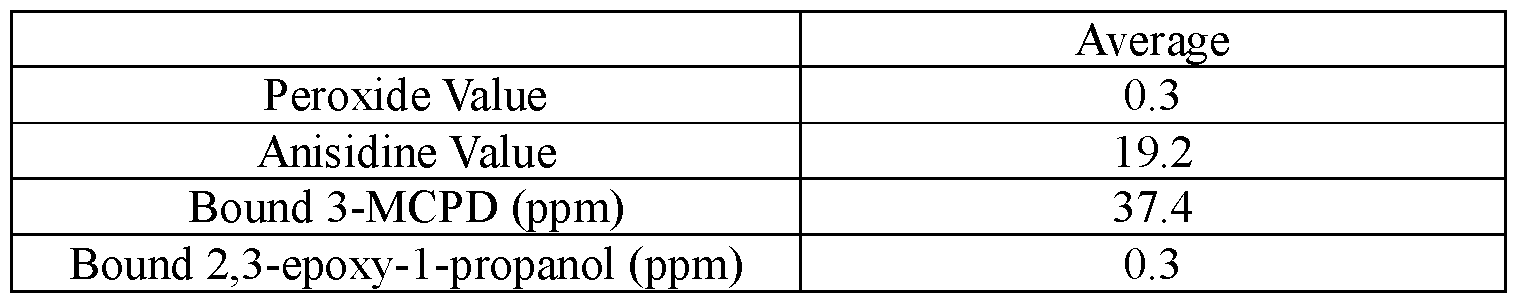
- Example 2 is subjected to a refining, bleaching, winterization and deodorization process as in Comparative Example 2 except for the following changes: 1) during the bleaching step, a silica was used and an activated carbon was added instead of the bleaching agents used in Comparative Example 2; and 2) during the deodorization process, the oil was subjected to a temperature of 180°C rather than a temperature of 205°C-210°C as used in the deodorization process of Comparative Example 2 and the rate of steam was 4.4 wt.% (as compared to 2.2 wt.% in Comparative Example 2). 4 lots of oil were tested and the peroxide value, anisidine value, and the amounts for bound 3-MCPD and bound 2,3-epoxy-l-propanol are found in Table 7.
- Example 2 is subjected to a refining, bleaching, winterization and deodorization process as in Comparative Example 2 except for the following changes: 1) during the bleaching step, a silica (Trisyl ® Silica) was used and an activated carbon (Nuchar SA20) was added instead of the bleaching agents used in Comparative Example 2; and 2) during the deodorization process, the oil was subjected to a temperature of 180°C rather than a temperature of 205°C- 210°C as used in the deodorization process of Comparative Example 2 and the rate of steam was 4.4 wt.% (as compared to 2.2 wt.% in Comparative Example 2). 3 lots of oil were tested and the peroxide value, anisidine value, and the amounts for bound 3-MCPD and bound 2,3- epoxy-l-propanol are found in Table 8.
- Example 2 is subjected to a refining, bleaching, winterization and deodorization process as in Comparative Example 2 except for a silica (Trisyl ® Silica) was used and an activated carbon (Nuchar SA20) was added instead of the bleaching agents used in Comparative Example 2.
- the oil was subjected to a temperature of 180°C during the deodorization process rather than a temperature of 205°-210°C as used in the deodorization process of Comparative Example 2 and the rate of steam was 4.4 wt.% (as compared to 2.2 wt.% in Comparative Example 2). 2 lots of oil were tested and the amounts of bound 2- MCPD, bound 3-MCPD and bound 2,3-epoxy-l-propanol are found in Table 9.
- the oils were subjected to an RBWD process wherein a silica and an activated carbon were added to each sample during the bleaching process and the samples were deodorized at 170-190°C at a steam rate of 4.4 wt.% with a residence time of less than 2 minutes.
- the marine oils included tuna and anchovy and the microbial oils included an oil produced through fermentation of Schizochytrium sp. (Algal Sample 1) and an oil produced through fermentation of Crypthecodinium cohnii (Algal Sample 2).
- the amounts for bound 3- MCPD and bound 2,3-epoxy-l -propanol, and the anisidine values and peroxides value are found in Table 10.
- Table 3 is representative fatty acid profile for sample
- Table 2 is representative fatty acid profile for sample
- the oils were subjected to an RBWD process wherein a silica and an activated carbon were added to each sample during the bleaching process and the samples were deodorized at 170- 190°C at a steam rate of 4.4 wt.% with a residence time of less than 2 minutes.
- Different microbial oils were subjected to an RBWD process as well as a fish oil and a vegetable oil (high oleic sunflower oil).
- the microbial oils included oils produced through fermentation of Schizochytrium sp. (Algal Samples 1-2), an oil produced through fermentation of Crypthecodinium cohnii (Algal Sample 3), and an oil produced through fermentation of Mortierella alpina (Algal Sample 4).
- the amounts for bound 3-MCPD, bound 2-MCPD and bound 2,3-epoxy-l-propanol are found in Table 11.
- Table 2 is representative fatty acid profile of sample
- Table 1 is representative fatty acid profile of sample [0058] All references, including publications, patent applications, and patents, cited herein are hereby incorporated by reference to the same extent as if each reference were individually and specifically indicated to be incorporated by reference and were set forth in its entirety herein.
Landscapes
- Life Sciences & Earth Sciences (AREA)
- Chemical & Material Sciences (AREA)
- Engineering & Computer Science (AREA)
- Polymers & Plastics (AREA)
- Oil, Petroleum & Natural Gas (AREA)
- Food Science & Technology (AREA)
- Health & Medical Sciences (AREA)
- Wood Science & Technology (AREA)
- Microbiology (AREA)
- Chemical Kinetics & Catalysis (AREA)
- Organic Chemistry (AREA)
- Nutrition Science (AREA)
- Mycology (AREA)
- Birds (AREA)
- Public Health (AREA)
- Veterinary Medicine (AREA)
- Animal Behavior & Ethology (AREA)
- General Health & Medical Sciences (AREA)
- Mechanical Engineering (AREA)
- Animal Husbandry (AREA)
- Zoology (AREA)
- Epidemiology (AREA)
- Pediatric Medicine (AREA)
- Biophysics (AREA)
- Insects & Arthropods (AREA)
- Marine Sciences & Fisheries (AREA)
- Dermatology (AREA)
- Emergency Medicine (AREA)
- Fats And Perfumes (AREA)
- Preparation Of Compounds By Using Micro-Organisms (AREA)
- Dairy Products (AREA)
- Lubricants (AREA)
- Edible Oils And Fats (AREA)
- Medicines Containing Material From Animals Or Micro-Organisms (AREA)
- Coloring Foods And Improving Nutritive Qualities (AREA)
Abstract
Description




Claims
Priority Applications (17)
| Application Number | Priority Date | Filing Date | Title |
|---|---|---|---|
| MX2018002297A MX390089B (en) | 2015-08-25 | 2016-08-25 | COMPOSITIONS OF REFINED OIL AND METHODS FOR ITS PREPARATION. |
| US15/754,337 US11672258B2 (en) | 2015-08-25 | 2016-08-25 | Refined oil compositions and methods for making |
| RU2018110375A RU2747879C2 (en) | 2015-08-25 | 2016-08-25 | Refined oil compositions and their manufacturing methods |
| NZ740209A NZ740209B2 (en) | 2016-08-25 | Refined oil compositions and methods for making | |
| EP25182422.3A EP4595778A3 (en) | 2015-08-25 | 2016-08-25 | Refined oil compositions and methods for making |
| BR112018003578A BR112018003578A2 (en) | 2015-08-25 | 2016-08-25 | refined oil compositions and methods for making |
| AU2016310503A AU2016310503A1 (en) | 2015-08-25 | 2016-08-25 | Refined oil compositions and methods for making |
| CN201680062079.8A CN108138079A (en) | 2015-08-25 | 2016-08-25 | Refined oil composition and method for making |
| ES16840160T ES3061034T3 (en) | 2015-08-25 | 2016-08-25 | Refined oil compositions and methods for making |
| MYPI2018700705A MY204082A (en) | 2015-08-25 | 2016-08-25 | Refined oil compositions and methods for making |
| HK19100059.7A HK1257691A1 (en) | 2015-08-25 | 2016-08-25 | Refined oil compositions and methods for making |
| EP16840160.2A EP3341457B1 (en) | 2015-08-25 | 2016-08-25 | Refined oil compositions and methods for making |
| KR1020187007488A KR102716618B1 (en) | 2015-08-25 | 2016-08-25 | Refined oil composition and method for producing it |
| CA2996526A CA2996526A1 (en) | 2015-08-25 | 2016-08-25 | Refined oil compositions and methods for making |
| PH12018500410A PH12018500410A1 (en) | 2015-08-25 | 2018-02-23 | Refined oil compositions and methods for making |
| AU2021201384A AU2021201384B2 (en) | 2015-08-25 | 2021-03-03 | Refined oil compositions and methods for making |
| US18/311,375 US20230270129A1 (en) | 2015-08-25 | 2023-05-03 | Refined oil compositions and methods for making |
Applications Claiming Priority (2)
| Application Number | Priority Date | Filing Date | Title |
|---|---|---|---|
| US201562209505P | 2015-08-25 | 2015-08-25 | |
| US62/209,505 | 2015-08-25 |
Related Child Applications (2)
| Application Number | Title | Priority Date | Filing Date |
|---|---|---|---|
| US15/754,337 A-371-Of-International US11672258B2 (en) | 2015-08-25 | 2016-08-25 | Refined oil compositions and methods for making |
| US18/311,375 Continuation US20230270129A1 (en) | 2015-08-25 | 2023-05-03 | Refined oil compositions and methods for making |
Publications (1)
| Publication Number | Publication Date |
|---|---|
| WO2017035403A1 true WO2017035403A1 (en) | 2017-03-02 |
Family
ID=58100851
Family Applications (1)
| Application Number | Title | Priority Date | Filing Date |
|---|---|---|---|
| PCT/US2016/048781 Ceased WO2017035403A1 (en) | 2015-08-25 | 2016-08-25 | Refined oil compositions and methods for making |
Country Status (15)
| Country | Link |
|---|---|
| US (2) | US11672258B2 (en) |
| EP (2) | EP3341457B1 (en) |
| KR (1) | KR102716618B1 (en) |
| CN (1) | CN108138079A (en) |
| AU (2) | AU2016310503A1 (en) |
| BR (1) | BR112018003578A2 (en) |
| CA (1) | CA2996526A1 (en) |
| ES (1) | ES3061034T3 (en) |
| HK (1) | HK1257691A1 (en) |
| MX (1) | MX390089B (en) |
| MY (1) | MY204082A (en) |
| PH (1) | PH12018500410A1 (en) |
| RU (1) | RU2747879C2 (en) |
| SG (1) | SG10202001800WA (en) |
| WO (1) | WO2017035403A1 (en) |
Cited By (8)
| Publication number | Priority date | Publication date | Assignee | Title |
|---|---|---|---|---|
| CN108410566A (en) * | 2017-11-20 | 2018-08-17 | 杭州创屹机电科技有限公司 | A kind of camellia oil production method of low trans fatty acid content |
| WO2019060282A1 (en) * | 2017-09-19 | 2019-03-28 | Cargill, Incorporated | Infant food product |
| WO2020046152A1 (en) * | 2018-08-27 | 2020-03-05 | Komagra Spólka Z O.O. | The method of production of refined edible oil with low content of undesirable 3-mpcd, 2-mpcd and glycides |
| WO2021260087A1 (en) | 2020-06-24 | 2021-12-30 | Fermentalg | Method for culturing microorganisms for lipid accumulation |
| US11236286B2 (en) * | 2018-03-14 | 2022-02-01 | Societe Des Produits Nestle S.A. | Mechanical purification of triacylglyceride oils |
| US20220049182A1 (en) * | 2018-12-14 | 2022-02-17 | Dsm Ip Assets B.V. | Polyunsaturated fatty acid containing food ingredient with enhanced palatabilty and method for manufacturing the same |
| US11760956B2 (en) * | 2018-12-19 | 2023-09-19 | Societe Des Produits Nestle S.A. | Prevention of MCPDE formation in triacylglyceride oils |
| EP3749101B1 (en) * | 2018-02-07 | 2024-08-21 | Cargill, Incorporated | Liquid oils without unwanted contaminants |
Families Citing this family (4)
| Publication number | Priority date | Publication date | Assignee | Title |
|---|---|---|---|---|
| CN109181843B (en) * | 2018-08-20 | 2020-08-11 | 梁云 | Device and method for on-line heating separation of microbial oil and microbial oil |
| EP3666082B1 (en) | 2018-12-12 | 2022-05-04 | Nippon Suisan Kaisha, Ltd. | A composition containing highly unsaturated fatty acid or alkyl ester thereof and a method for producing the same |
| CN120265739A (en) * | 2022-12-02 | 2025-07-04 | 伏尔甘光电私人有限公司 | System and process for removing toxic chemicals from vegetable oils |
| CN118993879B (en) * | 2024-10-25 | 2025-02-14 | 寿光金远东变性淀粉有限公司 | A method for extracting and refining DHA from marine microalgae fermentation liquid |
Citations (6)
| Publication number | Priority date | Publication date | Assignee | Title |
|---|---|---|---|---|
| EP0999259A1 (en) | 1998-11-04 | 2000-05-10 | F. Hoffmann-La Roche Ag | Preparation of food-grade edible oils |
| US20110098356A1 (en) * | 2007-06-29 | 2011-04-28 | Martek Biosciences Corporation | Production and Purification of Esters of Polyunsaturated Fatty Acids |
| WO2012165397A1 (en) | 2011-06-01 | 2012-12-06 | 昭和産業株式会社 | Method for producing palm oil comprising step of removing free chlorine |
| US8461363B2 (en) | 2007-05-11 | 2013-06-11 | Dsm Ip Assets B.V. | Deodorization and stabilization of marine oils |
| US20130323394A1 (en) * | 2011-02-10 | 2013-12-05 | Cargill, Incorporated | Oil compositions |
| WO2015020236A1 (en) | 2013-08-09 | 2015-02-12 | Kao Corporation | Fat or oil composition |
Family Cites Families (33)
| Publication number | Priority date | Publication date | Assignee | Title |
|---|---|---|---|---|
| US2197339A (en) | 1936-12-16 | 1940-04-16 | Best Foods Inc | Preparation of fatty acid esters of polyhydroxy alcohols |
| US2415140A (en) | 1942-01-19 | 1947-02-04 | Edward S Liebscher | Triglyceride refining process |
| DE2449847B2 (en) | 1974-10-19 | 1978-12-21 | Deutsche Gold- Und Silber-Scheideanstalt Vormals Roessler, 6000 Frankfurt | Process for the production of very pure carboxylic acid 1-monoglycerides |
| JPS5175708A (en) * | 1974-12-27 | 1976-06-30 | Nisshin Oil Mills Ltd | NANSHITSUPAAMUYUNOSEIZOHO |
| DE3643848A1 (en) | 1986-12-22 | 1988-09-01 | Natec Inst Naturwiss | Process for the production of highly refined edible glyceride oils with a proportion of unsaturated fatty acids in the triglyceride combination and their use |
| US5102987A (en) | 1988-10-14 | 1992-04-07 | Nestec S.A. | Preparation of hydrolyzed protein having reduced α-chlorohydrin content |
| KR100343664B1 (en) * | 1993-12-20 | 2002-11-27 | 산에이겐 에후.에후. 아이. 가부시키가이샤 | Stable Emulsified Composition and Food Containing it |
| FR2779447A1 (en) | 1998-06-04 | 1999-12-10 | Angevine Biotech | Production of plant protein hydrolysates with low content of chlorinated propanediols and propanols, useful as flavorings in human and animal foods |
| US7098352B2 (en) | 2001-11-16 | 2006-08-29 | Virtus Nutrition Llc | Calcium salt saponification of polyunsaturated oils |
| EP1354934A1 (en) | 2002-04-12 | 2003-10-22 | Loders Croklaan B.V. | Process for the production of conjugated linoleic acid (CLA) triglycerides |
| EA013051B1 (en) * | 2002-06-19 | 2010-02-26 | ДСМ Ай Пи ЭССЕТС Б.В. | Microbial oil, composition containing thereof and process for the production thereof |
| EP2255667A1 (en) * | 2002-06-19 | 2010-12-01 | DSM IP Assets B.V. | Pasteurisation process for microbial cells and microbial oil |
| CZ294890B6 (en) | 2003-09-01 | 2005-04-13 | Spolek Pro Chemickou A Hutní Výrobu,A.S. | Process for preparing dichloropropanols from glycerin |
| WO2006052664A2 (en) | 2004-11-04 | 2006-05-18 | Monsanto Technology Llc | Processes for preparation of oil compositions |
| EA200800225A1 (en) * | 2005-07-01 | 2008-06-30 | Мартек Байосайенсиз Корпорейшн | CONTAINING POLYUNSATURATED FATTY ACIDS, OIL PRODUCT AND ITS APPLICATIONS AND OBTAINING |
| US20100303957A1 (en) * | 2008-10-14 | 2010-12-02 | Solazyme, Inc. | Edible Oil and Processes for Its Production from Microalgae |
| DE102008060059A1 (en) | 2008-12-02 | 2010-06-10 | Süd-Chemie AG | Method for reducing the 3-MCPD content in refined vegetable oils |
| US8548107B1 (en) * | 2009-01-26 | 2013-10-01 | Comtech Mobile Datacom Corporation | Advanced multi-user detector |
| WO2010126136A1 (en) | 2009-04-30 | 2010-11-04 | 不二製油株式会社 | Method for inhibiting production of chloropropanols and chloropropanol-forming substances in glyceride oils and fats |
| DK2449070T3 (en) * | 2009-06-30 | 2013-07-29 | Sime Darby Malaysia Berhad | Process for removing unwanted propanol components from unused triglyceride oil |
| WO2011054801A1 (en) * | 2009-11-03 | 2011-05-12 | Dsm Ip Assets B.V. | Vegatable oil comprising a polyunsaturaded fatty acid having at least 20 carbon atoms |
| RU2012125197A (en) | 2009-12-04 | 2014-01-10 | Арчер Дэниелс Мидлэнд Компани | REDUCTION OF GLYCIDE ETHERS IN OIL |
| RU2437549C1 (en) * | 2010-03-29 | 2011-12-27 | Государственное образовательное учреждение высшего профессионального образования "Хабаровская государственная академия экономики и права" | Method for production of vegetable oil-mixtures |
| JP2011213852A (en) * | 2010-03-31 | 2011-10-27 | Kao Corp | Oil and fat composition |
| RU2575928C2 (en) * | 2010-09-03 | 2016-02-27 | СТЕПАН СПЕШИАЛТИ ПРОДАКТС, ЭлЭлСи | Removal of halogenorganic and oxirane compounds from flows of carboxylic acid esters |
| CZ303281B6 (en) | 2010-10-27 | 2012-07-11 | Vysoká škola chemicko-technologická v Praze | Method for preventing formation of monochloropropanediol acyl derivatives during high-temperature treatment of oils and fats |
| JP6008596B2 (en) * | 2011-06-15 | 2016-10-19 | 花王株式会社 | Method for producing refined fats and oils |
| PH12014500980A1 (en) * | 2011-11-09 | 2019-06-26 | Evonik Membrane Extraction Tech Ltd | Membrane-based processes for reducing at least one impurity and making a concentrate comprising at least one natural component from a non-marine fatty acid oil mixture , and compositions resulting thereof |
| WO2013163112A1 (en) * | 2012-04-27 | 2013-10-31 | Archer Daniels Midland Company | Improved fractionation processes |
| WO2014012548A1 (en) * | 2012-07-18 | 2014-01-23 | Aarhuskarlshamn Ab | Reduction of mcpd-compounds in refined plant oil for food |
| CN103908946B (en) | 2013-01-07 | 2018-04-06 | 丰益(上海)生物技术研发中心有限公司 | A kind of mixed adsorbent, grease and preparation method thereof |
| WO2015057139A1 (en) * | 2013-10-14 | 2015-04-23 | Aak Ab | Mitigation of 2-mcpd, 3-mcpd, esters therof and glycidyl esters in vegetable oil |
| JP6219147B2 (en) * | 2013-12-02 | 2017-10-25 | 花王株式会社 | Method for producing refined fish oil |
-
2016
- 2016-08-25 MX MX2018002297A patent/MX390089B/en unknown
- 2016-08-25 CN CN201680062079.8A patent/CN108138079A/en active Pending
- 2016-08-25 AU AU2016310503A patent/AU2016310503A1/en not_active Abandoned
- 2016-08-25 KR KR1020187007488A patent/KR102716618B1/en active Active
- 2016-08-25 US US15/754,337 patent/US11672258B2/en active Active
- 2016-08-25 SG SG10202001800WA patent/SG10202001800WA/en unknown
- 2016-08-25 WO PCT/US2016/048781 patent/WO2017035403A1/en not_active Ceased
- 2016-08-25 ES ES16840160T patent/ES3061034T3/en active Active
- 2016-08-25 HK HK19100059.7A patent/HK1257691A1/en unknown
- 2016-08-25 EP EP16840160.2A patent/EP3341457B1/en active Active
- 2016-08-25 MY MYPI2018700705A patent/MY204082A/en unknown
- 2016-08-25 CA CA2996526A patent/CA2996526A1/en active Pending
- 2016-08-25 EP EP25182422.3A patent/EP4595778A3/en active Pending
- 2016-08-25 RU RU2018110375A patent/RU2747879C2/en active
- 2016-08-25 BR BR112018003578A patent/BR112018003578A2/en not_active Application Discontinuation
-
2018
- 2018-02-23 PH PH12018500410A patent/PH12018500410A1/en unknown
-
2021
- 2021-03-03 AU AU2021201384A patent/AU2021201384B2/en active Active
-
2023
- 2023-05-03 US US18/311,375 patent/US20230270129A1/en active Pending
Patent Citations (7)
| Publication number | Priority date | Publication date | Assignee | Title |
|---|---|---|---|---|
| EP0999259A1 (en) | 1998-11-04 | 2000-05-10 | F. Hoffmann-La Roche Ag | Preparation of food-grade edible oils |
| US8461363B2 (en) | 2007-05-11 | 2013-06-11 | Dsm Ip Assets B.V. | Deodorization and stabilization of marine oils |
| US20110098356A1 (en) * | 2007-06-29 | 2011-04-28 | Martek Biosciences Corporation | Production and Purification of Esters of Polyunsaturated Fatty Acids |
| US20130323394A1 (en) * | 2011-02-10 | 2013-12-05 | Cargill, Incorporated | Oil compositions |
| WO2012165397A1 (en) | 2011-06-01 | 2012-12-06 | 昭和産業株式会社 | Method for producing palm oil comprising step of removing free chlorine |
| EP2716746A1 (en) | 2011-06-01 | 2014-04-09 | Showa Sangyo Co., Ltd. | Method for producing palm oil comprising step of removing free chlorine |
| WO2015020236A1 (en) | 2013-08-09 | 2015-02-12 | Kao Corporation | Fat or oil composition |
Non-Patent Citations (8)
Cited By (14)
| Publication number | Priority date | Publication date | Assignee | Title |
|---|---|---|---|---|
| CN111107755A (en) * | 2017-09-19 | 2020-05-05 | 嘉吉公司 | baby food products |
| WO2019060282A1 (en) * | 2017-09-19 | 2019-03-28 | Cargill, Incorporated | Infant food product |
| CN108410566A (en) * | 2017-11-20 | 2018-08-17 | 杭州创屹机电科技有限公司 | A kind of camellia oil production method of low trans fatty acid content |
| EP3749101B1 (en) * | 2018-02-07 | 2024-08-21 | Cargill, Incorporated | Liquid oils without unwanted contaminants |
| US12152218B2 (en) | 2018-02-07 | 2024-11-26 | Cargill, Incorporated | Liquid oils without unwanted contaminants |
| EP4438703A3 (en) * | 2018-02-07 | 2024-12-11 | Cargill, Incorporated | Use of liquid oils without unwanted contaminants |
| US11236286B2 (en) * | 2018-03-14 | 2022-02-01 | Societe Des Produits Nestle S.A. | Mechanical purification of triacylglyceride oils |
| WO2020046152A1 (en) * | 2018-08-27 | 2020-03-05 | Komagra Spólka Z O.O. | The method of production of refined edible oil with low content of undesirable 3-mpcd, 2-mpcd and glycides |
| US20220049182A1 (en) * | 2018-12-14 | 2022-02-17 | Dsm Ip Assets B.V. | Polyunsaturated fatty acid containing food ingredient with enhanced palatabilty and method for manufacturing the same |
| US12325838B2 (en) * | 2018-12-14 | 2025-06-10 | Dsm Ip Assets B.V. | Polyunsaturated fatty acid containing food ingredient with enhanced palatability and method for manufacturing the same |
| KR102943980B1 (en) | 2018-12-14 | 2026-03-26 | 디에스엠 아이피 어셋츠 비.브이. | Food ingredient containing polyunsaturated fatty acids having enhanced palatability, and method for preparing the same |
| US11760956B2 (en) * | 2018-12-19 | 2023-09-19 | Societe Des Produits Nestle S.A. | Prevention of MCPDE formation in triacylglyceride oils |
| WO2021260087A1 (en) | 2020-06-24 | 2021-12-30 | Fermentalg | Method for culturing microorganisms for lipid accumulation |
| FR3111912A1 (en) | 2020-06-24 | 2021-12-31 | Fermentalg | MICROORGANISM CULTURE PROCESS FOR LIPID ACCUMULATION |
Also Published As
| Publication number | Publication date |
|---|---|
| MX390089B (en) | 2025-03-20 |
| EP4595778A3 (en) | 2025-10-22 |
| CN108138079A (en) | 2018-06-08 |
| RU2018110375A3 (en) | 2020-02-21 |
| MX2018002297A (en) | 2018-06-06 |
| KR102716618B1 (en) | 2024-10-14 |
| PH12018500410A1 (en) | 2018-08-29 |
| BR112018003578A2 (en) | 2018-09-25 |
| RU2018110375A (en) | 2019-09-26 |
| US20180242609A1 (en) | 2018-08-30 |
| HK1257691A1 (en) | 2019-10-25 |
| EP3341457B1 (en) | 2025-11-05 |
| EP4595778A2 (en) | 2025-08-06 |
| RU2747879C2 (en) | 2021-05-17 |
| AU2021201384B2 (en) | 2023-04-27 |
| CA2996526A1 (en) | 2017-03-02 |
| US20230270129A1 (en) | 2023-08-31 |
| US11672258B2 (en) | 2023-06-13 |
| NZ740209A (en) | 2024-11-29 |
| MY204082A (en) | 2024-08-06 |
| AU2016310503A1 (en) | 2018-03-22 |
| KR20180048715A (en) | 2018-05-10 |
| AU2021201384A1 (en) | 2021-03-18 |
| EP3341457A4 (en) | 2019-05-01 |
| ES3061034T3 (en) | 2026-03-31 |
| EP3341457A1 (en) | 2018-07-04 |
| SG10202001800WA (en) | 2020-04-29 |
Similar Documents
| Publication | Publication Date | Title |
|---|---|---|
| AU2021201384B2 (en) | Refined oil compositions and methods for making | |
| US20260035636A1 (en) | Method for enhancing the efficiency of oil extraction process | |
| CA2698311C (en) | Polyunsaturated fatty acid-containing solid fat compositions and uses and production thereof | |
| EP2630869A1 (en) | Polyunsaturated fatty acid-containing oil product and uses and production thereof | |
| EP2430926A2 (en) | Use of DPA(n-6) oils in infant formula | |
| WO2019185888A1 (en) | Novel use of tocopherols | |
| JP7498236B2 (en) | Packaged edible oil and its manufacturing method | |
| JP7242769B2 (en) | Free polyunsaturated fatty acid-containing composition and method for producing the same | |
| WO2019185942A1 (en) | Use of tocotrienols as antioxidants | |
| WO2019185889A1 (en) | Novel use of carnosic acid | |
| JP7043213B2 (en) | How to reduce the odor of vegetable oil | |
| WO2026023089A1 (en) | Tablet-form gel food | |
| NZ740209B2 (en) | Refined oil compositions and methods for making | |
| AU2015200426A1 (en) | Polyunsaturated fatty acid-containing solid fat compositions and uses and production thereof |
Legal Events
| Date | Code | Title | Description |
|---|---|---|---|
| 121 | Ep: the epo has been informed by wipo that ep was designated in this application |
Ref document number: 16840160 Country of ref document: EP Kind code of ref document: A1 |
|
| WWE | Wipo information: entry into national phase |
Ref document number: 11201801461Y Country of ref document: SG |
|
| ENP | Entry into the national phase |
Ref document number: 2996526 Country of ref document: CA |
|
| WWE | Wipo information: entry into national phase |
Ref document number: MX/A/2018/002297 Country of ref document: MX Ref document number: 12018500410 Country of ref document: PH |
|
| NENP | Non-entry into the national phase |
Ref country code: DE |
|
| ENP | Entry into the national phase |
Ref document number: 20187007488 Country of ref document: KR Kind code of ref document: A |
|
| ENP | Entry into the national phase |
Ref document number: 2016310503 Country of ref document: AU Date of ref document: 20160825 Kind code of ref document: A |
|
| WWE | Wipo information: entry into national phase |
Ref document number: 2018110375 Country of ref document: RU Ref document number: 2016840160 Country of ref document: EP |
|
| REG | Reference to national code |
Ref country code: BR Ref legal event code: B01A Ref document number: 112018003578 Country of ref document: BR |
|
| ENP | Entry into the national phase |
Ref document number: 112018003578 Country of ref document: BR Kind code of ref document: A2 Effective date: 20180223 |
|
| WWG | Wipo information: grant in national office |
Ref document number: 740209 Country of ref document: NZ |
|
| WWG | Wipo information: grant in national office |
Ref document number: 2016840160 Country of ref document: EP |