WO2017038502A1 - ポリエステル樹脂、ポリエステル樹脂の製造方法、樹脂組成物、樹脂付布帛及び樹脂付布帛の製造方法 - Google Patents
ポリエステル樹脂、ポリエステル樹脂の製造方法、樹脂組成物、樹脂付布帛及び樹脂付布帛の製造方法 Download PDFInfo
- Publication number
- WO2017038502A1 WO2017038502A1 PCT/JP2016/074228 JP2016074228W WO2017038502A1 WO 2017038502 A1 WO2017038502 A1 WO 2017038502A1 JP 2016074228 W JP2016074228 W JP 2016074228W WO 2017038502 A1 WO2017038502 A1 WO 2017038502A1
- Authority
- WO
- WIPO (PCT)
- Prior art keywords
- residue
- mol
- polyester resin
- glycol
- acid
- Prior art date
- Legal status (The legal status is an assumption and is not a legal conclusion. Google has not performed a legal analysis and makes no representation as to the accuracy of the status listed.)
- Ceased
Links
Images


Classifications
-
- D—TEXTILES; PAPER
- D06—TREATMENT OF TEXTILES OR THE LIKE; LAUNDERING; FLEXIBLE MATERIALS NOT OTHERWISE PROVIDED FOR
- D06M—TREATMENT, NOT PROVIDED FOR ELSEWHERE IN CLASS D06, OF FIBRES, THREADS, YARNS, FABRICS, FEATHERS OR FIBROUS GOODS MADE FROM SUCH MATERIALS
- D06M15/00—Treating fibres, threads, yarns, fabrics, or fibrous goods made from such materials, with macromolecular compounds; Such treatment combined with mechanical treatment
- D06M15/19—Treating fibres, threads, yarns, fabrics, or fibrous goods made from such materials, with macromolecular compounds; Such treatment combined with mechanical treatment with synthetic macromolecular compounds
- D06M15/37—Macromolecular compounds obtained otherwise than by reactions only involving carbon-to-carbon unsaturated bonds
- D06M15/507—Polyesters
-
- C—CHEMISTRY; METALLURGY
- C08—ORGANIC MACROMOLECULAR COMPOUNDS; THEIR PREPARATION OR CHEMICAL WORKING-UP; COMPOSITIONS BASED THEREON
- C08G—MACROMOLECULAR COMPOUNDS OBTAINED OTHERWISE THAN BY REACTIONS ONLY INVOLVING UNSATURATED CARBON-TO-CARBON BONDS
- C08G63/00—Macromolecular compounds obtained by reactions forming a carboxylic ester link in the main chain of the macromolecule
-
- C—CHEMISTRY; METALLURGY
- C08—ORGANIC MACROMOLECULAR COMPOUNDS; THEIR PREPARATION OR CHEMICAL WORKING-UP; COMPOSITIONS BASED THEREON
- C08G—MACROMOLECULAR COMPOUNDS OBTAINED OTHERWISE THAN BY REACTIONS ONLY INVOLVING UNSATURATED CARBON-TO-CARBON BONDS
- C08G63/00—Macromolecular compounds obtained by reactions forming a carboxylic ester link in the main chain of the macromolecule
- C08G63/02—Polyesters derived from hydroxycarboxylic acids or from polycarboxylic acids and polyhydroxy compounds
- C08G63/12—Polyesters derived from hydroxycarboxylic acids or from polycarboxylic acids and polyhydroxy compounds derived from polycarboxylic acids and polyhydroxy compounds
- C08G63/16—Dicarboxylic acids and dihydroxy compounds
- C08G63/18—Dicarboxylic acids and dihydroxy compounds the acids or hydroxy compounds containing carbocyclic rings
- C08G63/199—Acids or hydroxy compounds containing cycloaliphatic rings
-
- C—CHEMISTRY; METALLURGY
- C08—ORGANIC MACROMOLECULAR COMPOUNDS; THEIR PREPARATION OR CHEMICAL WORKING-UP; COMPOSITIONS BASED THEREON
- C08G—MACROMOLECULAR COMPOUNDS OBTAINED OTHERWISE THAN BY REACTIONS ONLY INVOLVING UNSATURATED CARBON-TO-CARBON BONDS
- C08G63/00—Macromolecular compounds obtained by reactions forming a carboxylic ester link in the main chain of the macromolecule
- C08G63/02—Polyesters derived from hydroxycarboxylic acids or from polycarboxylic acids and polyhydroxy compounds
- C08G63/12—Polyesters derived from hydroxycarboxylic acids or from polycarboxylic acids and polyhydroxy compounds derived from polycarboxylic acids and polyhydroxy compounds
- C08G63/52—Polycarboxylic acids or polyhydroxy compounds in which at least one of the two components contains aliphatic unsaturation
- C08G63/54—Polycarboxylic acids or polyhydroxy compounds in which at least one of the two components contains aliphatic unsaturation the acids or hydroxy compounds containing carbocyclic rings
- C08G63/553—Acids or hydroxy compounds containing cycloaliphatic rings, e.g. Diels-Alder adducts
-
- C—CHEMISTRY; METALLURGY
- C08—ORGANIC MACROMOLECULAR COMPOUNDS; THEIR PREPARATION OR CHEMICAL WORKING-UP; COMPOSITIONS BASED THEREON
- C08G—MACROMOLECULAR COMPOUNDS OBTAINED OTHERWISE THAN BY REACTIONS ONLY INVOLVING UNSATURATED CARBON-TO-CARBON BONDS
- C08G63/00—Macromolecular compounds obtained by reactions forming a carboxylic ester link in the main chain of the macromolecule
- C08G63/66—Polyesters containing oxygen in the form of ether groups
- C08G63/668—Polyesters containing oxygen in the form of ether groups derived from polycarboxylic acids and polyhydroxy compounds
- C08G63/672—Dicarboxylic acids and dihydroxy compounds
-
- C—CHEMISTRY; METALLURGY
- C08—ORGANIC MACROMOLECULAR COMPOUNDS; THEIR PREPARATION OR CHEMICAL WORKING-UP; COMPOSITIONS BASED THEREON
- C08L—COMPOSITIONS OF MACROMOLECULAR COMPOUNDS
- C08L67/00—Compositions of polyesters obtained by reactions forming a carboxylic ester link in the main chain; Compositions of derivatives of such polymers
- C08L67/02—Polyesters derived from dicarboxylic acids and dihydroxy compounds
-
- C—CHEMISTRY; METALLURGY
- C08—ORGANIC MACROMOLECULAR COMPOUNDS; THEIR PREPARATION OR CHEMICAL WORKING-UP; COMPOSITIONS BASED THEREON
- C08L—COMPOSITIONS OF MACROMOLECULAR COMPOUNDS
- C08L67/00—Compositions of polyesters obtained by reactions forming a carboxylic ester link in the main chain; Compositions of derivatives of such polymers
- C08L67/02—Polyesters derived from dicarboxylic acids and dihydroxy compounds
- C08L67/03—Polyesters derived from dicarboxylic acids and dihydroxy compounds the dicarboxylic acids and dihydroxy compounds having the carboxyl- and the hydroxy groups directly linked to aromatic rings
-
- C—CHEMISTRY; METALLURGY
- C08—ORGANIC MACROMOLECULAR COMPOUNDS; THEIR PREPARATION OR CHEMICAL WORKING-UP; COMPOSITIONS BASED THEREON
- C08G—MACROMOLECULAR COMPOUNDS OBTAINED OTHERWISE THAN BY REACTIONS ONLY INVOLVING UNSATURATED CARBON-TO-CARBON BONDS
- C08G63/00—Macromolecular compounds obtained by reactions forming a carboxylic ester link in the main chain of the macromolecule
- C08G63/02—Polyesters derived from hydroxycarboxylic acids or from polycarboxylic acids and polyhydroxy compounds
- C08G63/12—Polyesters derived from hydroxycarboxylic acids or from polycarboxylic acids and polyhydroxy compounds derived from polycarboxylic acids and polyhydroxy compounds
- C08G63/16—Dicarboxylic acids and dihydroxy compounds
- C08G63/18—Dicarboxylic acids and dihydroxy compounds the acids or hydroxy compounds containing carbocyclic rings
- C08G63/181—Acids containing aromatic rings
- C08G63/183—Terephthalic acids
-
- C—CHEMISTRY; METALLURGY
- C08—ORGANIC MACROMOLECULAR COMPOUNDS; THEIR PREPARATION OR CHEMICAL WORKING-UP; COMPOSITIONS BASED THEREON
- C08L—COMPOSITIONS OF MACROMOLECULAR COMPOUNDS
- C08L2203/00—Applications
- C08L2203/12—Applications used for fibers
-
- D—TEXTILES; PAPER
- D06—TREATMENT OF TEXTILES OR THE LIKE; LAUNDERING; FLEXIBLE MATERIALS NOT OTHERWISE PROVIDED FOR
- D06M—TREATMENT, NOT PROVIDED FOR ELSEWHERE IN CLASS D06, OF FIBRES, THREADS, YARNS, FABRICS, FEATHERS OR FIBROUS GOODS MADE FROM SUCH MATERIALS
- D06M2200/00—Functionality of the treatment composition and/or properties imparted to the textile material
- D06M2200/10—Repellency against liquids
- D06M2200/12—Hydrophobic properties
Definitions
- the present invention provides a polyester resin excellent in flexibility, transparency, solvent resistance, heat resistance and water resistance, which can be suitably used for forming a protective layer of a fabric, and a layer obtained using the polyester resin on the fabric.
- the present invention relates to a resin-coated fabric.
- polyester fabrics or nylon fabrics are often used.
- a solution of acrylic resin and urethane resin is coated on the cloth, and these resin layers are coated with the cloth. It is made to form on top.
- a resin solution of a urethane resin for obtaining a fabric excellent in waterproofness for example, an organopolysiloxane having one end with an isocyanate group and a non-reactive functional group and the other end with two primary hydroxyl groups
- a solution of a polyurethane resin obtained by copolymerizing an organic diisocyanate and a polyol having hydroxyl groups at both ends is disclosed.
- a solution of a polyurethane resin obtained by copolymerizing 000 1,4-butanediol adipate and 1,6-hexanediol is disclosed.
- the polyurethane resin layer is inferior in flexibility, and the resin-coated fabric having this resin layer has a problem that it is difficult to handle.
- the problem to be solved by the present invention is a polyester resin which is excellent in flexibility, transparency, solvent resistance, heat resistance and water resistance and can be suitably used for forming a protective layer of a fabric, a method for producing the polyester resin, and the It is to provide a composition comprising a polyester resin.
- the problem to be solved by the present invention is to provide a resin-coated fabric having a layer of the polyester resin and a method for producing the same.
- the present inventors have found that the main chain skeleton of the polyester resin has a terephthalic acid residue, an aliphatic dicarboxylic acid residue having 6 to 12 carbon atoms, and a dimer acid residue.
- the present inventors have found that it is excellent in transparency, solvent resistance, heat resistance and water resistance, can be suitably used as a resin used for obtaining a resin-coated fabric, and has completed the present invention.
- the present invention is a polyester resin containing a dicarboxylic acid residue and a glycol residue in the main chain skeleton, wherein the dicarboxylic acid residue is a terephthalic acid residue (a) and an aliphatic group having 6 to 12 carbon atoms.
- the present invention provides a polyester resin containing the residue (d) in a range of 30 to 60 mol% and the residue (e) in a range of 0.1 to 10 mol%.
- the present invention also relates to terephthalic acid (A), aliphatic dicarboxylic acid (B) having 6 to 12 carbon atoms, dimer acid or hydrogenated dimer acid (C), ethylene glycol or polyethylene glycol (D). And a branched aliphatic glycol (E) having 3 to 9 carbon atoms with respect to a total of 100 mol% of the above (A) to (E), 30 to 50 mol% of (A), 3 to 9 mol% of (B), 1 to 5 mol% of (C),
- the present invention provides a method for producing a polyester resin, characterized by reacting (D) in a range of 30 to 60 mol% and (E) in a range of 0.1 to 10 mol%.
- the present invention also provides a polyester resin composition comprising the polyester resin and a hydrolysis inhibitor.
- the present invention also provides a resin-coated fabric comprising a layer of the polyester resin or the polyester resin composition disposed on a fiber fabric.
- the present invention provides a resin-coated fabric, wherein the polyester resin or the polyester resin composition is applied onto a fiber fabric, and a layer of the polyester resin or the polyester resin composition is formed on the fiber fabric.
- a manufacturing method is provided.
- a polyester resin excellent in flexibility, transparency, solvent resistance, heat resistance and water resistance can be easily provided.
- the polyester resin of the present invention it is possible to provide a resin-attached fabric that can be suitably used to obtain articles used outdoors such as tents.
- FIG. 1 is a chart of 13 C-NMR spectrum of the polyester resin (1) obtained in Example 1.
- FIG. 2 is a GPC chart of the polyester resin (1) obtained in Example 1.
- FIG. 3 is a diagram of the state before the operation of the flexibility test apparatus used when the flexibility of the resin-coated fabric is evaluated in the examples.
- FIG. 4 is a diagram of a state in which the flexibility test apparatus used when evaluating the flexibility of the resin-coated fabric in the example is operated.
- the polyester resin of the present invention is a polyester resin containing a dicarboxylic acid residue and a glycol residue in the main chain skeleton, wherein the dicarboxylic acid residue is a terephthalic acid residue (a) and a fatty acid having 6 to 12 carbon atoms.
- Group dicarboxylic acid residue (b) and dimer acid residue or hydrogenated dimer acid residue (c) wherein the glycol residue is an ethylene glycol residue or a polyethylene glycol residue (d), A branched aliphatic glycol residue having 3 to 9 carbon atoms (e), wherein each of residues (a) to (e) is the sum of residues (a) to (e) It is characterized by including in the following range with respect to 100 mol%.
- dicarboxylic acid residue refers to a structure in which OH is removed from dicarboxylic acid.
- glycol residue refers to a structure in which the hydrogen atom H is removed from the glycol.
- the number of carbon atoms in the dicarboxylic acid is a number that does not include the carbon atom of the carbonyl group.
- the polyester resin of the present invention needs to contain 30 to 50 mol% of the residue (a) with respect to the total of 100 mol% of the residues (a) to (e). If the content is less than 30 mol%, it is not preferable because it is difficult to obtain a polyester resin excellent in heat resistance and solvent resistance. If the content is higher than 50 mol%, it is not preferable because it is difficult to obtain a polyester resin excellent in transparency and flexibility.
- the content of the residue (a) is more preferably 35 to 45 mol%.
- the polyester resin of the present invention needs to contain 3 to 9 mol% of the residue (b) with respect to 100 mol% in total of the residues (a) to (e).
- the content is less than 3 mol%, it is not preferable because it is difficult to obtain a polyester resin excellent in flexibility. If the content is larger than 9 mol%, it is not preferable because it is difficult to obtain a polyester resin excellent in heat resistance.
- the content of the residue (b) is more preferably 4 to 7 mol%.
- the polyester resin of the present invention needs to contain 1 to 5 mol% of residue (c) with respect to 100 mol% in total of residues (a) to (e). If the content is less than 1 mol%, it is not preferable because it is difficult to obtain a polyester resin excellent in flexibility. If the content is larger than 5 mol%, it is not preferable because it becomes difficult to obtain a polyester resin excellent in heat resistance and solvent resistance.
- the content of the residue (c) is more preferably 1 to 3 mol%.
- the polyester resin of the present invention needs to contain 30 to 60 mol% of the residue (d) with respect to 100 mol% in total of the residues (a) to (e). If the content is less than 30 mol%, it is not preferable because it is difficult to obtain a polyester resin excellent in heat resistance and solvent resistance. If the content is larger than 60 mol%, it is not preferable because it becomes difficult to obtain a polyester resin excellent in transparency and flexibility.
- the content of the residue (d) is more preferably 35 to 55 mol%.
- the polyester resin of the present invention needs to contain 0.1 to 10 mol% of the residue (e) with respect to 100 mol% in total of the residues (a) to (e).
- the content is less than 0.1 mol%, it is not preferable because it becomes difficult to obtain a polyester resin excellent in transparency and flexibility.
- the content is larger than 10 mol%, it is not preferable because it is difficult to obtain a polyester resin excellent in heat resistance, solvent resistance and water resistance.
- the content of the residue (e) is more preferably 1 to 8 mol%.
- Examples of the residue (b) possessed by the polyester resin of the present invention include suberic acid residue, azelaic acid residue, sebacic acid residue, 1,11-undecanedicarboxylic acid residue, 1,12- Examples include residues of dodecanedicarboxylic acid, residues of 1,14-tetradecanedicarboxylic acid, and the like.
- the polyester resin of the present invention may have one type of residue (b) or two or more types.
- polyester resins of the present invention an aliphatic dicarboxylic acid residue having 6 to 10 carbon atoms is preferable as the residue (b) for reasons of flexibility and water resistance, and an azelaic acid residue or sebacic acid residue is preferably used.
- the polyester resin containing is more preferable, and the polyester resin containing the residue of azelaic acid and the residue of sebacic acid is still more preferable.
- azelaic acid residues are contained in an amount of 1 to 5 mol% with respect to a total of 100 mol% of residues (a) to (e).
- a polyester resin containing 1 to 5 mol% of the residues of sebacic acid with respect to a total of 100 mol% of the residues (a) to (e), and the residue of azelaic acid to the residue (a) 2 to 4 mol% with respect to the total of 100 mol% of the residue (e), and the residues of sebacic acid are 1 to 100 mol% with respect to the total of 100 mol% of the residues (a) to (e).
- a polyester resin containing 3 mol% is more preferable.
- the residue (c) of the polyester resin of the present invention is a dimer acid residue or a hydrogenated dimer acid residue.
- a hydrogenated dimer acid residue is preferable as the residue (c) because it becomes a polyester resin having excellent heat resistance.
- the polyester resin of the present invention may have one type of residue (c) or two or more types.
- the dimer acid is a dimeric dicarboxylic acid obtained by polymerizing an unsaturated fatty acid.
- the dimer acid include polymers such as unsaturated fatty acids such as linoleic acid, oleic acid and linolenic acid, dry oil fatty acids or semi-dry oil fatty acids obtained from tall oil, cottonseed oil, soybean oil, etc .; 18 carbon atoms And a dicarboxylic acid having 36 carbon atoms obtained by polymerizing (thermally polymerizing) carboxylic acid.
- the dimer acid has preferably 24 to 48 carbon atoms, more preferably 28 to 44 carbon atoms, still more preferably 32 to 40 carbon atoms, and most preferably 36 carbon atoms. That is, among dimer acids, a dicarboxylic acid having 36 carbon atoms obtained by polymerizing the carboxylic acid having 18 carbon atoms is most preferable.
- the residue (d) of the polyester resin of the present invention is an ethylene glycol residue or a diethyl glycol residue.
- a polyester resin having both an ethylene glycol residue and a diethylene glycol residue is preferable because the polyester resin is excellent in heat resistance and solvent resistance.
- polyester resins having both ethylene glycol residues and diethylene glycol residues ethylene glycol residues are contained in an amount of 25 to 45 mol% with respect to a total of 100 mol% of residues (a) to (e), and diethylene glycol
- a polyester resin containing 5 to 20 mol% of residues with respect to a total of 100 mol% of residues (a) to (e) is preferred, and an ethylene glycol residue of residues (a) to (e) More preferred is a polyester resin containing 30 to 40 mol% with respect to 100 mol% in total and containing 7 to 13 mol% of diethylene glycol residues with respect to the total 100 mol% of residues (a) to (e). .
- Examples of the residue (e) possessed by the polyester resin of the present invention include neopentyl glycol residue, 1,2-propanediol residue, 1,2-butanediol residue, and 1,3-butanediol.
- a polyester resin containing a branched aliphatic glycol residue having 4 to 7 carbon atoms as the residue (e) is preferable for reasons of flexibility.
- the residue of neopentyl glycol and dipropylene glycol are preferable. The residue is more preferred.
- a polyester resin having both a neopentyl glycol residue and a dipropylene glycol residue is preferable.
- the neopentyl glycol residue is a total of 100 moles of the residues (a) to (e).
- a polyester resin having 2 mol% and containing a dipropylene glycol residue in a range of 3 to 7 mol% is more preferable.
- 1 to 5 mol% of azelaic acid residue is used as the residue (b) with respect to the total of 100 mol% of the residues (a) to (e).
- Polyester resin is preferable, and 35 to 45 mol% of the residue (a) with respect to a total of 100 mol% of the residues (a) to (e), and an azelaic acid residue as the residue (b) 2-4 mol% and sebacic acid residues 1-3 mol%, )
- the residue (d) as an ethylene glycol residue from 30 to 40 mol%, a polyethylene glycol residue as from 7 to 13 mol%
- the residue (e ) Is more preferably a polyester resin containing 0.5 to 2 mol% of neopentyl glycol residues and 3 to 7 mol% of dipropylene glycol residues.
- the polyester resin of the present invention is preferably a polyester resin having a number average molecular weight of 15,000 to 40,000 by gel permeation chromatography (GPC) method, for reasons of water resistance and solvent resistance, and 20,000 to 35,000.
- the polyester resin is more preferable.
- the number average molecular weight (Mn) and the weight average molecular weight (Mw) are values converted to polystyrene based on gel permeation chromatography (hereinafter abbreviated as “GPC”) measurement.
- GPC gel permeation chromatography
- the polyester resin of the present invention is preferably a polyester resin having a glass transition temperature (Tg) of 5 to 30 ° C., more preferably 10 to 25 ° C. for reasons of flexibility.
- Tg glass transition temperature
- the glass transition temperature (Tg) was measured according to the following conditions. [DSC measurement conditions] Measuring device: METTLER TOLEDO DSC822e Measurement temperature: -60 to 250 ° C Temperature increase rate 10 ° C / min Atmosphere: Nitrogen
- the polyester resin of the present invention contains carboxylic acid residues other than the residues (a), (b) and (c), and glycol residues other than the residues (d) and (e). You may contain in the range which does not impair the effect of this invention.
- Examples of the carboxylic acid residue other than the residue (a), the residue (b), and the residue (c) include an aromatic dicarboxylic acid residue, an aliphatic dicarboxylic acid residue, and the like other than the residue (a). Can be mentioned.
- aromatic dicarboxylic acid residues other than the residue (a) include isophthalic acid residues, orthophthalic acid residues, 2,6-naphthalenedicarboxylic acid residues, 1,5-naphthalenedicarboxylic acid residues, 5 -Sodium sulfoisophthalic acid residue, 5-lithium sulfoisophthalic acid residue, sodium sulfoterephthalic acid residue, 4,4'-diphenylmethane dicarboxylic acid residue, 4,4'-diphenyl ether dicarboxylic acid residue, 4,4 ' -Biphenyl dicarboxylic acid residue, 4,4'-stilbene dicarboxylic acid residue and the like.
- Examples of the aliphatic dicarboxylic acid residue include an aliphatic dicarboxylic acid residue having less than 6 carbon atoms and an aliphatic dicarboxylic acid residue having more than 12 carbon atoms.
- Examples of the aliphatic dicarboxylic acid residue having less than 6 carbon atoms include oxalic acid residue, malonic acid residue, succinic acid residue, glutaric acid residue, adipic acid residue, pimelic acid residue, carbon
- Examples of the aliphatic dicarboxylic acid residue having more than 12 atoms include 1,16-hexadecanedicarboxylic acid residue, 1,18-octadecanedicarboxylic acid residue, and the like.
- the polyester resin of the present invention may contain glycol residues other than the residue (d) and the residue (e) as long as the effects of the present invention are not impaired.
- glycols other than the residue (d) include aliphatic diol residues having 3 to 9 carbon atoms. Specific examples include 1,3-propylene glycol residues and 1,4-butane. Diol residues, 1,5-pentanediol residues, 1,6-hexanediol residues, 1,7-heptanediol residues, 1,8-octanediol residues, 1,9-nonanediol residues, etc. Examples include linear aliphatic diol residues.
- the polyester resin of this invention may contain the residue of dimer diol in the range which does not impair the effect of this invention.
- Dimer diol is a glycol obtained by polymerizing an unsaturated fatty acid and hydrogenating a dimer component generally called dimer acid.
- Dimer diol is obtained as a mixture of geometric isomers of dimer diol having a branched structure and a cyclohexane ring.
- dimer acid used as a raw material for the dimer diol examples include heavy fatty acids such as unsaturated fatty acids such as linoleic acid, oleic acid and linolenic acid, and dry oil fatty acids or semi-dry oil fatty acids obtained from tall oil, cottonseed oil and soybean oil.
- heavy fatty acids such as unsaturated fatty acids such as linoleic acid, oleic acid and linolenic acid
- dry oil fatty acids or semi-dry oil fatty acids obtained from tall oil, cottonseed oil and soybean oil examples thereof include 36-carbon dicarboxylic acids obtained by polymerizing (thermal polymerization) carboxylic acids having 18 carbon atoms.
- the number of carbon atoms in the dimer diol is preferably 24 to 48, more preferably 28 to 44, and still more preferably 32 to 40.
- dimer diol examples include aliphatic didiols at both ends obtained by hydrogenating dimer acid, which is a dimer of unsaturated fatty acids (CAS number 256664-32-2-7, CAS number 157961-21-6), or Z And both end aliphatic diols (CAS No. 7313-30-6) obtained by dimerization of 9-octadecen-1-ol.
- the manufacturing method of dimer diol is not limited to these.
- dimer diol examples include, for example, trade name Pripol 2033 (manufactured by Croda), trade name KX-501 (manufactured by Arakawa Chemical Industries), trade name Sovermol 650NS (manufactured by BASF), and Sovermol 918 (manufactured by BASF). ) And the like.
- the polyester resin of the present invention includes, for example, terephthalic acid (A), an aliphatic dicarboxylic acid (B) having 6 to 12 carbon atoms, dimer acid or hydrogenated dimer acid (C), ethylene glycol or polyethylene glycol. (D) and the branched aliphatic glycol (E) having 3 to 9 carbon atoms with respect to a total of 100 mol% of the above (A) to (E), 30 to 50 mol% of (A), 3 to 9 mol% of (B), 1 to 5 mol% of (C), It can be easily obtained by reacting (D) in a range of 30 to 60 mol% and (E) in a range of 0.1 to 10 mol%. Accordingly, the polyester resin of the present invention is a condensate using (A) to (E) as a raw material at a specific mol%.
- the amount of the terephthalic acid (A) used is in the range of 35 to 45 mol% with respect to the total of 100 mol% of the above (A) to (E), and the polyester resin excellent in heat resistance and solvent resistance is used. Since it is obtained, it is preferable.
- the amount of the aliphatic dicarboxylic acid (B) having 6 to 12 carbon atoms used is 4 to 7 mol% with respect to the total of 100 mol% of the above (A) to (E). It is preferable because a polyester resin excellent in properties can be obtained.
- the amount of dimer acid or hydrogenated dimer acid (C) used is in the range of 1 to 3 mol% with respect to the total of 100 mol% of (A) to (E). This is preferable.
- the amount of ethylene glycol or polyethylene glycol (D) used is in the range of 35 to 55 mol% with respect to the total of 100 mol% of (A) to (E). Heat resistance, solvent resistance and transparency It is preferable because a polyester resin excellent in flexibility can be obtained.
- the amount of the branched aliphatic glycol (E) having 3 to 9 carbon atoms used is in the range of 1 to 8 mol% with respect to the total of 100 mol% of the above (A) to (E). This is preferable because a polyester resin excellent in solvent resistance, transparency and flexibility can be obtained.
- Examples of the aliphatic dicarboxylic acid (B) having 6 to 12 carbon atoms include suberic acid, azelaic acid, sebacic acid, 1,10-decanedicarboxylic acid, 1,11-undecanedicarboxylic acid, and 1,12-dodecane. Examples thereof include dicarboxylic acid and 1,14-tetradecanedicarboxylic acid.
- As the aliphatic dicarboxylic acid (B) having 6 to 12 carbon atoms one kind may be used, or two or more kinds may be used in combination.
- aliphatic dicarboxylic acids (B) having 6 to 12 carbon atoms a polyester resin having excellent flexibility and heat resistance can be obtained, so that a branched aliphatic dicarboxylic acid having 4 to 7 carbon atoms is used as the residue (b). Acid is preferred, and azelaic acid or sebacic acid is more preferred. And when manufacturing the polyester resin of this invention, the polyester resin obtained by using together azelaic acid and sebacic acid is preferable from the polyester resin which is further excellent in a softness
- azelaic acid is used in an amount of 1 to 5 mol% with respect to the total of 100 mol% of (A) to (E), and sebacic acid is used in the above (A) to It is preferable to use 1 to 5 mol% with respect to the total of 100 mol% of (E), azelaic acid is used with 2 to 4 mol% with respect to the total of 100 mol% of (A) to (E), and It is more preferable to use 1 to 3 mol% of sebacic acid with respect to 100 mol% of the total of (A) to (E).
- the polyester resin of the present invention may have one type of residue (c) or two or more types.
- the polyester resin obtained by using ethylene glycol and diethylene glycol in combination as ethylene glycol or polyethylene glycol (D) can provide a polyester resin excellent in heat resistance and solvent resistance.
- ethylene glycol and diethylene glycol are used in combination, ethylene glycol is used in an amount of 25 to 45 mol% with respect to the total of 100 mol% of (A) to (E), and diethylene glycol is used in the above (A) to (E).
- ethylene glycol is used with 30 to 40 mol% with respect to the total 100 mol% of (A) to (E), and diethylene glycol is It is more preferable to use 7 to 13 mol% with respect to 100 mol% in total of (A) to (E).
- Examples of the branched aliphatic glycol (E) having 3 to 9 carbon atoms include neopentyl glycol, 1,2-propanediol, 1,3-butanediol, 2-methyl-1,3-propanediol, Examples include 3-methyl-1,5-pentanediol, 2-ethyl-2-butyl-1,3-propanediol, and dipropylene glycol.
- branched aliphatic glycols having 5 to 6 carbon atoms are preferable because a polyester resin having good flexibility is obtained, and neopentyl glycol and dipropylene glycol are more preferable.
- the polyester resin of the present invention is, for example, 30 to 50 mol% of (A) and 3 to 9 mol% of (B) with respect to the total of 100 mol% of (A) to (E).
- (C) was charged to 1 to 5 mol%, (D) to 30 to 60 mol%, and (E) to 0.1 to 10 mol% in a range of 180 to 260 ° C. in a nitrogen atmosphere. It can be prepared by a method of dehydration condensation at the reaction temperature. The reaction time at this time is usually 20 to 30 hours.
- a batch-type production apparatus such as a reaction container equipped with a nitrogen inlet, a thermometer, a stirring device, a rectifying tower, etc.
- an extruder equipped with a deaeration port or a continuous
- a reactor of the type, a kneader or the like can also be used.
- the esterification reaction can be promoted by reducing the pressure of the reaction system as necessary.
- various catalysts can also be added to accelerate the esterification reaction.
- the catalyst examples include antimony oxide, barium oxide, zinc acetate, manganese acetate, cobalt acetate, zinc oxalate, zinc borate, cadmium formate, lead monoxide, calcium silicate, dibutyltin oxide, butylhydroxytin oxide, tetra
- examples include isopropyl titanate, tetrabutyl titanate, magnesium methoxide, sodium methoxide and the like.
- the polyester resin composition of the present invention is characterized by containing the polyester resin of the present invention and a hydrolysis inhibitor.
- the hydrolysis inhibitor include carbodiimide compounds.
- carbodiimide compound examples include bis (dipropylphenyl) carbodiimide, poly (4,4′-diphenylmethanecarbodiimide), poly (p-phenylenecarbodiimide), poly (m-phenylenecarbodiimide), poly (tolylcarbodiimide), and poly (tolylcarbodiimide).
- a carbodiimide compound may be used independently and may use 2 or more types together.
- the blending amount of the hydrolysis inhibitor is usually 0.1 to 2.0 parts by mass with respect to 100 parts by mass of the polyester resin.
- polyester resin composition of the present invention Various additions such as pigments, lubricants, ultraviolet absorbers, antioxidants, plasticizers, penetrants, water repellents, emulsifiers, thickeners, etc., to the polyester resin composition of the present invention within the range not impairing the effects of the present invention
- An agent can be blended.
- the cloth with resin of the present invention is characterized in that a layer of the polyester resin or polyester resin composition of the present invention is disposed on a fiber cloth.
- the resin-coated cloth of the present invention can be easily manufactured by, for example, applying the polyester resin or the polyester resin composition onto a fiber cloth and forming a layer of the polyester resin or the polyester resin composition on the fiber cloth. Can do.
- the fiber fabric examples include a fabric made of synthetic fibers such as nylon, polyester, polyurethane, polyamide, rayon, and acrylic; a fabric made of natural fibers such as cotton, wool, hemp, silk; and the synthetic fibers and / or natural fibers.
- the fiber fabric include a blended or woven fabric.
- the viscosity of the polyester resin or the polyester resin is lowered by heating to the extent that it can be applied.
- the heating temperature is usually 180 to 220 ° C.
- coating the polyester resin and polyester resin composition of this invention can use a various method. Specifically, for example, a spray coating method, a bar coater coating method, a brush coating, and the like can be exemplified.
- the coating amount of the polyester resin or the polyester resin composition is within a range in which the thickness of the dried polyester resin or polyester resin composition layer is 10 to 1000 ⁇ m.
- a cured resin layer is usually obtained by cooling.
- the cooling may be natural cooling at normal temperature, or may be forcedly cooled by leaving a fabric coated with the polyester resin or polyester resin composition on a fiber fabric in a low temperature environment.
- a part of the resin may be impregnated in the fiber fabric.
- Example 1 Polymer resin
- terephthalic acid In a 1 liter four-necked flask equipped with a stirrer, a rectifying column, a thermometer, and a nitrogen introduction tube, 418 g (2.52 mol) of terephthalic acid, 63.6 g (0.32 mol) of sebacic acid, 70. 6 g (0.13 mol “Pripol 1009 manufactured by Croda Japan Co., Ltd.
- the number average molecular weight of the polyester resin (1) was 20,600, and Tg was 15 ° C.
- the polyester resin (1) is shown in FIG. FIG. 2 shows a chart of 13 C-NMR spectrum, and FIG. 2 shows a chart of GPC of the polyester resin (1).
- the terephthalic acid residue (a), the aliphatic dicarboxylic acid residue (b) having 6 to 12 carbon atoms, the dimer acid residue or the hydrogenated dimer acid was prepared from the above raw material for producing the polyester resin (1).
- Table 1 shows the amounts (mol%) of the residues (a), (b), (c), (d) and (e) in the polyester resin (1).
- Example 2 (same as above) In a 1 liter four-necked flask equipped with a stirrer, rectifying column, thermometer, and nitrogen inlet tube, 418 g (2.52 mol) terephthalic acid, 35.5 g (0.19 mol) azelaic acid, and 25.5 g sebacic acid ( 0.13 mol), hydrogenated dimer acid 70.6 g (0.13 mol “Colda Japan Co., Ltd. Pripol 1009.
- Example 3 (same as above) In a 1 liter four-necked flask equipped with a stirrer, rectifying column, thermometer, and nitrogen inlet tube, 418 g (2.52 mol) terephthalic acid, 35.5 g (0.19 mol) azelaic acid, and 25.5 g sebacic acid ( 0.13 mol), hydrogenated dimer acid 70.6 g (0.13 mol “Colda Japan Co., Ltd. Prepol 1009.
- Example 4 (same as above) In a 1-liter four-necked flask equipped with a stirrer, rectifying column, thermometer, and nitrogen inlet tube, 418 g (2.52 mol) terephthalic acid, 10.5 g (0.06 mol) isophthalic acid, 50.9 g sebacic acid ( 0.25 mol), hydrogenated dimer acid 70.6 g (0.13 mol “Prepol 1009 made by Croda Japan Ltd.
- Example 5 (same as above) In a 1 liter four-necked flask equipped with a stirrer, rectifying column, thermometer, and nitrogen inlet tube, 418 g (2.52 mol) terephthalic acid, 35.5 g (0.19 mol) azelaic acid, and 25.5 g sebacic acid ( 0.13 mol), hydrogenated dimer acid 70.6 g (0.13 mol “Colda Japan Co., Ltd. Pripol 1009.
- TPA terephthalic acid
- IPA isophthalic acid
- AzeA azelaic acid SA: sebacic acid
- H-DA hydrogenated dimer acid
- EG ethylene glycol
- DEG diethylene glycol
- NPG neopentyl glycol
- DPG dipropylene glycol
- 3MPD 3- Methyl-1,5-pentanediol
- Example 6 Polyethylene resin composition and fabric with resin 100 parts of polyester resin (1) and 1 part of hydrolysis inhibitor (manufactured by Nisshinbo Chemical Co., Ltd .: product name Carbodilite LA-1) were attached to a T-die (manufactured by Toyo Seiki Co., Ltd., width 30 mm, gap 0.01 mm). It injected
- threw-in to the raw material inlet (hopper) of the single screw extruder (L / D 25) with a screw outer diameter of 40 mm.
- the polyester resin (1) and the hydrolysis inhibitor are mixed by rotating the screw under the condition that the temperature of the T die is 200 to 220 ° C., and the polyester resin composition of the present invention.
- the polyester resin composition is extruded from a T-die and applied to a polyester woven fabric for clothing to a thickness of 0.1 mm, and then the resin composition is cooled to attach the resin composition of the present invention. A fabric was obtained.
- FIG. 3 shows a state of the flexibility test apparatus before operation.
- FIG. 4 shows a diagram of the state in which the flexibility testing device is activated.
- a loop 1a is formed near the center so that the resin-coated surface of the resin-coated fabric 1 cut to a width of 30 mm and a length of 120 mm or more is on the outer side, and an overlapping portion 1b is formed at both ends.
- the length of the loop portion 1a is 80 mm, and the length of the overlapping portion 1b is 20 mm or more.
- the overlapping portion 1b is preferably stopped with a tape or the like. As shown in FIG.
- the flexibility test apparatus used for the flexibility test is attached to the moving member 3 that moves up and down, the load cell 4 that is attached to the moving member 3 and converts a load into an electrical signal, and the load cell 4.
- the pressurizer 5 pressurizes the loop portion 1a of the resin-attached fabric, and the clamp 2 fixes the overlapping portion 1b of the resin-applied fabric 1.
- the clamp 2 supports the fabric 1 with resin in a state where the loop portion 1a protrudes upward and the overlapping portion 1b is sandwiched. In this state, the moving member 3 moves downward. When the moving member 3 moves downward, the load cell 4 and the pressurizer 5 also move downward. And as shown in FIG. 4, the pressurizer 5 presses the loop part 1a.
- the tester examines the maximum load (unit: Newton N) within the moving range of the load cell 4 after the moving member 3 moves downward to a predetermined position. The test is performed five times on the sample, and the average value of each is obtained. In this test, the smaller the maximum load (N), the more the resin-attached fabric is.
- a release paper with a resin was obtained using a release paper instead of the polyester woven fabric for clothing in order to evaluate the transparency of the polyester resin of the present invention.
- a resin layer sample was manufactured by peeling the resin layer from the release paper with resin. This resin layer sample was measured according to “JIS K 7105 Plastic Optical Properties Test Method” using a haze meter NDH-2000 manufactured by Nippon Denshoku Industries Co., Ltd. Transparency was evaluated. The evaluation results are shown in Table 2.
- Examples 6 to 10 A polyester resin composition and a resin-coated fabric were obtained in the same manner as in Example 7 except that the polyester resin shown in Table 2 was used. The same evaluation as in Example 7 was performed, and the results are shown in Table 2.
- Comparative Example 1 Comparative polyester resin
- terephthalic acid In a 1-liter four-necked flask equipped with a stirrer, rectifying column, thermometer, and nitrogen introduction tube, 261 g (1.58 mol) of terephthalic acid, 184 g (1.26 mol) of adipic acid, 70.6 g of hydrogenated dimer acid ( 0.13 mol “Colda Japan Co., Ltd. Pripol 1009.
- the polyester resin (1 ′) had a number average molecular weight of 21,000 and Tg of 6 ° C.
- the amount of residue (a), residue (b), residue (c), residue (d) and residue (e) with respect to 100 mol% in total of the residues (a) to (e) (Mole%) is shown in Table 3.
- Comparative Example 2 (same as above) In a 1-liter four-necked flask equipped with a stirrer, a rectifying column, a thermometer, and a nitrogen inlet tube, 314 g (1.89 mol) terephthalic acid, 191 g (0.95 mol) sebacic acid, 70.6 g hydrogenated dimer acid ( 0.13 mol “Colda Japan Co., Ltd. Pripol 1009.
- the polyester resin (2 ′) had a number average molecular weight of 20,000 and Tg of 4 ° C.
- the amount of residue (a), residue (b), residue (c), residue (d) and residue (e) with respect to 100 mol% in total of the residues (a) to (e) (Mole%) is shown in Table 3.
- Comparative Example 3 (same as above) In a 1-liter four-necked flask equipped with a stirrer, a rectifying column, a thermometer, and a nitrogen inlet tube, 418 g (2.52 mol) of terephthalic acid, 13 g (0.06 mol) of sebacic acid, and 212 g of hydrogenated dimer acid (0. 38 mol) “Colda Japan Co., Ltd. Pripol 1009. Number of carbon atoms 36”, ethylene glycol 145 g (2.33 mol), diethylene glycol 100 g (0.95 mol), neopentyl glycol 6.55 g (0.06 mol), tetra as the catalyst 0.04 g of isopropyl titanate was charged.
- Comparative Example 4 (same as above) In a 1 liter four-necked flask equipped with a stirrer, rectifying column, thermometer, and nitrogen introduction tube, 314 g (1.89 mol) terephthalic acid, 36 g (0.19 mol) azelaic acid, 25 g (0.13 mol) sebacic acid Hydrogenated dimer acid 71 g (0.13 mol) “Pripol 1009 made by Croda Japan Co., Ltd.
- the number average molecular weight of the polyester resin (4 ′) was 10,500, and the Tg was 40 ° C.
- the amount (mol%) of residue (e) is shown in Table 3.
- Comparative Example 5 (same as above) In a 1 liter four-necked flask equipped with a stirrer, rectifying column, thermometer, and nitrogen inlet tube, 418 g (2.52 mol) terephthalic acid, 24 g (0.13 mol) azelaic acid, 38 g (0.19 mol) sebacic acid Hydrogenated dimer acid 71 g (0.13 mol) “Pripol 1009 made by Croda Japan Co., Ltd.
- the number average molecular weight of the polyester resin (5 ′) was 25,500, and the Tg was 7 ° C.
- Residue (a), residue (b), residue (c), residue (d) and residue (a) to a total of 100 mol% of the residues (a) to (e) in the polyester resin (5 ′) The amount (mol%) of residue (e) is shown in Table 3.
- TPA terephthalic acid AzeA: azelaic acid SA: sebacic acid AA: adipic acid H-DA: hydrogenated dimer acid EG: ethylene glycol DEG: diethylene glycol NPG: neopentyl glycol
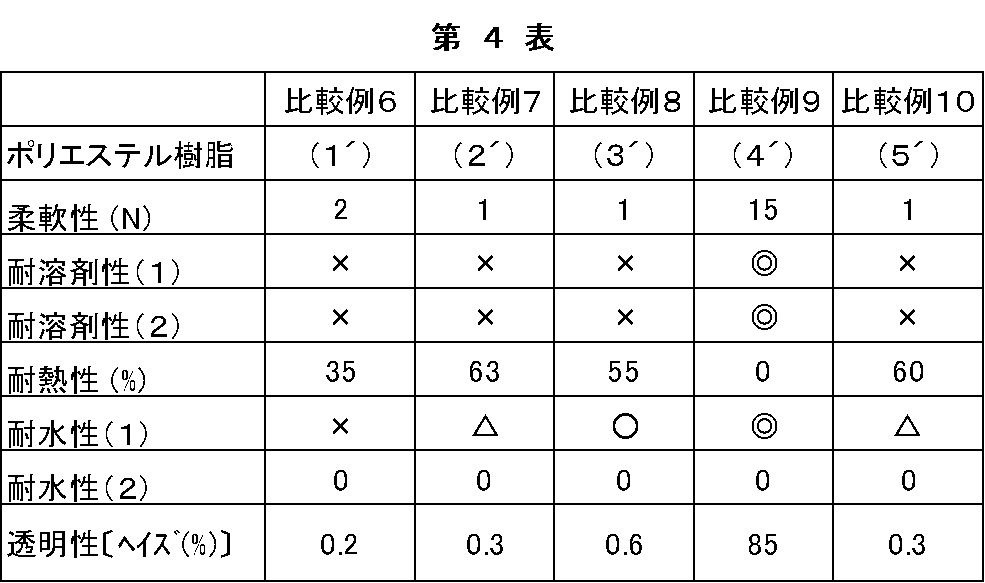
- Comparative Examples 6-10 A polyester resin composition for comparison and a fabric with resin for comparison were obtained in the same manner as in Example 7 except that the polyester resin shown in Table 3 was used. The same evaluation as in Example 7 was performed, and the results are shown in Table 4.
Landscapes
- Chemical & Material Sciences (AREA)
- Chemical Kinetics & Catalysis (AREA)
- Health & Medical Sciences (AREA)
- Medicinal Chemistry (AREA)
- Polymers & Plastics (AREA)
- Organic Chemistry (AREA)
- Engineering & Computer Science (AREA)
- Textile Engineering (AREA)
- Polyesters Or Polycarbonates (AREA)
- Compositions Of Macromolecular Compounds (AREA)
- Treatments For Attaching Organic Compounds To Fibrous Goods (AREA)
Abstract
Description
前記残基(a)~残基(e)の合計100モル%に対して、
残基(a)を30~50モル%、
残基(b)を3~9モル%、
残基(c)を1~5モル%、
残基(d)を30~60モル%及び
残基(e)を0.1~10モル%となる範囲で含有することを特徴とするポリエステル樹脂を提供するものである。
(A)を30~50モル%、
(B)を3~9モル%、
(C)を1~5モル%、
(D)を30~60モル%及び
(E)を0.1~10モル%となる範囲で反応させることを特徴とするポリエステル樹脂の製造方法を提供するものである。
残基(b):3~9モル%
残基(c):1~5モル%
残基(d):30~60モル%
残基(e):0.1~10モル%
測定装置:東ソー株式会社製「HLC-8220 GPC」
カラム:東ソー株式会社製ガードカラム「HHR-H」(6.0mmI.D.×4cm)+東ソー株式会社製「TSK-GEL GMHHR-N」(7.8mmI.D.×30cm)+東ソー株式会社製「TSK-GEL GMHHR-N」(7.8mmI.D.×30cm)+東ソー株式会社製「TSK-GEL GMHHR-N」(7.8mmI.D.×30cm)+東ソー株式会社製「TSK-GEL GMHHR-N」(7.8mmI.D.×30cm)
検出器:ELSD(オルテックジャパン株式会社製「ELSD2000」)
データ処理:東ソー株式会社製「GPC-8020モデルIIデータ解析バージョン4.30」
測定条件:カラム温度 40℃
展開溶媒 テトラヒドロフラン(THF)
流速 1.0ml/分
試料:樹脂固形分換算で1.0質量%のテトラヒドロフラン溶液をマイクロフィルターでろ過したもの(5μl)。
標準試料:前記「GPC-8020モデルIIデータ解析バージョン4.30」の測定マニュアルに準拠して、分子量が既知の下記の単分散ポリスチレンを用いた。
東ソー株式会社製「A-500」
東ソー株式会社製「A-1000」
東ソー株式会社製「A-2500」
東ソー株式会社製「A-5000」
東ソー株式会社製「F-1」
東ソー株式会社製「F-2」
東ソー株式会社製「F-4」
東ソー株式会社製「F-10」
東ソー株式会社製「F-20」
東ソー株式会社製「F-40」
東ソー株式会社製「F-80」
東ソー株式会社製「F-128」
東ソー株式会社製「F-288」
東ソー株式会社製「F-550」
[DSC測定条件]
測定装置:METTLER TOLEDO DSC822e
測定温度:-60~250℃ 昇温速度 10℃/min
雰囲気:窒素
(A)を30~50モル%、
(B)を3~9モル%、
(C)を1~5モル%、
(D)を30~60モル%及び
(E)を0.1~10モル%となる範囲で反応させることにより容易に得ることができる。従って、本発明のポリエステル樹脂は、前記(A)~(E)を特定のモル%を原料とする縮合物である。
攪拌機、精留塔、温度計、窒素導入管を具備した1リットルの4つ口フラスコに、テレフタル酸418g(2.52mol)、セバシン酸63.6g(0.32mol)、水添ダイマー酸70.6g(0.13mol「クローダジャパン株式会社製のプリポール1009.炭素原子数36」、エチレングリコール145g(2.33mol)、ジエチレングリコール100g(0.95mol)、ネオペンチルグリコール6.55g(0.06mol)、触媒としてテトライソプロピルチタネート0.04gを仕込んだ。その後、240℃まで攪拌しながら徐々に昇温し、240℃で10時間エステル化反応を行った。その後、フラスコ内の圧力を133Pa(1torr)まで徐々に下げていき、133Pa到達後、フラスコ内の温度を240℃に12時間維持して本発明のポリエステル樹脂(1)を得た。ポリエステル樹脂(1)の数平均分子量は20,600、Tgは15℃であった。図1にポリエステル樹脂(1)の13C-NMRスペクトルのチャート図を、図2にポリエステル樹脂(1)のGPCのチャート図をそれぞれ示す。
攪拌機、精留塔、温度計、窒素導入管を具備した1リットルの4つ口フラスコに、テレフタル酸418g(2.52mol)、アゼライン酸35.5g(0.19mol)、セバシン酸25.5g(0.13mol)、水添ダイマー酸70.6g(0.13mol「クローダジャパン株式会社製のプリポール1009.炭素原子数36」、エチレングリコール145g(2.33mol)、ジエチレングリコール100g(0.95mol)、ネオペンチルグリコール6.55g(0.06mol)、触媒としてテトライソプロピルチタネート0.04gを仕込んだ。その後、240℃まで攪拌しながら徐々に昇温し、240℃で10時間エステル化反応を行った。その後、フラスコ内の圧力を133Pa(1torr)まで徐々に下げていき、133Pa到達後、フラスコ内の温度を240℃に12時間維持して本発明のポリエステル樹脂(1)を得た。ポリエステル樹脂(1)の数平均分子量は24,700、Tgは17℃であった。ポリエステル樹脂(2)中の前記残基(a)~残基(e)の合計100モル%に対する残基(a)、残基(b)、残基(c)、残基(d)及び残基(e)の量(モル%)を第1表に示す。
攪拌機、精留塔、温度計、窒素導入管を具備した1リットルの4つ口フラスコに、テレフタル酸418g(2.52mol)、アゼライン酸35.5g(0.19mol)、セバシン酸25.5g(0.13mol)、水添ダイマー酸70.6g(0.13mol「クローダジャパン株式会社製のプリポール1009.炭素原子数36」、エチレングリコール145g(2.33mol)、ジエチレングリコール60.1g(0.57mol)、ネオペンチルグリコール6.55g(0.06mol)、ジプロピレングリコール50.7g(0.38mol)、触媒としてテトライソプロピルチタネート0.04gを仕込んだ。その後、240℃まで攪拌しながら徐々に昇温し、240℃で10時間エステル化反応を行った。その後、フラスコ内の圧力を133Pa(1torr)まで徐々に下げていき、133Pa到達後、フラスコ内の温度を240℃に12時間維持して本発明のポリエステル樹脂(1)を得た。ポリエステル樹脂(1)の数平均分子量は23,300、Tgは18℃であった。ポリエステル樹脂(3)中の前記残基(a)~残基(e)の合計100モル%に対する残基(a)、残基(b)、残基(c)、残基(d)及び残基(e)の量(モル%)を第1表に示す。
攪拌機、精留塔、温度計、窒素導入管を具備した1リットルの4つ口フラスコに、テレフタル酸418g(2.52mol)、イソフタル酸10.5g(0.06mol)、セバシン酸50.9g(0.25mol)、水添ダイマー酸70.6g(0.13mol「クローダジャパン株式会社製のプリポール1009.炭素原子数36」、エチレングリコール145g(2.33mol)、ジエチレングリコール100g(0.95mol)、ネオペンチルグリコール6.55g(0.06mol)、触媒としてテトライソプロピルチタネート0.04gを仕込んだ。その後、240℃まで攪拌しながら徐々に昇温し、240℃で10時間エステル化反応を行った。その後、フラスコ内の圧力を133Pa(1torr)まで徐々に下げていき、133Pa到達後、フラスコ内の温度を240℃に12時間維持して本発明のポリエステル樹脂(1)を得た。ポリエステル樹脂(1)の数平均分子量は22,100、Tgは22℃であった。ポリエステル樹脂(4)中の前記残基(a)~残基(e)の合計100モル%に対する残基(a)、残基(b)、残基(c)、残基(d)及び残基(e)の量(モル%)を第1表に示す。
攪拌機、精留塔、温度計、窒素導入管を具備した1リットルの4つ口フラスコに、テレフタル酸418g(2.52mol)、アゼライン酸35.5g(0.19mol)、セバシン酸25.5g(0.13mol)、水添ダイマー酸70.6g(0.13mol「クローダジャパン株式会社製のプリポール1009.炭素原子数36」、エチレングリコール145g(2.33mol)、ジエチレングリコール73.5g(0.69mol)、ネオペンチルグリコール6.55g(0.06mol)、3-メチル-1,5-ペンタンジオール29.7g(0.25mol)、触媒としてテトライソプロピルチタネート0.04gを仕込んだ。その後、240℃まで攪拌しながら徐々に昇温し、240℃で10時間エステル化反応を行った。その後、フラスコ内の圧力を133Pa(1torr)まで徐々に下げていき、133Pa到達後、フラスコ内の温度を240℃に12時間維持して本発明のポリエステル樹脂(1)を得た。ポリエステル樹脂(1)の数平均分子量は28,300、Tgは15℃であった。ポリエステル樹脂(5)中の前記残基(a)~残基(e)の合計100モル%に対する残基(a)、残基(b)、残基(c)、残基(d)及び残基(e)の量(モル%)を第1表に示す。

TPA:テレフタル酸
IPA:イソフタル酸
AzeA:アゼライン酸
SA :セバシン酸
H-DA:水添ダイマー酸
EG :エチレングリコール
DEG :ジエチレングリコール
NPG :ネオペンチルグリコール
DPG :ジプロピレングリコール
3MPD:3-メチルー1,5-ペンタンジオール
ポリエステル樹脂(1)100部及び加水分解防止剤(日清紡ケミカル株式会社製:製品名 カルボジライト LA-1)1部を、Tダイ(東洋精機株式会社製、幅30mm、ギャップ0.01mm)を装着したスクリュー外径40mmの単軸押出機(L/D=25)の原料投入口(ホッパー)に投入した。当該単軸押出機において、Tダイの温度が200~220℃となる条件下スクリューを回転させることによりポリエステル樹脂(1)100部と加水分解防止剤とを混合し、本発明のポリエステル樹脂組成物を得ると共に、当該ポリエステル樹脂組成物をTダイから押し出し、これを衣料用ポリエステル織布上に厚さ0.1mmになるように塗工した後、樹脂組成物を冷却して本発明の樹脂付布帛を得た。
図3及び図4に示す柔軟性試験装置を用いて評価を行った。図3は柔軟性試験装置の作動前の状態の図を示す。図4は、柔軟性試験装置を作動した状態の図を示す。
幅30mm、長さ120mm以上に裁断した樹脂付布帛1の樹脂塗工面が外側になるように、中央付近でループ状に折り曲げ、ループ部1aを形成し、両端で重なり部1bを形成する。ループ部1aの長さは80mm、重なり部1bの長さは20mm以上とする。重なり部1bは、テープ等で止めると好ましい。
図3に示すように、柔軟性試験に用いる柔軟性試験装置は、上下に移動する移動部材3と、移動部材3に取り付けられ、荷重を電気信号に変換するロードセル4と、ロードセル4に取り付けられ、樹脂付布帛のループ部1aを加圧する加圧子5と、樹脂付布帛1の重なり部1bを固定するクランプ2とを有する。
クランプ2は、ループ部1aを上方に突出させ、重なり部1bを挟んだ状態で、樹脂付布帛1を支持する。この状態で、移動部材3は、下方へ移動する。移動部材3が下方へ移動すると、ロードセル4及び加圧子5も下方へ移動する。そして、図4に示すように、加圧子5は、ループ部1aを押圧する。試験者は、移動部材3が所定の位置まで下方へ移動した後、ロードセル4の移動範囲内での最大荷重(単位:ニュートンN)を調べる。サンプルに対して5回ずつの試験を行い、それぞれの平均値を求める。本試験において最大荷重(N)が小さい程、柔軟性に優れる樹脂付布帛である。
下記の2つの評価を行った。
耐溶剤性の評価(1)
樹脂付布帛をアセトンに浸漬し1分後に取り出した。常温で1時間乾燥し、樹脂層の状態を目視にて観察し、以下の基準に従って評価した。
◎=全く変化なし。
○=樹脂付布帛の反りは見られるが、樹脂層の白化や溶解など樹脂層の損傷は確認できない。
△=部分的な白化が見られる。
×=全面に白化、または樹脂層の溶解が見られる。
「JIS L 1092 繊維製品の防水性試験方法のドライクリーニング処理B法」に準じて試験を行った。洗濯装置に樹脂付布帛(500mm×500mm)と負荷布を入れ、30℃の工業ガソリン5号で10分間洗濯を行い、スクリーン乾燥後に、タンブル乾燥機を使用して、70℃で30分間乾燥させた。樹脂層の状態を目視にて観察し、以下の基準に従って評価した。
◎=全く変化なし。
○=樹脂層のひび又は剥離が2か所以下である。
△=樹脂層のひび又は剥離が3か所以上10か所以下である。
×=樹脂層がひび又は剥離が11か所以上である。
「JIS L 0850 ホットプレッシングに対する染色堅ろう度試験方法の乾熱試験機法(A-2法)」に準じて乾燥試験を行った。樹脂付布帛の樹脂層が試験台の綿布側になるように、樹脂付布帛を載せ、150℃に設定した加熱部を4kPaで15秒間重ねた。その後。樹脂付布帛の温度が30℃以下になるまで、常温で放置した。樹脂付布帛と綿布を剥離し、下記計算式に従って綿布に付着した樹脂層の面積の割合を求めた。この値が小さい程、耐熱性に優れている樹脂付布帛である。
綿布に付着した樹脂層の面積の割合(%)=(付着面積÷加圧接触面積)×100
下記の2つの評価を行った。
耐水性の評価(1)
本評価により樹脂付布帛の樹脂層が長期間に亘って水分に曝された際の加水分解への耐性(耐加水分解性)を評価した。具体的には、樹脂付布帛を70℃相対湿度90%の恒温恒湿槽内に入れ、1000時間の暴露試験を行った。試験後の樹脂付布帛上の樹脂層の変化を目視にて観察し、以下の基準に従って評価した。
◎=樹脂層に全く変化が確認できないか、または、白化した樹脂層が確認されるものの、その面積は全体の1%以下である。
○=白化した樹脂層が確認されるものの、その面積は全体の1%を超えて5%未満である。部分的な白化が見られる。
△=白化した樹脂層の面積は全体の5~100%である。部分的又は全体的に白化が見られる。
×=樹脂層が劣化し、剥がれが見られる。
本評価は所謂「防水性」に関する評価である。「JIS L 1092 繊維製品の防水性試験方法の雨試験(シャワー試験)A法」に準じて試験を行った。樹脂層が上になるように試験カップにセットし、シャワーを当て、漏水量を測定した。漏水量が少ない程防水性に優れる。
第2表に示すポリエステル樹脂を用いた以外は実施例7と同様にしてポリエステル樹脂組成物及び樹脂付布帛を得た。実施例7と同様の評価を行い、その結果を第2表に示す。

攪拌機、精留塔、温度計、窒素導入管を具備した1リットルの4つ口フラスコに、テレフタル酸261g(1.58mol)、アジピン酸184g(1.26mol)、水添ダイマー酸70.6g(0.13mol「クローダジャパン株式会社製のプリポール1009.炭素原子数36」、エチレングリコール145g(2.33mol)、ジエチレングリコール100g(0.95mol)、ネオペンチルグリコール6.55g(0.06mol)、触媒としてテトライソプロピルチタネート0.04gを仕込んだ。その後、240℃まで攪拌しながら徐々に昇温し、240℃で10時間エステル化反応を行った。その後、フラスコ内の圧力を133Pa(1torr)まで徐々に下げていき、133Pa到達後、フラスコ内の温度を240℃に12時間維持して比較対照用ポリエステル樹脂(1´)を得た。ポリエステル樹脂(1´)の数平均分子量は21,000、Tgは6℃であった。ポリエステル樹脂(1´)中の前記残基(a)~残基(e)の合計100モル%に対する残基(a)、残基(b)、残基(c)、残基(d)及び残基(e)の量(モル%)を第3表に示す。
攪拌機、精留塔、温度計、窒素導入管を具備した1リットルの4つ口フラスコに、テレフタル酸314g(1.89mol)、セバシン酸191g(0.95mol)、水添ダイマー酸70.6g(0.13mol「クローダジャパン株式会社製のプリポール1009.炭素原子数36」、エチレングリコール145g(2.33mol)、ジエチレングリコール100g(0.95mol)、ネオペンチルグリコール6.55g(0.06mol)、触媒としてテトライソプロピルチタネート0.04gを仕込んだ。その後、240℃まで攪拌しながら徐々に昇温し、240℃で10時間エステル化反応を行った。その後、フラスコ内の圧力を133Pa(1torr)まで徐々に下げていき、133Pa到達後、フラスコ内の温度を240℃に12時間維持して比較対照用ポリエステル樹脂(2´)を得た。ポリエステル樹脂(2´)の数平均分子量は20,000、Tgは4℃であった。ポリエステル樹脂(2´)中の前記残基(a)~残基(e)の合計100モル%に対する残基(a)、残基(b)、残基(c)、残基(d)及び残基(e)の量(モル%)を第3表に示す。
攪拌機、精留塔、温度計、窒素導入管を具備した1リットルの4つ口フラスコに、テレフタル酸418g(2.52mol)、セバシン酸13g(0.06mol)、水添ダイマー酸212g(0.38mol)「クローダジャパン株式会社製のプリポール1009.炭素原子数36」、エチレングリコール145g(2.33mol)、ジエチレングリコール100g(0.95mol)、ネオペンチルグリコール6.55g(0.06mol)、触媒としてテトライソプロピルチタネート0.04gを仕込んだ。その後、240℃まで攪拌しながら徐々に昇温し、240℃で10時間エステル化反応を行った。その後、フラスコ内の圧力を133Pa(1torr)まで徐々に下げていき、133Pa到達後、フラスコ内の温度を240℃に12時間維持して比較対照用ポリエステル樹脂(3´)を得た。ポリエステル樹脂(3´)の数平均分子量は17,800、Tgは1℃であった。ポリエステル樹脂(3´)中の前記残基(a)~残基(e)の合計100モル%に対する残基(a)、残基(b)、残基(c)、残基(d)及び残基(e)の量(モル%)を第3表に示す。
攪拌機、精留塔、温度計、窒素導入管を具備した1リットルの4つ口フラスコに、テレフタル酸314g(1.89mol)、アゼライン酸36g(0.19mol)、セバシン酸25g(0.13mol)、水添ダイマー酸71g(0.13mol)「クローダジャパン株式会社製のプリポール1009.炭素原子数36」、エチレングリコール184g(2.96mol)、ジエチレングリコール100g(0.95mol)、ネオペンチルグリコール6.55g(0.06mol)、触媒としてテトライソプロピルチタネート0.04gを仕込んだ。その後、240℃まで攪拌しながら徐々に昇温し、240℃で10時間エステル化反応を行った。その後、フラスコ内の圧力を133Pa(1torr)まで徐々に下げていき、133Pa到達後、フラスコ内の温度を240℃に12時間維持して比較対照用ポリエステル樹脂(4´)を得た。ポリエステル樹脂(4´)の数平均分子量は10,500、Tgは40℃であった。ポリエステル樹脂(4´)中の前記残基(a)~残基(e)の合計100モル%に対する残基(a)、残基(b)、残基(c)、残基(d)及び残基(e)の量(モル%)を第3表に示す。
攪拌機、精留塔、温度計、窒素導入管を具備した1リットルの4つ口フラスコに、テレフタル酸418g(2.52mol)、アゼライン酸24g(0.13mol)、セバシン酸38g(0.19mol)、水添ダイマー酸71g(0.13mol)「クローダジャパン株式会社製のプリポール1009.炭素原子数36」、エチレングリコール117g(1.89mol)、ジエチレングリコール67g(0.63mol)、ネオペンチルグリコール85g(0.82mol)、触媒としてテトライソプロピルチタネート0.04gを仕込んだ。その後、240℃まで攪拌しながら徐々に昇温し、240℃で10時間エステル化反応を行った。その後、フラスコ内の圧力を133Pa(1torr)まで徐々に下げていき、133Pa到達後、フラスコ内の温度を240℃に12時間維持して比較対照用ポリエステル樹脂(5´)を得た。ポリエステル樹脂(5´)の数平均分子量は25,500、Tgは7℃であった。ポリエステル樹脂(5´)中の前記残基(a)~残基(e)の合計100モル%に対する残基(a)、残基(b)、残基(c)、残基(d)及び残基(e)の量(モル%)を第3表に示す。

TPA:テレフタル酸
AzeA:アゼライン酸
SA :セバシン酸
AA :アジピン酸
H-DA:水添ダイマー酸
EG :エチレングリコール
DEG :ジエチレングリコール
NPG :ネオペンチルグリコール
第3表に示すポリエステル樹脂を用いた以外は実施例7と同様にして比較対照用ポリエステル樹脂組成物及び比較対照用樹脂付布帛を得た。実施例7と同様の評価を行い、その結果を第4表に示す。
1a:ループ部
1b:重なり部
2:クランプ
3:移動部材
4:ロードセル
5:加圧子
Claims (15)
- 主鎖骨格にジカルボン酸残基とグリコール残基とを含むポリエステル樹脂であり、前記ジカルボン酸残基がテレフタル酸残基(a)と、炭素原子数6~12の脂肪族ジカルボン酸残基(b)と、ダイマー酸残基または水添ダイマー酸残基(c)とを含むもので、前記グリコール残基がエチレングリコール残基またはジエチレグリコール残基(d)と、炭素原子数3~9の分岐状脂肪族グリコール残基(e)とを含むもので、
前記残基(a)~残基(e)の合計100モル%に対して、
残基(a)を30~50モル%、
残基(b)を3~9モル%、
残基(c)を1~5モル%、
残基(d)を30~60モル%及び
残基(e)を0.1~10モル%となる範囲で含有することを特徴とするポリエステル樹脂。 - 前記残基(a)~残基(e)の合計100モル%に対して、残基(d)としてエチレングリコール残基を25~45モル%と、ジエチレングリコール残基を5~20モル%含有する請求項1記載のポリエステル樹脂。
- 前記残基(b)が、アゼライン酸残基またはセバシン酸残基である請求項1記載のポリエステル樹脂。
- 前記残基(c)が、水添ダイマー酸残基である請求項1記載のポリエステル樹脂。
- 前記残基(e)が、ネオペンチルグリコール残基またはジプロピレングリコール残基である請求項1記載のポリエステル樹脂。
- 前記残基(e)が、ネオペンチルグリコール残基およびジプロピレングリコール残基であり、該ネオペンチルグリコール残基とジプロピレングリコール残基とを残基(a)~残基(e)の合計100モル%に対してそれぞれ0.1~3モル、3~9モルを含有する請求項5記載のポリエステル樹脂。
- 前記残基(a)~残基(e)の合計100モル%に対して、
前記残基(b)としてアゼライン酸残基を1~5モル%とセバシン酸残基1~5モル%、
前記残基(c)として水添ダイマー酸残基を1~5モル%、
前記残基(d)としてエチレングリコール残基を25~45モル%とジエチレグリコール残基を5~20モル%及び、
前記残基(e)としてネオペンチルグリコールを0.1~3モル%とジプロピレングリコール残基を3~9モル%となる範囲で含有する請求項1記載のポリエステル樹脂。 - 前記残基(a)~残基(e)の合計100モル%に対して、
前記残基(a)を35~45モル%、
前記残基(b)としてアゼライン酸残基を2~4モル%とセバシン酸残基1~3モル%、
前記残基(c)として水添ダイマー酸残基を1~3モル%、
前記残基(d)としてエチレングリコール残基を30~40モル%とジエチレグリコール残基を7~13モル%及び、
前記残基(e)としてネオペンチルグリコール残基を0.5~2モル%とジプロピレングリコール残基を3~7モル%となる範囲で含有する請求項1記載のポリエステル樹脂。 - ゲルパーミエーションクロマトグラフィー(GPC)法による数平均分子量が15,000~40,000である請求項1記載のポリエステル樹脂。
- ガラス転移温度(Tg)が5~30℃である請求項1記載のポリエステル樹脂。
- テレフタル酸(A)と、炭素原子数6~12の脂肪族ジカルボン酸(B)と、ダイマー酸又は水添ダイマー酸(C)と、エチレングリコールまたはジエチレグリコール(D)と、炭素原子数3~9の分岐状脂肪族グリコール(E)とを、前記(A)~(E)の合計100モル%に対して、
(A)を30~50モル%、
(B)を3~9モル%、
(C)を1~5モル%、
(D)を30~60モル%及び
(E)を0.1~10モル%となる範囲で反応させて得られる請求項1記載のポリエステル樹脂。 - テレフタル酸(A)と、炭素原子数6~12の脂肪族ジカルボン酸(B)と、ダイマー酸又は水添ダイマー酸(C)と、エチレングリコールまたはジエチレグリコール(D)と、炭素原子数3~9の分岐状脂肪族グリコール(E)とを、前記(A)~(E)の合計100モル%に対して、
(A)を30~50モル%、
(B)を3~9モル%、
(C)を1~5モル%、
(D)を30~60モル%及び
(E)を0.1~10モル%となる範囲で反応させることを特徴とするポリエステル樹脂の製造方法。 - 請求項1~11のいずれか1項記載のポリエステル樹脂と加水分解防止剤とを含有することを特徴とするポリエステル樹脂組成物。
- 請求項1~11のいずれか1項記載のポリエステル樹脂または請求項13記載のポリエステル樹脂組成物の層を繊維布帛上に配置してなることを特徴とする樹脂付布帛。
- 請求項1~11のいずれか1項記載のポリエステル樹脂または請求項13記載のポリエステル樹脂組成物を繊維布帛上に塗布し、該ポリエステル樹脂またはポリエステル樹脂組成物の層を繊維布帛上に形成することを特徴とする樹脂付布帛の製造方法。
Priority Applications (5)
| Application Number | Priority Date | Filing Date | Title |
|---|---|---|---|
| EP16841534.7A EP3327060B1 (en) | 2015-09-04 | 2016-08-19 | Polyester resin, method for producing polyester resin, resin composition, resin-clad fabric, and method for producing resin-clad fabric |
| JP2016571174A JP6128293B1 (ja) | 2015-09-04 | 2016-08-19 | ポリエステル樹脂、ポリエステル樹脂の製造方法、樹脂組成物、樹脂付布帛及び樹脂付布帛の製造方法 |
| CN201680050953.6A CN107922598B (zh) | 2015-09-04 | 2016-08-19 | 聚酯树脂、聚酯树脂的制造方法、树脂组合物、带树脂的布帛及带树脂的布帛的制造方法 |
| US15/756,302 US10465335B2 (en) | 2015-09-04 | 2016-08-19 | Polyester resin, method for producing polyester resin, resin composition, resin-clad fabric, and method for producing resin-clad fabric |
| MYPI2018700815A MY186443A (en) | 2015-09-04 | 2016-08-19 | Polyester resin, method for producing polyester resin, resin composition, resin-clad fabric, and method for producing resin-clad fabric |
Applications Claiming Priority (2)
| Application Number | Priority Date | Filing Date | Title |
|---|---|---|---|
| JP2015174810 | 2015-09-04 | ||
| JP2015-174810 | 2015-09-04 |
Publications (1)
| Publication Number | Publication Date |
|---|---|
| WO2017038502A1 true WO2017038502A1 (ja) | 2017-03-09 |
Family
ID=58187531
Family Applications (1)
| Application Number | Title | Priority Date | Filing Date |
|---|---|---|---|
| PCT/JP2016/074228 Ceased WO2017038502A1 (ja) | 2015-09-04 | 2016-08-19 | ポリエステル樹脂、ポリエステル樹脂の製造方法、樹脂組成物、樹脂付布帛及び樹脂付布帛の製造方法 |
Country Status (7)
| Country | Link |
|---|---|
| US (1) | US10465335B2 (ja) |
| EP (1) | EP3327060B1 (ja) |
| JP (1) | JP6128293B1 (ja) |
| CN (1) | CN107922598B (ja) |
| MY (1) | MY186443A (ja) |
| TW (1) | TWI696642B (ja) |
| WO (1) | WO2017038502A1 (ja) |
Cited By (4)
| Publication number | Priority date | Publication date | Assignee | Title |
|---|---|---|---|---|
| JP2019218453A (ja) * | 2018-06-19 | 2019-12-26 | Dicグラフィックス株式会社 | リキッドインキ組成物 |
| JP2020128055A (ja) * | 2019-02-12 | 2020-08-27 | 三菱ケミカル株式会社 | 離型フィルム |
| JP2022058132A (ja) * | 2020-09-30 | 2022-04-11 | 三菱ケミカル株式会社 | ポリエステル系樹脂組成物、粘着剤組成物、粘着剤、粘着シートおよび両面粘着シート |
| JP2022058131A (ja) * | 2020-09-30 | 2022-04-11 | 三菱ケミカル株式会社 | ポリエステル系樹脂組成物、粘着剤組成物、粘着剤、粘着シートおよび両面粘着シート |
Families Citing this family (1)
| Publication number | Priority date | Publication date | Assignee | Title |
|---|---|---|---|---|
| CN111333826B (zh) * | 2020-04-28 | 2022-08-02 | 黄山市向荣新材料有限公司 | Haa固化的高流平、抗厚涂针孔聚酯树脂、制备方法及应用 |
Citations (9)
| Publication number | Priority date | Publication date | Assignee | Title |
|---|---|---|---|---|
| JPH04328186A (ja) * | 1991-04-30 | 1992-11-17 | Toyobo Co Ltd | ポリエステル系粘着剤 |
| JPH0657230A (ja) * | 1992-07-14 | 1994-03-01 | Nippon Synthetic Chem Ind Co Ltd:The | ホットメルト接着剤 |
| JP2001270935A (ja) * | 2000-12-28 | 2001-10-02 | Toyobo Co Ltd | 缶内面コーティング用ポリエステル樹脂 |
| JP2002212316A (ja) * | 2001-01-15 | 2002-07-31 | Toyobo Co Ltd | 熱収縮性ポリエステル系フィルム |
| JP2003221496A (ja) * | 2002-01-31 | 2003-08-05 | Toyobo Co Ltd | 粘弾性樹脂組成物およびそれを用いた複合型制振材料 |
| JP2008013642A (ja) * | 2006-07-05 | 2008-01-24 | Toyobo Co Ltd | カレンダー加工用ポリエステル樹脂組成物 |
| JP2008511473A (ja) * | 2004-08-31 | 2008-04-17 | イーストマン ケミカル カンパニー | 熱可塑性ポリエステルの成形 |
| JP2012512278A (ja) * | 2008-12-15 | 2012-05-31 | イー・アイ・デュポン・ドウ・ヌムール・アンド・カンパニー | 引裂き強さを向上させたコポリエステル |
| JP2014152224A (ja) * | 2013-02-07 | 2014-08-25 | Unitika Ltd | 共重合ポリエステル樹脂 |
Family Cites Families (10)
| Publication number | Priority date | Publication date | Assignee | Title |
|---|---|---|---|---|
| JP2623316B2 (ja) * | 1987-10-20 | 1997-06-25 | 東洋紡績株式会社 | 複合型制振材料及び制振材料用粘弾性樹脂組成物 |
| JPH08208830A (ja) * | 1995-02-03 | 1996-08-13 | Sanyo Chem Ind Ltd | 親水性エラストマ−および成形用樹脂組成物 |
| US7354653B2 (en) * | 2003-12-18 | 2008-04-08 | Eastman Chemical Company | High clarity films with improved thermal properties |
| US7211634B1 (en) * | 2006-04-28 | 2007-05-01 | Eastman Chemical Company | Process for the preparation of polyesters containing 1,4-cyclohexanedimethanol |
| JP2009203592A (ja) | 2008-02-29 | 2009-09-10 | Seikoh Chem Co Ltd | 布帛用コーティング材料 |
| JP6003089B2 (ja) * | 2011-03-16 | 2016-10-05 | 東洋紡株式会社 | バイオマスプラスチック塗料 |
| JP5970866B2 (ja) * | 2012-03-05 | 2016-08-17 | 東洋紡株式会社 | バイオマスプラスチック塗料 |
| CN103113560A (zh) * | 2013-02-20 | 2013-05-22 | 江苏永林油脂化工有限公司 | 一种二聚酸型聚酯多元醇的制备方法 |
| KR102084824B1 (ko) | 2013-07-05 | 2020-03-04 | 다이와 세칸 가부시키가이샤 | 공중합 폴리에스테르 수지, 이를 제막하여 이루어진 금속판 피복용 폴리에스테르 필름 및 적층 폴리에스테르 필름 |
| CN104629663B (zh) * | 2013-11-11 | 2017-08-01 | 上海轻工业研究所有限公司 | 聚酯热熔胶 |
-
2016
- 2016-08-19 US US15/756,302 patent/US10465335B2/en active Active
- 2016-08-19 EP EP16841534.7A patent/EP3327060B1/en active Active
- 2016-08-19 JP JP2016571174A patent/JP6128293B1/ja active Active
- 2016-08-19 CN CN201680050953.6A patent/CN107922598B/zh active Active
- 2016-08-19 WO PCT/JP2016/074228 patent/WO2017038502A1/ja not_active Ceased
- 2016-08-19 MY MYPI2018700815A patent/MY186443A/en unknown
- 2016-09-02 TW TW105128343A patent/TWI696642B/zh active
Patent Citations (9)
| Publication number | Priority date | Publication date | Assignee | Title |
|---|---|---|---|---|
| JPH04328186A (ja) * | 1991-04-30 | 1992-11-17 | Toyobo Co Ltd | ポリエステル系粘着剤 |
| JPH0657230A (ja) * | 1992-07-14 | 1994-03-01 | Nippon Synthetic Chem Ind Co Ltd:The | ホットメルト接着剤 |
| JP2001270935A (ja) * | 2000-12-28 | 2001-10-02 | Toyobo Co Ltd | 缶内面コーティング用ポリエステル樹脂 |
| JP2002212316A (ja) * | 2001-01-15 | 2002-07-31 | Toyobo Co Ltd | 熱収縮性ポリエステル系フィルム |
| JP2003221496A (ja) * | 2002-01-31 | 2003-08-05 | Toyobo Co Ltd | 粘弾性樹脂組成物およびそれを用いた複合型制振材料 |
| JP2008511473A (ja) * | 2004-08-31 | 2008-04-17 | イーストマン ケミカル カンパニー | 熱可塑性ポリエステルの成形 |
| JP2008013642A (ja) * | 2006-07-05 | 2008-01-24 | Toyobo Co Ltd | カレンダー加工用ポリエステル樹脂組成物 |
| JP2012512278A (ja) * | 2008-12-15 | 2012-05-31 | イー・アイ・デュポン・ドウ・ヌムール・アンド・カンパニー | 引裂き強さを向上させたコポリエステル |
| JP2014152224A (ja) * | 2013-02-07 | 2014-08-25 | Unitika Ltd | 共重合ポリエステル樹脂 |
Non-Patent Citations (1)
| Title |
|---|
| See also references of EP3327060A4 * |
Cited By (8)
| Publication number | Priority date | Publication date | Assignee | Title |
|---|---|---|---|---|
| JP2019218453A (ja) * | 2018-06-19 | 2019-12-26 | Dicグラフィックス株式会社 | リキッドインキ組成物 |
| JP2021152180A (ja) * | 2018-06-19 | 2021-09-30 | Dicグラフィックス株式会社 | リキッドインキ組成物 |
| JP2020128055A (ja) * | 2019-02-12 | 2020-08-27 | 三菱ケミカル株式会社 | 離型フィルム |
| JP7334416B2 (ja) | 2019-02-12 | 2023-08-29 | 三菱ケミカル株式会社 | 離型フィルム |
| JP2022058132A (ja) * | 2020-09-30 | 2022-04-11 | 三菱ケミカル株式会社 | ポリエステル系樹脂組成物、粘着剤組成物、粘着剤、粘着シートおよび両面粘着シート |
| JP2022058131A (ja) * | 2020-09-30 | 2022-04-11 | 三菱ケミカル株式会社 | ポリエステル系樹脂組成物、粘着剤組成物、粘着剤、粘着シートおよび両面粘着シート |
| JP7700506B2 (ja) | 2020-09-30 | 2025-07-01 | 三菱ケミカル株式会社 | ポリエステル系樹脂組成物、粘着剤組成物、粘着剤、粘着シートおよび両面粘着シート |
| JP7749936B2 (ja) | 2020-09-30 | 2025-10-07 | 三菱ケミカル株式会社 | ポリエステル系樹脂組成物、粘着剤組成物、粘着剤、粘着シートおよび両面粘着シート |
Also Published As
| Publication number | Publication date |
|---|---|
| CN107922598A (zh) | 2018-04-17 |
| US10465335B2 (en) | 2019-11-05 |
| JPWO2017038502A1 (ja) | 2017-08-31 |
| TWI696642B (zh) | 2020-06-21 |
| TW201718697A (zh) | 2017-06-01 |
| US20180251937A1 (en) | 2018-09-06 |
| EP3327060B1 (en) | 2022-05-11 |
| EP3327060A1 (en) | 2018-05-30 |
| EP3327060A4 (en) | 2019-04-03 |
| CN107922598B (zh) | 2020-01-21 |
| JP6128293B1 (ja) | 2017-05-17 |
| MY186443A (en) | 2021-07-22 |
Similar Documents
| Publication | Publication Date | Title |
|---|---|---|
| JP6128293B1 (ja) | ポリエステル樹脂、ポリエステル樹脂の製造方法、樹脂組成物、樹脂付布帛及び樹脂付布帛の製造方法 | |
| CN106170526B (zh) | 聚酯系粘合剂组合物及粘合片 | |
| JP6428966B2 (ja) | 水性ウレタン樹脂組成物、及び、合成皮革 | |
| US20160152870A1 (en) | Surface protective pressure-sensitive adhesive sheet | |
| KR20140026391A (ko) | 폴리우레탄 조성물, 발수제, 피혁상 시트의 표피층 형성용 폴리우레탄 수지 조성물 및 피혁상 시트 | |
| CN104277202B (zh) | 耐水解薄膜牛巴革用聚氨酯树脂及制备方法 | |
| TW200402449A (en) | Aqueous flame retardant polyester resin, resin composition containing thereof, and fiber product treated the resin composition | |
| CN113039230B (zh) | 聚酯多元醇和由其制成的聚氨酯聚合物 | |
| TW201323557A (zh) | 接著劑組成物、疊層體及聚酯多元醇 | |
| CN106232669B (zh) | 透气并且可交联的热塑性聚氨酯 | |
| JP5516990B2 (ja) | 湿式成膜用ウレタン樹脂組成物、それを用いて得られる多孔体及び研磨パッドならびにそれらの製造方法 | |
| CN114729183B (zh) | 氨基甲酸酯树脂组合物及皮革片 | |
| JP7734756B2 (ja) | ポリエステルポリカーボネートポリオール | |
| KR101888379B1 (ko) | 스크래치에 대한 자가복원능력을 갖는 인몰드 코팅 조성물 | |
| JP2018193537A (ja) | ポリエステル系粘着剤とその粘着シート | |
| KR102743152B1 (ko) | 우레탄 수지 조성물, 및, 피혁 시트 | |
| JP6650124B2 (ja) | ウレタン樹脂組成物、及び、皮革様シート | |
| JP2001187811A (ja) | ポリウレタン樹脂及びその製造法、樹脂組成物並びにシート状物 | |
| TWI673292B (zh) | 可透氣及可交聯之熱塑性聚胺甲酸酯及將兩種組件黏結之方法 | |
| JPWO2021054128A1 (ja) | 湿気硬化型ポリウレタン樹脂組成物、接着剤、及び、積層体 | |
| CN108102081A (zh) | 一种可辐射固化聚酯二醇及其制备方法和应用 | |
| JPS604226B2 (ja) | 繊維用ホツトメルト接着剤 | |
| KR101599399B1 (ko) | 친환경 폴리우레탄 스킨 원단 및 그 제조방법 | |
| TW202605047A (zh) | 不具有胺基甲酸酯基的熱熔貼膜及不具有胺基甲酸酯基的複合積層體 | |
| JP2024085529A (ja) | ウレタン樹脂組成物、及び繊維積層体 |
Legal Events
| Date | Code | Title | Description |
|---|---|---|---|
| ENP | Entry into the national phase |
Ref document number: 2016571174 Country of ref document: JP Kind code of ref document: A |
|
| 121 | Ep: the epo has been informed by wipo that ep was designated in this application |
Ref document number: 16841534 Country of ref document: EP Kind code of ref document: A1 |
|
| WWE | Wipo information: entry into national phase |
Ref document number: 2016841534 Country of ref document: EP |
|
| WWE | Wipo information: entry into national phase |
Ref document number: 15756302 Country of ref document: US |
|
| NENP | Non-entry into the national phase |
Ref country code: DE |