WO2017056871A1 - 微細エマルション型化粧料及びその製造方法 - Google Patents
微細エマルション型化粧料及びその製造方法 Download PDFInfo
- Publication number
- WO2017056871A1 WO2017056871A1 PCT/JP2016/076128 JP2016076128W WO2017056871A1 WO 2017056871 A1 WO2017056871 A1 WO 2017056871A1 JP 2016076128 W JP2016076128 W JP 2016076128W WO 2017056871 A1 WO2017056871 A1 WO 2017056871A1
- Authority
- WO
- WIPO (PCT)
- Prior art keywords
- oil
- phase
- represented
- carboxy
- group
- Prior art date
- Legal status (The legal status is an assumption and is not a legal conclusion. Google has not performed a legal analysis and makes no representation as to the accuracy of the status listed.)
- Ceased
Links
Classifications
-
- A—HUMAN NECESSITIES
- A61—MEDICAL OR VETERINARY SCIENCE; HYGIENE
- A61K—PREPARATIONS FOR MEDICAL, DENTAL OR TOILETRY PURPOSES
- A61K8/00—Cosmetics or similar toiletry preparations
- A61K8/18—Cosmetics or similar toiletry preparations characterised by the composition
- A61K8/30—Cosmetics or similar toiletry preparations characterised by the composition containing organic compounds
- A61K8/58—Cosmetics or similar toiletry preparations characterised by the composition containing organic compounds containing atoms other than carbon, hydrogen, halogen, oxygen, nitrogen, sulfur or phosphorus
- A61K8/585—Organosilicon compounds
-
- A—HUMAN NECESSITIES
- A61—MEDICAL OR VETERINARY SCIENCE; HYGIENE
- A61K—PREPARATIONS FOR MEDICAL, DENTAL OR TOILETRY PURPOSES
- A61K8/00—Cosmetics or similar toiletry preparations
- A61K8/02—Cosmetics or similar toiletry preparations characterised by special physical form
- A61K8/04—Dispersions; Emulsions
- A61K8/06—Emulsions
-
- A—HUMAN NECESSITIES
- A61—MEDICAL OR VETERINARY SCIENCE; HYGIENE
- A61K—PREPARATIONS FOR MEDICAL, DENTAL OR TOILETRY PURPOSES
- A61K8/00—Cosmetics or similar toiletry preparations
- A61K8/02—Cosmetics or similar toiletry preparations characterised by special physical form
- A61K8/04—Dispersions; Emulsions
- A61K8/06—Emulsions
- A61K8/068—Microemulsions
-
- A—HUMAN NECESSITIES
- A61—MEDICAL OR VETERINARY SCIENCE; HYGIENE
- A61K—PREPARATIONS FOR MEDICAL, DENTAL OR TOILETRY PURPOSES
- A61K8/00—Cosmetics or similar toiletry preparations
- A61K8/18—Cosmetics or similar toiletry preparations characterised by the composition
- A61K8/30—Cosmetics or similar toiletry preparations characterised by the composition containing organic compounds
- A61K8/31—Hydrocarbons
-
- A—HUMAN NECESSITIES
- A61—MEDICAL OR VETERINARY SCIENCE; HYGIENE
- A61K—PREPARATIONS FOR MEDICAL, DENTAL OR TOILETRY PURPOSES
- A61K8/00—Cosmetics or similar toiletry preparations
- A61K8/18—Cosmetics or similar toiletry preparations characterised by the composition
- A61K8/30—Cosmetics or similar toiletry preparations characterised by the composition containing organic compounds
- A61K8/33—Cosmetics or similar toiletry preparations characterised by the composition containing organic compounds containing oxygen
- A61K8/34—Alcohols
-
- A—HUMAN NECESSITIES
- A61—MEDICAL OR VETERINARY SCIENCE; HYGIENE
- A61K—PREPARATIONS FOR MEDICAL, DENTAL OR TOILETRY PURPOSES
- A61K8/00—Cosmetics or similar toiletry preparations
- A61K8/18—Cosmetics or similar toiletry preparations characterised by the composition
- A61K8/30—Cosmetics or similar toiletry preparations characterised by the composition containing organic compounds
- A61K8/33—Cosmetics or similar toiletry preparations characterised by the composition containing organic compounds containing oxygen
- A61K8/34—Alcohols
- A61K8/342—Alcohols having more than seven atoms in an unbroken chain
-
- A—HUMAN NECESSITIES
- A61—MEDICAL OR VETERINARY SCIENCE; HYGIENE
- A61K—PREPARATIONS FOR MEDICAL, DENTAL OR TOILETRY PURPOSES
- A61K8/00—Cosmetics or similar toiletry preparations
- A61K8/18—Cosmetics or similar toiletry preparations characterised by the composition
- A61K8/30—Cosmetics or similar toiletry preparations characterised by the composition containing organic compounds
- A61K8/33—Cosmetics or similar toiletry preparations characterised by the composition containing organic compounds containing oxygen
- A61K8/34—Alcohols
- A61K8/345—Alcohols containing more than one hydroxy group
-
- A—HUMAN NECESSITIES
- A61—MEDICAL OR VETERINARY SCIENCE; HYGIENE
- A61K—PREPARATIONS FOR MEDICAL, DENTAL OR TOILETRY PURPOSES
- A61K8/00—Cosmetics or similar toiletry preparations
- A61K8/18—Cosmetics or similar toiletry preparations characterised by the composition
- A61K8/30—Cosmetics or similar toiletry preparations characterised by the composition containing organic compounds
- A61K8/33—Cosmetics or similar toiletry preparations characterised by the composition containing organic compounds containing oxygen
- A61K8/39—Derivatives containing from 2 to 10 oxyalkylene groups
-
- A—HUMAN NECESSITIES
- A61—MEDICAL OR VETERINARY SCIENCE; HYGIENE
- A61K—PREPARATIONS FOR MEDICAL, DENTAL OR TOILETRY PURPOSES
- A61K8/00—Cosmetics or similar toiletry preparations
- A61K8/18—Cosmetics or similar toiletry preparations characterised by the composition
- A61K8/72—Cosmetics or similar toiletry preparations characterised by the composition containing organic macromolecular compounds
- A61K8/84—Cosmetics or similar toiletry preparations characterised by the composition containing organic macromolecular compounds obtained by reactions otherwise than those involving only carbon-carbon unsaturated bonds
- A61K8/86—Polyethers
-
- A—HUMAN NECESSITIES
- A61—MEDICAL OR VETERINARY SCIENCE; HYGIENE
- A61K—PREPARATIONS FOR MEDICAL, DENTAL OR TOILETRY PURPOSES
- A61K8/00—Cosmetics or similar toiletry preparations
- A61K8/18—Cosmetics or similar toiletry preparations characterised by the composition
- A61K8/72—Cosmetics or similar toiletry preparations characterised by the composition containing organic macromolecular compounds
- A61K8/84—Cosmetics or similar toiletry preparations characterised by the composition containing organic macromolecular compounds obtained by reactions otherwise than those involving only carbon-carbon unsaturated bonds
- A61K8/89—Polysiloxanes
-
- A—HUMAN NECESSITIES
- A61—MEDICAL OR VETERINARY SCIENCE; HYGIENE
- A61K—PREPARATIONS FOR MEDICAL, DENTAL OR TOILETRY PURPOSES
- A61K8/00—Cosmetics or similar toiletry preparations
- A61K8/18—Cosmetics or similar toiletry preparations characterised by the composition
- A61K8/72—Cosmetics or similar toiletry preparations characterised by the composition containing organic macromolecular compounds
- A61K8/84—Cosmetics or similar toiletry preparations characterised by the composition containing organic macromolecular compounds obtained by reactions otherwise than those involving only carbon-carbon unsaturated bonds
- A61K8/89—Polysiloxanes
- A61K8/891—Polysiloxanes saturated, e.g. dimethicone, phenyl trimethicone, C24-C28 methicone or stearyl dimethicone
-
- A—HUMAN NECESSITIES
- A61—MEDICAL OR VETERINARY SCIENCE; HYGIENE
- A61Q—SPECIFIC USE OF COSMETICS OR SIMILAR TOILETRY PREPARATIONS
- A61Q19/00—Preparations for care of the skin
-
- A—HUMAN NECESSITIES
- A61—MEDICAL OR VETERINARY SCIENCE; HYGIENE
- A61Q—SPECIFIC USE OF COSMETICS OR SIMILAR TOILETRY PREPARATIONS
- A61Q19/00—Preparations for care of the skin
- A61Q19/007—Preparations for dry skin
-
- A—HUMAN NECESSITIES
- A61—MEDICAL OR VETERINARY SCIENCE; HYGIENE
- A61Q—SPECIFIC USE OF COSMETICS OR SIMILAR TOILETRY PREPARATIONS
- A61Q5/00—Preparations for care of the hair
Definitions
- the present invention relates to a fine emulsion-type cosmetic and a method for producing the same, and particularly to the preparation of a surfactant.
- fine emulsions those with a small particle size of oil droplets that are the internal phase and a transparent appearance are called fine emulsions, and they are also used when blending oils into high-grade lotions. It is possible to obtain a cosmetic with a high market value in which the appearance with excellent transparency, the functionality of the oil agent, and the feeling of use are compatible.
- these fine emulsions are produced by using an emulsifier capable of applying a high shear force such as a high-pressure emulsifier and making the emulsion particles fine with high shearing force.
- microemulsions those that are thermodynamically balanced are called microemulsions.
- the present invention has been made in view of the prior art, and the problem to be solved is to provide a fine emulsion-type cosmetic in which an oil phase mainly composed of silicone oil or hydrocarbon oil is finely emulsified without using a high-pressure emulsifier. There is to do.
- the cosmetic according to the present invention is A fine emulsion type cosmetic having an average emulsified particle size of 150 nm or less, An aqueous phase that is a continuous layer; An oil phase dispersed in the aqueous phase and containing 82% by mass or more of silicone oil and hydrocarbon oil in the oil phase; A carboxy-modified silicone represented by the following general formula (1): C16-22 higher alcohol, A nonionic surfactant having a POE chain and having an HLB of 5 to 10; Divalent glycol, It is characterized by including. (Wherein R 1 and R 2 are functional groups represented by —O—Si (R 4 ) 3 (R 4 is an alkyl group having 1 to 6 carbon atoms), and R 3 has 1 carbon atom.
- a monovalent hydrocarbon group of ⁇ 10, M is a hydrogen atom, a metal atom or an organic cation, A is a linear or branched alkylene group represented by C q H 2q , q Is an integer from 6 to 20.)
- the mass ratio of silicone: hydrocarbon oil in the oil phase is preferably 1: 9 to 9: 1.
- (Oil agent) / (Carboxy-modified silicone + higher alcohol + nonionic surfactant) The mass ratio is preferably 1.5 or less.
- the method for producing a fine emulsion cosmetic according to the present invention includes an acid part, a higher alcohol, a nonionic surfactant, an oil phase, an organic amine and / or an alkali metal of the carboxy-modified silicone represented by the formula (1).
- Prepare a microemulsion by mixing part of the water phase and dihydric glycol, Furthermore, the remainder of the aqueous phase is added and diluted.
- the cosmetic according to the present invention contains a specific carboxy-modified silicone, a higher alcohol, and a nonionic surfactant, so that it can be easily made into a fine emulsion composition without performing high-pressure emulsification.
- the carboxy-modified silicone used in the present invention is a compound represented by the general formula (1).
- the carboxy-modified silicone represented by the general formula (1) is a carboxy-modified silicone modified with an alkylcarboxyl group, wherein the average total number of silicon atoms in one molecule is in the range of 2 to 20.
- at least one of R 1 to R 3 is a functional group represented by —O—Si (R 4 ) 3 (R 4 is an alkyl group having 1 to 6 carbon atoms or a phenyl group. Any one).
- R 1 to R 3 may be any of the functional groups.
- other R 1 ⁇ R 3 is any one of the same or may be different substituted or unsubstituted monovalent hydrocarbon group Also good.
- R 4 is either an alkyl group having 1 to 6 carbon atoms or a phenyl group.
- alkyl group having 1 to 6 carbon atoms include methyl, ethyl, n-propyl, i-propyl, n-butyl, i-butyl, s-butyl, t-butyl, pentyl, neopentyl, cyclopentyl, hexyl and the like. Examples include linear, branched or cyclic alkyl groups.
- Examples of the functional group represented by —O—Si (R 4 ) 3 include —O—Si (CH 3 ) 3 , —O—Si (CH 3 ) 2 (C 2 H 5 ), —O—Si. (CH 3 ) 2 (C 3 H 7 ), —O—Si (CH 3 ) 2 (C 4 H 9 ), —O—Si (CH 3 ) 2 (C 5 H 11 ), —O—Si (CH 3 ) 2 (C 6 H 13 ), —O—Si (CH 3 ) 2 (C 6 H 5 ), and the like.
- the functional group is preferably a trialkylsiloxy group, and most preferably a trimethylsiloxy group.
- R 1 to R 3 if at least one of them is a functional group represented by the above-mentioned —O—Si (R 4 ) 3 , other R 1 to R 3 May be either substituted or unsubstituted monovalent hydrocarbon groups which may be the same or different.
- the unsubstituted monovalent hydrocarbon group represented by R 1 to R 3 include methyl, ethyl, n-propyl, i-propyl, n-butyl, i-butyl, s-butyl, pentyl, neopentyl, cyclopentyl, hexyl, etc.
- Examples of the substituted monovalent hydrocarbon group represented by R 1 to R 3 include perfluoroalkyl groups such as 3,3,3 trifluoropropyl group, 3,3,4,4,4-pentafluorobutyl group; Examples include aminoalkyl groups such as aminopropyl group and 3- (aminoethyl) aminopropyl group; and amidealkyl groups such as acetylaminoalkyl group.
- a part of the hydrocarbon groups of R 1 to R 3 may be substituted with a hydroxyl group, an alkoxy group, a polyether group or a perfluoropolyether group, and as the alkoxy group, a methoxy group, an ethoxy group, a propoxy group Is exemplified.
- R 1 to R 3 all or two of them are preferably functional groups represented by the aforementioned —O—Si (R 4 ) 3 , and the other R 1 to R 3 are It is preferably a methyl group or an ethyl group.
- M is a hydrogen atom, a metal atom or an organic cation.
- the metal atom include a monovalent alkali metal, a divalent alkali metal, and a divalent or higher metal atom.
- the monovalent alkali metal is Li, Na, K
- the divalent alkali metal is Mg, Ca, Ba, and the others are Mn, Fe, Co, Al, Ni, Cu, V, Mo, Nb. , Zn, Ti and the like.
- the organic cation include ammonium ion, monoethanolammonium ion, triethanolammonium ion, arginine neutralization ion, aminomethylpropanol (AMP) neutralization ion, and the like.
- M is preferably a hydrogen atom or a monovalent alkali metal, and may be a mixture thereof.
- A is a linear or branched alkylene group represented by C q H 2q , and q is an integer of 0 to 20.
- the carboxy-modified silicone represented by the general formula (1) is a compound represented by the following general formula (1 ′), and the carboxyl-modified group is bonded to silicon via an ethylene group. It is what. In the present invention, q is preferably 2 to 15, and more preferably 6 to 12. On the other hand, when the value of q exceeds the above upper limit, the feeling in use may be inferior.
- the carboxy-modified silicone represented by the general formula (1) is characterized in that the average total number of silicon atoms in one molecule is in the range of 2 to 20.
- the average total number of silicon atoms is preferably in the range of 3 to 18, particularly preferably in the range of 3 to 7.
- a functional group (R 4 having a carbon number of R 1 and R 2 represented by —O—Si (R 4 ) 3 is represented by A carboxy-modified silicone in which R 3 is a linear or branched alkyl group having 1 to 6 carbon atoms and q is 6 to 12 is preferably used.
- the monohydric aliphatic alcohol having 16 to 22 carbon atoms (hereinafter simply referred to as higher alcohol) used in the present invention is a saturated or unsaturated monohydric aliphatic alcohol, which is either linear or branched. Although it may be, it is more preferable that it is linear. Further, a higher alcohol having a melting point of 40 ° C. or higher is preferable.
- Examples of the higher alcohol having 16 to 22 carbon atoms used in the present invention include stearyl alcohol, isostearyl alcohol, oleyl alcohol, octyldodecanol, chimyl alcohol, cetanol, cetostearyl alcohol, hexyldecanol, and behenyl alcohol. Can do.
- the amount of the higher alcohol added is preferably 2 to 10% by mass, more preferably 3 to 8% by mass in the composition at the stage of preparing the fine emulsion.
- the nonionic surfactant used in the present invention is preferably HLB 5 to 10, preferably HLB 6 to 9, which has a POE group. Specific examples include PEG-5 glyceryl stearate, POE (6) stearyl ether, POE (10) hardened castor oil, POE (20) hardened castor oil, and the like.
- the addition amount of the nonionic surfactant is preferably 2 to 15% by mass, more preferably 5 to 10% by mass in the composition at the stage of preparing the fine emulsion.
- divalent glycol examples include dipropylene glycol, ethylene glycol, diethylene glycol, propylene glycol, 1,3-butylene glycol and the like, and 10 to 30% by mass in the composition at the stage of preparing a fine emulsion. It is preferably present, and more preferably 15 to 25% by mass.
- the oil agent used as the oil phase of the present invention contains silicone oil and hydrocarbon oil.
- silicone oils include chain silicones such as dimethylpolysiloxane, methylphenylpolysiloxane, and methylhydrogenpolysiloxane; and cyclic silicones such as octamethylcyclotetrasiloxane, decamethylcyclopentasiloxane, and dodecamethylcyclohexasiloxane. Is done.
- Examples of the hydrocarbon oil include liquid paraffin, squalane, squalene, paraffin, isoparaffin, and ceresin. In the present invention, as the oil phase, the silicone oil and hydrocarbon oil must occupy 82% by mass or more.
- Oil / (carboxy-modified silicone + higher alcohol + nonionic surfactant) Preferable amount is 1.5 or less. If it exceeds 1.5, it may be difficult to prepare a fine emulsion.
- amount of the oil agent it is preferably 10% by mass or more in the composition at the stage of preparing the fine emulsion because of the properties of the fine emulsion.
- the usage application of the cosmetics of this invention is not specifically limited, It is especially preferable to use for a lotion in terms of properties.
- Other skin care cosmetics such as moisturizing cream, moisturizing milk, moisturizing lotion, massage cream, massage lotion, essence, hair care cosmetics such as hair cream, hair lotion, hair styling, sunscreen, body cream, body lotion, etc.
- makeup cosmetics such as body care cosmetics, lipstick, mascara, eyeliner, nail enamel, liquid foundation, gel foundation, makeup remover, shampoo, rinse, rinse-in shampoo, etc. You can also.
- makeup cosmetics such as body care cosmetics, lipstick, mascara, eyeliner, nail enamel, liquid foundation, gel foundation, makeup remover, shampoo, rinse, rinse-in shampoo, etc. You can also.
- embodiments of the present invention will be described in detail. First, the present inventors tried to prepare a fine emulsion using various compositions. The results are shown in Table 1.
- an anionic surfactant was used as the main surfactant, and an oil phase was emulsified using a higher alcohol, a nonionic surfactant, and a divalent glycol. That is, an oil agent was dissolved and mixed at 80 ° C. together with a surfactant (acid part), a higher alcohol, a nonionic surfactant and a divalent glycol. Then, an aqueous phase (room temperature) in which an equivalent amount of triethanolamine as a counter ion of the surfactant was dissolved was added, mixed and cooled, and the phase state was confirmed at 55 to 65 ° C. As a result, Test Example 1-1 (invention) using carboxy-modified silicone becomes a substantially transparent one-phase system.
- microemulsions can be prepared using ordinary mixing equipment by using specific higher alcohols, nonionic surfactants, and divalent glycols. Is done. Furthermore, the present inventors investigated the relationship between the amount of oil agent blended and other components. The results are shown in Table 2.
- the amount of oil is closely related to the amount of higher alcohol (behenyl alcohol), nonionic surfactant (PEG-5 glyceryl stearate) and carboxy-modified silicone, Oil content / (carboxy-modified silicone + higher alcohol + nonionic surfactant)
- higher alcohol behenyl alcohol
- nonionic surfactant PEG-5 glyceryl stearate
- carboxy-modified silicone Oil content / (carboxy-modified silicone + higher alcohol + nonionic surfactant)
- Oil content / carboxy-modified silicone + higher alcohol + nonionic surfactant
- a lotion-like composition was prepared by adding and diluting the microemulsion, the second aqueous phase, and the third aqueous phase obtained in the same manner as described above.
- Table 4 it is understood that behenyl alcohol and deodorized cetanol exhibit substantially similar behavior, and the blending amount of higher alcohol is variable as long as the relationship with the blending amount of the oil is not lost.
- the oil droplet diameter in the final lotion-like composition was measured, the average particle diameter was around 100 nm, and it was confirmed to be a fine emulsion.
- the present inventors prepared lotion-like compositions using various nonionic surfactants and evaluated them. The results are shown in Table 5.
- a good microemulsion can be prepared by using a nonionic surfactant having a POE chain and an HLB of 5 to 10, preferably 6 to 9.
- the present inventors examined divalent glycol. The results are shown in Table 6.
- the formulation of the dihydric glycol is useful for preparing a good microemulsion, but the microemulsion is obtained when the region exceeds 30% by mass in the microemulsion preparation stage. I can't. However, since the second aqueous phase or the third aqueous phase is for diluting and dispersing the microemulsion, the addition of dihydric glycol or the like to the second aqueous phase or the third aqueous phase adversely affects the state of the microemulsion. It does not affect. Next, the inventors examined the counter ion and the degree of neutralization of the carboxy-modified silicone. The results are shown in Tables 7 and 8.
Landscapes
- Health & Medical Sciences (AREA)
- Life Sciences & Earth Sciences (AREA)
- Veterinary Medicine (AREA)
- Animal Behavior & Ethology (AREA)
- General Health & Medical Sciences (AREA)
- Public Health (AREA)
- Birds (AREA)
- Epidemiology (AREA)
- Emergency Medicine (AREA)
- Dermatology (AREA)
- Chemical & Material Sciences (AREA)
- Dispersion Chemistry (AREA)
- Cosmetics (AREA)
- Compositions Of Macromolecular Compounds (AREA)
Abstract
Description
一般にこれらの微細エマルションは、高圧乳化機などの高シェア力をかけることができる乳化機を用い、高い剪断力でエマルションの乳化粒子を微細化して製造する。
しかしながら、高圧乳化機による微細エマルション調製は製造コストの上昇にもつながり、また高い剪断力での処理は各種機能性原料の変性の原因ともなり得る。
尚、微細エマルションのうち、熱力学的に平衡なものをマイクロエマルションと言う。
すなわち、本発明にかかる化粧料は、
平均乳化粒子径が150nm以下である微細エマルション型化粧料であって、
連続層である水相と、
前記水相中に分散され、油相中82質量%以上のシリコーンオイル及び炭化水素油を含む油相と、
下記一般式(1)で表されるカルボキシ変性シリコーンと、
C16~22の高級アルコールと、
POE鎖を有する、HLBが5~10の非イオン性界面活性剤と、
2価グリコールと、
を含むことを特徴とする。

また、油相中のシリコーン:炭化水素油の質量比が、1:9~9:1であることが好適である。
また、本発明にかかる化粧料において、
(油剤)/(カルボキシ変性シリコーン+高級アルコール+非イオン性界面活性剤)
の質量比が1.5以下であることが好適である。
また、本発明にかかる微細エマルション型化粧料の製造方法は、前記式(1)であらわされるカルボキシ変性シリコーンの酸部、高級アルコール、非イオン界面活性剤、油相、有機アミン及び/またはアルカリ金属、水相の一部、二価グリコールを混合することでマイクロエマルションを調製し、
さらに水相の残部を添加希釈する。
本発明において、
[カルボキシ変性シリコーン]
本発明に用いられるカルボキシ変性シリコーンは、一般式(1)で表される化合物である。

上記一般式(1)において、R1~R3は、少なくとも1つが-O-Si(R4)3で表される官能基(R4は、炭素数1~6のアルキル基又はフェニル基のいずれかである)である。なお、R1~R3において、その全てが前記官能基のいずれかであってもよい。あるいは、R1~R3の少なくとも1つが前記官能基であれば、その他のR1~R3は、同一または異なっていてもよい置換又は非置換の一価炭化水素基のいずれかであってもよい。
R1R2R3Si-(CH2)2-COOM (1’)
また、本発明に用いられる炭素数16~22の一価脂肪族アルコール(以下、単に高級アルコールという)は、飽和又は不飽和の1価脂肪族アルコールであって、直鎖状、分岐状のいずれであっても構わないが、直鎖状であることがより好ましい。また、融点40℃以上の高級アルコールであることが好ましい。本発明に用いられる炭素数16~22の高級アルコールとしては、例えば、ステアリルアルコール、イソステアリルアルコール、オレイルアルコール、オクチルドデカノール、キミルアルコール、セタノール、セトステアリルアルコール、ヘキシルデカノール、ベヘニルアルコール、等を挙げることができる。なお、本発明においては、単独で融点40~80℃の高級アルコールを用いるか、あるいは融点が40~70℃となるように複数の高級アルコールの組み合わせを用いることが好ましい。
高級アルコールの添加量は、微細エマルションを調製する段階で、組成物中2~10質量%存在することが好ましく、3~8質量%であることがより好ましい。
本発明に用いられる非イオン性界面活性剤としては、HLB5~10、好ましくはHLB6~9であって、POE基を有するものが好ましい。
具体的には、ステアリン酸PEG-5グリセリル、POE(6)ステアリルエーテル、POE(10)硬化ひまし油、POE(20)硬化ひまし油などが例示される。
非イオン界面活性剤の添加量は、微細エマルションを調製する段階で、組成物中2~15質量%存在することが好ましく、5~10質量%であることがより好ましい。
本発明に用いられる二価グリコールとしては、ジプロピレングリコール、エチレングリコール、ジエチレングリコール、プロピレングリコール、1,3-ブチレングリコールなどが例示され、微細エマルションを調製する段階で、組成物中10~30質量%存在することが好ましく、15~25質量%であることがより好ましい。
本発明の油相として用いられる油剤は、シリコーン油および炭化水素油を含むものである。
シリコーン油としては、例えばジメチルポリシロキサン、メチルフェニルポリシロキサン、メチルハイドロジェンポリシロキサン等の鎖状シリコーン;オクタメチルシクロテトラシロキサン、デカメチルシクロペンタシロキサン、ドデカメチルシクロヘキサシロキサン等の環状シリコーンなどが例示される。
また、炭化水素油としては、流動パラフィン、スクワラン、スクワレン、パラフィン、イソパラフィン、セレシンなどが例示される。
本発明において、油相としては前記シリコーン油と炭化水素油が82質量%以上を占めることが必要である。シリコーン油ないし炭化水素油以外のエステル油などが油相中に18質量%以上含まれると、微細エマルションの調整が困難となる。
また、油相の配合量は、微細エマルションを調製する段階で、
油剤/(カルボキシ変性シリコーン+高級アルコール+非イオン性界面活性剤)=1.5以下となる量であることが好ましい。
1.5を超えると微細エマルションの調製が困難となる場合がある。油剤配合量の下限は特にないが、微細エマルションの性質上、微細エマルションを調製する段階で組成物中10質量%以上であることが好ましい。
以下、本発明の実施形態について詳細に説明する。
まず、本発明者らは、各種組成を用いて微細エマルションの調製を試みた。
結果を表1に示す。
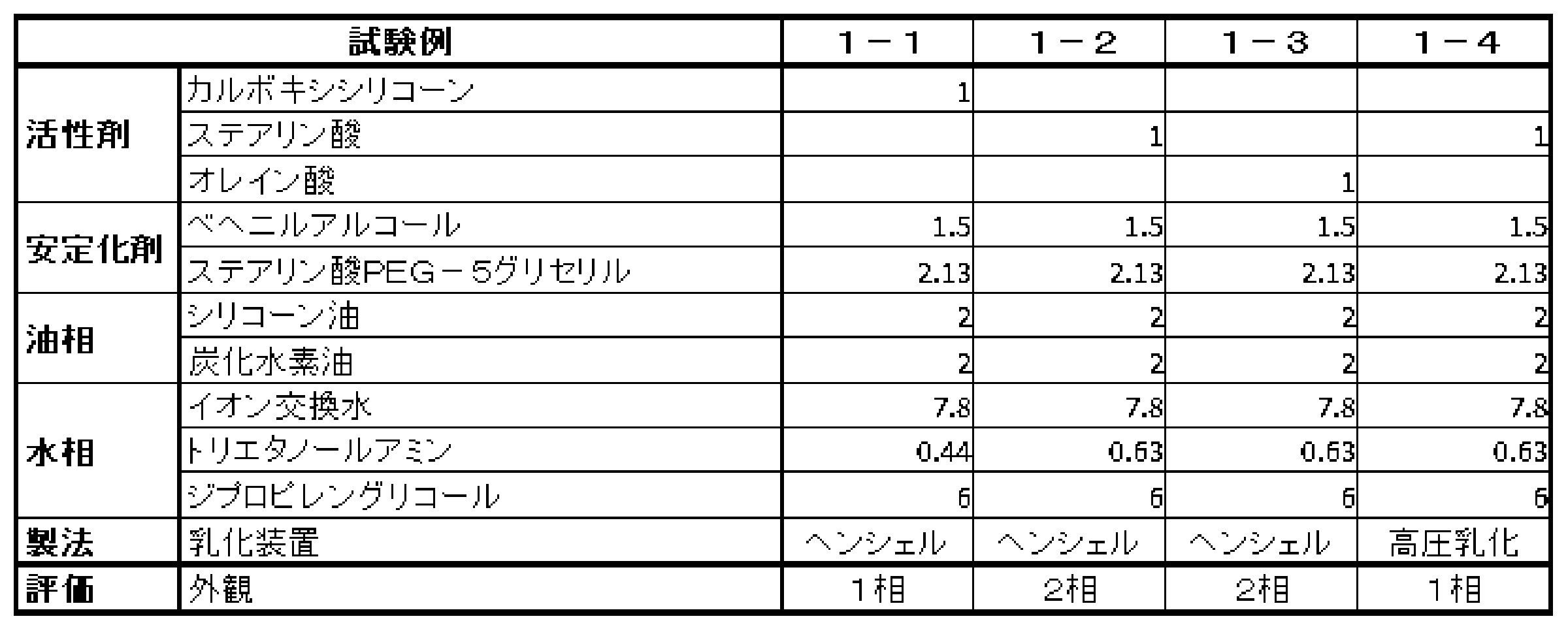
すなわち、界面活性剤(酸部)、高級アルコール、非イオン界面活性剤及び二価グリコールとともに油剤を80℃にて溶解・混合した。
そして、前記界面活性剤の対イオンとしてのトリエタノールアミンを当量溶解した水相(室温)を添加・混合・冷却し、55~65℃で相状態の確認を行った。
この結果、カルボキシ変性シリコーンを用いた試験例1-1(本発明)はほぼ透明な一相系となる。前記水を加えた系ではシリコーン油(ポリジメチルシロキサン 6CS)、炭化水素油(オレフィンオリゴマー)の溶解は困難であるが、透明一相系となることでマイクロエマルションが形成されていることが確認できる。
これに対し、試験例1-2ないし1-3では、脂肪酸(ステアリン酸、オレイン酸)を用いてエマルションの調製を試みたが、白濁2相系となった。
一方、試験例1-4では、高圧乳化を用いて試験例1-2(界面活性剤としてステアリン酸を用いた系)の微細なエマルションの調製を試みたところ、調製可能であった。
以上のようにカルボキシ変性シリコーンを用いた系では、特定の高級アルコール、非イオン界面活性剤、及び二価グリコールを用いることで、通常の混合装置を用いマイクロエマルションの調製が可能であることが理解される。
さらに本発明者らは、油剤配合量と他成分の関係を調査した。結果を表2に示す。
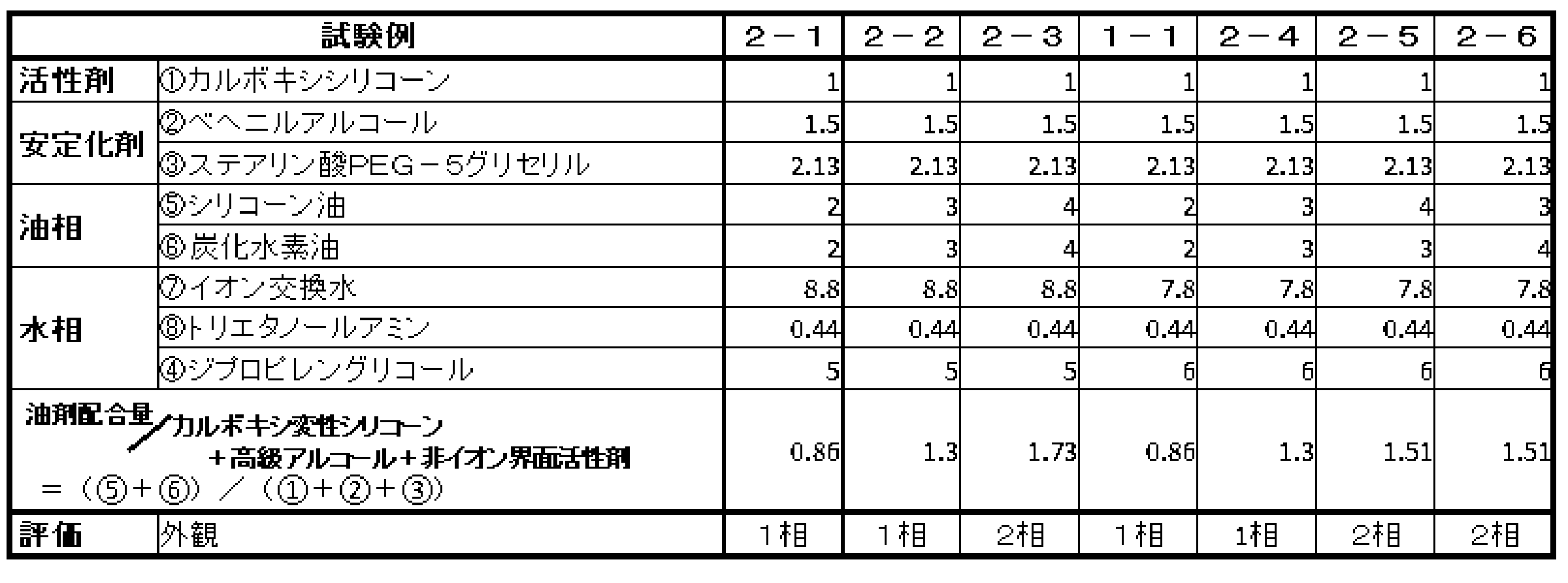
油剤配合量/(カルボキシ変性シリコーン+高級アルコール+非イオン界面活性剤)
が、1.5以下であると良好なマイクロエマルションの調製が可能であることが理解される。
次に本発明者らは、油剤の種類とマイクロエマルション調製の関係について検討を行った。結果を表3に示す。
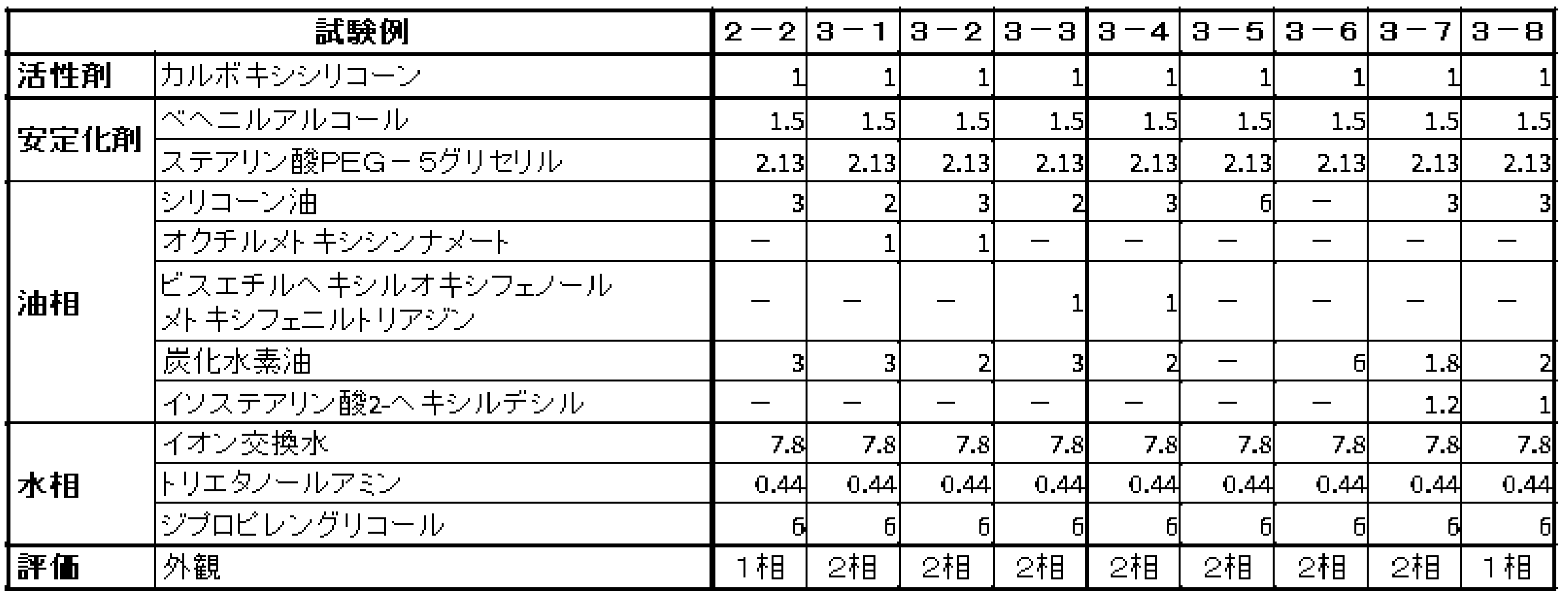
なお、シリコーン油および炭化水素油は両者が必要であり、各単独の場合(試験例3-5,3-6)には良好なマイクロエマルションの調製が困難であった。
次に本発明者らは、高級アルコールに関し検討を行った。結果を表4に示す。

表4より明らかなように、ベヘニルアルコールと脱臭セタノールはほぼ同様な挙動を示し、高級アルコールの配合量に関しては、前記油剤配合量との関係が崩れない限り、可変であることが理解される。なお、最終的な化粧水状組成物中の油滴粒径を測定したところ、平均粒径が100nm前後であり、微細なエマルションであることが確認された。
次に本発明者らは、各種非イオン界面活性剤を用いて化粧水状組成物を調製し、その評価を行った。結果を表5に示す。

次に本発明者らは、二価グリコールに関し検討を行った。結果を表6に示す。

しかしながら、第二水相ないし第三水相はマイクロエマルションを希釈分散させるためのものであるため第二水相ないし第三水相に二価グリコールなどを添加することは、マイクロエマルションの状態に悪影響を及ぼすものではない。
次に本発明者らは、カルボキシ変性シリコーンの対イオン及び中和度について検討を行った。結果を表7及び8に示す。


以下、本発明の具体的な実施例を説明する。
配合成分 質量%
1.精製水 残量
2.EDTA-2Na・2H2O 0.03
3.グリセリン 1.0
4.エタノール 3.0
5.フェノキシエタノール 0.5
6.カルボキシデシルトリシロキサン 0.6
7.セタノール 0.66
8.ステアリン酸PEG-5グリセリル 1.28
9.ジプロピレングリコール 3.6
10.ポリジメチルシロキサン 6CS 1.8
11.水添ポリデセン 1.8
12.トリエタノールアミン 0.18
13.ブチレングリコール 5.0
14.ジプロピレングリコール 2.4
<製造方法>
(1):成分1~5を25℃で混合し、溶解させる。
(2):成分6~11を70℃で溶解混合させる。
(3):(2)に成分1の一部と成分12を添加し、攪拌混合させる。
(4):成分1の一部と成分13、成分14を25℃で混合し、溶解させる。
(5):(3)に(4)を添加し、撹拌混合させる。
(6):(1)に(5)を添加し、撹拌混合させる。
得られた化粧水は乳化粒子が71nmであり、pH8.07、L値が66であった。
配合成分 質量%
1.精製水 残量
2.EDTA-2Na・2H2O 0.03
3.グリセリン 1.0
4.エタノール 3.0
5.フェノキシエタノール 0.5
6.カルボキシデシルトリシロキサン 0.6
7.セタノール 0.66
8.ステアリン酸PEG-5グリセリル 1.28
9.ジプロピレングリコール 3.6
10.ポリジメチルシロキサン 6CS 1.8
11.水添ポリデセン 1.8
12.トリエタノールアミン 0.18
13.ブチレングリコール 5.0
14.ジプロピレングリコール 2.4
<製造方法>
(1):成分1~5を25℃で混合し、溶解させる。
(2):成分6~11を70℃で溶解混合させる。
(3):(2)に成分1の一部と成分12を添加し、攪拌混合させる。
(4):成分1の一部と成分13、成分14を25℃で混合し、溶解させる。
(5):(3)に(4)を添加し、撹拌混合させる。
(6):(1)に(5)を添加し、撹拌混合させる。
得られた化粧水は乳化粒子が71nmであり、pH8.07、L値が66であった。
Claims (4)
- 平均乳化粒子径が150nm以下である微細エマルション型化粧料であって、
連続層である水相と、
前記水相中に分散され、油相中82質量%以上のシリコーン油及び炭化水素油を含む油相と、
下記一般式(1)で表されるカルボキシ変性シリコーンと、
C16~22の高級アルコールと、
POE鎖を有する、HLBが5~10の非イオン性界面活性剤と、
二価グリコールと、
を含むことを特徴とする化粧料。

- 請求項1記載の化粧料において、油相中のシリコーン油:炭化水素油の質量比が、1:9~9:1であることを特徴とする化粧料。
- 請求項1記載の化粧料において、
(油剤)/(カルボキシ変性シリコーン+高級アルコール+非イオン性界面活性剤)
の質量比が1.5以下であることを特徴とする化粧料。 - 前記式(1)であらわされるカルボキシ変性シリコーンの酸部、高級アルコール、非イオン界面活性剤、油相、有機アミン及び/またはアルカリ金属、水相の一部、二価グリコールを混合することでマイクロエマルションを調製し、
さらに水相の残部を添加希釈する微細エマルション型化粧料の製造方法。
Priority Applications (5)
| Application Number | Priority Date | Filing Date | Title |
|---|---|---|---|
| KR1020187008312A KR20180054641A (ko) | 2015-09-29 | 2016-09-06 | 미세 에멀전형 화장료 및 그 제조방법 |
| CN201680057018.2A CN108348405B (zh) | 2015-09-29 | 2016-09-06 | 微乳液型化妆品及其制造方法 |
| US15/762,813 US20180263883A1 (en) | 2015-09-29 | 2016-09-06 | Microemulsion-type cosmetic and method for manufacturing same |
| EP16851047.7A EP3357480B1 (en) | 2015-09-29 | 2016-09-06 | Microemulsion-type cosmetic and method for manufacturing same |
| US16/576,229 US11052030B2 (en) | 2015-09-29 | 2019-09-19 | Method for manufacturing microemulsion-type cosmetic |
Applications Claiming Priority (2)
| Application Number | Priority Date | Filing Date | Title |
|---|---|---|---|
| JP2015-191487 | 2015-09-29 | ||
| JP2015191487A JP6110450B1 (ja) | 2015-09-29 | 2015-09-29 | 微細エマルション型化粧料及びその製造方法 |
Related Child Applications (2)
| Application Number | Title | Priority Date | Filing Date |
|---|---|---|---|
| US15/762,813 A-371-Of-International US20180263883A1 (en) | 2015-09-29 | 2016-09-06 | Microemulsion-type cosmetic and method for manufacturing same |
| US16/576,229 Division US11052030B2 (en) | 2015-09-29 | 2019-09-19 | Method for manufacturing microemulsion-type cosmetic |
Publications (1)
| Publication Number | Publication Date |
|---|---|
| WO2017056871A1 true WO2017056871A1 (ja) | 2017-04-06 |
Family
ID=58423346
Family Applications (1)
| Application Number | Title | Priority Date | Filing Date |
|---|---|---|---|
| PCT/JP2016/076128 Ceased WO2017056871A1 (ja) | 2015-09-29 | 2016-09-06 | 微細エマルション型化粧料及びその製造方法 |
Country Status (8)
| Country | Link |
|---|---|
| US (2) | US20180263883A1 (ja) |
| EP (1) | EP3357480B1 (ja) |
| JP (1) | JP6110450B1 (ja) |
| KR (1) | KR20180054641A (ja) |
| CN (1) | CN108348405B (ja) |
| HK (1) | HK1253387A1 (ja) |
| TW (1) | TW201729790A (ja) |
| WO (1) | WO2017056871A1 (ja) |
Cited By (1)
| Publication number | Priority date | Publication date | Assignee | Title |
|---|---|---|---|---|
| CN111801091A (zh) * | 2018-03-30 | 2020-10-20 | 株式会社资生堂 | 水包油滴型的微细乳液型化妆料 |
Families Citing this family (9)
| Publication number | Priority date | Publication date | Assignee | Title |
|---|---|---|---|---|
| JP7422354B2 (ja) | 2018-08-15 | 2024-01-26 | ジェイオーコスメティックス株式会社 | 化粧料 |
| CN112689500B (zh) | 2018-08-15 | 2023-09-12 | 陶氏东丽株式会社 | 水包油型乳化化妆料 |
| JP7048480B2 (ja) * | 2018-12-19 | 2022-04-05 | 信越化学工業株式会社 | マイクロエマルション組成物及びその硬化物、並びに、それを含んだ化粧料 |
| JP7429221B2 (ja) * | 2019-03-29 | 2024-02-07 | 株式会社 資生堂 | 水中油型乳化化粧料 |
| US12569428B2 (en) | 2019-04-10 | 2026-03-10 | Dow Toray Co., Ltd. | Oil-in-water cleansing cosmetic composition |
| CN113710226B (zh) | 2019-04-24 | 2024-02-27 | 陶氏东丽株式会社 | 化妆料 |
| CN117015365A (zh) * | 2021-03-03 | 2023-11-07 | 莱雅公司 | 两相组合物 |
| FR3121041B1 (fr) * | 2021-03-26 | 2023-12-01 | Oreal | Composition à deux phases |
| US20240156691A1 (en) * | 2021-03-03 | 2024-05-16 | L'oreal | Two-phase composition |
Citations (2)
| Publication number | Priority date | Publication date | Assignee | Title |
|---|---|---|---|---|
| JP2013121947A (ja) * | 2011-11-11 | 2013-06-20 | Shiseido Co Ltd | 水中油型乳化日焼け止め化粧料 |
| JP2014074058A (ja) * | 2007-07-26 | 2014-04-24 | Shiseido Co Ltd | ゲル組成物及び化粧料 |
Family Cites Families (9)
| Publication number | Priority date | Publication date | Assignee | Title |
|---|---|---|---|---|
| FR2676921B1 (fr) * | 1991-05-27 | 1995-04-14 | Oreal | Emulsion stable du type huile-dans-eau a base d'huile de silicone et son utilisation en cosmetique et en dermatologie. |
| FR2730932B1 (fr) * | 1995-02-27 | 1997-04-04 | Oreal | Nanoemulsion transparente a base de lipides amphiphiles non-ioniques fluides et utilisation en cosmetique ou en dermopharmacie |
| US6391290B1 (en) * | 2001-03-21 | 2002-05-21 | Schering-Plough Healthcare Products, Inc. | Skin care compositions |
| US6858200B2 (en) * | 2001-06-06 | 2005-02-22 | Schering-Plough Healthcare Healthcare Products Inc. | Sunscreen formulations |
| GB0214805D0 (en) * | 2002-06-26 | 2002-08-07 | Unilever Plc | Cosmetic compositions |
| US20090252771A1 (en) * | 2008-04-02 | 2009-10-08 | Maria Gabriella Coccia | Method for obtaining o/w cosmetic emulsions with high water resistance |
| JP2012036165A (ja) * | 2010-07-16 | 2012-02-23 | Sanyo Chem Ind Ltd | 毛髪処理剤組成物 |
| FR2991171B1 (fr) * | 2012-06-01 | 2014-05-23 | Galderma Res & Dev | Procede de preparation d'une composition dermatologique comprenant des oleosomes |
| JP5797618B2 (ja) * | 2012-08-22 | 2015-10-21 | 東レ・ダウコーニング株式会社 | カルボシロキサンデンドリマー構造を有する共重合体、並びに、それを含む組成物及び化粧料 |
-
2015
- 2015-09-29 JP JP2015191487A patent/JP6110450B1/ja active Active
-
2016
- 2016-09-06 CN CN201680057018.2A patent/CN108348405B/zh active Active
- 2016-09-06 HK HK18112684.6A patent/HK1253387A1/zh unknown
- 2016-09-06 WO PCT/JP2016/076128 patent/WO2017056871A1/ja not_active Ceased
- 2016-09-06 US US15/762,813 patent/US20180263883A1/en not_active Abandoned
- 2016-09-06 KR KR1020187008312A patent/KR20180054641A/ko not_active Withdrawn
- 2016-09-06 EP EP16851047.7A patent/EP3357480B1/en active Active
- 2016-09-29 TW TW105131266A patent/TW201729790A/zh unknown
-
2019
- 2019-09-19 US US16/576,229 patent/US11052030B2/en active Active
Patent Citations (2)
| Publication number | Priority date | Publication date | Assignee | Title |
|---|---|---|---|---|
| JP2014074058A (ja) * | 2007-07-26 | 2014-04-24 | Shiseido Co Ltd | ゲル組成物及び化粧料 |
| JP2013121947A (ja) * | 2011-11-11 | 2013-06-20 | Shiseido Co Ltd | 水中油型乳化日焼け止め化粧料 |
Non-Patent Citations (1)
| Title |
|---|
| See also references of EP3357480A4 * |
Cited By (2)
| Publication number | Priority date | Publication date | Assignee | Title |
|---|---|---|---|---|
| CN111801091A (zh) * | 2018-03-30 | 2020-10-20 | 株式会社资生堂 | 水包油滴型的微细乳液型化妆料 |
| CN111801091B (zh) * | 2018-03-30 | 2023-05-05 | 株式会社资生堂 | 水包油滴型的微细乳液型化妆料 |
Also Published As
| Publication number | Publication date |
|---|---|
| US20200009036A1 (en) | 2020-01-09 |
| US20180263883A1 (en) | 2018-09-20 |
| KR20180054641A (ko) | 2018-05-24 |
| CN108348405B (zh) | 2021-04-13 |
| HK1253387A1 (zh) | 2019-06-14 |
| CN108348405A (zh) | 2018-07-31 |
| EP3357480B1 (en) | 2020-11-04 |
| JP6110450B1 (ja) | 2017-04-05 |
| EP3357480A4 (en) | 2019-05-22 |
| JP2017066068A (ja) | 2017-04-06 |
| EP3357480A1 (en) | 2018-08-08 |
| US11052030B2 (en) | 2021-07-06 |
| TW201729790A (zh) | 2017-09-01 |
Similar Documents
| Publication | Publication Date | Title |
|---|---|---|
| JP6110450B1 (ja) | 微細エマルション型化粧料及びその製造方法 | |
| KR101270330B1 (ko) | 1상 마이크로에멀젼 조성물, o/w 초미세에멀젼 외용제및 그 제조 방법 | |
| KR102120789B1 (ko) | 고함량의 오일을 안정화시킨 나노에멀전 화장료 조성물 | |
| CN102281858A (zh) | O/w型微乳液外用剂的制备方法 | |
| JP3685987B2 (ja) | 顔料分散体および化粧料 | |
| CN1942167B (zh) | 低分子量硅氧烷水包油型乳液 | |
| JP6843153B2 (ja) | 高含量のオイルを安定化したナノエマルジョン化粧料組成物 | |
| JP2013525452A (ja) | 化粧料原料 | |
| US9801805B2 (en) | Personal care composition comprising silicone network | |
| JP7284148B2 (ja) | 水中油滴型の微細エマルション型化粧料 | |
| WO2022075372A1 (ja) | カルボン酸共変性オルガノポリシロキサンおよびその用途 | |
| JP4812241B2 (ja) | 毛髪用乳化組成物 | |
| CN106102698B (zh) | 包含表面活性剂和亲水性活性成分的组合物 | |
| CN108697612B (zh) | 乳化化妆料 | |
| JP3766017B2 (ja) | 粉末含有エマルション | |
| EP3027169A1 (en) | Foamable personal care composition comprising a continuous oil phase | |
| JP2014162791A (ja) | 化粧料 | |
| JPH08245364A (ja) | W/o/w型乳化化粧料 | |
| JP2004352879A (ja) | 高濃度シリコーンエマルション | |
| JP2000119165A (ja) | 乳化型皮膚外用剤 | |
| JPH07206638A (ja) | ポリオキシアルキレン基を有する反応性オルガノポリシロキサンで表面処理された無機粉体およびそれを含有する化粧料 | |
| JP2003055152A (ja) | 皮膚・メイキャップ用化粧料組成物 | |
| JPH10101522A (ja) | 乳化組成物 | |
| JP2007176825A (ja) | 油中水型乳化化粧料 |
Legal Events
| Date | Code | Title | Description |
|---|---|---|---|
| 121 | Ep: the epo has been informed by wipo that ep was designated in this application |
Ref document number: 16851047 Country of ref document: EP Kind code of ref document: A1 |
|
| ENP | Entry into the national phase |
Ref document number: 20187008312 Country of ref document: KR Kind code of ref document: A |
|
| WWE | Wipo information: entry into national phase |
Ref document number: 15762813 Country of ref document: US |
|
| NENP | Non-entry into the national phase |
Ref country code: DE |
|
| WWE | Wipo information: entry into national phase |
Ref document number: 2016851047 Country of ref document: EP |