WO2017057578A1 - シートおよび積層体 - Google Patents
シートおよび積層体 Download PDFInfo
- Publication number
- WO2017057578A1 WO2017057578A1 PCT/JP2016/078829 JP2016078829W WO2017057578A1 WO 2017057578 A1 WO2017057578 A1 WO 2017057578A1 JP 2016078829 W JP2016078829 W JP 2016078829W WO 2017057578 A1 WO2017057578 A1 WO 2017057578A1
- Authority
- WO
- WIPO (PCT)
- Prior art keywords
- sheet
- organic
- ion
- fiber
- group
- Prior art date
- Legal status (The legal status is an assumption and is not a legal conclusion. Google has not performed a legal analysis and makes no representation as to the accuracy of the status listed.)
- Ceased
Links
Images
Classifications
-
- D—TEXTILES; PAPER
- D21—PAPER-MAKING; PRODUCTION OF CELLULOSE
- D21H—PULP COMPOSITIONS; PREPARATION THEREOF NOT COVERED BY SUBCLASSES D21C OR D21D; IMPREGNATING OR COATING OF PAPER; TREATMENT OF FINISHED PAPER NOT COVERED BY CLASS B31 OR SUBCLASS D21G; PAPER NOT OTHERWISE PROVIDED FOR
- D21H11/00—Pulp or paper, comprising cellulose or lignocellulose fibres of natural origin only
- D21H11/16—Pulp or paper, comprising cellulose or lignocellulose fibres of natural origin only modified by a particular after-treatment
- D21H11/18—Highly hydrated, swollen or fibrillatable fibres
-
- B—PERFORMING OPERATIONS; TRANSPORTING
- B32—LAYERED PRODUCTS
- B32B—LAYERED PRODUCTS, i.e. PRODUCTS BUILT-UP OF STRATA OF FLAT OR NON-FLAT, e.g. CELLULAR OR HONEYCOMB, FORM
- B32B5/00—Layered products characterised by the non- homogeneity or physical structure, i.e. comprising a fibrous, filamentary, particulate or foam layer; Layered products characterised by having a layer differing constitutionally or physically in different parts
- B32B5/02—Layered products characterised by the non- homogeneity or physical structure, i.e. comprising a fibrous, filamentary, particulate or foam layer; Layered products characterised by having a layer differing constitutionally or physically in different parts characterised by structural features of a fibrous or filamentary layer
-
- C—CHEMISTRY; METALLURGY
- C23—COATING METALLIC MATERIAL; COATING MATERIAL WITH METALLIC MATERIAL; CHEMICAL SURFACE TREATMENT; DIFFUSION TREATMENT OF METALLIC MATERIAL; COATING BY VACUUM EVAPORATION, BY SPUTTERING, BY ION IMPLANTATION OR BY CHEMICAL VAPOUR DEPOSITION, IN GENERAL; INHIBITING CORROSION OF METALLIC MATERIAL OR INCRUSTATION IN GENERAL
- C23C—COATING METALLIC MATERIAL; COATING MATERIAL WITH METALLIC MATERIAL; SURFACE TREATMENT OF METALLIC MATERIAL BY DIFFUSION INTO THE SURFACE, BY CHEMICAL CONVERSION OR SUBSTITUTION; COATING BY VACUUM EVAPORATION, BY SPUTTERING, BY ION IMPLANTATION OR BY CHEMICAL VAPOUR DEPOSITION, IN GENERAL
- C23C16/00—Chemical coating by decomposition of gaseous compounds, without leaving reaction products of surface material in the coating, i.e. chemical vapour deposition [CVD] processes
- C23C16/22—Chemical coating by decomposition of gaseous compounds, without leaving reaction products of surface material in the coating, i.e. chemical vapour deposition [CVD] processes characterised by the deposition of inorganic material, other than metallic material
- C23C16/30—Deposition of compounds, mixtures or solid solutions, e.g. borides, carbides, nitrides
- C23C16/308—Oxynitrides
-
- C—CHEMISTRY; METALLURGY
- C23—COATING METALLIC MATERIAL; COATING MATERIAL WITH METALLIC MATERIAL; CHEMICAL SURFACE TREATMENT; DIFFUSION TREATMENT OF METALLIC MATERIAL; COATING BY VACUUM EVAPORATION, BY SPUTTERING, BY ION IMPLANTATION OR BY CHEMICAL VAPOUR DEPOSITION, IN GENERAL; INHIBITING CORROSION OF METALLIC MATERIAL OR INCRUSTATION IN GENERAL
- C23C—COATING METALLIC MATERIAL; COATING MATERIAL WITH METALLIC MATERIAL; SURFACE TREATMENT OF METALLIC MATERIAL BY DIFFUSION INTO THE SURFACE, BY CHEMICAL CONVERSION OR SUBSTITUTION; COATING BY VACUUM EVAPORATION, BY SPUTTERING, BY ION IMPLANTATION OR BY CHEMICAL VAPOUR DEPOSITION, IN GENERAL
- C23C16/00—Chemical coating by decomposition of gaseous compounds, without leaving reaction products of surface material in the coating, i.e. chemical vapour deposition [CVD] processes
- C23C16/44—Chemical coating by decomposition of gaseous compounds, without leaving reaction products of surface material in the coating, i.e. chemical vapour deposition [CVD] processes characterised by the method of coating
- C23C16/50—Chemical coating by decomposition of gaseous compounds, without leaving reaction products of surface material in the coating, i.e. chemical vapour deposition [CVD] processes characterised by the method of coating using electric discharges
-
- D—TEXTILES; PAPER
- D21—PAPER-MAKING; PRODUCTION OF CELLULOSE
- D21H—PULP COMPOSITIONS; PREPARATION THEREOF NOT COVERED BY SUBCLASSES D21C OR D21D; IMPREGNATING OR COATING OF PAPER; TREATMENT OF FINISHED PAPER NOT COVERED BY CLASS B31 OR SUBCLASS D21G; PAPER NOT OTHERWISE PROVIDED FOR
- D21H11/00—Pulp or paper, comprising cellulose or lignocellulose fibres of natural origin only
- D21H11/16—Pulp or paper, comprising cellulose or lignocellulose fibres of natural origin only modified by a particular after-treatment
- D21H11/20—Chemically or biochemically modified fibres
- D21H11/22—Chemically or biochemically modified fibres cationised
-
- D—TEXTILES; PAPER
- D21—PAPER-MAKING; PRODUCTION OF CELLULOSE
- D21H—PULP COMPOSITIONS; PREPARATION THEREOF NOT COVERED BY SUBCLASSES D21C OR D21D; IMPREGNATING OR COATING OF PAPER; TREATMENT OF FINISHED PAPER NOT COVERED BY CLASS B31 OR SUBCLASS D21G; PAPER NOT OTHERWISE PROVIDED FOR
- D21H17/00—Non-fibrous material added to the pulp, characterised by its constitution; Paper-impregnating material characterised by its constitution
- D21H17/03—Non-macromolecular organic compounds
- D21H17/05—Non-macromolecular organic compounds containing elements other than carbon and hydrogen only
- D21H17/07—Nitrogen-containing compounds
-
- D—TEXTILES; PAPER
- D21—PAPER-MAKING; PRODUCTION OF CELLULOSE
- D21H—PULP COMPOSITIONS; PREPARATION THEREOF NOT COVERED BY SUBCLASSES D21C OR D21D; IMPREGNATING OR COATING OF PAPER; TREATMENT OF FINISHED PAPER NOT COVERED BY CLASS B31 OR SUBCLASS D21G; PAPER NOT OTHERWISE PROVIDED FOR
- D21H17/00—Non-fibrous material added to the pulp, characterised by its constitution; Paper-impregnating material characterised by its constitution
- D21H17/03—Non-macromolecular organic compounds
- D21H17/05—Non-macromolecular organic compounds containing elements other than carbon and hydrogen only
- D21H17/10—Phosphorus-containing compounds
-
- D—TEXTILES; PAPER
- D21—PAPER-MAKING; PRODUCTION OF CELLULOSE
- D21H—PULP COMPOSITIONS; PREPARATION THEREOF NOT COVERED BY SUBCLASSES D21C OR D21D; IMPREGNATING OR COATING OF PAPER; TREATMENT OF FINISHED PAPER NOT COVERED BY CLASS B31 OR SUBCLASS D21G; PAPER NOT OTHERWISE PROVIDED FOR
- D21H17/00—Non-fibrous material added to the pulp, characterised by its constitution; Paper-impregnating material characterised by its constitution
- D21H17/03—Non-macromolecular organic compounds
- D21H17/05—Non-macromolecular organic compounds containing elements other than carbon and hydrogen only
- D21H17/12—Organo-metallic compounds
-
- B—PERFORMING OPERATIONS; TRANSPORTING
- B32—LAYERED PRODUCTS
- B32B—LAYERED PRODUCTS, i.e. PRODUCTS BUILT-UP OF STRATA OF FLAT OR NON-FLAT, e.g. CELLULAR OR HONEYCOMB, FORM
- B32B2262/00—Composition or structural features of fibres which form a fibrous or filamentary layer or are present as additives
- B32B2262/06—Vegetal fibres
- B32B2262/062—Cellulose fibres, e.g. cotton
-
- B—PERFORMING OPERATIONS; TRANSPORTING
- B32—LAYERED PRODUCTS
- B32B—LAYERED PRODUCTS, i.e. PRODUCTS BUILT-UP OF STRATA OF FLAT OR NON-FLAT, e.g. CELLULAR OR HONEYCOMB, FORM
- B32B2307/00—Properties of the layers or laminate
- B32B2307/50—Properties of the layers or laminate having particular mechanical properties
- B32B2307/536—Hardness
-
- B—PERFORMING OPERATIONS; TRANSPORTING
- B32—LAYERED PRODUCTS
- B32B—LAYERED PRODUCTS, i.e. PRODUCTS BUILT-UP OF STRATA OF FLAT OR NON-FLAT, e.g. CELLULAR OR HONEYCOMB, FORM
- B32B2307/00—Properties of the layers or laminate
- B32B2307/50—Properties of the layers or laminate having particular mechanical properties
- B32B2307/54—Yield strength; Tensile strength
Definitions
- the present invention relates to a sheet and a laminate including fine fibers.
- cellulose fibers having a fiber diameter of 10 to 50 ⁇ m, particularly cellulose fibers (pulp) derived from wood have been widely used mainly as paper products so far.
- cellulose fibers are fine fibrous celluloses having a fiber diameter of 1 ⁇ m or less. Sheets and composites containing fine fibrous cellulose significantly increase the tensile strength because the contact points between fibers are remarkably increased. Moreover, transparency is greatly improved because the fiber width is shorter than the wavelength of visible light.
- a method for producing fine fibers there is known a method for introducing a substituent having electrostatic or steric functionality into a fiber raw material in order to easily refine the fiber raw material (defibration) (for example, Patent Documents 1 to 4).
- the fine fiber into which a functional substituent is introduced has been studied from various viewpoints.
- Patent Document 5 it is soluble in a wide range of organic solvents in view of the fact that the cellulose nanofibers having carboxylic acid groups are aggregated and precipitated when put into the same organic solvent as the material to be combined.
- Patent Document 6 it is possible to uniformly disperse in an organic solvent or resin, and to provide a dispersion containing fine cellulose fibers not containing metal ions in order to maintain water resistance and strength when formed into a sheet.
- Patent Document 7 has been studied with the problem of being able to produce in a high yield, ensuring the stability of the slurry dispersion on the acidic side, and lowering the viscosity of the dispersion.
- a fine fibrous cellulose into which two types of functional groups having a salt form with at least one selected from the group consisting of a cation, an ammonium ion, an aliphatic ammonium ion and an aromatic ammonium ion are introduced. .
- An object of the present invention is to provide a fine fiber-containing sheet and a laminate in which the occurrence of wrinkles and cracks during sheet formation is suppressed.
- the inventors of the present invention appropriately adjust the content of counter ions in the sheet, or treat fine fibers having a phosphate-derived group with organic onium ions. As a result, it was newly discovered that the intended effect was obtained, and the present invention was completed.
- the present invention provides the following.
- a fine fiber having an ionic substituent having an ionic substituent; An organic onium ion which is a counter ion of the ionic substituent; Including A sheet having an organic onium ion content of 0.10 mmol / g or more, The content of a substituent derived from a phosphate group and a phosphate group is 0.1 mmol / g or more with respect to the fine fiber, and the fine fiber does not contain a carboxy group and a substituent derived from the carboxy group. Or the content of the substituent derived from the said carboxy group and a carboxy group is less than 0.1 mmol / g with respect to the said fine fiber.
- the fine fiber having an ionic substituent obtained by the present invention is suppressed from wrinkling and cracking during sheet formation.
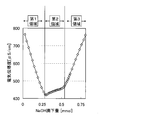
- FIG. 1 shows three regions in the substituent content measurement by the conductivity titration method.
- the present invention includes a fine fiber having an ionic substituent and an organic ion which is a counter ion of the ionic substituent, and the content of the organic ion is a certain value or less.
- a sheet, a laminate using the sheet, and a method for producing the same are provided.
- the present invention includes a fine fiber having a phosphoric acid-derived group as an ionic substituent and an organic onium ion that is a counter ion of the phosphoric acid-derived group, and is derived from the phosphoric acid.
- the present inventors have newly discovered that excellent flexibility can be realized while heat yellowing is suppressed by treating fine fibers having a phosphate-derived group with an organic onium ion.
- a sheet in which yellowing due to heating is suppressed and has excellent flexibility is provided.
- Sheet containing fine fibers and organic ions (organic onium ions, etc.) [Fine fibers having ionic substituents such as phosphate-derived groups] ⁇ Fine fibers>
- seat of this invention of a 1st form contains the fine fiber which has an ionic substituent.
- seat of this invention of a 2nd form contains the fine fiber which has group derived from phosphoric acid as an ionic substituent. Fine fibers having an ionic substituent such as a group derived from phosphoric acid can be obtained by introducing an ionic substituent into a fiber raw material and performing a fine treatment.
- the fine fiber is, for example, a fiber having a fiber width of 1000 nm or less, and is preferably a natural fiber.
- Natural fibers are preferably polysaccharides because they are available in abundance, and more preferably cellulose, chitin, or chitosan because strength can be expected when formed into a sheet.
- a cellulose fiber is mentioned as a particularly preferable example of the natural fiber.
- the present invention its embodiments and examples may be described by taking the case of using fine fibrous cellulose as an example, but those skilled in the art will use other types of fibers as appropriate for the description. It can be understood by applying to cases.
- the average fiber width of the fine fibers contained in the sheet of the present invention is not particularly limited as long as it is 1000 nm or less, but can be, for example, 1 nm or more, preferably 2 to 1000 nm, more preferably 2 to 500 nm, and still more preferably. 3 to 100 nm.
- the average fiber width of the fine fibers is 1000 nm or less, the features (high transparency, high elastic modulus, low linear expansion coefficient, flexibility) as fine fibers are easily exhibited.
- the average fiber width is 1 nm or more, the dissolution of molecules in water is suppressed, so that physical properties (strength, rigidity, dimensional stability) as a fine fiber are sufficiently expressed.
- the average fiber width is 30 nm or less, it approaches 1/10 of the wavelength of visible light, and in the case of a laminate, refraction and scattering of visible light at the interface. There is a tendency that a product with high transparency is obtained. Therefore, the average fiber width is not particularly limited, but is preferably 2 to 30 nm, more preferably 2 to 20 nm.
- a laminate obtained from such fine fibers generally has a high strength because it becomes a dense structure, and has high transparency because it scatters less visible light.
- the average fiber width is measured as follows. A fine fiber-containing slurry having a concentration of 0.05 to 0.1% by mass is prepared, and the slurry is cast on a carbon film-coated grid subjected to a hydrophilic treatment to obtain a sample for TEM observation. When wide fibers are included, an SEM image of the surface cast on glass may be observed. Observation with an electron microscope image is performed at a magnification of 1000 times, 5000 times, 10000 times, 20000 times, or 50000 times, depending on the width of the constituent fibers. However, the sample, observation conditions, and magnification are adjusted to satisfy the following conditions. (1) One straight line X is drawn at an arbitrary location in the observation image, and 20 or more fibers intersect the straight line X.
- a straight line Y perpendicular to the straight line is drawn in the same image, and 20 or more fibers intersect the straight line Y.
- the average fiber width is an average value of the fiber widths read in this way.
- the fiber length of the fine fiber is not particularly limited, but is preferably 0.1 ⁇ m or more. If the fiber length is 0.1 ⁇ m or more, it is preferable in that the tear strength of the sheet is sufficient when a sheet described later is manufactured.
- the fiber length can be obtained by image analysis of TEM, SEM, or AFM. The said fiber length is a fiber length which occupies 30 mass% or more of a fine fiber.
- the fiber axial ratio (fiber length / fiber width) is not particularly limited, but is preferably in the range of 20 to 10,000. An axial ratio of 20 or more is preferable in that a fine fiber-containing sheet is easily formed during production. When the axial ratio is 10,000 or less, it is preferable in that the slurry viscosity at the time of sheet production becomes low.
- the fine fiber contained in the sheet of the present invention has an ionic substituent.
- the ionic substituent facilitates the refinement (defibration) of the fiber raw material in the production of the fine fiber-containing sheet.
- the ionic substituent may be anionic or cationic.
- the ionic substituent includes at least an anionic substituent.
- anionic substituent examples include a phosphate group or a substituent derived from a phosphate group (hereinafter, a phosphate group and a substituent derived from a phosphate group are also referred to as a phosphate-derived group), a carboxy group, or Substituents derived from carboxy groups (hereinafter, carboxy groups and substituents derived from carboxy groups are also referred to as carboxylic acid-derived groups), sulfate groups or substituent groups derived from sulfate groups (hereinafter referred to as sulfate groups and sulfate groups).
- the substituent derived from the group is also referred to as a sulfuric acid-derived group), a sulfonic acid group or a substituent derived from the sulfonic acid group (hereinafter, the sulfonic acid group and the substituent derived from the sulfonic acid group are referred to as a sulfonic acid-derived group). Also called).
- the phosphoric acid group is a divalent functional group equivalent to the phosphoric acid obtained by removing the hydroxyl group. Specifically, it is a group represented by —PO 3 H 2 .
- the substituent derived from the phosphate group includes a substituent such as a group obtained by polycondensation of a phosphate group, a salt of a phosphate group, and a phosphate ester group.
- the substituent derived from a phosphoric acid group or a phosphoric acid group may be represented by the following formula (1).
- R represents a hydrogen atom, a saturated-linear hydrocarbon group, a saturated-branched hydrocarbon group, a saturated-cyclic hydrocarbon group, an unsaturated-linear hydrocarbon group, an unsaturated-branched hydrocarbon group.
- ⁇ is a monovalent or higher cation composed of an organic substance or an inorganic substance.
- the anionic substituent is a group consisting of a group derived from phosphoric acid, a group derived from carboxylic acid, and a group derived from sulfuric acid because of ease of handling and reactivity with fibers during production. It is preferable that it is at least one selected from more. These groups preferably form an ester or ether with the fiber, but are not particularly limited.
- examples of the cationic substituent include groups derived from onium salts such as ammonium salts, phosphonium salts, and sulfonium salts. Specific examples include groups containing ammonium, phosphonium and sulfonium such as primary ammonium salt, secondary ammonium salt, tertiary ammonium salt and quaternary ammonium salt.
- the cationic substituent is preferably at least one of a group derived from a quaternary ammonium salt and a group derived from a phosphonium salt in view of ease of handling and reactivity with fibers during production.
- a method of desorbing the ionic substituent together with reducing the organic ions contained in the sheet is employed as will be described later.
- the content of ionic substituents in the sheet is not particularly limited as long as the sheet has the intended properties, but it is preferably 0.5 mmol / g or less with respect to the sheet or fine fiber, and 0.1 mmol / g. Or less, more preferably 0.05 mmol / g or less. This is because organic ions are sufficiently reduced when the concentration is 0.5 mmol / g or less.
- the lower limit of the content of the ionic substituent is not particularly limited, it is 0.001 mmol / g or more with respect to the sheet or fine fiber regardless of the upper limit. From the viewpoint that there are few organic ions that are concerned about the influence on the sheet strength, it is considered that the content of ionic substituents in the sheet is preferably as small as possible.
- the fine fiber contained in the sheet of the present invention in the second form has at least a group derived from phosphoric acid.
- the amount of the phosphoric acid-derived group contained in the sheet is not particularly limited as long as it can be efficiently miniaturized, but can be 0.1 mmol / g or more based on the sheet or fine fiber. It may be 0.5 mmol / g, or 1.0 mmol / g or more.
- the upper limit of the group derived from phosphoric acid is not particularly limited, it can be 5.0 mmol / g or less with respect to the sheet or fine fiber, for example, regardless of the lower limit. g or less, or 2.0 mmol / g or less.
- the sheet of the present invention of the second form has a group derived from phosphoric acid, but does not contain or contains a trace amount of a group derived from carboxylic acid.
- the content is not particularly limited as long as the target properties are not impaired in the sheet, but it can be less than 0.1 mmol / g with respect to the sheet or fine fiber. . It may be less than 0.07 mmol / g, or less than 0.05 mmol / g.
- the lower limit of the group derived from the carboxylic acid is not particularly limited, but can be 0.0005 mmol / g or more with respect to the sheet or fine fiber, for example, regardless of the upper limit. It is good also as g.
- the content (mmol / g) of the ionic substituent in the sheet can be measured as follows using a fluorescent X-ray analysis method. First, for preparing a calibration curve, a sheet having the same fine fiber as that used for the measurement target sheet and having a known ionic substituent content (mmol / g) is prepared, and this is determined by fluorescent X-ray analysis. The X-ray intensity of the sample is measured.
- the element to be measured is an element that is included in the ionic substituent but is not included in the fine fiber (for example, a phosphorus atom when the ionic substituent is a group derived from phosphoric acid), or a counter ion of the ionic substituent Is an element that is contained in but not in fine fibers.
- the measurement object sheet can be used for measurement after exchanging the counter ion of the ionic substituent with another counter ion containing an element not included in the fine fiber.
- the counter ion can be exchanged for sodium ion and then used for measurement.
- the measurement element is sodium ion.
- a calibration curve is prepared based on the X-ray intensity obtained thereby and the known ionic substituent content.
- the X-ray intensity of the measurement target sheet is measured by fluorescent X-ray analysis.
- the content (mmol / g) of the ionic substituent of the measurement target sheet is determined from the X-ray intensity obtained thereby and the calibration curve. The determined value can be expressed as the content of ionic substituents on the sheet or fine fiber.
- the content of ionic substituents in the sheet is introduced into the sheet during production. This corresponds to the amount of ionic substituent.
- the introduced substituent is at least one selected from the group consisting of a phosphoric acid-derived group, a carboxylic acid-derived group and a sulfuric acid-derived group
- the amount of substituent introduction is not particularly limited, but 0 0.001 to 5.0 mmol / g. It may be 0.05 to 4.0 mmol / g, or 0.1 to 2.0 mmol / g.
- seat of the 1st form of this invention contains an organic ion.
- An organic ion refers to an ion that can form an ion pair with an ionic substituent of a fiber and that has an organic group.
- An organic group refers to a group derived from an organic compound (compound containing a carbon atom). The organic ions can suppress the formation of wrinkles and cracks in the sheet by suppressing the formation of hydrogen bonds between the ionic substituents in the drying step in forming a sheet from fine fibers having an ionic substituent.
- the carboxy group on the fiber is an amine salt type (see Patent Document 5)
- the carboxy group on the fiber is an onium salt type (described in Patent Document 6)
- the carboxy group and phosphate group on the fiber Some of them have an ammonium salt type, and the purpose of each is to improve dispersibility in an organic solvent and to ensure compatibility with a resin to be composited.
- the present invention is the first to use organic ions in a fine fiber-containing sheet having an ionic substituent, paying attention to a novel problem of suppressing wrinkles and cracks when forming a fine fiber into a sheet.
- the sheet according to the second aspect of the present invention contains an organic onium ion as a counter ion such as a group derived from phosphoric acid.
- the type of organic ion when the fine fiber has an anionic substituent and the type of organic ion when the fine fiber has a cationic substituent exhibit the desired effect.
- the organic ion is preferably an organic onium ion represented by the following formula (2).
- the organic onium ion is preferably an organic onium ion represented by the following formula (2).
- M is a nitrogen atom or a phosphorus atom; At least one of R 1 to R 4 is an organic group that may contain a hetero atom, and the rest are hydrogen atoms.
- the number of carbons in the organic group (when having a plurality of organic groups, the total number of carbons) is 1 or more and is not particularly limited as long as the desired effect is exhibited, but is preferably 4 or more, and 8 or more. More preferably, it is more preferably 16 or more. This is because a large carbon number and a certain amount of bulk are effective.
- R 1 to R 4 may be the same or different from each other, but are preferably the same or a group having the same size. This is because it is considered that the effect closer to the spherical shape is greater than the linear shape.
- Such an organic onium ion is preferably a tetraalkylonium ion, for example, and more preferably contains at least one of a tetraalkylammonium ion and a tetraalkylphosphonium ion.
- tetraalkylammonium ions include tetramethylammonium ion, tetraethylammonium ion, tetrapropylammonium ion, tetrabutylammonium ion, tetrapentylammonium ion, tetrahexylammonium ion, tetraheptylammonium ion, tributylmethylammonium ion, lauryltrimethylammonium ion.
- tetraalkylphosphonium ions include tetramethylphosphonium ions, tetraethylphosphonium ions, tetrapropylphosphonium ions, tetrabutylphosphonium ions, and lauryltrimethylphosphonium ions.
- tetrapropylonium ion and tetrabutylonium ion it is particularly preferable to use tetran-propylonium ion and tetran-butylonium ion, respectively.
- seat of the 1st form of this invention contains an organic ion
- the content is 0.40 mmol / g or less with respect to a sheet
- the organic ion is added to the ionic substituent before sheeting, and then the content is reduced to 0.40 mmol / g or less after sheeting.
- the mechanical strength of the sheet can be increased.
- the content of organic ions in the sheet is preferably 0.20 mmol / g or less, more preferably 0.10 mmol / g or less, and still more preferably 0.00. 05 mmol / g or less.
- the lower limit of the content of organic ions in the sheet is not particularly limited, and can be 0 mmol / g, for example, 0.005 mmol / g with respect to the sheet.
- the fiber or sheet in the present invention when it is referred to as the organic ion content, the measurement described below is performed regardless of whether an ion pair is formed with the ionic substituent on the sheet, unless otherwise specified. The value measured by the method.
- the sheet according to the second aspect of the present invention contains organic onium ions, and the content thereof is 0.10 mmol / g or more based on the sheet. Preferably it is 0.20 mmol / g or more, More preferably, it exceeds 0.40 mmol / g, More preferably, it is 1.0 mmol / g or more. This is because even with such an amount, it is considered that hydrogen bonds between groups derived from phosphoric acid can be blocked to such an extent that aggregation does not occur.
- the upper limit value of the content of the organic onium ion in the sheet is not particularly limited, but whatever the lower limit value is, for example, 10.0 mmol / g or less, preferably 5.0 mmol / g or less with respect to the sheet. More preferably, it is 3.0 mmol / g or less.
- the fiber or the sheet in the present invention when it is referred to as the content of organic onium ions, unless otherwise specified, regardless of whether or not an ion pair is formed with a phosphate-derived group on the sheet, The value measured by the measurement method described.
- the content (mmol / g) of organic ions in the sheet can be measured using, for example, chemiluminescence, infrared spectroscopy, time-of-flight mass spectrometry, or fluorescent X-ray analysis.
- the concentration of nitrogen atoms in the sheet can be measured by, for example, a trace nitrogen analyzer using a chemiluminescence method.
- the nitrogen atom concentration of the fine fiber-containing sheet not treated with organic ions is also measured, and the nitrogen atom concentration derived from organic ions is reduced by subtracting the value from the nitrogen atom concentration of the fine fiber-containing sheet to be measured.
- the organic ion content can be calculated.
- an organic ion is not imparted by performing a treatment for 2 hours at 180 ° C. using glycerin by a polyhydric alcohol boiling method described later. It is thought that it can be handled in the same manner as the fine fiber-containing sheet.
- the pH 1 treatment liquid in the case of an anionic substituent, the pH 1 treatment liquid, and in the case of a cationic substituent, the pH 14 treatment liquid, respectively. It is thought that it can treat like the fine fiber containing sheet
- the fine fiber-containing sheet not containing organic ions is, for example, a counter ion exchange described later with respect to the sheet to be measured, in a treatment solution having a pH of 1 in the case of an anionic substituent, and pH 14 in the case of a cationic substituent. It is thought that it can treat like the fine fiber containing sheet
- organic ions such as organic onium ions include elements other than nitrogen and considered not to exist in the fine fiber-containing sheet
- the content of organic ions such as organic onium ions in the sheet is fluorescent X It can be measured as follows using a line analysis method. First, to prepare a calibration curve, a sample having a composition and form similar to those of the measurement target sheet (for example, using filter paper) and having a known analytical element content (mmol / g) is prepared, and fluorescence is prepared. The X-ray intensity of the sample is measured by X-ray analysis.
- an element that is included in organic ions such as organic onium ions but is considered not to exist in the fine fiber-containing sheet is an analytical element.
- a calibration curve is created based on the X-ray intensity obtained thereby and the known content of the analytical element.
- the X-ray intensity of the measurement target sheet is measured by fluorescent X-ray analysis.
- seat is computed from the X-ray intensity obtained by this, and the said calibration curve.
- the sheet of the present invention has the following characteristics.
- the density of the sheet refers to a value (g / cm 3 ) obtained from the thickness and mass of the sheet after conditioning a 100 mm square sheet under conditions of 23 ° C. and 50% relative humidity for 24 hours.
- the density of the sheet of the present invention can be appropriately determined according to the use and the like, but can be 0.1 to 7.0 g / cm 3 from the viewpoint of strength and transparency, and 0.5 to 5 it is preferably .0g / cm 3, more preferably 1.0 ⁇ 3.0g / cm 3.
- the density of the sheet can be set to, for example, 1.50 g / cm 3 or less.
- Wrinkles and cracks during sheet production can be evaluated by the following method.
- a total of 81 squares of 9 ⁇ 9 in width is written on the back surface of the acrylic plate in accordance with the size of each 180 mm damming metal frame.
- the fine fiber-containing sheet is observed from above with the acrylic plate attached to the acrylic plate, and the masses where wrinkles and cracks are generated are counted. Next, it is calculated what percentage of the total number of cells where wrinkles and cracks occur.
- the proportion of mass in which wrinkles and cracks are generated is less than 20%.
- the total light transmittance of the sheet refers to a value measured using a haze meter in accordance with JIS standard K7361.
- the sheet of the present invention has high transparency, and the total light transmittance thereof is 80% or more, preferably 85% or more, and more preferably 88% or more.
- the haze value of the sheet refers to a value measured using a haze meter in accordance with JIS standard K7136.
- the sheet of the present invention has high transparency, and its haze value is 40.0% or less, preferably 35.0% or less, and more preferably 20.0% or less.
- the tensile strength and tensile modulus of the sheet refer to values measured at a temperature of 23 ° C. and a relative humidity of 50% using a tensile tester in accordance with JIS K 7127.
- the tensile strength of the sheet according to the first aspect of the present invention is preferably 60.0 MPa or more, more preferably 70.0 MPa or more, and further preferably 80.0 MPa or more. . This is because if it exceeds this value, it can be used as an optical material.
- an upper limit is not specifically limited, For example, it is 400.0 MPa or less, or is 300.0 MPa or less.
- the tensile modulus of the sheet according to the first aspect of the present invention is preferably 4.0 GPa or more, more preferably 5.0 GPa or more, and further preferably 6.5 GPa or more. This is because if it exceeds this value, it can be used as an optical material.
- an upper limit is not specifically limited, For example, it is 25.0 GPa or less, or is 20.0 GPa or less.
- the occurrence of wrinkles and cracks during production is suppressed as described above, and the excellent tensile properties are considered to be due to the following factors.
- an appropriate organic ion is applied as a counter ion to the ionic substituent (the aggregation of fine fibers due to the ionic substituent observed in the drying step during sheet formation can be prevented).
- organic ions that have a concern of affecting the strength of the sheet are reduced to an appropriate level.
- the sheet according to the second embodiment of the present invention is excellent in flexibility.
- the tensile modulus of the sheet according to the second aspect of the present invention is preferably 3.5 GPa or less, more preferably 3.2 GPa or less, and further preferably 3.0 GPa or less. preferable. This is because if it is less than this value, flexibility as a packaging material can be realized.
- the lower limit value is, for example, 0.1 GPa or less, or 0.5 GPa or more from the viewpoint of maintaining a certain level of strength.
- YI 1 indicates the yellowness before vacuum drying at 200 ° C. for 4 hours
- YI 2 indicates the yellowness after vacuum drying at 200 ° C. for 4 hours.
- Yellowness refers to a value measured according to JIS standard K7373.
- the yellowing degree change ( ⁇ YI) is suppressed.
- the yellowness change ( ⁇ YI) of the sheet according to the first embodiment of the present invention is, for example, 75.0 or less.
- the yellowing degree change ( ⁇ YI) is suppressed.
- the yellowing degree change ( ⁇ YI) of the sheet according to the second embodiment of the present invention is, for example, 70 or less, preferably 60 or less, and more preferably 55 or less.
- the reason why yellowing due to heating is suppressed while realizing flexibility is considered to be due to the following factors.
- an appropriate organic onium ion is applied as a counter ion to the group derived from phosphoric acid (the aggregation of fine fibers due to the group derived from phosphoric acid observed in the drying step during sheeting can be prevented. ).
- the type of group on the fine fiber, the amount thereof, and the type of organic onium ion contained in the sheet, and the amount thereof are appropriately selected.
- appropriately selecting the production conditions of the fine fibers and the sheet using the fine fibers contributes to imparting flexibility and suppressing yellowing due to heating. These are also considered to affect the density, total light transmittance, haze, yellowness change, etc. of the sheet.
- the yellowness change ( ⁇ YI) is 50.0 or less, more preferably 7.0 or less, and even more preferably 5.0 or less.
- the reason why the change in yellowness is suppressed in the preferred embodiment is that yellowing due to heating of the sheet is further suppressed due to elimination of organic ions and ionic substituents.
- the ionic substituent is a group derived from phosphoric acid, if reduction of organic ions is achieved by elimination together with the group derived from phosphoric acid, the formation of char at a high temperature by the group derived from phosphoric acid is reduced. Because.
- the pencil hardness is a value measured according to JIS standard K5600. However, the load applied to the sample is 500 g.
- the sheet according to the second aspect of the present invention has high flexibility, and its pencil hardness is F or less, preferably HB or less, and more preferably B or less. This is because such a range is suitable for use as a flexible package.
- Molding flexibility can be evaluated by the following method.
- the fine fiber-containing sheet is cut into a 150 mm square, and packaged so as to wrap the entire wooden columnar molded body having a diameter of 50 mm and a height of 60 mm.
- the cylindrical molded body is visually observed from above. Visual observation is performed from the viewpoint of the presence or absence of a gap between the cylindrical molded body and the sheet and the cracking of the sheet.
- the sheet according to the second embodiment of the present invention was evaluated for molding followability, no gap was observed between the cylindrical molded body and the fine fibrous cellulose sheet, and cracks were found in the fine fibrous cellulose sheet. There is nothing.
- Manufacturing method of sheet The manufacturing method of the sheet of the first embodiment of the present invention, (1) introducing an ionic substituent into the fiber raw material to obtain an ionic substituent-introduced fiber; (2) a step of refining the ionic substituent-introduced fiber to obtain an ionic substituent-introduced fine fiber, and further before or after step (2), A step of treating ionic substituents with organic ions, and (3) a step of preparing a sheet from ionic substituent-introduced fine fibers treated with organic ions; (4) reducing the organic ions contained in the sheet.
- the method for producing the sheet according to the second aspect of the present invention is as follows. (1) introducing an ionic substituent into the fiber raw material to obtain an ionic substituent-introduced fiber; (2) a step of refining the ionic substituent-introduced fiber to obtain an ionic substituent-introduced fine fiber, and further before or after step (2), A step of treating the ionic substituent with an organic onium ion, and (3) a step of preparing a sheet from the ionic substituent-introduced fine fiber treated with the organic onium ion; including.
- Step (1) Step of obtaining an ionic substituent-introduced fiber by introducing an ionic substituent into a fiber raw material
- the fine fiber having an ionic substituent can be obtained by introducing an ionic substituent into a fiber raw material and performing a fine treatment.
- the fiber raw material used in the step (1) is a natural fiber that can be obtained in abundance, preferably cellulose, chitin or chitosan, more preferably cellulose.
- As the fiber raw material it is preferable to use pulp because it is easily available and inexpensive.
- wood pulp containing cellulose is preferable in terms of availability.
- chemical pulp has a large cellulose ratio, so the yield of fine cellulose fibers is high when fibers are refined, and cellulose fibers in the pulp are small, and long fine fiber fibers with a large axial ratio are obtained.
- kraft pulp and sulfite pulp are most preferably selected, but are not particularly limited.
- An ionic substituent is introduced into the fiber raw material.
- the method for introducing a substituent into the fiber is not particularly limited.
- oxidation treatment treatment with a compound capable of forming a covalent bond with a functional group in the fiber, and the like can be mentioned.
- treatment with a compound capable of forming a covalent bond with a functional group in the fiber can be mentioned.
- the oxidation treatment is a treatment for converting a hydroxy group in the fiber into an aldehyde group or a carboxy group, and examples thereof include a TEMPO oxidation treatment and treatment using various oxidizing agents (such as sodium chlorite and ozone).
- oxidation treatment examples include the methods described in Biomacromolecules 8, 2485-2491, 2007 (Saito et al.), But are not particularly limited.
- Treatment with a compound capable of forming a covalent bond with a functional group in the fiber introduces the above substituents into the fiber raw material by mixing the fiber raw material in a dry or wet state with a compound that reacts with the fiber raw material. Can be implemented.
- a heating method is particularly effective.
- the heat treatment temperature for introducing the substituent is not particularly limited, but is preferably a temperature range in which thermal decomposition or hydrolysis of the fiber raw material hardly occurs.
- the thermal decomposition temperature of the fiber it is preferably 250 ° C. or lower, and from the viewpoint of suppressing the hydrolysis of the fiber, it is preferable to perform heat treatment at 100 to 170 ° C.
- the compound that reacts with the fiber raw material is not particularly limited as long as fine fibers can be obtained and an ionic substituent is introduced.
- a compound having a phosphoric acid-derived group is used as the compound that reacts with the fiber raw material, it is not particularly limited, but is composed of phosphoric acid, polyphosphoric acid, phosphorous acid, phosphonic acid, polyphosphonic acid, or a salt or ester thereof. It is at least one selected from the group.
- a compound having a phosphate-derived group is preferable because it is low-cost, easy to handle, and can further improve the refinement (defibration) efficiency by introducing a phosphate-derived group into the fiber raw material.
- refinement (defibration) efficiency by introducing a phosphate-derived group into the fiber raw material.
- the compound having a phosphoric acid-derived group is not particularly limited, but phosphoric acid, lithium dihydrogen phosphate, dilithium hydrogen phosphate, trilithium hydrogen phosphate, trilithium phosphate, lithium pyrophosphate, lithium polyphosphate Can be mentioned. Furthermore, sodium dihydrogen phosphate, disodium hydrogen phosphate, trisodium phosphate, sodium pyrophosphate and sodium polyphosphate which are sodium salts of phosphoric acid are mentioned. Furthermore, potassium dihydrogen phosphate, dipotassium hydrogen phosphate, tripotassium phosphate, potassium pyrophosphate, and potassium polyphosphate which are potassium salts of phosphoric acid are mentioned.
- ammonium dihydrogen phosphate diammonium hydrogen phosphate, triammonium phosphate, ammonium pyrophosphate, and ammonium polyphosphate, which are ammonium salts of phosphoric acid.
- phosphoric acid, sodium salt of phosphoric acid, potassium salt of phosphoric acid, and ammonium salt of phosphoric acid are preferable from the viewpoint of high efficiency of introduction of a group derived from phosphoric acid and easy industrial application.
- Sodium dihydrogen and disodium hydrogen phosphate are more preferable, but not particularly limited.
- the compound is preferably used as an aqueous solution because of the uniformity of the reaction and the introduction efficiency of the group derived from phosphoric acid, but it is not particularly limited.
- the pH of the aqueous solution of the compound is not particularly limited, but is preferably 7 or less because of the high efficiency of introducing a phosphoric acid-derived group.
- a pH of 3 to 7 is more preferable from the viewpoint of suppressing fiber hydrolysis, but is not particularly limited.
- a compound having a phosphoric acid-derived group is converted into urea, thiourea, biuret, phenylurea, benzylurea, dimethylurea, diethylurea, tetramethylurea, benzoleinurea.
- at least one selected from hydantoin and the like are preferably reacted with the fiber raw material.
- the compound having a carboxylic acid-derived group is used as the compound that reacts with the fiber raw material
- the compound having a carboxylic acid-derived group, an acid anhydride of the compound having a carboxylic acid-derived group, and the like are not particularly limited. At least one selected from the group consisting of
- the compound having a carboxylic acid-derived group is not particularly limited, but a dicarboxylic acid compound such as maleic acid, succinic acid, phthalic acid, fumaric acid, glutaric acid, adipic acid or itaconic acid, or a tricarboxylic acid compound such as citric acid or aconitic acid. Is mentioned.
- the acid anhydride of the compound having a carboxylic acid-derived group is not particularly limited, but acid anhydrides of dicarboxylic acid compounds such as maleic anhydride, succinic anhydride, phthalic anhydride, glutaric anhydride, adipic anhydride, itaconic anhydride, etc. Things.
- the derivative of the compound having a carboxylic acid-derived group is not particularly limited, and examples thereof include an acid anhydride imidized compound having a carboxylic acid-derived group and an acid anhydride derivative of a compound having a carboxylic acid-derived group.
- the acid anhydride imidized compound having a carboxylic acid-derived group is not particularly limited, and examples thereof include imidized dicarboxylic acid compounds such as maleimide, succinimide, and phthalimide.
- the acid anhydride derivative of the compound having a carboxylic acid-derived group is not particularly limited.
- at least some of the hydrogen atoms of the acid anhydride of the compound having a carboxylic acid-derived group such as dimethylmaleic acid anhydride, diethylmaleic acid anhydride, diphenylmaleic acid anhydride, are substituted (for example, alkyl group, And those substituted with a phenyl group or the like.
- maleic anhydride succinic anhydride, and phthalic anhydride are preferable because they are easily industrially applied and easily gasified, but are not particularly limited.
- a compound having a group derived from sulfuric acid is used as the compound that reacts with the fiber raw material, it is not particularly limited, but it is at least one selected from the group consisting of sulfuric anhydride, sulfuric acid, salts and esters thereof.
- sulfuric acid is preferred, but is not particularly limited because it is low in cost and can further improve the refinement (defibration) efficiency by introducing a sulfate group into the fiber raw material.
- the dispersibility of the fiber in the solution is improved, and the refinement (defibration) efficiency can be increased.
- the introduction amount of the ionic substituent is not particularly limited as long as sufficient miniaturization can be performed, but as described later, the introduction amount of the substituent as a sheet (or the content of the bivalent or higher metal and the introduction amount of the substituent) Can be determined in consideration.
- the introduction amount of the substituent (by titration method) is preferably 0.005 ⁇ to 0.11 ⁇ per 1 g (mass) of the fiber. 01 ⁇ to 0.08 ⁇ is more preferable. If the introduction amount of the substituent is 0.005 ⁇ or more, the fiber raw material can be easily refined (defibration). If the introduction amount of the substituent is 0.11 ⁇ or less, dissolution of the fiber can be suppressed.
- (alpha) is the quantity (unit: mmol / g) by which the functional group which the compound which reacts with a fiber material can react, for example, a hydroxyl group and an amino group, is contained per 1 g of fiber materials.
- the measurement of the introduction amount (titration method) of substituents on the fiber surface can be performed by the following method, unless otherwise specified: A fine fiber-containing slurry containing about 0.04 g of solid content in an absolutely dry mass is collected and diluted to about 50 g using ion-exchanged water. While stirring this solution, the change in the value of electrical conductivity when a 0.01N sodium hydroxide aqueous solution was added dropwise was measured, and the amount of 0.01N sodium hydroxide aqueous solution added when the value was minimized was measured. The amount dropped at the titration end point.
- V A dripping amount (ml) of 0.01N sodium hydroxide aqueous solution
- W Solid content (g) contained in the slurry containing fine cellulose fibers.
- the introduced substituent is at least one selected from the group consisting of a phosphoric acid-derived group, a carboxylic acid-derived group and a sulfuric acid-derived group
- the amount of substituent introduction is not particularly limited, but 0 0.001 to 5.0 mmol / g. It may be 0.05 to 4.0 mmol / g, or 0.1 to 2.0 mmol / g.
- the cationic substituent can be introduced into the fiber raw material, for example, by adding a cationizing agent and an alkali compound to the fiber raw material and reacting them.
- a cationizing agent one having a quaternary ammonium group and a group that reacts with a hydroxy group of cellulose can be used.
- the group that reacts with the hydroxy group of cellulose include an epoxy group, a functional group having a halohydrin structure, a vinyl group, and a halogen group.
- the cationizing agent include glycidyltrialkylammonium halides such as glycidyltrimethylammonium chloride and 3-chloro-2-hydroxypropyltrimethylammonium chloride or halohydrin type compounds thereof.
- the alkaline compound used in the cationization step contributes to the promotion of the cationization reaction.
- the alkali compound may be an inorganic alkali compound or an organic alkali compound.
- Examples of inorganic alkali compounds include alkali metal hydroxides or alkaline earth metal hydroxides, alkali metal carbonates or alkaline earth metal carbonates, alkali metal phosphates or alkaline earth metal phosphoric acids. Salt.
- Examples of the alkali metal hydroxide include lithium hydroxide, sodium hydroxide, and potassium hydroxide.
- Examples of the alkaline earth metal hydroxide include calcium hydroxide.
- Examples of the alkali metal carbonate include lithium carbonate, lithium hydrogen carbonate, potassium carbonate, potassium hydrogen carbonate, sodium carbonate, and sodium hydrogen carbonate.
- Examples of the alkaline earth metal carbonate include calcium carbonate.
- Examples of the alkali metal phosphate include lithium phosphate, potassium phosphate, trisodium phosphate, and disodium hydrogen phosphate.
- Examples of alkaline earth metal phosphates include calcium phosphate and calcium hydrogen phosphate.
- organic alkali compounds examples include ammonia, aliphatic amines, aromatic amines, aliphatic ammoniums, aromatic ammoniums, heterocyclic compounds and their hydroxides, carbonates, and phosphates.
- sodium hydroxide and potassium hydroxide are preferable because the cationization reaction is more likely to occur and the cost is low.
- the amount of the alkali compound varies depending on the type of the alkali compound.
- the solvent used for the solution may be either water or an organic solvent, but a polar solvent (polar organic solvent such as water or alcohol) is preferable, and an aqueous solvent containing at least water is more preferable.
- the amount of solvent substance per 1 g of pulp dry mass at the start of the cationization reaction is 5 to 150 mmol.
- the substance amount of the solvent is more preferably 5 to 80 mmol, and further preferably 5 to 60 mmol.
- a pulp having a high content that is, having a low water content
- the reaction temperature in the cationization step is preferably within a range of 20 to 200 ° C, and more preferably within a range of 40 to 100 ° C. If the reaction temperature is not less than the lower limit, sufficient reactivity can be obtained, and if the reaction temperature is not more than the upper limit, the reaction can be easily controlled. In addition, there is an effect of suppressing coloring of the pulp after the reaction.
- the cationization reaction time varies depending on the type of pulp and cationizing agent, pulp content, reaction temperature, etc., but is usually in the range of 0.5 to 3 hours.
- the cationization reaction may be performed in a closed system or an open system. Further, the solvent may be evaporated during the reaction, and the amount of the solvent substance per 1 g of the pulp dry mass at the end of the reaction may be lower than that at the start of the reaction.
- the dispersibility of the fiber in the solution is improved, and the fibrillation efficiency can be increased.
- ⁇ Acid treatment or base treatment> In the production of the sheet of the first aspect of the present invention, if necessary, after introducing the ionic substituent into the fiber raw material to obtain the ionic substituent-introduced fiber, Prior to the step of treating with an organic ion, the fiber having an anionic substituent can be subjected to an acid treatment, and the fiber having a cationic substituent can be subjected to a base treatment.
- the acid treatment can be performed before the step of treating with organic onium ions.
- the acid used for the acid treatment is preferably an acid having an ionization degree equal to or higher than the introduced anionic substituent, but is not particularly limited.
- the acid treatment can be performed using, for example, one or more selected from the group consisting of hydrochloric acid, nitric acid and sulfuric acid.
- the base used for the base treatment is preferably a base having an ionization degree equal to or higher than the introduced cationic substituent, but is not particularly limited.
- the base treatment can be performed using, for example, one or more selected from the group consisting of sodium hydroxide, potassium hydroxide, barium hydroxide, and calcium hydroxide.
- the acid treatment or base treatment method can be carried out, for example, by immersing the ionic substituent-introduced fiber in an acid solution or a base solution.
- the solvent in the acid solution or the base solution at least one of water and an organic solvent can be used.
- a polar one polar organic solvent such as water or alcohol
- an aqueous solvent containing water is more preferable.
- a particularly preferred example of the acid solution is hydrochloric acid
- a particularly preferred example of the base solution is an aqueous sodium hydroxide solution or an aqueous potassium hydroxide solution.
- the pH of the acid solution at 25 ° C. can be appropriately determined, but is preferably 4 or less, more preferably 3.5 or less, and even more preferably 3 or less.
- the pH of the base solution at 25 ° C. can be appropriately determined, but is preferably 9 or more, more preferably 10 or more, and further preferably 11 or more.
- the fiber having an ionic substituent may be washed before the acid treatment or base treatment step.
- at least one of water and an organic solvent can be used.
- the treated fiber having an ionic substituent may be washed with at least one of water and an organic solvent. In either case, the washing operation can be repeated.
- Step (2) Step of obtaining an ionic substituent-introduced fine fiber by refining the ionic substituent-introduced fiber
- the fibers are dispersed in a solvent.
- the type of the solvent is not particularly limited as long as it can be appropriately refined (sometimes referred to as defibration), but an aqueous solvent (water or a mixture of water and an organic solvent) can be used.
- the organic solvent include alcohols such as methanol, ethanol, n-propanol, isopropanol, n-butanol, and tbutyl alcohol.
- ketones such as acetone and methyl ethyl ketone (MEK), ethers such as diethyl ether and tetrahydrofuran (THF), dimethyl sulfoxide (DMSO), dimethylformamide (DMF), dimethylacetamide (DMAc) and the like can be mentioned. Only one organic solvent may be used, or two or more organic solvents may be used.
- MEK acetone and methyl ethyl ketone
- ethers such as diethyl ether and tetrahydrofuran
- DMSO dimethyl sulfoxide
- DMF dimethylformamide
- DMAc dimethylacetamide
- the dispersion concentration is preferably 0.1 to 20% by mass, and more preferably 0.5 to 10% by mass. This is because if the content is equal to or higher than the lower limit, the processing efficiency is improved, and if the content is equal to or lower than the upper limit, blockage in the defibrating apparatus can be prevented.
- the defibrating apparatus examples include a high-speed defibrator, a grinder (stone mortar-type pulverizer), a high-pressure homogenizer, an ultra-high-pressure homogenizer, a CLEARMIX, a high-pressure collision-type pulverizer, a ball mill, a bead mill, a disk refiner, and a conical refiner.
- a wet pulverizing apparatus such as a twin-screw kneader, a vibration mill, a homomixer under high-speed rotation, an ultrasonic disperser, and a beater can be used as appropriate.
- the refinement process is performed until fibers having a desired average fiber diameter are obtained.
- a fine fiber dispersion (slurry) is obtained by the refining treatment.
- the obtained fine fiber dispersion may contain fibers having a fiber width of more than 1000 nm, but preferably does not contain fibers having a fiber width of more than 1000 nm.
- the concentration of the fine fibers here is, for example, 0.1 to 20% by mass, and may be 0.5 to 10% by mass.
- the ionic substituent is treated with an organic ion before the step (3).
- a group derived from phosphoric acid is treated with an organic onium ion before the step (3).
- This step may be performed before the miniaturization process in step (2).
- organic ions such as organic onium ions
- This embodiment has an advantage that the washing load of organic ions (such as organic onium ions) is low, and surplus organic ions (such as organic onium ions) can be sufficiently removed by washing. Moreover, since excess organic ions (such as organic onium ions) can be sufficiently removed, there is an advantage that the transparency of the obtained sheet is higher.
- This step can also be performed after the miniaturization process in step (2).
- organic ions organic onium ions, etc.
- many kinds of organic ions such as organic onium ions
- the method of treatment with organic ions is not particularly limited as long as the ionic substituent of the fiber and the organic ions (such as organic onium ions) can form an ion pair.
- it is carried out by adding an aqueous solution of a compound that is a source of organic ions (organic onium ions, etc.) to the fiber before the refining treatment or a dispersion of fine fibers.
- concentration of the aqueous solution used depends on the solubility of the compound in water, but can be 0.1% by mass or more, preferably 1.0% by mass or more, and more preferably 5.0% by mass or more. It is more preferable.
- the upper limit value may be determined from an economical viewpoint, but is preferably 40% by mass or less, and more preferably 35% by mass or less from the viewpoint of ensuring the transparency of the sheet.
- the amount of organic ions (such as organic onium ions) used is preferably an amount capable of forming ion pairs with many of the ionic substituents (such as groups derived from phosphoric acid) introduced into the sheet. For example, at least 50% or more, preferably 60% or more, more preferably 70% or more, more preferably 80% or more, and more preferably 90% or more of the ionic substituents of the introduced substituent can form ion pairs. Can be used in any amount.
- washing can be performed as necessary. Washing can be performed with water or an aqueous solvent, preferably water.
- Step (3) Step of preparing a sheet from ionic substituent-introduced fine fibers treated with organic ions
- Step (3) Phosphate-derived group-introduced fine fibers treated with organic onium ions Step of preparing the sheet
- a sheet is prepared from a dispersion (slurry) of fine fibers obtained by the refinement treatment.
- the method for preparing the sheet is not particularly limited, but can typically be based on the following papermaking method, coating method, or the like.
- ⁇ Papermaking method> In addition to continuous paper machines such as long-mesh type, circular net type, and inclined type, which use fine fiber-containing slurry for ordinary paper making, multi-layered paper making machines combining these, and well-known paper making methods such as hand-making Paper is made and can be made into a sheet in the same manner as ordinary paper. That is, it is possible to obtain a sheet by filtering and dewatering the fine fiber-containing slurry on a wire to obtain a wet paper sheet, followed by pressing and drying.
- the concentration of the slurry is not particularly limited, but is preferably 0.05 to 5% by mass. If the concentration is too low, it takes a long time for filtration. Conversely, if the concentration is too high, a uniform sheet cannot be obtained.
- the filter cloth at the time of filtration is not particularly limited, but it is important that the fine fibers do not pass and the filtration rate is not too slow.
- seat, fabric, and porous film which consist of organic polymers are preferable.
- the organic polymer is not particularly limited, but non-cellulosic organic polymers such as polyethylene terephthalate, polyethylene, polypropylene, polytetrafluoroethylene (PTFE) and the like are preferable.
- Specific examples include a porous film of polytetrafluoroethylene having a pore diameter of 0.1 to 20 ⁇ m, for example, 1 ⁇ m, and polyethylene terephthalate or polyethylene fabric having a pore diameter of 0.1 to 20 ⁇ m, for example, 1 ⁇ m, but are not particularly limited.
- the coating method is a method of obtaining a sheet by coating a fine fiber-containing slurry on a base material and drying the slurry to peel the fine fiber-containing layer formed from the base material.
- the quality of the base material is not particularly limited, but the one having higher wettability to the fine fiber-containing slurry may be able to suppress the shrinkage of the sheet during drying, but the sheet formed after drying is more easily peeled off It is preferable to select what can be done.
- a resin plate or a metal plate is preferable, but is not particularly limited. Among them, suitable ones are preferably used alone or laminated.
- resin plates such as acrylic plates, polyethylene terephthalate plates, vinyl chloride plates, polystyrene plates, polyvinylidene chloride plates, metal plates such as aluminum plates, zinc plates, copper plates, iron plates, etc., and those whose surfaces are oxidized, stainless steel
- a board, a brass board, etc. can be used, it is not specifically limited.
- various coaters that can apply a predetermined amount of slurry to the base material may be used.
- a roll coater a gravure coater, a die coater, a curtain coater, a spray coater, a blade coater, a rod coater, an air doctor coater, etc.
- a die coater, curtain coater, spray coater, air doctor coater can be used, among which a die coater, curtain coater, spray coater, air doctor coater can be used.
- a coating method such as the above is effective for uniform coating. As will be described later, when a sheet is used as a laminate, it may not be necessary to peel off the substrate.
- the thickness of the sheet to be prepared is not particularly limited, and can be appropriately determined according to the application. Based on the finished basis weight or thickness of the sheet, the amount of slurry is measured, and papermaking or coating is performed. Can do.
- dehydration and drying After papermaking or coating, if necessary, at least one of dehydration and drying is performed to form a sheet.
- dehydration and drying are performed in a later step (4) because a treatment with a predetermined aqueous solution is performed in order to reduce organic ions. It can be performed until the moisture is removed, and it is considered that it may not be performed completely as in the case of obtaining a sheet as a normal final product.
- the dehydration method is not particularly limited, and examples include a dehydration method commonly used in paper manufacture.
- a method of dehydrating with a long net, circular net, inclined wire, etc., and then dehydrating with a roll press is preferable.
- the drying method is not particularly limited, and examples thereof include methods used in paper production. For example, methods such as a cylinder dryer, a Yankee dryer, hot air drying, and an infrared heater are preferable.
- the drying method is not particularly limited, and may be a non-contact drying method, a method of drying while restraining the sheet, or a combination thereof.
- the non-contact drying method is not particularly limited, but a method of drying by heating with hot air, infrared rays, far infrared rays or near infrared rays (heating drying method) or a method of drying in vacuum (vacuum drying method) is applied. Can do. Although the heat drying method and the vacuum drying method may be combined, the heat drying method is usually applied. Although drying by infrared rays, far infrared rays, or near infrared rays can be performed using an infrared device, a far infrared device, or a near infrared device, it is not particularly limited.
- the heating temperature in the heat drying method is not particularly limited, but is preferably 40 to 120 ° C, more preferably 40 to 105 ° C. If the heating temperature is at least the lower limit value, the dispersion medium can be volatilized quickly, and if it is at most the upper limit value, the cost required for heating and the discoloration due to the heat of the fine fibers can be suppressed.
- the sheet can be prepared by mixing at least one kind of the fine fibers and fibers other than the fine fibers (hereinafter referred to as “additional fibers”).
- additional fibers include inorganic fiber, organic fiber, synthetic fiber, semi-synthetic fiber, and recycled fiber, but are not particularly limited.
- inorganic fibers include, but are not limited to, glass fibers, rock fibers, and metal fibers.
- organic fibers include, but are not limited to, fibers derived from natural products such as cellulose, carbon fibers, pulp, chitin, and chitosan.
- synthetic fibers include, but are not limited to, nylon, vinylon, vinylidene, polyester, polyolefin (for example, polyethylene, polypropylene, etc.), polyurethane, acrylic, polyvinyl chloride, aramid, and the like.
- Semi-synthetic fibers include but are not limited to acetate, triacetate, promix and the like.
- the regenerated fiber include, but are not limited to, rayon, cupra, polynosic rayon, lyocell, and tencel.
- the additional fibers can be subjected to treatment such as chemical treatment and defibration treatment as necessary.
- the mixing is not particularly limited, but can be performed, for example, by adding other fibers to the fine fiber-containing slurry before papermaking or coating.
- the additional fiber When the additional fiber is subjected to chemical treatment, defibrating treatment, etc., it can be mixed with fine fibers and then subjected to chemical treatment, defibrating treatment, etc., and the additional fiber can be chemically treated, defibrated. It can also be mixed with fine fibers after being treated. Mixing those having the same average fiber diameter is preferable in that it is easier to mix uniformly.
- the addition amount of the additional fiber in the total amount of the fine fiber and the additional fiber is not particularly limited, but is preferably 50% by mass or less, more preferably 40% by mass or less, and further preferably 30%. It is below mass%. Especially preferably, it is 20 mass% or less.
- hydrophilic polymer may be added when preparing the sheet.
- hydrophilic polymers include polyethylene glycol, cellulose derivatives (hydroxyethyl cellulose, carboxyethyl cellulose, carboxymethyl cellulose, etc.), casein, dextrin, starch, modified starch, polyvinyl alcohol, modified polyvinyl alcohol (acetoacetylated polyvinyl alcohol, etc.), Polyethylene oxide, polyvinyl pyrrolidone, polyvinyl methyl ether, polyacrylic acid salts, polyacrylamide, acrylic acid alkyl ester copolymer, urethane copolymer and the like can be mentioned, but are not particularly limited.
- hydrophilic low molecular weight compound can be used instead of the hydrophilic polymer.
- hydrophilic low molecular weight compounds include, but are not limited to, glycerin, erythritol, xylitol, sorbitol, galactitol, mannitol, ethylene glycol, diethylene glycol, propylene glycol, dipropylene glycol, and butylene glycol.
- the mixing of the hydrophilic polymer or the hydrophilic low molecular compound is not particularly limited.
- the hydrophilic polymer or the hydrophilic low molecular compound is added to the fine fiber-containing slurry before papermaking or coating. Can be done.
- the addition amount in the case of adding a hydrophilic polymer or a hydrophilic low molecular weight compound is preferably 1 to 200 parts by mass, more preferably 1 to 150 parts by mass, further preferably 100 parts by mass of the solid content of the fine fiber. Is 2 to 120 parts by mass, particularly preferably 3 to 100 parts by mass, but is not particularly limited.
- Step (4) Step of reducing organic ions contained in sheet
- a step of reducing organic ions contained in the sheet is included after the step (3).
- the method for reducing the organic ions is not particularly limited as long as the organic ions can be reduced to a desired level. For example, by desorbing the ionic substituent that forms an ion pair with the organic ion (desorption of the ionic substituent) or by replacing the organic ion with another ion (counter ion exchange), It can be carried out.
- Organic ions can be removed from the sheet.
- Desorption can be performed by treating the sheet obtained in step (3) with at least one of water and alcohol.
- Alcohols include polyhydric alcohols, and when polyhydric alcohols are used, desorption can be achieved by boiling the sheet with polyhydric alcohol and can also be accomplished by treating the sheet with polyhydric alcohol vapor. . When at least one of water and a low-boiling alcohol is used, desorption can be achieved by treating the sheet with polyhydric alcohol vapor.
- a polyhydric alcohol means what has two or more OH groups among alcohol.
- OH / C ratio refers to the number of OH groups per carbon (C) atom contained in a molecule.
- ethylene glycol (C 2 H 6 O 2 ) has an OH / C ratio of 1, and diethylene glycol.
- the OH / C ratio of (C 4 H 10 O 3 ) is 0.67.
- polyhydric alcohols having an OH / C ratio of 0.2 or more examples include ethylene glycol, diethylene glycol, propylene glycol (1,2-propanediol), glycerin (glycerol, 1,2,3-propanetriol) , Pentanediol, octanediol, decanediol, sugar alcohol (for example, sorbitol, lactitol, maltitol, mannitol, xylitol).
- the amount of polyhydric alcohol used in step (4) in the case of boiling with polyhydric alcohol is not particularly limited as long as it can sufficiently remove the substituent, but can be appropriately determined based on the sheet mass. it can. In the case of using any alcohol, for example, 1 to 100 parts by mass of alcohol can be used per 1 part by mass of the sheet. If the amount of alcohol used relative to 1 part by mass of the sheet is less than 1 part by mass, desorption may not be performed sufficiently.
- the temperature of the boiling treatment is not particularly limited as long as the substituent can be sufficiently eliminated, but it can be 140 ° C. or higher, preferably 160 ° C. or higher, and more preferably 170 ° C. or higher. However, it is preferable to select a temperature at which decomposition of the fiber raw material is suppressed, and the temperature is not particularly limited. For example, when cellulose is used as the fiber raw material, the temperature is 250 ° C. or lower, more preferably 200 ° C. or lower. Moreover, you may add additives, such as an acid or a base, in the case of a heating suitably.
- the time for the boiling treatment is not particularly limited as long as the elimination of the substituent can be sufficiently performed.
- glycerin which is a polyhydric alcohol having an OH / C ratio of 1
- It can be 10 to 120 minutes, preferably 15 to 90 minutes, and more preferably 15 to 60 minutes. The same applies when other alcohols are used.
- Vapor may be used when the substituent is eliminated in step (4).
- the type of the vapor is not particularly limited, and it is considered that the introduced substituent can be eliminated if the vapor is a substance having an OH group.
- the vapor is preferably at least one of water vapor and alcohol vapor.
- alcohols include methanol, ethanol, n-propanol, isopropanol, n-butanol, isobutyl alcohol, and t-butanol, and the polyhydric alcohols described above.
- One particularly preferred example of steam is steam.
- Water vapor is lower alcohol such as water, methanol, ethanol, propanol, etc., preferably an alcohol having 1 to 6 carbon atoms, more preferably 1 to 3 carbon atoms; 3 to 6 carbon atoms such as acetone, methyl ethyl ketone, methyl isobutyl ketone, etc.
- the following ketones; linear or branched saturated hydrocarbons or unsaturated hydrocarbons having 1 to 6 carbon atoms; aromatic hydrocarbons such as benzene and toluene may be included.
- the treatment with steam in the step (4) is not particularly limited, but can be performed by bringing the sheet into contact with pressurized steam (pressurized saturated steam) or superheated steam.
- a conventional autoclave For the treatment with pressurized steam, for example, a conventional autoclave can be used.
- a typical autoclave has, for example, a cylindrical container and a lid that opens and closes the upper surface opening of the container.
- An exhaust port, a thermometer, and a pressure gauge are installed on the lid, and a drain valve is installed on the bottom of the container.
- a drain valve is installed on the bottom of the container.
- the treatment with pressurized steam in the step (4) can be performed within a temperature range of 100 ° C. to 250 ° C., for example. From the viewpoint of processing efficiency, it can be set to 100 ° C. or higher, preferably 120 ° C. or higher, and more preferably 140 ° C. or higher. Moreover, from a viewpoint of coloring prevention of a sheet
- the treatment pressure with pressurized steam in the step (4) is preferably 0.1 MPa or more, more preferably 0.5 MPa or more, and further preferably 0.8 MPa or more. In any case, it is preferably 30 MPa or less, more preferably 25 MPa or less, further preferably 20 MPa or less, and further preferably 18 MPa or less.
- the treatment time with pressurized steam in step (4) depends on temperature and pressure, but can be performed until the desired desorption can be achieved. For example, it is 5 minutes or more, preferably 10 minutes or more, more preferably 30 minutes or more. In any case, the treatment time can be 24 hours or less, preferably 10 hours or less, and more preferably 3 hours or less.
- the processing time represents the time during which the heating temperature is maintained, with the time when the heating temperature is reached as 0 hours.
- the treatment with superheated steam can be performed, for example, by spraying superheated steam on the sheet.
- the superheated steam is sprayed from the nozzle to the sheet, for example, in a supply amount range of 500 g / m 3 to 600 g / m 3 .
- the temperature of the superheated steam can be controlled to 100 ° C. to 160 ° C. at 1 atmosphere, for example. In this case, the supply time of the superheated steam can be 4 seconds to 120 seconds.
- Organic ions can be removed from the sheet by counter-ion exchange with other suitable ions.
- the exchanged counter ion is not particularly limited, and is, for example, a hydrogen ion, an alkali metal ion, or an alkaline earth metal ion. More specifically, they are hydrogen ion, lithium ion, sodium ion, potassium ion, rubidium ion, cesium ion, calcium ion, strontium ion, barium ion, europium ion, thallium ion or guanidine ion.
- Preferred examples are sodium ion, potassium ion or calcium ion.
- the exchanged counter ion is not particularly limited, but is, for example, a halide ion or an anionic polyatomic ion. More specifically, fluoride ions, chloride ions, bromide ions, iodide ions, hydroxide ions, cyanide ions, nitrate ions, nitrite ions, dihydrogen phosphate ions, and bicarbonate ions. Preferred examples are fluoride ion and chloride ion.
- the fiber having an anionic substituent can be subjected to an acid treatment, and the fiber having a cationic substituent can be subjected to a base treatment.
- the acid used for the acid treatment is preferably an acid having an ionization degree equal to or higher than an anionic substituent, but is not particularly limited.
- the acid treatment can be performed using, for example, one or more selected from the group consisting of hydrochloric acid, nitric acid and sulfuric acid.
- the base used for the base treatment is preferably a base having an ionization degree equal to or higher than that of the cationic substituent, but is not particularly limited.
- the base treatment can be performed using, for example, one or more selected from the group consisting of sodium hydroxide, potassium hydroxide, barium hydroxide, and calcium hydroxide.
- the ionic substituent becomes sufficiently H-type or OH-type, and a counter ion in place of the organic ion can be more easily added to the ionic substituent.
- the acid treatment or base treatment in step (1) described above can be referred to.
- Step (4) can be performed until the organic ions are reduced to a desired level. After the treatment by ion exchange, if necessary, washing, dehydration and drying can be performed to obtain a final sheet. Washing can be performed with water or an aqueous solvent, preferably water. Dehydration and drying can be performed by the method and conditions described in the section of step (3).
- an organic material that can affect the strength of the sheet after being formed while maintaining the advantage that the occurrence of wrinkling and cracking of the sheet during sheet formation by organic ions can be suppressed. Since ions are reduced to an appropriate level, a sheet excellent in strength can be produced. Moreover, coloring by high temperature processing is suppressed because organic ions are reduced.
- the sheet of the present invention can be used as a single sheet, but at least one of an organic layer and an inorganic layer is formed on at least one surface and used as a laminate. You can also.
- water resistance water resistance, moisture resistance, water repellency
- the order is not particularly limited, but first laminating the organic layer on the surface of the base sheet smoothes the surface for forming the inorganic layer, and the formed inorganic layer Is preferable in that it can have fewer defects.
- the laminated body obtained by lamination includes at least one inorganic layer and at least one organic layer formed on at least one side of a base sheet layer made of a fine fiber-containing sheet.
- the number of layers such as an inorganic layer and an organic layer is not particularly limited. From the viewpoint of sufficient moisture resistance while maintaining flexibility and transparency, for example, it is preferable to laminate two to fifteen layers alternately with inorganic layers and organic layers on one side, for example, three to seven layers. More preferably, the layers are laminated.
- the material constituting the inorganic layer is not particularly limited, but for example, aluminum, silicon, magnesium, zinc, tin, nickel, titanium; these oxides, carbides, nitrides, oxycarbides, oxynitrides, or oxycarbonitrides Or a mixture thereof. From the viewpoint that high moisture resistance can be stably maintained, silicon oxide, silicon nitride, silicon oxide carbide, silicon oxynitride, silicon oxycarbonitride, aluminum oxide, aluminum nitride, aluminum oxide carbide, aluminum oxynitride, or these Mixtures are preferred.
- the resin used for the formation of the organic layer is not particularly limited, but epoxy resin, acrylic resin, oxetane resin, silsesquioxane resin, phenol resin, urea resin, melamine resin, unsaturated polyester resin, silicon resin, A polyurethane resin, a silsesquioxane resin, a diallyl phthalate resin, or the like can be given.
- the resin preferably has few hydrophilic functional groups such as a hydroxy group, a carboxyl group, or an amino group.
- the sheet and laminate of the present invention are excellent in transparency and strength, they are suitable for use as packaging materials for foods, cosmetics, pharmaceuticals, personal computers, home appliances, etc. by utilizing characteristics such as light weight.
- the sheet and the laminate provided by the preferred embodiment are suitable for use as a display element, a lighting element, a solar cell or window material, or a panel or substrate for these, because yellowing is suppressed and optical properties are excellent. ing. More specifically, the sheet and the laminate are suitable for use as a flexible display, a touch panel, a liquid crystal display, a plasma display, an organic EL display, a field emission display, a rear projection television, and the like, and an LED element.
- the sheet and the laminate are suitable for use as a substrate for solar cells such as silicon solar cells and dye-sensitized solar cells.
- a substrate for solar cells such as silicon solar cells and dye-sensitized solar cells.
- it may be laminated with a barrier film, ITO, TFT or the like.
- a window material for automobiles, railway vehicles, aircraft, houses, office buildings, factories and the like.
- window material you may laminate
- Sheets and laminates can be used as structural materials other than transparent materials by taking advantage of properties such as low linear expansion coefficient, high elasticity, high strength, and light weight.
- Especially suitable for automobiles such as glazing, interior materials, outer panels, bumpers, railway vehicles, aircraft materials, personal computer casings, home appliance parts, packaging materials, building materials, civil engineering materials, marine products, and other industrial materials. Can be used.
- Sheets and laminates can be used for various products.
- Examples of products include computers, tablet terminals, mobile phones using the above display elements or displays; light bulbs, lighting (lighting fixtures / lighting devices), lighting, liquid crystal panel backlights, pockets using lighting elements Electric lights, bicycle headlights, car interior lights and meter lamps, traffic lights, high altitude lighting inside and outside buildings, home lighting, school lighting, medical lighting, factory lighting, plant growing lights, video lighting lighting Lighting in 24 hours or late-night stores such as convenience stores, lighting in refrigeration / freezers; houses, buildings, automobiles, rail cars, aircraft, home appliances using windows and structural materials, etc. be able to.
- the obtained chemical solution-impregnated pulp was dried with a dryer at 105 ° C. to evaporate the moisture and pre-dried. Then, it heated for 10 minutes with the ventilation dryer set to 140 degreeC, the group derived from phosphoric acid was introduce
- the amount of substituent introduction is the amount of phosphoric acid-derived groups introduced into the fiber raw material. The larger the value, the more phosphoric acid-derived groups are introduced.
- the amount of substituent introduced was measured by diluting the target fine fibrous cellulose with ion-exchanged water so that the content was 0.2% by mass, and then treating with ion-exchange resin and titration with alkali.
- a strongly acidic ion exchange resin (Amberjet 1024; Organo Corporation, conditioned) is added to the 0.2 mass% cellulose fiber-containing slurry, and the mixture is shaken for 1 hour. It was. Thereafter, the mixture was poured onto a mesh having an opening of 90 ⁇ m to separate the resin and the slurry.
- titration using an alkali a change in the value of electrical conductivity indicated by the slurry was measured while adding a 0.1N sodium hydroxide aqueous solution to the cellulose fiber-containing slurry after ion exchange. That is, the alkali amount (mmol) required in the first region of the curve shown in FIG. 1 was divided by the solid content (g) in the titration target slurry to obtain the substituent introduction amount (mmol / g).
- the curve shown in FIG. 1 is given when alkali is added.
- first region the electrical conductivity rapidly decreases
- second region the conductivity starts to increase slightly
- third region the conductivity increment increases
- the boundary point between the second region and the third region is defined as the point at which the twice differential value of conductivity, that is, the amount of change in conductivity increment (slope) is maximized.
- TEMPO oxidized pulp (TBA type) was obtained in which the counter ion of the carboxylic acid-derived group was tetrabutylammonium (TBA) ion.
- Example 8 A fine fibrous cellulose sheet provided with tetrabutylammonium ions as organic counterions was obtained in the same manner as in Experimental Example 1 except that the counterions were not removed (removal of phosphate-derived groups and counterions). . Specifically, it is as follows.
- Example 10 Experiments were carried out except that a 10% by mass tetraethylammonium hydroxide aqueous solution was used instead of the 10% tetrabutylammonium hydroxide aqueous solution when organic counter ions were applied to the fine fibrous cellulose suspension (H type) in Experimental Example 9. In the same manner as in Example 9, a fine fibrous cellulose sheet was obtained.
- Example 14 The fine fibrous cellulose suspension (Na type) obtained in Experimental Example 9 was not subjected to counter ion conversion (H type) or organic counter ion application, and had a molecular weight of 4.3 million to 4.8 million polyethylene oxide (Sumitomo Seika) 20 parts by mass of “PEO-18P”) was added to 100 parts by mass of the fine fibrous cellulose suspension (Na type). The subsequent procedure was the same as in Experimental Example 9 to obtain a fine fibrous cellulose sheet.
- H type counter ion conversion
- organic counter ion application had a molecular weight of 4.3 million to 4.8 million polyethylene oxide (Sumitomo Seika) 20 parts by mass of “PEO-18P”) was added to 100 parts by mass of the fine fibrous cellulose suspension (Na type).
- PEO-18P polyethylene oxide
- Example 15 In Experimental Example 1, mechanical treatment and sheet formation were performed without applying organic counter ions to phosphorylated pulp. In addition, the remarkable crack generate
- the content of the ionic substituent from the atomic concentration it was calculated from a calibration curve prepared by the following method. After preparing a fine fibrous cellulose sheet with a known content of phosphoric acid-derived groups and conducting fluorescent X-ray analysis, create a calibration curve for the characteristic X-ray intensity of phosphorus atoms and the content of phosphoric acid-derived groups did. Similarly, in the case of a group derived from a carboxylic acid, a fine fibrous cellulose sheet having a known content of the group derived from the carboxylic acid and having a sodium salt type is prepared, and the characteristic X-ray intensity of the sodium atom and the group derived from the carboxylic acid are produced. A calibration curve for the content of was prepared.
- the phosphorus atom concentration in the sheet was measured with a fluorescent X-ray analyzer (Spectras "PW2404"). That is, the intensity of the characteristic X-rays of phosphorus atoms emitted when electrons in the outer shell transition to vacancies generated by the excitation of inner electrons of phosphorus atoms when the sheet is irradiated with X-rays is measured. Thus, the concentration of phosphorus atoms was obtained.
- a filter paper having a known phosphorus introduction amount was prepared and subjected to fluorescent X-ray analysis in the same manner as the fine fibrous cellulose sheet, and then a calibration curve for the characteristic X-ray intensity of phosphorus atoms and the phosphorus introduction amount was prepared.
- the phosphorus atom concentration derived from the organic counter ion is obtained as the organic counter ion.
- the content was calculated. In the following table, the content of organic counter ions with respect to the sheet thus calculated is shown.
- Yellowness before and after heating Based on JIS standard K7373, yellowness (YI) before and after sheet heating was measured using a colorimeter (“Color Cute i” manufactured by Suga Test Instruments Co., Ltd.). Further, the difference in YI before and after heating was evaluated as ⁇ YI.
- the heating conditions were vacuum drying at 200 ° C. for 4 hours.
- Pencil hardness Pencil hardness was measured according to JIS standard K5600 except that the load applied to the sample was 500 g.
- the configuration of the present invention can provide a fine fiber-containing sheet in which the occurrence of wrinkles and cracks during sheet formation is suppressed.
- the sheet density was improved, and as a result, the tensile modulus was improved. Also, the tensile strength was improved.
- Experimental Examples 1 to 7 in which organic counter ions were removed after forming into a sheet YI and ⁇ YI after heating were reduced by removing the organic counter ions that cause heating coloring.
- ⁇ Manufacture example 1 of a laminated body> Using the sheet obtained in any of Experimental Examples 1 to 7, a laminate is obtained by the following procedure. An aluminum oxide film is formed on the sheet with SUNALE R-100B (Picosun). As an aluminum raw material, trimethylaluminum (TMA) and H 2 O are used for the oxidation of TMA. The chamber temperature is set to 150 ° C., the TMA pulse time is 0.1 seconds, the purge time is 4 seconds, the H 2 O pulse time is 0.1 seconds, and the purge time is 4 seconds. By repeating this cycle for 405 cycles, a laminate in which an aluminum oxide film having a thickness of 30 nm is laminated on both sides of the sheet is obtained.
- TMA trimethylaluminum
- H 2 O pulse time is 4 seconds
- purge time is 4 seconds.
- ⁇ Manufacture example 2 of a laminated body> Using the sheet obtained in any of Experimental Examples 1 to 7, a laminate is obtained by the following procedure. Silsesquioxane resin (Arakawa Chemical Industries "Composeran SQ107”) 10 parts by weight, curing agent (Arakawa Chemical Industries “HBSQ202”) 30 parts by weight, isopropyl alcohol 60 parts by weight are mixed, coating liquid obtain. Next, the coating solution is applied to one side of the substrate with a Mayer bar. Then, after drying at 100 ° C.
- Silsesquioxane resin Arakawa Chemical Industries "Composeran SQ107
- curing agent Arakawa Chemical Industries "HBSQ202”
- the coating solution is cured by irradiating 300 mJ / cm 2 of ultraviolet rays using a UV conveyor device (“ECS-4011GX” manufactured by Eye Graphics Co., Ltd.), and the thickness is 5 ⁇ m.
- the resin layer is formed. Furthermore, a resin layer having a thickness of 5 ⁇ m is formed on the opposite surface in the same procedure.
- a laminate is obtained by the following procedure. 50 parts by weight of a urethane acrylate resin composition (“Beamset 575CB” manufactured by Arakawa Chemical Industries) and 50 parts by weight of methyl ethyl ketone are mixed to obtain a curable resin precursor solution. The curable resin precursor solution is applied onto the sheet using a Mayer bar. Next, after drying at 80 ° C.
- a urethane acrylate resin composition (“Beamset 575CB” manufactured by Arakawa Chemical Industries)
- methyl ethyl ketone 50 parts by weight of methyl ethyl ketone
- UV light of 300 mJ / cm 2 was irradiated using a UV conveyor device (“ECS-4011GX” manufactured by Eye Graphics Co., Ltd.) to cure the curable resin precursor solution.
- a 5 ⁇ m resin layer is formed. Further, by forming a resin layer having a thickness of 5 ⁇ m on the opposite surface in the same procedure, a sheet in which the resin layer is laminated on both surfaces on which the aluminum oxide film is laminated is obtained.
- a laminate is obtained by the following procedure.
- a silicon oxynitride film is formed on the sheet using an ICP-CVD roll-to-roll apparatus (Celback).
- a resin laminated sheet is bonded to the upper surface of a carrier film (PET film) with a double-sided tape and placed in a vacuum chamber.
- the temperature in the vacuum chamber was set to 50 ° C., and the inflow gas was silane, ammonia, oxygen, and nitrogen.
- Plasma discharge is generated and film formation is performed for 45 minutes to obtain a sheet in which a silicon oxynitride film having a thickness of 500 nm is laminated on one surface of a resin laminated sheet. Furthermore, a sheet having a 500 nm-thick silicon oxynitride film laminated on both surfaces of the sheet is obtained by performing film formation on the opposite surface in the same procedure.
- ⁇ Manufacture example 5 of a laminated body> Using the sheet obtained in any of Experimental Examples 8 to 12, a laminate is obtained by the following procedure. An aluminum oxide film is formed on the sheet with SUNALE R-100B (Picosun). As an aluminum raw material, trimethylaluminum (TMA) and H 2 O are used for the oxidation of TMA. The chamber temperature is set to 150 ° C., the TMA pulse time is 0.1 seconds, the purge time is 4 seconds, the H 2 O pulse time is 0.1 seconds, and the purge time is 4 seconds. By repeating this cycle for 405 cycles, a laminate in which an aluminum oxide film having a thickness of 30 nm is laminated on both sides of the sheet is obtained.
- TMA trimethylaluminum
- H 2 O pulse time is 4 seconds
- purge time is 4 seconds.
- ⁇ Manufacture example 6 of a laminated body> Using the sheet obtained in any of Experimental Examples 8 to 12, a laminate is obtained by the following procedure. Silsesquioxane resin (Arakawa Chemical Industries "Composeran SQ107”) 10 parts by weight, curing agent (Arakawa Chemical Industries “HBSQ202”) 30 parts by weight, isopropyl alcohol 60 parts by weight are mixed, coating liquid obtain. Next, the coating solution is applied to one side of the substrate with a Mayer bar. Then, after drying at 100 ° C.
- Silsesquioxane resin Arakawa Chemical Industries "Composeran SQ107
- curing agent Arakawa Chemical Industries "HBSQ202”
- the coating solution is cured by irradiating 300 mJ / cm 2 of ultraviolet rays using a UV conveyor device (“ECS-4011GX” manufactured by Eye Graphics Co., Ltd.), and the thickness is 5 ⁇ m.
- the resin layer is formed. Furthermore, a resin layer having a thickness of 5 ⁇ m is formed on the opposite surface in the same procedure.
- a laminate is obtained by the following procedure. 50 parts by weight of a urethane acrylate resin composition (“Beamset 575CB” manufactured by Arakawa Chemical Industries) and 50 parts by weight of methyl ethyl ketone are mixed to obtain a curable resin precursor solution. The curable resin precursor solution is applied onto the sheet using a Mayer bar. Next, after drying at 80 ° C.
- a urethane acrylate resin composition (“Beamset 575CB” manufactured by Arakawa Chemical Industries)
- methyl ethyl ketone 50 parts by weight of methyl ethyl ketone
- UV light of 300 mJ / cm 2 was irradiated using a UV conveyor device (“ECS-4011GX” manufactured by Eye Graphics Co., Ltd.) to cure the curable resin precursor solution.
- a resin layer having a thickness of 5 ⁇ m is formed. Further, by forming a resin layer having a thickness of 5 ⁇ m on the opposite surface in the same procedure, a sheet in which the resin layer is laminated on both surfaces on which the aluminum oxide film is laminated is obtained.
- a laminate is obtained by the following procedure.
- a silicon oxynitride film is formed on the sheet using an ICP-CVD roll-to-roll apparatus (Celback).
- a resin laminated sheet is bonded to the upper surface of a carrier film (PET film) with a double-sided tape and placed in a vacuum chamber.
- the temperature in the vacuum chamber was set to 50 ° C., and the inflow gas was silane, ammonia, oxygen, and nitrogen.
- Plasma discharge is generated and film formation is performed for 45 minutes to obtain a sheet in which a silicon oxynitride film having a thickness of 500 nm is laminated on one surface of a resin laminated sheet. Furthermore, a sheet having a 500 nm-thick silicon oxynitride film laminated on both surfaces of the sheet is obtained by performing film formation on the opposite surface in the same procedure.
Landscapes
- Chemical & Material Sciences (AREA)
- Biochemistry (AREA)
- Life Sciences & Earth Sciences (AREA)
- Engineering & Computer Science (AREA)
- Mechanical Engineering (AREA)
- Chemical Kinetics & Catalysis (AREA)
- General Chemical & Material Sciences (AREA)
- Materials Engineering (AREA)
- Metallurgy (AREA)
- Organic Chemistry (AREA)
- Inorganic Chemistry (AREA)
- Physics & Mathematics (AREA)
- Plasma & Fusion (AREA)
- Paper (AREA)
- Nonwoven Fabrics (AREA)
- Treatments For Attaching Organic Compounds To Fibrous Goods (AREA)
- Manufacture Of Macromolecular Shaped Articles (AREA)
Abstract
Description
[1] イオン性置換基を有する微細繊維と、
前記イオン性置換基の対イオンである有機イオンと、
を含み、
前記有機イオンの含有量が0.40mmol/g以下であるシート。
[2] ヘーズが40%以下である、1に記載のシート。
[3] 密度が1.0g/cm3以上である、1または2に記載のシート。
[4] 前記有機イオンの炭素数が4以上である、1~3のいずれか一項に記載のシート。
[5] 前記イオン性置換基の含有量が、前記微細繊維に対して0.5mmol/g以下である、1~4いずれか一項に記載のシート。
[6] 温度23℃、相対湿度50%における引張弾性率が4.0GPa以上である、1~5いずれか一項に記載のシート。
[7] 1~6のいずれか一項に記載のシートと、
前記シートの少なくとも一方の側に積層された無機層および有機層の少なくとも一方と
を含む、積層体。
[8] イオン性置換基を有する微細繊維と、
前記イオン性置換基の対イオンである有機オニウムイオンと、
を含み、
前記有機オニウムイオンの含有量が0.10mmol/g以上であるシートであって、
リン酸基およびリン酸基に由来する置換基の含有量が、前記微細繊維に対して0.1mmol/g以上であり、かつ
前記微細繊維がカルボキシ基およびカルボキシ基に由来する置換基を含まない、または前記カルボキシ基およびカルボキシ基に由来する置換基の含有量が、前記微細繊維に対して0.1mmol/g未満である、シート。
[9] 前記有機オニウムイオンの炭素数が4以上である、[8]に記載のシート。
[10] 密度が1.0g/cm3以上である、[8]または[9]に記載のシート。
[11] 温度23℃、相対湿度50%における引張弾性率が3.5GPa以下である[8]~[10]のいずれか一項に記載のシート。
[12] 鉛筆硬度がF以下である[8]~[11]のいずれか一項に記載のシート。
[13] 黄変度変化(ΔYI)が70以下である、[8]~[12]のいずれか一項に記載のシート。
[14] [8]~[13]のいずれか一項に記載のシートと、
前記シートの少なくとも一方の側に形成された無機層および有機層の少なくとも一方と
を含む、積層体。
[リン酸由来の基等のイオン性置換基を有する微細繊維]
<微細繊維>
第一の形態の本発明のシートは、イオン性置換基を有する微細繊維を含有する。
第二の形態の本発明のシートは、イオン性置換基としてリン酸由来の基を有する微細繊維を含有する。
リン酸由来の基等のイオン性置換基を有する微細繊維は、繊維原料にイオン性置換基を導入し、微細化処理をすることにより得られる。本発明で微細繊維とは、例えば繊維幅が1000nm以下である繊維であり、特に天然繊維であることが好ましい。天然繊維は、豊富に入手可能であることから多糖類であることが好ましく、シート化した際に強度が期待できることからセルロース、キチンまたはキトサンであることがより好ましい。天然繊維の特に好ましい例として、セルロース繊維が挙げられる。以下では、本発明、その実施態様および実施例を、微細繊維状セルロースを用いた場合を例に説明することがあるが、当業者であれば、その説明を適宜他の種類の繊維を用いた場合にも当てはめて理解することができる。
(1)観察画像内の任意箇所に一本の直線Xを引き、該直線Xに対し、20本以上の繊維が交差する。
(2)同じ画像内で該直線と垂直に交差する直線Yを引き、該直線Yに対し、20本以上の繊維が交差する。
上記条件を満足する観察画像に対し、直線X、直線Yと交錯する繊維の幅を目視で読み取る。こうして少なくとも重なっていない表面部分の画像を3組以上観察し、各々の画像に対して、直線X、直線Yと交錯する繊維の幅を読み取る。このように少なくとも20本×2×3=120本の繊維幅を読み取る。平均繊維幅とはこのように読み取った繊維幅の平均値である。
本発明のシートに含まれる微細繊維は、イオン性置換基を有する。イオン性置換基は、微細繊維含有シートの製造において、繊維原料の微細化(解繊)を容易にする。イオン性置換基は、アニオン性であってもカチオン性であってもよい。第二の形態の本発明においては、イオン性置換基は、少なくともアニオン性置換基を含む。
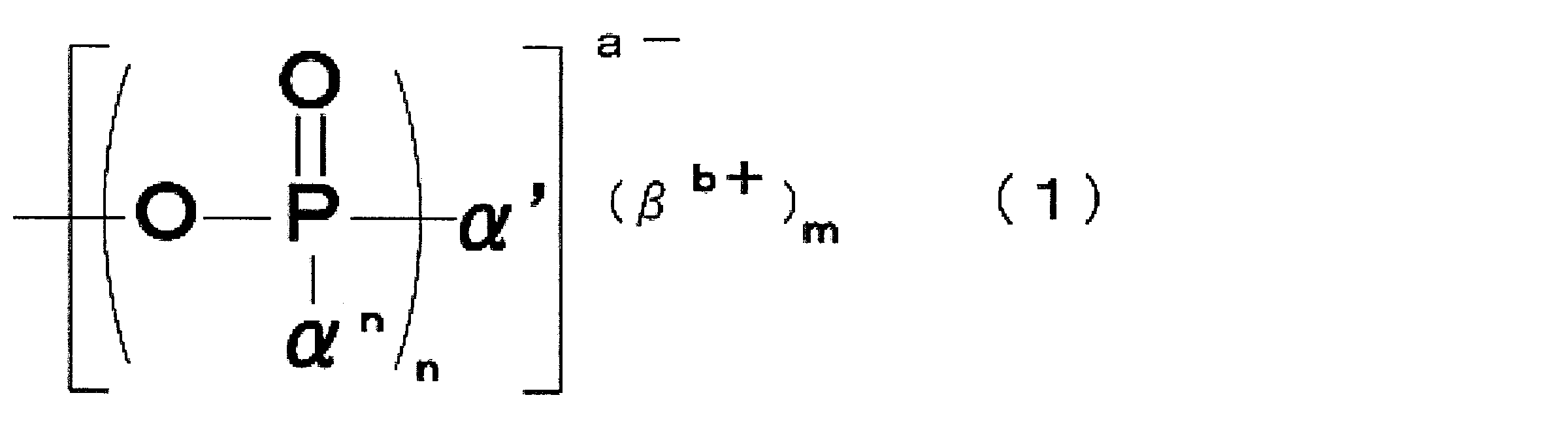
まず、検量線作成用として、測定対象シートに用いられているのと同じ微細繊維であってイオン性置換基含有量(mmol/g)が既知であるシートを調製し、蛍光X線分析により当該試料のX線強度を測定する。測定元素は、イオン性置換基には含まれるが微細繊維には含まれない元素(例えば、イオン性置換基がリン酸由来の基である場合、リン原子)、あるいはイオン性置換基の対イオンには含まれるが微細繊維には含まれない元素である。必要に応じ、測定対象シートは、イオン性置換基の対イオンを微細繊維には含まれない元素を含む他の対イオンに交換してから、測定に供することができる。例えば、イオン性置換基がカルボン酸由来の基である場合、対イオンをナトリウムイオンに交換してから測定に供することができ、この場合、測定元素は、ナトリウムイオンである。次いで、これにより得られたX線強度と、既知のイオン性置換基含有量に基づき、検量線を作成する。
他方、蛍光X線分析により、測定対象シートのX線強度を測定する。次いで、これにより得られたX線強度と上記検量線から、測定対象シートのイオン性置換基の含有量(mmol/g)を求める。求めた値は、シートまたは微細繊維に対するイオン性置換基の含有量として表すことができる。
本発明の第一の形態のシートは、有機イオンを含む。有機イオンとは、繊維の有するイオン性置換基とイオン対を形成可能なイオンであって、有機基を有するものを指す。有機基とは、有機化合物(炭素原子を含む化合物)から誘導される基を指す。有機イオンは、イオン性置換基を有する微細繊維からのシート化の際の乾燥工程において、イオン性置換基間の水素結合形成を抑制し、シートのシワ・割れの発生を抑えることができる。従来、繊維上のカルボキシ基をアミン塩型とするもの(前掲特許文献5)、繊維上のカルボキシ基をオニウム塩型とするもの(前掲特許文献6)、繊維上のカルボキシ基およびリン酸基をアンモニウム塩型等とするものがあったが、いずれも目的は有機溶媒中での分散性の向上、複合化の対象とする樹脂との相溶性確保にあった。微細繊維をシート化する際の、シワ・割れの抑制という新規な課題に着目し、イオン性置換基を有する微細繊維含有シートにおいて有機イオンを用いるのは、本発明が初めてである。
本発明の第一の形態のシートにおいて、微細繊維がアニオン性置換基を有する場合の有機イオンの種類、および微細繊維がカチオン性置換基を有する場合の有機イオンの種類は、目的の効果が発揮されるものである限り特に限定されない。アニオン性置換基である場合、有機イオンは下記式(2)で表される有機オニウムイオンであることが好ましい。
本発明の第二の形態のシートにおいて、有機オニウムイオンは、好ましくは、下記式(2)で表される有機オニウムイオンである。
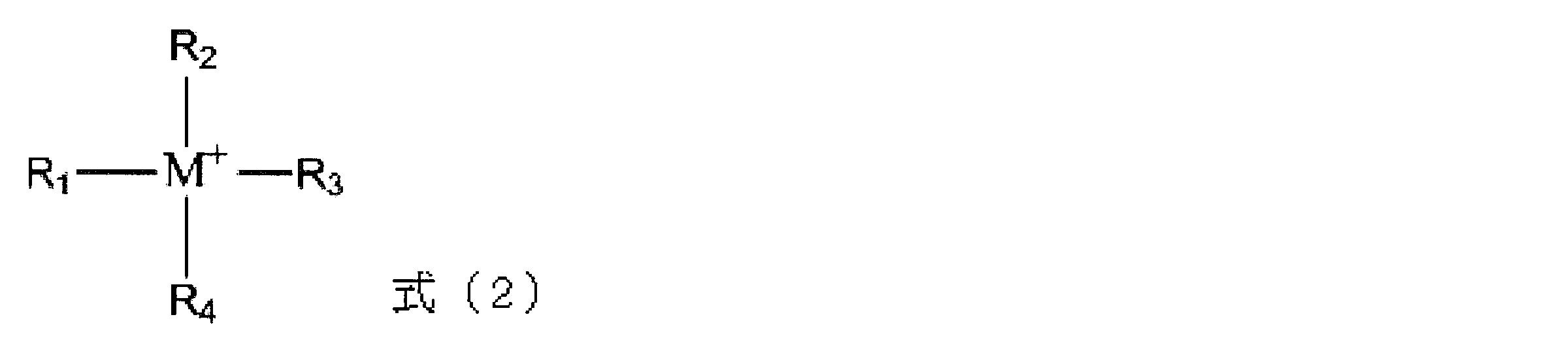
Mは、窒素原子またはリン原子であり;
R1~R4の少なくとも一つは、ヘテロ原子を含んでいてもよい有機基であり、残りは水素原子である。有機基の炭素数(複数の有機基を有する場合は、合計の炭素数)は、1以上であり、目的の効果が発揮される限り特に限定されないが、4以上であることが好ましく、8以上であることがより好ましく、16以上であることがさらに好ましい。炭素数が大きく、ある程度嵩高いものが効果が大きいからである。R1~R4は同一でもよく、それぞれ異なっていてもよいが、同一であるかまたは同程度の大きさの基であることが好ましい。直鎖状であるより、球状に近いほうが効果が大きいと考えられるからである。
本発明の第一の形態のシートは有機イオンを含むが、その含有量は、シートに対して0.40mmol/g以下である。有機イオンは、シート化前にイオン性置換基に付加された後、シート化の後に0.40mmol/g以下まで含有量が低減される。有機イオン含有量の低減により、シートの機械的強度を増すことができる。シートにおける有機イオンの含有量は、機械的強度をより向上させるとの観点からは、好ましくは0.20mmol/g以下であり、より好ましくは0.10mmol/g以下であり、さらに好ましくは0.05mmol/g以下である。一方で、シートにおける有機イオンの含有量の下限値は、とくに限定されず、シートに対して0mmol/gとすることができ、たとえば0.005mmol/gであってもよい。なお、本発明で繊維またはシートに関し、有機イオンの含有量というときは、特に記載した場合を除き、シート上でイオン性置換基とイオン対を形成しているかどうかを問わず、次に述べる測定法により測定した値をいう。
また、有機イオンに窒素が含まれる場合、例えば化学発光法による微量窒素分析装置により、シート中の窒素原子濃度を測定することもできる。このとき、有機イオンによる処理を行っていない微細繊維含有シートの窒素原子濃度も測定し、測定対象の微細繊維含有シートの窒素原子濃度からその値を減ずることで、有機イオン由来の窒素原子濃度を求め、有機イオン含有量を算出することができる。なお、例えばイオン性置換基としてリン酸由来の基を含む場合には、後述する多価アルコール煮沸法により、グリセリン使用下、180℃、2時間の処理を行うことで有機イオンを付与していない微細繊維含有シートと同様に扱うことができると考えられる。リン酸由来の基以外のイオン性置換基を含む場合には、後述する対イオン交換において、アニオン性置換基の場合はpH1の処理液に、カチオン性置換基の場合はpH14の処理液にそれぞれ2時間浸漬することで、有機イオンを付与していない微細繊維含有シートと同様に扱うことができると考えられる。
まず、検量線作成用として、測定対象シートと組成および形態が類似しており(例えば、ろ紙を用いる。)、かつ分析元素の含有量(mmol/g)が既知である試料を調製し、蛍光X線分析により当該試料のX線強度を測定する。ここでは、有機オニウムイオン等の有機イオンには含まれるが、微細繊維含有シートには存在しないと考えられる元素が分析元素となる。そしてこれにより得られたX線強度と、分析元素の既知の含有量に基づき、検量線を作成する。次いで、蛍光X線分析により、測定対象シートのX線強度を測定する。そしてこれにより得られたX線強度と上記検量線から、測定対象シート中の分析元素の含有量(mmol/g)を算出する。
本発明のシートは、以下の特性を有する。
シートの密度とは、100mm角のシートを23℃、相対湿度50%の条件下で24時間調湿した後、シートの厚みおよび質量から求められる値(g/cm3)をいう。本発明のシートの密度は、用途等に応じ、適宜とすることができるが、強度と透明性の観点から、0.1~7.0g/cm3とすることができ、0.5~5.0g/cm3であることが好ましく、1.0~3.0g/cm3であることがより好ましい。本発明の第二の形態のシートにおいては、シートの密度を、たとえば1.50g/cm3以下とすることも可能である。
シートを製造する際のシワ・割れは、次の方法により評価できる。微細繊維の分散液をシート化する際、180mm各の堰止用金枠のサイズに合わせ、アクリル板の裏面に2cm角のマスを縦9×横9の合計81マスを記載する。微細繊維含有シートが該アクリル板に張り付いた状態で上方から観察し、シワ・割れが発生したマスを計数する。次いでシワ・割れが発生したマスが全マス数の何%を占めるかを計算する。
本発明のシートは、この方法で評価した場合に、シワ・割れが発生したマスの割合が20%未満である。
シートの全光線透過率とは、JIS規格K7361に準拠し、ヘーズメータを用いて測定した値をいう。本発明のシートは透明性が高く、その全光線透過率は80%以上であり、85%以上であることが好ましく、88%以上であることがより好ましい。
シートのヘーズ値とは、JIS規格K7136に準拠し、ヘーズメータを用いて測定した値をいう。本発明のシートは透明性が高く、そのヘーズ値は、40.0%以下であり、35.0%以下であることが好ましく、20.0%以下であることがより好ましい。
シートの引張強度および引張弾性率とは、JIS K 7127に準拠し、引張試験機を用いて、温度23℃、相対湿度50%において測定された値をいう。
本発明の第一の形態シートは、製造の際のシワ・割れの発生が抑えられており、かつイオン性置換基に対して有機イオンを用いないシートに比較して、引張強度および引張弾性率に優れる。具体的には、本発明の第一の形態のシートの引張強度は、60.0MPa以上であることが好ましく、70.0MPa以上であることがより好ましく、80.0MPa以上であることがさらに好ましい。この値以上であれは、光学材料としての使用に耐えるからである。上限値は、特に限定されないが、例えば400.0MPa以下であり、または300.0MPa以下である。
また、本発明者らによれば、微細繊維の製造条件や、微細繊維上のイオン性置換基の種類、場合によりその量、シートに含有される有機イオンの種類、場合によりその量などをそれぞれ適切に選択されていることも、シワ・割れを抑制しつつ引張特性を向上させることに寄与しているものと推定されている。これらは、シートの密度、全光線透過率、ヘーズ、黄色度変化などにも影響を与えるものであると考えられている。
シートの黄変度変化(ΔYI)は、次式で表される
ΔYI = YI2-YI1
但し、YI1は200℃で4時間の真空乾燥前の黄色度、YI2は200℃で4時間の真空乾燥後の黄色度を示す。黄色度は、JIS規格K7373に準拠して測定した値をいう。
本発明の第一の形態のシートは、黄変度変化(ΔYI)が抑えられている。本発明の第一の形態のシートの黄変度変化(ΔYI)は、例えば75.0以下である。
鉛筆硬度とは、JIS規格K5600に準拠して測定された値をいう。ただし試料に付与する荷重は500gとする。本発明の第二の形態のシートは柔軟性が高く、その鉛筆硬度は、F以下であり、HB以下であることが好ましく、B以下であることがより好ましい。このような範囲であれば、軟包装としての使用に適するからである。
成形柔軟性は、次の方法により評価することができる。微細繊維含有シートを150mm角に切出し、直径50mm、高さ60mmの木製の円柱状成形体の全体を包むように包装する。次いで、円柱状成形体を上方から目視観察する。目視観察は、円柱状成形体とシートとの間の空隙の有無、およびシートの割れの観点から行う。
本発明の第二の形態のシートは、成形追従性を評価した際に、円柱状成形体と微細繊維状セルロースシートの間に空隙が見られず、かつ微細繊維状セルロースシートに割れが見られないものである。
本発明の第一の形態のシートの製造方法は、
(1)繊維原料にイオン性置換基を導入して、イオン性置換基導入繊維を得る工程と、
(2)イオン性置換基導入繊維を微細化処理して、イオン性置換基導入微細繊維を得る工程とを含み、さらに
工程(2)の前または後に、
・イオン性置換基を有機イオンで処理する工程と
を含み、さらに
(3)有機イオンで処理されたイオン性置換基導入微細繊維から、シートを調製する工程と、
(4)シートに含有される有機イオンを低減する工程と
を含む。
(1)繊維原料にイオン性置換基を導入して、イオン性置換基導入繊維を得る工程と、
(2)イオン性置換基導入繊維を微細化処理して、イオン性置換基導入微細繊維を得る工程とを含み、さらに
工程(2)の前または後に、
・イオン性置換基を有機オニウムイオンで処理する工程と
を含み、さらに
(3)有機オニウムイオンで処理されたイオン性置換基導入微細繊維から、シートを調製する工程と、
を含む。
<繊維原料>
イオン性置換基を有する微細繊維は、繊維原料にイオン性置換基を導入し、微細化処理をすることにより得られる。工程(1)で用いられる繊維原料は、豊富に入手可能な天然繊維であり、好ましくはセルロース、キチンまたはキトサンであり、より好ましくはセルロースである。繊維原料としては、入手しやすく安価である点から、パルプを用いることが好ましい。パルプの中では、入手のしやすさという点で、セルロースを含む木材パルプが好ましい。木材パルプの中でも化学パルプはセルロース比率が大きいため、繊維微細化時の微細セルロース繊維の収率が高く、また、パルプ中のセルロースの分解が小さく、軸比の大きい長繊維の微細セルロース繊維が得られる点で好ましいが、特に限定されない。中でもクラフトパルプ、サルファイトパルプが最も好ましく選択されるが、特に限定されない。
繊維原料には、イオン性置換基が導入される。繊維への置換基を導入する方法は、特に限定されない。第一の形態のシートの場合には、例えば、酸化処理、繊維中の官能基と共有結合を形成し得る化合物による処理などが挙げられる。第二の形態のシートの場合には例えば、繊維中の官能基と共有結合を形成し得る化合物による処理などが挙げられる。酸化処理とは、繊維中のヒドロキシ基をアルデヒド基やカルボキシ基に変換する処理であり、例えばTEMPO酸化処理や各種酸化剤(亜塩素酸ナトリウム、オゾンなど)を用いた処理が挙げられる。
繊維原料と反応するような化合物として、リン酸由来の基を有する化合物を用いる場合、特に限定されないが、リン酸、ポリリン酸、亜リン酸、ホスホン酸、ポリホスホン酸あるいはこれらの塩またはエステルからなる群より選ばれる少なくとも1種である。これらの中でも、低コストであり、扱いやすく、また、繊維原料にリン酸由来の基を導入して微細化(解繊)効率をより向上できることから、リン酸由来の基を有する化合物が好ましいが、特に限定されない。
これらのうち、リン酸由来の基の導入の効率が高く、工業的に適用しやすい観点から、リン酸、リン酸のナトリウム塩、リン酸のカリウム塩、リン酸のアンモニウム塩が好ましく、リン酸二水素ナトリウム、リン酸水素二ナトリウムがより好ましいが、特に限定されない。
本発明の第一の形態のシートの製造においては、例えばリン酸由来の基を有する化合物を、尿素、チオ尿素、ビウレット、フェニル尿素、ベンジル尿素、ジメチル尿素、ジエチル尿素、テトラメチル尿素、ベンゾレイン尿素、およびヒダントインなどから選択される少なくとも一種とともに繊維原料と反応させることが好ましい態様として挙げられる。
絶乾質量で0.04g程度の固形分を含む微細繊維含有スラリーを分取し、イオン交換水を用いて50g程度に希釈する。この溶液を撹拌しながら、0.01Nの水酸化ナトリウム水溶液を滴下した場合の電気伝導度の値の変化を測定し、その値が極小となる時の0.01N水酸化ナトリウム水溶液の滴下量を、滴定終点における滴下量とする。セルロース表面の置換基の含有量XはX(mmol/g)=0.01(mol/l)×V(ml)/W(g)で表される。ここで、V:0.01N水酸化ナトリウム水溶液の滴下量(ml)、W:微細セルロース繊維含有スラリーが含む固形分(g)である。
カチオン化剤の具体例としては、グリシジルトリメチルアンモニウムクロリド、3-クロロ-2-ヒドロキシプロピルトリメチルアンモニウムクロリドなどのグリシジルトリアルキルアンモニウムハライド或いはそのハロヒドリン型の化合物が挙げられる。
アルカリ金属の水酸化物としては、水酸化リチウム、水酸化ナトリウム、水酸化カリウムが挙げられる。アルカリ土類金属の水酸化物としては、水酸化カルシウムが挙げられる。
アルカリ金属の炭酸塩としては炭酸リチウム、炭酸水素リチウム、炭酸カリウム、炭酸水素カリウム、炭酸ナトリウム、炭酸水素ナトリウムが挙げられる。アルカリ土類金属の炭酸塩としては、炭酸カルシウムなどが挙げられる。
アルカリ金属のリン酸塩としては、リン酸リチウム、リン酸カリウム、リン酸3ナトリウム、リン酸水素2ナトリウムなどが挙げられる。アルカリ土類金属のリン酸塩としては、リン酸カルシウム、リン酸水素カルシウムなどが挙げられる。
上記アルカリ化合物は1種単独でもよいし、2種以上を組み合わせてもよい。
本発明の第一の形態のシートの製造においては、必要に応じ、繊維原料にイオン性置換基を導入して、イオン性置換基導入繊維を得る工程の後であって、イオン性置換基を有機イオンで処理する工程の前に、アニオン性置換基を有する繊維に対しては酸処理を、カチオン性置換基を有する繊維に対しては塩基処理を行うことができる。
本発明の第二の形態のシートの製造においては、必要に応じ、繊維原料にイオン性置換基を導入して、イオン性置換基導入繊維を得る工程の後であって、イオン性置換基を有機オニウムイオンで処理する工程の前に、酸処理を行うことができる。
微細化(解繊)処理に際し、繊維は溶媒に分散される。溶媒の種類は、微細化(解繊ということもある。)処理が適切に行える限り特に限定されないが、水系溶媒(水、または水と有機溶媒を混合したもの)を使用することができる。有機溶媒としては、例えば、メタノール、エタノール、n-プロパノール、イソプロパノール、n-ブタノール、tブチルアルコール等のアルコール類が挙げられる。さらにアセトン、メチルエチルケトン(MEK)等のケトン類、ジエチルエーテル、テトラヒドロフラン(THF)等のエーテル類、ジメチルスルホキシド(DMSO)、ジメチルホルムアミド(DMF),ジメチルアセトアミド(DMAc)等が挙げられる。有機溶媒は、1種のみ用いてもよく、2種以上用いてもよい。
本発明の第一の形態のシートの製造においては、工程(3)の前に、イオン性置換基を有機イオンで処理する。
本発明の第二の形態のシートの製造においては、工程(3)の前に、リン酸由来の基を有機オニウムイオンで処理する。
[工程(3):有機オニウムイオンで処理されたリン酸由来の基導入微細繊維からシートを調製する工程]
微細化処理により得られた微細繊維の分散液(スラリー)から、シートを調製する。シートの調製方法は、特に限定されないが、典型的には下記の抄紙法、塗工法等に拠ることができる。
微細繊維含有スラリーを通常の抄紙で用いられる長網式、円網式、傾斜式等の連続抄紙機のほか、これらを組み合わせた多層抄き合わせ抄紙機、さらに手抄き等公知の抄紙方法で抄紙され、一般の紙と同様の方法でシート化することが可能である。つまり、微細繊維含有スラリーをワイヤー上で濾過、脱水して湿紙状態のシートを得た後、プレス、乾燥することでシートを得ることが可能である。スラリーの濃度は特に限定されないが、0.05~5質量%が好ましく、濃度が低すぎると濾過に膨大な時間がかかり、逆に濃度が高すぎると均一なシートが得られないため好ましくない。スラリーを濾過、脱水する場合、濾過時の濾布としては特に限定されないが、微細繊維は通過せず、かつ濾過速度が遅くなりすぎないことが重要である。このような濾布としては特に限定されないが、有機ポリマーからなるシート、織物、多孔膜が好ましい。有機ポリマーとしては特に限定されないが、ポリエチレンテレフタレートやポリエチレン、ポリプロピレン、ポリテトラフルオロエチレン(PTFE)等のような非セルロース系の有機ポリマーが好ましい。具体的には孔径0.1~20μm、例えば1μmのポリテトラフルオロエチレンの多孔膜、孔径0.1~20μm、例えば1μmのポリエチレンテレフタレートやポリエチレンの織物等が挙げられるが、特に限定されない。
塗工法は、微細繊維含有スラリーを基材上に塗工し、これを乾燥して形成された微細繊維含有層を基材から剥離することにより、シートを得る方法である。塗工装置と長尺の基材を用いることで、シートを連続的に生産することができる。基材の質は、特に限定されないが、微細繊維含有スラリーに対する濡れ性が高いものの方が乾燥時のシートの収縮等を抑制することができて良いが、乾燥後に形成されたシートが容易に剥離できるものを選択することが好ましい。中でも樹脂板または金属板が好ましいが、特に限定されない。その中で、適当なものを単独、または積層して使用するのが好適である。例えばアクリル板、ポリエチレンテレフタレート板、塩化ビニル板、ポリスチレン板、ポリ塩化ビニリデン板等の樹脂板や、アルミ板、亜鉛版、銅版、鉄板等の金属板および、それらの表面を酸化処理したもの、ステンレス板、真ちゅう板等を用いることができるが、特に限定されない。微細繊維含有スラリーを基材上に塗工するには、上記基材に所定のスラリー量を塗工することが可能な各種コーターを使用すれば良い。特に限定されないが、例えば、ロールコーター、グラビアコーター、ダイコーター、カーテンコーター、スプレーコーター、ブレードコーター、ロッドコーター、エアドクターコーター等が使用できるが、中でもダイコーター、カーテンコーター、スプレーコーター、エアドクターコーター等の塗工方式によるものが均一な塗工には有効である。なお後述するように、シートを積層体とする場合等においては、基材からの剥離は行わなくてもよい場合がある。
調製されるシートの厚みには特に限定されず、用途に応じて適宜とすることができ、シートの仕上がり坪量または厚さに基づき、スラリー量を計量して、抄紙または塗工等を行うことができる。
抄紙または塗工等された後、必要に応じ、脱水および乾燥の少なくとも一方が行われ、シート化される。なお、本発明の第一の形態のシートの製造においては、脱水、乾燥は、後の工程(4)で、有機イオンを低減するために、所定の水溶液での処理が行われることから、ある程度まで水分が除去されるまで行うことができ、通常の最終物としてのシートを得る場合のようにまで完全には行わなくてもよいと考えられる。
シートの調製に際し、特に限定されないが、前記微細繊維と前記微細繊維以外の繊維(以下、「追加繊維」という)を少なくとも1種以上混合して調製することもできる。追加繊維としては、例えば、無機繊維、有機繊維、合成繊維等、半合成繊維、再生繊維が挙げられるが、特に限定されない。無機繊維としては、例えば、ガラス繊維、岩石繊維、金属繊維等が挙げられるがこれらに限定されない。有機繊維としては、例えば、セルロース、炭素繊維、パルプ、キチン、キトサン等の天然物由来の繊維等が挙げられるがこれらに限定されない。合成繊維としては、例えば、ナイロン、ビニロン、ビニリデン、ポリエステル、ポリオレフィン(例えばポリエチレン、ポリプロピレンなど)、ポリウレタン、アクリル、ポリ塩化ビニル、アラミド等が挙げられるがこれらに限定されない。半合成繊維としては、アセテート、トリアセテート、プロミックス等が挙げられるがこれらに限定されない。再生繊維としては、例えば、レーヨン、キュプラ、ポリノジックレーヨン、リヨセル、テンセル等が挙げられるがこれらに限定されない。追加繊維は、必要に応じて化学的処理、解繊処理等の処理を施すことができる。
本発明の第一の形態のシートの製造においては、工程(3)の後に、シートに含有される有機イオンを低減する工程を含む。有機イオンを低減する方法は、所望の程度まで有機イオンを低減できる限り、特に限定されない。例えば、有機イオンとイオン対を形成しているイオン性置換基ごと脱離させる方法(イオン性置換基の脱離)により、または有機イオンを別のイオンに交換する方法(対イオン交換)により、行うことができる。
導入されたイオン性置換基の全部または一部を脱離させることにより、シートから有機イオンを除去することができる。脱離は、工程(3)で得られたシートを水およびアルコールの少なくとも一方で処理することにより行うことができる。アルコールには、多価アルコールが含まれ、多価アルコールを用いる場合、脱離は、シートを多価アルコールで煮沸することで達成でき、またシートを多価アルコールの蒸気で処理することでも達成できる。水および沸点の低いアルコールの少なくとも一方を用いる場合、脱離は、シートを多価アルコール蒸気で処理することで達成できる。
本発明の好ましい態様の一つにおいては、工程(4)で置換基を脱離させるに際しては、シートを多価アルコールにより煮沸処理する。多価アルコールとは、アルコールのうち2以上のOH基を有するものをいう。多価アルコールを用いる場合、OH/C比率が0.15以上のものを用いることが好ましい。より好ましくは0.2以上であるものを用いる。「OH/C比率」とは、分子に含まれる炭素(C)原子あたりのOH基の個数をいい、例えば、エチレングリコール(C2H6O2)のOH/C比率は1であり、ジエチレングリコール(C4H10O3)のOH/C比率は0.67である。
工程(4)で置換基を脱離させるに際しては、蒸気を使用してもよい。蒸気の種類は、特に限定されず、OH基を有する物質の蒸気であれは、導入した置換基の脱離を行うことができると考えられる。置換基を脱離する能力が高いという観点からは、蒸気は、水蒸気およびアルコール蒸気の少なくとも一方であることが好ましい。アルコールの例として、メタノール、エタノール、n-プロパノール、イソプロパノール、n-ブタノール、イソブチルアルコール、およびt-ブタノール、ならびに上述の多価アルコールを挙げることができる。特に好ましい蒸気の例の一つは、水蒸気である。水蒸気は、水やメタノール、エタノール、プロパノール等の低級アルコール、好ましくは炭素数1以上6以下、より好ましくは炭素数1以上3以下のアルコール;アセトン、メチルエチルケトン、メチルイソブチルケトン等の炭素数3以上6以下のケトン;直鎖または分岐状の炭素数1以上6以下の飽和炭化水素または不飽和炭化水素;ベンゼン、トルエン等の芳香族炭化水素を含んでいてもよい。
る。
有機イオンは、適切な他のイオンとの対イオン交換により、シートから有機イオンを除去することができる。イオン性置換基がアニオン性である場合、交換される対イオンは、特に限定されないが、例えば水素イオン、アルカリ金属イオン、またはアルカリ土類金属イオンである。より具体的には、水素イオン、リチウムイオン、ナトリウムイオン、カリウムイオン、ルビジウムイオン、セシウムイオン、カルシウムイオン、ストロンチウムイオン、バリウムイオン、ユウロピウムイオン、タリウムイオンまたはグアニジンイオンである。好ましい例は、ナトリウムイオン、カリウムイオンまたはカルシウムイオンである。イオン性置換基がカチオン性である場合、交換される対イオンは、特に限定されないが、例えばハロゲン化物イオン、またはアニオン性の多原子イオンである。より具体的には、フッ化物イオン、塩化物イオン、臭化物イオン、ヨウ素化物イオン、水酸化物イオン、シアン化物イオン、硝酸イオン、亜硝酸イオン、リン酸二水素イオン、炭酸水素イオンである。好ましい例は、フッ化物イオン、塩化物イオンである。
工程(4)は、所望の程度にまで有機イオンが低減されるまで行うことができる。イオン交換による処理の後、必要に応じ、洗浄、脱水・乾燥を行い、最終物としてのシートを得ることができる。洗浄は、水または水系溶媒、好ましくは水で行うことができる。脱水・乾燥は、工程(3)の項で説明した方法および条件で行うことができる。
本発明のシートは、シート一層からなるものとして使用することもできるが、少なくとも一方の面に、有機層および無機層の少なくとも一方を形成し、積層体として用いることもできる。積層化により、水に対する耐性(耐水性、耐湿性、撥水性)をさらに付与することができる。無機層と有機層とを積層する場合、順番は特に限定されないが、基材シートの表面にまず有機層を積層することは、無機層を形成するための面を平滑にし、形成される無機層をより欠陥の少ないものとすることができる点で好ましい。また、有機層および無機層以外の他の構成層、例えば、上層の接着を容易にするための易接着層を含んでいてもよい。積層化に際しては、透明性が特に重視される用途に用いる場合は、シートの黄変を促進するような加熱工程やUV照射工程を含まないことが好ましい。積層化によって得られる積層体は、微細繊維含有シートからなる基材シート層の少なくとも一方の側に形成された、少なくとも1層の無機層と少なくとも1層の有機層とを含むことが好ましい。無機層、有機層等の層数は特に限定されない。フレキシブル性や透明性を維持しつつ、耐湿性を十分にするとの観点からは、片側について、例えば、無機層と有機層とを交互に2層~15層積層することが好ましく、3層~7層積層することがより好ましい。
[リン酸化パルプの製造]
針葉樹クラフトパルプとして、王子製紙社製のパルプ(固形分93質量% 米坪208g/m2シート状 離解してJIS P8121に準じて測定されるカナダ標準濾水度(CSF)700ml)を使用した。上記針葉樹クラフトパルプの絶乾質量として100質量部に、リン酸二水素アンモニウムと尿素の混合水溶液を含浸し、リン酸二水素アンモニウム49質量部、尿素130質量部となるように圧搾し、薬液含浸パルプを得た。得られた薬液含浸パルプを105℃の乾燥機で乾燥し、水分を蒸発させてプレ乾燥させた。その後、140℃に設定した送風乾燥機で、10分間加熱し、パルプ中のセルロースにリン酸由来の基を導入し、リン酸化パルプを得た。
得られたリン酸化パルプの絶乾質量として100質量部に対して10000質量部のイオン交換水を注ぎ、攪拌して均一に分散させた後、濾過脱水して、脱水シートを得る工程を2回繰り返し、リン酸化パルプの脱水シートAを得た。
得られたリン酸化パルプの脱水シートAを原料にし、先と同様にして、リン酸由来の基を導入する工程、濾過脱水する工程をさらに2回繰り返して(リン酸化および濾過脱水の合計回数は3回)、リン酸化パルプの脱水シートBを得た。
該リン酸化パルプの脱水シートBは、次に示す滴定法で求められるリン酸由来の基の導入量が1.4mmol/gであった。
置換基導入量は、繊維原料へのリン酸由来の基の導入量であり、この値が大きいほど、多くのリン酸由来の基が導入されている。置換基導入量は、対象となる微細繊維状セルロースをイオン交換水で含有量が0.2質量%となるように希釈した後、イオン交換樹脂による処理、アルカリを用いた滴定によって測定した。イオン交換樹脂による処理では、0.2質量%セルロース繊維含有スラリーに体積で1/10の強酸性イオン交換樹脂(アンバージェット1024;オルガノ株式会社、コンディショニング済)を加え、1時間振とう処理を行った。その後、目開き90μmのメッシュ上に注ぎ、樹脂とスラリーを分離した。アルカリを用いた滴定では、イオン交換後のセルロース繊維含有スラリーに、0.1Nの水酸化ナトリウム水溶液を加えながら、スラリーが示す電気伝導度の値の変化を計測した。すなわち、図1に示した曲線の第1領域で必要としたアルカリ量(mmol)を、滴定対象スラリー中の固形分(g)で除して、置換基導入量(mmol/g)とした。
リン酸化パルプの脱水シートBの絶乾質量として100質量部に5000質量部のイオン交換水を加え、希釈した。次いで、攪拌しながら、1N塩酸を少しずつ添加し、pHが2~3のパルプスラリーを得た。その後、このパルプスラリーを脱水し、脱水シートを得た後、再びイオン交換水を注ぎ、攪拌して均一に分散させた。次いで、濾過脱水して脱水シートを得る操作を繰り返すことにより、余剰の塩酸を十分に洗い流した。上記の手順により、リン酸由来の基の対イオンが水素(H)イオンとなった、リン酸化パルプ(H型)を得た。
該リン酸化パルプ(H型)の絶乾質量として100質量部に5000質量部のイオン交換水を加え、希釈した。次いで、攪拌しながら、10質量%テトラブチルアンモニウムヒドロキシド水溶液を少しずつ添加し、pHが10~12のパルプスラリーを得た。その後、このパルプスラリーを脱水し、脱水シートを得た後、再びイオン交換水を注ぎ、攪拌して均一に分散させた。次いで、濾過脱水して脱水シートを得る操作を繰り返すことにより、余剰のテトラブチルアンモニウムヒドロキシド水溶液を十分に洗い流した。上記の手順により、リン酸由来の基の対イオンがテトラブチルアンモニウム(TBA)イオンとなった、リン酸化パルプ(TBA型)を得た。
該リン酸化パルプ(TBA型)にイオン交換水を添加して、1.0質量%のパルプ懸濁液とした。このパルプ懸濁液を、湿式微粒化装置(スギノマシン社製:アルティマイザー)で245MPaの圧力にて5回パスさせ、微細繊維状セルロース懸濁液(TBA型)を得た。
微細繊維状セルロース懸濁液(TBA型)の固形分濃度が0.5質量%となるよう濃度調製を行った。シートの仕上がり坪量が75g/m2になるように懸濁液を計量して、市販のアクリル板に展開し35℃、15%RHの恒温恒湿器にて乾燥した。なお、所定の坪量となるようアクリル板上には堰止用の金枠(180mm角)を配置した。以上の手順により、微細繊維状セルロースシート(TBA型)を得た。
ステンレス板の上にスペーサーとして耐熱性ゴムシート(信越化学製、X-30-4084-U)に150mm角の空隙をあけたものを載せ、穴の中にグリセリン50mLを展開した。そこに120mm角に切り出した微細繊維状セルロースシート(TBA型)を浸漬し、その上にステンレス板を重ねて、180℃に加熱した熱プレス機(井元製作所製:手動油圧真空加熱プレス)に設置した。該微細繊維状セルロースシート(TBA型)を180℃で30分間処理した後、500mLの水に浸漬して洗浄を行った。洗浄を3回繰り返し、該微細繊維状セルロースシートをガラス板に貼り付け、100℃で15分間加熱乾燥させ、リン酸由来の基、および対イオンが除去された微細繊維状セルロースシートを得た。
[リン酸化パルプの対イオン変換(Na型)]
実験例1のリン酸化パルプの対イオン変換(TBA型)の際、10質量%テトラブチルアンモニウムヒドロキシド水溶液の代わりに、1N NaOH水溶液を用いることで、リン酸由来の基の対イオンがナトリウム(Na)イオンとなったリン酸化パルプ(Na型)を得た。
該リン酸化パルプ(Na型)にイオン交換水を添加して、1.0質量%のパルプ懸濁液にした。このパルプ懸濁液を、湿式微粒化装置(スギノマシン社製:アルティマイザー)で245MPaの圧力にて5回パスさせ、微細繊維状セルロース懸濁液(Na型)を得た。
該微細繊維状セルロース懸濁液(Na型)をイオン交換水で0.5質量%に希釈し、体積で1/10の強酸性イオン交換樹脂(アンバージェット1024;オルガノ株式会社、コンディショニング済)を加え、1時間攪拌処理を行った。その後、目開き51μmのメッシュ上に注いで減圧ろ過し、樹脂とスラリーを分離した。上記の手順により、リン酸由来の基の対イオンが水素(H)イオンとなった微細繊維状セルロース懸濁液(H型)を得た。
10質量%テトラブチルアンモニウムヒドロキシド水溶液を、リン酸由来の基の含有量(1.5mmol/g)とテトラブチルアンモニウムイオンが等量となるよう計量し、該微細繊維状セルロース懸濁液(H型)に加えた。その後1時間攪拌処理を行い、リン酸由来の基の対イオンがテトラブチルアンモニウム(TBA)イオンとなった、微細繊維状セルロース懸濁液(TBA型)を得た。
[対イオン交換(有機対イオンの除去)]
実験例2で得られた微細繊維状セルロースシート(TBA型)を、pHを2に調整した塩酸に30分間浸漬することで、微細繊維状セルロースシート(TBA型)からテトラブチルアンモニウムイオンを除去し、リン酸由来の基の対イオンを水素(H)イオンとした。その後、pHを12に調整した水酸化ナトリウム水溶液に5分間浸漬し、リン酸由来の基の対イオンをナトリウム(Na)イオンとした。該微細繊維状セルロースシートをガラス板に貼り付け、100℃で15分間加熱乾燥させた。上記の手順により、有機対イオンが除去された微細繊維状セルロースシートを得た。
実験例2における微細繊維状セルロース懸濁液(H型)への有機対イオン付与の際、10質量%テトラブチルアンモニウムヒドロキシド水溶液の代わりに、10質量%テトラエチルアンモニウムヒドロキシド水溶液を用いた以外は実験例2と同様にして、リン酸由来の基、および有機対イオンが除去された微細繊維状セルロースシートを得た。
実験例2における微細繊維状セルロース懸濁液(H型)への有機対イオン付与の際、10質量%テトラブチルアンモニウムヒドロキシド水溶液の代わりに、10質量%テトラブチルホスホニウムヒドロキシド水溶液を用いた以外は実験例2と同様にして、リン酸由来の基、および有機対イオンが除去された微細繊維状セルロースシートを得た。
実験例2における微細繊維状セルロース懸濁液(H型)への有機対イオン付与の際、10質量%テトラブチルアンモニウムヒドロキシド水溶液の代わりに、30質量%ラウリルトリメチルアンモニウムクロライド水溶液(第一工業製薬社製「カチオーゲンTML」)を用いた以外は実験例2と同様にして、リン酸由来の基、および有機対イオンが除去された微細繊維状セルロースシートを得た。
[TEMPO酸化パルプの製造(TEMPO酸化反応)]
乾燥質量100質量部相当の未乾燥の王子製紙社製針葉樹晒クラフトパルプとTEMPO1.25質量部と、臭化ナトリウム12.5質量部とを水10000質量部に分散させた。次いで、13質量%次亜塩素酸ナトリウム水溶液を、1.0gのパルプに対して次亜塩素酸ナトリウムの量が8.0mmolになるように加えて反応を開始した。反応中は0.5Mの水酸化ナトリウム水溶液を滴下してpHを10~11に保ち、pHに変化が見られなくなった時点で反応終了と見なした。
その後、このパルプスラリーを脱水し、脱水シートを得た後、5000質量部のイオン交換水を注ぎ、攪拌して均一に分散させた後、濾過脱水して、脱水シートを得る工程を2回繰り返した。滴定法により測定される置換基(カルボン酸由来の基)の導入量は1.5mmol/gであった。
さらに、得られた脱水シートに、5000質量部のイオン交換水を加えて希釈した。次いで、攪拌しながら、1N塩酸を少しずつ添加し、pHが2~3のパルプスラリーを得た。その後、このパルプスラリーを脱水し、脱水シートを得た後、再びイオン交換水を注ぎ、攪拌して均一に分散させた。次いで、濾過脱水して脱水シートを得る操作を繰り返すことにより、余剰の塩酸を十分に洗い流した。上記の手順により、カルボン酸由来の基の対イオンが水素(H)イオンとなった、TEMPO酸化パルプ(H型)を得た。
得られたTEMPO酸化パルプ(H型)の絶乾質量として100質量部に5000質量部のイオン交換水を加え、希釈した。次いで、攪拌しながら、10% テトラブチルアンモニウムヒドロキシド水溶液を少しずつ添加し、pHが10~12のパルプスラリーを得た。その後、このパルプスラリーを脱水し、脱水シートを得た後、再びイオン交換水を注ぎ、攪拌して均一に分散させた。次いで、濾過脱水して脱水シートを得る操作を繰り返すことにより、余剰のテトラブチルアンモニウムヒドロキシド水溶液を十分に洗い流した。上記の手順により、カルボン酸由来の基の対イオンがテトラブチルアンモニウム(TBA)イオンとなった、TEMPO酸化パルプ(TBA型)を得た。
対イオンの除去(リン酸由来の基、および対イオンの除去)を行わない以外は実験例1と同様にして、有機対イオンとしてテトラブチルアンモニウムイオンが付与された微細繊維状セルロースシートを得た。具体的には、以下の通りである。
針葉樹クラフトパルプとして、王子製紙社製のパルプ(固形分93質量% 米坪208g/m2シート状 離解してJIS P8121に準じて測定されるカナダ標準濾水度(CSF)700ml)を使用した。上記針葉樹クラフトパルプの絶乾質量として100質量部に、リン酸二水素アンモニウムと尿素の混合水溶液を含浸し、リン酸二水素アンモニウム49質量部、尿素130質量部となるように圧搾し、薬液含浸パルプを得た。得られた薬液含浸パルプを105℃の乾燥機で乾燥し、水分を蒸発させてプレ乾燥させた。その後、140℃に設定した送風乾燥機で、10分間加熱し、パルプ中のセルロースにリン酸由来の基を導入し、リン酸化パルプを得た。
得られたリン酸化パルプの絶乾質量として100質量部に対して10000質量部のイオン交換水を注ぎ、攪拌して均一に分散させた後、濾過脱水して、脱水シートを得る工程を2回繰り返し、リン酸化パルプの脱水シートAを得た。
得られたリン酸化パルプの脱水シートAを原料にし、先と同様にして、リン酸由来の基を導入する工程、濾過脱水する工程をさらに2回繰り返して(リン酸化および濾過脱水の合計回数は3回)、リン酸化パルプの脱水シートBを得た。
該リン酸化パルプの脱水シートBは、実験例1中に記載した滴定法で求められるリン酸由来の基の導入量が1.4mmol/gであった。
リン酸化パルプの脱水シートBの絶乾質量として100質量部に5000質量部のイオン交換水を加え、希釈した。次いで、攪拌しながら、1N塩酸を少しずつ添加し、pHが2~3のパルプスラリーを得た。その後、このパルプスラリーを脱水し、脱水シートを得た後、再びイオン交換水を注ぎ、攪拌して均一に分散させた。次いで、濾過脱水して脱水シートを得る操作を繰り返すことにより、余剰の塩酸を十分に洗い流した。上記の手順により、リン酸由来の基の対イオンが水素(H)イオンとなった、リン酸化パルプ(H型)を得た。
該リン酸化パルプ(H型)の絶乾質量として100質量部に5000質量部のイオン交換水を加え、希釈した。次いで、攪拌しながら、10質量%テトラブチルアンモニウムヒドロキシド水溶液を少しずつ添加し、pHが10~12のパルプスラリーを得た。その後、このパルプスラリーを脱水し、脱水シートを得た後、再びイオン交換水を注ぎ、攪拌して均一に分散させた。次いで、濾過脱水して脱水シートを得る操作を繰り返すことにより、余剰のテトラブチルアンモニウムヒドロキシド水溶液を十分に洗い流した。上記の手順により、リン酸由来の基の対イオンがテトラブチルアンモニウム(TBA)イオンとなった、リン酸化パルプ(TBA型)を得た。
該リン酸化パルプ(TBA型)にイオン交換水を添加して、1.0質量%のパルプ懸濁液とした。このパルプ懸濁液を、湿式微粒化装置(スギノマシン社製:アルティマイザー)で245MPaの圧力にて5回パスさせ、微細繊維状セルロース懸濁液(TBA型)を得た。
微細繊維状セルロース懸濁液(TBA型)の固形分濃度が0.5質量%となるよう濃度調製を行った。シートの仕上がり坪量が75g/m2になるように懸濁液を計量して、市販のアクリル板に展開し35℃、15%RHの恒温恒湿器にて乾燥した。なお、所定の坪量となるようアクリル板上には堰止用の金枠(180mm角)を配置した。以上の手順により、微細繊維状セルロースシートを得た。
[リン酸化パルプの対イオン変換(Na型)]
実験例8のリン酸化パルプの対イオン変換(TBA型)の際、10質量%テトラブチルアンモニウムヒドロキシド水溶液の代わりに、1N NaOH水溶液を用いることで、リン酸由来の基の対イオンがナトリウム(Na)イオンとなったリン酸化パルプ(Na型)を得た。
該リン酸化パルプ(Na型)にイオン交換水を添加して、1.0質量%のパルプ懸濁液にした。このパルプ懸濁液を、湿式微粒化装置(スギノマシン社製:アルティマイザー)で245MPaの圧力にて5回パスさせ、微細繊維状セルロース懸濁液(Na型)を得た。
該微細繊維状セルロース懸濁液(Na型)をイオン交換水で0.5質量%に希釈し、体積で1/10の強酸性イオン交換樹脂(アンバージェット1024;オルガノ株式会社、コンディショニング済)を加え、1時間攪拌処理を行った。その後、目開き51μmのメッシュ上に注いで減圧ろ過し、樹脂とスラリーを分離した。上記の手順により、リン酸由来の基の対イオンが水素(H)イオンとなった微細繊維状セルロース懸濁液(H型)を得た。
10質量%テトラブチルアンモニウムヒドロキシド水溶液を、リン酸由来の基の含有量(1.5mmol/g)とテトラブチルアンモニウムイオンが等量となるよう計量し、該微細繊維状セルロース懸濁液(H型)に加えた。その後1時間攪拌処理を行い、リン酸由来の基の対イオンがテトラブチルアンモニウム(TBA)イオンとなった、微細繊維状セルロース懸濁液(TBA型)を得た。その後の手順は実験例8と同様にし、微細繊維状セルロースシートを得た。
実験例9における微細繊維状セルロース懸濁液(H型)への有機対イオン付与の際、10%テトラブチルアンモニウムヒドロキシド水溶液の代わりに、10質量%テトラエチルアンモニウムヒドロキシド水溶液を用いた以外は実験例9と同様にして、微細繊維状セルロースシートを得た。
実験例9における微細繊維状セルロース懸濁液(H型)への有機対イオン付与の際、10%テトラブチルアンモニウムヒドロキシド水溶液の代わりに、10質量%テトラブチルホスホニウムヒドロキシド水溶液を用いた以外は実験例9と同様にして、微細繊維状セルロースシートを得た。
実験例9における微細繊維状セルロース懸濁液(H型)への有機対イオン付与の際、10%テトラブチルアンモニウムヒドロキシド水溶液の代わりに、30質量%ラウリルトリメチルアンモニウムクロライド水溶液(第一工業製薬社製「カチオーゲンTML」)を用いた以外は実験例9と同様にして微細繊維状セルロースシートを得た。
対イオンの除去を行わない以外は実験例7と同様にして、有機対イオンとしてテトラブチルアンモニウムイオンが付与された微細繊維状セルロースシートを得た。
実験例9において得られた微細繊維状セルロース懸濁液(Na型)に対し、対イオン変換(H型)、有機対イオン付与を行わず、分子量430万~480万のポリエチレンオキサイド(住友精化「PEO-18P」)を微細繊維状セルロース懸濁液(Na型)100質量部に対し、20質量部添加した。その後の手順は実験例9と同様にし、微細繊維状セルロースシートを得た。
実験例1において、リン酸化パルプへの有機対イオン付与を行わずに機械処理、シート化を行った。なお、シート化の際に顕著な割れが発生し、微細繊維状セルロースシートは得られなかった。
[方法]
上記の実験例で作製した微細繊維状セルロースシートについて、以下の評価方法に従って評価を実施した。実験例15では微細繊維状セルロースシートが得られなかったため、評価は行わなかった。
蛍光X線分析装置(スペクトリス社製「PW2404」)により、微細繊維状セルロースシート中のリンおよびナトリウム原子濃度を測定した。すなわち、微細繊維状セルロースシートにX線を照射したときにリンあるいはナトリウム原子の内殻電子が励起されて生じた空孔に、外殻の電子が遷移する際に放出されるリンあるいはナトリウム原子の特性X線の強度を測定することによって、リンあるいはナトリウム原子の濃度を得た。なお、イオン性置換基としてカルボン酸由来の基を含有する実験例7、実験例13においては、蛍光X線分析装置による分析の前に、微細繊維状セルロースシートをpHを12に調整した水酸化ナトリウム水溶液に5分間浸漬し、カルボン酸由来の基の対イオンをナトリウム(Na)イオンとした。
下記表においては、このようにして算出された微細繊維状セルロースに対するリン酸由来の基またはカルボン酸由来の基の含有量が示されている。
実験例1~4、6~10、12及び13については、微量窒素分析装置(三菱化学アナリテック社製「TN-110」)により、シート中の窒素原子濃度を測定した。すなわち、有機対イオンを付与していない微細繊維状セルロースシートの窒素原子濃度を基準値とし、実験例1~4、6~10、12及び13で得られた微細繊維状セルロースシートの窒素原子濃度から基準値を減ずることで、有機対イオン由来の窒素原子濃度とし、有機対イオン含有量を算出した。
下記表においては、このようにして算出されたシートに対する有機対イオンの含有量が示されている。
100mm角に裁断した微細繊維状セルロースシートを23℃、相対湿度50%の条件下で24時間調湿した後、重量を測定して米坪(g/m2)を算出し、さらに微細繊維状セルロースシートの厚みで除することで、微細繊維状セルロースシートの密度を算出した。
微細繊維状セルロース懸濁液をシート化する際、180mm各の堰止用金枠のサイズに合わせ、アクリル板の裏面に2cm角のマスを縦9×横9の合計81マス記載した。微細繊維状セルロースシートが該アクリル板に張り付いた状態で上方から観察し、微細繊維状セルロースシートにシワ・割れが発生したマスを計数した。シワ・割れが発生したマスが全マス数の20%未満のものを○、20%以上のものを×と評価した。
JIS規格K7361に準拠し、ヘーズメータ(村上色彩技術研究所社製「HM-150」)を用いて全光線透過率を測定した。
JIS規格K7136に準拠し、ヘーズメータ(村上色彩技術研究所社製「HM-150」)を用いてヘーズを測定した。
JIS規格K7127に準拠し、引張試験機(エー・アンド・デイ社製「テンシロン」)を用いて、温度23℃、相対湿度50%における引張強度および引張弾性率を測定した。
JIS規格K7373に準拠し、測色計(スガ試験機社製「Colour Cute i」)を用いてシート加熱前後の黄色度(YI)を測定した。また、加熱前後のYIの差分をΔYIとして評価した。なお、加熱条件は、200℃で4時間の真空乾燥とした。
試料に付与する荷重を500gとした以外はJIS規格K5600に準拠し、鉛筆硬度を測定した。
微細繊維状セルロースシートを150mm角に切出し、直径50mm、高さ60mmの木製の円柱状成形体の全体を包むように包装した。次いで、円柱状成形体を上方から目視観察し、下記の基準に従って評価した。
△:円柱状成形体と微細繊維状セルロースシートの間に空隙があるが、微細繊維状セルロースシートに割れが見られない。
×:円柱状成形体と微細繊維状セルロースシートの間に空隙があり、微細繊維状セルロースシートに割れが見られる。
なお、上記基準で○と評価される対象のうち、包装したシートにシワがほとんど見られないものを、特に◎と評価した。
評価の結果を下記表に示す。
また下記表から明らかなように、有機対イオンの除去を行った実験例1~7では、シート密度が向上し、結果として引張弾性率が向上した。また、引張強度も向上する結果となった。さらに、シート化後に有機対イオンの除去を行った実験例1~7では、加熱着色の原因となる有機対イオンを除去したことで、加熱後YI、ΔYIも低減した。


実験例1~7のいずれかで得られたシートを用い、下記の手順で積層体が得られる。
シートを、SUNALE R-100B(Picosun社製)で、酸化アルミニウム成膜を行う。アルミニウム原料として、トリメチルアルミニウム(TMA)、TMAの酸化にはH2Oを用いる。チャンバー温度を150℃に設定し、TMAのパルス時間を0.1秒、パージ時間を4秒とし、H2Oのパルス時間を0.1秒、パージ時間を4秒とする。このサイクルを405サイクル繰り返すことで、シート両面に膜厚30nmの酸化アルミニウム膜が積層された積層体が得られる。
実験例1~7のいずれかで得られたシートを用い、下記の手順で積層体が得られる。
シルセスキオキサン系樹脂(荒川化学工業社製「コンポセランSQ107」)10重量部、硬化剤(荒川化学工業社製「HBSQ202」)30重量部、イソプロピルアルコール60重量部を混合し、塗工液を得る。次いで、基材の片面に塗工液をメイヤーバーにて塗工する。その後、100℃で3分間乾燥した後、UVコンベア装置(アイグラフィックス社製「ECS-4011GX」)を用いて300mJ/cm2の紫外線を照射して、塗工液を硬化し、厚さ5μmの樹脂層を成膜する。さらに、反対側の面にも同様の手順で厚さ5μmの樹脂層を成膜する。
実験例1~7のいずれかで得られたシート、または積層体の製造例1で得られた積層体を用い、下記の手順で積層体が得られる。
ウレタンアクリレート樹脂組成物(荒川化学工業社製「ビームセット575CB」)50重量部、およびメチルエチルケトン50重量部を混合して、硬化性樹脂前駆体溶液を得る。上記の硬化性樹脂前駆体溶液をメイヤーバーを用いてシート上に塗工する。次いで80℃で3分間乾燥した後、UVコンベア装置(アイグラフィックス社製「ECS-4011GX」)を用いて300mJ/cm2の紫外線を照射して、硬化性樹脂前駆体溶液を硬化し、厚さ5μmの樹脂層を成膜する。さらに、反対側の面にも同様の手順で厚さ5μmの樹脂層を成膜を行うことで、酸化アルミニウム膜を積層した両面に、樹脂層が積層されたシートを得る。
実験例1~7のいずれかで得られたシート、または積層体の製造例2で得られた積層体を用い、下記の手順で積層体が得られる。
シートに、ICP-CVDロールtoロール装置(セルバック社製)でシリコン酸窒化膜を成膜する。キャリアフィルム(PETフィルム)の上面に、樹脂積層シートを両面テープで貼合して真空チャンバー内に設置する。真空チャンバー内の温度は50℃に設定し、流入ガスはシラン、アンモニア、酸素、窒素とした。プラズマ放電を発生させて45分間の成膜を行い、樹脂積層シートの片面に膜厚500nmのシリコン酸窒化膜が積層されたシートを得る。さらに、反対側の面にも同様の手順で成膜を行うことで、シート両面に膜厚500nmのシリコン酸窒化膜が積層されたシートを得る。
実験例8~12のいずれかで得られたシートを用い、下記の手順で積層体が得られる。
シートを、SUNALE R-100B(Picosun社製)で、酸化アルミニウム成膜を行う。アルミニウム原料として、トリメチルアルミニウム(TMA)、TMAの酸化にはH2Oを用いる。チャンバー温度を150℃に設定し、TMAのパルス時間を0.1秒、パージ時間を4秒とし、H2Oのパルス時間を0.1秒、パージ時間を4秒とする。このサイクルを405サイクル繰り返すことで、シート両面に膜厚30nmの酸化アルミニウム膜が積層された積層体が得られる。
実験例8~12のいずれかで得られたシートを用い、下記の手順で積層体が得られる。
シルセスキオキサン系樹脂(荒川化学工業社製「コンポセランSQ107」)10重量部、硬化剤(荒川化学工業社製「HBSQ202」)30重量部、イソプロピルアルコール60重量部を混合し、塗工液を得る。次いで、基材の片面に塗工液をメイヤーバーにて塗工する。その後、100℃で3分間乾燥した後、UVコンベア装置(アイグラフィックス社製「ECS-4011GX」)を用いて300mJ/cm2の紫外線を照射して、塗工液を硬化し、厚さ5μmの樹脂層を成膜する。さらに、反対側の面にも同様の手順で厚さ5μmの樹脂層を成膜する。
実験例8~12のいずれかで得られたシート、または積層体の製造例5で得られた積層体を用い、下記の手順で積層体が得られる。
ウレタンアクリレート樹脂組成物(荒川化学工業社製「ビームセット575CB」)50重量部、およびメチルエチルケトン50重量部を混合して、硬化性樹脂前駆体溶液を得る。上記の硬化性樹脂前駆体溶液をメイヤーバーを用いてシート上に塗工する。次いで80℃で3分間乾燥した後、UVコンベア装置(アイグラフィックス社製「ECS-4011GX」)を用いて300mJ/cm2の紫外線を照射して、硬化性樹脂前駆体溶液を硬化し、厚さ5μmの樹脂層を成膜する。さらに、反対側の面にも同様の手順で厚さ5μmの樹脂層を成膜を行うことで、酸化アルミニウム膜を積層した両面に、樹脂層が積層されたシートを得る。
実験例8~12のいずれかで得られたシート、または積層体の製造例6で得られた積層体を用い、下記の手順で積層体が得られる。
シートに、ICP-CVDロールtoロール装置(セルバック社製)でシリコン酸窒化膜を成膜する。キャリアフィルム(PETフィルム)の上面に、樹脂積層シートを両面テープで貼合して真空チャンバー内に設置する。真空チャンバー内の温度は50℃に設定し、流入ガスはシラン、アンモニア、酸素、窒素とした。プラズマ放電を発生させて45分間の成膜を行い、樹脂積層シートの片面に膜厚500nmのシリコン酸窒化膜が積層されたシートを得る。さらに、反対側の面にも同様の手順で成膜を行うことで、シート両面に膜厚500nmのシリコン酸窒化膜が積層されたシートを得る。
Claims (14)
- イオン性置換基を有する微細繊維と、
前記イオン性置換基の対イオンである有機イオンと、
を含み、
前記有機イオンの含有量が0.40mmol/g以下であるシート。 - ヘーズが40%以下である、請求項1に記載のシート。
- 密度が1.0g/cm3以上である、請求項1または2に記載のシート。
- 前記有機イオンの炭素数が4以上である、請求項1~3のいずれか一項に記載のシート。
- 前記イオン性置換基の含有量が、前記微細繊維に対して0.5mmol/g以下である、請求項1~4いずれか一項に記載のシート。
- 温度23℃、相対湿度50%における引張弾性率が4.0GPa以上である請求項1~5いずれか一項に記載のシート。
- 請求項1~6のいずれか一項に記載のシートと、
前記シートの少なくとも一方の側に形成された無機層および有機層の少なくとも一方と、
を含む、積層体。 - イオン性置換基を有する微細繊維と、
前記イオン性置換基の対イオンである有機オニウムイオンと、
を含み、
前記有機オニウムイオンの含有量が0.10mmol/g以上であるシートであって、
リン酸基およびリン酸基に由来する置換基の含有量が、前記微細繊維に対して0.1mmol/g以上であり、かつ
前記微細繊維がカルボキシ基およびカルボキシ基に由来する置換基を含まない、または前記カルボキシ基およびカルボキシ基に由来する置換基の含有量が、前記微細繊維に対して0.1mmol/g未満である、シート。 - 前記有機オニウムイオンの炭素数が4以上である、請求項8に記載のシート。
- 密度が1.0g/cm3以上である、請求項8または9に記載のシート。
- 温度23℃、相対湿度50%における引張弾性率が3.5GPa以下である請求項8~10のいずれか一項に記載のシート。
- 鉛筆硬度がF以下である請求項8~11のいずれか一項に記載のシート。
- 黄変度変化(ΔYI)が70以下である、請求項8~12のいずれか一項に記載のシート。
- 請求項8~13のいずれか一項に記載のシートと、
前記シートの少なくとも一方の側に形成された無機層および有機層の少なくとも一方と
を含む、積層体。
Priority Applications (4)
| Application Number | Priority Date | Filing Date | Title |
|---|---|---|---|
| CN201680057003.6A CN108138446A (zh) | 2015-09-30 | 2016-09-29 | 片材及积层体 |
| KR1020187010514A KR102100114B1 (ko) | 2015-09-30 | 2016-09-29 | 시트 및 적층체 |
| US15/764,602 US20180282946A1 (en) | 2015-09-30 | 2016-09-29 | Sheet and laminate |
| EP16851749.8A EP3358075B1 (en) | 2015-09-30 | 2016-09-29 | Sheet and laminat |
Applications Claiming Priority (4)
| Application Number | Priority Date | Filing Date | Title |
|---|---|---|---|
| JP2015-193982 | 2015-09-30 | ||
| JP2015193982A JP6627377B2 (ja) | 2015-09-30 | 2015-09-30 | シートおよび積層体 |
| JP2015193981A JP6627376B2 (ja) | 2015-09-30 | 2015-09-30 | シートおよび積層体 |
| JP2015-193981 | 2015-09-30 |
Publications (1)
| Publication Number | Publication Date |
|---|---|
| WO2017057578A1 true WO2017057578A1 (ja) | 2017-04-06 |
Family
ID=58427578
Family Applications (1)
| Application Number | Title | Priority Date | Filing Date |
|---|---|---|---|
| PCT/JP2016/078829 Ceased WO2017057578A1 (ja) | 2015-09-30 | 2016-09-29 | シートおよび積層体 |
Country Status (6)
| Country | Link |
|---|---|
| US (1) | US20180282946A1 (ja) |
| EP (1) | EP3358075B1 (ja) |
| KR (1) | KR102100114B1 (ja) |
| CN (1) | CN108138446A (ja) |
| TW (1) | TW201726383A (ja) |
| WO (1) | WO2017057578A1 (ja) |
Cited By (6)
| Publication number | Priority date | Publication date | Assignee | Title |
|---|---|---|---|---|
| WO2020050349A1 (ja) * | 2018-09-06 | 2020-03-12 | 王子ホールディングス株式会社 | 固形状体及び繊維状セルロース含有組成物 |
| US20210009771A1 (en) * | 2017-12-19 | 2021-01-14 | Oji Holdings Corporation | Sheet |
| JP2021025143A (ja) * | 2019-08-01 | 2021-02-22 | 王子ホールディングス株式会社 | パルプシート |
| US20210253744A1 (en) * | 2018-09-06 | 2021-08-19 | Oji Holdings Corporation | Cellulose fiber-containing material, fluffed cellulose, and composition |
| WO2025115764A1 (ja) * | 2023-11-30 | 2025-06-05 | 第一工業製薬株式会社 | 熱成形用材料及びその成形体 |
| WO2025115765A1 (ja) * | 2023-11-30 | 2025-06-05 | 第一工業製薬株式会社 | 熱成形用繊維状材料及び熱成形用複合材料 |
Families Citing this family (3)
| Publication number | Priority date | Publication date | Assignee | Title |
|---|---|---|---|---|
| CN107923126A (zh) * | 2015-08-05 | 2018-04-17 | 王子控股株式会社 | 片材、片材的制造方法及叠层体 |
| WO2018008735A1 (ja) * | 2016-07-08 | 2018-01-11 | 王子ホールディングス株式会社 | シート |
| CN116567945B (zh) * | 2023-05-18 | 2024-03-22 | 南京林业大学 | 一种导电的柔性透明木膜、电子器件及制备方法 |
Citations (4)
| Publication number | Priority date | Publication date | Assignee | Title |
|---|---|---|---|---|
| JP2010202856A (ja) * | 2009-02-06 | 2010-09-16 | Kao Corp | セルロース繊維の懸濁液とその製造方法 |
| JP2012021081A (ja) * | 2010-07-14 | 2012-02-02 | Univ Of Tokyo | セルロースナノファイバー分散液の製造方法、セルロースナノファイバー分散液、セルロースナノファイバー成形体、及びセルロースナノファイバー複合体 |
| JP2013127141A (ja) * | 2011-11-18 | 2013-06-27 | Oji Holdings Corp | 微細繊維状セルロースの製造方法、不織布の製造方法、微細繊維状セルロース、微細繊維状セルロース含有スラリー、不織布、および複合体 |
| JP2013245259A (ja) * | 2012-05-24 | 2013-12-09 | Oji Holdings Corp | 微細繊維状セルロース及びその製造方法、不織布 |
Family Cites Families (7)
| Publication number | Priority date | Publication date | Assignee | Title |
|---|---|---|---|---|
| JP2008308802A (ja) | 2007-06-18 | 2008-12-25 | Univ Of Tokyo | セルロースナノファイバーの製造方法 |
| JP5717646B2 (ja) | 2008-12-11 | 2015-05-13 | エフピーイノベイションズ | 再分散性乾燥ナノ結晶セルロース |
| US20110262731A1 (en) * | 2008-12-26 | 2011-10-27 | Kao Corporation | Suspension of cellulose fibers, film and method for producing the same |
| JP5544747B2 (ja) | 2009-04-21 | 2014-07-09 | 王子ホールディングス株式会社 | 微細繊維状セルロースの製造方法 |
| JP5765331B2 (ja) * | 2010-03-09 | 2015-08-19 | 凸版印刷株式会社 | 微細セルロース繊維分散液およびその製造方法、セルロースフィルムならびに積層体 |
| JP5857885B2 (ja) | 2012-06-08 | 2016-02-10 | 王子ホールディングス株式会社 | 微細繊維状セルロース及びその製造方法、微細繊維状セルロース分散液、不織布 |
| KR102319022B1 (ko) * | 2013-05-16 | 2021-10-28 | 오지 홀딩스 가부시키가이샤 | 인산에스테르화 미세 셀룰로오스 섬유 및 그 제조 방법 |
-
2016
- 2016-09-29 US US15/764,602 patent/US20180282946A1/en not_active Abandoned
- 2016-09-29 CN CN201680057003.6A patent/CN108138446A/zh active Pending
- 2016-09-29 WO PCT/JP2016/078829 patent/WO2017057578A1/ja not_active Ceased
- 2016-09-29 KR KR1020187010514A patent/KR102100114B1/ko active Active
- 2016-09-29 EP EP16851749.8A patent/EP3358075B1/en not_active Not-in-force
- 2016-09-30 TW TW105131599A patent/TW201726383A/zh unknown
Patent Citations (4)
| Publication number | Priority date | Publication date | Assignee | Title |
|---|---|---|---|---|
| JP2010202856A (ja) * | 2009-02-06 | 2010-09-16 | Kao Corp | セルロース繊維の懸濁液とその製造方法 |
| JP2012021081A (ja) * | 2010-07-14 | 2012-02-02 | Univ Of Tokyo | セルロースナノファイバー分散液の製造方法、セルロースナノファイバー分散液、セルロースナノファイバー成形体、及びセルロースナノファイバー複合体 |
| JP2013127141A (ja) * | 2011-11-18 | 2013-06-27 | Oji Holdings Corp | 微細繊維状セルロースの製造方法、不織布の製造方法、微細繊維状セルロース、微細繊維状セルロース含有スラリー、不織布、および複合体 |
| JP2013245259A (ja) * | 2012-05-24 | 2013-12-09 | Oji Holdings Corp | 微細繊維状セルロース及びその製造方法、不織布 |
Cited By (9)
| Publication number | Priority date | Publication date | Assignee | Title |
|---|---|---|---|---|
| US20210009771A1 (en) * | 2017-12-19 | 2021-01-14 | Oji Holdings Corporation | Sheet |
| US11987675B2 (en) * | 2017-12-19 | 2024-05-21 | Oji Holdings Corporation | Sheet |
| WO2020050349A1 (ja) * | 2018-09-06 | 2020-03-12 | 王子ホールディングス株式会社 | 固形状体及び繊維状セルロース含有組成物 |
| US20210253744A1 (en) * | 2018-09-06 | 2021-08-19 | Oji Holdings Corporation | Cellulose fiber-containing material, fluffed cellulose, and composition |
| JPWO2020050349A1 (ja) * | 2018-09-06 | 2021-08-30 | 王子ホールディングス株式会社 | 固形状体及び繊維状セルロース含有組成物 |
| JP2021025143A (ja) * | 2019-08-01 | 2021-02-22 | 王子ホールディングス株式会社 | パルプシート |
| JP7608713B2 (ja) | 2019-08-01 | 2025-01-07 | 王子ホールディングス株式会社 | パルプシート |
| WO2025115764A1 (ja) * | 2023-11-30 | 2025-06-05 | 第一工業製薬株式会社 | 熱成形用材料及びその成形体 |
| WO2025115765A1 (ja) * | 2023-11-30 | 2025-06-05 | 第一工業製薬株式会社 | 熱成形用繊維状材料及び熱成形用複合材料 |
Also Published As
| Publication number | Publication date |
|---|---|
| CN108138446A (zh) | 2018-06-08 |
| EP3358075A4 (en) | 2019-04-03 |
| KR20180051634A (ko) | 2018-05-16 |
| EP3358075A1 (en) | 2018-08-08 |
| KR102100114B1 (ko) | 2020-04-13 |
| EP3358075B1 (en) | 2021-03-03 |
| US20180282946A1 (en) | 2018-10-04 |
| TW201726383A (zh) | 2017-08-01 |
Similar Documents
| Publication | Publication Date | Title |
|---|---|---|
| JP6627376B2 (ja) | シートおよび積層体 | |
| JP7396976B2 (ja) | 微細繊維および微細繊維含有シートの製造方法、それにより得られるシート、および樹脂が積層された樹脂複合体 | |
| JP6627377B2 (ja) | シートおよび積層体 | |
| KR102100114B1 (ko) | 시트 및 적층체 | |
| WO2017022848A1 (ja) | シート、シートの製造方法、および積層体 | |
| JP6958712B2 (ja) | シートおよびシートの製造方法 | |
| JP6834229B2 (ja) | シート、シートの製造方法、および積層体 | |
| JP6958651B2 (ja) | ガスバリア性積層体 | |
| JP6569369B2 (ja) | シート、シートの製造方法、および積層体 | |
| JP6849026B2 (ja) | シート、シートの製造方法、および積層体 | |
| JP2016037031A (ja) | 微細繊維を含有する基材シート層と無機層とを含む、耐湿性複合シート | |
| JP7183627B2 (ja) | 微細繊維状セルロース含有組成物およびその製造方法 | |
| JP6954419B2 (ja) | 積層体 | |
| JP7342873B2 (ja) | 固形状体、シート及び固形状体の製造方法 | |
| JP6736915B2 (ja) | 積層体 | |
| JP7815799B2 (ja) | 複層樹脂ガラスおよび自動車用ウインドウユニット | |
| WO2023013632A1 (ja) | 積層体、表面保護層用アンカー剤、アンカーシート、積層シート及びその応用 | |
| WO2022145389A1 (ja) | 積層体及び積層体の製造方法 | |
| JP2020011513A (ja) | 積層体及び積層体の製造方法 |
Legal Events
| Date | Code | Title | Description |
|---|---|---|---|
| 121 | Ep: the epo has been informed by wipo that ep was designated in this application |
Ref document number: 16851749 Country of ref document: EP Kind code of ref document: A1 |
|
| WWE | Wipo information: entry into national phase |
Ref document number: 15764602 Country of ref document: US |
|
| NENP | Non-entry into the national phase |
Ref country code: DE |
|
| ENP | Entry into the national phase |
Ref document number: 20187010514 Country of ref document: KR Kind code of ref document: A |
|
| WWE | Wipo information: entry into national phase |
Ref document number: 2016851749 Country of ref document: EP |