WO2017057706A1 - 吸水性樹脂粒子及びその製造方法 - Google Patents
吸水性樹脂粒子及びその製造方法 Download PDFInfo
- Publication number
- WO2017057706A1 WO2017057706A1 PCT/JP2016/079081 JP2016079081W WO2017057706A1 WO 2017057706 A1 WO2017057706 A1 WO 2017057706A1 JP 2016079081 W JP2016079081 W JP 2016079081W WO 2017057706 A1 WO2017057706 A1 WO 2017057706A1
- Authority
- WO
- WIPO (PCT)
- Prior art keywords
- group
- water
- organic
- vinyl monomer
- absorbent resin
- Prior art date
- Legal status (The legal status is an assumption and is not a legal conclusion. Google has not performed a legal analysis and makes no representation as to the accuracy of the status listed.)
- Ceased
Links
Images
Classifications
-
- A—HUMAN NECESSITIES
- A61—MEDICAL OR VETERINARY SCIENCE; HYGIENE
- A61F—FILTERS IMPLANTABLE INTO BLOOD VESSELS; PROSTHESES; DEVICES PROVIDING PATENCY TO, OR PREVENTING COLLAPSING OF, TUBULAR STRUCTURES OF THE BODY, e.g. STENTS; ORTHOPAEDIC, NURSING OR CONTRACEPTIVE DEVICES; FOMENTATION; TREATMENT OR PROTECTION OF EYES OR EARS; BANDAGES, DRESSINGS OR ABSORBENT PADS; FIRST-AID KITS
- A61F13/00—Bandages or dressings; Absorbent pads
- A61F13/15—Absorbent pads, e.g. sanitary towels, swabs or tampons for external or internal application to the body; Supporting or fastening means therefor; Tampon applicators
-
- A—HUMAN NECESSITIES
- A61—MEDICAL OR VETERINARY SCIENCE; HYGIENE
- A61F—FILTERS IMPLANTABLE INTO BLOOD VESSELS; PROSTHESES; DEVICES PROVIDING PATENCY TO, OR PREVENTING COLLAPSING OF, TUBULAR STRUCTURES OF THE BODY, e.g. STENTS; ORTHOPAEDIC, NURSING OR CONTRACEPTIVE DEVICES; FOMENTATION; TREATMENT OR PROTECTION OF EYES OR EARS; BANDAGES, DRESSINGS OR ABSORBENT PADS; FIRST-AID KITS
- A61F13/00—Bandages or dressings; Absorbent pads
- A61F13/15—Absorbent pads, e.g. sanitary towels, swabs or tampons for external or internal application to the body; Supporting or fastening means therefor; Tampon applicators
- A61F13/53—Absorbent pads, e.g. sanitary towels, swabs or tampons for external or internal application to the body; Supporting or fastening means therefor; Tampon applicators characterised by the absorbing medium
-
- A—HUMAN NECESSITIES
- A61—MEDICAL OR VETERINARY SCIENCE; HYGIENE
- A61L—METHODS OR APPARATUS FOR STERILISING MATERIALS OR OBJECTS IN GENERAL; DISINFECTION, STERILISATION OR DEODORISATION OF AIR; CHEMICAL ASPECTS OF BANDAGES, DRESSINGS, ABSORBENT PADS OR SURGICAL ARTICLES; MATERIALS FOR BANDAGES, DRESSINGS, ABSORBENT PADS OR SURGICAL ARTICLES
- A61L15/00—Chemical aspects of, or use of materials for, bandages, dressings or absorbent pads
- A61L15/16—Bandages, dressings or absorbent pads for physiological fluids such as urine or blood, e.g. sanitary towels, tampons
- A61L15/22—Bandages, dressings or absorbent pads for physiological fluids such as urine or blood, e.g. sanitary towels, tampons containing macromolecular materials
- A61L15/26—Macromolecular compounds obtained otherwise than by reactions only involving carbon-to-carbon unsaturated bonds; Derivatives thereof
-
- A—HUMAN NECESSITIES
- A61—MEDICAL OR VETERINARY SCIENCE; HYGIENE
- A61L—METHODS OR APPARATUS FOR STERILISING MATERIALS OR OBJECTS IN GENERAL; DISINFECTION, STERILISATION OR DEODORISATION OF AIR; CHEMICAL ASPECTS OF BANDAGES, DRESSINGS, ABSORBENT PADS OR SURGICAL ARTICLES; MATERIALS FOR BANDAGES, DRESSINGS, ABSORBENT PADS OR SURGICAL ARTICLES
- A61L15/00—Chemical aspects of, or use of materials for, bandages, dressings or absorbent pads
- A61L15/16—Bandages, dressings or absorbent pads for physiological fluids such as urine or blood, e.g. sanitary towels, tampons
- A61L15/42—Use of materials characterised by their function or physical properties
- A61L15/60—Liquid-swellable gel-forming materials, e.g. super-absorbents
-
- B—PERFORMING OPERATIONS; TRANSPORTING
- B01—PHYSICAL OR CHEMICAL PROCESSES OR APPARATUS IN GENERAL
- B01J—CHEMICAL OR PHYSICAL PROCESSES, e.g. CATALYSIS OR COLLOID CHEMISTRY; THEIR RELEVANT APPARATUS
- B01J31/00—Catalysts comprising hydrides, coordination complexes or organic compounds
- B01J31/02—Catalysts comprising hydrides, coordination complexes or organic compounds containing organic compounds or metal hydrides
- B01J31/12—Catalysts comprising hydrides, coordination complexes or organic compounds containing organic compounds or metal hydrides containing organo-metallic compounds or metal hydrides
- B01J31/122—Metal aryl or alkyl compounds
-
- C—CHEMISTRY; METALLURGY
- C08—ORGANIC MACROMOLECULAR COMPOUNDS; THEIR PREPARATION OR CHEMICAL WORKING-UP; COMPOSITIONS BASED THEREON
- C08F—MACROMOLECULAR COMPOUNDS OBTAINED BY REACTIONS ONLY INVOLVING CARBON-TO-CARBON UNSATURATED BONDS
- C08F2/00—Processes of polymerisation
- C08F2/44—Polymerisation in the presence of compounding ingredients, e.g. plasticisers, dyestuffs, fillers
-
- C—CHEMISTRY; METALLURGY
- C08—ORGANIC MACROMOLECULAR COMPOUNDS; THEIR PREPARATION OR CHEMICAL WORKING-UP; COMPOSITIONS BASED THEREON
- C08F—MACROMOLECULAR COMPOUNDS OBTAINED BY REACTIONS ONLY INVOLVING CARBON-TO-CARBON UNSATURATED BONDS
- C08F220/00—Copolymers of compounds having one or more unsaturated aliphatic radicals, each having only one carbon-to-carbon double bond, and only one being terminated by only one carboxyl radical or a salt, anhydride ester, amide, imide or nitrile thereof
- C08F220/02—Monocarboxylic acids having less than ten carbon atoms; Derivatives thereof
- C08F220/04—Acids; Metal salts or ammonium salts thereof
- C08F220/06—Acrylic acid; Methacrylic acid; Metal salts or ammonium salts thereof
-
- C—CHEMISTRY; METALLURGY
- C08—ORGANIC MACROMOLECULAR COMPOUNDS; THEIR PREPARATION OR CHEMICAL WORKING-UP; COMPOSITIONS BASED THEREON
- C08F—MACROMOLECULAR COMPOUNDS OBTAINED BY REACTIONS ONLY INVOLVING CARBON-TO-CARBON UNSATURATED BONDS
- C08F220/00—Copolymers of compounds having one or more unsaturated aliphatic radicals, each having only one carbon-to-carbon double bond, and only one being terminated by only one carboxyl radical or a salt, anhydride ester, amide, imide or nitrile thereof
- C08F220/02—Monocarboxylic acids having less than ten carbon atoms; Derivatives thereof
- C08F220/52—Amides or imides
- C08F220/54—Amides, e.g. N,N-dimethylacrylamide or N-isopropylacrylamide
- C08F220/56—Acrylamide; Methacrylamide
-
- C—CHEMISTRY; METALLURGY
- C08—ORGANIC MACROMOLECULAR COMPOUNDS; THEIR PREPARATION OR CHEMICAL WORKING-UP; COMPOSITIONS BASED THEREON
- C08F—MACROMOLECULAR COMPOUNDS OBTAINED BY REACTIONS ONLY INVOLVING CARBON-TO-CARBON UNSATURATED BONDS
- C08F4/00—Polymerisation catalysts
- C08F4/40—Redox systems
-
- C—CHEMISTRY; METALLURGY
- C08—ORGANIC MACROMOLECULAR COMPOUNDS; THEIR PREPARATION OR CHEMICAL WORKING-UP; COMPOSITIONS BASED THEREON
- C08J—WORKING-UP; GENERAL PROCESSES OF COMPOUNDING; AFTER-TREATMENT NOT COVERED BY SUBCLASSES C08B, C08C, C08F, C08G or C08H
- C08J3/00—Processes of treating or compounding macromolecular substances
- C08J3/12—Powdering or granulating
-
- C—CHEMISTRY; METALLURGY
- C08—ORGANIC MACROMOLECULAR COMPOUNDS; THEIR PREPARATION OR CHEMICAL WORKING-UP; COMPOSITIONS BASED THEREON
- C08K—Use of inorganic or non-macromolecular organic substances as compounding ingredients
- C08K5/00—Use of organic ingredients
- C08K5/56—Organo-metallic compounds, i.e. organic compounds containing a metal-to-carbon bond
-
- C—CHEMISTRY; METALLURGY
- C08—ORGANIC MACROMOLECULAR COMPOUNDS; THEIR PREPARATION OR CHEMICAL WORKING-UP; COMPOSITIONS BASED THEREON
- C08K—Use of inorganic or non-macromolecular organic substances as compounding ingredients
- C08K5/00—Use of organic ingredients
- C08K5/59—Arsenic- or antimony-containing compounds
-
- A—HUMAN NECESSITIES
- A61—MEDICAL OR VETERINARY SCIENCE; HYGIENE
- A61F—FILTERS IMPLANTABLE INTO BLOOD VESSELS; PROSTHESES; DEVICES PROVIDING PATENCY TO, OR PREVENTING COLLAPSING OF, TUBULAR STRUCTURES OF THE BODY, e.g. STENTS; ORTHOPAEDIC, NURSING OR CONTRACEPTIVE DEVICES; FOMENTATION; TREATMENT OR PROTECTION OF EYES OR EARS; BANDAGES, DRESSINGS OR ABSORBENT PADS; FIRST-AID KITS
- A61F13/00—Bandages or dressings; Absorbent pads
- A61F13/15—Absorbent pads, e.g. sanitary towels, swabs or tampons for external or internal application to the body; Supporting or fastening means therefor; Tampon applicators
- A61F13/53—Absorbent pads, e.g. sanitary towels, swabs or tampons for external or internal application to the body; Supporting or fastening means therefor; Tampon applicators characterised by the absorbing medium
- A61F2013/530481—Absorbent pads, e.g. sanitary towels, swabs or tampons for external or internal application to the body; Supporting or fastening means therefor; Tampon applicators characterised by the absorbing medium having superabsorbent materials, i.e. highly absorbent polymer gel materials
-
- B—PERFORMING OPERATIONS; TRANSPORTING
- B01—PHYSICAL OR CHEMICAL PROCESSES OR APPARATUS IN GENERAL
- B01J—CHEMICAL OR PHYSICAL PROCESSES, e.g. CATALYSIS OR COLLOID CHEMISTRY; THEIR RELEVANT APPARATUS
- B01J2531/00—Additional information regarding catalytic systems classified in B01J31/00
- B01J2531/50—Complexes comprising metals of Group V (VA or VB) as the central metal
- B01J2531/52—Antimony
-
- B—PERFORMING OPERATIONS; TRANSPORTING
- B01—PHYSICAL OR CHEMICAL PROCESSES OR APPARATUS IN GENERAL
- B01J—CHEMICAL OR PHYSICAL PROCESSES, e.g. CATALYSIS OR COLLOID CHEMISTRY; THEIR RELEVANT APPARATUS
- B01J2531/00—Additional information regarding catalytic systems classified in B01J31/00
- B01J2531/50—Complexes comprising metals of Group V (VA or VB) as the central metal
- B01J2531/54—Bismuth
-
- B—PERFORMING OPERATIONS; TRANSPORTING
- B01—PHYSICAL OR CHEMICAL PROCESSES OR APPARATUS IN GENERAL
- B01J—CHEMICAL OR PHYSICAL PROCESSES, e.g. CATALYSIS OR COLLOID CHEMISTRY; THEIR RELEVANT APPARATUS
- B01J2531/00—Additional information regarding catalytic systems classified in B01J31/00
- B01J2531/60—Complexes comprising metals of Group VI (VIA or VIB) as the central metal
-
- C—CHEMISTRY; METALLURGY
- C08—ORGANIC MACROMOLECULAR COMPOUNDS; THEIR PREPARATION OR CHEMICAL WORKING-UP; COMPOSITIONS BASED THEREON
- C08J—WORKING-UP; GENERAL PROCESSES OF COMPOUNDING; AFTER-TREATMENT NOT COVERED BY SUBCLASSES C08B, C08C, C08F, C08G or C08H
- C08J2300/00—Characterised by the use of unspecified polymers
- C08J2300/14—Water soluble or water swellable polymers, e.g. aqueous gels
-
- C—CHEMISTRY; METALLURGY
- C08—ORGANIC MACROMOLECULAR COMPOUNDS; THEIR PREPARATION OR CHEMICAL WORKING-UP; COMPOSITIONS BASED THEREON
- C08J—WORKING-UP; GENERAL PROCESSES OF COMPOUNDING; AFTER-TREATMENT NOT COVERED BY SUBCLASSES C08B, C08C, C08F, C08G or C08H
- C08J2333/00—Characterised by the use of homopolymers or copolymers of compounds having one or more unsaturated aliphatic radicals, each having only one carbon-to-carbon double bond, and only one being terminated by only one carboxyl radical, or of salts, anhydrides, esters, amides, imides, or nitriles thereof; Derivatives of such polymers
- C08J2333/02—Homopolymers or copolymers of acids; Metal or ammonium salts thereof
Definitions
- the present invention relates to a water-absorbent resin particle and a method for producing the same.
- water-absorbing resins hydrophilic cross-linked polymers called water-absorbing resins have been used as powdered and granular absorbents that have the ability to absorb aqueous liquids.
- Hygiene products such as paper diapers and sanitary products, anti-condensation agents, and water retention for agriculture and horticulture.
- the range of application is expanding to various industrial fields such as agents.
- the water-absorbent resin used for these applications is required to have a high water retention amount and gel strength.
- the water absorption capacity (water retention amount) of the water absorbent resin under normal pressure is proportional to “(ion osmotic pressure + affinity of polymer chains to water) / polymer crosslink density”, and the crosslink density is the performance of the water absorbent resin.
- reducing the amount of crosslinking agent used as a method for increasing the water retention amount is usually practiced, but as a method for further improving the performance of the water-absorbent resin particles, it contains a radical polymerizable monomer and a crosslinking agent.
- a monomer composition to be polymerized in an aqueous solution in the presence of a chain transfer agent see, for example, Patent Document 1).
- the present invention provides a monomer composition comprising a water-soluble vinyl monomer (a1) and / or a vinyl monomer (a2) that becomes a water-soluble vinyl monomer (a1) by hydrolysis and a crosslinking agent (b).
- a method for producing water-absorbent resin particles comprising a step of polymerizing in the presence of at least one organic typical element compound selected from the group consisting of a compound, an organic tellurium compound, an organic antimony compound, and an organic bismuth compound;
- a water-absorbent resin comprising a water-soluble vinyl monomer (a1) and / or a vinyl monomer (a2) which becomes a water-soluble vinyl monomer (a1) by hydrolysis and a crosslinked polymer (A) having a crosslinking agent (b) as essential constituent units Particles having at least one typical element selected from the group consisting of iodine, tellurium, antimony and bismuth, Based on the weight of the child, a water-absorbing resin particles, characterized by 0.0005 to 0.1 wt%.
- the water-absorbent resin particles obtained by the production method of the present invention and the water-absorbent resin particles of the present invention have a high gel strength at the time of water absorption, and are excellent in absorption amount under load and gel flow rate. Therefore, the water-absorbent resin particles obtained by the production method of the present invention and the water-absorbent resin particles of the present invention exhibit stable and excellent absorption performance (for example, liquid diffusibility, absorption speed and absorption amount) even in various usage situations. In addition, sanitary goods using these are less likely to be fogged.
- the production method of the present invention comprises a monomer composition containing a water-soluble vinyl monomer (a1) and / or a hydrolyzable vinyl monomer (a2) and a crosslinking agent (b), an organic iodine compound, an organic tellurium compound, and an organic antimony. And polymerizing in the presence of at least one organic typical element compound selected from the group consisting of a compound and an organic bismuth compound (hereinafter also simply referred to as an organic typical element compound).
- the exact action and effect of the organic typical element compound are unclear, but by performing radical polymerization in the presence of the organic typical element compound, the organic typical element compound acts as a dormant species for radical polymerization. As a result, it is estimated that the water retention amount and the gel strength are improved.
- the water-soluble vinyl monomer (a1) in the production method of the present invention is not particularly limited, and may be a known monomer, for example, at least one water-soluble substituent disclosed in paragraphs 0007 to 0023 of Japanese Patent No. 3648553.
- Vinyl monomers having an ethylenically unsaturated group for example, anionic vinyl monomers, nonionic vinyl monomers and cationic vinyl monomers, anionic vinyl monomers disclosed in paragraphs 0009 to 0024 of JP-A No.
- 2003-165883 A nonionic vinyl monomer and a cationic vinyl monomer, and a carboxy group, a sulfo group, a phosphono group, a hydroxyl group, a carbamoyl group, an amino group, and an ammonio group disclosed in JP-A-2005-75982, paragraphs 0041 to 0051 A small number selected from the group With vinyl monomers having one can be used.
- Vinyl monomer (a2) which becomes water-soluble vinyl monomer (a1) by hydrolysis [hereinafter also referred to as hydrolyzable vinyl monomer (a2). ]
- vinyl monomers having at least one hydrolyzable substituent which becomes a water-soluble substituent by hydrolysis disclosed in paragraphs 0024 to 0025 of Japanese Patent No. 3648553,
- At least one hydrolyzable substituent [1,3-oxo-2-oxapropylene (—CO—O—CO—) group, acyl group and cyano group disclosed in paragraphs 0052 to 0055 of JP-A-2005-75982 Vinyl monomer having a group etc.] can be used.
- the water-soluble vinyl monomer means a vinyl monomer that dissolves at least 100 g in 100 g of water at 25 ° C.
- the hydrolyzability in the hydrolyzable vinyl monomer (a2) means a property that is hydrolyzed by the action of water and, if necessary, a catalyst (an acid or a base) to become water-soluble. Hydrolysis of the hydrolyzable vinyl monomer (a2) may be performed either during polymerization, after polymerization, or both of them, but from the viewpoint of the absorption performance of the resulting water-absorbent resin particles, it is preferably after polymerization.
- water-soluble vinyl monomers (a1) are preferable from the viewpoint of absorption performance, and more preferable are anionic vinyl monomers, carboxy (salt) groups, sulfo (salt) groups, amino groups, carbamoyl groups, and ammonio groups.
- a vinyl monomer having a mono-, di- or tri-alkylammonio group more preferably a vinyl monomer having a carboxy (salt) group or a carbamoyl group, particularly preferably (meth) acrylic acid (salt) and (meta ) Acrylamide, particularly preferred is (meth) acrylic acid (salt), most preferred is acrylic acid (salt).
- the “carboxy (salt) group” means “carboxy group” or “carboxylate group”, and the “sulfo (salt) group” means “sulfo group” or “sulfonate group”.
- (meth) acrylic acid (salt) means acrylic acid, acrylate, methacrylic acid or methacrylate
- (meth) acrylamide means acrylamide or methacrylamide.
- the salt include alkali metal (such as lithium, sodium and potassium) salts, alkaline earth metal (such as magnesium and calcium) salts and ammonium (NH 4 ) salt.
- alkali metal salts and ammonium salts are preferable from the viewpoint of absorption performance and the like, more preferable are alkali metal salts, and particularly preferable are sodium salts.
- the water-soluble vinyl monomer (a1) or the hydrolyzable vinyl monomer (a2) When either the water-soluble vinyl monomer (a1) or the hydrolyzable vinyl monomer (a2) is used as a structural unit, one kind of each may be used alone as a structural unit, and if necessary, two or more kinds may be used as a structural unit. good. The same applies when the water-soluble vinyl monomer (a1) and the hydrolyzable vinyl monomer (a2) are used as constituent units.
- the content molar ratio [(a1) / (a2)] is preferably 75/25 to 99/1. The ratio is more preferably 85/15 to 95/5, particularly preferably 90/10 to 93/7, and most preferably 91/9 to 92/8. Within this range, the absorption performance is further improved.
- vinyl monomers (a3) copolymerizable therewith can be used as structural units.
- Other vinyl monomers (a3) may be used alone or in combination of two or more.
- the other copolymerizable vinyl monomer (a3) is not particularly limited, and is known (for example, a hydrophobic vinyl monomer disclosed in paragraphs 0028 to 0029 of Japanese Patent No. 3648553, Japanese Patent Laid-Open No. 2003-165883).
- 0025 paragraph and vinyl monomer disclosed in JP-A-2005-75982, paragraph 0058, etc. can be used.
- the following vinyl monomers (i) to (iii) Can be used.
- Styrene such as styrene, ⁇ -methylstyrene, vinyltoluene and hydroxystyrene, and halogen substituted products of styrene such as vinylnaphthalene and dichlorostyrene.
- C2-C20 aliphatic ethylenic monomer Alkenes (ethylene, propylene, butene, isobutylene, pentene, heptene, diisobutylene, octene, dodecene, octadecene, etc.); and alkadienes (butadiene, isopren
- monoethylenically unsaturated monomer such as pinene, limonene and indene
- polyethylene vinyl monomer such as cyclopentadiene, bicyclopentadiene and ethylidene norbornene.
- the content (mol%) of the other vinyl monomer (a3) unit is based on the total number of moles of the water-soluble vinyl monomer (a1) unit and hydrolyzable vinyl monomer (a2) unit from the viewpoint of absorption performance and the like. 0 to 5, more preferably 0 to 3, particularly preferably 0 to 2, particularly preferably 0 to 1.5. From the viewpoint of absorption performance, the content of other vinyl monomer (a3) units is preferably Most preferably, it is 0 mol%.
- the cross-linking agent (b) is not particularly limited and is known (for example, a cross-linking agent having two or more ethylenically unsaturated groups disclosed in Japanese Patent No. 3648553, paragraphs 0031 to 0034, and a water-soluble substituent.
- a crosslinking agent having at least one functional group and having at least one ethylenically unsaturated group, and a crosslinking agent having at least two functional groups capable of reacting with a water-soluble substituent Japanese Patent Application Laid-Open No.
- Crosslinking agents such as disclosed crosslinkable vinyl monomer can be used to.
- a crosslinking agent having two or more ethylenically unsaturated groups is preferable, and more preferable is triallyl cyanurate, triallyl isocyanurate, and a poly (poly (2) having 2 to 10 carbon atoms).
- Meta) allyl ethers particularly preferred are triallyl cyanurate, triallyl isocyanurate, tetraallyloxyethane and pentaerythritol triallyl ether, most preferred pentaerythritol triallyl ether.
- a crosslinking agent (b) may be used individually by 1 type, or may use 2 or more types together.
- the content (mol%) of the crosslinking agent (b) unit is (a1) to when the other vinyl monomer (a3) of the water-soluble vinyl monomer (a1) unit and the hydrolyzable vinyl monomer (a2) unit is used. Based on the total number of moles of (a3), 0.001 to 5 is preferable, 0.005 to 3 is more preferable, and 0.01 to 1 is particularly preferable. Within this range, the absorption performance is further improved.
- the organic typical element compound is at least one selected from the group consisting of organic iodine compounds, organic tellurium compounds, organic antimony compounds, and organic bismuth compounds.
- the organic iodine compound, organic tellurium compound, organic antimony compound, and organic bismuth compound are not particularly limited as long as they are organic typical element compounds that function as dormant species for radical polymerization, and organic iodine compounds described as dormant species in WO2011 / 016166, WO2004 Organic tellurium compounds described in / 014848, organic antimony compounds described in WO2006 / 001496, organic bismuth compounds described in WO2006 / 062255, and the like can be used.
- an organic typical element compound represented by the following general formula (1) is preferable. These organic typical element compounds may be used alone or in combination of two or more.
- R 1 and R 2 are each independently a hydrogen atom, a saturated hydrocarbon group having 1 to 7 carbon atoms, at least one non-addition polymerizable double bond, or at least one non-addition polymerizable triple bond.
- n-valent group having 2 to 12 carbon atoms having a polymerizable triple bond wherein at least one of R 1 to R 3 in one molecule is the corresponding non-addition polymerizable double bond
- non-addition polymerizable double bond (hereinafter also simply referred to as a non-polymerizable double bond) and a non-addition polymerizable triple bond (hereinafter also simply referred to as a non-polymerizable triple bond) are an unsaturated bond.
- bonds other than addition-polymerizable unsaturated bonds (addition-polymerizable carbon-carbon double bond and addition-polymerizable carbon-carbon triple bond, respectively), non-addition-polymerizable double bond and non-addition-polymerizable Triple bonds include carbon-oxygen double bonds contained in carbonyl groups, carbon-nitrogen triple bonds contained in nitrile groups, carbon-carbon double bonds constituting aromatic hydrocarbons, and oxygen constituting heteroaromatic compounds.
- -Nitrogen double bonds and carbon-nitrogen double bonds among others, carbon-oxygen double bonds contained in carbonyl groups, carbon-nitrogen triple bonds contained in nitrile groups, and carbons constituting aromatic hydrocarbons -Carbon double bond It is preferred.
- the saturated hydrocarbon group having 1 to 7 carbon atoms is a straight-chain saturated hydrocarbon group having 1 to 7 carbon atoms (methyl group, ethyl Group, n-propyl group, n-butyl group, n-pentyl group and n-hexyl group) and branched saturated hydrocarbon group having 1 to 7 carbon atoms (i-propyl group, isobutyl group, s-butyl group, t -Butyl group, isopentyl group, neopentyl group, t-pentyl group, 1-methylbutyl group, isohexyl group, s-hexyl group, t-hexyl group, neohexyl group, heptyl group and the like.
- a linear saturated hydrocarbon group having 1 to 5 carbon atoms isohexyl group having 1 to 5 carbon atoms.
- R 1 and R 2 are monovalent groups having 1 to 7 carbon atoms having at least one non-polymerizable double bond or at least one non-polymerizable triple bond
- a preferred group is a carboxy (salt) group.
- Carbon number 1, carbon-oxygen double bond phenyl group (carbon number 6, non-polymerizable carbon-carbon double bond), cyano group (carbon number 1, carbon-nitrogen triple bond), cyanomethyl group (carbon number) 2, carbon-nitrogen triple bond), cyanoethyl group (carbon number 3, carbon-nitrogen triple bond), cyanopropyl group (carbon number 4, carbon-nitrogen triple bond), cyanobutyl group (carbon number 5, carbon-nitrogen triple bond) ), Cyanopentyl group (carbon number 6, carbon-nitrogen triple bond), cyanohexyl group (carbon number 7, carbon-nitrogen triple bond), carboxymethyl group (carbon number 2, carbon-oxygen double bond), carboxyethyl Group (carbon number , Carbon-oxygen double bond), carb
- the salt examples include alkali metal (such as lithium, sodium and potassium) salts, alkaline earth metal (such as magnesium and calcium) salts and ammonium (NH 4 ) salt.
- alkali metal salts and ammonium salts are preferable from the viewpoint of absorption performance and the like, more preferable are alkali metal salts, and particularly preferable are sodium salts.
- R 3 is an n-valent saturated hydrocarbon group having 1 to 7 carbon atoms or an n-valent group having 2 to 12 carbon atoms having at least one non-polymerizable double bond or at least one non-polymerizable triple bond.
- N is an integer of 1 to 3.
- the monovalent saturated hydrocarbon group having 1 to 7 carbon atoms is a linear saturated hydrocarbon group having 1 to 7 carbon atoms.
- the divalent saturated hydrocarbon group having 1 to 7 carbon atoms is divalent linear saturated having 1 to 7 carbon atoms.
- Hydrocarbon groups methylene group, ethylene group, propylene group, butylene group, pentene group, hexene group, heptene group, etc.
- divalent branched saturated hydrocarbon groups having 1 to 7 carbon atoms isopropylene group, isobutylene group, s -Butylene group, t-butylene group, isopentylene group, neopentylene group, t-pentylene group, 1-methylbutylene group, isohexylene group, s-hexylene group, t-hexylene group, neohexylene group, isoheptylene group, etc.).
- examples of the trivalent saturated hydrocarbon group having 1 to 7 carbon atoms include a methine group.
- a methyl group, a methylene group and a methine group are preferable, and a methyl group and a methylene group are more preferable.
- the monovalent group includes R 1 and R 2
- R 1 and R 2 The same group as the illustrated group is mentioned, and preferable ones are also the same.
- R 3 is a divalent group having 2 to 12 carbon atoms having at least one non-polymerizable double bond or at least one non-polymerizable triple bond
- a preferred group is a benzenediyl group (carbon number 6 , Non-polymerizable carbon-carbon double bond), 1-methoxycarbonyl-carbonyloxyethyleneoxycarbonyl group (carbon number 6, oxygen-oxygen double bond) and carbonyloxyethylenecarbonyl group (carbon number 4, oxygen-oxygen double bond). Double bond) and the like.
- R 3 is a trivalent group having 2 to 12 carbon atoms having at least one non-polymerizable double bond or at least one non-polymerizable triple bond
- a benzenetriyl group (carbon number) is preferable.
- R 1 and R 2 may be bonded to each other, and preferred groups having a ring structure formed by bonding R 1 and R 2 to each other include a ⁇ -butyrolactonyl group and A fluorenyl group etc. are mentioned.
- the group in which R 1 and R 2 are bonded to each other to form a ring structure includes a carbon atom to which R 1 and R 2 are bonded in the ring structure.
- X 1 is a monovalent organic typical element group or an iodo group having a tellurium element, an antimony element or a bismuth element, and preferred examples include a methyl terranyl group, a dimethyl stivanyl group, a dimethyl bismutanyl group and an iodo group. Of these, a methylterranyl group and an iodo group are more preferred, and an iodo group is most preferred.
- Examples of the organic typical element compound represented by the general formula (1) include 2-iodopropionitrile, 2-methyl-2-iodopropionitrile, ⁇ -iodobenzylcyanide, 2-iodopropionic acid amide, ethyl- 2-methyl-2-iodo-propionate, methyl 2-methyl-iodopropionate, propyl 2-methyl-iodopropionate, butyl 2-methyl-iodopropionate, pentyl 2-methyl-iodopropionate, 2-methyl- Hydroxyethyl iodopropionate, 2-methyl-2-iodo-propionic acid (salt), 2-iodopropionic acid (salt), 2-iodoacetic acid (salt), methyl 2-iodoacetate, ethyl 2-iodoacetate, 2 -Ethyl iodopentanoate, methyl 2-iodopentanoate, 2-iodopen
- the amount of the organic typical element compound used is preferably 0.0005 based on the weight of the above-mentioned monomers (a1) and (a2) and (a1) to (a3) when the other vinyl monomer (a3) is used. From 0.1 to 0.1% by weight, more preferably from 0.005 to 0.05% by weight. When the amount of the organic typical element compound is less than 0.0005% by weight, the polymerization cannot be sufficiently controlled, and the effects of water retention and gel strength improvement may not be obtained. On the other hand, if it exceeds 0.1% by weight, the molecular chain becomes too short, so that soluble components may increase, and the economy may be poor.
- a monomer composition containing a water-soluble vinyl monomer (a1) and / or a hydrolyzable vinyl monomer (a2) and a crosslinking agent (b) is polymerized in the presence of the organic typical element compound.
- the process to be performed may be any conventionally known method, for example, aqueous solution polymerization (adiabatic polymerization, thin film polymerization, spray polymerization method, etc .; Japanese Patent Laid-Open No. 55-133413, etc.) and reverse phase suspension polymerization (Japanese Patent Publication). 54-30710, JP-A-56-26909 and JP-A-1-5808, etc.), etc.] can be carried out in the presence of the organic typical element compound. .
- a mixed solvent containing water and an organic solvent can be used.
- the organic solvent include methanol, ethanol, acetone, methyl ethyl ketone, N, N-dimethylformamide, dimethyl sulfoxide, and a mixture of two or more thereof.
- the amount (% by weight) of the organic solvent used is preferably 40 or less, more preferably 30 or less, based on the weight of water.
- the polymerization method is a suspension polymerization method or a reverse phase suspension polymerization method
- the polymerization may be performed in the presence of a conventionally known dispersant or surfactant, if necessary.
- a conventionally known dispersant or surfactant if necessary.
- polymerization can be carried out using a conventionally known hydrocarbon solvent such as xylene, normal hexane and normal heptane.
- an aqueous solution polymerization method is preferable, and an aqueous liquid absorbent resin having a large amount of water retention and a small amount of water-soluble components is preferable.
- the aqueous solution adiabatic polymerization method is more preferable because it is obtained and temperature control during polymerization is unnecessary.
- a monomer containing (a1) to (a3) and a crosslinking agent (b) is preferably 20 to 55% with respect to the total weight of the polymerization solution at the start of polymerization. When it is lower than this range, the productivity is deteriorated, and when it is high, sufficient gel strength cannot be obtained.
- a known radical initiator can be used as necessary.
- Known radical initiators include azo compounds [azobisisobutyronitrile, azobiscyanovaleric acid and 2,2′-azobis (2-amidinopropane) hydrochloride, etc.], inorganic peroxides (hydrogen peroxide, ammonium persulfate) , Potassium persulfate, sodium persulfate, etc.), organic peroxides [benzoyl peroxide, di-t-butyl peroxide, cumene hydroperoxide, succinic peroxide, di (2-ethoxyethyl) peroxydicarbonate, etc.
- Redox catalyst reducing agent such as alkali metal sulfite or bisulfite, ammonium sulfite, ammonium bisulfite and ascorbic acid and oxidation of alkali metal persulfate, ammonium persulfate, hydrogen peroxide, organic peroxide, etc.
- Photo radical generators 2,4,6-trimethylbenzoyl - diphenyl - phosphine oxide, 1-hydroxycyclohexyl - phenyl ketone - hydroxyalkylphenones, alpha-aminoalkylphenones, etc.] and the like. These radical initiators may be used alone or in combination of two or more thereof.
- the amount (% by weight) of the radical initiator used is that of the water-soluble vinyl monomer (a1) and the hydrolyzable vinyl monomer (a2), and when using the other vinyl monomer (a3), (a1) to (a3) Based on the total weight, it is preferably 0.0005 to 5, more preferably 0.001 to 2.
- the polymerization start temperature when polymerizing the monomer composition containing the water-soluble vinyl monomer (a1) and / or the hydrolyzable vinyl monomer (a2) and the crosslinking agent (b) in the presence of the organic typical element compound is as follows: 0-100 ° C. is preferable. When the temperature is lower than this range, the polymerization solution may freeze and production is difficult. When the temperature is high, if the temperature during polymerization is too high, sufficient gel strength cannot be obtained.
- the water-containing crosslinked polymer (A) -containing gel is obtained by the polymerization step, and the water-containing gel can be chopped as necessary.
- the size (longest diameter) of the gel after chopping is preferably 50 ⁇ m to 10 cm, more preferably 100 ⁇ m to 2 cm, and particularly preferably 1 mm to 1 cm. Within this range, the drying property in the drying process is further improved.
- Shredding can be performed by a known method, and can be performed using a shredding device (for example, a bex mill, rubber chopper, pharma mill, mincing machine, impact pulverizer, and roll pulverizer).
- a shredding device for example, a bex mill, rubber chopper, pharma mill, mincing machine, impact pulverizer, and roll pulverizer.
- the hydrogel polymer obtained as described above can be neutralized by mixing with an alkali.
- the alkali those known in the art ⁇ Japanese Patent No. 3205168 etc. ⁇ can be used. Among these, from the viewpoint of water absorption performance, lithium hydroxide, sodium hydroxide, and potassium hydroxide are preferable, sodium hydroxide and potassium hydroxide are more preferable, and sodium hydroxide is particularly preferable.
- the neutralization rate is preferably 50 to 100%, more preferably 60 to 80% from the viewpoint of liquid permeability.
- the production method of the present invention preferably includes a step of distilling off water and / or an organic solvent from the polymer gel.
- Methods for distilling off water and / or organic solvents include distilling (drying) with hot air at a temperature of 80 to 400 ° C., thin film drying using a drum dryer heated to 100 to 230 ° C., (heating) Vacuum drying, freeze drying, infrared drying, decantation, filtration, and the like can be applied.
- the solvent such as an organic solvent and water
- the content (% by weight) of the organic solvent after distillation is preferably 0 to 10, more preferably 0 to 5, particularly preferably based on the weight of the crosslinked polymer (A). Is 0-3, most preferably 0-1. Within this range, the absorption performance of the water-absorbent resin particles is further improved.
- the water content (% by weight) after the distillation is preferably 0 to 20, more preferably 0.5 to 10, particularly preferably 1 to 1, based on the weight of the crosslinked polymer (A). 9, most preferably 2-8. Within this range, the absorption performance is further improved.
- the content and moisture of the organic solvent are, for example, an infrared moisture meter [JE400 manufactured by KETT Co., Ltd .: 120 ⁇ 5 ° C., 30 minutes, atmospheric humidity before heating 50 ⁇ 10% RH, lamp specification 100V , 40 W], but is not limited to this.
- the production method of the present invention preferably includes a step of pulverizing after removing water from the hydrous gel, and water-absorbing resin particles are obtained by pulverization.
- the method for pulverization is not particularly limited, and a pulverizer (for example, a hammer-type pulverizer, an impact-type pulverizer, a roll-type pulverizer, and a shet airflow-type pulverizer) can be used.
- the water-absorbent resin particles obtained by pulverization can be adjusted in particle size by sieving if necessary.
- the weight average particle diameter ( ⁇ m) when screened if necessary is preferably 100 to 800, more preferably 200 to 700, next preferably 250 to 600, particularly preferably 300 to 500, most preferably 350 to 450. is there. Within this range, the absorption performance is further improved.
- the weight average particle size was measured using a low-tap test sieve shaker and a standard sieve (JIS Z8801-1: 2006), Perry's Chemical Engineers Handbook, 6th edition (Mac Glow Hill Book, 1984). , Page 21). That is, JIS standard sieves are combined in the order of 1000 ⁇ m, 850 ⁇ m, 710 ⁇ m, 500 ⁇ m, 425 ⁇ m, 355 ⁇ m, 250 ⁇ m, 150 ⁇ m, 125 ⁇ m, 75 ⁇ m and 45 ⁇ m, and a tray from the top. About 50 g of the measured particles are put in the uppermost screen and shaken for 5 minutes with a low-tap test sieve shaker.
- the content (% by weight) of fine particles of 106 ⁇ m or less (preferably 150 ⁇ m or less) in the total weight of the crosslinked polymer (A) is 3 or less. Is more preferable, and 1 or less is more preferable.
- the content of the fine particles can be determined using a graph created when determining the above-mentioned weight average particle diameter.
- the shape after the pulverizing step is not particularly limited, and examples thereof include an irregular crushed shape, a flake shape, a pearl shape, and a rice grain shape. Among these, from the viewpoint of good entanglement with the fibrous material for use as a disposable diaper and no fear of dropping off from the fibrous material, an irregularly crushed shape is preferable.
- the crosslinked polymer (A) or the hydrated gel may be treated with a hydrophobic substance as required by the method described in JP2013-231199A.
- the production method of the present invention preferably has a step of further surface-crosslinking the crosslinked polymer (A).
- the gel strength can be further improved, and the water retention amount and the absorption amount under load that are desirable in actual use can be satisfied.
- a method for surface cross-linking the cross-linked polymer (A) As a method for surface cross-linking the cross-linked polymer (A), a conventionally known method, for example, after making the water-absorbent resin into a particulate form, the surface cross-linking agent (d), a mixed solution of water and a solvent are mixed and heated. The method of reacting is mentioned. Examples of the mixing method include spraying the mixed solution onto the crosslinked polymer (A) or dipping the crosslinked polymer (A) into the mixed solution. Preferably, the crosslinked polymer (A) is mixed with the crosslinked polymer (A). In this method, the mixed solution is sprayed and mixed.
- Examples of the surface cross-linking agent (d) include polyglycidyl compounds such as ethylene glycol diglycidyl ether, glycerol diglycidyl ether and polyglycerol polyglycidyl ether, polyhydric alcohols such as glycerin and ethylene glycol, ethylene carbonate, polyamine and polyvalent A metal compound etc. are mentioned. Among these, a polyglycidyl compound is preferable in that a crosslinking reaction can be performed at a relatively low temperature. These surface crosslinking agents may be used alone or in combination of two or more.
- the amount of the surface crosslinking agent (d) used is preferably 0.001 to 5% by weight, more preferably 0.005 to 2% by weight, based on the weight of the water-absorbent resin before crosslinking.
- the amount of the surface cross-linking agent (d) used is less than 0.001% by weight, the degree of surface cross-linking is insufficient, and the effect of improving the amount of absorption under load may be insufficient.
- the amount of use of (d) exceeds 5% by weight, the degree of cross-linking on the surface becomes excessive, and the water retention amount may decrease.
- the amount of water used for surface crosslinking is preferably 1 to 10% by weight, more preferably 2 to 7% by weight, based on the weight of the water absorbent resin before crosslinking.
- the amount of water used is less than 1% by weight, the degree of penetration of the surface cross-linking agent (d) into the water-absorbent resin particles becomes insufficient, and the effect of improving the amount of absorption under load may be poor.
- the amount of water used exceeds 10% by weight, penetration of the surface cross-linking agent (d) into the inside becomes excessive, and although an improvement in the amount of absorption under load is observed, the amount of water retained may decrease.
- the solvent used in combination with water at the time of surface cross-linking conventionally known solvents can be used, the degree of penetration of the surface cross-linking agent (d) into the water-absorbent resin particles, and the reactivity of the surface cross-linking agent (d).
- it is preferably a hydrophilic organic solvent that can be dissolved in water such as methanol and diethylene glycol.
- a solvent may be used independently and may use 2 or more types together.
- the amount of the solvent used can be appropriately adjusted depending on the type of the solvent, but is preferably 1 to 10% by weight based on the weight of the water-absorbent resin before surface crosslinking.
- the ratio of the solvent to water can be arbitrarily adjusted, but it is preferably 20 to 80% by weight, more preferably 30 to 70% by weight based on the weight.
- a mixed solution of a surface crosslinking agent (d), water and a solvent is mixed with water-absorbent resin particles, and a heating reaction is performed.
- the reaction temperature is preferably 100 to 230 ° C, more preferably 120 to 160 ° C.
- the reaction time can be appropriately adjusted depending on the reaction temperature, but it is preferably 3 to 60 minutes, more preferably 10 to 40 minutes.
- the particulate water-absorbing resin obtained by surface cross-linking can be further subjected to surface cross-linking using the same or different type of surface cross-linking agent as the first used surface cross-linking agent.
- the weight average particle size of the particles obtained after the particle size adjustment is preferably 100 to 600 ⁇ m, more preferably 200 to 500 ⁇ m.
- the content of fine particles is preferably small, the content of particles of 100 ⁇ m or less is preferably 3% by weight or less, and the content of particles of 150 ⁇ m or less is more preferably 3% by weight or less.
- preservatives fungicides, antibacterial agents, antioxidants, ultraviolet absorbers, antioxidants, colorants, fragrances, deodorants, liquid permeability improvers at any stage.
- Inorganic powders, organic fibrous materials and the like can be added, and the amount thereof is 5% by weight or less based on the weight of the obtained water-absorbent resin.
- a treatment for forming a foamed structure may be performed at any stage in the method of the present invention, and granulation and molding may be performed.
- the apparent density (g / ml) of the water-absorbent resin particles obtained by the production method of the present invention is preferably 0.54 to 0.70, more preferably 0.56 to 0.65, and particularly preferably 0.58 to 0.60. Within this range, the anti-fogging property of the absorbent article is further improved.
- the apparent density can be measured at 25 ° C. in accordance with, for example, JIS K7365: 1999.
- the content of at least one typical element selected from iodine, tellurium, antimony and bismuth contained in the water-absorbent resin particles is 0.0005 to 0.1% by weight with respect to the weight of the water-absorbent resin particles. If the amount is too small, the water retention amount is low, and if it is too large, it is not economical. Preferably, the content is 0.002 to 0.05% by weight.
- the form in the water-absorbent resin particles of at least one typical element selected from the group consisting of iodine, tellurium, antimony and bismuth is not particularly limited, but at least one selected from the group consisting of iodine, tellurium, antimony and bismuth
- the water-absorbent resin particles tend to be easily colored over time, and therefore it is preferable that the typical element does not have an oxidizing power.
- water-absorbent resin particles of the present invention include the water-absorbent resin particles obtained by the production method of the present invention, or a crosslinked polymer (A) obtained by polymerization in the absence of an organic typical element compound.
- the description regarding the polymerization of the hydrogel of the crosslinked polymer (A) obtained by polymerization in the absence of the organic typical element compound, chopping, distilling off water and / or solvent, and pulverization are the crosslinking of the production method of the present invention described above.
- the description in the polymer is incorporated.
- the description in the crosslinked polymer of the manufacturing method of the said invention regarding the process with the hydrophobic substance of the crosslinked polymer (A) or the said hydrogel and surface crosslinking is used.
- the description in the crosslinked polymer of the manufacturing method of the present invention is incorporated.
- the description in the crosslinked polymer of the manufacturing method of the said invention regarding the apparent density of a water absorbing resin particle is used.
- the method of mixing the crosslinked polymer (A) and the typical element compound is not particularly limited.
- the crosslinked polymer (A) and the typical element compound are mixed into a cylindrical mixer, a screw type mixer, a screw type.
- Extruder, Turbulizer, Nauta type mixer, Double arm kneader, Fluid mixer, V mixer, Minc mixer, Ribbon mixer, Fluid mixer, Airflow mixer, Rotary disk mixer A mixing method using a mixing device such as a machine, a conical blender, and a roll mixer can be used.
- a method for polymerizing the monomer composition in the presence of a typical element compound the production method of the present invention described above can be preferably used.
- At least one typical element selected from the group consisting of iodine, tellurium, antimony and bismuth is used as a reference based on the weight of the water-absorbent resin particles by adjusting the amount of the typical element compound used. As 0.0005 to 0.1% by weight.
- those skilled in the art can appropriately implement with reference to the embodiments.
- the water-absorbent resin particles of the present invention and the water-absorbent resin particles obtained by the method for producing the water-absorbent resin particles of the present invention (hereinafter referred to simply as the water-absorbent resin particles or the water-absorbent resin particles of the present invention, without distinguishing both). ) May be used alone as an absorber, or may be used together with other materials as an absorber. Examples of other materials include fibrous materials.
- the structure and production method of the absorbent when used together with the fibrous material are the same as those known (JP 2003-225565 A, JP 2006-131767 A, JP 2005-097569 A, etc.). is there.
- Preferred as the fibrous material are cellulose fibers, organic synthetic fibers, and a mixture of cellulose fibers and organic synthetic fibers.
- cellulosic fibers examples include natural fibers such as fluff pulp, and cellulosic chemical fibers such as viscose rayon, acetate, and cupra.
- raw materials conifers, hardwoods, etc.
- production methods chemical pulp, semi-chemical pulp, mechanical pulp, CTMP, etc.
- bleaching methods etc. of this cellulose-based natural fiber.
- organic synthetic fibers examples include polypropylene fibers, polyethylene fibers, polyamide fibers, polyacrylonitrile fibers, polyester fibers, polyvinyl alcohol fibers, polyurethane fibers, and heat-fusible composite fibers (the above fibers having different melting points). And a fiber obtained by compounding at least two of the above into a sheath core type, an eccentric type, a parallel type, and the like, a fiber obtained by blending at least two kinds of the above fibers, and a fiber obtained by modifying the surface layer of the above fibers).
- fibrous base materials preferred are cellulose-based natural fibers, polypropylene-based fibers, polyethylene-based fibers, polyester-based fibers, heat-fusible composite fibers, and mixed fibers thereof, and more preferable are obtained.
- the fluff pulp, the heat-fusible conjugate fiber, and the mixed fiber thereof are used in that the shape-retaining property of the obtained water-absorbing agent after water absorption is excellent.
- the length and thickness of the fibrous material are not particularly limited and can be suitably used as long as the length is 1 to 200 mm and the thickness is in the range of 0.1 to 100 denier.
- the shape is not particularly limited as long as it is fibrous, and examples thereof include a thin cylindrical shape, a split yarn shape, a staple shape, a filament shape, and a web shape.
- the weight ratio of the water-absorbent resin particles to the fibers is preferably 40/60 to 90/10, More preferably, it is 70/30 to 80/20.
- the absorbent body containing the water-absorbent resin particles can be used as an absorbent article.
- the absorbent article is applicable not only to sanitary articles such as paper diapers and sanitary napkins, but also to various uses such as absorption of various aqueous liquids described below, use as a retention agent, and use as a gelling agent.
- the manufacturing method and the like of the absorbent article are the same as known ones (described in JP 2003-225565 A, JP 2006-131767 A, JP 2005-097569 A, etc.).
- ⁇ Method for measuring gel strength Place 1.000 g of water-absorbent resin in a 100 ml beaker, add 30.00 g of physiological saline (ion exchange aqueous solution with NaCl concentration of 0.90%), shake gently for 30 minutes so that the water-absorbent resin is evenly shaken. The measurement sample of 30 times swelling was created by placing.
- a card meter (made by iTechno Engineering, product name: Card Meter Max ME-500 type) is measured under the conditions of an ascent rate of 1 inch / 7 seconds, a pressure sensitive shaft of 8 ⁇ , and a load of 100 g, and the measurement curve starts to drop from the 45 ° diagonal line. The rupture force was read, and the average value measured three times was taken as the gel strength.
- ⁇ Measurement method of water retention amount> 1.00 g of a measurement sample is placed in a tea bag (20 cm long, 10 cm wide) made of a nylon net having a mesh size of 63 ⁇ m (JIS Z8801-1: 2006), and 1,000 ml of physiological saline (saline concentration 0.9%). The sample was immersed for 1 hour without stirring and then pulled up, suspended for 15 minutes and drained. Thereafter, each tea bag was placed in a centrifuge, centrifuged at 150 G for 90 seconds to remove excess physiological saline, and the weight (h1) including the tea bag was measured to obtain the water retention amount from the following formula. (H2) is the weight of the tea bag measured by the same operation as described above when there is no measurement sample. In addition, the temperature of the used physiological saline and measurement atmosphere was 25 degreeC +/- 2 degreeC. Water retention amount (g / g) (h1) ⁇ (h2)
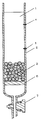
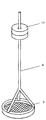
- a pressure shaft 9 (heavy weight) on which the circular wire mesh 8 (mesh size 150 ⁇ m, diameter 25 mm) is coupled perpendicularly to the wire mesh surface on the swollen gel particles 2. (22 g, length 47 cm) is placed so that the wire mesh and the swollen gel particles are in contact with each other, and a weight 10 (88.5 g) is placed on the pressure shaft 9 and allowed to stand for 1 minute.
- the cock 7 is opened, the time (T1; second) required for the liquid level in the filtration cylindrical tube to change from the 60 ml scale line 4 to the 40 ml scale line 5 is measured, and the gel flow rate (ml / min) is calculated from the following equation.
- Ask for. Gel flow rate (ml / min) 20 ml ⁇ 60 / (T1-T2)
- T2 is the time measured by the same operation as described above when there is no measurement sample.
- Example 1 270 parts of acrylic acid, 0.88 part of pentaerythritol triallyl ether (manufactured by Daiso) as a crosslinking agent, 0.041 part of 2-iodo-2-methylpropionitrile (manufactured by TCI) and 712 parts of ion-exchanged water are mixed. Then, an aqueous monomer solution was prepared, and this mixed solution was put into a polymerization tank capable of adiabatic polymerization. By introducing nitrogen gas into the solution, the amount of dissolved oxygen in the solution was 0.2 ppm or less, and the solution temperature was 5 ° C.
- This neutralized water-containing gel was air-dried using a ventilated hot air dryer (manufactured by Inoue Metal) under the conditions of a supply air temperature of 150 ° C. and a wind speed of 1.5 m / sec until the water content became 4%.
- the dried product was pulverized with a juicer mixer (OSTERIZER BLENDER manufactured by Oster) and then sieved to adjust the particle size to a particle size range of 710 to 150 ⁇ m to obtain a water absorbent resin (A1-1).
- Example 2 In Example 1, the same procedure as in Example 1 was performed, except that the amount of 2-iodo-2-methylpropionitrile was changed from 0.041 part to 0.0054 part. ) The temperature reached at equilibrium was 80 ° C.
- Example 3 In Example 1, the amount of pentaerythritol triallyl ether was changed from 0.88 parts to 1.2 parts, and the amount of 2-iodo-2-methylpropionitrile was changed from 0.041 parts to 0.22 parts. Except for the above, the same operation as in Example 1 was carried out to obtain a water absorbent resin (A1-3).
- Example 4 7.2 g of diethyl 2,5-dibromoadipate (manufactured by TCI) and 6.6 g of sodium iodide (manufactured by Wako Pure Chemical Industries) were dissolved in 60 mL of acetone and stirred at room temperature for 3 hours. Acetone was removed with a rotary evaporator, dissolved in diethyl ether, separated and washed with an aqueous sodium thiosulfate solution, and the solvent was removed with a rotary evaporator, followed by drying under reduced pressure to obtain diethyl 2,5-diiododipinate. .
- Example 1 the same procedure as in Example 1 was performed, except that 2-iodo-2-methylpropionitrile was changed to 0.041 part of diethyl 2,5-diiododipinate, and the water absorbent resin (A1 -4) was obtained.
- Example 5 Example 1 except that 2-iodo-2-methylpropionitrile was changed to 0.041 parts of ethyl-2-methyl-2-methylterranyl-propinate (synthesized by the method described in WO2004 / 014848) in Example 1. The same operation as in was carried out to obtain a water-absorbent resin (A1-5).
- Example 6 In Example 1, except that 2-iodo-2-methylpropionitrile was changed to 0.041 part of ethyl-2-methyl-2-dimethylstivanyl-propinate (synthesized by the method described in WO2006 / 001496). The same operation as in Example 1 was performed to obtain a water absorbent resin (A1-6).
- Example 7 In Example 1, except that 2-iodo-2-methylpropionitrile was changed to 0.041 part of methyl-2-methyl-2-dimethylbistamnyl-propinate (synthesized by the method described in WO2006 / 062255). The same operation as in Example 1 was performed to obtain a water absorbent resin (A1-7).
- Example 8 A water absorbent resin (A1-8) was obtained in the same manner as in Example 1 except that the amount of 2-iodo-2-methylpropionitrile was changed to 0.015 part in Example 1.
- Example 9 In Example 1, the same operation as in Example 1 was performed except that the amount of 2-iodo-2-methylpropionitrile was changed to 0.09 part and the 1% aqueous hydrogen peroxide solution was changed to 0.5 part. Water-absorbing resin (A1-9) was obtained.
- Example 10 While stirring 100 parts of the water-absorbent resin (A1-1) (high-speed stirring turbulizer manufactured by Hosokawa Micron: rotation speed 2000 rpm), 0.12 part of ethylene glycol diglycidyl ether, 1.9 parts of water and 1.2 parts of propylene glycol A solution comprising 1.0 part of Klebosol 30CAL25 (Merck) was added and mixed, and heated at 140 ° C. for 45 minutes for surface crosslinking to obtain a water absorbent resin (A2-1).
- a solution comprising 1.0 part of Klebosol 30CAL25 (Merck) was added and mixed, and heated at 140 ° C. for 45 minutes for surface crosslinking to obtain a water absorbent resin (A2-1).
- Example 11 to 18 Water-absorbing resins (A2-2) to (A2) were obtained in the same manner as in Example 10 except that water-absorbing resins (A1-2) to (A1-9) were used in place of the water-absorbing resin (A1-1). -9) was obtained.
- Example 2 In Example 1, the same operation as in Example 1 was carried out except that sodium hypophosphite (manufactured by Wako Pure Chemical Industries) was changed to 0.22 parts instead of 2-iodo-2-methylpropionitrile, A comparative water absorbent resin (R1-2) was obtained.
- Example 3 A comparative water absorbent resin (R2-1) was obtained in the same manner as in Example 10 except that the comparative water absorbent resin (R1-1) was used in place of the water absorbent resin (A1-1).
- Example 4 A comparative water absorbent resin (R2-2) was obtained in the same manner as in Example 1110 except that the comparative water absorbent resin (R1-1) was used in place of the water absorbent resin (A1-2).
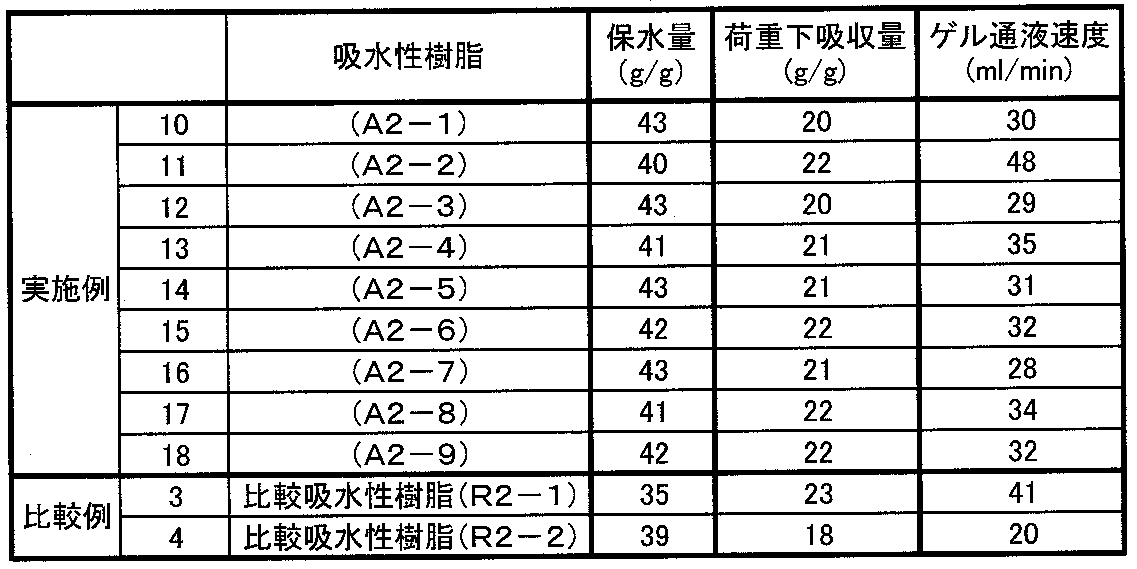
- the water-absorbent resin of the present invention has higher water retention and gel strength than the water-absorbent resin of the comparative example.
- the absorption capacity under load and the gel permeability are improved to the same or better while having an excellent water retention capacity compared to the water absorbent resin of the comparative example, and the absorption performance is dramatically improved.
- the water-absorbent resin particles of the present invention can achieve both liquid permeability between swollen gels and absorption performance under load, and when applied to various absorbers, the amount of absorption is large and the reversibility and surface Because it can be made into an absorbent article with excellent dry feeling, disposable diapers (children's diapers, adult diapers, etc.), napkins (sanitary napkins, etc.), paper towels, pads (incontinence pads, surgical underpads, etc.) ) And pet sheets (pet urine absorbing sheets), etc., and is particularly suitable for disposable diapers.
- the water-absorbent resin particles of the present invention are not only sanitary products, but also pet urine absorbents, urine gelling agents for portable toilets, freshness preservation agents such as fruits and vegetables, meat and seafood drip absorbents, cold insulation agents, disposable warmers It is also useful for various uses such as battery gelling agents, water retention agents for plants and soil, anti-condensation agents, water-stopping materials and packing materials, and artificial snow.
Landscapes
- Chemical & Material Sciences (AREA)
- Health & Medical Sciences (AREA)
- Chemical Kinetics & Catalysis (AREA)
- Organic Chemistry (AREA)
- Medicinal Chemistry (AREA)
- Polymers & Plastics (AREA)
- Engineering & Computer Science (AREA)
- Veterinary Medicine (AREA)
- Materials Engineering (AREA)
- Epidemiology (AREA)
- Life Sciences & Earth Sciences (AREA)
- Animal Behavior & Ethology (AREA)
- General Health & Medical Sciences (AREA)
- Public Health (AREA)
- Hematology (AREA)
- Biomedical Technology (AREA)
- Heart & Thoracic Surgery (AREA)
- Vascular Medicine (AREA)
- Dispersion Chemistry (AREA)
- Addition Polymer Or Copolymer, Post-Treatments, Or Chemical Modifications (AREA)
- Absorbent Articles And Supports Therefor (AREA)
- Polymerisation Methods In General (AREA)
- Polymerization Catalysts (AREA)
- Processes Of Treating Macromolecular Substances (AREA)
- Graft Or Block Polymers (AREA)
Abstract
Description
すなわち、本発明は、水溶性ビニルモノマー(a1)及び/又は加水分解により水溶性ビニルモノマー(a1)となるビニルモノマー(a2)並びに架橋剤(b)を含む単量体組成物を、有機ヨウ素化合物、有機テルル化合物、有機アンチモン化合物及び有機ビスマス化合物からなる群から選ばれる少なくとも1種の有機典型元素化合物の存在下に、重合する工程を有することを特徴とする吸水性樹脂粒子の製造方法;水溶性ビニルモノマー(a1)及び/又は加水分解により水溶性ビニルモノマー(a1)となるビニルモノマー(a2)並びに架橋剤(b)を必須構成単位とする架橋重合体(A)を含む吸水性樹脂粒子であって、ヨウ素、テルル、アンチモン及びビスマスからなる群から選ばれる少なくとも1種の典型元素を、吸水性樹脂粒子の重量を基準として、0.0005~0.1重量%含有することを特徴とする吸水性樹脂粒子である。
(i)炭素数8~30の芳香族エチレン性モノマー
スチレン、α-メチルスチレン、ビニルトルエン及びヒドロキシスチレン等のスチレン、並びにビニルナフタレン及びジクロルスチレン等のスチレンのハロゲン置換体等。
(ii)炭素数2~20の脂肪族エチレン性モノマー
アルケン(エチレン、プロピレン、ブテン、イソブチレン、ペンテン、ヘプテン、ジイソブチレン、オクテン、ドデセン及びオクタデセン等);並びにアルカジエン(ブタジエン及びイソプレン等)等。
(iii)炭素数5~15の脂環式エチレン性モノマー
モノエチレン性不飽和モノマー(ピネン、リモネン及びインデン等);並びにポリエチレン性ビニルモノマー[シクロペンタジエン、ビシクロペンタジエン及びエチリデンノルボルネン等]等。
これら有機典型元素化合物は単独で使用してもよく、2種以上を併用してもよい。

本明細書中、非付加重合性二重結合(以下、単に非重合性二重結合ともいう)及び非付加重合性三重結合(以下、単に非重合性三重結合ともいう)とは、不飽和結合のうち、付加重合性不飽和結合(それぞれ、付加重合性炭素-炭素二重結合及び付加重合性炭素-炭素三重結合)を除いた結合であり、非付加重合性二重結合及び非付加重合性三重結合としては、カルボニル基に含まれる炭素-酸素二重結合、ニトリル基に含まれる炭素-窒素三重結合、芳香族炭化水素を構成する炭素-炭素二重結合及び複素芳香族化合物を構成する酸素-窒素二重結合並びに炭素-窒素二重結合等が挙げられ、なかでもカルボニル基に含まれる炭素-酸素二重結合、ニトリル基に含まれる炭素-窒素三重結合及び芳香族炭化水素を構成する炭素-炭素二重結合が好ましい。
また、塩としては、アルカリ金属(リチウム、ナトリウム及びカリウム等)塩、アルカリ土類金属(マグネシウム及びカルシウム等)塩及びアンモニウム(NH4)塩等が挙げられる。これらの塩の内、吸収性能等の観点から、アルカリ金属塩及びアンモニウム塩が好ましく、更に好ましいのはアルカリ金属塩、特に好ましいのはナトリウム塩である。
R3で表される炭素数1~7のn価の飽和炭化水素基のうち、炭素数1~7の2価の飽和炭化水素基としては、炭素数1~7の2価の直鎖飽和炭化水素基(メチレン基、エチレン基、プロピレン基、ブチレン基、ペンテン基、ヘキセン基、ヘプテン基等)及び炭素数1~7の2価の分岐飽和炭化水素基(イソプロピレン基、イソブチレン基、s-ブチレン基、t-ブチレン基、イソペンチレン基、ネオペンチレン基、t-ペンチレン基、1-メチルブチレン基、イソヘキシレン基、s-ヘキシレン基、t-ヘキシレン基、ネオヘキシレン基、イソヘプチレン基等)が挙げられる。
R3で表される炭素数1~7のn価の飽和炭化水素基のうち、炭素数1~7の3価の飽和炭化水素基としては、メチン基等が挙げられる。
R3で表される炭素数1~7のn価の飽和炭化水素基のうち、メチル基、メチレン基、メチン基が好ましく、更に好ましくはメチル基、メチレン基である。
R3が少なくとも1つの非重合性二重結合又は少なくとも1つの非重合性三重結合を有する炭素数2~12である2価の基である場合、好ましい基としては、ベンゼンジイル基(炭素数6、非重合性炭素-炭素二重結合)、1-メトキシカルボニル-カルボニルオキシエチレンオキシカルボニル基(炭素数6、酸素-酸素二重結合)及びカルボニルオキシエチレンカルボニル基(炭素数4、酸素-酸素二重結合)等が挙げられる。
R3が少なくとも1つの非重合性二重結合又は少なくとも1つの非重合性三重結合を有する炭素数2~12である3価の基である場合、好ましいものとしては、ベンゼントリイル基(炭素数6、非重合性炭素-炭素二重結合)及び2-カルボニルオキシ-カルボニルオキシプロピレンカルボニル基(炭素数5、酸素-酸素二重結合)等が挙げられる。
水溶液重合を行う場合、有機溶媒の使用量(重量%)は、水の重量を基準として40以下が好ましく、更に好ましくは30以下である。
アルカリは、公知{特許第3205168号公報等}のものが使用できる。これらのうち、吸水性能の観点から、水酸化リチウム、水酸化ナトリウム及び水酸化カリウムが好ましく、さらに好ましくは水酸化ナトリウム及び水酸化カリウム、特に好ましくは水酸化ナトリウムである。中和率は、通液性の観点から、50~100%が好ましく、更に好ましくは、60~80%である。
溶媒の使用量は、溶媒の種類により適宜調整できるが、表面架橋前の吸水性樹脂の重量に基づいて、好ましくは1~10重量%である。また、水に対する溶媒の比率についても任意に調整することができるが、好ましくは重量基準で20~80重量%、更に好ましくは30~70重量%である。
他の材料としては繊維状物等が挙げられる。繊維状物と共に用いた場合の吸収体の構造及び製造方法等は、公知のもの(特開2003-225565号公報、特開2006-131767号公報及び特開2005-097569号公報等)と同様である。
吸水性樹脂5gをCMT社製高速振動試料粉砕機を用いて粉砕後、島津社製Briquest Press MP-35を用い、Briquestting Ring(塩化ビニル製、35mm径、5mm厚)にプレスしペレットを作成し、全自動波長分散型蛍光X線分析装置(装置名:Axiosメーカー名:PANalytical社製)を、X線励起条件:電圧50kV,電流40mA、測定室雰囲気:真空とし、定量分析ソフトUniquantを使用した半定量分析法を用いることで原子濃度を決定した。
100mlのビーカーに吸水性樹脂1.000gを入れ、生理食塩水(NaCl濃度0.90%のイオン交換水溶液)を30.00g加え、ビーカーを軽く振り吸水性樹脂が平らになるよう、30分静置することで30倍膨潤の測定試料を作成した。カードメーター(アイテクノエンジニアリング製,品名:カードメーター マックスME-500型)を上昇速度1インチ/7秒、感圧軸8φ、荷重100gの条件で測定し、測定曲線が45度対角線から下がり始める点の破断力を読み取り、3回測定した平均値をゲル強度とした。
目開き63μm(JIS Z8801-1:2006)のナイロン網で作製したティーバッグ(縦20cm、横10cm)に測定試料1.00gを入れ、生理食塩水(食塩濃度0.9%)1,000ml中に無撹拌下、1時間浸漬した後引き上げて、15分間吊るして水切りした。その後、ティーバッグごと、遠心分離器にいれ、150Gで90秒間遠心脱水して余剰の生理食塩水を取り除き、ティーバックを含めた重量(h1)を測定し次式から保水量を求めた。(h2)は、測定試料の無い場合について上記と同様の操作により計測したティーバックの重量である。なお、使用した生理食塩水及び測定雰囲気の温度は25℃±2℃であった。
保水量(g/g)=(h1)-(h2)
目開き63μm(JIS Z8801-1:2006)のナイロン網を底面に貼った円筒型プラスチックチューブ(内径:25mm、高さ:34mm)内に、30メッシュふるいと60メッシュふるいを用いて250~500μmの範囲にふるい分けした測定試料0.16gを秤量し、円筒型プラスチックチューブを垂直にしてナイロン網上に測定試料がほぼ均一厚さになるように整えた後、この測定試料の上に分銅(重量:310.6g、外径:24.5mm、)を乗せた。この円筒型プラスチックチューブ全体の重量(M1)を計量した後、生理食塩水(食塩濃度0.9%)60mlの入ったシャーレ(直径:12cm)の中に測定試料及び分銅の入った円筒型プラスチックチューブを垂直に立ててナイロン網側を下面にして浸し、60分静置した。60分後に、円筒型プラスチックチューブをシャーレから引き上げ、これを斜めに傾けて底部に付着した水を一箇所に集めて水滴として垂らすことで余分な水を除去した後、測定試料及び分銅の入った円筒型プラスチックチューブ全体の重量(M2)を計量し、次式から加圧下吸収量を求めた。なお、使用した生理食塩水及び測定雰囲気の温度は25℃±2℃であった。
荷重下吸収量(g/g)={(M2)-(M1)}/0.16
図1及び図2で示される器具を用いて以下の操作により測定した。
測定試料0.32gを150ml生理食塩水1(食塩濃度0.9%)に30分間浸漬して膨潤ゲル粒子2を調製する。そして、垂直に立てた円筒3{直径(内径)25.4mm、長さ40cm、底部から60mlの位置及び40mlの位置にそれぞれ目盛り線4及び目盛り線5が設けてある。}の底部に、金網6(目開き106μm、JIS Z8801-1:2006)と、開閉自在のコック7(通液部の内径5mm)とを有する濾過円筒管内に、コック7を閉鎖した状態で、調製した膨潤ゲル粒子2を生理食塩水と共に移した後、この膨潤ゲル粒子2の上に円形金網8(目開き150μm、直径25mm)が金網面に対して垂直に結合する加圧軸9(重さ22g、長さ47cm)を金網と膨潤ゲル粒子とが接触するように載せ、更に加圧軸9におもり10(88.5g)を載せ、1分間静置する。引き続き、コック7を開き、濾過円筒管内の液面が60ml目盛り線4から40ml目盛り線5になるのに要する時間(T1;秒)を計測し、次式よりゲル通液速度(ml/min)を求める。
ゲル通液速度(ml/min)=20ml×60/(T1-T2)
なお、使用する生理食塩水及び測定雰囲気の温度は25℃±2℃で行い、T2は測定試料の無い場合について上記と同様の操作により計測した時間である。
アクリル酸270部、架橋剤としてのペンタエリスリトールトリアリルエーテル(ダイソー製)0.88部、2-ヨード-2-メチルプロピオニトリル(TCI製)0.041部及びイオン交換水712部を混合してモノマー水溶液を調製し、この混合液を断熱重合可能な重合槽に投入した。溶液中に窒素ガスを導入することにより、溶液中の溶存酸素量を0.2ppm以下とし、溶液温度を5℃とした。この重合溶液に、1%過酸化水素水溶液1.1部、2%アスコルビン酸水溶液2.0部及び2%の2,2’-アゾビスアミジノプロパンジハイドロクロライド水溶液13.5部を添加・混合した。重合開始を示す温度上昇が確認されてから約1時間後に80℃でほぼ平衡に達し、更に5時間熟成して含水ゲル状重合体を得た。
この含水ゲル状重合体を、ミートチョッパーを用いて小片に砕断しながら、49%のNaOH水溶液221部を添加し、重合体中のカルボキシル基の約72モル%をナトリウム塩とした。この中和された含水ゲルを、通気熱風乾燥機(井上金属製)を用い、供給風温150℃、風速1.5m/秒の条件下で含水率が4%となるまで通気乾燥した。乾燥体をジューサーミキサー(Oster社製OSTERIZER BLENDER)にて粉砕した後、ふるい分けして、目開き710~150μmの粒子径範囲に調整して、吸水性樹脂(A1-1)を得た。
実施例1において、2-ヨード-2-メチルプロピオニトリルの量を0.041部から0.0054部に変更する以外は、実施例1と同様の操作を行い、吸水性樹脂(A1-2)を得た。平衡時の到達温度は80℃であった。
実施例1において、ペンタエリスリトールトリアリルエーテルの量を0.88部から1.2部に変更し、2-ヨード-2-メチルプロピオニトリルの量を0.041部から0.22部に変更したこと以外は、実施例1と同様の操作を行い、吸水性樹脂(A1-3)を得た。
2,5-ジブロモアジピン酸ジエチル(TCI製)7.2gとよう化ナトリウム(和光純薬製)6.6gをアセトン60mLに溶解し室温で3時間撹拌した。ロータリーエバポレーターでアセトンを除去し、ジエチルエーテルに溶解し、チオ硫酸ナトリウム水溶液で分液洗浄し、ロータリーエバポレーターで溶剤を除去したのち減圧乾燥することで、2,5-ジヨードアジピン酸ジエチルを得た。
実施例1において、2-ヨード-2-メチルプロピオニトリルを2,5-ジヨードアジピン酸ジエチル0.041部に変更する以外は、実施例1と同様の操作を行い、吸水性樹脂(A1-4)を得た。
実施例1において、2-ヨード-2-メチルプロピオニトリルをエチル-2-メチル-2-メチルテラニル-プロピネート(WO2004/014848記載の方法により合成)0.041部に変更する以外は、実施例1と同様の操作を行い、吸水性樹脂(A1-5)を得た。
実施例1において、2-ヨード-2-メチルプロピオニトリルをエチル-2-メチル-2-ジメチルスチバニル-プロピネート(WO2006/001496記載の方法により合成)0.041部に変更する以外は、実施例1と同様の操作を行い、吸水性樹脂(A1-6)を得た。
実施例1において、2-ヨード-2-メチルプロピオニトリルをメチル-2-メチル-2-ジメチルビスタムニル-プロピネート(WO2006/062255記載の方法により合成)0.041部に変更する以外は、実施例1と同様の操作を行い、吸水性樹脂(A1-7)を得た。
実施例1において、2-ヨード-2-メチルプロピオニトリルの量を0.015部に変更する以外は、実施例1と同様の操作を行い、吸水性樹脂(A1-8)を得た。
実施例1において、2-ヨード-2-メチルプロピオニトリルの量を0.09部に、1%過酸化水素水溶液を0.5部に変更する以外は、実施例1と同様の操作を行い、吸水性樹脂(A1-9)を得た。
吸水性樹脂(A1-1)100部を攪拌(ホソカワミクロン製高速攪拌タービュライザー:回転数2000rpm)しながら、エチレングリコールジグリシジルエーテル0.12部、水1.9部及びプロピレングリコール1.2部及びKlebosol30CAL25(メルク社製)1.0部からなる溶液を添加して混合し、140℃で45分加熱して表面架橋を行い、吸水性樹脂(A2-1)を得た。
吸水性樹脂(A1-1)に代えて、吸水性樹脂(A1-2)~(A1-9)を使用する以外は実施例10と同様にして、吸水性樹脂(A2-2)~(A2-9)を得た。
実施例1において、2-ヨード-2-メチルプロピオニトリルを用いない以外は、実施例1と同様の操作を行い、比較用の吸水性樹脂(R1-1)を得た。
実施例1において、2-ヨード-2-メチルプロピオニトリルの代わりに次亜リン酸ナトリウム(和光純薬製)を0.22部に変更した以外は、実施例1と同様の操作を行い、比較用の吸水性樹脂(R1-2)を得た。
吸水性樹脂(A1-1)に代えて比較用の吸水性樹脂(R1-1)を使用する以外は実施例10と同様にして、比較用の吸水性樹脂(R2-1)を得た。
吸水性樹脂(A1-2)に代えて比較用の吸水性樹脂(R1-1)を使用する以外は実施例1110と同様にして、比較用の吸水性樹脂(R2-2)を得た。
また、得られた吸水性樹脂(A2-1)~(A2-9)及び比較用の吸水性樹脂(R2-1)~(R2-2)の保水量、荷重下吸収量、ゲル通液速度の評価結果を表2に示した。
2 含水ゲル粒子
3 円筒
4 底部から60mlの位置の目盛り線
5 底部から40mlの位置の目盛り線
6 金網
7 コック
8 円形金網
9 加圧軸
10 おもり
Claims (4)
- 水溶性ビニルモノマー(a1)及び/又は加水分解により水溶性ビニルモノマー(a1)となるビニルモノマー(a2)並びに架橋剤(b)を含む単量体組成物を、有機ヨウ素化合物、有機テルル化合物、有機アンチモン化合物及び有機ビスマス化合物からなる群から選ばれる少なくとも1種の有機典型元素化合物の存在下に、重合する工程、を有することを特徴とする吸水性樹脂粒子の製造方法。
- 有機典型元素化合物が下記一般式(1)で表される請求項1に記載の吸水性樹脂粒子の製造方法。

- 有機ヨウ素化合物、有機テルル化合物、有機アンチモン化合物及び有機ビスマス化合物からなる群から選ばれる少なくとも1種の有機典型元素化合物の重量が、水溶性ビニルモノマー(a1)及び加水分解により水溶性ビニルモノマー(a1)となるビニルモノマー(a2)の合計重量に対し、0.0005~0.1重量%である請求項1又は2のいずれかに記載の吸水性樹脂粒子の製造方法。
- 水溶性ビニルモノマー(a1)及び/又は加水分解により水溶性ビニルモノマー(a1)となるビニルモノマー(a2)並びに架橋剤(b)を必須構成単位とする架橋重合体(A)を含む吸水性樹脂粒子であって、ヨウ素、テルル、アンチモン及びビスマスからなる群から選ばれる少なくとも1種の典型元素を吸水性樹脂粒子の重量に対して0.0005~0.1重量%含有することを特徴とする吸水性樹脂粒子。
Priority Applications (6)
| Application Number | Priority Date | Filing Date | Title |
|---|---|---|---|
| KR1020187012432A KR102556589B1 (ko) | 2015-10-02 | 2016-09-30 | 흡수성 수지 입자 및 그 제조 방법 |
| CN201680057788.7A CN108137728B (zh) | 2015-10-02 | 2016-09-30 | 吸水性树脂颗粒及其制造方法 |
| MYPI2018701077A MY187456A (en) | 2015-10-02 | 2016-09-30 | Water absorbent resin particles and method for producing same |
| JP2017543628A JP6901216B2 (ja) | 2015-10-02 | 2016-09-30 | 吸水性樹脂粒子及びその製造方法 |
| US15/764,962 US11084889B2 (en) | 2015-10-02 | 2016-09-30 | Water-absorbent resin particles and method for producing same |
| EP16851875.1A EP3357937B1 (en) | 2015-10-02 | 2016-09-30 | Water absorbent resin particles and method for producing same |
Applications Claiming Priority (2)
| Application Number | Priority Date | Filing Date | Title |
|---|---|---|---|
| JP2015-196606 | 2015-10-02 | ||
| JP2015196606 | 2015-10-02 |
Publications (1)
| Publication Number | Publication Date |
|---|---|
| WO2017057706A1 true WO2017057706A1 (ja) | 2017-04-06 |
Family
ID=58423964
Family Applications (1)
| Application Number | Title | Priority Date | Filing Date |
|---|---|---|---|
| PCT/JP2016/079081 Ceased WO2017057706A1 (ja) | 2015-10-02 | 2016-09-30 | 吸水性樹脂粒子及びその製造方法 |
Country Status (7)
| Country | Link |
|---|---|
| US (1) | US11084889B2 (ja) |
| EP (1) | EP3357937B1 (ja) |
| JP (1) | JP6901216B2 (ja) |
| KR (1) | KR102556589B1 (ja) |
| CN (1) | CN108137728B (ja) |
| MY (1) | MY187456A (ja) |
| WO (1) | WO2017057706A1 (ja) |
Cited By (6)
| Publication number | Priority date | Publication date | Assignee | Title |
|---|---|---|---|---|
| JP2018111806A (ja) * | 2017-01-06 | 2018-07-19 | Sdpグローバル株式会社 | 吸水性樹脂粒子の製造方法 |
| WO2020217782A1 (ja) * | 2019-04-25 | 2020-10-29 | 三洋化成工業株式会社 | アルカリ電池の負極用添加剤及びアルカリ電池 |
| EP3604352A4 (en) * | 2017-03-30 | 2021-01-06 | SDP Global Co., Ltd. | MOLECULAR WEIGHT CONTROL AGENT FOR RADICAL POLYMERIZATION, PROCESS FOR THE MANUFACTURING OF POLYMER THEREOF AND POLYMER |
| WO2022255329A1 (ja) * | 2021-06-04 | 2022-12-08 | Sdpグローバル株式会社 | 吸水性樹脂組成物、並びにこれを用いた吸収体及び吸収性物品 |
| WO2023276930A1 (ja) * | 2021-06-28 | 2023-01-05 | Sdpグローバル株式会社 | 吸水性樹脂組成物、並びにこれを用いた吸収体及び吸収性物品、並びに吸水性樹脂組成物の製造方法 |
| EP4357832A2 (en) | 2017-03-15 | 2024-04-24 | Corephotonics Ltd. | Camera with panoramic scanning range |
Families Citing this family (2)
| Publication number | Priority date | Publication date | Assignee | Title |
|---|---|---|---|---|
| CN111971011B (zh) * | 2018-04-13 | 2022-05-31 | 株式会社日本触媒 | 吸水性片、吸水性片的制造方法及吸收性物品 |
| CN111848861B (zh) * | 2019-04-30 | 2022-03-04 | 天津大学 | 一种基于有机碲与铂配位的响应型水凝胶及制备方法 |
Citations (5)
| Publication number | Priority date | Publication date | Assignee | Title |
|---|---|---|---|---|
| JP2001129311A (ja) * | 1999-11-01 | 2001-05-15 | Konan Kagaku Kogyo Kk | 高分子凝集剤およびその製造方法並びに有機性汚泥の脱水方法 |
| JP2001354721A (ja) * | 2000-04-13 | 2001-12-25 | Sanyo Chem Ind Ltd | 水溶性樹脂及びその製法 |
| JP2005075982A (ja) * | 2003-09-02 | 2005-03-24 | San-Dia Polymer Ltd | ビニル重合体の製造方法 |
| WO2007119884A1 (ja) * | 2006-04-14 | 2007-10-25 | Otsuka Chemical Co., Ltd. | 樹脂組成物および耐熱性粘着剤 |
| JP2012206038A (ja) * | 2011-03-30 | 2012-10-25 | Sanyo Chem Ind Ltd | 高分子凝集剤 |
Family Cites Families (22)
| Publication number | Priority date | Publication date | Assignee | Title |
|---|---|---|---|---|
| US4085168A (en) * | 1971-02-22 | 1978-04-18 | Cpc International Inc. | Chemically joined, phase separated self-cured hydrophilic thermoplastic graft copolymers and their preparation |
| JPS565354B2 (ja) * | 1973-07-24 | 1981-02-04 | ||
| JPS5346389A (en) | 1976-10-07 | 1978-04-25 | Kao Corp | Preparation of self-crosslinking polymer of acrylic alkali metal salt |
| JPS55133413A (en) | 1979-04-06 | 1980-10-17 | Nippon Shokubai Kagaku Kogyo Co Ltd | Preparation of crosslinked alkali metal acrylate polymer |
| JPS5626909A (en) | 1979-08-13 | 1981-03-16 | Seitetsu Kagaku Co Ltd | Preparation of water-absorbing acrylic polymer |
| JPS58180233A (ja) * | 1982-04-19 | 1983-10-21 | Nippon Shokubai Kagaku Kogyo Co Ltd | 吸収剤 |
| JP2877255B2 (ja) | 1989-12-08 | 1999-03-31 | 株式会社日本触媒 | 耐久性の優れた吸水性樹脂の製造方法 |
| JP3205168B2 (ja) | 1993-06-18 | 2001-09-04 | 三洋化成工業株式会社 | 紙おむつ用吸収剤組成物 |
| WO2001079314A1 (fr) * | 2000-04-13 | 2001-10-25 | Sanyo Chemical Industries, Ltd. | Polymere reticule, procede de preparation associe, structure absorbante et article absorbant |
| JP2003165883A (ja) | 2001-09-18 | 2003-06-10 | San-Dia Polymer Ltd | 吸水性重合体とこれを用いてなる吸収性物品 |
| JP2003225565A (ja) | 2001-11-20 | 2003-08-12 | San-Dia Polymer Ltd | 吸水剤、その製法、吸水剤を用いた吸収体並びに吸収性物品 |
| DE60229446D1 (de) * | 2002-08-06 | 2008-11-27 | Otsuka Chemical Co Ltd | Organische tellurverbindung, verfahren zu deren herstellung, initiator für die lebende radikalische polymerisation, verfahren zur herstellung eines polymers unter anwendung desselben, und polymer |
| JP3648553B2 (ja) | 2003-08-29 | 2005-05-18 | サンダイヤポリマー株式会社 | 吸収性樹脂粒子、これを用いてなる吸収体及び吸収性物品 |
| JP2006131767A (ja) | 2004-11-05 | 2006-05-25 | San-Dia Polymer Ltd | 吸水性樹脂の製造方法 |
| JP4539878B2 (ja) | 2004-12-10 | 2010-09-08 | 大塚化学株式会社 | 有機ビスマス化合物、その製造方法、リビングラジカル重合開始剤、それを用いるポリマーの製造方法及びポリマー |
| DE102006036177B4 (de) * | 2006-07-21 | 2013-05-08 | Evonik Degussa Gmbh | Vorrichtung und Verfahren zur Herstellung von Acrylsäure mit verminderter Autoxidationsneigung |
| US8742023B2 (en) * | 2008-12-26 | 2014-06-03 | San-Dia Polymers, Ltd. | Absorbent resin particle, process for producing the same, absorber containing the same, and absorbent article |
| WO2011016166A1 (ja) | 2009-08-06 | 2011-02-10 | 国立大学法人京都大学 | リビングラジカル重合触媒および重合方法 |
| CN103153455A (zh) * | 2010-09-30 | 2013-06-12 | 株式会社日本触媒 | 颗粒状吸水剂及其制造方法 |
| US8496946B2 (en) * | 2011-03-10 | 2013-07-30 | International Business Machines Corporation | Antimicrobial hydrogels, methods of preparation thereof, and articles therefrom |
| GB201106778D0 (en) * | 2011-04-21 | 2011-06-01 | Ocutec Ltd | Polymers for contact lenses |
| WO2017057709A1 (ja) * | 2015-10-02 | 2017-04-06 | Sdpグローバル株式会社 | 吸水性樹脂組成物及びその製造方法 |
-
2016
- 2016-09-30 MY MYPI2018701077A patent/MY187456A/en unknown
- 2016-09-30 WO PCT/JP2016/079081 patent/WO2017057706A1/ja not_active Ceased
- 2016-09-30 US US15/764,962 patent/US11084889B2/en active Active
- 2016-09-30 JP JP2017543628A patent/JP6901216B2/ja active Active
- 2016-09-30 EP EP16851875.1A patent/EP3357937B1/en active Active
- 2016-09-30 CN CN201680057788.7A patent/CN108137728B/zh active Active
- 2016-09-30 KR KR1020187012432A patent/KR102556589B1/ko active Active
Patent Citations (5)
| Publication number | Priority date | Publication date | Assignee | Title |
|---|---|---|---|---|
| JP2001129311A (ja) * | 1999-11-01 | 2001-05-15 | Konan Kagaku Kogyo Kk | 高分子凝集剤およびその製造方法並びに有機性汚泥の脱水方法 |
| JP2001354721A (ja) * | 2000-04-13 | 2001-12-25 | Sanyo Chem Ind Ltd | 水溶性樹脂及びその製法 |
| JP2005075982A (ja) * | 2003-09-02 | 2005-03-24 | San-Dia Polymer Ltd | ビニル重合体の製造方法 |
| WO2007119884A1 (ja) * | 2006-04-14 | 2007-10-25 | Otsuka Chemical Co., Ltd. | 樹脂組成物および耐熱性粘着剤 |
| JP2012206038A (ja) * | 2011-03-30 | 2012-10-25 | Sanyo Chem Ind Ltd | 高分子凝集剤 |
Non-Patent Citations (1)
| Title |
|---|
| See also references of EP3357937A4 * |
Cited By (8)
| Publication number | Priority date | Publication date | Assignee | Title |
|---|---|---|---|---|
| JP2018111806A (ja) * | 2017-01-06 | 2018-07-19 | Sdpグローバル株式会社 | 吸水性樹脂粒子の製造方法 |
| EP4357832A2 (en) | 2017-03-15 | 2024-04-24 | Corephotonics Ltd. | Camera with panoramic scanning range |
| EP3604352A4 (en) * | 2017-03-30 | 2021-01-06 | SDP Global Co., Ltd. | MOLECULAR WEIGHT CONTROL AGENT FOR RADICAL POLYMERIZATION, PROCESS FOR THE MANUFACTURING OF POLYMER THEREOF AND POLYMER |
| US20210070687A1 (en) * | 2017-03-30 | 2021-03-11 | Sdp Global Co., Ltd. | Molecular weight controlling agent for radical polymerization, method for producing polymer using same, and polymer |
| WO2020217782A1 (ja) * | 2019-04-25 | 2020-10-29 | 三洋化成工業株式会社 | アルカリ電池の負極用添加剤及びアルカリ電池 |
| WO2022255329A1 (ja) * | 2021-06-04 | 2022-12-08 | Sdpグローバル株式会社 | 吸水性樹脂組成物、並びにこれを用いた吸収体及び吸収性物品 |
| WO2023276930A1 (ja) * | 2021-06-28 | 2023-01-05 | Sdpグローバル株式会社 | 吸水性樹脂組成物、並びにこれを用いた吸収体及び吸収性物品、並びに吸水性樹脂組成物の製造方法 |
| WO2023276925A1 (ja) * | 2021-06-28 | 2023-01-05 | Sdpグローバル株式会社 | 吸水性樹脂組成物、並びにこれを用いた吸収体及び吸収性物品、並びに吸水性樹脂組成物の製造方法 |
Also Published As
| Publication number | Publication date |
|---|---|
| EP3357937B1 (en) | 2021-04-28 |
| JPWO2017057706A1 (ja) | 2018-08-30 |
| US11084889B2 (en) | 2021-08-10 |
| EP3357937A1 (en) | 2018-08-08 |
| KR102556589B1 (ko) | 2023-07-17 |
| CN108137728B (zh) | 2020-12-08 |
| KR20180063233A (ko) | 2018-06-11 |
| MY187456A (en) | 2021-09-23 |
| US20180282441A1 (en) | 2018-10-04 |
| JP6901216B2 (ja) | 2021-07-14 |
| EP3357937A4 (en) | 2019-03-20 |
| CN108137728A (zh) | 2018-06-08 |
Similar Documents
| Publication | Publication Date | Title |
|---|---|---|
| JP6722654B2 (ja) | 水性液体吸収性樹脂粒子の製造方法、水性液体吸収性樹脂粒子、吸収体及び吸収性物品 | |
| WO2017057706A1 (ja) | 吸水性樹脂粒子及びその製造方法 | |
| JP7015341B2 (ja) | 吸水性樹脂組成物及びその製造方法 | |
| JP4188843B2 (ja) | 改善されたにおい制御を有するポリマー混合物 | |
| JP4388808B2 (ja) | 酸性中心を有する高膨潤性ヒドロゲル | |
| JP2004530777A (ja) | 酸性の高膨潤性ヒドロゲル | |
| WO2018147317A1 (ja) | 吸水性樹脂粒子並びにこれを用いた吸収体及び吸収性物品 | |
| CN101589066A (zh) | 粒子状吸水性聚合物及其制造方法 | |
| WO2016143739A1 (ja) | 水性液体吸収性樹脂粒子の製造方法並びに吸収体及び吸収性物品 | |
| KR20190129938A (ko) | 라디칼 중합용 분자량 제어제, 그것을 사용한 중합체의 제조 방법 및 중합체 | |
| JP2005186016A (ja) | 吸収剤 | |
| JP6861619B2 (ja) | 吸水性樹脂粒子の製造方法 | |
| WO2022254874A1 (ja) | 吸水性樹脂組成物、並びにこれを用いた吸収体及び吸収性物品、並びに吸水性樹脂組成物の製造方法 | |
| WO2023276925A1 (ja) | 吸水性樹脂組成物、並びにこれを用いた吸収体及び吸収性物品、並びに吸水性樹脂組成物の製造方法 | |
| JP2016102161A (ja) | 吸収性樹脂粒子、これを含む吸収体及び吸収性物品 | |
| WO2023188719A1 (ja) | 吸水性樹脂組成物、並びにこれを用いた吸収体及び吸収性物品、並びに吸水性樹脂組成物の製造方法 | |
| JP7453918B2 (ja) | 吸水性樹脂粒子およびその製造方法 | |
| JP2020056025A (ja) | 吸収性樹脂粒子及びその製造方法 | |
| JP2019094444A (ja) | 吸水性樹脂粒子及びその製造方法 | |
| JP2023147715A (ja) | 吸水性樹脂組成物の製造方法、吸水性樹脂組成物、これを用いた吸収体、及び吸収性物品 | |
| JP7291686B2 (ja) | 吸水性樹脂粒子及びその製造方法 | |
| WO2023188633A1 (ja) | 吸水性樹脂組成物、並びにこれを用いた吸収体及び吸収性物品、並びに吸水性樹脂組成物の製造方法 | |
| WO2022255329A1 (ja) | 吸水性樹脂組成物、並びにこれを用いた吸収体及び吸収性物品 | |
| JP2018039924A (ja) | 水性液体吸収性樹脂粒子の製造方法 | |
| JP2024027100A (ja) | 吸水性樹脂粒子 |
Legal Events
| Date | Code | Title | Description |
|---|---|---|---|
| 121 | Ep: the epo has been informed by wipo that ep was designated in this application |
Ref document number: 16851875 Country of ref document: EP Kind code of ref document: A1 |
|
| ENP | Entry into the national phase |
Ref document number: 2017543628 Country of ref document: JP Kind code of ref document: A |
|
| WWE | Wipo information: entry into national phase |
Ref document number: 15764962 Country of ref document: US |
|
| NENP | Non-entry into the national phase |
Ref country code: DE |
|
| ENP | Entry into the national phase |
Ref document number: 20187012432 Country of ref document: KR Kind code of ref document: A |
|
| WWE | Wipo information: entry into national phase |
Ref document number: 2016851875 Country of ref document: EP |