WO2017065071A1 - 鋳造用モールド材及びCu-Cr-Zr-Al合金素材 - Google Patents
鋳造用モールド材及びCu-Cr-Zr-Al合金素材 Download PDFInfo
- Publication number
- WO2017065071A1 WO2017065071A1 PCT/JP2016/079641 JP2016079641W WO2017065071A1 WO 2017065071 A1 WO2017065071 A1 WO 2017065071A1 JP 2016079641 W JP2016079641 W JP 2016079641W WO 2017065071 A1 WO2017065071 A1 WO 2017065071A1
- Authority
- WO
- WIPO (PCT)
- Prior art keywords
- mass
- less
- precipitates
- precipitate
- casting mold
- Prior art date
- Legal status (The legal status is an assumption and is not a legal conclusion. Google has not performed a legal analysis and makes no representation as to the accuracy of the status listed.)
- Ceased
Links
Images



Classifications
-
- B—PERFORMING OPERATIONS; TRANSPORTING
- B22—CASTING; POWDER METALLURGY
- B22D—CASTING OF METALS; CASTING OF OTHER SUBSTANCES BY THE SAME PROCESSES OR DEVICES
- B22D11/00—Continuous casting of metals, i.e. casting in indefinite lengths
- B22D11/04—Continuous casting of metals, i.e. casting in indefinite lengths into open-ended moulds
- B22D11/059—Mould materials or platings
-
- C—CHEMISTRY; METALLURGY
- C22—METALLURGY; FERROUS OR NON-FERROUS ALLOYS; TREATMENT OF ALLOYS OR NON-FERROUS METALS
- C22C—ALLOYS
- C22C9/00—Alloys based on copper
-
- B—PERFORMING OPERATIONS; TRANSPORTING
- B22—CASTING; POWDER METALLURGY
- B22C—FOUNDRY MOULDING
- B22C9/00—Moulds or cores; Moulding processes
- B22C9/06—Permanent moulds for shaped castings
-
- B—PERFORMING OPERATIONS; TRANSPORTING
- B22—CASTING; POWDER METALLURGY
- B22C—FOUNDRY MOULDING
- B22C9/00—Moulds or cores; Moulding processes
- B22C9/06—Permanent moulds for shaped castings
- B22C9/061—Materials which make up the mould
-
- C—CHEMISTRY; METALLURGY
- C22—METALLURGY; FERROUS OR NON-FERROUS ALLOYS; TREATMENT OF ALLOYS OR NON-FERROUS METALS
- C22C—ALLOYS
- C22C9/00—Alloys based on copper
- C22C9/01—Alloys based on copper with aluminium as the next major constituent
-
- C—CHEMISTRY; METALLURGY
- C22—METALLURGY; FERROUS OR NON-FERROUS ALLOYS; TREATMENT OF ALLOYS OR NON-FERROUS METALS
- C22F—CHANGING THE PHYSICAL STRUCTURE OF NON-FERROUS METALS AND NON-FERROUS ALLOYS
- C22F1/00—Changing the physical structure of non-ferrous metals or alloys by heat treatment or by hot or cold working
- C22F1/08—Changing the physical structure of non-ferrous metals or alloys by heat treatment or by hot or cold working of copper or alloys based thereon
Definitions
- the present invention relates to a casting mold material used when casting a metal such as a steel material, and a Cu—Cr—Zr—Al alloy material suitable for the above-described casting mold material.
- the penetration depth ⁇ of the magnetic field is expressed by the following equation when the permeability ⁇ , the frequency f of the applied magnetic field, and the conductivity ⁇ are used.
- ⁇ (1 / ⁇ ⁇ ⁇ ⁇ f ⁇ ⁇ ) 0.5
- the conductivity ⁇ of the molding material is low.
- the electrical conductivity ⁇ is too low, the thermal conductivity is lowered and cooling may be insufficient.
- a molding material has been proposed in which the conductivity ⁇ is adjusted to about 30 to 60% IACS by adding an additive element other than Cr and Zr.
- Patent Document 1 contains Cr: 0.3 to 1.5% by weight ratio, Zr: 0.03 to 0.6%, and further includes Al and Si, Ni, Sn, Zn, Mn, and the like.
- a precipitation hardening type continuous casting mold material to which elements are added is disclosed.
- Patent Document 2 contains Cr: 0.3 to 1.2 wt%, Zr: 0.05 to 0.25 wt%, and further includes Sn, Al, Ag, Ni, Ti, Co, Fe, etc.
- a metal casting mold material is disclosed.
- a casting mold material is generally used by spraying a Ni—Cr alloy or the like excellent in heat resistance and wear resistance on its surface to improve durability.
- thermal spraying treatment for example, after performing heat treatment in a high temperature range of about 1000 ° C., it is gradually cooled without performing water cooling or the like. Hardness) and electrical conductivity are not sufficiently improved.
- granular Cr is contained during the slow cooling.
- Precipitates (Cr-based precipitates) and Zr-containing precipitates (Zr-based precipitates) are precipitated.
- Cr and Zr which have been solid-solved with these granular precipitates as nuclei, are precipitated, so that the precipitates grow and become coarse, which contributes to the precipitation strengthening mechanism. Goods cannot be secured sufficiently, and strength (hardness) cannot be improved.
- the present invention has been made in view of the above-described circumstances, and even when it is gradually cooled after thermal spraying, the strength (hardness) and electrical conductivity can be sufficiently improved by subsequent aging treatment.
- An object is to provide a casting mold material and a Cu—Cr—Zr—Al alloy material suitable for the casting mold material.
- a casting mold material of one aspect of the present invention is a casting mold material used when casting a metal material. And containing 0.3 mass% or more and less than 0.5 mass% of Cr, 0.01 mass% or more and 0.15 mass% or less of Zr, 0.1 mass% or more and less than 2.0 mass% of Al, with the balance being Cu and inevitable impurities And has a needle-like precipitate or a plate-like precipitate.
- Cr is 0.3 mass% or more and less than 0.5 mass%
- Zr is 0.01 mass% or more and 0.15 mass% or less
- Al is contained in the range of 0.1 mass% or more and less than 2.0 mass%. Since the balance is composed of Cu and inevitable impurities, the strength (hardness) and conductivity can be improved by precipitating fine precipitates by aging treatment. Further, the conductivity can be adjusted to about 30 to 60% IACS, and it is particularly suitable as a molding material for electromagnetic stirring.
- the molding material for casting of the present invention has needle-like precipitates or plate-like precipitates containing Cr, it is suppressed that granular precipitates are formed during slow cooling after thermal spraying. Has been. For this reason, during the aging treatment after the thermal spraying treatment, it is possible to suppress the precipitation of Cr and Zr using the granular precipitates as nuclei, and to sufficiently disperse the fine precipitates. ) And conductivity can be sufficiently improved.
- the maximum size of the needle-like precipitate or the plate-like precipitate is 100 ⁇ m or less.
- the maximum size of the needle-like precipitate or the plate-like precipitate was defined as the diameter when a minimum circumscribed circle was drawn in the observed precipitate.
- Cr is sufficiently solid solution in the parent phase of Cu, and during the subsequent aging treatment Fine precipitates can be sufficiently dispersed, and the strength (hardness) and electrical conductivity can be sufficiently improved by the precipitation strengthening mechanism.
- the casting mold material of the present invention it is preferable that one or more elements selected from Fe, Si, Co, and P are further included in a total of 0.01 mass% to 0.15 mass%. .
- elements such as Fe, Si, Co, and P are contained within the above-described range, the formation of granular precipitates during slow cooling after thermal spraying is suppressed, and a needle containing Cr The formation of a plate-like precipitate or a plate-like precipitate is promoted. Therefore, fine Cr-based and Zr-based precipitates can be sufficiently precipitated by the aging treatment after the thermal spraying treatment, and the strength (hardness) and electrical conductivity can be reliably improved.
- the Cu—Cr—Zr—Al alloy material of the present invention has a Cr content of 0.3 mass% to less than 0.5 mass%, a Zr content of 0.01 mass% to 0.15 mass%, and an Al content of 0.1 mass% to 2.0 mass%.
- the electrical conductivity (% IACS) after cooling at 1000 ° C. to 600 ° C. after being held at 1000 ° C. for 1 hour is 10 ° C./min.
- the conductivity (% IACS) after being held at 500 ° C. for 3 hours is B
- the cooling rate from 1000 ° C. to 600 ° C. is 10 ° C.
- the electrical conductivity is improved by subsequent heat treatment at 500 ° C. for 3 hours, and the strength can be improved by precipitation hardening. For this reason, it is particularly suitable as a material for the above-mentioned casting mold material.
- one or more elements selected from Fe, Si, Co and P are further added in a total amount of 0.01 mass% or more and 0.15 mass. % Or less is preferable.
- elements such as Fe, Si, Co, and P are contained within the above-mentioned range, Cr and Zr are not required even when gradually cooled after being heated to a high temperature range of about 1000 ° C., for example. It is possible to prevent solid precipitation and to secure the solid solution amount of Cr and Zr. Therefore, fine precipitates can be sufficiently precipitated by the aging treatment after slow cooling, and the strength (hardness) and electrical conductivity can be reliably improved.
- a casting mold material capable of sufficiently improving strength (hardness) and electrical conductivity by a subsequent aging treatment even when it is gradually cooled after thermal spraying, and the casting mold A Cu—Cr—Zr—Al alloy material suitable for the material can be provided.
- FIG. It is a flowchart of the manufacturing method of the molding material for casting which is one Embodiment of this invention. It is a structure
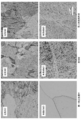
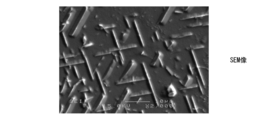
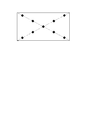
- FIG. It is a figure which shows the acicular precipitate or plate-shaped precipitate observed by the SEM image in the example 2 of this invention. It is a figure which shows the elemental mapping result of the acicular precipitate or plate-like precipitate observed by EPMA (Cr) in Example 2 of this invention. It is a figure which shows the element mapping result of the acicular precipitate or plate-like precipitate observed by EPMA (Zr) in Example 2 of this invention. It is explanatory drawing which shows the Vickers hardness measurement position in an Example.
- the casting mold material according to the present embodiment is used for a casting mold for continuous casting of steel materials and the like.
- the Cu—Cr—Zr—Al alloy material is used as a material for the above-mentioned casting mold material.
- the casting mold material and the Cu—Cr—Zr—Al alloy material according to the present embodiment have Cr of 0.3 mass% or more and less than 0.5 mass%, Zr of 0.01 mass% or more and 0.15 mass% or less, and Al of 0 .1 mass% or more and less than 2.0 mass%, the balance is composed of Cu and inevitable impurities, and one or more elements selected from Fe, Si, Co, and P are added in total to 0 .01 mass% to 0.15 mass%.
- the component composition of the casting mold material and the Cu—Cr—Zr—Al alloy material is defined as described above will be described below.
- Cr 0.3 mass% or more and less than 0.5 mass%
- Cr is an element having an effect of improving strength (hardness) and conductivity by finely depositing Cr-based precipitates in the crystal grains of the parent phase by aging treatment.
- the Cr content is less than 0.3 mass%, the amount of precipitation becomes insufficient in the aging treatment, and the effect of improving the strength (hardness) may not be sufficiently obtained.
- the Cr content is 0.5 mass% or more, for example, when slow cooling is performed at a cooling rate from a high temperature range of about 1000 ° C. to a temperature of 800 ° C.
- the Cr content is set within a range of 0.3 mass% or more and less than 0.5 mass%.
- the lower limit of the Cr content is preferably 0.35 mass% or more, and the upper limit of the Cr content is preferably 0.45 mass% or less.
- Zr 0.01 mass% or more and 0.15 mass% or less
- Zr is an element having an effect of improving strength (hardness) and electrical conductivity by finely depositing a Zr-based precipitate at a crystal grain boundary of the parent phase by aging treatment.
- the content of Zr is less than 0.01 mass%, the precipitation amount becomes insufficient in the aging treatment, and there is a possibility that the effect of improving the strength (hardness) cannot be obtained sufficiently.
- content of Zr exceeds 0.15 mass%, there exists a possibility that electrical conductivity and thermal conductivity may fall.
- even if it contains Zr exceeding 0.15 mass% there exists a possibility that the effect of the further intensity
- the content of Zr is set within a range of 0.01 mass% or more and 0.15 mass% or less.
- the lower limit of the Zr content is preferably 0.05 mass% or more
- the upper limit of the Zr content is preferably 0.13 mass% or less.
- Al 0.1 mass% or more and less than 2.0 mass%
- the conductivity of the casting mold material can be adjusted to about 30 to 60% IACS, which is particularly preferable as a molding material for electromagnetic stirring.
- the content of Al is set within a range of 0.1 mass% or more and less than 2.0 mass%.
- the lower limit of the Al content is preferably 0.5 mass% or more
- the upper limit of the Al content is preferably 1.5 mass% or less. .
- Elements such as Fe, Si, Co, and P when subjected to slow cooling at a cooling rate of 25 ° C./min or less from a high temperature range of about 1000 ° C. to a temperature of 800 ° C. or less, for example, It has the effect of suppressing the precipitation of system precipitates and promoting the precipitation of needle-like precipitates or plate-like precipitates containing Cr.
- the total content of one or more elements selected from Fe, Si, Co, and P is less than 0.01 mass%, the above-described effects may not be achieved. .
- the conductivity and thermal conductivity may be reduced.
- the total content of one or more elements selected from Fe, Si, Co, and P is set within a range of 0.01 mass% to 0.15 mass%. ing.
- the lower limit of the total content of one or more elements selected from Fe, Si, Co, and P is set to 0.02 mass% or more.
- the upper limit of the total content of one or more elements selected from Fe, Si, Co, and P is preferably 0.1 mass% or less.
- the molding material for casting which is this embodiment has the acicular precipitate or plate-shaped precipitate containing Cr in the parent phase of Cu.
- the maximum size of these needle-like precipitates or plate-like precipitates is 100 ⁇ m or less. Whether or not it has “a needle-like precipitate or a plate-like precipitate containing Cr” is determined from the criteria described below. A sample for observation is taken from the molding material for casting, and the cross section polished after the polishing treatment is subjected to a structure observation with a scanning electron microscope to determine whether or not there are needle-like precipitates or plate-like precipitates containing Cr. Check. Whether or not it contains “Cr” can be understood from the analysis of the composition by EPMA.
- the longest diameter of the precipitate is obtained from the shape of the precipitate as the longitudinal direction size. Of the diameters in the direction perpendicular to the longitudinal diameter, the longest diameter of the precipitates is obtained as a transverse direction size. If the value of the aspect ratio (longitudinal diameter / short diameter) is 5 or more, the precipitate is judged as “acicular precipitate or plate-like precipitate”. Furthermore, fine Cr-based and Zr-based precipitates having a particle size of, for example, 5 ⁇ m or less are dispersed in the casting mold material according to this embodiment. These fine Cr-based and Zr-based precipitates are precipitated in the aging treatment after slow cooling.
- acicular precipitates or plate-like precipitates are formed during slow cooling after thermal spraying to spray a Ni-Cr alloy having excellent heat resistance and wear resistance when producing a casting mold material. is there. More specifically, in the present embodiment, Cr is 0.3 mass% or more and less than 0.5 mass%, Zr is 0.01 mass% or more and 0.15 mass% or less, Al is contained by 0.1 mass% or more and less than 2.0 mass%, For the copper alloy composed of Cu and inevitable impurities as the balance, after being heated to, for example, 1000 ° C. or higher during the thermal spraying process, the cooling rate from a high temperature range of about 1000 ° C. to 600 ° C. or lower is 10 ° C./min or less When the slow cooling is performed, acicular precipitates or plate-like precipitates containing Cr are deposited. This suppresses the precipitation of granular Cr-based and Zr-based precipitates during slow cooling.
- the Cu—Cr—Zr—Al alloy material according to the present embodiment has the same composition as the above-mentioned casting mold material, and the cooling rate from 1000 ° C. to 600 ° C. after holding at 1000 ° C. for 1 hour.
- the conductivity (% IACS) after cooling at 10 ° C./min is A
- the conductivity (% IACS) after holding at 500 ° C. for 3 hours is B
- B / A> 1.1 Have the relationship. That is, in the Cu—Cr—Zr—Al alloy material according to the present embodiment, even when the cooling rate from 1000 ° C. to 600 ° C. is 10 ° C./min after holding at 1000 ° C. for 1 hour, Subsequent heat treatment of holding at 500 ° C. for 3 hours improves the conductivity.
- a copper raw material made of oxygen-free copper having a copper purity of 99.99 mass% or more is charged into a carbon crucible and melted using a vacuum melting furnace to obtain a molten copper.
- the aforementioned additive elements are added to the obtained molten metal so as to have a predetermined concentration, and the components are prepared to obtain a molten copper alloy.
- a raw material for the additive elements Cr, Zr, and Al a high-purity material is used.
- a Cr raw material having a purity of 99.99 mass% or more is used, and a Zr raw material is 99.95 mass in purity.
- the raw material for Al is 99.95 mass% or more in purity. Further, Fe, Si, Co, and P are added as necessary.
- a raw material for Cr, Zr, Fe, Si, Co, and P a mother alloy with Cu may be used. And the ingot is obtained by pouring the prepared copper alloy melt into the mold.
- Hot processing step S03 hot rolling with a processing rate of 50% to 99% is performed on the ingot in a temperature range of 900 ° C. to 1000 ° C. to obtain a rolled material.
- the hot working method may be hot forging. Immediately after this hot working, it is cooled by water cooling.
- First temporary treatment process S05 Next, after the solution treatment step S04, a first temporary effect treatment is performed, and precipitates such as a Cr-based precipitate and a Zr-based precipitate are finely precipitated to obtain a first temporary effect treatment material.
- the first temporary treatment is performed, for example, under conditions of 400 ° C. or more and 530 ° C. or less and 0.5 hours or more and 5 hours or less.
- the heat treatment method during the aging treatment is not particularly limited, but it is preferably performed in an inert gas atmosphere.
- the cooling method after the heat treatment is not particularly limited, but it is preferably performed by water cooling. Through this process, the Cu—Cr—Zr—Al alloy material according to this embodiment is manufactured.
- the cooling after the heat treatment after the thermal spraying is performed by slow cooling with a relatively low cooling rate such as furnace cooling.
- the cooling rate of the slow cooling is such that the cooling rate in the range from the heat treatment temperature to 800 ° C. or less is 5 ° C./min to 70 ° C./min.
- a second aging treatment is performed to precipitate finely precipitates such as Cr-based precipitates and Zr-based precipitates.
- the aging treatment is performed under conditions of, for example, 400 ° C. or more and 530 ° C. or less and 0.5 hour or more and 5 hours or less.
- the heat treatment method during the aging treatment is not particularly limited, but it is preferably performed in an inert gas atmosphere.
- the cooling method after the heat treatment is not particularly limited, but it is preferably performed by water cooling. Through such a process, the casting mold material according to the present embodiment is manufactured.
- Cr is 0.3 mass% or more and less than 0.5 mass%
- Zr is 0.01 mass% or more and 0.15 mass% or less
- Al is 0. .1 mass% or more and less than 2.0 mass%
- the balance is made up of Cu and inevitable impurities, so in the second aging treatment step S07, finely depositing Cr-based and Zr-based precipitates , Strength (hardness) and electrical conductivity can be improved.
- Al is contained in the range of 0.1 mass% or more and less than 2.0 mass%, the conductivity can be adjusted to about 30 to 60% IACS, and it is particularly suitable as a molding material for electromagnetic stirring applications. .
- the second aging treatment step S07 after the spraying treatment step S06 can sufficiently disperse fine precipitates, and the precipitation strengthening mechanism can sufficiently improve the strength (hardness). it can.
- the maximum size of the needle-like precipitates or plate-like precipitates containing Cr is relatively small, 100 ⁇ m or less, so Cr is contained in the Cu matrix. It is sufficiently solid solution, and fine precipitates can be sufficiently dispersed by the second aging treatment step S07 after the spraying treatment step S06, and the strength (hardness) and conductivity are sufficiently improved by the precipitation strengthening mechanism. Can be made.
- the casting mold material according to the present embodiment further includes one or more elements selected from Fe, Si, Co, and P in total of 0.01 mass% or more and 0.15 mass% or less. Therefore, the formation of granular precipitates during the slow cooling after the thermal spraying process S06 is suppressed, and the formation of acicular precipitates or plate-like precipitates containing Cr is promoted. Therefore, by the second aging treatment step S07 after the thermal spraying treatment step S06, fine precipitates can be sufficiently precipitated, and the strength (hardness) and conductivity can be improved reliably.
- the conductivity (% IACS) after cooling at 1000 ° C. to 600 ° C. at a cooling rate of 10 ° C./min after holding at 1000 ° C. for 1 hour. ) Is A, and then the electrical conductivity (% IACS) after being held at 500 ° C. for 3 hours is B, it has a relationship of B / A> 1.1.
- the electrical conductivity is improved in the second aging treatment step S07 after slow cooling, and the strength (hardness) is improved by precipitation hardening. Can be achieved.
- a copper raw material made of oxygen-free copper having a purity of 99.99 mass% or more was prepared, charged into a carbon crucible, and melted in a vacuum melting furnace (vacuum degree 10 ⁇ 2 Pa or less) to obtain a molten copper.
- Various additive elements were added to the obtained molten copper to prepare the component compositions shown in Table 1, and after maintaining for 5 minutes, the molten copper alloy was poured into a cast iron mold to obtain an ingot.
- the size of the ingot was about 80 mm in width, about 50 mm in thickness, and about 130 mm in length.
- the raw material for Cr, which is an additive element was 99.99 mass% or more in purity
- the raw material for Zr was 99.95 mass% or more in purity
- the raw material for Al was 99.99 mass% or more in purity.
- hot rolling was performed.
- the rolling reduction during hot rolling was 80%, and a hot rolled material having a width of about 100 mm, a thickness of about 10 mm, and a length of about 520 mm was obtained.
- a solution treatment was performed at 1000 ° C. for 1.5 hours, followed by water cooling.
- the first temporary treatment was performed at 500 ( ⁇ 15) ° C. for 3 hours.
- a Cu—Cr—Zr—Al alloy material was obtained.
- the obtained Cu—Cr—Zr—Al alloy material is subjected to heat treatment under conditions of 1 hour at 1000 ° C. by simulating thermal spraying treatment, and then a cooling rate of 10 ° C. from 1000 ° C. to 600 ° C. Slowly cooled at / min. Thereafter, a second aging treatment was performed at 500 ° C. for 3 hours. Thereby, a molding material for casting was obtained.
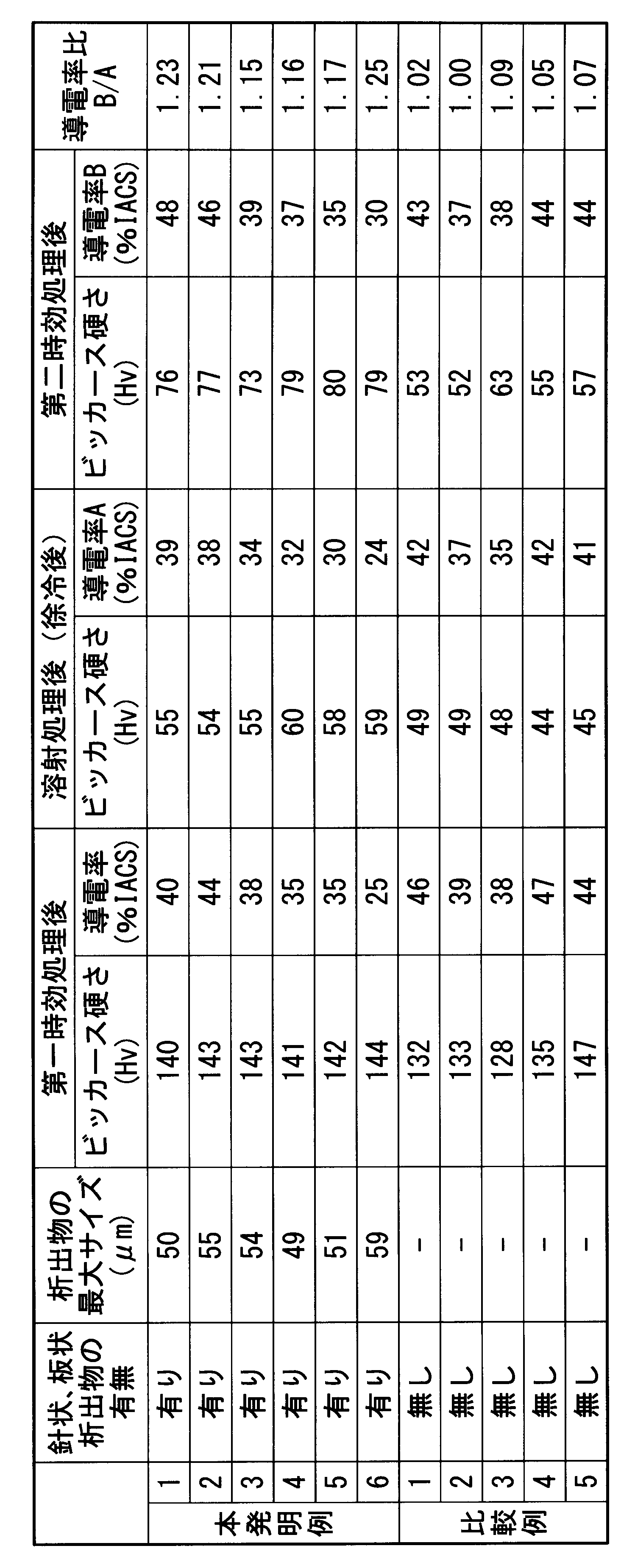
- the obtained Cu—Cr—Zr—Al alloy material was evaluated for Vickers hardness (rolled surface) and conductivity. Furthermore, Vickers hardness (rolled surface) and electrical conductivity were evaluated for the molding material for casting after the thermal spraying treatment and after the second aging treatment. Furthermore, the structure was observed, and the presence or absence of needle-like precipitates or plate-like precipitates containing Cr was evaluated.
- FIGS. 3A to 3C show enlarged observation results of the needle-like precipitates or plate-like precipitates containing Cr observed in Example 3 of the present invention.
- the minimum circumscribed circle was drawn about the acicular precipitate or plate-shaped precipitate observed as mentioned above, and the diameter of this minimum circumscribed circle was made into the maximum size of a precipitate.
- the conductivity (% IACS) after holding for 3 hours at 500 ° C. (after the second aging treatment) is B, it is confirmed that B / A> 1.1. .
- the present invention has needle-like precipitates or plate-like precipitates containing Cr. And in the example of the present invention, it is confirmed that the Vickers hardness and conductivity are greatly increased by the second aging heat treatment as compared with the comparative example.
- Example 4 of the present invention as shown in FIG. 2, needle-like precipitates or plate-like precipitates containing Cr were observed in the test pieces that were gradually cooled after the thermal spraying treatment.
- FIGS. From the granular precipitate, Cr and Zr are detected.
- the strength (hardness) and electrical conductivity of the casting mold material can be sufficiently improved even if the aging treatment is performed after the thermal spraying treatment for the casting mold material made of the Cu—Cr—Zr—Al alloy material. Thus, it is possible to provide a molding material for casting that is superior in durability in a harsh environment.
Landscapes
- Chemical & Material Sciences (AREA)
- Engineering & Computer Science (AREA)
- Mechanical Engineering (AREA)
- Materials Engineering (AREA)
- Metallurgy (AREA)
- Organic Chemistry (AREA)
- Physics & Mathematics (AREA)
- Thermal Sciences (AREA)
- Crystallography & Structural Chemistry (AREA)
- Molds, Cores, And Manufacturing Methods Thereof (AREA)
- Conductive Materials (AREA)
- Continuous Casting (AREA)
Abstract
Description
本願は、2015年10月15日に、日本に出願された特願2015-203581号に基づき優先権を主張し、その内容をここに援用する。
δ=(1/π・μ・f・σ)0.5
この式からわかるように、磁場深さδを深くするためには、モールド材の導電率σが低い方が好ましい。しかしながら、導電率σを低くしすぎると熱伝導率が低下し、冷却が不十分となるおそれがある。
このため、モールド材においては、Cr、Zr以外の添加元素を加えることにより、導電率σを30~60%IACS程度に調整したものが提案されている。
また、特許文献2には、Cr:0.3~1.2wt%、Zr:0.05~0.25wt%を含有し、さらにSn,Al,Ag,Ni,Ti,Co,Fe等を添加した金属鋳造用鋳型材が開示されている。
この場合、前記針状析出物もしくは前記板状析出物の最大サイズが100μm以下と比較的小さくされているので、Cuの母相中にCrが十分に固溶しており、その後の時効処理時に微細な析出物を十分に分散させることができ、析出強化機構によって強度(硬さ)及び導電率を十分に向上させることができる。
この場合、Fe,Si,Co,Pといった元素を上述の範囲内で含有していることから、溶射処理後の徐冷時に粒状の析出物が形成されることが抑制され、Crを含有する針状析出物もしくは板状析出物の生成が促進される。よって、溶射処理後の時効処理によって微細なCr系及びZr系の析出物を十分に析出させることができ、確実に強度(硬さ)及び導電率を向上させることができる。
このため、上述の鋳造用モールド材用の素材として特に適している。
この場合、Fe,Si,Co,Pといった元素を上述の範囲内で含有していることから、例えば1000℃程度の高温域に加熱した後に徐冷した場合であっても、Cr及びZrの不要な析出を抑制してCr及びZrの固溶量を確保することができる。よって、徐冷後の時効処理によって微細な析出物を十分に析出させることができ、確実に強度(硬さ)及び導電率を向上させることができる。
本実施形態である鋳造用モールド材は、鉄鋼材料等を連続鋳造する際の連続鋳造用鋳型に用いられるものである。また、本実施形態では、Cu-Cr-Zr-Al合金素材は、上述の鋳造用モールド材の素材として用いられるものである。
ここで、上述のように、鋳造用モールド材及びCu-Cr-Zr-Al合金素材の成分組成を規定した理由について、以下に説明する。
Crは、時効処理によって母相の結晶粒内にCr系の析出物を微細に析出させることにより、強度(硬さ)及び導電率を向上させる作用効果を有する元素である。
ここで、Crの含有量が0.3mass%未満の場合には、時効処理において析出量が不十分となり、強度(硬さ)向上の効果を十分に得られないおそれがある。また、Crの含有量が0.5mass%以上の場合には、例えば1000℃程度の高温域から800℃以下の温度までの冷却速度が25℃/min以下となる徐冷を行った際に、粒状のCr系及びZr系の析出物が析出し、徐冷後の時効処理においてこれらの粒状の析出物がさらに成長することにより、析出強化機構に寄与する微細な析出物を確保することができなくなるおそれがある。
以上のことから、本実施形態では、Crの含有量を0.3mass%以上0.5mass%未満の範囲内に設定している。なお、上述の作用効果を確実に奏功せしめるためには、Crの含有量の下限を0.35mass%以上とすることが好ましく、Crの含有量の上限を0.45mass%以下とすることが好ましい。
Zrは、時効処理によって母相の結晶粒界にZr系の析出物を微細に析出することにより、強度(硬さ)及び導電率を向上させる作用効果を有する元素である。
ここで、Zrの含有量が0.01mass%未満の場合には、時効処理において析出量が不十分となり、強度(硬さ)向上の効果を十分に得られないおそれがある。また、Zrの含有量が0.15mass%を超える場合には、導電率及び熱伝導率が低下してしまうおそれがある。また、Zrを0.15mass%を超えて含有しても、さらなる強度向上の効果が得られないおそれがある。
以上のことから、本実施形態では、Zrの含有量を0.01mass%以上0.15mass%以下の範囲内に設定している。なお、上述の作用効果を確実に奏功せしめるためには、Zrの含有量の下限を0.05mass%以上とすることが好ましく、Zrの含有量の上限を0.13mass%以下とすることが好ましい。
Alは、銅合金に固溶することによって導電率を低下させる作用効果を有する元素である。よって、Alの添加量を制御することにより、鋳造用モールド材の導電率を30~60%IACS程度に調整することができ、電磁撹拌用のモールド材として特に好ましいものとなる。
ここで、Alの含有量が0.1mass%未満の場合には、導電率を低く抑えることが困難となり、磁場の浸透深さを確保できなくなるおそれがある。また、Alの含有量が2.0mass%以上の場合には、導電率が大きく低下し、熱伝導率が不十分となるおそれがある。
以上のことから、本実施形態では、Alの含有量を0.1mass%以上2.0mass%未満の範囲内に設定している。なお、上述の作用効果を確実に奏功せしめるためには、Alの含有量の下限を0.5mass%以上とすることが好ましく、Alの含有量の上限を1.5mass%以下とすることが好ましい。
Fe,Si,Co,Pといった元素は、例えば1000℃程度の高温域から800℃以下の温度までの冷却速度が25℃/min以下となる徐冷を行った際に、粒状のCr系及びZr系の析出物が析出することを抑制し、Crを含有する針状析出物もしくは板状析出物の析出を促進する作用効果を有している。
ここで、Fe,Si,Co,Pから選択される1種又は2種以上の元素の合計の含有量が0.01mass%未満の場合には、上述の作用効果を奏することができないおそれがある。一方、Fe,Si,Co,Pから選択される1種又は2種以上の元素の合計の含有量が0.15mass%を超える場合には、導電率及び熱伝導率が低下してしまうおそれがある。
以上のことから、本実施形態では、Fe,Si,Co,Pから選択される1種又は2種以上の元素の合計含有量を0.01mass%以上0.15mass%以下の範囲内に設定している。なお、上述の作用効果を確実に奏功せしめるためには、Fe,Si,Co,Pから選択される1種又は2種以上の元素の合計含有量の下限を0.02mass%以上とすることが好ましく、Fe,Si,Co,Pから選択される1種又は2種以上の元素の合計含有量の上限を0.1mass%以下とすることが好ましい。
なお、上述したCr,Zr,Al、P,Fe,Si,Co以外のその他の不可避的不純物としては、B、Ag,Sn,Zn,Ti,Ca,Te,Mn,Ni,Sr,Ba,Sc,Y,Ti,Hf,V,Nb,Ta,Mo,W,Re,Ru,Os,Se,Rh,Ir,Pd,Pt,Au,Cd,Ga,In,Li,Ge,As,Sb,Tl,Pb,Be,N,H,Hg,Tc,Na,K,Rb,Cs,Po,Bi,ランタノイド、O,S,C等が挙げられる。これらの不可避不純物は、導電率及び熱伝導率を低下させるおそれがあるため、総量で0.05mass%以下とすることが好ましい。
「Crを含有する針状析出物もしくは板状析出物を有している」かどうかは、以下に説明する基準から判断する。
鋳造用モールド材から観察用サンプルを採取し、研磨処理後に研磨された断面に対して、走査型電子顕微鏡にて組織観察を行い、Crを含有する針状析出物もしくは板状析出物の有無を確認する。
「Crを含有する」か否かは、EPMAによる組成の分析から分かる。
「針状析出物もしくは板状析出物」であるかどうかは、組織観察の対象となる断面における析出物の形状から判断する。まず、析出物の形状からその析出物の最長径を長手方向径(longitudinal direction size)として得る。そしてこの長手方向径と直交する方向での径のうち、その析出物中で最も長い径を短手方向径(traverse direction size)として得る。アスペクト比(長手方向径/短手方向径)の値が5以上であれば、その析出物を「針状析出物もしくは板状析出物」と判断する。
さらに、本実施形態である鋳造用モールド材には、例えば粒径が5μm以下の微細なCr系及びZr系の析出物が分散されている。なお、これらの微細なCr系及びZr系の析出物は、徐冷後の時効処理において析出したものである。
すなわち、本実施形態であるCu-Cr-Zr-Al合金素材においては、1000℃で1時間保持後に1000℃から600℃までの冷却速度を10℃/minとして徐冷した場合であっても、その後の500℃、3時間保持の熱処理により、導電率が向上することになる。
まず、銅の純度が99.99mass%以上の無酸素銅からなる銅原料を、カーボンるつぼに装入し、真空溶解炉を用いて溶解し、銅溶湯を得る。次いで、得られた溶湯に、所定の濃度となるように前述の添加元素を添加して、成分調製を行い、銅合金溶湯を得る。
ここで、添加元素であるCr、Zr、Alの原料としては、純度の高いものを使用し、例えばCrの原料は純度99.99mass%以上のものを使用し、Zrの原料は純度99.95mass%以上のものを使用し、Alの原料は純度99.95mass%以上のものを使用する。また、Fe、Si、Co、Pを必要に応じて添加する。なお、Cr、Zr、Fe、Si、Co、Pの原料として、Cuとの母合金を用いてもよい。
そして、成分調製された銅合金溶湯を鋳型に注湯して鋳塊を得る。
次に、得られた鋳塊の均質化のために熱処理を行う。
具体的には、鋳塊を大気雰囲気にて、950℃以上1050℃以下、1時間以上の条件で均質化処理を行う。
次いで、鋳塊に対して900℃以上1000℃以下の温度範囲で、加工率50%以上99%以下の熱間圧延を行い、圧延材を得る。なお、熱間加工の方法は、熱間鍛造であっても良い。この熱間加工後、直ちに水冷によって冷却する。
次いで、熱間加工工程S03で得られた圧延材を、920℃以上1050℃以下、0.5時間以上5時間以下の条件で加熱処理を施し、溶体化処理を行う。加熱処理は、例えば大気または不活性ガス雰囲気で行い、加熱後の冷却は、水冷によって行う。
次に、溶体化処理工程S04の後に、第一時効処理を実施し、Cr系析出物及びZr系析出物などの析出物を微細に析出させ、第一時効処理材を得る。
ここで、第一時効処理は、例えば400℃以上530℃以下、0.5時間以上5時間以下の条件で行う。
なお、時効処理時の熱処理方法は、特に限定しないが、不活性ガス雰囲気で行うことが好ましい。また、加熱処理後の冷却方法は、特に限定しないが、水冷で行うことが好ましい。
このような工程により、本実施形態であるCu-Cr-Zr-Al合金素材が製造される。
次いで、第一時効処理工程S05後に、Cu-Cr-Zr-Al合金素材の表面の所定の箇所にNi-Cr合金等を溶射し、Cu-Cr-Zr-Al合金素材の表面の所定の箇所にコーティング層を形成する。そして、この溶射の後に、コーティング層が形成されたCu-Cr-Zr-Al合金素材に900℃以上1000℃以下、15分以上180分以下の熱処理を行う。この熱処理は、Cu-Cr-Zr-Al合金素材とコーティング層とを拡散接合するために行われている。
この溶射が行われた後の熱処理後の冷却は、例えば炉冷のような比較的冷却速度が遅い徐冷によって行われる。ここで、徐冷の冷却速度は、例えば熱処理温度から800℃以下での範囲の冷却速度が5℃/min以上70℃/min以下である。
次いで、溶射処理工程S06の後に、第二時効処理を実施し、Cr系析出物及びZr系析出物などの析出物を微細に析出させる。
ここで、時効処理は、例えば400℃以上530℃以下、0.5時間以上5時間以下の条件で行う。
なお、時効処理時の熱処理方法は、特に限定しないが、不活性ガス雰囲気で行うことが好ましい。また、熱処理後の冷却方法は、特に限定しないが、水冷で行うことが好ましい。
このような工程により、本実施形態である鋳造用モールド材が製造される。
さらに、本実施形態に係る鋳造用モールド材においては、Crを含有する針状析出物もしくは板状析出物の最大サイズが100μm以下と比較的小さくされているので、Cuの母相中にCrが十分に固溶しており、溶射処理工程S06後の第二時効処理工程S07によって微細な析出物を十分に分散させることができ、析出強化機構によって強度(硬さ)及び導電率を十分に向上させることができる。
本実施形態では、Fe,Si,Co,Pから選択される1種又は2種以上の元素を合計で0.01mass%以上0.15mass%以下含むものとして説明したが、これに限定されることはなく、これらの元素を意図的に添加しなくてもよい。
純度99.99mass%以上の無酸素銅からなる銅原料を準備し、これをカーボンるつぼに装入し、真空溶解炉(真空度10-2Pa以下)で溶解し、銅溶湯を得た。得られた銅溶湯内に、各種添加元素を添加して表1に示す成分組成に調製し、5分間保持した後、銅合金溶湯を鋳鉄製の鋳型に注湯して鋳塊を得た。鋳塊の大きさは、幅約80mm、厚さ約50mm、長さ約130mmとした。
なお、添加元素であるCrの原料は純度99.99mass%以上、Zrの原料は純度99.95mass%以上、Alの原料は純度99.99mass%以上のものを使用した。
この熱間圧延材を用いて、1000℃で1.5時間の条件で溶体化処理を行い、その後水冷した。
次に、500(±15)℃で3時間の条件で第一時効処理を実施した。これにより、Cu-Cr-Zr-Al合金素材を得た。
その後、500℃で3時間の条件で第二時効処理を実施した。これにより、鋳造用モールド材を得た。
さらに、溶射処理後及び第二時効処理後の鋳造用モールド材について、ビッカース硬さ(圧延面)、導電率を評価した。さらに、組織観察を行い、Crを含有する針状析出物もしくは板状析出物の有無を評価した。
得られたCu-Cr-Zr-Al合金素材及び鋳造用モールド材の成分組成は、ICP-MS分析によって測定した。測定結果を表1に示す。
得られた鋳造用モールド材から観察用サンプルを採取し、研磨処理後に走査型電子顕微鏡にて組織観察を行い、Crを含有する針状析出物もしくは板状析出物の有無を確認した。観察結果を表2に示す。なお、本発明例3の及び比較例2の試料について、第一時効処理後、溶射処理及び徐冷後、第二時効処理後に組織観察を行った結果を図2に示す。さらに、本発明例3で観察されたCrを含有する針状析出物もしくは板状析出物の拡大観察結果を図3A~図3Cに示す。
上述のようにして観察された針状析出物もしくは板状析出物について、最小外接円を描き、この最小外接円の直径を析出物の最大サイズとした。
JIS Z 2244に準じて、株式会社アカシ製ビッカース硬度試験機により、図4に示すように試験片の9か所でビッカース硬さを測定し、その最大値及び最小値を除外した7つの測定値の平均値を求めた。第一時効処理後、溶射処理後及び第二時効処理後の測定結果を表2に示す。
日本フェルスター社製SIGMA TEST D2.068(プローブ径φ6mm)を用いて、10×15mmのサンプルの断面中心部を3回測定し、その平均値を求めた。第一時効処理後、溶射処理後及び第二時効処理後の測定結果を表2に示す。

これに対して、本発明例4では、図2に示すように、溶射処理後に徐冷した試験片でCrを含有する針状析出物もしくは板状析出物が観察された。
なお、本発明例4の第二時効熱処理後の試験片の析出物を拡大観察した結果、図3A~3Cに示すように、針状析出物もしくは板状析出物からはCrが検出されており、粒状の析出物からはCr及びZrが検出されている。
Claims (5)
- 金属材料を鋳造する際に用いられる鋳造用モールド材であって、
Crを0.3mass%以上0.5mass%未満、Zrを0.01mass%以上0.15mass%以下、Alを0.1mass%以上2.0mass%未満、含み、残部がCu及び不可避不純物からなる組成を有し、
針状析出物もしくは板状析出物を有することを特徴とする鋳造用モールド材。 - 前記針状析出物もしくは前記板状析出物のサイズが100μm以下であることを特徴とする請求項1に記載の鋳造用モールド材。
- さらに、Fe,Si,Co,Pから選択される1種又は2種以上の元素を合計で0.01mass%以上0.15mass%以下含むことを特徴とする請求項1又は請求項2に記載の鋳造用モールド材。
- Crを0.3mass%以上0.5mass%未満、Zrを0.01mass%以上0.15mass%以下、Alを0.1mass%以上2.0mass%未満、含み、残部がCu及び不可避不純物からなる組成を有し、
1000℃で1時間保持後に1000℃から600℃までの冷却速度を10℃/minとして冷却した後の導電率(%IACS)をA、その後500℃で3時間保持した後の導電率(%IACS)をBとした場合に、B/A>1.1との関係を有することを特徴とするCu-Cr-Zr-Al合金素材。 - さらに、Fe,Si,Co,Pから選択される1種又は2種以上の元素を合計で0.01mass%以上0.15mass%以下含むことを特徴とする請求項4に記載のCu-Cr-Zr-Al合金素材。
Priority Applications (4)
| Application Number | Priority Date | Filing Date | Title |
|---|---|---|---|
| US15/766,532 US20180297109A1 (en) | 2015-10-15 | 2016-10-05 | CASTING MOLD MATERIAL AND Cu-Cr-Zr-Al ALLOY MATERIAL |
| CN201680059266.0A CN108138262B (zh) | 2015-10-15 | 2016-10-05 | 铸造用模具材料及Cu-Cr-Zr-Al合金原材料 |
| KR1020187004038A KR102500630B1 (ko) | 2015-10-15 | 2016-10-05 | 주조용 몰드재 및 Cu-Cr-Zr-Al 합금 소재 |
| EP16855325.3A EP3363921B1 (en) | 2015-10-15 | 2016-10-05 | Casting mold material and cu-cr-zr-al alloy starting material |
Applications Claiming Priority (2)
| Application Number | Priority Date | Filing Date | Title |
|---|---|---|---|
| JP2015203581A JP6693078B2 (ja) | 2015-10-15 | 2015-10-15 | 鋳造用モールド材 |
| JP2015-203581 | 2015-10-15 |
Publications (1)
| Publication Number | Publication Date |
|---|---|
| WO2017065071A1 true WO2017065071A1 (ja) | 2017-04-20 |
Family
ID=58518068
Family Applications (1)
| Application Number | Title | Priority Date | Filing Date |
|---|---|---|---|
| PCT/JP2016/079641 Ceased WO2017065071A1 (ja) | 2015-10-15 | 2016-10-05 | 鋳造用モールド材及びCu-Cr-Zr-Al合金素材 |
Country Status (6)
| Country | Link |
|---|---|
| US (1) | US20180297109A1 (ja) |
| EP (1) | EP3363921B1 (ja) |
| JP (1) | JP6693078B2 (ja) |
| KR (1) | KR102500630B1 (ja) |
| CN (1) | CN108138262B (ja) |
| WO (1) | WO2017065071A1 (ja) |
Cited By (1)
| Publication number | Priority date | Publication date | Assignee | Title |
|---|---|---|---|---|
| EP3715488A4 (en) * | 2017-11-21 | 2021-03-31 | Mitsubishi Materials Corporation | CASTING MOLD MATERIAL AND COPPER ALLOY MATERIAL |
Families Citing this family (3)
| Publication number | Priority date | Publication date | Assignee | Title |
|---|---|---|---|---|
| JP6488951B2 (ja) * | 2014-09-25 | 2019-03-27 | 三菱マテリアル株式会社 | 鋳造用モールド材及びCu−Cr−Zr合金素材 |
| CN113333696B (zh) * | 2021-06-01 | 2023-02-17 | 西峡龙成特种材料有限公司 | 一种CuAlFeNi结晶器铜板背板及其母材与加工方法 |
| CN118326201B (zh) * | 2024-06-17 | 2024-09-17 | 上海理工大学 | 铜基合金接触线及其连续生产方法 |
Citations (6)
| Publication number | Priority date | Publication date | Assignee | Title |
|---|---|---|---|---|
| JPS5884641A (ja) * | 1981-11-16 | 1983-05-20 | Nippon Kokan Kk <Nkk> | 連続鋳造用鋳型材料 |
| JPS58107459A (ja) * | 1981-12-21 | 1983-06-27 | Chuetsu Gokin Chuko Kk | 析出硬化型連続鋳造用鋳型材料 |
| JPS58107462A (ja) * | 1981-12-21 | 1983-06-27 | Chuetsu Gokin Chuko Kk | 析出硬化型連続鋳造用鋳型材料 |
| JPS58212839A (ja) * | 1982-06-03 | 1983-12-10 | Mitsubishi Metal Corp | 連続鋳造鋳型用Cu合金 |
| JP2000282156A (ja) * | 1999-03-31 | 2000-10-10 | Nippon Mining & Metals Co Ltd | ハードディスクドライブサスペンション用銅合金箔 |
| JP2005096678A (ja) * | 2003-09-26 | 2005-04-14 | Mitsubishi Materials Corp | トロリ線 |
Family Cites Families (10)
| Publication number | Priority date | Publication date | Assignee | Title |
|---|---|---|---|---|
| JPS5946699B2 (ja) * | 1979-03-27 | 1984-11-14 | 日立造船株式会社 | 連続鋳造設備の鋳型材 |
| JPS6050161A (ja) * | 1983-08-30 | 1985-03-19 | Mitsubishi Metal Corp | 拡散浸透処理による表面硬化層を有するCu合金部材 |
| JPS60221151A (ja) * | 1984-04-18 | 1985-11-05 | Kawasaki Steel Corp | 連続鋳造用鋳型および鋳型内面溶射皮膜形成方法 |
| JPS6241302A (ja) | 1985-08-09 | 1987-02-23 | ユニ・チヤ−ム株式会社 | 使い捨て吸収性パンツおよびその製法 |
| JP2738130B2 (ja) * | 1990-05-25 | 1998-04-08 | 三菱マテリアル株式会社 | 高冷却能を有する高強度Cu合金製連続鋳造鋳型材およびその製造法 |
| JPH05339688A (ja) * | 1992-06-05 | 1993-12-21 | Furukawa Electric Co Ltd:The | 金属鋳造用鋳型材の製造方法 |
| JP2001131656A (ja) * | 1999-11-04 | 2001-05-15 | Mitsubishi Shindoh Co Ltd | 圧延性および曲げ加工性にすぐれたCu合金で構成された電子電気機器のコネクター材 |
| JP4158337B2 (ja) * | 2000-12-20 | 2008-10-01 | 三菱マテリアル株式会社 | 連続鋳造鋳型用クロム・ジルコニウム系銅合金の製造方法 |
| WO2010079707A1 (ja) * | 2009-01-09 | 2010-07-15 | 三菱伸銅株式会社 | 高強度高導電銅合金圧延板及びその製造方法 |
| KR101364542B1 (ko) * | 2011-08-11 | 2014-02-18 | 주식회사 풍산 | 연속주조 몰드용 동합금재 및 이의 제조 방법 |
-
2015
- 2015-10-15 JP JP2015203581A patent/JP6693078B2/ja active Active
-
2016
- 2016-10-05 CN CN201680059266.0A patent/CN108138262B/zh active Active
- 2016-10-05 WO PCT/JP2016/079641 patent/WO2017065071A1/ja not_active Ceased
- 2016-10-05 US US15/766,532 patent/US20180297109A1/en not_active Abandoned
- 2016-10-05 KR KR1020187004038A patent/KR102500630B1/ko active Active
- 2016-10-05 EP EP16855325.3A patent/EP3363921B1/en active Active
Patent Citations (6)
| Publication number | Priority date | Publication date | Assignee | Title |
|---|---|---|---|---|
| JPS5884641A (ja) * | 1981-11-16 | 1983-05-20 | Nippon Kokan Kk <Nkk> | 連続鋳造用鋳型材料 |
| JPS58107459A (ja) * | 1981-12-21 | 1983-06-27 | Chuetsu Gokin Chuko Kk | 析出硬化型連続鋳造用鋳型材料 |
| JPS58107462A (ja) * | 1981-12-21 | 1983-06-27 | Chuetsu Gokin Chuko Kk | 析出硬化型連続鋳造用鋳型材料 |
| JPS58212839A (ja) * | 1982-06-03 | 1983-12-10 | Mitsubishi Metal Corp | 連続鋳造鋳型用Cu合金 |
| JP2000282156A (ja) * | 1999-03-31 | 2000-10-10 | Nippon Mining & Metals Co Ltd | ハードディスクドライブサスペンション用銅合金箔 |
| JP2005096678A (ja) * | 2003-09-26 | 2005-04-14 | Mitsubishi Materials Corp | トロリ線 |
Non-Patent Citations (1)
| Title |
|---|
| See also references of EP3363921A4 * |
Cited By (1)
| Publication number | Priority date | Publication date | Assignee | Title |
|---|---|---|---|---|
| EP3715488A4 (en) * | 2017-11-21 | 2021-03-31 | Mitsubishi Materials Corporation | CASTING MOLD MATERIAL AND COPPER ALLOY MATERIAL |
Also Published As
| Publication number | Publication date |
|---|---|
| US20180297109A1 (en) | 2018-10-18 |
| KR102500630B1 (ko) | 2023-02-15 |
| JP6693078B2 (ja) | 2020-05-13 |
| CN108138262A (zh) | 2018-06-08 |
| JP2017075371A (ja) | 2017-04-20 |
| EP3363921B1 (en) | 2022-05-25 |
| EP3363921A1 (en) | 2018-08-22 |
| EP3363921A4 (en) | 2019-04-03 |
| KR20180070545A (ko) | 2018-06-26 |
| CN108138262B (zh) | 2021-07-09 |
Similar Documents
| Publication | Publication Date | Title |
|---|---|---|
| JP6488951B2 (ja) | 鋳造用モールド材及びCu−Cr−Zr合金素材 | |
| JP6839213B2 (ja) | ボロンドーピングされた高エントロピー合金およびその製造方法 | |
| JP6693092B2 (ja) | 銅合金素材 | |
| TWI557233B (zh) | NiIr基底之耐熱合金及其製造方法 | |
| KR102500630B1 (ko) | 주조용 몰드재 및 Cu-Cr-Zr-Al 합금 소재 | |
| JP6736869B2 (ja) | 銅合金素材 | |
| KR102486303B1 (ko) | 주조용 몰드재, 및 구리 합금 소재 | |
| KR102385768B1 (ko) | 주조용 몰드재 및 Cu-Cr-Zr 합금 소재 | |
| JP6179325B2 (ja) | 連続鋳造用モールド材 | |
| JP2015067883A (ja) | 連続鋳造用モールド材 | |
| WO2025100263A1 (ja) | アルミニウム合金成形体及びその製造方法 |
Legal Events
| Date | Code | Title | Description |
|---|---|---|---|
| 121 | Ep: the epo has been informed by wipo that ep was designated in this application |
Ref document number: 16855325 Country of ref document: EP Kind code of ref document: A1 |
|
| ENP | Entry into the national phase |
Ref document number: 20187004038 Country of ref document: KR Kind code of ref document: A |
|
| WWE | Wipo information: entry into national phase |
Ref document number: 15766532 Country of ref document: US |
|
| NENP | Non-entry into the national phase |
Ref country code: DE |
|
| WWE | Wipo information: entry into national phase |
Ref document number: 2016855325 Country of ref document: EP |