WO2017069158A1 - イムノグロブリン結合ポリペプチド - Google Patents
イムノグロブリン結合ポリペプチド Download PDFInfo
- Publication number
- WO2017069158A1 WO2017069158A1 PCT/JP2016/080977 JP2016080977W WO2017069158A1 WO 2017069158 A1 WO2017069158 A1 WO 2017069158A1 JP 2016080977 W JP2016080977 W JP 2016080977W WO 2017069158 A1 WO2017069158 A1 WO 2017069158A1
- Authority
- WO
- WIPO (PCT)
- Prior art keywords
- amino acid
- seq
- acid sequence
- immunoglobulin
- sequence shown
- Prior art date
- Legal status (The legal status is an assumption and is not a legal conclusion. Google has not performed a legal analysis and makes no representation as to the accuracy of the status listed.)
- Ceased
Links
Images


Classifications
-
- C—CHEMISTRY; METALLURGY
- C07—ORGANIC CHEMISTRY
- C07K—PEPTIDES
- C07K17/00—Carrier-bound or immobilised peptides; Preparation thereof
-
- C—CHEMISTRY; METALLURGY
- C07—ORGANIC CHEMISTRY
- C07K—PEPTIDES
- C07K14/00—Peptides having more than 20 amino acids; Gastrins; Somatostatins; Melanotropins; Derivatives thereof
- C07K14/195—Peptides having more than 20 amino acids; Gastrins; Somatostatins; Melanotropins; Derivatives thereof from bacteria
- C07K14/315—Peptides having more than 20 amino acids; Gastrins; Somatostatins; Melanotropins; Derivatives thereof from bacteria from Streptococcus (G), e.g. Enterococci
-
- C—CHEMISTRY; METALLURGY
- C07—ORGANIC CHEMISTRY
- C07K—PEPTIDES
- C07K1/00—General methods for the preparation of peptides, i.e. processes for the organic chemical preparation of peptides or proteins of any length
- C07K1/14—Extraction; Separation; Purification
- C07K1/16—Extraction; Separation; Purification by chromatography
- C07K1/22—Affinity chromatography or related techniques based upon selective absorption processes
-
- C—CHEMISTRY; METALLURGY
- C07—ORGANIC CHEMISTRY
- C07K—PEPTIDES
- C07K14/00—Peptides having more than 20 amino acids; Gastrins; Somatostatins; Melanotropins; Derivatives thereof
- C07K14/195—Peptides having more than 20 amino acids; Gastrins; Somatostatins; Melanotropins; Derivatives thereof from bacteria
-
- C—CHEMISTRY; METALLURGY
- C07—ORGANIC CHEMISTRY
- C07K—PEPTIDES
- C07K17/00—Carrier-bound or immobilised peptides; Preparation thereof
- C07K17/02—Peptides being immobilised on, or in, an organic carrier
- C07K17/10—Peptides being immobilised on, or in, an organic carrier the carrier being a carbohydrate
-
- C—CHEMISTRY; METALLURGY
- C12—BIOCHEMISTRY; BEER; SPIRITS; WINE; VINEGAR; MICROBIOLOGY; ENZYMOLOGY; MUTATION OR GENETIC ENGINEERING
- C12N—MICROORGANISMS OR ENZYMES; COMPOSITIONS THEREOF; PROPAGATING, PRESERVING, OR MAINTAINING MICROORGANISMS; MUTATION OR GENETIC ENGINEERING; CULTURE MEDIA
- C12N15/00—Mutation or genetic engineering; DNA or RNA concerning genetic engineering, vectors, e.g. plasmids, or their isolation, preparation or purification; Use of hosts therefor
- C12N15/09—Recombinant DNA-technology
- C12N15/11—DNA or RNA fragments; Modified forms thereof; Non-coding nucleic acids having a biological activity
-
- C—CHEMISTRY; METALLURGY
- C12—BIOCHEMISTRY; BEER; SPIRITS; WINE; VINEGAR; MICROBIOLOGY; ENZYMOLOGY; MUTATION OR GENETIC ENGINEERING
- C12P—FERMENTATION OR ENZYME-USING PROCESSES TO SYNTHESISE A DESIRED CHEMICAL COMPOUND OR COMPOSITION OR TO SEPARATE OPTICAL ISOMERS FROM A RACEMIC MIXTURE
- C12P21/00—Preparation of peptides or proteins
- C12P21/02—Preparation of peptides or proteins having a known sequence of two or more amino acids, e.g. glutathione
-
- C—CHEMISTRY; METALLURGY
- C07—ORGANIC CHEMISTRY
- C07K—PEPTIDES
- C07K2317/00—Immunoglobulins specific features
- C07K2317/50—Immunoglobulins specific features characterized by immunoglobulin fragments
- C07K2317/55—Fab or Fab'
-
- C—CHEMISTRY; METALLURGY
- C07—ORGANIC CHEMISTRY
- C07K—PEPTIDES
- C07K2317/00—Immunoglobulins specific features
- C07K2317/50—Immunoglobulins specific features characterized by immunoglobulin fragments
- C07K2317/56—Immunoglobulins specific features characterized by immunoglobulin fragments variable (Fv) region, i.e. VH and/or VL
- C07K2317/569—Single domain, e.g. dAb, sdAb, VHH, VNAR or nanobody®
-
- C—CHEMISTRY; METALLURGY
- C07—ORGANIC CHEMISTRY
- C07K—PEPTIDES
- C07K2317/00—Immunoglobulins specific features
- C07K2317/90—Immunoglobulins specific features characterized by (pharmaco)kinetic aspects or by stability of the immunoglobulin
- C07K2317/94—Stability, e.g. half-life, pH, temperature or enzyme-resistance
-
- C—CHEMISTRY; METALLURGY
- C07—ORGANIC CHEMISTRY
- C07K—PEPTIDES
- C07K2319/00—Fusion polypeptide
- C07K2319/70—Fusion polypeptide containing domain for protein-protein interaction
- C07K2319/705—Fusion polypeptide containing domain for protein-protein interaction containing a protein-A fusion
Definitions
- the present invention relates to a polypeptide that binds to an immunoglobulin or a fragment thereof. More specifically, the present invention relates to a polypeptide having high binding ability to immunoglobulin chains or kappa chains and excellent stability under alkaline conditions (alkali stability). Furthermore, the present invention relates to a method for producing the polypeptide, an immobilized product of the polypeptide, a method for separating an immunoglobulin or a fragment thereof using the polypeptide, and the like.
- immunoglobulins also referred to as antibodies
- immunoglobulins have been put to practical use in the medical fields such as rheumatism and cancer as antibody drugs.
- Immunoglobulins are mainly produced by animal cell culture, and affinity chromatography using a ligand having immunoglobulin binding ability is widely used for purification.
- affinity chromatography used for immunoglobulin purification polypeptides such as protein A, protein L, and protein G, or their immunoglobulin binding domains are used as ligands that specifically bind to immunoglobulins.
- Patent Document 1 can be provided with excellent immunoglobulin binding ability and alkali stability by substituting a specific amino acid residue in the C domain of protein A or a specific amino acid residue in the Z domain of protein A. It has been reported.
- Patent Document 2 reports that alkali stability can be provided by substituting the asparagine residue of protein A with another amino acid.
- Protein L is localized on the cell surface of Peptostreptococcus magnus (also known as Finegoldia magna), and is known to be able to specifically bind to the immunoglobulin kappa chain. Protein L has been reported from Peptostreptococcus magnus 312 strain (Non-patent document 1) and from Peptostreptococcus magnus 3316 strain (Non-patent document 2 and Patent document 3). Protein L derived from Peptostreptococcus magnus 3316 has four domains that bind to the kappa chain of immunoglobulin (Non-patent Document 2 and Patent Document 3), and these domains have high amino acid sequence similarity to each other.
- Peptostreptococcus magnus also known as Finegoldia magna
- An object of the present invention is to provide a polypeptide having a high ability to bind an immunoglobulin kappa chain and excellent in alkali stability by modifying the amino acid sequence of an immunoglobulin binding domain in protein L derived from Peptostreptococcus magnus. is there.
- the present inventor has substituted a specific lysine residue with a basic amino acid or an amino acid having a hydroxyl group in each immunoglobulin binding domain of protein L derived from Peptostreptococcus ccmagnus 3316 strain. By doing so, it was found that a polypeptide having high binding ability to immunoglobulin kappa chain and excellent in alkali stability can be obtained.
- the present invention has been completed by further studies based on such knowledge.
- this invention provides the invention of the aspect hung up below.
- Item 1 At least one immunoglobulin binding domain shown in any of the following (1-1) to (1-4), (2-1) to (2-4), and (3-1) to (3-4) A polypeptide comprising.
- (1-1) In the amino acid sequence shown in SEQ ID NO: 1, at least two of the sites selected from the group consisting of positions 7, 13, 22, and 29 are basic other than lysine
- An immunoglobulin binding domain comprising an amino acid sequence substituted with an amino acid or an amino acid having a hydroxyl group.
- At least two amino acids selected from the group consisting of positions 7, 13, 22, and 29 in the amino acid sequence shown in SEQ ID NO: 2 are basic amino acids or hydroxyl groups other than lysine In which one or several amino acids other than the amino acid substitution site are substituted, added, inserted or deleted, and have an ability to bind to an immunoglobulin, An immunoglobulin binding domain having improved alkali stability compared to a polypeptide comprising the amino acid sequence shown in No. 1.
- At least two amino acids selected from the group consisting of positions 7, 13, 22, and 29 in the amino acid sequence shown in SEQ ID NO: 3 are basic amino acids or hydroxyl groups other than lysine
- one or several amino acids other than the amino acid substitution site are substituted, added, inserted or deleted, and have an ability to bind to an immunoglobulin
- An immunoglobulin binding domain having improved alkali stability compared to a polypeptide comprising the amino acid sequence shown in No. 1.
- At least two amino acids selected from the group consisting of positions 6, 12, 21, and 28 in the amino acid sequence shown in SEQ ID NO: 4 are basic amino acids or hydroxyl groups other than lysine In which one or several amino acids other than the amino acid substitution site are substituted, added, inserted or deleted, and have an ability to bind to an immunoglobulin, An immunoglobulin binding domain having improved alkali stability compared to a polypeptide comprising the amino acid sequence shown in No. 1.
- amino acids selected from the group consisting of positions 7, 13, 22, and 29 in the amino acid sequence shown in SEQ ID NO: 1 are basic amino acids or hydroxyl groups other than lysine
- An immunoglobulin binding domain having improved alkali stability compared to a polypeptide comprising the amino acid sequence shown in 1.
- At least two amino acids selected from the group consisting of positions 7, 13, 22, and 29 in the amino acid sequence shown in SEQ ID NO: 2 are basic amino acids or hydroxyl groups other than lysine
- At least two amino acids selected from the group consisting of positions 7, 13, 22, and 29 in the amino acid sequence shown in SEQ ID NO: 3 are basic amino acids or hydroxyl groups other than lysine
- At least two amino acids selected from the group consisting of positions 6, 12, 21, and 28 in the amino acid sequence shown in SEQ ID NO: 4 are basic amino acids or hydroxyl groups other than lysine
- the polypeptide according to Item 1 which is a single-domain peptide containing a single immunoglobulin binding domain.
- Item 3. Two selected from the immunoglobulin binding domains shown in the following (1-1) to (1-4), (2-1) to (2-4), and (3-1) to (3-4) Item 2.
- Item 4. Including at least one of the immunoglobulin binding domains of (1-1), (2-1), and (3-1), Item 7.
- Item 10 Including at least one of the immunoglobulin binding domains of (1-3), (2-3), and (3-3), In the amino acid sequence shown in SEQ ID NO: 3, at least two or more sites selected from the group consisting of positions 7, 13, 22, and 29 are substituted with arginine or threonine The polypeptide according to any one of 1 to 3 and 8.
- Item 10 Including at least one of the immunoglobulin binding domains of (1-4), (2-4), and (3-4), Item 6 is any one of Items 1 to 3, wherein all of positions 6, 12, 21, and 28 in the amino acid sequence shown in SEQ ID NO: 4 are substituted with a basic amino acid or an amino acid having a hydroxyl group. The described polypeptide. Item 11.
- the method for producing a polypeptide according to any one of Items 1 to 11, comprising a step of culturing the transformant according to Item 14.
- Item 16. Item 12.
- Item 17. Item 17.
- the ability to bind to a fragment containing an immunoglobulin or a kappa chain thereof is high, and the ability to bind to a fragment containing an immunoglobulin or a kappa chain thereof can be maintained even when exposed to alkaline conditions. Even if elution and washing with an alkaline solution are repeated, it is possible to suppress a decrease in binding ability to a fragment containing an immunoglobulin or its kappa chain, and to reduce the production cost and increase the efficiency of the fragment containing the immunoglobulin or its kappa chain. it can.
- FIG. 3 is a diagram schematically showing the three-dimensional structure of immunoglobulin binding domains 1 to 4 of protein L derived from Peptostreptococcus magunus 3316 strain.
- glycine (Gly) is G
- alanine (Ala) is A
- valine (Val) is V
- leucine (Leu) is L
- isoleucine (Ile) is I
- phenylalanine (Phe) is F
- tyrosine (Tyr) is Y
- Tryptophan (Trp) is W
- serine (Ser) is S
- threonine (Thr) is T
- cysteine (Cys) is C
- methionine (Met) is M
- aspartic acid (Asp) is D
- glutamic acid (Glu) is E
- Asparagine (Asn) is N
- glutamine (Gln) is Q
- lysine (Lys) is K
- arginine (Arg) is R
- histidine (His) is H
- nonpolar amino acids include alanine, valine, leucine, isoleucine, proline, methionine, phenylalanine, and tryptophan.
- uncharged amino acid includes glycine, serine, threonine, cysteine, tyrosine, asparagine, and glutamine.
- acidic amino acid includes aspartic acid and glutamic acid.
- basic amino acid includes lysine, arginine, and histidine.
- polypeptide of the present invention includes a polypeptide comprising at least one immunoglobulin binding domain shown in any of (1-1) to (1-4) below.
- (1-1) In the amino acid sequence shown in SEQ ID NO: 1, at least two of the sites selected from the group consisting of positions 7, 13, 22, and 29 are basic other than lysine
- An immunoglobulin binding domain comprising an amino acid sequence substituted with an amino acid or an amino acid having a hydroxyl group.
- amino acid sequences shown in SEQ ID NOs: 1 to 4 are amino acid sequences of four immunoglobulin binding domains contained in protein L (amino acid sequence shown in SEQ ID NO: 5, DDBJ database ID number Q51918) derived from Peptostreptococcus magunus 3316 strain, respectively. .
- amino acid sequence shown in SEQ ID NO: 1 may be expressed as an immunoglobulin binding domain (hereinafter referred to as “immunoglobulin binding domain 4”) present in the region from position 468 to 537 in the amino acid sequence shown in SEQ ID NO: 5.
- the amino acid sequence shown in SEQ ID NO: 2 is expressed as an immunoglobulin binding domain (hereinafter referred to as “immunoglobulin binding domain 3”) in the region of positions 394 to 463 in the amino acid sequence shown in SEQ ID NO: 5.
- the amino acid sequence shown in SEQ ID NO: 3 is an immunoglobulin binding domain (hereinafter referred to as “immunoglobulin binding domain 2”) present in the region of positions 320 to 389 in the amino acid sequence shown in SEQ ID NO: 5.
- the amino acid sequence shown in SEQ ID NO: 4 is SEQ ID NO: 5.
- Immunoglobulin binding domain that is present in the region of 249 to 317 in the amino acid sequence shown corresponding to hereinafter also. Be referred to as "immunoglobulin-binding domain 1").
- Immunoglobulin binding domains 1 to 4 have amino acid sequences that are highly conserved and highly homologous, as shown in FIG.
- the immunoglobulin binding domains 1 to 4 have a ⁇ sheet structure (positions 9 to 17 in the amino acid sequence shown in SEQ ID NOs: 1 to 3; the amino acid sequence shown in SEQ ID NO: 4) from the N-terminal side.
- FIG. 2 shows a three-dimensional structure formed by immunoglobulin binding domain 4 (SEQ ID NO: 1) for convenience.
- the amino acid at the 7th position in the amino acid sequence shown in SEQ ID NOs: 1 to 3 and the 6th position in the amino acid sequence shown in SEQ ID NO: 4 is present on the N-terminal side of ⁇ sheet 1, and the amino acid is three-dimensional Structurally, a specific amino acid present in ⁇ -helix 1 (the amino acid at position 33 in the case of the amino acid sequence shown in SEQ ID NOs: 1 to 3, and the amino acid at position 32 in the case of the amino acid sequence shown in SEQ ID NO: 4); Located in a place where interaction is easy.
- amino acid at position 13 in the amino acid sequence shown in SEQ ID NOs: 1 to 3 and the 12th position in the amino acid sequence shown in SEQ ID NO: 4 is present in ⁇ -sheet 1, and the amino acid has a three-dimensional structure.
- Interacts with specific amino acids present in ⁇ -sheet 2 the 27th amino acid in the case of the amino acid sequence shown in SEQ ID NOs: 1 to 3 and the 26th amino acid in the case of the amino acid sequence shown in SEQ ID NO: 4). Located in an easy place.
- the amino acid at position 22 in the amino acid sequence shown in SEQ ID NOs: 1 to 3 and position 21 in the amino acid sequence shown in SEQ ID NO: 4 is present in the loop region between ⁇ sheet 1 and ⁇ sheet 2,
- the amino acid is a specific amino acid existing in the same loop region on the three-dimensional structure (the 20th amino acid in the case of the amino acid sequences shown in SEQ ID NOs: 1 to 3 and the 19th position in the case of the amino acid sequence shown in SEQ ID NO: 4). Of amino acids) are easily located.
- the amino acid at the 29th position in the amino acid sequence shown in SEQ ID NOs: 1 to 3 and the 28th position in the amino acid sequence shown in SEQ ID NO: 4 is present in ⁇ -sheet 2, and the amino acid has a three-dimensional structure.
- Specific amino acids present in ⁇ -sheet 1 (the 8th and / or 11th amino acids in the case of the amino acid sequences shown in SEQ ID NOs: 1 to 3; the 7th and / or Or an amino acid at the 10th position).
- the interaction here may be a hydrogen bond or an electrostatic interaction.
- the specific four sites in the case of the amino acid sequences of SEQ ID NOs: 1 to 3, positions 7, 13, 22, and Position 29; in the case of the amino acid sequence of SEQ ID NO: 4, it interacts with a specific amino acid by substituting two or more sites among positions 6, 12, 12, and 28) It is considered that the structural stability is improved by the action with other amino acids located at a place where it is easy to perform, and it is possible to provide excellent alkali stability.
- amino acids among positions 7, 13, 22, and 29 in each amino acid sequence shown in SEQ ID NOs: 1 to 3 The number of sites for introducing substitution may be 2 or more, but preferably 3 or more, more preferably 4 (that is, all) from the viewpoint of further improving alkali stability.
- the sites where amino acid substitutions are introduced may be arbitrarily selected from these four sites, but from the viewpoint of further improving alkali stability, preferably Three sites at positions 13, 22 and 29; three sites at positions 7, 22 and 29; or three sites at positions 7, 13 and 22; Preferably, there are three sites at the 13th, 22nd and 29th positions, or 3 sites at the 7th, 22nd and 29th positions.
- the amino acid substitution introduced at one or more sites may be any substitution with a basic amino acid other than lysine or an amino acid having a hydroxyl group.
- Specific examples of the basic amino acid to be substituted include arginine and histidine, preferably arginine.
- Specific examples of the amino acid having a hydroxyl group to be substituted include threonine, serine and tyrosine, preferably threonine. From the viewpoint of further improving alkali stability, substitution to arginine or threonine as an amino acid substitution introduced into two or more sites among positions 7, 13, 22, and 29 More preferably, substitution to arginine is mentioned.
- both amino acid substitutions are preferably substitutions with basic amino acids other than lysine, and more preferably both are substitutions with arginine.
- immunoglobulin binding domains (1-1) to (1-3) among the 7th, 13th, 22nd, and 29th positions in the amino acid sequences shown in SEQ ID NOs: 1 to 3,
- at least two are preferably substitutions with basic amino acids other than lysine (especially arginine), and all three are basic amino acids other than lysine (especially arginine). More preferably, the substitution is.
- immunoglobulin binding domains (1-1) to (1-3) among the 7th, 13th, 22nd, and 29th positions in each amino acid sequence shown in SEQ ID NOs: 1 to 3
- amino acid substitutions are introduced at four sites, at least two are preferably substitutions with basic amino acids other than lysine (particularly arginine), and at least three are basic amino acids other than lysine (particularly arginine).
- Preferred examples of the amino acid sequence of the immunoglobulin binding domain of (1-1) to (1-3) above include 4 at 7th, 13th, 22nd and 29th positions in SEQ ID NOs: 1 to 3.
- An amino acid sequence in which one site is substituted with a basic amino acid other than lysine (particularly arginine); the third, 22nd and 29th positions in SEQ ID NOs: 1 to 3 are basic other than lysine
- An amino acid sequence substituted with an amino acid (especially arginine); two sites at positions 7 and 13 in each amino acid sequence shown in SEQ ID NOs: 1 to 3 are substituted with basic amino acids other than lysine (especially arginine)
- amino acid sequences are particularly preferred because of their excellent alkali stability.
- the number of sites for introducing amino acid substitutions among the 6th, 12th, 21st and 28th positions in the amino acid sequence shown in SEQ ID NO: 4 is 2 From the viewpoint of further improving the alkali stability, it is preferably 3 or more, and more preferably 4 (that is, all).
- amino acid substitutions were introduced at three positions among the 6th, 12th, 21st and 28th positions in the amino acid sequence shown in SEQ ID NO: 4.
- the site where the amino acid substitution is introduced may be arbitrarily selected from these four sites, but from the viewpoint of further improving the alkali stability, preferably the 12th, 21st and 3 sites at position 28, 3 sites at position 6, 21 and 28, or 3 sites at positions 6, 12 and 21; more preferably positions 12 and 21 And three sites at the 28th position, or three sites at the 6th, 21st and 28th positions.
- amino acids introduced into two or more sites among the 6th, 12th, 21st and 28th positions in the amino acid sequence shown in SEQ ID NO: 4 The substitution may be any substitution with a basic amino acid other than lysine or an amino acid having a hydroxyl group. Specific examples of the substituted basic amino acid or amino acid having a hydroxyl group, preferred ones, etc. The same as in the case of the immunoglobulin binding domain of (1-3).
- amino acid substitutions are preferably substitutions with basic amino acids other than lysine, more preferably both are substitutions with arginine.
- amino acid substitutions were introduced into three of the 6th, 12th, 21st and 28th positions in the amino acid sequence shown in SEQ ID NO: 4.
- At least two are preferably substituted with basic amino acids other than lysine (particularly arginine), and more preferably all three are substituted with basic amino acids other than lysine (particularly arginine).
- amino acid substitutions are made at four sites out of the 6th, 12th, 21st and 28th positions in each amino acid sequence shown in SEQ ID NO: 4.
- at least two are preferably substituted with basic amino acids other than lysine (particularly arginine), and at least three are substituted with basic amino acids other than lysine (particularly arginine). More preferably, all four are particularly preferably substituted with basic amino acids other than lysine (particularly arginine).
- amino acid sequence contained in the immunoglobulin binding domain of (1-4) above there are four amino acid sequences of the 6th, 12th, 21st and 28th positions in the amino acid sequence shown in SEQ ID NO: 4.
- the 21st position is substituted with a basic amino acid other than lysine (particularly arginine or histidine) or an amino acid having a hydroxyl group (particularly threonine).
- Acid sequence and the like.
- amino acids in which the 4th, 12th, 21st and 28th positions in the amino acid sequence shown in SEQ ID NO: 4 are substituted with basic amino acids other than lysine (particularly arginine)
- the arrangement is particularly suitable because of its excellent alkali stability.
- (2-1) at least two amino acids selected from the group consisting of positions 7, 13, 22, and 29 in the amino acid sequence shown in SEQ ID NO: 1 are basic amino acids or hydroxyl groups other than lysine In which one or several amino acids other than the amino acid substitution site are substituted, added, inserted or deleted, and have an ability to bind to an immunoglobulin,
- At least two amino acids selected from the group consisting of positions 7, 13, 22, and 29 in the amino acid sequence shown in SEQ ID NO: 2 are basic amino acids or hydroxyl groups other than lysine In which one or several amino acids other than the amino acid substitution site are substituted, added, inserted or deleted, and have an ability to bind to an immunoglobulin, An immunoglobulin binding domain having improved alkali stability compared to a polypeptide comprising the amino acid sequence shown in No. 1.
- At least two amino acids selected from the group consisting of positions 7, 13, 22, and 29 in the amino acid sequence shown in SEQ ID NO: 3 are basic amino acids or hydroxyl groups other than lysine
- one or several amino acids other than the amino acid substitution site are substituted, added, inserted or deleted, and have an ability to bind to an immunoglobulin
- An immunoglobulin binding domain having improved alkali stability compared to a polypeptide comprising the amino acid sequence shown in No. 1.
- At least two amino acids selected from the group consisting of positions 6, 12, 21, and 28 in the amino acid sequence shown in SEQ ID NO: 4 are basic amino acids or hydroxyl groups other than lysine In which one or several amino acids other than the amino acid substitution site are substituted, added, inserted or deleted, and have an ability to bind to an immunoglobulin, An immunoglobulin binding domain having improved alkali stability compared to a polypeptide comprising the amino acid sequence shown in No. 1.
- amino acids selected from the group consisting of positions 7, 13, 22, and 29 in the amino acid sequence shown in SEQ ID NO: 1 are basic amino acids or hydroxyl groups other than lysine
- An immunoglobulin binding domain having improved alkali stability compared to a polypeptide comprising the amino acid sequence shown in 1.
- At least two amino acids selected from the group consisting of positions 7, 13, 22, and 29 in the amino acid sequence shown in SEQ ID NO: 2 are basic amino acids or hydroxyl groups other than lysine
- At least two amino acids selected from the group consisting of positions 7, 13, 22, and 29 in the amino acid sequence shown in SEQ ID NO: 3 are basic amino acids or hydroxyl groups other than lysine
- At least two amino acids selected from the group consisting of positions 6, 12, 21, and 28 in the amino acid sequence shown in SEQ ID NO: 4 are basic amino acids or hydroxyl groups other than lysine
- An immunoglobulin binding domain having improved alkali stability compared to a polypeptide comprising the amino acid sequence shown in 4.
- the immunoglobulin binding domains of (2-1) and (3-1) are variants of the immunoglobulin binding domain of (1-1), and are located at positions 7 and 13 in the amino acid sequence shown in SEQ ID NO: 1. Of amino acid substitution introduced into at least two amino acids out of position 22, position 22 and position 29, preferred amino acid substitution sites, etc. are the same as in the case of the immunoglobulin binding domain of (1-1) above. .
- the immunoglobulin binding domains of (2-2) and (3-2) are variants of the immunoglobulin binding domain of (1-2), and are located at positions 7 and 13 in the amino acid sequence shown in SEQ ID NO: 2.
- amino acid substitution introduced into at least two amino acids among the position, position 22 and position 29, the preferred amino acid substitution site, etc. are the same as in the case of the immunoglobulin binding domain of (1-2) above. .
- the immunoglobulin binding domains of (2-3) and (3-3) are variants of the immunoglobulin binding domain of (1-3), and are located at positions 7 and 13 in the amino acid sequence shown in SEQ ID NO: 3.
- amino acid substitution introduced into at least two amino acids out of position No. 22, position 22 and position 29, preferred amino acid substitution sites, etc. are the same as in the case of the immunoglobulin binding domain of (1-3) above. .
- the immunoglobulin binding domains of (2-4) and (3-4) are variants of the immunoglobulin binding domain of (1-4), and are located at positions 6 and 12 in the amino acid sequence shown in SEQ ID NO: 4. Of amino acid substitution introduced into at least two amino acids among positions, 21 and 28, preferred amino acid substitution sites, etc. are the same as in the case of the immunoglobulin binding domain of (1-4) above. .
- the amino acid modification introduced at the arbitrary modification site of the immunoglobulin binding domain of (2-1) to (2-4) is one kind of modification (for example, substitution) from substitution, addition, insertion, and deletion May be included, or two or more kinds of modifications (for example, substitution and insertion) may be included.
- the number of amino acids substituted, added, inserted or deleted at an arbitrary modification site may be one, plural or several, for example 1 to 13, preferably 1 to 6, 1 to 5, or 1 to 4, more preferably 1 to 3, particularly preferably 1 or 2 or 1.
- the sequence identity excluding the amino acid substitution site for each amino acid sequence shown in SEQ ID NOs: 1 to 4 is 80% or more. However, it is preferably 90% or more, more preferably 95% or more, and particularly preferably 99% or more.
- sequence identity excluding the amino acid substitution site for each of the amino acid sequences shown in SEQ ID NOs: 1 to 4 is SEQ ID NO: 1 to The sequence identity is calculated by extracting only the arbitrary modified site from each amino acid sequence shown in 4 and comparing only the arbitrary modified site.
- sequence identity refers to BLAST PACKAGE [sgi32 bit edition, Version 2.0.12; available from National Center for Biotechnology Information (NCBI), Bl2seqpromTam. Microbiol.Lett., Vol.174, p247-250, 1999) shows the identity value of amino acid sequences.
- the parameters may be set to Gap insertion Cost value: 11 and Gap extension Cost value: 1.
- positions 8 and 11 in each amino acid sequence shown in SEQ ID NOs: 1 to 3 The amino acids at positions 20, 27, and 33 contribute to the improvement of alkali stability by interaction with basic amino acids other than lysine arranged at the amino acid substitution site or amino acids having a hydroxyl group. Therefore, it is desirable not to introduce substitutions or deletions at these sites.
- SEQ ID NOs: 1 to 3 In the amino acid sequences shown in Fig. 2, the second amino acid is substituted with lysine, the 48th amino acid is substituted with arginine, the 67th amino acid is substituted with arginine, and the like.
- the second in the amino acid sequence shown in SEQ ID NO: 4 is used as a specific embodiment of amino acid substitution introduced at an arbitrary modification site. The amino acid at position is substituted with lysine, the amino acid at position 47 is substituted with arginine, the amino acid at position 66 is substituted with arginine, and the like.
- conservative substitution Is mentioned. That is, as the substitution at the arbitrary modification site, for example, if the amino acid before substitution is a nonpolar amino acid, substitution to another nonpolar amino acid, and if the amino acid before substitution is an uncharged amino acid, other uncharged amino acids are used. Examples include substitution with an amino acid, substitution with another acidic amino acid if the amino acid before substitution is an acidic amino acid, and substitution with another basic amino acid if the amino acid before substitution is a basic amino acid.
- the residual activity measured under the following conditions is the polypeptide consisting of the amino acid sequence shown in SEQ ID NO: 1 measured under the same conditions. Means higher than residual activity. More specifically, the residual activity of the polypeptide measured under the following conditions is 1.8% or more, preferably 8%, compared to the residual activity of the polypeptide consisting of the amino acid sequence shown in SEQ ID NO: 1 measured under the same conditions.
- the polypeptide immobilized on the agarose gel carrier is washed 3 times with 0.1 M NaOH aqueous solution and replaced with the same alkaline solution, and then kept at 25 ° C. for 17 hours (alkali treatment). Next, after washing with PBS three times, the binding amount of human IgG (mg / ml gel) is measured. Even in the case where the alkali treatment was not performed, the binding amount (mg / ml gel) of the human IgG of the polypeptide immobilized on the agarose gel carrier is measured. The ratio of the binding amount of human IgG to the polypeptide after alkali treatment is calculated as the residual activity (%), assuming that the binding amount of human IgG in the polypeptide without alkali treatment is 100%.
- the immunoglobulin binding domains of (2-1) and (3-1) are remarkably excellent in binding ability to immunoglobulin and alkali stability, and are particularly suitable as the immunoglobulin binding domain contained in the polypeptide of the present invention. Is preferred.
- the polypeptide of the present invention may be a single domain polypeptide having one immunoglobulin binding domain, or a multidomain polypeptide in which two or more immunoglobulin binding domains are linked.
- the polypeptide of the present invention is a multi-domain polypeptide, there is an advantage that the binding ability of an immunoglobulin kappa chain-containing fragment is increased.
- polypeptide of the present invention is a single domain polypeptide, the above (1-1) to (1-4), (2-1) to (2-4) and (3-1) to (3 It is sufficient that one of the immunoglobulin binding domains in (4) is included.
- the polypeptide of the present invention is a multidomain polypeptide
- the above (1-1) to (1-4), (2-1) to (2-4) and (3-1) to It is sufficient that at least one of the immunoglobulin binding domains of (3-4) is included, and the above (1-1) to (1-4), (2-1) to (2-4)
- the immunoglobulin binding domains of (3-1) to (3-4) may comprise two or more domains, and the above (1-1) to (1-4), ( One or more domains among immunoglobulin binding domains of (2-1) to (2-4) and (3-1) to (3-4), and each wild-type immunoglobulin constituting protein L It may contain one or more binding domains (amino acid sequences shown in SEQ ID NOs: 1 to 4) and each immunoglobulin binding domain constituting protein A.
- the polypeptide of the present invention is a multi-domain polypeptide
- all of the immunoglobulin-binding domains constituting it are the above-mentioned (1-1) to (1-4) from the viewpoint of providing further excellent alkaline stability. ), (2-1) to (2-4) and any of the immunoglobulin binding domains (3-1) to (3-4) are preferred.
- the total number of linked immunoglobulin binding domains may be 2 or more, preferably 2 to 10, more preferably 2 to 6. Individual.
- each of the constituting immunoglobulin binding domains may be directly linked at the C-terminus and the N-terminus, and each immunoglobulin-binding domain has 1 between each immunoglobulin-binding domain. It may be linked through ⁇ 40, preferably 1 ⁇ 10 amino acid residues.
- the polypeptide of the present invention has a polypeptide having a different function, a peptide tag, etc. on the N-terminal side in order to impart binding to a carrier, improve expression of the polypeptide, impart ease of purification, etc.
- it may be added to the C-terminal side.
- the number of amino acids added to the N-terminal side and / or C-terminal side of the polypeptide of the present invention is not particularly limited, but for example, 1 to 400, preferably 1 to 100, Preferably 1 to 30 are mentioned.
- the DNA encoding the polypeptide of the present invention (hereinafter sometimes referred to as “the DNA of the present invention”) is, for example, a DNA encoding wild-type protein L (SEQ ID NO: 5) as a template. It can be obtained by obtaining a DNA encoding the target immunoglobulin binding domain by PCR or the like and introducing a mutation so that the amino acid substitution is introduced into the DNA.
- the DNA of the present invention can also be artificially synthesized by a gene synthesis method.
- DNA encoding the wild type protein L (SEQ ID NO: 5) derived from Peptostreptococcus magunus 3316 strain is known as, for example, the base sequence shown in SEQ ID NO: 6, and PCR was used from the Peptostreptococcus magunus 3316 strain. It can be isolated by conventional methods. DNA encoding wild type protein L derived from Peptostreptococcusccmagunus 3316 can also be artificially synthesized by a gene synthesis method.
- a method for introducing a specific mutation into a specific site in a base sequence is known, and for example, a site-specific mutagenesis method for DNA can be used.
- a site-specific mutagenesis method for DNA can be used as a specific method for converting a base in DNA.
- a commercially available kit can be used as a specific method for converting a base in DNA.
- the base sequence of DNA having a mutation introduced into the base sequence can be confirmed using a DNA sequencer. Once the base sequence is determined, DNA encoding the polypeptide is obtained by chemical synthesis, PCR using the cloned probe as a template, or hybridization using a DNA fragment having the base sequence as a probe. be able to.
- a mutant form of DNA encoding the peptide having a function equivalent to that before mutation can be synthesized by site-directed mutagenesis or the like.
- a known method such as Kunkel method, Gapped duplex method, or megaprimer PCR method can be used.
- DNA of the present invention is the base sequence shown in SEQ ID NO: 7.
- the DNA consisting of the base sequence shown in SEQ ID NO: 7 encodes a polypeptide consisting of an amino acid sequence in which the 7th, 13th, 22nd and 29th positions in the amino acid sequence shown in SEQ ID NO: 1 are substituted with arginine. DNA.
- the DNA of the present invention encodes an immunoglobulin binding domain that has an ability to bind to immunoglobulin and has improved alkali stability compared to the polypeptide consisting of the amino acid sequence shown in SEQ ID NO: 1.
- a DNA comprising a base sequence complementary to the DNA consisting of the base sequence shown in SEQ ID NO: 7 and a DNA that hybridizes under stringent conditions are included.
- stringent conditions means 0.5% SDS, 5 ⁇ Denhartz [Denhartz's, 0.1% bovine serum albumin (BSA), 0.1% polyvinylpyrrolidone, 0.1% Ficoll. 400] and 100 ⁇ g / ml salmon sperm DNA (1 ⁇ SSC is 0.15 M NaCl, 0.015 M sodium citrate, pH 7.0) at 50 ° C. to 65 ° C. for 4 hours to overnight This refers to the conditions for keeping warm.
- BSA bovine serum albumin
- polyvinylpyrrolidone 0.1% Ficoll. 400
- hybridization under stringent conditions is performed by the following method. That is, a nylon membrane on which a DNA library or cDNA library is immobilized is prepared, and a prehybridization solution containing 6 ⁇ SSC, 0.5% SDS, 5 ⁇ Denharz, 100 ⁇ g / ml salmon sperm DNA at 65 ° C. Block nylon membrane. Then add each probe labeled with 32 P and incubate at 65 ° C. overnight. This nylon membrane was placed in 6 ⁇ SSC for 10 minutes at room temperature, in 2 ⁇ SSC containing 0.1% SDS, for 10 minutes at room temperature, in 0.2 ⁇ SSC containing 0.1% SDS for 30 minutes at 45 ° C. After washing, autoradiography can be taken to detect DNA specifically hybridized with the probe.
- the DNA of the present invention encodes an immunoglobulin binding domain that has an ability to bind to an immunoglobulin and has improved alkali stability compared to the polypeptide consisting of the amino acid sequence shown in SEQ ID NO: 1. Also included is DNA having 80% or more homology to DNA comprising the base sequence shown in SEQ ID NO: 7. The homology is preferably 90% or more, more preferably 95% or more, and particularly preferably 98% or more.
- the DNA of the present invention preferably has a codon usage frequency optimized for the host. For example, if E. coli is used as the host, DNA in which the codon usage frequency is optimized for E. coli is preferable.
- Recombinant vector A recombinant vector containing the DNA encoding the polypeptide of the present invention (hereinafter sometimes referred to as "the recombinant vector of the present invention") is obtained by inserting the DNA of the present invention into an expression vector. be able to.
- the recombinant vector of the present invention includes a control factor such as a promoter operably linked to the DNA of the present invention.
- a control factor such as a promoter operably linked to the DNA of the present invention.
- a typical example of a control factor is a promoter, but a transcription element such as an enhancer, a CCAAT box, a TATA box, or an SPI site may be further included as necessary.
- operably linked means that various regulatory factors such as promoters and enhancers that regulate the DNA of the present invention and the DNA of the present invention are linked in a state in which they can operate in a host cell.
- a vector constructed for gene recombination from a phage, plasmid, or virus capable of autonomously growing in a host is suitable.
- Such expression vectors are known.
- commercially available expression vectors include pQE vectors (Qiagen), pDR540, pRIT2T (GE Healthcare Biosciences), pET vectors (Merck). Etc.).
- an appropriate combination with a host cell may be selected and used. For example, when E. coli is used as a host cell, a combination of a pET vector and a BL21 (DE3) E. coli strain, or a pDR540 vector and a JM109 E. coli strain. A combination of strains is preferred.
- Transformant A transformant (hereinafter sometimes referred to as “transformant of the present invention”) is obtained by transforming a host using the recombinant vector of the present invention.
- the host used for the production of the transformant is not particularly limited as long as the recombinant vector is stable, can autonomously proliferate, and can express a trait of a foreign gene.
- Escherichia coli etc. Bacteria belonging to the genus Escherichia, Bacillus subtilis, such as Bacillus subtilis, Pseudomonas putida, etc .; Pseudomonas genus, etc .; It may be a plant or the like. Among these, Escherichia coli is particularly preferable.
- the transformant of the present invention can be obtained by introducing the recombinant vector of the present invention into a host, and the conditions for introducing the recombinant vector into the host may be appropriately set according to the type of the host.
- the host is a bacterium, for example, a method using competent cells by calcium ion treatment, an electroporation method and the like can be mentioned.
- the host is yeast, for example, electroporation method (electroporation method), spheroplast method, lithium acetate method and the like can be mentioned.
- the host is an animal cell, examples thereof include an electroporation method, a calcium phosphate method, and a lipofection method.
- examples include calcium phosphate method, lipofection method, electroporation method and the like.
- examples thereof include an electroporation method, an Agrobacterium method, a particle gun method, and a PEG method.
- polypeptide of the present invention can be produced by culturing the transformant.
- the culture conditions for the transformant may be appropriately set in consideration of the nutritional physiological properties of the host, and liquid culture is preferable. In addition, when industrial production is performed, aeration stirring culture is preferable.
- the transformant of the present invention is cultured, and the culture supernatant or cells are collected by a method such as centrifugation of the culture solution. If the polypeptide of the present invention is accumulated in the microbial cells, the microbial cells are treated with a mechanical method such as ultrasonic wave or French press or a lytic enzyme such as lysozyme, and an enzyme such as a protease as necessary. And a water-soluble fraction containing the polypeptide of the present invention can be obtained by using a surfactant such as sodium dodecyl sulfate (SDS).
- SDS sodium dodecyl sulfate
- the expressed polypeptide of the present invention can also be secreted into the culture medium by selecting an appropriate expression vector and host.
- the culture solution or water-soluble fraction containing the polypeptide of the present invention obtained as described above may be subjected to purification treatment as it is, but the polypeptide of the present invention in the culture solution or water-soluble fraction is used as it is. You may use for a refinement
- Concentration can be performed by, for example, vacuum concentration, membrane concentration, salting-out treatment, fractional precipitation with a hydrophilic organic solvent (for example, methanol, ethanol and acetone).
- a hydrophilic organic solvent for example, methanol, ethanol and acetone.
- the purification treatment of the polypeptide of the present invention can be performed by appropriately combining methods such as gel filtration, hydrophobic chromatography, ion exchange chromatography, affinity chromatography and the like.
- polypeptide of the present invention thus purified may be pulverized by freeze drying, vacuum drying, spray drying or the like, if necessary.
- Immunoglobulin binding carrier The polypeptide of the present invention is immobilized on an insoluble carrier and used as an immunoglobulin binding carrier in order to easily recover and purify the immunoglobulin.
- the insoluble carrier used for immobilization of the polypeptide of the present invention is not particularly limited.
- naturally-derived polymer materials such as chitosan, dextran, cellulose, and agarose
- synthetic organic materials such as vinyl alcohol, polyimide, and methacrylate Materials: Examples include inorganic materials such as glass and silica.
- the shape of the insoluble carrier is not particularly limited, and may be any shape such as a hollow fiber membrane shape, a monolith shape, or a bead shape.
- the bead shape is preferable because it generally has a relatively large surface area per volume and is suitable for production of an affinity carrier having a high immunoglobulin binding ability.
- an amino group, a carboxyl group, or a thiol group in the polypeptide of the present invention may be coupled to the insoluble carrier.
- an insoluble carrier can be activated by reacting with a coupling agent such as cyanogen bromide, epichlorohydrin, N-hydroxysuccinimide, tosyl chloride, tresyl chloride, carbodiimide, glutaraldehyde, hydrazine, etc.
- an immobilization method in which a reactive functional group such as a carboxyl group or a thiol group is introduced into a carrier and then a coupling reaction is carried out with the polypeptide of the present invention.
- a reactive functional group such as a carboxyl group or a thiol group
- Such coupling reactions are well known in the art (see, for example, Janson,-J.-C., editing, third edition, pages 221-258, ISBN 978-0-471-74661-). 4) It can be performed according to a commonly used method.
- a reactive functional group capable of reacting with an amino group to form a covalent bond (tresyl group, epoxy group, carboxyl group, It is desirable to use a carrier having a formyl group or the like.
- insoluble carriers examples include Toyopearl AF-Tresyl-650, Toyopearl AF-Epoxy-650, Toyopearl AF-carboxy-650, Toyopearl AF-Formyl-650 (above, Tosoh Corporation), NHS activated Sepharose, bromide Cyan-activated Sepharose, Epoxy-activated Sepharose (GE Healthcare Bioscience Co., Ltd.), Profinity Epoxide (Bio-Rad Co., Ltd.), Glyoxal-Agarose (Agarose Bead Technologies Co., Ltd.), Cellufine Formyl (JNC Corporation) Etc., and these commercially available products can be used.
- polypeptide of the present invention can also be immobilized on the insoluble carrier by adding a condensation or crosslinking reagent such as carbodiimide or glutaraldehyde to the system in which the polypeptide of the present invention coexists with the insoluble carrier.
- a condensation or crosslinking reagent such as carbodiimide or glutaraldehyde
- an insoluble carrier on which the polypeptide of the present invention is immobilized may be used.
- immunoglobulin separation using an insoluble carrier on which the polypeptide of the present invention is immobilized can be performed by affinity column chromatography.
- a solution containing an immunoglobulin or a fragment thereof is passed through a column packed with an insoluble carrier on which the polypeptide of the present invention is immobilized.
- the immunoglobulin may be eluted by washing and then passing the eluate adjusted to an appropriate pH through the column.
- Reference example 1 Production of immunoglobulin-binding domain protein of protein L derived from Peptostreptococcus magnus and evaluation of binding activity and alkali stability [Production of each immunoglobulin-binding domain] [Design and construction of modifications]
- the chimeric protein containing immunoglobulin binding domain 1 contains PL-021, the chimeric protein containing immunoglobulin binding domain 2 contains PL-022, the chimeric protein containing immunoglobulin binding domain 3 contains PL-023, and the immunoglobulin binding domain 4
- the chimeric protein was named PL-014.
- DNA fragment A1 immunoglobulin
- SEQ ID NO: 8 synthetic oligo DNA oligo-166
- oligo-167 synthetic oligo-167
- First part of kappa light chain binding domain 4 was prepared.
- DNA fragment A2 second half of immunoglobulin kappa light chain binding domain 4 was prepared by PCR using synthetic oligo DNA oligo-168 (SEQ ID NO: 10) and oligo-169 (SEQ ID NO: 11).
- a synthetic oligo DNA oligo-189 (SEQ ID NO: 15) containing an EcoO109I recognition sequence in a sequence encoding an artificial sequence “FAGALPSKS” is used as a forward primer, followed by a sequence encoding an artificial C-terminal sequence “AQAPKKKK”.
- Synthetic oligo DNA oligo-191 (SEQ ID NO: 16) containing a translation stop codon and a BamHI recognition sequence was used as a reverse primer, and the 3 ⁇ -helix of the modified protein A-derived immunoglobulin Fc-binding C domain disclosed in Patent Document 1
- the DNA fragment A4 was cleaved with NdeI and EcoO109I, the DNA fragment 5 was cleaved with EcoO109I and BamHI, and incorporated into the NdeI-BamHI part on the pET-9a plasmid (Novagen, Merck) at one time.
- DNA fragment B3 was obtained by PCR using DNA fragment B1 and DNA fragment B2 as templates and synthetic oligo DNA oligo-178 (SEQ ID NO: 13) and oligo-196 (SEQ ID NO: 21) as primers.
- the DNA fragment B3 was cleaved with NdeI and EcoO109I and incorporated into the NdeI-BamHI part on the pET-9a plasmid at the same time with the DNA fragment 5 cleaved with EcoO109I and BamHI.
- DNA fragment A1 prepared above was used as it was.
- DNA fragment C2 was prepared by PCR using synthetic oligo DNA oligo-199 (SEQ ID NO: 23) and oligo-201 (SEQ ID NO: 24) complementary to each other at about 3 bases on the 3 ′ end side as templates. .
- DNA fragment A1 and fragment C2 were cleaved with restriction enzyme EcoRI and ligated to each other to obtain DNA fragment C3.
- a DNA fragment C4 was prepared by PCR using the expression plasmid of PL-014 as a template and synthetic oligo DNA oligo-200 (SEQ ID NO: 25) and oligo-191 (SEQ ID NO: 16) as primers.
- the DNA fragment C3 and the DNA fragment C4 are designed to have partially overlapping sequences.
- synthetic oligo DNA oligo-178 SEQ ID NO: 13
- oligo-191 SEQ ID NO: 16
- This cDNA was cleaved with NdeI and BamHI and incorporated into the NdeI-BamHI part on the pET-9a plasmid, so that from the N-terminal side, an artificial N-terminal sequence of 11 residues (SEQ ID NO: 12), protein L immunoglobulin kappa 70 residues of light chain binding domain 2 (SEQ ID NO: 3), 2 residues of linking sequence consisting of alanine-leucine, 21 residues of modified C-terminal sequence of protein A-derived immunoglobulin Fc binding C domain 3 ⁇ helix (SEQ ID NO: SEQ ID NO: 17), and an expression plasmid for the chimeric protein PL-022 in which 3 residues of the artificial C-terminal sequence (SEQ ID NO: 18) were ligated in this order.
- SEQ ID NO: 12 protein L immunoglobulin kappa 70 residues of light chain binding domain 2
- 2 residues of linking sequence consisting of alanine-leucine 21 residue
- DNA fragment D1 was prepared by PCR using PL-014 expression plasmid as a template and synthetic oligo DNA oligo-197 (SEQ ID NO: 26) and oligo-198 (SEQ ID NO: 27) as primers.
- DNA fragment D2 was prepared by PCR using synthetic oligo DNA oligo-199 (SEQ ID NO: 23) and oligo-202 (SEQ ID NO: 28) complementary to each other at about 15 bases on the 3 ′ end side of each other as a template. .
- DNA fragment D3 was prepared by PCR using DNA fragment D1 and DNA fragment D2 as templates and synthetic oligo DNA oligo-197 (SEQ ID NO: 26) and oligo-202 (SEQ ID NO: 28) as primers.
- Protein L immunoglobulin kappa light chain binding domain 3 has 26 residues from the C-terminal side and the same sequence as domain 2. Therefore, DNA fragment C4 prepared above is used as it is, and DNA fragment D3 and DNA fragment C4 are used as templates.
- cDNA encoding PL-023 was obtained by PCR using synthetic oligo DNA oligo-178 (SEQ ID NO: 13) and oligo-191 (SEQ ID NO: 16) as primers.
- This cDNA was cleaved with NdeI and BamHI and incorporated into the NdeI-BamHI part on the pET-9a plasmid, so that from the N-terminal side, an artificial N-terminal sequence of 11 residues (SEQ ID NO: 12), protein L immunoglobulin kappa 70 residues of light chain binding domain 3 (SEQ ID NO: 2), 2 residues of linking sequence consisting of alanine-leucine, 21 residues of modified C-terminal sequence of protein A-derived immunoglobulin Fc binding C domain 3 ⁇ helix (SEQ ID NO: SEQ ID NO: 17), and an expression plasmid for chimeric protein PL-023 in which 3 residues of the artificial C-terminal sequence (SEQ ID NO: 18) were ligated in this order.
- SEQ ID NO: 12 protein L immunoglobulin kappa 70 residues of light chain binding domain 3
- 2 residues of linking sequence consisting of alanine-leucine 21 residues
- each immunoglobulin-binding domain expression plasmid obtained as described above was analyzed using a CEQ8000 type DNA sequencer (Beckman Coulter, Inc.), and the sequence was confirmed as designed. Next, BL21 (DE3) competent cells (Merck Co., Ltd.) were transformed with each expression plasmid to obtain an expression strain for each protein.
- Each immunoglobulin-binding domain-expressing E. coli strain was seed-cultured for 12 hours in an LB medium containing 25 mg / L kanamycin and 2.0% glucose. After inoculating the obtained seed culture solution into 2 ⁇ TY medium containing 25 mg / L kanamycin and 0.8% glucose and culturing at 37 ° C. for 16 hours to express the desired immunoglobulin binding domain E. coli was recovered by centrifugation. Next, the recovered E. coli was suspended in 50 mM sodium phosphate buffer (pH 6.5), sonicated to disrupt the E. coli, and the desired immunoglobulin-binding domain was recovered in the supernatant by centrifugation.
- each immunoglobulin binding domain was purified as a single band at the position of the theoretical molecular weight.
- Each purified immunoglobulin-binding domain was immobilized on a formyl-activated agarose gel carrier at a concentration of 10 mg / mL gel according to a conventional method.
- the immobilization efficiency was 90% or more in all the immunoglobulin binding domains.
- the gel carrier after the immobilization reaction was washed with a PBS solution, and then a PBS solution containing 40 mg / mL human IgG (obtained from the Institute of Chemistry and Serum Therapy) was added and shaken for 1 hour, followed by washing with PBS.
- Human IgG bound to the gel carrier was eluted from the carrier with 0.1 M glycine hydrochloride buffer (pH 2.5). The eluate was measured for absorption at 280 nm with a spectrophotometer, and the amount of bound immunoglobulin (IgG binding activity) was determined based on the specific extinction coefficient of 13.8 (1 g ⁇ 1 cm ⁇ 1 ).
- Table 1 shows the amount of each immunoglobulin-binding domain immobilized on the gel and IgG binding activity. From this result, it was found that domain 4 has the highest IgG binding activity among the four domains of protein L.
- Fab prepared by papain treatment of human IgG was biotinylated by the same method, then immobilized on a streptavidin sensor chip, and the amount of binding of each immunoglobulin binding domain was measured. Domain 4 PL-014 showed the highest binding activity.
- immunoglobulin binding domain 4 showed the highest binding ability to IgG kappa light chain even in solution.
- Example 1 Production of variant of immunoglobulin binding domain 4 and evaluation of binding activity and alkali stability [Production of variant] With the immunoglobulin binding domain 4 having high immunoglobulin binding activity and alkali stability as a basic sequence, the threonine residue at position 2 in the immunoglobulin binding domain 4 and the 7th and 13th positions are aimed at further improving the alkali stability. , 22, 28, 29, 48, and 67, a total of 8 amino acid residues of 7 lysine residues were noted, and amino acid-substituted variants were prepared.
- the DNA fragment E1 was prepared by PCR using the expression plasmid of PL-023 as a template and the synthetic oligo DNA oligo-178 (SEQ ID NO: 13) and oligo-203 (SEQ ID NO: 29) as primers. Further, a DNA fragment E2 was prepared by PCR using the expression plasmid of PL-014 as a template and the synthetic oligo DNAs oligo-204 (SEQ ID NO: 30) and oligo-205 (SEQ ID NO: 31) as primers.
- DNA fragment E3 was prepared by PCR using PL-014 expression plasmid as a template and synthetic oligo DNAs oligo-206 (SEQ ID NO: 32) and oligo-207 (SEQ ID NO: 33) as primers.
- DNA fragment E1 and DNA fragment E2 as templates and PCR using oligo-178 (SEQ ID NO: 13) and oligo-205 (SEQ ID NO: 31) as primers
- DNA fragment E4 in the first half of PL-024 was obtained as fragment E3
- DNA fragment E5 of the latter half of PL-024 was prepared by PCR using synthetic oligo DNAs oligo-206 and oligo-191 as primers using fragment 5 as a template.
- the entire PL-024 cDNA fragment was prepared by PCR using the DNA fragment E4 and the DNA fragment E5 as templates and the synthetic oligo DNA oligo-178 (SEQ ID NO: 13) and oligo-191 (SEQ ID NO: 16) as primers.
- the cDNA was digested with NdeI and BamHI and incorporated into the NdeI-BamHI part on the pET-9a plasmid to obtain an expression plasmid for the chimeric protein PL-024.
- the extension extension method two-step PCR method
- the 2nd, 7th, 13th CDNA fragments encoding single amino acid substitutions at positions 22, 22, 29, 48 and 67 were prepared.
- a mutation at another position was introduced by the same overlap extension method (two-step PCR method) using the cDNA of one amino acid substitution product as a template.
- mutant cDNA fragments containing amino acid substitutions at a plurality of sites in various combinations were prepared by PCR using primers that cause mutation at different positions.
- Each modified cDNA obtained as described above was inserted into the E. coli expression vector pET9a in the same manner as in Example 1 to construct an expression plasmid.
- Table 3 shows the substitution pattern of each modified product obtained.
- the nucleic acid sequence of the expression plasmid thus obtained was analyzed using a CEQ8000 type DNA sequencer (Beckman Coulter, Inc.), and it was confirmed that the sequence was as designed. Next, by transforming BL21 (DE3) competent cells (Merck Co., Ltd.) with each expression plasmid, an expression strain of each immunoglobulin binding domain 4 variant was obtained.
- E. coli strains expressing the respective variants of immunoglobulin binding domain 4 were cultured at 37 ° C. for 16 hours in the same manner as in Reference Example 1 to express the desired immunoglobulin binding domain 4 variant. Thereafter, E. coli was recovered by centrifugation. Next, the recovered E. coli was suspended in 50 mM sodium phosphate buffer (pH 6.5), sonicated to disrupt the E. coli, and the desired immunoglobulin-binding domain 4 variant was recovered in the supernatant by centrifugation. . When each supernatant obtained was subjected to SDS-PAGE as a bacterial cell extract, it was confirmed that the target immunoglobulin-binding domain 4 variant was produced at each molecular weight position.
- Table 4 shows the obtained results. From this result, in the amino acid sequence shown in SEQ ID NO: 1, PL-024 and PL-038, in which all seven lysine residues at positions 7, 13, 22, 29, 48, and 67 were substituted, The activity was 11% higher than that of PL-014. When the 29th, 48th, and 67th positions in the amino acid sequence shown in SEQ ID NO: 1 were substituted with arginine, the activity increased by 5%. In addition, a tendency that the activity increases as the number of substitutions of lysine residues at positions 7, 13, 22, 29, 48, and 67 in the amino acid sequence shown in SEQ ID NO: 1 with arginine increases. It was.
- the lysine residue at position 7 is a glutamic acid residue at position 33 in ⁇ -helix structure 1. It is arranged at a position where interaction is easy. Therefore, when the lysine residue at the 7th position is replaced with an amino acid that ionically bonds or hydrogen bonds with glutamic acid (that is, a basic amino acid or an amino acid having a hydroxyl group), an alkaline stability is achieved by the interaction with the 33rd position glutamic acid residue. It is estimated that the improvement of the property is achieved.
- the lysine residue at the 13th position in the amino acid sequence shown in SEQ ID NO: 1 is present in ⁇ sheet 1, which is in a position where it is likely to interact with glutamic acid at the 27th position present in ⁇ sheet 2.
- the lysine residue at position 22 in the amino acid sequence shown in SEQ ID NO: 1 is present in the loop part between ⁇ sheet 1 and ⁇ sheet 2, which is mutually associated with aspartic acid at position 20 present in the loop part. It is arranged at a position where it is easy to act.
- the lysine residue at position 29 in the amino acid sequence shown in SEQ ID NO: 1 is arranged at a position where it can easily interact with glutamic acid at position 8 and / or threonine at position 11 present in ⁇ -sheet 1. Therefore, the lysine residues at positions 13, 22, and 29 in the amino acid sequence shown in SEQ ID NO: 1 are amino acids that are ion-bonded or hydrogen-bonded to glutamic acid, aspartic acid and / or threonine at position 11 (ie, basic). By substituting with an amino acid or an amino acid having a hydroxyl group, it is presumed that the alkali stability is improved by the interaction between these amino acids. This is consistent with the above experimental results where PL-050 and PL-052 showed improved alkali stability, but PL-051 and PL-053 to PL-056 did not show improved alkali stability. is doing.
- Example 2 Production and binding activity and alkaline stability evaluation of a multidomain polypeptide of immunoglobulin binding domain 4 variant [construction of a multidomain polypeptide expression plasmid and protein expression]
- the DNA sequence of the modified PL-024 chimeric protein encodes an immunoglobulin kappa light chain binding domain modification domain of protein L in a sequence encoding a translation initiation codon (CATATG) having an NdeI recognition sequence and an artificial N-terminal sequence “MAQHDEAGLAL”
- a sequence that has an EcoO109I recognition sequence (GGGGCCCT) in the sequence encoding the artificial sequence “NIKFAGAL” at the C-terminal portion, and further, the modified C-terminus of the protein F immunoglobulin F-binding C domain 3 alpha helix The sequence is followed by 21 residues, and finally contains the sequence encoding the artificial C-terminal sequence “KKK”, a translation stop codon and a BamHI recognition sequence.
- the plasmid obtained by inserting this PL-024 chimeric protein cDNA into the cloning site of the pUC19 plasmid from which the EcoO109I cleavage site on the plasmid had been previously deleted was used for the construction of the multidomain polypeptide cDNA.
- Protein L immunoglobulin kappa with EcoO109I recognition sequences at both N and C ends by PCR using the modified PL-024 cDNA as a template and synthetic oligo DNA oligo210 (SEQ ID NO: 34) and oligo211 (SEQ ID NO: 35) as primers.
- a cDNA fragment containing only the light chain binding domain modified domain portion was prepared, and both ends of this fragment were cleaved with EcoO109I.
- the pUC19 plasmid into which the cDNA of the PL-024 chimeric protein was subcloned was cleaved with EcoO109I, the cleavage site was dephosphorylated with alkaline phosphatase, and the PCR fragment was inserted into this site by ligation reaction.
- two protein L immunoglobulin kappa light chain binding domain-modified domains are linked from the N-terminal side to protein A immunoglobulin Fc-binding C domain 3 ⁇ .
- Lix's modified C-terminal sequence of 21 residues (SEQ ID NO: 17) and an artificial C-terminal sequence (SEQ ID NO: 18) were obtained as a dimeric chimeric protein cDNA in this order, and similarly 3 fragments
- the inserted clone was obtained as a tetrameric chimeric protein cDNA, and the clone into which 5 fragments were inserted was obtained as a hexameric chimeric protein cDNA.
- the modified C-terminal sequence of protein A immunoglobulin Fc binding C domain 3 ⁇ helix may be a shorter sequence such as 2 residues of “PK” or 6 residues of “PKKKKKK”. It has been confirmed that the C-terminal sequence does not affect the alkaline stability of the modified multidomain polypeptide.
- the C-terminal sequence added in this way is not limited to the modified sequence of the protein A immunoglobulin Fc-binding C domain 3 ⁇ helix, but a sequence containing many amino acid residues that are likely to react in immobilizing the gel carrier. By doing so, it is possible to fix the modified body to the gel by controlling the orientation.
- Each cDNA was excised from the pUC19 plasmid obtained by subcloning the tetramer PL-424 and hexamer PL-624 cDNAs obtained as described above with restriction enzymes NdeI and BamHI, and the resulting cDNAs were isolated from NdeI on pET9a, an E. coli expression vector.
- -An expression plasmid was constructed by inserting into a BamHI site, and the nucleic acid sequence of each expression plasmid was analyzed using a CEQ8000 type DNA sequencer (Beckman Coulter, Inc.) to confirm that the sequence was as designed.
- BL21 (DE3) competent cells (Merck Co., Ltd.) were transformed with each expression plasmid to obtain an expression strain of each multidomain polypeptide.
- Each expression strain was seed-cultured for 12 hours in an LB medium containing 25 mg / L kanamycin and 2.0% glucose, and this seed culture was used as a 2 ⁇ TY medium containing 25 mg / L kanamycin and 0.8% glucose. Inoculated and cultured at 37 ° C. for 16 hours to express the desired multidomain polypeptide, and then E. coli was collected by centrifugation. Next, the collected E. coli was suspended in 50 mM MES buffer (pH 6.0), sonicated to disrupt the E. coli, and the desired multidomain polypeptide was recovered in the supernatant by centrifugation.
- the amino acid sequence of the obtained tetramer PL-424 is shown in SEQ ID NO: 36
- the amino acid sequence of the obtained hexamer PL-624 is shown in SEQ ID NO: 37.
- each multidomain polypeptide was eluted with a 0.35 M NaCl linear concentration gradient. Each eluate was subjected to SDS-PAGE to confirm the purity. As a result, it was confirmed that each multidomain polypeptide was purified as a single band at the position of the theoretical molecular weight.
- Human IgG binding activity is 144% for multidomain polypeptide PL-424 (4 domains) and 151% for multidomain polypeptide PL-624 (6 domains) compared to single domain polypeptide PL-024 And each showed higher activity than single domain polypeptides. It should be noted that the 47 kDa Fab fragment is close to IgG in the molecular weight of 145 kDa IgG. When the number of moles is calculated based on the respective molecular weights, 632 nmol of IgG is bound at 10 mg of PL-424 (4 domains), and 661 nmol of IgG is bound at 10 mg of PL-624 (6 domains).
- the multimer of the present invention when compared with CaptoL (GE Healthcare) in which a multi-domain polypeptide (domain number 4) (protein L) of a natural sequence is immobilized on a 10 mg / mL gel, the multimer of the present invention has a Fab fragment.
- the binding amount was about 2.4 times that of IgG and 2.2 times that of IgG.
- Example 3 Production of variant of immunoglobulin binding domain 3 and evaluation of binding activity and alkali stability [Production of variant]
- the immunoglobulin binding domain 3 as a basic sequence, four lysines at positions 7, 13, 22, and 29 in the immunoglobulin binding domain 3 (SEQ ID NO: 2) are aimed at improving alkali stability.
- SEQ ID NO: 2 four lysines at positions 7, 13, 22, and 29 in the immunoglobulin binding domain 3 (SEQ ID NO: 2) are aimed at improving alkali stability.
- a variant in which the residue was substituted with arginine was prepared.
- lysine residue at position 29 was replaced with arginine by PCR using PL-024 expression plasmid as a template and oligo-335 (SEQ ID NO: 39) and oligo-191 (SEQ ID NO: 16) as primers.
- a cDNA fragment encoding the sequence of immunoglobulin binding domain 3 was generated.
- a cDNA encoding PL-061 was obtained by PCR using these two DNA fragments as templates and using synthetic oligo DNA oligo-178 (SEQ ID NO: 13) and oligo-191 (SEQ ID NO: 16) as primers.
- This cDNA was cleaved with NdeI and BamHI and incorporated into the NdeI-BamHI part on the pET-9a plasmid, so that the artificial N-terminal sequence 11 residues (SEQ ID NO: 12), position 7 in SEQ ID NO: 2 from the N-terminal side.
- the purified variant PL-061 was immobilized on a formyl-activated agarose gel carrier at a concentration of 10 mg / mL gel according to a conventional method. When the reaction solution after immobilization was collected and the immobilization rate was measured, it was confirmed that the immobilization efficiency was 95% or more. Next, the human IgG binding activity of each immobilized gel carrier was measured by the same method as in Reference Example 1.
- Table 8 shows the obtained results. From this result, even when the four lysine residues at positions 7, 13, 22, and 29 in SEQ ID NO: 2 were substituted with arginine, as in the case of the immunoglobulin binding domain 4, Improvement in human IgG binding activity was observed.
- the amino acid sequence of the immunoglobulin binding domain in protein L from Peptostreptococcus magnus 3316 strain is highly homologous to that from Peptostreptococcus magnus 312 strain. It has been confirmed that even when the globulin binding domain is subjected to the same mutation as described above, the alkali stability cannot be improved. That is, it can be said that the mutation that can improve the alkali stability demonstrated in Examples 1 to 3 is unique to the immunoglobulin binding domain in protein L derived from Peptostreptococcus magnus 3316 strain.
Landscapes
- Chemical & Material Sciences (AREA)
- Organic Chemistry (AREA)
- Life Sciences & Earth Sciences (AREA)
- Health & Medical Sciences (AREA)
- Genetics & Genomics (AREA)
- Molecular Biology (AREA)
- Biochemistry (AREA)
- General Health & Medical Sciences (AREA)
- Proteomics, Peptides & Aminoacids (AREA)
- Biophysics (AREA)
- Medicinal Chemistry (AREA)
- Engineering & Computer Science (AREA)
- Wood Science & Technology (AREA)
- Zoology (AREA)
- Biotechnology (AREA)
- General Engineering & Computer Science (AREA)
- Bioinformatics & Cheminformatics (AREA)
- Biomedical Technology (AREA)
- Microbiology (AREA)
- Gastroenterology & Hepatology (AREA)
- Analytical Chemistry (AREA)
- General Chemical & Material Sciences (AREA)
- Chemical Kinetics & Catalysis (AREA)
- Physics & Mathematics (AREA)
- Plant Pathology (AREA)
- Peptides Or Proteins (AREA)
- Micro-Organisms Or Cultivation Processes Thereof (AREA)
Abstract
Description
項1. 下記(1-1)~(1-4)、(2-1)~(2-4)、及び(3-1)~(3-4)のいずれかに示すイムノグロブリン結合ドメインを少なくとも1つ含むポリペプチド。
(1-1)配列番号1に示すアミノ酸配列において、第7位、第13位、第22位、及び第29位よりなる群から選択される部位の少なくとも2個以上が、リジン以外の塩基性アミノ酸又は水酸基を有するアミノ酸に置換されているアミノ酸配列を含むイムノグロブリン結合ドメイン。
(1-2)配列番号2に示すアミノ酸配列において、第7位、第13位、第22位、及び第29位よりなる群から選択される部位の少なくとも2個以上が、リジン以外の塩基性アミノ酸又は水酸基を有するアミノ酸に置換されているアミノ酸配列を含むイムノグロブリン結合ドメイン。
(1-3)配列番号3に示すアミノ酸配列において、第7位、第13位、第22位、及び第29位よりなる群から選択される部位の少なくとも2個以上が、リジン以外の塩基性アミノ酸又は水酸基を有するアミノ酸に置換されているアミノ酸配列を含むイムノグロブリン結合ドメイン。
(1-4)配列番号4に示すアミノ酸配列において、第6位、第12位、第21位、及び第28位よりなる群から選択される部位の少なくとも2個以上が、リジン以外の塩基性アミノ酸又は水酸基を有するアミノ酸に置換されているアミノ酸配列を含むイムノグロブリン結合ドメイン。
(2-1)配列番号1に示すアミノ酸配列における第7位、第13位、第22位、及び第29位よりなる群から選択される少なくとも2つのアミノ酸が、リジン以外の塩基性アミノ酸又は水酸基を有するアミノ酸に置換されているアミノ酸配列において、前記アミノ酸置換部位以外のアミノ酸の1個又は数個が置換、付加、挿入又は欠失されてなり、且つ、イムノグロブリンに対する結合能を有し、配列番号1に示すアミノ酸配列からなるポリペプチドと比較してアルカリ安定性が向上しているイムノグロブリン結合ドメイン。
(2-2)配列番号2に示すアミノ酸配列における第7位、第13位、第22位、及び第29位よりなる群から選択される少なくとも2つのアミノ酸が、リジン以外の塩基性アミノ酸又は水酸基を有するアミノ酸に置換されているアミノ酸配列において、前記アミノ酸置換部位以外のアミノ酸の1個又は数個が置換、付加、挿入又は欠失されてなり、且つ、イムノグロブリンに対する結合能を有し、配列番号1に示すアミノ酸配列からなるポリペプチドと比較してアルカリ安定性が向上しているイムノグロブリン結合ドメイン。
(2-3)配列番号3に示すアミノ酸配列における第7位、第13位、第22位、及び第29位よりなる群から選択される少なくとも2つのアミノ酸が、リジン以外の塩基性アミノ酸又は水酸基を有するアミノ酸に置換されているアミノ酸配列において、前記アミノ酸置換部位以外のアミノ酸の1個又は数個が置換、付加、挿入又は欠失されてなり、且つ、イムノグロブリンに対する結合能を有し、配列番号1に示すアミノ酸配列からなるポリペプチドと比較してアルカリ安定性が向上しているイムノグロブリン結合ドメイン。
(2-4)配列番号4に示すアミノ酸配列における第6位、第12位、第21位、及び第28位よりなる群から選択される少なくとも2つのアミノ酸が、リジン以外の塩基性アミノ酸又は水酸基を有するアミノ酸に置換されているアミノ酸配列において、前記アミノ酸置換部位以外のアミノ酸の1個又は数個が置換、付加、挿入又は欠失されてなり、且つ、イムノグロブリンに対する結合能を有し、配列番号1に示すアミノ酸配列からなるポリペプチドと比較してアルカリ安定性が向上しているイムノグロブリン結合ドメイン。
(3-1)配列番号1に示すアミノ酸配列における第7位、第13位、第22位、及び第29位よりなる群から選択される少なくとも2つのアミノ酸が、リジン以外の塩基性アミノ酸又は水酸基を有するアミノ酸に置換されているアミノ酸配列において、配列番号1に示すアミノ酸配列に対する前記アミノ酸置換部位を除いた配列同一性が80%以上であり、且つ、イムノグロブリンに対する結合能を有し、配列番号1に示すアミノ酸配列からなるポリペプチドと比較してアルカリ安定性が向上しているイムノグロブリン結合ドメイン。
(3-2)配列番号2に示すアミノ酸配列における第7位、第13位、第22位、及び第29位よりなる群から選択される少なくとも2つのアミノ酸が、リジン以外の塩基性アミノ酸又は水酸基を有するアミノ酸に置換されているアミノ酸配列において、配列番号2に示すアミノ酸配列に対する前記アミノ酸置換部位を除いた配列同一性が80%以上であり、且つ、イムノグロブリンに対する結合能を有し、配列番号2に示すアミノ酸配列からなるポリペプチドと比較してアルカリ安定性が向上しているイムノグロブリン結合ドメイン。
(3-3)配列番号3に示すアミノ酸配列における第7位、第13位、第22位、及び第29位よりなる群から選択される少なくとも2つのアミノ酸が、リジン以外の塩基性アミノ酸又は水酸基を有するアミノ酸に置換されているアミノ酸配列において、配列番号3に示すアミノ酸配列に対する前記アミノ酸置換部位を除いた配列同一性が80%以上であり、且つ、イムノグロブリンに対する結合能を有し、配列番号3に示すアミノ酸配列からなるポリペプチドと比較してアルカリ安定性が向上しているイムノグロブリン結合ドメイン。
(3-4)配列番号4に示すアミノ酸配列における第6位、第12位、第21位、及び第28位よりなる群から選択される少なくとも2つのアミノ酸が、リジン以外の塩基性アミノ酸又は水酸基を有するアミノ酸に置換されているアミノ酸配列において、配列番号4に示すアミノ酸配列に対する前記アミノ酸置換部位を除いた配列同一性が80%以上であり、且つ、イムノグロブリンに対する結合能を有し、配列番号4に示すアミノ酸配列からなるポリペプチドと比較してアルカリ安定性が向上しているイムノグロブリン結合ドメイン。
項2. 前記(1-1)~(1-4)、(2-1)~(2-4)、及び(3-1)~(3-4)に示すイムノグロブリン結合ドメインの中から選択される1個のイムノグロブリン結合ドメインが含まれる単ドメイン型ペプチドである、項1に記載のポリペプチド。
項3. 前記 下記(1-1)~(1-4)、(2-1)~(2-4)、及び(3-1)~(3-4)に示すイムノグロブリン結合ドメインから選択される2個以上のイムノグロブリン結合ドメインが連結されてなる複ドメイン型ペプチドである、項1に記載のポリペプチド。
項4. 前記(1-1)、(2-1)、及び(3-1)のイムノグロブリン結合ドメインのいずれか少なくとも1つを含み、
配列番号1に示すアミノ酸配列における第7位、第13位、第22位、及び第29位の全てが、塩基性アミノ酸又は水酸基を有するアミノ酸に置換されている、項1~3のいずれかに記載のポリペプチド。
項5. 前記(1-1)、(2-1)、及び(3-1)のイムノグロブリン結合ドメインのいずれか少なくとも1つを含み、
配列番号1に示すアミノ酸配列において、第7位、第13位、第22位、及び第29位よりなる群から選択される部位の少なくとも2個以上が、アルギニン又はトレオニンに置換されている、項1~4のいずれかに記載のポリペプチド。
項6. 前記(1-2)、(2-2)、及び(3-2)のイムノグロブリン結合ドメインのいずれか少なくとも1つを含み、
配列番号2に示すアミノ酸配列における第7位、第13位、第22位、及び第29位の全てが、塩基性アミノ酸又は水酸基を有するアミノ酸に置換されている、項1~3のいずれかに記載のポリペプチド。
項7. 前記(1-2)、(2-2)、及び(3-2)のイムノグロブリン結合ドメインのいずれか少なくとも1つを含み、
配列番号2に示すアミノ酸配列において、第7位、第13位、第22位、及び第29位よりなる群から選択される部位の少なくとも2個以上が、アルギニン又はトレオニンに置換されている、項1~3及び6のいずれかに記載のポリペプチド。
項8. 前記(1-3)、(2-3)、及び(3-3)のイムノグロブリン結合ドメインのいずれか少なくとも1つを含み、
配列番号3に示すアミノ酸配列における第7位、第13位、第22位、及び第29位の全てが、塩基性アミノ酸又は水酸基を有するアミノ酸に置換されている、項1~3のいずれかに記載のポリペプチド。
項9. 前記(1-3)、(2-3)、及び(3-3)のイムノグロブリン結合ドメインのいずれか少なくとも1つを含み、
配列番号3に示すアミノ酸配列において、第7位、第13位、第22位、及び第29位よりなる群から選択される部位の少なくとも2個以上が、アルギニン又はトレオニンに置換されている、項1~3及び8のいずれかに記載のポリペプチド。
項10. 前記(1-4)、(2-4)、及び(3-4)のイムノグロブリン結合ドメインのいずれか少なくとも1つを含み、
配列番号4に示すアミノ酸配列における第6位、第12位、第21位、及び第28位の全てが、塩基性アミノ酸又は水酸基を有するアミノ酸に置換されている、項1~3のいずれかに記載のポリペプチド。
項11. 前記(1-4)、(2-4)、及び(3-4)のイムノグロブリン結合ドメインのいずれか少なくとも1つを含み、
配列番号4に示すアミノ酸配列において、第6位、第12位、第21位、及び第28位よりなる群から選択される部位の少なくとも2個以上が、アルギニン又はトレオニンに置換されている、項1~3及び10のいずれかに記載のポリペプチド。
項12. 項1~11のいずれかに記載のポリペプチドをコードしているDNA。
項13. 項12に記載のDNAを含む組換えベクター。
項14. 項13に記載の組換えベクターを用いて宿主を形質転換して得られる形質転換体。
項15. 項14に記載の形質転換体を培養する工程を含む、項1~11のいずれかに記載のポリペプチドの製造方法。
項16. 項1~11のいずれかに記載のポリペプチドが不溶性担体に固定化されてなる、イムノグロブリン結合用担体。
項17. 項16に記載のイムノグロブリン結合用担体を用いて、イムノグロブリン又はそのカッパ鎖を含む断片の分離を行う、イムノグロブリン又はその断片の分離方法。
本発明のポリペプチドの一態様として、下記(1-1)~(1-4)のいずれかに示すイムノグロブリン結合ドメインを少なくとも1つ含むポリペプチドが挙げられる。
(1-1)配列番号1に示すアミノ酸配列において、第7位、第13位、第22位、及び第29位よりなる群から選択される部位の少なくとも2個以上が、リジン以外の塩基性アミノ酸又は水酸基を有するアミノ酸に置換されているアミノ酸配列を含むイムノグロブリン結合ドメイン。
(1-2)配列番号2に示すアミノ酸配列において、第7位、第13位、第22位、及び第29位よりなる群から選択される部位の少なくとも2個以上が、リジン以外の塩基性アミノ酸又は水酸基を有するアミノ酸に置換されているアミノ酸配列を含むイムノグロブリン結合ドメイン。
(1-3)配列番号3に示すアミノ酸配列において、第7位、第13位、第22位、及び第29位よりなる群から選択される部位の少なくとも2個以上が、リジン以外の塩基性アミノ酸又は水酸基を有するアミノ酸に置換されているアミノ酸配列を含むイムノグロブリン結合ドメイン。
(1-4)配列番号4に示すアミノ酸配列において、第6位、第12位、第21位、及び第28位よりなる群から選択される部位の少なくとも2個以上が、リジン以外の塩基性アミノ酸又は水酸基を有するアミノ酸に置換されているアミノ酸配列を含むイムノグロブリン結合ドメイン。
(2-1)配列番号1に示すアミノ酸配列における第7位、第13位、第22位、及び第29位よりなる群から選択される少なくとも2つのアミノ酸が、リジン以外の塩基性アミノ酸又は水酸基を有するアミノ酸に置換されているアミノ酸配列において、前記アミノ酸置換部位以外のアミノ酸の1個又は数個が置換、付加、挿入又は欠失されてなり、且つ、イムノグロブリンに対する結合能を有し、配列番号1に示すアミノ酸配列からなるポリペプチドと比較してアルカリ安定性が向上しているイムノグロブリン結合ドメイン。
(2-2)配列番号2に示すアミノ酸配列における第7位、第13位、第22位、及び第29位よりなる群から選択される少なくとも2つのアミノ酸が、リジン以外の塩基性アミノ酸又は水酸基を有するアミノ酸に置換されているアミノ酸配列において、前記アミノ酸置換部位以外のアミノ酸の1個又は数個が置換、付加、挿入又は欠失されてなり、且つ、イムノグロブリンに対する結合能を有し、配列番号1に示すアミノ酸配列からなるポリペプチドと比較してアルカリ安定性が向上しているイムノグロブリン結合ドメイン。
(2-3)配列番号3に示すアミノ酸配列における第7位、第13位、第22位、及び第29位よりなる群から選択される少なくとも2つのアミノ酸が、リジン以外の塩基性アミノ酸又は水酸基を有するアミノ酸に置換されているアミノ酸配列において、前記アミノ酸置換部位以外のアミノ酸の1個又は数個が置換、付加、挿入又は欠失されてなり、且つ、イムノグロブリンに対する結合能を有し、配列番号1に示すアミノ酸配列からなるポリペプチドと比較してアルカリ安定性が向上しているイムノグロブリン結合ドメイン。
(2-4)配列番号4に示すアミノ酸配列における第6位、第12位、第21位、及び第28位よりなる群から選択される少なくとも2つのアミノ酸が、リジン以外の塩基性アミノ酸又は水酸基を有するアミノ酸に置換されているアミノ酸配列において、前記アミノ酸置換部位以外のアミノ酸の1個又は数個が置換、付加、挿入又は欠失されてなり、且つ、イムノグロブリンに対する結合能を有し、配列番号1に示すアミノ酸配列からなるポリペプチドと比較してアルカリ安定性が向上しているイムノグロブリン結合ドメイン。
(3-1)配列番号1に示すアミノ酸配列における第7位、第13位、第22位、及び第29位よりなる群から選択される少なくとも2つのアミノ酸が、リジン以外の塩基性アミノ酸又は水酸基を有するアミノ酸に置換されているアミノ酸配列において、配列番号1に示すアミノ酸配列に対する前記アミノ酸置換部位を除いた配列同一性が80%以上であり、且つ、イムノグロブリンに対する結合能を有し、配列番号1に示すアミノ酸配列からなるポリペプチドと比較してアルカリ安定性が向上しているイムノグロブリン結合ドメイン。
(3-2)配列番号2に示すアミノ酸配列における第7位、第13位、第22位、及び第29位よりなる群から選択される少なくとも2つのアミノ酸が、リジン以外の塩基性アミノ酸又は水酸基を有するアミノ酸に置換されているアミノ酸配列において、配列番号2に示すアミノ酸配列に対する前記アミノ酸置換部位を除いた配列同一性が80%以上であり、且つ、イムノグロブリンに対する結合能を有し、配列番号2に示すアミノ酸配列からなるポリペプチドと比較してアルカリ安定性が向上しているイムノグロブリン結合ドメイン。
(3-3)配列番号3に示すアミノ酸配列における第7位、第13位、第22位、及び第29位よりなる群から選択される少なくとも2つのアミノ酸が、リジン以外の塩基性アミノ酸又は水酸基を有するアミノ酸に置換されているアミノ酸配列において、配列番号3に示すアミノ酸配列に対する前記アミノ酸置換部位を除いた配列同一性が80%以上であり、且つ、イムノグロブリンに対する結合能を有し、配列番号3に示すアミノ酸配列からなるポリペプチドと比較してアルカリ安定性が向上しているイムノグロブリン結合ドメイン。
(3-4)配列番号4に示すアミノ酸配列における第6位、第12位、第21位、及び第28位よりなる群から選択される少なくとも2つのアミノ酸が、リジン以外の塩基性アミノ酸又は水酸基を有するアミノ酸に置換されているアミノ酸配列において、配列番号4に示すアミノ酸配列に対する前記アミノ酸置換部位を除いた配列同一性が80%以上であり、且つ、イムノグロブリンに対する結合能を有し、配列番号4に示すアミノ酸配列からなるポリペプチドと比較してアルカリ安定性が向上しているイムノグロブリン結合ドメイン。
(測定条件)
アガロースゲル担体に固定化したポリペプチドに対して、0.1M NaOH水溶液で3回洗浄して同アルカリ溶液に置換した後に25℃にて17時間保温する(アルカリ処理)。次いで、PBSで3回洗浄した後に、ヒトIgGの結合量(mg/mlゲル)を測定する。アルカリ処理しなかった場合についても、アガロースゲル担体に固定化したポリペプチドのヒトIgGの結合量(mg/mlゲル)を測定する。アルカリ処理しなかった場合のポリペプチドのヒトIgGの結合量を100%として、アルカリ処理後のポリペプチドのヒトIgGの結合量の割合を残存活性(%)として算出する。
本発明のポリペプチドをコードしているDNA(以下、「本発明のDNA」と表記することもある)は、例えば、野生型のプロテインL(配列番号5)をコードしているDNAを鋳型として、目的のイムノグロブリン結合ドメインをコードしているDNAをPCR等によって取得し、当該DNAに前記アミノ酸置換が導入されるように変異を導入することにより得ることができる。また、本発明のDNAは、遺伝子の合成法によって人工合成することもできる。
本発明のポリペプチドをコードするDNAを含む組換えベクター(以下、「本発明の組換えベクター」と表記することもある)は、発現ベクターに本発明のDNAを挿入することにより得ることができる。
本発明の組換えベクターを用いて宿主を形質転換することによって形質転換体(以下、「本発明の形質転換体」と表記することもある)が得られる。
本発明のポリペプチドは、前記形質転換体を培養することによって製造することができる。
本発明のポリペプチドは、イムノグロブリンの回収や精製を簡便に行うために、不溶性担体に固定化され、イムノグロブリン結合担体として使用される。本発明のポリペプチドの固定化に使用される不溶性担体としては、特に制限されないが、例えば、キトサン、デキストラン、セルロース、アガロースなどの天然由来の高分子材料;ビニルアルコール、ポリイミド、メタクリレートなどの合成有機材料;ガラス、シリカ等の無機材料等が挙げられる。
本発明のポリペプチドは、イムノグロブリンのカッパ鎖に結合するので、IgG、IgM、IgA、IgD、IgE等のイムノグロブリン、及びこれらのカッパ鎖含有断片(Fab断片等)等の分離に使用できる。
[各イムノグロブリン結合ドメインの製造]
[設計と改変体の構築]
イムノグロブリン結合ドメイン1を含むキメラタンパク質をPL-021、イムノグロブリン結合ドメイン2を含むキメラタンパク質をPL-022、イムノグロブリン結合ドメイン3を含むキメラタンパク質をPL-023、及びイムノグロブリン結合ドメイン4を含むキメラタンパク質をPL-014と命名した。
まず互いの3’末端側の約15塩基が相補的な合成オリゴDNA oligo-166(配列番号8)及びoligo-167(配列番号9)を互いの鋳型にしたPCRにより、DNAフラグメントA1(イムノグロブリンカッパ軽鎖結合ドメイン4の前半部分)を作成した。同様にして合成オリゴDNA oligo-168(配列番号10)及びoligo-169(配列番号11)を用いたPCRにより、DNAフラグメントA2(イムノグロブリンカッパ軽鎖結合ドメイン4の後半部分)を作成した。次に、DNAフラグメントA1及びDNAフラグメントA2を制限酵素EcoRIで切断し、ライゲーション反応により互いに連結してDNAフラグメントA3を得た。次いで、DNAフラグメントA3を鋳型とし、NdeI認識配列を持つ翻訳開始コドンと人工N末端配列「MAQHDEAGLAL」(配列番号12)をコードする配列を含んだ合成オリゴDNA oligo-178(配列番号13)をフォワードプライマー、人工配列「NIKFAGAL」をコードする配列内にEcoO109I認識配列を含んだ合成オリゴDNA oligo-170(配列番号14)をリバースプライマーとしたPCRにより、DNAフラグメントA4を作成した。また別に、人工配列「FAGALPSKS」をコードする配列内にEcoO109I認識配列を含んだ合成オリゴDNA oligo-189(配列番号15)をフォワードプライマー、人工C末端配列「AQAPKKKK」をコードする配列内に続いて翻訳終止コドンとBamHI認識配列を含んだ合成オリゴDNA oligo-191(配列番号16)をリバースプライマーとして用い、特許文献1に示されている改変プロテインA由来イムノグロブリンFc結合Cドメインの第3αへリックス部分配列(8個のリジンを含む21残基のαへリックス部分配列;配列番号17)とそれに続く3残基のリジンからなる配列(配列番号18)をコードするDNAフラグメント5を作成した。DNAフラグメントA4をNdeI及びEcoO109Iにて切断し、DNAフラグメント5をEcoO109I及びBamHIにて切断して、一度にpET-9aプラスミド(ノバジェン、メルク株式会社)上のNdeI-BamHI部分に組み込むことにより、N末端側から、人工N末端配列11残基(配列番号12)、プロテインLのイムノグロブリンカッパ軽鎖結合ドメイン4の70残基(配列番号1)、アラニン-ロイシンからなる連結配列2残基、プロテインA由来イムノグロブリンFc結合Cドメイン第3αへリックスの改変C末端配列21残基(配列番号17)、及び人工C末端配列3残基(配列番号18)がこの順で連結されたキメラタンパク質PL-014の発現プラスミドを得た。
PL-014の発現プラスミド作成と同様に、まず互いの3’末端側の約15塩基が相補的な合成オリゴDNA oligo-193(配列番号19)及びoligo-194(配列番号20)を互いの鋳型にしたPCRにより、DNAフラグメントB1を作成した。同様にして合成オリゴDNA oligo-195(配列番号21)及びoligo-196(配列番号22)を用いたPCRにより、DNAフラグメントB2を作成した。次にDNAフラグメントB1及びDNAフラグメントB2を鋳型とし、合成オリゴDNA oligo-178(配列番号13)及びoligo-196(配列番号21)をプライマーとしたPCRによりDNAフラグメントB3を得た。DNAフラグメントB3をNdeI及びEcoO109Iにて切断し、EcoO109I及びBamHIにて切断したDNAフラグメント5とともに一度にpET-9aプラスミド上のNdeI-BamHI部分に組み込むことにより、N末端側から、人工N末端配列11残基(配列番号12)、プロテインLのイムノグロブリンカッパ軽鎖結合ドメイン1の69残基(配列番号4)、アラニン-ロイシンからなる連結配列2残基、プロテインA由来イムノグロブリンFc結合Cドメイン第3αへリックスの改変C末端配列21残基(配列番号17)、及び人工C末端配列3残基(配列番号18)がこの順で連結されたキメラタンパク質PL-021の発現プラスミドを得た。
プロテインLのイムノグロブリンカッパ軽鎖結合ドメイン2はドメイン4とN末端から37残基が同一配列であるので、先に作成したDNAフラグメントA1をそのまま使用した。また互いの3’末端側の約15塩基が相補的な合成オリゴDNA oligo-199(配列番号23)及びoligo-201(配列番号24)を互いの鋳型にしたPCRにより、DNAフラグメントC2を作成した。次にDNAフラグメントA1及びフラグメントC2を制限酵素EcoRIで切断し、ライゲーション反応により互いに連結してDNAフラグメントC3を得た。PL-014の発現プラスミドを鋳型として、合成オリゴDNA oligo-200(配列番号25)及びoligo-191(配列番号16)をプライマーとしたPCRにより、DNAフラグメントC4を作成した。DNAフラグメントC3及びDNAフラグメントC4は部分的に重複する配列を持つように設計されており、これらを鋳型として合成オリゴDNA oligo-178(配列番号13)及びoligo-191(配列番号16)をプライマーとしたPCRにより、PL-022をコードするcDNAが得られた。このcDNAをNdeI及びBamHIにて切断し、pET-9aプラスミド上のNdeI-BamHI部分に組み込むことにより、N末端側から、人工N末端配列11残基(配列番号12)、プロテインLのイムノグロブリンカッパ軽鎖結合ドメイン2の70残基(配列番号3)、アラニン-ロイシンからなる連結配列2残基、プロテインA由来イムノグロブリンFc結合Cドメイン第3αへリックスの改変C末端配列21残基(配列番号17)、及び人工C末端配列3残基(配列番号18)がこの順で連結されたキメラタンパク質PL-022の発現プラスミドを得た。
PL-014の発現プラスミドを鋳型とし、合成オリゴDNA oligo-197(配列番号26)及びoligo-198(配列番号27)をプライマーとしたPCRによりDNAフラグメントD1を作成した。また互いの3’末端側の約15塩基が相補的な合成オリゴDNA oligo-199(配列番号23)及びoligo-202(配列番号28)を互いの鋳型にしたPCRにより、DNAフラグメントD2を作成した。次にDNAフラグメントD1及びDNAフラグメントD2を鋳型とし、合成オリゴDNA oligo-197(配列番号26)及びoligo-202(配列番号28)をプライマーとしたPCRによりDNAフラグメントD3を作成した。プロテインLのイムノグロブリンカッパ軽鎖結合ドメイン3はC末端側から26残基がドメイン2と同一配列であるので、先に作成したDNAフラグメントC4をそのまま使用し、DNAフラグメントD3及びDNAフラグメントC4を鋳型として合成オリゴDNA oligo-178(配列番号13)及びoligo-191(配列番号16)をプライマーとしたPCRにより、PL-023をコードするcDNAが得られた。このcDNAをNdeI及びBamHIにて切断し、pET-9aプラスミド上のNdeI-BamHI部分に組み込むことにより、N末端側から、人工N末端配列11残基(配列番号12)、プロテインLのイムノグロブリンカッパ軽鎖結合ドメイン3の70残基(配列番号2)、アラニン-ロイシンからなる連結配列2残基、プロテインA由来イムノグロブリンFc結合Cドメイン第3αへリックスの改変C末端配列21残基(配列番号17)、及び人工C末端配列3残基(配列番号18)がこの順で連結されたキメラタンパク質PL-023の発現プラスミドを得た。
各イムノグロブリン結合ドメインの菌体抽出液をpH6.0に調整したのちに、陽イオン交換体SP-セファロースファストフロー(GEヘルスケア株式会社)カラムにアプライした。20mMリン酸バッファー(pH6.0)にて洗浄後、0.5M NaClの直線的濃度勾配によりカラムからタンパク質を溶出した。溶出液をSDS-PAGEにて確認したところ、目的となるイムノグロブリン結合ドメインは0.1から0.2M NaCl間に溶出していた。次に、イムノグロブリン結合ドメインを含む同溶出液のpHを9に調整した後に陰イオン交換体ギガキャップQ(東ソー株式会社)カラムに添加した。20mMリン酸バッファー(pH7.8)にて洗浄後、0.3M NaCl直線的濃度勾配にてイムノグロブリン結合ドメインを分離溶出した。各溶出液をSDS-PAGEに供して純度を確認した結果、各イムノグロブリン結合ドメインは理論値の分子量の位置に単一バンドとして精製されていることを確認した。
精製した各イムノグロブリン結合ドメインを、ホルミル活性化アガロースゲル担体に10mg/mLゲルの濃度で常法に従って、それぞれ固定化した。固定化後の反応溶液を回収し、固定化率を測定したところ、すべての各イムノグロブリン結合ドメインにおいて固定化効率が90%以上であった。更に固定化反応後のゲル担体をPBS溶液で洗浄後、40mg/mLのヒトIgG(化学及血清療法研究所より入手)を含むPBS溶液を加えて1時間振とうした後に、PBSで洗浄したゲル担体から0.1M グリシン塩酸バッファー(pH2.5)でゲル担体に結合したヒトIgGを溶出した。その溶出液を分光光度計にて280nmの吸収を測定し、13.8(1g-1cm-1)の比吸光係数をもとに結合したイムノグロブリン量(IgG結合活性)を求めた。

分子間相互作用解析装置BLItz(ポール社製)を用いて溶液中の各イムノグロブリン結合ドメインとヒトIgG及びヒトFab断片との相互作用を解析した。ビオチン化ヒトIgGはビオチン化キット(EZ-Link Biotinylation Kit、サーモフィッシャーサイエンティフィック社製)を用いて調製した。0.1% BSA(牛血清アルブミン)含有20mM MES緩衝液(pH6.5)で0.1mg/mLに調製したビオチン化IgGとストレプトアビジンセンサーチップを室温で60分間インキュベートすることにより、IgG固定化チップを作製した。その後、20mM MES緩衝液(pH6.5)で洗浄した同センサーチップを精製イムノグロブリン結合ドメインPL-021、PL-022、PL-023、及びPL-014の各1.6μg/mL濃度を含む0.1%BSA含有20mM MES緩衝液(pH6.5)に添加し、50秒後の各イムノグロブリン結合ドメインの結合量をそれぞれ測定した。その結果、PL-014>PL-023=PL-022>PL-021の順位で結合活性が高かった。
次に、4つのイムノグロブリン結合ドメイン固定化ゲル担体を0.1M NaOH水溶液で3回洗浄して同アルカリ溶液に置換した後に25℃にて17時間保温した。その後、PBSで3回洗浄し、前記と同条件でヒトIgG結合活性を測定した。アルカリ処理前のそれぞれのIgG結合量を100%としたときの17時間処理後の残存IgG結合量の割合をアルカリ処理後の残存活性(%)として求めた。得られた結果を表2に示す。
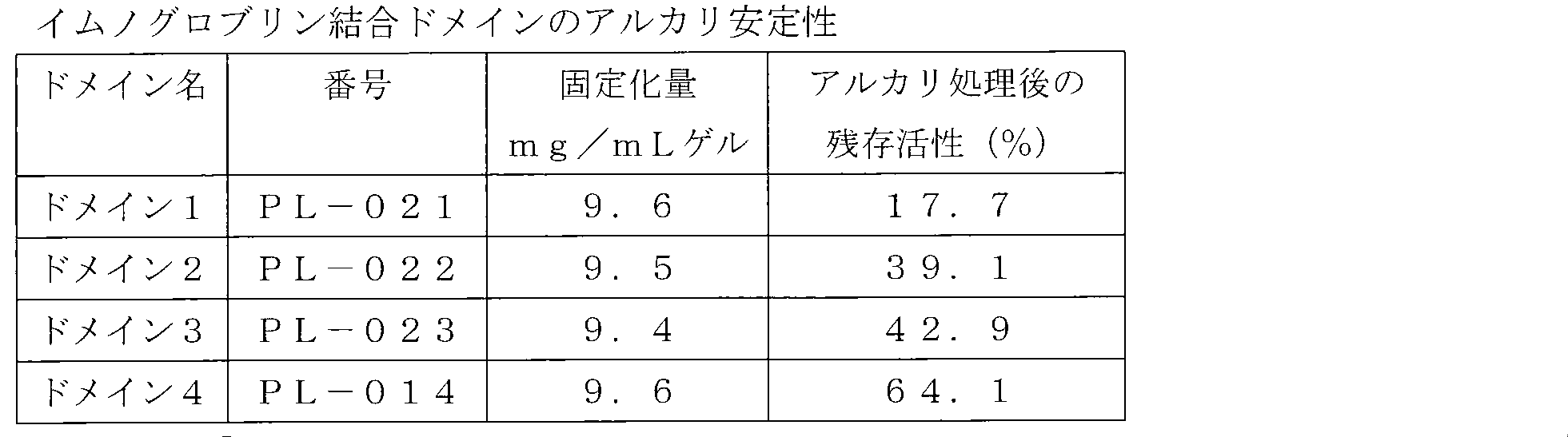
[改変体の製造]
イムノグロブリン結合活性とアルカリ安定性が高いイムノグロブリン結合ドメイン4を基本配列として、更なるアルカリ安定性の向上を目指して、イムノグロブリン結合ドメイン4における2位のトレオニン残基と、7位、13位、22位、29位、48位、及び67位の7個のリジン残基の合計8個のアミノ酸残基に注目してアミノ酸を置換した改変体を作製した。
ドメイン4を基本配列として、表3に示す2位のトレオニン残基と、7位、13位、22位、29位、48位、及び67位の7個のリジン残基を各々置換した改変体を作製した。
まず、PL-014の配列上に存在するイムノグロブリン結合ドメイン4領域(配列番号1)における7位、13位、22位、29位、48位、及び67位の7箇所のリジン残基をアルギニン残基にそれぞれ置換した改変体PL-024の発現プラスミドを構築した。
次に、イムノグロブリン結合ドメイン4領域(配列番号1)における2位、7位、13位、22位、29位、48位、及び67位の8箇所のアミノ酸残基の複数の置換の組み合わせを持つ変異体をコードするcDNAを調製した。具体的には、PL-014のcDNAを鋳型とし、それぞれの位置の塩基配列を変異させたオリゴDNAを準備し、オーバーラップ伸張法(二段階PCR法)にてまず2位、7位、13位、22位、29位、48位、67位それぞれの位置の一アミノ酸置換体をコードするcDNAフラグメントを作成した。次に、一アミノ酸置換体のcDNAを鋳型として同様のオーバーラップ伸張法(二段階PCR法)にて別の位置の変異を導入した。更に、得られた変異体プラスミドを鋳型とし、別の位置に変異をもたらすプライマーを用いたPCRによって、種々の組み合わせの複数の部位にアミノ酸置換を含む変異体のcDNAフラグメントを調製した。

各改変体の菌体抽出液をpH6.0に調整した後に、参考例1と同様の手法で陽イオン交換体SP-セファロースファストフロー(GEヘルスケア株式会社)カラムにアプライし、20mMリン酸ナトリウム緩衝液(pH6.0)にて洗浄後、0.5M NaClの直線的濃度勾配にてタンパク質を溶出した。目的の改変体が含まれる溶出画分を集めてpHを9に調整した後に陰イオン交換体ギガキャップQ(東ソー株式会社)カラムに添加した。20mMリン酸バッファー(pH7.8)にて洗浄後、0.3M NaCl直線的濃度勾配にて目的の改変体を溶出した。各溶出液をSDS-PAGEに供して純度を確認した結果、各改変体は理論値の分子量の位置に単一バンドとして精製されていることを確認した。
精製した各改変体を、ホルミル活性化アガロースゲル担体に10mg/mLゲルの濃度で常法に従って、それぞれ固定化した。固定化後の反応溶液を回収し、固定化率を測定したところ、すべての改変体の固定化効率が95%以上であることを確認した。次に、参考例1と同様の方法で各固定化ゲル担体のヒトIgG結合活性を測定した。

各改変体を固定化したゲル担体を0.1M NaOH水溶液に置換した後に、25℃にて17時間保温した。その後、PBSで3回洗浄し、前記と同条件でヒトIgG結合活性を測定した。アルカリ処理前のそれぞれのIgG結合量を100%としたときの17時間処理後の残存IgG結合量の割合をアルカリ処理後の残存活性(%)として求めた。得られた結果を表5に示す。

[複ドメイン型ポリペプチド発現プラスミドの構築とタンパク質発現]
改変体PL-024キメラタンパク質のDNA配列は、NdeI認識配列を持つ翻訳開始コドン(CATATG)と人工N末端配列「MAQHDEAGLAL」をコードする配列にプロテインLのイムノグロブリンカッパ軽鎖結合ドメイン改変ドメインをコードする配列が続き、そのC末端部分の人工配列「NIKFAGAL」をコードする配列内にEcoO109I認識配列(GGGGCCT)を有し、更にプロテインAのイムノグロブリンFc結合Cドメイン第3アルファへリックスの改変C末端配列21残基が続き、最後に人工C末端配列「KKK」をコードする配列と翻訳終止コドン及びBamHI認識配列を含んでいる。このPL-024キメラタンパク質のcDNAを予めプラスミド上のEcoO109I切断部位を削除したpUC19プラスミドのクローニングサイトに挿入して得られたプラスミドを複ドメイン型ポリペプチドcDNAの構築に用いた。
複ドメイン型ポリペプチドPL-424とPL-624の菌体抽出液をそれぞれpH6.0に調整したのちに、前記参考例1と同様の方法で陽イオン交換体SP-セファロースファストフロー(GEヘルスケア株式会社)カラムにアプライし、20mMリン酸ナトリウム緩衝液(pH6.0)にて洗浄後、0.2M NaClの直線濃度勾配にてタンパク質を溶出した。目的の多量体が含まれる溶出画分を集めてpHを8に調整した後に陰イオン交換体ギガキャップQ(東ソー株式会社)カラムに添加した。20mMリン酸バッファー(pH7.8)にて洗浄後、0.35M NaCl直線濃度勾配にて目的の複ドメイン型ポリペプチドを溶出させた。各溶出液をSDS-PAGEに供して純度を確認した結果、各複ドメイン型ポリペプチドは理論値の分子量の位置に単一バンドとして精製されていることを確認した。
精製した複ドメイン型ポリペプチドPL-424とPL-624を、ホルミル活性化アガロースゲル担体に10mg/mLゲルの濃度で、常法に従ってそれぞれ固定化した。固定化後の反応溶液を回収して固定化率を測定したところ、PL-424とPL-624は、それぞれ97.3%と98.0%の固定化率であった。次に、前記参考例1と同様の方法で各固定化ゲル担体のヒトIgG結合活性を測定した。更に、比較のために、天然配列の4量体(プロテインL)が10mg/mLゲルで固定化されているCaptoL(GEヘルスケア社)を使用して、同様にヒトIgG結合活性を測定した。その結果を表6に示す。さらに、ヒトIgGをパパイン処理して調製した精製Fabを20mg/mL濃度含むPBS溶液を各固定化ゲルに加えて1時間振とうした後に、ヒトIgGの場合と同様の方法で結合活性を測定した。なおFab量は13.5(1g-1cm-1)の比吸光係数を用いて求めた。

各ドメイン型ポリペプチドを固定化したゲル担体を0.1M NaOH水溶液に置換した後に、25℃にて17時間保温した。その後、PBSで3回洗浄し、前記と同条件でヒトIgG結合活性を測定した。アルカリ処理前のそれぞれのIgG結合量を100%としたときの17時間処理後の残存IgG結合量の割合をアルカリ処理後の残存活性(%)として求めた。得られた結果を表7に示す。

[改変体の製造]
次に、イムノグロブリン結合ドメイン3を基本配列として、アルカリ安定性の向上を目指して、イムノグロブリン結合ドメイン3(配列番号2)における7位、13位、22位、及び29位の4個のリジン残基をアルギニンに置換した改変体を作製した。
PL-024の発現プラスミドを鋳型とし、合成オリゴDNA oligo-178(配列番号13)及びoligo-334(配列番号38)をプライマーとしたPCRにより7位、13位、及び22位のリジン残基がアルギニンに置換され、23位がイソロイシンとなった28位までの配列をコードするcDNAフラグメントを作成した。またPL-024の発現プラスミドを鋳型とし、oligo-335(配列番号39)及びoligo-191(配列番号16)をプライマーとしたPCRにより29位のリジン残基がアルギニンに置換された24位以降のイムノグロブリン結合ドメイン3の配列をコードするcDNAフラグメントを作成した。これら二つのDNAフラグメントを鋳型として合成オリゴDNA oligo-178(配列番号13)及びoligo-191(配列番号16)をプライマーとしたPCRにより、PL-061をコードするcDNAが得られた。このcDNAをNdeI及びBamHIにて切断し、pET-9aプラスミド上のNdeI-BamHI部分に組み込むことにより、N末端側から、人工N末端配列11残基(配列番号12)、配列番号2における7位、13位、22位、及び29位のリジン残基がアルギニンに置換されたプロテインLのイムノグロブリンカッパ軽鎖結合ドメイン3の70残基、アラニン-ロイシンからなる連結配列2残基、プロテインA由来イムノグロブリンFc結合Cドメイン第3αへリックスの改変C末端配列21残基(配列番号17)、及び人工C末端配列3残基(配列番号18)がこの順で連結されたキメラタンパク質PL-061の発現プラスミドを得た。
改変体PL-061の菌体抽出液をpH6.0に調整した後に、参考例1と同様の手法で陽イオン交換体SP-セファロースファストフロー(GEヘルスケア株式会社)カラムにアプライし、20mMリン酸ナトリウム緩衝液(pH6.0)にて洗浄後、0.5M NaClの直線的濃度勾配にてタンパク質を溶出した。目的の改変体が含まれる溶出画分を集めてpHを9に調整した後に陰イオン交換体ギガキャップQ(東ソー株式会社)カラムに添加した。20mMリン酸バッファー(pH7.8)にて洗浄後、0.3M NaCl直線的濃度勾配にて目的の改変体を溶出した。各溶出液をSDS-PAGEに供して純度を確認した結果、各改変体は理論値の分子量の位置に単一バンドとして精製されていることを確認した。
精製した改変体PL-061を、ホルミル活性化アガロースゲル担体に10mg/mLゲルの濃度で常法に従って、それぞれ固定化した。固定化後の反応溶液を回収し、固定化率を測定したところ、固定化効率が95%以上であることを確認した。次に、参考例1と同様の方法で各固定化ゲル担体のヒトIgG結合活性を測定した。

改変体PL-061を固定化したゲル担体を0.1M NaOH水溶液に置換した後に、25℃にて17時間保温した。その後、PBSで3回洗浄し、前記と同条件でヒトIgG結合活性を測定した。アルカリ処理前のそれぞれのIgG結合量を100%としたときの17時間処理後の残存IgG結合量の割合をアルカリ処理後の残存活性(%)として求めた。得られた結果を表9に示す。

Claims (17)
- 下記(1-1)~(1-4)、(2-1)~(2-4)、及び(3-1)~(3-4)のいずれかに示すイムノグロブリン結合ドメインを少なくとも1つ含むポリペプチド。
(1-1)配列番号1に示すアミノ酸配列において、第7位、第13位、第22位、及び・第29位よりなる群から選択される部位の少なくとも2個以上が、リジン以外の塩基性アミノ酸又は水酸基を有するアミノ酸に置換されているアミノ酸配列を含むイムノグロブリン結合ドメイン。
(1-2)配列番号2に示すアミノ酸配列において、第7位、第13位、第22位、及び第29位よりなる群から選択される部位の少なくとも2個以上が、リジン以外の塩基性アミノ酸又は水酸基を有するアミノ酸に置換されているアミノ酸配列を含むイムノグロブリン結合ドメイン。
(1-3)配列番号3に示すアミノ酸配列において、第7位、第13位、第22位、及び第29位よりなる群から選択される部位の少なくとも2個以上が、リジン以外の塩基性アミノ酸又は水酸基を有するアミノ酸に置換されているアミノ酸配列を含むイムノグロブリン結合ドメイン。
(1-4)配列番号4に示すアミノ酸配列において、第6位、第12位、第21位、及び第28位よりなる群から選択される部位の少なくとも2個以上が、リジン以外の塩基性アミノ酸又は水酸基を有するアミノ酸に置換されているアミノ酸配列を含むイムノグロブリン結合ドメイン。
(2-1)配列番号1に示すアミノ酸配列における第7位、第13位、第22位、及び第29位よりなる群から選択される少なくとも2つのアミノ酸が、リジン以外の塩基性アミノ酸又は水酸基を有するアミノ酸に置換されているアミノ酸配列において、前記アミノ酸置換部位以外のアミノ酸の1個又は数個が置換、付加、挿入又は欠失されてなり、且つ、イムノグロブリンに対する結合能を有し、配列番号1に示すアミノ酸配列からなるポリペプチドと比較してアルカリ安定性が向上しているイムノグロブリン結合ドメイン。
(2-2)配列番号2に示すアミノ酸配列における第7位、第13位、第22位、及び第29位よりなる群から選択される少なくとも2つのアミノ酸が、リジン以外の塩基性アミノ酸又は水酸基を有するアミノ酸に置換されているアミノ酸配列において、前記アミノ酸置換部位以外のアミノ酸の1個又は数個が置換、付加、挿入又は欠失されてなり、且つ、イムノグロブリンに対する結合能を有し、配列番号1に示すアミノ酸配列からなるポリペプチドと比較してアルカリ安定性が向上しているイムノグロブリン結合ドメイン。
(2-3)配列番号3に示すアミノ酸配列における第7位、第13位、第22位、及び第29位よりなる群から選択される少なくとも2つのアミノ酸が、リジン以外の塩基性アミノ酸又は水酸基を有するアミノ酸に置換されているアミノ酸配列において、前記アミノ酸置換部位以外のアミノ酸の1個又は数個が置換、付加、挿入又は欠失されてなり、且つ、イムノグロブリンに対する結合能を有し、配列番号1に示すアミノ酸配列からなるポリペプチドと比較してアルカリ安定性が向上しているイムノグロブリン結合ドメイン。
(2-4)配列番号4に示すアミノ酸配列における第6位、第12位、第21位、及び第28位よりなる群から選択される少なくとも2つのアミノ酸が、リジン以外の塩基性アミノ酸又は水酸基を有するアミノ酸に置換されているアミノ酸配列において、前記アミノ酸置換部位以外のアミノ酸の1個又は数個が置換、付加、挿入又は欠失されてなり、且つ、イムノグロブリンに対する結合能を有し、配列番号1に示すアミノ酸配列からなるポリペプチドと比較してアルカリ安定性が向上しているイムノグロブリン結合ドメイン。
(3-1)配列番号1に示すアミノ酸配列における第7位、第13位、第22位、及び第29位よりなる群から選択される少なくとも2つのアミノ酸が、リジン以外の塩基性アミノ酸又は水酸基を有するアミノ酸に置換されているアミノ酸配列において、配列番号1に示すアミノ酸配列に対する前記アミノ酸置換部位を除いた配列同一性が80%以上であり、且つ、イムノグロブリンに対する結合能を有し、配列番号1に示すアミノ酸配列からなるポリペプチドと比較してアルカリ安定性が向上しているイムノグロブリン結合ドメイン。
(3-2)配列番号2に示すアミノ酸配列における第7位、第13位、第22位、及び第29位よりなる群から選択される少なくとも2つのアミノ酸が、リジン以外の塩基性アミノ酸又は水酸基を有するアミノ酸に置換されているアミノ酸配列において、配列番号2に示すアミノ酸配列に対する前記アミノ酸置換部位を除いた配列同一性が80%以上であり、且つ、イムノグロブリンに対する結合能を有し、配列番号2に示すアミノ酸配列からなるポリペプチドと比較してアルカリ安定性が向上しているイムノグロブリン結合ドメイン。
(3-3)配列番号3に示すアミノ酸配列における第7位、第13位、第22位、及び第29位よりなる群から選択される少なくとも2つのアミノ酸が、リジン以外の塩基性アミノ酸又は水酸基を有するアミノ酸に置換されているアミノ酸配列において、配列番号3に示すアミノ酸配列に対する前記アミノ酸置換部位を除いた配列同一性が80%以上であり、且つ、イムノグロブリンに対する結合能を有し、配列番号3に示すアミノ酸配列からなるポリペプチドと比較してアルカリ安定性が向上しているイムノグロブリン結合ドメイン。
(3-4)配列番号4に示すアミノ酸配列における第6位、第12位、第21位、及び第28位よりなる群から選択される少なくとも2つのアミノ酸が、リジン以外の塩基性アミノ酸又は水酸基を有するアミノ酸に置換されているアミノ酸配列において、配列番号4に示すアミノ酸配列に対する前記アミノ酸置換部位を除いた配列同一性が80%以上であり、且つ、イムノグロブリンに対する結合能を有し、配列番号4に示すアミノ酸配列からなるポリペプチドと比較してアルカリ安定性が向上しているイムノグロブリン結合ドメイン。 - 前記(1-1)~(1-4)、(2-1)~(2-4)、及び(3-1)~(3-4)に示すイムノグロブリン結合ドメインの中から選択される1個のイムノグロブリン結合ドメインが含まれる単ドメイン型ペプチドである、請求項1に記載のポリペプチド。
- 前記(1-1)~(1-4)、(2-1)~(2-4)、及び(3-1)~(3-4)に示すイムノグロブリン結合ドメインから選択される2個以上のイムノグロブリン結合ドメインが連結されてなる複ドメイン型ペプチドである、請求項1に記載のポリペプチド。
- 前記(1-1)、(2-1)、及び(3-1)のイムノグロブリン結合ドメインのいずれか少なくとも1つを含み、
配列番号1に示すアミノ酸配列における第7位、第13位、第22位、及び第29位の全てが、塩基性アミノ酸又は水酸基を有するアミノ酸に置換されている、請求項1~3のいずれかに記載のポリペプチド。 - 前記(1-1)、(2-1)、及び(3-1)のイムノグロブリン結合ドメインのいずれか少なくとも1つを含み、
配列番号1に示すアミノ酸配列において、第7位、第13位、第22位、及び第29位よりなる群から選択される部位の少なくとも2個以上が、アルギニン又はトレオニンに置換されている、請求項1~4のいずれかに記載のポリペプチド。 - 前記(1-2)、(2-2)、及び(3-2)のイムノグロブリン結合ドメインのいずれか少なくとも1つを含み、
配列番号2に示すアミノ酸配列における第7位、第13位、第22位、及び第29位の全てが、塩基性アミノ酸又は水酸基を有するアミノ酸に置換されている、請求項1~3のいずれかに記載のポリペプチド。 - 前記(1-2)、(2-2)、及び(3-2)のイムノグロブリン結合ドメインのいずれか少なくとも1つを含み、
配列番号2に示すアミノ酸配列において、第7位、第13位、第22位、及び第29位よりなる群から選択される部位の少なくとも2個以上が、アルギニン又はトレオニンに置換されている、請求項1~3及び6のいずれかに記載のポリペプチド。 - 前記(1-3)、(2-3)、及び(3-3)のイムノグロブリン結合ドメインのいずれか少なくとも1つを含み、
配列番号3に示すアミノ酸配列における第7位、第13位、第22位、及び第29位の全てが、塩基性アミノ酸又は水酸基を有するアミノ酸に置換されている、請求項1~3のいずれかに記載のポリペプチド。 - 前記(1-3)、(2-3)、及び(3-3)のイムノグロブリン結合ドメインのいずれか少なくとも1つを含み、
配列番号3に示すアミノ酸配列において、第7位、第13位、第22位、及び第29位よりなる群から選択される部位の少なくとも2個以上が、アルギニン又はトレオニンに置換されている、請求項1~3及び8のいずれかに記載のポリペプチド。 - 前記(1-4)、(2-4)、及び(3-4)のイムノグロブリン結合ドメインのいずれか少なくとも1つを含み、
配列番号4に示すアミノ酸配列における第6位、第12位、第21位、及び第28位の全てが、塩基性アミノ酸又は水酸基を有するアミノ酸に置換されている、請求項1~3のいずれかに記載のポリペプチド。 - 前記(1-4)、(2-4)、及び(3-4)のイムノグロブリン結合ドメインのいずれか少なくとも1つを含み、
配列番号4に示すアミノ酸配列において、第6位、第12位、第21位、及び第28位よりなる群から選択される部位の少なくとも2個以上が、アルギニン又はトレオニンに置換されている、請求項1~3及び10のいずれかに記載のポリペプチド。 - 請求項1~11のいずれかに記載のポリペプチドをコードしているDNA。
- 請求項12に記載のDNAを含む組換えベクター。
- 請求項13に記載の組換えベクターを用いて宿主を形質転換して得られる形質転換体。
- 請求項14に記載の形質転換体を培養する工程を含む、請求項1~11のいずれかに記載のポリペプチドの製造方法。
- 請求項1~11のいずれかに記載のポリペプチドが不溶性担体に固定化されてなる、イムノグロブリン結合用担体。
- 請求項16に記載のイムノグロブリン結合用担体を用いて、イムノグロブリン又はそのカッパ鎖を含む断片の分離を行う、イムノグロブリン又はその断片の分離方法。
Priority Applications (4)
| Application Number | Priority Date | Filing Date | Title |
|---|---|---|---|
| US15/770,150 US11208441B2 (en) | 2015-10-22 | 2016-10-19 | Immunoglobulin-binding polypeptide |
| EP16857471.3A EP3375873B1 (en) | 2015-10-22 | 2016-10-19 | Immunoglobulin-binding polypeptide |
| JP2017546570A JP6950957B2 (ja) | 2015-10-22 | 2016-10-19 | イムノグロブリン結合ポリペプチド |
| CN201680062127.3A CN108291220B (zh) | 2015-10-22 | 2016-10-19 | 免疫球蛋白结合多肽 |
Applications Claiming Priority (2)
| Application Number | Priority Date | Filing Date | Title |
|---|---|---|---|
| JP2015207864 | 2015-10-22 | ||
| JP2015-207864 | 2015-10-22 |
Publications (1)
| Publication Number | Publication Date |
|---|---|
| WO2017069158A1 true WO2017069158A1 (ja) | 2017-04-27 |
Family
ID=58557276
Family Applications (1)
| Application Number | Title | Priority Date | Filing Date |
|---|---|---|---|
| PCT/JP2016/080977 Ceased WO2017069158A1 (ja) | 2015-10-22 | 2016-10-19 | イムノグロブリン結合ポリペプチド |
Country Status (5)
| Country | Link |
|---|---|
| US (1) | US11208441B2 (ja) |
| EP (1) | EP3375873B1 (ja) |
| JP (1) | JP6950957B2 (ja) |
| CN (1) | CN108291220B (ja) |
| WO (1) | WO2017069158A1 (ja) |
Cited By (10)
| Publication number | Priority date | Publication date | Assignee | Title |
|---|---|---|---|---|
| WO2019059400A1 (ja) | 2017-09-25 | 2019-03-28 | Jsr株式会社 | イムノグロブリン結合タンパク質、及びそれを用いたアフィニティー担体 |
| WO2019059399A1 (ja) | 2017-09-25 | 2019-03-28 | Jsr株式会社 | イムノグロブリン結合タンパク質、及びそれを用いたアフィニティー担体 |
| WO2019187602A1 (ja) * | 2018-03-29 | 2019-10-03 | 株式会社カネカ | 改変型免疫グロブリンκ鎖可変領域結合性ペプチド |
| WO2019191295A1 (en) | 2018-03-28 | 2019-10-03 | Bristol-Myers Squibb Company | Interleukin-2/interleukin-2 receptor alpha fusion proteins and methods of use |
| WO2020010117A2 (en) | 2018-07-03 | 2020-01-09 | Bristol-Myers Squibb Company | Fgf21 formulations |
| JP2022522891A (ja) * | 2019-03-12 | 2022-04-20 | アイコン ジェネティクス ゲーエムベーハー | 安定性が改善されたノロウイルス様粒子 |
| WO2023074642A1 (ja) | 2021-10-25 | 2023-05-04 | 東ソー株式会社 | 免疫グロブリン結合性タンパク質 |
| JP2023103953A (ja) * | 2022-01-14 | 2023-07-27 | 東ソー株式会社 | 免疫グロブリン結合活性を有するタンパク質 |
| WO2024225177A1 (ja) * | 2023-04-24 | 2024-10-31 | 東ソー株式会社 | 免疫グロブリン結合性タンパク質 |
| TWI917307B (zh) | 2017-09-25 | 2026-03-11 | 日商Jsr股份有限公司 | 免疫球蛋白結合蛋白質,及使用其之親和性載體 |
Families Citing this family (3)
| Publication number | Priority date | Publication date | Assignee | Title |
|---|---|---|---|---|
| WO2016096644A1 (en) * | 2014-12-17 | 2016-06-23 | Ge Healthcare Bioprocess R&D Ab | Modified kappa light chain-binding polypeptides |
| KR20240007293A (ko) * | 2019-12-06 | 2024-01-16 | 리제너론 파아마슈티컬스, 인크. | 항-vegf 단백질 조성물 및 이를 생산하는 방법 |
| CN119708176B (zh) * | 2024-12-05 | 2026-01-06 | 武汉瑞法医疗器械有限公司 | 一种多肽、多聚体及其在免疫球蛋白亲和配体中的应用 |
Citations (5)
| Publication number | Priority date | Publication date | Assignee | Title |
|---|---|---|---|---|
| JPH07507925A (ja) * | 1992-05-07 | 1995-09-07 | アクティノバ・リミテッド | プロテインlおよび組換えdna法によるその製法 |
| WO2000015803A1 (en) * | 1998-09-14 | 2000-03-23 | Affitech As | Immunoglobulin binding protein |
| JP2015501299A (ja) * | 2011-10-10 | 2015-01-15 | シティ・オブ・ホープCity of Hope | メディトープおよびメディトープ結合性抗体ならびにそれらの使用 |
| JP2016079149A (ja) * | 2014-10-21 | 2016-05-16 | 株式会社プロテイン・エクスプレス | プロテインl変異体 |
| WO2016096644A1 (en) * | 2014-12-17 | 2016-06-23 | Ge Healthcare Bioprocess R&D Ab | Modified kappa light chain-binding polypeptides |
Family Cites Families (12)
| Publication number | Priority date | Publication date | Assignee | Title |
|---|---|---|---|---|
| JPH07507682A (ja) | 1992-05-07 | 1995-08-31 | アクティノバ・リミテッド | Lプロテインに由来する免疫グロブリン結合性タンパク質およびその用途 |
| GB9823071D0 (en) | 1998-10-21 | 1998-12-16 | Affibody Technology Ab | A method |
| JP2006304633A (ja) * | 2005-04-26 | 2006-11-09 | Apro Life Science Institute Inc | イムノグロブリン結合タンパク質 |
| WO2007097361A1 (ja) | 2006-02-21 | 2007-08-30 | Protenova Co., Ltd. | イムノグロブリン親和性リガンド |
| JP4179517B2 (ja) * | 2006-02-21 | 2008-11-12 | プロテノバ株式会社 | イムノグロブリン親和性リガンド |
| JP2008266219A (ja) * | 2007-04-20 | 2008-11-06 | National Institute Of Advanced Industrial & Technology | リジン及びシステイン残基を含まないタンパク質 |
| JP2008266221A (ja) * | 2007-04-20 | 2008-11-06 | National Institute Of Advanced Industrial & Technology | アミノ末端1箇所で配向制御固定化された固定化タンパク質 |
| AU2011230313B2 (en) * | 2010-03-24 | 2015-01-22 | Kaneka Corporation | Protein capable of binding specifically to immunoglobulin, and immunoglobulin-binding affinity ligand |
| CN103501815B (zh) | 2010-10-08 | 2016-09-28 | 希望之城公司 | 针对中间位的单克隆抗体框架结合界面、中间位投递系统及其使用方法 |
| US8962804B2 (en) | 2010-10-08 | 2015-02-24 | City Of Hope | Meditopes and meditope-binding antibodies and uses thereof |
| US9428553B2 (en) | 2012-02-10 | 2016-08-30 | City Of Hope | Meditopes and meditope-binding antibodies and uses thereof |
| WO2016121701A1 (ja) * | 2015-01-26 | 2016-08-04 | 株式会社カネカ | 免疫グロブリンκ鎖可変領域含有タンパク質精製用アフィニティー分離マトリックス |
-
2016
- 2016-10-19 WO PCT/JP2016/080977 patent/WO2017069158A1/ja not_active Ceased
- 2016-10-19 US US15/770,150 patent/US11208441B2/en active Active
- 2016-10-19 EP EP16857471.3A patent/EP3375873B1/en active Active
- 2016-10-19 JP JP2017546570A patent/JP6950957B2/ja active Active
- 2016-10-19 CN CN201680062127.3A patent/CN108291220B/zh active Active
Patent Citations (5)
| Publication number | Priority date | Publication date | Assignee | Title |
|---|---|---|---|---|
| JPH07507925A (ja) * | 1992-05-07 | 1995-09-07 | アクティノバ・リミテッド | プロテインlおよび組換えdna法によるその製法 |
| WO2000015803A1 (en) * | 1998-09-14 | 2000-03-23 | Affitech As | Immunoglobulin binding protein |
| JP2015501299A (ja) * | 2011-10-10 | 2015-01-15 | シティ・オブ・ホープCity of Hope | メディトープおよびメディトープ結合性抗体ならびにそれらの使用 |
| JP2016079149A (ja) * | 2014-10-21 | 2016-05-16 | 株式会社プロテイン・エクスプレス | プロテインl変異体 |
| WO2016096644A1 (en) * | 2014-12-17 | 2016-06-23 | Ge Healthcare Bioprocess R&D Ab | Modified kappa light chain-binding polypeptides |
Non-Patent Citations (3)
| Title |
|---|
| MINAKUCHI, KAZUNOBU ET AL.: "Remarkable alkaline stability of an engineered protein A as immunoglobulin affinity ligand: C domain having only one amino acid substitution", PROTEIN SCIENCE, vol. 22, 2013, pages 1230 - 1238, XP055347095 * |
| PROTEIN EXPRESS CO., LTD.: "Tosha no Kumikae Tanpaku Hatsugen Gijutsu ni yori Kaihatsu·Seizo sareta Kokino Ligand o Mochiita Kotai Seisei Resin no Goshokai", INNOVATION JAPAN 2015, 27 August 2015 (2015-08-27), pages 1 - 3, XP055527464, Retrieved from the Internet <URL:https://www.jst.go.jp/tt/fair/ij2015/exhibitor/group17/page1.html> * |
| See also references of EP3375873A4 * |
Cited By (24)
| Publication number | Priority date | Publication date | Assignee | Title |
|---|---|---|---|---|
| CN111148753B (zh) * | 2017-09-25 | 2024-02-23 | Jsr株式会社 | 免疫球蛋白结合蛋白质和使用其的亲和载体 |
| CN111148753A (zh) * | 2017-09-25 | 2020-05-12 | Jsr株式会社 | 免疫球蛋白结合蛋白质和使用其的亲和载体 |
| TWI917307B (zh) | 2017-09-25 | 2026-03-11 | 日商Jsr股份有限公司 | 免疫球蛋白結合蛋白質,及使用其之親和性載體 |
| TWI888342B (zh) * | 2017-09-25 | 2025-07-01 | 日商Jsr股份有限公司 | 免疫球蛋白結合蛋白質,及使用其之親和性載體 |
| WO2019059400A1 (ja) | 2017-09-25 | 2019-03-28 | Jsr株式会社 | イムノグロブリン結合タンパク質、及びそれを用いたアフィニティー担体 |
| CN111108113A (zh) * | 2017-09-25 | 2020-05-05 | Jsr株式会社 | 免疫球蛋白结合蛋白质和使用其的亲和载体 |
| JP7159175B2 (ja) | 2017-09-25 | 2022-10-24 | Jsr株式会社 | イムノグロブリン結合タンパク質、及びそれを用いたアフィニティー担体 |
| JPWO2019059399A1 (ja) * | 2017-09-25 | 2020-10-22 | Jsr株式会社 | イムノグロブリン結合タンパク質、及びそれを用いたアフィニティー担体 |
| EP3689893A4 (en) * | 2017-09-25 | 2021-12-15 | JSR Corporation | IMMUNOGLOBULIN-BINDING PROTEIN AND AFFINITY CARRIERS THEREFORE |
| EP3689894A4 (en) * | 2017-09-25 | 2021-12-22 | JSR Corporation | IMMUNOGLOBULIN-BINDING PROTEIN AND AFFINITY CARRIERS THEREFORE |
| WO2019059399A1 (ja) | 2017-09-25 | 2019-03-28 | Jsr株式会社 | イムノグロブリン結合タンパク質、及びそれを用いたアフィニティー担体 |
| CN111108113B (zh) * | 2017-09-25 | 2024-02-23 | Jsr株式会社 | 免疫球蛋白结合蛋白质和使用其的亲和载体 |
| US11884705B2 (en) | 2017-09-25 | 2024-01-30 | Jsr Corporation | Immunoglobulin binding protein, and affinity support using same |
| US11753449B2 (en) | 2017-09-25 | 2023-09-12 | Jsr Corporation | Immunoglobulin binding protein, and affinity support using same |
| WO2019191295A1 (en) | 2018-03-28 | 2019-10-03 | Bristol-Myers Squibb Company | Interleukin-2/interleukin-2 receptor alpha fusion proteins and methods of use |
| WO2019187602A1 (ja) * | 2018-03-29 | 2019-10-03 | 株式会社カネカ | 改変型免疫グロブリンκ鎖可変領域結合性ペプチド |
| WO2020010117A2 (en) | 2018-07-03 | 2020-01-09 | Bristol-Myers Squibb Company | Fgf21 formulations |
| US12226451B2 (en) | 2018-07-03 | 2025-02-18 | Bristol-Myers Squibb Company | FGF-21 formulations |
| JP2022522891A (ja) * | 2019-03-12 | 2022-04-20 | アイコン ジェネティクス ゲーエムベーハー | 安定性が改善されたノロウイルス様粒子 |
| JP7536031B2 (ja) | 2019-03-12 | 2024-08-19 | アイコン ジェネティクス ゲーエムベーハー | 安定性が改善されたノロウイルス様粒子 |
| WO2023074642A1 (ja) | 2021-10-25 | 2023-05-04 | 東ソー株式会社 | 免疫グロブリン結合性タンパク質 |
| JP2023103953A (ja) * | 2022-01-14 | 2023-07-27 | 東ソー株式会社 | 免疫グロブリン結合活性を有するタンパク質 |
| JP7414106B2 (ja) | 2022-01-14 | 2024-01-16 | 東ソー株式会社 | 免疫グロブリン結合活性を有するタンパク質 |
| WO2024225177A1 (ja) * | 2023-04-24 | 2024-10-31 | 東ソー株式会社 | 免疫グロブリン結合性タンパク質 |
Also Published As
| Publication number | Publication date |
|---|---|
| CN108291220A (zh) | 2018-07-17 |
| JPWO2017069158A1 (ja) | 2018-08-30 |
| EP3375873A1 (en) | 2018-09-19 |
| JP6950957B2 (ja) | 2021-10-13 |
| EP3375873A4 (en) | 2019-05-22 |
| US20180305414A1 (en) | 2018-10-25 |
| US11208441B2 (en) | 2021-12-28 |
| CN108291220B (zh) | 2022-10-28 |
| EP3375873B1 (en) | 2025-07-02 |
Similar Documents
| Publication | Publication Date | Title |
|---|---|---|
| JP6950957B2 (ja) | イムノグロブリン結合ポリペプチド | |
| JP5298242B2 (ja) | アフィニティークロマトグラフィー用担体およびイムノグロブリンを単離する方法 | |
| JP7335881B2 (ja) | イムノグロブリン結合タンパク質、及びそれを用いたアフィニティー担体 | |
| JP7159151B2 (ja) | イムノグロブリン結合タンパク質、及びそれを用いたアフィニティー担体 | |
| JP2007252368A (ja) | イムノグロブリン親和性リガンド | |
| JP2006304633A (ja) | イムノグロブリン結合タンパク質 | |
| JP2008214350A (ja) | イムノグロブリン親和性リガンド | |
| JP5236311B2 (ja) | IgG−Fab断片抗体結合性ペプチド | |
| WO2019059399A1 (ja) | イムノグロブリン結合タンパク質、及びそれを用いたアフィニティー担体 | |
| JP7363134B2 (ja) | 免疫グロブリン結合性タンパク質 | |
| KR102637595B1 (ko) | 알칼리내성이 증가된 면역글로불린-결합 단백질 변이체 및 이의 용도 | |
| JP7854191B2 (ja) | イムノグロブリン結合ポリペプチド | |
| JP7587737B2 (ja) | 免疫グロブリン結合活性を有するポリペプチド | |
| WO2019039602A1 (ja) | タンパク質、及び当該タンパク質を含む担体を用いる抗体又はその断片の単離方法 | |
| JP4481260B2 (ja) | 抗体結合性ペプチド | |
| CN104945488B (zh) | 一种具有免疫球蛋白结合能力的多肽 | |
| KR20030034136A (ko) | 양이온성 아미노산이 부가된 융합단백질 및 이를 이용한생물공정의 개선방법 | |
| JP2022081709A (ja) | イムノグロブリン結合タンパク質、及びそれを用いたアフィニティー担体 |
Legal Events
| Date | Code | Title | Description |
|---|---|---|---|
| 121 | Ep: the epo has been informed by wipo that ep was designated in this application |
Ref document number: 16857471 Country of ref document: EP Kind code of ref document: A1 |
|
| ENP | Entry into the national phase |
Ref document number: 2017546570 Country of ref document: JP Kind code of ref document: A |
|
| WWE | Wipo information: entry into national phase |
Ref document number: 15770150 Country of ref document: US |
|
| NENP | Non-entry into the national phase |
Ref country code: DE |
|
| WWE | Wipo information: entry into national phase |
Ref document number: 2016857471 Country of ref document: EP |
|
| WWG | Wipo information: grant in national office |
Ref document number: 2016857471 Country of ref document: EP |