WO2017069226A1 - 新規含窒素芳香族複素環化合物 - Google Patents
新規含窒素芳香族複素環化合物 Download PDFInfo
- Publication number
- WO2017069226A1 WO2017069226A1 PCT/JP2016/081214 JP2016081214W WO2017069226A1 WO 2017069226 A1 WO2017069226 A1 WO 2017069226A1 JP 2016081214 W JP2016081214 W JP 2016081214W WO 2017069226 A1 WO2017069226 A1 WO 2017069226A1
- Authority
- WO
- WIPO (PCT)
- Prior art keywords
- group
- optionally substituted
- alkyl
- groups
- independently selected
- Prior art date
- Legal status (The legal status is an assumption and is not a legal conclusion. Google has not performed a legal analysis and makes no representation as to the accuracy of the status listed.)
- Ceased
Links
- 0 CCC(N(*)*)=O Chemical compound CCC(N(*)*)=O 0.000 description 3
- GYPNJSBBOATUPK-UHFFFAOYSA-N CC(C)NC(CCl)=O Chemical compound CC(C)NC(CCl)=O GYPNJSBBOATUPK-UHFFFAOYSA-N 0.000 description 1
- VDJUVPSLVQYKLD-UHFFFAOYSA-N CC(C)NC(CN(CC1)CCN1C1=CCC(C#N)N=C1)=O Chemical compound CC(C)NC(CN(CC1)CCN1C1=CCC(C#N)N=C1)=O VDJUVPSLVQYKLD-UHFFFAOYSA-N 0.000 description 1
- SLHWAVOXJSXPNV-UHFFFAOYSA-N N#CC1N=CC(N2CCNCC2)=CC1 Chemical compound N#CC1N=CC(N2CCNCC2)=CC1 SLHWAVOXJSXPNV-UHFFFAOYSA-N 0.000 description 1
Classifications
-
- C—CHEMISTRY; METALLURGY
- C07—ORGANIC CHEMISTRY
- C07D—HETEROCYCLIC COMPOUNDS
- C07D471/00—Heterocyclic compounds containing nitrogen atoms as the only ring hetero atoms in the condensed system, at least one ring being a six-membered ring with one nitrogen atom, not provided for by groups C07D451/00 - C07D463/00
- C07D471/02—Heterocyclic compounds containing nitrogen atoms as the only ring hetero atoms in the condensed system, at least one ring being a six-membered ring with one nitrogen atom, not provided for by groups C07D451/00 - C07D463/00 in which the condensed system contains two hetero rings
- C07D471/04—Ortho-condensed systems
-
- A—HUMAN NECESSITIES
- A61—MEDICAL OR VETERINARY SCIENCE; HYGIENE
- A61P—SPECIFIC THERAPEUTIC ACTIVITY OF CHEMICAL COMPOUNDS OR MEDICINAL PREPARATIONS
- A61P9/00—Drugs for disorders of the cardiovascular system
- A61P9/12—Antihypertensives
-
- C—CHEMISTRY; METALLURGY
- C07—ORGANIC CHEMISTRY
- C07D—HETEROCYCLIC COMPOUNDS
- C07D213/00—Heterocyclic compounds containing six-membered rings, not condensed with other rings, with one nitrogen atom as the only ring hetero atom and three or more double bonds between ring members or between ring members and non-ring members
- C07D213/02—Heterocyclic compounds containing six-membered rings, not condensed with other rings, with one nitrogen atom as the only ring hetero atom and three or more double bonds between ring members or between ring members and non-ring members having three double bonds between ring members or between ring members and non-ring members
- C07D213/04—Heterocyclic compounds containing six-membered rings, not condensed with other rings, with one nitrogen atom as the only ring hetero atom and three or more double bonds between ring members or between ring members and non-ring members having three double bonds between ring members or between ring members and non-ring members having no bond between the ring nitrogen atom and a non-ring member or having only hydrogen or carbon atoms directly attached to the ring nitrogen atom
- C07D213/60—Heterocyclic compounds containing six-membered rings, not condensed with other rings, with one nitrogen atom as the only ring hetero atom and three or more double bonds between ring members or between ring members and non-ring members having three double bonds between ring members or between ring members and non-ring members having no bond between the ring nitrogen atom and a non-ring member or having only hydrogen or carbon atoms directly attached to the ring nitrogen atom with hetero atoms or with carbon atoms having three bonds to hetero atoms with at the most one bond to halogen, e.g. ester or nitrile radicals, directly attached to ring carbon atoms
- C07D213/72—Nitrogen atoms
- C07D213/74—Amino or imino radicals substituted by hydrocarbon or substituted hydrocarbon radicals
-
- C—CHEMISTRY; METALLURGY
- C07—ORGANIC CHEMISTRY
- C07D—HETEROCYCLIC COMPOUNDS
- C07D237/00—Heterocyclic compounds containing 1,2-diazine or hydrogenated 1,2-diazine rings
- C07D237/02—Heterocyclic compounds containing 1,2-diazine or hydrogenated 1,2-diazine rings not condensed with other rings
- C07D237/06—Heterocyclic compounds containing 1,2-diazine or hydrogenated 1,2-diazine rings not condensed with other rings having three double bonds between ring members or between ring members and non-ring members
- C07D237/10—Heterocyclic compounds containing 1,2-diazine or hydrogenated 1,2-diazine rings not condensed with other rings having three double bonds between ring members or between ring members and non-ring members with hetero atoms or with carbon atoms having three bonds to hetero atoms with at the most one bond to halogen, e.g. ester or nitrile radicals, directly attached to ring carbon atoms
- C07D237/20—Nitrogen atoms
-
- C—CHEMISTRY; METALLURGY
- C07—ORGANIC CHEMISTRY
- C07D—HETEROCYCLIC COMPOUNDS
- C07D241/00—Heterocyclic compounds containing 1,4-diazine or hydrogenated 1,4-diazine rings
- C07D241/02—Heterocyclic compounds containing 1,4-diazine or hydrogenated 1,4-diazine rings not condensed with other rings
- C07D241/10—Heterocyclic compounds containing 1,4-diazine or hydrogenated 1,4-diazine rings not condensed with other rings having three double bonds between ring members or between ring members and non-ring members
- C07D241/14—Heterocyclic compounds containing 1,4-diazine or hydrogenated 1,4-diazine rings not condensed with other rings having three double bonds between ring members or between ring members and non-ring members with hetero atoms or with carbon atoms having three bonds to hetero atoms with at the most one bond to halogen, e.g. ester or nitrile radicals, directly attached to ring carbon atoms
- C07D241/20—Nitrogen atoms
-
- C—CHEMISTRY; METALLURGY
- C07—ORGANIC CHEMISTRY
- C07D—HETEROCYCLIC COMPOUNDS
- C07D401/00—Heterocyclic compounds containing two or more hetero rings, having nitrogen atoms as the only ring hetero atoms, at least one ring being a six-membered ring with only one nitrogen atom
- C07D401/02—Heterocyclic compounds containing two or more hetero rings, having nitrogen atoms as the only ring hetero atoms, at least one ring being a six-membered ring with only one nitrogen atom containing two hetero rings
- C07D401/04—Heterocyclic compounds containing two or more hetero rings, having nitrogen atoms as the only ring hetero atoms, at least one ring being a six-membered ring with only one nitrogen atom containing two hetero rings directly linked by a ring-member-to-ring-member bond
-
- C—CHEMISTRY; METALLURGY
- C07—ORGANIC CHEMISTRY
- C07D—HETEROCYCLIC COMPOUNDS
- C07D401/00—Heterocyclic compounds containing two or more hetero rings, having nitrogen atoms as the only ring hetero atoms, at least one ring being a six-membered ring with only one nitrogen atom
- C07D401/02—Heterocyclic compounds containing two or more hetero rings, having nitrogen atoms as the only ring hetero atoms, at least one ring being a six-membered ring with only one nitrogen atom containing two hetero rings
- C07D401/12—Heterocyclic compounds containing two or more hetero rings, having nitrogen atoms as the only ring hetero atoms, at least one ring being a six-membered ring with only one nitrogen atom containing two hetero rings linked by a chain containing hetero atoms as chain links
-
- C—CHEMISTRY; METALLURGY
- C07—ORGANIC CHEMISTRY
- C07D—HETEROCYCLIC COMPOUNDS
- C07D401/00—Heterocyclic compounds containing two or more hetero rings, having nitrogen atoms as the only ring hetero atoms, at least one ring being a six-membered ring with only one nitrogen atom
- C07D401/14—Heterocyclic compounds containing two or more hetero rings, having nitrogen atoms as the only ring hetero atoms, at least one ring being a six-membered ring with only one nitrogen atom containing three or more hetero rings
-
- C—CHEMISTRY; METALLURGY
- C07—ORGANIC CHEMISTRY
- C07D—HETEROCYCLIC COMPOUNDS
- C07D403/00—Heterocyclic compounds containing two or more hetero rings, having nitrogen atoms as the only ring hetero atoms, not provided for by group C07D401/00
- C07D403/02—Heterocyclic compounds containing two or more hetero rings, having nitrogen atoms as the only ring hetero atoms, not provided for by group C07D401/00 containing two hetero rings
- C07D403/04—Heterocyclic compounds containing two or more hetero rings, having nitrogen atoms as the only ring hetero atoms, not provided for by group C07D401/00 containing two hetero rings directly linked by a ring-member-to-ring-member bond
-
- C—CHEMISTRY; METALLURGY
- C07—ORGANIC CHEMISTRY
- C07D—HETEROCYCLIC COMPOUNDS
- C07D403/00—Heterocyclic compounds containing two or more hetero rings, having nitrogen atoms as the only ring hetero atoms, not provided for by group C07D401/00
- C07D403/02—Heterocyclic compounds containing two or more hetero rings, having nitrogen atoms as the only ring hetero atoms, not provided for by group C07D401/00 containing two hetero rings
- C07D403/10—Heterocyclic compounds containing two or more hetero rings, having nitrogen atoms as the only ring hetero atoms, not provided for by group C07D401/00 containing two hetero rings linked by a carbon chain containing aromatic rings
-
- C—CHEMISTRY; METALLURGY
- C07—ORGANIC CHEMISTRY
- C07D—HETEROCYCLIC COMPOUNDS
- C07D403/00—Heterocyclic compounds containing two or more hetero rings, having nitrogen atoms as the only ring hetero atoms, not provided for by group C07D401/00
- C07D403/02—Heterocyclic compounds containing two or more hetero rings, having nitrogen atoms as the only ring hetero atoms, not provided for by group C07D401/00 containing two hetero rings
- C07D403/12—Heterocyclic compounds containing two or more hetero rings, having nitrogen atoms as the only ring hetero atoms, not provided for by group C07D401/00 containing two hetero rings linked by a chain containing hetero atoms as chain links
-
- C—CHEMISTRY; METALLURGY
- C07—ORGANIC CHEMISTRY
- C07D—HETEROCYCLIC COMPOUNDS
- C07D405/00—Heterocyclic compounds containing both one or more hetero rings having oxygen atoms as the only ring hetero atoms, and one or more rings having nitrogen as the only ring hetero atom
- C07D405/02—Heterocyclic compounds containing both one or more hetero rings having oxygen atoms as the only ring hetero atoms, and one or more rings having nitrogen as the only ring hetero atom containing two hetero rings
- C07D405/04—Heterocyclic compounds containing both one or more hetero rings having oxygen atoms as the only ring hetero atoms, and one or more rings having nitrogen as the only ring hetero atom containing two hetero rings directly linked by a ring-member-to-ring-member bond
-
- C—CHEMISTRY; METALLURGY
- C07—ORGANIC CHEMISTRY
- C07D—HETEROCYCLIC COMPOUNDS
- C07D405/00—Heterocyclic compounds containing both one or more hetero rings having oxygen atoms as the only ring hetero atoms, and one or more rings having nitrogen as the only ring hetero atom
- C07D405/02—Heterocyclic compounds containing both one or more hetero rings having oxygen atoms as the only ring hetero atoms, and one or more rings having nitrogen as the only ring hetero atom containing two hetero rings
- C07D405/12—Heterocyclic compounds containing both one or more hetero rings having oxygen atoms as the only ring hetero atoms, and one or more rings having nitrogen as the only ring hetero atom containing two hetero rings linked by a chain containing hetero atoms as chain links
-
- C—CHEMISTRY; METALLURGY
- C07—ORGANIC CHEMISTRY
- C07D—HETEROCYCLIC COMPOUNDS
- C07D405/00—Heterocyclic compounds containing both one or more hetero rings having oxygen atoms as the only ring hetero atoms, and one or more rings having nitrogen as the only ring hetero atom
- C07D405/14—Heterocyclic compounds containing both one or more hetero rings having oxygen atoms as the only ring hetero atoms, and one or more rings having nitrogen as the only ring hetero atom containing three or more hetero rings
-
- C—CHEMISTRY; METALLURGY
- C07—ORGANIC CHEMISTRY
- C07D—HETEROCYCLIC COMPOUNDS
- C07D407/00—Heterocyclic compounds containing two or more hetero rings, at least one ring having oxygen atoms as the only ring hetero atoms, not provided for by group C07D405/00
- C07D407/02—Heterocyclic compounds containing two or more hetero rings, at least one ring having oxygen atoms as the only ring hetero atoms, not provided for by group C07D405/00 containing two hetero rings
- C07D407/10—Heterocyclic compounds containing two or more hetero rings, at least one ring having oxygen atoms as the only ring hetero atoms, not provided for by group C07D405/00 containing two hetero rings linked by a carbon chain containing aromatic rings
-
- C—CHEMISTRY; METALLURGY
- C07—ORGANIC CHEMISTRY
- C07D—HETEROCYCLIC COMPOUNDS
- C07D409/00—Heterocyclic compounds containing two or more hetero rings, at least one ring having sulfur atoms as the only ring hetero atoms
- C07D409/02—Heterocyclic compounds containing two or more hetero rings, at least one ring having sulfur atoms as the only ring hetero atoms containing two hetero rings
- C07D409/12—Heterocyclic compounds containing two or more hetero rings, at least one ring having sulfur atoms as the only ring hetero atoms containing two hetero rings linked by a chain containing hetero atoms as chain links
-
- C—CHEMISTRY; METALLURGY
- C07—ORGANIC CHEMISTRY
- C07D—HETEROCYCLIC COMPOUNDS
- C07D413/00—Heterocyclic compounds containing two or more hetero rings, at least one ring having nitrogen and oxygen atoms as the only ring hetero atoms
- C07D413/02—Heterocyclic compounds containing two or more hetero rings, at least one ring having nitrogen and oxygen atoms as the only ring hetero atoms containing two hetero rings
- C07D413/12—Heterocyclic compounds containing two or more hetero rings, at least one ring having nitrogen and oxygen atoms as the only ring hetero atoms containing two hetero rings linked by a chain containing hetero atoms as chain links
-
- C—CHEMISTRY; METALLURGY
- C07—ORGANIC CHEMISTRY
- C07D—HETEROCYCLIC COMPOUNDS
- C07D417/00—Heterocyclic compounds containing two or more hetero rings, at least one ring having nitrogen and sulfur atoms as the only ring hetero atoms, not provided for by group C07D415/00
- C07D417/02—Heterocyclic compounds containing two or more hetero rings, at least one ring having nitrogen and sulfur atoms as the only ring hetero atoms, not provided for by group C07D415/00 containing two hetero rings
- C07D417/12—Heterocyclic compounds containing two or more hetero rings, at least one ring having nitrogen and sulfur atoms as the only ring hetero atoms, not provided for by group C07D415/00 containing two hetero rings linked by a chain containing hetero atoms as chain links
-
- C—CHEMISTRY; METALLURGY
- C07—ORGANIC CHEMISTRY
- C07D—HETEROCYCLIC COMPOUNDS
- C07D451/00—Heterocyclic compounds containing 8-azabicyclo [3.2.1] octane, 9-azabicyclo [3.3.1] nonane, or 3-oxa-9-azatricyclo [3.3.1.0<2,4>] nonane ring systems, e.g. tropane or granatane alkaloids, scopolamine; Cyclic acetals thereof
- C07D451/02—Heterocyclic compounds containing 8-azabicyclo [3.2.1] octane, 9-azabicyclo [3.3.1] nonane, or 3-oxa-9-azatricyclo [3.3.1.0<2,4>] nonane ring systems, e.g. tropane or granatane alkaloids, scopolamine; Cyclic acetals thereof containing not further condensed 8-azabicyclo [3.2.1] octane or 3-oxa-9-azatricyclo [3.3.1.0<2,4>] nonane ring systems, e.g. tropane; Cyclic acetals thereof
- C07D451/04—Heterocyclic compounds containing 8-azabicyclo [3.2.1] octane, 9-azabicyclo [3.3.1] nonane, or 3-oxa-9-azatricyclo [3.3.1.0<2,4>] nonane ring systems, e.g. tropane or granatane alkaloids, scopolamine; Cyclic acetals thereof containing not further condensed 8-azabicyclo [3.2.1] octane or 3-oxa-9-azatricyclo [3.3.1.0<2,4>] nonane ring systems, e.g. tropane; Cyclic acetals thereof with hetero atoms directly attached in position 3 of the 8-azabicyclo [3.2.1] octane or in position 7 of the 3-oxa-9-azatricyclo [3.3.1.0<2,4>] nonane ring system
-
- C—CHEMISTRY; METALLURGY
- C07—ORGANIC CHEMISTRY
- C07D—HETEROCYCLIC COMPOUNDS
- C07D453/00—Heterocyclic compounds containing quinuclidine or iso-quinuclidine ring systems, e.g. quinine alkaloids
- C07D453/02—Heterocyclic compounds containing quinuclidine or iso-quinuclidine ring systems, e.g. quinine alkaloids containing not further condensed quinuclidine ring systems
-
- C—CHEMISTRY; METALLURGY
- C07—ORGANIC CHEMISTRY
- C07D—HETEROCYCLIC COMPOUNDS
- C07D471/00—Heterocyclic compounds containing nitrogen atoms as the only ring hetero atoms in the condensed system, at least one ring being a six-membered ring with one nitrogen atom, not provided for by groups C07D451/00 - C07D463/00
- C07D471/02—Heterocyclic compounds containing nitrogen atoms as the only ring hetero atoms in the condensed system, at least one ring being a six-membered ring with one nitrogen atom, not provided for by groups C07D451/00 - C07D463/00 in which the condensed system contains two hetero rings
- C07D471/08—Bridged systems
-
- C—CHEMISTRY; METALLURGY
- C07—ORGANIC CHEMISTRY
- C07D—HETEROCYCLIC COMPOUNDS
- C07D498/00—Heterocyclic compounds containing in the condensed system at least one hetero ring having nitrogen and oxygen atoms as the only ring hetero atoms
- C07D498/02—Heterocyclic compounds containing in the condensed system at least one hetero ring having nitrogen and oxygen atoms as the only ring hetero atoms in which the condensed system contains two hetero rings
- C07D498/08—Bridged systems
Definitions
- the present invention relates to a novel nitrogen-containing aromatic heterocyclic compound that has an inhibitory action on aldosterone synthase (hereinafter also referred to as “Cyp11B2”) and is useful for the prevention and / or treatment of various diseases or conditions involving aldosterone. .
- Aldosterone is a mineral corticoid receptor (hereinafter also referred to as “MR”) specific ligand and is one of the mediators in the renin-angiotensin-aldosterone system (RAAS).
- MR mineral corticoid receptor
- RAAS renin-angiotensin-aldosterone system
- MR antagonists eg eplerenone or spironolactone
- ACE inhibitors eg ACE inhibitors
- MR antagonists for example, spironolactone or eplerenone
- side effects for example, hyperkalemia
- spironolactone is often accompanied by gynecomastia, menstrual abnormalities, erectile dysfunction, etc.
- gynecomastia menstrual abnormalities
- erectile dysfunction etc.
- aldosterone synthase (Cyp11B2) inhibitors have been proposed.
- Cyp11B2 is a cytochrome P450 enzyme and is known as an enzyme that catalyzes a series of reactions from 11-deoxycorticosterone (ie, aldosterone precursor) to aldosterone. Cyp11B2 is mainly expressed in the globular layer of the adrenal cortex, and aldosterone in plasma is regulated by this enzyme activity in the adrenal gland. In addition, aldosterone expression has been confirmed outside the adrenal glands such as the cardiovascular system, kidney, adipose tissue, and brain, and attention has been paid to the fact that aldosterone produced locally in each organ is involved in organ damage.
- Cyp11B2 Inhibitors of Cyp11B2 have been reported to inhibit aldosterone production in studies using enzymes and cultured cells, and to suppress aldosterone production and have therapeutic effects in studies using various experimental animal models. Furthermore, it has been confirmed that Cyp11B2 inhibitors exhibit a decrease in plasma and urinary aldosterone levels and a hypotensive effect in hypertensive patients and primary aldosteronism patients (Non-patent Documents 3 and 4). Finding a means to inhibit the aldosterone biosynthetic pathway is a highly feasible approach for establishing effective therapies for various diseases involving aldosterone.
- Patent Document 1 arylpyridine compounds
- Patent Document 2 benzimidazole-substituted pyridine compounds
- the present invention relates to a novel nitrogen-containing aromatic heterocyclic compound having an inhibitory action on aldosterone synthase (Cyp11B2) or a pharmaceutically acceptable salt thereof.
- the compounds of the present invention are useful for the prevention and / or treatment of various diseases or conditions involving aldosterone.
- the present invention is as follows: The following formula [I]: [Where, X and Y represent any of the following (1) to (3), (1) X is N and Y is CH or C—R Y ; (2) X is CH and Y is N, or (3) X is CH and Y is CH; R Y represents an alkyl group; R A is an optionally substituted cycloalkyl group, an optionally substituted cycloalkenyl group, an optionally substituted aryl group, or a partially hydrogenated or optionally substituted.
- R 1 represents a hydrogen atom or an alkyl group
- R 2 is an optionally substituted alkyl group, an optionally substituted cycloalkyl group, an optionally substituted aliphatic heterocyclic group, or a partially hydrogenated, substituted Represents a good heteroaryl group
- R 3 represents a hydrogen atom or an alkyl group], or a pharmaceutically acceptable salt thereof.
- the present invention also relates to the prevention or prevention of various diseases or symptoms associated with aldosterone, comprising the step of administering to a patient a therapeutically effective amount of the compound represented by the formula [I] or a pharmaceutically acceptable salt thereof. It relates to a treatment method.
- the present invention also relates to a pharmaceutical composition comprising the compound [I] or a pharmacologically acceptable salt thereof as an active ingredient, and the use of the compound [I] for the production thereof.
- the present invention also relates to the compound [I] or a pharmacologically acceptable salt thereof, or a pharmaceutical composition containing them as an active ingredient, for use in the prevention or treatment of various diseases or symptoms involving aldosterone. .
- the present invention also relates to a method for producing the compound [I] or a pharmacologically acceptable salt thereof.
- the compound [I] of the present invention or a pharmacologically acceptable salt thereof has an excellent inhibitory activity against aldosterone synthase (Cyp11B2), it increases aldosterone levels such as hypertension, primary aldosteronism and / or aldosterone. It is useful for the prevention or treatment of various diseases and / or disease states caused by overproduction, or for improving the prognosis of these diseases.
- alkyl refers to a linear or branched saturated hydrocarbon group having 1 to 6 carbon atoms (C 1-6 ).
- a group having 1 to 5 carbon atoms (C 1 to 5 ) is preferable.
- Specific examples include methyl, ethyl, n-propyl, i-propyl, n-butyl, i-butyl, 1,2-dimethylpropyl, t-butyl, i-amyl, n-pentyl, and n-hexyl. It is done.
- methyl, ethyl, i-propyl, i-butyl, 1,2-dimethylpropyl, t-butyl and the like are preferable.
- Cycloalkyl refers to a monocyclic saturated hydrocarbon group of carbon number 3 ⁇ 7 (C 3 ⁇ 7 ).
- a group having 5 to 6 carbon atoms (C 5-6 ) is preferable.
- Specific examples include cyclopropyl, cyclobutyl, cyclopentyl, cyclohexyl, cycloheptyl, and the like.
- cyclopentyl, cyclohexyl and the like are preferable.
- the cycloalkenyl refers to a cyclic group of 3-7 carbon atoms (C 3-7) having at least one double bond. Specific examples include cyclopropenyl, cyclobutenyl, cyclopentenyl, cyclohexenyl and the like. In particular, cyclohexenyl is preferred.
- Alkoxy refers to a monovalent group in which the above alkyl is bonded to oxygen, and examples thereof include linear or branched alkyl-O— having 1 to 6 carbon atoms (C 1-6 ), and having 1 to 4 carbon atoms. Alkyl-O— of (C 1-4 ) is preferred. Specific examples include methoxy, ethoxy, n-propoxy, i-propoxy, n-butoxy, t-butoxy and the like. In particular, methoxy is preferred.
- Halogen or halo means fluorine, chlorine, bromine or iodine. Preferred are fluorine and chlorine.
- Haloalkyl means the above alkyl substituted with 1 to 3 halogen atoms, preferably trifluoromethyl.
- Alkoxyalkyl means the above alkyl substituted with 1 to 2 alkoxy, preferably methoxymethyl, methoxyethyl, methoxypropyl and the like.
- Alkanoyl refers to a monovalent group in which the above alkyl is bonded to carbonyl, and examples thereof include linear or branched alkyl-CO— having 1 to 6 carbon atoms (C 1 to 6 ). Specific examples include acetyl, propionyl, pivaloyl, butanoyl, pentanoyl, hexanoyl, heptanoyl and the like.
- Aryl means a 6 to 10 membered aromatic hydrocarbon cyclic group, and monocyclic or bicyclic aryl is preferable. Specific examples include phenyl and naphthyl, with phenyl being particularly preferred.
- Heteroaryl refers to a 5- to 10-membered aromatic heterocyclic group containing 1 to 4 hetero atoms independently selected from the group consisting of a sulfur atom, an oxygen atom, and a nitrogen atom.
- bicyclic heteroaryl is preferable. More preferably, it is a 5- to 10-membered monocyclic or bicyclic heteroaryl containing 1 to 2 hetero atoms independently selected from the group consisting of a sulfur atom, an oxygen atom, and a nitrogen atom. In addition, preferably, it contains at least one nitrogen atom, and may further contain one heteroatom selected from the group consisting of a sulfur atom, an oxygen atom, and a nitrogen atom. Ring or bicyclic heteroaryl.
- 6 to 10 membered monocyclic or bicyclic heteroaryl examples include 6 to 10 membered monocyclic or bicyclic heteroaryl.
- a 6 to 10-membered monocyclic or bicyclic heteroaryl containing 1 to 2 hetero atoms independently selected from the group consisting of a sulfur atom, an oxygen atom, and a nitrogen atom is preferable.
- Partially hydrogenated heteroaryl refers to a partially hydrogenated heteroaryl as described above.
- cyclic groups formed by condensation of alkyl groups include imidazolinyl, dihydrobenzofuranyl, dihydrobenzopyranyl, tetrahydrobenzimidazolyl, tetrahydroimidazolidyl, isoindolinyl and the like.
- Heteroaryls that may be partially hydrogenated include pyrrolyl, furanyl, thienyl, imidazolyl, imidazolinyl, pyrazolyl, oxazolyl, thiazolyl, triazolyl, tetrazolyl, pyridyl, pyrazinyl, pyrimidinyl, pyridazinyl, thiazinyl, triazinyl, indolyl, isoindolyl , Isoindolinyl, indazolyl, benzimidazolyl, tetrahydrobenzimidazolyl, benzothiazolyl, benzofuranyl, dihydrobenzofuranyl, quinolyl, isoquinolyl, imidazolopyridyl, tetrahydroimidazolopyridyl, benzopyranyl, dihydrobenzopyranyl, etc., pyrazolyl, pyrid
- Aryl moieties include pyridyl, pyrazinyl, pyrimidinyl, pyridazinyl, thiazinyl, triazinyl, indolyl, isoindolyl, indazolyl, benzoimidazolyl, benzothiazolyl, benzofuranyl, quinolyl, isoquinolyl, imidazopyridyl, benzopyranyl and the like.
- pyridyl, indazolyl or benzofuranyl is preferable, and indazolyl is particularly preferable.
- Other preferred examples include pyrrolyl as the heteroaryl moiety in the “partially hydrogenated and optionally substituted heteroaryl group” represented by R 2 in the formula [I].
- an optionally substituted heteroaryl group includes a pyrimidinyl group.
- the “aliphatic heterocycle” refers to a 4- to 9-membered saturated cyclic group containing 1 to 3 hetero atoms independently selected from the group consisting of a sulfur atom, an oxygen atom, and a nitrogen atom.
- the aliphatic heterocyclic ring includes those in which two carbon atoms constituting the ring are bridged with an alkylene group to form a bicyclo ring.
- X and Y represent any of the following (1) to (3), (1) X is N and Y is CH or C—R Y ; (2) X is CH and Y is N, or (3) X is CH and Y is CH; R Y represents an alkyl group; An optionally substituted cycloalkyl group represented by RA , an optionally substituted cycloalkenyl group, an optionally substituted aryl group, and a partially hydrogenated or substituted;
- Each of the substituents of the 6 to 10-membered monocyclic or bicyclic heteroaryl group may be independently selected from the group consisting of a halogen atom, a cyano group, an alkyl group, a haloalkyl group, an alkoxyalkyl group, and an alkoxy group.
- the aryl moiety is a 6 to 10-membered monocyclic or bicyclic aryl
- the heteroaryl moiety is a sulfur atom, an oxygen atom, and a nitrogen atom.
- the substituent of the optionally substituted alkyl group represented by R 2 is a halogen atom; a hydroxyl group; an oxo group; a carbamoyl group optionally substituted with 1 to 2 alkyl groups; an alkylsulfonyl group An alkoxy group optionally substituted with 1 to 2 alkyl groups optionally substituted with a carbamoyl group; independently from the group consisting of a hydroxyl group, an oxo group, an alkyl group, an alkylsulfonyl group, and an alkoxycarbonyl group; Aliphatic heterocyclic group optionally substituted with 1 to 3 groups selected; alkoxycarbonyl group; substituted with 1 to 2 groups independently selected from the group consisting of alkyl groups and alkanoyl groups An amino group; and 1 to 3 groups independently selected from
- an alkyl group which may be substituted with 1 to 3 groups; an alkoxy group which may be substituted with a carbamoyl group which may be substituted with 1 to 2 alkyl groups; a hydroxyl group, an oxo group or an alkyl group ,
- An aliphatic heterocyclic group optionally substituted with 1 to 3 groups independently selected from the group consisting of an alkylsulfonyl group and an alkoxycarbonyl group; an alkoxycarbonyl group;
- An amino group optionally substituted with 1 to 2 groups independently selected from the group consisting of an alkyl group and an alkanoyl group; and 1 to 3 groups independently selected from the group consisting of heteroaryl groups Yes,
- the aliphatic heterocyclic group is independently a 4- to 9-membered single atom containing 1 to 2 hetero atoms selected from a sulfur atom, an oxygen atom, or a nitrogen atom.
- the heteroaryl group independently contains 1 to 4 hetero atoms independently selected from the group consisting of a sulfur atom, an oxygen atom, and a nitrogen atom.
- a 5- to 10-membered monocyclic or bicyclic heteroaryl group In the optionally substituted aliphatic heterocyclic group represented by R 2 , 1 to 3 heterogeneous groups wherein the aliphatic heterocyclic moiety is independently selected from the group consisting of a sulfur atom, an oxygen atom, and a nitrogen atom A 4-9 membered monocyclic or bicyclic aliphatic heterocycle containing atoms; In the optionally substituted heteroaryl group represented by R 2 , the heteroaryl moiety is a 5- to 10-membered monocyclic or bicyclic heteroaryl, The compound or pharmacologically acceptable salt thereof in which R 3 is a hydrogen atom or an alkyl group is included.
- X and Y represent any of the following (1) to (3), (1) X is N and Y is CH or C—R Y ; (2) X is CH and Y is N, or (3) X is CH and Y is CH; R Y represents an alkyl group; An optionally substituted cycloalkyl group represented by RA , an optionally substituted cycloalkenyl group, an optionally substituted aryl group, and a partially hydrogenated or substituted;
- Each of the substituents of the 6 to 10-membered monocyclic or bicyclic heteroaryl group may be independently selected from the group consisting of a halogen atom, a cyano group, an alkyl group, a haloalkyl group, an alkoxyalkyl group, and an alkoxy group.
- the aryl moiety is phenyl or naphthyl;
- the heteroaryl moiety is pyridyl, pyrazinyl, pyrimidinyl, pyridazinyl, Thiazinyl, triazinyl, indolyl, isoindolyl, indazolyl, benzimidazolyl, benzothiazolyl, benzofuranyl, quinolyl, isoquinolyl, imidazopyridyl, or benzopyranyl;
- the substituent of the optionally substituted alkyl group represented by R 2 is a halogen atom; a hydroxyl group; an oxo group; a carbamoyl group optionally substituted with 1 to 2 alkyl groups; an alkyls
- the heteroaryl group is independently pyrrolyl, furanyl, thienyl, imidazolyl, pyrazolyl, oxazolyl, thiazolyl, triazolyl, tetrazolyl, pyridyl, pyrazinyl, pyrimidinyl, pyridazinyl, thiazinyl, triazinyl , Indolyl, isoindolyl, indazolyl, benzimidazolyl, benzothiazolyl, benzofuranyl,
- heteroaryl group which may be partially hydrogenated is pyridyl, pyrazinyl, pyrimidinyl, pyridazinyl, thiazinyl, triazinyl, indolyl, isoindolyl, isoindolinyl, indazolyl, benzoimidazolyl, tetrahydrobenzoimidazolyl A group selected from the group consisting of a group, a benzothiazolyl group, a benzofuranyl group, a dihydrobenzofuranyl group, a quinolyl group, an isoquinolyl group, an imidazopyridyl group, a tetrahydroimidazopyridyl group, a benzopyranyl group,
- X and Y represent any of the following (1) to (3), (1) X is N and Y is CH or C—R Y ; (2) X is CH and Y is N, or (3) X is CH and Y is CH; R Y represents an alkyl group; An optionally substituted cycloalkyl group represented by RA , an optionally substituted cycloalkenyl group, an optionally substituted aryl group, and a partially hydrogenated or substituted;
- Each of the substituents of the 6 to 10-membered monocyclic or bicyclic heteroaryl group may be independently selected from the group consisting of a halogen atom, a cyano group, an alkyl group, a haloalkyl group, an alkoxyalkyl group, and an alkoxy group.
- the aryl moiety is phenyl or naphthyl;
- the heteroaryl moiety is pyridyl, indazolyl, or benzofuranyl.
- the substituent of the optionally substituted alkyl group represented by R 2 is a halogen atom; a hydroxyl group; an oxo group; a carbamoyl group optionally substituted with 1 to 2 alkyl groups; an alkylsulfonyl group An alkoxy group optionally substituted with 1 to 2 alkyl groups optionally substituted with a carbamoyl group; independently from the group consisting of a hydroxyl group, an oxo group, an alkyl group, an alkylsulfonyl group, and an alkoxycarbonyl group; Aliphatic heterocyclic group optionally substituted with 1 to 3 groups selected; alkoxycarbonyl group; substituted with 1 to 2 groups independently selected from the group consisting of alkyl groups and alkanoyl groups An amino group; and 1 to 3 groups independently selected from the group consisting of heteroaryl groups, (Ii) an optionally substituted cycloalkyl group represented by R 2 , (i)
- the heteroaryl group is independently a pyrimidinyl group
- the aliphatic heterocyclic moiety is pyrrolidinyl, piperidinyl, tetrahydrothiopyranyl, tetrahydropyranyl, 1-azabicyclo [2.2.2] octyl.
- the heteroaryl moiety is pyrazolyl, pyridyl, or benzoimidazolyl;
- R 3 is a hydrogen atom or an alkyl group.
- the heteroaryl group which may be partially hydrogenated is a group selected from the group consisting of a pyridyl group, an indazolyl group, and a dihydrobenzofuranyl group
- the heteroaryl group which may be partially hydrogenated in the “partially hydrogenated and optionally substituted heteroaryl group” represented by R 2 is a pyrazolyl group, pyridyl group, And a compound or a pharmacologically acceptable salt thereof, which is a group selected from the group consisting of a tetrahydrobenzimidazolyl group.
- X and Y represent any of the following (1) to (3), (1) X is N and Y is CH or C—R Y ; (2) X is CH and Y is N, or (3) X is CH and Y is CH; R Y represents an alkyl group; R A is (1) a cycloalkyl group optionally substituted with an alkyl group, (2) a cycloalkenyl group optionally substituted with an alkyl group, (3) a phenyl group optionally substituted by 1 to 3 groups independently selected from the group consisting of a halogen atom, an alkyl group, a haloalkyl group, an alkoxyalkyl group and an alkoxy group; (4) a naphthyl group, or (5) may be partially hydrogenated and substituted with 1 to 2 groups independently selected from the group consisting of a cyano group, an alkyl group, and a haloalkyl group Is
- An optionally substituted alkyl group (Ii) a hydroxyl group; an alkyl group that may be substituted with a hydroxyl group; an alkoxy group that may be substituted with a carbamoyl group that may be substituted with 1 to 2 alkyl groups; an alkyl group, and an alkanoyl group
- Substituted with 1 to 3 groups independently selected from the group consisting of an aliphatic heterocyclic group (wherein the aliphatic heterocyclic group is
- a good cycloalkyl group (Iii) a halogen atom; a hydroxyl group; an oxo group; one or two groups independently selected from the group consisting of a carbamoyl group, a hydroxyl group, and an alkylsulfonyl group optionally substituted with one or two alkyl groups
- An alkyl group which may be substituted; an alkoxy group; an alkoxycarbonyl group; a tetrahydropyranyl group; and an aliphatic complex which may be substituted with 1 to 3 groups independently selected from the group consisting of a pyrimidinyl group.
- a ring group, or (iv) may be partially hydrogenated, or optionally substituted with an alkyl group optionally substituted with 1 to 2 alkyl groups, optionally substituted with a carbamoyl group A heteroaryl group
- the aliphatic heterocyclic moiety is pyrrolidinyl, piperidinyl, tetrahydrothiopyranyl, tetrahydropyranyl, 1-azabicyclo [2.2.2] octyl ( Quinuclidinyl), 8-azabicyclo [3.2.1] octyl, 3-oxabicyclo [3.3.1] nonyl, or 3-oxo-9-azabicyclo [3.3.1] nonyl
- the heteroaryl moiety is pyrazolyl, pyridyl, or benzoimidazolyl; The compound or pharmacologically acceptable salt thereof
- the heteroaryl group which may be partially hydrogenated is a group selected from the group consisting of a pyridyl group, an indazolyl group, and a dihydrobenzofuranyl group
- the heteroaryl group which may be partially hydrogenated in the “partially hydrogenated and optionally substituted heteroaryl group” represented by R 2 is a pyrazolyl group, pyridyl group, And a compound or a pharmacologically acceptable salt thereof, which is a group selected from the group consisting of a tetrahydrobenzimidazolyl group.
- X is N
- Y is CH or C—R Y
- R Y is an alkyl group
- R A is (1) a cyclohexyl group optionally substituted with an alkyl group, (2) a cyclohexenyl group optionally substituted by an alkyl group, (3) a phenyl group optionally substituted with 1 to 2 groups independently selected from the group consisting of a halogen atom, an alkyl group, a haloalkyl group, an alkoxyalkyl group, and an alkoxy group; (4) a naphthyl group, or (5) a heteroaryl group that may be partially hydrogenated and optionally substituted with a cyano group,
- the heteroaryl moiety is pyridyl or benzofuranyl
- R 1 is a hydrogen atom
- R 2 is (i) a hydroxyl group
- R 1 is a hydrogen atom
- R 2 is (i) a hydroxyl group
- X is CH
- Y is N
- R A is (1) a cyclohexyl group optionally substituted with an alkyl group, (2) a phenyl group which may be substituted with 1 to 2 groups independently selected from the group consisting of a halogen atom, an alkyl group and a haloalkyl group, or (3) a partially hydrogenated group A heteroaryl group that may be substituted with one or two groups independently selected from the group consisting of a cyano group and an alkyl group,
- the heteroaryl moiety is pyridyl, indazolyl, or benzofuranyl
- R 1 is a hydrogen atom or an alkyl group
- R 2 is independently selected from the group consisting of (i) a hydroxyl group; a halogen atom
- a piperidinyl group optionally substituted with one or two groups independently selected from the group consisting of
- An alkyl group optionally substituted by 1 to 3 groups (Ii) a hydroxyl group; an alkyl group optionally substituted with a hydroxyl group; an alkoxy group; an amino group optionally substituted with 1 to 2 groups independently selected from the group consisting of an alkyl group and an alkanoyl group; And independently selected from the group consisting of an aliphatic heterocyclic group optionally substituted by 1 to 2 oxo groups (wherein the aliphatic heterocyclic group is selected from a morpholinyl group or a piperazinyl group)
- a cycloalkyl group optionally substituted by 1 to 3 groups (Iii) an oxo group; an alkyl group which may be substituted with an alkylsulfonyl group; a tetrahydropyranyl group; and an optionally substituted group having 1 to 3 groups independently selected from the group consisting of a pyrimidinyl group An aliphatic heterocyclic group, or (
- X is CH
- Y is CH
- R A is (1) a cyclohexyl group optionally substituted with an alkyl group, (2) a cyclohexenyl group optionally substituted by an alkyl group, (3) a phenyl group which may be substituted with one or two groups independently selected from the group consisting of a halogen atom and an alkyl group, or (4) a partially hydrogenated cyano group A heteroaryl group optionally substituted with 1 to 2 groups independently selected from the group consisting of a group, an alkyl group, and a haloalkyl group;
- the heteroaryl moiety is pyridyl, indazolyl, or benzofuranyl
- R 1 is a hydrogen atom
- R 2 is (i) an alkyl group optionally substituted with a hydroxyl group, (Ii) an amino group optionally substituted with 1 to
- X and Y are any of the following (1) to (3), (1) X is N and Y is CH, (2) X is CH and Y is N, or (3) X is CH and Y is CH;
- R A is an optionally substituted aryl group, or a partially hydrogenated, optionally substituted 6-10 membered monocyclic or bicyclic heteroaryl group;
- R 1 is a hydrogen atom;
- R 2 is an optionally substituted alkyl group, an optionally substituted cycloalkyl group, or an optionally substituted aliphatic heterocyclic group;
- the compound or pharmacologically acceptable salt thereof in which R 3 is a hydrogen atom is included.
- X and Y are any of the following (1) to (3), (1) X is N and Y is CH, (2) X is CH and Y is N, or (3) X is CH and Y is CH;
- the optionally substituted aryl group represented by R A and each substituent of a 6 to 10-membered monocyclic or bicyclic heteroaryl group which may be partially hydrogenated and optionally substituted Are 1 to 3 groups independently selected from the group consisting of a halogen atom, a cyano group, an alkyl group, a haloalkyl group, an alkoxyalkyl group, and an alkoxy group,
- the aryl moiety is phenyl or naphthyl
- the optionally substituted 6- to 10-membered monocyclic or bicyclic heteroaryl group represented by R A the heteroaryl moiety is pyridyl,
- X and Y are any of the following (1) to (3), (1) X is N and Y is CH, (2) X is CH and Y is N, or (3) X is CH and Y is CH;
- R A is a phenyl group which may be substituted with a halogen atom, or an indazolyl group which may be partially hydrogenated and optionally substituted with an alkyl group;
- R 2 is (1) an alkyl group, (2) A cyclohexyl group optionally substituted with an amino group optionally substituted with 1 to 2 alkyl groups, a cyclohexyl group optionally substituted with an alkoxy group, or (3) substituted with an alkyl group 8-azabicyclo [3.2.1] octyl, which may have been The compound or pharmacologically acceptable salt thereof in which R 3 is a hydrogen atom is included.
- the compound [I] of the present invention has an asymmetric carbon atom in the molecule, it can exist as a plurality of stereoisomers based on the asymmetric carbon atom (that is, diastereomeric isomer, optical isomer).
- the present invention includes any one of these stereoisomers and mixtures thereof.
- the compound [I] of the present invention is a compound labeled with an isotope (eg, 2 H, 3 H, 13 C, 14 C, 15 N, 18 F, 32 P, 35 S, 125 I, etc.) and a heavy compound. Includes hydrogen converter.
- an isotope eg, 2 H, 3 H, 13 C, 14 C, 15 N, 18 F, 32 P, 35 S, 125 I, etc.
- the compound [I] of the present invention or a pharmacologically acceptable salt thereof has an inhibitory activity on aldosterone synthase activity, various diseases and / or causes caused by an increase in aldosterone level and / or excessive production of aldosterone. It is also useful for preventing or treating disease states or improving the prognosis of these diseases.
- Examples of such diseases include primary aldosteronism (unilateral or bilateral adrenal adenoma, unilateral or bilateral adrenal hyperplasia, aldosterone-producing adrenal carcinoma, unilateral adrenal multiple nodular aldosteronism, glucocorticoid reactivity Aldosteronism, familial aldosteronism, or ectopic aldosterone-producing tumor), secondary aldosteronism (estrogen-induced hypertension, renovascular hypertension, pregnancy hypertension, malignant hypertension, pheochromocytoma, congestive heart failure, Pseudohypoaldosteronism, chronic liver disease associated with ascites (cirrhosis etc.), inappropriate use of laxatives and diuretics, or hyperaldosteronism associated with nephrotic syndrome, Barter syndrome or Gittermann syndrome), hypertension (essential) Hypertension, secondary hypertension (renovascular hypertension, renal parenchymal hypertension, Onset aldosteronism, p
- the compound [I] of the present invention or a pharmaceutically acceptable salt thereof is useful for the prevention or treatment of primary aldosteronism, secondary aldosteronism, hypertension, heart failure, arteriosclerosis, nephropathy, or retinopathy. is there.
- the compound [I] of the present invention or a pharmacologically acceptable salt thereof has an excellent inhibitory activity against Cyp11B2 as described above, and the compounds described in Examples of the present application are described in Experimental Example 1 described later. As a result of examining the inhibitory activity against human Cyp11B2 according to the assay method, all IC 50 values were 100 nM or less.
- the compound [I] of the present invention includes compounds showing high selectivity for Cyp11B2.
- the compound described in Example 49 is the ratio IC 50 values in human Cyp11B1 inhibition is related enzymes (nM) IC 50 in human CYP11B2 inhibitory (nM) is not less 100 times or more, indicating high selectivity for CYP11B2.
- the compound [I] of the present invention can be used for pharmaceutical use either in a free form or in the form of a pharmacologically acceptable salt.
- the pharmaceutically acceptable salt include inorganic acid salts such as hydrochloride, sulfate, phosphate, and hydrobromide, acetate, fumarate, oxalate, citrate, methanesulfone, and the like.
- organic acid salts such as acid salts, benzenesulfonic acid salts, tosyl salts and maleic acid salts.
- the compound [I] of the present invention or a pharmacologically acceptable salt thereof includes any of its intramolecular salts and adducts, solvates or hydrates thereof.
- the compound [I] of the present invention or a pharmacologically acceptable salt thereof is administered either orally or parenterally as a pharmaceutical composition containing alone or a pharmacologically acceptable carrier. can do.
- a pharmacologically acceptable carrier a carrier conventionally used in the art may be used.
- diluent for example, diluent, binder (syrup, gum arabic, gelatin, sorbit, tragacanth, polyvinylpyrrolidone, etc.), excipient (lactose, sucrose) Corn starch, potassium phosphate, sorbit, glycine, etc.), lubricants (magnesium stearate, talc, polyethylene glycol, silica, etc.), disintegrants (potato starch), wetting agents (sodium lauryl sulfate, etc.) and the like.
- the dosage form of such a pharmaceutical composition is not particularly limited, and examples thereof include conventional pharmaceutical preparations such as tablets, granules, capsules, powders, injections, inhalants, and suppositories.
- the dose of the compound [I] of the present invention or a pharmacologically acceptable salt thereof varies depending on the administration method, patient age, body weight, condition, etc.
- parenteral administration it is usually 0.001 to 10 mg / kg, preferably 0.01 to 10 mg / kg.
- oral administration it is usually 0.01 to 100 mg / kg, preferably 0.1 to 10 mg / kg per day.
- the compound [I] of the present invention or a pharmacologically acceptable salt thereof can be used alone or in combination with one or more other drugs depending on the disease to be treated.
- examples of such drugs include (1) angiotensin converting enzyme inhibitors, angiotensin II receptor antagonists, calcium antagonists, ⁇ blockers, ⁇ / ⁇ blockers and other antihypertensive drugs; (2) thiazide diuretics Diuretics such as loop diuretics; (3) heart failure treatments such as nitroglycerin and digitalis preparations; (4) antiarrhythmic drugs such as Na channel blockers; (5) high fats such as HMG-CoA reductase inhibitors; (6) Antithrombotic agents such as blood coagulation inhibitors and thrombolytic agents; (7) Insulin, ⁇ -glucosidase inhibitors, insulin resistance improving agents, insulin secretion promoters, aldose reductase inhibitors, etc. (8) an anti-obesity agent; (9) a chemotherapeutic agent;
- Me means a methyl group
- Boc means a tert-butoxycarbonyl group
- THF means tetrahydrofuran
- DMF means N, N-dimethylformamide
- the compound of the present invention or a pharmacologically acceptable salt thereof can be produced, for example, as follows.
- Synthesis method A1 [Wherein X and Y represent any one of the following (1) to (3); (1) X is N and Y is CH or C—R Y ; (2) X is CH and Y is N, or (3) X is CH and Y is CH; R Y represents an alkyl group; W 1 , W 2 and W 3 each represent a halogen atom, R a and R b each represent a hydrogen atom or an alkyl group, and R c represents an alkyl group.
- Z 1 represents an amino-protecting group (for example, an alkoxycarbonyl group such as a tert-butoxycarbonyl group).
- R A is an optionally substituted cycloalkyl group, an optionally substituted cycloalkenyl group, an optionally substituted aryl group, or a partially hydrogenated or optionally substituted. It represents a 6 to 10 membered monocyclic or bicyclic heteroaryl group.
- R 1 represents a hydrogen atom or an alkyl group
- R 2 represents an optionally substituted alkyl group, an optionally substituted cycloalkyl group, an optionally substituted aliphatic heterocyclic group, or partially
- the heteroaryl group which may be hydrogenated and may be substituted is represented
- R 3 represents a hydrogen atom or an alkyl group.
- the compound represented by the general formula [k] can be produced, for example, as follows.
- a compound represented by the general formula [c] is obtained by performing a nucleophilic substitution reaction or a coupling reaction between the compound represented by the general formula [a] and the compound represented by the general formula [b].
- the compound represented by the general formula [e] can be obtained by a coupling reaction between the compound [c] and the compound represented by the general formula [d].
- the obtained compound represented by the general formula [e] is deprotected to obtain a compound represented by the general formula [f].
- the compound represented by the general formula [h] can be obtained by a substitution reaction between the compound [f] and the compound represented by the general formula [g].
- the obtained compound represented by the general formula [h] is hydrolyzed to obtain a compound represented by the general formula [i].
- the desired compound [k] or its pharmacological compound is obtained by reacting the obtained compound [i] with the compound represented by the general formula [j] or a salt thereof to make the product a pharmacologically acceptable salt if desired. Acceptable salts can be produced.
- the nucleophilic substitution reaction of compound [a] and compound [b] or a salt thereof can be carried out, for example, in a suitable solvent in the presence or absence of a base.
- a suitable solvent for example, salts with inorganic acids such as hydrochloride and sulfate can be used. Any solvent may be used as long as it does not interfere with the reaction. Examples thereof include amides such as N-methylpyrrolidone, ethers such as THF, acetonitrile, dimethyl sulfoxide, and mixtures thereof. In order to accelerate the reaction, it is preferably carried out in the presence of a base.
- Such bases include diisopropylethylamine, triethylamine, diazabicycloundecene, sodium carbonate and the like.
- the amount of compound [b] or a salt thereof used can be 1.0 to 10 equivalents, preferably 2.0 to 7.0 equivalents, in molar ratio to compound [a]. This reaction can be carried out at room temperature to 150 ° C, preferably 60 to 100 ° C.
- the coupling reaction between the compound [a] and the compound [b] can be carried out according to a conventional method in an appropriate solvent in the presence of a palladium catalyst and a base, and in the presence or absence of a ligand.
- a palladium catalyst Any solvent may be used as long as it does not interfere with this reaction.
- ethers such as THF
- aromatic hydrocarbons such as toluene
- amides such as DMF
- water and mixtures thereof.
- the palladium catalyst include tris (dibenzylideneacetone) dipalladium, bis (triphenylphosphine) palladium dichloride, and the like.
- Examples of the base include metal alkoxides such as sodium tert-butoxide, bis (trimethylsilyl) sodium amide, and the like.
- Examples of the ligand include phosphines such as 4,5-bis (diphenylphosphino) -9,9-dimethylxanthene and triphenylphosphine.
- the amount of compound [b] to be used can be 1.0 to 3.0 equivalents, preferably 1.1 to 1.5 equivalents, in molar ratio with respect to compound [a].
- the amount of the palladium catalyst to be used can be 0.01 to 0.1 equivalent, preferably 0.05 equivalent, in molar ratio with respect to compound [a].
- the amount of the base to be used can be 2.0 to 6.0 equivalents, preferably 3.0 to 4.0 equivalents, in molar ratio with respect to compound [a].
- the amount of the ligand used can be 0.02 to 0.2 equivalent, preferably 0.1 equivalent, in molar ratio to the compound [a]. This reaction can be carried out at room temperature to 200 ° C, preferably 80-150 ° C.
- the coupling reaction of compound [c] and compound [d] can be carried out in the presence of a palladium catalyst, a base, and a ligand in an appropriate solvent according to a conventional method.
- a palladium catalyst Any solvent may be used as long as it does not interfere with this reaction.
- ethers such as THF
- aromatic hydrocarbons such as toluene
- amides such as DMF
- water and mixtures thereof.
- the palladium catalyst include tris (dibenzylideneacetone) dipalladium, bis (triphenylphosphine) palladium dichloride, tetrakis (triphenylphosphine) palladium, and the like.
- Examples of the base include alkali metal carbonates such as sodium carbonate, cesium carbonate, potassium fluoride and the like.
- Examples of the ligand include tertiary phosphine such as tri (tert-butyl) phosphine and triphenylphosphine.
- the amount of compound [d] to be used can be 1.0 to 3.0 equivalents, preferably 1.1 to 1.5 equivalents, in molar ratio to compound [c].
- the amount of the palladium catalyst to be used can be 0.01 to 0.1 equivalent, preferably 0.05 equivalent, in molar ratio to the compound [c].
- the amount of the base used can be 2.0 to 6.0 equivalents, preferably 3.0 to 4.0 equivalents, in molar ratio with respect to compound [c].
- the amount of the ligand used can be 0.02 to 0.2 equivalent, preferably 0.1 equivalent, in molar ratio to the compound [c]. This reaction can be carried out at room temperature to 200 ° C, preferably 80-150 ° C.
- the deprotection reaction from compound [e] to compound [f] can be carried out by removing the protecting group by a conventional method according to the type of protecting group Z 1 .
- Z 1 is a tert-butoxycarbonyl group
- the protecting group can be removed by treating compound [e] with an acid in a suitable solvent according to a conventional method.
- the solvent is not particularly limited as long as it does not interfere with this reaction, and examples thereof include esters such as ethyl acetate, halogenated aliphatic hydrocarbons such as chloroform, alcohols such as methanol, and mixtures thereof.
- the acid include hydrochloric acid and trifluoroacetic acid.
- substitution reaction of compound [f] and compound [g] can be carried out in a suitable solvent in the presence of a base according to a conventional method.
- Any solvent may be used as long as it does not interfere with this reaction.
- examples thereof include nitriles such as acetonitrile, halogenated aliphatic hydrocarbons such as chloroform, amides such as DMF, and mixtures thereof.
- the base include alkali metal carbonates such as sodium carbonate, organic amines such as triethylamine, and the like.
- the amount of compound [g] used can be 1.0 to 3.0 equivalents, preferably 2.0 equivalents, in molar ratio to compound [f].
- the amount of the base used can be 1.0 to 3.0 equivalents, preferably 2.0 equivalents, in molar ratio to the compound [f].
- This reaction can be carried out at room temperature to 100 ° C, preferably 50-60 ° C.
- the hydrolysis reaction from compound [h] to compound [i] can be carried out according to a conventional method in a suitable solvent in the presence of a base and water.
- the solvent is not particularly limited as long as it does not hinder the reaction, and examples thereof include alcohols such as ethanol, ethers such as THF, and mixtures thereof.
- the base include alkali metal hydroxides such as sodium hydroxide. This reaction can be carried out at 0 ° C. to room temperature, preferably at room temperature.
- the amount of the base used can be 1.0 to 3.0 equivalents, preferably 2.0 equivalents, in molar ratio to the compound [h].
- the condensation reaction of compound [i] and compound [j] or a salt thereof can be carried out according to a conventional method in an appropriate solvent, for example, in the presence of a condensing agent and a base.
- a salt of the compound [j] for example, a salt with an inorganic acid such as hydrochloride or sulfate can be used. Any solvent may be used as long as it does not interfere with this reaction.
- amides such as DMF, ethers such as THF, halogenated aliphatic hydrocarbons such as chloroform, aromatic hydrocarbons such as toluene, Acetonitrile or a mixture thereof can be used.
- Examples of the condensing agent include O- (7-azabenzotriazol-1-yl) -N, N, N ′, N′-tetramethyluronium hexafluorophosphate (HATU), 1-ethyl-3- ( And 3-dimethylaminopropyl) carbodiimide hydrochloride.
- Examples of the base include amines such as diisopropylethylamine.
- the amount of the condensing agent to be used can be 1.0 to 5.0 equivalents, preferably 1.2 to 3.0 equivalents, in molar ratio with respect to compound [i].
- the amount of the base to be used can be 0 to 10 equivalents, preferably 2.0 to 6.0 equivalents, in molar ratio with respect to compound [i]. This reaction can be carried out at 0 to 100 ° C., preferably at room temperature. [Wherein the symbols have the same meaning as described above. ]
- the conversion reaction from compound [c] to compound [k] can also be carried out, for example, as follows.
- the compound represented by the general formula [l] is obtained by deprotecting the compound represented by the general formula [c].
- the compound represented by the general formula [n] can be obtained by a substitution reaction between the compound [l] and the compound represented by the general formula [m].
- the desired compound [k] is obtained by converting the resulting compound represented by the general formula [n] and the compound represented by the general formula [d] into a pharmacologically acceptable salt, if desired. Or a pharmaceutically acceptable salt thereof.
- substitution reaction between compound [l] and compound [m] can be carried out in the same manner as the substitution reaction between compound [f] and compound [g].
- the conversion from the compound [f] to the compound [k] is also carried out by the substitution reaction between the compound [f] and the compound [m] in the same manner as the substitution reaction between the compound [l] and the compound [m].
- Can do. [Wherein, ring A 1 represents an optionally substituted cycloalkenyl group, ring A 2 represents an optionally substituted cycloalkyl group, and other symbols have the same meaning as described above. ]
- Compound [p] can be produced by catalytic reduction of a compound represented by general formula [o].
- the catalytic reduction reaction of compound [o] can be carried out in a hydrogen atmosphere in the presence of a base and a catalyst in a suitable solvent according to a conventional method.
- the solvent is not particularly limited as long as it does not interfere with the reaction, and examples thereof include alcohols such as methanol, esters such as ethyl acetate, ethers such as THF, and mixtures thereof.
- the catalyst include a palladium / carbon catalyst.
- the base include amines such as triethylamine.
- the amount of the catalyst to be used can be 0.3 to 1.0, preferably 0.3, by weight with respect to the compound [o].
- the amount of the base used can be 3 to 10, preferably 5, in a volume / weight ratio with respect to the compound [o].
- This reaction can be carried out at 0 ° C. to room temperature, preferably at room temperature. [Wherein the symbols have the same meaning as described above. ]
- Compound [e-1] can also be produced, for example, as follows.
- a compound represented by the general formula [r] can be obtained by a coupling reaction between the compound represented by the general formula [q] and the compound [d].
- a compound represented by the general formula [e-1] can be obtained by a substitution reaction between the obtained compound [r] and the compound [b].
- substitution reaction of compound [r] and compound [b] can be carried out in a suitable solvent, for example, in the presence of a condensing agent and a base.
- a suitable solvent for example, in the presence of a condensing agent and a base.
- Any solvent may be used as long as it does not interfere with this reaction, and examples thereof include amides such as DMF, acetonitrile, and mixtures thereof.
- the condensing agent include 1H-benzotriazol-1-yloxytris (dimethylamino) phosphonium hexafluorophosphate (BOP).
- BOP hydroxybenzotriazol-1-yloxytris
- the base include amines such as diazabicycloundecene.
- the amount of the condensing agent to be used can be 1.0 to 3.0 equivalents, preferably 1.2 to 1.5 equivalents, in molar ratio with respect to compound [r].
- the amount of the base used can be 1.0 to 5.0 equivalents, preferably 1.5 to 2.0 equivalents, in molar ratio to the compound [r]. This reaction can be carried out at room temperature to 120 ° C, preferably 60-100 ° C. [Wherein the symbols have the same meaning as described above. ]
- Compound [f-1] can also be produced, for example, as follows.
- the compound represented by the general formula [s] can be obtained by chlorination reaction of the compound represented by the general formula [r].
- a compound represented by the general formula [f-1] can be obtained by a substitution reaction between the compound [s] and the compound [t].
- the chlorination reaction of compound [r] to compound [s] can be carried out, for example, by reacting compound [r] with a chlorine donor in an appropriate solvent. Any solvent may be used as long as it does not interfere with this reaction. Examples thereof include ethers such as dioxane, aromatic hydrocarbons such as toluene, and mixtures thereof. Examples of the chlorine donor include thionyl chloride and phosphorus oxychloride. The amount of the chlorine donor to be used can be 2.0 to 20 equivalents, preferably 5.0 to 10 equivalents, in molar ratio to the compound [r]. This reaction can be carried out at 60 to 150 ° C., preferably 80 to 120 ° C.
- substitution reaction of compound [s] and compound [t] can be carried out in a suitable solvent. Any solvent may be used as long as it does not interfere with this reaction, and examples thereof include amides such as dimethylacetamide, acetonitrile, and mixtures thereof.
- the amount of compound [t] to be used can be 2.0 to 20 equivalents, preferably 5.0 to 10.0 equivalents, in molar ratio to compound [s].
- This reaction can be carried out at 80 to 150 ° C, preferably 100 to 120 ° C. [Wherein the symbols have the same meaning as described above. ]
- Compound [k-1] can also be produced, for example, as follows.
- a compound represented by the general formula [u] is obtained by performing a nucleophilic substitution reaction between the compound represented by the general formula [a-1] and benzyl alcohol.
- the compound represented by the general formula [v] can be obtained by a coupling reaction between the compound [u] and the compound represented by the general formula [d].
- the resulting compound represented by the general formula [v] is debenzylated to obtain a compound represented by the general formula [r].
- the product is converted into a pharmacologically acceptable salt, thereby allowing the target compound [k-1] or the salt thereof.
- Pharmacologically acceptable salts can be prepared.
- the nucleophilic substitution reaction between compound [a-1] and benzyl alcohol can be carried out, for example, in a suitable solvent in the presence of a base. Any solvent may be used as long as it does not interfere with the reaction. Examples thereof include amides such as DMF, ethers such as THF, and mixtures thereof. Examples of the base include metal hydrides such as sodium hydride.
- the amount of benzyl alcohol used can be a molar ratio of 1.0 to 1.5 equivalents, preferably 1.0 to 1.2 equivalents, relative to compound [a-1].
- the amount of the base to be used can be 2.0 to 4.0 equivalents, preferably 2.0 to 3.0 equivalents, in molar ratio with respect to compound [a-1]. This reaction can be carried out at 0 ° C. to room temperature, preferably at room temperature.
- the coupling reaction between compound [u] and compound [d] can be carried out in the same manner as the coupling reaction between compound [c] and compound [d].
- the debenzylation reaction of compound [v] can be carried out in a suitable solvent in the presence of a catalyst in a hydrogen atmosphere according to a conventional method.
- the solvent is not particularly limited as long as it does not interfere with the reaction, and examples thereof include alcohols such as methanol, esters such as ethyl acetate, ethers such as THF, and mixtures thereof.
- the catalyst include a palladium / carbon catalyst.
- the amount of the catalyst used can be 0.1 to 1.0, preferably 0.3 to 0.5, by weight with respect to the compound [v]. This reaction can be carried out at 0 ° C. to room temperature, preferably at room temperature.
- substitution reaction between compound [r] and compound [A] can be carried out in the same manner as the reaction between compound [r] and compound [b]. [Wherein the symbols have the same meaning as described above. ]
- Compound [r] can also be produced, for example, as follows. First, a compound represented by [C] is obtained by carrying out a substitution reaction between the compound represented by [B] and benzyl halide. The compound represented by [D] can be obtained by the halogen exchange / reductive dehalogenation reaction of the compound [C]. A compound represented by the general formula [E] is obtained by a coupling reaction between the obtained compound represented by [D] and the compound represented by the general formula [d]. A compound represented by the general formula [r] is obtained by performing a debenzylation reaction of the obtained compound [E].
- substitution reaction of compound [B] and benzyl halide can be performed, for example, in a suitable solvent in the presence of a base.
- a suitable solvent Any solvent may be used as long as it does not interfere with the reaction. Examples thereof include amides such as DMF, ethers such as THF, acetonitrile, and mixtures thereof.
- the base include alkali metal carbonates such as sodium carbonate, amines such as diisopropylethylamine, and the like.
- the amount of benzyl halide to be used can be 1.0 to 2.0 equivalents, preferably 1.0 to 1.5 equivalents, in molar ratio with respect to compound [B].
- the amount of the base used can be 2.0 to 4.0 equivalents, preferably 2.0 to 3.0 equivalents, in molar ratio with respect to compound [B].
- This reaction can be carried out at room temperature to 100 ° C, preferably 60 ° C to 100 ° C.
- the halogen exchange / reductive dehalogenation reaction of the compound [C] can be carried out in hydroiodic acid. This reaction can be carried out at 70 to 110 ° C., preferably 80 to 100 ° C.
- the coupling reaction between compound [D] and compound [d] can be carried out in the same manner as the coupling reaction between compound [c] and compound [d].
- the debenzylation reaction of compound [E] can be carried out, for example, in a suitable solvent in the presence of a Lewis acid.
- a Lewis acid Any solvent may be used as long as it does not interfere with this reaction.
- aromatic hydrocarbons such as toluene, ethers such as THF, and mixtures thereof.
- Lewis acids include metal halides such as aluminum chloride.
- the amount of the Lewis acid used can be 1.0 to 5.0 equivalents, preferably 2.0 to 5.0 equivalents, in molar ratio with respect to the compound [E].
- This reaction can be carried out at 60 to 100 ° C., preferably 80 to 100 ° C. [Wherein the symbols have the same meaning as described above. ]
- Compound [K] can be produced, for example, as follows. First, a compound represented by [F] is obtained by reacting a compound represented by [B] with a methylating agent. A compound represented by the general formula [G] is obtained by a coupling reaction between the obtained compound represented by [F] and the compound represented by the general formula [d]. The obtained compound [G] is trifluoromethanesulfonylated to obtain a compound represented by the general formula [H]. A compound represented by the general formula [I] is obtained by a nucleophilic substitution reaction between the compound represented by the general formula [H] and the compound represented by the general formula [b]. The obtained compound represented by the general formula [I] is deprotected to obtain a compound represented by the general formula [J].
- the obtained compound [J] is reacted with the compound represented by the general formula [m] or a salt thereof, and the product is converted into a pharmacologically acceptable salt, if desired, to give the desired compound [K] or a pharmacological salt thereof.
- Acceptable salts can be produced.
- the substitution reaction between the compound [B] and the methylating agent can be carried out, for example, in a suitable solvent.
- the solvent is not particularly limited as long as it does not interfere with the reaction, and examples thereof include ethers such as THF.
- the methylating agent include alkali metal compounds such as methylmagnesium bromide.
- the amount of the methylating agent to be used can be 1.0 to 4.0 equivalents, preferably 2.0 to 3.0 equivalents, in molar ratio with respect to compound [B]. This reaction can be carried out at room temperature to 80 ° C, preferably 50-70 ° C.
- the coupling reaction between compound [F] and compound [d] can be carried out in the same manner as the coupling reaction between compound [c] and compound [d].
- the trifluoromethanesulfonylation reaction of compound [G] can be carried out, for example, in a suitable solvent in the presence of a base.
- a suitable solvent Any solvent may be used as long as it does not interfere with this reaction.
- examples thereof include ethers such as THF and halogenated aliphatic hydrocarbons such as chloroform.
- the trifluoromethanesulfonylating agent include trifluoromethanesulfonic anhydride, trifluoromethanesulfonyl chloride, and the like.
- the base include amines such as triethylamine, pyridine and the like.
- the amount of the trifluoromethanesulfonylating agent to be used can be 1.0 to 3.0 equivalents, preferably 1.0 to 2.0 equivalents, in molar ratio to the compound [G].
- the amount of the base to be used can be 2.0 to 5.0 equivalents, preferably 2.0 to 4.0 equivalents, in molar ratio to the compound [G]. This reaction can be carried out at 0 ° C. to room temperature, preferably 0 ° C.
- substitution reaction between compound [H] and compound [b] can be carried out in the same manner as the substitution reaction between compound [a] and compound [b].
- the deprotection reaction of compound [I] can be carried out in the same manner as the deprotection reaction of compound [e].
- Example 12 The corresponding starting material compound was treated in the same manner as in Example 11 to obtain a compound in which R 1 has the structure shown in Table 2 below in the following general formula.
- Example 13 A 2 mol / L aqueous sodium carbonate solution (1 mL) was added to a mixed solution of Compound 1 (171 mg), Compound 2 (164 mg) and dichlorobis (triphenylphosphine) palladium (18 mg) in dioxane (3 mL), and a microwave reactor (Initiator) was added. , Manufactured by Biotage Corporation) at 150 ° C. for 15 minutes. The reaction mixture was cooled to room temperature, saturated aqueous sodium hydrogen carbonate solution was added, and the mixture was extracted twice with chloroform. The organic layer was washed with saturated brine and dried over anhydrous sodium sulfate.
- Example 47 Compound 1 (5.1 g) and sodium carbonate (4.3 g) were suspended in acetonitrile (200 mL), ethyl chloroacetate (2.6 mL) was added, and the mixture was stirred at 65 ° C. overnight. The reaction mixture was allowed to cool to room temperature, diluted with water and ethyl acetate, and extracted with ethyl acetate. The organic layer was washed with water and saturated brine, and dried over anhydrous sodium sulfate.
- Example 48 The corresponding starting material compound was treated in the same manner as in Example 47 to obtain a compound in which R 1 and R 2 each had the structure shown in Table 5 below in the following general formula.
- Example 53 (1) Compound 1 (299 mg) and Compound 2 (253 mg), tris (dibenzylideneacetone) dipalladium (46 mg), tri-t-butylphosphine (1 mol / L toluene solution, 100 ⁇ L) and cesium carbonate (1.3 g) Of THF (15 mL) was degassed under reduced pressure and then replaced with argon. The reaction mixture was stirred for 17.5 hours under reflux. The reaction mixture was cooled to room temperature, diluted with ethyl acetate-water, and filtered through celite. The filtrate was washed with water and saturated brine, and dried over anhydrous magnesium sulfate.
- Example 54 The corresponding raw material compound was treated in the same manner as in Example 53 to obtain a compound in which R 1 and R 2 each have the structure shown in Table 7 below in the following general formula.
- Example 55 A 2 mol / L aqueous sodium carbonate solution (1 mL) was added to a mixed solution of Compound 1 (149 mg), Compound 2 (164 mg) and dichlorobis (triphenylphosphine) palladium (18 mg) in dioxane (3 mL), and a microwave reactor (Initiator) was added. , Manufactured by Biotage Corporation) at 150 ° C. for 15 minutes. The reaction mixture was cooled to room temperature, saturated aqueous sodium hydrogen carbonate solution was added, and the mixture was extracted twice with chloroform. The organic layer was washed with saturated brine and dried over anhydrous sodium sulfate.
- Example 56 The corresponding starting material compound was treated in the same manner as in Example 55 to obtain a compound in which R 1 and R 2 each had the structure shown in Table 8 below in the following general formula.
- Example 81 A 2 mol / L aqueous sodium carbonate solution (1.3 mL) was added to a dioxane (4 mL) solution of Compound 1 (200 mg), Compound 2 (113 mg) and dichlorobis (triphenylphosphine) palladium (24 mg), and a microwave reactor ( The mixture was stirred at 170 ° C. for 20 minutes. After allowing to cool to room temperature, a saturated aqueous sodium carbonate solution was added to the reaction mixture, and the mixture was extracted with chloroform. The organic layer was washed with saturated brine and dried over anhydrous sodium sulfate.
- Example 85 Compound 1 (40 mg) was dissolved in dichloromethane (0.4 mL), trifluoroacetic acid (0.4 mL) was added, and the mixture was stirred at room temperature for 2 hr. The reaction mixture was diluted with methanol and then treated with a strong cation exchange filler (PoraPak Rxn Cx, eluent ammonia (1 mol / L methanol solution)), and the eluate was concentrated under reduced pressure. The concentrated residue was dissolved in acetonitrile (0.6 mL), compound 2 (30 mg) and sodium carbonate (24 mg) were added, and the mixture was stirred at 60 ° C. for 24 hours.
- a strong cation exchange filler PoraPak Rxn Cx, eluent ammonia (1 mol / L methanol solution
- Example 86 Compound 1 (10 g), benzyl bromide (10.9 g), potassium carbonate (21 g), and tetrabutylammonium bromide (1.0 g) are suspended in acetonitrile (150 mL) and heated under reflux in an argon atmosphere. Stir for hours. The reaction mixture was cooled to room temperature, insolubles were filtered, washed with ethyl acetate, and the filtrate was concentrated under reduced pressure. The obtained residue was dissolved in chloroform and filtered through a silica gel pad (eluent chloroform).
- Example 87 (1) To a THF (40 mL) suspension of sodium hydride (483 mg), a solution of benzyl alcohol (1.1 g) in THF (5 mL) was added at 0 ° C. under an argon atmosphere, and the mixture was stirred at room temperature for 15 minutes. Next, a solution of compound 1 (1.5 g) in THF (20 mL) was added dropwise at room temperature and stirred for 2 hours. Water was added to the reaction mixture, and the mixture was extracted with ethyl acetate. The organic layer was washed with water and saturated brine, dried over anhydrous sodium sulfate, and the solvent was evaporated under reduced pressure.
- Example 88 (In the formula, the stereo notation of the substituent of the carbon atom labeled with * indicates the relative configuration (being trans) and does not indicate the absolute configuration.)
- Compound 1 300 mg
- compound 2 290 mg
- DMF 8.8 mL
- diisopropylethylamine 740 ⁇ L
- HATU HATU
- Examples 90a, 90b The corresponding raw material compound was treated in the same manner as in Example 89 to obtain each compound in which R 1 in the following general formula had the structure described in Table 11 below. However, in the formula, the stereo notation of the substituent of the carbon atom labeled with * indicates a relative configuration (trans) and does not indicate an absolute configuration.
- Example 92 (1) Compound 1 (4.0 g) is dissolved in a mixed solvent of THF (60 mL) / diethyl ether (60 mL), and methylmagnesium bromide (0.92 mol / L THF solution, 61 mL) is added dropwise at room temperature under an argon atmosphere. did. Next, the mixture was stirred at reflux for 5 hours. After allowing to cool to room temperature, 2 mol / L hydrochloric acid was added and the mixture was extracted with chloroform. The organic layer was dried over sodium sulfate, and the solvent was distilled off under reduced pressure.
- the reaction mixture was diluted with methanol and then treated with a strong cation exchange filler (Porapak Rxn Cx, eluent ammonia (1 mol / L methanol solution)), and the eluate was concentrated under reduced pressure.
- the concentrated residue was dissolved in acetonitrile (1.3 mL), sodium carbonate (71 mg) and compound 8 (55 mg) were added, and the mixture was stirred at 65 ° C. for 20 hours.
- the reaction mixture was diluted with water and extracted with ethyl acetate, and the organic layer was dried over anhydrous sodium sulfate.
- Example compounds As the raw material compounds and intermediates, commercially available reagents, or compounds chemically modified from these reagents by an existing technique and a method analogous thereto can be used. Moreover, it can manufacture by the method as described in the following reference examples.
- Reference example 1 (1) Compound 1 (11.6 g) and Compound 2 (7.0 g), tris (dibenzylideneacetone) dipalladium (688 mg), 4,5-bis (diphenylphosphino) -9,9-dimethylxanthene (1 .3 g) and t-butoxy sodium (5.4 g) in toluene (300 mL) were degassed under reduced pressure and then replaced with argon. The reaction mixture was stirred at 100 ° C. for 18 hours. The reaction mixture was cooled to room temperature and the solvent was distilled off under reduced pressure.
- the obtained residue was diluted with water and ethyl acetate, and the organic layer was washed with saturated brine and dried over anhydrous magnesium sulfate.
- Reference Example 14 (1) A 2 mol / L aqueous sodium carbonate solution (1.5 mL) was added to a mixed solution of compound 1 (149 mg), compound 2 (114 mg), and dichlorobis (triphenylphosphine) palladium (18 mg) in dioxane (2 mL). The mixture was stirred at 150 ° C. for 15 minutes in a wave reactor (Initiator, manufactured by Biotage). The reaction mixture was cooled to room temperature, diluted with ethyl acetate, washed with water, and dried with ChemElut (registered trademark).
- Reference Example 15 (1) Compound 1 (1.5 g), Compound 2 (1.0 g), tris (dibenzylideneacetone) dipalladium (230 mg), tri-t-butylphosphine (1 mol / L hexane solution, 1.4 mL), and A mixture of cesium carbonate (6.5 g) in THF (50 mL) was stirred under reflux with heating under an argon atmosphere for 2.5 hours. The reaction mixture was cooled to room temperature and diluted with ethyl acetate / water. The aqueous layer was extracted with ethyl acetate and dried over sodium sulfate.
- Reference Example 17 (1) 2 mol of Compound 1 (4.0 g), Compound 2 (8.33 g), and 1,1′-bis (diphenylphosphino) ferrocene palladium dichloride dichloromethane complex (1.3 g) in dioxane (150 mL) After adding / L sodium carbonate aqueous solution (46 mL) and replacing with argon, the mixture was stirred at 80 ° C. for 3 hours. After cooling to room temperature, the reaction mixture was diluted with chloroform, washed with 10% aqueous sodium carbonate solution, and dried over anhydrous sodium sulfate.
- Reference Example 21 (1) Compound 1 (18.5 g), compound 2 (27.7 g), and potassium carbonate (51.3 g) were suspended in 1,2-dichloroethane (125 mL) and stirred at 85 ° C. for 3 hours. Next, Compound 2 (4.6 g) and potassium carbonate (17 g) were added to the reaction mixture, and the mixture was stirred at the same temperature for 3 hours. Then, Compound 2 (13.8 g) was added and further stirred for 1 hour. After cooling to room temperature, the insoluble material was filtered off, and the filtrate was concentrated under reduced pressure.
- Reference Example 22 (1) 2 mol of Compound 1 (4.0 g), Compound 2 (6.1 g), and 1,1′-bis (diphenylphosphino) ferrocene palladium dichloride dichloromethane complex (1.25 g) in dioxane (150 mL) / L Sodium carbonate aqueous solution (46 mL) was added, and the atmosphere was replaced with argon, followed by stirring at 80 ° C. for 20 hours. After allowing to cool to room temperature, the reaction mixture was diluted with ethyl acetate, washed with water and saturated brine, and the insoluble precipitate was filtered.
- Reference Example 23 (1) Compound 1 (1.0 g), compound 2 (1.0 g), and cesium carbonate (4.37 g) were suspended in THF (34 mL), degassed under reduced pressure, and then replaced with argon. Tris (dibenzylideneacetone) dipalladium (153 mg) and tri-t-butylphosphine (10% hexane solution, 0.95 mL) were added to the reaction mixture, and the mixture was stirred at 80 ° C. for 2 hours. The reaction mixture was cooled to room temperature, diluted with water, and extracted with ethyl acetate.
- reaction mixture was diluted with water and extracted with ethyl acetate, and the organic layer was dried over anhydrous sodium sulfate.
- Reference Example 24 (1) Compound 1 (500 mg), compound 2 (1.81 g), and potassium fluoride (890 mg) were suspended in THF (10 mL) / water (1 mL), degassed under reduced pressure, and then replaced with argon. Tris (dibenzylideneacetone) dipalladium (350 mg) and tri-t-butylphosphine (10% hexane solution, 766 ⁇ L) were added to the reaction mixture, and the mixture was stirred at 80 ° C. for 2 hours. The reaction mixture was cooled to room temperature, diluted with water, and extracted with ethyl acetate.
- the reaction mixture was diluted with methanol and then treated with a strong cation exchange filler (PoraPak Rxn Cx, eluent ammonia (1 mol / L methanol solution)), and the eluate was concentrated under reduced pressure.
- the obtained residue was dissolved in acetonitrile (15 mL), compound 6 (270 ⁇ L) and sodium carbonate (445 mg) were added, and the mixture was stirred at 60 ° C. for 7.5 hr.
- the reaction mixture was diluted with ethyl acetate, washed with water and saturated brine, and dried over anhydrous magnesium sulfate.
- a buffer containing 10 mmol / L KH 2 PO 4 , 10 mmol / L Tris, 20 mmol / L KCl, 25 mmol / L sucrose, 5 mmol / L MgCl 2 , 0.05% bovine serum albumin in a 96-well plate
- the diluted mitochondrial fraction was dispensed.
- 0.5 ⁇ mol / L deoxycorticosterone, 150 ⁇ mol / L NADPH, each concentration of the compound was added, and incubated at room temperature for 1.5 to 2 hours to produce aldosterone.
- the amount of aldosterone produced in the solution was measured using the HTRF (Homogenous Time Resolved Fluorescence) method.
- IC 50 (nmol / L) was calculated by non-linear regression using a logistic curve from the aldosterone production inhibition rate (%) of the compound at each concentration.
- the compound [I] of the present invention or a pharmacologically acceptable salt thereof has an inhibitory activity on aldosterone synthase activity, it increases aldosterone levels such as hypertension, primary aldosteronism and / or overproduction of aldosterone. It is useful as a medicament for preventing or treating various diseases and / or disease states caused, or for improving the prognosis of these diseases.
Landscapes
- Organic Chemistry (AREA)
- Chemical & Material Sciences (AREA)
- Health & Medical Sciences (AREA)
- Pharmacology & Pharmacy (AREA)
- Bioinformatics & Cheminformatics (AREA)
- Cardiology (AREA)
- Chemical Kinetics & Catalysis (AREA)
- General Chemical & Material Sciences (AREA)
- Medicinal Chemistry (AREA)
- Nuclear Medicine, Radiotherapy & Molecular Imaging (AREA)
- Engineering & Computer Science (AREA)
- Life Sciences & Earth Sciences (AREA)
- Heart & Thoracic Surgery (AREA)
- Animal Behavior & Ethology (AREA)
- General Health & Medical Sciences (AREA)
- Public Health (AREA)
- Veterinary Medicine (AREA)
- Pharmaceuticals Containing Other Organic And Inorganic Compounds (AREA)
- Pyridine Compounds (AREA)
- Plural Heterocyclic Compounds (AREA)
- Nitrogen Condensed Heterocyclic Rings (AREA)
Abstract
Description
下式[I]:

X及びYは以下の(1)~(3)のいずれかを表し、
(1)XがN、かつYがCH又はC-RY、
(2)XがCH、かつYがN、又は
(3)XがCH、かつYがCH;
RYはアルキル基を表し;
RAは置換されていてもよいシクロアルキル基、置換されていてもよいシクロアルケニル基、置換されていてもよいアリール基、又は部分的に水素化されていてもよく、置換されていてもよい6~10員単環又は二環式ヘテロアリール基を表し;
R1は水素原子、又はアルキル基を表し;
R2は置換されていてもよいアルキル基、置換されていてもよいシクロアルキル基、置換されていてもよい脂肪族複素環基、又は部分的に水素化されていてもよく、置換されていてもよいヘテロアリール基を表し;
R3は水素原子、又はアルキル基を表す〕で示される化合物又はその薬理的に許容し得る塩に関する。
本発明において、アルキルとは、炭素数1~6(C1~6)の直鎖または分岐鎖状の飽和炭化水素基をいう。とりわけ炭素数1~5(C1~5)の基が好ましい。具体的には、メチル、エチル、n-プロピル、i-プロピル、n-ブチル、i-ブチル、1,2-ジメチルプロピル、t-ブチル、i-アミル、n-ペンチル、n-ヘキシルなどが挙げられる。とりわけ、メチル、エチル、i-プロピル、i-ブチル、1,2-ジメチルプロピル、t-ブチルなどが好ましい。
他の好ましい例としては、前記式[I]中のR2で表される「部分的に水素化されていてもよく、置換されていてもよいヘテロアリール基」における該ヘテロアリール部分として、ピロリル、フラニル、チエニル、イミダゾリル、ピラゾリル、オキサゾリル、チアゾリル、トリアゾリル、テトラゾリル、ピリジル、ピラジニル、ピリミジニル、ピリダジニル、チアジニル、トリアジニル、インドリル、イソインドリル、インダゾリル、ベンゾイミダゾリル、ベンゾチアゾリル、ベンゾフラニル、キノリル、イソキノリル、イミダゾピリジル、ベンゾピラニルなどが挙げられる。とりわけピラゾリル、ピリジル、ベンゾイミダゾリルなどが好ましい。
さらに、他の好ましい例において、置換されていてもよいヘテロアリール基としてピリミジニル基が挙げられる。
X及びYは以下の(1)~(3)のいずれかを表し、
(1)XがN、かつYがCH又はC-RY、
(2)XがCH、かつYがN、又は
(3)XがCH、かつYがCH;
RYはアルキル基を表し;
RAで表される置換されていてもよいシクロアルキル基、置換されていてもよいシクロアルケニル基、置換されていてもよいアリール基、及び部分的に水素化されていてもよく、置換されていてもよい6~10員単環又は二環式ヘテロアリール基の各置換基が独立して、ハロゲン原子、シアノ基、アルキル基、ハロアルキル基、アルコキシアルキル基、及びアルコキシ基からなる群より独立して選ばれる1~3個の基であり、
RAで表される置換されていてもよいアリール基において該アリール部分が6~10員単環又は二環式アリールであり、
RAで表される部分的に水素化されていてもよく、置換されていてもよい6~10員単環又は二環式ヘテロアリール基において該ヘテロアリール部分が硫黄原子、酸素原子、及び窒素原子からなる群より独立して選ばれる1~2個の異項原子を含む、6~10員単環又は二環式ヘテロアリールであり;
R2で表される(i)置換されていてもよいアルキル基の置換基が、ハロゲン原子;水酸基;オキソ基;1~2個のアルキル基で置換されていてもよいカルバモイル基;アルキルスルホニル基;1~2個のアルキル基で置換されていてもよいカルバモイル基で置換されていてもよいアルコキシ基;水酸基、オキソ基、アルキル基、アルキルスルホニル基、及びアルコキシカルボニル基からなる群より独立して選ばれる1~3個の基で置換されていてもよい脂肪族複素環基;アルコキシカルボニル基;アルキル基、及びアルカノイル基からなる群より独立して選ばれる1~2個の基で置換されていてもよいアミノ基;及びヘテロアリール基からなる群より独立して選ばれる1~3個の基であり、
(ii)置換されていてもよいシクロアルキル基、(iii)置換されていてもよい脂肪族複素環基、及び(iv)部分的に水素化されていてもよく、置換されていてもよいヘテロアリール基の各置換基が独立して、ハロゲン原子;水酸基;オキソ基;1~2個のアルキル基で置換されていてもよいカルバモイル基、水酸基、及びアルキルスルホニル基からなる群より独立して選ばれる1~3個の基で置換されていてもよいアルキル基;1~2個のアルキル基で置換されていてもよいカルバモイル基で置換されていてもよいアルコキシ基;水酸基、オキソ基、アルキル基、アルキルスルホニル基、及びアルコキシカルボニル基からなる群より独立して選ばれる1~3個の基で置換されていてもよい脂肪族複素環基;アルコキシカルボニル基;アルキル基及びアルカノイル基からなる群より独立して選ばれる1~2個の基で置換されていてもよいアミノ基;及びヘテロアリール基からなる群より独立して選ばれる1~3個の基であり、
上記(i)~(iv)の各置換基において脂肪族複素環基は独立して、硫黄原子、酸素原子、又は窒素原子から選ばれる1~2個の異項原子を含む4~9員単環又は二環式脂肪族複素環基であり、
上記(i)~(iv)の各置換基においてヘテロアリール基は独立して、硫黄原子、酸素原子、及び窒素原子からなる群より独立して選ばれる1~4個の異項原子を含む、5~10員単環又は二環式ヘテロアリール基であり、
R2で表される置換されていてもよい脂肪族複素環基において該脂肪族複素環部分が硫黄原子、酸素原子、及び窒素原子からなる群より独立して選ばれる1~3個の異項原子を含む4~9員単環又は二環式脂肪族複素環であり;
R2で表される部分的に水素化されていてもよく、置換されていてもよいヘテロアリール基において該ヘテロアリール部分が5~10員単環又は二環式ヘテロアリールであり、
R3が水素原子、又はアルキル基である、化合物又はその薬理的に許容し得る塩を包含する。
X及びYは以下の(1)~(3)のいずれかを表し、
(1)XがN、かつYがCH又はC-RY、
(2)XがCH、かつYがN、又は
(3)XがCH、かつYがCH;
RYはアルキル基を表し;
RAで表される置換されていてもよいシクロアルキル基、置換されていてもよいシクロアルケニル基、置換されていてもよいアリール基、及び部分的に水素化されていてもよく、置換されていてもよい6~10員単環又は二環式ヘテロアリール基の各置換基が独立して、ハロゲン原子、シアノ基、アルキル基、ハロアルキル基、アルコキシアルキル基、及びアルコキシ基からなる群より独立して選ばれる1~3個の基であり、
RAで表される置換されていてもよいアリール基において該アリール部分がフェニル、又はナフチルであり、
RAで表される部分的に水素化されていてもよく、置換されていてもよい6~10員単環又は二環式ヘテロアリール基において該ヘテロアリール部分がピリジル、ピラジニル、ピリミジニル、ピリダジニル、チアジニル、トリアジニル、インドリル、イソインドリル、インダゾリル、ベンゾイミダゾリル、ベンゾチアゾリル、ベンゾフラニル、キノリル、イソキノリル、イミダゾピリジル、又はベンゾピラニルであり;
R2で表される(i)置換されていてもよいアルキル基の置換基が、ハロゲン原子;水酸基;オキソ基;1~2個のアルキル基で置換されていてもよいカルバモイル基;アルキルスルホニル基;1~2個のアルキル基で置換されていてもよいカルバモイル基で置換されていてもよいアルコキシ基;水酸基、オキソ基、アルキル基、アルキルスルホニル基、及びアルコキシカルボニル基からなる群より独立して選ばれる1~3個の基で置換されていてもよい脂肪族複素環基;アルコキシカルボニル基;アルキル基、及びアルカノイル基からなる群より独立して選ばれる1~2個の基で置換されていてもよいアミノ基;及びヘテロアリール基からなる群より独立して選ばれる1~3個の基であり、
R2で表される(ii)置換されていてもよいシクロアルキル基、(iii)置換されていてもよい脂肪族複素環基、及び(iv)部分的に水素化されていてもよく、置換されていてもよいヘテロアリール基の各置換基が独立して、ハロゲン原子;水酸基;オキソ基;水酸基、1~2個のアルキル基で置換されていてもよいカルバモイル基、及びアルキルスルホニル基からなる群より独立して選ばれる1~3個の基で置換されていてもよいアルキル基;1~2個のアルキル基で置換されていてもよいカルバモイル基で置換されていてもよいアルコキシ基;水酸基、オキソ基、アルキル基、アルキルスルホニル基、及びアルコキシカルボニル基からなる群より独立して選ばれる1~3個の基で置換されていてもよい脂肪族複素環基;アルコキシカルボニル基;アルキル基及びアルカノイル基からなる群より独立して選ばれる1~2個の基で置換されていてもよいアミノ基;及びヘテロアリール基からなる群より独立して選ばれる1~3個の基であり、
上記(i)~(iv)の各置換基において脂肪族複素環基は独立して、アゼチジニル、オキセタニル、ピロリジニル、テトラヒドロチエニル、テトラヒドロフラニル、チアゾリジニル、ピペリジニル、ピペラジニル、モルホリニル、チオモルホリニル、ホモモルホリニル、テトラヒドロチオピラニル、テトラヒドロピラニル、1-アザビシクロ[2.2.2]オクチル(キヌクリジニル)、8-アザビシクロ[3.2.1]オクチル、3-オキサビシクロ[3.3.1]ノニル、及び3-オキソ-9-アザビシクロ[3.3.1]ノニルからなる群より選ばれる基であり、
上記(i)~(iv)の各置換基においてヘテロアリール基は独立して、ピロリル、フラニル、チエニル、イミダゾリル、ピラゾリル、オキサゾリル、チアゾリル、トリアゾリル、テトラゾリル、ピリジル、ピラジニル、ピリミジニル、ピリダジニル、チアジニル、トリアジニル、インドリル、イソインドリル、インダゾリル、ベンゾイミダゾリル、ベンゾチアゾリル、ベンゾフラニル、キノリル、イソキノリル、イミダゾピリジル、及びベンゾピラニルからなる群より選ばれる基であり、
R2で表される置換されていてもよい脂肪族複素環基において該脂肪族複素環部分は、アゼチジニル、オキセタニル、ピロリジニル、テトラヒドロエニル、テトラヒドロフラニル、チアゾリジニル、ピペリジニル、ピペラジニル、モルホリニル、チオモルホリニル、ホモモルホリニル、テトラヒドロチオピラニル、テトラヒドロピラニル、1-アザビシクロ[2.2.2]オクチル(キヌクリジニル)、8-アザビシクロ[3.2.1]オクチル、3-オキサビシクロ[3.3.1]ノニル、又は3-オキソ-9-アザビシクロ[3.3.1]ノニルであり、
R2で表される部分的に水素化されていてもよく、置換されていてもよいヘテロアリール基において該ヘテロアリール部分は、ピロリル、フラニル、チエニル、イミダゾリル、ピラゾリル、オキサゾリル、チアゾリル、トリアゾリル、テトラゾリル、ピリジル、ピラジニル、ピリミジニル、ピリダジニル、チアジニル、トリアジニル、インドリル、イソインドリル、インダゾリル、ベンゾイミダゾリル、ベンゾチアゾリル、ベンゾフラニル、キノリル、イソキノリル、イミダゾピリジル、又はベンゾピラニルであり、
R3が水素原子、又はアルキルである化合物又はその薬理的に許容し得る塩を包含する。
R2で表される「部分的に水素化されていてもよく、置換されていてもよいヘテロアリール基」における部分的に水素化されていてもよいヘテロアリール基が、ピロリル基、フラニル基、チエニル基、イミダゾリル基、イミダゾリニル基、ピラゾリル基、オキサゾリル基、チアゾリル基、トリアゾリル基、テトラゾリル基、ピリジル基、ピラジニル基、ピリミジニル基、ピリダジニル基、チアジニル基、トリアジニル基、インドリル基、イソインドリル基、イソインドリニル基、インダゾリル基、ベンゾイミダゾリル基、テトラヒドロベンゾイミダゾリル基、ベンゾチアゾリル基、ベンゾフラニル基、ジヒドロベンゾフラニル基、キノリル基、イソキノリル基、イミダゾピリジル基、テトラヒドロイミダゾピリジル基、ベンゾピラニル基、及びジヒドロベンゾピラニル基からなる群より選ばれる基である、化合物又はその薬理的に許容し得る塩が挙げられる。
X及びYは以下の(1)~(3)のいずれかを表し、
(1)XがN、かつYがCH又はC-RY、
(2)XがCH、かつYがN、又は
(3)XがCH、かつYがCH;
RYはアルキル基を表し;
RAで表される置換されていてもよいシクロアルキル基、置換されていてもよいシクロアルケニル基、置換されていてもよいアリール基、及び部分的に水素化されていてもよく、置換されていてもよい6~10員単環又は二環式ヘテロアリール基の各置換基が独立して、ハロゲン原子、シアノ基、アルキル基、ハロアルキル基、アルコキシアルキル基、及びアルコキシ基からなる群より独立して選ばれる1~3個の基であり、
RAで表される置換されていてもよいアリール基において該アリール部分がフェニル、又はナフチルであり、
RAで表される部分的に水素化されていてもよく、置換されていてもよい6~10員単環又は二環式ヘテロアリール基において該ヘテロアリール部分がピリジル、インダゾリル、又はベンゾフラニルであり;
R2で表される(i)置換されていてもよいアルキル基の置換基が、ハロゲン原子;水酸基;オキソ基;1~2個のアルキル基で置換されていてもよいカルバモイル基;アルキルスルホニル基;1~2個のアルキル基で置換されていてもよいカルバモイル基で置換されていてもよいアルコキシ基;水酸基、オキソ基、アルキル基、アルキルスルホニル基、及びアルコキシカルボニル基からなる群より独立して選ばれる1~3個の基で置換されていてもよい脂肪族複素環基;アルコキシカルボニル基;アルキル基、及びアルカノイル基からなる群より独立して選ばれる1~2個の基で置換されていてもよいアミノ基;及びヘテロアリール基からなる群より独立して選ばれる1~3個の基であり、
R2で表される(ii)置換されていてもよいシクロアルキル基、(iii)置換されていてもよい脂肪族複素環基、及び(iv)部分的に水素化されていてもよく、置換されていてもよいヘテロアリール基の各置換基が独立して、ハロゲン原子;水酸基;オキソ基;水酸基、1~2個のアルキル基で置換されていてもよいカルバモイル基、及びアルキルスルホニル基からなる群より独立して選ばれる1~3個の基で置換されていてもよいアルキル基;1~2個のアルキル基で置換されていてもよいカルバモイル基で置換されていてもよいアルコキシ基;水酸基、オキソ基、アルキル基、アルキルスルホニル基、及びアルコキシカルボニル基からなる群より独立して選ばれる1~3個の基で置換されていてもよい脂肪族複素環基;アルコキシカルボニル基;アルキル基及びアルカノイル基からなる群より独立して選ばれる1~2個の基で置換されていてもよいアミノ基;及びヘテロアリール基からなる群より独立して選ばれる1~3個の基であり、
上記(i)~(iv)の各置換基において脂肪族複素環基は独立して、ピペリジニル、ピペラジニル、モルホリニル、チオモルホリニル、及びテトラヒドロピラニルから選ばれる基であり、
上記(i)~(iv)の各置換基においてヘテロアリール基は独立して、ピリミジニル基であり、
R2で表される置換されていてもよい脂肪族複素環基において該脂肪族複素環部分が、ピロリジニル、ピペリジニル、テトラヒドロチオピラニル、テトラヒドロピラニル、1-アザビシクロ[2.2.2]オクチル(キヌクリジニル)、8-アザビシクロ[3.2.1]オクチル、3-オキサビシクロ[3.3.1]ノニル、又は3-オキソ-9-アザビシクロ[3.3.1]ノニルであり、
R2で表される部分的に水素化されていてもよく、置換されていてもよいヘテロアリール基において該ヘテロアリール部分が、ピラゾリル、ピリジル、又はベンゾイミダゾリルであり、
R3が水素原子、又はアルキル基である、化合物又はその薬理的に許容し得る塩を包含する。
R2で表される「部分的に水素化されていてもよく、置換されていてもよいヘテロアリール基」における部分的に水素化されていてもよいヘテロアリール基が、ピラゾリル基、ピリジル基、及びテトラヒドロベンゾイミダゾリル基からなる群より選ばれる基である、化合物又はその薬理的に許容し得る塩が挙げられる。
X及びYは以下の(1)~(3)のいずれかを表し、
(1)XがN、かつYがCH又はC-RY、
(2)XがCH、かつYがN、又は
(3)XがCH、かつYがCH;
RYはアルキル基を表し;
RAが
(1)アルキル基で置換されていてもよいシクロアルキル基、
(2)アルキル基で置換されていてもよいシクロアルケニル基、
(3)ハロゲン原子、アルキル基、ハロアルキル基、アルコキシアルキル基及びアルコキシ基からなる群より独立して選ばれる1~3個の基で置換されていてもよいフェニル基、
(4)ナフチル基、又は
(5)部分的に水素化されていてもよく、シアノ基、アルキル基、及びハロアルキル基からなる群より独立して選ばれる1~2個の基で置換されていてもよいヘテロアリール基であり、
RAで表される部分的に水素化されていてもよく、置換されていてもよいヘテロアリール基において該ヘテロアリール部分がピリジル、インダゾリル又はベンゾフラニルであり、
R1が水素原子、又はアルキル基であり、
R2が
(i)水酸基;ハロゲン原子;及び、水酸基、オキソ基、アルキル基、アルコキシカルボニル基、及びアルキルスルホニル基からなる群より独立して選ばれる1~2個の基で置換されていてもよい脂肪族複素環基(ここにおいて、該脂肪族複素環基はピペリジニル基、ピペラジニル基、モルホリニル基、又はチオモルホリニル基である)からなる群より独立して選ばれる1~3個の基で置換されていてもよいアルキル基、
(ii)水酸基;水酸基で置換されていてもよいアルキル基;1~2個のアルキル基で置換されていてもよいカルバモイル基で置換されていてもよいアルコキシ基;アルキル基、及びアルカノイル基からなる群より独立して選ばれる1~2個の基で置換されていてもよいアミノ基;及び、水酸基、及びオキソ基からなる群より独立して選ばれる1~2個の基で置換されていてもよい脂肪族複素環基(ここにおいて、該脂肪族複素環基はピペリジニル基、モルホリニル基、又はピペラジニル基である)からなる群から独立して選ばれる1~3個の基で置換されていてもよいシクロアルキル基、
(iii)ハロゲン原子;水酸基;オキソ基;1~2個のアルキル基で置換されていてもよいカルバモイル基、水酸基、及びアルキルスルホニル基からなる群より独立して選ばれる1~2個の基で置換されていてもよいアルキル基;アルコキシ基;アルコキシカルボニル基;テトラヒドロピラニル基;及び、ピリミジニル基からなる群より独立して選ばれる1~3個の基で置換されていてもよい脂肪族複素環基、又は
(iv)部分的に水素化されていてもよく、1~2個のアルキル基で置換されていてもよいカルバモイル基で置換されていてもよいアルキル基で置換されていてもよいヘテロアリール基であり、
R2で表される置換されていてもよい脂肪族複素環基において該脂肪族複素環部分がピロリジニル、ピペリジニル、テトラヒドロチオピラニル、テトラヒドロピラニル、1-アザビシクロ[2.2.2]オクチル(キヌクリジニル)、8-アザビシクロ[3.2.1]オクチル、3-オキサビシクロ[3.3.1]ノニル、又は3-オキソ-9-アザビシクロ[3.3.1]ノニルであり、
R2で表される部分的に水素化されていてもよく、置換されていてもよいヘテロアリール基において該ヘテロアリール部分がピラゾリル、ピリジル、又はベンゾイミダゾリルであり、
R3が水素原子である、化合物又はその薬理的に許容し得る塩を包含する。
R2で表される「部分的に水素化されていてもよく、置換されていてもよいヘテロアリール基」における部分的に水素化されていてもよいヘテロアリール基が、ピラゾリル基、ピリジル基、及びテトラヒドロベンゾイミダゾリル基からなる群より選ばれる基である、化合物又はその薬理的に許容し得る塩が挙げられる。
XがNであり、YがCH又はC-RYであり、
RYがアルキル基であり、
RAが
(1)アルキル基で置換されていてもよいシクロヘキシル基、
(2)アルキル基で置換されていてもよいシクロヘキセニル基、
(3)ハロゲン原子、アルキル基、ハロアルキル基、アルコキシアルキル基、及びアルコキシ基からなる群より独立して選ばれる1~2個の基で置換されていてもよいフェニル基、
(4)ナフチル基、又は
(5)部分的に水素化されていてもよく、シアノ基で置換されていてもよいヘテロアリール基であり、
RAで表される部分的に水素化されていてもよく、置換されていてもよいヘテロアリール基において該ヘテロアリール部分がピリジル、又はベンゾフラニルであり、
R1が水素原子であり、
R2が
(i)水酸基;及びオキソ基、アルキル基、アルコキシカルボニル基、及びアルキルスルホニル基からなる群より独立して選ばれる1~2個の基で置換されていてもよい脂肪族複素環基(ここにおいて、該脂肪族複素環基はピペリジニル基、ピペラジニル基、モルホリニル基、又はチオモルホリニル基から選ばれる)からなる群より独立して選ばれる1~3個の基で置換されていてもよいアルキル基、
(ii)1~2個のアルキル基で置換されていてもよいカルバモイル基で置換されていてもよいアルコキシ基;アルキル基、及びアルカノイル基からなる群より独立して選ばれる1~2個の基で置換されていてもよいアミノ基;及びモルホリニル基からなる群から独立して選ばれる1~3個の基で置換されていてもよいシクロアルキル基、
(iii)ハロゲン原子;水酸基;オキソ基;1~2個のアルキル基で置換されていてもよいカルバモイル基、水酸基、及びアルキルスルホニル基からなる群より独立して選ばれる1~2個の基で置換されていてもよいアルキル基;アルコキシカルボニル基;及びアルコキシ基からなる群より独立して選ばれる1~3個の基で置換されていてもよい脂肪族複素環基、又は
(iv)ピリジル基であり、
R2で表される置換されていてもよい脂肪族複素環基において該脂肪族複素環部分がピペリジニル、テトラヒドロチオピラニル、又はテトラヒドロピラニルであり、
R3が水素原子である、化合物又はその薬理的に許容し得る塩が好ましい。
XがCHであり、YがNであり、
RAが(1)アルキル基で置換されていてもよいシクロヘキシル基、
(2)ハロゲン原子、アルキル基、及びハロアルキル基からなる群より独立して選ばれる1~2個の基で置換されていてもよいフェニル基、又は
(3)部分的に水素化されていてもよく、シアノ基、及びアルキル基からなる群より独立して選ばれる1~2個の基で置換されていてもよいヘテロアリール基であり、
RAで表される部分的に水素化されていてもよく、置換されていてもよいヘテロアリール基において該ヘテロアリール部分がピリジル、インダゾリル、又はベンゾフラニルであり、
R1が水素原子又はアルキル基であり、
R2が
(i)水酸基;ハロゲン原子;及び、水酸基、及びアルキル基からなる群より独立して選ばれる1~2個の基で置換されていてもよいピペリジニル基からなる群より独立して選ばれる1~3個の基で置換されていてもよいアルキル基、
(ii)水酸基;水酸基で置換されていてもよいアルキル基;アルコキシ基;アルキル基、及びアルカノイル基からなる群より独立して選ばれる1~2個の基で置換されていてもよいアミノ基;及び、1~2個のオキソ基で置換されていてもよい脂肪族複素環基(ここにおいて、該脂肪族複素環基はモルホリニル基、又はピペラジニル基から選ばれる)からなる群から独立して選ばれる1~3個の基で置換されていてもよいシクロアルキル基、
(iii)オキソ基;アルキルスルホニル基で置換されていてもよいアルキル基;テトラヒドロピラニル基;及び、ピリミジニル基からなる群より独立して選ばれる1~3個の基で置換されていてもよい脂肪族複素環基、又は
(iv)1~2個のアルキル基で置換されていてもよいカルバモイル基で置換されていてもよいアルキル基で置換されていてもよいピラゾリル基であり、
R2で表される置換されていてもよい脂肪族複素環基において該脂肪族複素環部分がピロリジニル、ピペリジニル、テトラヒドロチオピラニル、又は1-アザビシクロ[2.2.2]オクチル(キヌクリジニル)であり、
R3が水素原子である、化合物又はその薬理的に許容し得る塩が挙げられる。
XがCHであり、YがCHであり、
RAが(1)アルキル基で置換されていてもよいシクロヘキシル基、
(2)アルキル基で置換されていてもよいシクロヘキセニル基、
(3)ハロゲン原子、及びアルキル基からなる群より独立して選ばれる1~2個の基で置換されていてもよいフェニル基、又は
(4)部分的に水素化されていてもよく、シアノ基、アルキル基、及びハロアルキル基からなる群より独立して選ばれる1~2個の基で置換されていてもよいヘテロアリール基であり、
RAで表される水素化されていてもよく、置換されていてもよいヘテロアリール基において該ヘテロアリール部分がピリジル、インダゾリル、又はベンゾフラニルであり、
R1が水素原子であり、
R2が
(i)水酸基で置換されていてもよいアルキル基、
(ii)アルキル基、及びアルカノイル基からなる群より独立して選ばれる1~2個の基で置換されていてもよいアミノ基;及び水酸基で置換されていてもよいピペリジニル基からなる群から独立して選ばれる1~3個の基で置換されていてもよいシクロアルキル基、
(iii)水酸基;アルキル基;及びアルコキシカルボニル基からなる群より独立して選ばれる1~3個の基で置換されていてもよい脂肪族複素環基、又は
(iv)部分的に水素化されていてもよく、1~2個のアルキル基で置換されていてもよいカルバモイル基で置換されていてもよいアルキル基で置換されていてもよいヘテロアリール基であり、
R2で表される置換されていてもよい脂肪族複素環基において該脂肪族複素環部分が8-アザビシクロ[3.2.1]オクチル、3-オキサビシクロ[3.3.1]ノニル、又は3-オキソ-9-アザビシクロ[3.3.1]ノニルであり、
R2で表される部分的に水素化されていてもよく、置換されていてもよいヘテロアリール基において該ヘテロアリール部分がピラゾリル、又はベンゾイミダゾリルであり、
R3が水素原子である、化合物又はその薬理的に許容し得る塩が挙げられる。
X及びYが以下の(1)~(3)のいずれかであり、
(1)XがN、かつYがCH、
(2)XがCH、かつYがN、又は
(3)XがCH、かつYがCH;
RAが置換されていてもよいアリール基、又は部分的に水素化されていてもよく、置換されていてもよい6~10員単環又は二環式ヘテロアリール基であり;
R1が水素原子であり;
R2が置換されていてもよいアルキル基、置換されていてもよいシクロアルキル基、又は置換されていてもよい脂肪族複素環基であり;
R3が水素原子である、化合物又はその薬理的に許容し得る塩を包含する。
X及びYが以下の(1)~(3)のいずれかであり、
(1)XがN、かつYがCH、
(2)XがCH、かつYがN、又は
(3)XがCH、かつYがCH;
RAで表される置換されていてもよいアリール基、及び部分的に水素化されていてもよく、置換されていてもよい6~10員単環又は二環式ヘテロアリール基の各置換基が独立してハロゲン原子、シアノ基、アルキル基、ハロアルキル基、アルコキシアルキル基、及びアルコキシ基からなる群より独立して選ばれる1~3個の基であり、
RAで表される置換されていてもよいアリール基において該アリール部分がフェニル、又はナフチルであり、
RAで表される部分的に水素化されていてもよく、置換されていてもよい6~10員単環又は二環式ヘテロアリール基において該ヘテロアリール部分がピリジル、ピラジニル、ピリミジニル、ピリダジニル、チアジニル、トリアジニル、インドリル、イソインドリル、インダゾリル、ベンゾイミダゾリル、ベンゾチアゾリル、ベンゾフラニル、キノリル、イソキノリル、イミダゾピリジル、又はベンゾピラニルであり;
R2で表される(i)置換されていてもよいアルキル基の置換基が、ハロゲン原子;水酸基;オキソ基;1~2個のアルキル基で置換されていてもよいカルバモイル基;アルキルスルホニル基;1~2個のアルキル基で置換されていてもよいカルバモイル基で置換されていてもよいアルコキシ基;水酸基、オキソ基、アルキル基、アルキルスルホニル基、及びアルコキシカルボニル基からなる群より独立して選ばれる1~3個の基で置換されていてもよい脂肪族複素環基;アルコキシカルボニル基;アルキル基、及びアルカノイル基からなる群より独立して選ばれる1~2個の基で置換されていてもよいアミノ基;及びヘテロアリール基からなる群より独立して選ばれる1~3個の基であり、
R2で表される(ii)置換されていてもよいシクロアルキル基、及び(iii)置換されていてもよい脂肪族複素環基の各置換基が独立して、ハロゲン原子;水酸基;オキソ基;水酸基、1~2個のアルキル基で置換されていてもよいカルバモイル基、及びアルキルスルホニル基からなる群より独立して選ばれる1~3個の基で置換されていてもよいアルキル基;1~2個のアルキル基で置換されていてもよいカルバモイル基で置換されていてもよいアルコキシ基;水酸基、オキソ基、アルキル基、アルキルスルホニル基、及びアルコキシカルボニル基からなる群より独立して選ばれる1~3個の基で置換されていてもよい脂肪族複素環基;アルコキシカルボニル基;アルキル基及びアルカノイル基からなる群より独立して選ばれる1~2個の基で置換されていてもよいアミノ基;及びヘテロアリール基からなる群より独立して選ばれる1~3個の基であり、
上記(i)~(iii)の各置換基において脂肪族複素環基は独立して、ピペリジニル、ピペラジニル、モルホリニル、チオモルホリニル、及びテトラヒドロピラニルからなる群より選ばれる基であり、
上記(i)~(iii)の各置換基においてヘテロアリール基は独立して、ピリミジニル基であり、
R2で表される置換されていてもよい脂肪族複素環基において該脂肪族複素環部分は、ピロリジニル、ピペリジニル、テトラヒドロチオピラニル、テトラヒドロピラニル、1-アザビシクロ[2.2.2]オクチル(キヌクリジニル)、8-アザビシクロ[3.2.1]オクチル、3-オキサビシクロ[3.3.1]ノニル、又は3-オキソ-9-アザビシクロ[3.3.1]ノニルであり、
R3が水素原子である、化合物又はその薬理的に許容し得る塩を包含する。
X及びYが以下の(1)~(3)のいずれかであり、
(1)XがN、かつYがCH、
(2)XがCH、かつYがN、又は
(3)XがCH、かつYがCH;
RAがハロゲン原子で置換されていてもよいフェニル基、又は部分的に水素化されていてもよくアルキル基で置換されていてもよいインダゾリル基であり、
R2が(1)アルキル基、
(2)1~2個のアルキル基で置換されていてもよいアミノ基で置換されていてもよいシクロヘキシル基、若しくはアルコキシ基で置換されていてもよいシクロヘキシル基、又は
(3)アルキル基で置換されていてもよい8-アザビシクロ[3.2.1]オクチルであり、
R3が水素原子である、化合物又はその薬理的に許容し得る塩を包含する。
3-[4-[(trans-4-メトキシシクロヘキシル)カルバモイルメチル]ピペラジン-1-イル]-5-(1-メチル-1H-インダゾール-6-イル)ピラジン;
3-[4-(イソプロピルカルバモイルメチル)ピペラジン-1-イル]-5-(1-メチル-1H-インダゾール-6-イル)ピラジン;
5-(4-フルオロフェニル)-3-[4-[[trans-4-(N,N-ジメチルアミノ)シクロヘキシル]カルバモイルメチル]ピペラジン-1-イル]ピリダジン;及び
3-(4-クロロフェニル)-5-[4-[(exo-8-メチル-8-アザビシクロ[3.2.1]オクタン-3-イル)カルバモイルメチル]ピペラジン-1-イル]ピリジン
からなる群より選ばれる化合物又はその薬理的に許容し得る塩が挙げられる。
例えば、実施例49に記載された化合物(化学名:3-[4-(イソプロピルカルバモイルメチル)ピペラジン-1-イル]-5-(1-メチル-1H-インダゾール-6-イル)ピラジン)は、類縁酵素であるヒトCyp11B1阻害におけるIC50値(nM)とヒトCyp11B2阻害におけるIC50(nM)の比が100倍以上であり、Cyp11B2に対して高い選択性を示す。
このような医薬組成物の剤形は特に限定されるものではなく、例えば、錠剤、顆粒剤、カプセル剤、散剤、注射剤、吸入剤、坐剤等の慣用の医薬製剤が挙げられる。
合成法A1

(1)XがN、かつYがCH又はC-RY、
(2)XがCH、かつYがN、又は
(3)XがCH、かつYがCH;
RYはアルキル基を表し;
W1、W2、W3はハロゲン原子、Ra、Rbは水素原子、又はアルキル基、Rcはアルキル基を表す。Z1はアミノ基の保護基(例えば、tert-ブトキシカルボニル基の如きアルコキシカルボニル基等)を示す。RAは置換されていてもよいシクロアルキル基、置換されていてもよいシクロアルケニル基、置換されていてもよいアリール基、又は部分的に水素化されていてもよく、置換されていてもよい6~10員単環又は二環式ヘテロアリール基を表す。R1は水素原子、又はアルキル基を表し、R2は置換されていてもよいアルキル基、置換されていてもよいシクロアルキル基、置換されていてもよい脂肪族複素環基、又は部分的に水素化されていてもよく、置換されていてもよいヘテロアリール基を表し、R3は水素原子、又はアルキル基を表す。〕
まず、一般式[a]で示される化合物と、一般式[b]で示される化合物との求核置換反応、又はカップリング反応を行うことにより一般式[c]で示される化合物を得る。一般式[e]で示される化合物は、化合物[c]と一般式[d]で示される化合物とのカップリング反応によって得ることができる。得られた一般式[e]で示される化合物を脱保護して一般式[f]で示される化合物を得る。一般式[h]で示される化合物は、化合物[f]と一般式[g]で示される化合物との置換反応によって得ることができる。得られた一般式[h]で示される化合物を加水分解して一般式[i]で示される化合物を得る。得られた化合物[i]と一般式[j]で示される化合物又はその塩を反応させ、所望により生成物を薬理学的に許容し得る塩とすることにより目的化合物[k]またはその薬理的に許容し得る塩を製造することができる。
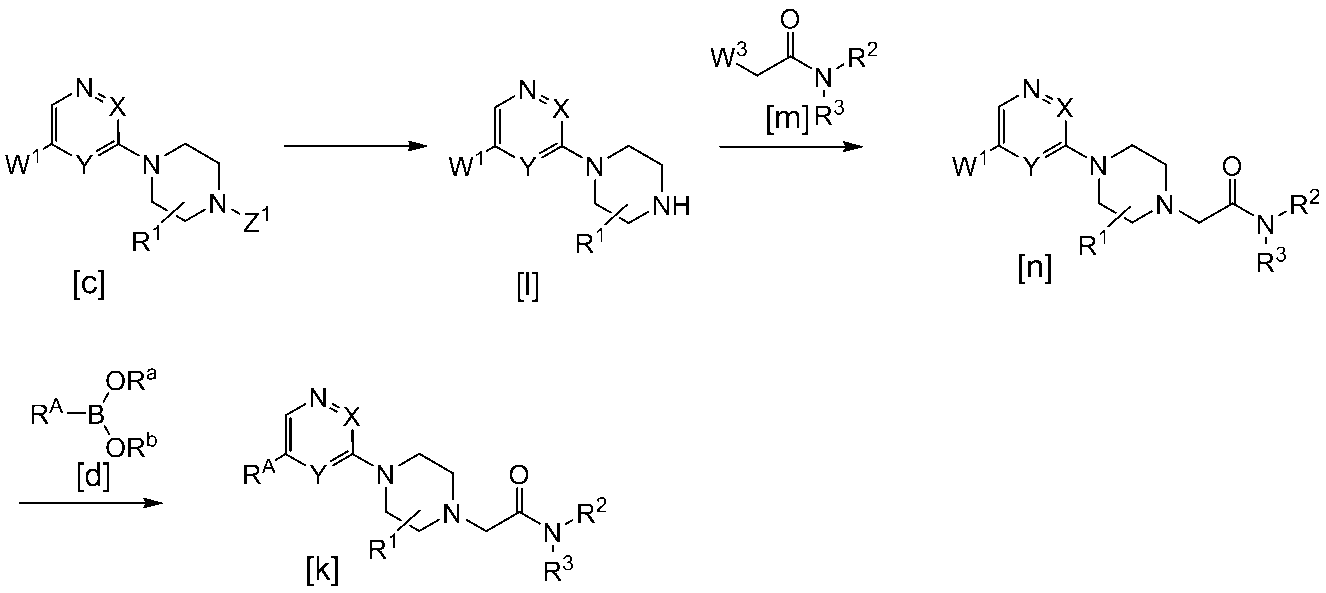

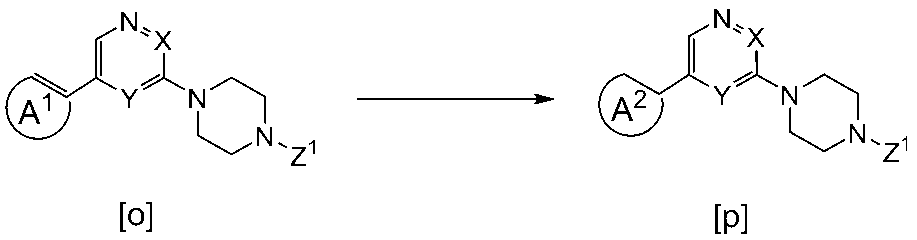
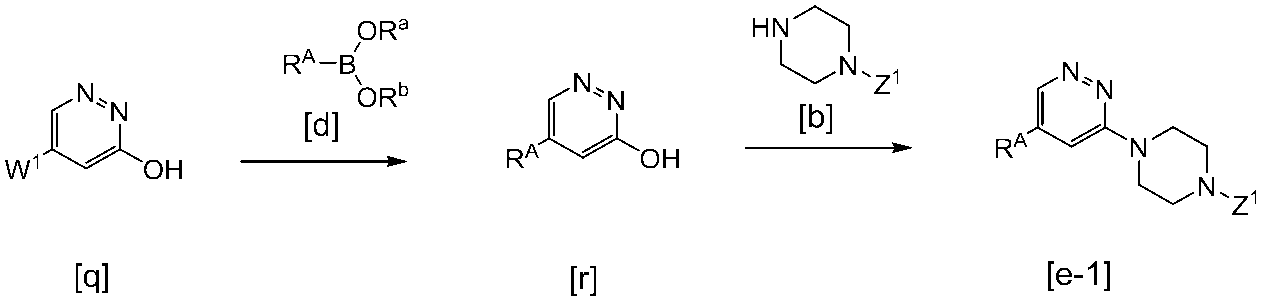


まず、一般式[a-1]で示される化合物とベンジルアルコールとの求核置換反応を行うことにより一般式[u]で示される化合物を得る。一般式[v]で示される化合物は、化合物[u]と一般式[d]で示される化合物とのカップリング反応によって得ることができる。得られた一般式[v]で示される化合物を脱ベンジル化して一般式[r]で示される化合物を得る。得られた化合物[r]と一般式[A]で示される化合物又はその塩を反応させ、所望により生成物を薬理学的に許容し得る塩とすることにより目的化合物[k-1]またはその薬理的に許容し得る塩を製造することができる。

まず、[B]で示される化合物とベンジルハライドとの置換反応を行うことにより[C]で示される化合物を得る。[D]で示される化合物は、化合物[C]のハロゲン交換・還元的脱ハロゲン反応によって得ることができる。得られた[D]で示される化合物と一般式[d]で示される化合物とのカップリング反応によって、一般式[E]で示される化合物を得る。得られた化合物[E]の脱ベンジル反応を行うことにより、一般式[r]で示される化合物を得る。
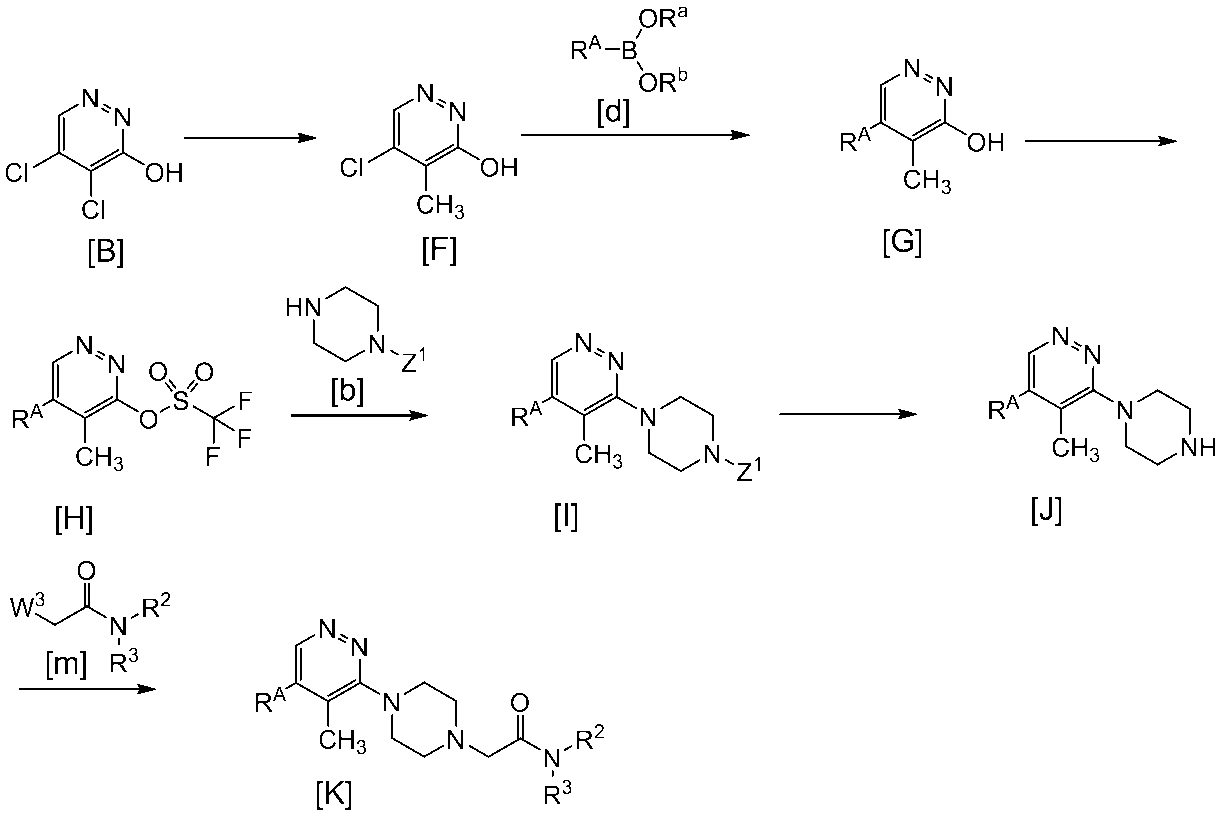
まず、[B]で示される化合物とメチル化剤との反応を行うことにより[F]で示される化合物を得る。得られた[F]で示される化合物と一般式[d]で示される化合物とのカップリング反応によって、一般式[G]で示される化合物を得る。得られた化合物[G]をトリフルオロメタンスルホニル化して、一般式[H]で示される化合物を得る。一般式[H]で示される化合物と一般式[b]で示される化合物との求核置換反応により、一般式[I]で示される化合物を得る。得られた一般式[I]で示される化合物を脱保護して一般式[J]で示される化合物を得る。得られた化合物[J]と一般式[m]で示される化合物又はその塩を反応させ、所望により生成物を薬理学的に許容し得る塩とすることにより目的化合物[K]またはその薬理的に許容し得る塩を製造することができる。

MS(APCI):344[M+H]+
(2)化合物2(4.3g)をエタノール(31mL)に懸濁し、1mol/L水酸化ナトリウム水溶液(12.4mL)を加え、室温にて16時間撹拌した。反応混合物に生じた沈殿をろ取し、ジエチルエーテルにて洗浄することにより、無色固体として化合物3(1.1g)を得た。
MS(ESI):314[M+H]-
(3)化合物3(34mg)と化合物4(16mg)をDMF(1mL)に懸濁し、ジイソプロピルエチルアミン(35μL)とHATU(46mg)を加え、室温にて3時間撹拌した。反応混合物に水と飽和炭酸水素ナトリウム水溶液を加え、クロロホルムにて3回抽出した。有機層を飽和食塩水で洗浄した後、無水硫酸ナトリウムにて乾燥した。溶媒を減圧留去し、得られた残渣をシリカゲルカラムクロマトグラフィー(溶出液 クロロホルム/メタノール=100/0~90/10 グラジエント)にて精製することにより、無色固体として化合物5(18mg)を得た。
MS(APCI):435[M+H]+
対応原料化合物を、前記の実施例1と同様に処理することにより、下記一般式においてR1およびR2がそれぞれ下記表1に記載の構造を有する各化合物を得た。

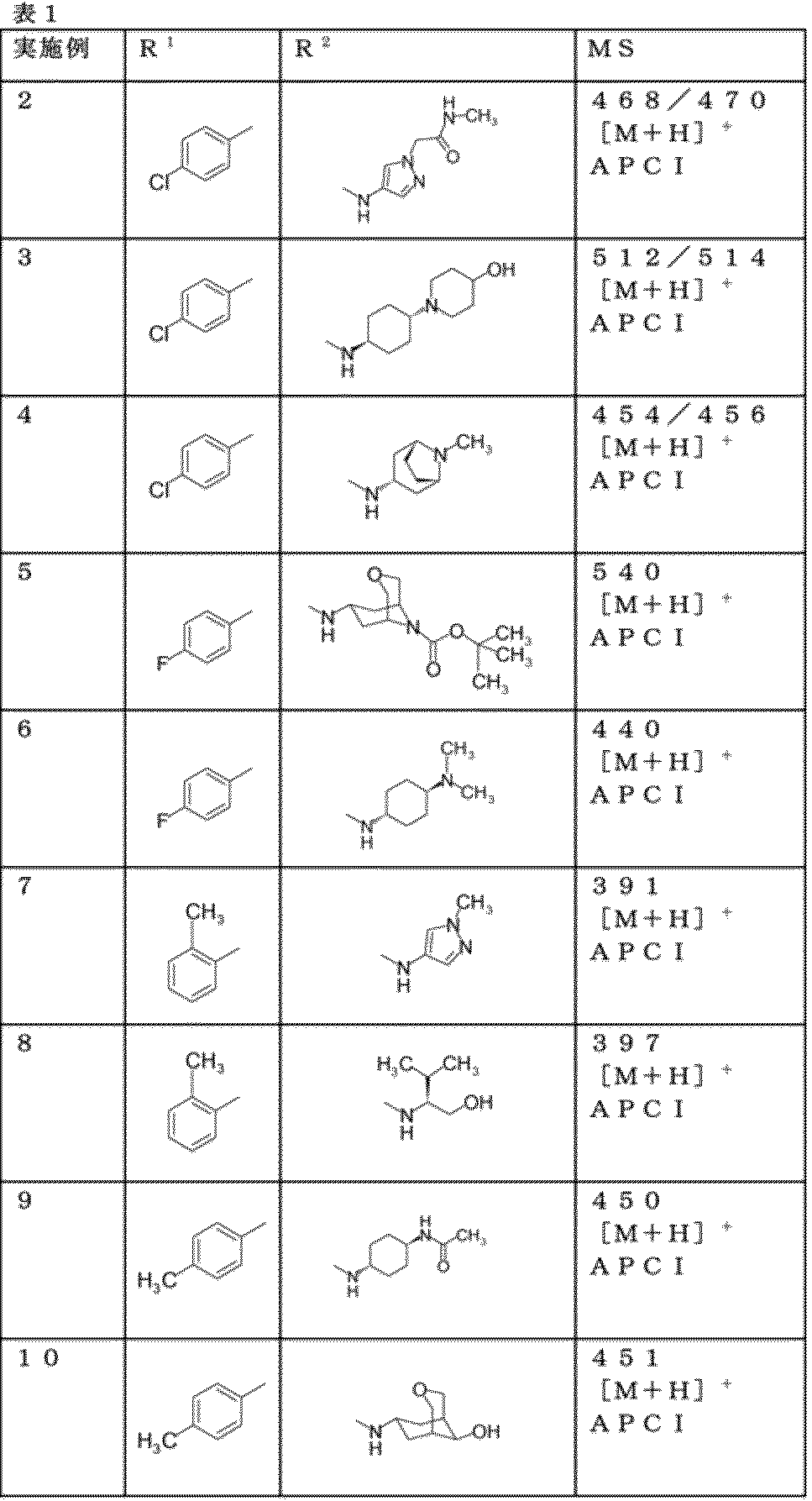

MS(APCI):365[M+H]+
対応原料化合物を、前記の実施例11と同様に処理することにより、下記一般式においてR1が下記表2に記載の構造を有する化合物を得た。
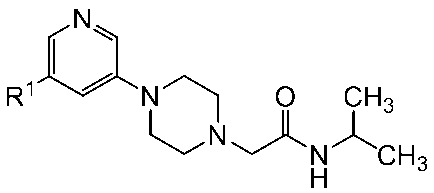


MS(APCI):381[M+H]+
対応原料化合物を、前記の実施例13と同様に処理することにより、下記一般式においてR1がそれぞれ下記表3に記載の構造を有する各化合物を得た。
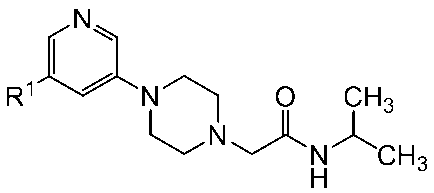
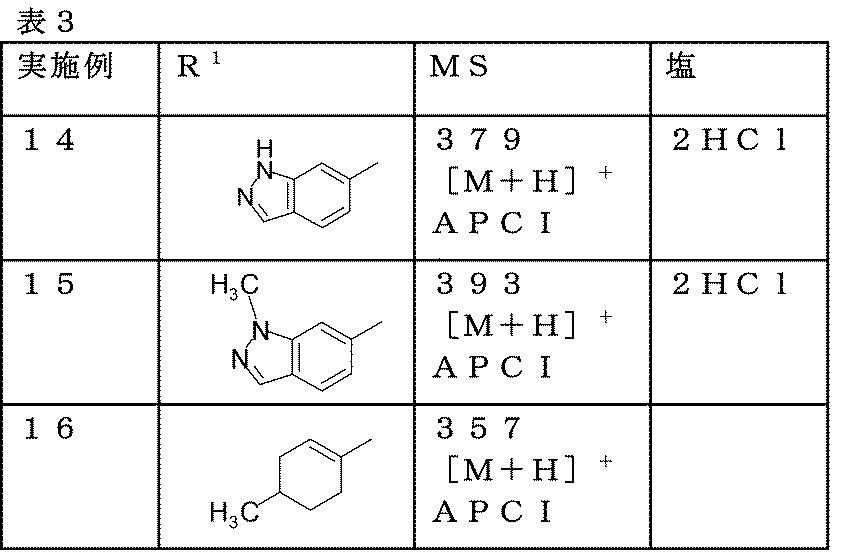

MS(APCI):359[M+H]+

MS(APCI):381[M+H]+
(2)化合物2(1.9g)をエタノール(10mL)に懸濁し、2mol/L水酸化ナトリウム水溶液(5mL)を加え、室温にて1日間撹拌した。反応混合物を減圧下濃縮し、残渣を水に溶解させたのち、氷冷下2mol/L塩酸水溶液を加え、pH5に調整した。析出物をろ取、水洗、減圧下乾燥することにより、淡黄色固体として化合物3(1.7g)を得た。
MS(APCI):353[M+H]+
(3)化合物3(150mg)と化合物4(96mg)をDMF(2mL)に懸濁し、ジイソプロピルエチルアミン(224μL)とHATU(486mg)を加え、室温下4日間撹拌した。反応混合物を水で希釈し、クロロホルムにて3回抽出した。有機層を無水硫酸ナトリウムにて乾燥した。溶媒を減圧留去し、得られた残渣をシリカゲルカラムクロマトグラフィー(溶出液 クロロホルム/メタノール=100/0~95/5 グラジエント)にて精製することにより、淡黄色固体として化合物5(144mg)を得た。
MS(APCI):410[M+H]+
対応原料化合物を、前記の実施例18と同様に処理することにより、下記一般式においてR1およびR2がそれぞれ下記表4に記載の構造を有する各化合物を得た。


MS(APCI):341[M+H]+
(2)化合物2(4.6g)をエタノール(13mL)に懸濁し、2mol/L水酸化ナトリウム水溶液(16mL)を加え、室温にて6時間撹拌した。反応混合物を減圧下濃縮し、黄色アモルファスを得た。ジイソプロピルエーテルを加え、得られた沈殿物をろ取、減圧下乾燥することにより、淡黄色固体として化合物3(4.5g)を得た。
MS(ESI):311[M+H]+
(3)化合物3(33mg)と化合物4(25mg)をDMF(2mL)に懸濁し、ジイソプロピルエチルアミン(35μL)とHATU(46mg)を加え、室温下4日間撹拌した。反応混合物を水で希釈し、クロロホルムにて3回抽出した。有機層を無水硫酸ナトリウムにて乾燥した。溶媒を減圧留去し、得られた残渣をシリカゲルカラムクロマトグラフィー(溶出液 クロロホルム/メタノール=100/0~95/5 グラジエント)にて精製することにより、無色固体として化合物5(38mg)を得た。
MS(APCI):501[M+H]+
対応原料化合物を、前記の実施例47と同様に処理することにより、下記一般式においてR1およびR2がそれぞれ下記表5に記載の構造を有する化合物を得た。



MS(APCI):394[M+H]+
対応原料化合物を、前記の実施例49と同様に処理することにより、下記一般式においてR1およびR2がそれぞれ下記表6に記載の構造を有する各化合物を得た。
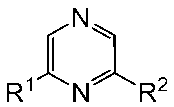


MS(APCI):367[M+H]+
(2)化合物3(151mg)とチオアニソール(510mg)のジクロロメタン(2mL)溶液中に、トリフルオロ酢酸(1mL)を加え、室温にて1時間撹拌した。反応混合物をメタノールで希釈後、強陽イオン交換充填剤(PoraPak Rxn Cx、溶出液 アンモニア(1mol/Lメタノール溶液))にて処理し、溶出液を減圧下濃縮して化合物4の粗生成物を得た。
MS(APCI):267[M+H]+
(3)化合物4(150mg)、化合物5(11mg)、及び炭酸ナトリウム(87mg)のアセトニトリル(5mL)混合液をアルゴン雰囲気下、50℃にて18時間撹拌した。反応混合物を室温まで冷却し、酢酸エチルで希釈後、水にて洗浄し、ケムエルート(登録商標)にて乾燥した。溶媒を減圧留去し、得られた残渣をシリカゲルカラムクロマトグラフィー(溶出液 クロロホルム/メタノール=100/0~95/5 グラジエント)にて精製し、得られた残渣を酢酸エチルで懸濁洗浄することにより、黄色固体として化合物6(77mg)を得た。
MS(APCI):366[M+H]+
対応原料化合物を、前記の実施例53と同様に処理することにより、下記一般式においてR1およびR2がそれぞれ下記表7に記載の構造を有する化合物を得た。
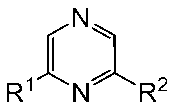


MS(APCI):382[M+H]+
対応原料化合物を、前記の実施例55と同様に処理することにより、下記一般式においてR1およびR2がそれぞれ下記表8に記載の構造を有する化合物を得た。
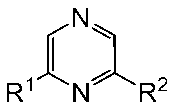

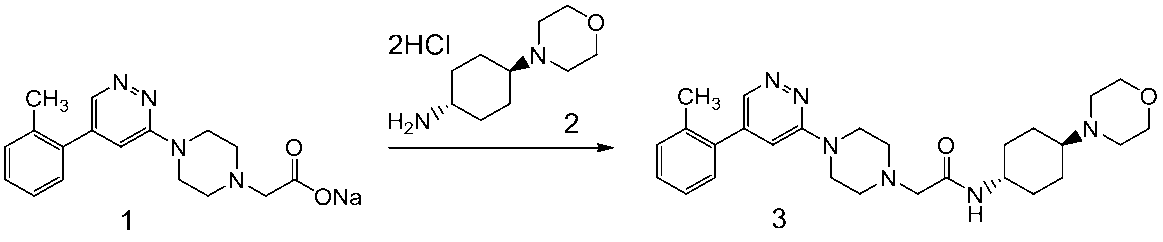
MS(APCI):479[M+H]+
対応原料化合物を、前記の実施例57と同様に処理することにより、下記一般式においてR1およびR2がそれぞれ下記表9に記載の構造を有する各化合物を得た。


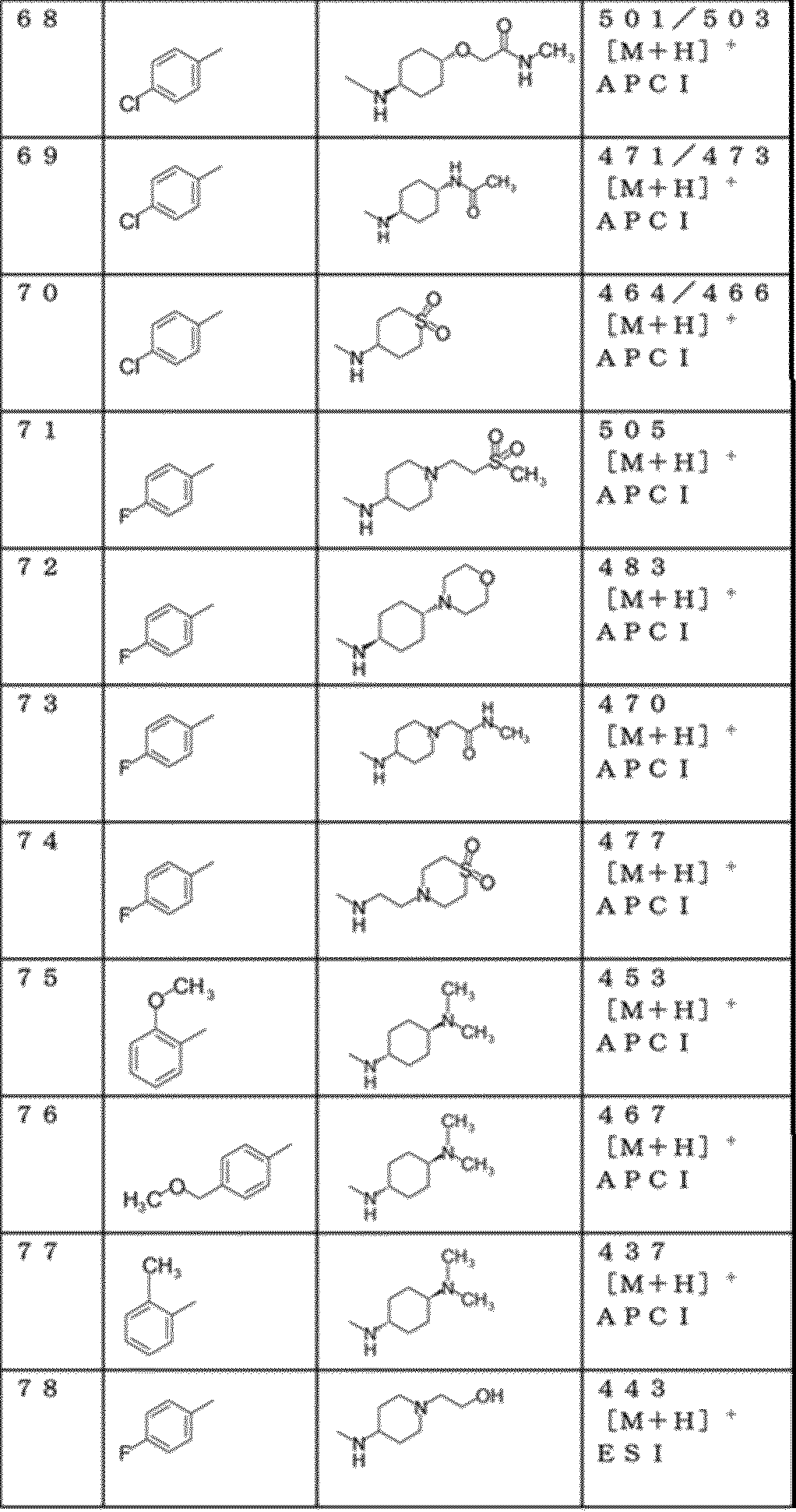
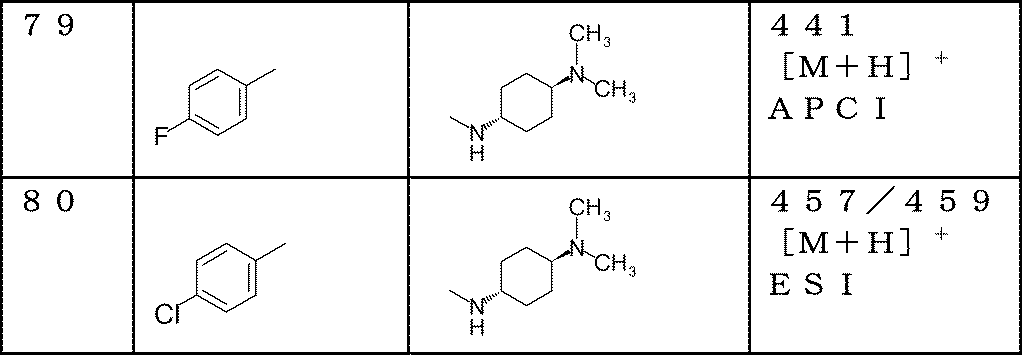
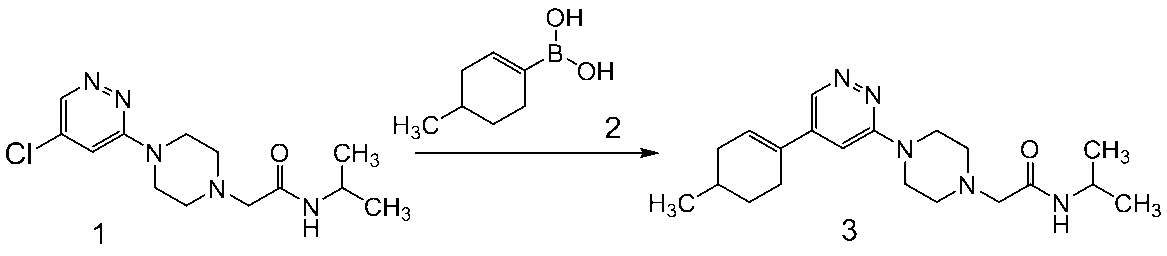
MS(APCI):358[M+H]+
対応原料化合物を、前記の実施例81と同様に処理することにより、下記一般式においてR1がそれぞれ下記表10に記載の構造を有する各化合物を得た。

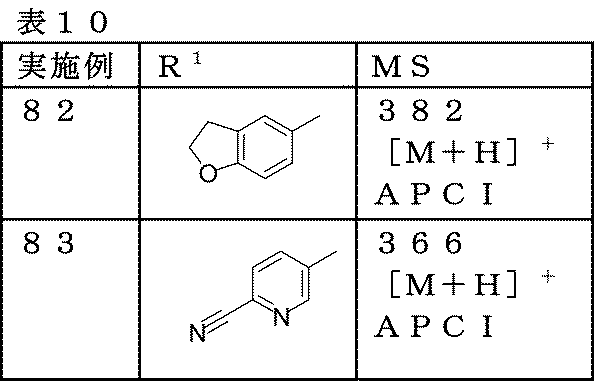

MS(APCI):360[M+H]+

MS(APCI):358[M+H]+

MS(APCI):255/257[M+H]+
(2)化合物2(6.0g)と57%ヨウ化水素酸(35mL)の混合物を加熱還流下16時間撹拌した。反応混合物を室温まで冷却し、30%チオ硫酸ナトリウム水溶液に注ぎ、酢酸エチルにて抽出した。有機層を無水硫酸マグネシウムにて乾燥、溶媒を減圧留去し、得られた残渣をシリカゲルカラムクロマトグラフィー(溶出液 ヘキサン/酢酸エチル=85/15→クロロホルム/メタノール=90/10)にて精製することにより、淡黄色固体として化合物3(5.3g)を得た。
MS(APCI):313[M+H]+
(3)化合物3(500mg)、化合物4(413mg)、及びテトラキス(トリフェニルホスフィン)パラジウム(93mg)のジメトシキエタン(8mL)溶液中に、2mol/L炭酸ナトリウム水溶液(1.6mL)を加えアルゴン置換して、80℃で3時間撹拌した。次いで、化合物4(200mg)を加えて同温度で16時間撹拌した。室温まで冷却した後、水を加えてクロロホルムで抽出した。有機層を飽和食塩水にて洗浄し、無水硫酸ナトリウムにて乾燥した。溶媒を減圧留去し、得られた残渣をシリカゲルカラムクロマトグラフィー(溶出液 ヘキサン/酢酸エチル=85/15~70/30 グラジエント)にて精製することにより、無色固体として化合物5(467mg)を得た。
MS(APCI):313[M+H]+
(4)アルミニウムクロリド(140mg)のトルエン(2.1mL)懸濁液に、化合物5(65mg)をアルゴン雰囲気下室温にて少量ずつ添加したのち加熱還流下1時間撹拌した。反応混合物を室温まで冷却し、1mol/L塩酸を加え、酢酸エチルで抽出した。有機層を無水硫酸ナトリウムにて乾燥し、溶媒を減圧留去した。得られた残渣をシリカゲルカラムクロマトグラフィー(溶出液 クロロホルム/酢酸エチル=67/33 アイソクラティック)にて精製することにより、淡黄色固体として化合物6(34mg)を得た。
MS(APCI):223[M+H]+
(5)化合物6(30mg)をアセトニトリル(1mL)/DMF(5滴)の混合溶媒に溶解し、化合物7(70mg)、ジアザビシクロウンデセン(111μL)、及び1H-ベンゾトリアゾール-1-イルオキシトリス(ジメチルアミノ)ホスホニウムヘキサフルオロりん酸塩(BOP、78mg)を加え、室温にて35分間撹拌したのち、更に加熱還流下15時間、マイクロ波反応装置(Initiator、バイオタージ社製)中、120℃で20分間撹拌した。反応混合物を室温まで冷却し、酢酸エチルで希釈後、水にて洗浄し、無水硫酸ナトリウムにて乾燥した。溶媒を減圧留去し、得られた残渣をNHシリカゲルカラムクロマトグラフィー(溶出液 クロロホルム/酢酸エチル=90/10~50/50 グラジエント)にて精製することにより、淡黄色固体として化合物8(17mg)を得た。
MS(APCI):390[M+H]+

MS(APCI):221/223[M+H]+
(2)化合物2(100mg)、化合物3(103mg)、及びジクロロビス(トリフェニルホスフィン)パラジウム(16mg)のジオキサン(2mL)溶液中に、2mol/L炭酸ナトリウム水溶液(1.5mL)を加え、マイクロ波反応装置(Initiator、バイオタージ社製)中、150℃で15分間撹拌した。室温に放冷した後、酢酸エチルで希釈して、水と飽和食塩水で洗浄し、無水硫酸ナトリウムにて乾燥した。溶媒を減圧留去し、得られた残渣をシリカゲルカラムクロマトグラフィー(溶出液 クロロホルム/酢酸エチル=100/0~90/10 グラジエント)にて精製した後、酢酸エチル/ヘキサンの混合溶媒で懸濁洗浄、ろ取、乾燥することにより無色固体として化合物4(69mg)を得た。
MS(APCI):331[M+H]+
(3)化合物4(53mg)をメタノール(4mL)に溶解し、10%含水パラジウム炭素(27mg)を加え、水素雰囲気下15分間撹拌した。パラジウム炭素をろ過により除去したのち、メタノールで洗浄した。ろ液を減圧下濃縮することにより、無色固体として化合物5(37mg)を得た。
MS(APCI):273[M+H]+
(4)化合物5(36mg)をアセトニトリル(1.5mL)/ジメチルアセトアミド(1.5mL)の混合溶媒に溶解し、化合物6(55mg)、ジアザビシクロウンデセン(33μL)および1H-ベンゾトリアゾール-1-イルオキシトリス(ジメチルアミノ)ホスホニウムヘキサフルオロりん酸塩(BOP、86mg)を加え、加熱還流下2時間撹拌した。反応混合物を室温まで冷却し、酢酸エチルで希釈後、水と飽和炭酸水素ナトリウム水溶液にて洗浄し、無水硫酸ナトリウムにて乾燥した。溶媒を減圧留去し、得られた残渣をNHシリカゲルカラムクロマトグラフィー(溶出液 クロロホルム/酢酸エチル=90/10~50/50 グラジエント)、次いでNHシリカゲルカラムクロマトグラフィー(溶出液 クロロホルム/メタノール=100/0~90/10 グラジエント)にて精製することにより、淡黄色固体として化合物7(18mg)を得た。
MS(APCI):408[M+H]+

化合物1(300mg)と化合物2(290mg)をDMF(8.8mL)に懸濁し、ジイソプロピルエチルアミン(740μL)とHATU(674mg)を加え、室温下40分間撹拌した。反応混合物を水で希釈したのち、クロロホルムで抽出した。有機層を無水硫酸ナトリウムにて乾燥し、溶媒を減圧留去した。得られた残渣をシリカゲルカラムクロマトグラフィー(溶出液 ヘキサン/酢酸エチル=30/70~0/100 グラジエント)にて精製することにより、無色固体として化合物3(440mg)を得た。
MS(APCI):517[M+H]+
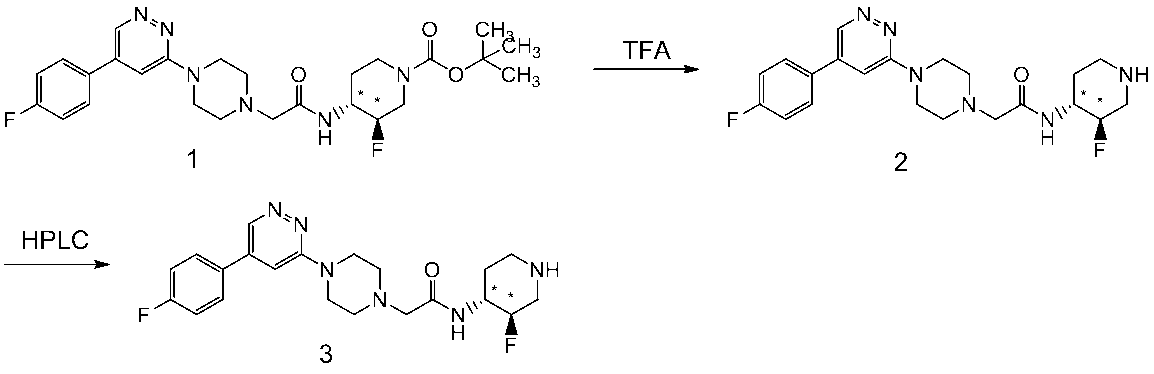
化合物1(430mg)のクロロホルム(4mL)溶液中に、トリフルオロ酢酸(4mL)を加え、室温にて17時間撹拌した。反応混合物をメタノールで希釈後、強陽イオン交換充填剤(PoraPak Rxn Cx、溶出液 アンモニア(1mol/Lメタノール溶液))にて処理し、溶出液を減圧下濃縮した。得られた残渣をシリカゲルカラムクロマトグラフィー(溶出液 クロロホルム/アンモニア水(10%メタノール溶液)=60/40 アイソクラティック)で精製することにより、無色固体としてラセミの化合物2を得た。このラセミ体をリサイクルHPLC(Chiralpak IC (30×250), メタノール/THF/ジエチルアミン=95/5/0.5、流速20mL/分)にて分画することで、それぞれのエナンチオマー(実施例89a、無色固体、142mg、及び実施例89b、無色固体、69mg)を得た。
実施例89a
保持時間:9.38分 (Chiralpak IC-3(4.6×150)、メタノール/THF/ジエチルアミン=95/5/0.5、流速0.5mL/分)
光学純度:98.3%ee
MS(APCI):417[M+H]+
実施例89b
保持時間:10.3分(Chiralpak IC-3(4.6×150)、メタノール/THF/ジエチルアミン=95/5/0.5、流速0.5mL/分)
光学純度:96.4%ee
MS(APCI):417[M+H]+
対応原料化合物を、前記の実施例89と同様に処理することにより、下記一般式においてR1がそれぞれ下記表11に記載の構造を有する各化合物を得た。ただし、式中、*で標識した炭素原子の置換基の立体表記は相対立体配置(トランス)であることを示すものであって絶対立体配置を示すものではない。
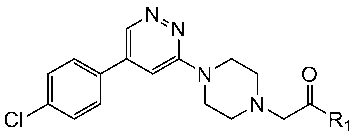

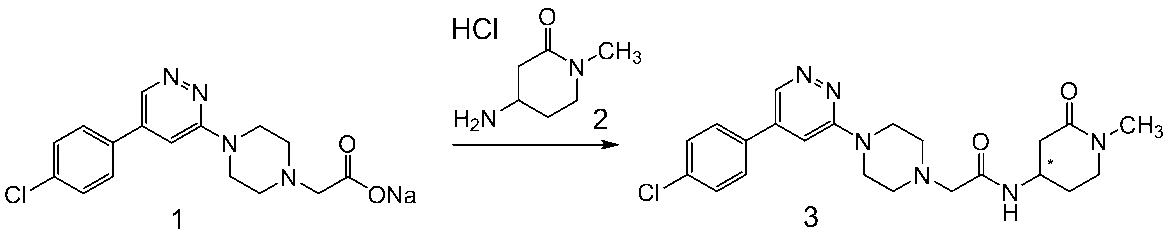
実施例91a
保持時間:6.42分(Chiralpak IC-3(4.6×150)、メタノール/THF/ジエチルアミン=60/40/0.1、流速0.5mL/分)
光学純度:>99.8%ee
MS(APCI):443/445[M+H]+
実施例91b
保持時間:8.90分(Chiralpak IC-3(4.6×150)、メタノール/THF/ジエチルアミン=60/40/0.1、流速0.5mL/分)
光学純度:99.7%ee
MS(APCI):443/445[M+H]+

MS(APCI):145/147[M+H]+
(2)化合物2(1.0g)、化合物3(4.2g)、及び1,1’-ビス(ジフェニルホスフィノ)フェロセンパラジウムジクロリドジクロロメタン錯体(252mg)のジオキサン(35mL)溶液中に、2mol/L炭酸ナトリウム水溶液(14mL)を加え、アルゴン置換した後、80℃で20時間撹拌した。室温に放冷して水で希釈した後、クロロホルムで抽出した。有機層を無水硫酸ナトリウムにて乾燥した。溶媒を減圧留去し、得られた残渣をシリカゲルカラムクロマトグラフィー(溶出液 ヘキサン/酢酸エチル=80/20~30/70 グラジエント)にて精製して化合物4(200mg)を得た。
MS(APCI):205[M+H]+
(3)化合物4(100mg)をピリジン(2.5mL)に懸濁した後、氷冷下トリフルオロメタンスルホン酸無水物(165μL)を加え、同温度で80分間撹拌した。反応混合物を水で希釈した後、クロロホルムで抽出した。有機層を無水硫酸ナトリウムにて乾燥した。溶媒を減圧留去し、得られた残渣をシリカゲルカラムクロマトグラフィー(溶出液 ヘキサン/酢酸エチル=95/5~85/15 グラジエント)にて精製して化合物5(126mg)を得た。化合物5(100mg)をジメチルスルホキシド(3mL)に溶解した後、室温で化合物6(553mg)とジイソプロピルエチルアミン(260μL)を加え、50℃で4時間加熱撹拌した。室温に放冷した後、水を加えて、酢酸エチル/ヘキサンの混合溶媒で抽出した。有機層を硫酸ナトリウムにて乾燥した。溶媒を減圧留去し、得られた残渣をシリカゲルカラムクロマトグラフィー(溶出液 ヘキサン/酢酸エチル=70/30~50/50 グラジエント)、次いでNHシリカゲルカラムクロマトグラフィー(溶出液 ヘキサン/酢酸エチル=90/10~0/100 グラジエント)にて精製することにより、化合物7(51mg)を得た。
MS(ESI):373[M+H]+
(4)化合物7(50mg)のクロロホルム(0.5mL)溶液中に、トリフルオロ酢酸(0.5mL)を加え、室温にて1.5時間撹拌した。反応混合物をメタノールで希釈後、強陽イオン交換充填剤(Porapak Rxn Cx、溶出液 アンモニア(1mol/Lメタノール溶液))にて処理し、溶出液を減圧下濃縮した。濃縮残渣をアセトニトリル(1.3mL)に溶解して、炭酸ナトリウム(71mg)と化合物8(55mg)を加え、65℃にて20時間撹拌した。反応混合物を水で希釈後、酢酸エチルで抽出し、有機層を無水硫酸ナトリウムにて乾燥した。溶媒を減圧留去し、得られた残渣をNHシリカゲルカラムクロマトグラフィー(溶出液 ヘキサン/酢酸エチル=50/50~30/70 グラジエント)にて精製することにより、無色固体として化合物9(32mg)を得た。
MS(APCI):372[M+H]+

MS(APCI):342/344[M+H]+
(2)化合物3(8.8g)と化合物4(7.2g)、ジクロロビス(トリフェニルホスフィン)パラジウム(905mg)のジオキサン(130mL)混合液中に、2mol/L炭酸ナトリウム水溶液(52mL)を加え、80℃にて1時間撹拌した。反応混合物を室温まで冷却し、水を加えた後、クロロホルムで3回抽出した。無水硫酸ナトリウムにて乾燥した後、溶媒を減圧留去し、得られた残渣をシリカゲルカラムクロマトグラフィー(溶出液 クロロホルム/酢酸エチル=10/1~25/1 グラジエント)にて精製し、無色固体として化合物5(8.1g)を得た。
MS(APCI):358[M+H]+
(3)化合物5(8.1g)のジクロロメタン(81mL)溶液中に、トリフルオロ酢酸(81mL)を氷冷下加え、室温にて1時間撹拌した。反応混合物の溶媒を留去し、クロロホルムに溶解させた後1mol/L水酸化ナトリウム水溶液にて中和した。有機層と水層を分離し、水層をクロロホルムにて3回抽出した。有機層を水で抽出した後、無水硫酸ナトリウムにて乾燥させ、溶媒を減圧留去した。得られた結晶性残渣をジエチルエーテル/ヘキサンで懸濁洗浄、ろ取することにより、無色固体として化合物6(1.2g)を得た。
MS(APCI):258[M+H]+
対応原料化合物を、前記の参考例1と同様に処理することにより、下記表12に記載の各化合物を得た。


MS(APCI):366[M+H]+
(2)化合物3(292mg)とチオアニソール(993mg)のジクロロメタン(4mL)溶液中に、トリフルオロ酢酸(2mL)を加え、室温にて3時間撹拌した。反応混合物をメタノールで希釈後、強陽イオン交換充填剤(Parapak Rxn Cx、溶出液 アンモニア(1mol/Lメタノール溶液))にて処理し、溶出液を減圧下濃縮した。得られた残渣をシリカゲルカラムクロマトグラフィー(溶出液 クロロホルム/アンモニア水(10%メタノール溶液)=90/10)にて精製し、化合物4を得た。
MS(APCI):266[M+H]+

MS(APCI):299/301[M+H]+
(2)化合物3(2.0g)、化合物4(1.1g)、トリス(ジベンジリデンアセトン)ジパラジウム(306mg)、トリ-t-ブチルホスフィン(1mol/Lトルエン溶液、0.67mL)、及び炭酸セシウム(8.7g)のTHF(100mL)混合液をアルゴン雰囲気下21時間加熱還流した。反応混合物を室温まで冷却し、酢酸エチル/水で希釈後、セライトろ過した。ろ液を水、飽和食塩水にて洗浄し、無水硫酸マグネシウムにて乾燥した。溶媒を減圧留去し、得られた残渣をシリカゲルカラムクロマトグラフィー(溶出液 ヘキサン/酢酸エチル=80/20~60/40 グラジエント)にて精製し、得られた結晶性残渣を酢酸エチル/ヘキサンで懸濁洗浄、ろ取、乾燥することにより、黄色固体として化合物5(1.3g)を得た。
MS(APCI):375/377[M+H]+
(3)化合物5(1.3g)のジクロロメタン(10mL)溶液に、トリフルオロ酢酸(5mL)を加え、室温にて18時間撹拌した。反応混合物をメタノールで希釈後、強陽イオン交換充填剤(PoraPak Rxn Cx、溶出液 アンモニア(1mol/Lメタノール溶液))にて処理し、溶出液を減圧下濃縮して得られた結晶性残渣をジイソプロピルエーテル/ヘキサンで懸濁洗浄、ろ取、乾燥することにより、黄色固体として化合物6(849mg)を得た。
MS(APCI):275/277[M+H]+
対応原料化合物を、前記の参考例7と同様に処理することにより、下記表13に記載の各化合物を得た。

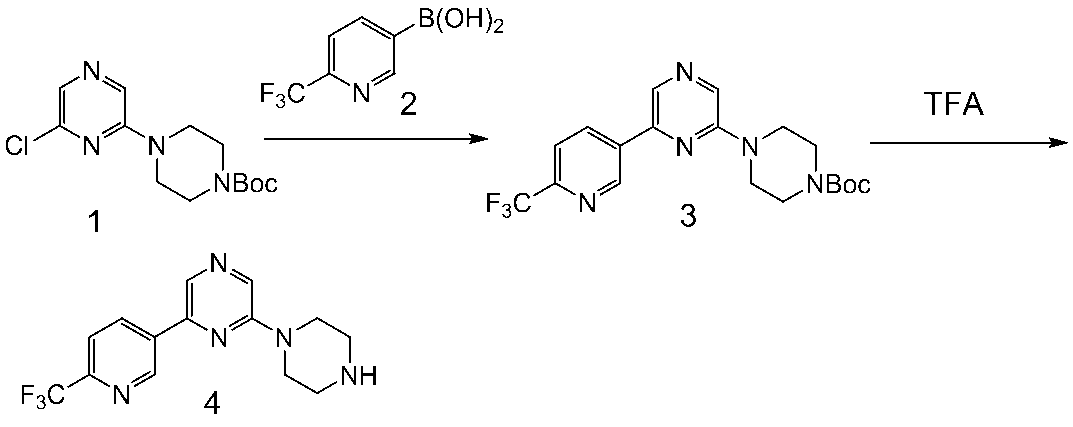
MS(APCI):410[M+H]+
(2)化合物3(182mg)のジクロロメタン(2mL)溶液に、トリフルオロ酢酸(1mL)を氷冷下加え、室温にて2時間撹拌した。反応混合物をメタノールで希釈後、強陽イオン交換充填剤(PoraPak Rxn Cx、溶出液 アンモニア(1mol/Lメタノール溶液))にて処理し、溶出液を減圧下濃縮することにより、黄色固体として化合物4(142mg)を得た。
MS(APCI):310[M+H]+

MS(ESI):359[M+H]+
(2)化合物3(1.78g)とトリエチルアミン(9mL)のメタノール(50mL)溶液に、10%含水パラジウム炭素(530mg)を加え、水素雰囲気下室温にて2時間撹拌した。反応混合物をセライト濾過し溶媒を減圧留去した後、再びメタノール(50mL)溶液とし、トリエチルアミン(9mL)と10%含水パラジウム炭素(530mg)を加え、水素雰囲気下室温にて18時間撹拌した。反応混合物をセライト濾過した後、溶媒を減圧留去し、得られた残渣をシリカゲルカラムクロマトグラフィー(溶出液 ヘキサン/酢酸エチル=80/20~60/40 グラジエント)にて精製することにより、淡黄色粘体として化合物4(1.4g)をシス体とトランス体の混合物(3:2、主生成物は未決定)として得た。
MS(APCI):361[M+H]+
(3)化合物4(200mg)のクロロホルム(3mL)溶液に、トリフルオロ酢酸(6mL)を加え、室温にて22時間撹拌した。反応混合物をメタノールで希釈後、強陽イオン交換充填剤(PoraPak Rxn Cx、溶出液 アンモニア(1mol/Lメタノール溶液))にて処理し、溶出液を減圧下濃縮することにより、黄色固体として化合物5(121mg)をシス体とトランス体の混合物(3:2、主生成物は未決定)として得た。
MS(APCI):261[M+H]+
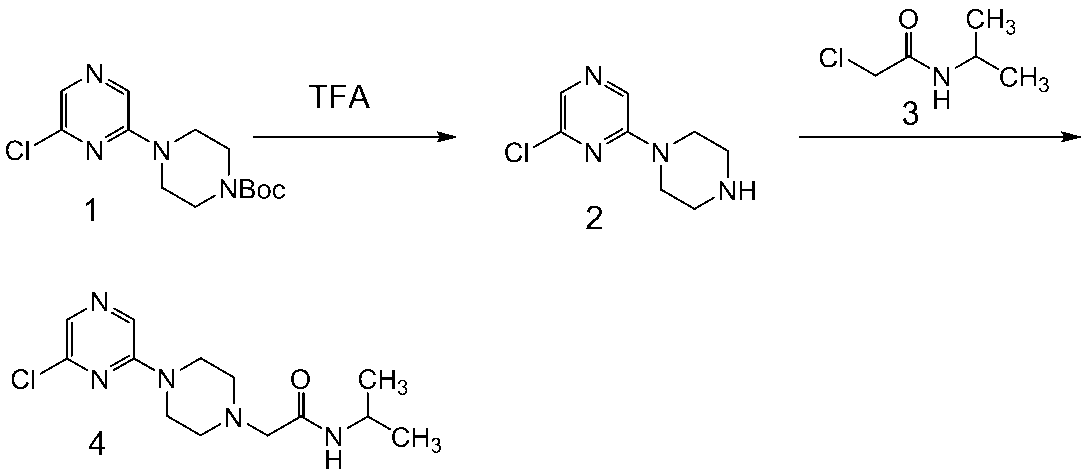
MS(APCI):298/300[M+H]+

MS(APCI):187[M+H]+
(2)化合物3(4.26g)、化合物4(12.8g)、1H-ベンゾトリアゾール-1-イルオキシトリス(ジメチルアミノ)ホスホニウムヘキサフルオロりん酸塩(BOP、15.2g)、及びジアザビシクロウンデセン(10.3mL)をDMF(110mL)に加え、アルゴン置換した後、80℃で18時間撹拌した。室温に放冷した後、反応混合物に水を加えた後、酢酸エチルで抽出した。有機層を飽和炭酸水素ナトリウム水溶液、飽和食塩水で洗浄し、無水硫酸ナトリウムにて乾燥した。溶媒を減圧留去し、得られた残渣をシリカゲルカラムクロマトグラフィー(溶出液 クロロホルム/酢酸エチル=100/0~90/10 グラジエント)にて精製することにより、黄色固体として化合物5(5.0g)を得た。
MS(APCI):355[M+H]+
(3)化合物5(5.0g)をクロロホルム(70mL)に溶解し、トリフルオロ酢酸(70mL)を加え、室温で3時間撹拌した。溶媒を減圧留去し、残渣に20%炭酸カリウム水溶液を加え、クロロホルムで抽出した。有機層を水と飽和食塩水で洗浄し、無水硫酸ナトリウムにて乾燥した。溶媒を減圧留去し、得られた残渣をNHシリカゲルカラムクロマトグラフィー(溶出液 クロロホルム/酢酸エチル=100/0~50/50 グラジエント)にて精製した後、ジイソプロピルエーテルで懸濁洗浄、ろ取、乾燥することにより、無色固体として化合物6(3.20g)を得た。
MS(APCI):255[M+H]+
(4)化合物6(3.20g)をアセトニトリル(60mL)に溶解し、化合物7(1.70g)と炭酸ナトリウム(2.67g)を加え、65℃で18時間撹拌した。溶媒を減圧留去し、残渣に水を加えて、クロロホルムで抽出した。有機層を飽和食塩水で洗浄し、無水硫酸ナトリウムにて乾燥した。溶媒を減圧留去し、得られた残渣をシリカゲルカラムクロマトグラフィー(溶出液 酢酸エチル/メタノール=100/0~95/5 グラジエント)にて精製した後、ジイソプロピルエーテルで懸濁洗浄、ろ取、乾燥した。次いで、酢酸エチルに加熱溶解した後、氷冷し生じた固体をろ取、乾燥することで茶色固体として化合物8(2.40g)を得た。
MS(APCI):341[M+H]+
(5)化合物8(2,40g)をエタノール(50mL)に溶解し、1mol/L水酸化ナトリウム水溶液(5.3mL)を加え、室温にて3時間撹拌した。反応混合物を濃縮し、得られた残渣にエタノールを加えて懸濁洗浄、ろ取、乾燥することにより、無色固体として化合物9(2.10g)を得た。
MS(ESI):311[M+Na]―
対応原料化合物を、前記の参考例17と同様に処理することにより、下記一般式においてR1がそれぞれ下記表14に記載の構造を有する各化合物を得た。

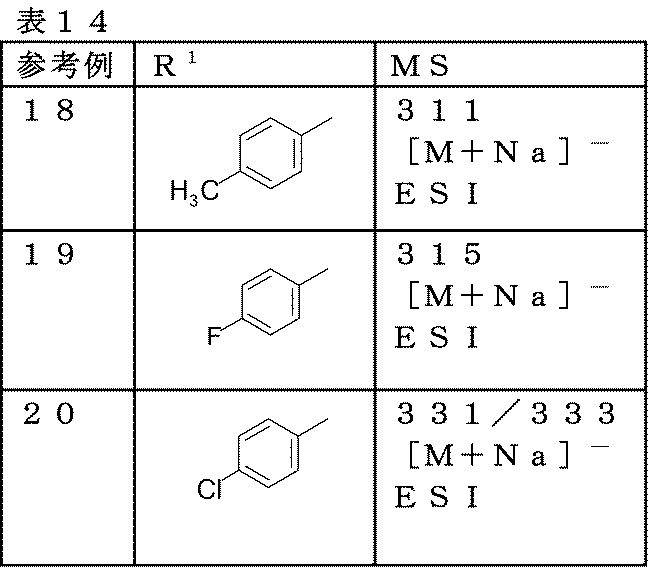

MS(APCI):299/301[M+H]+
(2)化合物3(600mg)をクロロホルム(6mL)に溶解し、トリフルオロ酢酸(12mL)を加え、室温で23時間撹拌した。反応混合物をメタノールで希釈後、強陽イオン交換充填剤(PoraPak Rxn Cx、溶出液 アンモニア(1mol/Lメタノール溶液))にて処理し、溶出液を減圧下濃縮することにより、淡黄色固体として化合物4(315mg)を得た。
MS(APCI):199/201[M+H]+
(3)化合物4(312mg)をアセトニトリル(10mL)に溶解し、化合物5(319mg)と炭酸ナトリウム(333mg)を加え、室温で4日間撹拌した。反応混合物に飽和炭酸ナトリウム水溶液を加えて、クロロホルムで抽出した。有機層を飽和食塩水で洗浄し、無水炭酸ナトリウムにて乾燥した。溶媒を減圧留去し、得られた残渣をシリカゲルカラムクロマトグラフィー(溶出液 酢酸エチル/メタノール=100/0~90/10 グラジエント)にて精製することで無色固体として化合物6(405mg)を得た。
MS(APCI):298/00[M+H]+
MS(APCI):217[M+H]+
(2)化合物3(4.3g)をオキシ塩化リン(30.5g)に加えて、120℃で25分間撹拌した。反応混合物を減圧濃縮した後、残渣にクロロホルムと飽和炭酸ナトリウム水溶液を加えて、不溶物をろ過した。ろ液の有機層を無水硫酸マグネシウムで乾燥後、溶媒を減圧留去した。得られた残渣をシリカゲルカラムクロマトグラフィー(溶出液 ヘキサン/酢酸エチル=80/20~50/50 グラジエント)にて精製することにより、淡黄色固体として化合物4(613mg)を得た。
MS(APCI):235/237[M+H]+
(3)化合物4(285mg)と化合物5(1.05g)をジメチルアセトアミド(4mL)に懸濁して、マイクロ波反応装置(Initiator、バイオタージ社製)中、120℃で20分間撹拌した。同様の操作を繰り返し、合わせた反応混合物に炭酸カリウム水溶液を加えて、クロロホルムで抽出した。有機層を無水硫酸ナトリウムにて乾燥した後、溶媒を減圧留去し、得られた残渣を酢酸エチル/ヘキサンの混合溶媒で懸濁洗浄、ろ取した。ろ過物とろ液を合わせて濃縮後、シリカゲルカラムクロマトグラフィー(溶出液 クロロホルム/アンモニア水(10%メタノール溶液)=100/0~90/10 グラジエント)にて精製することにより、淡茶色固体として化合物6(587mg)を得た。
MS(APCI):285[M+H]+
(4)化合物6(578mg)をアセトニトリル(18mL)に溶解し、化合物7(373mg)と炭酸ナトリウム(431mg)を加え、室温で7時間撹拌した。反応混合物を酢酸エチルで希釈して、水で洗浄した。水層は酢酸エチルで抽出して、合わせた有機層を無水硫酸マグネシウムにて乾燥した。溶媒を減圧留去し、得られた残渣をシリカゲルカラムクロマトグラフィー(溶出液 クロロホルム/メタノール=100/0~95/5 グラジエント)にて精製することで橙色固体として化合物8(535mg)を得た。
MS(APCI):357[M+H]+
(5)化合物8(527mg)をメタノール(5mL)に溶解し、1mol/L水酸化ナトリウム水溶液(3mL)を加え、室温にて5分間撹拌した。メタノール(5mL)と水(1mL)を加えて同温度で25分間撹拌した。反応混合物を減圧濃縮した後、水に溶解して1mol/L塩酸を加えて、析出物をろ取、乾燥することにより、無色固体として化合物9(441mg)を得た。
MS(APCI):343[M+H]+

MS(APCI):371[M+H]+
(2)化合物3(1.19g)のクロロホルム(6.5mL)溶液に、トリフルオロ酢酸(6.5mL)を加え、室温にて1時間撹拌した。反応混合物をメタノールで希釈後、強陽イオン交換充填剤(PoraPak Rxn Cx、溶出液 アンモニア(1mol/Lメタノール溶液))にて処理し、溶出液を減圧下濃縮することにより、無色固体として化合物4(870mg)を得た。
MS(APCI):271[M+H]+
(3)化合物4(867mg)のアセトニトリル(32mL)溶液に、炭酸ナトリウム(680mg)と化合物5(378μL)を加え、65℃にて18時間撹拌した。反応混合物を水で希釈後、酢酸エチルで抽出し、有機層を無水硫酸ナトリウムにて乾燥した。溶媒を減圧留去し、得られた残渣をNHシリカゲルカラムクロマトグラフィー(溶出液 ヘキサン/酢酸エチル=50/50~20/80 グラジエント)にて精製することにより、無色固体として化合物6(915mg)を得た。
MS(APCI):357[M+H]+
(4)化合物6(915mg)をエタノール(12.5mL)/THF(12.5mL)の混合溶媒に溶解し、1mol/L水酸化ナトリウム水溶液(5.1mL)を加え、室温にて1時間撹拌した。反応混合物を減圧濃縮し、水に溶解して1mol/L塩酸を加えて、析出物をろ取、乾燥することにより、無色固体として化合物7(986mg)を得た。
MS(APCI):329[M+H]+

MS(APCI):209[M+H]+
(2)化合物3(614mg)、化合物4(1.65g)、1H-ベンゾトリアゾール-1-イルオキシトリス(ジメチルアミノ)ホスホニウムヘキサフルオロりん酸塩(BOP、2.0g)、及びジアザビシクロウンデセン(1.32mL)をDMF(30mL)に加え、アルゴン置換した後、80℃で13.5時間撹拌した。室温に放冷した後、反応混合物に水と飽和炭酸水素ナトリウム水溶液を加え、クロロホルムで抽出した。有機層を無水硫酸マグネシウムにて乾燥した後、溶媒を減圧留去し、得られた残渣をシリカゲルカラムクロマトグラフィー(溶出液 ヘキサン/酢酸エチル65/35~50/50 グラジエント)にて精製することにより、淡黄色固体として化合物5(808mg)を得た。
MS(APCI):377[M+H]+
(3)化合物5(791mg)をクロロホルム(10mL)に溶解し、トリフルオロ酢酸(7.9mL)を加え、室温で1時間撹拌した。反応混合物をメタノールで希釈後、強陽イオン交換充填剤(PoraPak Rxn Cx、溶出液 アンモニア(1mol/Lメタノール溶液))にて処理し、溶出液を減圧下濃縮した。得られた残渣をアセトニトリル(15mL)に溶解し、化合物6(270μL)と炭酸ナトリウム(445mg)を加え、60℃で7.5時間撹拌した。反応混合物を酢酸エチルで希釈して、水と飽和食塩水で洗浄し、無水硫酸マグネシウムにて乾燥した。溶媒を減圧留去し、得られた残渣をシリカゲルカラムクロマトグラフィー(溶出液 クロロホルム/メタノール=100/0~95/5 グラジエント)にて精製することで黄色液体として化合物7(614mg)を得た。
MS(APCI):363[M+H]+
(4)化合物7(595mg)をエタノール(6mL)に溶解し、1mol/L水酸化ナトリウム水溶液(3.3mL)を加え、室温にて30分間撹拌した。反応混合物を濃縮し、水に溶解して1mol/L塩酸を加えて、析出物をろ取、乾燥することにより、無色固体として化合物8(434mg)を得た。
MS(APCI):335[M+H]+
<実験方法>
チャイニーズハムスター肺線維芽細胞V79細胞株にpcDNA3.1-ヒトCyp11B2プラスミドをトランスフェクションし、ヒトCyp11B2遺伝子の安定発現株を作製した。
本細胞を10%ウシ胎児血清、1% G418二硫酸塩溶液を添加したダルベッコ修飾イーグルハム培地で、37℃、95%空気、5%CO2環境下で培養および増殖させて細胞を回収した。
次に、Chabre et al. JCE&M 85(11) 4060-68, 2000の方法を参考にミトコンドリアを画分取得した。具体的には250 mmol/L スクロースを含有する5 mmol/L Tris-HCl buffer (pH 7.4) で懸濁した細胞をテフロン(登録商標)ポッターエルベージェムホモジナイザーでホモジナイズしたのちに懸濁液を遠心分離(800×gで15分)した。上清を分取したのちに再び遠心分離(10000×gで15分)し、ペレット(ミトコンドリア画分)を取得した。
96ウェルプレートに10 mmol/L KH2PO4、10 mmol/L Tris、20 mmol/L KCl、25 mmol/L スクロース、5 mmol/L MgCl2、0.05% ウシ血清アルブミンを含むバッファーを用いて希釈したミトコンドリア画分を分注した。0.5μmol/L デオキシコルチコステロン、150μmol/L NADPH、各濃度の化合物を添加し、1.5~2時間室温でインキュベーションしてアルドステロンを産生させた。溶液中のアルドステロン産生量をHTRF(Homogeneous Time Resolved Fluorescense)法を用いて測定した。
各濃度の化合物のアルドステロン産生阻害率(%)からロジスティック曲線による非線形回帰を行ってIC50(nmol/L)を算出した。

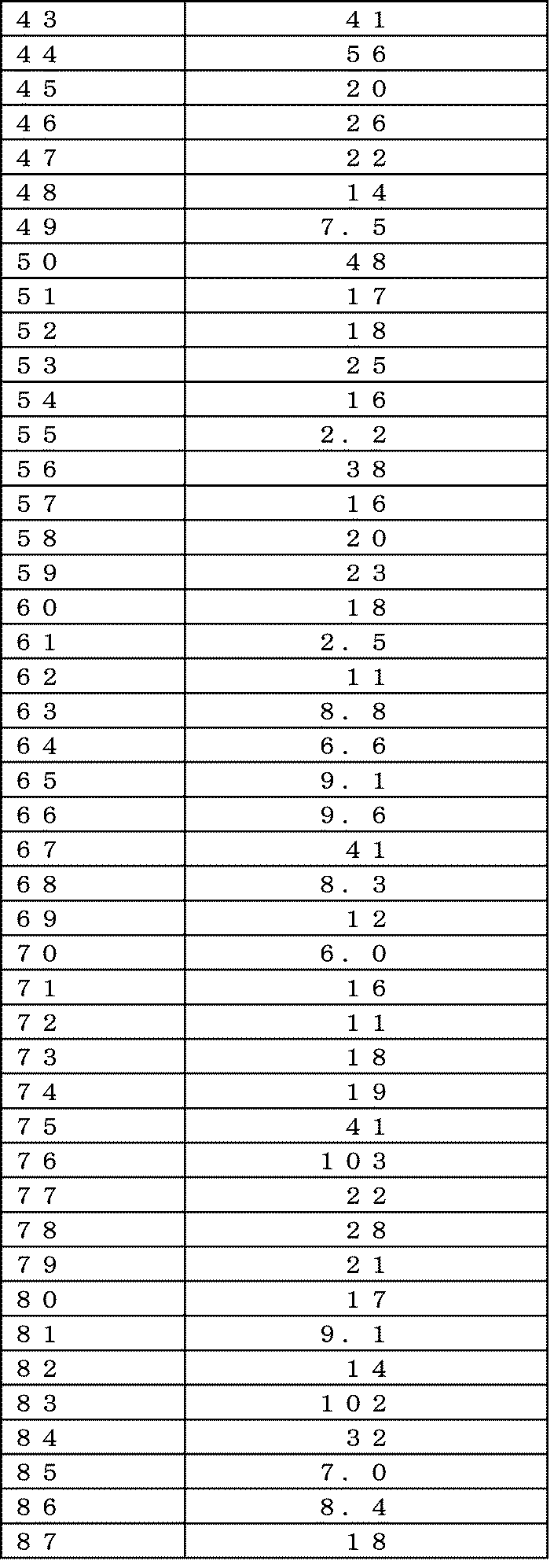

Claims (26)
- 下式[I]:

X及びYは以下の(1)~(3)のいずれかを表し、
(1)XがN、かつYがCH又はC-RY、
(2)XがCH、かつYがN、又は
(3)XがCH、かつYがCH;
RYはアルキル基を表し;
RAは置換されていてもよいシクロアルキル基、置換されていてもよいシクロアルケニル基、置換されていてもよいアリール基、又は部分的に水素化されていてもよく、置換されていてもよい6~10員単環又は二環式ヘテロアリール基を表し;
R1は水素原子、又はアルキル基を表し;
R2は置換されていてもよいアルキル基、置換されていてもよいシクロアルキル基、置換されていてもよい脂肪族複素環基、又は部分的に水素化されていてもよく、置換されていてもよいヘテロアリール基を表し;
R3は水素原子、又はアルキル基を表す〕で示される化合物又はその薬理的に許容し得る塩。 - RAで表される置換されていてもよいシクロアルキル基、置換されていてもよいシクロアルケニル基、置換されていてもよいアリール基、及び部分的に水素化されていてもよく、置換されていてもよい6~10員単環又は二環式ヘテロアリール基の各置換基が独立して、ハロゲン原子、シアノ基、アルキル基、ハロアルキル基、アルコキシアルキル基、及びアルコキシ基からなる群より独立して選ばれる1~3個の基であり、
RAで表される置換されていてもよいアリール基において該アリール部分が6~10員単環又は二環式アリールであり、
RAで表される部分的に水素化されていてもよく、置換されていてもよい6~10員単環又は二環式ヘテロアリール基において該ヘテロアリール部分が硫黄原子、酸素原子、及び窒素原子からなる群より独立して選ばれる1~2個の異項原子を含む、6~10員単環又は二環式ヘテロアリールであり;
R2で表される(i)置換されていてもよいアルキル基の置換基が、ハロゲン原子;水酸基;オキソ基;1~2個のアルキル基で置換されていてもよいカルバモイル基;アルキルスルホニル基;1~2個のアルキル基で置換されていてもよいカルバモイル基で置換されていてもよいアルコキシ基;水酸基、オキソ基、アルキル基、アルキルスルホニル基、及びアルコキシカルボニル基からなる群より独立して選ばれる1~3個の基で置換されていてもよい脂肪族複素環基;アルコキシカルボニル基;アルキル基、及びアルカノイル基からなる群より独立して選ばれる1~2個の基で置換されていてもよいアミノ基;及びヘテロアリール基からなる群より独立して選ばれる1~3個の基であり、
(ii)置換されていてもよいシクロアルキル基、(iii)置換されていてもよい脂肪族複素環基、及び(iv)部分的に水素化されていてもよく、置換されていてもよいヘテロアリール基の各置換基が独立して、ハロゲン原子;水酸基;オキソ基;1~2個のアルキル基で置換されていてもよいカルバモイル基、水酸基、及びアルキルスルホニル基からなる群より独立して選ばれる1~3個の基で置換されていてもよいアルキル基;1~2個のアルキル基で置換されていてもよいカルバモイル基で置換されていてもよいアルコキシ基;水酸基、オキソ基、アルキル基、アルキルスルホニル基、及びアルコキシカルボニル基からなる群より独立して選ばれる1~3個の基で置換されていてもよい脂肪族複素環基;アルコキシカルボニル基;アルキル基及びアルカノイル基からなる群より独立して選ばれる1~2個の基で置換されていてもよいアミノ基;及びヘテロアリール基からなる群より独立して選ばれる1~3個の基であり、
上記(i)~(iv)の各置換基において脂肪族複素環基は独立して、硫黄原子、酸素原子、又は窒素原子から選ばれる1~2個の異項原子を含む4~9員単環又は二環式脂肪族複素環基であり、
上記(i)~(iv)の各置換基においてヘテロアリール基は独立して、硫黄原子、酸素原子、及び窒素原子からなる群より独立して選ばれる1~4個の異項原子を含む、5~10員単環又は二環式ヘテロアリール基であり、
R2で表される置換されていてもよい脂肪族複素環基において該脂肪族複素環部分が硫黄原子、酸素原子、及び窒素原子からなる群より独立して選ばれる1~3個の異項原子を含む4~9員単環又は二環式脂肪族複素環であり;
R2で表される部分的に水素化されていてもよく、置換されていてもよいヘテロアリール基において該ヘテロアリール部分が5~10員単環又は二環式ヘテロアリールである、請求項1に記載の化合物又はその薬理的に許容し得る塩。 - RAで表される置換されていてもよいシクロアルキル基、置換されていてもよいシクロアルケニル基、置換されていてもよいアリール基、及び部分的に水素化されていてもよく、置換されていてもよい6~10員単環又は二環式ヘテロアリール基の各置換基が独立して、ハロゲン原子、シアノ基、アルキル基、ハロアルキル基、アルコキシアルキル基、及びアルコキシ基からなる群より独立して選ばれる1~3個の基であり、
RAで表される置換されていてもよいアリール基において該アリール部分がフェニル、又はナフチルであり、
RAで表される部分的に水素化されていてもよく、置換されていてもよい6~10員単環又は二環式ヘテロアリール基において該ヘテロアリール部分がピリジル、ピラジニル、ピリミジニル、ピリダジニル、チアジニル、トリアジニル、インドリル、イソインドリル、インダゾリル、ベンゾイミダゾリル、ベンゾチアゾリル、ベンゾフラニル、キノリル、イソキノリル、イミダゾピリジル、又はベンゾピラニルであり;
R2で表される(i)置換されていてもよいアルキル基の置換基が、ハロゲン原子;水酸基;オキソ基;1~2個のアルキル基で置換されていてもよいカルバモイル基;アルキルスルホニル基;1~2個のアルキル基で置換されていてもよいカルバモイル基で置換されていてもよいアルコキシ基;水酸基、オキソ基、アルキル基、アルキルスルホニル基、及びアルコキシカルボニル基からなる群より独立して選ばれる1~3個の基で置換されていてもよい脂肪族複素環基;アルコキシカルボニル基;アルキル基、及びアルカノイル基からなる群より独立して選ばれる1~2個の基で置換されていてもよいアミノ基;及びヘテロアリール基からなる群より独立して選ばれる1~3個の基であり、
R2で表される(ii)置換されていてもよいシクロアルキル基、(iii)置換されていてもよい脂肪族複素環基、及び(iv)部分的に水素化されていてもよく、置換されていてもよいヘテロアリール基の各置換基が独立して、ハロゲン原子;水酸基;オキソ基;水酸基、1~2個のアルキル基で置換されていてもよいカルバモイル基、及びアルキルスルホニル基からなる群より独立して選ばれる1~3個の基で置換されていてもよいアルキル基;1~2個のアルキル基で置換されていてもよいカルバモイル基で置換されていてもよいアルコキシ基;水酸基、オキソ基、アルキル基、アルキルスルホニル基、及びアルコキシカルボニル基からなる群より独立して選ばれる1~3個の基で置換されていてもよい脂肪族複素環基;アルコキシカルボニル基;アルキル基及びアルカノイル基からなる群より独立して選ばれる1~2個の基で置換されていてもよいアミノ基;及びヘテロアリール基からなる群より独立して選ばれる1~3個の基であり、
上記(i)~(iv)の各置換基において脂肪族複素環基は独立して、アゼチジニル、オキセタニル、ピロリジニル、テトラヒドロチエニル、テトラヒドロフラニル、チアゾリジニル、ピペリジニル、ピペラジニル、モルホリニル、チオモルホリニル、ホモモルホリニル、テトラヒドロチオピラニル、テトラヒドロピラニル、1-アザビシクロ[2.2.2]オクチル(キヌクリジニル)、8-アザビシクロ[3.2.1]オクチル、3-オキサビシクロ[3.3.1]ノニル、及び3-オキソ-9-アザビシクロ[3.3.1]ノニルからなる群より選ばれる基であり、
上記(i)~(iv)の各置換基においてヘテロアリール基は独立して、ピロリル、フラニル、チエニル、イミダゾリル、ピラゾリル、オキサゾリル、チアゾリル、トリアゾリル、テトラゾリル、ピリジル、ピラジニル、ピリミジニル、ピリダジニル、チアジニル、トリアジニル、インドリル、イソインドリル、インダゾリル、ベンゾイミダゾリル、ベンゾチアゾリル、ベンゾフラニル、キノリル、イソキノリル、イミダゾピリジル、及びベンゾピラニルからなる群より選ばれる基であり、
R2で表される置換されていてもよい脂肪族複素環基において該脂肪族複素環部分は、アゼチジニル、オキセタニル、ピロリジニル、テトラヒドロチエニル、テトラヒドロフラニル、チアゾリジニル、ピペリジニル、ピペラジニル、モルホリニル、チオモルホリニル、ホモモルホリニル、テトラヒドロチオピラニル、テトラヒドロピラニル、1-アザビシクロ[2.2.2]オクチル(キヌクリジニル)、8-アザビシクロ[3.2.1]オクチル、3-オキサビシクロ[3.3.1]ノニル、又は3-オキソ-9-アザビシクロ[3.3.1]ノニルであり、
R2で表される部分的に水素化されていてもよく、置換されていてもよいヘテロアリール基において該ヘテロアリール部分は、ピロリル、フラニル、チエニル、イミダゾリル、ピラゾリル、オキサゾリル、チアゾリル、トリアゾリル、テトラゾリル、ピリジル、ピラジニル、ピリミジニル、ピリダジニル、チアジニル、トリアジニル、インドリル、イソインドリル、インダゾリル、ベンゾイミダゾリル、ベンゾチアゾリル、ベンゾフラニル、キノリル、イソキノリル、イミダゾピリジル、又はベンゾピラニルである、請求項1又は2のいずれかに記載の化合物又はその薬理的に許容し得る塩。 - RAで表される置換されていてもよいシクロアルキル基、置換されていてもよいシクロアルケニル基、置換されていてもよいアリール基、及び部分的に水素化されていてもよく、置換されていてもよい6~10員単環又は二環式ヘテロアリール基の各置換基が独立して、ハロゲン原子、シアノ基、アルキル基、ハロアルキル基、アルコキシアルキル基、及びアルコキシ基からなる群より独立して選ばれる1~3個の基であり、
RAで表される置換されていてもよいアリール基において該アリール部分がフェニル、又はナフチルであり、
RAで表される部分的に水素化されていてもよく、置換されていてもよい6~10員単環又は二環式ヘテロアリール基において該ヘテロアリール部分がピリジル、インダゾリル、又はベンゾフラニルであり;
R2で表される(i)置換されていてもよいアルキル基の置換基が、ハロゲン原子;水酸基;オキソ基;1~2個のアルキル基で置換されていてもよいカルバモイル基;アルキルスルホニル基;1~2個のアルキル基で置換されていてもよいカルバモイル基で置換されていてもよいアルコキシ基;水酸基、オキソ基、アルキル基、アルキルスルホニル基、及びアルコキシカルボニル基からなる群より独立して選ばれる1~3個の基で置換されていてもよい脂肪族複素環基;アルコキシカルボニル基;アルキル基、及びアルカノイル基からなる群より独立して選ばれる1~2個の基で置換されていてもよいアミノ基;及びヘテロアリール基からなる群より独立して選ばれる1~3個の基であり、
R2で表される(ii)置換されていてもよいシクロアルキル基、(iii)置換されていてもよい脂肪族複素環基、及び(iv)部分的に水素化されていてもよく、置換されていてもよいヘテロアリール基の各置換基が独立して、ハロゲン原子;水酸基;オキソ基;水酸基、1~2個のアルキル基で置換されていてもよいカルバモイル基、及びアルキルスルホニル基からなる群より独立して選ばれる1~3個の基で置換されていてもよいアルキル基;1~2個のアルキル基で置換されていてもよいカルバモイル基で置換されていてもよいアルコキシ基;水酸基、オキソ基、アルキル基、アルキルスルホニル基、及びアルコキシカルボニル基からなる群より独立して選ばれる1~3個の基で置換されていてもよい脂肪族複素環基;アルコキシカルボニル基;アルキル基及びアルカノイル基からなる群より独立して選ばれる1~2個の基で置換されていてもよいアミノ基;及びヘテロアリール基からなる群より独立して選ばれる1~3個の基であり、
上記(i)~(iv)の各置換基において脂肪族複素環基は独立して、ピペリジニル、ピペラジニル、モルホリニル、チオモルホリニル、及びテトラヒドロピラニルから選ばれる基であり、
上記(i)~(iv)の各置換基においてヘテロアリール基は独立して、ピリミジニル基であり、
R2で表される置換されていてもよい脂肪族複素環基において該脂肪族複素環部分が、ピロリジニル、ピペリジニル、テトラヒドロチオピラニル、テトラヒドロピラニル、1-アザビシクロ[2.2.2]オクチル(キヌクリジニル)、8-アザビシクロ[3.2.1]オクチル、3-オキサビシクロ[3.3.1]ノニル、又は3-オキソ-9-アザビシクロ[3.3.1]ノニルであり、
R2で表される部分的に水素化されていてもよく、置換されていてもよいヘテロアリール基において該ヘテロアリール部分が、ピラゾリル、ピリジル、又はベンゾイミダゾリルである、請求項1~3のいずれかに記載の化合物又はその薬理的に許容し得る塩。 - RAが
(1)アルキル基で置換されていてもよいシクロアルキル基、
(2)アルキル基で置換されていてもよいシクロアルケニル基、
(3)ハロゲン原子、アルキル基、ハロアルキル基、アルコキシアルキル基及びアルコキシ基からなる群より独立して選ばれる1~3個の基で置換されていてもよいフェニル基、
(4)ナフチル基、又は
(5)部分的に水素化されていてもよく、シアノ基、アルキル基、及びハロアルキル基からなる群より独立して選ばれる1~2個の基で置換されていてもよいヘテロアリール基であり、
RAで表される部分的に水素化されていてもよく、置換されていてもよいヘテロアリール基において該ヘテロアリール部分がピリジル、インダゾリル又はベンゾフラニルであり、
R1が水素原子、又はアルキル基であり、
R2が
(i)水酸基;ハロゲン原子;及び、水酸基、オキソ基、アルキル基、アルコキシカルボニル基、及びアルキルスルホニル基からなる群より独立して選ばれる1~2個の基で置換されていてもよい脂肪族複素環基(ここにおいて、該脂肪族複素環基はピペリジニル基、ピペラジニル基、モルホリニル基、又はチオモルホリニル基である)からなる群より独立して選ばれる1~3個の基で置換されていてもよいアルキル基、
(ii)水酸基;水酸基で置換されていてもよいアルキル基;1~2個のアルキル基で置換されていてもよいカルバモイル基で置換されていてもよいアルコキシ基;アルキル基、及びアルカノイル基からなる群より独立して選ばれる1~2個の基で置換されていてもよいアミノ基;及び、水酸基、及びオキソ基からなる群より独立して選ばれる1~2個の基で置換されていてもよい脂肪族複素環基(ここにおいて、該脂肪族複素環基はピペリジニル基、モルホリニル基、又はピペラジニル基である)からなる群から独立して選ばれる1~3個の基で置換されていてもよいシクロアルキル基、
(iii)ハロゲン原子;水酸基;オキソ基;1~2個のアルキル基で置換されていてもよいカルバモイル基、水酸基、及びアルキルスルホニル基からなる群より独立して選ばれる1~2個の基で置換されていてもよいアルキル基;アルコキシ基;アルコキシカルボニル基;テトラヒドロピラニル基;及び、ピリミジニル基からなる群より独立して選ばれる1~3個の基で置換されていてもよい脂肪族複素環基、又は
(iv)部分的に水素化されていてもよく、1~2個のアルキル基で置換されていてもよいカルバモイル基で置換されていてもよいアルキル基で置換されていてもよいヘテロアリール基であり、
R2で表される置換されていてもよい脂肪族複素環基において該脂肪族複素環部分がピロリジニル、ピペリジニル、テトラヒドロチオピラニル、テトラヒドロピラニル、1-アザビシクロ[2.2.2]オクチル(キヌクリジニル)、8-アザビシクロ[3.2.1]オクチル、3-オキサビシクロ[3.3.1]ノニル、又は3-オキソ-9-アザビシクロ[3.3.1]ノニルであり、
R2で表される部分的に水素化されていてもよく、置換されていてもよいヘテロアリール基において該ヘテロアリール部分がピラゾリル、ピリジル、又はベンゾイミダゾリルであり、
R3が水素原子である、請求項4に記載の化合物又はその薬理的に許容し得る塩。 - XがNであり、YがCH又はC-RYであり、
RYがアルキル基であり、
RAが
(1)アルキル基で置換されていてもよいシクロヘキシル基、
(2)アルキル基で置換されていてもよいシクロヘキセニル基、
(3)ハロゲン原子、アルキル基、ハロアルキル基、アルコキシアルキル基、及びアルコキシ基からなる群より独立して選ばれる1~2個の基で置換されていてもよいフェニル基、
(4)ナフチル基、又は
(5)部分的に水素化されていてもよく、シアノ基で置換されていてもよいヘテロアリール基であり、
RAで表される部分的に水素化されていてもよく、置換されていてもよいヘテロアリール基において該ヘテロアリール部分がピリジル、又はベンゾフラニルであり、
R1が水素原子であり、
R2が
(i)水酸基;及びオキソ基、アルキル基、アルコキシカルボニル基、及びアルキルスルホニル基からなる群より独立して選ばれる1~2個の基で置換されていてもよい脂肪族複素環基(ここにおいて、該脂肪族複素環基はピペリジニル基、ピペラジニル基、モルホリニル基、又はチオモルホリニル基から選ばれる)からなる群より独立して選ばれる1~3個の基で置換されていてもよいアルキル基、
(ii)1~2個のアルキル基で置換されていてもよいカルバモイル基で置換されていてもよいアルコキシ基;アルキル基、及びアルカノイル基からなる群より独立して選ばれる1~2個の基で置換されていてもよいアミノ基;及びモルホリニル基からなる群から独立して選ばれる1~3個の基で置換されていてもよいシクロアルキル基、
(iii)ハロゲン原子;水酸基;オキソ基;1~2個のアルキル基で置換されていてもよいカルバモイル基、水酸基、及びアルキルスルホニル基からなる群より独立して選ばれる1~2個の基で置換されていてもよいアルキル基;アルコキシカルボニル基、及びアルコキシ基からなる群より独立して選ばれる1~3個の基で置換されていてもよい脂肪族複素環基、又は
(iv)ピリジル基であり、
R2で表される置換されていてもよい脂肪族複素環基において該脂肪族複素環部分がピペリジニル、テトラヒドロチオピラニル、又はテトラヒドロピラニルであり、
R3が水素原子である、請求項4に記載の化合物又はその薬理的に許容し得る塩。 - XがCHであり、YがNであり、
RAが
(1)アルキル基で置換されていてもよいシクロヘキシル基、
(2)ハロゲン原子、アルキル基、及びハロアルキル基からなる群より独立して選ばれる1~2個の基で置換されていてもよいフェニル基、又は
(3)部分的に水素化されていてもよく、シアノ基、及びアルキル基からなる群より独立して選ばれる1~2個の基で置換されていてもよいヘテロアリール基であり、
RAで表される部分的に水素化されていてもよく、置換されていてもよいヘテロアリール基において該ヘテロアリール部分がピリジル、インダゾリル、又はベンゾフラニルであり、
R1が水素原子又はアルキル基であり、
R2が
(i)水酸基;ハロゲン原子;及び、水酸基、及びアルキル基からなる群より独立して選ばれる1~2個の基で置換されていてもよいピペリジニル基からなる群より独立して選ばれる1~3個の基で置換されていてもよいアルキル基、
(ii)水酸基;水酸基で置換されていてもよいアルキル基;アルコキシ基;アルキル基、及びアルカノイル基からなる群より独立して選ばれる1~2個の基で置換されていてもよいアミノ基;及び、1~2個のオキソ基で置換されていてもよい脂肪族複素環基(ここにおいて、該脂肪族複素環基はモルホリニル基、又はピペラジニル基から選ばれる)からなる群から独立して選ばれる1~3個の基で置換されていてもよいシクロアルキル基、
(iii)オキソ基;アルキルスルホニル基で置換されていてもよいアルキル基;テトラヒドロピラニル基;及びピリミジニル基からなる群より独立して選ばれる1~3個の基で置換されていてもよい脂肪族複素環基、又は
(iv)1~2個のアルキル基で置換されていてもよいカルバモイル基で置換されていてもよいアルキル基で置換されていてもよいピラゾリル基であり、
R2で表される置換されていてもよい脂肪族複素環基において該脂肪族複素環部分がピロリジニル、ピペリジニル、テトラヒドロチオピラニル、又は1-アザビシクロ[2.2.2]オクチル(キヌクリジニル)であり、
R3が水素原子である、請求項4に記載の化合物又はその薬理的に許容し得る塩。 - XがCHであり、YがCHであり、
RAが
(1)アルキル基で置換されていてもよいシクロヘキシル基、
(2)アルキル基で置換されていてもよいシクロヘキセニル基、
(3)ハロゲン原子、及びアルキル基からなる群より独立して選ばれる1~2個の基で置換されていてもよいフェニル基、又は
(4)部分的に水素化されていてもよく、シアノ基、アルキル基、及びハロアルキル基からなる群より独立して選ばれる1~2個の基で置換されていてもよいヘテロアリール基であり、
RAで表される水素化されていてもよく、置換されていてもよいヘテロアリール基において該ヘテロアリール部分がピリジル、インダゾリル、又はベンゾフラニルであり、
R1が水素原子であり、
R2が
(i)水酸基で置換されていてもよいアルキル基、
(ii)アルキル基、及びアルカノイル基からなる群より独立して選ばれる1~2個の基で置換されていてもよいアミノ基;及び、水酸基で置換されていてもよいピペリジニル基からなる群から独立して選ばれる1~3個の基で置換されていてもよいシクロアルキル基、
(iii)水酸基;アルキル基;及びアルコキシカルボニル基からなる群より独立して選ばれる1~3個の基で置換されていてもよい脂肪族複素環基、又は
(iv)部分的に水素化されていてもよく、1~2個のアルキル基で置換されていてもよいカルバモイル基で置換されていてもよいアルキル基で置換されていてもよいヘテロアリール基であり、
R2で表される置換されていてもよい脂肪族複素環基において該脂肪族複素環部分が8-アザビシクロ[3.2.1]オクチル、3-オキサビシクロ[3.3.1]ノニル、又は3-オキソ-9-アザビシクロ[3.3.1]ノニルであり、
R2で表される部分的に水素化されていてもよく、置換されていてもよいヘテロアリール基において該ヘテロアリール部分がピラゾリル、又はベンゾイミダゾリルであり、
R3が水素原子である、請求項4に記載の化合物又はその薬理的に許容し得る塩。 - X及びYが以下の(1)~(3)のいずれかであり、
(1)XがN、かつYがCH、
(2)XがCH、かつYがN、又は
(3)XがCH、かつYがCH;
RAが置換されていてもよいアリール基、又は部分的に水素化されていてもよく、置換されていてもよい6~10員単環又は二環式ヘテロアリール基であり;
R1が水素原子であり;
R2が置換されていてもよいアルキル基、置換されていてもよいシクロアルキル基、又は置換されていてもよい脂肪族複素環基であり;
R3が水素原子である、請求項1に記載の化合物又はその薬理的に許容し得る塩。 - RAで表される置換されていてもよいアリール基、及び部分的に水素化されていてもよく、置換されていてもよい6~10員単環又は二環式ヘテロアリール基の各置換基が独立して、ハロゲン原子、シアノ基、アルキル基、ハロアルキル基、アルコキシアルキル基、及びアルコキシ基からなる群より独立して選ばれる1~3個の基であり、
RAで表される置換されていてもよいアリール基において該アリール部分がフェニル、又はナフチルであり、
RAで表される部分的に水素化されていてもよく、置換されていてもよい6~10員単環又は二環式ヘテロアリール基において該ヘテロアリール部分がピリジル、ピラジニル、ピリミジニル、ピリダジニル、チアジニル、トリアジニル、インドリル、イソインドリル、インダゾリル、ベンゾイミダゾリル、ベンゾチアゾリル、ベンゾフラニル、キノリル、イソキノリル、イミダゾピリジル、又はベンゾピラニルであり;
R2で表される(i)置換されていてもよいアルキル基の置換基が、ハロゲン原子;水酸基;オキソ基;1~2個のアルキル基で置換されていてもよいカルバモイル基;アルキルスルホニル基;1~2個のアルキル基で置換されていてもよいカルバモイル基で置換されていてもよいアルコキシ基;水酸基、オキソ基、アルキル基、アルキルスルホニル基、及びアルコキシカルボニル基からなる群より独立して選ばれる1~3個の基で置換されていてもよい脂肪族複素環基;アルコキシカルボニル基;アルキル基、及びアルカノイル基からなる群より独立して選ばれる1~2個の基で置換されていてもよいアミノ基;及びヘテロアリール基からなる群より独立して選ばれる1~3個の基であり、
R2で表される(ii)置換されていてもよいシクロアルキル基、及び(iii)置換されていてもよい脂肪族複素環基の各置換基が独立して、ハロゲン原子;水酸基;オキソ基;水酸基、1~2個のアルキル基で置換されていてもよいカルバモイル基、及びアルキルスルホニル基からなる群より独立して選ばれる1~3個の基で置換されていてもよいアルキル基;1~2個のアルキル基で置換されていてもよいカルバモイル基で置換されていてもよいアルコキシ基;水酸基、オキソ基、アルキル基、アルキルスルホニル基、及びアルコキシカルボニル基からなる群より独立して選ばれる1~3個の基で置換されていてもよい脂肪族複素環基;アルコキシカルボニル基;アルキル基及びアルカノイル基からなる群より独立して選ばれる1~2個の基で置換されていてもよいアミノ基;及びヘテロアリール基からなる群より独立して選ばれる1~3個の基であり、
上記(i)~(iii)の各置換基において脂肪族複素環基は独立して、ピペリジニル、ピペラジニル、モルホリニル、チオモルホリニル、及びテトラヒドロピラニルからなる群より選ばれる基であり、
上記(i)~(iii)の各置換基においてヘテロアリール基は独立して、ピリミジニル基であり、
R2で表される置換されていてもよい脂肪族複素環基において該脂肪族複素環部分は、ピロリジニル、ピペリジニル、テトラヒドロチオピラニル、テトラヒドロピラニル、1-アザビシクロ[2.2.2]オクチル(キヌクリジニル)、8-アザビシクロ[3.2.1]オクチル、3-オキサビシクロ[3.3.1]ノニル、又は3-オキソ-9-アザビシクロ[3.3.1]ノニルである、請求項9に記載の化合物又はその薬理的に許容し得る塩。 - RAがハロゲン原子で置換されていてもよいフェニル基、又は部分的に水素化されていてもよくアルキル基で置換されていてもよいインダゾリル基であり、
R2が
(1)アルキル基、
(2)1~2個のアルキル基で置換されていてもよいアミノ基で置換されていてもよいシクロヘキシル基、若しくはアルコキシ基で置換されていてもよいシクロヘキシル基、又は
(3)アルキル基で置換されていてもよい8-アザビシクロ[3.2.1]オクチルである、請求項9に記載の化合物又はその薬理的に許容し得る塩。 - 3-[4-[(trans-4-メトキシシクロヘキシル)カルバモイルメチル]ピペラジン-1-イル]-5-(1-メチル-1H-インダゾール-6-イル)ピラジン;
3-[4-(イソプロピルカルバモイルメチル)ピペラジン-1-イル]-5-(1-メチル-1H-インダゾール-6-イル)ピラジン;
5-(4-フルオロフェニル)-3-[4-[[trans-4-(N,N-ジメチルアミノ)シクロヘキシル]カルバモイルメチル]ピペラジン-1-イル]ピリダジン;及び
3-(4-クロロフェニル)-5-[4-[(exo-8-メチル-8-アザビシクロ[3.2.1]オクタン-3-イル)カルバモイルメチル]ピペラジン-1-イル]ピリジン
からなる群より選ばれる化合物又はその薬理的に許容し得る塩。 - 請求項1~12のいずれかに記載の化合物又はその薬理的に許容し得る塩を有効成分として含有する、医薬組成物。
- アルドステロンレベルの増大及び/又はアルドステロンの過剰産生により惹起される各種の疾患及び/又は疾患状態の予防又は治療、或いはこれら疾患の予後改善に使用される、請求項13に記載の医薬組成物。
- 原発性アルドステロン症、二次性アルドステロン症、高血圧、心不全、心筋症、心肥大、心筋梗塞、心筋壊死病変、心筋虚血後障害、冠動脈疾患、心筋又は血管の線維化又はリモデリング、血管再狭窄、血管壁肥厚、動脈硬化、急性腎障害、慢性腎臓病、腎線維化、腎症、低カリウム血症、肥満、メタボリック症候群、睡眠時無呼吸症候群、網膜症、肝疾患、突発性及び/又は周期性浮腫、又は交感神経亢進の予防又は治療剤である、請求項13に記載の医薬組成物。
- 原発性アルドステロン症、二次性アルドステロン症、高血圧、心不全、動脈硬化、腎症、又は網膜症の予防又は治療剤である、請求項13に記載の医薬組成物。
- 原発性アルドステロン症が片側性又は両側性副腎腺腫、片側性又は両側性副腎過形成、アルドステロン産生副腎癌、片側副腎性多発小結節アルドステロン症、糖質コルチコイド反応性アルドステロン症、家族性アルドステロン症、又は異所性アルドステロン産生腫瘍である、請求項15又は16のいずれかに記載の医薬組成物。
- 二次性アルドステロン症がエストロゲン製剤に起因する高血圧、腎血管性高血圧、妊娠高血圧、悪性高血圧、褐色細胞腫、うっ血性心不全、偽性低アルドステロン症、腹水を随伴した慢性肝疾患、下剤及び利尿薬などの薬剤不適切使用、又はネフローゼ症候群、バーター症候群もしくはギッテルマン症候群にともなう高アルドステロン血症である、請求項15又は16のいずれかに記載の医薬組成物。
- 心不全がうっ血性心不全、左室不全、右室不全、収縮機能不全又は拡張機能不全である、請求項15又は16のいずれかに記載の医薬組成物。
- 腎症が糖尿病性腎症である、請求項15又は16のいずれかに記載の医薬組成物。
- 腹水を随伴した慢性肝疾患が肝硬変である、請求項18に記載の医薬組成物。
- 網膜症が糖尿病性網膜症である、請求項15又は16のいずれかに記載の医薬組成物。
- 高血圧が本態性高血圧、二次性高血圧、治療抵抗性高血圧またはミネラルコルチコイド関連高血圧である、請求項15又は16のいずれかに記載の医薬組成物。
- 二次性高血圧が腎血管性高血圧、腎実質性高血圧、原発性アルドステロン症、褐色細胞腫、睡眠時無呼吸症候群、クッシング症候群、薬剤誘発性高血圧、大動脈狭窄症または副甲状腺機能亢進症である、請求項23に記載の医薬組成物。
- 治療上有効な量の、請求項1~12のいずれかに記載の化合物又はその薬理的に許容し得る塩を、患者に投与する工程を含む、アルドステロンレベルの増大及び/又はアルドステロンの過剰産生により惹起される各種の疾患及び/又は疾患状態の予防又は治療方法。
- 疾患及び/又は疾患状態が原発性アルドステロン症、二次性アルドステロン症、高血圧、心不全、心筋症、心肥大、心筋梗塞、心筋壊死病変、心筋虚血後障害、冠動脈疾患、心筋又は血管の線維化又はリモデリング、血管再狭窄、血管壁肥厚、動脈硬化、急性腎障害、慢性腎臓病、腎線維化、腎症、低カリウム血症、肥満、メタボリック症候群、睡眠時無呼吸症候群、網膜症、肝疾患、突発性及び/又は周期性浮腫、又は交感神経亢進である、請求項25に記載の予防又は治療方法。
Priority Applications (4)
| Application Number | Priority Date | Filing Date | Title |
|---|---|---|---|
| EP16857539.7A EP3381904B1 (en) | 2015-10-23 | 2016-10-21 | Novel nitrogen-containing aromatic heterocyclic compound |
| ES16857539T ES2882138T3 (es) | 2015-10-23 | 2016-10-21 | Nuevo compuesto heterocíclico aromático que contiene nitrógeno |
| JP2017545804A JP6545275B2 (ja) | 2015-10-23 | 2016-10-21 | 新規含窒素芳香族複素環化合物 |
| US15/769,844 US10717731B2 (en) | 2015-10-23 | 2016-10-21 | Nitrogen-containing aromatic heterocyclic compound |
Applications Claiming Priority (2)
| Application Number | Priority Date | Filing Date | Title |
|---|---|---|---|
| JP2015208888 | 2015-10-23 | ||
| JP2015-208888 | 2015-10-23 |
Publications (1)
| Publication Number | Publication Date |
|---|---|
| WO2017069226A1 true WO2017069226A1 (ja) | 2017-04-27 |
Family
ID=58557108
Family Applications (1)
| Application Number | Title | Priority Date | Filing Date |
|---|---|---|---|
| PCT/JP2016/081214 Ceased WO2017069226A1 (ja) | 2015-10-23 | 2016-10-21 | 新規含窒素芳香族複素環化合物 |
Country Status (5)
| Country | Link |
|---|---|
| US (1) | US10717731B2 (ja) |
| EP (1) | EP3381904B1 (ja) |
| JP (1) | JP6545275B2 (ja) |
| ES (1) | ES2882138T3 (ja) |
| WO (1) | WO2017069226A1 (ja) |
Cited By (1)
| Publication number | Priority date | Publication date | Assignee | Title |
|---|---|---|---|---|
| WO2022059700A1 (ja) * | 2020-09-15 | 2022-03-24 | 田辺三菱製薬株式会社 | トリアジン化合物の塩、その結晶形及び製造方法 |
Families Citing this family (1)
| Publication number | Priority date | Publication date | Assignee | Title |
|---|---|---|---|---|
| WO2023172415A1 (en) * | 2022-03-07 | 2023-09-14 | Firmenich Incorporated | Sweetener compositions |
Citations (6)
| Publication number | Priority date | Publication date | Assignee | Title |
|---|---|---|---|---|
| WO2010034838A2 (en) * | 2008-09-29 | 2010-04-01 | Boehringer Ingelheim International Gmbh | New chemical compounds |
| WO2012012478A1 (en) * | 2010-07-21 | 2012-01-26 | Merck Sharp & Dohme Corp. | Aldosterone synthase inhibitors |
| JP2012526774A (ja) * | 2009-05-15 | 2012-11-01 | ノバルティス アーゲー | アルドステロンシンターゼ阻害剤としてのアリールピリジン |
| WO2013079452A1 (en) * | 2011-11-30 | 2013-06-06 | F. Hoffmann-La Roche Ag | New bicyclic dihydroisoquinoline-1-one derivatives |
| WO2014179186A1 (en) * | 2013-04-30 | 2014-11-06 | Boehringer Ingelheim International Gmbh | Aldosterone synthase inhibitors |
| WO2015163427A1 (ja) * | 2014-04-24 | 2015-10-29 | 田辺三菱製薬株式会社 | 新規二置換1,2,4-トリアジン化合物 |
Family Cites Families (3)
| Publication number | Priority date | Publication date | Assignee | Title |
|---|---|---|---|---|
| US1947178A (en) * | 1932-07-11 | 1934-02-13 | Wilson Francis Condry | Interlocking wheel |
| EP2634176A4 (en) * | 2010-10-28 | 2014-04-16 | Nippon Shinyaku Co Ltd | PYRIDINE DERIVATIVE AND MEDICINAL AGENT |
| HRP20192323T1 (hr) | 2011-09-15 | 2020-03-20 | F. Hoffmann - La Roche Ag | Novi derivati dihidrokinolin-2-ona |
-
2016
- 2016-10-21 ES ES16857539T patent/ES2882138T3/es active Active
- 2016-10-21 EP EP16857539.7A patent/EP3381904B1/en active Active
- 2016-10-21 WO PCT/JP2016/081214 patent/WO2017069226A1/ja not_active Ceased
- 2016-10-21 US US15/769,844 patent/US10717731B2/en active Active
- 2016-10-21 JP JP2017545804A patent/JP6545275B2/ja active Active
Patent Citations (6)
| Publication number | Priority date | Publication date | Assignee | Title |
|---|---|---|---|---|
| WO2010034838A2 (en) * | 2008-09-29 | 2010-04-01 | Boehringer Ingelheim International Gmbh | New chemical compounds |
| JP2012526774A (ja) * | 2009-05-15 | 2012-11-01 | ノバルティス アーゲー | アルドステロンシンターゼ阻害剤としてのアリールピリジン |
| WO2012012478A1 (en) * | 2010-07-21 | 2012-01-26 | Merck Sharp & Dohme Corp. | Aldosterone synthase inhibitors |
| WO2013079452A1 (en) * | 2011-11-30 | 2013-06-06 | F. Hoffmann-La Roche Ag | New bicyclic dihydroisoquinoline-1-one derivatives |
| WO2014179186A1 (en) * | 2013-04-30 | 2014-11-06 | Boehringer Ingelheim International Gmbh | Aldosterone synthase inhibitors |
| WO2015163427A1 (ja) * | 2014-04-24 | 2015-10-29 | 田辺三菱製薬株式会社 | 新規二置換1,2,4-トリアジン化合物 |
Non-Patent Citations (5)
| Title |
|---|
| DATABASE REGISTRY [o] 13 October 2008 (2008-10-13), "1-Piperazineacetamide, N,N- dimethyl-4-[5-[4-(trifluoromethyl)phenyl]- 1,2,4-triazin-3-yl", XP055530302, retrieved from STN Database accession no. 1060824-77-2 * |
| DATABASE REGISTRY [o] 14 May 2010 (2010-05-14), "1-Piperazineacetamide, N,N- dimethyl-4-[6-(1H-1,2,4-triazol-1-yl)-2- pyrazinyl", XP 055530271, retrieved from STN Database accession no. 1223591-34-1 * |
| DATABASE REGISTRY [o] 2 November 2008 (2008-11-02), "1-Piperazineacetamide, 4- [5-(4-chlorophenyl)-1,2,4-triazin-3-yl]-N,N- dimethyl", XP 055530294, retrieved from STN Database accession no. 1069628-74-5 * |
| DATABASE REGISTRY [o] 3 November 2008 (2008-11-03), "1-Piperazineacetamide, 4- [5-(4-methoxyphenyl)-1,2,4-triazin-3-yl]-N- (1-methylethyl", XP 055530286, retrieved from STN Database accession no. 1070398-58-1 * |
| HU , Q. ET AL.: "Aldosterone Synthase Inhibitors as Promising Treatments for Mineralocorticoid Dependent Cardiovascular and Renal Diseases", JOURNAL OF MEDICINAL CHEMISTRY, vol. 57, no. 12, 2014, pages 5011 - 5022, XP 055228601, ISSN: 0022-2623 * |
Cited By (2)
| Publication number | Priority date | Publication date | Assignee | Title |
|---|---|---|---|---|
| WO2022059700A1 (ja) * | 2020-09-15 | 2022-03-24 | 田辺三菱製薬株式会社 | トリアジン化合物の塩、その結晶形及び製造方法 |
| CN116323569A (zh) * | 2020-09-15 | 2023-06-23 | 田边三菱制药株式会社 | 三嗪化合物的盐、其晶型及制造方法 |
Also Published As
| Publication number | Publication date |
|---|---|
| EP3381904A1 (en) | 2018-10-03 |
| JP6545275B2 (ja) | 2019-07-17 |
| ES2882138T3 (es) | 2021-12-01 |
| EP3381904A4 (en) | 2019-05-22 |
| US20180312503A1 (en) | 2018-11-01 |
| JPWO2017069226A1 (ja) | 2018-08-09 |
| EP3381904B1 (en) | 2021-07-28 |
| US10717731B2 (en) | 2020-07-21 |
Similar Documents
| Publication | Publication Date | Title |
|---|---|---|
| JP6148402B2 (ja) | 新規二置換1,2,4−トリアジン化合物 | |
| JP5336378B2 (ja) | 2−アリール−6−フェニルイミダゾ[1,2−α]ピリジン誘導体、これらの調製およびこれらの治療的使用 | |
| TWI674260B (zh) | 芳基烴受體(AhR)調節劑化合物 | |
| TWI481604B (zh) | Novel 5-fluorouracil derivatives | |
| KR102082331B1 (ko) | Cot 조정제로서의 6-아미노-퀴놀린-3-카르보니트릴 | |
| JP6250862B2 (ja) | アルドステロン合成酵素阻害薬 | |
| TW201835070A (zh) | 芳香烴受體(AhR)調節劑化合物 | |
| KR102731401B1 (ko) | 키나아제 억제제로 사용되는 화합물 및 이의 응용 | |
| JP2012513956A (ja) | ジヒドロインデンアミド化合物の製造方法、それらの化合物を含有する医薬組成物、及びプロテインキナーゼ阻害剤としての使用 | |
| WO2017049462A1 (zh) | 一类新型的flt3激酶抑制剂及其用途 | |
| CA3126484A1 (en) | Compound for inhibiting pge2/ep4 signaling transduction inhibiting, preparation method therefor, and medical uses thereof | |
| IL298966A (en) | Bicyclic compound and application thereof | |
| JP6545275B2 (ja) | 新規含窒素芳香族複素環化合物 | |
| JP6314196B2 (ja) | 医薬組成物 | |
| WO2017170765A1 (ja) | 新規含窒素複素環化合物 | |
| WO2018072742A1 (zh) | 一种咪唑并异吲哚类衍生物的游离碱的结晶形式及其制备方法 | |
| CN117396463A (zh) | 用于预防或治疗癌症的苯甲酰胺衍生物、其制备方法和含有其作为活性成分的药物组合物 | |
| JPWO2009048123A1 (ja) | ビス(トリメチルシリル)フェニル化合物又はその塩、及びその用途 | |
| JP2024525791A (ja) | 治療に使用するためのイミダゾ[1,2-b][1,2,4]トリアゾール誘導体 |
Legal Events
| Date | Code | Title | Description |
|---|---|---|---|
| 121 | Ep: the epo has been informed by wipo that ep was designated in this application |
Ref document number: 16857539 Country of ref document: EP Kind code of ref document: A1 |
|
| ENP | Entry into the national phase |
Ref document number: 2017545804 Country of ref document: JP Kind code of ref document: A |
|
| WWE | Wipo information: entry into national phase |
Ref document number: 15769844 Country of ref document: US |
|
| NENP | Non-entry into the national phase |
Ref country code: DE |
|
| WWE | Wipo information: entry into national phase |
Ref document number: 2016857539 Country of ref document: EP |