WO2017072096A1 - Mischungen enthaltend kunststoffe und organische fasern - Google Patents

Mischungen enthaltend kunststoffe und organische fasern Download PDF

Info

Publication number
WO2017072096A1
WO2017072096A1 PCT/EP2016/075613 EP2016075613W WO2017072096A1 WO 2017072096 A1 WO2017072096 A1 WO 2017072096A1 EP 2016075613 W EP2016075613 W EP 2016075613W WO 2017072096 A1 WO2017072096 A1 WO 2017072096A1
Authority
WO
WIPO (PCT)
Prior art keywords
groups
radical
different
mixtures according
optionally
Prior art date
Legal status (The legal status is an assumption and is not a legal conclusion. Google has not performed a legal analysis and makes no representation as to the accuracy of the status listed.)
Ceased
Application number
PCT/EP2016/075613
Other languages
English (en)
French (fr)
Inventor
Oliver SCHÄFER
Peter Randel
Current Assignee (The listed assignees may be inaccurate. Google has not performed a legal analysis and makes no representation or warranty as to the accuracy of the list.)
Wacker Chemie AG
Original Assignee
Wacker Chemie AG
Priority date (The priority date is an assumption and is not a legal conclusion. Google has not performed a legal analysis and makes no representation as to the accuracy of the date listed.)
Filing date
Publication date
Application filed by Wacker Chemie AG filed Critical Wacker Chemie AG
Priority to EP16785486.8A priority Critical patent/EP3368610B1/de
Priority to US15/768,354 priority patent/US10920079B2/en
Priority to KR1020187010868A priority patent/KR102030101B1/ko
Priority to CN201680056314.0A priority patent/CN108026374A/zh
Priority to JP2018519366A priority patent/JP6698834B2/ja
Publication of WO2017072096A1 publication Critical patent/WO2017072096A1/de
Anticipated expiration legal-status Critical
Ceased legal-status Critical Current

Links

Classifications

    • CCHEMISTRY; METALLURGY
    • C08ORGANIC MACROMOLECULAR COMPOUNDS; THEIR PREPARATION OR CHEMICAL WORKING-UP; COMPOSITIONS BASED THEREON
    • C08LCOMPOSITIONS OF MACROMOLECULAR COMPOUNDS
    • C08L83/00Compositions of macromolecular compounds obtained by reactions forming in the main chain of the macromolecule a linkage containing silicon with or without sulfur, nitrogen, oxygen or carbon only; Compositions of derivatives of such polymers
    • C08L83/10Block- or graft-copolymers containing polysiloxane sequences
    • CCHEMISTRY; METALLURGY
    • C08ORGANIC MACROMOLECULAR COMPOUNDS; THEIR PREPARATION OR CHEMICAL WORKING-UP; COMPOSITIONS BASED THEREON
    • C08GMACROMOLECULAR COMPOUNDS OBTAINED OTHERWISE THAN BY REACTIONS ONLY INVOLVING UNSATURATED CARBON-TO-CARBON BONDS
    • C08G77/00Macromolecular compounds obtained by reactions forming a linkage containing silicon with or without sulfur, nitrogen, oxygen or carbon in the main chain of the macromolecule
    • C08G77/42Block-or graft-polymers containing polysiloxane sequences
    • C08G77/458Block-or graft-polymers containing polysiloxane sequences containing polyurethane sequences
    • CCHEMISTRY; METALLURGY
    • C08ORGANIC MACROMOLECULAR COMPOUNDS; THEIR PREPARATION OR CHEMICAL WORKING-UP; COMPOSITIONS BASED THEREON
    • C08LCOMPOSITIONS OF MACROMOLECULAR COMPOUNDS
    • C08L23/00Compositions of homopolymers or copolymers of unsaturated aliphatic hydrocarbons having only one carbon-to-carbon double bond; Compositions of derivatives of such polymers
    • C08L23/26Compositions of homopolymers or copolymers of unsaturated aliphatic hydrocarbons having only one carbon-to-carbon double bond; Compositions of derivatives of such polymers modified by chemical after-treatment
    • CCHEMISTRY; METALLURGY
    • C08ORGANIC MACROMOLECULAR COMPOUNDS; THEIR PREPARATION OR CHEMICAL WORKING-UP; COMPOSITIONS BASED THEREON
    • C08LCOMPOSITIONS OF MACROMOLECULAR COMPOUNDS
    • C08L97/00Compositions of lignin-containing materials
    • C08L97/02Lignocellulosic material, e.g. wood, straw or bagasse
    • CCHEMISTRY; METALLURGY
    • C08ORGANIC MACROMOLECULAR COMPOUNDS; THEIR PREPARATION OR CHEMICAL WORKING-UP; COMPOSITIONS BASED THEREON
    • C08GMACROMOLECULAR COMPOUNDS OBTAINED OTHERWISE THAN BY REACTIONS ONLY INVOLVING UNSATURATED CARBON-TO-CARBON BONDS
    • C08G18/00Polymeric products of isocyanates or isothiocyanates
    • C08G18/06Polymeric products of isocyanates or isothiocyanates with compounds having active hydrogen
    • C08G18/28Polymeric products of isocyanates or isothiocyanates with compounds having active hydrogen characterised by the compounds used containing active hydrogen
    • C08G18/40High-molecular-weight compounds
    • C08G18/61Polysiloxanes

Definitions

  • the invention relates to fiber-filled mixtures containing siloxane-organopolymers, processes for their preparation and their use.
  • wood as a traditional material is associated with significant disadvantages, for example, that the resistance to UV light and moisture is limited and the material tends to splinter especially after weathering on the surface.
  • WPC wood polymer composite
  • WPC with wood or natural fibers reinforced plastics which may contain additives in addition, in order to avoid on the one hand the disadvantages of the wood with regard to UV protection and moisture and on the other hand, to ensure a wood ⁇ like appearance.
  • Such products are known, for example, as a facade element or as terrace covering, in the form of a so-called barefoot board.
  • the wood fiber is typically share between 10 and 90%, preferably Zvi ⁇ rule 30 to 80%, the remainder consisting essentially of plastic, usually polyvinyl chloride (PVC) or polymers from the group of polyolefins such as high density polyethylene (HDPE) or polypropylene (PP), which may additionally be mixed with additives commonly used in plastics processing.
  • PVC polyvinyl chloride
  • HDPE high density polyethylene
  • PP polypropylene
  • additives may be dyes and pigments, UV Stabilisato ⁇ ren or even flame retardant, so that the outdoor use can be guaranteed for many years and possibly the fire resistance is increased so that these profiles can also be used in the construction sector.
  • Additives against the infestation of bacteria, insects, fungi, especially mold, algae or termites etc. can also be added to the WPC.
  • WPC can either be produced directly as a semi-finished product such as a profile or as plastic granules, which can be transformed in further processing steps such as extrusion or injection molding.
  • PPA Polymer Processing Aids
  • a disadvantage of the currently used PPAs is their be ⁇ known tendency to partially adsorb to existing filler surfaces and are thus inactivated. This occurs and in particular to the vorhande by the high wood fiber content ⁇ nen fiber surfaces, which in some cases very high concentrations must be added by PPAs. Here are be- see 2 and up to 6 wt .-% PPA added, but in these high concentrations again have a negative effect on the stiffness of the WPC blends. In addition, the weldability of the extruded profiles decreases, which is disadvantageous in particular in the production of window frames made of WPC.
  • the PPAs used also react with other polymer additives, so-called couplers or adhesion promoters, which provide by reactive groups for better adhesion of wood fibers to the matrix plastic used and thus to improve the mechanical properties of WPC.
  • couplers or adhesion promoters which provide by reactive groups for better adhesion of wood fibers to the matrix plastic used and thus to improve the mechanical properties of WPC.
  • thermoplastic silicones are known have as process additives in WPC ver ⁇ turns (Advances in Polymer Technology, Vol. 26, no. 2, 100-108 (2007)).
  • this has the disadvantage that the products used by Hristov were used in relatively large amounts added, thus leading to a partial deterioration of the mechanical properties of the WPC compound in addition to the desired positive effect on the processing properties.
  • the object was to find a process additive, which allows the production of WPCs by the mixture of plastics with natural and wood fibers such that, however, a ⁇ hand, high amounts of fiber can be incorporated in the plastic, on the other hand the mechanical properties of WPC compounds by the process additive will not appreciably deteriorate or even be improved and will no longer show the disadvantages of the prior art.
  • the invention relates to mixtures containing
  • the organic segments in the copolymers (A) are preferably segments containing urea, urethane or amide groups and particularly preferably segments containing urea groups.
  • the siloxane and the Organosegmente may be, for example, statistical ⁇ table, randomly distributed.
  • Component (A) is preferably block or comb polymers, particularly preferably block copolymers.
  • amorphous organo siloxane copolymers is known to the skilled man ⁇ . Preferred are to be understood under the term “amorphous silo ⁇ xan-organo-copolymers” in the context of this invention, organo-siloxane copolymers which in studies using Differential Scanning Calorimetry (DSC) at a pressure of 1013 hPa in the temperature range between 20 ° C and 200 ° C show no enthalpies of fusion of crystalline fractions. It is preferable that component (A) amorphous silo ⁇ xan-organo-copolymers of the general formula (1)
  • R may be the same or different and a monovalent
  • SiC-bonded optionally substituted by fluorine or chlorine-substituted hydrocarbon radical having 1 to 20 carbon ⁇ atoms,
  • X can be identical or different and an alkylene radical having 1 to 20 carbon atoms, in which non-adjacent methylene units can be replaced by groups -O-, means
  • A may be the same or different and oxygen atom
  • Z may be the same or different and represents an oxygen atom or an amino group -NR X -,
  • R may be the same or different and is hydrogen or an alkyl radical having 1 to 10 carbon atoms
  • Y may be identical or different and is a divalent, optionally substituted by fluorine or chlorine, hydrocarbon radical having 1 to 20 carbon atoms,
  • D may be the same or different and is a bivalent, optionally substituted by fluorine, chlorine or C ] _-Cg-alkyl ester groups substituted hydrocarbon radical, in the non-adjacent methylene units by
  • B may be the same or different and represents hydrogen atom or a functional or non-functional organic or organosilicon radical, B may be replaced by -O-, -COO-, -OCO- or -OCOO-
  • n may be the same or different and a number from 10 to
  • a is a number of at least 1
  • b is 0 or a number from 1 to 100
  • c is 0 or a number from 1 to 100
  • d is a number of at least 1 and
  • e is a number of 0 or 1.
  • R alkyl radicals such as the methyl, ethyl, n-propyl, iso-propyl, 1-n-butyl, 2-n-butyl, isobutyl, tert-butyl, n-pentyl, iso-pentyl, neo-pentyl, tert.
  • -Pentyl radical Hexyl radicals such as the n-hexyl radical; Heptyl radicals such as the n-heptyl radical; Octyl radicals such as the n-octyl radical and iso-octyl radicals such as the 2, 2, 4-trimethylpentyl radical; Nonyl radicals such as the n-nonyl radical; Decyl radicals, such as the n-decyl radical; Dodecyl radicals such as the n-dodecyl radical; Octadecyl radicals such as the n-octadecyl radical; Cycloalkyl radicals such as the cyclopentyl, cyclohexyl, cycloheptyl and methylcyclohexyl radicals; Alkenyl radicals such as the vinyl, 1-propenyl and the 2-propenyl radical; Aryl radicals such as the phenyl, naphthyl, anth
  • halogenated radicals R are haloalkyl radicals such as the 3, 3, 3-trifluoro-n-propyl radical, the 2, 2, 2, 2 ', 2', 2'-hexafluoroisopropyl radical and the heptafluoroisopropyl radical.
  • R is a monovalent, optionally substituted by fluorine and / or chlorine atoms hydrocarbon radical having 1 to 20 carbon atoms, more preferably a hydrocarbon radical having 1 to 6 carbon atoms, in particular to the methyl, ethyl, vinyl or phenyl radical.
  • radical X examples include the alkylene radicals given below for radical Y.
  • Radical X is an alkylene radical having 1 to 10 carbon atoms, more preferably the Me ⁇ thylen- or n-propylene radical.
  • the radical R ' is preferably hydrogen.
  • A is preferably a radical -NR '- where R' is the same meaning as mentioned above, particularly preferably a radical -NH-.
  • Z has the meaning of -O- or -NH-.
  • radical Y examples are alkylene radicals such as the methylene, ethylene, n-propylene, iso-propylene, n-butylene, iso-butylene, tert. Butylene, n-pentylene, iso-pentylene, neo-pentylene, tert.
  • Pentylene radical hexylene radicals, heptylene radicals, octylene radicals, nonylene radicals, decylene radicals, dodecylene radicals or octadecylene radicals; Cycloalkylene radicals such as cyclopentylene radical, 1,4-cyclohexylene radical, isophoronylene radical or the 4,4'-methylene-dicyclohexylene radical; Alkenylene radicals such as the vinylene, n-hexenylene, cyclohexenylene, 1-propenylene, allylene, butenylene or 4-pentenylene radical; Alkynylene radicals such as the ethynylene or propargylene radical;
  • Arylene radicals such as the phenylene, bisphenylene, naphthylene, anthrylene or phenanthrylene radical; Alkarylene radicals such as o-, m-, p-tolylene radicals, xylylene radicals or ethylphenylene radicals; or aral kylenreste such as the benzylene radical, the 4, 4 '-Methylen- diphenylene radical, the - or the ß-phenylethylene radical.
  • radical Y is a hydrocarbon radical having 3 to 13 carbon atoms, particularly preferably linear or cyclic alkylene radicals.
  • radicals D are the examples given for Y, so ⁇ as polyoxyalkylene groups such as polyoxyethylene or polyoxypropylene radicals.
  • D is a divalent, optionally substituted by fluorine atoms, chlorine atoms or C] _-Cg-alkyl ester substituted hydrocarbon radical having 1 to 700 Kohlenstoffato- men or a polyoxyalkylene radical.
  • substituted hydrocarbon radical is preferably alkylene radicals having 2 to 12 carbon atoms, into ⁇ particular having 4 to 12 carbon atoms.
  • polyoxyalkylene group is preferably those having 20 to 800 carbon atoms, more preferably 20 to 200 Koh ⁇ lenstoffatomen, especially 20 to 100 carbon atoms, wherein it is most preferably propylene moieties to polyoxyethylene or polyoxyethylene.
  • Index n preferably represents a number from 10 to 800, particular ⁇ DERS preferably 10 to 400, in particular 40 to 300 bar.
  • a is a number from 1 to 1000, is particularly be ⁇ vorzugt 3-250, especially from 5 to 100th
  • b is preferably a number from 1 to 250, in particular from 1 to 30. In this case, b is preferably equal to 0.
  • Index c is preferably 0 or a number from 1 to 10, in particular 0 or a number from 1 to 5.
  • d is a number from 1 to 30, more preferably from 1 to 20, in particular from 1 to 10.
  • End groups B in formula (1) conventional end groups may occur according to the prior art, which are standard in the synthesis of such polymers, such as hydrogen, amino or isocyanate end groups. These can be reacted during the polymer synthesis or subsequently with other groups, such as with aliphatic amines, alcohols or amino or isocyanato-silanes. Furthermore, it is possible to add during the synthesis of mono-functional organic compounds which are cyanate groups compared to iso- reactive, such as primary or secondary alcohols or amines, which are elegant way to ⁇ additionally, the rheological properties and the molecular weight of the siloxane To control organo-copolymers (A).
  • X can be identical or different and an alkylene radical having 1 to 20 carbon atoms, in which non-adjacent methylene units can be replaced by groups -O-, means
  • A may be the same or different and oxygen atom
  • R may be the same or different and is hydrogen or an alkyl radical having 1 to 10 carbon atoms
  • R may be the same or different and is hydrogen or an alkyl radical having 1 to 20 carbon atoms
  • Y may be the same or different and is a bivalent, optionally substituted by fluorine or chlorine hydrocarbon radical having 1 to 20 carbon atoms, and
  • f 0, 1, 2 or 3.
  • residue B it is preferable that at residue B to structures of the general formulas ⁇ my (3) or (4) or to hydrogen atoms.
  • component (A) is colorless.
  • component (A) to thermoplasti ⁇ specific amorphous copolymers, particularly preferably those in de ⁇ NEN the temperature at which the loss tangent (G "/ G x) assumes the value of 1, preferably at most 40 ° K , Especially vor ⁇ zugt maximum 20 ° K, below the processing temperature of the composition according to the invention.
  • Preferred in this context is the loss factor of the component (A) in the mass temperature of the melt of the inventive composition during the mixing process below 5, special ⁇ DERS preferably below 3, most preferably less than 2. This ensures that the component ( A) still forms an elastic film on the plant parts, such as the nozzle surface, so that there is a special Wirk ⁇ samkeit here.
  • the loss factor is described in DIN EN ISO 6721-1: 2011.
  • the determination of the loss factor is carried out according to DIN EN ISO 6721-2: 2008 including applicable documents.
  • the determination of the loss factor is determined at a frequency of 1 Hz and in a temperature range of 20 ° C to 250 ° C by means of standard specimens according to Section 6.2. of DIN EN ISO 6721-2: 2008.
  • the determination of the loss factor by means of ISO 6721-10 included suppl ⁇ tender documents at a frequency of 1 Hz and a deformation of less than 1% can be made.
  • Copolymers of formula (1) used in the invention are be ⁇ already known and are preferably prepared by processes according to the prior art, as described for example in EP-A 250248, EP-A 822 951 or DE-A 10137855, particularly preferably as described in DE- A 10137855.
  • the content of diorganylsiloxy units is preferably between 80 and 99% by weight, particularly preferably between 90 and 99% by weight. ⁇ 6, most preferably between 95 and 99 wt .-%.
  • siloxane-organo-copolymers (A) of formula (1) are (C2H5O) 3 -Si-C 3 H 6 -NH-CO- [NH- (CH 2) 3 -Si (CH 3) 2 - (O-Si (CH 3) 2) 35-45- (CH2) 3 - NH-CO-NH-pC 6 H 1 o-CH2-pC 6 H 1 o-NH-CO] 40-70-NH (CH 2) 3 SiMe 2 (OSiMe 2) 35-45- (CH2) 3 -NH-CO-NH-C 3 H 6 -Si (OC 2 H 5 ) 3, (H 3 CO) 3 -Si-C 3 H 6 -NH-CO- [NH- (CH 2 ) 3 -Si (CH 3) 2 - (O-Si (CH 3) 2) 35 -4 5 - (CH 2) 3 - NH-CO-NH-pC 6 H 1 o-CH2-pC 6 H 1 o-NH-CO ]
  • the proportion of the silicone copolymers (A) in the mixture according to the invention is preferably between 100 ppm by weight and 10,000 ppm by weight, preferably between 250 ppm by weight and 6000 ppm by weight, very particularly preferably between 500 ppm by weight and 4000 ppm by weight.
  • the organic fibers (B) used according to the invention are preferably cellulose-containing organic fibers, with organic fibers having a cellulose content of from 30 to 55% by weight being particularly preferred.
  • organic fibers having a cellulose content of from 30 to 55% by weight being particularly preferred.
  • han ⁇ it punched at the cellulose-containing organic fibers (B) containing at cellulosic natural fibers, preferably vegetable origin loan, in particular wood.
  • Wood which comprises (B) can be used as component be ⁇ is preferably from 30 to 55 wt .-% of cellulose, 15 to 35 wt .-% hemicellulose and 15 to 35 wt .-% lignin.
  • used organic fibers (B) may take belie ⁇ bige geometries, but are preferably fibers having Length / diameter ratio is greater than 2 and very particularly preferably ⁇ greater than 4.
  • organic fibers (B) used according to the invention are fibers from deciduous or softwoods, such as, for example
  • Maple, oak, cedar, pine and spruce fibers of grasses or shells of fruiting bodies or of other fibrous plants such as flax, cane sugar, peanut plants, coconuts, sisal, bamboo, hemp and rice husks or fibers from processing residues of plant fibers such as e.g. Bagasse. Mixtures of the fiber types mentioned can also be used.
  • the wood and natural fibers can also be considered waste of industrial processes such as e.g. incurred in the furniture, parquet or paper industry. Wood waste, such as bark, sawdust or sawn wood, which are selected only with regard to color and particle size in order to influence the desired properties of the molded articles to be produced therefrom, can certainly also be used as component (B) used according to the invention.
  • wood is used as component (B), it is preferably wood fibers or wood flour, particularly preferably compacted wood flour, in particular those having a particle size of 150 ⁇ m to 500 ⁇ m.
  • wood fibers have an influence on the stiffness of the molded parts, but reduce their impact resistance. Although the small ⁇ ren particles have some influence on the stiffness, decrease but the breaking strength of the moldings. Because of the prevention of wood flour dust Kompak ⁇ pending wood flour as the component (B) is preferably used in the present invention. If wood is used as component (B), its water content is preferably 6 to 8% by weight, but can be reduced by drying to a preferred range of 0.5 to 2.0% by weight. Optionally, the wood to be used may be crushed by grinding in ball mills or the like to powder.
  • the proportion of organic fibers (B) in the mixture according to the invention is preferably between 30 and 90 wt .-%, more preferably between 45 and 85 wt .-%, in particular between 50 and 70 wt .-%.
  • the polymers (C) according to the invention may be any desired and hitherto known, optionally substituted polymers whose polymer backbone consists of carbon-carbon bonds.
  • component (C) is optionally substituted by chlorine residues, alkyl groups, alkylcarboxylic ester groups, nitrile groups or phenyl groups substituted polyolefins, particularly preferably optionally substituted with chlorine radicals or Me ⁇ thyl groups polyalkylenes.
  • Preferred monomers for the preparation of component (C) are ethylene, propylene, vinyl chloride, vinyl acetate, methyl methacrylate, acrylonitrile, styrene, 1-butene, 1-hexene, 1-octene or butadiene or mixtures thereof, particularly preferably ethylene, propylene or vinyl chloride ,
  • polystyrene copolymers such as, for example, lower and lower polyethylenes high density (LDPE, LLDPE, HDPE), homopolymers and copolymers of propylene with, for example, ethylene, butene, hexene and octene (PP), olefin copolymers such as ethylene-methyl acrylate copolymer (EMA), polymethacrylates such as polymethyl methacrylate (PMMA) , polyvinyl chloride (PVC) and polystyrenes (PS, HIPS, EPS) and styrene copolymers, for example polymers of acrylonitrile-butadiene-styrene (ABS), acrylate-acrylonitrile-styrene (ASA) and acrylonitrile-styrene (SAN polymers of acrylonitrile).
  • ABS acrylonitrile-butadiene-styrene
  • ASA acrylate-acrylonitrile-s
  • MABS butadiene-methyl methacrylate-styrene
  • AMMA acrylonitrile-methyl methacrylate
  • VC / MA methyl acrylate-vinyl chloride
  • VC / MMA methyl methacrylate-vinyl chloride
  • the polyolefins (C) used according to the invention are preferably HDPE or polypropylene, more preferably polypropylene.
  • the substituted polyolefins (C) used according to the invention are preferably polyvinyl chloride (PVC) or polymethyl methacrylate, more preferably PVC.
  • the organic polymers (C) used according to the invention are preferably thermoplastic, ie the temperature at which the loss factor (G "/ G x ) in accordance with DIN EN ISO 6721-2: 2008 is 1, is preferably at least 40 ° C., especially preferably at least 100 ° C.
  • Sitting the organic polymers used in this invention (C) be ⁇ preferably a modulus of elasticity (ISO 527) of more than 1000 MPa.
  • the polymeric structure of the organic polymers (C) may be linear or branched.
  • the type of organic polymers (C) used essentially determines the processing temperature of the mixture according to the invention.
  • the proportion of the organic polymers (C) in the invention shown SEN mixture is preferably 10 wt .-% to 70 wt .-%, wt .- be ⁇ vorzugt 15% to 55 wt .-%, most preferably 30 to 50 weight .-%.
  • the component (C) used according to the invention are commercially available products or can be prepared by methods customary in chemistry.
  • Examples include commercially available products from the Lotader® and Orevac® product lines from ARKEMA SA (F-Colombes), products from the ADMER® family from Mitsui & Co Germany GmbH (D-Dusseldorf) or products from the SCONA® product line from BYK Kometra GmbH (D-Schkopau).
  • ARKEMA SA F-Colombes
  • ADMER® family from Mitsui & Co Germany GmbH
  • SCONA® product line from BYK Kometra GmbH
  • (C) acid anhydride group-substituted polyolefins are used when as part of the component, then these are preferably upstream in amounts of 0.1 wt .-% to 5 wt .-%, particularly ⁇ vorzugt be in amounts of 0.5 wt % to 3% by weight and very particularly preferably in amounts of from 1% by weight to 2.5% by weight. in each case based on the total weight of the erfindungsge ⁇ MAESSEN mixture.
  • the mixtures according to the invention may contain further substances, such as e.g. inorganic fibers (D), flame retardants (E), biocides (F), pigments (G), UV absorbers (H) and HALS stabilizers (I).
  • further substances such as e.g. inorganic fibers (D), flame retardants (E), biocides (F), pigments (G), UV absorbers (H) and HALS stabilizers (I).
  • inorganic fibers (D) optionally used according to the invention are glass fibers, basalt fibers or wollasttonite, with glass fibers being preferred.
  • inorganic fibers (D) are used, these are amounts of preferably 1 to 30% by weight, more preferably 5 to 15% by weight.
  • the mixtures according to the invention preferably contain no component (D).
  • Examples of the present invention optionally used ⁇ flame retardant (E) are organic flame retardant based on halogenated organic compounds or inorganic flame retardants such as aluminum hydroxide (ATH) or magnesium hydroxide ⁇ Hydro.
  • flame retardants (E) are used, inorganic flame retardants such as ATH are preferred.
  • Biozi ⁇ de (F) examples are inorganic fungicides, such as borates such as Zinkbo ⁇ rat, or organic fungicides such as thiabendazole.
  • pigments (G) optionally used according to the invention are organic pigments or inorganic pigments such as, for example, iron oxides or titanium dioxide. If pigments (G) are used, these are amounts of preferably 0.2 to 7% by weight, particularly preferably 0.5 to 3% by weight. Preference is given to using pigments (G), in particular in the form of a premix with component (C).
  • UV absorbers (H) optionally used according to the invention are benzophenones, benzotriazoles or triazines.
  • UV absorbers (H) benzotriazoles and triazines are preferred.
  • HALS stabilizers (I) optionally used according to the invention are e.g. Piperidine or piperidyl derivatives and are i.a. available under the trade name Tinuvin (BASF, D-Ludwigshafen).
  • the mixtures according to the invention are those containing
  • mixtures according to the invention are those containing
  • mixtures according to the invention are those containing
  • mixtures according to the invention preferably contain no further components beyond components (A) to (I).
  • the individual constituents of the mixtures according to the invention may each be one type of such constituent as well as a mixture of at least two different types of such constituents.
  • the mixtures according to the invention can be prepared by any desired methods known hitherto, for example mixing the components in any order. You can do this Mixers or kneaders or extruders are used in the prior art.
  • Another object of the present invention is a process for the preparation of the mixtures according to the invention by mixing the components (A), (B) and (C) and optionally further components, preferably selected from the compo ⁇ nenten (D) to (I) in any order.
  • the inventive process can take place in the presence or abwe ⁇ ence of a solvent, the solvent ⁇ free production is preferred.
  • the process according to the invention can be carried out continuously, discontinuously or semicontinuously, but preferably continuously.
  • the inventive method is preferably carried out in continuously operating kneaders or mixers or extruders, with the inventive mixing individual components ent ⁇ are continuously fed volumetrically either in pure form or as a premix each gravimetric or the mixing assembly.
  • Components which are contained in the total mixture in a proportion of less than 1 wt .-%, are preferably supplied as a premix in one of the components with a larger proportion.
  • the temperatures at which the process according to the invention is carried out depend primarily on the components used and are known to the person skilled in the art, with the proviso that they are below the specific decomposition temperatures of the individual components used.
  • the process according to the invention is preferably carried out at temperatures below 250 ° C, more preferably in the range of 150 to 220 ° C, led ⁇ .
  • Runaway ⁇ leads the pressure of the surrounding atmosphere, ie between 900 and 1100 hPa. But it can also be applied higher pressures, which depend in particular on the mixing unit used. For example, the pressure in different areas of the kneaders, mixers or extruders used is significantly greater than 1000 hPa.
  • component (A) is used in a so-called masterbatch as premix with a part of the organic polymer (C) and optionally one or more of components (D) to (I).
  • this premix is prepared by mixing the components (A), (C) and optionally one or more of the components (D) to (I) at temperatures between 140 ° C and 230 ° C, wherein the mixing continuously, discontinuously or can be carried out semicontinuously.
  • mixers, kneaders or extruders can be used in the prior art.
  • the mixing of components (A) and (C) is carried out continuously in an extruder or kneader according to the prior art.
  • this premix in the copolymer (A) in an amount between 5 and 35 wt .-%, more preferably between 10 and 30 wt .-%, in particular before ⁇ Trains t 15 to 25 wt .-%, each based on the Weight of premix, included.
  • the premix produced by this invention lies before ⁇ Trains t in granular form or in powder form, but preferably in granular form.
  • the granules can also be processed into a powder or obtained by a corresponding granulation system as microgranules.
  • the premix thus obtained is then reacted with the remaining parts of the component (C), component (F) and optionally one or more of Kom ⁇ components (D) to (I) are preferably continuously conveyed in a heatable mixer.
  • the components can be added separately to the mixer or added together.
  • the mixing or homogenization of the individual components is then preferably at temperatures of 150 to 210 ° C, more preferably at 180 to 210 ° C instead.
  • the composition according to the invention is then preferably discharged from the reactor as a hot, high-viscosity melt via a nozzle.
  • the material is cooled after exiting by means of a cooling medium and then zerklei ⁇ nert or granulated.
  • the cooling of the material and granulation can be carried out simultaneously by underwater granulation or sequentially.
  • Preferred cooling media used are either water or air.
  • Preferred methods for granulation are underwater granulation, granulation by means of air stripping or strand granulation.
  • the resulting granules have a weight of preferably less than 0.5 g, more preferably less than 0.25 g, in particular less than 0.125 g.
  • the granules obtained according to the invention are cylindrical or spherical.
  • Step by means of another thermoplastic processing the compositions according to the invention in the form of granules are continuously conveyed into a kneader or extruder according to the prior art, heated and plasticized in this kneader or extruder by the effect of temperature and then by a Nozzle pressed, which gives the desired profile shape before ⁇ . So here, depending on the design of the nozzle either solid profiles or hollow sections can be made.
  • Another object of the invention are moldings prepared by extrusion of the mixtures according to the invention.
  • the inlet according to the invention is continuously extruded directly through a suitable die as the profile composition, which can then be cut also after cooling till ⁇ or lengthens.
  • the mixtures obtained are preferably thermoplastic, ie the temperature at which the loss factor (G "/ G x ) according to DIN EN ISO 6721-2: 2008 assumes the value of 1 is preferably at least 40 ° C., more preferably at least 100 ° C. ,
  • the mixtures obtained preferably have a modulus of elasticity (according to ISO 527) of greater than 1000 MPa.
  • the mixtures according to the invention show excellent properties with regard to rigidity and low water absorption, whereby the mixtures can be used especially in outdoor applications.
  • the mixtures according to the invention can be used wherever previously so-called WPCs have been used.
  • Preferred applications of the polymer blends according to the invention are uses as a component for profiles in the construction sector, or as a compound for automotive interior applications.
  • compositions according to the invention have the advantage that they are easy to prepare.
  • compositions according to the invention also have the advantage that their water absorption is low.
  • compositions according to the invention have the advantage that the mechanical properties of the finished mixture are improved by the addition of the siloxane-containing component (A).
  • the inventive method has the advantage that even at higher levels of organic fiber, the mechanical abrasion of the metallic mixing or extruder elements is greatly reduced.
  • Polymer Cl polypropylene with a melting point of 163 ° C
  • Copolymer AI amorphous urea-siloxane copolymer (commercially available under the name GENIOMER® 345 from Wacker Chemie AG, D-Munich);
  • the temperature at which the loss factor (G "/ G x ) in accordance with ISO 6721-10 assumes the value of 1 is 184 ° C (measuring frequency 1 Hz, deformation 0.1%)
  • the loss factor at 190 ° C is 1 , 13;
  • Copolymer A2 partially crystalline urea-siloxane copolymer having a melting point of 161 ° C. (commercially available under the name GENIOMER® 200/50 from Wacker Chemie AG, D)
  • the temperature at which the loss factor (G "/ G x ) in accordance with ISO 6721-10 assumes the value of 1 is 163.5 ° C (measuring frequency 1 Hz, deformation 0.1%) .
  • the dissipation factor is 190 ° C at 7;
  • Polymer A3 amorphous silicone-containing additive based on a linear polydimethylsiloxane (commercially available under the name GENIOPLAST® Pellet P from Wacker Chemie AG, D-Munich);
  • PPA1 Stearate-based processing aid (commercially available under the name “PHX369” from Chemson Polymer-Additive AG, A-Arnoldstein); Fiber Bl: wood fibers (commercially available under the name Lignocell C320 from JRS Rettenmaier & Söhne GmbH and Co. KG, D-Rosenberg);
  • Polymer C2 maleic anhydride functionalized polypropylene (commercially available under the name "Scona TPPP 8112 FA” from BYK Kometra GmbH, D-Schkopau); Pigment 1: Titanium dioxide (commercially available from
  • Pigment 2 iron oxide (commercially available under the name Bayferrox® 360 from Lanxess, D-Leverkusen).
  • Zone 4 and Zone 5 also had 220 ° C, and the nozzle was tempered to 210 ° C. The mixture was extruded as a strand, which was then granulated. The discharge rate was 2.0 kg / h. This gave 9.72 kg of Masterbatch II with a content of copolymer A2 of 10 wt .-%.
  • Wood fiber compounds were produced with the components listed in Table 1 (in kilograms in each case). The specified components were each gravimetrically independently in a co-rotating
  • zone 1 Two-shaft kneader ZSK 26 Mc of the company Coperion (Stuttgart, DE) is metered into zone 1.
  • the temperature of zone 1 was dabi 195 ° C
  • the temperature of zone 2 was 190 ° C
  • the temperature of zone 3 was 190 ° C
  • the temperature of zone 4 was 185 ° C
  • the temperature of zone 5 was also 185 ° C.
  • the nozzles tempera ⁇ ture was 190 ° C.
  • the polymer melt obtained was granulated directly after the nozzle exit by means of a plant for underwater granulation from Econ (Weissmün / Traun, AT) at a cooling water temperature of 18 ° C.
  • the discharge rate of the polymer mixture was 15 kg / h. Table 1:
  • Polymer Cl 38 37 33 30 37 33 30 37, 5 37 36 Fiber Bl 60 60 60 60 60 60 60 60 60 60 60 60 60 60 60
  • Zone 1 dosed.
  • the temperature of Zone 1 was 195 ° C,
  • Nozzle temperature was 190 ° C.
  • the extruder speed was 20
  • the melt temperature was in each case about 190 ° C.
  • the resulting polymer melt was after the nozzle exit as a profile
  • Wood fiber compounds were produced with the components listed in Table 3 (in kilograms in each case). In each case, the components indicated were each metered gravimetrically into zone 2 in a co-rotating twin-screw kneader ZSK 26 Mc from Coperion (D-Stuttgart). The temperature of Zone 1 was dabi 195 ° C, the temperature of Zone 2 was 190 ° C, the temperature of Zone 3 was 190 ° C, the temperature of Zone 4 was 185 ° C, and the temperature of Zone 5 was also 185 ° C. The nozzles tempera ⁇ ture was 190 ° C.
  • the polymer melt obtained was granulated directly after the nozzle exit by means of a plant for underwater granulation from Econ (Weissön / Traun, AT) at a cooling water temperature of 18 ° C.
  • the discharge rate of the polymer mixture was 15 kg / h.
  • the polymer mixtures obtained in Examples 23-28 were metered gravimetrically into zone 1 on a counter-rotating twin-screw extruder (battenfeld multiplinnati Austria, Fiberex K38) at 20 kg / h.
  • the temperature of Zone 1 was 195 ° C
  • the temperature of Zone 2 was 170 ° C
  • the temperature of Zone 3 was 180 ° C
  • the temperature of Zone 4 was 180 ° C
  • the temperature of Zone 5 was also 180 ° C.
  • the nozzles tempera ⁇ ture was 190 ° C.
  • the extruder speed was 20 rpm.
  • the melt temperature was in each case about 190 ° C.
  • the polymer melt obtained was extruded after the nozzle exit as a colored profile with a width of 80 mm and a height of 25 mm, cooled by means of a cooling belt to 32 ° C and
  • the bending properties were determined in each case according to EN ISO 178.
  • the test speed was 3 mm / min, the number of samples measured was 6, the sample size was 80 mm ⁇ 10 mm ⁇ 4 mm.
  • the Charpy impact strength (unnotched) was determined according to EN ISO 179.
  • the impact pendulum had a whipping energy of 0.5 J.
  • the number of samples measured was 10.
  • the sample size was 80 mm ⁇ 10 mm ⁇ 4 mm.
  • 2 samples with a dimension of 50 mm ⁇ 50 mm ⁇ 4 mm at a temperature of 20 ⁇ 2 ° C. and a dipping time of 28 days in demineralised water were stored so that they were completely enclosed by the water. Before starting the water storage, the samples were dried in a drying oven at 80 ° C for 72 hours. After the immersion time mentioned above, the samples are removed from the water bath and the water is blotted on the surface. The calculation of the water absorption takes place by forming the quotient ducks from the weight gain after water storage and the original weight before water storage.
  • Examples 4 according to the invention, and 5 and 6 respectively 14, 15 and 16 or 25 to 28 are the only poly mer / natural fiber Compounds which the strong lowering of the Leis ⁇ con- sumption during extrusion with a simultaneous retention low water absorption combined with acceptable mechanical characteristics.

Landscapes

  • Chemical & Material Sciences (AREA)
  • Health & Medical Sciences (AREA)
  • Chemical Kinetics & Catalysis (AREA)
  • Medicinal Chemistry (AREA)
  • Polymers & Plastics (AREA)
  • Organic Chemistry (AREA)
  • Engineering & Computer Science (AREA)
  • Life Sciences & Earth Sciences (AREA)
  • Wood Science & Technology (AREA)
  • Materials Engineering (AREA)
  • General Chemical & Material Sciences (AREA)
  • Compositions Of Macromolecular Compounds (AREA)

Abstract

Mischungen enthaltend (A) amorphe Siloxan-Organo-Copolymere mit 10 bis 3000 Siloxaneinheiten pro Siloxansegment und mindestens einem Organosegment mit mindestens einer Gruppe ausgewählt aus Estergruppen, Amid-Gruppen, Urethangruppen, Harnstoffgruppen und Thioharnstoffgruppen, (B) organische Fasern und (C) gegebenenfalls substituierte Polyolefine, Verfahren zu deren Herstellung und deren Verwendung.

Description

Mischungen enthaltend Kunststoffe und organische Fasern
Die Erfindung betrifft fasergefüllte Mischungen enthaltend Si- loxan-Organo-Copolymere, Verfahren zu deren Herstellung und de- ren Verwendung.
Der Einsatz von Holz als traditionellem Werkstoff ist mit wesentlichen Nachteilen verbunden, beispielsweise dass die Beständigkeit gegen UV-Licht und Feuchtigkeit eingeschränkt ist und der Werkstoff v.a. nach Bewitterung an der Oberfläche zum Splittern neigt. In den letzten Jahren werden als Ersatz vermehrt sogenannte WPC (wood polymer composite) als Holzersatz¬ produkte eingesetzt. Diese WPC sind mit Holz- oder Naturfasern verstärkte Kunststoffe, welche zusätzlich Additive enthalten können, um einerseits die Nachteile des Holzes hinsichtlich UV Schutz und Feuchtigkeit zu vermeiden und andererseits ein holz¬ ähnliches Erscheinungsbild zu gewährleisten. Derartige Produkte sind beispielweise als Fassadenelement oder als Terrassenbelag, in Form einer sogenannten Barfußdiele, bekannt. Der Holzfaser- anteil liegt typischerweise zwischen 10 und 90%, bevorzugt zwi¬ schen 30 bis 80%, der restliche Anteil besteht im Wesentlichen aus Kunststoff, meist Polyvinylchlorid (PVC) oder Polymeren aus der Gruppe der Polyolefine, wie Polyethylen hoher Dichte (HDPE) oder Polypropylen (PP) , die zusätzlich mit in der Kunststoff- Verarbeitung gebräuchlichen Additiven versetzt sein können.
Diese Additive können Farbstoffe und Pigmente, UV-Stabilisato¬ ren oder aber auch Flammschutzmittel sein, damit der Außeneinsatz über viele Jahre gewährleistet werden kann und ggf. die Brandbeständigkeit erhöht wird, so dass diese Profile auch im Baubereich eingesetzt werden können. Additive gegen den Befall von Bakterien, Insekten, Pilzen, insbesondere Schimmelpilz, Algen oder Termiten etc. können dem WPC ebenfalls beigemengt werden . WPC können entweder direkt als Halbzeug wie z.B. als Profil hergestellt werden oder aber als Kunststoff-Granulat , welches in weiteren Verarbeitungsschritten wie z.B. Extrusion oder Spritzguss umgeformt werden kann.
Die Herstellung der Natur- bzw. Holzfaser-Kunststoff-Mischungen erfolgt dabei auf typischen Kunststoff erarbeitungsmaschinen wie z.B. Doppelschneckenextrudern oder Planetwalzenextrudern, welche eine gute Vermischung der Holzfasern mit dem Kunststoff gewährleisten sollen. Da sich mit zunehmendem Faseranteil die mechanischen Kennwerte wie z.B. die Steifigkeit und Biegefes¬ tigkeit der so hergestellten Compounds immer weiter verbessern und diese Compounds eine immer Holz-ähnlichere Anmutung bekom- men, ist es das Ziel der WPC-Hersteller, den Gehalt an Holzfasern zu maximieren. Nachteilig hieran ist jedoch, dass bei höheren Fasergehalten die innere Reibung immer weiter erhöht wird und damit sowohl die Verarbeitung erschwert als auch die Abnut¬ zung der Mischaggregate verstärkt wird. Zur Vermeidung der ver- mehrt eintretenden Verarbeitungsprobleme bei höheren Faserge¬ halten werden hierbei sogenannte Polymer Processing Aids (PPA) wie z.B. Zinkstearate eingesetzt. Diese wirken als innere und äußere Gleitmittel und erleichtern dabei den Misch- und Verar- beitungsprozess und führen u.U. auch noch zu homogeneren, gleichmäßigeren Oberflächen der extrudierten Halbzeuge.
Nachteilig an den derzeit verwendeten PPAs ist jedoch deren be¬ kannte Tendenz, teilweise an vorhandenen FüllstoffOberflächen zu adsorbieren und damit inaktiviert zu werden. Dies tritt ins- besondere an den durch den hohen Holzfaserstoffgehalt vorhande¬ nen Faseroberflächen auf, wodurch teilweise sehr hohe Konzentrationen von PPAs zugesetzt werden müssen. Dabei werden zwi- sehen 2 und bis zu 6 Gew.-% PPA zugesetzt, die in diesen hohen Konzentrationen jedoch wieder einen negativen Effekt auf die Steifigkeit der WPC Blends haben. Zusätzlich nimmt die Ver- schweißbarkeit der so extrudierten Profile ab, was sich v.a. bei der Herstellung von Fensterrahmen aus WPC nachteilig bemerkbar macht. Darüber hinaus reagieren die eingesetzten PPAs auch mit weiteren Polymeradditiven, sogenannten Kopplern bzw. Haftvermittlern, welche durch reaktive Gruppen für eine bessere Haftung der Holzfasern an den eingesetzten Matrixkunststoff sorgen und damit die mechanischen Eigenschaften der WPC verbessern sollen. Auch diese Nebenreaktionen der PPAs führen damit zwangsläufig zu einer unerwünschten Verschlechterung der mechanischen Eigenschaften der WPCs .
Bekannt sind auch Untersuchungen von Hristov et al, die spezielle thermoplastische Silikone als Prozessadditive in WPC ver¬ wendet haben (Advances in Polymer Technology, Vol. 26, No . 2, 100-108 (2007)). Hier zeigt sich jedoch der Nachteil, dass die von Hristov verwendeten Produkte in relativ großen Zugabemengen verwendet wurden, und so neben dem gewünschten positiven Effekt auf die Verarbeitungseigenschaften zu einer teilweisen Verschlechterung der mechanischen Eigenschaften des WPC Compounds führten . Es bestand nun die Aufgabe ein Prozessadditiv zu finden, welches die Herstellung von WPCs durch die Mischung von Kunststoffen mit Natur- und Holzfasern derart ermöglicht, dass einer¬ seits hohe Fasermengen in den Kunststoff eingearbeitet werden können, andererseits jedoch die mechanischen Eigenschaften des WPC Compounds durch das Prozess-Additiv nicht merklich verschlechtert bzw. sogar verbessert werden und die Nachteile des Standes der Technik nicht mehr zeigen. Dies wurde durch die vorliegende Erfindung gelöst. Gegenstand der Erfindung sind Mischungen enthaltend
(A) amorphe Siloxan-Organo-Copolymere mit 10 bis 3000 Silo- xaneinheiten pro Siloxansegment und mindestens einem Organoseg- ment mit mindestens einer Gruppe ausgewählt aus Estergruppen, Amid-Gruppen, Urethangruppen, Harnstoffgruppen und Thioharn- stoffgruppen,
(B) organische Fasern und
(C) gegebenenfalls substituierte Polyolefine.
Bevorzugt handelt es sich bei den organischen Segmenten in den Copolymeren (A) um Harnstoff-, Urethan- oder Amidgruppen enthaltende Segmente und besonders bevorzugt um Harnstoffgruppen enthaltende Segmente.
In den erfindungsgemäß eingesetzten Copolymeren (A) können die Siloxansegmente und die Organosegmente beliebig, z.B. statis¬ tisch, verteilt sein. Bevorzugt handelt es sich bei Komponente (A) um Block - oder Kammpolymere, besonders bevorzugt um Block- copolymere.
Der Begriff „amorphe Siloxan-Organo-Copolymere" ist dem Fach¬ mann bekannt. Bevorzugt sollen unter dem Begriff „amorphe Silo¬ xan-Organo-Copolymere" im Rahmen dieser Erfindung Siloxan-Orga- no-Copolymere verstanden werden, welche bei Untersuchungen mittels dynamischer Differenzkalorimetrie (DSC) bei einem Druck von 1013 hPa im Temperaturbereich zwischen 20°C und 200°C keine Schmelzenthalpien kristalliner Anteile zeigen. Bevorzugt handelt es sich bei Komponente (A) um amorphe Silo¬ xan-Organo-Copolymere der allgemeinen Formel (1)
Figure imgf000006_0001
wobei
R gleich oder verschieden sein kann und einen einwertigen,
SiC-gebundenen, gegebenenfalls durch Fluor- oder Chlor-sub- stituierten Kohlenwasserstoffrest mit 1 bis 20 Kohlenstoff¬ atomen bedeutet,
X gleich oder verschieden sein kann und einen Alkylen-Rest mit 1 bis 20 Kohlenstoffatomen, in dem einander nicht benachbarte Methyleneinheiten durch Gruppen -0- ersetzt sein können, bedeutet,
A gleich oder verschieden sein kann und Sauerstoffatom,
Schwefelatom oder eine Aminogruppe -NRX- bedeutet,
Z gleich oder verschieden sein kann und ein Sauerstoffatom oder eine Aminogruppe -NRX- darstellt,
R gleich oder verschieden sein kann und Wasserstoffatom oder einen Alkylrest mit 1 bis 10 Kohlenstoffatomen bedeutet,
Y gleich oder verschieden sein kann und einen zweiwertigen, gegebenenfalls durch Fluor oder Chlor substituierten Kohlenwasserstoffrest mit 1 bis 20 Kohlenstoffatomen bedeutet,
D gleich oder verschieden sein kann und einen zweiwertigen, gegebenenfalls durch Fluor-, Chlor- oder C]_-Cg-Alkylester- gruppen substituierten Kohlenwasserstoffrest bedeutet, in dem einander nicht benachbarte Methyleneinheiten durch
Gruppen -0-, -COO-, -OCO- oder -OCOO- ersetzt sein können, B gleich oder verschieden sein kann und Wasserstoffatom oder einen funktionellen oder nicht-funktionellen organischen oder siliziumorganischen Rest darstellt,
n gleich oder verschieden sein kann und eine Zahl von 10 bis
3000 ist,
a eine Zahl von mindestens 1 ist,
b 0 oder eine Zahl von 1 bis 100 ist,
c 0 oder eine Zahl von 1 bis 100 ist,
d eine Zahl von mindestens 1 ist und
e eine Zahl von 0 oder 1 ist.
Beispiele für R sind Alkylreste wie der Methyl-, Ethyl-, n-Pro- pyl-, iso-Propyl-, 1-n-Butyl-, 2-n-Butyl-, iso-Butyl-, tert.- Butyl-, n-Pentyl-, iso-Pentyl-, neo-Pentyl-, tert . -Pentylrest ; Hexylreste wie der n-Hexylrest ; Heptylreste wie der n-Heptyl- rest; Octylreste wie der n-Octylrest und iso-Octylreste wie der 2, 2, 4-Trimethylpentylrest ; Nonylreste wie der n-Nonylrest ; De- cylreste wie der n-Decylrest ; Dodecylreste wie der n-Dodecyl- rest; Octadecylreste wie der n-Octadecylrest ; Cycloalkylreste wie der Cyclopentyl- , Cyclohexyl-, Cycloheptylrest und Methyl- cyclohexylreste ; Alkenylreste wie der Vinyl-, 1-Propenyl- und der 2-Propenylrest ; Arylreste wie der Phenyl-, Naphthyl-, Anth- ryl- und Phenanthrylrest ; Alkarylreste wie o-, m-, p-Tolyl- reste; Xylylreste und Ethylphenylreste ; oder Aralkylreste wie der Benzylrest oder der a- und der ß-Phenylethylrest .
Beispiele für halogenierte Reste R sind Halogenalkylreste wie der 3, 3, 3-Trifluor-n-propylrest , der 2 , 2 , 2 , 2 ' , 2 ' , 2 ' -Hexafluor- isopropylrest und der Heptafluorisopropylrest . Vorzugsweise bedeutet Rest R einen einwertigen, gegebenenfalls mit Fluor- und/oder Chloratomen substituierten Kohlenwasserstoffrest mit 1 bis 20 Kohlenstoffatomen, besonders bevorzugt einen Kohlenwasserstoffrest mit 1 bis 6 Kohlenstoffatomen, ins- besondere um den Methyl-, Ethyl-, Vinyl- oder Phenylrest.
Beispiele für Rest X sind die unten für Rest Y angegebenen Al- kylenreste . Vorzugsweise handelt es sich bei Rest X um einen Alkylenrest mit 1 bis 10 Kohlenstoffatomen, besonders bevorzugt um den Me¬ thylen- oder n-Propylenrest .
Bevorzugt handelt es sich bei Rest R' um Wasserstoffatom.
Vorzugsweise bedeutet A einen Rest -NR' - mit R' gleich der oben genannten Bedeutung, besonders bevorzugt einen Rest -NH- .
Vorzugsweise hat Rest Z die Bedeutung von -0- oder -NH- .
Beispiele für Rest Y sind Alkylenreste wie der Methylen-, Ethy- len-, n-Propylen-, iso-Propylen- , n-Butylen-, iso-Butylen- , tert . -Butylen- , n-Pentylen-, iso-Pentylen- , neo-Pentylen- , tert . -Pentylenrest , Hexylenreste, Heptylenreste, Octylenreste, Nonylenreste, Decylenreste, Dodecylenreste oder Octadecylenres- te; Cycloalkylenreste wie Cyclopentylenrest , 1 , 4-Cyclohexylen- rest, Isophoronylenrest oder der 4 , 4 ' -Methylen-dicyclohexylen- rest; Alkenylenreste wie der Vinylen-, n-Hexenylen- , Cyclohexe- nylen-, 1-Propenylen-, Allylen-, Butenylen- oder 4-Pentenylen- rest; Alkinylenreste wie der Ethinylen- oder Propargylenrest ;
Arylenreste wie der Phenylen-, Bisphenylen- , Naphthylen-, Anth- rylen- oder Phenanthrylenrest ; Alkarylenreste wie o-, m-, p- Toluylenreste, Xylylenreste oder Ethylphenylenreste; oder Aral- kylenreste wie der Benzylenrest , der 4 , 4 ' -Methylen- diphenylenrest , der - oder der ß-Phenylethylenrest .
Vorzugsweise handelt es sich bei Rest Y um einen Kohlenwasser- Stoffrest mit 3 bis 13 Kohlenstoffatomen, besonders bevorzugt um lineare oder cyclische Alkylenreste.
Beispiele für Reste D sind die für Y angegebenen Beispiele, so¬ wie Polyoxyalkylenreste, wie Polyoxyethylenreste oder Polyoxy- propylenreste .
Vorzugsweise bedeutet D einen zweiwertigen, gegebenenfalls durch Fluoratome, Chloratome oder C]_-Cg-Alkylestergruppen substituierten Kohlenwasserstoffrest mit 1 bis 700 Kohlenstoffato- men oder einen Polyoxyalkylenrest . Im Fall von D gleich gegebe¬ nenfalls substituierten Kohlenwasserstoffrest handelt es sich bevorzugt um Alkylenreste mit 2 bis 12 Kohlenstoffatomen, ins¬ besondere mit 4 bis 12 Kohlenstoffatomen . Im Fall von D gleich Polyoxyalkylenrest handelt es sich bevorzugt um solche mit 20 bis 800 Kohlenstoffatomen, besonders bevorzugt 20 bis 200 Koh¬ lenstoffatomen, insbesondere 20 bis 100 Kohlenstoffatomen, wobei es sich ganz bevorzugt um Polyoxyethylenreste oder Polyoxy- propylenreste handelt. Index n bedeutet vorzugsweise eine Zahl von 10 bis 800, beson¬ ders bevorzugt 10 bis 400, insbesondere 40 bis 300.
Vorzugsweise bedeutet a eine Zahl von 1 bis 1000, besonders be¬ vorzugt von 3 bis 250, insbesondere von 5 bis 100.
Wenn b ungleich 0, bedeutet b vorzugsweise eine Zahl von 1 bis 250, insbesondere 1 bis 30. Dabei ist b bevorzugt gleich 0. Index c bedeutet vorzugsweise 0 oder eine Zahl von 1 bis 10, insbesondere 0 oder eine Zahl von 1 bis 5.
Vorzugsweise bedeutet d eine Zahl von 1 bis 30, besonders be- vorzugt von 1 bis 20, insbesondere von 1 bis 10.
Als Endgruppen B in Formel (1) können übliche Endgruppen nach dem Stand der Technik vorkommen, die bei der Synthese solcher Polymere standardmäßig entstehen, wie beispielsweise Wasser- stoff-, Amino- oder Isocyanat-Endgruppen . Diese können während der Polymersynthese oder nachträglich noch mit weiteren Gruppen umgesetzt werden, wie beispielsweise mit aliphatischen Aminen, Alkoholen oder auch Amino- oder Isocyanato-Silanen . Weiterhin ist es möglich, bereits während der Synthese monofunktionelle organische Verbindungen hinzuzugeben, welche gegenüber Iso- cyanatgruppen reaktiv sind, wie z.B. primäre oder sekundäre Alkohole oder Amine, womit sich auf elegante Art und Weise zu¬ sätzlich die rheologischen Eigenschaften und das Molekulargewicht der Siloxan-Organo-Copolymere (A) steuern lassen.
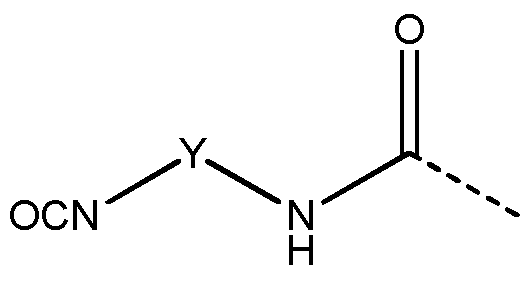
Weitere bevorzugte Beispiele für B sind Strukturen der allge¬ meinen Formeln
Figure imgf000010_0001
Figure imgf000010_0002
(3) und
Figure imgf000011_0001
wobei
X gleich oder verschieden sein kann und einen Alkylen-Rest mit 1 bis 20 Kohlenstoffatomen, in dem einander nicht benachbarte Methyleneinheiten durch Gruppen -0- ersetzt sein können, bedeutet,
A gleich oder verschieden sein kann und Sauerstoffatom,
Schwefelatom oder eine Aminogruppe -NRX- bedeutet,
R gleich oder verschieden sein kann und Wasserstoffatom oder einen Alkylrest mit 1 bis 10 Kohlenstoffatomen bedeutet,
R" gleich oder verschieden sein kann und Wasserstoffatom oder einen Alkylrest mit 1 bis 20 Kohlenstoffatomen bedeutet,
Y gleich oder verschieden sein kann und einen zweiwertigen, gegebenenfalls durch Fluor oder Chlor substituierten Kohlenwasserstoffrest mit 1 bis 20 Kohlenstoffatomen bedeutet und
f 0, 1, 2 oder 3 ist.
Bevorzugt handelt es sich bei Rest B um Strukturen der allge¬ meinen Formeln (3) oder (4) oder um Wasserstoffatome .
Bevorzugt ist Komponente (A) farblos.
Bevorzugt handelt es sich bei Komponente (A) um thermoplasti¬ sche amorphe Copolymere, besonders bevorzugt um solche, bei de¬ nen die Temperatur, bei welcher der Verlustfaktor (G"/Gx) den Wert von 1 einnimmt, bevorzugt maximal 40 °K, besonders bevor¬ zugt maximal 20 °K, unterhalb der Verarbeitungstemperatur der erfindungsgemäßen Zusammensetzung ist. Bevorzugt liegt dabei der Verlustfaktor der Komponente (A) bei der Massetemperatur der Schmelze der erfindungsgemäßen Zusammensetzung während des Mischprozesses unterhalb von 5, beson¬ ders bevorzugt unterhalb von 3, ganz besonders bevorzugt unter- halb von 2. Dadurch wird gewährleistet, dass die Komponente (A) noch einen elastischen Film auf den Anlagenteilen, wie z.B. der Düsenoberfläche, bildet, so dass sich hier eine besondere Wirk¬ samkeit ergibt. Der Verlustfaktor wird in der DIN EN ISO 6721-1:2011 beschrieben. Die Bestimmung des Verlustfaktors erfolgt nach der DIN EN ISO 6721-2:2008 inklusive mitgeltender Unterlagen. Dabei wird die Bestimmung des Verlustfaktors bei einer Frequenz von 1 Hz bestimmt sowie in einem Temperaturbereich von 20°C bis 250°C mittels Normprobekörpern gemäß Abschnitt 6.2. der DIN EN ISO 6721-2:2008 durchgeführt. Wahlweise kann die Bestimmung des Verlustfaktors auch mittels der ISO 6721-10 inklusive mitgel¬ tender Unterlagen bei einer Frequenz von 1 Hz und einer Deformation unter 1 % erfolgen.
Erfindungsgemäß eingesetzte Copolymere der Formel (1) sind be¬ reits bekannt und werden bevorzugt nach Verfahren gemäß dem Stand der Technik hergestellt, wie z.B. in EP-A 250248, EP-A 822951 oder DE-A 10137855 beschrieben, besonders bevorzugt wie in DE-A 10137855 beschrieben.
Bei der erfindungsgemäß eingesetzten Komponente (A) beträgt der Gehalt an Diorganylsiloxy-Einheiten bevorzugt zwischen 80 und 99 Gew.-%, besonders bevorzugt zwischen 90 und 99 Gew . ~6 , ganz besonders bevorzugt zwischen 95 und 99 Gew.-%.
Beispiele für Siloxan-Organo-Copolymere (A) der Formel (1) sind (C2H5O) 3-Si-C3H6-NH-CO- [NH- (CH2) 3-Si (CH3) 2- (O-Si (CH3) 2) 35-45- (CH2) 3- NH-CO-NH-p-C6H1o-CH2-p-C6H1o-NH-CO] 40-70-NH (CH2) 3SiMe2 (OSiMe2) 35-45- (CH2) 3-NH-CO-NH-C3H6-Si (OC2H5) 3, (H3CO) 3-Si-C3H6-NH-CO- [NH- (CH2) 3-Si (CH3) 2- (O-Si (CH3 ) 2 ) 35-45- (CH2) 3- NH-CO-NH-p-C6H1o-CH2-p-C6H1o-NH-CO] 40-70-NH (CH2) 3SiMe2 (OSiMe2) 35- 45 (CH2) 3-NH-CO-NH-C3H6-Si (OCH3) 3,
(C2H5O) 3-Si-CH2-NH-CO- [NH- (CH2) 3-Si (CH3) 2- (O-Si (CH3 ) 2 ) 35-45- (CH2) 3- NH-CO-NH-p-C6H1o-CH2-p-C6H1o-NH-CO] 40-70-NH (CH2) 3SiMe2 (OSiMe2) 35-45- (CH2) 3-NH-CO-NH-CH2-Si (OC2H5) 3,
(H5C2O) s-Si-CsHg-NH-CO-NH-p-CeHio-CHz-p-CeHio-NH-CO- [NH- (CH2) 3- Si (CH3) 2- (O-Si (CH3) 2) 35-45- (CH2) 3-NH-CO-NH-p-C6H1o-CH2-p-C6H1o-NH- CO] 40-70- [NH- (CH2) 3-Si (CH3) 2- (O-Si (CH3) 2) 35-45- (CH2) 3-NH-CO-NH-p- C6H1o-CH2-p-C6H1o-NH] -CO-NH-C3H6-Si (OC2H5) 3,
(H5C2O) s-Si-CHz-NH-CO-NH-p-CeHio-CHz-p-CeHio-NH-CO- [NH- (CH2) 3- Si (CH3) 2- (O-Si (CH3) 2) 35-45- (CH2) 3-NH-CO-NH-p-C6H1o-CH2-p-C6H1o-NH- CO] 40-70- [NH- (CH2) 3-Si (CH3) 2- (O-Si (CH3) 2) 35-45- (CH2) 3-NH-CO-NH-p- C6H1o-CH2-p-C6H1o-NH] -CO-NH-CH2-Si (OC2H5) 3,
(H3CO) s-Si-CsHg-NH-CO-NH-p-CeHio-CHz-p-CeHio-NH-CO- [NH- (CH2) 3- Si (CH3) 2- (O-Si (CH3) 2) 35-45- (CH2) 3-NH-CO-NH-p-C6H1o-CH2-p-C6H1o-NH- CO] 40-70- [NH- (CH2) 3-Si (CH3) 2- (O-Si (CH3) 2) 35-45- (CH2) 3-NH-CO-NH-p- C6H1o-CH2-p-C6H1o-NH] -CO-NH-C3H6-Si (OCH3) 3,
H3C (H3CO) 2-Si-C3H6-NH-CO-NH-p-C6H1o-CH2-p-C6H1o-NH-CO- [NH- (CH2) 3- Si (CH3) 2- (O-Si (CH3) 2) 35-45- (CH2) 3-NH-CO-NH-p-C6H1o-CH2-p-C6H1o-NH- CO] 40-70- [NH- (CH2) 3-Si (CH3) 2- (O-Si (CH3) 2) 35-45- (CH2) 3-NH-CO-NH-p- C6H1o-CH2-p-C6H1o-NH] -CO-NH-C3H6-Si (OCH3) 2CH3, n-C4H9-NH-CO-NH-p-C6H1o-CH2-p-C6H1o-NH-CO- [NH- (CH2) 3-Si (CH3) 2- (0- Si (CH3) 2) 35-45- (CH2) 3-NH-CO-NH-p-C6H1o-CH2-p-C6H1o-NH-CO] 40-70- [NH- (CH2) 3-Si (CH3) 2- (O-Si (CH3) 2) 35-45- (CH2) 3-NH-CO-NH-p-C6Hio-CH2-p-C6Hio- NCO,
(C2H5O) 3-Si-C3H6-NH-CO- [NH- (CH2) 3-Si (CH3) 2- (O-Si (CH3) 2) 35-45- (CH2) 3- NH-CO-NH-C10H18-NH-CO] 25-35-NH (CH2) 3SiMe2 (OSiMe2) 35-45 (CH2) 3-NH-CO-NH- C3H6-Si (OC2H5)3, (C2H5O) 3-S1-CH2-NH-CO- [NH- (CH2) 3-Si (CH3) 2- (O-Si (CH3) 2) 35-45- (CH2) 3-
NH-CO-NH-C10H18-NH-CO] 25-35-NH (CH2) 3SiMe2 (OSiMe2) 35-45 (CH2) 3-NH-CO-NH- CH2-Si (OC2H5)3,
(H3CO) 3-Si-C3H6-NH-CO- [NH- (CH2) 3-Si (CH3) 2- (O-Si (CH3) 2) 35-45- (CH2) 3- NH-CO-NH-Ci0H18-NH-CO] 25-35-NH (CH2) 3SiMe2 (OSiMe2) 35-45 (CH2) 3-NH-CO-NH- C3H6-Si (OCH3)3,
(H3CO) 3-Si-C3H6-NH-CO- [NH- (CH2) 3-Si (CH3) 2- (O-Si (CH3) 2) 35-45- (CH2) 3- NH-CO-NH-Ci0H18-NH-CO] 25-35- [NH-C6H12-NH-CO-NH-Ci0H18-NH-CO] 5-10- NH (CH2) 3SiMe2 (OSiMe2) 35-45- (CH2) 3-NH-CO-NH-C3H6-Si (OCH3) 3,
(H3CO) 3-Si-C3H6-NH-CO-NH-CioH18-NH-CO- [NH- (CH2) 3-Si (CH3) 2- (O-
Si (CH3) 2) 35-45- (CH2) 3-NH-CO-NH-C10H18-NH-CO] 25-35 [NH- (CH2) 3-Si (CH3) 2-
(O-Si (CH3) 2) 35-45- (CH2) 3-NH-CO-NH-C10H18-NH] -CO-NH-C3H6-Si (OCH3) 3,
H3C (H3CO) 2-Si-C3H6-NH-CO-NH-CioH18-NH-CO- [NH- (CH2) 3-Si (CH3) 2- (O- Si (CH3) 2) 35-45- (CH2) 3-NH-CO-NH-C10H18-NH-CO] 25-35-NH- (CH2) 3-Si (CH3) 2- (O-Si (CH3) 2) 35-45- (CH2) 3-NH-CO-NH-C10H18-NH-CO-NH-C3H6-Si (OCH3) 2CH3, (H5C2O) 3-Si-C3H6-NH-CO-NH-CioH18-NH-CO- [NH- (CH2) 3-Si (CH3) 2- (O-
Si (CH3) 2) 35-45- (CH2) 3-NH-CO-NH-C10H18-NH-CO] 25-35-NH- (CH2) 3-Si (CH3) 2- (O-Si (CH3) 2) 35-45- (CH2) 3-NH-CO-NH-C10H18-NH-CO-NH-C3H6-Si (OC2H5) 3, (C2H5O) 3-Si-C3H6-NH-CO- [NH- (CH2) 3-Si (CH3) 2- (O-Si (CH3) 2) 35-45- (CH2) 3- NH-CO-NH-C6H12-NH-CO] 25-35-NH (CH2) 3SiMe2 (OSiMe2) 35-45 (CH2) 3-NH-CO-NH- C3H6-Si (OC2H5)3, (C2H50) 3-Si-CH2-NH-CO- [NH- (CH2) 3-Si (CH3) 2- (O-Si (CH3) 2) 35-45- (CH2) 3- NH-CO-NH-C6H12-NH-CO] 25-35-NH (CH2) 3SiMe2 (OSiMe2) 35-45 (CH2) 3-NH-CO-NH- CH2-Si (OC2H5)3,
(H3CO) 3-Si-C3H6-NH-CO- [NH- (CH2) 3-Si (CH3) 2- (O-Si (CH3) 2) 35-45- (CH2) 3- NH-CO-NH-C6H12-NH-CO] 25-35-NH (CH2) 3SiMe2 (OSiMe2) 35-45 (CH2) 3-NH-CO-NH- C3H6-Si (OCH3)3,
(H3CO) 3-Si-C3H6-NH-CO-NH-C6H12-NH-CO- [NH- (CH2) 3-Si (CH3) 2- (0- Si (CH3) 2) 35-45- (CH2) 3-NH-CO-NH-C6H12-NH-CO] 25-35-NH- (CH2) 3-Si (CH3) 2- (O-Si (CH3) 2) 35-45- (CH2) 3-NH-CO-NH-C6H12-NH-CO-NH-C3H6-Si (OCH3) 3,
H3C (H3CO) 2-Si-C3H6-NH-CO-NH-C6H12-NH-CO- [NH- (CH2) 3-Si (CH3) 2- (0- Si (CH3 ) 2 ) 35-45- (CH2) 3-NH-CO-NH-C6H12-NH-CO] 25-35-NH- (CH2) 3-Si (CH3) 2- (O-Si (CH3 ) 2 ) 35-45- (CH2) 3-NH-CO-NH-C6H12-NH-CO-NH-C3H6-Si (OCH3) 2CH3,
(H5C2O) 3-Si-C3H6-NH-CO-NH-C6H12-NH-CO- [NH- (CH2) 3-Si (CH3) 2- (0-
Si (CH3) 2) 35-45- (CH2) 3-NH-CO-NH-C6H12-NH-CO] 25-35-NH- (CH2) 3-Si (CH3) 2-
(O-Si (CH3) 2) 35-45- (CH2) 3-NH-CO-NH-C6H12-NH-CO-NH-C3H6-Si (OC2H5) 3, (C2H5O) 3-Si-C3H6-NH-CO- [NH- (CH2) 3-Si (CH3) 2- (O-Si (CH3) 2) 130-155- (CH2) 3- NH-CO-NH-p-C6H1o-CH2-p-C6H1o-NH-CO] 10-20-NH (CH2) 3SiMe2 (OSiMe2) 130- 155 (CH2) 3-NH-CO-NH-C3H6-Si (OC2H5) 3,
(C2H5O) 3-S1-CH2-NH-CO- [NH- (CH2) 3-Si (CH3) 2- (O-Si (CH3) 2) 130-155- (CH2) 3- NH-CO-NH-p-C6H1o-CH2-p-C6H1o-NH-CO] 8-20-NH (CH2) 3SiMe2 (OSiMe2) 130- 155 (CH2) 3-NH-CO-NH-CH2-Si (OC2H5) 3, (C2H5O) 3-Si-C3H6-NH-CO- [NH- (CH2) 3-Si (CH3) 2- (O-Si (CH3) 2) 130-155- (CH2) 3- NH-CO-NH-p-C6H1o-CH2-p-C6H1o-NH-CO] 8_20- [NH-CH2-CH2-NH-CO-NH-p- CgHio-CHs-p-CgHio- H-CO] 3-8-NH (CH2) 3SiMe2 (OSiMe2) 130-i55 (CH2) 3-NH-CO- NH-C3H6-Si (OC2H5)3,
(C2H50) 3-Si-CH2-NH-CO- [NH- (CH2) 3-Si (CH3) 2- (O-Si (CH3) 2) 130-155- (CH2) 3- NH-CO-NH-p-C6Hio-CH2-p-C6Hio-NH-CO] 8_20- [NH-CH2-CH2-NH-CO-NH-p- C6Hio-CH2-p-C6Hio-NH-CO] 3-8-NH (CH2) 3SiMe2 (OSiMe2) 130-155 (CH2) 3-NH-CO- NH-CH2-Si (OC2H5)3, n-C4H9-NH-CO-NH-p-C6Hio-CH2-p-C6Hio-NH-CO- [NH- (CH2) 3-Si (CH3) 2- (0- Si (CH3) 2) 120-155- (CH2) 3-NH-CO-NH-p-C6Hio-CH2-p-C6Hio-NH-CO] 8_20-NH-n- C4H9, n-C4H9-NH-CO-NH-CioHi8-NH-CO- [NH- (CH2) 3-Si (CH3) 2- (O-Si (CH3) 2) 120-155- (CH2) 3-NH-CO-NH-CioHi8-NH-CO] 8-20-NH-n-C4H9, n-C4H9-NH-CO-NH-C6Hi2-NH-CO- [NH- (CH2) 3-Si (CH3) 2- (O-Si (CH3) 2) 120-155- (CH2) 3-NH-CO-NH-C6Hi2-NH-CO] 8-2o-NH-n-C4H9, n-C4H9-NH-CO-NH-p-C6Hio-CH2-p-C6Hio-NH-CO- [NH- (CH2) 3-Si (CH3) 2- (O- Si (CH3) 2) 120-155- (CH2) 3-NH-CO-NH-p-C6Hio-CH2-p-C6Hio-NH-CO] 8_20- [NH- (CH2) 3-Si (CH3) 2- (O-Si (CH3) 2) 120-155- (CH2) 3-NH-CO-NH-Ci0Hi8-NH-CO] 4-10 NH-n-C4H9, n-C4H9-NH-CO-NH-p-C6Hio-CH2-p-C6Hio-NH-CO- [NH- (CH2) 3-Si (CH3) 2- (O- Si (CH3) 2) 120-155- (CH2) 3-NH-CO-NH-p-C6Hio-CH2-p-C6Hio-NH-CO] 8_20- NH- (CH2) 3-Si (CH3) 2- (O-Si (CH3) 2) 120-155- (CH2) 3-NH2, n-C4H9-NH-CO-NH-Ci0Hi8-NH-CO- [NH- (CH2) 3-Si (CH3) 2- (O-Si (CH3) 2) 120-155- (CH2) 3-NH-CO-NH-CioHi8-NH-CO] 8_20- NH- (CH2) 3-Si (CH3) 2- (O-Si (CH3) 2) 120- 155- (CH2)3-NH2, H- [NH- (CH2) 3-Si (CH3) 2 ~ (O-Si (CH3) 2) 120-155- (CH2) 3-NH-CO-NH-p-C6H10- CH2-p-C6H10-NH-CO] 8-20- [NH- (CH2) 3-Si (CH3) 2 ~ (O-Si (CH3) 2) 120-155- (CH2) 3- NH2, H [NH-CH2) 3-Si (CH3) 2- (O-Si (CH3) 2) 120-155- (CH2) 3-NH-CO-NH-C6H12-NH-CO] 8_ 20- NH- (CH2) 3-Si (CH3) 2- (O-Si (CH3) 2) 120-155- (CH2)3-NH2 und n-C4H9-NH-CO-NH-p-C6H1o-CH2-p-C6H1o-NH-CO- [NH- (CH2) 3-Si (CH3) 2- (0- Si (CH3) 2) 120-155- (CH2) 3-NH-CO-NH-p-C6H10-CH2-p-C6H10-NH-CO] 8_20- [NH- (CH2) 3-Si (CH3) 2- (O-Si (CH3) 2) 120-155- (CH2) 3-NH-CO-NH-C10H18-NH-CO] 4-10 NH- (CH2)3-Si (CH3)2- (O-Si (CH3) 2) 120-155- (CH2)3-NH2.
Der Anteil der Silikoncopolymere (A) in der erfindungsgemäßen Mischung beträgt vorzugsweise zwischen 100 Gew.-ppm und 10000 Gew.-ppm, bevorzugt zwischen 250 Gew.-ppm und 6000 Gew.-ppm, ganz besonders bevorzugt zwischen 500 Gew.-ppm und 4000 Gew.- ppm.
Bei den erfindungsgemäß eingesetzten organischen Fasern (B) handelt es sich bevorzugt um Zellulose enthaltende organische Fasern, wobei organische Fasern mit einem Gehalt an Zellulose von 30 bis 55 Gew.-% besonders bevorzugt sind. Bevorzugt han¬ delt es sich bei den Zellulose enthaltenden organischen Fasern (B) um Zellulose enthaltende Naturfasern, vorzugsweise pflanz- liehen Ursprungs, insbesondere um Holz.
Holz, welches als Komponente (B) eingesetzt werden kann, be¬ steht vorzugsweise aus 30 bis 55 Gew.-% Cellulose, 15 bis 35 Gew.-% Polyose und 15 bis 35 Gew.-% Lignin.
Erfindungsgemäß eingesetzte organische Fasern (B) können belie¬ bige Geometrien annehmen, bevorzugt werden jedoch Fasern, deren Längen/Durchmesser-Verhältnis größer 2 und ganz besonders be¬ vorzugt größer 4 ist.
Beispiele für erfindungsgemäß eingesetzte organische Fasern (B) sind Fasern aus Laub- oder Nadelhölzern wie beispielsweise
Ahorn, Eiche, Zedern, Pinien und Fichte, Fasern aus Gräsern o- der Schalen von Fruchtkörpern oder von anderen Faserpflanzen wie Flachs, Rohrzucker, Erdnusspflanzen, Kokosnüssen, Sisal, Bambus, Hanf und Reisschalen oder Fasern aus Verarbeitungsres- ten von Pflanzenfasern wie z.B. Bagasse. Mischungen der genannten Faserarten können ebenfalls verwendet werden. Die Holz- und Naturfasern können dabei auch als Abfall industrieller Prozesse wie z.B. der Möbel-, Parkett- oder Papierindustrie anfallen. Als erfindungsgemäß eingesetzte Komponente (B) können auch durchaus Holzabfälle wie beispielsweise Rinde, Sägemehl oder Schnittholz eingesetzt werden, die lediglich im Hinblick auf Farbe und Partikelgröße selektiert werden um die gewünschten Eigenschaften der daraus herzustellenden Formteile zu beein- flussen.
Falls als Komponente (B) Holz eingesetzt wird, handelt es sich bevorzugt um Holzfasern oder Holzmehl, besonders bevorzugt um kompaktiertes Holzmehl, insbesondere solches mit einer Parti- kelgröße von 150 ym bis 500 ym.
Längere Holzfasern haben Einfluss auf die Steifigkeit der Form¬ teile, verringern jedoch deren Schlagbeständigkeit. Die kleine¬ ren Partikel haben zwar gewissen Einfluss auf die Steifigkeit, verringern aber dafür die Bruchfestigkeit der Formteile. Wegen der Vermeidung von Holzmehlstaub wird erfindungsgemäß kompak¬ tiertes Holzmehl als Komponente (B) bevorzugt eingesetzt. Falls als Komponente (B) Holz eingesetzt wird, liegt dessen Wassergehalt vorzugsweise bei 6 bis 8 Gew.-%, kann aber durch Trocknen auf einen bevorzugten Bereich von 0,5 bis 2,0 Gew.-% reduziert werden. Gegebenenfalls kann das zu verwendende Holz durch Vermählen in Kugelmühlen oder ähnlichem zu Pulver zerkleinert werden.
Der Anteil der organischen Fasern (B) in der erfindungsgemäßen Mischung beträgt bevorzugt zwischen 30 und 90 Gew.-%, besonders bevorzugt zwischen 45 und 85 Gew.-%, insbesondere zwischen 50 und 70 Gew.-%.
Bei den erfindungsgemäßen Polymeren (C) kann es sich um beliebige und bisher bekannte, gegebenenfalls substituierte Polymere handeln, deren Polymerrückgrat aus Kohlenstoff-Kohlenstoff- Bindungen besteht.
Bevorzugt handelt es sich bei Komponente (C) um gegebenenfalls mit Chlorresten, Alkyl-Gruppen, Alkylcarbonsäureester-Gruppen, Nitril-Gruppen oder Phenyl-Gruppen substituierte Polyolefine, besonders bevorzugt um gegebenenfalls mit Chlorresten oder Me¬ thyl-Gruppen substituierte Polyalkylene.
Bevorzugte Monomere zur Herstellung von Komponente (C) sind Ethylen, Propylen, Vinylchlorid, Vinylacetat, Methylmethac- rylat, Acrylnitril, Styrol, 1-Buten, 1-Hexen, 1-Octen oder Butadien oder deren Mischungen, besonders bevorzugt Ethylen, Propylen oder Vinylchlorid.
Beispiele für die erfindungsgemäß eingesetzten Polymere (C) sind Polyolefine, wie zum Beispiel Polyethylene niederer und hoher Dichte (LDPE, LLDPE, HDPE) , Homo- und Copolymere des Pro- pylens mit beispielsweise Ethylen, Buten, Hexen und Octen (PP) , Olefincopolymere wie zum Beispiel Ethylen-Methylacrylat- Copolymer (EMA) , Polymethacrylate wie Polymethylmethacrylat (PMMA), ferner Polyvinylchlorid (PVC) sowie Polystyrole (PS, HIPS, EPS) und Styrolcopolymere , beispielsweise Polymere von Acrylnitril-Butadien-Styrol (ABS) , Acrylester-Acrylnitril- Styrol (ASA) und Acrylnitril-Styrol (SAN Polymere von Acryl- nitril-Butadien-Methylmethacrylat-Styrol (MABS) , Acrylnitril- Methylmethacrylat (AMMA) , Methylacrylat-Vinylchlorid (VC/MA) und Methylmethacrylat-Vinylchlorid (VC/MMA) .
Bei den erfindungsgemäß eingesetzten Polyolefinen (C) handelt es sich bevorzugt um HDPE oder Polypropylen, besonders bevor- zugt um Polypropylen.
Bei den erfindungsgemäß eingesetzten substituierten Polyolefinen (C) handelt es sich bevorzugt um Polyvinylchlorid (PVC) oder Polymethylmethacrylat, besonders bevorzugt um PVC.
Die erfindungsgemäß eingesetzten organischen Polymere (C) sind bevorzugt thermoplastisch, d.h. die Temperatur, bei welcher der Verlustfaktor (G"/Gx) gemäß DIN EN ISO 6721-2:2008 den Wert von 1 einnimmt, beträgt bevorzugt mindestens 40°C, besonders bevor- zugt mindestens 100°C.
Die erfindungsgemäß eingesetzten organischen Polymere (C) be¬ sitzen bevorzugt einen Elastizitätsmodul (nach ISO 527) von größer 1000 MPa.
Die polymere Struktur der organischen Polymere (C) kann linear aber auch verzweigt sein. Die Art der eingesetzten organischen Polymere (C) bestimmt im Wesentlichen die Verarbeitungstemperatur der erfindungsgemäßen Mischung . Der Anteil der organischen Polymere (C) in der erfindungsgemä¬ ßen Mischung beträgt vorzugsweise 10 Gew.-% bis 70 Gew.-%, be¬ vorzugt 15 Gew.-% bis 55 Gew.-%, ganz besonders bevorzugt 30 bis 50 Gew.-%. Bei der erfindungsgemäß eingesetzten Komponente (C) handelt es sich um handelsübliche Produkte bzw. können nach in der Chemie gängigen Verfahren hergestellt werden.
Bevorzugt werden als erfindungsgemäß eingesetzte Komponente (C) sowohl unsubstituierte Polyolefine als auch substituierte Po- lyolefine eingesetzt. Besonders bevorzugt handelt es sich bei einem Teil der erfindungsgemäß eingesetzten Komponente (C) um Polyolefine, deren Polymerrückgrat teilweise mit Säureanhydrid- Gruppen substituiert sind, ganz besonders bevorzugt handelt es sich dabei um Polyolefine, die teilweise Maleinsäureanhydrid¬ oder Bernsteinsäureanhydrid-Gruppen tragen. Beispiele dafür sind kommerziell erhältliche Produkte aus der Lotader®- und der Orevac®-Produktlinie von ARKEMA SA (F-Colombes) , Produkte der ADMER®-Familie von Mitsui&Co Deutschland GmbH (D-Düsseldorf) oder Produkte der SCONA® Produktreihe von BYK Kometra GmbH (D- Schkopau) .
Wenn als Teil der Komponente (C) Säureanhydrid-Gruppen substituierte Polyolefine eingesetzt werden, dann werden diese vor- zugsweise in Mengen von 0,1 Gew.-% bis 5 Gew.-%, besonders be¬ vorzugt in Mengen von 0,5 Gew.-% bis 3 Gew.-% und ganz besonders bevorzugt in Mengen von 1 Gew.-% bis 2,5 Gew.-% einge- setzt, jeweils bezogen auf das Gesamtgewicht der erfindungsge¬ mäßen Mischung.
Zusätzlich zu den Komponenten (A) , (B) und (C) können die er- findungsgemäßen Mischungen weitere Stoffe enthalten, wie z.B. anorganische Fasern (D) , Flammschutzmittel (E) , Biozide (F) , Pigmente (G) , UV-Absorber (H) und HALS-Stabilisatoren (I).
Beispiele für erfindungsgemäß gegebenenfalls eingesetzte anor- ganische Fasern (D) sind Glasfasern, Basaltfasern oder Wollas- tonit, wobei Glasfasern bevorzugt sind.
Falls anorganische Fasern (D) eingesetzt werden, handelt es sich um Mengen von bevorzugt 1 bis 30 Gew.-%, besonders bevor- zugt 5 bis 15 Gew.-%. Die erfindungsgemäßen Mischungen enthalten bevorzugt keine Komponente (D) .
Beispiele für erfindungsgemäß gegebenenfalls eingesetzte Flamm¬ schutzmittel (E) sind organische Flammschutzmittel auf Basis halogenierter organischer Verbindungen oder anorganische Flammschutzmittel z.B. Aluminiumhydroxid (ATH) oder Magnesiumhydro¬ xid.
Falls Flammschutzmittel (E) eingesetzt werden, sind anorgani- sehe Flammschutzmittel wie ATH bevorzugt.
Beispiele für erfindungsgemäß gegebenenfalls eingesetzte Biozi¬ de (F) sind anorganische Fungizide, wie Borate wie z.B. Zinkbo¬ rat, oder organische Fungizide wie z.B. Thiabendazol.
Beispiele für erfindungsgemäß gegebenenfalls eingesetzte Pig¬ mente (G) sind organische Pigmente oder anorganische Pigmente wie z.B. Eisenoxide oder Titandioxid. Falls Pigmente (G) eingesetzt werden, handelt es sich um Mengen von bevorzugt 0,2 bis 7 Gew.-%, besonders bevorzugt 0,5 bis 3 Gew.-%. Bevorzugt werden Pigmente (G) eingesetzt, insbesondere in Form einer Vormischung mit Komponente (C) .
Beispiele für erfindungsgemäß gegebenenfalls eingesetzte UV- Absorber (H) sind Benzophenone, Benzotriazole oder Triazine.
Falls UV-Absorber (H) eingesetzt werden, sind Benzotriazole und Triazine bevorzugt.
Beispiele für erfindungsgemäß gegebenenfalls eingesetzte HALS- Stabilisatoren (I) sind z.B. Piperidin oder Piperidyl-Derivate und sind u.a. unter dem Markennamen Tinuvin (BASF, D-Ludwigshafen) erhältlich.
Bevorzugt handelt es sich bei den erfindungsgemäßen Mischungen um solche enthaltend
(A) amorphe Siloxan-Organo-Copolymere der Formel (1),
(B) organische Fasern,
(C) sowohl unsubstituierte Polyolefine als auch substituierte Polyolefine,
gegebenenfalls (D) anorganische Fasern,
gegebenenfalls (E) Flammschutzmittel,
gegebenenfalls (F) Biozide,
gegebenenfalls (G) Pigmente,
gegebenenfalls (H) UV-Absorber und
gegebenenfalls (I) HALS-Stabilisatoren .
Besonders bevorzugt handelt es sich bei den erfindungsgemäßen Mischungen um solche enthaltend
(A) amorphe Siloxan-Organo-Copolymere der Formel (1), (B) Holzfasern,
(C) sowohl unsubstituierte Polyolefine als auch substituierte Polyolefine,
gegebenenfalls (D) anorganische Fasern,
gegebenenfalls (E) Flammschutzmittel,
gegebenenfalls (F) Biozide,
(G) Pigmente,
gegebenenfalls (H) UV-Absorber und
gegebenenfalls (I) HALS-Stabilisatoren .
In einer weiteren besonders bevorzugten Ausführungsform handelt es sich bei den erfindungsgemäßen Mischungen um solche enthaltend
(A) amorphe Siloxan-Organo-Copolymere der Formel (1),
(B) Holzfasern,
(C) sowohl unsubstituierte Polyolefine als auch substituierte Polyolefine,
(F) Biozide,
(G) Pigmente und
(H) UV-Absorber.
Die erfindungsgemäßen Mischungen enthalten über die Komponenten (A) bis (I) hinausgehend bevorzugt keine weiteren Bestandteile.
Bei den einzelnen Bestandteilen der erfindungsgemäßen Mischungen kann es sich jeweils um eine Art eines solchen Bestandteils wie auch um ein Gemisch aus mindestens zwei verschiedenen Arten derartiger Bestandteile handeln.
Die erfindungsgemäßen Mischungen können nach beliebigen und bisher bekannten Verfahren hergestellt werden, wie z.B. Vermischen der Komponenten in beliebiger Reihenfolge. Hierzu können Mischer oder Kneter oder Extruder nach dem Stand der Technik verwendet werden.
Ein weiterer Gegenstand der vorliegenden Erfindung ist ein Ver- fahren zur Herstellung der erfindungsgemäßen Mischungen durch Vermischen der Komponenten (A) , (B) und (C) sowie gegebenenfalls weiteren Komponenten, bevorzugt ausgewählt aus den Kompo¬ nenten (D) bis (I), in beliebiger Reihenfolge. Das erfindungsgemäße Verfahren kann in Anwesenheit oder Abwe¬ senheit von Lösungsmittel stattfinden, wobei die lösungsmittel¬ freie Herstellung bevorzugt ist.
Das erfindungsgemäße Verfahren kann kontinuierlich, diskontinu- ierlich oder semikontinuierlich durchgeführt werden, bevorzugt jedoch kontinuierlich.
Das erfindungsgemäße Verfahren wird bevorzugt in kontinuierlich arbeitenden Knetern oder Mischern oder Extrudern durchgeführt, wobei die erfindungsgemäß zu mischenden Einzelkomponenten ent¬ weder in Reinform oder als Vormischung jeweils gravimetrisch oder volumetrisch dem Mischaggregat kontinuierlich zugeführt werden. Komponenten, die in der Gesamtmischung mit einem Anteil von unter 1 Gew.-% enthalten sind, werden bevorzugt als Vormi- schung in einer der Komponenten mit einem größeren Anteil zugeführt .
Die Temperaturen, bei denen das erfindungsgemäße Verfahren durchgeführt wird, hängen in erster Linie von den eingesetzten Komponenten ab und sind dem Fachmann bekannt, mit der Maßgabe, dass sie unterhalb der spezifischen Zersetzungstemperaturen der einzelnen eingesetzten Komponenten liegen. Bevorzugt wird das erfindungsgemäße Verfahren bei Temperaturen unterhalb von 250°C, besonders bevorzugt im Bereich von 150 bis 220°C, durch¬ geführt .
Das erfindungsgemäße Verfahren wird bevorzugt beim Druck der umgebenden Atmosphäre, also zwischen 900 und 1100 hPa, durchge¬ führt. Es können aber auch höhere Drücke angewendet werden, die insbesondere vom verwendeten Mischaggregat abhängen. So ist der Druck in unterschiedlichen Bereichen der verwendeten Kneter, Mischer oder Extruder beispielsweise deutlich größer als 1000 hPa.
In einer bevorzugten Ausführungsform des erfindungsgemäßen Verfahrens wird Komponente (A) in einem sogenannten Masterbatch als Vormischung mit einem Teil des organischen Polymeren (C) sowie gegebenenfalls einer oder mehreren der Komponenten (D) bis (I) eingesetzt. Vorzugsweise wird diese Vormischung durch Vermischen der Komponenten (A) , (C) sowie gegebenenfalls einer oder mehreren der Komponenten (D) bis (I) bei Temperaturen zwischen 140°C und 230°C hergestellt, wobei das Vermischen konti- nuierlich, diskontinuierlich oder semikontinuierlich durchgeführt werden kann. Für den Mischvorgang können Mischer, Kneter oder Extruder nach dem Stand der Technik verwendet werden.
Bevorzugt wird das Vermischen der Komponenten (A) und (C) kon- tinuierlich in einem Extruder oder Kneter nach dem Stand der Technik durchgeführt. Bevorzugt ist in dieser Vormischung das Copolymer (A) in einer Menge zwischen 5 und 35 Gew.-%, besonders bevorzugt zwischen 10 und 30 Gew.-%, insbesondere bevor¬ zugt zwischen 15 und 25 Gew.-%, jeweils bezogen auf das Gewicht der Vormischung, enthalten.
Die erfindungsgemäß hergestellte Vormischung liegt dabei bevor¬ zugt in Granulatform oder in Pulverform vor, bevorzugt jedoch in Granulatform. Durch mechanisches Vermählen kann das Granulat auch zu einem Pulver verarbeitet werden bzw. durch eine entsprechende Granulierungsanlage auch als Mikrogranulat erhalten werden .
Bei dem erfindungsgemäßen Verfahren wird die so erhaltene Vormischung dann mit den restlichen Teilen der Komponente (C) , Komponente (F) und gegebenenfalls einer oder mehreren der Kom¬ ponenten (D) bis (I) bevorzugt kontinuierlich in einen beheiz- baren Mischer gefördert. Dabei können die Komponenten separat zum Mischer zugegeben werden oder zusammen zugegeben werden. Das Mischen bzw. Homogenisieren der Einzelkomponenten findet dann bevorzugt bei Temperaturen von 150 bis 210°C, besonders bevorzugt bei 180 bis 210°C statt.
Nach dem Mischprozess der Einzelkomponenten wird bevorzugt die erfindungsgemäße Zusammensetzung dann als heiße, hochviskose Schmelze über eine Düse aus dem Reaktor ausgetragen. Dabei wird in einem bevorzugten Verfahren das Material nach dem Austritt mittels eines Kühlmediums abgekühlt und anschließend zerklei¬ nert bzw. granuliert. Hierbei können das Abkühlen des Materials und das Granulieren simultan durch eine Unterwassergranulierung erfolgen oder nacheinander. Als bevorzugte Kühlmedien werden entweder Wasser oder Luft verwendet. Bevorzugte Verfahren zur Granulierung sind dabei Unterwassergranulierung, Granulierung mittels Luftabschlag bzw. Stranggranulierung . Die erhaltenen Granulate haben ein Gewicht von bevorzugt weniger als 0,5 g, besonders bevorzugt weniger als 0,25 g, insbesondere weniger als 0,125 g. Bevorzugt sind die erfindungsgemäß erhaltene Gra- nulate zylinderförmig oder kugelförmig.
Die so erhaltenen Granulate können in einem nachfolgenden
Schritt mittels einer weiteren thermoplastischen Verarbeitung zu einem Formkörper, bevorzugt einem Profil, extrudiert werden Dabei werden nach einer bevorzugten Verfahrensweise die erfindungsgemäßen Zusammensetzungen in Form eines Granulates kontinuierlich in einen Kneter oder Extruder nach dem Stand der Technik gefördert, in diesem Kneter oder Extruder durch Temperatureinwirkung erwärmt und plastifiziert und anschließend durch eine Düse gepresst, die die gewünschte Profilform vor¬ gibt. So können hier je nach Auslegung der Düse entweder Vollprofile aber auch Hohlprofile gefertigt werden.
Ein weiterer Gegenstand der Erfindung sind Formkörper hergestellt durch Extrusion der erfindungsgemäßen Mischungen.
In einer bevorzugten Ausführung wird die erfindungsgemäße Zu- sammensetzung direkt über eine passende Düse kontinuierlich als Profil extrudiert, welches dann ebenfalls nach Abkühlen abge¬ längt bzw. zugeschnitten werden kann.
Bei der Herstellung der erfindungsgemäßen Zusammensetzung kön- nen Mischer oder Kneter oder Extruder nach dem Stand der Technik verwendet werden.
Die erhaltenen Mischungen sind bevorzugt thermoplastisch, d.h. die Temperatur, bei welcher der Verlustfaktor (G"/Gx) gemäß DIN EN ISO 6721-2:2008 den Wert von 1 einnimmt, beträgt bevorzugt mindestens 40°C, besonders bevorzugt mindestens 100°C.
Die erhaltenen Mischungen besitzen bevorzugt einen Elastizitätsmodul (nach ISO 527) von größer 1000 MPa.
Die erfindungsgemäßen Mischungen zeigen hervorragende Eigenschaften bezüglich Steifigkeit und eine geringe Wasseraufnahme, wodurch die Mischungen vor allem in Außenanwendungen eingesetzt werden können.
Die erfindungsgemäßen Mischungen können überall dort verwendet werden, wo auch bisher sogenannte WPC eingesetzt wurden.
Bevorzugte Anwendungen der erfindungsgemäßen Polymermischungen sind Verwendungen als Bestandteil für Profile im Baubereich, oder als Compound für Automobil-Innenraum-Anwendungen.
Die erfindungsgemäßen Zusammensetzungen haben den Vorteil, dass sie einfach in der Herstellung sind.
Die erfindungsgemäßen Zusammensetzungen haben ferner den Vor- teil, dass ihre Wasseraufnahme gering ist.
Die erfindungsgemäßen Zusammensetzungen haben den Vorteil, dass durch den Zusatz der siloxanhaltigen Komponente (A) die mechanischen Eigenschaften der fertigen Mischung verbessert werden.
Das erfindungsgemäße Verfahren hat den Vorteil, dass selbst bei höheren Gehalten an organischer Faser der mechanische Abrieb der metallischen Misch- bzw. Extruderelemente stark reduziert ist .
In den nachstehend beschriebenen Beispielen beziehen sich alle Viskositätsangaben auf eine Temperatur von 25°C. Sofern nicht anders angegeben, werden die nachstehenden Beispiele bei einem Druck der umgebenden Atmosphäre, also etwa bei 1000 hPa, und bei Raumtemperatur, also bei etwa 23°C, bzw. bei einer Tempe¬ ratur, die sich beim Zusammengeben der Reaktanden bei Raumtemperatur ohne zusätzliche Heizung oder Kühlung einstellt, sowie bei einer relativen Luftfeuchtigkeit von etwa 50 % durchge- führt. Des Weiteren beziehen sich alle Angaben von Teilen und Prozentsätzen, soweit nichts anderes angegeben ist, auf das Gewicht . In den Beispielen werden folgende Produkte verwendet:
Polymer Cl : Polypropylen mit einem Schmelzpunkt von 163°C
(käuflich erhältlich unter der Bezeichnung „PP HC205TF" bei der Borealis AG, A-Wien) ;
Copolymer AI : amorphes Harnstoff-Siloxan-Copoylmer (käuflich erhältlich unter der Bezeichnung GENIOMER® 345 bei der Wacker Chemie AG, D-München) ; Die Temperatur, bei der der Verlustfaktor (G"/Gx) gemäß ISO 6721-10 den Wert von 1 einnimmt liegt hier bei 184°C (Messfrequenz 1Hz, Deformation 0,1 %) . Der Verlustfaktor bei 190°C liegt bei 1,13;
Copolymer A2 : teilkristallines Harnstoff-Siloxan-Copoylmer mit einem Schmelzpunkt von 161°C (käuflich erhältlich unter der Bezeichnung GENIOMER® 200/50 bei der Wacker Chemie AG, D-
München) ; Die Temperatur, bei der der Verlustfaktor (G"/Gx) gemäß ISO 6721-10 den Wert von 1 einnimmt liegt hier bei 163, 5°C (Messfrequenz 1Hz, Deformation 0,1 %) . Der Verlustfaktor bei 190°C liegt bei 7 ;
Polymer A3: amorphes siliconhaltiges Additiv basierend auf einem linearem Polydimethylsiloxan (käuflich erhältlich unter der Bezeichnung GENIOPLAST® Pellet P bei der Wacker Chemie AG, D-München) ;
PPA1 : Prozesshilfsmittel auf Stearat-Basis (käuflich erhältlich unter der Bezeichnung „PHX369" bei der Chemson Polymer-Additive AG, A-Arnoldstein) ; Faser Bl : Holzfasern (käuflich erhältlich unter der Bezeichnung Lignocell C320 bei der Fa. JRS Rettenmaier & Söhne GmbH und Co. KG, D-Rosenberg) ;
Polymer C2 : Maleinsäureanhydrid funktionalisiertes Polypropylen (käuflich erhältlich unter der Bezeichnung „Scona TPPP 8112 FA" bei der BYK Kometra GmbH, D-Schkopau) ; Pigment 1 : Titandioxid (käuflich erhältlich unter der
Bezeichnung „Titandioxid K 2450" bei der Fa. Kronos
International, D-Leverkusen) ;
Pigment 2 : Eisenoxid (käuflich erhältlich unter der Bezeichnung Bayferrox® 360 bei der Fa. Lanxess, D-Leverkusen) .
Beispiel 1 (Herstellung von Masterbatch I)
1,00 kg Copolymer AI wurden mit 9,00 kg Polymer Cl jeweils in Granulatform vermischt und in einem gegenläufigen Zwei-Wellen Extruder ZK 25 der Fa. Collin (D-Ebersberg) bei einer
Temperatur von 220 °C compoundiert . Dabei betrug die Temperatur im Einzugsbereich (Zone 1) 100°C, wurde in Zone 2 auf 180°C und in Zone 3 auf 220°C gesteigert. Zone 4 und Zone 5 hatten eben¬ falls 220°C, und die Düse wurde auf 210°C temperiert. Die Mi- schung wurde als Strang extrudiert, der anschließend granuliert wurde. Die Austragsgeschwindigkeit betrug 2,2 kg/h. Man erhielt so 9, 85 kg Masterbatch I mit einem Gehalt an Copolymer AI von 10 Gew.-%. Beispiel 2 (Herstellung von Masterbatch II)
1,00 kg Copolymer A2 wurden jeweils in Granulatform mit 9,00 kg Polymer Cl vermischt und in einem gegenläufigen Zwei-Wellen Extruder der Fa. Collin bei einer Temperatur von 220 °C compoun- diert. Dabei betrug die Temperatur im Einzugsbreich (Zone 1)
100°C, wurde in Zone 2 auf 180°C und in Zone 3 auf 220°C ge¬ steigert. Zone 4 und Zone 5 hatten ebenfalls 220°C, und die Dü¬ se wurde auf 210 °C temperiert. Die Mischung wurde als Strang extrudiert, der anschließend granuliert wurde. Die Austragsge- schwindigkeit betrug 2,0 kg/h. Man erhielt so 9,72 kg Master- batch II mit einem Gehalt an Copolymer A2 von 10 Gew.-%.
Beispiele 3-12 (erfindungsgemäße Beispiele 4, 5 und 6)
Mit den in Tabelle 1 genannten Komponenten in den dort angegebenen Mengen (jeweils in Kilogramm) wurden Holzfaser-Compounds hergestellt. Dabei wurden die angegebenen Komponenten jeweils unabhängig voneinander gravimetrisch in einen gleichläufigen
Zwei-Wellenkneter ZSK 26 Mc der Fa. Coperion (Stuttgart, DE) in Zone 1 dosiert. Die Temperatur der Zone 1 betrug dabi 195°C, die Temperatur der Zone 2 betrug 190°C, die Temperatur der Zone 3 betrug 190°C, die Temperatur der Zone 4 betrug 185°C und die Temperatur der Zone 5 betrug ebenfalls 185°C. Die Düsentempera¬ tur betrug 190°C. Die erhaltene Polymerschmelze wurde direkt nach Düsenaustritt mittels einer Anlage zur Unterwassergranu- lierung der Fa. Econ (Weisskirchen/Traun, AT) bei einer Kühlwassertemperatur von 18°C granuliert. Die Austragsgeschwindig- keit der Polymermischung betrug dabei 15 kg/h. Tabelle 1:
Beispiel 3 4 5 6 7 8 9 10 11 12
Masterbatch I 1 5 8
Masterbatch II 1 5 8
Polymer A3 0,5 1
PPA1 2
Polymer Cl 38 37 33 30 37 33 30 37, 5 37 36 Faser Bl 60 60 60 60 60 60 60 60 60 60
Polymer C2 2 2 2 2 2 2 2 2 2 2
Summe der 100 100 100 100 100 100 100 100 100 100 Einzelkomponenten
Isolierte 97, 2 98, 3 98, 4 99, 0 98,2 97, 9 98, 1 96, 4 98, 2 97, 8 Granulatmenge
Beispiele 13-22 (erfindungsgemäße Beispiele 14, 15 und 16)
Die in den Beispielen 3-12 erhaltenen Polymermischungen wurden auf einem gegenläufigen Doppelschneckenextruder (battenfeld
cincinnati Austria, Fiberex K38) mit 20 kg/h gravimetrisch in
Zone 1 dosiert. Die Temperatur der Zone 1 betrug dabei 195°C,
die Temperatur der Zone 2 betrug 170 °C, die Temperatur der Zone
3 betrug 180°C, die Temperatur der Zone 4 betrug 180°C und die
Temperatur der Zone 5 Betrug ebenfalls 180°C. Die
Düsentemperatur betrug 190°C. Die Extruderdrehzahl betrug 20
U/min. Die Massetemperatur betrug dabei jeweils ca. 190°C. Die erhaltene Polymerschmelze wurde nach Düsenaustritt als Profil
mit einer Breite von 80 mm und einer Höhe von 25 mm extrudiert, mittels eines Kühlbandes auf 32 °C abgekühlt und zugeschnitten.
Tabelle 2:
Beispiel 13 14 15 16 17 18 19 20 21 22
Compound aus Beispiel 3 4 5 6 7 8 9 10 11 12
Extrusionsparameter
(Ziel < 130 Wh/kg)
Spez. Leistung
[Wh/kg] 136 127 115 112 121 115 105 136 130 114
Belastung Extruder
[%] 43 39 35, 5 35, 3 38,1 36, 4 33 43 41 35, 3 Massetemperatur in
°C 192 191 198 188 186 187 187 191 190 190
Mechanik
Biege E-Modul [MPa] 3700 4100 3700 3400 2350 2200 2150 3600 3300 3050
Biegefestigkeit
[MPa] 58 63 57 50 30 29 28 58 57 42
Schlagzähigkeit
[N/mm2 ] 8,5 10 9,3 7,5 4,4 4,4 4 8 9, 6 5,9
Wasseraufnahme
(Ziel < 15 %)
28 Tage Lagerung
[%] 14, 9 14, 9 15 14, 9 31 36 37 19 17 22
Beispiele 23-28 (erfindungsgemäße Beispiele 25 bis 28)
Mit den in Tabelle 3 genannten Komponenten in den dort angegebenen Mengen (jeweils in Kilogramm) wurden Holzfaser-Compounds hergestellt. Dabei wurden die angegebenen Komponenten jeweils unabhängig voneinander gravimetrisch in einen gleichläufigen Zwei-Wellenkneter ZSK 26 Mc der Fa. Coperion (D-Stuttgart) in Zone 1 dosiert. Die Temperatur der Zone 1 betrug dabi 195°C, die Temperatur der Zone 2 betrug 190°C, die Temperatur der Zone 3 betrug 190°C, die Temperatur der Zone 4 betrug 185°C, und die Temperatur der Zone 5 betrug ebenfalls 185°C. Die Düsentempera¬ tur betrug 190°C. Die erhaltene Polymerschmelze wurde direkt nach Düsenaustritt mittels einer Anlage zur Unterwassergranu- lierung der Fa. Econ (Weisskirchen/Traun, AT) bei einer Kühlwassertemperatur von 18°C granuliert. Die Austragsgeschwindig- keit der Polymermischung betrug dabei 15 kg/h.
Tabelle 3:
Beispiel 23 24 25 26 27 28
Masterbatch I 3 3 3 3 Polymer Cl 38 38 35 35 35 35
Faser Bl 58 58 58 58 59 59
Polymer C2 2 2 2 2 2 2
Pigment 1 2 2 1
Pigment 2 2 2 1
Summe der 100 100 100 100 100 100
Einzelkomponenten
Isolierte 98,3 98, 1 98,5 97, 2 97,2 98, 9
Granulatmenge
Pellet-Farbe weiß Grauweiß Grauweiß Grauschwarz schwarz schwarz
Beispiele 29-34 (erfindungsgemäße Beispiele 31 bis 34)
Die in den Beispielen 23-28 erhaltenen Polymermischungen wurden auf einem gegenläufigen Doppelschneckenextruder (battenfeld cincinnati Austria, Fiberex K38) mit 20 kg/h gravimetrisch in Zone 1 dosiert. Die Temperatur der Zone 1 betrug dabei 195°C, die Temperatur der Zone 2 betrug 170 °C, die Temperatur der Zone 3 betrug 180°C, die Temperatur der Zone 4 betrug 180°C, und die Temperatur der Zone 5 betrug ebenfalls 180 °C. Die Düsentempera¬ tur betrug 190°C. Die Extruderdrehzahl betrug 20 U/min. Die Massetemperatur betrug dabei jeweils ca. 190°C. Die erhaltene Polymerschmelze wurde nach Düsenaustritt als farbiges Profil mit einer Breite von 80 mm und einer Höhe von 25 mm extrudiert, mittels eines Kühlbandes auf auf 32 °C abgekühlt und
zugeschnitten .
Tabelle 4:
Beispiel 29 30 31 32 33 34
Compound aus Beispiel 23 24 25 26 27 28 Extrusionsparameter
(Ziel < 130 Wh/kg)
Spez. Leistung [Wh/kg] 135 136 114 115 113 115
Belastung Extruder [%] 43 43 35, 6 35, 3 34,8 35, 4
Massetemperatur in °C 192 191 187 188 186 187
Mechanik
Biege E-Modul [MPa] 3550 3580 3700 3720 3680 3650
Biegefestigkeit [MPa] 57 56 60 61 62 61
Schlagzähigkeit
[N/mm2 ] 8,3 8,6 9, 4 9,5 9,2 9,3
Wasseraufnahme
(Ziel < 15 %)
28 Tage Lagerung [%] 15 14, 9 15 14, 9 15, 1 14,8
Die Biegeeigenschaften wurden jeweils gemäß der EN ISO 178 bestimmt. Die Prüfgeschwindigkeit betrug 3 mm/min, die Anzahl der gemessenen Proben waren 6, die Probengröße betrug 80mm x 10mm x 4 mm.
Die Charpy Schlagzähigkeit (ungekerbt ) wurde gemäß EN ISO 179 bestimmt. Das Schlagpendel hatte eine Schlagenergie von 0,5 J. Die Anzahl der gemessenen Proben war 10. Die Probengröße war 80mm x 10 mm x 4 mm. Zur Bestimmung der Wasseraufnahme wurden jeweils 2 Proben mit einer Abmessung von 50 mm x 50 mm x 4 mm bei einer Temperatur von 20 ± 2°C und einer Eintauchzeit von 28 Tagen in VE-Wasser so gelagert, dass diese vom Wasser komplett umschlossen waren. Vor dem Start der Wasserlagerung wurden die Proben in einem Trockenschrank jeweils bei 80°C 72 h lang getrocknet. Nach der oben angeführten Eintauchzeit werden die Proben aus dem Wasserbad genommen und das Wasser auf der Oberfläche abgetupft. Die Berechnung der Wasseraufnahme erfolgt durch Bildung des Quoti- enten aus der Gewichtszunahme nach Wasserlagerung und dem Originalgewicht vor Wasserlagerung.
Die Mischungen der erfindungsgemäßen Beispiele 4, und 5 und 6 bzw. 14, 15 und 16 bzw. 25 bis 28 sind die einzigen Poly- mer/Naturfaser-Compounds , die eine starke Absenkung der Leis¬ tungsaufnahme während der Extrusion mit einer gleichzeitigen Beibehaltung der niedrigen Wasseraufnahme mit akzeptablen mechanischen Kennwerten kombiniert.

Claims

Patentansprüche
1. Mischungen enthaltend
(A) amorphe Siloxan-Organo-Copolymere mit 10 bis 3000 Silo- xaneinheiten pro Siloxansegment und mindestens einem Organoseg- ment mit mindestens einer Gruppe ausgewählt aus Estergruppen, Amid-Gruppen, Urethangruppen, Harnstoffgruppen und Thioharn- stoffgruppen,
(B) organische Fasern und
(C) gegebenenfalls substituierte Polyolefine.
2. Mischungen gemäß Anspruch 1, dadurch gekennzeichnet, dass es
Figure imgf000038_0001
handelt, wobei
R gleich oder verschieden sein kann und einen einwertigen, SiC-gebundenen, gegebenenfalls durch Fluor- oder Chlorsubstituierten Kohlenwasserstoffrest mit 1 bis 20 Kohlen¬ stoffatomen bedeutet,
X gleich oder verschieden sein kann und einen Alkylen-Rest mit 1 bis 20 Kohlenstoffatomen, in dem einander nicht benachbarte Methyleneinheiten durch Gruppen -0- ersetzt sein können, bedeutet, A gleich oder verschieden sein kann und Sauerstoffatom,
Schwefelatom oder eine Aminogruppe -NRX- bedeutet,
Z gleich oder verschieden sein kann und ein Sauerstoffatom oder eine Aminogruppe -NRX- darstellt,
R gleich oder verschieden sein kann und Wasserstoffatom oder einen Alkylrest mit 1 bis 10 Kohlenstoffatomen bedeutet,
Y gleich oder verschieden sein kann und einen zweiwertigen, gegebenenfalls durch Fluor oder Chlor substituierten Kohlenwasserstoffrest mit 1 bis 20 Kohlenstoffatomen bedeutet,
D gleich oder verschieden sein kann und einen zweiwertigen, gegebenenfalls durch Fluor-, Chlor- oder C]_-Cg-Alkylester- gruppen substituierten Kohlenwasserstoffrest bedeutet, in dem einander nicht benachbarte Methyleneinheiten durch Gruppen -0-, -COO-, -OCO- oder -OCOO- ersetzt sein können,
B gleich oder verschieden sein kann und Wasserstoffatom oder einen funktionellen oder nicht-funktionellen organischen oder siliziumorganischen Rest darstellt,
n gleich oder verschieden sein kann und eine Zahl von 10 bis 3000 ist,
a eine Zahl von mindestens 1 ist,
b 0 oder eine Zahl von 1 bis 100 ist,
c 0 oder eine Zahl von 1 bis 100 ist,
d eine Zahl von mindestens 1 ist und
e eine Zahl von 0 oder 1 ist.
3. Mischungen gemäß Anspruch 1 oder 2, dadurch gekennzeichnet, dass Gehalt an Diorganylsiloxy-Einheiten in der Komponente (A) zwischen 80 und 99 Gew.-% liegt.
4. Mischungen gemäß einem oder mehreren der Ansprüche 1 bis 3, dadurch gekennzeichnet, dass der Anteil der Silikoncopolymere (A) in der Mischung zwischen 100 Gew.-ppm und 10000 Gew.-ppm, beträgt .
5. Mischungen gemäß einem oder mehreren der Ansprüche 1 bis 4, dadurch gekennzeichnet, dass es sich bei Komponente (B) um Holz handelt .
6. Mischungen gemäß einem oder mehreren der Ansprüche 1 bis 5, dadurch gekennzeichnet, dass der Anteil der organischen Fasern (B) in der Mischung zwischen 30 und 90 Gew.-% beträgt.
7. Mischungen gemäß einem oder mehreren der Ansprüche 1 bis 6, dadurch gekennzeichnet, dass es sich bei Komponente (C) um ge¬ gebenenfalls mit Chlorresten, Alkyl-Gruppen, Alkylcarbonsäu- reester-Gruppen, Nitril-Gruppen oder Phenyl-Gruppen substituierte Polyolefine handelt.
8. Mischungen gemäß einem oder mehreren der Ansprüche 1 bis 7, dadurch gekennzeichnet, dass der Anteil der organischen Polyme¬ re (C) in der Mischung 10 bis 70 Gew.-% beträgt.
9. Verfahren zu Herstellung der Mischungen gemäß einem oder mehreren der Ansprüche 1 bis 8 durch Vermischen der Komponenten (A) , (B) und (C) sowie gegebenenfalls weiteren Komponenten in beliebiger Reihenfolge.
10. Verfahren nach Anspruch 9, dadurch gekennzeichnet, dass
Komponente (A) als Vormischung mit einem Teil des organischen Polymeren (C) sowie gegebenenfalls einer oder mehreren der Komponenten (D) bis (I) eingesetzt wird.
11. Formkörper hergestellt durch Extrusion der Mischungen gemäß einem oder mehreren der Ansprüche 1 bis 8 oder hergestellt nach Anspruch 9 oder 10.
PCT/EP2016/075613 2015-10-30 2016-10-25 Mischungen enthaltend kunststoffe und organische fasern Ceased WO2017072096A1 (de)

Priority Applications (5)

Application Number Priority Date Filing Date Title
EP16785486.8A EP3368610B1 (de) 2015-10-30 2016-10-25 Mischungen enthaltend kunststoffe und organische fasern
US15/768,354 US10920079B2 (en) 2015-10-30 2016-10-25 Mixtures containing plastic and organic fibres
KR1020187010868A KR102030101B1 (ko) 2015-10-30 2016-10-25 플라스틱 및 유기 섬유를 포함하는 혼합물
CN201680056314.0A CN108026374A (zh) 2015-10-30 2016-10-25 含有塑料和有机纤维的混合物
JP2018519366A JP6698834B2 (ja) 2015-10-30 2016-10-25 プラスチック及び有機繊維を含む混合物

Applications Claiming Priority (2)

Application Number Priority Date Filing Date Title
DE102015221364.1 2015-10-30
DE102015221364.1A DE102015221364A1 (de) 2015-10-30 2015-10-30 Mischungen enthaltend Kunststoffe und organische Fasern

Publications (1)

Publication Number Publication Date
WO2017072096A1 true WO2017072096A1 (de) 2017-05-04

Family

ID=57200013

Family Applications (1)

Application Number Title Priority Date Filing Date
PCT/EP2016/075613 Ceased WO2017072096A1 (de) 2015-10-30 2016-10-25 Mischungen enthaltend kunststoffe und organische fasern

Country Status (7)

Country Link
US (1) US10920079B2 (de)
EP (1) EP3368610B1 (de)
JP (1) JP6698834B2 (de)
KR (1) KR102030101B1 (de)
CN (1) CN108026374A (de)
DE (1) DE102015221364A1 (de)
WO (1) WO2017072096A1 (de)

Cited By (2)

* Cited by examiner, † Cited by third party
Publication number Priority date Publication date Assignee Title
EP3892441A1 (de) 2020-04-07 2021-10-13 Entex Rust & Mitschke GmbH Nachrüstung für eine extruderanlage
WO2022128120A1 (de) * 2020-12-18 2022-06-23 Wacker Chemie Ag Mischungen enthaltend oxamidfunktionelle siloxane und organische fasern

Families Citing this family (2)

* Cited by examiner, † Cited by third party
Publication number Priority date Publication date Assignee Title
EP4010431B1 (de) * 2019-08-07 2023-10-11 Dow Silicones Corporation Polydiorganosiloxan-zusammensetzungen und ihre verwendungsverfahren zur herstellung von holz-kunststoff-verbundmaterialien
CN113234329A (zh) * 2021-06-16 2021-08-10 东北林业大学 一种玄武岩纤维增强的阻燃型木塑复合材料的制备方法

Citations (4)

* Cited by examiner, † Cited by third party
Publication number Priority date Publication date Assignee Title
EP0250248A2 (de) 1986-06-20 1987-12-23 Minnesota Mining And Manufacturing Company Blockcopolymer, Verfahren zu seiner Herstellung, Diaminvorprodukte für dieses Verfahren bzw. Verfahren zu deren Herstellung sowie das Blockcopolymer enthaltende Endprodukte
EP0822951A1 (de) 1995-04-25 1998-02-11 Minnesota Mining And Manufacturing Company Segmentierte polydiorganosiloxan-polyharnstoffcopolymere sowie verfahren zu deren herstellung
DE10137855A1 (de) 2001-08-02 2003-02-27 Consortium Elektrochem Ind Organopolysiloxan/Polyharnstoff/ Polyurethan-Blockcopolymere
EP1489129A1 (de) * 2003-06-12 2004-12-22 Wacker-Chemie GmbH Organopolysiloxan/Polyharnstoff/Polyurethan-Blockcopolymere

Family Cites Families (11)

* Cited by examiner, † Cited by third party
Publication number Priority date Publication date Assignee Title
DE10206123A1 (de) 2002-02-14 2003-09-04 Wacker Chemie Gmbh Organopolysiloxan/Polyharnstoff/Polyurethan-Blockcopolymer aufweisende textile Gebilde
US7402625B2 (en) 2003-06-11 2008-07-22 3M Innovative Properties Company Compositions and method for improving the processing of polymer composites
US20060100340A1 (en) * 2004-11-05 2006-05-11 Howard Gao Polymer and water repellent compositions for wood product dimensional stability
CN101631813A (zh) * 2007-01-12 2010-01-20 陶氏康宁公司 含硅氧烷的组合物
US20080318065A1 (en) * 2007-06-22 2008-12-25 Sherman Audrey A Mixtures of polydiorganosiloxane polyamide-containing components and organic polymers
DE102008000465A1 (de) * 2008-02-29 2009-09-03 Wacker Chemie Ag Polymerblends enthaltend Polyorganosiloxan-Polyharnstoffcopolymere
JP2013523916A (ja) * 2010-03-26 2013-06-17 ダウ コーニング コーポレーション リグノセルロース製品の製造
US9896575B2 (en) 2012-06-11 2018-02-20 3M Innovative Properties Company Melt-processable compositions having silicone-containing polymeric process additive and synergist
CN103146211B (zh) * 2013-03-07 2015-06-17 江西省科学院应用化学研究所 一种用于增强的木粉、硅氧烷封端的有机硅嵌段聚氨酯弹性体制备方法
US9493640B2 (en) * 2013-03-15 2016-11-15 Terravia Holdings, Inc. Wood plastic and thermoplastic composites
JP2015063607A (ja) * 2013-09-25 2015-04-09 日立化成株式会社 有機繊維基材を用いたプリプレグ、及びそれを用いた積層板

Patent Citations (4)

* Cited by examiner, † Cited by third party
Publication number Priority date Publication date Assignee Title
EP0250248A2 (de) 1986-06-20 1987-12-23 Minnesota Mining And Manufacturing Company Blockcopolymer, Verfahren zu seiner Herstellung, Diaminvorprodukte für dieses Verfahren bzw. Verfahren zu deren Herstellung sowie das Blockcopolymer enthaltende Endprodukte
EP0822951A1 (de) 1995-04-25 1998-02-11 Minnesota Mining And Manufacturing Company Segmentierte polydiorganosiloxan-polyharnstoffcopolymere sowie verfahren zu deren herstellung
DE10137855A1 (de) 2001-08-02 2003-02-27 Consortium Elektrochem Ind Organopolysiloxan/Polyharnstoff/ Polyurethan-Blockcopolymere
EP1489129A1 (de) * 2003-06-12 2004-12-22 Wacker-Chemie GmbH Organopolysiloxan/Polyharnstoff/Polyurethan-Blockcopolymere

Non-Patent Citations (3)

* Cited by examiner, † Cited by third party
Title
ADVANCES IN POLYMER TECHNOLOGY, vol. 26, no. 2, 2007, pages 100 - 108
DIN EN ISO 6721-1, 2011
DIN EN ISO 6721-2, 2008

Cited By (2)

* Cited by examiner, † Cited by third party
Publication number Priority date Publication date Assignee Title
EP3892441A1 (de) 2020-04-07 2021-10-13 Entex Rust & Mitschke GmbH Nachrüstung für eine extruderanlage
WO2022128120A1 (de) * 2020-12-18 2022-06-23 Wacker Chemie Ag Mischungen enthaltend oxamidfunktionelle siloxane und organische fasern

Also Published As

Publication number Publication date
US10920079B2 (en) 2021-02-16
KR102030101B1 (ko) 2019-10-08
DE102015221364A1 (de) 2017-05-04
EP3368610A1 (de) 2018-09-05
JP2018532021A (ja) 2018-11-01
JP6698834B2 (ja) 2020-05-27
US20180312695A1 (en) 2018-11-01
CN108026374A (zh) 2018-05-11
EP3368610B1 (de) 2019-07-24
KR20180054765A (ko) 2018-05-24

Similar Documents

Publication Publication Date Title
Arrakhiz et al. Pine cone fiber/clay hybrid composite: Mechanical and thermal properties
Varsavas et al. Weathering degradation performance of PLA and its glass fiber reinforced composite
DE69711597T2 (de) Konstruktionskunstoff und holzfaserverbundwerkstoff
Effah et al. Mechanical properties of wood-plastic composites made from various wood species with different compatibilisers
EP3368610B1 (de) Mischungen enthaltend kunststoffe und organische fasern
Augier et al. Influence of the wood fibre filler on the internal recycling of poly (vinyl chloride)-based composites
DE102007005428A1 (de) Formmassen für mattierte PMMI-Formkörper
Grubbström et al. Silane-crosslinking of recycled low-density polyethylene/wood composites
Joglekar et al. Studies on effective utilization of Citrus Maxima fibers based PVC composites
US20090181061A1 (en) Microbial Resistant Composites
EP3523373B1 (de) Siloxan-organo-copolymere enthaltende polymerzusammensetzungen
Evon et al. Bio-based materials from sunflower co-products, a way to generate economical value with low environmental footprint
EP4263713B1 (de) Mischungen enthaltend oxamidfunktionelle siloxane und organische fasern
EP4208502B1 (de) Oxamidfunktionelle siloxane enthaltende zusammensetzungen
US7390846B2 (en) Wood sizing agents for PVC composites
Nandi et al. Effect of concentration of coupling agent on mechanical properties of coir–polypropylene composite
EP3484944B1 (de) Siloxan-organo-copolymere enthaltende polymerzusammensetzungen
Awad Swelling, thermal and mechanical characterizations of high-density polyethylene/recycled biochar composites
EP4127065A1 (de) Polyester-polysiloxan-copolymere aufweisende zusammensetzungen
Chen et al. Recycled Thermoplastic Blend Biocomposite
CA2563673A1 (en) Method for improving mechanical properties of pvc-wood and other natural fiber composites using pvc stabilizers
de Almeida Lucas et al. Natural fiber polymer composites technology applied to the recovery and protection of tropical forests allied to the recycling of industrial and urban residues
DE102013216309A1 (de) Biokomposit bzw. Biowerkstoff mit Sonnenblumenkernschalen/ - hülsen
Mulana Composites Prepared from Rice Husk and Recycled/Virgin HDPE with Addition of CouplingAgent

Legal Events

Date Code Title Description
121 Ep: the epo has been informed by wipo that ep was designated in this application

Ref document number: 16785486

Country of ref document: EP

Kind code of ref document: A1

DPE1 Request for preliminary examination filed after expiration of 19th month from priority date (pct application filed from 20040101)
WWE Wipo information: entry into national phase

Ref document number: 15768354

Country of ref document: US

Ref document number: 2018519366

Country of ref document: JP

ENP Entry into the national phase

Ref document number: 20187010868

Country of ref document: KR

Kind code of ref document: A

NENP Non-entry into the national phase

Ref country code: DE

WWE Wipo information: entry into national phase

Ref document number: 2016785486

Country of ref document: EP