WO2017076151A1 - 一种获取地层岩石组分含量的方法及装置 - Google Patents
一种获取地层岩石组分含量的方法及装置 Download PDFInfo
- Publication number
- WO2017076151A1 WO2017076151A1 PCT/CN2016/101644 CN2016101644W WO2017076151A1 WO 2017076151 A1 WO2017076151 A1 WO 2017076151A1 CN 2016101644 W CN2016101644 W CN 2016101644W WO 2017076151 A1 WO2017076151 A1 WO 2017076151A1
- Authority
- WO
- WIPO (PCT)
- Prior art keywords
- curve
- yield
- formation
- log
- response
- Prior art date
- Legal status (The legal status is an assumption and is not a legal conclusion. Google has not performed a legal analysis and makes no representation as to the accuracy of the status listed.)
- Ceased
Links
Images



Classifications
-
- G—PHYSICS
- G01—MEASURING; TESTING
- G01V—GEOPHYSICS; GRAVITATIONAL MEASUREMENTS; DETECTING MASSES OR OBJECTS; TAGS
- G01V20/00—Geomodelling in general
-
- G—PHYSICS
- G01—MEASURING; TESTING
- G01V—GEOPHYSICS; GRAVITATIONAL MEASUREMENTS; DETECTING MASSES OR OBJECTS; TAGS
- G01V5/00—Prospecting or detecting by the use of ionising radiation, e.g. of natural or induced radioactivity
- G01V5/04—Prospecting or detecting by the use of ionising radiation, e.g. of natural or induced radioactivity specially adapted for well-logging
- G01V5/08—Prospecting or detecting by the use of ionising radiation, e.g. of natural or induced radioactivity specially adapted for well-logging using primary nuclear radiation sources or X-rays
- G01V5/10—Prospecting or detecting by the use of ionising radiation, e.g. of natural or induced radioactivity specially adapted for well-logging using primary nuclear radiation sources or X-rays using neutron sources
- G01V5/101—Prospecting or detecting by the use of ionising radiation, e.g. of natural or induced radioactivity specially adapted for well-logging using primary nuclear radiation sources or X-rays using neutron sources and detecting the secondary Y-rays produced in the surrounding layers of the bore hole
-
- E—FIXED CONSTRUCTIONS
- E21—EARTH OR ROCK DRILLING; MINING
- E21B—EARTH OR ROCK DRILLING; OBTAINING OIL, GAS, WATER, SOLUBLE OR MELTABLE MATERIALS OR A SLURRY OF MINERALS FROM WELLS
- E21B49/00—Testing the nature of borehole walls; Formation testing; Methods or apparatus for obtaining samples of soil or well fluids, specially adapted to earth drilling or wells
-
- E—FIXED CONSTRUCTIONS
- E21—EARTH OR ROCK DRILLING; MINING
- E21B—EARTH OR ROCK DRILLING; OBTAINING OIL, GAS, WATER, SOLUBLE OR MELTABLE MATERIALS OR A SLURRY OF MINERALS FROM WELLS
- E21B49/00—Testing the nature of borehole walls; Formation testing; Methods or apparatus for obtaining samples of soil or well fluids, specially adapted to earth drilling or wells
- E21B49/02—Testing the nature of borehole walls; Formation testing; Methods or apparatus for obtaining samples of soil or well fluids, specially adapted to earth drilling or wells by mechanically taking samples of the soil
-
- E—FIXED CONSTRUCTIONS
- E21—EARTH OR ROCK DRILLING; MINING
- E21B—EARTH OR ROCK DRILLING; OBTAINING OIL, GAS, WATER, SOLUBLE OR MELTABLE MATERIALS OR A SLURRY OF MINERALS FROM WELLS
- E21B49/00—Testing the nature of borehole walls; Formation testing; Methods or apparatus for obtaining samples of soil or well fluids, specially adapted to earth drilling or wells
- E21B49/08—Obtaining fluid samples or testing fluids, in boreholes or wells
Definitions
- the present application relates to the field of oil and gas exploration technology, and in particular, to a method and device for obtaining the content of rock components in a formation.
- the following two methods are mainly used to calculate the composition of formation rock components: one is based on the quantitative relationship between minerals, fluids and log response, and several of the conventional logging data are used according to a given interpretation model.
- the log curves sensitive to changes in formation lithology are directly calculated.
- the other is to use the elemental capture energy spectrum logging data, and convert the yield of silicon, calcium, iron, magnesium, sulfur and other elements obtained by demodulating the original measurement signal into the weight percentage of the element by "oxygen closure" treatment.
- the percentage of minerals is calculated by the conversion relationship between the stratigraphic elements and the rock minerals.
- the inventors have found that at least the following problems exist in the prior art: 1) the elemental information of the constituent formation rocks recorded in the conventional logging data is limited, resulting in a limited type of rock mineral composition calculated, and the calculation accuracy is low. 2) Elemental capture spectroscopy logging data processing is cumbersome. It is necessary to convert the element yield to the elemental weight percentage before the mineral content calculation, and the conversion model between elements and minerals is established for the sedimentary rocks of foreign oilfields. In my country The application effect is not ideal in many areas; 3) The above two methods are directly calculated by using the empirical relationship between formation minerals, fluids and conventional logging or elemental capture spectroscopy log response, so the data utilization is low. The calculation accuracy is greatly limited.
- the purpose of the embodiments of the present application is to provide a method and a device for obtaining the composition of the formation rock component, so as to improve the calculation accuracy of the composition content of the formation rock.
- the embodiment of the present application provides a method and apparatus for obtaining the content of the formation rock component is realized as follows:
- An embodiment of the present application provides a method for obtaining a rock component content of a formation, comprising:
- the formation rock component content is calculated by using the established log response equations and the optimization algorithm.
- the embodiment of the present application further provides an apparatus for obtaining the content of the rock component of the formation, comprising:
- a normalization processing unit for normalizing the yield of each element in the acquired element capture spectrum data
- the calculation unit is configured to calculate the composition content of the formation rock by using the established log curve response equations and the optimization algorithm.
- the embodiment of the present application normalizes the yield of each element by capturing the energy spectrum logging data based on the obtained elements; and the element yield according to the normalized processing And pre-established formation rock interpretation model, establish log response curve equations; use the established log curve response equations and optimization algorithm to calculate the formation rock group
- the fractional content which avoids the “oxygen closure” treatment and the element-to-mineral conversion step in the element capture spectrum logging data processing, and can comprehensively process the conventional logging and elemental capture spectroscopy logging data, thereby improving the formation.
- the purpose of calculating the accuracy of the composition of the rock components is a fractional content, which avoids the “oxygen closure” treatment and the element-to-mineral conversion step in the element capture spectrum logging data processing, and can comprehensively process the conventional logging and elemental capture spectroscopy logging data, thereby improving the formation.
- FIG. 1 is a flow chart of a method for obtaining a rock component content of a formation layer according to an embodiment of the present application.
- step S120 is a flow chart of the sub-steps of step S120.
- Figure 3 is a comparison of the calculation results of formation rock component content in Well A of Southwest Oil and Gas Field and its comparison with laboratory analysis results.
- FIG. 4 is a block diagram of an apparatus for calculating a component content of a formation rock according to an embodiment of the present application
- FIG. 5 is an apparatus for obtaining the content of components of a formation rock according to an embodiment of the present application.
- Embodiments of the present application provide a method and apparatus for obtaining a rock component content of a formation.
- FIG. 1 is a flow diagram of a method of one embodiment of a method of obtaining formation rock component content as described herein. The method comprises the following steps:
- the normalization formula can be used to normalize the yield of each element in the formation rock component obtained by the measurement.
- the target area may be the entire exploration area or a partial area in the exploration area.
- the element capture spectroscopy log data may be obtained by measuring a target area by using a capture spectroscopy log method, which may include silicon, aluminum, sodium, potassium, calcium, magnesium, iron, sulfur in the formation rock. The yield of various elements such as titanium.
- the capture spectroscopy logging method may be to emit fast neutrons into the formation through a chemical source. The fast neutrons become thermal neutrons after multiple inelastic collisions in the formation, and are eventually captured by surrounding atoms, and the elements are released by gamma. The method by which the ray returns to its original state.
- ny k represents the yield of the kth element after normalization
- w k represents the normalization coefficient of the kth element yield
- y k represents the yield of the kth element before normalization
- ne represents The number of element types
- w l and y l respectively represent the normalization coefficient of the first element yield and the element yield before the normalization process.
- the normalization coefficient of the element yield is related to the element content of the corresponding oxide of the element, and the normalization coefficient of the common element yield is as shown in Table 1 below:
- the element yield curve After normalizing the yield of each element, the element yield curve can be constructed.
- the second actual log response value corresponding to each depth point in a certain depth range is recorded on the element yield curve, that is, the element yield after the normalization process.
- the depth point may refer to a point at a certain depth.
- the log yield response equations can be established by using the obtained element yield and the pre-established formation rock interpretation model.
- the formation rock component interpretation model may be determined by using the acquired logging data, core analysis data, fluid analysis data, and geological conditions of the target area to determine the main mineral composition types, trace mineral types, and The formation fluid type is then established based on the determined mineral composition type, micromineral type, and fluid type.
- the established formation rock model may contain rock type information present in the target area.
- the well logging data can include conventional logging data and elemental capture spectroscopy logging data.
- the core analysis data can be used to analyze different layers and different lithologies of the core, which can facilitate deepening the understanding of the characteristics of the formation rocks, which can include coring description, physical property analysis data, whole rock oxide data, and rock power. Experimental data, etc.
- the fluid analysis data can be used to identify formation fluid types and formation water properties, which can include formation test data, formation water analysis data, and the like.
- the well was continuously coring at 2350.00-2405.00 meters, and the core showed that the lithology of the upper part of the well was black shale and the lower part gradually transitioned to limestone.
- the core analysis shows that the main mineral types in the formation are clay, quartz and square. Calcite, dolomite, contains traces of pyrite, and the pore fluid is composed of formation water and natural gas. Accordingly, the model of formation rock interpretation includes clay, quartz, calcite, dolomite, pyrite, formation water and natural gas.
- This step may specifically include the following sub-steps, as shown in FIG. 2:
- the pre-set requirement may refer to a characteristic response to changes in formation rock minerals or fluids.
- obtaining an element yield curve that meets the preset requirement and the conventional logging curve may refer to obtaining mineral components and/or fluid components contained in the formation rock interpretation model to obtain An element yield curve reflecting the mineral composition and/or fluid composition related characteristics as well as a conventional log curve.
- the conventional logging curve may be obtained from logging data obtained by logging using a conventional logging method, and recording the first actual logging response value corresponding to each depth point within a certain depth range.
- the element yield curve is obtained by normalizing the element yield obtained by the element capture spectrum logging measurement, and the second actual log response value corresponding to each depth point in a certain depth range is recorded thereon.
- the depth point may refer to a point at a certain depth.
- the natural gamma curve can be considered to mainly reflect the total amount of clay minerals in the formation, and the three porosity curve mainly reflects the degree of formation of the pores in the formation, and the resistivity.
- the curve mainly reflects the change of fluid composition in the pores; the formation minerals reflected by the element yield curve are also inconsistent.
- the aluminum (Al) element yield curve reflects the clay mineral content of the formation, and the silicon (Si) element yield curve indicates the formation quartz.
- the change of content, calcium (Ca) element yield curve mainly reflects the content of carbonate minerals in the stratum, which is related to the content of calcite and dolomite in the stratum, and the yield curve of potassium (K) element and sodium (Na) element in the stratum. Feldspar minerals It has good indicating characteristics.
- the iron (Fe) element yield curve mainly reflects the iron-bearing mineral types such as pyrite and siderite in the stratum.
- the yield curve of sulfur (S) element can also reflect the yellow in the stratum. Iron content mine. Therefore, the corresponding logging curve can be obtained according to the mineral composition contained in the established formation rock interpretation model.
- the model of formation rock interpretation includes clay, quartz, calcite, dolomite, pyrite, formation water and natural gas. Therefore, for the formation minerals and fluid types in the formation rock interpretation model, the acquired log curves may include Al, Si, Ca, Fe, S element yield curves as well as natural gamma, resistivity, and three porosity curves.
- the obtained element yield curve and the number of conventional log curves may be greater than the number of mineral components in the formation rock interpretation model.
- the well log may include an element yield curve as well as a conventional log curve.
- the response equation corresponding to the establishment of the element yield curve and the conventional logging curve may refer to establishing the obtained elemental yield curve and the corresponding log response value of the conventional logging curve and the components of the formation rock. The relationship between the volume percentages.
- t ck1 represents the theoretical log response value corresponding to the obtained kth conventional logging curve
- v i and v j respectively represent the volume percentage of each mineral and fluid component of the formation
- R i and R j denotes the log response parameters of each mineral and fluid respectively
- m and f denote the number of minerals and fluids contained in the formation rock
- i, j, k are positive integers.
- t cGR v caly .GR clay + v quar .GR quar + v calc .GR calc + v dolo .GR dolo + v pyri .GR pyri
- t cGR represents the theoretical log response value corresponding to the natural gamma log
- v clay , v quar , v calc , v dolo , v pyri , v water and v gas respectively represent clay, quartz, calcite, dolomite , volume fraction of pyrite, formation water and natural gas
- GR clay , GR quar , GR calc , GR dolo , GR pyri , GR water and GR gas respectively represent clay, quartz, calcite, dolomite, pyrite, Natural gamma log response parameters for formation water and natural gas.
- t ck2 represents the theoretical log response value corresponding to the acquired k- th element yield curve
- ⁇ i represents the density value of the i-th formation mineral, which is a constant.
- t cCa (v caly . ⁇ clay .Ca clay + v quar . ⁇ quar .Ca quar + v calc . ⁇ calc .Ca calc + v dolo . ⁇ dolo .Ca dolo
- t cCa represents the theoretical log response value corresponding to the calcium yield curve
- Ca clay , Ca quar , Ca calc , Ca dolo and Ca pyri represent calcium in clay, quartz, calcite, dolomite and pyrite, respectively.
- Log response parameters; ⁇ clay , ⁇ quar , ⁇ calc , ⁇ dolo and ⁇ pyri represent the mineral density of clay, quartz, calcite, dolomite and pyrite, respectively.
- log response parameters in the above formulas (2) to (5) can be determined by a combination of rock elemental mineral experiments and theoretical value calculations.
- the log response parameters in equations (2)-(3) may also be those obtained by empirical values of the skilled person or by other methods in the prior art.
- PA B Ar A *N A /Mr B , (6)
- PA B represents the log response parameter of element A in mineral B in the formation
- Ar A represents the relative atomic weight of element A in mineral B
- N A represents the atomic number of element A in mineral B
- Mr B represents the molecular weight of mineral B .
- the experimental methods can be used to determine the elemental logging response parameters by performing a full rock oxide analysis test on the mineral components.
- XRD X-ray diffraction analysis
- XRF X-ray fluorescence
- FTIR Fourier transform infrared spectroscopy
- the elemental logging response parameters of 16 common formation minerals such as quartz, albite, potassium feldspar, calcite and dolomite in the above-mentioned multiple oil fields can be determined, as shown in Table 2:
- the formation rock component content may include a mineral component content and a fluid component content.
- calculating the composition content of the formation rock may refer to calculating the volume percentage of each mineral and fluid component in the formation rock.
- the established response equation and the optimization algorithm can be used to calculate the mineral component content of the formation rock. specific,
- the least square method can be used to establish the optimization objective function.
- the established objective function can be expressed as follows:
- t is the theoretical log response ck1 value corresponding to a conventional logs, t ck1 theoretical log response curve yield value of the element corresponding to; t t MK1 corresponding first actual log of the response value ck1, t Mk2 is the second actual log response value corresponding to t ck2 , that is, the element yield after normalization; w k1 is the weight coefficient of the conventional log curve in the optimization model, and w k2 is the element yield curve at the most
- the weighting coefficients in the model are optimized, and the values of the two can be determined according to the quality of the logging curve; n1 and n2 are the number of conventional logging curves and element yield curves respectively; k1 and k2 are positive integers.
- the nonlinearity optimization algorithm can be used to calculate the mineral component content and fluid component content in the formation rock by using the established objective function.
- the theoretical log response values corresponding to the acquired log curves (ie, equations (2) and (4)) and the corresponding actual log response values are substituted into equations (7) and (8) above;
- the value of the objective function F(v) can be calculated; then the volume of each mineral component and/or fluid component in the formation is continuously adjusted by the optimization method.
- the percentage content makes the value of the objective function F(v) to a minimum.
- the volume fraction of each mineral component and fluid component is the content of each mineral and fluid component in the final determined formation rock.
- volume percentage of the mineral component and the fluid component in the formula (8) can be limited to a certain range so that the sum of the volume percentages of all the components is 1, and the pre-preparation can be satisfied.
- the constraint condition may be that the interpreter knows empirically that the range of mineral and fluid component content included in the interpretation model of the formation rock component is limited, which may include the maximum and minimum mineral content, the maximum porosity of the formation, and the minimum Value, etc.
- the constraint may be set before or after establishing a formation rock component interpretation model.
- the formation lithology After calculating the content of each mineral and fluid component in the formation rock, the formation lithology, favorable reservoir development sites and fluid properties can be determined. For example, in the calculated formation calcite content is high, When the content of clay and dolomite is small, it can be judged that the stratum is a limestone stratum; if the calculated fluid is dominated by oil and gas, the stratum can be judged to be a hydrocarbon-bearing stratum.
- Figure 3 is a comparison of the calculation results of the formation rock component content of the A well in the southwest oil and gas field and its comparison with the laboratory analysis results.
- the rightmost track in Fig. 3 is a component profile of the A well treated by the calculation method of the formation rock component content proposed by the present invention.
- the second to fifth lanes from the right are comparisons between the calculation results and the coring analysis results using the method provided by the embodiment of the present application. It can be seen from the above that the content of the mineral composition of the formation clay, quartz and calcite calculated by the method provided by the embodiment of the present application is consistent with the experimental results of the core experiment.
- the embodiment of the present application normalizes the yield of each element by using the acquired element capture spectrum logging data; the element yield curve obtained according to the normalization process and the advance Establishing a stratigraphic rock interpretation model, establishing a log curve response equation group, the log curve response equation group including a response log corresponding to a conventional log curve and an element yield curve; using the established log response equations and most
- the optimization algorithm calculates the composition content of the formation rock.
- the method provided by the embodiments of the present application not only avoids the "oxygen closure" process and the element-to-mineral conversion step in the element capture spectrum logging data processing, but also comprehensively processes the conventional logging and elemental capture energy spectrum logging data. Thereby, the calculation accuracy of the composition content of the formation rock can be improved, the calculation workload can be reduced, the calculation efficiency can be improved, and the applicability of various complex lithologic reservoir evaluations is good.
- the embodiment of the present application also provides a device for obtaining the rock component content of the formation, as shown in FIG.
- the apparatus includes a normalization processing unit 510, an establishing unit 520, and a computing unit 530.
- the normalization processing unit 510 can be used to capture each of the acquired elements in the spectrum data.
- the element yield is normalized;
- the establishing unit 520 can be configured to establish a log curve response equation group according to the normalized element yield and the pre-established stratigraphic rock interpretation model;
- the calculating unit can be used to utilize the established
- the logging curve response equations and the optimization algorithm calculate the composition of the formation rock components.
- the establishing unit 520 can include (not shown):
- the first establishing subunit is configured to establish a response equation corresponding to each of the acquired element yield curve and the conventional logging curve.
- the established response equation can be as shown in equations (2) and (4).
- computing unit 530 can include (not shown):
- a second establishing subunit which can be used to establish an objective function by using the logging curve response equations
- a calculation subunit is operative to calculate a volume percent content of mineral and fluid components in the formation rock using the objective function.
- the embodiment of the present application is used to establish a normalization processing unit for normalizing the element yield obtained by element capture spectrum logging measurement, and is used to establish a log response equation system.
- the well log response equation system includes a response curve corresponding to a conventional log curve and an element yield curve, and a calculation unit for calculating a component content of the formation rock, thereby realizing the component of the formation rock The purpose of the calculation accuracy of the content.
- the embodiment of the present invention further provides a computer readable storage medium of computer readable instructions, when executed, causing a processor to perform at least: capturing an acquired element in a spectral log data The normalization of each element yield; based on the normalized element yield and the pre-established formation rock interpretation model, the log curve response equations are established; the established log response equations and optimization are used. Algorithm to calculate the rock component content of the formation.
- the computer readable instructions described above cause the processor to calculate the element yield using the following formula: Where ny k represents the yield of the kth element after normalization; w k represents the normalization coefficient of the kth element yield; y k represents the yield of the kth element before normalization; ne represents The number of element types; w l and y l respectively represent the normalization coefficient of the first element yield and the first element yield before the normalization process.
- the computer readable instructions cause the processor to obtain an element yield curve and a conventional logging curve that meet predetermined requirements according to the established formation rock interpretation model; establish the acquired element yield curve and the conventional measurement The response equation corresponding to each well curve.
- the computer readable instructions cause the processor to establish an elemental yield curve obtained by the normalization process and a theoretical log response value corresponding to each of the conventional log curves and a volume of each component of the formation rock. The relationship between the fractional content.
- the computer readable instructions cause a processor to utilize the logging curve response equations to establish an objective function; using the objective function to calculate a volume percent of mineral and fluid components in the formation rock .
- An embodiment of the present invention further provides an apparatus for obtaining a rock component content of a formation.
- the apparatus includes: a processor 601; and a memory 602 including computer readable instructions, when the computer readable instructions are executed
- the processor performs the following operations: normalizing the yield of each element in the acquired element capture spectrum log data; establishing according to the normalized element yield and the pre-established formation rock interpretation model Logging curve response equations; using the established log curve response equations and optimization algorithm to calculate the composition of the strata rock components.
- the computer readable instructions described above cause the processor to calculate the element yield using the following formula: Where ny k represents the yield of the kth element after normalization; w k represents the normalization coefficient of the kth element yield; y k represents the yield of the kth element before normalization; ne represents The number of element types; w l and y l respectively represent the normalization coefficient of the first element yield and the first element yield before the normalization process.
- the computer readable instructions cause the processor to obtain an element yield curve and a conventional logging curve that meet predetermined requirements according to the established formation rock interpretation model; establish the acquired element yield curve and the conventional measurement The response equation corresponding to each well curve.
- the computer readable instructions cause the processor to establish an elemental yield curve obtained by the normalization process and a theoretical log response value corresponding to each of the conventional log curves and a volume of each component of the formation rock. The relationship between the fractional content.
- the computer readable instructions cause a processor to utilize the logging curve response equations to establish an objective function; using the objective function to calculate a volume percent of mineral and fluid components in the formation rock .
- the apparatus or unit set forth in the above embodiments may be implemented by a computer chip or an entity, or by a product having a certain function.
- the above devices are described separately by function into various units.
- the functions of each unit may be implemented in the same software or software and/or hardware when implementing the present application.
- the steps of the method or algorithm described in the embodiments of the present invention may be directly embedded in hardware, a software module executed by a processor, or a combination of the two.
- the software modules can be stored in RAM memory, flash memory, ROM memory, EPROM memory, EEPROM memory, registers, hard disk, removable disk, CD-ROM, or any other form of storage medium in the art.
- the storage medium can be coupled to the processor such that the processor can read the information from the storage medium Information, and can store information to the storage medium.
- the storage medium can also be integrated into the processor.
- the processor and the storage medium may be disposed in an ASIC, and the ASIC may be disposed in the user terminal. Alternatively, the processor and the storage medium may also be disposed in different components in the user terminal.
- the above-described functions described in the embodiments of the present invention may be implemented in hardware, software, firmware, or any combination of the three. If implemented in software, these functions may be stored on a computer readable medium or transmitted as one or more instructions or code to a computer readable medium.
- Computer readable media includes computer storage media and communication media that facilitates the transfer of computer programs from one place to another.
- the storage medium can be any available media that any general purpose or special computer can access.
- Such computer-readable media can include, but is not limited to, RAM, ROM, EEPROM, CD-ROM or other optical disk storage, disk storage or other magnetic storage device, or any other device or data structure that can be used for carrying or storing Other media that can be read by a general purpose or special computer, or a general purpose or special processor.
Landscapes
- Physics & Mathematics (AREA)
- Life Sciences & Earth Sciences (AREA)
- Geology (AREA)
- Engineering & Computer Science (AREA)
- Mining & Mineral Resources (AREA)
- General Life Sciences & Earth Sciences (AREA)
- High Energy & Nuclear Physics (AREA)
- Environmental & Geological Engineering (AREA)
- Fluid Mechanics (AREA)
- Geochemistry & Mineralogy (AREA)
- General Physics & Mathematics (AREA)
- Geophysics (AREA)
- Soil Sciences (AREA)
- Geophysics And Detection Of Objects (AREA)
Abstract
一种获取地层岩石组分含量的方法及装置被公开。该方法包括:基于所获取的元素俘获能谱测井资料,对地层岩石组分中的各元素产额进行归一化处理;根据归一化处理后所得到的元素产额曲线以及预先建立的地层岩石解释模型,建立测井曲线响应方程组;利用所建立的测井曲线响应方程组以及最优化算法,计算地层岩石组分含量。该方法和装置可直接对元素俘获能谱测井元素产额资料进行处理,并可以提高地层岩石组分含量的计算精度。
Description
本申请要求2015年11月2日递交的申请号为2015107317407、发明名称为“一种获取地层岩石组分含量的方法及装置”的中国专利申请的优先权,其全部内容通过引用结合在本申请中。
本申请涉及油气勘探技术领域,特别涉及一种获取地层岩石组分含量的方法及装置。
在油气田勘探中,地层岩石组分含量的定量计算是测井解释评价的基础和关键,其计算结果的准确性直接影响着岩性识别、地层划分、储层参数计算、油气层预测分析以及油田区域评价等。因此,如何快速、准确地计算地层岩石矿物组分含量对油气田勘探开发具有十分重要的意义。
目前,现有技术中主要利用以下两种方法来计算地层岩石组分含量:一种是基于矿物、流体与测井响应的定量关系,依据给定的解释模型,采用常规测井资料中几条对地层岩性变化敏感的测井曲线进行直接计算。另一种则是利用元素俘获能谱测井资料,经“氧闭合”处理将原始测量信号解谱后得到的硅、钙、铁、镁、硫等元素产额转化为元素的重量百分含量,再通过地层元素与岩石矿物之间的转换关系,计算矿物百分含量。
在实现本申请过程中,发明人发现现有技术中至少存在如下问题:1)常规测井资料中记载的组成地层岩石的元素信息有限,导致计算得到的岩石矿物成分种类有限,计算精度较低;2)元素俘获能谱测井资料处理较为繁琐,需要将元素产额转化为元素重量百分含量后才能进行矿物含量计算,同时元素与矿物之间的转换模型是针对国外油田沉积岩建立的,在我国
很多地区应用效果并不理想;3)上述两种方法实质上都是利用地层矿物、流体与常规测井或元素俘获能谱测井响应之间的经验关系来直接计算,因而资料利用程度较低,计算精度受到了较大的限制。
发明内容
本申请实施例的目的是提供一种获取地层岩石组分含量的方法及装置,以提高地层岩石组成成分含量的计算精度。
为达到上述技术目的,本申请实施例提供一种获取地层岩石组分含量的方法及装置是这样实现的:
本申请实施例提供了一种获取地层岩石组分含量的方法,包括:
对所获取的元素俘获能谱测井资料中的各元素产额进行归一化处理;
根据归一化处理后的元素产额以及预先建立的地层岩石解释模型,建立测井曲线响应方程组;
利用所建立的测井曲线响应方程组以及最优化算法,计算地层岩石组分含量。
本申请实施例还提供了一种获取地层岩石组分含量的装置,包括:
归一化处理单元,用于对所获取的元素俘获能谱测井资料中的各元素产额进行归一化处理;
建立单元,用于根据归一化处理后的元素产额以及预先建立的地层岩石解释模型,建立测井曲线响应方程组;
计算单元,用于利用所建立的测井曲线响应方程组以及最优化算法,计算地层岩石组分含量。
由以上本申请实施例提供的技术方案可见,本申请实施例通过基于所获取的元素俘获能谱测井资料,对各元素产额进行归一化处理;根据归一化处理后的元素产额以及预先建立的地层岩石解释模型,建立测井曲线响应方程组;利用所建立的测井曲线响应方程组以及最优化算法,计算地层岩石组
分含量,这避免了元素俘获能谱测井资料处理中“氧闭合”处理和元素到矿物的转换步骤,同时能够对常规测井和元素俘获能谱测井资料综合处理,从而实现了提高地层岩石组成成分含量的计算精度的目的。
为了更清楚地说明本申请实施例或现有技术中的技术方案,下面将对实施例或现有技术描述中所需要使用的附图作简单地介绍,显而易见地,下面描述中的附图仅仅是本申请中记载的一些实施例,对于本领域普通技术人员来讲,在不付出创造性劳动性的前提下,还可以根据这些附图获得其他的附图。
图1是本申请实施例提供的一种获取地层岩石组分含量的方法的流程图。
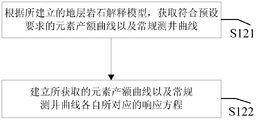
图2是步骤S120的子步骤流程图。
图3是西南油气田A井的地层岩石组分含量的计算结果及其与实验室分析结果的对比图。
图4是本申请实施例提供的一种计算地层岩石组分含量的装置的模块图;
图5是本申请实施例提供的一种获取地层岩石组分含量的设备。
本申请实施例提供一种获取地层岩石组分含量的方法及装置。
为了使本技术领域的人员更好地理解本申请中的技术方案,下面将结合本申请实施例中的附图,对本申请实施例中的技术方案进行清楚、完整地描述,显然,所描述的实施例仅仅是本申请一部分实施例,而不是全部的实施例。基于本申请中的实施例,本领域普通技术人员在没有作出创造性劳动前提下所获得的所有其他实施例,都应当属于本申请保护的范围。
下面结合附图对本申请所述的一种获取地层岩石组分含量的方法进行详细的说明。虽然本申请提供了如下述实施例或流程图所述的方法操作步骤,但基于常规或者无需创造性的劳动在所述方法中可以包括更多或者更少的操作步骤。在逻辑性上不存在必要因果关系的步骤中,这些步骤的执行顺序不限于本申请实施例提供的执行顺序。图1是本申请所述获取地层岩石组分含量的方法的一种实施例的方法流程图。该方法包括如下步骤:
S110:对所获取的元素俘获能谱测井资料中的各元素产额进行归一化处理。
在获取目标区域的元素俘获能谱测井资料后,可以利用归一化公式对通过测量所得到的地层岩石组分中的各元素产额进行归一化处理。
所述目标区域可以是整个勘探区域,也可以是探勘区域中的部分区域。
所述元素俘获能谱测井资料可以是利用俘获能谱测井方法对目标区域进行测量所得到的数据,其可以含有地层岩石中硅、铝、钠、钾、钙、镁、铁、硫、钛等多种元素的产额。俘获能谱测井方法可以是通过化学源向地层中发射快中子,快中子在地层中经过多次非弹性碰撞后变为热中子,最终被周围的原子俘获,元素通过释放伽马射线回到原始状态的方法。
所述对各元素产额进行归一化处理可以采用如下公式:

其中,nyk表示归一化处理后的第k种元素产额;wk表示第k种元素产额归一化系数;yk表示归一化处理前的第k种元素产额;ne表示元素类型数量;wl、yl分别表示第l种元素产额归一化系数与归一化处理前的元素产额。
所述元素产额归一化系数与该元素对应氧化物中元素含量有关,常见元素产额归一化系数如下表1所示:
表1:常见元素产额归一化系数

在对各元素产额进行归一化处理后,可以构建元素产额曲线。所述元素产额曲线上记录有一定深度范围内每个深度点所对应的第二实际测井响应值,即归一化处理后的元素产额。所述深度点可以是指处于某一深度的点。
S120:根据归一化处理后的元素产额以及预先建立的地层岩石解释模型,建立测井曲线响应方程组。
在得到归一化处理后的元素产额后,可以利用所得到的元素产额以及预先建立的地层岩石解释模型,建立测井曲线响应方程组。
所述地层岩石组分解释模型可以是通过利用所获取的测井资料、岩心分析资料、流体分析资料以及目标区域的地质条件,确定出目标区域中地层岩石的主要矿物组成类型、微量矿物类型以及地层流体类型,然后根据所确定的矿物组成类型、微矿物类型和流体类型来建立的。所建立的地层岩石模型中可以含有目标区域中所存在的岩石类型信息。
所述测井资料可以包括常规测井资料和元素俘获能谱测井资料。所述岩心分析资料可以用于对岩心进行不同层位、不同岩性的分析,可以便于加深对地层岩石特征的认识,其可以包括取心描述、物性分析资料、全岩氧化物资料以及岩电实验数据等。所述流体分析资料可以用于识别地层流体类型及地层水性质,其可以包括地层测试资料、地层水分析资料等。
例如,以西南油气田A井为例,对该井在2350.00-2405.00米的井段进行了连续取心,岩心显示井段上部岩性为黑色页岩,下部逐渐过渡到灰岩。通过进行岩心分析表明,该井段地层主要的矿物类型为粘土、石英、方
解石、白云石,含有微量的黄铁矿,孔隙流体组成为地层水和天然气。据此,所建立的地层岩石解释模型包括粘土、石英、方解石、白云石、黄铁矿、地层水和天然气。
需要说明的是,建立所述地层岩石解释模型与对各元素产额进行归一化处理之间的执行顺序并没有限制。
该步骤具体的可以包括以下子步骤,如图2所示:
S121:根据所建立的地层岩石解释模型,获取符合预设要求的元素产额曲线以及常规测井曲线。
所述预设要求可以是指对地层岩石矿物或流体变化具有明显响应特征。
所述根据所建立的地层岩石解释模型,获取符合预设要求的元素产额曲线以及常规测井曲线可以是指根据所述地层岩石解释模型所含的矿物成分和/或流体成分,来获取可以反映所述矿物成分和/或流体成分相关特性的元素产额曲线以及常规测井曲线。
所述常规测井曲线可以是从利用常规测井方法进行测井所得到的测井资料中来获取的,其上记录有一定深度范围内每个深度点所对应的第一实际测井响应值。所述元素产额曲线通过对元素俘获能谱测井测量获得的元素产额归一化处理来获取,其上记录有一定深度范围内每个深度点所对应的第二实际测井响应值。所述深度点可以是指处于某一深度的点。
由于每种测井曲线所反映出的地层信息特征不同,例如在常规测井中,通常可以认为自然伽马曲线主要反映地层粘土矿物总量,三孔隙度曲线主要反映地层孔隙发育程度,电阻率曲线主要反映孔隙内流体成分变化;而通过元素产额曲线反映的地层矿物也不一致,如铝(Al)元素产额曲线反映了地层粘土矿物含量,硅(Si)元素产额曲线指示了地层石英含量的变化,钙(Ca)元素产额曲线主要反映地层中碳酸盐岩类矿物含量,与地层方解石、白云石含量有关,钾(K)元素、钠(Na)元素产额曲线对地层中长石类矿物成分
具有较好的指示特征,铁(Fe)元素产额曲线主要反映地层中黄铁矿、菱铁矿等含铁矿物类型,硫(S)元素产额曲线也可以较好的反映地层中黄铁含量矿。因此,可以根据所建立的地层岩石解释模型中所含的矿物成分,来获取对应的测井曲线。例如,对于上述A井,所建立的地层岩石解释模型包括粘土、石英、方解石、白云石、黄铁矿、地层水和天然气。因此,针对该地层岩石解释模型中地层矿物、流体类型,所获取的测井曲线可以包括Al、Si、Ca、Fe、S元素产额曲线以及自然伽马、电阻率、三孔隙度曲线。
优选的,所获取的元素产额曲线以及常规测井曲线的数量可以多于所述地层岩石解释模型中矿物组分的数量。
S122:建立所获取的元素产额曲线以及常规测井曲线各自所对应的响应方程。
在获取对应的元素产额曲线以及常规测井曲线后,可以建立元素产额曲线以及常规测井曲线各自所对应的响应方程,所建立的多个响应方程构成了所述测井曲线响应方程组。所述测井曲线可以包括元素产额曲线以及常规测井曲线。
所述建立元素产额曲线以及常规测井曲线各自所对应的响应方程可以是指建立所获取的元素重产额曲线以及常规测井曲线各自所对应的理论测井响应值与地层岩石各组分的体积百分含量之间的关系式。
对于每个深度点,所建立的常规测井曲线所对应的响应方程可以表示如下:

上式中,tck1表示所获取的第k种常规测井曲线所对应的理论测井响应值;vi和vj分别表示地层各矿物、流体组分的体积百分含量;Ri和Rj分别表示各矿物、流体的测井响应参数;m和f表示地层岩石中所含矿物、流体的数目;i,j,k均为正整数。
可以利用上面(2)建立每个所获取的常规测井曲线所对应的响应方程。
以自然伽马测井曲线为例,其所对应的响应方程可以用下式(3)来表示:
tcGR=vcaly.GRclay+vquar.GRquar+vcalc.GRcalc+vdolo.GRdolo+vpyri.GRpyri
+vwater.GRwater+vgas.GRgas (3)
其中:tcGR表示自然伽马测井曲线所对应的理论测井响应值;vclay,vquar,vcalc,vdolo,vpyri,vwater和vgas分别表示粘土、石英、方解石、白云石、黄铁矿、地层水和天然气的体积百分含量;GRclay,GRquar,GRcalc,GRdolo,GRpyri,GRwater和GRgas分别表示粘土、石英、方解石、白云石、黄铁矿、地层水和天然气的自然伽马测井响应参数。
对于每个深度点,所建立的元素产额曲线所对应的响应方程可以表示如下:

上式中,tck2表示所获取的第k种元素产额曲线所对应的理论测井响应值;ρi表示第i种地层矿物的密度值,为常数。
可以利用上面(4)建立每个所获取的常规测井曲线所对应的响应方程。
以地层钙元素产额曲线为例,其所对应的响应方程利用公式(5)可表示为:
tcCa=(vcaly.ρclay.Caclay+vquar.ρquar.Caquar+vcalc.ρcalc.Cacalc+vdolo.ρdolo.Cadolo
+vpyri.ρpyri.Capyri)/(vcaly.ρclay+vquar.ρquar+vcalc.ρcalc+vdolo.ρdolo+vpyri.ρpyri) (5)
其中:tcCa表示钙元素产额曲线所对应的理论测井响应值;Caclay,Caquar,Cacalc,Cadolo和Capyri分别表示粘土、石英、方解石、白云石、黄铁矿中钙元素测井响应参数;ρclay,ρquar,ρcalc,ρdolo和ρpyri分别表示粘土、石英、方解石、白云石、黄铁矿矿物密度。
上述式(2)至式(5)中的测井响应参数可以通过岩石元素矿物实验与理论值计算结合的方法来确定。式(2)-式(3)中的测井响应参数也可以采用技术人员的经验值或者现有技术中其他方法获取的数值。
对于大部分常见矿物,其化学成分比较固定,其测井响应参数可直接通过理论值计算得到。例如,对于式(4)-式(5)中的测井响应参数的具体计算公式可以表示如下
PAB=ArA*NA/MrB, (6)
其中,PAB表示地层中矿物B中元素A的测井响应参数;ArA表示矿物B中元素A的相对原子量;NA表示矿物B中元素A的原子个数;MrB表示矿物B的分子量。
对于化成成分较复杂、变化较多的矿物,可采用实验手段对矿物成分进行全岩氧化物分析化验来直接确定元素测井响应参数。例如,可采用X射线衍射分析(XRD)、X射线荧光(XRF)、傅氏转换红外线光谱分析仪(FTIR)等方法来确定矿物成分中各元素的测井响应参数。
在一具体实现方式中,针对所获取的国内东、西部多个油田区块岩心样品,采用实验方法确定了这些岩心样品中元素测井响应参数的变化范围以及最佳数值。例如,可以确定出上述多个油田中石英、钠长石、钾长石、方解石、白云石等16种常见地层矿物的元素测井响应参数,如表2所示:
表2 常见地层矿物的元素测井响应参数


S130:利用所建立的测井响应方程组以及最优化算法,计算地层岩石组分含量。
所述地层岩石组分含量可以包括矿物组分含量和流体组分含量。在本实施例中,计算地层岩石组分含量可以是指计算地层岩石中各矿物、流体组分的体积百分含量。
在建立所获取的常规测井曲线所对应的响应方程和所获取的元素产额曲线所对应的响应方程后,可以利用所建立的响应方程以及最优化算法,计算地层岩石的矿物组分含量。具体的,
在建立响应方程后,可以采用最小二乘法建立最优化目标函数。所建立的目标函数可以表示如下:
v*=argmin{F(v)} (7)

其中,tck1是常规测井曲线所对应的理论测井响应值,tck1是元素产额曲线所对应的理论测井响应值;tmk1是对应tck1的第一实际测井响应值,tmk2是对应tck2的第二实际测井响应值,即归一化处理后的元素产额;wk1为常规测井曲线在最优化模型中的权重系数,wk2为元素产额曲线在最优化模型中的权重系数,这二者的数值可以根据测井曲线质量确定;n1和n2分别是获取的常规测井曲线和元素产额曲线的数量;k1和k2为正整数。
在建立目标函数后,可以利用所建立的目标函数,采用非线性最优化算法计算地层岩石中的矿物组分含量和流体组分含量。即将所获取的测井曲线所对应的理论测井响应值(即公式(2)和(4))以及相应的实际测井响应值代入上面的式(7)和式(8)中;然后可以采用非线性最优化算法对上述式(8)进行求解,即可计算出目标函数F(v)的数值;然后通过最优化方法,不断调整地层中各矿物组分和/或流体组分的体积百分含量,使目标函数F(v)的数值达到最小,此时各矿物组分和流体组分体积百分含量即为最终所确定的地层岩石中各矿物、流体组分含量。
需要说明的是,式(8)中矿物组分和流体组分的体积百分含量可以限定在一定的范围内,以使所有组分的体积百分含量之和为1,同时还可以满足预设的约束条件。所述约束条件可以是解释人员根据经验认识,对地层岩石组分解释模型中包含的矿物、流体组分含量范围进行限定,其可以包括矿物含量最大值、最小值,地层孔隙度最大值、最小值等。所述约束条件可以是在建立地层岩石组分解释模型之前或之后来设定的。
在计算出地层岩石中各矿物、流体组分含量后,可以确定地层岩性、有利储层发育部位及流体性质。例如,在计算得到的地层方解石含量较多,
粘土、白云石含量较少时,可以判断该地层为灰岩地层;在计算出的流体中以油气为主,则可判断该地层为含油气地层。
图3为上述西南油气田A井的地层岩石组分含量的计算结果及其与实验室分析结果的对比图。图3中最右边的道是利用本发明提出的地层岩石组分含量计算方法对A井处理的组分剖面。从右边开始算起的第二道至第五道(即左起第7道至第10道)是利用本申请实施例所提供方法的计算结果与取芯分析结果的对比。从这几道可以看出,利用本申请实施例所提供的方法计算得到的地层粘土、石英、方解石矿物组分含量和岩心实验分析结果一致。图3中从左开始算起的第五道与第六道是计算出的地层铝、硅、钙、铁、硫元素归一化处理后的产额曲线。从图3中右边的第一道中可以看到,2364.00-2395.00m段储层中孔隙较为发育,天然气和地层水(白色和黑色填充部分)的总量较高,其中天然气(白色填充部分)占主要部分。因此,可以判断该段孔隙以天然气为主,是页岩气藏有利勘探部位。
通过上述步骤可以看出,本申请实施例通过利用所获取的元素俘获能谱测井资料,对各元素产额进行归一化处理;根据归一化处理后所得到的元素产额曲线以及预先建立的地层岩石解释模型,建立测井曲线响应方程组,所述测井曲线响应方程组包括常规测井曲线和元素产额曲线所对应的响应方程;利用所建立的测井响应方程组以及最优化算法,计算地层岩石的组分含量。利用本申请实施例所提供的方法不仅避免了元素俘获能谱测井资料处理中“氧闭合”处理和元素到矿物转换步骤,同时能够对常规测井和元素俘获能谱测井资料综合处理,从而可以提高地层岩石的组分含量的计算精度,也可以减少计算工作量,提高计算效率,并对各类复杂岩性储层评价具有很好的适用性。
本申请实施例还提供了一种获取地层岩石组分含量的装置,如图4所示。该装置包括归一化处理单元510、建立单元520和计算单元530。其中,归一化处理单元510可以用于对所获取的元素俘获能谱测井资料中的各
元素产额进行归一化处理;建立单元520可以用于根据归一化处理后的元素产额以及预先建立的地层岩石解释模型,建立测井曲线响应方程组;计算单元可以用于利用所建立的测井曲线响应方程组以及最优化算法,计算地层岩石组分含量。
在一实施例中,建立单元520可以包括(图中未示出):
获取子单元,用于根据所建立的地层岩石解释模型,获取符合预设要求的元素产额曲线以及常规测井曲线;
第一建立子单元,用于建立所获取的元素产额曲线以及常规测井曲线各自所对应的响应方程。所建立的响应方程可以如式(2)和(4)所示。
在一实施例中,计算单元530可以包括(图中未示出):
第二建立子单元,其可以用于利用所述测井曲线响应方程组,建立目标函数;
计算子单元,其可以用于利用所述目标函数,计算地层岩石中矿物组分和流体组分的体积百分含量。
通过上述描述可以看出,本申请实施例通过设置用于对元素俘获能谱测井测量获得的元素产额进行归一化处理的归一化处理单元,用于建立测井曲线响应方程组的建立单元,所述测井曲线响应方程组包括常规测井曲线和元素产额曲线所对应的响应方程,以及用于计算地层岩石的组分含量的计算单元,从而实现了提高地层岩石的组分含量的计算精度的目的。
本发明实施例还提供了一种计算机可读指令的计算机可读存储介质,该计算机可读指令在被执行时使处理器至少执行以下操作:对所获取的元素俘获能谱测井资料中的各元素产额进行归一化处理;根据归一化处理后的元素产额以及预先建立的地层岩石解释模型,建立测井曲线响应方程组;利用所建立的测井曲线响应方程组以及最优化算法,计算地层岩石组分含量。
在一个实施例中,上述计算机可读指令使处理器采用如下公式来计算元素产额: 其中,nyk表示归一化处理后的第k种元素产额;wk表示第k种元素产额归一化系数;yk表示归一化处理前的第k种元素产额;ne表示元素类型数量;wl、yl分别表示第l种元素产额归一化系数以及归一化处理前的第l种元素产额。
在一个实施例中,上述计算机可读指令使处理器根据所建立的地层岩石解释模型,获取符合预设要求的元素产额曲线以及常规测井曲线;建立所获取的元素产额曲线以及常规测井曲线各自所对应的响应方程。
在一个实施例中,上述计算机可读指令使处理器建立归一化处理后所得到的元素产额曲线以及常规测井曲线各自所对应的理论测井响应值与地层岩石各组分的体积百分含量之间的关系式。
在一个实施例中,上述计算机可读指令使处理器利用所述测井曲线响应方程组,建立目标函数;利用所述目标函数,计算地层岩石中矿物组分和流体组分的体积百分含量。
本发明实施例还提供了一种获取地层岩石组分含量的设备,如图5所示,该设备包括:处理器601;和包括计算机可读指令的存储器602,计算机可读指令在被执行时使处理器执行以下操作:对所获取的元素俘获能谱测井资料中的各元素产额进行归一化处理;根据归一化处理后的元素产额以及预先建立的地层岩石解释模型,建立测井曲线响应方程组;利用所建立的测井曲线响应方程组以及最优化算法,计算地层岩石组分含量。
在一个实施例中,上述计算机可读指令使处理器采用如下公式来计算元素产额: 其中,nyk表示归一化处理后的第k种元素产额;wk表示第k种元素产额归一化系数;yk表示归一化处理前的第k种元素产
额;ne表示元素类型数量;wl、yl分别表示第l种元素产额归一化系数以及归一化处理前的第l种元素产额。
其中,nyk表示归一化处理后的第k种元素产额;wk表示第k种元素产额归一化系数;yk表示归一化处理前的第k种元素产
额;ne表示元素类型数量;wl、yl分别表示第l种元素产额归一化系数以及归一化处理前的第l种元素产额。
在一个实施例中,上述计算机可读指令使处理器根据所建立的地层岩石解释模型,获取符合预设要求的元素产额曲线以及常规测井曲线;建立所获取的元素产额曲线以及常规测井曲线各自所对应的响应方程。
在一个实施例中,上述计算机可读指令使处理器建立归一化处理后所得到的元素产额曲线以及常规测井曲线各自所对应的理论测井响应值与地层岩石各组分的体积百分含量之间的关系式。
在一个实施例中,上述计算机可读指令使处理器利用所述测井曲线响应方程组,建立目标函数;利用所述目标函数,计算地层岩石中矿物组分和流体组分的体积百分含量。
上述实施例阐明的装置或单元,具体可以由计算机芯片或实体实现,或者由具有某种功能的产品来实现。为了描述的方便,描述以上装置时以功能分为各种单元分别描述。当然,在实施本申请时可以把各单元的功能在同一个或多个软件和/或硬件中实现。
通过以上的实施方式的描述可知,本领域技术人员还可以了解到本发明实施例列出的各种说明性逻辑块、单元和步骤可以通过硬件、软件或两者的结合来实现。至于是通过硬件还是软件来实现取决于特定的应用和整个系统的设计要求。本领域技术人员可以对于每种特定的应用,可以使用各种方法实现所述的功能,但这种实现不应被理解为超出本发明实施例保护的范围。
本发明实施例中所描述的方法或算法的步骤可以直接嵌入硬件、处理器执行的软件模块、或者这两者的结合。软件模块可以存储于RAM存储器、闪存、ROM存储器、EPROM存储器、EEPROM存储器、寄存器、硬盘、可移动磁盘、CD-ROM或本领域中其它任意形式的存储媒介中。示例性地,存储媒介可以与处理器连接,以使得处理器可以从存储媒介中读取信
息,并可以向存储媒介存写信息。可选地,存储媒介还可以集成到处理器中。处理器和存储媒介可以设置于ASIC中,ASIC可以设置于用户终端中。可选地,处理器和存储媒介也可以设置于用户终端中的不同的部件中。
在一个或多个示例性的设计中,本发明实施例所描述的上述功能可以在硬件、软件、固件或这三者的任意组合来实现。如果在软件中实现,这些功能可以存储与电脑可读的媒介上,或以一个或多个指令或代码形式传输于电脑可读的媒介上。电脑可读媒介包括电脑存储媒介和便于使得让电脑程序从一个地方转移到其它地方的通信媒介。存储媒介可以是任何通用或特殊电脑可以接入访问的可用媒体。例如,这样的电脑可读媒体可以包括但不限于RAM,ROM,EEPROM,CD-ROM或其它光盘存储、磁盘存储或其它磁性存储装置,或其它任何可以用于承载或存储以指令或数据结构和其它可被通用或特殊电脑、或通用或特殊处理器读取形式的程序代码的媒介。
本说明书中的各个实施例均采用递进的方式描述,各个实施例之间相同相似的部分互相参见即可,每个实施例重点说明的都是与其他实施例的不同之处。尤其,对于装置实施例而言,由于其基本相似于方法实施例,所以描述的比较简单,相关之处参见方法实施例的部分说明即可。
虽然通过实施例描绘了本申请,本领域普通技术人员知道,本申请有许多变形和变化而不脱离本申请的精神,希望所附的权利要求包括这些变形和变化而不脱离本申请的精神。
Claims (10)
- 一种获取地层岩石组分含量的方法,其特征在于,包括:对所获取的元素俘获能谱测井资料中的各元素产额进行归一化处理;根据归一化处理后的元素产额以及预先建立的地层岩石解释模型,建立测井曲线响应方程组;利用所建立的测井曲线响应方程组以及最优化算法,计算地层岩石组分含量。
- 根据权利要求1所述的方法,其特征在于,所述对各元素产额进行归一化处理包括采用如下公式来计算元素产额:
 其中,nyk表示归一化处理后的第k种元素产额;wk表示第k种元素产额归一化系数;yk表示归一化处理前的第k种元素产额;ne表示元素类型数量;wl、yl分别表示第l种元素产额归一化系数以及归一化处理前的第l种元素产额。
 - 根据权利要求1所述的方法,其特征在于,所述根据归一化处理后的元素产额以及预先建立的地层岩石解释模型,建立测井曲线响应方程组包括:根据所建立的地层岩石解释模型,获取符合预设要求的元素产额曲线以及常规测井曲线;建立所获取的元素产额曲线以及常规测井曲线各自所对应的响应方程。
- 根据权利要求3所述的方法,其特征在于,所述建立所获取的元素产额曲线以及常规测井曲线各自所对应的响应方程包括建立归一化处理后所得到的元素产额曲线以及常规测井曲线各自所对应的理论测井响应值与地层岩石各组分的体积百分含量之间的关系式。
- 根据权利要求4所述的方法,其特征在于,所建立的关系式表示如下:

 其中,tck1表示所获取的第k种常规测井曲线所对应的理论测井响应值;tck2表示所获取的第k种元素产额曲线所对应的理论测井响应值;vi和vj分别表示地层各矿物、流 体组分的体积百分含量;Ri和Rj分别表示各矿物、流体的测井响应参数;ρi表示第i种地层矿物的密度值;m和f分别表示地层岩石中所含矿物、流体的数目;i,j,k均为正整数。
 - 根据权利要求5所述的方法,其特征在于,所述测井响应参数通过岩石元素矿物实验与理论值计算结合的方法来确定。
- 根据权利要求1所述的方法,其特征在于,所述利用所建立的测井曲线响应方程组以及最优化算法,计算地层岩石组分含量包括:利用所述测井曲线响应方程组,建立目标函数;利用所述目标函数,计算地层岩石中矿物组分和流体组分的体积百分含量。
- 一种获取地层岩石组分含量的装置,其特征在于,包括:归一化处理单元,用于对所获取的元素俘获能谱测井资料中的各元素产额进行归一化处理;建立单元,用于根据归一化处理后的元素产额以及预先建立的地层岩石解释模型,建立测井曲线响应方程组;计算单元,用于利用所建立的测井曲线响应方程组以及最优化算法,计算地层岩石组分含量。
- 根据权利要求8所述的装置,其特征在于,所述建立单元包括:获取子单元,用于根据所建立的地层岩石解释模型,获取符合预设要求的元素产额曲线以及常规测井曲线;第一建立子单元,用于建立所获取的元素产额曲线以及常规测井曲线各自所对应的响应方程。
- 根据权利要求8所述的装置,其特征在于,所述计算单元包括:第二建立子单元,用于利用所述测井曲线响应方程组,建立目标函数;计算子单元,用于利用所述目标函数,计算地层岩石中矿物组分和流体组分的体积百分含量。
Priority Applications (2)
| Application Number | Priority Date | Filing Date | Title |
|---|---|---|---|
| EP16861419.6A EP3333360B1 (en) | 2015-11-02 | 2016-10-10 | Method of acquiring rock component content of stratum |
| US15/942,356 US10962679B2 (en) | 2015-11-02 | 2018-03-30 | Method of acquiring rock component content of stratum |
Applications Claiming Priority (2)
| Application Number | Priority Date | Filing Date | Title |
|---|---|---|---|
| CN201510731740.7A CN105257286B (zh) | 2015-11-02 | 2015-11-02 | 一种获取地层岩石组分含量的方法及装置 |
| CN201510731740.7 | 2015-11-02 |
Related Child Applications (1)
| Application Number | Title | Priority Date | Filing Date |
|---|---|---|---|
| US15/942,356 Continuation US10962679B2 (en) | 2015-11-02 | 2018-03-30 | Method of acquiring rock component content of stratum |
Publications (1)
| Publication Number | Publication Date |
|---|---|
| WO2017076151A1 true WO2017076151A1 (zh) | 2017-05-11 |
Family
ID=55097176
Family Applications (1)
| Application Number | Title | Priority Date | Filing Date |
|---|---|---|---|
| PCT/CN2016/101644 Ceased WO2017076151A1 (zh) | 2015-11-02 | 2016-10-10 | 一种获取地层岩石组分含量的方法及装置 |
Country Status (4)
| Country | Link |
|---|---|
| US (1) | US10962679B2 (zh) |
| EP (1) | EP3333360B1 (zh) |
| CN (1) | CN105257286B (zh) |
| WO (1) | WO2017076151A1 (zh) |
Cited By (7)
| Publication number | Priority date | Publication date | Assignee | Title |
|---|---|---|---|---|
| CN110673215A (zh) * | 2019-09-19 | 2020-01-10 | 中国石油大学(华东) | 一种基于交会图与Fisher判别的复杂岩性自动判别方法 |
| CN111323844A (zh) * | 2020-03-14 | 2020-06-23 | 长江大学 | 一种基于曲线重构的复杂砂砾岩体的岩性识别方法及系统 |
| CN114428358A (zh) * | 2021-09-13 | 2022-05-03 | 中国石油化工股份有限公司 | 一种基于地质-地球物理分析的等时地层划分方法 |
| CN114647015A (zh) * | 2022-02-21 | 2022-06-21 | 中国石油大学(北京) | 三维矿物解释模型确定方法、装置及设备 |
| CN114791439A (zh) * | 2021-01-25 | 2022-07-26 | 中国石油化工股份有限公司 | 火成岩矿物成分确定方法、装置、计算机设备和存储介质 |
| CN115220130A (zh) * | 2022-07-26 | 2022-10-21 | 中海石油深海开发有限公司 | 潜山地层矿物含量确定方法、装置、电子设备及存储介质 |
| CN119882038A (zh) * | 2023-10-25 | 2025-04-25 | 中国石油天然气集团有限公司 | 碳酸盐岩岩石物理建模方法及应用、装置、设备、介质 |
Families Citing this family (42)
| Publication number | Priority date | Publication date | Assignee | Title |
|---|---|---|---|---|
| CN105257286B (zh) * | 2015-11-02 | 2018-12-25 | 中国石油天然气股份有限公司 | 一种获取地层岩石组分含量的方法及装置 |
| CN105426612B (zh) | 2015-11-18 | 2019-01-18 | 中国石油天然气股份有限公司 | 一种地层组分最优化确定方法及装置 |
| CN107515290B (zh) * | 2016-06-15 | 2019-12-27 | 中国石油化工股份有限公司 | 岩石矿物组分含量定量计算方法 |
| CN107644383A (zh) * | 2016-07-21 | 2018-01-30 | 中国石油天然气股份有限公司 | 碳酸盐岩的定性方法 |
| CN106250619B (zh) * | 2016-07-29 | 2020-01-10 | 中国石油天然气股份有限公司 | 一种确定地层矿物含量的方法和装置 |
| CN106600436B (zh) * | 2016-11-28 | 2021-04-09 | 中国石油天然气集团有限公司 | 计算页岩气地层矿物组分含量及孔隙度的方法 |
| US10156137B2 (en) * | 2017-03-06 | 2018-12-18 | Saudi Arabian Oil Company | Determining a rock formation content |
| CN108457644B (zh) * | 2017-12-26 | 2020-04-10 | 中国石油天然气股份有限公司 | 一种元素俘获能谱测井的伽马能谱解谱方法及装置 |
| CN109612943B (zh) * | 2019-01-14 | 2020-04-21 | 山东大学 | 基于机器学习的隧洞岩石石英含量测试系统及方法 |
| CN111505238A (zh) * | 2019-01-31 | 2020-08-07 | 中国石油化工股份有限公司 | 一种岩石白云化计算方法及计算系统 |
| CN111707681B (zh) * | 2019-03-18 | 2023-09-12 | 中国石油化工股份有限公司 | 一种岩屑中元素含量的检测系统及方法 |
| CN110111856B (zh) * | 2019-04-23 | 2022-12-23 | 长江大学 | 基于元素测量分析岩石中矿物组分方法 |
| CN112031740B (zh) * | 2019-05-15 | 2024-02-02 | 中国石油化工股份有限公司 | 基于地层元素的页岩气地质甜点评价方法及装置 |
| CN111119841A (zh) * | 2019-11-12 | 2020-05-08 | 中国石油天然气集团有限公司 | 一种盐岩组分精细处理与岩性自动识别的评价方法 |
| CN113123782B (zh) * | 2019-12-31 | 2024-05-14 | 中国石油化工股份有限公司 | 一种利用线性规划评价地层组分的方法 |
| US11566518B2 (en) | 2020-03-02 | 2023-01-31 | Saudi Arabian Oil Company | Method and system for diagenesis-based rock classification |
| CN111577267A (zh) * | 2020-05-15 | 2020-08-25 | 重庆科技学院 | 一种基于全岩和粘土矿物组成的储层敏感性预测方法 |
| CN114075973B (zh) * | 2020-08-13 | 2024-03-01 | 中国石油天然气股份有限公司 | 地层元素测井曲线重构方法及装置 |
| CN112049626A (zh) * | 2020-09-14 | 2020-12-08 | 中国石油大学(华东) | 一种源外分散液态烃与古油藏判别方法及系统 |
| CN112081584B (zh) * | 2020-09-25 | 2024-06-25 | 中国石油天然气集团有限公司 | 一种判别地层岩性的方法、系统、计算机设备及存储介质 |
| CN112523749B (zh) * | 2020-10-27 | 2024-03-26 | 中国石油天然气集团有限公司 | 一种基于二次规划计算地层矿物含量的方法 |
| CN113720991B (zh) * | 2020-11-16 | 2024-03-26 | 中国石油天然气集团有限公司 | 检测沉积岩中矿物组成的方法、装置、设备和存储介质 |
| CN114791482B (zh) * | 2021-01-25 | 2024-03-08 | 中国石油化工股份有限公司 | 一种确定岩石矿物含量系数的方法及装置、存储介质 |
| CN114859435B (zh) * | 2021-02-04 | 2024-07-26 | 中国石油天然气股份有限公司 | 页岩可压性评价参数获取方法、装置及计算机设备 |
| CN114970071B (zh) * | 2021-02-20 | 2024-05-28 | 中国石油天然气股份有限公司 | 一种喷发岩的有利储层识别方法及系统 |
| CN112983396A (zh) * | 2021-02-22 | 2021-06-18 | 中海石油(中国)有限公司海南分公司 | 一种油气勘探过程中的智能录井分析方法、系统、计算机设备和存储介质 |
| CN112903607B (zh) * | 2021-02-23 | 2024-11-19 | 谢跃红 | 地下地质勘探方法、装置、设备及存储介质 |
| CN113075156B (zh) * | 2021-03-29 | 2023-03-14 | 自然资源实物地质资料中心 | 碳酸盐矿物成分的定量方法、装置及设备、存储介质 |
| CN113374472B (zh) * | 2021-06-11 | 2024-03-19 | 中国石油天然气股份有限公司 | 一种应用元素录井判别火成岩岩性方法 |
| CN115700321B (zh) * | 2021-07-27 | 2025-08-22 | 中国石油天然气集团有限公司 | 一种基于测井复合参数的复杂岩性识别方法 |
| CN115012902B (zh) * | 2022-01-17 | 2025-05-02 | 东华理工大学 | 标准能谱的生成方法、系统、可读存储介质及计算机设备 |
| CN117008208A (zh) * | 2022-04-29 | 2023-11-07 | 中国石油天然气集团有限公司 | 低阻油气层的识别方法及系统 |
| CN115267928B (zh) * | 2022-09-28 | 2022-12-23 | 中石化经纬有限公司 | 一种用于随钻元素测井的能谱智能处理方法 |
| CN115903026B (zh) * | 2023-01-09 | 2023-05-09 | 东北石油大学三亚海洋油气研究院 | 复合砂体构型解析方法、设备及介质 |
| CN116299733B (zh) * | 2023-04-06 | 2025-09-16 | 重庆科技学院 | 利用常规测井曲线识别地层中含硫储层的方法 |
| CN116626779B (zh) * | 2023-07-21 | 2023-11-10 | 中海石油(中国)有限公司深圳分公司 | 一种潜山地层孔隙度计算方法及系统 |
| CN119491705B (zh) * | 2023-08-21 | 2026-03-27 | 中国石油天然气股份有限公司 | 一种矿物组分确定方法、装置、电子设备及介质 |
| CN117272136B (zh) * | 2023-09-11 | 2025-04-18 | 成都理工大学 | 一种针对二叠系含海泡石层系的测井算法识别方法 |
| CN119724396B (zh) * | 2023-09-28 | 2025-10-14 | 中国石油天然气集团有限公司 | 岩屑含量的预测方法、装置及电子设备 |
| CN119719845A (zh) * | 2024-12-05 | 2025-03-28 | 东南大学 | 一种基于元素含量的母岩矿物组成预测方法、系统、装置及存储介质 |
| CN119666900B (zh) * | 2024-12-09 | 2025-10-03 | 中国石油大学(华东) | 一种泥页岩岩心归位方法 |
| CN120744592A (zh) * | 2025-09-04 | 2025-10-03 | 中国石油集团西部钻探工程有限公司 | 基于归一法的优质油层岩性识别方法及装置 |
Citations (6)
| Publication number | Priority date | Publication date | Assignee | Title |
|---|---|---|---|---|
| CN103485758A (zh) * | 2013-08-12 | 2014-01-01 | 中国石油天然气股份有限公司 | 一种利用多种资料拟合反演复杂岩性解释方法及装置 |
| CN103617345A (zh) * | 2013-11-11 | 2014-03-05 | 中国石油集团川庆钻探工程有限公司 | 用元素含量计算地层岩石矿物成分的方法 |
| EP2810104A1 (en) * | 2012-04-23 | 2014-12-10 | Halliburton Energy Services, Inc. | Pulsed-neutron tool methods and systems for monitoring casing corrosion |
| CN104316971A (zh) * | 2014-10-21 | 2015-01-28 | 中国石油天然气股份有限公司 | 一种非弹性散射和俘获伽马能谱联合解析方法 |
| WO2015084339A1 (en) * | 2013-12-04 | 2015-06-11 | Halliburton Energy Services, Inc. | Temperature correction of a gamma detector |
| CN105257286A (zh) * | 2015-11-02 | 2016-01-20 | 中国石油天然气股份有限公司 | 一种获取地层岩石组分含量的方法及装置 |
Family Cites Families (10)
| Publication number | Priority date | Publication date | Assignee | Title |
|---|---|---|---|---|
| US4903527A (en) * | 1984-01-26 | 1990-02-27 | Schlumberger Technology Corp. | Quantitative clay typing and lithological evaluation of subsurface formations |
| US4712424A (en) * | 1984-01-26 | 1987-12-15 | Schlumberger Technology Corp. | Quantitative determination by elemental logging of subsurface formation properties |
| US4661701A (en) | 1985-07-17 | 1987-04-28 | Schlumberger Technology Corporation | Methods and apparatus for borehole-corrected spectral analysis of earth formations |
| US6140643A (en) * | 1999-03-09 | 2000-10-31 | Exxonmobil Upstream Research Company | Method for identification of unknown substances |
| JP2010223311A (ja) | 2009-03-23 | 2010-10-07 | Toyota Motor Corp | 車両の盗難防止装置 |
| CN102071928B (zh) * | 2009-11-25 | 2013-05-29 | 中国石油天然气股份有限公司 | 一种三维空间火山岩岩性识别方法 |
| AU2011203206A1 (en) * | 2010-07-13 | 2012-02-02 | Schlumberger Technology B.V. | Correction for neutron-gamma density measurement |
| US8805615B2 (en) * | 2011-09-08 | 2014-08-12 | Carbo Ceramics Inc. | Lithology and borehole condition independent methods for locating tagged proppant in induced subterranean formation fractures |
| CN103375166A (zh) * | 2012-04-26 | 2013-10-30 | 中国石油集团长城钻探工程有限公司 | 一种确定地层中多种矿物组分含量的方法 |
| US10222497B2 (en) * | 2016-02-03 | 2019-03-05 | Cgg Services Sas | Multi-stack (broadband) wavelet estimation method |
-
2015
- 2015-11-02 CN CN201510731740.7A patent/CN105257286B/zh active Active
-
2016
- 2016-10-10 WO PCT/CN2016/101644 patent/WO2017076151A1/zh not_active Ceased
- 2016-10-10 EP EP16861419.6A patent/EP3333360B1/en active Active
-
2018
- 2018-03-30 US US15/942,356 patent/US10962679B2/en active Active
Patent Citations (6)
| Publication number | Priority date | Publication date | Assignee | Title |
|---|---|---|---|---|
| EP2810104A1 (en) * | 2012-04-23 | 2014-12-10 | Halliburton Energy Services, Inc. | Pulsed-neutron tool methods and systems for monitoring casing corrosion |
| CN103485758A (zh) * | 2013-08-12 | 2014-01-01 | 中国石油天然气股份有限公司 | 一种利用多种资料拟合反演复杂岩性解释方法及装置 |
| CN103617345A (zh) * | 2013-11-11 | 2014-03-05 | 中国石油集团川庆钻探工程有限公司 | 用元素含量计算地层岩石矿物成分的方法 |
| WO2015084339A1 (en) * | 2013-12-04 | 2015-06-11 | Halliburton Energy Services, Inc. | Temperature correction of a gamma detector |
| CN104316971A (zh) * | 2014-10-21 | 2015-01-28 | 中国石油天然气股份有限公司 | 一种非弹性散射和俘获伽马能谱联合解析方法 |
| CN105257286A (zh) * | 2015-11-02 | 2016-01-20 | 中国石油天然气股份有限公司 | 一种获取地层岩石组分含量的方法及装置 |
Non-Patent Citations (1)
| Title |
|---|
| See also references of EP3333360A4 * |
Cited By (10)
| Publication number | Priority date | Publication date | Assignee | Title |
|---|---|---|---|---|
| CN110673215A (zh) * | 2019-09-19 | 2020-01-10 | 中国石油大学(华东) | 一种基于交会图与Fisher判别的复杂岩性自动判别方法 |
| CN111323844A (zh) * | 2020-03-14 | 2020-06-23 | 长江大学 | 一种基于曲线重构的复杂砂砾岩体的岩性识别方法及系统 |
| CN111323844B (zh) * | 2020-03-14 | 2023-04-21 | 长江大学 | 一种基于曲线重构的复杂砂砾岩体的岩性识别方法及系统 |
| CN114791439A (zh) * | 2021-01-25 | 2022-07-26 | 中国石油化工股份有限公司 | 火成岩矿物成分确定方法、装置、计算机设备和存储介质 |
| CN114428358A (zh) * | 2021-09-13 | 2022-05-03 | 中国石油化工股份有限公司 | 一种基于地质-地球物理分析的等时地层划分方法 |
| CN114647015A (zh) * | 2022-02-21 | 2022-06-21 | 中国石油大学(北京) | 三维矿物解释模型确定方法、装置及设备 |
| CN115220130A (zh) * | 2022-07-26 | 2022-10-21 | 中海石油深海开发有限公司 | 潜山地层矿物含量确定方法、装置、电子设备及存储介质 |
| CN115220130B (zh) * | 2022-07-26 | 2024-08-16 | 中海石油深海开发有限公司 | 潜山地层矿物含量确定方法、装置、电子设备及存储介质 |
| CN119882038A (zh) * | 2023-10-25 | 2025-04-25 | 中国石油天然气集团有限公司 | 碳酸盐岩岩石物理建模方法及应用、装置、设备、介质 |
| CN119882038B (zh) * | 2023-10-25 | 2025-10-21 | 中国石油天然气集团有限公司 | 碳酸盐岩岩石物理建模方法及应用、装置、设备、介质 |
Also Published As
| Publication number | Publication date |
|---|---|
| US20180246254A1 (en) | 2018-08-30 |
| US10962679B2 (en) | 2021-03-30 |
| EP3333360B1 (en) | 2021-11-24 |
| CN105257286A (zh) | 2016-01-20 |
| EP3333360A4 (en) | 2018-10-10 |
| CN105257286B (zh) | 2018-12-25 |
| EP3333360A1 (en) | 2018-06-13 |
Similar Documents
| Publication | Publication Date | Title |
|---|---|---|
| US10962679B2 (en) | Method of acquiring rock component content of stratum | |
| CN102053268B (zh) | 一种蚀变火山岩岩性识别方法及装置 | |
| CN103135135B (zh) | 一种基于疏松砂岩模型进行烃类定量预测的方法和装置 | |
| CN103454685B (zh) | 利用测井约束波阻抗反演预测砂体厚度的方法和装置 | |
| CN104252007B (zh) | 一种相容性岩石物理建模方法 | |
| CN105675635B (zh) | 致密岩石组分相对含量及脆性指数确定方法和装置 | |
| CN104318109B (zh) | 基于支持向量机的页岩气储层识别方法 | |
| CN107703560A (zh) | 一种基于三重信息的泥页岩岩相精细识别方法 | |
| CN104278991A (zh) | 盐湖相烃源岩有机碳和生烃潜量的多元测井计算方法 | |
| WO2019062655A1 (zh) | 薄夹层的确定方法和装置 | |
| CN103775057A (zh) | 一种致密油气藏有效储层的判识方法及装置 | |
| CN109630090B (zh) | 储盖组合测井评价方法和装置 | |
| CN103485758A (zh) | 一种利用多种资料拟合反演复杂岩性解释方法及装置 | |
| CN105221142A (zh) | 一种识别页岩地层矿物质量含量的方法 | |
| CN111487691A (zh) | 一种致密砂岩储层岩性及砂体结构定量识别方法 | |
| CN104343445B (zh) | 识别气层与水层、高气油比储层及含气饱和度的方法 | |
| CN104747163A (zh) | 一种在致密砂岩中识别储层裂缝的方法及装置 | |
| CN106951686A (zh) | 页岩气选区评价方法及装置 | |
| CN103437760A (zh) | 一种使用阵列感应数据快速评价油水层的方法 | |
| CN104005760A (zh) | 基于方位各向异性弹性阻抗的裂缝检测方法 | |
| CN105467465A (zh) | 利用孔隙度差值计算粘土含量的方法 | |
| CN104316971A (zh) | 一种非弹性散射和俘获伽马能谱联合解析方法 | |
| CN105257284B (zh) | 一种利用元素俘获能谱测井确定凝灰质含量的方法及装置 | |
| CN104564037A (zh) | 一种页岩气储层脆性矿物含量测井计算方法 | |
| CN107507095A (zh) | 由地层深度剖面向地层时间剖面的快速转换方法与系统 |
Legal Events
| Date | Code | Title | Description |
|---|---|---|---|
| 121 | Ep: the epo has been informed by wipo that ep was designated in this application |
Ref document number: 16861419 Country of ref document: EP Kind code of ref document: A1 |
|
| WWE | Wipo information: entry into national phase |
Ref document number: 2016861419 Country of ref document: EP |
|
| NENP | Non-entry into the national phase |
Ref country code: DE |