WO2017094655A1 - 芳香族化合物の製造方法およびパラジウム錯体 - Google Patents
芳香族化合物の製造方法およびパラジウム錯体 Download PDFInfo
- Publication number
- WO2017094655A1 WO2017094655A1 PCT/JP2016/085156 JP2016085156W WO2017094655A1 WO 2017094655 A1 WO2017094655 A1 WO 2017094655A1 JP 2016085156 W JP2016085156 W JP 2016085156W WO 2017094655 A1 WO2017094655 A1 WO 2017094655A1
- Authority
- WO
- WIPO (PCT)
- Prior art keywords
- group
- carbon atoms
- phosphine
- formula
- chloromethylpalladium
- Prior art date
- Legal status (The legal status is an assumption and is not a legal conclusion. Google has not performed a legal analysis and makes no representation as to the accuracy of the status listed.)
- Ceased
Links
- 0 C*CC(C(C)N)=C Chemical compound C*CC(C(C)N)=C 0.000 description 4
Classifications
-
- B—PERFORMING OPERATIONS; TRANSPORTING
- B01—PHYSICAL OR CHEMICAL PROCESSES OR APPARATUS IN GENERAL
- B01J—CHEMICAL OR PHYSICAL PROCESSES, e.g. CATALYSIS OR COLLOID CHEMISTRY; THEIR RELEVANT APPARATUS
- B01J31/00—Catalysts comprising hydrides, coordination complexes or organic compounds
- B01J31/16—Catalysts comprising hydrides, coordination complexes or organic compounds containing coordination complexes
- B01J31/24—Phosphines, i.e. phosphorus bonded to only carbon atoms, or to both carbon and hydrogen atoms, including e.g. sp2-hybridised phosphorus compounds such as phosphabenzene, phosphole or anionic phospholide ligands
-
- B—PERFORMING OPERATIONS; TRANSPORTING
- B01—PHYSICAL OR CHEMICAL PROCESSES OR APPARATUS IN GENERAL
- B01J—CHEMICAL OR PHYSICAL PROCESSES, e.g. CATALYSIS OR COLLOID CHEMISTRY; THEIR RELEVANT APPARATUS
- B01J31/00—Catalysts comprising hydrides, coordination complexes or organic compounds
- B01J31/16—Catalysts comprising hydrides, coordination complexes or organic compounds containing coordination complexes
- B01J31/22—Organic complexes
-
- B—PERFORMING OPERATIONS; TRANSPORTING
- B01—PHYSICAL OR CHEMICAL PROCESSES OR APPARATUS IN GENERAL
- B01J—CHEMICAL OR PHYSICAL PROCESSES, e.g. CATALYSIS OR COLLOID CHEMISTRY; THEIR RELEVANT APPARATUS
- B01J31/00—Catalysts comprising hydrides, coordination complexes or organic compounds
- B01J31/16—Catalysts comprising hydrides, coordination complexes or organic compounds containing coordination complexes
- B01J31/24—Phosphines, i.e. phosphorus bonded to only carbon atoms, or to both carbon and hydrogen atoms, including e.g. sp2-hybridised phosphorus compounds such as phosphabenzene, phosphole or anionic phospholide ligands
- B01J31/2404—Cyclic ligands, including e.g. non-condensed polycyclic ligands, the phosphine-P atom being a ring member or a substituent on the ring
-
- C—CHEMISTRY; METALLURGY
- C07—ORGANIC CHEMISTRY
- C07B—GENERAL METHODS OF ORGANIC CHEMISTRY; APPARATUS THEREFOR
- C07B37/00—Reactions without formation or introduction of functional groups containing hetero atoms, involving either the formation of a carbon-to-carbon bond between two carbon atoms not directly linked already or the disconnection of two directly linked carbon atoms
- C07B37/04—Substitution
-
- C—CHEMISTRY; METALLURGY
- C07—ORGANIC CHEMISTRY
- C07C—ACYCLIC OR CARBOCYCLIC COMPOUNDS
- C07C1/00—Preparation of hydrocarbons from one or more compounds, none of them being a hydrocarbon
- C07C1/32—Preparation of hydrocarbons from one or more compounds, none of them being a hydrocarbon starting from compounds containing hetero-atoms other than or in addition to oxygen or halogen
-
- C—CHEMISTRY; METALLURGY
- C07—ORGANIC CHEMISTRY
- C07C—ACYCLIC OR CARBOCYCLIC COMPOUNDS
- C07C15/00—Cyclic hydrocarbons containing only six-membered aromatic rings as cyclic parts
- C07C15/12—Polycyclic non-condensed hydrocarbons
- C07C15/14—Polycyclic non-condensed hydrocarbons all phenyl groups being directly linked
-
- C—CHEMISTRY; METALLURGY
- C07—ORGANIC CHEMISTRY
- C07D—HETEROCYCLIC COMPOUNDS
- C07D333/00—Heterocyclic compounds containing five-membered rings having one sulfur atom as the only ring hetero atom
- C07D333/02—Heterocyclic compounds containing five-membered rings having one sulfur atom as the only ring hetero atom not condensed with other rings
- C07D333/04—Heterocyclic compounds containing five-membered rings having one sulfur atom as the only ring hetero atom not condensed with other rings not substituted on the ring sulphur atom
- C07D333/06—Heterocyclic compounds containing five-membered rings having one sulfur atom as the only ring hetero atom not condensed with other rings not substituted on the ring sulphur atom with only hydrogen atoms, hydrocarbon or substituted hydrocarbon radicals, directly attached to the ring carbon atoms
- C07D333/08—Hydrogen atoms or radicals containing only hydrogen and carbon atoms
-
- C—CHEMISTRY; METALLURGY
- C07—ORGANIC CHEMISTRY
- C07F—ACYCLIC, CARBOCYCLIC OR HETEROCYCLIC COMPOUNDS CONTAINING ELEMENTS OTHER THAN CARBON, HYDROGEN, HALOGEN, OXYGEN, NITROGEN, SULFUR, SELENIUM OR TELLURIUM
- C07F15/00—Compounds containing elements of Groups 8, 9, 10 or 18 of the Periodic Table
-
- C—CHEMISTRY; METALLURGY
- C08—ORGANIC MACROMOLECULAR COMPOUNDS; THEIR PREPARATION OR CHEMICAL WORKING-UP; COMPOSITIONS BASED THEREON
- C08G—MACROMOLECULAR COMPOUNDS OBTAINED OTHERWISE THAN BY REACTIONS ONLY INVOLVING UNSATURATED CARBON-TO-CARBON BONDS
- C08G61/00—Macromolecular compounds obtained by reactions forming a carbon-to-carbon link in the main chain of the macromolecule
- C08G61/12—Macromolecular compounds containing atoms other than carbon in the main chain of the macromolecule
-
- B—PERFORMING OPERATIONS; TRANSPORTING
- B01—PHYSICAL OR CHEMICAL PROCESSES OR APPARATUS IN GENERAL
- B01J—CHEMICAL OR PHYSICAL PROCESSES, e.g. CATALYSIS OR COLLOID CHEMISTRY; THEIR RELEVANT APPARATUS
- B01J2231/00—Catalytic reactions performed with catalysts classified in B01J31/00
- B01J2231/40—Substitution reactions at carbon centres, e.g. C-C or C-X, i.e. carbon-hetero atom, cross-coupling, C-H activation or ring-opening reactions
- B01J2231/42—Catalytic cross-coupling, i.e. connection of previously not connected C-atoms or C- and X-atoms without rearrangement
- B01J2231/4205—C-C cross-coupling, e.g. metal catalyzed or Friedel-Crafts type
- B01J2231/4211—Suzuki-type, i.e. RY + R'B(OR)2, in which R, R' are optionally substituted alkyl, alkenyl, aryl, acyl and Y is the leaving group
-
- B—PERFORMING OPERATIONS; TRANSPORTING
- B01—PHYSICAL OR CHEMICAL PROCESSES OR APPARATUS IN GENERAL
- B01J—CHEMICAL OR PHYSICAL PROCESSES, e.g. CATALYSIS OR COLLOID CHEMISTRY; THEIR RELEVANT APPARATUS
- B01J2231/00—Catalytic reactions performed with catalysts classified in B01J31/00
- B01J2231/40—Substitution reactions at carbon centres, e.g. C-C or C-X, i.e. carbon-hetero atom, cross-coupling, C-H activation or ring-opening reactions
- B01J2231/42—Catalytic cross-coupling, i.e. connection of previously not connected C-atoms or C- and X-atoms without rearrangement
- B01J2231/4205—C-C cross-coupling, e.g. metal catalyzed or Friedel-Crafts type
- B01J2231/4211—Suzuki-type, i.e. RY + R'B(OR)2, in which R, R' are optionally substituted alkyl, alkenyl, aryl, acyl and Y is the leaving group
- B01J2231/4216—Suzuki-type, i.e. RY + R'B(OR)2, in which R, R' are optionally substituted alkyl, alkenyl, aryl, acyl and Y is the leaving group with R= alkyl
-
- B—PERFORMING OPERATIONS; TRANSPORTING
- B01—PHYSICAL OR CHEMICAL PROCESSES OR APPARATUS IN GENERAL
- B01J—CHEMICAL OR PHYSICAL PROCESSES, e.g. CATALYSIS OR COLLOID CHEMISTRY; THEIR RELEVANT APPARATUS
- B01J2231/00—Catalytic reactions performed with catalysts classified in B01J31/00
- B01J2231/40—Substitution reactions at carbon centres, e.g. C-C or C-X, i.e. carbon-hetero atom, cross-coupling, C-H activation or ring-opening reactions
- B01J2231/42—Catalytic cross-coupling, i.e. connection of previously not connected C-atoms or C- and X-atoms without rearrangement
- B01J2231/4205—C-C cross-coupling, e.g. metal catalyzed or Friedel-Crafts type
- B01J2231/4211—Suzuki-type, i.e. RY + R'B(OR)2, in which R, R' are optionally substituted alkyl, alkenyl, aryl, acyl and Y is the leaving group
- B01J2231/4227—Suzuki-type, i.e. RY + R'B(OR)2, in which R, R' are optionally substituted alkyl, alkenyl, aryl, acyl and Y is the leaving group with Y= Cl
-
- B—PERFORMING OPERATIONS; TRANSPORTING
- B01—PHYSICAL OR CHEMICAL PROCESSES OR APPARATUS IN GENERAL
- B01J—CHEMICAL OR PHYSICAL PROCESSES, e.g. CATALYSIS OR COLLOID CHEMISTRY; THEIR RELEVANT APPARATUS
- B01J2531/00—Additional information regarding catalytic systems classified in B01J31/00
- B01J2531/02—Compositional aspects of complexes used, e.g. polynuclearity
- B01J2531/0202—Polynuclearity
- B01J2531/0205—Bi- or polynuclear complexes, i.e. comprising two or more metal coordination centres, without metal-metal bonds, e.g. Cp(Lx)Zr-imidazole-Zr(Lx)Cp
-
- B—PERFORMING OPERATIONS; TRANSPORTING
- B01—PHYSICAL OR CHEMICAL PROCESSES OR APPARATUS IN GENERAL
- B01J—CHEMICAL OR PHYSICAL PROCESSES, e.g. CATALYSIS OR COLLOID CHEMISTRY; THEIR RELEVANT APPARATUS
- B01J2531/00—Additional information regarding catalytic systems classified in B01J31/00
- B01J2531/80—Complexes comprising metals of Group VIII as the central metal
- B01J2531/82—Metals of the platinum group
- B01J2531/824—Palladium
-
- C—CHEMISTRY; METALLURGY
- C07—ORGANIC CHEMISTRY
- C07B—GENERAL METHODS OF ORGANIC CHEMISTRY; APPARATUS THEREFOR
- C07B61/00—Other general methods
Definitions
- the present invention relates to a method for producing an aromatic compound and a palladium complex.
- Aromatic compounds having a structure in which two or more aromatic rings are ⁇ -conjugated are useful, for example, for pharmaceuticals and organic electronic materials.
- many aromatic compounds having a heterocyclic ring have been reported. Has been.
- a general method for producing an aromatic compound a production method using Suzuki coupling is known (Non-Patent Document 1).
- an object of this invention is to provide the manufacturing method of an aromatic compound with a high yield, and the catalyst used for this manufacturing method.
- A represents an alkyl group having 1 to 3 carbon atoms.
- B represents an alkyl group having 4 to 20 carbon atoms or a cycloalkyl group having 5 to 10 carbon atoms.
- R 4 and R 5 each independently represents a hydrogen atom, a fluorine atom, an alkoxy group having 1 to 20 carbon atoms or a cycloalkoxy group having 5 to 10 carbon atoms
- R 6 , R 7 and R 8 are each independently A hydrogen atom, a fluorine atom, an alkyl group having 1 to 20 carbon atoms, a cycloalkyl group having 5 to 10 carbon atoms, an aryl group having 6 to 20 carbon atoms which may have a substituent, or a substituent; Or a heteroaryl group having 4 to 20 carbon atoms.
- the carbon number of the aryl group and heteroaryl group does not include the carbon number of the substituent.
- the substituent that the aryl group and heteroaryl group may have is selected from the following group 1. All of R 4 to R 8 do not represent hydrogen atoms at the same time.
- Group 1 Fluorine atom, alkyl group, cycloalkyl group, alkoxy group, cycloalkoxy group, alkylthio group, cycloalkylthio group, aryl group, aryloxy group, arylthio group, arylalkyl group, arylcycloalkyl group, arylalkenyl group, An arylalkynyl group, a heterocyclic group optionally having an alkyl group, a group represented by —N (R ′) 2 (two R ′ are each independently a hydrogen atom, a carbon atom having 1 to 20 carbon atoms, A hydrogen group or a heterocyclic group optionally having an alkyl group), a group represented by —Si (R ′) 3 (R ′ is as defined above, and three R ′ They may be the same or different.), Acyl group, group having a carbon-nitrogen double bond, acid imide group, alkoxycarbonyl group, cycloal
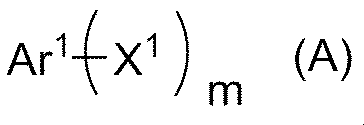
- m represents 1 or 2.
- Ar 1 represents an optionally substituted aryl group having 6 to 36 carbon atoms or an optionally substituted heteroaryl group having 4 to 36 carbon atoms
- m When is 2, Ar 1 represents an arylene group having 6 to 36 carbon atoms which may have a substituent or a heteroarylene group having 4 to 36 carbon atoms which may have a substituent.
- the carbon number of these groups does not include the carbon number of the substituent.
- the substituent which these groups may have is selected from the above group 1.
- the aryl group may be a monovalent group formed by two or more monocyclic and / or condensed ring aryl groups bonded directly or indirectly through a hetero atom or a carbonyl group.
- a heteroaryl group may be a monovalent group formed by two or more monocyclic and / or condensed heteroaryl groups bonded directly or indirectly through a heteroatom or a carbonyl group.
- one or more monocyclic and / or fused ring heteroaryl groups and one or more monocyclic and / or fused ring aryl groups are bonded directly or indirectly through a heteroatom or carbonyl group.
- the arylene group may be a divalent group formed by two or more monocyclic and / or condensed arylene groups bonded directly or indirectly through a hetero atom or a carbonyl group.
- the heteroarylene group may be a divalent group formed by two or more monocyclic and / or condensed ring heteroarylene groups bonded directly or indirectly through a heteroatom or a carbonyl group.
- one or more monocyclic and / or fused ring heteroarylene groups and one or more monocyclic and / or fused ring arylene groups are bonded directly or indirectly through a heteroatom or carbonyl group.
- Ar 2 represents an aryl group having 6 to 36 carbon atoms which may have a substituent or a heteroaryl group having 4 to 36 carbon atoms which may have a substituent.
- Ar 2 represents an arylene group having 6 to 36 carbon atoms which may have a substituent or a heteroarylene group having 4 to 36 carbon atoms which may have a substituent.
- the carbon number of these groups does not include the carbon number of the substituent.
- the substituent which these groups may have is selected from the above group 1.
- the aryl group may be a monovalent group formed by two or more monocyclic and / or condensed ring aryl groups bonded directly or indirectly through a hetero atom or a carbonyl group.
- a heteroaryl group may be a monovalent group formed by two or more monocyclic and / or condensed heteroaryl groups bonded directly or indirectly through a heteroatom or a carbonyl group. Often, one or more monocyclic and / or fused ring heteroaryl groups and one or more monocyclic and / or fused ring aryl groups are bonded directly or indirectly through a heteroatom or carbonyl group. It may be a monovalent group formed by The arylene group may be a divalent group formed by two or more monocyclic and / or condensed arylene groups bonded directly or indirectly through a hetero atom or a carbonyl group.
- the heteroarylene group may be a divalent group formed by two or more monocyclic and / or condensed ring heteroarylene groups bonded directly or indirectly through a heteroatom or a carbonyl group. Often, one or more monocyclic and / or fused ring heteroarylene groups and one or more monocyclic and / or fused ring arylene groups are bonded directly or indirectly through a heteroatom or carbonyl group. It may be a divalent group formed by ) A compound represented by Formula (C): (Where X represents a chlorine atom, a bromine atom or an iodine atom. A represents an alkyl group having 1 to 3 carbon atoms.
- R 1 is an alkyl group having 1 to 20 carbon atoms, a cycloalkyl group having 5 to 10 carbon atoms, an aryl group having 6 to 20 carbon atoms which may have a substituent, or an optionally substituted carbon.
- R 4 and R 3 each independently represents an alkyl group having 1 to 20 carbon atoms or a cycloalkyl group having 5 to 10 carbon atoms.
- the carbon number of the aryl group and heteroaryl group does not include the carbon number of the substituent.
- the substituent which the aryl group and heteroaryl group may have is selected from the above group 1.
- Plural X, A, R 1 , R 2 and R 3 may be the same or different. .) The manufacturing method of an aromatic compound including the process made to react in presence of the palladium complex represented by these, and a base. [8] The description according to [7], wherein R 1 is an optionally substituted aryl group having 6 to 20 carbon atoms or an optionally substituted heteroaryl group having 4 to 20 carbon atoms. A method for producing an aromatic compound. [9] The method for producing an aromatic compound according to [7] or [8], wherein R 2 and R 3 are each independently an alkyl group having 1 to 6 carbon atoms or a cycloalkyl group having 5 to 6 carbon atoms.
- Group Ar A monocyclic aryl group, a condensed ring aryl group, and a monovalent group formed by two or more monocyclic aryl groups bonded directly or indirectly through a heteroatom or a carbonyl group, A monovalent heteroaryl group, a fused-ring heteroaryl group, and a monovalent formed by two or more monocyclic heteroaryl groups bonded directly or indirectly through a heteroatom or a carbonyl group Group, A monocyclic arylene group, a condensed ring arylene group, and a divalent group formed by two or more monocyclic arylene groups bonded directly or indirectly through a heteroatom or carbonyl group, and , A monocyclic heteroarylene group, a condensed ring heteroarylene group, and a divalent group formed by two or more monocyclic heteroarylene groups bonded directly or indirectly through a heteroatom or a carbonyl group Group.
- a catalyst for Suzuki coupling which is represented by the formula (C): (Where X represents a chlorine atom, a bromine atom or an iodine atom.
- A represents an alkyl group having 1 to 3 carbon atoms.
- R 1 is an alkyl group having 1 to 20 carbon atoms, a cycloalkyl group having 5 to 10 carbon atoms, an aryl group having 6 to 20 carbon atoms which may have a substituent, or an optionally substituted carbon.
- R 4 and R 3 each independently represents an alkyl group having 1 to 20 carbon atoms or a cycloalkyl group having 5 to 10 carbon atoms.
- the carbon number of the aryl group and heteroaryl group does not include the carbon number of the substituent.
- the substituent which the aryl group and heteroaryl group may have is selected from the above group 1.
- the alkyl group may be linear or branched.
- the alkyl group usually has 1 to 20 carbon atoms.
- Specific examples of the alkyl group include methyl group, ethyl group, n-propyl group, isopropyl group, n-butyl group, isobutyl group, sec-butyl group, tert-butyl group, n-pentyl group, 2,2-dimethyl group.
- An alkyl group substituted with a fluorine atom is an alkyl group having a fluorine atom as a substituent.
- the alkyl group has the same meaning as described above.
- the carbon number of the cycloalkyl group is usually 3-20.
- Specific examples of the cycloalkyl group include a cyclopropyl group, a cyclopentyl group, a cyclohexyl group, a cycloheptyl group, and a cyclooctyl group.
- the alkoxy group may be linear or branched.
- the carbon number of the alkoxy group is usually 1-20.
- Specific examples of the alkoxy group include methoxy group, ethoxy group, n-propoxy group, isopropoxy group, n-butoxy group, sec-butoxy group, tert-butoxy group, n-pentyloxy group, 2,2-dimethylpropoxy group.
- n-hexyloxy group, n-heptyloxy group, n-octyloxy group, n-nonyloxy group, n-decyloxy group, n-undecyloxy group, n-dodecyloxy group, n-tridecyloxy group examples thereof include n-tetradecyloxy group, n-pentadecyloxy group, n-hexadecyloxy group, n-heptadecyloxy group, n-octadecyloxy group, n-nonadecyloxy group and n-icosyloxy group.
- the carbon number of the cycloalkoxy group is usually 3-20.
- Specific examples of the cycloalkoxy group include a cyclopropoxy group, a cyclopentyloxy group, a cyclohexyloxy group, a cycloheptyloxy group, and a cyclooctyloxy group.
- the carbon number of the alkylthio group is usually 1-20.
- Specific examples of the alkylthio group include methylthio group, ethylthio group, n-propylthio group, isopropylthio group, n-butylthio group, isobutylthio group, sec-butylthio group, tert-butylthio group, n-pentylthio group, n-hexylthio group.
- n-heptylthio group n-octylthio group, 2-ethylhexylthio group, n-nonylthio group, n-decylthio group, 3,7-dimethyloctylthio group and n-dodecylthio group.
- the cycloalkyl group usually has 3 to 20 carbon atoms.
- Specific examples of the cycloalkylthio group include a cyclopropylthio group, a cyclopentylthio group, a cyclohexylthio group, a cycloheptylthio group, and a cyclooctylthio group.
- An aryl group is a group formed by leaving one hydrogen atom bonded to an aromatic hydrocarbon ring.
- the aryl group usually has 6 to 20 carbon atoms.
- Specific examples of the aryl group include phenyl group, 4-methylphenyl group, 2-methylphenyl group, 2,6-dimethylphenyl group, 1-naphthyl group, 2-naphthyl group, 3-phenanthryl group and 2-anthryl group.
- the aryloxy group is a group in which an aryl group is bonded to an oxy group, and the aryl group usually has 6 to 20 carbon atoms.
- Specific examples of the aryloxy group include a phenoxy group, a naphthyloxy group, a phenanthryloxy group, and an anthryloxy group.
- the arylthio group usually has 6 to 20 carbon atoms. Specific examples of the arylthio group include a phenylthio group and a naphthylthio group.
- the arylalkyl group is an alkyl group having an aryl group as a substituent, and the aryl group usually has 6 to 20 carbon atoms, and the alkyl group usually has 1 to 20 carbon atoms.
- the arylcycloalkyl group is a cycloalkyl group having an aryl group as a substituent, and the aryl group usually has 6 to 20 carbon atoms, and the cycloalkyl group usually has 3 to 20 carbon atoms.
- the carbon number of the alkenyl group is usually 2-8.
- Specific examples of the alkenyl group include vinyl group, 1-propenyl group, 2-propenyl group, 1-butenyl group, 2-butenyl group, 1-pentenyl group, 2-pentenyl group, 1-hexenyl group and 2-hexenyl group. 1-octenyl group.
- the arylalkenyl group is an alkenyl group having an aryl group as a substituent, and the aryl group usually has 6 to 20 carbon atoms, and the alkenyl group has usually 2 to 8 carbon atoms.
- Specific examples of the arylalkenyl group include a phenylalkenyl group and a naphthylalkenyl group.
- the carbon number of the alkynyl group is usually 2-8.
- Specific examples of the alkynyl group include ethynyl group, 1-propynyl group, 2-propynyl group, 1-butynyl group, 2-butynyl group, 1-pentynyl group, 2-pentynyl group, 1-hexynyl group and 2-hexynyl group. 1-octynyl group.
- the arylalkynyl group is an alkynyl group having an aryl group as a substituent, and the aryl group usually has 6 to 20 carbon atoms, and the alkenyl group usually has 2 to 8 carbon atoms.
- Specific examples of the arylalkynyl group include a phenylalkynyl group and a naphthylalkynyl group.
- a heterocyclic group is a remaining atomic group obtained by removing one hydrogen atom directly bonded to a carbon atom constituting a ring from a heterocyclic compound, and the number of carbons of the heterocyclic group is usually 3 to 20.
- Specific examples of the heterocyclic group include thienyl group, pyrrolyl group, furyl group, pyridyl group, pyridazinyl group, pyrimidyl group, pyrazinyl group, triazinyl group, pyrrolidinyl group, piperidinyl group, quinolyl group, and isoquinolyl group.
- the heterocyclic group may have an alkyl group as a substituent.
- a group represented by —N (R ′) 2 (two R ′ each independently represents a hydrogen atom, a hydrocarbon group having 1 to 20 carbon atoms, or an alkyl group having 3 carbon atoms; -20 represents a heterocyclic group having 1 to 20 carbon atoms, and examples of the hydrocarbon group having 1 to 20 carbon atoms represented by R 'include an alkyl group, a cycloalkyl group, and an aryl group.
- at least one R ′ is preferably a hydrocarbon group having 1 to 20 carbon atoms, or a heterocyclic group optionally having an alkyl group. .
- R ′ Specific examples of the group represented by —N (R ′) 2 include a methylamino group, a dimethylamino group, an ethylamino group, a diethylamino group, an n-propylamino group, a di-n-propylamino group, and an isopropylamino group.
- R ′ is a carbon A hydrocarbon group of 1 to 20 or an optionally substituted alkyl group is preferable.
- —Si (R ′) 3 Specific examples of the group represented by —Si (R ′) 3 include trimethylsilyl group, triethylsilyl group, tri-n-propylsilyl group, triisopropylsilyl group, dimethylisopropylsilyl group, diethylisopropylsilyl group, tert- Butylsilyldimethylsilyl group, n-pentyldimethylsilyl group, n-hexyldimethylsilyl group, n-heptyldimethylsilyl group, n-octyldimethylsilyl group, 2-ethylhexyldimethylsilyl group, n-nonyldimethylsilyl group, n- Decyldimethylsilyl group, 3,7-dimethyloctyldimethylsilyl group, n-dodecyldimethylsilyl group
- Acyl group is represented by R'CO-.
- R ' has the same meaning as described above.
- Specific examples of the acyl group include aliphatic acyl groups such as acetyl group, propionyl group, butyryl group, and isobutyryl group, and aromatic acyl groups such as benzoyl group and naphthoyl group.
- the group having a carbon atom-nitrogen atom double bond is an atomic group formed by leaving one hydrogen atom directly bonded to the carbon atom or nitrogen atom constituting the carbon atom-nitrogen atom double bond in the imine compound. It is.
- the imine compound include aldimine, ketimine, and a nitrogen atom constituting a carbon atom-nitrogen atom double bond in aldimine as an alkyl group, aryl group, arylalkyl group, arylalkenyl group or aryl as a substituent. Examples thereof include compounds having an alkynyl group.
- R ′′ represents a hydrogen atom, an alkyl group, an aryl group, an arylalkyl group, an arylalkenyl group or an arylalkynyl group
- R ′ ′′ each independently represents an alkyl group, a cycloalkyl group
- the number of carbon atoms of the group having a carbon atom-nitrogen atom double bond is usually 2 to 20, preferably 2 to 18, and more preferably 2 to 16.
- Specific examples of the “group having a carbon atom-nitrogen atom double bond” include the following groups.
- the acid imide group is represented by (R′CO) 2 N—.
- R ′ has the same meaning as described above, and two R ′ may be the same or different. Two R ′ may be bonded to each other and form a ring together with the carbon atom to which they are bonded and the nitrogen atom to which the carbon atom is bonded.
- the acid imide group preferably has 4 to 20 carbon atoms, more preferably 4 to 18 carbon atoms, and still more preferably 4 to 16 carbon atoms. Specific examples of the acid imide group include the following groups.
- An alkoxycarbonyl group is a group in which an alkoxy group is bonded to a carbonyl group.
- the alkoxy group has the same meaning as described above.
- Specific examples of the alkoxycarbonyl group include a methoxycarbonyl group, an ethoxycarbonyl group, an n-propoxycarbonyl group, an isopropoxycarbonyl group, an n-butoxycarbonyl group, an isobutoxycarbonyl group, a sec-butoxycarbonyl group, and a tert-butoxycarbonyl group.
- the cycloalkoxycarbonyl group is a group in which a cycloalkoxy group is bonded to a carbonyl group.
- the cycloalkoxy group has the same meaning as described above.
- Specific examples of the cycloalkoxycarbonyl group include a cyclohexyloxycarbonyl group.
- An aryloxycarbonyl group is a group in which an aryloxy group is bonded to a carbonyl group.
- the aryloxy group has the same meaning as described above.
- Specific examples of the aryloxycarbonyl group include a phenoxycarbonyl group, a naphthoxycarbonyl group, and a pyridyloxycarbonyl group.
- the alkylsulfonyloxy group is a group in which an alkylsulfonyl group is bonded to an oxy group.
- the alkyl group possessed by the alkylsulfonyl group has the same meaning as described above.
- Specific examples of the alkylsulfonyloxy group include an oxymethanesulfonyloxy group.
- An alkylsulfonyloxy group substituted with fluorine is a group in which a fluorine-substituted alkylsulfonyl group is bonded to an oxy group.
- the alkyl group substituted with fluorine of the alkylsulfonyl group substituted with fluorine has the same meaning as described above.
- Specific examples of the fluorine-substituted alkylsulfonyloxy group include a trifluoromethanesulfonyloxy group.
- An arylsulfonyloxy group is a group in which an arylsulfonyl group is bonded to an oxy group.
- An arylsulfonyl group is a group in which an aryl group is bonded to a sulfonyl group.
- the aryl group has the same meaning as described above.
- Specific examples of the arylsulfonyloxy group include a p-toluenesulfonyloxy group.
- a monocyclic aryl group, a condensed ring aryl group, and two or more monocyclic aryl groups and / or a condensed ring aryl group are directly bonded or heteroatoms (oxygen atoms, A monovalent group formed by being indirectly bonded through a nitrogen atom, a sulfur atom, etc.) or a carbonyl group (—CO—).
- the remaining bonds of the nitrogen atom for indirectly bonding the aryl group are bonded to, for example, an alkyl group which may have a substituent, an aryl group which may have a substituent, and the like.
- Examples of the monocyclic aryl group include a phenyl group, and examples of the condensed ring aryl group include a naphthyl group, an anthracenyl group, and a fluorenyl group.
- Two or more monocyclic aryl groups are directly bonded or Examples of the monovalent group formed by being indirectly bonded via a hetero atom or a carbonyl group include a biphenyl group.
- Examples of the aryl group having 6 to 36 carbon atoms include groups represented by formulas (a-1) to (e-1) and formulas (k-1) to (o-1). (In the formula, R represents a substituent selected from the above group 1. p represents an integer of 0 to 4.)
- the arylene group having 6 to 36 carbon atoms includes a monocyclic arylene group, a condensed ring arylene group, and two or more monocyclic and / or condensed arylene groups which are directly bonded or heteroatoms (oxygen atom, nitrogen atom, A divalent group formed by being indirectly bonded via a sulfur atom or the like) or a carbonyl group (—CO—).
- the remaining bond of the nitrogen atom for indirectly bonding the arylene group is bonded to, for example, an alkyl group which may have a substituent, an aryl group which may have a substituent, or the like.
- Examples of the monocyclic arylene group include a phenylene group, and examples of the condensed ring arylene group include a naphthalenediyl group, an anthracenediyl group, and a fluorenediyl group, and two or more monocyclic arylene groups.
- Examples of the divalent group formed by directly bonding or indirectly bonding via a hetero atom or a carbonyl group include a biphenylene group.
- Examples of the arylene group having 6 to 36 carbon atoms include groups represented by formula (a-2) to formula (e-2) and formula (k-2) to formula (o-2). (In the formula, R and p are as defined above.)
- a heteroaryl group is a group in which the carbon atoms constituting the ring of the aryl group are substituted with a heteroatom or a carbonyl group.
- the heteroaryl group having 4 to 36 carbon atoms is a monocyclic heteroaryl group, a condensed heteroaryl group, two or more monocyclic and / or condensed heteroaryl groups directly bonded or heteroatoms (oxygen atom, nitrogen A monovalent group formed by being indirectly bonded via a carbonyl group (—CO—), and one or more monocyclic and / or condensed heteroaryl groups;
- One or more monocyclic and / or condensed aryl groups are bonded directly or indirectly through a hetero atom (oxygen atom, nitrogen atom, sulfur atom, etc.) or carbonyl group (—CO—).
- the condensed ring contained in the heteroaryl group of the condensed ring may be a condensed ring of two or more hetero rings, or a condensed ring of one or more hetero rings and one or more aromatic rings. .
- heteroaryl group having 4 to 36 carbon atoms examples include groups represented by formulas (f-1) to (i-1) and formulas (p-1) to (r-1).
- R and p are as defined above.
- Y represents a sulfur atom, an oxygen atom or a group represented by —NR Y —.
- R Y has a hydrogen atom or a substituent. Represents an optionally substituted alkyl group or an optionally substituted aryl group.
- Ring A represents a heterocycle or an aromatic ring.
- Examples of groups represented by formulas (f-1) to (i-1) include groups represented by formulas (fa-1) to (im-1), respectively.
- a heteroarylene group is a group in which the carbon atoms constituting the ring of the arylene group are substituted with a heteroatom or a carbonyl group.
- the heteroarylene group having 4 to 36 carbon atoms is a monocyclic heteroarylene group, a condensed heteroarylene group, two or more monocyclic and / or condensed heteroarylene groups directly bonded or heteroatoms (oxygen atom, nitrogen A divalent group formed by being indirectly bonded via an atom, a sulfur atom, etc.) or a carbonyl group (—CO—), and one or more monocyclic and / or condensed heteroarylene groups
- a hetero atom oxygen atom, nitrogen atom, sulfur atom, etc.
- carbonyl group —CO—
- the remaining bond of the nitrogen atom that indirectly bonds the heteroarylene group is bonded to, for example, an alkyl group which may have a substituent, an aryl group which may have a substituent, or the like.
- the condensed ring contained in the heteroaryl group of the condensed ring may be a condensed ring of two or more hetero rings, or a condensed ring of one or more hetero rings and one or more aromatic rings. .
- heteroarylene group having 4 to 36 carbon atoms examples include groups represented by formulas (f-2) to (i-2) and (p-2) to (r-2), respectively.
- R, p, Y and ring A are as defined above.
- Examples of groups represented by formulas (f-2) to (i-2) include groups represented by formulas (fa-2) to (im-2), respectively.
- the substituents in Group 1 include fluorine atom, alkyl group, cycloalkyl group, alkoxy group, cycloalkoxy group, alkylthio group, cycloalkylthio group, aryl group, aryloxy group, arylthio group, arylalkyl group, arylcycloalkyl group , An arylalkenyl group, an arylalkynyl group, a heterocyclic group optionally having an alkyl group, a group represented by —N (R ′) 2 (two R ′ are each independently a hydrogen atom, a carbon number, A hydrocarbon group of 1 to 20 or a heterocyclic group of 3 to 20 carbon atoms which may have an alkyl group.), A group represented by —Si (R ′) 3 (R ′ And three R's may be the same or different from each other.), Acyl group, alkoxycarbonyl group, aryloxycarbonyl group, carboxy
- m 1 or 2, and 2 is preferable.
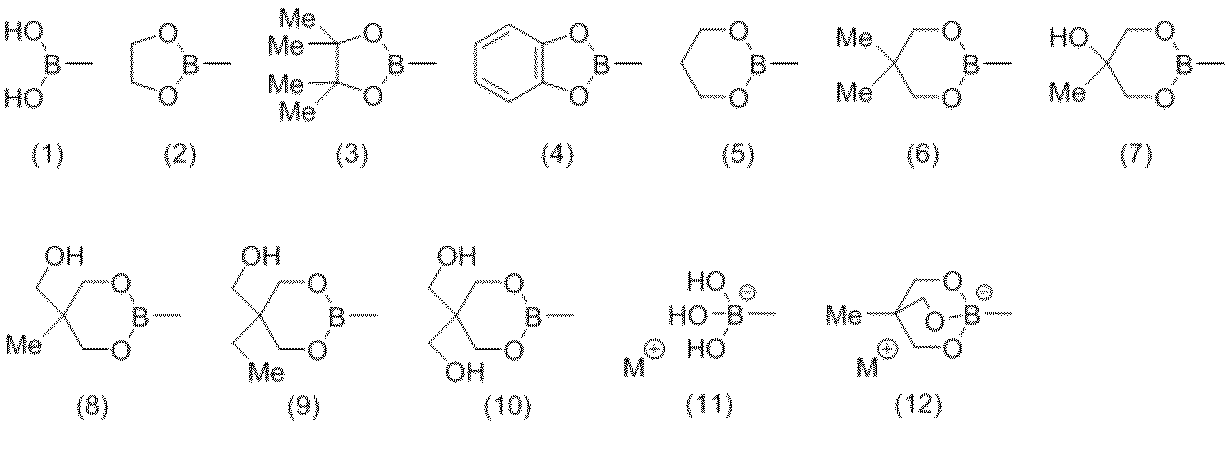
- X 1 is a group represented by any one of the formulas (1) to (12).
- X 1 is preferably a group represented by formula (1), (2), (3), (8) or (9).
- Ar 1 represents formulas (a-1), (b-1), (c-1), (d-1), (e-1), (f- 1), (g-1), (h-1), (p-1) (q-1), (r-1) (formulas (f-1), (g-1), (h-1) , (P-1), (q-1) and (r-1) are preferably groups represented by formula (g-1), (h- 1), (p-1), (q-1) or (r-1) (wherein Y is preferably S), more preferably a group represented by formula (fa-1 ), (Gb-1), (gc-1), (gd-1), (ge-1), (gf-1), (gg-1), (gh-1), (gi-1), More preferred is a group represented by (gj-1), (ha-1) or (hb-1).
- Ar 1 represents formulas (a-2), (b-2), (c-2), (d-2), (e-2) (f-2) ), (G-2), (h-2), (p-2), (q-2) or (r-2) (formulas (f-2), (g-2), (h-2) , (P-2), (q-2) and (r-2) are preferably a group represented by formula (g-2), (h- 2), (p-2), (q-2) or (r-2) (wherein Y is preferably S), more preferably a group represented by formula (fa-2 ), (Gb-2), (gc-2), (gd-2), (ge-2), (gf-2), (gg-2), (gh-2), (gi-2), More preferred is a group represented by (gj-2), (ha-2) or (hb-2).
- the compound represented by the formula (A) is a compound represented by the formula (A-1) or the formula (A-2).
- the compound represented by the formula (A-1) may be referred to as a compound (A-1), and the compound represented by the formula (A-2) may be referred to as a compound (A-2).
- Ar 1 -X 1 (A-1) X 1 -Ar 1 -X 1 (A-2) (In the formula, X 1 and Ar 1 are as defined above.)
- Examples of the compound represented by the formula (A-1) include phenylboronic acid, eaux-tolylboronic acid, m-tolylboronic acid, p-tolylboronic acid, 2,3-dimethylphenylboronic acid, 2,4-dimethylphenyl.
- Examples of the compound represented by the formula (A-2) include: 2,2 ′-(9,9-dihexyl-9H-fluorene-2,7-diyl) bis (4,4,5,5-tetramethyl-1,3,2-dioxaborolane), 2,2 ′-( 9,9-dioctyl-9H-fluorene-2,7-diyl) bis (4,4,5,5-tetramethyl-1,3,2-dioxaborolane), 2,2 ′-(9,9-didodecyl- 9H-Fluorene-2,7-diyl) bis (4,4,5,5-tetramethyl-1,3,2-dioxaborolane), 2,2 ′-(9-octyl-9H-carbazole-3,6- Diyl) bis (1,3,2-dioxaborolane), 2,2 ′-(2-methyl-5-octyl-1,4-phenylene) bis (4,4,5,5-t
- M is preferably a lithium element, a sodium element, or a potassium element.
- two or more compounds represented by the formula (A) may be used in combination.
- n 1 or 2
- 2 is preferable.
- X 2 is preferably a chlorine atom, a bromine atom or an iodine atom.
- Ar 2 represents formulas (a-1), (b-1), (c-1), (d-1), (e-1), (f- 1), (g-1), (h-1), (p-1) (q-1), (r-1) (formulas (f-1), (g-1), (h-1) , (P-1), (q-1) and (r-1) are preferably groups represented by formula (g-1), (h- 1), (p-1), (q-1) or (r-1) (wherein Y is preferably S), more preferably a group represented by formula (fa-1 ), (Gb-1), (gc-1), (gd-1), (ge-1), (gf-1), (gg-1), (gh-1), (gi-1), More preferred is a group represented by (gj-1), (ha-1) or (hb-1).
- Ar 2 represents formulas (a-2), (b-2), (c-2), (d-2), (e-2) (f-2) ), (G-2), (h-2), (p-2), (q-2) or (r-2) (formulas (f-2), (g-2), (h-2) , (P-2), (q-2) and (r-2) are preferably a group represented by formula (g-2), (h- 2), (p-2), (q-2) or (r-2) (wherein Y is preferably S), more preferably a group represented by formula (fa-2 ), (Gb-2), (gc-2), (gd-2), (ge-2), (gf-2), (gg-2), (gh-2), (gi-2), A group represented by (gj-2), (ha-2) or (hb-2) is more preferable.
- the compound represented by the formula (B) is a compound represented by the formula (B-1) or the formula (B-2).
- the compound represented by the formula (B-1) may be referred to as a compound (B-1)
- the compound represented by the formula (B-2) may be referred to as a compound (B-2).
- Ar 2 -X 2 (B-1) X 2 -Ar 2 -X 2 (B-2) (In the formula, X 2 and Ar 2 are as defined above.)
- Examples of the compound represented by the formula (B-1) include phenyl bromide, schreib-tolyl bromide, m-tolyl bromide, p-tolyl bromide, 4-tert-butylphenyl bromide, 2,6-dimethylphenyl bromide, 2,4-dimethylphenyl bromide, 3,5-dimethylphenyl bromide, 2- (2-hydroxyethyl) phenyl bromide, 4-cyclohexylphenyl bromide, 3-bromobenzotrifluoride, 3-bromo-4-chlorobenzotrifluoride 2-naphthyl bromide, 9-bromoanthracene, 9,10-dibromoanthracene, m-methoxyphenyl bromide, 4-bromobenzaldehyde, methyl 2-bromophenylacetate, methyl 3-bromophenylacetate, methyl 4-bromophenylacetate,
- two or more compounds represented by the formula (B) may be used in combination.
- the palladium complex In the crystalline state, the palladium complex is in the form of the palladium complex represented by the formula (C) and the formula (R) depending on the kind of R 1 , R 2 , R 3 or X, the recrystallization conditions when producing the palladium complex, It can take the form of a palladium complex having a binuclear structure represented by the formula (C ′) in which two palladium complexes represented by C) are bonded.
- X is preferably a chlorine atom.
- examples of the alkyl group having 1 to 3 carbon atoms represented by A include a methyl group, an ethyl group, an n-propyl group, and an isopropyl group, and a methyl group is preferable.
- R 1 is an optionally substituted aryl group having 6 to 20 carbon atoms or an optionally substituted hetero atom having 4 to 20 carbon atoms.
- An aryl group is preferred.
- R 2 and R 3 are preferably each independently an alkyl group having 1 to 6 carbon atoms or a cycloalkyl group having 5 to 6 carbon atoms.
- At least two selected from the group consisting of R 1 , R 2 and R 3 may be the same or different from each other.
- at least two selected from the group consisting of R 1, R 2 and R 3 are the same, R 1, and more preferably two selected from the group consisting of R 2 and R 3 are the same.
- examples of the alkyl group having 1 to 20 carbon atoms represented by R 1 , R 2 and R 3 include a methyl group, an ethyl group, an n-propyl group, and an isopropyl group.
- N-butyl group isobutyl group, sec-butyl group, tert-butyl group, n-pentyl group, 2,2-dimethylpropyl group, n-hexyl group, n-heptyl group, 2-methylpentyl group, n- Octyl, 2-ethylhexyl, n-nonyl, n-decyl, n-undecyl, n-dodecyl, n-tridecyl, n-tetradecyl, n-pentadecyl, n-hexadecyl, n- Examples thereof include a heptadecyl group, an n-octadecyl group, an n-nonadecyl group and an n-icosyl group. An alkyl group having 1 to 6 carbon atoms is preferable, and a tert-butyl group is more preferable.
- examples of the cycloalkyl group having 5 to 10 carbon atoms represented by R 1 , R 2 and R 3 include, for example, a cyclopentyl group, a cyclohexyl group, a cycloheptyl group, a cyclooctyl group Group, a cyclononyl group and a 1-adamantyl group.
- a cyclopentyl group or a cyclohexyl group is preferable, and a cyclopentyl group is more preferable.
- examples of the aryl group having 6 to 20 carbon atoms which may have a substituent represented by R 1 include a phenyl group, a 2-methylphenyl group, a 3- Methylphenyl group, 4-methylphenyl group, 2,3-dimethylphenyl group, 2,4-dimethylphenyl group, 2,5-dimethylphenyl group, 2,6-dimethylphenyl group, 3,5-dimethylphenyl group, 2,4,6-trimethylphenyl group, 2,3,5,6-tetramethylphenyl group, 2-ethylphenyl group, 3,5-diethylphenyl group, 4-n-propylphenyl group, 4-isopropylphenyl group 4-n-butylphenyl group, 4-tert-butylphenyl group, 1-naphthyl group, 2-naphthyl group, 2-biphenyl group, 3-biphenyl
- examples of the heteroaryl group having 4 to 20 carbon atoms which may have a substituent represented by R 1 include a 2-thienyl group, 3-methyl- 2-thienyl group, 4-methyl-2-thienyl group, 5-methyl-2-thienyl group, 3,4-dimethyl-2-thienyl group, 3,5-dimethyl-2-thienyl group, 4,5-dimethyl -2-thienyl group, 3-thienyl group, 2-methyl-3-thienyl group, 4-methyl-3-thienyl group, 5-methyl-3-thienyl group, 2,4-dimethyl-3-thienyl group, 2 , 5-dimethyl-3-thienyl group, 4,5-dimethyl-3-thienyl group, 2-pyrrolyl group, 1-methyl-2-pyrrolyl group, 1-phenyl-2-pyrrolyl group, 3-pyrrolyl group, 1 -Methyl-3-pyrrolyl group, 1-phenyl
- the palladium complex represented by the formula (C) will be specifically described below.
- the palladium complex is a compound of the formula (2) in which two palladium complexes represented by the formula (C) described in detail below are bonded. It may be a palladium complex having a binuclear structure represented by C ′).
- Examples of the palladium complex represented by the formula (C) include a palladium complex in which A is an alkyl group having 1 to 3 carbon atoms, A palladium complex in which A is a methyl group, A palladium complex in which R 3 and R 2 are alkyl groups having 4 to 6 carbon atoms, A palladium complex in which R 3 and R 2 are cycloalkyl groups having 5 to 6 carbon atoms, A palladium complex in which R 3 and R 2 are tert-butyl groups, A palladium complex in which R 3 and R 2 are cyclopentyl groups, A palladium complex in which R 3 and R 2 are cyclohexyl groups; A palladium complex in which R 1 is an optionally substituted aryl group having 6 to 20 carbon atoms, A palladium complex in which R 1 , R 2 and R 3 are tert-butyl groups, A palladium complex in which A is a methyl group and R 3 and R 2 are alkyl groups having
- the palladium complex represented by the formula (C) include (Tri- (tert-butyl) phosphine) chloromethylpalladium, (di- (tert-butyl) (4-fluorophenyl) phosphine) chloromethylpalladium, (di- (tert-butyl) (3-fluorophenyl) phosphine) Chloromethylpalladium, (di- (tert-butyl) (4-methylphenyl) phosphine) chloromethylpalladium, (di- (tert-butyl) (3-methylphenyl) phosphine) chloromethylpalladium, (di- (tert- Butyl) (4-ethylphenyl) phosphine) chloromethylpalladium, (di- (tert-butyl) (3-ethylphenyl) phosphine) chloromethylpalladium, ((di- (tert-butyl) (3
- two or more kinds of palladium complexes represented by the formula (C) may be used in combination, or two or more kinds of palladium complexes represented by the formula (C ′) may be used in combination. Also good.
- the palladium complex represented by the formula (C) is Organometallics 2006, 25, 4588-4595. It can synthesize
- the palladium complex represented by the formula (C) is preferably a palladium complex represented by the formula (D) from the viewpoint of the stability of the complex.
- the palladium complex represented by the formula (C ′) is preferably a palladium complex represented by the formula (D ′) from the viewpoint of the stability of the complex.
- the palladium complex represented by the formula (D) and the formula (D ′) may be used as a catalyst for Suzuki coupling, a catalyst for Stille coupling, a catalyst for Heck coupling, a catalyst for Hiyama coupling, a Sonogashira cup
- the catalyst may be used as a ring catalyst, a Kumada coupling catalyst, or a Buchwald-Hartwig coupling catalyst.
- X is preferably a chlorine atom.
- examples of the alkyl group having 1 to 3 carbon atoms represented by A include a methyl group, an ethyl group, an n-propyl group, and an isopropyl group. From the viewpoint of catalyst preparation, A methyl group is preferred.
- B is preferably an alkyl group having 4 to 20 carbon atoms.
- examples of the alkyl group having 4 to 20 carbon atoms represented by B include an n-butyl group, an isobutyl group, a sec-butyl group, a tert-butyl group, an n— Pentyl group, 2,2-dimethylpropyl group, n-hexyl group, n-heptyl group, 2-methylpentyl group, n-octyl group, 2-ethylhexyl group, n-nonyl group, n-decyl group, n-undecyl Group, n-dodecyl group, n-tridecyl group, n-tetradecyl group, n-pentadecyl group, n-hexadecyl group, n-heptadecyl group, n-octadecyl group, n-nonadecy
- examples of the cycloalkyl group having 5 to 10 carbon atoms represented by B include a cyclopentyl group, a cyclohexyl group, a cycloheptyl group, a cyclooctyl group, and an adamantyl group.
- a cycloalkyl group having 5 to 6 carbon atoms is preferred, and a cyclopentyl group is more preferred.
- examples of the alkoxy group having 1 to 20 carbon atoms represented by R 4 and R 5 include a methoxy group, an ethoxy group, an n-propoxy group, an isopropoxy group, n -Butoxy group, sec-butoxy group, tert-butoxy group, n-pentyloxy group, 2,2-dimethylpropoxy group, n-hexyloxy group, n-heptyloxy group, n-octyloxy group, n-nonyloxy group N-decyloxy group, n-undecyloxy group, n-dodecyloxy group, n-tridecyloxy group, n-tetradecyloxy group, n-pentadecyloxy group, n-hexadecyloxy group, n-hepta Examples include decyloxy group, n-octadecyloxy group,
- examples of the C 5-10 cycloalkoxy group represented by R 4 and R 5 include a cyclopentyloxy group and a cyclohexyloxy group.
- R 4 and R 5 are preferably a hydrogen atom, an alkoxy group having 1 to 6 carbon atoms or a cycloalkoxy group having 5 to 6 carbon atoms. More preferably, the alkoxy group of 3 is more preferable, and a hydrogen atom is more preferable.
- examples of the alkyl group having 1 to 20 carbon atoms represented by R 6 , R 7 and R 8 include a methyl group, an ethyl group, an n-propyl group, and an isopropyl group.
- N-butyl group isobutyl group, sec-butyl group, tert-butyl group, n-pentyl group, 2,2-dimethylpropyl group, n-hexyl group, n-heptyl group, 2-methylpentyl group, n- Octyl, 2-ethylhexyl, n-nonyl, n-decyl, n-undecyl, n-dodecyl, n-tridecyl, n-tetradecyl, n-pentadecyl, n-hexadecyl, n- Examples thereof include a heptadecyl group, an n-octadecyl group, an n-nonadecyl group and an n-icosyl group. An alkyl group having 1 to 6 carbon atoms is preferable, and a tert-butyl group is more preferable.
- Examples of the cycloalkyl group having 5 to 10 carbon atoms represented by R 6 , R 7 and R 8 in the formula (D) and the formula (D ′) include, for example, a cyclopentyl group, a cyclohexyl group, a cycloheptyl group, a cyclooctyl group Group, 1-adamantyl group, and cyclopentyl group and cyclohexyl group are more preferable.
- examples of the aryl group having 6 to 20 carbon atoms represented by R 6 , R 7 and R 8 include a phenyl group, a 4-methylphenyl group, and 2-methylphenyl. Group, 1-naphthyl group, 2-naphthyl group, 3-phenanthryl group and 2-anthryl group.
- examples of the heteroaryl group having 4 to 20 carbon atoms represented by R 6 , R 7 and R 8 include a 2-thienyl group, a 3-thienyl group, 2- Pyrrolyl group, 3-pyrrolyl group, 2-furyl group, 3-furyl group, 2-pyridyl group, 3-pyridyl group, 3-pyridazinyl group, 4-pyridazinyl group, 2-pyrimidyl group, 4-pyrimidyl group, 5- Examples include pyrimidyl group, 2-pyrazinyl group, 2-triazinyl group, 2-quinolyl group, 8-quinolyl group, 1-isoquinolyl group and 3-isoquinolyl group.
- the palladium complex represented by the formula (D) will be specifically described below, but the palladium complex is a formula in which two molecules of the palladium complex represented by the formula (D) specifically described below are bonded.
- the palladium complex of the binuclear structure represented by (D ') may be sufficient.
- Examples of the palladium complex represented by the formula (D) include: A palladium complex in which A is an alkyl group having 1 to 3 carbon atoms, A palladium complex in which A is a methyl group, A palladium complex in which B is an alkyl group having 4 to 6 carbon atoms, A palladium complex in which B is a cycloalkyl group having 5 to 6 carbon atoms, A palladium complex in which B is a tert-butyl group, A palladium complex in which B is a cyclopentyl group, A palladium complex in which B is a cyclohexyl group, R 4 and R 5 is a hydrogen atom, a palladium complex which is an alkoxy group having 1 to 6 carbon atoms, A palladium complex in which R 4 and R 5 are hydrogen atoms, A palladium complex in which R 4 and R 5 are alkoxy groups having 1 to 6 carbon atoms, A palladium complex represented by the formula (D), where
- palladium complex R 6 and R 8 is a fluorine atom, an alkyl group or an aryl group having 6 to 20 carbon atoms having 1 to 6 carbon atoms, A is a methyl group, B is a tert-butyl group, R 4 is a hydrogen atom, R 5 is an alkoxy group having 1 to 6 carbon atoms, R 7 is a hydrogen atom, R 6 and R A palladium complex wherein 8 is a fluorine atom, an alkyl group having 1 to 6 carbon atoms or an aryl group having 6 to 20 carbon atoms; A is a methyl group, B is a cyclopentyl group, R 4 is a hydrogen atom, R 5 is an alkoxy group having 1 to 6 carbon atoms, R 7 is a hydrogen atom, R 6 and R 8 are A palladium complex which is a fluorine atom, an alkyl group having 1 to 6 carbon atoms or an aryl group having 6 to 20 carbon atoms
- the palladium complex represented by the formula (D) include (Di- (tert-butyl) (4-fluorophenyl) phosphine) chloromethylpalladium, (di- (tert-butyl) (3-fluorophenyl) phosphine) chloromethylpalladium, (di- (tert-butyl) (4 -Methylphenyl) phosphine) chloromethylpalladium, (di- (tert-butyl) (3-methylphenyl) phosphine) chloromethylpalladium, (di- (tert-butyl) (4-ethylphenyl) phosphine) chloromethylpalladium, (Di- (tert-butyl) (3-ethylphenyl) phosphine) chloromethylpalladium, ((di- (tert-butyl) (4-isopropylphenyl) phosphine) chloromethylmethylpal
- two or more kinds of palladium complexes represented by the formula (D) may be used in combination, or two or more kinds of palladium complexes represented by the formula (D ′) may be used in combination. Also good.
- the palladium complex represented by the formula (D) and the formula (D ′) is usually a phosphorus compound represented by the formula (E) and a palladium complex represented by the formula (F) (in the palladium complex, 5-cyclooctadiene is coordinated in the presence of a solvent.
- a palladium complex represented by the formula (E) in the palladium complex, 5-cyclooctadiene is coordinated in the presence of a solvent.
- B and R 4 to R 8 are as defined above.
- a and X are as defined above.
- the amount of the phosphorus compound represented by the formula (E) is usually 1.0 mol to 3. mol per 1 mol of the palladium complex coordinated with the 1,5-cyclooctadiene represented by the formula (F). The range is 0 mol.
- the reaction temperature is usually in the range of ⁇ 30 ° C. to 80 ° C.
- the reaction time is usually in the range of 1 minute to 24 hours.
- solvent examples include chloroform, dichloroethane, diethyl ether, tert-butyl methyl ether, and tetrahydrofuran.
- the phosphorus compound represented by the formula (E) can be produced, for example, by reacting the phosphonium salt represented by the formula (G) with a base.
- a base In the formula, B and R 4 to R 8 are as defined above.
- Z ⁇ represents an anion.
- anion represented by Z ⁇ examples include halogen ions such as F ⁇ , Cl ⁇ , Br ⁇ and I ⁇ , perchlorate ions, hydrogen sulfate ions, hexafluorophosphate ions, and tetrafluoroborate ions. Preferably, it is a tetrafluoroborate ion.
- the reaction temperature is usually in the range of ⁇ 30 ° C. to 80 ° C.
- the reaction time is usually in the range of 1 minute to 6 hours.
- Examples of the base include potassium phosphate, sodium phosphate, sodium carbonate, triethylamine and diisopropylamine.
- the amount of the base used is usually in the range of 0.5 mol to 3.0 mol with respect to 1 mol of the phosphonium salt represented by the formula (G).
- the phosphorus compound represented by the formula (E) may be used after being isolated, or may be used in the system for producing a palladium complex without isolation.
- Organic solvent is usually an organic solvent that can dissolve the compound represented by the formula (A) and the compound represented by the formula (B).
- organic solvent examples include an acyclic ether solvent, an ether solvent such as a cyclic ether solvent, an aprotic polar solvent, an aromatic hydrocarbon solvent, an aliphatic hydrocarbon solvent, an alcohol solvent, an ester solvent, and a ketone solvent.
- Ether solvents, aromatic hydrocarbon solvents, alcohol solvents or ketone solvents are preferred.
- acyclic ether solvent examples include diethyl ether, diisopropyl ether, ethylene glycol dimethyl ether, and diethylene glycol dimethyl ether.
- Examples of the cyclic ether solvent include 1,4-dioxane and tetrahydrofuran.
- aromatic hydrocarbon solvent examples include benzene, toluene, xylene, mesitylene, and tetralin.
- aprotic polar solvent examples include N-methylpyrrolidone, N, N-dimethylformamide, N, N-dimethylacetamide, dimethyl sulfoxide and acetonitrile.
- Examples of the aliphatic hydrocarbon solvent include hexane, heptane, and cyclohexane.
- Examples of the alcohol solvent include methanol, ethanol, n-propyl alcohol, isopropyl alcohol, n-butyl alcohol, sec-butyl alcohol, and tert-butyl alcohol.
- ester solvents examples include ethyl acetate.
- ketone solvent examples include acetone and methyl ethyl ketone.
- organic solvent from the viewpoint of the solubility of the compound represented by the formula (A) and the compound represented by the formula (B), toluene, xylene, mesitylene, diethyl ether, diisopropyl ether, ethylene glycol dimethyl ether, diethylene glycol dimethyl ether, 1 1,4-dioxane, tetrahydrofuran, methanol, ethanol, n-propyl alcohol, isopropyl alcohol, n-butyl alcohol, sec-butyl alcohol, tert-butyl alcohol, ethyl acetate, acetone or methyl ethyl ketone are preferred.
- two or more organic solvents may be used in combination.
- the combination of two or more organic solvents include a mixed solvent of tetrahydrofuran and toluene, a mixed solvent of methanol and mesitylene, a mixed solvent of acetone and tetralin, and the like.
- the production method of the present invention is carried out in the presence of a base.
- the base may be either an inorganic base or an organic base.
- Examples of the inorganic base include alkali metal hydroxide, alkaline earth metal hydroxide, alkali metal carboxylate, alkaline earth metal carboxylate, alkali metal carbonate, alkaline earth metal carbonate, and alkali metal carbonate.
- Examples thereof include hydrogen salts, alkaline earth metal hydrogen carbonates, alkali metal phosphates, and alkaline earth metal phosphates, and alkali metal carbonates and alkali metal phosphates are preferable.
- the inorganic base include lithium hydroxide, sodium hydroxide, potassium hydroxide, cesium hydroxide, calcium hydroxide, barium hydroxide, sodium formate, potassium formate, calcium formate, sodium acetate, potassium acetate, sodium carbonate,
- Examples include potassium carbonate, cesium carbonate, calcium carbonate, sodium hydrogen carbonate, potassium hydrogen carbonate, sodium phosphate, and potassium phosphate, and sodium carbonate, potassium carbonate, cesium carbonate, sodium phosphate, or potassium phosphate is preferable.
- Examples of the organic base include alkylammonium hydroxide; alkylammonium carbonate; alkylammonium bicarbonate; alkylammonium boronate; 1,5-diazabicyclo [4.3.0] non-5-ene (DBN) 1,8-diazabicyclo [5.4.0] undec-7-ene (DBU); 1,4-diazabicyclo [2.2.2] octane (DABCO); dimethylaminopyridine (DMAP); pyridine; trialkyl Examples of amines include alkylammonium fluorides such as tetraalkylammonium fluoride, and tetraalkylammonium hydroxides such as tetramethylammonium hydroxide, tetraethylammonium hydroxide, and tetra-n-propylammonium hydroxide are preferable.
- the amount of the base used is usually in the range of 0.5 equivalents to 20 equivalents, and preferably in the range of 0.5 equivalents to 6 equivalents.
- the equivalent represents the ratio of the theoretical amount of hydrogen ions that can be neutralized by the base to the total amount of X 2 contained in the compound represented by the formula (B).
- the base may be used as it is, or the base may be used in the form of an aqueous solution.
- two or more bases may be used in combination.
- Phase transfer catalysts include, for example, tetraalkylammonium halides, tetraalkylammonium hydrogensulfates and tetraalkylammonium hydroxides, tricaprylmethyl ammonium chloride (available as Aliquat® 336 from Sigma-Aldrich) Tetraalkyl ammonium halides such as are preferred.
- the amount of the phase transfer catalyst used is usually in the range of 0.001 equivalent to 1 equivalent, and preferably in the range of 0.01 to 0.5 equivalent.
- the equivalent represents the ratio of the substance amount of the phase transfer catalyst to the total substance amount of X 2 contained in the compound represented by the formula (B).
- the production method of the present invention comprises a compound represented by formula (A) and a compound represented by formula (B), a palladium complex represented by formula (C) or formula (C ′), an organic solvent, and A palladium complex represented by the formula (C) or the formula (C ′), comprising a step of reacting in the presence of a base, the compound represented by the formula (A) and the compound represented by the formula (B) By mixing in the presence of an organic solvent and a base, the compound represented by formula (A) reacts with the compound represented by formula (B) to produce an aromatic compound.
- These mixing orders are not limited.
- the organic solvent and the base may be mixed simultaneously, or the mixture obtained by mixing the compound represented by the formula (A), the compound represented by the formula (B), the organic solvent and the base. And an organic solvent and a palladium complex represented by the formula (C) or the formula (C ′) may be mixed.
- an organic solvent and a palladium complex represented by the formula (C) or the formula (C ′) may be mixed.
- after mixing the compound represented by Formula (A), the compound represented by Formula (B), the palladium complex represented by Formula (C) or Formula (C ′), and an organic solvent it is obtained.
- the resulting mixture may be mixed with a base.
- the amount of the compound represented by the formula (B) to be used is usually in the range of 0.8 mol to 1.2 mol, preferably 0.9 mol, per 1 mol of the compound represented by the formula (A). The range is from mol to 1.1 mol.
- the amount of the palladium complex represented by the formula (C) or the formula (C ′) is usually in the range of 0.0001 mol to 0.8 mol with respect to 1 mol of the compound represented by the formula (B).
- the range of 0.001 mol to 0.2 mol is preferable.
- the reaction temperature of the production method of the present invention is usually in the range of ⁇ 20 ° C. to 180 ° C., preferably in the range of ⁇ 20 ° C. to 100 ° C., more preferably in the range of ⁇ 20 ° C. to 80 ° C. .
- the reaction temperature is in the range of ⁇ 20 ° C. to 60 ° C. More preferably it is.
- the reaction time of the production method of the present invention is usually in the range of 30 minutes to 96 hours, and preferably in the range of 30 minutes to 48 hours.
- a reaction mixture containing the target aromatic compound is obtained.
- the target aromatic compound can be removed from the reaction mixture by a purification treatment such as fractionation by chromatography.
- the reaction mixture and a poor solvent are mixed to precipitate the target aromatic compound, followed by filtration or the like.
- the target aromatic compound can be taken out by ordinary separation means.
- the target aromatic compound may be taken out after washing the reaction mixture with an acidic solution such as hydrochloric acid.
- an aromatic compound can be produced regardless of the stability of the compound represented by the formula (A) under basic conditions. While the reaction temperature of ordinary Suzuki coupling is 80 ° C. or higher, in the production method of the present invention, the reaction proceeds even under lower temperature conditions. Therefore, according to the production method of the present invention, even when the compound represented by the formula (A) is a compound that is unstable under basic conditions (for example, a boronic acid compound having a heterocycle), The target aromatic compound can be produced in high yield.
- the yield of the obtained aromatic compound was analyzed by gas chromatography (hereinafter sometimes referred to as GC) and calculated from the analysis result.
- the GC analysis conditions are as follows.
- the obtained aromatic compound is an aromatic compound composed of the repeating unit represented by the formula (F-4)
- GPC gel permeation chromatography
- analysis conditions are The weight average molecular weight (Mw) and number average molecular weight (Mn) in terms of polystyrene were calculated from the analysis results as described below, and used as an index of the yield of the aromatic compound.
- GPC measuring device CTO-10AC (Shimadzu Corporation column oven), SPD-10A (Shimadzu Corporation detector) Column: Shodex KD-806 8.0 mm ⁇ ⁇ 30 cm (made by Showa Denko KK) -Column temperature: 60 ° C ⁇ Mobile phase: Ortho-dichlorobenzene ⁇ Flow rate: 1 mL / min ⁇ Detection: Visible light detection (wavelength 600 nm)
- NMR measuring device AVANCE600 (manufactured by BRUKER) or JNM-ECA400 (manufactured by JEOL)
- H nucleus H nucleus
- P nucleus P nucleus
- Example 1 After making the inside of the glass reaction vessel under a nitrogen atmosphere, di-tert-butyl (3,5-di- (tert-butyl) phenylphosphonium tetrafluoroborate 10.6 mmol, diethyl ether 20 mL and triethylamine 10.6 mmol were added, After stirring at room temperature for 5 minutes, the resulting suspension was filtered to remove solids, and the resulting liquid was converted into a glass reaction containing 7.5 mmol of chloromethyl (1,5-cyclooctadiene) palladium (II).
- Example 2 In a glass reaction vessel equipped with a cooling device, 0.01 mmol of chloromethyl (tri-tert-butylphosphine) palladium (II), 0.5 mmol of 2-bromo-m-xylene, 0.5 mmol of 2-thiopheneboronic acid, phosphorus Potassium acid 1.0 mmol, methanol 4.5 mL, water 0.5 mL, and 0.07 mmol of n-octylbenzene as an internal standard were added. The resulting mixture was stirred at 0 ° C. for 3 hours. 200 ⁇ L of the obtained reaction mixture was diluted with 5 mL of tetrahydrofuran and then subjected to GC analysis. As a result, the yield of the desired 2- (2 ′, 6′-dimethylphenyl) -thiophene was 94%.
- Example 3 2- (2 ′, 6′-dimethylphenyl) -thiophene was obtained in the same manner as in Example 2 except that sodium carbonate was used instead of potassium phosphate in Example 2. The yield was 91%.
- Example 4 In a glass reaction vessel equipped with a cooling device, 0.0025 mmol of chloromethyl (di (tert-butyl) (3,5-di (tert-butyl) phenylphosphine) palladium (II) obtained in Example 1), -Bromo-m-xylene 0.5 mmol, 2-thiopheneboronic acid 0.5 mmol, potassium phosphate 1.0 mmol, tetrahydrofuran 4.5 mL, water 0.5 mL, and n-octylbenzene 0.07 mmol as an internal standard were added. The obtained mixture was stirred for 3 hours at 45 ° C.
- Example 5 After the inside of a glass reaction vessel equipped with a cooling apparatus was placed in a nitrogen atmosphere, 3,7-dibromo-5,6-difluoro-2,1,3-benzothiadiazole 3.0 mmol, 2,2 ′-(5 5-bis (3,7-dimethyloctyl) -5H-dithieno [3,2-b: 2 ′, 3′-d] pyran-2,7-diyl) bis (5-methyl-1,3,2- Dioxaborinane-5-methanol (3.0 mmol), chloromethyl (tri-tert-butylphosphine) palladium (II) 9 ⁇ mol, water 90 mL, tetrahydrofuran 70 mL and mesitylene 30 mL were added.
- the resulting mixture was heated to 45 ° C. with stirring. 10 mL of 3M aqueous potassium phosphate solution was added to the resulting mixture. While stirring the obtained mixture, it was heated to 45 ° C. and reacted for 4 hours to obtain a reaction mixture containing an aromatic compound composed of a repeating structural unit represented by the following formula. After the obtained aromatic reaction mixture was dissolved in 1-chloronaphthalene, the molecular weight was analyzed by GPC. As a result, the molecular weight (Mw) was 3.6 ⁇ 10 4 .
- Example 6 In a glass reaction vessel equipped with a cooling device, 0.0025 mmol of chloromethyl (tri-tert-butylphosphine) palladium (II), 0.5 mmol of bromobenzene, 0.5 mmol of m-tolylboronic acid, 1.0 mmol of potassium phosphate, 4.5 mL of methanol, 0.5 mL of water, and 0.07 mmol of n-nonylbenzene as an internal standard were added. The resulting mixture was stirred at 60 ° C. for 3 hours. 200 ⁇ L of the obtained reaction mixture was diluted with 5 mL of tetrahydrofuran and analyzed by GC. As a result, the yield of the desired 3-methylbiphenyl was 100%.
- Example 7 To a glass reaction vessel equipped with a cooling device, chloromethyl (di (tert-butyl) (3,5-di (tert-butyl) phenylphosphine) palladium (II) palladium (II) 0.0025 mmol, 2-bromo- 0.5 mmol of m-xylene, 0.5 mmol of 2-thiopheneboronic acid, 1.0 mmol of potassium phosphate, 4.5 mL of methanol, 0.5 mL of water and 0.07 mmol of n-octylbenzene as an internal standard were obtained. The resulting mixture was stirred for 3 hours at 25 ° C.
- Example 8 The inside of a glass reaction vessel equipped with a dropping funnel was placed in a nitrogen atmosphere, and then 0.18 g of 2-bromoanisole and 4 mL of tetrahydrofuran were added. The obtained solution was cooled to ⁇ 70 ° C., and 0.6 mL of n-butyllithium (1.63 M / hexane solution) was added dropwise. The resulting mixture was stirred at ⁇ 70 ° C. for 1 hour, and then a solution obtained by dissolving 0.20 g of chlorodicyclopentylphosphine in 4 mL of tetrahydrofuran was added dropwise.
- Example 9 The inside of a glass reaction vessel equipped with a dropping funnel was placed in a nitrogen atmosphere, and then 0.52 g of 2-bromoanisole and 50 mL of tetrahydrofuran were added. The resulting solution was cooled to ⁇ 70 ° C., and 1.7 mL of n-butyllithium (1.63 M / hexane solution) was added dropwise. The resulting mixture was stirred at ⁇ 70 ° C. for 1 hour, and then a solution obtained by dissolving 0.50 g of di-tert-butylchlorophosphine in 17 mL of tetrahydrofuran was added dropwise.
- the obtained mixture was stirred at room temperature for 3 hours, and then the obtained reaction mixture was concentrated to obtain a mixture containing di (tert-butyl) (2-methoxyphenyl) phosphine.
- the mixture containing di (tert-butyl) (2-methoxyphenyl) phosphine obtained above and 20 mL of diethyl ether were added and mixed.
- the obtained mixture was filtered through Celite to obtain a liquid.
- the liquid obtained above was added to form a nitrogen atmosphere, 0.49 g of tetrafluoroboric acid diethyl ether complex was added, and the resulting mixture was vigorously stirred for 30 minutes.
- the precipitated solid was taken out by filtration and washed 3 times with 10 mL of diethyl ether.
- the obtained solid was dried under reduced pressure at room temperature for 3 hours to obtain di (tert-butyl) (2-methoxyphenyl) phosphonium tetrafluoroborate as a white solid.
- di (tert-butyl) (2-methoxyphenyl) phosphonium tetrafluoroborate obtained above, 2 mL of diethyl ether and 0.7 mL of triethylamine were added, and For 5 minutes.
- Example 10 In a glass reaction vessel equipped with a cooling device, 0.0025 mmol of chloromethyl (dicyclopentyl (2-methoxyphenyl) phosphine) palladium (II) obtained in Example 8, 0.5 mmol of 2-bromo-m-xylene, 0.5 mmol of 2-thiopheneboronic acid, 1.0 mmol of potassium phosphate, 4.5 mL of tetrahydrofuran, 0.5 mL of water, and 0.07 mmol of n-octylbenzene as an internal standard were added. The resulting mixture was stirred at 65 ° C. for 3 hours.
- Example 11 instead of chloromethyl (dicyclopentyl (2-methoxyphenyl) phosphine) palladium (II) in Example 10, chloromethyl (di (tert-butyl) ((2-methoxyphenyl) phosphine) obtained in Example 9 2- (2 ′, 6′-dimethylphenyl) -thiophene was obtained in the same manner as in Example 10 except that palladium (II) was used, and the yield was 92%.
Landscapes
- Chemical & Material Sciences (AREA)
- Organic Chemistry (AREA)
- Chemical Kinetics & Catalysis (AREA)
- Inorganic Chemistry (AREA)
- Engineering & Computer Science (AREA)
- Materials Engineering (AREA)
- Health & Medical Sciences (AREA)
- Medicinal Chemistry (AREA)
- Polymers & Plastics (AREA)
- Organic Low-Molecular-Weight Compounds And Preparation Thereof (AREA)
- Catalysts (AREA)
- Low-Molecular Organic Synthesis Reactions Using Catalysts (AREA)
- Other Resins Obtained By Reactions Not Involving Carbon-To-Carbon Unsaturated Bonds (AREA)
- Pyridine Compounds (AREA)
Abstract
Description
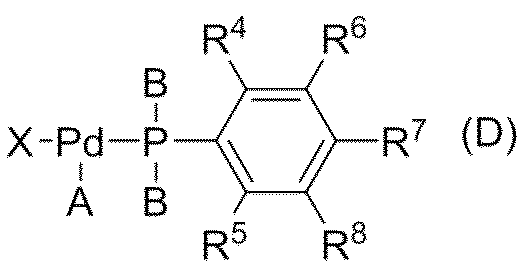
Xは塩素原子、臭素原子またはヨウ素原子を表す。
Aは炭素数1~3のアルキル基を表す。
Bは炭素数4~20のアルキル基または炭素数5~10のシクロアルキル基を表す。
R4およびR5はそれぞれ独立に、水素原子、フッ素原子、炭素数1~20のアルコキシ基または炭素数5~10のシクロアルコキシ基を表し、R6、R7およびR8はそれぞれ独立に、水素原子、フッ素原子、炭素数1~20のアルキル基、炭素数5~10のシクロアルキル基、置換基を有していてもよい炭素数6~20のアリール基または置換基を有していてもよい炭素数4~20のヘテロアリール基を表す。アリール基およびヘテロアリール基の炭素数には置換基の炭素数は含まれない。アリール基およびヘテロアリール基が有していてもよい置換基は、下記群1から選ばれる。R4~R8の全てが同時に水素原子を表すことはない。)
または
式(D’):

で表されるパラジウム錯体。
群1:フッ素原子、アルキル基、シクロアルキル基、アルコキシ基、シクロアルコキシ基、アルキルチオ基、シクロアルキルチオ基、アリール基、アリールオキシ基、アリールチオ基、アリールアルキル基、アリールシクロアルキル基、アリールアルケニル基、アリールアルキニル基、アルキル基を有していてもよいヘテロ環基、-N(R’)2で表される基(2つのR’はそれぞれ独立して、水素原子、炭素数1~20の炭化水素基、または、アルキル基を有していてもよいヘテロ環基を表す。)、-Si(R’)3で表される基(R’は前述と同義であり、3つのR’はそれぞれ同一であっても異なっていてもよい。)、アシル基、炭素原子-窒素原子二重結合を有する基、酸イミド基、アルコキシカルボニル基、シクロアルコキシカルボ二ル基、アリールオキシカルボニル基、カルボキシ基、シアノ基、ニトリル基およびニトロ基。
[2]Aがメチル基である、[1]記載のパラジウム錯体。
[3]Bが炭素数4~20のアルキル基である、[1]または[2]記載のパラジウム錯体。
[4]Bが炭素数4~6のアルキル基である、[3]に記載のパラジウム錯体。
[5]Bがtert-ブチル基である、[4]に記載のパラジウム錯体。
[6]R4およびR5が水素原子である、[1]~[5]のいずれか一項記載のパラジウム錯体。
[7]式(A):

X1は式(1)~式(12)のいずれかの式で表される基を表す。Mは1族の元素を表す。X1が複数ある場合、複数あるX1は同一であっても異なっていてもよい。

で表される化合物と、
式(B):

X2は、塩素原子、臭素原子、ヨウ素原子、アルキルスルホニルオキシ基、フッ素原子で置換されたアルキルスルホニルオキシ基またはアリールスルホニルオキシ基を表す。X2が複数ある場合、複数あるX2は同一であっても異なっていてもよい。
nは1または2を表す。式(B)におけるnは、式(A)におけるmと同一であっても異なっていてもよい。nが1のとき、Ar2は、置換基を有していてもよい炭素数6~36のアリール基または置換基を有していてもよい炭素数4~36のヘテロアリール基を表す。nが2のとき、Ar2は、置換基を有していてもよい炭素数6~36のアリーレン基または置換基を有していてもよい炭素数4~36のヘテロアリーレン基を表す。これらの基の炭素数には置換基の炭素数は含まれない。これらの基が有していてもよい置換基は、上記群1から選ばれる。アリール基は、2以上の単環および/または縮合環のアリール基が、直接結合またはヘテロ原子もしくはカルボニル基を介して間接的に結合することにより形成される1価の基であってもよい。ヘテロアリール基は、2以上の単環および/または縮合環のヘテロアリール基が、直接結合またはヘテロ原子もしくはカルボニル基を介して間接的に結合することにより形成される1価の基であってもよく、1以上の単環および/または縮合環のヘテロアリール基と1以上の単環および/または縮合環のアリール基とが、直接結合またはヘテロ原子もしくはカルボニル基を介して間接的に結合することにより形成される1価の基であってもよい。アリーレン基は、2以上の単環および/または縮合環のアリーレン基が、直接結合またはヘテロ原子もしくはカルボニル基を介して間接的に結合することにより形成される2価の基であってもよい。ヘテロアリーレン基は、2以上の単環および/または縮合環のヘテロアリーレン基が、直接結合またはヘテロ原子もしくはカルボニル基を介して間接的に結合することにより形成される2価の基であってもよく、1以上の単環および/または縮合環のヘテロアリーレン基と1以上の単環および/または縮合環のアリーレン基とが、直接結合またはヘテロ原子もしくはカルボニル基を介して間接的に結合することにより形成される2価の基であってもよい。)
で表される化合物とを、
式(C):
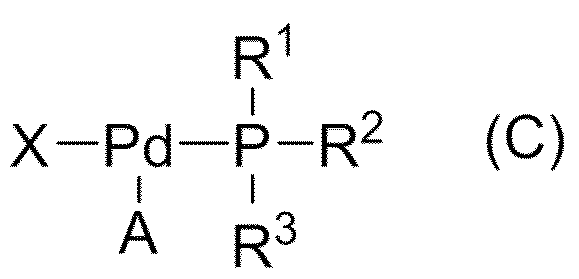
Xは塩素原子、臭素原子またはヨウ素原子を表す。
Aは炭素数1~3のアルキル基を表す。
R1は炭素数1~20のアルキル基、炭素数5~10のシクロアルキル基、置換基を有
していてもよい炭素数6~20のアリール基または置換基を有していてもよい炭素数4~20のヘテロアリール基を表し、R2およびR3はそれぞれ独立に、炭素数1~20のアルキル基または炭素数5~10のシクロアルキル基を表す。アリール基およびヘテロアリール基の炭素数には置換基の炭素数は含まれない。アリール基およびヘテロアリール基が有していてもよい置換基は、上記群1から選ばれる。)
または
式(C’):

で表されるパラジウム錯体、および、塩基の存在下に反応させる工程を含む、芳香族化合物の製造方法。
[8]R1が置換基を有していてもよい炭素数6~20のアリール基または置換基を有していてもよい炭素数4~20のヘテロアリール基である、[7]記載の芳香族化合物の製造方法。
[9]R2およびR3がそれぞれ独立に、炭素数1~6のアルキル基または炭素数5~6のシクロアルキル基である、[7]または[8]記載の芳香族化合物の製造方法。
[10]Aがメチル基である、[7]~[9]のいずれか一項記載の芳香族化合物の製造方法。
[11]Ar1およびAr2が、それぞれ独立に、下記群Arから選ばれる基である、[7]~[10]のいずれか一項記載の芳香族化合物の製造方法。
群Ar:
単環のアリール基、縮合環のアリール基、ならびに、2以上の単環のアリール基が直接結合またはヘテロ原子もしくはカルボニル基を介して間接的に結合することにより形成される1価の基、
単環のヘテロアリール基、縮合環のヘテロアリール基、ならびに、2以上の単環のヘテロアリール基が直接結合またはヘテロ原子もしくはカルボニル基を介して間接的に結合することにより形成される1価の基、
単環のアリーレン基、縮合環のアリーレン基、ならびに、2以上の単環のアリーレン基が直接結合またはヘテロ原子もしくはカルボニル基を介して間接的に結合することにより形成される2価の基、並びに、
単環のヘテロアリーレン基、縮合環のヘテロアリーレン基、ならびに、2以上の単環のヘテロアリーレン基が直接結合またはヘテロ原子もしくはカルボニル基を介して間接的に結合することにより形成される2価の基。
[12]鈴木カップリング用の触媒であって、式(C):

Xは塩素原子、臭素原子またはヨウ素原子を表す。
Aは炭素数1~3のアルキル基を表す。
R1は炭素数1~20のアルキル基、炭素数5~10のシクロアルキル基、置換基を有していてもよい炭素数6~20のアリール基または置換基を有していてもよい炭素数4~20のヘテロアリール基を表し、R2およびR3はそれぞれ独立に、炭素数1~20のアルキル基または炭素数5~10のシクロアルキル基を表す。アリール基およびヘテロアリール基の炭素数には置換基の炭素数は含まれない。アリール基およびヘテロアリール基が有していてもよい置換基は、上記群1から選ばれる。)
または式(C’):
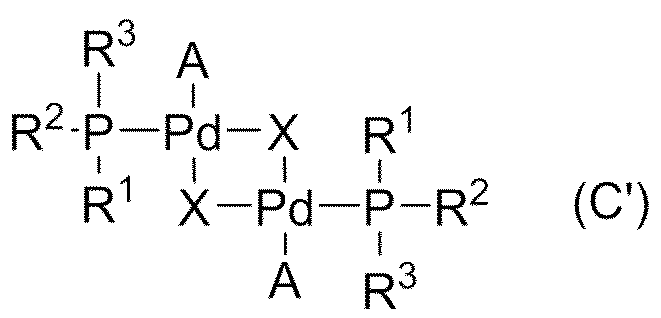
で表されるパラジウム錯体。
[13]R1が置換基を有していてもよい炭素数6~20のアリール基または置換基を有していてもよい炭素数4~20のヘテロアリール基である、[12]記載のパラジウム錯体。
[14]R2およびR3がそれぞれ独立に、炭素数1~6のアルキル基または炭素数5~6のシクロアルキル基である、[12]または[13]記載のパラジウム錯体。
[15]Aがメチル基である、[12]~[14]のいずれか一項記載のパラジウム錯体。
<共通する用語の説明>
以下、本明細書で共通して用いられる用語は、特記しない限り、以下の意味である。
ヘテロ環基の具体例としては、チエニル基、ピロリル基、フリル基、ピリジル基、ピリダジニル基、ピリミジル基、ピラジニル基、トリアジニル基、ピロリジニル基、ピペリジニル基、キノリル基、イソキノリル基等を挙げることができる。へテロ環基は、置換基としてアルキル基を有していてもよい。
-N(R’)2で表される基の具体例としては、メチルアミノ基、ジメチルアミノ基、エチルアミノ基、ジエチルアミノ基、n-プロピルアミノ基、ジ-n-プロピルアミノ基、イソプロピルアミノ基、ジイソプロピルアミノ基、n-ブチルアミノ基、イソブチルアミノ基、sec-ブチルアミノ基、tert-ブチルアミノ基、n-ペンチルアミノ基、n-ヘキシルアミノ基、n-ヘプチルアミノ基、n-オクチルアミノ基、2-エチルヘキシルアミノ基、n-ノニルアミノ基、n-デシルアミノ基、3,7-ジメチルオクチルアミノ基、n-ドデシルアミノ基、シクロペンチルアミノ基、ジシクロペンチルアミノ基、シクロヘキシルアミノ基、ジシクロヘキシルアミノ基、ビス(トリフルオロメチル)アミノ基、フェニルアミノ基、ジフェニルアミノ基、ナフチルアミノ基、ピリジルアミノ基、ピリダジニルアミノ基、ピリミジニルアミノ基、ピラジニルアミノ基、トリアジニルアミノ基が挙げられる。
-Si(R’)3で表される基の具体例としては、トリメチルシリル基、トリエチルシリル基、トリ-n-プロピルシリル基、トリイソプロピルシリル基、ジメチルイソプロピルシリル基、ジエチルイソプロピルシリル基、tert-ブチルシリルジメチルシリル基、n-ペンチルジメチルシリル基、n-ヘキシルジメチルシリル基、n-ヘプチルジメチルシリル基、n-オクチルジメチルシリル基、2-エチルヘキシルジメチルシリル基、n-ノニルジメチルシリル基、n-デシルジメチルシリル基、3,7-ジメチルオクチルジメチルシリル基、n-ドデシルジメチルシリル基、フェニルアルキルシリル基、アルコキシフェニルアルキルシリル基、アルキルフェニルアルキルシリル基、ナフチルアルキルシリル基、フェニルアリルジメチルシリル基、トリフェニルシリル基、トリ-p-キシリルシリル基、トリベンジルシリル基、ジフェニルメチルシリル基、tert-ブチルジフェニルシリル基、ジメチルフェニルシリル基が挙げられる。
炭素原子-窒素原子二重結合を有する基としては、-CR’’=N-R’’’で表される基および-N=C(R’’’)2で表される基(式中、R’’は、水素原子、アルキル基、アリール基、アリールアルキル基、アリールアルケニル基またはアリールアルキニル基を表し、1つまたは2つのR’’’は、それぞれ独立に、アルキル基、シクロアルキル基、アリール基、アリールアルキル基、アリールシクロアルキル基、アリールアルケニル基、アリールアルキニル基を表す。但し、-N=C(R’’’)2で表される基において、2個のR’’’は互いに結合して2価の基(具体的には、エチレン基、トリメチレン基、テトラメチレン基、ペンタメチレン基、ヘキサメチレン基等の炭素数2~18のアルキレン基)を形成する。)が挙げられる。
炭素原子-窒素原子二重結合を有する基の炭素数は、通常2~20であり、好ましくは2~18であり、より好ましくは2~16である。
「炭素原子-窒素原子二重結合を有する基」の具体例としては、以下に示す基が挙げられる。

酸イミド基の具体例としては、以下に示す基が挙げられる。

単環のアリール基としては、例えば、フェニル基が挙げられ、縮合環のアリール基としては、例えば、ナフチル基、アントラセニル基、フルオレニル基が挙げられ、2以上の単環のアリール基が直接結合またはヘテロ原子もしくはカルボニル基を介して間接的に結合されることにより形成される1価の基としては、例えば、ビフェニル基が挙げられる。

(式中、Rは上記群1より選ばれる置換基を表す。pは0~4の整数を表す。)

(式中、Rおよびpは前述と同義である。)
炭素数4~36のヘテロアリール基は、単環のヘテロアリール基、縮合環のヘテロアリール基、2以上の単環および/または縮合環のヘテロアリール基が直接結合またはヘテロ原子(酸素原子、窒素原子、硫黄原子等)もしくはカルボニル基(-CO-)を介して間接的に結合されることにより形成される1価の基、ならびに、1以上の単環および/または縮合環のヘテロアリール基と1以上の単環および/または縮合環のアリール基とが、直接結合またはヘテロ原子(酸素原子、窒素原子、硫黄原子等)もしくはカルボニル基(-CO-)を介して間接的に結合することにより形成される1価の基を含む。ヘテロアリール基を間接的に結合させる窒素原子の残りの結合手は、例えば置換基を有していてもよいアルキル基、置換基を有していてもよいアリール基等と結合している。なお、縮合環のヘテロアリール基に含まれる縮合環は、2以上のヘテロ環の縮合環であってもよいし、1以上のヘテロ環と1以上の芳香環との縮合環であってもよい。
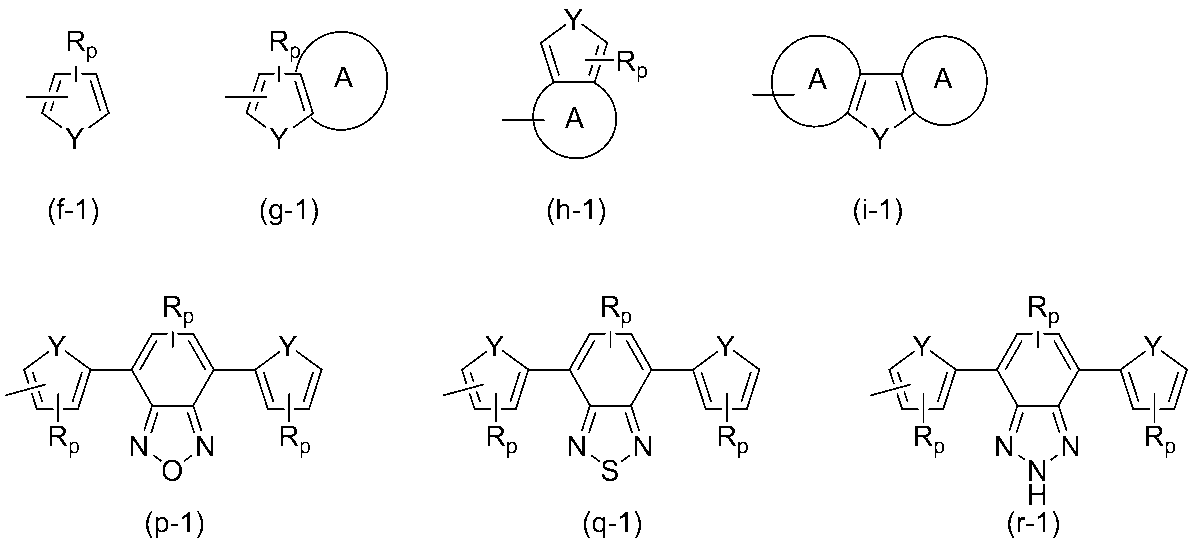
(式中、式中、Rおよびpは前述と同義である。Yは硫黄原子、酸素原子または-NRY-で表される基を表す。RYは、水素原子、置換基を有していてもよいアルキル基または置換基を有していてもよいアリール基を表す。環Aはヘテロ環または芳香環を表す。)


炭素数4~36のヘテロアリーレン基は、単環のヘテロアリーレン基、縮合環のヘテロアリーレン基、2以上の単環および/または縮合環のヘテロアリーレン基が直接結合またはヘテロ原子(酸素原子、窒素原子、硫黄原子等)もしくはカルボニル基(-CO-)を介して間接的に結合されることにより形成される2価の基、ならびに、1以上の単環および/または縮合環のヘテロアリーレン基と1以上の単環および/または縮合環のアリーレン基とが、直接結合またはヘテロ原子(酸素原子、窒素原子、硫黄原子等)もしくはカルボニル基(-CO-)を介して間接的に結合することにより形成される2価の基を含む。ヘテロアリーレン基を間接的に結合させる窒素原子の残りの結合手は、例えば置換基を有していてもよいアルキル基、置換基を有していてもよいアリール基等と結合している。なお、縮合環のヘテロアリール基に含まれる縮合環は、2以上のヘテロ環の縮合環であってもよいし、1以上のヘテロ環と1以上の芳香環との縮合環であってもよい。
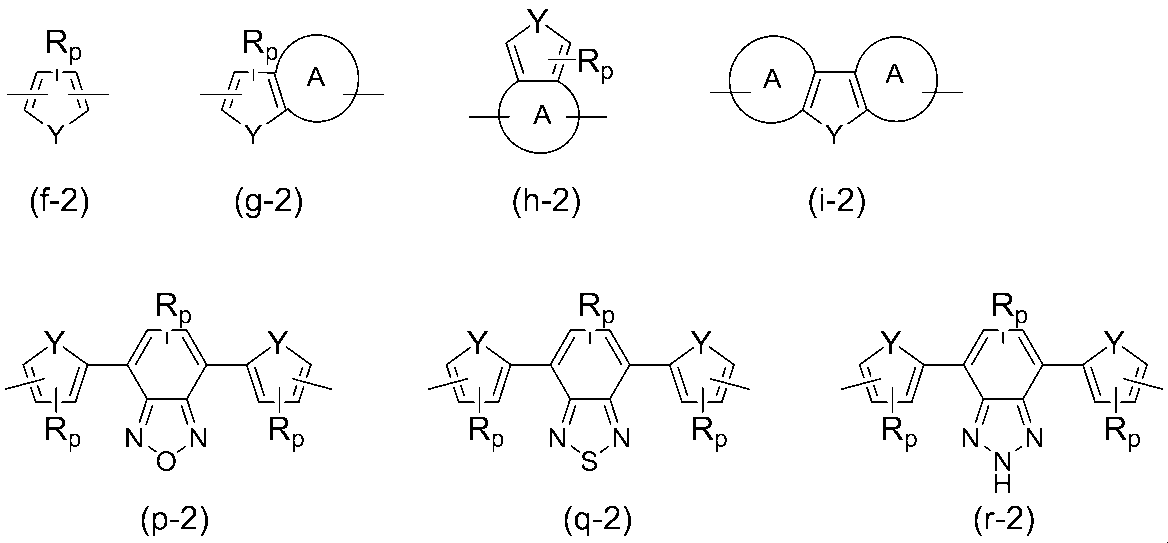
(式中、R、p、Yおよび環Aは前述と同義である。)


本発明の製造方法には、式(A)で表される化合物が用いられる。
Ar1-X1 (A-1)
X1-Ar1-X1 (A-2)
(式中、X1およびAr1は前述と同義である。)
2,2’-(9,9-ジヘキシル-9H-フルオレン-2,7-ジイル)ビス(4,4,5,5-テトラメチル-1,3,2-ジオキサボロラン)、2,2’-(9,9-ジオクチル-9H-フルオレン-2,7-ジイル)ビス(4,4,5,5-テトラメチル-1,3,2-ジオキサボロラン)、2,2’-(9,9-ジドデシル-9H-フルオレン-2,7-ジイル)ビス(4,4,5,5-テトラメチル-1,3,2-ジオキサボロラン)、2,2’-(9-オクチル-9H-カルバゾール-3,6-ジイル)ビス(1,3,2-ジオキサボロラン)、2,2’-(2-メチル-5-オクチル-1,4-フェニレン)ビス(4,4,5,5-テトラメチル-1,3,2-ジオキサボロラン)、2,5-ビス(1,3,2-ジオキサボロラン-2-イル)チオフェン、2,5-ビス(1,3,2-ジオキサボリナン-2-イル)チオフェン、2,5-ビス(4,4,5,5,-テトラメチル-1,3,2-ジオキサボロラン-2-イル)チオフェン、2,5-ビス(5,5-ジメチル-1,3,2-ジオキサボリナン-2-イル)チオフェン、1,1’-ビス(1,3,2-ジオキサボロラン-2-イル)-4,4’-ビフェニル、1,1’-ビス(4,4,5,5-テトラメチル-1,3,2-ジオキサボロラン-2-イル)-4,4’-ビフェニル、1,1’-ビス(1,3,2-ジオキサボロラン-2-イル)-4,4’-ビフェニル、1,1’-ビス(5,5-ジメチル-1,3,2-ジオキサボリナン-2-イル)-4,4’-ビフェニル、5,5’-ビス(4,4,5,5-テトラメチル-1,3,2-ジオキサボロラン-2-イル)-2,2’-バイチオフェン、2,5-ビス(4,4,5,5-テトラメチル-1,3,2-ジオキサボロラン-2-イル)-チエノ[3,2-b]チオフェン、2,5-ビス(4,4,5,5-テトラメチル-1,3,2-ジオキサボロラン-2-イル)-チエノ[2,3-b]チオフェン、4,7-ビス(4,4,5,5-テトラメチル-1,3,2-ジオキサボロラン-2-イル)-2,1,3,-ベンゾチアジアゾール、4,7-ビス(4,4,5,5-テトラメチル-1,3,2-ジオキサボロラン-2-イル)-5,6-ジフルオロ-2,1,3,-ベンゾチアジアゾール、2,2’-(5,5-ジドデシル-5H-ジチエノ[3,2-b:2’,3’-d]ピラン-2,7-ジイル)ビス(5-メチル-1,3,2-ジオキサボリナン-5-メタノール)、2,2’-(5,5-ビス(3,7-ジメチルオクチル)-5H-ジチエノ[3,2-b:2’,3’-d]ピラン-2,7-ジイル)ビス(5-メチル-1,3,2-ジオキサボリナン-5-メタノール)、2,2’-(4,4-ジオクチル-4H-シクロペンタ[2,1-b:3,4-b’]バイチオフェン-2,6-ジイル)ビス(5-メチル-1,3,2-ジオキサボリナン-5-メタノール、2,2’-(4,4-ジ(3-エチルヘキシル)-4H-シクロペンタ[2,1-b:3,4-b’]バイチオフェン-2,6-ジイル)ビス(5-メチル-1,3,2-ジオキサボリナン-5-メタノール、2,2’-(4,4-ジオクチル-4H-シロロ[3,2-b:4,5-b’]バイチオフェン-2,6-ジイル)ビス(5-メチル-1,3,2-ジオキサボリナン-5-メタノール、2,7-ビス(5-メチル-5-ヒドロキシメチル-1,3,2-ジオキサボリナン-2-イル)-5,5-ドデシル-ベンゾ[2,1-b:3,4-b’]ジチオフェン-4(5H)-オン、2,2’-(4-ヘキシル-4H-ジチエノ[3,2-b:2’,3’-d]ピロール-2,6-ジイル)ビス(5-メチル-1,3,2-ジオキサボリナン-5-メタノールが挙げられ、
2,5-ビス(4,4,5,5,-テトラメチル-1,3,2-ジオキサボロラン-2-イル)チオフェン、1,1’-ビス(4,4,5,5-テトラメチル-1,3,2-ジオキサボロラン-2-イル)-4,4’-ビフェニル、5,5’-ビス(4,4,5,5-テトラメチル-1,3,2-ジオキサボロラン-2-イル)-2,2’-バイチオフェン、4,7-ビス(4,4,5,5-テトラメチル-1,3,2-ジオキサボロラン-2-イル)-2,1,3,-ベンゾチアジアゾール、4,7-ビス(4,4,5,5-テトラメチル-1,3,2-ジオキサボロラン-2-イル)-5,6-ジフルオロ-2,1,3,-ベンゾチアジアゾール、2,2’-(5,5-ジドデシル-5H-ジチエノ[3,2-b:2’,3’-d]ピラン-2,7-ジイル)ビス(5-メチル-1,3,2-ジオキサボリナン-5-メタノール)、2,2’-(5,5-ビス(3,7-ジメチルオクチル)-5H-ジチエノ[3,2-b:2’,3’-d]ピラン-2,7-ジイル)ビス(5-メチル-1,3,2-ジオキサボリナン-5-メタノール)、2,2’-(4,4-ジオクチル-4H-シクロペンタ[2,1-b:3,4-b’]バイチオフェン-2,6-ジイル)ビス(5-メチル-1,3,2-ジオキサボリナン-5-メタノール、2,2’-(4,4-ジ(3-エチルヘキシル)-4H-シクロペンタ[2,1-b:3,4-b’]バイチオフェン-2,6-ジイル)ビス(5-メチル-1,3,2-ジオキサボリナン-5-メタノール、2,2’-(4,4-ジオクチル-4H-シロロ[3,2-b:4、5-b’]バイチオフェン-2,6-ジイル)ビス(5-メチル-1,3,2-ジオキサボリナン-5-メタノール、2,7-ビス(5-メチル-5-ヒドロキシメチル-1,3,2-ジオキサボリナン-2-イル)-5,5-ドデシル-ベンゾ[2,1-b:3,4-b’]ジチオフェン-4(5H)-オン、2,2’-(4-ヘキシル-4H-ジチエノ[3,2-b:2’,3’-d]ピロール-2,6-ジイル)ビス(5-メチル-1,3,2-ジオキサボリナン-5-メタノールであることが好ましく、
5,5’-ビス(4,4,5,5-テトラメチル-1,3,2-ジオキサボロラン-2-イル)-2,2’-バイチオフェン、4,7-ビス(4,4,5,5-テトラメチル-1,3,2-ジオキサボロラン-2-イル)-2,1,3,-ベンゾチアジアゾール、4,7-ビス(4,4,5,5-テトラメチル-1,3,2-ジオキサボロラン-2-イル)-5,6-ジフルオロ-2,1,3,-ベンゾチアジアゾール、2,2’-(5,5-ジドデシル-5H-ジチエノ[3,2-b:2’,3’-d]ピラン-2,7-ジイル)ビス(5-メチル-1,3,2-ジオキサボリナン-5-メタノール)、2,2’-(5,5-ビス(3,7-ジメチルオクチル)-5H-ジチエノ[3,2-b:2’,3’-d]ピラン-2,7-ジイル)ビス(5-メチル-1,3,2-ジオキサボリナン-5-メタノール)、2,7-ビス(5-メチル-5-ヒドロキシメチル-1,3,2-ジオキサボリナン-2-イル)-5,5-ドデシル-ベンゾ[2,1-b:3,4-b’]ジチオフェン-4(5H)-オンであることがより好ましい。
本発明の製造方法には、式(B)で表される化合物が用いられる。
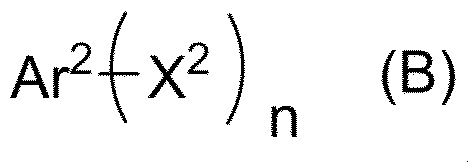
Ar2-X2 (B-1)
X2-Ar2-X2 (B-2)
(式中、X2およびAr2は前述と同義である。)
2,7-ジブロモ-9,9-ジヘキシル-9H-フルオレン、2,7-ジブロモ-9,9-ジオクチル-9H-フルオレン、2,7-ジブロモ-9,9-ジドデシル-9H-フルオレン、2,7-ジクロロ-9,9-ジヘキシル-9H-フルオレン、2,7-ジクロロ-9,9-ジオクチル-9H-フルオレン、2,7-ジクロロ-9,9-ジドデシル-9H-フルオレン、2-ブロモ-7-クロロ-9,9-ジヘキシル-9H-フルオレン、2-ブロモ-7-クロロ-9,9-ジオクチル-9H-フルオレン、2-ブロモ-7-クロロ-9,9-ジドデシル-9H-フルオレン、1,4-ジブロモベンゼン、1,3-ジブロモベンゼン、1,4-ジブロモ-2-エチルベンゼン、1,4-ジブロモ-2-メトキシベンゼン、ジメチル 2,5-ジブロモテレフタレート、1,4-ジブロモナフタレン、3,5-ジブロモピリジン、1,1’-ジブロモ-4,4’-ビフェニル、2,5-ジブロモピリジン、1,4-ジブロモ-2,5-ジヘキシルオキシベンゼン、1-ブロモ-4-クロロトルエン、1-ブロモ-4-クロロ-2-プロピルベンゼン、2,5-ジブロモ-3-ヘキシルチオフェン、2,5-ジブロモ-3-オクチルチオフェン、2,5-ジブロモ-3-ドデシルチオフェン、2,5-ジクロロ-3-ヘキシルチオフェン、5,5’-ジブロモ-2,2’-バイチオフェン、5,5’-ジブロモ-3,3’-ジヘキシル-2,2’-バイチオフェン、2,5-ジブロモ-チエノ[3,2-b]チオフェン、2,5-ジブロモ-チエノ[2,3-b]チオフェン、4,7-ジブロモ-2,1,3-ベンゾチアジアゾール、4,7-ジブロモ-2,1,3-ベンゾセレナジアゾール、4,7-ジブロモ-5,6-ジフルオロ-2,1,3-ベンゾチアジアゾール、4,7-ビス(5-ブロモ-2-チエニル)-2,1,3-ベンゾチアジアゾール、4,7-ビス(5-ブロモ-4-メチル-2-チエニル)-2,1,3-ベンゾチアジアゾール、4,7-ビス(5-ブロモ-3-メチル-2-チエニル)-2,1,3-ベンゾチアジアゾール、3,7-ジブロモ-10-(4-n-ブチルフェニル)-10H-フェノチアジン、3,7-ジブロモ-10-(4-n-ブチルフェニル)-10H-フェノキサジン、2,7-ジブロモ-5,5-ジドデシル-5H-ジチエノ[3,2-b:2’,3’-d]ピラン、2,7-ジブロモ-5,5-ビス(3,7-ジメチルオクチル)-5H-ジチエノ[3,2-b:2’,3’-d]ピラン、2,6-ジブロモ-4,4-ジオクチル-4H-シクロペンタ[2,1-b:3,4-b’]バイチオフェン、2,6-ジブロモ-4,4-ジ(3-エチルヘキシル)-4H-シクロペンタ[2,1-b:3,4-b’]バイチオフェン、2,6-ジブロモ-4,4-ジオクチル-4H-シロロ[3,2-b:4、5-b’]バイチオフェン、2,7-ジブロモ-5,5-ドデシル-ベンゾ[2,1-b:3,4-b’]ジチオフェン-4(5H)-オン、2,6-ジブロモ-4-ヘキシル-4H-ジチエノ[3,2-b:2’,3’-d]ピロールが挙げられ、
2,7-ジブロモ-9,9-ジドデシル-9H-フルオレン、1,4-ジブロモベンゼン、1,3-ジブロモベンゼン、2,5-ジブロモ-3-ヘキシルチオフェン、2,5-ジブロモ-3-オクチルチオフェン、2,5-ジブロモ-3-ドデシルチオフェン、2,5-ジブロモ-チエノ[3,2-b]チオフェン、2,5-ジブロモ-チエノ[2,3-b]チオフェン、4,7-ジブロモ-2,1,3-ベンゾチアジアゾール、4,7-ジブロモ-5,6-ジフルオロ-2,1,3-ベンゾチアジアゾール、4,7-ビス(5-ブロモ-2-チエニル)-2,1,3-ベンゾチアジアゾール、4,7-ビス(5-ブロモ-4-メチル-2-チエニル)-2,1,3-ベンゾチアジアゾール、4,7-ビス(5-ブロモ-3-メチル-2-チエニル)-2,1,3-ベンゾチアジアゾール、2,7-ジブロモ-5,5-ジドデシル-5H-ジチエノ[3,2-b:2’,3’-d]ピラン、2,7-ジブロモ-5,5-ビス(3,7-ジメチルオクチル)-5H-ジチエノ[3,2-b:2’,3’-d]ピラン、2,6-ジブロモ-4,4-ジオクチル-4H-シクロペンタ[2,1-b:3,4-b’]バイチオフェン、2,6-ジブロモ-4,4-ジ(3-エチルヘキシル)-4H-シクロペンタ[2,1-b:3,4-b’]バイチオフェン、2,6-ジブロモ-4,4-ジオクチル-4H-シロロ[3,2-b:4、5-b’]バイチオフェン、2,7-ジブロモ-5,5-ドデシル-ベンゾ[2,1-b:3,4-b’]ジチオフェン-4(5H)-オン、2,6-ジブロモ-4-ヘキシル-4H-ジチエノ[3,2-b:2’,3’-d]ピロールであることが好ましく、
2,5-ジブロモ-3-ヘキシルチオフェン、2,5-ジブロモ-3-オクチルチオフェン、2,5-ジブロモ-3-ドデシルチオフェン、4,7-ジブロモ-2,1,3-ベンゾチアジアゾール、4,7-ジブロモ-5,6-ジフルオロ-2,1,3-ベンゾチアジアゾール、2,7-ジブロモ-5,5-ジドデシル-5H-ジチエノ[3,2-b:2’,3’-d]ピラン、2,7-ジブロモ-5,5-ビス(3,7-ジメチルオクチル)-5H-ジチエノ[3,2-b:2’,3’-d]ピラン、2,7-ジブロモ-5,5-ドデシル-ベンゾ[2,1-b:3,4-b’]ジチオフェン-4(5H)-オンであることがより好ましい。
本発明の製造方法には、式(C)または式(C’)で表されるパラジウム錯体が用いられる。
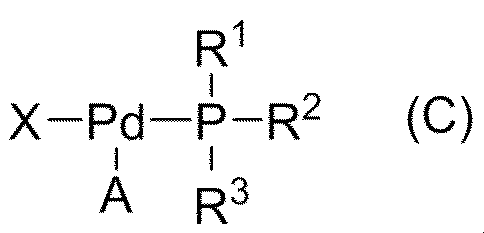

Aが炭素数1~3のアルキル基であるパラジウム錯体、
Aがメチル基であるパラジウム錯体、
R3およびR2が炭素数4~6のアルキル基であるパラジウム錯体、
R3およびR2が炭素数5~6のシクロアルキル基であるパラジウム錯体、
R3およびR2がtert-ブチル基であるパラジウム錯体、
R3およびR2がシクロペンチル基であるパラジウム錯体、
R3およびR2がシクロヘキシル基であるパラジウム錯体、
R1が置換基を有してもよい炭素数6~20のアリール基であるパラジウム錯体、
R1、R2およびR3がtert-ブチル基であるパラジウム錯体、
Aがメチル基であり、R3およびR2が炭素数4~6のアルキル基であるパラジウム錯体、
Aがメチル基であり、R3およびR2が炭素数5~6のシクロアルキル基であるパラジウム錯体、
Aがメチル基であり、R3およびR2がtert-ブチル基であるパラジウム錯体、
Aがメチル基であり、R3およびR2がシクロペンチル基であるパラジウム錯体、
Aがメチル基であり、R3およびR2がシクロヘキシル基であるパラジウム錯体、
Aがメチル基であり、R1が置換基を有してもよい炭素数6~20のアリール基であるパラジウム錯体、
Aがメチル基であり、R1、R2およびR3がtert-ブチル基であるパラジウム錯体、
Xが塩素原子であり、Aが炭素数1~3のアルキル基であるパラジウム錯体、
Xが塩素原子であり、Aがメチル基であるパラジウム錯体、
Xが塩素原子であり、R3およびR2が炭素数4~6のアルキル基であるパラジウム錯体、
Xが塩素原子であり、R3およびR2が炭素数5~6のシクロアルキル基であるパラジウム錯体、
Xが塩素原子であり、R3およびR2がtert-ブチル基であるパラジウム錯体、
Xが塩素原子であり、R3およびR2がシクロペンチル基であるパラジウム錯体、
Xが塩素原子であり、R3およびR2がシクロヘキシル基であるパラジウム錯体、
Xが塩素原子であり、R1が置換基を有してもよい炭素数6~20のアリール基であるパラジウム錯体、
Xが塩素原子であり、Aがメチル基であり、R3およびR2が炭素数4~6のアルキル基であるパラジウム錯体、
Xが塩素原子であり、Aがメチル基であり、R3およびR2が炭素数5~6のシクロアルキル基であるパラジウム錯体、
Xが塩素原子であり、Aがメチル基であり、R3およびR2がtert-ブチル基であるパラジウム錯体、
Xが塩素原子であり、Aがメチル基であり、R3およびR2がシクロペンチル基であるパラジウム錯体、
Xが塩素原子であり、Aがメチル基であり、R3およびR2がシクロヘキシル基であるパラジウム錯体、
Xが塩素原子であり、Aがメチル基であり、R1が置換基を有してもよい炭素数6~20のアリール基であるパラジウム錯体、
およびXが塩素原子であり、Aがメチル基であり、R1、R2およびR3がtert-ブチル基であるパラジウム錯体が挙げられる。
(トリ-(tert-ブチル)ホスフィン)クロロメチルパラジウム、(ジ-(tert-ブチル)(4-フルオロフェニル)ホスフィン)クロロメチルパラジウム、(ジ-(tert-ブチル)(3-フルオロフェニル)ホスフィン)クロロメチルパラジウム、(ジ-(tert-ブチル)(4-メチルフェニル)ホスフィン)クロロメチルパラジウム、(ジ-(tert-ブチル)(3-メチルフェニル)ホスフィン)クロロメチルパラジウム、(ジ-(tert-ブチル)(4-エチルフェニル)ホスフィン)クロロメチルパラジウム、(ジ-(tert-ブチル)(3-エチルフェニル)ホスフィン)クロロメチルパラジウム、((ジ-(tert-ブチル)(4-イソプロピルフェニル)ホスフィン)クロロメチルパラジウム、(ジ-(tert-ブチル)(3-イソプロピルフェニル)ホスフィン)クロロメチルパラジウム、(ジ-(tert-ブチル)(4-tert-ブチルフェニル)ホスフィン)クロロメチルパラジウム、(ジ-(tert-ブチル)(3-tert-ブチルフェニル)ホスフィン)クロロメチルパラジウム、(ジ-(tert-ブチル)(4-メトキシフェニル)ホスフィン)クロロメチルパラジウム、(ジ-(tert-ブチル)(3-メトキシフェニル)ホスフィン)クロロメチルパラジウム、(ジ-(tert-ブチル)(4-エトキシフェニル)ホスフィン)クロロメチルパラジウム、(ジ-(tert-ブチル)(3-エトキシフェニル)ホスフィン)クロロメチルパラジウム、(ジ-(tert-ブチル)(4-トリフルオロメトキシフェニル)ホスフィン)クロロメチルパラジウム、(ジ-(tert-ブチル)(3-トリフルオロメトキシフェニル)ホスフィン)クロロメチルパラジウム、(ジ-(tert-ブチル)(4-ペンタフルオロエトキシフェニル)ホスフィン)クロロメチルパラジウム、(ジ-(tert-ブチル)(3-ペンタフルオロエトキシフェニル)ホスフィン)クロロメチルパラジウム、(ジ-(tert-ブチル)([1,1’-ビフェニル]-4-イル)ホスフィン)クロロメチルパラジウム、(ジ-(tert-ブチル)([1,1’-ビフェニル]-3-イル)ホスフィン)クロロメチルパラジウム、(ジ-(tert-ブチル)(2-ナフチル)ホスフィン)クロロメチルパラジウム、(ジ-(tert-ブチル)(3,5-ジフルオロフェニル)ホスフィン)クロロメチルパラジウム、(ジ-(tert-ブチル)(3,5-ジメチルフェニル)ホスフィン)クロロメチルパラジウム、(ジ-(tert-ブチル)(3,5-ジエチルフェニル)ホスフィン)クロロメチルパラジウム、(ジ-(tert-ブチル)(3,5-ジイソプロピルフェニル)ホスフィン)クロロメチルパラジウム、(ジ-(tert-ブチル)(3,5-ジ-(tert-ブチル)フェニル)ホスフィン)クロロメチルパラジウム、(ジ-(tert-ブチル)(3,5-ジメトキシフェニル)ホスフィン)クロロメチルパラジウム、(ジ-(tert-ブチル)(3,5-ジエトキシフェニル)ホスフィン)クロロメチルパラジウム、(ジ-(tert-ブチル)(3,5-ジ-(トリフルオロメトキシ)フェニル)ホスフィン)クロロメチルパラジウム、(ジ-(tert-ブチル)(3,5-ジ-(トリフルオロエトキシ)フェニル)ホスフィン)クロロメチルパラジウム、(ジ-(tert-ブチル)(1,1’:3’,1’’-テルフェニル)-5’-イル)ホスフィン)クロロメチルパラジウム、(ジ-(tert-ブチル)(2-メトキシフェニル)ホスフィン)クロロメチルパラジウム、(ジ-(tert-ブチル)(3-メトキシフェニル)ホスフィン)クロロメチルパラジウム、(ジ-(tert-ブチル)(4-メトキシフェニル)ホスフィン)クロロメチルパラジウム、(ジ-(tert-ブチル)(2,3-ジメトキシフェニル)ホスフィン)クロロメチルパラジウム、ジ-(tert-ブチル)(2,4-ジメトキシフェニル)ホスフィン)クロロメチルパラジウム、ジ-(tert-ブチル)(2,5-ジメトキシフェニル)ホスフィン)クロロメチルパラジウム、ジ-(tert-ブチル)(2,6-ジメトキシフェニル)ホスフィン)クロロメチルパラジウム、
式(C)で表されるパラジウム錯体は、錯体の安定性の観点から、式(D)で表されるパラジウム錯体であることが好ましい。式(C’)で表されるパラジウム錯体は、錯体の安定性の観点から、式(D’)で表されるパラジウム錯体であることが好ましい。式(D)および式(D’)で表されるパラジウム錯体は、鈴木カップリング用触媒として用いてもよいし、Stilleカップリング用触媒、Heckカップリング用触媒、Hiyamaカップリング用触媒、Sonogashiraカップリング用触媒、Kumadaカップリング用触媒、およびBuchwald-Hartwigカップリング用触媒として用いてもよい。


Aが炭素数1~3のアルキル基であるパラジウム錯体、
Aがメチル基であるパラジウム錯体、
Bが炭素数4~6のアルキル基であるパラジウム錯体、
Bが炭素数5~6のシクロアルキル基であるパラジウム錯体、
Bがtert-ブチル基であるパラジウム錯体、
Bがシクロペンチル基であるパラジウム錯体、
Bがシクロヘキシル基であるパラジウム錯体、
R4およびR5が水素原子、炭素数1~6のアルコキシ基であるパラジウム錯体、
R4およびR5が水素原子であるパラジウム錯体、
R4およびR5が炭素数1~6のアルコキシ基であるパラジウム錯体、
R6およびR8がフッ素原子、炭素数1~6のアルキル基または炭素数6~20のアリール基である式(D)で表されるパラジウム錯体、
Aがメチル基であり、Bが炭素数4~6のアルキル基であるパラジウム錯体、
Aがメチル基であり、Bが炭素数5~6のシクロアルキル基であるパラジウム錯体、
Aがメチル基であり、Bがtert-ブチル基であるパラジウム錯体、
Aがメチル基であり、Bがシクロペンチル基であるパラジウム錯体、
Aがメチル基であり、Bがシクロヘキシル基であるパラジウム錯体、
Xが塩素原子であり、Aがメチル基であり、Bが炭素数4~6のアルキル基であるパラジウム錯体、
Xが塩素原子であり、Aがメチル基であり、Bが炭素数5~6のシクロアルキル基であるパラジウム錯体、
Xが塩素原子であり、Aがメチル基であり、Bがtert-ブチル基であるパラジウム錯体、
Xが塩素原子であり、Aがメチル基であり、Bがシクロペンチル基であるパラジウム錯体、
Xが塩素原子であり、Aがメチル基であり、Bがシクロヘキシル基であるパラジウム錯体、
Aがメチル基であり、Bが炭素数4~6のアルキル基であり、R4およびR5が水素原子であるパラジウム錯体、
Aがメチル基であり、Bが炭素数5~6のシクロアルキル基であり、R4およびR5が水素原子であるパラジウム錯体、
Aがメチル基であり、Bがtert-ブチル基であり、R4およびR5が水素原子であるパラジウム錯体、
Aがメチル基であり、Bがシクロペンチル基であり、R4およびR5が水素原子であるパラジウム錯体、
Aがメチル基であり、Bがシクロヘキシル基であり、R4およびR5が水素原子であるパラジウム錯体、
Xが塩素原子であり、Aがメチル基であり、Bが炭素数4~6のアルキル基であり、R4およびR5が水素原子であるパラジウム錯体、
Xが塩素原子であり、Aがメチル基であり、Bが炭素数5~6のシクロアルキル基であり、R4およびR5が水素原子であるパラジウム錯体、
Xが塩素原子であり、Aがメチル基であり、Bがtert-ブチル基であり、R4およびR5が水素原子であるパラジウム錯体、
Xが塩素原子であり、Aがメチル基であり、Bがシクロペンチル基であり、R4およびR5が水素原子であるパラジウム錯体、
Xが塩素原子であり、Aがメチル基であり、Bがシクロヘキシル基であり、R4およびR5が水素原子であるパラジウム錯体、
Aがメチル基であり、Bが炭素数4~6のアルキル基であり、R4およびR5が炭素数1~6のアルコキシ基であるパラジウム錯体、
Aがメチル基であり、Bが炭素数5~6のシクロアルキル基でありR4およびR5が炭素数1~6のアルコキシ基であるパラジウム錯体、
Aがメチル基であり、Bがtert-ブチル基であり、R4およびR5が炭素数1~6のアルコキシ基であるパラジウム錯体、
Aがメチル基であり、Bがシクロペンチル基であり、R4およびR5が炭素数1~6のアルコキシ基であるパラジウム錯体、
Aがメチル基であり、Bがシクロヘキシル基であり、R4およびR5が炭素数1~6のアルコキシ基であるパラジウム錯体、
Xが塩素原子であり、Aがメチル基であり、Bが炭素数4~6のアルキル基でありR4およびR5が炭素数1~6のアルコキシ基であるパラジウム錯体、
Xが塩素原子であり、Aがメチル基であり、Bが炭素数5~6のシクロアルキル基であり、R4およびR5が炭素数1~6のアルコキシ基であるパラジウム錯体、
Xが塩素原子であり、Aがメチル基であり、Bがtert-ブチル基でありR4およびR5が炭素数1~6のアルコキシ基であるパラジウム錯体、
Xが塩素原子であり、Aがメチル基であり、Bがシクロペンチル基でありR4およびR5が炭素数1~6のアルコキシ基であるパラジウム錯体、
Xが塩素原子であり、Aがメチル基であり、Bがシクロヘキシル基でありR4およびR5が炭素数1~6のアルコキシ基であるパラジウム錯体、
Aがメチル基であり、Bが炭素数4~6のアルキル基であり、R4が水素原子であり、R5が炭素数1~6のアルコキシ基であるパラジウム錯体、
Aがメチル基であり、Bが炭素数5~6のシクロアルキル基であり、R4が水素原子であり、R5が炭素数1~6のアルコキシ基であパラジウム錯体、
Aがメチル基であり、Bがtert-ブチル基であり、R4が水素原子であり、R5が炭素数1~6のアルコキシ基であるパラジウム錯体、
Aがメチル基であり、Bがシクロペンチル基であり、R4が水素原子であり、R5が炭素数1~6のアルコキシ基であるパラジウム錯体、
Aがメチル基であり、Bがシクロヘキシル基であり、R4が水素原子であり、R5が炭素数1~6のアルコキシ基であるパラジウム錯体、
Xが塩素原子であり、Aがメチル基であり、Bが炭素数4~6のアルキル基であり、R4が水素原子であり、R5が炭素数1~6のアルコキシ基であるパラジウム錯体、
Xが塩素原子であり、Aがメチル基であり、Bが炭素数5~6のシクロアルキル基であり、R4が水素原子であり、R5が炭素数1~6のアルコキシ基であるパラジウム錯体、
Xが塩素原子であり、Aがメチル基であり、Bがtert-ブチル基であり、R4が水素原子であり、R5が炭素数1~6のアルコキシ基であるパラジウム錯体、
Xが塩素原子であり、Aがメチル基であり、Bがシクロペンチル基であり、R4が水素原子であり、R5が炭素数1~6のアルコキシ基であるパラジウム錯体、
Xが塩素原子であり、Aがメチル基であり、Bがシクロヘキシル基であり、R4が水素原子であり、R5が炭素数1~6のアルコキシ基であるパラジウム錯体、
Aがメチル基であり、Bが炭素数4~6のアルキル基であり、R7が水素原子であり、R6およびR8がフッ素元素、炭素数1~6のアルキル基または炭素数6~20のアリール基であるパラジウム錯体、
Aがメチル基であり、Bが炭素数5~6のシクロアルキル基であり、R7が水素原子であり、R6およびR8がフッ素元素、炭素数1~6のアルキル基または炭素数6~20のアリール基であるパラジウム錯体、
Aがメチル基であり、Bがtert-ブチル基であり、R7が水素原子であり、R6およびR8がフッ素元素、炭素数1~6のアルキル基または炭素数6~20のアリール基であるパラジウム錯体、
Aがメチル基であり、Bがシクロペンチル基であり、R7が水素原子であり、R6およびR8がフッ素元素、炭素数1~6のアルキル基または炭素数6~20のアリール基であるパラジウム錯体、
Aがメチル基であり、Bがシクロヘキシル基であり、R7が水素原子であり、R6およびR8がフッ素元素、炭素数1~6のアルキル基または炭素数6~20のアリール基であるパラジウム錯体、
Xが塩素原子であり、Aがメチル基であり、Bが炭素数4~6のアルキル基であり、R7が水素原子であり、R6およびR8がフッ素元素、炭素数1~6のアルキル基または炭素数6~20のアリール基であるパラジウム錯体、
Xが塩素原子であり、Aがメチル基であり、Bが炭素数5~6のシクロアルキル基であり、R7が水素原子であり、R6およびR8がフッ素元素、炭素数1~6のアルキル基または炭素数6~20のアリール基であるパラジウム錯体、
Xが塩素原子であり、Aがメチル基であり、Bがtert-ブチル基であり、R7が水素原子であり、R6およびR8がフッ素元素、炭素数1~6のアルキル基または炭素数6~20のアリール基であるパラジウム錯体、
Xが塩素原子であり、Aがメチル基であり、Bがシクロペンチル基であり、R7が水素原子であり、R6およびR8がフッ素元素、炭素数1~6のアルキル基または炭素数6~20のアリール基であるパラジウム錯体、
Xが塩素原子であり、Aがメチル基であり、Bがシクロヘキシル基であり、R7が水素原子であり、R6およびR8がフッ素元素、炭素数1~6のアルキル基または炭素数6~20のアリール基であるパラジウム錯体、
Aがメチル基であり、Bが炭素数4~6のアルキル基であり、R4およびR5が水素原子であり、R7が水素原子であり、R6およびR8がフッ素元素、炭素数1~6のアルキル基または炭素数6~20のアリール基であるパラジウム錯体、
Aがメチル基であり、Bが炭素数5~6のシクロアルキル基であり、R4およびR5が水素原子であり、R7が水素原子であり、R6およびR8がフッ素元素、炭素数1~6のアルキル基または炭素数6~20のアリール基であるパラジウム錯体、
Aがメチル基であり、Bがtert-ブチル基であり、R4およびR5が水素原子であり、R7が水素原子であり、R6およびR8がフッ素元素、炭素数1~6のアルキル基または炭素数6~20のアリール基であるパラジウム錯体、
Aがメチル基であり、Bがシクロペンチル基でありR4およびR5が水素原子であり、R7が水素原子であり、R6およびR8がフッ素元素、炭素数1~6のアルキル基または炭素数6~20のアリール基であるパラジウム錯体、
Aがメチル基であり、Bがシクロヘキシル基であり、R4およびR5が水素原子であり、R7が水素原子であり、R6およびR8がフッ素元素、炭素数1~6のアルキル基または炭素数6~20のアリール基であるパラジウム錯体、
Xが塩素原子であり、Aがメチル基であり、Bが炭素数4~6のアルキル基であり、R4およびR5が水素原子であり、R7が水素原子であり、R6およびR8がフッ素元素、炭素数1~6のアルキル基または炭素数6~20のアリール基であるパラジウム錯体、
Xが塩素原子であり、Aがメチル基であり、Bが炭素数5~6のシクロアルキル基であり、R4およびR5が水素原子であり、R7が水素原子であり、R6およびR8がフッ素元素、炭素数1~6のアルキル基または炭素数6~20のアリール基であるパラジウム錯体、
Xが塩素原子であり、Aがメチル基であり、Bがtert-ブチル基であり、R4およびR5が水素原子であり、R7が水素原子であり、R6およびR8がフッ素元素、炭素数1~6のアルキル基または炭素数6~20のアリール基であるパラジウム錯体、
Xが塩素原子であり、Aがメチル基であり、Bがシクロペンチル基であり、R4およびR5が水素原子であり、R7が水素原子であり、R6およびR8がフッ素元素、炭素数1~6のアルキル基または炭素数6~20のアリール基であるパラジウム錯体、
Xが塩素原子であり、Aがメチル基であり、Bがシクロヘキシル基であり、R4およびR5が水素原子であり、R7が水素原子であり、R6およびR8がフッ素元素、炭素数1~6のアルキル基または炭素数6~20のアリール基であるパラジウム錯体、
Aがメチル基であり、Bが炭素数4~6のアルキル基であり、R4が水素原子であり、R5が炭素数1~6のアルコキシ基であり、R7が水素原子であり、R6およびR8がフッ素原子、炭素数1~6のアルキル基または炭素数6~20のアリール基であるパラジウム錯体、
Aがメチル基であり、Bが炭素数5~6のシクロアルキル基であり、R4が水素原子であり、R5が炭素数1~6のアルコキシ基であり、R7が水素原子であり、R6およびR8がフッ素原子、炭素数1~6のアルキル基または炭素数6~20のアリール基であるパラジウム錯体、
Aがメチル基であり、Bがtert-ブチル基であり、R4が水素原子であり、R5が炭素数1~6のアルコキシ基であり、R7が水素原子であり、R6およびR8がフッ素原子、炭素数1~6のアルキル基または炭素数6~20のアリール基であるパラジウム錯体、
Aがメチル基であり、Bがシクロペンチル基であり、R4が水素原子であり、R5が炭素数1~6のアルコキシ基であり、R7が水素原子であり、R6およびR8がフッ素原子、炭素数1~6のアルキル基または炭素数6~20のアリール基であるパラジウム錯体、
Aがメチル基であり、Bがシクロヘキシル基であり、R4が水素原子であり、R5が炭素数1~6のアルコキシ基であり、R7が水素原子であり、R6およびR8がフッ素原子、炭素数1~6のアルキル基または炭素数6~20のアリール基であるパラジウム錯体、
Xが塩素原子であり、Aがメチル基であり、Bが炭素数4~6のアルキル基であり、R4が水素原子であり、R5が炭素数1~6のアルコキシ基であり、R7が水素原子であり、R6およびR8がフッ素原子、炭素数1~6のアルキル基または炭素数6~20のアリール基であるパラジウム錯体、
Xが塩素原子であり、Aがメチル基であり、Bが炭素数5~6のシクロアルキル基であり、R4が水素原子であり、R5が炭素数1~6のアルコキシ基であり、R7が水素原子であり、R6およびR8がフッ素原子、炭素数1~6のアルキル基または炭素数6~20のアリール基であるパラジウム錯体、
Xが塩素原子であり、Aがメチル基であり、Bがtert-ブチル基であり、R4が水素原子であり、R5が炭素数1~6のアルコキシ基であり、R7が水素原子であり、R6およびR8がフッ素原子、炭素数1~6のアルキル基または炭素数6~20のアリール基であるパラジウム錯体、
Xが塩素原子であり、Aがメチル基であり、Bがtert-ブチル基であり、R4が水素原子であり、R5が炭素数1~6のアルコキシ基であり、R6、R7およびR8が水素原子であるパラジウム錯体、
Xが塩素原子であり、Aがメチル基であり、Bがシクロペンチル基であり、R4が水素原子であり、R5が炭素数1~6のアルコキシ基であり、R7が水素原子であり、R6およびR8がフッ素原子、炭素数1~6のアルキル基または炭素数6~20のアリール基であるパラジウム錯体、
Xが塩素原子であり、Aがメチル基であり、Bがシクロペンチル基であり、R4が水素原子であり、R5が炭素数1~6のアルコキシ基であり、R6、R7およびR8が水素原子であるパラジウム錯体および
Xが塩素原子であり、Aがメチル基であり、Bがシクロヘキシル基であり、R4が水素原子であり、R5が炭素数1~6のアルコキシ基であり、R7が水素原子であり、R6およびR8がフッ素原子、炭素数1~6のアルキル基または炭素数6~20のアリール基であるパラジウム錯体が挙げられる。
(ジ-(tert-ブチル)(4-フルオロフェニル)ホスフィン)クロロメチルパラジウム、(ジ-(tert-ブチル)(3-フルオロフェニル)ホスフィン)クロロメチルパラジウム、(ジ-(tert-ブチル)(4-メチルフェニル)ホスフィン)クロロメチルパラジウム、(ジ-(tert-ブチル)(3-メチルフェニル)ホスフィン)クロロメチルパラジウム、(ジ-(tert-ブチル)(4-エチルフェニル)ホスフィン)クロロメチルパラジウム、(ジ-(tert-ブチル)(3-エチルフェニル)ホスフィン)クロロメチルパラジウム、((ジ-(tert-ブチル)(4-イソプロピルフェニル)ホスフィン)クロロメチルパラジウム、(ジ-(tert-ブチル)(3-イソプロピルフェニル)ホスフィン)クロロメチルパラジウム、(ジ-(tert-ブチル)(4-tert-ブチルフェニル)ホスフィン)クロロメチルパラジウム、(ジ-(tert-ブチル)(3-tert-ブチルフェニル)ホスフィン)クロロメチルパラジウム、(ジ-(tert-ブチル)(4-メトキシフェニル)ホスフィン)クロロメチルパラジウム、(ジ-(tert-ブチル)(3-メトキシフェニル)ホスフィン)クロロメチルパラジウム、(ジ-(tert-ブチル)(4-エトキシフェニル)ホスフィン)クロロメチルパラジウム、(ジ-(tert-ブチル)(3-エトキシフェニル)ホスフィン)クロロメチルパラジウム、(ジ-(tert-ブチル)(4-トリフルオロメトキシフェニル)ホスフィン)クロロメチルパラジウム、(ジ-(tert-ブチル)(3-トリフルオロメトキシフェニル)ホスフィン)クロロメチルパラジウム、(ジ-(tert-ブチル)(4-ペンタフルオロエトキシフェニル)ホスフィン)クロロメチルパラジウム、(ジ-(tert-ブチル)(3-ペンタフルオロエトキシフェニル)ホスフィン)クロロメチルパラジウム、(ジ-(tert-ブチル)([1,1’-ビフェニル]-4-イル)ホスフィン)クロロメチルパラジウム、(ジ-(tert-ブチル)([1,1’-ビフェニル]-3-イル)ホスフィン)クロロメチルパラジウム、(ジ-(tert-ブチル)(2-ナフチル)ホスフィン)クロロメチルパラジウム、(ジ-(tert-ブチル)(3,5-ジフルオロフェニル)ホスフィン)クロロメチルパラジウム、(ジ-(tert-ブチル)(3,5-ジメチルフェニル)ホスフィン)クロロメチルパラジウム、(ジ-(tert-ブチル)(3,5-ジエチルフェニル)ホスフィン)クロロメチルパラジウム、(ジ-(tert-ブチル)(3,5-ジイソプロピルフェニル)ホスフィン)クロロメチルパラジウム、(ジ-(tert-ブチル)(3,5-ジ-(tert-ブチル)フェニル)ホスフィン)クロロメチルパラジウム、(ジ-(tert-ブチル)(3,5-ジメトキシフェニル)ホスフィン)クロロメチルパラジウム、(ジ-(tert-ブチル)(3,5-ジエトキシフェニル)ホスフィン)クロロメチルパラジウム、(ジ-(tert-ブチル)(3,5-ジ-(トリフルオロメトキシ)フェニル)ホスフィン)クロロメチルパラジウム、(ジ-(tert-ブチル)(3,5-ジ-(トリフルオロエトキシ)フェニル)ホスフィン)クロロメチルパラジウム、(ジ-(tert-ブチル)(1,1’:3’,1’’-テルフェニル)-5’-イル)ホスフィン)クロロメチルパラジウム、
式(D)および式(D’)で表されるパラジウム錯体は、通常、式(E)で表されるリン化合物と、式(F)で表されるパラジウム錯体(当該パラジウム錯体では、1,5-シクロオクタジエンが配位している)とを、溶媒の存在下で反応させることにより製造。

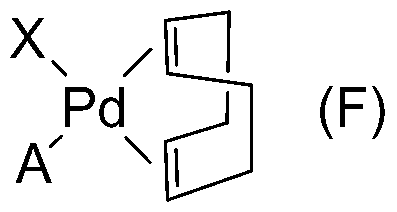

本発明の製造方法は、通常、有機溶媒の存在下でおこなわれる。
有機溶媒は、通常、式(A)で表される化合物および式(B)で表される化合物を溶解し得る有機溶媒である。
本発明の製造方法は、塩基の存在下でおこなわれる。塩基は、無機塩基または有機塩基のいずれであってもよい。
本発明の製造方法において、塩基として無機塩基を用いる場合、相間移動触媒を併用してもよい。相間移動触媒としては、例えば、テトラアルキルハロゲン化アンモニウム、テトラアルキル硫酸水素アンモニウムおよびテトラアルキル水酸化アンモニウムが挙げられ、トリカプリルメチル塩化アンモニウム(Sigma-Aldrich社からAliquat(登録商標)336として入手可能)等のテトラアルキルハロゲン化アンモニウムが好ましい。
本発明の製造方法は、式(A)で表される化合物と、式(B)で表される化合物とを、式(C)または式(C’)で表されるパラジウム錯体、有機溶媒および塩基の存在下に反応させる工程を含み、式(A)で表される化合物と、式(B)で表される化合物とを、式(C)または式(C’)で表されるパラジウム錯体、有機溶媒および塩基の存在下で混合することによって、式(A)で表される化合物と式(B)で表される化合物とが反応し、芳香族化合物が生成する。
これらの混合順序は制限されず、例えば、式(A)で表される化合物と、式(B)で表される化合物と、式(C)または式(C’)で表されるパラジウム錯体と、有機溶媒と塩基とを同時に混合してもよいし、式(A)で表される化合物と、式(B)で表される化合物と、有機溶媒と塩基とを混合した後、得られる混合物と、有機溶媒と、式(C)または式(C’)で表されるパラジウム錯体とを混合してもよい。また、式(A)で表される化合物と、式(B)で表される化合物と、式(C)または式(C’)で表されるパラジウム錯体と、有機溶媒を混合した後、得られる混合物と、塩基とを混合してもよい。
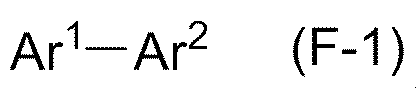


・GC測定装置:GC-2010(株式会社島津製作所製)
・カラム:DB-1 膜厚0.25μm、300×0.25mm(Agilent Technologies社製)
・気化室温度:300℃
・検出器温度:300℃
・カラム温度:40℃(3分保持)後、4.5℃/分で200℃まで昇温し、続いて20℃/分で300℃まで昇温後、1分保持。
・注入量:1μL
・全流量:13.2mL/分
・カラム流量:1.70mL/分
・スプリット比:5.0
・検出:FID検出
・GPC測定装置:CTO-10AC(株式会社島津製作所製カラムオーブン)、SPD-10A(株式会社島津製作所製検出器)
・カラム:Shodex KD-806 8.0mmφ×30cm(昭和電工株式会社製)
・カラム温度:60℃
・移動相:オルト―ジクロロベンゼン
・流量:1mL/分
・検出:可視光検出(波長600nm)
・NMR測定装置:AVANCE600(BRUKER社製)またはJNM-ECA400(JEOL社製)
・測定核:H核、P核
ガラス製反応容器内を窒素雰囲気下とした後、ジ-tert-ブチル(3,5-ジ-(tert-ブチル)フェニルホスホニウムテトラフルオロボレート 10.6mmol、ジエチルエーテル 20mLおよびトリエチルアミン 10.6mmolを加え、室温で5分撹拌した。得られた懸濁液から濾過により固体を取り除き、得られた液体を、クロロメチル(1,5-シクロオクタジエン)パラジウム(II) 7.5mmolの入ったガラス製反応容器に加えた。得られた混合物を室温で30分撹拌した後、得られた反応溶液をヘキサン(94mL)中に滴下した。生成した固体を濾過により取り出した後、ヘキサン 30mLで3回洗浄した。得られた固体を減圧乾燥し、白色固体のクロロメチル(ジ(tert-ブチル)(3,5-ジ(tert-ブチル)フェニルホスフィン)パラジウム(II) 2.23gを得た。

31P-NMR(δppm,CDCl3溶媒):77.4
冷却装置をとりつけたガラス製反応容器に、クロロメチル(トリ-tert-ブチルホスフィン)パラジウム(II) 0.01mmol、2-ブロモ-m-キシレン 0.5mmol、2-チオフェンボロン酸 0.5mmol、リン酸カリウム 1.0mmol、メタノール 4.5mL、水 0.5mL、および、内部標準としてn-オクチルベンゼン 0.07mmolを加えた。得られた混合物を0℃で3時間撹拌した。得られた反応混合物のうちの200μLをテトラヒドロフラン 5mLで希釈した後、GC分析したところ、目的とする2-(2’,6’-ジメチルフェニル)-チオフェンの収率は94%であった。

実施例2におけるリン酸カリウムに代えて、炭酸ナトリウムを用いた以外は、実施例2と同様に実施して、2-(2’,6’-ジメチルフェニル)-チオフェンを得た。その収率は91%であった。
実施例2におけるクロロメチル(トリ-tert-ブチルホスフィン)パラジウム(II)に代えて、[2-(アミノ-κN)(1,1’-ビフェニル)-2-イル-κC]クロロ[トリ-(tert-ブチル)ホスフィン]パラジウム(II)を用いた以外は、実施例2と同様に実施して、2-(2’,6’-ジメチルフェニル)-チオフェンを得た。その収率は12%であった。

実施例2におけるクロロメチル(トリ-tert-ブチルホスフィン)パラジウム(II)に代えて、[2-(アミノ-κN)(1,1’-ビフェニル)-2-イル-κC]クロロ[トリ-(tert-ブチル)ホスフィン]パラジウム(II)を用い、かつ、リン酸カリウムに代えて、炭酸ナトリウムを用いた以外は、実施例2と同様に実施して、2-(2’,6’-ジメチルフェニル)-チオフェンを得た。その収率は75%であった。
冷却装置をとりつけたガラス製反応容器に、実施例1で得られたクロロメチル(ジ(tert-ブチル)(3,5-ジ(tert-ブチル)フェニルホスフィン)パラジウム(II) 0.0025mmol、2-ブロモ-m-キシレン 0.5mmol、2-チオフェンボロン酸 0.5mmol、リン酸カリウム 1.0mmol、テトラヒドロフラン 4.5mL、水 0.5mL、および、内部標準としてn-オクチルベンゼン 0.07mmolを加えた。得られた混合物を45℃で3時間撹拌した。得られた反応混合物のうちの200μLをテトラヒドロフラン 5mLで希釈した後、GC分析したところ、目的とする2-(2’,6’-ジメチルフェニル)-チオフェンの収率は90%であった。
冷却装置を備えたガラス製反応容器内を窒素雰囲気下とした後、4,7-ジブロモ-5,6-ジフルオロ-2,1,3-ベンゾチアジアゾール 3.0mmol、2,2’-(5,5-ビス(3,7-ジメチルオクチル)-5H-ジチエノ[3,2-b:2’,3’-d]ピラン-2,7-ジイル)ビス(5-メチル-1,3,2-ジオキサボリナン-5-メタノール) 3.0mmol、クロロメチル(トリ-tert-ブチルホスフィン)パラジウム(II) 9μmol、水 90mL、テトラヒドロフラン 70mLおよびメシチレン 30mLを加えた。得られた混合物を撹拌しながら、45℃に加熱した。得られた混合物に、3Mリン酸カリウム水溶液 10mLを加えた。得られた混合物を撹拌しながら、45℃に加熱し、4時間反応を行うことで、下記式で表される繰り返し構造単位からなる芳香族化合物を含む反応混合物を得た。得られた芳香族反応混合物を1-クロロナフタレンに溶解させた後、分子量をGPC分析したところ、分子量(Mw)は3.6×10⁴であった。

実施例5におけるクロロメチル(トリ-tert-ブチルホスフィン)パラジウム(II)に代えて、[2-(アミノ-κN)(1,1’-ビフェニル)-2-イル-κC]クロロ[トリ-(tert-ブチル)ホスフィン]パラジウム(II)を用いた以外は、実施例5と同様に実施した。得られた芳香族化合物の分子量(Mw)は2.6×10⁴であった。
冷却装置をとりつけたガラス製反応容器に、クロロメチル(トリ-tert-ブチルホスフィン)パラジウム(II) 0.0025mmol、ブロモベンゼン 0.5mmol、m-トリルボロン酸 0.5mmol、リン酸カリウム 1.0mmol、メタノール 4.5mL、水 0.5mL、および、内部標準としてn-ノニルベンゼン 0.07mmolを加えた。得られた混合物を60℃で3時間撹拌した。得られた反応混合物のうちの200μLをテトラヒドロフラン 5mLで希釈し、GC分析したところ、目的とする3-メチルビフェニルの収率は100%であった。
冷却装置をとりつけたガラス製反応容器に、クロロメチル(ジ(tert-ブチル)(3,5-ジ(tert-ブチル)フェニルホスフィン)パラジウム(II)パラジウム(II) 0.0025mmol、2-ブロモ-m-キシレン 0.5mmol、2-チオフェンボロン酸 0.5mmol、リン酸カリウム 1.0mmol、メタノール 4.5mL、水 0.5mL、および、内部標準としてn-オクチルベンゼン 0.07mmolを加えた。得られた混合物を25℃で3時間撹拌した。得られた反応混合物のうちの200μLをテトラヒドロフラン 5mLで希釈した後、GC分析したところ、目的とする2-(2’,6’-ジメチルフェニル)-チオフェンの収率は95%であった。
滴下ロートを取り付けたガラス製反応容器内を窒素雰囲気下とした後、2-ブロモアニソール 0.18gおよびテトラヒドロフラン 4mLを加えた。得られた溶液を-70℃に冷却した後、n-ブチルリチウム(1.63M/ヘキサン溶液) 0.6mLを滴下した。得られた混合物を-70℃で1時間撹拌した後、クロロジシクロペンチルホスフィン 0.20gをテトラヒドロフラン 4mLに溶解させることにより得られた溶液を滴下した。得られた混合物を室温で3時間撹拌した後、NH4Cl水溶液(2M) 5mLを加え、ヘキサン 20mLで2回抽出した。それぞれの抽出で得られた有機層を混合し、濃縮し、粘性のある液体状のジシクロペンチル(2-メトキシフェニル)ホスフィンを含む混合物を得た。
ガラス製反応容器内を窒素雰囲気下とした後、上記で得られたジシクロペンチル(2-メトキシフェニル)ホスフィンを含む混合物、クロロメチル(1,5-シクロオクタジエン)パラジウム(II) 0.20gおよびテトラヒドロフラン 0.5mLを加えた。得られた混合物を室温で5分撹拌した後、得られた反応溶液をヘキサン(9mL)中に滴下した。生成した固体を濾過により取り出し、ヘキサン3mLで3回洗浄した。得られた固体を減圧乾燥し、灰色固体のクロロメチル(ジシクロペンチル(2-メトキシフェニル)ホスフィン)パラジウム(II) 0.24gを得た。
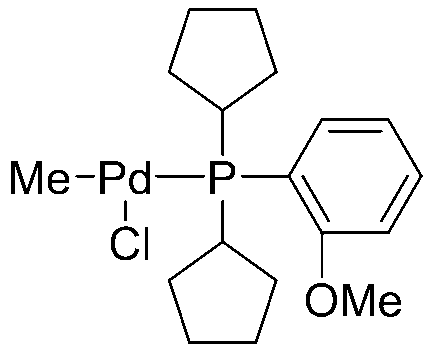
31P-NMR(δppm,CDCl3溶媒):46.8,35.3
滴下ロートを取り付けたガラス製反応容器内を窒素雰囲気下とした後、2-ブロモアニソール 0.52gおよびテトラヒドロフラン 50mLを加えた。得られた溶液を-70℃に冷却した後、n-ブチルリチウム(1.63M/ヘキサン溶液) 1.7mLを滴下した。得られた混合物を-70℃で1時間撹拌した後、ジ-tert-ブチルクロロホスフィン 0.50gをテトラヒドロフラン 17mLに溶解させることにより得られた溶液を滴下した。得られた混合物を室温で3時間撹拌した後、得られた反応混合物を濃縮し、ジ(tert-ブチル)(2-メトキシフェニル)ホスフィンを含む混合物を得た。
ガラス容器内を窒素雰囲気下とした後、上記で得られたジ(tert-ブチル)(2-メトキシフェニル)ホスフィンを含む混合物およびジエチルエーテル 20mLを加え、混合した。得られた混合物をセライトろ過することで、液体を得た。別のガラス製反応容器に、上記で得られた液体を加え、窒素雰囲気下とした後、テトラフルオロホウ酸ジエチルエーテル錯体 0.49gを加え、得られた混合物を激しく30分撹拌した。析出した固体を濾過により取り出した後、ジエチルエーテル 10mLで3回洗浄した。得られた固体を室温で3時間減圧乾燥し、白色固体のジ(tert-ブチル)(2-メトキシフェニル)ホスホニウムテトラフルオロボレートを得た。
ガラス製反応容器内を窒素雰囲気下とした後に、上記で得られたジ(tert-ブチル)(2-メトキシフェニル)ホスホニウムテトラフルオロボレート 0.8g、ジエチルエーテル 2mLおよびトリエチルアミン 0.7mLを加え、室温で5分撹拌した。得られた懸濁液から濾過により固体を取り除き、得られた液体を、クロロメチル(1,5-シクロオクタジエン)パラジウム(II) 0.35gの入ったガラス製反応容器に加えた。得られた混合物を室温で30分撹拌した後、得られた反応溶液をヘキサン(17mL)中に滴下した。生成した固体を濾過により取り出した後、ヘキサン 3mLで3回洗浄した。得られた固体を減圧乾燥し、白色固体のクロロメチル(ジ(tert-ブチル)((2-メトキシフェニル)ホスフィン)パラジウム(II) 0.27gを得た。

31P-NMR(δppm,CDCl3溶媒):59.8
冷却装置をとりつけたガラス製反応容器に、実施例8で得られたクロロメチル(ジシクロペンチル(2-メトキシフェニル)ホスフィン)パラジウム(II) 0.0025mmol、2-ブロモ-m-キシレン 0.5mmol、2-チオフェンボロン酸 0.5mmol、リン酸カリウム 1.0mmol、テトラヒドロフラン 4.5mL、水 0.5mL、および、内部標準としてn-オクチルベンゼン 0.07mmolを加えた。得られた混合物を65℃で3時間撹拌した。得られた反応混合物のうちの200μLをテトラヒドロフラン 5mLで希釈し、GC分析したところ、目的とする2-(2’,6’-ジメチルフェニル)-チオフェンの収率は92%であった。
実施例10におけるクロロメチル(ジシクロペンチル(2-メトキシフェニル)ホスフィン)パラジウム(II)に代えて、実施例9で得られたクロロメチル(ジ(tert-ブチル)((2-メトキシフェニル)ホスフィン)パラジウム(II)を用いた以外は、実施例10と同様に実施することで、2-(2’,6’-ジメチルフェニル)-チオフェンを得た。その収率は92%であった。
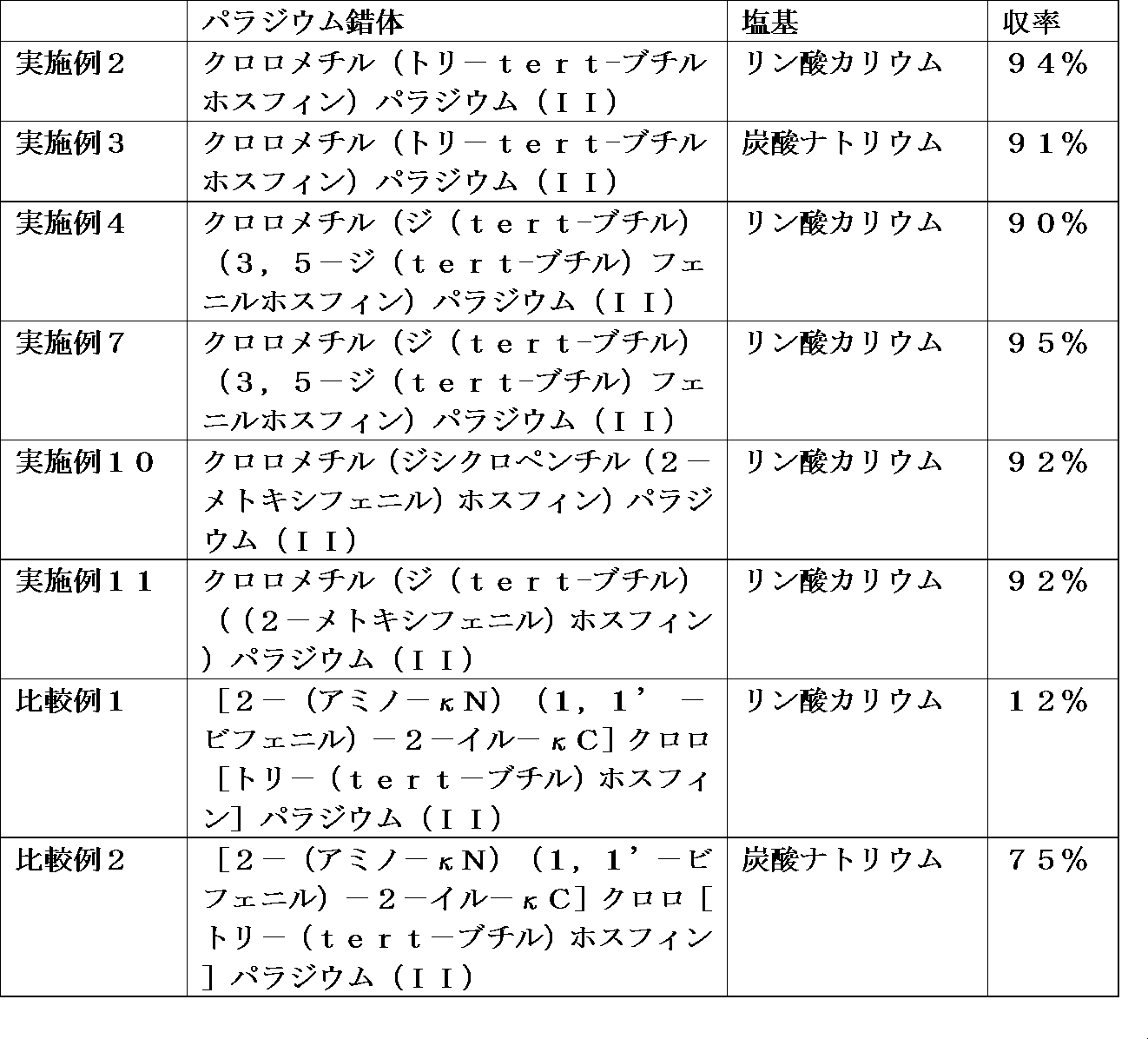
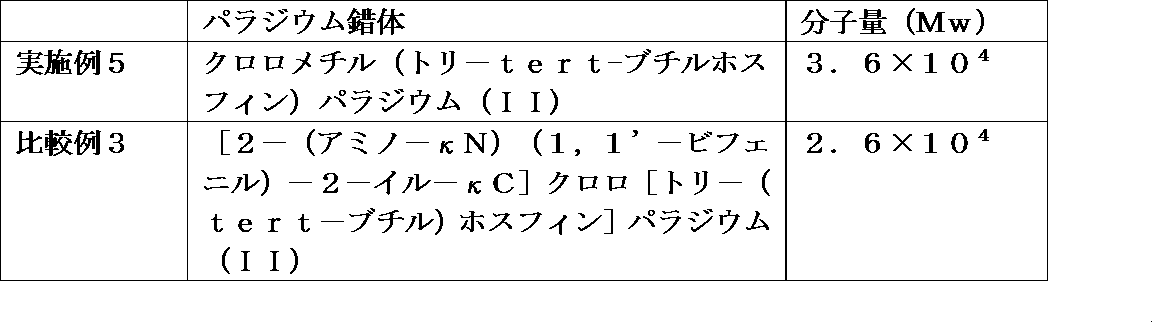
Claims (15)
- 式(D):
(式中、
Xは塩素原子、臭素原子またはヨウ素原子を表す。
Aは炭素数1~3のアルキル基を表す。
Bは炭素数4~20のアルキル基または炭素数5~10のシクロアルキル基を表す。
R4およびR5はそれぞれ独立に、水素原子、フッ素原子、炭素数1~20のアルコキシ基または炭素数5~10のシクロアルコキシ基を表し、R6、R7およびR8はそれぞれ独立に、水素原子、フッ素原子、炭素数1~20のアルキル基、炭素数5~10のシクロアルキル基、置換基を有していてもよい炭素数6~20のアリール基または置換基を有していてもよい炭素数4~20のヘテロアリール基を表す。アリール基およびヘテロアリール基の炭素数には置換基の炭素数は含まれない。アリール基およびヘテロアリール基が有していてもよい置換基は、下記群1から選ばれる。R4~R8の全てが同時に水素原子を表すことはない。)
または
式(D’):
(式中、X、A、BおよびR4~R8は前述と同義である。複数あるX、A、BおよびR4~R8はそれぞれ、同一であっても異なっていてもよい。)
で表されるパラジウム錯体。
群1:フッ素原子、アルキル基、シクロアルキル基、アルコキシ基、シクロアルコキシ基、アルキルチオ基、シクロアルキルチオ基、アリール基、アリールオキシ基、アリールチオ基、アリールアルキル基、アリールシクロアルキル基、アリールアルケニル基、アリールアルキニル基、アルキル基を有していてもよいヘテロ環基、-N(R’)2で表される基(2つのR’はそれぞれ独立して、水素原子、炭素数1~20の炭化水素基、または、アルキル基を有していてもよいヘテロ環基を表す。)、-Si(R’)3で表される基(R’は前述と同義であり、3つのR’はそれぞれ同一であっても異なっていてもよい。)、アシル基、炭素原子-窒素原子二重結合を有する基、酸イミド基、アルコキシカルボニル基、シクロアルコキシカルボ二ル基、アリールオキシカルボニル基、カルボキシ基、シアノ基、ニトリル基およびニトロ基。 - Aがメチル基である、請求項1記載のパラジウム錯体。
- Bが炭素数4~20のアルキル基である、請求項1または2記載のパラジウム錯体。
- Bが炭素数4~6のアルキル基である、請求項3に記載のパラジウム錯体。
- Bがtert-ブチル基である、請求項4に記載のパラジウム錯体。
- R4およびR5が水素原子である、請求項1~5のいずれか一項記載のパラジウム錯体。
- 式(A):
(式中、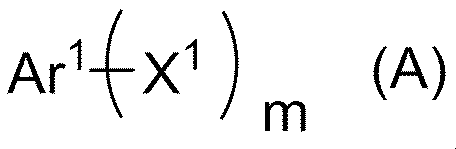
X1は式(1)~式(12)のいずれかの式で表される基を表す。Mは1族の元素を表す。X1が複数ある場合、複数あるX1は同一であっても異なっていてもよい。
mは1または2を表す。mが1のとき、Ar1は、置換基を有していてもよい炭素数6~36のアリール基または置換基を有していてもよい炭素数4~36のヘテロアリール基を表し、mが2のとき、Ar1は、置換基を有していてもよい炭素数6~36のアリーレン基または置換基を有していてもよい炭素数4~36のヘテロアリーレン基を表す。これらの基の炭素数には、置換基の炭素数は含まれない。これらの基が有していてもよい置換基は、下記群1から選ばれる。アリール基は、2以上の単環および/または縮合環のアリール基が、直接結合またはヘテロ原子もしくはカルボニル基を介して間接的に結合することにより形成される1価の基であってもよい。ヘテロアリール基は、2以上の単環および/または縮合環のヘテロアリール基が、直接結合またはヘテロ原子もしくはカルボニル基を介して間接的に結合することにより形成される1価の基であってもよく、1以上の単環および/または縮合環のヘテロアリール基と1以上の単環および/または縮合環のアリール基とが、直接結合またはヘテロ原子もしくはカルボニル基を介して間接的に結合することにより形成される1価の基であってもよい。アリーレン基は、2以上の単環および/または縮合環のアリーレン基が、直接結合またはヘテロ原子もしくはカルボニル基を介して間接的に結合することにより形成される2価の基であってもよい。ヘテロアリーレン基は、2以上の単環および/または縮合環のヘテロアリーレン基が、直接結合またはヘテロ原子もしくはカルボニル基を介して間接的に結合することにより形成される2価の基であってもよく、1以上の単環および/または縮合環のヘテロアリーレン基と1以上の単環および/または縮合環のアリーレン基とが、直接結合またはヘテロ原子もしくはカルボニル基を介して間接的に結合することにより形成される2価の基であってもよい。)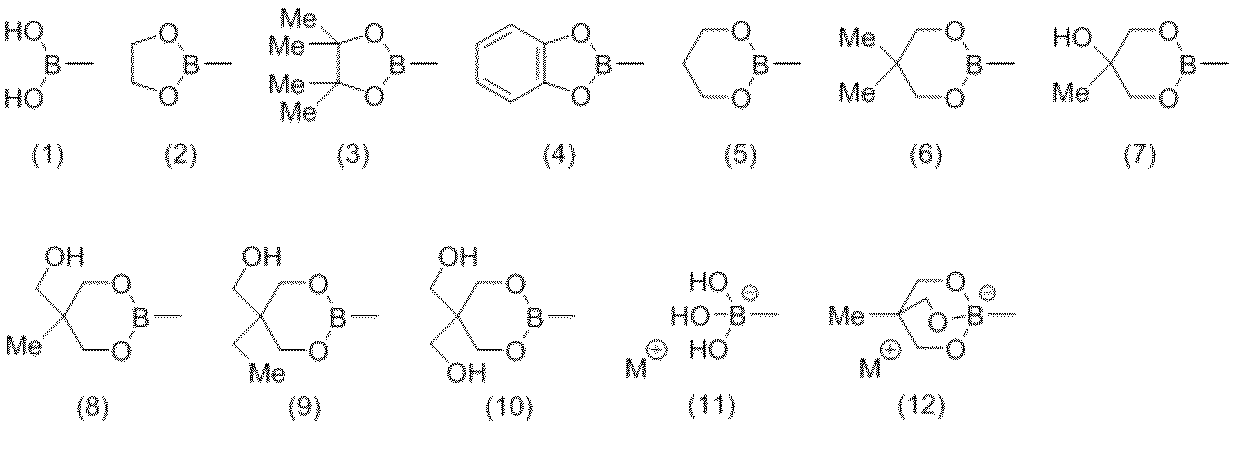
で表される化合物と、
式(B):
(式中、
X2は、塩素原子、臭素原子、ヨウ素原子、アルキルスルホニルオキシ基、フッ素原子で置換されたアルキルスルホニルオキシ基またはアリールスルホニルオキシ基を表す。X2が複数ある場合、複数あるX2は同一であっても異なっていてもよい。
nは1または2を表す。式(B)におけるnは、式(A)におけるmと同一であっても異なっていてもよい。nが1のとき、Ar2は、置換基を有していてもよい炭素数6~36のアリール基または置換基を有していてもよい炭素数4~36のヘテロアリール基を表す。nが2のとき、Ar2は、置換基を有していてもよい炭素数6~36のアリーレン基または置換基を有していてもよい炭素数4~36のヘテロアリーレン基を表す。これらの基の炭素数には置換基の炭素数は含まれない。これらの基が有していてもよい置換基は、下記群1から選ばれる。アリール基は、2以上の単環および/または縮合環のアリール基が、直接結合またはヘテロ原子もしくはカルボニル基を介して間接的に結合することにより形成される1価の基であってもよい。ヘテロアリール基は、2以上の単環および/または縮合環のヘテロアリール基が、直接結合またはヘテロ原子もしくはカルボニル基を介して間接的に結合することにより形成される1価の基であってもよく、1以上の単環および/または縮合環のヘテロアリール基と1以上の単環および/または縮合環のアリール基とが、直接結合またはヘテロ原子もしくはカルボニル基を介して間接的に結合することにより形成される1価の基であってもよい。アリーレン基は、2以上の単環および/または縮合環のアリーレン基が、直接結合またはヘテロ原子もしくはカルボニル基を介して間接的に結合することにより形成される2価の基であってもよい。ヘテロアリーレン基は、2以上の単環および/または縮合環のヘテロアリーレン基が、直接結合またはヘテロ原子もしくはカルボニル基を介して間接的に結合することにより形成される2価の基であってもよく、1以上の単環および/または縮合環のヘテロアリーレン基と1以上の単環および/または縮合環のアリーレン基とが、直接結合またはヘテロ原子もしくはカルボニル基を介して間接的に結合することにより形成される2価の基であってもよい。)
で表される化合物とを、
式(C):
(式中、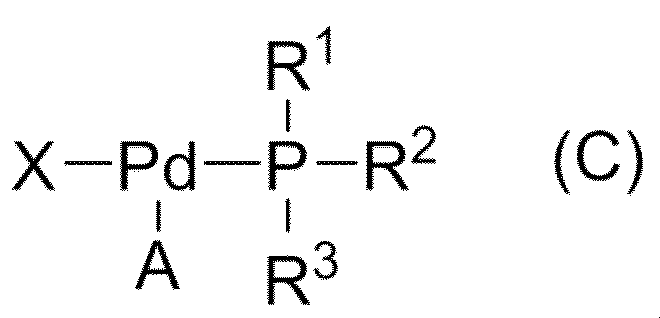
Xは塩素原子、臭素原子またはヨウ素原子を表す。
Aは炭素数1~3のアルキル基を表す。
R1は炭素数1~20のアルキル基、炭素数5~10のシクロアルキル基、置換基を有
していてもよい炭素数6~20のアリール基または置換基を有していてもよい炭素数4~20のヘテロアリール基を表し、R2およびR3はそれぞれ独立に、炭素数1~20のアルキル基または炭素数5~10のシクロアルキル基を表す。アリール基およびヘテロアリール基の炭素数には置換基の炭素数は含まれない。アリール基およびヘテロアリール基が有していてもよい置換基は、下記群1から選ばれる。)
または
式(C’):
(式中、X、A、R1、R2およびR3は前述と同義である。複数あるX、A、R1、R2およびR3はそれぞれ、同一であっても異なっていてもよい。)
で表されるパラジウム錯体、および、塩基の存在下に反応させる工程を含む、芳香族化合物の製造方法。
群1:フッ素原子、アルキル基、シクロアルキル基、アルコキシ基、シクロアルコキシ基、アルキルチオ基、シクロアルキルチオ基、アリール基、アリールオキシ基、アリールチオ基、アリールアルキル基、アリールシクロアルキル基、アリールアルケニル基、アリールアルキニル基、アルキル基を有していてもよいヘテロ環基、-N(R’)2で表される基(2つのR’はそれぞれ独立して、水素原子、炭素数1~20の炭化水素基、または、アルキル基を有していてもよいヘテロ環基を表す。)、-Si(R’)3で表される基(R’は前述と同義であり、3つのR’はそれぞれ同一であっても異なっていてもよい。)、アシル基、炭素原子-窒素原子二重結合を有する基、酸イミド基、アルコキシカルボニル基、シクロアルコキシカルボ二ル基、アリールオキシカルボニル基、カルボキシ基、シアノ基、ニトリル基およびニトロ基。 - R1が置換基を有していてもよい炭素数6~20のアリール基または置換基を有していてもよい炭素数4~20のヘテロアリール基である、請求項7記載の芳香族化合物の製造方法。
- R2およびR3がそれぞれ独立に、炭素数1~6のアルキル基または炭素数5~6のシクロアルキル基である、請求項7または8記載の芳香族化合物の製造方法。
- Aがメチル基である、請求項7~9のいずれか一項記載の芳香族化合物の製造方法。
- Ar1およびAr2が、それぞれ独立に、下記群Arから選ばれる基である、請求項7~10のいずれか一項記載の芳香族化合物の製造方法。
群Ar:
単環のアリール基、縮合環のアリール基、ならびに、2以上の単環のアリール基が直接結合またはヘテロ原子もしくはカルボニル基を介して間接的に結合することにより形成される1価の基、
単環のヘテロアリール基、縮合環のヘテロアリール基、ならびに、2以上の単環のヘテロアリール基が直接結合またはヘテロ原子もしくはカルボニル基を介して間接的に結合することにより形成される1価の基、
単環のアリーレン基、縮合環のアリーレン基、ならびに、2以上の単環のアリーレン基が直接結合またはヘテロ原子もしくはカルボニル基を介して間接的に結合することにより形成される2価の基、並びに、
単環のヘテロアリーレン基、縮合環のヘテロアリーレン基、ならびに、2以上の単環のヘテロアリーレン基が直接結合またはヘテロ原子もしくはカルボニル基を介して間接的に結合することにより形成される2価の基。 - 鈴木カップリング用の触媒であって、式(C):
(式中、
Xは塩素原子、臭素原子またはヨウ素原子を表す。
Aは炭素数1~3のアルキル基を表す。
R1は炭素数1~20のアルキル基、炭素数5~10のシクロアルキル基、置換基を有していてもよい炭素数6~20のアリール基または置換基を有していてもよい炭素数4~20のヘテロアリール基を表し、R2およびR3はそれぞれ独立に、炭素数1~20のアルキル基または炭素数5~10のシクロアルキル基を表す。アリール基およびヘテロアリール基の炭素数には置換基の炭素数は含まれない。アリール基およびヘテロアリール基が有していてもよい置換基は、下記群1から選ばれる。)
または式(C’):
(式中、X、A、R1、R2およびR3は前述と同義である。複数あるX、A、R1、R2およびR3はそれぞれ同一であっても異なっていてもよい。)
で表されるパラジウム錯体。
群1:フッ素原子、アルキル基、シクロアルキル基、アルコキシ基、シクロアルコキシ基、アルキルチオ基、シクロアルキルチオ基、アリール基、アリールオキシ基、アリールチオ基、アリールアルキル基、アリールシクロアルキル基、アリールアルケニル基、アリールアルキニル基、アルキル基を有していてもよいヘテロ環基、-N(R’)2で表される基(2つのR’はそれぞれ独立して、水素原子、炭素数1~20の炭化水素基、または、アルキル基を有していてもよいヘテロ環基を表す。)、-Si(R’)3で表される基(R’は前述と同義であり、3つのR’はそれぞれ同一であっても異なっていてもよい。)、アシル基、炭素原子-窒素原子二重結合を有する基、酸イミド基、アルコキシカルボニル基、シクロアルコキシカルボ二ル基、アリールオキシカルボニル基、カルボキシ基、シアノ基、ニトリル基およびニトロ基。 - R1が置換基を有していてもよい炭素数6~20のアリール基または置換基を有していてもよい炭素数4~20のヘテロアリール基である、請求項12記載のパラジウム錯体。
- R2およびR3がそれぞれ独立に、炭素数1~6のアルキル基または炭素数5~6のシクロアルキル基である、請求項12または13記載のパラジウム錯体。
- Aがメチル基である、請求項12~14のいずれか一項記載のパラジウム錯体。
Priority Applications (4)
| Application Number | Priority Date | Filing Date | Title |
|---|---|---|---|
| EP16870592.9A EP3385270A4 (en) | 2015-12-02 | 2016-11-28 | METHOD FOR PRODUCING AN AROMATIC CONNECTION AND PALLADIUM COMPLEX |
| JP2017553834A JP6791166B2 (ja) | 2015-12-02 | 2016-11-28 | 芳香族化合物の製造方法およびパラジウム錯体 |
| CN201680070060.8A CN108368142B (zh) | 2015-12-02 | 2016-11-28 | 芳香族化合物的制造方法和钯配合物 |
| US15/780,352 US11045796B2 (en) | 2015-12-02 | 2016-11-28 | Process for producing aromatic compound, and palladium complex |
Applications Claiming Priority (2)
| Application Number | Priority Date | Filing Date | Title |
|---|---|---|---|
| JP2015-235404 | 2015-12-02 | ||
| JP2015235404 | 2015-12-02 |
Publications (1)
| Publication Number | Publication Date |
|---|---|
| WO2017094655A1 true WO2017094655A1 (ja) | 2017-06-08 |
Family
ID=58796775
Family Applications (1)
| Application Number | Title | Priority Date | Filing Date |
|---|---|---|---|
| PCT/JP2016/085156 Ceased WO2017094655A1 (ja) | 2015-12-02 | 2016-11-28 | 芳香族化合物の製造方法およびパラジウム錯体 |
Country Status (6)
| Country | Link |
|---|---|
| US (1) | US11045796B2 (ja) |
| EP (1) | EP3385270A4 (ja) |
| JP (1) | JP6791166B2 (ja) |
| CN (1) | CN108368142B (ja) |
| TW (1) | TWI705068B (ja) |
| WO (1) | WO2017094655A1 (ja) |
Cited By (3)
| Publication number | Priority date | Publication date | Assignee | Title |
|---|---|---|---|---|
| WO2018220785A1 (ja) * | 2017-06-01 | 2018-12-06 | 住友化学株式会社 | 高分子化合物の製造方法 |
| WO2020162156A1 (ja) | 2019-02-08 | 2020-08-13 | 住友化学株式会社 | 化合物およびそれを用いた発光素子 |
| JPWO2022114117A1 (ja) * | 2020-11-26 | 2022-06-02 |
Families Citing this family (3)
| Publication number | Priority date | Publication date | Assignee | Title |
|---|---|---|---|---|
| US12280364B2 (en) | 2019-11-27 | 2025-04-22 | Maruzen Petrochemical Co., Ltd. | Complex compound and method for manufacturing the same |
| GB201918871D0 (en) * | 2019-12-19 | 2020-02-05 | Johnson Matthey Plc | Complexes |
| CN112892596B (zh) * | 2021-01-22 | 2024-03-22 | 邹育英 | 一种钯催化剂及其在Heck反应中的应用 |
Citations (3)
| Publication number | Priority date | Publication date | Assignee | Title |
|---|---|---|---|---|
| JPH03261793A (ja) * | 1990-03-12 | 1991-11-21 | Sumitomo Chem Co Ltd | キノキサリン―パラジウム錯体およびその製造方法 |
| WO2014007404A1 (ja) * | 2012-07-06 | 2014-01-09 | 住友化学株式会社 | 芳香族化合物の製造方法 |
| JP2014162745A (ja) * | 2013-02-25 | 2014-09-08 | Nippon Chem Ind Co Ltd | ホスフィン−パラジウム錯体、その製造方法、置換アセチレン重合開始剤及び置換ポリアセチレンの製造方法 |
Family Cites Families (14)
| Publication number | Priority date | Publication date | Assignee | Title |
|---|---|---|---|---|
| US6034240A (en) | 1998-03-09 | 2000-03-07 | Symyx Technologies, Inc. | Substituted aminomethylphosphines, coordination complexes of aminomethylphosphines and their synthesis |
| AU7410100A (en) | 1999-08-27 | 2001-03-26 | Ciba Specialty Chemicals Holding Inc. | Coupling reactions using palladium catalysts |
| GB0028944D0 (en) * | 2000-11-28 | 2001-01-10 | Johnson Matthey Plc | Novel compounds |
| US7214644B2 (en) * | 2004-07-30 | 2007-05-08 | Xerox Corporation | Cross-coupling reactions |
| WO2006093213A1 (ja) | 2005-03-03 | 2006-09-08 | Kuraray Co., Ltd. | ビニル系モノマー重合用触媒組成物および該組成物を用いたビニル系モノマーの重合への使用 |
| CN101693723B (zh) | 2009-10-22 | 2012-09-05 | 浙江大学 | 间三烷氧基苯基二烷基膦四氟硼酸盐及其合成和应用 |
| US8617724B2 (en) * | 2010-01-28 | 2013-12-31 | Sumitomo Chemical Company, Limited | Polymer compound and light emitting device using the same |
| JP2011225632A (ja) * | 2010-04-15 | 2011-11-10 | Showa Denko Kk | ノルボルネン系共重合体の製造方法 |
| CN102153429A (zh) * | 2010-05-17 | 2011-08-17 | 温州大学 | 钯-氮杂环卡宾络合物催化室温水相铃木偶联反应 |
| EP2585216B1 (en) | 2010-06-23 | 2019-11-20 | Johnson Matthey PLC | Pi-allylpalladium and pi-allylnickel complexes for use as catalysts in carbon-carbon and carbon-nitrogen coupling reactions |
| JP2013189602A (ja) | 2012-03-15 | 2013-09-26 | Kuraray Co Ltd | π電子共役重合体および光電変換素子 |
| JP6294314B2 (ja) * | 2012-06-08 | 2018-03-14 | マサチューセッツ インスティテュート オブ テクノロジー | ホスフィン配位パラジウムスルホナートパラダサイクル |
| EP2871198B1 (en) | 2012-07-06 | 2017-06-14 | Sumitomo Chemical Company Limited | Method for producing aromatic compound |
| CN104710255B (zh) * | 2015-03-19 | 2016-06-29 | 苏州大学 | 钯-膦化合物在催化Suzuki反应中的应用 |
-
2016
- 2016-11-28 WO PCT/JP2016/085156 patent/WO2017094655A1/ja not_active Ceased
- 2016-11-28 EP EP16870592.9A patent/EP3385270A4/en not_active Withdrawn
- 2016-11-28 US US15/780,352 patent/US11045796B2/en active Active
- 2016-11-28 JP JP2017553834A patent/JP6791166B2/ja active Active
- 2016-11-28 CN CN201680070060.8A patent/CN108368142B/zh active Active
- 2016-11-29 TW TW105139214A patent/TWI705068B/zh active
Patent Citations (3)
| Publication number | Priority date | Publication date | Assignee | Title |
|---|---|---|---|---|
| JPH03261793A (ja) * | 1990-03-12 | 1991-11-21 | Sumitomo Chem Co Ltd | キノキサリン―パラジウム錯体およびその製造方法 |
| WO2014007404A1 (ja) * | 2012-07-06 | 2014-01-09 | 住友化学株式会社 | 芳香族化合物の製造方法 |
| JP2014162745A (ja) * | 2013-02-25 | 2014-09-08 | Nippon Chem Ind Co Ltd | ホスフィン−パラジウム錯体、その製造方法、置換アセチレン重合開始剤及び置換ポリアセチレンの製造方法 |
Non-Patent Citations (2)
| Title |
|---|
| KIM, J. S. ET AL.: "Synthesis and reactivity of bimetallic palladium(II) methyl complexes with new functional phosphine ligands", JOURNAL OF THE CHEMICAL SOCIETY, vol. 24, 2002, pages 4726 - 4731, XP055388421, ISSN: 1472-7773 * |
| See also references of EP3385270A4 * |
Cited By (5)
| Publication number | Priority date | Publication date | Assignee | Title |
|---|---|---|---|---|
| WO2018220785A1 (ja) * | 2017-06-01 | 2018-12-06 | 住友化学株式会社 | 高分子化合物の製造方法 |
| WO2020162156A1 (ja) | 2019-02-08 | 2020-08-13 | 住友化学株式会社 | 化合物およびそれを用いた発光素子 |
| JPWO2022114117A1 (ja) * | 2020-11-26 | 2022-06-02 | ||
| WO2022114117A1 (ja) * | 2020-11-26 | 2022-06-02 | エヌ・イーケムキャット株式会社 | パラジウム錯体、カップリング反応触媒、および芳香族化合物の製造方法 |
| JP7719798B2 (ja) | 2020-11-26 | 2025-08-06 | エヌ・イーケムキャット株式会社 | パラジウム錯体、カップリング反応触媒、および芳香族化合物の製造方法 |
Also Published As
| Publication number | Publication date |
|---|---|
| CN108368142B (zh) | 2021-02-19 |
| JP6791166B2 (ja) | 2020-11-25 |
| TW201739755A (zh) | 2017-11-16 |
| EP3385270A1 (en) | 2018-10-10 |
| JPWO2017094655A1 (ja) | 2018-09-20 |
| US20180369799A1 (en) | 2018-12-27 |
| CN108368142A (zh) | 2018-08-03 |
| US11045796B2 (en) | 2021-06-29 |
| TWI705068B (zh) | 2020-09-21 |
| EP3385270A4 (en) | 2020-01-22 |
Similar Documents
| Publication | Publication Date | Title |
|---|---|---|
| JP6791166B2 (ja) | 芳香族化合物の製造方法およびパラジウム錯体 | |
| EP2871199B1 (en) | Method for producing aromatic compound | |
| TWI617550B (zh) | 硼酯基稠合噻吩單體 | |
| US9453103B2 (en) | Method for producing aromatic compound | |
| KR20220150316A (ko) | 방향족 화합물, 유기 반도체층, 및 유기 박막 트랜지스터 | |
| JP6905057B2 (ja) | 高分子化合物の製造方法 | |
| JP7719798B2 (ja) | パラジウム錯体、カップリング反応触媒、および芳香族化合物の製造方法 | |
| TW201307425A (zh) | 芳香族聚合物之製造方法 | |
| JP5747352B2 (ja) | チエノピリジン誘導体を用いた有機半導体デバイス | |
| JP2020120098A (ja) | 共役ポリマー、有機半導体層形成用溶液、有機半導体層、及び有機薄膜トランジスタ |
Legal Events
| Date | Code | Title | Description |
|---|---|---|---|
| 121 | Ep: the epo has been informed by wipo that ep was designated in this application |
Ref document number: 16870592 Country of ref document: EP Kind code of ref document: A1 |
|
| ENP | Entry into the national phase |
Ref document number: 2017553834 Country of ref document: JP Kind code of ref document: A |
|
| NENP | Non-entry into the national phase |
Ref country code: DE |
|
| WWE | Wipo information: entry into national phase |
Ref document number: 2016870592 Country of ref document: EP |
|
| ENP | Entry into the national phase |
Ref document number: 2016870592 Country of ref document: EP Effective date: 20180702 |
|
| WWW | Wipo information: withdrawn in national office |
Ref document number: 2016870592 Country of ref document: EP |