WO2017099232A1 - オイルゲル化剤 - Google Patents
オイルゲル化剤 Download PDFInfo
- Publication number
- WO2017099232A1 WO2017099232A1 PCT/JP2016/086770 JP2016086770W WO2017099232A1 WO 2017099232 A1 WO2017099232 A1 WO 2017099232A1 JP 2016086770 W JP2016086770 W JP 2016086770W WO 2017099232 A1 WO2017099232 A1 WO 2017099232A1
- Authority
- WO
- WIPO (PCT)
- Prior art keywords
- group
- carbon atoms
- formula
- alkyl group
- gelling agent
- Prior art date
- Legal status (The legal status is an assumption and is not a legal conclusion. Google has not performed a legal analysis and makes no representation as to the accuracy of the status listed.)
- Ceased
Links
- 0 *CNC(Nc1cccc2c1cccc2)=O Chemical compound *CNC(Nc1cccc2c1cccc2)=O 0.000 description 2
- MJKNHXCPGXUEDO-UHFFFAOYSA-N CC(C)(C)c1cc(C(C)(C)C)cc(N)c1 Chemical compound CC(C)(C)c1cc(C(C)(C)C)cc(N)c1 MJKNHXCPGXUEDO-UHFFFAOYSA-N 0.000 description 1
- RUFPHBVGCFYCNW-UHFFFAOYSA-N Nc1cccc2ccccc12 Chemical compound Nc1cccc2ccccc12 RUFPHBVGCFYCNW-UHFFFAOYSA-N 0.000 description 1
Images

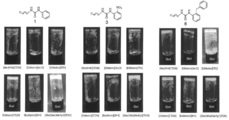


Classifications
-
- A—HUMAN NECESSITIES
- A61—MEDICAL OR VETERINARY SCIENCE; HYGIENE
- A61K—PREPARATIONS FOR MEDICAL, DENTAL OR TOILETRY PURPOSES
- A61K8/00—Cosmetics or similar toiletry preparations
- A61K8/02—Cosmetics or similar toiletry preparations characterised by special physical form
- A61K8/04—Dispersions; Emulsions
- A61K8/042—Gels
-
- C—CHEMISTRY; METALLURGY
- C07—ORGANIC CHEMISTRY
- C07C—ACYCLIC OR CARBOCYCLIC COMPOUNDS
- C07C275/00—Derivatives of urea, i.e. compounds containing any of the groups, the nitrogen atoms not being part of nitro or nitroso groups
- C07C275/28—Derivatives of urea, i.e. compounds containing any of the groups, the nitrogen atoms not being part of nitro or nitroso groups having nitrogen atoms of urea groups bound to carbon atoms of six-membered aromatic rings of a carbon skeleton
- C07C275/30—Derivatives of urea, i.e. compounds containing any of the groups, the nitrogen atoms not being part of nitro or nitroso groups having nitrogen atoms of urea groups bound to carbon atoms of six-membered aromatic rings of a carbon skeleton being further substituted by halogen atoms, or by nitro or nitroso groups
-
- A—HUMAN NECESSITIES
- A61—MEDICAL OR VETERINARY SCIENCE; HYGIENE
- A61K—PREPARATIONS FOR MEDICAL, DENTAL OR TOILETRY PURPOSES
- A61K47/00—Medicinal preparations characterised by the non-active ingredients used, e.g. carriers or inert additives; Targeting or modifying agents chemically bound to the active ingredient
- A61K47/06—Organic compounds, e.g. natural or synthetic hydrocarbons, polyolefins, mineral oil, petrolatum or ozokerite
- A61K47/16—Organic compounds, e.g. natural or synthetic hydrocarbons, polyolefins, mineral oil, petrolatum or ozokerite containing nitrogen, e.g. nitro-, nitroso-, azo-compounds, nitriles, cyanates
-
- A—HUMAN NECESSITIES
- A61—MEDICAL OR VETERINARY SCIENCE; HYGIENE
- A61K—PREPARATIONS FOR MEDICAL, DENTAL OR TOILETRY PURPOSES
- A61K8/00—Cosmetics or similar toiletry preparations
- A61K8/18—Cosmetics or similar toiletry preparations characterised by the composition
- A61K8/30—Cosmetics or similar toiletry preparations characterised by the composition containing organic compounds
- A61K8/40—Cosmetics or similar toiletry preparations characterised by the composition containing organic compounds containing nitrogen
- A61K8/42—Amides
-
- A—HUMAN NECESSITIES
- A61—MEDICAL OR VETERINARY SCIENCE; HYGIENE
- A61K—PREPARATIONS FOR MEDICAL, DENTAL OR TOILETRY PURPOSES
- A61K9/00—Medicinal preparations characterised by special physical form
- A61K9/06—Ointments; Bases therefor; Other semi-solid forms, e.g. creams, sticks, gels
-
- A—HUMAN NECESSITIES
- A61—MEDICAL OR VETERINARY SCIENCE; HYGIENE
- A61Q—SPECIFIC USE OF COSMETICS OR SIMILAR TOILETRY PREPARATIONS
- A61Q19/00—Preparations for care of the skin
-
- C—CHEMISTRY; METALLURGY
- C07—ORGANIC CHEMISTRY
- C07C—ACYCLIC OR CARBOCYCLIC COMPOUNDS
- C07C275/00—Derivatives of urea, i.e. compounds containing any of the groups, the nitrogen atoms not being part of nitro or nitroso groups
- C07C275/28—Derivatives of urea, i.e. compounds containing any of the groups, the nitrogen atoms not being part of nitro or nitroso groups having nitrogen atoms of urea groups bound to carbon atoms of six-membered aromatic rings of a carbon skeleton
- C07C275/32—Derivatives of urea, i.e. compounds containing any of the groups, the nitrogen atoms not being part of nitro or nitroso groups having nitrogen atoms of urea groups bound to carbon atoms of six-membered aromatic rings of a carbon skeleton being further substituted by singly-bound oxygen atoms
- C07C275/34—Derivatives of urea, i.e. compounds containing any of the groups, the nitrogen atoms not being part of nitro or nitroso groups having nitrogen atoms of urea groups bound to carbon atoms of six-membered aromatic rings of a carbon skeleton being further substituted by singly-bound oxygen atoms having nitrogen atoms of urea groups and singly-bound oxygen atoms bound to carbon atoms of the same non-condensed six-membered aromatic ring
- C07C275/36—Derivatives of urea, i.e. compounds containing any of the groups, the nitrogen atoms not being part of nitro or nitroso groups having nitrogen atoms of urea groups bound to carbon atoms of six-membered aromatic rings of a carbon skeleton being further substituted by singly-bound oxygen atoms having nitrogen atoms of urea groups and singly-bound oxygen atoms bound to carbon atoms of the same non-condensed six-membered aromatic ring with at least one of the oxygen atoms further bound to a carbon atom of a six-membered aromatic ring, e.g. N-aryloxyphenylureas
-
- C—CHEMISTRY; METALLURGY
- C09—DYES; PAINTS; POLISHES; NATURAL RESINS; ADHESIVES; COMPOSITIONS NOT OTHERWISE PROVIDED FOR; APPLICATIONS OF MATERIALS NOT OTHERWISE PROVIDED FOR
- C09K—MATERIALS FOR MISCELLANEOUS APPLICATIONS, NOT PROVIDED FOR ELSEWHERE
- C09K3/00—Materials not provided for elsewhere
-
- A—HUMAN NECESSITIES
- A61—MEDICAL OR VETERINARY SCIENCE; HYGIENE
- A61K—PREPARATIONS FOR MEDICAL, DENTAL OR TOILETRY PURPOSES
- A61K2800/00—Properties of cosmetic compositions or active ingredients thereof or formulation aids used therein and process related aspects
- A61K2800/10—General cosmetic use
-
- A—HUMAN NECESSITIES
- A61—MEDICAL OR VETERINARY SCIENCE; HYGIENE
- A61K—PREPARATIONS FOR MEDICAL, DENTAL OR TOILETRY PURPOSES
- A61K2800/00—Properties of cosmetic compositions or active ingredients thereof or formulation aids used therein and process related aspects
- A61K2800/40—Chemical, physico-chemical or functional or structural properties of particular ingredients
- A61K2800/48—Thickener, Thickening system
Definitions
- the present invention relates to a novel gelling agent, and in particular, to a novel gelling agent containing a monourea derivative that can form a gel with respect to an organic liquid other than water.
- a structure in which a fluid is contained in a three-dimensional network structure formed by a substance having a gel forming ability is called a gel.
- a gel a substance having a gel forming ability
- the fluid is water, hydrogel (hydrogel), water Other organic liquids (organic solvents, oils, etc.) are called organogels or oil gels.
- Oil gels (organogels) are used to adjust the fluidity of cosmetics and paints in the fields of cosmetics, pharmaceuticals, agricultural chemicals, foods, adhesives, paints, resins, and the like. Further, for example, it is widely used in the field of environmental conservation, such as gelling waste oil to prevent water contamination as a solid substance.
- An object of the present invention is to provide a novel gelling agent having a structure that has not been proposed so far, particularly a novel gelling agent capable of forming an oil gel.
- this invention relates to the gelatinizer which consists of a compound represented by following formula [1] as a 1st viewpoint.
- R 1 is a linear or branched alkyl group having 2 to 20 carbon atoms, a cyclic alkyl group having 3 to 20 carbon atoms, or a linear or branched chain group having 12 to 20 carbon atoms.
- Ar is unsubstituted or an alkyl group having 1 to 10 carbon atoms, an alkoxy group having 1 to 10 carbon atoms, an aryloxy group having 6 to 18 carbon atoms, a halogen atom, a nitro group, a phenyl group, or a carbon atom.
- R 1 is a linear or branched alkyl group having 12 to 20 carbon atoms, a cyclic alkyl group having 12 to 20 carbon atoms, or a straight chain having 12 to 20 carbon atoms or
- the gelling agent according to the first aspect which is a branched alkenyl group.
- R 1 is a linear alkyl group having 14 to 20 carbon atoms
- Ar is unsubstituted, or an alkyl group having 1 to 10 carbon atoms, a halogen atom, or 7 to 18 carbon atoms.
- the gelling agent according to the first aspect or the second aspect which is a phenyl group which may be substituted with at least one substituent selected from the group consisting of:
- the present invention relates to the gelling agent according to any one of the first to third aspects, wherein Ar is a phenyl group substituted with a benzyl group.
- the present invention relates to a gel comprising the gelling agent according to any one of the first to fourth aspects and a hydrophobic organic solvent, a hydrophilic organic solution, or an ionic liquid.
- the present invention relates to the gel according to the fifth aspect, wherein the hydrophobic organic solvent is at least one selected from the group consisting of vegetable oils, esters, silicone oils and hydrocarbons.
- the hydrophilic organic solvent is methanol, ethanol, 2-propanol, i-butanol, pentanol, hexanol, 1-octanol, isooctanol, acetone, cyclohexanone, acetonitrile, dioxane, glycerol, butanediol, propylene glycol.
- the gel according to the fifth aspect which is at least one selected from the group consisting of ethylene glycol and dimethyl sulfoxide.
- the hydrophilic organic solution is a mixed solvent of a hydrophilic organic solvent and water
- the hydrophilic organic solvent is methanol, ethanol, 2-propanol, i-butanol, pentanol, hexanol, 1-octanol, isooctanol, acetone, cyclohexanone, acetonitrile, dioxane, glycerol, butanediol, propylene glycol, ethylene glycol and dimethyl.
- the gel according to the fifth aspect which is at least one selected from the group consisting of sulfoxides.
- the ionic liquid comprises a cation species selected from the group consisting of imidazolium, pyridinium, piperidinium, pyrrolidinium, phosphonium, ammonium and sulfonium, and halogen, carboxylate, sulfate, sulfonate, thiocyanate, nitrate, aluminate Or a borate, phosphate, amide, antimonate, imide, and a gel according to the fifth aspect, comprising a combination with an anionic species selected from the group consisting of methides.
- a 10th viewpoint it is related with the compound represented by following formula [1].
- R 1 is a linear or branched alkyl group having 2 to 20 carbon atoms, a cyclic alkyl group having 3 to 20 carbon atoms, or a linear or branched chain group having 12 to 20 carbon atoms.
- Ar is unsubstituted or an alkyl group having 1 to 10 carbon atoms, an alkoxy group having 1 to 10 carbon atoms, an aryloxy group having 6 to 18 carbon atoms, a halogen atom, a nitro group, a phenyl group, or a carbon atom.
- R 1 is a linear or branched alkyl group having 12 to 20 carbon atoms, a cyclic alkyl group having 12 to 20 carbon atoms, or a straight chain having 12 to 20 carbon atoms or The compound according to the tenth aspect, which represents a branched alkenyl group.
- Ar is unsubstituted or an alkyl group having 1 to 5 carbon atoms, a chloro group, a bromo group, a nitro group, an alkylcarbonyl group having 2 to 10 carbon atoms, or an aralkyl having 7 to 10 carbon atoms.
- the compound according to the tenth aspect or the eleventh aspect which is a phenyl group substituted with at least one substituent selected from the group consisting of groups.
- the gelling agent of the present invention can form a gel by gelling an organic solvent or the like.
- the gelling agent of the present invention can form a gel on various media such as a hydrophobic organic solvent, a hydrophilic organic solution, or an ionic liquid, and can easily provide a gel containing these media.
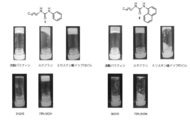
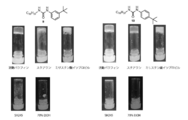
- FIG. 1 is a photograph showing the gelation behavior of the compound represented by Formula 1 or Formula 2 in each medium in Example 2 (liquid paraffin, squalane, isopropyl myristate, SH245, 70% EtOH).
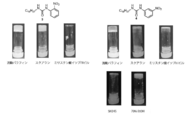
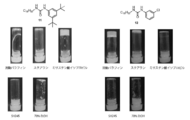
- FIG. 2 is a photograph showing the gelation behavior of the compound represented by Formula 3 or Formula 4 in each medium in Example 2 (liquid paraffin, squalane, isopropyl myristate, SH245, 70% EtOH).
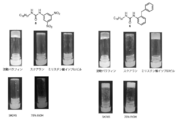
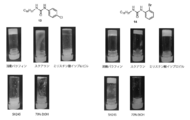
- FIG. 3 is a photograph showing the gelation behavior of the compound represented by Formula 5 or Formula 6 in each medium in Example 2 (liquid paraffin, squalane, isopropyl myristate, SH245, 70% EtOH).
- FIG. 1 is a photograph showing the gelation behavior of the compound represented by Formula 1 or Formula 2 in each medium in Example 2 (liquid paraffin, squalane, isopropyl myristate, SH245, 70% EtOH).
- FIG. 2 is a photograph showing the gelation behavior of the compound represented by Formula 3 or Formula 4 in each medium in
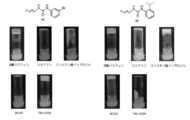
- FIG. 4 is a photograph showing the gelation behavior in each medium of the compound represented by Formula 7 or Formula 8 in Example 2 (liquid paraffin, squalane, isopropyl myristate, SH245, 70% EtOH).
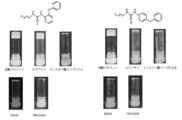
- FIG. 5 is a photograph showing the gelation behavior in each medium of the compound represented by Formula 9 or Formula 10 in Example 2 (liquid paraffin, squalane, isopropyl myristate, SH245, 70% EtOH).
- 6 is a photograph showing the gelation behavior of the compound represented by Formula 11 or Formula 12 in each medium in Example 2 (liquid paraffin, squalane, isopropyl myristate, SH245, 70% EtOH).
- FIG. 5 is a photograph showing the gelation behavior in each medium of the compound represented by Formula 9 or Formula 10 in Example 2 (liquid paraffin, squalane, isopropyl myristate, SH245, 70% EtOH).
- 6 is a photograph showing the gelation behavior of the compound represented by Formula 11 or Formula 12 in each medium in Example 2 (liquid
- FIG. 7 is a photograph showing the gelation behavior of the compound represented by Formula 13 or Formula 14 in each medium in Example 2 (liquid paraffin, squalane, isopropyl myristate, SH245, 70% EtOH).
- FIG. 8 is a photograph showing the gelation behavior of each compound represented by formula 15 or formula 16 in each medium in Example 2 (liquid paraffin, squalane, isopropyl myristate, SH245, 70% EtOH).
- FIG. 9 is a photograph showing the gelation behavior of the compound represented by Formula 17 or 18 in each medium in Example 2 (liquid paraffin, squalane, isopropyl myristate, SH245, 70% EtOH).
- FIG. 10 is a photograph showing the gelation behavior of the compound represented by formula 1, formula 3 or formula 6 in Example 5 in an ionic liquid.
- FIG. 11 is a diagram illustrating the structural formulas of the compounds represented by Formula 1 to Formula 18 synthesized in Example 1.
- 12 is a diagram showing the structural formulas of the compounds represented by Formula 19 to Formula 39 synthesized in Example 1.
- FIG. 11 is a diagram illustrating the structural formulas of the compounds represented by Formula 19 to Formula 39 synthesized in Example 1.
- the gelling agent of the present invention comprises a monourea compound represented by the following formula [1].
- R 1 is a linear or branched alkyl group having 2 to 20 carbon atoms, a cyclic alkyl group having 3 to 20 carbon atoms, or a linear or branched chain group having 12 to 20 carbon atoms.
- Ar is unsubstituted or an alkyl group having 1 to 10 carbon atoms, an alkoxy group having 1 to 10 carbon atoms, an aryloxy group having 6 to 18 carbon atoms, a halogen atom, a nitro group, a phenyl group, or a carbon atom.
- Examples of the linear or branched alkyl group having 2 to 20 carbon atoms in R 1 include an ethyl group, a propyl group, a butyl group, a pentyl group, a hexyl group, a heptyl group, an octyl group, a nonyl group, and a decyl group.
- An undecyl group a dodecyl group, a tridecyl group, a tetradecyl group, a pentadecyl group, a hexadecyl group, a heptadecyl group, an octadecyl group, a nonadecyl group, an eicosyl group, and the like, and groups obtained by branching these groups.
- Examples of the cyclic alkyl group having 3 to 20 carbon atoms include a group consisting only of a cyclic alkyl group (for example, a cyclopropyl group, a cyclobutyl group, a cyclopentyl group, a cyclohexyl group, a cycloheptyl group, a cyclooctyl group, a cyclononyl group, (Cyclodecyl group, cycloundecyl group, cyclododecyl group, cyclotridecyl group, cyclotetradecyl group, cyclopentadecyl group, cyclohexadecyl group, cycloheptadecyl group, cyclooctadecyl group, cyclononadecyl group, cycloeicosyl group, etc.)
- Examples of the linear or branched alkenyl group having 12 to 20 carbon atoms include dodecenyl group, tridecenyl group, tetradecenyl group, pentadecenyl group, hexadecenyl group, heptadecenyl group, octadecenyl group, nonadecenyl group, eicocenyl group, and the like. Examples include a group obtained by branching these groups.
- Examples of the aryl group having 6 to 18 carbon atoms represented by Ar include a phenyl group, a 1-naphthyl group, a 2-naphthyl group, a 1-anthryl group, a 2-anthryl group, a 9-anthryl group, and 1-phenanthryl. Group, 2-phenanthryl group, 3-phenanthryl group, 4-phenanthryl group, 9-phenanthryl group and the like.
- alkyl group having 1 to 10 carbon atoms as the substituent for Ar examples include linear, branched or cyclic alkyl groups, such as methyl group, ethyl group, n-propyl group, i-propyl group.
- cyclopropyl group cyclopropyl group, n-butyl group, i-butyl group, s-butyl group, t-butyl group, cyclobutyl group, 1-methyl-cyclopropyl group, 2-methyl-cyclopropyl group, n-pentyl group, 1-methyl-n-butyl group, 2-methyl-n-butyl group, 3-methyl-n-butyl group, 1,1-dimethyl-n-propyl group, 1,2-dimethyl-n-propyl group, 2 , 2-dimethyl-n-propyl group, 1-ethyl-n-propyl group, cyclopentyl group, 1-methyl-cyclobutyl group, 2-methyl-cyclobutyl group, 3-methyl-cyclobutyl group, 1,2-dimethyl- Chloropropyl group, 2,3-dimethyl-cyclopropyl group, 1-ethyl-cyclopropyl group, 2-ethyl-
- alkoxy group having 1 to 10 carbon atoms examples include groups in which the alkyl group is bonded to oxygen.
- Examples of the aryloxy group having 6 to 18 carbon atoms include groups in which the aryl group is bonded to oxygen.
- a phenyloxy group phenoxy group
- an ⁇ -naphthyloxy group a ⁇ -naphthyloxy group
- 1- Anthryloxy group 2-anthryloxy group
- 9-anthryloxy group 1-phenanthryloxy group
- 2-phenanthryloxy group 3-phenanthryloxy group
- 4-phenanthryloxy group And 9-phenanthryloxy group is bonded to oxygen.
- halogen atom examples include a chlorine atom, a bromine atom, and an iodine atom.
- alkylcarbonyl group having 2 to 10 carbon atoms examples include groups in which the alkyl group is bonded to a carbonyl group, such as a methylcarbonyl group, an ethylcarbonyl group, an n-propylcarbonyl group, an i-propylcarbonyl group, Cyclopropylcarbonyl group, n-butylcarbonyl group, i-butylcarbonyl group, s-butylcarbonyl group, t-butylcarbonyl group, cyclobutylcarbonyl group, 1-methyl-cyclopropylcarbonyl group, 2-methyl-cyclopropylcarbonyl Group, n-pentylcarbonyl group, 1-methyl-n-butylcarbonyl group, 2-methyl-n-butylcarbonyl group, 3-methyl-n-butylcarbonyl group, 1,1-dimethyl-n-propylcarbonyl group, 1,2-dimethyl-n-propylcarbony
- Examples of the aralkyl group having 7 to 18 carbon atoms include groups in which a hydrogen atom of the above alkyl group is substituted with an aryl group, such as a benzyl group, a phenethyl group, a 3-phenylpropyl group, a 4-phenylbutyl group, and a 5-phenylpentyl group.
- an aryl group such as a benzyl group, a phenethyl group, a 3-phenylpropyl group, a 4-phenylbutyl group, and a 5-phenylpentyl group.
- R 1 is a linear or branched chain having 12 to 20 carbon atoms. It is preferably an alkyl group, a cyclic alkyl group having 12 to 20 carbon atoms, or a linear or branched alkenyl group having 12 to 20 carbon atoms, and R 1 has 14 to 20 carbon atoms.
- a linear alkyl group is preferable, and an n-octadecyl group is most preferable.
- Ar is unsubstituted or at least one substituent selected from the group consisting of an alkyl group having 1 to 10 carbon atoms, a halogen atom, and an aralkyl group having 7 to 18 carbon atoms. It is preferably a phenyl group which may be substituted with a group. More preferably, Ar is unsubstituted or substituted with at least one substituent selected from the group consisting of an alkyl group having 1 to 5 carbon atoms, a halogen atom, and an aralkyl group having 7 to 10 carbon atoms.
- Ar is preferably an unsubstituted phenyl group or a phenyl group substituted with a tert-butyl group, a benzyl group, or a bromo group, particularly from the viewpoint of expressing better gelling ability. Is preferred.
- the compound represented by the formula [1], which is the gelling agent of the present invention, is self-assembled when charged into various solvents described later to form secondary aggregates such as fiber or lamellar, Is considered to contribute to the gelation of the solvent.
- R 1 and Ar in the formula [1] as the compound represented by the formula [1] with respect to the high affinity of the secondary assembly to the solvent to be gelled or the solvent to be gelled A suitable or optimum group can be selected in consideration of the high solubility.
- R 1 in the formula [1] is a linear or branched alkyl group having 12 to 20 carbon atoms, a cyclic alkyl group having 12 to 20 carbon atoms, or 12 to 12 carbon atoms. It is preferably a 20 straight-chain or branched alkenyl group, and R 1 is preferably a straight-chain alkyl group having 14 to 20 carbon atoms, and most preferably an n-octadecyl group.
- Ar in the formula [1] is unsubstituted or an alkyl group having 1 to 10 carbon atoms, an aryloxy group having 6 to 18 carbon atoms, a chloro group, a bromo group, a nitro group, or carbon.
- a phenyl group substituted with at least one substituent selected from the group consisting of an alkylcarbonyl group having 2 to 10 atoms or an aralkyl group having 7 to 18 carbon atoms is preferable.
- Ar is a group consisting of an unsubstituted or alkyl group having 1 to 5 carbon atoms, a chloro group, a bromo group, a nitro group, an alkylcarbonyl group having 2 to 10 carbon atoms, or an aralkyl group having 7 to 10 carbon atoms.
- a phenyl group substituted with at least one substituent selected from is preferable.
- Ar is an unsubstituted phenyl group, or tert-butyl group, 3,5-di-t-butyl group, o-isopropyl group, m-isopropyl group, 3,5-dimethyl group, phenoxy Group, p-chloro group, p-bromo group, o-bromo group, p-nitro group, n-pentylcarbonyl group or benzyl group-substituted phenyl group, more preferably benzyl group-substituted phenyl group And most preferably an o-benzyl group-substituted phenyl group.
- the compound represented by the formula [1] has, for example, an isocyanic acid long-chain alkyl or long-chain alkenyl ester compound (R 1 -NCO, R 1 is as defined in the formula [1]) and an amino group.
- R 1 -NCO isocyanic acid long-chain alkyl or long-chain alkenyl ester compound
- R 1 is as defined in the formula [1]
- an amino group for example, an isocyanic acid long-chain alkyl or long-chain alkenyl ester compound (R 1 -NCO, R 1 is as defined in the formula [1]) and an amino group.
- R 1 -NCO is as defined in the formula [1]
- an amino group for example, an isocyanic acid long-chain alkyl or long-chain alkenyl ester compound (R 1 -NCO, R 1 is as defined in the formula [1]) and an amino group.
- R 1 -NCO is as defined in the formula [1]
- alcohols for example, ethanol, propanol, butanol, octanol, etc.
- cellosolves for example, methoxy
- Ethanol ethoxyethanol
- aprotic polar organic solvents for example, N, N-dimethylformamide (DMF), dimethyl sulfoxide (DMSO), N, N-dimethylacetamide, tetramethylurea, sulfolane, N-methylpyrrolidone, N, N-dimethylimidazolidinone, etc.
- ethers eg diethyl ether, diisopropyl ether, t-butyl methyl ether (TBME), tetrahydrofuran, dioxane etc.
- aliphatic hydrocarbons eg pentane, Xylene, cycloxan, octane, decane, decalin, petroleum ether, etc.
- aromatic hydrocarbons for example, al
- the reaction can be appropriately selected from room temperature (around 25 ° C.) to the reflux temperature of the organic solvent used in the above reaction, and the reaction time can be appropriately selected from about 1 hour to 5 days.
- the solvent is distilled off, and if necessary, it can be purified by various purification methods such as various chromatographic methods, recrystallization methods, reprecipitation methods, distillation methods, and washing.
- the gel of the present invention can be obtained by gelling a solvent with the gelling agent. Specifically, a production method in which a predetermined amount of a gelling agent is dissolved in a solvent by heating and cooled is exemplified. Usually, it is preferable to dissolve completely by heating. In the present specification, gelation means that a fluid liquid loses fluidity.
- the amount of the gelling agent of the present invention is not particularly limited as long as the effect of the present invention is exhibited, but is usually 0.001 to 20% by mass with respect to the mass of the gelled solvent, for example It is 0.05-5 mass%, and is 0.001-20 w / v% normally with respect to the volume of the solvent gelatinized, for example, 0.05-5 w / v%.
- the solvent is not particularly limited as long as it does not prevent gelation, but preferred specific examples include a hydrophobic organic solvent, a hydrophilic organic solvent, a mixed solvent of water and a hydrophilic organic solvent (in this specification, a hydrophilic organic solvent). And an ionic liquid.
- the gel of the present invention can be formed including the gelling agent and a hydrophobic organic solvent, a hydrophilic organic solvent, a hydrophilic organic solution, or an ionic liquid.
- hydrophobic organic solvent examples include vegetable oils such as olive oil, coconut oil, castor oil, jojoba oil or sunflower oil; esters such as cetyl octoate, isopropyl myristate or isopropyl palmitate; toluene, xylene, Examples thereof include hydrocarbons such as n-hexane, cyclohexane, octane, squalane, liquid paraffin (mineral oil), silicone oil, and hydrogenated polyisobutene.
- vegetable oils such as olive oil, coconut oil, castor oil, jojoba oil or sunflower oil
- esters such as cetyl octoate, isopropyl myristate or isopropyl palmitate
- toluene xylene
- hydrocarbons such as n-hexane, cyclohexane, octane, squalane, liquid paraffin (mineral oil), silicone oil, and hydrogenated polyisobutene.
- hydrophobic organic solvent examples include olive oil, isopropyl myristate, toluene, cyclohexane, squalane, liquid paraffin, linear silicone, cyclic silicone, alkyl-modified silicone, phenyl-modified silicone, dimethicone or dimethiconol. And octane are preferred.
- the silicone oil may be a linear silicone (trade name: 2-1184), cyclic silicone (decamethylcyclopentasiloxane (trade name: SH245), etc.), alkyl-modified silicone (available from Toray Dow Corning Co., Ltd.) Trade name: SS-3408), phenyl-modified silicone (trade name: PH-1555), dimethicone (trade name: BY-11-0 series), dimethiconol (trade name: CB-1556), and Shin-Etsu Silicone Co., Ltd. Decamethylcyclopentasiloxane (trade name: KF995), which can be obtained more, can be used.
- the hydrophilic organic solvent and the hydrophilic organic solvent in the hydrophilic organic solution are not particularly limited as long as they are organic solvents that dissolve in water at an arbitrary ratio.
- Alcohol acetone, cyclohexanone, acetonitrile, dioxane, glycerol And dimethyl sulfoxide.
- the alcohol is preferably a water-soluble alcohol that is freely soluble in water, and more preferable examples include alcohols having 1 to 9 carbon atoms, polyhydric alcohols, higher alcohols, and glycerides.
- examples of the alcohol having 1 to 9 carbon atoms include methanol, ethanol, 2-propanol, i-butanol, pentanol, hexanol, 1-octanol, isooctanol, and the like.
- examples of the polyhydric alcohol include butanediol, Examples of the higher alcohol include octyldodecanol, stearyl alcohol, and oleyl alcohol; examples of the glycerides include trioctanoin, tri (caprylcaprylic acid) glyceryl, and glyceryl stearate.
- the hydrophilic organic solvent and the hydrophilic organic solvent used in the hydrophilic organic solution include methanol, ethanol, 2-propanol, i-butanol, pentanol, hexanol, 1-octanol, and isooctanol.
- Acetone, cyclohexanone, acetonitrile, dioxane, glycerol, butanediol, propylene glycol, ethylene glycol and dimethyl sulfoxide are preferable, and ethanol is more preferable.
- the ratio of the hydrophilic organic solvent in the hydrophilic organic solution used in the present invention is not particularly limited, but can be, for example, 10 wt% to 90 wt%.
- ionic liquids those generally known as “ionic liquids” can be used, for example, cation species selected from the group consisting of imidazolium, pyridinium, piperidinium, pyrrolidinium, phosphonium, ammonium and sulfonium, halogen, carboxylate, Examples include combinations with anionic species selected from the group consisting of sulfate, sulfonate, thiocyanate, nitrate, aluminate, borate, phosphate, amide, antimonate, imide and methide.
- representative cation species include 1,3-dialkylimidazolium ions, 1,2,3-trialkylimidazolium ions, N-alkylpyridinium ions, N-alkylpyrrolidinium ions, N-alkyl-N— Examples include alkoxyalkyl-pyrrolidinium ions, tetraalkylammonium ions, trialkyl-alkoxyalkyl-ammonium ions, tetraalkylphosphonium ions, trialkylsulfonium ions, and the like.
- anionic species include tetrafluoroborate (BF 4 ⁇ ) ion, hexafluorophosphate (PF 6 ⁇ ) ion, trifluoromethanesulfonate (CF 3 SO 3 ⁇ ) ion, hexafluoroantimonate (SbF 6 ⁇ ).
- the gelling agent of the present invention is added to the above-mentioned hydrophobic organic solvent, hydrophilic organic solvent, hydrophilic organic solution, ionic liquid, or the like, which is a medium. By doing so, a gel can be obtained.
- the gel strength can be adjusted by the concentration of the gelling agent.
- the gel formed by the gelling agent of the present invention has various additives (surfactant, ultraviolet absorber, moisturizing agent) as needed, such as its application, within a range that does not inhibit the gelling ability of the gelling agent.
- additives surfactant, ultraviolet absorber, moisturizing agent
- Organic compounds such as agents, preservatives, antioxidants, fragrances, and physiologically active substances (medicinal ingredients), and inorganic compounds such as titanium oxide, talc, mica, and water) can be mixed.
- the gelling agent of the present invention can gel various solvents as described above, and can also gel hydrophobic organic solvents and ionic liquids in particular.
- the gelling agent of the present invention and the gel obtained therefrom are a cosmetic substrate or a medical substrate, a gel electrolyte, a cell culture substrate, a substrate for storing biomolecules such as cells and proteins, a substrate for external use, biochemistry, and the like. It can be used for materials in various fields such as a base material for food, a base material for food, a contact lens, a disposable diaper, an artificial actuator, and a base material for dry land agriculture. In addition, it can be widely used as a bioreactor carrier for enzymes and the like in research, medicine, analysis, and various industries.
- Octadecyl isocyanate was obtained from Tokyo Chemical Industry Co., Ltd.
- Acetonitrile, dichloromethane, 1,2-dichloroethane, and toluene were obtained from Tokyo Chemical Industry Co., Ltd. and Kanto Chemical Co., Inc.
- Heavy dimethyl sulfoxide (DMSO-d 6 ), heavy acetone (acetone-d 6 ), 1,2,2,2-tetrachloroethane-d2 (CDCl 2 CDCl 2 ) used for NMR measurement are Kanto Chemical Co., Ltd. Obtained from Sigma-Aldrich.
- Liquid paraffin, squalane, isopropyl myristate, and ethanol are obtained from Nacalai Tesque Co., Ltd., Tokyo Chemical Industry Co., Ltd., and Matsuzaki Kasei Co., Ltd., and SH245 (decamethylcyclopentasiloxane) is obtained from Toray Dow Corning Co., Ltd., an ionic liquid Were obtained from Tokyo Chemical Industry Co., Ltd. and Kanto Chemical Co., Inc.
- Ethyl acetate, methylene chloride, chloroform, toluene, and n-hexane were obtained from Kanto Chemical Co., Inc., and dimethyl sulfoxide (DMSO), acetonitrile, and 1,3-butanediol were obtained from Tokyo Chemical Industry Co., Ltd. Water was pure water.
- Example 1 Synthesis of gelling agent
- aniline (0.70 mL, 7.72 mmol) was dissolved in acetonitrile (100 mL), octadecyl isocyanate (2.65 mL, 7.72 mmol) was added thereto, and the mixture was stirred at 90 ° C. for 24 hours. After confirming the convergence of the reaction by TLC, the solvent was concentrated, and the product precipitated as a solid was collected by filtration.
- Example 2 Gel forming ability of gelling agent (1)
- the 39 monourea compounds synthesized in Example 1 were used as gelling agents, and the gel forming ability of various solvents (liquid paraffin, squalane, isopropyl myristate, SH245, 70% ethanol aqueous solution) was evaluated.
- 11 and 12 show the structural formulas of 39 types of monourea compounds synthesized in Example 1.
- FIG. The gelation test was performed as follows. A gelling agent (5.0 mg) was weighed into a 2.0 mL screw mouth sample tube, various solvents (500 ⁇ L) were added thereto, and the mixture was heated on a hot plate at 120 ° C. to be dissolved. Then, it left still at room temperature overnight and observed formation of the gel.
- Example 3 Gel forming ability of gelling agent (2)
- various hydrophobic organic solvents methylene chloride) (Dichloromethane), chloroform, toluene, hexane, ethyl acetate
- the hydrophobic organic solvent was not miscible with water at an arbitrary ratio.
- the gelling agent (5.0 mg) was weighed out into a 2.0 mL screw mouth sample tube in the same manner as in [Example 2], and various hydrophobic organic solvents (500 ⁇ L) were added thereto, It was heated on a hot plate at 120 ° C. and dissolved. Then, it left still at room temperature overnight and observed formation of the gel. After standing to cool, the fluidity of the solution is lost, and the state where the solution does not flow down even if the sample tube is turned over is judged as “gelation”. The thing was evaluated as "SUS”. The obtained results are shown in [Table 2].
- Example 2 a gelling test was performed on the gel obtained by changing the addition amount of the gelling agent, and the minimum gelling agent required for various solvents to gelate. The amount (minimum gelation concentration) was confirmed. In [Table 2], the minimum gelation concentration is shown in parentheses (w / v%).
- Example 4 Gel forming ability of gelling agent (3)
- Each monourea represented by Formula 1, Formula 4, Formula 6, Formula 15, Formula 21, Formula 23, Formula 27, Formula 32, Formula 33, Formula 34, Formula 35, Formula 36, or Formula 37 synthesized in Example 1
- Various hydrophilic organic solvents dimethyl sulfoxide (DMSO), acetonitrile) and hydrophilic organic solutions (mixed solvent of water and hydrophilic organic solvent: 70% aqueous ethanol solution, 20% 1,3-butane) using the compound as a gelling agent
- DMSO dimethyl sulfoxide
- hydrophilic organic solutions mixed solvent of water and hydrophilic organic solvent: 70% aqueous ethanol solution, 20% 1,3-butane
- the gel-forming ability of the aqueous diol solution was evaluated.
- the hydrophilic organic solvent is miscible with water at an arbitrary ratio.
- Example 2 gels that were obtained with a transparent gel were subjected to a gelation test by changing the addition amount of the gelling agent.
- the amount of agent (minimum gelation concentration) was confirmed.
- the minimum gelation concentration is shown in parentheses (w / v%).
- Example 5 Gel forming ability of gelling agent (4)
- Gels for various ionic liquids using each monourea compound represented by Formula 1, Formula 3, Formula 6, Formula 32, Formula 33, Formula 34, Formula 35, Formula 36, or Formula 37 synthesized in Example 1 as a gelling agent The formation ability was evaluated.
- the following 6 types were used as an ionic liquid.
- FIG. 10 shows a part of the gelation behavior in each sample tube after standing (gelator: monourea compound represented by Formula 1, Formula 3, and Formula 6). Moreover, about the example using the monourea compound represented by Formula 32, Formula 33, Formula 34, Formula 35, Formula 36, or Formula 37 as a gelling agent, the transparent gel was obtained like Example 2.
- the amount of gelling agent added was changed to perform a gelation test, and the minimum amount of gelling agent (minimum gelation concentration) required when various ionic liquids gelled was confirmed.
- minimum gelation concentration is shown in parentheses (w / v%).
- the gelling agent of the present invention was confirmed to form a gel with respect to a hydrophobic organic solvent, a hydrophilic organic solvent, a hydrophilic organic solution, or an ionic liquid.
Landscapes
- Chemical & Material Sciences (AREA)
- Organic Chemistry (AREA)
- Health & Medical Sciences (AREA)
- Life Sciences & Earth Sciences (AREA)
- Veterinary Medicine (AREA)
- Public Health (AREA)
- General Health & Medical Sciences (AREA)
- Animal Behavior & Ethology (AREA)
- Epidemiology (AREA)
- Engineering & Computer Science (AREA)
- Birds (AREA)
- Pharmacology & Pharmacy (AREA)
- Medicinal Chemistry (AREA)
- Oil, Petroleum & Natural Gas (AREA)
- General Chemical & Material Sciences (AREA)
- Chemical Kinetics & Catalysis (AREA)
- Materials Engineering (AREA)
- Dermatology (AREA)
- Dispersion Chemistry (AREA)
- Organic Low-Molecular-Weight Compounds And Preparation Thereof (AREA)
- Cosmetics (AREA)
Abstract
Description
ゲル化剤についての研究は、主に高分子化合物について行われてきたが、近年では、高分子化合物に比べて、多様な機能の導入が容易な低分子化合物についての研究開発が進められている。これまでにも、種々の有機溶剤に対して少量の添加量で安定性に優れるゲルを形成できる低分子ゲル化剤として種々の化合物が提案されている。その一例として、各種単糖類から誘導された糖誘導体を用いたゲル化剤(非特許文献1、特許文献1)、アルキルヒドラジド化合物からなるゲル化剤(特許文献2)等の報告がある。
本発明は、これまで提案されていない構造を有する新規なゲル化剤、特にオイルゲルを形成できる新規なゲル化剤を提供することを課題とする。

R1は、炭素原子数2乃至20の直鎖状若しくは分岐鎖状のアルキル基、炭素原子数3乃至20の環状のアルキル基、又は炭素原子数12乃至20の直鎖状若しくは分岐鎖状のアルケニル基を表し、
Arは未置換の、又は、炭素原子数1乃至10のアルキル基、炭素原子数1乃至10のアルコキシ基、炭素原子数6乃至18のアリールオキシ基、ハロゲン原子、ニトロ基、フェニル基、炭素原子数2乃至10のアルキルカルボニル基、炭素原子数7乃至18のアラルキル基からなる群から選択される少なくとも1つの置換基で置換されていてもよい、炭素原子数6乃至18のアリール基を表す。)
第2観点として、R1が炭素原子数12乃至20の直鎖状若しくは分岐鎖状のアルキル基、炭素原子数12乃至20の環状のアルキル基、又は炭素原子数12乃至20の直鎖状若しくは分岐鎖状のアルケニル基である、第1観点に記載のゲル化剤に関する。
第3観点として、R1が炭素原子数14乃至20の直鎖状アルキル基であり、Arが未置換の、又は、炭素原子数1乃至10のアルキル基、ハロゲン原子、炭素原子数7乃至18のアラルキル基からなる群から選択される少なくとも1つの置換基で置換されていてもよいフェニル基である、第1観点又は第2観点に記載のゲル化剤に関する。
第4観点として、Arがベンジル基で置換されたフェニル基である、第1観点乃至第3観点のうちいずれか一項に記載のゲル化剤に関する。
第5観点として、第1観点乃至第4観点のうちいずれか一項に記載のゲル化剤と、疎水性有機溶媒、親水性有機溶液、又はイオン液体よりなるゲルに関する。
第6観点として、前記疎水性有機溶媒は植物油、エステル類、シリコーン油及び炭化水素類からなる群から選択される少なくとも一種である、第5観点に記載のゲルに関する。
第7観点として、前記親水性有機溶媒はメタノール、エタノール、2-プロパノール、i-ブタノール、ペンタノール、ヘキサノール、1-オクタノール、イソオクタノール、アセトン、シクロヘキサノン、アセトニトリル、ジオキサン、グリセロール、ブタンジオール、プロピレングリコール、エチレングリコール及びジメチルスルホキシドからなる群から選択される少なくとも一種である、第5観点に記載のゲルに関する。
第8観点として、前記親水性有機溶液は親水性有機溶媒と水との混合溶媒であり、
前記親水性有機溶媒はメタノール、エタノール、2-プロパノール、i-ブタノール、ペンタノール、ヘキサノール、1-オクタノール、イソオクタノール、アセトン、シクロヘキサノン、アセトニトリル、ジオキサン、グリセロール、ブタンジオール、プロピレングリコール、エチレングリコール及びジメチルスルホキシドからなる群から選択される少なくとも一種である、第5観点に記載のゲルに関する。
第9観点として、前記イオン液体は、イミダゾリウム、ピリジニウム、ピペリジニウム、ピロリジニウム、ホスホニウム、アンモニウム及びスルホニウムからなる群から選択されるカチオン種と、ハロゲン、カルボキシレート、サルフェート、スルホネート、チオシアネート、ニトレート、アルミネート、ボレート、ホスフェート、アミド、アンチモネート、イミド及びメチドからなる群から選択されるアニオン種との組み合わせからなる、第5観点に記載のゲルに関する。
第10観点として、下記式[1]で表される化合物に関する。

R1は、炭素原子数2乃至20の直鎖状若しくは分岐鎖状のアルキル基、炭素原子数3乃至20の環状のアルキル基、又は炭素原子数12乃至20の直鎖状若しくは分岐鎖状のアルケニル基を表し、
Arは未置換の、又は、炭素原子数1乃至10のアルキル基、炭素原子数1乃至10のアルコキシ基、炭素原子数6乃至18のアリールオキシ基、ハロゲン原子、ニトロ基、フェニル基、炭素原子数2乃至10のアルキルカルボニル基、炭素原子数7乃至18のアラルキル基からなる群から選択される少なくとも1つの置換基で置換されていてもよい、炭素原子数6乃至18のアリール基を表す。)
第11観点として、R1が炭素原子数12乃至20の直鎖状若しくは分岐鎖状のアルキル基、炭素原子数12乃至20の環状のアルキル基、又は炭素原子数12乃至20の直鎖状若しくは分岐鎖状のアルケニル基を表す、第10観点に記載の化合物に関する。
第12観点として、Arが未置換の、又は炭素原子数1乃至5のアルキル基、クロロ基、ブロモ基、ニトロ基、炭素原子数2乃至10のアルキルカルボニル基又は炭素原子数7乃至10のアラルキル基からなる群から選択される少なくとも1つの置換基で置換されたフェニル基である、第10観点又は第11観点に記載の化合物に関する。
特に本発明のゲル化剤は、疎水性有機溶媒、親水性有機溶液、又はイオン液体等の各種媒体についてゲル形成可能であり、これら媒体を含有するゲルを容易に提供できる。
本発明のゲル化剤は、下記式[1]で表されるモノウレア化合物からなる。

R1は、炭素原子数2乃至20の直鎖状若しくは分岐鎖状のアルキル基、炭素原子数3乃至20の環状のアルキル基、又は炭素原子数12乃至20の直鎖状若しくは分岐鎖状のアルケニル基を表し、
Arは未置換の、又は、炭素原子数1乃至10のアルキル基、炭素原子数1乃至10のアルコキシ基、炭素原子数6乃至18のアリールオキシ基、ハロゲン原子、ニトロ基、フェニル基、炭素原子数2乃至10のアルキルカルボニル基、炭素原子数7乃至18のアラルキル基からなる群から選択される少なくとも1つの置換基で置換されていてもよい、炭素原子数6乃至18のアリール基を表す。)
前記炭素原子数3乃至20の環状のアルキル基としては、環状のアルキル基のみからなる基(例えば、シクロプロピル基、シクロブチル基、シクロペンチル基、シクロヘキシル基、シクロヘプチル基、シクロオクチル基、シクロノニル基、シクロデシル基、シクロウンデシル基、シクロドデシル基、シクロトリデシル基、シクロテトラデシル基、シクロペンタデシル基、シクロヘキサデシル基、シクロヘプタデシル基、シクロオクタデシル基、シクロノナデシル基、シクロエイコシル基等)だけでなく、シクロペンチル環、シクロヘキシル環等の環構造を有する直鎖状及び/又は分岐鎖状のアルキル基であって、炭素原子数が3乃至20の基であるものも挙げられる。
前記炭素原子数12乃至20の直鎖状又は分岐鎖状のアルケニル基としては、ドデセニル基、トリデセニル基、テトラデセニル基、ペンタデセニル基、ヘキサデセニル基、ヘプタデセニル基、オクタデセニル基、ノナデセニル基、エイコセニル基等、並びにこれらの基が分岐されてなる基が挙げられる。
また前記式[1]において、上記Arは未置換の、又は、炭素原子数1乃至10のアルキル基、ハロゲン原子、炭素原子数7乃至18のアラルキル基からなる群から選択される少なくとも1つの置換基で置換されていてもよいフェニル基であることが好ましい。より好ましくは、Arは未置換の、又は炭素原子数1乃至5のアルキル基、ハロゲン原子、炭素原子数7乃至10のアラルキル基からなる群から選択される少なくとも1つの置換基で置換されていてもよいフェニル基であることが好ましく、特により良好なゲル化能を発現する観点から、Arは未置換のフェニル基、或いは、tert-ブチル基、ベンジル基又はブロモ基置換のフェニル基であることが好ましい。
なお、本発明のゲル化剤である式[1]で表される化合物は、後述の種々の溶媒に投入すると、自己集合化して、ファイバー状或いはラメラ状といった二次集合体を形成し、これらが溶媒のゲル化に寄与するものと考えられる。そのため、式[1]における上記R1及びArとしては、ゲル化させる溶媒に対する前記二次集合体の親和性の高さや、ゲル化させる溶媒に対して式[1]で表される化合物としての溶解度の高さを考慮して、好適ないし最適な基を選択することができる。
中でも好ましい化合物において、式[1]中のR1は炭素原子数12乃至20の直鎖状若しくは分岐鎖状のアルキル基、炭素原子数12乃至20の環状のアルキル基、又は炭素原子数12乃至20の直鎖状若しくは分岐鎖状のアルケニル基であることが好ましく、さらにR1は炭素原子数14乃至20の直鎖状アルキル基が好ましく、最も好ましくはn-オクタデシル基である。
また好ましい化合物において、式[1]中のArは未置換の、又は、炭素原子数1乃至10のアルキル基、炭素原子数6乃至18のアリールオキシ基、クロロ基、ブロモ基、ニトロ基、炭素原子数2乃至10のアルキルカルボニル基又は炭素原子数7乃至18のアラルキル基からなる群から選択される少なくとも1つの置換基で置換されたフェニル基であることが好ましい。
中でもArは未置換の、又は炭素原子数1乃至5のアルキル基、クロロ基、ブロモ基、ニトロ基、炭素原子数2乃至10のアルキルカルボニル基又は炭素原子数7乃至10のアラルキル基からなる群から選択される少なくとも1つの置換基で置換されたフェニル基であることが好ましい。
特に好ましい化合物において、Arは、未置換のフェニル基、或いは、tert-ブチル基、3,5-ジ-t-ブチル基、o-イソプロピル基、m-イソプロピル基、3,5-ジメチル基、フェノキシ基、p-クロロ基、p-ブロモ基、o-ブロモ基、p-ニトロ基、n-ペンチルカルボニル基又はベンジル基置換のフェニル基であることが好ましく、更に好ましくは、ベンジル基置換のフェニル基であり、最も好ましくは、o-ベンジル基置換のフェニル基である。
本反応において、使用可能な有機溶媒としては、上記エステル化合物及びアリール化合物を溶解するものであれば特に限定されないが、例えばアルコール類(例えばエタノール、プロパノール、ブタノール、オクタノール等)、セロソルブ類(例えばメトキシエタノール、エトキシエタノール等)、非プロトン性極性有機溶媒類(例えばN,N-ジメチルホルムアミド(DMF)、ジメチルスルホキシド(DMSO)、N,N-ジメチルアセトアミド、テトラメチルウレア、スルホラン、N-メチルピロリドン、N,N-ジメチルイミダゾリジノン等)、エーテル類(例えばジエチルエーテル、ジイソプロピルエーテル、t-ブチルメチルエーテル(TBME)、テトラヒドロフラン、ジオキサン等)、脂肪族炭化水素類(例えばペンタン、ヘキサン、シクロキサン、オクタン、デカン、デカリン、石油エーテル等)、芳香族炭化水素類(ベンゼン、クロロベンゼン、o-ジクロロベンゼン、ニトロベンゼン、トルエン、キシレン、メシチレン、テトラリン等)、ハロゲン化炭化水素類(例えばクロロホルム、ジクロロメタン、ジクロロエタン、四塩化炭素等)、ケトン類(アセトン、メチルエチルケトン、メチルブチルケトン、メチルイソブチルケトン等)、低級脂肪族酸エステル(例えば酢酸メチル、酢酸エチル、酢酸ブチル、プロピオン酸メチル等)、アルコキシアルカン類(例えばジメトキシエタン、ジエトキシエタン等)、ニトリル類(例えばアセトニトリル、プロピオニトリル、ブチロニトリル等)等を使用することができる。
反応は、室温(25℃前後)乃至上記反応に使用する有機溶媒の還流温度以下にて適宜選択され得、反応時間は1時間~5日間程度から適宜選択され得る。
反応終了後、溶媒を留去し、必要に応じて各種クロマトグラフィー法、再結晶法、再沈殿法、蒸留法、洗浄等の公知の精製方法にて精製することができる。
本発明のゲルは、上記ゲル化剤で溶媒をゲル化させることにより、得ることができる。具体的には、溶媒に所定量のゲル化剤を加熱溶解させ、冷却するという製造方法が例示される。通常、加熱溶解の際には、完全に溶解させることが好ましい。
なお、本明細書において、ゲル化とは、流動性のある液体が流動性を失った状態となることをいう。
溶媒をゲル化するに際し、本発明のゲル化剤の使用量は、本発明の効果を奏する限り特に限定されないが、ゲル化される溶媒の質量に対して通常0.001乃至20質量%、例えば0.05乃至5質量%であり、また、ゲル化される溶媒の体積に対して通常0.001乃至20w/v%、例えば0.05乃至5w/v%である。
本発明のゲルは、前記ゲル化剤と、疎水性有機溶媒、親水性有機溶媒、親水性有機溶液、又はイオン液体を含みて形成され得る。
これらの中でも、前記疎水性有機溶媒としては、オリーブ油、ミリスチン酸イソプロピル、トルエン、シクロヘキサン、スクアラン、流動パラフィン、直鎖状シリコーン、環状シリコーン、アルキル変性シリコーン、フェニル変性シリコーン、ジメチコン又はジメチコノール等のシリコーン油及びオクタンが好ましい。
上記シリコーン油は、東レ・ダウコーニング(株)より入手し得る直鎖状シリコーン(商品名:2-1184)、環状シリコーン(デカメチルシクロペンタシロキサン(商品名:SH245)等)、アルキル変性シリコーン(商品名:SS-3408)、フェニル変性シリコーン(商品名:PH-1555)、ジメチコン(商品名:BY-11-0シリーズ)、ジメチコノール(商品名:CB-1556)等、また信越シリコーン(株)より入手し得るデカメチルシクロペンタシロキサン(商品名:KF995)などを使用し得る。
前記アルコールは、好ましくは水に自由に溶解する水溶性アルコールであり、より好ましくは炭素原子数1乃至9のアルコール、多価アルコール、高級アルコール、グリセライド類が挙げられる。
具体的には、炭素原子数1乃至9のアルコールとしては、メタノール、エタノール、2-プロパノール、i-ブタノール、ペンタノール、ヘキサノール、1-オクタノール、イソオクタノール等;多価アルコールとしては、ブタンジオール、エチレングリコール、プロピレングリコール、ポリプロピレングリコール等;高級アルコールとしては、オクチルドデカノール、ステアリルアルコール、オレイルアルコール等;グリセライド類としてはトリオクタノイン、トリ(カプリルカプリル酸)グリセリル、ステアリン酸グリセリル等が挙げられる。
これらの中でも、前記親水性有機溶媒、並びに、前記親水性有機溶液に使用する親水性有機溶媒としては、メタノール、エタノール、2-プロパノール、i-ブタノール、ペンタノール、ヘキサノール、1-オクタノール、イソオクタノール、アセトン、シクロヘキサノン、アセトニトリル、ジオキサン、グリセロール、ブタンジオール、プロピレングリコール、エチレングリコール及びジメチルスルホキシドが好ましく、エタノールがより好ましい。
なお本発明で用いる親水性有機溶液における親水性有機溶媒の割合は特に限定されないが、例えば10wt%乃至90wt%とすることができる。
例えば、代表的なカチオン種としては、1,3-ジアルキルイミダゾリウムイオン、1,2,3-トリアルキルイミダゾリウムイオン、N-アルキルピリジニウムイオン、N-アルキルピロリジニウムイオン、N-アルキル-N-アルコキシアルキル-ピロリジニウムイオン、テトラアルキルアンモニウムイオン、トリアルキル-アルコキシアルキル-アンモニウムイオン、テトラアルキルホスホニウムイオン、トリアルキルスルホニウムイオンなどが挙げられる。
また、代表的なアニオン種としては、テトラフルオロボレート(BF4 -)イオン、ヘキサフルオロホスフェート(PF6 -)イオン、トリフルオロメタンスルホネート(CF3SO3 -)イオン、ヘキサフルオロアンチモネート(SbF6 -)イオン、ビス(トリフルオロメチルスルホニル)イミド((CF3SO2)2N-)イオン、ビス(フルオロスルホニル)イミド((FSO2)2N-)イオン、トリス(トリフルオロメチルスルホニル)メチド((CF3SO2)3C-)イオン、ニトレート(NO3 -)イオン、トリフルオロメチルカルボキシレート(CF3CO2 -)イオン、カルボキシレート(アセテート)(CH3CO2 -)イオン、クロロアルミネート(Al2Cl7 -)イオンなどが挙げられる。
イソシアン酸オクタデシルは、東京化成工業株式会社より入手した。
アニリン、2-ナフチルアミン、2-ニトロアニリン、3-ニトロアニリン、4-ニトロアニリン、3,5-ジニトロアニリン、2-アミノジフェニルメタン、2-アミノジフェニルエーテル、3-アミノビフェニル、4-アミノジフェニルメタン、4-アミノヘキサノフェノン、3-(tert-ブチル)アニリン、4-(tert-ブチル)アニリン、3,5-ジ-(tert-ブチル)アニリン、2-クロロアニリン、3-クロロアニリン、4-クロロアニリン、2-ブロモアニリン、3-ブロモアニリン、4-ブロモアニリン、2-イソプロピルアニリン、3-イソプロピルアニリン、4-イソプロピルアニリン、3,5-ジメチルアニリンは、東京化成工業株式会社、関東化学株式会社、シグマアルドリッチ社より入手した。
アセトニトリル、ジクロロメタン、1,2-ジクロロエタン、トルエンは、東京化成工業株式会社、関東化学株式会社より入手した。
NMR測定用に使用した重ジメチルスルホキシド(DMSO-d6)、重アセトン(アセトン-d6)、1,2,2,2-テトラクロロエタン-d2(CDCl2CDCl2)は、関東化学株式会社、シグマアルドリッチ社より入手した。
流動パラフィン、スクアラン、ミリスチン酸イソプロピル、エタノールはナカライテスク株式会社、東京化成工業株式会社、松崎化成株式会社より入手し、SH245(デカメチルシクロペンタシロキサン)は東レダウコーニング株式会社より入手し、イオン液体は東京化成工業株式会社、関東化学株式会社より入手した。
酢酸エチル、塩化メチレン、クロロホルム、トルエン、n-ヘキサンは関東化学株式会社より入手し、ジメチルスルホキシド(DMSO)、アセトニトリル、1,3-ブタンジオールは東京化成工業株式会社より入手した。
水は純水を使用した。
(1)1H-NMRスペクトル
・装置:JNM ECA-600、日本電子株式会社製
(2)ボルテックスミキサー
・装置:VORTEX3、IKA社製
(3)薄層クロマトグラフィー(TLC)
TLCシリカゲル60 F254 メルク社製
<式1で表されるモノウレア化合物の合成>

トリクロロメタン(CHCl3)を用いた再結晶法により精製を行い、式1で表されるモノウレア化合物を白色固体にて得た(収量:2.03g、収率:68%)。
1H NMR (400 MHz, DMSO-d6) δ0.85 (t, J = 6.8 Hz, 3H), 1.23 (m, 30H), 1.40 (m, 2H), 3.04 (dt, J = 5.6, 6.8 Hz, 2H), 6.17 (t, J = 5.4 Hz, 1H), 6.86 (t, J = 7.3 Hz, 1H), 7.19 (dd, J = 7.3, 7.8 Hz, 2H), 7.36 (d, J = 7.8 Hz, 2H),8.44 (s, 1H).
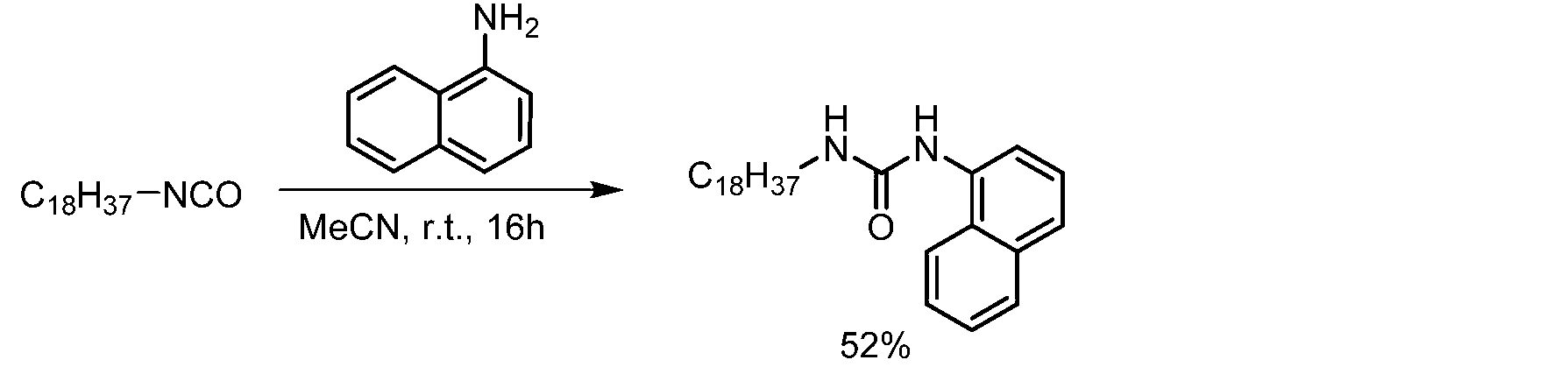
ジクロロメタン-ヘキサン(CH2Cl2-Hexane)を用いた再沈殿法により精製を行い、式2で表されるモノウレア化合物を白色固体にて得た(収量:571.3mg、収率:52%)。
1H NMR (600 MHz, DMSO-d6) δ0.85 (t, J = 6.9 Hz, 3H), 1.23 (m, 30H), 1.46 (m, 2H), 3.14 (dt, J = 5.6, 6.8 Hz, 2H), 6.61 (t, J = 5.5 Hz, 1H), 7.40 (dd, J = 7.6, 7.9 Hz, 1H), 7.49-7.54 (m, 3H), 7.88 (d, J = 8.2 Hz, 1H), 7.99 (d, J = 7.6 Hz, 1H), 8.07 (d, J = 8.2 Hz, 1H), 8.50 (s, 1H).
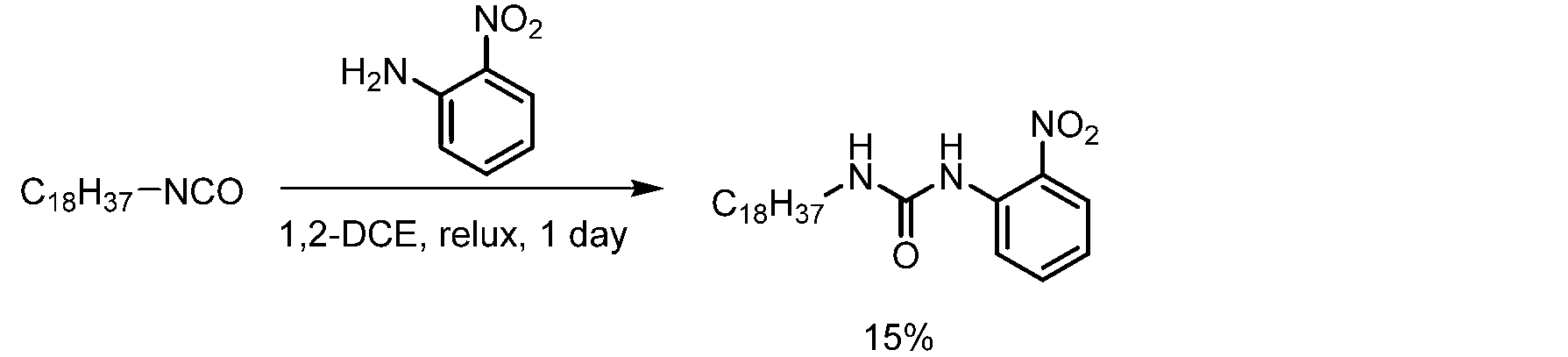
ヘキサン(Hexane)を用いて粗生成物を洗浄することにより精製を行い、式3で表されるモノウレア化合物を黄色固体にて得た(収量:300mg、収率:15%)。
1H NMR (400 MHz, DMSO-d6) δ0.85 (t, J = 7.3 Hz, 3H), 1.23 (m, 30H), 1.41 (m, 2H), 3.08 (t, J = 6.8 Hz, 2H), 7.12 (dd, J = 8.3, 8.3 Hz, 1H), 7.51 (brs, 1H), 7.63 (dd, J = 8.3, 8.3 Hz, 1H), 8.05 (d, J = 8.3 Hz, 1H), 8.31 (d, J = 8.3 Hz, 1H), 9.33 (s, 1H).

アセトン-ヘキサン(Acetone-Hexane)を用いた再沈殿法により精製を行い、式4で表されるモノウレア化合物を白色固体にて得た(収量:620mg、収率:70%)。
1H NMR (400 MHz, acetone-d6) δ0.87 (t, J = 6.8 Hz, 3H), 1.30 (m, 30H), 1.51 (m, 2H), 3.21 (t, J = 6.8 Hz, 2H), 5.99 (brs, 1H), 7.48 (dd, J = 8.3, 8.3 Hz, 1H), 7.73-7.77 (m, 2H), 8.40 (brs, 1H), 8.62 (dd, J = 1.9, 2.2 Hz, 1H).
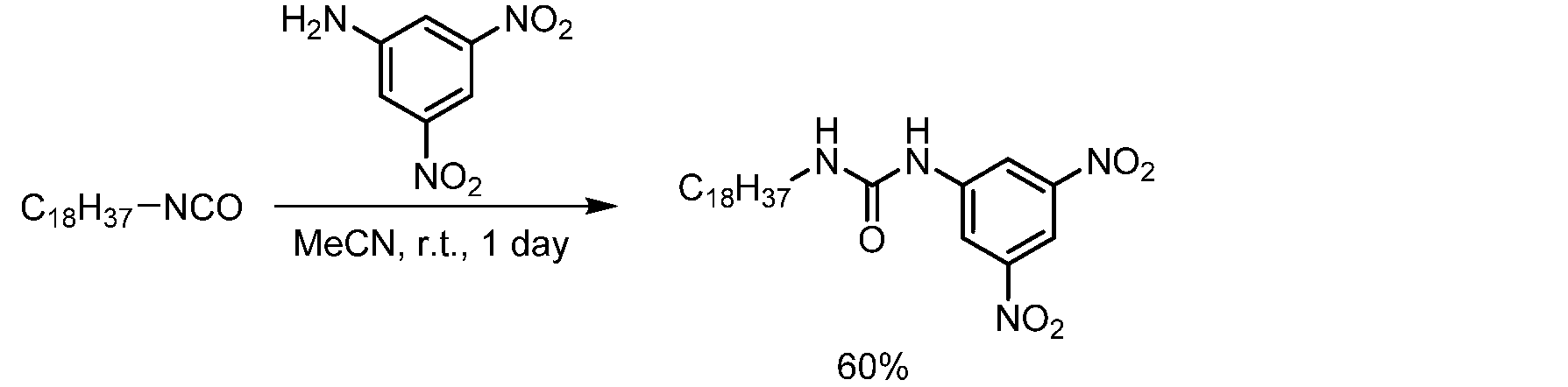
酢酸エチルを用いて粗生成物を洗浄することにより精製を行い、式6で表されるモノウレア化合物を黄色固体にて得た(収量:602mg、収率:60%)。
1H NMR (400 MHz, DMSO-d6) δ0.84 (t, J = 6.6 Hz, 3H), 1.22 (m, 30H), 1.43 (m, 2H), 3.09 (dt, J = 5.6, 6.3 Hz, 2H), 6.67 (brs, 1H), 8.32 (s, 1H), 8.69 (s, 2H), 9.57 (brs, 1H).
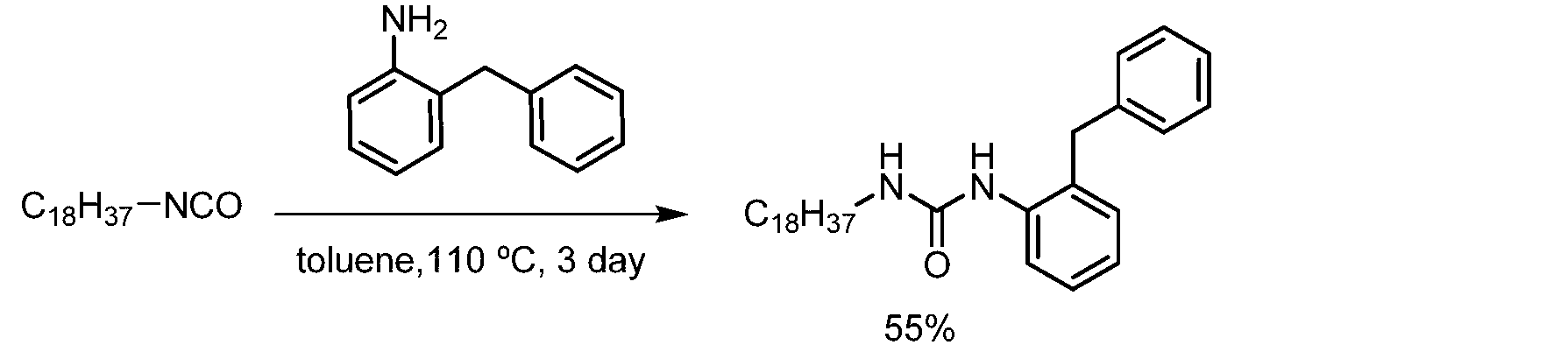
アセトンを用いて生成物を洗浄することにより精製を行い、式7で表されるモノウレア化合物を白色固体にて得た(収量:498mg、収率:55%)。
1H NMR (600 MHz, DMSO-d6) δ0.85 (t, J = 6.9 Hz, 3H), 1.23 (m, 30H), 1.40 (m, 2H), 3.05 (dt, J = 5.6, 6.9 Hz, 2H), 3.91 (s, 2H), 6.42 (t, J = 5.5 Hz, 1H), 6.90 (dd, J = 7.6, 7.6 Hz, 1H), 6.99 (d, J = 6.9 Hz, 1H), 7.11 (dd, J = 6.9, 6.9 Hz, 1H), 7.15-7.18 (m, 3H), 7.27 (dd, J = 7.6, 7.6 Hz, 2H), 7.69 (s, 1H), 7.73 (d, J = 7.6 Hz, 1H).
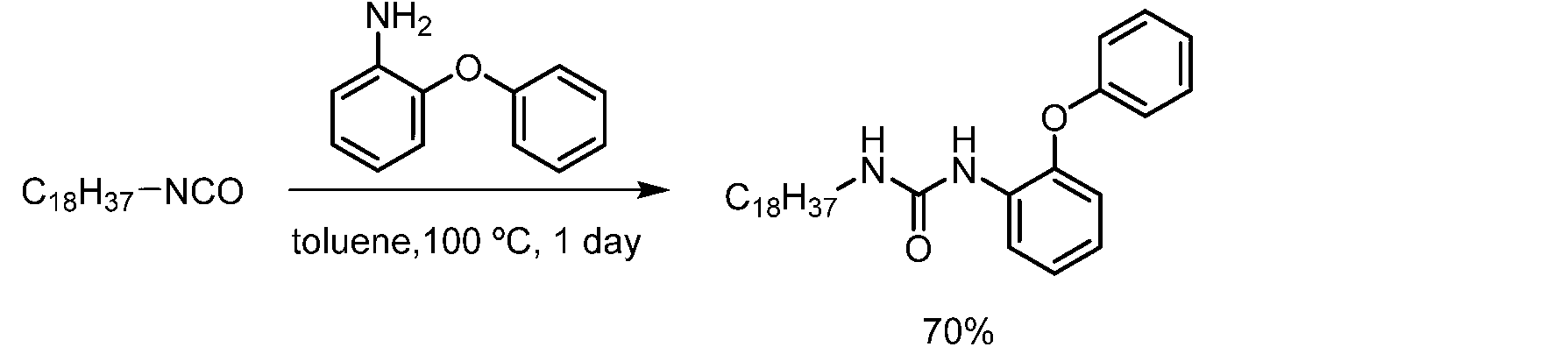
ジクロロメタン-ヘキサン(CH2Cl2-Hexane)を用いた再沈殿法により精製を行い、式8で表されるモノウレア化合物を白色固体にて得た(収量:620mg、収率:70%)。
1H NMR (600 MHz, acetone-d6) δ0.88 (t, J = 6.9 Hz, 3H), 1.28 (m, 30H), 1.48 (m, 2H), 3.19 (dt, J = 5.5, 6.9 Hz, 2H), 6.22 (brs, 1H), 6.80 (d, J = 8.2 Hz, 1H), 6.88 (dd, J = 8.2, 8.2 Hz, 1H), 6.95 (d, J = 7.6 Hz, 2H), 7.07 (dd, J = 6.9, 8.2 Hz, 1H), 7.12 (dd, J = 6.8, 7.6, 1H), 7.37 (dd, J = 7.6, 8.3 Hz, 2H), 7.70 (s, 1H), 8.43 (d, J = 8.3 Hz, 1H).

アセトン-ヘキサン(Acetone-Hexane)を用いた再沈殿法により精製を行い、式10で表されるモノウレア化合物を白色固体にて得た(収量:171.5mg、収率:13%)。
1H NMR (600 MHz, DMSO-d6) δ0.85 (t, J = 6.9 Hz, 3H), 1.23 (m, 30H), 1.39 (m, 2H), 3.03 (dt, J = 6.2, 6.5 Hz, 2H), 3.38 (s, 2H), 6.07 (brs, 1H), 7.05 (d, J = 8.9 Hz, 2H), 7.16-7.19 (m, 3H), 7.26 (d, J = 8.2 Hz, 2H), 7.27 (d, J = 8.3 Hz, 2H), 8.31 (s, 1H).

ジクロロメタン-ヘキサン(CH2Cl2-Hexane)を用いた再沈殿法により精製を行い、式12で表されるモノウレア化合物を白色固体にて得た(収量:830mg、収率:96%)。
1H NMR (600 MHz, DMSO-d6) δ0.86 (t, J = 6.9 Hz, 3H), 1.26 (m, 39H), 1.43 (m, 2H), 3.07 (dt, J = 5.5, 6.9 Hz, 2H), 5.98 (t, J = 5.6 Hz, 1H), 6.91 (d, J = 7.6 Hz, 1H), 7.12 (dd, J = 7.6, 8.2 Hz, 1H), 7.21 (d, J = 8.2 Hz, 1H), 7.38 (s, 1H), 8.22 (s, 1H).

ジクロロメタン-ヘキサン(CH2Cl2-Hexane)を用いた再沈殿法により精製を行い、式13で表されるモノウレア化合物を白色固体にて得た(収量:934mg、収率:82%)。
1H NMR (400 MHz, DMSO-d6) δ0.85 (t, J = 6.8 Hz, 3H), 1.23 (m, 39H), 1.40 (m, 2H), 3.04 (dt, J = 5.9, 6.8 Hz, 2H), 6.02 (t, J = 5.9 Hz, 1H), 7.21 (d, J = 8.8 Hz, 2H), 7.27 (d, J = 8.8 Hz, 2H), 8.25 (s, 1H).
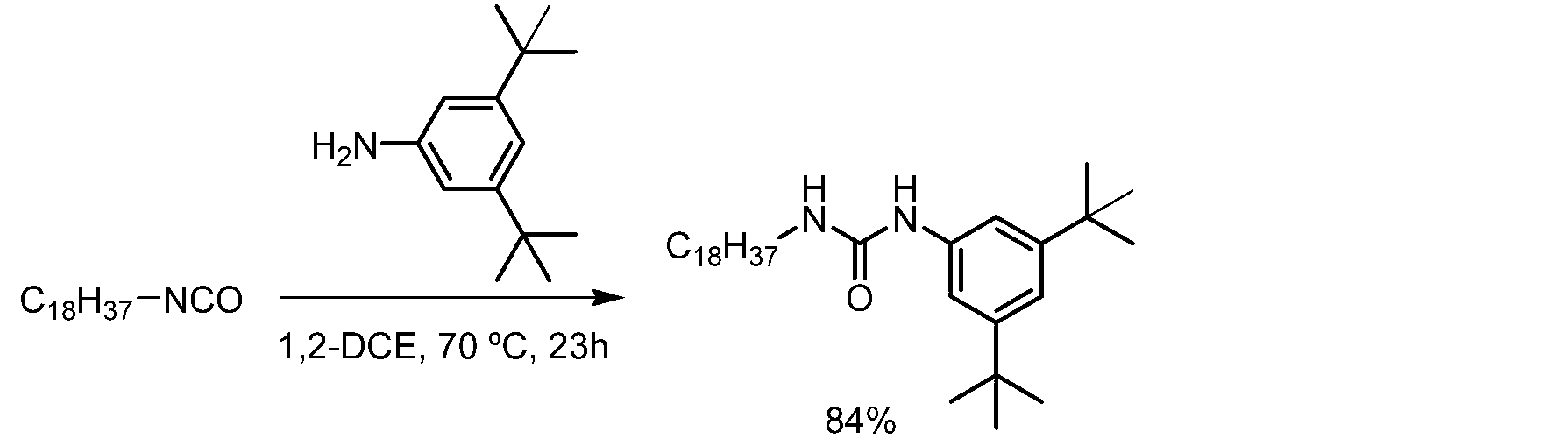
ジクロロメタン-ヘキサン(CH2Cl2-Hexane)を用いた再沈殿法により精製を行い、式14で表されるモノウレア化合物を白色固体にて得た(収量:590mg、収率:84%)。
1H NMR (400 MHz, DMSO-d6) δ0.86 (t, J = 6.9 Hz, 3H), 1.25 (m, 48H), 1.42 (m, 2H), 3.07 (dt, J = 5.7, 6.9 Hz, 2H), 5.93 (t, J = 5.6 Hz, 1H), 6.94 (s, 1H), 7.23 (s, 2H), 8.18 (s, 1H).

酢酸エチルを用いた再結晶法により精製を行い、式16で表されるモノウレア化合物を白色固体にて得た(収量:2.50g、収率:50%)。
1H NMR (600 MHz, DMSO-d6) δ0.85 (t, J = 6.9 Hz, 3H), 1.23 (m, 30H), 1.40 (m, 2H), 3.05 (dt, J = 5.5, 6.9 Hz, 2H), 6.26 (t, J = 5.2 Hz, 1H), 6.91 (d, J = 8.3 Hz, 1H), 7.15 (d, J = 8.3 Hz, 1H), 7.21 (dd, J = 8.3, 8.3 Hz, 1H), 7.66 (s, 1H), 8.68 (s, 1H).

酢酸エチル-ヘキサンを用いた再結晶法により精製を行い、式17で表されるモノウレア化合物を白色固体にて得た(収量:1.21g、収率:54%)。
1H NMR (600 MHz, acetone-d6) δ0.87 (t, J = 6.8 Hz, 3H), 1.28 (m, 30H), 1.50 (m, 2H), 3.19 (t, J = 6.8 Hz, 2H), 5.81 (brs, 1H), 7.21 (d, J = 8.9 Hz, 2H), 7.51 (d, J = 8.9 Hz, 2H), 8.00 (s, 1H).
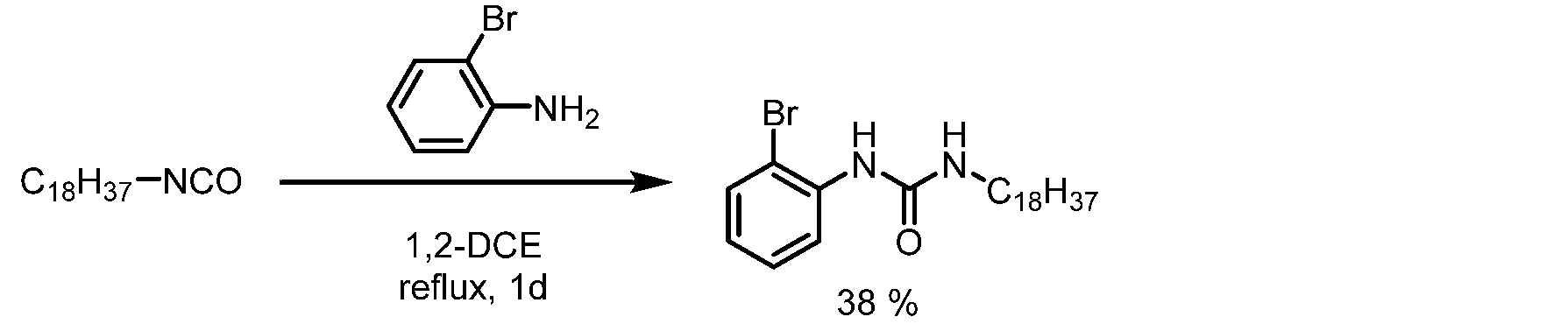
トリクロロメタン(CHCl3)を用いた再結晶法により精製を行い、式18で表されるモノウレア化合物を白色固体にて得た(収量:1.14g、収率:38%)。
1H NMR (600 MHz, CDCl2CDCl2) δ0.88 (t, J = 6.8 Hz, 3H), 1.28 (m, 30H), 1.54 (m, 2H), 3.24 (t, J = 7.6 Hz, 2H), 4.73 (brs, 1H), 6.66 (brs, 1H), 6.94 (dd, J = 8.2, 8.2 Hz, 1H), 7.30 (dd, J = 8.2, 8.2 Hz, 1H), 7.54 (d, J = 8.2 Hz, 1H), 8.05 (d, J = 8.2 Hz, 1H).

エタノールを用いた再結晶法により精製を行い、式19で表されるモノウレア化合物を白色固体にて得た(収量:1.67g、収率:80%)。
1H NMR (600 MHz, DMSO-d6) δ0.85 (t, J = 6.8 Hz, 3H), 1.23 (m, 30H), 1.40 (m, 2H), 3.05 (dt, J = 5.5, 6.8 Hz, 2H), 6.25 (brs, 1H), 7.04 (d, J = 6.9 Hz, 1H), 7.15 (dd, J = 7.0, 8.8 Hz, 1H), 7.19 (d, J = 8.9 Hz, 1H), 7.81 (s, 1H), 8.66 (s, 1H).
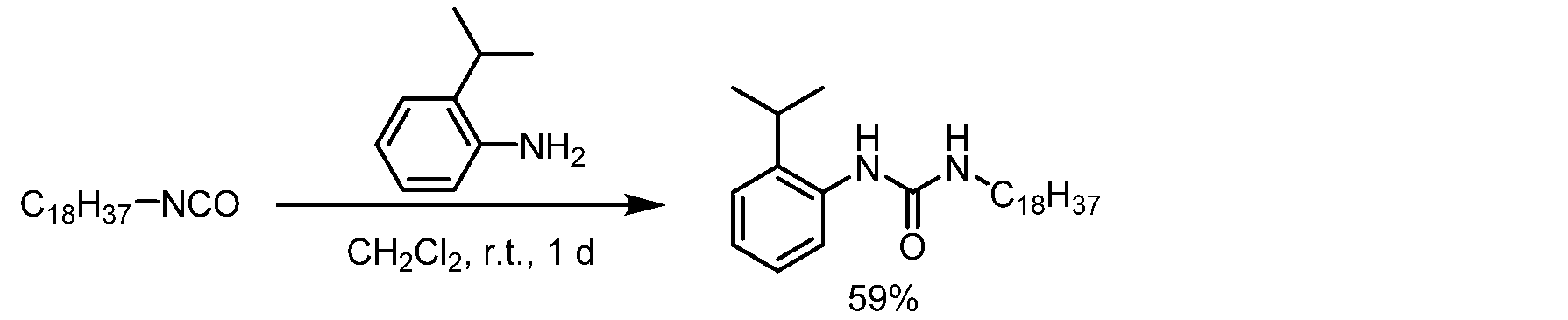
トリクロロメタン-ヘキサン(CHCl3-Hexane)を用いて粗生成物を再沈殿させた後、メタノール-アセトンを用いて粗生成物を洗浄することにより精製を行い、式21で表されるモノウレア化合物を白色固体にて得た(収量:2.74g、収率:59%)。
1H NMR (600 MHz, CDCl2CDCl2) δ0.85 (t, J = 6.8 Hz, 3H), 1.21 (m, 36H), 1.41 (m, 2H), 3.14 (m, 3H), 4.48 (brs, 1H), 6.19 (brs, 1H), 7.21 (dd, J = 7.6, 7.6 Hz, 1H), 7.26 (m, 2H), 7.33 (d, J = 7.6 Hz, 1H).

トリクロロメタン(CHCl3)を用いた再結晶法により精製を行い、式22で表されるモノウレア化合物を白色固体にて得た(収量:1.08g、収率:36%)。
1H NMR (600 MHz, CDCl2CDCl2) δ0.88 (t, J = 6.9 Hz, 3H), 1.25 (m, 36H), 1.50 (m, 2H), 2.88 (sep, J = 6.9 Hz, 1H), 3.21 (t, J = 7.6 Hz, 2H), 4.58 (brs, 1H), 6.34 (brs, 1H), 7.00 (d, J = 8.2 Hz, 1H), 7.11-7.12 (m, 2H), 7.26 (dd, J = 8.3, 8.3 Hz, 1H).
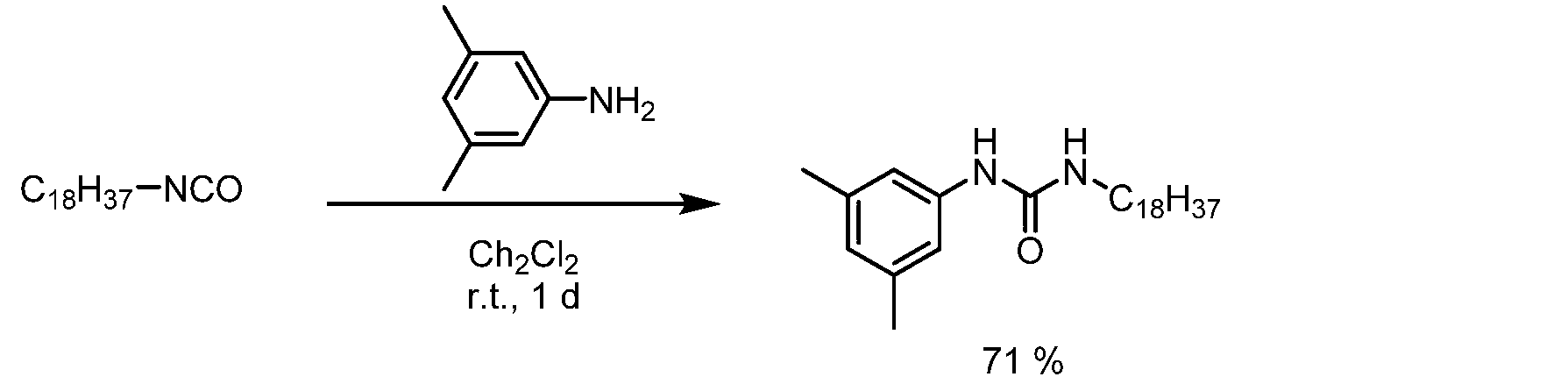
酢酸エチル-ヘキサンを用いて粗生成物を再沈殿させた後、メタノール-トリクロロエタン(CHCl3)を用いて粗生成物を洗浄することにより精製を行い、式24で表されるモノウレア化合物を白色固体にて得た(収量:2.85g、収率:71%)。
1H NMR (400 MHz, CDCl3) δ0.88 (t, J = 6.8 Hz, 3H), 1.25 (m, 30H), 1.50 (m, 2H), 2.28 (s, 6H), 3.23 (t, J = 7.3 Hz, 2H), 4.51 (brs, 1H), 6.19 (brs, 1H), 6.75 (s, 1H), 6.88 (s, 2H).

1H-NMR (CDCl3) δ: 7.33 (2H, t, J = 7.9 Hz), 7.29 (2H, d, J= 7.6 Hz), 7.12 (1H, t, J = 7.6 Hz), 6.25 (1H, s), 4.71 (1H, s), 3.25 (2H, t, J = 6.9 Hz), 1.54-1.49 (2H, m), 1.30 (10H, m), 0.89 (3H, t, J = 7.2 Hz).

1H-NMR (600MHz, CDCl3) δ = 7.32 (2H, t, J = 7.9 Hz), 7.28 (2H, d, J = 7.6 Hz), 7.11 (1H, t, J = 7.6 Hz), 6.15 (1H, s), 4.64 (1H, s), 3.24 (2H, t, J = 6.9 Hz), 1.50-1.27 (20H, m), 0.88 (3H, t, J = 6.9 Hz).

1H-NMR (600MHz, CDCl3) δ = 7.33 (2H, t, J = 7.9 Hz), 7.27 (2H, d, J = 7.6 Hz), 7.11 (1H, t, J = 7.6 Hz), 6.11 (1H, s), 4.61 (1H, s), 3.24 (2H, d, J = 6.9 Hz), 1.50-1.27 (24H, m), 0.88 (3H, t, J = 7.2 Hz).

1H-NMR (600MHz, DMSO-d6) δ = 8.42 (1H, s), 7.36 (2H, d, J = 7.6 Hz), 7.19 (2H, dd, J = 7.6, 7.6 Hz), 6.86 (1H, t, J = 7.2 Hz), 6.15 (1H, s), 3.05 (2H, t, J = 6.4 Hz), 1.40-1.25 (26H, m), 0.85 (3H, t, J= 6.9 Hz).

1H-NMR (600MHz, CDCl3) δ = 7.33 (2H, t, J = 7.9 Hz), 7.27 (2H, d, J = 7.6 Hz), 7.11 (1H, t, J = 7.2 Hz), 6.13 (1H, s), 4.63 (1H, s), 3.24 (2H, t, J = 6.9 Hz), 1.50-1.29 (28H, m), 0.88 (3H, t, J= 7.2 Hz).

1H-NMR (600MHz, CDCl3) δ = 7.35 (2H, d, J = 8.9 Hz), 7.17 (2H, d, J = 8.9 Hz), 6.04 (1H, s), 4.64 (1H, s), 3.23 (2H, t, J = 6.2 Hz), 1.49-1.27 (29H, m), 0.88 (3H, t, J = 6.9 Hz).

1H-NMR (600MHz, CDCl3) δ = 7.35 (2H, d, J = 8.9 Hz), 7.17 (2H, d, J = 8.9 Hz), 6.04 (1H, s), 4.64 (1H, s), 3.23 (2H, t, J = 6.9 Hz), 1.50-1.27 (33H, m), 0.88 (3H, t, J = 6.9 Hz).

1H-NMR (600MHz, DMSO-d6) δ = 8.30 (1H, s), 7.27 (2H, d, J = 8.6 Hz), 7.21 (2H, d, J = 8.6 Hz), 6.07 (1H, s), 3.04 (2H, t, J = 6.6 Hz), 1.40-1.24 (35H, m), 0.85 (3H, t, J= 7.2 Hz).

1HNMR (400 MHz, DMSO-d6) δ = 7.75 (1H, d, J = 8.3 Hz), 7.69 (1H, s), 7.28 (2H, t, J = 7.3 Hz), 7.17 (3H, m), 7.13-7.09 (1H, m), 6.99 (1H, dd, J= 7.3, 1.5 Hz), 6.91 (1H, td, J= 7.3, 1.5 Hz), 6.42 (1H, s), 3.91 (2H, s), 3.08 (2H, t, J = 7.0 Hz), 1.04 (3H, t, J = 7.1 Hz).

1HNMR (400 MHz, DMSO-d6) δ = 7.74 (2H, t, J = 9.5 Hz), 7.28 (2H, t, J = 7.8 Hz), 7.18 (3H, m), 7.11 (1H, t, J = 7.8 Hz), 6.99 (1H, d, J = 7.8 Hz), 6.90 (1H, t, J = 7.6 Hz), 6.47 (1H, s), 3.91 (2H, s), 3.02 (2H, t, J = 6.3 Hz), 1.42 (2H, tq, J = 6.5, 7.6 Hz), 0.87 (3H, t, J = 7.6 Hz).

1HNMR (400 MHz, DMSO-d6) δ = 7.75 (1H, d, J = 8.3 Hz), 7.70 (1H, s), 7.27 (2H, t, J = 7.3 Hz), 7.18 (3H, dd, J = 7.8, 6.3 Hz), 7.11 (1H, t, J = 8.5 Hz), 6.99 (1H, d, J = 5.9 Hz), 6.90 (1H, m), 6.43 (1H, s), 3.91 (2H, s), 3.06 (2H, t, J = 6.3 Hz), 1.34 (4H, m), 0.89 (3H, t, J= 7.3 Hz).

1HNMR (400 MHz, DMSO-d6) δ = 7.74 (1H, d, J= 8.3 Hz), 7.70 (1H, s), 7.27 (2H, dd, J= 8.3, 2.1 Hz), 7.18 (3H, m), 7.11 (1H, t, J = 6.8 Hz), 7.00 (1H, d, J= 7.3 Hz), 6.90 (1H, t, J = 7.3 Hz), 6.44 (1H, t, J = 5.6 Hz), 3.91 (2H, s), 3.05 (2H, t, J = 6.3 Hz), 1.41-1.25 (6H, m), 0.87 (3H, t, J= 7.1 Hz).

1HNMR (400 MHz, DMSO-d6) δ = 7.73 (2H, t, J = 8.5 Hz), 7.27 (2H, t, J = 7.6 Hz), 7.18 (3H, m), 7.11 (1H, m), 7.00 (1H, d, J = 7.8 Hz), 6.90 (1H, t, J = 7.6 Hz), 6.45 (1H, t, J = 5.6 Hz), 3.91 (2H, s), 3.05 (2H, t, J = 6.5 Hz), 1.40-1.28 (8H, m), 0.87 (3H, t, J = 6.6 Hz).

1HNMR (400MHz, DMSO-d6) δ = 7.75 (2H, t, J = 6.8 Hz), 7.29 (2H, t, J = 7.6 Hz), 7.20 (3H, m), 7.13 (1H, t, J = 7.8 Hz), 7.01 (1H, d, J = 6.3 Hz), 6.92 (1H, t, J = 6.8 Hz), 6.47 (1H, t, J = 5.6 Hz), 3.93 (2H, s), 3.07 (2H, t, J = 6.3 Hz), 1.42-1.29 (10H, s), 0.88 (3H, t, J = 6.8 Hz).

1H-NMR (600MHz, CDCl3) δ = 7.41 (2H, d, J = 7.6 Hz), 7.28 (2H, m), 7.21 (2H, m), 7.14 (2H, d, J = 7.6 Hz), 5.74 (1H, s), 4.32 (1H, t, J = 5.2 Hz), 3.99 (2H, s), 3.08 (2H, t, J= 6.6 Hz), 1.41-1.36 (2H, m), 1.30-1.24 (10H, m), 0.88 (3H, t, J = 7.2 Hz).

1H-NMR (600MHz, CDCl3) δ = 7.42 (1H, d, J = 7.6 Hz), 7.28 (4H, m), 7.21 (2H, t, J = 6.9 Hz), 7.14 (2H, d, J = 6.9 Hz), 5.75 (1H, s), 4.32 (1H, t, J = 5.8 Hz), 3.99 (2H, s), 3.08 (2H, t, J = 6.6 Hz), 1.41-1.28 (20H, t, J = 19.9 Hz), 0.88 (3H, t, J = 6.9 Hz).

1H-NMR (600MHz, DMSO-d6) δ = 7.73 (2H, d, J = 9.6 Hz), 7.27 (2H, t, J = 7.6 Hz), 7.17 (3H, t, J = 6.9 Hz), 7.10 (1H, t, J = 7.6 Hz), 6.99 (1H, d, J = 6.2 Hz), 6.90 (1H, t, J = 7.9 Hz), 6.46 (1H, t, J = 5.5 Hz), 3.91 (2H, s), 3.05 (2H, t, J = 6.4 Hz), 1.39-1.25 (24H, m), 0.85 (3H, t, J = 6.9 Hz).

1H-NMR (600MHz, DMSO-d6) δ: 7.74 (1H, d, J = 8.2 Hz), 7.71 (1H, s), 7.27 (2H, t, J = 7.9 Hz), 7.18 (3H, t, J = 7.2 Hz), 7.11 (1H, t, J = 6.9 Hz), 6.99 (1H, d, J = 6.2 Hz), 6.90 (1H, t, J = 7.9 Hz), 6.45 (1H, t, J = 5.5 Hz), 3.91 (2H, s), 3.05 (2H, t, J = 6.6 Hz), 1.39 -1.25 (26H, m), 0.85 (3H, t, J = 6.9 Hz).

1H-NMR (600MHz, DMSO-d6) δ = 7.73 (2H, d, J = 10.3 Hz), 7.27 (2H, t, J = 7.9 Hz), 7.17 (3H, t, J = 7.6 Hz), 7.10 (1H, t, J = 7.6 Hz), 6.99 (1H, d, J = 6.2 Hz), 6.90 (1H, t, J = 6.9 Hz), 6.45 (1H, t, J = 5.5 Hz), 3.91 (2H, s), 3.05 (2H, t, J = 6.4 Hz), 1.39-1.25 (28H, m), 0.85 (3H, t, J = 7.2 Hz).

1H-NMR (600MHz, CDCl3) δ = 7.43 (1H, d, J = 7.6 Hz), 7.30 (3H, m), 7.26 (1H, s), 7.23-7.19 (2H, m), 7.15 (2H, d, J= 7.6 Hz), 5.73 (1H, s), 4.25 (1H, s), 4.00 (2H, s), 3.52 (1H, s), 1.86 (2H, dd, J = 12.7, 3.1 Hz), 1.66-1.63 (2H, m), 1.60 (1H, dd, J= 7.9, 3.8 Hz), 1.36-1.28 (2H, m), 1.10 (1H, m), 1.01 (2H, m).

1HNMR (400MHz, DMSO-d6) δ = 7.75 (2H, d, J = 7.8 Hz), 7.27 (2H, t, J = 7.3 Hz), 7.23-7.15 (3H, m), 7.11 (1H, t, J = 7.6 Hz), 7.00 (1H, d, J = 7.8 Hz), 6.90 (1H, t, J = 7.3 Hz), 6.42 (1H, t, J = 5.6 Hz), 3.91 (2H, s), 3.03 (2H, m), 1.40-1.16 (9H, m), 0.89-0.83 (6H, m).
実施例1で合成した39種のモノウレア化合物をゲル化剤として、各種溶媒(流動パラフィン、スクアラン、ミリスチン酸イソプロピル、SH245、70%エタノール水溶液)に対するゲル形成能の評価を行った。なお図11及び図12に、実施例1で合成した39種のモノウレア化合物の構造式を示す。
ゲル化試験は次のように行った。2.0mLのねじ口サンプル管に、ゲル化剤(5.0mg)を量り取り、ここに各種溶媒(500μL)を加え、120℃のホットプレート上にて加熱し、溶解させた。その後、室温にて一晩静置し、ゲルの形成を観察した。式1~式18で表される化合物をゲル化剤として使用したゲル化試験の、静置後の各サンプル管におけるゲル化挙動を図1乃至図9に示す。
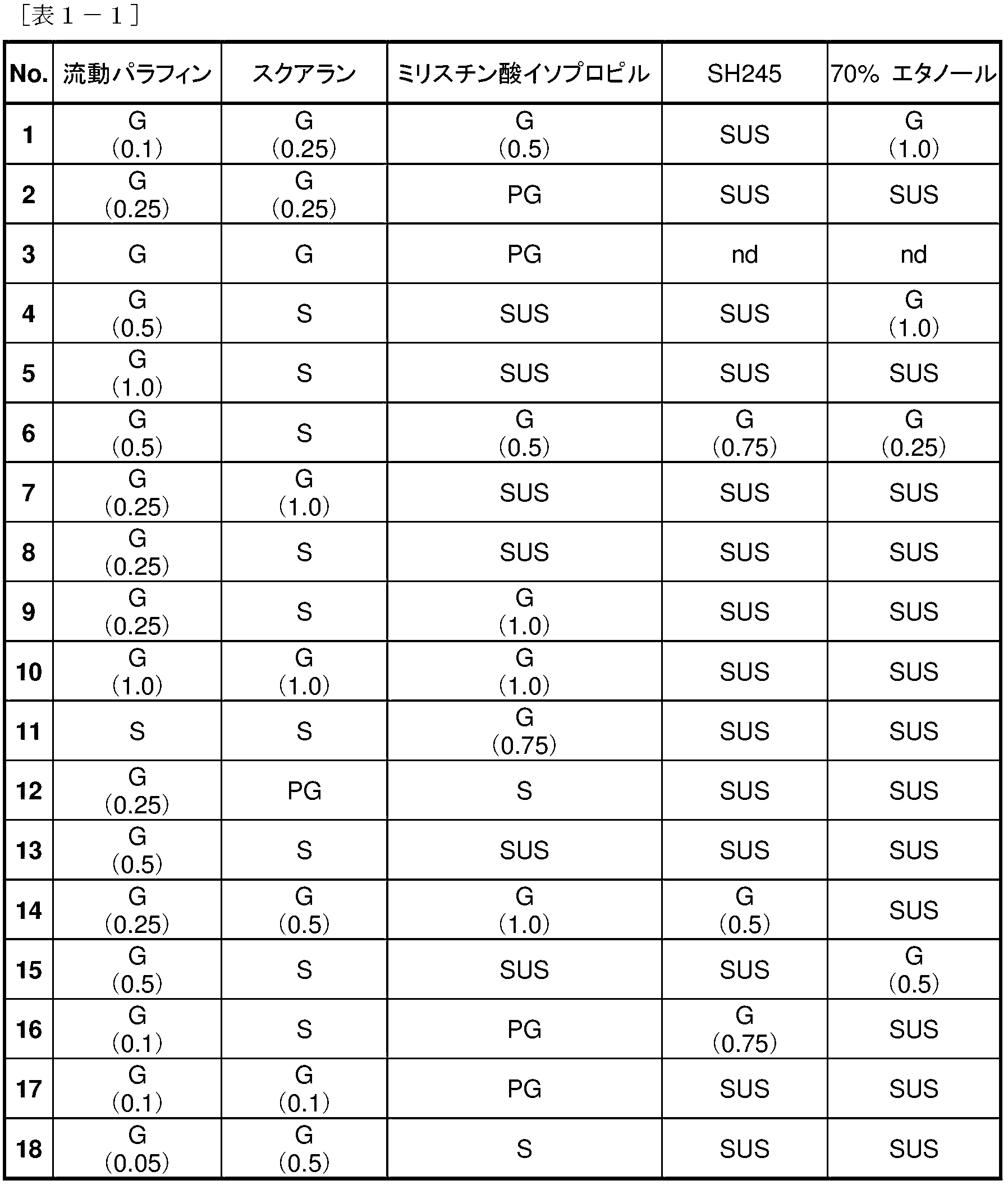
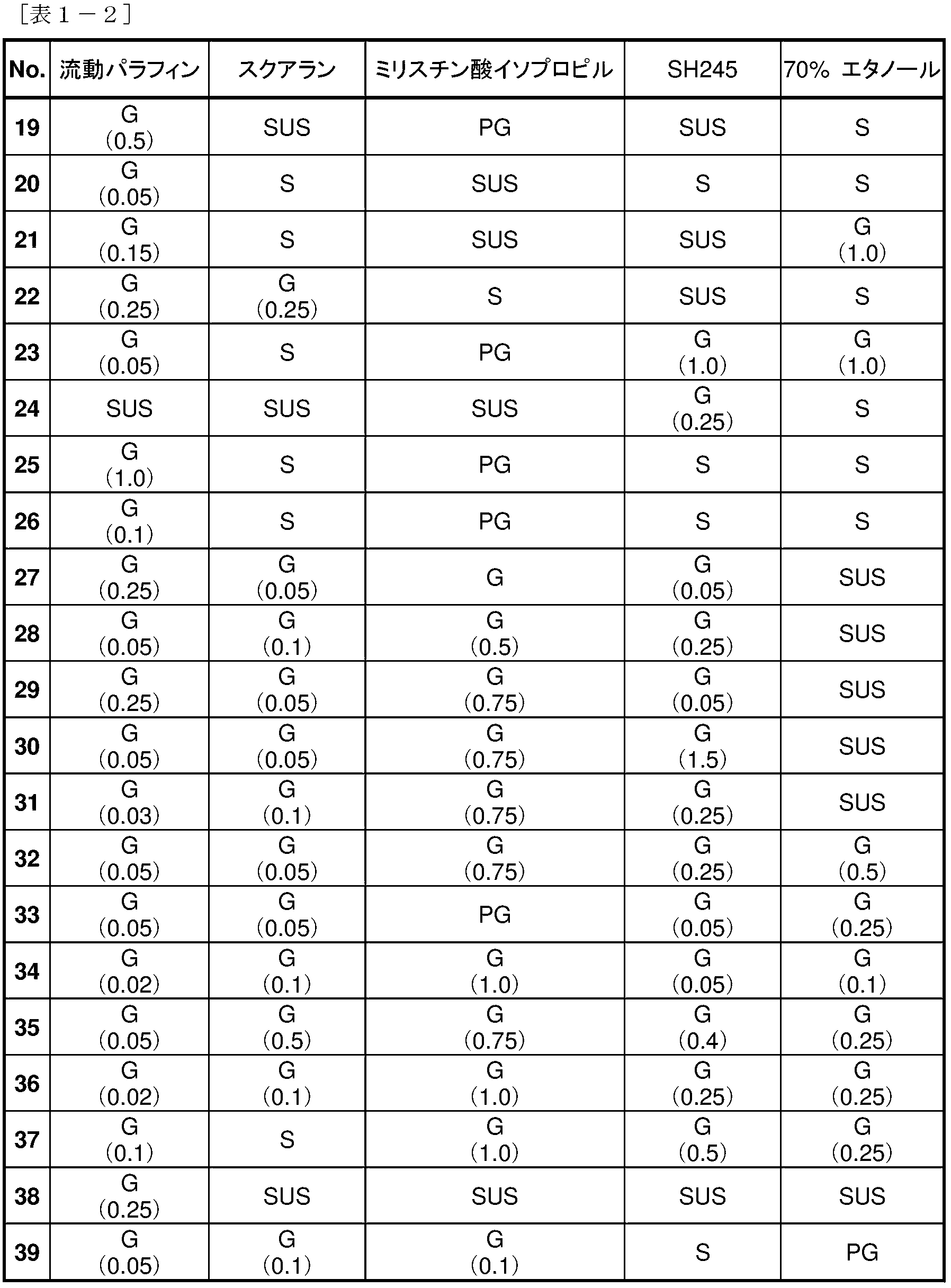
静置放冷後、溶液の流動性が失われて、サンプル管を倒置しても溶液が流れ落ちない状態を「ゲル化」と判断した。表中の符号は形成したゲルの状態を示し(以下、本明細書中の他の表も同様である)、透明なゲルは「G」、部分的にゲル化したものは「PG」、やわらかなゲルは「SG」、ゾル化したものは「S」、懸濁液の状態のものは「SUS」と評価した。また、評価しなかったものについては「nd」とした。評価結果を[表1-1]及び[表1-2]に示す。
また、本試験において、透明なゲルが得られたものについて、ゲル化剤の添加量を変更して同様にゲル化試験を実施し、各種溶媒がゲル化する際に最低限必要なゲル化剤の量(最少ゲル化濃度)を確認した。[表1-1]及び[表1-2]において、括弧内(w/v%)に最少ゲル化濃度を示す。
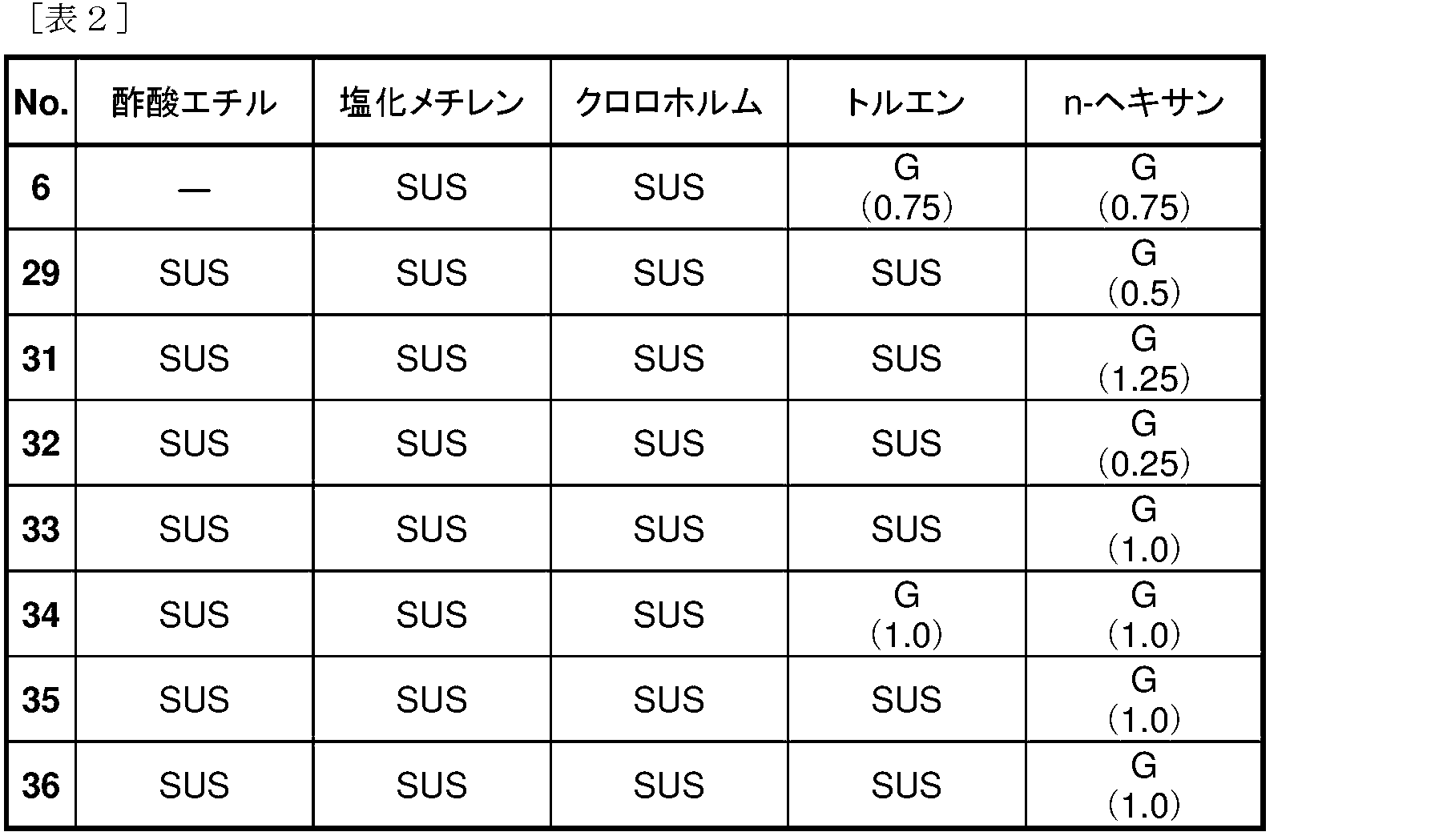
実施例1で合成した式6、式29、式31、式32、式33、式34、式35又は式36で表される各モノウレア化合物をゲル化剤として、各種疎水性有機溶媒(塩化メチレン(ジクロロメタン)、クロロホルム、トルエン、ヘキサン、酢酸エチル)に対するゲル形成能の評価を行った。ここで、疎水性有機溶媒とは、水と任意の割合で混和しないものとした。
ゲル化試験は[実施例2]の手順と同様に、2.0mLのねじ口サンプル管に、ゲル化剤(5.0mg)を量り取り、ここに各種疎水性有機溶媒(500μL)を加え、120℃のホットプレート上にて加熱し、溶解させた。その後、室温にて一晩静置し、ゲルの形成を観察した。静置放冷後、溶液の流動性が失われて、サンプル管を倒置しても溶液が流れ落ちない状態を「ゲル化」と判断し、透明なゲルは「G」、懸濁液の状態のものは「SUS」と評価した。得られた結果を[表2]に示す。
また実施例2と同様に、透明なゲルが得られたものについて、ゲル化剤の添加量を変更してゲル化試験を実施し、各種溶媒がゲル化する際に最低限必要なゲル化剤の量(最少ゲル化濃度)を確認した。[表2]において、括弧内(w/v%)に最少ゲル化濃度を示す。
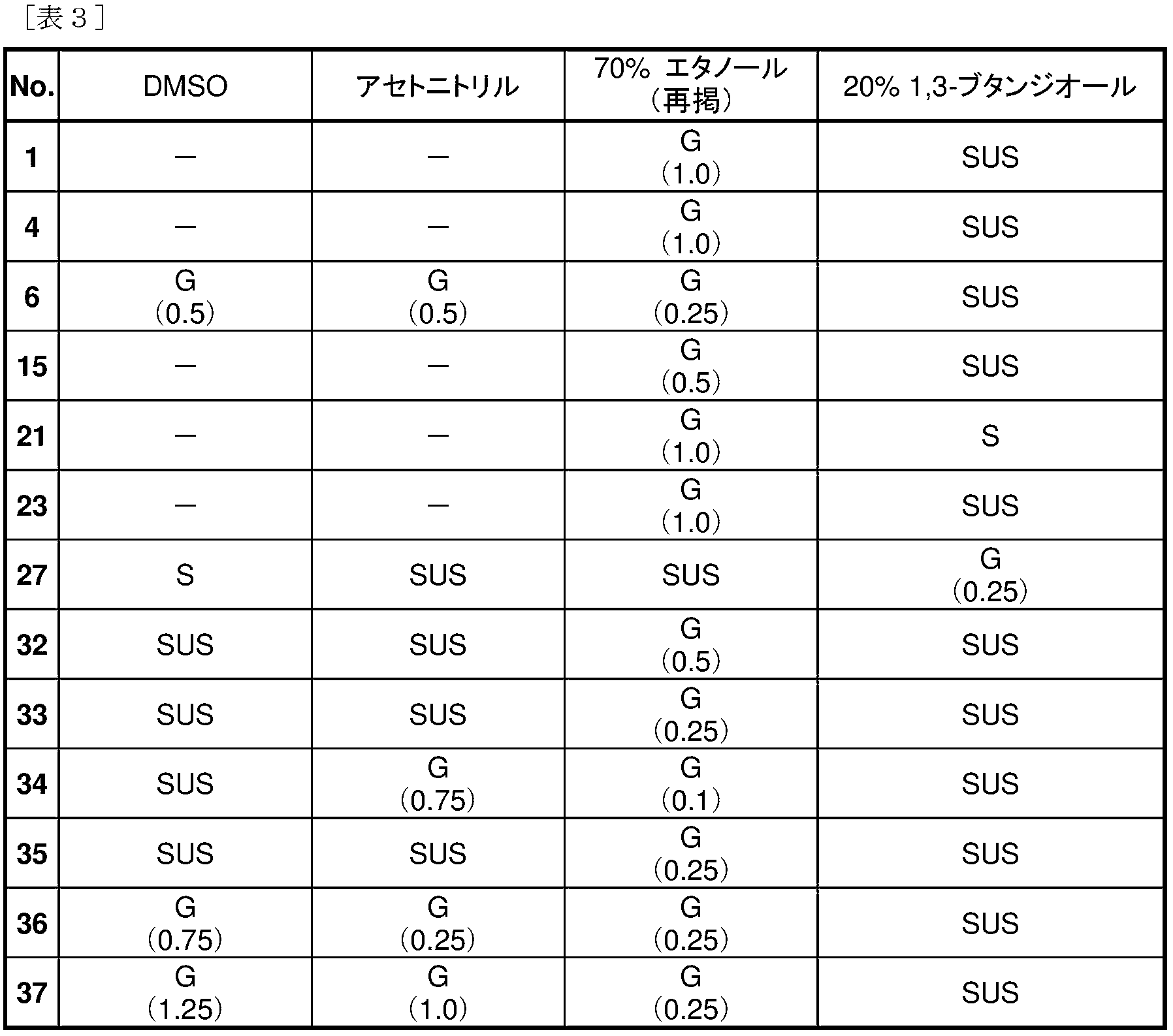
実施例1で合成した式1、式4、式6、式15、式21、式23、式27、式32、式33、式34、式35、式36又は式37で表される各モノウレア化合物をゲル化剤として、各種親水性有機溶媒(ジメチルスルホキシド(DMSO)、アセトニトリル)及び、親水性有機溶液(水と親水性有機溶媒の混合溶媒:70%エタノール水溶液、20%1,3-ブタンジオール水溶液)に対するゲル形成能の評価を行った。ここで、親水性有機溶媒とは、前述したように、水と任意の割合で混和するものとした。
ゲル化試験は[実施例2]の手順と同様に、2.0mLのねじ口サンプル管に、ゲル化剤(5.0mg)を量り取り、ここに各種親水性有機溶媒又は親水性有機溶液(500μL)を加え、120℃のホットプレート上にて加熱し、溶解させた。その後、室温にて一晩静置し、ゲルの形成を観察した。静置放冷後、溶液の流動性が失われて、サンプル管を倒置しても溶液が流れ落ちない状態を「ゲル化」と判断し、透明なゲルは「G」、ゾル化したものは「S」、懸濁液の状態のものは「SUS」と評価した。得られた結果を[表3]に示す。
また実施例2と同様に、透明なゲルが得られたものについて、ゲル化剤の添加量を変更してゲル化試験を実施し、各種溶媒/溶液がゲル化する際に最低限必要なゲル化剤の量(最少ゲル化濃度)を確認した。[表3]において、括弧内(w/v%)に最少ゲル化濃度を示す。
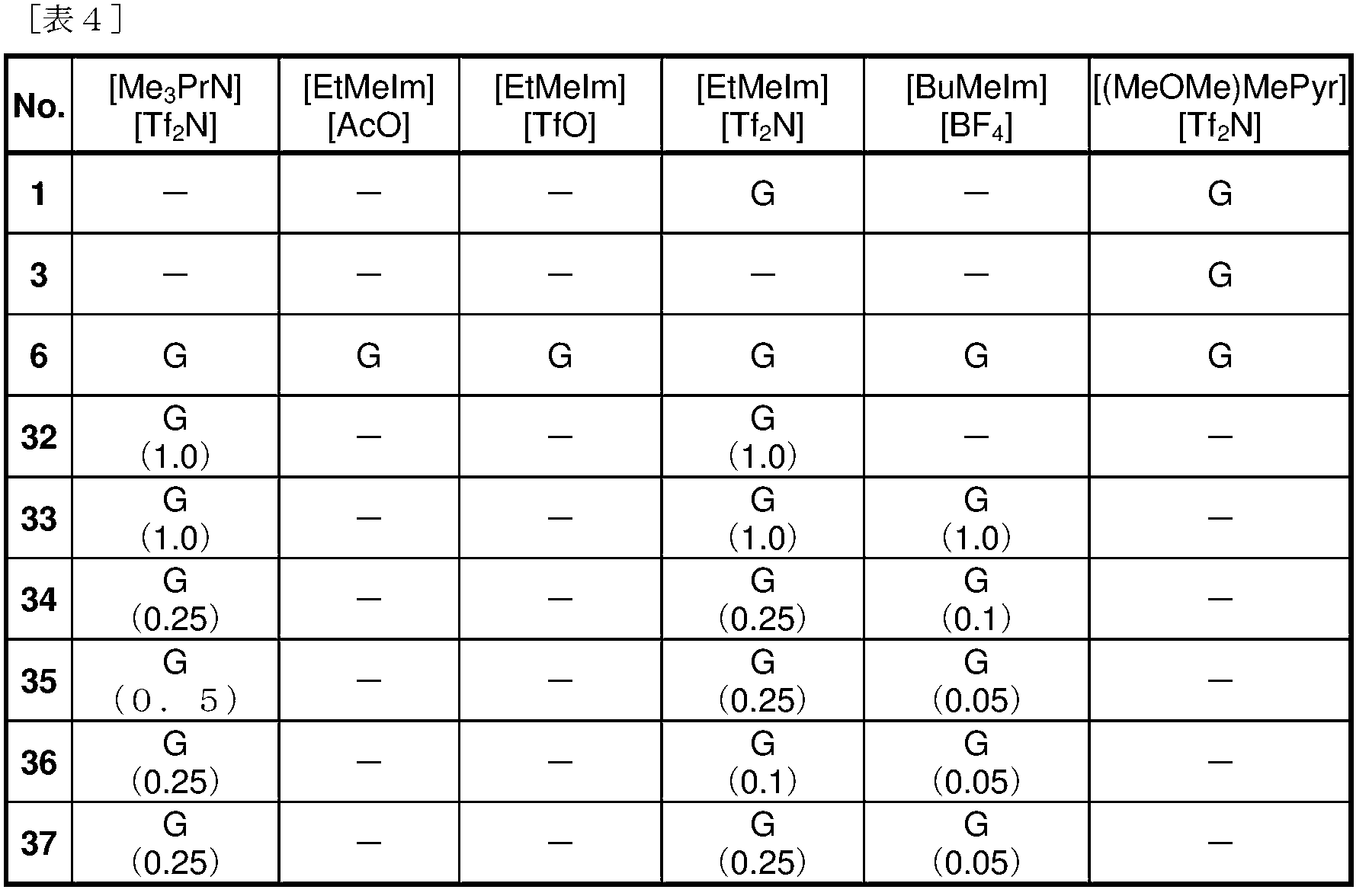
実施例1で合成した式1、式3、式6、式32、式33、式34、式35、式36又は式37で表される各モノウレア化合物をゲル化剤として、各種イオン液体に対するゲル形成能の評価を行った。なおイオン液体としては、以下の6種を用いた。
[Me3PrN][Tf2N]:トリメチルプロピルアンモニウム ビス(トリフルオロメチルスルホニル)イミド
[EtMeIm][AcO]:1-エチル-3-メチルイミダゾリウム アセテート
[EtMeIm][TfO]:1-エチル-3-メチルイミダゾリウム トリフルオロメタンスルホネート
[EtMeIm][Tf2N]:1-エチル-3-メチルイミダゾリウム ビス[トリフルオロメチルスルホニル]イミド
[BuMeIm][BF4]:1-ブチル-3-メチルイミダゾリウム テトラフルオロボレート
[(MeOMe)MePyr][Tf2N]:N-メトキシメチル-N-メチルピロリジニウム ビス(トリフルオロメチルスルホニル)イミド
ゲル化試験は[実施例2]の手順と同様に、2.0mLのねじ口サンプル管に、ゲル化剤(5.0mg)を量り取り、ここに各種イオン液体(500μL)を加え、120℃のホットプレート上にて加熱し、溶解させた。その後、室温にて一晩静置し、ゲルの形成を観察した。得られた結果を[表4]に示す。また、静置後の各サンプル管におけるゲル化挙動の一部(ゲル化剤:式1、式3、式6で表されるモノウレア化合物)を図10に示す。
またゲル化剤として式32、式33、式34、式35、式36又は式37で表されるモノウレア化合物を使用した例については、実施例2と同様に、透明なゲルが得られたものについて、ゲル化剤の添加量を変更してゲル化試験を実施し、各種イオン液体がゲル化する際に最低限必要なゲル化剤の量(最少ゲル化濃度)を確認した。[表4]において、括弧内(w/v%)に最少ゲル化濃度を示す。
Claims (12)
- 下記式[1]で表される化合物からなるゲル化剤。

R1は、炭素原子数2乃至20の直鎖状若しくは分岐鎖状のアルキル基、炭素原子数3乃至20の環状のアルキル基、又は炭素原子数12乃至20の直鎖状若しくは分岐鎖状のアルケニル基を表し、
Arは未置換の、又は、炭素原子数1乃至10のアルキル基、炭素原子数1乃至10のアルコキシ基、炭素原子数6乃至18のアリールオキシ基、ハロゲン原子、ニトロ基、フェニル基、炭素原子数2乃至10のアルキルカルボニル基、炭素原子数7乃至18のアラルキル基からなる群から選択される少なくとも1つの置換基で置換されていてもよい、炭素原子数6乃至18のアリール基を表す。) - R1が炭素原子数12乃至20の直鎖状若しくは分岐鎖状のアルキル基、炭素原子数12乃至20の環状のアルキル基、又は炭素原子数12乃至20の直鎖状若しくは分岐鎖状のアルケニル基である、
請求項1に記載のゲル化剤。 - R1が炭素原子数14乃至20の直鎖状アルキル基であり、
Arが未置換の、又は、炭素原子数1乃至10のアルキル基、ハロゲン原子、炭素原子数7乃至18のアラルキル基からなる群から選択される少なくとも1つの置換基で置換されていてもよいフェニル基である、
請求項1又は請求項2に記載のゲル化剤。 - Arがベンジル基で置換されたフェニル基である、請求項1乃至請求項3のうちいずれか一項に記載のゲル化剤。
- 請求項1乃至請求項4のうちいずれか一項に記載のゲル化剤と、疎水性有機溶媒、親水性有機溶媒、親水性有機溶液、又はイオン液体よりなるゲル。
- 前記疎水性有機溶媒は植物油、エステル類、シリコーン油及び炭化水素類からなる群から選択される少なくとも一種である、請求項5に記載のゲル。
- 前記親水性有機溶媒はメタノール、エタノール、2-プロパノール、i-ブタノール、ペンタノール、ヘキサノール、1-オクタノール、イソオクタノール、アセトン、シクロヘキサノン、アセトニトリル、ジオキサン、グリセロール、ブタンジオール、プロピレングリコール、エチレングリコール及びジメチルスルホキシドからなる群から選択される少なくとも一種である、請求項5に記載のゲル。
- 前記親水性有機溶液は親水性有機溶媒と水との混合溶媒であり、
前記親水性有機溶媒はメタノール、エタノール、2-プロパノール、i-ブタノール、ペンタノール、ヘキサノール、1-オクタノール、イソオクタノール、アセトン、シクロヘキサノン、アセトニトリル、ジオキサン、グリセロール、ブタンジオール、プロピレングリコール、エチレングリコール及びジメチルスルホキシドからなる群から選択される少なくとも一種である、請求項5に記載のゲル。 - 前記イオン液体は、イミダゾリウム、ピリジニウム、ピペリジニウム、ピロリジニウム、ホスホニウム、アンモニウム及びスルホニウムからなる群から選択されるカチオン種と、ハロゲン、カルボキシレート、サルフェート、スルホネート、チオシアネート、ニトレート、アルミネート、ボレート、ホスフェート、アミド、アンチモネート、イミド及びメチドからなる群から選択されるアニオン種との組み合わせからなる、請求項5に記載のゲル。
- 下記式[1]で表される化合物。

R1は、炭素原子数2乃至20の直鎖状若しくは分岐鎖状のアルキル基、炭素原子数3乃至20の環状のアルキル基、又は炭素原子数12乃至20の直鎖状若しくは分岐鎖状のアルケニル基を表し、
Arは未置換の、又は、炭素原子数1乃至10のアルキル基、炭素原子数1乃至10のアルコキシ基、炭素原子数6乃至18のアリールオキシ基、ハロゲン原子、ニトロ基、フェニル基、炭素原子数2乃至10のアルキルカルボニル基、炭素原子数7乃至18のアラルキル基からなる群から選択される少なくとも1つの置換基で置換されていてもよい、炭素原子数6乃至18のアリール基を表す。) - R1が炭素原子数12乃至20の直鎖状若しくは分岐鎖状のアルキル基、炭素原子数12乃至20の環状のアルキル基、又は炭素原子数12乃至20の直鎖状若しくは分岐鎖状のアルケニル基を表す、請求項10に記載の化合物。
- Arが未置換の、又は炭素原子数1乃至5のアルキル基、クロロ基、ブロモ基、ニトロ基、炭素原子数2乃至10のアルキルカルボニル基又は炭素原子数7乃至10のアラルキル基からなる群から選択される少なくとも1つの置換基で置換されたフェニル基である、請求項10又は請求項11に記載の化合物。
Priority Applications (5)
| Application Number | Priority Date | Filing Date | Title |
|---|---|---|---|
| CN201680071956.8A CN108368414A (zh) | 2015-12-11 | 2016-12-09 | 油胶凝剂 |
| JP2017555165A JP7066117B2 (ja) | 2015-12-11 | 2016-12-09 | オイルゲル化剤 |
| EP16873125.5A EP3381995B1 (en) | 2015-12-11 | 2016-12-09 | Oil-gelling agent |
| KR1020187014771A KR20180093898A (ko) | 2015-12-11 | 2016-12-09 | 오일겔화제 |
| US16/061,198 US10640462B2 (en) | 2015-12-11 | 2016-12-09 | Oil gelator |
Applications Claiming Priority (2)
| Application Number | Priority Date | Filing Date | Title |
|---|---|---|---|
| JP2015242397 | 2015-12-11 | ||
| JP2015-242397 | 2015-12-11 |
Publications (1)
| Publication Number | Publication Date |
|---|---|
| WO2017099232A1 true WO2017099232A1 (ja) | 2017-06-15 |
Family
ID=59014221
Family Applications (1)
| Application Number | Title | Priority Date | Filing Date |
|---|---|---|---|
| PCT/JP2016/086770 Ceased WO2017099232A1 (ja) | 2015-12-11 | 2016-12-09 | オイルゲル化剤 |
Country Status (7)
| Country | Link |
|---|---|
| US (1) | US10640462B2 (ja) |
| EP (1) | EP3381995B1 (ja) |
| JP (1) | JP7066117B2 (ja) |
| KR (1) | KR20180093898A (ja) |
| CN (1) | CN108368414A (ja) |
| TW (1) | TW201733620A (ja) |
| WO (1) | WO2017099232A1 (ja) |
Cited By (1)
| Publication number | Priority date | Publication date | Assignee | Title |
|---|---|---|---|---|
| JP2020174539A (ja) * | 2019-04-16 | 2020-10-29 | 国立研究開発法人物質・材料研究機構 | 細胞培養基材、細胞培養方法、及び、細胞培養器 |
Citations (15)
| Publication number | Priority date | Publication date | Assignee | Title |
|---|---|---|---|---|
| GB1028818A (en) * | 1962-04-20 | 1966-05-11 | Du Pont | Herbicidal compositions comprising urea derivatives and methods for their use |
| JPS5030801A (ja) * | 1973-06-06 | 1975-03-27 | ||
| JPH11349553A (ja) * | 1998-06-02 | 1999-12-21 | Ricoh Co Ltd | 新規な尿素結合をもつ化合物 |
| CN1271725A (zh) * | 1999-04-22 | 2000-11-01 | 中国科学院大连化学物理研究所 | 一种不对称苯基取代脲的制备方法 |
| JP2001131014A (ja) * | 1999-11-02 | 2001-05-15 | Kao Corp | パール光沢状組成物 |
| JP2005028692A (ja) * | 2003-07-10 | 2005-02-03 | Ricoh Co Ltd | 熱可逆記録材料、熱可逆記録ラベル、情報記憶表示部材、画像処理方法、画像処理装置 |
| JP2006511484A (ja) * | 2002-10-07 | 2006-04-06 | ザ レジェンツ オブ ザ ユニバーシティー オブ カリフォルニア | アナンダミド加水分解の遮断による不安の調節 |
| WO2009077844A2 (en) * | 2007-12-17 | 2009-06-25 | Quonova Llc | Inhibitors of biofilm formation of gram-positive and gram-negative bacteria |
| JP2009221266A (ja) * | 2008-03-13 | 2009-10-01 | Fujifilm Corp | 顔料微粒子の製造方法 |
| CN102503860A (zh) * | 2011-11-14 | 2012-06-20 | 武汉大学 | 一种1,3-二取代脲和氨基甲酸酯的合成方法 |
| CN102993075A (zh) * | 2012-11-29 | 2013-03-27 | 江苏长青农化股份有限公司 | 硫脲类杀虫杀螨剂丁醚脲的合成工艺 |
| JP2013151628A (ja) | 2011-12-28 | 2013-08-08 | Kyushu Univ | アルキルヒドラジド化合物からなるゲル化剤 |
| WO2013133419A1 (ja) | 2012-03-08 | 2013-09-12 | 国立大学法人九州大学 | 新規糖誘導体ゲル化剤 |
| CN103664704A (zh) * | 2012-08-31 | 2014-03-26 | 南京理工大学 | 一种合成 n,n’-二取代基脲的方法 |
| WO2015136292A1 (en) * | 2014-03-12 | 2015-09-17 | University Of Warwick | Use of ddx3x inhibitors for the treatment of pneumovirus infections |
Family Cites Families (4)
| Publication number | Priority date | Publication date | Assignee | Title |
|---|---|---|---|---|
| US3211692A (en) * | 1961-11-06 | 1965-10-12 | Gulf Oil Corp | Ethylene polymeric compositions containing substituted ureas |
| US3663506A (en) * | 1970-11-18 | 1972-05-16 | Union Carbide Corp | Stabilization of urethane polymers with substituted ureas |
| US5059002A (en) * | 1989-12-21 | 1991-10-22 | Minnesota Mining And Manufacturing Company | Second harmonic generation with achiral, straight-chain carbamic acid derivatives |
| AT397384B (de) * | 1991-08-16 | 1994-03-25 | Chemie Linz Gmbh | Verfahren zur herstellung reiner n,n'-unsymmetrisch substituierter phenylharnstoffe |
-
2016
- 2016-12-09 TW TW105140906A patent/TW201733620A/zh unknown
- 2016-12-09 US US16/061,198 patent/US10640462B2/en active Active
- 2016-12-09 WO PCT/JP2016/086770 patent/WO2017099232A1/ja not_active Ceased
- 2016-12-09 EP EP16873125.5A patent/EP3381995B1/en not_active Not-in-force
- 2016-12-09 CN CN201680071956.8A patent/CN108368414A/zh active Pending
- 2016-12-09 JP JP2017555165A patent/JP7066117B2/ja active Active
- 2016-12-09 KR KR1020187014771A patent/KR20180093898A/ko not_active Withdrawn
Patent Citations (15)
| Publication number | Priority date | Publication date | Assignee | Title |
|---|---|---|---|---|
| GB1028818A (en) * | 1962-04-20 | 1966-05-11 | Du Pont | Herbicidal compositions comprising urea derivatives and methods for their use |
| JPS5030801A (ja) * | 1973-06-06 | 1975-03-27 | ||
| JPH11349553A (ja) * | 1998-06-02 | 1999-12-21 | Ricoh Co Ltd | 新規な尿素結合をもつ化合物 |
| CN1271725A (zh) * | 1999-04-22 | 2000-11-01 | 中国科学院大连化学物理研究所 | 一种不对称苯基取代脲的制备方法 |
| JP2001131014A (ja) * | 1999-11-02 | 2001-05-15 | Kao Corp | パール光沢状組成物 |
| JP2006511484A (ja) * | 2002-10-07 | 2006-04-06 | ザ レジェンツ オブ ザ ユニバーシティー オブ カリフォルニア | アナンダミド加水分解の遮断による不安の調節 |
| JP2005028692A (ja) * | 2003-07-10 | 2005-02-03 | Ricoh Co Ltd | 熱可逆記録材料、熱可逆記録ラベル、情報記憶表示部材、画像処理方法、画像処理装置 |
| WO2009077844A2 (en) * | 2007-12-17 | 2009-06-25 | Quonova Llc | Inhibitors of biofilm formation of gram-positive and gram-negative bacteria |
| JP2009221266A (ja) * | 2008-03-13 | 2009-10-01 | Fujifilm Corp | 顔料微粒子の製造方法 |
| CN102503860A (zh) * | 2011-11-14 | 2012-06-20 | 武汉大学 | 一种1,3-二取代脲和氨基甲酸酯的合成方法 |
| JP2013151628A (ja) | 2011-12-28 | 2013-08-08 | Kyushu Univ | アルキルヒドラジド化合物からなるゲル化剤 |
| WO2013133419A1 (ja) | 2012-03-08 | 2013-09-12 | 国立大学法人九州大学 | 新規糖誘導体ゲル化剤 |
| CN103664704A (zh) * | 2012-08-31 | 2014-03-26 | 南京理工大学 | 一种合成 n,n’-二取代基脲的方法 |
| CN102993075A (zh) * | 2012-11-29 | 2013-03-27 | 江苏长青农化股份有限公司 | 硫脲类杀虫杀螨剂丁醚脲的合成工艺 |
| WO2015136292A1 (en) * | 2014-03-12 | 2015-09-17 | University Of Warwick | Use of ddx3x inhibitors for the treatment of pneumovirus infections |
Non-Patent Citations (4)
| Title |
|---|
| ROARK W.HOWARD ET AL.: "Inhibitors of Acyl-CoA: Cholesterol Acyltransferase(ACAT).2. Modification of Fatty Acid Anilide ACAT Inhibitors: Bioisosteric Replacement of the Amide Bond", J.MED.CHEM., vol. 36, 1993, pages 1662 - 1668, XP002924002 * |
| S. SHINKAI ET AL., CHEM. EUR. J., vol. 7, no. 20, 2001, pages 4327 - 4334 |
| See also references of EP3381995A4 |
| XING PENGYAO ET AL.: "Utilizing dual responsive supramolecular gel to stabilize graphene oxide in apolar solvents", COLLOID AND POLYMER SCIENCE, vol. 292, 21 August 2014 (2014-08-21), pages 3223 - 3231, XP055497825 * |
Cited By (2)
| Publication number | Priority date | Publication date | Assignee | Title |
|---|---|---|---|---|
| JP2020174539A (ja) * | 2019-04-16 | 2020-10-29 | 国立研究開発法人物質・材料研究機構 | 細胞培養基材、細胞培養方法、及び、細胞培養器 |
| JP7440879B2 (ja) | 2019-04-16 | 2024-02-29 | 国立研究開発法人物質・材料研究機構 | 細胞培養基材、細胞培養方法、及び、細胞培養器 |
Also Published As
| Publication number | Publication date |
|---|---|
| CN108368414A (zh) | 2018-08-03 |
| US20180362454A1 (en) | 2018-12-20 |
| TW201733620A (zh) | 2017-10-01 |
| JPWO2017099232A1 (ja) | 2018-11-01 |
| EP3381995A4 (en) | 2018-12-05 |
| KR20180093898A (ko) | 2018-08-22 |
| EP3381995A1 (en) | 2018-10-03 |
| EP3381995B1 (en) | 2019-10-23 |
| US10640462B2 (en) | 2020-05-05 |
| JP7066117B2 (ja) | 2022-05-13 |
Similar Documents
| Publication | Publication Date | Title |
|---|---|---|
| Yu et al. | Room-temperature phosphorescent γ-cyclodextrin-cucurbit [6] uril-cowheeled [4] rotaxanes for specific sensing of tryptophan | |
| Xu et al. | A gold nanoparticle-based fluorescence sensor for high sensitive and selective detection of thiols in living cells | |
| Wu et al. | Synthesis and spectroscopic properties of rosamines with cyclic amine substituents | |
| Zhang et al. | A ratiometric lysosomal pH probe based on the coumarin–rhodamine FRET system | |
| Micillo et al. | Unexpected impact of esterification on the antioxidant activity and (photo) stability of a eumelanin from 5, 6‐dihydroxyindole‐2‐carboxylic acid | |
| Choudhury et al. | L-phenylalanine-tethered, naphthalene diimide-based, aggregation-induced, green-emitting organic nanoparticles | |
| Yu et al. | Fluorescent properties of morin in aqueous solution: a conversion from aggregation causing quenching (ACQ) to aggregation induced emission enhancement (AIEE) by polyethyleneimine assembly | |
| Oluwole et al. | Photophysicochemical properties and photodynamic therapy activity of highly water-soluble Zn (II) phthalocyanines | |
| JP7133174B2 (ja) | 新規ヒドロゲル化剤 | |
| Chopra et al. | Selective chemosensing of spermidine based on fluorescent organic nanoparticles in aqueous media via a Fe3+ displacement assay | |
| Sadowska-Bartosz et al. | Nitroxides protect against peroxynitrite-induced nitration and oxidation | |
| Ding et al. | Rational structural design of aromatic Azo photoactive small molecules for biomedical applications | |
| Tommasini et al. | Comparative photodegradation studies on 3-hydroxyflavone: influence of different media, pH and light sources | |
| Saha et al. | Self-assembly and fibrillization of a Fmoc-functionalized polyphenolic amino acid | |
| Manini et al. | Nanoscale disassembly and free radical reorganization of polydopamine in ionic liquids | |
| Zhu et al. | Modulation of ICT and PET processes in boranil derivatives: a ratiometric fluorescent probe for imaging of cysteine | |
| Fredy et al. | Diverted natural lossen-type rearrangement for bioconjugation through in situ myrosinase-triggered isothiocyanate synthesis | |
| Colak et al. | Synthesis, characterization, solution and antioxidant properties of novel tetrakis {4-[N-((3-dimethylamino) propyl) amide] phenoxy} nickel (II) phthalocyanine and its water soluble derivatives | |
| Ghorai et al. | Evaluation of nanofibril chitosan@ 8‐formyl‐7‐hydroxy‐coumarin hydrogel having distinct auto‐fluorescence efficiency: Structure–properties relation, improved antioxidant, and cellular imaging | |
| JP7066117B2 (ja) | オイルゲル化剤 | |
| Abdel-Halim et al. | Thermal cis-trans isomerization of solvatochromic merocyanines: linear correlations between solvent polarity and adiabatic and diabatic transition energies | |
| Tripathi et al. | Fluorescence of N-acylated dansylamide with a long hydrophobic tail: sensitive response to premicellar aggregation of sodium deoxycholate | |
| Ranjbar et al. | Spectroscopic characterization of furosemide binding to human carbonic anhydrase II | |
| Sheng et al. | Switch-on fluorescent strategy based on crystal violet-functionalized CdTe quantum dots for detecting L-cysteine and glutathione in water and urine: Z. Sheng, L. Chen | |
| Jiao et al. | Meso pyridinium BODIPY-based long wavelength infrared mitochondria-targeting fluorescent probe with high photostability |
Legal Events
| Date | Code | Title | Description |
|---|---|---|---|
| 121 | Ep: the epo has been informed by wipo that ep was designated in this application |
Ref document number: 16873125 Country of ref document: EP Kind code of ref document: A1 |
|
| ENP | Entry into the national phase |
Ref document number: 2017555165 Country of ref document: JP Kind code of ref document: A |
|
| ENP | Entry into the national phase |
Ref document number: 20187014771 Country of ref document: KR Kind code of ref document: A |
|
| NENP | Non-entry into the national phase |
Ref country code: DE |
|
| WWE | Wipo information: entry into national phase |
Ref document number: 2016873125 Country of ref document: EP |
|
| ENP | Entry into the national phase |
Ref document number: 2016873125 Country of ref document: EP Effective date: 20180625 |