WO2017123763A1 - Processes for the preparation of 2,5-furandicarboxylic acid and intermediates and derivatives thereof - Google Patents
Processes for the preparation of 2,5-furandicarboxylic acid and intermediates and derivatives thereof Download PDFInfo
- Publication number
- WO2017123763A1 WO2017123763A1 PCT/US2017/013197 US2017013197W WO2017123763A1 WO 2017123763 A1 WO2017123763 A1 WO 2017123763A1 US 2017013197 W US2017013197 W US 2017013197W WO 2017123763 A1 WO2017123763 A1 WO 2017123763A1
- Authority
- WO
- WIPO (PCT)
- Prior art keywords
- water
- fdca
- solvent
- oxidation
- crystallization
- Prior art date
- Legal status (The legal status is an assumption and is not a legal conclusion. Google has not performed a legal analysis and makes no representation as to the accuracy of the status listed.)
- Ceased
Links
Classifications
-
- C—CHEMISTRY; METALLURGY
- C07—ORGANIC CHEMISTRY
- C07D—HETEROCYCLIC COMPOUNDS
- C07D307/00—Heterocyclic compounds containing five-membered rings having one oxygen atom as the only ring hetero atom
- C07D307/02—Heterocyclic compounds containing five-membered rings having one oxygen atom as the only ring hetero atom not condensed with other rings
- C07D307/34—Heterocyclic compounds containing five-membered rings having one oxygen atom as the only ring hetero atom not condensed with other rings having two or three double bonds between ring members or between ring members and non-ring members
- C07D307/56—Heterocyclic compounds containing five-membered rings having one oxygen atom as the only ring hetero atom not condensed with other rings having two or three double bonds between ring members or between ring members and non-ring members with hetero atoms or with carbon atoms having three bonds to hetero atoms with at the most one bond to halogen, e.g. ester or nitrile radicals, directly attached to ring carbon atoms
- C07D307/68—Carbon atoms having three bonds to hetero atoms with at the most one bond to halogen
-
- B—PERFORMING OPERATIONS; TRANSPORTING
- B01—PHYSICAL OR CHEMICAL PROCESSES OR APPARATUS IN GENERAL
- B01J—CHEMICAL OR PHYSICAL PROCESSES, e.g. CATALYSIS OR COLLOID CHEMISTRY; THEIR RELEVANT APPARATUS
- B01J23/00—Catalysts comprising metals or metal oxides or hydroxides, not provided for in group B01J21/00
- B01J23/38—Catalysts comprising metals or metal oxides or hydroxides, not provided for in group B01J21/00 of noble metals
- B01J23/40—Catalysts comprising metals or metal oxides or hydroxides, not provided for in group B01J21/00 of noble metals of the platinum group metals
- B01J23/42—Platinum
-
- B—PERFORMING OPERATIONS; TRANSPORTING
- B01—PHYSICAL OR CHEMICAL PROCESSES OR APPARATUS IN GENERAL
- B01J—CHEMICAL OR PHYSICAL PROCESSES, e.g. CATALYSIS OR COLLOID CHEMISTRY; THEIR RELEVANT APPARATUS
- B01J23/00—Catalysts comprising metals or metal oxides or hydroxides, not provided for in group B01J21/00
- B01J23/38—Catalysts comprising metals or metal oxides or hydroxides, not provided for in group B01J21/00 of noble metals
- B01J23/48—Silver or gold
- B01J23/52—Gold
-
- B—PERFORMING OPERATIONS; TRANSPORTING
- B01—PHYSICAL OR CHEMICAL PROCESSES OR APPARATUS IN GENERAL
- B01J—CHEMICAL OR PHYSICAL PROCESSES, e.g. CATALYSIS OR COLLOID CHEMISTRY; THEIR RELEVANT APPARATUS
- B01J35/00—Catalysts, in general, characterised by their form or physical properties
- B01J35/60—Catalysts, in general, characterised by their form or physical properties characterised by their surface properties or porosity
- B01J35/63—Pore volume
-
- B—PERFORMING OPERATIONS; TRANSPORTING
- B01—PHYSICAL OR CHEMICAL PROCESSES OR APPARATUS IN GENERAL
- B01J—CHEMICAL OR PHYSICAL PROCESSES, e.g. CATALYSIS OR COLLOID CHEMISTRY; THEIR RELEVANT APPARATUS
- B01J35/00—Catalysts, in general, characterised by their form or physical properties
- B01J35/60—Catalysts, in general, characterised by their form or physical properties characterised by their surface properties or porosity
- B01J35/64—Pore diameter
-
- B—PERFORMING OPERATIONS; TRANSPORTING
- B01—PHYSICAL OR CHEMICAL PROCESSES OR APPARATUS IN GENERAL
- B01J—CHEMICAL OR PHYSICAL PROCESSES, e.g. CATALYSIS OR COLLOID CHEMISTRY; THEIR RELEVANT APPARATUS
- B01J8/00—Chemical or physical processes in general, conducted in the presence of fluids and solid particles; Apparatus for such processes
- B01J8/02—Chemical or physical processes in general, conducted in the presence of fluids and solid particles; Apparatus for such processes with stationary particles, e.g. in fixed beds
-
- B—PERFORMING OPERATIONS; TRANSPORTING
- B01—PHYSICAL OR CHEMICAL PROCESSES OR APPARATUS IN GENERAL
- B01J—CHEMICAL OR PHYSICAL PROCESSES, e.g. CATALYSIS OR COLLOID CHEMISTRY; THEIR RELEVANT APPARATUS
- B01J2208/00—Processes carried out in the presence of solid particles; Reactors therefor
- B01J2208/00796—Details of the reactor or of the particulate material
- B01J2208/00893—Feeding means for the reactants
-
- Y—GENERAL TAGGING OF NEW TECHNOLOGICAL DEVELOPMENTS; GENERAL TAGGING OF CROSS-SECTIONAL TECHNOLOGIES SPANNING OVER SEVERAL SECTIONS OF THE IPC; TECHNICAL SUBJECTS COVERED BY FORMER USPC CROSS-REFERENCE ART COLLECTIONS [XRACs] AND DIGESTS
- Y02—TECHNOLOGIES OR APPLICATIONS FOR MITIGATION OR ADAPTATION AGAINST CLIMATE CHANGE
- Y02P—CLIMATE CHANGE MITIGATION TECHNOLOGIES IN THE PRODUCTION OR PROCESSING OF GOODS
- Y02P20/00—Technologies relating to chemical industry
- Y02P20/50—Improvements relating to the production of bulk chemicals
- Y02P20/582—Recycling of unreacted starting or intermediate materials
Definitions
- the present disclosure relates to novel processes for preparing 2,5-furandicarboxylic acid pathway products, as well as related esters, amides, polymers, and compositions thereof.
- FDCA and its derivatives are also useful in the production of other commodity chemicals.
- FDCA may be hydrogenated to adipic acid, which is utilized in the production of nylon.
- Aromatic dicarboxylic acids are used for the production of polyesters and polyamides in the scale of tens of millions of tons per year. See, e.g., "Modern Polyesters: Chemistry and Technology of Polyesters and Copolyesters," ⁇ Eds. J. Scheirs and T. Long; Wiley (2013).
- FDCA salts may be advantageous given that FDCA salts are reported to be more water-soluble than FDCA itself, thereby affording the potential opportunity to carry out the conversion process at higher HMF concentrations. Id.
- a disadvantage of such salt production is the need for further processing (e.g., further separation and/or conversion of the salt form of FDCA to FDCA) in the recovery of FDCA.
- U.S. Patent No.8,338,626 describes the production of FDCA and its esters by oxidation of mono- or dialkoxymethylfurfural in the presence of a homogeneous catalytic system that is similar to the system used in terephthalic acid production (Co/Mn/Br). The patent reports a maximum total yield of furandicarboxylics (with FDCA as a major constituent) of 82%. Id. U.S. Pat. No.7,700,788 describes a method of HMF oxidation to FDCA under high oxygen (air) pressure using a 5% Pt/ZrO 2 catalyst, prepared by a specific procedure from Pt acetylacetonate. In this process, HMF at a concentration of three weight percent, in the presence of base, and oxygen at a pressure of 150 psi resulted in the production of FDCA at a yield of 90%.
- the present disclosure is directed to a process for producing a 2,5- furandicarboxylic acid (FDCA) pathway product from a furanic oxidation substrate, the process comprising:
- the oxidation solvent is a solvent selected from the group consisting of an organic solvent and a multi-component solvent
- reaction mixture is substantially free of added base
- heterogeneous oxidation catalyst comprises a solid support and a noble metal
- heterogeneous oxidation catalyst comprises a plurality of pores and a specific surface area in the range of from 20 m 2 /g to 500 m 2 /g.
- the noble metal can be platinum, gold, or a combination thereof.
- the oxidation solvent can be a multi-component solvent comprising water and a water-miscible aprotic organic solvent.
- the water-miscible organic solvent can be a water-miscible aprotic organic solvent.
- the water-miscible aprotic organic solvent can be selected from the group consisting of tetrahydrofuran, a glyme, dioxane, a dioxolane, dimethylformamide, dimethylsulfoxide, sulfolane, acetone, N-methyl-2-pyrrolidone (“NMP”), methyl ethyl ketone (“MEK”), and gamma-valerolactone.
- NMP N-methyl-2-pyrrolidone
- MEK methyl ethyl ketone
- the glyme can be selected from the group consisting of a monoglyme (1,2-dimethoxyethane), ethyl glyme, diglyme (diethylene glycol dimethyl ether), ethyl diglyme, triglyme, butyl diglyme, tetraglyme, and a polyglyme.
- the water-miscible organic solvent can be selected from the group consisting of a light water-miscible organic solvent and a heavy water-miscible organic solvent. The water and the water-miscible organic solvent can be present in a ratio of from or any number in between 1:6 to 6:1 v/v
- the water and the water-miscible organic solvent can be present in a ratio of 1:1 v/v water:water-miscible organic solvent.
- the water-miscible organic solvent can be at least 10 vol % of the multi-component solvent.
- the oxidation solvent can be a multi-component solvent comprising water and two different water-miscible organic solvents.
- the water-miscible organic solvents both can be water-miscible aprotic organic solvents.
- Each of the water-miscible aprotic organic solvents can be independently selected from the group consisting of tetrahydrofuran, a glyme, dioxane, a dioxolane, dimethylformamide, dimethylsulfoxide, sulfolane, acetone, N-methyl- 2-pyrrolidone (“NMP”), methyl ethyl ketone (“MEK”), and gamma-valerolactone,
- the furanic oxidation substrate can be 5-(hydroxymethyl)furfural (HMF).
- HMF 5-(hydroxymethyl)furfural
- the furanic oxidation substrate can be selected from the group consisting of diformylfuran (DFF), hydroxymethylfurancarboxylic acid (HMFCA), and formylfurancarboxylic acid (FFCA).
- DFF diformylfuran
- HFCA hydroxymethylfurancarboxylic acid
- FFCA formylfurancarboxylic acid
- the oxidation feedstock can include the furanic oxidation substrate at a concentration of at least 5% by weight.
- the furanic oxidation substrate can be present in the oxidation feedstock at a concentration of at least 10% by weight.
- the heterogeneous oxidation catalyst can comprise the metal at a loading in the range of from or any number in between 0.3% to 5% by weight of the heterogeneous oxidation catalyst.
- the heterogeneous oxidation catalyst can further comprise a promoter.
- the solid support can comprise a material selected from the group consisting of a metal oxide, a carbonaceous material, a polymer, a metal silicate, a metal carbide, and any combination of two or more thereof.
- the metal oxide can be selected from the group consisting of silica, zirconia, and alumina.
- the carbonaceous material can be carbon black.
- the solid support can be a composite material comprising a binder and a material selected from the group consisting of a metal oxide, a carbonaceous material, a polymer, a metal silicate, and a metal carbide.
- the heterogeneous oxidation catalyst can comprise a specific surface area in the range of from or any number in between 25 m 2 /g to 350 m 2 /g, from or any number in between 25 m 2 /g to 250 m 2 /g, from or any number in between 25 m 2 /g to 225 m 2 /g, from or any number in between 25 m 2 /g to 200 m 2 /g, from or any number in between 25 m 2 /g to 175 m 2 /g, from or any number in between 25 m 2 /g to 150 m 2 /g, from or any number in between 25 m 2 /g to 125 m 2 /g, or from or any number in between 25 m 2 /g to 100 m 2 /g.
- the heterogeneous oxidation catalyst can comprise a pore volume wherein at least 50% of the pore volume is from pores having a pore diameter in the range of from or any number in between 5 nm to 100 nm.
- the heterogeneous oxidation catalyst can comprise a pore volume wherein no more than 10% of the pore volume of the heterogeneous oxidation catalyst is from pores having a pore diameter less than 10 nm but not zero.
- the heterogeneous oxidation catalyst can comprise a pore volume where no more than 10% of the pore volume of the heterogeneous oxidation catalyst is from pores having a pore diameter ranging from or any number in between 0.1 nm to 10 nm.
- the heterogeneous oxidation catalyst can comprise a pore volume where no more than 5% of the pore volume of the heterogeneous oxidation catalyst is from pores having a pore diameter less than 10 nm but not zero.
- the pore volume of the heterogeneous oxidation catalyst can be no more than 5% of the pores having a pore diameter ranging from or any number in between 0.1 nm to 10 nm.
- the pore volume of the heterogeneous oxidation catalyst can be no more than 2.5% of the pores having a pore diameter less than 10 nm but not zero.
- the pore volume of the heterogeneous oxidation catalyst can be no more than 2.5% of the pores having a pore diameter ranging from or any number in between 0.1 nm to 10 nm.
- the plurality of pores can be characterized by a mean pore diameter in the range of from or any number in between 10 nm to 100 nm.
- the heterogeneous oxidation catalyst can comprise a second plurality of pores, where at least one of the first or second pluralities of pores is characterized by a mean pore diameter in the range of from or any number in between 10 nm to 100 nm.
- Each of the first and second plurality of pores can be characterized by a mean pore diameter in the range of from or any number in between 10 nm to 100 nm.
- the heterogeneous oxidation catalyst can comprise a specific pore volume that is in the range of from or any number in between 0.1 cm 3 /g to 1.5 cm 3 /g.
- the oxygen can be present at a molar ratio of oxygen:furanic oxidation substrate in the range of from or any number in between 2:1 to 10:1.
- the molar ratio of oxygen:furanic oxidation substrate can be in the range of from or any number in between 2:1 to 5:1.
- the oxygen can be present at a pressure (p O2 ) in the range of from or any number in between 50 psig to 1000 psig.
- the oxygen can be present at a pressure (p O2 ) in the range of from or any number in between 50 psig to 200 psig.
- the contacting step can be carried out at a temperature in the range of from or any number in between 50oC to 200oC, in the range of from or any number in between 80 ⁇ C to 180 ⁇ C, or in the range of from or any number in between 100 ⁇ C to 160 ⁇ C.
- the FDCA pathway product can be produced at a yield of at least 80%.
- the FDCA pathway product can be produced at a selectivity of at least 90%.
- the contacting step can be carried out for a time sufficient to produce a product solution comprising the oxidation solvent and the FDCA pathway product at a concentration of at least 5% by weight.
- the contacting step can produce a product solution comprising the oxidation solvent and the FDCA pathway product at a concentration of at least 5% by weight.
- the process can comprise a second oxidation step, wherein the second oxidation step comprises:
- step (a) produces a first FDCA pathway product that is an FDCA pathway intermediate compound, either alone or together with FDCA,
- the second furanic oxidation substrate is the first FDCA pathway product, wherein the second reaction mixture is substantially free of added base
- the second heterogeneous oxidation catalyst comprises a second solid support and a second noble metal, that may be the same or different from the (first) noble metal in step (a), and
- the second heterogeneous oxidation catalyst comprises a plurality of pores and a specific surface area in the range of from or any number in between 20 m 2 /g to 500 m 2 /g.
- the second noble metal can be selected from the group consisting of platinum, gold, and a combination thereof.
- the second heterogeneous oxidation catalyst can be the same as the (first) heterogeneous oxidation catalyst of step (a).
- the second heterogeneous oxidation catalyst can be different from the (first) heterogeneous oxidation catalyst of step (a).
- the second heterogeneous oxidation catalyst can comprise a second metal that is not the same as the (first) metal in the (first) heterogeneous oxidation catalyst of step (a).
- the (first) oxidation solvent in step (a) can be the same as the second oxidation solvent in step (b).
- the process may recover the FDCA pathway product from the oxidation solvent in step (a).
- the process may recover the second FDCA pathway product from the second oxidation solvent in step (b).
- the process may involve purifying the FDCA pathway product from step (a).
- the process may involve purifying the second FDCA pathway product from step (b).
- the purifying step can comprise a crystallization process.
- the crystallization process can comprise providing a crystallization solution comprising the FDCA pathway product and a crystallization solvent at a first temperature in the range of from or any number in between 50oC to 220oC, and cooling the crystallization solution to a second temperature that is lower than the first temperature to form a plurality of FDCA pathway product crystals of different particle sizes.
- the crystallization solvent can be the (first) oxidation solvent in step (a).
- the crystallization process can comprises providing a crystallization solution comprising the second FDCA pathway product and a crystallization solvent at a first temperature in the range of from or any number in between 50oC to 220oC, and cooling the crystallization solution to a second temperature that is lower than the first temperature to form a plurality of second FDCA pathway product crystals of different particle sizes.
- the crystallization solvent can be selected from the group consisting of the first oxidation solvent of step (a) and the second oxidation solvent of step (b).
- the process can include a crystallization process that comprises providing a first crystallization solution comprising the FDCA pathway product and a first crystallization solvent selected from the group consisting of water, an organic solvent, and combinations thereof; and removing a first portion of the first crystallization solvent from the first crystallization solution to produce a first FDCA pathway product slurry, wherein the first FDCA pathway product slurry comprises a first plurality of FDCA pathway product crystals of different particle sizes and a second portion of the first crystallization solvent.
- the crystallization process can further include dissolving the first plurality of FDCA pathway product crystals in a second crystallization solvent to produce a second crystallization solution comprising the FDCA pathway product and the second crystallization solvent;
- the process can include a crystallization process that comprises providing a first crystallization solution comprising the second FDCA pathway product and a first
- crystallization solvent selected from the group consisting of water, an organic solvent, and combinations thereof; and removing a first portion of the first crystallization solvent from the first solution to produce a first FDCA pathway product slurry, wherein the first FDCA pathway product slurry comprises a first plurality of second FDCA pathway product crystals of different particle sizes and a second portion of the first crystallization solvent; and optionally separating the first plurality of second FDCA pathway product crystals from the second portion of the first crystallization solvent.
- the crystallization process can further include dissolving the first plurality of second FDCA pathway product crystals in a second crystallization solvent to produce a second crystallization solution comprising the second FDCA pathway product and the second crystallization solvent; removing a first portion of the second crystallization solvent from the second crystallization solution to produce a second FDCA pathway product slurry comprising a second plurality of the second FDCA pathway product crystals of different particle sizes and a second portion of the second crystallization solvent; and separating the second plurality of the second FDCA pathway product crystals from the second portion of the second crystallization solvent.
- the process can further comprise converting FDCA to an ester of FDCA by contacting the FDCA with an alcohol under conditions sufficient to produce a corresponding ester of FDCA.
- the alcohol can be an aliphatic alcohol, a diol, ethylene glycol, or an aromatic alcohol.
- the ester of FDCA can be a diester of FDCA.
- the alcohol can be methanol and the diester of FDCA can be the dimethyl ester of FDCA.
- the process can further comprise converting FDCA or an FDCA ester to an FDCA amide by contacting the FDCA or FDCA ester with an amino-substituted compound under conditions sufficient to produce a corresponding FDCA amide.
- the amino-substituted compound can be 1,6- hexamethylenediamine.
- the FDCA amide can be an FDCA diamide.
- the process can further comprise converting FDCA to an FDCA halide by contacting the FDCA with a hydrohalic acid having the formula HX, wherein X is a halide, under conditions sufficient to produce the corresponding FDCA halide.
- the halide can be chloride and the FDCA halide can be FDCA chloride.
- the FDCA chloride can be FDCA dichloride.
- the process can further comprise polymerizing FDCA or derivative thereof under conditions sufficient to produce an FDCA-based polymer.
- the FDCA derivative can be selected from the group consisting of an FDCA diester, an FDCA dihalide, and an FDCA diamide.
- the FDCA diester can be dimethyl FDCA ester.
- the FDCA diester can be di(ethylene glycol) FDCA ester.
- the polymerizing step can be a polycondensation reaction.
- the process can comprise a transesterification reaction that precedes the polycondensation reaction.
- the polymerizing step can comprise contacting the FDCA derivative with a second monomer.
- the second monomer can be a polyol.
- the process can further comprise:
- step (a o ) prior to step (a), contacting a carbohydrate feedstock comprising a sugar and a dehydration solvent with a catalyst under conditions sufficient to form a reaction mixture for dehydrating the sugar to produce the furanic oxidation substrate, wherein the furanic oxidation substrate is present in a dehydration product solution that comprises the furanic oxidation substrate and the dehydration solvent.
- the sugar can be fructose and the furanic oxidation substrate can be HMF.
- the oxidation feedstock of step (a) can comprise the dehydration product solution of step (a o ).
- the noble metal can be platinum;
- the solid support can be selected from the group consisting of silica and a carbonaceous material; and
- the plurality of pores can be characterized by a mean pore diameter in the range of from or any number in between 10 nm to 100 nm.
- the noble metal can be platinum
- the solid support can be selected from the group consisting of silica and a carbonaceous material
- the plurality of pores can be characterized by a mean pore diameter in the range of from or any number in between 10 nm to 100 nm.
- the present disclosure is directed to a process for producing a crystalline FDCA pathway product composition, the method comprising:
- a crystallization solution comprising an FDCA pathway product and a crystallization solvent that is a multi-component solvent comprising water and a water- miscible organic solvent;
- the water-miscible organic solvent is a water-miscible aprotic organic solvent.
- the water-miscible organic solvent can be a water-miscible aprotic organic solvent.
- the water-miscible aprotic organic solvent can be selected from the group consisting of tetrahydrofuran, a glyme, dioxane, a dioxolane, dimethylformamide, dimethylsulfoxide, sulfolane, acetone, N-methyl-2-pyrrolidone (“NMP”), methyl ethyl ketone (“MEK”), and gamma-valerolactone.
- NMP N-methyl-2-pyrrolidone
- MEK methyl ethyl ketone
- gamma-valerolactone gamma-valerolactone.
- the water-miscible organic solvent can be selected from the group consisting of a light water-miscible organic solvent and a heavy water-miscible organic solvent.
- the multi-component solvent can comprise the water and the water-miscible organic solvent in a ratio of from or any number in between 1:6 to 6:1 v/v.
- the multi-component solvent can comprise the water and the water-miscible organic solvent in a ratio within a range defined by 1:6 to 6:1 v/v.
- the multi-component solvent can comprise at least 10 vol% water-miscible organic solvent.
- the crystallization can be initiated by cooling the crystallization solution to a temperature below 60oC.
- the crystallization can be initiated by cooling the crystallization solution to a temperature below 50 ⁇ C.
- the crystallization can be initiated by removing a portion of the crystallization solvent to produce a first FDCA pathway product slurry, wherein the first FDCA pathway product slurry comprises a first plurality of FDCA pathway product crystals and a second portion of crystallization solvent or component thereof.
- the seed crystals can be added to the crystallization solution.
- the plurality of FDCA pathway product crystals can be characterized by a median (D50) particle size in the range of from or any number in between 50 ⁇ m to 5000 ⁇ m or in the range of from or any number in between 50 ⁇ m to 2000 ⁇ m.
- the plurality of FDCA pathway product crystals can be characterized by a median (D50) particle size in the range of from or any number in between 150 ⁇ m to 750 ⁇ m.
- the process for producing a crystalline FDCA pathway product composition can further comprise dissolving the first plurality of FDCA pathway product crystals in a second crystallization solvent to produce a second crystallization solution comprising a second plurality of FDCA pathway product crystals and a second crystallization solvent; removing a first portion of the second crystallization solvent from the second crystallization solution to produce a second FDCA pathway product slurry that comprises a second plurality of FDCA crystals and a second portion of the second crystallization solvent; and separating the second plurality of FDCA pathway product crystals from the second portion of the second crystallization solvent. Seed crystals can be added to the second crystallization solution.
- the dissolving step can be carried out at a temperature in the range of from or any number in between 80 ⁇ C to 220 ⁇ C, or in the range of from or any number in between 60 ⁇ C to 180 ⁇ C, or in the range of from or any number in between 80 ⁇ C to 150 ⁇ C.
- the present disclosure is directed to a crystalline FDCA composition
- the composition comprises a plurality of FDCA crystal particles of different particles sizes, wherein the plurality is characterized by a median particle size (D50) in the range of from 50 ⁇ m to 5000 ⁇ m, such as 50, 75, 100, 200, 300, 400, 500, 600, 700, 800, 900, 1000, 1500, 2000, 2500, 3000, 3500, 4000, 4500, or 5000 ⁇ m or within a range defined by any two of the
- D50 median particle size
- the present disclosure is directed to a process for converting FDCA to an FDCA derivative selected from the group consisting of an FDCA salt, an FDCA ester, an FDCA amide, and an FDCA halide.
- the present disclosure is directed to process for producing an FDCA-based polymer selected from the group consisting of an FDCA-based polyester and an FDCA-based polyamide.
- the present disclosure is directed to a composition
- a composition comprising: (a) an oxidation feedstock comprising a furanic oxidation substrate and an oxidation solvent; (b) oxygen; (c) a heterogeneous oxidation catalyst; (d) an FDCA pathway product; wherein the oxidation solvent is a solvent selected from the group consisting of an organic solvent and a multi-component solvent; wherein the heterogeneous oxidation catalyst comprises a solid support and a noble metal; wherein the heterogeneous oxidation catalyst comprises a plurality of pores and a specific surface area in the range of from or any number in between 20 m 2 /g to 500 m 2 /g; and wherein the composition is substantially free of added base.
- the noble metal can be selected from the group consisting of platinum, gold, and a combination thereof.
- the oxidation solvent can be a multi-component solvent comprising water and a water-miscible organic solvent.
- the water-miscible organic solvent can be a water-miscible aprotic organic solvent.
- the water-miscible aprotic organic solvent can be selected from the group consisting of tetrahydrofuran, a glyme, dioxane, a dioxolane, dimethylformamide, dimethylsulfoxide, sulfolane, acetone, N-methyl-2-pyrrolidone
- the water-miscible organic solvent can be selected from the group consisting of a light water-miscible organic solvent and a heavy water-miscible organic solvent.
- the water and the water-miscible organic solvent can be present in a ratio of from or any number in between 1:6 to 6:1 v/v water:water-miscible organic solvent.
- the water and the water-miscible organic solvent can be present in a ratio within a range defined by 1:6 to 6:1 v/v water:water-miscible organic solvent.
- the water and the water-miscible organic solvent can be present in a ratio of 1:1 v/v water:water-miscible organic solvent.
- the water- miscible organic solvent can comprise at least 10 vol % of the multi-component solvent.
- the furanic oxidation substrate can be 5-(hydroxymethyl)furfural (HMF).
- HMF 5-(hydroxymethyl)furfural
- the furanic oxidation substrate can be selected from the group consisting of diformylfuran (DFF), hydroxymethylfurancarboxylic acid (HMFCA), and formylfurancarboxylic acid (FFCA).
- DFF diformylfuran
- HFCA hydroxymethylfurancarboxylic acid
- FFCA formylfurancarboxylic acid
- the oxidation feedstock can comprise the furanic oxidation substrate at a
- the furanic oxidation substrate can be present in the oxidation feedstock at a concentration of at least 10% by weight.
- the heterogeneous oxidation catalyst can comprise the metal at a loading in the range of from or any number in between 0.3% to 5% by weight of the heterogeneous oxidation catalyst.
- the heterogeneous oxidation catalyst can further comprise a promoter.
- the solid support can comprise a material selected from the group consisting of a metal oxide, a carbonaceous material, a polymer, a metal silicate, a metal carbide, and any combination of two or more thereof.
- the metal oxide can be selected from the group consisting of silica, zirconia, and alumina.
- the carbonaceous material can be carbon black.
- the solid support can be a composite material comprising a binder and a material selected from the group consisting of a metal oxide, a carbonaceous material, a polymer, a metal silicate, and a metal carbide.
- the heterogeneous oxidation catalyst can comprise a specific surface area in the range of from or any number in between 25 m 2 /g to 350 m 2 /g, from or any number in between 25 m 2 /g to 250 m 2 /g, from or any number in between 25 m 2 /g to 225 m 2 /g, from or any number in between 25 m 2 /g to 200 m 2 /g, from or any number in between 25 m 2 /g to 175 m 2 /g, from or any number in between 25 m 2 /g to 150 m 2 /g, from or any number in between 25 m 2 /g to 125 m 2 /g, or from or any number in between 25 m 2 /g to 100 m 2 /g.
- the heterogeneous oxidation catalyst can comprise a pore volume wherein at least 50% of the pore volume is from pores having a pore diameter in the range of from or any number in between 5 nm to 100 nm.
- the heterogeneous oxidation catalyst can comprise a pore volume wherein no more than 10% of the pore volume of the heterogeneous oxidation catalyst is from pores having a pore diameter less than 10 nm.
- the heterogeneous oxidation catalyst can comprise a pore volume wherein no more than 10% of the pore volume of the
- heterogeneous oxidation catalyst is from pores having a pore diameter ranging from or any number in between 0.1 nm to 10 nm.
- the pore volume of the heterogeneous oxidation catalyst can be no more than 2.5% of the pores having a pore diameter less than 10 nm but not zero.
- the pore volume of the heterogeneous oxidation catalyst can be no more than 2.5% of the pores having a pore diameter ranging from or any number in between 0.1 nm to 10 nm.
- the plurality of pores can be characterized by a mean pore diameter in the range of from or any number in between 10 nm to 100 nm.
- the heterogeneous oxidation catalyst can comprise a specific pore volume that is in the range of from or any number in between 0.1 cm 3 /g to 1.5 cm 3 /g.
- the heterogeneous oxidation catalyst can comprise a second plurality of pores, wherein at least one of the first or second pluralities of pores is characterized by a mean pore diameter in the range of from or any number in between 10 nm to 100 nm.
- Each of the first and second plurality of pores can be characterized by a mean pore diameter in the range of from or any number in between 10 nm to 100 nm.
- the oxygen can be present at a molar ratio of oxygen:furanic oxidation substrate in the range of from or any number in between 2:1 to 10:1.
- the molar ratio of oxygen:furanic oxidation substrate can be in the range of from or any number in between 2:1 to 5:1.
- the oxygen can be present at a pressure (p O2 ) in the range of from or any number in between 50 psig to 1000 psig.
- the oxygen can be present at a pressure (p O2 ) in the range of from or any number in between 50 psig to 200 psig.
- the present disclosure is directed to an apparatus comprising: (a) an oxidation reaction zone; (b) an oxygen feed stream comprising oxygen; (c) an oxidation feedstock stream comprising a furanic oxidation substrate and an oxidation solvent; wherein the oxidation solvent is a solvent selected from the group consisting of an organic solvent and a multi-component solvent; (d) a pathway product stream comprising an FDCA pathway product; wherein the oxygen feed stream and oxidation feedstock stream are passed into the oxidation reaction zone and react to produce an FDCA pathway product; wherein the oxidation reaction zone contains a heterogeneous oxidation catalyst, oxygen, a furanic oxidation substrate, and an oxidation solvent; wherein the FDCA pathway product stream exits the oxidation reaction zone; wherein the heterogeneous oxidation catalyst comprises a solid support and a noble metal; wherein the heterogeneous oxidation catalyst comprises a plurality of pores and a specific surface area in the range of from or any
- the apparatus can further comprise a recycle stream wherein the recycle stream comprises unreacted furanic oxidation substrate; wherein the recycle stream exits the oxidation reaction zone; and wherein the apparatus contains a means for optionally passing the recycle stream back into the oxidation reaction zone.
- the apparatus can further comprise (e) a second oxidation reaction zone; (f) a second oxygen feed stream comprising oxygen; (g) a second pathway product stream comprising an FDCA pathway product; wherein the pathway product stream from element (d) and the second oxygen feed stream are passed into the second oxidation reaction zone and react to produce an FDCA pathway product; wherein the second pathway product stream exits the second oxidation reaction zone; wherein the second oxidation reaction zone contains a second heterogeneous oxidation catalyst, oxygen, and the pathway product stream from element (d); wherein the second heterogeneous oxidation catalyst comprises a solid support and a noble metal; wherein the second heterogeneous oxidation catalyst comprises a plurality of pores and a specific surface area in the range of from or any number in between 20 m 2 /g to 500 m 2 /g; wherein the second oxidation reaction zone is substantially free of added base.
- the apparatus can further comprise a recycle stream wherein the recycle stream comprises unreacted pathway product stream from element (d); wherein the recycle stream exits the second oxidation reaction zone; and wherein the apparatus contains a means for optionally passing the recycle stream into the oxidation reaction zone from element (a).
- the present disclosure is directed to a process for producing a furanic oxidation substrate, the process comprising contacting a carbohydrate feedstock comprising a sugar and a dehydration solvent with an acid catalyst under conditions sufficient to form a dehydration reaction mixture for dehydrating the sugar to produce a furanic oxidation substrate, wherein the acid catalyst is an acid selected from the group consisting of HBr, H 2 SO 4 , HNO 3 , HCl, HI, H 3 PO 4 , triflic acid, methansulfonic acid, benzenesulfonic acid, and p-toluene sulfonic acid, wherein when the acid catalyst is not HBr, the dehydration reaction mixture further comprises a bromide salt, and wherein the dehydration solvent comprises N-methyl-pyrrolidone (NMP).
- NMP N-methyl-pyrrolidone
- the acid catalyst can be HBr.
- the acid catalyst can be selected from the group consisting of H 2 SO 4 , HNO 3 , HCl, HI, H 3 PO 4 , triflic acid, methansulfonic acid,
- the dehydration reaction mixture comprises a bromide salt.
- the bromide salt can be selected from the group consisting of LiBr, NaBr, KBr, MgBr 2 , CaBr 2 , ZnBr 2 , tetramethylammonium bromide, tetraethylammonium bromide, tetrapropylammonium bromide, tetrabutylammonium bromide, and any combination of two or more thereof.
- the acid catalyst can further comprise a Lewis acid.
- the Lewis acid can be selected from the group consisting of a borontrihalide, an organoborane, an aluminum trihalide, a phosphorus pentafluoride, an antimony pentafluoride, a rare earth metal triflate, a metal halide, a metal trifluoroacetate, or a metal cation ether complex.
- the Lewis acid can be a metal halide.
- the metal halide can be ZnCl 2 or ZnBr 2 .
- the yield of furanic oxidation substrate can be at least 60%, or at least 70%, or at least 80%, or at least 90% or at least 95%, or at least 98% or at least 99%.
- the sugar can be fructose.
- the furanic oxidation substrate can be HMF.
- the dehydration reaction mixture can be maintained at a temperature in the range of from or any number in between 80 ⁇ C and 160 ⁇ C, or 80 ⁇ C and 150 ⁇ C, or 80 ⁇ C and 140 ⁇ C, or 80 ⁇ C and 130 ⁇ C, or 80 ⁇ C and 120 ⁇ C, or 80 ⁇ C and 110 ⁇ C, or 80 ⁇ C and 100 ⁇ C.
- the dehydration solvent can further comprise water.
- the dehydration solvent can comprise water and NMP in a range from or any number in between 1-5 wt% water and 99- 95% NMP, or 5-10 wt% water and 95-90 wt% NMP, or 10-15 wt% water and 90-85 wt% NMP, or 15-20 wt% water and 85-80 wt% NMP, or 20-25 wt% water and 80-75 wt% NMP, or 25-30 wt% water and 75-70 wt% NMP, or 30-35 wt% water and 70-65 wt% NMP, or 35- 40 wt% water and 65-60 wt% NMP, or 40-45 wt % water and 60-55 wt% NMP, or 45-50 wt% water and 55-50 wt% NMP, or 50-55 wt% water and 50-45 wt% NMP, or 55-60 wt% water and 45-40 wt% N
- the dehydration solvent can further comprise a second organic solvent species.
- the second organic solvent species can be a water-miscible organic solvent that is not N-methyl- pyrrolidone (NMP).
- NMP N-methyl- pyrrolidone
- Each of the water-miscible aprotic organic solvent can be selected from the group consisting of tetrahydrofuran, a glyme, dioxane, a dioxolane, dimethylformamide, dimethylsulfoxide, sulfolane, acetone, methyl ethyl ketone (“MEK”), and gamma- valerolactone,
- the furanic oxidation substrate can be present in a dehydration product solution that comprises the furanic oxidation substrate and the dehydration solvent.
- the dehydration product solution further can comprise an unreacted sugar.
- the dehydration product solution can be a mixture that includes humins.
- the dehydration product solution or the mixture that includes humins can be subjected to one or more membranes to effect separation of the furanic oxidation substrate from one or more components selected from the group consisting of a humin, an unreacted sugar, or a combination thereof.
- the one or more membranes can be selected from the group consisting of an ultrafiltration, a nanofiltration membrane, and a combination thereof.
- FIG 1 depicts the net conversion of 5-(hydroxymethyl)furfural (HMF) (I) to 2,5- furandicarboxylic acid (FDCA) (V).
- Figure 2 depicts potential FDCA pathway intermediates that may be generated by the oxidation of HMF. These intermediates are diformylfuran (II),
- FIG. 3 depicts the solubility of FDCA (weight percent) in H 2 O ( ⁇ ), dioxane ( ⁇ ), diglyme ( ⁇ ), 1:1 v/v diglyme:H 2 O ( ⁇ ), and 4:1 v/v dioxane:H 2 O ( ⁇ ) at temperatures in the range of from 22oC to 140 oC.
- Figure 4 is a schematic of a single oxidation reaction zone process for converting a furanic oxidation substrate to a desired FDCA pathway product.
- Figure 5 is a schematic of an integrated multi-oxidation reaction zone process for converting a furanic oxidation substrate to a desired FDCA pathway product.
- Figure 6 depicts an integrated crystallization process for producing refined crystalline FDCA product from a feedstock that is the product stream of an oxidation reaction zone.
- the oxidation reaction zone product stream comprises FDCA and a multi-component solvent of water and a water-miscible light organic solvent.
- the process utilizes a solvent switch from the co-solvent to water between the first and second crystallization steps.
- Figure 7 depicts an integrated crystallization process for producing refined crystalline FDCA from a feedstock that is the product stream of an oxidation reaction zone.
- the process utilizes a multi-component solvent comprising water and a water-miscible light organic solvent.
- Figure 8 depicts an integrated crystallization process for producing refined crystalline FDCA from a feedstock that is the product stream of an oxidation reaction zone.
- the oxidation reaction zone product stream comprises FDCA and a co-solvent of water and a water-miscible heavy organic solvent.
- the process utilizes a solvent switch from the co- solvent to water between the first and second crystallization steps.
- Figure 9 depicts an integrated crystallization process for producing refined crystalline FDCA from a feedstock that is the product stream of an oxidation reaction zone.
- the oxidation reaction zone product stream comprises FDCA and a multi-component solvent of water and a water-miscible heavy organic solvent.
- Figure 10 depicts an integrated process for producing a purified dimethylester of FDCA by distillation.
- Figure 11 depicts an integrated process for producing a purified dimethylester of FDCA by crystallization.
- Figure 12 depicts the temperature dependence of FDCA solubility in Dioxane/H 2 O solvent compositions.
- Figure 13 depicts the temperature dependence of FDCA solubility in DME/H 2 O solvent compositions.
- Figure 14 depicts a plot of percent HMF yield versus percent conversion for the conversion of fructose to HMF using HBr and H 2 SO 4 in NMP and H 2 O.
- Figure 15 depicts a plot of percent HMF yield versus percent conversion for the conversion of fructose to HMF using HBr and HCl in NMP and H 2 O.
- Figure 16 depicts a plot of percent HMF yield versus percent conversion for the conversion of fructose to HMF using HBr in NMP and H 2 O.
- the present disclosure provides novel processes for producing desired furandicarboxylic acid (FDCA) pathway products at high yields and high selectivities from the oxidation of a furanic oxidation substrate. Significantly, these results are achieved without the need for any added base.
- the base-free (and substantially base-free) oxidative processes of the present disclosure are attractive as compared to existing processes for producing FDCA and related pathway products because, inter alia, they do not require further downstream processing to remove added base, or any by-products generated as a result of the base addition.
- furandicarboxylic acid pathway product and "FDCA pathway product” are used interchangeably herein to refer to 2,5- furandicarboxylic acid (FDCA) or a 2,5-furandicarboxylic acid pathway intermediate compound.
- FDCA 2,5- furandicarboxylic acid
- Figure 1 The net conversion of HMF to FDCA is shown in Figure 1.
- furandicarboxylic acid pathway is used herein to refer to the pathway depicted in Figure 2.
- the terms "2,5-furandicarboxylic acid pathway intermediate compound” and “FDCA pathway intermediate compound” are used interchangeably to refer to any one of diformylfuran (DFF), hydroxymethylfurancarboxylic acid (HMFCA), and 5- formylfurancarboxylic acid (FFCA), which correspond to compounds II, III, and IV in Figure 2, respectively.
- DFF diformylfuran
- HFCA hydroxymethylfurancarboxylic acid
- FFCA 5- formylfurancarboxylic acid
- the present disclosure provides a process for producing an FDCA pathway product from a furanic oxidation substrate, the process comprising: (a) contacting an oxidation feedstock comprising a furanic oxidation substrate and an oxidation solvent with oxygen in the presence of a heterogeneous oxidation catalyst under conditions sufficient to form a reaction mixture for oxidizing the furanic oxidation substrate to an FDCA pathway product, and producing the FDCA pathway product,
- the oxidation solvent is a solvent selected from the group consisting of an organic solvent and a multi-component solvent, wherein the reaction mixture is substantially free of added base, and wherein the heterogeneous oxidation catalyst comprises a solid support and a noble metal, and
- the heterogeneous oxidation catalyst comprises a plurality of pores and a specific surface area in the range of from or any number in between 20 m 2 /g to 500 m 2 /g, such as e.g., 20, 30, 40, 50, 60, 70, 80, 90, 100, 120, 140, 160, 180, 200, 225, 250, 275, 300, 325, 350, 375, 400, 425, 450, 475, or 500 m 2 /g or is within a range defined by any two of the aforementioned surface areas.
- substantially free of added base is used herein to refer to the lack of any base added to the reaction mixture (i.e., no added base), or the addition of a de minimis quantity of base.
- de minimis quantity of base refers herein to an amount of base which, when added to a reaction mixture employed in the practice of the present disclosure, does not alter the oxidation reaction by more than 1% with respect to product yield or product selectivity, as compared to the same oxidation reaction performed under the same conditions with the exception that no base is added to the reaction mixture.
- the processes of the present disclosure are carried out under base-free conditions, i.e., no base is added to the reaction mixture during the contacting (i.e., oxidation) step.
- Oxidation processes of the present disclosure result in the production of the desired FDCA pathway product at a yield that is typically at least 80% and a selectivity that is typically at least 90% (both on a molar basis).
- the yield is at least 85%, and in other embodiments, it is at least 90%, at least 95%, and often, at least 98% or at least 99%.
- the yield ranges from between 85-90%, 87-92%, 90-95%, 92-97%, 95-98%, or 97-99%, or is within a range defined by any of two of the
- the selectivity with respect to production of the desired FDCA pathway product is more typically at least 91% or at least 92% or at least 93% or at least 94% or at least 95% or at least 96% or at least 97% or at least 98% or at least 99%. In some embodiments, the selectivity with respect to the desired FDCA pathway product ranges from between 91-93%, 92-94%, 93-95%, 94-96%, 95-97%, 96-98%, 97-99%, or is within a range defined by any of two of the aforementioned percentages.
- the desired FDCA pathway product is usually FDCA.
- oxidation feedstock refers herein to a source material for the furanic oxidation substrate.
- furanic oxidation substrate refers to a compound that is HMF or an FDCA intermediate compound (i.e., DFF, HMFCA, FFCA, or combination thereof) or a combination thereof.
- Oxidation feedstocks employed in the practice of the processes described herein may be employed in any of a variety of forms, including, for example, a solution, a suspension, a dispersion, an emulsion, and the like.
- the oxidation feedstock comprises the furanic oxidation substrate in solution with the oxidation solvent.
- the FDCA pathway product is typically FDCA.
- the furanic oxidation substrate is typically HMF.
- the resulting FDCA pathway product is typically FDCA, but it may also be a different FDCA pathway intermediate compound that is "downstream" (from an oxidation standpoint) in the FDCA pathway, of the FDCA pathway intermediate employed as the furanic oxidation substrate.
- the oxidation feedstock may contain other agents or residual components that are soluble or insoluble in the oxidation feedstock.
- the oxidation feedstock may be a crude oxidation feedstock of HMF, or other furanic oxidation substrate, and the oxidation solvent.
- the term "crude feedstock” refers herein to a feedstock that, in addition to comprising the desired furanic oxidation substrate, also comprises impurities and/or by- products related to the production, isolation, and/or purification of the desired furanic oxidation substrate.
- the oxidation feedstock may, in addition, comprise certain biomass-related components that originate from biomass or are by-products which are generated in the conversion of biomass to a sugar (by, for example, thermal, chemical, mechanical, and/or enzymatic degradative means), where such sugar is subsequently converted to HMF.
- the oxidation feedstock may also comprise a component selected from the group consisting of a polysaccharide (including, for example, a cellulose (e.g., a lignocellulose, a hemicellulose, and the like), starch, and the like), an oligosaccharide (e.g., a raffinose, a maltodextrin, a cellodextrin, and the like), a monosaccharide (e.g., glucose, fructose, galactose, mannose, xylose, rabbinose, and the like), a disaccharide (e.g., sucrose, lactose, maltose, cellobiose and the like), furanic substrates such as furfural, oligomeric or polymeric humin by-products (humins) and residual mineral acids.
- the oxidation feedstock may be a crude feedstock of HMF oxidation products comprising HMF
- oxidation processes of the present disclosure produce FDCA pathway products, such as, for example, FDCA at relatively high concentrations in a resulting product solution.
- FDCA pathway products such as, for example, FDCA at relatively high concentrations in a resulting product solution.
- the high productivity levels obtained from the processes described herein are believed to be due to the combined use of the novel heterogeneous oxidation catalysts employed and the properties of the oxidation solvent.
- oxidation solvent refers to a solvent that is an organic solvent or a multi-component solvent in which the furanic oxidation substrate and the desired FDCA pathway product are each separately soluble at a minimum level of at least 2% by weight at the temperature at which the contacting (oxidation) step is conducted.
- the oxidation solvent is one in which the FDCA pathway product has a solubility of at least 3 wt%, at least 4 wt%, and more typically, at least 5 wt%, at least 6 wt%, at least 7 wt%, at least 8 wt%, at least 9 wt%, at least 10 wt%, at least 11 wt%, at least 12 wt%, at least 13 wt%, at least 14 wt%, or at least 15 wt%, as measured at the temperature at which the contacting step is carried out.
- the FDCA pathway product has a solubility that ranges from between 2-4 wt%, 3-5 wt%, 4-6 wt%, 5-7 wt%, 6-8 wt%, 7-9 wt%, 8-10 wt%, 9-11 wt%, 10-12 wt%, 11-13 wt%, 12-14 wt%, or 13-15% or is within a range defined by any of two of the aforementioned weight percentages.
- the solubility of the FDCA pathway product in a candidate organic solvent or candidate multi-component solvent can be readily determined using known methods, as well as the method described in Example 1.
- the oxidation solvents employed in the present disclosure are believed to facilitate the efficient conversion of furanic oxidation substrate to FDCA pathway product (catalyzed by the high performing catalysts of the present disclosure) by, among other things, eliminating product precipitation that may lead to reactor/catalyst fouling.
- the relatively high concentrations of FDCA and FDCA intermediate compounds that may be achieved in the processes of the present disclosure results in high process productivity and less costly solvent removal, in contrast to processes that employ poor solvents such as, for example water or the acetic acid-water mixtures described in U.S. Pat. No.7,700,788.
- the present disclosure provides processes that are particularly attractive for the commercial scale production of FDCA, and related intermediates.
- the furanic oxidation substrate may be present in the oxidation feedstock at any concentration up to its solubility limit, in circumstances where the feedstock is a solution.
- the concentration of furanic oxidation substrate in the oxidation feedstock is at least 1 wt%, at least 2 wt%, at least 3 wt%, at least 4 wt%, at least 5 wt%, at least 6 wt%, at least 7 wt%, at least 8 wt%, at least 9 wt%, at least 10 wt%, at least 11 wt%, at least 12 wt%, at least 13 wt%, at least 14 wt%, or at least 15 wt% by weight of the oxidation feedstock.
- the concentration of furanic oxidation substrate in the oxidation feedstock ranges from 1-3 wt%, 2-4 wt%, 3-5 wt%, 4-6 wt%, 5-7 wt%, 6-8 wt%, 7-9 wt%, 8-10 wt%, 9-11 wt%, 10-12 wt%, 11-13 wt%, 12-14 wt%, or 13-15% or is within a range defined by any of two of the aforementioned weight percentages.
- the furanic oxidation substrate is present in the oxidation feedstock at a concentration of at least 5 wt%. More typically, the furanic oxidation substrate is present in the oxidation feedstock at a
- the furanic oxidation substrate is present in the oxidation feedstock at the temperature at which the contacting (oxidation) step is conducted in a concentration that ranges from between 6-8 wt%, 7-9 wt%, 8-10 wt%, 9-11 wt%, 10-12 wt%, 11-13 wt%, 12-14 wt%, or 13-15% or is within a range defined by any of two of the aforementioned weight percentages.
- the oxidation solvent comprises an aprotic organic solvent (e.g., an ether, an ester, a ketone, and the like) either alone (i.e., as a single-component solvent) or as a component of a multi- component solvent.
- an aprotic organic solvent e.g., an ether, an ester, a ketone, and the like
- the aprotic organic solvent When used in a multi-component solvent, the aprotic organic solvent is typically miscible with the other component(s) of the multi-component solvent.
- the term "multi-component solvent” refers herein to a mixture of two, three, or more solvent species. Multi-component solvents employed in the practice of the present disclosure may comprise two or more solvent species selected from the group consisting of a first organic solvent species, a second organic solvent species, and water.
- the organic solvent is a water-miscible organic solvent.
- the water-miscible organic solvent is a water-miscible aprotic organic solvent.
- candidate component solvents for the multi-component solvent should not be limited to solvents in which the furanic oxidation substrate and desired FDCA pathway product are highly soluble.
- multi-component solvents may exhibit a synergistic solvating effect with respect to FDCA, even when FDCA is poorly soluble in each component solvent.
- FDCA has poor solubility in water.
- Applicants have discovered that, even when paired with a water-miscible organic solvent having poor FDCA- solvating capabilities, the combination of water and the water-miscible organic solvent exhibits enhanced FDCA-solvating capability.
- Illustrative multi-component solvents that exhibit this effect include those that comprise water and a water-miscible aprotic organic solvent.
- Exemplary water-miscible aprotic solvents suitable for use in the practice of the present disclosure include tetrahydrofuran, a glyme, dioxane, a dioxolane, dimethylformamide, dimethylsulfoxide, sulfolane, acetone, N-methyl-2-pyrrolidone (“NMP”), methyl ethyl ketone (“MEK”), gamma-valerolactone, and the like.
- NMP N-methyl-2-pyrrolidone
- MEK methyl ethyl ketone
- the water-miscible aprotic organic solvent is an ether, such as, for example, a glyme, dioxane (1,4-dioxane), a dioxolane (e.g., 1,3- dioxolane), tetrahydrofuran, and the like.
- an ether such as, for example, a glyme, dioxane (1,4-dioxane), a dioxolane (e.g., 1,3- dioxolane), tetrahydrofuran, and the like.
- Glymes that are suitable for use in the practice of the present disclosure include, for example, monoglyme (1,2-dimethoxyethane,“DME”), ethyl glyme, diglyme (diethylene glycol dimethyl ether), ethyl diglyme, triglyme, butyl diglyme, tetraglyme, a polyglyme, a highly ethoxylated diether of a high molecular weight alcohol (“higlyme”), and the like.
- the oxidation solvent is a multi-component solvent comprising water and a water-miscible aprotic organic solvent that is glyme, diglyme, or dioxane.
- the multi-component solvent comprises water and dioxane. In some embodiments, the multi-component solvent comprises water and DME. In some embodiments, the multi-component solvent comprises water and diglyme. In some embodiments, the multi-component solvent comprises water and triglyme. In some embodiments, the multi-component solvent comprises water and tetraglyme. In some embodiments, the multi-component solvent comprises water and higlyme. In some embodiments, the multi-component solvent comprises water and NMP. In some
- the multi-component solvent comprises water and MEK. In some embodiments, the multi-component solvent comprises water and MEK.
- the multi-component solvent comprises water and gamma-valerolactone.
- Example 1 describes a solubility study that examined the solubility of FDCA in: (1) diglyme only; (2) dioxane only; (3) water only; (4) a multi-component solvent made up of 4:1 (v/v) dioxane:H 2 O; and (5) a multi-component solvent made up of 1:1 (v/v) glyme:H 2 O.
- the results are depicted in a plot of FDCA solubility as a function of temperature in Figure 3.
- FDCA exhibits relatively low solubilities in water (less than 2% by weight at temperatures in the range of from 22 ⁇ C to 140 ⁇ C), dioxane (less than 2% by weight at temperatures in the range of from 22 ⁇ C to 100 ⁇ C), and diglyme (less than 2% by weight at temperatures in the range of from 22 ⁇ C to 100 ⁇ C), it surprisingly exhibits high solubilities in multi-component solvents of, for example, 4:1 dioxane:H 2 O (v:v) (from 4% by weight to 11% by weight at temperatures in the range of from 22 ⁇ C to 140 ⁇ C) and 1:1 diglyme:water (v:v) (from just below 2% by weight to 9% by weight at temperatures in the range of from 22 ⁇ C to 140 ⁇ C).
- These multi-component solvents are desirable because they facilitate the production of greater quantities of FDCA pathway product with relatively less solvent (for example, as compared to water only as a solvent) that would typically need to be removed during product recovery operations.
- Organic solvents and additional multi-component solvents suitable for use as an oxidation solvent in the practice of the present disclosure can be readily identified using the assay method described in Example 1.
- the composition of the oxidation solvent may take into consideration the requirements of further downstream processes (e.g., to facilitate product recovery, purification, and the like), or upstream processes (e.g., the conversion of a sugar to the furanic oxidation substrate).
- further downstream processes e.g., to facilitate product recovery, purification, and the like
- upstream processes e.g., the conversion of a sugar to the furanic oxidation substrate.
- the term "light solvent” refers to a solvent having a boiling point at a certain pressure that occurs at a temperature that is less than the boiling point (temperature) of the heavy solvent at the same pressure.
- the term “heavy solvent” refers to a solvent having a boiling point at a certain pressure that occurs at a temperature that is higher than the boiling point (temperature) of the light solvent at the same pressure.
- the water- miscible organic solvent may be a light water-miscible organic solvent (i.e., a water-miscible organic solvent having a boiling point that occurs at a temperature less than the boiling point of water) or it may be a heavy water-miscible organic solvent (i.e., a water-miscible organic solvent having a boiling point that occurs at a temperature higher than the boiling point of water).
- the light and heavy water-miscible organic solvent are a light and heavy aprotic organic solvent, respectively.
- Exemplary light water-miscible (and aprotic) organic solvents employed with water in a multi-component solvent include, for example, glyme, a dioxolane (e.g., 1,3-dioxolane), and tetrahydrofuran, and the like.
- Exemplary heavy water- miscible (and aprotic) organic solvents employed with water in a multi-component solvent include, for example, dioxane, ethyl glyme, diglyme (diethylene glycol dimethyl ether), ethyl diglyme, triglyme, butyl diglyme, tetraglyme, a polyglyme, and the like.
- dioxane ethyl glyme
- diglyme diethylene glycol dimethyl ether
- ethyl diglyme triglyme
- butyl diglyme tetraglyme
- a polyglyme a polyglyme
- all or a portion of the oxidation solvent or component thereof may be removed from the production solution (e.g., via distillation) and recycled to the reaction mixture. It such embodiments, it may be desirable to employ a multi-component solvent having a composition that corresponds to an azeotrope or which is capable of forming an azeotrope (i.e., an "azeotropic composition") at a temperature employed during the oxidation step (i.e., contacting step), or at a temperature employed during a process that is upstream or downstream of the oxidation step.
- a multi-component solvent having a composition that corresponds to an azeotrope or which is capable of forming an azeotrope (i.e., an "azeotropic composition") at a temperature employed during the oxidation step (i.e., contacting step), or at a temperature employed during a process that is upstream or downstream of the oxidation step.
- Such multi- component solvents having an azeotropic composition may facilitate the recycling of the oxidation solvent (as part of the azeotropic composition) to the oxidation step, or to processes that occur upstream and/or downstream of the oxidation step.
- the water-miscible organic solvent species is at least 5 volume % (vol%), at least 10 vol%, at least 15 vol%, at least 20 vol%, at least 25 vol%, at least 30 vol%, at least 35 vol%, at least 40 vol%, at least 45 vol%, at least 50 vol%, at least 55 vol%, at least 60 vol%, at least 65 vol%, at least 70 vol%, at least 75 vol%, at least 80 vol%, at least 85 vol%, at least 90 vol%, or at least 95 vol% of the multi-component solvent; and correspondingly, water is typically less than 95 vol%, less than 90 vol%, less than 85 vol%, less than 80 vol%, less than 75 vol%, less than 70 vol%, less than 65 vol%, less than 60 vol%, less than 55 vol%, less than 50 vol%, less than 45 vol%, less than 40 vol%, less than 35 vol%, less than 30 vol%, less than 25 vol%, less than 20 vol%, less than 15 vol%, less than 10
- the multi-component solvent comprises water in a range from or any number in between 1-5 wt% and a water-miscible organic solvent in a range from or any number in between 99-95 wt%. In some embodiments, the multi-component solvent comprises water in a range from or any number in between 5-10 wt% and a water-miscible organic solvent in a range from or any number in between 95-90 wt%. In some
- the multi-component solvent comprises water in a range from or any number in between 10-15 wt% and a water-miscible organic solvent in a range from or any number in between 90-85 wt%. In some embodiments, the multi-component solvent comprises water in a range from or any number in between 15-20 wt% and a water-miscible organic solvent in a range from or any number in between 85-80 wt%. In some embodiments, the multi- component solvent comprises water in a range from or any number in between 20-25 wt% and a water-miscible organic solvent in a range from or any number in between 80-75 wt%.
- the multi-component solvent comprises water in a range from or any number in between 25-30 wt% and a water-miscible organic solvent in a range from or any number in between 75-70 wt%. In some embodiments, the multi-component solvent comprises water in a range from or any number in between 30-35 wt% and a water-miscible organic solvent in a range from or any number in between 70-65 wt%. In some embodiments, the multi-component solvent comprises water in a range from or any number in between 35- 40 wt% and a water-miscible organic solvent in a range from or any number in between 65- 60 wt%.
- the multi-component solvent comprises water in a range from or any number in between 40-45 wt% and a water-miscible organic solvent in a range from or any number in between 60-55 wt%. In some embodiments, the multi-component solvent comprises water in a range from or any number in between 45-50 wt% and a water- miscible organic solvent in a range from or any number in between 65-50 wt%. In some embodiments, the multi-component solvent comprises water in a range from or any number in between 50-55 wt% and a water-miscible organic solvent in a range from or any number in between 50-45 wt%.
- the multi-component solvent comprises water in a range from or any number in between 55-60 wt% and a water-miscible organic solvent in a range from or any number in between 45-40 wt%. In some embodiments, the multi- component solvent comprises water in a range from or any number in between 60-65 wt% and a water-miscible organic solvent in a range from or any number in between 40-35 wt%. In some embodiments, the multi-component solvent comprises water in a range from or any number in between 65-70 wt% and a water-miscible organic solvent in a range from or any number in between 35-30 wt%.
- the multi-component solvent comprises water in a range from or any number in between 70-75 wt% and a water-miscible organic solvent in a range from or any number in between 30-25 wt%. In some embodiments, the multi-component solvent comprises water in a range from or any number in between 75- 80 wt% and a water-miscible organic solvent in a range from or any number in between 25- 20 wt%. In some embodiments, the multi-component solvent comprises water in a range from or any number in between 80-85 wt% and a water-miscible organic solvent in a range from or any number in between 20-15 wt%.
- the multi-component solvent comprises water in a range from or any number in between 85-90 wt% and a water- miscible organic solvent in a range from or any number in between 15-10 wt%. In some embodiments, the multi-component solvent comprises water in a range from or any number in between 90-95 wt% and a water-miscible organic solvent in a range from or any number in between 10-5 wt%. In some embodiments, the multi-component solvent comprises water in a range from or any number in between 95-99 wt% and a water-miscible organic solvent in a range from or any number in between 5-1 wt%.
- the volume ratio of water to water-miscible organic solvent is in the range from or any number in between 1:6 to 6:1. In certain embodiments, the volume ratio is from or any number in between 1:4 to 4:1 water:water-miscible organic solvent. In other embodiments, the volume ratio is from or any number in between 1:4 to 3:1
- the volume ratio is from or any number in between 1:3 to 3:1 water:water miscible organic solvent. In certain embodiments, the volume ratio is 1:1 water:water-miscible organic solvent.
- the multi-component solvent comprises water and two different water-miscible organic solvents.
- both of the water-miscible organic solvents are water-miscible aprotic organic solvents.
- Each of the two water-miscible aprotic solvents can be independently selected from the group of tetrahydrofuran, a glyme, a dioxane, a dioxolane, dimethylformamide, dimethylsulfoxide, sulfolane, acetone, N-methyl- 2-pyrrolidone (“NMP”), methyl ethyl ketone (“MEK”), and gamma-valerolactone.
- NMP N-methyl- 2-pyrrolidone
- MEK methyl ethyl ketone
- One or both of the water-miscible aprotic organic solvent can be an ether, such as, for example, a glyme, dioxane (for example 1,4-dioxane), dioxolane (e.g., 1,3-dioxolane), tetrahydrofuran, and the like.
- ether such as, for example, a glyme, dioxane (for example 1,4-dioxane), dioxolane (e.g., 1,3-dioxolane), tetrahydrofuran, and the like.
- Glymes include, for example, monoglyme (1,2-dimethoxyethane,“DME”), ethyl glyme, diglyme (diethylene glycol dimethyl ether), ethyl diglyme, triglyme, butyl diglyme, tetraglyme, a polyglyme, a highly ethoxylated diether of a high molecular weight alcohol (“higlyme”), and the like.
- DME monoglyme
- ethyl glyme diglyme (diethylene glycol dimethyl ether), ethyl diglyme, triglyme, butyl diglyme, tetraglyme, a polyglyme, a highly ethoxylated diether of a high molecular weight alcohol (“higlyme”), and the like.
- the volume ratio of water to the first and second water- miscible organic solvent is approximately 1:1:1 (v:v:v). In some embodiments, the volume ratio of water to the first and second water-miscible organic solvent is approximately 1:2:1 (v:v:v). In some embodiments, the volume ratio of water to the first and second water- miscible organic solvent is approximately 1:2:2 (v:v:v). In some embodiments, the volume ratio of water to the first and second water-miscible organic solvent is approximately 2:1:1 (v:v:v). In some embodiments, the multi-component solvent comprises water and two different water-miscible organic solvents with the relative amounts of water to the first and second water-miscible organic solvents as shown in Table A.
- the contacting step is often carried out for a time sufficient to produce a product solution comprising (soluble) FDCA pathway product at a concentration of at least 2 wt%, at least 3 wt%, at least 4 wt%, at least 5 wt%, at least 6 wt%, at least 7 wt%, at least 8 wt%, at least 9 wt%, at least 10 wt%, at least 11 wt%, at least 12 wt%, at least 13 wt%, at least 14 wt%, or at least 15 wt% or at a concentration that is within a range defined by any two of the aforementioned values.
- a product solution that comprises the (soluble) FDCA pathway product it is produced at a concentration of at least 2 wt%, at least 3 wt%, at least 4 wt%, at least 5 wt%, at least 6 wt%, at least 7 wt%, at least 8 wt%, at least 9 wt%, at least 10 wt%, at least 11 wt%, at least 12 wt%, at least 13 wt%, at least 14 wt%, or at least 15 wt%) or a at concentration that is within a range defined by any two of the aforementioned values.
- product solution refers herein to a solution of soluble FDCA pathway product and other soluble components of the reaction mixture in the oxidation solvent.
- a time sufficient to produce a product solution comprising the FDCA pathway product at a concentration of is used herein to refer to a minimum amount of time required to produce the specified concentration of the FDCA pathway product in the product solution.
- the contacting step is carried out for a time sufficient to produce a product solution comprising the FDCA pathway product at a concentration of at least 6 wt%, at least 7 wt%, at least 8 wt%, at least 9 wt%, at least 10 wt%, at least 11 wt%, at least 12 wt%, at least 13 wt%, at least 14 wt%, or at least 15 wt% or at a concentration that is within a range defined by any two of the aforementioned values.
- a product solution that comprises the FDCA pathway product it is produced at a concentration of at least 6 wt%, at least 7 wt%, at least 8 wt%, at least 9 wt%, at least 10 wt%, at least 11 wt%, at least 12 wt%, at least 13 wt%, at least 14 wt%, or at least 15 wt%, respectively or a concentration that is within a range defined by any two of the
- Heterogeneous oxidation catalysts employed in the practice of the present disclosure typically have the noble metal dispersed on the internal and external surfaces of the support.
- the term "noble metal” refers herein to ruthenium, rhodium, palladium, silver, osmium, iridium, platinum or gold.
- the metal is selected from the group consisting of platinum, gold, and a combination thereof.
- the metal is platinum.
- the metal is gold.
- the heterogeneous oxidation catalyst may further include a promoter to enhance the performance of the heterogeneous oxidation catalyst.
- suitable promoters include, for example, Pd, Ir, Mo, or W, and the like.
- the heterogeneous oxidation catalyst typically comprises the noble metal at a total metal loading in the range of from or any number in between 0.3% to 5% by weight. In some embodiments, the metal loading is in the range of from or any number in between 0.5% to 4% by weight. In some embodiments, the metal loading ranges from or any number in between 2-4 wt%. In some embodiments, the metal loading is 2 wt%. In some embodiments, the metal loading is 3 wt%. In some embodiments, the metal loading is 4 wt%.
- the heterogeneous oxidation catalyst may comprise a plurality of heterogeneous oxidation catalyst particles, each comprising the two or more metals, or the heterogeneous oxidation catalyst may comprise a mixture of heterogeneous oxidation catalyst metal-particle species, e.g., a first plurality of heterogeneous oxidation catalyst particles comprising a first metal species and a second plurality of heterogeneous oxidation catalyst particles comprising a second metal species.
- Methods for preparing the heterogeneous oxidation catalysts employed in the practice of the present disclosure are described in detail in section II, herein below, as well as in the Examples.
- the solid support component of the heterogeneous oxidation catalyst may comprise any type of material known by those having ordinary skill in the art as being suitable for use as a catalytic support that also has the specific surface area requirement described herein.
- Suitable materials include, for example, a metal oxide, a carbonaceous material, a polymer, a metal silicate, a metal carbide, or any composite material prepared therefrom.
- Exemplary metal oxides include silicon oxide (silica), zirconium oxide (zirconia), titanium oxide (titania), or aluminum oxide (alumina), and the like.
- carbonaceous refers to graphite and carbon black.
- exemplary metal silicates include, for example, an orthosilicate, a borosilicate, or an aluminosilicate (e.g., a zeolite), and the like.
- exemplary metal carbides include, for example, silicon carbide, and the like.
- Suitable polymeric solid support materials include polystyrene, polystyrene-co-divinyl benzene, polyamides, or polyacrylamides, and the like.
- Suitable solid support materials also include a composite material prepared from, or comprising a binder and a material selected from the group consisting of a metal oxide, a carbonaceous material, a polymer, a metal silicate, and a metal carbide.
- a composite material prepared from, or comprising a binder and a material selected from the group consisting of a metal oxide, a carbonaceous material, a polymer, a metal silicate, and a metal carbide.
- the binder is a resin.
- the composite material comprises a carbonized binder and a material selected from the group consisting of a metal oxide, a carbonaceous material, a metal silicate, and a metal carbide.
- the composite material comprises a carbonized binder and carbon black. Methods for making such carbon-based composite materials is described in PCT Application No.
- PCT/US15/28358 which is expressly incorporated herein by reference in its entirety.
- the solid support comprises a carbon black material selected from the group consisting of Aditya Birla CDX-KU, Aditya Birla CSCUB, Aditya Birla R2000B, Aditya Birla R2500UB, Aditya Birla R3500B, Aditya Birla R5000U2, Arosperse 5-183A, Asbury 5302, Asbury 5303, Asbury 5345, Asbury 5348R, Asbury 5358R, Asbury 5365R, Asbury 5368, Asbury 5375R, Asbury 5379, Asbury A99, Cabot Monarch 120, Cabot Monarch 280, Cabot Monarch 570, Cabot Monarch 700, Cabot Norit Darco 12x20L1, Cabot Vulcan XC72, Continental N120, Continental N234, Continental N330, Continental N330-C, Continental N550, Norit ROX 0.8, Orion Arosperse 138, Orion Arosperse 15, Orion Color Black FW 2, Orion Color Black FW 255, Orion HiBlack 40B2,
- Heterogeneous oxidation catalysts that are suitable for use in the present disclosure are typically prepared using a solid support that comprises a plurality of pores and a specific surface area in the range of from 20 m 2 /g to 500 m 2 /g, such as e.g., 20, 30, 40, 50, 60, 70, 80, 90, 100, 120, 140, 160, 180, 200, 225, 250, 275, 300, 325, 350, 375, 400, 425, 450, 475, or 500 m 2 /g or is within a range defined by any two of the aforementioned surface areas.
- Specific surface area can be determined using known methods, such as, for example, the method of Bruanauer, Emmett and Teller (J. Am. Chem. Soc.1938, 60:309-311) and/or mercury porosimetry. See e.g., ASTM Test Methods D3663, D6556, and D4567, each of which is incorporated by reference in its entirety.
- heterogeneous oxidation catalysts (and solid supports) employed in the practice of the present disclosure have a specific surface area in the range of from or any number in between 25 m 2 /g to 250 m 2 /g, and sometimes in the range of from or any number in between 25 m 2 /g to 225 m 2 /g, or from or any number in between 25 m 2 /g to 200 m 2 /g, or from or any number in between 25 m 2 /g to 175 m 2 /g, or from or any number in between 25 m 2 /g to 150 m 2 /g, or from or any number in between 25 m 2 /g to 125 m 2 /g, or from or any number in between 25 m 2 /g to 100 m 2 /g.
- heterogeneous oxidation catalysts employed in the oxidative processes of the present disclosure is believed to favorably contribute to the high selectivity and yields observed with respect to the conversion of the furanic oxidation substrates to FDCA and FDCA pathway intermediate compounds under substantially base-free conditions.
- heterogeneous oxidation catalysts (and solid support components thereof) employed in the practice of the present disclosure also typically have relatively moderate to low specific pore volumes when compared to other oxidation catalysts.
- Heterogeneous oxidation catalysts (and solid support components thereof) employed in the practice of the present disclosure typically have a specific pore volume (determined on the basis of pores having a diameter of 1.7 nm to 100 nm) that is, from or any number in between 0.1 cm 3 /g to 1.5 cm 3 /g, from or any number in between 0.1 cm 3 /g to 0.8 cm 3 /g, from or any number in between 0.1 cm 3 /g to 0.7 cm 3 /g, from or any number in between 0.1 cm 3 /g to 0.6 cm 3 /g, from or any number in between 0.1 cm 3 /g to 0.5 cm 3 /g, from or any number in between 0.2 cm 3 /g to 0.8 cm 3 /g, from or any number in between
- Micromeritics Autopore V 9605 Mercury Porosimeter (Micromeritics Instrument Corp., Norcross, GA) in accordance with the manufacturer's instructions). See e.g., ASTM 3663, ASTM D-4284-12 and D6761-07 (2012), all of which are incorporated herein by reference.
- the heterogeneous oxidation catalyst has a mean pore diameter in the range of from or any number in between 10 nm to 100 nm, as measured by the BJH method and/or mercury porosimetry. More typically, the heterogeneous oxidation catalyst has a mean pore diameter in the range of from or any number in between 10 nm to 90 nm, as measured by the BJH method and/or mercury porosimetry.
- the mean pore diameter is in the range of from or any number in between 10 nm to 80 nm, or from or any number in between 10 nm to 70 nm, or from or any number in between 10 nm to 60 nm, and often from or any number in between 10 nm to 50 nm, as determined by the BJH method and/or mercury porosimetry. In some embodiments, the mean pore diameter is in the range of from or any number in between 20 nm to 100 nm, as measured by the BJH method and/or mercury porosimetry.
- the mean pore diameter is in the range from or any number in between 20 nm to 90 nm, or from or any number in between 20 nm to 80 nm, or from or any number in between 20 nm to 70 nm, or from or any number in between 20 nm to 60 nm, or from or any number in between 10 nm to 50 nm, as determined by the BJH method and/or mercury porosimetry.
- the catalysts employed in the practice of the present disclosure typically have a relatively high concentration of pores in the size ranges described above.
- the heterogeneous oxidation catalyst comprises a second plurality of pores.
- the pore size distribution of the heterogeneous oxidation catalyst and underlying solid support is bimodal, having a first distribution made up of a first plurality of pore diameters and a second distribution made up of a second plurality of pore diameters, with each plurality having a mean pore diameter associated with it.
- the second plurality of pores has a mean pore diameter that is different from the mean pore diameter of the second plurality, yet is typically still in the range of from or any number in between 10 nm to 100 nm, as determined by the BJH method and/or mercury porosimetry.
- the heterogeneous oxidation catalysts comprise a pore volume, wherein at least 50% of the pore volume is attributable to pores having a pore diameter in the range of from or any number in between 5 nm to 100 nm (as determined by the BJH method and/or mercury porosimetry on the basis of pores having a diameter of from 1.7 nm to 100 nm).
- the heterogeneous oxidation catalyst has a pore volume, wherein at least 60%, and in some embodiments, at least 70%, or at least 80%, or at least 90% of the pore volume is attributable to pores having pore diameter of from or any number in between 10 nm to 100 nm (as determined by the BJH method and/or mercury porosimetry on the basis of pores having a diameter of from 1.7 nm to 100 nm).
- At least 35%, at least 40%, at least 45%, or at least 50% of the pore volume of the heterogeneous oxidation catalysts employed in the practice of the present disclosure is attributable to pores having a pore diameter of from or any number in between 10 nm to 50 nm.
- the pore volume of the heterogeneous oxidation catalyst is attributable to pores having a mean pore diameter in the range from or any number in between 10 nm to 50 nm (as measured by the BJH method and/or mercury porosimetry on the basis of pores having a diameter from 1.7 nm to 100 nm).
- no more than 2.5 % of the pore volume of the heterogeneous oxidation catalyst is attributable to pores having a pore diameter of less than 10 or 5 nm. More typically, no more than 3%, or no more than 4%, or no more than 5%, or no more than 10% or no more than a value that is within a range defined by any two of the aforementioned percentages of the pore volume of the heterogeneous oxidation catalyst is attributable to pores having a pore diameter of less than 10 or 5 nm, as determined by the BJH method and/or mercury porosimetry.
- solid supports are selected which possess the foregoing physical properties. The pore structure of the support material is typically retained in the finished heterogeneous oxidation catalyst after metal impregnation.
- the noble metal in the heterogeneous oxidation catalyst comprises or consists essentially of platinum, and in some embodiments consists of platinum, and in each case, wherein the solid support is selected from the group consisting of silica and a carbonaceous material.
- the heterogeneous oxidation catalyst typically comprises a mean pore diameter in the range of from or any number in between 10 nm to 100 nm, and often in the range of from or any number in between 20 nm to 100 nm, as determined by the BJH method and/or mercury porosimetry.
- oxygen may be provided in neat form (i.e., O 2 only, with no other gases) or as a component of a mixture of gases (e.g., air, oxygen-enriched air, and the like).
- the molar ratio of oxygen to the furanic oxidation substrate during the contacting step is typically in the range of from 2:1 to 10:1. In some embodiments, the molar ratio of oxygen to the furanic oxidation substrate is from 2:1 to 10:1, or from 3:1 to 5:1.
- oxygen is typically present at a partial pressure in the range of from or any number in between 50 psig to 1000 psig.
- oxygen is present at a partial pressure in the range of from or any number in between 50 psig to 200 psig. In some embodiments, oxygen is present at a partial pressure in the range from or any number in between 50-200 psig, 100-300 psig, 200-400 psig, 300-500 psig, 400-600 psig, 500-700 psig, 600-800 psig, 700-900 psig, or 800-1000 psig, or within a range defined by any two of the aforementioned partial pressures.
- the contacting (oxidation) step is typically carried out at a temperature in the range of from or any number in between 50oC to 200oC. In some embodiments, the contacting step is carried out at a temperature in the range of from or any number in between 80oC to 180oC, and in other embodiments, the contacting step carried out at a temperature in the range from or any number in between 90oC to 160 ⁇ C or from or any number in between 100 ⁇ C to 160oC. In certain preferred embodiments, the contacting step is carried out at a temperature in the range of from or any number in between 90 ⁇ C to 180 ⁇ C, and sometimes it is carried out at a temperature in the range of from or any number in between 110 ⁇ C to 160 ⁇ C.
- FIG. 4 An illustrative process for carrying out the production of the desired FDCA pathway product from a furanic oxidation substrate is depicted in Figure 4.
- an oxygen feed stream 110 comprising O 2 (in neat form or as a component of a mixture of gases) and a furanic oxidation substrate feedstock stream 100 are passed into an oxidation zone 10 to produce an FDCA pathway product stream 127 and an optional recycle stream 115, which comprises unreacted furanic oxidation substrate.
- step (a) produces a first FDCA pathway product that is an FDCA pathway intermediate compound, either alone or together with FDCA,
- the second furanic oxidation substrate is the first FDCA pathway product, wherein the second reaction mixture is substantially free of added base
- the second heterogeneous oxidation catalyst comprises a second solid support and a noble metal that may be the same or different from the (first) noble metal in step (a), and
- the second heterogeneous oxidation catalyst comprises a plurality of pores and a specific surface area in the range of from or any number in between 20 m 2 /g to 500 m 2 /g, such as e.g., 20, 30, 40, 50, 60, 70, 80, 90, 100, 120, 140, 160, 180, 200, 225, 250, 275, 300, 325, 350, 375, 400, 425, 450, 475, or 500 m 2 /g or is within a range defined by any two of the aforementioned surface areas.
- the second FDCA pathway product is a downstream oxidation product of the first FDCA pathway product, and is typically FFCA, or FDCA.
- the second FDCA pathway product is FDCA.
- the second oxidation step is free of added base.
- Noble metals, catalyst metal loadings, solid support materials, and reaction conditions e.g., reaction temperatures, oxygen (partial) pressure, molar ratio of oxygen to furanic oxidation substrate, and the like
- reaction conditions e.g., reaction temperatures, oxygen (partial) pressure, molar ratio of oxygen to furanic oxidation substrate, and the like
- the second heterogeneous oxidation catalyst may be the same or different than that used in the first oxidation process (i.e., the "first" heterogeneous oxidation catalyst").
- Oxidation solvents that are suitable for use in the second oxidation feedstock are the same as those that are suitable for use in the first oxidation process (i.e., the "first oxidation solvent").
- the multi-stage oxidation process format may be desirable if optimal production of the desired FDCA pathway product requires a change in reaction conditions during the course of conversion from the furanic oxidation substrate to the desired FDCA pathway product.
- the second oxidation reaction may be desirable to carry out the second oxidation reaction at a higher or lower temperature than the first oxidation reaction, or maintain the molar ratio of oxygen to feedstock component in the second oxidation reaction at a higher or lower ratio than in the first oxidation reaction, or maintain the partial pressure of oxygen in the second oxidation reaction at a higher or lower partial pressure than in the first oxidation reaction.
- the composition of the second oxidation solvent may be the same as the composition of the first oxidation solvent or it may be different. If it is different, it may still have in common one or more of the same solvent species component.
- the noble metal in the second heterogeneous oxidation catalyst is typically platinum, gold, or a combination thereof. Usually, the noble metal used in the second heterogeneous oxidation catalyst is platinum.
- the noble metal in the second heterogeneous oxidation catalyst comprises or consists essentially of platinum, and in some embodiments consists of platinum, and in each case, wherein the second solid support is selected from the group consisting of silica and a carbonaceous material.
- the second heterogeneous oxidation catalyst typically comprises a mean pore diameter in the range of from or any number in between 10 nm to 100 nm, and often in the range of from or any number in between 20 nm to 100 nm, such as e.g., 10, 20, 30, 40, 50, 60, 70, 80, 90, or 100 nm or within a range defined by any two of the aforementioned mean pore diameters.
- Figure 5 provides an illustrative integrated process for carrying out the production of the desired FDCA pathway product in two stages, using two oxidation reaction zones in series: oxidation reaction zone 120 and oxidation reaction zone 230.
- an oxidant feed stream 110 comprising O 2 and a furanic oxidation substrate feedstock stream 100 are passed into oxidation reaction zone 20 to produce oxidation reaction zone 1 product stream 120.
- Oxidation reaction zone 1 product stream comprises an FDCA pathway intermediate compound and the oxidation solvent.
- Product stream 120, and oxidant feed stream 112 comprising O 2 are then passed into a oxidation reaction zone 230 to produce oxidation reaction zone product stream 130 and an optional recycle stream 125 which comprises unreacted furanic oxidation substrate.
- Oxidation reaction zone product stream 130 comprises an oxidized product of the FDCA pathway intermediate compound from oxidation reaction zone 30, which may be FDCA and/or an FDCA pathway
- the processes of the present disclosure may be carried out in batch, semi-batch, or continuous reactor format using reactors known in the art, such as, for example, fixed bed reactors, trickle bed reactors, slurry phase reactors, moving bed reactors, and the like.
- reactors known in the art such as, for example, fixed bed reactors, trickle bed reactors, slurry phase reactors, moving bed reactors, and the like.
- the relatively high solubilities of reactants and products (particularly, the FDCA pathway product) in the oxidation solvent facilitate the use of all such reactor formats, and particularly the fixed bed reactor format.
- FDCA pathway product(s) produced by the oxidation processes described herein may be recovered from the reaction mixture by separating the heterogeneous oxidation catalyst from a product solution comprising the FDCA pathway product(s) and the oxidation solvent.
- the product solution includes the oxidation solvent and soluble components of the reaction mixture and excludes the heterogeneous oxidation catalyst.
- the product solution may be further concentrated with respect to the soluble components by removal of a portion of the oxidation solvent. Oxidation solvent removal may be accomplished by evaporation (e.g., by using an evaporator), distillation, and the like.
- the FDCA pathway product may be purified.
- the FDCA pathway product is purified by crystallization.
- the present disclosure provides a process for producing a crystalline FDCA pathway product composition, the method comprising: providing a crystallization solution comprising an FDCA pathway product and a crystallization solvent that is a solvent selected from the group consisting of an organic solvent and a multi-component solvent; initiating crystallization of the FDCA pathway product; and producing a plurality of FDCA pathway product crystals of different particle sizes.
- crystallization solvent refers to a solvent from which the FDCA pathway product can be crystallized when conditions are imposed that cause a reduction in solubility of the FDCA pathway product in the crystallization solvent (e.g., temperature reduction (cooling) or solvent removal).
- the crystallization solvent may be water, an organic solvent, or a multi-component solvent comprising water and a water- miscible organic solvent or two or more organic solvent species.
- the crystallization process may directly follow the oxidation process (e.g., either a single stage oxidation process or multi-stage oxidation process), or it may follow other unit operations downstream of the oxidation process.
- the crystallization solution is typically a product solution comprising the FDCA pathway product and the oxidation solvent.
- the crystallization solvent is the same as the oxidation solvent (e.g., the first oxidation solvent (single stage oxidation) or the second oxidation solvent (for two-stage oxidation)).
- the oxidation solvent e.g., the first oxidation solvent (single stage oxidation) or the second oxidation solvent (for two-stage oxidation)
- Some solvents that are suitable for use in the oxidation solvent are also suitable for use as the crystallization solvent.
- Industrial solution phase crystallizations are typically performed by introducing a saturated (or super-saturated) solution of the product into a crystallizer in which the solution is subjected to crystallization conditions, and crystallization is initiated by, for example, lowering the temperature or concentrating the solution by solvent evaporation (i.e., solvent removal), or a combination of both. Solvent evaporation may be used to concentrate the solution to initiate crystallization, and may also be used to adjust the solvent composition to lower the solubility of the FDCA pathway product.
- the term "crystallization conditions” refers to an adjustment in temperature and/or adjustment in crystallization solution concentration and/or adjustment in crystallization solution composition that causes the initiation of crystallization of the FDCA pathway product.
- crystallization conditions include a temperature adjustment
- the present disclosure provides a process for producing a crystalline FDCA preparation, the method comprising:
- a crystallization solution comprising the FDCA pathway product and a crystallization solvent at a first temperature in the range of or any number in between 50 oC to 220 oC, such as e.g., 50, 60, 70, 80, 90, 100, 110, 120, 130, 140, 150, 160, 180, 190, 200, 210, or 220 oC or within a range defined by any two of the aforementioned temperatures; and cooling the crystallization solution to a second temperature that is lower than the first temperature to form a plurality of FDCA pathway product crystals of different particle sizes.
- the first temperature is typically in the range of from or any number in between 60 ⁇ C to 180 ⁇ C, such as e.g., 60, 70, 80, 90, 100, 110, 120, 130, 140, 150, 160, or 180 oC or within a range defined by any two of the aforementioned temperatures. In some embodiments, the first temperature is in the range from or any number in between 70 ⁇ C to 150 ⁇ C such as e.g., 70, 80, 90, 100, 110, 120, 130, 140, or 150 oC or within a range defined by any two of the aforementioned temperatures.
- the crystallization solution When the crystallization solution is cooled, it is typically cooled to a temperature that is at or below 60oC, such as e.g., equal to or less than 60, 50, 40, 30, 20, 10, 5, or 0 oC or within a range defined by any two of the aforementioned temperatures. More typically, it is cooled to a temperature at or below 50 ⁇ C or at or below 40 ⁇ C such as, e.g., equal to or less than 50, 40, 30, 20, 10, 5, or 0 oC or within a range defined by any two of the aforementioned temperatures.
- 60oC such as e.g., equal to or less than 60, 50, 40, 30, 20, 10, 5, or 0 oC or within a range defined by any two of the aforementioned temperatures.
- solvent removal evaporation
- the present disclosure provides a method for producing a crystalline FDCA preparation, the method comprising:
- the first plurality of FDCA pathway product crystals are recrystallized, by conducting the following additional steps:
- Removal of a portion of the crystallization solvent can be accomplished using known methods for removing solvents from a solution, such as, for example, evaporation, or distillation, and the like. Solvent removal may be facilitated by raising the temperature of the crystallization solution to effect vaporization of the crystallization solvent, or component thereof, resulting in one portion of the crystallization solvent being in a liquid phase and another portion being in a vapor phase, which is removed. Solvent removal results in an increase in concentration of the FDCA pathway product causing it to crystallize, thereby resulting in a slurry of FDCA pathway product crystals in a continuous liquid phase.
- the first and second crystallization solvents is/are a multi-component solvent, where removing a first portion of the first and/or second crystallization solvents may involve removing all or part of one of the components of the multi-component solvent, and less or none of the other components.
- the multi-component solvent may comprise one organic solvent species that is a light organic solvent and a second organic species that is a heavy organic solvent; or alternatively, it may comprise water and an organic solvent that is either a heavy or light, water-miscible organic solvent.
- crystallization solvent and the second portion of the second crystallization solvent can be accomplished using known methods for separating solids from liquids, such as, for example, filtration, centrifugation, and the like.
- the dissolving step (step (c)) is typically carried out at an elevated temperature to facilitate the dissolution of the first plurality of FDCA pathway product crystals in the second crystallization solvent.
- the temperature will depend on the crystallization solvent employed, but can be readily determined by raising the temperature, and optionally adding more second crystallization solvent, until the first plurality of FDCA pathway product crystals has dissolved completely.
- the dissolving step is carried out at a temperature in the range from or any number in between 50 ⁇ C to 220 ⁇ C, such as e.g., 50, 60, 70, 80, 90, 100, 110, 120, 130, 140, 150, 160, 180, 190, 200, 210, or 220 oC or within a range defined by any two of the aforementioned temperatures.
- the dissolving step is carried out at a temperature in the range from or any number in between 60 ⁇ C to 180 ⁇ C, or in the range from or any number in between 70 ⁇ C to 150 ⁇ C such as e.g., 60, 70, 80, 90, 100, 110, 120, 130, 140, 150, 160, 170, or 180 oC or within a range defined by any two of the aforementioned temperatures.
- the dissolving step is carried out at the higher end of these ranges, such as, for example, in the range from or any number in between 100 ⁇ C to 220 ⁇ C, or from or any number in between 150 ⁇ C to 220 ⁇ C, such as e.g., 100, 110, 120, 130, 140, 150, 160, 180, 190, 200, 210, or 220 oC or within a range defined by any two of the aforementioned temperatures.
- the first and second crystallization solvent may be the same or different.
- at least one of the first and second crystallization solvents is a multi- component solvent that comprises a component solvent species common to both
- the first crystallization solution comprising the FDCA pathway product is a product solution comprising the FDCA pathway product that results from the oxidation of the furanic oxidation substrate as described hereinabove.
- the first crystallization solvent is not the same as the oxidation solvent used in the prior oxidation step. In these embodiments, all or a portion of the oxidation solvent may be removed prior to the crystallization step, by, for example, evaporation, and the like.
- the resulting solids can be dissolved in a different solvent (e.g., water or a different organic solvent species) or different multi-component solvent (i.e., a solvent that does not have the same composition as the oxidation solvent) to prepare the first crystallization solution.
- a different solvent e.g., water or a different organic solvent species
- different multi-component solvent i.e., a solvent that does not have the same composition as the oxidation solvent
- the crystallization solvent is a multi-component solvent comprising water and a water-miscible organic solvent.
- the present disclosure provides a process for producing a crystalline preparation of an FDCA pathway product, the process comprising:
- a crystallization solution comprising an FDCA pathway product and a crystallization solvent that is a multi-component solvent comprising water and a water- miscible organic solvent;
- the water-miscible organic solvent is typically a water-miscible aprotic organic solvent.
- the water-miscible aprotic organic solvent is an ether, such as, for example dioxane, dioxolane, diglyme, and the like.
- Figure 3 shows the FDCA solubility relationship in representative solvent compositions of the disclosure in comparison to water, dioxane, dioxolane (e.g., 1,3-dioxolane), and diglyme.
- the high solubility of FDCA in the solvent compositions of the disclosures enables the preparation of saturated solutions of FDCA in preparation for purification by crystallization.
- Figure 3 also shows that, by adjusting the solvent composition by removing water or the organic solvent (or an azeotropic mixture of water and the organic solvent), it is possible to produce a solvent composition that is organic solvent rich (in the cases in which the chosen organic solvent is less volatile than water), or a solvent composition that is water rich (in the case that the chosen organic solvent is more volatile than water).
- Figure 3 demonstrates that FDCA is considerably less soluble in water or organic solvents than the solvent compositions of the disclosure.
- the saturated solutions of FDCA may be subjected to crystallization conditions by lowering the temperature or by solvent evaporation to adjust the solvent composition, or both.
- crystallization processes of the present disclosure include tetrahydrofuran, a glyme, a dioxane, a dioxolane, dimethylformamide, dimethylsulfoxide, sulfolane, acetone, N-methyl- 2-pyrrolidone (“NMP”), methyl ethyl ketone (“MEK”), gamma-valerolactone, and the like.
- the water-miscible aprotic organic solvent is an ether, such as, for example, a glyme, dioxane (for example 1,4-dioxane), dioxolane (e.g., 1,3-dioxolane), tetrahydrofuran, and the like.
- ether such as, for example, a glyme, dioxane (for example 1,4-dioxane), dioxolane (e.g., 1,3-dioxolane), tetrahydrofuran, and the like.
- Glymes that are suitable for use in the practice of the present disclosure include, for example, monoglyme (1,2-dimethoxyethane,“DME”), ethyl glyme, diglyme (diethylene glycol dimethyl ether), ethyl diglyme, triglyme, butyl diglyme, tetraglyme, a polyglyme, a highly ethoxylated diether of a high molecular weight alcohol (“higlyme”), and the like.
- the water-miscible aprotic organic solvent is glyme, diglyme, or dioxane.
- the water-miscible organic solvent species is at least 5 vol%, at least 10 vol%, at least 15 vol%, at least 20 vol%, at least 25 vol%, at least 30 vol%, at least 35 vol%, at least 40 vol%, at least 45 vol%, at least 50 vol%, at least 55 vol%, at least 60 vol%, at least 65 vol%, at least 70 vol%, at least 75 vol%, at least 80 vol%, at least 85 vol%, at least 90 vol%, or at least 95 vol% of the multi-component solvent or within a range defined by any two of the aforementioned values; and correspondingly, water is typically less than 95 vol%, less than 90 vol%, less than 85 vol%, less than 80 vol%, less than 75 vol%, less than 70 vol%, less than 65 vol%, less than 60 vol%, less than 55 vol%, less than 50 vol%, less than 45 vol%, less than 40 vol%, less than 35 vol%, less than 30 vol%, less than 25 vol%, less than 20 vol
- the multi-component solvent comprises water in a range from or any number in between 1-5 wt% and a water-miscible organic solvent in a range from or any number in between 99-95 wt%. In some embodiments, the multi-component solvent comprises water in a range from or any number in between 5-10 wt% and a water-miscible organic solvent in a range from or any number in between 95-90 wt%. In some
- the multi-component solvent comprises water in a range from or any number in between 10-15 wt% and a water-miscible organic solvent in a range from or any number in between 90-85 wt%. In some embodiments, the multi-component solvent comprises water in a range from or any number in between 15-20 wt% and a water-miscible organic solvent in a range from or any number in between 85-80 wt%. In some embodiments, the multi- component solvent comprises water in a range from or any number in between 20-25 wt% and a water-miscible organic solvent in a range from or any number in between 80-75 wt%.
- the multi-component solvent comprises water in a range from or any number in between 25-30 wt% and a water-miscible organic solvent in a range from or any number in between 75-70 wt%. In some embodiments, the multi-component solvent comprises water in a range from or any number in between 30-35 wt% and a water-miscible organic solvent in a range from or any number in between 70-65 wt%. In some embodiments, the multi-component solvent comprises water in a range from or any number in between 35- 40 wt% and a water-miscible organic solvent in a range from or any number in between 65- 60 wt%.
- the multi-component solvent comprises water in a range from or any number in between 40-45 wt% and a water-miscible organic solvent in a range from or any number in between 60-55 wt%. In some embodiments, the multi-component solvent comprises water in a range from or any number in between 45-50 wt% and a water- miscible organic solvent in a range from or any number in between 65-50 wt%. In some embodiments, the multi-component solvent comprises water in a range from or any number in between 50-55 wt% and a water-miscible organic solvent in a range from or any number in between 50-45 wt%.
- the multi-component solvent comprises water in a range from or any number in between 55-60 wt% and a water-miscible organic solvent in a range from or any number in between 45-40 wt%. In some embodiments, the multi- component solvent comprises water in a range from or any number in between 60-65 wt% and a water-miscible organic solvent in a range from or any number in between 40-35 wt%. In some embodiments, the multi-component solvent comprises water in a range from or any number in between 65-70 wt% and a water-miscible organic solvent in a range from or any number in between 35-30 wt%.
- the multi-component solvent comprises water in a range from or any number in between 70-75 wt% and a water-miscible organic solvent in a range from or any number in between 30-25 wt%. In some embodiments, the multi-component solvent comprises water in a range from or any number in between 75- 80 wt% and a water-miscible organic solvent in a range from or any number in between 25- 20 wt%. In some embodiments, the multi-component solvent comprises water in a range from or any number in between 80-85 wt% and a water-miscible organic solvent in a range from or any number in between 20-15 wt%.
- the multi-component solvent comprises water in a range from or any number in between 85-90 wt% and a water- miscible organic solvent in a range from or any number in between 15-10 wt%. In some embodiments, the multi-component solvent comprises water in a range from or any number in between 90-95 wt% and a water-miscible organic solvent in a range from or any number in between 10-5 wt%. In some embodiments, the multi-component solvent comprises water in a range from or any number in between 95-99 wt% and a water-miscible organic solvent in a range from or any number in between 5-1 wt%.
- the volume ratio of water to water-miscible organic solvent is typically in the range of from or any number in between 1:6 to 6:1 (v:v). In some embodiments,
- the volume ratio is from or any number in between 1:4 to 4:1 (v:v). In some embodiments, the volume ratio is from or any number in between 1:4 to 3:1 (v:v)
- the volume ratio is from or any number in between 1:4 to 1:3 (v:v) water:water miscible organic solvent. In certain embodiments, the volume ratio is 1:1 (v:v) water:water-miscible organic solvent.
- Crystallization can be initiated using either temperature reduction (cooling) or solvent removal methods described above.
- temperature reduction is used to initiate crystallization
- the temperature of the crystallization solution is typically reduced from a first temperature that is typically in the range of from or any number in between 60 ⁇ C to 220 ⁇ C, such as e.g., 60, 70, 80, 90, 100, 110, 120, 130, 140, 150, 160, 180, 190, 200, 210, or 220 oC or within a range defined by any two of the aforementioned temperatures.
- the first temperature is often at the upper end of this range, e.g., in the range of from or any number in between 100 ⁇ C to 220 ⁇ C or in the range of from or any number in between 150 ⁇ C to 220 ⁇ C such as e.g., 100, 110, 120, 130, 140, 150, 160, 180, 190, 200, 210, or 220 oC or within a range defined by any two of the
- the first temperature is in the range of from or any number in between 60 ⁇ C to 180 ⁇ C, such as e.g., 60, 70, 80, 90, 100, 110, 120, 130, 140, 150, 160, or 180 oC or within a range defined by any two of the aforementioned temperatures to a second temperature that is lower than the first temperature.
- the first temperature is in the range of from or any number in between 70 ⁇ C to 150 ⁇ C, such as e.g., 70, 80, 90, 100, 110, 120, 130, 140, or 150 oC or within a range defined by any two of the aforementioned temperatures .
- the crystallization solution When the crystallization solution is cooled, it is typically cooled to a second temperature that is below 60oC, such as e.g., equal to or less than 60, 50, 40, 30, 20, 10, 5, or 0 oC or within a range defined by any two of the
- aforementioned temperatures More typically, it is cooled to a second temperature below 50 ⁇ C or below 40 ⁇ C such as, e.g., equal to or less than 50, 40, 30, 20, 10, 5, or 0 oC or within a range defined by any two of the aforementioned temperatures.
- Crystallization can also be initiated by removing a first portion of the crystallization solvent from the crystallization solution to produce an FDCA pathway product slurry, wherein the FDCA pathway product slurry comprises a first plurality of FDCA pathway product crystals of different particle sizes and a second portion of the crystallization solvent; and separating the plurality of FDCA pathway product crystals from the second portion of the first crystallization solvent.
- the first plurality of FDCA pathway product crystals may be optionally dissolved in the same or different crystallization solvent, and the process repeated to obtain a second plurality of FDCA pathway product crystals of different particle sizes.
- Seed crystals of the FDCA pathway product may be added to further promote the initiation of crystallization.
- Other additives such as anti-foaming agents or crystallization aids, may be added to the crystallization solution to promote the crystallization process, and enable the formation of a suspension containing FDCA crystals.
- Anti-foaming agents that are suitable for use in the practice of the present disclosure include, for example, silicones, surfactants, phosphates, alcohols, glycols, stearates and the like. Additives such as surfactants or electrolyte polymers may also influence the morphology and composition of the crystals formed.
- FDCA pathway product crystals produced by the processes described herein can be separated from the solution (mother liquor) by centrifugation, filtration, or other suitable process for separating solids from liquids. The crystals can then be washed and dried using any suitable process known to those having ordinary skill in the art.
- the crystallization processes described herein can be carried out as part of an integrated process for preparing FDCA pathway product crystals from a raw feed that comprises the FDCA pathway product.
- the set of process steps can be carried out in at least a first crystallization zone, a dissolution zone, and a second (refined) crystallization zone.
- the crystallization processes can also be carried out as part of an integrated process for preparing FDCA pathway product crystals from an oxidation feedstock comprising the furanic oxidation substrate and the oxidation solvent.
- the integrated crystallization process is further integrated with the oxidation reaction processes described herein.
- effluent from at least one oxidation reaction zone is passed, as feedstock, into the integrated crystallization process.
- crystal separation operations may optionally be deployed after each crystallization zone (for example between the crystallization zone and the next dissolution zone).
- Illustrative integrated processes for producing a crystalline FDCA preparation are depicted in Figures 6-9.
- the integrated process shown in Figure 6 may be used. This process utilizes a solvent switch to water in the second (refined) crystallization zone.
- an oxidation zone product stream 105 comprising water, a light organic solvent, and FDCA is passed into a first crystallization zone 200, to produce a solid crude FDCA crystal product stream 205, a water/light organic solvent vapor recycle stream 211 that is optionally recycled to an oxidation reaction zone, and a liquid water/light organic solvent recycle stream 207 that is also optionally recycled to an oxidation reaction zone.
- An optional purge stream 209 may be used to remove impurities from the liquid recycle stream 207.
- Solid crude FDCA crystal product stream 205 is fed into a dissolution zone 220 where solid crude FDCA crystal product is redissolved.
- Water 115 is fed into the solid crude FDCA crystal product stream 205 prior to passage of the latter into the dissolution zone 220 to produce a dissolution zone product stream 225 comprising solubilized FDCA in water.
- Dissolution zone product stream 225 is passed into a second (refined) crystallization zone 230 to produce a water vapor recycle stream 222, a liquid water recycle stream 236, and a refined crystallization product stream 235 that comprises refined FDCA crystals.
- Water vapor and liquid water recycle streams, 222 and 236, respectively, are both optionally fed into the solid crude FDCA crystal product stream 205.
- an oxidation zone product stream 105 comprising water, a light organic solvent, and FDCA is passed into a first crystallization zone 200, to produce crude FDCA crystal product stream 205, a water/light organic solvent vapor recycle stream 213 that is fed into the solid crude FDCA crystal product stream 205; and a water/light organic solvent liquid recycle stream 207 that is optionally recycled to an upstream oxidation reaction zone.
- An optional purge stream 209 may be used to remove impurities from the liquid recycle stream 207.
- Crude FDCA crystal product stream 205 is fed into a dissolution zone 220 where solid crude FDCA crystal product is redissolved.
- Make-up co-solvent (which may be water, the organic light solvent, or a solvent composition comprising both water and the light organic solvent) stream 125 is fed into the solid crude FDCA crystal product stream 205 prior to passage of the latter into the dissolution zone 220 to produce a dissolution zone product stream 226 comprising solubilized FDCA in the multi- component solvent.
- Dissolution zone product stream 226 is passed into a second (refined) crystallization zone 230 to produce a co-solvent vapor recycle stream 237, and a refined crystallization product stream 235 that comprises refined FDCA crystals.
- Co-solvent vapor recycle stream 237 is optionally recycled to the oxidation reaction zone.
- Co-solvent liquid recycle stream 233 is optionally fed into the solid crude FDCA crystal product stream 205.
- the process depicted in Figure 8 may be used.
- This process utilizes a solvent switch to water in the second (refined) crystallization zone.
- an oxidation zone product stream 105 comprising water, a heavy organic solvent, and FDCA is passed into a first crystallization zone 200, to produce a solid crude FDCA crystal product stream 205, a water vapor recycle stream 212 that is optionally recycled to an oxidation reaction zone, and a liquid water/heavy organic solvent recycle stream 207 that is also optionally recycled to an oxidation reaction zone.
- An optional purge stream 209 may be used to remove impurities from the liquid recycle stream 207.
- Solid crude FDCA crystal product stream 205 is fed into a dissolution zone 220 where solid crude FDCA crystal product is redissolved.
- Water stream 115 is fed into the solid crude FDCA crystal product stream 205 prior to passage of the latter into the dissolution zone 220 to produce a dissolution zone product stream 223 comprising solubilized FDCA in water.
- Dissolution zone product stream 223 is passed into a second (refined) crystallization zone 230 to produce a water vapor recycle stream 245, a liquid water recycle stream 236, and a refined crystallization product stream 235 that comprises refined FDCA crystals.
- Water vapor and liquid water recycle streams, 245 and 236, respectively, are both optionally fed into the solid crude FDCA crystal product stream 205.
- the integrated process shown in Figure 9 may be used.
- an oxidation zone product stream 105 comprising water, a heavy organic solvent, and FDCA is passed into a first crystallization zone 200, to produce a solid crude FDCA crystal product stream 205, a water vapor recycle stream 211 that is optionally passed into the solid crude FDCA crystal product stream 205, and a liquid water/heavy organic solvent recycle stream 207 that is optionally recycled upstream to an oxidation reaction zone.
- An optional purge stream 209 may be used to remove impurities from the liquid recycle stream 207.
- Solid crude FDCA crystal product stream 205 is fed into a dissolution zone 220 where solid crude FDCA crystal product is redissolved.
- Make up solvent stream 125 comprising water and heavy organic solvent is fed into the solid crude FDCA crystal product stream 205 prior to passage of the latter into the dissolution zone 220 to produce a dissolution zone product stream 223 comprising solubilized FDCA in water and heavy organic solvent.
- Dissolution zone product stream 223 is passed into a second (refined) crystallization zone 230 to produce a water vapor recycle stream 245, a liquid water/heavy organic solvent recycle stream 236, and a refined crystallization product stream 235 that comprises refined FDCA crystals.
- Water vapor stream 245 is optionally recycled upstream to an oxidation reaction zone.
- water/heavy organic solvent recycle stream 236 is optionally recycled to the solid crude FDCA crystal product stream 205.
- An optional purge stream 239 may be used to remove impurities from stream 236.
- the present disclosure provides a crystalline FDCA composition comprising a plurality of FDCA crystals characterized by a distribution of particle sizes, wherein the distribution has a D50 in the range of from 50 ⁇ m up to 5000 ⁇ m.
- the crystalline FDCA preparation can be produced using the methods described above.
- the term“D50” refers to the median diameter of the particle size distribution.
- the D50 is in the range of from or any number in between 50 ⁇ m to 2000 ⁇ m, or in the range of from or any number in between 100 ⁇ m to 3500 ⁇ m, and often in the range of from or any number in between 100 ⁇ m to 3000 ⁇ m.
- the D50 of the particle size distribution is in the range of from or any number in between 100 ⁇ m to 750 ⁇ m, and more typically, the D50 in the range of from or any number in between 125 ⁇ m to 500 ⁇ m, and sometimes in the range of from or any number in between 125 ⁇ m to 450 ⁇ m, or from or any number in between 125 ⁇ m to 400 ⁇ m, and in some embodiments, in the range of from or any number in between 200 ⁇ m to 500 ⁇ m.
- the crystalline FDCA preparation comprises less than 1 weight % FDCA crystals having a particle size less than 10 ⁇ m.
- the crystalline FDCA preparation comprises less than 10 wt%, and more typically less than 9 wt%, less than 8 wt%, less than 7 wt%, less than 6 wt%, or less than 5 wt % FDCA crystals having a particle size less than 10 ⁇ m.
- the crystalline FDCA preparations of the present disclosure typically comprise less than 10 wt%, less than 9 wt%, less than 8 wt%, less than 7 wt%, less than 6 wt%, less than 5 wt%, less than 4 wt%, less than 3 wt%, less than 2 wt%, or less than 1 wt % FDCA crystals having a particle size less than 4 ⁇ m.
- the crystalline FDCA preparation comprises at least 98 wt% FDCA, and more typically, it comprises at least 99 wt% FDCA, and in some embodiments, it comprises greater than 99 wt% FDCA.
- crystallization processes of the present disclosure may be carried out using known industrial crystallizer systems that are suitable for carrying out solution phase crystallizations.
- suitable systems include for example, batch crystallizers, continuous crystallizers (e.g., forced circulation crystallizers, draft-tube crystallizers, draft-tube-baffled crystallizers, or Oslo-type crystallizers, and the like), and other such crystallizer systems.
- the crystalline FDCA preparations of the present disclosure are typically dry, and comprise less than 1 wt% water. Often, they comprise less than 0.9 wt%, or less than 0.8 wt%, or less than 0.7 wt%, or less than 0.6 wt%, or less than 0.5 wt%, or less than 0.4 wt%, or less than 0.3 wt%, or less than 0.2 wt% water or an amount of water that is within a range defined by any two of the aforementioned amounts.
- the present disclosure provides a composition comprising FDCA and a multi-component solvent, wherein the multi-component solvent comprises water and a water-miscible aprotic organic solvent, and wherein the FDCA is present at a concentration of at least 5 wt%. In some embodiments, the FDCA is present at a
- composition comprising FDCA and a multi-component solvent can be a solution.
- the solution can contain FDCA that is solubilized such that the solution does not contain FDCA solids.
- the composition comprising FDCA and a multi-component solvent can be a solution (such that the solution does not contain FDCA solids) at room temperature or at a temperature up to 160oC (such as e.g., 20, 30, 40, 50, 60, 70, 80, 90, 100, 110, 120, 130, 140, 150, or 160 oC or within a range defined by any two of the aforementioned temperatures).
- 160oC such as e.g., 20, 30, 40, 50, 60, 70, 80, 90, 100, 110, 120, 130, 140, 150, or 160 oC or within a range defined by any two of the aforementioned temperatures.
- these compositions are useful in carrying out various unit operations that occur downstream of the oxidation step, including, for example, transesterification, polycondensation, or crystallization, and other downstream processes involved in the production of FDCA-based products.
- the water-miscible aprotic organic solvent is NMP or an ether, such as, for example, a
- the water-miscible aprotic organic solvent species is at least 5 vol%, at least 10 vol%, at least 15 vol%, at least 20 vol%, at least 25 vol%, at least 30 vol%, at least 35 vol%, at least 40 vol%, at least 45 vol%, at least 50 vol%, at least 55 vol%, at least 60 vol%, at least 65 vol%, at least 70 vol%, at least 75 vol%, at least 80 vol%, at least 85 vol%, at least 90 vol%, or at least 95 vol% of the multi-component solvent system; and correspondingly, water is typically less than 95 vol%, less than 90 vol%, less than 85 vol%, less than 80 vol%, less than 75 vol%, less than 70 vol%, less than 65 vol%, less than 60 vol%, less than 55 vol%, less than 50 vol%, less than 45 vol%, less than 40 vol%, less than 35 vol%, less than 30 vol%, less than 25 vol%, less than 20 vol%, less than 15 vol%, less than
- the volume ratio of water to water-miscible aprotic organic solvent is typically in the range of from 1:6 to 6:1. In some embodiments, the volume ratio is from 1:4 to 4:1 (v:v) or from 1:4 to 3:1 (v:v) water:water-miscible aprotic organic solvent In certain embodiments, the volume ratio is 1:1 (v:v) water:water-miscible aprotic organic solvent.
- Heterogeneous oxidation catalysts employed in the processes described herein may be prepared by any one of a number of methods.
- noble metals can be deposited onto the exterior and interior surfaces of the support material using methods such as, for example, incipient wetness, ion exchange, deposition-precipitation, and/or vacuum impregnation. When more than one metal is deposited onto the support, they may be deposited sequentially or simultaneously.
- the catalyst is typically dried at a temperature in the range of 20oC to 120oC (such as e.g., 20, 30, 40, 50, 60, 70, 80, 90, 100, 110, or 120 oC or within a range defined by any two of the aforementioned temperatures for a period of time that is in the range of from one hour up to twenty four hours e.g., 1, 2, 3, 4, 5, 6, 7, 8, 9, 10, 11, 12, 13, 14, 15, 16, 17, 18, 19, 20, 21, 22, 23, or 24 hours or within a range defined by any two of the
- the catalyst can be dried under sub-atmospheric pressure conditions. In some embodiments, the catalyst is reduced after drying (e.g., by flowing 5% H 2 in N 2 at a temperature of at least 200oC for a period of time (e.g., at least three hours). The catalyst may also be calcined in air at a temperature of at least 200oC for a period of time of at least three hours.
- the gold may be added to the support material as a solubilized constituent in a liquid.
- the gold-liquid solution is mixed with the support material, a suspension of support material in the solubilized gold- containing liquid phase is formed.
- a base is then added to the suspension in order to form a precipitant of insoluble gold complex which deposits on the surfaces of the support material in a uniform fashion.
- the solubilized gold constituent may be in the form of a gold salt (e.g., HAuCl 4 , and the like).
- bases such as potassium hydroxide (KOH) and sodium hydroxide (NaOH), are typically employed.
- KOH potassium hydroxide
- NaOH sodium hydroxide
- the resulting solids may be collected by known methods for separating solids from liquids, including, for example, filtration, centrifugation, and the like.
- the collected solids may be optionally washed, then optionally heated to dry. Heating may also be employed to reduce the gold complex on the support to gold (0).
- Heating may be conducted at temperatures in the range of from 60oC to dry, and from 150oC for reduction up to 500oC, at which temperature the gold can be effectively reduced (such as e.g., 60, 70, 80, 90, 100, 110, 120, 130, 140, 150, 160, 180, 190, 200, 210, 220, 230, 240, 250, 300, 350, 400, 450, or 500oC or within a range defined by any two of the aforementioned temperatures).
- the heating step may be conducted in the presence of a reducing atmosphere in order to promote the reduction of the complex to deposit the gold onto the support as gold (0).
- the duration of heating may vary from a few hours to a few days depending on various factors, including, for example, the objective of the heating step and the decomposition rate of the base which is added to form the insoluble complex.
- the heating time for the purpose of drying is in the range of from 2 to 24 hours (e.g., 2, 3, 4, 5, 6, 7, 8, 9, 10, 11, 12, 13, 14, 15, 16, 17, 18, 19, 20, 21, 22, 23, or 24 hours or within a range defined by any two of the aforementioned time periods), and for reducing the gold complex, in the range of from 1 to 4 hours(e.g., 1, 2, 3, or 4 hours or within a range defined by any two of the aforementioned time periods).
- the platinum is typically added to the support material by contacting the support material with a solution containing a soluble platinum precursor compound or with a platinum-containing colloid.
- Platinum may be deposited on the support material in the form of any one of a variety of compounds, such as, for example, platinum (II) nitrate, platinum (IV) nitrate, platinum oxynitrate, platinum (II) acetylacetonate (acac), tetraamineplatinum (II) nitrate,
- tetraamineplatinum (II) hydrogenphosphate tetraamineplatinum (II) hydrogencarbonate, tetraamineplatinum (II) hydroxide, H 2 PtCl 6 , PtCl 4 , Na 2 PtCl 4 , K 2 PtCl 4 , (NH 4 ) 2 PtCl 4 ,
- platinum is added to the support material as platinum (II) nitrate, platinum (IV) nitrate, platinum (II) acetylacetonate (acac), tetraamine platinum (II) hydroxide, K 2 PtCl 4 , or K 2 Pt(OH) 6 .
- the platinum can be deposited onto the surfaces of the support material either before or after gold has been deposited, or alternatively, the platinum and gold can be deposited together.
- platinum When platinum is added to a gold-containing heterogeneous oxidation catalyst, it can be added after deposition of the gold, and either before or after drying or after drying, and before or after reduction of the gold.
- platinum When platinum is added to the catalyst support prior to the deposition of gold, the platinum employed is one which will not be re-dissolved upon addition of the base used to promote the deposition of gold onto the support.
- Drying may be conducted at room temperature or at a temperature up to 120oC (such as e.g., 20, 30, 40, 50, 60, 70, 80, 90, 100, 110, or 120, oC or within a range defined by any two of the aforementioned temperatures.
- drying is conducted at a temperature in the range of or any number in between 40oC to 80oC, and often at a temperature of 60oC (such as e.g., 40, 50, 60, 70, or 80oC or within a range defined by any two of the aforementioned temperatures. Drying typically proceeds over a period of time in the range of from a few minutes to a few hours.
- the platinum-containing support material is dried over a period of time in the range of from or any number in between 6 hours to 24 hours (e.g., 6, 7, 8, 9, 10, 11, 12, 13, 14, 15, 16, 17, 18, 19, 20, 21, 22, 23, or 24 hours or within a range defined by any two of the aforementioned time periods).
- the drying can be conducted with a continuous or a staged temperature increase of from or any number in between 60oC to 120oC (such as e.g., 60, 70, 80, 90, 100, 110, or 120, oC or within a range defined by any two of the aforementioned temperatures) on a band calciner or belt dryer.
- the material After drying the platinum-containing support material, the material is subjected to at least one thermal treatment in order to reduce the platinum (which is deposited as platinum (II) or platinum (IV)) to platinum (0).
- the thermal treatment(s) may be conducted under a forming gas atmosphere.
- a liquid reducing agent may be employed to reduce the platinum.
- hydrazine or formaldehyde or formic acid or a salt thereof (e.g., sodium formate) or NaH 2 PO 2 may be employed to effect the reduction of platinum.
- the temperature(s) at which the thermal treatment(s) is (are) typically conducted in the range of from or any number in between 150oC to 600oC (such as e.g., 150, 200, 250, 300, 350, 400, 450, 500, 550, or 600oC or within a range defined by any two of the aforementioned temperatures).
- the temperatures of the thermal treatment(s) is (are) in the range of from or any number in between 200oC to 500oC, and, more typically, in the range of from or any number in between 200oC to 400oC (such as e.g., 200, 250, 300, 350, or 400 oC or within a range defined by any two of the aforementioned temperatures).
- the thermal treatment is typically conducted for a period of time in the range of from or any number in between 1 hour to 8 hours or in some embodiments, in the range of from or any number in between 1 hour to 3 hours (e.g., 1, 2, 3, 4, 5, 6, 7, or 8 or within a range defined by any two of the aforementioned time periods).
- Derivatives of FDCA can be readily prepared from the FDCA produced using the processes of the present disclosure.
- it may be desirable to further convert the FDCA pathway product(s) to an FDCA salt e.g., by adding a base, such as, for example, sodium hydroxide, potassium hydroxide, sodium hydroxide, ammonia, and the like), an ester, an amide, a halide, and the like.
- FDCA derivatives that are useful as monomers for further polymerization, include FDCA esters, FDCA amides, FDCA halides, and the like.
- the resulting FDCA derivatives may be optionally purified by, for example, distillation, crystallization, and the like.
- the present disclosure provides a process for converting the FDCA to an ester of FDCA, the converting step comprising contacting the FDCA produced by the processes of the present disclosure with an alcohol under conditions sufficient to produce a corresponding FDCA monoester or FDCA diester.
- Alcohols suitable for use in the practice of the present disclosure include branched or unbranched, C 1 -C 20 alcohols (e.g., aliphatic alcohols or aromatic C 5 -C 20 alcohols and including, for example, diols or polyols).
- the alcohol is a branched or unbranched, C 1 -C 10 alcohol, C 1 -C 6 alcohol, or a branched or unbranched, C 1 -C 4 (i.e., methyl alcohol, ethyl alcohol, n-propyl alcohol, iso-propyl alcohol, 2-methylpropan-1-ol (i.e., isobutyl alcohol), 2-methyl-2-propanol (i.e., t-butyl alcohol), or n-butyl, and the like.
- C 1 -C 12 polyols, including diols and other polyols, are also suitable for use in these processes.
- ethanediol ethylene glycol
- 1,3-propanediol 1,4-butanediol
- 2,3-butanediol 1,3-propanediol
- a hexanediol e.g., 1,6- hexanediol, 1,2-hexanediol, 1,5-hexanediol, 2,5-hexanediol, and the like
- a hexanetriol e.g., 1,2,6-hexanetriol, 1,2,3-hexanetriol, 1,3,6-hexanetriol, and the like
- Conditions sufficient for promoting the formation of a mono- or di-ester of FDCA include, for example, contacting the FDCA with the desired alcohol in the presence of a catalyst, such as, for example, a mineral acid (such as, for example, HCl, or H 2 SO 4 , and the like) at a temperature in the range of from 50 ⁇ C to 150 ⁇ C (such as e.g., 50, 60, 70, 80, 90, 100, 110, 120, 130, 140, or 150 oC or within a range defined by any two of the aforementioned temperatures).
- a catalyst such as, for example, a mineral acid (such as, for example, HCl, or H 2 SO 4 , and the like) at a temperature in the range of from 50 ⁇ C to 150 ⁇ C (such as e.g., 50, 60, 70, 80, 90, 100, 110, 120, 130, 140, or 150 oC or within a range defined by any two of the aforementioned temperatures).
- the alcohol is methanol and the ester of FDCA is the methyl ester of FDCA, and typically, it is the dimethyl ester of FDCA.
- the alcohol is ethanol, and the ester of FDCA is the ethyl ester of FDCA, and typically, it is the diethyl ester of FDCA.
- FIG. 10 An illustrative integrated process for producing purified dimethyl ester of FDCA by distillation is provided in Figure 10.
- a solid crude FDCA feedstock stream 205 is mixed with a methanol stream 250 and optionally a methanol/water vapor stream 265 prior to being passed into an esterification zone 280 where FDCA and methanol are subjected to conditions that promote esterification to produce an esterification zone product stream 285, which comprises the dimethyl ester of FDCA.
- Esterification zone product stream 285 is passed into a flash distillation zone, which comprises a flash distillation column, to produce a methanol/water vapor recycle stream 265 and a flash zone product stream 263 which comprises the dimethyl ester of FDCA.
- a portion of the water produced in the esterification zone may be removed from the methanol/water vapor recycle stream 265 in a water vapor purge stream 267.
- the methanol or methanol/water vapor recycle stream 265 is recycled to the FDCA feedstock stream 205.
- the flash zone product stream 263 is passed into a distillation column zone 270 to product an impurity stream 273 and a light stream 275 comprising purified dimethyl ester of FDCA.
- FIG. 11 An alternative integrated process for producing purified dimethyl ester of FDCA that utilizes crystallization as the purification step is provided in Figure 11.
- a solid crude FDCA feedstock stream 205 is mixed with a methanol make up stream 265 and optionally a vapor methanol/water stream 297 and subsequently passed into an esterification zone 280 where FDCA and methanol are subjected to conditions that promote esterification to produce an esterification zone product stream 285, which comprises the dimethyl ester of FDCA.
- Esterificaton zone product stream 285 is passed into a diester crystallizer zone 290, to produce a diester crystallizer zone product stream 295 that comprises the dimethyl ester of FDCA in crystalline form, a liquid recycle stream 293 that comprises methanol and water, and a vapor methanol/water stream 297.
- Liquid recycle stream 293 is passed into the vapor methanol/water stream 297.
- a portion of the water in the vapor methanol/water stream 297 may be removed in a water vapor purge stream 281.
- Optional purge stream 294 facilitates removal of impurity components from the vapor methanol/water stream 293.
- the present disclosure provides a process for converting the FDCA or an FDCA ester to an FDCA amide, wherein the converting step comprises contacting the FDCA or FDCA ester produced by the processes of the present disclosure with an amino-substituted compound under conditions sufficient to produce a corresponding FDCA mono-amide or FDCA diamide.
- Conditions sufficient for promoting the formation of the mono- or di-amide of FDCA include, for example, contacting the FDCA or FDCA ester with the amine under conditions that are known to convert carboxylic acids or esters into amides. See, e.g., March’s Advanced Organic Chemistry Eds. M. B. Smith and J.
- Amino-substituted compounds suitable for use in the practice of the present disclosure include, for example, C 1 -C 20 aliphatic or aromatic amines. Typically, the amino- substituted compound is a C 1 -C 10 , or C 1 -C 6 mono- or di-amine. Suitable amino-substituted compounds include, for example, 1,6-hexamethylenediamine, 1,5-pentamethylenediamine or 1,4-tetramethylenediamine, and the like.
- the present disclosure provides a process for converting the FDCA to an FDCA halide, the converting step comprising contacting the FDCA produced by the processes of the present disclosure with a halogenating agent (e.g. SOCl 2 ) under conditions that are known to convert carboxylic acids into acyl halides.
- a halogenating agent e.g. SOCl 2
- FDCA derivatives may be employed as FDCA-monomers, which are useful for producing polymers, such as, for example, polyesters, polyamides, and the like.
- FDCA-based monomers refers to FDCA, as well as FDCA derivatives that have the ability to react with other monomers to form a polymer.
- the present disclosure provides a process for producing an FDCA-based polymer, the method comprising polymerizing an FDCA-based monomer of the present disclosure under conditions sufficient to produce the FDCA-based polymer.
- the FDCA-based monomer is an FDCA derivative selected from the group consisting of an FDCA ester (i.e., a monoester or diester), an FDCA amide (i.e., an FDCA monoamide or an FDCA diamide), and an FDCA halide (e.g., an FDCA monochloride, an FDCA dichloride, and the like), and the like.
- the FDCA-based monomer is polymerized with a second monomer that is not the same as the first monomer.
- Second monomers that are suitable for use in the practice of the present disclosure include a polyol that has at least two hydroxyl groups.
- Exemplary polyols that can be used as a suitable co-monomer include ethanediol (ethylene glycol), 1,3-propanediol, 1,4-butanediol, 2,3-butanediol, a hexanediol (e.g., 1,6- hexanediol, 1,2-hexanediol, 1,5-hexanediol, 2,5-hexanediol, and the like), a hexanetriol (e.g., 1,2,6-hexanetriol, 1,2,3-hexanetriol, 1,3,6-hexanetriol, and the like),
- ethanediol ethylene glycol
- 1,3-propanediol 1,4-butanediol
- 2,3-butanediol 2,3-butanediol
- a hexanediol
- the polyol is a diol.
- Exemplary dicarboxylic acids include, for example, succinic acid, or adipic acid, and the like.
- Exemplary hydroxyacids include, for example, lactic acid, succinic acid, malic acid, salicylic acid, syringic acid, or ferulic acid, and the like.
- Exemplary sugar alcohols include, for example, isosorbide, isomannide, or isoidide, and the like.
- the FDCA-based monomer is selected from the group consisting of FDCA and dimethyl FDCA ester and a second monomer is employed that is a polyol.
- the second monomer can be an aliphatic or aromatic diamine or an aliphatic or aromatic polyol (e.g., a diol, or a triol, and the like).
- Suitable diamines include, for example, 1,6-hexamethylenediamine, 1,5- pentamethylenediamine, or 1,4-tetramethylenediamine, and the like.
- Suitable polyols include those described above.
- the FDCA-based polymers of the present disclosure are typically produced using a polycondensation reaction, either in a solution polymerization or melt polymerization.
- the polymerization step is preceded by a transesterification step.
- the polycondensation reactions are typically carried out in the presence of a catalyst, such as, for example, dibutyltin (IV) oxide, titanium (IV) isopropoxide, antimony (III) oxide (see, e.g., G.-J. M. Gruter, et al., Comb. Chem. High Throughput Screening (2012) 15:180-188, which is incorporated herein by reference.
- the present disclosure provides a method for producing an FDCA-based polyester, the method comprising contacting an FDCA-monomer selected from the group consisting of FDCA and FDCA dimethyl ester with a C 1 -C 20 polyol at a
- the C 1 -C 20 FDCA polyol is a diol selected from the group consisting of ethylene glycol, 1,3-propanediol, 1,4-butanediol, 2,3-butanediol, and 1,6-hexanediol.
- the molecular weight of the resultant polyester can be further increased by a third stage solid state polymerization in which the polymeric material (in the form of pellets, granules, flakes or chips and the like) is subjected to a certain amount of time, such as 1-24 hours (e.g., 1, 2, 3, 4, 5, 6, 7, 8, 9, 10, 11, 12, 13, 14, 15, 16, 17, 18, 19, 20, 21, 22, 23, or 24 hours or within a range defined by any two of the
- furanic oxidation substrate material can be readily purchased, it may be desirable in certain circumstances to produce the furanic oxidation substrate.
- the present disclosure provides a process for producing a furanic oxidation substrate, the process comprising:
- the sugar is a hexose, such as, for example, glucose, galactose, mannose, idose, a ketohexose, fructose, levulose, sorbose, tagatose, or allose, and the like.
- the sugar is glucose or fructose.
- the sugar is fructose.
- dehydration solvent refers to a solvent in which both the sugar and the furanic oxidation substrate are each separately soluble at a minimum level of at least 2% by weight at the temperature at which the dehydration reaction is carried out.
- the dehydration solvent is one in which the furanic oxidation substrate has a solubility of at least 3 wt%, at least 4 wt%, at least 5 wt%, at least 6 wt%, at least 7 wt%, at least 8 wt%, at least 9 wt%, at least 10 wt%, at least 11 wt%, at least 12 wt%, at least 13 wt%, at least 14 wt%, at least 15 wt%, at least 17%, at least 19%, at least 21%, at least 23%, or at least 25% as measured at the temperature at which the dehydration reaction is carried out.
- the concentration of furanic oxidation substrate in the dehydration solvent ranges from or any number in between 2-4 wt%, 3-5 wt%, 4-6 wt%, 5-7 wt%, 6-8 wt%, 7-9 wt%, 8-10 wt%, 9-11 wt%, 10-12 wt%, 11-13 wt%, 12-14 wt%, 13-15wt%, 14-16 wt%, 15- 17 wt%, 16-18 wt%, 17-19 wt%, 18-20 wt%, 19-21 wt%, 20-22 wt%, 21-23 wt%, 22-24 wt%, or 23-25wt% or within a range defined by any of two of the aforementioned weight percentages.
- the dehydration solvent comprises water and/or a water-miscible organic solvent. More typically, the dehydration solvent is a multi-component solvent.
- the multi-component solvent employed in the dehydration process comprises water and a water-miscible aprotic organic solvent.
- Water-miscible aprotic organic solvents and multi-component solvent compositions that are suitable for use in the dehydration process are the same as those that are suitable for use in the FDCA pathway product-generating processes as described hereinabove.
- the water-miscible aprotic organic solvent is N-Methyl-2-Pyrrolidone (NMP).
- NMP N-Methyl-2-Pyrrolidone
- the carbohydrate feedstock comprises fructose and the furanic oxidation substrate comprises HMF.
- Exemplary water-miscible aprotic solvents suitable for use in dehydration solvent include tetrahydrofuran, a glyme, dioxane, a dioxolane, dimethylformamide,
- the water-miscible aprotic organic solvent is an ether, such as, for example, a glyme, dioxane (1,4-dioxane), a dioxolane (e.g., 1,3-dioxolane), tetrahydrofuran, and the like.
- Glymes that are suitable for use in the practice of the present disclosure include, for example, monoglyme (1,2-dimethoxyethane, “DME”), ethyl glyme, diglyme (diethylene glycol dimethyl ether), ethyl diglyme, triglyme, butyl diglyme, tetraglyme, a polyglyme, a highly ethoxylated diether of a high molecular weight alcohol (“higlyme”), and the like.
- the dehydration solvent is a multi- component solvent comprising water and a water-miscible aprotic organic solvent that is glyme, diglyme, or dioxane.
- the water-miscible organic solvent species is at least 5 volume % (vol%), at least 10 vol%, at least 15 vol%, at least 20 vol%, at least 25 vol%, at least 30 vol%, at least 35 vol%, at least 40 vol%, at least 45 vol%, at least 50 vol%, at least 55 vol%, at least 60 vol%, at least 65 vol%, at least 70 vol%, at least 75 vol%, at least 80 vol%, at least 85 vol%, at least 90 vol%, or at least 95 vol% of the multi-component solvent; and correspondingly, water is typically less than 95 vol%, less than 90 vol%, less than 85 vol%, less than 80 vol%, less than 75 vol%, less than 70 vol%, less than 65 vol%, less than 60 vol%, less than 55 vol%, less than 50 vol%, less than 45 vol%, less than 40 vol%, less than 35 vol%, less than 30 vol%, less than 25 vol%, less than 20 vol%, less than 15 vol%, less than 10
- the multi-component solvent comprises water in a range from or any number in between 1-5 wt% and a water-miscible organic solvent in a range from or any number in between 99-95 wt%. In some embodiments, the multi-component solvent comprises water in a range from or any number in between 5-10 wt% and a water-miscible organic solvent in a range from or any number in between 95-90 wt%. In some
- the multi-component solvent comprises water in a range from or any number in between 10-15 wt% and a water-miscible organic solvent in a range from or any number in between 90-85 wt%. In some embodiments, the multi-component solvent comprises water in a range from or any number in between 15-20 wt% and a water-miscible organic solvent in a range from or any number in between 85-80 wt%. In some embodiments, the multi- component solvent comprises water in a range from or any number in between 20-25 wt% and a water-miscible organic solvent in a range from or any number in between 80-75 wt%.
- the multi-component solvent comprises water in a range from or any number in between 25-30 wt% and a water-miscible organic solvent in a range from or any number in between 75-70 wt%. In some embodiments, the multi-component solvent comprises water in a range from or any number in between 30-35 wt% and a water-miscible organic solvent in a range from or any number in between 70-65 wt%. In some embodiments, the multi-component solvent comprises water in a range from or any number in between 35- 40 wt% and a water-miscible organic solvent in a range from or any number in between 65- 60 wt%.
- the multi-component solvent comprises water in a range from or any number in between 40-45 wt% and a water-miscible organic solvent in a range from or any number in between 60-55 wt%. In some embodiments, the multi-component solvent comprises water in a range from or any number in between 45-50 wt% and a water- miscible organic solvent in a range from or any number in between 65-50 wt%. In some embodiments, the multi-component solvent comprises water in a range from or any number in between 50-55 wt% and a water-miscible organic solvent in a range from or any number in between 50-45 wt%.
- the multi-component solvent comprises water in a range from or any number in between 55-60 wt% and a water-miscible organic solvent in a range from or any number in between 45-40 wt%. In some embodiments, the multi- component solvent comprises water in a range from or any number in between 60-65 wt% and a water-miscible organic solvent in a range from or any number in between 40-35 wt%. In some embodiments, the multi-component solvent comprises water in a range from or any number in between 65-70 wt% and a water-miscible organic solvent in a range from or any number in between 35-30 wt%.
- the multi-component solvent comprises water in a range from or any number in between 70-75 wt% and a water-miscible organic solvent in a range from or any number in between 30-25 wt%. In some embodiments, the multi-component solvent comprises water in a range from or any number in between 75- 80 wt% and a water-miscible organic solvent in a range from or any number in between 25- 20 wt%. In some embodiments, the multi-component solvent comprises water in a range from or any number in between 80-85 wt% and a water-miscible organic solvent in a range from or any number in between 20-15 wt%.
- the multi-component solvent comprises water in a range from or any number in between 85-90 wt% and a water- miscible organic solvent in a range from or any number in between 15-10 wt%. In some embodiments, the multi-component solvent comprises water in a range from or any number in between 90-95 wt% and a water-miscible organic solvent in a range from or any number in between 10-5 wt%. In some embodiments, the multi-component solvent comprises water in a range from or any number in between 95-99 wt% and a water-miscible organic solvent in a range from or any number in between 5-1 wt%.
- the volume ratio of water to water-miscible organic solvent is in the range from or any number in between 1:6 to 6:1. In certain embodiments, the volume ratio is from or any number in between 1:4 to 4:1 water:water-miscible organic solvent. In other embodiments, the volume ratio is from or any number in between 1:4 to 3:1
- the volume ratio is from or any number in between 1:3 to 3:1 water:water miscible organic solvent. In certain embodiments, the volume ratio is 1:1 water:water-miscible organic solvent.
- the multi-component solvent comprises water and two different water-miscible organic solvents.
- both of the water-miscible organic solvents are water-miscible aprotic organic solvents.
- Each of the two water-miscible aprotic solvents can be independently selected from the group of tetrahydrofuran, a glyme, a dioxane, a dioxolane, dimethylformamide, dimethylsulfoxide, sulfolane, acetone, N-methyl- 2-pyrrolidone (“NMP”), methyl ethyl ketone (“MEK”), and gamma-valerolactone.
- NMP N-methyl- 2-pyrrolidone
- MEK methyl ethyl ketone
- One or both of the water-miscible aprotic organic solvent can be an ether, such as, for example, a glyme, dioxane (for example 1,4-dioxane), dioxolane (e.g., 1,3-dioxolane), tetrahydrofuran, and the like.
- ether such as, for example, a glyme, dioxane (for example 1,4-dioxane), dioxolane (e.g., 1,3-dioxolane), tetrahydrofuran, and the like.
- Glymes include, for example, monoglyme (1,2-dimethoxyethane,“DME”), ethyl glyme, diglyme (diethylene glycol dimethyl ether), ethyl diglyme, triglyme, butyl diglyme, tetraglyme, a polyglyme, a highly ethoxylated diether of a high molecular weight alcohol (“higlyme”), and the like.
- DME monoglyme
- ethyl glyme diglyme (diethylene glycol dimethyl ether), ethyl diglyme, triglyme, butyl diglyme, tetraglyme, a polyglyme, a highly ethoxylated diether of a high molecular weight alcohol (“higlyme”), and the like.
- the volume ratio of water to the first and second water- miscible organic solvent is approximately 1:1:1 (v:v:v). In some embodiments, the volume ratio of water to the first and second water-miscible organic solvent is approximately 1:2:1 (v:v:v). In some embodiments, the volume ratio of water to the first and second water- miscible organic solvent is approximately 1:2:2 (v:v:v). In some embodiments, the volume ratio of water to the first and second water-miscible organic solvent is approximately 2:1:1 (v:v:v). In some embodiments, the multi-component solvent for the dehydration solvent comprises water and two different water-miscible organic solvents with the relative amounts of water to the first and second water-miscible organic solvents as shown in Table B.
- the concentration of sugar in the carbohydrate feedstock is typically in the range of from or any number in between 2 wt% to 80 wt% or from or any number in between 5 wt% to 80 wt%. In various embodiments, the concentration of sugar is in the range of from or any number in between 20 wt% to 80 wt%. In some embodiments, the concentration of sugar in the carbohydrate feedstock is in the range of from or any number in between 5 wt% to 20 wt%. In other embodiments, the concentration of sugar in the carbohydrate feedstock is in the range of from or any number in between 5 wt% to 40 wt%.
- the concentration of sugar in the carbohydrate feedstock ranges from or any number in between 5-15 wt%, 10-20 wt%, 15-25 wt%, 20-30 wt%, 25-35 wt%, 30-40 wt%, 35-45 wt%, 40-50 wt%, 45-55 wt%, 50-60 wt%, 55-65 wt%, 60-70 wt%, 65-75 wt% or 70-80 wt%, or within a range defined by any two of the aforementioned weight percentages.
- Catalysts that are suitable for use in the dehydration process include homogeneous catalysts, including, for example, homogeneous acid catalysts, and the like, as well as heterogeneous catalysts.
- Suitable homogeneous acid catalysts include, for example, an inorganic acid, such as, for example, a mineral acid (e.g., H 2 SO 4 , HNO 3 , HCl, HBr, or HI, and the like, as well as any combination of two or more thereof), a Br ⁇ nsted acid (e.g., HCl, HI, H 2 SO 4 , HNO 3 , H 3 PO 4 , oxalic acid, methanesulfonic acid, or trifluoromethanesulfonic acid, and the like, as well as any combination of any two or more thereof), a Lewis acid (e.g., a borontrihalide, an organoborane, an aluminum trihalide, a phosphorus pentafluoride,
- heterogeneous catalysts typically in the range of from or any number in between 0.1 to 25 mol%, and more typically in the range of from or any number in between 0.5 to 5 mol% (wherein, mol% is calculated on the basis of moles of sugar, e.g., hexose).
- Heterogeneous catalysts that are suitable for use in the practice of the present disclosure include an acid-functionalized resin, an acidified carbon, a zeolite, a micro- and/or meso-porous metal oxide, a sulfonated metal oxide, a phosphonated metal oxide, a clay, or a polyoxometallate, and combinations thereof.
- Preferred heterogeneous catalysts include acid-functionalized resins.
- the heterogeneous catalyst loading is typically in the range of or any number in between 1 g/L to 20 g/L in a slurry reactor, (such as e.g., 1, 2, 3, 4, 5, 6, 7, 8, 9, 10, 11, 12, 13, 14, 15, 16, 17, 18, 19 or 20 g/L) and in the range of from or any number in between 200 g/L to 1500 g/L (such as e.g., 200, 300, 400, 500, 600, 700, 800, 900, 1000, 1100, 1200, 1300, 1400, or 1500 g/L) in a fixed bed reactor.
- a slurry reactor such as e.g., 1, 2, 3, 4, 5, 6, 7, 8, 9, 10, 11, 12, 13, 14, 15, 16, 17, 18, 19 or 20 g/L
- 200 g/L to 1500 g/L such as e.g., 200, 300, 400, 500, 600, 700, 800, 900, 1000, 1100, 1200, 1300, 1400, or 1500 g/L
- the present disclosure provides a process for producing a furanic oxidation substrate, the process comprising:
- reaction mixture further comprises a bromide salt
- the dehydration solvent comprises NMP.
- the acid catalyst is a homogeneous acid catalyst.
- Suitable organic acids include those mentioned hereinabove.
- Suitable bromide salts include LiBr, NaBr, KBr, MgBr 2 , CaBr 2 , ZnBr 2 , or ammonium bromide salts having the chemical structure of R 4 N + Br-, where R is a C 1 -C 6 alkyl group.
- Exemplary ammonium bromide salts include, but are not limited to, tetramethylammonium bromide, tetraethylamminium bromide, tetrapropylammonium bromide, or tetrabutylammonium bromide, and the like.
- the quantity of bromide salt employed is typically in molar excess of the acid present in the reaction mixture.
- Quantities of acid catalyst employed are typically in the range of from or any number in between 0.1 to 25 mol%, and more typically in the range of from or any number in between 0.5 to 5 mol% (wherein, mol% is calculated on the basis of moles of sugar, e.g., hexose).
- the amount of acid catalyst in the reaction mixture for dehydrating the sugar results in the reaction mixture having an acidic pH.
- the amount of acid catalyst in the reaction mixture for dehydrating the sugar results in the reaction mixture having a pH of less than 6.
- the amount of acid catalyst in the reaction mixture for dehydrating the sugar results in the reaction mixture having a pH of less than 5.
- the amount of acid catalyst in the reaction mixture for dehydrating the sugar results in the reaction mixture having a pH of less than 4. In some embodiments, the amount of acid catalyst in the reaction mixture for dehydrating the sugar results in the reaction mixture having a pH of less than 3. In some embodiments, the amount of acid catalyst in the reaction mixture for dehydrating the sugar results in the reaction mixture having a pH of less than 2. In some embodiments, the amount of acid catalyst in the reaction mixture for dehydrating the sugar results in the reaction mixture having a pH of less than 1.
- the dehydration reaction mixtures described hereinabove are typically maintained at a temperature in the range of from or any number in between 50 ⁇ C to 250 ⁇ C, (such as e.g., 50, 60, 70, 80, 90, 100, 110, 120, 130, 140, 150, 160, 180, 190, 200, 210, 220, 230, 240, or 250 oC or within a range defined by any two of the aforementioned temperatures) and a pressure in the range of from or any number in between 1 atm to 15 atm, or from or any number in between 2 atm to 15 atm (such as e.g., 1, 2, 3, 4, 5, 6, 7, 8, 9, 10, 11, 12, 1314, or 15 atm).
- a temperature in the range of from or any number in between 50 ⁇ C to 250 ⁇ C such as e.g., 50, 60, 70, 80, 90, 100, 110, 120, 130, 140, 150, 160, 180, 190, 200, 210, 220, 230, 240, or 250 oC or
- the dehydration reaction mixture is maintained at a temperature in the range of from or any number in between 80 ⁇ C to 180 ⁇ C (such as e.g., 80, 90, 100, 110, 120, 130, 140, 150, 160, 180 oC or within a range defined by any two of the aforementioned temperatures).
- the dehydration mixture is maintained at a temperature in the range of from or any number in between 80 ⁇ C and 160 ⁇ C, or 80 ⁇ C and 150 ⁇ C, or 80 ⁇ C and 140 ⁇ C, or 80 and 130 ⁇ C, or 80 ⁇ C and 120 ⁇ C, or 80 ⁇ C and 110 ⁇ C, or 80 ⁇ C and 100 ⁇ C.
- the dehydration mixture is maintained at a temperature that is less than 110 ⁇ C, or less than 100 ⁇ C.
- Applicants have discovered that the dehydration mixture of the present disclosure can provide surprisingly high yields of furanic oxidation substrate at relatively low temperatures of less than 110 ⁇ C, such as less than 100 ⁇ C.
- dehydration product solution refers to a solution comprising the furanic oxidation substrate and the dehydration solvent.
- the dehydration product solution can be a mixture that includes dissolved furanic oxidation substrate and one or more components that are not dissolved, wherein the one or more components that are not dissolved are selected from humin and unreacted sugar.
- the furanic oxidation substrate may be optionally separated from one or more components selected from the group consisting of a humin and an unreacted sugar and/or isolated from the dehydration product solution, and optionally further purified.
- the dehydration product solution is subjected to a membrane to effect the separation of the furanic oxidation substrate from one or more components selected from the group consisting of a humin and an unreacted sugar.
- Membranes suitable for use for such separation include nanofiltration membranes, ultrafiltration membranes, and combination thereof.
- the dehydration product solution may be used as a feedstock for producing an FDCA pathway product or derivative thereof, or another subsequent process that utilizes the furanic oxidation substrate.
- the furanic oxidation substrate is HMF.
- the dehydration of the carbohydrate feedstock to produce the furanic oxidation substrate can produce the furanic oxidation substrate in yield that is typically at least 60% (on a molar basis). In some embodiments, the yield is at least 70%, and in other embodiments, it is at least 80%, at least 90%, at least 95%, at least 98% or at least 99%. In some
- the yield ranges from between 60-65%, 62-67%, 65-70%, 67-72%, 70-75%, 72-77%, 75-80%, 77-82%, 80-85%, 82-87%, 85-90%, 87-92%, 90-95%, 92-97%, 95-98%, or 97-99%, or is within a range defined by any of two of the aforementioned percentages.
- step (a o ) is carried out to produce a furanic oxidation substrate in a dehydration product solution.
- the dehydration product solution can be used either directly or indirectly (i.e., with one or more intervening pre-treatment step(s)), as the oxidation feedstock for step (a).
- the pre-treatment step(s) may include a separation step (e.g., filtration or membrane separation step (such as, for example ultrafiltration or nanofiltration), chromatography, ion exchange, and the like), a distillation step (to remove all or a portion of a component solvent), or other similar step/process suitable for amending the composition of the dehydration product solution to conform to a desired composition or form of the oxidation feedstock to be used in step (a).
- the dehydration solvent typically comprises at least one solvent species in common with the oxidation solvent.
- One or more additional solvent species may be added to the dehydration product solution during a pre-treatment step to formulate the dehydration product solution into a desired oxidation feedstock composition for use in step (a).
- the dehydration solvent may be a water-miscible aprotic organic solvent.
- water can be added to the dehydration product solution in a pre-treatment step, and the resulting oxidation feedstock, comprising the furanic oxidation substrate and oxidation solvent (i.e., in this example, a multi-component solvent made up of the water-miscible aprotic organic solvent and water) can be used in step (a).
- the dehydration product solution can be used directly (i.e., as is) as the oxidation feedstock for step (a).
- the dehydration production solution comprises a dehydration solvent that is typically a multi-component solvent comprising water and an aprotic organic solvent (i.e., a multi-component solvent that is suitable for use as the oxidation solvent).
- a dehydration solvent that is typically a multi-component solvent comprising water and an aprotic organic solvent (i.e., a multi-component solvent that is suitable for use as the oxidation solvent).
- Solvents were screened for the ability to dissolve FDCA. 10 ml of a candidate solvent was heated to a certain temperature and FDCA (Product No. F0710, TCI America) was added by small portions to the heated candidate solvent until the FDCA amount exceeded the solubility limit. After that, small volumes of solvent were added until the excess solids were completely dissolved. The experiment was repeated two times at each temperature and the average was taken as FDCA solubility. Five solvents were tested: (1) deionized water; (2) diglyme; (3) dioxane; (4) a 1:1 by volume mixture of diglyme with deionized water; and (5) a 4:1 by volume mixture of dioxane with deionized water.
- a metal precursor solution was first prepared by mixing 0.152 ml of a solution of Pt(NH 3 ) 4 (OH) 2 (containing 101.8 mg Pt/ml) with 0.047 ml of de-ionized water. This solution was used to impregnate 0.5 g of silica (Cariact Q-50, BET specific surface area 80 m 2/ g, mean pore diameter 50 nm, particle size 75-150 ⁇ m, Fuji Silysia Corporation). After impregnation, the material was dried at 120oC for two hours, then reduced under a flow of 6% H 2 in argon at 300oC for two hours.
- Heterogeneous Oxidation Catalyst (2.5 wt% Pt/silica and 4 wt% Pt/silica) Heterogeneous oxidation catalysts were prepared as described in Example 2 except that 0.204 ml of Pt(NH 3 ) 4 (OH) 2 solution (containing 62.8 mg Pt/ml) and 0.546 ml of deionized water, was used to prepare heterogeneous oxidation catalysts with platinum loadings of 2.5 wt% (Example 3) and 0.205 ml of Pt(NH 3 ) 4 (OH) 2 solution (containing 101.8 mg Pt/ml) and 0.42 ml de-ionized water were used to prepare catalyst with a platinum loading of 4 wt% (Example 4). The resultant materials were used for catalytic activity testing as described in Example 11. EXAMPLE 5
- a metal precursor solution was first prepared by mixing 0.152 ml of a solution of Pt(NH 3 ) 4 (OH) 2 (containing 101.8 mg Pt/ml) with 0.048 ml of deionized water. This solution was used to impregnate 0.5 g ZrO 2 (SZ31163, BET specific surface area 55 m 2 /g, bimodal pore size distributions with mean pore diameters of 16 and 60 nm, particle size ⁇ 150 ⁇ m, Saint Gobain).
- the material was dried at 120oC for 2 hours and then reduced under a flow of 6% H 2 in argon at 300oC for 2 hours. After cooling, the material was passivated under a flow of 0.5% O 2 in nitrogen for 15 minutes.
- the resultant material containing a 3 wt% Pt loading, was used for catalytic activity testing, as described in
- a metal precursor solution was first prepared by mixing 0.018 ml of a solution of PtONO 3 (containing 100 mg Pt/ml) with 0.009 ml of a solution of (NH 4 ) 2 AuO 2 (containing 100 mg Au/ml) and 0.09 ml of deionized water (Example 9), and correspondingly mixing 0.009 ml of the PtONO 3 solution (containing 100 mg Pt/ml) with 0.018 ml of (NH 4 ) 2 AuO 2 solution (containing 100 mg Au/ml) and 0.09 ml deionized water (Example 10).
- Catalyst Performance Assay and Production of FDCA Pathway Products Catalyst testing was conducted within 1 ml glass vials housed in a 96-well insert situated in a high pressure high throughput reactor. See Diamond, G. M., Murphy, V., Boussie, T. R., in Modern Applications of High Throughput R&D in Heterogeneous Catalysis, (eds, Hagemeyer, A. and Volpe, A. Jr. Bentham Science Publishers 2014, Chapter 8, 299-309); see also US 8,669,397, both of which are incorporated herein by reference.
- each catalyst was placed into the reactor along with 0.8 ml of a 0.5 M HMF solution prepared in a 4:1 (v/v) dioxane:H 2 O mixture (this corresponds to 6 wt% of HMF).
- the 1 ml reaction vials within the insert were each covered with a Teflon sheet, a silicon mat and a steel gas diffusion plate each containing pin-holes to enable gas entry.
- the insert was placed within a pressure vessel which was leak tested under nitrogen pressure.
- the atmosphere within the reactor was then replaced by oxygen and the reactor was heated to 90oC and shaken at 500 rpm for 20 hours, and at 200 psig oxygen pressure. After the reaction was completed, the shaking was stopped and the reactor was cooled down to room temperature.
- Me 4 NAuO 2 and 20 mg/ml Pt added in the form of PtO(NO 3 ) was added to carbon black powder (100 mg) of Cabot Monarch 570.
- the mixture was agitated to impregnate the carbon black support and was dried in a 70 ⁇ C oven overnight under a dry air purge.
- the sample was then reduced at 350 ⁇ C under forming gas (5% H 2 and 95% N 2 ) atmosphere for 2 hours with 5 ⁇ C/min temperature ramp rate.
- the final catalyst was composed of ca.1.0 wt% Au and 2.0 wt% Pt.
- HMF hydroxymethylfurfural
- FDCA 0.5 g FDCA was weighed into 2 vials with magnetic stirrers. In Vial 1, 3 ml H 2 O and 2 ml glyme were added. In Vial 2, 2 ml H 2 O and 3 ml glyme was added. Insoluble milky white suspensions formed at room temperature. The vials were heated with stirring to 140oC in an oil bath. The suspension in Vial 1 turned into a clear solution with full apparent FDCA solubility at ⁇ 130oC. The suspension in Vial 2 turned into a clear solution with full apparent FDCA solubility at ⁇ 110oC. As the temperature of the clear solutions were slowly reduced to room temperature, FDCA crystallized to produce purified FDCA. Description of Analytical Method
- the analytical instrumentation used in the following examples was a Thermo Scientific Dionex Ultimate System fitted with a Thermo Scientific Hypercarb 3 ⁇ m 3x50 mm analytical column and a 3000 RS Variable Wavelength UV/Vis Detector.
- a metal precursor solution was first prepared by mixing 5.64 ml of a solution of platinum nitrate (containing 219 mg Pt/ml from Heraeus Group) and 94.4 ml of deionized water. This solution was used to impregnate 40.0 g of carbon powder (Continental N234 carbon black powder, BET surface area 117 m 2 /g, average pore diameter 14 nm). After impregnation, the material was dried at 100°C for 3 hours and then reduced under a flow of 5% H 2 in nitrogen at 350oC for 3 hours with 5°C/min temperature ramp rate.
- Catalyst testing was conducted in a 300 ml Parr stainless steel autoclave pressure reactor. Catalyst was weighed (e.g., 8.00 g of 3.0 wt.% Pt / Continental N234 carbon black powder) and placed into reactor, along with a substrate HMF (5-(hydroxymethyl)furfural) solution (100 g 6.0 wt.% prepared in either a 65wt.% DME/35wt.% H 2 O solvent mixture or a 60wt.% 1,4-Dioxane/40wt.% H 2 O solvent mixture). The reactor was assembled and a magnetic drive coupled stirrer was attached.
- HMF 5-(hydroxymethyl)furfural
- the reactor was pressurized with process gas (O 2 ) to desired pressure with stirring (1000 rpm) at ambient temperature, followed by heating to target temperature and holding at that temperature for the planned reaction time. After the ascribed reaction time, the reactor was cooled with stirring lowered to ca.200 rpm, and vented slowly at 30°C.
- process gas O 2
- desired pressure 1000 rpm
- stirring 1000 rpm
- DMSO Dimethyl sulfoxide
- the reaction products were 5-Hydroxymethyl-furan-2-carboxylic acid (HMFCA), 2,5-Furandicarboxaldehyde (DFF), 5-Formylfuran-3-carboxylic acid (FFCA), and 2,5- Furandicarboxylic Acid (FDCA).
- HMFA 5-Hydroxymethyl-furan-2-carboxylic acid
- DFF 2,5-Furandicarboxaldehyde
- FFCA 5-Formylfuran-3-carboxylic acid
- FDCA 2,5- Furandicarboxylic Acid
- the glass vial insert was loaded into a reactor and the reactor was closed. The atmosphere in the reactor was replaced with oxygen and pressurized to 200 psig at ambient temperature. The reactor was heated to 110°C and maintained at the respective temperature for 3 hours while the vial was shaken. After that, shaking was stopped and reactor was cooled to 40°C. Pressure in the reactor was then slowly released. The glass vial insert was removed from the reactor and centrifuged. The solution was diluted with dimethyl sulfoxide (DMSO) followed by 1,4-dioxane : water (2:1 v/v) and analyzed by HPLC with a UV detector to determine the yield of 2,5-furandicarboxylic acid (FDCA). Results are presented in Table 4. Table 4. Catalyst Performance.
- DMSO dimethyl sulfoxide
- FDCA 2,5-furandicarboxylic acid
- the reactor was heated to 110°C and maintained at the respective temperature for 3 hours while the vial was shaken. After that, shaking was stopped and reactor was cooled to 40°C. The pressure in the reactor was then slowly released. The glass vial insert was removed from the reactor and centrifuged. The solution was diluted with dimethyl sulfoxide (DMSO) followed by 1,4-dioxane : water (2:1 v/v) and analyzed by HPLC with a UV detector to determine the yield of 2,5-furandicarboxylic acid (FDCA). The results are presented in Table 5. Table 5. Powder Catalyst Performance in Various Solvent Compositions
- HMF 5-(Hydroxymethyl)furfural
- the reactor was heated to 120°C and maintained at the respective temperature for 2 hours while the vial was shaken. After that, shaking was stopped and reactor was cooled to 40°C. Pressure in the reactor was then slowly released.
- the glass vial insert was removed from the reactor and centrifuged.
- the solution was diluted with dimethyl sulfoxide (DMSO) followed by 1,4-dioxane : water (2:1 v/v) and analyzed by HPLC with a UV detector to determine the yield of 2,5-furandicarboxylic acid (FDCA).
- DMSO dimethyl sulfoxide
- FDCA 2,5-furandicarboxylic acid
- the reactor was heated to 110°C and maintained at the respective temperature for 3 hours while the vial was shaken. After that, shaking was stopped and the reactor was cooled to 40°C. Pressure in the reactor was then slowly released. The glass vial insert was removed from the reactor and centrifuged. The solution was diluted with dimethyl sulfoxide (DMSO) followed by 1,4-dioxane : water (2:1 v/v) and analyzed by HPLC with a UV detector to determine the yield of 2,5-furandicarboxylic acid (FDCA). Results are presented in Table 7. Table 7. Powder Catalyst Performance in Various Dioxane/H 2 O Solvent Mixtures.
- DMSO dimethyl sulfoxide
- FDCA 2,5-furandicarboxylic acid
- the reactor was heated to 120°C and maintained at the respective temperature for 2 hours while the vial was shaken. After that, shaking was stopped and reactor was cooled to 40°C. Pressure in the reactor was then slowly released.
- the glass vial insert was removed from the reactor and centrifuged.
- the solution was diluted with dimethyl sulfoxide (DMSO) followed by 1,4-dioxane : water (2:1 v/v) and analyzed by HPLC with a UV detector to determine the yield of 2,5-furandicarboxylic acid (FDCA). The results are presented in Table 8. Table 8.
- Table 8 Extrudate Catalyst Performance in 50wt.% Dioxane/50wt.% H 2 O Solvent Mixtures.
- the reactor was heated to 110°C and maintained at the respective temperature for 3 hours while the vial was shaken. After that, shaking was stopped and the reactor was cooled to 40°C. The pressure in the reactor was then slowly released. The glass vial insert was removed from the reactor and centrifuged. The solution was diluted with dimethyl sulfoxide (DMSO) followed by 1,4-dioxane : water (2:1 v/v) and analyzed by HPLC with a UV detector to determine the yield of 2,5- furandicarboxylic acid (FDCA). The results are presented in Table 10. Table 10. Powder and Extrudate Catalyst Performance in NMP/H 2 O Solvent Mixtures.
- DMSO dimethyl sulfoxide
- FDCA 2,5- furandicarboxylic acid
- FDCA Solubility Studies in Various Solvent Compositions A series of samples containing various amounts of FDCA and mixed solvent compositions were prepared in sealed pressure ampules (typically containing 2 - 5 g material (FDCA and solvent composition)). For example, 200 mg FDCA, 900 mg NMP, and 900 mg de-ionized water were added to an 8 mL glass vial with a stir bar inside, corresponding to a mixture containing 10 wt% FDCA. Other samples corresponding to different wt% FDCA samples in various mixed solvent compositions were prepared in a similar manner.
- Fructose remaining was quantified by HPLC using a Rezex RCU-USP column (Ca +2 form, 4 x 250 mm, 8 ⁇ m) and a refractive index detector (RID). Fructose was eluted isocratically with a mobile phase of H 2 O.
- Isomeric forms of difructose anhydrides were quantified by HPLC using a Thermo Scientific Hypercarb column (3 x 50 mm, 3 ⁇ m) and a Charged Aerosol Detector (CAD). Intermediates were eluted by employing a mobile phase gradient of up to 15% CH 3 CN in H 2 O containing 0.1 % TFA.
- HMF 5-Hydroxymethylfurfural
- DFA-III di-D-fructofuranose-1,2’:2,3’-dianhydride
- Reaction stock solutions were prepared by first dissolving fructose in N-methyl-2- pyrrolidone (NMP) and H 2 O. Acid catalyst was added last using either concentrated aqueous HBr (48 wt%) or concentrated H 2 SO 4 (97 wt%). The final composition of each stock solution contained 0.6M fructose, 0.1M acid, and 2.0M H 2 O.
- Reactions were carried out using a Biotage Initiator Microwave reactor.
- the wattage output of the reactor was varied by the instrument in order to maintain a target temperature.
- Reactions were carried out in 8 mL glass vials using conventional heating with magnetic stirring. Reaction vials, equipped with a magnetic stir bar, were charged with 3g of stock solution and sealed. Vials were placed in a pre-heated aluminum block set to the desired temperature.
- Example 25.1 Comparison of HBr and H 2 SO 4 as catalyst using General Procedure A.
- Example 25.2 Comparison of HBr and HCl as catalyst at 120 o C using General Procedure B.
- Example 25.3 Comparison of 100 o C and 120 o C reaction temperature using General Procedure B.
Landscapes
- Chemical & Material Sciences (AREA)
- Organic Chemistry (AREA)
- Chemical Kinetics & Catalysis (AREA)
- Engineering & Computer Science (AREA)
- Materials Engineering (AREA)
- Low-Molecular Organic Synthesis Reactions Using Catalysts (AREA)
- Organic Low-Molecular-Weight Compounds And Preparation Thereof (AREA)
- Furan Compounds (AREA)
- Catalysts (AREA)
- Preparation Of Compounds By Using Micro-Organisms (AREA)
- Pharmaceuticals Containing Other Organic And Inorganic Compounds (AREA)
Abstract
Description


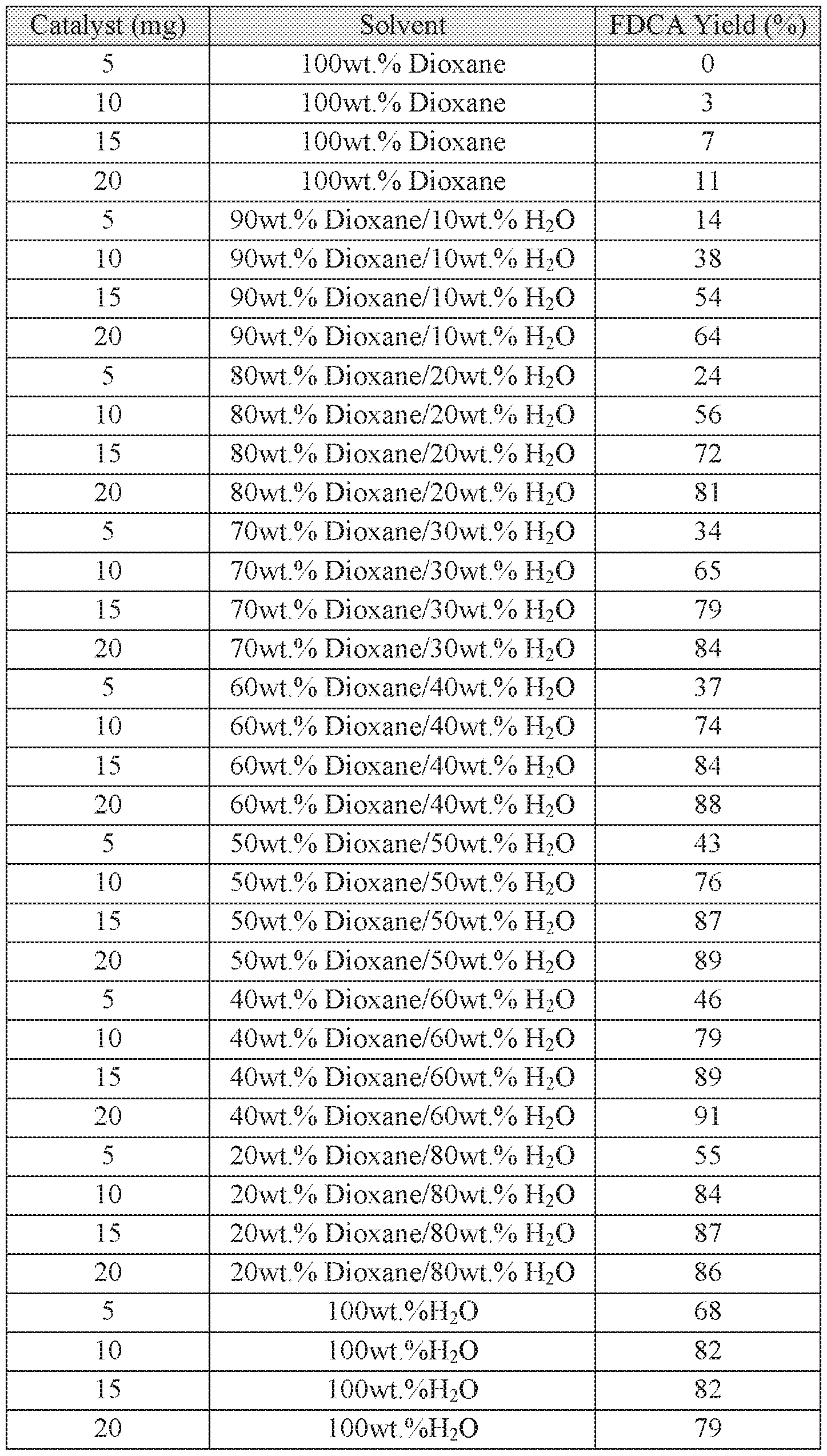


Claims
Priority Applications (11)
| Application Number | Priority Date | Filing Date | Title |
|---|---|---|---|
| EP17738935.0A EP3402787A4 (en) | 2016-01-13 | 2017-01-12 | PROCESSES FOR PREPARING 2,5-FURANDICARBOXYLIC ACID AND INTERMEDIATES AND DERIVATIVES THEREOF |
| BR112018014278-6A BR112018014278B1 (en) | 2016-01-13 | 2017-01-12 | PROCESSES FOR THE PREPARATION OF 2,5-FURANDICARBOXYLIC ACID AND INTERMEDIATES AND DERIVATIVES THEREOF |
| CN201780010948.7A CN108779088B (en) | 2016-01-13 | 2017-01-12 | Preparation method of 2,5-furandicarboxylic acid and its intermediates and derivatives |
| RU2018128356A RU2750483C2 (en) | 2016-01-13 | 2017-01-12 | Methods for producing 2,5-furandicarboxylic acid, and its intermediate compounds, and derivatives |
| AU2017207824A AU2017207824B2 (en) | 2016-01-13 | 2017-01-12 | Processes for the preparation of 2,5-furandicarboxylic acid and intermediates and derivatives thereof |
| NZ743642A NZ743642B2 (en) | 2017-01-12 | Processes for the preparation of 2,5-furandicarboxylic acid and intermediates and derivatives thereof | |
| CA3010631A CA3010631A1 (en) | 2016-01-13 | 2017-01-12 | Processes for the preparation of 2,5-furandicarboxylic acid and intermediates and derivatives thereof |
| KR1020187022842A KR102762287B1 (en) | 2016-01-13 | 2017-01-12 | Method for producing 2,5-furandicarboxylic acid and its intermediates and derivatives |
| SG11201805514VA SG11201805514VA (en) | 2016-01-13 | 2017-01-12 | Processes for the preparation of 2,5-furandicarboxylic acid and intermediates and derivatives thereof |
| JP2018555833A JP7458147B2 (en) | 2016-01-13 | 2017-01-12 | Method for producing 2,5-furandicarboxylic acid and its intermediates and derivatives |
| JP2024003014A JP2024050616A (en) | 2016-01-13 | 2024-01-12 | Method for producing 2,5-furandicarboxylic acid and its intermediates and derivatives |
Applications Claiming Priority (2)
| Application Number | Priority Date | Filing Date | Title |
|---|---|---|---|
| US201662278332P | 2016-01-13 | 2016-01-13 | |
| US62/278,332 | 2016-01-13 |
Publications (2)
| Publication Number | Publication Date |
|---|---|
| WO2017123763A1 true WO2017123763A1 (en) | 2017-07-20 |
| WO2017123763A8 WO2017123763A8 (en) | 2017-08-31 |
Family
ID=59275406
Family Applications (1)
| Application Number | Title | Priority Date | Filing Date |
|---|---|---|---|
| PCT/US2017/013197 Ceased WO2017123763A1 (en) | 2016-01-13 | 2017-01-12 | Processes for the preparation of 2,5-furandicarboxylic acid and intermediates and derivatives thereof |
Country Status (11)
| Country | Link |
|---|---|
| US (7) | US10208006B2 (en) |
| EP (1) | EP3402787A4 (en) |
| JP (2) | JP7458147B2 (en) |
| KR (1) | KR102762287B1 (en) |
| CN (1) | CN108779088B (en) |
| AU (1) | AU2017207824B2 (en) |
| BR (1) | BR112018014278B1 (en) |
| CA (1) | CA3010631A1 (en) |
| RU (1) | RU2750483C2 (en) |
| SG (1) | SG11201805514VA (en) |
| WO (1) | WO2017123763A1 (en) |
Cited By (7)
| Publication number | Priority date | Publication date | Assignee | Title |
|---|---|---|---|---|
| US10208006B2 (en) | 2016-01-13 | 2019-02-19 | Stora Enso Oyj | Processes for the preparation of 2,5-furandicarboxylic acid and intermediates and derivatives thereof |
| CN109721577A (en) * | 2017-10-30 | 2019-05-07 | 中国科学院宁波材料技术与工程研究所 | A kind of purification process of furans dicarboxylic acids |
| CN109797434A (en) * | 2017-11-16 | 2019-05-24 | 中国科学院宁波材料技术与工程研究所 | A kind of 2,5- furandicarboxylic acid monocrystalline and preparation method thereof |
| IT201900025096A1 (en) * | 2019-12-20 | 2021-06-20 | Novamont Spa | Process for the synthesis of 2,5-furandicarboxylic acid |
| US11192872B2 (en) | 2017-07-12 | 2021-12-07 | Stora Enso Oyj | Purified 2,5-furandicarboxylic acid pathway products |
| JP2022529935A (en) * | 2019-04-15 | 2022-06-27 | ストラ エンソ オーユーイー | A method for recovering a solvent, a method for isolating humus, and a composition comprising a solvent or humus. |
| EP4424678A4 (en) * | 2021-10-29 | 2026-02-25 | China Petroleum & Chem Corp | METHOD AND SYSTEM FOR THE CONTINUOUS PROCESSING OF 5-HYDROXYMETHYLFURFURAL AND 2,5-FURANDICARBONIC ACID |
Families Citing this family (21)
| Publication number | Priority date | Publication date | Assignee | Title |
|---|---|---|---|---|
| CN104703776A (en) * | 2012-08-31 | 2015-06-10 | 依云矿泉水股份有限公司 | Bottle, method of making the same and use of FDCA and diol monomers in such bottle |
| JP2017190316A (en) * | 2016-04-15 | 2017-10-19 | 三菱ケミカル株式会社 | Method of purifying 2,5-furandicarboxylic acid |
| US11274089B2 (en) * | 2016-06-27 | 2022-03-15 | Nihon Shokuhin Kako Co., Ltd. | 5-hydroxymethyl-2-furfural production method |
| EP3366681A1 (en) * | 2017-02-28 | 2018-08-29 | Nederlandse Organisatie voor toegepast- natuurwetenschappelijk onderzoek TNO | Production of 2,5-furandicarboxylic acid |
| TWI650318B (en) | 2017-10-30 | 2019-02-11 | 財團法人工業技術研究院 | Method for purifying crude product of 2,5-furandicarboxylic acid by crystallization method and method for forming polyester |
| US12246879B2 (en) | 2018-08-12 | 2025-03-11 | Amisha Patel | Environmentally friendly can |
| US11434037B2 (en) * | 2018-08-12 | 2022-09-06 | Amisha Patel | Furan can |
| WO2020053124A1 (en) * | 2018-09-11 | 2020-03-19 | Basf Se | Receiver comprising a luminescent collector for optical data communication |
| WO2020190080A1 (en) | 2019-03-20 | 2020-09-24 | Samyang Corporation | Method for the synthesis of 2,5-furandicarboxylic acid |
| EP4077293B1 (en) * | 2019-12-20 | 2024-05-29 | Furanix Technologies B.V. | Thermal treatment of purified 2,5-furandicarboxylic acid resulting carboxylic acid composition |
| BR112022011341A2 (en) * | 2019-12-20 | 2022-08-23 | Furanix Technologies Bv | PROCESS FOR PRODUCING A CARBOXYLIC ACID COMPOSITION, CARBOXYLIC ACID COMPOSITION, AND, STARTING MATERIAL FOR THE PRODUCTION OF POLYALKYLENEFURANOATE |
| CN111187238B (en) * | 2020-01-13 | 2022-03-22 | 华东师范大学 | Synthetic method of 2, 5-furandicarboxylic acid |
| WO2021183298A1 (en) * | 2020-03-12 | 2021-09-16 | Solugen, Inc. | Compositions and methods for 2,5-furan dicarboxylic acid production |
| US20240287012A1 (en) * | 2021-07-28 | 2024-08-29 | Kolon Industries, Inc. | Dicarboxyl acid aromatic heterocyclic compound and method for preparing same |
| CN115715979B (en) * | 2021-08-26 | 2024-07-12 | 中国石油化工股份有限公司 | Oxidation catalyst, preparation method thereof and application of oxidation catalyst in preparation of 2, 5-furandicarboxylic acid |
| CN115772143B (en) * | 2021-09-08 | 2024-06-11 | 中国石油化工股份有限公司 | Method for preparing 2, 5-furandicarboxylic acid |
| JP2024545320A (en) * | 2021-12-28 | 2024-12-05 | コーロン インダストリーズ インク | Furandicarboxylic acid compound, method for producing furandicarboxylic acid compound, polyester, and method for producing polyester |
| CN116768832B (en) | 2022-03-10 | 2026-03-06 | 江苏赛瑞克新材料科技有限公司 | Preparation method of 2,5-furandicarboxylic acid compounds |
| CN119789911A (en) * | 2022-08-29 | 2025-04-08 | 日产自动车株式会社 | Catalyst support, and catalyst for gas-phase oxidation of organic compound using the catalyst support and gas-phase oxidation method |
| CN117229248B (en) * | 2023-08-21 | 2024-07-02 | 浙江晟格生物科技有限公司 | Method for preparing and purifying vitronectin by using solid alkali |
| CN119798194B (en) * | 2025-01-06 | 2026-01-02 | 苏州亚科科技股份有限公司 | A method for preparing 2,5-furandicarboxylic acid |
Citations (5)
| Publication number | Priority date | Publication date | Assignee | Title |
|---|---|---|---|---|
| US20120302773A1 (en) * | 2011-05-24 | 2012-11-29 | Eastman Chemical Company | Oxidation process to produce a crude and/or purified carboxylic acid product |
| US20140295508A1 (en) * | 2011-09-29 | 2014-10-02 | Yasuo Yoshikuni | Methods for preparing 2,5-furandicarboxylic acid |
| US20140364631A1 (en) * | 2013-06-06 | 2014-12-11 | California Institute Of Technology | Diels-alder reactions catalyzed by lewis acid containing solids: renewable production of bio-plastics |
| US20150051412A1 (en) * | 2011-05-24 | 2015-02-19 | Eastman Chemical Company | Oxidation process to produce a crude and/or purified carboxylic acid product |
| US20150336090A1 (en) * | 2014-05-21 | 2015-11-26 | Council Of Scientific & Industrial Research | Novel oxidation catalyst, the process for the preparation thereof and green process for selective aerobic oxidation |
Family Cites Families (283)
| Publication number | Priority date | Publication date | Assignee | Title |
|---|---|---|---|---|
| GB591858A (en) | 1944-05-30 | 1947-09-01 | Walter Norman Haworth | Improvements relating to the manufacture of 5-hydroxy-methyl furfural or levulinic acid |
| GB600871A (en) | 1945-10-17 | 1948-04-21 | Walter Norman Haworth | Improvements relating to the manufacture of 5-hydroxymethyl 2-furfural |
| US3184479A (en) | 1965-05-18 | Process for the preparation of | ||
| US2673860A (en) | 1951-07-16 | 1954-03-30 | Kuhn Richard | Preparation of furan-alpha, alpha'-dicarboxylic acid esters |
| US2829823A (en) | 1951-12-20 | 1958-04-08 | Paul E Fedder | Analogue method for determination of moduli of a planar region |
| US2750394A (en) | 1952-05-22 | 1956-06-12 | Food Chemical And Res Lab Inc | Manufacture of 5-hydroxymethyl 2-furfural |
| US2754330A (en) | 1952-12-12 | 1956-07-10 | Du Pont | Manufacture of aliphatic diamines |
| US2917529A (en) | 1956-07-10 | 1959-12-15 | Du Pont | Preparation of alkyl chlorosilanes |
| US2929823A (en) | 1956-11-26 | 1960-03-22 | Merck & Co Inc | Production of 5-hydroxymethylfurfural |
| GB876463A (en) | 1959-02-25 | 1961-09-06 | Atlas Powder Co | Process for preparing hydroxymethyl furfural |
| US3118912A (en) | 1960-04-18 | 1964-01-21 | Rayonier Inc | Preparation of hydroxymethylfurfural |
| US3290263A (en) | 1962-08-02 | 1966-12-06 | Colonial Sugar Refining Co | Process of reacting sugars with reagents wherein the sugar is dissolved in monohydric alcohols containing grouping |
| US3326944A (en) | 1964-03-09 | 1967-06-20 | Atlas Chem Ind | Method of producing dehydromucic acid |
| US3329626A (en) | 1965-03-22 | 1967-07-04 | Phillips Petroleum Co | Activated furnace carbon black production |
| US3483228A (en) | 1966-10-18 | 1969-12-09 | Merck & Co Inc | Method for producing 5-hydroxymethyl furfural |
| JPS5120944Y2 (en) | 1971-10-15 | 1976-05-31 | ||
| US4005178A (en) | 1975-07-10 | 1977-01-25 | The United States Of America As Represented By The United States Energy Research And Development Administration | Method for converting UF5 to UF4 in a molten fluoride salt |
| JPS5268715A (en) | 1975-12-05 | 1977-06-07 | Hayashi Kagaku Kougiyou Kk | Spraying soil stabilizer |
| JPS5446121A (en) | 1977-09-20 | 1979-04-11 | Furukawa Electric Co Ltd:The | Electrically conductive copper alloy with superior solderability |
| FR2464260A1 (en) | 1979-09-05 | 1981-03-06 | Roquette Freres | PROCESS FOR PRODUCING 5-HYDROXYMETHYLFURFURAL |
| US4400468A (en) | 1981-10-05 | 1983-08-23 | Hydrocarbon Research Inc. | Process for producing adipic acid from biomass |
| US4438082A (en) | 1982-09-30 | 1984-03-20 | Engelhard Corporation | Platinum gold catalyst for removing NOx and NH3 from gas streams |
| FR2551754B1 (en) | 1983-09-14 | 1988-04-08 | Roquette Freres | PROCESS FOR THE MANUFACTURE OF 5-HYDROXYMETHYLFURFURAL |
| US4533743A (en) | 1983-12-16 | 1985-08-06 | Atlantic Richfield Company | Furfural process |
| DE3601281A1 (en) | 1986-01-17 | 1987-07-23 | Sueddeutsche Zucker Ag | METHOD FOR PRODUCING 5-HYDROXYMETHYLFURFURAL, INCLUDING A CRYSTALINE PRODUCT, WITH THE EXCLUSIVE USE OF WATER AS A SOLVENT |
| AT387247B (en) | 1987-05-12 | 1988-12-27 | Voest Alpine Ind Anlagen | COMBINED PROCESS FOR THE THERMAL AND CHEMICAL TREATMENT OF BIOMASS CONTAINING LIGNOCELLULOSE AND FOR THE EXTRACTION OF FURFURAL |
| DE3842825A1 (en) | 1988-01-08 | 1989-07-20 | Krupp Gmbh | METHOD AND DEVICE FOR PRODUCING FURFURAL |
| DE3826073A1 (en) * | 1988-07-30 | 1990-02-01 | Hoechst Ag | METHOD FOR THE OXIDATION OF 5-HYDROXYMETHYLFURFURAL |
| FR2664273B1 (en) | 1990-06-27 | 1994-04-29 | Beghin Say Sa | NEW PROCESS FOR THE PREPARATION OF 5-HYDROXYMETHYLFURFURAL FROM SACCHARIDES. |
| FR2663933B1 (en) | 1990-06-27 | 1994-06-17 | Beghin Say Sa | NEW PROCESS FOR THE PREPARATION OF 5-HYDROXYMETHYLFURFURAL FROM SACCHARIDES. |
| FR2669635B1 (en) | 1990-11-22 | 1994-06-10 | Furchim | PROCESS FOR THE MANUFACTURE OF HIGH PURITY HYDROXYMETHYLFURFURAL (HMF). |
| FR2669634B1 (en) | 1990-11-22 | 1994-06-10 | Furchim | PROCESS FOR THE MANUFACTURE OF 2-5-FURANE DICARBOXYLIC ACID. |
| KR920008374B1 (en) | 1990-12-04 | 1992-09-26 | 일양약품 주식회사 | New m/o ganoderma iucidum iy 009 |
| FR2670209B1 (en) | 1990-12-07 | 1995-04-28 | Commissariat Energie Atomique | PROCESS FOR THE PREPARATION OF FURFURAL HYDROXYMETHYL-5 BY HETEROGENEOUS CATALYSIS. |
| DE4125133C2 (en) | 1991-07-30 | 1993-09-30 | Nukem Gmbh | Method and device for producing alginate balls |
| US5312967A (en) | 1992-08-12 | 1994-05-17 | Uab Research Foundation | Process for making activated aldarate esters, ester/lactones and lactones |
| JP3430422B2 (en) | 1992-12-14 | 2003-07-28 | 財団法人石油産業活性化センター | Catalyst for catalytic reduction of nitrogen oxides |
| US5296639A (en) | 1992-12-18 | 1994-03-22 | E. I. Du Pont De Nemours And Company | Adipic acid purification |
| FR2723946B1 (en) | 1994-08-24 | 1996-10-18 | Ard Sa | PROCESS FOR THE MANUFACTURE OF A DIESTER OF 2,5-FURANE DICARBOXYLIC ACID |
| US5639929A (en) | 1995-04-17 | 1997-06-17 | Regents Of The University Of Minnesota | Oxidative dehydrogenation process |
| DE19705329A1 (en) | 1997-02-12 | 1998-08-13 | Basf Ag | Dicarboxylic acid crystals |
| TW394749B (en) | 1998-03-05 | 2000-06-21 | Deng Jian Lang | Method of manufacturing active carbon by using carbon black |
| DE19905655A1 (en) | 1999-02-11 | 2000-08-17 | Karl Zeitsch | Process for the production of furfural by delayed relaxation |
| US6599723B1 (en) | 1999-03-11 | 2003-07-29 | Eastman Chemical Company | Enzymatic reductions with dihydrogen via metal catalyzed cofactor regeneration |
| EP1268460A2 (en) | 2000-03-27 | 2003-01-02 | E.I. Dupont De Nemours And Company | Oxidaton of 5-(hydroxymethyl) furfural to 2,5-diformylfuran and subsequent decarbonylation to unsubstituted furan |
| US6500969B1 (en) | 2000-12-08 | 2002-12-31 | Hydrocarbon Technologies, Inc. | Integrated hydrogen peroxide production and organic chemical oxidation |
| US6518440B2 (en) | 2001-03-05 | 2003-02-11 | Gene E. Lightner | Hydroxymethylfurfural derived from cellulose contained in lignocellulose solids |
| EP1254711A1 (en) | 2001-05-05 | 2002-11-06 | OMG AG & Co. KG | Supported noble metal catalyst and preparation process thereof |
| US7566681B2 (en) | 2002-10-29 | 2009-07-28 | National Research Council Of Canada | Platinum based nano-size catalysts |
| WO2005003072A1 (en) | 2003-07-01 | 2005-01-13 | Universita' Degli Studi Di Milano | Process and catalyst for the preparation of aldonic acids |
| RU2240999C1 (en) * | 2003-07-28 | 2004-11-27 | Кубанский государственный технологический университет | Method for preparing 2-furylcarboxylic acid |
| CN1993366A (en) | 2004-06-30 | 2007-07-04 | 纳幕尔杜邦公司 | Synthesis of aldonolactones, aldarolactones, and aldarodilactones using gas sparging |
| US7713910B2 (en) | 2004-10-29 | 2010-05-11 | Umicore Ag & Co Kg | Method for manufacture of noble metal alloy catalysts and catalysts prepared therewith |
| US7393963B2 (en) | 2004-12-10 | 2008-07-01 | Archer-Daniels-Midland Company | Conversion of 2,5-(hydroxymethyl)furaldehyde to industrial derivatives, purification of the derivatives, and industrial uses therefor |
| US7317116B2 (en) | 2004-12-10 | 2008-01-08 | Archer-Daniels-Midland-Company | Processes for the preparation and purification of hydroxymethylfuraldehyde and derivatives |
| US7208439B2 (en) | 2005-02-04 | 2007-04-24 | The Research Foundation Of State University Of New York | Gold-based alloy nanoparticles for use in fuel cell catalysts |
| JP2006328374A (en) | 2005-04-26 | 2006-12-07 | Mitsubishi Chemicals Corp | Polyester manufacturing method |
| US8038763B2 (en) | 2005-12-14 | 2011-10-18 | University Of Maryland | Au-Pt heteroaggregate dendritic nanostructures and Au-Pt alloy nanoparticles and their use as catalysts |
| US20070179312A1 (en) | 2006-02-02 | 2007-08-02 | O'meadhra Ruairi Seosamh | Process for the purification of a crude carboxylic axid slurry |
| EP1834950A1 (en) | 2006-03-10 | 2007-09-19 | Avantium International B.V. | Method for the synthesis of 5-alkoxymethylfurfural ethers and their use |
| EP2050742B1 (en) | 2006-03-10 | 2010-07-07 | Furanix Technologies B.V | Use of an organic acid esters of 5-hydroxymethylfurfural |
| JP4804187B2 (en) | 2006-03-28 | 2011-11-02 | キヤノン株式会社 | Method for producing furan-2,5-dicarboxylic acid |
| US7572925B2 (en) | 2006-06-06 | 2009-08-11 | Wisconsin Alumni Research Foundation | Catalytic process for producing furan derivatives in a biphasic reactor |
| US7939681B2 (en) | 2006-08-07 | 2011-05-10 | Battelle Memorial Institute | Methods for conversion of carbohydrates in ionic liquids to value-added chemicals |
| US20080081883A1 (en) | 2006-09-28 | 2008-04-03 | Battelle Memorial Institute | Polyester Polyols Derived From 2,5-Furandicarboxylic Acid, and Method |
| US8102097B2 (en) | 2006-10-30 | 2012-01-24 | Sanyo Electric Co., Ltd. | Electrostatic acting device including an electret film |
| US7700788B2 (en) | 2006-10-31 | 2010-04-20 | Battelle Memorial Institute | Hydroxymethyl furfural oxidation methods |
| JP2008270180A (en) | 2007-03-28 | 2008-11-06 | Univ Nagoya | Electrocatalyst composition, electrode and fuel cell |
| JP5446121B2 (en) | 2007-04-24 | 2014-03-19 | 三菱化学株式会社 | Polyester containing furan structure |
| WO2009012445A1 (en) | 2007-07-18 | 2009-01-22 | Archer Daniels Midland Company | Method for production of 5-hydroxymethyl-2-furfural from fructose |
| JP5311778B2 (en) | 2007-08-06 | 2013-10-09 | キヤノン株式会社 | RESIN COMPOSITION, MOLDED ARTICLE, AND METHOD FOR PRODUCING THEM |
| WO2009023174A2 (en) | 2007-08-10 | 2009-02-19 | Archer Daniels Midland Company | Enzymatic oxidation of hmf |
| ATE498616T1 (en) | 2007-09-07 | 2011-03-15 | Furanix Technologies Bv | HYDROXYMETHYLFURFURAL ETHERS AND ESTERS PRODUCED IN IONIC LIQUIDS |
| EP2197862B1 (en) | 2007-09-07 | 2012-02-22 | Furanix Technologies B.V. | 5-substituted 2-methylfuran |
| UA98002C2 (en) | 2007-09-07 | 2012-04-10 | Фураникс Технолоджиз Б.В. | Mixture of furfural and 5-(alkoxymethyl)furfural derivatives from sugars and alcohols |
| WO2009030506A2 (en) | 2007-09-07 | 2009-03-12 | Furanix Technologies B.V. | Hydroxymethylfurfural ethers from sugars or hmf and branched alcohols |
| US20100299991A1 (en) | 2007-09-07 | 2010-12-02 | Furanix Technologies B.V. | Hydroxymethylfurfural Ethers from Sugars and Olefins |
| EA201101559A1 (en) | 2007-09-07 | 2012-04-30 | Фураникс Технолоджиз Б.В. | FUEL COMPOSITION BASED ON 5-SUBSTITUTED 2- (ALKOXYMETHYL) FURANS |
| UA97690C2 (en) | 2007-09-07 | 2012-03-12 | Фураникс Технолоджиз Б.В. | Method for the manufacture of a mixture of 5-hydroxymethylfurfural ethers and a fuel or fuel composition comprising the ether mixture |
| EP2197865B1 (en) | 2007-09-07 | 2012-08-22 | Furanix Technologies B.V | Hydroxymethylfurfural ethers from hmf and olefins |
| EP2197866B1 (en) | 2007-09-07 | 2013-02-27 | Furanix Technologies B.V. | Hydroxymethylfurfural ethers from sugars and higher alcohols |
| JP5325407B2 (en) | 2007-10-15 | 2013-10-23 | 株式会社キャタラー | Fuel cell and supported catalyst used therefor |
| US7385081B1 (en) | 2007-11-14 | 2008-06-10 | Bp Corporation North America Inc. | Terephthalic acid composition and process for the production thereof |
| WO2009076627A2 (en) | 2007-12-12 | 2009-06-18 | Archer Daniels Midland Co | Conversion of carbohydrates to hydroxy-methylfurfural (hmf) and derivatives |
| JP5120944B2 (en) | 2008-04-25 | 2013-01-16 | 独立行政法人産業技術総合研究所 | Biodegradable high molecular weight aliphatic polyester and method for producing the same |
| EP2128226A1 (en) | 2008-05-19 | 2009-12-02 | Furanix Technologies B.V | Fuel component |
| JP2010027607A (en) | 2008-06-17 | 2010-02-04 | Canon Inc | Catalyst layer, membrane electrode assembly, fuel cell, and manufacturing method of catalyst layer |
| CA2726126C (en) | 2008-06-17 | 2018-07-17 | Wisconsin Alumni Research Foundation | Chemical transformation of lignocellulosic biomass into fuels and chemicals |
| CN101367783A (en) | 2008-10-10 | 2009-02-18 | 中国科学技术大学 | Preparation method of 5-hydroxymethyl furfural |
| ES2566649T3 (en) | 2008-10-30 | 2016-04-14 | Archer Daniels Midland Company | Reduction of HMF ethers with a metal catalyst |
| US8071504B2 (en) | 2008-12-19 | 2011-12-06 | Caterpillar Inc. | Exhaust system having a gold-platinum group metal catalyst |
| NL2002382C2 (en) | 2008-12-30 | 2010-07-01 | Furanix Technologies Bv | A process for preparing a polymer having a 2,5-furandicarboxylate moiety within the polymer backbone and such (co)polymers. |
| US8247000B2 (en) | 2009-04-10 | 2012-08-21 | Cypress Pharmaceutical, Inc. | Phosphate-binding magnesium salts and uses thereof |
| EP2862858A1 (en) | 2009-05-14 | 2015-04-22 | Archer-Daniels-Midland Company | Oxidation of a 5-formyl-2-furancarboxylic acid alkyl ester or of a 5-(alkoxymethyl)- 2-furancarboxylic acid to a 2,5-furandicarboxylic acid-2-alkyl monoester |
| AU2010259937B2 (en) | 2009-06-13 | 2016-07-14 | Archer-Daniels-Midland Company | Production of adipic acid and derivatives from carbohydrate-containing materials |
| US8669397B2 (en) | 2009-06-13 | 2014-03-11 | Rennovia, Inc. | Production of adipic acid and derivatives from carbohydrate-containing materials |
| US8314267B2 (en) | 2009-06-26 | 2012-11-20 | Uop Llc | Carbohydrate route to para-xylene and terephthalic acid |
| KR101946649B1 (en) | 2009-09-02 | 2019-02-11 | 푸락 바이오켐 비.브이. | Polypeptides having oxidoreductase activity and their uses |
| US8754000B2 (en) | 2009-09-10 | 2014-06-17 | The University Of Hong Kong | Catalyst for hydrogen generation from small organic molecules |
| WO2011043661A1 (en) | 2009-10-07 | 2011-04-14 | Furanix Technologies B.V. | Method for the preparation of 2,5-furandicarboxylic acid and for the preparation of the dialkyl ester of 2,5-furandicarboxylic acid |
| MX2012004146A (en) | 2009-10-07 | 2012-05-08 | Furanix Technologies Bv | Method for the preparation of 2,5-furandicarboxylic acid and esters thereof. |
| JP5550303B2 (en) | 2009-10-19 | 2014-07-16 | キヤノン株式会社 | Process for producing 2,5-furandicarboxylic acid |
| JP2013513469A (en) | 2009-12-09 | 2013-04-22 | ミシガン モルキュラー インスティテュト | Fuel cell with improved durability |
| ES2581324T5 (en) | 2010-01-15 | 2019-11-28 | California Inst Of Techn | Isomerization of sugars |
| BR112012024133A2 (en) | 2010-04-07 | 2015-09-15 | Novozymes As | method for producing 5-hydroxymethylfurfural and for converting hmf, and use of 2,5-furanedicarboxylic acid |
| US9023751B2 (en) | 2010-04-20 | 2015-05-05 | Toyota Jidosha Kabushiki Kaisha | Method for producing catalyst |
| US8324409B2 (en) | 2010-04-23 | 2012-12-04 | The Board Of Trustees Of The University Of Illinois | Efficient method for preparing 2,5-dimethylfuran |
| EP2390247A1 (en) | 2010-05-26 | 2011-11-30 | Netherlands Organisation for Scientific Research (Advanced Chemical Technologies for Sustainability) | Preparation of caprolactone, caprolactam, 2,5-tetrahydrofuran dimethanol, 1,6-hexanediol or 1,2,6-hexanetriol from 5-hydroxymethyl-2-furfuraldehyde |
| US9770705B2 (en) | 2010-06-11 | 2017-09-26 | Rennovia Inc. | Oxidation catalysts |
| CN101899145B (en) | 2010-07-28 | 2012-07-11 | 江南大学 | A kind of preparation method of 2,5-furandicarboxylic acid base polyester |
| CN105418550A (en) | 2010-07-30 | 2016-03-23 | 阿彻丹尼尔斯米德兰德公司 | Microwave assisted synthesis of dehydrated sugar derivatives hydroxymethylfurfural, levulinic acid, anhydrosugar alcohols, and ethers thereof |
| IT1401911B1 (en) | 2010-08-06 | 2013-08-28 | Novamont Spa | PROCESS FOR SYNTHESIS OF 2,5-FURANDICARBOSSIC ACID |
| US8568680B2 (en) | 2010-10-08 | 2013-10-29 | City University Of Hong Kong | Gas treatment by catalytic ozone oxidation |
| CN102477020A (en) | 2010-11-29 | 2012-05-30 | 中国科学院大连化学物理研究所 | A kind of method that catalyzes carbohydrate to prepare 5-hydroxymethylfurfural |
| CN102190785A (en) | 2010-11-30 | 2011-09-21 | 中国科学院长春应用化学研究所 | Poly(ethylene 2,5-furandicarboxylate), and preparation method thereof |
| CA2820940C (en) | 2010-12-16 | 2018-05-29 | Archer Daniels Midland Company | Preparation of aminomethyl furan and alkoxymethyl furan derivatives fro m carbohydrates |
| NL2005928C2 (en) | 2010-12-28 | 2012-07-02 | Furanix Technologies Bv | Process for the conversion of a carbohydrate-containing feedstock. |
| NL2005976C2 (en) | 2011-01-10 | 2012-07-11 | Furanix Technologies Bv | Process for the depolymerization of a furan dicarboxylate containing polyester. |
| EP2481733A1 (en) | 2011-01-28 | 2012-08-01 | Süd-Chemie AG | Process for manufacturing esters of 2,5-furandicarboxylic acid |
| KR20120107573A (en) | 2011-03-22 | 2012-10-04 | 한국생산기술연구원 | Furan based copolyester and method for preparing the same |
| FR2975396B1 (en) | 2011-05-16 | 2013-12-27 | Centre Nat Rech Scient | PROCESS FOR THE PREPARATION OF 5-HYDROXYMETHYLFURFURAL |
| US8846960B2 (en) | 2011-05-24 | 2014-09-30 | Eastman Chemical Company | Oxidation process to produce a crude and/or purified carboxylic acid product |
| US8791278B2 (en) | 2011-05-24 | 2014-07-29 | Eastman Chemical Company | Oxidation process to produce a crude and/or purified carboxylic acid product |
| US8791277B2 (en) | 2011-05-24 | 2014-07-29 | Eastman Chemical Company | Oxidation process to produce a crude and/or purified carboxylic acid product |
| US8796477B2 (en) | 2011-05-24 | 2014-08-05 | Eastman Chemical Company | Oxidation process to produce a crude and/or purified carboxylic acid product |
| KR101822035B1 (en) | 2011-06-09 | 2018-01-25 | 마이크로마이다스, 인코포레이티드 | Utilizing a multiphase reactor for the conversion of biomass to produce substituted furans |
| FR2979345B1 (en) | 2011-08-26 | 2014-02-21 | Centre Nat Rech Scient | PROCESS FOR ISOMERIZING GLUCOSE IN FRUCTOSE |
| JP2014531422A (en) | 2011-08-31 | 2014-11-27 | ザ・ユニヴァーシティ・オブ・カンザス | Process for producing both bio-based succinic acid and 2,5-furandicarboxylic acid |
| CN103906566A (en) | 2011-08-31 | 2014-07-02 | 阿彻丹尼尔斯米德兰德公司 | Spray oxidation process for the preparation of 2,5-furandicarboxylic acid from hydroxymethylfurfural |
| WO2013035663A1 (en) | 2011-09-05 | 2013-03-14 | 日野自動車株式会社 | Exhaust gas purification apparatus |
| WO2013034763A1 (en) | 2011-09-09 | 2013-03-14 | Dsm Ip Assets B.V. | Process for the separation of a bio -based product by distillation and permeation |
| NL2007509C2 (en) | 2011-09-30 | 2012-07-11 | Stichting Dienst Landbouwkundi | Process for the preparation of a benzene derivative. |
| BRPI1106661A2 (en) | 2011-09-30 | 2013-08-27 | Univ Rio De Janeiro | process for the production of poly (2,5-furanedicarboxylate) based resins, poly (2,5-furanodicarboxylate) based resins and use of said resins |
| WO2013055785A1 (en) | 2011-10-10 | 2013-04-18 | Virdia Ltd | Sugar compositions |
| IN2014CN03466A (en) | 2011-10-12 | 2015-07-03 | Novozymes As | |
| US10800878B2 (en) | 2011-10-14 | 2020-10-13 | Eastman Chemical Company | Polyester compositions containing furandicarboxylic acid or an ester thereof, cyclobutanediol and ethylene glycol |
| MX351452B (en) | 2011-10-24 | 2017-10-16 | Furanix Technologies Bv | PROCESS TO PREPARE A POLYMERIC PRODUCT THAT HAS A 2,5-FURANDICARBOXYLATE PORTION WITHIN THE POLYMER STRUCTURE TO BE USED IN BOTTLE, FILM OR FIBER APPLICATIONS. |
| EP2589431A1 (en) | 2011-11-07 | 2013-05-08 | Solvay Sa | A catalyst for direct synthesis of hydrogen peroxide |
| EP2782897A4 (en) | 2011-11-23 | 2015-06-24 | Segetis Inc | Process to prepare levulinic acid |
| US9162998B2 (en) | 2011-12-13 | 2015-10-20 | Basf Se | Preparation of 5-hydroxymethylfurfural (HMF) from saccharide solutions in the presence of a solvent having a boiling point greater than 60° C. and less than 200° C. (at standard pressure, called low boiler for short) |
| HUE029292T2 (en) | 2011-12-20 | 2017-02-28 | ERICSSON TELEFON AB L M (publ) | Transmitter, receiver, communication device, process and computer program |
| US9434708B2 (en) | 2011-12-28 | 2016-09-06 | Furanix Technologies B.V. | Process for carrying out a reaction involving a liquid reaction mixture |
| WO2013096998A1 (en) | 2011-12-29 | 2013-07-04 | Stichting Dienst Landbouwkundig Onderzoek | Process for the production of a mixture of 2,4- furandicarboxylic acid and 2,5- furandicarboxylic acid (fdca) via disproportionation reaction, mixture of 2,4-fdca and 2, 5 - fdca obtainable thereby, 2, 4 - fdca obtainable thereby and use of 2,4- fdca |
| FR2985260B1 (en) | 2011-12-29 | 2014-06-27 | Natura Cosmeticos Sa | PROCESS FOR THE PRODUCTION OF ETHYLENE POLY (2,5-FURANEDICARBOXYLATE) FROM 2,5-FURANEDICARBOXYLIC ACID AND USE THEREOF, POLYESTER COMPOUND, AND MIXTURES THEREOF |
| CA2859547A1 (en) | 2012-01-04 | 2013-07-11 | Pepsico, Inc. | 2,5-furan dicarboxylic acid-based polyesters prepared from biomass |
| AU2012364787A1 (en) | 2012-01-10 | 2014-07-03 | Archer Daniels Midland Company | Process for making HMF and HMF derivatives from sugars, with recovery of unreacted sugars suitable for direct fermentation to ethanol |
| MX336933B (en) | 2012-01-18 | 2016-02-08 | Rennovia Inc | Process for production of hexamethylenediamine from 5 - hydroxymethylfurfural. |
| JP5955205B2 (en) | 2012-01-23 | 2016-07-20 | キヤノン株式会社 | Chemical sealing film |
| US9902981B2 (en) * | 2012-02-07 | 2018-02-27 | Annikki Gmbh | Process for the production of furan derivatives from glucose |
| EP2703395A1 (en) | 2012-09-03 | 2014-03-05 | Annikki GmbH | Process for the production of furan derivatives |
| US9506060B2 (en) | 2012-02-15 | 2016-11-29 | Dana-Farber Cancer Institute, Inc. | LNA antisense oligonucleotides for the modulation of Myc expression |
| US8546288B2 (en) | 2012-02-15 | 2013-10-01 | Ford Global Technologies, Llc | Substrate selection for a catalyst |
| DE102012003417A1 (en) | 2012-02-17 | 2013-08-22 | Uhde Inventa-Fischer Gmbh | Process for the preparation of a high molecular weight, heteroaromatic polyester or copolyester |
| KR101217137B1 (en) | 2012-03-05 | 2012-12-31 | 한국생산기술연구원 | Method for manufacturing 5-hydroxymethyl-2-furfural from corn syrup containing fructose |
| WO2013149157A1 (en) | 2012-03-30 | 2013-10-03 | E. I. Du Pont De Nemours And Company | Polyesters and fibers made therefrom |
| FR2988724B1 (en) | 2012-03-30 | 2014-04-25 | Roquette Freres | POLYMERS, PROCESS FOR THEIR SYNTHESIS AND COMPOSITIONS COMPRISING SAME |
| US9018423B2 (en) | 2012-04-27 | 2015-04-28 | E I Du Pont De Nemours And Company | Production of alpha, omega-diols |
| US8846984B2 (en) | 2012-04-27 | 2014-09-30 | E I Du Pont De Nemours And Company | Production of α,ω-diols |
| US8859826B2 (en) | 2012-04-27 | 2014-10-14 | E I Du Pont De Nemours And Company | Production of alpha, omega-diols |
| JP2012144744A (en) | 2012-05-07 | 2012-08-02 | Mitsubishi Chemicals Corp | Method for producing aliphatic polyester |
| US20130295485A1 (en) | 2012-05-07 | 2013-11-07 | Cellera, Inc. | Anode Electro-Catalysts for Alkaline Membrane Fuel Cells |
| DK2849884T3 (en) | 2012-05-15 | 2020-10-12 | Archer Daniels Midland Co | REDUCTION CATALYSTS |
| BR112014030857B1 (en) | 2012-06-11 | 2021-06-22 | Archer-Daniels-Midland Company | ADIPIC ACID PRODUCTION PROCESS FROM 1,6-HEXANODIOL |
| US8969404B2 (en) | 2012-06-22 | 2015-03-03 | Eastman Chemical Company | Purifying crude furan 2,5-dicarboxylic acid by hydrogenation |
| US8748479B2 (en) | 2012-06-22 | 2014-06-10 | Eastman Chemical Company | Process for purifying crude furan 2,5-dicarboxylic acid using hydrogenation |
| US8859788B2 (en) | 2012-06-22 | 2014-10-14 | Eastman Chemical Company | Esterification of furan-2,5-dicarboxylic acid to a dialkyl-furan-2,5-dicarboxylate vapor with rectification |
| US8658810B2 (en) | 2012-06-22 | 2014-02-25 | Eastman Chemical Company | Method for producing purified dialkyl-furan-2,5-dicarboxylate vapor |
| US8912349B2 (en) | 2012-06-22 | 2014-12-16 | Eastman Chemical Company | Method for producing purified dialkyl-furan-2,5-dicarboxylate separation and solid liquid separation |
| US9029580B2 (en) | 2012-07-20 | 2015-05-12 | Eastman Chemical Company | Oxidation process to produce a purified carboxylic acid product via solvent displacement and post oxidation |
| JP2014019827A (en) | 2012-07-20 | 2014-02-03 | Hitachi Ltd | Method and apparatus for producing polyester |
| US8809556B2 (en) | 2012-07-20 | 2014-08-19 | Eastman Chemical Company | Oxidation process to produce a purified carboxylic acid product via solvent displacement and post oxidation |
| CN102827361A (en) | 2012-07-24 | 2012-12-19 | 北京金骄生物质化工有限公司 | Biological-based polyester and preparation method thereof |
| US8772513B2 (en) | 2012-08-30 | 2014-07-08 | Eastman Chemical Company | Oxidation process to produce a crude dry carboxylic acid product |
| CN104703776A (en) | 2012-08-31 | 2015-06-10 | 依云矿泉水股份有限公司 | Bottle, method of making the same and use of FDCA and diol monomers in such bottle |
| US10737426B2 (en) | 2012-08-31 | 2020-08-11 | SOCIETE ANONYME DES EAUX MINERALES D'EVIAN et en abrege, “S.A.E.M.E” | Method of making a bottle made of FDCA and diol monomers and apparatus for implementing such method |
| EP2892907B1 (en) | 2012-09-03 | 2016-06-01 | Danmarks Tekniske Universitet | Isomerisation of c4-c6 aldoses with zeolites |
| WO2014037560A1 (en) | 2012-09-10 | 2014-03-13 | Dsm Ip Assets B.V. | Process for the separation of levulinic acid from biomass |
| AU2013317782B2 (en) | 2012-09-21 | 2016-10-06 | Synthetic Genomics, Inc. | Compositions and methods for producing chemicals and derivatives thereof |
| US9528133B2 (en) | 2012-09-21 | 2016-12-27 | Synthetic Genomics, Inc. | Compositions and methods for producing chemicals and derivatives thereof |
| FR2995898B1 (en) | 2012-09-27 | 2019-07-26 | Roquette Freres | PROCESS FOR SYNTHESIZING DICARBOXYLIC 2,5-FURANIC ACID FROM A COMPOSITION CONTAINING FURANE-2,5-DIALDEHYDE |
| US8772515B2 (en) | 2012-10-11 | 2014-07-08 | Wisconsin Alumni Research Foundation | Method to convert biomass to 5-(hydroxymethyl)-furfural (HMF) and furfural using lactones, furans, and pyrans as solvents |
| AU2013338397B2 (en) | 2012-10-29 | 2017-11-16 | Archer Daniels Midland Company | Alcohol-mediated esterification of carboxylic acids with carbonates |
| US9006470B2 (en) | 2012-11-08 | 2015-04-14 | Eastman Chemical Company | Method of synthesizing low color furan diesters |
| US9029579B2 (en) | 2012-11-08 | 2015-05-12 | Eastman Chemical Company | Method of synthesizing low color furan diesters |
| US8916720B2 (en) | 2012-11-20 | 2014-12-23 | Eastman Chemical Company | Process for producing dry purified furan-2,5-dicarboxylic acid with oxidation off-gas treatment |
| US8916719B2 (en) | 2012-11-20 | 2014-12-23 | Eastman Chemical Company | Process for producing dry purified furan-2,5-dicarboxylic acid with oxidation off-gas treatment |
| US9156805B2 (en) | 2012-11-20 | 2015-10-13 | Eastman Chemical Company | Oxidative purification method for producing purified dry furan-2,5-dicarboxylic acid |
| WO2014100256A2 (en) | 2012-12-20 | 2014-06-26 | Dow Global Technologies Llc | Fdca-based polyesters |
| CN104955646B (en) | 2012-12-20 | 2017-05-24 | 陶氏环球技术有限责任公司 | Multilayer films of FDCA-based polyesters |
| WO2014100254A1 (en) | 2012-12-20 | 2014-06-26 | Dow Global Technologies Llc | Barrier films of fdca-based polyesters |
| US9834531B2 (en) | 2012-12-20 | 2017-12-05 | Archer Daniels Midland Company | Use of carboxylic acids and furanic molecules for esterification |
| SG11201503646TA (en) | 2012-12-20 | 2015-07-30 | Archer Daniels Midland Co | Esterification of 2,5-furan-dicarboxylic acid |
| SG11201503745SA (en) | 2012-12-20 | 2015-07-30 | Archer Daniels Midland Co | Recovering and using carboxylic acids from a fermentation broth |
| CN104955869A (en) | 2012-12-20 | 2015-09-30 | 陶氏环球技术有限责任公司 | FDCA-based polyesters made with isosorbide |
| US9199957B2 (en) | 2012-12-21 | 2015-12-01 | Petroleo Brasileiro S.A.-Petrobras | 2.5-furandicarboxylic acid integrated production process |
| ES2481346B1 (en) | 2012-12-26 | 2015-05-08 | Consejo Superior De Investigaciones Científicas (Csic) | PROCEDURE FOR OBTAINING USEFUL ORGANIC MOLECULES AS NEW SURFACTING AGENTS. |
| FR3001970B1 (en) | 2013-02-11 | 2015-02-27 | Centre Nat Rech Scient | PROCESS FOR THE PREPARATION OF DICARBOXYLIC 2,5-FURANE ACID |
| WO2014152366A1 (en) | 2013-03-14 | 2014-09-25 | Pronghorn Renewables Llc | Method and catalyst for the production of alcohols, diols, cyclic ethers and other products from pentose and hexose sugars |
| HUE038483T2 (en) | 2013-03-14 | 2018-10-29 | Archer Daniels Midland Co | Process for making 2,5-furandicarboxylic acid |
| WO2014154676A1 (en) | 2013-03-27 | 2014-10-02 | Annikki Gmbh | Method for isomerisation of glucose |
| NL2010572C2 (en) | 2013-04-05 | 2014-10-07 | Furanix Technologies Bv | Process for the preaparation of 2,5-furan-dicarboxylic acid. |
| BR112015019100A2 (en) | 2013-04-26 | 2017-07-18 | Shell Int Research | process for the preparation of monoethylene glycol from sucrose, and process for converting sucrose to fructose and / or fructose derivatives |
| CA2911918A1 (en) | 2013-05-08 | 2014-11-13 | Stichting Dienst Landbouwkundig Onderzoek | Process and intermediates for the production of furan-2,5-dicarboxylic acid or derivatives thereof |
| ES2693373T3 (en) | 2013-06-20 | 2018-12-11 | Synvina C.V. | Procedure for the preparation of a fiber, a fiber and a yarn made with said fiber |
| NL1040265C2 (en) | 2013-06-21 | 2014-12-24 | Stichting Dutch Polymer Inst | SEMI-CRYSTALLINE POLYESTER. |
| NL2011027C2 (en) | 2013-06-24 | 2014-12-29 | Univ Delft Tech | Process for the preparation of 2,5-furandicarboxylic acid. |
| CN105612043B (en) | 2013-08-01 | 2017-12-01 | 依云矿泉水有限公司 | PEF container, preform and method for manufacturing said container by injection stretch blow molding |
| US20150045576A1 (en) | 2013-08-08 | 2015-02-12 | Battelle Memorial Institute | Methods of making alkyl lactates and alkyl levulinates from saccharides |
| JP2016536172A (en) | 2013-08-30 | 2016-11-24 | ザ コカ・コーラ カンパニーThe Coca‐Cola Company | Furan acid polymer preforms, containers and processing |
| US9896425B2 (en) | 2013-08-30 | 2018-02-20 | Synvina C.V. | Process for purifying an acid composition comprising 2-formyl-furan-5-carboxylic acid and 2,5-furandicarboxylic acid |
| EP3038741B1 (en) | 2013-08-30 | 2021-05-19 | The Coca-Cola Company | Container and preform made from poly(ethylenefuranoate) copolymers and methods |
| CN105555774B (en) | 2013-09-19 | 2018-08-28 | 花王株式会社 | 2, the manufacture method of 5-furandicarboxylic acid |
| US9359320B2 (en) | 2013-09-20 | 2016-06-07 | Ut-Battelle, Llc | Acid-functionalized polyolefin materials and their use in acid-promoted chemical reactions |
| US10167267B2 (en) | 2013-09-20 | 2019-01-01 | Agency For Science, Technology And Research | Conversion and purification of biomass |
| US9032355B2 (en) | 2013-10-03 | 2015-05-12 | Helic S.A. | System and method for integrated transformer synthesis and optimization using constrained optimization problem |
| WO2015056270A1 (en) | 2013-10-17 | 2015-04-23 | Natco Pharma Limited | Process for the preparation of 2,5-furandicarboxylic acid |
| US10843443B2 (en) | 2013-11-01 | 2020-11-24 | Cryovac, Inc. | Delamination-resistant heat-shrinkable multilayer oxygen barrier film containing polyester |
| NL2011950C2 (en) | 2013-12-12 | 2015-06-15 | Furanix Technologies Bv | Composition comprising furfuryl alcohol. |
| JP6878004B2 (en) | 2013-12-13 | 2021-05-26 | ダナ−ファーバー キャンサー インスティテュート, インコーポレイテッド | How to Treat Lymphatic Plasma Cell Lymphoma |
| US9158718B2 (en) | 2014-01-07 | 2015-10-13 | International Business Machines Corporation | Deterministic message processing in a direct memory access adapter |
| CN106029642B (en) | 2014-01-27 | 2019-11-29 | 阿彻丹尼尔斯米德兰公司 | Conversion of Fructose-Containing Raw Materials to HMF-Containing Products |
| KR20150098093A (en) | 2014-02-19 | 2015-08-27 | 삼성전자주식회사 | Method of unsaturated acid from an ammonium salt of a hyroxycarboxylic acid |
| US9028580B1 (en) | 2014-02-28 | 2015-05-12 | William L. Andrews | Methods for processing human waste |
| CN103965146B (en) | 2014-04-03 | 2016-04-06 | 浙江大学 | The purification process of furandicarboxylic acid |
| CN110280241B (en) | 2014-04-29 | 2022-09-02 | 阿彻丹尼尔斯米德兰公司 | Carbon black-based shaped porous product |
| EP3137184A1 (en) | 2014-05-01 | 2017-03-08 | Nederlandse Organisatie voor toegepast- natuurwetenschappelijk onderzoek TNO | Simultaneous recovery of organic compounds and extractants |
| US9944615B2 (en) | 2014-05-08 | 2018-04-17 | Eastman Chemical Company | Purifying crude furan 2,5-dicarboxylic acid by hydrogenation and a purge zone |
| US9604202B2 (en) | 2014-05-08 | 2017-03-28 | Eastman Chemical Company | Furan-2,5-dicarboxylic acid purge process |
| US10010812B2 (en) | 2014-05-08 | 2018-07-03 | Eastman Chemical Company | Furan-2,5-dicarboxylic acid purge process |
| US9943834B2 (en) | 2014-05-08 | 2018-04-17 | Eastman Chemical Company | Furan-2,5-dicarboxylic acid purge process |
| US20150329927A1 (en) | 2014-05-17 | 2015-11-19 | Sweetwater Energy, Inc. | Sugar Separation and Purification Through Filtration |
| FI127224B (en) | 2014-06-13 | 2018-01-31 | Teknologian Tutkimuskeskus Vtt Oy | Method for producing muconic acids and furans from aldaric acids |
| WO2015197699A1 (en) | 2014-06-25 | 2015-12-30 | Basf Se | Process for preparing furan-2,5-dicarboxylic acid |
| US9666876B2 (en) | 2014-07-25 | 2017-05-30 | Ford Global Technologies, Llc | Oxygen reduction reaction catalyst having a non-conductive substrate |
| KR101679914B1 (en) | 2014-08-18 | 2016-11-25 | 현대자동차주식회사 | Synthesis method of glucaric acid |
| SG11201702612TA (en) | 2014-09-30 | 2017-04-27 | Agency Science Tech & Res | Triphasic system for direct conversion of sugars to furandicarboxylic acid |
| CA2962622A1 (en) | 2014-10-09 | 2016-04-14 | Bp Corporation North America Inc. | Use of halogens in the production of 2,5-furandicarboxylic acid |
| US20170260153A1 (en) | 2014-10-09 | 2017-09-14 | Bp Corporation North America Inc. | Use of Reactants in the Production of 2,5-Furandicarboxylic Acid |
| CA2962605A1 (en) | 2014-10-09 | 2016-04-14 | Bp Corporation North America Inc. | Use of an acidic solvent and water in the production of 2,5-furandicarboxylic acid |
| CA2962610A1 (en) | 2014-10-09 | 2016-04-14 | Bp Corporation North America Inc. | Use of carboxylic acids in the production of 2,5-furandicarboxylic acid |
| EP3204368A1 (en) | 2014-10-09 | 2017-08-16 | BP Corporation North America Inc. | Use of bromine ions in the production of 2,5-furandicarboxylic acid |
| MX368982B (en) | 2014-10-16 | 2019-10-23 | Novamont Spa | Process for the production and isolation of 5-hydroxymethylfurfur al. |
| EP3015463A1 (en) | 2014-10-30 | 2016-05-04 | Nederlandse Organisatie voor toegepast- natuurwetenschappelijk onderzoek TNO | Crystallization of furanic compounds |
| WO2016076710A1 (en) | 2014-11-10 | 2016-05-19 | Furanix Technologies B.V. | Preparation of dialkyl esters of 2,5-furandicarboxylic acid |
| WO2016076711A1 (en) | 2014-11-10 | 2016-05-19 | Furanix Technologies B.V. | Preparation of dialkyl esters of 2,5-furandicarboxylic acid |
| BR112017017525A2 (en) | 2015-02-17 | 2018-04-17 | Purac Biochem Bv | dehydrogenase catalyzed fdca production |
| WO2016141148A1 (en) | 2015-03-05 | 2016-09-09 | Bp Corporation North America Inc. | Synthesis of furans from sugars via keto intermediates |
| US10118908B2 (en) | 2015-03-17 | 2018-11-06 | Purac Biochem B.V. | Method for manufacturing furan-2,5-dicarboxylic acid (FDCA) from a solid salt |
| US10538499B2 (en) | 2015-04-14 | 2020-01-21 | Dupont Industrial Biosciences Usa, Llc | Processes for producing 2,5-furandicarboxylic acid and derivatives thereof and polymers made therefrom |
| WO2016168675A1 (en) | 2015-04-15 | 2016-10-20 | Micromidas, Inc. | Activated carbon materials, and methods of preparing thereof and uses thereof |
| FI126387B (en) | 2015-04-17 | 2016-11-15 | Teknologian Tutkimuskeskus Vtt Oy | A process for the preparation of furan carboxylates from aldaric acids using a solid heterogeneous catalyst |
| KR101715169B1 (en) | 2015-05-21 | 2017-03-10 | 한국생산기술연구원 | Method for preparing 2,5-furandicarboxylic acid |
| US20180148486A1 (en) | 2015-05-29 | 2018-05-31 | Clark Atlanta University | Human cell lines mutant for zic2 |
| AU2016271834B2 (en) | 2015-06-05 | 2019-02-21 | Synvina C.V. | Process for the preparation of a purified acid composition |
| US9321744B1 (en) | 2015-06-26 | 2016-04-26 | Industrial Technology Research Institute | Method for preparing 2,5-furan dicarboxylic acid |
| JP2018528171A (en) | 2015-07-22 | 2018-09-27 | ビーエーエスエフ ソシエタス・ヨーロピアBasf Se | Process for preparing furan-2,5-dicarboxylic acid |
| WO2017019431A1 (en) | 2015-07-24 | 2017-02-02 | E I Du Pont De Nemours And Company | Process for producing 2,5-furandicarboxylic acid dialkyl ester |
| US20190031633A1 (en) | 2015-07-24 | 2019-01-31 | E I Du Pont De Nemours And Company | Low pressure, high temperature process for forming 2,5-furandicarboxylic acid dialkyl ester |
| US20180155307A1 (en) | 2015-07-24 | 2018-06-07 | E I Du Pont De Nemours And Company | Reactive distillation process for the esterification of furandicarboxylic acid |
| EP3434672B1 (en) | 2015-07-24 | 2020-02-19 | DuPont Industrial Biosciences USA, LLC | Processes for preparing 2,5-furandicarboxylic acid |
| US20180179173A1 (en) | 2015-07-24 | 2018-06-28 | E I Du Pont De Nemours And Company | Multi-stage esterification process |
| WO2017030668A1 (en) | 2015-08-20 | 2017-02-23 | Synthetic Genomics, Inc. | Synthesis of fdca and fdca precursors from gluconic acid derivatives |
| EP3337790A4 (en) | 2015-08-21 | 2019-01-23 | GFBiochemicals Limited | Process to prepare hydroxymethylfurfural derivatives |
| KR20180053684A (en) | 2015-09-21 | 2018-05-23 | 푸락 바이오켐 비.브이. | Manufacture of FDCA fungi |
| US10464048B2 (en) | 2015-10-28 | 2019-11-05 | Archer-Daniels-Midland Company | Porous shaped metal-carbon products |
| US10722867B2 (en) | 2015-10-28 | 2020-07-28 | Archer-Daniels-Midland Company | Porous shaped carbon products |
| WO2017083297A1 (en) | 2015-11-11 | 2017-05-18 | Bp Corporation North America Inc. | Acids-catalyzed dehydration of glucaric acid to 2,5-furandicarboxylic acid (fdca) |
| US9701652B2 (en) | 2015-11-25 | 2017-07-11 | Board Of Trustees Of Michigan State University | Formation of 2,5-furan dicarboxylic acid from aldaric acids |
| UA127338C2 (en) | 2015-12-10 | 2023-07-26 | Анніккі Ґмбг | METHOD OF OBTAINING 2,5-FURANDICARBONIC ACID (FDCA) |
| US9617234B1 (en) | 2015-12-18 | 2017-04-11 | Wisconsin Alumni Research Foundation | Method to produce furandicarboxylic acid (FDCA) from 5-hydroxymethylfurfural (HMF) |
| US10208006B2 (en) | 2016-01-13 | 2019-02-19 | Stora Enso Oyj | Processes for the preparation of 2,5-furandicarboxylic acid and intermediates and derivatives thereof |
| MY186792A (en) | 2016-02-04 | 2021-08-20 | Ind Tech Res Inst | Method for separating hydrolysis product of biomass |
| KR101835609B1 (en) | 2016-03-07 | 2018-03-08 | 한국생산기술연구원 | Catalyst for producing 2,5- furandicarboxlic acid and method for producing 2,5- furandicarboxlic acid using the same |
| EP3219737A1 (en) | 2016-03-16 | 2017-09-20 | Ecole Polytechnique Federale De Lausanne (Epfl) | Ionic polymers and use thereof in processing of biomass |
| DE102016224073A1 (en) | 2016-12-02 | 2018-06-07 | Südzucker AG | Improved HMF manufacturing process |
| WO2019014382A1 (en) | 2017-07-12 | 2019-01-17 | Stora Enso Oyj | Purified 2,5-furandicarboxylic acid pathway products |
| SG11202002077SA (en) | 2017-09-19 | 2020-04-29 | Embion Tech Sa | Ionic polymers and use thereof in biomass processing |
| DE102017123797A1 (en) | 2017-10-12 | 2019-04-18 | Synphabase Ag | furan dicarboxylic acid |
| WO2019089448A1 (en) | 2017-10-30 | 2019-05-09 | The University Of Toledo | Homogeneous and reusable superacid polymer catalyst useful for the synthesis of 5-hydroxymethylfurfural from glucose |
| GB201804929D0 (en) | 2018-03-27 | 2018-05-09 | Biome Bioplastics Ltd | Process for oxidising a substrate |
| DE102018208507A1 (en) | 2018-05-29 | 2019-12-05 | Südzucker AG | Anolyte fraction-catalyzed HMF production |
| DE102018208510A1 (en) | 2018-05-29 | 2019-12-05 | Südzucker AG | Salt and acid mixture catalyzed HMF production |
| IT201800007204A1 (en) | 2018-07-13 | 2020-01-13 | PROCESS FOR THE PRODUCTION AND SEPARATION OF 5-HYDROXIMETHYLFURFURAL WITH QUATERNAR AMMONIC SALTS " |
-
2017
- 2017-01-12 US US15/404,996 patent/US10208006B2/en active Active
- 2017-01-12 RU RU2018128356A patent/RU2750483C2/en active
- 2017-01-12 EP EP17738935.0A patent/EP3402787A4/en active Pending
- 2017-01-12 CA CA3010631A patent/CA3010631A1/en active Pending
- 2017-01-12 AU AU2017207824A patent/AU2017207824B2/en active Active
- 2017-01-12 WO PCT/US2017/013197 patent/WO2017123763A1/en not_active Ceased
- 2017-01-12 CN CN201780010948.7A patent/CN108779088B/en active Active
- 2017-01-12 SG SG11201805514VA patent/SG11201805514VA/en unknown
- 2017-01-12 KR KR1020187022842A patent/KR102762287B1/en active Active
- 2017-01-12 BR BR112018014278-6A patent/BR112018014278B1/en active IP Right Grant
- 2017-01-12 JP JP2018555833A patent/JP7458147B2/en active Active
-
2019
- 2019-01-31 US US16/264,188 patent/US10442780B2/en active Active
- 2019-08-27 US US16/552,096 patent/US10654819B2/en active Active
-
2020
- 2020-04-06 US US16/841,478 patent/US10851074B2/en active Active
- 2020-11-13 US US17/098,102 patent/US11613523B2/en active Active
-
2023
- 2023-02-15 US US18/169,807 patent/US11891370B2/en active Active
- 2023-12-20 US US18/391,421 patent/US20240254097A1/en not_active Abandoned
-
2024
- 2024-01-12 JP JP2024003014A patent/JP2024050616A/en active Pending
Patent Citations (5)
| Publication number | Priority date | Publication date | Assignee | Title |
|---|---|---|---|---|
| US20120302773A1 (en) * | 2011-05-24 | 2012-11-29 | Eastman Chemical Company | Oxidation process to produce a crude and/or purified carboxylic acid product |
| US20150051412A1 (en) * | 2011-05-24 | 2015-02-19 | Eastman Chemical Company | Oxidation process to produce a crude and/or purified carboxylic acid product |
| US20140295508A1 (en) * | 2011-09-29 | 2014-10-02 | Yasuo Yoshikuni | Methods for preparing 2,5-furandicarboxylic acid |
| US20140364631A1 (en) * | 2013-06-06 | 2014-12-11 | California Institute Of Technology | Diels-alder reactions catalyzed by lewis acid containing solids: renewable production of bio-plastics |
| US20150336090A1 (en) * | 2014-05-21 | 2015-11-26 | Council Of Scientific & Industrial Research | Novel oxidation catalyst, the process for the preparation thereof and green process for selective aerobic oxidation |
Cited By (18)
| Publication number | Priority date | Publication date | Assignee | Title |
|---|---|---|---|---|
| US10208006B2 (en) | 2016-01-13 | 2019-02-19 | Stora Enso Oyj | Processes for the preparation of 2,5-furandicarboxylic acid and intermediates and derivatives thereof |
| US11891370B2 (en) | 2016-01-13 | 2024-02-06 | Stora Enso Ojy | Processes for the preparation of 2,5-furandicarboxylic acid and intermediates and derivatives thereof |
| US11613523B2 (en) | 2016-01-13 | 2023-03-28 | Stora Enso Oyj | Processes for the preparation of 2,5-furandicarboxylic acid and intermediates and derivatives thereof |
| US10442780B2 (en) | 2016-01-13 | 2019-10-15 | Stora Enso Oyj | Processes for the preparation of 2,5-furandicarboxylic acid and intermediates and derivatives thereof |
| US10654819B2 (en) | 2016-01-13 | 2020-05-19 | Stora Enso Oyj | Processes for the preparation of 2,5-furandicarboxylic acid and intermediates and derivatives thereof |
| US10851074B2 (en) | 2016-01-13 | 2020-12-01 | Stora Enso Oyj | Processes for the preparation of 2,5-furandicarboxylic acid and intermediates and derivatives thereof |
| US11192872B2 (en) | 2017-07-12 | 2021-12-07 | Stora Enso Oyj | Purified 2,5-furandicarboxylic acid pathway products |
| US12049456B2 (en) | 2017-07-12 | 2024-07-30 | Stora Enso Oyj | Purified 2,5-furandicarboxylic acid pathway products |
| CN109721577A (en) * | 2017-10-30 | 2019-05-07 | 中国科学院宁波材料技术与工程研究所 | A kind of purification process of furans dicarboxylic acids |
| CN109797434A (en) * | 2017-11-16 | 2019-05-24 | 中国科学院宁波材料技术与工程研究所 | A kind of 2,5- furandicarboxylic acid monocrystalline and preparation method thereof |
| JP2022529935A (en) * | 2019-04-15 | 2022-06-27 | ストラ エンソ オーユーイー | A method for recovering a solvent, a method for isolating humus, and a composition comprising a solvent or humus. |
| JP2025032387A (en) * | 2019-04-15 | 2025-03-11 | ストラ エンソ オーユーイー | Method for recovering solvents, method for isolating humus, and compositions comprising solvents or humus |
| JP7806356B2 (en) | 2019-04-15 | 2026-01-27 | ストラ エンソ オーユーイー | Method for recovering solvents, method for isolating humus, and compositions comprising solvents or humus |
| WO2021123240A1 (en) * | 2019-12-20 | 2021-06-24 | Novamont S.P.A. | Process for the synthesis of 2,5-furandicarboxylic acid |
| IT201900025096A1 (en) * | 2019-12-20 | 2021-06-20 | Novamont Spa | Process for the synthesis of 2,5-furandicarboxylic acid |
| EP4339191A3 (en) * | 2019-12-20 | 2024-11-27 | Novamont S.p.A. | Process for the synthesis of 2,5-furandicarboxylic acid |
| US12441698B2 (en) | 2019-12-20 | 2025-10-14 | Novamont S.P.A. | Process for the synthesis of 2,5-furandicarboxylic acid |
| EP4424678A4 (en) * | 2021-10-29 | 2026-02-25 | China Petroleum & Chem Corp | METHOD AND SYSTEM FOR THE CONTINUOUS PROCESSING OF 5-HYDROXYMETHYLFURFURAL AND 2,5-FURANDICARBONIC ACID |
Also Published As
Similar Documents
| Publication | Publication Date | Title |
|---|---|---|
| US11891370B2 (en) | Processes for the preparation of 2,5-furandicarboxylic acid and intermediates and derivatives thereof | |
| US12049456B2 (en) | Purified 2,5-furandicarboxylic acid pathway products | |
| US20140073805A1 (en) | Process for manufacturing esters of 2,5-furandicarboxylic acid | |
| EP2090573A1 (en) | Conversion of 2,5-(hydroxymethyl) furaldehyde to 2,5-bis(hydroxymethyl)tetrahydofuran, purification of the derivatives and industrial uses therefor | |
| US9458122B2 (en) | Process for purifying crude furan 2,5-dicarboxylic acid using hydrogenation | |
| JP2025032387A (en) | Method for recovering solvents, method for isolating humus, and compositions comprising solvents or humus | |
| CN114130429A (en) | Thermo-sensitive type heteropolyacid catalyst, preparation method thereof and application thereof in synthesis of 5-hydroxymethylfurfural | |
| CN113908825B (en) | Solid catalyst containing chromium-magnesium hydrotalcite material composite biochar, and preparation method and application thereof | |
| CN114874161B (en) | A method for continuously synthesizing and purifying 5-hydroxymethylfurfural using hollow fiber membrane tubes | |
| WO2017030684A1 (en) | Dehydrative cyclization of pentitols using water-tolerant lewis acid catalysts under mild conditions and derivatives |
Legal Events
| Date | Code | Title | Description |
|---|---|---|---|
| 121 | Ep: the epo has been informed by wipo that ep was designated in this application |
Ref document number: 17738935 Country of ref document: EP Kind code of ref document: A1 |
|
| WWE | Wipo information: entry into national phase |
Ref document number: 11201805514V Country of ref document: SG |
|
| ENP | Entry into the national phase |
Ref document number: 3010631 Country of ref document: CA |
|
| ENP | Entry into the national phase |
Ref document number: 2018555833 Country of ref document: JP Kind code of ref document: A |
|
| NENP | Non-entry into the national phase |
Ref country code: DE |
|
| REG | Reference to national code |
Ref country code: BR Ref legal event code: B01A Ref document number: 112018014278 Country of ref document: BR |
|
| ENP | Entry into the national phase |
Ref document number: 2017207824 Country of ref document: AU Date of ref document: 20170112 Kind code of ref document: A |
|
| ENP | Entry into the national phase |
Ref document number: 20187022842 Country of ref document: KR Kind code of ref document: A |
|
| WWE | Wipo information: entry into national phase |
Ref document number: 1020187022842 Country of ref document: KR |
|
| WWE | Wipo information: entry into national phase |
Ref document number: 2017738935 Country of ref document: EP |
|
| ENP | Entry into the national phase |
Ref document number: 2017738935 Country of ref document: EP Effective date: 20180813 |
|
| ENP | Entry into the national phase |
Ref document number: 112018014278 Country of ref document: BR Kind code of ref document: A2 Effective date: 20180712 |
|
| WWG | Wipo information: grant in national office |
Ref document number: 743642 Country of ref document: NZ |