WO2017131154A1 - 食物アレルギーのバイオマーカー、食物アレルギーの検査方法、尿検体検査用キット、及び尿検体検査用スティック - Google Patents
食物アレルギーのバイオマーカー、食物アレルギーの検査方法、尿検体検査用キット、及び尿検体検査用スティック Download PDFInfo
- Publication number
- WO2017131154A1 WO2017131154A1 PCT/JP2017/002919 JP2017002919W WO2017131154A1 WO 2017131154 A1 WO2017131154 A1 WO 2017131154A1 JP 2017002919 W JP2017002919 W JP 2017002919W WO 2017131154 A1 WO2017131154 A1 WO 2017131154A1
- Authority
- WO
- WIPO (PCT)
- Prior art keywords
- antibody
- tetranor
- dihydro
- lte
- keto
- Prior art date
- Legal status (The legal status is an assumption and is not a legal conclusion. Google has not performed a legal analysis and makes no representation as to the accuracy of the status listed.)
- Ceased
Links
- UFZHAEQWMUIXSY-DUTNFGBUSA-N CCC(C(C1)C2C)[C@@H]1C(CC)C2C(C)=C Chemical compound CCC(C(C1)C2C)[C@@H]1C(CC)C2C(C)=C UFZHAEQWMUIXSY-DUTNFGBUSA-N 0.000 description 1
Images










Classifications
-
- G—PHYSICS
- G01—MEASURING; TESTING
- G01N—INVESTIGATING OR ANALYSING MATERIALS BY DETERMINING THEIR CHEMICAL OR PHYSICAL PROPERTIES
- G01N33/00—Investigating or analysing materials by specific methods not covered by groups G01N1/00 - G01N31/00
- G01N33/48—Biological material, e.g. blood, urine; Haemocytometers
- G01N33/50—Chemical analysis of biological material, e.g. blood, urine; Testing involving biospecific ligand binding methods; Immunological testing
- G01N33/88—Chemical analysis of biological material, e.g. blood, urine; Testing involving biospecific ligand binding methods; Immunological testing involving prostaglandins or their receptors
-
- G—PHYSICS
- G01—MEASURING; TESTING
- G01N—INVESTIGATING OR ANALYSING MATERIALS BY DETERMINING THEIR CHEMICAL OR PHYSICAL PROPERTIES
- G01N33/00—Investigating or analysing materials by specific methods not covered by groups G01N1/00 - G01N31/00
- G01N33/48—Biological material, e.g. blood, urine; Haemocytometers
- G01N33/50—Chemical analysis of biological material, e.g. blood, urine; Testing involving biospecific ligand binding methods; Immunological testing
- G01N33/5005—Chemical analysis of biological material, e.g. blood, urine; Testing involving biospecific ligand binding methods; Immunological testing involving human or animal cells
- G01N33/5091—Chemical analysis of biological material, e.g. blood, urine; Testing involving biospecific ligand binding methods; Immunological testing involving human or animal cells for testing the pathological state of an organism
-
- G—PHYSICS
- G01—MEASURING; TESTING
- G01N—INVESTIGATING OR ANALYSING MATERIALS BY DETERMINING THEIR CHEMICAL OR PHYSICAL PROPERTIES
- G01N33/00—Investigating or analysing materials by specific methods not covered by groups G01N1/00 - G01N31/00
- G01N33/48—Biological material, e.g. blood, urine; Haemocytometers
- G01N33/50—Chemical analysis of biological material, e.g. blood, urine; Testing involving biospecific ligand binding methods; Immunological testing
- G01N33/86—Chemical analysis of biological material, e.g. blood, urine; Testing involving biospecific ligand binding methods; Immunological testing involving blood coagulating time or factors, or their receptors
-
- G—PHYSICS
- G01—MEASURING; TESTING
- G01N—INVESTIGATING OR ANALYSING MATERIALS BY DETERMINING THEIR CHEMICAL OR PHYSICAL PROPERTIES
- G01N33/00—Investigating or analysing materials by specific methods not covered by groups G01N1/00 - G01N31/00
- G01N33/48—Biological material, e.g. blood, urine; Haemocytometers
- G01N33/50—Chemical analysis of biological material, e.g. blood, urine; Testing involving biospecific ligand binding methods; Immunological testing
- G01N33/92—Chemical analysis of biological material, e.g. blood, urine; Testing involving biospecific ligand binding methods; Immunological testing involving lipids, e.g. cholesterol, lipoproteins, or their receptors
-
- C—CHEMISTRY; METALLURGY
- C12—BIOCHEMISTRY; BEER; SPIRITS; WINE; VINEGAR; MICROBIOLOGY; ENZYMOLOGY; MUTATION OR GENETIC ENGINEERING
- C12Q—MEASURING OR TESTING PROCESSES INVOLVING ENZYMES, NUCLEIC ACIDS OR MICROORGANISMS; COMPOSITIONS OR TEST PAPERS THEREFOR; PROCESSES OF PREPARING SUCH COMPOSITIONS; CONDITION-RESPONSIVE CONTROL IN MICROBIOLOGICAL OR ENZYMOLOGICAL PROCESSES
- C12Q1/00—Measuring or testing processes involving enzymes, nucleic acids or microorganisms; Compositions therefor; Processes of preparing such compositions
- C12Q1/02—Measuring or testing processes involving enzymes, nucleic acids or microorganisms; Compositions therefor; Processes of preparing such compositions involving viable microorganisms
-
- C—CHEMISTRY; METALLURGY
- C12—BIOCHEMISTRY; BEER; SPIRITS; WINE; VINEGAR; MICROBIOLOGY; ENZYMOLOGY; MUTATION OR GENETIC ENGINEERING
- C12Y—ENZYMES
- C12Y111/00—Oxidoreductases acting on a peroxide as acceptor (1.11)
- C12Y111/01—Peroxidases (1.11.1)
-
- C—CHEMISTRY; METALLURGY
- C12—BIOCHEMISTRY; BEER; SPIRITS; WINE; VINEGAR; MICROBIOLOGY; ENZYMOLOGY; MUTATION OR GENETIC ENGINEERING
- C12Y—ENZYMES
- C12Y301/00—Hydrolases acting on ester bonds (3.1)
- C12Y301/03—Phosphoric monoester hydrolases (3.1.3)
- C12Y301/03001—Alkaline phosphatase (3.1.3.1)
-
- G—PHYSICS
- G01—MEASURING; TESTING
- G01N—INVESTIGATING OR ANALYSING MATERIALS BY DETERMINING THEIR CHEMICAL OR PHYSICAL PROPERTIES
- G01N2800/00—Detection or diagnosis of diseases
- G01N2800/24—Immunology or allergic disorders
Definitions
- the present invention relates to a food allergy biomarker, a food allergy test method, a urine sample test kit, and a urine sample test stick.
- Food allergy means various allergic reactions caused by taking allergens contained in food into the body. Symptoms include diarrhea, vomiting, dermatitis, etc., and when severe, it causes shock and death. The incidence of adults in Japan is as high as 2.6%, but it is 5.6% in newborns, which is a serious problem because of the high number of severe cases.
- the onset mechanism of food allergy is i) T cells and B cells react with allergens that have entered the body to produce IgE, and ii) when allergens enter the body again, mast cells that bind to IgE become histamine, etc. It is known to release active substances (degranulation) and cause strong inflammation.
- Desensitization therapy seeks to induce immune tolerance by administering to a patient allergens diluted under the supervision of a physician. While many treatment methods for allergic diseases are symptomatic treatments, desensitization therapy is attracting attention because it works on the mechanism of action of allergic diseases and aims to cure them. In desensitization therapy, start with a very low dose and gradually increase the dose.
- Non-Patent Document 1 a diagnostic method for measuring blood IgE is used as a diagnostic method for food allergy (see, for example, Non-Patent Document 1).
- hyposensitization therapy when the allergen dose is gradually increased, a doctor's visual diagnosis is performed so that serious symptoms will not be caused by administering an amount of allergen that exceeds the threshold, but it is arbitrary. Judgment, and cannot make a quantitative diagnosis. Therefore, a method for appropriately evaluating the severity of allergic symptoms in patients is required.
- the diagnostic method for measuring blood IgE it is not possible to know the risk of onset or the degree of symptoms even though the presence or absence of an allergic reaction can be estimated. That is, the amount of IgE antibody in the blood often does not agree with the risk and severity of food allergy symptoms.
- this method requires blood collection, it must be performed at a medical institution, and blood collection itself has a heavy burden on infants.
- the present invention has been made in view of the above circumstances, and provides an inspection method that can easily and appropriately evaluate the risk of developing food allergies, the severity of symptoms, and the prognosis.
- the present inventors have a very high dependence on mast cells for the onset and progression of food allergies. Therefore, metabolites of physiologically active substances produced by mast cells are Focusing on the fact that it is excreted in the blood and can be detected stably, a comprehensive analysis of lipid concentrations in urine samples was performed. As a result, the present inventors have found a lipid whose content in a urine sample changes with the development of symptoms of food allergy, and has completed the present invention.
- a biomarker for testing food allergy Leukotriene E 4 (LTE 4), 14,15-LTE 4, 11-trans LTE 4, 11-dehydro Thromboxane B 2 (11-dehydro TXB 2), 2,3-dinor-8-iso Prostaglandin F 2 ⁇ , 13, 14-dihydro-15-keto- tetranor PGF 1 ⁇ , 6,15-diketo-13,14-dihydro PGF 1 ⁇ , tetranor-Prostaglandin F Metabolite (tetranor-PGFM), 20-hydroxy Prostaglandin E 2 (20-OH PGE 2) , PGE 3 , Prostaglandin D 3 (PGD 3 ), 13,14-dihydro-15-keto-te
- a biomarker comprising at least one selected from the group consisting of a promoter PGD 2 and a 13,14-dihydro-15-keto-tetranor PGE 2 .
- a food allergy test method comprising a step of measuring the content of a biomarker in a urine sample of a subject, wherein the biomarker is LTE 4 , 14, 15-LTE 4 , 11-trans LTE 4 , 11-dehydro TXB 2 , 2,3-dinor-8-iso Prostaglandin F 2 ⁇ , 13,14-dihydro-15-keto-tetranor PGF 1 ⁇ , 6,15-diketo-13,14-dihydro PGF 1 ⁇ , tetnor -PGFM, 20-OH PGE 2, PGE 3, PGD 3, less selected from 13,14-dihydro-15-keto- tetranor PGD 2, and 13,14-dihydro-15-keto- tetranor group consisting PGE 2 Wherein the is one.
- the food allergy urine specimen test kit according to [10], further comprising an anti-tetranor-PGDM antibody or an anti-tetranor-PGEM antibody.
- at least one selected from the group consisting of deuterated LTC 4 , deuterated 6-keto-PGF 1 ⁇ , deuterated tetranor-PGDM, deuterated tetranor-PGEM, and deuterated PGE 2 The kit for food allergy urine specimen test according to [10] or [11].
- the food allergy urine sample test kit according to any one of [10] to [12], further comprising deuterated tetranor-PGDM.
- the test method of the present invention does not require medical techniques such as blood sampling, and can be easily tested at home from children to the elderly using the urine sample test kit or urine sample test stick of the present invention. Can do.
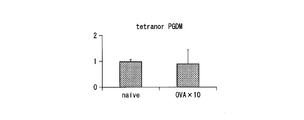
- FIG. 6 is a graph showing the relative value of the content of tetranor PGDM in the urine sample of a food allergy model mouse when the content of tetranor PGDM in the urine sample of an untreated mouse in Example 1 is 1.
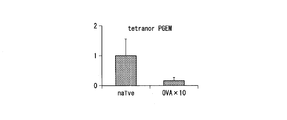
- FIG. 3 is a graph showing the relative value of the content of tetranor PGEM in the urine sample of a food allergy model mouse when the content of tetranor PGEM in the urine sample of the untreated mouse in Example 1 is 1.
- FIG. 3 is a graph showing the relative value of the content of tetranor PGEM in the urine sample of a food allergy model mouse when the content of tetranor PGEM in the urine sample of the untreated mouse in Example 1 is 1.
- the relative value of the content of 20-OH PGE 2 in the urine sample of a food allergy model mouse when the content of 20-OH PGE 2 in the urine sample of the untreated mouse in Example 1 is 1. It is a graph which shows. When the content of PGD 3 in a urine specimen in untreated mice in Example 1 and 1 is a graph showing the relative value of the amount of PGD 3 in a urine specimen in food allergy mouse model. When the content of PGE 3 in a urine specimen in untreated mice in Example 1 and 1 is a graph showing the relative value of the amount of PGE 3 in a urine specimen in food allergy mouse model.
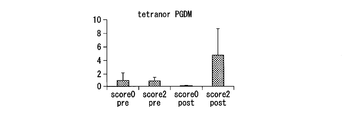
- the score 0 patient after the food allergy load test and the food allergy load test before and after the food allergy load test when the content of tetranor PGDM in the urine sample of the patient (human) score 0 before the food allergy load test in Example 2 It is a graph which shows the relative value of the content of tetranor PGDM in the urine sample of a score 2 patient (human).
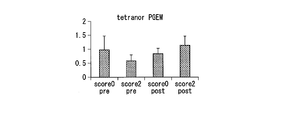
- the score 0 patient after the food allergy load test and the food allergy load test before and after the food allergy load test when the content of tetranor PGEM in the urine sample of the patient 0 (human) score before the food allergy load test in Example 2 is set to 1. It is a graph which shows the relative value of the content of tetranor PGEM in the urine sample of a score 2 patient (human).
- a score 0 patient after the food allergy load test and a food allergy when the content of 11-dehydro TXB 2 in the urine sample of the patient (human) score 0 before the food allergy load test in Example 2 is 1 is a graph showing the relative value of 11-dehydro TXB 2 content in the urine sample score 2 patients before and after the load test (human).
- Score before food allergy load test in Example 2 Score after food allergy load test when the content of 2,3-dinor-8-iso PGF 2 ⁇ in a urine sample of a patient (human) is 1 0 patients, and is a graph showing the relative value of the amount of 2,3-dinor-8-iso PGF 2 ⁇ in a urine specimen score 2 patients before and after food allergy tolerance test (human).
- the score 0 patient after the food allergy load test and the food allergy when the content of 11-trans LTE 4 in the urine specimen of the score 0 patient (human) before the food allergy load test in Example 2 is 1 is a graph showing the relative value of the content of 11-trans LTE 4 in the urine specimen score 2 patients before and after the load test (human).
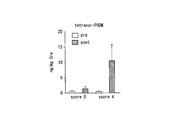
- FIG. 6 is a graph showing the content (absolute value) of tetranor PGEM in urine specimens of patients (human) having score 0 and score 4 before and after the food allergy load test in Example 3.
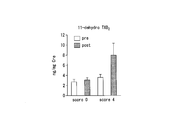
- 10 is a graph showing the content (absolute value) of 11-dehydro TXB 2 in urine samples of patients (human) with score 0 and score 4 before and after the food allergy load test in Example 3.
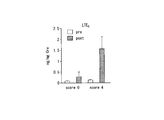
- FIG. I is a graph showing the content of LTE 4 in the urinary sample score 0 and score 4 patients before and after food allergy loading test in Example 3 (human) (absolute value).
- the present invention is a biomarker for testing food allergy, comprising Leukotriene E 4 (LTE 4 ), 14,15-LTE 4 , 11-trans LTE 4 , 11-dehydro Thrombane B 2 ( 11-dehydro TXB 2 ), 2,3-dinor-8-iso Prostaglandin F 2 ⁇ , 13,14-dihydro-15-keto-tetranor PGF 1 ⁇ , 6,15-diketo-13,14-dihydro PGF 1 ⁇ , tetranor- Prostaglandin F Metabolite (tetranor-PGFM) , 20-hydroxy Prostaglandin E 2 (20-OH PGE 2), PGE 3, Prosta landin D 3 (PGD 3), consisting of at least one selected from the group consisting of 13,14-dihydro-15-keto- tetranor PGD 2, and 13,14-dihydro-15-keto- tetranor PGE 2, biomarkers
- biomarker of the present embodiment it is possible to appropriately evaluate not only the presence or absence of food allergy but also the onset risk and severity.
- food allergy means various allergic reactions that occur when allergens contained in food are taken into the body.
- food allergies include chicken eggs, milk, crustaceans, wheat, fruits, nuts, seafood, buckwheat, and the like, and allergies other than these are also included.
- Allergic symptoms occur in the skin, mucous membranes, digestive organs, respiratory organs, etc., and diarrhea, vomiting, dermatitis and the like are typical.
- the “food allergy biomarker” means a substance whose amount serves as an index of the risk of developing allergy, the severity of symptoms, and the prognosis.
- the content of the above 13 kinds of lipids in the urine sample is maintained to increase or decrease for a certain period, so it can be determined to be food. Furthermore, the severity of the symptom can be evaluated from the increased value or decreased value of the content in the urine sample.
- the certain period means, for example, 3 days or more, 5 days or more, 7 days or more, 10 days or more, or 20 days or more after ingesting a substance that causes food allergy.
- LTE 4 11-dehydro TXB 2 , tetranor-PGFM, or 13,14-dihydro-15-keto-tetranor PGD 2 is preferable, and 11-dehydro TXB 2 , or Tetranor-PGFM is more preferred.
- the amount of these lipids is believed to increase or decrease in a mast cell-dependent manner, and mast cells are known to be present in a large amount in the mucosa of the digestive tract where food allergy occurs.
- urine is preferably used as a sample when measuring the above-described biomarker because it can be collected non-invasively and has a large content.
- the present invention is a method for testing food allergy, comprising the step of measuring the content of a biomarker in a urine sample of a subject, wherein the biomarker is LTE 4 , 14, 15-LTE.
- the inspection method of the present embodiment not only the presence or absence of food allergy, but also the onset risk and severity can be appropriately evaluated. In addition, risk can be assessed and preventive treatment given before allergic symptoms occur.
- the test method of the present embodiment does not require medical techniques such as blood collection, and can be easily tested at home from children to the elderly using a urine sample test kit or urine sample test stick described below. .
- “subject” means a person who has a food allergy, a person who has actually developed a food allergy, a person who has been treated for a food allergy, or is taking a food allergy remedy. It means those who are uncertain whether or not they have food allergies. Further, the “subject” is not limited to humans, and may be mammals such as mice, rats, rabbits, cats, dogs, monkeys, pigs, sheep, cows and horses.
- urine collected from the subject is used as a sample.
- the urine used in the inspection method of this embodiment can be collected according to a conventional method. One urine may be used, or two or more urine accumulations may be used.
- the collected urine may be stored at room temperature until measurement, or may be stored at ⁇ 40 ° C. or lower, eg, ⁇ 80 ° C.
- Frozen urine can be thawed rapidly and used for measurement.
- the biomarker is contained in the blood, urine, or stool of the subject, but can be collected non-invasively and has a high content. Therefore, it is preferable to use urine as a sample.
- the above-described method for measuring the content of a biomarker in a urine sample can be performed using any method for detecting and measuring a specific substance in a solution.
- the term “method for measuring the content of a biomarker in a urine sample” is used, not only the amount is accurately measured, but also the presence or absence is detected, or only whether it is greater or less than a certain amount To include.
- the content of the biomarker in the urine sample may be corrected by the amount of a reference substance such as creatinine.
- Tetranor PGDM or tetranor PGEM is a biomarker of food allergy described in International Publication No. 2016/021704, which has been found by the present inventors.
- lipid production and metabolism mechanism there are many kinds of lipids and details are not clarified.
- PGD 2 and TXB 2 and metabolites thereof (for example, tetrar PGDM, 11-dehydro TXB 2 ) are obese.
- lipids other than PGD 2 and TXB 2 metabolites are derived from mast cells or secondary inflammatory reactions caused by their activity It is considered to be a product. Therefore, in addition to the 13 types of lipids described above, by measuring the content of tetranor PGDM or tetranor PGEM, a plurality of lipids can be used as indicators, and the presence or absence of food allergies, as well as the risk and severity of onset. The determination can be made with higher accuracy.
- Examples of the method for measuring the content of the biomarker in the urine specimen include immunoassay, aggregation method, turbidimetric method, Western blotting method, surface plasmon resonance (SPR) method, and various chromatographic techniques. Examples include, but are not limited to, the methods used (eg, gas chromatography, liquid chromatography, high performance liquid chromatography, etc.), mass spectrometry, and the like. Among these, an immunoassay for measuring the content of the biomarker in the urine specimen by using an antigen-antibody reaction between the antibody that specifically binds to the biomarker and the biomarker in the urine specimen, or Mass spectrometry is preferred.
- An immunoassay consists of an antibody that specifically binds to a detectably labeled biomarker or an antibody that specifically binds to any one of the detectably labeled biomarkers (two Secondary antibody) may be used.
- Examples of the antibody labeling method include an enzyme immunoassay (EIA (Enzyme immunoassay) or ELISA (Enzyme-linked immunosorbent assay)), a radioimmunoassay (FIA), and a fluorescence immunoassay (Fluammunoassay; FIA).
- EIA enzyme immunoassay
- FIA radioimmunoassay
- FPIA fluorescence immunoassay
- CLIA chemiluminescent immunoassay
- enzymes such as peroxidase and alkaline phosphatase
- radioactive materials such as 125 I, 131 I, 35 S, and 3 H
- Fluorescent substances such as isothiocyanate and near-infrared fluorescent materials
- the CLIA method use antibodies labeled with luminescent substances such as luciferase, luciferin and aequorin.
- nanoparticles such as gold colloids and quantum dots may be used.
- detection can also be performed by binding avidin or streptavidin labeled with an enzyme or the like using an antibody that specifically binds to the biomarker labeled with biotin.
- an ELISA method using an enzyme label can measure an antigen simply and quickly.
- the ELISA method includes a competitive method and a sandwich method.
- a competitive method to a solid support such as a microplate, of the above mentioned biomarkers, for example, an antibody that specifically binds to LTE 4 (hereinafter, referred to as "anti-LTE 4 antibody.")
- an enzyme-labeled antigen enzyme-labeled LTE 4 that reacts with the antibody is added to cause an antigen-antibody reaction. Once washed, it reacts with the enzyme substrate, develops color, and the absorbance is measured.
- the content of LTE 4 in the urine sample is large, the color development becomes weak, and if the content of LTE 4 in the urine sample is small, the color development becomes strong. Therefore, using the calibration curve, the content of LTE 4 in the urine sample Can be requested. Even when a biomarker other than LTE 4 is used, the content can be determined by the same method.
- an anti-LTE 4 antibody is immobilized on a solid phase carrier, a urine sample is added and reacted, and then an anti-LTE that recognizes another epitope of the same antigen (LTE 4 ) labeled with an enzyme. Add 4 antibodies and allow to react. After washing, reaction with the enzyme substrate, color development, and measuring the absorbance, the content of LTE 4 in the urine sample can be determined. Even when a biomarker other than LTE 4 is used, the content can be determined by the same method.
- DAB 3,3′-diaminobenzidine
- TMB 3,3 ′, 5,5′-tetramethylbenzidine
- OPD o-phenylenediamine
- NPP p-nitropheny phosphatase
- the “solid phase carrier” is not particularly limited as long as it is a carrier capable of immobilizing an antibody.
- the shape of the solid phase carrier include a microtiter plate, a substrate, beads, and a membrane.
- the material of the solid phase carrier include inorganic substances such as silica, alumina, glass, and metals, thermoplastic resins (for example, nylon, polyvinylidene fluoride (PVDF), etc.), and organic polymer substances such as nitrocellulose. It is done.
- the labeling substance or antibody can be immobilized on the above solid phase carrier according to a known method.
- the antibody that specifically binds to any one of the biomarkers described above may be a monoclonal antibody or a polyclonal antibody, and any antibody can be prepared according to a known method.
- Monoclonal antibodies can be produced, for example, by isolating antibody-producing cells from a non-human mammal immunized with any one of the biomarkers described above and fusing them with myeloma cells to produce hybridomas.
- the purified antibody can be purified.
- Polyclonal antibodies can be obtained, for example, from the serum of non-human mammals immunized with any one of the biomarkers described above.
- a separation step for separating a metabolite contained in the urine sample may be provided before the measurement step.
- time-resolved separation of metabolites contained in the urine sample is obtained.
- all chromatographic separation techniques can be used, and more specifically, for example, liquid chromatography (LC), high performance liquid chromatography (HPLC), gas chromatography, and the like. Examples thereof include gas chromatography (GC), thin layer chromatography, size exclusion chromatography, affinity chromatography and the like.
- 11-dehydro TXB 2 , tetranor-PGFMtetranor PGDM, and tetranor PGEM are preferably used in the measurement using mass spectrometry because the separation conditions from the urine specimen are close.
- 11-dehydro TXB 2 , tetranor-PGFMtetranor PGDM, or tetranor PGEM more preferably 11-dehydro TXB 2 , tetranor-PGFMtetranor PGDM, and tetranor PGEM may be used as target biomarkers.
- Examples of the mass spectrometry method used in the measurement process include gas chromatography mass spectrometry (GC-MS) method, liquid chromatography mass spectrometry (LC-MS) method, direct injection mass spectrometry method, and Fourier transform ion.
- GC-MS gas chromatography mass spectrometry
- LC-MS liquid chromatography mass spectrometry
- Fourier transform ion examples include Fourier transform ion.
- Cyclotron resonance mass spectrometry (Fourier transformation mass cyclotron resonance mass spectrometry; FT-ICR-MS) method, capillary electrophoresis mass spectrometry (Capillary Electrophoresis mass spectrometry-MS mass spectrometry; HPLC-MS HPLC method) Method, quadrupole mass spectrometry, tandem mass spectrometry combined with the above separation methods (eg LC-MS / MS method, HPLC-MS / MS method, etc.), inductively coupled plasma mass spectrometry (ICP-MS) method, pyrolysis mass spectrometry (Py-MS) method, Examples thereof include ion mobility mass spectrometry, time-of-flight mass spectrometry (TOF MS), and the like.
- the mass spectrometry is preferably an LC-MS method or a tandem mass spectrometry combined with the above-described separation method.
- a pretreatment step of adding an internal standard to the urine sample may be provided in order to quantify the content of the biomarker in the urine sample.
- the internal standard include deuterated LTC4, deuterated 6-keto-PGF1 ⁇ , deuterated tetranor-PGDM, deuterated tetranor-PGEM, deuterated PGE2, and the like. Or may be used in combination.
- the inspection method of the present embodiment may include an evaluation step for evaluating the risk and severity of food allergy based on the content of the biomarker in the urine sample after the above [measurement step]. Good.
- the content of the biomarker in the urine sample may be determined by measuring the content of the biomarker in the urine sample collected a plurality of times from the same individual and comparing the results. In this case, it is possible to evaluate changes in the severity and risk of onset in the same individual. Whether or not the content of the biomarker in the urine sample is higher may be measured by measuring the content of the biomarker in the urine sample collected from a plurality of persons and comparing the results. In this case, it is possible to evaluate whether the severity and the risk of onset are higher than those of other people.
- the predetermined value when it is lower than the predetermined value, it can be determined that the symptoms of food allergy are light or light, or the risk of developing food allergy is low or low.
- the content of PGE 3 or PGD 3 in the urine sample when the content of PGE 3 or PGD 3 in the urine sample is less than a predetermined value, the symptoms of food allergy are serious or serious, or food allergy It can be determined that the risk of developing is increased or increased.
- it is higher than the predetermined value it can be determined that the symptoms of food allergy are light or light, or the risk of developing food allergy is low or low.
- Predetermined value compares the content of the biomarker in urine samples of multiple healthy subjects or non-food allergic patients with the content of the biomarker in urine samples of multiple food allergic patients Thus, it can be determined by a conventional method.
- the determination of the content of tetranor-PGDM or tetranor-PGEM in the urine sample makes it possible to determine food allergy symptoms and risk of onset with higher accuracy. be able to. More specifically, when the amount of tetranor-PGDM in urine is higher than a predetermined value, it is judged that the symptom is serious or the risk of onset is high, and when lower than the predetermined value, the symptom is mild. Or it is judged that the onset risk is low.
- activation of mast cells means an increase in the number of mast cells, an increase in degranulation, and an increase in the amount of active substance production.
- the content of the above-described biomarker in the urine specimen increases or decreases as the number of mast cells increases, and decreases or increases under the suppression of degranulation. Therefore, mast cell activation can be evaluated using the content of the biomarker in the urine sample as an index.
- the inspection method of the present embodiment can be used for evaluation of a therapeutic agent administered to a food allergy patient or a therapeutic method performed on the patient.
- a therapeutic agent administered to a food allergy patient or a therapeutic method performed on the patient For example, when the content of the biomarker described above is measured in a urine sample collected at any time after the start of treatment from the start of treatment, and the content of the biomarker decreases or increases, the therapeutic agent or It can be determined that the treatment method is effective. On the other hand, when the content of the above-described biomarker does not decrease, increases, does not increase, or decreases, it can be determined that the therapeutic agent or method is not effective. At this time, the decrease or increase in the content of the biomarker described above may not be a significant decrease or increase, but may be such that a person skilled in the art can determine that there is a tendency to decrease or increase.
- the administration route, dosage and administration frequency of the desensitization therapy are not particularly limited, and can be appropriately selected according to various conditions such as the patient's age, weight and symptoms.
- Examples of the administration route include a route of administration to an individual by intradermal, subcutaneous, intramuscular, intraperitoneal, transdermal, transmucosal, oral, inhalation and the like.
- the test method of this embodiment may be used to evaluate the effect of a drug in an animal experiment for the development of a food allergy drug.
- the inspection method of this embodiment may be used when examining a sample collected from a subject in order to obtain information necessary for diagnosis.
- Such an inspection method can be performed by, for example, an inspection company.
- the present invention relates to anti-LTE 4 antibody, anti-14,15-LTE 4 antibody, anti-11-trans LTE 4 antibody, anti-11-dehydro TXB 2 antibody, anti-2,3-dinor-8-iso PGF.
- the urine sample test kit of this embodiment is used for testing food allergies using the test method described above, and can be easily tested at home from children to the elderly.
- the urine specimen test kit of this embodiment may further contain an anti-tetranor-PGDM antibody or an anti-tetranor-PGEM antibody.
- an anti-tetranor-PGDM antibody or an anti-tetranor-PGEM antibody used as indicators. It is possible to determine the presence or absence of food allergy and the risk and severity of onset with higher accuracy.
- the urine specimen test kit of this embodiment can be used in an immunoassay using an antibody that specifically binds to the above-described biomarker, and includes reagents and devices necessary for measuring the content of the above-described biomarker. May be included.
- the urine specimen test kit of this embodiment is a microtiter plate; anti-LTE 4 for capturing antigen (LTE 4 ) when the content of LTE 4 among the biomarkers described above is measured by the sandwich method.
- An antibody hereinafter referred to as “capture antibody 1”
- an anti-LTE 4 antibody labeled with peroxidase or alkaline phosphatase hereinafter referred to as “labeled antibody 1”
- a peroxidase substrate eg, DAB, TMB). , OPD, etc.
- an alkaline phosphatase substrate eg, NPP, etc.
- the capture antibody 1 and the labeled antibody 1 preferably recognize different epitopes of the antigen (LTE 4 ).
- the capture antibody 1 is immobilized on a microtiter plate. Subsequently, the urine specimen is appropriately diluted and added here, and incubated. Subsequently, the urine sample is removed and washed. Subsequently, labeled antibody 1 is added and incubated. Subsequently, the substrate is added to cause color development. By measuring the color development using a microtiter plate reader or the like, the content of LTE 4 can be determined. Even when an antibody that specifically binds to a biomarker other than LTE 4 is used, the content can be determined by the same method.
- the urine specimen test kit of the present embodiment is a microtiter plate; antigen (LTE 4 ), for example, when the content of LTE 4 among the biomarkers described above is measured by a sandwich method using a secondary antibody.
- antigen LTE 4
- Anti-LTE 4 antibody for capture (hereinafter referred to as “capture antibody 2”); anti-LTE 4 antibody as a primary antibody (hereinafter referred to as “primary antibody 1”); peroxidase as a secondary antibody or An antibody against anti-LTE 4 antibody labeled with alkaline phosphatase (hereinafter referred to as “secondary antibody 1”); and a peroxidase substrate (eg, DAB, TMB, OPD, etc.) or an alkaline phosphatase substrate (eg, NPP, etc.) May be included.
- the capture antibody 2 and the primary antibody 1 preferably recognize different epitopes of the antigen (LTE 4 ).
- the capture antibody 2 is immobilized on a microtiter plate. Subsequently, the urine specimen is appropriately diluted and added here, and incubated. Subsequently, the urine sample is removed and washed. Subsequently, primary antibody 1 is added, incubated and washed. Subsequently, a secondary antibody is added and incubated, and a substrate is added to cause color development. By measuring the color development using a microtiter plate reader or the like, the content of LTE 4 can be determined. Further, by using the secondary antibody 1, the reaction is amplified, and the detection sensitivity can be increased. Even when an antibody that specifically binds to a biomarker other than LTE 4 is used, the content can be determined by the same method.
- the above-mentioned labeled antibody 1 and the above-mentioned secondary antibody 1 are not limited to enzyme-labeled antibodies, but are radioactive materials such as 125 I, 131 I, 35 S, 3 H, fluorescein isothiocyanate, rhodamine, dansyl chloride, phycoerythrin. It may be an antibody labeled with a fluorescent substance such as tetramethylrhodamine isothiocyanate, a near-infrared fluorescent material, a luminescent substance such as luciferase, luciferin, or aequorin, a gold colloid, a nanoparticle such as a quantum dot, or the like.
- the labeled antibody 1 and the secondary antibody 1 described above may be biotinylated antibodies.
- the urine sample test kit of this embodiment includes labeled avidin or streptavidin. Also good.
- the urine specimen test kit of the present embodiment further includes deuterated LTC 4 , deuterated 6-keto-PGF 1 ⁇ , deuterium as internal standards. of tetranor-PGEM, and it may include at least one selected from the group consisting of deuterated PGE 2.
- deuterated LTC 4 deuterated 6-keto-PGF 1 ⁇
- deuterium deuterium as internal standards. of tetranor-PGEM, and it may include at least one selected from the group consisting of deuterated PGE 2.
- Examples of deuterated LTC 4 include LTC 4 -d5.
- Examples of deuterated 6-keto-PGF 1 ⁇ include 6-keto-PGF 1 ⁇ - d4.
- Examples of deuterated tetranor-PGEM include tetranor-PGEM-d6.
- Examples of deuterated PGE 2 include PGE 2 -d4.
- the kit for urine specimen testing of this embodiment may further contain deuterated tetranor-PGDM.
- deuterated tetranor-PGDM By using the urine sample test kit of this embodiment, in addition to at least one of the 13 types of lipids described above, by measuring the content of tetranor PGDM or tetranor PGEM, a plurality of lipids can be used as indices. It is possible to determine the presence or absence of food allergy and the risk and severity of onset with higher accuracy.
- An example of deuterated tetranor-PGDM is tetranor-PGDM-d6.
- the urine sample test kit of this embodiment may further contain necessary buffer solution, enzyme reaction stop solution, macroplate reader, and the like.
- the urine sample test kit of this embodiment can be used for evaluation of mast cell activation in food allergy.
- the present invention relates to anti-LTE 4 antibody, anti-14,15-LTE 4 antibody, anti-11-trans LTE 4 antibody, anti-11-dehydro TXB 2 antibody, anti-2,3-dinor-8-iso PGF.
- anti-13,14-dihydro-15-keto-tetranor PGF 1 ⁇ antibody anti-6,15-diketo-13,14-dihydro PGF 1 ⁇ antibody, anti-tetranor-PGFM antibody, anti-20-OH PGE 2 antibody, anti-antibody
- anti-antibody At least one selected from the group consisting of PGE 3 antibody, anti-PGD 3 antibody, anti-13,14-dihydro-15-keto-tetranor PGD 2 antibody and anti-13,14-dihydro-15-keto-tetranor PGE 2 antibody Including food allergy urine sample test To provide a click.
- the urine specimen testing stick of this embodiment is used for testing food allergies using the testing method described above, and can be easily tested at home from children to the elderly.
- the urine specimen test stick according to the present embodiment is a stick-shaped test drug, and may be any substance that visualizes the content of the biomarker in the urine specimen, for example, with a colored line.
- the urine specimen testing stick of this embodiment may further contain an anti-tetranor-PGDM antibody or an anti-tetranor-PGEM antibody.
- an anti-tetranor-PGDM antibody or an anti-tetranor-PGEM antibody used as an index. It is possible to determine the presence or absence of food allergy and the risk and severity of onset with higher accuracy.
- the urine specimen testing stick As the urine specimen test stick, a known stick can be used, and for example, a configuration using an immunochromatography method or the like can be used.
- the urine specimen testing stick of the present embodiment is prepared by the immunochromatography method, for example, when measuring the content of LTE 4 among the biomarkers described above, the first anti-LTE 4 antibody labeled with colloidal gold or the like is used.
- an antibody storing portion which is stored, that the anti-LTE 4 antibodies another epitope recognizing second of LTE 4 is, the determination unit immobilized in a line shape such as a cellulose film, a structure which is connected by a thin groove Can do.
- a urine sample is added to the urine sample test stick, and the first anti-LTE 4 antibody and LTE 4 are reacted with each other in the antibody storage unit to form an LTE 4 -first anti-LTE 4 antibody complex.
- the complex passes through the groove by capillary action and moves to the determination unit.
- the complex is captured by the second anti-LTE 4 antibody immobilized on the determination unit.
- LTE 4 can be detected by the appearance of a red line in the determination unit due to the plasmon effect of the gold colloid. Even when an antibody that specifically binds to a biomarker other than LTE 4 is used, it can be detected by the same method.
- the urine specimen test stick of this embodiment can be used for evaluation of mast cell activation in food allergy.
- Example 1 Dynamics of lipid mediators in urine specimens in food allergy model mice (1) Preparation of ovalbumin (OVA) -induced food allergy model mice (1-1) Sensitization conditions Wild-type BALB / c mice Sensitization was performed by administering 50 ⁇ g of ovalbumin (Ovalbumin; OVA) and 1 mg of alum intraperitoneally (6-12 weeks old, female) and 50 ⁇ g of OVA intraperitoneally two weeks later.
- OVA ovalbumin
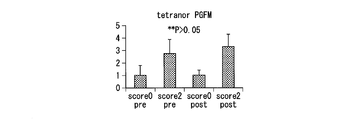
- tetranor-PGFM increased in score 2 pre compared to score 0 pre and score 0 post, suggesting that it could be used as a marker that reflects the predisposition to food allergies. It was done.
- mice 6,15-diketo-13,14-dihydro PGF 1 ⁇ and 20-OH PGE 2 were significantly increased only in mice, and PGD 3 and PGE 3 were significantly decreased only in mice. Therefore, it was suggested that the above four components are useful as biomarkers in an experimental system for evaluating the allergenicity of foods using mice.
- tetranor-PGFM, 2,3-dinor-8-iso PGF 2 ⁇ , 11-dehydro TXB 2 , 14, 15-LTE 4 , and 11-trans LTE 4 were significantly increased only in humans. Therefore, it was suggested that the above five components are useful as biomarkers for appropriately evaluating the risk and severity of food allergy in humans or for evaluating responsiveness to desensitization therapy.
- Tetranor-PGDM-d6, tetranor-PGEM-d6, TMX-d4, and LTC 4 -d5 were added to the urine supernatant as internal standards.
- urine specimens were prepared to pH 3-4 using hydrochloric acid.
- the prepared urine specimen was injected into a Sep-pak C18 cartridge (manufactured by Waters) equilibrated with methanol and purified water.
- impurities were washed with 3 mL water and 3 mL ⁇ 2 hexane.
- the target component was eluted with methanol. Subsequently, after drying under reduced pressure for 4 hours, it was redissolved in 80% methanol and filtered.
- the test method of the present invention does not require medical techniques such as blood sampling, and can be easily tested at home from children to the elderly using the urine sample test kit or urine sample test stick of the present invention. Can do.
Landscapes
- Health & Medical Sciences (AREA)
- Life Sciences & Earth Sciences (AREA)
- Engineering & Computer Science (AREA)
- Hematology (AREA)
- Molecular Biology (AREA)
- Immunology (AREA)
- Biomedical Technology (AREA)
- Chemical & Material Sciences (AREA)
- Urology & Nephrology (AREA)
- Physics & Mathematics (AREA)
- General Physics & Mathematics (AREA)
- Cell Biology (AREA)
- Food Science & Technology (AREA)
- Medicinal Chemistry (AREA)
- Biotechnology (AREA)
- Analytical Chemistry (AREA)
- Biochemistry (AREA)
- General Health & Medical Sciences (AREA)
- Microbiology (AREA)
- Pathology (AREA)
- Physiology (AREA)
- Tropical Medicine & Parasitology (AREA)
- Biophysics (AREA)
- Endocrinology (AREA)
- Investigating Or Analysing Biological Materials (AREA)
- Peptides Or Proteins (AREA)
- Other Investigation Or Analysis Of Materials By Electrical Means (AREA)
- Apparatus Associated With Microorganisms And Enzymes (AREA)
- Measuring Or Testing Involving Enzymes Or Micro-Organisms (AREA)
Abstract
Description
本願は、2016年1月29日に、日本に出願された特願2016-015681号に基づき優先権を主張し、その内容をここに援用する。
また、血中IgEを測定する診断方法では、アレルギー反応の有無は推測できても、発症リスクや症状の程度を知ることはできない。つまり、血中のIgE抗体の存在量と食物アレルギー症状の発症リスクや重篤度とは一致しないことが多い。また、この方法は採血が必要とされるため、医療機関にて行わなければならず、採血自体、乳幼児には負担も大きい。
[1]食物アレルギーを検査するためのバイオマーカーであって、
Leukotriene E4(LTE4)、14,15-LTE4、11-trans LTE4、11-dehydro Thromboxane B2(11-dehydro TXB2)、2,3-dinor-8-iso Prostaglandin F2α、13,14-dihydro-15-keto-tetranor PGF1β、6,15-diketo-13,14-dihydro PGF1α、tetranor-Prostaglandin F Metabolite(tetranor-PGFM)、20-hydroxy Prostaglandin E2(20-OH PGE2)、PGE3、Prostaglandin D3(PGD3)、13,14-dihydro-15-keto-tetranor PGD2、及び13,14-dihydro-15-keto-tetranor PGE2からなる群から選ばれる少なくとも一つからなることを特徴とするバイオマーカー。
[2]被検者の尿検体中のバイオマーカーの含有量を測定する工程を備えた食物アレルギーの検査方法であって、前記バイオマーカーがLTE4、14,15-LTE4、11-trans LTE4、11-dehydro TXB2、2,3-dinor-8-iso Prostaglandin F2α、13,14-dihydro-15-keto-tetranor PGF1β、6,15-diketo-13,14-dihydro PGF1α、tetranor-PGFM、20-OH PGE2、PGE3、PGD3、13,14-dihydro-15-keto-tetranor PGD2、及び13,14-dihydro-15-keto-tetranor PGE2からなる群から選ばれる少なくとも一つであることを特徴とする方法。
[3]前記測定工程において、さらに、tetranor-PGDM又はtetranor-PGEMの含有量を測定する、[2]に記載の方法。
[4]さらに、尿検体中の前記バイオマーカーの含有量が多い又は少ないほど、食物アレルギーの症状が重篤である若しくは重篤になった、又は、食物アレルギーを発症するリスクが高い若しくは高くなったと評価する評価工程を備える、[2]又は[3]に記載の方法。
[5]食物アレルギーの治療法又は治療薬の評価に用いられる、[2]~[4]のいずれか一つに記載の方法。
[6]減感作療法に用いられる、[5]に記載の方法。
[7]前記測定工程を、イムノアッセイ又は質量分析法で行う、[2]~[6]のいずれか一つに記載の方法。
[8]さらに、前記尿検体中に、重水素化LTC4、重水素化6-keto-PGF1α、重水素化tetranor-PGDM、重水素化tetranor-PGEM、及び重水素化PGE2からなる群から選ばれる少なくとも一つを内部標準として加える前処理工程を備え、前記測定工程を、質量分析法で行う、[7]に記載の方法。
[9]前記評価工程において、食物アレルギーにおける肥満細胞の活性化を評価する、[2]~[8]のいずれか一つに記載の方法。
[10]抗LTE4抗体、抗14,15-LTE4抗体、抗11-trans LTE4抗体、抗11-dehydro TXB2抗体、抗2,3-dinor-8-iso PGF2α抗体、抗13,14-dihydro-15-keto-tetranor PGF1β抗体、抗6,15-diketo-13,14-dihydro PGF1α抗体、抗tetranor-PGFM抗体、抗20-OH PGE2抗体、抗PGE3抗体、抗PGD3抗体、抗13,14-dihydro-15-keto-tetranor PGD2抗体、及び抗13,14-dihydro-15-keto-tetranor PGE2抗体からなる群から選ばれる少なくとも一つを含むことを特徴とする食物アレルギーの尿検体検査用キット。
[11]さらに、抗tetranor-PGDM抗体又は抗tetranor-PGEM抗体を含む、[10]に記載の食物アレルギーの尿検体検査用キット。
[12]さらに、重水素化LTC4、重水素化6-keto-PGF1α、重水素化tetranor-PGDM、重水素化tetranor-PGEM、及び重水素化PGE2からなる群から選ばれる少なくとも一つを含む、[10]又は[11]に記載の食物アレルギーの尿検体検査用キット。
[13]さらに、重水素化tetranor-PGDMを含む、[10]~[12]にいずれか一つに記載の食物アレルギーの尿検体検査用キット。
[14]抗LTE4抗体、抗14,15-LTE4抗体、抗11-trans LTE4抗体、抗11-dehydro TXB2抗体、抗2,3-dinor-8-iso PGF2α抗体、抗13,14-dihydro-15-keto-tetranor PGF1β抗体、抗6,15-diketo-13,14-dihydro PGF1α抗体、抗tetranor-PGFM抗体、抗20-OH PGE2抗体、抗PGE3抗体、抗PGD3抗体、抗13,14-dihydro-15-keto-tetranor PGD2抗体、及び抗13,14-dihydro-15-keto-tetranor PGE2抗体からなる群から選ばれる少なくとも一つを含むことを特徴とする食物アレルギーの尿検体検査用スティック。
[15]さらに、抗tetranor-PGDM抗体又は抗tetranor-PGEM抗体を含む、[14]に記載の食物アレルギーの尿検体検査用スティック。
また、本発明の検査方法は、採血等の医療技術を必要とせず、本発明の尿検体検査用キット又は尿検体検査用スティックを用いて、小児から高齢者まで簡便に家庭で検査を行うことができる。
一実施形態として、本発明は、食物アレルギーを検査するためのバイオマーカーであって、Leukotriene E4(LTE4)、14,15-LTE4、11-trans LTE4、11-dehydro Thromboxane B2(11-dehydro TXB2)、2,3-dinor-8-iso Prostaglandin F2α、13,14-dihydro-15-keto-tetranor PGF1β、6,15-diketo-13,14-dihydro PGF1α、tetranor-Prostaglandin F Metabolite(tetranor-PGFM)、20-hydroxy Prostaglandin E2(20-OH PGE2)、PGE3、Prostaglandin D3(PGD3)、13,14-dihydro-15-keto-tetranor PGD2、及び13,14-dihydro-15-keto-tetranor PGE2からなる群から選ばれる少なくとも一つからなる、バイオマーカーを提供する。

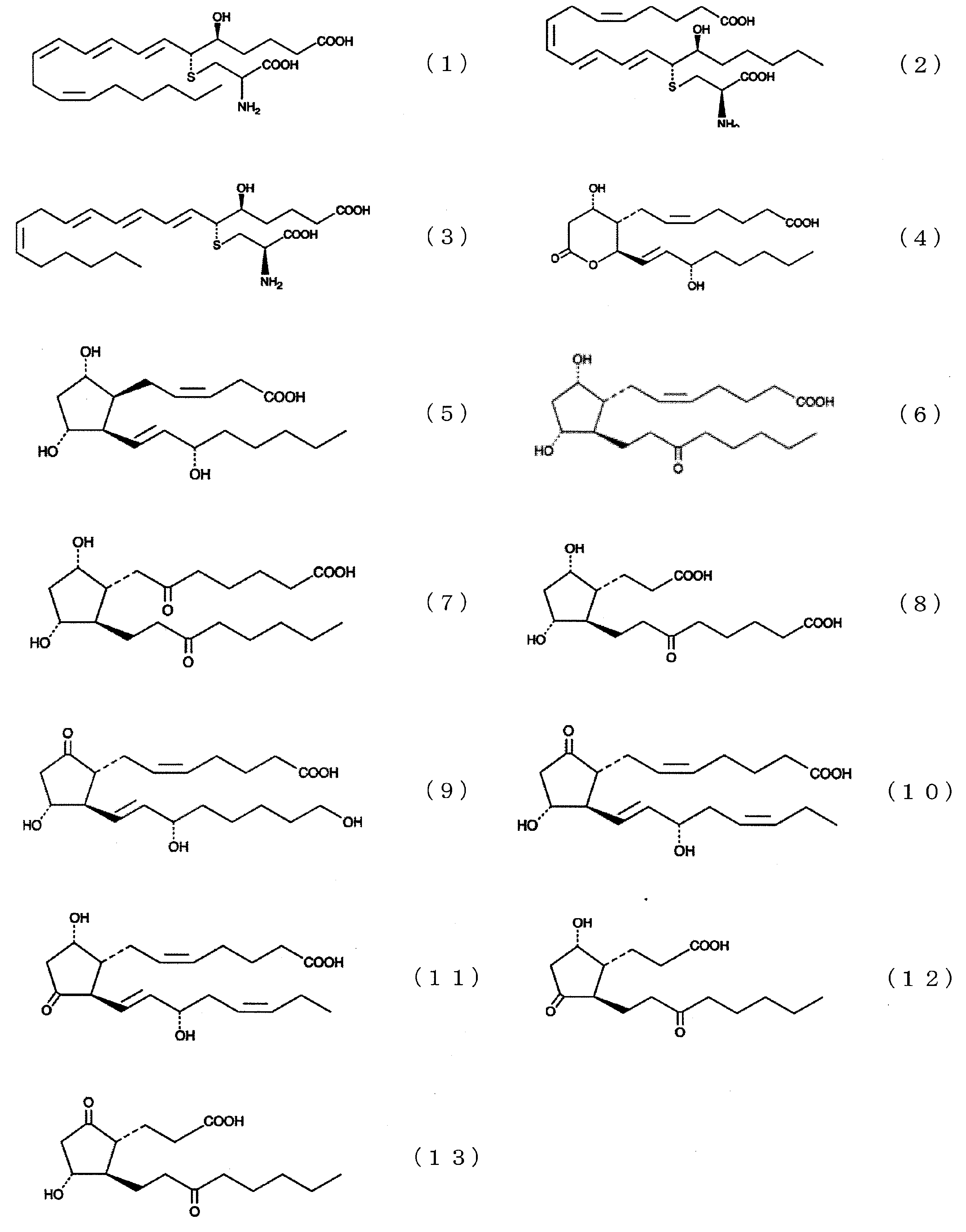
これらの脂質の量は、肥満細胞依存的に上昇又は減少すると考えられており、肥満細胞は、食物アレルギーが起こる消化管の粘膜に非常に多く存在することが知られている。よって、食物を摂取し、消化される際に、上述の脂質の量が変化を、被検者から血液、尿、又は便を採取することによって、食物アレルギーの有無、及び発症リスクや重篤度を適切に評価することができる。中でも、非侵襲的に採取することができ、含有量が多いことから、上述のバイオマーカーを測定する場合には、尿を試料として用いることが好ましい。
一実施形態において、本発明は、被検者の尿検体中のバイオマーカーの含有量を測定する工程を備えた食物アレルギーの検査方法であって、前記バイオマーカーがLTE4、14,15-LTE4、11-trans LTE4、11-dehydro TXB2、2,3-dinor-8-iso Prostaglandin F2α、13,14-dihydro-15-keto-tetranor PGF1β、6,15-diketo-13,14-dihydro PGF1α、tetranor-PGFM、20-OH PGE2、PGE3、PGD3、13,14-dihydro-15-keto-tetranor PGD2、及び13,14-dihydro-15-keto-tetranor PGE2からなる群から選ばれる少なくとも一つである、方法を提供する。
本実施形態の検査方法は、採血等の医療技術を必要とせず、後述の尿検体検査用キット又は尿検体検査用スティックを用いて、小児から高齢者まで簡便に家庭で検査を行うことができる。
測定工程において、被検者より採取した尿を試料として用いる。本実施形態の検査方法に用いられる尿は、常法に従って採取したものを用いることができる。一回の尿であってもよく、二回以上の蓄尿であってもよい。採取した尿は、測定まで室温で保存してもよく、-40℃以下、例えば-80℃で保存してもよい。凍結した尿は、急速に融解させて測定に用いることができる。
なお、上述の<食物アレルギーのバイオマーカー>に記載したとおり、前記バイオマーカーは、被検者の血液、尿、又は便に含まれるが、非侵襲的に採取することができ、含有量が多いことから、尿を試料として用いることが好ましい。
tetranor PGDM又はtetranor PGEMは、国際公開第2016/021704号に記載の食物アレルギーのバイオマーカーであって、本発明者らによって見出されたものである。
脂質の産生及び代謝機構については、脂質の種類が多く、詳細は明らかにされていないが、PGD2及びTXB2、並びにこれらの代謝産物(例えば、tetranor PGDM、11-dehydro TXB2)は、肥満細胞由来のものであると考えられ、また、上述の13種の脂質のうち、PGD2及びTXB2の代謝産物以外の脂質は、肥満細胞由来のもの又はその活性によって起こる二次的な炎症反応産物であると考えられる。
よって、上述の13種の脂質に加えて、tetranor PGDM又はtetranor PGEMの含有量を測定することにより、複数の脂質を指標とすることができ、食物アレルギーの有無、及び発症リスクや重篤度をより高い精度で判定することができる。
イムノアッセイは、検出可能に標識された上述のバイオマーカーに特異的に結合する抗体、又は、検出可能に標識された上述のバイオマーカーのうちいずれか一つに特異的に結合する抗体に対する抗体(二次抗体)を用いればよい。抗体の標識方法としては、例えば、エンザイムイムノアッセイ(EIA(Enzyme immunoassay)又はELISA(Enzyme-linked immunosorbent assay))、ラジオイムノアッセイ(Radioimmunoassay;RIA)、蛍光イムノアッセイ(Fluoroimmunoassay;FIA)、蛍光偏光イムノアッセイ(Fluorescence polarization immunoassay;FPIA)、化学発光イムノアッセイ(Chemiluminescent Immunoassay;CLIA)等が挙げられる。
競合法では、マイクロプレート等の固相担体に、上述のバイオマーカーのうち、例えば、LTE4に特異的に結合する抗体(以下、「抗LTE4抗体」と呼ぶ。)を固定し、尿検体と、酵素標識された抗原として、前記抗体と反応する酵素標識されたLTE4とを添加して、抗原抗体反応を生じさせる。いったん洗浄した後、酵素基質と反応、発色させ、吸光度を測定する。尿検体中のLTE4の含有量が多ければ発色は弱くなり、尿検体中のLTE4の含有量が少なければ発色は強くなるので、検量線を用いて、LTE4の尿検体中の含有量を求めることができる。LTE4以外のバイオマーカーを用いた場合においても、同様の方法により、含有量を求めることができる。
また、サンドイッチ法では、前記固相担体に固定した抗LTE4抗体と、尿検体中の抗原(LTE4)を反応させた後、まず非標識の同じ抗原(LTE4)の別のエピトープを認識する抗LTE4抗体を添加し、この非標識の抗LTE4抗体に対する抗体(二次抗体)を酵素標識してさらに添加してもよい。
測定工程において、質量分析法を用いる場合、測定工程の前に尿検体中に含まれる代謝物質を分離するための分離工程を備えていてもよい。分離工程では、尿検体中に含まれる代謝物質の時間分解分離が得られる。分離方法としては、すべてのクロマトグラフィー分離技術を用いることができ、より具体的には、例えば、液体クロマトグラフィー(Liquid chromatography;LC)、高速液体クロマトグラフィー(High performance liquid chromatography;HPLC)、ガスクロマトグラフィー(Gas chromatography;GC)、薄層クロマトグラフィー、サイズ排除クロマトグラフィー、アフィニティークロマトグラフィー等が挙げられる。
また、分離工程において、上述のバイオマーカーのうち、11-dehydro TXB2、tetranor-PGFMtetranor PGDM、及びtetranor PGEMは尿検体中からの分離条件が近しいため、質量分析法を用いた測定においては、好ましくは11-dehydro TXB2、tetranor-PGFMtetranor PGDM、又はtetranor PGEM、より好ましくは11-dehydro TXB2、tetranor-PGFMtetranor PGDM、及びtetranor PGEMを標的のバイオマーカーとすればよい。
本実施形態の検査方法において、上述の[測定工程]の後に、尿検体中の上述のバイオマーカーの含有量に基づき、食物アレルギーの発症リスクや重篤度を評価する評価工程を備えていてもよい。
また、上述のバイオマーカーのうち、PGE3又はPGD3の尿検体中の含有量がより少ないときに、食物アレルギーの症状が重篤である若しくは重篤になった、又は、食物アレルギーを発症するリスクが高い若しくは高くなったと判断することができる。
また、上述のバイオマーカーのうち、PGE3又はPGD3の尿検体中の含有量が所定の値より少ないときに、食物アレルギーの症状が重篤である若しくは重篤になった、又は、食物アレルギーを発症するリスクが高い若しくは高くなったと判断することができる。一方、所定の値より高いときに、食物アレルギーの症状が軽い若しくは軽くなった、又は、食物アレルギーを発症するリスクが低い若しくは低くなったと判断することができる。
本実施形態の検査方法は、食物アレルギー患者に投与する治療薬、又は患者に対して行う治療方法の評価に用いることができる。例えば、治療開始前から治療開始後の任意の時点で採取した尿検体における上述のバイオマーカーの含有量を測定し、上述のバイオマーカーの含有量が減少又は増加する場合には、その治療薬又は治療方法は有効であると判断することができる。一方、上述のバイオマーカーの含有量が減少しない若しくは増加する又は増加しない又は減少する場合には、その治療薬又は治療方法は有効ではないと判断することができる。このとき、上述のバイオマーカーの含有量の減少または増加は、有意な減少又は増加でなくてもよく、減少または増加の傾向があると当業者が判断できる程度であってもよい。
一実施形態において、本発明は、抗LTE4抗体、抗14,15-LTE4抗体、抗11-trans LTE4抗体、抗11-dehydro TXB2抗体、抗2,3-dinor-8-iso PGF2α抗体、抗13,14-dihydro-15-keto-tetranor PGF1β抗体、抗6,15-diketo-13,14-dihydro PGF1α抗体、抗tetranor-PGFM抗体、抗20-OH PGE2抗体、抗PGE3抗体、抗PGD3抗体、抗13,14-dihydro-15-keto-tetranor PGD2抗体及び抗13,14-dihydro-15-keto-tetranor PGE2抗体からなる群(前記13種の抗体をまとめて、以下、「上述のバイオマーカーに特異的に結合する抗体」と呼ぶ。)から選ばれる少なくとも一つを含む、食物アレルギーの尿検体検査用キットを提供する。
本実施形態の尿検体検査用キットは、サンドイッチ法によって、例えば、上述のバイオマーカーのうちLTE4の含有量を測定する場合には、マイクロタイタープレート;抗原(LTE4)捕捉用の抗LTE4抗体(以下、「捕捉用抗体1」と呼ぶ。);ペルオキシダーゼ又はアルカリホスファターゼで標識された抗LTE4抗体(以下、「標識抗体1」と呼ぶ。);及び、ペルオキシダーゼ基質(例えば、DAB、TMB、OPD等)又はアルカリホスファターゼ基質(例えば、NPP等)を含んでいてもよい。
捕捉用抗体1と標識抗体1は、抗原(LTE4)の異なるエピトープを認識するものであることが好ましい。
LTE4以外のバイオマーカーに特異的に結合する抗体を用いた場合においても、同様の方法により、含有量を求めることができる。
本実施形態の尿検体検査用キットは、二次抗体を使用したサンドイッチ法によって、例えば、上述のバイオマーカーのうちLTE4の含有量を測定する場合には、マイクロタイタープレート;抗原(LTE4)捕捉用の抗LTE4抗体(以下、「捕捉用抗体2」と呼ぶ。);一次抗体としての抗LTE4抗体(以下、「一次抗体1」と呼ぶ。);二次抗体としての、ペルオキシダーゼ又はアルカリホスファターゼで標識された抗LTE4抗体に対する抗体(以下、「二次抗体1」と呼ぶ。);及び、ペルオキシダーゼ基質(例えば、DAB、TMB、OPD等)又はアルカリホスファターゼ基質(例えば、NPP等)を含んでいてもよい。
捕捉用抗体2と一次抗体1は、抗原(LTE4)の異なるエピトープを認識するものであることが好ましい。
LTE4以外のバイオマーカーに特異的に結合する抗体を用いた場合においても、同様の方法により、含有量を求めることができる。
また、上述の標識抗体1及び上述の二次抗体1は、ビオチン化抗体であってもよく、この場合、本実施形態の尿検体検査用キットは、標識されたアビジン又はストレプトアビジンを含んでいてもよい。
本実施形態の尿検体検査用キットは、質量分析法により上述のバイオマーカーを測定する場合には、さらに、内部標準として、重水素化LTC4、重水素化6-keto-PGF1α、重水素化tetranor-PGEM、及び重水素化PGE2からなる群から選ばれる少なくとも一つを含んでいてもよい。これらを内部標準とすることにより、尿検体中の上述のバイオマーカーの含有量を測定する際に、分析毎の抽出効率及びイオン化効率を補正することができる。
重水素化tetranor-PGDMとしては、例えば、tetranor-PGDM-d6等が挙げられる。
一実施形態として、本発明は、抗LTE4抗体、抗14,15-LTE4抗体、抗11-trans LTE4抗体、抗11-dehydro TXB2抗体、抗2,3-dinor-8-iso PGF2α抗体、抗13,14-dihydro-15-keto-tetranor PGF1β抗体、抗6,15-diketo-13,14-dihydro PGF1α抗体、抗tetranor-PGFM抗体、抗20-OH PGE2抗体、抗PGE3抗体、抗PGD3抗体、抗13,14-dihydro-15-keto-tetranor PGD2抗体及び抗13,14-dihydro-15-keto-tetranor PGE2抗体からなる群から選ばれる少なくとも一つを含む、食物アレルギーの尿検体検査用スティックを提供する。
本実施形態の尿検体検査用スティックは、イムノクロマト法により、例えば、上述のバイオマーカーのうちLTE4の含有量を測定する場合には、金コロイドなどで標識された第1の抗LTE4抗体が格納された抗体格納部と、LTE4の別のエピトープを認識する第2の抗LTE4抗体とが、セルロース膜などにライン状に固定化された判定部が細い溝でつながれた構成とすることができる。
LTE4以外のバイオマーカーに特異的に結合する抗体を用いた場合においても、同様の方法により、検出することができる。
(1)オボアルブミン(Ovalbumin;OVA)誘導性食物アレルギーモデルマウスの作製
(1-1)感作条件
野生型のBALB/cマウス(6~12週齢、雌)にオボアルブミン(Ovalbumin;OVA)50μg及びミョウバン1mgを腹腔内投与し、2週間後にOVA50μgを腹腔内投与することにより、感作した。
続いて、2回目の投与から2週間後に、マウスにOVA10mgを2日おきに計10回経口投与した。
続いて、10回目の刺激後、観察中に、マウス(n=5)の尿を採取した。コントロールとして、無処置のマウス(n=3)について観察中に、尿を採取した。
尿上清に内部標準として、LTC4-d5、6-keto-PGF1α-d4、tetranor-PGDM-d6、tetranor-PGEM-d6、PGE2-d4を加えた。続いて、塩酸及びエタノールを用いて、尿検体をpH3~4の50%エタノール含有溶液となるように調製した。続いて、エタノール及び精製水で平衡化したSep-pak C18カートリッジ(Waters社製)に、調製した尿検体を注入した。続いて、3mLの水と3mL×2のヘキサンとで夾雑物を洗浄した。続いて、0.05%ギ酸メタノールで目的の成分を溶出させた。続いて、5時間の減圧乾燥後、100%メタノールに再溶解し、濾過した。
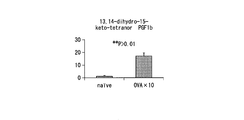
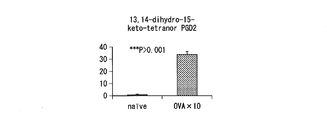
(2)の前処理済の尿検体について、エレクトロスプレーイオン化をイオン源とする3連四重極型質量分析装置(LC-MS8030、島津製作所製)に注入し、ソフトウエア「LC/MS/MSメソッドパッケージ」(島津製作所製)を用いて脂質網羅解析を行った。結果として、無処置のマウスの尿検体中での各脂質の含有量を1としたときの、食物アレルギーモデルマウスの尿検体中での各脂質の含有量の相対値を示すグラフを図1A~図1Iに示す。図1A~図1Iにおいて、「naive」とは無処置のマウスを意味し、「OVA×10」とは食物アレルギーモデルマウスを意味する。
図1A~図1Iから、OVA誘導性食物アレルギーモデルマウスの尿検体中において、コントロール群と比較して、13,14-dihydro-15-keto-tetranor PGF1β、13,14-dihydro-15-keto-tetranor PGD2、13,14-dihydro-15-keto-tetranor PGE2、6,15-diketo-13,14-dihydro PGF1α、及び20-OH PGE2の5成分が有意に増加することが明らかとなった。また、PGD3及びPGE3の2成分が有意に減少することが明らかとなった。
(1)尿検体の入手
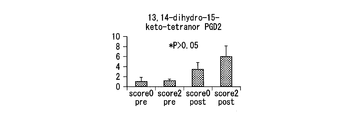
3~22歳の食物アレルギー患者(男女)に医師の監督のもと適切な負荷量及び摂取間隔で食物負荷試験を行い、症状の程度により0~2のスコアを付けた。なお、数値が高いほど、症状が重篤な患者である。スコア0及びスコア2の患者それぞれについて、負荷試験前の尿(以下、「score 0 pre」、「score 2 pre」と表す。)及び負荷試験後の尿(以下、「score 0 post」、「score 2 post」と表す。)を採取した。なお、「score 0 pre」はn=9、「score 2 pre」はn=10、「score 0 post」はn=10、「score 2 post」」はn=10である。
内部標準として、さらにTXM-d4を用いた以外は、実施例1の(2)と同様の方法を用いて、尿検体を前処理した。
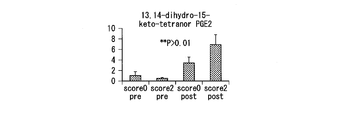
実施例1の(3)と同様の方法を用いて、(2)の前処理済み尿検体について、脂質網羅解析を行った。結果として、負荷試験前のスコア0患者の尿検体中での各脂質の含有量を1としたときの、負荷試験後のスコア0患者、及び負荷試験前後のスコア2患者の尿検体中での各脂質の含有量の相対値を示すグラフを図2A~図2Jに示す。
図2A~図2Jから、score 2 postにおいて、score 0 postと比較して、tetranor-PGFM、13,14-dihydro-15-keto-tetranor PGF1β、11-dehydro TXB2、2,3-dinor-8-iso PGF2α、14,15-LTE4及び11-trans LTE4の6成分が有意に増加することが明らかとなった。また、score 2 postにおいて、score 2 preと比較して、13,14-dihydro-15-keto-tetranor PGF1β、11-dehydro TXB2、2,3-dinor-8-iso PGF2α、13,14-dihydro-15-keto-tetranor PGD2及び13,14-dihydro-15-keto-tetranor PGE2の5成分が有意に増加することが明らかとなった。
よって、上記4成分については、マウスを用いた食品のアレルギー原性を評価する実験系におけるバイオマーカーとして有用であることが示唆された。
よって、上記5成分については、ヒトにおける食物アレルギーの発症リスクや重篤度を適切に評価、又は、減感作療法に対する反応性を評価するためのバイオマーカーとして有用であることが示唆された。
(1)尿検体の入手
3~22歳の食物アレルギー患者(男女)に医師の監督のもと適切な負荷量及び摂取間隔で食物負荷試験を行い、症状の程度により0~4のスコアを付けた。なお、数値が高いほど、症状が重篤な患者である。スコア0及びスコア4の患者それぞれについて、負荷試験前の尿(以下、「score 0 pre」、「score 4 pre」と表す。)及び負荷試験後の尿(以下、「score 0 post」、「score 4 post」と表す。)を採取した。なお、「score 0 pre」はn=8、「score 4 pre」はn=10、「score 0 post」はn=8、「score 4 post」」はn=10である。
尿上清に内部標準として、tetranor-PGDM-d6、tetranor-PGEM-d6、TMX-d4、LTC4-d5を加えた。続いて、塩酸を用いて、尿検体をpH3~4となるように調製した。続いて、メタノール及び精製水で平衡化したSep-pak C18カートリッジ(Waters社製)に、調製した尿検体を注入した。続いて、3mLの水と3mL×2のヘキサンとで夾雑物を洗浄した。続いて、メタノールで目的の成分を溶出させた。続いて、4時間の減圧乾燥後、80%メタノールに再溶解し、濾過した。
(2)の前処理済の尿検体について、エレクトロスプレーイオン化をイオン源とする3連四重極型質量分析装置(LC-MS8030、島津製作所製)に注入し、ソフトウエア「LabSolutions」(島津製作所製)を用いて脂質網羅解析を行った。結果として、負荷試験前後のスコア0及びスコア4患者の尿検体中での各脂質の含有量(絶対値)を示すグラフを図3A~図3Dに示す。なお、図3A~図3Dにおいて、縦軸の単位「ng/mg Cre」は、尿検体中のクレアチン1mgに対する各脂質の含有量(ng)を示している。
図3A~図3Dから、score 4 postにおいて、score 0 postと比較して、tetranor-PGDM、tetranor-PGEM、11-dehydro TXB2、LTE4は有意に増加することが明らかとなった。また、score 4 postにおいて、score 4 preと比較して、tetranor-PGDM、tetranor-PGEM、11-dehydro TXB2、LTE4は有意に増加することが明らかとなった。
以上のことから、本発明で初めて明らかとなった11-dehydro TXB2及びLTE4の2成分、並びに公知のtetranor-PGDM及びtetranor-PGEMの2成分、合計4成分については、ヒトにおける食物アレルギーの発症リスクや重篤度を適切に評価、又は、減感作療法に対する反応性を評価するためのバイオマーカーとして有用であり、これら4成分を指標とすることで、食物アレルギーの有無、及び発症リスクや重篤度をより高い精度で判定できることが示唆された。
また、本発明の検査方法は、採血等の医療技術を必要とせず、本発明の尿検体検査用キット又は尿検体検査用スティックを用いて、小児から高齢者まで簡便に家庭で検査を行うことができる。
Claims (15)
- 食物アレルギーを検査するためのバイオマーカーであって、
Leukotriene E4(LTE4)、14,15-LTE4、11-trans LTE4、11-dehydro Thromboxane B2(11-dehydro TXB2)、2,3-dinor-8-iso Prostaglandin F2α、13,14-dihydro-15-keto-tetranor PGF1β、6,15-diketo-13,14-dihydro PGF1α、tetranor-Prostaglandin F Metabolite(tetranor-PGFM)、20-hydroxy Prostaglandin E2(20-OH PGE2)、PGE3、Prostaglandin D3(PGD3)、13,14-dihydro-15-keto-tetranor PGD2、及び13,14-dihydro-15-keto-tetranor PGE2からなる群から選ばれる少なくとも一つからなることを特徴とするバイオマーカー。 - 被検者の尿検体中のバイオマーカーの含有量を測定する工程を備えた食物アレルギーの検査方法であって、
前記バイオマーカーがLTE4、14,15-LTE4、11-trans LTE4、11-dehydro TXB2、2,3-dinor-8-iso Prostaglandin F2α、13,14-dihydro-15-keto-tetranor PGF1β、6,15-diketo-13,14-dihydro PGF1α、tetranor-PGFM、20-OH PGE2、PGE3、PGD3、13,14-dihydro-15-keto-tetranor PGD2、及び13,14-dihydro-15-keto-tetranor PGE2からなる群から選ばれる少なくとも一つであることを特徴とする方法。 - 前記測定工程において、さらに、tetranor-PGDM又はtetranor-PGEMの含有量を測定する、請求項2に記載の方法。
- さらに、尿検体中の前記バイオマーカーの含有量が多い又は少ないほど、食物アレルギーの症状が重篤である若しくは重篤になった、又は、食物アレルギーを発症するリスクが高い若しくは高くなったと評価する評価工程を備える、請求項2又は3に記載の方法。
- 食物アレルギーの治療法又は治療薬の評価に用いられる、請求項2~4のいずれか一項に記載の方法。
- 減感作療法に用いられる、請求項5に記載の方法。
- 前記測定工程を、イムノアッセイ又は質量分析法で行う、請求項2~6のいずれか一項に記載の方法。
- さらに、前記尿検体中に、重水素化LTC4、重水素化6-keto-PGF1α、重水素化tetranor-PGDM、重水素化tetranor-PGEM、及び重水素化PGE2からなる群から選ばれる少なくとも一つを内部標準として加える前処理工程を備え、前記測定工程を、質量分析法で行う、請求項7に記載の方法。
- 前記評価工程において、食物アレルギーにおける肥満細胞の活性化を評価する、請求項2~8のいずれか一項に記載の方法。
- 抗LTE4抗体、抗14,15-LTE4抗体、抗11-trans LTE4抗体、抗11-dehydro TXB2抗体、抗2,3-dinor-8-iso PGF2α抗体、抗13,14-dihydro-15-keto-tetranor PGF1β抗体、抗6,15-diketo-13,14-dihydro PGF1α抗体、抗tetranor-PGFM抗体、抗20-OH PGE2抗体、抗PGE3抗体、抗PGD3抗体、抗13,14-dihydro-15-keto-tetranor PGD2抗体、及び抗13,14-dihydro-15-keto-tetranor PGE2抗体からなる群から選ばれる少なくとも一つを含むことを特徴とする食物アレルギーの尿検体検査用キット。
- さらに、抗tetranor-PGDM抗体又は抗tetranor-PGEM抗体を含む、請求項10に記載の食物アレルギーの尿検体検査用キット。
- さらに、重水素化LTC4、重水素化6-keto-PGF1α、重水素化tetranor-PGEM、及び重水素化PGE2からなる群から選ばれる少なくとも一つを含む、請求項10又は11に記載の食物アレルギーの尿検体検査用キット。
- さらに、重水素化tetranor-PGDMを含む、請求項10~12にいずれか一項に記載の食物アレルギーの尿検体検査用キット。
- 抗LTE4抗体、抗14,15-LTE4抗体、抗11-trans LTE4抗体、抗11-dehydro TXB2抗体、抗2,3-dinor-8-iso PGF2α抗体、抗13,14-dihydro-15-keto-tetranor PGF1β抗体、抗6,15-diketo-13,14-dihydro PGF1α抗体、抗tetranor-PGFM抗体、抗20-OH PGE2抗体、抗PGE3抗体、抗PGD3抗体、抗13,14-dihydro-15-keto-tetranor PGD2抗体、及び抗13,14-dihydro-15-keto-tetranor PGE2抗体からなる群から選ばれる少なくとも一つを含むことを特徴とする食物アレルギーの尿検体検査用スティック。
- さらに、抗tetranor-PGDM抗体又は抗tetranor-PGEM抗体を含む、請求項14に記載の食物アレルギーの尿検体検査用スティック。
Priority Applications (3)
| Application Number | Priority Date | Filing Date | Title |
|---|---|---|---|
| EP17744384.3A EP3422013A4 (en) | 2016-01-29 | 2017-01-27 | FOOD ALLERGY BIOMARKERS, FOOD ALLERGY TEST PROCEDURES, URINE TESTING KIT AND URINE TESTING STACKS |
| US16/072,987 US20190049472A1 (en) | 2016-01-29 | 2017-01-27 | Food allergy biomarker, food allergy testing method, kit for urine sample testing, and stick for urine sample testing |
| JP2017563848A JPWO2017131154A1 (ja) | 2016-01-29 | 2017-01-27 | 食物アレルギーのバイオマーカー、食物アレルギーの検査方法、尿検体検査用キット、及び尿検体検査用スティック |
Applications Claiming Priority (2)
| Application Number | Priority Date | Filing Date | Title |
|---|---|---|---|
| JP2016015681 | 2016-01-29 | ||
| JP2016-015681 | 2016-01-29 |
Publications (1)
| Publication Number | Publication Date |
|---|---|
| WO2017131154A1 true WO2017131154A1 (ja) | 2017-08-03 |
Family
ID=59398898
Family Applications (1)
| Application Number | Title | Priority Date | Filing Date |
|---|---|---|---|
| PCT/JP2017/002919 Ceased WO2017131154A1 (ja) | 2016-01-29 | 2017-01-27 | 食物アレルギーのバイオマーカー、食物アレルギーの検査方法、尿検体検査用キット、及び尿検体検査用スティック |
Country Status (4)
| Country | Link |
|---|---|
| US (1) | US20190049472A1 (ja) |
| EP (1) | EP3422013A4 (ja) |
| JP (2) | JPWO2017131154A1 (ja) |
| WO (1) | WO2017131154A1 (ja) |
Families Citing this family (2)
| Publication number | Priority date | Publication date | Assignee | Title |
|---|---|---|---|---|
| CN110713519A (zh) * | 2019-11-02 | 2020-01-21 | 深圳市安帝宝科技有限公司 | 一种11-脱氢血栓烷b2抗原及其制备方法 |
| CN113092652B (zh) * | 2021-03-19 | 2022-09-30 | 浙江工商大学 | 一种用于评估个体过敏程度的试剂盒 |
Citations (1)
| Publication number | Priority date | Publication date | Assignee | Title |
|---|---|---|---|---|
| WO2016021704A1 (ja) | 2014-08-06 | 2016-02-11 | 国立大学法人東京大学 | 食物アレルギーの検査方法及び検査用キット |
Family Cites Families (3)
| Publication number | Priority date | Publication date | Assignee | Title |
|---|---|---|---|---|
| ATE108560T1 (de) * | 1988-03-31 | 1994-07-15 | Sankyo Co | Bestimmung von arachidonsäure-derivaten und ausrüstungen dafür. |
| US7727730B2 (en) * | 2005-12-09 | 2010-06-01 | Corgenix Medical Corporation | Methods and kits for detection of thromboxane A2 metabolites |
| US20110311990A1 (en) * | 2010-06-14 | 2011-12-22 | Cayman Chemical Company, Incorporated | Tetranor-pgem/pgam specific immunogens, antibodies, tracers, assay kits and methods for making same |
-
2017
- 2017-01-27 WO PCT/JP2017/002919 patent/WO2017131154A1/ja not_active Ceased
- 2017-01-27 US US16/072,987 patent/US20190049472A1/en not_active Abandoned
- 2017-01-27 EP EP17744384.3A patent/EP3422013A4/en not_active Withdrawn
- 2017-01-27 JP JP2017563848A patent/JPWO2017131154A1/ja active Pending
-
2020
- 2020-08-31 JP JP2020145865A patent/JP6956429B2/ja active Active
Patent Citations (1)
| Publication number | Priority date | Publication date | Assignee | Title |
|---|---|---|---|---|
| WO2016021704A1 (ja) | 2014-08-06 | 2016-02-11 | 国立大学法人東京大学 | 食物アレルギーの検査方法及び検査用キット |
Non-Patent Citations (6)
| Title |
|---|
| CHIKAKO MOTOMURA ET AL.: "Shokumotsu Izonsei Undo Yuhatsu Anaphylaxis Yuhatsu Shiken ni Okeru Nyochu Leukotriene E4 Sokutei", JAPANESE JOURNAL OF PEDIATRIC ALLERGY AND CLINICAL IMMUNOLOGY, vol. 29, no. 4, 20 October 2015 (2015-10-20), pages 552, XP009513083, ISSN: 1882-2738, DOI: 10.3388/jspaci.29.439 * |
| HEALTH, LABOR AND WELFARE SCIENCE RESEARCH GROUP, GUIDANCE OF MEDICAL CARE OF FOOD ALLERGY, - 2011, Retrieved from the Internet <URL:http://www.allergy.go.jp/allergy/guideline/05/05_2011 .pdf> |
| SAKURA SATO ET AL.: "Shokumotsu Anaphylaxis Kanja ni Taisuru Keiko Men'eki Ryoho no Biomarker", JAPANESE JOURNAL OF PEDIATRIC ALLERGY AND CLINICAL IMMUNOLOGY, vol. 26, no. 3, 20 August 2012 (2012-08-20), Tokyo, pages 450, XP009513084, ISSN: 0914-2649, DOI: 10.3388/jspaci.26.411 * |
| See also references of EP3422013A4 |
| ZEN'ICHIRO HONDA: "Leukotriene no Sokutei = [Measurement of leukotriene]", ALLERGOLOGY & IMMUNOLOGY, vol. 22, no. 8, 15 July 2015 (2015-07-15), pages 1120 - 1128, XP009512840, ISSN: 1344-6932 * |
| ZHANG YIZHONG ET AL.: "Simultaneous and high- throughput quantitation of urinary tetranor PGDM and tetranor PGEM by online SPE-LC-MS/MS as inflammatory biomarkers", J. MASS. SPECTROM., vol. 46, no. 7, July 2011 (2011-07-01), pages 705 - 711, XP055433984 * |
Also Published As
| Publication number | Publication date |
|---|---|
| EP3422013A4 (en) | 2019-07-17 |
| EP3422013A1 (en) | 2019-01-02 |
| JP2021001895A (ja) | 2021-01-07 |
| JPWO2017131154A1 (ja) | 2018-11-22 |
| US20190049472A1 (en) | 2019-02-14 |
| JP6956429B2 (ja) | 2021-11-02 |
Similar Documents
| Publication | Publication Date | Title |
|---|---|---|
| US10996217B2 (en) | Method for examining renal disease | |
| US20100292131A1 (en) | Biomarkers and methods for diagnosing, predicting and/or prognosing sepsis and uses thereof | |
| EP2300829A1 (en) | New biomarker for diagnosis, prediction and/or prognosis of sepsis and uses thereof | |
| Pawade et al. | Rapid and selective detection of experimental snake envenomation–Use of gold nanoparticle based lateral flow assay | |
| JPWO2008120684A1 (ja) | 急性中枢神経障害の予後判定方法 | |
| JPWO2017043617A1 (ja) | 肝癌の検査方法 | |
| JP6783445B2 (ja) | 食物アレルギーの検査方法及び検査用キット | |
| JP6956429B2 (ja) | 食物アレルギーのバイオマーカー、食物アレルギーの検査方法、尿検体検査用キット、及び尿検体検査用スティック | |
| JP2022548905A (ja) | Dmardに対する患者の応答を予測する方法 | |
| WO2022103971A1 (en) | Compositions and methods for predicting risk of moderate to severe covid-19 disease | |
| CN104871004A (zh) | 急性肾损伤 | |
| Shi et al. | Serum binding folate receptor autoantibodies lower in autistic boys and positively-correlated with folate | |
| CN101294956A (zh) | 人视黄醇结合蛋白-4在代谢异常的检测中的应用 | |
| US20180299435A1 (en) | Immunoassay | |
| CN102047115A (zh) | IgA肾病的检查方法和检查试剂盒 | |
| Aggio et al. | Future methods for the diagnosis of inflammatory bowel disease | |
| WO2021090901A1 (ja) | ネコ科動物の炎症状態の評価方法 | |
| RU2532381C1 (ru) | Способ количественного определения содержания фактора дифференцировки-прогностического биомаркера состояния сосудистой системы у человека в норме и патологии | |
| JP7740807B2 (ja) | 敗血症原因細菌の免疫学的分析方法及び該方法に用いるモノクローナル抗体 | |
| US20230096313A1 (en) | Method of biomarker detection in companion animals | |
| CN110117648A (zh) | 昼夜节律性睡眠障碍生物标志物 | |
| WO2019098328A1 (ja) | IgA腎症診断用キット | |
| RU2405155C1 (ru) | Способ определения содержания в периферической крови беременных арахидоновой кислоты при обострении герпес-вирусной инфекции | |
| CN108535479B (zh) | sCD163检测试剂在梅毒检测中的应用及包括该试剂的试剂盒 | |
| WO2025193825A1 (en) | Diagnosis and monitoring of liver disease |
Legal Events
| Date | Code | Title | Description |
|---|---|---|---|
| 121 | Ep: the epo has been informed by wipo that ep was designated in this application |
Ref document number: 17744384 Country of ref document: EP Kind code of ref document: A1 |
|
| WWE | Wipo information: entry into national phase |
Ref document number: 2017563848 Country of ref document: JP |
|
| NENP | Non-entry into the national phase |
Ref country code: DE |
|
| WWE | Wipo information: entry into national phase |
Ref document number: 2017744384 Country of ref document: EP |
|
| ENP | Entry into the national phase |
Ref document number: 2017744384 Country of ref document: EP Effective date: 20180829 |