WO2017132019A1 - Molecules having pesticidal utility, and intermediates, compositions, and processes, related thereto - Google Patents

Molecules having pesticidal utility, and intermediates, compositions, and processes, related thereto Download PDF

Info

Publication number
WO2017132019A1
WO2017132019A1 PCT/US2017/013886 US2017013886W WO2017132019A1 WO 2017132019 A1 WO2017132019 A1 WO 2017132019A1 US 2017013886 W US2017013886 W US 2017013886W WO 2017132019 A1 WO2017132019 A1 WO 2017132019A1
Authority
WO
WIPO (PCT)
Prior art keywords
alkyl
spp
mhz
nmr
haloalkyl
Prior art date
Legal status (The legal status is an assumption and is not a legal conclusion. Google has not performed a legal analysis and makes no representation as to the accuracy of the status listed.)
Ceased
Application number
PCT/US2017/013886
Other languages
French (fr)
Other versions
WO2017132019A8 (en
Inventor
Thomas Barton
Xin Gao
Jim HUTNER
Paul R. LEPLAE
Lori K. LAWLER
William C. Lo
Jeff PETRUS
Joshodeep BORUWA
Raghuram TANGIRALA
Gerald B. Watson
John Herbert
Current Assignee (The listed assignees may be inaccurate. Google has not performed a legal analysis and makes no representation or warranty as to the accuracy of the list.)
Corteva Agriscience LLC
Original Assignee
Dow AgroSciences LLC
Priority date (The priority date is an assumption and is not a legal conclusion. Google has not performed a legal analysis and makes no representation as to the accuracy of the date listed.)
Filing date
Publication date
Application filed by Dow AgroSciences LLC filed Critical Dow AgroSciences LLC
Priority to AU2017211771A priority Critical patent/AU2017211771C1/en
Priority to EP17744694.5A priority patent/EP3407717B1/en
Priority to CN201780018562.0A priority patent/CN108882704B/en
Priority to JP2018538597A priority patent/JP6923534B2/en
Priority to KR1020187024217A priority patent/KR102652142B1/en
Publication of WO2017132019A1 publication Critical patent/WO2017132019A1/en
Priority to IL260660A priority patent/IL260660B/en
Anticipated expiration legal-status Critical
Priority to ZA2018/05567A priority patent/ZA201805567B/en
Priority to CONC2018/0008830A priority patent/CO2018008830A2/en
Publication of WO2017132019A8 publication Critical patent/WO2017132019A8/en
Ceased legal-status Critical Current

Links

Classifications

    • CCHEMISTRY; METALLURGY
    • C07ORGANIC CHEMISTRY
    • C07CACYCLIC OR CARBOCYCLIC COMPOUNDS
    • C07C63/00Compounds having carboxyl groups bound to a carbon atoms of six-membered aromatic rings
    • C07C63/68Compounds having carboxyl groups bound to a carbon atoms of six-membered aromatic rings containing halogen
    • C07C63/74Compounds having carboxyl groups bound to a carbon atoms of six-membered aromatic rings containing halogen having unsaturation outside the aromatic rings
    • AHUMAN NECESSITIES
    • A01AGRICULTURE; FORESTRY; ANIMAL HUSBANDRY; HUNTING; TRAPPING; FISHING
    • A01NPRESERVATION OF BODIES OF HUMANS OR ANIMALS OR PLANTS OR PARTS THEREOF; BIOCIDES, e.g. AS DISINFECTANTS, AS PESTICIDES OR AS HERBICIDES; PEST REPELLANTS OR ATTRACTANTS; PLANT GROWTH REGULATORS
    • A01N29/00Biocides, pest repellants or attractants, or plant growth regulators containing halogenated hydrocarbons
    • A01N29/10Halogen attached to an aliphatic side chain of an aromatic ring system
    • A01N29/121,1-Di- or 1,1,1-tri-halo-2-aryl-ethane or -ethene or derivatives thereof, e.g. DDT
    • AHUMAN NECESSITIES
    • A01AGRICULTURE; FORESTRY; ANIMAL HUSBANDRY; HUNTING; TRAPPING; FISHING
    • A01NPRESERVATION OF BODIES OF HUMANS OR ANIMALS OR PLANTS OR PARTS THEREOF; BIOCIDES, e.g. AS DISINFECTANTS, AS PESTICIDES OR AS HERBICIDES; PEST REPELLANTS OR ATTRACTANTS; PLANT GROWTH REGULATORS
    • A01N31/00Biocides, pest repellants or attractants, or plant growth regulators containing organic oxygen or sulfur compounds
    • A01N31/04Oxygen or sulfur attached to an aliphatic side-chain of a carbocyclic ring system
    • AHUMAN NECESSITIES
    • A01AGRICULTURE; FORESTRY; ANIMAL HUSBANDRY; HUNTING; TRAPPING; FISHING
    • A01NPRESERVATION OF BODIES OF HUMANS OR ANIMALS OR PLANTS OR PARTS THEREOF; BIOCIDES, e.g. AS DISINFECTANTS, AS PESTICIDES OR AS HERBICIDES; PEST REPELLANTS OR ATTRACTANTS; PLANT GROWTH REGULATORS
    • A01N33/00Biocides, pest repellants or attractants, or plant growth regulators containing organic nitrogen compounds
    • A01N33/02Amines; Quaternary ammonium compounds
    • A01N33/04Nitrogen directly attached to aliphatic or cycloaliphatic carbon atoms
    • AHUMAN NECESSITIES
    • A01AGRICULTURE; FORESTRY; ANIMAL HUSBANDRY; HUNTING; TRAPPING; FISHING
    • A01NPRESERVATION OF BODIES OF HUMANS OR ANIMALS OR PLANTS OR PARTS THEREOF; BIOCIDES, e.g. AS DISINFECTANTS, AS PESTICIDES OR AS HERBICIDES; PEST REPELLANTS OR ATTRACTANTS; PLANT GROWTH REGULATORS
    • A01N35/00Biocides, pest repellants or attractants, or plant growth regulators containing organic compounds containing a carbon atom having two bonds to hetero atoms with at the most one bond to halogen, e.g. aldehyde radical
    • A01N35/04Biocides, pest repellants or attractants, or plant growth regulators containing organic compounds containing a carbon atom having two bonds to hetero atoms with at the most one bond to halogen, e.g. aldehyde radical containing aldehyde or keto groups, or thio analogues thereof, directly attached to an aromatic ring system, e.g. acetophenone; Derivatives thereof, e.g. acetals
    • AHUMAN NECESSITIES
    • A01AGRICULTURE; FORESTRY; ANIMAL HUSBANDRY; HUNTING; TRAPPING; FISHING
    • A01NPRESERVATION OF BODIES OF HUMANS OR ANIMALS OR PLANTS OR PARTS THEREOF; BIOCIDES, e.g. AS DISINFECTANTS, AS PESTICIDES OR AS HERBICIDES; PEST REPELLANTS OR ATTRACTANTS; PLANT GROWTH REGULATORS
    • A01N37/00Biocides, pest repellants or attractants, or plant growth regulators containing organic compounds containing a carbon atom having three bonds to hetero atoms with at the most two bonds to halogen, e.g. carboxylic acids
    • A01N37/10Aromatic or araliphatic carboxylic acids, or thio analogues thereof; Derivatives thereof
    • AHUMAN NECESSITIES
    • A01AGRICULTURE; FORESTRY; ANIMAL HUSBANDRY; HUNTING; TRAPPING; FISHING
    • A01NPRESERVATION OF BODIES OF HUMANS OR ANIMALS OR PLANTS OR PARTS THEREOF; BIOCIDES, e.g. AS DISINFECTANTS, AS PESTICIDES OR AS HERBICIDES; PEST REPELLANTS OR ATTRACTANTS; PLANT GROWTH REGULATORS
    • A01N37/00Biocides, pest repellants or attractants, or plant growth regulators containing organic compounds containing a carbon atom having three bonds to hetero atoms with at the most two bonds to halogen, e.g. carboxylic acids
    • A01N37/18Biocides, pest repellants or attractants, or plant growth regulators containing organic compounds containing a carbon atom having three bonds to hetero atoms with at the most two bonds to halogen, e.g. carboxylic acids containing the group —CO—N<, e.g. carboxylic acid amides or imides; Thio analogues thereof
    • AHUMAN NECESSITIES
    • A01AGRICULTURE; FORESTRY; ANIMAL HUSBANDRY; HUNTING; TRAPPING; FISHING
    • A01NPRESERVATION OF BODIES OF HUMANS OR ANIMALS OR PLANTS OR PARTS THEREOF; BIOCIDES, e.g. AS DISINFECTANTS, AS PESTICIDES OR AS HERBICIDES; PEST REPELLANTS OR ATTRACTANTS; PLANT GROWTH REGULATORS
    • A01N37/00Biocides, pest repellants or attractants, or plant growth regulators containing organic compounds containing a carbon atom having three bonds to hetero atoms with at the most two bonds to halogen, e.g. carboxylic acids
    • A01N37/18Biocides, pest repellants or attractants, or plant growth regulators containing organic compounds containing a carbon atom having three bonds to hetero atoms with at the most two bonds to halogen, e.g. carboxylic acids containing the group —CO—N<, e.g. carboxylic acid amides or imides; Thio analogues thereof
    • A01N37/20Biocides, pest repellants or attractants, or plant growth regulators containing organic compounds containing a carbon atom having three bonds to hetero atoms with at the most two bonds to halogen, e.g. carboxylic acids containing the group —CO—N<, e.g. carboxylic acid amides or imides; Thio analogues thereof containing the group, wherein Cn means a carbon skeleton not containing a ring; Thio analogues thereof
    • AHUMAN NECESSITIES
    • A01AGRICULTURE; FORESTRY; ANIMAL HUSBANDRY; HUNTING; TRAPPING; FISHING
    • A01NPRESERVATION OF BODIES OF HUMANS OR ANIMALS OR PLANTS OR PARTS THEREOF; BIOCIDES, e.g. AS DISINFECTANTS, AS PESTICIDES OR AS HERBICIDES; PEST REPELLANTS OR ATTRACTANTS; PLANT GROWTH REGULATORS
    • A01N37/00Biocides, pest repellants or attractants, or plant growth regulators containing organic compounds containing a carbon atom having three bonds to hetero atoms with at the most two bonds to halogen, e.g. carboxylic acids
    • A01N37/18Biocides, pest repellants or attractants, or plant growth regulators containing organic compounds containing a carbon atom having three bonds to hetero atoms with at the most two bonds to halogen, e.g. carboxylic acids containing the group —CO—N<, e.g. carboxylic acid amides or imides; Thio analogues thereof
    • A01N37/26Biocides, pest repellants or attractants, or plant growth regulators containing organic compounds containing a carbon atom having three bonds to hetero atoms with at the most two bonds to halogen, e.g. carboxylic acids containing the group —CO—N<, e.g. carboxylic acid amides or imides; Thio analogues thereof containing the group; Thio analogues thereof
    • AHUMAN NECESSITIES
    • A01AGRICULTURE; FORESTRY; ANIMAL HUSBANDRY; HUNTING; TRAPPING; FISHING
    • A01NPRESERVATION OF BODIES OF HUMANS OR ANIMALS OR PLANTS OR PARTS THEREOF; BIOCIDES, e.g. AS DISINFECTANTS, AS PESTICIDES OR AS HERBICIDES; PEST REPELLANTS OR ATTRACTANTS; PLANT GROWTH REGULATORS
    • A01N43/00Biocides, pest repellants or attractants, or plant growth regulators containing heterocyclic compounds
    • A01N43/02Biocides, pest repellants or attractants, or plant growth regulators containing heterocyclic compounds having rings with one or more oxygen or sulfur atoms as the only ring hetero atoms
    • A01N43/04Biocides, pest repellants or attractants, or plant growth regulators containing heterocyclic compounds having rings with one or more oxygen or sulfur atoms as the only ring hetero atoms with one hetero atom
    • A01N43/20Biocides, pest repellants or attractants, or plant growth regulators containing heterocyclic compounds having rings with one or more oxygen or sulfur atoms as the only ring hetero atoms with one hetero atom three- or four-membered rings
    • AHUMAN NECESSITIES
    • A01AGRICULTURE; FORESTRY; ANIMAL HUSBANDRY; HUNTING; TRAPPING; FISHING
    • A01NPRESERVATION OF BODIES OF HUMANS OR ANIMALS OR PLANTS OR PARTS THEREOF; BIOCIDES, e.g. AS DISINFECTANTS, AS PESTICIDES OR AS HERBICIDES; PEST REPELLANTS OR ATTRACTANTS; PLANT GROWTH REGULATORS
    • A01N43/00Biocides, pest repellants or attractants, or plant growth regulators containing heterocyclic compounds
    • A01N43/34Biocides, pest repellants or attractants, or plant growth regulators containing heterocyclic compounds having rings with one nitrogen atom as the only ring hetero atom
    • A01N43/36Biocides, pest repellants or attractants, or plant growth regulators containing heterocyclic compounds having rings with one nitrogen atom as the only ring hetero atom five-membered rings
    • AHUMAN NECESSITIES
    • A01AGRICULTURE; FORESTRY; ANIMAL HUSBANDRY; HUNTING; TRAPPING; FISHING
    • A01NPRESERVATION OF BODIES OF HUMANS OR ANIMALS OR PLANTS OR PARTS THEREOF; BIOCIDES, e.g. AS DISINFECTANTS, AS PESTICIDES OR AS HERBICIDES; PEST REPELLANTS OR ATTRACTANTS; PLANT GROWTH REGULATORS
    • A01N43/00Biocides, pest repellants or attractants, or plant growth regulators containing heterocyclic compounds
    • A01N43/34Biocides, pest repellants or attractants, or plant growth regulators containing heterocyclic compounds having rings with one nitrogen atom as the only ring hetero atom
    • A01N43/40Biocides, pest repellants or attractants, or plant growth regulators containing heterocyclic compounds having rings with one nitrogen atom as the only ring hetero atom six-membered rings
    • AHUMAN NECESSITIES
    • A01AGRICULTURE; FORESTRY; ANIMAL HUSBANDRY; HUNTING; TRAPPING; FISHING
    • A01NPRESERVATION OF BODIES OF HUMANS OR ANIMALS OR PLANTS OR PARTS THEREOF; BIOCIDES, e.g. AS DISINFECTANTS, AS PESTICIDES OR AS HERBICIDES; PEST REPELLANTS OR ATTRACTANTS; PLANT GROWTH REGULATORS
    • A01N53/00Biocides, pest repellants or attractants, or plant growth regulators containing cyclopropane carboxylic acids or derivatives thereof
    • CCHEMISTRY; METALLURGY
    • C07ORGANIC CHEMISTRY
    • C07CACYCLIC OR CARBOCYCLIC COMPOUNDS
    • C07C233/00Carboxylic acid amides
    • C07C233/64Carboxylic acid amides having carbon atoms of carboxamide groups bound to carbon atoms of six-membered aromatic rings
    • C07C233/65Carboxylic acid amides having carbon atoms of carboxamide groups bound to carbon atoms of six-membered aromatic rings having the nitrogen atoms of the carboxamide groups bound to hydrogen atoms or to carbon atoms of unsubstituted hydrocarbon radicals
    • CCHEMISTRY; METALLURGY
    • C07ORGANIC CHEMISTRY
    • C07CACYCLIC OR CARBOCYCLIC COMPOUNDS
    • C07C233/00Carboxylic acid amides
    • C07C233/64Carboxylic acid amides having carbon atoms of carboxamide groups bound to carbon atoms of six-membered aromatic rings
    • C07C233/66Carboxylic acid amides having carbon atoms of carboxamide groups bound to carbon atoms of six-membered aromatic rings having the nitrogen atom of at least one of the carboxamide groups bound to a carbon atom of a hydrocarbon radical substituted by halogen atoms or by nitro or nitroso groups
    • CCHEMISTRY; METALLURGY
    • C07ORGANIC CHEMISTRY
    • C07CACYCLIC OR CARBOCYCLIC COMPOUNDS
    • C07C233/00Carboxylic acid amides
    • C07C233/64Carboxylic acid amides having carbon atoms of carboxamide groups bound to carbon atoms of six-membered aromatic rings
    • C07C233/67Carboxylic acid amides having carbon atoms of carboxamide groups bound to carbon atoms of six-membered aromatic rings having the nitrogen atom of at least one of the carboxamide groups bound to a carbon atom of a hydrocarbon radical substituted by singly-bound oxygen atoms
    • C07C233/68Carboxylic acid amides having carbon atoms of carboxamide groups bound to carbon atoms of six-membered aromatic rings having the nitrogen atom of at least one of the carboxamide groups bound to a carbon atom of a hydrocarbon radical substituted by singly-bound oxygen atoms with the substituted hydrocarbon radical bound to the nitrogen atom of the carboxamide group by an acyclic carbon atom
    • C07C233/73Carboxylic acid amides having carbon atoms of carboxamide groups bound to carbon atoms of six-membered aromatic rings having the nitrogen atom of at least one of the carboxamide groups bound to a carbon atom of a hydrocarbon radical substituted by singly-bound oxygen atoms with the substituted hydrocarbon radical bound to the nitrogen atom of the carboxamide group by an acyclic carbon atom of a carbon skeleton containing six-membered aromatic rings
    • CCHEMISTRY; METALLURGY
    • C07ORGANIC CHEMISTRY
    • C07CACYCLIC OR CARBOCYCLIC COMPOUNDS
    • C07C233/00Carboxylic acid amides
    • C07C233/64Carboxylic acid amides having carbon atoms of carboxamide groups bound to carbon atoms of six-membered aromatic rings
    • C07C233/77Carboxylic acid amides having carbon atoms of carboxamide groups bound to carbon atoms of six-membered aromatic rings having the nitrogen atom of at least one of the carboxamide groups bound to a carbon atom of a hydrocarbon radical substituted by amino groups
    • C07C233/78Carboxylic acid amides having carbon atoms of carboxamide groups bound to carbon atoms of six-membered aromatic rings having the nitrogen atom of at least one of the carboxamide groups bound to a carbon atom of a hydrocarbon radical substituted by amino groups with the substituted hydrocarbon radical bound to the nitrogen atom of the carboxamide group by an acyclic carbon atom
    • CCHEMISTRY; METALLURGY
    • C07ORGANIC CHEMISTRY
    • C07CACYCLIC OR CARBOCYCLIC COMPOUNDS
    • C07C251/00Compounds containing nitrogen atoms doubly-bound to a carbon skeleton
    • C07C251/02Compounds containing nitrogen atoms doubly-bound to a carbon skeleton containing imino groups
    • C07C251/28Compounds containing nitrogen atoms doubly-bound to a carbon skeleton containing imino groups having nitrogen atoms of imino groups acylated
    • CCHEMISTRY; METALLURGY
    • C07ORGANIC CHEMISTRY
    • C07CACYCLIC OR CARBOCYCLIC COMPOUNDS
    • C07C251/00Compounds containing nitrogen atoms doubly-bound to a carbon skeleton
    • C07C251/32Oximes
    • C07C251/34Oximes with oxygen atoms of oxyimino groups bound to hydrogen atoms or to carbon atoms of unsubstituted hydrocarbon radicals
    • C07C251/36Oximes with oxygen atoms of oxyimino groups bound to hydrogen atoms or to carbon atoms of unsubstituted hydrocarbon radicals with the carbon atoms of the oxyimino groups bound to hydrogen atoms or to acyclic carbon atoms
    • C07C251/38Oximes with oxygen atoms of oxyimino groups bound to hydrogen atoms or to carbon atoms of unsubstituted hydrocarbon radicals with the carbon atoms of the oxyimino groups bound to hydrogen atoms or to acyclic carbon atoms to carbon atoms of a saturated carbon skeleton
    • CCHEMISTRY; METALLURGY
    • C07ORGANIC CHEMISTRY
    • C07CACYCLIC OR CARBOCYCLIC COMPOUNDS
    • C07C255/00Carboxylic acid nitriles
    • C07C255/45Carboxylic acid nitriles having cyano groups bound to carbon atoms of rings other than six-membered aromatic rings
    • C07C255/46Carboxylic acid nitriles having cyano groups bound to carbon atoms of rings other than six-membered aromatic rings to carbon atoms of non-condensed rings
    • CCHEMISTRY; METALLURGY
    • C07ORGANIC CHEMISTRY
    • C07CACYCLIC OR CARBOCYCLIC COMPOUNDS
    • C07C257/00Compounds containing carboxyl groups, the doubly-bound oxygen atom of a carboxyl group being replaced by a doubly-bound nitrogen atom, this nitrogen atom not being further bound to an oxygen atom, e.g. imino-ethers, amidines
    • C07C257/10Compounds containing carboxyl groups, the doubly-bound oxygen atom of a carboxyl group being replaced by a doubly-bound nitrogen atom, this nitrogen atom not being further bound to an oxygen atom, e.g. imino-ethers, amidines with replacement of the other oxygen atom of the carboxyl group by nitrogen atoms, e.g. amidines
    • C07C257/20Compounds containing carboxyl groups, the doubly-bound oxygen atom of a carboxyl group being replaced by a doubly-bound nitrogen atom, this nitrogen atom not being further bound to an oxygen atom, e.g. imino-ethers, amidines with replacement of the other oxygen atom of the carboxyl group by nitrogen atoms, e.g. amidines having nitrogen atoms of amidino groups acylated
    • CCHEMISTRY; METALLURGY
    • C07ORGANIC CHEMISTRY
    • C07CACYCLIC OR CARBOCYCLIC COMPOUNDS
    • C07C259/00Compounds containing carboxyl groups, an oxygen atom of a carboxyl group being replaced by a nitrogen atom, this nitrogen atom being further bound to an oxygen atom and not being part of nitro or nitroso groups
    • C07C259/12Compounds containing carboxyl groups, an oxygen atom of a carboxyl group being replaced by a nitrogen atom, this nitrogen atom being further bound to an oxygen atom and not being part of nitro or nitroso groups with replacement of the other oxygen atom of the carboxyl group by nitrogen atoms, e.g. N-hydroxyamidines
    • C07C259/14Compounds containing carboxyl groups, an oxygen atom of a carboxyl group being replaced by a nitrogen atom, this nitrogen atom being further bound to an oxygen atom and not being part of nitro or nitroso groups with replacement of the other oxygen atom of the carboxyl group by nitrogen atoms, e.g. N-hydroxyamidines having carbon atoms of hydroxamidine groups bound to hydrogen atoms or to acyclic carbon atoms
    • CCHEMISTRY; METALLURGY
    • C07ORGANIC CHEMISTRY
    • C07CACYCLIC OR CARBOCYCLIC COMPOUNDS
    • C07C327/00Thiocarboxylic acids
    • C07C327/38Amides of thiocarboxylic acids
    • C07C327/48Amides of thiocarboxylic acids having carbon atoms of thiocarboxamide groups bound to carbon atoms of six-membered aromatic rings
    • CCHEMISTRY; METALLURGY
    • C07ORGANIC CHEMISTRY
    • C07DHETEROCYCLIC COMPOUNDS
    • C07D207/00Heterocyclic compounds containing five-membered rings not condensed with other rings, with one nitrogen atom as the only ring hetero atom
    • C07D207/02Heterocyclic compounds containing five-membered rings not condensed with other rings, with one nitrogen atom as the only ring hetero atom with only hydrogen or carbon atoms directly attached to the ring nitrogen atom
    • C07D207/04Heterocyclic compounds containing five-membered rings not condensed with other rings, with one nitrogen atom as the only ring hetero atom with only hydrogen or carbon atoms directly attached to the ring nitrogen atom having no double bonds between ring members or between ring members and non-ring members
    • C07D207/06Heterocyclic compounds containing five-membered rings not condensed with other rings, with one nitrogen atom as the only ring hetero atom with only hydrogen or carbon atoms directly attached to the ring nitrogen atom having no double bonds between ring members or between ring members and non-ring members with radicals, containing only hydrogen and carbon atoms, attached to ring carbon atoms
    • CCHEMISTRY; METALLURGY
    • C07ORGANIC CHEMISTRY
    • C07DHETEROCYCLIC COMPOUNDS
    • C07D213/00Heterocyclic compounds containing six-membered rings, not condensed with other rings, with one nitrogen atom as the only ring hetero atom and three or more double bonds between ring members or between ring members and non-ring members
    • C07D213/02Heterocyclic compounds containing six-membered rings, not condensed with other rings, with one nitrogen atom as the only ring hetero atom and three or more double bonds between ring members or between ring members and non-ring members having three double bonds between ring members or between ring members and non-ring members
    • C07D213/04Heterocyclic compounds containing six-membered rings, not condensed with other rings, with one nitrogen atom as the only ring hetero atom and three or more double bonds between ring members or between ring members and non-ring members having three double bonds between ring members or between ring members and non-ring members having no bond between the ring nitrogen atom and a non-ring member or having only hydrogen or carbon atoms directly attached to the ring nitrogen atom
    • C07D213/60Heterocyclic compounds containing six-membered rings, not condensed with other rings, with one nitrogen atom as the only ring hetero atom and three or more double bonds between ring members or between ring members and non-ring members having three double bonds between ring members or between ring members and non-ring members having no bond between the ring nitrogen atom and a non-ring member or having only hydrogen or carbon atoms directly attached to the ring nitrogen atom with hetero atoms or with carbon atoms having three bonds to hetero atoms with at the most one bond to halogen, e.g. ester or nitrile radicals, directly attached to ring carbon atoms
    • C07D213/61Halogen atoms or nitro radicals
    • CCHEMISTRY; METALLURGY
    • C07ORGANIC CHEMISTRY
    • C07DHETEROCYCLIC COMPOUNDS
    • C07D213/00Heterocyclic compounds containing six-membered rings, not condensed with other rings, with one nitrogen atom as the only ring hetero atom and three or more double bonds between ring members or between ring members and non-ring members
    • C07D213/02Heterocyclic compounds containing six-membered rings, not condensed with other rings, with one nitrogen atom as the only ring hetero atom and three or more double bonds between ring members or between ring members and non-ring members having three double bonds between ring members or between ring members and non-ring members
    • C07D213/04Heterocyclic compounds containing six-membered rings, not condensed with other rings, with one nitrogen atom as the only ring hetero atom and three or more double bonds between ring members or between ring members and non-ring members having three double bonds between ring members or between ring members and non-ring members having no bond between the ring nitrogen atom and a non-ring member or having only hydrogen or carbon atoms directly attached to the ring nitrogen atom
    • C07D213/60Heterocyclic compounds containing six-membered rings, not condensed with other rings, with one nitrogen atom as the only ring hetero atom and three or more double bonds between ring members or between ring members and non-ring members having three double bonds between ring members or between ring members and non-ring members having no bond between the ring nitrogen atom and a non-ring member or having only hydrogen or carbon atoms directly attached to the ring nitrogen atom with hetero atoms or with carbon atoms having three bonds to hetero atoms with at the most one bond to halogen, e.g. ester or nitrile radicals, directly attached to ring carbon atoms
    • C07D213/72Nitrogen atoms
    • C07D213/75Amino or imino radicals, acylated by carboxylic or carbonic acids, or by sulfur or nitrogen analogues thereof, e.g. carbamates
    • CCHEMISTRY; METALLURGY
    • C07ORGANIC CHEMISTRY
    • C07DHETEROCYCLIC COMPOUNDS
    • C07D331/00Heterocyclic compounds containing rings of less than five members, having one sulfur atom as the only ring hetero atom
    • C07D331/04Four-membered rings
    • CCHEMISTRY; METALLURGY
    • C07ORGANIC CHEMISTRY
    • C07CACYCLIC OR CARBOCYCLIC COMPOUNDS
    • C07C2601/00Systems containing only non-condensed rings
    • C07C2601/02Systems containing only non-condensed rings with a three-membered ring
    • CCHEMISTRY; METALLURGY
    • C07ORGANIC CHEMISTRY
    • C07CACYCLIC OR CARBOCYCLIC COMPOUNDS
    • C07C2601/00Systems containing only non-condensed rings
    • C07C2601/04Systems containing only non-condensed rings with a four-membered ring
    • CCHEMISTRY; METALLURGY
    • C07ORGANIC CHEMISTRY
    • C07CACYCLIC OR CARBOCYCLIC COMPOUNDS
    • C07C2601/00Systems containing only non-condensed rings
    • C07C2601/12Systems containing only non-condensed rings with a six-membered ring
    • C07C2601/14The ring being saturated

Definitions

  • Patent Application Serial Nos. 62/286593 and 62/286599 both filed January 25, 2016, each of which are expressly incorporated by reference herein.
  • This disclosure relates to the field of molecules having pesticidal utility against pests in Phyla Arthropoda, Mollusca, and Nematoda, processes to produce such molecules, intermediates used in such processes, pesticidal compositions containing such molecules, and processes of using such pesticidal compositions against such pests.
  • These pesticidal compositions may be used, for example, as acaricides, insecticides, miticides, molluscicides, and nematicides.
  • Plant parasitic nematodes are among the most widespread pests, and are frequently one of the most insidious and costly. It has been estimated that losses attributable to nematodes are from about 9% in developed countries to about 15% in undeveloped countries. However, in the United States of America a survey of 35 States on various crops indicated nematode-derived losses of up to 25% (Nicol et al .) .
  • gastropods are pests of less economic importance than other arthropods or nematodes, but in certain places they may reduce yields substantially, severely affecting the quality of harvested products, as well as, transmitting human, animal, and plant diseases. While only a few dozen species of gastropods are serious regional pests, a handful of species are important pests on a worldwide scale. In particular, gastropods affect a wide variety of agricultural and horticultural crops, such as, arable, scenic, and fiber crops; vegetables; bush and tree fruits; herbs; and ornamentals (Speiser) .
  • Active ingredient means a material having activity useful in controlling pests, and/or that is useful in helping other materials have better activity in controlling pests, examples of such materials include, but are not limited to, acaricides, algicides, avicides, bactericides, fungicides, herbicides, insecticides, molluscicides, nematicides,
  • rodenticides include, but are not limited to, the materials listed in active ingredient group alpha .
  • AIGA Active ingredient group alpha
  • amidoflumet amidosulfuron, aminocarb, aminocyclopyrachlor,
  • benzophosphate benzothiadiazole, benzovindiflupyr, benzoximate, benzoylprop, benzthiazuron, benzuocaotong, benzyl benzoate,
  • bismerthiazol-copper bisphenylmercury methylenedi(x-naphthalene-y- sulphonate), bispyribac, bistrifluron, bisultap, bitertanol, bithionol, bixafen, blasticidin-S, borax, Bordeaux mixture, boric acid, boscalid, BPPS, brassinolide, brassinolide-ethyl, brevicomin, brodifacoum, brofenprox, brofenvalerate, broflanilide, brofluthrinate, bromacil, bromadiolone, bromchlophos, bromethalin, bromethrin, bromfenvinfos, bromoacetamide, bromobonil, bromobutide, bromociclen, bromocyclen, bromo-DDT, bromofenoxim, bromofos, bromomethane, bromophos, bromophos-eth
  • chlormequat chlormesulone, chlormethoxynil, chlornidine, chlornitrofen, chloroacetic acid, chlorobenzilate, chlorodinitronaphthalenes,
  • chlorofenizon chloroform, chloromebuform, chloromethiuron, chloroneb, chlorophacinone, chlorophos, chloropicrin, chloropon, chloropropylate, chlorothalonil, chlorotoluron, chloroxifenidim, chloroxuron, chloroxynil, chlorphonium, chlorphoxim, chlorprazophos, chlorprocarb, chlorpropham, chlorpyrifos, chlorpyrifos-methyl, chlorquinox, chlorsulfuron, chlorthal, chlorthiamid, chlorthiophos, chlortoluron, chlozolinate, chltosan,
  • coumoxystrobin CPMC, CPMF, CPPC, credazine, cresol, cresylic acid, crimidine, crotamiton, crotoxyfos, crotoxyphos, crufomate, cryolite, cue- lure, cufraneb, cumyleron, cumyluron, cuprobam, cuprous oxide, curcumenol, CVMP, cyanamide, cyanatryn, cyanazine, cyanofenphos, cyanogen, cyanophos, cyanthoate, cyantraniliprole, cyanuric acid, cyazofamid, cybutryne, cyclafuramid, cyclanilide, cyclaniliprole, cyclethrin, cycloate, cycloheximide, cycloprate, cycloprothrin, cyclopyrimorate, cyclosulfamuron, cycloxydim, cycluron
  • dichlormate dichlormid, dichloromethane, dicloromezotiaz, dichlorophen, dichlorprop, dichlorprop-P, dichlorvos, dichlozolin, dichlozoline,
  • diclobutrazol diclobutrazol, diclocymet, diclofop, diclomezine, dicloran, diclosulam, dicofol, dicophane, dicoumarol, dicresyl, dicrotophos, dicryl, dicumarol, dicyclanil, dicyclonon, dieldrin, dienochlor, diethamquat, diethatyl, diethion, diethion, diethofencarb, dietholate, diethon, diethyl
  • dimethipin dimethirimol, dimethoate, dimethomorph, dimethrin, dimethyl carbate, dimethyl disulfide, dimethyl phthalate, dimethylvinphos, dimetilan, dimexano, dimidazon, dimoxystrobin, dimpylate, dimuron, dinex, dingjunezuo, diniconazole, diniconazole-M, dinitramine, dinitrophenols, dinobuton, dinocap, dinocap-4, dinocap-6, dinocton, dinofenate, dinopenton, dinoprop, dinosam, dinoseb, dinosulfon, dinotefuran, dinoterb, dinoterbon, diofenolan, dioxabenzofos, dioxacarb, dioxathion, dioxation, diphacin, diphacinone, diphenadione, diphenamid, diphenamide, diphenyl sul
  • ethoprophos ethoxyfen, ethoxyquin, ethoxysulfuron, ethychlozate, ethyl formate, ethyl pyrophosphate, ethylan, ethyl-DDD, ethylene, ethylene dibromide, ethylene dichloride, ethylene oxide, ethylicin, ethylmercury 2,3-dihydroxypropyl mercaptide, ethylmercury acetate, ethylmercury bromide, ethylmercury chloride, ethylmercury phosphate, etinofen, ETM, etnipromid, etobenzanid, etofenprox, etoxazole, etridiazole, etrimfos, etrimphos, eugenol, EXD, famoxadone, famp
  • flufenzine flufiprole, fluhexafon, flumethrin, flumetover, flumetralin, flumetsulam, flumezin, flumiclorac, flumioxazin, flumipropyn, flumorph, fluometuron, fluopicolide, fluopyram, fluorbenside, fluoridamid,
  • fluoroacetamide fluoroacetic acid, fluorochloridone, fluorodifen,
  • fluoroglycofen fluoroimide, fluoromide, fluoromidine, fluoronitrofen, fluoroxypyr, fluothiuron, fluotrimazole, fluoxastrobin, flupoxam,
  • flupropacil flupropadine, flupropanate, flupyradifurone, flupyrsulfuron, fluquinconazole, fluralaner, flurazole, flurecol, flurenol, fluridone, flurochloridone, fluromidine, fluroxypyr, flurprimidol, flursulamid, flurtamone, flusilazole, flusulfamide, flutenzine, fluthiacet, fluthiamide, flutianil, flutolanil, flutriafol, fluvalinate, fluxapyroxad, fluxofenim, folpel, folpet, fomesafen, fonofos, foramsulfuron, forchlorfenuron, formaldehyde, formetanate, formothion, formparanate, fosamine, fosetyl, fosmethilan, fospirate, fosthiazate, fosthietan, frontalin, fthalide, fuberid
  • hexaconazole hexaflumuron, hexafluoramin, hexaflurate, hexalure, hexamide, hexazinone, hexylthiofos, hexythiazox, H H DN, holosulf, homobrassinolide, huancaiwo, huanchongjing, huangcaoling, huanjunzuo, hydramethylnon, hydrargaphen, hydrated lime, hydrogen cyanamide, hydrogen cyanide, hydroprene, hydroxy isoxazole, hymexazol, hyquincarb, IAA, IBA, IBP, icaridin, imazalil, imazamethabenz, imazamox, imazapic, imazapyr, imazaquin, imazethapyr, imazosulfuron, imibenconazole, imicyafos, imidacloprid,
  • inabenfide indanofan, indaziflam, indoxacarb, inezin, infusorial earth, iodobonil, iodocarb, iodofenphos, iodomethane, iodosulfuron,
  • ipfentrifluconazole iprobenfos, iprodione, iprovalicarb, iprymidam, ipsdienol, ipsenol, IPSP, IPX, isamidofos, isazofos, isobenzan,
  • isopamphos isopolinate, isoprocarb, isoprocil, isopropalin, isopropazol, isoprothiolane, isoproturon, isopyrazam, isopyrimol, isothioate, isotianil, isouron, isovaledione, isoxaben, isoxachlortole, isoxadifen, isoxaflutole, isoxapyrifop, isoxathion, isuron, ivermectin, ixoxaben, izopamfos, izopamphos, japonilure, japothrins, jasmolin I, jasmolin II, jasmonic acid, jiahuangchongzong, jiajizengxiaolin, jiaxiangjunzhi, jiecaowan, jiecaoxi, Jinganmycin A, jodfenphos, juvenile hormone I
  • Ivxiancaolin lythidathion, M-74, M-81, MAA, magnesium phosphide, malathion, maldison, maleic hydrazide, malonoben, maltodextrin, MAMA, mancopper, mancozeb, mandestrobin, mandipropamid, maneb, matrine, mazidox, MCC, MCP, MCPA, MCPA-thioethyl, MCPB, MCPP, mebenil, mecarbam, mecarbinzid, mecarphon, mecoprop, mecoprop-P,
  • mesosulfuron mesotrione, mesulfen, mesulfenfos, mesulphen,
  • metacresol metaflumizone, metalaxyl, metalaxyl-M, metaldehyde, metam, metamifop, metamitron, metaphos, metaxon, metazachlor, metazosulfuron, metazoxolon, metconazole, metepa, metflurazon, metazazthiazuron, methacrifos, methalpropalin, metham,
  • methamidophos methasulfocarb, methazole, methfuroxam,
  • methibenzuron methidathion, methiobencarb, methiocarb,
  • methiopyrisulfuron methiotepa, methiozolin, methiuron, methocrotophos, metholcarb, methometon, methomyl, methoprene, methoprotryn, methoprotryne, methoquin-butyl, methothrin, methoxychlor,
  • methoxyfenozide methoxyphenone, methyl apholate, methyl bromide, methyl eugenol, methyl iodide, methyl isothiocyanate, methyl parathion, methylacetophos, methylchloroform, methyldithiocarbamic acid, methyldymron, methylene chloride, methyl-isofenphos,
  • metsulfovax metsulfuron, mevinphos, mexacarbate, miechuwei, mieshuan, miewenjuzhi, milbemectin, milbemycin oxime, milneb, mima2nan, mipafox, MIPC, mirex, MNAF, moguchun, molinate,
  • molosultap momfluorothrin, monalide, monisuron, monoamitraz, monochloroacetic acid, monocrotophos, monolinuron, monomehypo, monosulfiram, monosulfuron, monosultap, monuron, monuron-TCA, morfamquat, moroxydine, morphothion, morzid, moxidectin, M PMC, MSMA, MTMC, muscalure, myclobutanil, myclozolin, myricyl alcohol, N- (ethylmercury)-p-toluenesulphonanilide, NAA, NAAm, nabam, naftalofos, naled, naphthalene, naphthaleneacetamide, naphthalic anhydride, naphthalophos, naphthoxyacetic acids, naphthylacetic acids,
  • polychlorcamphene polyethoxyquinoline, polyoxin D, polyoxins,
  • polyoxorim polythialan, potassium arsenite, potassium azide, potassium cyanate, potassium ethylxanthate, potassium naphthenate, potassium polysulfide, potassium thiocyanate, pp'-DDT, prallethrin, precocene I, precocene II, precocene III, pretilachlor, primidophos, primisulfuron, probenazole, prochloraz, proclonol, procyazine, procymidone, prodiamine, profenofos, profluazol, profluralin, profluthrin, profoxydim, profurite- aminium, proglinazine, prohexadione, prohydrojasmon, promacyl, promecarb, prometon, prometryn, prometryne, promurit, pronamide, propachlor, propafos, propamidine, propamocarb, propanil, prop
  • prosuler proquinazid, prosuler, prosulfalin, prosulfocarb, prosulfuron,
  • pyridaphenthione pyridate, pyridinitril, pyrifenox, pyrifluquinazon, pyriftalid, pyrimetaphos, pyrimethanil, pyrimicarbe, pyrimidifen, pyriminobac, pyriminostrobin, pyrimiphos-ethyl, pyrimiphos-methyl, pyrimisulfan, pyrimitate, pyrinuron, pyriofenone, pyriprole, pyripropanol, pyriproxyfen, pyrisoxazole, pyrithiobac, pyrolan, pyroquilon,
  • tecloftalam tecnazene, tecoram, tedion, teflubenzuron, tefluthrin, tefuryltrione, tembotrione, temefos, temephos, tepa, TEPP, tepraloxydim, teproloxydim, terallethrin, terbacil, terbucarb, terbuchlor, terbufos, terbumeton, terbuthylazine, terbutol, terbutryn, terbutryne, terraclor, terramicin, terramycin, tetcyclacis, tetrachloroethane, tetrachlorvinphos, tetraconazole, tetradifon, tetradisul, tetrafluron, tetramethrin,
  • thiomersal thiometon, thionazin, thiophanate, thiophanate-ethyl, thiophanate-methyl, thiophos, thioquinox, thiosemicarbazide, thiosultap, thiotepa, thioxamyl, thiram, thiuram, thuring iensin, tia bendazole, tiadinil, tiafenacil, tiaojiea n, TIBA, tifatol, tioca rbazil, tioclorim, tioxazafen, tioxymid, tirpate, TMTD, tolclofos-methyl, tolfenpyrad, tolproca rb, tolpyra late, tolyfluanid, tolylfluanid, tolylmercury acetate, tomarin, topramezone, tox
  • tridemorph trid iphane, trietazine, trifenmorph, trifenofos, trifloxystrobin, trifloxysulfu ron, triflud imoxazin, triflumezopyrim, triflumizole, triflumuron, triflura lin, triflusulfu ron, trifop, trifopsime, triforine, trihyd roxytriazine, trimed lure, trimethacarb, trimeturon, trinexapac, triphenyltin, triprene, tripropindan, triptolide, tritac, trithiala n, triticonazole, tritosulfuron, trunc- ca ll, tuoyelin, uniconazole, uniconazole-P, urbacide, uredepa, valerate, va lidamycin, validamycin A, valifenalate, valone,
  • each of the above is an active ingredient, and two or more are active ingredients.
  • active ingredients two or more are active ingredients.
  • COMPENDIUM OF PESTICIDE COMMON NAMES located at Alanwood.net
  • various editions including the on-line edition, of "THE PESTICIDE MANUAL” located at bcpcdata.com.
  • alkenyl means an acyclic, unsaturated (at least one carbon-carbon double bond), branched or unbranched, substituent consisting of carbon and hydrogen, for example, vinyl, allyl, butenyl, pentenyl, and hexenyl.
  • alkenyloxy means an alkenyl further consisting of a carbon-oxygen single bond, for example, allyloxy, butenyloxy,
  • alkoxy means an alkyl further consisting of a carbon- oxygen single bond, for example, methoxy, ethoxy, propoxy, isopropoxy, butoxy, isobutoxy, and tert-butoxy.
  • alkyl means an acyclic, saturated, branched or unbranched, substituent consisting of carbon and hydrogen, for example, methyl, ethyl, propyl, isopropyl, butyl, and tert-butyl.
  • alkynyl means an acyclic, unsaturated (at least one carbon-carbon triple bond), branched or unbranched, substituent consisting of carbon and hydrogen, for example, ethynyl, propargyl, butynyl, and pentynyl.
  • alkynyloxy means an alkynyl further consisting of a carbon-oxygen single bond, for example, pentynyloxy, hexynyloxy, heptynyloxy, and octynyloxy.
  • aryl means a cyclic, aromatic substituent consisting of hydrogen and carbon, for example, phenyl, naphthyl, and biphenyl.
  • biopesticide means a microbial biological pest control agent which, in general, is applied in a similar manner to chemical pesticides. Commonly they are bacterial, but there are also examples of fungal control agents, including Trichoderma spp. and Ampelomyces quisquaiis.
  • biopesticide example is Bacillus thuringiensis, a bacterial disease of Lepidoptera, Coleoptera, and Diptera .
  • Biopesticides include products based on :
  • entomopathogenic fungi e.g. Metarhizium anisopliae
  • entomopathogenic nematodes e.g. Steinernema feltiae
  • entomopathogenic viruses e.g. Cydia pomonella
  • entomopathogenic organisms include, but are not limited to, baculoviruses, protozoa, and Microsporidia .
  • biopesticides are considered to be active ingredients.
  • cycloalkenyl means a monocyclic or polycyclic, unsaturated (at least one carbon-carbon double bond) substituent consisting of carbon and hydrogen, for example, cyclobutenyl,
  • cyclopentenyl cyclohexenyl, norbornenyl, bicyclo[2.2.2]octenyl, tetrahydronaphthyl, hexahydronaphthyl, and octahydronaphthyl .
  • cycloalkenyloxy means a cycloalkenyl further consisting of a carbon-oxygen single bond, for example, cyclobutenyloxy, cyclopentenyloxy, norbornenyloxy, and bicyclo[2.2.2]octenyloxy.
  • cycloalkyl means a monocyclic or polycyclic, saturated substituent consisting of carbon and hydrogen, for example, cyclopropyl, cyclobutyl, cyclopentyl, norbornyl, bicyclo[2.2.2]octyl, and
  • cycloalkoxy means a cycloalkyl further consisting of a carbon-oxygen single bond, for example, cyclopropyloxy, cyclobutyloxy, cyclopentyloxy, norbornyloxy, and bicyclo[2.2.2]octyloxy.
  • halo means fluoro, chloro, bromo, and iodo.
  • haloalkoxy means an alkoxy further consisting of, from one to the maximum possible number of identical or different, halos, for example, fluoromethoxy, trifluoromethoxy, 2,2-difluoropropoxy, chloromethoxy, trichloromethoxy, 1, 1,2,2-tetrafluoroethoxy, and pentafluoroethoxy.
  • haloalkyl means an alkyl further consisting of, from one to the maximum possible number of, identical or different, halos, for example, fluoromethyl, trifluoromethyl, 2,2-difluoropropyl, chloromethyl, trichloromethyl, and 1, 1,2,2-tetrafluoroethyl .
  • heterocyclyl means a cyclic substituent that may be aromatic, fully saturated, or partially or fully unsaturated, where the cyclic structure contains at least one carbon and at least one heteroatom, where said heteroatom is nitrogen, sulfur, or oxygen. Examples are:
  • aromatic heterocyclyl substituents include, but are not limited to, benzofuranyl, benzoisothiazolyl, benzoisoxazolyl, benzoxazolyl, benzothienyl, benzothiazolyl cinnolinyl, furanyl, indazolyl, indolyl, imidazolyl, isoindolyl, isoquinolinyl, isothiazolyl, isoxazolyl, oxadiazolyl, oxazolinyl, oxazolyl, phthalazinyl, pyrazinyl, pyrazolinyl, pyrazolyl, pyridazinyl, pyridyl, pyrimidinyl, pyrrolyl, quinazolinyl, quinolinyl, quinoxalinyl, tetrazolyl, thiazolinyl, thiazolyl, thienyl, triaziny
  • (3) partially or fully unsaturated heterocyclyl substituents include, but are not limited to, 1,2,3,4-tetrahydro-quinolinyl, 4,5-dihydro- oxazolyl, 4,5-dihydro- lH-pyrazolyl, 4,5-dihydro-isoxazolyl, and 2,3- dihydro-[ l,3,4]-oxadiazolyl; and
  • heterocyclyls include the following :
  • locus means a habitat, breeding ground, plant, seed, soil, material, or environment, in which a pest is growing, may grow, or may traverse, for example, a locus may be: where crops, trees, fruits, cereals, fodder species, vines, turf, and/or ornamental plants are growing; where domesticated animals are residing; the interior or exterior surfaces of buildings (such as places where grains are stored); the materials of construction used in buildings (such as impregnated wood); and the soil around buildings.
  • MoA Material means a material having a mode of action (“MoA”) as indicated in IRAC MoA Classification v. 7.3, located at irac-online.org., which describes:
  • Acetylcholinesterase (AChE) inhibitors AChE inhibitors
  • Nicotinic acetylcholine receptor (nAChR) agonists (4) Nicotinic acetylcholine receptor (nAChR) agonists
  • Nicotinic acetylcholine receptor (nAChR) allosteric activators Nicotinic acetylcholine receptor (nAChR) allosteric activators
  • Nicotinic acetylcholine receptor (nAChR) channel blockers (14) Nicotinic acetylcholine receptor (nAChR) channel blockers;
  • MoA material group alpha means collectively the following materials, abamectin, acephate, acequinocyl, acetamiprid, acrinathrin, alanycarb, aldicarb, allethrin, alpha- cypermethrin, aluminium phosphide, amitraz, azamethiphos, azinphos- ethyl, azinphos-methyl, azocyclotin, bendiocarb, benfuracarb, bensultap, beta-cyfluthrin, beta-cypermethrin, bifenthrin, bioallethrin, bioallethrin S- cyclopentenyl isomer, bioresmethrin, bistrifluron, borax, buprofezin, buto
  • chromafenozide clofentezine, clothianidin, coumaphos, cyanide, cyanophos, cyantraniliprole, cycloprothrin, cyenopyrafen, cyflumetofen, cyfluthrin, cyhalothrin, cyhexatin, cypermethrin, cyphenothrin ,
  • methamidophos methidathion, methiocarb, methomyl, methoprene, (methoxyaminothio-phosphoryl) salicylate, methoxychlor,
  • methoxyfenozide methyl bromide, metolcarb, mevinphos, milbemectin, monocrotophos, naled, nicotine, nitenpyram, novaluron, noviflumuron, oxamyl, oxydemeton-methyl, parathion, parathion-methyl, permethrin, phenothrin, phenthoate, phorate, phosalone, phosmet, phosphamidon, phosphine, phoxim, pirimicarb, pirimiphos-methyl, prallethrin, profenofos, propargite, propetamphos, propoxur, prothiofos, pymetrozine, pyraclofos, pyrethrin, pyridaben, pyridaphenthion, pyrimidifen, pyriproxyfen, quinalphos, resmethrin, rot
  • pests means an organism that is detrimental to humans, or human concerns (such as, crops, food, livestock, etc.), where said organism is from Phyla Arthropoda, Mollusca, or Nematoda, particular examples are ants, aphids, beetles, bristletails, cockroaches, crickets, earwigs, fleas, flies, grasshoppers, leafhoppers, lice (including sea lice), locusts, mites, moths, nematodes, scales, symphylans, termites, thrips, ticks, wasps, and whiteflies, additional examples are pests in :
  • a non-exhaustive list of particular genera includes, but is not limited to, Haematopinus spp., Hoplopleura spp., Linognathus spp., Pediculus spp., and Polyplax spp.
  • a non-exhaustive list of particular species includes, but is not limited to, Haematopinus asini, Haematopinus suis, Linognathus setosus, Linognathus ovillus, Pediculus humanus capitis, Pediculus humanus humanus, and Pthirus pubis.
  • Order Coleoptera A non-exhaustive list of particular genera includes, but is not limited to, Acanthoscelides spp Agriotes spp
  • a non-exhaustive list of particular species includes, but is not limited to, Acanthoscelides obtectus, Agrilus planipennis, Anoplophora glabripennis, Anthonomus grandis, Ataenius spretulus, Atomaria linearis, Bothynoderes punctiventris, Bruchus pisorum, Callosobruchus maculatus, Carpophilus hemipterus, Cassida vittata, Cerotoma trifurcata, Ceutorhynchus assimilis, Ceutorhynchus napi, Conoderus scalaris, Conoderus stigmosus,
  • Conotrachelus nenuphar Cotinis nitida, Crioceris asparagi, Cryptolestes ferrugineus, Cryptolestes pusillus, Cryptolestes turcicus, Cylindrocopturus adspersus, Deporaus marginatus, Dermestes lardarius, Dermestes maculatus, Epilachna varivestis, Faustinus cubae, Hylobius pales, Hypera postica, Hypothenemus hampei, Lasioderma serricorne, Leptinotarsa decemlineata, Liogenys fuscus, Liogenys suturalis, Lissorhoptrus
  • oryzophilus Maecolaspis kauveti, Melanotus communis, Meligethes aeneus, Melolontha melolontha, Oberea brevis, Oberea linearis, Oryctes rhinoceros, Oryzaephilus mercator, Oryzaephilus surinamensis, Oulema melanopus, Oulema oryzae, Phyllophaga cuyabana, Popillia japonica, Prostephanus truncatus, Rhyzopertha dominica,, Sitona lineatus,
  • a non-exhaustive list of particular species includes, but is not limited to, Blattella germanica, Blatta orientalis, Parcoblatta pennsylvanica, Periplaneta ame cana, Periplaneta
  • a non-exhaustive list of particular genera includes, but is not limited to, Aedes spp., Agromyza spp., Anastrepha spp., Anopheles spp., Bactrocera spp Ceratitis spp., Chrysops spp.,
  • Cochliomyia spp. Contarinia spp., Culex spp., Dasineura spp., Delia spp., Drosophila spp., Fannia spp., Hylemyia spp., Liriomyza spp., Musca spp., Phorbia spp Tabanus spp., and Tipula spp.
  • a non-exhaustive list of particular species includes, but is not limited to, Agromyza frontella, Anastrepha suspensa, Anastrepha ludens, Anastrepha obliqa, Bactrocera cucurbitae, Bactrocera dorsalis, Bactrocera invadens, Bactrocera zonata, Ceratitis capitata, Dasineura brassicae, Delia platura, Fannia canicularis, Fannia scalaris, Gasterophilus intestinalis, Gracillia perseae, Haematobia irritans, Hypoderma lineatum, Liriomyza brassicae, Melophagus ovinus, Musca autumnalis, Musca domestica, Oestrus ovis, Oscinella frit, Pegomya betae, Psila rosae, Rhagoletis cerasi, Rhagoletis pomonella, Rhagoletis mendax, Sitodiplosis mos
  • Triatoma spp. and Unaspis spp. A non-exhaustive list of particular species includes, but is not limited to, Acrosternum hilare, Acyrthosiphon pisum, Aleyrodes proletella, Aleurodicus dispersus, Aleurothrixus floccosus, Amrasca biguttula biguttula, Aonidiella aurantii, Aphis gossypii, Aphis glycines, Aphis pomi, Aulacorthum solani, Bemisia argentifolii, Bemisia tabaci, Blissus leucopterus, Brachycorynella asparagi, Brevennia rehi, Brevicoryne brassicae, Calocoris norvegicus, Ceroplastes rubens, Cimex hemipterus, Cimex lectularius, Dagbertus fasciatus, Dichelops furcatus
  • Nilaparvata lugens Parlatoria pergandii, Parlatoria ziziphi, Peregrinus maidis, Phylloxera vitifoliae, Physokermes piceae, Phytocoris californicus, Phytocoris relativus, Piezodorus guildinii, Poecilocapsus lineatus, Psallus vaccinicola, Pseudacysta perseae, Pseudococcus brevipes,
  • Quadraspidiotus perniciosus Rhopalosiphum maidis, Rhopalosiphum padi, Saissetia oleae, Scaptocoris castanea, Schizaphis graminum, Sitobion avenae, Sogatella furcifera, Trialeurodes vaporariorum, Trialeurodes abutiloneus, Unaspis yanonensis, and Zulia entrerriana.
  • a non-exhaustive list of particular species includes, but is not limited to, Athalia rosae, Atta texana,
  • Iridomyrmex humilis Monomorium minimum, Monomorium pharaonis, Solenopsis invicta, Solenopsis geminata, Solenopsis molesta, Solenopsis richtery, Solenopsis xyloni, and Tapinoma sessile. (10) Order Isoptera.
  • a non-exhaustive list of particular genera includes, but is not limited to, Coptotermes spp., Cornitermes spp., Cryptotermes spp., Heterotermes spp., Kalotermes spp., Incisitermes spp., Macrotermes spp., Marginitermes spp., Microcerotermes spp., Procornitermes spp., Reticulitermes spp., Schedorhinotermes spp., and Zootermopsis spp.
  • a non-exhaustive list of particular species includes, but is not limited to, Coptotermes curvignathus, Coptotermes frenchi,
  • Coptotermes formosanus Heterotermes aureus, Microtermes obesi, Reticulitermes banyulensis, Reticulitermes grassei, Reticulitermes flavipes, Reticulitermes hageni, Reticulitermes hesperus, Reticulitermes santonensis, Reticulitermes speratus, Reticulitermes tibialis, and
  • a non-exhaustive list of particular genera includes, but is not limited to, Adoxophyes spp., Agrotis spp., Argyrotaenia spp., Cacoecia spp., Caloptilia spp., Chilo spp., Chrysodeixis spp., Colias spp., Crambus spp., Diaphania spp., Diatraea spp., Earias spp., Ephestia spp., Epimecis spp., Feltia spp., Gortyna spp., Helicoverpa spp., Heliothis spp., Indarbela spp., Lithocolletis spp., Loxagrotis spp., Malacosoma spp., Peridroma spp., Phyllonorycter spp., Pse
  • a non-exhaustive list of particular species includes, but is not limited to, Achaea janata, Adoxophyes orana, Agrotis ipsilon, Alabama argillacea, Amorbia cuneana, Amyelois transitella, Anacamptodes defectaria, Anarsia lineatella, Anomis sabulifera, Anticarsia gemmatalis, Archips argyrospiia, Archips rosana, Argyrotaenia citrana, Autographa gamma, Bonagota cranaodes, Borbo cinnara, Bucculatrix thurberiella, Capua reticulana, Carposina niponensis, Chlumetia transversa, Choristoneura rosaceana, Cnaphalocrocis medinalis, Conopomorpha cramerella, Cossus cossus, Cydia caryana, Cydia fun
  • a non-exhaustive list of particular genera includes, but is not limited to, Melanoplus spp., and Pterophylla spp.
  • a non-exhaustive list of particular species includes, but is not limited to, Anabrus simplex, Gryllotalpa africana, Gryllotalpa australis, Gryllotalpa brachyptera, Gryllotalpa hexadactyla, Locusta migratoria, Microcentrum retinerve, Schistocerca gregaria, and Scudderia furcata.
  • (14) Order Siphonaptera A non-exhaustive list of particular species includes, but is not limited to, Ceratophyllus gallinae,
  • Ceratophyllus niger Ceratophyllus niger, Ctenocephalides canis, Ctenocephalides felis, and Pulex irritans.
  • Siphonostomatoida Order Siphonostomatoida.
  • a non-exhaustive list of particular species includes, but is not limited to, Lepeophtheirus salmonis, Lepeophtheirus pectoralis, Caligus elongatus, and Caligus clemensi.
  • Thysanoptera A non-exhaustive list of particular genera includes, but is not limited to, Caliothrips spp., Frankliniella spp., Scirtothrips spp., and Thrips spp.
  • a non-exhaustive list of particular species includes, but is not limited to, Frankliniella fusca, Frankliniella occidentalis, Frankliniella schultzei, Frankliniella williamsi, Heliothrips haemorrhoidalis, Rhipiphorothrips cruentatus, Scirtothrips citri,
  • Scirtothrips dorsalis Taeniothrips rhopalantennalis, Thrips hawaiiensis, Thrips nigropilosus, Thrips orientalis, and Thrips tabaci.
  • Thysanura Order Thysanura.
  • a non-exhaustive list of particular genera includes, but is not limited to, Lepisma spp. and Thermobia spp..
  • Acarina A non-exhaustive list of particular genera includes, but is not limited to, Acarus spp., Aculops spp Boophilus spp., Demodex spp., Dermacentor spp Epitrimerus spp Eriophyes spp
  • Ixodes spp. Oligonychus spp., Panonychus spp Rhizoglyphus spp., and Tetranychus spp.
  • a non-exhaustive list of particular species includes, but is not limited to, Acarapis woodi, Acarus siro, Aceria mangiferae, Aculops lycopersici, Aculus pelekassi, Aculus Desendali, Amblyomma americanum, Brevipalpus obovatus, Brevipalpus phoenicis, Dermacentor variabilis, Dermatophagoides pteronyssinus, Eotetranychus carpini, Notoedres cati, Oligonychus coffeae, Oligonychus ilicis, Panonychus citri, Panonychus ulmi, Phyllocoptruta oleivora, Polyphagotarsonemus latus, Rhipicephalus sanguineus, Sarcoptes sca
  • Hirschmanniella spp. Hoplolaimus spp., Meloidogyne spp., Pratylenchus spp., and Radopholus spp.
  • a non-exhaustive list of particular sp. includes, but is not limited to, Dirofila a immitis, Heterodera zeae, Meloidogyne incognita, Meloidogyne javanica, Onchocerca volvulus, Radopholus similis, and Rotylenchulus reniformis.
  • pestesticidally effective amount means the amount of a pesticide needed to achieve an observable effect on a pest, for example, the effects of necrosis, death, retardation, prevention, removal,
  • pest populations, activity, or both are desirably reduced more than fifty percent, preferably more than 90 percent, and most preferably more than 99 percent.
  • a pesticidally effective amount for agricultural purposes, is from about 0.0001 grams per hectare to about 5000 grams per hectare, preferably from about 0.0001 grams per hectare to about 500 grams per hectare, and it is even more preferably from about 0.0001 grams per hectare to about 50 grams per hectare.
  • R 1 , R 5 , R 6 , R 11 , and R 12 are each independently selected from the group consisting of H, F, CI, Br, I, CN, (Ci-C 4 )alkyl, (Ci-C 4 )haloalkyl, (Ci-C 4 )alkoxy, and (Ci-C 4 )haloalkoxy;
  • R 2 , R 3 , and R 4 are each independently selected from the group consisting of H, F, CI, Br, I, CN, (Ci-C 4 )alkyl, (C 2 -C 4 )alkenyl, (C 2 - C 4 )alkynyl, (Ci-C 4 )haloalkyl, (Ci-C 4 )alkoxy, and (Ci-C 4 )haloalkoxy;
  • R 7 is (Ci-C 6 )haloalkyl
  • R 9 is selected from the group consisting of (F), H, F, CI, Br, I, CN, (Ci-C 4 )alkyl, (Ci-C 4 )haloalkyl, (Ci-C 4 )alkoxy, and (Ci-C 4 )haloalkoxy;
  • R 10 is selected from the group consisting of (F), F, CI, Br, I,
  • R 9 and R 10 together can optionally form a 3- to 5-membered saturated or unsaturated, hydrocarbyl link,
  • hydrocarbyl link may optionally be substituted with one or more substituents independently selected from the group
  • NR 13 R 14 wherein R 13 and R 14 are each independently selected from the group consisting of H, CHO, (Ci-C 4 )alkyl, (C 2 -
  • haloalkoxy, cycloalkyi, phenyl, pyridyl, thietanyl, thietanyl-oxide, and thietanyl-dioxide may optionally be substituted with one or more substituents independently selected from the group consisting of F, CI, Br, I, CN, OH, (Ci-C 4 )alkyl, and (Ci-C 4 )alkoxy,
  • heterocyclyl may optionally be substituted with one or more substituents independently selected from the group consisting of F, CI, Br, I, and CN ;
  • (H ) Q is selected from the group consisting of O and S; and agriculturally acceptable acid addition salts, salt derivatives, solvates, ester derivatives, crystal polymorphs, isotopes, resolved stereoisomers, and tautomers, of the molecules of Formula One.
  • R 1 , R 3 , R 4 , R 5 , R 6 , R 9 , R 11 , R 12 , R 13 , and R 14 are H .
  • This embodiment may be used in combination with the other embodiments of R 2 , R 7 , R 10 , and Q.
  • R 2 is CI, Br, or CH 3 .
  • This embodiment may be used in combination with the other embodiments of R 1 , R 3 , R 4 , R 5 , R 6 , R 7 , R 9 , R 10 , R 11 , R 12 , R 13 , R 14 , and Q.
  • R 3 is F, CI, or Br. This embodiment may be used in combination with the other embodiments of R 1 , R 2 , R 4 , R 5 , R 6 , R 7 , R 9 , R 10 , R 11 , R 12 , R 13 , R 14 , and Q.
  • R 4 is CI, Br, or CH 3 .
  • This embodiment may be used in combination with the other embodiments of R 1 , R 2 , R 3 , R 5 , R 6 , R 7 , R 9 , R 10 , R 11 , R 12 , R 13 , R 14 , and Q.
  • R 2 , R 3 , and R 4 are CI. This embodiment may be used in combination with the other embodiments of R 1 , R 5 , R 6 , R 7 , R 9 , R 10 , R 11 , R 12 , R 13 , R 14 , and Q.
  • R 7 is (Ci-C6)haloalkyl. This embodiment may be used in combination with the other embodiments of R 1 , R 2 , R 3 , R 4 , R 5 , R 6 , R 9 , R 10 , R 11 , R 12 , R 13 , R 14 , and Q.
  • R 7 is CF 3 .
  • This embodiment may be used in combination with the other embodiments of R 1 , R 2 , R 3 , R 4 , R 5 , R 6 , R 9 , R 10 , R 11 , R 12 , R 13 , R 14 , and Q.
  • R is Br, CH 3 , or CF 3 .
  • This embodiment may be used in combination with the other embodiments of R 1 , R 2 , R 3 , R 4 , R 5 , R 6 , R 7 , R 9 , R 11 , R 12 , R 13 , R 14 , and Q.
  • X is NR 13 R 14 wherein R 13 and R 14 are H, CHO, CH 3 , CH2CF3, CH(CH 3 )CF 3 , cyclopropyl, cyclobutyl, cyclohexyl,
  • This embodiment may be used in combination with the other embodiments of R 1 , R 2 , R 3 , R 4 , R 5 , R 6 , R 7 , R 9 , R 11 , R 12 , and Q.
  • X is Z where Z is pyrrolidine.
  • Q is 0 or S.
  • This embodiment may be used in combination with the other embodiments of R 1 , R 2 , R 3 , R 4 , R 5 , R 6 , R 7 , R 9 , R 10 , R 11 , R 12 , R 13 , and R 14 .
  • R 1 , R 5 , R 6 , R 11 , and R 12 are H;
  • R 2 , R 3 , and R 4 are each independently selected from the group consisting of H, F, CI, Br, and (Ci-C 4 )alkyl;
  • R 7 is (Ci-C 6 )haloalkyl
  • R 10 is selected from the group consisting of Br, (Ci-C 4 )alkyl, and (Ci-C 4 )haloalkyl;
  • NR 13 R 14 wherein R 13 and R 14 are each independently selected from the group consisting of H, CHO, (Ci-C 4 )alkyl, (Ci-
  • N CH N((Ci-C 4 )alkyl) 2 , or
  • (H) Q is selected from the group consisting of 0 and S.
  • Ketones 1-1 may be prepared by treating bromobenzenes with a lithium base such as n- butyllithium in a polar, aprotic solvent preferably diethyl ether at temperatures from about -78 °C to about 0 °C followed by treatment with esters R 7 C(0)0(Ci-C 4 )alkyl, wherein R 7 is as previously disclosed, such as ethyl 2,2-difluoropropanoate (not shown) .
  • a lithium base such as n- butyllithium in a polar, aprotic solvent preferably diethyl ether at temperatures from about -78 °C to about 0 °C
  • esters R 7 C(0)0(Ci-C 4 )alkyl wherein R 7 is as previously disclosed, such as ethyl 2,2-difluoropropanoate (not shown) .
  • ketones 1-1 wherein R 1 , R 2 , R 3 , R 4 , R 5 , and R 7 are as previously disclosed, with a reducing agent such as sodium borohydride, in the presence of a base, such as aqueous sodium hydroxide, in a polar, protic solvent preferably methanol at about - 10 °C to about 10 °C may provide benzyl alcohols 1- 3 (Scheme 1, step a).
  • a reducing agent such as sodium borohydride
  • a base such as aqueous sodium hydroxide
  • a polar, protic solvent preferably methanol at about - 10 °C to about 10 °C
  • aldehydes 1-2 wherein R 6 is H and R 1 , R 2 , R 3 , R 4 , and R 5 are as previously disclosed, may be allowed to react with trifluorotrimethylsilane in the presence of a catalytic amount of tetrabutylammonium fluoride in a polar, aprotic solvent preferably tetrahydrofuran (Scheme 1, step b) to provide benzyl alcohols 1-3, wherein R 7 is CF 3 .
  • Scheme 1, step b tetrahydrofuran
  • benzyl alcohols 1-3 may be converted into benzyl halides 1-4, wherein E is Br, CI, or I, and R 1 , R 2 , R 3 , R 4 , R 5 , R 6 , and R 7 are as previously disclosed, by treatment with a halogenating reagent, such as /V-bromosuccinimide, and triethylphosphite in a solvent that does not react with the reagents preferably dichloromethane at about 40 °C to provide benzyl halides 1-4, E is Br (Scheme 1, step c).
  • a halogenating reagent such as /V-bromosuccinimide
  • benzyl alcohols 1-3 may be converted into benzyl halides 1-4, where E is Br by treatment with a sulfonyl chloride such as methanesulfonyl chloride in the presence of a base such as triethylamine and subsequent treatment of the resultant sulfonate with a transition metal bromide such as iron(III) bromide.
  • a sulfonyl chloride such as methanesulfonyl chloride in the presence of a base such as triethylamine
  • a transition metal bromide such as iron(III) bromide
  • chlorinating reagents such as thionyl chloride in the presence of a base such as pyridine in a hydrocarbon solvent such as toluene at about 110 °C may provide benzyl halides 1-4, where E is CI (Scheme 1, step c) .
  • Halobenzoic acids 2-1 wherein R 9 , R 10 , R 11 , and R 12 are as previously disclosed may be converted to halobenzoic acid esters 2-2, wherein R 9 , R 10 , R 11 , and R 12 are as previously disclosed .
  • Halobenzoic acids 2-1 may be treated with an acid, such as sulfuric acid, in the presence of a (Ci-Cs)alcohol such as ethanol, to provide halobenzoic acid ethyl esters 2-2 (Scheme 2, step a) .
  • Fluorinated vinylbenzoic acid esters 2-3 may be accessed via reaction of 2-2 with a fluorinated vinyl silane in the presence of a palladium catalyst such as
  • tetrakis(triphenylphospine)palladium(0) a copper additive such as copper(I) iodide
  • a fluoride source such as cesium fluoride in a polar, aprotic solvent preferably l,3-dimethyl-2-imidazolidinone at temperatures ranging from about ambient temperature to about 45 °C, to provide fluorinated vinyl benzoic acid esters 2-3 (Scheme 2, step b) .
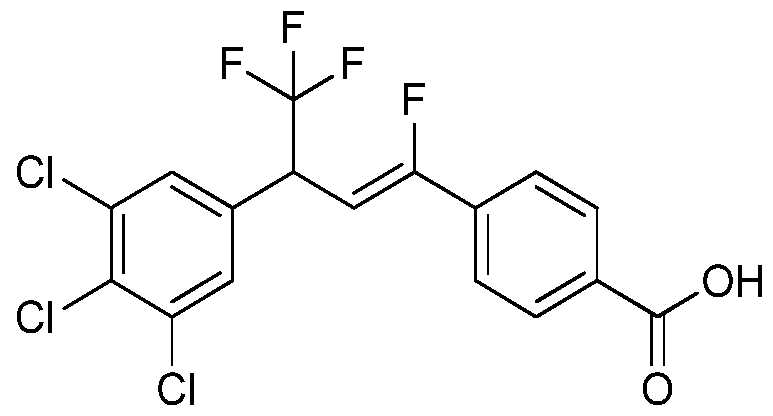
  • Fluorinated vinyl benzoic acid esters 2-3 may be treated with a metal hydroxide source such as lithium hydroxide in a mixed solvent system comprising a polar, aprotic solvent preferably tetrahydrofuran and polar, protic solvents preferably methanol and water at about ambient temperature to provide fluorinated vinyl benzoic acids 2-4 (Scheme 2, step c) .
  • a metal hydroxide source such as lithium hydroxide in a mixed solvent system comprising a polar, aprotic solvent preferably tetrahydrofuran and polar, protic solvents preferably methanol and water at about ambient temperature to provide fluorinated vinyl benzoic acids 2-4 (Scheme 2, step c) .
  • halobenzoic acids 2-1 may be treated directly with a vinyl borane source such as vinyltrifluoroborate or 3-hydroxy-2,3- dimethylbutan-2-yl hydrogen vinylboronate in the presence of a palladium catalyst such as l, l'-bis(diphenylphosphino)ferrocene palladium(II) dichloride, and a base such as potassium carbonate, in a polar, aprotic solvent preferably dimethylsulfoxide at temperatures ranging from about 80 °C to about 140 °C, to provide vinyl benzoic acids 3-1, wherein R 9 , R 10 , R 11 , and R 12 are as previously disclosed (Scheme 3, step a) .
  • Vinyl benzoic acids 3-1 may be treated with bromine source such as N- bromosuccinimide, and a fluorine source such as triethylamine
  • Bromofluoroalkyl benzoic acids 3-2 may be treated with a base such as potassium tert-butoxide, in a polar, protic solvent preferably methanol, at temperatures ranging from about 0 °C to about ambient temperature, to provide fluorinated vinyl benzoic acids 2-4 (Scheme 3, step c) .
  • a base such as potassium tert-butoxide
  • a polar, protic solvent preferably methanol
  • Benzyl halides 1-4 and fluorinated vinylbenzoic acids 2-4 may be treated with a copper(I) source such as copper(I) chloride or copper(I) bromide and a pyridine ligand such as 2,2-bipyridyl in a polar, aprotic solvent preferably /V-methyl-2-pyrrolidone, at a temperature between about 100 °C to about 180 °C to provide fluorinated phenyl allylbenzoic acids 4-1, wherein R 1 , R 2 , R 3 , R 4 , R 5 , R 6 , R 7 , R 9 , R 10 , R 11 , and R 12 are as previously disclosed (Scheme 4, step a) .
  • Scheme 4 Scheme 4
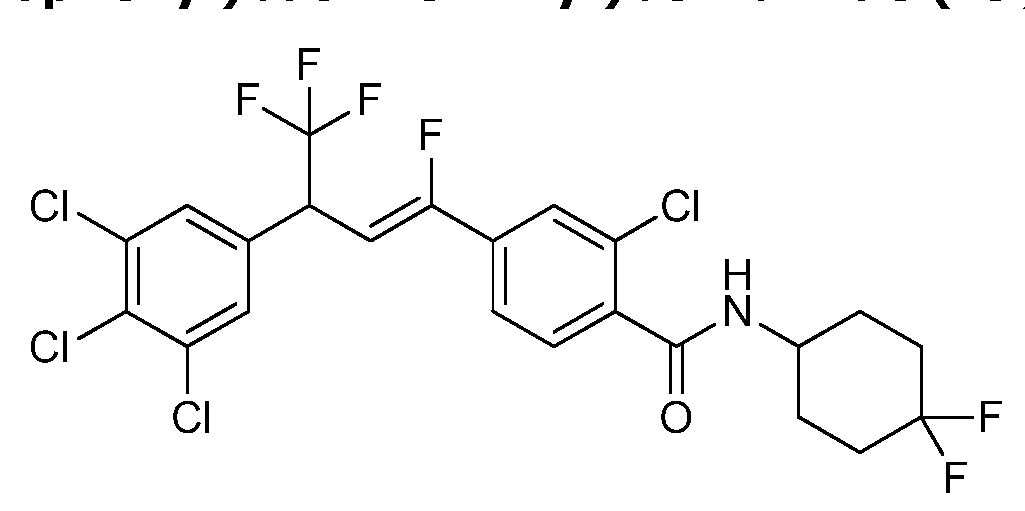
  • Fluorinated phenyl allylbenzamides 5-3 wherein Q is 0 and R 1 , R 2 , R 3 , R 4 , R 5 , R 6 , R 7 , R 9 , R 10 , R 11 , R 12 , R 13 , and R 14 are as previously disclosed may be prepared by treatment with amines or amine salts 5-2, wherein R 13 and R 14 are as previously disclosed, and activated carboxylic acids 5-1, wherein Q is 0, A is an activating group, and R 1 , R 2 , R 3 , R 4 , R 5 , R 6 , R 7 , R 9 , R 10 , R 11 , and R 12 are as previously disclosed, with a base, such as triethylamine, diisopropylethylamine, or 4-methylmorpholine in an anhydrous aprotic solvent such as dichloromethane, tetrahydrofuran, 1,2-dichloroethane, /V,/V-d
  • Activated carboxylic acids 5-1 may be an acid halide such as an acid chloride, an acid bromide, or an acid fluoride; a carboxylic ester such as a para-nitrophenyl ester, a pentafluorophenyl ester, an ethyl
  • Acid chlorides may be prepared from the corresponding carboxylic acids by treatment with a dehydrating, chlorinating reagent such as oxalyl chloride or thionyl chloride.
  • Activated carboxylic acids 5-1 may be prepared from carboxylic acids in situ with a uronium salt such as l-[bis(dimethylamino)methylene]-lH-l,2,3- triazolo[4,5-b]pyridinium 3-oxid hexafluorophosphate (HATU), O- (benzotriazol-l-yl)-/V / /V / /V' / /V -tetramethyluronium hexafluorophosphate (H BTU), or (l-cyano-2-ethoxy-2-oxoethylidenaminooxy)dimethylamino- morpholino-carbenium hexafluorophosphate (COMU) .
  • a uronium salt such as l-[bis(dimethylamino)methylene]-lH-l,2,3- triazolo[4,5-b]pyridinium 3-oxid hexafluorophosphate
  • Activated carboxylic acids 5-1 may also be prepared from carboxylic acids in situ with a phosphonium salt such as benzotriazol- l-yl-oxytripyrrolidinophosphonium hexafluorophosphate (PyBop).
  • Activated carboxylic acids 5-1 may also be prepared from carboxylic acids in situ with a coupling reagent such as 1- (3-dimethylamino propyl)-3-ethylcarbodiimide (EDC), or
  • dicyclohexylcarbodiimide in the presence of a triazole such as hydroxybenzotriazole-monohydrate (HOBt) or l-hydroxy-7- azabenzotriazole (HOAt) .
  • O-Acylisoureas may be prepared with a dehydrating carbodimide such as l-(3-dimethylamino propyl)-3- ethylcarbodiimide or dicyclohexylcarbodiimide.
  • Activated carboxylic acids 5-1 may also be prepared from carboxylic acids in situ with a coupling reagent such as 2-chloro- l,3-dimethylimidazolidinium
  • CIP hexafluorophosphate
  • HOAt 1- hydroxy-7-azabenzotriazole
  • Amines or amine salts 5-2 may be generated in situ from the corresponding /V-tert-butoxycarbonyl amines by treatment with an acid such as hydrogen chloride.
  • amine salts 5-2 may be
  • R 14 are H, and R 1 , R 2 , R 3 , R 4 , R 5 , R 6 , R 7 , R 9 , R 10 , R 11 , and R 12 are as previously disclosed, may be treated with an electrophile, such as N,N- dimethylformamide dimethyl acetal, in an aprotic solvent, such as toluene, at temperatures between about 80 °C and about 130 °C to give dimethylaminomethylene phenyl allylbenzamides 6-2, wherein Q is O and R 1 , R 2 , R 3 , R 4 , R 5 , R 6 , R 7 , R 9 , R 10 , R 11 , and R 12 are as previously disclosed (Scheme 6, step a).
  • an electrophile such as N,N- dimethylformamide dimethyl acetal
  • an aprotic solvent such as toluene
  • Dimethylaminomethylene phenyl allylbenzamides 6-2 may be treated with (Ci-C 4 ) alkyl-ONH 2 or salts thereof, such as O-methylhydroxylamine hydrochloride, an acid, such as acetic acid, and a base, such as aqueous sodium hydroxide, in a polar, aprotic solvent such as dioxane, at temperatures between about 0 °C and about 80 °C, to give /V-alkoxyimino phenyl allylbenzamides 6-3, wherein Q is 0, R 13 is H, and R 1 , R 2 , R 3 , R 4 , R 5 , R 6 , R 7 , R 9 , R 10 , R 11 , and R 12 are as previously disclosed (Scheme 6, step b) .
  • ⁇ NMR spectral data are in ppm ( ⁇ ) and were recorded at 300, 400, 500, or 600 MHz; 1J C N MR spectral data are in ppm ( ⁇ ) and were recorded at 75, 100, or 150 M Hz, and 19 F NM R spectral data are in ppm ( ⁇ ) and were recorded at 376 MHz, unless otherwise stated .
  • Tetrakis(triphenylphosphine)palladium(0) (0.30 g, 0.26 mmol) was added to a solution of (Z)-4-(3-(4-bromo-3,5-dichlorophenyl)- l, 4,4,4- tetrafluorobut- l-en-l-yl)-2-(trifluoromethyl)benzoic acid (Cl l ) ( 1.4 g, 2.6 mmol) in toluene (10 mL) at room temperature. The reaction mixture was degassed by purging with nitrogen (3 x 10 minutes). Tributyl vinyl stannane (0.82 g, 2.6 mmol) was added to the reaction mixture.
  • reaction mixture was again degassed by purging with nitrogen (3 x 10 minutes) and stirred at 120 °C for 3 hours.
  • the reaction mixture was quenched with water and then extracted with ethyl acetate. The organic layer was dried over sodium sulfate, filtered, and concentrated.
  • Tetrakis(triphenylphosphine)palladium(0) (0.459 g, 0.400 mmol), copper(I) iodide (0.0760 mg, 0.400 mmol), and cesium fluoride (3.62 g, 23.9 mmol) were added and the reaction was stirred at room temperature for 24 hours under a nitrogen atmosphere. Water was added to the mixture and the mixture was diluted with 3:1 hexanes/diethyl ether. The layer was separated, and the organic layer was dried over sodium sulfate, concentrated, and the residue was purified by flash column
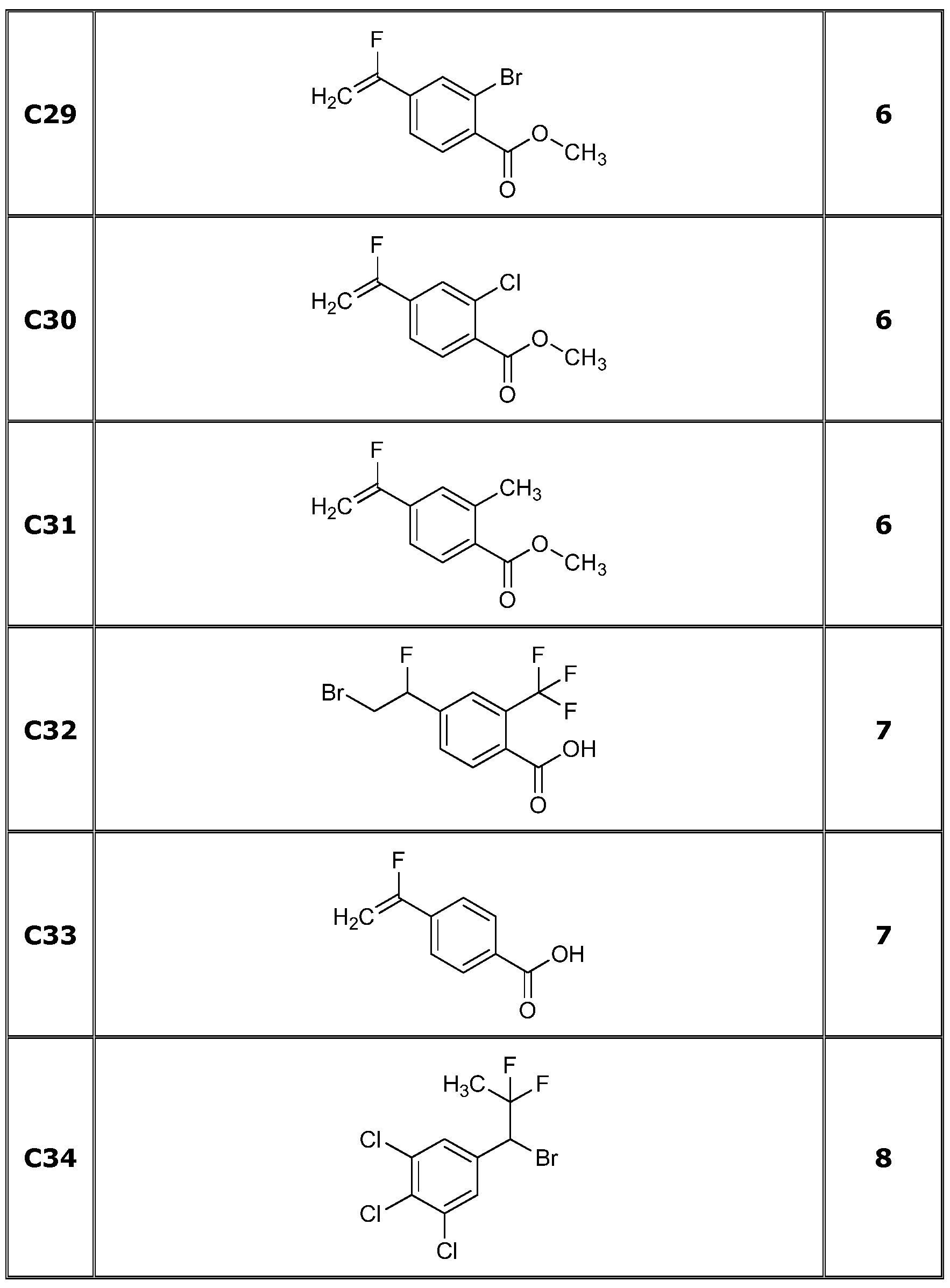
  • Step 1 4-(2-Bromo-l-fluoroethyl )-2-(trifluoromethyl )benzoic acid (C32) 2-(Trifluoromethyl)-4-vinylbenzoic acid (5.3 g, 24 mmol) was dissolved in dichloromethane ( 123 mL) at 0 °C, triethylamine
  • Step 2 4-( l-Fluorovinyl )-2-(trifluoromethyl )benzoic acid (C25) 4- (2-Bromo- l-fluoroethyl)-2-(trifluoromethyl)benzoic acid (4.3 g, 14 mmol) was dissolved in methanol (68 mL) at 0 °C and potassium tert-butoxide (4.6 g, 41 mmol) was added as a solid while stirring . The reaction mixture was allowed to slowly warm to 23 °C and then stirred for 4 hours.
  • Triethylamine (2.46 mL, 17.6 mmol) and methanesulfonyl chloride (1.10 mL, 14.1 mmol) were added to a solution of 2,2-difluoro-l-(3,4,5- trichlorophenyl)butan-l-ol (C44) (3.40 g, 11.7 mmol) in dichloromethane (58.7 mL) .
  • the reaction mixture was stirred for 1 hour, and then pentane was added. Filtration followed by concentration of the filtrate under vacuum provided a white solid. The solid was dissolved in
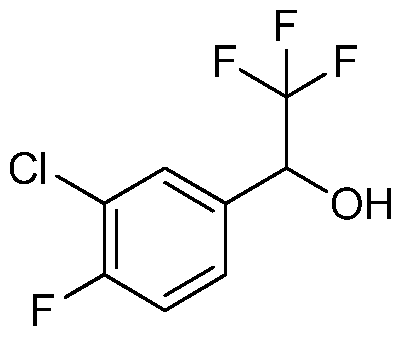
  • Trimethyl(trifluoromethyl)silane (10.1 mL, 68.4 mmol) and tetrabutylammonium fluoride (1.44 g, 4.56 mmol) were added to a stirred solution of 3-bromo-4-chloro-benzaldehyde (10.0 g, 45.6 mmol) in tetrahydrofuran (150 mL) at room temperature and the reaction mixture was stirred for 2 hours. The reaction mixture was diluted with
  • Triethylamine (0.070 mL, 0.50 mmol) was added, and the reaction mixture was stirred at room temperature overnight. The reaction was concentrated and the residue was purified by flash column chromatography to provide the title compound as a yellow oil (0.024 g, 31%) .
  • Example 17 Preparation of /V-((£/Z)-(methoxyimino)methyl)-4- ((Z)-l,4,4,4-tetrafluoro-3-(3,4,5-trichlorophenyl)but-l-en-l-yl)- 2-(trifluoromethyl )benzamide (F19)
  • reaction mixture was diluted with diethyl ether and added carefully to an aqueous solution of sodium bicarbonate. The layers were separated and the aqueous layer was extracted with diethyl ether. The combined diethyl ether layers were washed with brine, dried over magnesium sulfate, filtered, and concentrated . Purification by flash column chromatography using 30% diethyl ether/hexanes to provide the title compound as a light yellow foam (0. 106 g, 75%) .
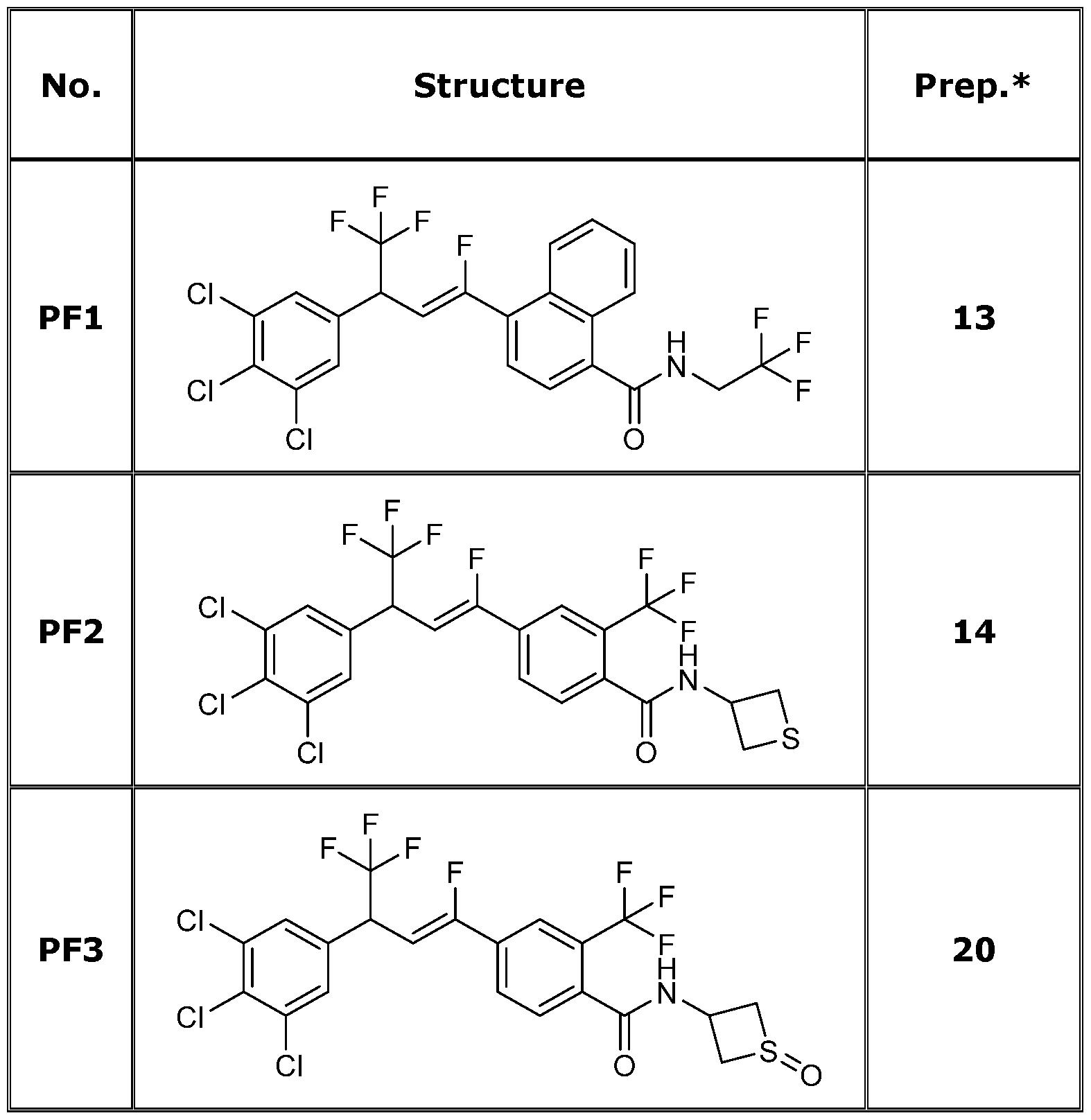
  • the following molecules in Table 1 may be prepared according to the procedures disclosed: PI, PI, P3, P4, P5, P6, P7, P8, P9, PIO, Pll, P12, P13, P14, P15, P16, P17, PIS, P19, P20, P21, P22, P23, P24, P25, P26, P27, P28, and P29.
  • Green Peach Aphid is a good indicator species for a broad range of sap-feeding pests.
  • the results with these four indicator species along with the Yellow Fever Mosquito show the broad usefulness of the molecules of Formula One in controlling pests in Phyla Arthropoda,
  • CEW CEW
  • CL AN D Cabbage Looper ⁇ Trichoplusia ni, TRIPNI
  • Beet army worm is a serious pest of economic concern for alfalfa, asparagus, beets, citrus, corn, cotton, onions, peas, peppers, potatoes, soybeans, sugar beets, sunflowers, tobacco, tomatoes, among other crops. It is native to Southeast Asia but is now found in Africa, Australia, Japan, North America, and Southern Europe. The larvae may feed in large swarms causing devastating crop losses. It is known to be resistant to several pesticides.
  • Cabbage Looper is a serious pest found throughout the world. It attacks alfalfa, beans, beets, broccoli, Brussel sprouts, cabbage, cantaloupe, cauliflower, celery, collards, cotton, cucumbers, eggplant, kale, lettuce, melons, mustard, parsley, peas, peppers, potatoes, soybeans, spinach, squash, tomatoes, turnips, and watermelons, among other crops. This species is very destructive to plants due to its voracious appetite. The larvae consume three times their weight in food daily. The feeding sites are marked by large accumulations of sticky, wet, fecal material. It is known to be resistant to several pesticides.
  • Corn earworm is considered by some to be the most costly crop pest in North America. It often attacks valuable crops, and the harvested portion of the crop. This pest damages alfalfa, artichoke, asparagus, cabbage, cantaloupe, collard, corn, cotton, cowpea, cucumber, eggplant, lettuce, lima bean, melon, okra, pea, pepper, potato, pumpkin, snap bean, soybean, spinach, squash, sugarcane, sweet potato, tomato, and watermelon, among other crops. Furthermore, this pest is also known to be resistant to certain insecticides.
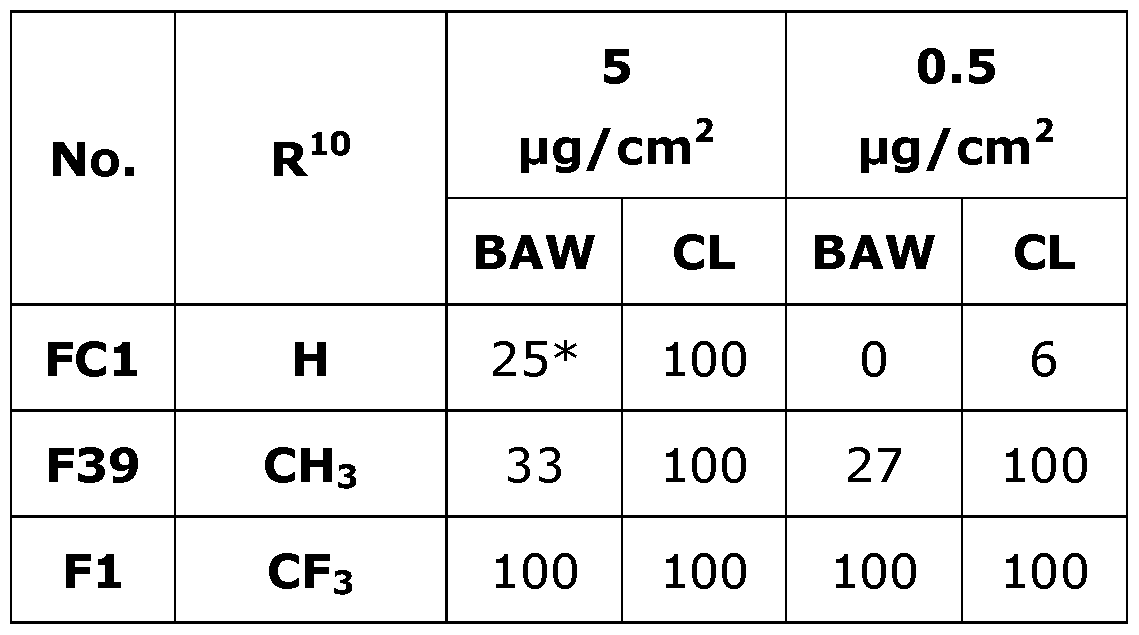
  • Bioassays on BAW were conducted using a 128-well diet tray assay, one to five second instar BAW larvae were placed in each well (3 mL) of the diet tray that had been previously filled with 1 mL of artificial diet to which 50 pg/cm 2 of the test molecule (dissolved in 50 pL of 90: 10 acetone-water mixture) had been applied (to each of eight wells) and then allowed to dry. Trays were covered with a clear self-adhesive cover and held at 25 °C, 14: 10 light-dark for five to seven days. Percent mortality was recorded for the larvae in each well; activity in the eight wells was then averaged . The results are indicated in the table entitled "Table ABC: Biological Results” (See Table Section).
  • Bioassays on CL were conducted using a 128-well diet tray assay.
  • one to five second instar CL larvae were placed in each well (3 mL) of the diet tray that had been previously filled with 1 mL of artificial diet to which 50 pg/cm 2 of the test molecule (dissolved in 50 pL of 90 : 10 acetone-water mixture) had been applied (to each of eight wells) and then allowed to dry.
  • Trays were covered with a clear self-adhesive cover and held at 25 °C, 14: 10 light-dark for five to seven days. Percent mortality was recorded for the larvae in each well; activity in the eight wells was then averaged . The results are indicated in the table entitled "Table ABC: Biological Results” (See Table Section).
  • Example B BIOASSAYS ON GREEN PEACH APHID Myzus persicae
  • GPA is the most significant aphid pest of peach trees, causing decreased growth, shriveling of the leaves, and the death of various tissues. It is also hazardous because it acts as a vector for the transport of plant viruses, such as potato virus Y and potato leafroll virus to members of the nightshade/potato family Solanaceae, and various mosaic viruses to many other food crops.
  • GPA attacks such plants as broccoli, burdock, cabbage, carrot, cauliflower, daikon, eggplant, green beans, lettuce, macadamia, papaya, peppers, sweet potatoes, tomatoes, watercress, and zucchini, among other crops. GPA also attacks many ornamental crops such as carnation, chrysanthemum, flowering white cabbage, poinsettia, and roses.
  • GPA has developed resistance to many pesticides. Consequently, because of the above factors control of this pest is important. Furthermore, molecules that control this pest (GPA), which is known as a sap-feeding pest, are useful in controlling other pests that feed on the sap from plants.
  • acetone/methanol ( 1 : 1) solvent forming stock solutions of 1000 ppm test molecule.
  • the stock solutions were diluted 5X with 0.025% Tween 20 in water to obtain the solution at 200 ppm test molecule.
  • a hand-held aspirator-type sprayer was used for spraying a solution to both sides of cabbage leaves until runoff. Reference plants (solvent check) were sprayed with the diluent only containing 20% by volume of
  • acetone/methanol ( 1 : 1) solvent Treated plants were held in a holding room for three days at approximately 25 °C and ambient relative humidity (RH) prior to grading . Evaluation was conducted by counting the number of live aphids per plant under a microscope. Percent Control was measured by using Abbott's correction formula (W.S. Abbott, "A Method of Computing the Effectiveness of an Insecticide” J . Econ . Entomol . 18 ( 1925), pp.265-267) as follows.
  • Example C Bio ASS AYS ON Yellow Fever Mosquito (Aedes aegypti, AEDSAE) ("YFM").
  • YFM prefers to feed on humans during the daytime and is most frequently found in or near human habitations.
  • YFM is a vector for transmitting several diseases. It is a mosquito that can spread the dengue fever and yellow fever viruses. Yellow fever is the second most dangerous mosquito-borne disease after malaria. Yellow fever is an acute viral hemorrhagic disease and up to 50% of severely affected persons without treatment will die from yellow fever. There are an estimated 200,000 cases of yellow fever, causing 30,000 deaths, worldwide each year.
  • Dengue fever is a deadly, viral disease; it is sometimes called “breakbone fever” or “break-heart fever” because of the intense pain it can produce. Dengue fever kills about 20,000 people annually. Consequently, because of the above factors control of this pest is important. Furthermore, molecules that control this pest (YFM), which is known as a sucking pest, are useful in controlling other pests that cause human and animal suffering .
  • YFM which is known as a sucking pest
  • Master plates containing 400 pg of a molecule dissolved in 100 ⁇ _ of dimethyl sulfoxide (DMSO) (equivalent to a 4000 ppm solution) are used .
  • a master plate of assembled molecules contains 15 ⁇ _ per well.
  • 135 ⁇ _ of a 90 : 10 waten acetone mixture is added to each well.
  • a robot Biomek® NXP Laboratory Automation Workstation
  • a robot is programmed to dispense 15 ⁇ _ aspirations from the master plate into an empty 96-well shallow plate ("daughter” plate).
  • Molecules of Formula One may be formulated into agriculturally acceptable acid addition salts.
  • an amine function can form salts with hydrochloric, hydrobromic, sulfuric, phosphoric, acetic, benzoic, citric, malonic, salicylic, malic, fumaric, oxalic, succinic, tartaric, lactic, gluconic, ascorbic, maleic, aspartic, benzenesulfonic, methanesulfonic, ethanesulfonic, hydroxyl- methanesulfonic, and hydroxyethanesulfonic acids.
  • an acid function can form salts including those derived from alkali or alkaline earth metals and those derived from ammonia and amines. Examples of preferred cations include sodium, potassium, and magnesium.
  • Molecules of Formula One may be formulated into salt derivatives.
  • a salt derivative may be prepared by contacting a free base with a sufficient amount of the desired acid to produce a salt.
  • a free base may be regenerated by treating the salt with a suitable dilute aqueous base solution such as dilute aqueous sodium hydroxide, potassium carbonate, ammonia, and sodium bicarbonate.
  • a pesticide such as 2,4-D, is made more water-soluble by converting it to its dimethylamine salt.
  • Molecules of Formula One may be formulated into stable complexes with a solvent, such that the complex remains intact after the non- complexed solvent is removed. These complexes are often referred to as "solvates.” However, it is particularly desirable to form stable hydrates with water as the solvent.
  • Molecules of Formula One may be made into ester derivatives.
  • Molecules of Formula One may be made with different isotopes. Of particular importance are molecules having 2 H (also known as deuterium) or 3 H (also known as tritium) in place of 1H . Molecules of Formula One may be made with different radionuclides. Of particular importance are molecules having 14 C. Molecules of Formula One having deuterium, tritium, or 14 C may be used in biological studies allowing tracing in chemical and physiological processes and half-life studies, as well as, MoA studies.
  • Molecules of Formula One may exist as one or more stereoisomers.
  • certain molecules may be produced as racemic mixtures. It will be appreciated by those skilled in the art that one stereoisomer may be more active than the other stereoisomers. Individual stereoisomers may be obtained by known selective synthetic procedures, by conventional synthetic procedures using resolved starting materials, or by conventional resolution procedures. Certain molecules disclosed in this document can exist as two or more isomers. The various isomers include geometric isomers, diastereomers, and enantiomers. Thus, the molecules disclosed in this document include geometric isomers, racemic mixtures, individual stereoisomers, and optically active mixtures. It will be appreciated by those skilled in the art that one isomer may be more active than the others.
  • the structures disclosed in the present disclosure are drawn in only one geometric form for clarity, but are intended to represent all geometric forms of the molecule.
  • molecules of Formula One may be used in combination (such as, in a compositional mixture, or a simultaneous or sequential application) with one or more active
  • molecules of Formula One may be used in combination (such as, in a compositional mixture, or a simultaneous or sequential application) with one or more active
  • molecules of Formula One may be used in combination (such as, in a compositional mixture, or a simultaneous or sequential application) with one or more molecules having acaricidal, algicidal, avicidal, bactericidal, fungicidal, herbicidal, insecticidal, molluscicidal, nematicidal, rodenticidal, and/or virucidal properties.
  • the molecules of Formula One may be used in combination (such as, in a compositional mixture, or a simultaneous or sequential application) with one or more molecules that are antifeedants, bird repellents, chemosterilants, herbicide safeners, insect attractants, insect repellents, mammal repellents, mating disrupters, plant activators, plant growth regulators, and/or synergists.
  • molecules of Formula One may also be used in combination (such as in a compositional mixture, or a
  • weight ratio of a molecule of Formula One to an active ingredient may be from about 100 : 1 to about 1 : 100; in another example the weight ratio may be about 50 : 1 to about 1 : 50; in another example the weight ratio may be about 20 : 1 to about 1 : 20; in another example the weight ratio may be about 10 : 1 to about 1 : 10; in another example the weight ratio may be about 5 : 1 to 1 : 5; in another example the weight ratio may be about 3 : 1 to about 1 : 3; in another example the weight ratio may be about 2 : 1 to about 1 : 2; and in a final example the weight ratio may be about 1 : 1 (See Table B) .
  • weight ratios less than about 10 : 1 to about 1 : 10 are preferred . It is also preferred sometimes to use a
  • Weight ratios of a molecule of Formula One to an active ingredient may also be depicted as X: Y; wherein X is the parts by weight of a molecule of Formula One and Y is the parts by weight of active ingredient.
  • the numerical range of the parts by weight for X is 0 ⁇ X ⁇ 100 and the parts by weight for Y is 0 ⁇ Y ⁇ 100 and is shown graphically in TABLE C.
  • the weight ratio of a molecule of Formula One to an active ingredient may be 20 : 1.
  • Ranges of weight ratios of a molecule of Formula One to an active ingredient may be depicted as Xi : Yj to ⁇ '- ⁇ , wherein X and Y are defined as above.
  • the range of weight ratios may be Xi'.Yi to
  • the range of a weight ratio of a molecule of Formula One to an active ingredient may be between 3:1 and 1:3, inclusive of the endpoints.
  • the range of weight ratios may be Xi'.Yi to X2-Y2, wherein Xi > Yi and X2 > ⁇ 2 ⁇
  • the range of weight ratio of a molecule of Formula One to an active ingredient may be between 15:1 and 3:1, inclusive of the endpoints.
  • the range of weight ratios may be Xi'.Yi to X2-Y2, wherein Xi ⁇ Yi and X2 ⁇ ⁇ 2 ⁇
  • the range of weight ratios of a molecule of Formula One to an active ingredient may be between about 1:3 and about 1:20, inclusive of the endpoints.
  • pesticides are formulated into, for example, baits, concentrated emulsions, dusts, emulsifiable concentrates, fumigants, gels, granules, microencapsulations, seed treatments, suspension concentrates, suspoemulsions, tablets, water soluble liquids, water dispersible granules or dry flowables, wettable powders, and ultra-low volume solutions.
  • Pesticides are applied most often as aqueous suspensions or emulsions prepared from concentrated formulations of such pesticides.
  • Such water-soluble, water-suspendable, or emulsifiable formulations are either solids, usually known as wettable powders, or water dispersible granules, or liquids usually known as emulsifiable concentrates, or aqueous suspensions.
  • Wettable powders which may be compacted to form water dispersible granules, comprise an intimate mixture of the pesticide, a carrier, and surfactants.
  • the concentration of the pesticide is usually from about 10% to about 90% by weight.
  • the carrier is usually selected from among the attapulgite clays, the montmorillonite clays, the diatomaceous earths, or the purified silicates.
  • Effective surfactants comprising from about 0.5% to about 10% of the wettable powder, are found among sulfonated lignins, condensed naphthalenesulfonates, naphthalenesulfonates, alkylbenzenesulfonates, alkyl sulfates, and non- ionic surfactants such as ethylene oxide adducts of alkyl phenols.
  • Emulsifiable concentrates of pesticides comprise a convenient concentration of a pesticide, such as from about 50 to about 500 grams per liter of liquid dissolved in a carrier that is either a water miscible solvent or a mixture of water-immiscible organic solvent and emulsifiers.
  • Useful organic solvents include aromatics, especially xylenes and petroleum fractions, especially the high-boiling naphthalenic and olefinic portions of petroleum such as heavy aromatic naphtha .
  • Other organic solvents may also be used, such as the terpenic solvents including rosin derivatives, aliphatic ketones such as cyclohexanone, and complex alcohols such as 2-ethoxyethanol .
  • Suitable emulsifiers for emulsifiable concentrates are selected from conventional anionic and non-ionic surfactants.
  • Aqueous suspensions comprise suspensions of water-insoluble pesticides dispersed in an aqueous carrier at a concentration in the range from about 5% to about 50% by weight.
  • Suspensions are prepared by finely grinding the pesticide and vigorously mixing it into a carrier comprised of water and surfactants. Ingredients, such as inorganic salts and synthetic or natural gums may also be added, to increase the density and viscosity of the aqueous carrier. It is often most effective to grind and mix the pesticide at the same time by preparing the aqueous mixture and homogenizing it in an implement such as a sand mill, ball mill, or piston- type homogenizer.
  • Pesticides may also be applied as granular compositions that are particularly useful for applications to the soil .
  • Granular compositions usually contain from about 0.5% to about 10% by weight of the pesticide, dispersed in a carrier that comprises clay or a similar substance.
  • Such compositions are usually prepared by dissolving the pesticide in a suitable solvent and applying it to a granular carrier which has been pre-formed to the appropriate particle size, in the range of from about 0.5 to about 3 mm.
  • Such compositions may also be formulated by making a dough or paste of the carrier and molecule and crushing and drying to obtain the desired granular particle size.
  • Dusts containing a pesticide are prepared by intimately mixing the pesticide in powdered form with a suitable dusty agricultural carrier, such as kaolin clay, ground volcanic rock, and the like. Dusts can suitably contain from about 1% to about 10% of the pesticide. Dusts may be applied as a seed dressing or as a foliage application with a dust blower machine. It is equally practical to apply a pesticide in the form of a solution in an appropriate organic solvent, usually petroleum oil, such as the spray oils, which are widely used in agricultural chemistry.
  • a suitable dusty agricultural carrier such as kaolin clay, ground volcanic rock, and the like. Dusts can suitably contain from about 1% to about 10% of the pesticide. Dusts may be applied as a seed dressing or as a foliage application with a dust blower machine. It is equally practical to apply a pesticide in the form of a solution in an appropriate organic solvent, usually petroleum oil, such as the spray oils, which are widely used in agricultural chemistry.
  • Pesticides can also be applied in the form of an aerosol composition.
  • the pesticide is dissolved or dispersed in a carrier, which is a pressure-generating propellant mixture.
  • a carrier which is a pressure-generating propellant mixture.
  • composition is packaged in a container from which the mixture is dispensed through an atomizing valve.
  • Pesticide baits are formed when the pesticide is mixed with food or an attractant or both. When the pests eat the bait they also consume the pesticide. Baits may take the form of granules, gels, flowable powders, liquids, or solids. Baits may be used in pest harborages.
  • Fumigants are pesticides that have a relatively high vapor pressure and hence can exist as a gas in sufficient concentrations to kill pests in soil or enclosed spaces.
  • the toxicity of the fumigant is proportional to its concentration and the exposure time. They are characterized by a good capacity for diffusion and act by penetrating the pest's respiratory system or being absorbed through the pest's cuticle. Fumigants are applied to control stored product pests under gas proof sheets, in gas sealed rooms or buildings or in special chambers.
  • Pesticides may be microencapsulated by suspending the pesticide particles or droplets in plastic polymers of various types. By altering the chemistry of the polymer or by changing factors in the processing, microcapsules may be formed of various sizes, solubility, wall thicknesses, and degrees of penetrability. These factors govern the speed with which the active ingredient within is released, which in turn, affects the residual performance, speed of action, and odor of the product.
  • Oil solution concentrates are made by dissolving pesticide in a solvent that will hold the pesticide in solution. Oil solutions of a pesticide usually provide faster knockdown and kill of pests than other formulations due to the solvents themselves having pesticidal action and the
  • Another embodiment is an oil-in-water emulsion, wherein the emulsion comprises oily globules which are each provided with a lamellar liquid crystal coating and are dispersed in an aqueous phase, wherein each oily globule comprises at least one molecule which is agriculturally active, and is individually coated with a monolamellar or oligolamellar layer comprising : ( 1) at least one non-ionic lipophilic surface-active agent, (2) at least one non-ionic hydrophilic surface-active agent and (3) at least one ionic surface-active agent, wherein the globules having a mean particle diameter of less than 800 nanometers.
  • such formulation can also contain other components.
  • these components include, but are not limited to, (this is a non-exhaustive and non-mutually exclusive list) wetters, spreaders, stickers, penetrants, buffers, sequestering agents, drift reduction agents, compatibility agents, anti-foam agents, cleaning agents, and emulsifiers. A few components are described forthwith.
  • a wetting agent is a substance that when added to a liquid
  • wetting agents are used for two main functions in
  • agrochemical formulations during processing and manufacture to increase the rate of wetting of powders in water to make concentrates for soluble liquids or suspension concentrates; and during mixing of a product with water in a spray tank to reduce the wetting time of wettable powders and to improve the penetration of water into water-dispersible granules.
  • wetting agents used in wettable powder, suspension concentrate, and water-dispersible granule formulations are: sodium lauryl sulfate; sodium dioctyl sulfosuccinate; alkyl phenol ethoxylates; and aliphatic alcohol ethoxylates.
  • a dispersing agent is a substance which adsorbs onto the surface of particles and helps to preserve the state of dispersion of the particles and prevents them from reaggregating.
  • Dispersing agents are added to agrochemical formulations to facilitate dispersion and suspension during manufacture, and to ensure the particles redisperse into water in a spray tank. They are widely used in wettable powders, suspension concentrates and water-dispersible granules.
  • Surfactants that are used as dispersing agents have the ability to adsorb strongly onto a particle surface and provide a charged or steric barrier to reaggregation of particles. The most commonly used surfactants are anionic, non-ionic, or mixtures of the two types.
  • the most common dispersing agents are sodium lignosulfonates.
  • suspension concentrates very good adsorption and stabilization are obtained using polyelectrolytes, such as sodium naphthalene sulfonate formaldehyde condensates.
  • Tristyrylphenol ethoxylate phosphate esters are also used.
  • Non-ionics such as alkylarylethylene oxide condensates and EO-PO block copolymers are sometimes combined with anionics as dispersing agents for
  • dispersing agents have very long hydrophobic 'backbones' and a large number of ethylene oxide chains forming the 'teeth' of a 'comb' surfactant.
  • These high molecular weight polymers can give very good long-term stability to suspension concentrates because the hydrophobic backbones have many anchoring points onto the particle surfaces.
  • dispersing agents used in agrochemical formulations are: sodium lignosulfonates; sodium naphthalene sulfonate formaldehyde condensates; tristyrylphenol ethoxylate phosphate esters; aliphatic alcohol ethoxylates; alkyl ethoxylates; EO-PO block copolymers; and graft copolymers.
  • An emulsifying agent is a substance which stabilizes a suspension of droplets of one liquid phase in another liquid phase.
  • emulsifying agent the two liquids would separate into two immiscible liquid phases.
  • the most commonly used emulsifier blends contain alkylphenol or aliphatic alcohol with twelve or more ethylene oxide units and the oil-soluble calcium salt of dodecylbenzenesulfonic acid .
  • a range of hydrophile-lipophile balance (“H LB") values from 8 to 18 will normally provide good stable emulsions. Emulsion stability can sometimes be improved by the addition of a small amount of an EO-PO block copolymer surfactant.
  • a solubilizing agent is a surfactant which will form micelles in water at concentrations above the critical micelle concentration . The micelles are then able to dissolve or solubilize water-insoluble materials inside the hydrophobic part of the micelle.
  • the types of surfactants usually used for solubilization are non-ionics, sorbitan monooleates, sorbitan monooleate ethoxylates, and methyl oleate esters.
  • Surfactants are sometimes used, either alone or with other additives such as mineral or vegetable oils as adjuvants to spray-tank mixes to improve the biological performance of the pesticide on the target.
  • the types of surfactants used for bioenhancement depend generally on the nature and mode of action of the pesticide. However, they are often non-ionics such as : alkyl ethoxylates; linear aliphatic alcohol ethoxylates; aliphatic amine ethoxylates.
  • a carrier or diluent in an agricultural formulation is a material added to the pesticide to give a product of the required strength .
  • Carriers are usually materials with high absorptive capacities, while diluents are usually materials with low absorptive capacities. Carriers and diluents are used in the formulation of dusts, wettable powders, granules and water- dispersible granules.
  • Organic solvents are used mainly in the formulation of emulsifiable concentrates, oil-in-water emulsions, suspoemulsions, and ultra-low volume formulations, and to a lesser extent, granular formulations.
  • the first main groups of solvents are aliphatic paraffinic oils such as kerosene or refined paraffins.
  • the second main group (and the most common) comprises the aromatic solvents such as xylene and higher molecular weight fractions of C9 and CIO aromatic solvents.
  • Chlorinated hydrocarbons are useful as cosolvents to prevent crystallization of pesticides when the formulation is emulsified into water. Alcohols are sometimes used as cosolvents to increase solvent power.
  • Other solvents may include vegetable oils, seed oils, and esters of vegetable and seed oils.
  • Thickeners or gelling agents are used mainly in the formulation of suspension concentrates, emulsions and suspoemulsions to modify the rheology or flow properties of the liquid and to prevent separation and settling of the dispersed particles or droplets.
  • Thickening, gelling, and anti-settling agents generally fall into two categories, namely water- insoluble particulates and water-soluble polymers. It is possible to produce suspension concentrate formulations using clays and silicas.
  • Examples of these types of materials include, but are not limited to, montmorillonite, bentonite, magnesium aluminum silicate, and
  • Attapulgite Water-soluble polysaccharides have been used as thickening- gelling agents for many years.
  • the types of polysaccharides most commonly used are natural extracts of seeds and seaweeds or are synthetic derivatives of cellulose. Examples of these types of materials include, but are not limited to, guar gum; locust bean gum; carrageenam; alginates; methyl cellulose; sodium carboxymethyl cellulose (SCMC);
  • HEC hydroxyethyl cellulose
  • Other types of anti-settling agents are based on modified starches, polyacrylates, polyvinyl alcohol and
  • polyethylene oxide Another good anti-settling agent is xanthan gum.
  • Microorganisms can cause spoilage of formulated products.
  • preservation agents are used to eliminate or reduce their effect.
  • examples of such agents include, but are not limited to: propionic acid and its sodium salt; sorbic acid and its sodium or potassium salts; benzoic acid and its sodium salt; p-hydroxybenzoic acid sodium salt; methyl p- hydroxybenzoate; and l,2-benzisothiazolin-3-one (BIT) .
  • anti-foam agents are often added either during the production stage or before filling into bottles.
  • anti-foam agents there are two types of anti-foam agents, namely silicones and non-silicones. Silicones are usually aqueous emulsions of dimethyl polysiloxane, while the non-silicone anti-foam agents are water- insoluble oils, such as octanol and nonanol, or silica . In both cases, the function of the anti-foam agent is to displace the surfactant from the air- water interface.
  • Green agents can reduce the overall environmental footprint of crop protection formulations.
  • Green agents are biodegradable and generally derived from natural and/or sustainable sources, e.g. plant and animal sources. Specific examples are: vegetable oils, seed oils, and esters thereof, also alkoxylated alkyl polyglucosides.
  • Molecules of Formula One may be applied to any locus.
  • Particular crop loci to apply such molecules include loci where alfalfa, almonds, apples, barley, beans, canola, corn, cotton, crucifers, lettuce, oats, oranges, pears, peppers, potatoes, rice, sorghum, soybeans,
  • strawberries, sugarcane, sugar beets, sunflowers, tobacco, tomatoes, wheat, and other valuable crops are growing or the seeds thereof are going to be planted.
  • Molecules of Formula One may also be applied where plants, such as crops, are growing and where there are low levels (even no actual presence) of pests that can commercially damage such plants. Applying such molecules in such locus is to benefit the plants being grown in such locus.
  • Such benefits may include, but are not limited to: helping the plant grow a better root system; helping the plant better withstand stressful growing conditions; improving the health of a plant; improving the yield of a plant (e.g. increased biomass and/or increased content of valuable ingredients); improving the vigor of a plant (e.g. improved plant growth and/or greener leaves); improving the quality of a plant (e.g. improved content or composition of certain ingredients); and improving the tolerance to abiotic and/or biotic stress of the plant.
  • Molecules of Formula One may be applied with ammonium sulfate when growing various plants as this may provide additional benefits.
  • Molecules of Formula One may be applied on, in, or around plants genetically modified to express specialized traits, such as Bacillus thuringiensis or other insecticidal toxins, or those expressing herbicide resistance, or those with "stacked" foreign genes expressing insecticidal toxins, herbicide resistance, nutrition-enhancement, or any other beneficial traits.
  • specialized traits such as Bacillus thuringiensis or other insecticidal toxins, or those expressing herbicide resistance, or those with "stacked" foreign genes expressing insecticidal toxins, herbicide resistance, nutrition-enhancement, or any other beneficial traits.
  • Molecule of Formula One may be applied to the foliar and/or fruiting portions of plants to control pests. Such molecules will either come in direct contact with the pest, or the pest will consume such molecules when eating the plant or while extracting sap from the plant.
  • Molecule of Formula One may also be applied to the soil, and when applied in this manner, root and stem feeding pests may be controlled.
  • the roots may absorb such molecules thereby taking it up into the foliar portions of the plant to control above ground chewing and sap feeding pests.
  • Systemic movement of pesticides in plants may be utilized to control pests on one portion of the plant by applying (for example by spraying a locus) a molecule of Formula One to a different portion of the plant.
  • control of foliar-feeding insects may be achieved by drip irrigation or furrow application, by treating the soil with for example pre- or post-planting soil drench, or by treating the seeds of a plant before planting.
  • Molecules of Formula One may be used with baits.
  • the baits are placed in the ground where, for example, termites can come into contact with, and/or be attracted to, the bait.
  • Baits can also be applied to a surface of a building, (horizontal, vertical, or slant surface) where, for example, ants, termites, cockroaches, and flies, can come into contact with, and/or be attracted to, the bait.
  • Molecules of Formula One may be encapsulated inside, or placed on the surface of a capsule.
  • the size of the capsules can range from nanometer size (about 100-900 nanometers in diameter) to micrometer size (about 10-900 microns in diameter) .
  • Molecules of Formula One may be applied to eggs of pests. Because of the unique ability of the eggs of some pests to resist certain pesticides, repeated applications of such molecules may be desirable to control newly emerged larvae.
  • Molecules of Formula One may be applied as seed treatments.
  • Seed treatment may be applied to all types of seeds, including those from which plants genetically modified to express specialized traits will germinate.
  • Representative examples include those expressing proteins toxic to invertebrate pests, such as Bacillus thuringiensis or other insecticidal toxins, those expressing herbicide resistance, such as
  • “Roundup Ready” seed or those with “stacked” foreign genes expressing insecticidal toxins, herbicide resistance, nutrition-enhancement, drought resistance, or any other beneficial traits.
  • seed treatments with molecules of Formula One may further enhance the ability of a plant to better withstand stressful growing conditions. This results in a healthier, more vigorous plant, which can lead to higher yields at harvest time.
  • about 1 gram of such molecules to about 500 grams per 100,000 seeds is expected to provide good benefits, amounts from about 10 grams to about 100 grams per 100,000 seeds is expected to provide better benefits, and amounts from about 25 grams to about 75 grams per 100,000 seeds is expected to provide even better benefits.
  • Molecules of Formula One may be applied with one or more active ingredients in a soil amendment.
  • Molecules of Formula One may be used for controlling endoparasites and ectoparasites in the veterinary medicine sector or in the field of non- human-animal keeping .
  • Such molecules may be applied by oral
  • administration in the form of, for example, tablets, capsules, drinks, granules, by dermal application in the form of, for example, dipping, spraying, pouring on, spotting on, and dusting, and by parenteral administration in the form of, for example, an injection.
  • Molecules of Formula One may also be employed advantageously in livestock keeping, for example, cattle, sheep, pigs, chickens, salmon, and geese. They may also be employed advantageously in pets such as, horses, dogs, and cats. Particular pests to control would be fleas and ticks that are bothersome to such animals. Suitable formulations are
  • Molecules of Formula One may also be used for controlling parasitic worms, especially of the intestine, in the animals listed above.
  • Molecules of Formula One may also be employed in therapeutic methods for human health care. Such methods include, but are limited to, oral administration in the form of, for example, tablets, capsules, drinks, granules, and by dermal application .
  • Molecules of Formula One may also be applied to invasive pests. Pests around the world have been migrating to new environments (for such pest) and thereafter becoming a new invasive species in such new environment. Such molecules may also be used on such new invasive species to control them in such new environments.
  • R 1 , R 5 , R 6 , R 11 , and R 12 are each independently selected from the group consisting of H, F, CI, Br, I, CN, (Ci-C 4 )alkyl, (Ci-C 4 )haloalkyl,
  • R 1 , R 5 , R 6 , R 11 , and R 12 are H;
  • R 2 , R 3 , and R 4 are each independently selected from the group consisting of H, F, CI, Br, I, CN, (Ci-C 4 )alkyl, (C 2 -C 4 )alkenyl, (C 2 - C 4 )alkynyl, (Ci-C 4 )haloalkyl, (Ci-C 4 )alkoxy, and (Ci-C 4 )haloalkoxy
  • R 2 , R 3 , and R 4 are H, F, CI, Br, or CH 32 ;
  • R 7 is (Ci-C 6 )haloalkyl
  • R 7 is CF 3 ;
  • R 9 is selected from the group consisting of (F), H, F, CI, Br, I, CN, (Ci-C 4 )alkyl, (Ci-C 4 )haloalkyl, (Ci-C 4 )alkoxy, and (Ci-C 4 )haloalkoxy preferably R 9 is H;
  • R 10 is selected from the group consisting of (F), F, CI, Br, I, CN, (Ci-C 4 )alkyl, (C 2 -C 4 )alkenyl, (C 2 -C 4 )alkynyl, (Ci-C 4 )haloalkyl, (Ci- C 4 )alkoxy, and (Ci-C 4 )haloalkoxy
  • R 10 is Br, CH 3 , or CF 3 ;
  • R 9 and R 10 together can optionally form a 3- to 5-membered saturated or unsaturated, hydrocarbyl link,
  • hydrocarbyl link may optionally be substituted with one or more substituents independently selected from the group consisting of F, CI, Br, I, and CN;
  • R 13 and R 14 are each independently selected from the group consisting of H, CHO, (Ci-C 4 )alkyl, (C 2 - C 4 )alkenyl, (Ci-C 4 )haloalkyl, (Ci-C 4 )alkoxy, (Ci-C 4 )haloalkoxy, (C 3 - Cs)cycloalkyl, (Ci-C 4 )alkyl phenyl, (Ci-C 4 )alkyl pyridyl, pyridyl,
  • CH NO(Ci-C 4 )alkyl
  • (Ci-C 4 )alkylCH NO(Ci-C 4 )haloalkyl
  • (Ci-C 4 )alkylN((Ci-C 4 )alkyl)(Ci-C 4 )haloalkyl thietanyl, thietanyl-oxide, and thietanyl-dioxide
  • each alkyl, alkenyl, haloalkyl, alkoxy, haloalkoxy, cycloalkyi, phenyl, pyridyl, thietanyl, thietanyl-oxide, and thietanyl- dioxide may optionally be substituted with one or more substituents independently selected from the group consisting of F, CI, Br, I, CN, OH, (Ci-C 4 )alkyl, and (Ci-C 4 )alkoxy,
  • N CH N((Ci-C 4 )alkyl) 2 , or
  • R 13 and R 14 wherein R 13 and R 14 are H, CHO, CH 3 , CH 2 CF 3 , CH(CH 3 )CF 3 , cyclopropyl, cyclobutyl, cyclohexyl, CH(CH 3 )phenyl,
  • N CH N(CH 3 ) 2 , or
  • (H) Q is selected from the group consisting of 0 and S;
  • R 1 , R 5 , R 6 , R 11 , and R 12 are H;
  • R 2 , R 3 , and R 4 are each independently selected from the group consisting of H, F, CI, Br, and (Ci-C 4 )alkyl;
  • R 7 is (Ci-C 6 )haloalkyl
  • R 10 is selected from the group consisting of Br, (Ci-C 4 )alkyl, and (Ci-C 4 )haloalkyl;
  • each alkyl, haloalkyl, cycloalkyl, phenyl, and pyridyl may optionally be substituted with one or more substituents
  • N CH N((Ci-C 4 )alkyl) 2 , or
  • (H ) Q is selected from the group consisting of 0 and S.
  • a molecule according to 1 wherein said molecule is selected from one of the molecules in Table 2.
  • a molecule according to 1 wherein said molecule is selected from one of the molecules in Table 1.
  • a pesticidal composition comprising a molecule according to any one of 1, 2, 3, or 4, further comprising one or more active ingredients.
  • a pesticidal composition comprising a molecule according to any one of 1, 2, 3, or 4, further comprising a MoA Material .
  • a process to control a pest comprising applying to a locus, a pesticidally effective amount of a molecule according to any one of the 1, 2, 3, or 4.
  • a process to control a pest comprising applying to a locus, a pesticidally effective amount of a pesticidal composition according to any one of the 5, 6, 7, 8, 9, or 10.
  • a pesticidal composition according to any of 5, 6, 7, 8, 9, or 10, wherein said pesticidal composition comprises an active ingredient having acaricidal, algicidal, avicidal, bactericidal, fungicidal, herbicidal,
  • insecticidal insecticidal, molluscicidal, nematicidal, rodenticidal, and/or virucidal properties.
  • a pesticidal composition according to any of 5, 6, 7, 8, 9, or 10, wherein said pesticidal composition comprises an active ingredient that is an antifeedant, bird repellent, chemosterilant, herbicide safener, insect attractant, insect repellent, mammal repellent, mating disrupter, plant activator, plant growth regulator, and/or synergist.
  • said weight ratio of a molecule of Formula One to an active ingredient is 100 : 1 to 1 : 100.
  • a pesticidal composition according to any of 5, 6, 7, 8, 9, or 10, wherein said weight ratio of a molecule of Formula One to an active ingredient is 20 : 1 to 1 : 20
  • a pesticidal composition according to 35 wherein a range of weight ratios of a molecule of Formula One to an active ingredient is depicted as
  • ants are ants, aphids, beetles, bristletails, cockroaches, crickets, earwigs, fleas, flies, grasshoppers, leafhoppers, lice (including sea lice), locusts, mites, moths, nematodes, scales, symphylans, termites, thrips, ticks, wasps, and/or whiteflies.
  • locus is where alfalfa, almonds, apples, barley, beans, canola, corn, cotton, crucifers, lettuce, oats, oranges, pears, peppers, potatoes, rice, sorghum, soybeans, strawberries, sugarcane, sugar beets, sunflowers, tobacco, tomatoes, wheat, and other valuable crops are growing or the seeds thereof are planted .
  • a process according to 12 wherein said applying is done by drip irrigation, furrow application, or pre- or post-planting soil drench .
  • a pesticidal composition comprising a molecule according to any one of 1, 2, 3, or 4, and a seed .
  • a process comprising applying a molecule according to any one of 1, 2, 3, or 4, or a pesticidal composition according to any of 5, 6, 7, 8, 9, or 10, to a seed .
  • a process comprising applying a molecule according to 1, 2, 3, or 4, to a locus that includes a non-human animal to control endoparasites and/or ectoparasites.
  • a process to produce a pesticidal composition comprising mixing a molecule according to any one of claims 1, 2, 3, or 4, with one or more active ingredients.

Landscapes

  • Life Sciences & Earth Sciences (AREA)
  • Chemical & Material Sciences (AREA)
  • Organic Chemistry (AREA)
  • Environmental Sciences (AREA)
  • Health & Medical Sciences (AREA)
  • Engineering & Computer Science (AREA)
  • Dentistry (AREA)
  • General Health & Medical Sciences (AREA)
  • Wood Science & Technology (AREA)
  • Zoology (AREA)
  • Agronomy & Crop Science (AREA)
  • Pest Control & Pesticides (AREA)
  • Plant Pathology (AREA)
  • Agricultural Chemicals And Associated Chemicals (AREA)
  • Organic Low-Molecular-Weight Compounds And Preparation Thereof (AREA)
  • Pyridine Compounds (AREA)

Abstract

This disclosure relates to the field of molecules having pesticidal utility against pests in Phyla Arthropoda, Mollusca, and Nematoda, processes to produce such molecules, intermediates used in such processes, compositions containing such molecules, and processes of using such molecules and compositions against such pests. These molecules and compositions may be used, for example, as acaricides, insecticides, miticides, molluscicides, and nematicides. This document discloses molecules having the following formula ("Formula One").

Description

MOLECULES HAVING PESTICIDAL UTILITY, AND INTERMEDIATES, COMPOSITIONS, AND PROCESSES, RELATED THERETO
CROSS REFERENCE TO RELATED APPLICATIONS
This application claims the benefit of, and priority from, U .S. Provisional
Patent Application Serial Nos. 62/286593 and 62/286599 both filed January 25, 2016, each of which are expressly incorporated by reference herein.
FIELD OF THIS DISCLOSURE
This disclosure relates to the field of molecules having pesticidal utility against pests in Phyla Arthropoda, Mollusca, and Nematoda, processes to produce such molecules, intermediates used in such processes, pesticidal compositions containing such molecules, and processes of using such pesticidal compositions against such pests. These pesticidal compositions may be used, for example, as acaricides, insecticides, miticides, molluscicides, and nematicides.
BACKGROUND OF THIS DISCLOSURE
"Many of the most dangerous human diseases are transmitted by insect vectors" (Rivero et al.). "Historically, malaria, dengue, yellow fever, plague, filariasis, louse-borne typhus, trypanosomiasis, leishmaniasis, and other vector borne diseases were responsible for more human disease and death in the 17th through the early 20th centuries than all other causes combined" (Gubler) . Vector-borne diseases are responsible for about 17% of the global parasitic and infectious diseases. Malaria alone causes over 800,000 deaths a year, 85% of which occur in children under five years of age. Each year there are about 50 to about 100 million cases of dengue fever. A further 250,000 to 500,000 cases of dengue
hemorrhagic fever occur each year (Matthews). Vector control plays a critical role in the prevention and control of infectious diseases. However, insecticide resistance, including resistance to multiple insecticides, has arisen in all insect species that are major vectors of human diseases (Rivero et al.) . Recently, more than 550 arthropod pest species have developed resistance to at least one pesticide (Whalon et al.) . Each year insects, plant pathogens, and weeds, destroy more than 40% of all food production . This loss occurs despite the application of pesticides and the use of a wide array of non-chemical controls, such as, crop rotations, and biological controls. If just some of this food could be saved, it could be used to feed the more than three billion people in the world who are malnourished (Pimental) .
Plant parasitic nematodes are among the most widespread pests, and are frequently one of the most insidious and costly. It has been estimated that losses attributable to nematodes are from about 9% in developed countries to about 15% in undeveloped countries. However, in the United States of America a survey of 35 States on various crops indicated nematode-derived losses of up to 25% (Nicol et al .) .
It is noted that gastropods (slugs and snails) are pests of less economic importance than other arthropods or nematodes, but in certain places they may reduce yields substantially, severely affecting the quality of harvested products, as well as, transmitting human, animal, and plant diseases. While only a few dozen species of gastropods are serious regional pests, a handful of species are important pests on a worldwide scale. In particular, gastropods affect a wide variety of agricultural and horticultural crops, such as, arable, pastoral, and fiber crops; vegetables; bush and tree fruits; herbs; and ornamentals (Speiser) .
Termites cause damage to all types of private and public structures, as well as, to agricultural and forestry resources. In 2005, it was estimated that termites cause over US$50 billion in damage worldwide each year (Korb) .
Consequently, for many reasons, including those mentioned above, there is an on-going need for the costly (estimated to be about US$256 million per pesticide in 2010), time-consuming (on average about 10 years per pesticide), and difficult, development of new pesticides
(CropLife America) .
DeMassey et al . discloses the following structure. For more detail, refer to US 2002/0068838.
Figure imgf000004_0001
CERTAIN REFERENCES CITED IN THIS DISCLOSURE
CropLife America, The Cost of New Agrochemical Product Discovery, Development & Registration, and Research &
Development predictions for the Future, 2010.
Gubler, D., Resurgent Vector-Borne Diseases as a Global Health Problem, Emerging Infectious Diseases, Vol. 4, No. 3, p. 442- 450, 1998.
Korb, J., Termites, Current Biology, Vol. 17, No. 23, 2007.
Matthews, G., Integrated Vector Management: Controlling
Vectors of Malaria and Other Insect Vector Borne Diseases, Ch. 1, p. 1- 2011.
Nicol, J., Turner S.; Coyne, L; den Nijs, L, Hocksland, L, Tahna- Maafi, Z., Current Nematode Threats to World Agriculture, Genomic and Molecular Genetics of Plant - Nematode Interactions, p.21-43, 2011).
Pimental, D., Pest Control in World Agriculture, Agricultural Sciences - Vol. II, 2009.
Rivero, A., Vezilier, J., Weill, M., Read, A., Gandon, S., Insect Control of Vector-Borne Diseases: When is Insect Resistance a Problem? Public Library of Science Pathogens, Vol. 6, No. 8, p. 1-9, 2010.
Speiser, B., Molluscicides, Encyclopedia of Pest Management, Ch. 219, p. 506-508, 2002.
Whalon, M., Mota-Sanchez, D., Hollingworth, R., Analysis of Global Pesticide Resistance in Arthropods, Global Pesticide
Resistance in Arthropods, Ch. 1, p. 5-33, 2008.
DEFINITIONS USED IN THIS DISCLOSURE
The examples given in these definitions are generally non- exhaustive and must not be construed as limiting the disclosure. It is understood that a substituent should comply with chemical bonding rules and steric compatibility constraints in relation to the particular molecule to which it is attached . These definitions are only to be used for the purposes of this disclosure.
"Active ingredient" means a material having activity useful in controlling pests, and/or that is useful in helping other materials have better activity in controlling pests, examples of such materials include, but are not limited to, acaricides, algicides, avicides, bactericides, fungicides, herbicides, insecticides, molluscicides, nematicides,
rodenticides, virucides, antifeedants, bird repellents, chemosterilants, herbicide safeners, insect attractants, insect repellents, mammal repellents, mating disrupters, plant activators, plant growth regulators, and synergists. Specific examples of such materials include, but are not limited to, the materials listed in active ingredient group alpha .
"Active ingredient group alpha" (hereafter "AIGA") means collectively the following materials :
( 1 ) (3-ethoxypropyl)mercury bromide, 1,2-dibromoethane, 1,2- dichloroethane, 1,2-dichloropropane, 1,3-dichloropropene, 1-MCP, 1- methylcyclopropene, 1-naphthol, 2-(octylthio)ethanol, 2,3,3-TPA, 2,3,5- tri-iodobenzoic acid, 2,3,6-TBA, 2,4,5-T, 2,4,5-TB, 2,4,5-TP, 2,4-D, 2,4- DB, 2,4-DEB, 2,4-DEP, 2,4-DES, 2,4-DP, 2,4-MCPA, 2,4-MCPB, 2iP, 2- methoxyethylmercury chloride, 2-phenylphenol, 3,4-DA, 3,4-DB, 3,4-DP, 3,6-dichloropicolinic acid, 4-aminopyridine, 4-CPA, 4-CPB, 4-CPP, 4- hydroxyphenethyl alcohol, 8-hydroxyquinoline sulfate, 8- phenylmercurioxyquinoline, abamectin, abamectin-aminomethyl, abscisic acid, ACC, acephate, acequinocyl, acetamiprid, acethion, acetochlor, acetofenate, acetophos, acetoprole, acibenzolar, acifluorfen, aclonifen, ACN, acrep, acrinathrin, acrolein, acrylonitrile, acypetacs, afidopyropen, afoxolaner, alachlor, alanap, alanycarb, albendazole, aldicarb, aldicarb sulfone, aldimorph, aldoxycarb, aldrin, allethrin, allicin, allidochlor, allosamidin, alloxydim, allyl alcohol, allyxycarb, alorac, alpha- cypermethrin, a/p ?a-endosulfan, alphamethrin, altretamine, aluminium phosphide, aluminum phosphide, ametoctradin, ametridione, ametryn, ametryne, amibuzin, amicarbazone, amicarthiazol, amidithion,
amidoflumet, amidosulfuron, aminocarb, aminocyclopyrachlor,
aminopyralid, aminotriazole, amiprofos-methyl, amiprophos, amiprophos- methyl, amisulbrom, amiton, amitraz, amitrole, ammonium sulfamate, amobam, amorphous silica gel, amorphous silicon dioxide, ampropylfos, AMS, anabasine, ancymidol, anilazine, anilofos, anisuron, anthraquinone, antu, apholate, aramite, arprocarb, arsenous oxide, asomate, aspirin, asulam, athidathion, atraton, atrazine, aureofungin, avermectin Bl, AVG, aviglycine, azaconazole, azadirachtin, azafenidin, azamethiphos, azidithion, azimsulfuron, azinphosethyl, azinphos-ethyl, azinphosmethyl, azinphos-methyl, aziprotryn, aziprotryne, azithiram, azobenzene, azocyclotin, azothoate, azoxystrobin, bachmedesh, barban, barbanate, barium hexafluorosilicate, barium polysulfide, barium silicofluoride, barthrin, basic copper carbonate, basic copper chloride, basic copper sulfate, BCPC, beflubutamid, benalaxyl, benalaxyl-M, benazolin,
bencarbazone, benclothiaz, bendaqingbingzhi, bendiocarb, bendioxide, benefin, benfluralin, benfuracarb, benfuresate, benmihuangcaoan, benodanil, benomyl, benoxacor, benoxafos, benquinox, bensulfuron, bensulide, bensultap, bentaluron, bentazon, bentazone, benthiavalicarb, benthiazole, benthiocarb, bentranil, benzadox, benzalkonium chloride, benzamacril, benzamizole, benzamorf, benzene hexachloride,
benzfendizone, benzimine, benzipram, benzobicyclon, benzoepin, benzofenap, benzofluor, benzohydroxamic acid, benzomate,
benzophosphate, benzothiadiazole, benzovindiflupyr, benzoximate, benzoylprop, benzthiazuron, benzuocaotong, benzyl benzoate,
benzyladenine, berberine, beta-cyfluthrin, beta-cypermethrin, bethoxazin, BHC, bialaphos, bicyclopyrone, bifenazate, bifenox, bifenthrin, bifujunzhi, bilanafos, binapacryl, bingqingxiao, bioallethrin, bioethanomethrin, biopermethrin, bioresmethrin, biphenyl, bisazir, bismerthiazol,
bismerthiazol-copper, bisphenylmercury methylenedi(x-naphthalene-y- sulphonate), bispyribac, bistrifluron, bisultap, bitertanol, bithionol, bixafen, blasticidin-S, borax, Bordeaux mixture, boric acid, boscalid, BPPS, brassinolide, brassinolide-ethyl, brevicomin, brodifacoum, brofenprox, brofenvalerate, broflanilide, brofluthrinate, bromacil, bromadiolone, bromchlophos, bromethalin, bromethrin, bromfenvinfos, bromoacetamide, bromobonil, bromobutide, bromociclen, bromocyclen, bromo-DDT, bromofenoxim, bromofos, bromomethane, bromophos, bromophos-ethyl, bromopropylate, bromothalonil, bromoxynil,
brompyrazon, bromuconazole, bronopol, BRP, BTH, bucarpolate, bufencarb, buminafos, bupirimate, buprofezin, Burgundy mixture, busulfan, busulphan, butacarb, butachlor, butafenacil, butam, butamifos, butane-fipronil, butathiofos, butenachlor, butene-fipronil, butethrin, buthidazole, buthiobate, buthiuron, butifos, butocarboxim, butonate, butopyronoxyl, butoxycarboxim, butralin, butrizol, butroxydim, buturon, butylamine, butylate, butylchlorophos, butylene-fipronil, cacodylic acid, cadusafos, cafenstrole, calciferol, calcium arsenate, calcium chlorate, calcium cyanamide, calcium cyanide, calcium polysulfide, calvinphos, cambendichlor, camphechlor, camphor, captafol, captan, carbarn, carbamorph, carbanolate, carbaril, carbaryl, carbasulam, carbathion, carbendazim, carbendazol, carbetamide, carbofenotion, carbofuran, carbon disulfide, carbon tetrachloride, carbonyl sulfide, carbophenothion, carbophos, carbosulfan, carboxazole, carboxide, carboxin, carfentrazone, carpropamid, cartap, carvacrol, carvone, CAVP, CDAA, CDEA, CDEC, cellocidin, CEPC, ceralure, cerenox, cevadilla, Cheshunt mixture, chinalphos, chinalphos-methyl, chinomethionat, chinomethionate, chiralaxyl, chitosan, chlobenthiazone, chlomethoxyfen, chloralose, chloramben, chloramine phosphorus, chloramphenicol, chloraniformethan, chloranil, chloranocryl, chlorantraniliprole, chlorazifop, chlorazine, chlorbenside, chlorbenzuron, chlorbicyclen, chlorbromuron, chlorbufam, chlordane, chlordecone, chlordimeform, chlorempenthrin, chloretazate, chlorethephon, chlorethoxyfos, chloreturon, chlorfenac, chlorfenapyr, chlorfenazole, chlorfenethol, chlorfenidim, chlorfenprop, chlorfenson, chlorfensulphide, chlorfenvinphos, chlorfenvinphos-methyl, chlorfluazuron, chlorflurazole, chlorflurecol, chlorfluren, chlorflurenol, chloridazon, chlorimuron, chlorinate, chlor-IPC, chlormephos,
chlormequat, chlormesulone, chlormethoxynil, chlornidine, chlornitrofen, chloroacetic acid, chlorobenzilate, chlorodinitronaphthalenes,
chlorofenizon, chloroform, chloromebuform, chloromethiuron, chloroneb, chlorophacinone, chlorophos, chloropicrin, chloropon, chloropropylate, chlorothalonil, chlorotoluron, chloroxifenidim, chloroxuron, chloroxynil, chlorphonium, chlorphoxim, chlorprazophos, chlorprocarb, chlorpropham, chlorpyrifos, chlorpyrifos-methyl, chlorquinox, chlorsulfuron, chlorthal, chlorthiamid, chlorthiophos, chlortoluron, chlozolinate, chltosan,
cholecalciferol, choline chloride, chromafenozide, cicloheximide,
cimectacarb, cimetacarb, cinerin I, cinerin II, cinerins, cinidon-ethyl, cinmethylin, cinosulfuron, cintofen, ciobutide, cisanilide, cismethrin, clacyfos, clefoxydim, clenpirin, clenpyrin, clethodim, climbazole,
cliodinate, clodinafop, cloethocarb, clofencet, clofenotane, clofentezine, clofenvinfos, clofibric acid, clofop, clomazone, clomeprop, clonitralid, cloprop, cloproxydim, clopyralid, cloquintocet, cloransulam, closantel, clothianidin, clotrimazole, cloxyfonac, cloxylacon, clozylacon, CMA, CMMP, CMP, CMU, codlelure, colecalciferol, colophonate, copper 8-quinolinolate, copper acetate, copper acetoarsenite, copper arsenate, copper carbonate basic, copper hydroxide, copper naphthenate, copper oleate, copper oxychloride, copper silicate, copper sulfate, copper sulfate basic, copper zinc chromate, coumachlor, coumafene, coumafos, coumafuryl,
coumaphos, coumatetralyl, coumethoxystrobin, coumithoate,
coumoxystrobin, CPMC, CPMF, CPPC, credazine, cresol, cresylic acid, crimidine, crotamiton, crotoxyfos, crotoxyphos, crufomate, cryolite, cue- lure, cufraneb, cumyleron, cumyluron, cuprobam, cuprous oxide, curcumenol, CVMP, cyanamide, cyanatryn, cyanazine, cyanofenphos, cyanogen, cyanophos, cyanthoate, cyantraniliprole, cyanuric acid, cyazofamid, cybutryne, cyclafuramid, cyclanilide, cyclaniliprole, cyclethrin, cycloate, cycloheximide, cycloprate, cycloprothrin, cyclopyrimorate, cyclosulfamuron, cycloxydim, cycluron, cyenopyrafen, cyflufenamid, cyflumetofen, cyfluthrin, cyhalofop, cyhalothrin, cyhexatin, cymiazole, cymoxanil, cyometrinil, cypendazole, cypermethrin, cyperquat,
cyphenothrin, cyprazine, cyprazole, cyproconazole, cyprodinil,
cyprofuram, cypromid, cyprosulfamide, cyromazine, cythioate, cytrex, daimuron, dalapon, daminozide, dayoutong, dazomet, DBCP, d-camphor, DCB, DCIP, DCPA, DCPTA, DCU, DDD, DDPP, DDT, DDVP, debacarb, decafentin, decamethrin, decarbofuran, deet, dehydroacetic acid, deiquat, delachlor, delnav, deltamethrin, demephion, demephion-O, demephion-S, demeton, demeton-methyl, demeton-O, demeton-O-methyl, demeton-S, demeton-S-methyl, demeton-S-methyl sulphone, demeton-S- methylsulphon, DEP, depallethrine, derris, desmedipham, desmetryn, desmetryne, d-fanshiluquebingjuzhi, diafenthiuron, dialifor, dialifos, diallate, diamidafos, dianat, diatomaceous earth, diatomite, diazinon, dibrom, dibutyl phthalate, dibutyl succinate, dicamba, dicapthon, dichlobenil, dichlofenthion, dichlofluanid, dichlone, dichloralurea, dichlorbenzuron, dichlorfenidim, dichlorflurecol, dichlorflurenol,
dichlormate, dichlormid, dichloromethane, dicloromezotiaz, dichlorophen, dichlorprop, dichlorprop-P, dichlorvos, dichlozolin, dichlozoline,
diclobutrazol, diclocymet, diclofop, diclomezine, dicloran, diclosulam, dicofol, dicophane, dicoumarol, dicresyl, dicrotophos, dicryl, dicumarol, dicyclanil, dicyclonon, dieldrin, dienochlor, diethamquat, diethatyl, diethion, diethion, diethofencarb, dietholate, diethon, diethyl
pyrocarbonate, diethyltoluamide, difenacoum, difenoconazole,
difenopenten, difenoxuron, difenzoquat, difethialone, diflovidazin, diflubenzuron, diflufenican, diflufenicanil, diflufenzopyr, diflumetorim, dikegulac, dilor, dimatif, dimefluthrin, dimefox, dimefuron, dimehypo, dimepiperate, dimetachlone, dimetan, dimethacarb, dimethachlone, dimethachlor, dimethametryn, dimethenamid, dimethenamid-P,
dimethipin, dimethirimol, dimethoate, dimethomorph, dimethrin, dimethyl carbate, dimethyl disulfide, dimethyl phthalate, dimethylvinphos, dimetilan, dimexano, dimidazon, dimoxystrobin, dimpylate, dimuron, dinex, dingjunezuo, diniconazole, diniconazole-M, dinitramine, dinitrophenols, dinobuton, dinocap, dinocap-4, dinocap-6, dinocton, dinofenate, dinopenton, dinoprop, dinosam, dinoseb, dinosulfon, dinotefuran, dinoterb, dinoterbon, diofenolan, dioxabenzofos, dioxacarb, dioxathion, dioxation, diphacin, diphacinone, diphenadione, diphenamid, diphenamide, diphenyl sulfone, diphenylamine, diphenylsulphide, diprogulic acid, dipropalin, dipropetryn, dipterex, dipymetitrone, dipyrithione, diquat, disodium tetraborate, disosultap, disparlure, disugran, disul, disulfiram, disulfoton, ditalimfos, dithianon, dithicrofos, dithioether, dithiometon, dithiopyr, diuron, dixanthogen, GMimonene, DM DS, DM PA, DNOC, dodemorph, dodicin, dodine, dofenapyn, doguadine, dominicalure, doramectin, DPC, drazoxolon, DSMA, d-irans-allethrin, d- trans- res methrin, dufulin, dymron, EBEP, EBP, ebufos, ecdysterone, echlomezol, EDB, EDC, EDDP, edifenphos, eglinazine, emamectin, EM PC, empenthrin, enadenine, endosulfan, endothal, endothall, endothion, endrin, enestroburin, enilconazole, enoxastrobin, ephirsulfonate, EPN, epocholeone, epofenonane, epoxiconazole, eprinomectin, epronaz, EPTC, erbon, ergocalciferol, erlujixiancaoan, esdepallethrine, esfenvalerate, ESP, esprocarb, etacelasil, etaconazole, etaphos, etem, ethaboxam, ethachlor, etna Ifl ura I in, ethametsulfuron, ethaprochlor, ethephon, ethidimuron, ethiofencarb, ethiolate, ethion, ethiozin, ethiprole, ethirimol, ethoate- methyl, ethobenzanid, ethofumesate, ethohexadiol, ethoprop,
ethoprophos, ethoxyfen, ethoxyquin, ethoxysulfuron, ethychlozate, ethyl formate, ethyl pyrophosphate, ethylan, ethyl-DDD, ethylene, ethylene dibromide, ethylene dichloride, ethylene oxide, ethylicin, ethylmercury 2,3-dihydroxypropyl mercaptide, ethylmercury acetate, ethylmercury bromide, ethylmercury chloride, ethylmercury phosphate, etinofen, ETM, etnipromid, etobenzanid, etofenprox, etoxazole, etridiazole, etrimfos, etrimphos, eugenol, EXD, famoxadone, famphur, fenac, fenamidone, fenaminosulf, fenaminstrobin, fenamiphos, fenapanil, fenarimol,
fenasulam, fenazaflor, fenazaquin, fenbuconazole, fenbutatin oxide, fenchlorazole, fenchlorphos, fenclofos, fenclorim, fenethacarb, fenfluthrin, fenfuram, fenhexamid, fenidin, fenitropan, fenitrothion, fenizon, fenjuntong, fenobucarb, fenolovo, fenoprop, fenothiocarb, fenoxacrim, fenoxanil, fenoxaprop, fenoxaprop-P, fenoxasulfone, fenoxycarb, fenpiclonil, fenpirithrin, fenpropathrin, fenpropidin, fenpropimorph, fenpyrazamine, fen pyroxi mate, fenquinotrione, fenridazon, fenson, fensulfothion, fenteracol, fenthiaprop, fenthion, fenthion-ethyl, fentiaprop, fentin, fentrazamide, fentrifanil, fenuron, fenuron-TCA, fenvalerate, ferbam, ferimzone, ferric phosphate, ferrous sulfate, fipronil, flamprop, flamprop-M, flazasulfuron, flocoumafen, flometoquin, flonicamid, florasulam, fluacrypyrim, fluazifop, fluazifop-P, fluazinam, fluazolate, fluazuron, flubendiamide, flubenzimine, flubrocythrinate, flucarbazone, flucetosulfuron, fluchloralin, flucofuron, flucycloxuron, flucythrinate, fludioxonil, fluenethyl, fluenetil, fluensulfone, flufenacet, flufenerim, flufenican, flufenoxuron, flufenoxystrobin, flufenprox, flufenpyr,
flufenzine, flufiprole, fluhexafon, flumethrin, flumetover, flumetralin, flumetsulam, flumezin, flumiclorac, flumioxazin, flumipropyn, flumorph, fluometuron, fluopicolide, fluopyram, fluorbenside, fluoridamid,
fluoroacetamide, fluoroacetic acid, fluorochloridone, fluorodifen,
fluoroglycofen, fluoroimide, fluoromide, fluoromidine, fluoronitrofen, fluoroxypyr, fluothiuron, fluotrimazole, fluoxastrobin, flupoxam,
flupropacil, flupropadine, flupropanate, flupyradifurone, flupyrsulfuron, fluquinconazole, fluralaner, flurazole, flurecol, flurenol, fluridone, flurochloridone, fluromidine, fluroxypyr, flurprimidol, flursulamid, flurtamone, flusilazole, flusulfamide, flutenzine, fluthiacet, fluthiamide, flutianil, flutolanil, flutriafol, fluvalinate, fluxapyroxad, fluxofenim, folpel, folpet, fomesafen, fonofos, foramsulfuron, forchlorfenuron, formaldehyde, formetanate, formothion, formparanate, fosamine, fosetyl, fosmethilan, fospirate, fosthiazate, fosthietan, frontalin, fthalide, fuberidazole, fucaojing, fucaomi, fujunmanzhi, fulumi, fumarin, funaihecaoling, fuphenthiourea, furalane, furalaxyl, furamethrin, furametpyr, furan tebufenozide, furathiocarb, furcarbanil, furconazole, furconazole-cis, furethrin, furfural, furilazole, furmecyclox, furophanate, furyloxyfen, gamma- BHC, gamma -cyh a loth rin, gamma-HCH, genit, gibberellic acid, gibberellin A3, gibberellins, gliftor, glitor, glucochloralose, glufosinate, glufosinate-P, glyodin, glyoxime, glyphosate, glyphosine, gossyplure, grandlure, griseofulvin, guanoctine, guazatine, halacrinate, halauxifen, halfenprox, halofenozide, halosafen, halosulfuron, haloxydine, haloxyfop, haloxyfop-P, haloxyfop-R, HCA, HCB, HCH, hemel, hempa, H EOD, heptachlor, heptafluthrin, heptenophos, heptopargil, herbimycin, herbimycin A, heterophos, hexachlor, hexachloran, hexachloroacetone, hexachlorobenzene, hexachlorobutadiene, hexachlorophene,
hexaconazole, hexaflumuron, hexafluoramin, hexaflurate, hexalure, hexamide, hexazinone, hexylthiofos, hexythiazox, H H DN, holosulf, homobrassinolide, huancaiwo, huanchongjing, huangcaoling, huanjunzuo, hydramethylnon, hydrargaphen, hydrated lime, hydrogen cyanamide, hydrogen cyanide, hydroprene, hydroxy isoxazole, hymexazol, hyquincarb, IAA, IBA, IBP, icaridin, imazalil, imazamethabenz, imazamox, imazapic, imazapyr, imazaquin, imazethapyr, imazosulfuron, imibenconazole, imicyafos, imidacloprid, imidaclothiz, iminoctadine, imiprothrin,
inabenfide, indanofan, indaziflam, indoxacarb, inezin, infusorial earth, iodobonil, iodocarb, iodofenphos, iodomethane, iodosulfuron,
iofensulfuron, ioxynil, ipazine, IPC, ipconazole, ipfencarbazone,
ipfentrifluconazole, iprobenfos, iprodione, iprovalicarb, iprymidam, ipsdienol, ipsenol, IPSP, IPX, isamidofos, isazofos, isobenzan,
isocarbamid, isocarbamide, isocarbophos, isocil, isodrin, isofenphos, isofenphos-methyl, isofetamid, isolan, isomethiozin, isonoruron,
isopamphos, isopolinate, isoprocarb, isoprocil, isopropalin, isopropazol, isoprothiolane, isoproturon, isopyrazam, isopyrimol, isothioate, isotianil, isouron, isovaledione, isoxaben, isoxachlortole, isoxadifen, isoxaflutole, isoxapyrifop, isoxathion, isuron, ivermectin, ixoxaben, izopamfos, izopamphos, japonilure, japothrins, jasmolin I, jasmolin II, jasmonic acid, jiahuangchongzong, jiajizengxiaolin, jiaxiangjunzhi, jiecaowan, jiecaoxi, Jinganmycin A, jodfenphos, juvenile hormone I, juvenile hormone II, juvenile hormone III, kadethrin, kappa-bifenthrin, kappa-tefluthrin, karbutilate, karetazan, kasugamycin, kejunlin, kelevan, ketospiradox, kieselguhr, kinetin, kinoprene, kiralaxyl, kresoxim-methyl, kuicaoxi, lactofen, /ambda-cyhalothrin, latilure, lead arsenate, lenacil, lepimectin, leptophos, lianbenjingzhi, lime sulfur, lindane, lineatin, linuron, lirimfos, litlure, looplure, lufenuron, luxiancaolin, Ivdingjunzhi, Ivfumijvzhi,
Ivxiancaolin, lythidathion, M-74, M-81, MAA, magnesium phosphide, malathion, maldison, maleic hydrazide, malonoben, maltodextrin, MAMA, mancopper, mancozeb, mandestrobin, mandipropamid, maneb, matrine, mazidox, MCC, MCP, MCPA, MCPA-thioethyl, MCPB, MCPP, mebenil, mecarbam, mecarbinzid, mecarphon, mecoprop, mecoprop-P,
medimeform, medinoterb, medlure, mefenacet, mefenoxam, mefenpyr, mefluidide, megatomoic acid, melissyl alcohol, melitoxin, MEMC, menazon, M EP, mepanipyrim, meperfluthrin, mephenate, mephosfolan, mepiquat, mepronil, meptyldinocap, mercaptodimethur, mercaptophos, mercaptophos thiol, mercaptothion, mercuric chloride, mercuric oxide, mercurous chloride, merphos, merphos oxide, mesoprazine,
mesosulfuron, mesotrione, mesulfen, mesulfenfos, mesulphen,
metacresol, metaflumizone, metalaxyl, metalaxyl-M, metaldehyde, metam, metamifop, metamitron, metaphos, metaxon, metazachlor, metazosulfuron, metazoxolon, metconazole, metepa, metflurazon, methabenzthiazuron, methacrifos, methalpropalin, metham,
methamidophos, methasulfocarb, methazole, methfuroxam,
methibenzuron, methidathion, methiobencarb, methiocarb,
methiopyrisulfuron, methiotepa, methiozolin, methiuron, methocrotophos, metholcarb, methometon, methomyl, methoprene, methoprotryn, methoprotryne, methoquin-butyl, methothrin, methoxychlor,
methoxyfenozide, methoxyphenone, methyl apholate, methyl bromide, methyl eugenol, methyl iodide, methyl isothiocyanate, methyl parathion, methylacetophos, methylchloroform, methyldithiocarbamic acid, methyldymron, methylene chloride, methyl-isofenphos,
methylmercaptophos, methylmercaptophos oxide, methylmercaptophos thiol, methylmercury benzoate, methylmercury dicyandiamide,
methylmercury pentachlorophenoxide, methylneodecanamide, methylnitrophos, methyltriazothion, metiozolin, metiram, metiram-zinc, metobenzuron, metobromuron, metofluthrin, metolachlor, metolcarb, metometuron, metominostrobin, metosulam, metoxadiazone, metoxuron, metrafenone, metriam, metribuzin, metrifonate, metriphonate,
metsulfovax, metsulfuron, mevinphos, mexacarbate, miechuwei, mieshuan, miewenjuzhi, milbemectin, milbemycin oxime, milneb, mima2nan, mipafox, MIPC, mirex, MNAF, moguchun, molinate,
molosultap, momfluorothrin, monalide, monisuron, monoamitraz, monochloroacetic acid, monocrotophos, monolinuron, monomehypo, monosulfiram, monosulfuron, monosultap, monuron, monuron-TCA, morfamquat, moroxydine, morphothion, morzid, moxidectin, M PMC, MSMA, MTMC, muscalure, myclobutanil, myclozolin, myricyl alcohol, N- (ethylmercury)-p-toluenesulphonanilide, NAA, NAAm, nabam, naftalofos, naled, naphthalene, naphthaleneacetamide, naphthalic anhydride, naphthalophos, naphthoxyacetic acids, naphthylacetic acids,
naphthylindane- l,3-diones, naphthyloxyacetic acids, naproanilide, napropamide, napropamide-M, naptalam, natamycin, N BPOS, neburea, neburon, nendrin, neonicotine, nichlorfos, niclofen, niclosamide, nicobifen, nicosulfuron, nicotine, nicotine sulfate, nifluridide, nikkomycins, N IP, nipyraclofen, nipyralofen, nitenpyram, nithiazine, nitralin, nitrapyrin, nitrilacarb, nitrofen, nitrofluorfen, nitrostyrene, nitrothal-isopropyl, nobormide, nonanol, norbormide, norea, norflurazon, nornicotine, noruron, novaluron, noviflumuron, NPA, nuarimol, nuranone, OCH, octachlorodipropyl ether, octhilinone, o-dichlorobenzene, ofurace, omethoate, o-phenylphenol, orbencarb, orfralure, orthobencarb, ortho- dichlorobenzene, orthosulfamuron, oryctalure, orysastrobin, oryzalin, osthol, osthole, ostramone, ovatron, ovex, oxabetrinil, oxadiargyl, oxadiazon, oxadixyl, oxamate, oxamyl, oxapyrazon, oxapyrazone, oxasulfuron, oxathiapiprolin, oxaziclomefone, oxine-copper, oxine-Cu, oxolinic acid, oxpoconazole, oxycarboxin, oxydemeton-methyl,
oxydeprofos, oxydisulfoton, oxyenadenine, oxyfluorfen, oxymatrine, oxytetracycline, oxythioquinox, PAC, paclobutrazol, paichongding, pallethrine, PAP, para-dichlorobenzene, parafluron, paraquat, parathion, parathion-methyl, parinol, Paris green, PCNB, PCP, PCP-Na, p- dichlorobenzene, PDJ, pebulate, pedinex, pefurazoate, pelargonic acid, penconazole, pencycuron, pendimethalin, penfenate, penflufen, penfluron, penoxalin, penoxsulam, pentachlorophenol, pentachlorophenyl laurate, pentanochlor, penthiopyrad, pentmethrin, pentoxazone, perchlordecone, perfluidone, permethrin, pethoxamid, PHC, phenamacril, phenamacril- ethyl, phenaminosulf, phenazine oxide, phenetacarbe, phenisopham, phenkapton, phenmedipham, phenmedipham-ethyl, phenobenzuron, phenothiol, phenothrin, phenproxide, phenthoate, phenylmercuriurea, phenylmercury acetate, phenylmercury chloride, phenylmercury
derivative of pyrocatechol, phenylmercury nitrate, phenylmercury salicylate, phorate, phosacetim, phosalone, phosametine, phosazetim, phosazetin, phoscyclotin, phosdiphen, phosethyl, phosfolan, phosfolan- methyl, phosglycin, phosmet, phosnichlor, phosphamide, phosphamidon, phosphine, phosphinothricin, phosphocarb, phosphorus, phostin, phoxim, phoxim-methyl, phthalide, phthalophos, phthalthrin, picarbutrazox, picaridin, picloram, picolinafen, picoxystrobin, pimaricin, pindone, pinoxaden, piperalin, piperazine, piperonyl butoxide, piperonyl cyclonene, piperophos, piproctanly, piproctanyl, piprotal, pirimetaphos, pirimicarb, piriminil, pirimioxyphos, pirimiphos-ethyl, pirimiphos-methyl, pival, pivaldione, plifenate, PMA, PMP, polybutenes, polycarbamate,
polychlorcamphene, polyethoxyquinoline, polyoxin D, polyoxins,
polyoxorim, polythialan, potassium arsenite, potassium azide, potassium cyanate, potassium ethylxanthate, potassium naphthenate, potassium polysulfide, potassium thiocyanate, pp'-DDT, prallethrin, precocene I, precocene II, precocene III, pretilachlor, primidophos, primisulfuron, probenazole, prochloraz, proclonol, procyazine, procymidone, prodiamine, profenofos, profluazol, profluralin, profluthrin, profoxydim, profurite- aminium, proglinazine, prohexadione, prohydrojasmon, promacyl, promecarb, prometon, prometryn, prometryne, promurit, pronamide, propachlor, propafos, propamidine, propamocarb, propanil, propaphos, propaquizafop, propargite, proparthrin, propazine, propetamphos, propham, propiconazole, propidine, propineb, propisochlor, propoxur, propoxycarbazone, propyl isome, propyrisulfuron, propyzamide,
proquinazid, prosuler, prosulfalin, prosulfocarb, prosulfuron,
prothidathion, prothiocarb, prothioconazole, prothiofos, prothoate, protrifenbute, proxan, prymidophos, prynachlor, psoralen, psoralene, pydanon, pyflubumide, pymetrozine, pyracarbolid, pyraclofos, pyraclonil, pyraclostrobin, pyraflufen, pyrafluprole, pyramat, pyrametostrobin, pyraoxystrobin, pyrasulfotole, pyraziflumid, pyrazolate, pyrazolynate, pyrazon, pyrazophos, pyrazosulfuron, pyrazothion, pyrazoxyfen, pyresmethrin, pyrethrin I, pyrethrin II, pyrethrins, pyribambenz- isopropyl, pyribambenz-propyl, pyribencarb, pyribenzoxim, pyributicarb, pyriclor, pyridaben, pyridafol, pyridalyl, pyridaphenthion,
pyridaphenthione, pyridate, pyridinitril, pyrifenox, pyrifluquinazon, pyriftalid, pyrimetaphos, pyrimethanil, pyrimicarbe, pyrimidifen, pyriminobac, pyriminostrobin, pyrimiphos-ethyl, pyrimiphos-methyl, pyrimisulfan, pyrimitate, pyrinuron, pyriofenone, pyriprole, pyripropanol, pyriproxyfen, pyrisoxazole, pyrithiobac, pyrolan, pyroquilon,
pyroxasulfone, pyroxsulam, pyroxychlor, pyroxyfur, qincaosuan, qingkuling, quassia, quinacetol, quinalphos, quinalphos-methyl,
quinazamid, quinclorac, quinconazole, quinmerac, quinoclamine, quinomethionate, quinonamid, quinothion, quinoxyfen, quintiofos, quintozene, quizalofop, quizalofop-P, quwenzhi, quyingding, rabenzazole, rafoxanide, R-diniconazole, rebemide, reglone, renriduron, rescalure, resmethrin, rhodethanil, rhodojaponin-III, ribavirin, rimsulfuron, rizazole, R-metalaxyl, rodethanil, ronnel, rotenone, ryania, sabadilla, saflufenacil, saijunmao, saisentong, salicylanilide, salifluofen, sanguinarine, santonin, S-bioallethrin, schradan, scilliroside, sebuthylazine, secbumeton, sedaxane, selamectin, semiamitraz, sesamex, sesamolin, sesone, sethoxydim, sevin, shuangjiaancaolin, shuangjianancaolin, S-hydroprene, siduron, sifumijvzhi, siglure, silafluofen, silatrane, silica aerogel, silica gel, silthiofam, silthiopham, silthiophan, silvex, simazine, simeconazole, simeton, simetryn, simetryne, sintofen, S-kinoprene, slaked lime, SMA, S- methoprene, S-metolachlor, sodium arsenite, sodium azide, sodium chlorate, sodium cyanide, sodium fluoride, sodium fluoroacetate, sodium hexafluorosilicate, sodium naphthenate, sodium o-phenylphenoxide, sodium orthophenylphenoxide, sodium pentachlorophenate, sodium pentachlorophenoxide, sodium polysulfide, sodium silicofluoride, sodium tetrathiocarbonate, sodium thiocyanate, solan, sophamide, spinetoram, spinosad, spirodiclofen, spiromesifen, spirotetramat, spiroxamine, stirofos, streptomycin, strychnine, sulcatol, sulcofuron, sulcotrione, sulfallate, sulfentrazone, sulfiram, sulfluramid, sulfodiazole, sulfometuron, sulfosate, sulfosulfuron, sulfotep, sulfotepp, sulfoxaflor, sulfoxide, sulfoxime, sulfur, sulfuric acid, sulfuryl fluoride, sulglycapin, sulphosate, sulprofos, sultropen, swep, tau-fluvalinate, tavron, tazimcarb, TBTO, TBZ, TCA, TCBA, TCMTB, TCNB, TDE, tebuconazole, tebufenozide,
tebufenpyrad, tebufloquin, tebupirimfos, tebutam, tebuthiuron,
tecloftalam, tecnazene, tecoram, tedion, teflubenzuron, tefluthrin, tefuryltrione, tembotrione, temefos, temephos, tepa, TEPP, tepraloxydim, teproloxydim, terallethrin, terbacil, terbucarb, terbuchlor, terbufos, terbumeton, terbuthylazine, terbutol, terbutryn, terbutryne, terraclor, terramicin, terramycin, tetcyclacis, tetrachloroethane, tetrachlorvinphos, tetraconazole, tetradifon, tetradisul, tetrafluron, tetramethrin,
tetramethylfluthrin, tetramine, tetranactin, tetraniliprole, tetrapion, tetrasul, thallium sulfate, thallous sulfate, thenylchlor, theta- cypermethrin, thiabendazole, thiacloprid, thiadiazine, thiadifluor, thiamethoxam, thiameturon, thiapronil, thiazafluron, thiazfluron, thiazone, thiazopyr, thicrofos, thicyofen, thidiazimin, thidiazuron, thiencarbazone, thifensulfuron, thifluzamide, thimerosal, thimet, thiobencarb, thiocarboxime, thiochlorfenphim, thiochlorphenphime, thiocyanatodinitrobenzenes, thiocyclam, thiodan, thiodiazole-copper, thiodicarb, thiofanocarb, thiofanox, thiofluoximate, thiohempa,
thiomersal, thiometon, thionazin, thiophanate, thiophanate-ethyl, thiophanate-methyl, thiophos, thioquinox, thiosemicarbazide, thiosultap, thiotepa, thioxamyl, thiram, thiuram, thuring iensin, tia bendazole, tiadinil, tiafenacil, tiaojiea n, TIBA, tifatol, tioca rbazil, tioclorim, tioxazafen, tioxymid, tirpate, TMTD, tolclofos-methyl, tolfenpyrad, tolproca rb, tolpyra late, tolyfluanid, tolylfluanid, tolylmercury acetate, tomarin, topramezone, toxaphene, TPN, tralkoxyd im, tralocythrin, tra lomethrin, tralopyril, transfluth rin, transpermethrin, treta mine, triacontanol, triadimefon, triad imenol, triafa mone, triallate, tri-allate, triamiphos, tria penthenol, triarathene, tria rimol, triasulfuron, triazamate, triazbuti l, triazifla m, triazophos, triazothion, triazoxide, tribasic copper chloride, tribasic copper sulfate, tribenuron, tribufos, tributyltin oxide, trica mba, trichlamide, trichlopyr, trichlorfon, trichlormetaphos-3, trichloronat, trichloronate, trichlorotrinitrobenzenes, trichlorphon, triclopyr,
triclopyricarb, tricresol, tricyclazole, tricyclohexyltin hyd roxide,
tridemorph, trid iphane, trietazine, trifenmorph, trifenofos, trifloxystrobin, trifloxysulfu ron, triflud imoxazin, triflumezopyrim, triflumizole, triflumuron, triflura lin, triflusulfu ron, trifop, trifopsime, triforine, trihyd roxytriazine, trimed lure, trimethacarb, trimeturon, trinexapac, triphenyltin, triprene, tripropindan, triptolide, tritac, trithiala n, triticonazole, tritosulfuron, trunc- ca ll, tuoyelin, uniconazole, uniconazole-P, urbacide, uredepa, valerate, va lidamycin, validamycin A, valifenalate, valone, vamidothion, vanga rd, va niliprole, vernolate, vinclozolin, vita min D3, wa rfarin, xiaochong liulin, xinjuna n, xiwoj unan, xiwojunzhi, XMC, xylachlor, xylenols, xylylcarb, xymiazole, yishijing, zarilamid, zeatin, zengxiaoa n, zengxiaolin, zeta- cypermethrin, zinc naphthenate, zinc phosphide, zinc thiazole, zinc thiozole, zinc trichlorophenate, zinc trichlorophenoxide, zineb, ziram, zolaprofos, zoocoumarin, zoxamide, zuoanjunzhi, zuocaoan, zuojunzhi, zuomihua nglong, oc-ch lorohydrin, oc-ecdysone, oc-multistriati n, oc- naphthaleneacetic acids, and β-ecdysone;
(2) the following molecule
Figure imgf000019_0001
/V-(3-chloro-l-(pyridin-3-yl)-l -pyrazol-4-yl)-/V-ethyl-3-((3,3,3- trifluoropropyl)thio)propanamide
In this document, this molecule, for ease of use, is named as "Alii"
(3) a molecule known as Lotilaner which has the following structure
Figure imgf000019_0002
the following molecules in Table A
Table A. Structure of M - active ingredients
Figure imgf000019_0003
Figure imgf000020_0001
As used in this disclosure, each of the above is an active ingredient, and two or more are active ingredients. For more information consult the "COMPENDIUM OF PESTICIDE COMMON NAMES" located at Alanwood.net and various editions, including the on-line edition, of "THE PESTICIDE MANUAL" located at bcpcdata.com.
The term "alkenyl" means an acyclic, unsaturated (at least one carbon-carbon double bond), branched or unbranched, substituent consisting of carbon and hydrogen, for example, vinyl, allyl, butenyl, pentenyl, and hexenyl.
The term "alkenyloxy" means an alkenyl further consisting of a carbon-oxygen single bond, for example, allyloxy, butenyloxy,
pentenyloxy, hexenyloxy.
The term "alkoxy" means an alkyl further consisting of a carbon- oxygen single bond, for example, methoxy, ethoxy, propoxy, isopropoxy, butoxy, isobutoxy, and tert-butoxy.
The term "alkyl" means an acyclic, saturated, branched or unbranched, substituent consisting of carbon and hydrogen, for example, methyl, ethyl, propyl, isopropyl, butyl, and tert-butyl.
The term "alkynyl" means an acyclic, unsaturated (at least one carbon-carbon triple bond), branched or unbranched, substituent consisting of carbon and hydrogen, for example, ethynyl, propargyl, butynyl, and pentynyl.
The term "alkynyloxy" means an alkynyl further consisting of a carbon-oxygen single bond, for example, pentynyloxy, hexynyloxy, heptynyloxy, and octynyloxy.
The term "aryl" means a cyclic, aromatic substituent consisting of hydrogen and carbon, for example, phenyl, naphthyl, and biphenyl.
The term "biopesticide" means a microbial biological pest control agent which, in general, is applied in a similar manner to chemical pesticides. Commonly they are bacterial, but there are also examples of fungal control agents, including Trichoderma spp. and Ampelomyces quisquaiis. One well-known biopesticide example is Bacillus thuringiensis, a bacterial disease of Lepidoptera, Coleoptera, and Diptera . Biopesticides include products based on :
( 1 ) entomopathogenic fungi (e.g. Metarhizium anisopliae); (2) entomopathogenic nematodes (e.g. Steinernema feltiae); and
(3) entomopathogenic viruses (e.g. Cydia pomonella
granulovirus) .
Other examples of entomopathogenic organisms include, but are not limited to, baculoviruses, protozoa, and Microsporidia . For the avoidance of doubt biopesticides are considered to be active ingredients.
The term "cycloalkenyl" means a monocyclic or polycyclic, unsaturated (at least one carbon-carbon double bond) substituent consisting of carbon and hydrogen, for example, cyclobutenyl,
cyclopentenyl, cyclohexenyl, norbornenyl, bicyclo[2.2.2]octenyl, tetrahydronaphthyl, hexahydronaphthyl, and octahydronaphthyl .
The term "cycloalkenyloxy" means a cycloalkenyl further consisting of a carbon-oxygen single bond, for example, cyclobutenyloxy, cyclopentenyloxy, norbornenyloxy, and bicyclo[2.2.2]octenyloxy.
The term "cycloalkyl" means a monocyclic or polycyclic, saturated substituent consisting of carbon and hydrogen, for example, cyclopropyl, cyclobutyl, cyclopentyl, norbornyl, bicyclo[2.2.2]octyl, and
decahydronaphthyl .
The term "cycloalkoxy" means a cycloalkyl further consisting of a carbon-oxygen single bond, for example, cyclopropyloxy, cyclobutyloxy, cyclopentyloxy, norbornyloxy, and bicyclo[2.2.2]octyloxy.
The term "halo" means fluoro, chloro, bromo, and iodo.
The term "haloalkoxy" means an alkoxy further consisting of, from one to the maximum possible number of identical or different, halos, for example, fluoromethoxy, trifluoromethoxy, 2,2-difluoropropoxy, chloromethoxy, trichloromethoxy, 1, 1,2,2-tetrafluoroethoxy, and pentafluoroethoxy.
The term "haloalkyl" means an alkyl further consisting of, from one to the maximum possible number of, identical or different, halos, for example, fluoromethyl, trifluoromethyl, 2,2-difluoropropyl, chloromethyl, trichloromethyl, and 1, 1,2,2-tetrafluoroethyl . The term "heterocyclyl" means a cyclic substituent that may be aromatic, fully saturated, or partially or fully unsaturated, where the cyclic structure contains at least one carbon and at least one heteroatom, where said heteroatom is nitrogen, sulfur, or oxygen. Examples are:
(1) aromatic heterocyclyl substituents include, but are not limited to, benzofuranyl, benzoisothiazolyl, benzoisoxazolyl, benzoxazolyl, benzothienyl, benzothiazolyl cinnolinyl, furanyl, indazolyl, indolyl, imidazolyl, isoindolyl, isoquinolinyl, isothiazolyl, isoxazolyl, oxadiazolyl, oxazolinyl, oxazolyl, phthalazinyl, pyrazinyl, pyrazolinyl, pyrazolyl, pyridazinyl, pyridyl, pyrimidinyl, pyrrolyl, quinazolinyl, quinolinyl, quinoxalinyl, tetrazolyl, thiazolinyl, thiazolyl, thienyl, triazinyl, and triazolyl;
(2) fully saturated heterocyclyl substituents include, but are not limited to, piperazinyl, piperidinyl, morpholinyl, pyrrolidinyl,
tetrahydrofuranyl, and tetrahydropyranyl;
(3) partially or fully unsaturated heterocyclyl substituents include, but are not limited to, 1,2,3,4-tetrahydro-quinolinyl, 4,5-dihydro- oxazolyl, 4,5-dihydro- lH-pyrazolyl, 4,5-dihydro-isoxazolyl, and 2,3- dihydro-[ l,3,4]-oxadiazolyl; and
(4) Additional examples of heterocyclyls include the following :
Figure imgf000023_0001
thietanyl thietanyl-oxide and thietanyl-dioxide.
The term "locus" means a habitat, breeding ground, plant, seed, soil, material, or environment, in which a pest is growing, may grow, or may traverse, for example, a locus may be: where crops, trees, fruits, cereals, fodder species, vines, turf, and/or ornamental plants are growing; where domesticated animals are residing; the interior or exterior surfaces of buildings (such as places where grains are stored); the materials of construction used in buildings (such as impregnated wood); and the soil around buildings.
The phrase "MoA Material" means a material having a mode of action ("MoA") as indicated in IRAC MoA Classification v. 7.3, located at irac-online.org., which describes:
(1) Acetylcholinesterase (AChE) inhibitors;
(2) GABA-gated chloride channel antagonists;
(3) Sodium channel modulators;
(4) Nicotinic acetylcholine receptor (nAChR) agonists;
(5) Nicotinic acetylcholine receptor (nAChR) allosteric activators;
(6) Chloride channel activators;
(7) Juvenile hormone mimics;
(8) Miscellaneous nonspecific (multi-site) inhibitors;
(9) Modulators of Chordotonal Organs;
(10) Mite growth inhibitors;
(11) Microbial disruptors of insect midgut membranes;
(12) Inhibitors of mitochondrial ATP synthase;
(13) Uncouplers of oxidative phosphorylation via disruption of the proton gradient;
(14) Nicotinic acetylcholine receptor (nAChR) channel blockers;
(15) Inhibitors of chitin biosynthesis, type 0;
(16) Inhibitors of chitin biosynthesis, type 1;
(17) Moulting disruptor, Dipteran;
(18) Ecdysone receptor agonists;
(19) Octopamine receptor agonists;
(20) Mitochondrial complex III electron transport inhibitors;
(21) Mitochondrial complex I electron transport inhibitors;
(22) Voltage-dependent sodium channel blockers;
(23) Inhibitors of acetyl CoA carboxylase;
(24) Mitochondrial complex IV electron transport inhibitors;
(25) Mitochondrial complex II electron transport inhibitors; and (28) Ryanodine receptor modulators. The phrase "MoA material group alpha" (hereafter "MoAMGA") means collectively the following materials, abamectin, acephate, acequinocyl, acetamiprid, acrinathrin, alanycarb, aldicarb, allethrin, alpha- cypermethrin, aluminium phosphide, amitraz, azamethiphos, azinphos- ethyl, azinphos-methyl, azocyclotin, bendiocarb, benfuracarb, bensultap, beta-cyfluthrin, beta-cypermethrin, bifenthrin, bioallethrin, bioallethrin S- cyclopentenyl isomer, bioresmethrin, bistrifluron, borax, buprofezin, butocarboxim, butoxycarboxim, cadusafos, calcium phosphide, carbaryl, carbofuran, carbosulfan, cartap hydrochloride, chlorantraniliprole, chlordane, chlorethoxyfos, chlorfenapyr, chlorfenvinphos, chlorfluazuron, chlormephos, chloropicrin, chlorpyrifos, chlorpyrifos-methyl,
chromafenozide, clofentezine, clothianidin, coumaphos, cyanide, cyanophos, cyantraniliprole, cycloprothrin, cyenopyrafen, cyflumetofen, cyfluthrin, cyhalothrin, cyhexatin, cypermethrin, cyphenothrin ,
cyromazine, d-c/s-frans-allethrin, DDT, deltamethrin, demeton-S-methyl, diafenthiuron, diazinon, dichlorvos/ DDVP, dicrotophos, diflovidazin, diflubenzuron, dimethoate, dimethylvinphos, dinotefuran, disulfoton, DNOC, d-irans-allethrin, emamectin benzoate, empenthrin , endosulfan, EPN, esfenvalerate, ethiofencarb, ethion, ethoprophos, etofenprox, etoxazole, famphur, fenamiphos, fenazaquin, fenbutatin oxide,
fenitrothion, fenobucarb, fenoxycarb, fenpropathrin, fen pyroxi mate, fenthion, fenvalerate, flonicamid, fluacrypyrim, flubendiamide,
flucycloxuron, flucythrinate, flufenoxuron, flumethrin, flupyradifurone, formetanate, fosthiazate, furathiocarb, gamma-cyhalothrin, halfenprox, halofenozide, heptenophos, hexaflumuron, hexythiazox, hydramethylnon, hydroprene, imicyafos, imidacloprid, imiprothrin, indoxacarb, isofenphos, isoprocarb, isoxathion, kadethrin, kinoprene, /ambda-cyhalothrin, lepimectin, lufenuron, malathion, mecarbam, metaflumizone,
methamidophos, methidathion, methiocarb, methomyl, methoprene, (methoxyaminothio-phosphoryl) salicylate, methoxychlor,
methoxyfenozide, methyl bromide, metolcarb, mevinphos, milbemectin, monocrotophos, naled, nicotine, nitenpyram, novaluron, noviflumuron, oxamyl, oxydemeton-methyl, parathion, parathion-methyl, permethrin, phenothrin, phenthoate, phorate, phosalone, phosmet, phosphamidon, phosphine, phoxim, pirimicarb, pirimiphos-methyl, prallethrin, profenofos, propargite, propetamphos, propoxur, prothiofos, pymetrozine, pyraclofos, pyrethrin, pyridaben, pyridaphenthion, pyrimidifen, pyriproxyfen, quinalphos, resmethrin, rotenone, silafluofen, spinetoram, spinosad, spirodiclofen, spiromesifen, spirotetramat, sulfluramid, sulfotep,
sulfoxaflor, sulfuryl fluoride, tartar emetic, tau-fluvalinate, tebufenozide, tebufenpyrad, tebupirimfos, teflubenzuron, tefluthrin, temephos, terbufos, tetrachlorvinphos, tetradifon, tetramethrin, tetramethrin, theta- cypermethrin, thiacloprid, thiamethoxam, thiocyclam, thiodicarb, thiofanox, thiometon, thiosultap-sodium, tolfenpyrad, tralomethrin, transfluthrin, triazamate, triazophos, trichlorfon, triflumuron,
trimethacarb, vamidothion, XMC, xylylcarb, zeta-cypermethrin, and zinc phosphide. For the avoidance of doubt, each of the foregoing materials is an active ingredient.
The term "pest" means an organism that is detrimental to humans, or human concerns (such as, crops, food, livestock, etc.), where said organism is from Phyla Arthropoda, Mollusca, or Nematoda, particular examples are ants, aphids, beetles, bristletails, cockroaches, crickets, earwigs, fleas, flies, grasshoppers, leafhoppers, lice (including sea lice), locusts, mites, moths, nematodes, scales, symphylans, termites, thrips, ticks, wasps, and whiteflies, additional examples are pests in :
(1) Subphyla Chelicerata, Myriapoda, Crustacea, and
Hexapoda;
(2) Classes of Arachnida, Maxillopoda, Symphyla, and
Insecta;
(3) Order Anoplura. A non-exhaustive list of particular genera includes, but is not limited to, Haematopinus spp., Hoplopleura spp., Linognathus spp., Pediculus spp., and Polyplax spp. A non-exhaustive list of particular species includes, but is not limited to, Haematopinus asini, Haematopinus suis, Linognathus setosus, Linognathus ovillus, Pediculus humanus capitis, Pediculus humanus humanus, and Pthirus pubis.
(4) Order Coleoptera. A non-exhaustive list of particular genera includes, but is not limited to, Acanthoscelides spp Agriotes spp
Anthonomus spp Apion spp Apogonia spp Aulacophora spp Bruchus spp Cerosterna spp Cerotoma spp Ceutorhynchus spp Chaetocnema spp Colaspis spp Ctenicera spp Curculio spp Cyclocephala spp Diabrotica spp Hypera spp Jps spp Lyctus spp Megascelis spp
Meligethes spp Otiorhynchus spp Pantomorus spp Phyllophaga spp Phyllotreta spp Rhizotrogus spp Rhynchites spp Rhynchophorus spp Scolytus spp Sphenophorus spp Sitophilus spp and Tribolium spp. A non-exhaustive list of particular species includes, but is not limited to, Acanthoscelides obtectus, Agrilus planipennis, Anoplophora glabripennis, Anthonomus grandis, Ataenius spretulus, Atomaria linearis, Bothynoderes punctiventris, Bruchus pisorum, Callosobruchus maculatus, Carpophilus hemipterus, Cassida vittata, Cerotoma trifurcata, Ceutorhynchus assimilis, Ceutorhynchus napi, Conoderus scalaris, Conoderus stigmosus,
Conotrachelus nenuphar, Cotinis nitida, Crioceris asparagi, Cryptolestes ferrugineus, Cryptolestes pusillus, Cryptolestes turcicus, Cylindrocopturus adspersus, Deporaus marginatus, Dermestes lardarius, Dermestes maculatus, Epilachna varivestis, Faustinus cubae, Hylobius pales, Hypera postica, Hypothenemus hampei, Lasioderma serricorne, Leptinotarsa decemlineata, Liogenys fuscus, Liogenys suturalis, Lissorhoptrus
oryzophilus, Maecolaspis joliveti, Melanotus communis, Meligethes aeneus, Melolontha melolontha, Oberea brevis, Oberea linearis, Oryctes rhinoceros, Oryzaephilus mercator, Oryzaephilus surinamensis, Oulema melanopus, Oulema oryzae, Phyllophaga cuyabana, Popillia japonica, Prostephanus truncatus, Rhyzopertha dominica,, Sitona lineatus,
Sitophilus granarius, Sitophilus oryzae, Sitophilus zeamais, Stegobium paniceum, Tribolium castaneum, Tribolium confusum, Trogoderma va abile, and Zabrus tenebrioides. (5) Order Dermaptera. A non-exhaustive list of particular species includes, but is not limited to, Forficula auricularia.
(6) Order Blattaria. A non-exhaustive list of particular species includes, but is not limited to, Blattella germanica, Blatta orientalis, Parcoblatta pennsylvanica, Periplaneta ame cana, Periplaneta
australasiae, Periplaneta brunnea, Periplaneta fuliginosa, Pycnoscelus surinamensis, and Supella longipalpa.
(7) Order Diptera. A non-exhaustive list of particular genera includes, but is not limited to, Aedes spp., Agromyza spp., Anastrepha spp., Anopheles spp., Bactrocera spp Ceratitis spp., Chrysops spp.,
Cochliomyia spp., Contarinia spp., Culex spp., Dasineura spp., Delia spp., Drosophila spp., Fannia spp., Hylemyia spp., Liriomyza spp., Musca spp., Phorbia spp Tabanus spp., and Tipula spp. A non-exhaustive list of particular species includes, but is not limited to, Agromyza frontella, Anastrepha suspensa, Anastrepha ludens, Anastrepha obliqa, Bactrocera cucurbitae, Bactrocera dorsalis, Bactrocera invadens, Bactrocera zonata, Ceratitis capitata, Dasineura brassicae, Delia platura, Fannia canicularis, Fannia scalaris, Gasterophilus intestinalis, Gracillia perseae, Haematobia irritans, Hypoderma lineatum, Liriomyza brassicae, Melophagus ovinus, Musca autumnalis, Musca domestica, Oestrus ovis, Oscinella frit, Pegomya betae, Psila rosae, Rhagoletis cerasi, Rhagoletis pomonella, Rhagoletis mendax, Sitodiplosis mosellana, and Stomoxys calcitrans.
(8) Order Hemiptera. A non-exhaustive list of particular genera includes, but is not limited to, Adelges spp Aulacaspis spp Aphrophora spp Aphis spp Bemisia spp Ceroplastes spp Chionaspis spp
Chrysomphalus spp Coccus spp Empoasca spp., Lepidosaphes spp Lagynotomus spp., Lygus spp., Macrosiphum spp Nephotettix spp Nezara spp., Philaenus spp Phytocoris spp., Piezodorus spp.,
Planococcus spp Pseudococcus spp Rhopalosiphum spp Saissetia spp Therioaphis spp Tourney ella spp Toxoptera spp Trialeurodes spp
Triatoma spp. and Unaspis spp. A non-exhaustive list of particular species includes, but is not limited to, Acrosternum hilare, Acyrthosiphon pisum, Aleyrodes proletella, Aleurodicus dispersus, Aleurothrixus floccosus, Amrasca biguttula biguttula, Aonidiella aurantii, Aphis gossypii, Aphis glycines, Aphis pomi, Aulacorthum solani, Bemisia argentifolii, Bemisia tabaci, Blissus leucopterus, Brachycorynella asparagi, Brevennia rehi, Brevicoryne brassicae, Calocoris norvegicus, Ceroplastes rubens, Cimex hemipterus, Cimex lectularius, Dagbertus fasciatus, Dichelops furcatus, Diuraphis noxia, Diapho na citri, Dysaphis plantaginea, Dysdercus suturellus, Edessa meditabunda, Eriosoma lanigerum, Eurygaster maura, Euschistus heros, Euschistus servus, Helopeltis antonii, Helopeltis theivora, Icerya purchasi, Idioscopus nitidulus, Laodelphax striatellus, Leptocorisa oratorius, Leptocorisa varicornis, Lygus hesperus,
Maconellicoccus hirsutus, Macrosiphum euphorbiae, Macrosiphum granarium, Macrosiphum rosae, Macrosteles quadrilineatus, Mahanarva frimbiolata, Metopolophium dirhodum, Mictis longicornis, Myzus persicae, Nephotettix cinctipes, Neurocolpus longirostris, Nezara viridula,
Nilaparvata lugens, Parlatoria pergandii, Parlatoria ziziphi, Peregrinus maidis, Phylloxera vitifoliae, Physokermes piceae, Phytocoris californicus, Phytocoris relativus, Piezodorus guildinii, Poecilocapsus lineatus, Psallus vaccinicola, Pseudacysta perseae, Pseudococcus brevipes,
Quadraspidiotus perniciosus, Rhopalosiphum maidis, Rhopalosiphum padi, Saissetia oleae, Scaptocoris castanea, Schizaphis graminum, Sitobion avenae, Sogatella furcifera, Trialeurodes vaporariorum, Trialeurodes abutiloneus, Unaspis yanonensis, and Zulia entrerriana.
(9) Order Hymenoptera. A non-exhaustive list of particular genera includes, but is not limited to, Acromyrmex spp Atta spp
Camponotus spp Diprion spp Formica spp Monomorium spp
Neodiprion spp Pogonomyrmex spp Polistes spp Solenopsis spp Vespula spp and Xylocopa spp. A non-exhaustive list of particular species includes, but is not limited to, Athalia rosae, Atta texana,
Iridomyrmex humilis, Monomorium minimum, Monomorium pharaonis, Solenopsis invicta, Solenopsis geminata, Solenopsis molesta, Solenopsis richtery, Solenopsis xyloni, and Tapinoma sessile. (10) Order Isoptera. A non-exhaustive list of particular genera includes, but is not limited to, Coptotermes spp., Cornitermes spp., Cryptotermes spp., Heterotermes spp., Kalotermes spp., Incisitermes spp., Macrotermes spp., Marginitermes spp., Microcerotermes spp., Procornitermes spp., Reticulitermes spp., Schedorhinotermes spp., and Zootermopsis spp. A non-exhaustive list of particular species includes, but is not limited to, Coptotermes curvignathus, Coptotermes frenchi,
Coptotermes formosanus, Heterotermes aureus, Microtermes obesi, Reticulitermes banyulensis, Reticulitermes grassei, Reticulitermes flavipes, Reticulitermes hageni, Reticulitermes hesperus, Reticulitermes santonensis, Reticulitermes speratus, Reticulitermes tibialis, and
Reticulitermes virgin icus.
(11) Order Lepidoptera. A non-exhaustive list of particular genera includes, but is not limited to, Adoxophyes spp., Agrotis spp., Argyrotaenia spp., Cacoecia spp., Caloptilia spp., Chilo spp., Chrysodeixis spp., Colias spp., Crambus spp., Diaphania spp., Diatraea spp., Earias spp., Ephestia spp., Epimecis spp., Feltia spp., Gortyna spp., Helicoverpa spp., Heliothis spp., Indarbela spp., Lithocolletis spp., Loxagrotis spp., Malacosoma spp., Peridroma spp., Phyllonorycter spp., Pseudaletia spp., Sesamia spp., Spodoptera spp., Synanthedon spp., and Yponomeuta spp. A non-exhaustive list of particular species includes, but is not limited to, Achaea janata, Adoxophyes orana, Agrotis ipsilon, Alabama argillacea, Amorbia cuneana, Amyelois transitella, Anacamptodes defectaria, Anarsia lineatella, Anomis sabulifera, Anticarsia gemmatalis, Archips argyrospiia, Archips rosana, Argyrotaenia citrana, Autographa gamma, Bonagota cranaodes, Borbo cinnara, Bucculatrix thurberiella, Capua reticulana, Carposina niponensis, Chlumetia transversa, Choristoneura rosaceana, Cnaphalocrocis medinalis, Conopomorpha cramerella, Cossus cossus, Cydia caryana, Cydia funebrana, Cydia molesta, Cydia nigricana, Cydia pomonella, Darna diducta, Diatraea saccharalis, Diatraea grandiosella, Earias insulana, Earias vittella, Ecdytolopha aurantianum, Elasmopalpus lignosellus, Ephestia cautella, Ephestia elutella, Ephestia kuehniella, Epinotia aporema, Epiphyas postvittana, E onota thrax, Eupoecilia ambiguella, Euxoa auxiliaris, Grapholita molesta, Hedylepta indicata, Helicoverpa armigera, Helicoverpa zea, Heliothis virescens, Hellula undalis, Keiferia lycopersicella, Leucinodes orbonalis, Leucoptera coffeella, Leucoptera malifoliella, Lobesia botrana, Loxagrotis albicosta, Lymantria dispar, Lyonetia clerkella, Mahasena corbetti, Mamestra brassicae, Maruca testulalis, Metisa plana, Mythimna unipuncta, Neoleucinodes elegantalis, Nymphula depunctalis, Operophtera brumata, Ostrinia nubilalis, Oxydia vesulia, Pandemis cerasana, Pandemis heparana, Papilio demodocus, Pectinophora gossypiella, Peridroma saucia, Perileucoptera coffeella, Phthorimaea operculella, Phyllocnistis citrella, Pieris rapae, Plathypena scabra, Plodia interpunctella, Plutella xylostella, Polychrosis viteana, Prays endocarpa, Prays oleae, Pseudaletia unipuncta, Pseudoplusia includens, Rachiplusia nu, Scirpophaga incertulas, Sesamia inferens, Sesamia nonagrioides, Setora nitens, Sitotroga cerealella, Sparganothis pilleriana, Spodoptera exigua, Spodoptera frugiperda, Spodoptera eridania, Thecla basilides, Tineola bisselliella, Trichoplusia ni, Tuta absoluta, Zeuzera coffeae, and Zeuzera pyrina;
(12) Order Mallophaga. A non-exhaustive list of particular genera includes, but is not limited to, Anaticola spp., Bovicola spp., Chelopistes spp., Goniodes spp., Menacanthus spp., and Trichodectes spp. A non- exhaustive list of particular species includes, but is not limited to, Bovicola bovis, Bovicola caprae, Bovicola ovis, Chelopistes meleagridis, Goniodes dissimilis, Goniodes gigas, Menacanthus stramineus, Menopon gallinae, and Trichodectes cam's.
(13) Order Orthoptera. A non-exhaustive list of particular genera includes, but is not limited to, Melanoplus spp., and Pterophylla spp. A non-exhaustive list of particular species includes, but is not limited to, Anabrus simplex, Gryllotalpa africana, Gryllotalpa australis, Gryllotalpa brachyptera, Gryllotalpa hexadactyla, Locusta migratoria, Microcentrum retinerve, Schistocerca gregaria, and Scudderia furcata. (14) Order Siphonaptera. A non-exhaustive list of particular species includes, but is not limited to, Ceratophyllus gallinae,
Ceratophyllus niger, Ctenocephalides canis, Ctenocephalides felis, and Pulex irritans.
(15) Order Siphonostomatoida. A non-exhaustive list of particular species includes, but is not limited to, Lepeophtheirus salmonis, Lepeophtheirus pectoralis, Caligus elongatus, and Caligus clemensi.
(16) Order Thysanoptera. A non-exhaustive list of particular genera includes, but is not limited to, Caliothrips spp., Frankliniella spp., Scirtothrips spp., and Thrips spp. A non-exhaustive list of particular species includes, but is not limited to, Frankliniella fusca, Frankliniella occidentalis, Frankliniella schultzei, Frankliniella williamsi, Heliothrips haemorrhoidalis, Rhipiphorothrips cruentatus, Scirtothrips citri,
Scirtothrips dorsalis, Taeniothrips rhopalantennalis, Thrips hawaiiensis, Thrips nigropilosus, Thrips orientalis, and Thrips tabaci.
(17) Order Thysanura. A non-exhaustive list of particular genera includes, but is not limited to, Lepisma spp. and Thermobia spp..
(18) Order Acarina. A non-exhaustive list of particular genera includes, but is not limited to, Acarus spp., Aculops spp Boophilus spp., Demodex spp., Dermacentor spp Epitrimerus spp Eriophyes spp
Ixodes spp., Oligonychus spp., Panonychus spp Rhizoglyphus spp., and Tetranychus spp. A non-exhaustive list of particular species includes, but is not limited to, Acarapis woodi, Acarus siro, Aceria mangiferae, Aculops lycopersici, Aculus pelekassi, Aculus schlechtendali, Amblyomma americanum, Brevipalpus obovatus, Brevipalpus phoenicis, Dermacentor variabilis, Dermatophagoides pteronyssinus, Eotetranychus carpini, Notoedres cati, Oligonychus coffeae, Oligonychus ilicis, Panonychus citri, Panonychus ulmi, Phyllocoptruta oleivora, Polyphagotarsonemus latus, Rhipicephalus sanguineus, Sarcoptes scabiei, Tegolophus perseaflorae, Tetranychus urticae, and Varroa destructor.
(19) Order Symphyla. A non-exhaustive list of particular species includes, but is not limited to, Scutigerella immaculata. (20) Phylum Nematoda. A non-exhaustive list of particular genera includes, but is not limited to, Aphelenchoides spp., Belonolaimus spp., Criconemella spp., Ditylenchus spp., Heterodera spp.,
Hirschmanniella spp., Hoplolaimus spp., Meloidogyne spp., Pratylenchus spp., and Radopholus spp. A non-exhaustive list of particular sp. includes, but is not limited to, Dirofila a immitis, Heterodera zeae, Meloidogyne incognita, Meloidogyne javanica, Onchocerca volvulus, Radopholus similis, and Rotylenchulus reniformis.
The phrase "pesticidally effective amount" means the amount of a pesticide needed to achieve an observable effect on a pest, for example, the effects of necrosis, death, retardation, prevention, removal,
destruction, or otherwise diminishing the occurrence and/or activity of a pest in a locus, this effect may come about when, pest populations are repulsed from a locus, pests are incapacitated in, or around, a locus, and/or pests are exterminated in, or around, a locus. Of course, a combination of these effects can occur. Generally, pest populations, activity, or both are desirably reduced more than fifty percent, preferably more than 90 percent, and most preferably more than 99 percent. In general a pesticidally effective amount, for agricultural purposes, is from about 0.0001 grams per hectare to about 5000 grams per hectare, preferably from about 0.0001 grams per hectare to about 500 grams per hectare, and it is even more preferably from about 0.0001 grams per hectare to about 50 grams per hectare.
DETAILED DESCRIPTION OF THE DISCLOSURE
This document discloses molecules of Formula One
Figure imgf000033_0001
Formula One
wherein: (A) R1, R5, R6, R11, and R12 are each independently selected from the group consisting of H, F, CI, Br, I, CN, (Ci-C4)alkyl, (Ci-C4)haloalkyl, (Ci-C4)alkoxy, and (Ci-C4)haloalkoxy;
(B) R2, R3, and R4 are each independently selected from the group consisting of H, F, CI, Br, I, CN, (Ci-C4)alkyl, (C2-C4)alkenyl, (C2- C4)alkynyl, (Ci-C4)haloalkyl, (Ci-C4)alkoxy, and (Ci-C4)haloalkoxy;
(C) R7 is (Ci-C6)haloalkyl;
(D) R9 is selected from the group consisting of (F), H, F, CI, Br, I, CN, (Ci-C4)alkyl, (Ci-C4)haloalkyl, (Ci-C4)alkoxy, and (Ci-C4)haloalkoxy;
(E) R10 is selected from the group consisting of (F), F, CI, Br, I,
CN, (Ci-C4)alkyl, (C2-C4)alkenyl, (C2-C4)alkynyl, (Ci-C4)haloalkyl, (Ci- C4)alkoxy, and (Ci-C4)haloalkoxy;
(F) R9 and R10 together can optionally form a 3- to 5-membered saturated or unsaturated, hydrocarbyl link,
wherein said hydrocarbyl link may optionally be substituted with one or more substituents independently selected from the group
consisting of F, CI, Br, I, and CN;
(G) X is
(1) NR13R14 wherein R13 and R14 are each independently selected from the group consisting of H, CHO, (Ci-C4)alkyl, (C2-
C4)alkenyl, (Ci-C4)haloalkyl, (Ci-C4)alkoxy, (Ci-C4)haloalkoxy, (C3- C8)cycloalkyl, (Ci-C4)alkylphenyl, (Ci-C4)alkylpyridyl, pyridyl, CH = NO(Ci- C4)alkyl, (Ci-C4)alkylCH = NO(Ci-C4)haloalkyl, (Ci-C4)alkylNH(Ci- C4)haloalkyl, (Ci-C4)alkylN((Ci-C4)alkyl)(Ci-C4)haloalkyl, thietanyl, thietanyl-oxide, and thietanyl-dioxide,
wherein each alkyl, alkenyl, haloalkyl, alkoxy,
haloalkoxy, cycloalkyi, phenyl, pyridyl, thietanyl, thietanyl-oxide, and thietanyl-dioxide may optionally be substituted with one or more substituents independently selected from the group consisting of F, CI, Br, I, CN, OH, (Ci-C4)alkyl, and (Ci-C4)alkoxy,
(2) N =CH N((Ci-C4)alkyl)2, or (3) Z where Z is a heterocyclyl comprising 3- to 7-atoms, wherein at least one of said atoms is a nitrogen, and wherein said nitrogen has a bond to C(=Q),
wherein said heterocyclyl may optionally be substituted with one or more substituents independently selected from the group consisting of F, CI, Br, I, and CN ;
(H ) Q is selected from the group consisting of O and S; and agriculturally acceptable acid addition salts, salt derivatives, solvates, ester derivatives, crystal polymorphs, isotopes, resolved stereoisomers, and tautomers, of the molecules of Formula One.
In another embodiment R1, R3, R4, R5, R6, R9, R11, R12, R13, and R14 are H . This embodiment may be used in combination with the other embodiments of R2, R7, R10, and Q.
In another embodiment R2 is CI, Br, or CH3. This embodiment may be used in combination with the other embodiments of R1, R3, R4, R5, R6, R7, R9, R10, R11, R12, R13, R14, and Q.
In another embodiment R3 is F, CI, or Br. This embodiment may be used in combination with the other embodiments of R1, R2, R4, R5, R6, R7, R9, R10, R11, R12, R13, R14, and Q.
In another embodiment R4 is CI, Br, or CH3. This embodiment may be used in combination with the other embodiments of R1, R2, R3, R5, R6, R7, R9, R10, R11, R12, R13, R14, and Q.
In another embodiment R2, R3, and R4 are CI. This embodiment may be used in combination with the other embodiments of R1, R5, R6, R7, R9, R10, R11, R12, R13, R14, and Q.
In another embodiment R7 is (Ci-C6)haloalkyl. This embodiment may be used in combination with the other embodiments of R1, R2, R3, R4, R5, R6, R9, R10, R11, R12, R13, R14, and Q.
In another embodiment R7 is CF3. This embodiment may be used in combination with the other embodiments of R1, R2, R3, R4, R5, R6, R9, R10, R11, R12, R13, R14, and Q. In another embodiment R is Br, CH3, or CF3. This embodiment may be used in combination with the other embodiments of R1, R2, R3, R4, R5, R6, R7, R9, R11, R12, R13, R14, and Q.
In another embodiment X is NR13R14 wherein R13 and R14 are H, CHO, CH3, CH2CF3, CH(CH3)CF3, cyclopropyl, cyclobutyl, cyclohexyl,
CH(CH3)phenyl, CH2pyridyl, pyridyl, or CH = NOCH3, wherein said cyclohexyl and phenyl may optionally be substituted with one or more substituents independently selected from the group consisting of F, CI, CH3, and OCH3. This embodiment may be used in combination with the other embodiments of R1, R2, R3, R4, R5, R6, R7, R9, R11, R12, and Q.
In another embodiment X is N =CH N(CH3)2. This embodiment may be used in combination with the other embodiments of R1, R2, R3, R4, R5, R6, R7, R9, R11, R12, and Q.
In another embodiment X is Z where Z is pyrrolidine. This
embodiment may be used in combination with the other embodiments of R1, R2, R3, R4, R5, R6, R7, R9, R11, R12, and Q.
In another embodiment Q is 0 or S. This embodiment may be used in combination with the other embodiments of R1, R2, R3, R4, R5, R6, R7, R9, R10, R11, R12, R13, and R14.
In another embodiment:
(A) R1, R5, R6, R11, and R12 are H;
(B) R2, R3, and R4 are each independently selected from the group consisting of H, F, CI, Br, and (Ci-C4)alkyl;
(C) R7 is (Ci-C6)haloalkyl;
(D) R9 is H;
(E) R10 is selected from the group consisting of Br, (Ci-C4)alkyl, and (Ci-C4)haloalkyl;
(G) X is
(1) NR13R14 wherein R13 and R14 are each independently selected from the group consisting of H, CHO, (Ci-C4)alkyl, (Ci-
C4)haloalkyl, (C3-C8)cycloalkyl, (Ci-C4)alkyl phenyl, (Ci-C4)alkyl pyridyl, pyridyl, and CH = NO(Ci-C4)alkyl, wherein each alkyl, haloalkyl, cycloalkyl, phenyl, and pyridyl may optionally be substituted with one or more substituents
independently selected from the group consisting of F, CI, (Ci-C4)alkyl, and (Ci-C4)alkoxy,
(2) N =CH N((Ci-C4)alkyl)2, or
(3) Z where Z is a heterocyclyl comprising 3- to 7-atoms, wherein at least one of said atoms is a nitrogen, and wherein said nitrogen has a bond to C(=Q); and
(H) Q is selected from the group consisting of 0 and S.
PREPARATION OF BENZYL HALIDES
Benzyl alcohol 1-3, wherein R1, R2, R3, R4, R5, R6, and R7 are as previously disclosed, may be prepared in several ways. Ketones 1-1 may be prepared by treating bromobenzenes with a lithium base such as n- butyllithium in a polar, aprotic solvent preferably diethyl ether at temperatures from about -78 °C to about 0 °C followed by treatment with esters R7C(0)0(Ci-C4)alkyl, wherein R7 is as previously disclosed, such as ethyl 2,2-difluoropropanoate (not shown) . Treatment of ketones 1-1, wherein R1, R2, R3, R4, R5, and R7 are as previously disclosed, with a reducing agent such as sodium borohydride, in the presence of a base, such as aqueous sodium hydroxide, in a polar, protic solvent preferably methanol at about - 10 °C to about 10 °C may provide benzyl alcohols 1- 3 (Scheme 1, step a). Alternatively, aldehydes 1-2, wherein R6 is H and R1, R2, R3, R4, and R5 are as previously disclosed, may be allowed to react with trifluorotrimethylsilane in the presence of a catalytic amount of tetrabutylammonium fluoride in a polar, aprotic solvent preferably tetrahydrofuran (Scheme 1, step b) to provide benzyl alcohols 1-3, wherein R7 is CF3. Subsequently, benzyl alcohols 1-3 may be converted into benzyl halides 1-4, wherein E is Br, CI, or I, and R1, R2, R3, R4, R5, R6, and R7 are as previously disclosed, by treatment with a halogenating reagent, such as /V-bromosuccinimide, and triethylphosphite in a solvent that does not react with the reagents preferably dichloromethane at about 40 °C to provide benzyl halides 1-4, E is Br (Scheme 1, step c). Alternatively, benzyl alcohols 1-3 may be converted into benzyl halides 1-4, where E is Br by treatment with a sulfonyl chloride such as methanesulfonyl chloride in the presence of a base such as triethylamine and subsequent treatment of the resultant sulfonate with a transition metal bromide such as iron(III) bromide. Additionally, treatment with chlorinating reagents such as thionyl chloride in the presence of a base such as pyridine in a hydrocarbon solvent such as toluene at about 110 °C may provide benzyl halides 1-4, where E is CI (Scheme 1, step c) .
Scheme 1
Figure imgf000038_0001
PREPARATION OF FLUORINATED VINYLBENZOIC ESTERS AND ACIDS
Halobenzoic acids 2-1, wherein R9, R10, R11, and R12 are as previously disclosed may be converted to halobenzoic acid esters 2-2, wherein R9, R10, R11, and R12 are as previously disclosed . Halobenzoic acids 2-1, may be treated with an acid, such as sulfuric acid, in the presence of a (Ci-Cs)alcohol such as ethanol, to provide halobenzoic acid ethyl esters 2-2 (Scheme 2, step a) . Fluorinated vinylbenzoic acid esters 2-3 may be accessed via reaction of 2-2 with a fluorinated vinyl silane in the presence of a palladium catalyst such as
tetrakis(triphenylphospine)palladium(0), a copper additive such as copper(I) iodide, and a fluoride source, such as cesium fluoride in a polar, aprotic solvent preferably l,3-dimethyl-2-imidazolidinone at temperatures ranging from about ambient temperature to about 45 °C, to provide fluorinated vinyl benzoic acid esters 2-3 (Scheme 2, step b) . Fluorinated vinyl benzoic acid esters 2-3 may be treated with a metal hydroxide source such as lithium hydroxide in a mixed solvent system comprising a polar, aprotic solvent preferably tetrahydrofuran and polar, protic solvents preferably methanol and water at about ambient temperature to provide fluorinated vinyl benzoic acids 2-4 (Scheme 2, step c) .
Scheme 2
Figure imgf000039_0001
2-4 2-3
Alternatively, halobenzoic acids 2-1 may be treated directly with a vinyl borane source such as vinyltrifluoroborate or 3-hydroxy-2,3- dimethylbutan-2-yl hydrogen vinylboronate in the presence of a palladium catalyst such as l, l'-bis(diphenylphosphino)ferrocene palladium(II) dichloride, and a base such as potassium carbonate, in a polar, aprotic solvent preferably dimethylsulfoxide at temperatures ranging from about 80 °C to about 140 °C, to provide vinyl benzoic acids 3-1, wherein R9, R10, R11, and R12 are as previously disclosed (Scheme 3, step a) . Vinyl benzoic acids 3-1 may be treated with bromine source such as N- bromosuccinimide, and a fluorine source such as triethylamine
trihydrofluoride, in a polar, aprotic solvent preferably dichloromethane at about 0 °C, to provide bromofluoroalkyl benzoic acids 3-2, wherein R9, R10, R11, and R12 are as previously disclosed (Scheme 3, step b) .
Bromofluoroalkyl benzoic acids 3-2 may be treated with a base such as potassium tert-butoxide, in a polar, protic solvent preferably methanol, at temperatures ranging from about 0 °C to about ambient temperature, to provide fluorinated vinyl benzoic acids 2-4 (Scheme 3, step c) .
Scheme 3
Figure imgf000040_0001
2-4 3-2
PREPARATION OF FLUORINATED PHENYL ALLYLBENZOIC ACIDS
Benzyl halides 1-4 and fluorinated vinylbenzoic acids 2-4 may be treated with a copper(I) source such as copper(I) chloride or copper(I) bromide and a pyridine ligand such as 2,2-bipyridyl in a polar, aprotic solvent preferably /V-methyl-2-pyrrolidone, at a temperature between about 100 °C to about 180 °C to provide fluorinated phenyl allylbenzoic acids 4-1, wherein R1, R2, R3, R4, R5, R6, R7, R9, R10, R11, and R12 are as previously disclosed (Scheme 4, step a) . Scheme 4
Figure imgf000041_0001
4-1
PREPARATION OF FLUORINATED PHENYL ALLYLBENZAMIDES
Fluorinated phenyl allylbenzamides 5-3, wherein Q is 0 and R1, R2, R3, R4, R5, R6, R7, R9, R10, R11, R12, R13, and R14 are as previously disclosed may be prepared by treatment with amines or amine salts 5-2, wherein R13 and R14 are as previously disclosed, and activated carboxylic acids 5-1, wherein Q is 0, A is an activating group, and R1, R2, R3, R4, R5, R6, R7, R9, R10, R11, and R12 are as previously disclosed, with a base, such as triethylamine, diisopropylethylamine, or 4-methylmorpholine in an anhydrous aprotic solvent such as dichloromethane, tetrahydrofuran, 1,2-dichloroethane, /V,/V-dimethylformamide, or any combination thereof, at temperatures between about 0 °C and about 120 °C (Scheme 5, step a) .
Activated carboxylic acids 5-1 may be an acid halide such as an acid chloride, an acid bromide, or an acid fluoride; a carboxylic ester such as a para-nitrophenyl ester, a pentafluorophenyl ester, an ethyl
(hydroxyimino)cyanoacetate ester, a methyl ester, an ethyl ester, a benzyl ester, an /V-hydroxysuccinimidyl ester, a hydroxybenzotriazol- l-yl ester, or a hydroxypyridyltriazol- l-yl ester; an O-acylisourea; an acid anhydride; or a thioester. Acid chlorides may be prepared from the corresponding carboxylic acids by treatment with a dehydrating, chlorinating reagent such as oxalyl chloride or thionyl chloride. Activated carboxylic acids 5-1 may be prepared from carboxylic acids in situ with a uronium salt such as l-[bis(dimethylamino)methylene]-lH-l,2,3- triazolo[4,5-b]pyridinium 3-oxid hexafluorophosphate (HATU), O- (benzotriazol-l-yl)-/V//V//V'//V -tetramethyluronium hexafluorophosphate (H BTU), or (l-cyano-2-ethoxy-2-oxoethylidenaminooxy)dimethylamino- morpholino-carbenium hexafluorophosphate (COMU) . Activated carboxylic acids 5-1 may also be prepared from carboxylic acids in situ with a phosphonium salt such as benzotriazol- l-yl-oxytripyrrolidinophosphonium hexafluorophosphate (PyBop). Activated carboxylic acids 5-1 may also be prepared from carboxylic acids in situ with a coupling reagent such as 1- (3-dimethylamino propyl)-3-ethylcarbodiimide (EDC), or
dicyclohexylcarbodiimide (DCC) in the presence of a triazole such as hydroxybenzotriazole-monohydrate (HOBt) or l-hydroxy-7- azabenzotriazole (HOAt) . O-Acylisoureas may be prepared with a dehydrating carbodimide such as l-(3-dimethylamino propyl)-3- ethylcarbodiimide or dicyclohexylcarbodiimide. Activated carboxylic acids 5-1 may also be prepared from carboxylic acids in situ with a coupling reagent such as 2-chloro- l,3-dimethylimidazolidinium
hexafluorophosphate (CIP) in the presence of a triazole such as 1- hydroxy-7-azabenzotriazole (HOAt) .
Scheme 5
Figure imgf000043_0001
R 13 _ _
HN -HCI 5-3
R14
5-2
Amines or amine salts 5-2 may be generated in situ from the corresponding /V-tert-butoxycarbonyl amines by treatment with an acid such as hydrogen chloride. Optionally, amine salts 5-2 may be
neutralized in the presence of a base such as sodium bicarbonate or triethylamine prior to reaction with activated carboxylic acids 5-1 or in situ during reaction with activated carboxylic acids 5-1 to provide phenyl allylbenzamides 5-3.
Fluorinated phenyl allylbenzamides 6-1, wherein Q is 0, R13 and
R14 are H, and R1, R2, R3, R4, R5, R6, R7, R9, R10, R11, and R12 are as previously disclosed, may be treated with an electrophile, such as N,N- dimethylformamide dimethyl acetal, in an aprotic solvent, such as toluene, at temperatures between about 80 °C and about 130 °C to give dimethylaminomethylene phenyl allylbenzamides 6-2, wherein Q is O and R1, R2, R3, R4, R5, R6, R7, R9, R10, R11, and R12 are as previously disclosed (Scheme 6, step a). Dimethylaminomethylene phenyl allylbenzamides 6-2 may be treated with (Ci-C4) alkyl-ONH2 or salts thereof, such as O-methylhydroxylamine hydrochloride, an acid, such as acetic acid, and a base, such as aqueous sodium hydroxide, in a polar, aprotic solvent such as dioxane, at temperatures between about 0 °C and about 80 °C, to give /V-alkoxyimino phenyl allylbenzamides 6-3, wherein Q is 0, R13 is H, and R1, R2, R3, R4, R5, R6, R7, R9, R10, R11, and R12 are as previously disclosed (Scheme 6, step b) .
Scheme 6
Figure imgf000044_0001
EXAMPLES
These examples are for illustration purposes and are not to be construed as limiting this disclosure to only the embodiments disclosed in these examples.
Starting materials, reagents, and solvents that were obtained from commercial sources were used without further purification. Anhydrous solvents were purchased as Sure/Seal™ from Aldrich and were used as received . Melting points were obtained on a Thomas Hoover Unimelt capillary melting point apparatus or an OptiMelt Automated Melting Point System from Stanford Research Systems and are uncorrected . Examples using "room temperature" were conducted in climate controlled
laboratories with temperatures ranging from about 20 °C to about 24 °C. Molecules are given their known names, named according to naming programs within ISIS Draw, ChemDraw, or ACD Name Pro. If such programs are unable to name a molecule, such molecule is named using conventional naming rules. ^ NMR spectral data are in ppm (δ) and were recorded at 300, 400, 500, or 600 MHz; 1JC N MR spectral data are in ppm (δ) and were recorded at 75, 100, or 150 M Hz, and 19F NM R spectral data are in ppm (δ) and were recorded at 376 MHz, unless otherwise stated . Example 1 : Preparation of (Z)-2-bromo-4-( l,4,4,4-tetrafluoro-3- (3,4,5-trichlorophenyl)but-l-en-l-yl)benzoic acid (CI )
Figure imgf000045_0001
To a 25 mL round -bottomed flask were added 2,2'-bipyridine (0.255 g, 1.63 mmol), 2-bromo-4-( l-fluorovinyl)benzoic acid (C24) ( 1.00 g, 4.08 mmol), and 5-( l-bromo-2,2,2-trifluoroethyl)- l,2,3-trichlorobenzene (2.79 g, 8. 16 mmol) in /V-methylpyrrolidone (2.0 mL) to give a yellow solution . Copper(I) bromide (0. 117 g, 0.816 mmol) was added and the reaction mixture was purged with nitrogen for 5 minutes. The reaction mixture was then heated to 150 °C for 3 hours. The reaction mixture was poured into ice water ( 100 mL) . The water was filtered and the resultant black gum was dissolved in ethyl acetate (800 mL), washed with brine (2 x 200 mL) and water (2 x 200 mL), dried over magnesium sulfate, filtered, and concentrated to provide the title compound as a brown oil ( 1.40 g, 64%) : XH NM R (400 M Hz, CDCI3) δ 8.03 (d, J = 8.2 Hz, 1H), 7.89 (d, J = 1.8 Hz, 1H), 7.59 (dd, J = 8.3, 1.8 Hz, 1H), 7.43 (s, 2H), 5.83 (dd, J = 32.4, 9.6 Hz, 1H), 4.60 (p, J = 8.8 Hz, 1H); 19F NM R (376 MHz, CDCI3) δ -69.32 (d, J = 2.3 Hz), - 108.70 - - 119.01 (m) ; ESIMS m/z 505 ([ M-H]-) .
The following compounds were prepared in like manner to the procedure outlined in Example 1 :
(Z)-4-( l,4,4,4-Tetrafluoro-3-(3,4,5-trichlorophenyl)but-l-en-l- yl )-2-(trifluoromethyl )benzoic acid (C2)
Figure imgf000046_0001
Isolated as a yellow oil (7.6 g, 68%): XH NMR (400 MHz, CDCI3) δ 8.04 (d, J = 8.2 Hz, 1H), 7.99 - 7.94 (m, 1H), 7.84 (dd, J = 8.2, 1.8 Hz, 1H), 7.44 (s, 2H), 5.90 (dd, J = 32.4, 9.6 Hz, 1H), 4.62 (p, J = 8.9 Hz, 1H); 19F NMR (376 MHz, CDCI3) δ -59.60, -69.28 (d, J = 2.3 Hz),
-112.11; ESIMS m/z493 ([M-H]").
(Z)-4-(l,4,4-Trifluoro-3-(3,4,5-trichlorophenyl)pent-l-en-l-yl)-2- (trifluoromethyl)benzoic acid (C3)
Figure imgf000046_0002
Isolated as a yellow foam (0.628 g, 60%): H NMR (400 MHz,
CDCI3) δ 8.00 (d, J = 8.2 Hz, 1H), 7.95 (d, J = 8.8 Hz, 1H), 7.81 (d, J = 8.3 Hz, 1H), 7.42 (s, 2H), 5.96 (dd, J = 33.6, 9.8 Hz, 1H), 4.29 (td, J = 14.3, 9.8 Hz, 1H), 1.65 (t, J = 18.4 Hz, 3H); 19F NMR (376 MHz, CDCI3) δ -59.61, -92.97 - -97.35 (m), -114.82; ESIMS m/z 491 ([M-H]").
(Z)-2-Chloro-4-(l,4,4,4-tetrafluoro-3-(3,4,5-trichlorophenyl)but- l-en-l-yl)benzoic acid (C4)
Figure imgf000046_0003
Isolated as a white solid (4.27 g, 88%): XH NMR (400 MHz, CDCI3) δ 8.07 (d, J = 8.2 Hz, 1H), 7.68 (d, J = 1.7 Hz, 1H), 7.54 (dd, J = 8.3, 1.8 Hz, 1H), 7.43 (S, 2H), 5.85 (dd, J = 32.4, 9.6 Hz, 1H), 4.60 (p, J = 8.8 Hz, 1H); 19F NMR (376 MHz, CDCI3) δ -69.33 (d, J = 2.2 Hz), -112.18 (d, J = 2.4 Hz); ESIMS m/z 461 ([M-H]").
(Z)-4-(3-(3,5-Dibromo-4-chlorophenyl)-l,4,4,4-tetrafluorobut-l- en-l-yl)-2-(trifluoromethyl)benzoic acid (C5)
Figure imgf000047_0001
Isolated as a brown gum (2.00 g, 37%) : ESIMS m/z 583 ([M-H]") . (Z)-4-(3-(3,5-Dichlorophenyl)-l,4,4,4-tetrafluorobut-l-en-l-yl)- 2-(trifluoromethyl)benzoic acid (C6)
Figure imgf000047_0002
Isolated as a brown gum (0.50 g, 43%) : *H NMR (400 MHz, DMSO- d6) δ 13.9 (br s, 1H), 8.16 (s, 1H), 8.09 (d, J = 8.0 Hz, 1H), 7.92 (d, J = 8.0 Hz, 1H), 7.82 (s, 2H), 7.64 (t, J = 6.0 Hz, 1H), 6.90 (dd, J = 36.0, 10.4 Hz, 1H), 5.26 - 5.17 (m, 1H); IR (thin film) 3416, 2926, 1716, 1119 cm"1; ESIMS m/z 449 ([M + H]+).
(Z)-4-(3-(3,4-Dichlorophenyl)-l,4,4,4-tetrafluorobut-l-en-l-yl)- 2-(trifluoromethyl)benzoic acid (C7)
Figure imgf000047_0003
Isolated as a brown gum (2.50 g, 56%) : XH N MR (300 MHz, DMSO- d6) δ 13.9 (br s, 1H), 8. 16 (s, 1H), 8.09 (d, J = 10.8 Hz, 1H), 8.08 (s, 1H), 7.92 (d, J = 8. 1 Hz, 1H), 7.75 - 7.65 (m, 2H), 6.90 (dd, J = 36.0, 10.4 Hz, 1H), 5.22 - 5.16 (m, 1H); IR (thin film) 3440, 2927, 1716, 1175 cm"1; ESIMS m/z 459 ([M-H]") .
(Z)-4-(3-(3,5-Dibromophenyl)-l,4,4,4-tetrafluorobut-l-en-l-yl)- 2-(trifluoromethyl )benzoic acid (C8)
Figure imgf000048_0001
Isolated as a brown gum (2.20 g, 39%) : XH N MR (300 MHz, CDCI3) δ 8.05 - 7.95 (m, 2H), 7.84 (d, J = 7.2 Hz, 1H), 7.69 - 7.68 (m, 1H), 7.49 (S, 2H), 5.95 (dd, J = 32.7, 9.6 Hz , 1H), 4.64 - 4.58 (p, 1H); IR (thin film) 3439, 2925, 1714, 1118, 746 cm"1; ESIMS m/z 549 ([ M-H ]") . (Z)-4-(3-(3,5-Dichloro-4-fluorophenyl)-l,4,4,4-tetrafluorobut-l- en-l-yl )-2-(trifluoromethyl )benzoic acid (C9)
Figure imgf000048_0002
Isolated as a brown gum ( 1.20 g, 54%) : XH N MR (300 MHz, CDCI3) δ 7.88 (S, 2H), 7.76 - 7.75 (m, 1H), 7.37 (d, J = 6.0 Hz, 2H), 5.90 (dd, J = 32. 1, 9.0 Hz , 1H), 4.62 - 4.56 (p, 1H) ; IR (thin film) 3445, 2926, 1698, 1260, 750 cm"1; ESIMS m/z 477 ([ M-H ]") .
(Z)-4-(3-(4-Chloro-3,5-dimethylphenyl)-l,4,4,4-tetrafluorobut-l- en-l-yl )-2-(trifluoromethyl )benzoic acid (CIO)
Figure imgf000049_0001
Isolated as a yellow gum (2.20 g, 53%): XH NMR (300 MHz, CDCI3) δ 8.01 (d, J = 8.1 Hz, 1H), 7.94 (s, 1H), 7.83 (d, J = 8.1 Hz, 1H), 7.11 (s, 2H), 6.00 (dd, J = 33.0, 9.9 Hz, 1H), 4.58 - 4.55 (m, 1H), 2.40 (s, 6H); IR (thin film) 3445, 1713, 852 cm"1; ESIMS m/z 453 ([M-H]").
(Z)-4-(3-(4-Bromo-3,5-dichlorophenyl)-l,4,4,4-tetrafluorobut-l- en-l-yl)-2-(trifluoromethyl)benzoic acid (Cll)
Figure imgf000049_0002
Isolated as a brown solid (1.50 g, 65%): mp 78-81 °C; XH NMR (300 MHz, CDCI3) δ 8.09 - 7.99 (m, 2H), 7.83 - 7.81 (m, 1H), 7.42 (s, 2H), 5.95 (dd, J = 32.4 Hz, 9.6 Hz, 1H), 4.63 - 4.57 (m, 1H); IR (thin film) 3445, 1713, 852 cm"1; ESIMS m/z 538 ([M+H]+).
(Z)-4-(3-(3-Bromo-5-chlorophenyl)-l,4,4,4-tetrafluorobut-l-en l-yl)-2-(trifluoromethyl)benzoic acid (C12)
Figure imgf000049_0003
Isolated as a brown gum (2.0 g, 62%): XH NMR (300 MHz, DMSO- d6) δ 13.80 (br s, 1H), 8.15 (s, 1H), 8.09 (d, J = 8.1 Hz, 1H), 7.93 - 7.78 (m, 4H), 6.91 (dd, J = 35.7, 10.2 Hz, 1H), 5.27 - 5.14 (m, 1H); IR (thin film) 3081, 2927, 1714, 776 cm"1; ESIMS m/z 503 ([M-H]"). (Z)-4-(3-(3,4-Dibromophenyl)-l,4,4,4-tetrafluorobut-l-en-l-yl)- 2-(trifluoromethyl)benzoic acid (C13)
Figure imgf000050_0001
Isolated as a yellow gum (2.1 g, 78%) : 1H NMR (400 MHz, CDCI3) δ 8.02 (d, J = 8.4 Hz, 1H), 7.94 (s, 1H), 7.83 (d, J =8.4 Hz, 1H), 7.66 (d, J = 8.4 Hz, 2H), 7.26 - 7.21 (m, 1H), 5.96 (dd, J = 32.4, 9.2 Hz, 1H), 4.67 - 4.58 (p, 1H); IR (thin film) 3426, 2925, 1714, 1115 cm"1; ESIMS m/z 547 ([M-H]").
(Z)-2-Methyl-4-(l,4,4,4-tetrafluoro-3-(3,4,5-trichlorophenyl)but- l-en-l-yl)benzoic acid (C14)
Figure imgf000050_0002
Isolated as an orange oil (0.94 g, 61%) : 1H NMR (400 MHz, CDCI3) δ 8.09 (d, J = 8.8 Hz, 1H), 7.49 - 7.45 (m, 2H), 7.44 (s, 2H), 5.80 (dd, J = 32.7, 9.6 Hz, 1H), 4.60 (p, J = 8.9 Hz, 1H), 2.69 (s, 3H); 19F NMR (376 MHz, CDCI3) δ -69.40 (d, J = 2.3 Hz), -108.40 - -115.65 (m); ESIMS m/z 441 ([M-H]").
(Z)-2-Methyl-4-(l,4,4-trifluoro-3-(3,4,5-trichlorophenyl)pent-l- en-l-yl)benzoic ac
Figure imgf000050_0003
Isolated as an orange foam (0.204 g, 51%): XH NMR (400 MHz, CDCI3) δ 8.07 (d, J = 8.8 Hz, 1H), 7.49 - 7.40 (m, 4H), 5.86 (dd, J = 33.9, 9.9 Hz, 1H), 4.27 (td, J = 14.3, 9.7 Hz, 1H), 2.68 (s, 3H), 1.65 (t, J = 18.4 Hz, 3H); 19F NMR (376 MHz, CDCI3) δ -95.11, -95.18, -114.57; ESIMS m/z 437 ([M-H]").
(Z)-4-(l,4,4-Trifluoro-3-(3,4,5-trichlorophenyl)hex-l-en-l-yl)-2- (trifluoromethyl)benzoic acid (C16)
Figure imgf000051_0001
Isolated as an orange foam (0.136 g, 63%): H NMR (400 MHz, CDCI3) δ 7.99 (dd, J = 8.4, 4.0 Hz, 1H), 7.93 (s, 1H), 7.80 (d, J = 7.9 Hz, 1H), 7.42 (d, J = 2.6 Hz, 2H), 6.08 - 5.87 (m, 1H), 4.32 (td, J = 14.6, 9.8 Hz, 1H), 1.87 (ddt, J = 21.6, 15.4, 8.0 Hz, 2H), 1.07 (t, J = 7.4 Hz, 3H); 13C NMR (101 MHz, CDCI3) δ 170.72, 156.96 (d, JQF = 253.0 Hz), 136.85, 135.06, 134.53, 133.75, 131.90, 131.19, 130.18, 129.17, 128.60, 128.05, 127.29, 124.11, 123.36 - 122.67 (m), 121.39, 104.66 (d, JCF = 18.0 Hz), 46.46, 29.70 - 27.14 (m), 6.40 - 5.44 (m); ESIMS m/z 503 ([M-H]").
(Z)-4-(3-(3,4-Dichlorophenyl)-l,4,4-trifluoropent-l-en-l-yl)-2- (trifluoromethyl)benzoic acid (C17)
Figure imgf000051_0002
Isolated as an orange glass (0.495 g, 51%): XH NMR (400 MHz, CDCI3) δ 8.01 (d, J = 8.2 Hz, 1H), 7.94 (d, J = 1.6 Hz, 1H), 7.80 (dd, J = 8.2, 1.8 Hz, 1H), 7.49 (d, J = 2.1 Hz, 1H), 7.45 (d, J = 8.3 Hz, 1H), 7.26 7.22 (m, 1H), 6.00 (dd, J = 33.9, 9.8 Hz, 1H), 4.32 (ddd, J = 15.8, 13.0, 9.8 Hz, 1H), 1.62 (t, J = 18.4 Hz, 3H); 19F NMR (376 MHz, CDCI3) δ -59.58, -89.79 - -99.81 (m), - 115.63; IR (thin film) 3008, 1711 cm" 1; ESIMS m/z 455 ([M-H]").
(Z)-4-(3-(3,4-Dichlorophenyl)-l,4,4-trifluoropent-l-en-l-yl)-2- (trifluoromethyl)benzoic acid (C18)
Figure imgf000052_0001
Isolated as a brown gum (2.5 g, 46%) : XH NMR (300 MHz, DMSO- d6) δ 13.79 (br s, 1H), 8.15 - 8.06 (m, 3H), 7.91 (d, J = 8.1 Hz, 1H), 7.71 (s, 2H), 6.90 (dd, J = 36.0, 10.2 Hz, 1H), 5.21 - 5.15 (m, 1H); IR (thin film) 3431, 2924, 1623, 597 cm"1; ESIMS m/z 503 ([M-H]").
(Z)-4-(3-(3-Chloro-4-fluorophenyl)-l,4,4,4-tetrafluorobut-l-en-l- yl)-2-(trifluoromethyl)benzoic acid (C19)
Figure imgf000052_0002
Isolated as a yellow gum ( 1.50 g, 57%) : l NMR (300 MHz, CDCI3) δ 8.01 (d, J = 8.1 Hz, 2H) 7.94 (s, 2H), 7.76 - 7.75 (m, 1H), 7.37 (d, J = 6.0 Hz, 2H), 5.90 (dd, J = 32.1, 9.0 Hz, 1H); IR (thin film) 3445, 2926, 1698, 1260, 750 cm"1; ESIMS m/z 443 ([M-H]") .
(Z)-4-(3-(4-Chloro-3-fluorophenyl)-l,4,4,4-tetrafluorobut-l-en-l yl)-2-(trifluoromethyl)benzoic acid (C20)
Figure imgf000053_0001
Isolated as a brown gum (0.50 g, 48%) : *H NMR (300 MHz, CDCI3) δ 8.03 (d, J = 8.1 Hz, 1H), 7.94 (s, 1H), 7.83 (d, J = 7.8 Hz, 1H), 7.46 - 7.44 (m, 1H), 7.23 - 7.13 (m, 2H), 5.98 (dd, J = 34.2, 9.9 Hz, 1H), 4.69 - 4.63 (m, 1H); IR (thin film) 3092, 1751, 750 cm"1; ESIMS m/z 443 ([M-H]-).
(Z)-4-( l,4,4,4-Tetrafluoro-3-(3,4,5-trichlorophenyl)but-l-en-l- yl)benzoic acid (C
Figure imgf000053_0002
Isolated as a yellow gum ( 1.1 g, 56%) : 1H NMR (400 MHz, CDCI3) δ 8.15 (d, J = 8.2 Hz, 2H), 7.67 (d, J = 8.3 Hz, 2H), 7.44 (s, 2H), 5.84 (dd, J = 32.6, 9.6 Hz, 1H), 4.61 (p, J = 8.9 Hz, 1H); 19F NMR (376 MHz, CDCI3) δ -69.38 (d, J = 2.2 Hz), - 109.75 - -116.47 (m); ESIMS m/z 427 ([M-H]").
Example 2: Preparation of (Z)-2-iodo-4-(l,4,4,4-tetrafluoro-3- (3,4,5-trichlorophenyl)but-l-en-l-yl)benzoic acid (C21)
Figure imgf000053_0003
To a 25 mL vial were added (Z)-2-bromo-4-( l,4,4,4-tetrafluoro-3- (3,4,5-trichlorophenyl)but-l-en- l-yl)benzoic acid (CI) (0.500 g, 0.987 mmol), copper(I) iodide (0.00940 g, 0.0490 mmol), and 1,4-dioxane (4.9 mL) to form a yellow suspension. Sodium iodide (0.296 g, 1.97 mmol) and trans-/V,/V'-dimethylcyclohexane-l,2-diamine (0.0140 g, 0.0990 mmol) were added, and the reaction mixture was stirred at 110 °C for 3.5 hours. The reaction mixture was concentrated and purified by flash column chromatography to provide the title compound as a brown oil (0.247 g, 43%) : XH NM R (300 MHz, CDCI3) δ 8.21 (d, J = 1.7 Hz, 1H), 8.02 (d, J = 8.2 Hz, 1H), 7.62 (dd, J = 8.3, 1.7 Hz, 1H), 7.43 (s, 2H), 5.82 (dd, J = 32.5, 9.6 Hz, 1H), 4.59 (p, J = 8.9 Hz, 1H); 19F NMR (471 MHz, CDCI3) δ -69.32, -112.14 (d, J = 20.8 Hz); ESIMS m/z 553
([M-H]-).
Example 3: Preparation of (Z)-2-iodo-4-(l,4,4,4-tetrafluoro-3- (3,4,5-trichlorophenyl)but-l-en-l-yl)benzoic acid (C22)
Figure imgf000054_0001
Tetrakis(triphenylphosphine)palladium(0) (0.30 g, 0.26 mmol) was added to a solution of (Z)-4-(3-(4-bromo-3,5-dichlorophenyl)- l, 4,4,4- tetrafluorobut- l-en-l-yl)-2-(trifluoromethyl)benzoic acid (Cl l ) ( 1.4 g, 2.6 mmol) in toluene (10 mL) at room temperature. The reaction mixture was degassed by purging with nitrogen (3 x 10 minutes). Tributyl vinyl stannane (0.82 g, 2.6 mmol) was added to the reaction mixture. The reaction mixture was again degassed by purging with nitrogen (3 x 10 minutes) and stirred at 120 °C for 3 hours. The reaction mixture was quenched with water and then extracted with ethyl acetate. The organic layer was dried over sodium sulfate, filtered, and concentrated.
Purification by flash column chromatography using 30% ethyl
acetate/hexanes provided the title compound as a pale yellow gum (0.80 g, 63%) : XH NMR (300 MHz, CDCI3) δ 7.85 (s, 1H), 7.82 (d, J = 8.4 Hz, 1H), 7.74 (d, J = 8.4 Hz, 1H), 7.42 (s, 1H), 7.37 (s, 1H), 6.72 - 6.65 (dd, J = 17.6 Hz, 11.6 Hz, 1H ), 5.86 - 5.73 (m, 3H), 4.61 - 4.56 (m, 1H); IR (thin film) 3445, 2925, 1646, 1275, 749 cm"1; ESIMS m/z 488 ([M+H]+). Example 4: Preparation of (Z)-4-(l,4,4,4-tetrafluoro-3-(3,4,5- trichlorophenyl)but-l-en-l-yl)-2-(trifluoromethyl)benzoyl chloride (C23)
Figure imgf000055_0001
To a 25 mL vial was added (Z)-4-(l,4,4,4-tetrafluoro-3-(3,4,5- trichlorophenyl)but-l-en-l-yl)-2-(trifluoromethyl)benzoic acid (C2)
(0.200 g, 0.404 mmol), oxalyl chloride (0.095 mL, 1.09 mmol), and N,N- dimethylformamide (catalytic amount) in dichloromethane (1.3 mL) to give a yellow solution. The reaction was stirred for 15 hours at room temperature. The solvent was removed under vacuum providing the title compound as a yellow gum (0.220 g, 95%): H NMR (400 MHz, CDCI3) δ 7.99 (d, J = 8.2 Hz, 1H), 7.92 (d, J = 1.7 Hz, 1H), 7.81 (dd, J = 8.2, 1.8 Hz, 1H), 7.44 (s, 2H), 5.88 (dd, J = 32.5, 9.6 Hz, 1H), 4.73 - 4.50 (m, 1H); 19F NMR (376 MHz, CDCI3) δ -59.58, -69.32, -109.75 - -113.19 (m); IR (thin film) 3445, 2925, 1646, 1275, 749 cm"1; ESIMS m/z 476 ([M- Cl]+).
Example 5: Preparation of 2-bromo-4-(l-fluorovinyl)benzoic acid (C24)
Figure imgf000055_0002
To a 250 mL round-bottomed flask were added methyl 2-bromo-4- (l-fluorovinyl)benzoate (C29) (1.8 g, 7.0 mmol), lithium hydroxide hydrate (0.88 g, 21 mmol), methanol (7.0 mL), tetrahydrofuran ( 21 mL), and water (7.0 mL), and the reaction mixture was stirred overnight at room temperature. The mixture was concentrated, quenched with a pH 4 buffer, and extracted with ethyl acetate to provide the title compound as a white solid (1.0 g, 56%): XH NMR (400 MHz, CDCI3) δ 8.01 (d, J = 8.2 Hz, 1H), 7.89 (d, J = 1.8 Hz, 1H), 7.57 (dd, J = 8.3, 1.8 Hz, 1H), 5.21 (dd, J = 48.6, 4.0 Hz, 1H), 5.06 (dd, J = 17.3, 3.9 Hz, 1H); 19F NMR (471 MHz, CDCI3) δ -108.71 (d, J = 1.4 Hz); ESIMS m/z 244 ([M-H]").
The following compounds were prepared in like manner to the procedure outlined in Example 5:
4-(l-Fluorovinyl)-2-(trifluoromethyl)benzoic acid (C25)
Figure imgf000056_0001
Isolated as a white solid (1.9 g, 93%): XH NMR (400 MHz, methanol-c ?) δ 7.95 (d, J = 1.5 Hz, 1H), 7.95 - 7.91 (m, 1H), 7.90 - 7.86 (m, 1H), 5.46 (dd, J = 50.0, 4.1 Hz, 1H), 5.09 (dd, J = 18.0, 4.1 Hz, 1H); 19F NMR (376 MHz, methanol-^) δ -61.04 (d, J = 1.1 Hz), -110.93; ESIMS m/z 233 ([M-H]").
2-Chloro-4-(l-fluorovinyl)benzoic acid (C26)
Figure imgf000056_0002
Isolated as a white solid (3.5 g, 75%): XH NMR (400 MHz, acetone- d6) δ 7.97 (dd, J = 8.2, 0.9 Hz, 1H), 7.76 (d, J = 1.7 Hz, 1H), 7.70 (dd, J = 8.2, 1.7 Hz, 1H), 5.68 - 5.45 (m, 1H), 5.11 (dd, J = 18.2, 4.1 Hz, 1H); 19F NMR (376 MHz, acetone-tf6) δ -108.71; ESIMS m/z 200 ([M-H]"). 4-(l-fluorovinyl)-2-methylbenzoic acid (C27)
Figure imgf000057_0001
Isolated as a white solid (0.550 g, 89%): XH NMR (400 MHz, methanol-^) δ 7.92 (d, J = 8.1 Hz, 1H), 7.59 - 7.52 (m, 1H), 7.52 - 7.44 (m, 1H), 5.29 (dd, J = 50.1, 3.7 Hz, 1H), 4.93 (dd, J = 18.1, 3.7 Hz, 1H), 2.60 (s, 3H); 19F NMR (376 MHz, methanol-^) δ -110.32 (d, J = 2.1 Hz); ESIMS m/z 181 ([M+H]+).
Example 6: Preparation of methyl 4-(l-fluorovinyl)-2- (trifluoromethyl)benzoate (C28)
Figure imgf000057_0002
To a 100 mL round-bottomed flask was added methyl 4-bromo-2-
(trifluoromethyl)benzoate (2.25 g, 8.00 mmol), (1- fluorovinyl)(methyl)diphenylsilane (3.58 g, 14.8 mmol), and 1,3- dimethylimidazolidin-2-one (40 mL).
Tetrakis(triphenylphosphine)palladium(0) (0.459 g, 0.400 mmol), copper(I) iodide (0.0760 mg, 0.400 mmol), and cesium fluoride (3.62 g, 23.9 mmol) were added and the reaction was stirred at room temperature for 24 hours under a nitrogen atmosphere. Water was added to the mixture and the mixture was diluted with 3:1 hexanes/diethyl ether. The layer was separated, and the organic layer was dried over sodium sulfate, concentrated, and the residue was purified by flash column
chromatography provided the title compound as a colorless oil (2.00 g, 96%): XH NMR (400 MHz, CDCI3) δ 7.96 - 7.87 (m, 1H), 7.83 (dq, J = 8.1, 0.7 Hz, 1H), 7.77 (dd, J = 8.2, 1.7 Hz, 1H), 5.23 (dd, J = 48.6, 4.0 Hz, 1H), 5.07 (dd, J = 17.4, 4.0 Hz, 1H), 3.95 (s, 3H); 19F NMR (376 MHz, CDCI3) δ -59.92, -108.73 (d, J = 1.4 Hz); EIMS m/z 248 ([M]+). The following compounds were prepared in like manner to the procedure outlined in Example 6 :
Methyl 2-bromo-4-( l-fluorovinyl)benzoate (C29)
Figure imgf000058_0001
Isolated as a colorless oil (1.8 g, 93%) : XH NMR (400 MHz, CDCI3) δ
7.84 (d, J = 1.7 Hz, 1H), 7.82 (dd, J = 8.2, 0.9 Hz, 1H), 7.50 (d, J = 1.5 Hz, 1H), 5.16 (dd, J = 48.7, 3.9 Hz, 1H), 5.01 (dd, J = 17.3, 3.9 Hz, 1H), 3.94 (d, J = 2.2 Hz, 3H); 19F NMR (376 MHz, CDCI3) δ - 108.61 (d, J = 1.5 Hz); ESIMS m/z 258 ([M-H]").
Methyl 2-chloro-4-( l-fluorovinyl)benzoate (C30)
Figure imgf000058_0002
Isolated as a colorless oil (2.1 g, 99%) : XH NMR (400 MHz, CDCI3) δ 7.86 (dd, J = 8.2, 0.9 Hz, 1H), 7.64 (d, J = 1.7 Hz, 1H), 7.48 (dd, J = 8.3, 1.8 Hz, 1H), 5.17 (dd, J = 48.7, 3.8 Hz, 1H), 5.02 (dd, J = 17.3, 3.9 Hz, 1H), 3.94 (s, 3H); 19F NMR (376 MHz, CDCI3) δ - 108.63 (d, J = 1.4 Hz); ESIMS m/z 214 ([M-H]").
Methyl 2-chloro-4-( l-fluorovinyl)benzoate (C31)
Figure imgf000058_0003
Isolated as a colorless oil (0.5 g, 85%) : XH NMR (400 MHz, methanol-c ?) δ 7.90 (d, J = 8.2 Hz, 1H), 7.51 (S, 1H), 7.49 (dd, J = 8.0, 1.6 Hz, 1H), 5.30 (dd, J = 50.1, 3.7 Hz, 1H), 4.95 (dd, J = 18.0, 3.7 Hz, 1H), 3.88 (d, J = 5.9 Hz, 3H), 2.59 (s, 3H) ; 19F NM R (376 M Hz, methanol- d4) δ - 110.41 (d, J = 1.3 Hz); ESIMS m/z 195 ([ M + H]+) .
Example 7: Preparation of 4-( l-fluorovinyl )-2- (trifluoromethyl)benzoic acid (C25)
Figure imgf000059_0001
Step 1: 4-(2-Bromo-l-fluoroethyl )-2-(trifluoromethyl )benzoic acid (C32) 2-(Trifluoromethyl)-4-vinylbenzoic acid (5.3 g, 24 mmol) was dissolved in dichloromethane ( 123 mL) at 0 °C, triethylamine
trihydrofluoride was added (8.0 mL, 49 mmol) followed by N- bromosuccinimide (8.7 g, 49 mmol) . The reaction mixture was stirred for 16 hours while warming to room temperature. Water was then added to the mixture, washed with dichloromethane, dried over sodium sulfate, filtered, and concentrated providing the title compound as a yellow oil which was used without further purification (5.0 g, 65%) .
Step 2: 4-( l-Fluorovinyl )-2-(trifluoromethyl )benzoic acid (C25) 4- (2-Bromo- l-fluoroethyl)-2-(trifluoromethyl)benzoic acid (4.3 g, 14 mmol) was dissolved in methanol (68 mL) at 0 °C and potassium tert-butoxide (4.6 g, 41 mmol) was added as a solid while stirring . The reaction mixture was allowed to slowly warm to 23 °C and then stirred for 4 hours.
Hydrochloric acid ( 1 N) was slowly added, and the mixture was extracted with ethyl acetate. Purification by flash column chromatography using 0 - 40% acetone/hexanes provided the title compound as an off-white solid ( 1.7 g, 53%) : XH N MR (400 MHz, CDCI3) δ 8.02 (d, J = 8.2 Hz, 1H), 8.00 - 7.93 (m, 1H), 7.82 (dd, J = 8.2, 1.8 Hz, 1H), 5.27 (dd, J = 48.5, 4. 1 Hz, 1H), 5. 11 (dd, J = 17.3, 4. 1 Hz, 1H) .
The following compounds were prepared in like manner to the procedure outlined in Example 7:
4-( l-Fluorovinyl )benzoic acid (C33)
Figure imgf000060_0001
Isolated as a white solid (6.5 g, 86%): XH NMR (400 MHz, CDCI3) δ 8.13 (d, J = 8.2 Hz, 2H), 7.69 - 7.62 (m, 2H), 5.21 (dd, J = 49.0, 3.7 Hz, 1H), 5.02 (dd, J = 17.5, 3.7 Hz, 1H); 19F NMR (376 MHz, CDCI3) δ
-108.35; ESIMS m/z 165 ([M-H]").
4-(l-Fluorovinyl)-2-methylbenzoic acid (C27)
Figure imgf000060_0002
Isolated as a colorless oil (0.165 g, 89%): H NMR (400 MHz, CDCI3) δ 8.12 - 8.03 (m, 1H), 7.46 (dd, J = 5.8, 2.1 Hz, 2H), 5.17 (dd, J = 49.1, 3.7 Hz, 1H), 4.98 (dd, J = 17.5, 3.7 Hz, 1H), 2.68 (s, 3H); 19F NMR (376 MHz, CDCI3) δ -108.50.
Example 8: Preparation of 5-(l-bromo-2,2-difluoropropyl)-l,2,3- trichlorobenzene (C34)
Figure imgf000060_0003
/V-Bromosuccinimide (12.0 g, 67.5 mmol) was added to a solution of 2,2-difluoro-l-(3,4,5-trichlorophenyl)propan-l-ol (C43) (6.00 g, 21.8 mmol) in dichloromethane (72.6 mL). To this stirred solution was added triphenyl phosphite (17.1 mL, 65.3 mmol) slowly, dropwise, and the reaction mixture became dark brown. The reaction mixture was then heated at reflux for 3 hours. The solvent was concentrated, and the residue was triturated with diethyl ether. The solid was filtered, the filtrate was concentrated and the resultant oil was purified by flash column chromatography using hexanes as eluent to provide the title compound as a clear and colorless oil (2.20 g, 25%): 1H NMR (400 MHz, CDCI3) δ 7.52 (s, 2H), 4.85 (dd, J = 12.3, 10.4 Hz, 1H), 1.77 (t, J = 18.2 Hz, 3H); iyF NMR (376 MHz, CDCI3) δ -92.14 - -95.01 (m); EIMS m/z 338 ([M]+).
The following compounds were prepared in like manner to the procedure outlined in Example 8 :
l,3-Dibromo-5-(l-bromo-2,2,2-trifluoroethyl)-2-chlorobenzene (C35)
Figure imgf000061_0001
Isolated as a clear oil (28 g, 56%): XH NMR (400 MHz, DMSO-tf6) δ 8.01 - 7.97 (m, 2H), 6.26 - 6.20 (m, 1H); IR (thin film) 1168, 736, 557 cm"1; ESIMS m/z 428 ([M + H]+).
5-(l-Bromo-2,2,2-trifluoroethyl)-2-chloro-l,3-dimethylbenzene (C36)
Figure imgf000061_0002
Isolated as a clear oil (6.32 g, 89%): l NMR (300 MHz, DMSO-tf6) δ 7.39 (s, 2H), 6.17-6.09 (m, 1H), 2.35 (s, 6H); IR (thin film) 1114, 754 cm"1; ESIMS m/z 302 ([M + H]+).
2-Bromo-5-(l-bromo-2,2,2-trifluoroethyl)-l,3-dichlorobenzene (C37)
Figure imgf000062_0001
Isolated as a clear oil ( 19 g, 46%) : H NMR (400 MHz, CDCI3) δ 7.54 - 7.51 (m, 2H), 5.03 - 4.98 (m, 1H); 19F NMR (376 MHz, CDCI3) δ 70.38.
4-( l-Bromo-2,2-difluoropropyl)-l,2-dichlorobenzene (C38)
Figure imgf000062_0002
Isolated as a colorless liquid (1.40 g, 65%) : *H NMR (300 MHz, DMSO-tfe) δ 7.76 - 7.70 (m, 2H), 7.54 (dd, J = 8.4, 1.8 Hz, 1H), 5.81 - 5.73 (m, 1H), 1.67 (d, J = 18.9 Hz, 3H); IR (thin film) 1118, 800, 499 cm"1; EIMS m/z 304 ([M]+) .
2-Bromo-4-(l-bromo-2,2,2-trifluoroethyl)-l-chlorobenzene (C39)
Figure imgf000062_0003
Isolated as a colorless liquid (10.5 g, 54%) : XH NMR (400 MHz, CDCI3) δ 7.76 (d, J = 1.2 Hz, 1H), 7.49 - 7.47 (m, 1H), 7.41 - 7.39 (m, 1H), 5.07 - 5.02 (m, 1H); IR (thin film) 3437, 2924, 1631, 1114 cm"1; EIMS m/z 350 ([M]+).
4-(l-Bromo-2,2,2-trifluoroethyl)-2-chloro-l-fluorobenzene (C40)
Figure imgf000063_0001
Isolated as a colorless oil (8.0 g, 73%) : XH NMR (300 MHz, CDCI3) δ 7.59 - 7.57 (m, 1H), 7.42 - 7.33 (m, 1H), 7.20 -7.14 (m, 1H), 5.10 - 5.03 (m, 1H); IR (thin film) 3429, 2926, 1502, 750 cm"1; ESIMS m/z 292 ([M+H]+).
4-(l-Bromo-2,2,2-trifluoroethyl)-l-chloro-2-fluorobenzene (C41)
Figure imgf000063_0002
Isolated as a yellow oil (1.1 g, 45%) : XH NMR (400 MHz, CDCI3) δ 7.44 (dd, J = 8.3, 7.5 Hz, 1H), 7.34 (dd, J = 9.5, 1.9 Hz, 1H), 7.26 - 7.22 (s, 1H), 5.08 (q, J = 7.1 Hz, 1H); EIMS m/z 291 ([M]+).
Example 9: Preparation of 5-(l-bromo-2,2-difluorobutyl)-l,2,3- trichlorobenzene (C42)
Figure imgf000063_0003
Triethylamine (2.46 mL, 17.6 mmol) and methanesulfonyl chloride (1.10 mL, 14.1 mmol) were added to a solution of 2,2-difluoro-l-(3,4,5- trichlorophenyl)butan-l-ol (C44) (3.40 g, 11.7 mmol) in dichloromethane (58.7 mL) . The reaction mixture was stirred for 1 hour, and then pentane was added. Filtration followed by concentration of the filtrate under vacuum provided a white solid. The solid was dissolved in
dichloromethane (58.7 mL) to which iron(III) bromide (6.94 g, 23.5 mmol) was added. The reaction mixture was stirred overnight. The mixture was poured into water and then extracted with dichloromethane. The organics were washed with brine, dried over sodium sulfate, filtered, and concentrated . Purification by flash column chromatography using hexanes as eluent provided the title compound as a white solid (3.52 g, 72%) : *H N M R (400 MHz, CDCI3) δ 7.51 (s, 2H), 4.85 (t, J = 12. 1 Hz, 1H), 2. 14 - 1.91 (m, 2H), 1.06 (t, J = 7.5 Hz, 3H) ; 13C N M R ( 101 M Hz, CDCI3) δ 135.55, 134.39, 132.52, 129.48, 120.25 (t, J = 249.0 Hz), 49.76 (t, J = 30.3 Hz), 28.03 (t, J = 25.2 Hz), 6.06 (t, J = 5. 1 Hz);
ESIMS m/z 351 ([ M-H]") .
Example 10: Preparation of 2,2-difluoro-l-(3,4,5- trichlorophenyl)propan-l-ol (C43)
Figure imgf000064_0001
2,2-Difluoro- l-(3,4,5-trichlorophenyl)propan- l-one (C52) ( 1.75 g, 6.40 mmol) was dissolved in methanol (64.0 mL) at room temperature and sodium borohydride (0.290 g, 7.68 mmol) was added . The reaction stirred at room temperature for 1 hour, until gas evolution ceased . The reaction mixture was poured into water and extracted with diethyl ether. The organic layer was washed with brine, dried over sodium sulfate, filtered, and concentrated . Purification by flash column chromatography using 0 - 30% acetone/hexanes as eluent provided the title compound as a clear, colorless oil ( 1.60 g, 91%) : XH N M R (400 MHz, CDCI3) δ 7.50 (d, J = 0.9 Hz, 2H), 4.81 (td, J = 8.7, 3.8 Hz, 1H), 1.65 - 1.41 (m, 3H); 19F N M R (376 M Hz, CDCI3) δ -98.54 - - 101.73 (m) ; IR (thin film) 3405, 1555, 1389 cm"1.
The following compounds were prepared in like manner to the procedure outlined in Example 10 :
2,2-Difluoro-l-(3,4,5-trichlorophenyl)butan-l-ol (C44)
Figure imgf000065_0001
Isolated as a clear and colorless oil (3.4 g, 48%): *H NMR (400 MHz, CDCI3) δ 7.48 (d, J = 0.9 Hz, 2H), 4.87 - 4.70 (m, 1H), 2.54 (dt, J = 4.0, 1.0 Hz, 1H), 2.06 - 1.82 (m, 1H), 1.82 - 1.63 (m, 1H), 1.02 (t, J = 7.5 Hz, 3H); 13C NMR (101 MHz, CDCI3) δ 136.85, 134.20, 131.60, 127.54, 123.19 (t, J = 248.0 Hz), 73.71 (t, J = 30.0 Hz), 25.05 (t, J = 24.6 Hz), 5.35 (t, J = 5.2 Hz); EIMS m/z 287 ([M]+).
l-(3,4-Dichlorophenyl)-2,2-difluoropropan-l-ol (C45)
Figure imgf000065_0002
Isolated as a clear and colorless oil (2.78 g, 89%): H NMR (400
MHz, CDCI3) δ 7.57 (dd, J = 2.0, 0.9 Hz, 1H), 7.46 (d, J = 8.3 Hz, 1H), 7.33 - 7.27 (m, 1H), 4.83 (td, J = 8.9, 3.7 Hz, 1H), 2.55 (dt, J = 3.8, 1.1 Hz, 1H), 1.50 (t, J = 18.9 Hz, 3H); 19F NMR (376 MHz, CDCI3) δ -99.52 (d, J = 249.6 Hz), -101.09 (d, J = 249.4 Hz); IR (thin film) 3417 cm"1. Example 11: Preparation of l-(3-bromo-4-chlorophenyl)-2,22- trifluoroethanol (C46)
Figure imgf000065_0003
Trimethyl(trifluoromethyl)silane (10.1 mL, 68.4 mmol) and tetrabutylammonium fluoride (1.44 g, 4.56 mmol) were added to a stirred solution of 3-bromo-4-chloro-benzaldehyde (10.0 g, 45.6 mmol) in tetrahydrofuran (150 mL) at room temperature and the reaction mixture was stirred for 2 hours. The reaction mixture was diluted with
dichloromethane and washed with hydrochloric acid (2 N) . The separated organic layer was washed with brine, dried over sodium sulfate, filtered, and concentrated to afford the title compound as a brown liquid that was used without further purification ( 13.2 g, 94%) :
XH NMR (300 MHz, CDCI3) δ 7.76 (s, 1H), 7.50 - 7.48 (m, 1H), 7.38 - 7.35 (m, 1H), 5.03 - 4.97 (m, 1H), 2.95 (br s, 1H); IR (thin film) 3406, 2881, 1469, 814 cm"1; EIMS m/z 288 ([M]+).
The following compounds were prepared in like manner to the procedure outlined in Example 11 :
l-(3,5-Dibromo-4-chlorophenyl)-2,2,2-trifluoroethanol (C47)
Figure imgf000066_0001
Isolated as a pale yellow liquid (7.4 g, 85%) : XH NMR (400 MHz, DMSO-tfe) δ 7.90 (s, 2H), 7.24 (d, J = 5.2 Hz, 1H), 5.33 (d, J = 6.4 Hz, 1H); IR (thin film) 3370, 1175, 735, 541 cm" 1; EIMS m/z 366 ([M]+). l-(4-Chloro-3,5-dimethylphenyl)-2,2,2-trifluoroethanol (C48)
Figure imgf000066_0002
Isolated as a clear liquid (5.0 g, 70%) : XH NMR (400 MHz, CDCI3 7.18 (s, 2H), 4.95 - 4.92 (m, 1H), 2.40 (s, 6H); IR (thin film) 3378, 1124, 833 cm"1; EIMS m/z 238 ([M]+).
l-(4-Bromo-3,5-dichlorophenyl)-2,2,2-trifluoroethanol (C49)
Figure imgf000067_0001
Isolated as a clear oil (33 g, 86%) : XH NMR (400 MHz, CDCI3) δ 7.51 (S, 2H), 5.01 - 4.96 (m, 1H), 4.14 - 4.09 (m, 1H); 19F NMR (376 MHz, CDCI3) δ -78.32.
l-(3-Chloro-4-fluorophen -2,2,2-trifluoroethanol (C50)
Figure imgf000067_0002
Isolated as a clear and brown gum (7.0 g, 97%) : H NMR (300 MHz, CDCI3) δ 7.58 - 7.55 (m, 1H), 7.38 - 7.33 (m, 1H), 7.20 - 7.15 (m, 1H), 5.03 - 4.97 (m, 1H); EIMS m/z 228 ([M]+).
l-(4-Chloro-3-fluorophen -2,2,2-trifluoroethanol (C51)
Figure imgf000067_0003
Isolated as a clear and colorless oil (1.97 g, 75%) : H NMR (400 MHz, CDCI3) δ 7.52 - 7.37 (m, 1H), 7.32 (d, J = 9.6 Hz, 1H), 7.21 (d, J = 8.3 Hz, 1H), 5.03 (dd, J = 6.3, 3.6 Hz, 1H), 2.62 (d, J = 4.0 Hz, 1H); 13C NMR ( 101 MHz, CDCI3) δ 158.06 UCF = 188.9 Hz), 134.40 (d, JCF = 6.6 Hz), 130.79, 123.83 (d, JCF = 3.5 Hz), 122.4 (q, JCF = 188.9 Hz), 115.8 (d, J = 25.3 Hz), 71.65 (q, JCF = 31.6 Hz); EIMS m/z 228 ([M]+). Example 12: Preparation of 2,2-difluoro-l-(3 4 5-trichlorophenyl) propan-l-one (C52)
Figure imgf000068_0001
To 5-bromo-l,2,3-trichlorobenzene (2.28 g, 8.76 mmol) dissolved in diethyl ether (39.8 mL) at -78 °C under nitrogen was added n-butyllithium (3.50 mL, 8.76 mmol). The solution was stirred for 30 minutes. To this was added ethyl 2,2-difluoropropanoate (1.10 g, 7.96 mmol, as a 20% w/w solution in toluene) dropwise over 10 minutes, and the reaction mixture was stirred for an additional hour. Saturated aqueous ammonium chloride solution was added to the mixture and stirring was continued as the reaction flask warmed to room temperature. The reaction mixture was then extracted with diethyl ether, washed with water and brine, dried over sodium sulfate, filtered, and concentrated. Purification by flash column chromatography provided the title compound as a pale yellow oil (1.76 g, 73%) : XH NMR (400 MHz, CDCI3) δ 8.11 (d, J = 0.9 Hz, 2H), 1.89 (t, J = 19.6 Hz, 3H); 19F NMR (376 MHz, CDCI3) δ - 92.66; ESIMS m/z 271 ([M-H]").
The following compounds were prepared in like manner to the procedure outlined in Example 12 :
2,2-Difluoro-l-(3,4,5-trichlorophenyl)butan-l-one (C53)
Figure imgf000068_0002
Isolated as an oil (2.3 g, 68%) and used without further
purification or characterization.
l-(3,4-Dichlorophenyl)-2,2-difluoropropan-l-one (C54)
Figure imgf000069_0001
Isolated as a colorless oil (3.89 g, 71%) : XH N MR (400 MHz, CDCI3) δ 8.21 - 8. 18 (m, 1H), 7.99 - 7.93 (m, 1H), 7.59 (dd, J = 8.4, 4.2 Hz, 1H), 1.89 (t, J = 19.6 Hz, 3H) ; 19F N MR (376 M Hz, CDCI3) δ -92.08 - - 93.21 (m); EIMS m/z 238/240 ([ M]+) .
Example 13: Preparation of (Z)-4-( l,4,4,4-tetrafluoro-3-(3,4,5- trichlorophenyl)but-l-en-l-yl)-/V-(2,2,2-trifluoroethyl)-2- (trifluoromethyl)benzamide (Fl)
Figure imgf000069_0002
To a 25 mL vial were added (Z)-4-( l,4,4,4-tetrafluoro-3-
(3,4,5-trichlorophenyl)but- l-en- l-yl)-2-(trifluoromethyl)benzoic acid (C2) (0.062 g, 0. 13 mmol), 2,2,2-trifluoroethanamine (0.019 g, 0. 19 mmol), (( lH-benzo[d] [ l,2,3]triazol- l-yl)oxy)tri(pyrrolidin- l- yl)phosphonium hexafluorophosphate(V) (0.098 g, 0. 19 mmol), and dichloromethane (2.5 mL) to give an orange suspension. Triethylamine (0.070 mL, 0.50 mmol) was added, and the reaction mixture was stirred at room temperature overnight. The reaction was concentrated and the residue was purified by flash column chromatography to provide the title compound as a yellow oil (0.024 g, 31%) .
The following compounds were prepared in like manner to the procedure outlined in Example 13:
(Z)-4-( l,4,4,4-Tetrafluoro-3-(3,4,5-trichlorophenyl)but-l-en-l- yl)-2-(trifluoromethyl)-/V-( l,l,l-trifluoropropan-2-yl)benzamide
(F2)
Figure imgf000070_0001
Isolated as a yellow oil (0.021 g, 22%).
(Z)-A^Cyclopropyl-4-(l,4,4,4-tetrafluoro-3-(3,4,5- trichlorophenyl)b -l-en-l-yl)-2-(trifluoromethyl)benzamide (F3)
Figure imgf000070_0002
Isolated as a yellow oil (0.036 g, 49%).
(Z)-/V-(4,4-Difluorocyclohexyl)-4-(l,4,4,4-tetrafluoro-3-(3,4,5- trichlorophenyl)but-l-en-l-yl)-2-(trifluoromethyl)benzamide (F4)
Figure imgf000070_0003
Isolated as a yellow oil (0.025 g, 54%).
(Z)-(2-Bromo-4-(l,4,4,4-tetrafluoro-3-(3,4,5-trichlorophenyl)but- l-en-l-yl)phenyl)(pyrrolidin-l-yl)methanone (F5)
Figure imgf000070_0004
Isolated as a yellow oil (0.010 g, 11%). (Z)-Pyrrolidin-l-yl(4-(l,4,4,4-tetrafluoro-3-(3,4,5- trichlorophenyl)but-l-en-l-yl)-2-(trifluoromethyl)ph
methanone (F6)
Figure imgf000071_0001
Isolated as a yellow oil (0.013 g, 10%).
(Z)-2-Chloro-/V-(4,4-difluorocyclohexyl)-4-(l,4,4,4-tetrafluoro-3- (3,4,5-trichlorophenyl)but-l-en-l-yl)benzamide (F9)
Figure imgf000071_0002
Isolated as a white gum (0.119 g, 90%).
(Z)-2-Bromo-/V-(4,4-difluorocyclohexyl)-4-(l,4,4,4-tetrafluoro-3- (3,4,5-trichlorophenyl)but-l-en-l-yl)benzamide (F10)
Figure imgf000071_0003
Isolated as a yellow gum (0.104 g, 80%).
(Z)-/V-((6-Chloropyridin-3-yl)methyl)-4-(l,4,4,4-tetrafluoro-3- (3,4,5-trichlorophenyl)but-l-en-l-yl)-2- (trifluoromethyl)benzamide (Fll)
Figure imgf000072_0001
Isolated as a pale yellow solid (0.115 g, 45%).
(Z)-W-Cyclopropyl-4-(3-(3,5-dichlorophenyl)-l,4,4,4- tetrafluorobut-l- -l-yl)-2-(trifluoromethyl)benzamide (F23)
Figure imgf000072_0002
Isolated as a brown solid (0.110 g, 47%).
(Z)-/V-(6-Chloropyridin-3-yl)-4-(l,4,4,4-tetrafluoro-3-(3 4 5- trichlorophenyl)but-l-en-l-yl)-2-(trifluoromethyl)benzamide (F26)
Figure imgf000072_0003
Isolated as a pale yellow solid (0.105 g, 37%).
(Z)-2-Methyl-4-(l,4 4 4-tetrafluoro-3-(3 4 5-trichlorophenyl)but- l-en-l-yl)-/V-(2,2,2-trifluoroethyl)benzamide (F39)
Figure imgf000072_0004
Isolated as a yellow gum (0.070 g, 70%). (Z)-4-( l,4,4,4-tetrafluoro-3-(3,4,5-trichlorophenyl)but-l-en-l- yl )-/V-( 2,2,2-trifluoroethyl )benzamide (FC1 )
Figure imgf000073_0001
Isolated as a yellow gum (0.045 g, 72%) .
Example 14: Preparation of (Z)-/V-cyclopropyl-4-(3-(3,5-dibromo- 4-chlorophenyl)-l,4,4,4-tetrafluorobut-l-en-l-yl)-2- (trifluoromethyl)benzamide (F12)
Figure imgf000073_0002
Diisopropylethylamine (0.22 mL, 1.3 mmol), 2-chloro- l,3- dimethylimidazolidinium hexafluorophosphate (0. 12 g, 0.43 mmol), 1- hydroxy-7-azabenzotriazole (0.058 g, 0.43 mmol), and cyclopropanamine (0.026 g, 0.47 mmol) were added to stirred solution of (Z)-4-(3-(3,5- dibromo-4-chlorophenyl)- l,4,4,4-tetrafluorobut- l-en- l-yl)-2- (trifluoromethyl)benzoic acid (C5) (0.25 g, 0.43 mmol) in
dichloromethane (5.0 mL), and the reaction mixture was stirred at room temperature for 6 hours. The reaction mixture was poured into water and washed with dichloromethane. The separated organic layer was washed with water, brine, dried over sodium sulfate, filtered, and concentrated . The crude product was purified by flash column chromatography using 30% ethyl acetate/petroleum ether as eluent to provide the title compound as a yellow gum (0. 11 g, 36%) .
The following compounds were prepared in like manner to the procedure outlined in Example 14: 4-((Z)-3-(3,5-Dichlorophenyl)-l,4,4,4-tetrafluorobut-l-en-l-yl)-
2-(trifluoromethyl)-/V-(l,l,l-trifluoropropan-2-yl)benzamide
(F15)
Figure imgf000074_0001
Isolated as a yellow gum (0.170 g, 77%).
4-((Z)-3-(3,4-Dichlorophenyl)-l,4,4,4-tetrafluorobut-l-en-l-yl)- 2-(trifluoromethyl)-/V-(( ?)-l,l,l-trifluoropropan-2-yl)benzamide (F16)
Figure imgf000074_0002
Isolated as a yellow gum (0.130 g, 58%).
(Z)-4-(3-(4-Bromo-3,5-dichlorophenyl)-l,4,4,4-tetrafluorobut-l- en-l-yl)-/V-(4,4-difluorocyclohexyl)-2-(trifluoromethyl)benzamide (F21)
Figure imgf000074_0003
Isolated as a pale yellow solid (0.110 g, 45%).
(Z)-4-(3-(4-Bromo-3,5-dichlorophenyl)-l,4,4,4-tetrafluorobut-l- en-l-yl)-/V-cyclopropyl-2-(trifluoromethyl)benzamide (F22)
Figure imgf000075_0001
Isolated as a yellow sticky solid (0.125 g, 64%).
(Z)-4-(3-(3,4-Dichlorophenyl)-l,4,4,4-tetrafluorobut-l-en-l-yl)- /V-(4 4-difluorocyclohexyl)-2-(trifluoromethyl)benzamide (F24)
Figure imgf000075_0002
Isolated as a pale yellow gum (0.164 g, 61%).
(Z)-4-(3-(3,5-Dichlorophenyl)-l,4,4,4-tetrafluorobut-l-en-l-yl)- /V-(4 4-difluorocyclohexyl)-2-(trifluoromethyl)benzamide (F25)
Figure imgf000075_0003
Isolated as a brown gum (0.170 g, 63%).
(Z)-4-(3-(3,5-Dichloro-4-fluorophenyl)-l,4,4,4-tetrafluorobut-l- en-l-yl)-2-(trifluoromethyl)-/V-(l,l,l-trifluoropropan-2- yl)benzamide (F
Figure imgf000075_0004
Isolated as a yellow gum (0.125 g, 49%).
(Z)-4-(3-(3,5-Dibromophenyl)-l,4,4,4-tetrafluorobut-l-en-l-yl)- 2-(trifluoromethyl)-/V-(l,l,l-trifluoropropan-2-yl)benzamide (F28)
Figure imgf000076_0001
Isolated as a yellow gum (0.140 g, 62%).
4-((Z)-3-(4-Chloro-3,5-dimethylphenyl)-l,4,4,4-tetrafluorobut-l- en-l-yl)-2-(trifluoromethyl)-/V-(l,l,l-trifluoropropan-2- yl)benzamide (
Figure imgf000076_0002
Isolated as a yellow gum (0.150 g, 55%).
(Z)-4-(3-(4-Chloro-3,5-dimethylphenyl)-l,4,4,4-tetrafluorobut-l- en-l-yl)-/V-(4,4-difluorocyclohexyl)-2-(trifluoromethyl)benzamide (F31)
Figure imgf000076_0003
Isolated as a yellow gum (0.110 g, 38%).
(Z)-4-(3-(3,5-Dibromo-4-chlorophenyl)-l,4,4,4-tetrafluorobut-l- en-l-yl)-/V-(4,4-difluorocyclohexyl)-2-(trifluoromethyl)benzamide (F32)
Figure imgf000077_0001
Isolated as a brown gum (0.110 g, 33%).
(Z)-W-Cyclopropyl-4-(3-(3,4-dichlorophenyl)-l,4,4,4- tetrafluorobut-l- -l-yl)-2-(trifluoromethyl)benzamide (F35)
Figure imgf000077_0002
Isolated as a yellow gum (0.080 g, 34%).
4-((Z)-3-(3,5-Dibromo-4-chlorophenyl)-l,4,4,4-tetrafluorobut-l- en-l-yl)-2-(trifluoromethyl)-/V-(l,l,l-trifluoropropan-2- yl)benzamide (
Figure imgf000077_0003
Isolated as a brown sticky solid (0.080 g, 28%).
(Z)-4-(3-(4-Chloro-3,5-dimethylphenyl)-l,4,4,4-tetrafluorobut-l- en-l-yl)-/V-cyclopropyl-2-(trifluoromethyl)benzamide (F37)
Figure imgf000077_0004
Isolated as a yellow gum (0.110 g, 46%). 4-((Z)-3-(4-Bromo-3,5-dichlorophenyl)-l,4,4,4-tetrafluorobut-l- en-l-yl)-2-(trifluoromethyl)-/V-(l,l,l-trifluoropropan-2- yl)benzamide (F
Figure imgf000078_0001
Isolated as a yellow gum (0.075 g, 26%).
(Z)-4-(3-(3,5-Dibromophenyl)-l,4,4,4-tetrafluorobut-l-en-l-yl)- /V-(4 4-difluorocyclohexyl)-2-(trifluoromethyl)benzamide (F40)
Figure imgf000078_0002
Isolated as a brown gum (0.155 g, 61%).
(Z)-4-(3-(3,5-Dichloro-4-fluorophenyl)-l,4,4,4-tetrafluorobut-l- en-l-yl)-/V-(4,4-difluorocyclohexyl)-2-(trifluoromethyl)benzamide (F41)
Figure imgf000078_0003
Isolated as a brown gum (0.128 g, 53%).
(Z)-W-Cyclopropyl-4-(3-(3,5-dibromophenyl)-l,4,4,4- tetrafluorobut-l-en-l-yl)-2-(trifluoromethyl)benzamide (F42)
Figure imgf000079_0001
Isolated as a yellow gum (0.115 g, 53%).
(Z)-/V-Cyclopropyl-4-(3-(3,5-dichloro-4-fluorophenyl)-l,4,4,4- tetrafluorobut-l- -l-yl)-2-(trifluoromethyl)benzamide (F43)
Figure imgf000079_0002
Isolated as a yellow gum (0.125 g, 53%).
(Z)-4-(3-(3,4-Dibromophenyl)-l,4,4,4-tetrafluorobut-l-en-l-yl)- /V-(4 4-difluorocyclohexyl)-2-(trifluoromethyl)benzamide (F44)
Figure imgf000079_0003
Isolated as a yellow gum (0.115 g, 49%).
4-((Z)-3-(3,4-Dibromophenyl)-l,4,4,4-tetrafluorobut-l-en-l-yl)- 2-(trifluoromethyl)-/V-(l l l-trifluoropropan-2-yl)benzamide (F45)
Figure imgf000079_0004
Isolated as a yellow gum (0. 110 g, 48%) .
(Z)-W-Cyclopropyl-4-(3-(3,4-dibromophenyl)-l,4,4,4- tetrafluorobut-l- -l-yl )-2-(trifluoromethyl )benzamide (F46)
Figure imgf000080_0001
Isolated as a yellow gum (0. 120 g, 53%) .
Example 15: Preparation of (Z)-/V-(3,3-difluorocyclobutyl)-4- ( l,4,4,4-tetrafluoro-3-(3,4,5-trichlorophenyl)but-l-en-l-yl)-2- (trifluoromethyl)benzamide (F7)
Figure imgf000080_0002
(Z)-4-( l,4,4,4-Tetrafluoro-3-(3,4,5-trichlorophenyl)but- l-en- l-yl)- 2-(trifluoromethyl)benzoic acid (C2) (0. 100 g, 0.202 mmol), thionyl chloride (0.0240 g, 0.202 mmol), and 1,2-dichloroethane (5 mL) were stirred at reflux for 1.5 hours. The reaction mixture was concentrated, and the residue was taken up in dichloromethane and added dropwise to a cold solution of 3,3-difluorocyclobutanamine hydrochloride (0.0304 g, 0.212 mmol), triethylamine (0.0429 g, 0.424 mmol), and
dichloromethane ( 10 mL) . The reaction was stirred at room temperature overnight. The reaction mixture was diluted with dichloromethane and washed with hydrochloric acid ( I N) . The layers were separated and the organic layer was washed with aqueous sodium bicarbonate, brine, dried over magnesium sulfate, filtered, and concentrated to provide the title compound as a light yellow foam (0.096 g, 81%) . The following compounds were prepared in like manner to the procedure outlined in Example 15:
4-((Z)-l,4,4,4-Tetrafluoro-3-(3,4,5-trichlorophenyl)but-l-en-l- yl)-/V-(( ?)-l- -tolyl)ethyl)-2-(trifluoromethyl)benzamide (F8)
Figure imgf000081_0001
Isolated as a yellow oil (0.065 g, 66%).
(Z^-/V-(3,3-Difluorocyclohexyl)-4-(l,4,4,4-tetrafluoro-3-(3,4,5- trichlorophenyl)but-l-en-l-yl)-2-(trifluoromethyl)benzamide (F13)
Figure imgf000081_0002
Isolated as a brown oil (0.072 g, 58%).
/V-(( ?)-l-(3-Methoxyphenyl)ethyl)-4-((Z)-l,4,4,4-tetrafluoro-3- (3,4,5-trichlorophenyl)but-l-en-l-yl)-2- (trifluoromethyl)benzamide (F14)
Figure imgf000081_0003
Isolated as a brown foam (0.108 g, 85%).
(Z)-4-(l,4,4,4-Tetrafluoro-3-(3,4,5-trichlorophenyl)but-l-en-l- yl)-2-(trifluoromethyl)benzamide (F17)
Figure imgf000082_0001
Isolated as a brown oil (0.390 g, 98%).
(Z)-/V-Methyl-4-( l,4,4,4-tetrafluoro-3-(3,4,5-trichlorophenyl)but- l-en-l-yl)-/V-(2,2,2-trifluoroethyl)-2-(trifluoromethyl)benzamide (F29)
Figure imgf000082_0002
Isolated as a brown foam/glass (0.180 g, 66%) .
Example 16: Preparation of (£)-/V-((dimethylamino)methylene)- 4-((Z)-l,4,4,4-tetrafluoro-3-(3,4,5-trichlorophenyl)but-l-en-l- yl)-2-(trifluoromethyl)benzamide (F18)
Figure imgf000082_0003
To a 25 mL round bottomed flask were added (Z)-4-(l, 4,4,4- tetrafluoro-3-(3,4,5-trichlorophenyl)but-l-en- l-yl)-2- (trifluoromethyl)benzamide (F17) (0.384 g, 0.776 mmol), N,N- dimethylformamide dimethyl acetal (0.208 mL, 1.55 mmol), and toluene (15 mL) . The reaction mixture was stirred at 110 °C for 1 hour. The reaction was concentrated to give a dark residue. Purification by flash column chromatography using 30-50% ethyl acetate/hexanes to provide the title compound as a thick brown oil (0.330 g, 77%) . Example 17: Preparation of /V-((£/Z)-(methoxyimino)methyl)-4- ((Z)-l,4,4,4-tetrafluoro-3-(3,4,5-trichlorophenyl)but-l-en-l-yl)- 2-(trifluoromethyl )benzamide (F19)
Figure imgf000083_0001
To a solution of O-methylhydroxylamine hydrochloride (0.0425 g,
0.509 mmol), water (0.8 mL), and acetic acid ( 1.6 mL) was added a solution of sodium hydroxide (0.0387 g, 0.968 mmol) in water (0.8 mL) followed by the dropwise addition of a solution of (E)-/V- ((dimethylamino)methylene)-4-((Z)- l,4,4,4-tetrafluoro-3-(3,4,5- trichlorophenyl)but- l-en- l-yl)-2-(trifluoromethyl)benzamide (F18) (0. 140 g, 0.255 mmol) in dioxane ( 1.0 mL) . The reaction was stirred at room temperature for 15 minutes. The reaction mixture was diluted with diethyl ether and added carefully to an aqueous solution of sodium bicarbonate. The layers were separated and the aqueous layer was extracted with diethyl ether. The combined diethyl ether layers were washed with brine, dried over magnesium sulfate, filtered, and concentrated . Purification by flash column chromatography using 30% diethyl ether/hexanes to provide the title compound as a light yellow foam (0. 106 g, 75%) .
The following compounds were prepared in like manner to the procedure outlined in Example 17:
(Z)-W-Formyl-4-( l,4,4,4-tetrafluoro-3-(3,4,5- trichlorophenyl)but-l-en-l-yl )-2-(trifluoromethyl )benzamide (F20)
Figure imgf000084_0001
Isolated as a beige foam (0.128 g, 84%) using 3,3,3- trifluoropropan-l-amine and aqueous sodium bicarbonate.
Example 18: Preparation of (Z)-4-(l,4,4,4-tetrafluoro-3-(3 trichlorophenyl)but-l-en-l-yl)-/V-(2,2,2-trifluoroethyl)-2- (trifluoromethyl)benzothioamide (F33)
Figure imgf000084_0002
(Z)-4-(l,4,4,4-Tetrafluoro-3-(3,4,5-trichlorophenyl)but-l-en-l-yl)- /V-(2,2,2-trifluoroethyl)-2-(trifluoromethyl)benzamide (Fl) (0.084 g, 0.15 mmol), 2,4-bis(4-methoxyphenyl)-l,3,2,4-dithiadiphosphetane 2,4- disulfide (0.15 g, 0.38 mmol), and 1,2-dichloroethane (3 mL) were capped in a 5 mL vial and heated at 130 °C for 4 hours in a Biotage Initiator® microwave reactor with external IR-sensor temperature monitoring from the side of the vessel. The material was diluted with dichloromethane and saturated aqueous sodium bicarbonate. The organic layer was separated and washed with saturated aqueous sodium
bicarbonate (3x), dried over sodium sulfate, and filtered. Purification of the obtained crude residue by flash column chromatography using 0- 100% ethyl acetate/hexanes provided the title compound as a yellow film (0.057 g, 59%).
The following compounds were prepared in like manner to the procedure outlined in Example 18. (Z)-A^Methyl-4-( l,4,4,4-tetrafluoro-3-(3,4,5-trich lorophenyl )but- l-en-l-yl )-/V-(2,2,2-trifluoroethyl)-2- (trifluoromethyl )benzothioamide ( F34)
Figure imgf000085_0001
Isolated as a yellow foam/glass (0.100 g, 74%) .
The following molecules in Table 1 may be prepared according to the procedures disclosed: PI, PI, P3, P4, P5, P6, P7, P8, P9, PIO, Pll, P12, P13, P14, P15, P16, P17, PIS, P19, P20, P21, P22, P23, P24, P25, P26, P27, P28, and P29.
Ta ble 1. Structure a nd Preparation Method for Prophetic Molecules
Figure imgf000085_0002
Figure imgf000086_0001
85
Figure imgf000087_0001
86
Figure imgf000088_0001
Figure imgf000089_0001
88
Figure imgf000090_0001
 P28
P29
The following compounds were prepared in like manner to the procedure outlined in Example 1 :
(Z)-4-(l,4,4,4-Tetrafluoro-3-(3,4,5-trichlorophenyl)but-l-en- yl)-l-naphthoic aci
Figure imgf000091_0001
Isolated as a yellow solid (0.85 g, 53%) : *H NMR (300 MHz, CDCI3) δ 8.30 (d, J = 7.5 Hz, 1H), 8.07 - 8.05 (m, 1H), 7.70 - 7.61 (m, 4H), 7.49 (S, 2H), 5.69 (dd, J = 9.9, 31.2 Hz, 1H), 4.75 - 4.69 (m, 1H); IR (thin film) 3445, 1684, 1260, 750 cm"1; ESIMS m/z 475.23 ([M]").
The following compounds were prepared in like manner to the procedure outlined in Example 7:
4-(l-Fluorovinyl)-l-naphthoic acid (C56)
Figure imgf000092_0001
Isolated as an off-white solid (0.70 g, 52%) : mp 154 - 156 °C; XH NMR (400 MHz, DMSO-tf6) δ 13.40 (br s, 1H), 8.88 - 8.84 (m, 1H), 8.17 - 8.10 (m, 2H), 7.75 - 7.66 (m, 3H), 5.39 (dd, J = 3.6, 17.2 Hz, 1H), 5.23 (dd, J = 36.0, 50.4 Hz, 1H); ESIMS m/z 215.20 ([M-H]").
Example 19 : Preparation -vinyl-l-naphthoic acid (C57)
Figure imgf000092_0002
To a stirred solution of 4-bromo-l-naphthoic acid (2.50 g, 9.98 mmol) in dimethyl sulfoxide (32.3 mL) was added potassium
vinyltrifluoroborate (1.33 g, 9.96 mmol), potassium carbonate (3.85 g, 27.9 mmol) and [l,l'-bis(diphenylphosphino)ferrocene]- dichloropalladium(II) (0.364 g, 0.498 mmol). The reaction mixture was heated in an 80 °C bath for 18 hours. The reaction mixture was cooled to ambient temperature and diluted with 1 N aqueous hydrochloric acid solution (150 mL) and water (150 mL). The mixture was extracted with ethyl acetate. The organic layer was washed with brine, dried over sodium sulfate and concentrated under reduced pressure to afford crude compound. The crude compound was purified by column chromatography (Si02, eluting with 0-100% ethyl acetate in hexanes) to afford the title compound as a bright yellow solid (1.36 g, 62%) : mp 147 - 155 °C; H NMR (300 MHz, acetone-tf6) δ 11.42 (s, 1H), 9.16 - 9.03 (m, 1H), 8.31 - 8.25 (m, 2H), 7.77 (dd, J = 7.7, 0.7 Hz, 1H), 7.70 - 7.57 (m, 3H), 5.95 (dd, J = 17.2, 1.5 Hz, 1H), 5.62 (dd, J = 11.1, 1.5 Hz, 1H); ESIMS m/z 197.1 ([M-H]"). The following compounds were prepared in like manner to the procedure outlined in Example 13:
(Z)-4-(l,4,4,4-Tetrafluoro-3-(3,4,5-trichlorophenyl)but-l-en-l- yl)-/V-(2,2,2-trifluoroethyl)-l-naphthamide (PF1)
Figure imgf000093_0001
Isolated as a brown gum (0.115 g, 53%).
(Z)-W-(l-Cyanocyclopropyl)-4-(l,4,4,4-tetrafluoro-3-(3,4,5- trichlorophenyl)but-l-en-l-yl)-2-(trifluoromethyl)benzamide (F62)
Figure imgf000093_0002
Isolated as a yellow oil (0.061 g, 51%).
4-((Z)-l,4,4,4-Tetrafluoro-3-(3,4,5-trichlorophenyl)but-l- yl)-/V-(( ?)-l-((2,2,2-trifluoroethyl)amino)propan-2-yl)-2- (trifluoromethyl)benzamide (F61)
Figure imgf000093_0003
Isolated as a yellow oil (0.022 g, 83%).
The following compounds were prepared in like manner to the procedure outlined in Example 14: (Z)-4-(l,4,4,4-Tetrafluoro-3-(3,4,5-trichlorophenyl)but-l-en-l- yl)-/V-(thietan-3- -2-(trifluoromethyl)benzamide (PF2)
Figure imgf000094_0001
Isolated as a pale brown solid (0.250 g, 73%).
The following compounds were prepared in like manner to the procedure outlined in Example 15:
(Z)-/V-((2-Chloropyridin-4-yl)methyl)-4-(l,4,4,4-tetrafluoro-3- (3,4,5-trichlorophenyl)but-l-en-l-yl)-2- (trifluoromethyl)benzamide (F47)
Figure imgf000094_0002
Isolated as a white glass (0.036 g, 26%).
(rz -/V-(Pyridin-2-ylmethyl)-4-(l,4,4,4-tetrafluoro-3-(3,4,5- trichlorophenyl)but-l-en-l-yl)-2-(trifluoromethyl)benzamide (F51)
Figure imgf000094_0003
Isolated as a brown oil (0.158 g, 78%).
(rz -/V-(l-(Pyridin-2-yl)ethyl)-4-(l,4,4,4-tetrafluoro-3-(3,4,5- trichlorophenyl)but-l-en-l-yl)-2-(trifluoromethyl)benzamide (F52)
Figure imgf000095_0001
Isolated as a brown oil (0.163 g, 81%).
(Z)-4-(3-(3-Chloro-4-fluorophenyl)-l,4,4,4-tetrafluorobut-l- yl)-/V-(3,3-difluorocyclobutyl)-2-(trifluoromethyl)benzamide (F63)
Figure imgf000095_0002
Isolated as a yellow residue (0.051 g, 29%).
Example 20: Preparation of (Z)-/V-(l-Oxidothietan-3-yl)-4- (l,4,4,4-tetrafluoro-3-(3,4,5-trichlorophenyl)but-l-en-l-yl)-2- (trifluoromethyl benzamide (PF3)
Figure imgf000095_0003
To a stirred solution of (Z)-4-(l,4,4,4-tetrafluoro-3-(3,4,5- trichlorophenyl)but-l-en-l-yl)-/V-(thietan-3-yl)-2- (trifluoromethyl)benzamide (PF2) (0.100 g, 0.18 mmol) in
dichloromethane (5.0 mL) cooled in an ice bath was added 3- chloroperbenzoic acid (0.050 g, 0.29 mmol). The reaction mixture was stirred for 30 minutes, then concentrated under reduced pressure to afford crude compound. Purification by column chromatography (Si02, 100-200 mesh, eluting with 20% ethyl acetate in hexanes) afforded the title compound as an off-white solid (0.040 g, 33%).
Example 21: Preparation of (Z)-/V-(l,l-Dioxidothietan-3-yl)-4- (l,4,4,4-tetrafluoro-3-(3,4,5-trichlorophenyl)but-l-en-l-yl)-2- (trifluoromethyl)benzamide (PF4)
Figure imgf000096_0001
To a stirred solution of (Z)-4-(l,4,4,4-tetrafluoro-3-(3,4,5- trichlorophenyl)but-l-en-l-yl)-/V-(thietan-3-yl)-2- (trifluoromethyl)benzamide (PF2) (0.180 g, 0.32 mmol) in
dichloromethane (5.0 mL) cooled in an ice bath was added 3- chloroperbenzoic acid (0.110 g, 0.64 mmol). The reaction mixture was allowed to warm to room temperature and stir for 1 hour. The reaction mixture was concentrated under reduced pressure to afford crude compound. Purification by column chromatography (Si02, 100-200 mesh, eluting with 20% ethyl acetate in hexanes) afforded the title compound as an off-white solid (0.116 g, 61%).
Example 25: Preparation of ( ?)-/V1-(2,2,2-trifluoroethyl)propane- 1,2-diamine hydrochloride (C58)
Figure imgf000096_0002
Borane in tetrahydrofuran (1.0 M, 5.3 mL, 4.3 mmol) was added to a solution of (fl)-2-amino-/V-(2,2,2-trifluoroethyl)propanamide (0.3 g, 1.763 mmol) in tetrahydrofuran (1.7 mL). The reaction mixture was stirred for 15 hours at 70 °C, and then the solvent was removed to provide a white wax. The wax was dissolved in dichloromethane (10 mL) to which was added hydrogen chloride in dioxane (4.0 M, 2.0 mL, 8.0 mmol). Purification by filtration and washing with hexanes provided the title compound as a white solid (0.28 g, 82%) : XH NMR (400 MHz, methanol-tf4) δ 4.91 (s, 3H), 4.00 (q, J = 9.1 Hz, 2H), 3.72 (q, J = 6.6 Hz, 1H), 3.62 - 3.51 (m, 1H), 3.42 - 3.33 (m, 2H), 1.50 - 1.30 (m, 3H); 19F NMR (376 MHz, methanol-tf4) δ -70.07; ESIMS m/z 156 ([M-HCI]"). BIOLOGICAL ASSAYS
The following bioassays against Beet Armyworm (Spodoptera exigua), Cabbage Looper (Trichoplusia ni), Corn Earworm (Helicoverpa zea), Green Peach Aphid (Myzus persicae), and Yellow Fever Mosquito (Aedes aegypti), are included herein due to the damage they inflict.
Furthermore, the Beet Armyworm, Corn Earworm, and Cabbage Looper are three good indicator species for a broad range of chewing pests.
Additionally, the Green Peach Aphid is a good indicator species for a broad range of sap-feeding pests. The results with these four indicator species along with the Yellow Fever Mosquito show the broad usefulness of the molecules of Formula One in controlling pests in Phyla Arthropoda,
Mollusca, and Nematoda (For further information see Methods for the Design and Optimization of New Active Ingredients, Modern
Methods in Crop Protection Research, Edited by Jeschke, P., Kramer, W., Schirmer, U., and Matthias W., p. 1-20, 2012) .
Example A: BIOASSAYS ON BEET ARMYWORM {Spodoptera exigua, LAPHEG) ("BAW"), CORN EARWORM {Helicoverpa zea, HELIZE)
("CEW"), AN D Cabbage Looper {Trichoplusia ni, TRIPNI) ("CL")
Beet army worm is a serious pest of economic concern for alfalfa, asparagus, beets, citrus, corn, cotton, onions, peas, peppers, potatoes, soybeans, sugar beets, sunflowers, tobacco, tomatoes, among other crops. It is native to Southeast Asia but is now found in Africa, Australia, Japan, North America, and Southern Europe. The larvae may feed in large swarms causing devastating crop losses. It is known to be resistant to several pesticides.
Cabbage Looper is a serious pest found throughout the world. It attacks alfalfa, beans, beets, broccoli, Brussel sprouts, cabbage, cantaloupe, cauliflower, celery, collards, cotton, cucumbers, eggplant, kale, lettuce, melons, mustard, parsley, peas, peppers, potatoes, soybeans, spinach, squash, tomatoes, turnips, and watermelons, among other crops. This species is very destructive to plants due to its voracious appetite. The larvae consume three times their weight in food daily. The feeding sites are marked by large accumulations of sticky, wet, fecal material. It is known to be resistant to several pesticides.
Corn earworm is considered by some to be the most costly crop pest in North America. It often attacks valuable crops, and the harvested portion of the crop. This pest damages alfalfa, artichoke, asparagus, cabbage, cantaloupe, collard, corn, cotton, cowpea, cucumber, eggplant, lettuce, lima bean, melon, okra, pea, pepper, potato, pumpkin, snap bean, soybean, spinach, squash, sugarcane, sweet potato, tomato, and watermelon, among other crops. Furthermore, this pest is also known to be resistant to certain insecticides.
Consequently, because of the above factors control of these pests is important. Furthermore, molecules that control these pests (BAW, CEW, and CL), which are known as chewing pests, are useful in controlling other pests that chew on plants.
Certain molecules disclosed in this document were tested against
BAW, CEW, and CL using procedures described in the following examples. In the reporting of the results, the "BAW, CEW, & CL Rating Table" was used (See Table Section).
BlOASSAYS ON BAW
Bioassays on BAW were conducted using a 128-well diet tray assay, one to five second instar BAW larvae were placed in each well (3 mL) of the diet tray that had been previously filled with 1 mL of artificial diet to which 50 pg/cm2 of the test molecule (dissolved in 50 pL of 90: 10 acetone-water mixture) had been applied (to each of eight wells) and then allowed to dry. Trays were covered with a clear self-adhesive cover and held at 25 °C, 14: 10 light-dark for five to seven days. Percent mortality was recorded for the larvae in each well; activity in the eight wells was then averaged . The results are indicated in the table entitled "Table ABC: Biological Results" (See Table Section).
Bioassays on CL
Bioassays on CL were conducted using a 128-well diet tray assay. one to five second instar CL larvae were placed in each well (3 mL) of the diet tray that had been previously filled with 1 mL of artificial diet to which 50 pg/cm2 of the test molecule (dissolved in 50 pL of 90 : 10 acetone-water mixture) had been applied (to each of eight wells) and then allowed to dry. Trays were covered with a clear self-adhesive cover and held at 25 °C, 14: 10 light-dark for five to seven days. Percent mortality was recorded for the larvae in each well; activity in the eight wells was then averaged . The results are indicated in the table entitled "Table ABC: Biological Results" (See Table Section).
Example B: BIOASSAYS ON GREEN PEACH APHID Myzus persicae,
MYZUPE) ("GPA").
GPA is the most significant aphid pest of peach trees, causing decreased growth, shriveling of the leaves, and the death of various tissues. It is also hazardous because it acts as a vector for the transport of plant viruses, such as potato virus Y and potato leafroll virus to members of the nightshade/potato family Solanaceae, and various mosaic viruses to many other food crops. GPA attacks such plants as broccoli, burdock, cabbage, carrot, cauliflower, daikon, eggplant, green beans, lettuce, macadamia, papaya, peppers, sweet potatoes, tomatoes, watercress, and zucchini, among other crops. GPA also attacks many ornamental crops such as carnation, chrysanthemum, flowering white cabbage, poinsettia, and roses. GPA has developed resistance to many pesticides. Consequently, because of the above factors control of this pest is important. Furthermore, molecules that control this pest (GPA), which is known as a sap-feeding pest, are useful in controlling other pests that feed on the sap from plants.
Certain molecules disclosed in this document were tested against GPA using procedures described in the following example. In the reporting of the results, the "GPA & YFM Rating Table" was used (See Table Section) .
Cabbage seedlings grown in 3-inch pots, with 2-3 small (3-5 cm) true leaves, were used as test substrate. The seedlings were infested with 20-50 GPA (wingless adult and nymph stages) one day prior to chemical application . Four pots with individual seedlings were used for each treatment. Test molecules (2 mg) were dissolved in 2 mL of
acetone/methanol ( 1 : 1) solvent, forming stock solutions of 1000 ppm test molecule. The stock solutions were diluted 5X with 0.025% Tween 20 in water to obtain the solution at 200 ppm test molecule. A hand-held aspirator-type sprayer was used for spraying a solution to both sides of cabbage leaves until runoff. Reference plants (solvent check) were sprayed with the diluent only containing 20% by volume of
acetone/methanol ( 1 : 1) solvent. Treated plants were held in a holding room for three days at approximately 25 °C and ambient relative humidity (RH) prior to grading . Evaluation was conducted by counting the number of live aphids per plant under a microscope. Percent Control was measured by using Abbott's correction formula (W.S. Abbott, "A Method of Computing the Effectiveness of an Insecticide" J . Econ . Entomol . 18 ( 1925), pp.265-267) as follows.
Corrected % Control = 100 * (X - Y) / X
where
X = No. of live aphids on solvent check plants and
Y = No. of live aphids on treated plants The results are indicated in the table entitled "Table ABC:
Biological Results" (See Table Section) .
Example C: Bio ASS AYS ON Yellow Fever Mosquito (Aedes aegypti, AEDSAE) ("YFM").
YFM prefers to feed on humans during the daytime and is most frequently found in or near human habitations. YFM is a vector for transmitting several diseases. It is a mosquito that can spread the dengue fever and yellow fever viruses. Yellow fever is the second most dangerous mosquito-borne disease after malaria. Yellow fever is an acute viral hemorrhagic disease and up to 50% of severely affected persons without treatment will die from yellow fever. There are an estimated 200,000 cases of yellow fever, causing 30,000 deaths, worldwide each year.
Dengue fever is a nasty, viral disease; it is sometimes called "breakbone fever" or "break-heart fever" because of the intense pain it can produce. Dengue fever kills about 20,000 people annually. Consequently, because of the above factors control of this pest is important. Furthermore, molecules that control this pest (YFM), which is known as a sucking pest, are useful in controlling other pests that cause human and animal suffering .
Certain molecules disclosed in this document were tested against YFM using procedures described in the following paragraph. In the reporting of the results, the "GPA & YFM Rating Table" was used (See Table Section) .
Master plates containing 400 pg of a molecule dissolved in 100 μΙ_ of dimethyl sulfoxide (DMSO) (equivalent to a 4000 ppm solution) are used . A master plate of assembled molecules contains 15 μΙ_ per well. To this plate, 135 μΙ_ of a 90 : 10 waten acetone mixture is added to each well. A robot (Biomek® NXP Laboratory Automation Workstation) is programmed to dispense 15 μΙ_ aspirations from the master plate into an empty 96-well shallow plate ("daughter" plate). There are 6 reps ("daughter" plates) created per master. The created daughter plates are then immediately infested with YFM larvae.
The day before plates are to be treated, mosquito eggs are placed in Millipore water containing liver powder to begin hatching (4 g . into 400 ml_). After the daughter plates are created using the robot, they are infested with 220 μΙ_ of the liver powder/larval mosquito mixture (about 1 day-old larvae). After plates are infested with mosquito larvae, a non- evaporative lid is used to cover the plate to reduce drying . Plates are held at room temperature for 3 days prior to grading. After 3 days, each well is observed and scored based on mortality. The results are indicated in the table entitled "Table ABC: Biological Results" (See Table Section) . AGRICULTURALLY ACCEPTABLE ACID ADDITION SALTS, SALT DERIVATIVES, SOLVATES, ESTER DERIVATIVES, POLYMORPHS, ISOTOPES, AND RADIONUCLIDES
Molecules of Formula One may be formulated into agriculturally acceptable acid addition salts. By way of a non-limiting example, an amine function can form salts with hydrochloric, hydrobromic, sulfuric, phosphoric, acetic, benzoic, citric, malonic, salicylic, malic, fumaric, oxalic, succinic, tartaric, lactic, gluconic, ascorbic, maleic, aspartic, benzenesulfonic, methanesulfonic, ethanesulfonic, hydroxyl- methanesulfonic, and hydroxyethanesulfonic acids. Additionally, by way of a non-limiting example, an acid function can form salts including those derived from alkali or alkaline earth metals and those derived from ammonia and amines. Examples of preferred cations include sodium, potassium, and magnesium.
Molecules of Formula One may be formulated into salt derivatives. By way of a non-limiting example, a salt derivative may be prepared by contacting a free base with a sufficient amount of the desired acid to produce a salt. A free base may be regenerated by treating the salt with a suitable dilute aqueous base solution such as dilute aqueous sodium hydroxide, potassium carbonate, ammonia, and sodium bicarbonate. As an example, in many cases, a pesticide, such as 2,4-D, is made more water-soluble by converting it to its dimethylamine salt.
Molecules of Formula One may be formulated into stable complexes with a solvent, such that the complex remains intact after the non- complexed solvent is removed. These complexes are often referred to as "solvates." However, it is particularly desirable to form stable hydrates with water as the solvent.
Molecules of Formula One may be made into ester derivatives.
These ester derivatives can then be applied in the same manner as the molecules disclosed in this document is applied . Molecules of Formula One may be made as various crystal polymorphs. Polymorphism is important in the development of
agrochemicals since different crystal polymorphs or structures of the same molecule can have vastly different physical properties and biological performances.
Molecules of Formula One may be made with different isotopes. Of particular importance are molecules having 2H (also known as deuterium) or 3H (also known as tritium) in place of 1H . Molecules of Formula One may be made with different radionuclides. Of particular importance are molecules having 14C. Molecules of Formula One having deuterium, tritium, or 14C may be used in biological studies allowing tracing in chemical and physiological processes and half-life studies, as well as, MoA studies.
STEREOISOMERS
Molecules of Formula One may exist as one or more stereoisomers.
Thus, certain molecules may be produced as racemic mixtures. It will be appreciated by those skilled in the art that one stereoisomer may be more active than the other stereoisomers. Individual stereoisomers may be obtained by known selective synthetic procedures, by conventional synthetic procedures using resolved starting materials, or by conventional resolution procedures. Certain molecules disclosed in this document can exist as two or more isomers. The various isomers include geometric isomers, diastereomers, and enantiomers. Thus, the molecules disclosed in this document include geometric isomers, racemic mixtures, individual stereoisomers, and optically active mixtures. It will be appreciated by those skilled in the art that one isomer may be more active than the others. The structures disclosed in the present disclosure are drawn in only one geometric form for clarity, but are intended to represent all geometric forms of the molecule.
COMBINATIONS
In another embodiment of this invention, molecules of Formula One may be used in combination (such as, in a compositional mixture, or a simultaneous or sequential application) with one or more active
ingredients.
In another embodiment of this invention, molecules of Formula One may be used in combination (such as, in a compositional mixture, or a simultaneous or sequential application) with one or more active
ingredients each having a MoA that is the same as, similar to, but more likely - different from, the MoA of the molecules of Formula One.
In another embodiment, molecules of Formula One may be used in combination (such as, in a compositional mixture, or a simultaneous or sequential application) with one or more molecules having acaricidal, algicidal, avicidal, bactericidal, fungicidal, herbicidal, insecticidal, molluscicidal, nematicidal, rodenticidal, and/or virucidal properties.
In another embodiment, the molecules of Formula One may be used in combination (such as, in a compositional mixture, or a simultaneous or sequential application) with one or more molecules that are antifeedants, bird repellents, chemosterilants, herbicide safeners, insect attractants, insect repellents, mammal repellents, mating disrupters, plant activators, plant growth regulators, and/or synergists.
In another embodiment, molecules of Formula One may also be used in combination (such as in a compositional mixture, or a
simultaneous or sequential application) with one or more biopesticides.
In another embodiment, in a pesticidal composition combinations of a molecule of Formula One and an active ingredient may be used in a wide variety of weight ratios. For example, in a two component mixture, the weight ratio of a molecule of Formula One to an active ingredient, may be from about 100 : 1 to about 1 : 100; in another example the weight ratio may be about 50 : 1 to about 1 : 50; in another example the weight ratio may be about 20 : 1 to about 1 : 20; in another example the weight ratio may be about 10 : 1 to about 1 : 10; in another example the weight ratio may be about 5 : 1 to 1 : 5; in another example the weight ratio may be about 3 : 1 to about 1 : 3; in another example the weight ratio may be about 2 : 1 to about 1 : 2; and in a final example the weight ratio may be about 1 : 1 (See Table B) . However, in general, weight ratios less than about 10 : 1 to about 1 : 10 are preferred . It is also preferred sometimes to use a three or four component mixture comprising a molecule of Formula One and one or more active ingredients.
TABLE B
Weight Ratios
Molecule of the Formula One : active ingredient
100 1 to 1 100
50 1 to 1 50
20 1 to 1 20
10 1 to 1 10
5 1 to 1 5
3 1 to 1 3
2 1 to 1 2
1 : 1
Weight ratios of a molecule of Formula One to an active ingredient may also be depicted as X: Y; wherein X is the parts by weight of a molecule of Formula One and Y is the parts by weight of active ingredient. The numerical range of the parts by weight for X is 0 < X≤ 100 and the parts by weight for Y is 0 < Y≤ 100 and is shown graphically in TABLE C. By way of non-limiting example, the weight ratio of a molecule of Formula One to an active ingredient may be 20 : 1.
TABLE C
Figure imgf000105_0001
Figure imgf000105_0002
15 χ,γ χ,γ χ,γ χ,γ χ,γ
10 ,γ χ,γ
5 ,γ χ,γ χ,γ ,γ
3 ,γ χ,γ χ,γ χ,γ ,γ ,γ χ,γ
2 χ,γ χ,γ χ,γ χ,γ ,γ
1 χ,γ χ,γ χ,γ χ,γ ,γ χ,γ χ,γ χ,γ χ,γ
1 2 3 5 10 15 20 50 100 molecule of Formula One
(X) Parts by weight
Ranges of weight ratios of a molecule of Formula One to an active ingredient may be depicted as Xi : Yj to ΧΣ'-ΥΣ, wherein X and Y are defined as above.
In one embodiment, the range of weight ratios may be Xi'.Yi to
X2-Y2, wherein Xi > Yi and X2 < Υ2· By way of non-limiting example, the range of a weight ratio of a molecule of Formula One to an active ingredient may be between 3:1 and 1:3, inclusive of the endpoints.
In another embodiment, the range of weight ratios may be Xi'.Yi to X2-Y2, wherein Xi > Yi and X2 > Υ2· By way of non-limiting example, the range of weight ratio of a molecule of Formula One to an active ingredient may be between 15:1 and 3:1, inclusive of the endpoints.
In another embodiment, the range of weight ratios may be Xi'.Yi to X2-Y2, wherein Xi < Yi and X2 < Υ2· By way of non-limiting example, the range of weight ratios of a molecule of Formula One to an active ingredient may be between about 1:3 and about 1:20, inclusive of the endpoints.
FORMULATIONS A pesticide is rarely suitable for application in its pure form. It is usually necessary to add other substances so that the pesticide may be used at the required concentration and in an appropriate form, permitting ease of application, handling, transportation, storage, and maximum pesticide activity. Thus, pesticides are formulated into, for example, baits, concentrated emulsions, dusts, emulsifiable concentrates, fumigants, gels, granules, microencapsulations, seed treatments, suspension concentrates, suspoemulsions, tablets, water soluble liquids, water dispersible granules or dry flowables, wettable powders, and ultra-low volume solutions.
Pesticides are applied most often as aqueous suspensions or emulsions prepared from concentrated formulations of such pesticides. Such water-soluble, water-suspendable, or emulsifiable formulations are either solids, usually known as wettable powders, or water dispersible granules, or liquids usually known as emulsifiable concentrates, or aqueous suspensions. Wettable powders, which may be compacted to form water dispersible granules, comprise an intimate mixture of the pesticide, a carrier, and surfactants. The concentration of the pesticide is usually from about 10% to about 90% by weight. The carrier is usually selected from among the attapulgite clays, the montmorillonite clays, the diatomaceous earths, or the purified silicates. Effective surfactants, comprising from about 0.5% to about 10% of the wettable powder, are found among sulfonated lignins, condensed naphthalenesulfonates, naphthalenesulfonates, alkylbenzenesulfonates, alkyl sulfates, and non- ionic surfactants such as ethylene oxide adducts of alkyl phenols.
Emulsifiable concentrates of pesticides comprise a convenient concentration of a pesticide, such as from about 50 to about 500 grams per liter of liquid dissolved in a carrier that is either a water miscible solvent or a mixture of water-immiscible organic solvent and emulsifiers. Useful organic solvents include aromatics, especially xylenes and petroleum fractions, especially the high-boiling naphthalenic and olefinic portions of petroleum such as heavy aromatic naphtha . Other organic solvents may also be used, such as the terpenic solvents including rosin derivatives, aliphatic ketones such as cyclohexanone, and complex alcohols such as 2-ethoxyethanol . Suitable emulsifiers for emulsifiable concentrates are selected from conventional anionic and non-ionic surfactants.
Aqueous suspensions comprise suspensions of water-insoluble pesticides dispersed in an aqueous carrier at a concentration in the range from about 5% to about 50% by weight. Suspensions are prepared by finely grinding the pesticide and vigorously mixing it into a carrier comprised of water and surfactants. Ingredients, such as inorganic salts and synthetic or natural gums may also be added, to increase the density and viscosity of the aqueous carrier. It is often most effective to grind and mix the pesticide at the same time by preparing the aqueous mixture and homogenizing it in an implement such as a sand mill, ball mill, or piston- type homogenizer.
Pesticides may also be applied as granular compositions that are particularly useful for applications to the soil . Granular compositions usually contain from about 0.5% to about 10% by weight of the pesticide, dispersed in a carrier that comprises clay or a similar substance. Such compositions are usually prepared by dissolving the pesticide in a suitable solvent and applying it to a granular carrier which has been pre-formed to the appropriate particle size, in the range of from about 0.5 to about 3 mm. Such compositions may also be formulated by making a dough or paste of the carrier and molecule and crushing and drying to obtain the desired granular particle size.
Dusts containing a pesticide are prepared by intimately mixing the pesticide in powdered form with a suitable dusty agricultural carrier, such as kaolin clay, ground volcanic rock, and the like. Dusts can suitably contain from about 1% to about 10% of the pesticide. Dusts may be applied as a seed dressing or as a foliage application with a dust blower machine. It is equally practical to apply a pesticide in the form of a solution in an appropriate organic solvent, usually petroleum oil, such as the spray oils, which are widely used in agricultural chemistry.
Pesticides can also be applied in the form of an aerosol composition. In such compositions the pesticide is dissolved or dispersed in a carrier, which is a pressure-generating propellant mixture. The aerosol
composition is packaged in a container from which the mixture is dispensed through an atomizing valve.
Pesticide baits are formed when the pesticide is mixed with food or an attractant or both. When the pests eat the bait they also consume the pesticide. Baits may take the form of granules, gels, flowable powders, liquids, or solids. Baits may be used in pest harborages.
Fumigants are pesticides that have a relatively high vapor pressure and hence can exist as a gas in sufficient concentrations to kill pests in soil or enclosed spaces. The toxicity of the fumigant is proportional to its concentration and the exposure time. They are characterized by a good capacity for diffusion and act by penetrating the pest's respiratory system or being absorbed through the pest's cuticle. Fumigants are applied to control stored product pests under gas proof sheets, in gas sealed rooms or buildings or in special chambers.
Pesticides may be microencapsulated by suspending the pesticide particles or droplets in plastic polymers of various types. By altering the chemistry of the polymer or by changing factors in the processing, microcapsules may be formed of various sizes, solubility, wall thicknesses, and degrees of penetrability. These factors govern the speed with which the active ingredient within is released, which in turn, affects the residual performance, speed of action, and odor of the product.
Oil solution concentrates are made by dissolving pesticide in a solvent that will hold the pesticide in solution. Oil solutions of a pesticide usually provide faster knockdown and kill of pests than other formulations due to the solvents themselves having pesticidal action and the
dissolution of the waxy covering of the integument increasing the speed of uptake of the pesticide. Other advantages of oil solutions include better storage stability, better penetration of crevices, and better adhesion to greasy surfaces.
Another embodiment is an oil-in-water emulsion, wherein the emulsion comprises oily globules which are each provided with a lamellar liquid crystal coating and are dispersed in an aqueous phase, wherein each oily globule comprises at least one molecule which is agriculturally active, and is individually coated with a monolamellar or oligolamellar layer comprising : ( 1) at least one non-ionic lipophilic surface-active agent, (2) at least one non-ionic hydrophilic surface-active agent and (3) at least one ionic surface-active agent, wherein the globules having a mean particle diameter of less than 800 nanometers.
OTHER FORMULATION COMPONENTS
Generally, when the molecules disclosed in Formula One are used in a formulation, such formulation can also contain other components. These components include, but are not limited to, (this is a non-exhaustive and non-mutually exclusive list) wetters, spreaders, stickers, penetrants, buffers, sequestering agents, drift reduction agents, compatibility agents, anti-foam agents, cleaning agents, and emulsifiers. A few components are described forthwith.
A wetting agent is a substance that when added to a liquid
increases the spreading or penetration power of the liquid by reducing the interfacial tension between the liquid and the surface on which it is spreading . Wetting agents are used for two main functions in
agrochemical formulations: during processing and manufacture to increase the rate of wetting of powders in water to make concentrates for soluble liquids or suspension concentrates; and during mixing of a product with water in a spray tank to reduce the wetting time of wettable powders and to improve the penetration of water into water-dispersible granules. Examples of wetting agents used in wettable powder, suspension concentrate, and water-dispersible granule formulations are: sodium lauryl sulfate; sodium dioctyl sulfosuccinate; alkyl phenol ethoxylates; and aliphatic alcohol ethoxylates.
A dispersing agent is a substance which adsorbs onto the surface of particles and helps to preserve the state of dispersion of the particles and prevents them from reaggregating. Dispersing agents are added to agrochemical formulations to facilitate dispersion and suspension during manufacture, and to ensure the particles redisperse into water in a spray tank. They are widely used in wettable powders, suspension concentrates and water-dispersible granules. Surfactants that are used as dispersing agents have the ability to adsorb strongly onto a particle surface and provide a charged or steric barrier to reaggregation of particles. The most commonly used surfactants are anionic, non-ionic, or mixtures of the two types. For wettable powder formulations, the most common dispersing agents are sodium lignosulfonates. For suspension concentrates, very good adsorption and stabilization are obtained using polyelectrolytes, such as sodium naphthalene sulfonate formaldehyde condensates.
Tristyrylphenol ethoxylate phosphate esters are also used. Non-ionics such as alkylarylethylene oxide condensates and EO-PO block copolymers are sometimes combined with anionics as dispersing agents for
suspension concentrates. In recent years, new types of very high molecular weight polymeric surfactants have been developed as
dispersing agents. These have very long hydrophobic 'backbones' and a large number of ethylene oxide chains forming the 'teeth' of a 'comb' surfactant. These high molecular weight polymers can give very good long-term stability to suspension concentrates because the hydrophobic backbones have many anchoring points onto the particle surfaces.
Examples of dispersing agents used in agrochemical formulations are: sodium lignosulfonates; sodium naphthalene sulfonate formaldehyde condensates; tristyrylphenol ethoxylate phosphate esters; aliphatic alcohol ethoxylates; alkyl ethoxylates; EO-PO block copolymers; and graft copolymers.
no An emulsifying agent is a substance which stabilizes a suspension of droplets of one liquid phase in another liquid phase. Without the
emulsifying agent the two liquids would separate into two immiscible liquid phases. The most commonly used emulsifier blends contain alkylphenol or aliphatic alcohol with twelve or more ethylene oxide units and the oil-soluble calcium salt of dodecylbenzenesulfonic acid . A range of hydrophile-lipophile balance ("H LB") values from 8 to 18 will normally provide good stable emulsions. Emulsion stability can sometimes be improved by the addition of a small amount of an EO-PO block copolymer surfactant.
A solubilizing agent is a surfactant which will form micelles in water at concentrations above the critical micelle concentration . The micelles are then able to dissolve or solubilize water-insoluble materials inside the hydrophobic part of the micelle. The types of surfactants usually used for solubilization are non-ionics, sorbitan monooleates, sorbitan monooleate ethoxylates, and methyl oleate esters.
Surfactants are sometimes used, either alone or with other additives such as mineral or vegetable oils as adjuvants to spray-tank mixes to improve the biological performance of the pesticide on the target. The types of surfactants used for bioenhancement depend generally on the nature and mode of action of the pesticide. However, they are often non-ionics such as : alkyl ethoxylates; linear aliphatic alcohol ethoxylates; aliphatic amine ethoxylates.
A carrier or diluent in an agricultural formulation is a material added to the pesticide to give a product of the required strength . Carriers are usually materials with high absorptive capacities, while diluents are usually materials with low absorptive capacities. Carriers and diluents are used in the formulation of dusts, wettable powders, granules and water- dispersible granules.
Organic solvents are used mainly in the formulation of emulsifiable concentrates, oil-in-water emulsions, suspoemulsions, and ultra-low volume formulations, and to a lesser extent, granular formulations.
in Sometimes mixtures of solvents are used. The first main groups of solvents are aliphatic paraffinic oils such as kerosene or refined paraffins. The second main group (and the most common) comprises the aromatic solvents such as xylene and higher molecular weight fractions of C9 and CIO aromatic solvents. Chlorinated hydrocarbons are useful as cosolvents to prevent crystallization of pesticides when the formulation is emulsified into water. Alcohols are sometimes used as cosolvents to increase solvent power. Other solvents may include vegetable oils, seed oils, and esters of vegetable and seed oils.
Thickeners or gelling agents are used mainly in the formulation of suspension concentrates, emulsions and suspoemulsions to modify the rheology or flow properties of the liquid and to prevent separation and settling of the dispersed particles or droplets. Thickening, gelling, and anti-settling agents generally fall into two categories, namely water- insoluble particulates and water-soluble polymers. It is possible to produce suspension concentrate formulations using clays and silicas.
Examples of these types of materials, include, but are not limited to, montmorillonite, bentonite, magnesium aluminum silicate, and
attapulgite. Water-soluble polysaccharides have been used as thickening- gelling agents for many years. The types of polysaccharides most commonly used are natural extracts of seeds and seaweeds or are synthetic derivatives of cellulose. Examples of these types of materials include, but are not limited to, guar gum; locust bean gum; carrageenam; alginates; methyl cellulose; sodium carboxymethyl cellulose (SCMC);
hydroxyethyl cellulose (HEC). Other types of anti-settling agents are based on modified starches, polyacrylates, polyvinyl alcohol and
polyethylene oxide. Another good anti-settling agent is xanthan gum.
Microorganisms can cause spoilage of formulated products.
Therefore preservation agents are used to eliminate or reduce their effect. Examples of such agents include, but are not limited to: propionic acid and its sodium salt; sorbic acid and its sodium or potassium salts; benzoic acid and its sodium salt; p-hydroxybenzoic acid sodium salt; methyl p- hydroxybenzoate; and l,2-benzisothiazolin-3-one (BIT) .
The presence of surfactants often causes water-based formulations to foam during mixing operations in production and in application through a spray tank. In order to reduce the tendency to foam, anti-foam agents are often added either during the production stage or before filling into bottles. Generally, there are two types of anti-foam agents, namely silicones and non-silicones. Silicones are usually aqueous emulsions of dimethyl polysiloxane, while the non-silicone anti-foam agents are water- insoluble oils, such as octanol and nonanol, or silica . In both cases, the function of the anti-foam agent is to displace the surfactant from the air- water interface.
"Green" agents (e.g., adjuvants, surfactants, solvents) can reduce the overall environmental footprint of crop protection formulations. Green agents are biodegradable and generally derived from natural and/or sustainable sources, e.g. plant and animal sources. Specific examples are: vegetable oils, seed oils, and esters thereof, also alkoxylated alkyl polyglucosides.
APPLICATIONS
Molecules of Formula One may be applied to any locus. Particular crop loci to apply such molecules include loci where alfalfa, almonds, apples, barley, beans, canola, corn, cotton, crucifers, lettuce, oats, oranges, pears, peppers, potatoes, rice, sorghum, soybeans,
strawberries, sugarcane, sugar beets, sunflowers, tobacco, tomatoes, wheat, and other valuable crops are growing or the seeds thereof are going to be planted.
Molecules of Formula One may also be applied where plants, such as crops, are growing and where there are low levels (even no actual presence) of pests that can commercially damage such plants. Applying such molecules in such locus is to benefit the plants being grown in such locus. Such benefits, may include, but are not limited to: helping the plant grow a better root system; helping the plant better withstand stressful growing conditions; improving the health of a plant; improving the yield of a plant (e.g. increased biomass and/or increased content of valuable ingredients); improving the vigor of a plant (e.g. improved plant growth and/or greener leaves); improving the quality of a plant (e.g. improved content or composition of certain ingredients); and improving the tolerance to abiotic and/or biotic stress of the plant.
Molecules of Formula One may be applied with ammonium sulfate when growing various plants as this may provide additional benefits.
Molecules of Formula One may be applied on, in, or around plants genetically modified to express specialized traits, such as Bacillus thuringiensis or other insecticidal toxins, or those expressing herbicide resistance, or those with "stacked" foreign genes expressing insecticidal toxins, herbicide resistance, nutrition-enhancement, or any other beneficial traits.
Molecule of Formula One may be applied to the foliar and/or fruiting portions of plants to control pests. Such molecules will either come in direct contact with the pest, or the pest will consume such molecules when eating the plant or while extracting sap from the plant.
Molecule of Formula One may also be applied to the soil, and when applied in this manner, root and stem feeding pests may be controlled. The roots may absorb such molecules thereby taking it up into the foliar portions of the plant to control above ground chewing and sap feeding pests.
Systemic movement of pesticides in plants may be utilized to control pests on one portion of the plant by applying (for example by spraying a locus) a molecule of Formula One to a different portion of the plant. For example, control of foliar-feeding insects may be achieved by drip irrigation or furrow application, by treating the soil with for example pre- or post-planting soil drench, or by treating the seeds of a plant before planting.
Molecules of Formula One may be used with baits. Generally, with baits, the baits are placed in the ground where, for example, termites can come into contact with, and/or be attracted to, the bait. Baits can also be applied to a surface of a building, (horizontal, vertical, or slant surface) where, for example, ants, termites, cockroaches, and flies, can come into contact with, and/or be attracted to, the bait.
Molecules of Formula One may be encapsulated inside, or placed on the surface of a capsule. The size of the capsules can range from nanometer size (about 100-900 nanometers in diameter) to micrometer size (about 10-900 microns in diameter) .
Molecules of Formula One may be applied to eggs of pests. Because of the unique ability of the eggs of some pests to resist certain pesticides, repeated applications of such molecules may be desirable to control newly emerged larvae.
Molecules of Formula One may be applied as seed treatments. Seed treatment may be applied to all types of seeds, including those from which plants genetically modified to express specialized traits will germinate. Representative examples include those expressing proteins toxic to invertebrate pests, such as Bacillus thuringiensis or other insecticidal toxins, those expressing herbicide resistance, such as
"Roundup Ready" seed, or those with "stacked" foreign genes expressing insecticidal toxins, herbicide resistance, nutrition-enhancement, drought resistance, or any other beneficial traits. Furthermore, such seed treatments with molecules of Formula One may further enhance the ability of a plant to better withstand stressful growing conditions. This results in a healthier, more vigorous plant, which can lead to higher yields at harvest time. Generally, about 1 gram of such molecules to about 500 grams per 100,000 seeds is expected to provide good benefits, amounts from about 10 grams to about 100 grams per 100,000 seeds is expected to provide better benefits, and amounts from about 25 grams to about 75 grams per 100,000 seeds is expected to provide even better benefits.
Molecules of Formula One may be applied with one or more active ingredients in a soil amendment. Molecules of Formula One may be used for controlling endoparasites and ectoparasites in the veterinary medicine sector or in the field of non- human-animal keeping . Such molecules may be applied by oral
administration in the form of, for example, tablets, capsules, drinks, granules, by dermal application in the form of, for example, dipping, spraying, pouring on, spotting on, and dusting, and by parenteral administration in the form of, for example, an injection.
Molecules of Formula One may also be employed advantageously in livestock keeping, for example, cattle, sheep, pigs, chickens, salmon, and geese. They may also be employed advantageously in pets such as, horses, dogs, and cats. Particular pests to control would be fleas and ticks that are bothersome to such animals. Suitable formulations are
administered orally to the animals with the drinking water or feed . The dosages and formulations that are suitable depend on the species.
Molecules of Formula One may also be used for controlling parasitic worms, especially of the intestine, in the animals listed above.
Molecules of Formula One may also be employed in therapeutic methods for human health care. Such methods include, but are limited to, oral administration in the form of, for example, tablets, capsules, drinks, granules, and by dermal application .
Molecules of Formula One may also be applied to invasive pests. Pests around the world have been migrating to new environments (for such pest) and thereafter becoming a new invasive species in such new environment. Such molecules may also be used on such new invasive species to control them in such new environments.
Consequently, in light of the above and the Tables in the Table Section, the following items are provided .
1. A molecule having the following formula
Figure imgf000118_0001
Formula One
wherein :
(A) R1, R5, R6, R11, and R12 are each independently selected from the group consisting of H, F, CI, Br, I, CN, (Ci-C4)alkyl, (Ci-C4)haloalkyl,
(Ci-C4)alkoxy, and (Ci-C4)haloalkoxy;
preferably, R1, R5, R6, R11, and R12 are H;
(B) R2, R3, and R4 are each independently selected from the group consisting of H, F, CI, Br, I, CN, (Ci-C4)alkyl, (C2-C4)alkenyl, (C2- C4)alkynyl, (Ci-C4)haloalkyl, (Ci-C4)alkoxy, and (Ci-C4)haloalkoxy
preferably, R2, R3, and R4 are H, F, CI, Br, or CH32;
(C) R7 is (Ci-C6)haloalkyl
preferably R7 is CF3;
(D) R9 is selected from the group consisting of (F), H, F, CI, Br, I, CN, (Ci-C4)alkyl, (Ci-C4)haloalkyl, (Ci-C4)alkoxy, and (Ci-C4)haloalkoxy preferably R9 is H;
(E) R10 is selected from the group consisting of (F), F, CI, Br, I, CN, (Ci-C4)alkyl, (C2-C4)alkenyl, (C2-C4)alkynyl, (Ci-C4)haloalkyl, (Ci- C4)alkoxy, and (Ci-C4)haloalkoxy
preferably R10 is Br, CH3, or CF3;
(F) R9 and R10 together can optionally form a 3- to 5-membered saturated or unsaturated, hydrocarbyl link,
wherein said hydrocarbyl link may optionally be substituted with one or more substituents independently selected from the group consisting of F, CI, Br, I, and CN;
(G) X is
(1) NR13R14 wherein R13 and R14 are each independently selected from the group consisting of H, CHO, (Ci-C4)alkyl, (C2- C4)alkenyl, (Ci-C4)haloalkyl, (Ci-C4)alkoxy, (Ci-C4)haloalkoxy, (C3- Cs)cycloalkyl, (Ci-C4)alkyl phenyl, (Ci-C4)alkyl pyridyl, pyridyl,
CH = NO(Ci-C4)alkyl, (Ci-C4)alkylCH = NO(Ci-C4)haloalkyl, (Ci- C4)alkylNH(Ci-C4)haloalkyl, (Ci-C4)alkylN((Ci-C4)alkyl)(Ci-C4)haloalkyl, thietanyl, thietanyl-oxide, and thietanyl-dioxide,
wherein each alkyl, alkenyl, haloalkyl, alkoxy, haloalkoxy, cycloalkyi, phenyl, pyridyl, thietanyl, thietanyl-oxide, and thietanyl- dioxide may optionally be substituted with one or more substituents independently selected from the group consisting of F, CI, Br, I, CN, OH, (Ci-C4)alkyl, and (Ci-C4)alkoxy,
(2) N =CH N((Ci-C4)alkyl)2, or
(3) Z where Z is a heterocyclyl comprising 3- to 7-atoms, wherein at least one of said atoms is a nitrogen, and wherein said nitrogen has a bond to C(=Q), wherein said heterocyclyl may optionally be substituted with one or more substituents independently selected from the group consisting of F, CI, Br, I, and CN preferably X is
NR13R14 wherein R13 and R14 are H, CHO, CH3, CH2CF3, CH(CH3)CF3, cyclopropyl, cyclobutyl, cyclohexyl, CH(CH3)phenyl,
CH2pyridyl, pyridyl, and CH = NOCH3, wherein said cyclohexyl and phenyl may optionally be substituted with one or more substituents
independently selected from the group consisting of F, CI, CH3, and OCH3, or
N =CH N(CH3)2, or
pyrrolidine;
(H) Q is selected from the group consisting of 0 and S;
2. A molecule according to 1 wherein
(A) R1, R5, R6, R11, and R12 are H; (B) R2, R3, and R4 are each independently selected from the group consisting of H, F, CI, Br, and (Ci-C4)alkyl;
(C) R7 is (Ci-C6)haloalkyl;
(D) R9 is H ;
(E) R10 is selected from the group consisting of Br, (Ci-C4)alkyl, and (Ci-C4)haloalkyl;
(G) X is
( 1 ) NR13R14 wherein R13 and R14 are each independently selected from the group consisting of H, CHO, (Ci-C4)alkyl, (Ci- C4)haloalkyl, (C3-C8)cycloalkyl, (Ci-C4)alkyl phenyl, (Ci-C4)alkyl pyridyl, pyridyl, and CH = NO(Ci-C4)alkyl,
wherein each alkyl, haloalkyl, cycloalkyl, phenyl, and pyridyl may optionally be substituted with one or more substituents
independently selected from the group consisting of F, CI, (Ci-C4)alkyl, and (Ci-C4)alkoxy,
(2) N =CH N((Ci-C4)alkyl)2, or
(3) Z where Z is a heterocyclyl comprising 3- to 7-atoms, wherein at least one of said atoms is a nitrogen, and wherein said nitrogen has a bond to C(=Q); and
(H ) Q is selected from the group consisting of 0 and S.
3. A molecule according to 1 wherein said molecule is selected from one of the molecules in Table 2.
4. A molecule according to 1 wherein said molecule is selected from one of the molecules in Table 1.
5. A pesticidal composition comprising a molecule according to any one of 1, 2, 3, or 4, further comprising one or more active ingredients.
6. A pesticidal composition according to 5 wherein said active ingredient is from AIGA.
7. A pesticidal composition according to 5 wherein said active ingredient is selected from the group consisting of AI-1, 1,3- dichloropropene, chlorpyrifos, chlorpyrifos-methyl, hexaflumuron, methoxyfenozide, noviflumuron, spinetoram, spinosad, sulfoxaflor, and sulfuryl fluoride.
8. A pesticidal composition comprising a molecule according to any one of 1, 2, 3, or 4, further comprising a MoA Material .
9. A pesticidal composition according to 7 wherein said MoA Material is from MoAMGA.
10. A pesticidal composition according to any one of 5, 6, 7, 8, or 9, wherein the weight ratio of the molecule according to Formula One to said active ingredient is selected from Table B.
11. A process to control a pest said process comprising applying to a locus, a pesticidally effective amount of a molecule according to any one of the 1, 2, 3, or 4.
12. A process to control a pest said process comprising applying to a locus, a pesticidally effective amount of a pesticidal composition according to any one of the 5, 6, 7, 8, 9, or 10.
13. A molecule according to any one of 1, 2, 3, or 4, or a pesticidal composition according to any of 5, 6, 7, 8, 9, or 10, wherein said molecule is in the form of agriculturally acceptable acid addition salt.
14. A molecule according to any one of 1, 2, 3, or 4, or a pesticidal composition according to any of 5, 6, 7, 8, 9, or 10, wherein said molecule is in the form of a salt derivative.
15. A molecule according to any one of 1, 2, 3, or 4, or a pesticidal composition according to any of 5, 6, 7, 8, 9, or 10, wherein said molecule is in the form of solvate.
16. A molecule according to any one of 1, 2, 3, or 4, or a pesticidal composition according to any of 5, 6, 7, 8, 9, or 10, wherein said molecule is in the form of an ester derivative.
17. A molecule according to any one of 1, 2, 3, or 4, or a pesticidal composition according to any of 5, 6, 7, 8, 9, or 10, wherein said molecule is in the form of a crystal polymorph . 18. A molecule according to any one of 1, 2, 3, or 4, or a pesticidal composition according to any of 5, 6, 7, 8, 9, or 10, wherein said molecule has deuterium, tritium, and or 14C.
19. A molecule according to any one of 1, 2, 3, or 4, or a pesticidal composition according to any of 5, 6, 7, 8, 9, or 10, wherein said molecule is in the form of one or more stereoisomers
20. A molecule according to any one of 1, 2, 3, or 4, or a pesticidal composition according to any of 5, 6, 7, 8, 9, or 10, wherein said molecule is in the form of a resolved stereoisomer.
21. A pesticidal composition according to any of 5, 6, 7, 8, 9, or 10, wherein said pesticidal composition further comprises another active ingredient.
22. A pesticidal composition according to any of 5, 6, 7, 8, 9, or 10, wherein said pesticidal composition further comprises two more active ingredients.
23. A pesticidal composition according to any of 5, 6, 7, 8, 9, or 10, wherein said active ingredient has a MOA different from the MoA of said molecule of Formula One.
24. A pesticidal composition according to any of 5, 6, 7, 8, 9, or 10, wherein said pesticidal composition comprises an active ingredient having acaricidal, algicidal, avicidal, bactericidal, fungicidal, herbicidal,
insecticidal, molluscicidal, nematicidal, rodenticidal, and/or virucidal properties.
25. A pesticidal composition according to any of 5, 6, 7, 8, 9, or 10, wherein said pesticidal composition comprises an active ingredient that is an antifeedant, bird repellent, chemosterilant, herbicide safener, insect attractant, insect repellent, mammal repellent, mating disrupter, plant activator, plant growth regulator, and/or synergist.
26. A pesticidal composition according to any of 5, 6, 7, 8, 9, or 10, wherein said pesticidal composition comprises an active ingredient that is a biopesticide. 27. A pesticidal composition according to any of 5, 6, 7, 8, 9, or 10, wherein said weight ratio of a molecule of Formula One to an active ingredient is 100 : 1 to 1 : 100.
28. A pesticidal composition according to any of 5, 6, 7, 8, 9, or 10, wherein said weight ratio of a molecule of Formula One to an active ingredient is 50 : 1 to 1 : 50.
29. A pesticidal composition according to any of 5, 6, 7, 8, 9, or 10, wherein said weight ratio of a molecule of Formula One to an active ingredient is 20 : 1 to 1 : 20
30. A pesticidal composition according to any of 5, 6, 7, 8, 9, or 10, wherein said weight ratio of a molecule of Formula One to an active ingredient is 10 : 1 to 1 : 10.
31. A pesticidal composition according to any of 5, 6, 7, 8, 9, or 10, wherein said weight ratio of a molecule of Formula One to an active ingredient is 5 : 1 to 1 : 5.
32. A pesticidal composition according to any of 5, 6, 7, 8, 9, or 10, wherein said weight ratio of a molecule of Formula One to an active ingredient is 3 : 1 to 1 : 3.
33. A pesticidal composition according to any of 5, 6, 7, 8, 9, or 10, wherein said weight ratio of a molecule of Formula One to an active ingredient is 2 : 1 to 1 : 2.
34. A pesticidal composition according to any of 5, 6, 7, 8, 9, or 10, wherein said weight ratio of a molecule of Formula One to an active ingredient is 1 : 1
35. A pesticidal composition according to any of 5, 6, 7, 8, 9, or 10, wherein said weight ratio of a molecule of Formula One to an active ingredient is depicted as X: Y; wherein X is the parts by weight of a molecule of Formula One and Y is the parts by weight of active ingredient; further wherein the numerical range of the parts by weight for X is 0 < X < 100 and the parts by weight for Y is 0 < Y≤ 100; and further wherein X and Y are selected from Table C. 36. A pesticidal composition according to 35 wherein a range of weight ratios of a molecule of Formula One to an active ingredient is depicted as Xi . Yi to X2. Y2, further wherein i > Vj and X2 < Y2.
37. A pesticidal composition according to 35 wherein a range of weight ratios of a molecule of Formula One to an active ingredient is depicted as
Χί -. Υί to X2. Y2, further wherein Xi > and X2 > Y2.
38. A pesticidal composition according to 35 wherein a range of weight ratios of a molecule of Formula One to an active ingredient is depicted as Xi . Yi to X2. Y2, further wherein i < Vj and X2 < Y2.
39. A pesticidal composition according to 35 wherein said pesticide composition is synergistic.
40. A process according to 12 wherein said pest is from Phylum
Arthropoda.
41. A process according to 12 wherein said pest is from
Phylum Mollusca .
42. A process according to 12 wherein said pest is from
Phylum Nematoda .
43. A process according to 12 wherein said pests are
are ants, aphids, beetles, bristletails, cockroaches, crickets, earwigs, fleas, flies, grasshoppers, leafhoppers, lice (including sea lice), locusts, mites, moths, nematodes, scales, symphylans, termites, thrips, ticks, wasps, and/or whiteflies.
44. A process according to 12 wherein said locus is where alfalfa, almonds, apples, barley, beans, canola, corn, cotton, crucifers, lettuce, oats, oranges, pears, peppers, potatoes, rice, sorghum, soybeans, strawberries, sugarcane, sugar beets, sunflowers, tobacco, tomatoes, wheat, and other valuable crops are growing or the seeds thereof are planted .
45. A pesticidal composition according to any of 5, 6, 7, 8, 9, or 10, wherein said pesticidal composition further comprises ammonium sulfate.
46. A process according to 12 wherein said locus is where plants genetically modified to express specialized traits are planted. 47. A process according to 12 wherein said applying is done to the foliar and/or fruiting portions of plants.
48. A process according to 12 wherein said applying is done to the soil.
49. A process according to 12 wherein said applying is done by drip irrigation, furrow application, or pre- or post-planting soil drench .
50. A process according to 12 wherein said applying is done to the foliar and/or fruiting portions of plants, or by treating the seeds of a plant before planting .
51. A pesticidal composition comprising a molecule according to any one of 1, 2, 3, or 4, and a seed .
52. A process comprising applying a molecule according to any one of 1, 2, 3, or 4, or a pesticidal composition according to any of 5, 6, 7, 8, 9, or 10, to a seed .
53. A process comprising applying a molecule according to 1, 2, 3, or 4, to a locus that includes a non-human animal to control endoparasites and/or ectoparasites.
54. A process to produce a pesticidal composition, said process comprising mixing a molecule according to any one of claims 1, 2, 3, or 4, with one or more active ingredients.
The headings in this document are for convenience only and must not be used to interpret any portion hereof.
TABLE SECTION
Table 2. Structure and Preparation Method for F Series Molecules
Figure imgf000125_0001
Figure imgf000126_0001

Figure imgf000127_0001

Figure imgf000128_0001
 F16
F17
F18
F19
F20
F21
F22
F23
F24
F25 F26
F27
F28
F29
F30 F31
F32
F33
F34
F35
Figure imgf000133_0001
ı32 F41
F42
F43
F44
F45
Figure imgf000135_0001

Figure imgf000136_0001

Figure imgf000137_0001

Figure imgf000138_0001

Figure imgf000139_0001

Figure imgf000140_0001

Figure imgf000141_0001
Figure imgf000142_0001
C35
C36
C37
C38
C39
C40 C41
C42
C43
C44
C45
C46
Figure imgf000145_0001
ı44
Figure imgf000146_0001
 Mp C NMR19F o. Mass (m/z) 13
XH NMR
(°C) NMR; IR
XH NMR (500 MHz,
CDCI3) δ 7.86 (d, J =
1.6 Hz, IH), 7.78
(dd, J = 8.2, 1.7 Hz,
IH), 7.59 (d, J = 8.1 19F NMR (471
7.44 (s, MHz, CDCI3) δ -
Fl 578 ([M+H]+) Hz, IH),
2H), 6.20 (t, J = 6.5 59.36, -69.33, - Hz, IH), 5.84 (dd, J 72.33, -112.05 = 32.5, 9.6 Hz, IH), (d, J = 33.0 Hz) 4.61 (p, J = 8.9 Hz,
IH), 4.09 (qd, J =
8.9, 6.4 Hz, 2H)
XH NMR (500 MHz,
CDCI3) δ 7.87 (d, J =
1.6 Hz, IH), 7.79
(dd, J = 8.2, 1.7 Hz,
IH), 7.61 (d, J = 8.0
Hz, IH), 7.44 (s, 19F NMR (471
F2 592 ([M+H]+) 2H), 5.92 (dd, J = MHz, CDCI3) δ - 9.5, 2.6 Hz, IH), 59.60, -69.31, - 5.83 (dd, J = 23.7, 77.41, -111.93 9.4 Hz, IH), 4.90
(dp, J = 9.6, 7.2 Hz,
IH), 1.43 (d, J = 7.0
Hz, 3H)
XH NMR (500 MHz,
CDCI3) δ 7.81 (S,
IH), 7.74 (dd, J =
8.0, 1.7 Hz, IH),
7.56 (d, J = 8.0 Hz,
IH), 7.44 (s, 2H), 19F NMR (471
F3 536 ([M+H]+) 6.04 (s, IH), 5.82 MHz, CDCI3) δ - (dd, J = 32.6, 9.6 Hz, 59.06, -69.35, - IH), 4.60 (p, J = 8.9 108.86 - -115.18 Hz, IH), 2.86 (dq, J (m) = 7.1, 3.5 Hz, IH),
0.94 - 0.80 (m, 2H),
0.63 (q, J = 3.9, 3.3
Hz, 2H) XH NMR (400 MHz,
CDCI3) δ 7.84 (d, J =
1.7 Hz, 1H), 7.77
(dd, J = 8.1, 1.7 Hz,
1H), 7.58 (d, J = 8.0
19F NMR (376 Hz, 1H), 7.43 (S,
MHz, CDCI3) δ -
2H), 5.82 (dd, J =
58.86, -69.33 (d,
F4 612 ([M-H]-) 32.6, 9.6 Hz, 1H),
J = 2.3 Hz), - 5.71 (d, J = 8.1 Hz,
108.33 - - 1H), 4.60 (p, J = 8.8
113.86 (m) Hz, 1H), 4.12 (q, J =
7.2 Hz, 1H), 2.18 - 2.06 (m, 4H), 2.03 -
1.79 (m, 1H), 1.61
(d, J = 12.9 Hz, 3H)
XH NMR (400 MHz,
CDCI3) δ 7.77 (d, J =
1.6 Hz, 1H), 7.63 - 7.47 (m, 2H), 7.42 19F NMR (376 (S, 2H), 5.78 (dd, J = MHz, CDCI3) δ -
F5 558 ([M-H]")
32.5, 9.6 Hz, 1H), 69.35 (d, J = 2.2 4.57 (p, J = 8.9 Hz, Hz), - 112.13 1H), 4.03 - 3.65 (m,
4H), 1.99 (S, 2H),
1.87 (s, 2H)
XH NMR (400 MHz,
CDCI3) δ 7.86 (d, J =
1.7 Hz, 1H), 7.78
(dd, J = 8.0, 1.7 Hz,
19F NMR (376 1H), 7.49 - 7.39 (m,
MHz, CDCI3) δ -
3H), 5.80 (dd, J =
F6 550 ([M+H]+) 60.65, -69.35 (d,
32.6, 9.6 Hz, 1H),
J = 2.4 Hz), - 4.60 (p, J = 8.9 Hz,
111.90 1H), 3.65 (t, J = 7.0
Hz, 2H), 3.11 (t, J =
6.7 Hz, 2H), 2.03 - 1.79 (m, 4H) XH NMR (400 MHz,
CDCI3) δ 7.86 (d, J =
1.7 Hz, IH), 7.79 19F NMR (376 (dd, J = 8.1, 1.8 Hz, MHz, CDCI3) δ - IH), 7.60 (d, J = 8.0 58.89, -69.31 (d,
Hz, IH), 7.43 J =
(S, 2.3 Hz), -
F7 586 ([M+H]+) 2H), 6.00 (d, J = 6.9 85.56 (d, J =
Hz, IH), 5.83 (dd, J 199.3 Hz), - = 32.5, 9.6 Hz, IH), 96.16 (d, J = 4.60 (p, J = 8.9 Hz, 199.4 Hz), - IH), 4.45 (m, IH), 111.95 (d, J = 3.11 (m, 2H), 2.57 2.7 Hz)
(m, 2H)
XH NMR (400 MHz,
CDCI3) δ 7.84 (m,
IH), 7.74 (dd, J =
8.1, 1.8 Hz, IH),
7.58 (d, J = 8.1 Hz,
IH), 7.43 (S, 2H), 19F NMR (376
7.26 (d, J = 8.1 Hz, MHz, CDCI3) δ -
F8 612 ([M+H]+) 2H), 7.18 (d, J = 7.9 58.92, -69.33 (d,
Hz, 2H), 5.93 (d, J = J = 2.3 Hz), -
8.0 Hz, IH), 5.80 111.87 (dd, J = (dd, J = 32.6, 9.6 Hz, 4.3, 2.3 Hz)
IH), 5.29 (m, IH),
4.59 (p, J = 8.9 Hz,
IH), 2.35 (S, 3H),
1.60 (d, J = 6.9 Hz,
3H)
XH NMR (400 MHz,
CDCI3) δ 7.71 - 7.60
(m, IH), 7.56 (d, J =
1.7 Hz, IH), 7.48 19F NMR (376
CDCI3) (dd, J = 8.2, 1.7 Hz, MHz, δ -
IH), 7.43 (S, 2H), 69.37 (d, J = 2.3
F9 559 ([M-F]-) 6.31 (d, J = 7.9 Hz, Hz), -95.24 (d, J
IH), 5.78 (dd, J = = 237.9 Hz), -
32.6, 9.6 Hz, IH), 100.77 (d, J = 4.59 (p, J = 8.9 Hz, 238.9 Hz), -
IH), 4.11 (m, IH), 110.05 - - 2.26 - 2.06 (m, 5H), 114.23 (m) 2.01 - 1.80 (m, IH),
1.80 - 1.55 (m, 2H) XH NMR (400 MHz,
CDCI3) δ 7.74 (d, J =
1.2 Hz, IH), 7.52 (d, 19F NMR (376 J = 1.6 Hz, 2H), 7.43 MHz, CDCI3) δ - (S, 2H), 6.12 (d, J = 63.63 - -74.62
8.0 Hz, IH), 5.76 (m), -95.18 (d, J
FIO 604 ([M-F]") (dd, J = 32.6, 9.6 Hz, = 238.7 Hz), - IH), 4.58 (p, J = 8.9 100.86 (d, J = Hz, IH), 4.11 (d, J = 239.3 Hz), - 7.2 Hz, IH), 2.22 - 108.70 - - 2.07 (m, 5H), 2.02 - 115.95 (m) 1.79 (m, IH), 1.77 - 1.58 (m, 2H)
XH NMR (400 MHz,
DMSO-tfe) δ 9.19 (t, J
= 5.6 Hz, IH), 8.39
(S, 2H), 8.12 (s, IH),
8.04 (s, 2H), 7.83 - 7.80 (m, IH), 7.70
67-
Fll 619 ([M+H]+) (d, J = 8.0 Hz, IH),
70
7.54 (d, J = 8.4 Hz,
IH), 6.85 (dd, J =
35.6, 10.0 Hz, IH),
5.26 - 5.25 (m, IH),
4.48 (d, J = 6.0 Hz,
2H)
XH NMR (300 MHz,
DMSO-tfe) δ 8.60 (d,
J = 3.9 Hz, IH), 8.18
(S, 2H), 8.09 (S, IH),
8.03 (dd, J = 8.7 Hz, IR (thin film) IH), 7.61 (d, J = 8.1 3421, 3005,
F12 623 ([M+H]+)
Hz, IH), 6.86 (dd, J 1275, 750 cm"1 = 35.7, 10.2 Hz, IH),
5.26 - 5.18 (m, IH),
2.81 - 2.75 (m, IH),
0.71 - 0.67 (m, 2H),
0.52 - 0.47 (m, 2H) XH NMR (400 MHz,
CDCI3) δ 7.85 (m,
IH), 7.78 (dd, J =
8.1, 1.7 Hz, IH),
7.60 (d, J = 8.1 Hz, 19F NMR (376 IH), 7.43 (S, 2H), MHz, CDCI3) δ -
5.95 (d, J = 8.3 Hz, 58.88, -62.51 (d,
F13 613 ([M+H]+) IH), 5.82 (dd, J = J = 1718.3 Hz), - 32.5, 9.6 Hz, IH), 69.34 (d, J = 2.3
4.60 (p, J = 8.9 Hz, Hz), -111.90 (t, IH), 4.44 (dt, J = J = 2.6 Hz) 8.3, 4.3 Hz, IH),
2.35 (q, J = 12.7,
11.3 Hz, IH), 1.82
(m, 7H)
XH NMR (400 MHz,
CDCI3) δ 7.84 (d, J =
1.7 Hz, IH), 7.75
(dd, J = 8.2, 1.7 Hz,
IH), 7.59 (d, J = 8.1
Hz, IH), 7.43 (S,
2H), 7.29 (t, J = 7.9 19F NMR (376
Hz, IH), 6.96 (m, MHz, CDCI3) δ - IH), 6.91 (t, 58.89, -69.33 (d,
F14 631 ([M+H]+) J = 2.1
Hz, IH), 6.84 (ddd, J J = 2.3 Hz), -
= 8.3, 2.6, 1.0 Hz, 111.87 (d, J = IH), 5.96 (d, J = 7.9 4.0 Hz) Hz, IH), 5.80 (dd, J
= 32.6, 9.6 Hz, IH),
5.30 (m, IH), 4.59
(p, J = 8.9 Hz, IH),
3.82 (s, 3H), 1.60 (d,
J = 6.9 Hz, 3H)
*H NMR (400 MHz,
DMSO-de) δ 9.19 (d,
J = 8.8 Hz, IH), 8.15
(S, IH), 8.07 (d, J =
8.4 Hz, IH), 7.81 (s,
IR (thin film)
2H), 7.69 (S, IH),
F15 554 ([M-H]-) 3445, 2928,
7.62 (d, J = 7.6 Hz,
1661, 1178 cm"1
IH), 6.87 (dd, J =
35.6, 8.8 Hz, IH),
5.23 - 5.19 (m, IH),
4.78 - 4.74 (m, IH),
1.32 - 1.28 (m, 3H)
*H NMR (400 MHz,
DMSO-tfe) δ 9.19 (d,
J = 8.8 Hz, IH), 8.15
(S, IH), 8.06 (d, J =
8.0 Hz, IH), 8.01 (S,
IH), 7.74 (d, J = 8.4
IR (thin film) Hz, IH), 7.72 - 7.62
F16 554 ([M-H]") 3275, 2928,
(m, IH), 7.62 (d, J =
1667, 1142 cm"1 8.4 Hz, IH), 6.87
(dd, J = 36.0, 10.0
Hz, IH), 5.21 - 5.16
(m, IH), 4.78 - 4.76
(m, IH), 1.32 - 1.30
(m, 3H)
*H NMR (400 MHz,
CDCI3) δ 7.88 (m, 19F NMR (376 IH), 7.79 (dd, J = MHz, CDCI3) δ - 8.1, 1.8 Hz, IH), 59.15, -69.32 (d,
F17 496 ([M+H]+)
7.67 (d, J = 8.1 Hz, J = 2.4 Hz), - IH), 7.44 (s, 2H), 111.96 (m)
5.85 (m, 3H), 4.61
(p, J = 8.9 Hz, IH)
*H NMR (400 MHz,
CDCI3) δ 8.61 (S, 19F NMR (376 IH), 7.87 (m, 2H), MHz, CDCI3) δ - 7.73 (dd, J = 8.2, 1.8 58.92 (d, J =
F18 551 ([M+H]+) Hz, IH), 7.44 (s, 172.5 Hz), - 2H), 5.79 (dd, J = 69.34 (dd, J = 32.6, 9.6 Hz, IH), 18.8, 2.3 Hz), - 4.60 (p, J = 8.9 Hz, 111.76 (m) IH), 3.18 (m, 6H) XH NMR (400 MHz,
CDCI3) δ 8.53 (dd, J
= 29.0, 9.9 Hz, IH),
7.92 (d, J = 1.9 Hz,
IH), 7.84 (dd, J = 19F NMR (376 8.2, 1.8 Hz, IH), MHz, CDCI3) δ - 7.76 (d, J = 9.6 Hz, 59.01, -69.30 (d,
F19 553 ([M+H]+) IH), 7.67 (m, IH), J = 2.3 Hz), - 7.44 (s, 2H), 5.86 112.03; mixture (dd, J = 32.4, 9.6 Hz, of E and Z IH), 4.61 (p, J = 8.9 isomers Hz, IH), 3.85 (d, J =
34.8 Hz, 3H);
mixture of E and Z
isomers
XH NMR (400 MHz,
CDCI3) δ 9.19 (s,
IH), 8.44 (d, J = 9.7
19F NMR (376 Hz, IH), 7.95 (m,
MHz, CDCI3) δ - IH), 7.88 (dd, J =
59.04 (d, J =
F20 522 ([M-H]-) 8.1, 1.7 Hz, IH),
94.3 Hz), -69.26
7.67 (d, J = 8.1 Hz,
(d, J = 2.3 Hz), - IH), 7.44 (S, 2H),
112.17 (m) 5.90 (dd, J = 32.4,
9.6 Hz, IH), 4.62 (p,
J = 8.9 Hz, IH)
XH NMR (300 MHz,
DMSO-tfe) δ 8.57 (d,
J = 7.5 Hz, IH), 8.11
(S, IH), 8.04 - 8.00
(m, 3H), 7.62 (d, J =
85- 8.1 Hz, IH), 6.86
F21 656 ([M+H]+)
88 (dd, J = 36.0, 9.9 Hz,
IH), 5.25 - 5.19 (m,
IH), 3.94 - 3.90 (m,
IH), 2.02 - 1.88 (m,
6H), 1.58 - 1.55 (m,
2H) XH NMR (400 MHz,
DMSO-tfe) δ 8.59 (d,
J = 3.6 Hz, IH), 8.09
(S, IH), 8.02 - 8.00
(m, 3H), 7.61 (d, J =
8.4 Hz, IH), 6.83 IR (thin film)
F22 578 ([M+H]+)
(dd, J = 35.6, 10.0 3430, 1652 cm"1 Hz, IH), 5.24 - 5.19
(m, IH), 2.80 - 2.76
(m, IH), 0.72 - 0.67
(m, 2H), 0.51 - 0.49
(m, 2H)
XH NMR (300 MHz,
DMSO-tfe) δ 8.58 (d,
J = 3.9 Hz, IH), 8.07
(S, IH), 8.02 (d, J =
8.4 Hz, IH), 7.79 (d,
J = 6.0 Hz, IH), 7.66
IR (thin film) (S, IH), 7.59 (d, J =
F23 500 ([M+H]+) 3431, 1652, 750
8.1 Hz, IH), 6.84
cm"1 (dd, J = 35.7, 9.9 Hz,
IH), 5.24 - 5.18 (m,
IH), 3.29 - 2.97 (m,
IH), 0.69 - 0.62 (m,
2H), 0.57 - 0.48 (m,
2H)
XH NMR (400 MHz,
DMSO-tfe) δ 8.56(d, J
= 7.6 Hz, IH), 8.11
(S, IH), 8.03 - 8.00
(m, 2H), 7.74 (d, J =
8.4 Hz, IH), 7.68 - 7.64 (m, IH), 7.61
IR (thin film) (d, J = 8.4 Hz, IH),
F24 578 ([M+H]+) 3422, 2926,
6.83 (dd, J = 35.6,
1645, 764 cm"1 9.6 Hz, IH), 5.20 - 5.15 (m, IH), 3.96
(br s, IH), 2.01 - 1.98 (m, 2H), 1.93 - 1.86 (m, 2H), 1.57 - 1.52 (m, 2H), 1.23 - 1.19 (m, 2H) XH NMR (400 MHz,
DMSO-tfe) δ 8.56 (d,
J = 8.0 Hz, IH), 8.12
(S, IH), 8.04 (d, J =
8.4 Hz IH), 7.81 (d,
J = 1.6 Hz, 2H), 7.68
(d, J = 1.6 Hz, IH), IR (thin film)
F25 578 ([M+H]+) 7.62 (d, J = 8.4 Hz, 3429, 1645,
IH), 6.83 (dd, J = 1119 cm"1 36.0, 10.8 Hz, IH),
5.20 - 5.15 (m, IH),
3.96 - 3.94 (br s,
IH), 2.09 - 1.68 (m,
6H), 1.23 - 1.19 (m,
2H)
XH NMR (400 MHz,
DMSO-tfe) δ 8.68 (s,
IH), 8.20 (S, 2H),
8.18 - 8.17 (m, IH),
IR (thin film) 8.12 (s, IH), 8.05 (S,
3422, 2925,
F26 605 ([M+H]+) 2H), 7.91 (d, J = 8.4
1672, 1260, 750 Hz, IH), 7.56 (d, J =
cm"1
8.8 Hz, IH), 6.91
(dd, J = 36.0, 10.0
Hz, IH), 5.27 - 5.25
(m, IH)
XH NMR (300 MHz,
DMSO-tfe) δ 9.20 (d,
J = 8.1 Hz, IH), 8.14
(S, IH), 8.07 (d, J =
8.1 Hz, IH), 8.01 (d, IR (thin film) J = 6.3 Hz, 2H), 7.64 3435, 2927,
F27 572 ([M+H]+)
(d, J = 8.1 Hz, IH), 1666, 1178, 677
6.87 (dd, J = 35.7, cm"1 10.2 Hz, IH), 5.25 - 5.24 (m, IH), 4.78 -
4.73 (m, IH), 1.33
(d, J = 7.2 Hz, 3H) H NMR (400 MHz,
DMSO-tfe) δ 9.20 (d,
J = 8.8 Hz, IH), 8.15
(S, IH), 8.09 (d, J =
8.4 Hz, IH), 7.96 (s,
IR (thin film) 2H), 7.91 - 7.90 (m,
3440, 2926,
F28 642 ([M-H]") IH), 7.62 (d, J = 8.0
1662, 1260, 749 Hz, IH), 6.87 (dd, J
cm"1
= 36.0, 10.0 Hz, IH),
5.22 - 5.19 (m, IH),
4.78 - 4.73 (m, IH),
1.32 (d, J = 6.8 Hz,
3H)
19F NMR (471
*H NMR (500 MHz, MHz, CDCI3) δ CDCI3) δ 7.89 (dd, J rotomers -60.73
= 8.0, 1.9 Hz, IH), & -60.81 , 7.83 (dt, J = 8.1, 2.1 rotomers -69.33
Hz, IH), 7.45 (S, (t, J = 9.0 Hz) & 2H), 7.41 (d, J = 8.0 -69.76 (t, J =
F29 592 ([M+H]+)
Hz, IH), 5.87 (ddd, J 8.6 Hz), -69.39 = 32.6, 9.6, 4.7 Hz, (d, J = 8.7 Hz), IH), 4.68 - 4.57 (m, rotomers - IH), 4.27 - 4.17 (m, 112.11 (d, J =
2H), rotomers 3.24 32.5 Hz) & -
(s) & 2.92 (s)(3H) 112.24 (d, J =
32.5 Hz)
XH NMR (300 MHz,
DMSO-tfe) δ 9.16 (d,
J = 8.4 Hz, IH), 8.12
(S, IH), 8.06 (d, J =
7.8 Hz, IH), 7.62 (d,
IR (thin film) J = 8.1 Hz, IH), 7.45
F30 551 ([M+H]+) 3452, 2927,
(S, 2H), 6.79 (dd, J =
1664, 749 cm"1
35.7, 9.9 Hz, IH),
4.96 - 4.89 (m, IH),
4.81 - 4.73 (m, IH),
2.32 (s, 6H), 1.32 (d,
J = 6.9 Hz, 3H) *H NMR (300 MHz,
DMSO-de) δ 8.56 (d,
J = 7.8 Hz, IH), 8.08
(S, IH), 8.03 (d, J =
8.1 Hz, IH), 7.61 (d,
J = 8.1 Hz, IH), 7.45
IR (thin film) (S, 2H), 6.78 (dd, J =
F31 573 ([M+H]+) 3435, 2929,
36.0, 9.9 Hz, IH),
1653, 749 cm"1 4.95 - 4.89 (m, IH),
3.94 (br s, IH), 2.35
(S, 6H), 2.02 - 1.98
(m, 4H), 1.89 - 1.86
(m, 2H), 1.57 - 1.54
(m, 2H)
*H NMR (300 MHz,
DMSO-tfe) δ 8.57 (d,
J = 7.5 Hz, IH), 8.17
- 8.01 (m, 4H), 7.62
(d, J = 8.1 Hz, IH),
IR (thin film)
F32 701 ([M+H]+) 6.86 (dd, J = 36.0,
3422, 1651 cm"1 10.2 Hz, IH), 5.25 - 5.19 (m, IH), 4.10 - 3.96 (m, IH), 2.02 -
1.87 (m, 6H), 1.57 - 1.55 (m, 2H)
*H NMR (300 MHz,
CDCI3) δ 7.83 (d, J =
1.7 Hz, IH), 7.75 19F NMR (471 (dd, J = 8.2, 1.8 Hz, MHz, CDCI3) δ - IH), 7.61 (d, J = 8.2 58.54, -69.36 (d,
F33 591 ([M-H]-) Hz, IH), 7.47 - 7.38 J = 8.7 Hz), - (m, 3H), 5.82 (dd, J 70.53 (t, J = 9.0 = 32.6, 9.6 Hz, IH), Hz), - 111.94 (d, 4.66 - 4.52 (m, 3H) J = 32.8 Hz)
*H NMR (300 MHz,
19F NMR (471 CDCI3) δ 7.83 (dd, J
MHz, CDCI3) δ = 5.0, 1.7 Hz, IH),
rotomers -59.82 7.76 (dd, J = 8.1, 1.8
& -60.15,
Hz, IH), 7.43 (S,
rotomers -67.38 2H), 7.30 (d, J = 8.2
(t, J = 8.8 Hz) & Hz, IH), 5.80 (ddd, J
-68.83 (t, J =
F34 605 ([M-H]-) = 32.6, 9.6, 3.4 Hz,
8.1 Hz), -69.37 IH), 4.90 (ddq, J =
(d, J = 8.6 Hz), 63.6, 14.7, 8.7 Hz,
rotomers - IH), 4.61 (p, J = 8.8
112.01 (d, J = Hz, IH), 4.19-3.70
32.7 Hz) & - (m, IH), rotomers
112.12 (dd, J = 3.63 (s) & 3.12
32.5, 10.8 Hz) (s)(3H)
*H NMR (300 MHz,
DMSO-tfe) δ 8.57 (d,
J = 3.6 Hz, IH), 8.07
(S, IH), 8.01 - 7.97(m, 2H), 7.77 -
IR (thin film) 7.52 (m, 3H), 6.82
F35 500 ([M+H]+) 3273, 2927,
(dd, J = 35.7, 9.9 Hz,
1657, 1127 cm"1 IH), 5.21 - 5.09 (m,
IH), 2.77 - 2.73 (m,
IH), 0.83 - 0.81 (m,
2H), 0.48 - 0.40 (m,
2H)
*H NMR (400 MHz,
DMSO-tfe) δ 9.17 (d,
J = 8.8 Hz, IH), 8.17
- 8.14 (m, 3H), 8.06
(d, J = 7.6 Hz, IH),
7.62 (d, J = 7.6 Hz, IR (thin film)
F36 676 ([M-H]")
IH), 6.86 (dd, J = 3419, 1652 cm"1 35.6, 10.0 Hz, IH),
5.24 - 5.20 (m, IH),
4.80 - 4.74 (m, IH),
1.32 (d, J = 7.2 Hz,
3H) XH NMR (400 MHz,
DMSO-de) δ 8.59 (d,
J = 4.0 Hz, IH), 8.06
(S, IH), 8.02 (d, J =
8.0 Hz, IH), 7.59 (d,
J = 8.0 Hz, IH), 7.45 IR (thin film)
F37 494 ([M + H]+) (S, 2H), 6.75 (dd, J = 3434, 2272,
36.4, 10.4 Hz, IH), 1656 cm"1 4.93 - 4.89 (m, IH),
2.80 - 2.75 (m, IH),
2.49 (S, 6H), 0.72 - 0.67 (m, 2H), 0.51- 0.48 (m, 2H)
XH NMR (300 MHz,
DMSO-tfe) δ 9.20 (d,
J = 8.7 Hz, IH), 8.14
(S, IH), 8.07 - 8.00
IR (thin film) (m, 3H), 7.63 (d, J =
3435, 2926,
F38 634 ([M+H]+) 8.1 Hz, IH), 6.88
1663, 1177, 749 (dd, J = 35.4, 9.9 Hz,
cm"1 IH), 5.26 - 5.20 (m,
IH), 4.78 - 4.73 (m,
IH), 1.32 (d, J = 6.9
Hz, 3H)
19F NMR (376
XH NMR (400 MHz,
MHz, CDCI3) δ - CDCI3) δ 7.49 - 7.36
69.44 (d, J = 2.3 (m, 5H), 6.13 (t, J =
6.5 Hz, IH), 5.73 Hz), -72.38 , -
F39 522 ([M-H]-) (dd, J = 32.8, 9.6 Hz, 111.69;
IH), 4.59 (p, J = 8.9 IR (thin film) Hz, IH), 4.09 (qd, J 3300, 1667,
= 9.0, 6.9 Hz, 2H), 1163, 727 cm"1 2.46 (S, 3H)
XH NMR (300 MHz,
DMSO-tfe) δ 8.56 (d,
J = 7.5 Hz, IH), 8.11
(S, IH), 8.04 (d, J =
9.0 Hz, IH), 7.96 (s, IR (thin film) 2H), 7.91 - 7.90 (m, 3422, 2926,
F40 666 ([M+H]+)
IH), 7.62 (d, J = 8.1 1645, 1118, 745 Hz, IH), 6.86 (dd, J cm"1 = 35.7, 10.2 Hz, IH),
5.22 - 5.21 (m, IH),
3.97 - 3.96 (m, IH),
2.02 - 1.87 (m, 8H)
XH NMR (300 MHz,
DMSO-tfe) δ 8.57 (d,
J = 7.8 Hz, IH), 8.10
(S, IH), 8.04 (s, IH),
8.01 (d, J = 6.3 Hz,
IR (thin film) 2H), 7.62 (d, J = 7.8
3437, 2926,
F41 596 ([M+H]+) Hz, IH), 6.85 (dd, J
1651, 1119, 815 = 36.0 , 10.2, Hz,
cm"1 IH), 5.24 - 5.23 (m,
IH), 4.04 - 3.96 (m,
IH), 2.02 -1.62 (m,
4H), 1.62 - 1.55 (m,
4H)
XH NMR (300 MHz,
DMSO-tfe) δ 8.59 (d,
J = 4.5 Hz, IH), 8.09
(S, IH), 8.03 (d, J =
9.6 Hz, IH), 7.96 (s,
IR (thin film) 2H), 7.91 - 7.90 (m,
3431, 2925,
F42 589 ([M+H]+) IH), 7.60 (d, J =8.1
1651, 1119, 748 Hz, IH), 6.86 (dd, J
cm"1 = 36.0, 9.9 Hz, IH),
5.21 - 5.15 (m, IH),
2.80 - 2.72 (m, IH),
0.85 - 0.66 (m, 2H),
0.52 - 0.48 (m, 2H) XH NMR (300 MHz,
DMSO-de) δ 8.59 (d,
J = 3.9 Hz, IH), 8.08
(S, IH), 8.02 (s, IH),
8.00 (d, J = 6.3 Hz,
IR (thin film)
2H), 7.61 (d,
F43 518 ([M+H]+) J = 8.4
3431, 2926, Hz, IH), 6.84 (dd, J 1646, 749 cm"1
= 35.7, 10.2 Hz, IH),
5.24 - 5.23 (m, IH),
2.81 - 2.75 (m, IH),
0.73 - 0.66 (m, 2H),
0.52 - 0.50 (m,2H)
XH NMR (400 MHz,
DMSO-tfe) δ 8.56 (d,
J = 7.2 Hz, IH), 8.11
- 8.10 (m, 2H), 8.03
(d, J = 8.4 Hz, IH),
7.85 (d, J = 8.4 Hz,
IR (thin film) IH), 7.61 (d,
F44 667 ([M+H]+) J = 8.4
3428, 2926, Hz, 2H), 6.82 (dd, J 1645, 749 cm"1 = 35.6, 9.6 Hz, IH),
5.17 - 5.16 (m, IH),
3.96 - 3.95 (m, IH),
2.05 - 1.98 (m, 3H),
1.93 - 1.87 (m, 3H),
1.61 - 1.52 (m, 2H)
XH NMR (400 MHz,
DMSO-tfe) δ 9.20 (d,
J = 8.8 Hz, IH), 8.15
(S, IH), 8.10 (S, IH),
8.06 (d, J = 6.8 Hz,
IR (thin film) IH), 7.86 (d, J = 8.4
3444, 2926,
F45 642 ([M-H]") Hz, IH), 7.62 (d, J = 1663, 1261, 750
8.4 Hz, 2H), 6.87
cm" 1 (dd, J = 36.0, 10.0
Hz, IH), 5.18 - 5.17
(m, IH), 4.80 - 4.74
(m, IH), 1.32 (d, J =
7.2 Hz, 3H) XH NMR (400 MHz,
DMSO-tfe) δ 8.59 (d,
J = 3.6 Hz, IH), 8.09
(S, 2H), 8.02 (d, J =
8.4 Hz, IH), 7.85 (d,
588 ([M-H]-) J = 8.0 Hz, IH), 7.61 IR (thin film)
F46 - 7.59 (m, 2H), 6.82 3432, 2925,
(dd, J = 35.6, 9.6 Hz, 1651, 749 cm"1 IH), 5.17 - 5.12 (m,
IH), 2.80 - 2.51 (m,
IH), 0.72 - 0.67 (m,
2H), 0.51 - 0.48 (m,
2H)
XH NMR (500 MHz,
CDCI3) δ 8.38 (d, J =
5.1 Hz, IH), 7.89 (d,
J = 1.7 Hz, IH), 7.81
(dd, J = 8.1, 1.7 Hz,
19F NMR (471 IH), 7.64 (d, J = 8.0
MHz, CDCI3) δ - Hz, IH), 7.44 (s,
65- 58.93, -69.29 (d,
F47 621.1 ([M + H]+) 2H), 7.32 (s, IH),
85 J = 9.7 Hz), - 7.22 (d, J = 5.1 Hz,
111.98 (d, J = IH), 6.24 (t, J = 6.2
32.4 Hz) Hz, IH), 5.84 (dd, J
= 32.5, 9.5 Hz, IH),
4.64 (d, J = 6.1 Hz,
2H), 4.63 - 4.55 (m,
IH)
XH NMR (500 MHz,
CDCI3) δ 8.51 (ddd, J
= 4.9, 1.8, 0.9 Hz,
IH), 7.87 (d, J = 1.6 19F NMR (471
Hz, IH), 7.78 (dd, J MHz, CDCI3) δ
= 8.1, 1.8 Hz, IH),
-59.28, -69.33 7.71 (td, J = 7.7, 1.8
(d, J = 8.7 Hz), -
586.9 Hz, IH), 7.67 (d, J =
111.85 (d, J =
F51 8.1 Hz, IH), 7.44 (s,
([M + H]+) 32.6 Hz);
2H), 7.33 (dt, J =
7.9, 0.9 Hz, IH), IR (thin film)
7.23 (ddd, J = 7.6, 1660, 1248, 4.9, 1.1 Hz, IH), 1176, 1138,
5.82 (dd, J = 32.6, 1119 cm"1 9.6 Hz, IH), 4.76 (d,
J = 4.7 Hz, 2H), 4.61
(p, J = 8.8 Hz, IH)
XH NMR (500 MHz,
CDC ) δ 8.50 (ddd, J
= 4.9, 1.8, 0.9 Hz,
IH), 7.89 - 7.83 (m,
IH), 7.76 (dd, J = 19F NMR (471 8.1, 1.7 Hz, IH), MHz, CDCI3) δ 7.70 (td, J = 7.7, 1.8
-59.10, -69.34 Hz, IH), 7.62 (d, J =
(d, J = 8.4 Hz), - 8.0 Hz, IH), 7.44 (s,
F52 599.1 ([M + H]+) 111.80 (d, J =
2H), 7.44 (br s, IH),
32.4 Hz); 7.30 (dt, J = 7.8, 1.1
Hz, IH), 7.23 - 7.18 IR (thin film) (m, IH), 5.80 (dd, J 1656, 1175, = 32.5, 9.6 Hz, IH), 1139, 1119 cm"1 5.32 (p, J = 6.8 Hz,
IH), 4.60 (p, J = 8.9
Hz, IH), 1.58 (d, J =
6.7 Hz, 3H
XH NMR (400 MHz,
CDCI3) δ 7.84 (d, J =
1.7 Hz, IH), 7.77
(dd, J = 8.1, 1.7 Hz,
IH), 7.59 (d, J = 8.0
Hz, IH), 7.44 (s,
2H), 6.11 (d, J = 8.0 19F NMR (376 Hz, IH), 5.82 (dd, J MHz, CDCI3) δ = 32.6, 9.6 Hz, IH),
F61 635.6 ([M + H]+) -59.03 , -69.35
4.60 (p, J = 8.8 Hz,
(d, J = 2.3 Hz), IH), 4.26 (ddd, J =
12.8, 7.2, 5.6 Hz, -72.01 , - 111.91 IH), 3.22 (qd, J =
9.3, 1.9 Hz, 2H),
2.88 (qd, J = 12.5,
5.2 Hz, 2H), 1.34 - 1.14 (m, IH), 1.24
(d, J = 7.2 Hz, 3H)
XH NMR (300 MHz,
CDCI3) δ 7.82 (d, J =
1.6 Hz, IH), 7.78
(dd, J = 8.1, 1.7 Hz, IR (thin film) IH), 7.59 (d, J = 8.1 2976, 1711, Hz, IH), 7.44 (s, 1630, 1433,
F62 559 ([M-H]-)
2H), 6.71 (s, IH), 1284, 1171,
5.85 (dd, J = 32.6, 1117, 1055, 701, 9.6 Hz, IH), 4.60 (p, 667, 654 cm"1 J = 8.8 Hz, IH), 1.68
- 1.58 (m, 2H), 1.40
- 1.32 (m, 2H)
13C NMR (126
MHz, CDCI3) δ 166.72, 158.97 (d, J = 62.4 Hz),
156.95 (d, J = 66.7 Hz), 136.11 (d, J = 2.1 Hz), 132.71 (d, J = 29.2 Hz), 130.89 (d, J = 20.2 Hz),
129.30 (d, J = 2.0 Hz), 128.49 - 127.30 (m), 126.35, 124.14
XH NMR (500 MHz,
(d, J = 8.2 Hz), CDCI3) δ 7.82 (d, J =
122.51 (dd, J =
1.7 Hz, IH), 7.74
7.5, 5.0 Hz), (dd, J = 8.0, 1.7 Hz,
122.15 - 121.40 IH), 7.53 (d, J = 8.0
(m), 120.67, Hz, IH), 7.46 (dd, J
118.46 (d, J =
534 ([M + H]+); = 6.8, 2.3 Hz, IH),
6.5 Hz), 117.20 H RMS- ESI (m/z) 7.29 (ddd, J = 8.6,
(d, J = 21.4 Hz), [M+H]+ calcd for 4.4, 2.3 Hz, IH),
116.26, 102.25 -
C22H 14CIF10NO, 7.18 (t, J = 8.6 Hz,
100.86 (m),
534.0604; IH), 6.24 (d, J = 6.8
45.65 - 43.81 found, 534.0677 Hz, IH), 5.86 (dd, J
(m), 42.79 (dd, J = 32.8, 9.7 Hz, IH),
= 24.2, 22.6
4.63 (p, J = 9.0 Hz,
Hz), 35.56 (dd, J IH), 4.40 (tdt, J =
= 15.7, 8.5 Hz);
6.4, 4.8, 3.2 Hz, IH),
19F NMR (471 3.14 - 2.98 (m, 2H),
MHz, CDCI3) δ
2.64 - 2.46 (m, 2H)
-58.99, -69.65 (d, J = 11.3 Hz), -84.52 - -86.43 (m), -95.64 - -97.55 (m), -112.59 - -113.75 (m),
-114.06 - -115.84 (m); IR (thin film) 3262, 1644, 1500, 1299, 1170, 1114, 907, 732 cm"1 Table 5. Structure and Preparation Method for FC Series Compounds
Figure imgf000166_0001
prepared according to example number
Table 7: Analytical Data for Compounds in Table 5
Figure imgf000167_0001
Table 8. Structure and Preparation Method for PF Series Molecules
Figure imgf000167_0002
Figure imgf000168_0001
prepared according to example number
Table 9: Analytical Data for Compounds in Table 8
Figure imgf000168_0002
Figure imgf000169_0001
Figure imgf000169_0002
GPA & YFM Rating Table
% Control (or Mortality) Rating
80-100 A
More than 0 - Less than 80 B
Not Tested C
No activity noticed in this bioassay D
Table ABC: Biological Results
Figure imgf000170_0001
F15 A A C A
F16 A A C A
F17 A A C C
F18 A A C C
F19 A A B C
F20 A A C C
F21 A A C A
F22 A A C A
F23 A A C A
F24 A A C A
F25 A A C A
F26 A A C A
F27 A A C A
F28 A A C A
F29 A A C A
F30 A A C A
F31 A A C A
F32 A A C A
F33 A A C B
F34 A A C B
F35 A A C C
F36 A A C C
F37 A A C C
F38 A A C C F39 A A C C
F40 A A C A
F41 A A C A
F42 A A C A
F43 A A C A
F44 A A C A
F45 A A C B
F46 A A C A
F47 A A C C
F51 A A C A
F52 A A C A
F61 A A C C
F62 A A C C
F63 A A C C
PF1 A A C A
PF2 A A C C
PF3 A A C C
PF4 A A C C
COMPARATIVE DATA
Bioassays on BAW and CL were conducted according to the procedures outlined in Example A: Bioassays on Beet Armyworm ("BAW") and Cabbage Looper ("CL") using the indicated concentrations. The results are indicated in Table CD1.
Table CD1
Figure imgf000173_0001
Figure imgf000173_0002
Percent control (or mortality)

Claims

CLAIMS:
1. A molecule having the following formula
Figure imgf000174_0001
Formula One
wherein :
(A) R1, R5, R6, R11, and R12 are each independently selected from the group consisting of H, F, CI, Br, I, CN, (Ci-C4)alkyl, (Ci-C4)haloalkyl, (Ci-C4)alkoxy, and (Ci-C4)haloalkoxy;
(B) R2, R3, and R4 are each independently selected from the group consisting of H, F, CI, Br, I, CN, (Ci-C4)alkyl, (C2-C4)alkenyl, (C2- C4)alkynyl, (Ci-C4)haloalkyl, (Ci-C4)alkoxy, and (Ci-C4)haloalkoxy
(C) R7 is (Ci-C6)haloalkyl
(D) R9 is selected from the group consisting of (F), H, F, CI, Br, I, CN, (Ci-C4)alkyl, (Ci-C4)haloalkyl, (Ci-C4)alkoxy, and (Ci-C4)haloalkoxy (E) R10 is selected from the group consisting of (F), F, CI, Br, I,
CN, (Ci-C4)alkyl, (C2-C4)alkenyl, (C2-C4)alkynyl, (Ci-C4)haloalkyl, (Ci- C4)alkoxy, and (Ci-C4)haloalkoxy
(F) R9 and R10 together can optionally form a 3- to 5-membered saturated or unsaturated, hydrocarbyl link,
wherein said hydrocarbyl link may optionally be substituted with one or more substituents independently selected from the group consisting of F, CI, Br, I, and CN ;
(G) X is
( 1 ) NR13R14 wherein R13 and R14 are each independently selected from the group consisting of H, CHO, (Ci-C4)alkyl, (C2- C4)alkenyl, (Ci-C4)haloalkyl, (Ci-C4)alkoxy, (Ci-C4)haloalkoxy, (C3- Cs)cycloalkyl, (Ci-C4)alkyl phenyl, (Ci-C4)alkyl pyridyl, pyridyl,
CH = NO(Ci-C4)alkyl, (Ci-C4)alkylCH = NO(Ci-C4)haloalkyl, (Ci- C4)alkylNH(Ci-C4)haloalkyl, (Ci-C4)alkylN((Ci-C4)alkyl)(Ci-C4)haloalkyl, thietanyl, thietanyl-oxide, and thietanyl-dioxide,
wherein each alkyl, alkenyl, haloalkyl, alkoxy, haloalkoxy, cycloalkyi, phenyl, pyridyl, thietanyl, thietanyl-oxide, and thietanyl- dioxide may optionally be substituted with one or more substituents independently selected from the group consisting of F, CI, Br, I, CN, OH, (Ci-C4)alkyl, and (Ci-C4)alkoxy,
(2) N =CH N((Ci-C4)alkyl)2, or
(3) Z where Z is a heterocyclyl comprising 3- to 7-atoms, wherein at least one of said atoms is a nitrogen, and wherein said nitrogen has a bond to C(=Q),
wherein said heterocyclyl may optionally be substituted with one or more substituents independently selected from the group consisting of F, CI, Br, I, and CN; and
(H) Q is selected from the group consisting of 0 and S;
2. A molecule according to 1 wherein
(A) R1, R5, R6, R11, and R12 are H;
(B) R2, R3, and R4 are each independently selected from the group consisting of H, F, CI, Br, and (Ci-C4)alkyl;
(C) R7 is (Ci-C6)haloalkyl;
(D) R9 is H;
(E) R10 is selected from the group consisting of Br, (Ci-C4)alkyl, and (Ci-C4)haloalkyl;
(G) X is
(1) NR13R14 wherein R13 and R14 are each independently selected from the group consisting of H, CHO, (Ci-C4)alkyl, (Ci- C4)haloalkyl, (C3-C8)cycloalkyl, (Ci-C4)alkyl phenyl, (Ci-C4)alkyl pyridyl, pyridyl, and CH = NO(Ci-C4)alkyl,
wherein each alkyl, haloalkyl, cycloalkyi, phenyl, and pyridyl may optionally be substituted with one or more substituents
independently selected from the group consisting of F, CI, (Ci-C4)alkyl, and (Ci-C4)alkoxy, (2) N =CH N((Ci-C4)alkyl)2, or
(3) Z where Z is a heterocyclyl comprising 3- to 7-atoms, wherein at least one of said atoms is a nitrogen, and wherein said nitrogen has a bond to C(=Q); and
(H ) Q is selected from the group consisting of 0 and S.
3. A molecule according to 1 wherein said molecule is selected from one of the molecules in Table 2.
4. A molecule according to 1 wherein said molecule is selected from one of the molecules in Table 1.
5. A pesticidal composition comprising a molecule according to any one of claims 1, 2, 3, or 4, further comprising one or more active ingredients.
6. A pesticidal composition according to 5 wherein said active ingredient is from AIGA.
7. A pesticidal composition according to 5 wherein said active ingredient is selected from the group consisting of AI-1, 1,3- dichloropropene, chlorpyrifos, chlorpyrifos-methyl, hexaflumuron, methoxyfenozide, noviflumuron, spinetoram, spinosad, sulfoxaflor, and sulfuryl fluoride.
8. A pesticidal composition comprising a molecule according to any one of claims 1, 2, 3, or 4, further comprising a MoA Material .
9. A pesticidal composition according to 7 wherein said MoA Material is from MoAMGA.
10. A pesticidal composition according to any one of claims 5, 6, 7, 8, or 9, wherein the weight ratio of the molecule according to Formula One to said active ingredient is selected from Table B.
11. A process to control a pest said process comprising applying to a locus, a pesticidally effective amount of a molecule according to any one of claims 1, 2, 3, or 4.
12. A process to control a pest said process comprising applying to a locus, a pesticidally effective amount of a pesticidal composition according to any one of claims 5, 6, 7, 8, 9, or 10.
13. A process according to 12 wherein said pests are
are ants, aphids, beetles, bristletails, cockroaches, crickets, earwigs, fleas, flies, grasshoppers, leafhoppers, lice (including sea lice), locusts, mites, moths, nematodes, scales, symphylans, termites, thrips, ticks, wasps, and/or whiteflies.
14. A pesticidal composition comprising a molecule according to any one of claims 1, 2, 3, or 4, and a seed .
15. A process comprising applying a molecule according to any one of claims 1, 2, 3, or 4, to a locus that includes a non-human animal to control endoparasites and/or ectoparasites.
PCT/US2017/013886 2016-01-25 2017-01-18 Molecules having pesticidal utility, and intermediates, compositions, and processes, related thereto Ceased WO2017132019A1 (en)

Priority Applications (8)

Application Number Priority Date Filing Date Title
AU2017211771A AU2017211771C1 (en) 2016-01-25 2017-01-18 Molecules having pesticidal utility, and intermediates, compositions, and processes, related thereto
EP17744694.5A EP3407717B1 (en) 2016-01-25 2017-01-18 Molecules having pesticidal utility, and intermediates, compositions, and processes, related thereto
CN201780018562.0A CN108882704B (en) 2016-01-25 2017-01-18 Molecules having pesticidal utility, and intermediates, compositions and methods related to these molecules
JP2018538597A JP6923534B2 (en) 2016-01-25 2017-01-18 Molecules with pesticide utility and related intermediates, compositions and processes
KR1020187024217A KR102652142B1 (en) 2016-01-25 2017-01-18 Molecules with insecticidal utility, and intermediates, compositions and methods related thereto
IL260660A IL260660B (en) 2016-01-25 2018-07-19 Molecules having pesticidal utility, and intermediates, compositions, and processes, related thereto
ZA2018/05567A ZA201805567B (en) 2016-01-25 2018-08-21 Molecules having pesticidal utility, and intermediates, compositions, and processes, related thereto
CONC2018/0008830A CO2018008830A2 (en) 2016-01-25 2018-08-24 Molecules that have pesticide utility, and intermediaries, compositions and processes, related to them

Applications Claiming Priority (4)

Application Number Priority Date Filing Date Title
US201662286599P 2016-01-25 2016-01-25
US201662286593P 2016-01-25 2016-01-25
US62/286,599 2016-01-25
US62/286,593 2016-01-25

Publications (2)

Publication Number Publication Date
WO2017132019A1 true WO2017132019A1 (en) 2017-08-03
WO2017132019A8 WO2017132019A8 (en) 2018-12-27

Family

ID=59359924

Family Applications (1)

Application Number Title Priority Date Filing Date
PCT/US2017/013886 Ceased WO2017132019A1 (en) 2016-01-25 2017-01-18 Molecules having pesticidal utility, and intermediates, compositions, and processes, related thereto

Country Status (13)

Country Link
US (1) US9924717B2 (en)
EP (1) EP3407717B1 (en)
JP (1) JP6923534B2 (en)
KR (1) KR102652142B1 (en)
CN (1) CN108882704B (en)
AU (1) AU2017211771C1 (en)
BR (1) BR102017001451B1 (en)
CO (1) CO2018008830A2 (en)
IL (1) IL260660B (en)
TW (1) TWI756201B (en)
UY (1) UY37087A (en)
WO (1) WO2017132019A1 (en)
ZA (1) ZA201805567B (en)

Cited By (3)

* Cited by examiner, † Cited by third party
Publication number Priority date Publication date Assignee Title
US9924717B2 (en) 2016-01-25 2018-03-27 Dow Agrosciences Llc Molecules having pesticidal utility, and intermediates, compositions, and processes, related thereto
US10638756B2 (en) 2017-03-31 2020-05-05 Dow Agrosciences Llc Molecules having pesticidal utility, and intermediates, compositions, and processes, related thereto
US10681908B2 (en) 2016-01-25 2020-06-16 Dow Agrosciences Llc Molecules having pesticidal utility, and intermediates, compositions, and processes, related thereto

Families Citing this family (2)

* Cited by examiner, † Cited by third party
Publication number Priority date Publication date Assignee Title
MX2018008847A (en) 2016-01-25 2019-02-20 Dow Agrosciences Llc Molecules having pesticidal utility, and intermediates, compositions, and processes, related thereto.
KR20250117071A (en) * 2024-01-26 2025-08-04 (주)탑프레쉬 A composition for controlling wood pests and a use thereof

Citations (9)

* Cited by examiner, † Cited by third party
Publication number Priority date Publication date Assignee Title
US3655765A (en) * 1968-02-15 1972-04-11 Hooker Chemical Corp Halogen containing ketones acid halides and processes
US20020068838A1 (en) 1997-07-02 2002-06-06 Jacques Demassey Aromatic amides, their preparation process and their use as pesticides
US20120032649A1 (en) 2007-12-21 2012-02-09 Lutron Electronics Co., Inc. Power Supply for a Load Control Device
US20120329649A1 (en) * 2011-06-24 2012-12-27 Hunter James E Pesticidal compositions and processes related thereto
US20140171312A1 (en) 2012-12-19 2014-06-19 Dow Agrosciences Llc Pesticidal compositions and processes related thereto
US20140171315A1 (en) * 2012-12-19 2014-06-19 Dow Agrosciences Llc Pesticidal compositions and processes related thereto
US20140171308A1 (en) 2012-12-19 2014-06-19 Dow Agrosciences Llc Pesticidal compositions and processes related thereto
US20140171310A1 (en) 2012-12-19 2014-06-19 Dow Agrosciences Llc Pesticidal compositions and processes related thereto
US20150353477A1 (en) * 2014-06-09 2015-12-10 Dow Agrosciences Llc Pesticidal compositions and processes related thereto

Family Cites Families (16)

* Cited by examiner, † Cited by third party
Publication number Priority date Publication date Assignee Title
JPS58152556A (en) * 1982-03-06 1983-09-10 山崎 種三 Production of metal bond porcelain by baking in inert gas or reducing gas atmosphere
DE60208808T2 (en) 2001-08-15 2006-11-02 E.I. Dupont De Nemours And Co., Wilmington WITH HETEROCYCLES ORTHO-SUBSTITUTED ARYL AMIDE FOR COMBATING WIRELESS INJURIES
CN101065353A (en) 2004-11-26 2007-10-31 巴斯福股份公司 Novel 2-cyano-3-(halo)alkoxy-benzenesulfonamide compounds for combating animal pests
BRPI0617076B1 (en) 2005-09-02 2021-07-06 Nissan Chemical Corporation BENZAMIDE COMPOUND REPLACED BY ISOXAZOLINE OF FORMULA (1) OR SALT THEREOF; BENZAMIDE COMPOUND REPLACED BY 4-HYDROXYIMINAMETHIL OF FORMULA (2) OR SALT THEREOF; PESTICIDE; AGROCHEMICAL AGENT; INTERNAL OR EXTERNAL PARASITICIDE FOR MAMMALS OR BIRDS; INSECTICIDE OR ACARICIDES
WO2010078300A1 (en) 2008-12-29 2010-07-08 The Board Of Trustees Of The University Of Alabama Dual functioning ionic liquids and salts thereof
EP2277869A1 (en) * 2009-06-24 2011-01-26 Bayer CropScience AG Cycloalkylamidbenzoxa(thia)zoles as fungicides
WO2012126881A1 (en) * 2011-03-22 2012-09-27 Syngenta Participations Ag Insecticidal compounds
WO2014100206A1 (en) 2012-12-19 2014-06-26 Dow Agrosciences Llc Pesticidal compositions and processes related thereto
WO2014100163A1 (en) 2012-12-19 2014-06-26 Dow Agrosciences Llc Pesticidal compositions and processes related thereto
US10148756B2 (en) 2015-12-09 2018-12-04 At&T Intellectual Property I, L.P. Latency virtualization in a transport network using a storage area network
US9924716B2 (en) 2016-01-25 2018-03-27 Dow Agrosciences Llc Molecules having pesticidal utility, and intermediates, compositions, and processes, related thereto
MX2018008847A (en) 2016-01-25 2019-02-20 Dow Agrosciences Llc Molecules having pesticidal utility, and intermediates, compositions, and processes, related thereto.
US9924717B2 (en) 2016-01-25 2018-03-27 Dow Agrosciences Llc Molecules having pesticidal utility, and intermediates, compositions, and processes, related thereto
CN109071484A (en) 2016-01-25 2018-12-21 美国陶氏益农公司 Molecule with desinsection effectiveness, and intermediate relevant to these molecules, composition and method
KR102777190B1 (en) 2016-01-25 2025-03-10 코르테바 애그리사이언스 엘엘씨 Molecules having insecticidal properties, and intermediates, compositions and methods related thereto
JP6923536B2 (en) 2016-01-25 2021-08-18 コルテバ アグリサイエンス エルエルシー Molecules with pesticide utility and related intermediates, compositions and processes

Patent Citations (9)

* Cited by examiner, † Cited by third party
Publication number Priority date Publication date Assignee Title
US3655765A (en) * 1968-02-15 1972-04-11 Hooker Chemical Corp Halogen containing ketones acid halides and processes
US20020068838A1 (en) 1997-07-02 2002-06-06 Jacques Demassey Aromatic amides, their preparation process and their use as pesticides
US20120032649A1 (en) 2007-12-21 2012-02-09 Lutron Electronics Co., Inc. Power Supply for a Load Control Device
US20120329649A1 (en) * 2011-06-24 2012-12-27 Hunter James E Pesticidal compositions and processes related thereto
US20140171312A1 (en) 2012-12-19 2014-06-19 Dow Agrosciences Llc Pesticidal compositions and processes related thereto
US20140171315A1 (en) * 2012-12-19 2014-06-19 Dow Agrosciences Llc Pesticidal compositions and processes related thereto
US20140171308A1 (en) 2012-12-19 2014-06-19 Dow Agrosciences Llc Pesticidal compositions and processes related thereto
US20140171310A1 (en) 2012-12-19 2014-06-19 Dow Agrosciences Llc Pesticidal compositions and processes related thereto
US20150353477A1 (en) * 2014-06-09 2015-12-10 Dow Agrosciences Llc Pesticidal compositions and processes related thereto

Non-Patent Citations (11)

* Cited by examiner, † Cited by third party
Title
"Modern Methods in Crop Protection Research", 2012, article "Methods for the Design and Optimization of New Active Ingredients", pages: 1 - 20
CROPLIFE AMERICA, THE COST OF NEW AGROCHEMICAL PRODUCT DISCOVERY, DEVELOPMENT & REGISTRATION, AND RESEARCH & DEVELOPMENT PREDICTIONS FOR THE FUTURE, 2010
GUBLER, D.: "Resurgent Vector-Borne Diseases as a Global Health Problem", EMERGING INFECTIOUS DISEASES, vol. 4, no. 3, 1998, pages 442 - 450
KORB, J.: "Termites", CURRENT BIOLOGY, vol. 17, no. 23, 2007, XP022375608, DOI: 10.1016/j.cub.2007.10.033
NICOL, J.TURNER S.COYNE, L.DEN NIJS, L.HOCKSLAND, L.TAHNA-MAAFI, Z.: "Current Nematode Threats to World Agriculture", GENOMIC AND MOLECULAR GENETICS OF PLANT - NEMATODE INTERACTIONS, 2011, pages 21 - 2011
PIMENTAL, D.: "Pest Control in World Agriculture", AGRICULTURAL SCIENCES, vol. II, 2009
RIVERO, A.VEZILIER, J.WEILL, M.READ, A.GANDON, S.: "Insect Control of Vector-Borne Diseases: When is Insect Resistance a Problem?", PUBLIC LIBRARY OF SCIENCE PATHOGENS, vol. 6, no. 8, 9 January 2010 (2010-01-09)
See also references of EP3407717A4
SPEISER, B.: "Encyclopedia of Pest Management", 2002, article "Molluscicides", pages: 506 - 508
W.S. ABBOTT: "A Method of Computing the Effectiveness of an Insecticide", J. ECON. ENTOMOL., vol. 18, 1925, pages 265 - 267
WHALON, M.MOTA-SANCHEZ, D.HOLLINGWORTH, R.: "Global Pesticide Resistance in Arthropods", 2008, article "Analysis of Global Pesticide Resistance in Arthropods", pages: 5 - 33

Cited By (3)

* Cited by examiner, † Cited by third party
Publication number Priority date Publication date Assignee Title
US9924717B2 (en) 2016-01-25 2018-03-27 Dow Agrosciences Llc Molecules having pesticidal utility, and intermediates, compositions, and processes, related thereto
US10681908B2 (en) 2016-01-25 2020-06-16 Dow Agrosciences Llc Molecules having pesticidal utility, and intermediates, compositions, and processes, related thereto
US10638756B2 (en) 2017-03-31 2020-05-05 Dow Agrosciences Llc Molecules having pesticidal utility, and intermediates, compositions, and processes, related thereto

Also Published As

Publication number Publication date
UY37087A (en) 2017-08-31
BR102017001451A2 (en) 2017-09-19
KR102652142B1 (en) 2024-03-29
JP2019507734A (en) 2019-03-22
AU2017211771C1 (en) 2020-01-23
CO2018008830A2 (en) 2018-11-30
KR20180114069A (en) 2018-10-17
EP3407717B1 (en) 2021-07-28
EP3407717A4 (en) 2019-06-26
ZA201805567B (en) 2020-12-23
TW201728560A (en) 2017-08-16
AU2017211771A1 (en) 2018-08-02
IL260660B (en) 2021-02-28
JP6923534B2 (en) 2021-08-18
EP3407717A1 (en) 2018-12-05
BR102017001451B1 (en) 2023-02-23
CN108882704A (en) 2018-11-23
AU2017211771B2 (en) 2019-08-08
US20170208805A1 (en) 2017-07-27
CN108882704B (en) 2021-09-10
US9924717B2 (en) 2018-03-27
TWI756201B (en) 2022-03-01
WO2017132019A8 (en) 2018-12-27

Similar Documents

Publication Publication Date Title
EP3964067B1 (en) Composition comprising a molecule having pesticidal utility
AU2017212303B2 (en) Molecules having pesticidal utility, and intermediates, compositions, and processes, related thereto
CA2967448C (en) Molecules having pesticidal utility, and intermediates, compositions, and processes, related thereto
AU2017211774B2 (en) Molecules having pesticidal utility, and intermediates, compositions, and processes, related thereto
EP3772962B1 (en) Molecules having pesticidal utility, compositions and pest controlling process related thereto
AU2017211773B2 (en) Molecules having pesticidal utility, and intermediates, compositions, and processes, related thereto
WO2017132014A1 (en) Molecules having pesticidal utility, and intermediates, compositions, and processes, related thereto
EP3344599A1 (en) Molecules having pesticidal utility, and intermediates, compositions, and processes, related thereto
AU2017211771B2 (en) Molecules having pesticidal utility, and intermediates, compositions, and processes, related thereto
WO2017132015A1 (en) Molecules having pesticidal utility, and intermediates, compositions, and processes, related thereto
WO2025231086A1 (en) Molecules having pesticidal utility and processes related thereto

Legal Events

Date Code Title Description
121 Ep: the epo has been informed by wipo that ep was designated in this application

Ref document number: 17744694

Country of ref document: EP

Kind code of ref document: A1

WWE Wipo information: entry into national phase

Ref document number: MX/A/2018/008844

Country of ref document: MX

WWE Wipo information: entry into national phase

Ref document number: 260660

Country of ref document: IL

ENP Entry into the national phase

Ref document number: 2018538597

Country of ref document: JP

Kind code of ref document: A

NENP Non-entry into the national phase

Ref country code: DE

ENP Entry into the national phase

Ref document number: 2017211771

Country of ref document: AU

Date of ref document: 20170118

Kind code of ref document: A

WWE Wipo information: entry into national phase

Ref document number: 2017744694

Country of ref document: EP

ENP Entry into the national phase

Ref document number: 2017744694

Country of ref document: EP

Effective date: 20180827