WO2017145167A1 - Micro and nanoparticulate compositions comprising anti-microbially active groups - Google Patents

Micro and nanoparticulate compositions comprising anti-microbially active groups Download PDF

Info

Publication number
WO2017145167A1
WO2017145167A1 PCT/IL2017/050240 IL2017050240W WO2017145167A1 WO 2017145167 A1 WO2017145167 A1 WO 2017145167A1 IL 2017050240 W IL2017050240 W IL 2017050240W WO 2017145167 A1 WO2017145167 A1 WO 2017145167A1
Authority
WO
WIPO (PCT)
Prior art keywords
group
particle
core
alkyl
particles
Prior art date
Legal status (The legal status is an assumption and is not a legal conclusion. Google has not performed a legal analysis and makes no representation as to the accuracy of the status listed.)
Ceased
Application number
PCT/IL2017/050240
Other languages
French (fr)
Inventor
Nathan ZALTSMAN
Ervin I. Weiss
Current Assignee (The listed assignees may be inaccurate. Google has not performed a legal analysis and makes no representation or warranty as to the accuracy of the list.)
Hadasit Medical Research Services and Development Co
Nobio Ltd
Original Assignee
Hadasit Medical Research Services and Development Co
Nobio Ltd
Priority date (The priority date is an assumption and is not a legal conclusion. Google has not performed a legal analysis and makes no representation as to the accuracy of the date listed.)
Filing date
Publication date
Application filed by Hadasit Medical Research Services and Development Co, Nobio Ltd filed Critical Hadasit Medical Research Services and Development Co
Priority to US16/079,283 priority Critical patent/US11178867B2/en
Priority to JP2018545306A priority patent/JP7116684B2/en
Priority to EP17755952.3A priority patent/EP3419421A4/en
Publication of WO2017145167A1 publication Critical patent/WO2017145167A1/en
Anticipated expiration legal-status Critical
Priority to US17/531,957 priority patent/US12317892B2/en
Ceased legal-status Critical Current

Links

Classifications

    • AHUMAN NECESSITIES
    • A01AGRICULTURE; FORESTRY; ANIMAL HUSBANDRY; HUNTING; TRAPPING; FISHING
    • A01NPRESERVATION OF BODIES OF HUMANS OR ANIMALS OR PLANTS OR PARTS THEREOF; BIOCIDES, e.g. AS DISINFECTANTS, AS PESTICIDES OR AS HERBICIDES; PEST REPELLANTS OR ATTRACTANTS; PLANT GROWTH REGULATORS
    • A01N33/00Biocides, pest repellants or attractants, or plant growth regulators containing organic nitrogen compounds
    • A01N33/02Amines; Quaternary ammonium compounds
    • A01N33/12Quaternary ammonium compounds
    • AHUMAN NECESSITIES
    • A01AGRICULTURE; FORESTRY; ANIMAL HUSBANDRY; HUNTING; TRAPPING; FISHING
    • A01NPRESERVATION OF BODIES OF HUMANS OR ANIMALS OR PLANTS OR PARTS THEREOF; BIOCIDES, e.g. AS DISINFECTANTS, AS PESTICIDES OR AS HERBICIDES; PEST REPELLANTS OR ATTRACTANTS; PLANT GROWTH REGULATORS
    • A01N25/00Biocides, pest repellants or attractants, or plant growth regulators, characterised by their forms, or by their non-active ingredients or by their methods of application, e.g. seed treatment or sequential application; Substances for reducing the noxious effect of the active ingredients to organisms other than pests
    • A01N25/12Powders or granules
    • AHUMAN NECESSITIES
    • A61MEDICAL OR VETERINARY SCIENCE; HYGIENE
    • A61KPREPARATIONS FOR MEDICAL, DENTAL OR TOILETRY PURPOSES
    • A61K47/00Medicinal preparations characterised by the non-active ingredients used, e.g. carriers or inert additives; Targeting or modifying agents chemically bound to the active ingredient
    • A61K47/50Medicinal preparations characterised by the non-active ingredients used, e.g. carriers or inert additives; Targeting or modifying agents chemically bound to the active ingredient the non-active ingredient being chemically bound to the active ingredient, e.g. polymer-drug conjugates
    • A61K47/69Medicinal preparations characterised by the non-active ingredients used, e.g. carriers or inert additives; Targeting or modifying agents chemically bound to the active ingredient the non-active ingredient being chemically bound to the active ingredient, e.g. polymer-drug conjugates the conjugate being characterised by physical or galenical forms, e.g. emulsion, particle, inclusion complex, stent or kit
    • A61K47/6921Medicinal preparations characterised by the non-active ingredients used, e.g. carriers or inert additives; Targeting or modifying agents chemically bound to the active ingredient the non-active ingredient being chemically bound to the active ingredient, e.g. polymer-drug conjugates the conjugate being characterised by physical or galenical forms, e.g. emulsion, particle, inclusion complex, stent or kit the form being a particulate, a powder, an adsorbate, a bead or a sphere
    • A61K47/6923Medicinal preparations characterised by the non-active ingredients used, e.g. carriers or inert additives; Targeting or modifying agents chemically bound to the active ingredient the non-active ingredient being chemically bound to the active ingredient, e.g. polymer-drug conjugates the conjugate being characterised by physical or galenical forms, e.g. emulsion, particle, inclusion complex, stent or kit the form being a particulate, a powder, an adsorbate, a bead or a sphere the form being an inorganic particle, e.g. ceramic particles, silica particles, ferrite or synsorb
    • AHUMAN NECESSITIES
    • A61MEDICAL OR VETERINARY SCIENCE; HYGIENE
    • A61KPREPARATIONS FOR MEDICAL, DENTAL OR TOILETRY PURPOSES
    • A61K47/00Medicinal preparations characterised by the non-active ingredients used, e.g. carriers or inert additives; Targeting or modifying agents chemically bound to the active ingredient
    • A61K47/50Medicinal preparations characterised by the non-active ingredients used, e.g. carriers or inert additives; Targeting or modifying agents chemically bound to the active ingredient the non-active ingredient being chemically bound to the active ingredient, e.g. polymer-drug conjugates
    • A61K47/69Medicinal preparations characterised by the non-active ingredients used, e.g. carriers or inert additives; Targeting or modifying agents chemically bound to the active ingredient the non-active ingredient being chemically bound to the active ingredient, e.g. polymer-drug conjugates the conjugate being characterised by physical or galenical forms, e.g. emulsion, particle, inclusion complex, stent or kit
    • A61K47/6921Medicinal preparations characterised by the non-active ingredients used, e.g. carriers or inert additives; Targeting or modifying agents chemically bound to the active ingredient the non-active ingredient being chemically bound to the active ingredient, e.g. polymer-drug conjugates the conjugate being characterised by physical or galenical forms, e.g. emulsion, particle, inclusion complex, stent or kit the form being a particulate, a powder, an adsorbate, a bead or a sphere
    • A61K47/6927Medicinal preparations characterised by the non-active ingredients used, e.g. carriers or inert additives; Targeting or modifying agents chemically bound to the active ingredient the non-active ingredient being chemically bound to the active ingredient, e.g. polymer-drug conjugates the conjugate being characterised by physical or galenical forms, e.g. emulsion, particle, inclusion complex, stent or kit the form being a particulate, a powder, an adsorbate, a bead or a sphere the form being a solid microparticle having no hollow or gas-filled cores
    • A61K47/6929Medicinal preparations characterised by the non-active ingredients used, e.g. carriers or inert additives; Targeting or modifying agents chemically bound to the active ingredient the non-active ingredient being chemically bound to the active ingredient, e.g. polymer-drug conjugates the conjugate being characterised by physical or galenical forms, e.g. emulsion, particle, inclusion complex, stent or kit the form being a particulate, a powder, an adsorbate, a bead or a sphere the form being a solid microparticle having no hollow or gas-filled cores the form being a nanoparticle, e.g. an immuno-nanoparticle
    • AHUMAN NECESSITIES
    • A61MEDICAL OR VETERINARY SCIENCE; HYGIENE
    • A61KPREPARATIONS FOR MEDICAL, DENTAL OR TOILETRY PURPOSES
    • A61K6/00Preparations for dentistry
    • A61K6/80Preparations for artificial teeth, for filling teeth or for capping teeth
    • AHUMAN NECESSITIES
    • A61MEDICAL OR VETERINARY SCIENCE; HYGIENE
    • A61KPREPARATIONS FOR MEDICAL, DENTAL OR TOILETRY PURPOSES
    • A61K8/00Cosmetics or similar toiletry preparations
    • A61K8/18Cosmetics or similar toiletry preparations characterised by the composition
    • A61K8/19Cosmetics or similar toiletry preparations characterised by the composition containing inorganic ingredients
    • A61K8/25Silicon; Compounds thereof
    • AHUMAN NECESSITIES
    • A61MEDICAL OR VETERINARY SCIENCE; HYGIENE
    • A61KPREPARATIONS FOR MEDICAL, DENTAL OR TOILETRY PURPOSES
    • A61K8/00Cosmetics or similar toiletry preparations
    • A61K8/18Cosmetics or similar toiletry preparations characterised by the composition
    • A61K8/30Cosmetics or similar toiletry preparations characterised by the composition containing organic compounds
    • A61K8/40Cosmetics or similar toiletry preparations characterised by the composition containing organic compounds containing nitrogen
    • A61K8/41Amines
    • A61K8/416Quaternary ammonium compounds
    • AHUMAN NECESSITIES
    • A61MEDICAL OR VETERINARY SCIENCE; HYGIENE
    • A61PSPECIFIC THERAPEUTIC ACTIVITY OF CHEMICAL COMPOUNDS OR MEDICINAL PREPARATIONS
    • A61P1/00Drugs for disorders of the alimentary tract or the digestive system
    • A61P1/02Stomatological preparations, e.g. drugs for caries, aphtae, periodontitis
    • AHUMAN NECESSITIES
    • A61MEDICAL OR VETERINARY SCIENCE; HYGIENE
    • A61PSPECIFIC THERAPEUTIC ACTIVITY OF CHEMICAL COMPOUNDS OR MEDICINAL PREPARATIONS
    • A61P31/00Antiinfectives, i.e. antibiotics, antiseptics, chemotherapeutics
    • A61P31/04Antibacterial agents
    • CCHEMISTRY; METALLURGY
    • C08ORGANIC MACROMOLECULAR COMPOUNDS; THEIR PREPARATION OR CHEMICAL WORKING-UP; COMPOSITIONS BASED THEREON
    • C08KUse of inorganic or non-macromolecular organic substances as compounding ingredients
    • C08K9/00Use of pretreated ingredients
    • C08K9/04Ingredients treated with organic substances

Definitions

  • the present invention relates to anti-microbially active particles, compositions comprising same, and use thereof for inhibiting bacterial growth on surfaces or devices.
  • the present invention further discloses methods of making such anti-microbially active particles.
  • Biofilms formed on tissues outside and inside the organism are the major cause of infectious diseases.
  • biofilm formed on dental hard or soft tissue are the major cause of caries and periodontal disease (Sbordone L., Bortolaia C, Clin Oral Investig 2003;7:181-8).
  • Bacterial biofilm forms on both natural and artificial surfaces.
  • Resin-based composites are complex dental materials that consist of a hydrophobic resin matrix and less hydrophobic filler particles, which implies that a resin-based composite surface is never a homogeneous interface but rather one that produces matrix-rich and filler-poor areas, as well as matrix-poor and filler-rich areas (lonescu A, Wutscher E, Brambilia E, Schneider-Feyrer S, Giessibl FJ, Hahnei S. ; Eur J Oral Sci 2012;120:458-65).
  • Biofilms on composites can cause surface deterioration. Polishing, as well as differences in the composition of the resin-based composite, may have an impact on biolilm formation on the resin-based composite surface (Ono M. et al., Dent Mater J, 2007;26:61 3-22). Surface degradation of resin composites driven by polishing leads to increased roughness, changes in micro hardness, and filler particle exposure upon exposure to biofilms in vitro. Furthermore, biofilms on composites can cause surface deterioration.
  • the present invention provides anti-microbially active functionalized particles, which can be embedded in a matrix to form compositions demonstrating a broad spectrum of anti-microbial activity.
  • the compositions of the invention are preferably formulated for topical, on mucosal surfaces, skin surfaces, dental surfaces, wounds (chronic and acute) administration and can prevent the formation of biofilm on surfaces and devices.
  • the present invention provides versatile and cost- effective methodology for the preparation of the anti-microbially active particles of the invention.
  • the present invention is based on the surprising discovery that microparticles or nanoparticles comprising an inorganic or organic inert core, and anti- microbially active groups chemically bound to the core directly or via a linker at a surface density of at least one anti-microbially active group per 10 sq. nm, show a broad spectrum of anti-microbial activity when applied to or incorporated onto surfaces and devices on which the growth of such microbes may otherwise naturally take place. Such anti-microbial activity thus prevents biofilm formation.
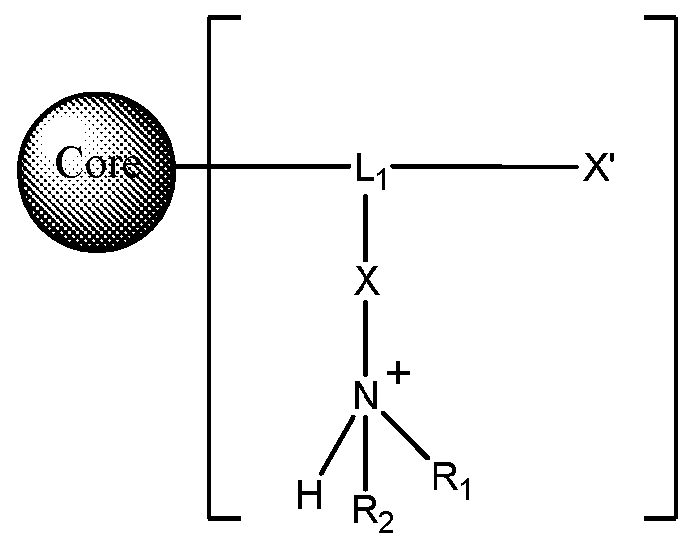
  • the particles generally include an inert core which can be made of an organic polymeric material or inorganic materials, as described herein and an anti-microbially active group comprising at least one hydrophobic group; wherein said particle is represented by the structure of formula 1 or salt thereof:
  • the core is an organic polymeric material, an inorganic material, zeolite, a metal or a metal oxide;
  • Li is a linker or a bond
  • Ri is alkyl, terpenoid, cycloalkyl, aryl, heterocycle, a conjugated alkyl, alkenyl, alkynyl or any combination thereof;
  • R 2 is alkyl, terpenoid, cycloalkyl, aryl, heterocycle, a conjugated alkyl, alkenyl, alkynyl or any combination thereof;
  • R 3 is nothing, hydrogen, alkyl, terpenoid moiety, cycloalkyl, aryl, heterocycle, a conjugated alkyl, alkenyl, alkynyl or any combination thereof;
  • X is a bond, alkyl, alkenyl,or alkynyl
  • X' is nothing or hydrogen
  • p is the number of chains per one sq nm (nm ) of the core surface, wherein the anti microbial active group is at a surface density of between 0.001 -20 anti microbial active groups per one sq nm (nm 2 ) of the core surface of the particle;
  • the particle is represented by formula 2 or salt thereof:
  • the particle is represented by formula 3 or salts thereof:
  • the particles of the present invention demonstrate enhanced anti-bacterial activity originating from the presence of closely packed anti-bacterial groups on a given particle's surface. This effect yields a high local concentration of active functional groups (at least one anti-microbially active group per 10 sq. nm of the core surface, preferably at least one anti-microbially active group per 1 sq. nm of the core surface), which results in high effective concentration of the functionalized particles and enables the use of a relatively small amount of particles to achieve effective bacterial annihilation.
  • this invention provides a positively charged particle comprising:
  • anti-microbially active groups chemically bound to the core at a surface density of at least one anti-microbially active group per 10 sq. nm
  • the anti-microbially active group is a quaternary ammonium group, the nitrogen atom of each quaternary ammonium group having one bond to an alkyl group having from 4 to 24 carbon atoms, and a remainder of bonds each being to an alkyl group having from 1 to 3 carbon atoms.
  • this invention provides a positively charged particle comprising: (i) an inorganic core selected from silicate (SiO/f ), surface activated metal metal oxide and Zeolite ; and
  • anti-microbially active groups chemically bound to the core at a surface density of at least one anti-microbially active group per 10 sq. nm of the core surface
  • the anti-microbially active group is a quaternary ammonium group, the nitrogen atom of each quaternary ammonium group having one bond to an alkyl group having from 4 to 24 carbon atoms, and a remainder of bonds each being to an alkyl group having from 1 to 3 carbon atoms.
  • this invention provides a composition comprising a liquid or solid matrix embedding a plurality of particles of this invention, wherein the particles are embedded in the matrix through covalent or non-covalent interactions.
  • this invention provides a pharmaceutical composition comprising the particles of this invention.
  • this invention provides a method for inhibiting or preventing biofilm formation, comprising applying onto a susceptible or infected surface or a medical device a particle of this invention or combination of particles, or a pharmaceutical composition comprising such particle(s).
  • the present invention provides a particle or a pharmaceutical composition comprising such particle as described above for use in inhibiting or preventing a biofilm formation.
  • this invention provides a method for inhibition of bacteria, the method comprising the step of contacting the bacteria with the particle or combination of particles of this invention, or a composition comprising such particle or combination of particles.
  • the anti-bacterial compositions of the present invention affect annihilation of at least about 99% of the contacted bacteria, preferably, at least about 99.99% of the contacted bacteria.
  • microparticles and nanoparticles maintain high anti-microbial properties over time without leaching out and with no alteration of the properties of the hosting matrix.
  • the particles of the present invention demonstrate enhanced anti-bacterial activity originating from the presence of closely packed anti-bacterial groups on a given particle's surface. This effect yields a high local concentration of active functional groups (at least one anti-microbially active group per 10 sq. nm of the core surface, preferably at least one anti-microbially active group per 1 sq. nm of the core surface), which results in high effective concentration of the functionalized particles and enables the use of a relatively small amount of particles to achieve effective bacterial annihilation.
  • this invention provides a packaging composition comprising a thermoplastic polymer and a particle of this invention embedded therein.
  • the packaging composition comprises a mixture of two or more different particles of this invention.
  • the packaging is for use for packaging of food, beverage, pharmaceutical ingredients, medical devices, surgical equipment before operation, pre operation equipment, cosmetics, sterilized equipment/materials.
  • FIGURE 1 depicts the anti-microbial activity of a polypropylene matrix without (PP) and with 1 % wt/wt (PP + 1% NPs) or 2% wt/wt (PP + 2% NPs) silica particles functionalized with dimethyl octyl ammonium groups, against the Graham positive bacteria Staphylococcus aureus (S. aureus).
  • the embedded particles were 186 nm in diameter on average, and the results were compared with the natural growth of S. aureus.
  • FIGURE 2 depicts the anti-microbial activity of a polypropylene matrix without (PP) and with 1 % wt/wt (PP + 1 % NPs) and 2% wt/wt (PP + 2% NPs) silica particles functionalized with dimethyl octyl ammonium groups, against the Graham negative bacteria Pseudomonas aeruginosa (P. aeruginosa).
  • the embedded particles were 186 nm in diameter on average, and the results were compared with the natural growth of P. aeruginosa.
  • FIGURE 3 depicts the anti- microbial activity of a poly(methyl methacrylate) matrix without (PMMA) and with 1 % wt/wt silica core particles functionalized with quaternary dimethyl octyl ammonium groups (PMMA + 1% NPs), against the Graham negative bacteria Pseudomonas aeruginosa (P. aeruginosa).
  • PMMA + 1% NPs quaternary dimethyl octyl ammonium groups
  • the embedded particles were 13 ⁇ in diameter on average, and the results were compared with the natural growth of P. aeruginosa.
  • FIGURE 4 depicts the anti- microbial activity of a poly(methyl methacrylate) matrix without (PMMA) and with 1 % wt/wt silica core particles functionalized with quaternary dimethyl octyl ammonium groups (PMMA + 1% NPs), against the Graham positive bacteria Staphylococcus aureus (S. aureus).
  • the embedded particles were 13 ⁇ in diameter on average, and the results were compared with the natural growth of S. aureus.
  • FIGURE 5 depicts the anti- microbial activity of a poly(methyl methacrylate) matrix without (PMMA) and with silica core particles functionalized with di-cinnamyl amine groups (PMMA + 1 % NPs), against the Graham negative bacteria Pseudomonas aeruginosa (P. aeruginosa).
  • the embedded particles were 186 nm in diameter on average, and the results were compared with the natural growth of P. aeruginosa.
  • FIGURE 6 depicts the anti- microbial activity of a poly(methyl methacrylate) matrix without (PMMA) and with silica core particles functionalized with di-cinnamyl amine groups (PMMA + 1 % NPs), against the Graham positive bacteria Staphylococcus aureus (S. aureus).
  • the embedded particles were 186 nm in diameter on average, and the results were compared with the natural growth of S. aureus.
  • FIGURE 7 depicts the anti-microbial activity of a poly(methyl methacrylate) matrix without (PMMA) and with 1% wt/wt (PMMA + 1 % NPs) or 2% wt/wt (PMMA + 2% NPs) Magnetite (FesC ) core particles functionalized with quaternary dimethyl octyl ammonium groups, against the Graham positive bacteria Enterococcus faecalis (E. faecalis). The embedded particles were 78 nm in diameter on average, and the results were compared with the natural growth of E. faecalis.
  • FIGURE 8 depicts the anti-microbial activity of a poly(methyl methacrylate) matrix without (PMMA) surface and with 2% wt/wt (PMMA + 2% NPs) or 3% wt/wt (PMMA + 3% NPs) silica core particles functionalized with di-cinnamyl methyl ammonium groups against the Graham positive bacteria Enterococcus faecalis (E. faecalis). The embedded particles were 186 nm in diameter on average, and the results were compared with the natural growth of E. faecalis.
  • FIGURE 9 mechanical properties test measuring the young's modulus of modified polymer including functionalized antibacterial particles in comparison to unmodified polymer. A) an image of the cylindrical specimens; B) compressive strength test of modified and unmodified specimens.
  • FIGURE 10 depicts the anti-microbial activity of modified and unmodified specimens of Unifast Trad (a self-cured, methylmethacryiate resin), prepared without (Unifast) or with 8% nanoparticies (NPs): silica + quaternary dimethyl octyl ammonium group (QSi) and PET + quaternary dimethyl octyl ammonium (QPEI).
  • NPs nanoparticies
  • QSi quaternary dimethyl octyl ammonium group
  • QPEI quaternary dimethyl octyl ammonium
  • B) anti- microbial activity against the Graham positive bacteria S. aureus The results were compared with the natural growth of S. aureus.
  • FIGURE 11 demonstrates anti-microbial activity as evaluated by an imprint method on blood agar.
  • the samples measured are: 1) dimethylamine functionalized silica particles; and 2) tertiary amine with two cinnamyl groups functionalized silica particles.
  • FIGURE 12 A representative scheme of preparation of particles according to the present invention wherein the anti-microbially active group a tertiary amine or a quaternary ammonium group comprising at least one terpenoid moiety.
  • FIGURE 13 A Representative scheme of preparation of cinnamyl adduct product with core particle via amino -functional linker. Conversion of the tertiary amine to the quaternary ammonium group is optional, and involves reaction of the tertiary amine with a group R l -Y wherein R 1 and Y are as defined above.
  • FIGURE 14 A representative scheme of three pathways to prepare quaternary ammonium salts (QAS) functionalized particle.
  • A) by first utilizing reductive amination to achieve tertiary amine, followed by an alkylation reaction, B) by stepwise alkylation reactions; and C) by reacting a linker functionalized with a leaving group (e.g., CI or other halogen) with tertiary amine.
  • R 1 and R 2 represent C 1 -C3 alkyls such as methyl, ethyl, propyl or isopropyl.
  • R 1 and R 2 may be different or the same group.
  • Y represents any leaving group, for example CI, Br or I, or a sulfonate (e.g., mesyl, tosyl).
  • FIGURE 15 Schemes of solid support and solution methods for the preparation of particles of this invention.
  • Q 1 , Q 2 and Q 3 are independently selected from the group consisting of ethoxy, methoxy, methyl, ethyl, hydrogen, sulfonate and halide, wherein at least one of Q 1 , Q 2 and Q 3 is a leaving group selected from ethoxy, methoxy, sulfonate (e.g., mesyl, tosyl) and halide.
  • FIGURE 16 A representative scheme of preparation of di-cinnamyl adduct product with core particle functionalized utilizing a 12-(triethoxysilyl)-dodecan- 1 -amine linker by both solid support method and solution method, n is an integer of 1 to 16.
  • FIGURE 17 A scheme, showing methods to determine the load concentration of the anti-microbial group onto the core.
  • the present invention provides anti-microbially active functionalized micro or nanoparticles, and compositions thereof demonstrating a broad spectrum of anti-microbial activity.
  • the particles are positively charged particles including an inert core which can be made of an organic polymeric material, or an inorganic material, as described herein and an anti microbial group which is attached to the core directly or indirectly.
  • the anti microbial active group is a protonated tertiary amine or a quaternary ammonium. In another embodiment, the anti microbial active group is represented by the following formula:
  • Ri is alkyl, terpenoid, cycloalkyl, aryl, heterocycle, a conjugated alkyl, alkenyl, alkynyl or any combination thereof;
  • R 2 is alkyl, terpenoid, cycloalkyl, aryl, heterocycle, a conjugated alkyl, alkenyl, alkynyl or any combination thereof;
  • R 3 is nothing, hydrogen, alkyl, terpenoid moiety, cycloalkyl, aryl, heterocycle, a conjugated alkyl, alkenyl, alkynyl or any combination thereof;
  • Ri, R 2 or R 3 is hydrophobic.
  • the particle of this invention is represented by the structure of formulas 1-3 or salt thereof:
  • the core is an organic polymeric material, an inorganic material, a metal, zeolite or a metal oxide;
  • Li is a linker or a bond
  • Ri is alkyl, terpenoid, cycloalkyl, aryl, heterocycle, a conjugated alkyl, alkenyl, alkynyl or any combination thereof;
  • R 2 is alkyl, terpenoid, cycloalkyl, aryl, heterocycle, a conjugated alkyl, alkenyl, alkynyl or any combination thereof;
  • R3 is nothing, hydrogen, alkyl, terpenoid moiety, cycloalkyl, aryl, heterocycle, a conjugated alkyl, alkenyl, alkynyl or any combination thereof;
  • X is a bond, alkyl, alkenyl,or alkynyl
  • X' is nothing or hydrogen
  • p is the number of chains per one sq nm of the core surface, wherein the anti microbial active group is at a surface density of between 0.001-20 anti-microbial active groups per one sq nm of the core surface of the particle;wherein if Li and X are bonds, then the nitrogen is an integral part of the core;
  • the particle of this invention has a surface density of the anti microbial group on the surface of the core of at least 1 anti microbial group per 10 sq nm. In another embodiment at least 1 anti microbial group per 1 sq nm of the core surface. In another embodiment between 0.001-20 anti microbial groups per sq nm of the core surface. In another embodiment between 0.001 -17 anti microbial groups per sq nm of the core surface. In another embodiment between 0.001-15 anti microbial groups per sq nm of the core surface. In another embodiment between 0.001-10 anti microbial groups per sq nm of the core surface. In another embodiment between 0.001-4 anti microbial groups per sq nm of the core surface.
  • between 0.001- 1 anti microbial groups per sq nm of the core surface In another embodiment between 1-4 anti microbial groups per sq nm of the core surface. In another embodiment between 1-6 anti microbial groups per sq nm of the core surface. In another embodiment between 1-20 anti microbial groups per sq nm of the core surface. In another embodiment between 1-10 anti microbial groups per sq nm of the core surface. In another embodiment between 1-15 anti microbial groups per sq nm of the core surface.
  • the particle of structures (1) to (3) has an inorganic core.
  • the particle of structure (1) to (3) has an organic core.
  • the organic core is a polymeric organic core.
  • the core is inert.
  • the particles of this invention represented by structures (1)- (3) comprise an anti-microbial active group of - + N(R (R 2 )(R 3 ), - + NH(R!(R 2 ) or -N(Ri)(R 2 ).
  • R x , R 2 and R 3 are independently alkyl, terpenoid, cycloalkyl, aryl, heterocycle a conjugated alkyl, alkenyl, alkynyl or any combination thereof.
  • Ri, R 2 and R 3 are independently an alkyl. In another embodiment, Ri, R 2 and R 3 are independently a terpenoid. In another embodiment, Ri, R 2 and R 3 are independently a cycloalkyl. In another embodiment, Ri, R 2 and R3 are independently an aryl. In another embodiment, Ri, R 2 and R3 are independently a heterocycle. In another embodiment, Ri, R 2 and R3 are independently a conjugated alkyl. In another embodiment, Ri, R 2 and R 3 are independently an alkenyl. In another embodiment, Ri, R 2 and R 3 are independently an alkynyl or any combination thereof alkynyl. In another embodiment, R 3 is nothing. In another embodiment, R 3 is hydrogen.
  • At least one on Ri, R 2 and R 3 is hydrophobic alkyl, terpenoid, cycloalkyl, aryl, heterocycle, a conjugated alkyl, alkenyl, alkynyl or any combination thereof.
  • alkyl or “alkylene” can be any linear- or branched-chain alkyl group containing up to about 24 carbons unless otherwise specified.
  • an alkyl includes C 1 -C3 carbons.
  • an alkyl includes C 1 -C4 carbons.
  • an alkyl includes C 1 -C5 carbons.
  • an alkyl includes Q-C6 carbons.
  • an alkyl includes Q-Cs carbons.
  • an alkyl includes C 1 -C 10 carbons.
  • an alkyl includes C 1 -C 12 carbons.
  • an alkyl includes C4-C8 carbons.
  • an alkyl include C4-C18 carbons. In another embodiment, an alkyl include C4-C 24 carbons. In another embodiment, an alkyl includes Q-Cis carbons. In another embodiment, an alkyl includes C 2 -C18 carbons. In another embodiment, branched alkyl is an alkyl substituted by alkyl side chains of 1 to 5 carbons. In one embodiment, the alkyl group may be unsubstituted.
  • the alkyl group may be substituted by a halogen, haloalkyl, hydroxyl, alkoxy, carbonyl, amido, alkylamido, dialkylamido, cyano, nitro, CO 2 H, amino, alkylamino, dialkylamino, carboxyl, thio and/or thioalkyl.
  • hydrophobic alkyl refers to alkyl having at least four carbons.
  • hydrophobic alkyl refers to a C4-C8 alkyl.
  • conjugated alkyl refers to alkyl as defined above having alternative single and double or triple bond s.
  • hydrophobic conjugated alkyl refers to conjugated alkyl having at least four carbons.
  • hydrophobic conjugated alkyl refers to a conjugated alkyl having a C4-C8 alkyl.
  • aryl refers to any aromatic ring that is directly bonded to another group and can be either substituted or unsubstituted.
  • the aryl group can be a sole substituent, or the aryl group can be a component of a larger substituent, such as in an arylalkyl, arylamino, arylamido, etc.
  • exemplary aryl groups include, without limitation, phenyl, tolyl, xylyl, furanyl, naphthyl, pyridinyl, pyrimidinyl, pyridazinyl, pyrazinyl, triazinyl, thiazolyl, oxazolyl, isooxazolyl, pyrazolyl, imidazolyl, thiophene-yl, pyrrolyl, phenylmethyl, phenylethyl, phenylamino, phenylamido, etc.
  • Substitutions include but are not limited to: F, CI, Br, I, C 1 -C5 linear or branched alkyl, C 1 -C5 linear or branched haloalkyl, C 1 -C5 linear or branched alkoxy, C 1 -C5 linear or branched haloalkoxy, CF 3 , CN, N0 2 , -CH 2 CN, NH 2 , NH-alkyl, N(alkyl) 2 , hydroxyl, - OC(0)CF 3 , -OCH 2 Ph, -NHCO-alkyl, COOH, -C(0)Ph, C(0)0-alkyl, C(0)H, or - C(0)NH 2 .
  • hydrophobic aryl refers to aryl having at least six carbons.
  • alkenyl refers to a substance that includes at least two carbon atoms and at least one double bond. In one embodiment, the alkenyl has 2-7 carbon atoms. In another embodiment, the alkenyl has 2-12 carbon atoms. In another embodiment, the alkenyl has 2-10 carbon atoms. In another embodiment, the alkenyl has 3-6 carbon atoms. In another embodiment, the alkenyl has 2-4 carbon atoms. In another embodiment, the alkenyl has 4-8 carbon atoms. In another embodiment hydrophobic alkenyl refers to alkenyl having at least four carbons. In another embodiment hydrophobic alkenyl refers to a CzpCs alkenyl.
  • alkynyl refers to a substance that includes at least two carbon atoms and at least one triple bond.
  • the alkynyl has 2-7 carbon atoms.
  • the alkynyl has 2-12 carbon atoms.
  • the alkynyl has 2-10 carbon atoms.
  • the alkynyl has 3-6 carbon atoms.
  • the alkynyl has 2-4 carbon atoms.
  • the alkynyl has 3-6 carbon atoms.
  • the alkynyl has 4-8 carbon atoms.
  • hydrophobic alkynyl refers to alkynyl having at least four carbons.
  • hydrophobic alkynyl refers to a CzpCs alkenyl.
  • alkoxy refers in one embodiment to an alky as defined above bonded to an oxygen.
  • alkoxy groups include: methoxy, ethoxy and isopropoxy.
  • a "cycloalkyl” group refers, in one embodiment, to a ring structure comprising carbon atoms as ring atoms, which may be either saturated or unsaturated, substituted or unsubstituted.
  • the cycloalkyl is a 3-12 membered ring.
  • the cycloalkyl is a 6 membered ring.
  • the cycloalkyl is a 5-7 membered ring.
  • the cycloalkyl is a 3-8 membered ring.
  • the cycloalkyl group may be unsubstituted or substituted by a halogen, alkyl, haloalkyl, hydroxyl, alkoxy, carbonyl, amido, alkylamido, dialkylamido, cyano, nitro, C(3 ⁇ 4H, amino, alkylamino, dialkylamino, carboxyl, thio and/or thioalkyl.
  • the cycloalkyl ring may be fused to another saturated or unsaturated cycloalkyl or heterocyclic 3-8 membered ring.
  • the cycloalkyl ring is a saturated ring. In another embodiment, the cycloalkyl ring is an unsaturated ring.
  • Non stricting examples of a cycloalkyl group comprise cyclohexyl, cyclohexenyl, cyclopropyl, cyclopropenyl, cyclopentyl, cyclopentenyl, cyclobutyl, cyclobutenyl, cycloctyl, cycloctadienyl (COD), cycloctaene (COE) etc.
  • hydrophobic cycloalkyl refers to a cycloalkyl having at least six carbons.
  • a “heterocycle” group refers, in one embodiment, to a ring structure comprising in addition to carbon atoms, sulfur, oxygen, nitrogen or any combination thereof, as part of the ring.
  • the heterocycle is a 3-12 membered ring.
  • the heterocycle is a 6 membered ring.
  • the heterocycle is a 5-7 membered ring.
  • the heterocycle is a 3-8 membered ring.
  • the heterocycle group may be unsubstituted or substituted by a halogen, alkyl, haloalkyl, hydroxyl, alkoxy, carbonyl, amido, alkylamido, dialkylamido, cyano, nitro, CO 2 H, amino, alkylamino, dialkylamino, carboxyl, thio and/or thioalkyl.
  • the heterocycle ring may be fused to another saturated or unsaturated cycloalkyl or heterocyclic 3-8 membered ring.
  • the heterocyclic ring is a saturated ring.
  • the heterocyclic ring is an unsaturated ring.
  • Non limiting examples of a heterocyclic rings comprise pyridine, piperidine, morpholine, piperazine, thiophene, pyrrole, benzodioxole, or indole.
  • hydrophobic heterocyclic group refers to a heterocycle having at least six carbons.
  • hydrophobic refers to an alkyl, alkenyl or alkynyl having at least four carbons, or the term hydrophobic refers to terpenoid, to cycloalkyl, aryl or heterocycle having at least six carbons.
  • At least one of Ri, R 2 and R 3 of structure (1) is a C4-C 24 alkyl, C4-C 24 alkenyl, C4-C 24 alkynyl or a terpenoid.
  • at least one of Ri and R 2 of structures (2) and (3) is a C4-C 24 alkyl, C4-C 24 alkenyl, C4-C 24 alkynyl or a terpenoid.
  • Ri of structures (1) to (3) is a terpenoid.
  • Ri is a terpenoid and R 2 is a C 1 -C4 alkyl.
  • the core is an organic polymeric core, R 3 is nothing and Ri is a terpenoid.
  • the core is an organic polymeric core, R 3 is hydrogen and Ri is a terpenoid.
  • the core is an inorganic core, R3 is nothing and Ri is a terpenoid.
  • the core is an inorganic core, R 3 is hydrogen and Ri is a terpenoid.
  • the core is an inorganic core
  • R 3 is C 1 -C 24 alkyl, terpenoid, cycloalkyl, aryl, heterocycle, a conjugated Q-C 24 alkyl, Q-C 24 alkenyl, C 1 -C 24 alkynyl or any combination thereof and Ri is a terpenoid.
  • "p" of structures (1) to (3) is defines the surface density of the anti microbial active group on the cor surface.
  • p is, between 0.001-20 anti microbial active groups per 1 sq nm of the core surface.
  • p is between 0.001-17 anti microbial groups per sq nm of the core surface.
  • p is between 0.001-15 anti microbial groups per sq nm of the core surface.
  • p is between 0.001-10 anti microbial groups per sq nm of the core surface.
  • “p” is between 0.001 -4 anti microbial groups per sq nm of the core surface.
  • p is between 0.001-1 anti microbial groups per sq nm of the core surface. In another embodiment, “p” is between 1 -4 anti microbial groups per sq nm of the core surface. In another embodiment “p” is between 1-6 anti microbial groups per sq nm of the core surface. In another embodiment “p” is between 1-20 anti microbial groups per sq nm of the core surface. In another embodiment “p” is between 1-10 anti microbial groups per sq nm of the core surface. In another embodiment "p” is between 1-15 anti microbial groups per sq nm of the core surface.
  • the anti-microbially active group may be selected from: (a) a tertiary amine (i.e. R 3 is nothing) or tertiary ammonium (i.e. R 3 is hydrogen) comprising at least one terpenoid moiety (b) a quaternary ammonium group comprising at least one terpenoid moiety (c) a quaternary ammonium group, comprising at least one alkyl group having from 4 to 24 carbon atoms; and (d) a tertiary amine (i.e. R 3 is nothing) or tertiary ammonium (i.e. R 3 is hydrogen) comprising at least one alkyl group having from 4 to 24 carbon atoms.
  • a tertiary amine i.e. R 3 is nothing
  • tertiary ammonium i.e. R 3 is hydrogen
  • the anti-microbially active group may be selected from: (a) a tertiary amine (i.e. R 3 is nothing) or tertiary ammonium (i.e. R 3 is hydrogen) comprising at least one terpenoid moiety and optionally an alkyl group having from 1 to 4 carbon atoms, or a salt of said amine (i.e.
  • Ri and R 2 are terpenoid moieties or Ri is a terpenoid moiety and R 2 is a C 1 -C4 alkyl); (b) a quaternary ammonium group comprising at least one terpenoid moiety and optionally one or more alkyl groups having from 1 to 4 carbon atoms (i.e.
  • Ri, R 2 and R 3 are terpenoid moieties; or Ri and R 2 are terpenoid moieties and R 3 is C 1 -C4 alkyl or Ri and R 3 are terpenoid moieties and R 2 is C 1 -C4 alkyl; or Ri is a terpenoid moiety and R 2 and R 3 are C 1 -C4 alkyl); (c) a quaternary ammonium group, comprising at least one alkyl group having from 4 to 24 carbon atoms, and a remainder of bonds each being to an alkyl group having from 1 to 3 carbon atoms (i.e.
  • Ri, R 2 and R 3 are a C4-C 24 alkyl or Ri and R 2 are C4-C 24 alkyl and R 3 is Ci-C 3 alkyl or Ri and R 3 are C4-C 24 alkyl and R 2 is Ci-C 3 alkyl; or Ri is a C4-C 24 alkyl and R 2 and R 3 are Ci-C 3 alkyl) ; and (d) a tertiary amine (i.e. R 3 is nothing) or tertiary ammonium (i.e. R 3 is hydrogen) comprising at least one alkyl group having from 4 to 24 carbon atoms and the remainder of bonds each being to an alkyl group having from 1 to 3 carbon atoms (i.e. Ri and R 2 are a C4-C 24 alkyl; or Ri is a C4-C 24 alkyl and R 2 is a Ci-C 3 alkyl).
  • a tertiary amine i.e. R 3 is nothing
  • the particles of this invention represented by structures (1)- (3) comprise an anti-microbial active group and an inert core, wherein the anti-microbial active group and the core are linked directly of indirectly.
  • the anti-microbial active group and the core are linked indirectly via Li- X.
  • Li is a linker or a bond.
  • Li is a bond.
  • Li is a linker.
  • Li is a linker comprising an alkyl, alkenyl, alkyl phosphate, alkyl siloxanes, epoxy, acylhalide, glycidyl, carboxylate, anhydrides,or any combination thereof, wherein the functional group is attached to the core.
  • a linker comprising an alkyl, alkenyl, alkyl phosphate, alkyl siloxanes, epoxy, acylhalide, glycidyl, carboxylate, anhydrides,or any combination thereof, wherein the functional group is attached to the core.
  • the linker is a CI to CI 8 alkylene substituted with at least one carboxyl moiety, wherein the carboxyl end is attached to the core.
  • This linker may be derived from a CI to CI 8 alkylene substituted with at least one carboxyl moiety and having an amino end which is modified to antibacterial active group [N(Ri)(R 2 )(R 3 )] (defined in formula 1).
  • This linker may be derived from an amino acid of natural or synthetic source having a chain length of between 2 and 18 carbon atoms (polypeptide), or an acyl halide of said amino acid.
  • Non-limiting examples for such amino acids are 18-amino octadecanoic acid and 18-amino stearic acid;
  • the linker is a CI to CI 8 alkylene.
  • This linker may be derived from a di-halo alkylene, which is functionalized at each end with the core and anti-microbially active group, respectively, by replacement of the halogen moiety to a functional group that will bind to the core and replacement of the halogen moiety to obtain [N(Ri)(R 2 )(R3)] (defined in formula 1).
  • the linker is an aromatic group derived from non limiting examples of 4,4-biphenol, dibenzoic acid, dibenzoic halides, dibenzoic sulphonates, terephthalic acid, tetrphthalic halides, and terephthalic sulphonates.
  • This linker is functionalized with the core and anti-microbially active group, respectively, through the functional group thereof (i.e., hydroxyl, carboxy or sulfonate).
  • this linker is attached to the core at one end and is modified at the other end to anti-microbially active group N(Ri)(R 2 )(Rs).
  • linker is represented by the structure of formula IA:
  • Q , Q and Q are independently selected from the group consisting of alkoxy,
  • q is an integer between 1 and 16;
  • Ri and R 2 are independently linear or branched alkyl, terpenoid, cycloalkyl, aryl, heterocycle, a conjugated alkyl, alkenyl, alkynyl or any combination thereof;
  • R 3 is nothing, hydrogen, linear or branched alkyl, terpenoid, cycloalkyl, aryl, heterocycle, a conjugated alkyl, alkenyl, alkynyl or any combination thereof; wherein said linker is chemically bound to the core surface through the silicon side.
  • the particles of the present invention demonstrate an enhanced antibacterial activity originating from the presence of closely packed anti-bacterial groups on a given core's surface, as well as high density of particles packed on the surface of a host matrix.
  • the surface density of the anti-microbial group results in high effective concentration promoting anti-bacterial inhibitory effect.
  • high surface density dictates high anti-microbial efficiency.
  • the anti-microbially active groups of the present invention are chemically bound to the core at a surface density of at least one anti-microbially active group per 10 sq. nm of the core surface.
  • the particle includes at least 1 anti-microbially active quaternary ammonium group per sq. nm of core surface.
  • at least 1 anti microbial group per 1 sq nm of the core surface In another embodiment between 0.001-20 anti microbial groups per sq nm of the core surface.
  • between 0.001-4 anti microbial groups per sq nm of the core surface are chemically bound to the core at a surface density of at least one anti-microbially active group per 10 sq. nm of the core surface.
  • the particle includes at least 1 anti-microbially active quaternary ammonium group per sq. nm of core surface.
  • at least 1 anti microbial group per 1 sq nm of the core surface In another embodiment between
  • between 0.001 -1 anti microbial groups per sq nm of the core surface In another embodiment between 1-4 anti microbial groups per sq nm of the core surface. In another embodiment between 1-6 anti microbial groups per sq nm of the core surface. In another embodiment between 1-20 anti microbial groups per sq nm of the core surface. In another embodiment between 1- 10 anti microbial groups per sq nm of the core surface. In another embodiment between 1-15 anti microbial groups per sq nm of the core surface.
  • nanoparticle refers to a particle having a diameter of less than about 1 ,000 nm.
  • microparticle refers to a particle having a diameter of about 1 ,000 nm or larger.
  • the particles of the present invention are characterized by having a diameter between about 5 to about 100,000 nm, and thus encompass both nanoparticulate and microp articulate compositions.
  • Preferred are particles between about 10 to about 50,000 nm.
  • the particles are more than 1,000 nm in diameter.
  • the particles are more than 10,000 nm in diameter.
  • the particles are between 1,000 and 50,000 nm in diameter.
  • the particles are between 5 and 250 nm in diameter.
  • the particles are between 5 and 500 nm in diameter.
  • the particles are between 5 and 1000 nm in diameter. It is apparent to a person of skill in the art that other particles size ranges are applicable and are encompassed within the scope of the present invention.
  • the anti-microbially active group of the present invention contains at least one terpenoid group, and is selected from: (a) a tertiary amine (R 3 is nothing) or tertiary ammonium (R 3 is H) comprising at least one terpenoid moiety; and (b) a quaternary ammonium group comprising at least one terpenoid moiety.
  • the anti-microbially active group of the present invention contains at least one terpenoid group, and is selected from: (a) a tertiary amine (R 3 is nothing) or tertiary ammonium (R 3 is H) comprising at least one terpenoid moiety and optionally an alkyl group having from 1 to 4 carbon atoms, or a salt of said amine/ammonium (i.e.
  • Ri and R 2 are terpenoid moieties or Ri is a terpenoid moiety and R 2 is a C 1 -C4 alkyl); (b) a quaternary ammonium group comprising at least one terpenoid moiety and optionally one or more alkyl groups having from 1 to 4 carbon atoms (i.e. Ri, R 2 and R3 are terpenoid moieties; or Ri and R 2 are terpenoid moieties and R 3 is C 1 -C4 alkyl or Ri and R 3 are terpenoid moieties and R 2 is C 1 -C4 alkyl; or Ri is a terpenoid moiety and R 2 and R 3 are C 1 -C4 alkyl).
  • the anti-microbially active group is selected from: (a) a tertiary amine (R 3 is nothing) or tertiary ammonium (R 3 is H), wherein the nitrogen atom of each tertiary amine/ammonium having at least one bond to the core (directly (i.e. in structures 1-3 : X is a bond; Li is a bond; and X' is nothing) or via a linker), one bond to a terpenoid moiety and optionally the remaining bond to an alkyl group having from 1 to 4 carbon atoms or a salt of said tertiary amine (i.e.
  • Ri is a terpenoid moiety and R 2 is a C 1 -C4 alkyl); (b) a tertiary amine (R 3 is nothing), or tertiary ammonium (R 3 is H), the nitrogen atom of each tertiary amine/ammonium having one bond to the core (directly (i.e. in formulas 1 -3: X is a bond; Li is a bond; and X' is nothing) or via a linker), and two bonds to terpenoid moieties which may be the same or different from each other, or a salt of said tertiary amine (i.e.
  • Ri and R 2 are terpenoid moieties); (c) a quaternary ammonium group the nitrogen atom of each quaternary ammonium group having at least one bond to the core directly (i.e. in formulas 1-3: X is a bond; Li is a bond; and X' is nothing) or via a linker, one or two bonds to terpenoid moieties which may be the same or different from each other, and optionally remaining bond to an alkyl group having from 1 to 4 carbon atoms (i.e.
  • Ri and R 2 are terpenoid moieties and R 3 is C 1 -C4 alkyl or Ri and R 3 are terpenoid moieties and R 2 is C 1 -C4 alkyl; or Ri is a terpenoid moiety and R 2 and R 3 are C 1 -C4 alkyl);
  • R 3 is C 1 -C4 alkyl
  • Ri and R 3 are terpenoid moieties and R 2 is C 1 -C4 alkyl
  • Ri is a terpenoid moiety and R 2 and R 3 are C 1 -C4 alkyl
  • terpenoid also known as “isoprenoid” refers to a large class of naturally occurring compounds that are derived from five-carbon isoprene units.
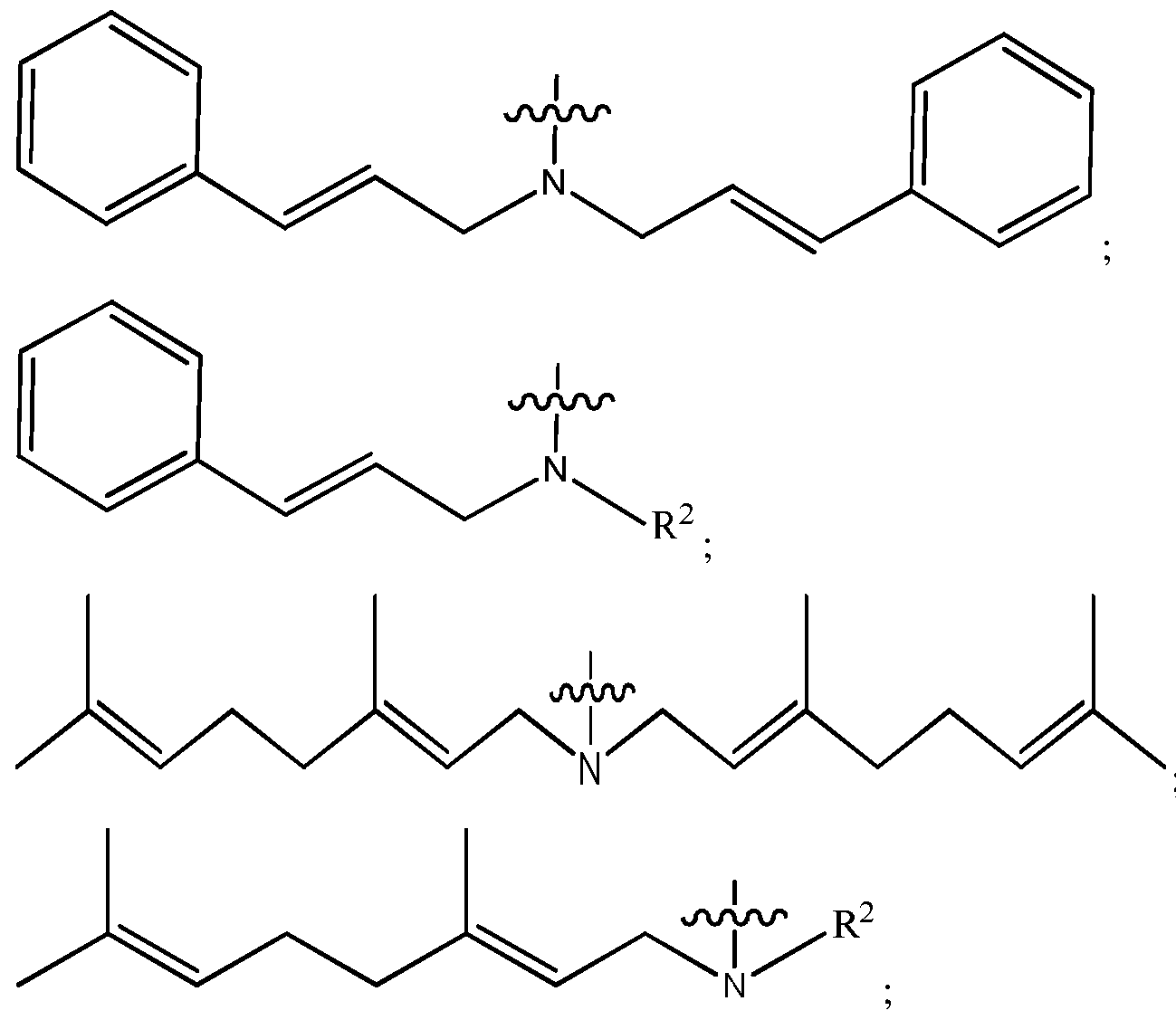
  • the at least one terpenoid moiety is a cinammyl group derived from cinnamaldehyde, cinnamic acid, curcumin, viscidone or cinnamyl alcohol.
  • the at least one terpenoid moiety is a bornyl group derived from camphor, bornyl halide or bornyl alcohol.
  • the at least one terpenoid moiety is derived from citral.
  • the at least one terpenoid moiety is derived from perilaldehyde.
  • Cinnamaldehyde is a natural aldehyde extracted from the genus Cinnamomum. It is known for its low toxicity and its effectiveness against various bacteria and fungi.
  • Camphor is found in the wood of the camphor laurel (Cinnamomum camphora), and also of the kapur tree. It also occurs in some other related trees in the laurel family, for example Ocotea usambarensis, as well as other natural sources. Camphor can also be synthetically produced from oil of turpentine.
  • Citral or 3,7-dimethyl-2,6-octadienal or lemonal, is a mixture of two diastereomeric terpenoids. The two compounds are double bond isomers.
  • the E-isomer is known as geranial or citral A.
  • the Z-isomer is known as neral or citral B.
  • Citral is known to have anti-bacterial activity.
  • Perillaldehyde also known as perilla aldehyde, is a natural terpenoid found most in the annual herb perilla, as well as in a wide variety of other plants and essential oils.
  • terpenoids include, but are not limited to: curcuminoids found in turmeric and mustard seed, and citronellal found in Cymbopogon (lemon grass). Each possibility represents a separate embodiment of the present invention.
  • the one anti-microbially active terpenoid moiety is selected from the group consisting of:
  • Non-limiting examples of functional anti-microbially active tertiary amine groups or its protonated form in accordance with the principles of the present invention are:
  • R 2 is alkyl, terpenoid, cycloalkyl, aryl, heterocycle, a conjugated alkyl, alkenyl, alkynyl or any combination thereof.
  • Non-limiting examples of anti-microbially active quaternary ammonium groups in accordance with the principles of the present invention are:
  • R 2 is alkyl, terpenoid, cycloalkyl, aryl, heterocycle, a conjugated alkyl, alkenyl, alkynyl or any combination thereof;
  • R 3 is alkyl, terpenoid moiety, cycloalkyl, aryl, heterocycle, a conjugated alkyl, alkenyl, alkynyl or any combination thereof;
  • the particle of the present invention may be in the form of a tertiary amine, or in the form of a protonated said tertiary amine, or in the form of a quaternary ammonium salt, as described hereinabove. Since an ammonium group is positively charged, its charge should be balanced with an anion. Preferably, in a particle according to the invention this anion is a halide, e.g. fluoride, chloride, bromide or iodide, and fluoride is most preferred. Other possible anions include, but are not limited to, bicarbonate, nitrate, phosphate, acetate, fumarate, succinate and sulfate. Each possibility represents a separate embodiment of the present invention.
  • a halide e.g. fluoride, chloride, bromide or iodide
  • the anti-microbially active group of the present invention [N(Ri)(R 2 )(R 3 )] (defined in structure 1) is a quaternary ammonium group, a tertiary amine or a tertiary ammonium, the nitrogen atom of each amine/ammonium group having at least one bond to the core (directly (i.e. in structures 1-3: X is a bond; Li is a bond; and X' is nothing) or via a linker), at least one bond to an alkyl group having from 4 to 24 carbon atoms (Ri), and a remainder of bonds each being an alkyl group having 1 to 3 carbon atoms (R 2 and R 3 ).
  • each amine/ammonium group having one bond to the core one bond to an alkyl group having from 4 to 24 carbon atoms (Ri), and a remainder of bonds each being an alkyl group having 1 to 3 carbon atoms (R 2 ) and hydrogen or nothing (R 3 ).
  • an ammonium group is positively charged, its charge should be balanced with an anion. Any of the counter-ions described above may be used to counter-balance the quaternary ammonium group.
  • the nitrogen atom of each quaternary ammonium or tertiary ammonium group has (i) at least one bond to the inorganic core; and (ii) at least one bond to the alkyl group having from 4 to 24 carbon atoms.
  • the nitrogen atom of each quaternary ammonium or tertiary ammonium group has (i) at least one bond to the inorganic core; (ii) one bond to the alkyl group having from 4 to 24 carbon atoms (Ri), and (iii) the remainder of the bonds each being an alkyl group having from 1 to 3 carbon atoms (R 2 and R 3 ); or one bond is hydrogen or nothing (R3) and the other bond is an alkyl group having from 1 to 3 carbon atoms (R 2 )
  • quaternary ammonium group refers to a group of atoms consisting of a nitrogen atom with four substituents (different than hydrogen) attached thereto.
  • a “quaternary ammonium group” refers to a group of atoms consisting of a nitrogen atom with four groups wherein each of the group is attached to the nitrogen through a carbon atom.
  • long alkyl group or chain refers to such an alkyl group or chain which is substituted on the nitrogen atom of the quaternary ammonium group and which has between 4 and 24 carbon atoms.
  • the alkyl group is an alkyl group having 4 to 18 carbon atoms.
  • the alkyl group is an alkyl group having 4 to 8 carbon atoms. In some currently preferred embodiments, the alkyl group is an alkyl group having 4 to 10 carbon atoms. In other currently preferred embodiments, the alkyl group is an alkyl group having 6, 7, or 8 carbon atoms, with each possibility representing a separate embodiment of the present invention.
  • the alkyl group having from 1 to 3 carbon atoms is a methyl group.
  • the core of the particles is an organic polymeric core.
  • the organic core comprises at least one aliphatic polymer.
  • An "aliphatic polymer" as used within the scope of the present invention refers to a polymer made of aliphatic monomers that may be substituted with various side groups, including (but not restricted to) aromatic side groups.
  • Aliphatic polymers that may be included in particles according to the present invention comprise nitrogen atoms (as well as other heteroatoms) as part of the polymeric backbone.
  • the core of the particles is an organic polymeric core including an amine which can be substituted with Ri, R 2 and/or R 3 as defined for the structure of formula 1 ; or including an imine which is chemically modified to amine and then substituted with Ri, R 2 and/or R 3 as defined for the structure of formula 1.
  • aliphatic polymers are polyethylene imine (PEI), polyvinyl amine (PVA), poly(allyl amine) (PAA), poly(aminoethyl acrylate), polypeptides with pending alkyl-amino groups, and chitosan. Each possibility represents a separate embodiment of the present invention.
  • the polymer is polyethylene imine (PEI).
  • the organic core comprises at least one aromatic polymer selected from the following group: aminomethylated styrene polymers, aromatic polyesters, preferably polyethylene terephthalate, and polyvinyl pyridine.
  • the polymeric core may be linked to the anti-microbially active group directly (i.e. in formulas 1-3 : X is a bond; Li is a bond; and X' is nothing) or through a linker.
  • X is a bond
  • Li is a bond
  • X' is nothing
  • the organic polymeric core includes a combination of two or more different organic polymers. In another embodiment, the organic polymeric core includes a copolymer.
  • the anti microbial active group is linked to the organic polymeric core through a linker (Li).
  • the linker may be selected from:
  • This linker may be derived from an alkylene substituted with at least one carboxyl moiety and at least one amino moiety, wherein the carboxyl end is attached to the core and the amino end is modified to antibacterial active group [N(Ri)(R 2 )(Rs)] (defined in formula 1).
  • This linker may be derived from an amino acid of natural or synthetic source having a chain length of between 2 and 18 carbon atoms, or an acyl halide of said amino acid.
  • Non-limiting examples for such amino acids are 18-amino octadecanoic acid and 18-amino stearic acid;
  • This linker may be derived from a di-halo alkylene, which is functionalized at each end with the core and anti-microbially active group, respectively, by replacement of the halogen moiety to a functional group that will bind to the core and replacement of the halogen moiety to obtain [N(Ri)(R 2 )(Rs)] (defined in formula 1); and (c) aromatic molecules derived from 4,4-biphenol, dibenzoic acid, dibenzoic halides, dibenzoic sulphonates, terephthalic acid, tetrphthalic halides, and terephthalic sulphonates.
  • This linker is functionalized with the core and anti-microbially active group, respectively, through the functional group thereof (i.e. , hydroxyl, carboxy or sulfonate). In another embodiment, this linker is attached to the core at one end and is modified at the other end to anti-microbially active group N(Ri)(R 2 )(R 3 ).
  • the linker comprises alkyl, alkenyl, alkyl phosphate, alkyl siloxanes, carboxylate, epoxy, acylhalides and anhydrides, or combination thereof, wherein the functional group is attached to the core.
  • Various polymeric chains may provide a range of properties that themselves may be an accumulation of the various polymer properties, and may even provide unexpected synergistic properties.
  • mixed polyamine nanoparticles include: crosslinking of aliphatic and aromatic polyamines such as polyethyleneimine and poly(4-vinyl pyridine) via a dihaloalkane; mixture of linear short chain and branched high molecular weight polyethyleneimines; interpenetrating compositions of polyamine within a polyamine scaffold such as polyethyleneimine embedded within crosslinked polyvinyl pyridine nanoparticles, or even interpenetrating a polyamine into a low density non-amine scaffold such as polystyrene nanoparticles.
  • polyamine combinations for the purpose of forming nanoparticles, either by chemical crosslinking or physical crosslinking (interpenetrating networks) may afford structures of varying properties (such as being able to better kill one bacteria vs. another type of bacteria). Such properties may be additive or synergistic in nature.
  • the organic polymeric core is cross-linked with a cross-linking agent.
  • the preferred degree of cross-linking is from 1 % to 20%, when crosslinking of from about 2% to about 5% is preferable.
  • the crosslinking may prevent unfolding of the polymer and separation of the various polymeric chains that form the particle.
  • Crosslinking may be affected by various agents and reactions that are per se known in the art.
  • crosslinking may be affected by alkylating the polymer chains with dihaloalkane such as dibromoethane, dibromocyclohexane, or bis- bromomethylbenzene.
  • dihaloalkane such as dibromoethane, dibromocyclohexane, or bis- bromomethylbenzene.
  • crosslinking by reductive amination may be used. In this method a polyamine with primary amines is reacted with a diketone or with an alkane dialdehyde to form an imine crosslinker which is then farther hydrogenated to the corresponding amine.
  • This amine may be further reacted to form an antimicrobial effective quaternary ammonium group.
  • dihaloalkanes or dialdehydes one may use a tri or polyhaloalkanes or polyaldehydes or polyketones.
  • the preferred polymers useful for making particles according to the invention are those having chains made of 30 monomer units, preferably 100 monomer units that may be crosslinked using less than 10% of crosslinking agent. The longer the polymers are, the fewer crosslinking bonds are needed to afford an insoluble nanoparticle. Branched polymers are preferred for crosslinking as small amount of crosslinking is required to form insoluble nanoparticles.
  • At least about 10% of the amine groups in the organic polymeric core are the anti-microbially active tertiary amine/ammonium or quaternary ammonium groups or salts thereof, as described herein.
  • the particles according to the invention have functional groups that are capable of reacting with a host polymer or with monomers thereof. Such functional groups are designed to allow the particles to be bound chemically to a hosting matrix.
  • the core of the particles of the present invention is an inorganic core comprising one or more inorganic materials.
  • Inorganic cores have a few advantages over organic polymeric cores: 1) higher stability at elevated temperature; 2) higher chemical stability towards various solvent and reagents; 3) improved mechanical strength; 4) better handling qualities in matrices due to their amphipathic nature; and 5) lower cost.
  • inorganic cores relate to the insertion of the functionalized particles into a polymeric matrix.
  • matrix polymerization involves radical polymerization (e.g. acrylate resins)
  • inorganic cores do not interfere with the polymerization process and hence do not jeopardize the mechanical properties of the finalized substrate, as opposed to organic polymeric cores which tend to interfere with the polymerization reaction.
  • the inorganic core comprises silica, metal, metal oxide or a zeolite.
  • silica metal, metal oxide or a zeolite.
  • the core of the particles of the present invention comprises silica (S1O 2 ).
  • the silica may be in any form known in the art, non-limiting examples of which include amorphous silica, dense silica, aerogel silica, porous silica, mesoporous silica and fumed silica.
  • the core of the particles of the present invention comprises glasses or ceramics of silicate (SiO/f 4 ).
  • silicates include aluminosilicate, borosilicate, barium silicate, barium borosilicate and strontium borosilicate.
  • the core of the particles of the present invention comprises surface activated metals selected from the group of: silver, gold, platinum, palladium, copper, zinc and iron.
  • the core of the particles of the present invention comprises metal oxides selected from the group of: zirconium dioxide, titanium dioxide, vanadium dioxide, zinc oxide, copper oxide and magnetite.
  • the inorganic core typically has a solid uniform morphology with low porosity or a porous morphology having pore size diameter of between about 1 to about 30 nm.
  • the core of the particles of the present invention comprises natural or artificial Zeolites.
  • the core may be attached to the anti-microbially active group directly (i.e. in formulas 1-3: X is a bond; Li is a bond; and X' is nothing) or through a linker.
  • a silica (S1O 2 ) based inorganic core may be attached to the anti-microbially active group through a linker, while silicates (SiOzf 4 ), metals or metal oxides may be attached to the anti-microbially active group directly (i.e. in formulas 1- 3: X is a bond; Li is a bond; and X' is nothing) or through a linker.
  • the inorganic core is directly (i.e. in formulas 1-3: X is a bond; Li is a bond; and X' is nothing) attached to the anti-microbially active group.
  • the inorganic core is attached to the anti-microbially active group through a linker.
  • the linker is selected from the following groups: a CI to C18 alkylene; a CI to C18 alkylene substituted with at least one silane moiety; a CI to CI 8 alkylene substituted with at least one phosphate moiety; a CI to C18 alkylene substituted with at least one anhydride moiety; a CI to C18 alkylene substituted with at least one carboxylate moiety; and a CI to C18 alkylene substituted with at least one glycidyl moiety.
  • a CI to C18 alkylene a CI to C18 alkylene substituted with at least one silane moiety
  • a CI to CI 8 alkylene substituted with at least one phosphate moiety a CI to C18 alkylene substituted with at least one anhydride moiety
  • a CI to C18 alkylene substituted with at least one carboxylate moiety and a CI to C18 alkylene substituted with at least one g
  • linker is represented by the structure of formula IA:
  • Q 1 , Q 2 and Q 3 are independently selected from the group consisting of methoxy, ethoxy, methyl, ethyl, hydrogen, sulfonate and halide, wherein at
  • Q , Q and Q is selected from ethoxy, methoxy, sulfonate (e.g., mesyl, tosyl) and halide;
  • q is an integer between 1 and 16;
  • Ri and R 2 are independently linear or branched alkyl, terpenoid, cycloalkyl, aryl, heterocycle, a conjugated alkyl, alkenyl, alkynyl or any combination thereof;
  • R 3 is nothing, hydrogen, linear or branched alkyl, terpenoid, cycloalkyl, aryl, heterocycle, a conjugated alkyl, alkenyl, alkynyl or any combination thereof; wherein said linker is chemically bound to the core surface of the inorganic core through the silicon side.
  • the inorganic core of the particle as described above may generally be in a form selected from a sphere, amorphous polygonal, shallow flake-like and a rod.
  • the inorganic core is spherical and has a diameter between about 5 to about 100,000 nm. .
  • the inorganic core is spherical and has a diameter between about 1000-100,000 nm. .
  • the inorganic core is spherical and has a diameter between about 100-1000 nm with pore diameter of about 1 to about 100 nm.
  • the inorganic spherical core has a pore diameter of about 1 to about 50 nm.
  • the inorganic spherical core has a pore diameter of about 1 to about 30 nm.
  • the inorganic particle is in a form of a rod, having a diameter of between about 5 to about 1,000 nm and length between about 10 to about 1,000,000 nm. In another embodiment, a length of between 50 to 100,000 nm. In another embodiment, a length of between 100 to 250,000 nm. In another embodiment, a length of between 200 to 500,000 and a pore diameter of about 1 to about 50 nm.
  • Each possibility represents a separate embodiment of the present invention.
  • the present invention provides a composition having a liquid or solid matrix embedding a plurality of particles as described above, wherein the particles are embedded in the matrix through covalent or non-covalent interactions.
  • the matrix is preferably a polymeric matrix comprising a thermoplastic polymer selected from the group consisting of polyethylene, polypropylene, silicone, epoxy resin, composite materials and acrylic polymers such as poly methyl methacrylate.
  • Other types of substances that may serve as hosts are ceramics, composite materials of polymeric material and inorganic solids, plant powders and particles compressed into a solid article, and organic and inorganic glues. Other substances may be selected from metal coatings and other solid, semisolid or gel-like materials.
  • Another polymer matrix to be used in the context of the present invention is resins used in dental and orthopedic composite materials. In such applications, antibacterial particles could be first dispersed within the resin part or added simultaneously with filler or any other solid ingredients (if any). Most of these resins are acrylic or epoxy type monomers that undergo polymerization in- vivo.
  • embedding functionalized particles into polymeric matrices may be achieved by a variety of methodologies.
  • embedding functionalized microparticles into a polypropylene host matrix was obtained by two methodologies: A) Extrusion technology: the particles were added into molten polymer, preferably into twin-coned extruder.
  • the present invention provides a method for preparing a composition comprising embedding a plurality of particles as described above, wherein the particles are embedded in the matrix, the method comprising step of adding the particles as described above, into a molten polymer matrix utilizing extrusion.
  • anti-bacterial particles are mainly due to mechanical forces. These particles are "locked” between the polymer chains in a three-dimensional matrix, preventing them from migrating out from the complex network. The strong hydrophobic nature of these particles also plays a role in preventing the particles from moving into the hydrophilic surrounds such as in the case of dental, orthopedic or other medical and dental applications.
  • particles according to the invention are homogeneously distributed on the outer surface of the matrix in a surface concentration of between about 0.1 to about 100 particles per sq. micrometer. In another embodiment, particles according to the invention are homogeneously distributed on the outer surface of the matrix in a surface concentration of between about 1 to about 100 particles per sq. micrometer.
  • homogeneous distribution is used to denote a distribution, characterized in that the standard deviation of the number of particles per sq. um is no more than the average number of particles per sq. micrometer. A homogeneous distribution is preferred for reproducibility and product specifications. If the distribution is not even, the product may exhibit different properties at different areas.
  • the distribution of the particles away from the outer surface may be similar to that on the outer surface.
  • the total surface of the particles preferably occupies at most about 20% of the surface of the matrix, preferably between 1 % to 15%, more preferably between 1 % and 5% and most about between 1 % and 3% of the surface of the matrix.
  • every sq. micrometer of the outer surface of matrix has at least one particle of this invention.
  • the polymeric particles may be physically entrapped within the matrix, chemically bound thereto, or both.
  • the particles have functional groups that are capable of reacting with the host matrix (e.g., host polymer, or with monomers thereof.
  • the particles of the present invention have functional groups that are capable of reacting with a host polymer or matrix. Such functional groups are designed to allow the particles to be chemically bound to the hosting matrix.
  • Polymeric particles of the present invention may also include tertiary amines, tertiary ammonium or quaternary ammonium groups that are not anti- microbially active.
  • tertiary amines tertiary ammonium or quaternary ammonium groups that are not anti- microbially active.
  • the invention is directed to a packaging composition/material comprising a thermoplastic polymer embedded with particles of this invention.
  • the thermoplastic polymer is embedded with a mixture of two or more different particles of this invention.
  • the packaging composition/material is used in the packaging of food, beverage, pharmaceutical ingredients, medical devices, surgical equipment before operation, pre operation equipment, cosmetics, sterilized equipment/materials..
  • the packaging composition comprises a thermoplastic polymer embedded with the particles of this invention.
  • the thermoplastic polymer is polyethylene, polypropylene, silicone, epoxy resin or acrylic polymers.
  • the thermoplastic polymer is poly methylmethacrylate.
  • the packaging composition further comprises binders, coatings, lubricants and disintegrants.
  • binders include saccharides, gelatin, polyvinylpyrolidone (PVP) and polyethylene glycol (PEG).
  • coatings include hydroxypropylmethylcellulose, polysaccharides and gelatin.
  • non limiting examples of lubricants include talc, stearin, silica and magnesium stearate.
  • disintegrants include crosslinked polyvinylpyrolidone, crosslinked sodium carboxymethyl cellulose (croscarmellose sodium) and modified starch sodium starch glycolate.
  • the packaging composition/material is used for packaging pharmaceutical ingredients.
  • pharmaceutical ingredients include Analgesics, Antibiotics, Anticoagulants, Antidepressants, Anticancers, Antiepileptics, Antipsychotics, Antivirals, Sedatives and Antidiabetics.
  • Analgesics include paracetamol, non steroidal anti inflammatory drugs (NSAIDs), morphine and oxycodone.
  • non limiting examples of Antibiotics include penicillin, cephalosporin, ciprofolxacin and erythromycin.
  • non limiting examples of Anticoagulants include warfarin, dabigatran, apixaban and rivaroxaban .
  • non limiting examples of Antidepressants include sertraline, fluoxetine, citalopram and paroxetine.
  • non limiting examples of Anticancers include Capecitabine, Mitomycin, Etoposide and Pembrolizumab.
  • non limiting examples of Antiepileptics include Acetazolamide, Clobazam, Ethosuximide and lacosamide.
  • non limiting examples of Antipsychotics include Risperidone, Ziprasidone, Paliperidone and Lurasidone.
  • non limiting examples of Antivirals include amantadine , rimantadine, oseltamivir and zanamivir.
  • non limiting examples of Sedatives include Alprazolam , Clorazepate , Diazepam and Estazolam.
  • non limiting examples of Antidiabetics include glimepiride , gliclazide, glyburide and glipizide.
  • the packaging composition/material is used in the packaging of food ingredients.
  • food ingredients packaged with the packaging material of the invention include preservatives, sweeteners, color additives, flavors and spices, nutrients, emulsifiers, binders and thickners.
  • preservatives include Ascorbic acid, citric acid, sodium benzoate, calcium propionate, sodium erythorbate and sodium nitrite.
  • non limiting examples of sweeteners include Sucrose (sugar), glucose, fructose, sorbitol, mannitol and corn syrup.
  • color additives include Orange B, Citrus Red No.
  • non limiting examples of flavors and spices include monosodium glutamate, glycine slats, inosinic acid, isoamyl acetate, limonene and allyl hexanoate.
  • non limiting examples of nutrients include Thiamine hydrochloride, riboflavin (Vitamin B 2 ), niacin, niacinamide, folate or folic acid.
  • non limiting examples of emulsifiers include Soy lecithin, mono- and diglycerides, egg yolks, polysorbates and sorbitan monostearate.
  • non limiting examples of binders and thickners include Gelatin, pectin, guar gum, carrageenan, xanthan gum and whey.
  • the particles of the present invention may be prepared in accordance with a variety of processes, depending on the nature of the core, the anti-microbially active group, and the presence or absence of linkers. Some non-limiting examples of preparation methods are provided below.
  • the particles of this invention comprise a core and an anti-microbially active group [N(Ri)(R 2 )(R 3 )] linked directly (i.e. in formulas 1-3: X is a bond; Li is a bond; and X' is nothing) or via a linker (Li-X) as presented by the structures of formulas 1-3: 2 )(R 3 )]
  • the core is an organic polymeric material, an inorganic material, a metal or a metal oxide;
  • Li is a linker or a bond
  • Ri is alkyl, terpenoid, cycloalkyl, aryl, heterocycle, a conjugated alkyl, alkenyl, alkynyl or any combination thereof;
  • R 2 is alkyl, terpenoid, cycloalkyl, aryl, heterocycle, a conjugated alkyl, alkenyl, alkynyl or any combination thereof;
  • R 3 is nothing, hydrogen, alkyl, terpenoid moiety, cycloalkyl, aryl, heterocycle, a conjugated alkyl, alkenyl, alkynyl or any combination thereof;
  • X is a bond, alkyl, alkenyl,or alkynyl
  • X' is nothing or hydrogen
  • p is the number of chains per one sq nm (nm 2 ) of the core surface, wherein the anti microbial active group is at a surface density of between 0.001 -20 anti microbial active groups per one sq nm (nm 2 ) of the core surface of the particle;
  • R 3 is hydrogen) comprising at least one terpenoid moiety (b) a quaternary ammonium group comprising at least one terpenoid moiety (c) a quaternary ammonium group, comprising at least one alkyl group having from 4 to 24 carbon atoms; and (d) a tertiary amine (i.e. R 3 is nothing) or tertiary ammonium (i.e. R 3 is hydrogen) comprising at least one alkyl group having from 4 to 24 carbon atoms; may be prepared by functionalizing the polymeric core with said tertiary amine or said quaternary ammonium group as described above.
  • Ri and R 2 are terpenoid moieties or Ri is a terpenoid moiety and R 2 is a C 1 -C4 alkyl) ; (b) a quaternary ammonium group comprising at least one terpenoid moiety and optionally one or more alkyl groups having from 1 to 4 carbon atoms (i.e.
  • Ri, R 2 and R 3 are terpenoid moieties; or Ri and R 2 are terpenoid moieties and R 3 is C 1 -C4 alkyl or Ri and R 3 are terpenoid moieties and R 2 is C 1 -C4 alkyl; or Ri is a terpenoid moiety and R 2 and R 3 are C 1 -C4 alkyl); (c) a quaternary ammonium group, the nitrogen atom of each quaternary ammonium group having at least one bond to an alkyl group having from 4 to 24 carbon atoms, and a remainder of bonds each being to an alkyl group having from 1 to 3 carbon atoms (i.e.
  • Ri, R 2 and R3 are a C4-C 24 alkyl or Ri and R 2 are C4-C 24 alkyl and R3 is C 1 -C3 alkyl or Ri and R3 are C4-C 24 alkyl and R 2 is C 1 -C3 alkyl; or Ri is a C4-C18 alkyl and R 2 and R3 are C 1 -C3 alkyl ; and (d) a tertiary amine or tertiary ammonium (i.e.
  • R 3 is nothing or H) comprising at least one bond to an alkyl group having from 4 to 24 carbon atoms, and a remainder of bonds each being an alkyl group having from 1 to 3 carbon atoms; may be prepared by functionalizing the polymeric core with said tertiary amine or said quaternary ammonium group as described above.
  • Particles comprising (i) an inorganic polymer core; and (ii) anti- microbially active groups selected from the group consisting of (a) a tertiary amine (i.e. R 3 is nothing) or tertiary ammonium (i.e. R 3 is hydrogen) comprising at least one terpenoid moiety (b) a quaternary ammonium group comprising at least one terpenoid moiety (c) a quaternary ammonium group, comprising at least one alkyl group having from 4 to 24 carbon atoms; and (d) a tertiary amine (i.e. R 3 is nothing) or tertiary ammonium (i.e.
  • R 3 is hydrogen) comprising at least one alkyl group having from 4 to 24 carbon atoms; may be prepared by reacting the inorganic core with a linker moiety Li to create a surface functionalized core; and functionalizing the obtained product to generate a tertiary amine, tertiary ammonium or said quaternary ammonium group as described above. .
  • Particles comprising (i) an inorganic polymer core; and (ii) anti- microbially active groups selected from the group consisting of (a) a tertiary amine ((i.e.
  • R 3 is nothing) or tertiary ammonium (R 3 is H) comprising at least one terpenoid moiety and optionally an alkyl group having from 1 to 4 carbon atoms, or a salt of said amine (i.e. Ri and R 2 are terpenoid moieties or Ri is a terpenoid moiety and R 2 is a Ci- C4 alkyl); and (b) a quaternary ammonium group comprising at least one terpenoid moiety and optionally one or more alkyl groups having from 1 to 4 carbon atoms (i.e.
  • Ri, R 2 and R 3 are terpenoid moieties; or Ri and R 2 are terpenoid moieties and R 3 is Q- C4 alkyl or Ri and R 3 are terpenoid moieties and R 2 is C 1 -C4 alkyl; or Ri is a terpenoid moiety and R 2 and R 3 are C 1 -C4 alkyl), may be prepared by reacting the inorganic core with a linker moiety Li to create a surface functionalized core; and functionalizing the obtained product to generate a tertiary amine, tertiary ammonium or said quaternary ammonium group as described above.
  • Particles comprising (i) an inorganic core; and (ii) anti-microbially active groups comprising a quaternary ammonium group chemically bound to one alkyl group having from 4 to 24 carbon atoms and a reminder of bonds each being to an alkyl group having from 1 to 3 carbon atoms (i.e. Ri, R 2 and R 3 are a C4-C 24 alkyl or Ri and R 2 are
  • C4-C 24 alkyl and R 3 is Ci-C 3 alkyl or Ri and R 3 are C4-C 24 alkyl and R 2 is Ci-C 3 alkyl; or Ri is a C4-C 24 alkyl and R 2 and R 3 are Ci-C 3 alkyl, may be prepared by (i) reacting said inorganic core with a linker moiety Li to create a primary amine surface functionalized core; and (ii) functionalizing the product of step (a) to generate a quaternary ammonium group.
  • particle comprising (i) an inorganic core; and (ii) anti- microbially active groups comprising a quaternary ammonium group chemically bound to one alkyl group having from 4 to 24 carbon atoms and a reminder of bonds each being to an alkyl group having from 1 to 3 carbon atoms (i.e.
  • Ri, R 2 and R 3 are a C4-C 24 alkyl or Ri and R 2 are C4-C18 alkyl and R 3 is Ci-C 3 alkyl or Ri and R 3 are C4-C 24 alkyl and R2 is Ci-C 3 alkyl; or Ri is a C4-C24 alkyl and R2 and R 3 are Ci-C 3 alkyl), may be prepared by (i) reacting the inorganic core with a linker moiety comprising of a leaving group selected from ethoxy, methoxy, sulfonate and halide; and (ii) functionalizing the product of step (a) to generate a quaternary ammonium group as described above.
  • a linker moiety comprising of a leaving group selected from ethoxy, methoxy, sulfonate and halide
  • inorganic core - linker - anti-microbially active group adduct may be formed using a variety of reagents.
  • the choice of the reagent depends on the nature of the anti-microbially active group.
  • the anti-microbially active group is a tertiary amine/ammonium or a quaternary ammonium group comprising at least one terpenoid moiety
  • a preferred reagent for coupling the inorganic core to the anti-microbially active group is represented by the structure of formula (I):
  • Q 1 , Q 2 and Q 3 are independently selected from the group consisting of alkoxy, methyl, ethyl, hydrogen, sulfonate and halide, wherein at least one of Q 1 , Q 2 and Q 3 is selected from ethoxy, methoxy, sulfonate (e.g., mesyl, tosyl) and halide; and
  • q is an integer between 1 and 16;
  • the reagent is capable of being chemically bound to the surface of the inorganic core through the silicon atom, and wherein the anti-microbially active group is introduced by functionalizing the primary amine to obtain an anti- microbially active tertiary amine or quaternary ammonium group containing at least one terpenoid group, as described above.
  • the anti-microbially active group is a quaternary ammonium group containing one alkyl group having 4 to 24 carbon atoms
  • a preferred reagent for coupling the inorganic core to the anti-microbially active group is represented by the structure of formula (II):
  • Q 1 , Q 2 and Q 3 are independently selected from the group consisting of alkoxy, methyl, ethyl, hydrogen, sulfonate and halide, wherein at least one of Q 1 ' Q 2 and Q is selected from ethoxy, methoxy, sulfonate (e.g., mesyl, tosyl) and halide; W is selected from the group consisting of Nth, halide, sulfonate and hydroxyl; and
  • q is an integer between 1 and 16;
  • linker is capable of being chemically bound to the surface of said inorganic core through the silicon atom, and wherein the anti-microbially active group is introduced by substituting the group W with an anti-microbially active group, or converting the group W to an anti-microbially active group.
  • linker moieties may be used, depending on the desired linker group.
  • a person of skill in the art will know to design reagents and reactions to prepare other linkers contemplated by the present invention, e.g., a CI to C18 alkylene substituted with at least one phosphate moiety; a CI to CI 8 alkylene substituted with at least one anhydride moiety; a CI to C18 alkylene substituted with at least one carboxylate moiety; and a CI to C18 alkylene substituted with at least one glycidyl moiety.
  • a representative method for preparing particles according to the present invention wherein the anti-microbially active group a tertiary amine or a quaternary ammonium group comprising at least one terpenoid moiety is represented in Figure 12.
  • a core as defined herein is functionalized with a primary amine.
  • the primary amine reacts with an aldehyde to yield initially an imine (Schiff base) intermediate of formula ( ⁇ '), which is then reacted with a second aldehyde under reductive amination conditions to yield a tertiary amine of formula ( ⁇ ').
  • Conversion of the tertiary amine to the quaternary ammonium group is optional, and involves reaction of the tertiary amine with a group R l -Y wherein R 1 is a C1-C4 alkyl and Y is a leaving group such as halogen or sulfonate. [000146] It is understood that that the group may represents any one or more of the following:
  • the exemplified reaction may be a "one pot synthesis", or it may include two sequential reactions with isolation of an intermediate formed in the first step.
  • the first step is the formation of intermediate ( ⁇ '), which is an imine (Schiff base), by reacting an amine functionalized core with a terpenoid moiety in the presence of a reducing agent, in this case cinnamyl in the presence of NaBtU.
  • a reducing agent in this case cinnamyl in the presence of NaBtU.
  • the imine functionalized core can be isolated at this stage if desired.
  • further reacting intermediate ( ⁇ ') with a terpenoid moiety in the presence of a reducing agent yields a tertiary amine comprising two terpenoid moieties ( ⁇ ').
  • additional alkylation step is performed as described in Figure
  • the present invention provides a particle comprising (i) an inorganic core or an organic polymeric core; and (ii) an imine moiety chemically bound to the core, preferably at a surface density of at least one imine group per 10 sq. nm, wherein the imine group comprises a terpenoid moiety.
  • the imine moiety is generally represented by the structure of formula ( ⁇ ') in Figure 12. A more specific embodiment is the structure of formula (B) in Figure 13.
  • a representative method for preparing particles according to the present invention wherein the anti-microbially active group is a quaternary ammonium group containing one alkyl group having 4 to 18 carbon atoms is presented in Figure 14.
  • the method includes three pathways to prepare quaternary ammonium salts (QAS) functionalized particle.
  • A) by first utilizing reductive animation to achieve tertiary amine, followed by an alkylation reaction, B) by stepwise alkylation reactions; and C) by reacting a linker functionalized with a leaving group (e.g., CI or other halogen) with a leaving group (e.g., CI or other halogen) with a leaving group (e.g., CI or other halogen) a linker functionalized with a leaving group (e.g., CI or other halogen)
  • R and R represent C 1 -C3 alkyls such as methyl, ethyl, propyl or
  • R and R may be different or the same group.
  • Y represents any leaving group, for example CI, Br or I, or a sulfonate (e.g., mesyl, tosyl).
  • Porous silica materials can be prepared by reaction of S1CI 2 with alcohol or water, followed by drying using centrifugation and/or heating utilizing airflow or under vacuum conditions. Dense fumed silica particles (pyrogenic) were prepared by pyrolysis of SiC - [000154]
  • An alternative preparation method of silica core material can be carried by the hydrolysis of tetraethylorthosilicate (TEOS) or tetramethyl orthosilicate (TMS) in the presence of alcohol or water solution and under basic (Stober) or acidic catalytic conditions.
  • TEOS tetraethylorthosilicate
  • TMS tetramethyl orthosilicate
  • Mesoporous silica particles can be prepared by hydrolysis of TEOS or TMS at low temperatures, preferably in a temperature not exceeding 60 °C, followed by dehydration by centrifugation and/or evaporation under airflow or vacuum conditions.
  • Dense particles can be prepared utilizing intense heating in a process called calcination. Typically, such process takes place at high temperatures at about 250 °C.
  • Core preparation and functionalization can occur by a solid support method, or a solution method ( Figure 15).
  • the linker molecule is first functionalized with antimicrobial active group to give an intermediate of formula (Figure 15, F').
  • intermediate (F') is allowed to settle onto particle's solid surface (surface functionalization) to give a functionalized particle of formula ( Figure 15, E').
  • a method for inhibition of bacteria by contacting the bacteria with the nanoparticle or microparticle of the present invention, or a composition comprising the particles of this invention.
  • the term "inhibition” is used to denote destruction, i.e.
  • annihilation of at least 99% of the bacteria, preferably 99.9%, most preferably 99.99% of the bacteria; reduction in the growth rate of the bacteria; reduction in the size of the population of the bacteria; prevention of growth of the bacteria; causing irreparable damage to the bacteria; destruction of a biofilm of such bacteria; inducing damage, short term or long term, to a part or a whole existing biofilm; preventing formation of such biofilm; inducing biofilm management; or bringing about any other type of consequence which may affect such population or biofilm and impose thereto an immediate or long term damage (partial or complete).
  • biofilm refers to a population of biological species (bacteria) attached to a solid surface.
  • the terms "anti-microbial” and “anti-bacterial” are used herein interchangeably.
  • the quaternary ammonium and the tertiary amine groups of this invention [N(R1)(R2)(R3)] provide the anti-microbial activity.
  • the quaternary ammonium's activity remains strong at any pH.
  • Tertiary amines have high pKa values, therefore are active at almost all pH levels (up to 10, but not higher).
  • the tertiary amine functional groups are less likely to cause undesirable side effects such as irritation of soft tissue, if used in contact with skin or mucosa or if used as a pharmaceutical composition.
  • the inhibition is achieved by contacting the bacteria with a matrix containing up to 5% w/w, more preferably up to 1 % particles according to the present invention, or compositions comprising them.
  • compositions according to the invention may find utility in a broad range of applications, where decontamination or growth prevention of bacteria is required, as, for example in medicine artificial replacement of tissues such as bone, bone cements and joints (orthopedic), lenses (ophthalmology), blood vessels and stents, artificial heart valves (cardiology), artificial skin, implants (plastic surgery), intra uterin devices (gynecology), neurosurgical shunts, medical devices, stents, uretral stents coating for subcutaneous implants: insulin pumps, contraceptives, pacemakers, tubing and canulas used for intra venous infusion, tubing and canulas used for dialysis, surgical drainage tubing, urinary catheters, endotracheal tubes, wound covering materials, sutures, catheters of all kinds that are inserted temporarily or permanently in blood vessels as well as the urinary system, shunt for use in brain applications, surgical gloves, tips for ear examination, statoscope ends and other elements used by the medical personnel; tooth pastes, tooth
  • compositions of the present invention are in dentistry: dental adhesives, dental restorative materials such as all types of composite based materials for filling tooth-decay cavities, endodontic filling materials (cements and fillers) for filling the root canal space in root canal treatment, materials used for provisional and final tooth restorations or tooth replacement, including but not restricted to inlays, onlays, crowns, partial dentures (fixed or removable) dental implants, and permanent and temporary cements used in dentistry for various known purposes.
  • the particle or composition of the present invention is intended for administration into an oral cavity.
  • the composition may be formulated as a tooth paste, and/or may be applied to a surface or medical device selected from the group consisting of: a denture cleaner, post hygienic treatment dressing or gel, mucosal adhesive paste, a dental adhesive, a dental restorative composite based material for filling tooth, decay cavities, a dental restorative endodontic filling material for filling root canal space in root canal treatment, a dental restorative material used for provisional and final tooth restorations or tooth replacement, a dental inlay, a dental onlay, a crown, a partial denture, a complete denture, a dental implant and a dental implant abutment.
  • the antimicrobial property may protect the patient and the medical staff from cross contamination from patient to patient or from patient to the examiner. Self- sterilizing packaging for medicines and items that enter the operation room are also beneficial. Applications out of the medical field may for example be in athlete shoes or the inner part of a shoe wherein bacteria tend to collect, tooth brushes and any brush that comes in contact with the human body, pet cages as well as other veterinary items, etc. [000169] In one embodiment, the invention directs to any particle disclosed above. In another embodiment, the invention is directed to a composition of mixture comprising any particle disclosed above.
  • Silica dioxide core particles were prepared by hydrolysis of tetraalcoxy silicate under alkaline conditions.
  • the reaction solution was prepared by mixing 9 parts by weight of ethanol, 0.4 parts of deionized water and 0.1 part of ammonia, keeping the pH within the range of 10-14. Controlling the particle size and the reaction rate is achieved by adjusting the concentration of water and ammonia in the reaction solution. 0.5 parts of tetraethyl orthosilicate (TEOS) was added to the solution in one portion with stirring at 1 ,000 RPM for 1 hour.
  • the reaction mixture first turned opaque, followed by a white solid precipitation, indicating the reaction endpoint and agglomerates formation of primary particles.
  • TEOS tetraethyl orthosilicate
  • the particles were recovered by centrifugation filtration, rinsing with 20 parts of deionized water and drying using freeze drying or heating.
  • further surface activation may be performed by shortly rinsing particles in sulfuric acid / hydrogen peroxide solution commonly known as "pirhana solution”. This last step converts most of the particles' surface into hydro xyl form and promotes an efficient surface functionalization.
  • Example 2 Morphological characterization of silica particles
  • Nitrogen adsorption method was used to determine the morphology of porous silica dioxide particles by utilizing Barrett- Jo yner_Halenda (BJH) model.
  • BJH Barrett- Jo yner_Halenda
  • Non- functionalized mesoporous silica dioxide particles were rinsed in Milli-Q water, dried and then degassed. Pore size was obtained from the adsorption/desorption isotherm by applying BJH model. Average particle size measured using dynamic light scattering method. Therefore, said particles are of 186 nm in diameter and having pore size of 5.0 nm.
  • Example 3 preparation of magnetite core particles
  • Magnetite (Fe 3 0 4 ) particles were prepared by co-precipitation of Fe 2+ and Fe 3+ ions, from FeCk (1 mol eq) and FeCi 3 (0.5 mol eq) in aqueous solution in basic condition utilizing NH 4 OH (pH ⁇ 12). After precipitation, the particles recovered under constant magnetic field. Prior to functionalization, particles were rinsed in Mili-Q water followed by vacuum drying. Surface activation of the obtained magnetite particles was performed by a short rinse of the particles in nitric acid or sulfuric acid and hydrogen peroxide solution. The last step converted most of particles' surface into hydroxy form allowing further functionalization of the core.
  • Example 4 Surface functionalization of inorganic core particles
  • a pretreatment of inorganic cores for example S1O2, FesO/ was essential for removing any of residual organic material such as solvent or other ligads and converts the surface to active hydroxyl group that are ready to undergo functionalization (silanization).
  • the pretreatment included rinsing the particle in 20 to 40% solution of hydrogen peroxide in sulfuric acid or alternatively in 20 to 40% of N3 ⁇ 4 solution in sulfuric acid for at least 5 minutes at ambient conditions or at elevated temperature, preferable at least for 30 minutes at 60°C.
  • Tertiary amine was prepared by reacting primary amine-functionalized particles obtained in step (a) with citral (terpenoid) at 1 :10 amine to citral mole ratio and continuous reduction of imine formed in-situ by NaB3 ⁇ 4 (reductive amination). The reaction was conducted in dichloromethane at ambient conditions. Subsequently, functionalized particles were recovered by rinsing/drying method in purified water.
  • the primary amine-functionalized particles of step (a) were reacted with paraformaldehyde at 1 :10 mole ratio of amine to formaldehyde unit and continuous reduction of the imine formed in-situ by NaBFL t (reductive amination).
  • the reaction was conducted in dichloromethane (DCM) for 24 hours and produced a tertiary amine intermediate.
  • the tertiary amine was further alkylated utilizing 1.25 mole eq. of 1-iodooctane in DCM.
  • the reaction was conducted under ambient temperature for 48 hours. Subsequently, quaternary ammonium functionalized particles were recovered by rinsing/drying method.
  • Example 6 Anti-microbial activity of matrix comprising functionalized silica particles
  • Anti-microbial test conditions direct contact test
  • Sample preparation 1 Polypropylene comprising quaternary ammonium functionalized silica particles
  • Silica particles of an average diameter of 186 nm functionalized with quaternary dimethyl octyl ammonium were embedded in polypropylene.
  • Samples of polymer films were prepared by hot molding of polypropylene and the functionalized silica particles at 0, 1 and 2 wt/wt of particles. 5x10 mm samples of prepared films were positioned into wells of microtitre plate touching the inside sidewalls of each well.
  • Silica particles of an average diameter of 13 ⁇ functionalized with quaternary dimethyl octyl ammonium were embedded in commercially available dental polymerizable methylmethacrylate (Unifast Trad, GC America inc) at concentration of 0 and 1 % wt/wt.
  • the methylmethacrylate was mixed in a silicone crucible at a liquid/powder ratio of 2g/ml respectively, in accordance to manufacturer's instructions and then allowed to polymerize onto sidewalls of microtiter wells at 37 °C for 24 hours prior to the anti-microbial test.
  • Silica particles of an average diameter of 186 nm functionalized with di- cinnamyl amine (tertiary amine) were embedded in commercially available dental polymerizable methylmethacrylate (Unifast Trad, GC America Inc.) at concentration of 0 and 1 wt/wt.
  • the methymethacrylate was mixed in a silicone crucible at a liquid/powder ratio of 2g/ml respectively, in accordance to manufacturer's instructions and then allowed to polymerize onto sidewalls of microtiter wells at 37 °C for 24 hours prior to the anti-microbial test.
  • Magnetite FesO/ particles of an average diameter of 78 nm functionalized with quaternary dimethyl octyl ammonium (prepared as described in Example 3) were embedded in commercially available dental polymerizable methylmethacrylate (Unifast Trad, GC America inc) at concentration of 0, 1 and 2 %wt/wt.
  • the PMMA was mixed in a silicone crucible at a liquid/powder ratio of 2g/ml respectively, in accordance to manufacturer's instructions and then allowed to polymerize onto sidewalls of microtiter wells at 37 °C for 24 hours prior to the antimicrobial test.
  • Silica particles of an average diameter of 186 nm functionalized with quaternary ammonium comprising di-cinnamyl methyl substitutes were embedded in commercially available dental polymerizable methylmethacrylate (Unifast Trad) at concentration of 0, 2 and 3 wt/wt.
  • the PMMA was mixed in a silicone crucible at a liquid/powder ratio of 2g/ml respectively, in accordance to manufacturer's instructions and then allowed to polymerize onto sidewalls of microtiter wells at 37 °C for 24 hours prior to the anti- microbial test. Both liquid and solid parts of the polymer material were manipulated accordingly to manufacturer's instructions and then allowed to polymerize onto sidewalls of microtiter wells at 37 °C for 24 hours prior to the anti-microbial test.
  • Example 7 The samples described on Example 7 were tested for their antibacterial activity by direct contact test as described herein above (Example 6).
  • S. aureus suspension was applied onto each functionalized slide in a homogeneous manner.
  • the slides were placed in contact with blood agar petri dish facing towards the agar for 15 minutes. Subsequently, the slides were removed and the petri dishes were kept in 37 °C for 24 to allow formation of colonies.
  • Example 10 Determination of the loading degree of anti-bacterial active groups onto the core.
  • Figure 17 presents a scheme of the different methods to determine the load concentration of the anti-microbial group onto the core.
  • the poly methylmethacrylate modified particles of the invention showed antibacterial activity for both inorganic and organic cores. 7.
  • Table 2 antibacterial activity of polymethylmethacrylate modified with Si(3 ⁇ 4 particles having tertiary amine with two cinnamyl groups or with S1O 2 particles having quaternary ammonium groups.
  • Table 2 demonstrates the differences between quaternary ammonium functionality and tertiary amines with two cinnamyl groups. It is concluded that quaternary ammonium functionality demonstrate stronger potency to inhibit bacteria growth than tertiary amines with 2 cinnamyl groups.

Landscapes

  • Health & Medical Sciences (AREA)
  • Life Sciences & Earth Sciences (AREA)
  • General Health & Medical Sciences (AREA)
  • Chemical & Material Sciences (AREA)
  • Engineering & Computer Science (AREA)
  • Veterinary Medicine (AREA)
  • Public Health (AREA)
  • Animal Behavior & Ethology (AREA)
  • Epidemiology (AREA)
  • Medicinal Chemistry (AREA)
  • Pharmacology & Pharmacy (AREA)
  • Bioinformatics & Cheminformatics (AREA)
  • Oral & Maxillofacial Surgery (AREA)
  • Plant Pathology (AREA)
  • Environmental Sciences (AREA)
  • Zoology (AREA)
  • Wood Science & Technology (AREA)
  • Dentistry (AREA)
  • Agronomy & Crop Science (AREA)
  • Pest Control & Pesticides (AREA)
  • Inorganic Chemistry (AREA)
  • Chemical Kinetics & Catalysis (AREA)
  • Organic Chemistry (AREA)
  • Birds (AREA)
  • Ceramic Engineering (AREA)
  • Nanotechnology (AREA)
  • Immunology (AREA)
  • Plastic & Reconstructive Surgery (AREA)
  • Nuclear Medicine, Radiotherapy & Molecular Imaging (AREA)
  • General Chemical & Material Sciences (AREA)
  • Toxicology (AREA)
  • Polymers & Plastics (AREA)
  • Communicable Diseases (AREA)
  • Oncology (AREA)
  • Pharmaceuticals Containing Other Organic And Inorganic Compounds (AREA)
  • Cosmetics (AREA)
  • Agricultural Chemicals And Associated Chemicals (AREA)
  • Medicinal Preparation (AREA)
  • Materials For Medical Uses (AREA)
  • Medicines That Contain Protein Lipid Enzymes And Other Medicines (AREA)

Abstract

The present invention relates to anti-microbially active micro and nanoparticles, compositions comprising same, and use thereof for inhibiting bacterial growth and biofilm formation on surfaces or devices, e.g., dental surfaces or devices. The present invention further discloses methods of making such anti-microbially active micro or nanoparticles.

Description

MICRO AND NANOPARTICULATE COMPOSITIONS COMPRISING ΑΝΊΊ- MICROB IALL Y ACTIVE GROUPS
FIELD OF THE INVENTION
[(XX) 1 ] The present invention relates to anti-microbially active particles, compositions comprising same, and use thereof for inhibiting bacterial growth on surfaces or devices. The present invention further discloses methods of making such anti-microbially active particles.
BACKGROUND OF THE INVENTION
[0002] The overwhelming diversity of bacteria in one individual's skin, gastro intestinal tract and oral cavity is well documented, demonstrating a complex ecosystem anatomically and dynamically in which poly-rnicrobiai biofilms are the norm.
[0003] Biofilms formed on tissues outside and inside the organism are the major cause of infectious diseases. For example in the oral cavity, biofilm formed on dental hard or soft tissue are the major cause of caries and periodontal disease (Sbordone L., Bortolaia C, Clin Oral Investig 2003;7:181-8). Bacterial biofilm forms on both natural and artificial surfaces.
[0004] Special attention is paid in recent years to artificial surfaces contacting organisms, as these surfaces lack the epithelial shedding, a major natural mechanism to combat biofilms, thus biofilm accumulation is becoming a major source of medical problems that may result in life threatening complications. Two major factors influence the susceptibility of a surface to accumulate bacteria: surface roughness and the surface-free energy which is a property of the material used. Surface roughness has a higher influence on the adhesion of bacteria than surface-free energy. In this context, artificial restorative materials typically have a higher surface roughness than natural surfaces, and therefore are more prone to bacterial accumulation. Therefore, the development of new materials that diminishes biofilm formation is a critical topic chronic infectious disease control, in various sites of the human body.
[0005] The ultimate goal of the development of materials with antibiofilm properties is to improve health and reduce disease occurrence. None of the existing medical devices can guarantee immediate and comprehensive elimination of biofilm or prevention of secondary infection. [0006] For example, in order to sustain the oral defense, dental materials with the following antibiofilm properties are sought after: (1) inhibition of initial binding of microorganisms (2) preventing biofilm growth, (3) affecting microbial metabolism in the biofilm, (4) killing biofilm bacteria, and (5) detaching biofi!m (Busscher H.T, Rinastiti M, Siswomihardjo W, van der Mei HC, Dent Res, 2010;89:657-65 ; Marsh PD. J Dent, 2010;38).
[0007] Resin-based composites are complex dental materials that consist of a hydrophobic resin matrix and less hydrophobic filler particles, which implies that a resin-based composite surface is never a homogeneous interface but rather one that produces matrix-rich and filler-poor areas, as well as matrix-poor and filler-rich areas (lonescu A, Wutscher E, Brambilia E, Schneider-Feyrer S, Giessibl FJ, Hahnei S. ; Eur J Oral Sci 2012;120:458-65).
[0008] Biofilms on composites can cause surface deterioration. Polishing, as well as differences in the composition of the resin-based composite, may have an impact on biolilm formation on the resin-based composite surface (Ono M. et al., Dent Mater J, 2007;26:61 3-22). Surface degradation of resin composites driven by polishing leads to increased roughness, changes in micro hardness, and filler particle exposure upon exposure to biofilms in vitro. Furthermore, biofilms on composites can cause surface deterioration.
[0009] There still remains a need for and it would be advantageous to have an extended variety of anti-microbially active materials which are cost-effective, non-toxic and easy to apply to contaminated surfaces and devices, especially in dental products.
SUMMARY OF THE INVENTION
[00010] The present invention provides anti-microbially active functionalized particles, which can be embedded in a matrix to form compositions demonstrating a broad spectrum of anti-microbial activity. The compositions of the invention are preferably formulated for topical, on mucosal surfaces, skin surfaces, dental surfaces, wounds (chronic and acute) administration and can prevent the formation of biofilm on surfaces and devices. Furthermore, the present invention provides versatile and cost- effective methodology for the preparation of the anti-microbially active particles of the invention. [00011] The present invention is based on the surprising discovery that microparticles or nanoparticles comprising an inorganic or organic inert core, and anti- microbially active groups chemically bound to the core directly or via a linker at a surface density of at least one anti-microbially active group per 10 sq. nm, show a broad spectrum of anti-microbial activity when applied to or incorporated onto surfaces and devices on which the growth of such microbes may otherwise naturally take place. Such anti-microbial activity thus prevents biofilm formation. The particles generally include an inert core which can be made of an organic polymeric material or inorganic materials, as described herein and an anti-microbially active group comprising at least one hydrophobic group; wherein said particle is represented by the structure of formula 1 or salt thereof:
Figure imgf000004_0001
(1)
wherein
the core is an organic polymeric material, an inorganic material, zeolite, a metal or a metal oxide;
Li is a linker or a bond;
Ri is alkyl, terpenoid, cycloalkyl, aryl, heterocycle, a conjugated alkyl, alkenyl, alkynyl or any combination thereof;
R2 is alkyl, terpenoid, cycloalkyl, aryl, heterocycle, a conjugated alkyl, alkenyl, alkynyl or any combination thereof; R3 is nothing, hydrogen, alkyl, terpenoid moiety, cycloalkyl, aryl, heterocycle, a conjugated alkyl, alkenyl, alkynyl or any combination thereof;
X is a bond, alkyl, alkenyl,or alkynyl;
X' is nothing or hydrogen; and
p is the number of chains per one sq nm (nm ) of the core surface, wherein the anti microbial active group is at a surface density of between 0.001 -20 anti microbial active groups per one sq nm (nm2) of the core surface of the particle;
wherein if Li and X are bonds, then the nitrogen is an integral part of the core;
wherein at least one of Ri, R2, R3 is hydrophobic.
[00012] In another embodiment, the particle is represented by formula 2 or salt thereof:
Figure imgf000005_0001
anti-mi crobially active group [N(R1)(R2)]
(2)
wherein Ri and R2 are as described for structure (1).
[00013] In another embodiment, the particle is represented by formula 3 or salts thereof:
Figure imgf000006_0001
anti-microbially active group [NH(R1)(R2)]
wherein Ri and R2 are as described for structure (1).
[00014] The particles of the present invention demonstrate enhanced anti-bacterial activity originating from the presence of closely packed anti-bacterial groups on a given particle's surface. This effect yields a high local concentration of active functional groups (at least one anti-microbially active group per 10 sq. nm of the core surface, preferably at least one anti-microbially active group per 1 sq. nm of the core surface), which results in high effective concentration of the functionalized particles and enables the use of a relatively small amount of particles to achieve effective bacterial annihilation.
[00015] In one embodiment, this invention provides a positively charged particle comprising:
(i) an inorganic core; and
(ii) anti-microbially active groups chemically bound to the core at a surface density of at least one anti-microbially active group per 10 sq. nm,
wherein the anti-microbially active group is a quaternary ammonium group, the nitrogen atom of each quaternary ammonium group having one bond to an alkyl group having from 4 to 24 carbon atoms, and a remainder of bonds each being to an alkyl group having from 1 to 3 carbon atoms.
[00016] In one embodiment, this invention provides a positively charged particle comprising: (i) an inorganic core selected from silicate (SiO/f ), surface activated metal metal oxide and Zeolite ; and
(ii) anti-microbially active groups chemically bound to the core at a surface density of at least one anti-microbially active group per 10 sq. nm of the core surface,
wherein the anti-microbially active group is a quaternary ammonium group, the nitrogen atom of each quaternary ammonium group having one bond to an alkyl group having from 4 to 24 carbon atoms, and a remainder of bonds each being to an alkyl group having from 1 to 3 carbon atoms.
[00017] In one embodiment, this invention provides a composition comprising a liquid or solid matrix embedding a plurality of particles of this invention, wherein the particles are embedded in the matrix through covalent or non-covalent interactions.
[00018] In one embodiment, this invention provides a pharmaceutical composition comprising the particles of this invention.
[00019] In one embodiment, this invention provides a method for inhibiting or preventing biofilm formation, comprising applying onto a susceptible or infected surface or a medical device a particle of this invention or combination of particles, or a pharmaceutical composition comprising such particle(s).
[00020] In another embodiment, the present invention provides a particle or a pharmaceutical composition comprising such particle as described above for use in inhibiting or preventing a biofilm formation.
[00021] In one embodiment, this invention provides a method for inhibition of bacteria, the method comprising the step of contacting the bacteria with the particle or combination of particles of this invention, or a composition comprising such particle or combination of particles. In some embodiments, the anti-bacterial compositions of the present invention affect annihilation of at least about 99% of the contacted bacteria, preferably, at least about 99.99% of the contacted bacteria.
[00022] It was further surprisingly discovered that these microparticles and nanoparticles maintain high anti-microbial properties over time without leaching out and with no alteration of the properties of the hosting matrix.
[00023] The particles of the present invention demonstrate enhanced anti-bacterial activity originating from the presence of closely packed anti-bacterial groups on a given particle's surface. This effect yields a high local concentration of active functional groups (at least one anti-microbially active group per 10 sq. nm of the core surface, preferably at least one anti-microbially active group per 1 sq. nm of the core surface), which results in high effective concentration of the functionalized particles and enables the use of a relatively small amount of particles to achieve effective bacterial annihilation.
[00024] In one embodiment, this invention provides a packaging composition comprising a thermoplastic polymer and a particle of this invention embedded therein. In another embodiment, the packaging composition comprises a mixture of two or more different particles of this invention. In another embodiment, the packaging is for use for packaging of food, beverage, pharmaceutical ingredients, medical devices, surgical equipment before operation, pre operation equipment, cosmetics, sterilized equipment/materials.
[00025] Further embodiments and the full scope of applicability of the present invention will become apparent from the detailed description given hereinafter. However, it should be understood that the detailed description and examples, while indicating preferred embodiments of the invention, are given by way of illustration only, since various changes and modifications within the spirit and scope of the invention will become apparent to those skilled in the art from this detailed description.
BRIEF DESCRIPTION OF THE FIGURES
[00026] FIGURE 1: depicts the anti-microbial activity of a polypropylene matrix without (PP) and with 1 % wt/wt (PP + 1% NPs) or 2% wt/wt (PP + 2% NPs) silica particles functionalized with dimethyl octyl ammonium groups, against the Graham positive bacteria Staphylococcus aureus (S. aureus). The embedded particles were 186 nm in diameter on average, and the results were compared with the natural growth of S. aureus.
[00027] FIGURE 2: depicts the anti-microbial activity of a polypropylene matrix without (PP) and with 1 % wt/wt (PP + 1 % NPs) and 2% wt/wt (PP + 2% NPs) silica particles functionalized with dimethyl octyl ammonium groups, against the Graham negative bacteria Pseudomonas aeruginosa (P. aeruginosa). The embedded particles were 186 nm in diameter on average, and the results were compared with the natural growth of P. aeruginosa. [00028] FIGURE 3: depicts the anti- microbial activity of a poly(methyl methacrylate) matrix without (PMMA) and with 1 % wt/wt silica core particles functionalized with quaternary dimethyl octyl ammonium groups (PMMA + 1% NPs), against the Graham negative bacteria Pseudomonas aeruginosa (P. aeruginosa). The embedded particles were 13 μπι in diameter on average, and the results were compared with the natural growth of P. aeruginosa.
[00029] FIGURE 4: depicts the anti- microbial activity of a poly(methyl methacrylate) matrix without (PMMA) and with 1 % wt/wt silica core particles functionalized with quaternary dimethyl octyl ammonium groups (PMMA + 1% NPs), against the Graham positive bacteria Staphylococcus aureus (S. aureus). The embedded particles were 13 μπι in diameter on average, and the results were compared with the natural growth of S. aureus.
[00030] FIGURE 5: depicts the anti- microbial activity of a poly(methyl methacrylate) matrix without (PMMA) and with silica core particles functionalized with di-cinnamyl amine groups (PMMA + 1 % NPs), against the Graham negative bacteria Pseudomonas aeruginosa (P. aeruginosa). The embedded particles were 186 nm in diameter on average, and the results were compared with the natural growth of P. aeruginosa.
[00031] FIGURE 6: depicts the anti- microbial activity of a poly(methyl methacrylate) matrix without (PMMA) and with silica core particles functionalized with di-cinnamyl amine groups (PMMA + 1 % NPs), against the Graham positive bacteria Staphylococcus aureus (S. aureus). The embedded particles were 186 nm in diameter on average, and the results were compared with the natural growth of S. aureus.
[00032] FIGURE 7: depicts the anti-microbial activity of a poly(methyl methacrylate) matrix without (PMMA) and with 1% wt/wt (PMMA + 1 % NPs) or 2% wt/wt (PMMA + 2% NPs) Magnetite (FesC ) core particles functionalized with quaternary dimethyl octyl ammonium groups, against the Graham positive bacteria Enterococcus faecalis (E. faecalis). The embedded particles were 78 nm in diameter on average, and the results were compared with the natural growth of E. faecalis.
[00033] FIGURE 8: depicts the anti-microbial activity of a poly(methyl methacrylate) matrix without (PMMA) surface and with 2% wt/wt (PMMA + 2% NPs) or 3% wt/wt (PMMA + 3% NPs) silica core particles functionalized with di-cinnamyl methyl ammonium groups against the Graham positive bacteria Enterococcus faecalis (E. faecalis). The embedded particles were 186 nm in diameter on average, and the results were compared with the natural growth of E. faecalis.
[00034] FIGURE 9: mechanical properties test measuring the young's modulus of modified polymer including functionalized antibacterial particles in comparison to unmodified polymer. A) an image of the cylindrical specimens; B) compressive strength test of modified and unmodified specimens.
[00035] FIGURE 10: depicts the anti-microbial activity of modified and unmodified specimens of Unifast Trad (a self-cured, methylmethacryiate resin), prepared without (Unifast) or with 8% nanoparticies (NPs): silica + quaternary dimethyl octyl ammonium group (QSi) and PET + quaternary dimethyl octyl ammonium (QPEI). A) anti-microbial activity against the Graham positive bacteria E. faecalis. The results were compared with the natural growth of E. faecalis. B) anti- microbial activity against the Graham positive bacteria S. aureus. The results were compared with the natural growth of S. aureus.
[00036] FIGURE 11: demonstrates anti-microbial activity as evaluated by an imprint method on blood agar. The samples measured are: 1) dimethylamine functionalized silica particles; and 2) tertiary amine with two cinnamyl groups functionalized silica particles.
[00037] FIGURE 12: A representative scheme of preparation of particles according to the present invention wherein the anti-microbially active group a tertiary amine or a quaternary ammonium group comprising at least one terpenoid moiety.
[00038] FIGURE 13: A Representative scheme of preparation of cinnamyl adduct product with core particle via amino -functional linker. Conversion of the tertiary amine to the quaternary ammonium group is optional, and involves reaction of the tertiary amine with a group Rl-Y wherein R1 and Y are as defined above.
[00039] FIGURE 14: A representative scheme of three pathways to prepare quaternary ammonium salts (QAS) functionalized particle. A) by first utilizing reductive amination to achieve tertiary amine, followed by an alkylation reaction, B) by stepwise alkylation reactions; and C) by reacting a linker functionalized with a leaving group (e.g., CI or other halogen) with tertiary amine. R1 and R2 represent C1-C3 alkyls such as methyl, ethyl, propyl or isopropyl. R1 and R2 may be different or the same group. Y represents any leaving group, for example CI, Br or I, or a sulfonate (e.g., mesyl, tosyl).
[00040] FIGURE 15: Schemes of solid support and solution methods for the preparation of particles of this invention. Functionalization. Q1, Q2 and Q3 are independently selected from the group consisting of ethoxy, methoxy, methyl, ethyl, hydrogen, sulfonate and halide, wherein at least one of Q1, Q2 and Q3 is a leaving group selected from ethoxy, methoxy, sulfonate (e.g., mesyl, tosyl) and halide. For the sake of clarity the scheme presents a case where Q1, Q2 and Q3 represent leaving groups; Q4 represents ab anti-microbial group; W is from the group consisting of NH2, halide, sulfonate and hydroxyl; and n is an integer between 1 and 16.
[00041] FIGURE 16: A representative scheme of preparation of di-cinnamyl adduct product with core particle functionalized utilizing a 12-(triethoxysilyl)-dodecan- 1 -amine linker by both solid support method and solution method, n is an integer of 1 to 16.
[00042] FIGURE 17: A scheme, showing methods to determine the load concentration of the anti-microbial group onto the core.
DETAILED DESCRIPTION OF THE INVENTION
Particles
[00043] The present invention provides anti-microbially active functionalized micro or nanoparticles, and compositions thereof demonstrating a broad spectrum of anti-microbial activity. The particles are positively charged particles including an inert core which can be made of an organic polymeric material, or an inorganic material, as described herein and an anti microbial group which is attached to the core directly or indirectly.
[00044] In one embodiment, the anti microbial active group is a protonated tertiary amine or a quaternary ammonium. In another embodiment, the anti microbial active group is represented by the following formula:
Figure imgf000012_0001
wherein:
Ri is alkyl, terpenoid, cycloalkyl, aryl, heterocycle, a conjugated alkyl, alkenyl, alkynyl or any combination thereof;
R2 is alkyl, terpenoid, cycloalkyl, aryl, heterocycle, a conjugated alkyl, alkenyl, alkynyl or any combination thereof;
R3 is nothing, hydrogen, alkyl, terpenoid moiety, cycloalkyl, aryl, heterocycle, a conjugated alkyl, alkenyl, alkynyl or any combination thereof;
wherein at least one of Ri, R2 or R3 is hydrophobic.
[00045] In some embodiments, the particle of this invention is represented by the structure of formulas 1-3 or salt thereof:
Figure imgf000012_0002
(1)
Figure imgf000013_0001
anti-mi crobially act /ive group [N(R1)(R2)] (2) or
Figure imgf000013_0002
ant -micro ia y active group NH R1 (R2)]
(3)
wherein,
the core is an organic polymeric material, an inorganic material, a metal, zeolite or a metal oxide;
Li is a linker or a bond;
Ri is alkyl, terpenoid, cycloalkyl, aryl, heterocycle, a conjugated alkyl, alkenyl, alkynyl or any combination thereof;
R2 is alkyl, terpenoid, cycloalkyl, aryl, heterocycle, a conjugated alkyl, alkenyl, alkynyl or any combination thereof; R3 is nothing, hydrogen, alkyl, terpenoid moiety, cycloalkyl, aryl, heterocycle, a conjugated alkyl, alkenyl, alkynyl or any combination thereof;
X is a bond, alkyl, alkenyl,or alkynyl;
X' is nothing or hydrogen; and
p is the number of chains per one sq nm of the core surface, wherein the anti microbial active group is at a surface density of between 0.001-20 anti-microbial active groups per one sq nm of the core surface of the particle;wherein if Li and X are bonds, then the nitrogen is an integral part of the core;
wherein at least one of Ri, R2, R3 is hydrophobic.
[00046] In one embodiment, the particle of this invention has a surface density of the anti microbial group on the surface of the core of at least 1 anti microbial group per 10 sq nm. In another embodiment at least 1 anti microbial group per 1 sq nm of the core surface. In another embodiment between 0.001-20 anti microbial groups per sq nm of the core surface. In another embodiment between 0.001 -17 anti microbial groups per sq nm of the core surface. In another embodiment between 0.001-15 anti microbial groups per sq nm of the core surface. In another embodiment between 0.001-10 anti microbial groups per sq nm of the core surface. In another embodiment between 0.001-4 anti microbial groups per sq nm of the core surface. In another embodiment between 0.001- 1 anti microbial groups per sq nm of the core surface. In another embodiment between 1-4 anti microbial groups per sq nm of the core surface. In another embodiment between 1-6 anti microbial groups per sq nm of the core surface. In another embodiment between 1-20 anti microbial groups per sq nm of the core surface. In another embodiment between 1-10 anti microbial groups per sq nm of the core surface. In another embodiment between 1-15 anti microbial groups per sq nm of the core surface.
[00047] In another embodiment, the particle of structures (1) to (3) has an inorganic core. In another embodiment, the particle of structure (1) to (3) has an organic core. In another embodiment, the organic core is a polymeric organic core. In another embodiment, the core is inert. In one embodiment, the particles of this invention represented by structures (1)- (3) comprise an anti-microbial active group of - +N(R (R2)(R3), -+NH(R!)(R2) or -N(Ri)(R2). In one embodiment Rx, R2 and R3 are independently alkyl, terpenoid, cycloalkyl, aryl, heterocycle a conjugated alkyl, alkenyl, alkynyl or any combination thereof. In another embodiment, Ri, R2 and R3 are independently an alkyl. In another embodiment, Ri, R2 and R3 are independently a terpenoid. In another embodiment, Ri, R2 and R3 are independently a cycloalkyl. In another embodiment, Ri, R2 and R3 are independently an aryl. In another embodiment, Ri, R2 and R3 are independently a heterocycle. In another embodiment, Ri, R2 and R3 are independently a conjugated alkyl. In another embodiment, Ri, R2 and R3 are independently an alkenyl. In another embodiment, Ri, R2 and R3 are independently an alkynyl or any combination thereof alkynyl. In another embodiment, R3 is nothing. In another embodiment, R3 is hydrogen. In another embodiment at least one on Ri, R2 and R3 is hydrophobic alkyl, terpenoid, cycloalkyl, aryl, heterocycle, a conjugated alkyl, alkenyl, alkynyl or any combination thereof.
[00048] As used herein, the term "alkyl" or "alkylene" can be any linear- or branched-chain alkyl group containing up to about 24 carbons unless otherwise specified. In one embodiment, an alkyl includes C1-C3 carbons. In one embodiment, an alkyl includes C1-C4 carbons. In one embodiment, an alkyl includes C1-C5 carbons. In another embodiment, an alkyl includes Q-C6 carbons. In another embodiment, an alkyl includes Q-Cs carbons. In another embodiment, an alkyl includes C1-C10 carbons. In another embodiment, an alkyl includes C1-C12 carbons. In another embodiment, an alkyl includes C4-C8 carbons. In another embodiment, an alkyl include C4-C18 carbons. In another embodiment, an alkyl include C4-C24 carbons. In another embodiment, an alkyl includes Q-Cis carbons. In another embodiment, an alkyl includes C2-C18 carbons. In another embodiment, branched alkyl is an alkyl substituted by alkyl side chains of 1 to 5 carbons. In one embodiment, the alkyl group may be unsubstituted. In another embodiment, the alkyl group may be substituted by a halogen, haloalkyl, hydroxyl, alkoxy, carbonyl, amido, alkylamido, dialkylamido, cyano, nitro, CO2H, amino, alkylamino, dialkylamino, carboxyl, thio and/or thioalkyl. In another embodiment hydrophobic alkyl refers to alkyl having at least four carbons. In another embodiment hydrophobic alkyl refers to a C4-C8 alkyl.
[00049] A "conjugated alkyl" refers to alkyl as defined above having alternative single and double or triple bond s. In another embodiment hydrophobic conjugated alkyl refers to conjugated alkyl having at least four carbons. In another embodiment hydrophobic conjugated alkyl refers to a conjugated alkyl having a C4-C8 alkyl. [00050] As used herein, the term "aryl" refers to any aromatic ring that is directly bonded to another group and can be either substituted or unsubstituted. The aryl group can be a sole substituent, or the aryl group can be a component of a larger substituent, such as in an arylalkyl, arylamino, arylamido, etc. Exemplary aryl groups include, without limitation, phenyl, tolyl, xylyl, furanyl, naphthyl, pyridinyl, pyrimidinyl, pyridazinyl, pyrazinyl, triazinyl, thiazolyl, oxazolyl, isooxazolyl, pyrazolyl, imidazolyl, thiophene-yl, pyrrolyl, phenylmethyl, phenylethyl, phenylamino, phenylamido, etc. Substitutions include but are not limited to: F, CI, Br, I, C1-C5 linear or branched alkyl, C1-C5 linear or branched haloalkyl, C1-C5 linear or branched alkoxy, C1-C5 linear or branched haloalkoxy, CF3, CN, N02, -CH2CN, NH2, NH-alkyl, N(alkyl)2, hydroxyl, - OC(0)CF3, -OCH2Ph, -NHCO-alkyl, COOH, -C(0)Ph, C(0)0-alkyl, C(0)H, or - C(0)NH2. In another embodiment hydrophobic aryl refers to aryl having at least six carbons.
[00051] The term "alkenyl" refers to a substance that includes at least two carbon atoms and at least one double bond. In one embodiment, the alkenyl has 2-7 carbon atoms. In another embodiment, the alkenyl has 2-12 carbon atoms. In another embodiment, the alkenyl has 2-10 carbon atoms. In another embodiment, the alkenyl has 3-6 carbon atoms. In another embodiment, the alkenyl has 2-4 carbon atoms. In another embodiment, the alkenyl has 4-8 carbon atoms. In another embodiment hydrophobic alkenyl refers to alkenyl having at least four carbons. In another embodiment hydrophobic alkenyl refers to a CzpCs alkenyl.
[00052] The term "alkynyl" refers to a substance that includes at least two carbon atoms and at least one triple bond. In one embodiment, the alkynyl has 2-7 carbon atoms. In another embodiment, the alkynyl has 2-12 carbon atoms. In another embodiment, the alkynyl has 2-10 carbon atoms. In another embodiment, the alkynyl has 3-6 carbon atoms. In another embodiment, the alkynyl has 2-4 carbon atoms. In another embodiment, the alkynyl has 3-6 carbon atoms. In another embodiment, the alkynyl has 4-8 carbon atoms. In another embodiment hydrophobic alkynyl refers to alkynyl having at least four carbons. In another embodiment hydrophobic alkynyl refers to a CzpCs alkenyl.
[00053] The term "alkoxy" refers in one embodiment to an alky as defined above bonded to an oxygen. Non limiting examples of alkoxy groups include: methoxy, ethoxy and isopropoxy. [00054] A "cycloalkyl" group refers, in one embodiment, to a ring structure comprising carbon atoms as ring atoms, which may be either saturated or unsaturated, substituted or unsubstituted. In another embodiment the cycloalkyl is a 3-12 membered ring. In another embodiment the cycloalkyl is a 6 membered ring. In another embodiment the cycloalkyl is a 5-7 membered ring. In another embodiment the cycloalkyl is a 3-8 membered ring. In another embodiment, the cycloalkyl group may be unsubstituted or substituted by a halogen, alkyl, haloalkyl, hydroxyl, alkoxy, carbonyl, amido, alkylamido, dialkylamido, cyano, nitro, C(¾H, amino, alkylamino, dialkylamino, carboxyl, thio and/or thioalkyl. In another embodiment, the cycloalkyl ring may be fused to another saturated or unsaturated cycloalkyl or heterocyclic 3-8 membered ring. In another embodiment, the cycloalkyl ring is a saturated ring. In another embodiment, the cycloalkyl ring is an unsaturated ring. Non limiteing examples of a cycloalkyl group comprise cyclohexyl, cyclohexenyl, cyclopropyl, cyclopropenyl, cyclopentyl, cyclopentenyl, cyclobutyl, cyclobutenyl, cycloctyl, cycloctadienyl (COD), cycloctaene (COE) etc. In another embodiment hydrophobic cycloalkyl refers to a cycloalkyl having at least six carbons.
[00055] A "heterocycle" group refers, in one embodiment, to a ring structure comprising in addition to carbon atoms, sulfur, oxygen, nitrogen or any combination thereof, as part of the ring. In another embodiment the heterocycle is a 3-12 membered ring. In another embodiment the heterocycle is a 6 membered ring. In another embodiment the heterocycle is a 5-7 membered ring. In another embodiment the heterocycle is a 3-8 membered ring. In another embodiment, the heterocycle group may be unsubstituted or substituted by a halogen, alkyl, haloalkyl, hydroxyl, alkoxy, carbonyl, amido, alkylamido, dialkylamido, cyano, nitro, CO2H, amino, alkylamino, dialkylamino, carboxyl, thio and/or thioalkyl. In another embodiment, the heterocycle ring may be fused to another saturated or unsaturated cycloalkyl or heterocyclic 3-8 membered ring. In another embodiment, the heterocyclic ring is a saturated ring. In another embodiment, the heterocyclic ring is an unsaturated ring. Non limiting examples of a heterocyclic rings comprise pyridine, piperidine, morpholine, piperazine, thiophene, pyrrole, benzodioxole, or indole. In another embodiment hydrophobic heterocyclic group refers to a heterocycle having at least six carbons. [00056] In one embodiment, at least one of Ri, R2 and R3 of structure (1 ) is hydrophobic. In one embodiment, at least one of Ri and R2 of structures (2) and (3) is hydrophobic.
[00057] The term "hydrophobic" refers to an alkyl, alkenyl or alkynyl having at least four carbons, or the term hydrophobic refers to terpenoid, to cycloalkyl, aryl or heterocycle having at least six carbons. Each possibility represents a separate embodiment of the present invention
[00058] In another embodiment, at least one of Ri, R2 and R3 of structure (1) is a C4-C24 alkyl, C4-C24 alkenyl, C4-C24 alkynyl or a terpenoid. In one embodiment, at least one of Ri and R2 of structures (2) and (3) is a C4-C24 alkyl, C4-C24 alkenyl, C4-C24 alkynyl or a terpenoid. Each possibility represents a separate embodiment of the present invention.
[00059] In one embodiment, Ri of structures (1) to (3) is a terpenoid. In another embodiment, Ri is a terpenoid and R2 is a C1-C4 alkyl. In another embodiment, the core is an organic polymeric core, R3 is nothing and Ri is a terpenoid. In another embodiment, the core is an organic polymeric core, R3 is hydrogen and Ri is a terpenoid. In another embodiment, the core is an inorganic core, R3 is nothing and Ri is a terpenoid. In another embodiment, the core is an inorganic core, R3 is hydrogen and Ri is a terpenoid. In another embodiment, the core is an inorganic core, R3 is C1-C24 alkyl, terpenoid, cycloalkyl, aryl, heterocycle, a conjugated Q-C24 alkyl, Q-C24 alkenyl, C1-C24 alkynyl or any combination thereof and Ri is a terpenoid.
[00060] In one embodiment "p" of structures (1) to (3) is defines the surface density of the anti microbial active group on the cor surface. In another embodiment "p" is, between 0.001-20 anti microbial active groups per 1 sq nm of the core surface. In another embodiment "p" is between 0.001-17 anti microbial groups per sq nm of the core surface. In another embodiment "p" is between 0.001-15 anti microbial groups per sq nm of the core surface. In another embodiment "p" is between 0.001-10 anti microbial groups per sq nm of the core surface. In another embodiment "p" is between 0.001 -4 anti microbial groups per sq nm of the core surface. In another embodiment "p" is between 0.001-1 anti microbial groups per sq nm of the core surface. In another embodiment, "p" is between 1 -4 anti microbial groups per sq nm of the core surface. In another embodiment "p" is between 1-6 anti microbial groups per sq nm of the core surface. In another embodiment "p" is between 1-20 anti microbial groups per sq nm of the core surface. In another embodiment "p" is between 1-10 anti microbial groups per sq nm of the core surface. In another embodiment "p" is between 1-15 anti microbial groups per sq nm of the core surface.
[00061] In one embodiment, the anti-microbially active group may be selected from: (a) a tertiary amine (i.e. R3 is nothing) or tertiary ammonium (i.e. R3 is hydrogen) comprising at least one terpenoid moiety (b) a quaternary ammonium group comprising at least one terpenoid moiety (c) a quaternary ammonium group, comprising at least one alkyl group having from 4 to 24 carbon atoms; and (d) a tertiary amine (i.e. R3 is nothing) or tertiary ammonium (i.e. R3 is hydrogen) comprising at least one alkyl group having from 4 to 24 carbon atoms. Each possibility represents a separate embodiment of the invention.
[00062] In one embodiment, the anti-microbially active group may be selected from: (a) a tertiary amine (i.e. R3 is nothing) or tertiary ammonium (i.e. R3 is hydrogen) comprising at least one terpenoid moiety and optionally an alkyl group having from 1 to 4 carbon atoms, or a salt of said amine (i.e. Ri and R2 are terpenoid moieties or Ri is a terpenoid moiety and R2 is a C1-C4 alkyl); (b) a quaternary ammonium group comprising at least one terpenoid moiety and optionally one or more alkyl groups having from 1 to 4 carbon atoms (i.e. Ri, R2 and R3 are terpenoid moieties; or Ri and R2 are terpenoid moieties and R3 is C1-C4 alkyl or Ri and R3 are terpenoid moieties and R2 is C1-C4 alkyl; or Ri is a terpenoid moiety and R2 and R3 are C1-C4 alkyl); (c) a quaternary ammonium group, comprising at least one alkyl group having from 4 to 24 carbon atoms, and a remainder of bonds each being to an alkyl group having from 1 to 3 carbon atoms (i.e. Ri, R2 and R3 are a C4-C24 alkyl or Ri and R2 are C4-C24 alkyl and R3 is Ci-C3 alkyl or Ri and R3 are C4-C24 alkyl and R2 is Ci-C3 alkyl; or Ri is a C4-C24 alkyl and R2 and R3 are Ci-C3 alkyl) ; and (d) a tertiary amine (i.e. R3 is nothing) or tertiary ammonium (i.e. R3 is hydrogen) comprising at least one alkyl group having from 4 to 24 carbon atoms and the remainder of bonds each being to an alkyl group having from 1 to 3 carbon atoms (i.e. Ri and R2 are a C4-C24 alkyl; or Ri is a C4-C24 alkyl and R2 is a Ci-C3 alkyl). Each possibility represents a separate embodiment of the invention.
[00063] In one embodiment, the particles of this invention represented by structures (1)- (3) comprise an anti-microbial active group and an inert core, wherein the anti-microbial active group and the core are linked directly of indirectly. In another embodiment, the anti-microbial active group and the core are linked indirectly via Li- X. In another embodiment Li is a linker or a bond. In another embodiment, Li is a bond. In another embodiment, Li is a linker.
[00064] In some embodiments Li is a linker comprising an alkyl, alkenyl, alkyl phosphate, alkyl siloxanes, epoxy, acylhalide, glycidyl, carboxylate, anhydrides,or any combination thereof, wherein the functional group is attached to the core. Each possibility represents a separate embodiment of the present invention.
[00065] In another embodiment, the linker is a CI to CI 8 alkylene substituted with at least one carboxyl moiety, wherein the carboxyl end is attached to the core.. This linker may be derived from a CI to CI 8 alkylene substituted with at least one carboxyl moiety and having an amino end which is modified to antibacterial active group [N(Ri)(R2)(R3)] (defined in formula 1). This linker may be derived from an amino acid of natural or synthetic source having a chain length of between 2 and 18 carbon atoms (polypeptide), or an acyl halide of said amino acid. Non-limiting examples for such amino acids are 18-amino octadecanoic acid and 18-amino stearic acid;
[00066] In another embodiment, the linker is a CI to CI 8 alkylene. This linker may be derived from a di-halo alkylene, which is functionalized at each end with the core and anti-microbially active group, respectively, by replacement of the halogen moiety to a functional group that will bind to the core and replacement of the halogen moiety to obtain [N(Ri)(R2)(R3)] (defined in formula 1).
[00067] In another embopdiment, the linker is an aromatic group derived from non limiting examples of 4,4-biphenol, dibenzoic acid, dibenzoic halides, dibenzoic sulphonates, terephthalic acid, tetrphthalic halides, and terephthalic sulphonates. This linker is functionalized with the core and anti-microbially active group, respectively, through the functional group thereof (i.e., hydroxyl, carboxy or sulfonate). In another embodiment, this linker is attached to the core at one end and is modified at the other end to anti-microbially active group N(Ri)(R2)(Rs).
[00068] In another embodiment, the linker is represented by the structure of formula IA:
Figure imgf000021_0001
linker
(IA)
wherein
1 2 3
Q , Q and Q are independently selected from the group consisting of alkoxy,
1 2 methyl, ethyl, hydrogen, sulfonate and halide, wherein at least one of Q , Q and Q3 is selected from ethoxy, methoxy, sulfonate (e.g., mesyl, tosyl) and halide;
q is an integer between 1 and 16;
Ri and R2 are independently linear or branched alkyl, terpenoid, cycloalkyl, aryl, heterocycle, a conjugated alkyl, alkenyl, alkynyl or any combination thereof; and
R3 is nothing, hydrogen, linear or branched alkyl, terpenoid, cycloalkyl, aryl, heterocycle, a conjugated alkyl, alkenyl, alkynyl or any combination thereof; wherein said linker is chemically bound to the core surface through the silicon side.
[00069] The particles of the present invention demonstrate an enhanced antibacterial activity originating from the presence of closely packed anti-bacterial groups on a given core's surface, as well as high density of particles packed on the surface of a host matrix. The surface density of the anti-microbial group results in high effective concentration promoting anti-bacterial inhibitory effect. According to the principles of the present invention, high surface density dictates high anti-microbial efficiency.
[00070] The anti-microbially active groups of the present invention are chemically bound to the core at a surface density of at least one anti-microbially active group per 10 sq. nm of the core surface. In one preferred embodiment, the particle includes at least 1 anti-microbially active quaternary ammonium group per sq. nm of core surface. In another embodiment at least 1 anti microbial group per 1 sq nm of the core surface. In another embodiment between 0.001-20 anti microbial groups per sq nm of the core surface. In another embodiment between 0.001-10 anti microbial groups per sq nm of the core surface. In another embodiment between 0.001-4 anti microbial groups per sq nm of the core surface. In another embodiment between 0.001 -1 anti microbial groups per sq nm of the core surface. In another embodiment between 1-4 anti microbial groups per sq nm of the core surface. In another embodiment between 1-6 anti microbial groups per sq nm of the core surface. In another embodiment between 1-20 anti microbial groups per sq nm of the core surface. In another embodiment between 1- 10 anti microbial groups per sq nm of the core surface. In another embodiment between 1-15 anti microbial groups per sq nm of the core surface.
[00071] The term "nanoparticle" as used herein refers to a particle having a diameter of less than about 1 ,000 nm. The term "microparticle" as used herein refers to a particle having a diameter of about 1 ,000 nm or larger.
[00072] The particles of the present invention are characterized by having a diameter between about 5 to about 100,000 nm, and thus encompass both nanoparticulate and microp articulate compositions. Preferred are particles between about 10 to about 50,000 nm. In other embodiments, the particles are more than 1,000 nm in diameter. In other embodiments, the particles are more than 10,000 nm in diameter. In other embodiment, the particles are between 1,000 and 50,000 nm in diameter. In other embodiment, the particles are between 5 and 250 nm in diameter. In other embodiment, the particles are between 5 and 500 nm in diameter. In another embodiment, the particles are between 5 and 1000 nm in diameter. It is apparent to a person of skill in the art that other particles size ranges are applicable and are encompassed within the scope of the present invention.
Figure imgf000022_0001
[00073] In one embodiment, the anti-microbially active group of the present invention contains at least one terpenoid group, and is selected from: (a) a tertiary amine (R3 is nothing) or tertiary ammonium (R3 is H) comprising at least one terpenoid moiety; and (b) a quaternary ammonium group comprising at least one terpenoid moiety.
[00074] In one embodiment, the anti-microbially active group of the present invention contains at least one terpenoid group, and is selected from: (a) a tertiary amine (R3 is nothing) or tertiary ammonium (R3 is H) comprising at least one terpenoid moiety and optionally an alkyl group having from 1 to 4 carbon atoms, or a salt of said amine/ammonium (i.e. Ri and R2 are terpenoid moieties or Ri is a terpenoid moiety and R2 is a C1-C4 alkyl); (b) a quaternary ammonium group comprising at least one terpenoid moiety and optionally one or more alkyl groups having from 1 to 4 carbon atoms (i.e. Ri, R2 and R3 are terpenoid moieties; or Ri and R2 are terpenoid moieties and R3 is C1-C4 alkyl or Ri and R3 are terpenoid moieties and R2 is C1-C4 alkyl; or Ri is a terpenoid moiety and R2 and R3 are C1-C4 alkyl).
[00075] In some embodiments, the anti-microbially active group is selected from: (a) a tertiary amine (R3 is nothing) or tertiary ammonium (R3 is H), wherein the nitrogen atom of each tertiary amine/ammonium having at least one bond to the core (directly (i.e. in structures 1-3 : X is a bond; Li is a bond; and X' is nothing) or via a linker), one bond to a terpenoid moiety and optionally the remaining bond to an alkyl group having from 1 to 4 carbon atoms or a salt of said tertiary amine (i.e. Ri is a terpenoid moiety and R2 is a C1-C4 alkyl); (b) a tertiary amine (R3 is nothing), or tertiary ammonium (R3 is H), the nitrogen atom of each tertiary amine/ammonium having one bond to the core (directly (i.e. in formulas 1 -3: X is a bond; Li is a bond; and X' is nothing) or via a linker), and two bonds to terpenoid moieties which may be the same or different from each other, or a salt of said tertiary amine (i.e. Ri and R2 are terpenoid moieties); (c) a quaternary ammonium group the nitrogen atom of each quaternary ammonium group having at least one bond to the core directly (i.e. in formulas 1-3: X is a bond; Li is a bond; and X' is nothing) or via a linker, one or two bonds to terpenoid moieties which may be the same or different from each other, and optionally remaining bond to an alkyl group having from 1 to 4 carbon atoms (i.e. Ri and R2 are terpenoid moieties and R3 is C1-C4 alkyl or Ri and R3 are terpenoid moieties and R2 is C1-C4 alkyl; or Ri is a terpenoid moiety and R2 and R3 are C1-C4 alkyl); Each possibility represents a separate embodiment of the present invention.
[00076] The term "terpenoid", also known as "isoprenoid" refers to a large class of naturally occurring compounds that are derived from five-carbon isoprene units.
[00077] In one embodiment, the at least one terpenoid moiety is a cinammyl group derived from cinnamaldehyde, cinnamic acid, curcumin, viscidone or cinnamyl alcohol. In another embodiment, the at least one terpenoid moiety is a bornyl group derived from camphor, bornyl halide or bornyl alcohol. In another embodiment, the at least one terpenoid moiety is derived from citral. In another embodiment, the at least one terpenoid moiety is derived from perilaldehyde. Each possibility represents a separate embodiment of the present invention.
[00078] Cinnamaldehyde is a natural aldehyde extracted from the genus Cinnamomum. It is known for its low toxicity and its effectiveness against various bacteria and fungi.
[00079] Camphor is found in the wood of the camphor laurel (Cinnamomum camphora), and also of the kapur tree. It also occurs in some other related trees in the laurel family, for example Ocotea usambarensis, as well as other natural sources. Camphor can also be synthetically produced from oil of turpentine.
[00080] Citral, or 3,7-dimethyl-2,6-octadienal or lemonal, is a mixture of two diastereomeric terpenoids. The two compounds are double bond isomers. The E-isomer is known as geranial or citral A. The Z-isomer is known as neral or citral B. Citral is known to have anti-bacterial activity.
[00081] Perillaldehyde, also known as perilla aldehyde, is a natural terpenoid found most in the annual herb perilla, as well as in a wide variety of other plants and essential oils.
[00082] Other examples of terpenoids include, but are not limited to: curcuminoids found in turmeric and mustard seed, and citronellal found in Cymbopogon (lemon grass). Each possibility represents a separate embodiment of the present invention.
[00083] In accordance with the above embodiment, the one anti-microbially active terpenoid moiety is selected from the group consisting of:
Figure imgf000024_0001
Figure imgf000025_0001
Each possibility represents a separate embodiment of the present invention.
[00084] Non-limiting examples of functional anti-microbially active tertiary amine groups or its protonated form in accordance with the principles of the present invention are:
Figure imgf000025_0002
Figure imgf000026_0001

Figure imgf000027_0001
wherein R2 is alkyl, terpenoid, cycloalkyl, aryl, heterocycle, a conjugated alkyl, alkenyl, alkynyl or any combination thereof.
[00085] Non-limiting examples of anti-microbially active quaternary ammonium groups in accordance with the principles of the present invention are:
Figure imgf000028_0001
Figure imgf000029_0001

Figure imgf000030_0001
 wherein R2 is alkyl, terpenoid, cycloalkyl, aryl, heterocycle, a conjugated alkyl, alkenyl, alkynyl or any combination thereof;
R3 is alkyl, terpenoid moiety, cycloalkyl, aryl, heterocycle, a conjugated alkyl, alkenyl, alkynyl or any combination thereof;
[00086] The particle of the present invention may be in the form of a tertiary amine, or in the form of a protonated said tertiary amine, or in the form of a quaternary ammonium salt, as described hereinabove. Since an ammonium group is positively charged, its charge should be balanced with an anion. Preferably, in a particle according to the invention this anion is a halide, e.g. fluoride, chloride, bromide or iodide, and fluoride is most preferred. Other possible anions include, but are not limited to, bicarbonate, nitrate, phosphate, acetate, fumarate, succinate and sulfate. Each possibility represents a separate embodiment of the present invention.
Figure imgf000031_0001
[00087] In accordance with another embodiment, the anti-microbially active group of the present invention [N(Ri)(R2)(R3)] (defined in structure 1) is a quaternary ammonium group, a tertiary amine or a tertiary ammonium, the nitrogen atom of each amine/ammonium group having at least one bond to the core (directly (i.e. in structures 1-3: X is a bond; Li is a bond; and X' is nothing) or via a linker), at least one bond to an alkyl group having from 4 to 24 carbon atoms (Ri), and a remainder of bonds each being an alkyl group having 1 to 3 carbon atoms (R2 and R3). In another embodiment, the nitrogen atom of each amine/ammonium group having one bond to the core, one bond to an alkyl group having from 4 to 24 carbon atoms (Ri), and a remainder of bonds each being an alkyl group having 1 to 3 carbon atoms (R2) and hydrogen or nothing (R3).
[00088] Since an ammonium group is positively charged, its charge should be balanced with an anion. Any of the counter-ions described above may be used to counter-balance the quaternary ammonium group.
[00089] In some embodiments, the nitrogen atom of each quaternary ammonium or tertiary ammonium group has (i) at least one bond to the inorganic core; and (ii) at least one bond to the alkyl group having from 4 to 24 carbon atoms. [00090] In some embodiments, the nitrogen atom of each quaternary ammonium or tertiary ammonium group has (i) at least one bond to the inorganic core; (ii) one bond to the alkyl group having from 4 to 24 carbon atoms (Ri), and (iii) the remainder of the bonds each being an alkyl group having from 1 to 3 carbon atoms (R2 and R3); or one bond is hydrogen or nothing (R3) and the other bond is an alkyl group having from 1 to 3 carbon atoms (R2)
[00091] The term "quaternary ammonium group" refers to a group of atoms consisting of a nitrogen atom with four substituents (different than hydrogen) attached thereto. In another embodiment, a "quaternary ammonium group" refers to a group of atoms consisting of a nitrogen atom with four groups wherein each of the group is attached to the nitrogen through a carbon atom. The term "long alkyl group" or chain refers to such an alkyl group or chain which is substituted on the nitrogen atom of the quaternary ammonium group and which has between 4 and 24 carbon atoms. In some currently preferred embodiments, the alkyl group is an alkyl group having 4 to 18 carbon atoms. In some currently preferred embodiments, the alkyl group is an alkyl group having 4 to 8 carbon atoms. In some currently preferred embodiments, the alkyl group is an alkyl group having 4 to 10 carbon atoms. In other currently preferred embodiments, the alkyl group is an alkyl group having 6, 7, or 8 carbon atoms, with each possibility representing a separate embodiment of the present invention.
[00092] In other currently preferred embodiments, the alkyl group having from 1 to 3 carbon atoms is a methyl group.
Figure imgf000032_0001
[00093] In some embodiments, the core of the particles is an organic polymeric core. In one embodiment, the organic core comprises at least one aliphatic polymer. An "aliphatic polymer" as used within the scope of the present invention refers to a polymer made of aliphatic monomers that may be substituted with various side groups, including (but not restricted to) aromatic side groups. Aliphatic polymers that may be included in particles according to the present invention comprise nitrogen atoms (as well as other heteroatoms) as part of the polymeric backbone. In one embodiment, the core of the particles is an organic polymeric core including an amine which can be substituted with Ri, R2 and/or R3 as defined for the structure of formula 1 ; or including an imine which is chemically modified to amine and then substituted with Ri, R2 and/or R3 as defined for the structure of formula 1. Non-limiting examples of aliphatic polymers are polyethylene imine (PEI), polyvinyl amine (PVA), poly(allyl amine) (PAA), poly(aminoethyl acrylate), polypeptides with pending alkyl-amino groups, and chitosan. Each possibility represents a separate embodiment of the present invention. In one currently preferred embodiment, the polymer is polyethylene imine (PEI).
[00094] In another embodiment, the organic core comprises at least one aromatic polymer selected from the following group: aminomethylated styrene polymers, aromatic polyesters, preferably polyethylene terephthalate, and polyvinyl pyridine.
[00095] The polymeric core may be linked to the anti-microbially active group directly (i.e. in formulas 1-3 : X is a bond; Li is a bond; and X' is nothing) or through a linker. Each possibility represents a separate embodiment of the present invention.
[00096] In one embodiment, the organic polymeric core includes a combination of two or more different organic polymers. In another embodiment, the organic polymeric core includes a copolymer.
[00097] In some embodiments, the anti microbial active group is linked to the organic polymeric core through a linker (Li). In these embodiments, the linker may be selected from:
(a) a CI to CI 8 alkylene substituted with at least one carboxyl moiety. This linker may be derived from an alkylene substituted with at least one carboxyl moiety and at least one amino moiety, wherein the carboxyl end is attached to the core and the amino end is modified to antibacterial active group [N(Ri)(R2)(Rs)] (defined in formula 1). This linker may be derived from an amino acid of natural or synthetic source having a chain length of between 2 and 18 carbon atoms, or an acyl halide of said amino acid. Non-limiting examples for such amino acids are 18-amino octadecanoic acid and 18-amino stearic acid;
(b) a CI to CI 8 alkylene. This linker may be derived from a di-halo alkylene, which is functionalized at each end with the core and anti-microbially active group, respectively, by replacement of the halogen moiety to a functional group that will bind to the core and replacement of the halogen moiety to obtain [N(Ri)(R2)(Rs)] (defined in formula 1); and (c) aromatic molecules derived from 4,4-biphenol, dibenzoic acid, dibenzoic halides, dibenzoic sulphonates, terephthalic acid, tetrphthalic halides, and terephthalic sulphonates. This linker is functionalized with the core and anti-microbially active group, respectively, through the functional group thereof (i.e. , hydroxyl, carboxy or sulfonate). In another embodiment, this linker is attached to the core at one end and is modified at the other end to anti-microbially active group N(Ri)(R2)(R3).
[00098] In another embodiment, the linker comprises alkyl, alkenyl, alkyl phosphate, alkyl siloxanes, carboxylate, epoxy, acylhalides and anhydrides, or combination thereof, wherein the functional group is attached to the core. Each possibility represents a separate embodiment of the present invention.
[00099] Various polymeric chains may provide a range of properties that themselves may be an accumulation of the various polymer properties, and may even provide unexpected synergistic properties. Examples of such mixed polyamine nanoparticles include: crosslinking of aliphatic and aromatic polyamines such as polyethyleneimine and poly(4-vinyl pyridine) via a dihaloalkane; mixture of linear short chain and branched high molecular weight polyethyleneimines; interpenetrating compositions of polyamine within a polyamine scaffold such as polyethyleneimine embedded within crosslinked polyvinyl pyridine nanoparticles, or even interpenetrating a polyamine into a low density non-amine scaffold such as polystyrene nanoparticles. In other words, the use of polyamine combinations for the purpose of forming nanoparticles, either by chemical crosslinking or physical crosslinking (interpenetrating networks) may afford structures of varying properties (such as being able to better kill one bacteria vs. another type of bacteria). Such properties may be additive or synergistic in nature.
[000100] In one specific embodiment, the organic polymeric core is cross-linked with a cross-linking agent. The preferred degree of cross-linking is from 1 % to 20%, when crosslinking of from about 2% to about 5% is preferable. The crosslinking may prevent unfolding of the polymer and separation of the various polymeric chains that form the particle.
[000101 ] Crosslinking, as may be known to a person skilled in the art of organic synthesis and polymer science, may be affected by various agents and reactions that are per se known in the art. For example, crosslinking may be affected by alkylating the polymer chains with dihaloalkane such as dibromoethane, dibromocyclohexane, or bis- bromomethylbenzene. Alternatively, crosslinking by reductive amination may be used. In this method a polyamine with primary amines is reacted with a diketone or with an alkane dialdehyde to form an imine crosslinker which is then farther hydrogenated to the corresponding amine. This amine may be further reacted to form an antimicrobial effective quaternary ammonium group. In such a method, instead of dihaloalkanes or dialdehydes one may use a tri or polyhaloalkanes or polyaldehydes or polyketones.
[000102] The preferred polymers useful for making particles according to the invention are those having chains made of 30 monomer units, preferably 100 monomer units that may be crosslinked using less than 10% of crosslinking agent. The longer the polymers are, the fewer crosslinking bonds are needed to afford an insoluble nanoparticle. Branched polymers are preferred for crosslinking as small amount of crosslinking is required to form insoluble nanoparticles.
[000103] In some embodiments, at least about 10% of the amine groups in the organic polymeric core are the anti-microbially active tertiary amine/ammonium or quaternary ammonium groups or salts thereof, as described herein.
[000104] In a preferred embodiment, the particles according to the invention have functional groups that are capable of reacting with a host polymer or with monomers thereof. Such functional groups are designed to allow the particles to be bound chemically to a hosting matrix.
Figure imgf000035_0001
[000105] In some embodiments, the core of the particles of the present invention is an inorganic core comprising one or more inorganic materials. Inorganic cores have a few advantages over organic polymeric cores: 1) higher stability at elevated temperature; 2) higher chemical stability towards various solvent and reagents; 3) improved mechanical strength; 4) better handling qualities in matrices due to their amphipathic nature; and 5) lower cost.
[000106] An additional advantage of inorganic cores relates to the insertion of the functionalized particles into a polymeric matrix. In the case where matrix polymerization involves radical polymerization (e.g. acrylate resins), inorganic cores do not interfere with the polymerization process and hence do not jeopardize the mechanical properties of the finalized substrate, as opposed to organic polymeric cores which tend to interfere with the polymerization reaction.
[000107] In one embodiment, the inorganic core comprises silica, metal, metal oxide or a zeolite. Each possibility represents a separate embodiment of the present invention.
[000108] In one embodiment, the core of the particles of the present invention comprises silica (S1O2). The silica may be in any form known in the art, non-limiting examples of which include amorphous silica, dense silica, aerogel silica, porous silica, mesoporous silica and fumed silica.
[000109] The surface density of active groups onto particle surface have proportional impact on its antibacterial activity. This is applicable both to organic and inorganic particles in same manner. In another embodiment, the core of the particles of the present invention comprises glasses or ceramics of silicate (SiO/f4). Non-limiting examples of silicates include aluminosilicate, borosilicate, barium silicate, barium borosilicate and strontium borosilicate.
[000110] In another embodiment, the core of the particles of the present invention comprises surface activated metals selected from the group of: silver, gold, platinum, palladium, copper, zinc and iron.
[000111] In another embodiment, the core of the particles of the present invention comprises metal oxides selected from the group of: zirconium dioxide, titanium dioxide, vanadium dioxide, zinc oxide, copper oxide and magnetite.
[000112] The inorganic core typically has a solid uniform morphology with low porosity or a porous morphology having pore size diameter of between about 1 to about 30 nm.
[000113] In another embodiment, the core of the particles of the present invention comprises natural or artificial Zeolites.
[000114] In one embodiment, the core may be attached to the anti-microbially active group directly (i.e. in formulas 1-3: X is a bond; Li is a bond; and X' is nothing) or through a linker. Preferably a silica (S1O2) based inorganic core may be attached to the anti-microbially active group through a linker, while silicates (SiOzf4), metals or metal oxides may be attached to the anti-microbially active group directly (i.e. in formulas 1- 3: X is a bond; Li is a bond; and X' is nothing) or through a linker.
[000115] In some embodiments, the inorganic core is directly (i.e. in formulas 1-3: X is a bond; Li is a bond; and X' is nothing) attached to the anti-microbially active group. In other embodiments, the inorganic core is attached to the anti-microbially active group through a linker. In some embodiments, the linker is selected from the following groups: a CI to C18 alkylene; a CI to C18 alkylene substituted with at least one silane moiety; a CI to CI 8 alkylene substituted with at least one phosphate moiety; a CI to C18 alkylene substituted with at least one anhydride moiety; a CI to C18 alkylene substituted with at least one carboxylate moiety; and a CI to C18 alkylene substituted with at least one glycidyl moiety. Each possibility represents a separate embodiment of the present invention.
[000116] In another embodiment, the linker is represented by the structure of formula IA:
Figure imgf000037_0001
n er
(IA)
wherein
Q1, Q2 and Q3 are independently selected from the group consisting of methoxy, ethoxy, methyl, ethyl, hydrogen, sulfonate and halide, wherein at
1 2 3
least one of Q , Q and Q is selected from ethoxy, methoxy, sulfonate (e.g., mesyl, tosyl) and halide;
q is an integer between 1 and 16;
Ri and R2 are independently linear or branched alkyl, terpenoid, cycloalkyl, aryl, heterocycle, a conjugated alkyl, alkenyl, alkynyl or any combination thereof; and
R3 is nothing, hydrogen, linear or branched alkyl, terpenoid, cycloalkyl, aryl, heterocycle, a conjugated alkyl, alkenyl, alkynyl or any combination thereof; wherein said linker is chemically bound to the core surface of the inorganic core through the silicon side.
[000117] The inorganic core of the particle as described above may generally be in a form selected from a sphere, amorphous polygonal, shallow flake-like and a rod. In some representative embodiments, the inorganic core is spherical and has a diameter between about 5 to about 100,000 nm. . In some representative embodiments, the inorganic core is spherical and has a diameter between about 1000-100,000 nm. . In some representative embodiments, the inorganic core is spherical and has a diameter between about 100-1000 nm with pore diameter of about 1 to about 100 nm. In another embodiment, the inorganic spherical core has a pore diameter of about 1 to about 50 nm. In another embodiment, the inorganic spherical core has a pore diameter of about 1 to about 30 nm. In another embodiment, the inorganic particle is in a form of a rod, having a diameter of between about 5 to about 1,000 nm and length between about 10 to about 1,000,000 nm. In another embodiment, a length of between 50 to 100,000 nm. In another embodiment, a length of between 100 to 250,000 nm. In another embodiment, a length of between 200 to 500,000 and a pore diameter of about 1 to about 50 nm. Each possibility represents a separate embodiment of the present invention.
N Qp.articles.embedded
[000118] According to another aspect, the present invention provides a composition having a liquid or solid matrix embedding a plurality of particles as described above, wherein the particles are embedded in the matrix through covalent or non-covalent interactions.
[000119] The matrix is preferably a polymeric matrix comprising a thermoplastic polymer selected from the group consisting of polyethylene, polypropylene, silicone, epoxy resin, composite materials and acrylic polymers such as poly methyl methacrylate.
[000120] Other types of substances that may serve as hosts are ceramics, composite materials of polymeric material and inorganic solids, plant powders and particles compressed into a solid article, and organic and inorganic glues. Other substances may be selected from metal coatings and other solid, semisolid or gel-like materials. [000121] Another polymer matrix to be used in the context of the present invention is resins used in dental and orthopedic composite materials. In such applications, antibacterial particles could be first dispersed within the resin part or added simultaneously with filler or any other solid ingredients (if any). Most of these resins are acrylic or epoxy type monomers that undergo polymerization in- vivo.
[000122] In some embodiments, embedding functionalized particles into polymeric matrices may be achieved by a variety of methodologies. For example, embedding functionalized microparticles into a polypropylene host matrix was obtained by two methodologies: A) Extrusion technology: the particles were added into molten polymer, preferably into twin-coned extruder. B) Polypropylene was heated in xylene, toluene or their derivatives under reflux conditions to achieve the complete dissolution of the polymer. The antibacterial particles were then dispersed in the same solvent as used for the polymer and the mixture was added to the dissolved polymer using overhead stirrer or homogenizer. After complete dispersion of particles within the polymer, the solvent was evaporated using conventional distillation or evaporation method.
[000123] Thus, according to some embodiments, the present invention provides a method for preparing a composition comprising embedding a plurality of particles as described above, wherein the particles are embedded in the matrix, the method comprising step of adding the particles as described above, into a molten polymer matrix utilizing extrusion.
[000124] The embedment of anti-bacterial particles is mainly due to mechanical forces. These particles are "locked" between the polymer chains in a three-dimensional matrix, preventing them from migrating out from the complex network. The strong hydrophobic nature of these particles also plays a role in preventing the particles from moving into the hydrophilic surrounds such as in the case of dental, orthopedic or other medical and dental applications.
[000125] In some embodiments, particles according to the invention are homogeneously distributed on the outer surface of the matrix in a surface concentration of between about 0.1 to about 100 particles per sq. micrometer. In another embodiment, particles according to the invention are homogeneously distributed on the outer surface of the matrix in a surface concentration of between about 1 to about 100 particles per sq. micrometer The term "homogeneous distribution" is used to denote a distribution, characterized in that the standard deviation of the number of particles per sq. um is no more than the average number of particles per sq. micrometer. A homogeneous distribution is preferred for reproducibility and product specifications. If the distribution is not even, the product may exhibit different properties at different areas. The distribution of the particles away from the outer surface, that is, their bulk concentration, may be similar to that on the outer surface. As a general rule, the total surface of the particles preferably occupies at most about 20% of the surface of the matrix, preferably between 1 % to 15%, more preferably between 1 % and 5% and most about between 1 % and 3% of the surface of the matrix.
[000126] According to some embodiments, on the average, every sq. micrometer of the outer surface of matrix has at least one particle of this invention.
[000127] The polymeric particles may be physically entrapped within the matrix, chemically bound thereto, or both. In case the particles are to be chemically bound to the host, the particles have functional groups that are capable of reacting with the host matrix (e.g., host polymer, or with monomers thereof. Thus, in some embodiments, the particles of the present invention have functional groups that are capable of reacting with a host polymer or matrix. Such functional groups are designed to allow the particles to be chemically bound to the hosting matrix.
[000128] Polymeric particles of the present invention may also include tertiary amines, tertiary ammonium or quaternary ammonium groups that are not anti- microbially active. However, the more anti-microbially active groups there are, the more preferred is the polymer, and a particle including an organic core according to the invention is characterized by having at least one anti-microbially active group per 10 sq. nm.
[000129] In one embodiment, the invention is directed to a packaging composition/material comprising a thermoplastic polymer embedded with particles of this invention. In another embodiment, the thermoplastic polymer is embedded with a mixture of two or more different particles of this invention. In another embodiment, the packaging composition/material is used in the packaging of food, beverage, pharmaceutical ingredients, medical devices, surgical equipment before operation, pre operation equipment, cosmetics, sterilized equipment/materials.. [000130] In one embodiment the packaging composition comprises a thermoplastic polymer embedded with the particles of this invention. In another embodiment, the thermoplastic polymer is polyethylene, polypropylene, silicone, epoxy resin or acrylic polymers. In another embodiment, the thermoplastic polymer is poly methylmethacrylate.
[000131] In another embodiment, the packaging composition further comprises binders, coatings, lubricants and disintegrants. In another embodiment, non limiting examples of binders include saccharides, gelatin, polyvinylpyrolidone (PVP) and polyethylene glycol (PEG). In another embodiment, non limiting examples of coatings include hydroxypropylmethylcellulose, polysaccharides and gelatin. In another embodiment, non limiting examples of lubricants include talc, stearin, silica and magnesium stearate. In another embodiment, non limiting examples of disintegrants include crosslinked polyvinylpyrolidone, crosslinked sodium carboxymethyl cellulose (croscarmellose sodium) and modified starch sodium starch glycolate.
[000132] In one embodiment, the packaging composition/material is used for packaging pharmaceutical ingredients. In another embodiment, non limiting examples of pharmaceutical ingredients include Analgesics, Antibiotics, Anticoagulants, Antidepressants, Anticancers, Antiepileptics, Antipsychotics, Antivirals, Sedatives and Antidiabetics. In another embodiment, non limiting examples of Analgesics include paracetamol, non steroidal anti inflammatory drugs (NSAIDs), morphine and oxycodone. In another embodiment, non limiting examples of Antibiotics include penicillin, cephalosporin, ciprofolxacin and erythromycin. In another embodiment, non limiting examples of Anticoagulants include warfarin, dabigatran, apixaban and rivaroxaban . In another embodiment, non limiting examples of Antidepressants include sertraline, fluoxetine, citalopram and paroxetine. In another embodiment, non limiting examples of Anticancers include Capecitabine, Mitomycin, Etoposide and Pembrolizumab. In another embodiment, non limiting examples of Antiepileptics include Acetazolamide, Clobazam, Ethosuximide and lacosamide. In another embodiment, non limiting examples of Antipsychotics include Risperidone, Ziprasidone, Paliperidone and Lurasidone. In another embodiment, non limiting examples of Antivirals include amantadine , rimantadine, oseltamivir and zanamivir. In another embodiment, non limiting examples of Sedatives include Alprazolam , Clorazepate , Diazepam and Estazolam. In another embodiment, non limiting examples of Antidiabetics include glimepiride , gliclazide, glyburide and glipizide.
[000133] In one embodiment, the packaging composition/material is used in the packaging of food ingredients. In another embodiment, non limiting examples of food ingredients packaged with the packaging material of the invention include preservatives, sweeteners, color additives, flavors and spices, nutrients, emulsifiers, binders and thickners. In another embodiment, non limiting examples of preservatives include Ascorbic acid, citric acid, sodium benzoate, calcium propionate, sodium erythorbate and sodium nitrite. In another embodiment, non limiting examples of sweeteners include Sucrose (sugar), glucose, fructose, sorbitol, mannitol and corn syrup. In another embodiment, non limiting examples of color additives include Orange B, Citrus Red No. 2, annatto extract, beta-carotene, grape skin extract, cochineal extract or carmine and paprika oleoresin. In another embodiment, non limiting examples of flavors and spices include monosodium glutamate, glycine slats, inosinic acid, isoamyl acetate, limonene and allyl hexanoate. In another embodiment, non limiting examples of nutrients include Thiamine hydrochloride, riboflavin (Vitamin B2), niacin, niacinamide, folate or folic acid. In another embodiment, non limiting examples of emulsifiers include Soy lecithin, mono- and diglycerides, egg yolks, polysorbates and sorbitan monostearate. In another embodiment, non limiting examples of binders and thickners include Gelatin, pectin, guar gum, carrageenan, xanthan gum and whey.
Preparation of Particles
[000134] The particles of the present invention may be prepared in accordance with a variety of processes, depending on the nature of the core, the anti-microbially active group, and the presence or absence of linkers. Some non-limiting examples of preparation methods are provided below.
[000135] The particles of this invention comprise a core and an anti-microbially active group [N(Ri)(R2)(R3)] linked directly (i.e. in formulas 1-3: X is a bond; Li is a bond; and X' is nothing) or via a linker (Li-X) as presented by the structures of formulas 1-3:
Figure imgf000043_0001
2)(R3)]
(1)
Figure imgf000043_0002
anti-micro ia y active group 1)(R2)]
(2)
Figure imgf000043_0003
ant-mcro a y actve group 1 2 (3)
wherein
the core is an organic polymeric material, an inorganic material, a metal or a metal oxide;
Li is a linker or a bond;
Ri is alkyl, terpenoid, cycloalkyl, aryl, heterocycle, a conjugated alkyl, alkenyl, alkynyl or any combination thereof;
R2 is alkyl, terpenoid, cycloalkyl, aryl, heterocycle, a conjugated alkyl, alkenyl, alkynyl or any combination thereof;
R3 is nothing, hydrogen, alkyl, terpenoid moiety, cycloalkyl, aryl, heterocycle, a conjugated alkyl, alkenyl, alkynyl or any combination thereof;
X is a bond, alkyl, alkenyl,or alkynyl;
X' is nothing or hydrogen; and
p is the number of chains per one sq nm (nm2) of the core surface, wherein the anti microbial active group is at a surface density of between 0.001 -20 anti microbial active groups per one sq nm (nm2) of the core surface of the particle;
wherein if Li and X are bonds, then the nitrogen is an integral part of the core;
wherein at least one of Ri, R2, R3 is hydrophobic.
[000136] Particles where the anti-microbially active group [N(Ri)(R2)(R3)] linked directly (i.e. in formulas 1 -3: X is a bond; Li is a bond; and X' is nothing) to the core comprising (i) an organic polymer core; and (ii) anti-microbially active groups selected from the group consisting of (a) a tertiary amine (i.e. R3 is nothing) or tertiary ammonium (i.e. R3 is hydrogen) comprising at least one terpenoid moiety (b) a quaternary ammonium group comprising at least one terpenoid moiety (c) a quaternary ammonium group, comprising at least one alkyl group having from 4 to 24 carbon atoms; and (d) a tertiary amine (i.e. R3 is nothing) or tertiary ammonium (i.e. R3 is hydrogen) comprising at least one alkyl group having from 4 to 24 carbon atoms; may be prepared by functionalizing the polymeric core with said tertiary amine or said quaternary ammonium group as described above. [000137] Particles where the anti-microbially active group [N(Ri)(R2)(R3)] linked directly (i.e. in formulas 1 -3: X is a bond; Li is a bond; and X' is nothing) to the core comprising (i) an organic polymer core; and (ii) anti-microbially active groups selected from the group consisting of (a) a tertiary amine or tertiary amonium (i.e. R3 is nothing or H) comprising at least one terpenoid moiety and optionally an alkyl group having from 1 to 4 carbon atoms, or a salt of said amine (i.e. Ri and R2 are terpenoid moieties or Ri is a terpenoid moiety and R2 is a C1-C4 alkyl) ; (b) a quaternary ammonium group comprising at least one terpenoid moiety and optionally one or more alkyl groups having from 1 to 4 carbon atoms (i.e. Ri, R2 and R3 are terpenoid moieties; or Ri and R2 are terpenoid moieties and R3 is C1-C4 alkyl or Ri and R3 are terpenoid moieties and R2 is C1-C4 alkyl; or Ri is a terpenoid moiety and R2 and R3 are C1-C4 alkyl); (c) a quaternary ammonium group, the nitrogen atom of each quaternary ammonium group having at least one bond to an alkyl group having from 4 to 24 carbon atoms, and a remainder of bonds each being to an alkyl group having from 1 to 3 carbon atoms (i.e. Ri, R2 and R3 are a C4-C24 alkyl or Ri and R2 are C4-C24 alkyl and R3 is C1-C3 alkyl or Ri and R3 are C4-C24 alkyl and R2 is C1-C3 alkyl; or Ri is a C4-C18 alkyl and R2 and R3 are C1-C3 alkyl ; and (d) a tertiary amine or tertiary ammonium (i.e. R3 is nothing or H) comprising at least one bond to an alkyl group having from 4 to 24 carbon atoms, and a remainder of bonds each being an alkyl group having from 1 to 3 carbon atoms; may be prepared by functionalizing the polymeric core with said tertiary amine or said quaternary ammonium group as described above.
[000138] Particles comprising (i) an inorganic polymer core; and (ii) anti- microbially active groups selected from the group consisting of (a) a tertiary amine (i.e. R3 is nothing) or tertiary ammonium (i.e. R3 is hydrogen) comprising at least one terpenoid moiety (b) a quaternary ammonium group comprising at least one terpenoid moiety (c) a quaternary ammonium group, comprising at least one alkyl group having from 4 to 24 carbon atoms; and (d) a tertiary amine (i.e. R3 is nothing) or tertiary ammonium (i.e. R3 is hydrogen) comprising at least one alkyl group having from 4 to 24 carbon atoms; may be prepared by reacting the inorganic core with a linker moiety Li to create a surface functionalized core; and functionalizing the obtained product to generate a tertiary amine, tertiary ammonium or said quaternary ammonium group as described above. . Each possibility represents a separate embodiment of the invention. [000139] Particles comprising (i) an inorganic polymer core; and (ii) anti- microbially active groups selected from the group consisting of (a) a tertiary amine ((i.e. R3 is nothing) or tertiary ammonium (R3 is H) comprising at least one terpenoid moiety and optionally an alkyl group having from 1 to 4 carbon atoms, or a salt of said amine (i.e. Ri and R2 are terpenoid moieties or Ri is a terpenoid moiety and R2 is a Ci- C4 alkyl); and (b) a quaternary ammonium group comprising at least one terpenoid moiety and optionally one or more alkyl groups having from 1 to 4 carbon atoms (i.e. Ri, R2 and R3 are terpenoid moieties; or Ri and R2 are terpenoid moieties and R3 is Q- C4 alkyl or Ri and R3 are terpenoid moieties and R2 is C1-C4 alkyl; or Ri is a terpenoid moiety and R2 and R3 are C1-C4 alkyl), may be prepared by reacting the inorganic core with a linker moiety Li to create a surface functionalized core; and functionalizing the obtained product to generate a tertiary amine, tertiary ammonium or said quaternary ammonium group as described above.
[000140] Particles comprising (i) an inorganic core; and (ii) anti-microbially active groups comprising a quaternary ammonium group chemically bound to one alkyl group having from 4 to 24 carbon atoms and a reminder of bonds each being to an alkyl group having from 1 to 3 carbon atoms (i.e. Ri, R2 and R3 are a C4-C24 alkyl or Ri and R2 are
C4-C24 alkyl and R3 is Ci-C3 alkyl or Ri and R3 are C4-C24 alkyl and R2 is Ci-C3 alkyl; or Ri is a C4-C24 alkyl and R2 and R3 are Ci-C3 alkyl, may be prepared by (i) reacting said inorganic core with a linker moiety Li to create a primary amine surface functionalized core; and (ii) functionalizing the product of step (a) to generate a quaternary ammonium group.
[000141] Alternatively, particle comprising (i) an inorganic core; and (ii) anti- microbially active groups comprising a quaternary ammonium group chemically bound to one alkyl group having from 4 to 24 carbon atoms and a reminder of bonds each being to an alkyl group having from 1 to 3 carbon atoms (i.e. Ri, R2 and R3 are a C4-C24 alkyl or Ri and R2 are C4-C18 alkyl and R3 is Ci-C3 alkyl or Ri and R3 are C4-C24 alkyl and R2 is Ci-C3 alkyl; or Ri is a C4-C24 alkyl and R2 and R3 are Ci-C3 alkyl), may be prepared by (i) reacting the inorganic core with a linker moiety comprising of a leaving group selected from ethoxy, methoxy, sulfonate and halide; and (ii) functionalizing the product of step (a) to generate a quaternary ammonium group as described above.
[000142] As contemplated herein, inorganic core - linker - anti-microbially active group adduct may be formed using a variety of reagents. The choice of the reagent depends on the nature of the anti-microbially active group. For example, when the anti-microbially active group is a tertiary amine/ammonium or a quaternary ammonium group comprising at least one terpenoid moiety, a preferred reagent for coupling the inorganic core to the anti-microbially active group is represented by the structure of formula (I):
Figure imgf000047_0001
wherein
Q1, Q2 and Q3 are independently selected from the group consisting of alkoxy, methyl, ethyl, hydrogen, sulfonate and halide, wherein at least one of Q1, Q2 and Q3 is selected from ethoxy, methoxy, sulfonate (e.g., mesyl, tosyl) and halide; and
q is an integer between 1 and 16;
wherein the reagent is capable of being chemically bound to the surface of the inorganic core through the silicon atom, and wherein the anti-microbially active group is introduced by functionalizing the primary amine to obtain an anti- microbially active tertiary amine or quaternary ammonium group containing at least one terpenoid group, as described above.
[000143] Alternatively, when the anti-microbially active group is a quaternary ammonium group containing one alkyl group having 4 to 24 carbon atoms, a preferred reagent for coupling the inorganic core to the anti-microbially active group is represented by the structure of formula (II):
Figure imgf000047_0002
wherein
Q1, Q2 and Q3 are independently selected from the group consisting of alkoxy, methyl, ethyl, hydrogen, sulfonate and halide, wherein at least one of Q1' Q2 and Q is selected from ethoxy, methoxy, sulfonate (e.g., mesyl, tosyl) and halide; W is selected from the group consisting of Nth, halide, sulfonate and hydroxyl; and
q is an integer between 1 and 16;
wherein said linker is capable of being chemically bound to the surface of said inorganic core through the silicon atom, and wherein the anti-microbially active group is introduced by substituting the group W with an anti-microbially active group, or converting the group W to an anti-microbially active group.
[000144] It will be apparent to a person of skill in the art that other linker moieties may be used, depending on the desired linker group. A person of skill in the art will know to design reagents and reactions to prepare other linkers contemplated by the present invention, e.g., a CI to C18 alkylene substituted with at least one phosphate moiety; a CI to CI 8 alkylene substituted with at least one anhydride moiety; a CI to C18 alkylene substituted with at least one carboxylate moiety; and a CI to C18 alkylene substituted with at least one glycidyl moiety.
[000145] A representative method for preparing particles according to the present invention wherein the anti-microbially active group a tertiary amine or a quaternary ammonium group comprising at least one terpenoid moiety is represented in Figure 12. In accordance with Figure 12, a core as defined herein is functionalized with a primary amine. The primary amine reacts with an aldehyde to yield initially an imine (Schiff base) intermediate of formula (Α'), which is then reacted with a second aldehyde under reductive amination conditions to yield a tertiary amine of formula (Β'). RC(=0)H and R'C(=0)H each represent an aldehyde which is a terpenoid or which is derived from a terpenoid. RC(=0)H and R'C(=0)H may be the same or different from each other. Conversion of the tertiary amine to the quaternary ammonium group is optional, and involves reaction of the tertiary amine with a group Rl-Y wherein R1 is a C1-C4 alkyl and Y is a leaving group such as halogen or sulfonate. [000146] It is understood that that the group
Figure imgf000049_0001
may represents any one or more of the following:
1 An organic core directly bound to NH2.
2. An organic core bound to NH2 through a linker as described herein.
3 An inorganic core directly bound to NH2.
4. An inorganic core bound to NH2 through a linker as described herein.
[000147] The exemplified reaction may be a "one pot synthesis", or it may include two sequential reactions with isolation of an intermediate formed in the first step. The first step is the formation of intermediate (Α'), which is an imine (Schiff base), by reacting an amine functionalized core with a terpenoid moiety in the presence of a reducing agent, in this case cinnamyl in the presence of NaBtU. The imine functionalized core can be isolated at this stage if desired. Alternatively, further reacting intermediate (Α') with a terpenoid moiety in the presence of a reducing agent yields a tertiary amine comprising two terpenoid moieties (Β'). In order to obtain the quaternary ammonium, additional alkylation step is performed as described in Figure
12.
[000148] This process is exemplified in Figure 13 for cinnamaldehyde, but is applicable to other aldehydes.
[000149] The imine particle which is an intermediate in the process for preparing the anti-microbially active particles, is new, and represents a separate embodiment of the present invention. Thus, in some embodiments, the present invention provides a particle comprising (i) an inorganic core or an organic polymeric core; and (ii) an imine moiety chemically bound to the core, preferably at a surface density of at least one imine group per 10 sq. nm, wherein the imine group comprises a terpenoid moiety. The imine moiety is generally represented by the structure of formula (Β') in Figure 12. A more specific embodiment is the structure of formula (B) in Figure 13. It is understood by a person of skill in the art that other imine intermediate compounds comprising other terpenoids groups as described herein, are also encompassed by the present invention. [000150] A representative method for preparing particles according to the present invention wherein the anti-microbially active group is a quaternary ammonium group containing one alkyl group having 4 to 18 carbon atoms is presented in Figure 14. The method includes three pathways to prepare quaternary ammonium salts (QAS) functionalized particle. A) by first utilizing reductive animation to achieve tertiary amine, followed by an alkylation reaction, B) by stepwise alkylation reactions; and C) by reacting a linker functionalized with a leaving group (e.g., CI or other halogen) with
1 2
tertiary amine. R and R represent C1-C3 alkyls such as methyl, ethyl, propyl or
1 2
isopropyl. R and R may be different or the same group. Y represents any leaving group, for example CI, Br or I, or a sulfonate (e.g., mesyl, tosyl).
[000151] It is understood that that the group
Figure imgf000050_0001
has any one of the meanings as described above for Figures 12 and 13.
[000152] It is understood that that the group
Figure imgf000050_0002
may represents any one or more of the following:
1. An organic core directly bound to Y.
2. An organic core bound to Y through a linker as described herein.
3. An inorganic core directly bound to Y.
4. An inorganic core bound to Y through a linker as described herein. Preparation of Core Particles
[000153] Porous silica materials can be prepared by reaction of S1CI2 with alcohol or water, followed by drying using centrifugation and/or heating utilizing airflow or under vacuum conditions. Dense fumed silica particles (pyrogenic) were prepared by pyrolysis of SiC - [000154] An alternative preparation method of silica core material can be carried by the hydrolysis of tetraethylorthosilicate (TEOS) or tetramethyl orthosilicate (TMS) in the presence of alcohol or water solution and under basic (Stober) or acidic catalytic conditions. [000155] Mesoporous silica particles can be prepared by hydrolysis of TEOS or TMS at low temperatures, preferably in a temperature not exceeding 60 °C, followed by dehydration by centrifugation and/or evaporation under airflow or vacuum conditions.
[000156] Dense particles can be prepared utilizing intense heating in a process called calcination. Typically, such process takes place at high temperatures at about 250 °C.
[000157] Core preparation and functionalization can occur by a solid support method, or a solution method (Figure 15).
Solid support method
[000158] Preparation of functionalized particles is conducted in two general steps. First, the linker molecule is allowed to condense onto particles surface (surface functionalization) via hydrolysis of leaving groups to give an intermediate of formula (Figure 15, D'). Second, functional sites of the linker molecule undergo further functionalization (linker functionalization) as mentioned in any ones of (Figures 12-14) to give a functionalized particle of formula (Ε').
Solution method
[000159] In this method, the linker molecule is first functionalized with antimicrobial active group to give an intermediate of formula (Figure 15, F'). In the second stage intermediate (F') is allowed to settle onto particle's solid surface (surface functionalization) to give a functionalized particle of formula (Figure 15, E').
[000160] This process is exemplified in Figure 16 for cinnamaldehyde, but is applicable to other aldehydes. Methods of inhibition of bacteria
[000161] According to another aspect of the invention there is provided a method for inhibition of bacteria, by contacting the bacteria with the nanoparticle or microparticle of the present invention, or a composition comprising the particles of this invention. The term "inhibition" is used to denote destruction, i.e. annihilation, of at least 99% of the bacteria, preferably 99.9%, most preferably 99.99% of the bacteria; reduction in the growth rate of the bacteria; reduction in the size of the population of the bacteria; prevention of growth of the bacteria; causing irreparable damage to the bacteria; destruction of a biofilm of such bacteria; inducing damage, short term or long term, to a part or a whole existing biofilm; preventing formation of such biofilm; inducing biofilm management; or bringing about any other type of consequence which may affect such population or biofilm and impose thereto an immediate or long term damage (partial or complete).
[000162] The term "biofilm" refers to a population of biological species (bacteria) attached to a solid surface.
[000163] The terms "anti-microbial" and "anti-bacterial" are used herein interchangeably. The quaternary ammonium and the tertiary amine groups of this invention [N(R1)(R2)(R3)] provide the anti-microbial activity. The quaternary ammonium's activity remains strong at any pH. Tertiary amines have high pKa values, therefore are active at almost all pH levels (up to 10, but not higher). The tertiary amine functional groups are less likely to cause undesirable side effects such as irritation of soft tissue, if used in contact with skin or mucosa or if used as a pharmaceutical composition.
[000164] In a preferred embodiment, the inhibition is achieved by contacting the bacteria with a matrix containing up to 5% w/w, more preferably up to 1 % particles according to the present invention, or compositions comprising them.
[000165] Accordingly, compositions according to the invention may find utility in a broad range of applications, where decontamination or growth prevention of bacteria is required, as, for example in medicine artificial replacement of tissues such as bone, bone cements and joints (orthopedic), lenses (ophthalmology), blood vessels and stents, artificial heart valves (cardiology), artificial skin, implants (plastic surgery), intra uterin devices (gynecology), neurosurgical shunts, medical devices, stents, uretral stents coating for subcutaneous implants: insulin pumps, contraceptives, pacemakers, tubing and canulas used for intra venous infusion, tubing and canulas used for dialysis, surgical drainage tubing, urinary catheters, endotracheal tubes, wound covering materials, sutures, catheters of all kinds that are inserted temporarily or permanently in blood vessels as well as the urinary system, shunt for use in brain applications, surgical gloves, tips for ear examination, statoscope ends and other elements used by the medical personnel; tooth pastes, tooth brushes, tooth pick, dental floss, and interdental and tongue brushes, ointments and creams used for dermatology or in the cosmetic industry, plastic wear for medical and research laboratories; food packaging, mainly for dairy products and fresh meat and fish; paints for ships, that prevent growth of biofilm, paints for bathrooms, paint for hospitals and clean rooms and many others.In some embodiments, the particles or composition comprising thereof are used for dental and orthopedic resin based cements, sealers, composite materials, adhesinves and cements; for dental and orthopedic metal implants and wires; for surgical sutures; for catheters, metal surgical tools, non-surgical medical devices.
[000166] One preferred use of the compositions of the present invention is in dentistry: dental adhesives, dental restorative materials such as all types of composite based materials for filling tooth-decay cavities, endodontic filling materials (cements and fillers) for filling the root canal space in root canal treatment, materials used for provisional and final tooth restorations or tooth replacement, including but not restricted to inlays, onlays, crowns, partial dentures (fixed or removable) dental implants, and permanent and temporary cements used in dentistry for various known purposes.
[000167] In one particular embodiment, the particle or composition of the present invention is intended for administration into an oral cavity. The composition may be formulated as a tooth paste, and/or may be applied to a surface or medical device selected from the group consisting of: a denture cleaner, post hygienic treatment dressing or gel, mucosal adhesive paste, a dental adhesive, a dental restorative composite based material for filling tooth, decay cavities, a dental restorative endodontic filling material for filling root canal space in root canal treatment, a dental restorative material used for provisional and final tooth restorations or tooth replacement, a dental inlay, a dental onlay, a crown, a partial denture, a complete denture, a dental implant and a dental implant abutment.
[000168] The antimicrobial property may protect the patient and the medical staff from cross contamination from patient to patient or from patient to the examiner. Self- sterilizing packaging for medicines and items that enter the operation room are also beneficial. Applications out of the medical field may for example be in athlete shoes or the inner part of a shoe wherein bacteria tend to collect, tooth brushes and any brush that comes in contact with the human body, pet cages as well as other veterinary items, etc. [000169] In one embodiment, the invention directs to any particle disclosed above. In another embodiment, the invention is directed to a composition of mixture comprising any particle disclosed above.
[000170] The following non- limiting examples are presented in order to more fully illustrate certain embodiments of the invention. They should in no way, however, be construed as limiting the broad scope of the invention. One skilled in the art can readily devise many variations and modifications of the principles disclosed herein without departing from the scope of the invention.
EXAMPLES
preparation of core particles of amorphous SiO? (silica)
[000171] Silica dioxide core particles were prepared by hydrolysis of tetraalcoxy silicate under alkaline conditions. The reaction solution was prepared by mixing 9 parts by weight of ethanol, 0.4 parts of deionized water and 0.1 part of ammonia, keeping the pH within the range of 10-14. Controlling the particle size and the reaction rate is achieved by adjusting the concentration of water and ammonia in the reaction solution. 0.5 parts of tetraethyl orthosilicate (TEOS) was added to the solution in one portion with stirring at 1 ,000 RPM for 1 hour. The reaction mixture first turned opaque, followed by a white solid precipitation, indicating the reaction endpoint and agglomerates formation of primary particles. The particles were recovered by centrifugation filtration, rinsing with 20 parts of deionized water and drying using freeze drying or heating. Optionally, further surface activation may be performed by shortly rinsing particles in sulfuric acid / hydrogen peroxide solution commonly known as "pirhana solution". This last step converts most of the particles' surface into hydro xyl form and promotes an efficient surface functionalization.
Example 2: Morphological characterization of silica particles
[000172] Nitrogen adsorption method was used to determine the morphology of porous silica dioxide particles by utilizing Barrett- Jo yner_Halenda (BJH) model. Non- functionalized mesoporous silica dioxide particles were rinsed in Milli-Q water, dried and then degassed. Pore size was obtained from the adsorption/desorption isotherm by applying BJH model. Average particle size measured using dynamic light scattering method. Therefore, said particles are of 186 nm in diameter and having pore size of 5.0 nm.
Example 3 : preparation of magnetite core particles
[000173] Magnetite (Fe304) particles were prepared by co-precipitation of Fe2+ and Fe3+ ions, from FeCk (1 mol eq) and FeCi3 (0.5 mol eq) in aqueous solution in basic condition utilizing NH4OH (pH~12). After precipitation, the particles recovered under constant magnetic field. Prior to functionalization, particles were rinsed in Mili-Q water followed by vacuum drying. Surface activation of the obtained magnetite particles was performed by a short rinse of the particles in nitric acid or sulfuric acid and hydrogen peroxide solution. The last step converted most of particles' surface into hydroxy form allowing further functionalization of the core.
Example 4: Surface functionalization of inorganic core particles
[000174] Functionalization of silica particles was performed in two stages. Initially, primary amine-functionalized silica particles were prepared. The primary amine was the functionalized by reductive amination to yield a tertiary amine comprising terpenoid groups, or alternatively a quaternary ammonium group comprising one elongated alkyl chain of 8 carbons.
(a) Preparation of primary amine-functionalized silica particles
[000175] Dry silica particles were dispersed in 1 :9 water/ethanol solution, and the pH of the mixture was adjusted to -4.5 by the addition of glacial acetic acid. 3- aminopropyl triethoxy silane (APTS) was added to the reaction mixture in an amount that does not exceed 4 % wt/v of the total reaction mixture. The reaction was conducted at a temperature of 60° to 80 °C for about 1-3 hours. Subsequently, the amine- functionalized particles were recovered by rinsing/drying method utilizing purified water, then rinsed in alkaline solution of NaHCC>3, and were left to dry.
[000176] A pretreatment of inorganic cores (for example S1O2, FesO/ was essential for removing any of residual organic material such as solvent or other ligads and converts the surface to active hydroxyl group that are ready to undergo functionalization (silanization). The pretreatment included rinsing the particle in 20 to 40% solution of hydrogen peroxide in sulfuric acid or alternatively in 20 to 40% of N¾ solution in sulfuric acid for at least 5 minutes at ambient conditions or at elevated temperature, preferable at least for 30 minutes at 60°C.
(b) Forming a tertiary amine comprising two terpenoid groups:
[000177] Tertiary amine was prepared by reacting primary amine-functionalized particles obtained in step (a) with citral (terpenoid) at 1 :10 amine to citral mole ratio and continuous reduction of imine formed in-situ by NaB¾ (reductive amination). The reaction was conducted in dichloromethane at ambient conditions. Subsequently, functionalized particles were recovered by rinsing/drying method in purified water.
(c) Formation of quaternary ammonium compounds comprising elongated alkyl chain (C8):
[000178] In order to obtain the quaternary ammonium derivative, the primary amine-functionalized particles of step (a) were reacted with paraformaldehyde at 1 :10 mole ratio of amine to formaldehyde unit and continuous reduction of the imine formed in-situ by NaBFLt (reductive amination). The reaction was conducted in dichloromethane (DCM) for 24 hours and produced a tertiary amine intermediate. The tertiary amine was further alkylated utilizing 1.25 mole eq. of 1-iodooctane in DCM. The reaction was conducted under ambient temperature for 48 hours. Subsequently, quaternary ammonium functionalized particles were recovered by rinsing/drying method.
Example 5: Preparation and surface functionalization of organic polymeric core particles with Cinnamaldehyde
[000179] Dry polyethylene imine (PEI) was first dissolved in absolute ethanol at 1 :10 wt/v ratio. 0.025 mol eq. of 1,5-diiodopentane was added to produce cross-linked PEI particles under 80°C reflux conditions for 24 hours. The particles were recovered by ethanol evaporation under heating and vacuum conditions, then re-dissolved in DCM. Functionalization was carried out by the addition of 10 mole of cinnamaldehyde to 1 mole eq. of ethylene imine unit and continuous reduction of the imine formed in- situ utilizing NaB¾ (reductive amination). The reaction was conducted in DCM at ambient conditions. Subsequently, the functionalized particles recovered by rinsing/drying method in purified water.
Example 6: Anti-microbial activity of matrix comprising functionalized silica particles
Anti-microbial test conditions - direct contact test
[000180] Direct contact between bacteria and the tested materials was achieved by applying 10 μΐ of bacterial suspension on each tested material sample in a set of 8 wells. The plate was incubated at a vertical position for 1 h at 37 °C. During this incubation period, the suspension's liquid evaporated and a thin layer of bacteria was obtained, ensuring direct contact between the bacteria and the tested material. The plate was then placed horizontally and 220 μΐ of brain-heart infusion broth were added to each well containing the material. All tests were done using Stapilococcus aureus (S. aureus) and Enterococcus faecalis (E. faecalis) as representative for Graham positive bacteria and Pseudomonas aeruginosa (P. aeruginosa) as representative for Graham negative bacteria.
[000181 ] The kinetic measurement of bacterial growth was done utilizing temperature controlled microplate spectrophotometer (VERSAmax, Molecular Devices Corporation, Menlo Oaks Corporate Centre, Menlo Park, CA, USA). The microtitre plate was placed in the spectrophotometer, at 37 °C with 5 sec vortex prior to every reading. Bacterial growth was estimated by the OD changes in each well at 650 nm every 20 minutes for 24 hours.
Sample preparation 1) Polypropylene comprising quaternary ammonium functionalized silica particles
[000182] Silica particles of an average diameter of 186 nm functionalized with quaternary dimethyl octyl ammonium were embedded in polypropylene. Samples of polymer films were prepared by hot molding of polypropylene and the functionalized silica particles at 0, 1 and 2 wt/wt of particles. 5x10 mm samples of prepared films were positioned into wells of microtitre plate touching the inside sidewalls of each well.
[000183] The anti-bacterial test results demonstrated a consistently low OD (0.1) level during the experiment for the polypropylene samples containing 1 and 2 % wt/wt of particles, while the polypropylene sample containing no particles and the control sample containing S. aureus demonstrated a significant OD increase (0.7) (Figure 1).
[000184] Similar results were obtained in the presence of P. aeruginosa, where the polypropylene samples containing 2 % wt/wt of particles demonstrated a low OD level (0.05) and the sample containing 1 % wt/wt of particles showed a slightly higher OD level (0.15). In contrast, the polypropylene sample containing no particles and the control sample containing P. aeruginosa demonstrated a significant OD increase (0.7) (Figure 2).
[000185] These results reveal the anti-microbial effect obtained by the modified polypropylene substrate utilizing quaternary ammonium functionalized silica nanoparticles.
2) Poly (methyl methacrylate) comprising quaternary amine functionalized silica particles
[000186] Silica particles of an average diameter of 13 μπι functionalized with quaternary dimethyl octyl ammonium were embedded in commercially available dental polymerizable methylmethacrylate (Unifast Trad, GC America inc) at concentration of 0 and 1 % wt/wt. The methylmethacrylate was mixed in a silicone crucible at a liquid/powder ratio of 2g/ml respectively, in accordance to manufacturer's instructions and then allowed to polymerize onto sidewalls of microtiter wells at 37 °C for 24 hours prior to the anti-microbial test.
[000187] The anti-bacterial test results demonstrated a consistently low OD (0.1) level during the experiment for the methymethacrylate (PMMA) samples containing l wt/wt of particles, while the PMMA sample containing no particles and the control sample containing P. aeruginosa demonstrated a significant OD increase (0.8) (Figure 3). [000188] Similar results were obtained in the presence of S. aureus, where PMMA sample containing 1 wt/wt of particles demonstrated a low OD level (0.1) and the sample containing no particles and the control sample containing S. aureus demonstrated a significant OD increase (0.8) (Figure 4).
[000189] These results reveal the anti-microbial effect obtained by the modified PMMA substrate utilizing quaternary ammonium functionalized silica macro-size particles.
3) Poly (methyl methacrylate) comprising tertiary amine functionalized silica particles
[000190] Silica particles of an average diameter of 186 nm functionalized with di- cinnamyl amine (tertiary amine) were embedded in commercially available dental polymerizable methylmethacrylate (Unifast Trad, GC America Inc.) at concentration of 0 and 1 wt/wt. The methymethacrylate was mixed in a silicone crucible at a liquid/powder ratio of 2g/ml respectively, in accordance to manufacturer's instructions and then allowed to polymerize onto sidewalls of microtiter wells at 37 °C for 24 hours prior to the anti-microbial test.
[000191] The anti-bacterial test results demonstrated a consistently low OD level during the experiment for the methymethacrylate (PMMA) samples containing l wt/wt of particles, while the PMMA sample containing no particles and the control sample containing P. aeruginosa demonstrated a significant OD increase (Figure 5).
[000192] Similar results were obtained in the presence of S. aureus, where PMMA sample containing 1 wt/wt of particles demonstrated a low OD level (0.1) and the sample containing no particles and the control sample containing S. aureus demonstrated a significant OD increase (0.7) (Figure 6).
These results reveal the anti-microbial effect obtained by the modified PMMA substrate utilizing di-terpenoid (tertiary amine) functionalized silica nanoparticles.
4) Poly (methyl methacrylate) comprising quaternary amine functionalized magnetite particles
[000193] Magnetite (FesO/ particles of an average diameter of 78 nm functionalized with quaternary dimethyl octyl ammonium (prepared as described in Example 3) were embedded in commercially available dental polymerizable methylmethacrylate (Unifast Trad, GC America inc) at concentration of 0, 1 and 2 %wt/wt. The PMMA was mixed in a silicone crucible at a liquid/powder ratio of 2g/ml respectively, in accordance to manufacturer's instructions and then allowed to polymerize onto sidewalls of microtiter wells at 37 °C for 24 hours prior to the antimicrobial test.
[000194] The anti-bacterial test results demonstrated a consistently low OD level (0.1) during the experiment for the methymethacrylate (PMMA) samples containing 1 and 2 wt/wt of particles, while the PMMA sample containing no particles and the control sample containing E. faecalis demonstrated a significant OD increase (0.8) (Figure 7).
[000195] These results reveal the anti-microbial effect obtained by the modified PMMA substrate utilizing quaternary ammonium functionalized magnetite nanoparticles.
5) Poly (methyl methacrylate) comprising quaternary amine functionalized silica particles
[000196] Silica particles of an average diameter of 186 nm functionalized with quaternary ammonium comprising di-cinnamyl methyl substitutes (prepared as described in Example 4), were embedded in commercially available dental polymerizable methylmethacrylate (Unifast Trad) at concentration of 0, 2 and 3 wt/wt. The PMMA was mixed in a silicone crucible at a liquid/powder ratio of 2g/ml respectively, in accordance to manufacturer's instructions and then allowed to polymerize onto sidewalls of microtiter wells at 37 °C for 24 hours prior to the anti- microbial test. Both liquid and solid parts of the polymer material were manipulated accordingly to manufacturer's instructions and then allowed to polymerize onto sidewalls of microtiter wells at 37 °C for 24 hours prior to the anti-microbial test.
[000197] The anti-bacterial test results demonstrated a low OD (0.1) level during the experiment for the methymethacrylate (PMMA) samples containing 3%wt/wt of particles, and a slightly higher level for the sample containing 2 wt/wt of particles. In contrast, the PMMA sample containing no particles and the control sample containing E. faecalis demonstrated a significant OD increase (0.7) (Figure 8). These results reveal the anti-microbial effect obtained by the modified PMMA substrate utilizing di-terpenoid quaternary ammonium functionalized silica nanoparticles. Example 7: Mechanical tests of resins comprising functionalized particles
[000198] Poly methylmethacrylate (Unifast Trad) cylindrical specimens of 0.4 mm in diameter and 10 mm in length were prepared using polypropylene pipe-like molds. Specimens were allowed to polymerize at room temperature for 1 hour within the molds, then stored in DDW at 37 °C for 24 hours prior to testing. Each tested group contained 10 specimens of cured cement with 8 wt/wt NPs. A control group was obtained using the polymer specimens without functionalized particles. Compressive strength test was carried out using universal testing machine (Instron 3366, Canton, MA) operated at displacement speed of 1 mm/min. Data was instantly analyzed with Merlin software which calculated the compressive strength and the Young's modulus.
[000199] The NPs tested were marked as follows:
1) SiCial - containing 8%wt of silicadioxide particles functionalized with tertiary amine functional group having two cinnamyl substituents with diameter of 186 nm (prepared as defined in Example 4).
2) QPEI - containing 8%wt of dimethyl octyl quaternary ammonium functionalized PEI particles of 24 nm (prepared as defined in Example 5).
3) A sample of unmodified poly methylmethacrylate (PMMA) resin was used as a control.
[000200] The results demonstrated relatively high stability of the modified acrylate resin comprising the silica based particles under stress conditions. The compressive strength of unmodified PMMA, SiCial and QPEI are 56.61, 78.79 and 0.43 MPa respectively. The embedment of silica functionalized antibacterial particles did not jeopardize the mechanical properties of the resin, and appeared to be advantageous in terms of stress-stability in comparison to the polymeric functionalized resin (QPEI) (Figure 9B). Example 8: antibacterial test of resins comprising functionalized particles
[000201] The samples described on Example 7 were tested for their antibacterial activity by direct contact test as described herein above (Example 6).
[000202] The results demonstrate the potent antibacterial effect of the modified resins due to the embedment of the functionalized silica-based and PEI-based particles compared with the unmodified resin control sample and the natural growth of bacteria as depicted in the presence of E. faecalis (Figure 10A) and S. aureus (Figure 10B).
Example 9: antibacterial test by imprint method
[000203] Three glass slides were coated utilizing spraying of a solution containing functionalized silica based particles onto the hydroxylated glass surface. The silane group anchored the functionalized particles to the slide upon hydrolysis of the leaving groups and the slides were further dried at elevated temperature to allow complete condensation of the particles onto to the surface. The glasses were marked as follows: 1) dimethylamine functionalized silica particles;
2) tertiary amine with two cinnamyl groups functionalized silica particles.
[000204] S. aureus suspension was applied onto each functionalized slide in a homogeneous manner. The slides were placed in contact with blood agar petri dish facing towards the agar for 15 minutes. Subsequently, the slides were removed and the petri dishes were kept in 37 °C for 24 to allow formation of colonies.
[000205] The results revealed that no colonies were formed onto the petri dish which came in contact with functionalized slide 2, demonstrating the advantageous antibacterial activity of the tertiary amine comprising two cinnamyl groups (Figure 11).
Example 10: Determination of the loading degree of anti-bacterial active groups onto the core.
[000206] Figure 17 presents a scheme of the different methods to determine the load concentration of the anti-microbial group onto the core.
[000207] Method 1 - degree of amine loading onto particle's surface. l .Og of dry amine-functionalized silica particles powder having 180nm diameter was immersed in 20ml of dry toluene. Then O.lg (1.9mmol) of Fluorenylmethyloxycarbonyl (Fmoc) chloride were added. The mixture was reacted at 60°C under continuous stirring for 12 hours. Resulting particles were filtered and rinsed 3 times with 5ml of N-Methyl-2- pyrrolidone (ΝΜΡ), then 3 times with 5ml of diethyl ether and then dried in-vacuo. Detachment of Fmoc was performed by immersing O.Olg of Fmoc-labeled particles in 2ml of 20% by volume solution of piperidine in ΝΜΡ and shaked for 30min followed by filtration of solvent. This procedure repeated once more and both solutions were combined (to a total of 4ml solution). Concentration of Fmoc in solution was determined using light absorbance in spectrophotometer at 301nm and calculated in accordance to Beer's law A=EbC, where A is absorbance, E is molar absorption constant (6300cm"1M 1), b is pathway length (1cm) and C is molar concentration. Prior to spectrometry readings, solution was diluted at 1 :100 ratio in ΝΜΡ.
[000208] Results: A=l. l, therefore C=100x(1.7xlO"4)M=0.017M. Therefore, N(moles)= 0.017Mx0.004L=6.98X10~5moles. Total loading is therefore 6.98x10" 5mo 1/0.01 g=0.007moles/gr. Assuming perfect sphere geometry of particles, the shell surface area of single particles is 102000nm and particle average volume is 3050000nm3. Particles density calculated using Archimedes method is 2.5g/(lxl02W), giving a single particle's mass of 7.6xl0"16g. Therefore, the loading of functional groups is ((7.6xl0"16g) x (0.007moles/g)) / 102000nm2 = 5.2xl0"23
2 2
moles/nm , which is approximately 31 amine/ammonium per nm .
[000209] Method 2 - degree of functional tertiary amines substituted with two cinnamyl groups. O.OOlg of 186 nm silica particles functionalized with di-cinnamyl amines were immersed in 100ml of absolute ethanol. Spectrophotometric reading were taken at the wavelength of 327nm. E(cinnamaldehyde)=25118cm"1M"1. All calculations were performed as described in Method 1.
[000210] Results: A=1.5, therefore total tertiary amines count is 6.0X10~6moles, which is 3.0x10" moles/g.
[000211] Therefore the functional groups loading is approximateley 13 amine/ammonium per nm2.
[000212] Both methods are applicable for all kinds of inorganic and organic core particles, whereas for organic particles (polymeric particles) the Fmoc functionalization is performed after the cross-linking step. [000213] Table 1 : Antibacterial activity dependency of polmethylmethacrylate modified particles of the invention. All experiments were performed as in examples 4 and 6.
Figure imgf000064_0001
[000214] As shown in the above table, the poly methylmethacrylate modified particles of the invention showed antibacterial activity for both inorganic and organic cores. 7.
E .inBle .ll:. Antib
invention with tertiary amine with 2 cinnamyl groups or quaternary ammoniumr [000215] Table 2: antibacterial activity of polymethylmethacrylate modified with Si(¾ particles having tertiary amine with two cinnamyl groups or with S1O2 particles having quaternary ammonium groups.
Figure imgf000065_0001
[000216] Table 2 demonstrates the differences between quaternary ammonium functionality and tertiary amines with two cinnamyl groups. It is concluded that quaternary ammonium functionality demonstrate stronger potency to inhibit bacteria growth than tertiary amines with 2 cinnamyl groups.
[000217] The foregoing examples of specific embodiments will so fully reveal the general nature of the invention that others can, by applying current knowledge, readily modify and/or adapt for various applications such specific embodiments without undue experimentation and without departing from the generic concept, and, therefore, such adaptations and modifications should and are intended to be comprehended within the meaning and range of equivalents of the disclosed embodiments. It is to be understood that the phraseology or terminology employed herein is for the purpose of description and not of limitation. The means, materials, and steps for carrying out various disclosed functions may take a variety of alternative forms without departing from the invention.
[000218] The scope and concept of the invention will be more readily understood by references to the claims, which follow.

Claims

1. A positively ch cture (1): (
Figure imgf000066_0001
(1)
wherein
the core is an organic polymeric material, an inorganic material, a metal or a metal oxide;
Li is a linker or a bond;
Ri is alkyl, terpenoid, cycloalkyl, aryl, heterocycle, a conjugated alkyl, alkenyl, alkynyl or any combination thereof;
R2 is alkyl, terpenoid, cycloalkyl, aryl, heterocycle, a conjugated alkyl, alkenyl, alkynyl or any combination thereof;
R3 is nothing, hydrogen, alkyl, terpenoid moiety, cycloalkyl, aryl, heterocycle, a conjugated alkyl, alkenyl, alkynyl or any combination thereof;
X is a bond, alkyl, alkenyl,or alkynyl;
X' is nothing or hydrogen; and
p is the number of chains per one sq nm (nm2) of the core surface, wherein the anti microbial active group is at a surface density of between 0.001 -20 anti microbial active groups per one sq nm (nm ) of the core surface of the particle;
wherein if Li and X are bonds, then the nitrogen is an integral part of the core;
wherein at least one of Ri, R2, R3 is hydrophobic.
2. The particle of claim 1 , wherein said particle is represented by the structures of formula 3 or salt
Figure imgf000067_0001
anti-microbially active group [NH( j)(R2)] (3)
3. The particle of claim 1 , wherein wherein the anti microbial active group is at a surface density of between 0.001- 4 groups per 1 sq nm of the surface of the core.
4. The particle of claim 1 , wherein Ri is a terpenoid.
5. The particle of claim 4, wherein R2 is a C1-C4 alkyl.
6. The particle of any one of claims 1 -5 wherein the core is an organic polymeric core, R3 is nothing and Ri is a terpenoid.
7. The particle of any one of claims 1-6, wherein the core is an organic polymeric core, R3 is alkyl, terpenoid moiety, cycloalkyl, aryl, heterocycle, a conjugated alkyl, alkenyl, alkynyl or any combination thereof and Ri is a terpenoid.
8. The particle of any one of claims 1-7, wherein the organic polymeric core is
(a) at least one aliphatic polymer selected from the group consisting of polyethylene imine (PEI), polyvinyl amine (PVA), poly(allyl amine) (PAA), poly(aminoethyl acrylate), polypeptides with pending alkyl-amino groups, and chitosan; and
(b) at least one aromatic polymer selected from the group consisting of aminomethylated styrene polymers, aromatic polyesters;
wherein the anti-microbially active group is attached to the organic core directly or through a linker.
9. The particle of any one of claims 1-8, wherein the core is an organic polymeric core LI is a linker selected from the group consisting of:
(a) a CI to CI 8 alkylene substituted with at least one carboxyl moiety wherein the carboxyl end is attached to the core. ; or
(b) a CI to C18 alkylene derived from a di-halo alkylene.
(c) aromatic molecules derived from 4,4-biphenol, dibenzoic acid, dibenzoic halides, dibenzoic sulphonates, terephthalic acid, tetrphthalic halides, and terephthalic sulphonates.
10. The particle of claim 9, wherein the polymeric core is cross-linked with a cross- linking agent.
11. The particle of claim 10, wherein the degree of cross- linking is from about 1% to about 20%.
12. The particle of any one of the preceding claims, wherein at least 10% of the amine groups in the polymer are the anti-microbially active tertiary amine or quaternary ammonium groups or salts thereof.
13. The particle of any one of claims 1-5, wherein the core is an inorganic core, R3 is nothing and Ri is a terpenoid.
14. The particle of any one of claims 1-5, wherein the core is an inorganic core, R3 is alkyl, terpenoid moiety, cycloalkyl, aryl, heterocycle, a conjugated alkyl, alkenyl, alkynyl or any combination thereof and Ri is a terpenoid.
15. The particle of claims 13 or 14 wherein the inorganic core is selected from silica, silicate (SiCV4), surface activated metal and metal oxide.
16. The particle of claim 15, wherein said inorganic core comprises:
(a) silica (S1O2) in a form selected from the group consisting of amorphous silica, dense silica, aerogel silica, porous silica, mesoporous silica and fumed silica;
(b) glasses or ceramics of silicate (SiCV4) selected from the group consisting of aluminosilicate, borosilicate, barium silicate, barium borosilicate and strontium borosilicate;
(c) surface activated metals selected from the group consisting of silver, gold, platinum, palladium, copper, zinc and iron; (d) metal oxides selected from the group consisting of zirconium dioxide, titanium dioxide, vanadium dioxide, zinc oxide, copper oxide and magnetite; or
(e) Zeolite artificial or natural.
17. The particle of claim 15 or 16, wherein said core has a solid uniform morphology with low porosity or a porous morphology having pore size diameter of between about 1 to about 100 nm.
18. The particle of any one of claims 13-17, wherein the core is an inorganic core and Li is a linker selected from the group consisting of CI to CI 8 alkylene substituted with at least one silane moiety; a CI to CI 8 alkylene substituted with at least one phosphate moiety; a CI to CI 8 alkylene substituted with at least one anhydride moiety; a CI to C18 alkylene substituted with at least one carboxylate moiety; and a CI to CI 8 alkylene substituted with at least one glycidyl moiety.
19. The particle of claim 18, wherein the linker is represented by the structure of formula (IA) and is utilized to couple the inorganic core to the anti-microbially active group:
Figure imgf000069_0001
linker
(IA)
wherein
1 2 3
Q , Q and Q are independently selected from the group consisting of alkoxy,
1 2 methyl, ethyl, hydrogen, sulfonate and halide, wherein at least one of Q , Q and Q3 is selected from ethoxy, methoxy, sulfonate (e.g., mesyl, tosyl) and halide;
q is an integer between 1 and 16; Ri and R2 are independently linear or branched C1-C24 alkyl, terpenoid, cycloalkyl, aryl, heterocycle, conjugated C1-C24 alkenyl, Q-C24 alkenyl, Q- C24 alkynyl or any combination thereof; and
R3 is nothing, linear or branched Q-C24 alkyl, terpenoid, cycloalkyl, aryl, heterocycle, conjugated Q-C24 alkyl, Q-C24 alkenyl, Q-C24 alkynyl or any combination thereof;
wherein said linker is chemically bound to the surface of the inorganic core through the silicon part.
20. The particle of any one of claims 13 to 19, wherein said inorganic core is in a form selected from a sphere, amorphous polygonal, shallow flake-like and a rod.
21. The particle of any one of the preceding claims wherein the terpenoid is a cinammyl group derived from cinnamaldehyde, cinnamic acid or cinnamyl alcohol; a bornyl group derived from camphor, bornyl halide or bornyl alcohol; a terpenoid group derived from citral; or a terpenoid group derived from perilaldehyde.
22. The particle of any one of the preceding claims, wherein the terpenoid is selected from the group consis
(i)
Figure imgf000070_0001
Figure imgf000070_0002
Figure imgf000071_0001
23. The particle of any one of the preceding claims, having a diameter between about 5 to about 100,000 nm, preferably, between about 10 to about 50,000 nm.
24. The particle of claim 22, wherein the spherical particles have a diameter between about 5 to about 100,000 nm with pore diameter of about 1 to about 100 nm, and wherein the rod particles have a diameter of between about 10 to about 1,000 nm and length between about 10 to about 1 ,000,000 nm and a pore diameter of about
1 to about 100 nm.
25. A composition comprising a liquid or solid matrix embedding a plurality of particles according to any one of the preceding claims, wherein the particles are embedded in the matrix through covalent or non-covalent interactions.
26. The composition of claim 25, wherein said matrix is a polymeric matrix comprising a thermoplastic polymer.
27. A packaging composition comprising the composition of claim 25 and claim 26.
28. The packaging composition of claim 27 for the packaging of food, beverage, pharmaceutical ingredients, laboratory devices, medical devices, surgical equipment before operation, pre operation equipment, cosmetics, and sterilized equipment/materials used in industry and medicine.
29. The composition of any one of claims 26-28, wherein said thermoplastic polymer is selected from the group consisting of polyethylene, polypropylene, silicone, epoxy resin, composite materials and acrylic polymers.
30. The composition of claim 26, wherein the particles are homogeneously distributed on the outer surface of the matrix at a surface concentration of between about 0.1 to about 100 particles per sq. μπι.
31. The composition of claim 30 having, on the average, every sq. micrometer of the outer surface of matrix has at least one of said particle.
32. The composition of any one of claims 25 to 26, wherein the composition is a pharmaceutical composition, wherein the composition is in a form selected from the group consisting of a cream, an ointment, a paste, a dressing and a gel, more preferably, wherein the composition is formulated for topical application or administration.
33. A pharmaceutical composition formulated for topical application comprising a particle according to claims 1 to 24.
34. A method for inhibiting or preventing biofilm formation, comprising applying onto a susceptible or infected surface or a medical device a particle according to any one of claims 1 to 24, or a pharmaceutical composition comprising such particle.
35. The method of claim 34, wherein said particle or composition is intended for administration into an oral cavity, and wherein said composition is formulated as a tooth paste, mouthwash, tooth pick, dental floss, post hygienic treatment dressing or gel, mucosal adhesive paste toothbrush, and/or applied to oral hard and soft tissues and artificial surfaces.
36. The method of claim 34, wherein said particle or composition is intended for administration into an oral cavity or medical device selected from the group consisting of: a dental adhesive, a dental restorative composite based material for filling tooth, decay cavities, a dental restorative endodontic filling material for filling root canal space in root canal treatment, a dental restorative material used for provisional and final tooth restorations or tooth replacement, a dental inlay, a dental onlay, a crown, a partial denture, a complete denture, a dental implant a dental implant abutment and a cement used to permanently cement crowns bridges, onlays, partial dentures and orthodontic appliances onto tooth enamel and dentin.
37. A particle according to any one of claims 1 to 24, or a pharmaceutical composition comprising such particle for use in inhibiting or preventing biofilm formation.
38. A method for inhibition of bacteria, the method comprising the step of contacting the bacteria with the particle according to any one of claims 1 to 24, or a composition comprising such particle.
39. A positively charged particle comprising
(i) an inorganic core; and (ii) anti-microbially active groups chemically bound to the core at a surface density of at least one anti-microbially active group per 10 sq. nm, wherein the anti-microbially active group is a quaternary ammonium group, the nitrogen atom of each quaternary ammonium group having one bond to an alkyl group having from 4 to 24 carbon atoms, and a remainder of bonds each being to an alkyl group having from 1 to 3 carbon atoms.
40. A particle of to claim 39, comprising:
(i) an inorganic core selected from silicate (SiO/f4), surface activated metal and metal oxide; and
(ii) anti-microbially active groups chemically bound to the core at a surface density of at least one anti-microbially active group per 10 sq. nm, wherein the anti-microbially active group is a quaternary ammonium group, the nitrogen atom of each quaternary ammonium group having one bond to an alkyl group having from 4 to 24 carbon atoms, and a remainder of bonds each being to an alkyl group having from 1 to 3 carbon atoms.
41. The particle of claim 39 or 40, wherein the anti-microbially active groups is chemically bound to the core at a surface density of at least 1 anti-microbially active group per 1 sq. nm.
42. The particle of any one of claims 39 or 40, wherein the nitrogen atom of each quaternary ammonium group has (i) at least one bond to the core; (ii) one bond to the alkyl group having from 4 to 24 carbon atoms, and (iii) the remainder of the bonds each being to an alkyl group having from 1 to 3 carbon atoms.
43. The particle of claim 39 or claim 40 wherein the alkyl group having from 4 to 18 carbon atoms is an alkyl group having 4 to 10 carbon atoms, preferably 6, 7, or 8 carbon atoms; and wherein the alkyl group having from 1 to 3 carbon atoms is preferably a methyl group.
44. The particle of claim 39 or claim 40, wherein the anti-microbially active group is attached to the inorganic core directly or through a linker.
45. The particle of claim 39, wherein said inorganic core comprises:
(a) silica (S1O2) in a form selected from the group consisting of amorphous silica, dense silica, aerogel silica, porous silica, mesoporous silica and fumed silica; (b) glasses or ceramics of silicate (SiCV ) selected from the group consisting of aluminosilicate, borosilicate, barium silicate, barium borosilicate and strontium borosilicate;
(c) surface activated metals selected from the group consisting of silver, gold, platinum, palladium, copper, zinc and iron;
(d) metal oxides selected from the group consisting of zirconium dioxide, titanium dioxide, vanadium dioxide, zinc oxide, copper oxide and magnetite; or
(e) Zeolite natural or artificial
46. The particle of any one of claims 39 to 45, wherein said core has a solid uniform morphology with low porosity or a porous morphology having pore size diameter of between about 0.1 to about 100 nm.
47. The particle of claim 39, wherein the inorganic core is attached to the anti- microbially active group through a linker, wherein the linker is selected from the group consisting of a CI to CI 8 alkylene substituted with at least one silane moiety; a CI to C18 alkylene substituted with at least one phosphate moiety; a CI to CI 8 alkylene substituted with at least one anhydride moiety; a CI to CI 8 alkylene substituted with at least one carboxylate moiety; and a CI to CI 8 alkylene substituted with at least one glycidyl moiety.
48. The particle of claim 39, wherein the linker is represented by the structure of formula (IA) is used to couple the inorganic core to the anti-microbially active group:
Figure imgf000074_0001
linker
(IA)
wherein Q1, Q2 and Q3 are independently selected from the group consisting of alkoxy, methyl, ethyl, hydrogen, sulfonate and halide, wherein at least one of Q1, Q2 and Q3 is selected from ethoxy, methoxy, sulfonate (e.g., mesyl, tosyl) and halide; q is an integer between 1 and 16;
Ri and R2 are independently linear or branched C1-C24 alkyl, terpenoid, cycloalkyl, aryl, heterocycle, conjugated Q-C24 alkenyl, C1-C24 alkenyl, Q-C24 alkynyl or any combination thereof; and
R3 is nothing, linear or branched C1-C24 alkyl, terpenoid, cycloalkyl, aryl, heterocycle, conjugated Q-C24 alkyl, Q-C24 alkenyl, C1-C24 alkynyl or any combination thereof;
wherein said linker is chemically bound to the surface of the inorganic core through the silicon part.
49. A composition comprising a liquid or solid matrix embedding a plurality of particles according to any one of claims 39 to 48, wherein the particles are embedded in the matrix through covalent or non-covalent interactions.
50. The composition of claim 49, wherein said matrix is a polymeric matrix comprising a thermoplastic polymer selected from the group consisting of polyethylene, polypropylene, silicone, epoxy resin, composite materials and acrylic polymers such as poly methyl methacrylate.
51. The composition of claim 50, wherein the particles are homogeneously distributed on the outer surface of the matrix at a surface concentration of between about 0.1 to about 100 particles per sq. μπι.
52. A composition of to claim 49 having every sq. micrometer of the outer surface of matrix has at least one of said particle..
53. The composition of any one of claims 49 to 52, wherein the composition is a pharmaceutical composition, preferably in a form selected from the group consisting of a cream, an ointment, a paste, a dressing and a gel, more preferably, wherein the composition is formulated for topical administration.
54. A method for inhibiting or preventing biofilm formation, comprising applying onto a susceptible or infected surface or a medical device a particle according to any one of claims 39 to 48, or a pharmaceutical composition comprising such particle.
55. The method of claim 54, wherein said particle or composition is intended for administration into an oral cavity, and wherein said composition is formulated as a tooth paste, mouthwash, tooth pick, dental floss, post hygienic treatment dressing or gel, mucosal adhesive paste toothbrush, and/or applied to oral hard and soft tissues and artificial surfaces.
56. The method of claim 54, wherein said particle or composition is intended for administration into an oral cavity or medical device selected from the group consisting of: a dental adhesive, a dental restorative composite based material for filling tooth, decay cavities, a dental restorative endodontic filling material for filling root canal space in root canal treatment, a dental restorative material used for provisional and final tooth restorations or tooth replacement, a dental inlay, a dental onlay, a crown, a partial denture, a complete denture, a dental implant a dental implant abutment and a cement used to permanently cement crowns bridges, onlays, partial dentures and orthodontic appliances onto tooth enamel and dentin.
57. A particle according to any one of claims 39 to 48, or a pharmaceutical composition comprising such particle for use in inhibiting or preventing a biofilm formation.
58. A method for inhibition of bacteria, the method comprising the step of contacting the bacteria with the particle according to any one of claims 39 to 48 or a composition comprising such particle.
59. A composition comprising a mixture of particles comprising any one of claims 1- 24 and 39 to 48.
PCT/IL2017/050240 2016-02-25 2017-02-26 Micro and nanoparticulate compositions comprising anti-microbially active groups Ceased WO2017145167A1 (en)

Priority Applications (4)

Application Number Priority Date Filing Date Title
US16/079,283 US11178867B2 (en) 2016-02-25 2017-02-26 Micro and nanoparticulate compositions comprising anti-microbially active groups
JP2018545306A JP7116684B2 (en) 2016-02-25 2017-02-26 Micro- or nanoparticle compositions containing antimicrobial groups
EP17755952.3A EP3419421A4 (en) 2016-02-25 2017-02-26 MICROPARTICULAR AND NANOPARTICULAR COMPOSITIONS COMPRISING GROUPS HAVING ANTIMICROBIAL ACTIVITY
US17/531,957 US12317892B2 (en) 2016-02-25 2021-11-22 Micro and nanoparticulate compositions comprising anti-microbially active groups

Applications Claiming Priority (2)

Application Number Priority Date Filing Date Title
PCT/IL2016/050219 WO2017145142A1 (en) 2016-02-25 2016-02-25 Micro and nanoparticulate compositions comprising anti-microbially active groups
ILPCT/IL2016/050219 2016-02-25

Related Child Applications (2)

Application Number Title Priority Date Filing Date
US16/079,283 A-371-Of-International US11178867B2 (en) 2016-02-25 2017-02-26 Micro and nanoparticulate compositions comprising anti-microbially active groups
US17/531,957 Continuation US12317892B2 (en) 2016-02-25 2021-11-22 Micro and nanoparticulate compositions comprising anti-microbially active groups

Publications (1)

Publication Number Publication Date
WO2017145167A1 true WO2017145167A1 (en) 2017-08-31

Family

ID=59684851

Family Applications (2)

Application Number Title Priority Date Filing Date
PCT/IL2016/050219 Ceased WO2017145142A1 (en) 2016-02-25 2016-02-25 Micro and nanoparticulate compositions comprising anti-microbially active groups
PCT/IL2017/050240 Ceased WO2017145167A1 (en) 2016-02-25 2017-02-26 Micro and nanoparticulate compositions comprising anti-microbially active groups

Family Applications Before (1)

Application Number Title Priority Date Filing Date
PCT/IL2016/050219 Ceased WO2017145142A1 (en) 2016-02-25 2016-02-25 Micro and nanoparticulate compositions comprising anti-microbially active groups

Country Status (4)

Country Link
US (2) US11178867B2 (en)
EP (1) EP3419421A4 (en)
JP (1) JP7116684B2 (en)
WO (2) WO2017145142A1 (en)

Cited By (9)

* Cited by examiner, † Cited by third party
Publication number Priority date Publication date Assignee Title
WO2019043713A1 (en) * 2017-08-30 2019-03-07 Nobio Ltd. Compositions and medical devices comprising anti-microbial particles
CN109529128A (en) * 2018-11-30 2019-03-29 中国科学院长春应用化学研究所 A kind of anti-infective coating and preparation method thereof
JP2020007257A (en) * 2018-07-06 2020-01-16 国立大学法人 岡山大学 Antibacterial dental adhesive composition and three components-type adhesive kit
CN111388743A (en) * 2019-11-27 2020-07-10 杭州昀鼎医疗科技有限公司 Breast wound protection bandage suitable for lactating women and preparation method thereof
CN113573703A (en) * 2019-02-27 2021-10-29 诺比奥有限公司 Heat stable antimicrobial quaternary ammonium nanoparticles
US11178867B2 (en) 2016-02-25 2021-11-23 Nobio Ltd. Micro and nanoparticulate compositions comprising anti-microbially active groups
CN113710240A (en) * 2019-02-27 2021-11-26 诺比奥有限公司 Coating comprising antimicrobial particles, method for the production thereof and use thereof
CN117180493A (en) * 2023-11-07 2023-12-08 中日友好医院(中日友好临床医学研究所) A composite hydrogel dressing and its preparation method and application
US12161725B2 (en) 2018-11-07 2024-12-10 University Of Notre Dame Du Lac Phage mimicking nanoparticles

Families Citing this family (2)

* Cited by examiner, † Cited by third party
Publication number Priority date Publication date Assignee Title
US12194157B2 (en) 2020-04-09 2025-01-14 Finncure Oy Carrier for targeted delivery to a host
FI20215508A1 (en) 2020-04-09 2021-10-10 Niemelae Erik Johan Mimetic nanoparticles to prevent the spread and to reduce the infection rate of new coronaviruses

Citations (3)

* Cited by examiner, † Cited by third party
Publication number Priority date Publication date Assignee Title
WO1995010940A1 (en) * 1993-10-20 1995-04-27 E.I. Du Pont De Nemours And Company Improved antimicrobial composition
US20070258996A1 (en) * 2005-12-23 2007-11-08 The Sterilex Corporation Antimicrobial compositions
EP1841314B1 (en) * 2004-12-30 2014-03-19 Hadasit Medical Research Services And Development Ltd. Antimicrobial nanoparticulate additives forming non-leachable sustained antimicrobial polymeric compositions

Family Cites Families (129)

* Cited by examiner, † Cited by third party
Publication number Priority date Publication date Assignee Title
US3972855A (en) 1971-11-19 1976-08-03 Modokemi Aktiebolag Quaternary ammonium compounds and treatment of plastic and other materials therewith
US4144122A (en) 1976-10-22 1979-03-13 Berol Kemi Ab Quaternary ammonium compounds and treatment of cellulose pulp and paper therewith
JPS53130428A (en) 1977-04-15 1978-11-14 Kuraray Co Ltd Agent for preventing contamination with microorganisms
JPS63255220A (en) * 1987-04-13 1988-10-21 Sanyo Chem Ind Ltd Agent for preventing viral infection for dental use
JP2503057B2 (en) 1988-09-27 1996-06-05 株式会社クラレ Antibacterial molded article and method for producing the same
JP2778984B2 (en) 1989-05-22 1998-07-23 株式会社クラレ Antimicrobial fiber and method for producing the same
JP3035658B2 (en) 1991-03-13 2000-04-24 株式会社クラレ Cyclopentenol derivative
US5277136A (en) 1991-09-20 1994-01-11 Biosafe Inc. Processing facility for disposing of infectious medical wastes
EP0537774B1 (en) 1991-10-18 1998-01-07 Kuraray Co., Ltd. Antimicrobial polymerizable composition, the polymer and article obtained from the same
JPH05209020A (en) 1992-01-30 1993-08-20 Kuraray Co Ltd Method for producing gel composition
WO1993020775A1 (en) 1992-04-22 1993-10-28 Dunton Ronald K Composition containing particles of fluorinated polyethylene useful for coating the surface of a substrate
US5798117A (en) 1992-04-24 1998-08-25 Biocompatibles Limited Method of reducing microorganism adhesion
JP3400014B2 (en) 1993-05-26 2003-04-28 株式会社クラレ Antibacterial polyvinyl alcohol-based molded article and method for producing the same
JPH07206621A (en) 1994-01-26 1995-08-08 Kuraray Co Ltd Dental composition having antibacterial properties
JP3449770B2 (en) 1994-01-27 2003-09-22 株式会社クラレ Antibacterial dental composition
JPH0849192A (en) 1994-06-21 1996-02-20 Kimberly Clark Corp Soft texture containing glycerin and quaternary ammonium compound
NZ280128A (en) 1994-10-07 1997-07-27 Kuraray Co Antimicrobial adhesive composition for dental use comprising antimicrobial polymerizable monomer
US5665333A (en) 1995-01-17 1997-09-09 Homola; Andrew M. Methods, compositions, and dental delivery systems for the protection of the surfaces of teeth
JPH08253637A (en) 1995-03-15 1996-10-01 Kuraray Co Ltd Compositions and uses thereof
US5672638A (en) 1995-08-22 1997-09-30 Medtronic, Inc. Biocompatability for solid surfaces
JPH1025218A (en) 1996-07-12 1998-01-27 Kuraray Co Ltd Antibacterial filler
US5672368A (en) 1996-07-31 1997-09-30 Perkins; Warren E. Beverage bag and method of use
US6039940A (en) 1996-10-28 2000-03-21 Ballard Medical Products Inherently antimicrobial quaternary amine hydrogel wound dressings
JP3828214B2 (en) 1996-11-08 2006-10-04 株式会社クラレ Peptides and their salts
FR2757866B1 (en) 1996-12-30 2004-12-17 Catalyse POLYMERS COMPRISING QUATERNARY AMMONIUM GROUPS, THEIR USE FOR THE MANUFACTURE OF AN ANTIBACTERIAL PROPERTY MATERIAL AND THEIR PREPARATION METHODS
JP3301706B2 (en) 1997-01-17 2002-07-15 株式会社クラレ Deodorant composite fiber and method for producing the same
JP3967415B2 (en) 1997-02-28 2007-08-29 株式会社クラレ Antibacterial caries detection solution
JP3598433B2 (en) 1997-02-24 2004-12-08 株式会社クラレ Antibacterial caries detection solution
US5954869A (en) 1997-05-07 1999-09-21 Bioshield Technologies, Inc. Water-stabilized organosilane compounds and methods for using the same
US6183248B1 (en) 1998-11-30 2001-02-06 Muhammad Chishti System and method for releasing tooth positioning appliances
US6762172B1 (en) 1997-07-17 2004-07-13 Nova Biogenetics, Inc. Water-stabilized organosilane compounds and methods for using the same
US6113815A (en) 1997-07-18 2000-09-05 Bioshield Technologies, Inc. Ether-stabilized organosilane compositions and methods for using the same
US6146688A (en) 1997-12-23 2000-11-14 Morgan; Harry C. Method of creating a biostatic agent using interpenetrating network polymers
US6123925A (en) 1998-07-27 2000-09-26 Healthshield Technologies L.L.C. Antibiotic toothpaste
JP2000063290A (en) 1998-08-17 2000-02-29 Kuraray Co Ltd Antibacterial caries detection solution
AU763355B2 (en) 1998-08-20 2003-07-17 Kuraray Co., Ltd. Bonding compositions for dental use
US6562330B1 (en) 1998-11-13 2003-05-13 Biocompatibles Limited Therapeutic use of polymers
US7709694B2 (en) 1998-12-08 2010-05-04 Quick-Med Technologies, Inc. Materials with covalently-bonded, nonleachable, polymeric antimicrobial surfaces
GB2349644A (en) 1999-05-01 2000-11-08 Biointeractions Ltd Infection resistant polymers, methods for their preparation, and their uses
US6482402B1 (en) 1999-05-13 2002-11-19 Geltex Pharmaceuticals, Inc. Antimicrobial compositions and methods
JP2001009464A (en) 1999-06-29 2001-01-16 Aquas Corp Sterilization method using immobilized sterilizing material and immobilized sterilizing material
US6559116B1 (en) 1999-09-27 2003-05-06 The Procter & Gamble Company Antimicrobial compositions for hard surfaces
ATE386521T1 (en) 2000-05-22 2008-03-15 Kuraray Co ANTIMICROBIAL COMPOSITION
US6607382B1 (en) 2000-09-21 2003-08-19 Align Technology, Inc. Methods and systems for concurrent tooth repositioning and substance delivery
JP2002122827A (en) 2000-10-13 2002-04-26 Kuraray Co Ltd How to clean and disinfect contact lenses
GB0103668D0 (en) 2001-02-15 2001-03-28 Biointeractions Ltd Methods and clinical devices for the inhibition or prevention of mammalian cell growth
JP4955860B2 (en) 2001-04-09 2012-06-20 住友ゴム工業株式会社 Pneumatic tire
JP4772238B2 (en) 2001-09-28 2011-09-14 株式会社クラレ Water-soluble film for packaging chlorine-containing compounds
JP2003286151A (en) 2002-03-29 2003-10-07 Kuraray Co Ltd Aerosol cosmetics containing resorcinol derivatives
JP2003301055A (en) 2002-04-12 2003-10-21 Kuraray Co Ltd Antibacterial film
WO2003089938A1 (en) 2002-04-17 2003-10-30 Biosafe Medical Technologies, Inc. Method and device for measurement of hematocrit
US20040077892A1 (en) 2002-04-23 2004-04-22 Gelest, Inc. Azasilanes and methods for making and using the same
US6946119B2 (en) * 2003-02-14 2005-09-20 J.M. Huber Corporation Precipitated silica product with low surface area, dentifrices containing same, and processes
US20040180093A1 (en) 2003-03-12 2004-09-16 3M Innovative Properties Company Polymer compositions with bioactive agent, medical articles, and methods
US20060018966A1 (en) * 2003-07-22 2006-01-26 Lin Victor S Antimicrobial mesoporous silica nanoparticles
US9034309B2 (en) 2003-09-04 2015-05-19 Wisconsin Alumni Research Foundation Biocidal polymers
JP2005179238A (en) 2003-12-18 2005-07-07 Kuraray Co Ltd Skin preparation
JP2005209020A (en) 2004-01-23 2005-08-04 Sony Corp Attribute information providing system, attribute information management device, user terminal, attribute information management method, and computer program
JP2005229975A (en) 2004-02-17 2005-09-02 Kazuo Nishida Noodle
US7323109B2 (en) 2004-06-15 2008-01-29 Eastman Kodak Company Composition comprising metal-ion sequestrant
US20060115785A1 (en) 2004-11-30 2006-06-01 Chunhua Li Systems and methods for intra-oral drug delivery
US20060115782A1 (en) 2004-11-30 2006-06-01 Chunhua Li Systems and methods for coating a dental appliance
WO2006102367A1 (en) 2005-03-22 2006-09-28 Biosafe Inc. Method of creating a solvent-free polymeric silicon-containing quaternary ammonium antimicrobial agent having superior sustained antimicrobial properties
JP2006341013A (en) 2005-06-10 2006-12-21 Aruze Corp Game machine
US8119162B2 (en) 2005-11-10 2012-02-21 Colgate-Palmolive Company Particles that disrupt or impede bacterial adhesion, related compositions and methods
JP2007206621A (en) 2006-02-06 2007-08-16 Casio Comput Co Ltd Display driving device and display device including the same
JP4940687B2 (en) 2006-02-17 2012-05-30 パナソニック株式会社 Vacuum cleaner suction tool and vacuum cleaner
JP2007269637A (en) 2006-03-30 2007-10-18 Kuraray Medical Inc Dental antibacterial composition
US20070299538A1 (en) 2006-06-26 2007-12-27 Roeber Peter J Ease of use tissue repair patch
US20080069887A1 (en) * 2006-09-15 2008-03-20 3M Innovative Properties Company Method for nanoparticle surface modification
JP4783707B2 (en) 2006-10-04 2011-09-28 クラレクラフレックス株式会社 Mask filter
EP2087154A1 (en) 2006-10-23 2009-08-12 Schoeller Textil AG Polyethylenimine nanoparticle-containing microbicidal electrospun polymer fibers for textile applications
JP5015620B2 (en) 2007-01-30 2012-08-29 株式会社クラレ Topical skin preparation
JP5052943B2 (en) 2007-04-09 2012-10-17 大島 健一郎 Cane with seat function
US7799888B2 (en) 2007-04-27 2010-09-21 Gelest, Inc. Low molecular weight siloxanes with one functional group
US8178611B2 (en) 2007-05-31 2012-05-15 Sanc Salaam Corporation Polymer composition
WO2009027971A2 (en) 2007-08-27 2009-03-05 H2Q Water Industries Ltd. Antimicrobial polymers
EP2241304B1 (en) 2008-01-17 2015-03-25 National University Corporation Okayama University Dental oral composition
US20100004202A1 (en) 2008-02-15 2010-01-07 Ndsu Research Foundation Quaternary ammonium-functionalized-POSS compounds
US20090285886A1 (en) 2008-05-14 2009-11-19 Van Beek Ronald R Enhanced antimicrobial activity of plant essential oils
JP2010025218A (en) 2008-07-18 2010-02-04 Panasonic Corp Compressible fluid pressure actuator and joint drive unit using the same
JP5338291B2 (en) 2008-12-12 2013-11-13 コニカミノルタ株式会社 Image forming apparatus
EP2393491B1 (en) 2009-02-03 2020-04-22 Microbion Corporation Bismuth-thiols as antiseptics for epithelial tissues, acute and chronic wounds, bacterial biofilms and other indications
JP4983826B2 (en) 2009-02-27 2012-07-25 ブラザー工業株式会社 Peripheral equipment
JP2010236915A (en) 2009-03-30 2010-10-21 Equos Research Co Ltd Information display device
JP2010236914A (en) 2009-03-30 2010-10-21 Terumo Corp Women's clinical thermometer and display control method
KR20120085244A (en) 2009-07-27 2012-07-31 유니버시티 오브 써던 캘리포니아 Antimicrobial materials
JP5357658B2 (en) 2009-08-07 2013-12-04 クラレクラフレックス株式会社 Composite fiber sheet
GB0914307D0 (en) 2009-08-15 2009-09-30 Dow Corning Antimicrobial quarternary ammonium silane compositions
AU2010297474B2 (en) 2009-09-24 2014-06-26 Unilever Plc An antimicrobial particle and a process for preparing the same
JP5748763B2 (en) 2009-11-27 2015-07-15 ビーエーエスエフ ソシエタス・ヨーロピアBasf Se Method for producing a polymer-containing coating
DE102009047589B4 (en) 2009-12-07 2014-01-16 Kuraray Europe Gmbh Process for coating substrates with antimicrobial coating compositions based on polyvinyl acetals
JP2013518895A (en) 2010-02-03 2013-05-23 マイクロビオン コーポレーション Bismuth-thiol as a disinfectant for biomedical use, including treatment of bacterial biofilms and other uses
KR101966867B1 (en) 2010-02-03 2019-04-08 마이크로비온 코포레이션 Bismuth-thiols as antiseptics for biomedical uses, including treatment of bacterial biofilms and other uses
CN103097399A (en) 2010-03-29 2013-05-08 南加利福尼亚大学 Compositions and methods for removing biofilms
WO2011150001A2 (en) 2010-05-25 2011-12-01 3M Innovative Properties Company Antimicrobial coatings
WO2011156596A2 (en) 2010-06-09 2011-12-15 Semprus Biosciences Corp. Articles having non-fouling surfaces and processes for preparing the same including pretreatment of substrates
EP2450058A1 (en) 2010-08-23 2012-05-09 Matera Lda Antimicrobial nanoparticle conjugates
US20160032180A1 (en) 2012-11-26 2016-02-04 Agienic, Inc. Antimicrobial Resin Coated Proppants
WO2013028984A1 (en) 2011-08-25 2013-02-28 Kimmerling Holdings Group, Llc Two- and three-component siloxanes and related compounds and compositions
DE102012003117A1 (en) 2012-02-16 2013-08-22 Heinrich-Heine-Universität Düsseldorf Antimicrobial filler mixture
CN103374093A (en) 2012-04-16 2013-10-30 连宗旭 Betaine antibacterial super absorbent polymer (SAP) and preparation method thereof
JP2014001166A (en) 2012-06-19 2014-01-09 Sanei Gen Ffi Inc Antibacterial agent
CN102838085B (en) 2012-09-18 2014-04-02 武汉凯迪工程技术研究总院有限公司 High-capacity high-molecular polymer hydrogen storing material and preparation method thereof
US20150293097A1 (en) 2012-10-08 2015-10-15 General Electric Company Preloaded test substrates for testing lal-reactive substances, methods of use, and methods of making
CN104981157B (en) 2013-02-04 2017-10-03 3M创新有限公司 Antimicrobial compositions, cleaning piece and method
EP2979681B1 (en) 2013-03-28 2020-09-16 Kuraray Noritake Dental Inc. Curable composition
US20140308330A1 (en) 2013-04-10 2014-10-16 University Of Central Florida Research Foundation, Inc. Core-shell quaternary ammonium nanomaterials, methods and applications
JP6454325B2 (en) 2013-04-26 2019-01-16 バイオインタラクションズ・リミテッドBioInteractions Ltd Bioactive coating
ES2689025T3 (en) 2013-10-10 2018-11-08 Kuraray Noritake Dental Inc. Dental adhesive kit
JP6228993B2 (en) 2014-01-08 2017-11-08 株式会社クラレ Essential oil-impregnated porous material, antiviral agent and antibacterial agent, and antiviral filter and antibacterial filter using the same
KR102345912B1 (en) 2014-01-29 2022-01-03 쓰리엠 이노베이티브 프로퍼티즈 캄파니 Aqueous surface coating composition and modified particles
WO2016073634A1 (en) 2014-11-04 2016-05-12 Daniel Moros Composition and method to form a self decontaminating surface
US9624384B2 (en) 2015-04-07 2017-04-18 IndusCo, Ltd. Water stable antimicrobial silanol quaternary ammonium compounds
US10301254B2 (en) 2015-04-23 2019-05-28 Temple University—Of the Commonwealth System of Higher Education Substituted polycationic multi-quaternary ammonium salts as antimicrobial agents
US9744120B2 (en) 2015-05-28 2017-08-29 IndusCo, Ltd. Durable skin sanitizers containing water stable antimicrobial silanol quaternary ammonium compounds
US10010080B2 (en) 2015-09-14 2018-07-03 IndusCo, Ltd. Process for the production of partially polymerized antimicrobial silanol quaternary ammonium compounds
SG10201913632SA (en) 2015-11-04 2020-03-30 Agency Science Tech & Res Antibacterial particles functionalized with polyalkylene imine and its derivatives for water disinfection
US11384172B2 (en) 2015-12-14 2022-07-12 Jsr Corporation Polymer, antimicrobial agent, disinfectant, antimicrobial material, disinfectant material, antimicrobial method, and disinfecting method
WO2017145142A1 (en) 2016-02-25 2017-08-31 Nobio Ltd. Micro and nanoparticulate compositions comprising anti-microbially active groups
JP6771324B2 (en) 2016-06-30 2020-10-21 クラレノリタケデンタル株式会社 Organic Silicon Compound and Dental Restoration Composition
KR102677610B1 (en) 2016-07-11 2024-06-20 삼성전자주식회사 Pyridinium modified composite, and article including same
EP3269771B1 (en) 2016-07-11 2021-04-07 Samsung Electronics Co., Ltd Composite comprising a pyridinium modified polymer, and article comprising said composite
CN106567259A (en) 2016-10-17 2017-04-19 禾欣可乐丽超纤皮(嘉兴)有限公司 Method for wet solidification of waterborne polyurethane
WO2018231437A1 (en) 2017-06-16 2018-12-20 California Institute Of Technology Anti-microbial coating materials
ES2982745T3 (en) * 2017-08-30 2024-10-17 Nobio Ltd Antimicrobial particles and methods of their use
FR3071729B1 (en) 2017-10-04 2026-01-16 Cementic Disinfectant dental cements containing liposomes
JP7018451B2 (en) 2017-10-16 2022-02-10 富士フイルム株式会社 Hyperphosphatemia treatment and particles
EP3713412A1 (en) 2017-11-22 2020-09-30 1/1Covidien LP Antimicrobial articles

Patent Citations (3)

* Cited by examiner, † Cited by third party
Publication number Priority date Publication date Assignee Title
WO1995010940A1 (en) * 1993-10-20 1995-04-27 E.I. Du Pont De Nemours And Company Improved antimicrobial composition
EP1841314B1 (en) * 2004-12-30 2014-03-19 Hadasit Medical Research Services And Development Ltd. Antimicrobial nanoparticulate additives forming non-leachable sustained antimicrobial polymeric compositions
US20070258996A1 (en) * 2005-12-23 2007-11-08 The Sterilex Corporation Antimicrobial compositions

Non-Patent Citations (1)

* Cited by examiner, † Cited by third party
Title
See also references of EP3419421A4 *

Cited By (17)

* Cited by examiner, † Cited by third party
Publication number Priority date Publication date Assignee Title
US12317892B2 (en) 2016-02-25 2025-06-03 Nobio Ltd. Micro and nanoparticulate compositions comprising anti-microbially active groups
US11178867B2 (en) 2016-02-25 2021-11-23 Nobio Ltd. Micro and nanoparticulate compositions comprising anti-microbially active groups
WO2019043713A1 (en) * 2017-08-30 2019-03-07 Nobio Ltd. Compositions and medical devices comprising anti-microbial particles
US11134676B2 (en) 2017-08-30 2021-10-05 Nobio Ltd. Anti-microbial particles and methods of use thereof
JP2020007257A (en) * 2018-07-06 2020-01-16 国立大学法人 岡山大学 Antibacterial dental adhesive composition and three components-type adhesive kit
JP7109019B2 (en) 2018-07-06 2022-07-29 国立大学法人 岡山大学 Antibacterial dental adhesive composition and three-component adhesive kit
US12161725B2 (en) 2018-11-07 2024-12-10 University Of Notre Dame Du Lac Phage mimicking nanoparticles
CN109529128A (en) * 2018-11-30 2019-03-29 中国科学院长春应用化学研究所 A kind of anti-infective coating and preparation method thereof
CN113710240A (en) * 2019-02-27 2021-11-26 诺比奥有限公司 Coating comprising antimicrobial particles, method for the production thereof and use thereof
JP2022523527A (en) * 2019-02-27 2022-04-25 ノビオ リミテッド Coatings containing antibacterial particles, preparation methods and their use
CN113573703A (en) * 2019-02-27 2021-10-29 诺比奥有限公司 Heat stable antimicrobial quaternary ammonium nanoparticles
EP3930699A4 (en) * 2019-02-27 2022-11-30 Nobio Ltd. Thermally stable antibacterial quaternary ammonium nanoparticles
EP3930698A4 (en) * 2019-02-27 2022-12-07 Nobio Ltd. Coating comprising anti-microbial particles, methods of preparation and uses thereof
CN111388743B (en) * 2019-11-27 2021-10-08 杭州昀鼎医疗科技有限公司 Breast wound protection bandage suitable for lactating women and preparation method thereof
CN111388743A (en) * 2019-11-27 2020-07-10 杭州昀鼎医疗科技有限公司 Breast wound protection bandage suitable for lactating women and preparation method thereof
CN117180493A (en) * 2023-11-07 2023-12-08 中日友好医院(中日友好临床医学研究所) A composite hydrogel dressing and its preparation method and application
CN117180493B (en) * 2023-11-07 2024-02-06 中日友好医院(中日友好临床医学研究所) Composite hydrogel dressing and preparation method and application thereof

Also Published As

Publication number Publication date
US11178867B2 (en) 2021-11-23
EP3419421A1 (en) 2019-01-02
US20220225612A1 (en) 2022-07-21
WO2017145142A1 (en) 2017-08-31
US12317892B2 (en) 2025-06-03
JP2019515873A (en) 2019-06-13
US20190053487A1 (en) 2019-02-21
EP3419421A4 (en) 2019-10-30
JP7116684B2 (en) 2022-08-10

Similar Documents

Publication Publication Date Title
US12317892B2 (en) Micro and nanoparticulate compositions comprising anti-microbially active groups
US11134676B2 (en) Anti-microbial particles and methods of use thereof
JP2024138356A (en) Thermally stable antibacterial quaternary ammonium nanoparticles
US20220168466A1 (en) Coating comprising anti-microbial particles, methods of preparation and uses thereof
US20260115107A1 (en) Functionalized anti-microbial particles
HK40122910A (en) Functionalized anti-microbial particles

Legal Events

Date Code Title Description
ENP Entry into the national phase

Ref document number: 2018545306

Country of ref document: JP

Kind code of ref document: A

NENP Non-entry into the national phase

Ref country code: DE

WWE Wipo information: entry into national phase

Ref document number: 2017755952

Country of ref document: EP

ENP Entry into the national phase

Ref document number: 2017755952

Country of ref document: EP

Effective date: 20180925

121 Ep: the epo has been informed by wipo that ep was designated in this application

Ref document number: 17755952

Country of ref document: EP

Kind code of ref document: A1