WO2017145317A1 - Dispositif de codage de blocs, dispositif de décodage de blocs, dispositif de traitement d'informations, programme, procédé de codage de blocs et procédé de décodage de blocs - Google Patents
Dispositif de codage de blocs, dispositif de décodage de blocs, dispositif de traitement d'informations, programme, procédé de codage de blocs et procédé de décodage de blocs Download PDFInfo
- Publication number
- WO2017145317A1 WO2017145317A1 PCT/JP2016/055583 JP2016055583W WO2017145317A1 WO 2017145317 A1 WO2017145317 A1 WO 2017145317A1 JP 2016055583 W JP2016055583 W JP 2016055583W WO 2017145317 A1 WO2017145317 A1 WO 2017145317A1
- Authority
- WO
- WIPO (PCT)
- Prior art keywords
- block
- weight
- bit string
- order
- processing target
- Prior art date
- Legal status (The legal status is an assumption and is not a legal conclusion. Google has not performed a legal analysis and makes no representation as to the accuracy of the status listed.)
- Ceased
Links
Images





Classifications
-
- H—ELECTRICITY
- H04—ELECTRIC COMMUNICATION TECHNIQUE
- H04N—PICTORIAL COMMUNICATION, e.g. TELEVISION
- H04N19/00—Methods or arrangements for coding, decoding, compressing or decompressing digital video signals
- H04N19/10—Methods or arrangements for coding, decoding, compressing or decompressing digital video signals using adaptive coding
- H04N19/102—Methods or arrangements for coding, decoding, compressing or decompressing digital video signals using adaptive coding characterised by the element, parameter or selection affected or controlled by the adaptive coding
- H04N19/119—Adaptive subdivision aspects, e.g. subdivision of a picture into rectangular or non-rectangular coding blocks
-
- H—ELECTRICITY
- H03—ELECTRONIC CIRCUITRY
- H03M—CODING; DECODING; CODE CONVERSION IN GENERAL
- H03M7/00—Conversion of a code where information is represented by a given sequence or number of digits to a code where the same, similar or subset of information is represented by a different sequence or number of digits
- H03M7/30—Compression; Expansion; Suppression of unnecessary data, e.g. redundancy reduction
- H03M7/40—Conversion to or from variable length codes, e.g. Shannon-Fano code, Huffman code, Morse code
- H03M7/4031—Fixed length to variable length coding
- H03M7/4037—Prefix coding
- H03M7/4043—Adaptive prefix coding
- H03M7/4056—Coding table selection
-
- H—ELECTRICITY
- H04—ELECTRIC COMMUNICATION TECHNIQUE
- H04N—PICTORIAL COMMUNICATION, e.g. TELEVISION
- H04N19/00—Methods or arrangements for coding, decoding, compressing or decompressing digital video signals
- H04N19/10—Methods or arrangements for coding, decoding, compressing or decompressing digital video signals using adaptive coding
- H04N19/134—Methods or arrangements for coding, decoding, compressing or decompressing digital video signals using adaptive coding characterised by the element, parameter or criterion affecting or controlling the adaptive coding
- H04N19/146—Data rate or code amount at the encoder output
-
- H—ELECTRICITY
- H04—ELECTRIC COMMUNICATION TECHNIQUE
- H04N—PICTORIAL COMMUNICATION, e.g. TELEVISION
- H04N19/00—Methods or arrangements for coding, decoding, compressing or decompressing digital video signals
- H04N19/10—Methods or arrangements for coding, decoding, compressing or decompressing digital video signals using adaptive coding
- H04N19/169—Methods or arrangements for coding, decoding, compressing or decompressing digital video signals using adaptive coding characterised by the coding unit, i.e. the structural portion or semantic portion of the video signal being the object or the subject of the adaptive coding
- H04N19/17—Methods or arrangements for coding, decoding, compressing or decompressing digital video signals using adaptive coding characterised by the coding unit, i.e. the structural portion or semantic portion of the video signal being the object or the subject of the adaptive coding the unit being an image region, e.g. an object
- H04N19/176—Methods or arrangements for coding, decoding, compressing or decompressing digital video signals using adaptive coding characterised by the coding unit, i.e. the structural portion or semantic portion of the video signal being the object or the subject of the adaptive coding the unit being an image region, e.g. an object the region being a block, e.g. a macroblock
-
- H—ELECTRICITY
- H04—ELECTRIC COMMUNICATION TECHNIQUE
- H04N—PICTORIAL COMMUNICATION, e.g. TELEVISION
- H04N19/00—Methods or arrangements for coding, decoding, compressing or decompressing digital video signals
- H04N19/10—Methods or arrangements for coding, decoding, compressing or decompressing digital video signals using adaptive coding
- H04N19/169—Methods or arrangements for coding, decoding, compressing or decompressing digital video signals using adaptive coding characterised by the coding unit, i.e. the structural portion or semantic portion of the video signal being the object or the subject of the adaptive coding
- H04N19/184—Methods or arrangements for coding, decoding, compressing or decompressing digital video signals using adaptive coding characterised by the coding unit, i.e. the structural portion or semantic portion of the video signal being the object or the subject of the adaptive coding the unit being bits, e.g. of the compressed video stream
Definitions
- the present invention relates to a block encoding device, a block decoding device, an information processing device, a program, a block encoding method, and a block decoding method.
- the size of the work area becomes a problem as well as the speed. If the work area does not fit in the main memory, swapping occurs, resulting in a significant speed reduction. Therefore, the data structure is required not only to enable high-speed searching but also to have a small work area amount.
- the Rank / Select dictionary has rank b (x, B) on the input bit string B [0..n-1] (operation to find the number of b ⁇ ⁇ 0,1 ⁇ in B [0..x]) and This is a data structure that realizes select b (i, B) (operation for obtaining the position of i-th b ⁇ ⁇ 0, 1 ⁇ from the head of B).
- RRR data structure
- This data structure divides the input bit string into fixed-length blocks of length log (n) / 2, and assigns each block to a weight (a fixed-length integer representing the number of 1s in the block) and order (a block group with the same weight). It is encoded as a set of uniquely allocated variable length integers).
- This block coding and block decoding which is the inverse operation, can be theoretically realized in constant time using an auxiliary region asymptotically smaller than n. On the other hand, this auxiliary area is practically too large to ignore. Therefore, efficient implementation of block coding / block decoding is an important issue in implementing the above data structure.
- Non-Patent Document 2 a mounting method of Navarro and ProvidePro (hereinafter referred to as RRR-NP) has been proposed (Non-Patent Document 2).
- RRR-NP Navarro and ProvidePro
- the purpose is to provide efficient coding and decoding methods for block compression, provide fast and space-saving coding and decoding methods, and even for dense bit strings Provides a fast RRR implementation.
- a block coding apparatus corresponding to one of the embodiments of the invention for solving the above-described problem is One or more processors; One or more memories storing programs, When the program is executed by the one or more processors, the input bit string is divided into a plurality of blocks having a first block length by the one or more processors, and a processing target block is generated. Determining the first weight of the processing target block from the number of 1 values included in the bit string of the processing target block; The processing target block is divided into small blocks having a second block length, and a predetermined bit string having the first block length and the first weight is determined in a predetermined order based on the weight and value for each small block. Determining a first order of the processing target blocks in the set arranged in An operation of converting the bit string of the block to be processed into values of the determined first weight and first order to generate block encoded data is executed.
- a block decoding device corresponding to one of the embodiments of the invention for solving the above-described problem is One or more processors; One or more memories storing programs; With When the program is executed by the one or more processors, the block code generated by causing the one or more processors to block-code a bit string of a processing target block having a first block length having a first weight.
- the block encoded data includes a first order of the processing target blocks in a set in which a predetermined bit string having the first weight, the first block length, and the first weight is arranged in a predetermined order.
- the decoding operation includes Determining a second weight of the first small block including the most significant bit of the processing target block when the processing target block is divided into small blocks having a second block length; In the set, a first number of bit strings having a weight smaller than the second weight for the first small block of the bit string and positioned before the processing target block in the predetermined order is determined.
- the processing target block Based on the difference between the first weight and the second weight, and the difference between the first order and the first number and the second number in the set, the processing target block An operation of determining a bit string included in the second small block is included.
- the present invention it is possible to provide a high-speed and area-saving encoding method and decoding method, and to provide an RRR implementation that operates at high speed even for dense bit strings.
- the amount of data accommodated in the main memory can be increased to prevent the speed reduction, and the data processing can be speeded up.
- the flowchart which shows an example of the block encoding process corresponding to embodiment of invention.
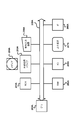
- FIG. 1 is a block diagram showing an overall configuration of an information processing system corresponding to the present embodiment.
- the information processing system is configured such that clients 101a, 101b, and 101c (hereinafter collectively referred to as “client 101”), which are user terminals, and a server 103 are connected to the Internet 102 and can communicate with each other.
- a database 104 is connected to the server 103.
- the client 101 is a user terminal operated by a user or an information processing apparatus.
- the client 101 can access a site provided by the server 103 in response to a user operation.
- the client 101 can request site information (web page information) from the server 103 (also referred to as “access request”).
- site information web page information
- the client 101 displays the received site information on the display.
- the client 101 includes, for example, a notebook personal computer, a desktop personal computer, a portable information terminal, a mobile phone, a smartphone, a tablet terminal, and the like. It is assumed that so-called Internet browser software (streaming content can be played back with a plug-in) is installed in the client 101.
- so-called Internet browser software streaming content can be played back with a plug-in
- the client 101 is connected to the Internet 102 by wireless data communication means such as a wireless LAN and LTE.
- the network 102 may be further configured to be accessible by a LAN including a network cable such as Ethernet (registered trademark).
- the Internet 102 is a network in which networks all over the world are connected to each other, but may be a network that can be connected only within a specific organization, such as an intranet.
- the server 103 may be an information processing apparatus that provides an XML file on a portal site such as an online shopping site.
- the user of the client 101 may be a registered user of the portal site (hereinafter, the registered user is also simply referred to as a user).
- the server 103 manages the database 104 in which various site information is registered, and accepts access from the client 101.
- the database 104 is an information processing apparatus in which predetermined database software is installed, and manages various data.
- the database 104 manages document file information for publishing a predetermined website on the Internet 102.
- the document file includes an HTML file, a PDF file, and a file (for example, MS word) used in a specific application.
- the database 104 is updated as needed to store the latest information.
- the server 103 and the database 104 are described as being realized by physically independent information processing apparatuses, but the embodiment of the present invention is not limited to this. For example, these may be realized by a single information processing apparatus.
- each device such as the authentication server 103 may be configured redundantly or distributedly by a plurality of information processing devices.
- the database 104 is described as being connected to the server 103 via a LAN or the like. However, for example, the database 104 may be configured to be able to communicate with the server 103 via the Internet 102 or an intranet (not shown).
- FIG. 2A is a block diagram illustrating an exemplary hardware configuration of the client 101.
- the database 104 as the information processing apparatus described above may also be configured with the same or equivalent hardware configuration.
- FIG. 2B is a block diagram illustrating an example of a hardware configuration of the server 103 as an information processing apparatus corresponding to the embodiment of the invention.
- Functions and applications of CPU, ROM, RAM, external storage drive, media, HD, instruction input device, output device, I / F, system bus, and their relationship are the same as those described with reference to FIG. 2A Or they are equivalent.
- database 210 is connected to system bus 209B.
- the database 210 corresponds to the database 104.
- each component of FIG. 2A and FIG. 2B is demonstrated collectively.
- a CPU 200A executes an application program, an operating system (OS), a control program, and the like stored in a hard disk device (hereinafter referred to as HD) 205A (205B), and a RAM 202A (202B).
- the CPU 200A (200B) may be a single processor or may be composed of a plurality of processors.
- the site information (XML file) received from the server 103 and stored in the RAM 202A is expanded and converted into data in a format that can be displayed on the display of the output device 207A.
- ROM 201A (201B) stores various data such as a basic I / O program and various application programs.
- the RAM 202A (202B) temporarily stores various data and functions as a main memory, work area, and the like of the CPU 200A (200B).
- the external storage drive 203A (203B) is an external storage drive for realizing access to the recording medium, and can load a program or the like stored in the medium (recording medium) 204A (204B) into the computer system.
- the media 204A (204B) includes, for example, a floppy (registered trademark) disk (FD), CD-ROM, CD-R, CD-RW, PC card, DVD, Blu-ray (registered trademark), IC memory card, MO, memory stick, etc. can be used.
- the external storage device 205A (205B) uses an HD (hard disk) that functions as a large-capacity memory in this embodiment.
- the HD 205A (205B) stores application programs, OS, control programs, related programs, and the like.
- a nonvolatile storage device such as a flash (registered trademark) memory may be used instead of the hard disk.
- the instruction input device 206A (206B) corresponds to a keyboard, a pointing device (such as a mouse), a touch panel, or the like. Using the instruction input device 206A (206B), the user instructs the client 101 to input a command or the like for controlling the device.
- the output device 207A (207B) outputs a command input from the instruction input device 206A (206B), a response output from the client 101 or the server 103, and the like.
- the output device 207A (207B) includes a display, a speaker, a headphone terminal, and the like.
- the system bus 209A (209B) manages the flow of data in the information processing apparatus.
- I / F 208A plays a role of mediating data exchange with an external device.
- the external device is the server 103 or the like
- the external device is the client 101 or the like.
- the I / F 208A (208B) may include a wireless communication module that includes an antenna system, an RF transceiver, one or more amplifiers, a tuner, one or more oscillators, a digital signal processor, Well-known circuitry may be included, including CODEC chipset, subscriber identity module card, memory, etc.
- a wired communication module for wired connection can be included.
- the wired communication module enables communication with other devices via one or more external ports. It can also include various software components that process the data.
- the external port is coupled to another device directly via Ethernet, USB, IEEE1394, or indirectly via a network.
- it can also comprise as a substitute of a hardware apparatus with the software which implement
- the program may be loaded from the HD 205A (205B) in which the program is already installed into the RAM 202A (202B). It is also possible to record the program according to the present embodiment in the ROM 201A (201B), configure it as a part of the memory map, and execute it directly by the CPU 200A (200B). Further, the corresponding program and related data can be directly loaded from the medium 204A (204B) into the RAM 202A (202B) and executed.
- FIG. 3 is a functional block diagram of the server 103 according to the present embodiment. Each block shown here represents various control and processing functions realized by the CPU 200 ⁇ / b> B of the server 103 executing predetermined programs stored in the ROM 201 ⁇ / b> A, RAM 202 ⁇ / b> B, and HD 205 ⁇ / b> B included in the server 103.
- the block encoding unit 301 divides the input bit string into blocks each composed of a bit string having a block length n, and performs block encoding processing for converting each block into a value of weight w and order O.
- the block encoded data is stored in the work area of the RAM 202B. Details of the block encoding process will be described later with reference to FIGS.
- the block decoding unit 302 performs block decoding processing for decoding the block encoded data obtained by the block encoding processing in the block encoding unit 301 and stored in the work area of the RAM 202B and restoring the original bit string. . Details of the block decoding process will be described later with reference to FIGS.
- the table generation unit 303 generates table information referred to in the block encoding process and the block decoding process executed in the block encoding unit 301 and the block decoding unit 302. The generation of table information will be described later with reference to FIG.
- the table holding unit 304 holds table information referred to in the block encoding process and the block decoding process executed in the block encoding unit 301 and the block decoding unit 302. Details of the table information and its usage will be described later with reference to FIGS.
- FIG. 4A is a diagram illustrating an example of semi-structured text data.
- the semi-structured text data shown in FIG. 4A exemplifies JSON format data.
- JSON format data It is known that semi-structured text data generally corresponds to a tree structure including a plurality of nodes.
- each of the plurality of nodes is represented by a character string from the start point to the end point of the semi-structured text data.
- the start point and end point may be represented by symbols (in the example of FIG.
- a character string of a child node of the node may be included in a character string of a node in a nested structure. Further, the character string of a child node may include a character string of a lower-order node such as a grandchild node.
- the circled numbers and broken lines in FIG. 4A are symbols and lines for explaining the semi-structured text data, and the circled numbers indicate the numbers of the nodes corresponding to the positions of the parentheses connected via the broken lines.
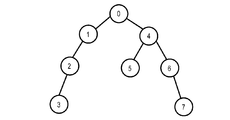
- FIG. 4B is a diagram showing a tree structure corresponding to the semi-structured text data of FIG. 4A.
- the node with the number 0 is the highest node, and its child nodes are the nodes with the numbers 1 and 4.
- the child node of the node with the number 1 is the number 2, and the child node with the number 2 is the node with the number 3.
- the child nodes of the node with the number 4 are the nodes with the numbers 5 and 6, and the child node with the number 6 is the node with the number 7.
- FIG. 4C is a table showing the tree structure shown in FIG. 4B as parenthesis tree representation (BP representation) and a bit string.
- This bit string is data to be processed in this embodiment, and the node position, bit position, and BP expression are for explaining the bit string.
- the bit string shown in FIG. 4C can be generated based on text data expressed in a tree structure such as XML or JSON.
- “(” “)” indicates the start point and the end point of each node of the text data. Therefore, “1” and “0” in the bit string represent the start point and end point of the corresponding node, respectively.
- bit positions are numbers starting from 0.
- the input bit string is divided into blocks to be processed having a fixed length n.
- one block is 8 bits and the block number is a number starting from 0.
- the number of bits included in one block may be a power of 2 other than 8, or any other number.
- the number of bits of a block is referred to as a block length.
- the open parenthesis in the BP expression of FIG. 4C and the close parenthesis corresponding to the open parenthesis indicate a node.
- the node position in FIG. 4C indicates the node number starting from that bit position, and this node position corresponds to the tree structure node number in FIG. 4B.
- the bit string shown in FIG. 4C the bit position increases from left to right, but in the physical block data stored in the RAM or CPU register, the RAM or register increases as the bit position number increases. Bits are arranged so as to be arranged in order of the bits of the higher-order digits.
- the data is stored in the upper digit of the RAM or register as it goes to the right.
- a processing target block X composed of an arbitrary bit string having a block length n is converted into a value of the weight w included in the block X and the order OD of the processing target blocks.
- ENCODE (X) (w, OD) (Formula 1)
- the weight means the number of “1” included in the bit string.
- the order is a value indicating the order in which the processing target block X is positioned in a set of bit strings having weight w and block length n (BITS (n, w)).
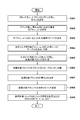
- FIG. 5 is a flowchart showing an example of the block encoding process. The process corresponding to the flowchart is executed by the block encoding unit 301, the table generation unit 303, and the table holding unit 304.
- the table generation unit 303 sets the block length n of the processing target block, the block length k of each small block constituting the processing target block, and the weight w of the processing target block.
- a processing target block having a block length n is equally divided by a small block having a block length k.
- the weight w is a weight for the entire binary data of the block length n, and the weight for each small block is not limited.
- the range of the weight w is 0 ⁇ w ⁇ n. For example, when the weight w is 2, two “1” s are included in the processing target block.
- the table generation unit 303 determines a bit string set BITS (n, w) that may exist for the binary data having the block length n and the weight w determined in S501.
- I be the number of bit strings included in BITS (n, w).
- I can be obtained by the following equation.
- I C (n, w) (Formula 2)
- C (n, w) represents a combination n C w that selects w pieces out of n pieces.
- the table generation unit 303 determines the order OD (Y i ) of binary data in BITS (n, w) determined in S502.
- Y i represents an arbitrary bit string included in BITS (n, w)
- i is represented by an integer of 0 or more and less than I (0 ⁇ i ⁇ I).
- 0 ⁇ OD (Y i ) ⁇ I holds.
- the table generation unit 303 creates a table to be referred to in the block encoding process for the BITS (n, w) bit string in the order determined in step S ⁇ b> 503 and holds the table in the table holding unit 304.
- the block encoding unit 301 divides the input bit string into blocks having the block length n set in S501, and generates a processing target block X.
- the block encoding unit 301 divides the processing target block X into small blocks having a block length k.
- the block encoding unit 301 determines the weight w based on the number of “1” included in the bit string of the processing target block X.
- the block encoding unit 301 determines the order OD (X) of the processing target block X with reference to the table held by the table holding unit 304.
- the order OD (X) of X corresponds to the number of Y i in BITS (n, w) that satisfies OD (X)> OD (Y i ).
- the processing from S501 to S504 may be executed in advance for any combination of n, k, and w assumed before the input bit string is input.
- FIG. 6 is a diagram for explaining an arrangement order of bit strings to be subjected to block coding processing
- FIG. 7 is a diagram for explaining tables referred to in the block coding processing and block decoding processing. is there.
- a block length n 6
- a weight w 2. Note that these numerical values are merely used for illustration, and larger values may be used.
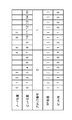
- the pattern BITS (6, 2) of the bit string Y i that can exist when the block length n is 6 is as shown in the left table 601 of FIG.
- the bit string Y i includes Y 0 to Y 14, and the left table 601 in FIG. 6 indicates data in ascending order in the order in which “1” exists from the least significant bit side. The order corresponds to the order of the bit strings Y i .
- the numbers from 0 to 14 shown on the left side of the table indicate the order assigned to each binary data shown in the table.
- the position of “1” is determined for the entire 6-bit block.
- the order OD (Y i ) is determined.
- the right table 602 in FIG. 6 shows the result of changing the order of the blocks.
- the order from the 0th to the 8th is unchanged, but the order from the 9th to the 12th is switched.
- the order of the blocks to be processed is determined in ascending order based on the weights and values of the bits of the small block unit from the most significant bit side.
- the weight is 1, the order based on the values is “001”, “010”, and “100”. If the weight is 2, the order is “011”, “101”, and “110”.
- a group having a weight of 0 “000”, a group having a weight 1 of “001”, “010”, and “100”, and a group having a weight 2 of “011”, “101”, and “110” Are generated in this order.
- FIG. 6 shows a case where the block length n of the processing target block is 6 bits
- the order determination method described above can be similarly applied when the block length n, the small block length k, and the weight w are changed.
- the weights are reduced in order from the small block located on the most significant bit side, and are arranged in ascending order in ascending order of values.
- the table generation unit 303 In subsequent S504, the table generation unit 303 generates a table to be referred to in the block encoding process for the bit string in the order determined in S503.
- the table generation unit 303 can generate five types of tables as shown in FIG.
- the first table (T1) 701 shown in FIG. 7 registers the number of Y i having a smaller weight for each of the weights w of the block Y i-0 for the small block Y i-0 on the most significant bit side.
- the value of the first entry in the T1 0 is zero.
- the value of the entry of T1 0 for the weight 1 is 3.
- the value of the entry of T1 0 for weight 2 is 12.
- the weight 3 does not exist and is invalid as a value. However, if the weight 3 exists, a corresponding value is registered.
- the second table (T2) 702 registers the number of combinations in the small block (small block length k) based on the value of the weight w.
- the weight w 2
- the number of “1” that can exist in the small block is any one of “0”, “1”, and “2”.
- the small block length k 3.
- the embodiment of the invention is not limited to this example, and a value according to the size of the block length n, the small block length k, and the weight w is registered in T2.
- Each value can be obtained from the following equation.
- the third table (T3) 703 registers the order values assigned to different bit patterns depending on the weight for the small block length k.
- the order of the bit string X is represented by OD sw (X) as the order in the same weight registered in T3.
- the bit pattern differs depending on the position where “1” can be taken in a 3-bit block.
- the weight is 1, there are three patterns “001”, “010”, and “100”.
- the value of the order OD sw (X) indicates the number of small blocks that exist before the small block of the bit string to which the order is assigned and have the same weight.
- the order assigned to “001” is “0”, which means that there is no small block having the same weight before the small block of “001”.
- the order assigned to “100” is “2”, but there are two small blocks having the same weight (“001” and “0101”) before the small block of “100”. Means that.
- the embodiment of the invention is not limited to this example.
- T3 values according to the sizes of the small block length k and the weight w are registered, and in the case of the same weight, the order is the size of the value. Determined in ascending order.
- the fourth table T4 (704) registers a bit string corresponding to a combination of a rank and a weight value given within the same weight for a bit string of a small block length k.
- the weight w can take a value from 0 to 3, and there are eight possible bit string patterns.
- Each bit string can be uniquely specified by a weight value (0 to 3) and an order OD sw (0 to 2) assigned within the same weight.
- the possible bit string is “001”, “010”, or “100”, and one bit string is identified based on the order value.
- the order OD sw given to the bit string X for each same weight is in the order of the value of the bit string as in the table T3.
- a value indicating the registration order in the table T4 for specifying in the table T4 the first bit string having the same weight and the order OD sw based on the value of the weight w is stored in the table T4 in advance. It may be registered or may be held by the table holding unit 304.
- the fifth table T5 (705) registers the weight value of the bit string having the small block length k.
- the tables T1 to T5 generated in this way are held by the table holding unit 304.
- the block encoding unit 301 calculates the number of bit strings Yi positioned before the processing target block X in the order determined in S503 in BITS (6, 2).
- small blocks constituting the processing target block X are represented by X 0 and X 1
- a small block of an arbitrary bit string Y i other than the processing target block X included in BITS (6, 2) is represented as Y i-0 . This is expressed as Y i-1 .
- the order OD (X) of the processing target block X in the present embodiment is determined in order of weight and value for each small block from the most significant bit side.
- the block encoding unit 301 initializes a parameter h indicating the position of each small block of the processing target block X to 0.
- h is an integer value in a range of 0 ⁇ h ⁇ n / k ⁇ 1.
- h takes a value of 0 or 1.
- step S802 the block encoding unit 301 calculates a weight w h from the value of the small block X h .
- the weight w h 1
- the table T5 in FIG. 7 may be referred to.
- the block encoding unit 301 acquires from the table T1 h.
- the suffix h is omitted in FIG. In the example of the bit string 602 in FIG.
- step S809 the number of Y i (N h ′) having an order OD (Y i ) having a weight w h and smaller than the order OD (X) of the processing target block is calculated using the following equation.
- N h ′ OD sw (X h ) ⁇ C (k (n / k ⁇ h ⁇ 1), w ′) (Formula 5)
- step S810 the order OD h (X h ) of the small blocks X h is calculated based on the following equation.
- OD h (X h ) N h + N h ′ (Formula 6)
- n and the small block length k need not be encoded if they are known values between the code side and the decoding side, but if they are not known, these values are also encoded at the same time. In the present embodiment, it is assumed that the values of n and k are known.
- the block decoding process is a process of decoding the processing target block X composed of the original bit string of the block length n from the value of the weight w of the block encoding result and the order OD of the processing target block X.
- DECODE (w, OD) X (Formula 7)
- the block decoding unit 302 initializes a parameter h representing the position of the small block to 0.
- h is an integer value in a range of 0 ⁇ h ⁇ n / k ⁇ 1.
- the block decoding unit 302 calculates the weight w h of the small block X h .
- the weight w 0 of the first small block X 0 to be decoded is calculated here.
- T1 [j] ⁇ 10 ⁇ 1 (k represents the block length of the small block) (Formula 8-1)
- the embodiment of the invention is not limited to this example, and the weight calculation process can be executed according to the size of the block length n, the small block length k, and the weight w.
- a possible value is any one of “001”, “010”, and “100”. Determine based on.
- the value of h is updated by 1 so that the next small block is processed.
- the bit pattern having the weight 1 is the pattern of the order 1
- block encoding and block decoding can be performed on a processing target block having a predetermined block length n, a small block length k, and a weight w.
- k lg (n)
- n 64
- 1 when processing the number of the sparse input bit string and 0.01 ⁇ 2 28 can be about 20% faster for RANK / SELECT operation as compared with existing approaches is not divided into small blocks.
- the present invention is not limited to the above-described embodiment, and various changes and modifications can be made without departing from the spirit and scope of the present invention. Therefore, in order to make the scope of the present invention public, the following claims are attached.
- the information processing apparatus according to the present invention can also be realized by a program that causes one or more computers to function as the information processing apparatus.
- the program can be provided / distributed by being recorded on a computer-readable (non-transitory) recording medium or through a telecommunication line.
Landscapes
- Engineering & Computer Science (AREA)
- Multimedia (AREA)
- Signal Processing (AREA)
- Theoretical Computer Science (AREA)
- Compression, Expansion, Code Conversion, And Decoders (AREA)
Abstract
Le but de la présente invention est de fournir un procédé de codage et un procédé de décodage efficaces pour une compression de blocs afin de mettre facilement en œuvre RRR et concerne une mise en œuvre de RRR qui fournit un procédé de codage et un procédé de décodage rapides et économes en espace, et qui fonctionnent à une vitesse élevée même pour une chaîne de bits dense. Un dispositif de codage de blocs génère des blocs à traiter par division d'une chaîne de bits d'entrée en une pluralité de blocs ayant une première longueur de bloc, détermine un premier poids de chaque bloc à traiter à partir du nombre de valeurs 1 comprises dans la chaîne de bits du bloc à traiter, divise chaque bloc à traiter en petits blocs ayant une seconde longueur de bloc, détermine un premier ordre des blocs à traiter dans un ensemble dans lequel des chaînes de bits prédéterminées ayant la première longueur de bloc et le premier poids sont agencées dans un ordre prédéterminé sur la base du poids et de la valeur de chacun des petits blocs, et génère des données de codage de bloc par conversion de la chaîne de bits de chaque bloc à traiter en valeurs du premier poids et du premier ordre déterminés.
Priority Applications (3)
| Application Number | Priority Date | Filing Date | Title |
|---|---|---|---|
| US16/078,123 US11212528B2 (en) | 2016-02-25 | 2016-02-25 | Bit string block encoder device, block decoder device, information processing device, program, block encoding method and block decoding method |
| PCT/JP2016/055583 WO2017145317A1 (fr) | 2016-02-25 | 2016-02-25 | Dispositif de codage de blocs, dispositif de décodage de blocs, dispositif de traitement d'informations, programme, procédé de codage de blocs et procédé de décodage de blocs |
| JP2016560607A JP6123088B1 (ja) | 2016-02-25 | 2016-02-25 | ブロック符号化装置、ブロック復号化装置、情報処理装置、プログラム、ブロック符号化方法及びブロック復号化方法 |
Applications Claiming Priority (1)
| Application Number | Priority Date | Filing Date | Title |
|---|---|---|---|
| PCT/JP2016/055583 WO2017145317A1 (fr) | 2016-02-25 | 2016-02-25 | Dispositif de codage de blocs, dispositif de décodage de blocs, dispositif de traitement d'informations, programme, procédé de codage de blocs et procédé de décodage de blocs |
Publications (1)
| Publication Number | Publication Date |
|---|---|
| WO2017145317A1 true WO2017145317A1 (fr) | 2017-08-31 |
Family
ID=58704650
Family Applications (1)
| Application Number | Title | Priority Date | Filing Date |
|---|---|---|---|
| PCT/JP2016/055583 Ceased WO2017145317A1 (fr) | 2016-02-25 | 2016-02-25 | Dispositif de codage de blocs, dispositif de décodage de blocs, dispositif de traitement d'informations, programme, procédé de codage de blocs et procédé de décodage de blocs |
Country Status (3)
| Country | Link |
|---|---|
| US (1) | US11212528B2 (fr) |
| JP (1) | JP6123088B1 (fr) |
| WO (1) | WO2017145317A1 (fr) |
Citations (2)
| Publication number | Priority date | Publication date | Assignee | Title |
|---|---|---|---|---|
| WO2015151444A1 (fr) * | 2014-03-31 | 2015-10-08 | Necソリューションイノベータ株式会社 | Structure de données, dispositif de traitement d'informations, procédé de traitement d'informations et support d'enregistrement de programme |
| WO2015173870A1 (fr) * | 2014-05-12 | 2015-11-19 | 楽天株式会社 | Système de traitement d'informations, procédé de traitement d'informations et programme |
Family Cites Families (4)
| Publication number | Priority date | Publication date | Assignee | Title |
|---|---|---|---|---|
| JPS61145636A (ja) * | 1984-12-19 | 1986-07-03 | Nec Corp | 記号列照合装置 |
| JPH0723239A (ja) * | 1993-06-18 | 1995-01-24 | Ricoh Co Ltd | デジタル複写機 |
| JPH0879516A (ja) * | 1994-09-01 | 1996-03-22 | Fuji Xerox Co Ltd | 画像処理装置 |
| JP4936996B2 (ja) * | 2007-05-24 | 2012-05-23 | 株式会社東芝 | 非線形データ変換器、暗号化装置、および復号装置 |
-
2016
- 2016-02-25 US US16/078,123 patent/US11212528B2/en active Active
- 2016-02-25 WO PCT/JP2016/055583 patent/WO2017145317A1/fr not_active Ceased
- 2016-02-25 JP JP2016560607A patent/JP6123088B1/ja active Active
Patent Citations (2)
| Publication number | Priority date | Publication date | Assignee | Title |
|---|---|---|---|---|
| WO2015151444A1 (fr) * | 2014-03-31 | 2015-10-08 | Necソリューションイノベータ株式会社 | Structure de données, dispositif de traitement d'informations, procédé de traitement d'informations et support d'enregistrement de programme |
| WO2015173870A1 (fr) * | 2014-05-12 | 2015-11-19 | 楽天株式会社 | Système de traitement d'informations, procédé de traitement d'informations et programme |
Non-Patent Citations (2)
| Title |
|---|
| KUNIHIKO SADAKANE: "Succinct Data Structures for Large-Scale Data Processing", IPSJ MAGAZINE, vol. 48, no. 8, 15 August 2007 (2007-08-15), pages 899 - 902, XP008184377 * |
| YUSAKU KANETA: "Jitsuyoteki na Asshuku Rank/ Select Jisho", IPSJ SIG NOTES, vol. 2015 -AL, no. 1, 28 September 2015 (2015-09-28), pages 1 - 6 * |
Also Published As
| Publication number | Publication date |
|---|---|
| JPWO2017145317A1 (ja) | 2018-03-01 |
| JP6123088B1 (ja) | 2017-05-10 |
| US20210195184A1 (en) | 2021-06-24 |
| US11212528B2 (en) | 2021-12-28 |
Similar Documents
| Publication | Publication Date | Title |
|---|---|---|
| US8929402B1 (en) | Systems and methods for compressing packet data by predicting subsequent data | |
| JP5742506B2 (ja) | 文書類似度算出装置 | |
| US9727574B2 (en) | System and method for applying an efficient data compression scheme to URL parameters | |
| JP6898778B2 (ja) | 機械学習システム及び機械学習方法 | |
| US20200212932A1 (en) | Reducing storage of blockchain metadata via dictionary-style compression | |
| IL294187B2 (en) | Systems and methods of data compression | |
| CN111727445A (zh) | 局部熵编码的数据压缩 | |
| KR102627748B1 (ko) | 스택 가능한 중첩 모델 구조를 사용한 멀티 레이트 신경 이미지 압축 방법 및 장치 | |
| CN110266834B (zh) | 基于互联网协议地址的地区查找方法及装置 | |
| US20180041224A1 (en) | Data value suffix bit level compression | |
| CN106570153A (zh) | 一种海量url的数据提取方法及系统 | |
| CN119968777A (zh) | 多域可配置数据压缩器/解压缩器 | |
| JP2019534602A (ja) | エントロピー・エンコーディングのシステム・レベル・テスト | |
| Hassan et al. | Arithmetic N-gram: an efficient data compression technique | |
| US20240120940A1 (en) | System and method for distributed node-based data compaction | |
| CN109302449B (zh) | 数据写入方法、数据读取方法、装置和服务器 | |
| KR20120056944A (ko) | Ngs 데이터의 고속 압축장치 및 그 방법 | |
| JP6123088B1 (ja) | ブロック符号化装置、ブロック復号化装置、情報処理装置、プログラム、ブロック符号化方法及びブロック復号化方法 | |
| US20240411756A1 (en) | Selection pushdown in column stores using bit manipulation instructions | |
| Culpepper et al. | Revisiting bounded context block‐sorting transformations | |
| Wang et al. | PLZMA: a parallel data compression method for cloud computing | |
| CN114861057B (zh) | 资源发送方法、推荐模型的训练及装置 | |
| JP2020119244A (ja) | 翻訳装置、学習装置、およびプログラム | |
| KR102289411B1 (ko) | 가중치 기반의 피처 벡터 생성 장치 및 방법 | |
| Arif et al. | Effect on speech compression by combined delta encoding and huffman coding scheme |
Legal Events
| Date | Code | Title | Description |
|---|---|---|---|
| ENP | Entry into the national phase |
Ref document number: 2016560607 Country of ref document: JP Kind code of ref document: A |
|
| NENP | Non-entry into the national phase |
Ref country code: DE |
|
| 121 | Ep: the epo has been informed by wipo that ep was designated in this application |
Ref document number: 16891474 Country of ref document: EP Kind code of ref document: A1 |
|
| 122 | Ep: pct application non-entry in european phase |
Ref document number: 16891474 Country of ref document: EP Kind code of ref document: A1 |