WO2017146130A1 - 放射性ヨウ素含有流体の処理方法 - Google Patents
放射性ヨウ素含有流体の処理方法 Download PDFInfo
- Publication number
- WO2017146130A1 WO2017146130A1 PCT/JP2017/006750 JP2017006750W WO2017146130A1 WO 2017146130 A1 WO2017146130 A1 WO 2017146130A1 JP 2017006750 W JP2017006750 W JP 2017006750W WO 2017146130 A1 WO2017146130 A1 WO 2017146130A1
- Authority
- WO
- WIPO (PCT)
- Prior art keywords
- silver
- zeolite
- iodine
- compact
- radioactive
- Prior art date
- Legal status (The legal status is an assumption and is not a legal conclusion. Google has not performed a legal analysis and makes no representation as to the accuracy of the status listed.)
- Ceased
Links
Images



Classifications
-
- B—PERFORMING OPERATIONS; TRANSPORTING
- B01—PHYSICAL OR CHEMICAL PROCESSES OR APPARATUS IN GENERAL
- B01J—CHEMICAL OR PHYSICAL PROCESSES, e.g. CATALYSIS OR COLLOID CHEMISTRY; THEIR RELEVANT APPARATUS
- B01J20/00—Solid sorbent compositions or filter aid compositions; Sorbents for chromatography; Processes for preparing, regenerating or reactivating thereof
- B01J20/02—Solid sorbent compositions or filter aid compositions; Sorbents for chromatography; Processes for preparing, regenerating or reactivating thereof comprising inorganic material
- B01J20/10—Solid sorbent compositions or filter aid compositions; Sorbents for chromatography; Processes for preparing, regenerating or reactivating thereof comprising inorganic material comprising silica or silicate
- B01J20/16—Alumino-silicates
- B01J20/18—Synthetic zeolitic molecular sieves
-
- B—PERFORMING OPERATIONS; TRANSPORTING
- B01—PHYSICAL OR CHEMICAL PROCESSES OR APPARATUS IN GENERAL
- B01D—SEPARATION
- B01D53/00—Separation of gases or vapours; Recovering vapours of volatile solvents from gases; Chemical or biological purification of waste gases, e.g. engine exhaust gases, smoke, fumes, flue gases, aerosols
- B01D53/02—Separation of gases or vapours; Recovering vapours of volatile solvents from gases; Chemical or biological purification of waste gases, e.g. engine exhaust gases, smoke, fumes, flue gases, aerosols by adsorption, e.g. preparative gas chromatography
- B01D53/04—Separation of gases or vapours; Recovering vapours of volatile solvents from gases; Chemical or biological purification of waste gases, e.g. engine exhaust gases, smoke, fumes, flue gases, aerosols by adsorption, e.g. preparative gas chromatography with stationary adsorbents
-
- B—PERFORMING OPERATIONS; TRANSPORTING
- B01—PHYSICAL OR CHEMICAL PROCESSES OR APPARATUS IN GENERAL
- B01J—CHEMICAL OR PHYSICAL PROCESSES, e.g. CATALYSIS OR COLLOID CHEMISTRY; THEIR RELEVANT APPARATUS
- B01J20/00—Solid sorbent compositions or filter aid compositions; Sorbents for chromatography; Processes for preparing, regenerating or reactivating thereof
- B01J20/28—Solid sorbent compositions or filter aid compositions; Sorbents for chromatography; Processes for preparing, regenerating or reactivating thereof characterised by their form or physical properties
-
- B—PERFORMING OPERATIONS; TRANSPORTING
- B01—PHYSICAL OR CHEMICAL PROCESSES OR APPARATUS IN GENERAL
- B01J—CHEMICAL OR PHYSICAL PROCESSES, e.g. CATALYSIS OR COLLOID CHEMISTRY; THEIR RELEVANT APPARATUS
- B01J20/00—Solid sorbent compositions or filter aid compositions; Sorbents for chromatography; Processes for preparing, regenerating or reactivating thereof
- B01J20/28—Solid sorbent compositions or filter aid compositions; Sorbents for chromatography; Processes for preparing, regenerating or reactivating thereof characterised by their form or physical properties
- B01J20/28002—Solid sorbent compositions or filter aid compositions; Sorbents for chromatography; Processes for preparing, regenerating or reactivating thereof characterised by their form or physical properties characterised by their physical properties
- B01J20/28004—Sorbent size or size distribution, e.g. particle size
-
- B—PERFORMING OPERATIONS; TRANSPORTING
- B01—PHYSICAL OR CHEMICAL PROCESSES OR APPARATUS IN GENERAL
- B01J—CHEMICAL OR PHYSICAL PROCESSES, e.g. CATALYSIS OR COLLOID CHEMISTRY; THEIR RELEVANT APPARATUS
- B01J20/00—Solid sorbent compositions or filter aid compositions; Sorbents for chromatography; Processes for preparing, regenerating or reactivating thereof
- B01J20/28—Solid sorbent compositions or filter aid compositions; Sorbents for chromatography; Processes for preparing, regenerating or reactivating thereof characterised by their form or physical properties
- B01J20/28014—Solid sorbent compositions or filter aid compositions; Sorbents for chromatography; Processes for preparing, regenerating or reactivating thereof characterised by their form or physical properties characterised by their form
- B01J20/28016—Particle form
-
- B—PERFORMING OPERATIONS; TRANSPORTING
- B01—PHYSICAL OR CHEMICAL PROCESSES OR APPARATUS IN GENERAL
- B01J—CHEMICAL OR PHYSICAL PROCESSES, e.g. CATALYSIS OR COLLOID CHEMISTRY; THEIR RELEVANT APPARATUS
- B01J20/00—Solid sorbent compositions or filter aid compositions; Sorbents for chromatography; Processes for preparing, regenerating or reactivating thereof
- B01J20/30—Processes for preparing, regenerating, or reactivating
- B01J20/3007—Moulding, shaping or extruding
-
- C—CHEMISTRY; METALLURGY
- C01—INORGANIC CHEMISTRY
- C01B—NON-METALLIC ELEMENTS; COMPOUNDS THEREOF; METALLOIDS OR COMPOUNDS THEREOF NOT COVERED BY SUBCLASS C01C
- C01B39/00—Compounds having molecular sieve and base-exchange properties, e.g. crystalline zeolites; Their preparation; After-treatment, e.g. ion-exchange or dealumination
- C01B39/02—Crystalline aluminosilicate zeolites; Isomorphous compounds thereof; Direct preparation thereof; Preparation thereof starting from a reaction mixture containing a crystalline zeolite of another type, or from preformed reactants; After-treatment thereof
- C01B39/14—Type A
-
- C—CHEMISTRY; METALLURGY
- C01—INORGANIC CHEMISTRY
- C01B—NON-METALLIC ELEMENTS; COMPOUNDS THEREOF; METALLOIDS OR COMPOUNDS THEREOF NOT COVERED BY SUBCLASS C01C
- C01B39/00—Compounds having molecular sieve and base-exchange properties, e.g. crystalline zeolites; Their preparation; After-treatment, e.g. ion-exchange or dealumination
- C01B39/02—Crystalline aluminosilicate zeolites; Isomorphous compounds thereof; Direct preparation thereof; Preparation thereof starting from a reaction mixture containing a crystalline zeolite of another type, or from preformed reactants; After-treatment thereof
- C01B39/14—Type A
- C01B39/18—Type A from a reaction mixture containing at least one aluminium silicate or aluminosilicate of a clay type, e.g. kaolin or metakaolin or its exotherm modification or allophane
-
- C—CHEMISTRY; METALLURGY
- C01—INORGANIC CHEMISTRY
- C01B—NON-METALLIC ELEMENTS; COMPOUNDS THEREOF; METALLOIDS OR COMPOUNDS THEREOF NOT COVERED BY SUBCLASS C01C
- C01B39/00—Compounds having molecular sieve and base-exchange properties, e.g. crystalline zeolites; Their preparation; After-treatment, e.g. ion-exchange or dealumination
- C01B39/02—Crystalline aluminosilicate zeolites; Isomorphous compounds thereof; Direct preparation thereof; Preparation thereof starting from a reaction mixture containing a crystalline zeolite of another type, or from preformed reactants; After-treatment thereof
- C01B39/20—Faujasite type, e.g. type X or Y
- C01B39/22—Type X
-
- G—PHYSICS
- G21—NUCLEAR PHYSICS; NUCLEAR ENGINEERING
- G21F—PROTECTION AGAINST X-RADIATION, GAMMA RADIATION, CORPUSCULAR RADIATION OR PARTICLE BOMBARDMENT; TREATING RADIOACTIVELY CONTAMINATED MATERIAL; DECONTAMINATION ARRANGEMENTS THEREFOR
- G21F9/00—Treating radioactively contaminated material; Decontamination arrangements therefor
- G21F9/02—Treating gases
-
- G—PHYSICS
- G21—NUCLEAR PHYSICS; NUCLEAR ENGINEERING
- G21F—PROTECTION AGAINST X-RADIATION, GAMMA RADIATION, CORPUSCULAR RADIATION OR PARTICLE BOMBARDMENT; TREATING RADIOACTIVELY CONTAMINATED MATERIAL; DECONTAMINATION ARRANGEMENTS THEREFOR
- G21F9/00—Treating radioactively contaminated material; Decontamination arrangements therefor
- G21F9/04—Treating liquids
- G21F9/06—Processing
- G21F9/12—Processing by absorption; by adsorption; by ion-exchange
-
- B—PERFORMING OPERATIONS; TRANSPORTING
- B01—PHYSICAL OR CHEMICAL PROCESSES OR APPARATUS IN GENERAL
- B01D—SEPARATION
- B01D2253/00—Adsorbents used in seperation treatment of gases and vapours
- B01D2253/10—Inorganic adsorbents
- B01D2253/106—Silica or silicates
- B01D2253/108—Zeolites
-
- B—PERFORMING OPERATIONS; TRANSPORTING
- B01—PHYSICAL OR CHEMICAL PROCESSES OR APPARATUS IN GENERAL
- B01D—SEPARATION
- B01D2257/00—Components to be removed
- B01D2257/20—Halogens or halogen compounds
- B01D2257/202—Single element halogens
-
- C—CHEMISTRY; METALLURGY
- C01—INORGANIC CHEMISTRY
- C01P—INDEXING SCHEME RELATING TO STRUCTURAL AND PHYSICAL ASPECTS OF SOLID INORGANIC COMPOUNDS
- C01P2004/00—Particle morphology
- C01P2004/01—Particle morphology depicted by an image
- C01P2004/03—Particle morphology depicted by an image obtained by SEM
-
- C—CHEMISTRY; METALLURGY
- C01—INORGANIC CHEMISTRY
- C01P—INDEXING SCHEME RELATING TO STRUCTURAL AND PHYSICAL ASPECTS OF SOLID INORGANIC COMPOUNDS
- C01P2004/00—Particle morphology
- C01P2004/60—Particles characterised by their size
- C01P2004/61—Micrometer sized, i.e. from 1-100 micrometer
Definitions
- the present invention relates to a method for treating a radioactive fluid containing radioactive iodine, and more particularly to a method for treating a radioactive fluid that removes radioactive iodine from a radioactive fluid containing contaminated ions derived from seawater used as cooling water in a nuclear power plant. .
- radioactive liquid waste containing radioactive iodine has been generated due to the accident that occurred at the Fukushima Daiichi Nuclear Power Station due to the Great East Japan Earthquake on March 11, 2011.
- This radioactive liquid waste includes contaminated water generated by the reactor pressure vessel, containment vessel, and cooling water injected into the spent fuel pool, trench water remaining in the trench, and subdrains around the reactor building. There are sub-drain water, groundwater, seawater, etc. that are pumped up from wells (hereinafter referred to as “radioactive waste liquid”).
- Radioactive substances are removed from these radioactive waste liquids at treatment facilities called Sally (SARRY, Simplified Active Water Retrieve and Recovery System (cesium removal equipment) and Alps (ALPS, multi-nuclide removal equipment))
- SARRY Simplified Active Water Retrieve and Recovery System
- Alps APS, multi-nuclide removal equipment
- the treated water is collected in a tank.
- radioactive substances radioactive iodine is mainly present in contaminated water in the form of iodide ions or iodate ions.
- substances that can selectively adsorb and remove radioactive iodine include silver-supported activated carbon and silver-supported inorganic substances.
- an adsorbent that is silver-supported activated carbon is used to remove radioactive iodine.
- an iodine ion scavenger formed by supporting silver or palladium with alumina or zeolite as a carrier (Patent Documents 1 and 2), and supporting silver on a side chain grown by radiation graft polymerization on a polymer substrate.
- An adsorbing radioactive iodine adsorbent (Patent Document 4) has been proposed.
- a method of removing iodine from steam using molecular sieve granules containing both X-type zeolite and A-type zeolite substituted with silver has been proposed (Patent Document 5).
- the polymer-based filter has a small amount of silver supported per volume, and a large amount of filter is required to process a large amount of radioactive liquid waste.
- the conventional zeolite compact has a limit in the amount of silver supported because the base zeolite contains 10-30 wt% of the total weight of the binder.
- the radioactive iodine adsorbent disclosed in Patent Document 4 and the molecular sieve granules disclosed in Patent Document 5 have silver clusters that do not contribute to iodine adsorption because silver is not aggregated and dispersed during production. Including many.
- iodine adsorption characteristics depend on the amount of silver supported, unlike the case of adsorbing iodine in vapor or gas, a large amount of iodine adsorbent is required to treat a large amount of waste liquid, and the adsorbent that has passed through is secondary. There is a new problem that a large amount of waste is generated.
- the present invention is to provide a radioactive liquid waste treatment method capable of reducing the amount of secondary waste generated.
- a method for efficiently adsorbing and removing radioactive iodine from a large amount of radioactive liquid waste containing high concentrations of chloride ions, cesium ions, strontium ions, magnesium ions, calcium ions, and sodium ions as coexisting ions in addition to iodide ions is provided. There is to do.
- an object of the present invention is to provide a method for efficiently adsorbing and removing radioactive iodine from a radioactive fluid containing radioactive liquid waste or radioactive gas.
- the present invention uses an iodine adsorbent with high iodine adsorption performance per unit volume, and in addition to iodide ions, high-concentration chloride ions, cesium ions, strontium ions, magnesium ions, calcium ions, sodium ions
- iodide ions high-concentration chloride ions
- cesium ions cesium ions
- strontium ions magnesium ions
- calcium ions calcium ions
- sodium ions sodium ions
- a radioactive iodine-containing fluid in which a fluid containing radioactive iodine is passed through an iodine adsorbent composed of a silver-containing binderless zeolite compact having a silver content of 50 wt% or less, and the iodine adsorbent is adsorbed by the iodine adsorbent. Processing method.
- the binderless zeolite molded body constituting the iodine adsorbent is a binderless A-type zeolite molded body or a binderless X-type zeolite molded body of the radioactive iodine-containing fluid according to [1] or [2]. Processing method.
- radioactive fluid according to any one of [1] to [3], wherein the fluid containing radioactive iodine is a gas, and the iodine adsorbent is in the form of particles having a particle size in the range of 800 ⁇ m to 2000 ⁇ m.
- Method for treating iodine-containing fluid Method for treating iodine-containing fluid.
- the iodine adsorbent of the present invention is composed of a silver-containing binderless zeolite molded article having a large silver content and uniformly dispersed without agglomerating silver, and has a high iodine adsorption performance per unit volume. Radioactive iodine contained in a fluid such as radioactive liquid waste or gas can be adsorbed and removed at low cost.
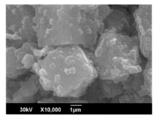
- 2 is a SEM image of the silver-containing A-type zeolite compact prepared in Example 1 at a magnification of 10,000 times.
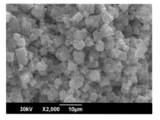
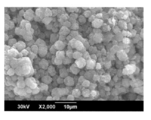
- 2 is an SEM image of a silver-containing A-type zeolite compact prepared in Example 1 at a magnification of 2,000 times.
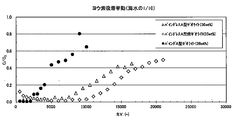
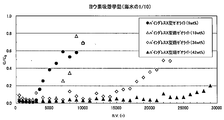
- 2 is a graph showing iodine adsorption behavior using the adsorbent of Example 1.
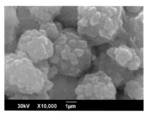
- 4 is a SEM image of a silver-containing X-type zeolite molded body prepared in Example 2 at a magnification of 10,000 times.
- 4 is a SEM image of a silver-containing X-type zeolite molded body prepared in Example 2 at a magnification of 2,000 times.
- Example 3 is a graph showing iodine adsorption behavior using the adsorbent of Example 2.
- 6 is a graph showing iodine adsorption behavior using the adsorbent of Example 3. It is a graph which shows the iodine adsorption
- 2 is an XRD diffractogram of zeolite molded articles of Example 1, Example 2 and Comparative Example 1.
- the iodine adsorbent used in the fluid treatment method of the present invention is a silver-containing binderless zeolite compact having a silver content of 50 wt% or less.
- the binderless zeolite compact is obtained by solidifying zeolite fine particles and zeolite powder into a certain shape without using a binder.
- the binderless zeolite molded body that can be used in the present invention has a zeolite purity described later of 90% or more, preferably 95% or more, more preferably 97% or more.
- the ratio of 1 mol of silicon (Si) to 2 mol of aluminum (Al) in the silver-containing zeolite compact (hereinafter referred to as “Si / Al 2 molar ratio”) is 2.0 or more and 3.0 or less. Thereby, the number of sites of Al which is a coordination point of silver ions is moderately present, and silver is highly dispersed.
- the Si / Al 2 molar ratio is preferably 2.2 or more, more preferably 2.4 or more, and even more preferably 2.6 or more. Thereby, aggregation of silver is suppressed more.
- the Si / Al 2 molar ratio is 3.0 or less. As a result, the number of Al sites is increased and silver is more highly dispersed.
- the silver-containing zeolite compact preferably contains an alkali metal.
- the alkali metal is at least one member selected from the group consisting of lithium (Li), sodium (Na), potassium (K), rubidium (Rb), and cesium (Cs).
- the silver-containing zeolite compact preferably contains Na.
- the total molar ratio of alkali metal to silver (hereinafter referred to as “(alkali metal + Ag) / Al molar ratio”) with respect to Al in the silver-containing zeolite compact is 0.9 or more and 1.1 or less.
- the total amount of SiO 2 , Al 2 O 3 , Ag 2 O, and alkali metal oxide in the silver-containing zeolite compact is 90% by weight or more, preferably 95% by weight or more, more preferably 97% by weight or more, more preferably Is 98% by weight or more.
- zeolite in which silver tends to aggregate, and it becomes a zeolite compact in which silver is highly dispersed.
- Ag and an alkali metal in the silver-containing zeolite molded body are expressed in terms of oxides, and can be expressed as a weight ratio in a state heated at 900 ° C., for example.
- the crystal structure of the silver-containing zeolite molded body is preferably at least one of A type and FAU type, and more preferably FAU type zeolite. Since the FAU type zeolite has a large pore diameter of 8 to 15 mm, the aggregation of silver is further suppressed. Examples of the FAU type zeolite include X type zeolite and Y type zeolite. The crystal structure of the silver-containing zeolite compact can be confirmed by powder X-ray diffraction measurement.
- the silver-containing zeolite compact includes not only zeolite powder but also zeolite converted from an inorganic binder to zeolite. That is, it contains zeolite fine particles to be described later.
- the zeolite powder only needs to have a larger average particle size than the zeolite fine particles described later.
- the average particle size of the zeolite powder is preferably 2 ⁇ m or more and 8 ⁇ m or less, more preferably 3 ⁇ m or more and 6 ⁇ m or less. Thereby, the intensity
- the average particle size of the zeolite powder is determined by randomly extracting 30 or more independent particles that can be confirmed in a scanning electron microscope observation drawing having a measurement magnification of 1,500 to 3,000 times. Can be sought.
- the silver-containing zeolite compact has a zeolite purity of 90% or more, preferably 95% or more, and more preferably 97% or more before carrying silver.
- the zeolite purity can be calculated by a general moisture adsorption amount measurement. That is, the ratio of the zeolite component can be calculated using the following formula (1) based on the ratio of the moisture adsorption amount per 100 g of the zeolite compact before supporting silver to the moisture adsorption amount per 100 g of the zeolite powder.
- the zeolite purity of the compact containing the X-type zeolite powder can be calculated from the following formula (2).
- a zeolite molded body having a high zeolite purity of 90% or more (hereinafter also referred to as “binderless molded body”) can be obtained by converting the inorganic binder in the molded body into zeolite. That is, the silver-containing zeolite molded body contains an inorganic binder converted into zeolite. Usually, when an inorganic binder is converted into zeolite, it becomes zeolite fine particles described later and exists on the surface of the zeolite powder. Since the zeolite fine particles function as a binder for bonding zeolite powders together, the mechanical strength of the silver-containing zeolite compact is increased.
- the strength of a molded article containing no zeolite fine particles and having a zeolite purity of less than 90% (hereinafter also referred to as “binder molded article”) is substantially reduced.
- a zeolite compact is obtained by molding a mixture of zeolite powder and an inorganic binder, but with a mixture of zeolite powder of 90% by weight or more, the plasticity necessary for molding cannot be obtained and a certain shape is obtained. It becomes extremely difficult to obtain a molded product. Therefore, the silver-containing zeolite compact preferably contains zeolite powder and zeolite fine particles.
- the average particle size of the zeolite fine particles is preferably 0.2 ⁇ m or more and 1.5 ⁇ m or less.
- the average particle diameter of the zeolite fine particles is an independent minimum unit particle which can be confirmed in a scanning electron microscope observation drawing having a measurement magnification of 10,000 to 15,000 times, and the particle diameter is 1.5 ⁇ m or less. 30 or more samples can be extracted at random and the average diameter can be obtained.
- the zeolite powder has zeolite fine particles on the surface. That is, it can be qualitatively confirmed by a scanning electron microscope observation that the zeolite powder has zeolite fine powder on the surface.
- the volume distribution particle diameter measured in the state of pulverizing the silver-containing zeolite compact has a monomodal particle diameter distribution peak, and the volume average particle diameter (D50) is about the same as that of the zeolite powder. That is, since there is no particle size distribution peak corresponding to the average particle size of the zeolite fine particles, it can be confirmed that the zeolite powder and the zeolite fine particles are integrated, and the zeolite powder has zeolite fine particles on the surface.
- it can also confirm by XRD that it is a zeolite compact with such a high zeolite purity. That is, only the diffraction peak due to the zeolite structure is confirmed in the obtained XRD pattern. When the zeolite purity is not satisfied and a large amount of impurities such as an inorganic binder is contained, a diffraction peak derived from the inorganic binder is observed.
- the zeolite fine particles also act as a binder. Therefore, the silver-containing zeolite molded body is excellent in mechanical strength.
- the pressure resistance of the silver-containing zeolite compact is, for example, 15 N or more, preferably 30 N or more, and more preferably 40 N or more in a cylindrical compact having a diameter of 1.5 mm and an average length of 5 mm.
- the silver-containing zeolite compact is more than 0 wt% in the total weight of the compact, preferably 5 wt% or more, more preferably 8 wt% or more, still more preferably 11 wt% or more, particularly preferably 16 wt% or more, and 50 wt%. Or less, preferably 46 wt% or less, more preferably less than 36 wt%, still more preferably 35.5 wt% or less, more preferably 35 wt% or less, still more preferably 32 wt% or less, even more preferably 30 wt% or less, particularly preferably It contains 25 wt% or less, more preferably 20 wt% or less of silver.
- Silver can take the form of silver ions that exist in a dispersed state, silver clusters that exist in an aggregated state, and metallic silver, but silver ions exhibit high iodine adsorption performance, and the iodine adsorption performance of silver clusters and metallic silver is low. .
- the silver content in the silver-containing zeolite compact is 36 wt% or more, the aggregation of silver becomes remarkable, and the aggregated silver clusters and metallic silver increase.
- Metallic silver not only clogs the pores of the zeolite but also easily desorbs from the zeolite compact, resulting in a low iodine adsorption performance per unit silver amount of the zeolite compact. Furthermore, since the production cost increases as the silver content increases, the running cost of waste liquid treatment increases, which is not practical.
- the silver-containing zeolite compact as the iodine adsorbent preferably has a large content of silver ions as a dispersed state and a small content of silver clusters and metallic silver as an aggregated state.
- the silver ion content in the silver-containing zeolite compact is 5 wt% or more, preferably 8 wt% or more, and more preferably 11 wt% or more.
- the iodine adsorption performance increases as the amount of silver ions increases, but from the viewpoint of cost effectiveness, it is less than 36 wt%, preferably 30 wt% or less, more preferably 26 wt% or less, still more preferably 19 wt% or less, particularly preferably 14 w.
- the content is not more than%.
- the silver cluster and the metallic silver are small, and 70 wt% or less, preferably 50 wt% or less, more preferably 45 wt% or less, more preferably 43 wt% or less, particularly preferably 34 wt% of the total silver in the silver-containing zeolite compact.
- the silver cluster content in the silver-containing zeolite compact is preferably 22 wt% or less, more preferably 12 wt% or less, still more preferably 11 wt% or less, more preferably 8.5 wt% or less, and particularly preferably 7 wt%.
- the metal silver content in the silver-containing zeolite compact is preferably 2.5 wt% or less, more preferably 1.4 wt% or less, still more preferably 1.1 wt%, more preferably 1. It is desirable that the content be 0 wt% or less, particularly preferably 0.8 wt% or less.
- the content of various types of silver in the silver-containing zeolite compact can be determined by UV-VIS (visible / ultraviolet spectroscopy) measurement. From a wavelength of 350 nm, a peak having a peak top at a wavelength of 210 nm or more and 240 nm or less in the UV-VIS pattern after waveform separation is a specific peak of silver ions, and a peak having a peak top of a wavelength greater than 240 nm and 350 nm or less is a specific peak of a silver cluster
- the ratio of silver ions, cluster silver and metallic silver is calculated from the peak area of each peak with a peak having a peak top of 700 nm or less as a specific peak of metallic silver, and the total silver content in the silver-containing zeolite compact is calculated. It can be calculated by multiplying the ratio of each silver species.
- the silver-containing zeolite compact as the iodine adsorbent is 560 m 2 / g or more, preferably 600 m 2 / g or more, more preferably 700 m 2 / g or more, 900 m 2 / g or less, preferably 850 m 2 / g or less, More preferably, the porous body has a BET specific surface area of 750 m 2 / g or less. By setting the BET specific surface area to 560 m 2 / g or more, the aggregation of silver is suppressed and the ratio of highly active silver ions is increased.
- the shape of the silver-containing zeolite compact is preferably at least one member selected from the group consisting of a disc, a cylinder, a hollow, a polyhedron, a sphere, a substantially sphere, a trefoil, and a lump, and more preferably a cylinder and a sphere.
- the silver-containing zeolite compact is in the form of particles having a particle size in the range of 30 ⁇ m to 1500 ⁇ m, preferably 300 ⁇ m to 800 ⁇ m, more preferably 300 ⁇ m to 600 ⁇ m.
- adsorbent for example, zeolite-based adsorbents are pellets having a particle size of about 1.5 mm
- the adsorbing speed is high.
- a powdery adsorbent is preferably formed into a predetermined particle size because of poor workability such as dust flying when processing radioactive iodine-containing waste liquid.
- the silver-containing zeolite molded body can be produced by immersing the binderless zeolite molded body in a silver nitrate aqueous solution, performing ion exchange treatment, washing with pure water, and drying.
- the silver content of the silver-containing zeolite compact can be controlled by adjusting the concentration of the aqueous silver nitrate solution.
- an aqueous silver nitrate solution having an arbitrary concentration may be used, but from the viewpoint of ion exchange efficiency and production cost, preferably 0.1 wt% or more in terms of silver nitrate A silver nitrate aqueous solution of 30 wt% or less is used.
- an aqueous silver nitrate solution By using an aqueous silver nitrate solution, the ratio of silver ions is high, and the ratio of silver clusters and metallic silver can be reduced.
- the weight ratio of the aqueous silver nitrate solution to the binderless zeolite compact is preferably 3 or more and 10 or less.
- zeolite powder or a zeolite compact (hereinafter also simply referred to as “sample”) was dried in the atmosphere at 110 ° C. to sufficiently remove moisture.
- the sample after the pretreatment was allowed to stand in a desiccator and left for 16 hours or more under the conditions of a temperature of 25 ° C. and a relative humidity of 80% to perform a hydration treatment for saturated adsorption of moisture.
- the sample weight (X1) after the hydration treatment was measured.
- the sample after the hydration treatment was heat-treated in the atmosphere at 900 ° C. for 1 hour to sufficiently remove moisture.
- the sample weight (X2) after the heat treatment was measured. Using the values of X1 and X2, the amount of moisture adsorbed per 100 g of sample (hereinafter referred to as “g / 100 g-agent”) was determined by the following formula (3).
- Zeolite purity was calculated by substituting the water adsorption amount obtained by the equation (3) into the equation (1).
- the BET specific surface area was measured using a general BET specific surface measuring device (device name: BELSORP 28SA, manufactured by Nippon Bell Co., Ltd.). The adsorption isotherm was measured with the liquid nitrogen temperature ( ⁇ 196 ° C.) as the adsorption temperature. The BET specific surface area was calculated from the nitrogen adsorption capacity in the range corresponding to the relative pressure of 0 to 0.1 on the obtained adsorption isotherm.
- the measurement sample was crushed to an aggregate diameter of 0.5 mm to 1 mm and sized, and then pretreated by heating at 350 ° C. for 2 hours under vacuum.
- the molded body sample was dissolved in acid to obtain a measurement solution.
- the metal ion concentration in the measurement solution was measured by the ICP method.
- general ICP-AES device name: OPTIMA 3000 DV, manufactured by PERKIN-ELMER
- the respective concentrations of silicon, aluminum, alkali metal, and silver in the measurement sample were determined.
- the resulting silicon, aluminum, alkali metals, the content of silver is measured, Si / Al 2 molar ratio in a sample, Na / Al molar ratio, was obtained Ag / Al molar ratio.
- silicon, aluminum, alkali metal, and silver are converted into oxides, and the total amount (wt%) of SiO 2 , Al 2 O 3 , Na 2 O, and Ag 2 O is obtained from the total amount, and from the concentration of silver The amount of silver supported was determined.
- the obtained UV-VIS pattern was waveform-separated.
- a peak having a peak top at a wavelength of 210 nm or more and 240 nm or less is a silver ion peak
- a peak having a peak top at a wavelength of 240 nm to 350 nm is a silver cluster peak
- a peak having a peak top below was defined as metallic silver.
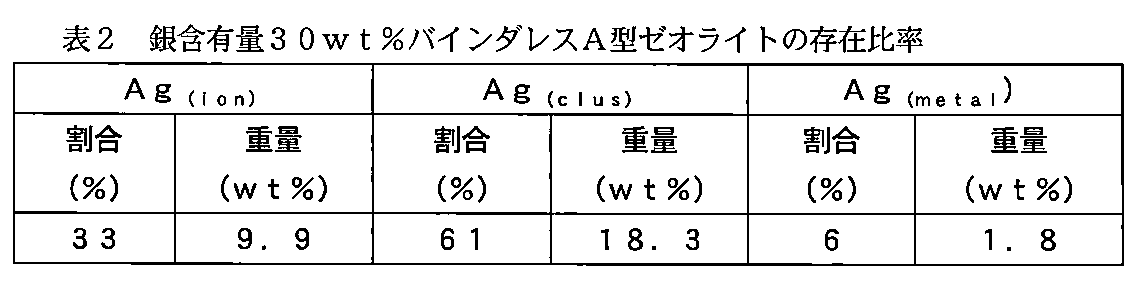
- the ratio of silver contained in silver ions (Ag (ion) ), silver clusters (Ag (plus) ), and metallic silver (Ag (metal) ) was determined from the peak areas of the obtained peaks.
- ⁇ Particle size> Thirty random particles with a particle size of 1.5 ⁇ m or less, which are independent minimum units that can be confirmed in a scanning electron microscope observed with a measurement magnification of 10,000 times, are extracted, and the size is determined. The average diameter of the zeolite fine particles was measured and the average diameter was obtained.
- an aqueous solution was prepared using a normal salt of Dia Salt Co., Ltd. so that the salt concentration was 0.3%. Thereto, cesium chloride so that the cesium concentration becomes 1 mg / L, strontium chloride so that the strontium concentration becomes 10 mg / L, magnesium chloride so that the magnesium concentration becomes 400 mg / L, and calcium concentration becomes 400 mg / L. Calcium chloride was added so as to be L. Then, an amount of sodium iodide is added so that the iodine concentration becomes 1 mg / L, and in addition to iodide ions, high-concentration chloride ions, cesium ions, strontium ions, magnesium ions, calcium ions, sodium ions A simulated contaminated water containing was prepared.
- Example 1 ⁇ Preparation of silver-containing zeolite compact> A mixture was obtained by kneading 20 parts by weight of kaolin clay and 3 parts by weight of carboxymethylcellulose with 100 parts by weight of commercially available A-type zeolite powder (A-4, manufactured by Tosoh Corporation) while adding water. The water content of the obtained mixture was 45 wt%. This mixture was extruded to obtain a plurality of cylindrical zeolite compacts having a diameter of 1.5 mm and a length of 1 mm to 5 mm. The molded body was dried at 100 ° C. overnight and then calcined at 600 ° C. for 3 hours under air flow.
- A-type zeolite powder A-4, manufactured by Tosoh Corporation
- A-type zeolite compact had a Si / Al 2 molar ratio of 2.5.
- the obtained molded product had a zeolite purity of 98.1 wt%, and was confirmed to be a binderless molded product. Further, it was confirmed by XRD measurement that no other zeolite structure other than A-type zeolite was contained (FIG. 9).
- FIGS. SEM observation images of this silver-containing binderless A-type zeolite compact are shown in FIGS. The presence of A-type zeolite fine particles on the surface of the silver-containing binderless A-type zeolite compact, the average particle size of the A-type zeolite fine particles being 0.39 ⁇ m, and FIG.
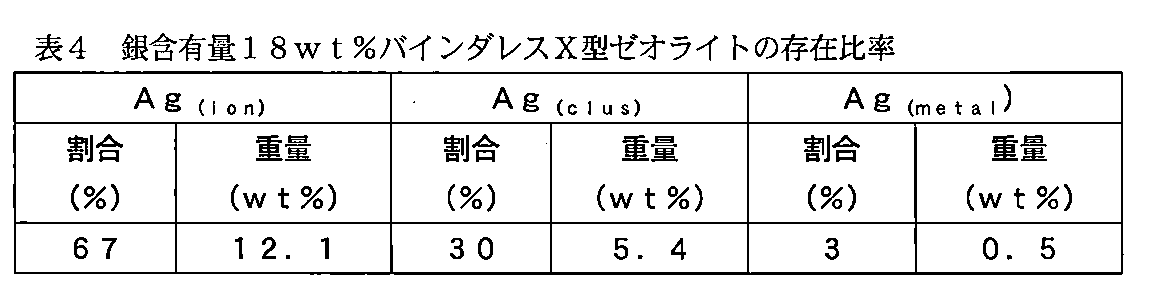
- the average particle size of the zeolite powder in the body was 4.2 ⁇ m. Moreover, impurities other than A type zeolite were not confirmed. Si / Al 2 molar ratio is 2.5, Na / Al molar ratio is 0.42, Ag / Al molar ratio is 0.58, (alkali metal + Ag) / Al molar ratio is 1.0, Ag loading is 30 wt. %, SiO 2 , Al 2 O 3 , Na 2 O, and Ag 2 O are 99 wt% in total. Table 2 shows the abundance ratios of silver ions, silver clusters, and metallic silver.
- a binderless A-type zeolite compact having a silver content of 35 wt% (silver ions 11.9 wt%) was obtained using an aqueous silver nitrate solution (17.7 wt%) in which 30.7 g of silver nitrate was dissolved in 142 g of pure water. .
- no impurities other than A-type zeolite were confirmed.
- Si / Al 2 molar ratio is 2.5
- Na / Al molar ratio is 0.29
- Ag / Al molar ratio is 0.71
- (alkali metal + Ag) / Al molar ratio is 1.0
- Ag loading is 35 wt. %
- SiO 2 , Al 2 O 3 , Na 2 O, and Ag 2 O are 99 wt% in total.
- Table 3 shows the abundance ratios of silver ions, silver clusters, and metallic silver.
- a commercially available binder A-type zeolite compact was immersed in an aqueous silver nitrate solution, and similarly subjected to ion exchange treatment, washing, drying, pulverization, and classification to obtain a binder A-type zeolite compact having a silver content of 36 wt%.
- a silver nitrate aqueous solution 22.0 wt%) in which 40.0 g of silver nitrate was dissolved in 142 g of pure water was used.
- the horizontal axis is BV indicating how many times the amount of simulated contaminated water has passed through the adsorbent volume
- the vertical axis is the value obtained by dividing the iodine concentration at the column outlet by the iodine concentration at the column inlet. It is.
- FIG. 3 shows that the binder-less A-type silver-containing zeolite compact has high iodine adsorption performance even if the silver content is small, as compared with the binder A-type silver-containing zeolite compact. That is, it was confirmed that the iodine adsorbent composed of the silver-containing zeolite molded body of the present invention has a high iodine adsorption capacity per unit volume.
- ions such as high concentrations of chloride ions, cesium ions, strontium ions, magnesium ions, calcium ions, and sodium ions can be confirmed to show good iodine adsorption performance. It was.
- Example 2 ⁇ Preparation of silver-containing zeolite compact> A mixture was obtained by kneading 20 parts by weight of kaolin clay and 3 parts by weight of carboxymethyl cellulose with 100 parts by weight of commercially available X-type zeolite powder (F-9, manufactured by Tosoh Corporation) while adding water. The water content of the obtained mixture was 45 wt%. This mixture was extruded to obtain a plurality of cylindrical shaped bodies having a diameter of 1.5 mm and a length of 1 to 5 mm. The molded body was dried at 100 ° C. overnight and then calcined at 600 ° C. for 3 hours under air flow.
- F-9 commercially available X-type zeolite powder
- this cylindrical shaped body (plural) was immersed in an 8.9 wt% aqueous silver nitrate solution (14.0 g of silver nitrate was dissolved in 142 g of pure water), and ion exchange was performed at 50 ° C. for 4 hours while stirring. Processed. Although the vicinity of the liquid surface of the silver nitrate aqueous solution was stirred at a speed of 100 rpm, the flow of the compact was not confirmed during the ion exchange treatment.
- BET specific surface area is 725 m 2 / g
- Si / Al 2 molar ratio is 2.8
- Na / Al molar ratio is 0.66
- Ag / Al molar ratio is 0.34
- (alkali metal + Ag) / Al molar ratio is 1.0
- the amount of Ag supported is 18 wt%
- the total amount of SiO 2 , Al 2 O 3 , Na 2 O, and Ag 2 O is 98 wt%.
- Table 4 shows the abundance ratios of silver ions, silver clusters, and metallic silver.
- the silver-containing binderless X-type zeolite compact was pulverized with a mortar to an aggregate diameter of 0.1 ⁇ m to 15 ⁇ m and the volume distribution particle diameter was measured, the particle diameter distribution was monomodal and the volume average particle diameter (D50) was 3.7 ⁇ m. From the SEM image and the measurement of the volume distribution particle size, it was confirmed that in the silver-containing binderless X-type zeolite compact of this example, the zeolite fine particles were integrated on the surface of the coarse zeolite particles.
- iodine adsorption performance Using the prepared silver-containing binderless X-type zeolite compact having a particle size of 300 ⁇ m to 600 ⁇ m, iodine adsorption performance was measured in the same manner as in Example 1, and the iodine adsorption performance is shown in FIG.
- a binder X-type zeolite compact with a silver content of 36 wt% was obtained.
- a silver nitrate aqueous solution 22.0 wt%) in which 40.0 g of silver nitrate was dissolved in 142 g of pure water was used.
- the zeolite compact had a Si / Al 2 molar ratio of 3.3.
- FIG. 6 shows that the binder-less X-type silver-containing zeolite compact has high iodine adsorption performance even when the silver content is small, as compared with the binder X-type silver-containing zeolite compact. That is, it was confirmed that the iodine adsorbent composed of the silver-containing zeolite molded body of the present invention has a high iodine adsorption capacity per unit volume.
- Example 3 ⁇ Preparation of silver-containing zeolite compact> A silver-containing binderless A-type zeolite compact having a silver content of 45 wt% was prepared in the same manner as in Example 1 except that an aqueous silver nitrate solution (25.1 wt%) in which 47.7 g of silver nitrate was dissolved in 142 g of pure water was used. did. As the silver-containing binderless A-type zeolite compact having a silver content of 30 wt% and 35 wt%, the one prepared in Example 1 was used.
- Example 1 iodine adsorption was performed in the same manner as in Example 1 using a silver-containing binderless A-type zeolite molding (particle size: 300 ⁇ m to 600 ⁇ m) having a silver content of 30 wt%, 35 wt% and 45 wt%. The performance was measured and the iodine adsorption performance is shown in FIG. 7 similar to FIG.
- Example 4 ⁇ Preparation of silver-containing zeolite compact> A silver-containing binderless X-type zeolite compact having a silver content of 9 wt% was prepared in the same manner as in Example 2 except that an aqueous silver nitrate solution (4.7 wt%) in which 7.0 g of silver nitrate was dissolved in 142 g of pure water was used. did.
- a silver-containing binderless X-type zeolite molded body having a silver content of 34 wt% was obtained in the same manner as in Example 2 except that a silver nitrate aqueous solution (17.4 wt%) in which 29.9 g of silver nitrate was dissolved in 142 g of pure water was used.
- a silver nitrate aqueous solution (17.4 wt%) in which 29.9 g of silver nitrate was dissolved in 142 g of pure water was used.
- BET specific surface area is 570 m 2 / g
- Si / Al 2 molar ratio is 2.8
- Na / Al molar ratio is 0.27
- Ag / Al molar ratio is 0.73
- (alkali metal + Ag) / Al molar ratio is 1.0
- the amount of Ag supported is 34 wt%
- the total amount of SiO 2 , Al 2 O 3 , Na 2 O and Ag 2 O is 99 wt%.
- Table 5 shows the abundance ratios of silver ions, silver clusters, and metallic silver.
- a silver-containing binderless X-type zeolite molded body having a silver content of 42 wt% was obtained in the same manner as in Example 2 except that a silver nitrate aqueous solution (23.4 wt%) in which 43.3 g of silver nitrate was dissolved in 142 g of pure water was used.
- a silver nitrate aqueous solution (23.4 wt%) in which 43.3 g of silver nitrate was dissolved in 142 g of pure water was used.
- the silver-containing binderless X-type zeolite compact having a silver content of 18 wt% the one prepared in Example 2 was used.
- Example 1 A commercially available X-type zeolite powder (F-9, manufactured by Tosoh Corporation) was fired in the same manner as in Example 2 to obtain a molded body. This molded body was washed with pure water at room temperature, and after washing, an aqueous solution containing 6 wt% NaOH was circulated at a flow rate of 235 mL / min for 1 hour at 40 ° C. and then at 80 ° C. for 5 hours to obtain kaolin clay. A zeolite compact was obtained in the same manner as in Example 2 except that it was converted to type A zeolite.
- F-9 X-type zeolite powder
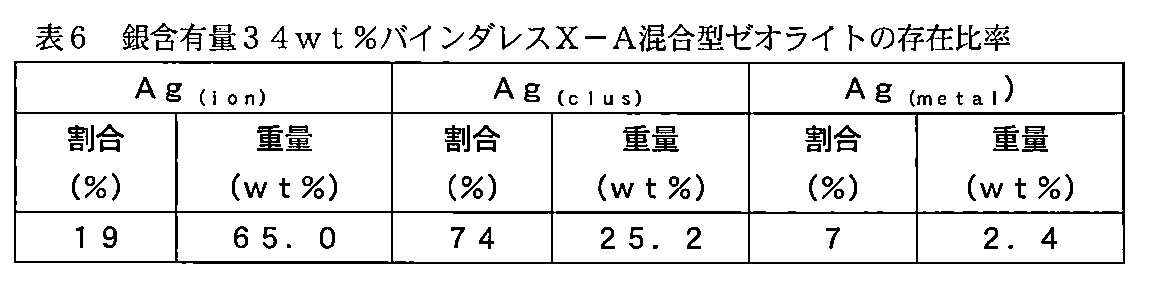
- a silver ion-exchange treatment was performed in the same manner as in Examples 1 and 2 except that a 17.4% by weight silver nitrate aqueous solution was used to prepare a silver-containing binder zeolite compact having a silver content of 34 wt%.
- the (alkaline metal + Ag) / Al molar ratio is 1.0, the Ag loading is 34 wt%, and the total amount of SiO 2 , Al 2 O 3 , Na 2 O and Ag 2 O is 99 wt%.
- Table 6 shows the abundance ratios of silver ions, silver clusters, and metallic silver.
- the ratio of silver ions and the ratio of silver clusters and metallic silver is high, especially the silver clusters. Is extremely high and the dispersibility is poor.
- it is considered that the aggregation of silver is likely to proceed because the zeolite species that are likely to be exchanged with silver preferentially adsorb silver.
Landscapes
- Chemical & Material Sciences (AREA)
- Organic Chemistry (AREA)
- Chemical Kinetics & Catalysis (AREA)
- Life Sciences & Earth Sciences (AREA)
- Geology (AREA)
- General Life Sciences & Earth Sciences (AREA)
- Engineering & Computer Science (AREA)
- Analytical Chemistry (AREA)
- Inorganic Chemistry (AREA)
- Materials Engineering (AREA)
- High Energy & Nuclear Physics (AREA)
- General Engineering & Computer Science (AREA)
- Physics & Mathematics (AREA)
- Dispersion Chemistry (AREA)
- General Chemical & Material Sciences (AREA)
- Oil, Petroleum & Natural Gas (AREA)
- Solid-Sorbent Or Filter-Aiding Compositions (AREA)
- Silicates, Zeolites, And Molecular Sieves (AREA)
Abstract
Description
[1]放射性ヨウ素を含む流体を、銀含有量が50wt%以下である銀含有バインダレスゼオライト成形体からなるヨウ素吸着剤に通過させ、当該ヨウ素吸着剤に放射性ヨウ素を吸着させる、放射性ヨウ素含有流体の処理方法。
[2]前記ヨウ素吸着剤は、銀イオンを5wt%以上含有する銀含有ゼオライト成形体からなる、[1]に記載の放射性ヨウ素含有流体の処理方法。
[3]前記ヨウ素吸着剤を構成するバインダレスゼオライト成形体は、バインダレスA型ゼオライト成形体又はバインダレスX型ゼオライト成形体である、[1]又は[2]に記載の放射性ヨウ素含有流体の処理方法。
[4]前記放射性ヨウ素を含む流体は液体であり、前記ヨウ素吸着剤は、30μm~1500μmの範囲の粒径を有する粒子状である、[1]~[3]のいずれか1に記載の放射性ヨウ素含有流体の処理方法。
[5]前記放射性ヨウ素を含む流体は気体であり、前記ヨウ素吸着剤は、800μm~2000μmの範囲の粒径を有する粒子状である、[1]~[3]のいずれか1に記載の放射性ヨウ素含有流体の処理方法。


前処理として、ゼオライト粉末、またはゼオライト成形体(以下、単に「試料」ともいう。)を大気中110℃で乾燥し、水分を十分に除去した。前処理後の試料をデシケーター内に静置し、温度25℃、相対湿度80%の条件下で16時間以上放置し、水分を飽和吸着させる水和処理を行った。水和処理後の試料重量(X1)を測定した。更に、水和処理後の試料に対して大気中、900℃の条件下で、1時間熱処理し、水分を十分に除去した。熱処理後の試料重量(X2)を測定した。X1及びX2の値を用いて以下の式(3)により試料100g当たりの水分吸着量(以下、「g/100g-剤」とする。)を求めた。

一般的なBET比表面測定装置(装置名:BELSORP 28SA、日本ベル社製)を用い、BET比表面積を測定した。吸着温度は液体窒素温度(-196℃)として吸着等温線を測定した。得られた吸着等温線における相対圧力0~0.1に相当する範囲の窒素吸着容量から、BET比表面積を計算した。
成形体試料を酸に溶解し測定溶液とした。測定溶液中の金属イオン濃度をICP法により測定した。測定には、一般的なICP-AES(装置名:OPTIMA3000DV、PERKIN-ELMER社製)を使用した。
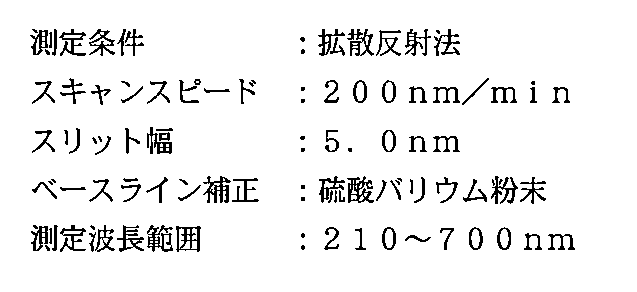
成形体中の銀の状態(銀種)は紫外可視光測定により測定した。すなわち、積分球付属装置(装置名:ISR-3100、島津製作所社製)を試料室に取り付けた自記分光光度計(装置名:UV-3100、島津製作所社製)を用い、以下の条件で紫外可視吸光測定を行った。
ICP測定により得られた銀担持量、及び、UV-VIS測定により得られた各銀種の割合から、測定試料中の各銀種の含有量を求めた。
10,000倍の測定倍率で観察した走査型電子顕微鏡観察図において確認できる独立した最小単位の粒子であって粒子径が1.5μm以下の粒子を無作為に30個抽出し、その大きさを計測し、その平均径を求め、ゼオライト微粒子の平均粒子径とした。
成形体5gを乳鉢にて10分間粉砕した後、目開き200μmの篩を通した。篩を通過した粉砕後の試料0.5gを純水50mlに添加してスラリーとした後、ホモジナイザーにて2分間超音波分散を行った。その後、そのスラリー溶液の粒度分布をマイクロトラック(日機装社製)にて測定した。
以下の手順にて、福島第一原発の汚染水を模擬した非放射性ヨウ素を含む模擬汚染水を調製した。
<銀含有ゼオライト成形体の調製>
市販のA型ゼオライト粉末(A-4、東ソー株式会社製)100重量部に対し、カオリン粘土20重量部、カルボキシメチルセルロース3重量部を、水を添加しながら混練して混合物を得た。得られた混合物の含水量は45wt%であった。この混合物を押出成形して、複数の直径1.5mm、長さ1mm~5mmの円柱状のゼオライト成形体を得た。この成形体を100℃で一晩乾燥した後、空気流通下600℃で3時間焼成した。焼成後の成形体を室温の純水で洗浄した後、6wt%のNaOH水溶液を235mL/分の流速で循環流通させ、カオリン粘土をゼオライトに転換させた。循環流通は、40℃で1時間行った後、80℃で5時間行った。得られたA型ゼオライト成形体のSi/Al2モル比は2.5であった。得られた成形体のゼオライト純度は98.1wt%であり、バインダレス成形体であることを確認した。また、XRD測定によりA型ゼオライト以外の他のゼオライト構造を含まないことを確認した(図9)。

粒径300~600μmの銀含有ゼオライト成形体を内径16mmのガラスカラムに10cmの層高となるように充填した。このガラスカラムに模擬汚染水を67mL/minの流量で通水し、カラム出口水を定期的に採取してヨウ素濃度を測定した。ヨウ素の定量分析は、ICP-MS(Agilient 7700x)を用いて行った。ヨウ素の除去性能を図3に示す。図3において、横軸は吸着剤の体積に対して何倍量の模擬汚染水を通水したのかを示すB.V.であり、縦軸はカラム出口のヨウ素濃度をカラム入口のヨウ素濃度で除した値である。図3から、バインダA型銀含有ゼオライト成形体と比較して、バインダレスA型銀含有ゼオライト成形体は銀含有量が少なくてもヨウ素吸着性能が高いことがわかる。すなわち、本発明の銀含有ゼオライト成形体からなるヨウ素吸着剤は、単位体積当たりのヨウ素吸着能が高いことが確認できた。
<銀含有ゼオライト成形体の調製>
市販のX型ゼオライト粉末(F-9、東ソー株式会社製)100重量部に対し、カオリン粘土20重量部、カルボキシメチルセルロース3重量部を、水を添加しながら混練して混合物を得た。得られた混合物の含水量は45wt%であった。この混合物を押出成形して、直径1.5mm、長さ1~5mmの円柱状の成形体を複数得た。この成形体を100℃で一晩乾燥した後、空気流通下600℃で3時間焼成した。焼成後の成形体を室温の純水で洗浄した後、8.1wt%のNaOH及び1wt%のSiO2を含む水溶液を235mL/分の流速で循環流通させ、カオリン粘土をゼオライトに転換させた。循環流通は、40℃で1時間行った後、90℃で7時間行った。得られたX型ゼオライト成形体のSi/Al2モル比は2.8であった。得られた成形体のゼオライト純度は97.7%でありバインダレス成形体であることを確認した。また、XRD測定によりX型ゼオライト以外の他のゼオライト構造を含まないことを確認した(図9)。
調製した粒径300μm~600μmの銀含有バインダレスX型ゼオライト成形体を用いて、実施例1と同様にしてヨウ素吸着性能を測定し、ヨウ素吸着性能を図3と同様の図6に示す。
<銀含有ゼオライト成形体の調製>
硝酸銀47.7gを純水142gに溶解させた硝酸銀水溶液(25.1wt%)を用いた以外は実施例1と同様にして、銀含有量45wt%の銀含有バインダレスA型ゼオライト成形体を調製した。銀含有量が30wt%、35wt%の銀含有バインダレスA型ゼオライト成形体は、実施例1で調製したものを用いた。
実施例1と同様にして、銀含有量が30wt%、35wt%及び45wt%の銀含有バインダレスA型ゼオライト成形体(粒径300μm~600μm)を用いて、実施例1と同様にしてヨウ素吸着性能を測定し、ヨウ素吸着性能を図3と同様の図7に示す。
<銀含有ゼオライト成形体の調製>
硝酸銀7.0gを純水142gに溶解させた硝酸銀水溶液(4.7wt%)を用いた以外は実施例2と同様にして、銀含有量9wt%の銀含有バインダレスX型ゼオライト成形体を調製した。また、硝酸銀29.9gを純水142gに溶解させた硝酸銀水溶液(17.4wt%)を用いた以外は実施例2と同様にして、銀含有量34wt%の銀含有バインダレスX型ゼオライト成形体を調製した。BET比表面積は570m2/g、Si/Al2モル比は2.8、Na/Alモル比は0.27、Ag/Alモル比は0.73、(アルカリ金属+Ag)/Alモル比は1.0、Ag担持量は34wt%、SiO2、Al2O3、Na2O及びAg2Oの総量は99wt%である。銀イオン、銀クラスター及び金属銀の存在比を表5に示す。

実施例1と同様にして、銀含有量が9wt%、18wt%、34wt%及び42wt%の銀含有バインダレスX型ゼオライト成形体(粒径300μm~600μm)を用いて、実施例1と同様にしてヨウ素吸着性能を測定し、ヨウ素吸着性能を図3と同様の図8に示す。
市販のX型ゼオライト粉末(F-9、東ソー株式会社製)を実施例2と同様に焼成して成形体を得た。この成形体を室温の純水で洗浄し、洗浄後、NaOHを6重量%含む水溶液を235mL/分の流速で、40℃で1時間、その後、80℃で5時間循環流通させ、カオリン粘土をA型ゼオライトに転換したこと以外は実施例2と同様な方法でゼオライト成形体を得た。
Claims (5)
- 放射性ヨウ素を含む流体を、銀含有量が50wt%以下である銀含有バインダレスゼオライト成形体からなるヨウ素吸着剤に通過させ、当該ヨウ素吸着剤に放射性ヨウ素を吸着させる、放射性ヨウ素含有流体の処理方法。
- 前記ヨウ素吸着剤は、銀イオンを5wt%以上含有する銀含有ゼオライト成形体からなる、請求項1に記載の放射性ヨウ素含有流体の処理方法。
- 前記ヨウ素吸着剤を構成するバインダレスゼオライト成形体は、バインダレスA型ゼオライト成形体又はバインダレスX型ゼオライト成形体である、請求項1又は2に記載の放射性ヨウ素含有流体の処理方法。
- 前記放射性ヨウ素を含む流体は液体であり、前記ヨウ素吸着剤は、30μm~1500μmの範囲の粒径を有する粒子状である、請求項1~3のいずれか1に記載の放射性ヨウ素含有流体の処理方法。
- 前記放射性ヨウ素を含む流体は気体であり、前記ヨウ素吸着剤は、800μm~2000μmの範囲の粒径を有する粒子状である、請求項1~3のいずれか1に記載の放射性ヨウ素含有流体の処理方法。
Priority Applications (4)
| Application Number | Priority Date | Filing Date | Title |
|---|---|---|---|
| US16/079,177 US11110430B2 (en) | 2016-02-26 | 2017-02-23 | Treatment method of radioactive iodine-containing fluid |
| EP17756568.6A EP3422363B1 (en) | 2016-02-26 | 2017-02-23 | Method for processing radioactive iodine-containing fluid |
| CA3014634A CA3014634C (en) | 2016-02-26 | 2017-02-23 | Treatment method of radioactive iodine-containing fluid |
| JP2018501748A JP6807374B2 (ja) | 2016-02-26 | 2017-02-23 | 放射性ヨウ素含有流体の処理方法 |
Applications Claiming Priority (2)
| Application Number | Priority Date | Filing Date | Title |
|---|---|---|---|
| JP2016-035352 | 2016-02-26 | ||
| JP2016035352 | 2016-02-26 |
Publications (1)
| Publication Number | Publication Date |
|---|---|
| WO2017146130A1 true WO2017146130A1 (ja) | 2017-08-31 |
Family
ID=59686224
Family Applications (1)
| Application Number | Title | Priority Date | Filing Date |
|---|---|---|---|
| PCT/JP2017/006750 Ceased WO2017146130A1 (ja) | 2016-02-26 | 2017-02-23 | 放射性ヨウ素含有流体の処理方法 |
Country Status (5)
| Country | Link |
|---|---|
| US (1) | US11110430B2 (ja) |
| EP (1) | EP3422363B1 (ja) |
| JP (1) | JP6807374B2 (ja) |
| CA (1) | CA3014634C (ja) |
| WO (1) | WO2017146130A1 (ja) |
Cited By (1)
| Publication number | Priority date | Publication date | Assignee | Title |
|---|---|---|---|---|
| WO2024262200A1 (ja) | 2023-06-20 | 2024-12-26 | 株式会社キャタラー | 銀担持ゼオライト、排ガス浄化触媒、排ガス浄化装置、排ガス浄化方法、及び銀担持ゼオライトの製造方法 |
Citations (10)
| Publication number | Priority date | Publication date | Assignee | Title |
|---|---|---|---|---|
| JPS554368B2 (ja) | 1975-05-17 | 1980-01-30 | ||
| JPS60225638A (ja) * | 1984-04-25 | 1985-11-09 | Nippon Atom Ind Group Co Ltd | ヨウ素吸着剤 |
| JPS647667B2 (ja) | 1980-05-02 | 1989-02-09 | Canon Kk | |
| US4913850A (en) | 1988-03-16 | 1990-04-03 | Bayer Aktiengesellschaft | Process for the removal of iodine and organic iodine compounds from gases and vapors using silver-containing zeolite of the faujasite type |
| US5075084A (en) * | 1989-01-21 | 1991-12-24 | Bayer Aktiengesellschaft | Process for the removal of iodine and iodine compounds from hydrogen-containing gases and vapors |
| JPH06183725A (ja) * | 1992-12-22 | 1994-07-05 | Tosoh Corp | バインダーレスx型ゼオライト成形体およびその製造方法 |
| JPH06214095A (ja) * | 1993-01-18 | 1994-08-05 | Hitachi Ltd | オフガス処理設備及びヨウ素吸着材とその製造方法 |
| JP2012233749A (ja) | 2011-04-28 | 2012-11-29 | Hitachi-Ge Nuclear Energy Ltd | 原子力設備、その廃水処理装置及び廃水処理方法 |
| JP2013104727A (ja) | 2011-11-11 | 2013-05-30 | Hitachi-Ge Nuclear Energy Ltd | 原子力設備の廃水処理装置及び廃水処理方法 |
| JP2015081841A (ja) * | 2013-10-23 | 2015-04-27 | ラサ工業株式会社 | 放射性ヨウ素吸着剤、及び放射性ヨウ素の処理方法 |
Family Cites Families (6)
| Publication number | Priority date | Publication date | Assignee | Title |
|---|---|---|---|---|
| DE3401485A1 (de) * | 1984-01-18 | 1985-12-05 | Bayer Ag, 5090 Leverkusen | Verfahren zur herstellung von molekularsiebformkoerpern |
| US6506935B1 (en) * | 1998-03-06 | 2003-01-14 | Uop Llc | Combination pretreatment/adsorption for treating a liquid stream contaminated with an iodine-containing compound |
| JP3647667B2 (ja) | 1999-03-08 | 2005-05-18 | 日本原子力研究所 | 銀を担持したヨウ素除去フィルタ及びヨウ素除去装置 |
| MY185036A (en) * | 2011-04-27 | 2021-04-30 | Kaneka Corp | Ion-exchange fibers and method for producing and using same |
| JP6606438B2 (ja) * | 2016-01-21 | 2019-11-13 | 株式会社荏原製作所 | ヨウ素酸イオン及びヨウ化物イオンの定量分析方法 |
| JP6926521B2 (ja) * | 2016-02-26 | 2021-08-25 | 東ソー株式会社 | 銀担持ゼオライト成形体 |
-
2017
- 2017-02-23 EP EP17756568.6A patent/EP3422363B1/en active Active
- 2017-02-23 CA CA3014634A patent/CA3014634C/en active Active
- 2017-02-23 WO PCT/JP2017/006750 patent/WO2017146130A1/ja not_active Ceased
- 2017-02-23 JP JP2018501748A patent/JP6807374B2/ja active Active
- 2017-02-23 US US16/079,177 patent/US11110430B2/en active Active
Patent Citations (10)
| Publication number | Priority date | Publication date | Assignee | Title |
|---|---|---|---|---|
| JPS554368B2 (ja) | 1975-05-17 | 1980-01-30 | ||
| JPS647667B2 (ja) | 1980-05-02 | 1989-02-09 | Canon Kk | |
| JPS60225638A (ja) * | 1984-04-25 | 1985-11-09 | Nippon Atom Ind Group Co Ltd | ヨウ素吸着剤 |
| US4913850A (en) | 1988-03-16 | 1990-04-03 | Bayer Aktiengesellschaft | Process for the removal of iodine and organic iodine compounds from gases and vapors using silver-containing zeolite of the faujasite type |
| US5075084A (en) * | 1989-01-21 | 1991-12-24 | Bayer Aktiengesellschaft | Process for the removal of iodine and iodine compounds from hydrogen-containing gases and vapors |
| JPH06183725A (ja) * | 1992-12-22 | 1994-07-05 | Tosoh Corp | バインダーレスx型ゼオライト成形体およびその製造方法 |
| JPH06214095A (ja) * | 1993-01-18 | 1994-08-05 | Hitachi Ltd | オフガス処理設備及びヨウ素吸着材とその製造方法 |
| JP2012233749A (ja) | 2011-04-28 | 2012-11-29 | Hitachi-Ge Nuclear Energy Ltd | 原子力設備、その廃水処理装置及び廃水処理方法 |
| JP2013104727A (ja) | 2011-11-11 | 2013-05-30 | Hitachi-Ge Nuclear Energy Ltd | 原子力設備の廃水処理装置及び廃水処理方法 |
| JP2015081841A (ja) * | 2013-10-23 | 2015-04-27 | ラサ工業株式会社 | 放射性ヨウ素吸着剤、及び放射性ヨウ素の処理方法 |
Non-Patent Citations (1)
| Title |
|---|
| See also references of EP3422363A4 |
Cited By (1)
| Publication number | Priority date | Publication date | Assignee | Title |
|---|---|---|---|---|
| WO2024262200A1 (ja) | 2023-06-20 | 2024-12-26 | 株式会社キャタラー | 銀担持ゼオライト、排ガス浄化触媒、排ガス浄化装置、排ガス浄化方法、及び銀担持ゼオライトの製造方法 |
Also Published As
| Publication number | Publication date |
|---|---|
| EP3422363A4 (en) | 2019-10-23 |
| JPWO2017146130A1 (ja) | 2019-02-14 |
| JP6807374B2 (ja) | 2021-01-06 |
| EP3422363A1 (en) | 2019-01-02 |
| US11110430B2 (en) | 2021-09-07 |
| CA3014634A1 (en) | 2017-08-31 |
| EP3422363B1 (en) | 2021-04-21 |
| CA3014634C (en) | 2024-04-09 |
| US20190060864A1 (en) | 2019-02-28 |
Similar Documents
| Publication | Publication Date | Title |
|---|---|---|
| Qiusheng et al. | Porous zirconium alginate beads adsorbent for fluoride adsorption from aqueous solutions | |
| Cadogan et al. | Efficiencies of chitosan nanoparticles and crab shell particles in europium uptake from aqueous solutions through biosorption: synthesis and characterization | |
| Liu et al. | Adsorptive removal of fluoride from aqueous solutions using Al-humic acid-La aerogel composites | |
| Deng et al. | Mn–Ce oxide as a high-capacity adsorbent for fluoride removal from water | |
| Dinh et al. | High iodine adsorption performances under off-gas conditions by bismuth-modified ZnAl-LDH layered double hydroxide | |
| Wang et al. | Development of Mg–Al–La tri-metal mixed oxide entrapped in alginate for removal of fluoride from wastewater | |
| Kai et al. | Thermodynamics and kinetics of fluoride removal from simulated zinc sulfate solution by La (III)-modified zeolite | |
| CN103721667B (zh) | 一种高效的除磷吸附剂及制备方法 | |
| Zhang et al. | Core–shell zeolite@ Alg–Ca particles for removal of strontium from aqueous solutions | |
| Liang et al. | Lead adsorption from aqueous solutions by a granular adsorbent prepared from phoenix tree leaves | |
| JP2017013054A (ja) | 廃水中の有害物質を除去するための無機材料及びその製造方法並びに廃水処理方法 | |
| Hefne et al. | Removal of silver (I) from aqueous solutions by natural bentonite | |
| JP5653408B2 (ja) | 放射性Cs吸着剤及びその製造方法 | |
| Abunah et al. | Physico-chemical removal of heavy metals from contaminated water using recyclable montmorillonite cellulose nanocomposite | |
| JPWO2017081857A1 (ja) | 吸着材担持体 | |
| JP6807374B2 (ja) | 放射性ヨウ素含有流体の処理方法 | |
| TWI667066B (zh) | 複合材料 | |
| JP6926521B2 (ja) | 銀担持ゼオライト成形体 | |
| Hao et al. | Development of Prussian blue-embedded silica-alginate hybrid beads for efficient removal of cesium from aqueous solution | |
| JP4238111B2 (ja) | フッ素イオン回収材の製造方法及びフッ素イオンの回収方法 | |
| CN107159092B (zh) | 一种用于深度吸附溶液中铜离子的多孔羟基磷灰石颗粒的制备方法 | |
| JPH1119506A (ja) | 砒酸イオン吸着用活性アルミナおよびこれを用いてなる水溶液中からの砒酸イオンの吸着処理方法 | |
| CN110975798A (zh) | 一种FeO(OH)-硅藻土复合吸附剂的制备方法及应用和再生方法 | |
| JP6716192B2 (ja) | 吸着剤及びその製造方法 | |
| JP2019113484A (ja) | 放射性ヨウ素含有流体の除染方法 |
Legal Events
| Date | Code | Title | Description |
|---|---|---|---|
| WWE | Wipo information: entry into national phase |
Ref document number: 2018501748 Country of ref document: JP |
|
| WWE | Wipo information: entry into national phase |
Ref document number: 3014634 Country of ref document: CA |
|
| NENP | Non-entry into the national phase |
Ref country code: DE |
|
| WWE | Wipo information: entry into national phase |
Ref document number: 2017756568 Country of ref document: EP |
|
| ENP | Entry into the national phase |
Ref document number: 2017756568 Country of ref document: EP Effective date: 20180926 |
|
| 121 | Ep: the epo has been informed by wipo that ep was designated in this application |
Ref document number: 17756568 Country of ref document: EP Kind code of ref document: A1 |