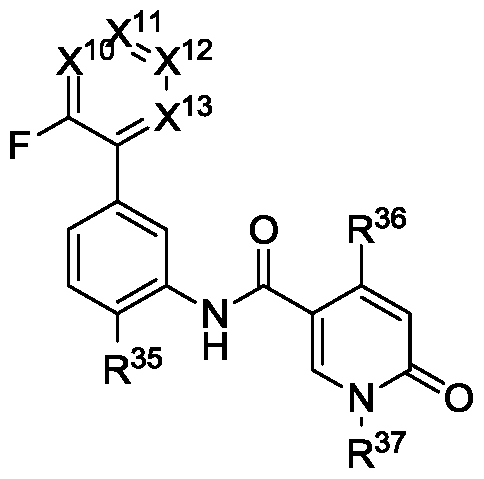
TITLE: INHIBITORS OF WDR5 PROTEIN-PROTEIN BINDING
CROSS-REFERENCE TO RELATED APPLICTIONS
[0001] The present application claims the benefit of priority from United
States provisional patent application no. 62/301,678 filed on March 1, 2016, the contents of which are incorporated herein by reference in their entirety.
FIELD
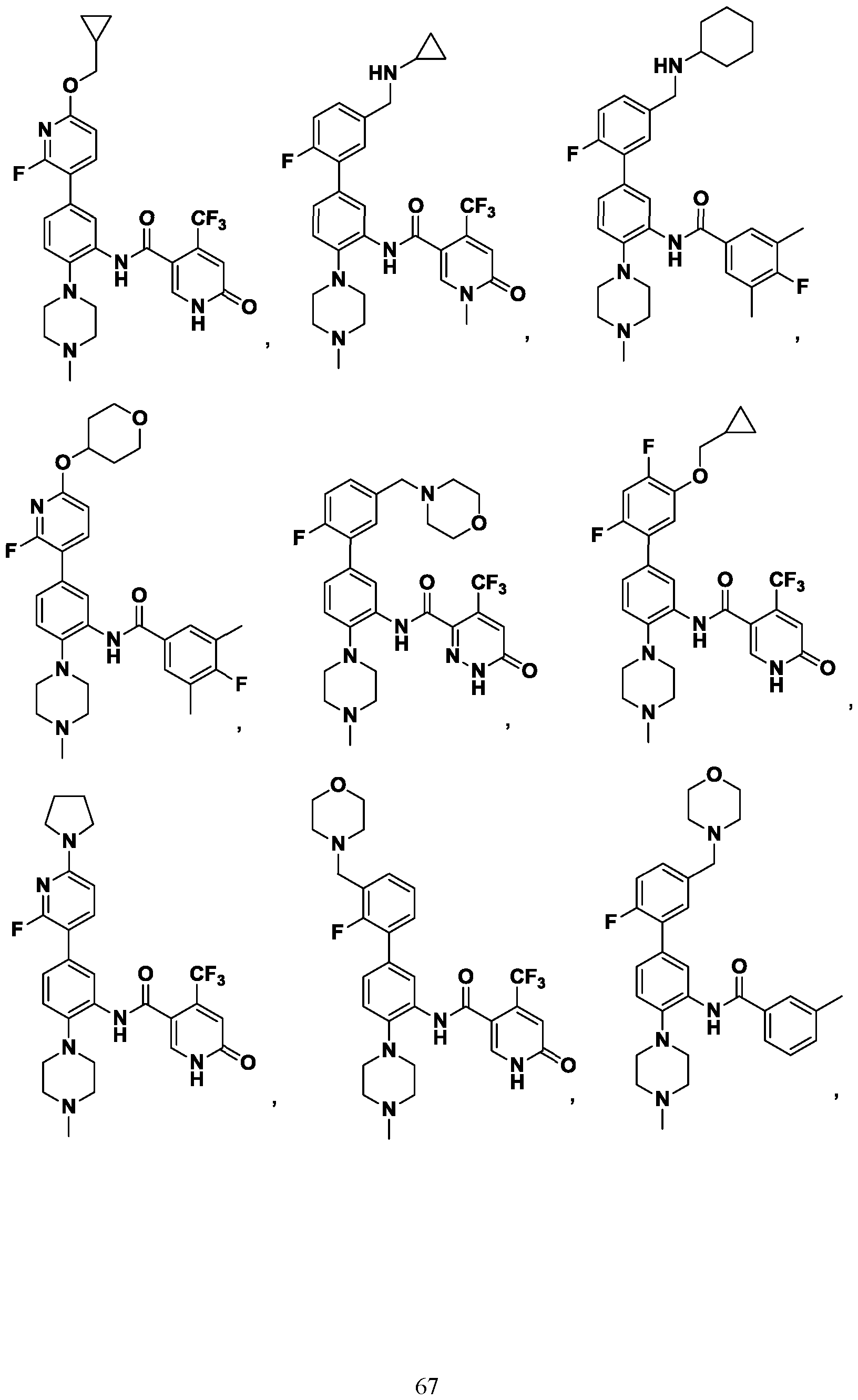
[0002] The present application relates to compounds, to processes for their preparation, to compositions comprising them and their use for the treatment of diseases and conditions related to interactions between WDR5 and its binding partners including, but not limited to, MLL.
BACKGROUND
[0003] Histones are the most basic units for packing DNA into nucleosomes and covalent modifications of histones, such as methylation, acetylation and phosphorylation, play a central role for regulation of gene transcription [Nat. Rev. Mol. Cell Biol. 2001, 2: 422-432; Cell 2007, 128: 693-705]. Epigenetics refers to the heritable changes that control how the genome is accessed in different cell types during embryonic development and cellular differentiation [Genes. Dev. 2009; 23: 781-3]. This capability permits specialization of function between cells without altering the DNA sequence.
[0004] It is now well recognized that misregulation of histone modifications plays a key role in a wide range of human diseases, including but not limited to cancer [Cell, 2007, 10: 693-705; Nat. Rev. Cancer., 2010, 10:457-469]. Mixed Lineage Leukemia 1 (MLLl) protein is a Histone H3 Lysine 4 (H3K4) methyltransf erase and is frequently misregulated in a subset of acute leukemia [Trends Mol. Med., 2004, 10: 500-507, Cell. Stem. Cell, 2007, 1:324-337]. MLLl itself has a weak H3K4 methyltransferase activity but its enzymatic activity is dramatically enhanced when MLLl is present in a core complex, made up of MLLl, WD repeat domain 5 protein (WDR5), Absent, Small, or Homeotic-2-Like (ASH2L) and Retinoblastoma Binding Protein 5 (RbBP5). Recent studies have clearly shown that the interaction between MLLl and WDR5 proteins is essential for the activity of MLLl but dispensable for the activity of other MLL family members, including MLL2, MLL3 and MLL4 [Mol. Cell, 2014, 53:247-261]. Hence, blocking the MLL1-WDR5 protein-protein interaction can
specifically inhibit the activity of MLL1 H3K4 methyltransf erase activity and such inhibition has the potential for the treatment of human diseases, such as, a subset of acute leukemia, whose development and progression depend upon MLL1 activity.
[0005] WDR5 is a common subunit of all six mammalian histone H3K4 methyltransferases [Dev. Biol., 2010,339 (2):240-249]. WDR5 has 334 amino acids and contains seven typical WD40 repeat domains, each approximately 40 amino acids [Nat. Struct. Mol. Biol, 2009, 16 (7): 678-680]. Structural studies suggest that the WD40 repeats form a seven-bladed propeller fold, with each blade made up of a four- stranded antiparallel sheet. This structural property suggests that WDR5 has many exposed surfaces making it a useful adaptor to interact with other proteins. Further, pulldown assays indicate that WDR5 prefers to bind dimethylated histone H3K4 peptide [Nat. Struct. Mol. Biol, 2009, 16 (7):678-680].
[0006] Because WDR5 is an essential component of the histone methylation, acetylation, and chromatin remodeling complexes, while not wishing to be limited by theory, WDR5 is believed to serve as an adaptor protein for complex assembly. However, it may also contribute to other physiological phenomena. WDR5 is an important component for assembly or stability of the virus-induced signaling adapter (VISA) associated complex, which plays a key role in virus-triggered induction of type I interferons (IFNs) and antiviral innate immune response [Proc. Natl. Acad. Sci. U S A., 2010, 107(2): 815-820]. Previous studies have demonstrated that VISA is located at the outer membrane of mitochondria. Interestingly, this study revealed that WDR5 was not only localized in the nucleus as believed before, but also abundantly localized in the cytoplasm. Viral infection induces translocation of WDR5 from the nucleus to the mitochondria located VISA complex, where it played a role in the assembly and stability of the VISA complex. These studies demonstrate for the first time a cytoplasmic function for WDR5, specifically in virus-triggered signaling resulting in induction of type I IFNs [Proc. Natl. Acad. Sci. USA., 2010,107(2):815-820].
MLL1-WDR5 complex in Leukemogenesis
[0007] Leukemia is characterized by an abnormal increase of white blood cells in the blood or bone marrow. Among all types of cancers, the morbidity of leukemia is the highest for patients below 35 years old. Over 70% of infant leukemia
patients bear a translocation involving chromosome 11, resulting in the fusion of the MLL1 gene with other genes [Nat. Rev. Cancer., 2007, 7(l l):823-833]. MLL1 translocations are also found in approximately 10% of adult acute myeloid leukemia (AML) patients, who were previously treated with topoisomerase II inhibitors for other types of cancers [Nat. Rev. Cancer., 2007,7(11):823-833].
[0008] MLL1 is the human homologue of Saccharomyces cerevisiae gene
Setl and the Drosophila gene Trx. The genes encode an enzyme to catalyze the methylation of H3K4 [Nat. Rev. Cancer., 2007, 7(l l):823-833]. Trimethylation of histone H3K4 is a hallmark of active gene transcription, and alteration of this process often causes changes in gene expression partem. MLL1 translocation is also linked to altered transcription of important genes involved in stem cell maintenance and development and, thus, leads to leukemogenesis. The MLL1 gene was first discovered in leukemia patients in 1991 [Nat. Rev. Cancer., 2007, 7(l l):823-833]. cDNA of the MLL1 gene contains -12 kb nucleotides and encodes a peptide over 4000 amino acids in length. In the cell, the premature MLL1 protein is digested by taspase, which results in two peptides: a 300 kDa N-terminal fragment and a 170 kDa C-terminal fragment. The two cleaved peptides form a heterodimer, which is complexed with other components, including WDR5, RBBP5, ASH2L and DPY30. In some leukemia patients, chromosomal translocation results in fusion of -4.2 kb DNA of the MLL1 N-terminal coding region with some other genes [Cancer. Cell, 2003, 4(3): 197-207].
[0009] The generation of MLL1 fusion protein is sufficient to induce leukemia, which has been demonstrated in animal models [Nat. Rev. Cancer., 2007, 7(l l):823-833]. The mechanisms of MLL1 fusion-mediated leukemia has been studied extensively in the past twenty years. The MLL/SET1 family members are most enzymatically active when part of the "core complex" (WRAD2), comprising the catalytic SET-domain-containing subunits bound to a sub-complex made up of the proteins WDR5, RbBP5, Ash2L and a homodimer of DPY-30. The necessity of MLL/SET1 members to bind WRAD2 for full activity is the basis of a particular drug development strategy, which seeks to disrupt the interaction between the MLL/SET1 subunits and WDR5. Recent efforts to pharmacologically target the MLL1 catalytic activity has centered on attempts to disrupt the MLL1-WDR5 interaction by means of
Win-motif mimicking peptides and small-molecule peptidomimetics [J. Med. Chem., 2010, 53: 5179-5185; J. Am. Chem. Soc, 2013, 135: 669-682; Mol Cell, 2014; 53:247-261]. However, as with most peptide based inhibitors, MLL1 -WDR5 peptidic inhibitors exhibit poor cell-based activity and lack oral bioavailability due to poor cell-permeability and their susceptibility to peptidases.
Role of WDR5 in other cancers
Bladder Cancer
[0010] WDR5 also plays a critical role in embryonic stem cell self-renewal
[Cell. 2011; 145 (2): 183-97] and Epithelial-Mesenchymal Transition [Mol. Cell, 2011; 43(5):811-22]. A recent study finds that H2A.Z is overexpressed in bladder cancer and activates oncogenic transcription by recruiting WDR5 and Bromodomain PHD Finger Transcription Factor (BPTF) to its target genes [Epigenetics . Chromatin., 2013; 6 (1):34.], suggesting that WDR5 may play a role in bladder cancer, but its expression pattern, role and mechanism in bladder cancer remain unclear. WDR5 is upregulated in bladder cancer tissues compared with normal tissues as determined by immunohistochemistry (IHC), and is correlated with advanced tumor stage and overall survival of bladder cancer patients. A recent study found that WDR5 is overexpressed in prostate cancer tissue compared with normal tissues [Mol. Cell, 2014 May 22; 54 (4):613-25]. Taken together, high expression levels of WDR5 may serve as a novel molecular marker for bladder cancer.
[0011] WDR5 silencing reduces cell growth in breast cancer and prostate cancer [Mol. Cell, 2014, 54 (4):613-25; Cell Rep., 2013 5 (2):302-13], but the detailed mechanism and role in vivo is still unknown. Through gain or loss of function, WDR5 was found to promote bladder cancer cell proliferation in vitro and tumor growth in vivo, and that silencing WDR5 mainly induces the G0/G1 phase cell cycle arrest. The cell cycle is regulated by cyclins and cyclin-dependent kinases. Cyclin El and Cyclin E2 regulate the Gl to S-phase transition, while Cyclin Bl regulates the G2 to M-phase transition. Moreover, Cyclin E is associated with high-grade, high-stage and invasive bladder cancer [Cell. Cycle., 2012; 11(7): 1468-76; Am. J. Pathol, 2000;157(3):787-94] . UHMK1 (also named KIS) is overexpressed in leukemia and promotes the Gl to S- phase transition [Leuk. Res., 2008; 32 (9): 1358-65]. Mechanistically, WDR5
knockdown inhibited cyclin El, cyclin E2 and UHMK1 leading to G0/G1 phase cell cycle arrest, which might disturb the effect of cyclin Bl downregulation on G2 to M- phase transition. Additional studies showed that knockdown of MLL1, another core component of the MLL/SET1 complexes, suppressed HeLa cell proliferation by reducing the expression of cyclin B and inducing the G2/M phase cell cycle arrest [Oncogene. 2013;32(28):3359-70]. Thus, the data reported suggests that WDR5 promotes bladder cancer cell proliferation in vitro and in vivo by regulating the cell cycle, but the role and mechanism are not the same as MLL1.
[0012] WDR5 is believed to play an essential role in cancer stem cells
(CSCs). CSCs are a small subpopulation of cells in a tumor that can self-renew and differentiate into multiple lineages, and possess strong tumor-initiating capacity. CSCs have been widely identified in a number of malignancies, and the existence of CSCs in bladder cancer was found by Chan et al [Proc. Natl. Acad. Sci. U SA., 2009; 106 (33): 14016-21]. Several studies have found that sphere culture is an effective way to enrich cancer stem cells [Cell. 2007; 131(6): 1109-23; Urol Oncol. 2012;30(3):314- 8]. It was observed that WDR5 and pluripotency transcription factors were upregulated in UM-UC-3 and T24 spheres. Through gain or loss of function, it was demonstrated that WDR5 promoted UM-UC-3 and T24 cells self-renewal in vitro and upregulated Nanog. Emerging evidence shows that Nanog is overexpressed in poorly differentiated tumors and correlated with poor survival outcome of patients with various types of cancer, including bladder cancer [Nat. Genet, 2008; 40(5):499-507; Onco. Targets. Ther., 2013; 6: 1207-20]. Moreover, Nanog plays a key role in CSCs self-renewal and targeting. Nanog has shown promising therapeutic potential in several types of cancer [Cell Stem Cell. 2011;9 (l):50-63; Oncogene. 2013;32(37):4397-405]. WDR5 directly activates Nanog by mediating its promoter H3K4me3 level. Taken together, recent findings suggest that WDR5 plays a vital role in self-renewal of bladder cancer cells by regulating Nanog.
[0013] Further studies have demonstrated that WDR5 silencing increased cell apoptosis and decreases bladder cancer cells resistance to cisplatin. Conversely, overexpression of WDR5 enhanced chemoresistance to cisplatin. Moreover, WDR5 directly regulates important inhibitors of apoptotic proteins, MCL1 [FEES Lett. 2010;
584(14):2981-9; Sci Rep. 2014; 4:6098] and BIRC3 [Expert Opin Ther Targets.2009 ;13(11): 1333-45], by H3K4me3.
[0014] In summary, WDR5 is upregulated in bladder cancer, and promotes bladder cancer cell proliferation, self-renewal and chemoresistance via activating a series of oncogenes by H3K4me3. Therefore, WDR5 is a potential biomarker for bladder cancer and a promising target for drug development [Sci Rep. 2015; 5: 8293, Genom Data. 2015 ;5:27-9.].
Acute Myeloid Leukemia (AML)
[0015] The CEBPA gene is mutated in 9% of patients with acute myeloid leukemia (AML). Selective expression of a short (30-kDa) CCAAT-enhancer binding protein-a (C/EBPa) translational isoform, termed p30, represents the most common type of CEBPA mutation in AML. The molecular mechanisms underlying p30-mediated transformation remain incompletely understood. Recent studies have shown that C/EBPa p30, but not the normal p42 isoform, preferentially interacts with WDR5, a key component of SET/MLL (SET-domain/mixed-lineage leukemia) histone- methyltransferase complexes. Accordingly, p30-bound genomic regions were enriched for MLL-dependent H3K4me3 marks. The p30-dependent increase in self-renewal and inhibition of myeloid differentiation required WDR5, as downregulation of the latter inhibited proliferation and restored differentiation in p30-dependent AML models. Small- molecule inhibitors of the WDR5-MLL interaction selectively inhibited proliferation and induced differentiation in p30-expressing human AML cells revealing the mechanism of p30-dependent transformation and establish the essential p30 cofactor WDR5 as a therapeutic target in CEBPA-mutant AML [Nat Chem Biol. 2015 ;11(8): 571-8].
(c) MY CN -amplified Neuroblastoma
[0016] MYCN gene amplification in neuroblastoma drives a gene expression program that correlates strongly with aggressive disease. Mechanistically, trimethylation of histone H3 lysine 4 (H3K4) at target gene promoters is a strict prerequisite for this transcriptional program to be enacted. WDR5 is a histone H3K4 presenter that has been found to have an essential role in H3K4 trimethylation [Cancer Res 2015; 75(23); 5143- 54]. For this reason, in this study, the relationship between WDR5-mediated H3K4 trimethylation and N-Myc transcriptional programs in neuroblastoma cells were
investigated. N-Myc upregulated WDR5 expression in neuroblastoma cells. Gene expression analysis revealed that WDR5 target genes included those with MYC- binding elements at promoters such as MDM2. WDR5 was demonstrated to form a protein complex at the MDM2 promoter with N-Myc, but not p53, leading to histone H3K4 trimethylation and activation of MDM2 transcription. RNAi-mediated attenuation of WDR5 upregulated expression of wild-type but not mutant p53, an effect associated with growth inhibition and apoptosis. Similarly, a small-molecule antagonist of WDR5 reduced N-Myc/WDR5 complex formation, N-Myc target gene expression, and cell growth in neuroblastoma cells. In MYCN-transgenic mice, WDR5 was overexpressed in precancerous ganglion and neuroblastoma cells compared with normal ganglion cells. Clinically, elevated levels of WDR5 in neuroblastoma specimens were an independent predictor of poor overall survival. Overall, these results identify WDR5 as a key cofactor for N-Myc-regulated transcriptional activation and tumorogenesis and as a novel therapeutic target for MYCN-amplified neuroblastomas [Cancer Res 2015; 75(23); 5143-54, Mo/ Cell. 2015;58(3):440-52.].
SUMMARY
[0017] The structural features as described above suggest that the WDR5-
MLL binding is a desirable drug target. Hence, agents that bind to the WDR5 protein and compete for binding with WDR5 -interacting partners can reverse the transcriptional activities of WDR5 containing complexes. Considering the challenges generally associated with inhibiting protein-protein interactions, along with the current need to treat WDR5-driven tumor types such as leukemias, bladder cancers and neuroblastomas, complementary screening approaches namely virtual screening, focused library screening and traditional structure activity relationship (SAR) studies were conducted. These studies led to the identification of compounds which inhibit the WDR5 protein-protein binding. In addition, structure-activity relationship studies demonstrated that specific chemical features contribute to longer residence times for the binding of these compounds with WDR5. Studies indicate that longer residence times can be designed into WDR5 inhibitors and contribute to the ligand-induced antiproliferative effects observed in hematologic and solid tumors.
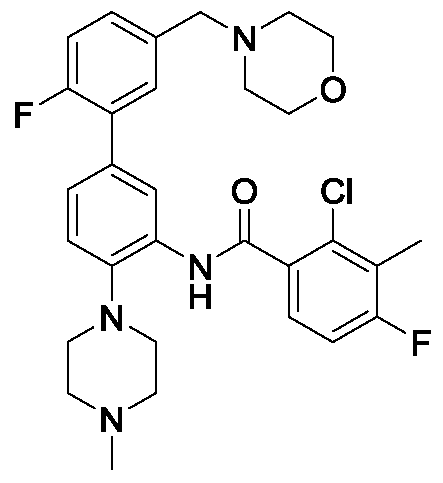
[0018] A novel class of compounds of Formula (I) have been prepared that show potent disruption of WDR5-MLL1 protein-protein binding and therefore have utility in the treatment of cancers and other WDR5 -mediated diseases, disorders and conditions.
[0019] Therefore, in one aspect, the present application includes a compound of Formula (I) or a pharmaceutically acceptable salt and/or solvate thereof:
(I) wherein:
R1 is a heterocycloalkyl that is unsubstituted or substituted with one or more substituents selected from halo, Ci-6alkyl, Ci-6fiuoroalkyl, C3-iocycloalkyl, OR4, SR4, NR5R6, Ci-galkyleneOR4, Ci-6alkyleneSR4 and Ci-6alkyleneNR5R6, provided that R1 comprises at least one basic nitrogen atom;
R2 is selected from C6-ioaryl and heteroaryl, and R2 is unsubstituted or substituted with one or more substituents selected from halo, Ci-6alkyl, Ci-6fluoroalkyl, =0, =S, OR7, SR7 and NR8R9;
R4 and R7 are independently selected from H, Ci-6alkyl, Ci-6fiuoroalkyl, C(0)Ci. 6alkyl and C(0)Ci-6fiuoroalkyl;
R5 and R6 are independently selected from H, Ci-6alkyl, Ci-6fluoroalkyl, heterocycloalkyl, C(0)Ci-6alkyl, C(0)Ci-6fluoroalkyl, C(0)OCi-6alkyl, C(0)NHCi_ 6alkyl, S02Ci-6alkyl, S02HNCi-6alkyl, Ci-ealkyleneOCi-ealkyl, Ci-6alkyleneNHCi. 6alkyl, Ci-6alkyleneN(Ci-6alkyl)(Ci-6alkyl), Ci-6alkyleneC6-ioaryl, Ci_ 6alkyleneheteroaryl, Ci-6alkyleneheterocycloalkyl and Ci-6alkyleneC3-6cycloalkyl, or
R and R together with the nitrogen atom to which they are attached form a 3-10 membered heterocycle that is unsubstituted or substituted with one or more substituents selected from halo, OH, CN, Ci-6alkyl, OCi-6alkyl, Ci-6fiuoroalkyl, OCi- sfluoroalkyl, C(0)Ci-6alkyl, C(0)Ci-6fluoroalkyl, C(0)OCi-6alkyl, C(0)NHCi-6alkyl, S02Ci-6alkyl, S02HNCi-6alkyl, Ci-6alkyleneOCi-6alkyl, Ci-6alkyleneNHCi-6alkyl, Ci. 6alkyleneN(Ci-6alkyl)(Ci-6alkyl), Ci-6alkyleneC6-ioaryl, Ci-6alkyleneheteroaryl, Ci_ 6alkyleneheterocycloalkyl and Ci-6alkyleneC3-6cycloalkyl;
R8 and R9 are independently selected from H, Ci-6alkyl, Ci-6fiuoroalkyl, C(0)Ci. 6alkyl and C(0)Ci-6fluoroalkyl, or R8 and R9 together with the nitrogen atom to which they are attached form a 3-10 membered heterocycle that is unsubstituted or substituted with one or more substituents selected from halo, CN, OH, Ci-6alkyl OCi- 6alkyl, Ci-6fluoroalkyl and OCi-6fluoroalkyl;
X1, X2, X3 and X4 are each independently selected from CR10 and N;
X5, X6 and X7 are each independently selected from CH and N;
R10 is selected from H, halo, CN, Ci-6alkyl, Ci-6fluoroalkyl, OR11, SR.11, NR12R13, R14, Ci-6alkyleneR14, OCi-6alkyleneR14, SCi-6alkyleneR14, Ci-6alkyleneNR12R13, Ci. salkyleneOR11, Ci-galkyleneSR11, OCi-6alkyleneNR12R13, SCi-6alkyleneNR12R13, OCi. salkyleneOR11, SCi-6alkyleneORn, OCi-galkyleneSR11, SCi-6alkyleneSRn, C(0)ORn, C(S)ORn, C(S)NR12R13 and C(0)NR12R13;
R11 is selected from H, Ci-6alkyl, Ci-6fluoroalkyl, C(0)Ci-6alkyl, C(0)Ci-6fluoroalkyl, C3-iocycloalkyl, heterocycloalkyl, Ce-ioaryl, heteroaryl, Ci-6alkyleneC3-iocycloalkyl, Ci-6alkyleneC6-ioaryl, Ci-6alkyleneheteroaryl and Ci-6alkyleneheterocycloalkyl, and when R11 is other than H, it is unsubstituted or substituted with one or more substituents selected from halo, CN, OR15, SR15, NR16R17, Ci-6alkyl, C(0)R15, C(0)OR15, C(0)NR16R17, S(0)Ci-6alkyl, S02Ci-6alkyl, C6-i0aryl, heteroaryl, C3- locycloalkyl, heterocycloalkyl, Ci-6alkyleneC6-ioaryl, Ci-6alkyleneC3-iocycloalkyl, Ci_
6alkyleneheteroaryl, Ci-6alkyleneheterocycloalkyl, Ci-6alkyleneR15, Ci-6alkyleneOR15, Ci-galkyleneSR15 and Ci-6alkyleneNR16R17;
R12 and R13 are each independently selected from H, Ci.i0alkyl, Ci.iofluoroalkyl, C(0)Ci-6alkyl, C(0)Ci-6fluoroalkyl, C3-iocycloalkyl, heterocycloalkyl, heteroaryl, Ce- loaryl, Ci-6alkyleneC3-iocycloalkyl, Ci-6alkyleneC6-ioaryl, Ci-6alkyleneheteroaryl and Ci-6alkyleneheterocycloalkyl, and when R12 and R13 are other than H they are each independently unsubstituted or substituted with one or more substituents selected from halo, CN, OR15, SR15, NR16R17, Ci-6alkyl, C(0)R15, C(0)OR15, C(0)NR16R17, S(0)Ci-6alkyl, S02Ci-6alkyl, C6-ioaryl, heteroaryl, C3-iocycloalkyl, heterocycloalkyl, Ci-6alkyleneC6-ioaryl, Ci-6alkyleneC3-iocycloalkyl, Ci-6alkyleneheteroaryl, Ci_ 6alkyleneheterocycloalkyl, Ci-6alkyleneR15, Ci-6alkyleneOR15, Ci-6alkyleneSR15 and Ci-6alkyleneNR16R17, or
R12 and R13 together with the nitrogen atom to which they are attached form a 3-10 membered heterocycle that is unsubstituted or substituted with one or more substituents independently selected from halo, CN, OR15, SR15, NR16R17, C1-6alkyl, C(0)R15, C(0)OR15, C(0)NR16R17, S(0)Ci-6alkyl, S02Ci-6alkyl, C6-i0aryl, heteroaryl, C3-iocycloalkyl, heterocycloalkyl, Ci-6alkyleneC6-ioaryl, Ci-6alkyleneC3-iocycloalkyl, Ci-6alkyleneheteroaryl, Ci-6alkyleneheterocycloalkyl, Ci-6alkyleneR15, Ci_ salkyleneOR15, Ci-6alkyleneSR15 and Ci-6alkyleneNR16R17;
R14 is selected from C(0)Ci-6alkyl, C(0)Ci-6fluoroalkyl, C3-i0cycloalkyl, heterocycloalkyl, heteroaryl and C6-ioaryl, and when R14 is other than H it is unsubstituted or substituted with one or more substituents independently selected from halo, CN, OR15, SR15, NR16R17, Ci-galkyl, C(0)R15, C(0)OR15, C(0)NR16R17, S(0)Ci-6alkyl, S02Ci. 6alkyl, C6-ioaryl, heteroaryl, C3-iocycloalkyl, heterocycloalkyl, Ci-6alkyleneC6-ioaryl, Ci_ 6alkyleneC3-iocycloalkyl, Ci-6alkyleneheteroaryl, Ci-6alkyleneheterocycloalkyl, Ci_ 6alkyleneR15, Ci-6alkyleneOR15, Ci-6alkyleneSR15 and Ci-6alkyleneNR16R17;
R15 is selected from H, Ci-6alkyl, Ci-6fluoroalkyl, C(0)Ci-6alkyl, C(0)Ci-6fluoroalkyl, C3-iocycloalkyl, heterocycloalkyl, C6-ioaryl, Ci-6alkyleneC6-ioaryl, Ci-6alkyleneC3- locycloalkyl and Ci-6alkyleneheterocycloalkyl, and when R15 is other than H it is
unsubstituted or substituted with one or more substituents selected from halo, Ci_ salkyl, CN, Ci-6fluoroalkyl, OH, SH, OCi-6alkyl, OCi-6fluoroalkyl, SCi-6alkyl, SCi. efluoroalkyl, NH2, NHCi-6alkyl, N(Ci-6alkyl)(Ci-6alkyl), C(0)Ci-6alkyl, C(0)d. sfluoroalkyl, C(0)OH, C(0)OCi-6alkyl, C(0)NH2, C(0)NHCi-6alkyl, C(0)N(d. 6alkyl)(Ci-6alkyl), S02Ci-6alkyl, S(0)Ci-6alkyl, C6-ioaryl, heteroaryl, C3-iocycloalkyl, heterocycloalkyl, Ci-6alkyleneC6-ioaryl, Ci-6alkyleneC3-iocycloalkyl, Ci_ 6alkyleneheteroaryl, Ci-6alkyleneheterocycloalkyl, Ci-6alkyleneOH, Ci-6alkyleneOCi- 6alkyl, Ci-6alkyleneSH, Ci-6alkyleneSCi-6alkyl, Ci-6alkyleneNH2, Ci-6alkyleneNHCi- 6alkyl and Ci-ealkyleneNi i-ealkylXCi-ealkyl);
R16 and R17 are each independently selected from H, Ci-6alkyl, Ci-6fluoroalkyl, C(0)Ci-6alkyl, C3-iocycloalkyl, heterocycloalkyl, C6-ioaryl, Ci-6alkyleneC6-ioaryl, Ci_ 6alkyleneC3-iocycloalkyl and Ci-6alkyleneheterocycloalkyl and when R16 and R17 are other than H they are each unsubstituted or substituted with one or more substituents independently selected from halo, CN, Ci-6alkyl, Ci-6fluoroalkyl, OH, SH, OCi-6alkyl, OCi-gfluoroalkyl, SCi-6alkyl, SCi-6fluoroalkyl, NH2, NHCi-6alkyl, N(Ci.6alkyl)(Ci. salkyl), C(0)Ci-6alkyl, C(0)OH, C(0)OCi-6alkyl, C(0)Ci-6fluoroalkyl, C(0)NH2, C(0)NHCi-6alkyl, C(0)N(Ci.6alkyl)(Ci-6alkyl), S02Ci-6alkyl, S(0)Ci-6alkyl, C6-i0aryl, heteroaryl, C3-iocycloalkyl, heterocycloalkyl, Ci-6alkyleneC6-ioaryl, Ci-6alkyleneC3- locycloalkyl, Ci-6alkyleneheteroaryl, Ci-6alkyleneheterocycloalkyl, Ci-6alkyleneOH, Ci-6alkyleneOCi-6alkyl, Ci-6alkyleneSH, Ci-6alkyleneSCi-6alkyl, Ci-6alkyleneNH2, Ci_ 6alkyleneNHCi-6alkyl and Ci-6alkyleneN(Ci-6alkyl)(Ci-6alkyl), or
R16 and R17 together with the nitrogen atom to which they are attached form a 3-10 membered heterocycle that is unsubstituted or substituted with one or more substituents selected from halo, CN, Ci-6alkyl, Ci-6fiuoroalkyl, OH, SH, OCi-6alkyl, OCi-gfluoroalkyl, SCi-6alkyl, SCi-6fluoroalkyl, NH2, NHCi-6alkyl, N(Ci.6alkyl)(Ci. salkyl), C(0)Ci-6alkyl, C(0)Ci-6fluoroalkyl, C(0)OH, C(0)OCi-6alkyl, C(0)NH2, C(0)NHCi-6alkyl, C(0)N(Ci.6alkyl)(Ci-6alkyl), S02Ci-6alkyl, S(0)Ci-6alkyl, C6-i0aryl, heteroaryl, C3-iocycloalkyl, heterocycloalkyl, Ci-6alkyleneC6-ioaryl, Ci-6alkyleneC3- locycloalkyl, Ci-6alkyleneheteroaryl, Ci-6alkyleneheterocycloalkyl, Ci-6alkyleneOH, Ci-6alkyleneOCi-6alkyl, Ci-6alkyleneSH, Ci-6alkyleneSCi-6alkyl, Ci-6alkyleneNH2, Ci_ 6alkyleneNHCi-6alkyl and Ci-6alkyleneN(Ci-6alkyl)(Ci-6alkyl);
A is fluoro; and all alkyl and alkylene groups are optionally fluorosubstituted.
[0020] In another aspect, the present application includes a composition comprising one or more compounds of the application and a carrier.
[0021] In another aspect, the present application includes a method for inhibition of binding of WDR5 to its binding partners in a cell, either in a biological sample or in a patient, comprising administering an effective amount of one or more compounds of the application to the cell.
[0022] The present application also includes a method of treating a disease, disorder or condition that is mediated or treatable by inhibition of binding between WDR5 protein and its binding partners comprising administering a therapeutically effective amount of one or more compounds of the application to a subject in need thereof. In an embodiment of the present application, the disease, disorder or condition mediated or treatable by inhibition of binding between WDR5 protein and its binding partners is cancer.
[0023] Other features and advantages of the present application will become apparent from the following detailed description. It should be understood, however, that the detailed description and the specific examples, while indicating embodiments of the application, are given by way of illustration only and the scope of the claims should not be limited by these embodiments, but should be given the broadest interpretation consistent with the description as a whole.
DRAWINGS
[0024] The embodiments of the application will now be described in greater detail with reference to the attached drawings in which:
[0025] Figure 1 illustrates WDR5 as an adaptor protein in multiple complexes and related biological processes.
DETAILED DESCRIPTION
I. Definitions
[0026] Unless otherwise indicated, the definitions and embodiments described in this and other sections are intended to be applicable to all embodiments and aspects of the present application herein described for which they are suitable as would be understood by a person skilled in the art.
[0027] The term "compound of the application" or "compound of the present application" and the like as used herein refers to a compound of Formula I, including compounds of Formula la, lb, Ic, Id and Ie, and pharmaceutically acceptable salts and/or solvates thereof.
[0028] The term "composition of the application" or "composition of the present application" and the like as used herein refers to a composition, such a pharmaceutical composition, comprising one or more compounds of Formula I, including compounds of Formula la, lb, Ic, Id and/or Ie, or pharmaceutically acceptable salts and/or solvates thereof.
[0029] The term "and/or" as used herein means that the listed items are present, or used, individually or in combination. In effect, this term means that "at least one of or "one or more" of the listed items is used or present. The term "and/or" with respect to pharmaceutically acceptable salts and/or solvates thereof means that the compounds of the application exist as individual salts and hydrates, as well as a combination of, for example, a salt of a solvate of a compound of the application.
[0030] As used in the present application, the singular forms "a", "an" and
"the" include plural references unless the content clearly dictates otherwise. For example, an embodiment including "a compound" should be understood to present certain aspects with one compound, or two or more additional compounds.
[0031] In embodiments comprising an "additional" or "second" component, such as an additional or second compound, the second component as used herein is chemically different from the other components or first component. A "third" component is different from the other, first, and second components, and further enumerated or "additional" components are similarly different.
[0032] As used in this application and claim(s), the words "comprising" (and any form of comprising, such as "comprise" and "comprises"), "having" (and any form of having, such as "have" and "has"), "including" (and any form of including, such as "include" and "includes") or "containing" (and any form of containing, such as "contain" and "contains"), are inclusive or open-ended and do not exclude additional, unrecited elements or process steps.
[0033] The term "consisting" and its derivatives as used herein are intended to be closed terms that specify the presence of the stated features, elements, components, groups, integers, and/or steps, and also exclude the presence of other unstated features, elements, components, groups, integers and/or steps.
[0034] The term "consisting essentially of, as used herein, is intended to specify the presence of the stated features, elements, components, groups, integers, and/or steps as well as those that do not materially affect the basic and novel characteristic(s) of these features, elements, components, groups, integers, and/or steps.
[0035] The term "suitable" as used herein means that the selection of the particular compound or conditions would depend on the specific synthetic manipulation to be performed, the identity of the molecule(s) to be transformed and/or the specific use for the compound, but the selection would be well within the skill of a person trained in the art.
[0036] In embodiments of the present application, the compounds described herein may have at least one asymmetric center. Where compounds possess more than one asymmetric center, they may exist as diastereomers. It is to be understood that all such isomers and mixtures thereof in any proportion are encompassed within the scope of the present application. It is to be further understood that while the stereochemistry of the compounds may be as shown in any given compound listed herein, such compounds may also contain certain amounts (for example, less than 20%, suitably less than 10%, more suitably less than 5%) of compounds of the present application having an alternate stereochemistry. It is intended that any optical isomers, as separated, pure or partially purified optical isomers or racemic mixtures thereof are included within the scope of the present application.
[0037] The compounds of the present application may also exist in different tautomeric forms and it is intended that any tautomeric forms which the compounds form, as well as mixtures thereof, are included within the scope of the present application.
[0038] The compounds of the present application may further exist in varying polymorphic forms and it is contemplated that any polymorphs, or mixtures thereof, which form are included within the scope of the present application.
[0039] The present description refers to a number of chemical terms and abbreviations used by those skilled in the art. Nevertheless, definitions of selected terms are provided for clarity and consistency.
[0040] The terms "about", "substantially" and "approximately" as used herein mean a reasonable amount of deviation of the modified term such that the end result is not significantly changed. These terms of degree should be construed as including a deviation of at least ±5% of the modified term if this deviation would not negate the meaning of the word it modifies or unless the context suggests otherwise to a person skilled in the art.
[0041] The expression "proceed to a sufficient extent" as used herein with reference to the reactions or process steps disclosed herein means that the reactions or process steps proceed to an extent that conversion of the starting material or substrate to product is maximized. Conversion may be maximized when greater than about 5, 10, 15, 20, 25, 30, 35, 40, 45, 50, 55, 60, 65, 70, 75, 80, 85, 90, 95 or 100% of the starting material or substrate is converted to product.
[0042] The term "basic nitrogen" as used herein refers to a nitrogen atom that has a lone pair of electrons available to participate in an interaction with a hydrogen atom. In an embodiment, the interaction is a hydrogen bond, an ionic bond or a covalent bond. In general, the basic nitrogen atom will be either a primary, secondary or tertiary alkyl amine nitrogen atom, either in a linear, branched or cyclic group. In some embodiments, the pKa of the conjugate acid of the basic nitrogen atom will be greater than about 8-10.
[0043] The term "alkyl" as used herein, whether it is used alone or as part of another group, means straight or branched chain, saturated alkyl groups. The number
of carbon atoms that are possible in the referenced alkyl group are indicated by the prefix "Cni-n2". For example, the term Ci-ioalkyl means an alkyl group having 1, 2, 3, 4, 5, 6, 7, 8, 9 or 10 carbon atoms.
[0044] The term "alkylene", whether it is used alone or as part of another group, means straight or branched chain, saturated alkylene group, that is, a saturated carbon chain that contains substituents on two of its ends. The number of carbon atoms that are possible in the referenced alkylene group are indicated by the prefix "Cni-n2"- For example, the term C2-6alkylene means an alkylene group having 2, 3, 4, 5 or 6 carbon atoms.
[0045] The term "alkenyl" as used herein, whether it is used alone or as part of another group, means straight or branched chain, unsaturated alkyl groups containing at least one double bond. The number of carbon atoms that are possible in the referenced alkylene group are indicated by the prefix "Cni-n2". For example, the term C2-6alkenyl means an alkenyl group having 2, 3, 4, 5 or 6 carbon atoms and at least one double bond.
[0046] The term "fluoroalkyl" as used herein refers to an alkyl group wherein one or more, including all of the hydrogen atoms are replaced by a halogen atom. In an embodiment, the halogen is fluorine. In another embodiment, the haloalkyl comprises at least one -CHF2 group. In another embodiment, the haloalkyl comprises at least one -CF3 group.
[0047] The term "fluorosubstituted" as used herein refers to a chemical group wherein one or more, including all of the hydrogen atoms, are replaced by a fluorine atom.
[0048] The term "cycloalkyl," as used herein, whether it is used alone or as part of another group, means a saturated carbocyclic group containing a number of carbon atoms and one or more rings. The number of carbon atoms that are possible in the referenced cycloalkyl group are indicated by the numerical prefix "Cni-n2 "· For example, the term C3-iocycloalkyl means a cycloalkyl group having 3, 4, 5, 6, 7, 8, 9 or 10 carbon atoms.
[0049] The term "aryl" as used herein, whether it is used alone or as part of another group, refers to cyclic groups containing from 6 to 20 carbon atoms and at least one aromatic ring. In an embodiment of the application, the aryl group contains from 6, 9 or 10 carbon atoms, such as phenyl, indanyl or naphthyl.
[0050] The term "heterocycloalkyl" as used herein, whether it is used alone or as part of another group, refers to cyclic groups containing 3 to 20 atoms, suitably 3 to 10 atoms, and at least one non-aromatic, ring in which one or more of the atoms are a heteromoiety selected from O, S, S(O), S02, N, NH and NC1-6alkyl, suitably O, S, N, NH and NCi-6alkyl. Heterocycloalkyl groups are either saturated or unsaturated (i.e. contain one or more double bonds) and contain one or more than one ring (i.e. are polycyclic). When a heterocycloalkyl group contains more than one ring, the rings may be fused, bridged, spirofused or linked by a bond. When a heterocycloalkyl group contains the prefix Cni-n2 this prefix indicates the number of carbon atoms in the corresponding carbocyclic group, in which one or more, suitably 1 to 5, of the ring atoms is replaced with a heteromoiety as defined above. Heterocycloalkyl includes, monocyclic heterocycloalkyls such as but not limited to aziridinyl, oxiranyl, thiiranyl, azetidinyl, oxetanyl, thietanyl, pyrrolidinyl, pyrrolinyl, imidazolidinyl, pyrazolidinyl, pyrazolinyl, dioxolanyl, sulfolanyl, 2,3-dihydrofuranyl, 2,5-dihydrofuranyl, tetrahydrofuranyl, thiophanyl, piperidinyl, 1,2,3,6-tetrahydropyridinyl, piperazinyl, morpholinyl, thiomorpholinyl, pyranyl, thiopyranyl, 2,3-dihydropyranyl, tetrahydropyranyl, 1,4-dihydropyridinyl, 1,4-dioxanyl, 1,3-dioxanyl, dioxanyl, homopiperidinyl, 2,3,4,7-tetrahydro-lH-azepinyl, homopiperazinyl, 1,3-dioxepanyl, 4,7-dihydro-l,3-dioxepinyl, and hexamethylene oxidyl. Additionally, heterocycloalkyl includes polycyclic heterocycloalkyls such as but not limited to pyrolizidinyl and quinolizidinyl. In addition to the polycyclic heterocycloalkyls described above, heterocycloalkyl includes polycyclic heterocycloalkyls wherein the ring fusion between two or more rings includes more than one bond common to both rings and more than two atoms common to both rings. Examples of such bridged heterocycles include but are not limited to quinuclidinyl, diazabicyclo[2.2.1]heptyl and 7-oxabicyclo[2.2.1]heptyl.
[0051] A first ring group being "fused" with a second ring group means the first ring and the second ring share at least two atoms there between.
[0052] The term "heteroaryl" as used herein refers to cyclic groups containing from 5 to 20 atoms, suitably 5 to 10 atoms, at least one aromatic ring and at least one a heteromoiety selected from O, S, S(O), S02, N, NH and NCi-6alkyl, suitably O, S, N, NH and NCi-6alkyl. Heteroaryl groups contain one or more than one ring (i.e. are polycyclic). When a heteroaryl group contains more than one ring, the rings may be fused, bridged, spirofused or linked by a bond. When a heteroaryl group contains the prefix Cni-n2 this prefix indicates the number of carbon atoms in the corresponding carbocyclic group, in which one or more, suitably 1 to 5, of the ring atoms is replaced with a heteromoiety as defined above.
[0053] The term "available", as in "available hydrogen atoms" or "available atoms" refers to atoms that would be known to a person skilled in the art to be capable of replacement by a substituent.
[0054] The terms "halo" or "halogen" as used herein, whether it is used alone or as part of another group, refers to a halogen atom and includes fluoro, chloro, bromo and iodo.
[0055] The term "amine" or "amino," as used herein, whether it is used alone or as part of another group, refers to groups of the general formula NRR', wherein R and R' are each independently selected from hydrogen and an alkyl group, such as Ci-6alkyl.
[0056] The term "atm" as used herein refers to atmosphere.
[0057] The term "MS" as used herein refers to mass spectrometry.
[0058] The term "aq." as used herein refers to aqueous.
[0059] DCM as used herein refers to dichloromethane.
[0060] DIPEA as used herein refers to Ν,Ν-diisopropyl ethylamine
[0061] DMF as used herein refers to dimethylformamide.
[0062] DMSO as used herein refers to dimethylsulfoxide.
[0063] EtOAc as used herein refers to ethyl acetate.
[0064] HATU as used herein refers to l-[Bis(dimethylamino)methylene]-lH- l,2,3-triazolo[4,5-b]pyridinium 3-oxid hexafluorophosphate.
[0065] MeOH as used herein refers to methanol.
[0066] MeCN as used herein refers to acetonitrile.
[0067] HC1 as used herein refers to hydrochloric acid.
[0068] TFA as used herein refers to trifluoroacetic acid.
[0069] TBAF as used herein refers to tetra-n-butyl ammonium fluoride.
[0070] CsF as used herein is cesium fluoride.
[0071] μ-wave as used herein refers to a microwave reaction vessel.
[0072] SnAr as used herein represents nucleophilic aromatic substitution.
[0073] LCMS as used herein refers to liquid chromatography-mass spectrometry.
[0074] The term "protecting group" or "PG" and the like as used herein refers to a chemical moiety which protects or masks a reactive portion of a molecule to prevent side reactions in those reactive portions of the molecule, while manipulating or reacting a different portion of the molecule. After the manipulation or reaction is complete, the protecting group is removed under conditions that do not degrade or decompose the remaining portions of the molecule. The selection of a suitable protecting group can be made by a person skilled in the art. Many conventional protecting groups are known in the art, for example as described in "Protective Groups in Organic Chemistry" McOmie, J.F.W. Ed., Plenum Press, 1973, in Greene, T.W. and Wuts, P.G.M., "Protective Groups in Organic Synthesis", John Wiley & Sons, 3rd Edition, 1999 and in Kocienski, P. Protecting Groups, 3rd Edition, 2003, Georg Thieme Verlag (The Americas).
[0075] The term "subject" as used herein includes all members of the animal kingdom including mammals, and suitably refers to humans. Thus the methods of the present application are applicable to both human therapy and veterinary applications. In an embodiment, the subject is a mammal. In another embodiment, the subject is human.
[0076] The term "pharmaceutically acceptable" means compatible with the treatment of subjects, for example humans.
[0077] The term "pharmaceutically acceptable carrier" means a non-toxic solvent, dispersant, excipient, adjuvant or other material which is mixed with the active ingredient in order to permit the formation of a pharmaceutical composition, i.e., a dosage form capable of administration to a subject.
[0078] The term "pharmaceutically acceptable salt" means either an acid addition salt or a base addition salt which is suitable for, or compatible with, the treatment of subjects.
[0079] An acid addition salt suitable for, or compatible with, the treatment of subjects is any non-toxic organic or inorganic acid addition salt of any basic compound. Basic compounds that form an acid addition salt include, for example, compounds comprising an amine group. Illustrative inorganic acids which form suitable salts include hydrochloric, hydrobromic, sulfuric, nitric and phosphoric acids, as well as acidic metal salts such as sodium monohydrogen orthophosphate and potassium hydrogen sulfate. Illustrative organic acids which form suitable salts include mono-, di- and tricarboxylic acids. Illustrative of such organic acids are, for example, acetic, trifluoroacetic, propionic, glycolic, lactic, pyruvic, malonic, succinic, glutaric, fumaric, malic, tartaric, citric, ascorbic, maleic, hydroxymaleic, benzoic, hydroxybenzoic, phenylacetic, cinnamic, mandelic, salicylic, 2-phenoxybenzoic, p- toluenesulfonic acid and other sulfonic acids such as methanesulfonic acid, ethanesulfonic acid and 2-hydroxyethanesulfonic acid. In an embodiment, the mono- or di-acid salts are formed, and such salts exist in either a hydrated, solvated or substantially anhydrous form. In general, acid addition salts are more soluble in water and various hydrophilic organic solvents, and generally demonstrate higher melting points in comparison to their free base forms. The selection criteria for the appropriate salt will be known to one skilled in the art. Other non-pharmaceutically acceptable salts such as but not limited to oxalates may be used, for example in the isolation of compounds of the application for laboratory use, or for subsequent conversion to a pharmaceutically acceptable acid addition salt.
[0080] A base addition salt suitable for, or compatible with, the treatment of subjects is any non-toxic organic or inorganic base addition salt of any acidic compound. Acidic compounds that form a basic addition salt include, for example, compounds comprising a carboxylic acid group. Illustrative inorganic bases which form suitable salts include lithium, sodium, potassium, calcium, magnesium or barium hydroxide as well as ammonia. Illustrative organic bases which form suitable salts include aliphatic, alicyclic or aromatic organic amines such as isopropylamine, methylamine, trimethylamine, picoline, diethylamine, triethylamine, tripropylamine, ethanolamine, 2-dimethylaminoethanol, 2-diethylaminoethanol, dicyclohexylamine, lysine, arginine, histidine, caffeine, procaine, hydrabamine, choline, betaine, ethylenediamine, glucosamine, methylglucamine, theobromine, purines, piperazine, piperidine, N-ethylpiperidine, polyamine resins, and the like. Exemplary organic bases are isopropylamine, diethylamine, ethanolamine, trimethylamine, dicyclohexylamine, choline, and caffeine. [See, for example, S. M. Berge, et al., "Pharmaceutical Salts," J. Pharm. Sci. 1977, 66, 1-19]. The selection of the appropriate salt may be useful, for example, so that an ester functionality, if any, elsewhere in a compound is not hydrolyzed. The selection criteria for the appropriate salt will be known to one skilled in the art.
[0081] The term "solvate" as used herein means a compound, or a salt or prodrug of a compound, wherein molecules of a suitable solvent are incorporated in the crystal lattice. A suitable solvent is physiologically tolerable at the dosage administered. Examples of suitable solvents are ethanol, water and the like. When water is the solvent, the molecule is referred to as a "hydrate". The formation of solvates of the compounds of the application will vary depending on the compound and the solvate. In general, solvates are formed by dissolving the compound in the appropriate solvent and isolating the solvate by cooling or using an antisolvent. The solvate is typically dried or azeotroped under ambient conditions. The selection of suitable conditions to form a particular solvate can be made by a person skilled in the art.
[0082] The term "treating" or "treatment" as used herein and as is well understood in the art, means an approach for obtaining beneficial or desired results, including clinical results. Beneficial or desired clinical results include, but are not
limited to alleviation or amelioration of one or more symptoms or conditions, diminishment of extent of disease, stabilized (i.e. not worsening) state of disease, preventing spread of disease, delay or slowing of disease progression, amelioration or palliation of the disease state, diminishment of the reoccurrence of disease, and remission (whether partial or total), whether detectable or undetectable. "Treating" and "treatment" can also mean prolonging survival as compared to expected survival if not receiving treatment. "Treating" and "treatment" as used herein also include prophylactic treatment. For example, a subject with early cancer can be treated to prevent progression, or alternatively a subject in remission can be treated with a compound or composition of the application to prevent recurrence. Treatment methods comprise administering to a subject a therapeutically effective amount of one or more of the compounds of the application and optionally consist of a single administration, or alternatively comprise a series of administrations. For example, the compounds of the application are administered at least once a week. However, in another embodiment, the compounds are administered to the subject from about one time per two weeks, three weeks or one month. In another embodiment, the compounds are administered about one time per week to about once daily. In another embodiment, the compounds are administered 2, 3, 4, 5 or 6 times daily. The length of the treatment period depends on a variety of factors, such as the severity of the disease, disorder or condition, the age of the subject, the concentration and/or the activity of the compounds of the application, and/or a combination thereof. It will also be appreciated that the effective dosage of the compound used for the treatment may increase or decrease over the course of a particular treatment regime. Changes in dosage may result and become apparent by standard diagnostic assays known in the art. In some instances, chronic administration is required. For example, the compounds are administered to the subject in an amount and for duration sufficient to treat the subject.
[0083] "Palliating" a disease, disorder or condition means that the extent and/or undesirable clinical manifestations of a disease, disorder or condition are lessened and/or time course of the progression is slowed or lengthened, as compared to not treating the disorder.
[0084] The term "prevention" or "prophylaxis", or synonym thereto, as used herein refers to a reduction in the risk or probability of a patient becoming afflicted with a disease, disorder or condition or manifesting a symptom associated with a disease, disorder or condition.
[0085] The "disease, disorder or condition" as used herein refers to a disease, disorder or condition mediated or treatable by inhibition of binding between WDR5 protein and its binding partners, in particular MLL1, and in particular using a WDR5 protein inhibitor, such as a compound of the application herein described.
[0086] The term "mediated or treatable by inhibition of binding between
WDR5 protein and its binding partners" as used herein means that the disease, disorder or condition to be treated is affected by, modulated by and/or has some biological basis, either direct or indirect, that includes WDR5 binding, in particular, increased WDR5 binding, to its binding partners, such as MLL1. Such biological basis includes, for example, WDR5 and/or MLL1 gene overexpression or WDR5 and/or MLL1 protein over-accumulation or over-expression of proteins that are products of or precursors to WDR5-mediated and/or MLL1 gene expression. In a refined context, "mediated or treatable by inhibition of binding between WDR5 protein and its binding partners" refers to an effect mediated through inhibition of binding between WDR5 and MLL1. In a broader context, "mediated or treatable by inhibition of binding between WDR5 protein and its binding partners" can include the large number of diseases that are caused by aberrant methylation of histone 3 lysine 4 (H3K4) residues, as results from aberrant WDR5 and/or MLL1 activity. As used herein, WDR5 refers to the protein identified as GenBank Accession number NM_017588 [J. Biol. Chem. 2001, 276 (49), 46515-46522] and isoforms that include this sequence, and shorter versions. Similarly, the other WDR5 proteins are characterized and described in any of the protein databases. As used herein, MLL1 refers to the protein identified as GenBank Accession number NM_005933 [Proc. Natl. Acad. Sci. U.S.A. 1991, 88 (23), 10735-10739; DNA Cell Biol. 1995, 14 (6), 475-483] and isoforms that include this sequence, and shorter versions. Similarly, the other MLL1 proteins are characterized and described in any of the protein databases.
[0087] The term "binding" as used herein refers to any interaction between two entities, such as two proteins, that leads to a functional effect.
[0088] As used herein, the term "effective amount" or "therapeutically effective amount" means an amount of one or more compounds of the application that is effective, at dosages and for periods of time necessary to achieve the desired result. For example in the context of treating a disease, disorder or condition mediated or treatable by inhibition of binding between WDR5 protein and its binding partners, an effective amount is an amount that, for example, increases said inhibition compared to the inhibition without administration of the one or more compounds. In an embodiment, effective amounts vary according to factors such as the disease state, age, sex and/or weight of the subject. In a further embodiment, the amount of a given compound or compounds that will correspond to an effective amount will vary depending upon factors, such as the given drug(s) or compound(s), the pharmaceutical formulation, the route of administration, the type of condition, disease or disorder, the identity of the subject being treated, and the like, but can nevertheless be routinely determined by one skilled in the art.
[0089] The term "administered" as used herein means administration of a therapeutically effective amount of one or more compounds or compositions of the application to a cell, tissue, organ or subject.
[0090] The term "neoplastic disorder" as used herein refers to a disease, disorder or condition characterized by cells that have the capacity for autonomous growth or replication, e.g., an abnormal state or condition characterized by proliferative cell growth. The term "neoplasm" as used herein refers to a mass of tissue resulting from the abnormal growth and/or division of cells in a subject having a neoplastic disorder. Neoplasms can be benign (such as uterine fibroids and melanocytic nevi), potentially malignant (such as carcinoma in situ) or malignant (i.e. cancer). Exemplary neoplastic disorders include the so-called solid tumours and liquid tumours, including but not limited to carcinoma, sarcoma, metastatic disorders (e.g., tumors arising from the prostate), hematopoietic neoplastic disorders, (e.g., leukemias, lymphomas, myeloma and other malignant plasma cell disorders), metastatic tumors and other cancers.
[0091] The term "cancer" as used herein refers to cellular-proliferative disease states.
II. Compounds and Compositions of the Application
[0092] The present application includes a compound of Formula (I) or a pharmaceutically acceptable salt and/or solvate thereof:
(I)
wherein:
R1 is a heterocycloalkyl that is unsubstituted or substituted with one or more substituents selected from halo, Ci-6alkyl, Ci-6fiuoroalkyl, C3-iocycloalkyl, OR4, SR4, NR5R6, Ci-galkyleneOR4, Ci-6alkyleneSR4 and Ci-6alkyleneNR5R6, provided that R1 comprises at least one basic nitrogen atom;
R2 is selected from C6-ioaryl and heteroaryl, and R2 is unsubstituted or substituted with one or more substituents selected from halo, Ci-6alkyl, Ci-6fluoroalkyl, =0, =S, OR7, SR7 and NR8R9;
R4 and R7 are independently selected from H, Ci-6alkyl, Ci-6fiuoroalkyl, C(0)Ci_ 6alkyl and C(0)Ci-6fiuoroalkyl;
R5 and R6 are independently selected from H, Ci-6alkyl, Ci-6fluoroalkyl, heterocycloalkyl, C(0)Ci-6alkyl, C(0)Ci-6fluoroalkyl, C(0)OCi-6alkyl, C(0)NHCi_
6alkyl, S02Ci-6alkyl, S02HNCi-6alkyl, Ci-6alkyleneOCi-6alkyl, Ci-6alkyleneNHCi.
6alkyl, Ci-6alkyleneN(Ci-6alkyl)(Ci-6alkyl), Ci-6alkyleneC6-ioaryl, Ci_
6alkyleneheteroaryl, Ci-6alkyleneheterocycloalkyl and Ci-6alkyleneC3-6cycloalkyl, or
R5 and R6 together with the nitrogen atom to which they are attached form a 3-10
membered heterocycle that is unsubstituted or substituted with one or more substituents selected from halo, OH, CN, Ci-6alkyl, OCi-6alkyl, Ci-6fiuoroalkyl, OCi- efluoroalkyl, C(0)Ci-6alkyl, C(0)Ci-6fluoroalkyl, C(0)OCi-6alkyl, C(0)NHCi-6alkyl, S02Ci-6alkyl, S02HNCi-6alkyl, Ci-6alkyleneOCi-6alkyl, Ci-6alkyleneNHCi-6alkyl, Ci. 6alkyleneN(Ci-6alkyl)(Ci-6alkyl), Ci-6alkyleneC6-ioaryl, Ci-6alkyleneheteroaryl, Ci_ 6alkyleneheterocycloalkyl and Ci-6alkyleneC3-6cycloalkyl;
R8 and R9 are independently selected from H, Ci-6alkyl, Ci-6fiuoroalkyl, C(0)Ci_ 6alkyl and C(0)Ci-6fluoroalkyl, or R8 and R9 together with the nitrogen atom to which they are attached form a 3-10 membered heterocycle that is unsubstituted or substituted with one or more substituents selected from halo, CN, OH, Ci-6alkyl OCi- 6alkyl, Ci-6fluoroalkyl and OCi-6fluoroalkyl;
X1, X2, X3 and X4 are each independently selected from CR10 and N;
X5, X6 and X7 are each independently selected from CH and N;
R10 is selected from H, halo, CN, Ci-6alkyl, Ci-6fluoroalkyl, OR11, SR.11, NR12R13, R14, Ci-6alkyleneR14, OCi-6alkyleneR14, SCi-6alkyleneR14, Ci-6alkyleneNR12R13, Ci. salkyleneOR11, Ci-galkyleneSR11, OCi-6alkyleneNR12R13, SCi-6alkyleneNR12R13, OCi. salkyleneOR11, SCi-6alkyleneORn, OCi-galkyleneSR11, SCi-6alkyleneSRn, C(0)ORn, C(S)ORn, C(S)NR12R13 and C(0)NR12R13;
R11 is selected from H, Ci-6alkyl, Ci-6fluoroalkyl, C(0)Ci-6alkyl, C(0)Ci-6fluoroalkyl, C3-iocycloalkyl, heterocycloalkyl, Ce-ioaryl, heteroaryl, Ci-6alkyleneC3-iocycloalkyl, Ci-6alkyleneC6-ioaryl, Ci-6alkyleneheteroaryl and Ci-6alkyleneheterocycloalkyl, and when R11 is other than H, it is unsubstituted or substituted with one or more substituents selected from halo, CN, OR15, SR15, NR16R17, Ci-6alkyl, C(0)R15, C(0)OR15, C(0)NR16R17, S(0)Ci-6alkyl, S02Ci-6alkyl, C6-i0aryl, heteroaryl, C3- locycloalkyl, heterocycloalkyl, Ci-6alkyleneC6-ioaryl, Ci-6alkyleneC3-iocycloalkyl, Ci_ 6alkyleneheteroaryl, Ci-6alkyleneheterocycloalkyl, Ci-6alkyleneR15, Ci-6alkyleneOR15, Ci-galkyleneSR15 and Ci-6alkyleneNR16R17;
R and R are each independently selected from H, Ci-ioalkyl, Ci-iofluoroalkyl, C(0)Ci-6alkyl, C(0)Ci-6fluoroalkyl, C3-iocycloalkyl, heterocycloalkyl, heteroaryl, Ce- loaryl, Ci.6alkyleneC3.iocycloalkyl, Ci-6alkyleneC6-ioaryl, Ci-6alkyleneheteroaryl and Ci-6alkyleneheterocycloalkyl, and when R12 and R13 are other than H they are each independently unsubstituted or substituted with one or more substituents selected from halo, CN, OR15, SR15, NR16R17, Ci-6alkyl, C(0)R15, C(0)OR15, C(0)NR16R17, S(0)Ci-6alkyl, S02Ci-6alkyl, C6-ioaryl, heteroaryl, C3-iocycloalkyl, heterocycloalkyl, Ci-6alkyleneC6-ioaryl, Ci.6alkyleneC3.iocycloalkyl, Ci-6alkyleneheteroaryl, Ci. 6alkyleneheterocycloalkyl, Ci-6alkyleneR15, Ci-6alkyleneOR15, Ci-6alkyleneSR15 and Ci-6alkyleneNR16R17, or
R12 and R13 together with the nitrogen atom to which they are attached form a 3-10 membered heterocycle that is unsubstituted or substituted with one or more substituents independently selected from halo, CN, OR15, SR15, NR16R17, C1-6alkyl, C(0)R15, C(0)OR15, C(0)NR16R17, S(0)Ci-6alkyl, S02Ci-6alkyl, C6-i0aryl, heteroaryl, C3-iocycloalkyl, heterocycloalkyl, Ci-6alkyleneC6-ioaryl, Ci-6alkyleneC3-iocycloalkyl, Ci-6alkyleneheteroaryl, Ci-6alkyleneheterocycloalkyl, Ci-6alkyleneR15, Ci_ salkyleneOR15, Ci-6alkyleneSR15 and Ci-6alkyleneNR16R17;
R14 is selected from C(0)Ci-6alkyl, C(0)Ci-6fluoroalkyl, C3-i0cycloalkyl, heterocycloalkyl, heteroaryl and C6-ioaryl, and when R14 is other than H it is unsubstituted or substituted with one or more substituents independently selected from halo, CN, OR15, SR15, NR16R17, Ci-6alkyl, C(0)R15, C(0)OR15, C(0)NR16R17, S(0)Ci-6alkyl, S02Ci. 6alkyl, C6-ioaryl, heteroaryl, C3-iocycloalkyl, heterocycloalkyl, Ci-6alkyleneC6-ioaryl, Ci_ 6alkyleneC3-iocycloalkyl, Ci-6alkyleneheteroaryl, Ci-6alkyleneheterocycloalkyl, Ci_ 6alkyleneR15, Ci-6alkyleneOR15, Ci-6alkyleneSR15 and Ci-6alkyleneNR16R17;
R15 is selected from H, Ci-6alkyl, Ci-6fluoroalkyl, C(0)Ci-6alkyl, C(0)Ci-6fluoroalkyl, C3-iocycloalkyl, heterocycloalkyl, C6-ioaryl, Ci-6alkyleneC6-ioaryl, Ci-6alkyleneC3- locycloalkyl and Ci-6alkyleneheterocycloalkyl, and when R15 is other than H it is unsubstituted or substituted with one or more substituents selected from halo, Ci_ salkyl, CN, Ci-6fluoroalkyl, OH, SH, OCi-6alkyl, OCi-6fluoroalkyl, SCi-6alkyl, SCi.
efluoroalkyl, NH2, NHCi-6alkyl, N(Ci-6alkyl)(Ci-6alkyl), C(0)Ci-6alkyl, C(0)d. sfluoroalkyl, C(0)OH, C(0)OCi-6alkyl, C(0)NH2, C(0)NHCi-6alkyl, C(0)N(d. 6alkyl)(Ci-6alkyl), S02Ci-6alkyl, S(0)Ci-6alkyl, C6-ioaryl, heteroaryl, C3-iocycloalkyl, heterocycloalkyl, Ci-6alkyleneC6-ioaryl, Ci.6alkyleneC3.iocycloalkyl, Ci. 6alkyleneheteroaryl, Ci-6alkyleneheterocycloalkyl, Ci-6alkyleneOH, Ci-6alkyleneOCi- 6alkyl, Ci-6alkyleneSH, Ci-6alkyleneSCi-6alkyl, Ci-6alkyleneNH2, Ci-6alkyleneNHCi- 6alkyl and Ci-6alkyleneN(Ci-6alkyl)(Ci-6alkyl);
R16 and R17 are each independently selected from H, Ci-6alkyl, Ci-6fluoroalkyl, C(0)Ci-6alkyl, C3-iocycloalkyl, heterocycloalkyl, C6-ioaryl, Ci-6alkyleneC6-ioaryl, Ci_ 6alkyleneC3-iocycloalkyl and Ci-6alkyleneheterocycloalkyl and when R16 and R17 are other than H they are each unsubstituted or substituted with one or more substituents independently selected from halo, CN, Ci-6alkyl, Ci-6fluoroalkyl, OH, SH, OCi-6alkyl, OCi-gfluoroalkyl, SCi-6alkyl, SCi-6fluoroalkyl, NH2, NHCi-6alkyl, N(Ci.6alkyl)(Ci. salkyl), C(0)Ci-6alkyl, C(0)OH, C(0)OCi-6alkyl, C(0)Ci-6fluoroalkyl, C(0)NH2, C(0)NHCi-6alkyl, C(0)N(Ci.6alkyl)(Ci-6alkyl), S02Ci-6alkyl, S(0)Ci-6alkyl, C6-i0aryl, heteroaryl, C3-iocycloalkyl, heterocycloalkyl, Ci-6alkyleneC6-ioaryl, Ci-6alkyleneC3- locycloalkyl, Ci-6alkyleneheteroaryl, Ci-6alkyleneheterocycloalkyl, Ci-6alkyleneOH, Ci-6alkyleneOCi-6alkyl, Ci-6alkyleneSH, Ci-6alkyleneSCi-6alkyl, Ci-6alkyleneNH2, Ci_ 6alkyleneNHCi-6alkyl and Ci-6alkyleneN(Ci-6alkyl)(Ci-6alkyl), or
R16 and R17 together with the nitrogen atom to which they are attached form a 3-10 membered heterocycle that is unsubstituted or substituted with one or more substituents selected from halo, CN, Ci-6alkyl, Ci-6fiuoroalkyl, OH, SH, OCi-6alkyl, OCi-gfluoroalkyl, SCi-6alkyl, SCi-6fluoroalkyl, NH2, NHCi-6alkyl, N(Ci.6alkyl)(Ci. salkyl), C(0)Ci-6alkyl, C(0)Ci-6fluoroalkyl, C(0)OH, C(0)OCi-6alkyl, C(0)NH2, C(0)NHCi-6alkyl, C(0)N(Ci.6alkyl)(Ci-6alkyl), S02Ci-6alkyl, S(0)Ci-6alkyl, C6-i0aryl, heteroaryl, C3-iocycloalkyl, heterocycloalkyl, Ci-6alkyleneC6-ioaryl, Ci-6alkyleneC3- locycloalkyl, Ci-6alkyleneheteroaryl, Ci-6alkyleneheterocycloalkyl, Ci-6alkyleneOH, Ci-6alkyleneOCi-6alkyl, Ci-6alkyleneSH, Ci-6alkyleneSCi-6alkyl, Ci-6alkyleneNH2, Ci_ 6alkyleneNHCi-6alkyl and Ci-6alkyleneN(Ci-6alkyl)(Ci-6alkyl);
A is fluoro; and
all alkyl and alkylene groups are optionally fluorosubstituted.
[0093] The present application also includes a compound of Formula (I) or a pharmaceutically acceptable salt and/or solvate thereof:
(I)
wherein:
R1 is a heterocycloalkyl that is unsubstituted or substituted with one or more substituents selected from halo, C1-6alkyl, C1-6fluoroalkyl, OR4, SR4, NR5R6, Ci_ 6alkyleneOR4, Ci-6alkyleneSR4 and Ci-6alkyleneNR5R6, provided that R1 comprises at least one basic nitrogen atom;
R2 is selected from C6-ioaryl and heteroaryl, and R2 is unsubstituted or substituted with one or more substituents selected from halo, Ci-6alkyl, Ci-6fluoroalkyl, =0, =S, OR7, SR7 and NR8R9;
R4 and R7 are independently selected from H, Ci-6alkyl, Ci-6fluoroalkyl, C(0)Ci_ 6alkyl and C(0)Ci-6fiuoroalkyl;
R5 and R6 are independently selected from H, Ci-6alkyl, Ci-6fluoroalkyl, heterocycloalkyl, C(0)Ci-6alkyl and C(0)Ci-6fluoroalkyl, or R5 and R6 together with the nitrogen atom to which they are attached form a 3-10 membered heterocycle that is unsubstituted or substituted with one or more substituents selected from halo, OH, Ci-galkyl, OCi-6alkyl, Ci-6fluoroalkyl, OCi-6fluoroalkyl, C(0)Ci-6alkyl and C(0)d. 6fluoroalkyl;
R8 and R9 are independently selected from H, Ci-6alkyl, Ci-6fiuoroalkyl, C(0)Ci_ 6alkyl and C(0)Ci-6fluoroalkyl, or R8 and R9 together with the nitrogen atom to which they are attached form a 3-10 membered heterocycle that is unsubstituted or substituted with one or more substituents selected from halo, OH, Ci-6alkyl, OCi- 6alkyl, Ci-6fluoroalkyl and OCi-6fluoroalkyl;
X1, X2, X3 and X4 are each independently selected from CR10 and N;
X5, X6 and X7 are each independently selected from CH and N;
R10 is selected from H, halo, CN, Ci-6alkyl, Ci-6fluoroalkyl, OR11, SR.11, NR12R13, R14, Ci-6alkyleneR14, OCi-6alkyleneR14, SCi-6alkyleneR14, Ci-6alkyleneNR12R13, Ci. salkyleneOR11, Ci-galkyleneSR11, OCi-6alkyleneNR12R13, SCi-6alkyleneNR12R13, OCi. salkyleneOR11, SCi-6alkyleneORn, OCi-galkyleneSR11, SCi-6alkyleneSRn, C(0)ORn, C(S)ORn, C(S)NR12R13 and C(0)NR12R13;
R11 is selected from H, Ci-6alkyl, Ci-6fluoroalkyl, C(0)Ci-6alkyl, C(0)Ci-6fluoroalkyl, C3-iocycloalkyl, heterocycloalkyl, Ce-ioaryl, heteroaryl, Ci-6alkyleneC3-iocycloalkyl, Ci-6alkyleneC6-ioaryl, Ci-6alkyleneheteroaryl and Ci-6alkyleneheterocycloalkyl, and when R11 is other than H, it is unsubstituted or substituted with one or more substituents selected from halo, OR15, SR15, NR16R17, Ci-6alkyl, C(0)R15, C(0)OR15, C(0)NR16R17, S(0)Ci-6alkyl, S02Ci-6alkyl, C6-i0aryl, heteroaryl, C3-i0cycloalkyl, heterocycloalkyl, Ci-6alkyleneC6-ioaryl, Ci-6alkyleneC3-iocycloalkyl, Ci_ 6alkyleneheteroaryl, Ci-6alkyleneheterocycloalkyl, Ci-6alkyleneR15, Ci-6alkyleneOR15, Ci-galkyleneSR15 and Ci-6alkyleneNR16R17;
R12 and R13 are each independently selected from H, Ci-ioalkyl, Ci-iofluoroalkyl, C(0)Ci-6alkyl, C(0)Ci-6fluoroalkyl, C3-iocycloalkyl, heterocycloalkyl, heteroaryl, Ce- loaryl, Ci-6alkyleneC3-iocycloalkyl, Ci-6alkyleneC6-ioaryl, Ci-6alkyleneheteroaryl and Ci-6alkyleneheterocycloalkyl, and when R12 and R13 are other than H they are each independently unsubstituted or substituted with one or more substituents selected
from halo, OR15, SR15, NR16R17, Ci-6alkyl, C(0)R15, C(0)OR15, C(0)NR16R17, S(0)Ci-6alkyl, S02Ci-6alkyl, C6-ioaryl, heteroaryl, C3-iocycloalkyl, heterocycloalkyl, Ci-6alkyleneC6-ioaryl, Ci-6alkyleneC3-iocycloalkyl, Ci-6alkyleneheteroaryl, Ci_ 6alkyleneheterocycloalkyl, Ci-6alkyleneR15, Ci-6alkyleneOR15, Ci-6alkyleneSR15 and Ci-6alkyleneNR16R17, or
R12 and R13 together with the nitrogen atom to which they are attached form a 3-10 membered heterocycle that is unsubstituted or substituted with one or more substituents independently selected from halo, OR15, SR15, NR16R17, C1-6alkyl, C(0)R15, C(0)OR15, C(0)NR16R17, S(0)Ci-6alkyl, S02Ci-6alkyl, C6-i0aryl, heteroaryl, C3-iocycloalkyl, heterocycloalkyl, Ci-6alkyleneC6-ioaryl, Ci-6alkyleneC3-iocycloalkyl, Ci-6alkyleneheteroaryl, Ci-6alkyleneheterocycloalkyl, Ci-6alkyleneR15, Ci_ salkyleneOR15, Ci-6alkyleneSR15 and Ci-6alkyleneNR16R17;
R14 is selected from C(0)Ci-6alkyl, C(0)Ci-6fluoroalkyl, C3-iocycloalkyl, heterocycloalkyl, heteroaryl and C6-ioaryl, and when R14 is other than H it is unsubstituted or substituted with one or more substituents independently selected from halo, OR15, SR15, NR16R17, Ci-6alkyl, C(0)R15, C(0)OR15, C(0)NR16R17, S(0)Ci-6alkyl, S02Ci-6alkyl, C6-ioaryl, heteroaryl, C3-iocycloalkyl, heterocycloalkyl, Ci-6alkyleneC6-ioaryl, Ci-6alkyleneC3-iocycloalkyl, Ci-6alkyleneheteroaryl, Ci_ 6alkyleneheterocycloalkyl, Ci-6alkyleneR15, Ci-6alkyleneOR15, Ci-6alkyleneSR15 and Ci-6alkyleneNR16R17;
R15 is selected from H, Ci-6alkyl, Ci-6fluoroalkyl, C(0)Ci-6alkyl, C(0)Ci-6fluoroalkyl, C3-iocycloalkyl, heterocycloalkyl, C6-ioaryl, Ci-6alkyleneC6-ioaryl, Ci-6alkyleneC3- locycloalkyl and Ci-6alkyleneheterocycloalkyl, and when R15 is other than H it is unsubstituted or substituted with one or more substituents selected from halo, Ci_ salkyl, Ci-6fluoroalkyl, OH, SH, OCi-6alkyl, OCi-6fluoroalkyl, SCi-6alkyl, SCi. efluoroalkyl, NH2, NHCi-6alkyl, N(Ci-6alkyl)(Ci-6alkyl), C(0)Ci-6alkyl, C(0)Ci- gfluoroalkyl, C(0)OH, C(0)OCi-6alkyl, C(0)NH2, C(0)NHCi-6alkyl, C(0)N(Ci_ 6alkyl)(Ci-6alkyl), S02Ci-6alkyl, S(0)Ci-6alkyl, C6-ioaryl, heteroaryl, C3-iocycloalkyl, heterocycloalkyl, Ci-6alkyleneC6-ioaryl, Ci-6alkyleneC3-iocycloalkyl, Ci_ 6alkyleneheteroaryl, Ci-6alkyleneheterocycloalkyl, Ci-6alkyleneOH, Ci-6alkyleneOCi-
6alkyl, Ci-6alkyleneSH, Ci-6alkyleneSCi-6alkyl, Ci-6alkyleneNH2, Ci-6alkyleneNHCi- 6alkyl and Ci-6alkyleneN(Ci-6alkyl)(Ci-6alkyl);
R16 and R17 are each independently selected from H, Ci-6alkyl, Ci-6fluoroalkyl, C(0)Ci-6alkyl, C3-iocycloalkyl, heterocycloalkyl, C6-ioaryl, Ci-6alkyleneC6-ioaryl, Ci_ 6alkyleneC3-iocycloalkyl and Ci-6alkyleneheterocycloalkyl and when R16 and R17 are other than H they are each unsubstituted or substituted with one or more substituents independently selected from halo, Ci-6alkyl, Ci-6fiuoroalkyl, OH, SH, OCi-6alkyl, OCi-6fluoroalkyl, SCi-6alkyl, SCi-6fluoroalkyl, NH2, NHCi-6alkyl, N(Ci-6alkyl)(Ci. salkyl), C(0)Ci-6alkyl, C(0)OH, C(0)OCi-6alkyl, C(0)Ci-6fluoroalkyl, C(0)NH2, C(0)NHCi-6alkyl, C(0)N(Ci.6alkyl)(Ci-6alkyl), S02Ci-6alkyl, S(0)Ci-6alkyl, C6-i0aryl, heteroaryl, C3-iocycloalkyl, heterocycloalkyl, Ci-6alkyleneC6-ioaryl, Ci-6alkyleneC3- locycloalkyl, Ci-6alkyleneheteroaryl, Ci-6alkyleneheterocycloalkyl, Ci-6alkyleneOH, Ci-6alkyleneOCi-6alkyl, Ci-6alkyleneSH, Ci-6alkyleneSCi-6alkyl, Ci-6alkyleneNH2, Ci_ 6alkyleneNHCi-6alkyl and Ci-6alkyleneN(Ci-6alkyl)(Ci-6alkyl), or
R16 and R17 together with the nitrogen atom to which they are attached form a 3-10 membered heterocycle that is unsubstituted or substituted with one or more substituents selected from halo, Ci-6alkyl, Ci-6fiuoroalkyl, OH, SH, OCi-6alkyl, OCi- sfiuoroalkyl, SCi-6alkyl, SCi-6fluoroalkyl, NH2, NHCi-6alkyl, NCCi-salkylXCi-salkyl), C(0)Ci-6alkyl, C(0)Ci-6fluoroalkyl, C(0)OH, C(0)OCi-6alkyl, C(0)NH2, C(0)NHCi_ salkyl, C(0)N(Ci-6alkyl)(Ci-6alkyl), S02Ci-6alkyl, S(0)Ci-6alkyl, C6-i0aryl, heteroaryl, C3-iocycloalkyl, heterocycloalkyl, Ci-6alkyleneC6-ioaryl, Ci-6alkyleneC3-iocycloalkyl, Ci-6alkyleneheteroaryl, Ci-6alkyleneheterocycloalkyl, Ci-6alkyleneOH, Ci. 6alkyleneOCi-6alkyl, Ci-6alkyleneSH, Ci-6alkyleneSCi-6alkyl, Ci-6alkyleneNH2, Ci_ 6alkyleneNHCi-6alkyl and Ci-6alkyleneN(Ci-6alkyl)(Ci-6alkyl);
A is halo; and all alkyl and alkylene groups are optionally fluorosubstituted.
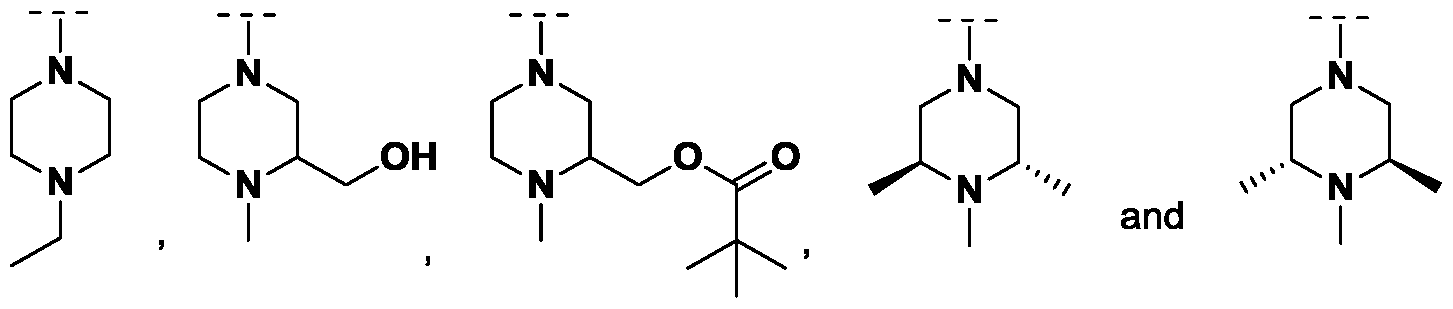
[0094] In some embodiments, R1 is a heterocycloalkyl that is unsubstituted or substituted with one, two or three substituents selected from halo, Ci-6alkyl, Ci_
efluoroalkyl, Ci-6alkyleneOR4, NR5R6 and Ci-6alkyleneNR5R6, provided that R1 comprises at least one basic nitrogen atom. In some embodiments, R1 is a heterocycloalkyl that is substituted with one, two or three substituents selected from halo, Ci-6alkyl, Ci-6alkyleneOR4 and NR5R6, provided that R1 comprises at least one basic nitrogen atom. In some embodiments, R1 is a heterocycloalkyl that is substituted with one or two substituents selected from Ci-6alkyl, Ci-6alkyleneOR4 and NR5R6, provided that R1 comprises at least one basic nitrogen atom. In some embodiments, R1 is selected from:
,
[0096] In some embodiments, R
1 is selected from:
[0097 In some embodiments, R1 is selected from:
[0098] In some embodiments, R1 is selected from:
[0099] In some embodiments, R1 is selected from:
[00100] In some embodiments, R
1 is selected from:
[00101] In some embodiments, R is selected from C6-ioaryl and heteroaryl, and
R2 is unsubstituted or substituted with one, two or three substituents selected from halo, Ci-6alkyl, Ci-6fluoroalkyl, =0, OR7, SR7 and NR8R9. In some embodiments, R2 is selected from C6-ioaryl and heteroaryl, and R2 is unsubstituted or substituted with one, two or three substituents selected from halo, Ci-6alkyl, Ci-6fluoroalkyl, =0, OR7 and NR8R9. In some embodiments, R2 is selected from C6-ioaryl and heteroaryl, and R2 is unsubstituted or substituted with one or two substituents selected from halo, Ci_ 6alkyl, Ci-6fluoroalkyl, =0 and OR7. In some embodiments, R2 is selected from phenyl and C6-heteroaryl, and R2 is substituted with one to three substituents selected from F, CF2H, CF3 and =0.
[00102] In some embodiments, R is selected from:
[00103] In some embodiments, R is selected from:
[00105] some embodiments, R is selected from:
[00106] In some embodiments, R2 is selected from:
[00107] In some embodiments, R2 is selected from:
tautomer thereof.
[00111] In some embodiments, R4 is selected from H, Ci-6alkyl, Ci-6fluoroalkyl and C(0)Ci-6alkyl. In some embodiments, R4 is selected from H, Ci-6alkyl and C(0)Ci-6alkyl. In some embodiments, R4 is selected from H, CH3 and C(0)CH3.In some embodiments, R4 is selected from H and CH3.
[00112] In some embodiments, R5 and R6 are independently selected from H,
Ci-6alkyl and heterocycloalkyl. In some embodiments, R5 and R6 are independently selected from H and Ci-6alkyl. In some embodiments, R5 and R6 together with the nitrogen atom to which they are attached form a 3-10 membered heterocycle that is unsubstituted or substituted with one or two substituents selected from halo and Ci_ 6alkyl. In some embodiments, R5 and R6 together with the nitrogen atom to which they
are attached form a 3-10 membered heterocycle that is unsubstituted. In some embodiments, R5 and R6 together with the nitrogen atom to which they are attached form an unsubstituted or substituted monocyclic heterocycloalkyl selected from aziridinyl, oxiranyl, thiiranyl, azetidinyl, oxetanyl, thietanyl, pyrrolidinyl, pyrrolinyl, imidazolidinyl, pyrazolidinyl, pyrazolinyl, dioxolanyl, sulfolanyl, 2,3-dihydrofuranyl, 2,5-dihydrofuranyl, tetrahydrofuranyl, thiophanyl, piperidinyl, 1,2,3,6- tetrahydropyridinyl, piperazinyl, mo holinyl, thiomorpholinyl, pyranyl, thiopyranyl, 2,3-dihydropyranyl, tetrahydropyranyl, 1,4-dihydropyridinyl, 1,4-dioxanyl, 1,3- dioxanyl, dioxanyl, homopiperidinyl, 2,3,4,7-tetrahydro-lH-azepinyl, homopiperazinyl, 1,3-dioxepanyl, 4,7-dihydro-l,3-dioxepinyl, and hexamethylene oxidyl.
[00113] In some embodiments, R7 is selected from Η, Ci-6alkyl, Ci-6fluoroalkyl and C(0)Ci-6alkyl. In some embodiments, R7 is selected from Η, CH3 and C(0)CH3. In some embodiments, R7 is selected from H and Ci-6alkyl. In some embodiments, R7 is selected from H and CH3.
[00114] In some embodiments, one of X1, X2, X3 and X4 is N and the others of X1, X2, X3 and X4 are CR10. In some embodiments, X1, X2, X3 and X4 are CR10. In some embodiments, X1 and X4 are CH. In some embodiments one of X2 and X3 is CR10 and R10 is other than H.
[00115] In some embodiments, one of X5, X6 and X7 is N and the others of X5, X6 and X7 are CH. In some embodiments, X5, X6 and X7 are CH.
[00116] In some embodiments, R10 is selected from H, halo, CN, Ci-6alkyl, Ci_ sfiuoroalkyl, OR11, NR12R13, R14, Ci-6alkyleneR14, OCi-6alkyleneR14, Ci. 6alkyleneNR12R13, Ci-6alkyleneORn, OCi-6alkyleneNR12R13, OCi-6alkyleneORn, C(0)ORn and C(0)NR12R13. In some embodiments, R10 is selected from H, halo, CN, OR11, NR12R13, R14, Ci-6alkyleneR14, OCi-6alkyleneR14, Ci-6alkyleneNR12R13, Ci. salkyleneOR11, OCi-6alkyleneNR12R13, OCi-6alkyleneORn, C(0)ORn and C(0)NR12R13. In some embodiments, R10 is selected from H, halo, CN, OR11, R14, OCi-6alkyleneR14, Ci-6alkyleneNR12R13, OCi-6alkyleneORn, C(0)ORn and C(0)NR12R13. In some embodiments, R10 is selected from OR11, OCi-6alkyleneR14, Ci-6alkyleneNR12R13 and C(0)NR12R13. In some embodiments, R10 is selected from Ci-6alkyleneNR12R13 and C(0)NR12R13.
[00117] In some embodiments, R11 is selected from H, Ci-6alkyl, Ci_
6fluoroalkyl, C(0)Ci-6alkyl, C(0)Ci-6fluoroalkyl, C3-iocycloalkyl, heterocycloalkyl, C6-ioaryl, heteroaryl, Ci-6alkyleneC3-iocycloalkyl, Ci-6alkyleneC6-ioaryl, Ci_ 6alkyleneheteroaryl and Ci-6alkyleneheterocycloalkyl. In some embodiments, R11 is selected from H, Ci-6alkyl, Ci-6fluoroalkyl, C3-iocycloalkyl, heterocycloalkyl, C6-ioaryl and heteroaryl. In some embodiments, R11 is selected from H, Ci-6alkyl, Ci_ 6fluoroalkyl and heterocycloalkyl. In some embodiments, R11 is heterocycloalkyl. In some embodiments, R11 is an unsubstituted or substituted monocyclic heterocycloalkyl selected from aziridinyl, oxiranyl, thiiranyl, azetidinyl, oxetanyl, thietanyl, pyrrolidinyl, pyrrolinyl, imidazolidinyl, pyrazolidinyl, pyrazolinyl, dioxolanyl, sulfolanyl, 2,3-dihydrofuranyl, 2,5-dihydrofuranyl, tetrahydrofuranyl, thiophanyl, piperidinyl, 1,2,3, 6-tetrahydropyridinyl, piperazinyl, morpholinyl, thiomorpholinyl, pyranyl, thiopyranyl, 2,3-dihydropyranyl, tetrahydropyranyl, 1,4- dihydropyridinyl, 1,4-dioxanyl, 1,3-dioxanyl, dioxanyl, homopiperidinyl, 2,3,4,7- tetrahydro-lH-azepinyl, homopiperazinyl, 1,3-dioxepanyl, 4,7-dihydro-l,3- dioxepinyl, and hexamethylene oxidyl. In some embodiments R11 is morpholinyl optionally substituted with one or two Ci-6alkyl, suitably methyl.
[00118] In some embodiments, R12 and R13 are each independently selected from Η, Ci-ioalkyl, Ci-iofluoroalkyl, C(0)Ci-6alkyl, C(0)Ci-6fluoroalkyl, C3- locycloalkyl, heterocycloalkyl, heteroaryl, C6-ioaryl, Ci-6alkyleneC3-iocycloalkyl, Ci_ 6alkyleneC6-ioaryl, Ci-6alkyleneheteroaryl and Ci-6alkyleneheterocycloalkyl, and when R12 and R13 are other than Η they are each independently unsubstituted or substituted with one, two or three substituents selected from halo and Ci-6alkyl. In some embodiments, R12 and R13 are each independently selected from Η, Ci-ioalkyl, Ci_ lofluoroalkyl, C3-iocycloalkyl, heterocycloalkyl, heteroaryl and C6-ioaryl, and when R12 and R13 are other than Η they are each independently unsubstituted or substituted with one, two or three substituents selected from halo and Ci-6alkyl. In some embodiments, R12 and R13 are each independently selected from Η, Ci-ioalkyl, C3- locycloalkyl and heterocycloalkyl, and when R12 and R13 are other than Η they are each independently unsubstituted or substituted with one or two substituents selected from halo and Ci-6alkyl. In some embodiments, R12 and R13 are each independently selected from Η, Ci-ioalkyl, C3-iocycloalkyl and heterocycloalkyl, and each of R12 and
R (other than H) is unsubstituted. In some embodiments, R and R are each independently selected from H, Ci-ioalkyl, C3-iocycloalkyl and heterocycloalkyl, and when R12 and R13 are other than H they are each are independently substituted with halo. In some embodiments, R12 and R13 are each independently selected from H, Ci. loalkyl, C3-iocycloalkyl and heterocycloalkyl. In some embodiments, R12 and R13 are each independently selected from H and C3-iocycloalkyl.
[00119] In some embodiments, R12 and R13 together with the nitrogen atom to which they are attached form a 3-10 membered heterocycle that is unsubstituted or substituted with one, two or three substituents independently selected from halo, OR15, SR15, NR16R17, Ci-galkyl, C(0)R15, C(0)OR15, C(0)NR16R17, S(0)Ci-6alkyl, S02Ci-6alkyl, C6-ioaryl, heteroaryl, C3-iocycloalkyl, heterocycloalkyl, Ci-6alkyleneC6- loaryl, Ci-6alkyleneC3-iocycloalkyl, Ci-6alkyleneheteroaryl, Ci_
6alkyleneheterocycloalkyl, Ci-6alkyleneR15, Ci-6alkyleneOR15, Ci-6alkyleneSR15 and
16 17 12 13
Ci-6alkyleneNR R . In some embodiments, R and R together with the nitrogen atom to which they are attached form a 3-10 membered heterocycle that is unsubstituted or substituted with one or two substituents independently selected from halo, OR15, NR16R17, Ci-6alkyl, S02Ci-6alkyl, heterocycloalkyl, Ci.galkyleneCs- locycloalkyl and Ci-6alkyleneR15. In some embodiments, R12 and R13 together with the nitrogen atom to which they are attached form a 3-10 membered heterocycle that is unsubstituted. In some embodiments, R12 and R13 together with the nitrogen atom to which they are attached form an unsubstituted or substituted monocyclic heterocycloalkyl selected from aziridinyl, oxiranyl, thiiranyl, azetidinyl, oxetanyl, thietanyl, pyrrolidinyl, pyrrolinyl, imidazolidinyl, pyrazolidinyl, pyrazolinyl, dioxolanyl, sulfolanyl, 2,3-dihydrofuranyl, 2,5-dihydrofuranyl, tetrahydrofuranyl, thiophanyl, piperidinyl, 1,2,3, 6-tetrahydropyridinyl, piperazinyl, morpholinyl, thiomorpholinyl, pyranyl, thiopyranyl, 2,3-dihydropyranyl, tetrahydropyranyl, 1,4- dihydropyridinyl, 1,4-dioxanyl, 1,3-dioxanyl, dioxanyl, homopiperidinyl, 2,3,4,7- tetrahydro-lH-azepinyl, homopiperazinyl, 1,3-dioxepanyl, 4,7-dihydro-l,3- dioxepinyl, and hexamethylene oxidyl.
[00120] In some embodiments, R14 is selected from C(0)Ci-6alkyl, C(0)Ci_
6fluoroalkyl, C3-iocycloalkyl, heterocycloalkyl, heteroaryl and C6-ioaryl. In some embodiments, R14 is selected from C3-iocycloalkyl and heterocycloalkyl. In some
embodiments, R is C3-iocycloalkyl or heterocycloalkyl. In some embodiments R is an unsubstituted or substituted monocyclic heterocycloalkyl selected from aziridinyl, oxiranyl, thiiranyl, azetidinyl, oxetanyl, thietanyl, pyrrolidinyl, pyrrolinyl, imidazolidinyl, pyrazolidinyl, pyrazolinyl, dioxolanyl, sulfolanyl, 2,3-dihydrofuranyl, 2,5-dihydrofuranyl, tetrahydrofuranyl, thiophanyl, piperidinyl, 1,2,3,6- tetrahydropyridinyl, piperazinyl, mo holinyl, thiomo holinyl, pyranyl, thiopyranyl, 2,3-dihydropyranyl, tetrahydropyranyl, 1,4-dihydropyridinyl, 1,4-dioxanyl, 1,3- dioxanyl, dioxanyl, homopiperidinyl, 2,3,4,7-tetrahydro-lH-azepinyl, homopiperazinyl, 1,3-dioxepanyl, 4,7-dihydro-l,3-dioxepinyl, and hexamethylene oxidyl. In some embodiments R14 is morpholinyl optionally substituted with one or two Ci-6alkyl, suitably methyl.
[00121] In some embodiments, R15 is selected from Η, Ci-6alkyl, Ci_
6fluoroalkyl, C(0)Ci-6alkyl, C(0)Ci-6fluoroalkyl, C3-iocycloalkyl, heterocycloalkyl, C6-ioaryl, Ci-6alkyleneC6-ioaryl, Ci-6alkyleneC3-iocycloalkyl and Ci_ 6alkyleneheterocycloalkyl, and when R15 is other than Η it is unsubstituted or substituted with one, two or three substituents selected from halo, Ci-6alkyl and Ci_ 6fluoroalkyl. In some embodiments, R15 is selected from Η, C3-iocycloalkyl, heterocycloalkyl, C6-ioaryl, Ci-6alkyleneC6-ioaryl, Ci-6alkyleneC3-iocycloalkyl and Ci_ 6alkyleneheterocycloalkyl, and when R15 is other than Η it is unsubstituted or substituted with one, two or three substituents selected from halo, Ci-6alkyl and Ci_ 6fluoroalkyl. In some embodiments, R15 is selected from Η, C6-ioaryl and Ci_ 6alkyleneC6-ioaryl, and when R15 is other than Η it is unsubstituted or substituted with one or two substituents selected from halo and Ci-6alkyl. In some embodiments, R15 is selected from Η and C6-ioaryl, and when R15 is other than Η it is unsubstituted or substituted with one or two substituents selected from halo and Ci-6alkyl. In some embodiments, R15 is selected from Η and C6-ioaryl, and when R15 is other than Η it is unsubstituted or substituted with halo.
[00122] In some embodiments, R16 and R17 are each independently selected from
Η, Ci-6alkyl, Ci-6fluoroalkyl, C(0)Ci-6alkyl, C3-iocycloalkyl, heterocycloalkyl, C6-ioaryl, Ci-6alkyleneC6-ioaryl, Ci-6alkyleneC3-iocycloalkyl and Ci-6alkyleneheterocycloalkyl, and when R16 and R17 are other than Η they are unsubstituted or substituted with one, two or three substituents independently selected from halo, Ci-6alkyl, Ci-6fiuoroalkyl, ΟΗ, SH,
OCi-galkyl, OCi-6fluoroalkyl, SCi-6alkyl, SCi-6fluoroalkyl, NH2, NHCi-6alkyl, N(Ci. 6alkyl)(Ci-6alkyl), C(0)Ci-6alkyl, C(0)OH, C(0)OCi-6alkyl, C(0)Ci-6fluoroalkyl, C(0)NH2, C(0)NHCi-6alkyl, C(0)N(Ci-6alkyl)(Ci-6alkyl), S02Ci-6alkyl, S(0)Ci_ 6alkyl, C6-ioaryl, heteroaryl, C3-iocycloalkyl, heterocycloalkyl, Ci-6alkyleneC6-ioaryl, Ci-6alkyleneC3-iocycloalkyl, Ci-6alkyleneheteroaryl, Ci-6alkyleneheterocycloalkyl, Ci-6alkyleneOH, Ci-6alkyleneOCi-6alkyl, Ci-6alkyleneSH, Ci-6alkyleneSCi-6alkyl, Ci_ 6alkyleneNH2, Ci-6alkyleneNHCi-6alkyl and Ci-6alkyleneN(Ci-6alkyl)(Ci-6alkyl). In some embodiments, R16 and R17 are each independently selected from H, Ci-6alkyl, Ci-6fluoroalkyl, C3-iocycloalkyl, heterocycloalkyl, C6-ioaryl, Ci-6alkyleneC6-ioaryl, Ci. 6alkyleneC3-iocycloalkyl and Ci-6alkyleneheterocycloalkyl. In some embodiments, R16 and R17 are each independently selected from H, Ci-6alkyl and Ci-6fluoroalkyl. In some embodiments, R16 and R17 are Ci-6alkyl.
[00123] In some embodiments, the compound of Formula I is selected from:
N-[5-[5-[[(2S,6R)-2,6-dimethylmo holin-4-yl]methyl]-2-fluorophenyl]-2-(4- methylpiperazin-l-yl)phenyl]-6-oxo-4-(trifluoromethyl)-lH-pyriine-3-carboxamide;
N-[5-[2-fluoro-5-(mo holin-4-ylmethyl)phenyl]-2-(4-methylpiperazin-l-yl)phenyl]-6- oxo-4-(trifluoromethyl)-lH-pyridine-3-carboxarnide;
N-[5-[2-fluoro-4-(methoxymethoxy)-5-(2,4,4-trimethylpentan-2-ylcarbamoyl)phenyl]-2- (4-methylpiperazin- 1 -yl)phenyl] -6-oxo-4-(trifluoromethyl)- 1 H-pyridine-3 -carboxamide;
N-[5-(5-carbamoyl-2-fluoro-4-hydroxyphenyl)-2-(4-methylpiperazin-l-yl)phenyl]-6-oxo- 4-(trifluoromethyl)- 1 H-pyridine-3 -carboxamide;
N- [5 -[2-fluoro-5 -(trifluoromethoxy)phenyl] -2-(4-methylpiperazin- 1 -yl)phenyl] -6-oxo-4- (trifluoromethyl)-lH-pyridine-3-carboxamide;
N-[5-[2-fluoro-5-(2-methylpropoxy)phenyl]-2-(4-methylpiperazin-l-yl)phenyl]-6-oxo-4- (trifluoromethyl)-lH-pyridine-3-carboxarnide;
N- [5 -[5 - [(cy clohexylamino)methyl] -2-fluorophenyl] -2-(4-methylpiperazin- 1 -yl)phenyl] - 6-oxo-4-(trifluoromethyl)- 1 H-pyridine-3 -carboxamide;
N-[5-[2-fluoro-6-(oxan-4-yloxy)pyridin-3-yl]-2-(4-methylpiperazin-l-yl)phenyl]-6-oxo- 4-(trifluoromethyl)- 1 H-pyridine-3 -carboxamide;
N-[5-[2-fluoro-5-(mo holin-4-ylmethyl) henyl]-2-(4-methyl i erazin-l-yl) henyl]-6- oxo-lH-pyridazine-3-carboxamide;
N- [5 -[2-fluoro-5 -^οφηο1ίη-4^1ιη6ΐ1^1)ρη6^1] -2-(4-methylpiperazin- 1 -yl)phenyl] -3 - methoxybenzamide;
4-fluoro-N-[5-[2-fluoro-5-(mo holin-4-ylmethyl)phenyl]-2-(4-methylpiperazin-l- yl)phenyl]-3,5-dimethylbenzamide;
2-ο 1θΓθ-4-ΑυοΓθ-Ν-[5-[2-ί1υοΓθ-5-(ηιοφ1ιο1ίη-4^1ηΐ6^1)ρ1ι^1]-2-(4- methylpiperazin- 1 -yl)phenyl] -3 -methylbenzamide;
N- [5 -[2-fluoro-5 -(moφholin-4-ylmethyl)phenyl] -2-(4-methylpiperazin- 1 -yl)phenyl] - 1 - methyl-6-oxo-4-(trifluoromethyl)pyridine-3-carboxamide;
methyl 4-fluoro-3 -[4-(4-methylpiperazin- 1 -yl)-3 - [ [6-oxo-4-(trifluoromethyl)- 1 H- pyridine-3 -carbonyl] amino] phenyl] benzoate;
N- [5 -[2-(cyclopropylmethoxy)-5 -fluoropyridin-4-yl] -2-(4-methylpiperazin- 1 -y l)phenyl] - 6-oxo-4-(trifluoromethyl)- 1 H-pyridine-3 -carboxamide;
N- [5 -[6-(cyclopropylmethoxy)-2-fluoropyridin-3 -yl] -2-(4-methylpiperazin- 1 -y l)phenyl] - 6-oxo-4-(trifluoromethyl)- 1 H-pyridine-3 -carboxamide;
N- [5 -[5 - [(cy clopropylamino)methyl] -2-fluorophenyl] -2-(4-methylpiperazin- 1 -yl)phenyl] - 6-oxo-4-(trifluoromethyl)- 1 H-pyridine-3 -carboxamide;
N- [5 -[5 - [(cy clohexylamino)methyl] -2-fluorophenyl] -2-(4-methylpiperazin- 1 -yl)phenyl] - 4-fluoro-3,5-dimethylbenzamide;
4-fluoro-N-[5-[2-fluoro-6-(oxan-4-yloxy)pyridin-3-yl]-2-(4-methylpiperazin-l- yl)phenyl]-3,5-dimethylbenzamide;
N-[5-[2-fluoro-5-(moφholin-4-ylmethyl)phenyl]-2-(4-methylpiperazin-l-yl)phenyl]-6- oxo-4-(trifluoromethyl)-lH-pyridazine-3-carboxamide;
N- [5 -[5 -(cyclopropylmethoxy)-2,4-difluorophenyl] -2-(4-methylpiperazin- 1 -yl)phenyl] -6- oxo-4-(trifluoromethyl)-lH-pyridine-3-carboxamide;
N- [5 -(2-fluoro-6-pyrrolidin- 1 -ylpyridin-3-yl)-2-(4-methylpiperazin- 1 -yl)phenyl] -6-oxo- 4-(trifluoromethyl)- 1 H-pyridine-3 -carboxamide;
N-[5-[2-fluoro-3-(mo holin-4-ylmethyl) henyl]-2-(4-methyl i erazin-l-yl) henyl]-6- oxo-4-(trifluoromethyl)-lH-pyridine-3-carboxamide;
N- [5 -[2-fluoro-5 -^οφηο1ίη-4^1ιη6ΐ1^1)ρη6^1] -2-(4-methylpiperazin- 1 -yl)phenyl] -3 - methylbenzamide;
N- [5 -(2-fluorophenyl)-2-(4-methylpiperazin- 1 -yl)phenyl] -6-oxo-4-(trifluoromethyl)- 1 H- pyridine-3-carboxamide;
6-hydroxy-4-(trifluoromethyl)pyridine-3-carboxamide;
N-(2'-fluoro-5' mo holinomethyl)-4 (3S,5R)-3,4,5-trimethylpiperazin-l-yl)-[l,Γ- biphenyl]-3-yl)-6-oxo-4-(trifluoromethyl)-l,6-dihydropyridine-3-carboxamide;
Ν-[2-[(28)-2,4-(1ίηΐ6 1ρίρ6Γ3ζίη-1^1]-5-[2-ΑυοΓθ-5-(ηιοφ1ιοΗη-4- ylmethyl)phenyl] phenyl] -6-oxo-4-(trifluoromethyl)- 1 H-pyridine-3 -carboxamide;
N-[5-[2-fluoro-5-(moφholin-4-ylmethyl)phenyl]-2-(4-methylpiperazin-l-yl)phenyl]-4- methyl-6-oxo- 1 H-pyridine-3 -carboxamide;
N-(2',6-difluoro-4-(4-methylpiperazin- 1 -yl)-5 '-(n ^holinomethyl)- [1,1 -biphenyl] -3 -yl)- 6-oxo-4-(trifluoromethyl)-l,6-dihydropyridine-3-carboxamide;
N-[5-[5-fluoro-2-(oxan-4-yloxy)pyridin-4-yl]-2-(4-methylpiperazin-l-yl)phenyl]-6-oxo- 4-(trifluoromethyl)- 1 H-pyridine-3 -carboxamide;
N-[5-[5-(cyclohexylcarbamoyl)-2-fluorophenyl]-2-(4-methylpiperazin-l-yl)phenyl]-6- oxo-4-(trifluoromethyl)-lH-pyridine-3-carboxamide;
N-[5-[4-[(cyclopentylamino)methyl]-2-fluorophenyl]-2-(4-methylpiperazin-l-yl)phenyl]- 6-oxo-4-(trifluoromethyl)- 1 H-pyridine-3 -carboxamide;
N-[5-[4-[(cyclohexylamino)methyl]-2-fluorophenyl]-2-(4-methylpiperazin-l-yl)phenyl]- 6-oxo-4-(trifluoromethyl)- 1 H-pyridine-3 -carboxamide;
N- [5 -[5 - [(tert-butylamino)methyl] -2-fluorophenyl] -2-(4-methylpiperazin- 1 -yl)phenyl] -6- oxo-4-(trifluoromethyl)-lH-pyridine-3-carboxarnide;
4-fluoro-N-[5-[2-fluoro-5-(moφholin-4-ylmethyl)phenyl]-2-(4-methylpiperazin-l- yl)phenyl]-3-methylbenzamide;
N-[5-[2-fluoro-5-[(oxan-4-ylamino)methyl]phenyl]-2-(4-methylpiperazin-l-yl)phenyl]-6- oxo-4-(trifluoromethyl)-lH-pyridine-3-carboxamide;
N-[5-[2-fluoro-4-(mo holin-4-ylmethyl)phenyl]-2-(4-methylpiperazin-l-yl)phenyl]-6- oxo-4-(trifluoromethyl)-lH-pyridine-3-carboxamide;
N- [5 -(3 -fluoro-2-moφholin-4-ylpyridin-4-yl)-2-(4-methylpiperazin- 1 -yl)phenyl] -6-oxo- 4-(trifluoromethyl)- 1 H-pyridine-3 -carboxamide;
N- [5 -[5 - [(dimethyl amino)methyl] -2-fluorophenyl] -2-(4-methylpiperazin- 1 -yl)phenyl] -6- oxo-4-(trifluoromethyl)-lH-pyridine-3-carboxamide;
4-fluoro-N-[5-[2-fluoro-5-(mo holin-4-ylmethyl)phenyl]-2-(4-methylpiperazin-l- yl)phenyl]-3-methyl-5-(trifluoromethyl)benzamide;
N- [5 -[5 -[ [(4,4-difluorocyclohexyl)arnino] methyl] -2-fluorophenyl] -2-(4-methylpiperazin- l-yl)phenyl]-6-oxo-4-(trifluoromethyl)-lH-pyridine-3-carboxamide;
N- [5 -[2-fluoro-5 -[ [methyl (oxetan-3 -yl)amino] methyl] phenyl] -2-(4-methylpiperazin- 1 - yl)phenyl]-6-oxo-4-(trifluoromethyl)-lH-pyridine-3-carboxamide;
N-[5-[2-fluoro-5-(mo holin-4-ylmethyl)phenyl]-2-(4-methylpiperazin-l-yl)phenyl]-4- hydroxy-2-(trifluoromethyl)benzamide;
N-[5-[5-[(cyclohexylamino)methyl]-2-fluorophenyl]-2-[(3R,5S)-3,4,5- trimethylpiperazin-l-yl]phenyl]-6-oxo-4-(trifluoromethyl)-lH-pyridine-3-carboxamide;
N-[5-[5-(cyclohexylcarbamoyl)-2-fluorophenyl]-2-[(3R,5S)-3,4,5-trimethylpiperazin-l- yl] phenyl] -6-oxo-4-(trifluoromethyl)- lH-pyridine-3 -carboxamide;
N-[5-[2-fluoro-5-(moφholine-4-carbonyl)phenyl]-2-[(3R,5S)-3,4,5-trimethylpiperazin-l- yl] phenyl] -6-oxo-4-(trifluoromethyl)- lH-pyridine-3 -carboxamide;
2,3-difluoro-N-[5-[2-fluoro-5-(moφholin-4-ylmethyl)phenyl]-2-(4-methylpiperazin-l- yl)phenyl] -5 -hy droxybenzamide;
4-(difluoromethyl)-N- [5- [2-fluoro-5 -(moφholin-4-ylmethyl)phenyl] -2-(4- methylpiperazin- 1 -yl)phenyl] -6-oxo- 1 H-pyridine-3 -carboxamide;
N-[5-[2-(cyclopropylmethoxy)-5-fluoropyridin-4-yl]-2-[(3R,5S)-3,4,5- trimethylpiperazin-l-yl]phenyl]-6-oxo-4-(trifluoromethyl)-lH-pyridine-3-carboxamide;
(R)-N-(2'-fluoro-5'-((3-hydroxypyrrolidin-l-yl)methyl)-4-(4-methylpiperazin-l-yl)-[lJ'- biphenyl]-3-yl)-6-methoxy-4-(trifluoromethyl)nicotinamide;
N-[5-[2-fluoro-5-[(4-mo holin-4-ylpiperidin-l-yl)methyl]phenyl]-2-(4-methylpiperazin- 1 -yl)phenyl] -6-methoxy-4-(trifluoromethyl)pyridine-3-carboxamide;
N-[5-[2-fluoro-5-[[(3S)-3-propan-2-ylpyrrolidin-l-yl]methyl]phenyl]-2-(4- methylpiperazin- 1 -yl)phenyl] -6-methoxy-4-(trifluoromethyl)pyridine-3-carboxamide;
N- [5 -[5 - [(4-acetylpiperazin- 1 -yl)methyl] -2-fluorophenyl] -2-(4-methylpiperazin- 1 - yl)phenyl] -6-methoxy-4-(trifluoromethyl)pyridine-3 -carboxamide;
N-[5-[2-fluoro-5-[(4-fluoropiperidin-l-yl)methyl]phenyl]-2-(4-methylpiperazin-l- yl)phenyl] -6-methoxy-4-(trifluoromethyl)pyridine-3 -carboxamide;
N-[5-[2-fluoro-5-(3-oxa-6-azabicyclo[3.1. l]heptan-6-ylmethyl)phenyl]-2-(4- methylpiperazin- 1 -yl)phenyl] -6-methoxy-4-(trifluoromethyl)pyridine-3-carboxamide;
(R)-N-(2'-fluoro-4-(4-methylpiperazin-l-yl)-5'-((3-(methylsulfonyl)pyrrolidin-l- yl)methyl)-[ 1 , 1 '-biphenyl] -3-yl)-6-methoxy-4-(trifluoromethyl)nicotinamide;
(S)-N-(2'-fluoro-5'-((methyl(tetrahydrom^
yl)-[ 1 , 1 '-biphenyl] -3-yl)-6-methoxy-4-(trifluoromethyl)nicotinamide;
N-[5-[5-[(2,2-dimethylmoφholin-4-yl)methyl]-2-fluorophenyl]-2-(4-methylpiperazin-l- yl)phenyl] -6-methoxy-4-(trifluoromethyl)pyridine-3 -carboxamide;
N-[5-[2-fluoro-5-(mo holin-4-ylmethyl)pyridin-3-yl]-2-[(3R,5S)-3,4,5- trimethylpiperazin-l-yl]phenyl]-6-oxo-4-(trifluoromethyl)-lH-pyridine-3-carboxamide;
N- [5 -[2-fluoro-5 -(mo holin-4-ylmethyl)pyridin-3 -yl] -2-(4-methylpiperazin- 1 - yl)phenyl]-6-oxo-4-(trifluoromethyl)-lH-pyridine-3-carboxarnide;
N-[2-(4-ethylpiperazin-l-yl)-5-[2-fluoro-5-(moφholin-4-ylmethyl)phenyl]phenyl]-6-oxo- 4-(trifluoromethyl)- 1 H-pyridine-3 -carboxamide;
N-[5-[5-[(cyclohexylamino)methyl] -2-fluorophenyl] -2-(4-ethylpiperazin-l -yl)phenyl] -6- oxo-4-(trifluoromethyl)-lH-pyridine-3-carboxamide;
[4-[4-[2-fluoro-5-(moφholin-4-ylmethyl)phenyl]-2-[[6-oxo-4-(trifluoromethyl)-lH- pyridine-3 -carbonyl] amino] phenyl] - 1 -methylpiperazin-2-yl] methyl 2,2- dimethylpropanoate;
N-[5-[2-fluoro-5-(mo holin-4-ylmethyl) henyl]-2-[3-(hydroxymethyl)-4- methylpiperazin-l-yl]phenyl]-6-oxo-4-(trifluoromethyl)-lH^yridine-3-carboxamide;
N- [5 -[5 - [ [4-(cy clopropylmethyl)piperazin- 1 -yl] methyl] -2-fluorophenyl] -2-(4- methylpiperazin-l-yl)phenyl]-6-oxo-4-(trifluoromethyl)-lH-pyridine-3-carboxamide;
N- [5 -[5 - [ [cy clohexyl(methyl)amino] methyl] -2-fluorophenyl] -2-(4-methylpiperazin- 1 - yl)phenyl]-6-oxo-4-(trifluoromethyl)-lH-pyridine-3-carboxamide;
N- [5 -[2-fluoro-5 -[ [4-[(4-fluorophenyl)methyl] piperazin- 1 -yl] methyl] phenyl] -2-(4- methylpiperazin-l-yl)phenyl]-6-oxo-4-(trifluoromethyl)-lH-pyridine-3-carboxamide;
(R)-N-(2'-fluoro-5'-((3-hydroxypyrrolidin-l-yl)methyl)-4-(4-methylpiperazin-l-yl)-[l, - biphenyl]-3-yl)-6-oxo-4-(trifluoromethyl)-l,6-dihydropyridine-3-carboxamide;
N-[5-[2-fluoro-5-[(4-mo holin-4-ylpiperidin-l-yl)methyl]phenyl]-2-(4-methylpiperazin- l-yl)phenyl]-6-oxo-4-(trifluoromethyl)-lH-pyridine-3-carboxamide;
(R)-N-(5'-((3-(dimethylaniino)pyrrolidin-l-yl)methyl)-2'-fluoro-4-(4-methylpiperazin-l- yl)-[ 1 , 1 '-biphenyl] -3-yl)-6-oxo-4-(trifluoromethyl)- 1 ,6-dihydropyridine-3-carboxamide;
N- [5 -[2-fluoro-5 -(piperazin- 1 -ylmethyl)phenyl] -2-(4-methylpiperazin- 1 -yl)phenyl] -6- oxo-4-(trifluoromethyl)-lH-pyridine-3-carboxamide;
N-[5-[2-fluoro-5-[(4-fluoropiperidin-l-yl)methyl]phenyl]-2-(4-methylpiperazin-l- yl)phenyl]-6-oxo-4-(trifluoromethyl)-lH-pyridine-3-carboxarnide;
N-[5-[2-fluoro-5-(3-oxa-6-azabicyclo[3.1. l]heptan-6-ylmethyl)phenyl]-2-(4- methylpiperazin-l-yl)phenyl]-6-oxo-4-(trifluoromethyl)-lH-pyridine-3-carboxamide;
N-[5-[2-fluoro-5-[[(3R)-3-methylsulfonylpyrrolidin-l-yl]methyl]phenyl]-2-(4- methylpiperazin-l-yl)phenyl]-6-oxo-4-(trifluoromethyl)-lH-pyridine-3-carboxamide;
(S)-N-(2'-fluoro-5'-((methyl(tetrahydromran-3-yl)amino)methyl)-4-(4-methylpiperazin-l- yl)-[ 1 , 1 '-biphenyl] -3-yl)-6-oxo-4-(trifluoromethyl)- 1 ,6-dihydropyridine-3-carboxamide;
N-[5-[5-[(2,2-dimethylmoφholin-4-yl)methyl]-2-fluorophenyl]-2-(4-methylpiperazin-l- yl)phenyl]-6-oxo-4-(trifluoromethyl)-lH-pyridine-3-carboxarnide;
N-[5-(3-cyano-2,6-difluorophenyl)-2-[(3R,5S)-3,4,5-trimethylpiperazin-l-yl]phenyl]-6- oxo-4-(trifluoromethyl)-lH-pyridine-3-carboxamide;
N-[5-[5-[(cyclohexylamino)methyl]-2,4-difluorophenyl]-2-[(3S,5R)-3,4,5- trimethylpiperazin-l-yl]phenyl]-6-oxo-4-(trifluoromethyl)-lH-pyridine-3-carboxamide;
N- [5 -[2-fluoro-5 -(phenyl carbamoyl)phenyl] -2- [(3R,5 S)-3 ,4,5 -tnmethylpiperazin- 1 - yl] phenyl] -6-oxo-4-(trifluoromethyl)- lH-pyridine-3 -carboxamide;
N-(5'-(cyclohexylcarbamoyl)-4-(3,4-dimethylpiperazin-l-yl)-2'-fluoro-[l, -biphenyl]-3- yl)-6-oxo-4-(trifluoromethyl)-l,6-dihydropyridine-3-carboxamide;
N-[5-[6-(cyclopropylmethoxy)-2-fluoropyridin-3-yl]-2-[(3S,5R)-3,4,5- trimethylpiperazin-l-yl]phenyl]-6-oxo-4-(trifluoromethyl)-lH-pyridine-3-carboxamide;
N-[5-[3-[(cyclohexylamino)methyl]-2,4-difluorophenyl]-2-[(3S,5R)-3,4,5- trimethylpiperazin-l-yl]phenyl]-6-oxo-4-(trifluoromethyl)-lH-pyridine-3-carboxamide;
N-(5-(2-fluoro-5-(mo holinomethyl)phenyl)-2-(4-methylpiperazin-l-yl)pyridin-3-yl)-6- oxo-4-(trifluoromethyl)-l,6-dihydropyridine-3-carboxamide;
N-(5-(5-((cyclohexylamino)methyl)-2-fluorophenyl)-2-(4-methylpiperazin-l-yl)pyridin-
3- yl)-6-oxo-4-(trifluoromethyl)-l,6-dihydropyridine-3-carboxamide;
N-(4-(3-(dimethylamino)pyrrolidin-l ^1)-2'-ί1υοΓθ-5'-(ηιο ^1ίηοηΐ6^1)-[1 , 1 '- biphenyl]-3-yl)-6-oxo-4-(trifluoromethyl)-l,6-dihydropyridine-3-carboxamide;
6-oxo-4-(trifluoromethyl)-l,6-dihydropyridine-3-carboxamide;
l-methyl-6-oxo-4-(trifluoromethyl)-l,6-dihydropyridine-3-carboxamide;
N-[5-[2-fluoro-5-(methylcarbamoyl)phenyl]-2-[(3R,5S)-3,4,5-trimethylpiperazin-l- yl] phenyl] -6-oxo-4-(trifluoromethyl)- lH-pyridine-3 -carboxamide;
N-[2-[3-(dimethylarnino)pyrrolidin-l-yl]-5-[2-fluoro-5-(moφholin-4- ylmethyl)phenyl] phenyl] -4-fluoro-3 ,5 -dimethylbenzamide;
4- fluoro-N-[5-[2-fluoro-5-(moφholin-4-ylmethyl)phenyl]-2-(4-methyl-l,4-diazepan-l- yl)phenyl]-3,5-dimethylbenzamide;
N- [5 -[5 -(cyclopropylcarbamoyl)-2-fluorophenyl] -2- [(3R,5 S)-3 ,4,5 -trimethylpiperazin- 1 - yl] phenyl] -6-oxo-4-(trifluoromethyl)- lH-pyridine-3 -carboxamide;
4-fluoΓO-N-[5-[2-fluoΓO-5-(moφholin-4-ylmethyl)phenyl]-2-(2-methyl-l,3,3a,4,6,6a- hexahydropyrrolo[3,4-c]pyrrol-5-yl)phenyl]-3,5-dimethylbenzamide;
4-fluoro-N-[5-[2-fluoro-5-(mo holin-4-ylmethyl)phenyl]-2-[4-(2,2,2- trifluoroethyl)piperazin-l-yl]phenyl]-3,5-dimethylbenzamide;
(S)-N-(2-(3,4-dimethylpiperazin-l-yl)-5-(3-fluoropyridin-2-yl)phenyl)-6-oxo-4- (trifluoromethyl)-l,6-dihydropyridine-3-carboxamide;
N-[5-[2-fluoro-5-(mo holin-4-ylmethyl)phenyl]-2-[4-(2,2,2-trifluoroethyl)piperazin-l- yl] phenyl] -6-oxo-4-(trifluoromethyl)- lH-pyridine-3 -carboxamide;
N-(2',5 -difluoro-4-(4-methylpiperazin- 1 -yl)-5 '-(moφholinomethyl)- [1,1 -biphenyl] -3 -yl)- 6-oxo-4-(trifluoromethyl)-l,6-dihydropyridine-3-carboxamide;
N-(2,2'-difluoro-4-(4-methylpiperazin- 1 -yl)-5 '-(n ^holinomethyl)- [1,1 -biphenyl] -3 -yl)- 6-oxo-4-(trifluoromethyl)-l,6-dihydropyridine-3-carboxamide;
N-[5-[2-fluoro-5-(moφholin-4-ylmethyl)phenyl]-2-(2-methyl-l,3,3a,4,6,6a- hexahydropyrrolo[3 ,4-c] pyrrol-5 -yl)phenyl] -6-oxo-4-(trifluoromethyl)- 1 H-pyridine-3 - carboxamide;
N-[2-[3-(dimethylamino)pyrrolidin-l-yl]-5-[2-fluoro-5-(moφholin-4- ylmethyl)phenyl]phenyl]-l-methyl-6-oxo-4-(trifluoromethyl)pyridine-3-carboxamide;
6-fluoro-N-[5-[2-fluoro-5-(moφholin-4-ylmethyl)phenyl]-2-(4-methylpiperazin-l- yl)phenyl] - 1 H-benzimidazole-4-carboxamide;
N- [5 -[2-fluoro-5 -(moφholin-4-ylmethyl)phenyl] -2-(4-methylpiperazin- 1 -yl)phenyl] - 1 H- benzimidazole-2-carboxamide;
N-[5-[2-fluoro-5-(moφholin-4-ylmethyl)phenyl]-2-[(2R)-2,4-dimethylpiperazin-l- yl] phenyl] -6-oxo-4-(trifluoromethyl)- lH-pyridine-3 -carboxamide;
N-[5-[2-fluoro-5-(moφholin-4-ylmethyl)phenyl]-2-(4-methylpiperazin-l-yl)phenyl]-6- oxo- 1 H-pyridine-3 -carboxamide;
6-acetamido-N- [5- [2-fluoro-5 -(moφholin-4-ylmethyl)phenyl] -2-(4-methylpiperazin- 1 - yl)phenyl] -4-methylpyridine-3 -carboxamide;
N- [5 -[5 - [ [4-(cy clopropylmethyl)piperazin- 1 -yl] methyl] -2-fluorophenyl] -2-(4- methylpiperazin- 1 -yl)phenyl] -6-methoxy-4-(mfluoromethyl)pyridine-3-carboxamide;
N-[5-[2-fluoro-5-(mo holin-4-ylmethyl) henyl]-2-(4-methyl i erazin-l-yl) henyl]-6- (methylamino)-4-(trifluoromethyl)pyridine-3-carboxamide;
6-amino-N- [5 -[2-fluoro-5 -(mo holin-4-ylmethyl)phenyl] -2-(4-methylpiperazin- 1 - yl)phenyl]-4-(trifluoromethyl)pyridine-3-carboxamide;
N- [5 -[5 - [cyclohexyl(methyl)carbamoyl] -2-fluorophenyl] -2-(4-methylpiperazin- 1 - yl)phenyl]-6-oxo-4-(trifluoromethyl)-lH-pyridine-3-carboxamide;
N-[5-[5-[cyclohexyl(methyl)carbamoyl]-2-fluorophenyl]-2-[(3R,5S)-3,4,5- trimethylpiperazin-l-yl]phenyl]-6-oxo-4-(trifluoromethyl)-lH^yridine-3-carboxamide;
N-[5 2,4-difluoro-3-[[me l(oxetan-3-yl)amino]methyl]phenyl]-2-[(3R,5S)-3,4,5- trimethylpiperazin-l-yl]phenyl]-6-oxo-4-(trifluoromethyl)-lH^yridine-3-carboxamide;
N-[5 2,4-difluoro-5-[[me l(oxetan-3-yl)amino]methyl]phenyl]-2-[(3R,5S)-3,4,5- trimethylpiperazin-l-yl]phenyl]-6-oxo-4-(trifluoromethyl)-lH^yridine-3-carboxamide;
N-[5-[3-[(cyclohexylamino)methyl]-2,6-difluorophenyl]-2-[(3R,5S)-3,4,5- trimethylpiperazin-l-yl]phenyl]-6-oxo-4-(trifluoromethyl)-lH^yridine-3-carboxamide;
N-[5-[4-[(cyclohexylamino)methyl]-2,6-difluorophenyl]-2-[(3R,5S)-3,4,5- trimethylpiperazin-l-yl]phenyl]-6-oxo-4-(trifluoromethyl)-lH^yridine-3-carboxamide;
N-(4'-carbamoyl-2'-fluoro-4 (3S,5R)-3,4,5-trimethylpiperazin-l-yl)-[l,r-biphenyl]-3- yl)-6-oxo-4-(trifluoromethyl)-l,6-dihydropyridine-3-carboxamide;
N-(2'-fluoro-4'-mo holino-4 (3S,5R)-3,4,5-trimethylpiperazin-l-yl) 1,l'-biphenyl]-3- yl)-6-oxo-4-(trifluoromethyl)-l,6-dihydropyridine-3-carboxamide;
N-(5'-carbamoyl-2'-fluoro-4 (3S,5R)-3,4,5-trimethylpiperazin-l-yl)-[l,r-biphenyl]-3- yl)-6-oxo-4-(trifluoromethyl)-l,6-dihydropyridine-3-carboxamide;
N-(2',4'-difluoro-5'-((2,4,4-trimethylpentan-2-yl)carbamoyl)-4-((3S,5R)-3,4,5- trimethylpiperazin- 1 -yl)-[ 1 , 1 '-biphenyl] -3-yl)-6-oxo-4-(trifluoromethyl)-l ,6- dihydropyridine-3 -carboxamide;
N-(5'-carbamoyl-2',4'-difluoro-4 (3S,5R)-3A5-ta^
3-yl)-6-oxo-4-(trifluoromethyl)-l,6-dihydropyridine-3-carboxamide;
N-(2',3'-difluoro-4'-((2,4,4-trimethylpentan-2-yl)carbamoyl)-4-((3S,5R)-3,4,5- trimethylpiperazin- 1 -yl)-[ 1 , 1 '-biphenyl] -3-yl)-6-oxo-4-(trifluoromethyl)-l ,6-
dihydropyridine-3 -carboxamide;
N-(4'-carbamoyl-2^3'- fluoro-4-((3S,5R)-3,4,5-trim
3-yl)-6-oxo-4-(trifluoromethyl)-l,6-dihydropyridine-3-carboxamide;
N-(5'-(cyclohexylcarbamoyl)-2'-fluoro-4-(3,4,5-trimethylpiperazin- 1 -yl)-[ 1 , 1 '-biphenyl] - 3-yl)-6-oxo-4-(trifluoromethyl)-l,6-dihydropyridine-3-carboxamide;
N-(5-(5-fluoro-2-moφholinopyrimidin-4-yl)-2-((3S,5R)-3,4,5-trimethylpiperazin-l- yl)phenyl)-6-oxo-4-(trifluoromethyl)-l,6-dihydropyridine-3-carboxamide;
N-(5'-(cyclohexylcarbamoyl)-2'-fluoro-4-(4-methyl-3-oxopiperazin-l -yl)-[l , 1 -biphenyl] -
3- yl)-6-oxo-4-(trifluoromethyl)-l,6-dihydropyridine-3-carboxamide;
N-(4-((2-(dimethylamino)ethyl)(methyl)amino)-2'-fluoro-5'-(morpholinom
biphenyl]-3-yl)-6-oxo-4-(trifluoromethyl)-l,6-dihydropyridine-3-carboxamide; and
N-(5'-((cyclohexylamino)methyl)-4-((2-(dimethylamino)ethyl)(methyl)ami
[1,1 '-biphenyl] -3 -yl)-6-oxo-4-(trifluoromethyl)- 1 ,6-dihy dropyridine-3 -carboxamide, or a pharmaceutically acceptable salt and/or solvate thereof.
[00124] In some embodiments, the compound of Formula I is selected from:
N-[5-[5-[[(2S,6R)-2,6-dimethylmo holin-4-yl]methyl]-2-fluorophenyl]-2-(4- methylpiperazin-l-yl)phenyl]-6-oxo-4-(trifluoromethyl)-lH-pyriine-3-carboxamide;
N-[5-[2-fluoro-5-(mo holin-4-ylmethyl)phenyl]-2-(4-methylpiperazin-l-yl)phenyl]-6- oxo-4-(trifluoromethyl)-lH-pyridine-3-carboxamide;
N-[5-[2-fluoro-4-(methoxymethoxy)-5-(2,4,4-trimethylpentan-2-ylcarbamoyl)phenyl]-2- (4-methylpiperazin- 1 -yl)phenyl] -6-oxo-4-(trifluoromethyl)- 1 H-pyridine-3 -carboxamide;
N-[5-(5-carbamoyl-2-fluoro-4-hydroxyphenyl)-2-(4-methylpiperazin-l-yl)phenyl]-6-oxo-
4- (trifluoromethyl)- 1 H-pyridine-3 -carboxamide;
N- [5 -[2-fluoro-5 -(trifluoromethoxy)phenyl] -2-(4-methylpiperazin- 1 -yl)phenyl] -6-oxo-4- (trifluoromethyl)-lH-pyridine-3-carboxamide;
N-[5-[2-fluoro-5-(2-methylpropoxy)phenyl]-2-(4-methylpiperazin-l-yl)phenyl]-6-oxo-4- (trifluoromethyl)-lH-pyridine-3-carboxamide;
N- [5 -[5 - [(cy clohexylamino)methyl] -2-fluorophenyl] -2-(4-methylpiperazin- 1 -yl)phenyl] -
6-oxo-4-(trifluoromethyl)- 1 H-pyridine-3 -carboxamide;
N-[5-[2-fluoro-6-(oxan-4-yloxy)pyridin-3-yl]-2-(4-methylpiperazin-l-yl)phenyl]-6-oxo- 4-(trifluoromethyl)- 1 H-pyridine-3 -carboxamide;
N-[5-[2-fluoro-5-(mo holin-4-ylmethyl)phenyl]-2-(4-methylpiperazin-l-yl)phenyl]-6- oxo-lH-pyridazine-3-carboxamide;
N- [5 -[2-fluoro-5 -(mo holin-4-ylmethyl)phenyl] -2-(4-methylpiperazin- 1 -yl)phenyl] -3 - methoxybenzamide;
4-fluoro-N-[5-[2-fluoro-5-(mo holin-4-ylmethyl)phenyl]-2-(4-methylpiperazin-l- yl)phenyl]-3,5-dimethylbenzamide;
2-οη1θΓθ-4-ΑυοΓθ-Ν-[5-[2-ί1υοΓθ-5-(ηιοφ1ιο1ίη-4^1ηΐ6^1)ρ1ι^1]-2-(4- methylpiperazin- 1 -yl)phenyl] -3 -methylbenzamide;
methyl-6-oxo-4-(trifluoromethyl)pyridine-3-carboxamide;
methyl 4-fluoro-3 -[4-(4-methylpiperazin- 1 -yl)-3 - [ [6-oxo-4-(trifluoromethyl)- 1 H- pyridine-3 -carbonyl] amino] phenyl] benzoate;
N- [5 -[2-(cyclopropylmethoxy)-5 -fluoropyridin-4-yl] -2-(4-methylpiperazin- 1 -y l)phenyl] - 6-oxo-4-(trifluoromethyl)- 1 H-pyridine-3 -carboxamide;
N- [5 -[6-(cyclopropylmethoxy)-2-fluoropyridin-3 -yl] -2-(4-methylpiperazin- 1 -y l)phenyl] - 6-oxo-4-(trifluoromethyl)- 1 H-pyridine-3 -carboxamide;
N- [5 -[5 - [(cy clopropylamino)methyl] -2-fluorophenyl] -2-(4-methylpiperazin- 1 -yl)phenyl] - 6-oxo-4-(trifluoromethyl)- 1 H-pyridine-3 -carboxamide;
N- [5 -[5 - [(cy clohexylamino)methyl] -2-fluorophenyl] -2-(4-methylpiperazin- 1 -yl)phenyl] - 4-fluoro-3,5-dimethylbenzamide;
4-fluoro-N-[5-[2-fluoro-6-(oxan-4-yloxy)pyridin-3-yl]-2-(4-methylpiperazin-l- yl)phenyl]-3,5-dimethylbenzamide;
N-[5-[2-fluoro-5-(moφholin-4-ylmethyl)phenyl]-2-(4-methylpiperazin-l-yl)phenyl]-6- oxo-4-(trifluoromethyl)-lH-pyridazine-3-carboxamide;
N- [5 -[5 -(cyclopropylmethoxy)-2,4-difluorophenyl] -2-(4-methylpiperazin- 1 -yl)phenyl] -6-
oxo-4-(trifluoromethyl)-lH-pyridine-3-carboxamide;
N- [5 -(2-fluoro-6-pyrrolidin- 1 -ylpyridin-3-yl)-2-(4-methylpiperazin- 1 -yl)phenyl] -6-oxo- 4-(trifluoromethyl)- 1 H-pyridine-3 -carboxamide;
N-[5-[2-fluoro-3-(mo holin-4-ylmethyl)phenyl]-2-(4-methylpiperazin-l-yl)phenyl]-6- oxo-4-(trifluoromethyl)-lH-pyridine-3-carboxamide;
N- [5 -[2-fluoro-5 -^οφηο1ίη-4^1ιη6ΐ1^1)ρη6^1] -2-(4-methylpiperazin- 1 -yl)phenyl] -3 - methylbenzamide;
N- [5 -(2-fluorophenyl)-2-(4-methylpiperazin- 1 -yl)phenyl] -6-oxo-4-(trifluoromethyl)- 1 H- pyridine-3-carboxamide;
6-hydroxy-4-(trifluoromethyl)pyridine-3-carboxamide;
Ν-(2'-ΑυοΓθ-5'-^ο ^1ίηοηΐ6 1)-4-((38,5Κ)-3,4,5-ίήηΐ6 1ρίρ6Γ3ζίη-1^1)-[1,Γ- biphenyl]-3-yl)-6-oxo-4-(trifluoromethyl)-l,6-dihydropyridine-3-carboxamide;
N-[2-[(2S)-2,4-dimethylpiperazin-l-yl]-5-[2-fluoro-5-(moφholin-4- ylmethyl)phenyl] phenyl] -6-oxo-4-(trifluoromethyl)- 1 H-pyridine-3 -carboxamide;
N-[5-[2-fluoro-5-(moφholin-4-ylmethyl)phenyl]-2-(4-methylpiperazin-l-yl)phenyl]-4- methyl-6-oxo- 1 H-pyridine-3 -carboxamide;
N-[5-[5-fluoro-2-(oxan-4-yloxy)pyridin-4-yl]-2-(4-methylpiperazin-l-yl)phenyl]-6-oxo- 4-(trifluoromethyl)- 1 H-pyridine-3 -carboxamide;
N-[5-[5-(cyclohexylcarbamoyl)-2-fluorophenyl]-2-(4-methylpiperazin-l-yl)phenyl]-6- oxo-4-(trifluoromethyl)-lH-pyridine-3-carboxamide;
N-[5-[4-[(cyclopentylamino)methyl]-2-fluorophenyl]-2-(4-methylpiperazin-l-yl)phenyl]- 6-oxo-4-(trifluoromethyl)- 1 H-pyridine-3 -carboxamide;
N-[5-[4-[(cyclohexylamino)methyl]-2-fluorophenyl]-2-(4-methylpiperazin-l-yl)phenyl]- 6-oxo-4-(trifluoromethyl)- 1 H-pyridine-3 -carboxamide;
N- [5 -[5 - [(tert-butylamino)methyl] -2-fluorophenyl] -2-(4-methylpiperazin- 1 -yl)phenyl] -6- oxo-4-(trifluoromethyl)-lH-pyridine-3-carboxarnide;
4-fluoro-N-[5-[2-fluoro-5-(moφholin-4-ylmethyl)phenyl]-2-(4-methylpiperazin-l-
yl)phenyl] -3 -methylbenzamide;
N-[5-[2-fluoro-5-[(oxan-4-ylamino)methyl]phenyl]-2-(4-methylpiperazin-l-yl)phenyl]-6- oxo-4-(trifluoromethyl)-lH-pyridine-3-carboxamide;
N-[5-[2-fluoro-4-(mo holin-4-ylmethyl)phenyl]-2-(4-methylpiperazin-l-yl)phenyl]-6- oxo-4-(trifluoromethyl)-lH-pyridine-3-carboxamide;
N- [5 -(3 -fluoro-2-moφholin-4-ylpyridin-4-yl)-2-(4-methylpiperazin- 1 -yl)phenyl] -6-oxo- 4-(trifluoromethyl)- 1 H-pyridine-3 -carboxamide;
N- [5 -[5 - [(dimethyl amino)methyl] -2-fluorophenyl] -2-(4-methylpiperazin- 1 -yl)phenyl] -6- oxo-4-(trifluoromethyl)-lH-pyridine-3-carboxamide;
4-fluoro-N-[5-[2-fluoro-5-(mo holin-4-ylmethyl)phenyl]-2-(4-methylpiperazin-l- yl)phenyl]-3-methyl-5-(trifluoromethyl)benzamide;
N- [5 -[5 -[ [(4,4-difluorocyclohexyl)arnino] methyl] -2-fluorophenyl] -2-(4-methylpiperazin- l-yl)phenyl]-6-oxo-4-(trifluoromethyl)-lH-pyridine-3-carboxamide;
N- [5 -[2-fluoro-5 -[ [methyl (oxetan-3 -yl)amino] methyl] phenyl] -2-(4-methylpiperazin- 1 - yl)phenyl]-6-oxo-4-(trifluoromethyl)-lH-pyridine-3-carboxamide;
N-[5-[2-fluoro-5-(mo holin-4-ylmethyl)phenyl]-2-(4-methylpiperazin-l-yl)phenyl]-4- hydroxy-2-(trifluoromethyl)benzamide;
N-[5-[5-[(cyclohexylamino)methyl]-2-fluorophenyl]-2-[(3R,5S)-3,4,5- trimethylpiperazin-l-yl]phenyl]-6-oxo-4-(trifluoromethyl)-lH-pyridine-3-carboxamide;
N-[5-[5-(cyclohexylcarbamoyl)-2-fluorophenyl]-2-[(3R,5S)-3,4,5-trimethylpiperazin-l- yl] phenyl] -6-oxo-4-(trifluoromethyl)- lH-pyridine-3 -carboxamide;
N-[5-[2-fluoro-5-(moφholine-4-carbonyl)phenyl]-2-[(3R,5S)-3,4,5-trimethylpiperazin-l- yl] phenyl] -6-oxo-4-(trifluoromethyl)- lH-pyridine-3 -carboxamide;
2,3-difluoro-N-[5-[2-fluoro-5-(moφholin-4-ylmethyl)phenyl]-2-(4-methylpiperazin-l- yl)phenyl] -5 -hy droxybenzamide;
4-(difluoromethyl)-N- [5- [2-fluoro-5 -(moφholin-4-ylmethyl)phenyl] -2-(4- methylpiperazin- 1 -yl)phenyl] -6-oxo- 1 H-pyridine-3 -carboxamide;
N-[5-[2-(cyclopropylmethoxy)-5-fluoropyridin-4-yl]-2-[(3R,5S)-3,4,5-
trimethylpiperazin-l-yl]phenyl]-6-oxo-4-(trifluoromethyl)-lH-pyridine-3-carboxamide;
(R)-N-(2'-fluoro-5'-((3-hydroxypyrrolidin-l-yl)methyl)-4-(4-methylpiperazin-l-yl)-[lJ'- biphenyl]-3-yl)-6-methoxy-4-(trifluoromethyl)nicotinamide;
N-[5-[2-fluoro-5-[(4-mo holin-4-ylpiperidin-l-yl)methyl]phenyl]-2-(4-methylpiperazin- 1 -yl)phenyl] -6-methoxy-4-(trifluoromethyl)pyridine-3-carboxamide;
N-[5-[2-fluoro-5-[[(3S)-3-propan-2-ylpyrrolidin-l-yl]methyl]phenyl]-2-(4- methylpiperazin- 1 -yl)phenyl] -6-methoxy-4-(trifluoromethyl)pyridine-3-carboxamide;
N- [5 -[5 - [(4-acetylpiperazin- 1 -yl)methyl] -2-fluorophenyl] -2-(4-methylpiperazin- 1 - yl)phenyl] -6-methoxy-4-(trifluoromethyl)pyridine-3 -carboxamide;
N-[5-[2-fluoro-5-[(4-fluoropiperidin-l-yl)methyl]phenyl]-2-(4-methylpiperazin-l- yl)phenyl] -6-methoxy-4-(trifluoromethyl)pyridine-3 -carboxamide;
N-[5-[2-fluoro-5-(3-oxa-6-azabicyclo[3.1. l]heptan-6-ylmethyl)phenyl]-2-(4- methylpiperazin- 1 -yl)phenyl] -6-methoxy-4-(trifluoromethyl)pyridine-3-carboxamide;
(R)-N-(2'-fluoro-4-(4-methylpiperazin-l-yl)-5'-((3-(methylsulfonyl)pyrrolidin-l- yl)methyl)-[ 1 , 1 '-biphenyl] -3-yl)-6-methoxy-4-(trifluoromethyl)nicotinamide;
(S)-N-(2'-fluoro-5'-((methyl(tetrahydrom^
yl)-[ 1 , 1 '-biphenyl] -3-yl)-6-methoxy-4-(trifluoromethyl)nicotinamide;
N-[5-[5-[(2,2-dimethylmoφholin-4-yl)methyl]-2-fluorophenyl]-2-(4-methylpiperazin-l- yl)phenyl] -6-methoxy-4-(trifluoromethyl)pyridine-3 -carboxamide;
N-[5-[2-fluoro-5-(mo holin-4-ylmethyl)pyridin-3-yl]-2-[(3R,5S)-3,4,5- trimethylpiperazin-l-yl]phenyl]-6-oxo-4-(trifluoromethyl)-lH-pyridine-3-carboxamide;
N- [5 -[2-fluoro-5 -(mo holin-4-ylmethyl)pyridin-3 -yl] -2-(4-methylpiperazin- 1 - yl)phenyl]-6-oxo-4-(trifluoromethyl)-lH-pyridine-3-carboxarnide;
N-[2-(4-ethylpiperazin-l-yl)-5-[2-fluoro-5-(moφholin-4-ylmethyl)phenyl]phenyl]-6-oxo- 4-(trifluoromethyl)- 1 H-pyridine-3 -carboxamide;
N-[5-[5-[(cyclohexylamino)methyl] -2-fluorophenyl] -2-(4-ethylpiperazin-l -yl)phenyl] -6- oxo-4-(trifluoromethyl)-lH-pyridine-3-carboxamide;
[4-[4-[2-fluoro-5-(moφholin-4-ylmethyl)phenyl]-2-[[6-oxo-4-(trifluoromethyl)-lH-
pyridine-3 -carbonyl] amino] phenyl] - 1 -methylpiperazin-2-yl] methyl 2,2- dimethylpropanoate;
N-[5-[2-fluoro-5-(mo holin-4-ylmethyl)phenyl]-2-[3-(hydroxymethyl)-4- methylpiperazin-l-yl]phenyl]-6-oxo-4-(trifluoromethyl)-lH-pyridine-3-carboxamide;
N- [5 -[5 - [ [4-(cy clopropylmethyl)piperazin- 1 -yl] methyl] -2-fluorophenyl] -2-(4- methylpiperazin-l-yl)phenyl]-6-oxo-4-(trifluoromethyl)-lH-pyridine-3-carboxamide;
N- [5 -[5 - [ [cy clohexyl(methyl)amino] methyl] -2-fluorophenyl] -2-(4-methylpiperazin- 1 - yl)phenyl]-6-oxo-4-(trifluoromethyl)-lH-pyridine-3-carboxamide;
N- [5 -[2-fluoro-5 -[ [4-[(4-fluorophenyl)methyl] piperazin- 1 -yl] methyl] phenyl] -2-(4- methylpiperazin-l-yl)phenyl]-6-oxo-4-(trifluoromethyl)-lH-pyridine-3-carboxamide;
(R)-N-(2'-fluoro-5'-((3-hydroxypyrrolidin-l-yl)methyl)-4-(4-methylpiperazin-l-yl)-[l, - biphenyl]-3-yl)-6-oxo-4-(trifluoromethyl)-l,6-dihydropyridine-3-carboxamide;
N-[5-[2-fluoro-5-[(4-mo holin-4-ylpiperidin-l-yl)methyl]phenyl]-2-(4-methylpiperazin- l-yl)phenyl]-6-oxo-4-(trifluoromethyl)-lH-pyridine-3-carboxamide;
(R)-N-(5'-((3-(dimethylamino)pyrrolidin-l-yl)methyl)-2'-fluoro-4-(4-methylpiperazin-l- yl)-[ 1 , 1 '-biphenyl] -3-yl)-6-oxo-4-(trifluoromethyl)- 1 ,6-dihydropyridine-3-carboxamide;
N- [5 -[2-fluoro-5 -(piperazin- 1 -ylmethyl)phenyl] -2-(4-methylpiperazin- 1 -yl)phenyl] -6- oxo-4-(trifluoromethyl)-lH-pyridine-3-carboxamide;
N-[5-[2-fluoro-5-[(4-fluoropiperidin-l-yl)methyl]phenyl]-2-(4-methylpiperazin-l- yl)phenyl]-6-oxo-4-(trifluoromethyl)-lH-pyridine-3-carboxarnide;
N-[5-[2-fluoro-5-(3-oxa-6-azabicyclo[3.1. l]heptan-6-ylmethyl)phenyl]-2-(4- methylpiperazin-l-yl)phenyl]-6-oxo-4-(trifluoromethyl)-lH-pyridine-3-carboxamide;
N-[5-[2-fluoro-5-[[(3R)-3-methylsulfonylpyrrolidin-l-yl]methyl]phenyl]-2-(4- methylpiperazin-l-yl)phenyl]-6-oxo-4-(trifluoromethyl)-lH-pyridine-3-carboxamide;
(S)-N-(2'-fluoro-5'-((methyl(tetrahydromran-3-yl)amino)methyl)-4-(4-methylpiperazin-l- yl)-[ 1 , 1 '-biphenyl] -3-yl)-6-oxo-4-(trifluoromethyl)- 1 ,6-dihydropyridine-3-carboxamide;
N-[5-[5-[(2,2-dimethylmoφholin-4-yl)methyl]-2-fluorophenyl]-2-(4-methylpiperazin-l- yl)phenyl]-6-oxo-4-(trifluoromethyl)-lH-pyridine-3-carboxarnide;
N-[5-(3-cyano-2,6-difluorophenyl)-2-[(3R,5S)-3,4,5-trimethylpiperazin-l-yl]phenyl]-6- oxo-4-(trifluoromethyl)-lH-pyridine-3-carboxamide;
N-[5-[5-[(c clohexylamino)methyl]-2,4-difluorophenyl]-2-[(3S,5R)-3,4,5-
N-[5-[6-(cyclopropylmethoxy)-2-fluoropyridin-3-yl]-2-[(3S,5R)-3,4,5-
N-[5-[3-[(c clohexylamino)methyl]-2,4-difluorophenyl]-2-[(3S,5R)-3,4,5-
N-(5-(2-fluoro-5-(mo holinomethyl)phenyl)-2-(4-methylpiperazin-l-yl)pyridin-3-yl) oxo-4-(trifluoromethyl)-l,6-dihydropyridine-3-carboxamide; and
N-(5-(5-((cyclohexylamino)methyl)-2-fluorophenyl)-2-(4-methylpiperazin-l-yl)pyridin-
3- yl)-6-oxo-4-(trifluoromethyl)-l,6-dihydropyridine-3-carboxamide,
or a pharmaceutically acceptable salt and/or solvate thereof.
[00125] In some embodiments, the compound of Formula (I) is selected from:
N-[5-[5-[[(2S,6R)-2,6-dimethylmo holin-4-yl]methyl]-2-fluorophenyl]-2-(4- methylpiperazin-l-yl)phenyl]-6-oxo-4-(trifluoromethyl)-lH-pyriine-3-carboxamide;
N-[5-[2-fluoro-5-(mo holin-4-ylmethyl)phenyl]-2-(4-methylpiperazin-l-yl)phenyl]-6- oxo-4-(trifluoromethyl)-lH-pyridine-3-carboxarnide;
N-[5-[2-fluoro-4-(methoxymethoxy)-5-(2,4,4-trimethylpentan-2-ylcarbamoyl)phenyl]-2- (4-methylpiperazin- 1 -yl)phenyl] -6-oxo-4-(trifluoromethyl)- 1 H-pyridine-3 -carboxamide;
N-[5-(5-carbamoyl-2-fluoro-4-hydroxyphenyl)-2-(4-methylpiperazin-l-yl)phenyl]-6-oxo-
4- (trifluoromethyl)- 1 H-pyridine-3 -carboxamide;
N- [5 -[2-fluoro-5 -(trifluoromethoxy)phenyl] -2-(4-methylpiperazin- 1 -yl)phenyl] -6-oxo-4- (trifluoromethyl)-lH-pyridine-3-carboxarnide;
N-[5-[2-fluoro-5-(2-methylpropoxy)phenyl]-2-(4-methylpiperazin-l-yl)phenyl]-6-oxo-4- (trifluoromethyl)-lH-pyridine-3-carboxarnide;
N- [5 -[5 - [(cy clohexylamino)methyl] -2-fluorophenyl] -2-(4-methylpiperazin- 1 -yl)phenyl] -
6-oxo-4-(trifluoromethyl)- 1 H-pyridine-3 -carboxamide;
N-[5-[2-fluoro-6-(oxan-4-yloxy)pyridin-3-yl]-2-(4-methylpiperazin-l-yl)phenyl]-6-oxo- 4-(trifluoromethyl)- 1 H-pyridine-3 -carboxamide;
4-fluoro-N-[5-[2-fluoro-5-(mo holin-4-ylmethyl)phenyl]-2-(4-methylpiperazin-l- yl)phenyl]-3,5-dimethylbenzamide;
2-οη1θΓθ-4-ΑυοΓθ-Ν-[5-[2-ί1υοΓθ-5-(ηιοφ1ιο1ίη-4^1ηΐ6^1)ρ1ι^1]-2-(4- methylpiperazin- 1 -yl)phenyl] -3 -methylbenzamide;
N- [5 -[2-fluoro-5 -(mo holin-4-ylmethyl)phenyl] -2-(4-methylpiperazin- 1 -yl)phenyl] - 1 - methyl-6-oxo-4-(trifluoromethyl)pyridine-3-carboxamide;
methyl 4-fluoro-3 -[4-(4-methylpiperazin- 1 -yl)-3 - [ [6-oxo-4-(trifluoromethyl)- 1 H- pyridine-3 -carbonyl] amino] phenyl] benzoate;
N- [5 -[2-(cyclopropylmethoxy)-5 -fluoropyridin-4-yl] -2-(4-methylpiperazin- 1 -y l)phenyl] - 6-oxo-4-(trifluoromethyl)- 1 H-pyridine-3 -carboxamide;
N- [5 -[6-(cyclopropylmethoxy)-2-fluoropyridin-3 -yl] -2-(4-methylpiperazin- 1 -y l)phenyl] - 6-oxo-4-(trifluoromethyl)- 1 H-pyridine-3 -carboxamide;
N- [5 -[5 - [(cy clopropylamino)methyl] -2-fluorophenyl] -2-(4-methylpiperazin- 1 -yl)phenyl] - 6-oxo-4-(trifluoromethyl)- 1 H-pyridine-3 -carboxamide;
N- [5 -[5 - [(cy clohexylamino)methyl] -2-fluorophenyl] -2-(4-methylpiperazin- 1 -yl)phenyl] - 4-fluoro-3,5-dimethylbenzamide;
4-fluoro-N-[5-[2-fluoro-6-(oxan-4-yloxy)pyridin-3-yl]-2-(4-methylpiperazin-l- yl)phenyl]-3,5-dimethylbenzamide;
N-[5-[2-fluoro-5-(mo holin-4-ylmethyl)phenyl]-2-(4-methylpiperazin-l-yl)phenyl]-6- oxo-4-(trifluoromethyl)-lH-pyridazine-3-carboxamide;
N- [5 -[5 -(cyclopropylmethoxy)-2,4-difluorophenyl] -2-(4-methylpiperazin- 1 -yl)phenyl] -6- oxo-4-(trifluoromethyl)-lH-pyridine-3-carboxamide;
N- [5 -(2-fluoro-6-pyrrolidin- 1 -ylpyridin-3-yl)-2-(4-methylpiperazin- 1 -yl)phenyl] -6-oxo- 4-(trifluoromethyl)- 1 H-pyridine-3 -carboxamide;
N-[5-[2-fluoro-3-(moφholin-4-ylmethyl)phenyl]-2-(4-methylpiperazin-l-yl)phenyl]-6-
oxo-4-(trifluoromethyl)-lH-pyridine-3-carboxamide;
N- [2-(3 ,4-dimethylpiperazin- 1 -yl)-5 - [2-fluoro-5 -(mo holin-4-ylmethyl)phenyl] phenyl] - 6-hydroxy-4-(trifluoromethyl)pyridine-3-carboxamide;
N-(2'-fluoro-5' mo holinomethyl)-4 (3S,5R)-3,4,5-trimethylpiperazin-l-yl)-[l,Γ- biphenyl]-3-yl)-6-oxo-4-(trifluoromethyl)-l,6-dihydropyridine-3-carboxamide;
N-(2',6-difluoro-4-(4-methylpiperazin- 1 -yl)-5 '-(rr ^holinomethyl)- [1,1 -biphenyl] -3 -yl)- 6-oxo-4-(trifluoromethyl)-l,6-dihydropyridine-3-carboxamide;
N-[5-[5-fluoro-2-(oxan-4-yloxy)pyridin-4-yl]-2-(4-methylpiperazin-l-yl)phenyl]-6-oxo- 4-(trifluoromethyl)- 1 H-pyridine-3 -carboxamide;
N-[5-[5-(cyclohexylcarbamoyl)-2-fluorophenyl]-2-(4-methylpiperazin-l-yl)phenyl]-6- oxo-4-(trifluoromethyl)-lH-pyridine-3-carboxamide;
N-[5-[4-[(cyclopentylamino)methyl]-2-fluorophenyl]-2-(4-methylpiperazin-l-yl)phenyl]- 6-oxo-4-(trifluoromethyl)- 1 H-pyridine-3 -carboxamide;
N-[5-[4-[(cyclohexylamino)methyl]-2-fluorophenyl]-2-(4-methylpiperazin-l-yl)phenyl]- 6-oxo-4-(trifluoromethyl)- 1 H-pyridine-3 -carboxamide;
N- [5 -[5 - [(tert-butylamino)methyl] -2-fluorophenyl] -2-(4-methylpiperazin- 1 -yl)phenyl] -6- oxo-4-(trifluoromethyl)-lH-pyridine-3-carboxarnide;
4-fluoro-N-[5-[2-fluoro-5-(mo holin-4-ylmethyl)phenyl]-2-(4-methylpiperazin-l- yl)phenyl] -3 -methylbenzamide;
N-[5-[2-fluoro-5-[(oxan-4-ylamino)methyl]phenyl]-2-(4-methylpiperazin-l-yl)phenyl]-6- oxo-4-(trifluoromethyl)-lH-pyridine-3-carboxarnide;
N-[5-[2-fluoro-4-(moφholin-4-ylmethyl)phenyl]-2-(4-methylpiperazin-l-yl)phenyl]-6- oxo-4-(trifluoromethyl)-lH-pyridine-3-carboxarnide;
N- [5 -(3 -fluoro-2-moφholin-4-ylpyridin-4-yl)-2-(4-methylpiperazin- 1 -yl)phenyl] -6-oxo- 4-(trifluoromethyl)- 1 H-pyridine-3 -carboxamide;
N- [5 -[5 - [(dimethyl amino)methyl] -2-fluorophenyl] -2-(4-methylpiperazin- 1 -yl)phenyl] -6- oxo-4-(trifluoromethyl)-lH-pyridine-3-carboxarnide;
4-fluoro-N-[5-[2-fluoro-5-(moφholin-4-ylmethyl)phenyl]-2-(4-methylpiperazin-l-
yl)phenyl]-3-methyl-5-(trifluoromethyl)benzamide;
N- [5 -[5 - [ [(4,4-difluorocy clohexyl)amino] methyl] -2-fluorophenyl] -2-(4-methylpiperazin- l-yl)phenyl]-6-oxo-4-(trifluoromethyl)-lH-pyridine-3-carboxamide;
N- [5 -[2-fluoro-5 -[ [methyl (oxetan-3 -yl)amino] methyl] phenyl] -2-(4-methylpiperazin- 1 - yl)phenyl]-6-oxo-4-(trifluoromethyl)-lH-pyridine-3-carboxamide;
N-[5-[2-fluoro-5-(mo holin-4-ylmethyl)phenyl]-2-(4-methylpiperazin-l-yl)phenyl]-4- hydroxy-2-(trifluoromethyl)benzamide;
N-[5-[5-[(cyclohexylamino)methyl]-2-fluorophenyl]-2-[(3R,5S)-3,4,5- trimethylpiperazin-l-yl]phenyl]-6-oxo-4-(trifluoromethyl)-lH-pyridine-3-carboxamide;
N-[5-[5-(cyclohexylcarbamoyl)-2-fluorophenyl]-2-[(3R,5S)-3,4,5-trimethylpiperazin-l- yl] phenyl] -6-oxo-4-(trifluoromethyl)- lH-pyridine-3 -carboxamide;
N-[5-[2-fluoro-5-(mo holine-4-carbonyl)phenyl]-2-[(3R,5S)-3,4,5-trimethylpiperazin-l- yl] phenyl] -6-oxo-4-(trifluoromethyl)- lH-pyridine-3 -carboxamide;
2,3-difluoro-N-[5-[2-fluoro-5-(mo holin-4-ylmethyl)phenyl]-2-(4-methylpiperazin-l- yl)phenyl] -5 -hy droxybenzamide;
4-(difluoromethyl)-N- [5- [2-fluoro-5 -(mo holin-4-ylmethyl)phenyl] -2-(4- methylpiperazin- 1 -yl)phenyl] -6-oxo- 1 H-pyridine-3 -carboxamide;
N-[5-[2-(cyclopropylmethoxy)-5-fluoropyridin-4-yl]-2-[(3R,5S)-3,4,5- trimethylpiperazin-l-yl]phenyl]-6-oxo-4-(trifluoromethyl)-lH-pyridine-3-carboxamide;
N-[5-[2-fluoro-5-(moφholin-4-ylmethyl)pyridin-3-yl]-2-[(3R,5S)-3,4,5- trimethylpiperazin-l-yl]phenyl]-6-oxo-4-(trifluoromethyl)-lH-pyridine-3-carboxamide;
N- [5 -[2-fluoro-5 -(moφholin-4-ylmethyl)pyridin-3 -yl] -2-(4-methylpiperazin- 1 - yl)phenyl]-6-oxo-4-(trifluoromethyl)-lH-pyridine-3-carboxarnide;
N-[5-[2-fluoro-5-(moφholin-4-ylmethyl)phenyl]-2-[3-(hydroxymethyl)-4- methylpiperazin-l-yl]phenyl]-6-oxo-4-(trifluoromethyl)-lH-pyridine-3-carboxamide;
N- [5 -[5 - [ [4-(cy clopropylmethyl)piperazin- 1 -yl] methyl] -2-fluorophenyl] -2-(4- methylpiperazin-l-yl)phenyl]-6-oxo-4-(trifluoromethyl)-lH-pyridine-3-carboxamide;
N- [5 -[5 - [ [cy clohexyl(methyl)amino] methyl] -2-fluorophenyl] -2-(4-methylpiperazin- 1 -
yl)phenyl]-6-oxo-4-(trifluoromethyl)-lH-pyridine-3-carboxamide;
N- [5 -[2-fluoro-5 -[ [4-[(4-fluorophenyl)methyl] piperazin- 1 -yl] methyl] phenyl] -2-(4- methylpiperazin-l-yl)phenyl]-6-oxo-4-(trifluoromethyl)-lH-pyridine-3-carboxamide;
(R)-N-(2'-fluoro-5'-((3-hydroxypyrrolidin-l-yl)methyl)-4-(4-methylpiperazin-l-yl)-[l, - biphenyl]-3-yl)-6-oxo-4-(trifluoromethyl)-l,6-dihydropyridine-3-carboxamide;
N-[5-[2-fluoro-5-[(4-mo holin-4-ylpiperidin-l-yl)methyl]phenyl]-2-(4-methylpiperazin- l-yl)phenyl]-6-oxo-4-(trifluoromethyl)-lH-pyridine-3-carboxamide;
(R)-N-(5'-((3-(dimethylamino)pyrrolidin-l-yl)methyl)-2'-fluoro-4-(4-methylpiperazin-l- yl)-[ 1 , 1 '-biphenyl] -3-yl)-6-oxo-4-(trifluoromethyl)- 1 ,6-dihydropyridine-3-carboxamide;
N- [5 -[2-fluoro-5 -(piperazin- 1 -ylmethyl)phenyl] -2-(4-methylpiperazin- 1 -yl)phenyl] -6- oxo-4-(trifluoromethyl)-lH-pyridine-3-carboxamide;
N-[5-[2-fluoro-5-[(4-fluoropiperidin-l-yl)methyl]phenyl]-2-(4-methylpiperazin-l- yl)phenyl]-6-oxo-4-(trifluoromethyl)-lH-pyridine-3-carboxamide;
N-[5-[2-fluoro-5-(3-oxa-6-azabicyclo[3.1. l]heptan-6-ylmethyl)phenyl]-2-(4- methylpiperazin-l-yl)phenyl]-6-oxo-4-(trifluoromethyl)-lH-pyridine-3-carboxamide;
N-[5-[2-fluoro-5-[[(3R)-3-methylsulfonylpyrrolidin-l-yl]methyl]phenyl]-2-(4- methylpiperazin-l-yl)phenyl]-6-oxo-4-(trifluoromethyl)-lH-pyridine-3-carboxamide;
(S)-N-(2'-fluoro-5'-((methyl(tetrahydromran-3-yl)amino)methyl)-4-(4-methylpiperazm yl)-[ 1 , 1 '-biphenyl] -3-yl)-6-oxo-4-(trifluoromethyl)- 1 ,6-dihydropyridine-3-carboxamide;
N-[5-[5-[(2,2-dimethylmoφholin-4-yl)methyl]-2-fluorophenyl]-2-(4-methylpiperazin-l- yl)phenyl]-6-oxo-4-(trifluoromethyl)-lH-pyridine-3-carboxamide;
N-[5-(3-cyano-2,6-difluorophenyl)-2-[(3R,5S)-3,4,5-trimethylpiperazin-l-yl]phenyl]-6- oxo-4-(trifluoromethyl)-lH-pyridine-3-carboxamide;
N-[5-[5-[(cyclohexylamino)methyl]-2,4-difluorophenyl]-2-[(3S,5R)-3,4,5- trimethylpiperazin-l-yl]phenyl]-6-oxo-4-(trifluoromethyl)-lH-pyridine-3-carboxamide;
N- [5 -[2-fluoro-5 -(phenyl carbamoyl)phenyl] -2- [(3R,5 S)-3 ,4,5 -trimethylpiperazin- 1 - yl] phenyl] -6-oxo-4-(trifluoromethyl)- lH-pyridine-3 -carboxamide;
N-(5'-(cyclohexylcarbamoyl)-4-(3,4-dimethylpiperazin-l-yl)-2'-fluoro-[l, -biphenyl]-3-
yl)-6-oxo-4-(trifluoromethyl)-l,6-dihydropyridine-3-carboxamide;
N-[5-[6-(cyclopropylmethoxy)-2-fluoropyridin-3-yl]-2-[(3S,5R)-3,4,5- trimethylpiperazin-l-yl]phenyl]-6-oxo-4-(trifluoromethyl)-lH-pyridine-3-carboxamide;
N-[5-[3-[(cyclohexylamino)methyl]-2,4-difluorophenyl]-2-[(3S,5R)-3,4,5- trimethylpiperazin-l-yl]phenyl]-6-oxo-4-(trifluoromethyl)-lH-pyridine-3-carboxamide;
N-(5-(2-fluoro-5-(mo holinomethyl)phenyl)-2-(4-methylpiperazin-l-yl)pyridin-3-yl)-6- oxo-4-(trifluoromethyl)-l,6-dihydropyridine-3-carboxamide;
N-(5-(5-((cyclohexylamino)methyl)-2-fluorophenyl)-2-(4-methylpiperazin-l-yl)pyridin- 3-yl)-6-oxo-4-(trifluoromethyl)-l,6-dihydropyridine-3-carboxamide;
N-(4-(3-(dimethylamino)pyrrolidin-l ^1)-2'-ΑυοΓθ-5'-(ηιο 1ιοΠηοηΐ6^1)-[1 , 1 '- biphenyl]-3-yl)-6-oxo-4-(trifluoromethyl)-l,6-dihydropyridine-3-carboxamide;
6-oxo-4-(trifluoromethyl)-l,6-dihydropyridine-3-carboxamide;
l-methyl-6-oxo-4-(trifluoromethyl)-l,6-dihydropyridine-3-carboxamide;
N-[5-[2-fluoro-5-(methylcarbamoyl)phenyl]-2-[(3R,5S)-3,4,5-trimethylpiperazin-l- yl] phenyl] -6-oxo-4-(trifluoromethyl)- lH-pyridine-3 -carboxamide;
N-[5-[5-(cyclopropylcarbamoyl)-2-fluorophenyl]-2-[(3R,5S)-3,4,5-trimethylpiperazin-l- yl] phenyl] -6-oxo-4-(trifluoromethyl)- lH-pyridine-3 -carboxamide;
(S)-N-(2-(3,4-dimethylpiperazin-l-yl)-5-(3-fluoropyridin-2-yl)phenyl)-6-oxo-4- (trifluoromethyl)-l,6-dihydropyridine-3-carboxamide;
N-(2',5 -difluoro-4-(4-methylpiperazin- 1 -yl)-5 '-(n ^holinomethyl)- [1,1 -biphenyl] -3 -yl)- 6-oxo-4-(trifluoromethyl)-l,6-dihydropyridine-3-carboxamide;
N-(2,2'-difluoro-4-(4-methylpiperazin- 1 -yl)-5 '-(n ^holinomethyl)- [1,1 -biphenyl] -3 -yl)- 6-oxo-4-(trifluoromethyl)-l,6-dihydropyridine-3-carboxamide;
N-[5-[2-fluoro-5-(moφholin-4-ylmethyl)phenyl]-2-[(2R)-2,4-dimethylpiperazin-l- yl] phenyl] -6-oxo-4-(trifluoromethyl)- lH-pyridine-3 -carboxamide;
6-acetamido-N- [5- [2-fluoro-5 -(moφholin-4-ylmethyl)phenyl] -2-(4-methylpiperazin- 1 -
yl)phenyl] -4-methylpyridine-3 -carboxamide;
N- [5 -[5 - [cyclohexyl(methyl)carbamoyl] -2-fluorophenyl] -2-(4-methylpiperazin- 1 - yl)phenyl]-6-oxo-4-(trifluoromethyl)-lH-pyridine-3-carboxamide;
N-[5-[5-[cyclohexyl(methyl)carbamoyl]-2-fluorophenyl]-2-[(3R,5S)-3,4,5- trimethylpiperazin-l-yl]phenyl]-6-oxo-4-(trifluoromethyl)-lH-pyridine-3-carboxamide;
N-[5-[2,4-difluoro-3-[[me l(oxetan-3-yl)amino]methyl]phenyl]-2-[(3R,5S)-3,4,5- trimethylpiperazin- 1 -yl] phenyl] -6-oxo-4-(trifluoromethyl)- 1 H-pyridine-3 -carboxamide;
N-[5 2,4-difluoro-5-[[me l(oxetan-3-yl)amino]methyl]phenyl]-2-[(3R,5S)-3,4,5- trimethylpiperazin-l-yl]phenyl]-6-oxo-4-(trifluoromethyl)-lH-pyridine-3-carboxamide;
N-[5-[3-[(cyclohexylamino)methyl]-2,6-difluorophenyl]-2-[(3R,5S)-3,4,5- trimethylpiperazin-l-yl]phenyl]-6-oxo-4-(trifluoromethyl)-lH-pyridine-3-carboxamide;
N-[5-[4-[(cyclohexylamino)methyl]-2,6-difluorophenyl]-2-[(3R,5S)-3,4,5- trimethylpiperazin-l-yl]phenyl]-6-oxo-4-(trifluoromethyl)-lH-pyridine-3-carboxamide;
N-(4'-carbamoyl-2'-fluoro-4-((3S,5R)-3,4,5-trimethylpiperazin-l-yl)-[l,r-biphenyy yl)-6-oxo-4-(trifluoromethyl)-l,6-dihydropyridine-3-carboxamide;
N-(2'-fluoro-4'-mo holino-4 (3S,5R)-3,4,5-trimethylpiperazin-l-yl)-[l,Γ-biphenyl]-3- yl)-6-oxo-4-(trifluoromethyl)-l,6-dihydropyridine-3-carboxamide;
N-(5'-carbamoyl-2'-fluoro-4 (3S,5R)-3,4,5-trimethylpiperazin-l-yl)-[l,r-biphenyl]-3- yl)-6-oxo-4-(trifluoromethyl)-l,6-dihydropyridine-3-carboxamide;
N-(2',4'-difluoro-5'-((2,4,4-trimethylpentan-2-yl)carbamoyl)-4-((3S,5R)-3,4,5- trimethylpiperazin- 1 -yl)-[ 1 , 1 '-biphenyl] -3-yl)-6-oxo-4-(trifluoromethyl)-l ,6- dihydropyridine-3 -carboxamide;
N-(5'-carbamoyl-2^4'-difluoro-4-((3S,5R)-3,4,5-trime lpiperazin-l-yl)-[l,r-biphenyl]- 3-yl)-6-oxo-4-(trifluoromethyl)-l,6-dihydropyridine-3-carboxarnide;
N-(2',3'-difluoro-4'-((2,4,4-trimethylpentan-2-yl)carbamoyl)-4-((3S,5R)-3,4,5- trimethylpiperazin- 1 -yl)-[ 1 , 1 '-biphenyl] -3-yl)-6-oxo-4-(trifluoromethyl)-l ,6- dihydropyridine-3 -carboxamide;
N-(4'-carbamoyl-2^3'-difluoro-4-((3S,5R)-3,4,5-trime lpiperazin-l-yl)-[l,r-biphenyl]- 3-yl)-6-oxo-4-(trifluoromethyl)-l,6-dihydropyridine-3-carboxarnide;
N-(5'-(cyclohexylcarbamoyl)-2'-fluoro-4-(3,4,5-trimethylpiperazin- 1 -yl)-[ 1 , 1 '-biphenyl] - 3-yl)-6-oxo-4-(trifluoromethyl)-l,6-dihydropyridine-3-carboxamide; and
N-(5-(5-fluoro-2-moφholinopyrimidin-4-yl)-2-((3S,5R)-3,4,5-trimethylpiperazin-l- yl)phenyl)-6-oxo-4-(trifluoromethyl)-l,6-dihydropyridine-3-carboxamide,
or a pharmaceutically acceptable salt and/or solvate thereof.
[00126] In some embodiments, the compound of Formula (I) is selected from, and pharmaceutically acceptable salts and/or solvates thereof:
[00127] In some embodiments, the compound of Formula (I) is selected from, and pharmaceutically acceptable salts and/or solvates thereof:
[00128] The present application also includes a compound of Formula (la) or a pharmaceutically acceptable salt and/or solvate thereof:
(la)
wherein:
R is a heterocycloalkyl that is unsubstituted or substituted with one or more substituents selected from halo, Ci-6alkyl, Ci.6fluoroalkyl, OR20, SR20, NR21R22, Ci- salkyleneOR20, Ci-6alkyleneSR20 and Ci-6alkyleneNR21R22, provided that R18 comprises at least one basic nitrogen atom;
R19 is selected from C6-ioaryl and heteroaryl, and R19 is unsubstituted or substituted with one or more substituents selected from halo, Ci-6alkyl, Ci-6fluoroalkyl, =0, =S, OR23, SR23 and NR24R25;
R and R are independently selected from H, Ci-6alkyl, Ci-6fiuoroalkyl, C(0)Ci_ 6alkyl and C(0)Ci-6fiuoroalkyl;
R21 and R22 are independently selected from H, Ci-6alkyl, Ci-6fluoroalkyl, heterocycloalkyl, C(0)Ci-6alkyl and C(0)Ci-6fluoroalkyl, or R21 and R22 together with the nitrogen atom to which they are attached form a 3-10 membered heterocycle that is unsubstituted or substituted with one or more substituents selected from halo, OH, Ci-galkyl, OCi-6alkyl, Ci-6fluoroalkyl, OCi-6fluoroalkyl, C(0)Ci-6alkyl and C(0)d. 6fluoroalkyl;
R24 and R25 are independently selected from H, Ci-6alkyl, Ci-6fiuoroalkyl, C(0)Ci_ 6alkyl and C(0)Ci-6fluoroalkyl, or R24 and R25 together with the nitrogen atom to which they are attached form a 3-10 membered heterocycle that is unsubstituted or substituted with one or more substituents selected from halo, OH, Ci-6alkyl, OCi- 6alkyl, Ci-6fluoroalkyl and OCi-6fluoroalkyl;
X8 and X9 are each independently selected from CR26 and N;
R26 is selected from H, halo, CN, Ci-6alkyl, Ci-6fluoroalkyl, OR27, SR27, NR28R29, R30, Ci-6alkyleneR30, OCi-6alkyleneR30, SCi-6alkyleneR30, Ci-6alkyleneNR28R29, Ci. salkyleneOR27, Ci-6alkyleneSR27, OCi-6alkyleneNR28R29, SCi-6alkyleneNR28R29, OCi. salkyleneOR27, SCi-6alkyleneOR27, OCi-6alkyleneSR27, SCi-6alkyleneSR27, C(0)OR27, C(S)OR27, C(S)NR28R29 and C(0)NR28R29;
R27 is selected from H, Ci-6alkyl, Ci-6fluoroalkyl, C(0)Ci-6alkyl, C(0)Ci-6fluoroalkyl, C3-iocycloalkyl, heterocycloalkyl, Ce-ioaryl, heteroaryl, Ci-6alkyleneC3-iocycloalkyl, Ci-6alkyleneC6-ioaryl, Ci-6alkyleneheteroaryl and Ci-6alkyleneheterocycloalkyl, and when R27 is other than H it is unsubstituted or substituted with one or more substituents selected from halo, OR31, SR31, NR32R33, Ci-6alkyl, C(0)R31, C(0)OR31,
C(0)NR32R , S(0)Ci-6alkyl, S02Ci-6alkyl, C6-i0aryl, heteroaryl, C3-iocycloalkyl, heterocycloalkyl, Ci-6alkyleneC6-ioaryl, Ci-6alkyleneC3-iocycloalkyl, Ci_ 6alkyleneheteroaryl, Ci-6alkyleneheterocycloalkyl, Ci-6alkyleneR31, Ci-6alkyleneOR31, Ci-6alkyleneSR31 and Ci-6alkyleneNR32R33;
R
28 and R
29 are each independently selected from H, Ci-ioalkyl, Ci-iofluoroalkyl, C(0)Ci-
6alkyl, C(0)Ci-
6fluoroalkyl, C3-iocycloalkyl, heterocycloalkyl, heteroaryl, Ce-
loaryl, Ci-
6alkyleneC
3-iocycloalkyl, Ci-
6alkyleneC
6-ioaryl, Ci-
6alkyleneheteroaryl and Ci
-6alkyleneheterocycloalkyl, and when R
28 and R
29 are other than H they are each independently unsubstituted or substituted with one or more substituents selected from halo, OR
31, SR
31, NR
32R
33, Ci
-6alkyl, C(0)R
31, C(0)OR
31, C(0)NR
32R
33, S(0)Ci-
6alkyl,
C6-ioaryl, heteroaryl, C3-iocycloalkyl, heterocycloalkyl, Ci-
6alkyleneC
6-ioaryl, Ci-
6alkyleneC
3-iocycloalkyl, Ci-
6alkyleneheteroaryl, Ci_
6alkyleneheterocycloalkyl, Ci-
6alkyleneR
31, Ci-
6alkyleneOR
31, Ci-
6alkyleneSR
31 and Ci
-6alkyleneNR
32R
33, or
R28 and R29 together with the nitrogen atom to which they are attached form a 3-10 membered heterocycle that is unsubstituted or substituted with one or more substituents independently selected from halo, OR31, SR31, NR32R33, Ci-6alkyl, C(0)R31, C(0)OR31, C(0)NR32R33, S(0)Ci-6alkyl, S02Ci-6alkyl, C6-i0aryl, heteroaryl, C3-iocycloalkyl, heterocycloalkyl, Ci-6alkyleneC6-ioaryl, Ci-6alkyleneC3-iocycloalkyl, Ci-6alkyleneheteroaryl, Ci-6alkyleneheterocycloalkyl, Ci-6alkyleneR31, Ci_ salkyleneOR31, Ci-6alkyleneSR31 and Ci-6alkyleneNR32R33;
R30 is selected from C(0)Ci-6alkyl, C(0)Ci-6fluoroalkyl, C3-iocycloalkyl, heterocycloalkyl, heteroaryl and C6-ioaryl, and when R30 is other than H it is unsubstituted or substituted with one or more substituents independently selected from halo, OR31, SR31, NR32R33, Ci-6alkyl, C(0)R31, C(0)OR31, C(0)NR32R33, S(0)Ci-6alkyl, S02Ci-6alkyl, C6-ioaryl, heteroaryl, C3-iocycloalkyl, heterocycloalkyl, Ci-6alkyleneC6-ioaryl, Ci-6alkyleneC3-iocycloalkyl, Ci-6alkyleneheteroaryl, Ci_ 6alkyleneheterocycloalkyl, Ci-6alkyleneR31, Ci-6alkyleneOR31, Ci-6alkyleneSR31 and Ci-6alkyleneNR32R33;
R 1 is selected from H, Ci-6alkyl, C^fluoroalkyl, C(0)Ci-6alkyl, C(0)Ci-6fluoroalkyl, C3-iocycloalkyl, heterocycloalkyl, C6-ioaryl, Ci-6alkyleneC6-ioaryl, Ci-6alkyleneC3- locycloalkyl and Ci-6alkyleneheterocycloalkyl, and when R31 is other than H it is unsubstituted or substituted with one or more substituents selected from halo, Ci_ salkyl, Ci-6fluoroalkyl, OH, SH, OCi-6alkyl, OCi-6fluoroalkyl, SCi-6alkyl, SCi. efluoroalkyl, NH2, NHCi-6alkyl, N(Ci-6alkyl)(Ci-6alkyl), C(0)Ci-6alkyl, C(0)d. sfluoroalkyl, C(0)OH, C(0)OCi-6alkyl, C(0)NH2, C(0)NHCi-6alkyl, C(0)N(d. 6alkyl)(Ci-6alkyl), S02Ci-6alkyl, S(0)Ci-6alkyl, C6-ioaryl, heteroaryl, C3-iocycloalkyl, heterocycloalkyl, Ci-6alkyleneC6-ioaryl, Ci-6alkyleneC3-iocycloalkyl, Ci_ 6alkyleneheteroaryl, Ci-6alkyleneheterocycloalkyl, Ci-6alkyleneOH, Ci-6alkyleneOCi- 6alkyl, Ci-6alkyleneSH, Ci-6alkyleneSCi-6alkyl, Ci-6alkyleneNH2, Ci-6alkyleneNHCi- 6alkyl and Ci-6alkyleneN(Ci-6alkyl)(Ci-6alkyl);
R
32 and R
33 are each independently selected from H, Ci-
6alkyl, Ci-
6fluoroalkyl, C(0)Ci-
6alkyl, C3-iocycloalkyl, heterocycloalkyl, C6-ioaryl, Ci-
6alkyleneC
6-ioaryl, Ci_
6alkyleneC
3-iocycloalkyl and Ci-
6alkyleneheterocycloalkyl and when R
32 and R
33 are other than H they are each unsubstituted or substituted with one or more substituents independently selected from halo, Ci
-6alkyl, Ci
-6fiuoroalkyl, OH, SH, OCi
-6alkyl, OCi-gfluoroalkyl, SCi
-6alkyl, SCi
-6fluoroalkyl, NH
2, NHCi
-6alkyl, N(Ci.
6alkyl)(Ci. salkyl), C(0)Ci
-6alkyl, C(0)OH, C(0)OCi
-6alkyl, C(0)Ci
-6fluoroalkyl, C(0)NH
2, C(0)NHCi
-6alkyl, C(0)N(Ci.
6alkyl)(Ci
-6alkyl), S0
2Ci
-6alkyl, S(0)Ci
-6alkyl, C
6-i
0aryl, heteroaryl, C3-iocycloalkyl, heterocycloalkyl, Ci-
6alkyleneC
6-ioaryl, Ci-
6alkyleneC
3-
locycloalkyl, Ci-
6alkyleneheteroaryl, Ci-
6alkyleneheterocycloalkyl, Ci-
6alkyleneOH,
Ci
-6alkyleneSH, Ci
-6alkyleneSCi
-6alkyl, Ci
-6alkyleneNH
2, Ci.
6alkyleneNHCi-
6alkyl and Ci-
6alkyleneN(Ci-
6alkyl)(Ci-
6alkyl), or
R32 and R33 together with the nitrogen atom to which they are attached form a 3-10 membered heterocycle that is unsubstituted or substituted with one or more substituents selected from halo, Ci-6alkyl, Ci-6fiuoroalkyl, OH, SH, OCi-6alkyl, OCi. sfiuoroalkyl, SCi-6alkyl, SCi-6fluoroalkyl, NH2, NHCi-6alkyl, NCCi-galkylXCi-galkyl), C(0)Ci-6alkyl, C(0)Ci-6fluoroalkyl, C(0)OH, C(0)OCi-6alkyl, C(0)NH2, C(0)NHCi_
salkyl, C(0)N(Ci-6alkyl)(Ci-6alkyl), S02Ci-6alkyl, S(0)Ci-6alkyl, C6-i0aryl, heteroaryl, C3-iocycloalkyl, heterocycloalkyl, Ci-6alkyleneC6-ioaryl, Ci-6alkyleneC3-iocycloalkyl, Ci-6alkyleneheteroaryl, Ci-6alkyleneheterocycloalkyl, Ci-6alkyleneOH, Ci_ 6alkyleneOCi-6alkyl, Ci-6alkyleneSH, Ci.6alkyleneSCi-6alkyl, Ci-6alkyleneNH2, Ci. 6alkyleneNHCi-6alkyl and Ci-6alkyleneN(Ci-6alkyl)(Ci-6alkyl);
A2 is F; and
all alkyl and alkylene groups are optionally fluorosubstituted.
[00129] In some embodiments, R18 is a heterocycloalkyl that is unsubstituted or substituted with one, two or three substituents selected from halo, Ci-6alkyl, Ci_ sfiuoroalkyl, Ci-6alkyleneOR20, NR21R22 and Ci-6alkyleneNR21R22, provided that R18 comprises at least one basic nitrogen atom. In some embodiments, R18 is a heterocycloalkyl that is substituted with one, two or three substituents selected from
20 21 22 18
halo, Ci-6alkyl, Ci-6alkyleneOR and NR R , provided that R comprises at least one basic nitrogen atom. In some embodiments, R18 is a heterocycloalkyl that is substituted with one or two substituents selected from Ci-6alkyl, Ci-6alkyleneOR20 and
21 22 18
NR R , provided that R comprises at least one basic nitrogen atom. In some
18 is selected from:
[00132] In some embodiments, R is selected from:
[00134] In some embodiments, selected from:
[00135] In some embodiments, R18 is selected from:
[00136] In some embodiments, R is selected from C6-ioaryl and heteroaryl, and R19 is unsubstituted or substituted with one, two or three substituents selected from halo, Ci-6alkyl, Ci-6fluoroalkyl, =0, OR23, SR23 and NR24R25. In some embodiments, R19 is selected from C6-ioaryl and heteroaryl, and R19 is unsubstituted or substituted with one, two or three substituents selected from halo, Ci-6alkyl, Ci-6-
23 24 25 19 fluoroalkyl, =0, OR" and NR^R" . In some embodiments, R is selected from Ce- loaryl and heteroaryl, and R19 is unsubstituted or substituted with one or two substituents selected from halo, Ci-6alkyl, Ci-6fiuoroalkyl, =0 and OR23. In some embodiments, R2 is selected from phenyl and C6-heteroaryl, and R19 is substituted with one to three substituents selected from F, CF2H, CF3 and =0.
[00137] In some embodiments, R is selected from
81
m:
[00140] In some embodiments, R 19 is selected from:
and tautomers thereof.
[00141] In some embodiments, Riy is selected from:
[00142] In some embodiments, R
19 is selected from
tautomer thereof.
[00145] In an embodiment, R is
and the corresponding tautomers are
[00146] In some embodiments, R is selected from H, Ci-6alkyl, Ci_
6fluoroalkyl and C(0)Ci-6alkyl. In some embodiments, R20 is selected from H, Ci_ 6alkyl and C(0)Ci-6alkyl.
[00147] In some embodiments, R and R are independently selected from H,
Ci-6alkyl and heterocycloalkyl. In some embodiments, R21 and R22 are independently selected from H and Ci-6alkyl. In some embodiments, R21 and R22 together with the nitrogen atom to which they are attached form a 3-10 membered heterocycle that is unsubstituted or substituted with one, two or three substituents selected from halo and Ci-6alkyl. In some embodiments, R21 and R22 together with the nitrogen atom to which they are attached form a 3-10 membered heterocycle that is unsubstituted. In some embodiments, R21 and R22 together with the nitrogen atom to which they are attached form an unsubstituted or substituted monocyclic heterocycloalkyl selected from aziridinyl, oxiranyl, thiiranyl, azetidinyl, oxetanyl, thietanyl, pyrrolidinyl, pyrrolinyl, imidazolidinyl, pyrazolidinyl, pyrazolinyl, dioxolanyl, sulfolanyl, 2,3-dihydrofuranyl, 2,5-dihydrofuranyl, tetrahydrofuranyl, thiophanyl, piperidinyl, 1,2,3,6- tetrahydropyridinyl, piperazinyl, morpholinyl, thiomorpholinyl, pyranyl, thiopyranyl, 2,3-dihydropyranyl, tetrahydropyranyl, 1,4-dihydropyridinyl, 1,4-dioxanyl, 1,3- dioxanyl, dioxanyl, homopiperidinyl, 2,3,4,7-tetrahydro-lH-azepinyl, homopiperazinyl, 1,3-dioxepanyl, 4,7-dihydro-l,3-dioxepinyl, and hexamethylene oxidyl.
[00148] In some embodiments, R23 is selected from Η, Ci-6alkyl, Ci-6fiuoroalkyl and C(0)Ci-6alkyl. In some embodiments, R23 is selected from Η and Ci-6alkyl.
[00149] In some embodiments, one of X8 and X9 is N and the other of X8 and X9 is CR26. In some embodiments, X8 and X9 are CR26.
[00150] In some embodiments, R26 is selected from Η, halo, CN, Ci-6alkyl, Ci_ sfiuoroalkyl, OR27, NR28R29, R30, Ci-6alkyleneR30, OCi-6alkyleneR30, Ci. 6alkyleneNR28R29, Ci-6alkyleneOR27, OCi-6alkyleneNR28R29, OCi-6alkyleneOR27, C(0)OR27 and C(0)NR28R29. In some embodiments, R26 is selected from Η, halo, CN, OR27, NR28R29, R30, Ci-6alkyleneR30, OCi-6alkyleneR30, Ci-6alkyleneNR28R29, d. salkyleneOR27, OCi-6alkyleneNR28R29, OCi-6alkyleneOR27, C(0)OR27 and C(0)NR28R29. In some embodiments, R26 is selected from Η, halo, CN, OR27, OCi. salkyleneR30, Ci-6alkyleneNR28R29, OCi-6alkyleneOR27, C(0)OR27 and C(0)NR28R29.
26 27 30
In some embodiments, R is selected from OR , OCi-6alkyleneR , Ci_ 6alkyleneNR28R29 and C(0)NR28R29. In some embodiments, R26 is selected from Ci- 6alkyleneNR28R29 and C(0)NR28R29.
[00151] In some embodiments, R is selected from H, Ci-6alkyl, Ci_
6fluoroalkyl, C(0)Ci-6alkyl, C(0)Ci-6fluoroalkyl, C3-iocycloalkyl, heterocycloalkyl, C6-ioaryl, heteroaryl, Ci-6alkyleneC3-iocycloalkyl, Ci-6alkyleneC6-ioaryl, Ci_ 6alkyleneheteroaryl and Ci-6alkyleneheterocycloalkyl. In some embodiments, R27 is selected from H, Ci-6alkyl, Ci-6fluoroalkyl, C3-iocycloalkyl, heterocycloalkyl, C6-ioaryl and heteroaryl. In some embodiments, R27 is selected from H, Ci-6alkyl, Ci_ 6fluoroalkyl and heterocycloalkyl. In some embodiments, R27 is heterocycloalkyl. In some embodiments, R27 is an unsubstituted or substituted monocyclic heterocycloalkyl selected from aziridinyl, oxiranyl, thiiranyl, azetidinyl, oxetanyl, thietanyl, pyrrolidinyl, pyrrolinyl, imidazolidinyl, pyrazolidinyl, pyrazolinyl, dioxolanyl, sulfolanyl, 2,3-dihydrofuranyl, 2,5-dihydrofuranyl, tetrahydrofuranyl, thiophanyl, piperidinyl, 1,2,3, 6-tetrahydropyridinyl, piperazinyl, morpholinyl, thiomorpholinyl, pyranyl, thiopyranyl, 2,3-dihydropyranyl, tetrahydropyranyl, 1,4- dihydropyridinyl, 1,4-dioxanyl, 1,3-dioxanyl, dioxanyl, homopiperidinyl, 2,3,4,7- tetrahydro-lH-azepinyl, homopiperazinyl, 1,3-dioxepanyl, 4,7-dihydro-l,3- dioxepinyl, and hexamethylene oxidyl.
[00152] In some embodiments, R28 and R29 are each independently selected from Η, Ci-ioalkyl, Ci-iofluoroalkyl, C(0)Ci-6alkyl, C(0)Ci-6fluoroalkyl, C3- locycloalkyl, heterocycloalkyl, heteroaryl, C6-ioaryl, Ci.6alkyleneC3.iocycloalkyl, Ci. 6alkyleneC6-ioaryl, Ci-6alkyleneheteroaryl and Ci-6alkyleneheterocycloalkyl, and when R28 and R29 are other than Η they are each independently unsubstituted or substituted with one, two or three substituents selected from halo and Ci-6alkyl. In some embodiments, R28 and R29 are each independently selected from Η, Ci-ioalkyl, Ci_ lofluoroalkyl, C3-iocycloalkyl, heterocycloalkyl, heteroaryl and C6-ioaryl, and when R28 and R29 are other than Η they are each independently unsubstituted or substituted with one, two or three substituents selected from halo and Ci-6alkyl. In some embodiments, R28 and R29 are each independently selected from Η, Ci-ioalkyl, C3- locycloalkyl and heterocycloalkyl, and when R28 and R29 are other than Η they are each independently unsubstituted or substituted with one or two substituents selected from halo and Ci-6alkyl. In some embodiments, R28 and R29 are each independently selected from Η, Ci-ioalkyl, C3-iocycloalkyl and heterocycloalkyl, and each of R28 and
29 28 29
R is unsubstituted. In some embodiments, R and R are each independently
selected from H, Ci-ioalkyl, C3-iocycloalkyl and heterocycloalkyl, and when R and R29 are other than H they are each independently substituted with halo. In some embodiments, R28 and R29 are each independently selected from H, Ci-ioalkyl, C3- locycloalkyl and heterocycloalkyl. In some embodiments, R28 and R29 are each independently selected from H and C3-iocycloalkyl.
[00153] In some embodiments, R28 and R29 together with the nitrogen atom to which they are attached form a 3-10 membered heterocycle that is unsubstituted or substituted with one, two or three substituents independently selected from halo, OR31, SR31, NR32R33, Ci-galkyl, C(0)R31, C(0)OR31, C(0)NR32R33, S(0)Ci-6alkyl, S02Ci-6alkyl, C6-ioaryl, heteroaryl, C3-iocycloalkyl, heterocycloalkyl, Ci-6alkyleneC6- loaryl, Ci-6alkyleneC3-iocycloalkyl, Ci-6alkyleneheteroaryl, Ci_
6alkyleneheterocycloalkyl, Ci-6alkyleneR31, Ci-6alkyleneOR31, Ci-6alkyleneSR31 and
32 33 28 29
Ci-6alkyleneNR R . In some embodiments, R and R together with the nitrogen atom to which they are attached form a 3-10 membered heterocycle that is unsubstituted or substituted with one or two substituents independently selected from halo, OR31, NR32R33, Ci-6alkyl, S02Ci-6alkyl, heterocycloalkyl, Ci-6alkyleneC3- locycloalkyl and Ci-6alkyleneR . In some embodiments, R and R together with the nitrogen atom to which they are attached form a 3-10 membered heterocycle that is unsubstituted. In some embodiments, R28 and R29 together with the nitrogen atom to which they are attached form an unsubstituted or substituted monocyclic heterocycloalkyl selected from aziridinyl, oxiranyl, thiiranyl, azetidinyl, oxetanyl, thietanyl, pyrrolidinyl, pyrrolinyl, imidazolidinyl, pyrazolidinyl, pyrazolinyl, dioxolanyl, sulfolanyl, 2,3-dihydrofuranyl, 2,5-dihydrofuranyl, tetrahydrofuranyl, thiophanyl, piperidinyl, 1,2,3, 6-tetrahydropyridinyl, piperazinyl, morpholinyl, thiomorpholinyl, pyranyl, thiopyranyl, 2,3-dihydropyranyl, tetrahydropyranyl, 1,4- dihydropyridinyl, 1,4-dioxanyl, 1,3-dioxanyl, dioxanyl, homopiperidinyl, 2,3,4,7- tetrahydro-lH-azepinyl, homopiperazinyl, 1,3-dioxepanyl, 4,7-dihydro-l,3- dioxepinyl, and hexamethylene oxidyl.
[00154] In some embodiments, R30 is selected from C(0)Ci-6alkyl, C(0)d.
6fluoroalkyl, C3-iocycloalkyl, heterocycloalkyl, heteroaryl and C6-ioaryl. In some embodiments, R30 is selected from C3-iocycloalkyl and heterocycloalkyl. In some
embodiments, R is C3-iocycloalkyl. In some embodiments, R is an unsubstituted or substituted monocyclic heterocycloalkyl selected from aziridinyl, oxiranyl, thiiranyl, azetidinyl, oxetanyl, thietanyl, pyrrolidinyl, pyrrolinyl, imidazolidinyl, pyrazolidinyl, pyrazolinyl, dioxolanyl, sulfolanyl, 2,3-dihydrofuranyl, 2,5-dihydrofuranyl, tetrahydrofuranyl, thiophanyl, piperidinyl, 1,2,3,6-tetrahydropyridinyl, piperazinyl, mo holinyl, thiomorpholinyl, pyranyl, thiopyranyl, 2,3-dihydropyranyl, tetrahydropyranyl, 1,4-dihydropyridinyl, 1,4-dioxanyl, 1,3-dioxanyl, dioxanyl, homopiperidinyl, 2,3,4,7-tetrahydro-lH-azepinyl, homopiperazinyl, 1,3-dioxepanyl, 4,7-dihydro-l,3-dioxepinyl, and hexamethylene oxidyl.
[00155] In some embodiments, R31 is selected from Η, Ci-6alkyl, Ci_
6fluoroalkyl, C(0)Ci-6alkyl, C(0)Ci-6fluoroalkyl, C3-iocycloalkyl, heterocycloalkyl, C6-ioaryl, Ci-6alkyleneC6-ioaryl, Ci-6alkyleneC3-iocycloalkyl and Ci_ 6alkyleneheterocycloalkyl, and when R31 is other than Η it is unsubstituted or substituted with one, two or three substituents selected from halo, Ci-6alkyl and Ci. 6fluoroalkyl. In some embodiments, R31 is selected from Η, C3-iocycloalkyl, heterocycloalkyl, C6-ioaryl, Ci-6alkyleneC6-ioaryl, Ci-6alkyleneC3-iocycloalkyl and Ci_ 6alkyleneheterocycloalkyl, and when R31 is other than Η it is unsubstituted or substituted with one, two or three substituents selected from halo, Ci-6alkyl and Ci_ 6fluoroalkyl. In some embodiments, R31 is selected from Η, C6-ioaryl and Ci. 6alkyleneC6-ioaryl, and when R31 is other than Η it is unsubstituted or substituted with one or two substituents selected from halo and Ci-6alkyl. In some embodiments, R31 is selected from Η and C6-ioaryl, and when R31 is other than Η it is unsubstituted or substituted with one or two substituents selected from halo and Ci-6alkyl. In some embodiments, R31 is selected from Η and C6-ioaryl, and when R31 is other than Η it is unsubstituted or substituted with halo.
[00156] In some embodiments, R32 and R33 are each independently selected from
Η, Ci-6alkyl, Ci-6fluoroalkyl, C(0)Ci-6alkyl, C3-iocycloalkyl, heterocycloalkyl, C6-ioaryl, Ci-6alkyleneC6-ioaryl, Ci-6alkyleneC3-iocycloalkyl and Ci-6alkyleneheterocycloalkyl and when R32 and R33 are other than Η they are unsubstituted or substituted with one two or three substituents independently selected from halo, Ci-6alkyl, Ci-6fluoroalkyl, ΟΗ, SH, OCi-galkyl, OCi-6fluoroalkyl, SCi-6alkyl, SCi-6fluoroalkyl, NH2, NHCi-6alkyl, N(Ci.
6alkyl)(Ci-6alkyl), C(0)Ci-6alkyl, C(0)OH, C(0)OCi-6alkyl, C(0)Ci-6fluoroalkyl, C(0)NH2, C(0)NHCi-6alkyl, CCO Ci-galkylXCi-galkyl), S02Ci-6alkyl, S(0)Ci-6alkyl, C6-ioaryl, heteroaryl, C3-iocycloalkyl, heterocycloalkyl, Ci-6alkyleneC6-ioaryl, Ci_ 6alkyleneC3.iocycloalkyl, Ci-6alkyleneheteroaryl, Ci-6alkyleneheterocycloalkyl, Ci. 6alkyleneOH, Ci-6alkyleneOCi-6alkyl, Ci-6alkyleneSH, Ci-6alkyleneSCi-6alkyl, Ci_ 6alkyleneNH2, Ci-6alkyleneNHCi-6alkyl and Ci-6alkyleneN(Ci-6alkyl)(Ci-6alkyl). In some embodiments, R32 and R33 are each independently selected from H, Ci-6alkyl, Ci-6fluoroalkyl, C3-iocycloalkyl, heterocycloalkyl, C6-ioaryl, Ci-6alkyleneC6-ioaryl, Ci_ 6alkyleneC3-iocycloalkyl and Ci-6alkyleneheterocycloalkyl. In some embodiments, R32 and R33 are each independently selected from H, Ci-6alkyl and Ci-6fiuoroalkyl. In some embodiments, R32 and R33 are Ci-6alkyl.
[00158] In some embodiments, the compound of Formula 1(a) is selected from:
N-[5-[5-[[(2S,6R)-2,6-dimethylmo holin-4-yl]methyl]-2-fluorophenyl]-2-(4- methylpiperazin-l-yl)phenyl]-6-oxo-4-(trifluoromethyl)-lH-pyriine-3-carboxamide;
N-[5-[2-fluoro-5-(mo holin-4-ylmethyl)phenyl]-2-(4-methylpiperazin-l-yl)phenyl]-6- oxo-4-(trifluoromethyl)-lH-pyridine-3-carboxarnide;
N-[5-[2-fluoro-4-(methoxymethoxy)-5-(2,4,4-trimethylpentan-2-ylcarbamoyl)phenyl]-2- (4-methylpiperazin- 1 -yl)phenyl] -6-oxo-4-(trifluoromethyl)- 1 H-pyridine-3 -carboxamide;
N-[5-(5-carbamoyl-2-fluoro-4-hydroxyphenyl)-2-(4-methylpiperazin-l-yl)phenyl]-6-oxo- 4-(trifluoromethyl)- 1 H-pyridine-3 -carboxamide;
N- [5 -[2-fluoro-5 -(trifluoromethoxy)phenyl] -2-(4-methylpiperazin- 1 -yl)phenyl] -6-oxo-4- (trifluoromethyl)-lH-pyridine-3-carboxarnide;
N-[5-[2-fluoro-5-(2-methylpropoxy)phenyl]-2-(4-methylpiperazin-l-yl)phenyl]-6-oxo-4- (trifluoromethyl)-lH-pyridine-3-carboxarnide;
N- [5 -[5 - [(cy clohexylamino)methyl] -2-fluorophenyl] -2-(4-methylpiperazin- 1 -yl)phenyl] - 6-oxo-4-(trifluoromethyl)- 1 H-pyridine-3 -carboxamide;
N-[5-[2-fluoro-5-(mo holin-4-ylmethyl)phenyl]-2-(4-methylpiperazin-l-yl)phenyl]-6- oxo-lH-pyridazine-3-carboxamide;
4-fluoro-N-[5-[2-fluoro-5-(mo holin-4-ylmethyl) henyl]-2-(4-methyl i erazin-l- yl)phenyl]-3,5-dimethylbenzamide;
2-ο 1θΓθ-4-ΑυοΓθ-Ν-[5-[2-ί1υοΓθ-5-(ηιοφ1ιο1ίη-4^1ηΐ6^1)ρ1ι^1]-2-(4- methylpiperazin- 1 -yl)phenyl] -3 -methylbenzamide;
N- [5 -[2-fluoro-5 -(mo holin-4-ylmethyl)phenyl] -2-(4-methylpiperazin- 1 -yl)phenyl] - 1 - methyl-6-oxo-4-(trifluoromethyl)pyridine-3-carboxamide;
methyl 4-fluoro-3 -[4-(4-methylpiperazin- 1 -yl)-3 - [ [6-oxo-4-(trifluoromethyl)- 1 H- pyridine-3 -carbonyl] amino] phenyl] benzoate;
N- [5 -[2-(cyclopropylmethoxy)-5 -fluoropyridin-4-yl] -2-(4-methylpiperazin- 1 -y l)phenyl] - 6-oxo-4-(trifluoromethyl)- 1 H-pyridine-3 -carboxamide;
N- [5 -[6-(cyclopropylmethoxy)-2-fluoropyridin-3 -yl] -2-(4-methylpiperazin- 1 -y l)phenyl] - 6-oxo-4-(trifluoromethyl)- 1 H-pyridine-3 -carboxamide;
N- [5 -[5 - [(cy clopropylamino)methyl] -2-fluorophenyl] -2-(4-methylpiperazin- 1 -yl)phenyl] - 6-oxo-4-(trifluoromethyl)- 1 H-pyridine-3 -carboxamide;
N- [5 -[5 - [(cy clohexylamino)methyl] -2-fluorophenyl] -2-(4-methylpiperazin- 1 -yl)phenyl] - 4-fluoro-3,5-dimethylbenzamide;
N-[5-[2-fluoro-5-(mo holin-4-ylmethyl)phenyl]-2-(4-methylpiperazin-l-yl)phenyl]-6- oxo-4-(trifluoromethyl)-lH-pyridazine-3-carboxamide;
N- [5 -[5 -(cyclopropylmethoxy)-2,4-difluorophenyl] -2-(4-methylpiperazin- 1 -yl)phenyl] -6- oxo-4-(trifluoromethyl)-lH-pyridine-3-carboxamide;
N-[5-[2-fluoro-3-(moφholin-4-ylmethyl)phenyl]-2-(4-methylpiperazin-l-yl)phenyl]-6- oxo-4-(trifluoromethyl)-lH-pyridine-3-carboxamide;
methylbenzamide;
N- [5 -(2-fluorophenyl)-2-(4-methylpiperazin- 1 -yl)phenyl] -6-oxo-4-(trifluoromethyl)- 1 H- pyridine-3-carboxamide;
N- [2-(3 ,4-dimethylpiperazin- 1 -yl)-5 - [2-fluoro-5 -(moφholin-4-ylmethyl)phenyl] phenyl] -
6-hydroxy-4-(trifluoromethyl)pyridine-3-carboxamide;
N-(2'-fluoro-5' mo holinomethyl)-4 (3S,5R)-3,4,5-trimethyl i erazin-l-yl)-[l,Γ- biphenyl]-3-yl)-6-oxo-4-(trifluoromethyl)-l,6-dihydropyridine-3-carboxamide;
Ν-[2-[(28)-2,4-(1ίηΐ6 1ρίρ6Γ3ζίη-1^1]-5-[2-ΑυοΓθ-5-(ηιοφ1ιο1ίη-4- ylmethyl)phenyl] phenyl] -6-oxo-4-(trifluoromethyl)- 1 H-pyridine-3 -carboxamide;
N-[5-[2-fluoro-5-(mo holin-4-ylmethyl)phenyl]-2-(4-methylpiperazin-l-yl)phenyl]-4- methyl-6-oxo- 1 H-pyridine-3 -carboxamide;
N-[5-[5-fluoro-2-(oxan-4-yloxy)pyridin-4-yl]-2-(4-methylpiperazin-l-yl)phenyl]-6-oxo- 4-(trifluoromethyl)- 1 H-pyridine-3 -carboxamide;
N-[5-[5-(cyclohexylcarbamoyl)-2-fluorophenyl]-2-(4-methylpiperazin-l-yl)phenyl]-6- oxo-4-(trifluoromethyl)-lH-pyridine-3-carboxamide;
N-[5-[4-[(cyclopentylamino)methyl]-2-fluorophenyl]-2-(4-methylpiperazin-l-yl)phenyl]- 6-oxo-4-(trifluoromethyl)- 1 H-pyridine-3 -carboxamide;
N-[5-[4-[(cyclohexylamino)methyl]-2-fluorophenyl]-2-(4-methylpiperazin-l-yl)phenyl]- 6-oxo-4-(trifluoromethyl)- 1 H-pyridine-3 -carboxamide;
N- [5 -[5 - [(tert-butylamino)methyl] -2-fluorophenyl] -2-(4-methylpiperazin- 1 -yl)phenyl] -6- oxo-4-(trifluoromethyl)-lH-pyridine-3-carboxarnide;
4-fluoro-N-[5-[2-fluoro-5-(mo holin-4-ylmethyl)phenyl]-2-(4-methylpiperazin-l- yl)phenyl] -3 -methylbenzamide;
N-[5-[2-fluoro-5-[(oxan-4-ylamino)methyl]phenyl]-2-(4-methylpiperazin-l-yl)phenyl]-6- oxo-4-(trifluoromethyl)-lH-pyridine-3-carboxarnide;
N-[5-[2-fluoro-4-(moφholin-4-ylmethyl)phenyl]-2-(4-methylpiperazin-l-yl)phenyl]-6- oxo-4-(trifluoromethyl)-lH-pyridine-3-carboxarnide;
N- [5 -[5 - [(dimethyl amino)methyl] -2-fluorophenyl] -2-(4-methylpiperazin- 1 -yl)phenyl] -6- oxo-4-(trifluoromethyl)-lH-pyridine-3-carboxarnide;
4-fluoro-N-[5-[2-fluoro-5-(moφholin-4-ylmethyl)phenyl]-2-(4-methylpiperazin-l- yl)phenyl]-3-methyl-5-(trifluoromethyl)benzamide;
N- [5 -[5 -[ [(4,4-difluorocyclohexyl)amino] methyl] -2-fluorophenyl] -2-(4-methylpiperazin-
l-yl)phenyl]-6-oxo-4-(trifluoromethyl)-lH-pyridine-3-carboxamide;
N- [5 -[2-fluoro-5 -[ [methyl (oxetan-3 -yl)amino] methyl] phenyl] -2-(4-methylpiperazin- 1 - yl)phenyl]-6-oxo-4-(trifluoromethyl)-lH-pyridine-3-carboxamide;
N-[5-[2-fluoro-5-(mo holin-4-ylmethyl)phenyl]-2-(4-methylpiperazin-l-yl)phenyl]-4- hydroxy-2-(trifluoromethyl)benzamide;
N-[5-[5-[(cyclohexylamino)methyl]-2-fluorophenyl]-2-[(3R,5S)-3,4,5- trimethylpiperazin-l-yl]phenyl]-6-oxo-4-(trifluoromethyl)-lH-pyridine-3-carboxamide;
N-[5-[5-(cyclohexylcarbamoyl)-2-fluorophenyl]-2-[(3R,5S)-3,4,5-trimethylpiperazin-l- yl] phenyl] -6-oxo-4-(trifluoromethyl)- lH-pyridine-3 -carboxamide;
N-[5-[2-fluoro-5-(mo holine-4-carbonyl)phenyl]-2-[(3R,5S)-3,4,5-trimethylpiperazin-l- yl] phenyl] -6-oxo-4-(trifluoromethyl)- lH-pyridine-3 -carboxamide;
2,3-difluoro-N-[5-[2-fluoro-5-(mo holin-4-ylmethyl)phenyl]-2-(4-methylpiperazin-l- yl)phenyl] -5 -hy droxybenzamide;
4-(difluoromethyl)-N- [5- [2-fluoro-5 -(mo holin-4-ylmethyl)phenyl] -2-(4- methylpiperazin- 1 -yl)phenyl] -6-oxo- 1 H-pyridine-3 -carboxamide;
N-[5-[2-(cyclopropylmethoxy)-5-fluoropyridin-4-yl]-2-[(3R,5S)-3,4,5- trimethylpiperazin-l-yl]phenyl]-6-oxo-4-(trifluoromethyl)-lH-pyridine-3-carboxamide;
(R)-N-(2'-fluoro-5'-((3-hydroxypyrrolidin-l-yl)methyl)-4-(4-methylpiperazin-l-yl)-[l, - biphenyl]-3-yl)-6-methoxy-4-(trifluoromethyl)nicotinamide;
N-[5-[2-fluoro-5-[(4-moφholin-4-ylpiperidin-l-yl)methyl]phenyl]-2-(4-methylpiperazin- 1 -yl)phenyl] -6-methoxy-4-(trifluoromethyl)pyridine-3-carboxarnide;
N-[5-[2-fluoro-5-[[(3S)-3-propan-2-ylpyrrolidin-l-yl]methyl]phenyl]-2-(4- methylpiperazin- 1 -yl)phenyl] -6-methoxy-4-(mfluoromethyl)pyridine-3-carboxamide;
N- [5 -[5 - [(4-acetylpiperazin- 1 -yl)methyl] -2-fluorophenyl] -2-(4-methylpiperazin- 1 - yl)phenyl] -6-methoxy-4-(trifluoromethyl)pyridine-3 -carboxamide;
N-[5-[2-fluoro-5-[(4-fluoropiperidin-l-yl)methyl]phenyl]-2-(4-methylpiperazin-l- yl)phenyl] -6-methoxy-4-(trifluoromethyl)pyridine-3 -carboxamide;
N-[5-[2-fluoro-5-(3-oxa-6-azabicyclo[3.1. l]heptan-6-ylmethyl)phenyl]-2-(4-
methylpiperazin- 1 -yl)phenyl] -6-methoxy-4-(trifluoromethyl)pyridine-3-carboxamide;
(R)-N-(2'-fluoro-4-(4-methylpiperazin-l-yl)-5'-((3-(methylsulfonyl)pyrrolidin-l- yl)methyl)-[ 1 , 1 '-biphenyl] -3-yl)-6-methoxy-4-(trifluoromethyl)nicotinamide;
(S)-N-(2'-fluoro-5'-((methyl(tetrahydrofuran-3-yl)amino)methyl)-4-(4-methylp yl)-[ 1 , 1 '-biphenyl] -3-yl)-6-methoxy-4-(trifluoromethyl)nicotinamide;
N-[5-[5-[(2,2-dimethylmoφholin-4-yl)methyl]-2-fluorophenyl]-2-(4-methylpiperazin-l- yl)phenyl] -6-methoxy-4-(trifluoromethyl)pyridine-3 -carboxamide;
N-[5-[2-fluoro-5-(mo holin-4-ylmethyl)pyridin-3-yl]-2-[(3R,5S)-3,4,5- trimethylpiperazin-l-yl]phenyl]-6-oxo-4-(trifluoromethyl)-lH-pyridine-3-carboxamide;
N- [5 -[2-fluoro-5 -(mo holin-4-ylmethyl)pyridin-3 -yl] -2-(4-methylpiperazin- 1 - yl)phenyl]-6-oxo-4-(trifluoromethyl)-lH-pyridine-3-carboxamide;
N-[2-(4-ethylpiperazin-l-yl)-5-[2-fluoro-5-(mo holin-4-ylmethyl)phenyl]phenyl]-6-oxo- 4-(trifluoromethyl)- 1 H-pyridine-3 -carboxamide;
N-[5-[5-[(cyclohexylamino)methyl] -2-fluorophenyl] -2-(4-ethylpiperazin-l -yl)phenyl] -6- oxo-4-(trifluoromethyl)-lH-pyridine-3-carboxamide;
[4-[4-[2-fluoro-5-(moφholin-4-ylmethyl)phenyl]-2-[[6-oxo-4-(trifluoromethyl)-lH- pyridine-3 -carbonyl] amino] phenyl] - 1 -methylpiperazin-2-yl] methyl 2,2- dimethylpropanoate;
N-[5-[2-fluoro-5-(moφholin-4-ylmethyl)phenyl]-2-[3-(hydroxymethyl)-4- methylpiperazin-l-yl]phenyl]-6-oxo-4-(trifluoromethyl)-lH-pyridine-3-carboxamide;
N- [5 -[5 - [ [4-(cy clopropylmethyl)piperazin- 1 -yl] methyl] -2-fluorophenyl] -2-(4- methylpiperazin-l-yl)phenyl]-6-oxo-4-(trifluoromethyl)-lH-pyridine-3-carboxamide;
N- [5 -[5 - [ [cy clohexyl(methyl)amino] methyl] -2-fluorophenyl] -2-(4-methylpiperazin- 1 - yl)phenyl]-6-oxo-4-(trifluoromethyl)-lH-pyridine-3-carboxarnide;
N- [5 -[2-fluoro-5 -[ [4-[(4-fluorophenyl)methyl] piperazin- 1 -yl] methyl] phenyl] -2-(4- methylpiperazin-l-yl)phenyl]-6-oxo-4-(trifluoromethyl)-lH-pyriine-3-carboxamide;
(R)-N-(2'-fluoro-5'-((3-hydroxypyrrolidin-l-yl)methyl)-4-(4-methylpiperazin-l-yl)-[l, - biphenyl]-3-yl)-6-oxo-4-(trifluoromethyl)-l,6-dihydropyridine-3-carboxarnide;
N-[5-[2-fluoro-5-[(4-mo holin-4-yl i eridin-l-yl)methyl] henyl]-2-(4-methyl i erazin- l-yl)phenyl]-6-oxo-4-(trifluoromethyl)-lH-pyridine-3-carboxamide;
(R)-N-(5'-((3-(dimethylamino)pyrrolidin-l-yl)methyl)-2'-fluoro-4-(4-methylpiperazm yl)-[ 1 , 1 '-biphenyl] -3-yl)-6-oxo-4-(trifluoromethyl)- 1 ,6-dihydropyridine-3-carboxamide;
N- [5 -[2-fluoro-5 -(piper azin- 1 -ylmethyl)phenyl] -2-(4-methylpiperazin- 1 -yl)phenyl] -6- oxo-4-(trifluoromethyl)-lH-pyridine-3-carboxamide;
N-[5-[2-fluoro-5-[(4-fluoropiperidin-l-yl)methyl]phenyl]-2-(4-methylpiperazin-l- yl)phenyl]-6-oxo-4-(trifluoromethyl)-lH-pyridine-3-carboxamide;
N-[5-[2-fluoro-5-(3-oxa-6-azabicyclo[3.1. l]heptan-6-ylmethyl)phenyl]-2-(4- methylpiperazin-l-yl)phenyl]-6-oxo-4-(trifluoromethyl)-lH-pyridine-3-carboxamide;
N-[5-[2-fluoro-5-[[(3R)-3-methylsulfonylpyrrolidin-l-yl]methyl]phenyl]-2-(4- methylpiperazin-l-yl)phenyl]-6-oxo-4-(trifluoromethyl)-lH-pyridine-3-carboxamide;
(S)-N-(2'-fluoro-5'-((methyl(tetrahydrofuran-3-yl)amino)methyl)-4-(4-meth^ yl)-[ 1 , 1 '-biphenyl] -3-yl)-6-oxo-4-(trifluoromethyl)- 1 ,6-dihydropyridine-3-carboxamide;
N-[5-[5-[(2,2-dimethylmoφholin-4-yl)methyl]-2-fluorophenyl]-2-(4-methylpiperazin-l- yl)phenyl]-6-oxo-4-(trifluoromethyl)-lH-pyridine-3-carboxamide;
N-[5-(3-cyano-2,6-difluorophenyl)-2-[(3R,5S)-3,4,5-trimethylpiperazin-l-yl]phenyl]-6- oxo-4-(trifluoromethyl)-lH-pyridine-3-carboxamide;
N-[5-[5-[(cyclohexylamino)methyl]-2,4-difluorophenyl]-2-[(3S,5R)-3,4,5- trimethylpiperazin-l-yl]phenyl]-6-oxo-4-(trifluoromethyl)-lH-pyridine-3-carboxamide;
N- [5 -[2-fluoro-5 -(phenyl carbamoyl)phenyl] -2- [(3R,5 S)-3 ,4,5 -trimethylpiperazin- 1 - yl] phenyl] -6-oxo-4-(trifluoromethyl)- lH-pyridine-3 -carboxamide;
N-(5'-(cyclohexylcarbamoyl)-4-(3,4-dimethylpiperazin-l-yl)-2'-fluoro-[l, -biphenyl]-3- yl)-6-oxo-4-(trifluoromethyl)-l,6-dihydropyridine-3-carboxamide;
N-(5-(2-fluoro-5-(mo holinomethyl)phenyl)-2-(4-methylpiperazin-l-yl)pyridin-3-yl)-6- oxo-4-(trifluoromethyl)-l,6-dihydropyridine-3-carboxamide;
N-(5-(5-((cyclohexylamino)methyl)-2-fluorophenyl)-2-(4-methylpiperazin-l-yl)pyridin-
3- yl)-6-oxo-4-(trifluoromethyl)-l,6-dihydropyridine-3-carboxamide;
N-(4-(3-(dimethylamino)pyrrolidin-l ^1)-2'-ΑυοΓθ-5'-(ηιο 1ιοΠηοηΐ6^1)-[1 , 1 '- biphenyl]-3-yl)-6-oxo-4-(trifluoromethyl)-l,6-dihydropyridine-3-carboxamide;
N-(2'-fluoro-4-(4-methyl- 1 ,4-diazepan- 1 -yl)-5'-(moroholinomethyl)-[ 1 , 1 -biphenyl] -3-yl)- 6-oxo-4-(trifluoromethyl)-l,6-dihydropyridine-3-carboxamide;
N-(2'-fluoro-4-(4-methyl- 1 ,4-diazepan- 1 -yl)-5'-(moroholinomethyl)-[ 1 , 1 -biphenyl] -3-yl)- l-methyl-6-oxo-4-(trifluoromethyl)-l,6-dihydropyridine-3-carboxamide;
N-[5-[2-fluoro-5-(methylcarbamoyl)phenyl]-2-[(3R,5S)-3,4,5-trimethylpiperazin-l- yl] phenyl] -6-oxo-4-(trifluoromethyl)- lH-pyridine-3 -carboxamide;
N-[2-[3-(dimethylan^ino)pyrrolidin-l-yl]-5-[2-fluoro-5-(mo holin-4- ylmethyl)phenyl] phenyl] -4-fluoro-3 ,5 -dimethylbenzamide;
4- fluoro-N-[5-[2-fluoro-5-(mo holin-4-ylmethyl)phenyl]-2-(4-methyl-l,4-diazepan-l- yl)phenyl]-3,5-dimethylbenzamide;
N-[5-[5-(cyclopropylcarbamoyl)-2-fluorophenyl]-2-[(3R,5S)-3,4,5-trimethylpiperazin-l- yl] phenyl] -6-oxo-4-(trifluoromethyl)- lH-pyridine-3 -carboxamide;
4-fluoro-N-[5-[2-fluoro-5-(mo holin-4-ylmethyl)phenyl]-2-(2-methyl-l,3,3a,4,6,6a- hexahydropyrrolo[3,4-c]pyrrol-5-yl)phenyl]-3,5-dimethylbenzamide;
4-fluoro-N-[5-[2-fluoro-5-(moφholin-4-ylmethyl)phenyl]-2-[4-(2,2,2- trifluoroethyl)piperazin-l-yl]phenyl]-3,5-dimethylbenzamide;
N-[5-[2-fluoro-5-(moφholin-4-ylmethyl)phenyl]-2-[4-(2,2,2-trifluoroethyl)piperazin-l- yl] phenyl] -6-oxo-4-(trifluoromethyl)- lH-pyridine-3 -carboxamide;
N-(2',5 -difluoro-4-(4-methylpiperazin- 1 -yl)-5 '-(moφholinomethyl)- [1,1 -biphenyl] -3 -yl)- 6-oxo-4-(trifluoromethyl)-l,6-dihydropyridine-3-carboxarnide;
N-(2,2'-difluoro-4-(4-methylpiperazin- 1 -yl)-5 '-(moφholinomethyl)- [1,1 -biphenyl] -3 -yl)-
6-oxo-4-(trifluoromethyl)-l,6-dihydropyridine-3-carboxamide;
N-[5-[2-fluoro-5-(mo holin-4-ylmethyl) henyl]-2-(2-methyl-l,3,3a,4,6,6a- hexahydropyrrolo[3 ,4-c] pyrrol-5 -yl)phenyl] -6-oxo-4-(trifluoromethyl)- 1 H-pyridine-3 - carboxamide;
N-[2-[3-(dimethylan^ino)pyrrolidin-l-yl]-5-[2-fluoro-5-(mo holin-4- ylmethyl)phenyl]phenyl]-l-methyl-6-oxo-4-(trifluoromethyl)pyridine-3-carboxamide;
6-fluoro-N-[5-[2-fluoro-5-(mo holin-4-ylmethyl)phenyl]-2-(4-methylpiperazin-l- yl)phenyl] - 1 H-benzimidazole-4-carboxamide;
benzimidazole-2-carboxamide;
N-[5-[2-fluoro-5-(moφholin-4-ylmethyl)phenyl]-2-[(2R)-2,4-dimethylpiperazin-l- yl] phenyl] -6-oxo-4-(trifluoromethyl)- lH-pyridine-3 -carboxamide;
N-[5-[2-fluoro-5-(moφholin-4-ylmethyl)phenyl]-2-(4-methylpiperazin-l-yl)phenyl]-6- oxo- 1 H-pyridine-3 -carboxamide;
6-acetamido-N- [5- [2-fluoro-5 -(moφholin-4-ylmethyl)phenyl] -2-(4-methylpiperazin- 1 - yl)phenyl] -4-methylpyridine-3 -carboxamide;
N- [5 -[5 - [ [4-(cy clopropylmethyl)piperazin- 1 -yl] methyl] -2-fluorophenyl] -2-(4- methylpiperazin- 1 -yl)phenyl] -6-methoxy-4-(trifluoromethyl)pyridine-3-carboxamide;
N-[5-[2-fluoro-5-(moφholin-4-ylmethyl)phenyl]-2-(4-methylpiperazin-l-yl)phenyl]-6- (methylarmno)-4-(trifluoromethyl)pyridine-3-carboxarnide;
6-amino-N- [5 -[2-fluoro-5 -(moφholin-4-ylmethyl)phenyl] -2-(4-methylpiperazin- 1 - yl)phenyl]-4-(trifluoromethyl)pyridine-3-carboxamide;
N- [5 -[5 - [cyclohexyl(methyl)carbamoyl] -2-fluorophenyl] -2-(4-methylpiperazin- 1 - yl)phenyl]-6-oxo-4-(trifluoromethyl)-lH-pyridine-3-carboxarnide;
N-[5-[5-[cyclohexyl(methyl)carbamoyl]-2-fluorophenyl]-2-[(3R,5S)-3,4,5-
trimethylpiperazin-l-yl]phenyl]-6-oxo-4-(trifluoromethyl)-lH-pyridine-3-carboxamide;
N-[5 2,4-difluoro-3-[[me l(oxetan-3-yl)amino]methyl]phenyl]-2-[(3R,5S)-3,4,5- trimethylpiperazin-l-yl]phenyl]-6-oxo-4-(trifluoromethyl)-lH-pyridine-3-carboxamide;
N-[5 2,4-difluoro-5-[[me l(oxetan-3-yl)amino]methyl]phenyl]-2-[(3R,5S)-3,4,5- trimethylpiperazin-l-yl]phenyl]-6-oxo-4-(trifluoromethyl)-lH-pyridine-3-carboxamide;
N-(4'-carbamoyl-2'-fluoro-4 (3S,5R)-3,4,5-trimethylpiperazin-l-yl)-[l,r-biphenyl]-3- yl)-6-oxo-4-(trifluoromethyl)-l,6-dihydropyridine-3-carboxamide;
N-(2'-fluoro-4'-mo holino-4 (3S,5R)-3,4,5-trimethylpiperazin-l-yl) 14'-biphenyl]-3- yl)-6-oxo-4-(trifluoromethyl)-l,6-dihydropyridine-3-carboxamide;
N-(5'-carbamoyl-2'-fluoro-4 (3S,5R)-3,4,5-trimethylpiperazin-l-yl)-[l,r-biphenyl]-3- yl)-6-oxo-4-(trifluoromethyl)-l,6-dihydropyridine-3-carboxamide;
N-(2',4'-difluoro-5'-((2,4,4-trimethylpentan-2-yl)carbamoyl)-4-((3S,5R)-3,4,5- trimethylpiperazin- 1 -yl)-[ 1 , 1 '-biphenyl] -3-yl)-6-oxo-4-(trifluoromethyl)-l ,6- dihydropyridine-3 -carboxamide;
N-(5'-carbamoyl-2',4'-difluoro-4-((3S,5R)-3,4,5-^
3-yl)-6-oxo-4-(trifluoromethyl)-l,6-dihydropyridine-3-carboxamide;
N-(5'-(cyclohexylcarbamoyl)-2'-fluoro-4-(3,4,5-trimethylpiperazin- 1 -yl)-[ 1 , 1 '-biphenyl] - 3-yl)-6-oxo-4-(trifluoromethyl)-l,6-dihydropyridine-3-carboxamide;
N-(5'-(cyclohexylcarbamoyl)-2'-fluoro-4-(4-methyl-3-oxopiperazin-l -yl)-[l , 1 -biphenyl] - 3-yl)-6-oxo-4-(trifluoromethyl)-l,6-dihydropyridine-3-carboxamide;
N-(4-((2-(dimethylamino)ethyl)(methy
biphenyl]-3-yl)-6-oxo-4-(trifluoromethyl)-l,6-dihydropyridine-3-carboxamide; and
N-(5'-((cyclohexylamino)methyl)-4-((2-(dimethylamino)ethyl)(methyl)amino)-2'-fl [1,1 '-biphenyl] -3 -yl)-6-oxo-4-(trifluoromethyl)- 1 ,6-dihy dropyridine-3 -carboxamide, or or a pharmaceutically acceptable salt and/or solvate thereof.
[00159] In some embodiments, the compound of Formula 1(a) is selected from:
N-[5-[5-[[(2S,6R)-2,6-dimethylmo holin-4-yl]methyl]-2-fluorophenyl]-2-(4- methylpiperazin-l-yl)phenyl]-6-oxo-4-(trifluoromethyl)-lH-pyriine-3-carboxamide;
N-[5-[2-fluoro-5-(mo holin-4-ylmethyl)phenyl]-2-(4-methylpiperazin-l-yl)phenyl]-6- oxo-4-(trifluoromethyl)-lH-pyridine-3-carboxamide;
N-[5-[2-fluoro-4-(methoxymethoxy)-5-(2,4,4-trimethylpentan-2-ylcarbamoyl)phenyl]-2- (4-methylpiperazin- 1 -yl)phenyl] -6-oxo-4-(trifluoromethyl)- 1 H-pyridine-3 -carboxamide;
N-[5-(5-carbamoyl-2-fluoro-4-hydroxyphenyl)-2-(4-methylpiperazin-l-yl)phenyl]-6-oxo- 4-(trifluoromethyl)- 1 H-pyridine-3 -carboxamide;
N- [5 -[2-fiuoro-5 -(trifluoromethoxy)phenyl] -2-(4-methylpiperazin- 1 -yl)phenyl] -6-oxo-4- (trifluoromethyl)-lH-pyridine-3-carboxamide;
N-[5-[2-fluoro-5-(2-methylpropoxy)phenyl]-2-(4-methylpiperazin-l-yl)phenyl]-6-oxo-4- (trifluoromethyl)-lH-pyridine-3-carboxamide;
N- [5 -[5 - [(cy clohexylamino)methyl] -2-fluorophenyl] -2-(4-methylpiperazin- 1 -yl)phenyl] - 6-oxo-4-(trifluoromethyl)- 1 H-pyridine-3 -carboxamide;
N-[5-[2-fluoro-5-(mo holin-4-ylmethyl)phenyl]-2-(4-methylpiperazin-l-yl)phenyl]-6- oxo-lH-pyridazine-3-carboxamide;
N- [5 -[2-fluoro-5 -(mo holin-4-ylmethyl)phenyl] -2-(4-methylpiperazin- 1 -yl)phenyl] -3 - methoxybenzamide;
4-fluoro-N-[5-[2-fluoro-5-(moφholin-4-ylmethyl)phenyl]-2-(4-methylpiperazin-l- yl)phenyl]-3,5-dimethylbenzamide;
2-ΰη1θΓθ-4-ί1υοΓθ-Ν-[5-[2-ί1υοΓθ-5-^οφ1ιο1ίη-4^^6^1)ρ1ι^1]-2-(4- methylpiperazin- 1 -yl)phenyl] -3 -methylbenzamide;
N- [5 -[2-fiuoro-5 -(moφholin-4-ylmethyl)phenyl] -2-(4-methylpiperazin- 1 -yl)phenyl] - 1 - methyl-6-oxo-4-(trifluoromethyl)pyridine-3-carboxarnide;
methyl 4-fluoro-3 -[4-(4-methylpiperazin- 1 -yl)-3 - [ [6-oxo-4-(trifluoromethyl)- 1 H- pyridine-3 -carbonyl] amino] phenyl] benzoate;
N- [5 -[2-(cyclopropylmethoxy)-5 -fluoropyridin-4-yl] -2-(4-methylpiperazin- 1 -y l)phenyl] - 6-oxo-4-(trifluoromethyl)- 1 H-pyridine-3 -carboxamide;
N- [5 -[6-(cyclopropylmethoxy)-2-fluoropyridin-3 -yl] -2-(4-methylpiperazin- 1 -y l)phenyl] - 6-oxo-4-(trifluoromethyl)- 1 H-pyridine-3 -carboxamide;
N- [5 -[5 - [(cy clohexylamino)methyl] -2-fluorophenyl] -2-(4-methylpiperazin- 1 -yl)phenyl] - 4-fluoro-3,5-dimethylbenzamide;
N-[5-[2-fluoro-5-(mo holin-4-ylmethyl)phenyl]-2-(4-methylpiperazin-l-yl)phenyl]-6- oxo-4-(trifluoromethyl)-lH-pyridazine-3-carboxamide;
N- [5 -[5 -(cyclopropylmethoxy)-2,4-difluorophenyl] -2-(4-methylpiperazin- 1 -yl)phenyl] -6- oxo-4-(trifluoromethyl)-lH-pyridine-3-carboxamide;
N-[5-[2-fluoro-3-(mo holin-4-ylmethyl)phenyl]-2-(4-methylpiperazin-l-yl)phenyl]-6- oxo-4-(trifluoromethyl)-lH-pyridine-3-carboxamide;
N- [5 -[2-fluoro-5 -(mo holin-4-ylmethyl)phenyl] -2-(4-methylpiperazin- 1 -yl)phenyl] -3 - methylbenzamide;
N- [5 -(2-fluorophenyl)-2-(4-methylpiperazin- 1 -yl)phenyl] -6-oxo-4-(trifluoromethyl)- 1 H- pyridine-3-carboxamide;
N- [2-(3 ,4-dimethylpiperazin- 1 -yl)-5 - [2-fluoro-5 -(mo holin-4-ylmethyl)phenyl] phenyl] - 6-hydroxy-4-(trifluoromethyl)pyridine-3-carboxamide;
N-(2'-fluoro-5'-(moφholinomethyl)-4-((3S,5R)-3,4,5-trimethylpiperazin-l-yl)-[l,Γ- biphenyl]-3-yl)-6-oxo-4-(trifluoromethyl)-l,6-dihydropyridine-3-carboxarnide;
N-[2-[(2S)-2,4-dimethylpiperazin-l-yl]-5-[2-fluoro-5-(moφholin-4- ylmethyl)phenyl] phenyl] -6-oxo-4-(trifluoromethyl)- 1 H-pyridine-3 -carboxamide;
N-[5-[5-fluoro-2-(oxan-4-yloxy)pyridin-4-yl]-2-(4-methylpiperazin-l-yl)phenyl]-6-oxo- 4-(trifluoromethyl)- 1 H-pyridine-3 -carboxamide;
N-[5-[5-(cyclohexylcarbamoyl)-2-fluorophenyl]-2-(4-methylpiperazin-l-yl)phenyl]-6- oxo-4-(trifluoromethyl)-lH-pyridine-3-carboxamide;
N-[5-[4-[(cyclopentylamino)methyl]-2-fluorophenyl]-2-(4-methylpiperazin-l-yl)phenyl]- 6-oxo-4-(trifluoromethyl)- 1 H-pyridine-3 -carboxamide;
N-[5-[4-[(cyclohexylamino)methyl]-2-fluorophenyl]-2-(4-methylpiperazin-l-yl)phenyl]- 6-oxo-4-(trifluoromethyl)- 1 H-pyridine-3 -carboxamide;
N- [5 -[5 - [(tert-butylamino)methyl] -2-fluorophenyl] -2-(4-methylpiperazin- 1 -yl)phenyl] -6- oxo-4-(trifluoromethyl)-lH-pyridine-3-carboxamide;
4-fluoro-N-[5-[2-fluoro-5-(mo holin-4-ylmethyl)phenyl]-2-(4-methylpiperazin-l- yl)phenyl] -3 -methylbenzamide;
N-[5-[2-fluoro-5-[(oxan-4-ylamino)methyl]phenyl]-2-(4-methylpiperazin-l-yl)phenyl]-6- oxo-4-(trifluoromethyl)-lH-pyridine-3-carboxamide;
N-[5-[2-fluoro-4-(mo holin-4-ylmethyl)phenyl]-2-(4-methylpiperazin-l-yl)phenyl]-6- oxo-4-(trifluoromethyl)-lH-pyridine-3-carboxamide;
N- [5 -[5 - [(dimethyl amino)methyl] -2-fluorophenyl] -2-(4-methylpiperazin- 1 -yl)phenyl] -6- oxo-4-(trifluoromethyl)-lH-pyridine-3-carboxamide;
4-fluoro-N-[5-[2-fluoro-5-(mo holin-4-ylmethyl)phenyl]-2-(4-methylpiperazin-l- yl)phenyl]-3-methyl-5-(trifluoromethyl)benzamide;
N- [5 -[5 -[ [(4,4-difluorocyclohexyl)arnino] methyl] -2-fluorophenyl] -2-(4-methylpiperazin- l-yl)phenyl]-6-oxo-4-(trifluoromethyl)-lH-pyridine-3-carboxarnide;
N- [5 -[2-fluoro-5 -[ [methyl (oxetan-3 -yl)amino] methyl] phenyl] -2-(4-methylpiperazin- 1 - yl)phenyl]-6-oxo-4-(trifluoromethyl)-lH-pyridine-3-carboxamide;
N-[5-[2-fluoro-5-(mo holin-4-ylmethyl)phenyl]-2-(4-methylpiperazin-l-yl)phenyl]-4- hydroxy-2-(trifluoromethyl)benzamide;
N-[5-[5-[(cyclohexylamino)methyl]-2-fluorophenyl]-2-[(3R,5S)-3,4,5- trimethylpiperazin-l-yl]phenyl]-6-oxo-4-(trifluoromethyl)-lH-pyriine-3-carboxamide;
N-[5-[5-(cyclohexylcarbamoyl)-2-fluorophenyl]-2-[(3R,5S)-3,4,5-trimethylpiperazin-l- yl] phenyl] -6-oxo-4-(trifluoromethyl)- lH-pyridine-3 -carboxamide;
N-[5-[2-fluoro-5-(moφholine-4-carbonyl)phenyl]-2-[(3R,5S)-3,4,5-trimethylpiperazin-l- yl] phenyl] -6-oxo-4-(trifluoromethyl)- lH-pyridine-3 -carboxamide;
2,3-difluoro-N-[5-[2-fluoro-5-(moφholin-4-ylmethyl)phenyl]-2-(4-methylpiperazin-l- yl)phenyl] -5 -hy droxybenzamide;
methylpiperazin- 1 -yl)phenyl] -6-oxo- 1 H-pyridine-3 -carboxamide;
N-[5-[2-(cyclopropylmethoxy)-5-fluoropyridin-4-yl]-2-[(3R,5S)-3,4,5- trimethylpiperazin-l-yl]phenyl]-6-oxo-4-(trifluoromethyl)-lH-pyridine-3-carboxamide;
(R)-N-(2'-fluoro-5'-((3-hydroxypyrrolidin-l-yl)^
biphenyl]-3-yl)-6-methoxy-4-(trifluoromethyl)nicotinamide;
N-[5-[2-fluoro-5-[(4-mo holin-4-ylpiperidin-l-yl)methyl]phenyl]-2-(4-methylpiperazin- 1 -yl)phenyl] -6-methoxy-4-(trifluoromethyl)pyridine-3-carboxamide;
N-[5-[2-fluoro-5-[[(3S)-3-propan-2-ylpyrrolidin-l-yl]methyl]phenyl]-2-(4- methylpiperazin- 1 -yl)phenyl] -6-methoxy-4-(trifluoromethyl)pyridine-3-carboxamide;
N- [5 -[5 - [(4-acetylpiperazin- 1 -yl)methyl] -2-fluorophenyl] -2-(4-methylpiperazin- 1 - yl)phenyl] -6-methoxy-4-(trifluoromethyl)pyridine-3 -carboxamide;
N-[5-[2-fluoro-5-[(4-fluoropiperidin-l-yl)methyl]phenyl]-2-(4-methylpiperazin-l- yl)phenyl] -6-methoxy-4-(trifluoromethyl)pyridine-3 -carboxamide;
N-[5-[2-fluoro-5-(3-oxa-6-azabicyclo[3.1. l]heptan-6-ylmethyl)phenyl]-2-(4- methylpiperazin- 1 -yl)phenyl] -6-methoxy-4-(trifluoromethyl)pyridine-3-carboxamide;
(R)-N-(2'-fluoro-4-(4-methylpiperazin-l-yl)-5'-((3-(methylsulfonyl)pyrrolidin-l- yl)methyl)-[ 1 , 1 '-biphenyl] -3-yl)-6-methoxy-4-(trifluoromethyl)nicotinamide;
(S)-N-(2'-fluoro-5'-((methyl(tetrahydromran-3-yl)amino)methyl)-4-(4-methylpi yl)-[ 1 , 1 '-biphenyl] -3-yl)-6-methoxy-4-(trifluoromethyl)nicotinamide;
N-[5-[5-[(2,2-dimethylmoφholin-4-yl)methyl]-2-fluorophenyl]-2-(4-methylpiperazin-l- yl)phenyl] -6-methoxy-4-(trifluoromethyl)pyridine-3 -carboxamide;
N-[5-[2-fluoro-5-(mo holin-4-ylmethyl)pyridin-3-yl]-2-[(3R,5S)-3,4,5- trimethylpiperazin-l-yl]phenyl]-6-oxo-4-(trifluoromethyl)-lH-pyridine-3-carboxamide;
N- [5 -[2-fluoro-5 -(moφholin-4-ylmethyl)pyridin-3 -yl] -2-(4-methylpiperazin- 1 - yl)phenyl]-6-oxo-4-(trifluoromethyl)-lH-pyridine-3-carboxarnide;
N-[2-(4-ethylpiperazin-l-yl)-5-[2-fluoro-5-(moφholin-4-ylmethyl)phenyl]phenyl]-6-oxo- 4-(trifluoromethyl)- 1 H-pyridine-3 -carboxamide;
N-[5-[5-[(cyclohexylamino)methyl] -2-fluorophenyl] -2-(4-ethylpiperazin-l -yl)phenyl] -6- oxo-4-(trifluoromethyl)-lH-pyridine-3-carboxamide;
[4-[4-[2-fluoro-5-(mo holin-4-ylmethyl)phenyl]-2-[[6-oxo-4-(trifluoromethyl)-lH- pyridine-3 -carbonyl] amino] phenyl] - 1 -methylpiperazin-2-yl] methyl 2,2- dimethylpropanoate;
N-[5-[2-fluoro-5-(mo holin-4-ylmethyl)phenyl]-2-[3-(hydroxymethyl)-4- methylpiperazin-l-yl]phenyl]-6-oxo-4-(trifluoromethyl)-lH-pyridine-3-carboxamide;
N- [5 -[5 - [ [4-(cy clopropylmethyl)piperazin- 1 -yl] methyl] -2-fluorophenyl] -2-(4- methylpiperazin-l-yl)phenyl]-6-oxo-4-(trifluoromethyl)-lH-pyridine-3-carboxamide;
N- [5 -[5 - [ [cy clohexyl(methyl)amino] methyl] -2-fluorophenyl] -2-(4-methylpiperazin- 1 - yl)phenyl]-6-oxo-4-(trifluoromethyl)-lH-pyridine-3-carboxarnide;
N- [5 -[2-fluoro-5 -[ [4-[(4-fluorophenyl)methyl] piperazin- 1 -yl] methyl] phenyl] -2-(4- methylpiperazin-l-yl)phenyl]-6-oxo-4-(trifluoromethyl)-lH-pyriine-3-carboxamide;
(R)-N-(2'-fluoro-5'-((3-hydroxypyrrolidin-l-yl)methyl)-4-(4-methylpiperazin-l-yl)-[l, - biphenyl]-3-yl)-6-oxo-4-(trifluoromethyl)-l,6-dihydropyridine-3-carboxarnide;
N-[5-[2-fluoro-5-[(4-mo holin-4-ylpiperidin-l-yl)methyl]phenyl]-2-(4-methylpiperazin- l-yl)phenyl]-6-oxo-4-(trifluoromethyl)-lH-pyridine-3-carboxamide;
(R)-N-(5'-((3-(dimethylamino)pyrrolidin-l-yl)methyl)-2'-fluoro-4-(4-methylpiperazin-l- yl)-[ 1 , 1 '-biphenyl] -3-yl)-6-oxo-4-(trifluoromethyl)- 1 ,6-dihydropyridine-3-carboxamide;
N- [5 -[2-fluoro-5 -(piperazin- 1 -ylmethyl)phenyl] -2-(4-methylpiperazin- 1 -yl)phenyl] -6- oxo-4-(trifluoromethyl)-lH-pyridine-3-carboxamide;
N-[5-[2-fluoro-5-[(4-fluoropiperidin-l-yl)methyl]phenyl]-2-(4-methylpiperazin-l- yl)phenyl]-6-oxo-4-(trifluoromethyl)-lH-pyridine-3-carboxarnide;
N-[5-[2-fluoro-5-(3-oxa-6-azabicyclo[3.1. l]heptan-6-ylmethyl)phenyl]-2-(4- methylpiperazin-l-yl)phenyl]-6-oxo-4-(trifluoromethyl)-lH-pyriine-3-carboxamide;
N-[5-[2-fluoro-5-[[(3R)-3-methylsulfonylpyrrolidin-l-yl]methyl]phenyl]-2-(4- methylpiperazin-l-yl)phenyl]-6-oxo-4-(trifluoromethyl)-lH-pyriine-3-carboxamide;
(S)-N-(2'-fluoro-5'-((methyl(tetrahydromran-3-yl)amino)methyl)-4-(4-methylpiperazin-l- yl)-[ 1 , 1 '-biphenyl] -3-yl)-6-oxo-4-(trifluoromethyl)- 1 ,6-dihydropyridine-3-carboxamide;
N-[5-[5-[(2,2-dimethylmoφholin-4-yl)methyl]-2-fluoro henyl]-2-(4-methyl i erazin-l- yl)phenyl]-6-oxo-4-(trifluoromethyl)-lH-pyridine-3-carboxamide;
N-[5-(3-cyano-2,6-difluorophenyl)-2-[(3R,5S)-3,4,5-trimethylpiperazin-l-yl]phenyl]-6- oxo-4-(trifluoromethyl)-lH-pyridine-3-carboxamide;
N-[5-[5-[(cyclohexylamino)methyl]-2,4-difluorophenyl]-2-[(3S,5R)-3,4,5- trimethylpiperazin-l-yl]phenyl]-6-oxo-4-(trifluoromethyl)-lH-pyridine-3-carboxamide;
N-(5-(2-fluoro-5-(mo holinomethyl)phenyl)-2-(4-methylpiperazin-l-yl)pyridin-3-yl)-6- oxo-4-(trifluoromethyl)-l,6-dihydropyridine-3-carboxamide;
N-(5-(5-((cyclohexylamino)methyl)-2-fluorophenyl)-2-(4-methylpiperazin-l-yl)pyridin- 3-yl)-6-oxo-4-(trifluoromethyl)-l,6-dihydropyridine-3-carboxamide;
N-(4-(3-(dimethylamino)pyrrolidin-l ^1)-2'-ΑυοΓθ-5'-(ηιο 1ιοΠηοηΐ6^1)-[1 , 1 '- biphenyl]-3-yl)-6-oxo-4-(trifluoromethyl)-l,6-dihydropyridine-3-carboxamide;
6-oxo-4-(trifluoromethyl)-l,6-dihydropyridine-3-carboxamide; and
l-methyl-6-oxo-4-(trifluoromethyl)-l,6-dihydropyridine-3-carboxamide, or
or a pharmaceutically acceptable salt and/or solvate thereof.
[00160] In some embodiments, the compound of Formula (la) is selected from:
[00161] The present application also includes a compound of Formula (lb) or a pharmaceutically acceptable salt and/or solvate thereof:
(lb)
wherein
X10, X11 and X13 are independently selected from CH and N;
38
X12 is CR
R36 is selected from CF3 and CHF2;
R37 is selected from H and CH3; and
R38 is selected from H, halo, CN, Ci-6alkyl, Ci-6fluoroalkyl, OR39, SR39, NR40R41, R42, Ci-6alkyleneR42, OCi-6alkyleneR42, SCi-6alkyleneR42, Ci-6alkyleneNR40R41, Ci. salkyleneOR39, Ci-6alkyleneSR39, OCi-6alkyleneNR40R41, SCi-6alkyleneNR40R41, OCi. salkyleneOR39, SCi-6alkyleneOR39, OCi-6alkyleneSR39, SCi-6alkyleneSR39, C(0)OR39, C(S)OR39, C(S)NR40R41 and C(O)NR40R41;
R39 is selected from H, Ci-6alkyl, Ci-6fluoroalkyl, C(0)Ci-6alkyl, C(0)Ci-6fluoroalkyl, C3-iocycloalkyl, heterocycloalkyl, Ce-ioaryl, heteroaryl, Ci-6alkyleneC3-iocycloalkyl, Ci-6alkyleneC6-ioaryl, Ci-6alkyleneheteroaryl and Ci-6alkyleneheterocycloalkyl, and when R39 is other than H it is unsubstituted or substituted with one or more substituents selected from halo, OR43, SR43, NR44R45, Ci-6alkyl, C(0)R43, C(0)OR43, C(0)NR44R45, S(0)Ci-6alkyl, S02Ci-6alkyl, C6-i0aryl, heteroaryl, C3-iocycloalkyl, heterocycloalkyl, Ci-6alkyleneC6-ioaryl, Ci-6alkyleneC3-iocycloalkyl, Ci_ 6alkyleneheteroaryl, Ci-6alkyleneheterocycloalkyl, Ci-6alkyleneR43, Ci-6alkyleneOR43, Ci-galkyleneSR43 and Ci-6alkyleneNR44R45;
R and R are each independently selected from H, Ci-ioalkyl, Ci-iofluoroalkyl, C(0)Ci-6alkyl, C(0)Ci-6fluoroalkyl, C3-iocycloalkyl, heterocycloalkyl, heteroaryl, Ce- loaryl, Ci-6alkyleneC3-iocycloalkyl, Ci-6alkyleneC6-ioaryl, Ci-6alkyleneheteroaryl and Ci-6alkyleneheterocycloalkyl, and when R40 and R41 are other than H they are each independently unsubstituted or substituted with one or more substituents selected from halo, OR43, SR43, NR44R45, Ci-6alkyl, C(0)R43, C(0)OR43, C(0)NR44R45, S(0)Ci-6alkyl, S02Ci-6alkyl, C6-ioaryl, heteroaryl, C3-iocycloalkyl, heterocycloalkyl, Ci-6alkyleneC6-ioaryl, Ci-6alkyleneC3-iocycloalkyl, Ci-6alkyleneheteroaryl, Ci_ 6alkyleneheterocycloalkyl, Ci-6alkyleneR43, Ci-6alkyleneOR43, Ci-6alkyleneSR43 and Ci-6alkyleneNR44R45, or
R40 and R41 together with the nitrogen atom to which they are attached form a 3-10 membered heterocycle that is unsubstituted or substituted with one or more substituents independently selected from halo, OR43, SR43, NR44R45, C1-6alkyl, C(0)R43, C(0)OR43, C(0)NR44R45, S(0)Ci-6alkyl, S02Ci-6alkyl, C6-i0aryl, heteroaryl, C3-iocycloalkyl, heterocycloalkyl, Ci-6alkyleneC6-ioaryl, Ci-6alkyleneC3-iocycloalkyl, Ci-6alkyleneheteroaryl, Ci-6alkyleneheterocycloalkyl, Ci-6alkyleneR43, Ci_ salkyleneOR43, Ci-6alkyleneSR43 and Ci-6alkyleneNR44R45;
R42 is selected from C(0)Ci-6alkyl, C(0)Ci-6fluoroalkyl, C3-iocycloalkyl, heterocycloalkyl, heteroaryl and C6-ioaryl, and when R42 is other than H it is unsubstituted or substituted with one or more substituents independently selected from halo, OR43, SR43, NR44R45, Ci-6alkyl, C(0)R43, C(0)OR43, C(0)NR44R45, S(0)Ci-6alkyl, S02Ci-6alkyl, C6-ioaryl, heteroaryl, C3-iocycloalkyl, heterocycloalkyl, Ci-6alkyleneC6-ioaryl, Ci.6alkyleneC3.iocycloalkyl, Ci-6alkyleneheteroaryl, Ci. 6alkyleneheterocycloalkyl, Ci-6alkyleneR43, Ci-6alkyleneOR43, Ci-6alkyleneSR43 and Ci-6alkyleneNR44R45;
R43 is selected from H, Ci-6alkyl, Ci-6fluoroalkyl, C(0)Ci-6alkyl, C(0)Ci-6fluoroalkyl, C3-iocycloalkyl, heterocycloalkyl, C6-ioaryl, Ci-6alkyleneC6-ioaryl, Ci-6alkyleneC3- locycloalkyl and Ci-6alkyleneheterocycloalkyl, and when R43 is other than H it is unsubstituted or substituted with one or more substituents selected from halo, Ci_ salkyl, Ci-6fluoroalkyl, OH, SH, OCi-6alkyl, OCi-6fluoroalkyl, SCi-6alkyl, SCi. efluoroalkyl, NH2, NHCi-6alkyl, N(Ci-6alkyl)(Ci-6alkyl), C(0)Ci-6alkyl, C(0)Ci_
efluoroalkyl, C(0)OH, C(0)OCi-6alkyl, C(0)NH2, C(0)NHCi-6alkyl, C(0)N(d. 6alkyl)(Ci-6alkyl), S02Ci-6alkyl, S(0)Ci-6alkyl, C6-ioaryl, heteroaryl, C3-iocycloalkyl, heterocycloalkyl, Ci-6alkyleneC6-ioaryl, Ci-6alkyleneC3-iocycloalkyl, Ci_ 6alkyleneheteroaryl, Ci-6alkyleneheterocycloalkyl, Ci-6alkyleneOH, Ci-6alkyleneOCi. 6alkyl, Ci-6alkyleneSH, Ci-6alkyleneSCi-6alkyl, Ci-6alkyleneNH2, Ci-6alkyleneNHCi- 6alkyl and Ci-6alkyleneN(Ci-6alkyl)(Ci-6alkyl);
R44 and R45 are each independently selected from H, Ci-6alkyl, Ci-6fluoroalkyl, C(0)Ci-6alkyl, C3-iocycloalkyl, heterocycloalkyl, C6-ioaryl, Ci-6alkyleneC6-ioaryl, Ci. 6alkyleneC3-iocycloalkyl and Ci-6alkyleneheterocycloalkyl and when R44 and R45 are other than H they are each unsubstituted or substituted with one or more substituents independently selected from halo, Ci-6alkyl, Ci-6fiuoroalkyl, OH, SH, OCi-6alkyl, OCi-gfluoroalkyl, SCi-6alkyl, SCi-6fluoroalkyl, NH2, NHCi-6alkyl, N(Ci.6alkyl)(Ci. salkyl), C(0)Ci-6alkyl, C(0)OH, C(0)OCi-6alkyl, C(0)Ci-6fluoroalkyl, C(0)NH2, C(0)NHCi-6alkyl, C(0)N(Ci-6alkyl)(Ci-6alkyl), S02Ci-6alkyl, S(0)Ci-6alkyl, C6-i0aryl, heteroaryl, C3-iocycloalkyl, heterocycloalkyl, Ci-6alkyleneC6-ioaryl, Ci-6alkyleneC3- locycloalkyl, Ci-6alkyleneheteroaryl, Ci-6alkyleneheterocycloalkyl, Ci-6alkyleneOH, Ci-6alkyleneOCi-6alkyl, Ci-6alkyleneSH, Ci-6alkyleneSCi-6alkyl, Ci-6alkyleneNH2, Ci_ 6alkyleneNHCi-6alkyl and Ci-6alkyleneN(Ci-6alkyl)(Ci-6alkyl), or
R44 and R45 together with the nitrogen atom to which they are attached form a 3-10 membered heterocycle that is unsubstituted or substituted with one or more substituents selected from halo, Ci-6alkyl, Ci-6fiuoroalkyl, OH, SH, OCi-6alkyl, OCi- sfiuoroalkyl, SCi-6alkyl, SCi-6fluoroalkyl, NH2, NHCi-6alkyl, NCCi-salkylXCi-salkyl), C(0)Ci-6alkyl, C(0)Ci-6fluoroalkyl, C(0)OH, C(0)OCi-6alkyl, C(0)NH2, C(0)NHCi. 6alkyl, C(0)N(Ci-6alkyl)(Ci-6alkyl), S02Ci-6alkyl, S(0)Ci-6alkyl, C6-i0aryl, heteroaryl, C3-iocycloalkyl, heterocycloalkyl, Ci-6alkyleneC6-ioaryl, Ci-6alkyleneC3-iocycloalkyl, Ci-6alkyleneheteroaryl, Ci-6alkyleneheterocycloalkyl, Ci-6alkyleneOH, Ci_ 6alkyleneOCi-6alkyl, Ci-6alkyleneSH, Ci-6alkyleneSCi-6alkyl, Ci-6alkyleneNH2, Ci_ 6alkyleneNHCi-6alkyl and Ci-6alkyleneN(Ci-6alkyl)(Ci-6alkyl); and
all alkyl and alkylene groups are optionally fluorosubstituted.
[00162] In some embodiments, X10, X11 and X13 are each CH.
[00163] In some embodiments, R is selected from H, Ci-6alkyl, Ci_
6fluoroalkyl, C(0)Ci-6alkyl, C(0)Ci-6fluoroalkyl, C3-iocycloalkyl, heterocycloalkyl, C6-ioaryl, heteroaryl, Ci-6alkyleneC3-iocycloalkyl, Ci-6alkyleneC6-ioaryl, Ci_ 6alkyleneheteroaryl and Ci-6alkyleneheterocycloalkyl. In some embodiments, R39 is selected from H, Ci-6alkyl, Ci-6fluoroalkyl, C3-iocycloalkyl, heterocycloalkyl, C6-ioaryl and heteroaryl. In some embodiments, R39 is selected from H, Ci-6alkyl, Ci_ 6fluoroalkyl and heterocycloalkyl. In some embodiments, R39 is heterocycloalkyl.
[00164] In some embodiments, R39 is an unsubstituted or substituted monocyclic heterocycloalkyl selected from aziridinyl, oxiranyl, thiiranyl, azetidinyl, oxetanyl, thietanyl, pyrrolidinyl, pyrrolinyl, imidazolidinyl, pyrazolidinyl, pyrazolinyl, dioxolanyl, sulfolanyl, 2,3-dihydrofuranyl, 2,5-dihydrofuranyl, tetrahydrofuranyl, thiophanyl, piperidinyl, 1,2,3,6-tetrahydropyridinyl, piperazinyl, mo holinyl, thiomorpholinyl, pyranyl, thiopyranyl, 2,3-dihydropyranyl, tetrahydropyranyl, 1,4-dihydropyridinyl, 1,4-dioxanyl, 1,3-dioxanyl, dioxanyl, homopiperidinyl, 2,3,4,7-tetrahydro-lH-azepinyl, homopiperazinyl, 1,3-dioxepanyl, 4,7-dihydro-l,3-dioxepinyl, and hexamethylene oxidyl.
[00165] In some embodiments, R40 and R41 are each independently selected from Η, Ci-ioalkyl, Ci-iofluoroalkyl, C(0)Ci-6alkyl, C(0)Ci-6fluoroalkyl, C3- locycloalkyl, heterocycloalkyl, heteroaryl, C6-ioaryl, Ci-6alkyleneC3-iocycloalkyl, Ci_ 6alkyleneC6-ioaryl, Ci-6alkyleneheteroaryl and Ci-6alkyleneheterocycloalkyl, and when R40 and R41 are other than Η they are each independently unsubstituted or substituted with one, two or three substituents selected from halo and Ci-6alkyl. In some embodiments, R40 and R41 are each independently selected from Η, Ci.i0alkyl, Ci. lofluoroalkyl, C3-iocycloalkyl, heterocycloalkyl, heteroaryl and C6-ioaryl, and when R40 and R41 are other than Η they are each independently unsubstituted or substituted with one, two or three substituents selected from halo and Ci-6alkyl. In some embodiments, R40 and R41 are each independently selected from Η, Ci-ioalkyl, C3- locycloalkyl and heterocycloalkyl, and when R40 and R41 are other than Η they are each independently unsubstituted or substituted with one or two substituents selected from halo and Ci-6alkyl. In some embodiments, R40 and R41 are each independently selected from Η, Ci-ioalkyl, C3-iocycloalkyl and heterocycloalkyl, and each of R40 and
R is unsubstituted. In some embodiments, R and R are each independently selected from H, Ci-ioalkyl, C3-iocycloalkyl and heterocycloalkyl, and when R40 and R41 are other than H they are each independently substituted with halo. In some embodiments, R40 and R41 are each independently selected from H, Ci.i0alkyl, C3- locycloalkyl and heterocycloalkyl. In some embodiments, R40 and R41 are each independently selected from H and C3-iocycloalkyl.
[00166] In some embodiments, R40 and R41 together with the nitrogen atom to which they are attached form a 3-10 membered heterocycle that is unsubstituted or substituted with one, two or three substituents independently selected from halo, OR43, SR43, NR44R45, Ci-6alkyl, C(0)R43, C(0)OR43, C(0)NR44R45, S(0)Ci-6alkyl, S02Ci-6alkyl, C6-ioaryl, heteroaryl, C3-iocycloalkyl, heterocycloalkyl, Ci-6alkyleneC6- loaryl, Ci-6alkyleneC3-iocycloalkyl, Ci-6alkyleneheteroaryl, Ci_
6alkyleneheterocycloalkyl, Ci-6alkyleneR43, Ci-6alkyleneOR43, Ci-6alkyleneSR43 and Ci-6alkyleneNR44R45. In some embodiments, R40 and R41 together with the nitrogen atom to which they are attached form a 3-10 membered heterocycle that is unsubstituted or substituted with one or two substituents independently selected from halo, OR43, 45 Ci-6alkyl, S02Ci-6alkyl, heterocycloalkyl, Ci-6alkyleneC3-iocycloalkyl and Ci-6alkyleneR43. In some embodiments, R40 and R41 together with the nitrogen atom to which they are attached form a 3-10 membered heterocycle that is unsubstituted. In some embodiments, R40 and R41 together with the nitrogen atom to which they are attached form an unsubstituted or substituted monocyclic heterocycloalkyl selected from aziridinyl, oxiranyl, thiiranyl, azetidinyl, oxetanyl, thietanyl, pyrrolidinyl, pyrrolinyl, imidazolidinyl, pyrazolidinyl, pyrazolinyl, dioxolanyl, sulfolanyl, 2,3-dihydrofuranyl, 2,5-dihydrofuranyl, tetrahydrofuranyl, thiophanyl, piperidinyl, 1,2,3, 6-tetrahydropyridinyl, piperazinyl, morpholinyl, thiomorpholinyl, pyranyl, thiopyranyl, 2,3-dihydropyranyl, tetrahydropyranyl, 1,4- dihydropyridinyl, 1,4-dioxanyl, 1,3-dioxanyl, dioxanyl, homopiperidinyl, 2,3,4,7- tetrahydro-lH-azepinyl, homopiperazinyl, 1,3-dioxepanyl, 4,7-dihydro-l,3- dioxepinyl, and hexamethylene oxidyl.
[00167] In some embodiments, R42 is selected from C(0)Ci-6alkyl, C(0)Ci_
6fluoroalkyl, C3-iocycloalkyl, heterocycloalkyl, heteroaryl and C6-ioaryl. In some
embodiments, R is selected from C3-iocycloalkyl and heterocycloalkyl. In some embodiments, R42 is C3-iocycloalkyl. In some embodiments, R42 is an unsubstituted or substituted monocyclic heterocycloalkyl selected from aziridinyl, oxiranyl, thiiranyl, azetidinyl, oxetanyl, thietanyl, pyrrolidinyl, pyrrolinyl, imidazolidinyl, pyrazolidinyl, pyrazolinyl, dioxolanyl, sulfolanyl, 2,3-dihydrofuranyl, 2,5-dihydrofuranyl, tetrahydrofuranyl, thiophanyl, piperidinyl, 1,2,3,6-tetrahydropyridinyl, piperazinyl, morpholinyl, thiomorpholinyl, pyranyl, thiopyranyl, 2,3-dihydropyranyl, tetrahydropyranyl, 1,4-dihydropyridinyl, 1,4-dioxanyl, 1,3-dioxanyl, dioxanyl, homopiperidinyl, 2,3,4,7-tetrahydro-lH-azepinyl, homopiperazinyl, 1,3-dioxepanyl, 4,7-dihydro-l,3-dioxepinyl, and hexamethylene oxidyl.
[00168] In some embodiments, R43 is selected from Η, Ci-6alkyl, Ci_
6fluoroalkyl, C(0)Ci-6alkyl, C(0)Ci-6fluoroalkyl, C3-iocycloalkyl, heterocycloalkyl, C6-ioaryl, Ci-6alkyleneC6-ioaryl, Ci-6alkyleneC3-iocycloalkyl and Ci_ 6alkyleneheterocycloalkyl, and when R43 is other than Η it is unsubstituted or substituted with one, two or three substituents selected from halo, Ci-6alkyl and Ci_ 6fluoroalkyl. In some embodiments, R43 is selected from Η, C3-iocycloalkyl, heterocycloalkyl, C6-ioaryl, Ci-6alkyleneC6-ioaryl, Ci-6alkyleneC3-iocycloalkyl and Ci_ 6alkyleneheterocycloalkyl, and when R43 is other than Η it is unsubstituted or substituted with one, two or three substituents selected from halo, Ci-6alkyl and Ci. 6fluoroalkyl. In some embodiments, R43 is selected from Η, C6-ioaryl and Ci_ 6alkyleneC6-ioaryl, and when R43 is other than Η it is unsubstituted or substituted with one or two substituents selected from halo and Ci-6alkyl. In some embodiments, R43 is selected from Η and C6-ioaryl, and when R43is other than Η it is unsubstituted or substituted with one or two substituents selected from halo and Ci-6alkyl. In some embodiments, R43 is selected from Η and C6-ioaryl, and when R43 is other than Η it is unsubstituted or substituted with halo.
[00169] In some embodiments, R44 and R45 are each independently selected from
Η, Ci-6alkyl, Ci-6fluoroalkyl, C(0)Ci-6alkyl, C3-iocycloalkyl, heterocycloalkyl, C6-ioaryl, Ci-6alkyleneC6-ioaryl, Ci-ealkyleneCs-iocycloalkyl and Ci-6alkyleneheterocycloalkyl and when R44 and R45 are other than Η they are unsubstituted or substituted with one two or three substituents independently selected from halo, Ci-6alkyl, Ci-6fluoroalkyl, ΟΗ, SH,
OCi-ealkyl, OCi-6fluoroalkyl, SCi-6alkyl, SCi-6fluoroalkyl, NH2, NHCi-6alkyl, N(Ci. 6alkyl)(Cwalkyl), C(0)Ci-6alkyl, C(0)OH, C(0)OCi-6alkyl, C(0)Ci-6fluoroalkyl, C(0)NH2, C(0)NHCi-6alkyl, C(0)N(Cwalkyl)(Cwalkyl)5 S02Ci-6alkyl, S(0)Ci-6alkyl, C6-ioaryl, heteroaryl, C3-iocycloalkyl, heterocycloalkyl, Ci-6alkyleneC6-ioaryl, . 6alkyleneC3-iocycloalkyl, Ci-6alkyleneheteroaryl, Ci-6alkyleneheterocycloalkyl, Ci_ 6alkyleneOH, Ci-6alkyleneOCi-6alkyl, Ci-6alkyleneSH, Ci-6alkyleneSCi-6alkyl, Ci_ 6alkyleneNH2, Ci-6alkyleneNHCi-6alkyl and Ci-6alkyleneN(Ci-6alkyl)(Ci-6alkyl). In some embodiments R44 and R45 are each independently selected from H, Ci-6alkyl, Ci_ 6fluoroalkyl, C3-iocycloalkyl, heterocycloalkyl, C6-ioaryl, Ci-6alkyleneC6-ioaryl, Ci. 6alkyleneC3-iocycloalkyl and Ci-6alkyleneheterocycloalkyl. In some embodiments, R44 and R45 are each independently selected from H, Ci-6alkyl and Ci-6fluoroalkyl. In some embodiments, R44 and R45 are Ci-6alkyl.
[00170] In some embodiments, the compounds of Formula lb are selected from:
N- [5 -[2-(cyclopropylmethoxy)-5 -fluoropyridin-4-yl] -2-(4-methylpiperazin- 1 -y l)phenyl] - 6-oxo-4-(trifluoromethyl)- 1 H-pyridine-3 -carboxamide;
N- [2-(3 ,4-dimethylpiperazin- 1 -yl)-5 - [2-fluoro-5 -(mo holin-4-ylmethyl)phenyl] phenyl] - 6-hydroxy-4-(trifluoromethyl)pyridine-3-carboxamide;
N-(2'-fluoro-5'-(mo holinomethyl)-4-((3S,5R)-3,4,5-trimethylpiperazin-l-yl)-[l,Γ- biphenyl]-3-yl)-6-oxo-4-(trifluoromethyl)-l,6-dihydropyridine-3-carboxarnide;
N-[5-[5-fluoro-2-(oxan-4-yloxy)pyridin-4-yl]-2-(4-methylpiperazin-l-yl)phenyl]-6-oxo- 4-(trifluoromethyl)- 1 H-pyridine-3 -carboxamide;
N-[5-[5-(cyclohexylcarbamoyl)-2-fluorophenyl]-2-(4-methylpiperazin-l-yl)phenyl]-6- oxo-4-(trifluoromethyl)-lH-pyridine-3-carboxarnide;
N- [5 -[5 - [(tert-butylamino)methyl] -2-fluorophenyl] -2-(4-methylpiperazin- 1 -yl)phenyl] -6- oxo-4-(trifluoromethyl)-lH-pyridine-3-carboxarnide;
N-[5-[2-fluoro-5-[(oxan-4-ylamino)methyl]phenyl]-2-(4-methylpiperazin-l-yl)phenyl]-6- oxo-4-(trifluoromethyl)-lH-pyridine-3-carboxarnide;
N- [5 -[5 - [(dimethyl amino)methyl] -2-fluorophenyl] -2-(4-methylpiperazin- 1 -yl)phenyl] -6-
oxo-4-(trifluoromethyl)-lH-pyridine-3-carboxamide;
N- [5 -[5 - [ [(4,4-difluorocy clohexyl)amino] methyl] -2-fluorophenyl] -2-(4-methylpiperazin- l-yl)phenyl]-6-oxo-4-(trifluoromethyl)-lH-pyridine-3-carboxamide;
N- [5 -[2-fluoro-5 -[ [methyl (oxetan-3 -yl)amino] methyl] phenyl] -2-(4-methylpiperazin- 1 - yl)phenyl]-6-oxo-4-(trifluoromethyl)-lH-pyridine-3-carboxamide;
N-[5-[5-[(cyclohexylamino)methyl]-2-fluorophenyl]-2-[(3R,5S)-3,4,5- trimethylpiperazin-l-yl]phenyl]-6-oxo-4-(trifluoromethyl)-lH-pyridine-3-carboxamide;
N-[5-[5-(cyclohexylcarbamoyl)-2-fluorophenyl]-2-[(3R,5S)-3,4,5-trimethylpiperazin-l- yl] phenyl] -6-oxo-4-(trifluoromethyl)- lH-pyridine-3 -carboxamide;
N-[5-[2-fluoro-5-(mo holine-4-carbonyl)phenyl]-2-[(3R,5S)-3,4,5-trimethylpiperazin-l- yl] phenyl] -6-oxo-4-(trifluoromethyl)- lH-pyridine-3 -carboxamide;
4-(difluoromethyl)-N- [5- [2-fluoro-5 -(mo holin-4-ylmethyl)phenyl] -2-(4- methylpiperazin- 1 -yl)phenyl] -6-oxo- 1 H-pyridine-3 -carboxamide;
N-[5-[2-(cyclopropylmethoxy)-5-fluoropyridin-4-yl]-2-[(3R,5S)-3,4,5- trimethylpiperazin-l-yl]phenyl]-6-oxo-4-(trifluoromethyl)-lH-pyridine-3-carboxamide;
N-[5-[2-fluoro-5-(mo holin-4-ylmethyl)pyridin-3-yl]-2-[(3R,5S)-3,4,5- trimethylpiperazin-l-yl]phenyl]-6-oxo-4-(trifluoromethyl)-lH-pyridine-3-carboxamide;
N- [5 -[2-fluoro-5 -(mo holin-4-ylmethyl)pyridin-3 -yl] -2-(4-methylpiperazin- 1 - yl)phenyl]-6-oxo-4-(trifluoromethyl)-lH-pyridine-3-carboxarnide;
N- [5 -[5 - [ [4-(cy clopropylmethyl)piperazin- 1 -yl] methyl] -2-fluorophenyl] -2-(4- methylpiperazin-l-yl)phenyl]-6-oxo-4-(trifluoromethyl)-lH-pyridine-3-carboxamide;
N- [5 -[5 - [ [cy clohexyl(methyl)amino] methyl] -2-fluorophenyl] -2-(4-methylpiperazin- 1 - yl)phenyl]-6-oxo-4-(trifluoromethyl)-lH-pyridine-3-carboxarnide;
N- [5 -[2-fluoro-5 -[ [4-[(4-fluorophenyl)methyl] piperazin- 1 -yl] methyl] phenyl] -2-(4- methylpiperazin-l-yl)phenyl]-6-oxo-4-(trifluoromethyl)-lH-pyriine-3-carboxamide;
(R)-N-(2'-fluoro-5'-((3-hydroxypyrrolidin-l-yl)methyl)-4-(4-methylpiperazin-l-yl)-[l, - biphenyl]-3-yl)-6-oxo-4-(trifluoromethyl)-l,6-dihydropyridine-3-carboxarnide;
N-[5-[2-fluoro-5-[(4-moφholin-4-ylpiperidin-l-yl)methyl]phenyl]-2-(4-methylpiperazin-
l-yl)phenyl]-6-oxo-4-(trifluoromethyl)-lH-pyridine-3-carboxamide;
(R)-N-(5'-((3-(dimethylamino)pyrrolidin-l-yl)methyl)-2'-fluoro-4-(4-methylpiperazm yl)-[ 1 , 1 '-biphenyl] -3-yl)-6-oxo-4-(trifluoromethyl)- 1 ,6-dihydropyridine-3-carboxamide;
N- [5 -[2-fluoro-5 -(piper azin- 1 -ylmethyl)phenyl] -2-(4-methylpiperazin- 1 -yl)phenyl] -6- oxo-4-(trifluoromethyl)-lH-pyridine-3-carboxamide;
N-[5-[2-fluoro-5-[(4-fluoropiperidin-l-yl)methyl]phenyl]-2-(4-methylpiperazin-l- yl)phenyl]-6-oxo-4-(trifluoromethyl)-lH-pyridine-3-carboxamide;
N-[5-[2-fluoro-5-(3-oxa-6-azabicyclo[3.1. l]heptan-6-ylmethyl)phenyl]-2-(4- methylpiperazin-l-yl)phenyl]-6-oxo-4-(trifluoromethyl)-lH-pyridine-3-carboxamide;
N-[5-[2-fluoro-5-[[(3R)-3-methylsulfonylpyrrolidin-l-yl]methyl]phenyl]-2-(4- methylpiperazin-l-yl)phenyl]-6-oxo-4-(trifluoromethyl)-lH-pyridine-3-carboxamide;
(S)-N-(2'-fluoro-5'-((methyl(tetrahydrofuran-3-yl)amino)methyl)-4-(4-methylpipera^ yl)-[ 1 , 1 '-biphenyl] -3-yl)-6-oxo-4-(trifluoromethyl)- 1 ,6-dihydropyridine-3-carboxamide;
N-[5-[5-[(2,2-dimethylmoφholin-4-yl)methyl]-2-fluorophenyl]-2-(4-methylpiperazin-l- yl)phenyl]-6-oxo-4-(trifluoromethyl)-lH-pyridine-3-carboxamide;
N-[5-(3-cyano-2,6-difluorophenyl)-2-[(3R,5S)-3,4,5-trimethylpiperazin-l-yl]phenyl]-6- oxo-4-(trifluoromethyl)-lH-pyridine-3-carboxamide;
N-[5-[5-[(cyclohexylamino)methyl]-2,4-difluorophenyl]-2-[(3S,5R)-3,4,5- trimethylpiperazin-l-yl]phenyl]-6-oxo-4-(trifluoromethyl)-lH-pyridine-3-carboxamide;
N- [5 -[2-fluoro-5 -(phenyl carbamoyl)phenyl] -2- [(3R,5 S)-3 ,4,5 -trimethylpiperazin- 1 - yl] phenyl] -6-oxo-4-(trifluoromethyl)- lH-pyridine-3 -carboxamide;
N-(5'-(cyclohexylcarbamoyl)-4-(3,4-dimethylpiperazin-l-yl)-2'-fluoro-[l, -biphenyl]-3- yl)-6-oxo-4-(trifluoromethyl)-l,6-dihydropyridine-3-carboxamide;
N-[5-[2-fluoro-5-(methylcarbamoyl)phenyl]-2-[(3R,5S)-3,4,5-trimethylpiperazin-l- yl] phenyl] -6-oxo-4-(trifluoromethyl)- lH-pyridine-3 -carboxamide;
N-[5-[5-(cyclopropylcarbamoyl)-2-fluorophenyl]-2-[(3R,5S)-3,4,5-trimethylpiperazin-l- yl] phenyl] -6-oxo-4-(trifluoromethyl)- lH-pyridine-3 -carboxamide;
N- [5 -[5 - [cyclohexyl(methyl)carbamoyl] -2-fluorophenyl] -2-(4-methylpiperazin- 1 -
yl)phenyl]-6-oxo-4-(trifluoromethyl)-lH-pyridine-3-carboxamide;
N-[5-[5-[cyclohexyl(methyl)carbamoyl]-2-fluorophenyl]-2-[(3R,5S)-3,4,5- trimethylpiperazin-l-yl]phenyl]-6-oxo-4-(trifluoromethyl)-lH-pyridine-3-carboxamide;
N-[5-[2,4-difluoro-5-[[me l(oxetan-3-yl)amino]methyl]phenyl]-2-[(3R,5S)-3,4,5- trimethylpiperazin- 1 -yl] phenyl] -6-oxo-4-(trifluoromethyl)- 1 H-pyridine-3 -carboxamide;
N-[5-[3-[(cyclohexylamino)methyl]-2,6-difluorophenyl]-2-[(3R,5S)-3,4,5- trimethylpiperazin-l-yl]phenyl]-6-oxo-4-(trifluoromethyl)-lH-pyridine-3-carboxamide;
N-(5'-carbamoyl-2'-fluoro-4 (3S,5R)-3,4,5-trimethylpiperazin-l-yl)-[l,r-biphenyl]-3- yl)-6-oxo-4-(trifluoromethyl)-l,6-dihydropyridine-3-carboxamide;
N-(2',4'-difluoro-5'-((2,4,4-trimethylpentan-2-yl)carbamoyl)-4-((3S,5R)-3,4,5- trimethylpiperazin- 1 -yl)-[ 1 , 1 '-biphenyl] -3-yl)-6-oxo-4-(trifluoromethyl)-l ,6- dihydropyridine-3 -carboxamide;
N-(5'-carbamoyl-2^4'-difluoro-4 (3S,5R)-3,4,5-trime lpiperazin-l-yl) 1,r-biphenyl]- 3-yl)-6-oxo-4-(trifluoromethyl)-l,6-dihydropyridine-3-carboxarnide;
N-(5'-(cyclohexylcarbamoyl)-2'-fluoro-4-(3,4,5-trimethylpiperazin- 1 -yl)-[ 1 , 1 '-biphenyl] - 3-yl)-6-oxo-4-(trifluoromethyl)-l,6-dihydropyridine-3-carboxarnide; and
N-(5-(5-fluoro-2-moφholinopyrimidin-4-yl)-2-((3S,5R)-3,4,5-trimethylpiperazin-l- yl)phenyl)-6-oxo-4-(trifiuoromethyl)-l,6-dihydropyridine-3-carboxarnide,
or a pharmaceutically acceptable salt and/or solvate thereof.
[00171] The compounds of the present application are suitably formulated in a conventional manner into compositions using one or more carriers. Accordingly, the present application also includes a composition comprising one or more compounds of the application and a carrier. The compounds of the application are suitably formulated into pharmaceutical compositions for administration to subjects in a biologically compatible form suitable for administration in vivo. Accordingly, the present application further includes a pharmaceutical composition comprising one or more compounds of the application and a pharmaceutically acceptable carrier. In embodiments of the application the pharmaceutical compositions are used in the treatment of any of the diseases, disorders or conditions described herein.
[00172] The compounds of the application are administered to a subject in a variety of forms depending on the selected route of administration, as will be understood by those skilled in the art. For example, a compound of the application is administered by oral, inhalation, parenteral, buccal, sublingual, nasal, rectal, vaginal, patch, pump, topical or transdermal administration and the pharmaceutical compositions formulated accordingly. In some embodiments, administration is by means of a pump for periodic or continuous delivery. Conventional procedures and ingredients for the selection and preparation of suitable compositions are described, for example, in Remington's Pharmaceutical Sciences (2000 - 20th edition) and in The United States Pharmacopeia: The National Formulary (USP 24 NF19) published in 1999.
[00173] Parenteral administration includes systemic delivery routes other than the gastrointestinal (GI) tract, and includes, for example intravenous, intra-arterial, intraperitoneal, subcutaneous, intramuscular, transepithelial, nasal, intrapulmonary (for example, by use of an aerosol), intrathecal, rectal and topical (including the use of a patch or other transdermal delivery device) modes of administration. Parenteral administration may be by continuous infusion over a selected period of time.
[00174] In some embodiments, a compound of the application is orally administered, for example, with an inert diluent or with an assimilable edible carrier, or it is enclosed in hard or soft shell gelatin capsules, or it is compressed into tablets, or it is incorporated directly with the food of the diet. In some embodiments, the compound is incorporated with excipient and used in the form of ingestible tablets, buccal tablets, troches, capsules, caplets, pellets, granules, lozenges, chewing gum, powders, syrups, elixirs, wafers, aqueous solutions and suspensions, and the like. In the case of tablets, carriers that are used include lactose, corn starch, sodium citrate and salts of phosphoric acid. Pharmaceutically acceptable excipients include binding agents (e.g., pregelatinized maize starch, polyvinylpyrrolidone or hydroxypropyl methylcellulose); fillers (e.g., lactose, microcrystalline cellulose or calcium phosphate); lubricants (e.g., magnesium stearate, talc or silica); disintegrants (e.g., potato starch or sodium starch glycolate); or wetting agents (e.g., sodium lauryl sulphate). In embodiments, the tablets are coated by methods well known in the art. In the case of tablets, capsules, caplets, pellets or granules for oral administration, pH
sensitive enteric coatings, such as Eudragits™ designed to control the release of active ingredients are optionally used. Oral dosage forms also include modified release, for example immediate release and timed-release, formulations. Examples of modified-release formulations include, for example, sustained-release (SR), extended- release (ER, XR, or XL), time-release or timed-release, controlled-release (CR), or continuous-release (CR or Contin), employed, for example, in the form of a coated tablet, an osmotic delivery device, a coated capsule, a microencapsulated microsphere, an agglomerated particle, e.g., as of molecular sieving type particles, or, a fine hollow permeable fiber bundle, or chopped hollow permeable fibers, agglomerated or held in a fibrous packet. Timed-release compositions are formulated, for example as liposomes or those wherein the active compound is protected with differentially degradable coatings, such as by microencapsulation, multiple coatings, etc. Liposome delivery systems include, for example, small unilamellar vesicles, large unilamellar vesicles and multilamellar vesicles. In some embodiments, liposomes are formed from a variety of phospholipids, such as cholesterol, stearylamine or phosphatidylcholines. For oral administration in a capsule form, useful carriers or diluents include lactose and dried com starch.
[00175] In some embodiments, liquid preparations for oral administration take the form of, for example, solutions, syrups or suspensions, or they are suitably presented as a dry product for constitution with water or other suitable vehicle before use. When aqueous suspensions and/or emulsions are administered orally, the compound of the application is suitably suspended or dissolved in an oily phase that is combined with emulsifying and/or suspending agents. If desired, certain sweetening and/or flavoring and/or coloring agents are added. Such liquid preparations for oral administration are prepared by conventional means with pharmaceutically acceptable additives such as suspending agents (e.g., sorbitol syrup, methyl cellulose or hydrogenated edible fats); emulsifying agents (e.g., lecithin or acacia); non-aqueous vehicles (e.g., almond oil, oily esters or ethyl alcohol); and preservatives (e.g., methyl or propyl p-hydroxybenzoates or sorbic acid). Useful diluents include lactose and high molecular weight polyethylene glycols.
[00176] It is also possible to freeze-dry the compounds of the application and use the lyophilizates obtained, for example, for the preparation of products for injection.
[00177] In some embodiments, a compound of the application is administered parenterally. For example, solutions of a compound of the application are prepared in water suitably mixed with a surfactant such as hydroxypropylcellulose. In some embodiments, dispersions are prepared in glycerol, liquid polyethylene glycols, DMSO and mixtures thereof with or without alcohol, and in oils. Under ordinary conditions of storage and use, these preparations contain a preservative to prevent the growth of microorganisms. A person skilled in the art would know how to prepare suitable formulations. For parenteral administration, sterile solutions of the compounds of the application are usually prepared, and the pH's of the solutions are suitably adjusted and buffered. For intravenous use, the total concentration of solutes should be controlled to render the preparation isotonic. For ocular administration, ointments or droppable liquids are delivered, for example, by ocular delivery systems known to the art such as applicators or eye droppers. In some embodiment, such compositions include mucomimetics such as hyaluronic acid, chondroitin sulfate, hydroxypropyl methylcellulose or polyvinyl alcohol, preservatives such as sorbic acid, EDTA or benzyl chromium chloride, and the usual quantities of diluents or carriers. For pulmonary administration, diluents or carriers will be selected to be appropriate to allow the formation of an aerosol.
[00178] In some embodiments, a compound of the application is formulated for parenteral administration by injection, including using conventional catheterization techniques or infusion. Formulations for injection are, for example, presented in unit dosage form, e.g., in ampoules or in multi-dose containers, with an added preservative. In some embodiments, the compositions take such forms as sterile suspensions, solutions or emulsions in oily or aqueous vehicles, and contain formulating agents such as suspending, stabilizing and/or dispersing agents. In all cases, the form must be sterile and must be fluid to the extent that easy syringability exists. Alternatively, the compounds of the application are suitably in a sterile powder form for reconstitution with a suitable vehicle, e.g., sterile pyrogen-free water, before use.
[00179] In some embodiments, compositions for nasal administration are conveniently formulated as aerosols, drops, gels and powders. For intranasal administration or administration by inhalation, the compounds of the application are conveniently delivered in the form of a solution, dry powder formulation or suspension from a pump spray container that is squeezed or pumped by the patient or as an aerosol spray presentation from a pressurized container or a nebulizer. Aerosol formulations typically comprise a solution or fine suspension of the active substance in a physiologically acceptable aqueous or non-aqueous solvent and are usually presented in single or multidose quantities in sterile form in a sealed container, which, for example, take the form of a cartridge or refill for use with an atomising device. Altematively, the sealed container is a unitary dispensing device such as a single dose nasal inhaler or an aerosol dispenser fitted with a metering valve which is intended for disposal after use. Where the dosage form comprises an aerosol dispenser, it will contain a propellant which is, for example, a compressed gas such as compressed air or an organic propellant such as fluorochlorohydrocarbon. Suitable propellants include but are not limited to dichlorodifluoromethane, trichlorofluoromethane, dichlorotetrafluoroethane, heptafluoroalkanes, carbon dioxide or another suitable gas. In the case of a pressurized aerosol, the dosage unit is suitably determined by providing a valve to deliver a metered amount. In some embodiments, the pressurized container or nebulizer contains a solution or suspension of the active compound. Capsules and cartridges (made, for example, from gelatin) for use in an inhaler or insufflator are, for example, formulated containing a powder mix of a compound of the application and a suitable powder base such as lactose or starch. The aerosol dosage forms can also take the form of a pump-atomizer.
[00180] Compositions suitable for buccal or sublingual administration include tablets, lozenges, and pastilles, wherein a compound of the application is formulated with a carrier such as sugar, acacia, tragacanth, or gelatin and glycerine. Compositions for rectal administration are conveniently in the form of suppositories containing a conventional suppository base such as cocoa butter.
[00181] Suppository forms of the compounds of the application are useful for vaginal, urethral and rectal administrations. Such suppositories will generally be constructed of a mixture of substances that is solid at room temperature but melts at
body temperature. The substances commonly used to create such vehicles include but are not limited to theobroma oil (also known as cocoa butter), glycerinated gelatin, other glycerides, hydrogenated vegetable oils, mixtures of polyethylene glycols of various molecular weights and fatty acid esters of polyethylene glycol. See, for example: Remington's Pharmaceutical Sciences, 16th Ed., Mack Publishing, Easton, PA, 1980, pp. 1530-1533 for further discussion of suppository dosage forms.
[00182] In some embodiments a compound of the application is coupled with soluble polymers as targetable drug carriers. Such polymers include, for example, polyvinylpyrrolidone, pyran copolymer, polyhydroxypropylmethacrylamide-phenol, polyhydroxy-ethylaspartamide-phenol, or polyethyleneoxide-polylysine substituted with palmitoyl residues. Furthermore, in some embodiments, a compound of the application is coupled to a class of biodegradable polymers useful in achieving controlled release of a drug, for example, polylactic acid, polyglycolic acid, copolymers of polylactic and polyglycolic acid, polyepsilon caprolactone, polyhydroxy butyric acid, polyorthoesters, polyacetals, polydihydropyrans, polycyanoacrylates and crosslinked or amphipathic block copolymers of hydrogels.
[00183] A compound of the application including pharmaceutically acceptable salts and/or solvates thereof is suitably used on their own but will generally be administered in the form of a pharmaceutical composition in which the one or more compounds of the application (the active ingredient) is in association with a pharmaceutically acceptable carrier. Depending on the mode of administration, the pharmaceutical composition will comprise from about 0.05 wt% to about 99 wt% or about 0.10 wt% to about 70 wt%, of the active ingredient, and from about 1 wt% to about 99.95 wt% or about 30 wt% to about 99.90 wt% of a pharmaceutically acceptable carrier, all percentages by weight being based on the total composition.
[00184] A compound of the application is either used alone or in combination with other known agents useful for treating diseases, disorders or conditions that are mediated or treatable by inhibition of binding between WDR5 protein and its binding partners, and those that are treatable with a WDR5 inhibitor, such as the compounds disclosed herein. When used in combination with other agents useful in treating diseases, disorders or conditions mediated or treatable by inhibition of binding between
WDR5 protein and its binding partners, it is an embodiment that a compound of the application is administered contemporaneously with those agents. As used herein, "contemporaneous administration" of two substances to a subject means providing each of the two substances so that they are both active in the individual at the same time. The exact details of the administration will depend on the pharmacokinetics of the two substances in the presence of each other, and can include administering the two substances within a few hours of each other, or even administering one substance within 24 hours of administration of the other, if the pharmacokinetics are suitable. Design of suitable dosing regimens is routine for one skilled in the art. In particular embodiments, two substances will be administered substantially simultaneously, i.e., within minutes of each other, or in a single composition that contains both substances. It is a further embodiment of the present application that a combination of agents is administered to a subject in a non-contemporaneous fashion. In an embodiment, a compound of the present application is administered with another therapeutic agent simultaneously or sequentially in separate unit dosage forms or together in a single unit dosage form. Accordingly, the present application provides a single unit dosage form comprising one or more compounds of the application, an additional therapeutic agent, and a pharmaceutically acceptable carrier.
[00185] The dosage of a compound of the application varies depending on many factors such as the pharmacodynamic properties of the compound, the mode of administration, the age, health and weight of the recipient, the nature and extent of the symptoms, the frequency of the treatment and the type of concurrent treatment, if any, and the clearance rate of the compound in the subj ect to be treated. One of skill in the art can determine the appropriate dosage based on the above factors. In some embodiments, a compound of the application is administered initially in a suitable dosage that is adjusted as required, depending on the clinical response. Dosages will generally be selected to maintain a serum level of the compound of the application from about 0.01 μg/cc to about 1000 μg/cc, or about 0.1 μg/cc to about 100 μg/cc. As a representative example, oral dosages of one or more compounds of the application will range between about 1 mg per day to about 1000 mg per day for an adult, suitably about 1 mg per day to about 500 mg per day, more suitably about 1 mg per day to about 200 mg per day. For parenteral administration, a representative amount is from
about 0.001 mg/kg to about 10 mg/kg, about 0.01 mg/kg to about 10 mg/kg, about 0.01 mg/kg to about 1 mg/kg or about 0.1 mg/kg to about 1 mg/kg will be administered. For oral administration, a representative amount is from about 0.001 mg/kg to about 10 mg/kg, about 0.1 mg/kg to about 10 mg/kg, about 0.01 mg/kg to about 1 mg/kg or about 0.1 mg/kg to about 1 mg/kg. For administration in suppository form, a representative amount is from about 0.1 mg/kg to about 10 mg/kg or about 0.1 mg/kg to about 1 mg/kg. In an embodiment of the application, compositions are formulated for oral administration and the one or more compounds are suitably in the form of tablets containing 0.25, 0.5, 0.75, 1.0, 5.0, 10.0, 20.0, 25.0, 30.0, 40.0, 50.0, 60.0, 70.0, 75.0, 80.0, 90.0, 100.0, 150, 200, 250, 300, 350, 400, 450, 500, 550, 600, 650, 700, 750, 800, 850, 900, 950 or 1000 mg of active ingredient per tablet. In embodiments of the application the one or more compounds of the application are administered in a single daily, weekly or monthly dose or the total daily dose is divided into two, three or four daily doses.
[00186] In the above, the term "a compound" also includes embodiments wherein one or more compounds are referenced.
III. Methods and Uses of the Application
Therapeutic Methods and Uses
[00187] The compounds of the application have been shown to be inhibitors of the binding of WDR5 to MLL1.
[00188] Accordingly, the present application includes a method for inhibition of binding of WDR5 to its binding partners in a cell, either in a biological sample or in a patient, comprising administering an effective amount of one or more compounds of the application to the cell. The application also includes a use of one or more compounds of the application for inhibition of binding of WDR5 to its binding partners in a cell as well as a use of one or more compounds of the application for the preparation of a medicament for inhibition of binding of WDR5 to its binding partners in a cell. The application further includes one or more compounds of the application for use to inhibit binding of WDR5 to its binding partners in a cell.
[00189] It is an embodiment of the present application, in all aspects, that the binding partner for WDR5 is MLL1, or a portion thereof. In some embodiments, the binding partner forWDR5 is the WDR5 interacting (WIN) motif, consisting of amino acid residues 3762-3773 next to the SET domain in the MLL1 protein, [J. Biol. Chem., 2008, 283(47):32158-32161 ; J. Biol. Chem. , 2008,283(50):35258-35264].
[00190] As the compounds of the application have been shown to be capable of inhibiting the binding of WDR5 to its binding partners, the compounds of the application are useful for treating diseases, disorders or conditions mediated or treatable by inhibition of binding between WDR5 protein and its binding partners. Therefore the compounds of the present application are useful as medicaments. Accordingly, the present application includes a compound of the application for use as a medicament.
[00191] The present application also includes a method of treating a disease, disorder or condition that is mediated or treatable by inhibition of binding between WDR5 protein and its binding partners comprising administering a therapeutically effective amount of one or more compounds of the application to a subject in need thereof. The present application also includes a use of one or more compounds of the application for treating a disease, disorder or condition mediated or treatable by inhibition of binding between WDR5 protein and its binding partners as well as a use of one or more compounds of the application for the preparation of a medicament for treating of a disease, disorder or condition mediated or treatable by inhibition of binding between WDR5 protein and its binding partners. The application further includes one or more compounds of the application for use in treating a disease, disorder or condition mediated or treatable by inhibition of binding between WDR5 protein and its binding partners.
[00192] In an embodiment, the disease, disorder or condition mediated or treatable by inhibition of binding between WDR5 protein and its binding partners is a neoplastic disorder. Accordingly, the present application also includes a method of treating a neoplastic disorder comprising administering a therapeutically effective amount of one or more compounds of the application to a subject in need thereof. The present application also includes a use of one or more compounds of the application for treatment of a neoplastic disorder as well as a use of one or more compounds of the application for the
preparation of a medicament for treatment of a neoplastic disorder. The application further includes one or more compounds of the application for use in treating a neoplastic disorder. In an embodiment, the treatment is in an amount effective to ameliorate at least one symptom of the neoplastic disorder, for example, reduced cell proliferation or reduced tumor mass, among others, in a subject in need of such treatment.
[00193] In another embodiment of the present application, the disease, disorder or condition mediated or treatable by inhibition of binding between WDR5 protein and its binding partners is cancer. Accordingly, the present application also includes a method of treating cancer comprising administering a therapeutically effective amount of one or more compounds of the application to a subject in need thereof. The present application also includes a use of one or more compounds of the application for treatment of cancer as well as a use of one or more compounds of the application for the preparation of a medicament for treatment of cancer. The application further includes one or more compounds of the application for use in treating cancer. In an embodiment, the compound is administered for the prevention of cancer in a subject such as a mammal having a predisposition for cancer.
[00194] In an embodiment, the cancer is selected from, but not limited to:
Acute Lymphoblastic Leukemia, Adult; Acute Lymphoblastic Leukemia, Childhood; Acute Myeloid Leukemia, Adult; Adrenocortical Carcinoma; Adrenocortical Carcinoma, Childhood; AIDS-Related Lymphoma; AIDS-Related Malignancies; Anal Cancer; Astrocytoma, Childhood Cerebellar; Astrocytoma, Childhood Cerebral; Bile Duct Cancer, Extrahepatic; Bladder Cancer; Bladder Cancer, Childhood; Bone Cancer, Osteosarcoma/Malignant Fibrous Histiocytoma; Brain Stem Glioma, Childhood; Brain Tumor, Adult; Brain Tumor, Brain Stem Glioma, Childhood; Brain Tumor, Cerebellar Astrocytoma, Childhood; Brain Tumor, Cerebral Astrocytoma/Malignant Glioma, Childhood; Brain Tumor, Ependymoma, Childhood; Brain Tumor, Medulloblastoma, Childhood; Brain Tumor, Supratentorial Primitive Neuroectodermal Tumors, Childhood; Brain Tumor, Visual Pathway and Hypothalamic Glioma, Childhood; Brain Tumor, Childhood (Other); Breast Cancer; Breast Cancer and Pregnancy; Breast Cancer, Childhood; Breast Cancer, Male; Bronchial Adenomas/Carcinoids, Childhood; Carcinoid Tumor, Childhood; Carcinoid
Tumor, Gastrointestinal; Carcinoma, Adrenocortical; Carcinoma, Islet Cell; Carcinoma of Unknown Primary; Central Nervous System Lymphoma, Primary; Cerebellar Astrocytoma, Childhood; Cerebral Astrocytoma/Malignant Glioma, Childhood; Cervical Cancer; Childhood Cancers; Chronic Lymphocytic Leukemia; Chronic Myelogenous Leukemia; Chronic Myeloproliferative Disorders; Clear Cell Sarcoma of Tendon Sheaths; Colon Cancer; Colorectal Cancer, Childhood; Cutaneous T-Cell Lymphoma; Endometrial Cancer; Ependymoma, Childhood; Epithelial Cancer, Ovarian; Esophageal Cancer; Esophageal Cancer, Childhood; Ewing's Family of Tumors; Extracranial Germ Cell Tumor, Childhood; Extragonadal Germ Cell Tumor; Extrahepatic Bile Duct Cancer; Eye Cancer, Intraocular Melanoma; Eye Cancer, Retinoblastoma; Gallbladder Cancer; Gastric (Stomach) Cancer; Gastric (Stomach) Cancer, Childhood; Gastrointestinal Carcinoid Tumor; Germ Cell Tumor, Extracranial, Childhood; Germ Cell Tumor, Extragonadal; Germ Cell Tumor, Ovarian; Gestational Trophoblastic Tumor; Glioma, Childhood Brain Stem; Glioma, Childhood Visual Pathway and Hypothalamic; Hairy Cell Leukemia; Head and Neck Cancer; Hepatocellular (Liver) Cancer, Adult (Primary); Hepatocellular (Liver) Cancer, Childhood (Primary); Hodgkin's Lymphoma, Adult; Hodgkin's Lymphoma, Childhood; Hodgkin's Lymphoma During Pregnancy; Hypopharyngeal Cancer; Hypothalamic and Visual Pathway Glioma, Childhood; Intraocular Melanoma; Islet Cell Carcinoma (Endocrine Pancreas); Kaposi's Sarcoma; Kidney Cancer; Laryngeal Cancer; Laryngeal Cancer, Childhood; Leukemia, Acute Lymphoblastic, Adult; Leukemia, Acute Lymphoblastic, Childhood; Leukemia, Acute Myeloid, Adult; Leukemia, Acute Myeloid, Childhood; Leukemia, Chronic Lymphocytic; Leukemia, Chronic Myelogenous; Leukemia, Hairy Cell; Lip and Oral Cavity Cancer; Liver Cancer, Adult (Primary); Liver Cancer, Childhood (Primary); Lung Cancer, Non- Small Cell; Lung Cancer, Small Cell; Lymphoblastic Leukemia, Adult Acute; Lymphoblastic Leukemia, Childhood Acute; Lymphocytic Leukemia, Chronic; Lymphoma, AIDS-Related; Lymphoma, Central Nervous System (Primary); Lymphoma, Cutaneous T-Cell; Lymphoma, Hodgkin's, Adult; Lymphoma, Hodgkin's, Childhood; Lymphoma, Hodgkin's During Pregnancy; Lymphoma, Non- Hodgkin's, Adult; Lymphoma, Non-Hodgkin's, Childhood; Lymphoma, Non- Hodgkin's During Pregnancy; Lymphoma, Primary Central Nervous System;
Macroglobulinemia, Waldenstrom's; Male Breast Cancer; Malignant Mesothelioma, Adult; Malignant Mesothelioma, Childhood; Malignant Thymoma; Medulloblastoma, Childhood; Melanoma; Melanoma, Intraocular; Merkel Cell Carcinoma; Mesothelioma, Malignant; Metastatic Squamous Neck Cancer with Occult Primary; Multiple Endocrine Neoplasia Syndrome, Childhood; Multiple Myeloma/Plasma Cell Neoplasm; Mycosis Fungoides; Myelodysplastic Syndromes; Myelogenous Leukemia, Chronic; Myeloid Leukemia, Childhood Acute; Myeloma, Multiple; Myeloproliferative Disorders, Chronic; Nasal Cavity and Paranasal Sinus Cancer; Nasopharyngeal Cancer; Nasopharyngeal Cancer, Childhood; Neuroblastoma; Non- Hodgkin's Lymphoma, Adult; Non-Hodgkin's Lymphoma, Childhood; Non- Hodgkin's Lymphoma During Pregnancy; Non-Small Cell Lung Cancer; Oral Cancer, Childhood; Oral Cavity and Lip Cancer; Oropharyngeal Cancer; Osteosarcoma/Malignant Fibrous Histiocytoma of Bone; Ovarian Cancer, Childhood; Ovarian Epithelial Cancer; Ovarian Germ Cell Tumor; Ovarian Low Malignant Potential Tumor; Pancreatic Cancer; Pancreatic Cancer, Childhood; Pancreatic Cancer, Islet Cell; Paranasal Sinus and Nasal Cavity Cancer; Parathyroid Cancer; Penile Cancer; Pheochromocytoma; Pineal and Supratentorial Primitive Neuroectodermal Tumors, Childhood; Pituitary Tumor; Plasma Cell Neoplasm/Multiple Myeloma; Pleuropulmonary Blastoma; Pregnancy and Breast Cancer; Pregnancy and Hodgkin's Lymphoma; Pregnancy and Non-Hodgkin's Lymphoma; Primary Central Nervous System Lymphoma; Primary Liver Cancer, Adult; Primary Liver Cancer, Childhood; Prostate Cancer; Rectal Cancer; Renal Cell (Kidney) Cancer; Renal Cell Cancer, Childhood; Renal Pelvis and Ureter, Transitional Cell Cancer; Retinoblastoma; Rhabdomyosarcoma, Childhood; Salivary Gland Cancer; Salivary Gland Cancer, Childhood; Sarcoma, Ewing's Family of Tumors; Sarcoma, Kaposi's; Sarcoma (Osteosarcoma)/Malignant Fibrous Histiocytoma of Bone; Sarcoma, Rhabdomyosarcoma, Childhood; Sarcoma, Soft Tissue, Adult; Sarcoma, Soft Tissue, Childhood; Sezary Syndrome; Skin Cancer; Skin Cancer, Childhood; Skin Cancer (Melanoma); Skin Carcinoma, Merkel Cell; Small Cell Lung Cancer; Small Intestine Cancer; Soft Tissue Sarcoma, Adult; Soft Tissue Sarcoma, Childhood; Squamous Neck Cancer with Occult Primary, Metastatic; Stomach (Gastric) Cancer; Stomach (Gastric) Cancer, Childhood; Supratentorial
Primitive Neuroectodermal Tumors, Childhood; T- Cell Lymphoma, Cutaneous; Testicular Cancer; Thymoma, Childhood; Thymoma, Malignant; Thyroid Cancer; Thyroid Cancer, Childhood; Transitional Cell Cancer of the Renal Pelvis and Ureter; Trophoblastic Tumor, Gestational; Unknown Primary Site, Cancer of, Childhood; Unusual Cancers of Childhood; Ureter and Renal Pelvis, Transitional Cell Cancer; Urethral Cancer; Uterine Sarcoma; Vaginal Cancer; Visual Pathway and Hypothalamic Glioma, Childhood; Vulvar Cancer; Waldenstrom's Macro globulinemia; and Wilms' Tumor. Metastases of the aforementioned cancers can also be treated in accordance with the methods described herein.
[00195] In an embodiment, the cancer is selected from solid cancer and leukemias.
In another embodiment, the cancer is selected from leukaemia, lymphoma, non- Hodgkin's lymphoma, Burkitt lymphoma, MLL-fusion lymphoma, primary effusion leukemia and multiple myeloma. In a further embodiment of the present application, the cancer is selected from leukemia, melanoma, lung cancer, bladder cancer, colon cancer, brain cancer, ovarian cancer, breast cancer, prostate cancer, neuroblastoma and kidney cancer. In a further embodiment of the present application, the cancer is selected from leukemia, bladder cancer, brain cancer, prostate cancer and neuroblastoma. In a further embodiment, the cancer is selected from bladder cancer, gliomas, glioblastomas, acute myeloid leukemia (AML) and MYCN-amplified neuroblastoma
[00196] In an embodiment, the disease, disorder or condition mediated or treatable by inhibition of binding between WDR5 protein and its binding partners is a disease, disorder or condition associated with an uncontrolled and/or abnormal cellular activity affected directly or indirectly by a binding of WDR5 to its binding partners. In another embodiment, the uncontrolled and/or abnormal cellular activity that is affected directly or indirectly by binding of WDR5 to its binding partners is proliferative activity in a cell. Accordingly, the application also includes a method of inhibiting proliferative activity in a cell, comprising administering an effective amount of one or more compounds of the application to the cell. The present application also includes a use of one or more compounds of the application for inhibition of proliferative activity in a cell as well as a use of one or more compounds of the application for the preparation of a medicament for inhibition of proliferative
activity in a cell. The application further includes one or more compounds of the application for use in inhibiting proliferative activity in a cell.
[00197] The present application also includes a method of inhibiting uncontrolled and/or abnormal cellular activities mediated directly or indirectly by binding of WDR5 to its binding partners in a cell, either in a biological sample or in a subject, comprising administering an effective amount of one or more compounds of the application to the cell. The application also includes a use of one or more compounds of the application for inhibition of uncontrolled and/or abnormal cellular activities mediated directly or indirectly by binding of WDR5 to its binding partners in a cell as well as a use of one or more compounds of the application for the preparation of a medicament for inhibition of uncontrolled and/or abnormal cellular activities mediated directly or indirectly binding of WDR5 to its binding partners in a cell. The application further includes one or more compounds of the application for use in inhibiting uncontrolled and/or abnormal cellular activities mediated directly or indirectly by binding of WDR5 to its binding partners in a cell.
[00198] In further embodiments, the present application also includes a method of treating a disease, disorder or condition that is mediated or treatable by inhibition of binding between WDR5 protein and its binding partners comprising administering a therapeutically effective amount of one or more compounds of the application in combination with another known agent useful for treatment of a disease, disorder or condition mediated or treatable by inhibition of binding between WDR5 protein and its binding partners to a subject in need thereof. The present application also includes a use of one or more compounds of the application in combination with a known agent useful for treatment of a disease, disorder or condition mediated or treatable by inhibition of binding between WDR5 protein and its binding partners, for treatment of a disease, disorder or condition mediated or treatable by inhibition of binding between WDR5 protein and its binding partners.
[00199] In a further embodiment, the disease, disorder or condition mediated or treatable by inhibition of binding between WDR5 protein and its binding partners is cancer and the one or more compounds of the application are administered in combination with one or more additional cancer treatments. In another embodiment,
the additional cancer treatment is selected from radiotherapy, chemotherapy, targeted therapies such as antibody therapies and small molecule therapies such as tyrosine- kinase inhibitors, immunotherapy, hormonal therapy and anti-angiogenic therapies.
Methods of Preparing the Compounds of the Application
[00200] Scheme 1 illustrates one embodiment of a route to compounds of the application in which Suzuki or related coupling is performed on commercially available compounds A to afford intermediates B. Subsequent coupling of B with a carboxylic acid or appropriate or acid halide provides compounds of the application.
(A) (B)
Scheme 1: a) RaB(OH)2 or boronate ester, Pd(Amphos)Cl2, K3P04, dioxane H20,
(0)OH, coupling agent or R
2C(0)X, where X is a halide, amine;
[00201] In an alternate embodiment, compounds of Formula (I) are prepared by first coupling with the carboxylic acid or acyl halides with aniline A followed by Suzuki or related coupling (scheme 2).
(C)
Scheme 2: a) R
2C(0)OH, coupling agent or R
2C(0)X, wherein X is a halide amine; aB(O ester, Pd(Amphos)Cl
2, K
3PO4, dioxane/H
20, μwave,
[00202] In some embodiments of the application, compounds of Formula (I) are prepared from the commercially available nitrobenzene D (L =C1 or Br; M = F or Br). Nucleophilic aromatic substitution with, for example, various piperazines provide intermediate E. In some embodiments, reduction of E under reductive conditions by various means including catalytic hydrogenation and dissolving metal reductions both in their various forms [see House, H.O., Modern Synthetic Reactions, Second Edition, W.A. Benjamin, Inc., Menlo Park, California, publication (1972)] affords aniline F. Coupling of F with boronic acids or esters, for example under the Suzuki conditions [Tetrahedron 2002, 58:9633-9695; Organic Letters 2006, 8(9), 1787-1789] affords intermediate G. Related coupling reactions for the conversion of F to G or H to Formula (I) as described in Scheme 3 include the Heck (olefin) [J. Am. Chem. Soc. 1974 96(4): 1133-1136]; Stille (organostannane) [Synthesis 1992 803-815]; Sonogashira (acetylene) [Tetrahedron Lett 1975 16(50):4467-4470] and Negishi (organozinc) [Aldrichimica Acta. , 2005,38(3):71-78] coupling reactions.
(D) (E) (F) (G)
L
O
A_ Compounds of Formula (I) j1
(H)
Scheme 3: a)piperazine, base; b) Zn or Fe, alcohol solvent; c) RaB(OH)2 or boronate ester, Pd(Amphos)Cl2, K3P04, dioxane/H20, μwave, 110°C; d) R2C(0)OH, coupling
agent or R C(0)X, wherein X is a halide, amine; (
)·
[00203] In some embodiments, compounds of Formula (I) are prepared by treatment of intermediate I with piperazines to afford the intermediate J (Scheme 4). In some embodiments, bromination of J with N-bromosuccinmide provides the versatile intermediate K which is transformed into compounds of Formula (I) according to Scheme 3.
0 (J) (K)
Scheme 4: a) piperazine, base; b) N-bromosuccinimide
[00204] In some embodiments of the application, compounds of Formula (I) wherein R2 = trifluoromethylpyridone are prepared as shown in Scheme 5. Therefore,
in some embodiments, acylation of compound F (prepared, for example, via Scheme 3) with the 6-chloro-4-(trifluoromethyl)nicotinic acid chloride (generated in situ from the corresponding acid and SOCl2] gives amide L. Hydroylsis of L with sodium acetate in acetic acid under microwave conditions provides pyridone M. Coupling of M with boronic acids or esters, for example, under the Suzuki conditions delivers compounds of Formula (Ic). Alternatively, in some embodiments, the Suzuki coupled intermediate N is acylated with the 6-chloro-4-(trifluoromethyl)nicotinic acid chloride to give Id which is subsequently hydrolysed to compounds Ic (Scheme 5).
Scheme 5: a)R2C(0)OH, coupling agent or R2C(0)X, wherein X is a halide amine b) NaOAc, AcOH, μwave, 160°C; c) RaB(OH)2 or boronate ester, Pd(Amphos)Cl2,
K
3P0
4, dioxane/H
20, μwave, 110°C; (
).
[00205] Scheme 6 illustrates another embodiment for the preparation of compounds of Formula (Ic) wherein R2 in the compounds of Formula (I) is trifluoromethylpyridone. In some embodiments, acylation of aniline F with the 6- methoxy-4-(trifluoromethyl)nicotinic acid [Ra = Me] or 4-(trifluoromethyl)-6-(2-
(trimethylsilyl)ethoxy)nicotinic acid [Ra = -CH2CH2TMS] (generated from the corresponding acid and the alcohol as in scheme 7) give amide O. In some embodiments, the amide O is then transformed into the boronate ester P. The Suzuki coupling of P to a variety halides affords intermediates Q. In some embodiments, subsequent deprotection of Q provides compounds of the present application (Formula Ie). In some embodiments, compounds of Formula Id are prepared by via Suzuki coupling to Q followed by deprotection (scheme 6).
(Q)
Scheme 6: a) R2C(0)OH, coupling agent b) bipinacolatodiboron, Pd(dppf)2Cl2, NaOAc, dioxane, 110°C; c) RbB(OH)2 or boronate ester, Pd(Amphos)Cl2, K3P04, dioxane/H20, μwave, 110°C; d) Rb-halide or Rb-triflate, Pd(Amphos)Cl2, K3P04,
dioxane/H
20, μwave, 110°C; e) HC1 or TFA; f CsF or TBAF; (
Scheme 7: a)NaOMe, MeOH; b) NaH, TMS-EtOH
[00206] Throughout the synthetic methods and processes described herein it is to be understood that, where appropriate, suitable protecting groups will be added to, and subsequently removed from, the various reactants and intermediates in a manner that will be readily understood by one skilled in the art. Conventional procedures for using such protecting groups as well as examples of suitable protecting groups are described, for example, in "Protective Groups in Organic Synthesis", T.W. Green, P.G.M. Wuts, Wiley-Interscience, New York, (1999). It is also to be understood that a transformation of a group or substituent into another group or substituent by chemical manipulation can be conducted on any intermediate or final product on the synthetic path toward the final product, in which the possible type of transformation is limited only by inherent incompatibility of other functionalities carried by the molecule at that stage to the conditions or reagents employed in the transformation. Such inherent incompatibilities, and ways to circumvent them by carrying out appropriate transformations and synthetic steps in a suitable order, will be readily understood to one skilled in the art. Examples of transformations are given herein, and it is to be understood that the described transformations are not limited only to the generic groups or substituents for which the transformations are exemplified. References and descriptions of other suitable transformations are given in "Comprehensive Organic Transformations - A Guide to Functional Group Preparations" R.C. Larock, VHC Publishers, Inc. (1989). References and descriptions of other suitable reactions are described in textbooks of organic chemistry, for example, "Advanced Organic Chemistry", March, 4th ed. McGraw Hill (1992) or, "Organic Synthesis", Smith, McGraw Hill, (1994). Techniques for purification of intermediates and final products include, for example, straight and reversed phase chromatography on column or
rotating plate, recrystallisation, distillation and liquid-liquid or solid-liquid extraction, which will be readily understood by one skilled in the art.
EXAMPLES
[00207] The following non-limiting examples are illustrative of the present application:
A. General Methods
[00208] Exemplary compounds were synthesized using the methods described herein, or other methods, which are known in the art. Unless otherwise noted, reagents and solvents were obtained from commercial suppliers (e.g. Aldrich, Enamine, Combiblock, Bepharm, J&W PharmLab,).
[00209] The compounds and/or intermediates were characterized by high performance liquid chromatography (HPLC) using a Waters ACQUITY UPLC system with a SQ (single quadrupole) MS and a photodiode array (PDA) detector (Milford, MA). The analytical columns were reversed phase Acqity UPLC BEH CI 8 (2.1 X 50 mm, 1.7 μηι). A gradient elution was used (flow 0.4 mL/min), typically starting with mobile phase 0.1% formic acid in water (solvent A) and 0.1% formic acid in acetonitrile (solvent B). A gradient starting at 95% solvent A going to 5% in 1.8 min., holding for 0.5 min., going back to 95% in 0.5 min. and equilibrating the column for 0.5 min.. Compounds were detected by ultraviolet light (UV) absorption at either 220 or 254 nm. HPLC solvents were from Burdick and Jackson (Muskegan, MI), or Fisher Scientific (Pittsburgh, PA).
[00210] In some instances, purity was assessed by thin layer chromatography
(TLC) using glass or plastic backed silica gel plates, such as, for example, Baker-Flex Silica Gel IB2-F flexible sheets. TLC results were readily detected visually under ultraviolet light, or by employing well-known iodine vapor and other various staining techniques.
[00211] The compounds and/or intermediates were characterized by LCMS.
General conditions are as follows. Low and High resolution Mass spectra were acquired on LC/MS systems using electrospray ionization methods from a range of instruments of
the following configurations: Low resolution - Waters ACQUITY UPLC system with a SQ (single quadrupole) MS; Waters ACQUITY UPLC H-Class system with a 3100 (single quadrupole) MS. High resolution - Waters ACQUITY UPLC II system equipped with a Synapt Xevo QTof and Waters ACQUITY UPLC II system equipped with a Synapt G2S QTof mass spectrometer with an atmospheric pressure ionization source. [M+HJ refers to the protonated molecular ion of the chemical species.
[00212] Nuclear magnetic resonance (NMR) analysis was performed on a Bruker 500MHz NMR spectrometer using ICON-NMR, under TopSpin program control. Spectra were measured at 298K, unless indicated otherwise and were referenced relative to the solvent chemical shift. The compounds of the application were prepared by conventional methods for chemical synthesis according to the procedures outlined in the schemes below. The starting materials for the processes described in the present application are known or may readily be prepared by conventional methods from commercially available chemicals.
B. Synthesis of Compounds
[00213] The following compounds were prepared using one or more of the synthetic methods disclosed in Schemes 1 to 7:
Example 1: Synthesis of N-(5'-(((2S, 6R)-2, 6-dimethylmorpholino)methyl)-2'-fluoro-4- (4-methylpiperazin-l-yl)-[ 1 , 1 '-biphenyl] -3-yl)-6-oxo-4-(trifluoromethyl)-l , 6- dihydropyridine-3-carboxamide
[00214] Step 1: l-(4-Bromo-2-nitrophenyl)-4-methylpiperazine
[00215] A 100 mL round bottom flask was charged with 4-bromo-l-fiuoro-2- nitrobenzene (3.4 mL, 27 mmol), 1-methylpiperazine (3.3 mL, 29 mmol), and NN- diisopropylethylamine (9.2 mL, 54 mmol) in DMSO (20 mL). After 2 hours at 80 °C the reaction mixture was diluted with water (50 mL) and EtOAc (50 mL), and the aqueous layer was extracted with EtOAc (3 x 50 mL). The combined organic layers were dried over MgSC>4, filtered, and concentrated under reduced pressure. The residue was purified by flash column chromatography [5-30% MeOH/EtOAc] to afford the title compound (7.94 g, quantitative yield) as an orange oil. H NMR (500 MHz, DMSO-<¾) δ 8.00 (d, J = 2.4 Hz, 1H), 7.72 (dd, J= 2.4, 8.9 Hz, 1H), 7.26 (d, J = 8.9 Hz, 1H), 2.97 (t, J = 5.0 Hz, 4H), 2.40 (t, J = 4.8 Hz, 4H), 2.20 (s, 3H); HRMS (ESI) m/z calcd for CiiHi5BrN302 [M+H]+ = 300.0348, found: 300.0353 g/mol.
[00216] Step 2: 5-Bromo-2-(4-methylpiperazin-l -yljaniline
[00217] l-(4-Bromo-2-nitrophenyl)-4-methylpiperazine (7.94 g, 27 mmol), iron powder (7.39 g, 132 mmol), and calcium chloride (3.52 g, 32 mmol) were dissolved in a mixture of MeOH (50 mL) and water (50 mL), and refluxed at 100 °C for 3 h. The solution was then basified with 1M NaOH, diluted with brine, and extracted with EtOAc (5 x 50 mL). The combined organic layers were dried over MgSC>4, filtered, and concentrated under reduced pressure. The crude product was purified by flash column chromatography [5-30% MeOH/EtOAc] to afford the title compound (2.75 g, 39% yield). ¾ NMR (500 MHz, OMSO-d6) δ 6.83 (d, J= 2.4 Hz, 1H), 6.80 (d, J= 8.3 Hz, 1H), 6.65 (dd, J = 2.4, 8.3 Hz, 1H), 4.97 (s, 2H), 2.76 (br s, 4H), 2.47 (br s, 4H), 2.22 (s, 3H); HRMS (ESI) m/z calcd for CnHi7BrN3 [M+H]+ = 270.0606, found: 270.0612 g/mol
[00218] Step 3: N-(5-Bromo-2-(4-methylpiperazin-l-yl)phenyl)-6-oxo-4-
(rifluoromethyl)-l, 6-dihydropyridine-3-carboxamide
[00219] The 6-hydroxy-4-(trifluoromethyl)nicotinic acid (1.890 g, 8.94 mmol) was suspended in SOCl
2 (24.33 mL, 335 mmol) and stirred at 80 °C for 2 h. The solution become clear, and was then cooled to 23 °C. The excess SOCl
2 was removed under reduced pressure, and the resulting solid was dried under vacuum for 2 h. The dry residue was dissolved in CH
2C1
2 (10 mL) and added over a 30 min period to a solution of 5-bromo-2-(4-methylpiperazin-l-yl)aniline (2.013 g, 7.45 mmol) and pyridine (1.801 mL, 22.36 mmol) in CH
2C1
2 (20 mL). The resulting mixture was then stirred for 12 h. The reaction was diluted with saturated aqueous sodium bicarbonate
solution (100 niL), sonicated to dissolve any solid particles, and extracted with CH2CI2 (4 x 50 mL). The combined organic extracts were dried (Na
2S0
4), filtered, and concentrated under reduced pressure. The residue was purified by flash column chromatography on silica gel [0-100%, 89% CH
2C1
2, 10% MeOH, 1% NH
4Ac/CH
2Cl
2] to afford the title compound (366 mg, 10% yield) as a yellow solid.
XH NMR (500 MHz, MeOD) δ 8.20 (d, J = 2.3 Hz, 1H), 7.95 (s, 1H), 7.32 (dd, J = 8.6, 2.3 Hz, 1H), 7.18 (d, J = 8.6 Hz, 1H), 6.91 (s, 1H), 2.95 (t, J = 4.8 Hz, 4H), 2.69 (s, 4H), 2.40 (s, 3H); HRMS (ESI) m/z calcd for
[M+H]
+ = 459.0643, found: 459.0647 g/mol.
[00220] Step 4: N-(5'-(((2S, 6RJ-2, 6-dimethylmorpholino)methyl)-2'-fluoro-4- (4-methylpiperazin-l-yl)-[l, 1 '-biphenyl] -3-yl)-6-oxo-4-(trifluoromethyl)-l , 6- dihydropyridine-3-carboxamide
[00221] In a 5 mL microwave vial N-(5-bromo-2-(4-methylpiperazin-l- yl)phenyl)-6-oxo-4-(trifluoromethyl)-l,6-dihydropyridine-3-carboxamide (0.109 g, 0.228 mmol), (5-(((2S,6R)-2,6-dimethylmorpholino)methyl)-2-fluorophenyl)boronic acid (0.183 g, 0.684 mmol), sodium carbonate, anhydrous (0.241 g, 2.278 mmol), XPhos (0.022 g, 0.046 mmol) and XPhos Pd G2 (0.036 g, 0.046 mmol) were suspended in 5:3 mixture of 1,4-Dioxane (7.12 mL) / water (4.27 mL) to give a white suspension. The suspension was stirred for 5 min, degassed, purged with N2, and microwaved for 60 min at 120 °C. After cooling to 23 °C, all solvents were removed under reduced pressure, and the crude material purified using by flash column chromatography on silica gel [1-10% MeOH/DCM + 0.5% NH4OH] to afford the title compound (74.9%, 103.3 mg). XH NMR (500 MHz, MeOD) δ 8.16 (s, 1H), 7.98 (s, 1H), 7.47 (dd, J = 7.6, 2.2 Hz, 1H), 7.40 (dt, J = 8.3, 1.9 Hz, 1H), 7.32 (d, J = 8.3 Hz, 1H), 7.30 (dd, J = 6.2, 3.7 Hz, 1H), 7.14 (dd, J = 10.6, 8.4 Hz, 1H), 6.91 (s, 1H), 3.68
(dqd, J = 12.3, 6.3, 1.9 Hz, 2H), 3.53 (s, 2H), 3.01 (t, J = 4.8 Hz, 4H), 2.76 (d, J = 10.8 Hz, 2H), 2.68 (s, 4H), 2.38 (s, J = 3.0 Hz, 3H), 1.77 (t, J = 10.8 Hz, 2H), 1.11 (d, J = 6.3 Hz, 6H); LCMS [M+l]+ = 602.5 g/mol.
[00222] In a like manner, the following additional compounds of the application were prepared using schemes 1-7:
[00223] Example 2_ N-(2'-fluoro-4-(4-methylpiperazin-l-yl)-5'-
(morpholinomethyl)-[ 1 , 1 '-biphenyl]-3-yl)-6-oxo-4-(trifluoromethyl)-l, 6- dihydropyridine-3-carboxamide
[00224] The title compound (white solid, 71 mg, 59%) was prepared according to the sequence described above for the preparation of example 1 using (2-fiuoro-5- (mo holinomethyl)phenyl)boronic acid (192 mg) in place of (5-(((2S,6R)-2,6- dimethylmorpholino)methyl)-2-fluorophenyl)boronic acid. H NMR (500 MHz, MeOD) δ 8.15 (s, 1H), 7.98 (s, 1H), 7.48 (dd, J = 7.6, 2.4 Hz, 1H), 7.40 (dt, J = 8.3, 2.1 Hz, 1H), 7.35 - 7.30 (m, 2H), 7.14 (dd, J = 10.8, 8.1 Hz, 1H), 6.91 (s, 1H), 3.71 - 3.67 (m, 4H), 3.55 (s, 2H), 3.02 (t, J = 4.9 Hz, 4H), 2.68 (s, 4H), 2.48 (s, J= 11.9, 7.2 Hz, 4H), 2.38 (s, 3H); LCMS [M+H]+ = 574.4 g/mol.
[00225] Example 3: N-(2'-fluoro-4'-(methoxymethoxy)-4-(4-methylpiperazin-l- yl)-5'-((2, 4,4-trimethylpentan-2-yl)carbamoyl)-[l, l '-biphenyl]-3-yl)-6-oxo-4-
(rifluoromethyl)-!, 6-dihydropyridine-3-carboxamide
[00226] The title compound (white solid, 36 mg, 33%) was prepared according to the sequence described above for the preparation of example 1 using: 4-fluoro-2- (methoxymethoxy)-5-(4,4,5,5-tetramethyl-l,3,2-dioxaborolan-2-yl)-N-(2,4,4- trimethylpentan-2-yl)benzamide (93 mg) in place of (5-(((2S,6R)-2,6- dimethylmorpholino)methyl)-2-fluorophenyl)boronic acid. H NMR (500 MHz, DMSO) δ 9.46 (s, 1H), 7.81 (s, 1H), 7.78 (d, J = 9.4 Hz, 1H), 7.32 (d, J = 8.3 Hz, 1H), 7.27 (d, J = 8.3 Hz, 1H), 7.17 (d, J = 12.7 Hz, 1H), 6.83 (s, 1H), 5.41 (s, 2H), 3.46 (s, 4H), 2.93 (s, 3H), 2.28 (s, 3H), 1.84 (s, 2H), 1.43 (s, 6H), 1.00 (s, 9H); LCMS [M+l]+ = 690.8 g/mol.
[00227] Example 4: N-(5'-carbamoyl-2 '-fluoro-4 '-hydroxy-4-(4-methylpiperazin- l-yl)-[l, 1 '-biphenyl] -3-yl)-6-oxo-4-(trifluoromethyl)-l , 6-dihydropyridine-3- carboxamide
[00228] 30 mg of N-(2'-fluoro-4'-(methoxymethoxy)-4-(4-methylpiperazin-l-yl)-
5'-((2,4,4-trimethylpentan-2-yl)carbamoyl)-[l, -biphenyl]-3-yl)-6-oxo-4- (trifluoromethyl)-l,6-dihydropyridine-3-carboxamide (from example 3; 36 mg, 0.048 mmol, 45.0 % yield) were dissolved in DCM (3 mL). TFA was added (1 mL) and the
suspension was heated at 40 °C for 1 hour. The volatiles were removed and the crude was purified using preparative HPLC to obtain the title compound (white solid, 12 mg, 17%). ¾ NMR (500 MHz, DMSO) δ 9.94 (s, 1H), 9.56 (s, 1H), 8.52 (s, 1H), 8.07 - 8.03 (m, 2H), 8.01 (t, J = 7.2 Hz, 2H), 7.33 (q, J = 8.6 Hz, 2H), 6.85 (d, J = 12.1 Hz, 1H), 6.83 (s, 1H), 3.52 (d, J = 11.5 Hz, 2H), 3.24 (dd, J = 19.7, 10.4 Hz, 4H), 3.03 (t, J = 11.8 Hz, 2H), 2.87 (s, 3H); LCMS [M+l]+ = 534.7 g/mol.
[00229] Example 5^ N-(2'-fluoro-4-(4-methylpiperazin-l-yl)-5'-
(trifluoromethoxy)-[ 1 , 1 '-biphenyl] -3-yl)-6-oxo-4-(trifluoromethyl)-l , 6-dihydropyridine- 3-carboxamide
[00230] The title compound (white solid, 46 mg, 86%) was prepared according to the sequence described above for the preparation of example 1 using 2-fluoro-5- (trifluoromethoxy)benzeneboronic acid (64 mg) in place of (5-(((2S,6R)-2,6- dimethylmorpholino)methyl)-2-fluorophenyl)boronic acid. H NMR (500 MHz, DMSO) δ 9.50 (s, 1H), 7.99 (s, 1H), 7.95 (s, 1H), 7.49 - 7.43 (m, 3H), 7.38 (d, J = 8.3 Hz, 1H), 7.28 (d, J = 8.4 Hz, 1H), 6.82 (s, 1H), 2.93 (s, 4H), 2.26 (s, 3H); LCMS [M+l]+ = 559.6 g/mol.
[00231] Example 6: N-(2'-fluoro-5'-isobutoxy-4-(4-methylpiperazin-l-yl)-[l, 1 '- biphenyl] -3-yl)-6-oxo-4-(trifluoromethyl)-l, 6-dihydropyridine-3-carboxamide
[00232] The title compound (white solid, 39 mg, 73%) was prepared according to the sequence described above for the preparation of example 1 using 2-fluoro-5- isobutoxyphenylboronic acid (61 mg) in place of (5-(((2S,6R)-2,6- dimethylmorpholino)methyl)-2-fluorophenyl)boronic acid. H NMR (500 MHz, MeOD) δ 8.11 (s, 1H), 7.98 (s, 1H), 7.39 (d, J = 8.3 Hz, 1H), 7.32 (d, J = 8.3 Hz, 1H), 7.10 - 7.05 (m, 1H), 6.98 (dd, J = 6.3, 3.1 Hz, 1H), 6.92 (s, 1H), 6.88 (dt, J = 8.8, 3.4 Hz, 1H), 3.76 (d, J = 6.4 Hz, 2H), 3.02 (t, J = 4.6 Hz, 4H), 2.68 (s, 4H), 2.38 (s, 3H), 2.11 - 2.02 (m, 1H), 1.04 (d, J = 6.7 Hz, 6H); LCMS [M+l]+ = 547.8 g/mol.
[00233] Example 7_ N-(5'-((cyclohexylamino)methyl)-2'-fluoro-4-(4- methylpiperazin-l-yl)-[l, 1 '-biphenyl] -3-yl)-6-oxo-4-(trifluoromethyl)-l , 6- dihydropyridine-3-carboxamide
[00234] The title compound (white solid, 30 mg, 55%) was prepared according to the sequence described above for the preparation of example 1 using 5 -(Nicy clohexylaminomethyl)-2-fluorophenylboronic acid, pinacol ester (91 mg) in place of
(5-(((2S,6R)-2,6-dimethylmo holino)methyl)-2-fluoro henyl)boronic acid. H NMR (500 MHz, DMSO) δ 9.43 (s, 1H), 8.00 (s, 1H), 7.97 (s, 1H), 7.48 - 7.43 (m, 1H), 7.38 - 7.30 (m, 2H), 7.29 - 7.20 (m, 2H), 6.79 (s, 1H), 3.80 (s, 2H), 2.90 (d, J = 4.3 Hz, 4H), 2.49 - 2.40 (m, 4H), 2.23 (s, 3H), 1.86 (d, J= 11.8 Hz, 2H), 1.67 (dd, J= 9.0, 3.5 Hz, 2H), 1.53 (d, J= 11.0 Hz, 1H), 1.25 - 0.98 (m, 6H); LCMS [M+l]+ = 586.9 g/mol.
[00235] Example 8: N-(5-(2-fluoro-6-((tetrahydro-2H-pyran-4-yl)oxy)pyridin-3- yl)-2-(4-methylpiperazin-l-yl)phenyl)-6-oxo-4-(trifluoromethyl)-l, 6-di
carboxamide
[00236] The title compound (white solid, 37 mg, 84%) was prepared according to the sequence described above for the preparation of example 1 using 2-fiuoro-6- (tetrahydropyran-4-yloxy)pyridine-3-boronic acid (54 mg) in place of (5-(((2S,6R)- 2,6-dimethylmo holino)methyl)-2-fluorophenyl)boronic acid. l NMR (500 MHz, DMSO) δ 9.46 (s, 1H), 7.99 - 7.93 (m, 3H), 7.33 (d, J = 8.3 Hz, 1H), 7.26 (d, J = 8.4 Hz, 1H), 6.87 (d, J = 8.2 Hz, 1H), 6.82 (s, 1H), 5.13 - 5.07 (m, 1H), 3.86 (dt, J = 11.2, 4.2 Hz, 2H), 3.51 (t, J = 9.4 Hz, 2H), 2.91 (s, 4H), 2.53 (s, 4H), 2.26 (s, 3H), 2.03 (dd, J = 9.0, 3.8 Hz, 2H), 1.69 - 1.61 (m, 2H); LCMS [M+l]+ = 576.8 g/mol.
[00237] Example 9_ N-(2'-fluoro-4-(4-methylpiperazin-l-yl)-5'-
(morpholinomethyl)-[ 1 , 1 '-biphenyl] -3-yl)-6-oxo-l , 6-dihydropyridazine-5 '-carboxamide
Step 1
[00238] Step 1: 2 '-fluoro-4-(4-methylpiperazin-l -yl)-5 '-(morpholinomethyl)-
[1, 1 '-biphenyl] -3-amine
[00239] In a 250 mL round bottom flask 5-bromo-2-(4-methylpiperazin-l- yl)aniline (760 mg, 2.81 mmol), 2-fluoro-5-(morpholinomethyl)phenylboronic acid, pinacol ester (1446 mg, 4.50 mmol) bis(di-tert-butyl(4- dimethylaminophenyl)phosphine)dichloropalladium(II) (199 mg, 0.281 mmol) and potassium phosphate tribasic reagent grade (1194 mg, 5.63 mmol) were dissolved in water 1,4-dioxane (40 μΐ) / (4 μΐ) (10 : 1 mixture) to give a white suspension. The suspension was stirred for 5 min, degassed, purged with N2, and microwaved for 60 min at 120 °C. The solvent was evaporated and 15 mL of CH2CI2 were added. The suspension was sonicated and extracted from water (15 mL). The solvent was evaporated in vacuo yielding the crude product by flash column chromatography on silica gel (0-100%, 89% CH2C12, 10% MeOH, 1% NH4Ac/CH2Cl2) to afford the title compound. XH NMR (500MHz, DMSO-d6) δ = 7.37 - 7.32 (m, 1H), 7.25 (dd, J =2.1, 4.9 Hz, 1H), 7.23 - 7.16 (m, 1H), 6.97 (d, J =8.2 Hz, 1H), 6.87 (s, 1H), 6.73 (d, J =8.1 Hz, 1H), 4.81 (s, 2H), 3.58 (t, J =4.4 Hz, 4H), 3.48 (s, 2H), 2.85 (br. s., 4H), 2.37 (br. s., 4H), 2.25 (s, 3H); LCMS [M+H]+ = 385.7 g/mol
[00240] Step 2: 2 '-fluoro-4-( 4-methylpiperazin-l -yl)-5 '-(morpholinomethyl)-
[1, 1 '-biphenyl] -3-amine
[00241] A mixture of 2'-fluoro-4-(4-metriylpiperazin-l-yl)-5'-(morpholinomethyl)-
[l,l'-biphenyl]-3-amine (46 mg, 0.120 mmol), 6-oxo-l,6-dihydropyridazine-3-carboxylic acid (18.44 mg, 0.132 mmol) and HATU (68.2 mg, 0.179 mmol) was suspended in N,N- dimethylformamide (2 mL). After 5 min agitation, N,N-diisopropylethylamine (46.4 mg, 0.359 mmol) was added. The suspension was stirred at 23 °C for 90 min. The reaction was diluted with saturated aqueous sodium chloride solution (5 mL) and extracted with EtOAc (4 x 10 mL). The combined organic extracts were dried (Na2S04), filtered, and concentrated under reduced pressure. The residue was purified by flash column chromatography on silica gel [0-100%, 89% CH2C12, 10% MeOH, 1% NH4Ac/CH2Cl2] to afford the title compound (36 mg, 56% yield) as a yellow solid. H NMR (500MHz, DMSO-dg) δ = 10.13 (s, 1H), 8.56 (s, 1H), 7.98 (d, J=9.9 Hz, 1H), 7.44 - 7.40 (m, 1H), 7.38 (d, J=8.2 Hz, 1H), 7.36 - 7.32 (m, 1H), 7.31 - 7.25 (m, 2H), 7.08 (s, 1H), 3.63 - 3.55 (m, 4H), 3.54 - 3.49 (m, 2H), 2.94 - 2.87 (m, 4H), 2.73 - 2.55 (m, 4H), 2.44 - 2.36 (m, 4H), 2.33 (s, 3H); LCMS [M+H]+ = 507.8 g/mol.
[00242] Example K _ N-(2'-fluoro-4-(4-methylpiperazin-l-yl)-5'-
(morpholinomethyl)-[ 1 , 1 '-biphenyl]-3-yl)-3-methoxybenzamide
[00243] To a solution of 2'-fluoro-4-(4-methylpiperazin-l-yl)-5'-
(morpholinomethyl)-[l,l'-biphenyl]-3-amine (37 mg, 0.096 mmol) and 3-
methoxybenzoyl chloride (19.70 mg, 0.115 mmol) in dichloromethane (3 mL), N,N- diisopropylethylamine (37.3 mg, 0.289 mmol) was added. The solution was stirred for 30 min. The reaction was diluted with saturated aqueous sodium chloride solution (5 mL) and extracted with EtOAc (4 x 10 mL). The combined organic extracts were dried (Na2S04), filtered, and concentrated under reduced pressure. The residue was purified by flash column chromatography on silica gel [0-100%, 89% CH2C12, 10% MeOH, 1% NH4Ac/CH2Cl2] to afford the title compound (40 mg, 76%) as a yellow solid. XH NMR (500MHz, DMSO-d6) δ = 9.62 (s, 1H), 8.33 (s, 1H), 7.56 - 7.47 (m, 3H), 7.43 (s, 1H), 7.40 - 7.31 (m, 3H), 7.28 (d, J=10.6 Hz, 1H), 7.23 - 7.17 (m, 1H), 3.88 (s, 3H), 3.64 - 3.54 (m, 4H), 3.54 - 3.49 (m, 2H), 2.99 - 2.86 (m, 4H), 2.58 - 2.52 (m, 4H), 2.44 - 2.33 (m, 4H), 2.25 (s, 3H); LCMS [M+H]+ = 519.8 g/mol.
[00244] Example 11: 4-fluoro-N-(2'-fluoro-4-(4-methylpiperazin-l-yl)-5'- (morpholinomethyl)-[ 1 , 1 '-biphenyl] -3-yl)-3, 5-dimethylbenzamide
[00245] The title compound (white solid, 58 mg, 79%) was prepared according to the sequence described above for the preparation of example 9 using 4-fluoro-3,5- dimethylbenzoic acid (32.8 mg) in place of 6-oxo-l,6-dihydropyridazine-3-carboxylic acid. XH NMR (500MHz, DMSO-d6) δ = 9.58 (s, 1H), 8.30 (s, 1H), 7.72 (d, J = 6.7 Hz, 2H), 7.35 (d, J =17.2 Hz, 5H), 3.58 (t, J = 4.2 Hz, 4H), 3.51 (s, 2H), 2.94 (t, J = 4.5 Hz, 4H), 2.62 - 2.52 (m, 4H), 2.41 - 2.35 (m, 4H), 2.33 (s, 6H), 2.26 (s, 3H); LCMS [M+H]+ = 535.7 g/mol.
[00246] Example 12: 2-chloro-4-fluoro-N-( 2 '-fluoro-4-( 4-methylpiperazin-l-yl)- 5'-(morpholinomethyl)-[l,l '-biphenyl]-3-yl)-3-methylbenzamide
[00247] The title compound (white solid, 45 mg, 59%) was prepared according to the sequence described above for the preparation of example 9 using 2-chloro-4- fluoro-3-methylbenzoic acid (36.8 mg) in place of 6-oxo-l,6-dihydropyridazine-3- carboxylic acid. XH NMR (500MHz, DMSO-d6) δ = 9.50 (s, 1H), 8.18 (s, 1H), 7.60 - 7.49 (m, 1H), 7.55 (d, J = 6.5 Hz, 1H), 7.42 (d, J = 7.0 Hz, 1H), 7.39 - 7.22 (m, 6H), 3.58 (t, J = 4.2 Hz, 4H), 3.52 (s, 2H), 2.94 (br. s., 4H), 2.38 (br. s., 5H), 2.34 (s, 3H), 2.23 (s, 3H); LCMS [M+H]+ = 555.7 g/mol.
[00248] Example L3_ N-(2'-fluoro-4-(4-methylpiperazin-l-yl)-5'-
(morpholinomethyl)-[ 1 , 1 '-biphenyl]-3-yl)-l-methyl-6-oxo-4-(trifluoromethyl)-l, 6- dihydropyridine-3-carboxamide
[00249] To a solution of 2'-fluoro-4-(4-methylpiperazin-l-yl)-5'-
(mo holinomethyl)-[l, -biphenyl]-3-amine (196 mg, 0.510 mmol) in 1,4-dioxane (5 mL), methylmagnesium chloride, 3 M (0.077 ml, 0.230 mmol) was added and stirred at 60 °C for 30 min. Then a dilute solution of methyl l-methyl-6-oxo-4-(trifluoromethyl)- l,6-dihydropyridine-3-carboxylate (30 mg, 0.128 mmol) in 1,4-dioxane (5 mL) was added. The suspension was stirred at 65 °C for 30 min. The reaction was diluted with saturated aqueous sodium chloride solution (5 mL) and extracted with EtOAc (4 x 10 mL). The combined organic extracts were dried (Na2S04), filtered, and concentrated under reduced pressure. The residue was purified by flash column chromatography on
silica gel [0-100%, 89% CH2C12, 10% MeOH, 1% NH4Ac/CH2Cl2] followed by preparative HPLC to afford the title compound (6.5 mg, 8%) as a white solid. H NMR (500MHz, MeOD-d4) δ = 8.28 (s, IH), 8.16 (s, IH), 7.50 (dd, J=2.0, 7.6 Hz, IH), 7.46 - 7.40 (m, IH), 7.36 (d, J=8.3 Hz, 2H), 7.23 - 7.11 (m, IH), 6.96 (s, IH), 3.72 (t, J=4.6 Hz, 4H), 3.68 (s, 3H), 3.58 (s, 2H), 3.03 (s, 4H), 2.75 - 2.57 (m, 4H), 2.51 (br. s., 4H), 2.38 (s, 3H); LCMS [M+H]+ = 588.8 g/mol.
[00250] Example 14: methyl 6-fluoro-4'-(4-methylpiperazin-l-yl)-3'-(6-oxo-4-
(trifluoromethyl)-l, 6-dihydropyridine-3-carboxamido)-[l, 1 '-biphenylJ-3-carboxylate
[00251] The title compound (white solid, 2 mg, 4%) was prepared according to the sequence described above for the preparation of example 1 using (2-fluoro-5- methoxycarbonylphenyl)boronic acid (57 mg) in place of (5-(((2S,6R)-2,6- dimethylmorpholino)methyl)-2-fluorophenyl)boronic acid. H NMR (500 MHz, MeOD) δ 8.16 (dd, J = 7.7, 2.2 Hz, 2H), 8.05 (ddd, J = 8.4, 4.7, 2.2 Hz, IH), 8.01 (s, IH), 7.45 (d, J = 8.3 Hz, IH), 7.39 (d, J = 8.3 Hz, IH), 7.32 (dd, J = 10.2, 8.7 Hz, IH), 6.93 (s, IH), 3.93 (s, 3H), 3.14 (s, 4H), 3.08 (s, 4H), 2.68 (s, 3H); LCMS [M+H]+ = 533.7 g/mol.
[00252] Example 15: N-(5-(2-(cyclopropylmethoxy)-5-fluoropyridin-4-yl)-2-(4- methylpiperazin-l-yl)phenyl)-6-oxo-4-(trifluoromethyl)-l, 6-dihydropyridine-3- carboxamide
[00253] The title compound (white solid, 14 mg, 43%) was prepared according to the sequence described above for the preparation of example 1 using 2- (cyclopropylmethoxy)-5-fluoropyridine-4-boronic acid (12 equiv. 146 mg) in place of (5-(((2S,6R)-2,6-dimethylmorpholino)methyl)-2-fluorophenyl)boronic acid. H NMR (500 MHz, MeOD) δ 8.22 (s, 1H), 8.05 (d, J = 2.4 Hz, 1H), 8.00 (s, 1H), 7.51 (d, J = 8.4 Hz, 1H), 7.38 (d, J = 8.4 Hz, 1H), 6.95 (s, 1H), 6.92 (d, J = 5.4 Hz, 1H), 4.14 (d, J = 7.1 Hz, 2H), 3.07 (t, J = 4.5 Hz, 4H), 2.76 (s, 4H), 2.45 (s, 3H), 1.33 - 1.27 (m, 1H), 0.64 - 0.60 (m, 2H), 0.39 - 0.35 (m, 2H); LCMS [M+l]+ = 546.8 g/mol.
[00254] Example 16: N-(5-(6-(cyclopropylmethoxy)-2-fluoropyridin-3-yl)-2-(4- methylpiperazin-l-yl)phenyl)-6-oxo-4-(trifluoromethyl)-l, 6-dihydropyridine-3- carboxamide
[00255] The title compound (white solid, 36 mg, 93%) was prepared according to the sequence described above for the preparation of example 1 using 6- (cyclopropylmethoxy)-2-fluoropyridine-3-boronic acid (34 mg) in place of (5- (((2S,6R)-2,6-dimethylmorpholino)methyl)-2-fluorophenyl)boronic acid. H NMR
(500 MHz, MeOD) δ 8.12 (s, 1H), 7.98 (s, 1H), 7.91 (dd, J = 9.8, 8.6 Hz, 1H), 7.39 (d, J = 8.3 Hz, 1H), 7.33 (d, J = 8.4 Hz, 1H), 6.93 (s, 1H), 6.77 (d, J = 8.2 Hz, 1H), 4.13 (d, J = 7.1 Hz, 2H), 3.04 (s, 4H), 2.79 (s, 4H), 2.47 (s, 3H), 1.28 (d, J = 7.9 Hz, 1H), 0.63 - 0.59 (m, 2H), 0.37 (q, J= 4.7 Hz, 2H); LCMS [M+l]+ = 546.8 g/mol.
[00256] Example 17: N-(5'-((cyclopropylamino)methyl)-2'-fluoro-4-(4- methylpiperazin-l-yl)-[l, 1 '-biphenyl] -3-yl)-6-oxo-4-(trifluoromethyl)-l , 6- dihydropyridine-3-carboxamide
[00257] The title compound (white solid, bicarbonate salt 3 mg, 6%) was prepared according to the sequence described above for the preparation of example 1 using 5-(cyclopropylaminomethyl)-2-fluorophenylboronic acid pinacol ester (66 mg) in place of (5-(((2S,6R)-2,6-dimethylmorpholino)methyl)-2-fluorophenyl)boronic acid. XH NMR (500 MHz, MeOD) δ 8.16 (s, 1H), 7.98 (s, 1H), 7.62 - 7.58 (m, 1H), 7.43 (d, J = 8.3 Hz, 2H), 7.35 (d, J = 8.3 Hz, 1H), 7.23 (dd, J = 10.4, 8.5 Hz, 1H), 6.93 (s, 1H), 4.13 (s, 2H), 3.06 (s, 4H), 2.81 (s, 4H), 2.51 (d, J = 3.6 Hz, 1H), 2.48 (s, 3H), 0.77 - 0.70 (m, 2H), 0.70 - 0.62 (m, 2H); LCMS [M+l]+ = 576.8 g/mol.
[00258] Example 18^ N-(5'-((cyclohexylamino)methyl)-2'-fluoro-4-(4- methylpiperazin-l-yl)-[l, 1 '-biphenyl] -3-yl)-4-fluoro-3, 5-dimethylbenzamide
[00259] Step 1: N-(5-bromo-2-(4-methylpiperazin-l-yl)phenyl)-4-fluoro-3, 5- dimethylbenzamide
[00260] In a 5 niL MW vial a suspension of 4-fluoro-3,5-dimethylbenzoic acid
(498 mg, 2.96 mmol) in pyridine, anhydrous (2.4 mL, 29.6 mmol) was added slowly diethyl chlorophosphate (428 μί, 2.96 mmol) at RT in an atmosphere of nitrogen. The reaction mixture was stirred at rt for 2 h. The suspension turned solution and then suspension again. To this 5-bromo-2-(4-methylpiperazin-l-yl)aniline (see example 1, step 2. 200 mg, 0.740 mmol) was added and the reaction was heated at 70 °C for 3 h. After completion, pyridine was removed in vacuo and the residue partitioned between dichloromethane (3 mL) and saturated sodium bicarbonate solution (3 mL). The suspension was stirred for 10 min. The organic layer was separated, dried over anhydrous Na2SC>4. The solvent was evaporated in vacuo yielding the crude product. The solvent was evaporated in vacuo yielding the crude product was purified by flash column chromatography on silica gel (0-100%, 89% CH2C12, 10% MeOH, 1% NH4Ac/CH2Cl2) to afford the title compound (232 mg, 75%). XH NMR (500 MHz, CDC13) δ 9.15 (s, 1H), 8.72 (d, J = 2.2 Hz, 1H), 7.57 (d, J = 6.6 Hz, 2H), 7.25 (dd, J = 8.5, 2.2 Hz, 1H), 7.16 (d, J = 8.5 Hz, 1H), 3.18 (s, 4H), 3.00 (s, 4H), 2.65 (s, 3H), 2.37 (d, J= 1.8 Hz, 6H); LCMS [M+H]+ = 422.5 g/mol.
[00261] Step 2: N-(5'-((cyclohexylamino)methyl)-2'-fluoro-4-(4-methylpiperazin- l-yl)-[l, 1 '-biphenyl] -3-yl)-4-fluoro-3, 5-dimethylbenzamide
[00262] In a 5 niL microwave vial N-(5-bromo-2-(4-methylpiperazin-l- yl)phenyl)-4-fluoro-3,5-dimethylbenzamide (0.030 g, 0.072 mmol), 5-(N- cyclohexylaminomethyl)-2-fluorophenylboronic acid, pinacol ester (0.072 g, 0.217 mmol), sodium carbonate, anhydrous (0.077 g, 0.724 mmol) XPhos (6.91 mg, 0.014 mmol) and XPhos Pd G2 (0.011 g, 0.014 mmol) were suspended in 5:3 mixture of 1,4-Dioxane (2.3 mL) / water (1.4 mL) to give a white suspension. The suspension was stirred for 5 min, degassed, purged with N2, and microwaved for 60 min at 120 °C. After cooling to 23 °C, all solvents were removed under reduced pressure, and the crude material purified using by flash column chromatography on silica gel [1 -10% MeOH/DCM + 0.5% NH4OH] to afford the title compound (36 mg, 87%). XH NMR (500 MHz, MeOD) δ 8.39 (s, 1H), 7.71 (s, 1H), 7.70 (s, 1H), 7.52 (dd, J = 7.5, 2.1 Hz, 1H), 7.38 (s, 2H), 7.36 - 7.33 (m, 1H), 7.16 (dd, J = 10.6, 8.4 Hz, 1H), 3.85 (s, 2H), 3.04 (t, J = 4.7 Hz, 4H), 2.69 (s, 4H), 2.54 (tt, J = 10.4, 3.5 Hz, 1H), 2.39 (s, 3H), 2.36 (d, J = 1.9 Hz, 6H), 2.00 (d, J = 10.5 Hz, 2H), 1.77 (d, J = 13.0 Hz, 2H), 1.66 (d, J = 12.4 Hz, 1H), 1.31 - 1.15 (m, 5H); LCMS [M+H]+ = 547.8 g/mol.
[00263] Example 19: 4-fluoro-N-(5-(2-fluoro-6-((tetrahydro-2H-pyran-4- yl)oxy)pyridin-3-yl)-2-(4-methylpiperazin-l-yl)phenyl)-3,5-dimethylbenzam
[00264] The title compound (white solid, 17 mg, 38%) was prepared according to the sequence described above for the preparation of example 18 using 2-fluoro-6- (tetrahydropyran-4-yloxy)pyridine-3-boronic acid (52 mg) in place of 5-(N- cyclohexylaminomethyl)-2-fluorophenylboronic acid, pinacol ester. H NMR (500 MHz, MeOD) 5 8.28 (s, 1H), 7.84 (dd, J = 10.3, 8.1 Hz, 1H), 7.60 (d, J = 6.8 Hz, 2H), 7.28 - 7.23 (m, 2H), 6.68 (d, J = 8.1 Hz, 1H), 5.09 (ddd, J = 12.5, 8.3, 4.0 Hz, 1H), 4.48 (s, 4H), 3.88 (dt, J = 9.3, 4.4 Hz, 2H), 3.54 (ddd, J = 12.0, 9.0, 3.2 Hz, 2H), 2.93 (t, J = 4.9 Hz, 4H), 2.70 - 2.48 (m, 4H), 2.29 (s, 3H), 2.26 (d, J = 2.2 Hz, 6H), 2.01 (ddd, J= 13.0, 7.5, 4.3 Hz, 2H), 1.72 - 1.65 (m, 2H); LCMS [M+H]
+ = 537.6 g/mol.
[00265] Example 2( _ N-(2'-fluoro-4-(4-methylpiperazin-l-yl)-5'-
(morpholinomethyl)-[ 1 , 1 '-biphenyl]-3-yl)-6-oxo-4-(trifluoromethyl)-l, 6- dihydropyridazine-3-carboxamide
[00266] Step 1_: 6-ethoxy-N-(2'-fluoro-4-(4-methylpiperazin-l-yl)-5'-
(morpholinomethyl)-[ 1 '-biphenyl] -3-yl)-4-(trifluoromethyl)pyridazine-3- carboxamide
[00267] In a 10 mL MW vial a suspension of 6-ethoxy-4-
(trifluoromethyl)pyridazine-3-carboxylic acid (0.138 g, 0.585 mmol) in pyridine, anhydrous (2 mL) was added slowly diethyl chlorophosphate (0.085 mL, 0.585 mmol) at RT in an atmosphere of nitrogen. The reaction mixture was stirred at RT for 45 min.
The suspension turned solution and then suspension again. To this 2'-fluoro-4-(4- methylpiperazin-l-yl)-5'-(mo holinomethyl)-[l, -biphenyl]-3-amine (0.075 g, 0.195 mmol) was added and the reaction was heated at 90 °C for 5 hours. After completion, pyridine was removed in vacuo and the residue partitioned between ethyl acetate (15 mL) and saturated sodium bicarbonate solution (15 mL). The suspension was stirred for 10 min. The organic layer was separated, dried over anhydrous Na2S04. The solvent was evaporated in vacuo yielding the crude product by flash column chromatography on silica gel (0-100%, 89% CH2C12, 10% MeOH, 1% NH4Ac/CH2Cl2) to afford the desired compound (30 mg, 26%). LCMS [M+H]+ = 603.7 g/mol.
[00268] Step 2: N-(2'-fluoro-4-(4-methylpiperazin-l-yl)-5'-(morpholinomethyl)-
[1, 1 '-biphenyl] -3-yl)-6-oxo-4-(trifluoromethyl)-l , 6-dihydropyridazine-3-carboxamide
[00269] A solution of 6-ethoxy-N-(2'-fluoro-4-(4-methylpiperazin-l-yl)-5'-
(morpholinomethyl)-[ 1 , 1 '-biphenyl] -3-yl)-4-(trifluoromethyl)pyridazine-3 -carboxamide (8.5 mg, 0.014 mmol) in ethanol (0.2 mL) and cone. HC1 (0.4 mL) was heated to 80 °C for 15 minutes. The mixture was cooled, concentrated in vacuo and triturated with ether to afford hydrochloride salt of the title compound as a tan solid (6 mg, 62%). H NMR (500MHz, DMSO-de) δ = 11.35 (br. s., 1H), 11.19 (br. s., 1H), 10.90 (br. s., 1H), 10.71 (br. s., 1H), 10.15 (s, 1H), 8.37 (s, 1H), 7.82 (d, J = 5.9 Hz, 1H), 7.66 (br. s., 1H), 7.57 (s, 1H), 7.48 - 7.37 (m, 2H), 4.40 (d, J = 4.0 Hz, 2H), 4.07 - 3.87 (m, 8H), 3.87 - 3.70 (m, 4H), 2.93 (d, J= 4.5 Hz, 3H); LCMS [M+H]+ = 575.7 g/mol.
[00270] Example 2J _ N-(5'-(cyclopropylmethoxy)-2', 4'-difluoro-4-(4- methylpiperazin-l-yl)-[l, 1 '-biphenyl] -3-yl)-6-oxo-4-(trifluoromethyl)-l , 6- dihydropyridine-3-carboxamide
[00271] The title compound (white solid, 7.36 mg, 20%) was prepared according to the sequence described above for the preparation of example 1 using 5- (cyclopropylmethoxy)-2,4-difluorophenylboronic acid (58.9 mg) in place of (5- (((2S,6R)-2,6-dimethylmorpholino)methyl)-2-fluorophenyl)boronic acid. H NMR (500 MHz, MeOD) δ 8.06 (s, 1H), 7.99 (s, 1H), 7.39 (d, J = 8.4 Hz, 1H), 7.33 (d, J = 8.3 Hz, 1H), 7.16 (dd, J = 8.9, 7.8 Hz, 1H), 7.06 (t, J = 10.6 Hz, 1H), 6.93 (s, 1H), 3.93 (d, J = 6.9 Hz, 2H), 3.09 (s, 4H), 2.94 (s, 4H), 2.59 (s, 3H), 1.29 - 1.26 (m, 1H), 0.65 - 0.60 (m, 2H), 0.36 (q, J = 4.8 Hz, 2H); LCMS [M+l]+ = 563.6 g/mol.
Example 22: N-(5-(2-fluoro-6-(pyrrolidin-l-yl)pyridin-3-yl)-2-(4-methylpiperazin-l- yl)phenyl)-6-oxo-4-(trifluoromethyl)-l, 6-dihydropyridine-3-carboxamide
[00272] The title compound (white solid, 34.9 mg, 91%) was prepared according to the sequence described above for the preparation of example 1 using 2-fiuoro-6- (pyrrolidin-l-yl)-3-(4,4,5,5-tetramethyl-l,3,2-dioxaborolan-2-yl)pyridine (4 equiv, 74.9 mg) in place of (5-(((2S,6R)-2,6-dimethylmo holino)methyl)-2-fluorophenyl)boronic acid. XH NMR (500 MHz, MeOD) δ 8.09 (s, 1H), 7.97 (s, 1H), 7.74 (dd, J = 10.3, 8.5
Hz, IH), 7.35 (d, J = 8.4 Hz, IH), 7.29 (d, J = 8.4 Hz, IH), 6.92 (s, IH), 6.41 (dd, J = 8.4, 1.1 Hz, IH), 3.46 (t, J = 6.6 Hz, 4H), 3.00 (t, J = 4.6 Hz, 4H), 2.67 (s, 4H), 2.38 (s, 3H), 2.06 - 2.02 (m, 4H); LCMS [M+H]+ = 545.7 g/mol.
[00273] Example 23_ N-(2'-fluoro-4-(4-methylpiperazin-l-yl)-3'-
(morpholinomethyl)-[ 1 , 1 '-biphenyl]-3-yl)-6-oxo-4-(trifluoromethyl)-l, 6- dihydropyridine-3-carboxamide
[00274] The title compound (white solid, 30.2 mg, 78%) was prepared according to the sequence described above for the preparation of example 1 using 4- (2-fluoro-3-(4,4,5,5-tetramethyl-l,3,2-dioxaborolan-2-yl)benzyl)mo holine (4 equiv. 127 mg) in place of (5-(((2S,6R)-2,6-dimethylmorpholino)methyl)-2- fluorophenyl)boronic acid. XH NMR (500 MHz, MeOD) δ 8.13 (s, IH), 7.97 (s, IH), 7.44 _ 7.38 (m, 3H), 7.33 (d, J = 8.3 Hz, IH), 7.23 (t, J = 7.6 Hz, IH), 6.92 (s, IH), 3.72 - 3.68 (m, 4H), 3.66 (s, 2H), 3.02 (t, J = 4.4 Hz, 4H), 2.68 (s, 4H), 2.54 (s, 4H), 2.39 (s, 3H); LCMS [M+H]+ = 574.7 g/mol.
[00275] Example 2 _ N-(2'-fluoro-4-(4-methylpiperazin-l-yl)-5'-
(morpholinomethyl)-[ 1 , 1 '-biphenyl]-3-yl)-3-methylbenzamide
[00276] The title compound (white solid, 33.9 mg, 80%) was prepared a modified procedure of example 1 using 4-(4-fluoro-3-(4,4,5,5-tetramethyl-l,3,2- dioxaborolan-2-yl)benzyl)morpholine (4 equiv, 108 mg) in place of (5-(((2S,6R)-2,6- dimethylmorpholino)methyl)-2-fluorophenyl)boronic acid in the final step. H NMR (500 MHz, MeOD) δ 8.46 (s, 1H), 7.80 (s, 1H), 7.76 (dd, J = 5.7, 2.9 Hz, 1H), 7.50 (dd, J = 1.6, 2.0 Hz, 1H), 7.46 (d, J = 4.8 Hz, 2H), 7.37 (s, 2H), 7.36 - 7.32 (m, 1H), 7.16 (dd, J = 10.6, 8.4 Hz, 1H), 3.71 - 3.69 (m, 4H), 3.56 (s, 2H), 3.04 (t, J = 4.7 Hz, 4H), 2.69 (s, 4H), 2.49 (s, 4H), 2.47 (s, 3H), 2.39 (s, 3H); LCMS [M+H]+ = 503.7 g/mol.
[00277] Example 25: N-(2'-fluoro-4-(4-methylpiperazin-l-yl)-[l, 1 '-biphenylJ-3- yl)-6-oxo-4-(trifluoromethyl)-l, 6-dihydropyridine-3-carboxamide
[00278] The title compound (white solid, 28.9 mg, 93%) was prepared according to the sequence described above for the preparation of example 1 using 2- (2-fluorophenyl)-4,4,5,5-tetramethyl-l,3,2-dioxaborolane (4 equiv. 57.9 mg) in place of (5-(((2S,6R)-2,6-dimethylmorpholino)methyl)-2-fluorophenyl)boronic acid. H NMR (500 MHz, MeOD) δ 8.14 (s, 1H), 7.97 (s, 1H), 7.49 (td, J = 7.8, 2.2 Hz, 1H), 7.40 (dt, J = 8.3, 2.2 Hz, 1H), 7.38 - 7.31 (m, 2H), 7.25 (t, J = 7.5 Hz, 1H), 7.18 (dd,
J= 11.2, 8.1 Hz, 1H), 6.92 (s, 1H), 3.04 (t, J = 4.9 Hz, 4H), 2.73 (s, 4H), 2.42 (s, 3H); LCMS [M+H]+ = 475.7 g/mol.
[00279] Example 2(x_ N-(4-(3,4-dimethylpiperazin-l-yl)-2'-fluoro-5'-
(morpholinomethyl)-[l '-biphenyl]-3-yl)-6-hydroxy-4-(trifluorom
[00280] Step 1: 4-(4-bromo-2-nitrophenyl)-l , 2-dimethylpiperazine
[00281] To a solution of 1,2-dimethyl-piperazine di chloride hydrate (104 mg,
0.909 mmol) and cesium carbonate (889 mg, 2.73 mmol) in dioxane (5 ml), 4-bromo-l- fluoro-2-nitrobenzene (200 mg, 0.909 mmol) was charged in one portion. The mixture was stirred for 30 min at 23 °C. The mixture was concentrated to dryness followed by worked up with saturated NaCl solution and EtOAc. The organic extract was separated and concentrated to get the title compound (264 mg, 88 % yield), as a dark red oil. H NMR (500MHz, DMSO-d6) δ = 8.02 (d, J = 2.4 Hz, 1H), 7.73 (dd, J = 2.4, 8.9 Hz,
1H), 7.27 (d, J= 8.9 Hz, 1H), 3.10 - 2.87 (m, 3H), 2.75 (d, J= 11.4 Hz, 1H), 2.66 - 2.58 (m, 1H), 2.20 (s, 5H), 0.98 (d, J= 6.2 Hz, 3H); LCMS [M+H]+ = 314.5.
[00282] Step 2: 5-bromo-2-(3,4-dimethylpiperazin-l-yl)aniline
[00283] 4-(4-Bromo-2-nitrophenyl)-l,2-dimethylpiperazine (264 mg, 0.798 mmol) and iron powder (508 mg, 9.09 mmol) were suspended in acetic acid (5 ml) and agitated at 80 °C for 2 h. The suspension was cooled to RT, filtered through celite, washed with DCM and concentrated to dryness. The residue was purified by flash column chromatography on silica gel [0-100%, 89% CH2C12, 10% MeOH, 1% NH4Ac/CH2Cl2] to afford the title compound (198 mg, 69% yield) as a yellow solid. XH NMR (500MHz, DMSO-d6) δ = 7.12 (br. s., 1H), 6.91 - 6.76 (m, 3H), 6.74 - 6.58 (m, 1H), 6.08 - 5.89 (m, 1H), 5.12 - 4.86 (m, 1H), 5.02 (br. s., 2H), 4.72 (br. s., 1H), 2.90 (br. s., 3H), 2.75 - 2.61 (m, 2H), 2.31 (br. s., 6H), 1.92 (s, 5H), 1.04 (br. s., 4H). LCMS (M+H)+ 284.4.
[00284] Step 3: 4-(3,4-dimethylpiperazin-l-yl)-2'-fluoro-5'-
(morpholinomethyl)-[ 1 , 1 '-biphenyl] -3-amine
[00285] A mixture of 5-bromo-2-(3,4-dimethylpiperazin-l-yl)aniline (194 mg,
0.683 mmol), 2-fluoro-5-(morpholinomethyl)phenyl boronic acid, pinacol ester (351 mg, 1.092 mmol), potassium phosphate tribasic reagent grade (48.3 mg, 0.068 mmol)
and bis(di-tert-butyl(4-dimethylaminophenyl)phosphine)dichloropalladium(II) (48.3 mg, 0.068 mmol) were suspended in dioxane (40 mL) and water (4 mL) (10 : 1 mixture). The mixture was agitated at 65-70 °C for 90 min. The mixture was quenched using saturated NaCl solution and EtOAc. The phases were separated, the organic extract was concentrated and the residue was purified by flash column chromatography on silica gel [0-100%, 89% CH2C12, 10% MeOH, 1% NH4Ac/CH2Cl2] to afford the title compound (220 mg, 77%) as a brown solid.
[00286] Step 4 N-(4-(3,4-dimethylpiperazin-l-yl)-2'-fluoro-5'-
(morpholinomethyl)-[l '-biphenyl]-3-yl)-6-hydroxy-4-(trifluorom
[00287] In a 10 mL MW vial a suspension of 6-hydroxy-4-
(trifluoromethyl)nicotinic acid (52.0 mg, 0.251 mmol) in pyridine (1.0 mL) and N,N- diisopropylethylamine (32.4 mg, 0.251 mmol) was added slowly diethyl chlorophosphate (43.3 mg, 0.251 mmol) at RT in an atmosphere of nitrogen. The reaction mixture was stirred at RT for 2 hours. The suspension turned solution and then suspension again. To this, 4-(3,4-dimethylpiperazin-l-yl)-2'-fluoro-5'- (morpholinomethyl)-[l,l'-biphenyl]-3-amine (25 mg, 0.063 mmol) in dichloromethane (2 mL) was added and the reaction was heated at 80 °C for 16 hours. After completion, pyridine was removed in vacuo and the residue partitioned between dichloromethane (3 mL) and saturated sodium bicarbonate solution (3 mL). The suspension was stirred for 10 min. The organic layer was separated, dried over anhydrous Na2SC>4. The solvent was evaporated in vacuo yielding the crude product by flash column chromatography on silica gel (0-100%, 89% CH2C12, 10% MeOH, 1% NH4Ac/CH2Cl2) to afford the title compound (0.025 mmol, 40.5 % yield) as a yellow powder. XH NMR (500MHz, DMSO-d6) δ = 9.35 (s, 1H), 7.88 (d, J = 4.9 Hz, 2H),
7.32 - 7.28 (m, IH), 7.26 - 7.20 (m, 2H), 7.19 - 7.14 (m, 2H), 6.72 (s, IH), 3.48 (t, J = 4.3 Hz, 4H), 3.41 (s, 2H), 2.96 - 2.85 (m, 2H), 2.81 - 2.67 (m, 2H), 2.38 - 2.32 (m, IH), 2.28 (br. s., 6H), 2.19 - 2.16 (m, IH), 2.14 (s, 3H), 0.91 (d, J = 6.2 Hz, 3H); LCMS [M+H]+ = 588.7 g/mol.
[00288] Example 27: N-(2'-fluoro-5'-(morpholinomethyl)-4-((3S,5R)-3, 4,5- trimethylpiperazin-l-yl)-[l, 1 '-biphenyl] -3-yl)-6-oxo-4-(trifluoromethyl)-l , 6- dihydropyridine-3-carboxamide
[00289] The title compound (yellow solid, 9.6 mg, 25%) was prepared according to the sequence described above for the preparation of example 26 using (2R,6S)-l,2,6-trimethylpiperazine (117 mg, 0.909 mmol) in place of 1 ,2-dimethyl- piperazine dichloride hydrate. H NMR (500MHz, MeOD-d4) δ = 8.15 (br. s., IH), 7.99 (s, IH), 7.50 (dd, J=1.8, 7.6 Hz, IH), 7.42 (d, J=8.2 Hz, IH), 7.38 - 7.26 (m, 3H), 7.17 (dd, J=8.5, 10.5 Hz, IH), 6.92 (s, IH), 3.72 (t, J=4.4 Hz, 4H), 3.58 (s, 2H), 3.04 (d, J=11.2 Hz, 2H), 2.69 (t, J=11.2 Hz, 2H), 2.61 - 2.55 (m, 2H), 2.54 - 2.48 (m, 4H), 2.40 (s, 3H), 1.19 (d, J=6.2 Hz, 6H); LCMS [M+H]+ = 602.7 g/mol.
[00290] Example 28: (S)-N-(4-(2,4-dimethylpiperazin-l-yl)-2'-fluoro-5'-
(morpholinomethyl)-[ 1 , 1 '-biphenyl] -3-yl)-6-oxo-4-(trifluoromethyl)-l, 6- dihydropyridine-3-carboxamide
[00291] The title compound (yellow solid, 9.2 mg, 24%) was prepared according to the sequence described above for the preparation of example 26 using (R)-l,3-dimethylpiperazine dihydrochloride (106 mg, 0.568 mmol) in place of 1,2- dimethyl-piperazine dichloride hydrate.
XH NMR (500MHz, MeOD-d
4) δ = 8.45 (s, 1H), 8.01 (s, 1H), 7.53 (dd, J=2.0, 7.7 Hz, 1H), 7.48 - 7.45 (m, 1H), 7.44 - 7.40 (m, 1H), 7.37 (dt, J=2.3, 5.4 Hz, 1H), 7.18 (dd, J=8.4, 10.5 Hz, 1H), 6.94 (s, 1H), 6.97 - 6.92 (m, 1H), 3.72 (t, J=4.5 Hz, 4H), 3.59 (s, 2H), 2.95 (d, J=6.8 Hz, 4H), 2.52 (br. s., 4H), 2.42 - 2.40 (m, 1H), 2.39 (s, 3H), 2.12 (s, 1H), 1.95 (s, 1H), 1.31 (br. s., 1H), 0.89 (d, J=6.2 Hz, 3H); LCMS [M+H]
+ = 588.7 g/mol.
[00292] Example 29 _ N-(2'-fluoro-4-(4-methylpiperazin-l-yl)-5'-
(morpholinomethyl)-[ 1 , 1 '-biphenyl]-3-yl)-4-methyl-6-oxo-l, 6-dihydropyridine-3- carboxamide
[00293] In a 10 mL MW vial a suspension of 4-Methyl-6-oxo-l,6- dihydropyridine-3-carboxylic acid (0.080 g, .520 mmol) in pyridine (4.0 mL) was added slowly diethyl chlorophosphate (0.075 mL, 0.520 mmol) at RT in an atmosphere of nitrogen. The reaction mixture was stirred at RT for 2 hours. The suspension tumed solution and then suspension again. To this 2'-fluoro-4-(4-methylpiperazin-l-yl)-5'- (mo holinomethyl)-[l, -biphenyl]-3-amine (0.040 g, 0.104mmol) was added and the reaction was heated at 90 °C for 5 hours. After completion, pyridine was removed in vacuo and the residue partitioned between dichloromethane (3 mL) and saturated sodium bicarbonate solution (3 mL). The suspension was stirred for 10 min. The organic layer was separated, dried over anhydrous Na2SC>4. The solvent was evaporated in vacuo yielding the crude product by flash column chromatography on silica gel (0- 100%, 89% CH2C12, 10% MeOH, 1% NH4Ac/CH2Cl2) to afford the desired compound
(11 mg, 20%). XH NMR (500MHz, MeOD-d4) δ = 8.15 (s, 1H), 7.74 (s, 1H), 7.39 (dd, J = 2.0, 7.6 Hz, 1H), 7.31 - 7.19 (m, 3H), 7.05 (dd, J = 8.4, 10.5 Hz, 1H), 6.35 (s, 1H), 3.60 (t, J= 4.6 Hz, 4H), 3.46 (s, 2H), 2.93 (t, J= 4.7 Hz, 4H), 2.58 (br. s., 3H), 2.39 (br. s., 4H), 2.35 (s, 3H), 2.28 (s, 3H); LCMS [M+H]+ = 520.7 g/mol.
[00294] Example 3(_ N-(2', 6-difluoro-4-(4-methylpiperazin-l-yl)-5'-
(morpholinomethyl)-[ 1 , 1 '-biphenyl]-3-yl)-6-oxo-4-(trifluoromethyl)-l, 6- dihydropyridine-3-carboxamide
[00295] Step 1 : N-(5-bromo-4-fluoro-2-(4-methylpiperazin-l -vl)phenyl)-6-oxo-
4-(trifluoromethyl)-l, 6-dihydropyridine-3-carboxamide
[00296] In a 10 niL MW vial a suspension of 6-hydroxy-4-
(trifluoromethyl)nicotinic acid (719 mg, 3.47 mmol) in pyridine, anhydrous (4210 μΐ, 52.1 mmol) was added slowly diethyl chlorophosphate (514 μΐ, 3.56 mmol) at RT in an atmosphere of nitrogen. The reaction mixture was stirred at RT for 2 h. The suspension turned solution and then suspension again. To this 5-bromo-4-fluoro-2-(4- methylpiperazin-l-yl)aniline (250 mg, 0.868 mmol) was added and the reaction was heated at 70 °C for 3 h. After completion, pyridine was removed in vacuo and the residue partitioned between ethyl acetate (3 mL) and saturated sodium bicarbonate solution (3 mL). The suspension was stirred for 10 min. The organic layer was separated, dried over anhydrous Na2S04. The solvent was evaporated in vacuo yielding the crude product by flash column chromatography on silica gel (0-100%,
89% CH2C12, 10% MeOH, 1% NH4Ac/CH2Cl2) to afford the desired compound. XH NMR (500 MHz, MeOD) δ 8.12 (d, J = 7.4 Hz, 1H), 7.93 (s, 1H), 7.12 (d, J = 10.1 Hz, 1H), 6.91 (s, 1H), 2.96 (t, J = 4.6 Hz, 4H), 2.64 (s, 4H), 2.36 (s, 3H); LCMS [M+l]+ = 459.4 g/mol.
[00297] Step 2_ N-(2', 6-difluoro-4-(4-methylpiperazin-l-yl)-5'-
(morpholinomethyl)-[ 1 , 1 '-biphenyl]-3-yl)-6-oxo-4-(trifluoromethyl)-l, 6- dihydropyridine-3-carboxamide
In a 5 mL microwave vial N-(5-bromo-4-fluoro-2-(4-methylpiperazin-l-yl)phenyl)-6- oxo-4-(trifluoromethyl)-l,6-dihydropyridine-3-carboxamide (29.41 mg, 0.062 mmol), 4-(4-fluoro-3-(4,4,5,5-tetramethyl-l,3,2-dioxaborolan-2-yl)benzyl)morpholine (59.4 mg, 0.185 mmol), sodium carbonate, anhydrous (65.3 mg, 0.616 mmol), XPhos (5.88 mg, 0.012 mmol) and XPhos Pd G2 (9.70 mg, 0.012 mmol) were suspended in 2: 1 mixture of 1,4-Dioxane (2 mL) / water (1 mL) to give a white suspension. The suspension was stirred for 5 min, degassed, purged with N2, and microwaved for 60 min at 120 °C. After cooling to 23 °C, all solvents were removed under reduced pressure. The crude material was purified using by flash column chromatography on silica gel [1-10% MeOH/DCM + 0.5% NH4OH] to afford the title compound (30.6 mg, 81%). XH NMR (500 MHz, MeOD) δ 7.95 (s, 1H), 7.85 (d, J= 7.6 Hz, 1H), 7.40 (dd, J= 9.2, 6.1 Hz, 2H), 7.18 - 7.14 (m, 1H), 7.09 (d, J= 11.2 Hz, 1H), 6.92 (s, 1H), 3.74 - 3.66 (m, 4H), 3.57 (s, 2H), 3.04 (s, 4H), 2.68 (s, 4H), 2.49 (s, 4H), 2.39 (s, 3H); LCMS [M+l]+= 592.7 g/mol.
[00298] Example 31: N-(5-(5-fluoro-2-((tetrahydro-2H-pyran-4-yl)oxy)pyridin-
4-yl)-2-(4-methylpiperazin-l-yl)phenyl)-6-oxo-4-(trifluoromethyl)-l, 6-dihy
3-carboxamide
[00299] The title compound (white solid, 28.5 mg, 66%) was prepared according to the sequence described above for the preparation of example 1 using [5- Fluoro-2-(oxan-4-yloxy)pyridin-4-yl]boronic acid (48.3 mg) in place of (5-(((2S,6R)- 2,6-dimethylmorpholino)methyl)-2-fluorophenyl)boronic acid. H NMR (500 MHz, MeOD) δ 8.20 (s, 1H), 8.04 (d, J = 2.1 Hz, 1H), 7.98 (s, 1H), 7.49 (dt, J = 8.3, 2.2 Hz, 1H), 7.36 (d, J = 8.3 Hz, 1H), 6.93 (s, 1H), 6.91 (d, J = 5.6 Hz, 1H), 5.22 - 5.17 (m, 1H), 3.97 (dt, J = 9.3, 4.4 Hz, 2H), 3.61 (ddd, J = 12.2, 7.7, 3.3 Hz, 2H), 3.04 (t, J = 4.9 Hz, 4H), 2.70 (s, 4H), 2.39 (d, J = 11.7 Hz, 3H), 2.12 - 2.04 (m, 2H), 1.81 - 1.72 (m, 2H); LCMS [M+H]+ = 576.7 g/mol.
[00300] Example 32÷_ N-(5'-(cyclohexylcarbamoyl)-2'-fluoro-4-(4- methylpiperazin-l-yl)-[l, 1 '-biphenyl] -3-yl)-6-oxo-4-(trifluoromethyl)-l , 6- dihydropyridine-3-carboxamide
[00301] The title compound (white solid, 33.9 mg, 89%) was prepared according to the sequence described above for the preparation of example 1 using [5- fluoro-2-(oxan-4-yloxy)pyridin-4-yl]boronic acid (50.7 mg) in place of (5-(((2S,6R)- 2,6-dimethylmorpholino)methyl)-2-fluorophenyl)boronic acid. (89% yield): H NMR (500 MHz, MeOD) δ 8.18 (s, 1H), 7.98 (s, 1H), 7.97 (dd, J = 7.3, 2.7 Hz, 1H), 7.85 -
7.80 (m, 1H), 7.47 - 7.42 (m, 1H), 7.36 (d, J = 8.6 Hz, 1H), 7.27 (dd, J = 10.4, 8.4 Hz, 1H), 6.92 (s, 1H), 3.86 (ddd, J = 10.5, 9.3, 3.9 Hz, 1H), 3.03 (t, J = 4.9 Hz, 4H), 2.70 (s, 4H), 2.44 - 2.37 (m, 3H), 2.00 - 1.93 (m, 2H), 1.85 - 1.79 (m, 2H), 1.71 - 1.66 (m, 1H), 1.46 - 1.32 (m, 4H), 1.23 (dddd, J = 16.1, 12.5, 9.9, 6.1 Hz, 1H); LCMS [M+H]+ = 600.7 g/mol.
[00302] Example 13_ N-(4'-((cyclopentylamino)methyl)-2'-fluoro-4-(4- methylpiperazin-l-yl)-[l, 1 '-biphenyl] -3-yl)-6-oxo-4-(trifluoromethyl)-l , 6- dihydropyridine-3-carboxamide
[00303] The title compound (white solid, 27.6 mg, 69%) was prepared according to the sequence described above for the preparation of example 1 using 4- (N-cyclopentylaminomethyl)-2-fluorophenylboronic acid, pinacol ester (63.5 mg) in place of (5-(((2S,6R)-2,6-dimethylmo holino)methyl)-2-fluorophenyl)boronic acid. H NMR (500 MHz, MeOD) δ 8.18 (s, 1H), 8.03 (s, 1H), 7.53 (t, J = 8.2 Hz, 1H), 7.39 (dt, J = 8.6, 2.1 Hz, 1H), 7.33 (d, J = 8.3 Hz, 1H), 7.32 - 7.25 (m, 2H), 6.85 (s, 1H), 3.98 (s, 2H), 3.01 (t, J = 4.8 Hz, 4H), 2.66 (s, 4H), 2.37 (s, 3H), 2.03 (dt, J= 12.5, 7.0 Hz, 2H), 1.82 - 1.74 (m, 2H), 1.66 - 1.60 (m, 2H), 1.53 (dt, J = 15.4, 7.3 Hz, 2H); LCMS [M+H]+ = 572.7 g/mol.
[00304] Example 3_ _ N-(4'-((cyclohexylamino)methyl)-2'-fluoro-4-(4- methylpiperazin-l-yl)-[l, 1 '-biphenyl] -3-yl)-6-oxo-4-(trifluoromethyl)-l , 6- dihydropyridine-3-carboxamide
[00305] The title compound (white solid, 26.8 mg, 66%) was prepared according to the sequence described above for the preparation of example 1 using 4- (N-cyclohexylaminomethyl)-2-fluorophenylboronic acid, pinacol ester (65 mg) in place of (5-(((2S,6R)-2,6-dimethylmorpholino)methyl)-2-fluorophenyl)boronic acid. H NMR (500 MHz, MeOD) δ 8.18 (s, 1H), 8.04 (s, 1H), 7.52 (t, J = 8.2 Hz, 1H), 7.39 (dt, J = 8.3, 2.1 Hz, 1H), 7.33 (d, J = 8.6 Hz, 1H), 7.30 - 7.25 (m, 2H), 6.84 (s, 1H), 3.99 (s, 2H), 3.01 (t, J = 4.8 Hz, 4H), 2.76 - 2.71 (m, 1H), 2.66 (d, J = 1.7 Hz, 4H), 2.36 (s, 3H), 2.07 (dd, J = 12.7, 2.4 Hz, 2H), 1.85 - 1.80 (m, 2H), 1.68 (dd, J = 9.8, 6.8 Hz, 1H), 1.38 - 1.17 (m, 6H); LCMS [M+H]+ = 586.6 g/mol.
[00306] Example 35_ N-(5'-((tert-butylamino)methyl)-2'-fluoro-4-(4- methylpiperazin-l-yl)-[l, 1 '-biphenyl] -3-yl)-6-oxo-4-(trifluoromethyl)-l , 6- dihydropyridine-3-carboxamide
[00307] The title compound (white solid, 27.4 mg, 71%) was prepared according to the sequence described above for the preparation of example 1 using 5- (t-butylaminomethyl)-2-fluorophenylboronic acid pinacol ester (61.8 mg) in place of (5-
(((2S,6R)-2,6-dimethylmo holino)methyl)-2-fluoro henyl)boronic acid. H NMR (500 MHz, MeOD) δ 8.23 (s, 1H), 8.12 (s, 1H), 7.61 (dd, J = 7.2, 1.8 Hz, 1H), 7.46 - 7.42 (m, 1H), 7.42 - 7.39 (m, 1H), 7.34 (d, J = 8.3 Hz, 1H), 7.25 (dd, J = 10.4, 8.6 Hz, 1H), 6.77 (s, 1H), 4.05 (s, 2H), 3.01 (t, J = 4.6 Hz, 4H), 2.66 (s, 4H), 2.36 (s, 3H), 1.37 (s, 9H); LCMS [M+H]+ = 560.6 g/mol.
[00308] Example 36: 4-fluoro-N-(2'-fluoro-4-(4-methylpiperazin-l-yl)-5'-
(morpholinomethyl)-[ 1 , 1 '-biphenyl]-3-yl)-3-methylbenzamide
[00309] A mixture of 4-fluoro-3-methylbenzoic acid (30.8 mg, 0.2 mmol) in thionyl chloride (0.73 mL) was heated at 60 °C for 10 min, cooled to RT and concentrated to dryness (white solid). 2'-fluoro-4-(4-methylpiperazin-l-yl)-5'- (morpholinomethyl)-[l,l'-biphenyl]-3-amine (38.4 mg, 0.1 mmol) was added, followed by DCM (10 mL) and Et3N (0.056 mL, 0.4 mmol). The resulting mixture was stirred at RT for 1 hour and heated at 40 °C for 30 min. Additional 4-fluoro-3- methylbenzoic acid (30.8 mg, 0.2 mmol) in thionyl chloride (0.73 mL) was heated at 80 °C for 30 min. After evaporation, a colorless oil was obtained and transferred to the above reaction mixture using 5 mL of DCM. The resulting mixture was stirred overnight at RT. The reaction was then quenched with H20 (10 mL), basified with sat. NaHC03 (pH = 8) and extracted with DCM (20 mL x 3). The combined extracts were concentrated, purified by flash chromatography (0-20% MeOH / CH2C12) and triturated with MeOH to give the title compound as a white solid (19.0 mg, 36%). H NMR (500MHz, DMSO-d6) δ = 9.59 (s, 1H), 8.26 (s, 1H), 7.91 (d, J = 6.7 Hz, 1H), 7.85 (br. s., 1H), 7.44 - 7.24 (m, 6H), 3.58 (br. s., 4H), 3.51 (s, 2H), 2.93 (br. s., 4H), 2.51 (br. s., 4H), 2.42 - 2.32 (m, 7H), 2.26 (s, 3H); LCMS [M+H]+ = 521.5 g/mol.
[00310] Example 37: N-(2 '-fluoro-4-(4-methylpiperazin-l -yl) -5'-((( tetrahydro-
2H-pyran-4-yl)amino)methyl)-[l, 1 '-biphenyl]-3-yl)-6-oxo-4-(trifluoromethyl)-l, 6- dihydropyridine-3-carboxamide
[00311] The title compound (white solid, 9.13 mg, 35.6%) was prepared according to the sequence described above for the preparation of example 1 using (2- fluoro-5-(((tetrahydro-2H-pyran-4-yl)amino)methyl)phenyl)boronic acid (32.7 mg) in place of (5-(((2S,6R)-2,6-dimethylmo holino)methyl)-2-fluorophenyl)boronic acid. H NMR (500 MHz, MeOD) δ 8.18 (s, 1H), 8.02 (s, 1H), 7.54 (dd, J = 7.5, 2.1 Hz, 1H), 7.41 (dt, J = 8.1, 1.7 Hz, 1H), 7.37 (ddd, J = 7.8, 4.5, 2.2 Hz, 1H), 7.34 (d, J = 8.3 Hz, 1H), 7.18 (dd, J = 10.6, 8.4 Hz, 1H), 6.87 (s, 1H), 3.96 (dd, J = 11.5, 3.5 Hz, 2H), 3.91 (s, 2H), 3.41 (td, J = 11.9, 1.6 Hz, 2H), 3.01 (t, J = 4.7 Hz, 4H), 2.90 - 2.82 (m, 1H), 2.66 (s, 4H), 2.37 (s, 3H), 1.94 (dd, J = 12.6, 2.0 Hz, 2H), 1.50 (qd, J = 12.4, 4.5 Hz, 2H); LCMS [M+H]+ = 588.4 g/mol.
[00312] Example 38^ N-(2'-fluoro-4-(4-methylpiperazin-l-yl)-4'-
(morpholinomethyl)-[ 1 , 1 '-biphenyl]-3-yl)-6-oxo-4-(trifluoromethyl)-l, 6- dihydropyridine-3-carboxamide
[00313] The title compound (white solid, 30.3 mg, 79%) was prepared according to the sequence described above for the preparation of example 1 using 2- fluoro-4-(mo holinomethyl)phenylboronic acid pinacol ester (63.8 mg) in place of (5- (((2S,6R)-2,6-dimethylmo holino)methyl)-2-fluorophenyl)boronic acid. l NMR (500 MHz, MeOD) δ 8.13 (s, 1H), 7.97 (s, 1H), 7.46 (t, J = 7.9 Hz, 1H), 7.40 (dt, J = 8.3, 2.1 Hz, 1H), 7.33 (d, J = 8.3 Hz, 1H), 7.26 - 7.19 (m, J = 14.9, 6.8 Hz, 2H), 6.92 (s, 1H), 3.73 - 3.70 (m, 4H), 3.57 (s, 2H), 3.03 (t, J = 4.9 Hz, 4H), 2.72 (s, 4H), 2.52 - 2.47 (m, 4H), 2.42 (s, 3H); LCMS [M+H]+ = 574.4 g/mol.
[00314] Example 39^ N-(5-(3-fluoro-2-morpholinopyridin-4-yl)-2-(4- methylpiperazin-l-yl)phenyl)-6-oxo-4-(trifluoromethyl)-l, 6-dihydropyridine-3- carboxamide
[00315] The title compound (white solid, 20.8 mg, 56%) was prepared according to the sequence described above for the preparation of example 1 using 3- fluoro-2-(4-mo holino)pyridine-4-boronic acid pinacol ester (60.0 mg) in place of (5- (((2S,6R)-2,6-dimethylmo holino)methyl)-2-fluorophenyl)boronic acid. H NMR (500
MHz, MeOD) δ 8.18 (s, 1H), 8.02 (d, J = 5.1 Hz, 1H), 7.98 (s, 1H), 7.46 (dt, J = 8.3, 2.1 Hz, 1H), 7.36 (d, J = 8.4 Hz, 1H), 7.01 (t, J = 5.1 Hz, 1H), 6.93 (s, 1H), 3.86 - 3.82 (m, 4H), 3.47 - 3.43 (m, 4H), 3.05 (t, J = 4.9 Hz, 4H), 2.75 (s, 4H), 2.44 (s, J = 6.8 Hz, 3H); LCMS [M+H]+ = 561.2 g/mol.
[00316] Example 4(_ N-(5'-((dimethylamino)methyl)-2'-fluoro-4-(4- methylpiperazin-l-yl)-[l, 1 '-biphenyl] -3-yl)-6-oxo-4-(trifluoromethyl)-l , 6- dihydropyridine-3-carboxamide
[00317] The title compound (white solid, 27.3 mg, 75%) was prepared according to the sequence described above for the preparation of example 1 using 2- fluoro-5-(dimethylaminomethyl)phenylboronic acid pinacol ester (55.7 mg) in place of (5-(((2S,6R)-2,6-dimethylmo holino)methyl)-2-fluorophenyl)boronic acid. l NMR (500 MHz, MeOD) δ 8.16 (s, 1H), 7.98 (s, 1H), 7.60 (dd, J = 7.4, 2.1 Hz, 1H), 7.45 - 7.41 (m, 2H), 7.36 (d, J = 8.3 Hz, 1H), 7.27 (dd, J = 10.4, 8.5 Hz, 1H), 6.93 (s, 1H), 4.03 (s, 2H), 3.05 (t, J = 4.6 Hz, 4H), 2.77 (s, 4H), 2.64 (s, 6H), 2.45 (s, 3H); LCMS [M+H]+ = 532.3 g/mol.
[00318] Example 41: 4-fluoro-N-(2'-fluoro-4-(4-methylpiperazin-l-yl)-5'-
(morpholinomethyl)-[ 1 , 1 '-biphenyl] '-3-yl)-3-methyl-5-(trifluoromethyl)benzamide
[00319] To a 50 mL of RBF charged with 4-fiuoro-3-methyl-5-
(trifluoromethyl)benzoic acid (44.4 mg, 0.2 mmol) was added thionyl chloride (0.73 mL, 10 mmol). The resulting solution was heated at 80 °C for 1 hour. Evaporation of thionyl chloride gave the corresponding benzoyl chloride as a colorless oil. The chloride was redissolved in DCM (10 mL) and EtsN (0.056 mL, 0.4 mmol) was added, followed by 2'-fluoro-4-(4-methylpiperazin-l-yl)-5'-(mo holinomethyl)-[l, -biphenyl]-3-amine (38.4 mg, 0.1 mmol). The resulting mixture was stirred overnight at RT. After quenching with 1 M NaHC03 (10 mL) the suspension was extracted with DCM (20 mL x 3). The combined extracts were dried over Na2S04, evaporated and purified flash chromatography columns (0-100% EtOAc/hex) followed by a secondary purification (0-10% MeOH/DCM) and a cation exchange column eluting with MeOH:NH4OH to give the title compound as a white solid (39.5 mg, 67%). XH NMR (500MHz, MeOH- d4) δ = 8.39 (s, 1H), 8.16 (d, J= 6.0 Hz, 1H), 8.11 (d, J= 5.7 Hz, 1H), 7.48 (dd, J= 2.0, 7.6 Hz, 1H), 7.40 - 7.32 (m, 3H), 7.15 (dd, J = 8.4, 10.6 Hz, 1H), 3.70 (t, J = 4.6 Hz, 4H), 3.55 (s, 2H), 3.02 (t, J= 4.7 Hz, 4H), 2.68 (br. s., 3H), 2.49 (br. s., 4H), 2.47 - 2.43 (m, 3H), 2.38 (s, 3H); LCMS [M+H]+ = 589.3 g/mol.
[00320] Example 42: N-(5'-( f(4, 4-difluorocyclohexyl)amino)methyl)-2 '-fluoro-4- (4-methylpiperazin-l-yl)-[l, 1 '-biphenyl] -3-yl)-6-oxo-4-(trifluoromethyl)-l , 6- dihydropyridine-3-carboxamide
[00321] Step 1: 5-Bromo-2-chloro-4-iodopyridine
[00322] To a stirred solution of DIPA (18mL, 105.2mmol) in dry THF (150 mL) was cooled to -78 °C and «-BuLi (42 mL, 105.2 mmol, 2.5 M in THF) was drop wise added under Argon atm. Then, the reaction mixture was stirred for 30 min. at the same temp. Followed by the addition of a solution of 2-chloro-5-bromopyridine (20g, 105.2mmol) in dry THF (50 mL) and stirred for 1 hour at the same temp. Then, a solution of iodine (26g, 105.2mmol) in THF (80 mL) was added drop wise at -78 °C , after completion of addition the reaction mixture was allowed to RT over 16 hours. The reaction mixture was quenched with saturated aqueous solution of sodium thiosulfate (500 mL), extracted with EtOAc (2 x 500 mL). The combined organic layer was dried over Na2S04 and concentrated under reduced pressure to get crude
compound. The crude compound was recrystallized from ethanol (120 mL) to give the title compound (17g, 51.5%) as an off white solid. LCMS [M+H]+ = 319.9 g/mol.
Step 2: 5-Bromo-2-chloro-4-(trifluoromethyl)pyridine
[00323] To a stirred solution of 5-bromo-2-chloro-4-iodopyridine (20.0 g,
63.09 mmol) in DMF (200 mL), methyl 2,2-difluoro-2-(fluorosulfonyl)acetate (16.15 mL, 126.18 mmol) and Cul (24.02 g, 126.18 mmol) were added at RT under argon atmosphere. The reaction mixture was heated to 100 °C for 6 hours. The reaction mixture was diluted with water (200 mL) filtered off and washed with w-pentane (2 X 500 mL) and cold water (3 X 1000 mL). The separated organic layer dried over with sodium sulfate and concentrated under reduced pressure at 30 °C to give the crude compound. That was purified by column chromatography (5% pet ether: EtO Ac) that resulted in the title compound (9.0g, 44%) as a liquid compound. TLC: 5% EtO Ac in pet ether. LCMS [M+H]+ = 261.0 g/mol.
[00324] Step 3: 6-Chloro-4-(trifluoromethyl)nicotinic acid
[00325] To a solution of butyl magnesium chloride (27.8 mL, 47.2 mmol, 1.7 M in THF) in THF was added to w-butyl lithium (30.0 mL, 74.3mmol, 2.5 M in hexane) at 0 °C and the reaction mixture was stirred for 10 min, then diluted with THF (80 mL) and cooled to -78 °C. Then 5-bromo-2-chloro-4-(trifluoromethyl)pyridine (17.5g, 67.5mmol) in THF (30 mL) was added and the reaction mixture was stirred for 1 hour at same temperature, before being poured onto crushed dry ice then slowly allowed to RT for 16 hours. The reaction mixture was concentrated, acidified with 2N HC1 (80 mL) and extracted with EtO Ac (2 X 500 mL). The organic layer was separated, dried over with sodium sulfate and concentrated under reduced pressure to gave the crude residue. The crude compound was recrystallized from w-pentane (30 mL) and dried on
high vaccum to gave the title comopund (10 g, 66.6%) as an off white solid compound. LCMS [M+H]+ = 225.9 g/mol.
[00326] Step 4: Methyl 6-chloro-4-(trifluoromethyl)nicotinate
[00327] To a solution of 6-chloro-4-(trifluoromethyl)nicotinic acid (16.6 g,
75.1mmol) in acetone (160 mL), potassium carbonate (15.55 g, 112.6 mmol) and dimethylsulphate (8.21 mL,97.6 mmol) were added at 0 °C. The reaction mixture was allowed to warm at RT and was stirred for 2 hours. The reaction mixture was concentrated under reduced pressure to give crude residue. The crude compound was dissolved in EtOAc (500 mL) washed with brine (2 X 200 mL) and water (2 X 200 mL). The separated organic layer was dried over Na2S04 and concentrated under reduced pressure. The crude product was purified by column chromatography (0-2% EtOAc / petroleum ether) to afford the title compound (13g, 72.22%) as a liquid. LCMS [M+H]+ = 240.1 g/mol.
[00328] Step 5: Methyl 4-(trifluoromethyl)-6-(2-
(trimethylsilyl)ethoxy)nicotinate
[00329] To a suspension of methyl 6-chloro-4-(trifluoromethyl)nicotinate
(12.7g, 53.1mmol) in toluene (120 mL), TMS-ethanol(4.71 mL, 53.1 mmol), cesium carbonate (51.8g, 159.4 mmol) and BINAP (3.571g, 5.3mmol) were added and the suspension was degassed for 15 min. Pd(OAc)
2 (0.95g, 4.2mmol) was added. The reaction mixture was heated to 120 °C for 2 hours. The reaction mixture was diluted with EtOAc (500 mL) filtered through a celite pad and concentrated under reduced pressure. The crude product was purified by column chromatography silica gel (5% EtOAc in pet ether) to afford the title compound (9.0g, 65%) as a pale yellow color liquid. LCMS [M+H]
+ = 294.15 g/mol, as the major fragment.
[00330] Step 6: 4-(Trifluoromethyl)-6-(2-(trimethylsilyl)ethoxy)nicotinic acid
[00331] To a solution of methyl 4-(trifluoromethyl)-6-(2-
(trimethylsilyl)ethoxy)nicotinate (20 g, 62.3 mmol) in THF : MeOH : H20 (60 mL : 40 mL : 20 mL), lithium hydroxide mono hydrate (10 g, 249.2 mmol) was added. The reaction mixture was stirred at RT for 16 h. The reaction was concentrated under reduced pressure and the crude was acidified with 2N HC1 (20 mL) to obtain a precipitate that was filtered off, washed with diethyl ether (50 mL) and dried on high vacuum to give the title compound (9.2g, 48.40%) as an off white solid. LCMS [M-H]" = 306.2 g/mol.
[00332] Step 7_ N-(5-bromo-2-(4-methylpiperazin-l-yl)phenyl)-4-
(trifluoromethyl)-6-(2-(trimethylsilyl)ethoxy)nicotinamide
[00333] Propylphosphonic anhydride solution (0.881 mL, 1.481 mmol) was added dropwise to a mix of 4-(trifluoromethyl)-6-(2-(trimethylsilyl)ethoxy)nicotinic acid (0.427 mg, 1.388 mmol) and pyridine (0.298 ml, 3.70 mmol) in dry tetrahydrofuran (THF) (9.25 mL) under N2 at RT. After 1.5 hours of stirring a pale yellow solution was obtained. Then 5-bromo-2-(4-methylpiperazin-l-yl)aniline (see example 1, step 2, 0.250 g, 0.925 mmol) was added as a solid and the reaction mixture was heated at 50 °C. The crude product was allowed to cool to RT. THF was removed and the residue was partitioned between ethyl acetate (25 mL) and sodium bicarbonate sat solution (25 mL). The organic phase was separated and the aqueous phase was extracted with additional ethyl acetate (25 mL). The organic phase was evaporated in vacuo yielding the crude product that was purified by flash column chromatography on silica gel (0-100%, 89% CH2C12, 10% MeOH, 1% NH4Ac/CH2Cl2) to afford the desired
compound (283 mg, yield 53%); ¾ NMR (500 MHz, MeOD) δ 8.54 (s, 1H), 8.27 (s, 1H), 7.35 (dd, J = 8.6, 2.3 Hz, 1H), 7.20 (d, J = 8.6 Hz, 1H), 7.13 (s, 1H), 4.59 - 4.54 (m, 2H), 2.99 (t, J = 4.7 Hz, 4H), 2.75 (s, 4H), 2.43 (s, 3H), 1.22 - 1.17 (m, 2H), 0.10 (s, 9H); LCMS [M+l]+ = 559.0 g/mol.
[00334] Step 8: N-(2'-fluoro-5'-formyl-4-(4-methylpiperazin-l-yl)-[ 1, 1 '- biphenylJ-3-yl)-4-(trifluoromethyl)-6-(2-(trimethylsilyl)ethoxy)nicotinamide
In a 5 mL MW vial N-(5-bromo-2-(4-methylpiperazin-l-yl)phenyl)-4-(trifluoromethyl)- 6-(2-(trimethylsilyl)ethoxy)nicotinamide (145 mg, 0.259 mmol), 2-fluoro-5- formylphenylboronic acid (60.9 mg, 0.363 mmol), bis(di-tert-butyl(4- dimethylaminophenyl)phosphine)dichloropalladium(II) (18.35 mg, 0.026 mmol) and potassium phosphate tribasic reagent grade (110 mg, 0.518 mmol) were dissolved in 1,4-dioxane (3 mL) / water (0.4 mL) (9 : 1 mixture) to give a white suspension. The suspension was stirred for 5 min, degassed, purged with N2, and microwaved for 60 min at 110 °C. The solvent was evaporated and 15 mL of CH2CI2 were added. The suspension was sonicated and extracted from water (15 mL). The solvent was evaporated in vacuo yielding the crude product that was purified by flash column chromatography on silica gel (0-100%, 89% CH2C12, 10% MeOH, 1 % NH4Ac/CH2Cl2) to afford the title compound (126mg, 81%). XH NMR (500MHz, DMSO-d6) δ = 9.97 (s, 1H), 9.63 (s, 1H), 8.52 (s, 1H), 8.02 (br. s., 1H), 7.98 (d, J = 6.4 Hz, 1H), 7.90 (dt, J = 2.4, 5.3 Hz, 1H), 7.53 - 7.46 (m, 1H), 7.36 (d, J = 8.3 Hz, 1H), 7.25 (d, J = 8.3 Hz, 1H), 7.15 (s, 1H), 4.43 (t, J = 8.2 Hz, 2H), 3.32 - 3.28 (m, 4H), 2.87 (br. s., 4H), 2.18 - 2.11 (m, 3H), 1.09 - 1.05 (m, 2H), 0.04 - -0.02 (m, 9H); LCMS [M+l]+ = 603.8 g/mol.
[00335] Step 9: N-(5'-(((4, 4-difluorocyclohexyl)amino)methyl)-2'-flt
methylpiperazin-l-yl)-[l, l '-biphenyl]-3-yl)-4-(trifluoromethyl)-6-(2-
(trimethylsilyl)ethoxy)nicotinamide
[00336] N-(2'-fluoro-5 '-formyl-4-(4-methylpiperazin- 1 -yl)- [ 1 , 1 '-biphenyl] -3- yl)-4-(trifluoromethyl)-6-(2-(trimethylsilyl)ethoxy)nicotinamide (40 mg, 0.066 mmol), 4,4-difluorocyclohexylamine hydrochloride (11.39 mg, 0.066 mmol) and sodium triacetoxyborohydride (21.10 mg, 0.100 mmol) were mixed in anhydrous DCE (3 mL). The reaction mixture was stirred for 16 hours at RT. Triethylamine (0.019 mL, 0.133 mmol) then was added and stirred at RT for an extra 5 more hours. The reaction mixture was quenched with saturated NH4C1 solution. The organic phase was separated and the aqueous phase was extracted with DCM (2 x 10 mL), the combined organic phases were washed with NaCl solution, dried over Na2SC>4 and concentrated to get the crude product that was purified by flash column chromatography on silica gel (0-100%, 89% CH2C12, 10% MeOH, 1 % NH4Ac/CH2Cl2) to afford the title compound (35 mg, 78%). ¾ NMR (500MHz, MeOD-d4) δ = 8.25 - 8.16 (m, 1H), 8.25 - 8.16 (m, 1H), 8.21 (s, 1H), 8.03 (s, 1H), 7.71 (dd, J = 1.9, 7.2 Hz, 1H), 7.58 -7.53 (m, 1H), 7.50 (d, J = 8.3 Hz, 1H), 7.42 (d, J = 8.3 Hz, 1H), 7.38 - 7.32 (m, 1H), 6.96 (s, 1H), 4.34 (s, 2H), 3.64 (d, J = 10.1 Hz, 2H), 3.44 - 3.34 (m, 5H), 3.20 (d, J = 11.9 Hz, 2H), 2.99 (s, 3H), 2.36 - 2.28 (m, 2H), 2.31 (d, J = 11.7 Hz, 2H), 2.23 (br. s., 2H), 2.07 - 1.89 (m, 2H), 1.84 - 1.72 (m, 2H); LCMS [M+l]+ = 620.3 g/mol.
[00337] Step 10: N-(5'-(((4, 4-difluorocyclohexyl)amino)methyl)-2'-fluoro-4-(4- methylpiperazin-l-yl)-[l, 1 '-biphenyl] -3-yl)-6-oxo-4-(trifluoromethyl)-l , 6- dihydropyridine-3-carboxamide.
[00338] N-(5'-(((4,4-ifluorocyclohexyl)amino)methyl)-2'-fluoro-4-(4- methylpiperazin- 1 -yl)-[ 1 , 1 '-biphenyl] -3-yl)-4-(trifluoromethyl)-6-(2- (trimethylsilyl)ethoxy)nicotinamide (36 mg, 0.050 mmol) was dissolved in 2 mL of dichloromethane and trifluoroacetic acid (104 μί, 1.355 mmol) was added. The purple solution was stirred for 1 hour and the solvent was evaporated. The residue was purified using a cation exchange column eluting with MeOH:NH4OH and freeze dried for 2 days to afford the title compound (35 mg, 78%). ¾ NMR (500MHz, MeOD-d4) δ = 8.25 - 8.16 (m, 1H), 8.25 - 8.16 (m, 1H), 8.21 (s, 1H), 8.03 (s, 1H), 7.71 (dd, J=1.9, 7.2 Hz, 1H), 7.58 -7.53 (m, 1H), 7.50 (d, J=8.3 Hz, 1H), 7.42 (d, J=8.3 Hz, 1H), 7.38 - 7.32 (m, 1H), 6.96 (s, 1H), 4.34 (s, 2H), 3.64 (d, J=10.1 Hz, 2H), 3.44 - 3.34 (m, 5H), 3.20 (d, J=11.9 Hz, 2H), 2.99 (s, 3H), 2.36 - 2.28 (m, 2H), 2.31 (d, J=11.7 Hz, 2H), 2.23 (br. s., 2H), 2.07 - 1.89 (m, 2H), 1.84 - 1.72 (m,2H); LCMS [M+H]+ = 622.1 g/mol.
[00339] Example 43: N-(2'-fluoro-5'-((methyl(oxetan-3-yl)amino)methyl)-4-(4- methylpiperazin-l-yl)-[l, 1 '-biphenyl] -3-yl)-6-oxo-4-(trifluoromethyl)-l , 6- dihydropyridine-3-carboxamide
[00340] The title compound (white solid, 39 mg, 89%) was prepared according to the sequence described above for the preparation of example 42 using N-Methyl-3-
oxetanamine (8.24 mg, 0.095 mmol) in place of 4,4-difluorocyclohexylamine hydrochloride. XH NMR (500MHz, MeOD-d4) δ = 8.11 (s, 1H), 7.95 (s, 1H), 7.63 (dd, J = 2.0, 7.1 Hz, 1H), 7.51 - 7.45 (m, 1H), 7.43 (d, J = 8.3 Hz, 1H), 7.34(d, J = 8.3 Hz, 1H), 7.29 (dd, J = 8.7, 10.1 Hz, 1H), 6.87 (s, 1H), 4.75 - 4.64 (m, 4H), 4.55 - 4.47 (m, 1H), 4.29 (s, 2H), 3.56 (d, J = 11.1 Hz, 2H), 3.27(br. s., 2H), 3.24 - 3.20 (m, 2H), 3.12 (d, J= 12.2 Hz, 2H), 2.90 (s, 3H), 2.73 (s, 3H); LCMS [M+H]+ = 574.3 g/mol.
[00341] Example 44_ N-(2'-fluoro-4-(4-methylpiperazin-l-yl)-5'-
(morpholinomethyl)-[l , 1 '-biphenyl]-3-yl)-4-hydroxy-2-(trifluoromethyl)benzamide
[00342] In a 20 mL microwave vial, a mixture of 2'-fluoro-4-(4-methylpiperazin- l-yl)-5'-(mo holinomethyl)-[l, -biphenyl]-3-amine (77 mg, 0.2 mmol), 4-hydroxy-2- (trifluoromethyl)benzoic acid (82 mg, 0.4mmol) and DCC (103 mg, 0.5 mmol) in DCM (5 mL) was heated at 45 °C for 16 hours. Additional 4-hydroxy-2- (trifluoromethyl)benzoic acid (62 mg, 0.3mmol) and DCC (83 mg, 0.4 mmol) were added and the resulting mixture was stirred at 45 °C for 3 hours. The mixture was evaporated and the crude was purified by flash chromatography (gradient: EtO Ac/hex 0-100% then MeOH/DCM 0-20%), and a cation exchange column eluting with MeOH:NH4OH to give the title compound as a white solid (33.9 mg, 29%). ¾i NMR (500MHz, CD3OD) δ 8.34 (br. s., 1H), 7.60 (d, J=8.3 Hz, 1H), 7.51 (d, J=7.3 Hz, 1H), 7.42 - 7.33 (m, 3H), 7.23 - 7.11 (m, 3H), 3.72 (br. s., 4H), 3.58 (br. s., 2H), 3.02 (br. s., 4H), 2.74 - 2.44 (m, 8H), 2.35 (s, 3H); LCMS [M+H]+ = 573.3 g/mol.
[00343] Example 45: N-(5'-((cyclohexylamino)methyl)-2'-fluoro-4-((3S,5R)-
3, 4,5-trimethylpiperazin-l-yl)-[l, 1 '-biphenyl] -3-yl)-6-oxo-4-(trifluoromethyl)-l , 6- dihydropyridine-3-carboxamide
[00344] Step 1: (2R, 6S)-4-(4-bromo-2-nitrophenyl)-l,2, 6-trimethylpiperazine
[00345] To a solution of (2R,6S)-l,2,6-trimethylpiperazine (5.87g, 45.8 mmol) in ethanol (200 niL) was added TEA (7.65 niL, 54.5 mmol) under argon for 20 mins then followed by addition of compound 4-bromo-l-fluoro-2 -nitrobenzene (lOg, 45.8mmol) at RT under argon atm and heated to 85°C for 16 hours. Then, the reaction mixture was cooled to RT, the solvent was evaporated under reduced pressure, the crude product was poured on ice-water (300 mL), extracted with EtOAc (2 X lOOmL). The combined organic layers were dried over Na2SC>4 and concentrated under reduced pressure gave crude product. Which was purified by flash column chromatography on silica gel (0-100%, 89% CH2C12, 10% MeOH, 1 % NH4Ac/CH2Cl2) to afford the title compound (2.5g, 37.31%) as a pale yellow color liquid.
[00346] Step 2: 5-bromo-2-((3R, 5SJ-3, 4, 5-trimethylpiperazin-l-yl)aniline
[00347] To a solution of (2R,6S)-4-(4-bromo-2-nitrophenyl)- 1,2,6- trimethylpiperazine (7g, 21.4mmol) in ethanol/water (70:20 mL) was added NH4C1 (9.24 g, 171.2mmol) followed by iron powder (9.59g, 171.2mmol) at RT under argon atm and heated to 80 °C for 16 hours. Then, the reaction mixture was cooled to RT filtered through celite bed washed with methanol, the filtrated was concentrated under reduced pressure to give the crude product. Which was purified by neutral alumina column chromatography using 100% CH2CI2 as an eluent to afford the title compound (4.6 g, 72.4%) as an off white solid. LCMS [M+H]+ = 300.09 g/mol.
[00348] Step 3: N-(5-bromo-2-((3S, 5R)-3, 4, 5-trimethylpiperazin-l-yl)phenyl)-
6-oxo-4-(trifluoromethyl)-l, 6-dihydropyridine-3-carboxamide
[00349] In a 10 mL MW vial a suspension of 6-hydroxy-4-
(trifluoromethyl)nicotinic acid (1111 mg, 5.37 mmol) in pyridine, anhydrous (6509 μΐ, 80 mmol) was added slowly diethyl chlorophosphate (795 μΐ, 5.50 mmol) at RT in an atmosphere of nitrogen. The reaction mixture was stirred at RT for 2 h. The suspension turned solution and then suspension again. To this 5-bromo-2-((3S,5R)- 3,4,5-trimethylpiperazin-l-yl)aniline (400 mg, 1.341 mmol) was added and the reaction was heated at 70 °C for 3 h. After completion, pyridine was removed in vacuo and the residue partitioned between ethyl acetate (3 mL) and saturated sodium bicarbonate solution (3 mL). The suspension was stirred for 10 min. The organic layer was separated, dried over anhydrous Na2S04. The solvent was evaporated in
vacuo yielding the crude product by flash column chromatography on silica gel (0- 100%, 89% CH2C12, 10% MeOH, 1% NH4Ac/CH2Cl2) to afford the desired compound (537 mg, 80%). XH NMR (500 MHz, MeOD) δ 8.19 (d, J = 2.3 Hz, 1H), 7.93 (s, 1H), 7.32 (dd, J = 8.6, 2.3 Hz, 1H), 7.15 (d, J = 8.6 Hz, 1H), 6.90 (s, 1H), 2.93 (d, J = 11.3 Hz, 2H), 2.61 (t, J = 11.1 Hz, 2H), 2.53 (ddd, J = 10.3, 6.2, 3.2 Hz, 2H), 2.37 (s, 3H), 1.15 (d, J = 6.2 Hz, 6H); LCMS [M+l]+ = 486.0 g/mol.
[00350] Step 4: N-(5'-((cyclohexylamino)methyl)-2'-fluoro-4-((3S,5R)-3, 4,5- trimethylpiperazin-l-yl)-[l, 1 '-biphenyl] -3-yl)-6-oxo-4-(trifluoromethyl)-l , 6- dihydropyridine-3-carboxamide
[00351] In a 5 mL MW vial N-(5-bromo-2-((3S,5R)-3,4,5-trimethylpiperazin- l-yl)phenyl)-6-oxo-4-(trifluoromethyl)-l,6-dihydropyridine-3-carboxamide (30.75 mg, 0.063 mmol), 5-(N-cyclohexylaminomethyl)-2-fluorophenylboronic acid, pinacol ester (63.1 mg, 0.189 mmol), sodium carbonate, anhydrous (66.9 mg, 0.631 mmol), XPhos (6.02 mg, 0.013 mmol) and XPhos Pd G2 (9.93 mg, 0.013 mmol) were dissolved in water (1183 μί) and 1,4-dioxane (1972 μί) to give a white suspension. The suspension was stirred for 5 min, degassed, purged with N2, and microwaved for 60 min at 120 °C. The solvent was evaporated and 15 mL of CH2C12 were added. The suspension was sonicated and extracted from water. The solvent was evaporated in vacuo yielding the product that was purified by flash column chromatography on silica gel (0-100%, 89% CH2C12, 10% MeOH, 1% NH4Ac/CH2Cl2) to afford the desired compound (34.6 mg, 88%). XH NMR (500 MHz, MeOD) δ 8.17 (s, 1H), 8.06 (s, 1H), 7.59 (dd, J = 7.3, 1.9 Hz, 1H), 7.41 (d, J = 8.2 Hz, 2H), 7.30 (d, J = 8.3 Hz, 1H), 7.22 (dd, J = 10.4, 8.5 Hz, 1H), 6.81 (s, 1H), 4.05 (s, 2H), 3.01 (d, J = 11.2 Hz, 2H), 2.88 - 2.80 (m, 1H), 2.66 (t, J = 11.2 Hz, 2H), 2.55 - 2.49 (m, 2H), 2.36 (s, 3H),
2.10 (d, J = 11.6 Hz, 2H), 1.84 (d, J = 12.9 Hz, 2H), 1.70 (d, J = 12.9 Hz, 1H), 1.36 - 1.25 (m, 5H), 1.16 (d, J = 6.2 Hz, 6H); LCMS [M+l]+ = 614.4 g/mol.
[00352] Example 46: N-(5'-(cyclohexylcarbamoyl)-2'-fluoro-4-((3S,5R)-3, 4,5- trimethylpiperazin-l-yl)-[l, 1 '-biphenyl] -3-yl)-6-oxo-4-(trifluoromethyl)-l , 6- dihydropyridine-3-carboxamide
[00353] The title compound (white solid, 35.2 mg, 89%) was prepared according to the sequence described above for the preparation of example 45 using 5- (cyclohexylcarbamoyl)-2-fluorophenylboronic acid (49.2 mg) in place of 5-(N- cyclohexylaminomethyl)-2-fluorophenylboronic acid, pinacol ester. H NMR (500 MHz, MeOD) δ 8.16 (s, 1H), 7.97 (s, 1H), 7.96 (dd, J = 7.3, 2.7 Hz, 1H), 7.82 (ddd, J = 8.6, 4.6, 2.4 Hz, 1H), 7.44 (dt, J = 8.3, 2.1 Hz, 1H), 7.33 (d, J = 8.3 Hz, 1H), 7.27 (dd, J = 10.6, 8.4 Hz, 1H), 6.92 (s, 1H), 3.86 (tt, J = 7.8, 4.2 Hz, 1H), 3.05 (dd, J = 8.8, 2.4 Hz, 2H), 2.70 (t, J = 11.1 Hz, 2H), 2.67 - 2.60 (m, 2H), 2.43 (s, 3H), 1.96 (dd, J = 10.4, 5.5 Hz, 2H), 1.82 (dt, J = 13.0, 3.3 Hz, 2H), 1.69 (dt, J = 14.2, 3.7 Hz, 1H), 1.48 - 1.31 (m, 5H), 1.19 (d, J = 6.1 Hz, 6H); LCMS [M+H]+ = 628.0 g/mol.
[00354] Example 47: N-(2'-fluoro-5'-(morpholine-4-carbonyl)-4-((3S,5R)-3, 4,5- trimethylpiperazin-l-yl)-[l, 1 '-biphenyl] -3-yl)-6-oxo-4-(trifluoromethyl)-l , 6- dihydropyridine-3-carboxamide
[00355] The title compound (white solid, 27.4 mg, 66%) was prepared according to the sequence described above for the preparation of example 45 using 2- ΑυοΓθ-5-^ο ηο1ίη6-4-ΰ3Λο^1)ρ1ΐ6^ΛθΓοηίΰ acid (47.5 mg) in place of 5-(N- cyclohexylaminomethyl)-2-fluorophenylboronic acid, pinacol ester. H NMR (500 MHz, MeOD) δ 8.14 (s, 1H), 7.96 (s, 1H), 7.60 (dd, J = 7.3, 2.4 Hz, 1H), 7.46 (ddd, J = 8.6, 4.5, 2.2 Hz, 1H), 7.44 - 7.41 (m, 1H), 7.33 - 7.28 (m, 2H), 6.92 (s, 1H), 3.75 (s, 7H), 3.54 (s, 2H), 3.05 (d, J = 11.2 Hz, 2H), 2.69 (t, J = 11.1 Hz, 2H), 2.63 (d, J = 8.8 Hz, 2H), 2.42 (s, 3H), 1.19 (d, J= 6.1 Hz, 6H); LCMS [M+H]+ 616.3 g/mol.
[00356] Example 48: 2, 3-difluoro-N-(2'-fluoro-4-(4-methylpiperazin-l-yl)-5'-
(morpholinomethyl)-[ 1 , 1 '-biphenyl]-3-yl)-5-hydroxybenzamide
[00357] A mixture of 2'-fluoro-4-(4-methylpiperazin-l-yl)-5'-
(morpholinomethyl)-[l,l'-biphenyl]-3-amine (77 mg, 0.2 mmol), 2,3-difluoro-5- hydroxybenzoic acid (70 mg, 0.4 mmol) and DCC (124 mg, 0.6 mmol) in DCM (5 mL) in a 20 mL microwave vial was sealed and heated at 45 °C overnight (18 hours). Additonal 2,3 -Difluoro-5 -hydroxybenzoic acid (70 mg, 0.4 mmol) and DCC (124 mg, 0.6 mmol) were added and the resutling mixture was heated at 45 °C for another 8 hours. The volatiles were evaporated and the crude was purified by flash column
chromatography on silica gel (0-100%, 89% CH2C12, 10% MeOH, 1% NH4Ac/CH2Cl2) to give the title compound as a white solid (15.4 mg, 14%). XH NMR (500MHz, MeOD-d4) δ = 8.65 (s, 1H), 7.52 (dd, J = 1.9, 7.6 Hz, 1H), 7.46 - 7.35 (m, 4H), 7.18 (dd, J= 8.4, 10.5 Hz, 1H), 6.81 (d, J= 8.8 Hz, 1H), 3.73 (t, J = 4.6 Hz, 4H), 3.59 (s, 2H), 3.05 (t, J = 4.7 Hz, 4H), 2.77 (br. s., 4H), 2.52 (br. s., 4H), 2.45 (s, 3H); LCMS [M+H]+ = 541.4.
[00358] Example 49: 4-(difluoromethyl)-N-(2'-fluoro-4-(4-methylpiperazin-l- yl)-5'-(morpholinomethyl)-[ 1 , 1 '-biphenyl] -3-yl)-6-oxo-l , 6-dihydropyridine-3- carboxamide
[00359] In a 10 mL MW vial a suspension of 4-(difluoromethyl)-6- hydroxynicotinic acid (59.0 mg, 0.312 mmol) in pyridine, anhydrous (379 μΐ, 4.68 mmol) was added slowly diethyl chlorophosphate (46.2 μΐ, 0.320 mmol) at RT in an atmosphere of nitrogen. The reaction mixture was stirred at RT for 2 hours. The suspension turned solution and then suspension again. To this 2'-fluoro-4-(4- methylpiperazin-l-yl)-5'-(mo holinomethyl)-[l, -biphenyl]-3-amine (30 mg, 0.078 mmol) was added and the reaction was heated at 70 °C for 3 hours. After completion, pyridine was removed in vacuo and the residue partitioned between ethyl acetate (3 mL) and saturated sodium bicarbonate solution (3 mL). The suspension was stirred for 10 min. The organic layer was separated, dried over anhydrous Na2SC>4. The solvent was evaporated in vacuo yielding the crude product by flash column chromatography on silica gel (0-100%, 89% CH2C12, 10% MeOH, 1% NH4Ac/CH2Cl2) to afford the desired compound (33 mg, 74%). XH NMR (500 MHz, MeOD) δ 8.08 (s, 1H), 8.04 (s, 1H), 7.48 (dd, J = 7.6, 2.0 Hz, 1H), 7.41 (d, J = 8.1 Hz, 1H), 7.33 (d, J = 8.3 Hz, 1H), 7.33 (ddd, J = 8.6, 4.5, 2.2 Hz, 1H), 7.31 (t, J = 55.0 Hz, 1H), 7.15 (dd, J = 10.6, 8.4
Hz, 1H), 6.82 (s, 1H), 3.71 - 3.68 (m, 4H), 3.56 (s, 2H), 3.03 (t, J = 4.6 Hz, 4H), 2.69 (s, 4H), 2.49 (s, 4H), 2.39 (s, 3H); LCMS [M+H]+ 556.54 g/mol.
[00360] Example 50: N-(5-(2-(cyclopropylmethoxy)-5-fluoropyridin-4-yl)-2-
((3S,5R)-3, 4,5-trimethylpiperazin-l-yl)phenyl)-6-oxo-4-(trifluoromethyl)-l, 6- dihydropyridine-3-carboxamide
[00361] The title compound (light brown solid, 25.7 mg, 57%) was prepared according to the sequence described above for the preparation of example 45 using 2- (cyclopropylmethoxy)-5-fluoropyridine-4-boronic acid (24.6 mg, 0.117 mmol) in place of 5-(N-cyclohexylaminomethyl)-2-fluorophenylboronic acid, pinacol ester. H NMR (500 MHz, MeOD-d4) δ 8.20 (s, 1H), 8.05 (d, J= 2.45 Hz, 1H), 7.99 (s, 1H), 7.51 (d, J = 8.10 Hz, 1H), 7.35 (d, J = 8.44 Hz, 1H), 6.93-6.95 (m, 1H), 6.92 (d, J= 5.33 Hz, 1H), 4.14 (d, J = 7.09 Hz, 2H), 3.10 (d, J = 11.13 Hz, 2H), 2.62-2.75 (m, 4H), 2.45 (s, 3H), 1.26-1.34 (m, 1H),1.21 (d, J = 5.99 Hz, 6H), 0.57-0.67 (m, 2H), 0.35-0.40 (m, 2H); LCMS [M+H]+ = 574.2 g/mol.
[00362] Example 51: (S)-N-(2'-fluoro-5'-((3-hydroxypyrrolidin-l-yl)methyl)-4-
(4-methylpiperazin-l-yl)-[l, 1 '-biphenyl]-3-yl)-6-methoxy-4- (rifluoromethyl)nicotinamide
Step 3
[00363] Step 1: 6-Methoxy-4-(trifluoromethyl)nicotinic acid
[00364] In an RBF a mixture of 6-chloro-4-(trifluoromethyl)nicotinic acid (1 g,
4.43 mmol), sodium methoxide (95%, powder) (3.78 g, 66.5 mmol) in methanol (10 mL) was refluxed (75 °C) under N2. The reaction was cooled to RT after 5 hours, quenched with saturated citric acid solution and extracted with EtOAc (4 X 10 mL). The combined organic phases were dried over Na2S04 and concentrated to get the title compound as a white solid. (1.003 g, 97%). XH NMR (500MHz, DMSO-d6) δ = 8.48 (s, 1H), 7.02 (s, 1H), 3.96 (s, 3H); LCMS [M+H]+ = 222.5 g/mol.
[00365] Step 2: N-(5-bromo-2-(4-methylpiperazin-l-yl)phenyl)-6-methoxy-4 (rifluoromethyl)nicotinamide
[00366] Propylphosphonic anhydride solution (4.04 ml, 6.78 mmol) was added dropwise to a mixture of 5-bromo-2-(4-methylpiperazin-l-yl)aniline (764 mg, 2.83 mmol) and 6-methoxy-4-(trifluoromethyl)nicotinic acid (500mg, 2.261 mmol) in dry THF (30 mL). Then pyridine (0.674 mL, 8.37 mmol) was added and the suspension was heated at 50 °C for 16 hours. The reaction mixture was allowed to cool to RT, the volatiles were evaporated and the residue was dissolved in dichloromethane (30 mL) and water (30 mL). The organic phase was separated, the aqueous phase was extracted with dichloromethane (3 X 10 mL) and the combined organic phases were washed with IN NaOH solution (aq), dried over Na2S04 and concentrated to get the desired product as a light brown solid (714 mg, 67 %). l NMR (500MHz, MeOD-d4) δ = 8.50 - 8.41 (m, 1H), 8.17 (d, J = 1.6 Hz, 1H), 7.27 - 7.21 (m, 1H), 7.14 - 7.06 (m, 2H), 3.98 - 3.94 (m, 1H), 3.98 - 3.94 (m, 3H), 2.84 (t, J = 4.7 Hz, 4H), 2.65 - 2.39 (m, 4H), 2.22 (s, 3H). LCMS [M+H]+ = 473.6 g/mol.
[00367] Step 3: N-(2'-fluoro-5'-formyl-4-(4-methylpiperazin-l-yl)-[l, 1 '- biphenyl]-3-yl)-6-methoxy-4-(trifluoromethyl)nicotinamide
[00368] N-(5-bromo-2-(4-methylpiperazin-l-yl)phenyl)-6-methoxy-4-
(trifluoromethyl)nicotinamide (400 mg, 0.845 mmol) and 2-fluoro-5- formylphenylboronic acid (199 mg, 1.183 mmol) were mixed in 1,4-doxane (9 mL).
Potassium phosphate tribasic reagent grade (359 mg, 1.690 mmol) was added as a solution in water (3 mL). The vial was flushed with N2, then bis(di-tert-butyl(4- dimethylaminophenyl)phosphine)dichloropalladium(II) (59.8 mg, 0.085 mmol) was added, the vial was sealed, and the mixture was heated in a microwave reactor to 110 °C for 30 minutes. The crude mixture was concentrated onto celite and purified by flash column chromatography on silica gel (0-100%, 89% CH2C12, 10% MeOH, 1% NH4Ac/CH2Cl2) to afford the title compound (337mg, 71 %) as a pale yellow foam. XH NMR (500MHz, MeODL-d4) δ = 10.08 - 9.99 (m, 1H), 8.65 - 8.56 (m, 1H), 8.34 - 8.23 (m, 1H), 8.18 - 8.10 (m, 1H), 7.98 (ddd, J = 2.0, 4.8, 8.3 Hz, 1H), 7.50 - 7.40 (m, 3H), 7.24 (s, 1H), 4.08 (s, 3H), 3.07 t, J = 4.6 Hz, 4H), 2.68 (br. s., 4H), 2.38 (s, 3H); LCMS [M+H]+ = 517.3 g/mol.
[00369] Step 4: (R)-N-(2'-fluoro-5'-((3-hydroxypyrrolidin-l-yl)methyl)-4-(4- methylpiperazin-l-yl)-[ 1 , 1 '-biphenyl]-3-yl)-6-methoxy-4- (rifluoromethyl)nicotinamide
[00370] N-(2'-fluoro-5 '-formyl-4-(4-methylpiperazin- 1 -yl)- [ 1 , 1 '-biphenyl] -3- yl)-6-methoxy-4-(trifluoromethyl)nicotinamide (30 mg, 0.058 mmol), (R)-3- pyrrolidinol (10.12 mg, 0.116 mmol) and acetic acid, glacial, 99.8% (0.013 ml, 0.232 mmol) were mixed in anhydrous dichloroethane. A cloudy solution was obtained. After 10 min, sodium triacetoxyborohydride (36.9 mg, 0.174 mmol) was added and the reaction mixture was stirred at RT for 30 min. The reaction mixture was quenched with saturated aqueous NaHCC solution. The organic phase was separated, the aqueous phase was extracted with dichloromethane (x2) and the combined organic phases were washed with brine, dried over Na2SC>4 and concentrated to get the crude. It was purified on reverse phase column (0-50%, water/acetonitrile). The title
compound was isolated as a pale yellow solid ( 28.5 mg, 79 %). XH NMR (500 MHz, MeOD-d4) δ 8.49 (s, 1H), 8.13 (br. s., 1H), 7.41 (d, J = 7.09 Hz, 1H), 7.30-7.35 (m, 1H), 7.25 (d, J = 8.19 Hz, 2H), 7.12 (s,lH), 7.03-7.09 (m, 1H), 4.26 (d, J = 6.85 Hz, 1H), 3.97 (s, 3H), 3.59-3.68 (m, 2H), 2.93 (t, J = 4.28 Hz, 4H), 2.68-2.79 (m, 2H), 2.42-2.61 (m, 6H),2.25 (s, 3H), 2.02-2.12 (m, 1H), 1.64 (dd, J = 5.07, 8.25 Hz, 1H); LCMS [M+H]+ = 588.44 g/mol.
[00371] Example 52^ N-(2'-fluoro-4-(4-methylpiperazin-l-yl)-5'-((4- morpholinopiperidin-l-yl)methyl)-[l, l '-biphenyl]-3-yl)-6-methoxy-4- (rifluoromethyl)nicotinamide
[00372] The title compound (white solid, 28.5 mg, 70%) was prepared according to the sequence described above for the preparation of example 51 using 4- Morpholinopiperidine 98% (19.78 mg, 0.116 mmol) in place of (R)-3-pyrrolidinol. H NMR (500 MHz, MeOD-d4) δ 8.49 (s, 1H), 8.13 (s, 1H), 7.39 (d, J = 6.72 Hz, 1H), 7.30-7.34 (m, 1H), 7.25 (d, J = 8.44 Hz, 1H), 7.21-7.21(m, 1H), 7.20-7.23 (m, 1H), 7.12 (s, 1H), 7.03-7.09 (m, 1H), 6.99-6.99 (m, 1H), 3.96 (s, 3H), 3.58 (t, J = 4.46 Hz, 4H), 3.47 (s, 2H), 2.89-2.95 (m,6H), 2.54 (br. s., 4H), 2.47 (br. s., 4H), 2.25 (s, 3H), 2.08-2.14 (m, 1H), 1.98 (t, J = 11.49 Hz, 2H), 1.81 (d, J = 12.10 Hz, 2H), 1.42-1.50 (m, 2H); LCMS [M+H]+ 671.4 g/mol.
[00373] Example 53: (R)-N-(2'-fluoro-5'-((3-isopropylpyrrolidin-l-yl)methyl)-4-
(4-methylpiperazin-l-yl)-[l, 1 '-biphenyl]-3-yl)-6-methoxy-4- (rifluoromethyl)nicotinamide
[00374] The title compound (white solid, 52%) was prepared according to the sequence described above for the preparation of example 51 using (3R)-(+)-3- (dimethylamino)pyrrolidine (13.27 mg, 0.116 mmol) in place of (R)-3-pyrrolidinol. H NMR (500 MHz, MeOD-d4) δ 8.48 (s, 1H), 8.13 (s, 1H), 7.37-7.43 (m, 1H), 7.32 (d, J = 8.31 Hz, 1H), 7.21-7.27 (m, 2H), 7.10-7.13 (m,lH), 7.05 (dd, J = 8.62, 10.33 Hz, 1H), 3.96 (s, 3H), 3.54-3.65 (m, 2H), 2.83-3.03 (m, 6H), 2.76-2.81 (m, 1H), 2.47-2.71 (m, 6H), 2.36 (dd, J = 7.15,9.35 Hz, 1H), 2.25 (s, 3H), 2.17-2.24 (m, 6H), 1.92-2.02 (m, 1H), 1.65-1.74 (m, 1H); LCMS [M+H]+ = 615.6 g/mol.
[00375] Example 54: N-(5'-((4-acetylpiperazin-l-yl)methyl)-2'-fluoro-4-(4- methylpiperazin-l-yl)-[l '-biphenyl]-3-yl)-6-methoxy-4-(trifluorom
[00376] The title compound (white solid, 29 mg, 75%) was prepared according to the sequence described above for the preparation of example 51 using 1- Acetylpiperazine (14.89 mg, 0.116 mmol) in place of (R)-3-pyrrolidinol. H NMR (500 MHz, MeOD-d4) δ 8.45-8.50 (m, 1H), 8.10-8.18 (m, 1H), 7.41 (d, J = 7.21 Hz, 1H), 7.29-7.34 (m, 1H), 7.21-7.27 (m, 2H),7.10-7.13 (m, 1H), 7.03-7.08 (m, 1H), 3.96 (s, 3H), 3.48-3.52 (m, 4H), 3.43-3.47 (m, 2H), 2.93 (t, J = 4.46 Hz, 4H), 2.55 (br. s.,
4H), 2.39-2.43 (m,2H), 2.36 (t, J = 4.89 Hz, 2H), 2.26 (s, 3H), 1.98 (s, 3H); LCMS [M+H]+ =629.45 g/mol.
[00377] Example 55: N-(2'-fluoro-5'-((4-fluoropiperidin-l-yl)methyl)-4-(4- methylpiperazin-l-yl)-[l '-biphenyl]-3-yl)-6-methoxy-4-(trifluorom
[00378] The title compound (white solid, 23 mg, 62%) was prepared according to the sequence described above for the preparation of example 51 using 4- fiuoropiperidine hydrochloride (16.22 mg, 0.116 mmol).in place of (R)-3-pyrrolidinol. XH NMR (500 MHz, MeODL-d4) δ 8.48 (s, 1H), 8.13 (s, 1H), 7.40 (d, J = 6.97 Hz, 1H), 7.30-7.35 (m, 1H), 7.21-7.27 (m, 2H), 7.12 (s, 1H),7.06 (dd, J = 8.56, 10.39 Hz, 1H), 4.48-4.65 (m, 1H), 3.96 (s, 3H), 3.49 (s, 2H), 2.93 (t, J= 4.46 Hz, 4H), 2.55 (br. s., 6H), 2.36 (br. s., 2H), 2.26 (s,3H), 1.72-1.88 (m, 4H); LCMS [M+H]+ = 604.4 g/mol.
[00379] Example 56: N-(5'-(3-oxa-6-azabicyclo[3.1.1 ]heptan-6-ylmethyl)-2'- fluoro-4-(4-methylpiperazin-l-yl)-[l, l '-biphenyl]-3-yl)-6-methoxy-4- (rifluoromethyl)nicotinamide
[00380] The title compound (white solid, 13 mg, 36%) was prepared according to the sequence described above for the preparation of example 51 using 3-oxa-6-aza- bicyclo[3.1.1]heptane (11.52 mg, 0.116 mmol) in place of (R)-3-pyrrolidinol. H NMR
(500 MHz, MeOD-d4) δ 8.48 (s, 1H), 8.12 (br. s., 1H), 7.44 (d, J = 6.97 Hz, 1H), 7.32 (d, J = 8.07 Hz, 1H), 7.21-7.30 (m, 2H), 7.12 (s,lH), 7.03-7.10 (m, 1H), 4.26 (d, J = 11.13 Hz, 2H), 3.96 (s, 3H), 3.88 (br. s., 2H), 3.70 (d, J = 11.00 Hz, 2H), 3.48 (d, J = 5.62 Hz, 2H), 2.94 (d, J = 4.28Hz, 4H), 2.40-2.82 (m, 6H), 2.26 (s, 3H); LCMS [M+H]+ 600.5 g/mol.
[00381] Example 57: (R)-N-(2'-fluoro-4-(4-methylpiperazin-l-yl)-5'-((3-
(methylsulfonyl)pyrrolidin-l-yl)methyl)-[l , 1 '-biphenyl] -3-yl)-6-methoxy-4- (rifluoromethyl)nicotinamide
[00382] The title compound (white solid, 28 mg, 71%) was prepared according to the sequence described above for the preparation of example 51 using (R)-3- (methylsulfonyl)pyrrolidine (17.33 mg, 0.116 mmol) in place of (R)-3-pyrrolidinol. H NMR (500 MHz, MeOD-d4) δ 8.45-8.53 (m, 1H), 8.13 (s, 1H), 7.41 (d, J = 7.09 Hz, 1H), 7.32 (d, J = 8.31 Hz, 1H), 7.24 (d, J = 8.19 Hz, 2H),7.11 (s, 1H), 7.03-7.08 (m, 1H), 3.96 (s, 3H), 3.57-3.69 (m, 3H), 2.93 (t, J = 4.28 Hz, 4H), 2.84-2.89 (m, 2H), 2.83 (s, 3H), 2.49-2.72 (m, 6H), 2.26(s, 3H), 2.15 (q, J = 6.85 Hz, 2H); LCMS [M+H]+ = 650.4 g/mol.
[00383] Example 58.: (S)-N-(2'-fluoro-5'-((methyl(tetrahydrofuran-3- yl)amino)methyl)-4-(4-methylpiperazin-l-yl)-[l '-biphenyl]-3-yl)-6-methoxy-4- (rifluoromethyl)nicotinamide
[00384] The title compound (white solid, 22 mg, 60%) was prepared according to the sequence described above for the preparation of example 51 using (S)-methyl- (tetrahydro-furan-3-yl)-amine hydrochloride (15.99 mg, 0.116 mmol) in place of (R)-3- pyrrolidinol. XH NMR (500 MHz, MeOD-d4) δ 8.60 (s, 1H), 8.25 (br. s., 1H), 7.50 (d, J = 6.97 Hz, 1H), 7.44 (d, J = 8.31 Hz, 1H), 7.37 (d, J = 8.44 Hz, 2H),7.23 (s, 1H), 7.16-7.21 (m, 1H), 4.08 (s, 3H), 3.99 (dt, J = 4.16, 8.50 Hz, 1H), 3.89 (t, J = 7.89 Hz, 1H), 3.75-3.81 (m, 2H), 3.64-3.69 (m, 1Η),3.54-3.59 (m, 1H), 3.25-3.31 (m, 1H), 3.06 (br. s., 4H), 2.69 (br. s., 4H), 2.39 (s, 3H), 2.21 (s, 3H), 2.12-2.19 (m, 1H), 1.96-2.03 (m, 1H); LCMS [M+H]+ = 602.5 g/mol.
[00385] Example 59: N-(5'-( ( 2, 2-dimethylmorpholino)methyl)-2 '-fluoro-4-( 4- methylpiperazin-l-yl)-[l , 1 '-biphenyl]-3-yl)-6-methoxy-4-(Mfluoromethyl)nicotinamide
[00386] The title compound (white solid, 27.5 mg, 73%) was prepared according to the sequence described above for the preparation of example 51 using 2,2-dimethylmorpholine (6.69 mg, 0.058 mmol) in place of (R)-3-pyrrolidinol. H NMR (500 MHz, MeOD-d4) δ 8.48 (s, 1H), 8.12 (s, 1H), 7.40 (d, J = 7.09 Hz, 1H), 7.29-7.34 (m, 1H), 7.20-7.27 (m, 2H), 7.11 (s, lH),7.00-7.07 (m, 1H), 3.96 (s, 3H),
3.65 (t, J = 4.71 Hz, 2H), 3.40 (s, 2H), 2.93 (t, J= 4.46 Hz, 4H), 2.55 (br. s., 4H), 2.32 (br. s., 2H), 2.26 (s, 3H), 2.14(s, 2H), 1.14 (s, 6H); LCMS [M+H]+ = 616.50 g/mol.
Example 60: N-(5-(2-fluoro-5-(morpholinomethyl)pyridin-3-yl)-2-((3S,5R)-3, 4,5- trimethylpiperazin-l-yl)phenyl)-6-oxo-4-(trifluoromethyl)-l, 6-dihy
carboxamide
[00387] The title compound (white solid, 11.5 mg, 30%) was prepared according to the sequence described above for the preparation of example 45 using 4-((6-fiuoro-5- (4,4,5, 5-tetramethyl-l,3,2-dioxaborolan-2-yl)pyridin-3-yl)methyl)mo holine (61.2 mg) in place of 5-(N-cyclohexylaminomethyl)-2-fluorophenylboronic acid, pinacol ester. H NMR (500 MHz, MeOD) δ 8.17 (s, 1H), 8.11 (d, J = 2.7 Hz, 1H), 8.06 (dd, J = 9.5, 2.4 Hz, 1H), 7.97 (s, 1H), 7.47 (dt, J = 8.3, 2.2 Hz, 1H), 7.34 (d, J = 8.4 Hz, 1H), 6.92 (s, 1H), 3.72 - 3.69 (m, 4H), 3.62 (s, 2H), 3.06 (dd, J = 8.8, 2.4 Hz, 2H), 2.69 (t, J = 11.2 Hz, 2H), 2.60 (dd, J = 15.3, 9.2 Hz, 2H), 2.53 - 2.48 (m, 4H), 2.41 (s, 3H), 1.18 (d, J = 6.1 Hz, 6H); LCMS [M+H]+ 603.3 g/mol.
[00388] Example 61: N-(5-(2-fluoro-5-(morpholinomethyl)pyridin-3-yl)-2-( 4- methylpiperazin-l-yl)phenyl)-6-oxo-4-(trifluoromethyl)-l, 6-dihydropyridine-3- carboxamide
[00389] The title compound (white solid, 11.9 mg, 30%) was prepared according to the sequence described above for the preparation of example 1 4-((6-fiuoro-5-(4,4,5,5- tetramethyl-l,3,2-dioxaborolan-2-yl)pyridin-3-yl)methyl)mo holine (64.2 mg) in place of (5-(((2S,6R)-2,6-dimethylmoφholino)methyl)-2-fluorophenyl)boronic acid. H NMR (500 MHz, MeOD) δ 8.19 (s, 1H), 8.11 (s, 1H), 8.06 (dd, J = 9.6, 2.1 Hz, 1H), 7.98 (s, 1H), 7.47 (d, J= 8.3 Hz, 1H), 7.37 (d, J= 8.4 Hz, 1H), 6.93 (s, 1H), 3.72 - 3.69 (m, 4H), 3.62 (s, 2H), 3.03 (t, J = 4.6 Hz, 4H), 2.69 (s, 4H), 2.51 (s, 4H), 2.39 (s, 3H); LCMS [M+H]
+ 575.4 g/mol.
[00390] Example 62_ N-(4-(4-ethylpiperazin-l-yl)-2'-fluoro-5'-
(morpholinomethyl)-[ 1 , 1 '-biphenyl]-3-yl)-6-oxo-4-(trifluoromethyl)-l, 6- dihydropyridine-3-carboxamide
[00391] Step L_ N-(5-chloro-2-(4-ethylpiperazin-l-yl)phenyl)-6-oxo-4-
(rifluoromethyl)-!, 6-dihydropyridine-3-carboxamide
[00392] The title compound (red solid, 125 mg, 62%) was prepared according to the sequence described above for the preparation of example 30 using 5-chloro-2-(4- ethylpiperazin-l-yl)aniline in place of 5-bromo-4-fluoro-2-(4-methylpiperazin-l- yl)aniline. LCMS [M+l]+ = 429.08 g/mol.
[00393] Step 2: N-(4-(4-ethylpiperazin-l-yl)-2'-fluoro-5'-(morpholinomethyl)-
[1, 1 '-biphenyl] -3-yl)-6-oxo-4-(trifluoromethyl)-l , 6-dihydropyridine-3-carboxamide
[00394] In a 5 niL MW vial N-(5-chloro-2-(4-ethylpiperazin-l-yl)phenyl)-6-oxo-
4-(trifluoromethyl)-l,6-dihydropyridine-3-carboxamide (29.97 mg, 0.070 mmol), 4-(4- fluoro-3-(4,4,5,5-tetramethyl-l,3,2-dioxaborolan-2-yl)benzyl)mo holine (67.3 mg, 0.210 mmol), sodium carbonate (74.1 mg, 0.699 mmol), XPhos (6.66 mg, 0.014 mmol) and XPhos Pd G2 (11.00 mg, 0.014 mmol) were dissolved in water (1310 μί and 1,4- dioxane (2184 μί) to give a white suspension. The suspension was stirred for 5 min, degassed, purged with N2, and microwaved for 60 min at 120 °C. The solvent was evaporated and 15 mL of CH2CI2 were added. The suspension was sonicated and extracted from water. The solvent was evaporated in vacuo yielding the product that was purified by flash column chromatography on silica gel (0-100%, 89% CH2CI2, 10% MeOH, 1% NH4Ac/CH2Cl2) to afford the desired compound (32.1 mg, 75% yield). XH NMR (500 MHz, MeOD) δ 8.15 (s, 1H), 7.98 (s, 1H), 7.49 (dd, J = 7.6, 1.9 Hz, 1H), 7.41 (d, J = 8.3 Hz, 1H), 7.34 (d, J = 8.3 Hz, 1H), 7.33 (m, 1H), 7.15 (dd, J = 10.6, 8.5 Hz, 1H), 6.92 (s, 1H), 3.71 - 3.69 (m, 4H), 3.56 (s, 2H), 3.04 (t, J = 4.6 Hz, 4H), 2.73 (s, 4H), 2.57 (q, J = 7.2 Hz, 2H), 2.49 (s, 4H), 1.17 (t, J = 7.2 Hz, 3H) ); LCMS [M+H]+ 588.5 g/mol.
Example 63: N-(5'-((cyclohexylamino)methyl)-4-(4-ethylpiperazin-l-yl)-2'-fluoro-[l, 1 '- biphenyl] -3-yl)-6-oxo-4-(trifluoromethyl)-l, 6-dihydropyridine-3-carboxamide
[00395] The title compound (white solid, 28.9 mg, 68%) was prepared according to the sequence described above for the preparation of example 62 using 5- (N-cyclohexylaminomethyl)-2-fluorophenylboronic acid, pinacol ester (68.4 mg) in place of 4-(4-fluoro-3-(4,4,5,5-tetramethyl-l,3,2-dioxaborolan-2-yl)benzyl)mo holine. XH NMR (500 MHz, MeOD) δ 8.22 (s, 1H), 8.10 (s, 1H), 7.58 (dd, J = 7.4, 2.0 Hz, 1H), 7.40 (d, J = 8.1 Hz, 1H), 7.40 (ddd, J = 9.5, 5.0, 2.2 Hz, 1H), 7.34 (d, J = 8.3 Hz, 1H), 7.21 (dd, J = 10.5, 8.5 Hz, 1H), 6.79 (s, 1H), 4.02 (s, 2H), 3.02 (t, J = 4.7 Hz, 4H), 2.79 (tt, J = 10.3, 3.3 Hz, 1H), 2.69 (s, 4H), 2.53 (q, J = 7.2 Hz, 2H), 2.08 (d, J = 11.8 Hz, 2H), 1.83 (d, J = 13.0 Hz, 2H), 1.69 (d, J = 13.0 Hz, 1H), 1.34 - 1.21 (m, 5H), 1.15 (t, J = 7.2 Hz, 3H); LCMS [M+H]+ 600.55 g/mol.
[00396] Example 64 (4-(2'-fluoro-5'-(morpholinomethyl)-3-(6-oxo-4-
(trifluoromethyl)-l, 6-dihydropyridine-3-carboxamido)-[l, 1 '-biphenyl]-4-yl)-l- methylpiperazin-2-yl)methyl pivalate
Step 5
[00397] Step 1: (4-(4-bromo-2-nitrophenyl)-l-methylpiperazin-2-yl)methanol
[00398] To a solution of 4-bromo-l-fluoro-2-nitrobenzene (0.185 g, 0.841 mmol) and N,N-diisopropylethylamine (0.517 g, 4.0 mmol) in dioxane (4 ml), (1- methyl-2-piperazinyl)methanol (0.223 g, 1.100 mmol) was added. The solution was heated at 80 °C for 16 hours. The solution was partitioned between EtOAc and water. The organic layer was separated and concentrated to get the crude product as a deep red oily residue, that was used in the following step without further purification (162 mg, 0.442 mmol, 44.2 % yield), LCMS [M+H]+ = 330.1 g/mol.
[00399] Step 2: ( 4-( 4-bromo-2-nitrophenyl)-l -methylpiperazin-2-yl)methyl pivalate
[00400] (4-(4-Bromo-2-nitrophenyl)- 1 -methylpiperazin-2-yl)methanol ( 162 mg, 0.442 mmol) was suspended in pyridine (1 ml) and charged with trimethylacetyl chloride (0.121 g, 1.000 mmol) at 23 °C. The solution was agitated at 23 °C for 16 hours. After the reaction time the solution was partitioned between EtOAc / water.
The organic layer was concentrated and purified by flash column chromatography on silica gel (0-20%, Hexane /EtOAc) to get the title compound product (128 mg, 0.294 mmol, 29.4 % yield) as a yellow solid. l NMR (500MHz, DMSO-de) δ = 7.95 (d, J
= 2.3 Hz, 1H), 7.67 (dd, J= 2.4, 8.9 Hz, 1H), 7.19 (d, J= 8.8 Hz, 1H), 7.01 - 6.82 (m,
1H), 6.70 - 6.48 (m, 1H), 4.13 (s, 1H), 3.90 - 3.75 (m, 1H), 3.07 - 2.95 (m, 2H), 2.91 -
2.84 (m, 1H), 2.74 - 2.69 (m, 1H), 2.63 (dd, J= 9.3, 11.7 Hz, 1H), 2.30 (d, J= 3.7 Hz, 1H), 2.25 - 2.21 (m, 1H), 2.19 (s, 4H), 1.15 - 1.07 (m, 1H), 1.06 (s, 10H), 0.98 (s, 7H); LCMS [M+l]+ = 414.5 g/mol.
[00401] Step 3: ( 4-( 4-bromo-2-nitrophenyl)-l -methylpiperazin-2-yl)methyl pivalate
[00402] To a solution of (4-(4-bromo-2-nitrophenyl)-l-methylpiperazin-2- yl)methyl pivalate (124 mg, 0.299 mmol) in acetic acid (2 mL), iron, powder (84 mg, 1.497 mmol) was added. The suspension was agitated at 80 °C 15 min. The suspension was diluted with ACN, filtered through celite, concentrated and purified by flash column chromatography on silica gel (0-20%, EtOAc / Hexane) to get the title compound (94 mg, 0.232 mmol, 78 % yield) as a yellow solid. XH NMR (500MHz, DMSO-de) δ = 7.07 - 6.93 (m, 1H), 6.87 - 6.75 (m, 2H), 6.66 (br. s., 1H), 5.01 (br. s., 2H), 4.27 - 3.92 (m, 2H), 3.13 - 2.60 (m, 5H), 2.30 (br. s., 3H), 1.33 - 0.90 (m, 15H); LCMS [M+l]+ = 385.2 g/mol.
[00403] Step 4: ( 4-( 4-bromo-2-nitrophenyl)-l -methylpiperazin-2-yl)methyl pivalate
[00404] To a solution of 4-(4-fluoro-3-(4,4,5,5-tetramethyl-l,3,2-dioxaborolan-
2-yl)benzyl)morpholine (110 mg, 0.341 mmol), bis(di-tert-butyl(4- dimethylaminophenyl)phosphine)dichloropalladium(II) (7.55 mg, 10.67 μmol), (4-(2- amino-4-bromophenyl)-l-methylpiperazin-2-yl)methyl pivalate (82 mg, 0.213 mmol) and potassium phosphate tribasic reagent grade (91 mg, 0.427 mmol) in 1,4-dioxane (15 ml) / water (2 ml). The suspension was heated at 70 °C for 45 min. After the reaction time the mixture was concentrated, worked up using sat. aq. NH4C1 and extracted with EtAOc. The organic layer was concentrated and purified by and purified by flash column chromatography (reverse phase, 0-90%, water/acetonitrile) to get the title compound (82 mg, 0.156 mmol, 73.2 % yield), as a brown solid. l NMR (500MHz, DMSO-d6) δ = 7.34 (d, J = 7.6 Hz, 1H), 7.30 - 7.13 (m, 2H), 6.95 (d, J = 8.1 Hz, 1H), 6.88 (s, 1H), 6.73 (d, J = 8.1 Hz, 1H), 4.84 (s, 2H), 4.25 (d, J = 8.9 Hz, 1H), 4.14 - 4.01 (m, 1H), 3.57 (t, J = 4.1 Hz, 4H), 3.48 (s, 2H), 3.10 (d, J = 6.6 Hz, 1H), 2.95 (d, J = 10.8 Hz, 1H), 2.85 (d, J = 11.2 Hz, 1H), 2.75 (t, J = 9.7 Hz, 1H), 2.47 - 2.41 (m, 1H), 2.36 (br. s., 4H), 2.32 (s, 3H), 1.16 (s, 9H); LCMS [M+l]+ = 499.8 g/mol.
[00405] Step 5: 4-(2'-fluoro-5'-(morpholinomethyl)-3-(6-oxo-4-(trifluoromethyl)-
1, 6-dihydropyridine-3-carboxamido)-[l, 1 '-biphenyl]-4-yl)-l-methylpiperazin-2- yljmethyl pivalate
To a solution of (4-(3-amino-2'-fluoro-5'-(mo holinomethyl)-[l,Γ-biphenyl]-4-yl)-l- methylpiperazin-2-yl)methyl pivalate (82 mg, 0.164 mmol) and 6-hydroxy-4-
(trifluoromethyl)nicotinic acid (44.3 mg, 0.214 mmol) in 1,4-dioxane (4 mL), propylphosphonic anhydride solution (0.294 ml, 0.493 mmol) followed by pyridine (1 ml) were added. The suspension was heated to 80 °C for 16 hours. The reaction mixture was quenched with water and extracted with ethyl acetate. The organic layer was
concentrated to dryness and loaded onto celite and purified by flash column chromatography on silica gel (0-100%, 89% CH2C12, 10% MeOH, 1 % NH4Ac/CH2Cl2) to get the title compound (64 mg, 0.088 mmol, 53.8 % yield) as a brown solid. H NMR (500MHz, DMSO-d6) δ = 12.55 (br. s., 1H), 9.49 (s, 1H), 7.97 (d, J= 6.5 Hz, 2H), 7.42 - 7.38 (m, 1H), 7.37 - 7.30 (m, 2H), 7.29 - 7.23 (m, 2H), 6.81 (s, 1H), 4.15 (d, J = 4.3 Hz, 1H), 4.07 (s, 1H), 3.57 (t, J= 4.3 Hz, 4H), 3.50 (s, 2H), 3.11 - 2.97 (m, 2H), 2.86 - 2.82 (m, 1H), 2.71 - 2.61 (m, 1H), 2.47 - 2.41 (m, 1H), 2.37 (br. s., 5H), 2.31 (s, 3H), 1.11 (s, 9H); LCMS [M+l]+ = 688.8 g/mol.
[00406] Example 65: N-(2'-fluoro-4-(3-(hydroxymethyl)-4-methylpiperazin-l- yl)-5'-(morpholinomethyl)-[ 1 , 1 '-biphenyl] -3-yl)-6-oxo-4-(trifluoromethyl)-l , 6- dihydropyridine-3-carboxamide
[00407] To a solution mixture of (4-(2'-fluoro-5'-(morpholinomethyl)-3-(6-oxo-
4-(trifluoromethyl)- 1 ,6-dihydropyridine-3 -carboxamido)-[ 1 , 1 '-biphenyl] -4-yl)- 1 - methylpiperazin-2-yl)methyl pivalate (12 mg, 0.017 mmol) and lithium hydroxide monohydrate (7.32 mg, 0.174 mmol) in 1,4-dioxane (2 mL) and water (3 mL) was agitated at 23 °C over 5 hours. The reaction was neutralized with 1M HC1, concentrated to dryness and purified by prep HPLC (reverse phase, 0-90%, water/acetonitrile). The final product was lyophilized for 2 days to get the title compound (formic acid salt, 9.4 mg, 0.014 mmol, 79 % yield), as a white solid. XH NMR (500MHz, MeOD-d4) δ = 8.09 (br. s., 1H), 7.91 (s, 1H), 7.61 (dd, J = 2.2, 7.2 Hz, 1H), 7.39 (s, 2H), 7.33 - 7.20 (m, 2H), 6.84 (s, 1H), 4.31 (s, 2H), 3.95 (br. s., 2H), 3.59 (d, J = 12.3 Hz, 3H), 3.47 (d, J = 11.4 Hz, 2H), 3.37 - 3.30 (m, 3H), 3.16 - 3.02 (m, 3H), 2.91 (s, 3H), 2.56 (s, 1H), 1.27 - 1.17 (m, 4H); LCMS [M+l]+ = 604.3 g/mol.
[00408] Example 66: N-(5'-((4-(cyclopropylmethyl)piperazin-l-yl)methyl)-2'- fluoro-4-(4-methylpiperazin-l-yl)-[l, 1 '-biphenyl] -3-yl)-6-oxo-4-(trifluoromethyl)-l , 6- dihydropyridine-3-carboxamide
[00409] To a solution of N-(5'-((4-(cyclopropylmethyl)piperazin-l-yl)methyl)-2'- fluoro-4-(4-methylpiperazin- 1 -yl)-[ 1 , 1 '-biphenyl] -3-yl)-6-methoxy-4- (trifluoromethyl)nicotinamide (21 mg, 0.033 mmol) in methanol (0.75 mL) was added concentrated HCl (0.75 mL) and the reaction mixture was heated at 80 °C for 2.5 hours. The reaction mixture was allowed to cool to RT, concentrated and the residue was triturated with diethyl ether to yield the desired product as a pale green solid (HCl salt, 25 mg, 98%). XH NMR (500MHz, MeOD-d4) δ = 8.21 (br. s., 1H), 8.07 (br. s., 1H), 7.84 (d, J = 5.7 Hz, 1H), 7.61 (br. s., 1H), 7.56 (d, J = 7.5 Hz, 1H), 7.42(d, J =7.7 Hz, 1H), 7.35 (t, J = 9.0 Hz, 1H), 7.01 - 6.88 (m, 1H), 4.44 (br. s., 2H), 4.04 - 3.82 (m, 2H), 3.73 - 3.53 (m, 6H), 3.20 (br. s., 4H), 2.99 (s, 3H), 2.68 (br. s., 8H), 1.17 (br. s., 1H), 0.81 (d, J= 7.1 Hz, 2H), 0.50 (d, J= 3.4 Hz, 2H); LCMS [M+H]+ = 627.5 g/mol.
[00410] Example 67: N-(5'-((cyclohexyl(methyl)amino)methyl)-2'-fluoro-4-(4- methylpiperazin-l-yl)-[l, 1 '-biphenyl] -3-yl)-6-oxo-4-(trifluoromethyl)-l , 6- dihydropyridine-3-carboxamide
[00411] The title compound (TFA salt, beige solid, 15 mg, 86%) was prepared according to the sequence described above for the preparation of example 42 using N- methylcyclohexylamine (9.86 mg, 0.087 mmol) in place of 4,4- difluorocyclohexylamine hydrochloride.
l NMR (500MHz, MeOD-d4) δ = 8.20 (s, 1H), 8.03 (s, 1H), 7.72 (dd, J = 2.0, 7.2 Hz, 1H), 7.59 - 7.54 (m, 1H), 7.51 (d, J = 8.3 Hz, 1H), 7.43(d, J = 8.4 Hz, 1H), 7.37 (dd, J = 8.6, 10.2 Hz, 1H), 7.00 - 6.93 (m, 1H), 4.57 (d, J= 13.0 Hz, 1H), 4.32 - 4.21 (m, 1H), 3.64 (d, J = 10.4 Hz, 2H), 3.24 -3.14 (m, 2H), 3.03 - 2.95 (m, 3H), 2.77 (s, 3H), 2.68 (s, 5H), 2.19 (d, J = 11.2 Hz, 1H), 2.12 (d, J = 10.6 Hz, 1H), 2.05 - 1.94 (m, 2H), 1.76 (d, J = 13.1Hz, 1H), 1.65 (dq, J = 3.4, 12.2 Hz, 2H), 1.49 - 1.39 (m, 2H), 1.33 - 1.26 (m, 1H); LCMS [M+H]
+ = 600.4 g/mol.
[00412] Example 68: N-(2 '-fluoro-5 '-((4-( 4-fluorobenzyl)piperazin-l -yl)methyl) -
4-(4-methylpiperazin-l-yl)-[l , 1 '-biphenyl] -3-yl)-6-oxo-4-(trifluoromethyl)-l , 6- dihydropyridine-3-carboxamide
[00413] To a solution of N-(2'-iluoro-5'-((4-(4-fluorobenzyl)piperazin-l- yl)methyl)-4-(4-methylpiperazin-l -yl)-[ 1 , 1 '-biphenyl] -3-yl)-6-methoxy-4- (trifluoromethyl)nicotinamide (10 mg, 0.014 mmol) in methanol (0.75 mL) was added concentrated HCl (0.75 mL) and the reaction mixture was heated at 80 °C for 2.5 hours. The reaction mixture was allowed to cool to RT, concentrated and the residue was triturated with diethyl ether to yield the desired product as a pale green solid (HCl salt, 7.5 mg, 63%). ¾ NMR (500MHz, MeOD-d4) δ = 8.09 (s, 1H), 7.95 (s, 1H), 7.71 (d, J = 6.0 Hz, 1H), 7.54 - 7.48 (m, 3H), 7.43 (d, J = 8.4 Hz, 1H), 7.30 (d, J = 8.4 Hz, 1H), 7.27 - 7.20 (m, 1H), 7.12 (t, J = 8.6 Hz, 2H), 6.84 (s, 1H), 4.31 (d, J = 16.8 Hz, 4H), 3.63 - 3.31 (m, 12H), 3.25 (br. s., 2H), 3.13 - 3.06 (m, 2H), 3.03 - 3.03 (m, 1H), 2.87 (s, 3H); LCMS [M+H]+ = 681.5 g/mol.
[00414] Example 69: (R)-N-(2'-fluoro-5'-((3-hydroxypyrrolidin-l-yl)methyl)-4-
(4-methylpiperazin-l-yl)-[l, 1 '-biphenyl] -3-yl)-6-oxo-4-(trifluoromethyl)-l , 6- dihydropyridine-3-carboxamide.
[00415] To a solution of (R)-N-(2'-fluoro-5'-((3-hydroxypyrrolidin-l-yl)methyl)-
4-(4-methylpiperazin- 1 -yl)-[ 1 , 1 '-biphenyl] -3-yl)-6-methoxy-4-
(trifluoromethyl)nicotinamide (26 mg, 0.044 mmol) in methanol (1.5 mL) was added concentrated HCl (0.75 mL) and the reaction mixture was heated at 80 °C for 2.5 hours. The reaction mixture was allowed to cool to RT, concentrated and the residue was triturated with diethyl ether to yield the desired product as a yellow solid (HCl salt, 25 mg, 79%). XH NMR (500MHz, MeOD-d4) δ = 8.19 (s, 1H), 8.09 - 8.04 (m, 1H), 7.77 (ddd, J = 2.1, 7.3, 12.8 Hz, 1H), 7.63 - 7.57 (m, 1H), 7.56 - 7.50 (m, 1H), 7.47 - 7.41 (m, 1H), 7.36 (dd, J= 8.7, 10.3 Hz, 1H), 6.98 - 6.93 (m, 1H), 4.63 - 4.57 (m, 1H), 4.56 - 4.50 (m, 1H), 4.50 - 4.40 (m, 1H), 3.99 - 3.98 (m, 1H), 3.79 - 3.67 (m, 1H), 3.64 (d, J = 11.5 Hz, 2H), 3.57 - 3.43 (m, 1H), 3.42 - 3.34 (m, 6H), 3.24 (d, J= 12.2 Hz, 2H), 3.02 - 2.97 (m, 3H), 2.52 - 2.35 (m, 1H), 2.22 - 2.13 (m, 1H), 2.12 - 1.97 (m, 1H); LCMS [M+H]+ = 574.5 g/mol.
[00416] Example 7(_ N-(2'-fluoro-4-(4-methylpiperazin-l-yl)-5'-((4- morpholinopiperidin-l-yl)methyl)-[l, 1 '-biphenyl] -3-yl)-6-oxo-4-(trifluoromethyl)-l, 6- dihydropyridine-3-carboxamide
[00417] To a solution of N-(2'-fluoro-4-(4-methylpiperazin-l-yl)-5'-((4- morpholinopiperidin-1 -yl)methyl)-[ 1 , 1 '-biphenyl] -3-yl)-6-methoxy-4- (trifluoromethyl)nicotinamide (26 mg, 0.039 mmol) in methanol (1.5 mL) was added concentrated HCl (1.5 mL) and the reaction mixture was heated at 80 °C for 2.5 hours. The reaction mixture was allowed to cool to RT, concentrated and the residue was triturated with diethyl ether to yield the desired product as a white solid (HCl salt, 28 mg, 85%). XH NMR (500MHz, MeOD-d4) δ = 8.22 (s, 1H), 8.08 (s, 1H), 7.84 (d, J = 6.0 Hz, 1H), 7.62 (br. s., 1H), 7.56 (d, J = 8.4 Hz, 1H), 7.43 (d, J= 8.3 Hz, 1H), 7.37 (t, J = 9.4 Hz, 1H), 6.95 (s, 1H), 4.50 - 4.40 (m, 2H), 4.45 (s, 2H), 4.11 (d, J = 12.5 Hz, 2H), 3.93 - 3.83 (m, 2H), 3.73 (d, J = 12.5 Hz, 2H), 3.67 - 3.61 (m, 3H), 3.60 - 3.53 (m, 2H), 3.43 - 3.34 (m, 4H), 3.43 - 3.34 (m, 4H), 3.29 - 3.18 (m, 6H), 2.99 (s, 3H), 2.50 (d, J =13.0 Hz, 2H), 2.30 - 2.11 (m, 2H); LCMS [M+H]+ = 657.5. g/mol.
[00418] Example 71: (R)-N-(5'-((3-(dimethylamino)pyrrolidin-l-yl)methyl)-2'- fluoro-4-(4-methylpiperazin-l-yl)-[l, 1 '-biphenyl] -3-yl)-6-oxo-4-(trifluoromethyl)-l , 6- dihydropyridine-3-carboxamide
[00419] To a solution of (R)-N-(5'-((3-(dimethylamino)pyrrolidin-l-yl)methyl)-
2'-fluoro-4-(4-methylpiperazin-l -yl)-[ 1 , 1 -biphenyl] -3-yl)-6-methoxy-4-
(trifluoromethyl)nicotinamide (16 mg, 0.026 mmol) in methanol (1.5 mL) was added concentrated HCl (1.5 mL) and the reaction mixture was heated at 80 °C for 2.5 hours. The reaction mixture was allowed to cool to RT, concentrated and the residue was triturated with diethyl ether to yield the desired product as a white solid (HCl salt, 18 mg, 88%). 1HNMR (500MHz, MeOD-d4) δ = 8.23 (s, 1H), 8.09 (s, 1H), 7.87 (dd, J = 2.0, 7.2 Hz, 1H), 7.65 (br. s., 1H), 7.57 (d, J = 8.2 Hz, 1H), 7.47 -7.40 (m, 1H), 7.36 (dd, J= 8.6, 10.3 Hz, 1H), 6.95 (s, 1H), 4.70 - 4.50 (m, 2H), 4.43 - 4.16 (m, 1H), 4.08 - 3.68 (m, 4H), 3.64 (d, J = 11.7 Hz, 2H), 3.41 - 3.34 (m, 4H), 3.27 - 3.19 (m, 2H), 3.06 - 2.95 (m, 9H), 2.77 - 2.23 (m, 2H); LCMS [M+H]+ = 601.5 g/mol.
[00420] Example 72: N-(2'-fluoro-4-( 4-methylpiperazin-l-yl)-5 ' -(piper azin-1 - ylmethyl)-[l, 1 '-biphenyl] -3-yl)-6-oxo-4-(trifluoromethyl)-l , 6-dihydropyridine-3- carboxamide
[00421] To a solution of N-(5'-((4-acetylpiperazin-l-yl)methyl)-2'-fluoro-4-(4- methylpiperazin-l-yl)-[l, -biphenyl]-3-yl)-6-methoxy-4-(trifluoromethyl)nicotinamide (26 mg, 0.041 mmol) in methanol (1.5 mL) was added concentrated HCl (1.5 mL) and the reaction mixture was heated at 80 °C for 2.5 hours. The reaction mixture was allowed to cool to RT, concentrated and the residue was triturated with diethyl ether to yield the desired product as a white solid (HCl salt, 25.5 mg, 86%). 1HNMR (500MHz, MeOD-d4) δ = 8.22 (s, 1H), 8.09 (s, 1H), 7.90 (dd, J= 1.9, 7.2 Hz, 1H), 7.70 - 7.64 (m, 1H), 7.58 (d, J = 8.3 Hz, 1H), 7.43 (d, J = 8.3 Hz, 1H), 7.38 (dd, J = 8.7, 10.2 Hz, 1H), 6.95 (s, 1H), 4.59 - 4.55 (m, 2H), 3.72 - 3.60 (m, 10H), 3.41 - 3.34 (m, 4H), 3.25 - 3.19 (m, 2H), 2.99 (s, 3H); LCMS [M+H]+ = 573.3 g/mol.
[00422] Example 73: N-(2'-fluoro-5'-((4-fluoropiperidin-l-yl)methyl)-4-(4- methylpiperazin-l-yl)-[l, 1 '-biphenyl] -3-yl)-6-oxo-4-(trifluoromethyl)-l , 6- dihydropyridine-3-carboxamide
[00423] To a solution of N-(2'-fluoro-5'-((4-fluoropiperidin-l-yl)methyl)-4-(4- methylpiperazin- 1 -yl)-[ 1 , 1 -biphenyl] -3 -yl)-6-methoxy-4-(trifluoromethyl)nicotinamide (20 mg, 0.033 rnmol) in methanol (1.5 mL) was added concentrated HC1 (1.5 mL) and the reaction mixture was heated at 80 °C for 2.5 hours. The reaction mixture was allowed to cool to RT, concentrated and the residue was triturated with diethyl ether to yield the desired product as a white solid (HC1 salt, 19.5 mg, 80%). ¾ NMR (500MHz, MeOD- d4) δ = 8.09 (s, 1H), 7.94 (s, 1H), 7.70 - 7.64 (m, 1H), 7.49 - 7.45 (m, 1H), 7.42 (d, J = 8.4 Hz, 1H), 7.32 (d, J = 8.4 Hz, 1H), 7.25 (dd, J = 8.6, 10.4 Hz, 1H), 6.84 (s, 1H), 4.31 (s, 2H), 3.60 - 3.44 (m, 3H), 3.39 - 3.31 (m, 2H), 3.29 - 3.22 (m, 6H), 3.13 - 3.06 (m, 2H), 2.88 (s, 3H), 2.31 - 2.11 (m, 2H), 2.07 - 1.84 (m, 2H); LCMS [M+H]+ = 590.5 g/mol.
[00424] Example 74: N-(5'-(3-oxa-6-azabicyclo[3.1.1 ]heptan-6-ylmethyl)-2'- fluoro-4-(4-methylpiperazin-l-yl)-[l, 1 '-biphenyl] -3-yl)-6-oxo-4-(trifluoromethyl)-l , 6- dihydropyridine-3-carboxamide
[00425] To a solution of N-(5'-((3-oxa-6-azabicyclo[3.1.1]heptan-6-yl)methyl)-
2'-fluoro-4-(4-methylpiperazin-l -yl)-[ 1 , 1 -biphenyl] -3-yl)-6-methoxy-4- (trifluoromethyl)nicotinamide (10 mg, 0.017 mmol) in methanol (1.5 mL) was added concentrated HCl (1.5 mL) and the reaction mixture was heated at 80 °C for 2.5 hours. The reaction mixture was allowed to cool to RT, concentrated and the residue was triturated with diethyl ether to yield the desired product as a white solid (HCl salt, 1 1 mg, 85%). XH NMR (500MHz, MeOD-d4) δ = 8.20 (br. s., 1H), 8.06 (s, 1H), 7.82 - 7.71 (m, 1H), 7.65 - 7.56 (m, 1H), 7.53 (d, J = 8.3 Hz, 1H), 7.44 (d, J = 8.4 Hz, 1H), 7.40 - 7.30 (m, 1H), 6.96 (s, 1H), 4.77 - 4.66 (m, 2H), 4.60 - 4.54 (m, 1H), 4.49 - 4.49 (m, 1H), 4.46 (d, J = 6.2 Hz, 1H), 4.41 - 4.32 (m, 3H), 4.41 - 4.32 (m, 3H), 4.28 - 4.13 (m, 2H), 3.79 - 3.58 (m, 3H), 3.55 - 3.45 (m, 1H), 3.43 - 3.34 (m, 4H), 3.27 - 3.18 (m, 2H), 2.99 (s, 3H); LCMS [M+H]+ = 586.5 g/mol.
[00426] Example 75: (R)-N-(2'-fluoro-4-(4-methylpiperazin-l-yl)-5'-((3- (methylsulfonyl)pyrrolidin-l -yl)methyl)-[ 1 , l '-biphenyl] -3-yl)-6-oxo-4- (rifluoromethyl)-!, 6-dihydropyridine-3-carboxamide
[00427] To a solution of (R)-N-(2'-fluoro-4-(4-methylpiperazin-l-yl)-5'-((3-
(methylsulfonyl)pyrrolidin- 1 -yl)methyl)-[ 1 , 1 '-biphenyl] -3-yl)-6-methoxy-4- (trifluoromethyl)nicotinamide (25 mg, 0.038 mmol) in methanol (1.5 mL) was added concentrated HCl (1.5 mL) and the reaction mixture was heated at 80 °C for 2.5 hours. The reaction mixture was allowed to cool to RT, concentrated and the residue was triturated with diethyl ether to yield the desired product as a white solid (HCl salt, 23 mg, 80%). ¾ NMR (500MHz, MeOD-d4) δ = 8.08 (s, 1H), 7.98 - 7.92 (m, 1H), 7.69 (br. s., 1H), 7.50 (br. s., 1H), 7.42 (d, J= 8.2 Hz, 1H), 7.32 (d, J= 8.4 Hz, 1H), 7.25 (t, J = 9.4 Hz, 1H), 6.84 (s, 1H), 4.51 - 4.40 (m, 2H), 4.26 - 4.05 (m, 1H), 3.96 - 3.77 (m,
1H), 3.72 - 3.57 (m, 2H), 3.55 - 3.51 (m, 2H), 3.55 - 3.51 (m, 2H), 3.55 - 3.51 (m, 2H), 3.35 (dd, J = 1.7, 3.2 Hz, 1H), 3.29 - 3.23 (m, 4H), 3.15 - 3.08 (m, 2H), 2.99 (br. s., 3H), 2.87 (s, 3H), 2.57 (br. s., 1H), 2.40 (br. s., 1H); LCMS [M+H]+ = 636.4 g/mol.
[00428] Example 7fr (S)-N-(2'-fluoro-5'-((methyl(tetrahydrofuran-3- yl)amino)methyl)-4-(4-methylpiperazin-l-yl)-[l , 1 '-biphenyl] -3-yl)-6-oxo-4- ( trifluoromethyl)-!, 6-dihydropyridine-3-carboxamide
[00429] To a solution of (S)-N-(2'-fluoro-5'-((methyl(tetrahydrofuran-3- yl)amino)methyl)-4-(4-methylpiperazin- 1 -yl)-[ 1 , 1 '-biphenyl] -3-yl)-6-methoxy-4- (trifluoromethyl)nicotinamide (19 mg, 0.032 mmol) in methanol (1.5 mL) was added concentrated HCl (1.5 mL) and the reaction mixture was heated at 80 °C for 2.5 hours. The reaction mixture was allowed to cool to RT, concentrated and the residue was triturated with diethyl ether to yield the desired product as a white solid (HCl salt, 20 mg, 91%). ¾ NMR (500MHz, MeOD-d4) δ = 8.09 (s, 1H), 7.99 - 7.90 (m, 1H), 7.65 (d, J = 7.2 Hz, 1H), 7.51 - 7.45 (m, 1H), 7.42 (d, J = 8.4 Hz, 1H), 7.32 (d, J = 8.3 Hz, 1H), 7.26 (t, J = 9.4 Hz, 1H), 6.84 (s, 1H), 4.53 - 4.36 (m, 1H), 4.26 - 4.12 (m, 2H), 4.05 (dt, J = 4.2, 8.3 Hz, 2H), 3.75 (dd, J = 6.2, 11.4 Hz, 1H), 3.69 - 3.60 (m, 1H), 3.55 - 3.50 (m, 2H), 3.28 - 3.23 (m, 4H), 3.14 - 3.06 (m, 2H), 2.91 - 2.83 (m, 3H), 2.88 (s, 3H), 2.68 (d, J= 13.8 Hz, 3H), 2.48 - 2.13 (m, 2H); LCMS [M+H]+ = 588.4 g/mol.
[00430] Example 77: N-(5'-(
( 2, 2-dimethylmorpholino)methyl)-2 '-fluoro-4-( 4- methylpiperazin-l-yl)-[l, 1 '-biphenyl] -3-yl)-6-oxo-4-(trifluoromethyl)-l , 6- dihydropyridine-3-carboxamide
[00431] To a solution of Ν-(5'-((2,2-άίηΐ6 1ηιο 1ιοΗηο)ηΐ6 1)-2'-ι1υοΓθ-4-
(4-methylpiperazin-l-yl)-[l, -biphenyl]-3-yl)-6-methoxy-4-
(trifluoromethyl)nicotinamide (25 mg, 0.041 mmol) in methanol (1.5 mL) was added concentrated HCl (1.5 mL) and the reaction mixture was heated at 80 °C for 2.5 hours. The reaction mixture was allowed to cool to RT, concentrated and the residue was triturated with diethyl ether to yield the desired product as a white solid (HCl salt, 25 mg, 82%). XH NMR (500MHz, MeOD-d4) δ = 8.10 (s, 1H), 7.94 (s, 1H), 7.70 (dd, J = 2.1, 7.2 Hz, 1H), 7.54 - 7.47 (m, 1H), 7.42 (d, J= 8.3 Hz, 1H), 7.32 (d, J= 8.4 Hz, 1H), 7.25 (dd, J = 8.6, 10.3 Hz, 1H), 6.84 (s, 1H), 4.39 - 4.26 (m, 2H), 3.95 - 3.86 (m, 1H), 3.83 - 3.75 (m, 1H), 3.56 - 3.50 (m, 2H), 3.33 - 3.24 (m, 8H), 3.14 - 3.07 (m, 2H), 2.88 (s, 3H), 1.30 (s, 3H), 1.18 (s, 3H); LCMS [M+H]+ = 602.5 g/mol.
[00432] Example 78i N-(3 '-cyano-2 6'-difluoro-4-((3S, 5RJ-3, 4, 5- trimethylpiperazin-l-yl)-[l, 1 '-biphenyl] -3-yl)-6-oxo-4-(trifluoromethyl)-l , 6- dihydropyridine-3-carboxamide
[00433] Step 1: N-(5-bromo-2-((3S,5R)-3,4,5-trimethylpiperazin-l-yl)phenyl)-
6-methoxy-4-(trifluoromethyl)nicotinamide
[00434] Propylphosphonic anhydride solution (7.99 mL, 13.43 mmol) was added dropwise to a mix of of 6-methoxy-4-(trifluoromethyl)nicotinic acid (1.5g, 6.44 mmol) and pyridine (1.730 mL, 21.48 mmol) in dry tetrahydrofuran (THF) (30 mL) under N2 at RT. After 1.5 hour of stirring a pale yellow solution was obtained. Then 5-bromo-2- ((3S,5R)-3,4,5-trimethylpiperazin-l-yl)aniline (1.601 g, 5.37 mmol) was added as a solid and the reaction mixture was heated at 50 °C. The crude product was allowed to cool to RT, THF was removed and the residue was partitioned between ethyl acetate (50 mL) and sodium bicarbonate sat solution (50 mL). The organic phase was separated and the aqueous phase was extracted with additional ethyl acetate (50 mL). The solvent was evaporated in vacuo yielding the crude product by flash column chromatography on silica gel (0-100%, 89% CH2C12, 10% MeOH, 1% NH4Ac/CH2Cl2) to afford the desired compound (1.6 mg, 58%) ¾ NMR (500MHz, DMSO-d6) δ = 9.91 - 9.60 (m, 1H), 8.57 (s, 1H), 8.03 (s, 1H), 7.29 (s, 2H), 7.07 (d, J = 8.6 Hz, 1H), 4.00 - 3.96 (m, 3H), 3.90 - 3.85 (m, 1H), 2.96 (d, J= 10.8 Hz, 2H), 2.46 - 2.39 (m, 2H), 2.35 - 2.28 (m, 2H), 2.17 (s, 3H), 0.99 (d, J= 6.1 Hz, 6H); LCMS [M+H]+ = 501.6 g/mol.
[00435] Step 2: N-(3'-cyano-2', 6'-difluoro-4-((3S, 5R)-3, 4, 5-trimethylpiperazin-
1 -yl)-[ 1 '-biphenyl] -3-yl)-6-methoxy-4-(trifluoromethyl)nicotinamide
[00436] In a 5 mL MW vial N-(5-bromo-2-((3S,5R)-3,4,5-trimethylpiperazin- l-yl)phenyl)-6-methoxy-4-(trifluoromethyl)nicotinamide (20 mg, 0.037 mmol), 2,4-
difluoro-3-(4,4,5,5-tetramethyl-l,3,2-dioxaborolan-2-yl)benzonitrile (36.7 mg, 0.093 mmol), sodium carbonate, anhydrous (39.3 mg, 0.371 mmol), XPhos (3.54 mg, 0.007 mmol) and XPhos Pd G2 (5.84 mg, 0.007 mmol) were dissolved in water (2.5 mL) and 1,4-dioxane (2.5 mL) to give a white suspension. The suspension was stirred for 5 min, degassed, purged with N2, and microwaved for 60 min at 120 °C. The solvent was evaporated and 15 mL of CH2CI2 were added. The suspension was sonicated and extracted from water. The solvent was evaporated in vacuo yielding the product that was purified by flash column chromatography on silica gel (0-100%, 89% CH2CI2, 10% MeOH, 1% NH4Ac/CH2Cl2) to afford the desired compound (10 mg, 48%). l NMR (500MHz, MeOD-d4) δ = 8.46 (s, 1H), 8.09 (s, 1H), 7.79 (dt, J = 6.5, 8.7 Hz, 1H), 7.34 - 7.29 (m, 1H), 7.28 - 7.22 (m, 2H), 7.12 (s, 1H), 3.96 (s, 3H), 2.97 (d, J = 11.5 Hz, 2H), 2.59 (t, J = 11.2 Hz, 2H), 2.51 - 2.44 (m, 2H), 2.31 - 2.28 (m, 3H), 1.08 (d, J= 6.2 Hz, 6H); LCMS [M+l]+ = 560.6 g/mol.
[00437] Step 3: N-(3 '-cyano-2', 6'-difluoro-4-((3S, 5RJ-3, 4, 5-trimethylpiperazin- l-yl)-[l, 1 '-biphenyl] -3-yl)-6-oxo-4-(trifluoromethyl)-l , 6-dihydropyridine-3- carboxamide
[00438] To a solution of N-(3'-cyano-2',6'-difluoro-4-((3S,5R)-3,4,5- trimethylpiperazin- 1 -yl)- [ 1 , 1 -biphenyl] -3 -yl)-6-methoxy-4-(trifluoromethyl)nicotinamide (8 mg, 0.014 mmol) in methanol (1 mL) was added concentrated HC1 (1 mL) and the reaction mixture was heated at 80 °C for 2.5 hours. The reaction mixture was allowed to cool to RT, concentrated and the residue was triturated with diethyl ether to yield the desired product as a white solid (HC1 salt, 2 mg, 23%). ¾ NMR (500MHz, MeOD-d4) δ = 8.20 - 8.11 (m, 1H), 8.04 (s, 1H), 7.91 (dt, J = 6.5, 8.7 Hz, 1H), 7.50 - 7.41 (m, 2H),
7.36 (t, J= 8.7 Hz, 1H), 6.95 (s, 1H), 3.66 - 3.58 (m, 2H), 3.41 - 3.36 (m, 2H), 3.10 - 2.98 (m, 5H), 1.48 (d, J= 6.4 Hz, 6H); LCMS [M+H]+ = 546.6 g/mol.
[00439] Example 79: N-(5'-((cyclohexylamino)methyl)-2',4'-difluoro-4-((3S,5R)- 3, 4,5-trimethylpiperazin-l-yl)-[l, 1 '-biphenyl] -3-yl)-6-oxo-4-(trifluoromethyl)-l , 6- dihydropyridine-3-carboxamide
[00440] The title compound (HC1 salt, white solid, 50 mg, 89%) was prepared according to the sequence described above for the preparation of example 51 using cyclohexylamine (17.98 mg, 0.181 mmol) in place of (R)-3-pyrrolidinol. H NMR (500MHz, MeOD-d4) δ = 8.18 (s, 1H), 8.04 (s, 1H), 7.84 - 7.76 (m, 1H), 7.52 - 7.47 (m, 1H), 7.46 - 7.40 (m, 1H), 7.28 (t, J=10.0 Hz, 1H), 6.96 (s, 1H), 4.36 (s, 2H), 3.65 - 3.57 (m, 2H), 3.30 - 3.15 (m, 2H), 3.09 - 2.97 (m, 5H), 2.24 (br. s., 2H), 1.94 (d, J= 8.3 Hz, 2H), 1.76 (d, J = 12.8 Hz, 1H), 1.50 - 1.37 (m, 11H), 1.31 - 1.23 (m, 1H); LCMS [M+H]+ = 632.7 g/mol.
[00441] Example 80: N-(2'-fluoro-5'-(phenylcarbamoyl)-4-((3S,5R)-3, 4,5- trimethylpiperazin-l-yl)-[l , 1 '-biphenyl] -3-yl)-6-oxo-4-(trifluoromethyl)-l, 6- dihydropyridine-3-carboxamide
N-tS'-icyclohexyloarbamoyl^'-fluoro^-i^methyl-S-oxopiperazin-l-yl)- [1,1'-biphenyl]-3-yl )xo^-(trifluoromethyl)-1,6-dihydropyridine-3-carboxamide
[00442] Step 1: 5-bromo-2-( ( 3S, 5R)-3, 4, 5-trimethylpiperazin-l-yl)aniline
[00443] To a solution of 4-(trifluoromethyl)-6-(2-
(trimethylsilyl)ethoxy)nicotinic acid (see example 42, step 6, 6 g, 19 mmol) in dry DMF (70 mL), HATU (11.1 g, 29.3mmol) and DIPEA (6.6 mL, 39.0mmol) were added at RT. The reaction mixture was stirred for 10 min. Then 5-bromo-2-((3S,5R)- 3,4,5-trimethylpiperazin-l-yl)aniline (see example 45, step 2, 5.8g, 19.5mmol) was added and the reaction mixture was stirred for 48 hours. The reaction mixture was diluted with EtOAc (2 X 500 mL) washed with cold water (2 X 500 mL) and brine (2 X 200mL). The organic layer was separated, dried over Na2S04 and concentrated under reduced pressure to give the crude product which was purified by column chromatography (neutral A1203, 10%-20% pet ether/EtOAc) to give the title compound (4.5 g, 55.5%) as an off white compound. l NMR (500MHz, MeOD-d4) 5 = 8.41 (s, 1H), 8.14 (s, 1H), 7.22 (dd, J= 2.3, 8.6 Hz, 1H), 7.10 - 7.01 (m, 2H), 4.49 - 4.44 (m, 2H), 2.82 (d, J = 11.4 Hz, 2H), 2.50 (t, J = 11.1 Hz, 2H), 2.36 - 2.28 (m,
2H), 2.22 - 2.18 (m, 3H), 1.12 - 1.07 (m, 2H), 1.03 (d, J = 6.4 Hz, 6H), 0.00 (s, 9H); LCMS [M+H]+ = 587.6 g/mol.
[00444] Step 2: N-(2'-fluoro-5'-(phenylcarbamoyl)-4-((3S,5R)-3, 4,5- trimethylpiperazin-l-yl)-[l, l '-biphenyl]-3-yl)-4-(trifluoromethyl)-6-(2-
(trimethylsilyl)ethoxy)nicotinamide
[00445] In a 5 niL MW vial 2-fluoro-5-(phenylaminocarbonyl)phenylboronic acid (33.1 mg, 0.128 mmol), N-(5-bromo-2-((3S,5R)-3,4,5-trimethylpiperazin-l- yl)phenyl)-4-(trifluoromethyl)-6-(2-(trimethylsilyl)ethoxy)nicotinamide (50 mg, 0.085 mmol), bis(di-tert-bu†yl(4-dimethylaniinophenyl)phosphine)dichloropalladium(n) (6.03 mg, 8.51 μηιοΐ) and potassium phosphate tribasic (0.036 g, 0.170 mmol) were dissolved in 1,4-dioxane (1.5 mL) / water (0.170 mL) (9 : 1 mixture) to give a white suspension. The suspension was stirred for 5 min, degassed, purged with N2, and microwaved for 60 min at 110 °C. The solvent was evaporated and 15 mL of CH2C12 were added. The suspension was sonicated and extracted from water (15 mL). The solvent was evaporated in vacuo yielding the crude product that was purified by flash column chromatography on silica gel (0-100%, 89% CH2C12, 10% MeOH, 1 % NH4Ac/CH2Cl2) to afford the title compound, that was used as is in for the following transformation. LCMS [M+H]+ = 722.58 g/mol.
[00446] Step 3: N-(2'-fluoro-5'-(phenylcarbamoyl)-4-((3S,5R)-3, 4,5- trimethylpiperazin-l-yl)-[l , 1 '-biphenyl]-3-yl)-6-oxo-4-(trifluoromethyl)-l, 6- dihydropyridine-3-carboxamide
[00447] N-(2'-fluoro-5'-(phenylcarbamoyl)-4-((3S,5R)-3,4,5-trimethylpiperazin- 1 -yl)-[ 1 J '-biphenyl] -3-yl)-4-(trifluorom
from step 2 was dissolved in 2 mL of dichloromethane and trifiuoroacetic acid (104 μί, 1.355 mmol) was added. The purple solution was stirred for 1 hour and the solvent was evaporated. The residue was purified using a cation exchange column eluting with MeOH:NH4OH and freeze dried for 2 days to afford the title compound (37.9 mg, over two steps 72%). l NMR (500 MHz, DMSO) δ 10.33 (s, 1H), 9.51 (s, 1H), 8.08 (dd, J = 7.5, 2.0 Hz, 1H), 8.04 (s, 1H), 8.02 - 7.98 (m, 1H), 7.96 (s, 1H), 7.77 (d, J = 7.7 Hz, 2H), 7.51 - 7.46 (m, 1H), 7.44 (d, J= 8.4 Hz, 1H), 7.37 (t, J = 7.9 Hz, 2H), 7.28 (d, J = 8.3 Hz, 1H), 7.12 (t, J = 7.4 Hz, 1H), 6.82 (s, 1H), 3.01 (d, J = 10.5 Hz, 2H), 2.37 (s, 2H), 2.22 (s, 3H), 1.04 (d, J= 5.9 Hz, 6H; LCMS [M+l]+ = 622.52 g/mol.
[00448] Example 81: N-(5'-(cyclohexylcarbamoyl)-4-(3,4-dimethylpiperazin-l- yl)-2'-fluoro- [1,1 '-biphenyl] -3 -yl)-6-oxo-4-(trifluoromethyl)- 1 ,6-dihy dropyridine-3 - carboxamide
[00449] The title compound (white solid, 10 mg, 44%) was prepared in as similar manner as the sequence described above for the preparation of example 80 using 5-(cyclohexylcarbamoyl)-2-fluorophenylboronic acid (8.24 mg, 0.095 mmol) in
place of 2-fluoro-5-(phenylaminocarbonyl)phenylboronic acid. H NMR (500 MHz, MeOD) δ 8.18 (s, 1H), 7.99 (s, 1H), 7.96 (dd, J = 7.4, 1.7 Hz, 1H), 7.82 (d, J = 2.5 Hz, 1H), 7.43 (d, J = 8.1 Hz, 1H), 7.34 (d, J = 8.4 Hz, 1H), 7.29 - 7.23 (m, 1H), 6.90 (s, 1H), 3.86 (s, 1H), 3.10 (d, J = 10.4 Hz, 1H), 3.05 - 2.99 (m, 3H), 2.66 (t, J = 10.6 Hz, 2H), 2.53 (s, 1H), 2.44 (s, 3H), 1.96 (d, J = 9.4 Hz, 2H), 1.81 (d, J = 11.4 Hz, 2H), 1.69 (d, J = 12.6 Hz, 1H), 1.44 - 1.34 (m, 4H), 1.23 (s, 1H), 1.16 (d, J = 5.7 Hz, 3H); LCMS HSS [M+l]+ = 614.6 g/mol.
Example 82: N-(5-(6-(cyclopropylmethoxy)-2-fluoropyridin-3-yl)-2-((3R,5S)-3, 4,5- trimethylpiperazin-l-yl)phenyl)-6-oxo-4-(trifluoromethyl)-l, 6-dihydropyridine-3- carboxamide
[00450] The title compound (white solid, 10.5 mg, 27%) was prepared according to the sequence described above for the preparation of example 45 using 6- (cyclopropylmethoxy)-2-fluoropyridine-3-boronic acid (40.9 mg, 0.194 mmol) in place of 5-(N-cyclohexylaminomethyl)-2-fluorophenylboronic acid, pinacol ester. H NMR (500 MHz, MeOD) δ 8.10 (s, 1H), 7.97 (s, 1H), 7.91 (dd, J = 10.2, 8.3 Hz, 1H), 7.40 (d, J = 8.4 Hz, 1H), 7.31 (d, J = 8.4 Hz, 1H), 6.93 (s, 1H), 6.77 (d, J = 8.2 Hz, 1H), 4.13 (d, J = 7.1 Hz, 2H), 3.09 (d, J = 11.2 Hz, 2H), 2.81 (s, 2H), 2.74 (t, J = 11.2 Hz, 2H), 2.54 (s, 3H), 1.31 - 1.27 (m, 1H), 1.24 (d, J = 6.1 Hz, 6H), 0.64 - 0.59 (m, 2H), 0.39 - 0.35 (m, 2H); LCMS [M+l]+ = 573.99 g/mol.
[00451] Example 83: N-( 3 '-((cyclohexylamino)methyl)-2 ' 4 '-difluoro-4-( ( 3S, 5R)-
3, 4,5-trimethylpiperazin-l-yl)-[l, 1 '-biphenyl] -3-yl)-6-oxo-4-(trifluoromethyl)-l , 6- dihydropyridine-3-carboxamide
[00452] The title compound (TFA salt, white solid, 29 mg, 81%) was prepared in as similar manner as the sequence described above for the preparation of example 42 using 2,4-difluoro-3-formylphenylboronic acid (60.7 mg, 0.327 mmol), in place of 2-fluoro-5-formylphenylboronic acid (60.9 mg, 0.363 mmol). H NMR (500MHz, MeOD-d4) δ = 8.21 (s, 1H), 8.01 (s, 1H), 7.76 - 7.66 (m, 1H), 7.49 - 7.39 (m, 2H), 7.27 (t, J = 8.7 Hz, 1H), 7.00 - 6.93 (m, 1H), 4.44 (s, 2H), 3.62 - 3.50 (m, 2H), 3.32 - 3.21 (m, 2H), 3.14 - 2.96 (m, 5H), 2.25 (br. s., 2H), 1.94 (d, J = 5.6 Hz, 2H), 1.77 (d, J = 12.6 Hz, 1H), 1.56 - 1.36 (m, 11H), 1.33 - 1.26 (m, 1H); LCMS [M+H]+ = 632.9 g/mol.
[00453] Example 84: N-(5-(2-fluoro-5-(morpholinomethyl)phenyl)-2-(4- methylpiperazin-l-yl)pyridin-3-yl)-6-oxo-4-(trifluoromethyl)-l, 6-dihy
carboxamide
[00454] Step 1: N-(5-bromo-2-(4-methylpiperazin-l-yl)pyridin-3-yl)-6-oxo-4- (rifluoromethyl)-!, 6-dihydropyridine-3-carboxamide
[00455] The title compound (red solid, 115 mg, 31%) was prepared according to the sequence described above for the preparation of example 45 using 5-bromo-2- (4-methylpiperazin-l-yl)pyridin-3 -amine (200 mg, 0.738 mmol) in place of 5-bromo- 2-((3R,5S)-3,4,5-trimethylpiperazin-l-yl)aniline. XH NMR (500 MHz, MeOD) δ 8.32 (d, J = 2.3 Hz, 1H), 8.19 (d, J = 2.3 Hz, 1H), 7.94 (s, 1H), 6.91 (s, 1H), 3.25 - 3.22 (m, 4H), 2.68 (d, J = 4.2 Hz, 4H), 2.39 (s, 3H); LCMS [M+l]+ = 460.5 g/mol.
[00456] Step 2 _ N-(5-(2-fluoro-5-(morpholinomethyl)phenyl)-2-(4- methylpiperazin-l-yl)pyridin-3-yl)-6-oxo-4-(trifluoromethyl)-l, 6-dihydropyridine-3- carboxamide
[00457] In a 5 mL MW vial 4-(4-fluoro-3-(4,4,5,5-tetramethyl-l,3,2- dioxaborolan-2-yl)benzyl)mo holine (63.3 mg, 0.197 mmol), N-(5-bromo-2-(4- methylpiperazin-l-yl)pyridin-3-yl)-6-oxo-4-(trifluoromethyl)-l,6-dihydropyridine-3- carboxamide (30.25 mg, 0.066 mmol), sodium carbonate, anhydrous (69.7 mg, 0.657 mmol) and XPhos (6.27 mg, 0.013 mmol), XPhos Pd G2 (10.34 mg, 0.013 mmol) were dissolved in water (1095 μί) and 1,4-dioxane (2191 μΥ to give a white suspension. The suspension was stirred for 5 min, degassed, purged with N2, and microwaved for 60 min at 120 °C. The solvent was evaporated and 15 mL of CH2CI2 were added. The suspension was sonicated and extracted from water. The solvent was evaporated in
vacuo yielding the crude product that was purified by flash column chromatography on silica gel (0-100%, 89% CH2C12, 10% MeOH, 1% NH4Ac/CH2Cl2) to afford the desired compound (19 mg, 48%). ¾ NMR (500 MHz, MeOD) δ 8.34 (s, IH), 8.29 (s, IH), 7.98 (s, IH), 7.52 (dd, J = 7.5, 1.7 Hz, IH), 7.41 - 7.36 (m, IH), 7.20 (dd, J = 10.5, 8.5 Hz, IH), 6.93 (s, IH), 3.75 - 3.65 (m, 4H), 3.58 (s, 2H), 3.34 (s, 4H), 2.76 (s, 4H), 2.50 (s, 4H), 2.44 (s, 3H); LCMS [M+l]+ = 575.6 g/mol.
[00458] Example 85: N-(5-(5-((cyclohexylamino)methyl)-2-fluorophenyl)-2-(4- methylpiperazin-l-yl)pyridin-3-yl)-6-oxo-4-(trifluoromethyl)-l, 6-dihydropyridine-3- carboxamide
[00459] The title compound (white solid, 18.8 mg, 45%) was prepared according to the sequence described above for the preparation of example 84 using 5-(N- cyclohexylaminomethyl)-2-fluorophenylboronic acid, pinacol ester (65.2 mg, 0.196 mmol) in place of 4-(4-fluoro-3-(4,4,5,5-tetramethyl-l,3,2-dioxaborolan-2- yl)benzyl)morpholine. XH NMR (500 MHz, MeOD) δ 8.34 (s, IH), 8.31 (s, IH), 8.07 (s, IH), 7.60 (d, J = 7.0 Hz, IH), 7.45 (s, IH), 7.29 - 7.23 (m, IH), 6.82 (s, IH), 4.03 (s, 2H), 2.80 (s, IH), 2.66 (s, 4H), 2.36 (s, 3H), 2.09 (d, J= 11.3 Hz, 2H), 1.83 (d, J= 12.7 Hz, 2H), 1.69 (d, J= 12.8 Hz, IH), 1.39 - 1.17 (m, 7H); LCMS [M+l]+ = 587.8 g/mol.
[00460] Example 8Jx_ N-(2'-chloro-4-(4-methylpiperazin-l-yl)-5'-
(morpholinomethyl)-[ 1 , 1 '-biphenyl]-3-yl)-6-oxo-4-(trifluoromethyl)-l, 6- dihydropyridine-3-carboxamide
[00461] The title compound (white solid, 39 mg, 52%) was prepared according to the sequence described above for the preparation of example 1 using (2-chloro-5-
acid (0.085 g, 0.333 mmol) in place of (5- (((2S,6R)-2,6-dimethylmo holino)methyl)-2-fluorophenyl)boronic acid. H NMR (500 MHz, MeOD) δ 8.05 (s, 1H), 7.96 (s, 1H), 7.43 (d, J = 8.2 Hz, 1H), 7.37 (d, J = 1.8 Hz, 1H), 7.32 - 7.26 (m, 3H), 6.91 (s, 1H), 3.69 - 3.65 (m, 4H), 3.53 (s, 2H), 3.02 (t, J = 4.6 Hz, 4H), 2.69 (s, 4H), 2.47 (s, 4H), 2.39 (s, 3H); LCMS [M+H]
+ = 590.8 g/mol.
[00462] Example 87: N-( 4-(3-(dimethylamino)pyrrolidin-l-yl)-2 '-fluoro-5 '-
(morpholinomethyl)-[ 1 , 1 '-biphenyl]-3-yl)-6-oxo-4-(trifluoromethyl)-l, 6- dihydropyridine-3-carboxamide
[00463] The title compound (white solid, 2.4 mg, 6% in the last step) was prepared according to the sequence described above for the preparation of example 26 using 3-(dimethylamino)pyrrolidine (0.260 g, 2.273 mmol) in place of 1,2-dimethyl- piperazine dichloride hydrate. XH NMR (500MHz, DMSO-d6) δ = 9.83 (s, 1H), 7.93 (br. s., 1H), 7.41 (br. s., 1H), 7.37 (d, J = 7.8 Hz, 1H), 7.33 (d, J = 8.6 Hz, 1H), 7.29 - 7.18 (m, 3H), 6.92 (d, J = 8.6 Hz, 1H), 6.81 (s, 1H), 4.12 (d, J = 5.1 Hz, 1H), 3.62 -
3.54 (m, 7H), 3.48 (br. s., 4H), 3.18 (d, J = 4.8 Hz, 3H), 2.37 (br. s., 6H), 2.21 (br. s., 6H), 2.14 - 2.07 (m, 1H), 1.92 (s, 1H); LCMS (M+H)+ = 588.8 g/mol.
[00464] Example 8&_ N-(2'-fluoro-4-(4-methyl-l,4-diazepan-l-yl)-5'-
(morpholinomethyl)-[ 1 , 1 '-biphenyl]-3-yl)-6-oxo-4-(trifluoromethyl)-l, 6- dihydropyridine-3-carboxamide
[00465] The title compound (white powder, 11 mg, 28 % yield in the final step) was prepared according to the sequence described above for the preparation of example 26 using 1 -methylhomopiperazine (0.623 g, 5.45 mmol) in place of 1,2- dimethyl-piperazine dichloride hydrate. H NMR (500MHz, DMSO-d6) δ = 9.67 (s, 2H), 8.28 (br. s., 3H), 8.00 (s, 1H), 7.87 (br. s., 1H), 7.38 (d, J = 7.6 Hz, 1H), 7.29 (br. s., 2H), 7.27 - 7.21 (m, 2H), 6.81 (s, 1H), 3.57 (d, J = 4.3 Hz, 12H), 3.23 (d, J = 5.6 Hz, 12H), 2.63 (d, J = 14.3 Hz, 7H), 2.37 (br. s., 5H), 2.25 (s, 3H), 1.83 (d, J= 5.1 Hz, 2H); LCMS [M+H]+ = 588.8 g/mol.
[00466] Example 89_ N-(2'-fluoro-4-(4-methyl-l,4-diazepan-l-yl)-5'-
(morpholinomethyl)-[ 1 , 1 '-biphenyl]-3-yl)-l-methyl-6-oxo-4-(trifluoromethyl)-l, 6- dihydropyridine-3-carboxamide
[00467] The title compound (brown oil, 9.7 mg, 24 % yield in the final step) was prepared according to the sequence described above for the preparation of example 26 using 1-methylhomopiperazine (0.623 g, 5.45 mmol) in place of 1,2-dimethyl-piperazine dichloride hydrate and l-methyl-6-oxo-4-(trifluoromethyl)-l,6-dihydropyridine-3- carbonyl chloride (for preparation of chloride see example 1, 30.1 mg, 0.125 mmol) instead of the 6-hydroxy-4-(trifluoromethyl)nicotinic acid. H NMR (500MHz, MeOD- d4) δ = 8.32 (s, 1H), 8.06 (s, 1H), 7.50 (dd, J = 1.9, 7.5 Hz, 1H), 7.40 (s, 1H), 7.37 - 7.32 (m, 2H), 7.23 - 7.13 (m, 1H), 6.96 (s, 1H), 3.72 (t, J = 4.5 Hz, 5H), 3.68 (s, 3H), 3.58 (s, 2H), 3.37 (d, J = 5.5 Hz, 2H), 3.24 (t, J = 5.7 Hz, 2H), 2.99 (d, J = 3.5 Hz, 4H), 2.56 (s, 3H), 2.51 (br. s., 4H), 2.06 - 1.98 (m, 2H); LCMS [M+H]
+ = 602.8 g/mol.
[00468] Example 90: N-(2'-fluoro-5'-(methylcarbamoyl)-4-((3S,5R)-3, 4,5- trimethylpiperazin-l-yl)-[l, 1 '-biphenyl] -3-yl)-6-oxo-4-(trifluoromethyl)-l , 6- dihydropyridine-3-carboxamide
[00469] The title compound (white solid, 37.3 mg, 71 %) was prepared according to the sequence described above for the preparation of example 80 using 2- fluoro-5-(methylaminocarbonyl)phenylboronic acid (26.1 mg, 0.133 mmol) in place of 2-fluoro-5-(phenylaminocarbonyl)phenylboronic acid. l NMR (500 MHz, MeOD) δ 8.16 (s, 1H), 7.99 - 7.96 (m, 2H), 7.83 (ddd, J = 8.3, 4.5, 2.3 Hz, 1H), 7.44 (d, J = 8.3 Hz, 1H), 7.33 (d, J = 8.4 Hz, 1H), 7.28 (dd, J = 10.1, 8.9 Hz, 1H), 6.91 (s, 1H), 3.05 (d, J = 10.9 Hz, 2H), 2.93 (s, 3H), 2.71 (t, J = 11.0 Hz, 2H), 2.64 (s, 2H), 2.43 (s, 3H), 1.19 (d, J = 5.9 Hz, 6H); LCMS [M+l]+ = 560.5 g/mol.
[00470] Example 91: N-( 4-(3-(dimethylamino)pyrrolidin-l-yl)-2 '-fluoro-5 '-
(morpholinomethyl)-[ 1 , 1 '-biphenyl] -3-yl)-4-fluoro-3, 5-dimethylbenzamide
[00471] The title compound (red powder, 31.5 mg, 48.3 % yield in the final step) was prepared according to the sequence described above for the preparation of example 26 using 3-(dimethylamino)pyrrolidine (0.260 g, 2.273 mmol) in place of 1,2-dimethyl-piperazine dichloride hydrate and 4-Fluoro-3,5-dimethylbenzoic acid (20.89 mg, 0.124 mmol) instead of the 6-hydroxy-4-(trifluoromethyl)nicotinic acid. H NMR (500MHz, DMSO-d6) δ = 9.86 (s, 1H), 7.76 (d, J= 7.0 Hz, 2H), 7.43 - 7.32 (m, 3H), 7.29 - 7.17 (m, 2H), 6.93 (d, J = 8.3 Hz, 1H), 3.57 (br.s., 5H), 3.49 (br. s., 4H), 2.45 - 2.08 (m, 18H), 1.86 - 1.69 (m, 1H); LCMS [M+l]+ = 549.9 g/mol.
[00472] Example 92: 4-fluoro-N-(2'-fluoro-4-(4-methyl-l, 4-diazepan-l-yl)-5'-
(morpholinomethyl)-[ 1 , 1 '-biphenyl] -3-yl)-3, 5-dimethylbenzamide
[00473] The title compound (red powder, 15 mg, 43.1 % yield in the final step) was prepared according to the sequence described above for the preparation of example 26 using 1-methylhomopiperazine (0.623 g, 5.45 mmol) in place of 1,2-dimethyl- piperazine dichloride hydrate and 4-Fluoro-3,5-dimethylbenzoic acid (11.14 mg, 0.066 mmol) instead of the 6-hydroxy-4-(trifluoromethyl)nicotinic acid. H NMR (500MHz,
DMSO-d6) δ = 9.69 (s, 1H), 8.10 - 7.94 (m, 1H), 7.77 (d, J= 6.7 Hz, 2H), 7.41 (d, J= 7.6 Hz, 1H), 7.36 - 7.29 (m, 3H), 7.27 (d, J = 10.5 Hz, 1H), 3.58 (br. s., 5H), 3.50 (s, 3H), 3.28 - 3.24 (m, 2H), 3.20 (t, J = 6.0 Hz, 3H), 2.37 (br. s., 6H), 2.32 (s, 7H), 1.93 (d, J = 9.0 Hz, 2H), 1.24 (br. s., 1H), 1.29 - 1.19 (m, 1H); LCMS [M+l]+ = 548.7 g/mol.
[00474] Example 93: N-(5 '-(cyclopropylcarbamoyl)-2 '-fluoro-4-((3S, 5RJ-3, 4, 5- trimethylpiperazin-l-yl)-[l, 1 '-biphenyl] -3-yl)-6-oxo-4-(trifluoromethyl)-l , 6- dihydropyridine-3-carboxamide
[00475] The title compound (white solid, 8.0 mg, 15 %) was prepared according to the sequence described above for the preparation of example 80 using 5- (cyclopropylcarbamoyl)-2-fluorophenylboronic acid (30.7 mg, 0.138 mmol), in place of 2-fluoro-5-(phenylaminocarbonyl)phenylboronic acid. H NMR (500 MHz, MeOD) δ 8.15 (s, 1H), 7.98 (s, 1H), 7.96 (dd, J = 7.5, 1.8 Hz, 1H), 7.43 (d, J = 8.3 Hz, 1H), 7.33 (d, J = 8.2 Hz, 1H), 7.26 (t, J = 9.5 Hz, 1H), 6.90 (s, 1H), 3.06 (d, J = 7.9 Hz, 2H), 2.88 - 2.83 (m, 1H), 2.73 (s, 3H), 2.46 (s, 2H), 1.21 (s, 6H), 0.83 - 0.77 (m, 2H), 0.69 - 0.63 (m, 2H); LCMS [M+l]+ = 586.56 g/mol.
[00476] Example 94: 4-fluoro-N-(2'-fluoro-4-(5-methylhexahydropyrrolo[3,4- cJpyrrol-2(lH)-yl)-5'-(morpholmomethyl)-[l, l '-biphenylJ-3-yl)-3,5-dimethylbenzamide
[00477] The title compound (red-brown powder, 31.5 mg, 88 % yield in the final step) was prepared according to the sequence described above for the preparation of example 26 using l-2-Methyl-octahydro-pyrrolo[3,4-c]pyrrole (0.172 g, 1.364 mmol) in place of 1,2-dimethyl-piperazine dichloride hydrate and 4-fluoro-3,5- dimethylbenzoic acid (11.26 mg, 0.067 mmol) instead of the 6-hydroxy-4- (trifluoromethyl)nicotinic acid. XH NMR (500MHz, DMSO-d6) δ = 9.61 (br. s., 1H), 7.91 - 7.74 (m, 2H), 7.50 - 7.05 (m, 4H), 3.58 (br. s., 4H), 3.50 (br. s., 2H), 3.24 - 3.11 (m, 2H), 3.00 (br. s., 2H), 2.64 (br. s., 3H), 2.37 (br. s., 3H), 2.34 - 2.22 (m, 6H), 1.31 - 1.19 (m, 2H); LCMS [M+l]+ = 561.8 g/mol.
[00478] Example 95: 4-fluoro-N-(2 '-fluoro-5 '-(morpholinomethyl)-4-(4-(2, 2, 2- trifluoroethyl)piperazin-l -yl)-[ 1 , 1 '-biphenyl] -3-yl)-3, 5-dimethylbenzamide
[00479] The title compound (brown powder, 9 mg, 27.6 % yield in the final step) was prepared according to the sequence described above for the preparation of
example 26 using l-2-Methyl-octahydro-pyrrolo[3,4-c]pyrrole (0.172 g, 1.364 mmol) in place of 1,2-dimethyl-piperazine di chloride hydrate and 1 -(2,2,2- Trifiuoroethyl)piperazine dihydrochloride (250 mg, 1.037 mmol) instead of the 6- hydroxy-4-(trifluoromethyl)nicotinic acid. XH NMR (500MHz, DMSO-d6) δ = 9.48 (s, 1H), 8.20 (s, 1H), 7.62 (d, J = 6.8 Hz, 2H), 7.33 (d, J = 7.7 Hz, 1H), 7.31 - 7.28 (m, 1H), 7.27 - 7.21 (m, 2H), 7.20 - 7.15 (m, 1H), 3.49 (t, J = 4.3 Hz, 4H), 3.42 (s, 2H), 3.21 - 3.18 (m, 1H), 2.89 - 2.82 (m, 4H), 2.77 (d, J = 3.8 Hz, 4H), 2.29 (br. s., 4H), 2.24 (s, 6H); LCMS [M+l]+ = 603.8 g/mol.
[00480] Example 96: (S)-N-(2-(3, 4-dimethylpiperazin-l-yl)-5-(3-fluoropyridin-2- yl)phenyl)-6-oxo-4-(trifluoromethyl)-l, 6-dihydropyridine-3-carboxamide
[00481] Step 1: (S)-N-(5-bromo-2-(3, 4-dimethylpiperazin-l-yl)phenyl)-4-
(trifluoromethyl)-6-(2-(trimethylsilyl)ethoxy)nicotinamide
[00482] To a stirred solution of 4-(trifluoromethyl)-6-(2-
(trimethylsilyl)ethoxy)nicotinic acid (2.5g, 8.1mmol) in DMF (25 mL) was added DIPEA (4.3mL, 24.4mmol), HATU (6.2g, 16.3mmol) and then (S)-5-bromo-2-(3,4- dimethylpiperazin-l-yl)aniline (2.31g, 8.1 mmol) was added at 0 °C under argon atm. The reaction mixture was stirred for 16 hours. The reaction mixture was diluted with
ice water (200 mL) and extracted with EtOAc (2 X 500 mL). The organic layer was washed with brine, dried over Na2S04 and concentrated under reduced pressure to give the crude product. That was purified by column chromatography on neutral alumina (0-5% pet ether/EtOAc) to obtain the title compound (2.4g, 52%) as a pale yellow solid. LCMS [M+l]+ = 575 g/mol.
[00483] Step2: (S)-N-(2-(3, 4-dimethylpiperazin-l-yl)-5-(tributylstannyl)phenyl)-
4-(Mfluoromethyl)-6-(2-(trimethylsilyl)ethoxy)nicotinamide
[00484] A stirred solution of (S)-N-(5-bromo-2-(3,4-dimethylpiperazin-l- yl)phenyl)-4-(trifluoromethyl)-6-(2-(trimethylsilyl)ethoxy)nicotinamide (2.4g, 4.1mmol) in toluene (48 mL) was degassed with argon for 15 min. Followed by addition of hexabutylditin (4.25 mL, 8.3mmol), followed by Pd2(dppf)2Cl2 (0.34g, 0.41mmol) after that the solution was heated to reflux under argon atmosphere for 16 hours. The reaction mixture was filtered through celite bed washed with EtOAc. The filtrated was evaporated under reduced pressure. The crude compound was purified by column chromatography with neutral alumina (0-30% pet ether/EtOAc)in the title compound (1.5g, 45%) as a pale yellow liquid. XH NMR (500 MHz, MeOD) δ 8.52 (s, 1H), 8.12 (s, J = 11.5 Hz, 1H), 7.28 (d, J = 7.8 Hz, 1H), 7.21 (d, J = 7.7 Hz, 1H), 7.12 (s, 1H), 4.58 - 4.54 (m, 2H), 3.02 (d, J = 11.2 Hz, 1H), 3.00 - 2.94 (m, 2H), 2.93 - 2.89 (m, 1H), 2.58 (dd, J = 11.7, 9.8 Hz, 1H), 2.46 (td, J = 11.2, 3.2 Hz, 1H), 2.33 (s, 3H), 1.62 - 1.56 (m, 5H), 1.40 - 1.33 (m, 7H), 1.22 - 1.16 (m, 3H), 1.13 - 1.06 (m, 9H), 0.91 (t, J = 7.3 Hz, 9H), 0.11 (d, J = 3.4 Hz, 9H); LCMS [M+l]+ = 785.1 g/mol.
[00485] Step 3: (S)-N-(2-(3, 4-dimethylpiperazin-l-yl)-5-(3-fluoropyridin-2- yl)phenyl)-4-(trifluoromethyl)-6-(2-(trimethylsilyl)ethoxy)nicotinamide
[00486] (S)-N-(2-(3,4-dimethylpiperazin-l-yl)-5-(tributylstannyl)phenyl)-4- (trifluoromethyl)-6-(2-(trimethylsilyl)ethoxy Nicotinamide (112 mg, 0.143 mmol) was disolved in N,N-dimethylformamide (572 μί). 2-bromo-3-fluoropyridine (27.7 mg, 0.157 mmol), lithium chloride (18.17 mg, 0.429 mmol) and bis(triphenylphosphine)palladium(II) di chloride (5.52 mg, 7.86 μηιοΐ) were added to the solution at room temperature and then microwave it at 120 °C for 3 hours. The reaction mixture was quenched with water and then extracted with dichloromethane (3 X 10 mL). The organic layer was separated, concentrated and purified by column chromatography on silica gel (0-100%, 89% CH2C12, 10% MeOH, 1% NH4Ac/CH2Cl2) to afford the title compound that was used in the next step without further purification. LCMS [M+l]+ = 590 g/mol.
[00487] Step 4: (S)-N-(2-(3, 4-dimethylpiperazin-l-yl)-5-(3-fluoropyridin-2- yl)phenyl)-6-oxo-4-(trifluoromethyl)-l, 6-dihydropyridine-3-carboxamide
[00488] (S)-N-(2-(3,4-dimethylpiperazin-l-yl)-5-(3-fluoropyridin-2-yl)phenyl)- 4-(trifluoromethyl)-6-(2-(trimethylsilyl)ethoxy)nicotinamide was dissolved in 2 mL of dichloromethane and trifluoroacetic acid (1094 μί, 14.29 mmol) was added. The purple solution was stirred for 1 hour and the solvent was evaporated. The residue was purified by a cation exchange column eluting with MeOH:NH4OH and freeze
dried for 2 days to afford the product as a white powder. XH NMR (500 MHz, MeOD) δ 8.39 (s, 1H), 8.37 (dt, J = 3.3, 1.4 Hz, 1H), 7.87 (s, 1H), 7.66 (dt, J = 8.6, 2.1 Hz, 1H), 7.59 (ddd, J = 11.2, 8.3, 1.1 Hz, 1H), 7.32 (dt, J = 8.3, 4.2 Hz, 1H), 7.27 - 7.24 (m, 1H), 6.82 (s, 1H), 3.02 (ddd, J = 11.7, 5.4, 2.7 Hz, 1H), 2.97 (dt, J = 11.7, 2.7 Hz, 1H), 2.91 (td, J = 11.5, 2.4 Hz, 1H), 2.85 (dt, J = 11.7, 2.8 Hz, 1H), 2.53 (dd, J= 11.9, 9.9 Hz, 1H), 2.47 (td, J = 11.4, 3.1 Hz, 1H), 2.36 - 2.31 (m, 1H), 2.29 (s, 3H), 1.04 (d, J = 6.1 Hz, 3H); LCMS [M+l]+ = 490.3 g/mol.
[00489] Example 97: N-(2'-fluoro-5'-(morpholinomethyl)-4-(4-(2,2,2- trifluoroethyl)piperazin-l -yl)-[ 1 , 1 '-biphenyl] -3-yl)-6-oxo-4-(trifluoromethyl)-l , 6- dihydropyridine-3-carboxamide
[00490] The title compound (white powder, 10.2 mg, 26.3 % yield in the final step) was prepared according to the sequence described above for the preparation of example 26 using l-(2,2,2-trifluoroethyl)piperazine dihydrochloride (250 mg, 1.037 mmol) in place of 1 ,2-dimethyl-piperazine di chloride hydrate. H NMR (500MHz, DMSO-d6) δ = 9.42 (s, 1H), 8.02 (d, J = 13.9 Hz, 2H), 7.42 - 7.37 (m, 1H), 7.35 - 7.30 (m, 3H), 7.26 (d, J = 10.5 Hz, 1H), 6.73 (s, 1H), 3.61 - 3.56 (m, 6H), 3.50 (s, 5H), 3.25 (d, J = 10.1 Hz, 5H), 2.92 (d, J = 4.5 Hz, 4H), 2.80 (br. s., 4H), 2.37 (br. s., 4H); LCMS [M+l]+ = 642.8 g/mol.
[00491] Example 98: N-(2',5-difluoro-4-(4-methylpiperazin-l-yl)-5'-
(morpholinomethyl)-[ 1 , 1 '-biphenyl] -3-yl)-6-oxo-4-(trifluoromethyl)-l, 6- dihydropyridine-3-carboxamide
[00492] Step 1: l-(4-bromo-2-fluoro-6-nitrophenyl)-4-methylpiperazine
[00493] To a solution of 5 -bromo-l,2-difluoro-3 -nitrobenzene (1.190 g, 5 mmol) in DMSO (3 mL) was added 1 -methylpiperazine (0.61 mL, 5.5 mmol). The resulting dark red solution was stirred at 80 °C for 1 hour. It was diluted with H20 (80 mL), basified with 1 M aq NaOH (5 mL, 5 mmol) and extracted with EtOAc (60 mL + 30 mL). The combined extracts were dried (Na2S04), concentrated and dried under vacuum to give the title compound as a dark red oil (1.428 g). LCMS [M+H]+ = 318.2 g/mol.
[00494] Step 2: 5-bromo-3-fluoro-2-(4-methylpiperazin-l-yl)aniline
[00495] To a solution l-(4-bromo-2-fluoro-6-nitrophenyl)-4-methylpiperazine
(1.428 g) and hydrazine monohydrate (0.728 mL, 15 mmol) in MeOH (15 mL) at 60 °C was added a suspension of Raney -Nickel (0.107 g, 1.25 mmol) in MeOH (5 mL) portion wise over 5 min. After addition, the resulting mixture was heated at 60 °C for 30 min and it turned from dark yellow to pale yellow. Raney -nickel was filtered off and the filtrated was concentrated, dried to give the title compound as a light beige solid (1.272 g, 88% over 2 steps). LCMS [M+H]+ = 288.2 g/mol.
[00496] Step 3: N-(5-bromo-3-fluoro-2-(4-methylpiperazin-l-yl)phenyl)-6-oxo-
4-(trifluoromethyl)-l,6-dihydropyridine-3-carboxamide
[00497] To a 25 mL RBF charged with 6-chloro-4-(trifluoromethyl)nicotinic acid
(271 mg, 1.2 mmol) was added thionyl chloride (3.64 mL, 50 mmol). The resulting suspension was heated at 80 °C for 1 hour. It was evaporated to give a light yellow oil which was treated with DCM (10 mL), 5-bromo-3-fluoro-2-(4-methylpiperazin-l- yl)aniline (288 mg, 1 mmol) and EtsN (0.42 mL, 3 mmol). The resulting mixture was stirred at RT for 1 hour. After quenching with sat. aq NaHC03 (10 mL), it was extracted with DCM (30 mL x 2) and the combined extracts were evaporated and dried to give crude N-(5-bromo-3-fluoro-2-(4-methylpiperazin-l-yl)phenyl)-6-chloro-4- (trifluoromethyl)nicotinamide as a beige solid. LCMS [M + H]+ 495.2. A mixture of the above solid, NaOAc (164 mg, 2 mmol) in AcOH/H20 (7 mL/2mL) in a 20 mL microwave vial was micro waved at 160 °C for 4 h. Solvents were removed and the residue was treated with sat. NaHC03 (20 mL) and extracted with DCM (60 mL + 30 mL). The combined extracts were concentrated and purified by flash chromatography in silica gel (0-100% EtO Ac/hex then 0-20%MeOH/DCM) to give the title compound as a white solid (349 mg, 88% over 2 steps). LCMS [M+H]+ = 477.2 g/mol.
[00498] Step 4_ N-(3-fluoro-2-(4-methylpiperazin-l-yl)-5-(2- morpholinopyrimidin-5-yl)phenyl)-6-oxo-4-(trifluoromethyl)-l, 6-dihydropyridine-3- carboxamide
[00499] The title compound (white solid, 29.7 mg, 50%) was prepared according to the sequence described above for the preparation of example 1 using 4- (4-fluoro-3-(4,4,5,5-tetramethyl-l,3,2-dioxaborolan-2-yl)benzyl)mo holine (64.2 mg, 0.2 mmol) and N-(5-bromo-3-fluoro-2-(4-methylpiperazin-l-yl)phenyl)-6-oxo-4- (trifluoromethyl)-l,6-dihydropyridine-3-carboxamide (47.7 mg, 0.1 mmol). H NMR (500MHz, MeOD-d4) δ = 8.26 (s, 1H), 8.06 (s, 1H), 7.52 (d, J = 7.6 Hz, 1H), 7.40 (t, J = 6.8 Hz, 1H), 7.22 - 7.14 (m, 2H), 6.94 (s, 1H), 3.72 (t, J = 4.5 Hz, 4H), 3.59 (s, 2H), 3.31 - 3.13 (m, 4H), 2.66 (br. s., 4H), 2.51 (br. s., 4H), 2.38 (s, 3H); LCMS [M+H]+ = 592.4 g/mol.
[00500] Example 99: N-(2,2'-difluoro-4-(4-methylpiperazin-l-yl)-5'-
(morpholinomethyl)-[ 1 , 1 '-biphenyl]-3-yl)-6-oxo-4-(trifluoromethyl)-l, 6- dihydropyridine-3-carboxamide
[00501] The title compound (white solid, 13.6 mg, 22%) was prepared according to the sequence described above for the preparation of example 1 (for a similar example see example 98) using 4-(4-fluoro-3-(4,4,5,5-tetramethyl-l,3,2- dioxaborolan-2-yl)benzyl)morpholine (64.2 mg, 0.2 mmol) and N-(3-bromo-2-fluoro- 6-(4-methylpiperazin-l-yl)phenyl)-6-oxo-4-(trifluoromethyl)-l,6-dihydropyridine-3- carboxamide (47.7 mg, 0.1 mmol).
XH NMR (500MHz, MeOD-d4) δ = 7.98 (s, 1H), 7.45 - 7.34 (m, 3H), 7.17 (dd, J = 8.6, 9.7 Hz, 1H), 7.09 (d, J = 8.4 Hz, 1H), 6.94 (s, 1H), 3.71 (t, J=4.6 Hz, 4H), 3.57 (s, 2H), 3.10 (br. s., 4H), 2.66 (br. s., 4H), 2.50 (br. s., 4H), 2.38 (s, 3H); LCMS [M+H]
+ = 592.3 g/mol.
[00502] Example 100: N-(2'-fluoro-4-(5-methylhexahydropyrrolo[3, 4-cJpyrrol-
2(lH)-yl)-5'-(morpholinomethyl)-[l, 1 '-biphenyl]-3-yl)-6-oxo-4-(trifluoromethyl)-l, 6- dihydropyridine-3-carboxamide
[00503] The title compound (yellow powder, 20 mg, 32.5 % yield in the final step) was prepared according to the sequence described above for the preparation of example 26 using l-2-Methyl-octahydro-pyrrolo[3,4-c]pyrrole (0.172 g, 1.364 mmol) in place of 1,2-dimethyl-piperazine di chloride hydrate. H NMR (500MHz, DMSO- d6) δ = 10.06 - 9.63 (m, 1H), 8.07 - 7.99 (m, 1H), 7.85 - 7.74 (m, 1H), 7.39 (d, J = 6.7 Hz, 1H), 7.36 - 7.28 (m, 3H), 7.25(d, J = 10.6 Hz, 1H), 7.15 (d, J = 8.4 Hz, 1H), 6.82 (s, 1H), 3.64 - 3.54 (m, 8H), 3.52 - 3.48 (m, 5H), 3.17 - 3.04 (m, 5H), 2.43 - 2.33 (m, 7H), 1.94 -1.88 (m, 3H). LCMS [M+l]+ = 600.7 g/mol.
[00504] Example 101: N-( 4-(3-(dimethylamino)pyrrolidin-l-yl)-2 '-fluoro-5 '-
(morpholinomethyl)-[ 1 , 1 '-biphenyl]-3-yl)-l-methyl-6-oxo-4-(trifluoromethyl)-l, 6- dihydropyridine-3-carboxamide
[00505] The title compound (brown oil, formic acid salt, 6.2 mg, 13.64 % yield in the final step) was prepared according to the sequence described above for the preparation of example 26 using 3-(dimethylamino)pyrrolidine (0.260 g, 2.273 mmol) in place of 1,2-dimethyl-piperazine di chloride hydrate and l-methyl-6-oxo-4- (trifluoromethyl)-l,6-dihydropyridine-3-carbonyl chloride (for preparation of chloride see example 1, 28.9 mg, 0.120 mmol), instead of the 6-hydroxy-4- (trifluoromethyl)nicotinic acid. H NMR (500MHz, MeOD-d4) δ = 8.50 (br. s., 4H), 8.31 (br. s., 1H), 7.75 (br. s., 1H), 7.50 (d, J = 6.4 Hz, 1H), 7.43 (d, J = 8.4 Hz, 1H), 7.35 -7.29 (m, 1H), 7.36 - 7.27 (m, 1H), 7.22 - 7.10 (m, 2H), 6.95 (s, 1H), 3.72 (t, J = 4.5 Hz, 4H), 3.67 (s, 3H), 3.60 (s, 2H), 2.56 (s, 5H), 2.55 - 2.51 (m, 4H), 2.40 - 2.30 (m, 1H), 2.11 - 1.93 (m, 1H); LCMS [M+l]+ = 602.7 g/mol.
[00506] Example 102: 6-fluoro-N-(2'-fluoro-4-(4-methylpiperazin-l-yl)-5'-
(morpholinomethyl)-[l, l '-biphenyl]-3-yl)-lH-benzo[d]imidazole-4-carboxamide
[00507] The title compound (brown powder, 16.7 mg, 39.9 % yield) was prepared according to a similar procedure of the sequence described above for the preparation of example 9 using 6-Fluoro-lH-l,3-benzodiazole-4-carboxylic acid (17.05 mg, 0.095 mmol) in place of 6-oxo-l,6-dihydropyridazine-3-carboxylic acid. H NMR (500MHz, DMSO-de) δ = 13.18 (br. s., 1H), 12.27 (br. s., 1H), 8.76 (br. s., 1H), 8.62 (s, 1H), 7.75 (dd, J = 2.4, 10.6 Hz, 1H), 7.68 (dd, J = 2.4, 8.3 Hz, 1H), 7.47 - 7.43 (m, 1H), 7.41 - 7.37 (m, 1H), 7.36 - 7.24 (m, 4H), 3.59 (t, J = 4.3 Hz, 6H), 3.52 (s, 3H), 2.95 (br. s., 6H), 2.63 (br. s., 6H), 2.39 (br. s., 6H), 2.29 (s, 4H); LCMS [M+l]
+ = 547.6 g/mol.
[00508] Example 103: N-(2'-fluoro-4-(4-methylpiperazin-l-yl)-5'-
(morpholinomethyl)-[ 1 , 1 '-biphenyl]-3-yl)-lH-benzo[d]imidazole-2-carboxamide
[00509] The title compound (brown powder, 15.7 mg, 17.03 % yield) was prepared according to a similar procedure of the sequence described above for the preparation of example 9 using lH-benzimidazole-2-carboxylic acid (15.35 mg, 0.095 mmol) in place of 6-oxo-l,6-dihydropyridazine-3-carboxylic acid. H NMR (500MHz, MeOD-d4) δ = 8.65 (s, 1H), 7.93 - 7.61 (m, 2H), 7.53 (dd, J = 2.1, 7.6 Hz, 1H), 7.47 - 7.30 (m, 5H), 7.19 (dd, J = 8.4, 10.5Hz, 1H), 3.73 (t, J= 4.6 Hz, 4H), 3.60 (s, 2H), 3.11 (t, J= 4.6 Hz, 4H), 2.93 (br. s., 4H), 2.53 (s, 7H); LCMS [M+l]+ = 529.8 g/mol.
[00510] Example 104: (S)-N-(4-(2, 4-dimethylpiperazin-l-yl)-2'-fluoro-5'-
(morpholinomethyl)-[ 1 , 1 '-biphenyl]-3-yl)-6-oxo-4-(trifluoromethyl)-l, 6- dihydropyridine-3-carboxamide
[00511] The title compound (yellow powder, 8.7 mg, 22.97 % yield in the final step) was prepared according to the sequence described above for the preparation of example 26 using (R)-l,3-dimethylpiperazine dihydrochloride (106 mg, 0.568 mmol) in place of 1,2-dimethyl-piperazine dichloride hydrate. H NMR (500MHz, MeOD- d4) δ = 8.34 (s, 1H), 7.89 (s, 1H), 7.41 (dd, J = 2.1, 7.6 Hz, 1H), 7.37 - 7.33 (m, 1H), 7.31 (s, 1H), 7.25 (d, J = 2.3 Hz, 1H), 7.06 (dd, J = 8.5, 10.6 Hz, 1H), 6.82 (s, 1H), 3.80 (s, 1H), 3.60 (t, J = 4.5 Hz, 5H), 3.47 (s, 2H), 3.17 - 3.11 (m, 1H), 2.83 (d, J = 7.0 Hz, 4H), 2.40 (br. s., 5H), 2.27 (s, 4H), 1.99 (s, 1H), 1.15 (t, J= 7.1 Hz, 1H), 0.76 (d, J= 6.2 Hz, 3H); LCMS [M+l]+ = 588.7 g/mol.
[00512] Example 105: N-(2'-fluoro-4-(4-methylpiperazin-l-yl)-5'-
(morpholinomethyl)-[ 1 , 1 '-biphenyl] -3-yl)-6-oxo-l , 6-dihydropyridine-3-carboxamide
[00513] The title compound (white solid, 66 mg, 60%) was prepared according to the sequence described above for the preparation of example 9 using 6- hydroxynicotinic acid (145 mg, 1.040 mmol) in place of 6-oxo-l,6-dihydropyridazine- 3-carboxylic acid. ¾ NMR (500MHz, MeOD-d4) δ = 8.15 (s, 1H), 8.09 (d, J= 2.6 Hz,
IH), 7.98 (dd, J = 2.7, 9.5 Hz, IH), 7.38 (dd, J = 1.9, 7.6 Hz, IH), 7.30 - 7.19 (m, 3H), 7.04 (dd, J = 8.5, 10.6 Hz, IH), 6.53 (d, J = 9.7 Hz, IH), 5.39 (s, IH), 3.60 (t, J = 4.5 Hz, 4H), 3.45 (s, 2H), 2.92 (t, J = 4.6 Hz, 4H), 2.58 (br. s., 3H), 2.39 (br. s., 4H), 2.29 (s, 3H) ; LCMS [M+l]+ = 506.6 g/mol.
[00514] Example 106: 6-acetamido-N-(2 '-fluoro-4-( 4-methylpiperazin-l -yl)-5 '-
(morpholinomethyl)-[l, l '-biphenyl]-3-yl)-4-methylnicotinamide
[00515] The title compound (white solid, 19 mg, 39.1 % yield) was prepared according to the sequence described above for the preparation of example 9 using 6- acetamido-4-methylnicotinic acid (64 mg, 0.330 mmol) in place of 6-oxo-l,6- dihydropyridazine-3-carboxylic acid. H NMR (500MHz, DMSO-de) δ = 10.71 (s, IH), 9.46 (s, IH), 8.53 (s, IH), 8.22 (s, 3H), 8.06 (s, IH), 7.42 (d, J = 7.9 Hz, IH), 7.34 (s, 3H), 7.28 (d, J = 10.6 Hz, IH), 3.58 (t, J = 4.3 Hz, 4H), 3.52 (s, 3H), 2.94 (t, J = 4.5 Hz, 4H), 2.38 (dd, J = 2.3, 4.2 Hz, 9H), 2.23 (s, 3H), 2.13 (s, 3H); LCMS [M+l]+ = 561.4 g/mol.
[00516] Example 107: N-(5'-((4-(cyclopropylmethyl)piperazin-l-yl)methyl)-2'- fluoro-4-(4-methylpiperazin-l-yl)-[l, l '-biphenyl]-3-yl)-6-methoxy-4- (rifluoromethyl)nicotinamide
[00517] The title compound (white solid, 24 mg, 61%) was prepared according to the sequence described above for the preparation of example 51 using 1- (cyclopropylmethyl)piperazine (16.29 mg, 0.116 mmol)in place of (R)-3-pyrrolidinol. XH NMR (500MHz, MeOD-d4) δ = 8.44 (s, 1H), 8.08 (s, 1H), 7.36 (d, J = 6.4 Hz, 1H), 7.31 - 7.25 (m, 1H), 7.24 - 7.17 (m, 2H), 7.08 (s, 1H), 7.02 (dd, J = 8.5, 10.5 Hz, 1H), 7.05 - 6.99 (m, 1H), 3.92 (s, 3H), 3.46 (s, 2H), 2.89 (t, J = 4.5 Hz, 4H), 2.83 - 2.22 (m, 12H), 2.22 - 2.17 (m, 3H), 2.21 (s, 3H), 2.14 (d, J = 6.6 Hz, 2H), 0.74 (dd, J = 5.2, 6.7 Hz, 1H), 0.43 - 0.36 (m, 2H), -0.01 (q, J= 5.0 Hz, 2H); LCMS [M+l]+ = 641.3 g/mol.
[00518] Example 108: N-(2'-fluoro-4-(4-methylpiperazin-l-yl)-5'-
(morpholinomethyl)-[ 1 , 1 '-biphenyl]-3-yl)-6-(methylamino)-4- (rifluoromethyl)nicotinamide
[00519] Step 1: 6-chloro-N-(2'-fluoro-4-(4-methylpiperazin- (morpholinomethyl)-[ 1 , 1 '-biphenyl]-3-yl)-4-(trifluoromethyl)nicotinamide
[00520] To a 25 mL RBF charged with 6-chloro-4-(trifluoromethyl)nicotinic acid (180 mg, 0.8 mmol) was added thionyl chloride (1.82 mL, 25 mmol). The resulting suspension was heated at 80 °C for 1 hour. The solution was evaporated to give a colorless oil which was treated with DCM (10 mL), 2'-fluoro-4-(4- methylpiperazin-l-yl)-5'-(morpholinomethyl)-[l, -biphenyl]-3-amine (192 mg, 0.5 mmol) and ΕΪ Ν (0.21 mL, 1.5 mmol). The resulting mixture was stirred at rt for 30 min. After quenching with 1 M aq NaHC03 (10 mL), it was extracted with DCM (2 X 20 mL), dried (Na2S04) and concentrated to give a brown oil which was purified by flash chromatography (0-34%, MeOH/EtOAc) to give the title compound as a light brown foam (174 mg, 58%). LCMS [M+H]+ = 592.4 g/mol.
[00521] Step 2: Preparation of N-(2'-fluoro-4-(4-methylpiperazin-l-yl)-5'- (morpholinomethyl)-[ 1 , 1 '-biphenyl]-3-yl)-6-(methylamino)-4- ( trifluoromethyljnicotinamide
[00522] To a 20 mL microwave charge with 6-chloro-N-(2'-fluoro-4-(4- methylpiperazin- 1 -yl)-5 '-(moipholinomethyl)-[ 1 , 1 '-biphenyl] -3 -yl)-4- (trifluoromethyl)nicotinamide (59 mg, 0.1 mmol) was added methylamine (33 wt. % in
EtOH, 4 mL). The resulting mixture was irradiated in microwave at 120 °C for 1 h. It was connected to dryness and redissolved in DCM (20 mL). After basifying with 1 M aq NaHC03 (10 mL), it was separated and the aqueous was extracted with DCM (20 mL). The combined extracts were concentrated and purified by flash chromatography (gradient: EtO Ac/hex 0-100% then MeOH/DCM 0-20%) to give the title compound as a white solid (55.3 mg, 94%). ¾ NMR (500MHz, MeOD-d4) δ = 8.44 (s, 1H), 8.25 (br. s., 1H), 7.51 (d, J = 7.4 Hz, 1H), 7.43 - 7.33 (m, 3H), 7.17 (dd, J = 8.5, 10.6 Hz, 1H), 6.88 (s, 1H), 3.72 (t, J= 4.5 Hz, 4H), 3.58 (s, 2H), 3.04 (t, J = 4.6 Hz, 4H), 3.00 (s, 3H), 2.69 (br. s., 4H), 2.51 (br. s., 4H), 2.39 (s, 3H); LCMS [M+H]+ = 587.5 g/mol.
[00523] Example 109: 6-amino-N-(2'-fluoro-4-(4-methylpiperazin-l-yl)-5'-
(morpholinomethyl)-[l '-biphenylJ-3-yl)-4-(trifluoromethyl)nicotinamide
[00524] To a 20 mL microwave charge with 6-chloro-N-(2'-fluoro-4-(4- methylpiperazin- 1 -yl)-5 '-(moipholinomethyl)-[ 1 , 1 '-biphenyl] -3 -yl)-4- (trifluoromethyl)nicotinamide (see example 108, step 1, 59 mg, 0.1 mmol) was added ammonia solution (7 M in methanol, 4 mL). The resulting mixture was irradiated in microwave at 100 °C for 10 hours. Solvents were removed and the residue was treated with ammonia solution (7 M in methanol, 4 mL). The resulting mixture was irradiated in microwave at 100 °C for additional 6 hours. Solvents were removed and the residue was redissolved in DCM (30 mL) and washed with 1 M NaHC03 (10 mL). The aqueous layer was extracted with DCM (20 mL) and the combined organic layers were concentrated to dryness. The crude product was purified by flash chromatography (0- 100%, Hex/EtOAc then 0-30% DCM/MeOH) to give the title compound as a white solid (30.5 mg, 52%). XH NMR (500 MHz, MeOD-d4) δ 8.36 (s, 1H), 8.25 (br. s., 1H), 7.50 (d, J= 7.34 Hz, 1H), 7.32-7.42 (m, 3H), 7.16 (dd, J= 8.56, 10.39 Hz, 1H), 6.95 (s,
1H), 3.71 (t, J = 4.46 Hz, 4H), 3.57 (s, 2H), 3.04 (t, J = 4.52 Hz, 4H), 2.72 (br. s., 4H), 2.50 (br. s., 4H), 2.41 (s, 3H); LCMS [M+H]+ 573.3 g/mol.
[00525] Example 110: N-(5'-(cyclohexyl(methyl)carbamoyl)-2'-fluoro-4-(4- methylpiperazin-l-yl)-[l, 1 '-biphenyl] -3-yl)-6-oxo-4-(trifluoromethyl)-l , 6- dihydropyridine-3-carboxamide
[00526] The title compound (white solid, 31 mg, 54%) was prepared according to the sequence described above for the preparation of example 42 using 5- [cyclohexyl(methyl)carbamoyl]-2-fluorobenzeneboronic acid (0.039 g, 0.138 mmol) in place of 2-fluoro-5-formylphenylboronic acid. H NMR (500 MHz, MeOD) δ 8.15 (s, 1H), 7.98 (s, 1H), 7.52 (d, J = 6.4 Hz, 1H), 7.42 (s, 1H), 7.39 (d, J = 7.4 Hz, 1H), 7.35 (d, J = 8.3 Hz, 1H), 7.33 - 7.25 (m, 1H), 6.91 (s, 1H), 3.54 (s, 1H), 3.03 (t, J= 4.4 Hz, 4H), 2.94 (d, J = 40.2 Hz, 3H), 2.68 (s, 4H), 2.38 (s, 3H), 1.89 - 1.42 (m, 8H), 1.26 (d, J= 13.7 Hz, 2H) Major rotamer reported; LCMS [M+l]+ = 614.3 g/mol.
[00527] Example 111: N-(5'-(cyclohexyl(methyl)carbamoyl)-2'-fluoro-4-
((3S,5R)-3, 4,5-trimethylpiperazin-l-yl)-[l, 1 '-biphenyl]-3-yl)-6-oxo-4-(trifluoromethyl)- l, 6-dihydropyridine-3-carboxamide
[00528] In a 5 mL MW 5-[cyclohexyl(methyl)carbamoyl]-2- fluorobenzeneboronic acid (0.048 g, 0.172 mmol), N-(5-bromo-2-((3S,5R)-3,4,5- trimethylpiperazin- 1 -yl)phenyl)-4-(trifluoromethyl)-6-(2-
(trimethylsilyl)ethoxy)nicotinamide (0.067 g, 0.114 mmol), bis(di-tert-butyl(4- dimethylaminophenyl)phosphine)dichloropalladium(II) (8.10 mg, 0.011 mmol) and potassium phosphate tribasic (0.073 g, 0.343 mmol) were dissolved in 1,4-dioxane (2.060 mL) / water (0.229 mL) (9 : 1 mixture) to give a white suspension. The suspension was stirred for 5 min, degassed, purged with N2, and microwaved for 60 min at 110 °C. The solvent was evaporated and 15 mL of CH2C12 were added. The suspension was sonicated and extracted from water (15 mL). The solvent was evaporated in vacuo yielding the crude product that was purified by flash column chromatography on silica gel (0-100%, 89% CH2C12, 10% MeOH, 1 % NH4Ac/CH2Cl2) to afford the protected intermediate. The product was dissolved in 2 mL of dichloromethane and trifluoroacetic acid (0.131 ml, 1.716 mmol) was added. The purple solution was stirred for 1 hour and the solvent was evaporated. The residue was purified using a cation exchange column eluting with MeOH:NH4OH and freeze dried for 2 days to afford the title compound (white solid, 45 mg, 60%). XH NMR (500 MHz, MeOD) δ 8.13 (s, IH), 7.96 (s, IH), 7.53 (s, IH), 7.42 (d, J = 8.3 Hz, 2H), 7.32 (d, J = 8.4 Hz, 2H), 6.91 (s, IH), 3.05 (s, IH), 3.03 (s, 2H), 2.98 (s, 2H), 2.90 (s, IH), 2.68 (t, J = 11.1 Hz, 2H), 2.57 (s, 2H), 2.39 (s, 3H), 1.91 - 1.55 (m, 8H), 1.17 (d, J= 6.2 Hz, 6H Major rotamer reported; LCMS [M+l]+ = 642.5 g/mol.
[00529] Example 112: N-(2 4'-difluoro-3'-((methyl(oxetan-3-yl)amino)methyl)-
4-( (3S, 5R)-3, 4, 5-trimethylpiperazin-l -yl)-[ 1 , 1 '-biphenyl] -3-yl)-6-oxo-4- (rifluoromethyl)-!, 6-dihydropyridine-3-carboxamide
[00530] The title compound (white solid, 27 mg, 86%) was prepared in a similar manner than the sequence described above for the preparation of example 42 using N- methyl-3-oxetanamine (9.67 mg, 0.111 mmol) in place of 4,4-difluorocyclohexylamine hydrochloride, 2,4-difluoro-3-formylphenylboronic acid (60 mg, 0.327 mmol) in place of 2-fluoro-5-formylphenylboronic acid and 5-bromo-2-((3R,5S)-3,4,5-trimethylpiperazin- l-yl)aniline (preparation: example 45, step 2. 334 mg, 1.120 mmol) instead of 5-bromo-2- (4-methylpiperazin-l-yl)aniline. ¾ NMR (500MHz, MeOD-d4) δ = 8.09 (s, 1H), 7.91 (s, 1H), 7.70 - 7.59 (m, 1H), 7.40 - 7.26 (m, 2H), 7.20 (t, J= 8.7 Hz, 1H), 6.85 (s, 1H), 4.83 - 4.78 (m, 2H), 4.68 (t, J = 6.7 Hz, 2H), 4.43 (br. s., 1H), 4.31 (br. s., 2H), 3.51 - 3.42 (m, 2H), 3.28 - 3.24 (m, 2H), 3.27 (br. s., 2H), 2.98 - 2.84 (m, 5H), 2.71 (br. s., 3H), 1.42 - 1.29 (m, 6H). LCMS [M+l]
+ = 620.6 g/mol.
[00531] Example 113: N-(2 4'-difluoro-5'-((methyl(oxetan-3-yl)amino)methyl)-
4-( (3S, 5R)-3, 4, 5-trimethylpiperazin-l -yl)-[ 1 , 1 '-biphenyl] -3-yl)-6-oxo-4- (rifluoromethyl)-!, 6-dihydropyridine-3-carboxamide
[00532] The title compound (white solid, 39 mg, 89%) was prepared in a similar manner than the sequence described above for the preparation of example 42 using N-methyl-3-oxetanamine (15.58 mg, 0.179 mmol) in place of 4,4- difluorocyclohexylamine hydrochloride, 2,4-difluoro-5-(tetramethyl- 1,3,2- dioxaborolan-2-yl)benzaldehyde (54 mg, 0.202 mmol) in place of 2-fluoro-5- formylphenylboronic acid and 5-bromo-2-((3R,5S)-3,4,5-trimethylpiperazin-l- yl)aniline (preparation: example 45, step 2. 334 mg, 1.120 mmol) instead of 5-bromo- 2-(4-methylpiperazin-l-yl)aniline. ¾ NMR (500MHz, MeOD-d4) δ = 8.09 (s, 1H), 7.93 (s, 1H), 7.68 (t, J = 8.1 Hz, 1H), 7.43 - 7.37 (m, 1H), 7.36 - 7.31 (m, 1H), 7.24 (t, J
= 10.1 Hz, 1H), 6.88 (s, 1H), 4.78 - 4.74 (m, 2H), 4.72 - 4.66 (m, 2H), 4.51 - 4.38 (m,
1H), 4.27 (br. s., 2H), 3.52 - 3.44 (m, 2H), 3.28 (d, J= 2.4 Hz, 2H), 2.98 - 2.89 (m, 5H), 2.71 (br. s., 3H), 1.38 (d, J= 6.5 Hz, 6H); LCMS [M+l]+ = 620.7 g/mol.
[00533] Example 114: N-(3'-((cyclohexylamino)methyl)-2', 6'-difluoro-4-
((3S, 5R)-3, 4, 5-trimethylpiperazin-l -yl)-[ 1 , 1 '-biphenyl] -3-yl)-6-oxo-4- (rifluoromethyl)-!, 6-dihydropyridine-3-carboxamide
[00534] To a solution of N-(3'-((cyclohexylamino)methyl)-2',6'-difluoro-4-
((3 S,5R)-3,4,5-trimethylpiperazin-l -yl)-[l , l'-biphenyl] -3-yl)-6-methoxy-4- (trifluoromethyl)nicotinamide (28 mg, 0.043 mmol) in methanol (1.5 mL) was added concentrated HCl (1 mL) and the reaction mixture was heated at 80 °C for 2.5 hours. The reaction mixture was allowed to cool to RT, concentrated and the residue was triturated with diethyl ether to yield the desired product (HCl salt, white solid, 5.6 mg, 25%) as a yellow solid. ¾i NMR (500MHz, MeOD-d4) δ = 8.08 (s, 1H), 7.86 (s, 1H), 7.62 - 7.53 (m, 1H), 7.34 - 7.24 (m, 2H), 7.14 (t, J = 8.7 Hz, 1H), 6.89 - 6.80 (m, 1H), 4.28 (s, 2H), 3.08 - 3.03 (m, 2H), 2.95 (br. s., 2H), 2.81 - 2.71 (m, 2H), 2.56 (s, 3H), 2.20 - 2.07 (m, 2H), 2.12 (br. s., 2H), 1.82 (d, J = 5.1 Hz, 2H), 1.64 (d, J = 12.2 Hz, 1H), 1.35 - 1.29 (m, 4H), 1.20 (d, J= 6.4 Hz, 6H); LCMS [M+l]+ = 630.4 g/mol.
[00535] Example 115: N-(4'-((cyclohexylamino)methyl)-2', 6'-difluoro-4-
((3S, 5R)-3, 4, 5-trimethylpiperazin-l -yl)-[ 1 , 1 '-biphenyl] -3-yl)-6-oxo-4- (rifluoromethyl)-!, 6-dihydropyridine-3-carboxamide
[00536] To a solution of N-(4'-((cyclohexylamino)methyl)-2',6'-difluoro-4-
((3 S,5R)-3,4,5-trimethylpiperazin-l -yl)-[l , Γ-biphenyl] -3-yl)-6-methoxy-4- (trifluoromethyl)nicotinamide (13 mg, 0.020 mmol) in methanol (1.5 mL) was added concentrated HCl (1 mL) and the reaction mixture was heated at 80 °C for 2.5 hours. The reaction mixture was allowed to cool to RT, concentrated and the residue was triturated with diethyl ether to yield the desired product (HCl salt, white solid, 8.5 mg, 64%) as a yellow solid. XH NMR (500MHz, MeOD-d4) δ = 8.07 (s, 1H), 8.02 (s, 1H), 7.36 - 7.31 (m, 1H), 7.30 - 7.26 (m, 1H), 7.14 (d, J = 8.3 Hz, 2H), 6.87 (s, 1H), 3.94 (s, 2H), 3.04 (d, J = 11.2 Hz, 2H), 2.72 - 2.67 (m, 2H), 2.60 - 2.52 (m, 2H), 2.42 - 2.37 (m, 3H), 2.05 (d, J = 11.1 Hz, 2H), 1.82 (d, J = 13.0 Hz, 2H), 1.69 (d, J = 12.5 Hz, 1H), 1.40 - 1.21 (m, 6H), 1.18 (d, J= 6.2 Hz, 6H); LCMS [M+l]+ = 632.7 g/mol.
[00537] Example 116: N-(2'-chloro-5'-(cyclohexylcarbamoyl)-4-(4- methylpiperazin-l-yl)-[ 1 , 1 '-biphenyl] -3-yl)-6-oxo-4-(trifluoromethyl)-l , 6- dihydropyridine-3-carboxamide
[00538] Step L_ N-(5-bromo-2-(4-methylpiperazin-l-yl)phenyl)-4-
(trifluoromethyl)-6-(2-(trimethylsilyl)ethoxy)nicotinamide
[00539] Propylphosphonic anhydride solution (0.881 mL, 1.481 mmol) was added drop wise to a mix of of 5-bromo-2-(4-methylpiperazin-l-yl)aniline (0.250 g, 0.925 mmol) and pyridine (0.298 ml, 3.70 mmol) in dry tetrahydrofuran (THF) (9.25 mL) under N2 at RT. After 1.5 hour of stirring a pale yellow solution was obtained. Then 5-bromo-2-(4-methylpiperazin-l-yl)aniline (0.250 g, 0.925 mmol) was added as a solid and the reaction mixture was heated at 50 °C. The crude product was allowed to cool to RT, THF was removed and the residue was partitioned between ethyl acetate (25 mL) and sodium bicarbonate sat solution (25 mL). The organic phase was separated and the aqueous phase was extracted with additional ethyl acetate (25 mL). The solvent was evaporated in vacuo yielding the crude product by flash column chromatography on silica gel (0-100%, 89% CH2C12, 10% MeOH, 1% NH4Ac/CH2Cl2) to afford the desired compound (283 mg, yield 53%); XH NMR (500 MHz, MeOD) δ 8.54 (s, 1H), 8.27 (s, 1H), 7.35 (dd, J = 8.6, 2.3 Hz, 1H), 7.20 (d, J =
8.6 Hz, 1H), 7.13 (s, 1H), 4.59 - 4.54 (m, 2H), 2.99 (t, J = 4.7 Hz, 4H), 2.75 (s, 4H), 2.43 (s, 3H), 1.22 - 1.17 (m, 2H), 0.10 (s, 9H); 19F NMR (471 MHz, MeOD) δ -62.85 (s); LCMS [M+l]+ = 558.95 g/mol.
[00540] Step 2: N-(2 '-chloro-5 '-(cyclohexylcarbamoyl)-4-(4-methylpiperazin-l - yl)-[l, 1 '-biphenyl] -3-yl)-6-oxo-4-(trifluoromethyl)-l , 6-dihydropyridine-3- carboxamide
[00541] In a 5 mL MW vial 2-chloro-5-(cyclohexylcarbamoyl)benzeneboronic acid (0.038 g, 0.136 mmol), N-(5-bromo-2-(4-methylpiperazin-l-yl)phenyl)-4- (trifluoromethyl)-6-(2-(trimethylsilyl)ethoxy)nicotinamide (0.05055 g, 0.090 mmol), bis(di-tert-butyl(4-dimethylaminophenyl)phosphine)dichloropalladium(II) (6.40 mg, 9.03 μηιοΐ) and potassium phosphate tribasic reagent grade (0.038 g, 0.181 mmol) were dissolved in 1,4-dioxane (1.626 mL) / water (0.181 mL) (9 : 1 mixture) to give a white suspension. The suspension was stirred for 5 min, degassed, purged with N2, and microwaved for 60 min at 110 °C. The solvent was evaporated and 15 mL of CH2CI2 were added. The suspension was sonicated and extracted from water (15 mL). The solvent was evaporated in vacuo yielding the crude product that was purified by flash column chromatography on silica gel (0-100%, 89% CH2C12, 10% MeOH, 1% NH4AC/CH2CI2) to afford the protected intermediate. The product was dissolved in 2 mL of dichloromethane and trifluoroacetic acid (104 μΐ, 1.355 mmol) was added. The purple solution was stirred for 1 hour and the solvent was evaporated. The residue was purified using a cation exchange column eluting with MeOH:NH4OH and freeze dried for 2 days to afford the title compound (11.73 mg, yield 19%). l NMR (500 MHz, MeOD) δ 7.96 (s, 1H), 7.88 (s, 1H), 7.73 (d, J = 2.2 Hz, 1H), 7.67 (dd, J = 8.4,
2.2 Hz, 1H), 7.49 (d, J = 8.4 Hz, 1H), 7.25 (d, J = 8.3 Hz, 1H), 7.21 (dd, J = 8.3, 2.0 Hz, 1H), 6.81 (s, 1H), 3.77 (dd, J = 9.4, 5.3 Hz, 1H), 2.93 (dd, J = 5.8, 3.4 Hz, 4H), 2.58 (s, 4H), 2.28 (s, 3H), 1.85 (d, J = 10.2 Hz, 2H), 1.71 (d, J = 12.7 Hz, 2H), 1.59 (d, J = 13.0 Hz, 1H), 1.29 (dd, J = 17.3, 9.8 Hz, 4H), 1.16 (d, J = 13.7 Hz, 1H); 19F NMR (471 MHz, MeOD) δ -63.91 ; LCMS HSS [M+l]+ = 616.28 g/mol.
[00542] Example 117: N-(4'-carbamoyl-2'-fluoro-4-((3S,5R)-3, 4, 5- trimethylpiperazin-l-yl)-[l, 1 '-biphenyl]-3-yl)-6-oxo-4-(trifluoromethyl)-l, 6- dihydropyridine-3-carboxamide
[00543] Step 1: N-(4 '-carbamoyl-2 '-fluoro-4-( ( 3S, 5RJ-3, 4, 5-trimethylpiperazin- l-yl)-[l, 1 '-biphenyl]-3-yl)-4-(trifluoromethyl)-6-(2- (trimethylsilyl)ethoxy)nicotinamide
[00544] A small microwave vial was charged with (4-carbamoyl-2- fluorophenyl)boronic acid (23.35 mg, 0.128 mmol), potassium phosphate tribasic (54.2 mg, 0.255 mmol) and N-(5-bromo-2-((3S,5R)-3,4,5-trimethylpiperazin-l- yl)phenyl)-4-(trifluoromethyl)-6-(2-(trimethylsilyl)ethoxy)nicotinamide (see example 80 step 2, 50 mg, 0.085 mmol). 1,4-dioxane (3 mL) and water (0.75 mL) were added and the mixture was stirred at RT. Bis(di-tert-butyl(4- dimethylaminophenyl)phosphine)dichloropalladium(II) (6.03 mg, 8.51 μηιοΐ) was added, the head space was purged with N2 then the vial was sealed. The mixture was
then heated in the microwave at 100 °C for 45 min. The reaction mixture was then cooled, loaded directly onto celite and purified by reverse phase (10%- 100%, water/acetonitrile) to afford Intermediate the title compound as a beige foamy solid (49 mg, 89 %); LCMS [M+H]+ = 646.0 g/mol.
[00545] Step 2: N-(4 '-carbamoyl-2 '-fluoro-4-( ( 3S, 5R)-3, 4, 5-trimethylpiperazin- l-yl)-[l, 1 '-biphenyl] -3-yl)-6-oxo-4-(trifluoromethyl)-l , 6-dihydropyridine-3- carboxamide
[00546] N-(4'-carbamoyl-2'-fluoro-4-((3S,5R)-3,4,5-trimethylpiperazin-l-yl)- [1,1 '-biphenyl] -3-yl)-4-(trifluoromethyl)-6-(2-(trimethylsilyl)ethoxy)nicotinamide (49 mg, 0.076 mmol) was dissolved in DCM (1.5 mL) then TFA (1.5 mL) was added. The mixture was stirred at RT. After about 1 hour. The solvents were evaporated under reduced pressure. The residue was dissolved in acetonitrile/water and lyophilized for 2 days to afford the title compound as an off-white powder (TFA, salt 53.1 mg, 86% yield). XH NMR (500MHz, MeOD-d4) δ = 8.07 (s, 1H), 7.91 (s, 1H), 7.68 (dd, J = 1.6, 7.9 Hz, 1H), 7.62 (dd, J = 1.5, 11.5 Hz, 1H), 7.51 (t, J = 7.9 Hz, 1H), 7.43 - 7.37 (m, 1H), 7.28 (d, J = 8.3 Hz, 1H), 6.86 - 6.81 (m, 1H), 3.43 (ddd, J = 2.9, 6.8, 10.1 Hz, 2H), 3.26 (br d, J = 13.0 Hz, 2H), 2.90 (s, 3H), 2.89 - 2.75 (m, 2H), 1.35 (d, J = 6.5 Hz, 6H); LCMS [M+H]+ 546 g/mol.
[00547] Example 118: N-(2'-fluoro-4'-morpholino-4-((3S,5R)-3,4,5- trimethylpiperazin-l-yl)-[l, 1 '-biphenyl] -3-yl)-6-oxo-4-(trifluoromethyl)-l , 6- dihydropyridine-3-carboxamide
[00548] Step 1: 4-(3-fluoro-4-(4, 4, 5, 5-tetramethyl-l, 3, 2-dioxaborolan-2- yl)phenyl)morpholine
[00549] To a 20 mL microwave vial charged with 4-(4-bromo-3- fluorophenyl)morpholine (1.0 g, 3.84 mmol), bis(pinacolato)diboron (1.95 mg, 7.68 mmol), Pd(dppf)Cl2 (141 mg, 0.192 mmol, 5 mol%) and KOAc (1.13 g, 11.5 mmol) was added DMSO (10 mL). The resulting mixture was heated at 100 °C (oil bath) for 4 h. Additional Pd(dppf)Cl2 (71 mg, 0.096 mmol, 2.5 mol%) and DMSO (2 mL) were added and the reaction mixture was heated at 120 °C (oil bath) for 4 h. After diluting with brine (5 mL), it was extracted with EtO Ac (2 X 15 mL). The combined extracts were concentrated and purified by flash chromatography (EtO Ac/hex 0-100% then MeOH/DCM 0-20%) to give the title compound as a light green solid (1.789 g). LCMS [M+H]+ 308.3 g/mol.
[00550] Step 2: Preparation of N-(2'-fluoro-4'-morpholino-4-((3S,5R)-3, 4,5- trimethylpiperazin-l-yl)-[l , 1 '-biphenyl]-3-yl)-6-oxo-4-(trifluoromethyl)-l, 6- dihydropyridine-3-carboxamide
[00551] To a microwave vial charged with N-(5-bromo-2-((3S,5R)-3,4,5- trimethylpiperazin-l-yl)phenyl)-6-oxo-4-(trifluoromethyl)-l,6-dihydropyridine-3- carboxamide (48.7 mg, 0.1 mmol), 4-(3-fluoro-4-(4,4,5,5-tetramethyl-l,3,2-dioxaborolan- 2-yl)phenyl)mo holine (assuming 60% purity, 102 mg, 0.2 mmol), Pd(dppf)C12 (20 mol%) was added dioxane, followed by 1 M aq K3PO4 (3-6 equiv). The resulting mixture was irradiated in microwave at 100-110 °C for 2 h. It was diluted with H20 and extracted with EtOAc. The combined extracts were evaporated and purified by flash chromatography (0-30% Hexane/EtOAc then 0-10% DCM/MeOH) to give the Suzuki coupling product (light yellow solid, 18.3 mg, 29%). ¾ NMR (500MHz, MeOD-d4) δ = 8.09 (br s, 1H), 7.95 (s, 1H), 7.40 - 7.32 (m, 2H), 7.25 (d, J = 8.4 Hz, 1H), 6.90 (s, 1H), 6.82 (dd, J= 2.3, 8.6 Hz, 1H), 6.74 (dd, J = 23, 14.4 Hz, 1H), 3.86 - 3.79 (m, 4H), 3.23 - 3.15 (m, 4H), 2.99 (br d, J =11.1 Hz, 2H), 2.72 - 2.62 (m, 2H), 2.62 - 2.52 (m, 2H), 2.40 (s, 3H), 1.17 (br d, J= 5.9 Hz, 6H); LCMS [M + H]+ 588.5 g/mol.
[00552] Example 119: N-(5'-carbamoyl-2'-fluoro-4-((3S,5R)-3,4,5- trimethylpiperazin-l-yl)-[l, 1 '-biphenyl] -3-yl)-6-oxo-4-(trifluoromethyl)-l , 6- dihydropyridine-3-carboxamide
The title compound (off-white powder, 57.5 mg, 89 % yield in the final step) was prepared according to the sequence described above for the preparation of example 117 using 4-fluoro-3-(4,4,5,5-tetramethyl-l,3,2-dioxaborolan-2-yl)benzamide (106 mg, 0.568 mmol) in place of (4-carbamoyl-2-fluorophenyl)boronic acid. H NMR (500MHz, MeOD-d4) δ = 8.17 (s, 1H), 8.07 (dd, J= 2.2, 7.5 Hz, 1H), 8.03 (s, 1H), 7.93 (ddd, J = 2.4, 4.6, 8.5 Hz, 1H), 7.54 - 7.47 (m, 1H), 7.40 (d, J= 8.4 Hz, 1H), 7.32 (dd, J = 8.7, 10.2 Hz, 1H), 6.97 - 6.91 (m, 1H), 3.61 - 3.50 (m, 2H), 3.37 (br d, J = 13.0 Hz, 2H), 3.05 - 2.96 (m, 5H), 1.47 (d, J= 6.5 Hz, 6H); LCMS [M+H]
+ = 546 g/mol.
[00553] Example 120: N-(2', 4'-difluoro-5'-((2,4,4-trimethylpentan-2- yl)carbamoyl)-4-((3S,5R)-3, 4,5-trimethylpiperazin-l-yl)-[l, 1 '-biphenyl]-3-yl)-6-oxo-4- ( trifluoromethyl)-!, 6-dihydropyridine-3-carboxamide
[00554] Step 1: 5-bromo-2, 4-difluoro-N-(2, 4, 4-trimethylpentan-2-yl)benzamide
[00555] A 250 mL round bottom flask was charged with 5-bromo-2,4- difluorobenzoic acid (1 g, 4.22 mmol), HATU (2.407 g, 6.33 mmol) and tert- octylamine (1.023 mL, 6.33 mmol). NN-Dimethylformamide (10 mL) was then added and the mixture was stirred at RT for 5 min. NN-Diisopropylethylamine (2.94 mL, 16.88 mmol) was added and the reaction mixture was stirred for 16 hours at RT. The mixture was then diluted with EtOAc, washed with water (3 X 10 mL) and brine, dried over Na2S04 and concentrated in vacuo. The crude residue was loaded onto celite and purified by purified by flash column chromatography on silica gel (0-40%
Hexane/EtOAc). The title compound was obtained as a light grey solid (1.275 g, 87 % yield); LCMS [M+H]+ = 348 g/mol.
[00556] Step 2: 2, 4-difluoro-5-(4, 4, 5, 5-tetramethyl-l, 3, 2-dioxaborolan-2-yl)-N- (2, 4, 4-trimethylpentan-2-yl)benzamide
[00557] 5-Bromo-2,4-difluoro-N-(2,4,4-trimethylpentan-2-yl)benzamide (1.273 g, 3.66 mmol), bis(pinacolato)diboron (1.392 g, 5.48 mmol) and potassium acetate (1.076 g, 10.97 mmol) were mixed in 1,4-dioxane (12 mL) in an 20 mL microwave vial. The mixture was degassed with a stream of N2 for 10 min then [1,12- bis(diphenylphosphino)ferrocene]dichloropalladium(II) CH2C12 complex (0.299 g, 0.366 mmol) was added. The headspace was flushed with N2 and the vial was sealed. The mixture was heated in the microwave at 110 °C for 2 hours. The reaction mixture was concentrated onto celite and purified by flash column chromatography on silica gel (0-20% Hexane/EtOAc) The product was collected as dark orange oil that solidified upon standing (1.37 g, 95 % yield); LCMS [M+H]+ = 396 g/mol.
[00558] Step 3: N-(2', 4 '-difluoro-5 '-((2, 4, 4-trimethylpentan-2-yl)carbamoyl)-4- ((3S, 5R)-3, 4, 5-trimethylpiperazin-l -yl)-[ 1 , 1 '-biphenyl]-3-yl)-4-(trifluoromethyl)-6-(2- (trimethylsilyl)ethoxy)nicotinamide
[00559] 2,4-difluoro-5 -(4,4,5, 5-tetramethyl-l, 3, 2-dioxaborolan-2-yl)-N-(2,4,4- trimethylpentan-2-yl)benzamide (53.8 mg, 0.136 mmol), potassium phosphate tribasic (54.2 mg, 0.255 mmol) and N-(5-bromo-2-((3S,5R)-3,4,5-trimethylpiperazin-l- yl)phenyl)-4-(trifluoromethyl)-6-(2-(trimethylsilyl)ethoxy)nicotinamide (50 mg,
0.085 mmol) were charged in a small microwave vial. l,4-dioxane (3 mL) and water (0.75 mL) were added then the mixture was stirred at room temperature. Bis(di-ferf- butyl(4-dimethylaminophenyl)phosphine)dichloropalladium(II) (6.03 mg, 8.51 μηιοΐ) was added to the mixture. The head space was purged with N2 then the vial was sealed and heated in the microwave at 100 °C for 30 min. The reaction mixture was loaded on celite, dried under vacuum and purified by reverse phase (10-100%, water/aceonitrile). The title compound was collected as a beige foamy solid (55 m, 83 % yield ); LCMS [M+H]+ = 776 g/mol.
[00560] Step 4: N-(2', 4 '-difluoro-5 '-((2, 4, 4-trimethylpentan-2-yl)carbamoyl)-4- ((3S, 5R)-3, 4, 5-trimethylpiperazin-l -yl)-[ 1 , 1 '-biphenyl] -3-yl)-6-oxo-4- ( trifluoromethyl)-!, 6-dihydropyridine-3-carboxamide
[00561] N-(2',4'-difluoro-5'-((2,4,4-trimethylpentan-2-yl)carbamoyl)-4- ((3S,5R)-3,4,5-trimethylpiperazin-l-yl)-[l,r-biphenyl]-3-yl)-4-(trifluoromethyl)-6- (2-(trimethylsilyl)ethoxy)nicotinamide (10 mg, 0.013 mmol) was dissolved in DCM (1 mL) then TFA (0.5 mL) was added. The mixture was stirred at RT for about 10 min. The solvents were evaporated under vacuum and the residue was dissolved in acetonitrile/water then lyophilized to afford the title compound as a white powder (TFA salt, 10 mg, 93 % yield). XH NMR (500MHz, MeOD-d4) δ = 8.02 (s, 1H), 7.90 (s, 1H), 7.68 (br d, J = 2.3 Hz, 1H), 7.63 (t, J = 8.3 Hz, 1H), 7.35 - 7.24 (m, 2H), 7.07 (t, J= 10.3 Hz, 1H), 6.85 - 6.81 (m, 1H), 3.48 - 3.37 (m, 2H), 3.25 (br d, J = 13.3 Hz, 2H), 2.90 (s, 3H), 2.89 - 2.82 (m, 2H), 1.84 (s, 2H), 1.39 (s, 6H), 1.35 (d, J = 6.4 Hz, 6H), 0.95 (s, 9H); LCMS [M+H]+ = 676 g/mol.
[00562] Example 121: N-(5 '-carbamoyl-2 4 '-difluoro-4-((3S, 5RJ-3, 4, 5- trimethylpiperazin-l-yl)-[l, 1 '-biphenyl] -3-yl)-6-oxo-4-(trifluoromethyl)-l , 6- dihydropyridine-3-carboxamide
[00563] N-(2',4'-difluoro-5'-((2,4,4-trimethylpentan-2-yl)carbamoyl)-4- ((3S,5R)-3,4,5 rimethylpiperazin-l-yl)-[l,r-biphenyl]-3-yl)-4-(trifluoromethyl)-6- (2-(trimethylsilyl)ethoxy)nicotinamide (45 mg, 0.058 mmol) was dissolved in DCM (1.5 mL) then TFA (1.5 mL) was added. The mixture was stirred for about 5 hours at 60 °C. The solvents were evaporated under reduced pressure. The residue was dissolved in an acetonitrile-water mixture and lyophilized to afford the title compound as an off-white powder (TFA salt, 41 mg, 99 % yield). H NMR (500MHz, MeOD- d4) δ = 8.03 (s, 1H), 7.91 (s, 1H), 7.88 (t, J = 8.5 Hz, 1H), 7.36 - 7.25 (m, 2H), 7.12 (t, J = 10.5 Hz, 1H), 6.86 - 6.80 (m, 1H), 3.47 - 3.37 (m, 2H), 3.25 (br d, J = 13.1 Hz, 2H), 2.92 - 2.83 (m, 5H), 1.35 (d, J= 6.5 Hz, 6H); LCMS [M+H]+ = 564 g/mol.
[00564] Example 122: N-(2 3'-difluoro-4'-((2,4,4-trimethylpentan-2- yl)carbamoyl)-4-((3S,5R)-3, 4,5-trimethylpiperazin-l-yl)-[l, 1 '-biphenyl] -3-yl)-6-oxo-4- (rifluoromethyl)-!, 6-dihydropyridine-3-carboxamide
[00565] The title compound (white powder, 14 mg, 77 % yield in the final step) was prepared according to the sequence described above for the preparation of example 120 using 4-bromo-2,3-difluorobenzoic acid (1.022 g, 4.31 mmol) in place of 5-bromo- 2,4-difluorobenzoic acid. (TFA salt, 14 mg, 0.017 mmol, 77 % yield).
l NMR (500MHz, MeOD-d4) δ = 8.06 (s, 1H), 7.90 (s, 1H), 7.79 (s, 1H), 7.38 (br d, J= 8.2 Hz, 1H), 7.31 (br d, J = 1.6 Hz, 1H), 7.30 (s, 1H),7.29 - 7.24 (m, 1H), 6.86 - 6.80 (m, 1H), 3.42 (br s, 2H), 3.25 (br s, 2H), 2.89 (s, 3H), 2.89 - 2.83 (m, 2H), 1.85 (s, 2H), 1.40 (s, 6H), 1.35 (br d, J= 6.4 Hz, 6H), 0.96 (s, 9H); LCMS [M+H]
+ = 676 g/mol.
[00566] Example 123: /V-(4'-carbamoyl-2\3'-difluoro-4-((3S,5R)-3,4,5- trimethylpiperazin-1 -yl)-[1 , 1 '-biphenyl]-3-yl)-6-oxo-4-(trifluoromethyl)-1 ,6- dihydropyridine-3-carboxamide
[00567] N-(2',3'-difluoro-4'-((2,4,4-trimethylpentan-2-yl)carbamoyl)-4- ((3S,5R)-3,4,5-trimethylpiperazin-l-yl)-[l, r-biphenyl]-3-yl)-4-(trifluoromethyl)-6- (2-(trimethylsilyl)ethoxy)nicotinamide (50 mg, 0.064 mmol) was dissolved in DCM (1.5 mL) then TFA (1.5 mL) was added the mixture was heated at 62 °C for about 4.5 h. The solvents were removed in vacuo and the residue was dissolved in acetonitrile- water mixture and lyophilized to afford the title compound as an off-white powder (TFA salt, 42 mg, 91 % yield). XH NMR (500MHz, MeOD-d4) δ = 8.08 (s, 1H), 7.91 (s, 1H), 7.55 - 7.50 (m, 1H), 7.40 (br d, J = 8.2 Hz, 1H), 7.31 (s, 1H), 7.30 - 7.24 (m, 1H), 6.85 - 6.80 (m, 1H), 3.48 - 3.37 (m, 2H), 3.26 (br d, J = 13.2 Hz, 2H), 2.92 - 2.81 (m, 5H), 1.35 (d, J = 6.5 Hz, 6H); LCMS [M+H]+ = 564 g/mol.
[00568] Example 124: N-(5'-(cyclohexylcarbamoyl)-2'-fluoro- trimethylpiperazin-l-yl)-[l, 1 '-biphenyl] -3-yl)-6-oxo-4-(trifluoromethyl)-l , 6- dihydropyridine-3-carboxamide
[00569] The title compound (white solid, 11.4 mg, 18%) was prepared according to the sequence described above for the preparation of example 26 using 1,2,6-trimethylpiperazine (47 mg) in place of 1,2-dimethyl-piperazine di chloride hydrate. XH NMR (500 MHz, MeOD) δ 8.17 (s, 1H), 7.98 (s, 1H), 7.96 (dd, J = 7.5, 1.9 Hz, 1H), 7.84 - 7.80 (m, 1H), 7.63 (t, J = 8.6 Hz, 1H), 7.43 (d, J = 8.2 Hz, 1H), 7.33 (d, J = 8.3 Hz, 1H), 7.29 - 7.23 (m, 1H), 6.89 (s, 1H), 6.83 (dd, J = 9.1, 2.0 Hz, 1H), 3.86 (s, 1H), 3.05 (s, 2H), 2.70 (dd, J = 25.6, 14.8 Hz, 4H), 2.43 (s, 3H), 1.96 (d, J = 9.6 Hz, 2H), 1.81 (d, J = 11.8 Hz, 2H), 1.69 (d, J = 12.5 Hz, 1H), 1.44 - 1.34 (m, 4H), 1.23 (s, 1H), 1.19 (d, J = 4.9 Hz, 6H); LCMS [M + H]+ 628.54 g/mol.
[00570] Example 125: N-(5-(5-fluoro-2-morpholinopyrimidin-4-yl)-2-((3S, 5R)-
3, 4,5-trimethylpiperazin-l-yl)phenyl)-6-oxo-4-(trifluoromethyl)-l, 6-dihydropyridine-3- carboxamide
[00571] Step 1: N-(5-(4, 4, 5, 5-tetramethyl-l, 3, 2-dioxaborolan-2-yl)-2-((3R, 5S)-
3, 4,5-trimethylpiperazin-l-yl)phenyl)-4-(trifluoromethyl)-6-(2-
(trimethylsilyl)ethoxy)nicotinamide
[00572] A suspension of N-(5-bromo-2-((3S,5R)-3,4,5-trimethylpiperazin-l- yl)phenyl)-4-(trifluoromethyl)-6-(2-(trimethylsilyl)ethoxy)nicotinamide (616 mg,1.048 mmol), potassium acetate (0.601 g, 6.12 mmol), bis(pinacolato)diboron (0.745 g, 2.040 mmol) in dioxane (12 mL) was degassed with N2 for 10 min, then treated with Pd(dppf)Cl2 (0.050 g, 0.061 mmol). The reaction was sparged with N2 for an additional 10 min. The mixture was heated to 80 °C overnight, then allowed to cool to room temperature. LCMS analysis indicated quantitative conversion to the desired boronate ester. The crude reaction mixture was used directly in the next step. LCMS [M+H]+ = 635.0 g/mol.
[00573] Step 2: N-(5-(5-fluoro-2-morpholinopyrimidin-4-yl)-2-((3S, 5RJ-3, 4, 5- trimethylpiperazin-l-yl)phenyl)-4-(trifluoromethyl)-6-(2-
(trimethylsilyl)ethoxy)nicotinamide
[00574] To a microwave vial charged with N-(5-(4,4,5,5-tetramethyl-l,3,2- dioxaborolan-2-yl)-2-((3R,5S)-3,4,5-trimethylpiperazin-l-yl)phenyl)-4- (trifluoromethyl)-6-(2-(trimethylsilyl)ethoxy)nicotinamide (0.050, 0.079 mmol), 2,4- dichloro-5-fluoropyrimidine (0.040 g ,0.236 mmol), K3P04 (0.0334 g, 0.158 mmol) was added dioxane (2 ml) and water (2 ml) and the vial was flushed with N2. Bis(di- tert-butyl(4-dimethylaminophenyl)phosphine)dichloropalladium(II) (0.011 g, 0.016 mmol) was added, the vial was sealed, and the mixture heated in a microwave reactor to 110 °C for 30 minutes. The crude mixture was concentrated onto celite and purified using flash column chromatography on silica gel [0-100%, 89% CH2C12, 10% MeOH, 1% NH4Ac/CH2Cl2] The product was dried under vacuum to give the title compound as a yellowish-brown solid (0.033 g). LCMS [M+H]+ = 639.0 g/mol.
[00575] Step 3: N-(5-(5-fluoro-2-morpholinopyrimidin-4-yl)-2-((3S, 5R)-3, 4, 5- trimethylpiperazin-l-yl)phenyl)-4-(trifluoromethyl)-6-(2-
(trimethylsilyl)ethoxy)nicotinamide
[00576] To a vial charged with N-(5-(2-chloro-5-fluoropyrimidin-4-yl)-2-
((3R,5S)-3,4,5-trimethylpiperazin-l-yl)phenyl)-4-(trifluoromethyl)-6-(2- (trimethylsilyl)ethoxy)nicotinamide (0.033, 0.052 mmol), morpholine (0.5ml ,5.8 mmol), and Et3N (1 ml, 7.17 mmol) was added and the vial was heated neat to 120 °C for 30 minutes. LCMS analysis indicated quantitative conversion to the desired product. The mixture was concentrated in vacuo and the crude mixture was used directly in the next step. LCMS [M+H]+ = 690 g/mol.
[00577] Step 4: N-(5-(5-fluoro-2-morpholinopyrimidin-4-yl)-2-((3S, 5R)-3, 4, 5- trimethylpiperazin-l-yl)phenyl)-6-oxo-4-(trifluoromethyl)-l, 6-dihydropy
carboxamide
[00578] N-(5-(5-fluoro-2-mo holinopyrimidin-4-yl)-2-((3S,5R)-3,4,5- trimethylpiperazin- 1 -yl)phenyl)-4-(trifluoromethyl)-6-(2-
(trimethylsilyl)ethoxy)nicotinamide was dissolved in 2 mL of dichloromethane and trifluoroacetic acid (104 μΐ, 1.355 mmol) was added. The purple solution was stirred for 1 hour and the solvent was evaporated. The residue was purified using prepHPLC (20%-90%, H20/acetonitrile) followed by a cation exchange column eluting with MeOH:NH4OH and freeze dried for 2 days to afford the title compound (10.3 mg). H NMR (500 MHz, MeOD) δ 8.66 (s, 1H), 8.32 (d, J = 3.9 Hz, 1H), 7.98 (d, J = 9.1 Hz, 1H), 7.95 (s, 1H), 7.30 (d, J = 8.5 Hz, 1H), 6.92 (s, 1H), 3.78 (dd, J = 13.8, 4.7 Hz, 8H), 3.11 (d, J = 11.4 Hz, 2H), 2.69 (t, J = 11.2 Hz, 2H), 2.60 (s, 2H), 2.40 (s, 3H), 1.18 (d, J = 6.1 Hz, 6H); LCMS [M+H]+ = 590.4 g/mol.
C: Biological Assays
[00579] Compounds of the present application display inhibition of the interaction between WDR5 and its binding partners in the following assays:
(i) Surface Plasmon Resonance (SPR) Assay
[00580] Exemplary compounds of the application were dissolved in 100%
DMSO at lOmM, assayed fresh, and then stored at -20°C for repeat studies and other experiments. Full length WDR5 with an N-terminal His tag and C-terminal AviTag (Avidity Inc.) was expressed in E. coli with coexpression of BirA to biotin label the protein in vivo. Purification was via Ni-NTA. The purified WDR5 protein has a molecular weight of 41976 Da.
[00581] SPR studies were performed using a Biacore™ T200 instrument (GE
Health Sciences Inc.). Biotinylated WDR5 protein (approximately 3000RU) was stably captured to streptavidin coupled SA chips according to the manufacture's protocol (GE Health Sciences Inc.). The running buffer used was HBS-EP (20mM Hepes pH 7.4, 150mM NaCl, 3mM EDTA, 0.05% P-20) plus 5% DMSO with a flow rate of 40μ1/πύη. For SPR analysis, 5 different concentrations of each exemplary compound of the application were sprayed into 96 or 384 well plates using an HP D300 digital dispenser. The concentration ranged from about 195nM to about 12nM in a two-fold series. Concentration ranges were adjusted higher or lower for weaker or more potent compounds, respectively, when necessary. For the KD determinations, single cycle kinetic analysis was performed with an on time of 60 seconds, and an off time of 300 or 600 seconds. Curve fitting and KD calculations were performed with the Biacore T200 Evalutation software (GE Health Sciences Inc).
Results
[00582] Table 1 shows the binding affinity values (KD) of exemplary compounds of the application for the WDR5 protein. The exemplary compounds of the application have binding affinities ranging in the nanomolar concentrations.
(ii) MLL1-WRAD2 Enzyme Assay
[00583] Compound potency was assessed through incorporation of 3H-SAM into oligonucleosomes purified from HeLa cells. Specifically, recombinant human MLLl (aa
3745-3969, GenBank Accession No. NM_005933), WDR5 (aa 22-334, GenBank Accession No. NM_017588), RbBP5 (aa 1-538, GenBank Accession No. NM_005057), Ash2L (aa 2-534, GenBank Accession No. NM_001105214), and DPY-30 (aa 1-99, GenBank Accession No. NM_0325742), all with N-terminal His tag, were expressed in E. coli and mixed at a molar ratio of 1: 1: 1 : 1:2. 10 nM of the assembled MLL1-WRAD2 complex was mixed with 100 nM WRAD2 to enhance complex formation before incubation with 0.05 mg/ml nucleosome substrate and compounds (as 10 point duplicate dose response titrations) for 15 min in a buffer consisting of 50 mM Tris (pH 8.5), 5 mM MgCl2, 50 mM NaCl, 1 mM DTT, 0.01% Brij-35, and 1% DMSO. Reaction was initiated with 1 μΜ 3H-SAM and incubated for 1 hour at 30°C. Reaction mixture was transferred to P81 filter-paper and washed with PBS before detection.
Results
[00584] Table 2 shows the inhibitory activity of representative of compounds of the invention in the in vitro methyl transferase assay (MLL1-WRAD2 assay).
(in) Detection of in-cell H3K4 Dimethylation
[00585] T24 cells were seeded into a 96-well plate at 400 cells/well in 150 μΐ medium (McCoy 5 A containing 10% FBS, 100 μg/ml Normocin, and 50 μg/ml Gentamycin, Invitrogen). A HP D300 digital dispenser was used to dose cells with DMSO or test compounds across a 10-point range of concentrations (high dose of 10 μΜ), and cultures were grown in a humidified 5% C02 incubator at 37°C. After five days, plates were removed from incubator, media was aspirated, and the cells washed in PBS. Cell lysis, histone extraction, and detection of H3K4 dimethylation (H3K4me2) were performed using an AlphaLisa kit according to the manufacturer's instructions (Perkin Elmer). Signal was measured using an Envision plate reader.
Results
[00586] Example 2 shows an IC50 of 0.952 uM.
(iv) Cell Proliferation Assay
[00587] MV4-11 cells were seeded into a 96-well plate at 1,000 cells/well in 150 μΐ medium (Alpha-MEM containing 10% FBS, 100 μg/ml Normocin, and 50 μg/ml
Gentamycin, Invitrogen). A HP D300 digital dispenser was used to dose cells with
DMSO or test compounds across a 10-point range of concentrations (high dose of 10 μΜ), and cultures were grown in a humidified 5% C02 incubator at 37°C. After five days, plates were removed from incubator and equilibrated to room temperature. An equal volume of ATPlite assay reagent was added to each well, and samples were processed according to manufacturer's instructions (Perkin Elmer). Luminescent signal was measured using an Envision plate reader equipped with a US-Luminescence detector.
Results
[00588] Table 3 illustrates the whole-cell potency of exemplary compounds of the application.
(v) Residency Time
[00589] Biochemical and cellular assays of drug interactions with their target macromolecules have traditionally been based on measures of drug-target binding affinity under thermodynamic equilibrium conditions. Equilibrium binding metrics such as the half-maximal inhibitory concentration (IC50), the effector concentration for half- maximal response (EC50), the equilibrium dissociation constant (KD) and the inhibition constant ( Q, all pertain to in vitro assays run under closed system conditions, in which the drug molecule and target are present at invariant concentrations throughout the time course of the experiment [Nat. Rev. Drug Discov. 2006, 5, 730-739; Biochemistry 2008, 47, 5481-5492; Expert Opin. Drug Discov. 2010, 5, 305-310]. In living organisms, the concentration of drug available for interaction with a localized protein target is in constant flux because of various physiological processes. Such processes include gastrointestinal absorption, hepatic and renal metabolism, and tissue distribution. Hence, equilibrium measures of drug-target interactions are not entirely valid in the context of the open, non-equilibrium conditions of in vivo pharmacology. It has been suggested that the key determinant of in vivo pharmacological activity and duration is not the binding affinity of a drug for its intended target but the lifetime, or residence time, of the binary drug-target complex. Pharmacological activity typically depends on the binding of the drug to its intended target, and pharmacological activity will usually only persist while the drug remains bound. As soon as a drug dissociates from its target, that target protein is then free to resume its pathophysiological function, which is presumably the molecular progenitor of disease.
[00590] The lifetime of a drug on its target is determined by two rate constants: the association rate constant (kon) and the dissociation rate constant (k0s). In principle, the lifetime of the binary drug- target complex is thus extended by a rapid rate of drug binding and/or a slow rate of drug-target complex dissociation. The in vivo lifetime of a drug-target complex is most critically dependent on the value of the 0ff [Nat. Rev. Drug Discov. 2006, 5, 730-739; Biochemistry 2008, 47, 5481-5492; Expert Opin. Drug Discov. 2010, 5, 305-310]. Drug-target residence time is defined as the reciprocal of kQs (x = l/ 0ff), making the residence time a parameter that is easily measured by routine in vitro assay methods. Moreover, residence time contributes to the multiple, critical parameters that influence in vivo pharmacodynamics [Anal. Biochem. 2014, 468, 42-49].
[00591] The potency of drug- target binding interactions (as measured by the
K
D) and residence time are distinct parameters, they are nevertheless interdependent. This interdependency is clear from the mathematical definitions of the Κ
Ό for various modalities of binding (see below). The simplest binding interaction is a 1 : 1 binding reaction in which one molecule of ligand (L, in this case a drug molecule) interacts with one molecule of the protein target (R, the target of pharmacological intervention), that is held in a single conformational state. The association of ligand and target occurs in a single kinetic step, defined by the k
on, similarly, binary complex dissociation occurs in a single kinetic step, defined by the
0ff · For this binding mode, the K
D is defined by equation shown below.
Hence, from this model, the ΚΌ would be expected to be directly related to the koS and inversely related to both the residence time (l/koS) and the k^. However, in many cases of high-potency ligand binding to protein targets, one finds that the value of is invariant over a series of chemically related ligands (for example, a pharmacophore series) binding to a protein target, or for a specific ligand binding to variants of a protein target.
[00592] The drug-target residence time model was formulated on the basis of a foundation of experimental data suggesting that slow binding and particularly slow drug- target complex dissociation might be a critical molecular antecedent of durable pharmacological activity in vivo [Proc. Natl Acad. Set USA 1994, 91, 11202-11206; J. Am.
Chem. Soc. USA 1996, 118, 2359-2365; Proc. Natl Acad. Sci. USA 2006,103, 7625-7630]. The mathematical basis for analyzing slow binding and dissociating enzyme inhibition kinetics was developed in the seminal work of Morrison and Walsh [Adv. Enzymol. Relat. Areas Mol. Biol. 1988, 61, 201-299]. The advent of surface plasmon resonance (SPR) methods led to the ability to measure, and therefore renewed interest in, protein-ligand association and dissociation kinetics [Future Med. Chem. 2009, 1, 1399-1414].
[00593] Based on a number of experimental studies, the drug-target residence time model predicts that durable pharmacodynamics can be achieved by developing drug molecules with long residence times on their intended target. If the residence time of the drug on its target exceeds the pharmacokinetic half-life of the drug in systemic circulation, one could even achieve the seemingly paradoxical situation of sustained pharmacodynamics activity, even after the bulk of drug has been cleared from the body [Nat. Rev. Drug Discov. 2006, 5, 730-739; Biochemistry 2008, 47, 5481-5492; Drug Discov. Today 2013, 18: 697-707 (2013). Indeed, numerous examples of long- residence-time drugs that exhibit this unexpected pharmacokinetics-pharmacodynamics temporal relationship now exist [Curr. Opin. Drug Discov. 2009,12 488-496; Curr. Opin. Chem. Biol. 2010, 14, 467-474]. The ability to sustain durable pharmacodynamics after the clearance of bulk drug from the circulation can provide important advantages in terms of convenient dosing schedules for patients and avoiding off-target mediated toxicities [Nat Rev Drug Discov. 2016, 15(2): 87-95].
[00594] Over the past 10 years, the drug-target residence time model has been further refined and applied to drug discovery and development efforts. We have discovered a novel class of compounds which inhibit the WDR5 protein-protein binding. In addition, structure-activity relationship studies demonstrated that specific chemical features contribute to longer residence times. WDR5 inhibitors with longer residence times has demonstrated increased inhibition of MLL1 catalytic activity resulting in significantly improved growth inhibition observed in hematologic and solid tumors (Table 3 and 4).
[00595] While the present application has been described with reference to examples, it is to be understood that the scope of the claims should not be limited by
the embodiments set forth in the examples, but should be given the broadest interpretation consistent with the description as a whole.
[00596] All publications, patents and patent applications are herein incorporated by reference in their entirety to the same extent as if each individual publication, patent or patent application was specifically and individually indicated to be incorporated by reference in its entirety. Where a term in the present application is found to be defined differently in a document incorporated herein by reference, the definition provided herein is to serve as the definition for the term.
Table 1: Binding affinities (KD) derived from surface plasmon resonance (SPR) assays.
WDR5 binding affinity
Compound ID IUPAC Name
(KD, μΜ)
N-[5-[5-[[(2S,6R)-2,6-dimethylmorpholin-4- yl]methyl]-2-fluorophenyl]-2-(4-methylpiperazin-
1 l-yl)phenyl]-6-oxo-4-(trifluoromethyl)-lH- 0.017 pyridine-3-carboxamide
N- [5 - [2-fluoro-5 -(morpholin-4-y lmethyl)phenyl] -
2 2-(4-methylpiperazin-l-yl)phenyl]-6-oxo-4- 0.011
(trifluorom ethyl)- lH-pyridine-3-carboxamide
N- [5 - [2-fluoro-4-(methoxymethoxy )- 5 -(2,4,4- trimethylpentan-2-ylcarbamoyl)phenyl]-2-(4-
3 methylpiperazin- 1 -yl)phenyl]-6-oxo-4- 0.011
(trifluorom ethyl)- lH-pyridine-3-carboxamide
N-[5-(5-carbamoyl-2-fluoro-4-hydroxyphenyl)-2-
4 (4-methylpiperazin-l-yl)phenyl]-6-oxo-4- 0.086
(trifluorom ethyl)- lH-pyridine-3-carboxamide
N-[5-[2-fluoro-5-(trifluoromethoxy)phenyl]-2-(4-
5 methylpiperazin- 1 -yl)phenyl]-6-oxo-4- 0.029
(trifluorom ethyl)- lH-pyridine-3-carboxamide
N- [5 - [2-fluoro-5 -(2-methylpropoxy)phenyl] -2-(4-
6 methylpiperazin- 1 -yl)phenyl]-6-oxo-4- 0.076
(trifluorom ethyl)- lH-pyridine-3-carboxamide
N-[5-[5-[(cyclohexylamino)methyl]-2- fluorophenyl]-2-(4-methylpiperazin-l-yl)phenyl]-
7 6-oxo-4-(trifluoromemyl)-lH-pyridine-3- 0.004
carboxamide
N- [5 - [2-fluoro-6-(oxan-4-yloxy)pyridin-3 -yl] -2-(4-
8 methylpiperazin- 1 -yl)phenyl]-6-oxo-4- 0.005
(trifluorom ethyl)- lH-pyridine-3-carboxamide
N- [5 - [2-fluoro-5 -(mo holin-4-y lmetiiyl)phenyl] -
9 2-(4-methylpiperazin-l-yl)phenyl]-6-oxo-lH- 1.60
pyridazine-3 -carboxamide
N- [5 - [2-fluoro-5 -(mo holin-4-y lmetiiyl)phenyl] -
10 2-(4-methylpiperazin- 1 -yl)pheny 1] -3 - 1.00
methoxybenzam ide
4-fluoro-N- [5 - [2-fluoro- 5 -(morpholin-4-
11 ylmethyl)phenyl]-2-(4-methylpiperazin-l- 0.006
yl)pheny 1] -3 ,5 -dimethylbenzamide
2-chloro-4-fluoro-N-[5-[2-fluoro-5-(mo holin-4-
12 ylmethyl)phenyl]-2-(4-methylpiperazin-l- 0.093
yl)pheny 1] -3 -methylbenzamide
N- [5 - [2-fluoro-5 -(mo holin-4-y lmetiiyl)phenyl] -
13 2-(4-methylpiperazin-l -yl)phenyl]- 1 -methyl- 6 - 0.015
oxo-4-(trifluorometiiyl)pyridine-3-carboxamide
methyl 4-fluoro-3 - [4-(4-methylpiperazin- 1 -yl)-3 -
14 [[6-oxo-4-(trifluoromethyl)-lH-pyridine-3- 0.026
carbonyl]amino]phenyl]benzoate
N- [5 - [2-(cyclopropylmethoxy)- 5 -fluoropyridin-4-
15 yl]-2-(4-methylpiperazin-l-yl)phenyl]-6-oxo-4- 0.009
(trifluorom ethyl)- lH-pyridine-3-carboxamide
N-[5-[6-(cyclopropylmethoxy)-2-fluoropyridin-3-
16 yl]-2-(4-methylpiperazin-l-yl)phenyl]-6-oxo-4- 0.010
(trifluorom ethyl)- lH-pyridine-3-carboxamide
N- [5 - [5 - [(cyclopropylamino)m ethyl] -2-
17 fluorophenyl]-2-(4-methylpiperazin-l-yl)phenyl]- 0.014
6-oxo-4-(trifluoromemyl)-lH-pyridine-3-
carboxamide
N-[5-[5-[(cyclohexylamino)methyl]-2-
18 fluorophenyl]-2-(4-methylpiperazin-l-yl)phenyl]- 0.027
4-fluoro-3,5-dimethylbenzamide
4-fluoro-N- [5- [2-fluoro-6-(oxan-4-yloxy)pyridin-
19 3 -yl] -2-(4-methylpiperazin- 1 -yl)pheny 1] -3 , 5 - 0.071 dimethylbenzam ide
N- [5 - [2-fluoro-5 -(morpholin-4-y lmethyl)phenyl] -
20 2-(4-methylpiperazin-l-yl)phenyl]-6-oxo-4- 0.076
(lrifluoromethyl)-lH-pyridazine-3-carboxamide
N-[5-[5-(cyclopropylmetiioxy)-2,4- difluorophenyl]-2-(4-methylpiperazin-l-
21 yl)phenyl]-6-oxo-4-(trifluorom ethyl)- lH-pyridine- 0.019
3-carboxamide
N-[5-(2-fluoro-6-pyrrolidin-l-ylpyridin-3-yl)-2-(4-
22 methylpiperazin- 1 -yl)phenyl]-6-oxo-4- 0.017
(trifluorom ethyl)- lH-pyridine-3-carboxamide
N- [5 - [2-fluoro-3 -(moφholin-4-y lmemyl)phenyl] -
23 2-(4-methylpiperazin-l-yl)phenyl]-6-oxo-4- 0.079
(trifluorom ethyl)- lH-pyridine-3-carboxamide
N- [5 - [2-fluoro-5 -(morpholin-4-y lmethyl)phenyl] -
24 2-(4-methylpiperazin- 1 -yl)pheny 1] -3 - 5.030 m ethylbenzam ide
N-[5-(2-fluorophenyl)-2-(4-methylpiperazin-l-
25 yl)phenyl]-6-oxo-4-(trifluorom ethyl)- lH-pyridine- 0.102
3-carboxamide
N-[2-(3,4-dimethylpiperazin-l-yl)-5-[2-fluoro-5-
26 (mo holin-4-ylmethyl)phenyl]phenyl]-6-hydroxy- 0.009
4-(trifluoromethyl)pyridine-3-carboxamide
N-(2'-fluoro-5'-(morpholinomethyl)-4-((3S,5R)- 3 ,4, 5 -trimethylpiperazin- 1 -yl)- [1,1 '-biphenyl] -3 -
27 yl)-6-oxo-4-(lrifluoromethyl)-l,6-dihydropyridine- 0.008
3-carboxamide
N-[2-[(2S)-2,4-dimethylpiperazin-l-yl]-5-[2- fluoro-5-(mo holin-4-ylmethyl)phenyl]phenyl]-6-
28 oxo-4-(trifluorom ethyl)- lH-pyridine-3- 4.00 carboxamide
N- [5 - [2-fluoro-5 -(mo holin-4-y lmetiiyl)phenyl] -
29 2-(4-methylpiperazin-l-yl)phenyl]-4-methyl-6- 0.262 oxo- 1 H-pyridine-3 -carboxamide
N-(2',6-difluoro-4-(4-methylpiperazin-l-yl)-5'- (moφholinomemyl)-[l,Γ-biphenyl]-3-yl)-6-oxo-4-
30 (trifluoromethyl)-l,6-dihydropyridine-3- 0.019 carboxamide
N- [5 - [5 -fluoro-2-(oxan-4-yloxy)pyridin-4-yl] -2-(4-
31 methylpiperazin- 1 -yl)phenyl]-6-oxo-4- 0.009
(trifluorom ethyl)- lH-pyridine-3-carboxamide
N- [5 - [5 -(cyclohexy lcarbamoyl)-2-fluorophenyl] -2-
32 (4-methylpiperazin-l-yl)phenyl]-6-oxo-4- 0.006
(trifluorom ethyl)- lH-pyridine-3-carboxamide
N- [5 - [4- [(cyclopenty lam ino)m ethyl] -2- fluorophenyl]-2-(4-methylpiperazin-l-yl)phenyl]-
33 6-oxo-4-(trifluoromemyl)-lH-pyridine-3- 0.023 carboxamide
N- [5 - [4- [(cyclohexy lam ino)methyl] -2- fluorophenyl]-2-(4-methylpiperazin-l-yl)phenyl]-
34 6-oxo-4-(trifluoromemyl)-lH-pyridine-3- 0.021 carboxamide
N- [5 - [5 - [(tert-butylamino)methyl] -2-
35 fluorophenyl]-2-(4-methylpiperazin-l-yl)phenyl]- 0.009
6-oxo-4-(trifluoromemyl)-lH-pyridine-3-
(R)-N-(2'-fluoro-5'-((3-hydroxypyrrolidin-l- yl)m ethyl)- 4-(4-methylpiperazin- 1 -yl)- [ 1 , -
69 biphenyl]-3-yl)-6-oxo-4-(trifluoromethyl)-l,6- 0.0054 dihydropyridine-3-carboxamide.
N- [5-[2-fluoro-5- [(4-morpholin-4-ylpiperidin- 1 - yl)methyl]phenyl]-2-(4-methylpiperazin-l-
70 yl)phenyl]-6-oxo-4-(trifluorom ethyl)- lH-pyridine- 0.0044
3-carboxamide
(R)-N-(5'-((3-(dimetiiylamino)pyrrolidin-l- yl)methyl)-2'-fluoro-4-(4-methylpiperazin- 1 -yl)-
71 [1,1 '-biphenyl] -3 -yl)-6-oxo-4-(trifluoromethy 1)- 0.0048 l,6-dihydropyridine-3-carboxamide
N-[5-[2-fluoro-5-(piperazin-l-ylmethyl)phenyl]-2-
72 (4-methylpiperazin-l-yl)phenyl]-6-oxo-4- 0.0051
(trifluorom ethyl)- lH-pyridine-3-carboxamide
N- [5 - [2-fluoro- 5 - [(4-fluoropiperidin- 1 - yl)methyl]phenyl]-2-(4-methylpiperazin-l-
73 yl)phenyl]-6-oxo-4-(trifluorom ethyl)- lH-pyridine- 0.0042
3-carboxamide
N-[5-[2-fluoro-5-(3-oxa-6- azabicyclo[3.1. l]heptan-6-ylmethyl)phenyl]-2-(4-
74 methylpiperazin- 1 -yl)phenyl]-6-oxo-4- 0.0048
(trifluorom ethyl)- lH-pyridine-3-carboxamide
N-[5-[2-fluoro-5-[[(3R)-3- methylsulfonylpyrrolidin-l-yl]methyl]phenyl]-2-
75 (4-methylpiperazin-l-yl)phenyl]-6-oxo-4- 0.0059
(trifluorom ethyl)- lH-pyridine-3-carboxamide
(S)-N-(2'-fluoro-5'-((methyl(tetrahyt^oiliran-3- yl)amino)methyl)-4-(4-methylpiperazin-l-yl)-[l,r-
76 biphenyl]-3-yl)-6-oxo-4-(trifluoromethyl)-l,6- 0.0055 dihydropyridine-3-carboxamide
N-[5-[5-[(2,2-dimethylmorpholin-4-yl)methyl]-2- fluorophenyl] -2-(4-methy lpiperazin- 1 -yl)phenyl] -
77 6-oxo-4-(trifluorometiiyl)-lH-pyridine-3- 0.0045 carboxamide
N-[5-(3-cyano-2,6-difluorophenyl)-2-[(3R,5S)-
78 3 ,4, 5 -trim ethy lpiperazin- 1 -yl]phenyl] -6-oxo-4- 0.039
(trifluorom ethyl)- lH-pyridine-3-carboxamide
N- [5 - [5 - [(cyclohexylamino)methyl] -2,4- difluorophenyl]-2-[(3S,5R)-3,4,5-
79 trimethylpiperazin-l-yl]phenyl]-6-oxo-4- 0.0025
(trifluorom ethyl)- lH-pyridine-3-carboxamide
N- [5 - [2-fluoro- 5 -(phenylcarbamoy l)phenyl] -2- [(3R, 5 S)-3 ,4, 5 -trim ethy lpiperazin- 1 -yl]phenyl] -6-
80 oxo-4-(trifluorom ethyl)- lH-pyridine-3- 0.0040 carboxamide
N-(5'-(cyclohexylcarbamoyl)-4-(3,4- dimemylpiperazin-1 -yl)-2'-fluoro- [1 , Γ-biphenyl]-
81 3-yl)-6-oxo-4-(trifluoromethyl)-l,6- 0.0063 dihydropyridine-3-carboxamide
N-[5-[6-(cyclopropylmethoxy)-2-fluoropyridin-3- yl]-2-[(3S,5R)-3,4,5-trimethylpiperazin-l-
82 yl]phenyl]-6-oxo-4-(trifluorom ethyl)- lH-pyridine- 0.0007
3-carboxamide
N- [5 - [3 - [(cyclohexylamino)methyl] -2,4- difluorophenyl]-2-[(3S,5R)-3,4,5-
83 trimethylpiperazin-l-yl]phenyl]-6-oxo-4- 0.010
(trifluorom ethyl)- lH-pyridine-3-carboxamide
N-(5-(2-Iluoro-5-(mo holinomemyl)phenyl)-2-(4- methylpiperazin- 1 -yl)pyridin-3 -yl)-6-oxo-4-
84 (lriiluoromemyl)-l,6-dihyt^opyridine-3- 0.022 carboxamide
N-(5 -(5 - ((cyclohexylamino)methyl)-2- fluorophenyl)-2-(4-memylpiperazm-l-yl)pyridin-3-
85 yl)-6-oxo-4-(trifluoromemyl)-l,6-dihydropyridine-3- 0.015 carboxamide
86 N-(2'-chloro-4-(4-methylpiperazin- 1 -yl)-5 '- (mo holinomethyl)-[l,Γ-biphenyl]-3-yl)-6-oxo-4-
Comparative (trifluoromemyl)-l,6-dihydropyridme-3- 0.035 compound carboxamide
N-(4-(3 -(dimemylamino)pyrrolidin- 1 -yl)-2'-fluoro- 5'-(mo holinomemyl)-[l,Γ-biphenyl]-3-yl)-6-oxo-
87 4-(trffluoromemyl)-l,6-dmydropyridine-3- 0.012 carboxamide
N-(2'-fluoro-4-(4-methyl- 1 ,4-diazepan- 1 -yl)-5 '-
88 (mo holinomethyl)-[l,Γ-biphenyl]-3-yl)-6-oxo-4- (trifluoromemyl)-l,6-dihydropyridme-3- 0.018 carboxamide
N-(2'-fluoro-4-(4-methyl- 1 ,4-diazepan- 1 -yl)-5 '-
89 (ιηοφΐιοΐϊηοηι ethyl)- [1 , 1 '-biphenyl]-3 -yl)- 1 -methyl- 6-oxo-4-(lrifluoromethyl)- 1 ,6-dihydropyridine-3 - 0.235 carboxamide
N- [5 - [2-fluoro- 5 -(methylcarbamoyl)phenyl] -2-
90 [(3R, 5 S)-3 ,4, 5 -trimethylpiperazin- 1 -yl]phenyl] -6- oxo-4-(trifluorom ethyl)- lH-pyridine-3- 0.0065 carboxamide
N- [2- [3 -(dimemylamino)pyrrolidin- 1 -y 1] -5 - [2-
91 fluoro-5-(moφholin-4-ylmethyl)phenyl]phenyl]-4- 0.316 fluoro-3 , 5 -dimethylbenzamide
4-fluoro-N- [5 - [2-fluoro- 5 -(ηιοφ1ιο1ϊη-4-
92 ylmethyl)phenyl]-2-(4-methyl- 1 ,4-diazepan-l - 0.394 yl)pheny 1] -3 ,5 -dimethylbenzamide
N- [5 - [5 -(cyclopropylcarbamoy l)-2-fluorophenyl] -
93 2- [(3R, 5 S)-3 ,4, 5 -trimethylpiperazin- 1 -yl]phenyl] - 6-oxo-4-(trifluoromemyl)-lH-pyridine-3- 0.0031 carboxamide
4-fluoro-N- [5 - [2-fluoro- 5 -(ιηοφ1ιο1ϊη-4- ylmethyl)phenyl]-2-(2-methyl-l,3,3a.4,6,6a-
94 hexahydropyrrolo[3 ,4-c]pyrrol- 5 -yl)phenyl] -3,5- >0.200 dimethylbenzamide
4-fluoro-N- [5 - [2-fluoro- 5 -(ηιοι·ρ1ιο1ίη-4-
95 ylmethyl)phenyl]-2-[4-(2,2,2- trifluoroethyl)piperazin-l-yl]phenyl]-3,5- >0.200 dimemylbenzamide
(S)-N-(2-(3,4-dimethylpiperazin-l-yl)-5-(3-
96 fluoropyridin-2-yl)phenyl)-6-oxo-4- (trifluoromethyl)-l,6-dihydropyridine-3- 0.0026 carboxamide
N- [5 - [2-fluoro-5 -(moφholin-4-y lmemyl)phenyl] -
97 2-[4-(2,2,2-trifluoroethyl)piperazin-l-yl]phenyl]-6- oxo-4-(trifluorom ethyl)- lH-pyridine-3- >0.200 carboxamide
N-(2',5-difluoro-4-(4-methylpiperazin-l-yl)-5'- (moφholinomethyl)-[l,Γ-biphenyl]-3-yl)-6-oxo-4-
98 (lrifluoromemyl)-l,6-dihyt^opyridine-3- 0.017 carboxamide
N-(2,2'-difluoro-4-(4-methylpiperazin-l-yl)-5'-
99 (moφholinomethyl)-[l,Γ-biphenyl]-3-yl)-6-oxo-4- (lrifluoromemyl)-l,6-dihyt^opyridine-3- 0.014 carboxamide
N- [5 - [2-fluoro-5 -(moφholin-4-y lmemyl)phenyl] -
100 2-(2-methyl-l,3,3a,4,6,6a-hexahydropyrrolo[3,4- c]pyrrol-5-yl)phenyl]-6-oxo-4-(trifluoromethyl)- 5.930 1 H-pyridine-3 -carboxamide
N-(2'-fluoro-4'-morpholino-4-((3S,5R)-3,4,5-
118 trimethylpiperazin-1 -yl)- [1 , 1 '-biphenyl]-3-yl)-6- oxo-4-(lrifluoromethyl)-l,6-dihyt^opyridine-3- 0.0056 carboxamide
N-(5'-carbamoyl-2'-fluoro-4-((3S,5R)-3,4,5-
119 trimethylpiperazin-1 -yl)- [1 , 1 '-biphenyl]-3-yl)-6- oxo-4-(lrifluoromethyl)-l,6-dihyt^opyridine-3- 0.0037 carboxamide
N-(2',4'-difluoro-5'-((2,4,4-trimethylpentan-2-
120 yl)carbamoyl)-4-((3S,5R)-3,4,5-trimethylpiperazin- 1 -yl)- [1,1 '-biphenyl] -3 -y l)-6-oxo-4- 0.0060 (trifluoromethyl)-l,6-dihydropyridine-3- carboxamide
N-(5'-carbamoyl-2',4'-difluoro-4-((3S,5R)-3,4,5-
121 trimethylpiperazin-1 -yl)- [1 , 1 '-biphenyl]-3-yl)-6- oxo-4-(lrifluoromethyl)-l,6-dihyt^opyridine-3- 0.0092 carboxamide
N-(2',3'-difluoro-4'-((2,4,4-trimethylpentan-2-
122 yl)carbamoyl)-4-((3S,5R)-3,4,5-trimethylpiperazin- 1 -yl)- [1,1 '-biphenyl] -3 -y l)-6-oxo-4- 0.0076 (trifluoromethyl)-l,6-dihydropyridine-3- carboxamide
N-(4'-carbamoyl-2',3'-difluoro-4-((3S,5R)-3,4,5-
123 trimethylpiperazin-1 -yl)- [1 , 1 '-biphenyl]-3-yl)-6- oxo-4-(lrifluoromethyl)-l,6-dihyt^opyridine-3- 0.0036 carboxamide
N-(5'-(cyclohexylcarbamoyl)-2'-fluoro-4-(3,4,5-
124 trimethylpiperazin-1 -yl)- [1 , 1 '-biphenyl]-3-yl)-6- oxo-4-(lrifluoromethyl)-l,6-dihyt^opyridine-3- 0.0017 carboxamide
N-(5-(5-fluoro-2-morpholinopyrimidin-4-yl)-2-
125 ((3 S, 5R)-3 ,4, 5 -trimethylpiperazin- 1 -yl)pheny l)-6- oxo-4-(lrifluoromethyl)-l,6-dihyt^opyridine-3- 0.0030 carboxamide
Table 2: Inhibitory activity of exemplary compounds of the application in the in vitro methyl transferase assay (MLL1-WRAD2 assay).
WDR5 binding Residence Time In vitro MLL1
Example affinity (t, min) activity
SPR (KD, μΜ) (ICso, μΜ)
1 0.017 2.55 0.764
2 0.011 3.73 0.939
3 0.011 6.40 0.966
4 0.086 0.88 NT
5 0.029 1.88 NT
6 0.076 0.19 2.51
7 0.004 7.88 0.216
8 0.005 5.85 1.48
9 1.60 NT NT
10 1.00 NT NT
11 0.006 1.04 4.43
12 0.093 0.60 NT
13 0.015 0.30 8.98
14 0.026 1.36 NT
15 0.009 4.04 2.25
16 0.010 5.25 1.47
17 0.014 4.25 NT
18 0.027 2.67 NT
19 0.071 1.44 NT
20 0.076 0.41 NT
21 0.019 1.75 NT
22 0.017 2.30 NT
23 0.079 0.56 NT
24 5.03 ND NT
25 0.102 0.94 NT
26 0.009 3.07 0.779
27 0.008 5.84 0.529
28 4.00 ND NT
29 0.262 0.42 26.7
30 0.020 1.35 15.7
31 0.009 5.76 1.74
32 0.006 9.48 0.332
33 0.023 1.37 8.45
34 0.021 0.26 13.7
35 0.009 4.59 2.39
36 0.004 0.12 >30
37 0.006 4.38 1.3
38 0.008 3.42 3.99
39 0.028 1.46 2.51
40 0.009 2.52 6.29
41 0.055 0.77 >30
42 0.005 4.43 2.28
43 0.007 3.64 3.25
44 0.069 0.23 >30
45 0.002 31.9 0.514
46 0.00095 74.4 0.290
47 0.008 9.58 2.39
48 0.093 0.61 21.3
49 0.007 3.89 1.57
50 0.004 12.6 1.79
51 >0.200 ND NT
52 >0.200 ND NT
53 >0.200 ND NT
54 >0.200 ND NT
55 >0.200 ND NT
56 >0.200 ND NT
57 >0.200 ND NT
58 >0.200 ND NT
59 >0.200 ND NT
60 0.007 9.50 1.41
61 0.007 2.29 4.49
62 >0.200 ND 13.5
63 >0.200 ND 5.63
64 0.102 ND NT
65 0.0094 9.93 7.3
66 0.0072 3.79 1.10
67 0.0032 8.80 1.15
68 0.0077 3.81 1.89
69 0.0054 2.36 2.89
70 0.0044 5.80 1.11
71 0.0048 4.29 2.07
72 0.0051 1.16 5.93
73 0.0042 5.44 0.592
74 0.0048 3.90 1.75
75 0.0059 5.13 2.09
76 0.0055 3.81 1.90
77 0.0045 5.41 0.907
78 0.0390 2.50 NT
79 0.0025 16.4 NT
80 0.0140 2.18 3.99
81 0.0175 0.78 >30
82 0.0007 23.0 0.549
83 0.0103 3.24 NT
84 0.022 0.91 >30
85 0.0148 0.78 NT
86 0.0345 2.72 NT
87 0.012 5.76 3.89
88 0.018 1.71 NT
89 0.235 0.07 NT
90 0.0064 3 1.093
91 0.316 ND NT
92 0.394 ND NT
93 0.003 9.6 0.197
94 >0.200 ND NT
95 >0.200 ND NT
96 0.003 7.2 2.534
97 >0.200 ND NT
98 0.017 0.78 40.12
99 0.014 2.2 3.985
100 5.930 ND NT
101 2.274 ND NT
102 >0.200 ND NT
103 >0.200 ND NT
104 4 ND NT
105 1.95 ND NT
106 0.829 3.2 NT
107 >0.200 ND NT
108 >0.200 ND NT
109 >0.200 ND NT
110 0.004 7.2 0.607
111 0.024 34 0.203
112 0.023 1.3 NT
113 0.008 5.5 2.1
114 0.013 4.3 11.1
115 0.055 1.5 NT
116 0.013 3.7 1.9
117 0.0016 7.9 NT
118 0.006 7.2 NT
119 0.004 2.8 NT
120 0.006 12.5 NT
121 0.009 2.3 NT
122 0.008 6.7 NT
123 0.004 4.2 NT
124 0.0017 20.6 0.293
125 0.0031 11.6 0.049
ND: Not determined; NT: Not tested
Table 3: Whole cell potency of exemplary compounds of the application in MV-411 cells.
Table 4: Re resentative examples of the effect of Fluoro-substitution at
NT: Not tested