WO2017150596A1 - 多元系固溶体微粒子及びその製造方法並びに触媒 - Google Patents
多元系固溶体微粒子及びその製造方法並びに触媒 Download PDFInfo
- Publication number
- WO2017150596A1 WO2017150596A1 PCT/JP2017/008058 JP2017008058W WO2017150596A1 WO 2017150596 A1 WO2017150596 A1 WO 2017150596A1 JP 2017008058 W JP2017008058 W JP 2017008058W WO 2017150596 A1 WO2017150596 A1 WO 2017150596A1
- Authority
- WO
- WIPO (PCT)
- Prior art keywords
- solid solution
- fine particles
- salt
- catalyst
- stem
- Prior art date
- Legal status (The legal status is an assumption and is not a legal conclusion. Google has not performed a legal analysis and makes no representation as to the accuracy of the status listed.)
- Ceased
Links
Images




Classifications
-
- B—PERFORMING OPERATIONS; TRANSPORTING
- B01—PHYSICAL OR CHEMICAL PROCESSES OR APPARATUS IN GENERAL
- B01D—SEPARATION
- B01D53/00—Separation of gases or vapours; Recovering vapours of volatile solvents from gases; Chemical or biological purification of waste gases, e.g. engine exhaust gases, smoke, fumes, flue gases, aerosols
- B01D53/34—Chemical or biological purification of waste gases
- B01D53/74—General processes for purification of waste gases; Apparatus or devices specially adapted therefor
- B01D53/86—Catalytic processes
- B01D53/864—Removing carbon monoxide or hydrocarbons
-
- B—PERFORMING OPERATIONS; TRANSPORTING
- B01—PHYSICAL OR CHEMICAL PROCESSES OR APPARATUS IN GENERAL
- B01D—SEPARATION
- B01D53/00—Separation of gases or vapours; Recovering vapours of volatile solvents from gases; Chemical or biological purification of waste gases, e.g. engine exhaust gases, smoke, fumes, flue gases, aerosols
- B01D53/34—Chemical or biological purification of waste gases
- B01D53/74—General processes for purification of waste gases; Apparatus or devices specially adapted therefor
- B01D53/86—Catalytic processes
- B01D53/8643—Removing mixtures of carbon monoxide or hydrocarbons and nitrogen oxides
- B01D53/8646—Simultaneous elimination of the components
-
- B—PERFORMING OPERATIONS; TRANSPORTING
- B01—PHYSICAL OR CHEMICAL PROCESSES OR APPARATUS IN GENERAL
- B01D—SEPARATION
- B01D53/00—Separation of gases or vapours; Recovering vapours of volatile solvents from gases; Chemical or biological purification of waste gases, e.g. engine exhaust gases, smoke, fumes, flue gases, aerosols
- B01D53/34—Chemical or biological purification of waste gases
- B01D53/92—Chemical or biological purification of waste gases of engine exhaust gases
- B01D53/94—Chemical or biological purification of waste gases of engine exhaust gases by catalytic processes
- B01D53/944—Simultaneously removing carbon monoxide, hydrocarbons or carbon making use of oxidation catalysts
-
- B—PERFORMING OPERATIONS; TRANSPORTING
- B01—PHYSICAL OR CHEMICAL PROCESSES OR APPARATUS IN GENERAL
- B01D—SEPARATION
- B01D53/00—Separation of gases or vapours; Recovering vapours of volatile solvents from gases; Chemical or biological purification of waste gases, e.g. engine exhaust gases, smoke, fumes, flue gases, aerosols
- B01D53/34—Chemical or biological purification of waste gases
- B01D53/92—Chemical or biological purification of waste gases of engine exhaust gases
- B01D53/94—Chemical or biological purification of waste gases of engine exhaust gases by catalytic processes
- B01D53/9445—Simultaneously removing carbon monoxide, hydrocarbons or nitrogen oxides making use of three-way catalysts [TWC] or four-way-catalysts [FWC]
-
- B—PERFORMING OPERATIONS; TRANSPORTING
- B01—PHYSICAL OR CHEMICAL PROCESSES OR APPARATUS IN GENERAL
- B01J—CHEMICAL OR PHYSICAL PROCESSES, e.g. CATALYSIS OR COLLOID CHEMISTRY; THEIR RELEVANT APPARATUS
- B01J23/00—Catalysts comprising metals or metal oxides or hydroxides, not provided for in group B01J21/00
- B01J23/38—Catalysts comprising metals or metal oxides or hydroxides, not provided for in group B01J21/00 of noble metals
- B01J23/40—Catalysts comprising metals or metal oxides or hydroxides, not provided for in group B01J21/00 of noble metals of the platinum group metals
- B01J23/46—Ruthenium, rhodium, osmium or iridium
- B01J23/462—Ruthenium
-
- B—PERFORMING OPERATIONS; TRANSPORTING
- B01—PHYSICAL OR CHEMICAL PROCESSES OR APPARATUS IN GENERAL
- B01J—CHEMICAL OR PHYSICAL PROCESSES, e.g. CATALYSIS OR COLLOID CHEMISTRY; THEIR RELEVANT APPARATUS
- B01J23/00—Catalysts comprising metals or metal oxides or hydroxides, not provided for in group B01J21/00
- B01J23/38—Catalysts comprising metals or metal oxides or hydroxides, not provided for in group B01J21/00 of noble metals
- B01J23/40—Catalysts comprising metals or metal oxides or hydroxides, not provided for in group B01J21/00 of noble metals of the platinum group metals
- B01J23/46—Ruthenium, rhodium, osmium or iridium
- B01J23/464—Rhodium
-
- B—PERFORMING OPERATIONS; TRANSPORTING
- B01—PHYSICAL OR CHEMICAL PROCESSES OR APPARATUS IN GENERAL
- B01J—CHEMICAL OR PHYSICAL PROCESSES, e.g. CATALYSIS OR COLLOID CHEMISTRY; THEIR RELEVANT APPARATUS
- B01J35/00—Catalysts, in general, characterised by their form or physical properties
- B01J35/40—Catalysts, in general, characterised by their form or physical properties characterised by dimensions, e.g. grain size
- B01J35/45—Nanoparticles
-
- B—PERFORMING OPERATIONS; TRANSPORTING
- B01—PHYSICAL OR CHEMICAL PROCESSES OR APPARATUS IN GENERAL
- B01J—CHEMICAL OR PHYSICAL PROCESSES, e.g. CATALYSIS OR COLLOID CHEMISTRY; THEIR RELEVANT APPARATUS
- B01J37/00—Processes, in general, for preparing catalysts; Processes, in general, for activation of catalysts
- B01J37/0009—Use of binding agents; Moulding; Pressing; Powdering; Granulating; Addition of materials ameliorating the mechanical properties of the product catalyst
-
- B—PERFORMING OPERATIONS; TRANSPORTING
- B01—PHYSICAL OR CHEMICAL PROCESSES OR APPARATUS IN GENERAL
- B01J—CHEMICAL OR PHYSICAL PROCESSES, e.g. CATALYSIS OR COLLOID CHEMISTRY; THEIR RELEVANT APPARATUS
- B01J37/00—Processes, in general, for preparing catalysts; Processes, in general, for activation of catalysts
- B01J37/02—Impregnation, coating or precipitation
- B01J37/03—Precipitation; Co-precipitation
- B01J37/031—Precipitation
-
- B—PERFORMING OPERATIONS; TRANSPORTING
- B01—PHYSICAL OR CHEMICAL PROCESSES OR APPARATUS IN GENERAL
- B01J—CHEMICAL OR PHYSICAL PROCESSES, e.g. CATALYSIS OR COLLOID CHEMISTRY; THEIR RELEVANT APPARATUS
- B01J37/00—Processes, in general, for preparing catalysts; Processes, in general, for activation of catalysts
- B01J37/04—Mixing
-
- B—PERFORMING OPERATIONS; TRANSPORTING
- B22—CASTING; POWDER METALLURGY
- B22F—WORKING METALLIC POWDER; MANUFACTURE OF ARTICLES FROM METALLIC POWDER; MAKING METALLIC POWDER; APPARATUS OR DEVICES SPECIALLY ADAPTED FOR METALLIC POWDER
- B22F1/00—Metallic powder; Treatment of metallic powder, e.g. to facilitate working or to improve properties
-
- B—PERFORMING OPERATIONS; TRANSPORTING
- B22—CASTING; POWDER METALLURGY
- B22F—WORKING METALLIC POWDER; MANUFACTURE OF ARTICLES FROM METALLIC POWDER; MAKING METALLIC POWDER; APPARATUS OR DEVICES SPECIALLY ADAPTED FOR METALLIC POWDER
- B22F1/00—Metallic powder; Treatment of metallic powder, e.g. to facilitate working or to improve properties
- B22F1/05—Metallic powder characterised by the size or surface area of the particles
- B22F1/054—Nanosized particles
-
- B—PERFORMING OPERATIONS; TRANSPORTING
- B22—CASTING; POWDER METALLURGY
- B22F—WORKING METALLIC POWDER; MANUFACTURE OF ARTICLES FROM METALLIC POWDER; MAKING METALLIC POWDER; APPARATUS OR DEVICES SPECIALLY ADAPTED FOR METALLIC POWDER
- B22F9/00—Making metallic powder or suspensions thereof
- B22F9/16—Making metallic powder or suspensions thereof using chemical processes
- B22F9/18—Making metallic powder or suspensions thereof using chemical processes with reduction of metal compounds
- B22F9/24—Making metallic powder or suspensions thereof using chemical processes with reduction of metal compounds starting from liquid metal compounds, e.g. solutions
-
- F—MECHANICAL ENGINEERING; LIGHTING; HEATING; WEAPONS; BLASTING
- F01—MACHINES OR ENGINES IN GENERAL; ENGINE PLANTS IN GENERAL; STEAM ENGINES
- F01N—GAS-FLOW SILENCERS OR EXHAUST APPARATUS FOR MACHINES OR ENGINES IN GENERAL; GAS-FLOW SILENCERS OR EXHAUST APPARATUS FOR INTERNAL-COMBUSTION ENGINES
- F01N3/00—Exhaust or silencing apparatus having means for purifying, rendering innocuous, or otherwise treating exhaust
- F01N3/08—Exhaust or silencing apparatus having means for purifying, rendering innocuous, or otherwise treating exhaust for rendering innocuous
- F01N3/10—Exhaust or silencing apparatus having means for purifying, rendering innocuous, or otherwise treating exhaust for rendering innocuous by thermal or catalytic conversion of noxious components of exhaust
- F01N3/101—Three-way catalysts
-
- F—MECHANICAL ENGINEERING; LIGHTING; HEATING; WEAPONS; BLASTING
- F01—MACHINES OR ENGINES IN GENERAL; ENGINE PLANTS IN GENERAL; STEAM ENGINES
- F01N—GAS-FLOW SILENCERS OR EXHAUST APPARATUS FOR MACHINES OR ENGINES IN GENERAL; GAS-FLOW SILENCERS OR EXHAUST APPARATUS FOR INTERNAL-COMBUSTION ENGINES
- F01N3/00—Exhaust or silencing apparatus having means for purifying, rendering innocuous, or otherwise treating exhaust
- F01N3/08—Exhaust or silencing apparatus having means for purifying, rendering innocuous, or otherwise treating exhaust for rendering innocuous
- F01N3/10—Exhaust or silencing apparatus having means for purifying, rendering innocuous, or otherwise treating exhaust for rendering innocuous by thermal or catalytic conversion of noxious components of exhaust
- F01N3/24—Exhaust or silencing apparatus having means for purifying, rendering innocuous, or otherwise treating exhaust for rendering innocuous by thermal or catalytic conversion of noxious components of exhaust characterised by constructional aspects of converting apparatus
- F01N3/28—Construction of catalytic reactors
- F01N3/2803—Construction of catalytic reactors characterised by structure, by material or by manufacturing of catalyst support
-
- B—PERFORMING OPERATIONS; TRANSPORTING
- B01—PHYSICAL OR CHEMICAL PROCESSES OR APPARATUS IN GENERAL
- B01D—SEPARATION
- B01D2255/00—Catalysts
- B01D2255/10—Noble metals or compounds thereof
- B01D2255/102—Platinum group metals
- B01D2255/1021—Platinum
-
- B—PERFORMING OPERATIONS; TRANSPORTING
- B01—PHYSICAL OR CHEMICAL PROCESSES OR APPARATUS IN GENERAL
- B01D—SEPARATION
- B01D2255/00—Catalysts
- B01D2255/10—Noble metals or compounds thereof
- B01D2255/102—Platinum group metals
- B01D2255/1023—Palladium
-
- B—PERFORMING OPERATIONS; TRANSPORTING
- B01—PHYSICAL OR CHEMICAL PROCESSES OR APPARATUS IN GENERAL
- B01D—SEPARATION
- B01D2255/00—Catalysts
- B01D2255/10—Noble metals or compounds thereof
- B01D2255/102—Platinum group metals
- B01D2255/1025—Rhodium
-
- B—PERFORMING OPERATIONS; TRANSPORTING
- B01—PHYSICAL OR CHEMICAL PROCESSES OR APPARATUS IN GENERAL
- B01D—SEPARATION
- B01D2255/00—Catalysts
- B01D2255/10—Noble metals or compounds thereof
- B01D2255/102—Platinum group metals
- B01D2255/1026—Ruthenium
-
- B—PERFORMING OPERATIONS; TRANSPORTING
- B01—PHYSICAL OR CHEMICAL PROCESSES OR APPARATUS IN GENERAL
- B01D—SEPARATION
- B01D2255/00—Catalysts
- B01D2255/10—Noble metals or compounds thereof
- B01D2255/102—Platinum group metals
- B01D2255/1028—Iridium
-
- B—PERFORMING OPERATIONS; TRANSPORTING
- B01—PHYSICAL OR CHEMICAL PROCESSES OR APPARATUS IN GENERAL
- B01D—SEPARATION
- B01D2255/00—Catalysts
- B01D2255/10—Noble metals or compounds thereof
- B01D2255/104—Silver
-
- B—PERFORMING OPERATIONS; TRANSPORTING
- B01—PHYSICAL OR CHEMICAL PROCESSES OR APPARATUS IN GENERAL
- B01D—SEPARATION
- B01D2255/00—Catalysts
- B01D2255/10—Noble metals or compounds thereof
- B01D2255/106—Gold
-
- B—PERFORMING OPERATIONS; TRANSPORTING
- B01—PHYSICAL OR CHEMICAL PROCESSES OR APPARATUS IN GENERAL
- B01D—SEPARATION
- B01D2255/00—Catalysts
- B01D2255/20—Metals or compounds thereof
- B01D2255/207—Transition metals
- B01D2255/20761—Copper
-
- B—PERFORMING OPERATIONS; TRANSPORTING
- B01—PHYSICAL OR CHEMICAL PROCESSES OR APPARATUS IN GENERAL
- B01J—CHEMICAL OR PHYSICAL PROCESSES, e.g. CATALYSIS OR COLLOID CHEMISTRY; THEIR RELEVANT APPARATUS
- B01J2235/00—Indexing scheme associated with group B01J35/00, related to the analysis techniques used to determine the catalysts form or properties
-
- B—PERFORMING OPERATIONS; TRANSPORTING
- B01—PHYSICAL OR CHEMICAL PROCESSES OR APPARATUS IN GENERAL
- B01J—CHEMICAL OR PHYSICAL PROCESSES, e.g. CATALYSIS OR COLLOID CHEMISTRY; THEIR RELEVANT APPARATUS
- B01J2235/00—Indexing scheme associated with group B01J35/00, related to the analysis techniques used to determine the catalysts form or properties
- B01J2235/15—X-ray diffraction
-
- B—PERFORMING OPERATIONS; TRANSPORTING
- B01—PHYSICAL OR CHEMICAL PROCESSES OR APPARATUS IN GENERAL
- B01J—CHEMICAL OR PHYSICAL PROCESSES, e.g. CATALYSIS OR COLLOID CHEMISTRY; THEIR RELEVANT APPARATUS
- B01J2235/00—Indexing scheme associated with group B01J35/00, related to the analysis techniques used to determine the catalysts form or properties
- B01J2235/30—Scanning electron microscopy; Transmission electron microscopy
-
- B—PERFORMING OPERATIONS; TRANSPORTING
- B22—CASTING; POWDER METALLURGY
- B22F—WORKING METALLIC POWDER; MANUFACTURE OF ARTICLES FROM METALLIC POWDER; MAKING METALLIC POWDER; APPARATUS OR DEVICES SPECIALLY ADAPTED FOR METALLIC POWDER
- B22F1/00—Metallic powder; Treatment of metallic powder, e.g. to facilitate working or to improve properties
- B22F1/18—Non-metallic particles coated with metal
-
- C—CHEMISTRY; METALLURGY
- C22—METALLURGY; FERROUS OR NON-FERROUS ALLOYS; TREATMENT OF ALLOYS OR NON-FERROUS METALS
- C22C—ALLOYS
- C22C5/00—Alloys based on noble metals
- C22C5/04—Alloys based on a platinum group metal
-
- F—MECHANICAL ENGINEERING; LIGHTING; HEATING; WEAPONS; BLASTING
- F01—MACHINES OR ENGINES IN GENERAL; ENGINE PLANTS IN GENERAL; STEAM ENGINES
- F01N—GAS-FLOW SILENCERS OR EXHAUST APPARATUS FOR MACHINES OR ENGINES IN GENERAL; GAS-FLOW SILENCERS OR EXHAUST APPARATUS FOR INTERNAL-COMBUSTION ENGINES
- F01N2330/00—Structure of catalyst support or particle filter
-
- F—MECHANICAL ENGINEERING; LIGHTING; HEATING; WEAPONS; BLASTING
- F01—MACHINES OR ENGINES IN GENERAL; ENGINE PLANTS IN GENERAL; STEAM ENGINES
- F01N—GAS-FLOW SILENCERS OR EXHAUST APPARATUS FOR MACHINES OR ENGINES IN GENERAL; GAS-FLOW SILENCERS OR EXHAUST APPARATUS FOR INTERNAL-COMBUSTION ENGINES
- F01N2330/00—Structure of catalyst support or particle filter
- F01N2330/30—Honeycomb supports characterised by their structural details
-
- F—MECHANICAL ENGINEERING; LIGHTING; HEATING; WEAPONS; BLASTING
- F01—MACHINES OR ENGINES IN GENERAL; ENGINE PLANTS IN GENERAL; STEAM ENGINES
- F01N—GAS-FLOW SILENCERS OR EXHAUST APPARATUS FOR MACHINES OR ENGINES IN GENERAL; GAS-FLOW SILENCERS OR EXHAUST APPARATUS FOR INTERNAL-COMBUSTION ENGINES
- F01N2370/00—Selection of materials for exhaust purification
- F01N2370/02—Selection of materials for exhaust purification used in catalytic reactors
-
- F—MECHANICAL ENGINEERING; LIGHTING; HEATING; WEAPONS; BLASTING
- F01—MACHINES OR ENGINES IN GENERAL; ENGINE PLANTS IN GENERAL; STEAM ENGINES
- F01N—GAS-FLOW SILENCERS OR EXHAUST APPARATUS FOR MACHINES OR ENGINES IN GENERAL; GAS-FLOW SILENCERS OR EXHAUST APPARATUS FOR INTERNAL-COMBUSTION ENGINES
- F01N2510/00—Surface coverings
- F01N2510/06—Surface coverings for exhaust purification, e.g. catalytic reaction
-
- F—MECHANICAL ENGINEERING; LIGHTING; HEATING; WEAPONS; BLASTING
- F01—MACHINES OR ENGINES IN GENERAL; ENGINE PLANTS IN GENERAL; STEAM ENGINES
- F01N—GAS-FLOW SILENCERS OR EXHAUST APPARATUS FOR MACHINES OR ENGINES IN GENERAL; GAS-FLOW SILENCERS OR EXHAUST APPARATUS FOR INTERNAL-COMBUSTION ENGINES
- F01N3/00—Exhaust or silencing apparatus having means for purifying, rendering innocuous, or otherwise treating exhaust
- F01N3/08—Exhaust or silencing apparatus having means for purifying, rendering innocuous, or otherwise treating exhaust for rendering innocuous
- F01N3/10—Exhaust or silencing apparatus having means for purifying, rendering innocuous, or otherwise treating exhaust for rendering innocuous by thermal or catalytic conversion of noxious components of exhaust
Definitions
- the present invention relates to multi-component solid solution fine particles, a method for producing the same, and a catalyst.
- Palladium (Pd) is one of the rare metals, and its fine particles are industrially used as electrodes in automobiles, motorcycles, stationary motors, exhaust gas purification catalysts (three-way catalysts) from factories and household fuel cell energy farms. It is used as a catalyst for various oxidation / reduction and dehydration reactions such as catalysts and VOC removal catalysts.
- the palladium fine particles used as these catalysts are poisoned by CO (carbon monoxide) produced in the course of various chemical reactions, and it is difficult to use them at high output for a long time. Therefore, techniques for suppressing such deterioration due to poisoning have been actively studied.
- ruthenium one of the platinum group, has a catalytic activity to oxidize CO into CO 2 (carbon dioxide), and therefore has durability against CO poisoning. For this reason, ruthenium is actually used as an alloy with platinum or the like in order to suppress CO poisoning on the electrode of the fuel cell.
- palladium and ruthenium are separated and cannot be mixed (solid solution) at the atomic level in an equilibrium state.
- Rh and Ag or Rh and Au are combinations of two metals that cannot be mixed at the atomic level.
- Patent Document 1 discloses the use of solid solution alloy fine particles of Pd and Ru as a catalyst
- Patent Document 2 discloses alloy fine particles in which silver and rhodium or gold and rhodium are solid solution. Since the two metal solid solutions are thermally unstable, there is concern about durability at high temperatures.
- An object of the present invention is to provide new alloy fine particles and catalyst having good heat resistance.
- multi-component solid solution fine particles containing Pd and Ru and further containing at least one selected from the group consisting of Rh, Pt, Cu, Ag, Au and Ir can be used at high temperatures for a long time. Also found that the catalyst performance was maintained.
- the present invention provides the following multi-component solid solution fine particles, a method for producing the same, and a catalyst.
- Item 1 Following formula: Pd x Ru y M z (M is at least one selected from the group consisting of Rh, Pt, Cu, Ag, Au and Ir.
- M is at least one selected from the group consisting of Rh, Pt, Cu, Ag, Au and Ir.
- Item 2. The multicomponent solid solution fine particles according to Item 1, wherein M is one or two selected from the group consisting of Rh, Pt, Cu, Ag, Au, and Ir.
- Item 4. The multi-component solid solution fine particles according to Item 1.
- Item 8. Item 8. A catalyst comprising the multi-component solid solution fine particles according to any one of Items 1 to 7 as a constituent element.
- Item 9. Item 9.
- Item 10. Item 10.
- Item 11. Item 10. The supported catalyst according to Item 9, which is an exhaust gas purifying catalyst.
- Item 12. An aqueous solution containing at least one selected from the group consisting of Rh salt, Pt salt, Cu salt, Ag salt, Au salt and Ir salt and Pd salt and Ru salt is added to the liquid reducing agent heated to 150 ° C. to 250 ° C.
- Item 11 The method for producing a supported catalyst according to Item 9 or 10, wherein the reaction is performed in addition.
- Item 14. Item 14. The method according to Item 13, wherein the support is a support containing an oxide.
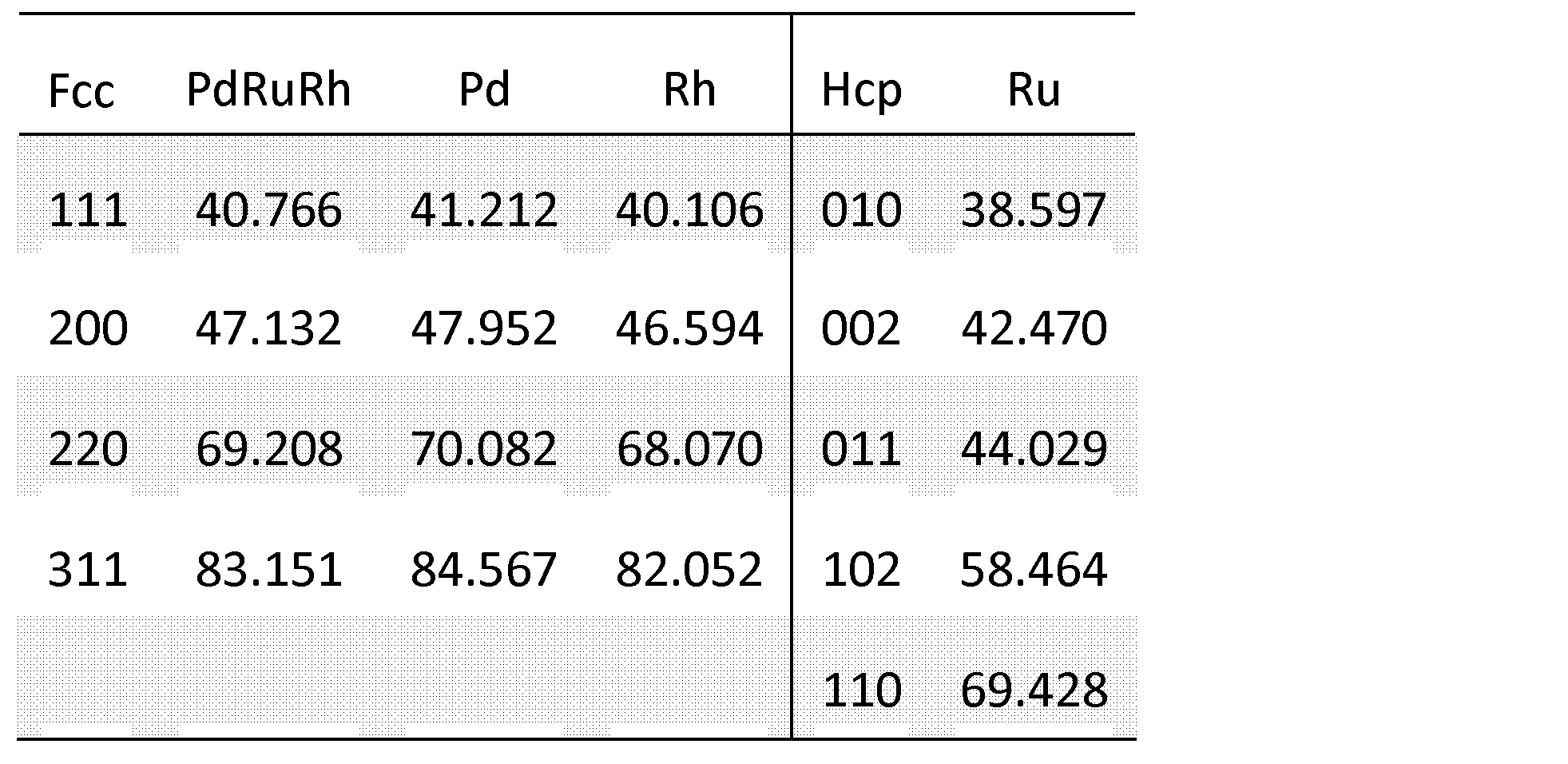
- Pd 1/3 Ru 1/3 Rh 1/3 XRD a single fcc pattern is observed, but the peak position is different from that of a single Pd, Rh, Ru particle, and a solid solution is formed.
- the average particle size of the nanoparticles is 10.3 ⁇ 2.8 nm.
- Durability test 1000 °C ⁇ 10h Fuel Rich atmosphere condition. Pd 1/3 Ru 1/3 Rh 1/3 repeated evaluation of durability against nitrogen oxide reduction reaction. Even when the reaction is repeated, almost no deterioration in activity is observed. Comparison of binary and ternary systems for the reduction of nitrogen oxides. There is a slight change in the initial stage, but T 50 remains almost constant. ⁇ : Pd 0.5 Ru 0.5 2-way-based nanoparticles (second and subsequent reduction activity). ⁇ : Pd 1/3 Ru 1/3 Rh 1/3 (keep active after the second) Pd 1/3 Ru 1/3 Rh 1/3 Cyclic Durability Evaluation for Carbon Monoxide and Hydrocarbon Oxidation Reactions Comparison of catalytic performance with binary system and Rh nanoparticles for the reduction reaction of Pd 1/3 Ru 1/3 Rh 1/3 nitrogen oxides.
- Rh shows a decrease in activity between 1 st and 2 nd , but Pd 1/3 Ru 1/3 Rh 1/3 has a very stable performance and a combined effect, which is very useful for exhaust gas purification catalysts.
- the average particle size of the nanoparticles was 2 to 4 nm.
- HAADF-STEM image and STEM-EDX image of PdRu-Ir nanoparticles Each element of Ru, Pd, and Ir was uniformly distributed in each particle to form a solid solution.
- HAADF-STEM image and STEM-EDX image of PdRu-Pt nanoparticles Each element of Ru, Pd, and Pt was uniformly distributed in each particle to form a solid solution.
- Change in physical properties due to addition of third element Comparison of Ru volatilization between Pd-Ru-Rh and Pd-Ru-Ir in high-temperature oxidizing atmosphere.
- Ru volatilizes as RuO 4 in a high-temperature oxidizing atmosphere, but by using PdRuIr, the durability of Ru was improved to a higher temperature than PdRuRh.
- A XRD pattern,
- TEM image average particle size 3.5 ⁇ 1.4 nm),
- c STEM-EDX ray analysis of PdRuIrRh quaternary solid solution nanoparticles.
- PdRuIrRh solid solution was successfully synthesized.
- Pt is M-line
- Pd, Ru, and Rh are quantified by L-line
- Pd: Ru: Pt: Rh 0.21: 0.21: 0.31: 0.27, error ⁇ 0.02)
- HAADF-STEM image and STEM-EDX image of PdRuAg nanoparticles A solid solution in which each element of Ru, Pd, and Ag was uniformly distributed in each particle was formed.
- TEM image of ternary solid solution nanoparticles Pd 1/3 Ru 1/3 Ag 1/3 ).
- the average particle size of the nanoparticles was 3.6 ⁇ 1.0 nm.
- a solid solution in which the elements of Ru, Pd, and Au were uniformly distributed was formed in each particle.
- TEM image of ternary solid solution nanoparticles Pd 1/3 Ru 1/3 Au 1/3 ). The average particle diameter of the nanoparticles was 5.8 ⁇ 1.9 nm.
- the multi-element solid solution fine particles of the present invention contain Pd and Ru, which are two non-solid solution metals, and are further selected from the group consisting of Rh, Pt, Cu, Ag, Au and Ir as the additional metal (M).
- Pd x Ru y M z M is at least one selected from the group consisting of Rh, Pt, Cu, Ag, Au and Ir.
- the total molar ratio (x + y) of Pd and Ru is preferably 1 to 99%, more preferably 5 to 95%, and still more preferably 10 to 90% of the multi-component solid solution fine particles, and the additional metal (M)
- the molar ratio (z) is preferably 99 to 1%, more preferably 95 to 5%, and still more preferably 90 to 10% of the multicomponent solid solution fine particles.
- M may be one, two, three, four, five or six metals, preferably one, two, three, four or five, more preferably one. 2, 3, or 4, more preferably 1, 2 or 3, particularly preferably 1 or 2.
- M is one kind of metal, it becomes a ternary solid solution fine particle
- M is a combination of two kinds of metal, it becomes a quaternary solid solution fine particle
- M is a combination of three kinds of metals, it is a ternary solid solution fine particle.
- M is a combination of four metals, it becomes a ternary solid solution fine particle.
- M is a combination of five metals, it becomes a ternary solid solution fine particle.
- M consists of two kinds of metals
- a combination of Ir and Rh, a combination of Ir and Pt, and a combination of Rh and Pt are preferable.
- the multi-component solid solution fine particles of the present invention can be used as a catalyst exhibiting excellent performance.
- the carrier to be used is not particularly limited, and specific examples include oxides, nitrides, carbides, simple carbon, simple metal, etc. Among them, oxides and simple carbon are preferable, and oxides Is a particularly preferred carrier.
- oxides examples include oxides such as silica, alumina, ceria, titania, zirconia, and niobium, and composite oxides such as silica-alumina, titania-zirconia, ceria-zirconia, and strontium titanate.
- simple carbon examples include activated carbon, carbon black, graphite, carbon nanotube, and activated carbon fiber.
- nitrides include boron nitride, silicon nitride, gallium nitride, indium nitride, aluminum nitride, zirconium nitride, vanadium nitride, tungsten nitride, molybdenum nitride, titanium nitride, and niobium nitride.
- carbides include silicon carbide, gallium carbide, indium carbide, aluminum carbide, zirconium carbide, vanadium carbide, tungsten carbide, molybdenum carbide, titanium carbide, niobium carbide, and boron carbide.
- the single metal include pure metals such as iron, copper, and aluminum, and alloys such as stainless steel.
- the catalytic reaction in which the multi-component solid solution fine particles of the present invention exhibit excellent performance as a catalyst.
- a reaction generally known by using a catalyst containing a group 8 to group 11 element in the periodic table is mentioned.
- Specific examples include chemical reactions such as reduction reactions including hydrogenation reactions, dehydrogenation reactions, oxidation reactions including combustion, and coupling reactions.
- it can utilize suitably for uses, such as various processes and apparatuses, by utilizing these catalyst performances.
- the applications that can be suitably used.
- the environment / exhaust gas that uses catalytic performance for nitrogen oxide (NOx) reduction reaction, carbon monoxide (CO) oxidation reaction, hydrocarbon oxidation reaction, VOC oxidation reaction, etc.
- catalytic performance for purification applications hydrogen oxidation reaction, oxygen reduction reaction, electrode application utilizing catalytic performance for water electrolysis, hydrogenation reaction of unsaturated hydrocarbons and dehydrogenation reaction of saturated / unsaturated hydrocarbons And chemical process applications.
- it can be more suitably used for exhaust gas purification of automobiles, motorcycles, stationary motors, etc., hydrogen fuel cells, and VOC removal.
- the optimum composition ratio of Pd, Ru and additional metal (M) varies depending on the target catalytic reaction.
- the three-way catalyst means that nitrogen oxides (NOx) are reduced and converted to nitrogen, carbon monoxide (CO) is converted to carbon dioxide, and hydrocarbons are oxidized to form water and carbon dioxide.
- NOx nitrogen oxides
- CO carbon monoxide
- hydrocarbons are oxidized to form water and carbon dioxide.
- the additional metal (M) is a metal that forms a solid solution as a stable phase at 1000 ° C. or less, preferably 600 ° C. or less, more preferably 400 ° C. or less, more preferably room temperature, with a binary alloy system of Pd or Ru, Examples include at least one selected from the group consisting of Rh, Pt, Cu, Ag, Au and Ir, preferably at least one selected from the group consisting of Rh, Cu, Pt and Ir, more preferably Rh, Pt and At least one selected from the group consisting of Ir, particularly Rh.
- Pd and Ru tend to be separated gradually by high-temperature heating for a long time, and Ru tends to volatilize.
- the multicomponent solid solution fine particles of the present invention are used in an endurance test in an exhaust gas purification reaction. Is stable and maintains its structure, and the durability is improved by the additional metal (M).
- the average particle size of the multi-component solid solution fine particles of the present invention is about 1 nm to 120 nm, preferably about 1 nm to 80 nm, more preferably about 1 to 60 nm, and still more preferably about 1 to 30 nm.
- a small average particle size is preferable because the catalyst activity is high.
- the multi-component solid solution fine particles of the present invention are prepared as a mixed aqueous solution containing a water-soluble salt of three or more metals and a liquid reducing agent, and a liquid reducing agent (for example, a polyvalent such as ethylene glycol, glycerin, diethylene glycol, triethylene glycol).
- a liquid reducing agent for example, a polyvalent such as ethylene glycol, glycerin, diethylene glycol, triethylene glycol.
- a mixed aqueous solution containing a water-soluble salt of three or more metals (Pd and Ru, and M (at least one selected from the group consisting of Rh, Cu, Ag, Au, Pt, and Ir)) is added to alcohol and heated.
- multi-component solid solution fine particles containing three or more metals (Pd, Ru, and M) in a solid solution state are obtained. be able to.
- the liquid reducing agent is used in an amount of 1 equivalent or more, preferably an excess amount, for the reduction of the water-soluble salt of 3 or more metals.
- the reaction temperature at the time of heating is about 100 to 300 ° C., for example, about 150 to 250 ° C., which means that one or both of a mixed aqueous solution containing a liquid reducing agent and a water-soluble salt of three metals (Pd, Ru, and M) are used. These may be mixed with heating.
- Fine particles with reduced aggregation can be obtained by adding a protective agent to the reaction solution for producing multi-component solid solution fine particles. Further, by making a carrier coexist in the reaction solution, a supported catalyst in which multi-component solid solution fine particles are supported on the carrier can be obtained. Furthermore, the multi-component solid solution fine particles and the carrier are mixed in a solution or powders in a non-solvent system, and when a solvent is used, the multi-component solid solution fine particles are dried and molded as necessary to form the multi-component solid solution fine particles on the carrier. Can be obtained.
- the molar ratio of the water-soluble Pd salt, Ru salt, and third metal salt is the molar ratio of the resulting multicomponent solid solution fine particles.
- Examples of the water-soluble Pd salt, Ru salt, and third metal salt include the following: Pd: K 2 PdCl 4 , Na 2 PdCl 4 , K 2 PdBr 4 , Na 2 PdBr 4 , palladium nitrate, etc. Ru: RuCl 3 , RuBr 3 and other ruthenium halides, ruthenium nitrate, etc. Rh: Rhodium acetate, rhodium nitrate, rhodium chloride, etc. Pt: K 2 PtCl 4 , (NH 4 ) 2 K 2 PtCl 4 , (NH 4 ) 2 PtCl 6 , Na 2 PtCl 6 etc.
- Au Chloroauric acid, bromoauric acid, gold acetate, etc.
- Ir iridium chloride, iridium acetylacetonate, potassium iridium cyanate, potassium iridate, and the like.
- Ag Silver nitrate, silver acetate, etc.
- Cu Copper sulfate, cuprous chloride, cupric chloride, copper acetate, copper nitrate, etc.
- the protective agent examples include polymers such as poly (N-vinyl-2-pyrrolidone) (PVP) and polyethylene glycol (PEG), amines such as oleylamine, and carboxylic acids such as oleic acid.
- PVP poly(N-vinyl-2-pyrrolidone)
- PEG polyethylene glycol
- amines such as oleylamine
- carboxylic acids such as oleic acid.
- the heat treatment is performed in a state where the multi-component solid solution fine particles are not in contact with each other in order to avoid bonding between the metal fine particles. preferable.
- the multi-component solid solution fine particles of the present invention are particularly useful as a three-way catalyst.
- NOx is reduced to nitrogen
- CO is oxidized to carbon dioxide
- hydrocarbon (CH) is oxidized to water and carbon dioxide.
- Comparative Example 2 200 ml of ethylene glycol is heated and stirred at 196 ° C. To this solution, a solution of rhodium chloride (5.0 mmol) dissolved in 20 ml of ion-exchanged water is added, stirred for 90 minutes and then allowed to cool, and the resulting precipitate is centrifuged. Rh fine particles were separated.
- Test Example 1 Catalytic activity as a three-way catalyst Using Pd 1/3 Ru 1/3 Rh 1/3 alloy fine particles obtained in Example 2 as a catalyst, nitrogen oxide (NOx) reduction reaction, monoxide The catalytic activity for the oxidation reaction of carbon (CO) and the catalytic activity for the oxidation reaction of hydrocarbon (C 3 H 6 ) were simultaneously evaluated. For comparison, Pd 0.5 Ru 0.5 alloy fine particles (Comparative Example 1) and Rh fine particles (Comparative Example 2) supported catalysts were also produced in the same manner.
- the temperature of the catalyst layer at the start of the supply of the mixed gas was room temperature. Included in the collected gas using a multi-gas analyzer (VA-3000 manufactured by Horiba, Ltd.) while increasing the temperature of the catalyst layer from room temperature to 600 ° C. at a rate of temperature increase of 10 ° C./min from the start of supplying the mixed gas.
- the concentrations of NO x , CO and C 3 H 6 were measured continuously at intervals of one point every 30 seconds.
- Durability evaluation was performed by repeatedly measuring to 600 ° C. in the same manner after measuring to 600 ° C., allowing to cool and returning to room temperature.
- FIG. 6 is a graph showing NO x reduction catalytic activity of a noble metal-supported catalyst using Pd 1/3 Ru 1/3 Rh 1/3 fine particles.
- the vertical axis shows the converted ratio of nitrogen oxides. In the first to twentieth measurements, the same behavior was observed, and it was found that there was no decrease in catalyst activity.
- FIG. 7 shows T 50 (° C.) in the reduction reaction of nitrogen oxide (NO x ) read from the graph showing the NO x reduction catalytic activity of the noble metal-supported catalyst using Pd 0.3 Ru 0.3 Rh 0.3 fine particles in FIG. It is a graph to show.
- the vertical axis T 50 (° C.) of the graph represents the temperature at which 50% conversion can be achieved.
- a catalyst using Pd 0.5 Ru 0.5 fine particles was prepared by the same method as described above, and its T 50 was examined. From the graph, the binary Pd 0.5 Ru 0.5 catalyst shows a significant decrease in activity (an increase in T 50 ) in the second time, and it can be seen that the catalyst characteristics are remarkably improved by the addition of Rh.
- the upper part of FIG. 8 is a graph showing the catalytic activity of a noble metal-supported catalyst using Pd 1/3 Ru 1/3 Rh 1/3 fine particles for CO oxidation and CH oxidation reaction.
- the vertical axis shows the converted ratio of CO and CH. In the first to twentieth measurements, the same behavior was observed, and it was found that there was no decrease in catalytic activity as in the NO x reduction reaction.
- the lower part is a graph showing T 50 (° C.) in the CO, CH oxidation reaction, read from the upper graph.
- the vertical axis T 50 (° C.) of the graph represents the temperature at which 50% conversion can be achieved.
- a catalyst using the Pd 0.5 Ru 0.5 fine particles obtained in Comparative Example 1 was prepared by the same method as described above, and its T 50 was examined. From the graph, the binary PdRu catalyst shows a significant decrease in activity (T 50 increase) in the second time, and it can be seen that the catalyst characteristics are significantly improved by the addition of Rh.
- FIG. 9 is a graph showing the NO x reduction catalytic activity of a noble metal supported catalyst using Pd 1/3 Ru 1/3 Rh 1/3 fine particles, Pd 0.5 Ru 0.5 fine particles, and Rh fine particles.
- the vertical axis shows the converted ratio of nitrogen oxides.
- the results of the first and second measurements are shown.
- Pd 0.5 Ru 0.5 and Rh had a decrease in activity at the second time, but Pd 1/3 Ru 1/3 Rh 1/3 had the same behavior as the first time, and it was found that there was no decrease in the catalyst activity.
- Pd 1/3 Ru 1/3 Ir 1/3 3-way System solid solution fine particles were produced.
- the obtained Pd 1/3 Ru 1/3 Ir 1/3 ternary solid solution fine particles were measured for STEM-EDX images and HAADF-STEM images (FIG. 13).
- Pd 1/3 Ru 1/3 Pt 1/3 was used in the same manner as in Example 3 except that K 2 PtCl 4 (0.2 mmol) was used instead of CuSO 4 .5H 2 O (0.2 mmol).
- Ternary solid solution fine particles were produced.
- STEM-EDX images and HAADF-STEM images were measured.
- Test example 2 Pd 1/3 Ru 1/3 Rh 1/3 alloy fine particles obtained in Example 2 and Pd 1/3 Ru 1/3 Ir 1/3 solid solution fine particles obtained in Example 4 were mixed at 600 ° C., 800 ° C. or Firing was carried out at 1000 ° C. for 10 hours in an air atmosphere, and the remaining amount of Ru was measured. The results are shown in FIG. Ru volatilizes as RuO 4 in a high-temperature oxidizing atmosphere, but by using PdRuIr, the durability of Ru was improved to a higher temperature than PdRuRh.
- Example 6 A mixture of 300 ml of triethylene glycol and PVP (10 mmol) was heated and stirred at 225 ° C., and K 2 PdCl 4 (0.25 mmol), RuCl 3 (0.25 mmol), IrCl 4 (0.25 mmol), RhCl 3 (0.25 mmol) was added to this solution. ) was dissolved in 40 ml of ion-exchanged water so as to keep the temperature at 225 ° C. After the spraying, the temperature was kept at 225 ° C. for 10 minutes and then allowed to cool, and the resulting precipitate was separated by centrifugation. XRD pattern (Fig. 16a), TEM image (Fig. 16b), line analysis (Fig. 16c), HAADF-STEM image and STEM-EDX image (Fig. 17) were measured for the separated solid solution PdRuIrRh quaternary solid solution fine particles. .
- Example 7 A mixture of 300 ml of triethylene glycol and PVP (10 mmol) was heated and stirred at 225 ° C., and K 2 PdCl 4 (0.25 mmol), RuCl 3 (0.25 mmol), K 2 PtCl 4 (0.25 mmol), IrCl 4 ( 0.25 mmol) in 40 ml of ion-exchanged water was sprayed so as to keep 225 ° C., and after spraying, 225 ° C. was maintained for 10 minutes and then allowed to cool, and the resulting precipitate was separated by centrifugation.
- XRD pattern Fig. 18a
- TEM image Fig. 18b
- line analysis Fig. 18c
- HAADF-STEM image and STEM-EDX image Fig. 19
- Example 8 A mixture of 300 ml of triethylene glycol and PVP (10 mmol) was heated and stirred at 220 ° C., and K 2 PdCl 4 (0.25 mmol), RuCl 3 (0.25 mmol), K 2 PtCl 4 (0.25 mmol), RhCl 3 ( 0.25 mmol) in 40 ml of ion-exchanged water was sprayed so as to keep 220 ° C. After the spraying, 220 ° C. was maintained for 10 minutes and then allowed to cool, and the resulting precipitate was separated by centrifugation.
- the XRD pattern (Fig. 20a), TEM image (Fig. 20b), line analysis (Fig. 20c), HAADF-STEM image and STEM-EDX image (Fig. 21) were measured for the separated solid solution PdRuPtRh quaternary solid solution fine particles. .
- PdNO 3 0.2 mmol
- Ru (COOCH 3 ) 3 0.2 mmol
- AgNO 3 0.2 mmol
- the catalyst comprising the multi-component solid solution fine particles or multi-component solid solution fine particles of the present invention is useful as an exhaust gas purification catalyst for automobiles, an electrode catalyst for household fuel cells, and the like.
Landscapes
- Chemical & Material Sciences (AREA)
- Engineering & Computer Science (AREA)
- Chemical Kinetics & Catalysis (AREA)
- Materials Engineering (AREA)
- Environmental & Geological Engineering (AREA)
- Organic Chemistry (AREA)
- General Chemical & Material Sciences (AREA)
- Health & Medical Sciences (AREA)
- Analytical Chemistry (AREA)
- Biomedical Technology (AREA)
- Oil, Petroleum & Natural Gas (AREA)
- Combustion & Propulsion (AREA)
- Mechanical Engineering (AREA)
- General Engineering & Computer Science (AREA)
- Inorganic Chemistry (AREA)
- Nanotechnology (AREA)
- Toxicology (AREA)
- Catalysts (AREA)
- Exhaust Gas Treatment By Means Of Catalyst (AREA)
- Manufacture Of Metal Powder And Suspensions Thereof (AREA)
- Powder Metallurgy (AREA)
Abstract
Description
項1. 下記式:
PdxRuyMz(MはRh、Pt、Cu、Ag、Au及びIrからなる群から選ばれる少なくとも1種である。x+y+z=1、x+y=0.01~0.99、z=0.99~0.01、x:y=0.1:0.9~0.9:0.1)
で表される多元系固溶体微粒子。
項2. MがRh、Pt、Cu、Ag、Au及びIrからなる群から選ばれる1種又は2種である、項1に記載の多元系固溶体微粒子。
項3. MがM1 pM2 q(式中、M1とM2は互いに異なって、Rh、Pt、Cu、Ag、Au及びIrからなる群から選ばれる。p=0.01~0.99、q=0.99~0.01、p+q=1)で表される、項1に記載の多元系固溶体微粒子。
項4. M1とM2が、IrとRhの組み合わせ、IrとPtの組み合わせ、RhとPtの組み合わせのいずれかである、項3に記載の多元系固溶体微粒子。
項5. MがRhである、項1に記載の多元系固溶体微粒子。
項6. x+y=0.05~0.95、z=0.95~0.05、x:y=0.15:0.85~0.85:0.15である。項1に記載の多元系固溶体微粒子。
項7. x+y=0.1~0.9、z=0.9~0.1、x:y=0.2:0.8~0.8:0.2である、項1に記載の多元系固溶体微粒子。
項8. 項1~7のいずれか1項に記載の多元系固溶体微粒子を構成要素として含む触媒。
項9. 項8に記載の触媒を担体に担持してなる担持触媒。
項10. 担体が酸化物類を含む担体である、項9に記載の担持触媒。
項11. 排ガス浄化用触媒である、項9に記載の担持触媒。
項12. Rh塩、Pt塩、Cu塩、Ag塩、Au塩及びIr塩からなる群から選ばれる少なくとも1種とPd塩、Ru塩を含む水溶液を150℃~250℃に加熱した液体還元剤に加えて反応させることを特徴とする、項1~7のいずれか1項に記載の多元系固溶体微粒子の製造方法。
項13. Rh塩、Pt塩、Cu塩、Ag塩、Au塩及びIr塩からなる群から選ばれる少なくとも1種とPd塩、Ru塩を含む水溶液および担体を150℃~250℃に加熱した液体還元剤に加えて反応させることを特徴とする、項9又は10に記載の担持触媒の製造方法。
項14. 担体が酸化物類を含む担体である、項13に記載の方法。
PdxRuyMz
(MはRh、Pt、Cu、Ag、Au及びIrからなる群から選ばれる少なくとも1種である。x+y+z=1、x+y=0.01~0.99、z=0.99~0.01、x:y=0.1:0.9~0.9:0.1)で表される多元系固溶体微粒子である。PdとRuの合計のモル比率(x+y)は、多元系固溶体微粒子の好ましくは1~99%、より好ましくは5~95%、さらに好ましくは10~90%であり、追加の金属(M)のモル比率(z)は、多元系固溶体微粒子の好ましくは99~1%、より好ましくは95~5%、さらに好ましくは90~10%である。
Pd: K2PdCl4, Na2PdCl4, K2PdBr4, Na2PdBr4、硝酸パラジウムなど
Ru: RuCl3, RuBr3などのハロゲン化ルテニウム、硝酸ルテニウムなど
Rh: 酢酸ロジウム、硝酸ロジウム、塩化ロジウムなど
Pt: K2PtCl4、(NH4)2K2PtCl4、(NH4)2PtCl6、Na2PtCl6など
Au: 塩化金酸、臭化金酸、酢酸金など。
Ir:塩化イリジウム、イリジウムアセチルアセトナート、イリジウムシアン酸カリウム、イリジウム酸カリウムなど。
Ag:硝酸銀、酢酸銀など
Cu: 硫酸銅、塩化第1銅、塩化第2銅、酢酸銅、硝酸銅など。
トリエチレングリコール300mlを200℃で加熱撹拌し、この溶液にK2PdCl4(0.33mmol)とRuCl3(0.33mmol)と塩化ロジウム(0.33mmol)をイオン交換水40mlに溶かした溶液を加え、200℃で5分間維持した後放冷し、生じた沈殿物を遠心分離により分離した。分離した固溶状態のPd1/3Ru1/3Rh1/33元系固溶体微粒子について、XRDパターン(図1)及びそのピーク位置(表1)、TEM画像(図2)、STEM-EDX画像、HAADF-STEM画像(図3、図4)を測定した。
実施例1で得られた、乾燥後の合金微粒子を所定量秤量し、これを精製水に投入して超音波で処理することによって、合金微粒子の分散液を得た。このとき、秤量する合金微粒子の量は、元素分析によって予め求めた各金属の含有量を元に計算して決定した。この分散液に、800℃で5時間予備焼成したγ-アルミナの粉体(触媒学会参照触媒JRC-ALO8)を加え、マグネットスターラーを用いて12時間撹拌した。撹拌後の液をロータリーエバポレータに移し、減圧下で60℃に加熱し、粉体状になるまで乾燥させた。その後、得られた粉体から完全に水分を除去するため、120℃の乾燥機内に粉体を8時間静置した。乾燥後の粉体を乳鉢で充分に粉砕した後、一軸成形器によって1.2MPa、5分間の条件で円盤状に成形した。得られた成形物を破砕し、その後に篩にかけることによって、直径180~250μmの粒状にした。このようにして、アルミナ粉末にPdRuRh3元系固溶体微粒子が1質量%担持された触媒を得た。得られた触媒について、1000℃×10h、燃料リッチ雰囲気条件で耐久性試験を行った。結果を図5に示す。
トリエチレングリコール300mlを200℃で加熱撹拌し、この溶液にK2PdCl4(0.5mmol)とRuCl3(0.5mmol)をイオン交換水40mlに溶かした溶液を加え、200℃で5分間維持した後放冷し、生じた沈殿物を遠心分離して固溶状態のPd0.5Ru0.52元系固溶体微粒子を分離した。
エチレングリコール200mlを196℃で加熱撹拌し、この溶液に塩化ロジウム(5.0mmol)をイオン交換水20mlに溶かした溶液を加え、90分間加熱攪拌した後、放冷し、生じた沈殿物を遠心分離してRh微粒子を分離した。
実施例2で得られたPd1/3Ru1/3Rh1/3合金微粒子を触媒として用いて、窒素酸化物(NOx)の還元反応、一酸化炭素(CO)の酸化反応に対する触媒活性および炭化水素(C3H6)の酸化反応に対する触媒活性を同時に評価した。また、比較のために、Pd0.5Ru0.5合金微粒子(比較例1)、Rh微粒子(比較例2)担持触媒も同様の方法で作製した。
トリエチレングリコール300ml、PVP(2mmol)、NaOH(10mmol)の混合物を225℃で加熱撹拌し、この溶液にK2PdCl4(0.2mmol)とRuCl3(0.2mmol)とCuSO4・5H2O(0.2mmol)をイオン交換水40mlに溶かした溶液を220℃をキープするようにスプレーし、スプレー後に220℃を10分間維持した後放冷し、生じた沈殿物を遠心分離により分離した。分離した固溶状態のPd1/3Ru1/3Cu1/33元系固溶体微粒子について、STEM-EDX画像及びHAADF-STEM画像(図10)、XRDパターン(図11)及びTEM画像(図12)を測定した。3元系固溶体微粒子の平均粒径は、2~4nmであった。
実施例3において、CuSO4・5H2O(0.2mmol)に代えてIrCl4(0.2mmol)を使用する以外は実施例3と同様にしてPd1/3Ru1/3Ir1/33元系固溶体微粒子を製造した。得られたPd1/3Ru1/3Ir1/33元系固溶体微粒子について、STEM-EDX画像及びHAADF-STEM画像(図13)を測定した。
実施例3において、CuSO4・5H2O(0.2mmol)に代えてK2PtCl4(0.2mmol)を使用する以外は実施例3と同様にしてPd1/3Ru1/3Pt1/33元系固溶体微粒子を製造した。得られたPd1/3Ru1/3Pt1/33元系固溶体微粒子について、STEM-EDX画像及びHAADF-STEM画像(図14)を測定した。
実施例2で得られたPd1/3Ru1/3Rh1/3合金微粒子、実施例4で得られたPd1/3Ru1/3Ir1/3固溶体微粒子を600℃、800℃又は1000℃で10時間空気雰囲気で焼成し、Ruの残量を測定した。結果を図15に示す。Ruは高温酸化雰囲気下でRuO4として揮発してしまうが、PdRuIrとすることで、PdRuRhよりも更に高温までRuの耐久性が向上した。
トリエチレングリコール300ml、PVP(10mmol)の混合物を225℃で加熱撹拌し、この溶液にK2PdCl4(0.25mmol)、RuCl3(0.25mmol)、IrCl4(0.25mmol)、RhCl3(0.25mmol)をイオン交換水40mlに溶かした溶液を225℃をキープするようにスプレーし、スプレー後に225℃を10分間維持した後放冷し、生じた沈殿物を遠心分離により分離した。分離した固溶状態のPdRuIrRh4元系固溶体微粒子について、XRDパターン(図16a)、TEM画像(図16b)、線分析(図16c)、HAADF-STEM画像及びSTEM-EDX画像(図17)を測定した。
トリエチレングリコール300ml、PVP(10mmol)の混合物を225℃で加熱撹拌し、この溶液にK2PdCl4(0.25mmol)、RuCl3(0.25mmol)、K2PtCl4(0.25mmol)、IrCl4(0.25mmol)をイオン交換水40mlに溶かした溶液を225℃をキープするようにスプレーし、スプレー後に225℃を10分間維持した後放冷し、生じた沈殿物を遠心分離により分離した。分離した固溶状態のPdRuIrPt4元系固溶体微粒子について、XRDパターン(図18a)、TEM画像(図18b)、線分析(図18c)、HAADF-STEM画像及びSTEM-EDX画像(図19)を測定した。
トリエチレングリコール300ml、PVP(10mmol)の混合物を220℃で加熱撹拌し、この溶液にK2PdCl4(0.25mmol)、RuCl3(0.25mmol)、K2PtCl4(0.25mmol)、RhCl3(0.25mmol)をイオン交換水40mlに溶かした溶液を220℃をキープするようにスプレーし、スプレー後に220℃を10分間維持した後放冷し、生じた沈殿物を遠心分離により分離した。分離した固溶状態のPdRuPtRh4元系固溶体微粒子について、XRDパターン(図20a)、TEM画像(図20b)、線分析(図20c)、HAADF-STEM画像及びSTEM-EDX画像(図21)を測定した。
トリエチレングリコール100ml、PVP(0.6mmol)の混合物を210℃で加熱撹拌し、この溶液にPdNO3(0.2mmol)とRu(COOCH3)3(0.2mmol)とAgNO3(0.2mmol)をイオン交換水10mlに溶かした溶液を210℃をキープするように1.0ml/minでシリンジポンプにより滴下し、滴下後に210℃を10分間維持した後放冷し、生じた沈殿物を遠心分離により分離した。分離した固溶状態のPd1/3Ru1/3Ag1/33元系固溶体微粒子について、STEM-EDX画像及びHAADF-STEM画像(図22)、XRDパターン(図23)及びTEM画像(図24)を測定した。3元系固溶体微粒子の平均粒径は、3.6±1.0nmであった。
トリエチレングリコール150ml、PVP(1mmol)の混合物を225℃で加熱撹拌し、この溶液にK2PdCl4(0.1mmol)とRuCl3(0.1mmol)とHAuCl4(0.1mmol)をイオン交換水20mlに溶かした溶液を225℃をキープするようにスプレーし、スプレー後に225℃を10分間維持した後放冷し、生じた沈殿物を遠心分離により分離した。分離した固溶状態のPd1/3Ru1/3Au1/33元系固溶体微粒子について、STEM-EDX画像及びHAADF-STEM画像(図25)、XRDパターン(図26)及びTEM画像(図27)を測定した。3元系固溶体微粒子の平均粒径は、5.8±1.9nmであった。
Claims (14)
- 下記式:
PdxRuyMz(MはRh、Pt、Cu、Ag、Au及びIrからなる群から選ばれる少なくとも1種である。x+y+z=1、x+y=0.01~0.99、z=0.99~0.01、x:y=0.1:0.9~0.9:0.1)
で表される多元系固溶体微粒子。 - MがRh、Pt、Cu、Ag、Au及びIrからなる群から選ばれる1種又は2種である、請求項1に記載の多元系固溶体微粒子。
- MがM1 pM2 q(式中、M1とM2は互いに異なって、Rh、Pt、Cu、Ag、Au及びIrからなる群から選ばれる。p=0.01~0.99、q=0.99~0.01、p+q=1)で表される、請求項1に記載の多元系固溶体微粒子。
- M1とM2が、IrとRhの組み合わせ、IrとPtの組み合わせ、RhとPtの組み合わせのいずれかである、請求項3に記載の多元系固溶体微粒子。
- MがRhである、請求項1に記載の多元系固溶体微粒子。
- x+y=0.05~0.95、z=0.95~0.05、x:y=0.15:0.85~0.85:0.15である。請求項1に記載の多元系固溶体微粒子。
- x+y=0.1~0.9、z=0.9~0.1、x:y=0.2:0.8~0.8:0.2である、請求項1に記載の多元系固溶体微粒子。
- 請求項1~7のいずれか1項に記載の多元系固溶体微粒子を構成要素として含む触媒。
- 請求項8に記載の触媒を担体に担持してなる担持触媒。
- 担体が酸化物類を含む担体である、請求項9に記載の担持触媒。
- 排ガス浄化用触媒である、請求項9に記載の担持触媒。
- Rh塩、Pt塩、Cu塩、Ag塩、Au塩及びIr塩からなる群から選ばれる少なくとも1種とPd塩、Ru塩を含む水溶液を150℃~250℃に加熱した液体還元剤に加えて反応させることを特徴とする、請求項1~7のいずれか1項に記載の多元系固溶体微粒子の製造方法。
- Rh塩、Pt塩、Cu塩、Ag塩、Au塩及びIr塩からなる群から選ばれる少なくとも1種とPd塩、Ru塩を含む水溶液および担体を150℃~250℃に加熱した液体還元剤に加えて反応させることを特徴とする、請求項9又は10に記載の担持触媒の製造方法。
- 担体が酸化物類を含む担体である、請求項13に記載の方法。
Priority Applications (3)
| Application Number | Priority Date | Filing Date | Title |
|---|---|---|---|
| EP17760060.8A EP3424619A4 (en) | 2016-03-03 | 2017-03-01 | MULTI-COMPONENT SOLIDS SOLUTION MICROPARTICLES AND METHOD FOR THE PRODUCTION THEREOF AND CATALYST |
| US16/081,916 US10639723B2 (en) | 2016-03-03 | 2017-03-01 | Multicomponent solid solution microparticles and method for producing same, and catalyst |
| JP2018503364A JP6855073B2 (ja) | 2016-03-03 | 2017-03-01 | 多元系固溶体微粒子及びその製造方法並びに触媒 |
Applications Claiming Priority (2)
| Application Number | Priority Date | Filing Date | Title |
|---|---|---|---|
| JP2016040763 | 2016-03-03 | ||
| JP2016-040763 | 2016-03-03 |
Publications (1)
| Publication Number | Publication Date |
|---|---|
| WO2017150596A1 true WO2017150596A1 (ja) | 2017-09-08 |
Family
ID=59744223
Family Applications (1)
| Application Number | Title | Priority Date | Filing Date |
|---|---|---|---|
| PCT/JP2017/008058 Ceased WO2017150596A1 (ja) | 2016-03-03 | 2017-03-01 | 多元系固溶体微粒子及びその製造方法並びに触媒 |
Country Status (4)
| Country | Link |
|---|---|
| US (1) | US10639723B2 (ja) |
| EP (1) | EP3424619A4 (ja) |
| JP (1) | JP6855073B2 (ja) |
| WO (1) | WO2017150596A1 (ja) |
Cited By (6)
| Publication number | Priority date | Publication date | Assignee | Title |
|---|---|---|---|---|
| WO2019131744A1 (ja) * | 2017-12-26 | 2019-07-04 | 国立大学法人京都大学 | 異方性ナノ構造体及びその製造方法並びに触媒 |
| WO2020262121A1 (ja) * | 2019-06-26 | 2020-12-30 | 株式会社フルヤ金属 | 担持触媒合成装置及び微粒子合成装置 |
| JPWO2021020377A1 (ja) * | 2019-07-29 | 2021-02-04 | ||
| WO2021132335A1 (ja) * | 2019-12-27 | 2021-07-01 | 国立大学法人京都大学 | 固溶体ナノ粒子、その製造方法、固溶体ナノ粒子の分散液及び触媒 |
| JP2022068119A (ja) * | 2020-10-21 | 2022-05-09 | Agc株式会社 | 1-クロロ-2,3,3,3-テトラフルオロプロペンの製造方法 |
| US12227821B2 (en) | 2020-07-06 | 2025-02-18 | Kyoto University | Alloy of at least three metal elements, aggregate of alloy nanoparticles, and catalyst |
Families Citing this family (3)
| Publication number | Priority date | Publication date | Assignee | Title |
|---|---|---|---|---|
| EP3825440A1 (de) * | 2020-10-28 | 2021-05-26 | Heraeus Deutschland GmbH & Co KG | Verfahren zur herstellung eines mit elementarem silber und elementarem ruthenium ausgestatteten partikelförmigen trägermaterials |
| CN113084187A (zh) * | 2021-04-01 | 2021-07-09 | 合肥工业大学 | 一种金银钯三金属过氧化物模拟酶的制备方法及其应用 |
| US20250116019A1 (en) * | 2023-10-09 | 2025-04-10 | Mattiq, Inc. | Mixed metal iridium ruthenium molybdenum electrocatalysts |
Citations (2)
| Publication number | Priority date | Publication date | Assignee | Title |
|---|---|---|---|---|
| JPH024448A (ja) * | 1988-01-22 | 1990-01-09 | Bayer Ag | ルテニウムの支持された触媒、その製造方法及びその使用 |
| WO2014045570A1 (ja) * | 2012-09-18 | 2014-03-27 | 独立行政法人科学技術振興機構 | PdRu固溶体型合金微粒子を用いた触媒 |
Family Cites Families (5)
| Publication number | Priority date | Publication date | Assignee | Title |
|---|---|---|---|---|
| JP5177339B2 (ja) | 2005-09-30 | 2013-04-03 | 関東化学株式会社 | 金属ナノ粒子、それを含む触媒及びアルキン化合物の水素化方法 |
| WO2010002486A2 (en) * | 2008-03-27 | 2010-01-07 | Umicore Ag& Co.Kg | Continuous diesel soot control with minimal back pressure penality using conventional flow substrates and active direct soot oxidation catalyst disposed thereon |
| CN102458727B (zh) | 2009-04-24 | 2015-05-06 | 独立行政法人科学技术振兴机构 | 固溶体型合金微粒及其制造方法 |
| DE102010029966A1 (de) * | 2009-06-10 | 2010-12-16 | Wieland Kg | Verbesserter Elektrokatalysator, Brennstoffzellen-Kathode und Brennstoffzelle |
| US8475755B2 (en) * | 2009-08-21 | 2013-07-02 | Sub-Chemie Inc. | Oxidation catalyst and method for destruction of CO, VOC and halogenated VOC |
-
2017
- 2017-03-01 WO PCT/JP2017/008058 patent/WO2017150596A1/ja not_active Ceased
- 2017-03-01 EP EP17760060.8A patent/EP3424619A4/en active Pending
- 2017-03-01 JP JP2018503364A patent/JP6855073B2/ja active Active
- 2017-03-01 US US16/081,916 patent/US10639723B2/en active Active
Patent Citations (2)
| Publication number | Priority date | Publication date | Assignee | Title |
|---|---|---|---|---|
| JPH024448A (ja) * | 1988-01-22 | 1990-01-09 | Bayer Ag | ルテニウムの支持された触媒、その製造方法及びその使用 |
| WO2014045570A1 (ja) * | 2012-09-18 | 2014-03-27 | 独立行政法人科学技術振興機構 | PdRu固溶体型合金微粒子を用いた触媒 |
Non-Patent Citations (1)
| Title |
|---|
| See also references of EP3424619A4 * |
Cited By (21)
| Publication number | Priority date | Publication date | Assignee | Title |
|---|---|---|---|---|
| JP7262779B2 (ja) | 2017-12-26 | 2023-04-24 | 国立大学法人京都大学 | 異方性ナノ構造体及びその製造方法並びに触媒 |
| JPWO2019131744A1 (ja) * | 2017-12-26 | 2021-01-07 | 国立大学法人京都大学 | 異方性ナノ構造体及びその製造方法並びに触媒 |
| WO2019131744A1 (ja) * | 2017-12-26 | 2019-07-04 | 国立大学法人京都大学 | 異方性ナノ構造体及びその製造方法並びに触媒 |
| US11511262B2 (en) | 2017-12-26 | 2022-11-29 | Kyoto University | Anisotropic nanostructure, production method therefor, and catalyst |
| WO2020262121A1 (ja) * | 2019-06-26 | 2020-12-30 | 株式会社フルヤ金属 | 担持触媒合成装置及び微粒子合成装置 |
| JPWO2020262121A1 (ja) * | 2019-06-26 | 2020-12-30 | ||
| JP7726494B2 (ja) | 2019-06-26 | 2025-08-20 | 株式会社フルヤ金属 | 担持触媒合成装置 |
| US12330145B2 (en) | 2019-06-26 | 2025-06-17 | Furuya Metal Co., Ltd. | Supported catalyst synthesis device and fine particle synthesis device |
| JP2024150565A (ja) * | 2019-06-26 | 2024-10-23 | 株式会社フルヤ金属 | 担持触媒合成装置 |
| CN114051431A (zh) * | 2019-06-26 | 2022-02-15 | 株式会社古屋金属 | 负载型催化剂合成装置及微粒子合成装置 |
| JP7524179B2 (ja) | 2019-06-26 | 2024-07-29 | 株式会社フルヤ金属 | 担持触媒合成装置及び微粒子合成装置 |
| WO2021020377A1 (ja) * | 2019-07-29 | 2021-02-04 | 国立大学法人京都大学 | 合金ナノ粒子、合金ナノ粒子の集合体、触媒および合金ナノ粒子の製造方法 |
| JP7618231B2 (ja) | 2019-07-29 | 2025-01-21 | 国立大学法人京都大学 | 合金ナノ粒子、合金ナノ粒子の集合体、触媒および合金ナノ粒子の製造方法 |
| US12325903B2 (en) | 2019-07-29 | 2025-06-10 | Kyoto University | Alloy nanoparticle, aggregate of alloy nanoparticles, catalyst, and method for producing alloy nanoparticles |
| JPWO2021020377A1 (ja) * | 2019-07-29 | 2021-02-04 | ||
| JPWO2021132335A1 (ja) * | 2019-12-27 | 2021-07-01 | ||
| WO2021132335A1 (ja) * | 2019-12-27 | 2021-07-01 | 国立大学法人京都大学 | 固溶体ナノ粒子、その製造方法、固溶体ナノ粒子の分散液及び触媒 |
| JP7716711B2 (ja) | 2019-12-27 | 2025-08-01 | 国立大学法人京都大学 | 固溶体ナノ粒子、その製造方法、固溶体ナノ粒子の分散液及び触媒 |
| US12227821B2 (en) | 2020-07-06 | 2025-02-18 | Kyoto University | Alloy of at least three metal elements, aggregate of alloy nanoparticles, and catalyst |
| JP2022068119A (ja) * | 2020-10-21 | 2022-05-09 | Agc株式会社 | 1-クロロ-2,3,3,3-テトラフルオロプロペンの製造方法 |
| JP7719333B2 (ja) | 2020-10-21 | 2025-08-06 | Agc株式会社 | 1-クロロ-2,3,3,3-テトラフルオロプロペンの製造方法 |
Also Published As
| Publication number | Publication date |
|---|---|
| EP3424619A1 (en) | 2019-01-09 |
| EP3424619A4 (en) | 2019-10-09 |
| US10639723B2 (en) | 2020-05-05 |
| JP6855073B2 (ja) | 2021-04-07 |
| US20200001370A1 (en) | 2020-01-02 |
| JPWO2017150596A1 (ja) | 2019-02-28 |
Similar Documents
| Publication | Publication Date | Title |
|---|---|---|
| JP6855073B2 (ja) | 多元系固溶体微粒子及びその製造方法並びに触媒 | |
| EP1954393B1 (en) | Highly dispersed metal calatysts | |
| KR101733900B1 (ko) | PdRu 고용체형 합금 미립자를 이용한 촉매 | |
| US9115621B2 (en) | Metal particles, exhaust gas purifying catalyst comprising metal particles, and methods for producing them | |
| JP6284097B2 (ja) | 触媒の製造方法 | |
| JP2011089143A (ja) | 一元系及び二元系の立方体型金属ナノ粒子の製造方法 | |
| CN103586022A (zh) | 室温条件下高效同步催化氧化低浓度气相甲醛、一氧化碳和氢气的催化剂及其制备方法 | |
| CN103143353A (zh) | 一种经还原处理的钯催化剂的制备方法 | |
| CN102744063B (zh) | 一种钯催化剂的生物还原制备方法 | |
| CN107626317B (zh) | 一种Ce基氧化物催化剂及其制备与应用 | |
| WO2016039361A1 (ja) | 合金微粒子とその製造方法、合金微粒子群並びに触媒及びその製造方法 | |
| JP4686316B2 (ja) | 触媒の製造方法 | |
| JP7716711B2 (ja) | 固溶体ナノ粒子、その製造方法、固溶体ナノ粒子の分散液及び触媒 | |
| US8987166B2 (en) | Preparation of cerium oxide-supported nano gold-silver catalysts and its application in carbon monoxide removal in air | |
| JP6719363B2 (ja) | メタン酸化除去用触媒の製造方法およびメタン酸化除去用触媒 | |
| WO2007037159A1 (ja) | 貴金属触媒の製造方法 | |
| CN101309866B (zh) | 贵金属氧化物的制备方法及其组成的储氧材料和触媒系统 | |
| JP6306468B2 (ja) | Pd及びAuを含有する異種金属多核錯体の製造方法 | |
| JP6413821B2 (ja) | 排ガス浄化用又は燃料電池電極用触媒の製造方法及び排ガス浄化用又は燃料電池電極用触媒 | |
| JP2004066003A (ja) | 燃料改質ガスの水性ガスシフト反応用触媒 | |
| JP2012055857A (ja) | 排ガス浄化用触媒 | |
| JP2024170684A (ja) | 担持触媒の作製方法 | |
| CN121588855A (zh) | 一种多组分结构化催化剂及其制备方法和在锅炉烟气污染物净化中的应用 | |
| CN111185160A (zh) | 负载的金催化剂制备及在二氧化碳加氢制乙醇中的应用 |
Legal Events
| Date | Code | Title | Description |
|---|---|---|---|
| WWE | Wipo information: entry into national phase |
Ref document number: 2018503364 Country of ref document: JP |
|
| NENP | Non-entry into the national phase |
Ref country code: DE |
|
| WWE | Wipo information: entry into national phase |
Ref document number: 2017760060 Country of ref document: EP |
|
| ENP | Entry into the national phase |
Ref document number: 2017760060 Country of ref document: EP Effective date: 20181004 |
|
| 121 | Ep: the epo has been informed by wipo that ep was designated in this application |
Ref document number: 17760060 Country of ref document: EP Kind code of ref document: A1 |