WO2017152577A1 - 多节指套式探头 - Google Patents
多节指套式探头 Download PDFInfo
- Publication number
- WO2017152577A1 WO2017152577A1 PCT/CN2016/094777 CN2016094777W WO2017152577A1 WO 2017152577 A1 WO2017152577 A1 WO 2017152577A1 CN 2016094777 W CN2016094777 W CN 2016094777W WO 2017152577 A1 WO2017152577 A1 WO 2017152577A1
- Authority
- WO
- WIPO (PCT)
- Prior art keywords
- finger
- sleeve
- knuckle
- type probe
- section
- Prior art date
- Legal status (The legal status is an assumption and is not a legal conclusion. Google has not performed a legal analysis and makes no representation as to the accuracy of the status listed.)
- Ceased
Links
Images


Classifications
-
- A—HUMAN NECESSITIES
- A61—MEDICAL OR VETERINARY SCIENCE; HYGIENE
- A61B—DIAGNOSIS; SURGERY; IDENTIFICATION
- A61B5/00—Measuring for diagnostic purposes; Identification of persons
- A61B5/145—Measuring characteristics of blood in vivo, e.g. gas concentration or pH-value ; Measuring characteristics of body fluids or tissues, e.g. interstitial fluid or cerebral tissue
- A61B5/1455—Measuring characteristics of blood in vivo, e.g. gas concentration or pH-value ; Measuring characteristics of body fluids or tissues, e.g. interstitial fluid or cerebral tissue using optical sensors, e.g. spectral photometrical oximeters
- A61B5/14551—Measuring characteristics of blood in vivo, e.g. gas concentration or pH-value ; Measuring characteristics of body fluids or tissues, e.g. interstitial fluid or cerebral tissue using optical sensors, e.g. spectral photometrical oximeters for measuring blood gases
-
- A—HUMAN NECESSITIES
- A61—MEDICAL OR VETERINARY SCIENCE; HYGIENE
- A61B—DIAGNOSIS; SURGERY; IDENTIFICATION
- A61B5/00—Measuring for diagnostic purposes; Identification of persons
- A61B5/68—Arrangements of detecting, measuring or recording means, e.g. sensors, in relation to patient
- A61B5/6801—Arrangements of detecting, measuring or recording means, e.g. sensors, in relation to patient specially adapted to be attached to or worn on the body surface
- A61B5/6813—Specially adapted to be attached to a specific body part
- A61B5/6825—Hand
- A61B5/6826—Finger
-
- A—HUMAN NECESSITIES
- A61—MEDICAL OR VETERINARY SCIENCE; HYGIENE
- A61B—DIAGNOSIS; SURGERY; IDENTIFICATION
- A61B5/00—Measuring for diagnostic purposes; Identification of persons
- A61B5/08—Measuring devices for evaluating the respiratory organs
- A61B5/0826—Detecting or evaluating apnoea events
-
- A—HUMAN NECESSITIES
- A61—MEDICAL OR VETERINARY SCIENCE; HYGIENE
- A61B—DIAGNOSIS; SURGERY; IDENTIFICATION
- A61B5/00—Measuring for diagnostic purposes; Identification of persons
- A61B5/145—Measuring characteristics of blood in vivo, e.g. gas concentration or pH-value ; Measuring characteristics of body fluids or tissues, e.g. interstitial fluid or cerebral tissue
- A61B5/1455—Measuring characteristics of blood in vivo, e.g. gas concentration or pH-value ; Measuring characteristics of body fluids or tissues, e.g. interstitial fluid or cerebral tissue using optical sensors, e.g. spectral photometrical oximeters
- A61B5/14551—Measuring characteristics of blood in vivo, e.g. gas concentration or pH-value ; Measuring characteristics of body fluids or tissues, e.g. interstitial fluid or cerebral tissue using optical sensors, e.g. spectral photometrical oximeters for measuring blood gases
- A61B5/14552—Details of sensors specially adapted therefor
-
- A—HUMAN NECESSITIES
- A61—MEDICAL OR VETERINARY SCIENCE; HYGIENE
- A61B—DIAGNOSIS; SURGERY; IDENTIFICATION
- A61B5/00—Measuring for diagnostic purposes; Identification of persons
- A61B5/48—Other medical applications
- A61B5/4806—Sleep evaluation
- A61B5/4809—Sleep detection, i.e. determining whether a subject is asleep or not
-
- A—HUMAN NECESSITIES
- A61—MEDICAL OR VETERINARY SCIENCE; HYGIENE
- A61B—DIAGNOSIS; SURGERY; IDENTIFICATION
- A61B5/00—Measuring for diagnostic purposes; Identification of persons
- A61B5/68—Arrangements of detecting, measuring or recording means, e.g. sensors, in relation to patient
- A61B5/6801—Arrangements of detecting, measuring or recording means, e.g. sensors, in relation to patient specially adapted to be attached to or worn on the body surface
- A61B5/683—Means for maintaining contact with the body
- A61B5/6835—Supports or holders, e.g., articulated arms
-
- A—HUMAN NECESSITIES
- A61—MEDICAL OR VETERINARY SCIENCE; HYGIENE
- A61B—DIAGNOSIS; SURGERY; IDENTIFICATION
- A61B2562/00—Details of sensors; Constructional details of sensor housings or probes; Accessories for sensors
- A61B2562/02—Details of sensors specially adapted for in-vivo measurements
- A61B2562/0233—Special features of optical sensors or probes classified in A61B5/00
- A61B2562/0238—Optical sensor arrangements for performing transmission measurements on body tissue
-
- A—HUMAN NECESSITIES
- A61—MEDICAL OR VETERINARY SCIENCE; HYGIENE
- A61B—DIAGNOSIS; SURGERY; IDENTIFICATION
- A61B2562/00—Details of sensors; Constructional details of sensor housings or probes; Accessories for sensors
- A61B2562/16—Details of sensor housings or probes; Details of structural supports for sensors
-
- A—HUMAN NECESSITIES
- A61—MEDICAL OR VETERINARY SCIENCE; HYGIENE
- A61B—DIAGNOSIS; SURGERY; IDENTIFICATION
- A61B2562/00—Details of sensors; Constructional details of sensor housings or probes; Accessories for sensors
- A61B2562/22—Arrangements of medical sensors with cables or leads; Connectors or couplings specifically adapted for medical sensors
- A61B2562/221—Arrangements of sensors with cables or leads, e.g. cable harnesses
- A61B2562/222—Electrical cables or leads therefor, e.g. coaxial cables or ribbon cables
-
- A—HUMAN NECESSITIES
- A61—MEDICAL OR VETERINARY SCIENCE; HYGIENE
- A61B—DIAGNOSIS; SURGERY; IDENTIFICATION
- A61B5/00—Measuring for diagnostic purposes; Identification of persons
- A61B5/48—Other medical applications
- A61B5/4806—Sleep evaluation
- A61B5/4818—Sleep apnoea
Definitions
- the invention relates to the field of medical instruments, in particular to a multi-section finger-type probe.
- Oxygen saturation is one of the clinically important physiological parameters.
- the blood oxygen saturation measuring instrument using the photoelectric principle is generally used for measurement, wherein the blood oxygen probe, that is, the blood oxygen saturation sensor is a core component of the blood oxygen saturation measuring instrument.
- the common measuring part is the finger
- the common use part of the blood oxygen probe is the finger
- the sensor used for the finger part is generally transmissive, that is, the light emitting tube and the receiving tube are respectively in contact with the nail and the finger pad.
- the light emitted by the light-emitting tube passes through the nail and is received by the receiving tube on the fingertip side.
- Reflective sensors are also used when measuring oxygen saturation in other locations. Due to the abundant blood flow on the finger, the most commonly used measurement site is the finger.
- finger-clip oximetry probe such as CN201079393Y
- sleeve type blood oxygen probe such as CN201098122Y
- wrapped blood oxygen probe such as CN301554262
- paste blood oxygen probe such as CN203169184
- the finger-type blood oxygen probe is fixed in the silicone sleeve by using the light-emitting and receiving components, and the silicone sleeve is sleeved on the finger for measurement.
- a conventional finger-type blood oxygen probe is flat, narrower on the upper and lower sides, and wide on both sides. When used, it only touches the finger on the back of the finger and the fingertip, on both sides of the finger.
- the thickening feature, the inner cavity accommodating the finger is enlarged from the fingertip to the V-shape, and since the light-emitting tube and the receiving tube are located at the nail of the first knuckle, the wall thickness is relatively thick.
- the thickness is often increased at the edge of the fingertip (where the finger is extended), with a lip or a protrusion, or as shown in Figure 1 of CN103481443. Increase the thickness on the left and right sides of the finger sleeve to strengthen the clamping force.
- the existing finger-type blood oxygen probe is easy to fall off during use, because under the same contact force, the existing finger-type blood oxygen probe only contacts the finger on the back of the finger and the fingertip, two There is a large gap on the side, the finger can move in the left and right direction in the finger sleeve, and because the contact area is small, the frictional resistance between the finger and the probe is small, and it is easy to fall off; the second is as shown in Figure 5 of CN201333039Y and 150-A of Figure 1 of CN2785542Y.
- the existing finger-type blood oxygen probe has a small contact area with the finger, and in order to ensure that it is not easy to fall off, the overall or partial design of the finger sleeve is relatively thick or the material is relatively hard so as to generate sufficient elastic force or squeezing force.
- the existing finger-type blood oxygen probe is a whole section, which is a non-sectioned structure, which does not match the finger of the segment, because the finger back and the finger-neck are pressed by the finger, which is equivalent to the finger being Finger sleeve fixed at Straight position, so the fingers are not easy to bend, and experience tells us that the straight fingers are easier to fall off from the finger cuffs compared with the curved fingers;
- the fifth is as shown in 107A of CN201333039Y, due to the illumination and receiving components
- the trace line is mainly distributed on the flat sides of the silicone sleeve, so the thickening ridge is required at the trace.
- the internal trace is a metal wire, which is harder than the silica gel. Therefore, it is relatively worn when worn. A hard bulge will oppress the fingers on both sides, resulting in poor comfort.
- the existing finger-type oximeter has an opening at the rear end of the finger for the finger to enter the finger cot, and an opening at the front end for the nail to stick out.
- the opening is not large, and although there is a gap between the two sides and the finger, the air flow in the gap is poor, and when the use time is long, sweat will remain on the finger contacting the finger sleeve, and the comfort is poor, and it is easy to fall off;
- the existing finger cot is a whole section, and the two knuckles cannot be distinguished when designing and using.
- the pressure of the first knuckle and the second knuckle of the finger is the same or similar to that of the second knuckle, and the light tube and the receiving tube are often lie in One knuckle, if the pressure of the finger is strengthened by the whole finger cot to prevent falling off, it may cause the blood supply of the first knuckle to weaken, affecting the measurement; eighth, the existing finger cot is V-shaped, the front end is small, and the back end is small.
- this design looks ergonomic, but in fact, because each person's finger shape is different, the thickness of the two knuckles does not change, so there may be some people second knuckle Relatively thin, in this way, if the existing finger cot is used, the clamping force of the first knuckle is relatively large, and the clamping force of the second knuckle is relatively small, which is easy to fall off and uneven force. The comfort is poor.
- Sleep respiration monitoring is an essential measure for the diagnosis, monitoring and treatment of patients with sleep apnea syndrome. Sleep-respiratory monitoring patients often need to be monitored during sleep, sometimes in the home, so there is a high demand for which blood oxygen probes to use. During sleep, the patient's fingers may move involuntarily, which may cause the sensor to fall off and shift, thereby affecting the measurement. If it is applied in the family, because there is no guidance from doctors and nurses, how to conveniently and reliably place it is the key to measuring success or failure. Although the existing finger-type blood oxygen probe can be repeatedly used, it is unreliable on the finger, and is easy to fall off during sleep. The comfort during use is poor and needs to be improved.
- the object of the present invention is to provide a multi-section finger-type probe with reasonable structural design, stable and not easy to fall off when worn, and suitable for long-term use.
- the present invention provides a multi-section finger-type probe, comprising a finger sleeve body, a flexible cable mounted on the inner side of the finger sleeve body, and a light-emitting device mounted on the inner side of the finger sleeve body and electrically connected to one end of the flexible cable.
- the finger sleeve body has a cylindrical shape with a lower end open, and the multi-section finger-type probe is worn on the finger through the lower end opening of the finger sleeve body, and the front and rear sides of the finger sleeve body respectively correspond to the finger touching the finger.
- the back and the fingerbone, the left and right sides respectively correspond to the left and right sides of the finger, and the finger sleeve body respectively wraps around the finger, and the finger sleeve body includes the connected end knuckles and the middle finger respectively corresponding to the fingers from top to bottom The first knuckle sleeve and the second knuckle sleeve.
- the back side of the finger sleeve body is provided with a bending structure between the first knuckle sleeve and the second knuckle sleeve, so that when the multi-section finger-type probe is worn on the finger, the finger is bent easily.
- the bent structure is a gap or a groove.
- the inner diameter of the second knuckle sleeve is less than or equal to the inner diameter of the first knuckle sleeve
- the inner diameter of the second knuckle sleeve refers to an inner diameter when the second knuckle sleeve is expanded into a circular shape without elastic deformation
- the inner diameter of the first knuckle sleeve refers to the first finger
- the front and rear sides of the finger sleeve body are respectively provided with a mounting slot, and the light emitting tube and the receiving tube are fixed to the receiving tube Inside the installation slot.
- the finger sleeve body is further provided with a wire trough extending from the upper end of the finger sleeve body to the two sides to each of the mounting slots, and the soft cable is fixed in the wire trough.
- a wire slot for mounting a wire is also disposed in the front side of the finger sleeve body.
- the wire slot extends upward from a lower end of the second finger sleeve to a mounting groove on a front side of the first knuckle sleeve.
- the wire slot extends upward from a central portion of the second finger cuff to a mounting groove on a front side of the first knuckle sleeve.
- the wire slot extends upward from the first knuckle sleeve to a mounting groove on the front side of the first knuckle sleeve.
- the wall thickness of the left side surface, the right side surface, and the rear side surface of the second finger sleeve is uniform.
- each side surface of the second finger sleeve is uniform.
- the average wall thickness of the left side surface, the right side surface, and the rear side surface of the second finger sleeve is 0.01 mm - 0.1 mm, 0.1 mm - 0.5 mm, or 0.5 mm - 1.0 mm.
- the average wall thickness of each side surface of the second finger sleeve is 0.01 mm-0.1 mm, 0.1 mm-0.5 mm, or 0.5 mm-1.0 mm.
- the finger sleeve body has a mounting area and a non-mounting area connected to the mounting area, and the light-emitting tube, the receiving tube, the flexible cable, and the wire are mounted on the mounting area of the finger body,
- the average wall thickness of the non-installed area of the second finger cuff is less than or equal to the average wall thickness of the non-installed area of the first cuff.
- the wire trough is disposed on an inner side of the finger sleeve body, and the soft wire is routed on an inner side of the finger cuff body.
- the wire trough is disposed on an outer side of the finger sleeve body, and the soft wire is routed on an outer side of the finger cuff body.
- the opening of the mounting groove is located on the inner side or the outer side of the finger sleeve body.
- a first window is disposed on the left and right sides of the first knuckle sleeve for increasing the elasticity and air permeability of the finger cot body.
- a second window is disposed on the left and right sides of the second knuckle sleeve for increasing the elasticity and air permeability of the finger cot body.
- the material of the finger sleeve body is an elastic material.
- the multi-section finger-type probe is used for measuring blood oxygen saturation.
- the present invention provides a multi-section finger-type probe, comprising a finger sleeve body, a flexible cable mounted on the finger sleeve body, an illumination tube, a receiving tube, and an electrical connection with the flexible cable.
- Wire The finger sleeve body has a cylindrical shape with a lower end open, and the soft cable line spans the upper end of the finger sleeve body, and the two ends thereof are respectively located on the front and rear sides of the finger sleeve body corresponding to the finger back and the finger pad of the finger.
- the light-emitting tube and the receiving tube respectively contact the finger back and the finger pad of the finger, and one end of the wire is electrically connected to the soft wire at the front side of the finger body, that is, the outer and outer parts of the finger body
- the pipeline connecting lines connected to the equipment are mainly arranged on the front side, and the flat wire type blood is arranged on the left and right sides of the silicone sleeve compared with the existing wiring line between the light-emitting tube and the receiving tube.
- the body of the finger sleeve conforms to the shape of the finger, and fully wraps around the finger.
- the finger When the finger is inserted into the body of the finger sleeve, the finger needs to be stretched around the finger body so as to be wrapped around the finger, the resistance is large, and the wearing is stable. Not easy to fall off, suitable for long-term use, suitable for sleep breathing monitoring, and the finger sleeve body includes a first knuckle sleeve and a second knuckle sleeve corresponding to the end knuckle and the middle knuckle of the finger respectively from top to bottom, thereby being able to Two knuckles into the finger Fixed, to further improve the stability of the finger probe when worn.
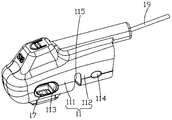
- Figure 1 is a perspective view of a multi-section finger-type probe of the present invention
- Figure 2 is a front elevational view of the multi-section finger-type probe of the present invention.
- Figure 3 is a left side view of the multi-section finger-type probe of the present invention.
- Figure 4 is a top plan view of the multi-section finger-type probe of the present invention.
- Figure 5 is a bottom view of the multi-section finger-type probe of the present invention.
- Figure 6 is a rear elevational view of the multi-section finger-type probe of the present invention.
- FIG. 7 is a schematic cross-sectional view showing a flexible cable trace in a multi-section finger-type probe according to the present invention, and a perspective view of the flexible cable.
- the present invention provides a multi-section finger-type probe, which includes a finger sleeve body 11 , a flexible cable 13 mounted on the finger sleeve body 11 , and a finger sleeve body 11 and a flexible cable .
- a light-emitting tube 15 electrically connected at one end of the 13th
- a receiving tube 17 mounted on the finger sleeve body 11 and electrically connected to the other end of the flexible cable 13 , and a wire 19 electrically connected at one end to the flexible cable; the wire 19
- the other end is electrically connected to the external device, so that the finger-type probe is connected to the external device
- the finger sleeve body 11 is a hollow cylindrical integrated structure with the upper end of the lower end opening closed and hollowed through the finger cover body 11
- the lower end opening wears the finger-type probe on the finger
- the flexible cable 13 extends across the upper end of the finger sleeve body 11 toward the front and rear sides of the finger sleeve body 11, and the two ends of the flexible cable 13
- the finger back and the finger pad are respectively located on the front and rear sides of the finger cover body 11, and the light-emitting tube 15 and the receiving tube 17 are located at two ends of the flexible cable 13 and respectively contact the finger back of
- the light tube 15 can also be located at the fingertip
- the receiving tube 17 can also be located at the back of the finger, and one end of the wire 19 is electrically connected to the flexible cable 13 on the front side of the finger sleeve body 11, that is, the external device on the finger body 11
- the connected pipeline traces are mainly arranged on the front side, and the existing trace line between the light-emitting tube and the receiving tube is disposed on the left and right sides of the silicone sleeve to make the flat-shaped finger-type blood oxygen
- the finger sleeve body 11 can be brought into contact with the shape of the finger from the direction of the finger, and the finger is fully wrapped around the finger, and there is no obvious gap around the finger.
- the finger-type probe When the finger-type probe is used, the finger extends into the finger sleeve body to evenly spread the periphery thereof. Thereby the fingers are wrapped around. Compared with the existing finger-type blood oxygen probe, the surrounding area is wrapped to increase the contact area, and the frictional resistance between the finger and the probe is increased, and it is not easy to fall off, thereby reducing the pressure of the finger sleeve on the finger and increasing the comfort.
- the cylindrical design replaces the flat structure, and does not cause squeezing of the adjacent fingers of the measured finger, which increases the comfort. After the fingers are inserted, there is no gap between the left and right sides, and the fingers cannot move left and right in the finger cot. It is not easy to fall off.
- the finger sleeve body 11 has a closed upper end and a hollow cylindrical shape.
- the cross section (cross section) of the finger sleeve body 11 is not required to be a typical circular shape, and it may also be elliptical or circular. Even other irregular shapes, the emphasis on the cylindrical shape is to emphasize that it can tightly wrap around the fingers when used, and the fingers can be described as cylindrical, so the cylindrical shape here corresponds to the cylindrical shape of the finger, and
- the cylindrical shape is also different from the conventional finger-type blood oxygen probe.
- the conventional flat blood oxygen probe cannot wrap around the finger even when the finger is in use, and the left and right sides are relatively large. Clearance.
- the body 11 it is not required that the body 11 must be cylindrical when not in use, because if the finger body 11 is thin, it has other shapes even when not in use, and when the finger is inserted, it can still tightly wrap around the finger.
- the shape fit can also be called a cylindrical shape, which is distinguished from the existing flat blood oxygen probe and achieves different effects.
- the present invention does not require that all of the cross sections of the cylindrical finger sleeve body 11 from the top to the bottom have the same shape.
- the multi-section finger-type probe can be used for measuring blood oxygen saturation according to the wavelength of the light signal processed by the light-emitting tube 15 and the receiving tube 17, and can also be used for measuring other Physiological parameters; when selecting the appropriate wavelength of the light-emitting tube 15 and the receiving tube 17, the multi-section finger-type probe can be used to measure blood oxygen saturation, and other physiological parameters can be measured when the light-emitting tube 15 of other wavelengths is selected to receive the tube 17. .
- the finger sleeve body 11 includes a first knuckle sleeve 111 and a second knuckle sleeve 112 corresponding to the end knuckle and the middle knuckle of the finger respectively from top to bottom; that is, the length of the finger sleeve body 11 is substantially Corresponding to the length of the two knuckles of the finger, the two knuckles of the finger can be fixed, further improving the stability of the finger-type probe when worn, and the finger can be freely bent, unlike the existing finger cot The blood oxygen probe is fixed in the straight position by the finger sleeve, which is easy to fall off.
- a rear side of the finger sleeve body 11 is provided with a bending structure 115 between the first knuckle sleeve 111 and the second knuckle sleeve 112.
- the bending structure 115 has a gap, a groove, or the like.
- the structure of the difference in wall thickness is obvious, so that when the finger-type probe is worn on the finger, the first knuckle sleeve 111 and the second knuckle sleeve 112 can be bent in this area, thereby facilitating the bending of the finger, and the bending of the finger Provides an activity space to increase the comfort when wearing, and can be blocked by the end knuckle when the finger is bent by the first knuckle sleeve 111, and is not easily detached, thereby avoiding the inevitable finger movement of the finger-type probe due to the test subject And shedding.
- the width, length, and the like of the bent structure 115 are determined according to actual effects.
- the front and rear sides of the finger sleeve body 11 are respectively provided with a mounting groove 116, and the light-emitting tube 15 and the receiving tube 17 are fixed in the mounting groove 116.
- the light-emitting tube 15 and the receiving tube 17 are respectively
- the inside of the finger sleeve body 11 is further provided with a wire trough 117 extending from the upper end of the finger sleeve body 11 to each side of the mounting groove.
- the flexible cable 13 is fixed in the cable trough 117.
- the flexible cable 13 is fixed in the cable trough 115 by a transparent or opaque sealant, and also serves as described above.
- the flexible cable 13 performs waterproof protection.
- the cable slot 117 may be located on the inner side of the finger sleeve body 11 or on the outer side of the finger sleeve body 11. Accordingly, the flexible cable 13 may be routed inside the finger sleeve body 11 or A wire is routed outside the finger cuff body 11.
- the opening of the mounting groove 116 may be located inside the finger sleeve body 11 or outside the finger sleeve body 11 when the opening of the mounting groove 116 is located in the finger cover body 11
- a transparent window should be provided on the inner side of the groove of the mounting groove 116, that is, the inside of the finger cover body 11 so that red light and infrared light can pass through, and the light of the light-emitting tube 15 and the receiving tube 17 can be realized. Transmit and receive.
- the front side surface of the finger sleeve body 11 is further provided with a wire slot 118 for mounting a wire 19 electrically connected to one end of the flexible cable 13 so that the finger sleeve probe It is electrically connected to an external device through a wire 19.
- the wire slot 118 can travel over the entire second knuckle sleeve 112, or can only travel a length on the second knuckle sleeve 112, or only travel on the first knuckle.
- the wire slot 118 may extend upward from the lower end of the second finger sleeve 112 to the mounting groove on the front side of the first knuckle 111, or may extend upward from the middle of the second finger cot 112 to the first One knuckle 111 sets the front side of the mounting groove, or extends upward from the first knuckle sleeve 111 to the mounting groove 116 on the front side of the first knuckle sleeve 111. If the wire slot 118 only travels on the first knuckle 111, each side of the second knuckle sleeve 112 can have the same wall thickness. If the wire slot 118 partially travels over the second knuckle sleeve 112, the sides of the second knuckle sleeve 112 that do not have the wire slot 118 may have the same wall thickness.
- the other three sides of the second knuckle sleeve 112 have a uniform wall thickness, and if the wire groove 118 is not disposed in the first At the second knuckle sleeve 112, the wall thickness of each side of the second knuckle sleeve 112 is uniform, and the existing finger hem blood oxygen probe has a local thickness enhancement and a flexible cable receiving line of the illuminating tube receiving tube. Therefore, the wall thickness of the four sides cannot be uniform.
- the second knuckle sleeve 112 has three or four sides that can be evenly expanded, and the fingers are closely wrapped, and the upper and lower sides of the existing finger hem probe are only two upper and lower portions. Compared with the fingers wrapped in the contact points, the comfort is better and less likely to fall off.
- the uniform wall thickness here refers to the area of the area to be inspected which is arbitrarily designated 80% (for example, when a certain side is inspected, the area of 80% of the side is arbitrarily taken).
- the thickness of the thickest part and the thinnest part is considered. The difference is not more than 50% of the thickest part. If there is only a small decorative point protrusion, it does not significantly affect the uniform expansion of the finger when it is inserted. It can be considered that the position of the convex point is still uniform.
- the finger sleeve body 11 has a mounting area for mounting the light-emitting tube 15, the receiving tube 17, the flexible cable 13, and the wire 19, and a non-mounting area connected to the mounting area, the second knuckle
- the average wall thickness of the non-mounted area of the sleeve 112 may be thinner than the average wall thickness of the non-mounting area of the first knuckle sleeve 111.
- the thinner the silicone finger sleeve the better the expandability, and the more different thickness can be applied. Fingers, the pressure on the fingers will be small and the comfort will be better.
- the first knuckle sleeve 111 is fixed with the light-emitting tube 15 and the receiving tube 17, etc., the front and rear sides of the first knuckle sleeve 111 cannot be made thin, and the second knuckle sleeve 112 does not have these attachments. Therefore, it can be made thinner than the first knuckle sleeve 111, so that the second knuckle sleeve 112 can function to fix the finger cot on the finger, and the first knuckle sleeve 111 can only function as a measurement.
- the existing finger-type blood oxygen probe has only one section, and it needs to ensure sufficient clamping force, and the wall thickness cannot be made very thin, not counting the wall thickness of the light-emitting tube receiving tube and the wire, and the other parts are average.
- the wall thickness is at least 1 mm or more.
- the average wall thickness of the side surface of the second knuckle sleeve 112 of the finger sleeve body 11 that is not provided with the wire groove may be 0.01 mm-0.1 mm.
- the average wall thickness of the side surface of the second knuckle sleeve 112 of the finger sleeve body 11 that is not provided with the wire groove may also be 0.1 mm-0.5 mm.
- the average wall thickness of the side surface of the second knuckle sleeve 112 of the finger cot body 11 that is not provided with the wire groove may also be 0.5 mm-1.0 mm.
- the inner diameter of the second knuckle sleeve 112 of the cuff body 11 can be reduced.
- the inner diameter referred to herein refers to an index for measuring the size of the inner cavity in which the first knuckle sleeve 111 and the second knuckle sleeve 112 accommodate the finger. Since the two knuckle sleeves are not typically cylindrical, the inner diameter is It is not the diameter of a particular cross-section. If it needs to be measured by a certain measurement method, a cylindrical analog finger with a variable diameter can be inserted into the first knuckle sleeve 111 and the second knuckle sleeve 112, respectively.
- the diameter of the cylindrical analog finger is gradually increased from small to large.
- the first knuckle sleeve 111 and the second knuckle sleeve 112 are just opened, the first knuckle sleeve 111 and the second knuckle sleeve 112 are tightly wrapped around the circumference.
- the cylindrical shape simulates the finger without generating significant pressure on the simulated finger, that is, the first knuckle sleeve 111 and the second knuckle sleeve 112 are only expanded by the simulated finger into a cylindrical shape without significant stretching, and the measurement is simulated at this time.
- the diameter of the finger can be considered to be the inner diameter of the first knuckle sleeve 111 and the inner diameter of the second knuckle sleeve 112.
- the portion measured by the analog finger herein refers to the circumferential portion of the first knuckle sleeve 111 where the light-emitting tube 15 and the receiving tube 17 are located.
- the portion between the bending structures 115, the front end portion of the first knuckle sleeve 111 tends to be shrunk to fit the shape of the finger and has little effect on finger fixation, and thus is not used as an index for measuring the size of the first knuckle sleeve 111. It is known to those skilled in the art that the smaller the inner diameter of the silicone finger sleeve is, the tighter the finger is wrapped, and the less likely the finger sleeve is to fall off, but the pressure on the finger is also increased. Usually, the first knuckle of the finger is thinner than the second knuckle and is V-shaped.
- the existing finger cot when the existing finger cot is designed, the inner cavity gap of the first knuckle is smaller than the inner cavity gap of the second knuckle. That is, from the inside Look, the inner cavity gap of the existing finger cot is smaller toward the fingertips, so the fingers are more evenly stressed, but since each person's fingers are different, theoretically, the entire finger can be evenly stressed, but actually Since the relative dimensions of the first knuckle and the second knuckle are difficult to be proportional, the existing finger cot may have a large force on the front end of the finger and a small force on the second knuckle portion, which is easy to fall off and affect the measurement.
- the inner diameter of the second knuckle sleeve 112 can be relatively reduced, that is, the second knuckle sleeve
- the inner diameter of 112 can be made even smaller than that of the first finger cuff 111, and the longitudinal section of the inner cavity accommodating the finger can be U-shaped instead of the usual V shape when viewed from the rear.
- the two ends of the flexible cable 13 are respectively located on the front and rear sides of the first knuckle sleeve 111, and the light-emitting tube 15 and the receiving tube 17 are located at two ends of the flexible cable 13 and are respectively in contact with each other. Finger nails and fingertips. Since the two sides of the finger do not have a soft line, the problem that the relatively hard ridge of the existing finger hem oxygen probe is worn will cause poor comfort due to the pressing of the fingers on both sides.
- a first window 113 is disposed on the left and right sides of the first knuckle sleeve 111. Further, a second window 114 is disposed on the left and right sides of the second knuckle sleeve 112.
- the first window 113 and the second window 114 increase the elasticity of the finger sleeve body 11 to prevent the finger from being too tightly fixed in the finger sleeve body 11.
- the window increases the air permeability of the finger sleeve, and solves the existing finger sleeve type blood oxygenation. When the probe is used for a long period of time, the problem of sweat is easily generated due to poor air permeability, and the wearing comfort of the finger sleeve is improved.
- the material of the finger sleeve body 11 is an elastic material such as silica gel, rubber or the like.
- the multi-section finger-type probe comprises a finger sleeve body, a flexible cable mounted on the finger sleeve body, an illumination tube, a receiving tube, and a wire electrically connected to the flexible cable.
- the finger sleeve body has a cylindrical shape with a lower end open, and the soft cable line spans the upper end of the finger sleeve body, and the two ends of the finger line are respectively located on the front and rear sides of the finger sleeve body corresponding to the finger back and the finger pad of the finger.
- the light-emitting tube and the receiving tube respectively contact the finger back and the finger pad of the finger, and one end of the wire is electrically connected to the soft wire at the front side of the finger body, that is, the finger body
- the pipeline connecting the external equipment is mainly disposed on the front side, and is arranged in a flat shape on the left and right sides of the silicone sleeve compared with the existing wiring line between the luminous tube and the receiving tube.
- the body of the finger sleeve conforms to the shape of the finger, and fully wraps around the finger. When the finger is inserted into the body of the finger sleeve, the finger needs to be stretched around the finger body so as to be wrapped around the finger, the resistance is large, and the wearing is stable and difficult.
- the finger sleeve body includes a first knuckle sleeve and a second knuckle sleeve corresponding to the end phalanx and the middle phalanx of the finger respectively from top to bottom, thereby being capable of fixing the two knuckles of the finger, further Improved fingertips The stability of the probe when worn.
Landscapes
- Health & Medical Sciences (AREA)
- Life Sciences & Earth Sciences (AREA)
- Physics & Mathematics (AREA)
- Surgery (AREA)
- General Health & Medical Sciences (AREA)
- Engineering & Computer Science (AREA)
- Biomedical Technology (AREA)
- Heart & Thoracic Surgery (AREA)
- Medical Informatics (AREA)
- Molecular Biology (AREA)
- Biophysics (AREA)
- Animal Behavior & Ethology (AREA)
- Pathology (AREA)
- Public Health (AREA)
- Veterinary Medicine (AREA)
- Spectroscopy & Molecular Physics (AREA)
- Optics & Photonics (AREA)
- Anesthesiology (AREA)
- Physiology (AREA)
- Pulmonology (AREA)
- Measurement Of The Respiration, Hearing Ability, Form, And Blood Characteristics Of Living Organisms (AREA)
- Measuring Pulse, Heart Rate, Blood Pressure Or Blood Flow (AREA)
Abstract
一种多节指套式探头,包括指套本体(11)、安装于指套本体(11)上的软排线(13)、发光管(15)、接收管(17)、及与软排线(13)电性连接的导线(19);所述指套本体(11)为下端开口的筒状,相较于现有的指套式探头中走线管路设置于左右两侧而使其呈扁平状的硅胶套,指套本体(11)能够契合手指形状,充分包裹手指四周,使用时,手指伸入指套本体(11)内将其四周均撑开从而使得手指四周均被包裹,阻力大,佩戴时稳固、不易脱落,适合长时间使用,且所述指套本体(11)由上往下包括分别对应手指的末端指节和中端指节的第一指节套(111)和第二指节套(112),从而能够对手指的两节指节进行固定,进一步提高了指套式探头佩戴时的稳固性。
Description
本发明涉及医疗器械领域,尤其涉及一种多节指套式探头。
血氧饱和度是临床关键生理参数之一。目前一般采用应用光电原理的血氧饱和度测量仪来进行测量,其中,血氧探头即血氧饱和度传感器是血氧饱和度测量仪的核心部件。
使用血氧饱和度测量仪时,常见的测量部位是手指,血氧探头常见的使用部位是手指,针对手指部位使用的传感器一般均为透射式,即发光管与接收管分别接触指甲及指腹,光发光管发出的光透过指甲后在指腹侧被接收管接收。在另外一些部位进行血氧饱和度测量时,也有采用反射式传感器的。由于手指上血流丰富,因此,临床上使用最多的测量部位是手指,该类用于手指测量的血氧探头按组成结构及使用方法可以分为以下几种:指夹式血氧探头(如CN201079393Y所示),指套式血氧探头(如CN201098122Y所示),包裹式血氧探头(如CN301554262所示),粘贴式血氧探头(如CN203169184所示)。
其中,指套式血氧探头通过将发光及接收元件固定在硅胶套中,使用时将硅胶套套在手指上进行测量。如CN201333039Y中图1所示,一种现有的指套式血氧探头为扁平状,上下较窄,两侧宽大,使用时只在手指的指背与指腹处接触手指,在手指两侧面留有很大的间隙,之所以这样设计,一是为了适应医院里各种病人的不同形状不同粗细的手指,使他们都能佩戴而不需要很多尺寸及款式,因此,目前市场上只有大,中,小三种款式即适应了所有成年人;二是两侧面留有很大的间隙保证了昏迷或意识障碍的病人使用时不会出现由于血氧探头太紧导致手指远端血液供应障碍而没有觉察的事故。如CN201333039Y中图5所示,另一现有的指套式血氧探头根据大部分人的手指一般是第一指节(末端指节)比第二指节(中指节)细且逐渐由细变粗的特点,容纳手指的内腔由指尖向后呈V字形变大,由于发光管及接收管位于第一指节的指甲处,因此,该处壁厚比较厚。同时,为加强指套对手指的抓握力,
如CN2785542Y图1中150-A及150-B所示,往往会在指套的开口处(手指伸入处)边沿增加厚度,设有唇边或凸起,或如CN103481443中图1所示,在指套的左右两侧边增加厚度以加强夹持力。
但以上这些设计也会造成以下问题。一是现有的指套式血氧探头在使用时容易脱落,原因是,在同样的接触力下,现有的指套式血氧探头只在手指的指背与指腹处接触手指,两侧留有很大的间隙,手指可以在指套内左右方向移动,同时由于接触面积小,手指与探头间摩擦阻力小,容易脱落;二是如CN201333039Y中图5及CN2785542Y图1中150-A所示,现有的指套式血氧探头与手指接触面积小,为保证不容易脱落,指套的整体或局部设计得比较厚或者材料比较硬从而能产生足够的弹力或挤压力,因此对手指的压力大,造成佩戴时舒适性差;三是扁平形状会挤压所佩戴的手指左右相临的两个手指,导致佩戴时舒适性差,不时的挤压也会导致指套活动而脱落;四是现有的指套式血氧探头整体为一节,为不分节的结构,与分节的手指不匹配,由于手指的指背及指腹侧被指套压着,相当于手指被指套固定在伸直的位置,因此手指不容易弯曲,而经验告诉我们,伸直的手指与弯曲的手指相比较,更容易从指套内脱落;五是如CN201333039Y图1中107A所示,由于发光及接收元件的走线管路主要分布在硅胶套的扁平状的两侧,因此走线处需要加厚隆起,同时,内部的走线为金属导线,与硅胶相比,比较硬,因此,佩戴时相对较硬的隆起会压迫相临两侧手指,导致舒适性差;六是现有的指套式血氧探头只在手指的后端有开口用以手指进入指套,在前端有开口用以指甲伸出但该开口不大,而两侧虽然与手指间留有间隔,但间隙内空气流动性差,使用时间长时会有汗水留在与指套接触的手指上,舒适性差,也容易造成脱落;七是现有的指套整体为一节,设计及使用时并不能区分两个指节,指套对手指的第一指节与第二指节的压力相同或相似,而发光管及接收管往往位于第一指节,如果为防止脱落而加强整个指套对手指的压力,则可能导致第一指节血液供应减弱,影响测量;八是现有的指套内腔为V字形,前端小,后端大,与手指形状相似,这样的设计看起来符合人体工程学原理,但实际上由于每个人的手指形状各不相同,两个指节粗细变化并不一致,因此,有可能有些人第二指节相对较细,这样,如果用现有的指套,会造成指套对第一指节夹持力比较大,对第二指节夹持力比较小,既容易脱落,又受力不均匀
而舒适性差。
睡眠呼吸监测是对有睡眠呼吸暂停综合症的病人进行诊断,监护及治疗必不可少的措施。睡眠呼吸监测病人往往需要在睡眠中进行监测,有时需要在家庭中进行测量,因此,对于使用何种血氧探头提出了很高的要求。睡眠时病人手指可能会不自主地活动,有可能造成传感器脱落,移位,从而影响测量。如果在家庭中应用,由于没有医生、护士在身边的指导,如何方便可靠地安放是测量成败的关键。现有的指套式血氧探头虽然可以重复使用,但固定在手指上不可靠,容易在睡眠时脱落,使用时舒适性差,有待改进。
发明内容
本发明的目的在于提供一种多节指套式探头,结构设计合理,佩戴时稳固、不易脱落,适合长时间使用。
为实现上述目的,本发明提供一种多节指套式探头,包括指套本体、安装于指套本体内侧的软排线、安装于指套本体内侧且与软排线一端电性连接的发光管、安装于指套本体内侧且与软排线另一端电性连接的接收管、及一端与软排线电性连接的导线;所述导线的另一端用于与外部设备电性连接;
所述指套本体为下端开口的圆筒状,通过所述指套本体的下端开口将该多节指套式探头佩戴于手指上,所述指套本体的前后两侧分别对应接触手指的指背与指腹、左右两侧分别对应接触手指的左右侧面,所述指套本体相应地包裹手指四周,所述指套本体由上往下包括相连的分别对应手指的末端指节和中端指节的第一指节套和第二指节套。
所述指套本体的后侧在所述第一指节套和第二指节套之间设有弯折结构,从而将该多节指套式探头佩戴于手指上时,方便手指弯曲,所述弯折结构为间隙、或凹槽。
所述第二指节套的内径小于等于所述第一指节套的内径;
其中,所述第二指节套的内径指的是第二指节套被撑开为圆形同时并不发生弹性形变时的内径,所述第一指节套的内径指的是第一指节套上发光管与接收管所在圆周部位及以下的部分被撑开为圆形同时并不发生弹性形变时的内径。
所述指套本体的前后两边分别设有一安装槽,所述发光管与接收管固定于
所述安装槽内。
所述指套本体上还设有一走线槽,该走线槽自指套本体的上端向两侧延伸至每一安装槽,所述软排线固定于所述走线槽内。
所述指套本体的前侧面内还设有用于安装导线的导线槽。
所述导线槽自第二指套的下端向上延伸至第一指节套前侧的安装槽。
所述导线槽自第二指套的中部向上延伸至第一指节套前侧的安装槽。
所述导线槽自第一指节套向上延伸至第一指节套前侧的安装槽。
所述第二指套上左侧面、右侧面、及后侧面的壁厚均匀。
所述第二指套上各侧面的壁厚均匀。
所述第二指套上左侧面、右侧面、及后侧面的平均壁厚为0.01mm-0.1mm、0.1mm-0.5mm、或0.5mm-1.0mm。
所述第二指套上各侧面的平均壁厚为0.01mm-0.1mm、0.1mm-0.5mm、或0.5mm-1.0mm。
所述指套本体具有安装区域、及与所述安装区域相连接的非安装区域,所述发光管、接收管、软排线、及导线安装于所述指套本体的安装区域上,所述第二指套的非安装区域的平均壁厚小于等于第一指套的非安装区域的平均壁厚。
所述走线槽设于所述指套本体的内侧,所述软排线在所述指套本体的内侧走线。
所述走线槽设于所述指套本体的外侧,所述软排线在所述指套本体的外侧走线。
所述安装槽的开口位于所述指套本体的内侧、或外侧。
所述第一指节套的左右两侧上设有第一窗口,用于增加指套本体的弹性及透气性。
所述第二指节套的左右两侧上设有第二窗口,用于增加指套本体的弹性及透气性。
所述指套本体的材料为弹性材料。
所述的多节指套式探头,用于测量血氧饱和度。
本发明的有益效果:本发明提供的一种多节指套式探头,包括指套本体、安装于指套本体上的软排线、发光管、接收管、及与软排线电性连接的导线;
所述指套本体为下端开口的圆筒状,所述软排线横跨指套本体的上端,其两端分别对应手指的指背与指腹而位于所述手指套本体的前后两侧上,所述发光管与接收管分别接触手指的指背与指腹,所述导线的一端在所述指套本体的前侧与所述软排线电性连接,即指套本体上的与外部设备相连的管路走线主要设置在前侧,相较于现有的将发光管与接收管之间的走线管路设置于硅胶套左右两侧而使其呈扁平状的指套式血氧探头,本发明中指套本体契合手指形状,充分包裹手指四周,使用时,手指伸入指套本体内时需将其四周均撑开从而使得手指四周均被包裹,阻力大,佩戴时稳固、不易脱落,适合长时间使用,适用于睡眠呼吸监测,且所述指套本体由上往下包括分别对应手指的末端指节和中指节的第一指节套和第二指节套,从而能够对手指的两节指节进行固定,进一步提高了指套式探头佩戴时的稳固性。
为了能更进一步了解本发明的特征以及技术内容,请参阅以下有关本发明的详细说明与附图,然而附图仅提供参考与说明用,并非用来对本发明加以限制。
下面结合附图,通过对本发明的具体实施方式详细描述,将使本发明的技术方案及其它有益效果显而易见。
附图中,
图1为本发明多节指套式探头的立体图;
图2为本发明多节指套式探头的主视图;
图3为本发明多节指套式探头的左视图;
图4为本发明多节指套式探头的俯视图;
图5为本发明多节指套式探头的仰视图;
图6为本发明多节指套式探头的后视图;
图7为本发明多节指套式探头中显示软排线走线的剖面示意图及软排线的立体示意图。
为更进一步阐述本发明所采取的技术手段及其效果,以下结合本发明的
优选实施例及其附图进行详细描述。
请参阅图1至图7,本发明提供一种多节指套式探头,包括指套本体11、安装于指套本体11上的软排线13、安装于指套本体11且与软排线13一端电性连接的发光管15、安装于指套本体11且与软排线13另一端电性连接的接收管17、及一端与软排线电性连接的导线19;所述导线19的另一端与外部设备电性连接,从而将该指套式探头与外部设备进行连接,所述指套本体11为下端开口上端封闭而中空的圆筒状一体结构,通过所述指套本体11的下端开口将该指套式探头佩戴于手指上,所述软排线13横跨指套本体11的上端而向所述指套本体11的前后两侧延伸,所述软排线13的两端分别对应手指的指背与指腹而位于所述手指套本体11的前后两侧上,所述发光管15与接收管17位于所述软排线13的两端且分别接触手指的指背与指腹,本领域普通技术人员知道,发光管15也可以位于指腹处而接收管17也可以相应的位于指背处,所述导线19的一端在所述指套本体11的前侧与所述软排线13电性连接,即指套本体11上的与外部设备相连的管路走线主要设置在前侧,相较于现有的将发光管与接收管之间的走线管路设置于硅胶套左右两侧而使其呈扁平状的指套式血氧探头,本发明中指套本体11能够从手指四周方向契合接触手指形状,充分包裹手指四周,手指四周没有明显间隙,使用该指套式探头时,手指伸入指套本体内将其四周均匀撑开从而使得手指四周均被包裹。与现有的指套式血氧探头相比,四周均被包裹增加了接触面积,手指与探头间摩擦阻力增大,不容易脱落,从而可以减少指套对手指的压力,增加了舒适性。圆筒状的设计代替了扁平状结构,对被测手指的相临手指不会产生挤压,增加了舒适性,手指伸入后没有了左右两侧的间隙,手指不能在指套内左右移动,不容易脱落。本领域普通技术人员知道,所述指套本体11为下端开口上端封闭而中空的圆筒状并非要求它的断面(横截面)一定要是典型的圆形,它也可以是椭圆形,类圆形甚至是其他不规则形状,这里强调圆筒状是为了强调使用时它能紧密包裹手指四周,而手指可以描述为圆柱形,因此,这里的圆筒状是与手指的圆柱形相对应的,同时,圆筒状也是为了与现有的指套式血氧探头为扁平状相区别,现有的扁平状血氧探头即使在手指伸入的使用状态也无法包裹手指四周,左右两则会有比较大的间隙。同时,也并非要求本体11在没有使用时必须是圆筒状,因为如果指套本体11很薄时,即使没有使用时它呈其他形状,当手指伸入时,它依旧能紧密包裹手指四周,与手指
外形配合,也可以称为是圆筒状,与现有的扁平状血氧探头区分开来,并达到不同的使用效果。另外,本发明并不要求圆筒状的指套本体11从上往下的所有断面都是相同的形状。本领域普通技术人员知道,该多节指套式探头,根据所述发光管15和接收管17所处理的光信号的波长的情况,可以用于测量血氧饱和度,也可以用于测量其他生理参数;当选择合适波长的发光管15和接收管17时,该多节指套式探头可以用于测量血氧饱和度,当选择其他波长的发光管15接收管17时可以测量其他生理参数。
具体的,所述指套本体11由上往下包括分别对应手指的末端指节和中指节的第一指节套111和第二指节套112;即所述指套本体11的长度大致相对应的为手指的两节指节的长度,从而能够对手指的两节指节进行固定,进一步提高了指套式探头佩戴时的稳固性,而且手指可以自由弯曲,不象现有的指套式血氧探头,手指被指套固定在伸直的位置,容易造成脱落。
具体的,所述指套本体11的后侧在所述第一指节套111和第二指节套112之间设有弯折结构115,所述弯折结构115为间隙、凹槽等具有明显壁厚差别的结构,从而将该指套式探头佩戴于手指上时,第一指节套111和第二指节套112可以在此区域弯曲,进而方便手指弯曲,既可以对于手指的弯曲提供活动空间,增加佩戴时的舒适度,又可以通过第一指节套111在手指弯曲时会被末端指节顶住而不容易脱落,避免指套式探头因被测者不可避免的手指活动而脱落。所述弯折结构115的宽度,长度等尺寸根据实际效果来确定。
具体的,所述指套本体11的前后两侧分别设有一安装槽116,所述发光管15与接收管17固定于所述安装槽116内,具体的,所述发光管15与接收管17分别通过透明封胶固定于所述安装槽116内;所述指套本体11上还设有一走线槽117,该走线槽117自指套本体11的上端向两侧延伸至每一安装槽116,所述软排线13固定于所述走线槽117内,具体的,所述软排线13通过透明或不透明封胶固定于所述走线槽115内,同时也起到对所述软排线13进行防水保护的作用。
具体的,所述走线槽117可以位于指套本体11的内侧,也可以位于指套本体11的外侧,相应地,软排线13可以在所述指套本体11的内侧走线,也可以在所述指套本体11的外侧走线。
具体的,所述安装槽116的开口可以位于所述指套本体11的内侧,也可以位于所述指套本体11的外侧,当所述安装槽116的开口位于所述指套本体11的
外侧时,在所述安装槽116的槽底即所述指套本体11的内侧还应该设有一个透明窗口以使得红光与红外线光可以穿过,实现发光管15与接收管17对光线的发射与接收。
具体的,所述指套本体11的前侧面内还设有导线槽118,所述导线槽118用于安装与所述软排线13一端电性连接的导线19,从而使得该指套式探头通过导线19与外部设备电性连接。
具体的,本领域普通技术人员所知道的,导线槽118可以走行在整个第二指节套112上,也可以只在第二指节套112上走行一段长度,或者只走行在第一指节套111上,相应的,所述导线槽118可以自第二指套112的下端向上延伸至第一指节111套前侧的安装槽,也可以自第二指套112的中部向上延伸至第一指节111套前侧的安装槽,或者自第一指节套111向上延伸至第一指节套111前侧的安装槽116。如果导线槽118只走行在第一指节111上,则第二指节套112上各个侧面可以具有相同的壁厚。如果导线槽118部分走行在第二指节套112上,则第二指节套112的不具有导线槽118的各侧面可以具有相同的壁厚。
具体的,指套本体11的圆筒状结构中,除导线槽118所在的前侧面比较厚外,第二指节套112的其他三个侧面的壁厚均匀,如果导线槽118不设置在第二指节套112处,则第二指节套112的各个侧面的壁厚均匀,而现有的指套式血氧探头由于存在局部厚度加强及有发光管接收管软排线等走线,因此无法做到四个侧面的壁厚均匀一致。这样,当手指伸入指套本体11时,第二指节套112处具有三个或四个侧面能够均匀扩张,密切包裹手指,与现有的指套式血氧探头只有上下两个面部分接触点包裹手指相比,舒适性更好,更不易脱落。本领域普通技术人员知道,壁厚均匀有利于指节套在手指伸入时均匀扩张,增加舒适感。这里的壁厚均匀指的是任意指定80%的待考察区域面积内(例如考察某个侧面时,则任意取该侧面上80%的区域面积进行考察)最厚处与最薄处的壁厚相差不超过最厚处的50%,如果只是局部有细小的装饰点凸起,并不明显影响手指伸入时均匀扩张,可以认为该凸起点所在部位仍是壁厚均匀的。
具体的,所述指套本体11具有用于安装发光管15、接收管17、软排线13、及导线19的安装区域、及与所述安装区域相连接的非安装区域,第二指节套112的非安装区域的平均壁厚较第一指节套111的非安装区域的平均壁厚可以变薄。本领域所公知的,硅胶指套越薄则扩张性越好,可以适用更多粗细不同的
手指,对手指产生的压力会小,舒适性更好。但第一指节套111由于固定有发光管15与接收管17等,因此,第一指节套111前后两个侧面无法做得很薄,而第二指节套112上没有这些附着物,因此可以做得比第一指节套111更薄,这样,第二指节套112可以起到固定指套于手指上的作用,而第一指节套111可以只起到测量的作用。现有的指套式血氧探头由于只有一节,而且需要保证有足够的夹持力,无法把壁厚做得很薄,不算发光管接收管及走线处的壁厚,其他部位平均壁厚至少也在1mm以上。
具体的,所述指套本体11的第二指节套112上不设有导线槽的侧面的平均壁厚可以是0.01mm-0.1mm。
具体的,所述指套本体11的第二指节套112上不设有导线槽的侧面的平均壁厚也可以是0.1mm-0.5mm。
具体的,所述指套本体11的第二指节套112上不设有导线槽的侧面的平均壁厚也可以是0.5mm-1.0mm。
具体的,所述指套本体11的第二指节套112的内径可以减小。这里所说的内径指的是衡量第一指节套111及第二指节套112容纳手指的内腔的大小的指标,由于两个指节套并非是典型的圆柱形,因此所说的内径并非是某个特定横截面的直径,如果需要用某种测量方式来测量的话,可以采用一个直径可以变化的圆柱形模拟手指分别伸入到第一指节套111及第二指节套112中,由小到大逐渐增加圆柱形模拟手指的直径,当刚好撑开第一指节套111、第二指节套112,第一指节套111、第二指节套112刚好四周紧密包裹接触圆柱形模拟手指而又不对模拟手指产生明显压力时,也即此时第一指节套111、第二指节套112只是被模拟手指撑开成圆柱形而没有明显拉伸,测量此时模拟手指的直径即可以认为是所说的第一指节套111的内径、第二指节套112的内径。同时,由于第一指节套111的内腔并非是上下相等,因此,这里所说的用模拟手指测量的部位是指第一指节套111的发光管15与接收管17所在的圆周部位到弯折结构115之间的部分,第一指节套111的前端部分往往缩小以适应手指形状且对手指固定作用不大,因此不作为衡量第一指节套111大小的指标。本领域普通技术人员知道,硅胶指套内径越小则对手指包裹得越紧,指套越不容易脱落,但对手指的压力也变大。通常手指的第一指节比第二指节要细,为V字形,因此,现有的指套在设计时,第一指节的内腔间隙比第二指节的内腔间隙要小,也就是,从内部
看,现有指套的内腔间隙是越往指尖越小,这样手指受力比较均匀,但由于每个人的手指均不一样,因此,理论上可以做到整个手指受力均匀,但实际上由于第一指节及第二指节相对尺寸很难成比例,因此,现有的指套有可能手指前端受力大而第二指节部分受力小,既容易脱落又影响测量。而本发明中,当所述指套本体11的第二指节套112厚度变薄后对手指压力减小时,可以相对缩小第二指节套112的内径,也就是说,第二指节套112可以做得与第一指套111一样的内径甚至更小,容纳手指的内腔纵剖面由前往后看可以呈U字形而不是通常的V字形。
具体的,所述软排线13的两端分别位于所述第一指节套111的前后两侧上,所述发光管15与接收管17位于所述软排线13的两端且分别接触手指的指甲与指腹。由于手指的两侧面没有软排线,从而解决了现有的指套式血氧探头佩戴时相对较硬的隆起会压迫相临两侧手指导致舒适性差的问题。
具体的,所述第一指节套111的左右两侧上设有第一窗口113,进一步的,所述第二指节套112的左右两侧上设有第二窗口114,该第一窗口113和第二窗口114增加了指套本体11的弹性,避免手指过紧的固定于指套本体11内,另外,该窗口增加了指套的透气性,解决了现有的指套式血氧探头长期使用时由于透气性差而容易产生汗水的问题,提高了指套的佩戴舒适度。
具体的,所述指套本体11的材料为弹性材料,如硅胶、橡胶等。
综上所述,本发明提供的一种多节指套式探头,包括指套本体、安装于指套本体上的软排线、发光管、接收管、及与软排线电性连接的导线;所述指套本体为下端开口的圆筒状,所述软排线横跨指套本体的上端,其两端分别对应手指的指背与指腹而位于所述手指套本体的前后两侧上,所述发光管与接收管分别接触手指的指背与指腹,所述导线的一端在所述指套本体的前侧与所述软排线电性连接,即指套本体上的与外部设备相连的管路走线主要设置在前侧,相较于现有的将发光管与接收管之间的走线管路设置于硅胶套左右两侧而使其呈扁平状的指套式探头,本发明中指套本体契合手指形状,充分包裹手指四周,使用时,手指伸入指套本体内时需将其四周均撑开从而使得手指四周均被包裹,阻力大,佩戴时稳固、不易脱落,适合长时间使用,适用于睡眠呼吸监测,且所述指套本体由上往下包括分别对应手指的末端指节和中指节的第一指节套和第二指节套,从而能够对手指的两节指节进行固定,进一步提高了指套
式探头佩戴时的稳固性。
以上所述,对于本领域的普通技术人员来说,可以根据本发明的技术方案和技术构思作出其他各种相应的改变和变形,而所有这些改变和变形都应属于本发明权利要求的保护范围。
Claims (21)
- 一种多节指套式探头,包括指套本体、安装于指套本体上的软排线、安装于指套本体且与软排线一端电性连接的发光管、安装于指套本体且与软排线另一端电性连接的接收管、及一端与软排线电性连接的导线;所述导线的另一端用于与外部设备电性连接;所述指套本体为下端开口的圆筒状,通过所述指套本体的下端开口将该多节指套式探头佩戴于手指上,所述指套本体的前后两侧分别对应接触手指的指背与指腹、左右两侧分别对应接触手指的左右侧面,所述指套本体相应地包裹手指四周,所述指套本体由上往下包括相连的分别对应手指的末端指节和中端指节的第一指节套和第二指节套。
- 如权利要求1所述的多节指套式探头,其中,所述指套本体的后侧在所述第一指节套和第二指节套之间设有弯折结构,从而将该多节指套式探头佩戴于手指上时,方便手指弯曲,所述弯折结构为间隙或凹槽。
- 如权利要求1所述的多节指套式探头,其中,所述第二指节套的内径小于等于所述第一指节套的内径;其中,所述第二指节套的内径指的是第二指节套被撑开为圆柱形同时并不发生弹性形变时的内径,所述第一指节套的内径指的是第一指节套上发光管与接收管所在圆周部位及以下的部分被撑开为圆柱形同时并不发生弹性形变时的内径。
- 如权利要求1所述的多节指套式探头,其中,所述指套本体的前后两边分别设有一安装槽,所述发光管与接收管固定于所述安装槽内。
- 如权利要求4所述的多节指套式探头,其中,所述指套本体上还设有一走线槽,该走线槽自指套本体的上端向两侧延伸至每一安装槽,所述软排线固定于所述走线槽内。
- 如权利要求4所述的多节指套式探头,其中,所述指套本体的前侧面内还设有用于安装导线的导线槽。
- 如权利要求6所述的多节指套式探头,其中,所述导线槽自第二指套的下端向上延伸至第一指节套前侧的安装槽。
- 如权利要求6所述的多节指套式探头,其中,所述导线槽自第二指套的 中部向上延伸至第一指节套前侧的安装槽。
- 如权利要求6所述的多节指套式探头,其中,所述导线槽自第一指节套向上延伸至第一指节套前侧的安装槽。
- 如权利要求7或8所述的多节指套式探头,其中,所述第二指套上左侧面、右侧面、及后侧面的壁厚均匀。
- 如权利要求9所述的多节指套式探头,其中,所述第二指套上各侧面的壁厚均匀。
- 如权利要求7或8所述的多节指套式探头,其中,所述第二指套上左侧面、右侧面、及后侧面的平均壁厚为0.01mm-0.1mm、0.1mm-0.5mm、或0.5mm-1.0mm。
- 如权利要求9所述的多节指套式探头,其中,所述第二指套上各侧面的平均壁厚为0.01mm-0.1mm、0.1mm-0.5mm、或0.5mm-1.0mm。
- 如权利要求1所述的多节指套式探头,其中,所述指套本体具有安装区域、及与所述安装区域相连接的非安装区域,所述发光管、接收管、软排线、及导线安装于所述指套本体的安装区域上,所述第二指套的非安装区域的平均壁厚小于等于第一指套的非安装区域的平均壁厚。
- 如权利要求5所述的多节指套式探头,其中,所述走线槽设于所述指套本体的内侧,所述软排线在所述指套本体的内侧走线。
- 如权利要求5所述的多节指套式探头,其中,所述走线槽设于所述指套本体的外侧,所述软排线在所述指套本体的外侧走线。
- 如权利要求4所述的多节指套式探头,其中,所述安装槽的开口位于所述指套本体的内侧、或外侧。
- 如权利要求1所述的多节指套式探头,其中,所述第一指节套的左右两侧上设有第一窗口,用于增加指套本体的弹性及透气性。
- 如权利要求18所述的多节指套式探头,其中,所述第二指节套的左右两侧上设有第二窗口,用于增加指套本体的弹性及透气性。
- 如权利要求1所述的多节指套式探头,其中,所述指套本体的材料为弹性材料。
- 如权利要求1所述的多节指套式探头,其特征在于,用于测量血氧饱和度。
Priority Applications (4)
| Application Number | Priority Date | Filing Date | Title |
|---|---|---|---|
| EP16893222.6A EP3443903B1 (en) | 2016-03-09 | 2016-08-12 | Multi-section finger sleeve-type probe |
| ES16893222T ES2902969T3 (es) | 2016-03-09 | 2016-08-12 | Sonda de tipo manguito para el dedo de múltiples secciones |
| CN201680001964.5A CN106535764B (zh) | 2016-03-09 | 2016-08-12 | 多节指套式探头 |
| US16/121,632 US10881351B2 (en) | 2016-03-09 | 2018-09-05 | Multi-section finger sleeve-type probe |
Applications Claiming Priority (2)
| Application Number | Priority Date | Filing Date | Title |
|---|---|---|---|
| CN201620177873.4U CN205612476U (zh) | 2016-03-09 | 2016-03-09 | 多节指套式血氧探头 |
| CN201620177873.4 | 2016-03-09 |
Related Child Applications (1)
| Application Number | Title | Priority Date | Filing Date |
|---|---|---|---|
| US16/121,632 Continuation US10881351B2 (en) | 2016-03-09 | 2018-09-05 | Multi-section finger sleeve-type probe |
Publications (1)
| Publication Number | Publication Date |
|---|---|
| WO2017152577A1 true WO2017152577A1 (zh) | 2017-09-14 |
Family
ID=57035236
Family Applications (1)
| Application Number | Title | Priority Date | Filing Date |
|---|---|---|---|
| PCT/CN2016/094777 Ceased WO2017152577A1 (zh) | 2016-03-09 | 2016-08-12 | 多节指套式探头 |
Country Status (5)
| Country | Link |
|---|---|
| US (1) | US10881351B2 (zh) |
| EP (1) | EP3443903B1 (zh) |
| CN (2) | CN205612476U (zh) |
| ES (1) | ES2902969T3 (zh) |
| WO (1) | WO2017152577A1 (zh) |
Cited By (1)
| Publication number | Priority date | Publication date | Assignee | Title |
|---|---|---|---|---|
| CN112504800A (zh) * | 2020-11-26 | 2021-03-16 | 扬州大学 | 一种辅助初学者实验室磨制材料金相试样的方法 |
Families Citing this family (11)
| Publication number | Priority date | Publication date | Assignee | Title |
|---|---|---|---|---|
| CN108143427A (zh) * | 2018-01-30 | 2018-06-12 | 深圳源动创新科技有限公司 | 血氧探头及血氧检测装置 |
| CN108937958A (zh) * | 2018-07-19 | 2018-12-07 | 刘肖俊 | 一种适用于长时间使用的高稳固度指套式血氧探头 |
| CN110960227A (zh) * | 2018-09-30 | 2020-04-07 | 深圳迈瑞生物医疗电子股份有限公司 | 血氧探头及穿戴式血氧测量仪 |
| CN111436946A (zh) * | 2019-01-17 | 2020-07-24 | 富泰华工业(深圳)有限公司 | 血氧测量指套及血氧监测装置 |
| CN110236565A (zh) * | 2019-06-25 | 2019-09-17 | 深圳市普凌姆科技有限公司 | 一种新型的血氧指套 |
| CN111671485B (zh) * | 2020-07-08 | 2024-09-17 | 山西医科大学第一医院 | 便捷指套式甲单位加压装置 |
| CN114073521A (zh) * | 2020-08-17 | 2022-02-22 | 深圳迈瑞生物医疗电子股份有限公司 | 血氧传感器组件及血氧测量装置 |
| US12161483B2 (en) * | 2020-11-10 | 2024-12-10 | GE Precision Healthcare LLC | Reattachable SpO2 sensor with ambient light attenuation |
| CN112617724A (zh) * | 2020-12-30 | 2021-04-09 | 浙江艾明德生物科技有限公司 | 一种可视成像压舌板探头指套 |
| CN114343626A (zh) * | 2021-12-23 | 2022-04-15 | 深圳市安普康科技有限公司 | 一种指夹式血氧探头 |
| CN117918853B (zh) * | 2024-03-12 | 2024-07-05 | 中国人民解放军空军军医大学 | 一种儿科护理用的心电监护装置 |
Citations (6)
| Publication number | Priority date | Publication date | Assignee | Title |
|---|---|---|---|---|
| EP1491135A2 (en) * | 1993-04-12 | 2004-12-29 | Hema Metrics, Inc. | Method and apparatus for monitoring blood constituents |
| CN200939137Y (zh) * | 2006-08-17 | 2007-08-29 | 深圳市尤迈医疗用品有限公司 | 成人软指套 |
| CN201333039Y (zh) * | 2009-01-16 | 2009-10-28 | 深圳市理邦精密仪器有限公司 | 一种软指套及其构成的软指套血氧传感器 |
| CN103190916A (zh) * | 2013-04-12 | 2013-07-10 | 苏州大学 | 一种血氧饱和度探头 |
| CN104287746A (zh) * | 2014-09-24 | 2015-01-21 | 潘卫江 | 指腹式血氧饱和度传感器及其测量系统 |
| CN104545848A (zh) * | 2015-01-23 | 2015-04-29 | 中国计量学院 | 手指检测用传感装置 |
Family Cites Families (13)
| Publication number | Priority date | Publication date | Assignee | Title |
|---|---|---|---|---|
| US6541756B2 (en) * | 1991-03-21 | 2003-04-01 | Masimo Corporation | Shielded optical probe having an electrical connector |
| US5452717A (en) * | 1993-07-14 | 1995-09-26 | Masimo Corporation | Finger-cot probe |
| FI973454L (fi) * | 1997-08-22 | 1999-02-23 | Instrumentarium Oy | Joustoväline mittausanturissa, jolla havannoidaan elävän kudoksen ominaisuuksia |
| EP1807001A2 (en) * | 2004-11-05 | 2007-07-18 | EnviteC-Wismar GmbH | Apparatus for improved pulse oximetry measurement |
| CN201098122Y (zh) * | 2007-09-05 | 2008-08-13 | 深圳市索莱瑞医疗技术有限公司 | 软指套及其构成的软指套血氧探头 |
| EP3453319A1 (en) * | 2009-02-18 | 2019-03-13 | Nonin Medical, Inc | Disposable oximeter device |
| EP2327358B1 (en) * | 2009-11-26 | 2017-01-11 | General Electric Company | Sensor holder for medical sensor |
| US9743857B2 (en) * | 2011-12-16 | 2017-08-29 | The Regents Of The University Of California | Digital manometry finger-mountable sensor device |
| CN203763089U (zh) * | 2014-01-13 | 2014-08-13 | 杨行保 | 一种软指套探头 |
| US20170014075A1 (en) * | 2014-03-11 | 2017-01-19 | Nihon Kohden Corporation | Support tool and biological information acquisition system |
| CN204218913U (zh) * | 2014-09-24 | 2015-03-25 | 潘卫江 | 指腹式血氧饱和度传感器及其测量系统 |
| CN204468058U (zh) * | 2015-01-23 | 2015-07-15 | 中国计量学院 | 一种手指检测用传感装置 |
| US10568553B2 (en) * | 2015-02-06 | 2020-02-25 | Masimo Corporation | Soft boot pulse oximetry sensor |
-
2016
- 2016-03-09 CN CN201620177873.4U patent/CN205612476U/zh not_active Expired - Lifetime
- 2016-08-12 CN CN201680001964.5A patent/CN106535764B/zh active Active
- 2016-08-12 WO PCT/CN2016/094777 patent/WO2017152577A1/zh not_active Ceased
- 2016-08-12 EP EP16893222.6A patent/EP3443903B1/en active Active
- 2016-08-12 ES ES16893222T patent/ES2902969T3/es active Active
-
2018
- 2018-09-05 US US16/121,632 patent/US10881351B2/en active Active
Patent Citations (6)
| Publication number | Priority date | Publication date | Assignee | Title |
|---|---|---|---|---|
| EP1491135A2 (en) * | 1993-04-12 | 2004-12-29 | Hema Metrics, Inc. | Method and apparatus for monitoring blood constituents |
| CN200939137Y (zh) * | 2006-08-17 | 2007-08-29 | 深圳市尤迈医疗用品有限公司 | 成人软指套 |
| CN201333039Y (zh) * | 2009-01-16 | 2009-10-28 | 深圳市理邦精密仪器有限公司 | 一种软指套及其构成的软指套血氧传感器 |
| CN103190916A (zh) * | 2013-04-12 | 2013-07-10 | 苏州大学 | 一种血氧饱和度探头 |
| CN104287746A (zh) * | 2014-09-24 | 2015-01-21 | 潘卫江 | 指腹式血氧饱和度传感器及其测量系统 |
| CN104545848A (zh) * | 2015-01-23 | 2015-04-29 | 中国计量学院 | 手指检测用传感装置 |
Non-Patent Citations (1)
| Title |
|---|
| See also references of EP3443903A4 * |
Cited By (1)
| Publication number | Priority date | Publication date | Assignee | Title |
|---|---|---|---|---|
| CN112504800A (zh) * | 2020-11-26 | 2021-03-16 | 扬州大学 | 一种辅助初学者实验室磨制材料金相试样的方法 |
Also Published As
| Publication number | Publication date |
|---|---|
| EP3443903B1 (en) | 2021-11-17 |
| EP3443903A1 (en) | 2019-02-20 |
| EP3443903A4 (en) | 2019-11-13 |
| US10881351B2 (en) | 2021-01-05 |
| ES2902969T3 (es) | 2022-03-30 |
| CN106535764A (zh) | 2017-03-22 |
| CN106535764B (zh) | 2019-11-05 |
| CN205612476U (zh) | 2016-10-05 |
| US20180368768A1 (en) | 2018-12-27 |
Similar Documents
| Publication | Publication Date | Title |
|---|---|---|
| CN106535764B (zh) | 多节指套式探头 | |
| US6385821B1 (en) | Apparatus for securing an oximeter probe to a patient | |
| US7742794B2 (en) | Probe adapted to be used with pulse oximeter | |
| US20070244377A1 (en) | Pulse oximeter sleeve | |
| WO2007121649A1 (en) | Hand held electrocardiograph | |
| US9049992B2 (en) | Method and apparatus for a stethoscope | |
| JP2007190122A (ja) | 生体情報測定装置 | |
| KR102320959B1 (ko) | 손가락형 산소포화도 측정기용 가드 | |
| CN214906955U (zh) | 一种夹持式血氧饱和度监测探头 | |
| JP6013047B2 (ja) | 生体情報収集装置 | |
| CN205697793U (zh) | 一种血氧探头 | |
| CN215874657U (zh) | 一种血氧饱和度监测线保护套 | |
| CN212438616U (zh) | 一种用于脉搏血氧测定的血氧饱和度探头 | |
| KR20040012640A (ko) | 산소 포화도 측정기의 센서유니트 | |
| CN220344405U (zh) | 一种耳钉式可抛弃式血氧探头 | |
| CN105411600A (zh) | 一种指环按摩防脱式血氧饱和度监测仪探头 | |
| KR200343805Y1 (ko) | 산소 포화도 측정기의 센서유니트 | |
| CN207745136U (zh) | 一种唇部血氧监测装置 | |
| CN212489890U (zh) | 一种新生儿用血氧饱和度探头 | |
| CN209153694U (zh) | 一种指套式血氧仪 | |
| CN215272777U (zh) | 一种具有防手指压疮功能的医用脉氧仪 | |
| CN205215237U (zh) | 一种指环按摩防脱式血氧饱和度监测仪探头 | |
| CN224231124U (zh) | 一种挂耳式体温测量仪 | |
| CN205612461U (zh) | 一种可同时测量体温和血氧饱和度的耳挂 | |
| CN219048507U (zh) | 一种可拆卸指脉氧仪固定器 |
Legal Events
| Date | Code | Title | Description |
|---|---|---|---|
| NENP | Non-entry into the national phase |
Ref country code: DE |
|
| WWE | Wipo information: entry into national phase |
Ref document number: 2016893222 Country of ref document: EP |
|
| ENP | Entry into the national phase |
Ref document number: 2016893222 Country of ref document: EP Effective date: 20181009 |
|
| 121 | Ep: the epo has been informed by wipo that ep was designated in this application |
Ref document number: 16893222 Country of ref document: EP Kind code of ref document: A1 |