WO2017159463A1 - 線維芽細胞からの心臓前駆細胞と心筋細胞の直接製造方法 - Google Patents
線維芽細胞からの心臓前駆細胞と心筋細胞の直接製造方法 Download PDFInfo
- Publication number
- WO2017159463A1 WO2017159463A1 PCT/JP2017/009052 JP2017009052W WO2017159463A1 WO 2017159463 A1 WO2017159463 A1 WO 2017159463A1 JP 2017009052 W JP2017009052 W JP 2017009052W WO 2017159463 A1 WO2017159463 A1 WO 2017159463A1
- Authority
- WO
- WIPO (PCT)
- Prior art keywords
- gene
- fibroblasts
- tbx6
- cells
- cardiomyocytes
- Prior art date
- Legal status (The legal status is an assumption and is not a legal conclusion. Google has not performed a legal analysis and makes no representation as to the accuracy of the status listed.)
- Ceased
Links
Images





Classifications
-
- C—CHEMISTRY; METALLURGY
- C12—BIOCHEMISTRY; BEER; SPIRITS; WINE; VINEGAR; MICROBIOLOGY; ENZYMOLOGY; MUTATION OR GENETIC ENGINEERING
- C12N—MICROORGANISMS OR ENZYMES; COMPOSITIONS THEREOF; PROPAGATING, PRESERVING, OR MAINTAINING MICROORGANISMS; MUTATION OR GENETIC ENGINEERING; CULTURE MEDIA
- C12N5/00—Undifferentiated human, animal or plant cells, e.g. cell lines; Tissues; Cultivation or maintenance thereof; Culture media therefor
- C12N5/06—Animal cells or tissues; Human cells or tissues
- C12N5/0602—Vertebrate cells
- C12N5/0652—Cells of skeletal and connective tissues; Mesenchyme
- C12N5/0657—Cardiomyocytes; Heart cells
-
- A—HUMAN NECESSITIES
- A61—MEDICAL OR VETERINARY SCIENCE; HYGIENE
- A61P—SPECIFIC THERAPEUTIC ACTIVITY OF CHEMICAL COMPOUNDS OR MEDICINAL PREPARATIONS
- A61P7/00—Drugs for disorders of the blood or the extracellular fluid
- A61P7/04—Antihaemorrhagics; Procoagulants; Haemostatic agents; Antifibrinolytic agents
-
- A—HUMAN NECESSITIES
- A61—MEDICAL OR VETERINARY SCIENCE; HYGIENE
- A61P—SPECIFIC THERAPEUTIC ACTIVITY OF CHEMICAL COMPOUNDS OR MEDICINAL PREPARATIONS
- A61P9/00—Drugs for disorders of the cardiovascular system
-
- A—HUMAN NECESSITIES
- A61—MEDICAL OR VETERINARY SCIENCE; HYGIENE
- A61P—SPECIFIC THERAPEUTIC ACTIVITY OF CHEMICAL COMPOUNDS OR MEDICINAL PREPARATIONS
- A61P9/00—Drugs for disorders of the cardiovascular system
- A61P9/06—Antiarrhythmics
-
- A—HUMAN NECESSITIES
- A61—MEDICAL OR VETERINARY SCIENCE; HYGIENE
- A61P—SPECIFIC THERAPEUTIC ACTIVITY OF CHEMICAL COMPOUNDS OR MEDICINAL PREPARATIONS
- A61P9/00—Drugs for disorders of the cardiovascular system
- A61P9/10—Drugs for disorders of the cardiovascular system for treating ischaemic or atherosclerotic diseases, e.g. antianginal drugs, coronary vasodilators, drugs for myocardial infarction, retinopathy, cerebrovascula insufficiency, renal arteriosclerosis
-
- A—HUMAN NECESSITIES
- A61—MEDICAL OR VETERINARY SCIENCE; HYGIENE
- A61P—SPECIFIC THERAPEUTIC ACTIVITY OF CHEMICAL COMPOUNDS OR MEDICINAL PREPARATIONS
- A61P9/00—Drugs for disorders of the cardiovascular system
- A61P9/14—Vasoprotectives; Antihaemorrhoidals; Drugs for varicose therapy; Capillary stabilisers
-
- C—CHEMISTRY; METALLURGY
- C12—BIOCHEMISTRY; BEER; SPIRITS; WINE; VINEGAR; MICROBIOLOGY; ENZYMOLOGY; MUTATION OR GENETIC ENGINEERING
- C12N—MICROORGANISMS OR ENZYMES; COMPOSITIONS THEREOF; PROPAGATING, PRESERVING, OR MAINTAINING MICROORGANISMS; MUTATION OR GENETIC ENGINEERING; CULTURE MEDIA
- C12N15/00—Mutation or genetic engineering; DNA or RNA concerning genetic engineering, vectors, e.g. plasmids, or their isolation, preparation or purification; Use of hosts therefor
- C12N15/09—Recombinant DNA-technology
-
- C—CHEMISTRY; METALLURGY
- C12—BIOCHEMISTRY; BEER; SPIRITS; WINE; VINEGAR; MICROBIOLOGY; ENZYMOLOGY; MUTATION OR GENETIC ENGINEERING
- C12N—MICROORGANISMS OR ENZYMES; COMPOSITIONS THEREOF; PROPAGATING, PRESERVING, OR MAINTAINING MICROORGANISMS; MUTATION OR GENETIC ENGINEERING; CULTURE MEDIA
- C12N15/00—Mutation or genetic engineering; DNA or RNA concerning genetic engineering, vectors, e.g. plasmids, or their isolation, preparation or purification; Use of hosts therefor
- C12N15/09—Recombinant DNA-technology
- C12N15/11—DNA or RNA fragments; Modified forms thereof; Non-coding nucleic acids having a biological activity
- C12N15/52—Genes encoding for enzymes or proenzymes
-
- C—CHEMISTRY; METALLURGY
- C12—BIOCHEMISTRY; BEER; SPIRITS; WINE; VINEGAR; MICROBIOLOGY; ENZYMOLOGY; MUTATION OR GENETIC ENGINEERING
- C12N—MICROORGANISMS OR ENZYMES; COMPOSITIONS THEREOF; PROPAGATING, PRESERVING, OR MAINTAINING MICROORGANISMS; MUTATION OR GENETIC ENGINEERING; CULTURE MEDIA
- C12N15/00—Mutation or genetic engineering; DNA or RNA concerning genetic engineering, vectors, e.g. plasmids, or their isolation, preparation or purification; Use of hosts therefor
- C12N15/09—Recombinant DNA-technology
- C12N15/63—Introduction of foreign genetic material using vectors; Vectors; Use of hosts therefor; Regulation of expression
-
- C—CHEMISTRY; METALLURGY
- C12—BIOCHEMISTRY; BEER; SPIRITS; WINE; VINEGAR; MICROBIOLOGY; ENZYMOLOGY; MUTATION OR GENETIC ENGINEERING
- C12N—MICROORGANISMS OR ENZYMES; COMPOSITIONS THEREOF; PROPAGATING, PRESERVING, OR MAINTAINING MICROORGANISMS; MUTATION OR GENETIC ENGINEERING; CULTURE MEDIA
- C12N5/00—Undifferentiated human, animal or plant cells, e.g. cell lines; Tissues; Cultivation or maintenance thereof; Culture media therefor
- C12N5/06—Animal cells or tissues; Human cells or tissues
- C12N5/0602—Vertebrate cells
- C12N5/0652—Cells of skeletal and connective tissues; Mesenchyme
- C12N5/0656—Adult fibroblasts
-
- C—CHEMISTRY; METALLURGY
- C12—BIOCHEMISTRY; BEER; SPIRITS; WINE; VINEGAR; MICROBIOLOGY; ENZYMOLOGY; MUTATION OR GENETIC ENGINEERING
- C12N—MICROORGANISMS OR ENZYMES; COMPOSITIONS THEREOF; PROPAGATING, PRESERVING, OR MAINTAINING MICROORGANISMS; MUTATION OR GENETIC ENGINEERING; CULTURE MEDIA
- C12N5/00—Undifferentiated human, animal or plant cells, e.g. cell lines; Tissues; Cultivation or maintenance thereof; Culture media therefor
- C12N5/06—Animal cells or tissues; Human cells or tissues
- C12N5/0602—Vertebrate cells
- C12N5/0652—Cells of skeletal and connective tissues; Mesenchyme
- C12N5/0661—Smooth muscle cells
-
- C—CHEMISTRY; METALLURGY
- C12—BIOCHEMISTRY; BEER; SPIRITS; WINE; VINEGAR; MICROBIOLOGY; ENZYMOLOGY; MUTATION OR GENETIC ENGINEERING
- C12N—MICROORGANISMS OR ENZYMES; COMPOSITIONS THEREOF; PROPAGATING, PRESERVING, OR MAINTAINING MICROORGANISMS; MUTATION OR GENETIC ENGINEERING; CULTURE MEDIA
- C12N5/00—Undifferentiated human, animal or plant cells, e.g. cell lines; Tissues; Cultivation or maintenance thereof; Culture media therefor
- C12N5/06—Animal cells or tissues; Human cells or tissues
- C12N5/0602—Vertebrate cells
- C12N5/069—Vascular Endothelial cells
-
- C—CHEMISTRY; METALLURGY
- C12—BIOCHEMISTRY; BEER; SPIRITS; WINE; VINEGAR; MICROBIOLOGY; ENZYMOLOGY; MUTATION OR GENETIC ENGINEERING
- C12N—MICROORGANISMS OR ENZYMES; COMPOSITIONS THEREOF; PROPAGATING, PRESERVING, OR MAINTAINING MICROORGANISMS; MUTATION OR GENETIC ENGINEERING; CULTURE MEDIA
- C12N5/00—Undifferentiated human, animal or plant cells, e.g. cell lines; Tissues; Cultivation or maintenance thereof; Culture media therefor
- C12N5/10—Cells modified by introduction of foreign genetic material
-
- C—CHEMISTRY; METALLURGY
- C12—BIOCHEMISTRY; BEER; SPIRITS; WINE; VINEGAR; MICROBIOLOGY; ENZYMOLOGY; MUTATION OR GENETIC ENGINEERING
- C12N—MICROORGANISMS OR ENZYMES; COMPOSITIONS THEREOF; PROPAGATING, PRESERVING, OR MAINTAINING MICROORGANISMS; MUTATION OR GENETIC ENGINEERING; CULTURE MEDIA
- C12N2501/00—Active agents used in cell culture processes, e.g. differentation
- C12N2501/60—Transcription factors
-
- C—CHEMISTRY; METALLURGY
- C12—BIOCHEMISTRY; BEER; SPIRITS; WINE; VINEGAR; MICROBIOLOGY; ENZYMOLOGY; MUTATION OR GENETIC ENGINEERING
- C12N—MICROORGANISMS OR ENZYMES; COMPOSITIONS THEREOF; PROPAGATING, PRESERVING, OR MAINTAINING MICROORGANISMS; MUTATION OR GENETIC ENGINEERING; CULTURE MEDIA
- C12N2506/00—Differentiation of animal cells from one lineage to another; Differentiation of pluripotent cells
- C12N2506/13—Differentiation of animal cells from one lineage to another; Differentiation of pluripotent cells from connective tissue cells, from mesenchymal cells
- C12N2506/1307—Differentiation of animal cells from one lineage to another; Differentiation of pluripotent cells from connective tissue cells, from mesenchymal cells from adult fibroblasts
-
- C—CHEMISTRY; METALLURGY
- C12—BIOCHEMISTRY; BEER; SPIRITS; WINE; VINEGAR; MICROBIOLOGY; ENZYMOLOGY; MUTATION OR GENETIC ENGINEERING
- C12N—MICROORGANISMS OR ENZYMES; COMPOSITIONS THEREOF; PROPAGATING, PRESERVING, OR MAINTAINING MICROORGANISMS; MUTATION OR GENETIC ENGINEERING; CULTURE MEDIA
- C12N2510/00—Genetically modified cells
Definitions
- the present invention relates to a method for producing cardiac progenitor cells and cardiomyocytes from fibroblasts, and fibroblast-derived cardiac precursor cells and cardiomyocytes produced by the method.
- Heart disease continues to increase with aging, and the incidence of heart failure among men over 80 years old is as high as 14.7%.
- the heart is composed of cells such as cardiomyocytes and fibroblasts, the cardiomyocytes responsible for the pulsatile function have little or no regenerative capacity, and so far, there are limited methods for treating heart disease. ing.
- Non-Patent Document 1 a method for directly producing cardiomyocyte-like cells from fibroblasts without iPS cells by introducing three myocardial reprogramming factors (Gata4, Mef2c, Tbx5, hereinafter also referred to as GMT).
- GMT myocardial reprogramming factors
- Non-patent Document 3 a method of inducing cardiac progenitor cells and cardiomyocytes from pluripotent stem cells such as ES cells and iPS cells using humoral factors
- Non-patent Document 4 a method of inducing cardiac progenitor cells using transcription factors
- cardiomyocytes do not have proliferative capacity, so if cardiomyocytes are derived directly from fibroblasts or pluripotent stem cells, the number of cells necessary for regenerative medicine may not be sufficient. There is. Therefore, a method of first producing proliferative cardiac progenitor cells and producing cardiomyocytes from the cardiac progenitor cells is useful.
- Eomesodermin induces Mesp1 expression and cardiac differentiation from embryonic stem cells in the absence of Activin.
- the present inventors have found that when a factor (Tbx6) is introduced into a fibroblast using a retroviral vector and a retrovirus, a marker for cardiac progenitor cells is used. It was found that cardiac progenitor cells expressing certain Mesp1 were induced and proliferated to form colonies. In addition, it was found that in the induced cardiac progenitor cells, the expression of a plurality of cardiac progenitor cell gene markers is maintained even after one month.
- the inventors have introduced three factors (Tbx6, SRF, Myocd) into fibroblasts using retroviral vectors and retroviruses to induce beating cardiomyocytes, and The obtained cells expressed Nxk2.5 and troponin, which are markers for cardiomyocytes.
- the present inventors introduced three factors (Tbx6, SRF, Myocd) into fibroblasts using a retroviral vector and a retrovirus, the resulting cells are Myh11, which is a marker of smooth muscle cells.
- Pecam1 a marker for vascular endothelial cells, was found to be expressed. The present invention has been completed based on such findings.
- the present invention is as follows.
- a method for producing cardiac progenitor cells comprising a step of introducing a Tbx6 gene into fibroblasts.
- a method for producing cardiomyocytes comprising a step of introducing Tbx6 gene, SRF gene and Myocardin gene into fibroblasts.
- the fibroblast is, for example, a mouse cell or a human cell.
- An agent for inducing vascular endothelial cells from fibroblasts comprising a Tbx6 gene, an SRF gene and a Myocd gene.
- the present invention provides a method for producing cardiac progenitor cells directly from fibroblasts and a method for producing cardiomyocytes directly from fibroblasts. It is also possible to provide cardiac progenitor cells and cardiomyocytes produced by the method of the present invention. Since cardiac progenitor cells derived from fibroblasts according to the present invention have sustained the expression of a plurality of cardiac progenitor cells, the present invention provides a method for producing cardiac progenitor cells and cardiac progenitor cells that are more stable than conventional methods. Can be provided. Since cardiac progenitor cells have a proliferative ability, the cardiac progenitor cells produced according to the present invention can be preferably applied to medical use. In addition, it has been confirmed that the cardiac muscle cells induced by the present invention beat, and cardiac muscle-specific gene expression and structural protein expression have been confirmed. Therefore, the myocardial production method of the present invention can provide functionally matured cardiomyocytes.
- FIG. 1 is a schematic diagram in which Tbx6 gene is introduced into fibroblasts to induce cardiac progenitor cells.
- FIG. 2 is a GFP (Mesp1 expression) immunostaining (MespCre-GFP), DAPI (nuclear) immunostaining, and a merged image of them in cells transfected with Tbx6.
- FIG. 3 is a diagram showing the mRNA expression levels of Mesp1, T, KDR, Nkx2.5 and TnnT2 markers of cardiac differentiation in cells one month after the induction of Tbx6 gene.
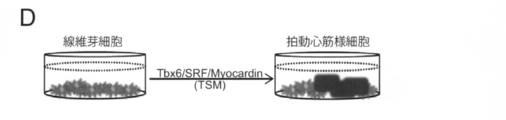
- FIG. 4 is a schematic diagram in which Tbx6, SRF, and Myocd (TSM) are introduced into fibroblasts to induce pulsatile cardiomyocytes.
- TSM Myocd
- FIG. 5 shows that cells into which Tbx6, SRF, and Myocd have been introduced have a striated structure (bright field (BF)) and express cardiac troponin T.
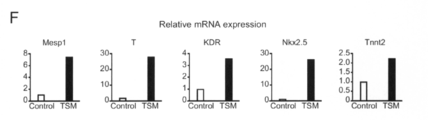
- FIG. 6 is a diagram showing the mRNA expression levels of Mesp1, T, KDR, Nkx2.5, and TnnT2 markers for cardiac differentiation in the entire cells into which Tbx6, SRF, and Myocd have been introduced.
- FIG. 7 is a graph showing the mRNA expression level of Myh11, which is a smooth muscle cell marker, and Pecam1, which is a marker of vascular endothelial cells, in cells transfected with Tbx6, SRF, and Myocd.
- FIG. 8 is an immunostaining fluorescence microscopic image showing that cells into which Tbx6, SRF, and Myocd have been introduced express a Smooth muscle myosin heavy chain.
- the present invention relates to a method for producing cardiac progenitor cells comprising introducing Tbx6 into fibroblasts, and a fibroblast-derived cardiac progenitor cell containing an exogenous Tbx6 gene.
- Tbx6 When Tbx6 is introduced into fibroblasts by retrovirus, cells that express Mesp1, a cardiac progenitor cell-specific marker, are induced. Even 30 days after the introduction of Tbx6, cardiac progenitor cell-related genes are expressed and the state of cardiac progenitor cells is maintained.
- Tbx6 polypeptide is expressed in fibroblasts, and as a result, fibroblasts introduced with the Tbx6 gene are directly reprogrammed into differentiated cardiac progenitor cells without becoming stem cells or ancestral cells.
- the method for producing cardiac progenitor cells of the present invention includes a step of gene transfer of Tbx6 into fibroblasts. According to the method for producing cardiac progenitor cells of the present invention, since only one factor is introduced, cardiac progenitor cells can be produced efficiently. In addition, since the expression of the cardiac progenitor cell marker gene is maintained even one month after the introduction of Tbx6, cardiac progenitor cells having proliferative ability can be stably produced according to the present invention.
- the present invention also provides a method for producing cardiomyocytes, which comprises introducing Tbx6, SRF and Myocardin (Myocd) into fibroblasts, and fibroblasts containing exogenous Tbx6 gene, SRF gene and Myocd gene Relates to the derived cardiomyocytes.
- Tbx6, SRF and Myocardin Myocd
- SRF and Myocd which are highly expressed in differentiated cardiomyocytes, are introduced into fibroblasts by retrovirus, and beating mature cardiomyocytes are induced.
- Tbx6, 3 factors (TSM) plus SRF and Myocd which are highly expressed in differentiated cardiomyocytes, are introduced into fibroblasts by retrovirus, and beating mature cardiomyocytes are induced.
- TBM Tbx6, 3 factors
- SRF and Myocd which are highly expressed in differentiated cardiomyocytes
- Tbx6, SRF, and Myocd polypeptides are expressed in fibroblasts, so that fibroblasts into which Tbx6, SRF, and Myocd genes have been introduced are directly transferred to differentiated cardiomyocytes without becoming stem cells or progenitor cells. To be programmed.
- Tbx6, SRF and Myocd genes are introduced into fibroblasts, not only cardiomyocyte-specific gene expression but also cardiac progenitor cell genes (Mesp1, T, KDR) are induced. Therefore, according to the present invention, cardiomyocytes, smooth muscle cells or vascular endothelial cells can be produced because they pass through cardiac progenitor cells.
- the method for producing cardiomyocytes of the present invention includes a step of introducing a Tbx6 gene, an SRF gene and a Myocd gene into fibroblasts. According to the method for producing cardiomyocytes of the present invention, functionally matured cardiomyocytes can be produced.
- the present invention provides a cardiac progenitor cell derived from fibroblasts into which Tbx6 gene has been introduced, or a cardiomyocyte derived from fibroblasts into which Tbx6 gene, SRF gene and Myocd gene have been introduced.
- a cardiac progenitor cell derived from fibroblasts into which Tbx6 gene has been introduced or a cardiomyocyte derived from fibroblasts into which Tbx6 gene, SRF gene and Myocd gene have been introduced.
- an inducer of cardiac progenitor cells containing Tbx6 gene, or an inducer of cardiomyocytes containing Tbx6 gene, SRF gene, and Myocd gene is also provided.
- Tbx6 gene, SRF gene and Myocd gene are induced.
- a smooth muscle cell inducer or endothelial cell inducer comprising a gene is provided.
- the Tbx6 gene, or a set of Tbx6 gene, SRF gene and Myocd gene can be introduced into fibroblasts in vitro.
- the fibroblasts are induced in cardiac progenitor cells or cardiomyocytes in vitro. Induced cardiac progenitor cells or cardiomyocytes can be introduced into an individual.
- the Tbx6 gene, or set of Tbx6 gene, SRF gene and Myocd gene can be introduced into fibroblasts in vivo, for example, into an affected heart tissue of an individual.
- the fibroblasts are induced in cardiac progenitor cells or cardiomyocytes in vivo.
- the Tbx6 gene or a set of Tbx6 gene, SRF gene and Myocd gene can be introduced into fibroblasts in vitro.
- the fibroblasts are introduced into an individual and induced into cardiac progenitor cells or cardiomyocytes in vivo.
- a reprogramming factor gene (Tbx6 gene, SRF gene or Myocd gene) into fibroblasts can be achieved by nucleic acid containing a nucleotide sequence encoding Tbx6, nucleic acid containing a nucleotide sequence encoding SRF, or nucleotide sequence encoding Myocd.
- the step of introducing the Tbx6 gene into fibroblasts can include introducing a Tbx6 polypeptide into fibroblasts.
- the step of introducing the Tbx6 gene, SRF gene, and Myocd gene into fibroblasts can include introducing the Tbx6 polypeptide, SRF polypeptide, and Myocd polypeptide into fibroblasts.
- the method for producing cardiac progenitor cells or the method for producing cardiomyocytes of the present invention is a step of transforming fibroblasts with Tbx6 gene, or transforming fibroblasts with Tbx6 gene, SRF gene and Myocd gene. Steps may be included.
- the method for producing cardiac progenitor cells or the method for producing cardiomyocytes of the present invention may comprise a step of expressing a Tbx6 gene in fibroblasts, or a step of expressing a Tbx6 gene, SRF gene and Myocd gene in fibroblasts.
- the fibroblast introduced with the Tbx6 gene, or the fibroblast introduced with the Tbx6 gene, SRF gene and Myocd gene is a cardiac progenitor cell or cardiomyocyte within a certain period, for example, 7 to 14 days, preferably 7 days. Be guided to. For example, if a population of fibroblasts is introduced with Tbx6 gene, or a set of Tbx6 gene, SRF gene and Myocd gene, at least 10%, at least 15%, at least 20%, at least 30%, at least 50% of the population , At least 70%, at least 90% are reprommed to cardiac progenitor cells or cardiomyocytes, for example during a period of 7-14 days, preferably 7 days.
- the method for producing cardiac progenitor cells or cardiomyocytes of the present invention comprises a certain period (for example, 7 to 14 days, preferably 7) of the step of introducing a Tbx6 gene or a set of Tbx6 gene, SRF gene and Myocd gene into fibroblasts. Day), the proportion of cardiac progenitor cells or cardiomyocytes can be enriched by sorting the fibroblast population. Residual fibroblasts can be obtained by performing a sorting step on the positive expression of fibroblast-specific markers, such as vimentin, poly 1-4-hydroxylase, fibroblast-specific protein, fibroblast surface antigen and type 1 collagen. If there are cells, they can be removed. Moreover, the ratio of each cell can also be enriched by performing the sorting process regarding the expression of a marker specific to cardiac progenitor cells or cardiomyocytes.
- fibroblast-specific markers such as vimentin, poly 1-4-hydroxylase, fibroblast-specific protein, fibroblast surface antigen and type 1 collagen
- the method for producing cardiac progenitor cells or the method for producing cardiomyocytes of the present invention provides a means for a sorting step by including a step of introducing a nucleic acid containing a nucleotide sequence encoding a detectable marker into fibroblasts, or A means of confirming the induction of cardiac progenitor cells or cardiomyocytes can be provided.
- the nucleotide sequence encoding the detectable marker is operably linked to a cardiac progenitor cell specific promoter or cardiomyocyte specific promoter, or the nucleotide sequence encoding a cardiac progenitor cell specific marker or cardiomyocyte specific Linked to the nucleotide sequence encoding the marker.
- the detectable marker is, for example, a polypeptide that directly generates a detectable signal, for example, a fluorescent protein such as GFP, YEP, or BFP, or an enzyme that generates a detectable signal when acting on a substrate, for example, , Luciferase, alkaline phosphatase and the like.
- a detectable signal for example, a fluorescent protein such as GFP, YEP, or BFP
- an enzyme that generates a detectable signal when acting on a substrate for example, Luciferase, alkaline phosphatase and the like.
- Examples of the cardiac progenitor cell specific promoter include Mesp1, T, and Flk1 (KDR) promoters.
- promoters specific to cardiomyocytes include ⁇ -myosin heavy chain promoter and cTnT promoter.
- Expression of the detectable marker can allow detection of cardiac progenitor cells or cardiomyocytes, so that confirmation of the induction of cardiac progenitor cells or cardiomyocytes, or sorting of induced cardiac progenitor cells or induced cardiomyocytes Can be provided.
- operably linked refers to a functional link between nucleic acids that provides a desired function such as transcription, translation, and the like.
- it includes a functional linkage between a nucleic acid expression control sequence such as a promoter or signal sequence and a second polynucleotide.
- the expression control sequence affects the transcription and / or translation of the second polynucleotide.
- fibroblasts are mammalian fibroblasts, for example, fibroblasts of mammals other than humans such as humans, mice, rats, pigs, monkeys, horses, cows, sheep, goats, dogs and the like. Can be used.
- the fibroblast is a human fibroblast.
- the fibroblast is a mouse fibroblast.
- a fibroblast is a fibroblast obtained from a mammal, or a progeny of a fibroblast obtained from a mammal, and may be isolated or a subcultured cell thereof.
- fibroblasts for example, fetal fibroblasts, tail tip-derived fibroblasts, cardiac fibroblasts, foreskin fibroblasts, skin fibroblasts, lung fibroblasts and the like can be used.
- a medium used for fibroblast culture can be appropriately selected or prepared by those skilled in the art, such as MEM, DMEM, and IMDM medium.
- Fibroblasts can be cultured in the presence or absence of serum. Culture is not particularly limited as long as it is performed under conditions suitable for culturing of fibroblasts, usually in the range of 25 ° C. ⁇ 37 ° C., it is carried out under 5% CO 2.
- the fibroblasts can be introduced with one or more nucleic acids comprising a nucleotide sequence encoding one or more reprogramming factors.
- the fibroblasts can introduce one or more of the reprogramming factor polypeptides themselves into the fibroblasts.
- the reprogramming factor is Tbx6 when producing cardiac progenitor cells, and Tbx6, SRF and Myocd (TSM) when producing cardiomyocytes. Tbx6, SRF and Myocd can be introduced into the cells at once or sequentially.
- Introducing multiple reprogramming factors into cells at one time means introducing multiple reprogramming factors into cells in a single cell introduction step, and sequentially refer to multiple cell introduction steps on the same day or different days. It is to introduce into the cell. From the viewpoint of cell introduction efficiency, it is preferable to introduce a plurality of reprogramming factors into a cell at one time.
- the amino acid sequence of the reprogramming factor of the present invention and the nucleotide sequence encoding the amino acid sequence are known in the art.
- Tbx6 polypeptide (Tbox transcription factor 6) is a transcription factor that binds to and recognizes the T box in the promoter region of some genes.
- Amino acid sequences for Tbx6 polypeptides derived from various species, and nucleotide sequences encoding Tbx6 polypeptides are known.
- Genbank accession number NM_004608.3 human, nucleotide sequence, SEQ ID NO: 1, CDS 61..1371)
- NP_004599.2 human, amino acid sequence, SEQ ID NO: 2
- NM_011538.2 humane, nucleotide sequence, sequence No. 3, CDS 25..1335)
- NP_035668.2 (mouse, amino acid sequence, SEQ ID NO: 4) and the like can be referred to.
- the Tbx6 polypeptide has at least 80%, 85%, 90%, 91%, 92%, 93%, 94%, the amino acid sequence represented by SEQ ID NO: 2 or SEQ ID NO: 4, A polypeptide having an amino acid sequence having 95%, 96%, 97%, 98%, 99% or 100% sequence identity and having a function of inducing cardiac progenitor cells when introduced into fibroblasts Including.
- the Tbx6 polypeptide has 1 to 50, preferably 1 to 40, more preferably 1 to 20, and more preferably 1 to 20, in the amino acid sequence represented by SEQ ID NO: 2 or SEQ ID NO: 4.
- 1 to 10 for example, 1, 2, 3, 4, 5, 6, 7, 8, 9 or 10
- amino acids are deleted, substituted, inserted or added, or a combination thereof.
- the Tbx6 polypeptide has at least 80%, 85%, 90%, 91%, 92%, 93%, 94%, the nucleotide sequence represented by SEQ ID NO: 1 or SEQ ID NO: 3, Has an amino acid sequence encoded by a nucleotide sequence with 95%, 96%, 97%, 98%, 99% or 100% sequence identity and induces into cardiac progenitor cells when introduced into fibroblasts A polypeptide having a function is included.
- the Tbx6 gene (nucleic acid) has at least 80%, 85%, 90%, 91%, 92%, 93%, 94 and the nucleotide sequence represented by SEQ ID NO: 1 or SEQ ID NO: 3. With nucleotide sequence having%, 95%, 96%, 97%, 98%, 99% or 100% sequence identity and induced in cardiac progenitor cells when the encoded polypeptide is introduced into fibroblasts A nucleic acid having the function of:
- SRF amino acid sequences for SRF polypeptides derived from various species, and nucleotide sequences encoding SRF polypeptides are known.
- Genbank accession number NM_003131.3 human, nucleotide sequence, SEQ ID NO: 5, CDS 363..1889)
- NP_003122.1 human, amino acid sequence, SEQ ID NO: 6
- NM_020493.2 mouse, nucleotide sequence, sequence
- NP_065239.1 moleukino acid sequence, amino acid sequence, SEQ ID NO: 8
- Genbank accession number NM_003131.3 human, nucleotide sequence, SEQ ID NO: 5, CDS 363..1889)
- NP_003122.1 human, amino acid sequence, SEQ ID NO: 6
- NM_020493.2 mouse, nucleotide sequence, sequence
- the SRF polypeptide has at least 80%, 85%, 90%, 91%, 92%, 93%, 94%, the amino acid sequence represented by SEQ ID NO: 6 or SEQ ID NO: 8, It has an amino acid sequence having 95%, 96%, 97%, 98%, 99% or 100% sequence identity, and has a function of inducing cardiomyocytes when introduced into fibroblasts together with Tbx6 and Myocardin Including polypeptides.
- the SRF polypeptide has 1 to 60, preferably 1 to 50, more preferably 1 to 25, more preferably 1 to 25 amino acid sequences represented by SEQ ID NO: 6 or SEQ ID NO: 8.
- Preferably 1 to 13 (eg 1, 2, 3, 4, 5, 6, 7, 8, 9, 10, 11, 12 or 13) amino acids are deleted, substituted, inserted or added or And a polypeptide having a function of inducing cardiomyocytes when introduced into fibroblasts together with Tbx6 and Myocardin.
- the SRF polypeptide has at least 80%, 85%, 90%, 91%, 92%, 93%, 94%, a nucleotide sequence represented by SEQ ID NO: 5 or SEQ ID NO: 7, Cardiomyocytes having an amino acid sequence encoded by a nucleotide sequence having 95%, 96%, 97%, 98%, 99% or 100% sequence identity and introduced into fibroblasts with Tbx6, Myocardin A polypeptide having a function to induce
- the SRF nucleic acid has at least 80%, 85%, 90%, 91%, 92%, 93%, 94%, 95 and the nucleotide sequence represented by SEQ ID NO: 5 or SEQ ID NO: 7. %, 96%, 97%, 98%, 99% or 100% of the nucleotide sequence, and the coding polypeptide is introduced into cardiomyocytes when introduced into fibroblasts with Tbx6, Myocardin It includes a nucleic acid having an inducing function.
- Myocardin (Myocd) Amino acid sequences for Myocardin polypeptides derived from various species, and nucleotide sequences encoding Myocardin polypeptides are known. For example, Genbank accession number NM_001146312.2 (human, nucleotide sequence, SEQ ID NO: 9, CDS 300..3260), NP_001139784.1 (human, amino acid sequence, SEQ ID NO: 10), NM_145136.4 (mouse, nucleotide sequence, sequence) No. 11, CDS 292..3243), NP_660118.3 (mouse, amino acid sequence, SEQ ID NO: 12) and the like can be referred to.
- the Myocardin polypeptide has at least 80%, 85%, 90%, 91%, 92%, 93%, 94%, the amino acid sequence represented by SEQ ID NO: 10 or SEQ ID NO: 12, It has an amino acid sequence having 95%, 96%, 97%, 98%, 99% or 100% sequence identity, and has a function of inducing cardiomyocytes when introduced into fibroblasts together with Tbx6 and SRF. Including polypeptides.
- the Myocardin polypeptide is 1 to 100, preferably 1 to 50, more preferably 1 to 30, in the amino acid sequence represented by SEQ ID NO: 10 or SEQ ID NO: 12.
- Preferably 1-20 eg 1, 2, 3, 4, 5, 6, 7, 8, 9, 10, 11, 12, 13, 14, 15, 16, 17, 18, 19, or 20
- a polypeptide having an amino acid sequence having a deletion, substitution, insertion or addition or a combination thereof, and a function of inducing cardiomyocytes when introduced into fibroblasts together with Tbx6 and SRF is included.
- the Myocardin polypeptide has at least 80%, 85%, 90%, 91%, 92%, 93%, 94%, a nucleotide sequence represented by SEQ ID NO: 9 or SEQ ID NO: 11, Cardiomyocytes having an amino acid sequence encoded by a nucleotide sequence with 95%, 96%, 97%, 98%, 99% or 100% sequence identity and introduced into fibroblasts with Tbx6, SRF A polypeptide having a function to induce
- the myocardin gene (nucleic acid) is at least 80%, 85%, 90%, 91%, 92%, 93%, 94 and the nucleotide sequence represented by SEQ ID NO: 9 or SEQ ID NO: 11. %, 95%, 96%, 97%, 98%, 99% or 100% of the nucleotide sequence with sequence identity and the encoding polypeptide is introduced into fibroblasts with Tbx6, SRF It contains a nucleic acid having a function of inducing cardiomyocytes.
- a “cardiac progenitor cell” is a cell characterized by expressing a marker specific for cardiac progenitor cells. Markers specific to cardiac progenitor cells are factors specifically expressed in cardiac progenitor cells (cardiac progenitor cell-related factors), and include T, Mesp1, Flk1 (KDR), Pdgfr ⁇ , Isl1, and the like.
- the cardiac progenitor cells express at least one of markers specific for cardiac progenitor cells, more preferably at least two and even more preferably at least three.
- the cardiac progenitor cells are preferably cells that express T, Mesp1, and Flk1 (KDR). Marker expression can be confirmed by gene level or protein level.
- cardiac progenitor cells are derived from fibroblasts, and are therefore sometimes referred to as induced cardiac progenitor cells.
- cardiomyocytes are cells characterized by expressing a specific marker for cardiomyocytes. Markers specific to cardiomyocytes are factors specifically expressed in cardiomyocytes (cardiomyocyte-related factors), and include cardiac troponin (cTnT), Nkx2.5, Actn2, and the like.
- the cardiomyocytes express at least one, more preferably at least two, and even more preferably at least three of the markers specific for cardiomyocytes.
- the cardiomyocytes are preferably cells that express cTnT and Nkx2.5.
- cardiomyocytes can be characterized by pulsation. Furthermore, “cardiomyocytes” in the present invention may be characterized by forming a striated structure. In the present invention, cardiomyocytes are also derived from fibroblasts, so they are sometimes referred to as induced cardiomyocytes.
- the expression of various markers specific to cardiac progenitor cells or cardiomyocytes can be detected by biochemical or immunochemical techniques (for example, enzyme-linked immunosorbent test, immunohistochemical test, etc.). Alternatively, it can also be detected by measuring the expression of nucleic acids encoding various markers specific for cardiac progenitor cells or cardiomyocytes. Expression of nucleic acids encoding various markers specific to cardiac progenitor cells or cardiomyocytes can be confirmed by molecular biological techniques such as RT-PCR and hybridization. Primers and probes used in these methods can be appropriately designed and manufactured by those skilled in the art using information available from databases such as Genbank.
- the pulsation of the cardiomyocytes can be confirmed visually or by a bright field image.
- Spontaneous contraction can also be confirmed by standard electrophysiological methods such as patch clamp.
- the formation of the striated structure of cardiomyocytes can be confirmed visually or by a bright field image. It can also be confirmed by immunostaining of proteins that contribute to the myocardial structure such as troponin.
- exogenous refers to a nucleic acid or polypeptide that is introduced into the cell (eg, by electroporation, infection, lipofection, microinjection, or any other means of introducing nucleic acid into the cell). Point to.
- the exogenous reprogramming factor can be introduced by contacting a Tbx6, SRF and / or Myocd polypeptide with fibroblasts.
- Polypeptides of Tbx6, SRF, and Myocd can be produced by genetic engineering and molecular biology based on amino acid sequence and nucleotide sequence information of known databases, respectively.
- exogenous reprogramming factor gene into fibroblasts introduction of exogenous reprogramming factor (Tbx6, SRF, Myocd) genes, that is, introduction of polynucleotides encoding these polypeptides, or polynucleotides having a nucleotide sequence complementary to the nucleotide sequences, for example, retroviruses It can be performed by a known transformation method such as viral infection using a vector or a viral vector such as an adenovirus vector, lipofection method, electroporation method, microinjection method, calcium phosphate method and the like.
- the introduction of an exogenous reprogramming factor polypeptide (Tbx6 or a set of Tbx6, SRF, Myocd) into fibroblasts comprises the nucleotide sequence encoding the reprogramming factor polypeptide. This is achieved by introducing exogenous nucleic acid containing fibroblasts.
- the species from which the exogenous reprogramming factor is derived and the species from which the fibroblast is derived preferably match, for example, human and human and mouse and mouse.
- the exogenous nucleic acid comprising a nucleotide sequence encoding an exogenous reprogramming factor polypeptide in the present invention can be in the form of a recombinant expression vector comprising an expression cassette, in which case a suitable vector is for example a recombinant retrovirus. , Lentivirus, and adenovirus; including retroviral expression vectors, lentiviral expression vectors, nucleic acid expression vectors, and plasmid expression vectors.
- the exogenous nucleic acid is integrated into the genome of the fibroblast and its progeny.
- the fibroblasts are transformed with separate expression constructs (expression vectors) each containing a nucleotide sequence encoding each of Tbx6, SRF, or Myocd.
- the expression construct may comprise a nucleotide sequence encoding two or more of Tbx6, SRF, or Myocd.
- the expression construct comprises nucleotide sequences encoding Tbx6, SRF, and Myocd.
- an exogenous nucleic acid comprising a nucleotide sequence encoding a Tbx6 polypeptide, or an exogenous nucleic acid comprising a nucleotide sequence encoding one or more of Tbx6, SRF and Myocd polypeptides is a single fiber in vitro. Introduced into a population of blasts or fibroblasts, or into a single fibroblast or population of fibroblasts in vivo.
- a nucleic acid comprising a nucleotide sequence encoding a Tbx6 polypeptide or one or more of Tbx6, SRF and Myocd polypeptides is capable of producing a reprogramming factor polypeptide in fibroblasts.
- An expression construct is a viral construct, such as a recombinant adeno-associated viral construct (see, eg, US Pat. No. 7,078,387), a recombinant adenoviral construct, a recombinant lentiviral construct, and the like. .
- Suitable expression vectors include viral vectors (eg, vaccinia virus-based viral vectors; polioviruses; adenoviruses (eg Li et al., Invest Opthalmol Vis Sci 35: 2543 2549,1994; Borras et al., Gene Ther 6: 515 524,1999); Li and Davidson, PNAS 92: 7700 7704,1995; Sakamoto et al., H Gene Ther 5: 1088 1097,1999; International Patent Application Publication 94/12649, International Patent Application Publication 93/03769; International Patent Application Publication 93/19191; International Patent Application Publication 94/28938; see International Patent Application Publication 95/11984 and International Patent Application Publication 95/00655); Adeno-related viruses (eg, Ali et al., Hum Gene Ther 9: 81F86,1998, Flannery et al., PNAS 94: 6916).
- viral vectors eg,
- Suitable expression vectors are known in the art, and many are commercially available. The following vectors are presented for illustration, and for eukaryotic host cells include pXT1, pSG5 (Stratagene), pSVK3, pBPV, pMSG, and pSVLSV40 (Pharmacia). However, any other vector can be used as long as it is compatible with the host cell.
- any of a number of suitable transcriptional and translational control elements may be used in the expression vector, such as constitutive and inducible promoters, transcription enhancer elements, transcription terminators, and BR> L-rotors.
- constitutive and inducible promoters such as constitutive and inducible promoters, transcription enhancer elements, transcription terminators, and BR> L-rotors.
- a nucleotide sequence encoding a reprogramming factor (eg, Tbx6 CDR sequence, SRF CDR sequence, Myocd CDR sequence) is operably linked to a control element, eg, a transcriptional control element, eg, a promoter.
- a control element eg, a transcriptional control element, eg, a promoter.
- Transcriptional control elements function in eukaryotic cells, such as mammalian cells. Suitable transcription control elements include promoters and enhancers.
- the promoter is constitutively active. In other embodiments, the promoter is inducible.
- Non-limiting examples of suitable eukaryotic promoters include CMV immediate early, HSV thymidine kinase, early and late SV40, retroviral long terminal repeat (LTR), and mouse metallothionein Includes -I.
- the nucleotide sequence encoding the reprogramming factor is operably linked to a heart specific transcriptional control element (TRE), where the TRE can include a promoter and an enhancer.
- TREs include, but are not limited to, the following genes: TRE derived from myosin light chain-2, ⁇ -myosin heavy chain, AE3, cardiac troponin C, and cardiac actin (Franz et al., (1997) Cardiovasc.Res.35: 560-566; Robbins et al., (1995) Ann.NYAcad.Sci.752: 492-505; Linn et al., (1995) Circ.Res.
- Expression vectors may contain ribosome binding sites for translation initiation and transcription initiation.
- the expression vector may include appropriate sequences for amplifying expression.
- suitable mammalian expression vectors include recombinant viruses, nucleic acid vectors such as plasmids, bacterial artificial chromosomes, yeast artificial chromosomes, human artificial chromosomes, cDNA, cRNA, and polymerase chain reaction.
- PCR product expression cassettes include but are not limited to.
- Suitable promoters for driving the expression of nucleotide sequences encoding Tbx6, SRF, Myocd are retroviral long terminal repeat (LTR) elements; constitutive promoters such as CMV, HSV1-TK, SV40, EF-1 ⁇ , ⁇ -actin; phosphoglycerol kinase (PGK), and inducible promoters such as those containing Tet-operator elements.
- the mammalian expression vector may encode a marker gene that facilitates identification or selection of transfected or infected cells in addition to the exogenous Tbx6, SRF, Myocd polypeptide.
- marker genes are fluorescent proteins such as enhanced green fluorescent protein, Ds-Red (DsRed: Discosomasp. Red fluorescent protein (RFP); Bevis and Glick (2002) Nat. Biotechnol. 20:83), yellow fluorescent protein, and cyano A gene encoding a fluorescent protein; and a gene encoding a protein conferring resistance to a selective agent, such as, but not limited to, a neomycin resistance gene, a puromycin resistance gene, a blasticidin resistance gene, and the like.
- Ds-Red Discosomasp. Red fluorescent protein (RFP); Bevis and Glick (2002) Nat. Biotechnol. 20:83
- yellow fluorescent protein and cyano A gene encoding a fluorescent protein
- a gene encoding a protein conferring resistance to a selective agent such as, but not limited to, a neomycin resistance gene, a puromycin resistance gene, a blasticidin resistance gene, and the like.
- suitable viral vectors include, but are not limited to, retroviral viral vectors (including lentiviruses); adenoviruses; and adeno-associated viruses.
- retroviral vectors are murine moloney leukemia virus (MMLV) vectors; other recombinant retroviruses may also be used, such as avian leukemia virus, bovine leukemia virus, murine leukemia virus ( MLV), mink cell focus-inducing virus, murine sarcomeric virus, reticuloendotheliosis virus, gibbon leukemia virus, Mason Pfizer simian virus, or Rous sarcomeric virus, for example, see US Pat. No. 6,333,195.
- the retroviral vector is a lentiviral vector (eg, human immunodeficiency virus-1 ⁇ ⁇ ⁇ ⁇ (HIV-1); simian immunodeficiency virus (SIV); or feline immunodeficiency virus (FIV));
- lentiviral vector eg, human immunodeficiency virus-1 ⁇ ⁇ ⁇ ⁇ (HIV-1); simian immunodeficiency virus (SIV); or feline immunodeficiency virus (FIV)
- the recombinant retrovirus may include a viral polypeptide (eg, a retroviral env) to assist entry into the target cell.
- a viral polypeptide eg, a retroviral env
- the viral polypeptide may be an amphoteric viral polypeptide, such as an amphoteric env, which aids entry into cells derived from a number of species, including cells outside the original host species. To do.
- the viral polypeptide may be a heterotrophic viral polypeptide that aids entry into cells outside the original host species.
- the viral polypeptide is an ecotropic viral polypeptide, such as ecotropic env, which aids entry into the cells of the original host species.
- VSV-g varicella stomatitis virus-g protein
- HIV-1 env HIV-1 env
- GALV gibbon leukemia virus
- FeLV-C FeLV-C
- FeLV-B FeLV10A1env gene
- variants thereof including but not limited to chimeras. See, for example, Yee et al. (1994), Methods Cell Biol., PtA: 99-112 (VSV-G); US Pat. No. 5,449,614.
- recombinant viruses are produced by introducing viral DNA or RNA constructs into producer cells.
- the producer cell does not express a foreign gene.
- the producer cell encodes one or more foreign genes, such as one or more gag, pol, or env polypeptides and / or one or more retroviral gag, pol, or env polypeptides.
- Retroviral packaging cells may contain genes encoding viral polypeptides, such as VSV-g that assists in entry into target cells.
- the packaging cell contains a gene encoding one or more lentiviral proteins, such as gag, pol, env, vpr, vpu, vpx, vif, tat, rev, or nef.
- the packaging cell contains a gene encoding an adenoviral protein, such as E1A or E1B or other adenoviral proteins.
- proteins supplied by the packaging cell include retroviral derived proteins such as gag, pol, and env; lentiviral derived proteins such as gag, pol, env, vpr, vpu, vpx, vif, tat, rev, and nef; and adenovirus-derived proteins such as E1A and E1B.
- the packaging cell supplies a protein derived from a different virus than the virus from which the viral vector was derived.
- Packaging cell lines include, but are not limited to, any readily transfectable cell line.
- the packaging cell line can be based on the 293T cell, NIH3T3, COS or HeLa cell line.
- Packaging cells are frequently used to package viral vector plasmids that have a deletion in at least one gene encoding a protein required for viral packaging. Any cell capable of supplying a protein or polypeptide deleted from the protein encoded by such a viral vector plasmid may be used as the packaging cell.
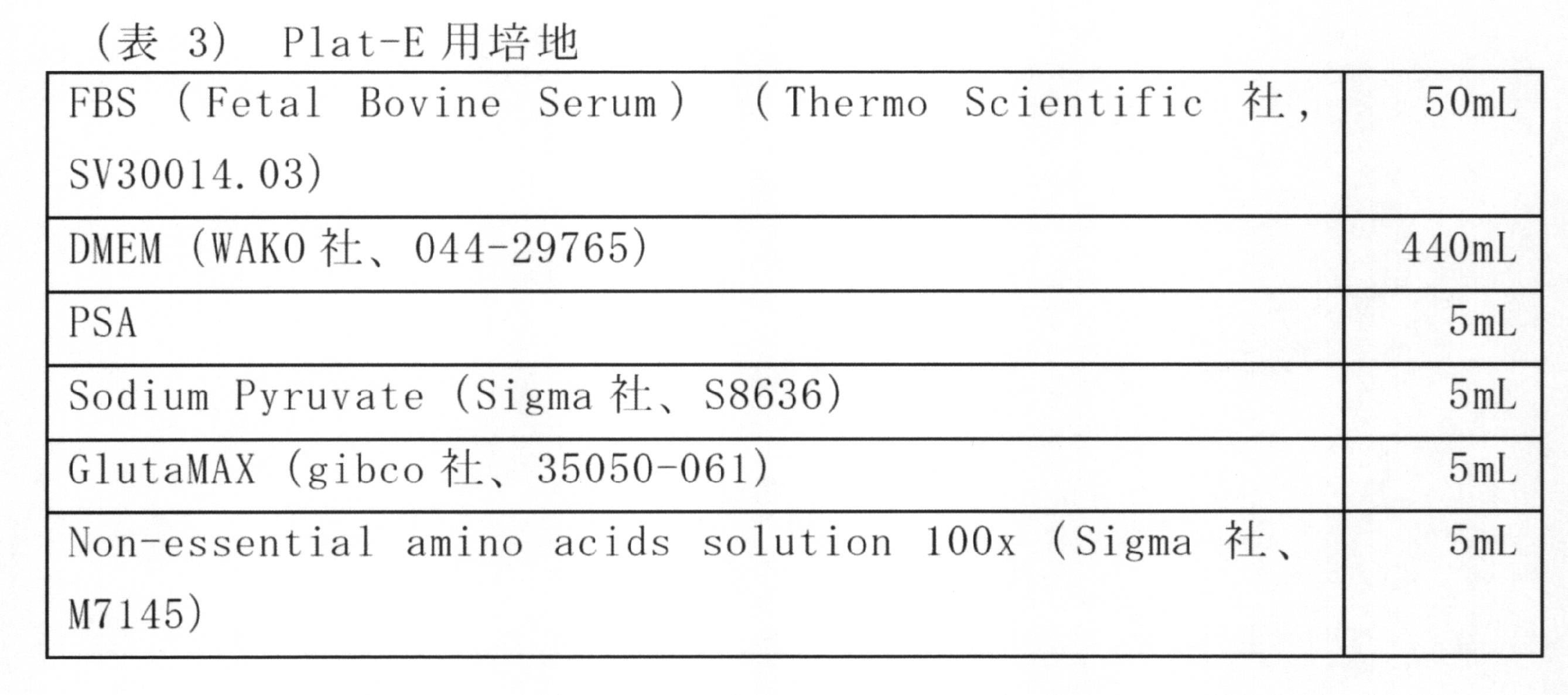
- Examples of packaging cell lines include, but are not limited to, Platinum-E (Plat-E); Platinum-A (Plat-A); BOSC23 (ATCC CRL 11554); and Bing (ATCC CRL 11270). Et al.
- Retroviral constructs may be derived from a range of retroviruses, such as MMLV, HIV-1, SIV, FIV, or other retroviruses described herein.
- a retroviral construct may encode all viral polypeptides necessary for more than one cycle of replication of a particular virus. In some cases, the efficiency of virus entry is improved by the addition of other factors or other viral polypeptides. In another case, the viral polypeptide encoded by the retroviral construct does not support more than one cycle of replication, as described in US Pat. No. 6,872,528. In such situations, the addition of other factors or other viral polypeptides can assist in promoting viral entry.
- the recombinant retrovirus is an HIV-1 virus that includes a VSV-g polypeptide but does not include an HIV-1 env polypeptide.
- Retroviral constructs may include promoters, multiple cloning sites, and / or resistance genes.
- promoters include, but are not limited to, CMV, SV40, EF1 ⁇ , ⁇ -actin; retroviral LTR promoter and inducible promoter.
- the retroviral construct may also include a packaging signal (eg, a packaging signal derived from an MFG vector; psi packaging signal).
- packaging signal eg, a packaging signal derived from an MFG vector; psi packaging signal.
- retroviral constructs known in the art include, but are not limited to, pMX, pBabeX or derivatives thereof. See, for example, Onishi et al. (1996), Experimental Hematology, 24: 324-329.
- the retroviral construct is a self-inactivating lentiviral vector (SIN) vector, see for example Miyoshi et al. (1998), J. Virol., 72 (10): 8150-8157.
- the retroviral construct is LL-CG, LS-CG, CL-CG, CS-CG, CLG or MFG. Miyoshi et al., (1998), J. Virol., 72 (10): 8150-8157; Onishi et al., (1996), Experimental Hematology, 24: 324-329; Riviere et al., (1995), PNAS, 92: 6733- See 6737.
- Viral vector plasmids are pMXs, pMxs-IB, pMXs-puro, pMXs-neo (pMXs-IB is a vector carrying a blasticidin resistance gene instead of the puromycin resistance gene of pMXs-puro) (2003), Experimental Hematology, 31: 1007-1014; MFG iv Riviere et al. (1995), Proc. Natl. Acad. Sci.
- the retroviral construct comprises blasticidin (eg, pMXs-IB), puromycin (eg, pMXs-puro, pBabePuro); or neomycin (eg, pMXs-neo).
- blasticidin eg, pMXs-IB
- puromycin eg, pMXs-puro, pBabePuro
- neomycin eg, pMXs-neo
- Viral constructs include calcium phosphate method, lipofection method (Felgner et al. (1987) Proc. Natl. Acad. Sci. USA 84: 7413-7417), electroporation method, microinjection method, fusene transfection, etc. Including, but not limited to, any of the methods described in the book. It may be introduced into the host fibroblasts by any method known in the art.
- the nucleic acid construct can be introduced into the host cell using a variety of well-known techniques such as non-viral transfection of cells.
- the construct is incorporated into a vector and introduced into a host cell. Electroporation, calcium phosphate-mediated transfer, nucleofection, sonoporation, heat shock, magnetofection, liposome-mediated transfer, microinjection, microprojectile-mediated transfer (nanoparticles), cationic polymer-mediated transfer Including but not limited to (DEAE dextran, polyethyleneimine, polyethylene glycol (PEG), etc.) or cell fusion. It may be performed by any non-viral transfection known in the art. Other methods of transfection include transfection reagents such as Lipofectamine, DojindodHilymax, Fugene, jetPEI, Effectene, and DreamFect.
- the present invention includes fibroblasts containing an exogenous Tbx6 gene.
- the present invention also includes fibroblasts containing exogenous Tbx6 gene, SRF gene and Myocd gene.
- the fibroblasts containing the exogenous gene of the invention are in an in vitro state.
- the fibroblasts containing the exogenous gene of the invention are mammalian cells, eg, human cells, or are derived from human cells.
- the present invention further relates to cardiac progenitor cells derived from fibroblasts (induced cardiac progenitor cells, cardiac progenitor cell-like cells) or cardiomyocytes (induced cardiomyocytes, induced cardiomyocytes, Myocardial cells).
- cardiac progenitor cells derived from fibroblasts induced cardiac progenitor cells, cardiac progenitor cell-like cells
- cardiomyocytes induced cardiomyocytes, induced cardiomyocytes, Myocardial cells.
- fibroblast-derived cardiac progenitor cells or cardiomyocytes mean cardiac progenitor cells or cardiomyocytes derived from fibroblasts.
- the induced cardiac progenitor cell or induced cardiomyocyte of the present invention is derived from a fibroblast containing a foreign gene
- the induced cardiac progenitor cell or induced cardiomyocyte of the present invention is also an exogenous Tbx6 gene, or foreign Contains the sex Tbx6 gene, SRF gene and Myocd gene.
- the induced cardiac progenitor cells or induced cardiomyocytes of the invention are in in vitro form.
- the induced cardiac progenitor cells or induced cardiomyocytes of the invention are mammalian cells such as human cells or are derived from mammals such as human cells.
- the cells derived from fibroblasts are cardiac progenitor cells as described above.
- a cell in which expression of a marker specific for cardiac progenitor cells is confirmed in this way is also referred to as a cardiac progenitor cell-like cell.
- the cells derived from fibroblasts can be confirmed to be cardiomyocytes by the expression of a marker specific for cardiomyocytes as described above.
- cells in which expression of a marker specific for cardiac progenitor cells has been confirmed are also referred to as cardiac muscle-like cells. Marker expression can be confirmed by gene level or protein level.
- the induced cardiac progenitor cells of the present invention can be maintained as cardiac progenitor cells for a certain period or longer after being induced from fibroblasts. That is, the cardiac progenitor cells induced by the method of the present invention, after the introduction of the Tbx6 gene into fibroblasts, a marker specific to cardiac progenitor cells, such as T, Mesp1, or Flk1 (KDR), for a certain period (for example, it can be one of the characteristics that it is expressed for 3 weeks, 4 weeks, 5 weeks) or more.
- a marker specific to cardiac progenitor cells such as T, Mesp1, or Flk1 (KDR)
- the present invention also provides a composition containing cardiac progenitor cells or cardiomyocytes derived from fibroblasts, including fibroblasts containing foreign genes or foreign genes.
- the composition of the present invention comprises the above fibroblasts or induced cardiac progenitor cells or induced cardiomyocytes, and further includes, as appropriate components, a salt; a buffer; a stabilizer; a protease inhibitor; a cell membrane and / or cell wall preserving compound, such as Glycerol, dimethyl sulfoxide, etc .; nutrient medium suitable for cells may be included.
- the present invention also provides an agent for inducing cardiac progenitor cells from fibroblasts or an agent for inducing cardiomyocytes from fibroblasts.
- an agent for inducing cardiac progenitor cells from fibroblasts or an agent for inducing cardiomyocytes from fibroblasts.
- smooth muscle cells and endothelial cells are also induced by introducing the Tbx6 gene, SRF gene and Myocd gene into fibroblasts, the present invention induces smooth muscle cells or vascular endothelial cells from fibroblasts.
- An agent is also provided.
- the cardiac progenitor cell inducer of the invention comprises at least either 1) a Tbx6 polypeptide or 2) a nucleic acid comprising a nucleotide sequence encoding a Tbx6 polypeptide.
- the cardiomyocyte inducer, smooth muscle cell inducer or vascular endothelial cell inducer of the present invention is 1) a Tbx6 polypeptide, SRF polypeptide, a mixture of Myocd polypeptides or 2) Tbx6.
- At least one of a nucleic acid comprising a nucleotide sequence encoding a polypeptide a nucleic acid comprising a nucleotide sequence encoding an SRF polypeptide, and a mixture of nucleic acids comprising a nucleotide sequence encoding a Myocd polypeptide.
- the inducer of the present invention includes salts such as NaCl, MgCl, KCl, MgSO 4 and the like; buffers such as Tris buffer, N- (2-hydroxyethyl) piperazine-N ′-( 2-ethanesulfonic acid (HEPES), 2- (N-morpholino) ethanesulfonic acid (MES), 2- (N-morpholino) ethanesulfonic acid sodium salt (MES), 3- (N-morpholino) propanesulfonic acid ( MOPS), N-tris [hydroxymethyl] methyl-3-aminopropanesulfonic acid (TAPS); etc., solubilizers; detergents such as nonionic detergents such as Tween-20; etc., protease inhibitors; glycerol; etc.
- the inducer of the present invention can be used to bind a reprogramming factor polypeptide or nucleic acid to
- the inducer of the present invention can be directly administered to an individual (for example, in heart tissue).
- the inducer of the present invention is useful for inducing fibroblasts into cardiac progenitor cells or cardiomyocytes, smooth muscle cells, vascular endothelial cells, and this induction can be performed in vitro or in vivo. Inducing fibroblasts into cardiac progenitor cells or cardiomyocytes can be used to treat various heart disorders.
- the inducing agent of the present invention may include pharmaceutically acceptable excipients.
- suitable excipients are, for example, water, saline, dextrose, glycerol, ethanol and the like, and combinations thereof.
- it may contain minor amounts of auxiliary substances such as wettable or emulsifying agents or buffering agents. Actual methods of preparing such dosage forms are known. See, for example, Remington's Pharmaceuticals Sciences, Mack Publishing Company, Easton, Pennsylvania, 17th edition, 1985.
- compositions such as vehicles, adjuvants, carriers or diluents are readily available.
- pharmaceutically acceptable auxiliary substances such as pH adjusting and buffering agents, tension adjusting agents, stabilizers, wettable powders and the like can be easily purchased.
- Fibroblasts containing the exogenous gene of the present invention can be used for such treatment in individuals in need of treatment.
- the induced cardiac progenitor cells or induced cardiomyocytes of the present invention can be used for such treatment in an individual in need of treatment.
- the fibroblasts containing the exogenous gene of the present invention, or the induced cardiac progenitor cells or induced cardiomyocytes of the present invention can be introduced into a recipient individual (individual in need of treatment), in which case the present invention Introduction of fibroblasts containing any exogenous gene, or induced cardiac progenitor cells or induced cardiomyocytes of the present invention into a recipient individual treats a condition or disorder in the individual.
- the present invention relates to a therapeutic method comprising administering fibroblasts containing the exogenous gene of the present invention, or induced cardiac progenitor cells or induced cardiomyocytes of the present invention to an individual.
- the therapeutic methods of the invention i) generate induced cardiac progenitor cells or induced cardiomyocytes in vitro; and ii) require induced cardiac progenitor cells or induced cardiomyocytes Introducing into an individual.
- the present invention also provides a method for reprogramming fibroblasts in heart tissue in vivo.
- the method can be used to treat an individual.
- the therapeutic methods of the invention include contacting a composition comprising an inducing agent or a reprogramming factor with an individual's fibroblasts in vivo. Contact includes administering the inducing agent or reprogramming composition of the present invention to an individual at or near the treatment site, eg, in or around the heart.
- a catheter inserted into a terminal artery is guided to the vicinity of the affected part of the heart, and the composition containing the inducer or reprogramming factor of the present invention is injected into the affected part of the fibrosis from the tip of the catheter and contacted.
- the therapeutic methods of the present invention include heart or cardiovascular diseases or disorders such as cardiovascular disease, aneurysm, angina, arrhythmia, atherosclerosis, cerebrovascular accident (stroke), cardiovascular disease, congenital Heart disease, congestive heart failure, myocarditis, coronary valvular disease, dilated arterial disease, diastolic dysfunction, endocarditis, hypertension, cardiomyopathy, hypertrophic cardiomyopathy, restrictive cardiomyopathy, resulting in ischemic Useful for treating individuals with coronary artery disease leading to cardiomyopathy, mitral valve prolapse, myocardial infarction (heart attack), or venous thromboembolism.
- cardiovascular diseases or disorders such as cardiovascular disease, aneurysm, angina, arrhythmia, atherosclerosis, cerebrovascular accident (stroke), cardiovascular disease, congenital Heart disease, congestive heart failure, myocarditis, coronary valvular disease, dilated arterial disease, diastolic dysfunction, endocarditis, hypertension,
- the unit dosage form of the induced cardiomyocyte population, fibroblasts, induced cardiac progenitor cells, or population of induced cardiomyocytes is about 103 to about 109, such as about 103 to about 104, about 104 to about 105, About 105 to about 106, about 106 to about 107, about 107 to about 108, or about 108 to about 109 cells can be contained.
- Example 1 Production of mouse fetal fibroblasts (MEF) (1) Production of mouse fetal fibroblasts (MEF) Female ICR mice (CLEA Japan) and Mesp1-GFP transgenic mice 7-10 weeks old (Male) (Development 126, 3437-3447 (1999), “MesP1 is expressed in the heart precursor cells and required for the formation of a single heart tube”). The day when fertilization was confirmed was defined as day 0 of pregnancy, and fetuses were extracted from ICR mice that became pregnant 12 days after confirmation of pregnancy. The heart was removed from the fetus, and the heart was projected with fluorescence using an inverted microscope (Olympus, IX71), and a fetus that emitted GFP fluorescence was selected.
- FBS Fetal Bovine Serum
- Thermo Scientific, SV30014.03 FBS (Fetal Bovine Serum) (Thermo Scientific, SV30014.03) stock solution was added at 15 mL and suspended sufficiently. The suspension was centrifuged at 1500 rpm / 5 minutes / 4 ° C., and the supernatant was removed.
- MEF medium (10% FBS / DMEM / PSA) (Table 1) and placed in 10 cm tissue culture dish (Thermo Scientific, 172958) with 2 to 3 fetuses The seeds were sown so as to be one 10 cm dish. Culturing was performed at 37 ° C / 5% CO 2 , and the medium was replaced with the MEF medium the next day. Thereafter, medium change was continued every 3 to 4 days.
- the medium was aspirated, the cells were washed with PBS ( ⁇ ), 2 mL of 0.25% Trypsin-EDTA was added to each dish, and the mixture was allowed to stand at 37 ° C./5% CO 2 for 5 minutes. After confirming that the cells floated in the culture solution, the cells were neutralized with 8 mL of a medium for MEF (10% FBS / DMEM / PSA) (Table 1), and the cells were collected in a 15 mL tube (Corning, 430791). The collected cells were centrifuged at 1500 rpm / 5 minutes / 4 ° C. After aspirating the supernatant, 350 ⁇ L of FACS solution (5% FBS / PBS) (Table 2) was added and mixed well.
- a medium for MEF 10% FBS / DMEM / PSA
- This suspension was filtered with a 5 mL polystyrene round tube with a cell strainer cap (FALCON, REF 353335) to obtain a sample for FACS.
- FACS Neippon Becton Dickinson, FACS Aria III
- GFP positive cells and negative cells in the above samples were separated, and negative cells were used for cardiac progenitor cell induction.
- Example 2 induced cardiac progenitor cells Preparation and Cell Culture gelatin coated 10 cm tissue culture dish (Thermo Scientific, Inc., 172958) was Plat-E packaging cells were plated at a concentration of 3.6 ⁇ 10 6 cell, 37 °C / 5% CO 2 was left standing (day 1).
- Example 1 The MEF of Example 1 was seeded at a concentration of 0.5 ⁇ 10 5 cells / well in a multiwell plate (FALCON, 353043) for 12-well cell culture, and 37 ° C./5% CO 2 condition using the MEF medium. Cultured under.
- each culture supernatant was filtered through a 0.45 ⁇ m pore size Minisart filter (Sartorius Stedim Biotech, 17598) and then collected in a 50 mL tube (Corning, 430829).
- 4 ⁇ L of Polybrene Transfection Reagent (10 mg / mL) (Millipore, # TR-1003-G) was mixed with 10 ⁇ mL of the collected supernatant. This was used as a retrovirus solution for the Tbx6 gene.
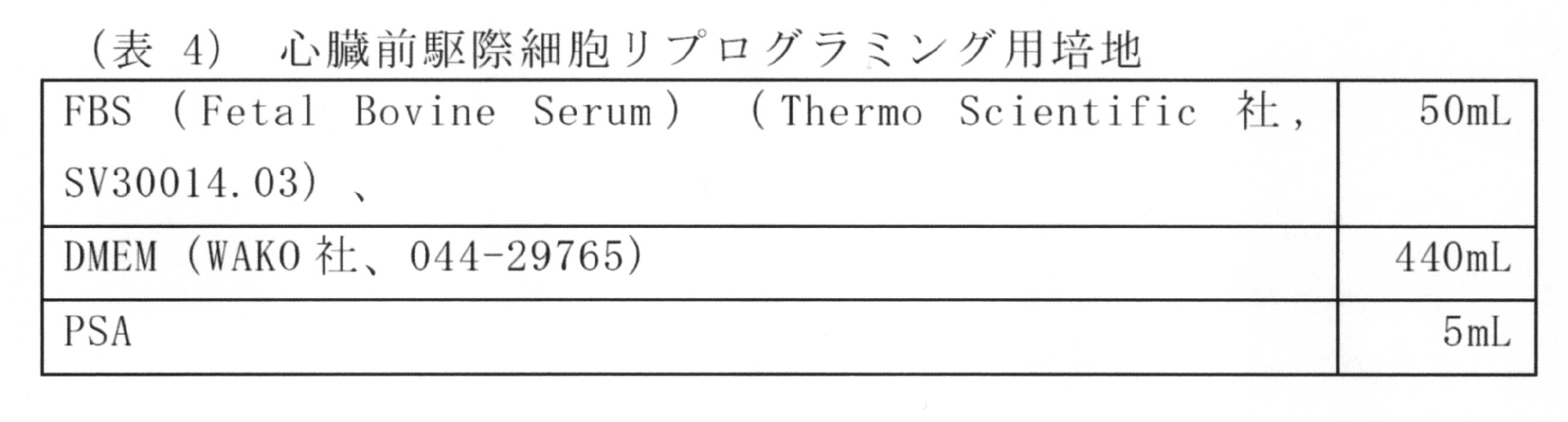
- the medium was changed to a medium for reprogramming cardiac progenitor cells (Table 4), and the cells were cultured at 37 ° C./5% CO 2 . Thereafter, the medium was changed every 3 to 4 days to perform cell culture.
- Example 3 Preparation and cell culture of induced cardiomyocytes by Tbx6, SRF and Myocd (1) Gene transfer method of Tbx6, SRF and Myocd by retrovirus Virus as in "Production of induced cardiac progenitor cells" in Example 2 A solution was made. However, in this example, 3 genes were introduced. On day 1, Plat-E cells were prepared in three 10 cm tissue culture dishes in the same manner as in Example 2. On day 2, 27 ⁇ L FuGENE 6 Transfection Reagent (Promega, E2691) was mixed with 300 ⁇ L Opti-MEM (gibco, 31985-070).
- the MEF medium was aspirated from the plate prepared on day 3, and the medium was replaced with a retrovirus solution in which equal amounts of Tbx6, SRF, and Myocd were mixed, and the MEF was infected with the virus (infection).
- Example 4 Induction of cardiac progenitor cells from mouse fibroblasts Tbx6 was introduced into mouse fibroblasts (MEF) to induce cardiac progenitor cells (Fig. 1, Example 2).
- Tbx6 gene was introduced into Mesp1-CrexGFP flox mouse fibroblasts expressing GFP in cells expressing Mesp1, a transcription factor specific for cardiac progenitor cells (Example 2), and GFP-positive cells expressing Mesp1 Colony formation was confirmed (FIG. 2).
- Example 5 Induction of cardiomyocytes from mouse fibroblasts Tbx6, SRF, and Myocd were introduced into mouse fibroblasts (MEF) to induce cardiomyocytes (Fig. 4, Example 3).
- the induced cardiomyocytes changed in shape and showed a striated structure (FIG. 5).
- expression of troponin T (cTnT) which is a structural protein of cardiac muscle
- SM-MHC which is a protein of smooth muscle cells
- cardiomyocytes are induced by gene transfer of Tbx6, SRF, and Myocd into fibroblasts.
- Example 6 Induction of smooth muscle cells and vascular endothelial cells from mouse fibroblasts Tbx6, SRF, and Myocd were introduced into mouse fibroblasts (MEF) in the same manner as in Example 3.
- Myh11 myosin heavy polypeptide 11
- Pecam1 Platelet / endothelial cell adhesion molecule 1
- This example demonstrates that smooth muscle cells or vascular endothelial cells can be induced by gene transfer of Tbx6, SRF, and Myocd into fibroblasts (MEF).
- the present invention provides a method for producing cardiac progenitor cells directly from fibroblasts and a method for producing cardiomyocytes directly from fibroblasts.
- the present invention can also provide cardiac progenitor cells and cardiomyocytes produced by the method of the present invention. Since cardiac progenitor cells derived from fibroblasts according to the present invention have sustained the expression of a plurality of cardiac progenitor cells, the present invention provides a method for producing cardiac progenitor cells and cardiac progenitor cells that are more stable than conventional methods. Can be provided. Since cardiac progenitor cells have a proliferative ability, the cardiac progenitor cells produced according to the present invention can be preferably applied to medical use. In addition, it has been confirmed that the cardiac muscle cells induced by the present invention beat, and cardiac muscle-specific gene expression and structural protein expression have been confirmed. Therefore, the myocardial production method of the present invention can provide functionally matured cardiomyocytes.
- SEQ ID NO: 1 nucleotide sequence of human Tbx6.
- SEQ ID NO: 2 amino acid sequence of human Tbx6.
- SEQ ID NO: 3 Nucleotide sequence of mouse Tbx6.
- SEQ ID NO: 4 amino acid sequence of mouse Tbx6.
- SEQ ID NO: 5 nucleotide sequence of human SRF.
- SEQ ID NO: 6 Amino acid sequence of human SRF.
- SEQ ID NO: 7 Nucleotide sequence of mouse SRF.
- SEQ ID NO: 8 Amino acid sequence of mouse SRF.
- SEQ ID NO: 9 nucleotide sequence of human Myocd.
- SEQ ID NO: 10 Amino acid sequence of human Myocd.
- SEQ ID NO: 11 Nucleotide sequence of mouse Myocd.
- SEQ ID NO: 12 Amino acid sequence of mouse Myocd.
Landscapes
- Health & Medical Sciences (AREA)
- Engineering & Computer Science (AREA)
- Life Sciences & Earth Sciences (AREA)
- Genetics & Genomics (AREA)
- Biomedical Technology (AREA)
- Bioinformatics & Cheminformatics (AREA)
- Organic Chemistry (AREA)
- Chemical & Material Sciences (AREA)
- Biotechnology (AREA)
- Wood Science & Technology (AREA)
- Zoology (AREA)
- General Engineering & Computer Science (AREA)
- General Health & Medical Sciences (AREA)
- Biochemistry (AREA)
- Microbiology (AREA)
- Cell Biology (AREA)
- Molecular Biology (AREA)
- Cardiology (AREA)
- Rheumatology (AREA)
- Physics & Mathematics (AREA)
- Biophysics (AREA)
- Plant Pathology (AREA)
- General Chemical & Material Sciences (AREA)
- Nuclear Medicine, Radiotherapy & Molecular Imaging (AREA)
- Chemical Kinetics & Catalysis (AREA)
- Veterinary Medicine (AREA)
- Public Health (AREA)
- Animal Behavior & Ethology (AREA)
- Pharmacology & Pharmacy (AREA)
- Medicinal Chemistry (AREA)
- Vascular Medicine (AREA)
- Heart & Thoracic Surgery (AREA)
- Hematology (AREA)
- Diabetes (AREA)
- Urology & Nephrology (AREA)
- Micro-Organisms Or Cultivation Processes Thereof (AREA)
- Medicines Containing Material From Animals Or Micro-Organisms (AREA)
- Medicines That Contain Protein Lipid Enzymes And Other Medicines (AREA)
Abstract
Description
さらに、本発明者らは、3つの因子(Tbx6、SRF、Myocd)を、レトロウイルスベクターおよびレトロウイルスを用いて線維芽細胞に遺伝子導入すると、拍動する心筋細胞が誘導されること、および得られた細胞が心筋細胞のマーカーであるNxk2.5やトロポニンを発現することを見出した。
また、本発明者らは、3つの因子(Tbx6、SRF、Myocd)を、レトロウイルスベクターおよびレトロウイルスを用いて線維芽細胞に遺伝子導入すると、得られた細胞が平滑筋細胞のマーカーであるMyh11を発現すること、および血管内皮細胞のマーカーであるPecam1が発現することを見出した。
本発明は、このような知見に基づき完成されたものである。
[1] 線維芽細胞にTbx6遺伝子を導入する工程を含む、心臓前駆細胞の製造方法。
[2] 線維芽細胞にTbx6遺伝子、SRF遺伝子およびMyocardin遺伝子を導入する工程を含む、心筋細胞の製造方法。
前記線維芽細胞は、例えば、マウス細胞またはヒト細胞である。
[3] 外来性のTbx6遺伝子を含む、線維芽細胞由来の心臓前駆細胞。
[4] 外来性のTbx6遺伝子、SRF遺伝子およびMyocardin遺伝子を含む、線維芽細胞由来の心筋細胞。
[5] Tbx6遺伝子を含有する、線維芽細胞からの心臓前駆細胞の誘導剤。
[6] Tbx6遺伝子、SRF遺伝子およびMyocd遺伝子を含有する、線維芽細胞からの心筋細胞の誘導剤。
[7] Tbx6遺伝子、SRF遺伝子およびMyocd遺伝子を含有する、線維芽細胞からの平滑筋細胞の誘導剤。
[8] Tbx6遺伝子、SRF遺伝子およびMyocd遺伝子を含有する、線維芽細胞からの血管内皮細胞の誘導剤。
また、本発明により誘導された心筋細胞は、拍動することが確認されており、また、心筋特異的な遺伝子発現や構造タンパク質の発現が確認されている。したがって、本発明の心筋製造方法は、機能的に成熟した心筋細胞を提供することができる。
レトロウイルスによって線維芽細胞にTbx6を遺伝子導入させると、心臓前駆細胞特異的マーカーであるMesp1を発現する細胞が誘導される。Tbx6の導入30日後においても心臓前駆細胞関連遺伝子は発現し、心臓前駆細胞の状態が維持される。線維芽細胞中でTbx6ポリペプチドは発現され、その結果、Tbx6遺伝子を導入された線維芽細胞は、幹細胞や先祖細胞になることなく、分化した心臓前駆細胞に直接リプログラミングされる。
Tbx6と共に、分化した心筋細胞において高発現するSRF, Myocdを加えた3因子(TSM)がレトロウイルスによって線維芽細胞に導入されると、拍動する成熟心筋細胞が誘導される。また、誘導された心筋細胞では、心筋特異的な遺伝子であるNkx2.5やトロポニンの発現、および横紋構造の形成が確認される。線維芽細胞中でTbx6、SRFおよびMyocdポリペプチドは発現し、その結果、Tbx6、SRFおよびMyocd遺伝子を導入された線維芽細胞は、幹細胞や先祖細胞になることなく、分化した心筋細胞に直接リプログラミングされる。
また、線維芽細胞にTbx6、SRFおよびMyocd遺伝子を導入すると、心筋細胞特異的な遺伝子発現だけでなく、心臓前駆細胞遺伝子(Mesp1, T, KDR)も誘導される。したがって、本発明によれば心臓前駆細胞を経由するため、心筋細胞、平滑筋細胞または血管内皮細胞を製造することができる。
本発明において、Tbx6遺伝子を導入された線維芽細胞またはTbx6遺伝子、SRF遺伝子およびMyocd遺伝子を導入された線維芽細胞は、幹細胞や先祖細胞になることなく、分化した心臓前駆細胞または心筋細胞に直接リプログラミングされる。
本発明の一態様において、Tbx6遺伝子、またはTbx6遺伝子、SRF遺伝子およびMyocd遺伝子のセットは、線維芽細胞にin vitroで導入され得る。また、当該線維芽細胞はin vitroで心臓前駆細胞または心筋細胞に誘導される。誘導された心臓前駆細胞または心筋細胞は個体内に導入できる。
本発明においては、線維芽細胞は、哺乳類の線維芽細胞、例えば、ヒト、またはマウス、ラット、ブタ、サル、ウマ、ウシ、ヒツジ、ヤギ、イヌ等のヒト以外の哺乳動物の線維芽細胞を使用することができる。好ましくは、線維芽細胞はヒト線維芽細胞である。他の実施形態においては、線維芽細胞はマウス線維芽細胞である。線維芽細胞は哺乳動物から得られる線維芽細胞、または哺乳動物から得られる線維芽細胞の子孫であり、単離されたものであってもよく、また、その継代培養細胞であってもよい。線維芽細胞としては、例えば、胎児線維芽細胞、尾先端部由来線維芽細胞、心臓線維芽細胞、包皮線維芽細胞、皮膚線維芽細胞、肺線維芽細胞等を用いることができる。
本発明の心臓前駆細胞または心筋細胞の製造方法において、線維芽細胞は、1つ以上のリプログラミング因子をコードするヌクレオチド配列を含む核酸の1つ以上を導入され得る。または、本発明の心臓前駆細胞または心筋細胞の製造方法において、線維芽細胞は、リプログラミング因子ポリペプチド自体の1つ以上を線維芽細胞内に導入され得る。本発明において、リプログラミング因子は、心臓前駆細胞を製造する場合はTbx6であり、心筋細胞を製造する場合はTbx6、SRFおよびMyocd(TSM)である。Tbx6、SRFおよびMyocdは、一度にまたは順次に細胞に導入することができる。一度に細胞に導入するとは、複数のリプログラミング因子を、1回の細胞導入工程で細胞に導入することであり、順次とは、複数のリプログラミング因子を同日または異なる日に複数の細胞導入工程で細胞に導入することである。細胞導入効率の観点からいえば、複数のリプログラミング因子を一度に細胞に導入することが好ましい。また、本発明のリプログラミング因子のアミノ酸配列およびアミノ酸配列をコードするヌクレオチド配列は当分野で公知である。
Tbx6ポリペプチド(Tbox転写因子6)は、一部の遺伝子のプロモーター領域におけるTボックスと結合してこれを認識する転写因子である。種々の種に由来するTbx6ポリペプチドに関するアミノ酸配列、およびTbx6ポリペプチドをコードするヌクレオチド配列が知られている。例えば、Genbankアクセッション番号NM_004608.3(ヒト、ヌクレオチド配列、配列番号1、CDS 61..1371)、NP_004599.2(ヒト、アミノ酸配列、配列番号2)、NM_011538.2(マウス、ヌクレオチド配列、配列番号3、CDS 25..1335)、NP_035668.2(マウス、アミノ酸配列、配列番号4)等を参照することができる。
種々の種に由来するSRFポリペプチドに関するアミノ酸配列、およびSRFポリペプチドをコードするヌクレオチド配列が知られている。例えば、Genbankアクセッション番号NM_003131.3(ヒト、ヌクレオチド配列、配列番号5、CDS 363..1889)、NP_003122.1(ヒト、アミノ酸配列、配列番号6)、NM_020493.2(マウス、ヌクレオチド配列、配列番号7、CDS 335..1849)、NP_065239.1(マウス、アミノ酸配列、配列番号8)等を参照することができる。
種々の種に由来するMyocardinポリペプチドに関するアミノ酸配列、およびMyocardinポリペプチドをコードするヌクレオチド配列が知られている。例えば、Genbankアクセッション番号NM_001146312.2(ヒト、ヌクレオチド配列、配列番号9、CDS 300..3260)、NP_001139784.1(ヒト、アミノ酸配列、配列番号10)、NM_145136.4(マウス、ヌクレオチド配列、配列番号11、CDS 292..3243)、NP_660118.3(マウス、アミノ酸配列、配列番号12)等を参照することができる。
本発明において「心臓前駆細胞」は、心臓前駆細胞に特異的なマーカーを発現することにより特徴付けられる細胞である。心臓前駆細胞に特異的なマーカーは、心臓前駆細胞に特異的に発現する因子(心臓前駆細胞関連因子)であり、T、Mesp1、Flk1(KDR)、Pdgfrα、Isl1などが含まれる。心臓前駆細胞は、心臓前駆細胞に特異的なマーカーのうちの少なくとも1つ、より好ましくは少なくとも2つ、さらに好ましくは少なくとも3つを発現する。心臓前駆細胞は、好ましくは、T、Mesp1、およびFlk1(KDR)を発現する細胞である。マーカー発現は、遺伝子レベルまたはタンパク質レベルにより確認することができる。
また、本発明においては、心臓前駆細胞は線維芽細胞から誘導されることから、誘導心臓前駆細胞と称することもある。
本発明において「心筋細胞」は、心筋細胞に特異的なマーカーを発現することにより特徴付けられる細胞である。心筋細胞に特異的なマーカーは、心筋細胞に特異的に発現する因子(心筋細胞関連因子)であり、心トロポニン(cTnT)、Nkx2.5、Actn2などが含まれる。心筋細胞は、心筋細胞に特異的なマーカーのうちの少なくとも1つ、より好ましくは少なくとも2つ、さらに好ましくは少なくとも3つを発現する。心筋細胞は、好ましくは、cTnT、およびNkx2.5を発現する細胞である。
また、本発明においては、心筋細胞は線維芽細胞から誘導されることから、誘導心筋細胞と称することもある。
本明細書において「外来性」とは、その細胞に導入される(例えば、エレクトロポレーション、感染、リポフェクション、マイクロインジェクションまたは細胞内に核酸を導入するいずれかの他の手段による)核酸またはポリペプチドを指す。
外来性リプログラミング因子(Tbx6、SRF、Myocd)遺伝子の導入、すなわち、これらのポリペプチドをコードするポリヌクレオチド、またはそのヌクレオチド配列に相補的なヌクレオチド配列を有するポリヌクレオチドの導入は、例えば、レトロウイルスベクターやアデノウイルスベクター等のウイルスベクターを用いたウイルス感染、リポフェクション法、エレクトロポレーション法、マイクロインジェクション法、リン酸カルシウム法等の公知の形質転換方法により行うことができる。
本発明は、外来性のTbx6遺伝子を含む線維芽細胞を含む。また、本発明は外来性のTbx6遺伝子、SRF遺伝子およびMyocd遺伝子を含む、線維芽細胞を含む。本発明の別の実施態様においては、本発明の外来性遺伝子を含む線維芽細胞はin vitroの状態にある。本発明の別の実施態様においては、本発明の外来性遺伝子を含む線維芽細胞は哺乳動物細胞、例えば、ヒト細胞であるか、またはヒト細胞から誘導されている。
本発明は、さらに上記の心臓前駆細胞または心筋細胞の製造方法により製造される、線維芽細胞に由来する心臓前駆細胞(誘導心臓前駆細胞、心臓前駆細胞様細胞)または心筋細胞(誘導心筋細胞、心筋様細胞)に関する。本発明において「線維芽細胞由来」の心臓前駆細胞あるいは心筋細胞は、線維芽細胞から誘導された心臓前駆細胞または心筋細胞を意味する。本発明の誘導心臓前駆細胞または誘導心筋細胞は、外来性遺伝子を含む線維芽細胞から誘導されるため、本発明の誘導心臓前駆細胞または誘導心筋細胞も、また、外来性のTbx6遺伝子、または外来性のTbx6遺伝子、SRF遺伝子およびMyocd遺伝子を含む。本発明の別の実施態様においては、本発明の誘導心臓前駆細胞または誘導心筋細胞はin vitroの形態にある。本発明の別の実施態様においては、本発明の誘導心臓前駆細胞または誘導心筋細胞は、ヒト細胞などの哺乳動物の細胞であるか、またはヒト細胞などの哺乳動物から派生されている。
同様に、線維芽細胞から誘導された細胞が心筋細胞であることは、前述のとおり心筋細胞に特異的なマーカーの発現により確認することができる。このように心臓前駆細胞に特異的なマーカーの発現が確認された細胞は、心筋様細胞とも称される。
マーカー発現は、遺伝子レベルまたはタンパク質レベルにより確認することができる。
本発明は、線維芽細胞からの心臓前駆細胞誘導剤、または線維芽細胞からの心筋細胞誘導剤をも提供する。また、線維芽細胞にTbx6遺伝子、SRF遺伝子およびMyocd遺伝子を導入することにより平滑筋細胞や内皮細胞も誘導されることから、本発明は線維芽細胞からの平滑筋細胞誘導剤または血管内皮細胞誘導剤をも提供する。
本発明の誘導剤は、上記ポリペプチドまたは核酸に加えて、塩、例えばNaCl、MgCl、KCl、MgSO4等;緩衝剤、例えばトリス緩衝液、N-(2-ヒロドキシエチル)ピペラジン-N'-(2-エタンスルホン酸(HEPES)、2-(N-モルホリノ)エタンスルホン酸(MES)、2-(N-モルホリノ)エタンスルホン酸ナトリウム塩(MES)、3-(N-モルホリノ)プロパンスルホン酸(MOPS)、N-トリス[ヒドロキシメチル]メチル-3-アミノプロパンスルホン酸(TAPS);等、可溶化剤;洗剤、例えばノニオン系洗剤、例えばTween-20;等、プロテアーゼ阻害剤;グリセロール;等の1つ以上を含むことができる。また、本発明の誘導剤は、リプログラミング因子のポリペプチドまたは核酸を線維芽細胞に導入するための試薬を含むことができる。
本発明の外来性の遺伝子を含む線維芽細胞は、治療の必要な個体においてそのような治療のために使用できる。同様に、本発明の誘導心臓前駆細胞または誘導心筋細胞は治療の必要な個体においてそのような治療のために使用できる。本発明の外来性の遺伝子を含む線維芽細胞、または本発明の誘導心臓前駆細胞または誘導心筋細胞は、レシピエント個体(治療の必要な個体)中に導入することができ、その場合、本発明の外来性の遺伝子を含む線維芽細胞、または本発明の誘導心臓前駆細胞または誘導心筋細胞のレシピエント個体への導入は、個体における状態または障害を治療する。したがって、本発明は、本発明の外来性の遺伝子を含む線維芽細胞、または本発明の誘導心臓前駆細胞または誘導心筋細胞を個体に投与することを含む治療方法に関する。
(1)マウス胎児線維芽細胞(MEF)の作製
生後7週~10週のメスICRマウス(日本クレア社)とMesp1-GFPトランスジェニックマウス(オス)(Development 126, 3437-3447 (1999), “MesP1 is expressed in the heart precursor cells and required for the formation of a single heart tube”)を交配させた。受精を確認した日を妊娠0日として、妊娠確認後12日目に妊娠したICRマウスから胎児を摘出した。胎児から心臓を摘出し、倒立顕微鏡(オリンパス社、IX71)にて心臓を蛍光にて投影し、GFP蛍光が発せられる胎児を選択した。

心臓前駆細胞に誘導する場合は、以下のとおりフローサイトメトリー(FACS)によるソートを行い、GFP(-)の細胞を使用した。

ゼラチンコーティングした10 cm組織培養用dish(Thermo Scientific社、172958)にPlat-E packaging細胞を3.6×10⁶ cellの濃度で播種し、37℃/5% CO2 条件下で静置した(day1)。
(1)レトロウイルスによるTbx6、SRF、Myocdの遺伝子導入法
実施例2の「誘導心臓前駆細胞の作製」と同様にウイルス溶液を作製した。ただし、本実施例では3個の遺伝子を導入した。day1には、実施例2と同様の方法で3枚の10 cm組織培養用dishにPlat-E細胞を準備した。day2において、300μL Opti-MEM(gibco社、31985-070)に27μL FuGENE 6 Transfection Reagent(Promega社、E2691)を混合した。5分間静置後、上記混合液にpMx-Tbx6、pMx-SRF、およびpMx-Myocd(製造方法は、Cell 142, 375-386, August 6, 2010, “Direct Reprogramming of Fibroblasts into Functional Cardiomyocytes by Defined Factors”を参照)のレトロウイルスプラスミドを9000 ng分それぞれ混注し強くタッピングをし、その後15分間室温で静置した。前日(day1)に用意したPlat-E細胞全体に上記の溶液を滴下し、37℃/5% CO2条件下で静置した(トランスフェクション)。
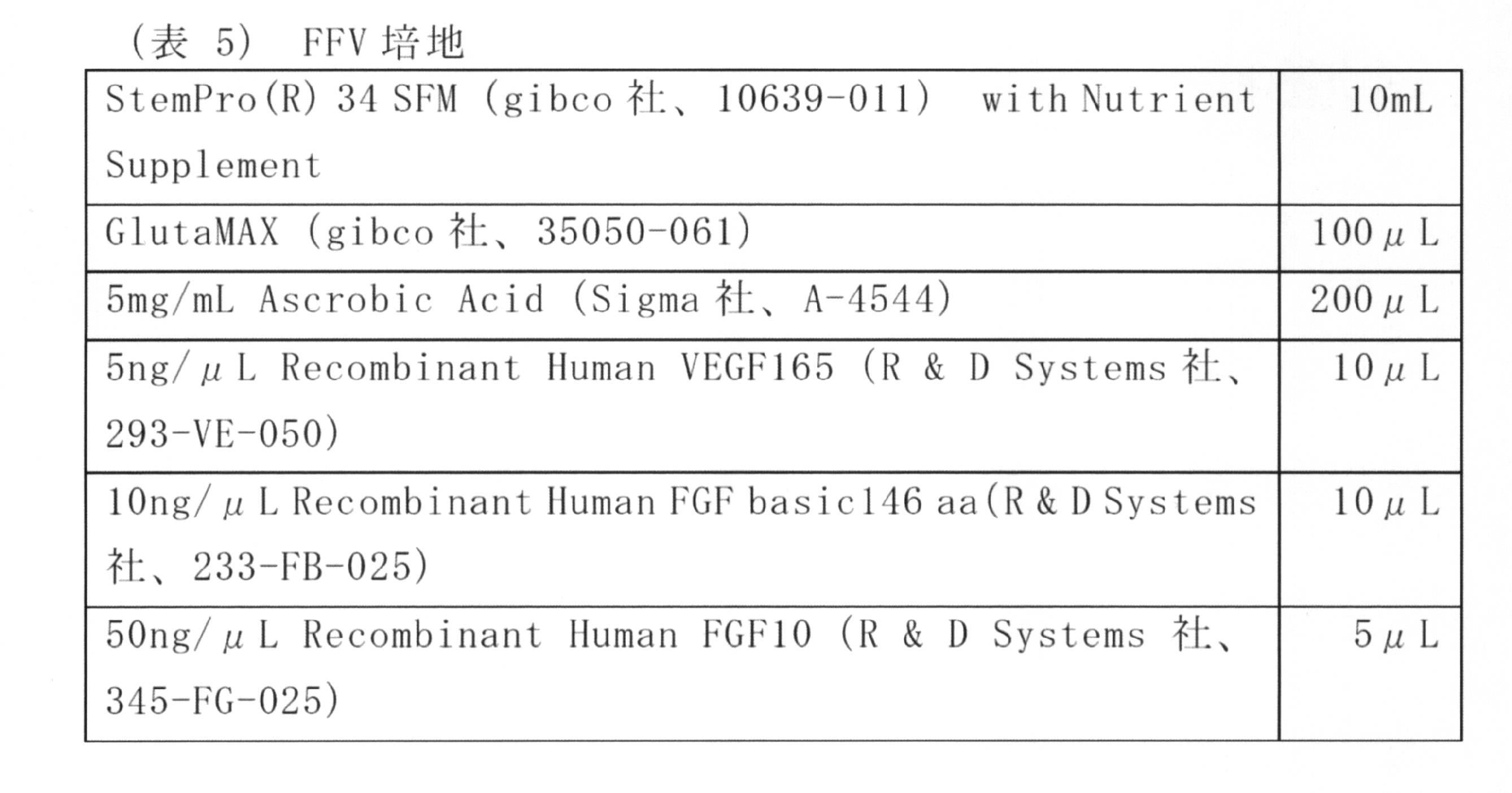
遺伝子導入翌日(day5)より、FFV培地(表5)に変更し、37℃/5% CO2条件下で培養を行った。以後3~4日ごとに培地を交換し細胞培養を行った。
マウス線維芽細胞(MEF)にTbx6を遺伝子導入し、心臓前駆細胞を誘導した(図1、実施例2)。
マウス線維芽細胞(MEF)にTbx6、SRF、Myocdを遺伝子導入し、心筋細胞を誘導した(図4、実施例3)。
実施例3と同様の方法で、マウス線維芽細胞(MEF)にTbx6、SRF、Myocdを遺伝子導入した。
その結果、Tbx6、SRF、Myocdを遺伝子導入した細胞は当該抗体に陽性となったことから、平滑筋の特徴であるミオシン重鎖を発現したことがわかる(図8)。
その結果、Tbx6、SRF、Myocdを遺伝子導入した細胞(TSM)では、Myh11およびPecam1の発現誘導が確認された(図7)。
また、本発明により誘導された心筋細胞は、拍動することが確認されており、また、心筋特異的な遺伝子発現や構造タンパク質の発現が確認されている。したがって、本発明の心筋製造方法は、機能的に成熟した心筋細胞を提供することができる。
配列番号2:ヒトTbx6のアミノ酸配列。
配列番号3:マウスTbx6のヌクレオチド配列。
配列番号4:マウスTbx6のアミノ酸配列。
配列番号5:ヒトSRFのヌクレオチド配列。
配列番号6:ヒトSRFのアミノ酸配列。
配列番号7:マウスSRFのヌクレオチド配列。
配列番号8:マウスSRFのアミノ酸配列。
配列番号9:ヒトMyocdのヌクレオチド配列。
配列番号10:ヒトMyocdのアミノ酸配列。
配列番号11:マウスMyocdのヌクレオチド配列。
配列番号12:マウスMyocdのアミノ酸配列。
Claims (8)
- 線維芽細胞にTbx6遺伝子を導入する工程を含む、心臓前駆細胞の製造方法。
- 線維芽細胞にTbx6遺伝子、SRF遺伝子およびMyocardin遺伝子を導入する工程を含む、心筋細胞の製造方法。
- 外来性のTbx6遺伝子を含む、線維芽細胞由来の心臓前駆細胞。
- 外来性のTbx6遺伝子、SRF遺伝子およびMyocardin遺伝子を含む、線維芽細胞由来の心筋細胞。
- Tbx6遺伝子を含有する、線維芽細胞からの心臓前駆細胞の誘導剤。
- Tbx6遺伝子、SRF遺伝子およびMyocd遺伝子を含有する、線維芽細胞からの心筋細胞の誘導剤。
- Tbx6遺伝子、SRF遺伝子およびMyocd遺伝子を含有する、線維芽細胞からの平滑筋細胞の誘導剤。
- Tbx6遺伝子、SRF遺伝子およびMyocd遺伝子を含有する、線維芽細胞からの血管内皮細胞の誘導剤。
Priority Applications (4)
| Application Number | Priority Date | Filing Date | Title |
|---|---|---|---|
| US16/084,427 US20190071641A1 (en) | 2016-03-15 | 2017-03-07 | Method for directly producing cardiac precursor cell or myocardial cell from fibroblast |
| JP2018505837A JP6853538B2 (ja) | 2016-03-15 | 2017-03-07 | 線維芽細胞からの心臓前駆細胞と心筋細胞の直接製造方法 |
| EP17766464.6A EP3431593A4 (en) | 2016-03-15 | 2017-03-07 | METHOD FOR THE DIRECT PREPARATION OF A CARDIGENT CELL OR MYOCARDIAL CELL FROM FIBROBLAST |
| CN201780017266.9A CN109072220A (zh) | 2016-03-15 | 2017-03-07 | 由成纤维细胞直接制造心脏祖细胞和心肌细胞的方法 |
Applications Claiming Priority (2)
| Application Number | Priority Date | Filing Date | Title |
|---|---|---|---|
| JP2016-051407 | 2016-03-15 | ||
| JP2016051407 | 2016-03-15 |
Publications (1)
| Publication Number | Publication Date |
|---|---|
| WO2017159463A1 true WO2017159463A1 (ja) | 2017-09-21 |
Family
ID=59850293
Family Applications (1)
| Application Number | Title | Priority Date | Filing Date |
|---|---|---|---|
| PCT/JP2017/009052 Ceased WO2017159463A1 (ja) | 2016-03-15 | 2017-03-07 | 線維芽細胞からの心臓前駆細胞と心筋細胞の直接製造方法 |
Country Status (5)
| Country | Link |
|---|---|
| US (1) | US20190071641A1 (ja) |
| EP (1) | EP3431593A4 (ja) |
| JP (1) | JP6853538B2 (ja) |
| CN (1) | CN109072220A (ja) |
| WO (1) | WO2017159463A1 (ja) |
Cited By (3)
| Publication number | Priority date | Publication date | Assignee | Title |
|---|---|---|---|---|
| WO2019136031A1 (en) * | 2018-01-05 | 2019-07-11 | University Of Houston System | Serum response factor regenerates senescent cells |
| WO2019151097A1 (ja) * | 2018-01-30 | 2019-08-08 | 株式会社片岡製作所 | 心筋細胞の製造方法 |
| JP2023515672A (ja) * | 2020-03-02 | 2023-04-13 | テナヤ セラピューティクス, インコーポレイテッド | 心筋細胞発現マイクロrnaによる遺伝子ベクター制御 |
Families Citing this family (1)
| Publication number | Priority date | Publication date | Assignee | Title |
|---|---|---|---|---|
| JP7029173B2 (ja) * | 2016-03-15 | 2022-03-03 | 国立大学法人 筑波大学 | 多能性幹細胞からの心臓前駆細胞と心筋細胞の製造方法 |
Citations (3)
| Publication number | Priority date | Publication date | Assignee | Title |
|---|---|---|---|---|
| WO2010008100A1 (ja) * | 2008-07-17 | 2010-01-21 | 国立大学法人名古屋大学 | 骨格筋細胞又は骨細胞の誘導法 |
| JP2011512855A (ja) * | 2008-03-10 | 2011-04-28 | アシスタンス ピュブリック−オピト ド パリ | 霊長類胚幹細胞または胚様状態細胞から臨床的使用のための霊長類心血管前駆細胞を作製するための方法、およびそれらの応用 |
| JP2015213441A (ja) * | 2014-05-08 | 2015-12-03 | 学校法人慶應義塾 | 心筋様細胞の作製方法及びそれに用いる培地 |
Family Cites Families (4)
| Publication number | Priority date | Publication date | Assignee | Title |
|---|---|---|---|---|
| EP2542669B1 (en) * | 2010-03-05 | 2015-01-21 | Texas Heart Institute | Ets2 and mesp1 generate cardiac progenitors from fibroblasts |
| JP5988961B2 (ja) * | 2010-04-28 | 2016-09-07 | ザ ジェイ. デヴィッド グラッドストーン インスティテューツ | 心筋細胞を発生させるための方法 |
| CN103459592B (zh) * | 2010-12-09 | 2016-05-25 | 诺未科技(北京)有限公司 | 亚全能干细胞产品及其表观遗传修饰标签 |
| WO2012101114A1 (en) * | 2011-01-24 | 2012-08-02 | INSERM (Institut National de la Santé et de la Recherche Médicale) | Induced presomitic mesoderm (ipsm) cells and their use |
-
2017
- 2017-03-07 EP EP17766464.6A patent/EP3431593A4/en not_active Withdrawn
- 2017-03-07 JP JP2018505837A patent/JP6853538B2/ja active Active
- 2017-03-07 US US16/084,427 patent/US20190071641A1/en not_active Abandoned
- 2017-03-07 WO PCT/JP2017/009052 patent/WO2017159463A1/ja not_active Ceased
- 2017-03-07 CN CN201780017266.9A patent/CN109072220A/zh active Pending
Patent Citations (3)
| Publication number | Priority date | Publication date | Assignee | Title |
|---|---|---|---|---|
| JP2011512855A (ja) * | 2008-03-10 | 2011-04-28 | アシスタンス ピュブリック−オピト ド パリ | 霊長類胚幹細胞または胚様状態細胞から臨床的使用のための霊長類心血管前駆細胞を作製するための方法、およびそれらの応用 |
| WO2010008100A1 (ja) * | 2008-07-17 | 2010-01-21 | 国立大学法人名古屋大学 | 骨格筋細胞又は骨細胞の誘導法 |
| JP2015213441A (ja) * | 2014-05-08 | 2015-12-03 | 学校法人慶應義塾 | 心筋様細胞の作製方法及びそれに用いる培地 |
Non-Patent Citations (4)
| Title |
|---|
| GAVRILOV, S. ET AL.: "Tbx6 is a determinant of cardiac and neural cell fate decisions in multipotent P19CL6 cells", DIFFERENTIATION, vol. 84, September 2012 (2012-09-01), pages 176 - 184, XP002722494 * |
| HIROYUKI YAMAKAWA ET AL.: "FGF2/FGF10/VEGF ga, Shinkin Chokusetsu Full.Reprogramming o Koritsuteki ni Yudo suru", REGENERATIVE MEDICINE, vol. 15, no. 2016, 1 February 2016 (2016-02-01), pages 213, XP009513408 * |
| MARI ISOMI ET AL.: "Shinki Shinzo Zenku Saibo Yudo Inshi ni yoru Hito ES /iPS karano Shinkin Yudoho no Kakuritsu", REGENERATIVE MEDICINE, vol. 15, no. Suppl., 1 February 2016 (2016-02-01), pages 213, XP009513409 * |
| See also references of EP3431593A4 * |
Cited By (5)
| Publication number | Priority date | Publication date | Assignee | Title |
|---|---|---|---|---|
| WO2019136031A1 (en) * | 2018-01-05 | 2019-07-11 | University Of Houston System | Serum response factor regenerates senescent cells |
| US12042525B2 (en) | 2018-01-05 | 2024-07-23 | University Of Houston System | Serum response factor regenerates senescent cells |
| WO2019151097A1 (ja) * | 2018-01-30 | 2019-08-08 | 株式会社片岡製作所 | 心筋細胞の製造方法 |
| JPWO2019151097A1 (ja) * | 2018-01-30 | 2021-01-14 | 株式会社片岡製作所 | 心筋細胞の製造方法 |
| JP2023515672A (ja) * | 2020-03-02 | 2023-04-13 | テナヤ セラピューティクス, インコーポレイテッド | 心筋細胞発現マイクロrnaによる遺伝子ベクター制御 |
Also Published As
| Publication number | Publication date |
|---|---|
| JPWO2017159463A1 (ja) | 2019-01-17 |
| EP3431593A1 (en) | 2019-01-23 |
| JP6853538B2 (ja) | 2021-03-31 |
| EP3431593A4 (en) | 2019-11-13 |
| US20190071641A1 (en) | 2019-03-07 |
| CN109072220A (zh) | 2018-12-21 |
Similar Documents
| Publication | Publication Date | Title |
|---|---|---|
| RU2718536C2 (ru) | Способы получения и применения популяций мультипотентных и плюрипотентных клеток, устойчивых к заболеваниям и способных к дифференцировке | |
| US7323337B2 (en) | Gene transfer into primate embryonic stem cells using VSV-G pseudotyped simian immunodeficiency virus vectors | |
| JP6005666B2 (ja) | プログラミングによる造血前駆細胞の生産 | |
| JP5988961B2 (ja) | 心筋細胞を発生させるための方法 | |
| JP6298405B2 (ja) | 心筋細胞を生成するための方法 | |
| US20130171731A1 (en) | Reversibly immortalized cells as well as methods relating hereto | |
| US20200063158A1 (en) | Engineered Cellular Pathways for Programmed Autoregulation of Differentiation | |
| JP6960396B2 (ja) | 分裂終了細胞の細胞分裂を誘発するための方法 | |
| US20030049236A1 (en) | Immortalized stem cells | |
| JP6853538B2 (ja) | 線維芽細胞からの心臓前駆細胞と心筋細胞の直接製造方法 | |
| KR20150104049A (ko) | 체세포로부터 혈관 전구 세포로의 직접교차분화 유도용 조성물 및 이의 용도 | |
| US20220411762A1 (en) | Method for producing pancreatic endocrine cells, and transdifferentiation agent | |
| JP7029173B2 (ja) | 多能性幹細胞からの心臓前駆細胞と心筋細胞の製造方法 | |
| CN118139632A (zh) | 褥疮的预防剂和/或治疗剂 | |
| JP2013009742A (ja) | 多能性幹細胞の増殖を抑制するための組成物及び方法 | |
| Pisano et al. | Optimized lentiviral transduction of human amniotic mesenchymal stromal cells | |
| CN118222633A (zh) | 诱导成纤维细胞转分化为肾小管上皮细胞的方法及产品 | |
| CN115851600A (zh) | 一种诱导成纤维细胞转分化为肾脏上皮细胞的方法 | |
| HK40110492A (zh) | 褥疮的预防剂和/或治疗剂 | |
| HK1064702A (en) | Gene transfer into primate emborynic stem cells using vsv-g-pseudotype simian immunodeficiency virus vector | |
| HK1034283A1 (en) | Use of triplex structure dna sequences for transferring nucleotide sequences | |
| HK1034283B (en) | Use of triplex structure dna sequences for transferring nucleotide sequences |
Legal Events
| Date | Code | Title | Description |
|---|---|---|---|
| WWE | Wipo information: entry into national phase |
Ref document number: 2018505837 Country of ref document: JP |
|
| NENP | Non-entry into the national phase |
Ref country code: DE |
|
| WWE | Wipo information: entry into national phase |
Ref document number: 2017766464 Country of ref document: EP |
|
| ENP | Entry into the national phase |
Ref document number: 2017766464 Country of ref document: EP Effective date: 20181015 |
|
| 121 | Ep: the epo has been informed by wipo that ep was designated in this application |
Ref document number: 17766464 Country of ref document: EP Kind code of ref document: A1 |