WO2017159839A1 - (ポリ)スルフィド化合物の製造方法およびエピスルフィド化合物の製造方法 - Google Patents
(ポリ)スルフィド化合物の製造方法およびエピスルフィド化合物の製造方法 Download PDFInfo
- Publication number
- WO2017159839A1 WO2017159839A1 PCT/JP2017/010845 JP2017010845W WO2017159839A1 WO 2017159839 A1 WO2017159839 A1 WO 2017159839A1 JP 2017010845 W JP2017010845 W JP 2017010845W WO 2017159839 A1 WO2017159839 A1 WO 2017159839A1
- Authority
- WO
- WIPO (PCT)
- Prior art keywords
- general formula
- compound
- represented
- poly
- weight
- Prior art date
- Legal status (The legal status is an assumption and is not a legal conclusion. Google has not performed a legal analysis and makes no representation as to the accuracy of the status listed.)
- Ceased
Links
Classifications
-
- C—CHEMISTRY; METALLURGY
- C07—ORGANIC CHEMISTRY
- C07C—ACYCLIC OR CARBOCYCLIC COMPOUNDS
- C07C319/00—Preparation of thiols, sulfides, hydropolysulfides or polysulfides
- C07C319/22—Preparation of thiols, sulfides, hydropolysulfides or polysulfides of hydropolysulfides or polysulfides
- C07C319/24—Preparation of thiols, sulfides, hydropolysulfides or polysulfides of hydropolysulfides or polysulfides by reactions involving the formation of sulfur-to-sulfur bonds
-
- C—CHEMISTRY; METALLURGY
- C07—ORGANIC CHEMISTRY
- C07C—ACYCLIC OR CARBOCYCLIC COMPOUNDS
- C07C319/00—Preparation of thiols, sulfides, hydropolysulfides or polysulfides
- C07C319/14—Preparation of thiols, sulfides, hydropolysulfides or polysulfides of sulfides
-
- C—CHEMISTRY; METALLURGY
- C07—ORGANIC CHEMISTRY
- C07C—ACYCLIC OR CARBOCYCLIC COMPOUNDS
- C07C321/00—Thiols, sulfides, hydropolysulfides or polysulfides
- C07C321/12—Sulfides, hydropolysulfides, or polysulfides having thio groups bound to acyclic carbon atoms
- C07C321/14—Sulfides, hydropolysulfides, or polysulfides having thio groups bound to acyclic carbon atoms of an acyclic saturated carbon skeleton
-
- C—CHEMISTRY; METALLURGY
- C07—ORGANIC CHEMISTRY
- C07D—HETEROCYCLIC COMPOUNDS
- C07D331/00—Heterocyclic compounds containing rings of less than five members, having one sulfur atom as the only ring hetero atom
- C07D331/02—Three-membered rings
-
- C—CHEMISTRY; METALLURGY
- C08—ORGANIC MACROMOLECULAR COMPOUNDS; THEIR PREPARATION OR CHEMICAL WORKING-UP; COMPOSITIONS BASED THEREON
- C08G—MACROMOLECULAR COMPOUNDS OBTAINED OTHERWISE THAN BY REACTIONS ONLY INVOLVING UNSATURATED CARBON-TO-CARBON BONDS
- C08G75/00—Macromolecular compounds obtained by reactions forming a linkage containing sulfur with or without nitrogen, oxygen, or carbon in the main chain of the macromolecule
- C08G75/14—Polysulfides
-
- C—CHEMISTRY; METALLURGY
- C07—ORGANIC CHEMISTRY
- C07B—GENERAL METHODS OF ORGANIC CHEMISTRY; APPARATUS THEREFOR
- C07B61/00—Other general methods
-
- C—CHEMISTRY; METALLURGY
- C08—ORGANIC MACROMOLECULAR COMPOUNDS; THEIR PREPARATION OR CHEMICAL WORKING-UP; COMPOSITIONS BASED THEREON
- C08L—COMPOSITIONS OF MACROMOLECULAR COMPOUNDS
- C08L2203/00—Applications
-
- G—PHYSICS
- G02—OPTICS
- G02B—OPTICAL ELEMENTS, SYSTEMS OR APPARATUS
- G02B1/00—Optical elements characterised by the material of which they are made; Optical coatings for optical elements
- G02B1/04—Optical elements characterised by the material of which they are made; Optical coatings for optical elements made of organic materials, e.g. plastics
- G02B1/041—Lenses
Definitions
- the present invention relates to a method for producing a (poly) sulfide compound having a bishalohydrin group and a method for producing an episulfide compound having a (poly) sulfide bond.
- Plastic lenses are rapidly spreading to optical elements such as eyeglass lenses and camera lenses in recent years because they are lighter and harder to break than inorganic lenses and can be dyed.
- Resin for plastic lenses has been required to have higher performance, and higher refractive index, higher Abbe number, lower specific gravity, higher heat resistance, etc. have been demanded.
- Various resin materials for lenses have been developed and used so far.
- an optical material made of a sulfide-based resin has a high refractive index and a high Abbe number, and has been studied as an ultrahigh refractive index material having a refractive index exceeding 1.6.
- the sulfide resin is obtained by polymerizing a polymerizable composition containing an episulfide compound.
- a method for improving the sulfur content in the resin has been proposed for the purpose of increasing the refractive index.
- episulfide compounds having a disulfide bond (—S—S—) are used (Patent Documents 1 to 3).
- Patent Document 1 an episulfide compound having one or more disulfide bonds in the molecule and two or more 2,3-epithiopropyl groups in the molecule is used as a monomer, whereby the refractive index is 1.71. It is described that an excess of sulfide-based resin can be obtained.
- Patent Documents 1 and 4 to 8 disclose methods for producing episulfide compounds
- Patent Documents 1 and 6 to 8 disclose methods for synthesizing episulfide compounds having a disulfide bond by oxidation reaction of thiols.
- Synthesis Example 1 of Patent Document 1 bis (2,3-epoxypropyl) disulfide was obtained by reacting chloromercaptopropanol in the presence of sodium hydrogen carbonate and iodine and then in the presence of caustic soda.
- Example 5 of Patent Document 6 and Examples 5 and 6 of Patent Document 7 describe that a disulfide was obtained by reacting chloromercaptopropanol in the presence of sodium hydrogen carbonate and iodine.
- Patent Document 8 proposes a method for producing a polythiol oligomer via a disulfide bond by reacting a polythiol compound with sulfur in the presence of a basic catalyst.
- Example 1 specifically, 2,5-dimercaptomethyl-1,4-dithiane was reacted in the presence of sulfur and triethylamine as a basic catalyst, and an oligomer (disulfide form, etc.) of the compound was reacted. It is stated that it was obtained.
- the method using sulfur and a base compound as an oxidizing agent for a thiol compound is an effective means capable of industrially producing a disulfide compound inexpensively and stably.
- a sulfur-containing ring compound is produced as a by-product due to a side reaction in the molecule. The inventors have found that the selectivity of the target disulfide compound is lowered.
- X 1 and X 2 represent a hydroxyl group or a halogen atom, one is a hydroxyl group, and the other is a halogen atom.
- R 1 to R 7 may be the same or different and are each a hydrogen atom.
- C 1 to C 10 represents a linear or branched alkyl group, a substituted or unsubstituted aryl group, R 1 to R 7 may be the same or different, and m represents an integer of 0 to 2.
- a method for producing a sulfide compound; M (SH) n (4) (In general formula (4), M represents an alkali metal or alkaline earth metal. N represents the valence of the alkali metal or alkaline earth metal represented by M).
- Q 1 , Q 2 and Q 3 may be the same or different from each other, and are a hydrogen atom, a linear or branched aliphatic group having 1 to 20 carbon atoms, or 3 carbon atoms. ⁇ 20 alicyclic groups, substituted or unsubstituted aromatic groups, which groups may contain heteroatoms.
- X 1 to X 2 , R 1 to R 7 and m are as defined in the general formula (1), and a plurality of X 1 to X 2 , R 1 to R 7 and m are the same.
- the thiol compound represented by the general formula (1) is represented by the following formula (3):
- a step of obtaining an episulfide compound represented by: A method for producing an episulfide compound, comprising: [7]
- the episulfide compound is represented by the following general formula (8): (In general formula (8), p represents an integer of 0 to 4) The manufacturing method of the episulfide compound as described in [6] containing the compound represented by these.
- the episulfide compound is represented by the following formula (9): The manufacturing method of the episulfide compound as described in [6] or [7] containing the compound represented by these.
- “reacting the thiol compounds represented by the general formula (1)” is an aspect in which the same thiol compounds represented by the general formula (1) are reacted with each other, the general formula (1). It includes any of the embodiments in which the different thiol compounds represented are reacted.
- the method for producing the (poly) sulfide compound of the present invention comprises: A step of obtaining a (poly) sulfide compound by reacting a specific thiol compound having a halogen atom and a hydroxyl group in the molecule with each other in the presence of a base compound represented by general formula (4) or general formula (5) and sulfur. including.
- the method for producing the episulfide compound of the present invention includes: Epoxidizing the (poly) sulfide compound obtained by the above method under basic conditions; Reacting the epoxy compound obtained in the above step with a sulfurizing agent to obtain an episulfide compound.
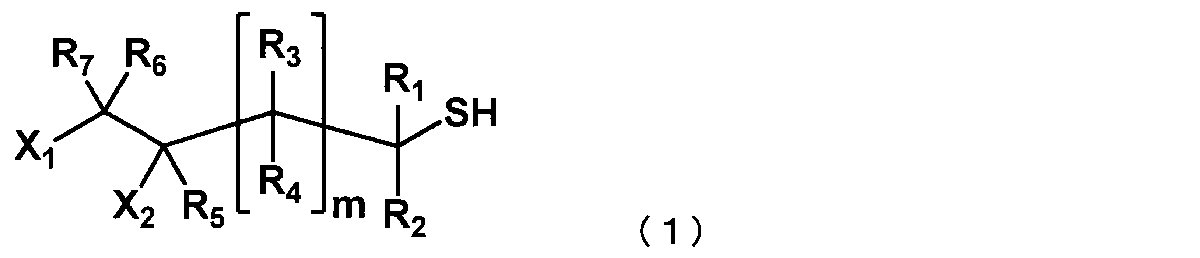
- the method for producing the (poly) sulfide of this embodiment is as follows: The thiol compounds represented by the following general formula (1) are reacted with each other in the presence of a base compound represented by the general formula (4) or the general formula (5) and sulfur, and represented by the general formula (2). A step of obtaining a (poly) sulfide compound.
- X 1 and X 2 represent a hydroxyl group or a halogen atom, one is a hydroxyl group, and the other is a halogen atom.
- the halogen atom include a fluorine atom, a chlorine atom, a bromine atom, and an iodine atom, and a chlorine atom is preferable from the viewpoint of the effect of the present invention.
- R 1 to R 7 may be the same or different and each represents a hydrogen atom, a C1 to C10 linear or branched alkyl group, or a substituted or unsubstituted aryl group.
- R 1 to R 7 may be the same or different from each other.
- C1-C10 linear or branched alkyl groups include methyl, ethyl, n-propyl, isopropyl, n-butyl, sec-butyl, tert-butyl, pentyl, hexyl, heptyl Octyl group, nonyl group, decyl group and the like.
- aryl group examples include aryl groups having 6 to 18 carbon atoms such as phenyl, tolyl, xylyl, biphenyl, naphthyl, anthryl, and phenanthryl.
- substituent of the substituted aryl group include an alkyl group having 1 to 10 carbon atoms, a halogen atom, a hydroxyl group, an alkoxyl group having 1 to 10 carbon atoms, an alkylthio group, and an amino group.
- R 1 to R 7 may be the same or different, and are preferably a hydrogen atom or a C1 to C10 linear or branched alkyl group, and preferably all are hydrogen atoms.
- n represents an integer of 0 to 2, preferably 0 or 1, and more preferably 0.
- a compound represented by the following formula (3) can be preferably used from the viewpoint of the effect of the present invention.
- M represents an alkali metal or an alkaline earth metal, preferably an alkali metal such as lithium, sodium, or potassium, and more preferably sodium.
- n represents the valence of the alkali metal or alkaline earth metal represented by M.
- Examples of the compound represented by the general formula (4) include sodium hydrogen sulfide, potassium hydrogen sulfide, magnesium hydrogen sulfide, calcium hydrogen sulfide, and the like. In this embodiment, it is preferable to use sodium hydrogen sulfide.
- Q 1 , Q 2 and Q 3 may be the same or different from each other, and are a hydrogen atom, a linear or branched aliphatic group having 1 to 20 carbon atoms, or 3 to 3 carbon atoms.
- 20 alicyclic groups, substituted or unsubstituted aromatic groups, these groups may contain heteroatoms, and may be a hydrogen atom, a linear or branched aliphatic group having 1 to 20 carbon atoms, or An alicyclic group having 3 to 20 carbon atoms is preferable.
- linear or branched aliphatic group having 1 to 20 carbon atoms examples include linear or branched alkyl groups such as methyl, ethyl, butyl, isobutyl, octyl and 2-ethylhexyl groups, vinyl groups (Ethenyl group), butenyl group, octenyl group and the like straight chain or branched alkenyl group.
- Examples of the alicyclic group having 3 to 20 carbon atoms include cyclopropyl group, cyclopentyl group, cyclohexyl group, cyclohexenyl group, tetrahydropyranyl group, tetrahydrofuranyl group, tetrahydrothiopyranyl group, tetrahydrothiofuranyl group, 3- Bromotetrahydropyranyl group, 4-methoxytetrahydropyranyl group, 4-methoxytetrahydrothiopyranyl group, 3-tetrahydrothiophene-1,1-dioxide group, 2-methyl-2-adamantyl group, 2-ethyl-2- And an adamantyl group.
- Examples of the substituted or unsubstituted aromatic group include a phenyl group, a tolyl group, and a xylyl group.
- Q 1 , Q 2 and Q 3 are preferably the same as each other, more preferably a linear or branched aliphatic group having 1 to 20 carbon atoms, and particularly preferably an ethyl group. .
- Examples of the compound represented by the general formula (5) include ammonia, methylamine, ethylamine, n-propylamine, isopropylamine, n-butylamine, s-butylamine, t-butylamine, Dimethylamine, diethylamine, ethylmethylamine, Aniline, N-methylaniline, N-ethylaniline, Trimethylamine, triethylamine, tri-n-propylamine, triisopropylamine, tri-n-butylamine, tri-n-hexylamine, N, N-diisopropylethylamine, N, N-dimethyl-n-octadecylamine, triethylenediamine, triphenylamine, N, N-dimethylethanolamine, N, N-diethylethanolamine, triethanolamine, N, N-dimethylcyclohexylamine, N, N-diethylcyclohexylamine,
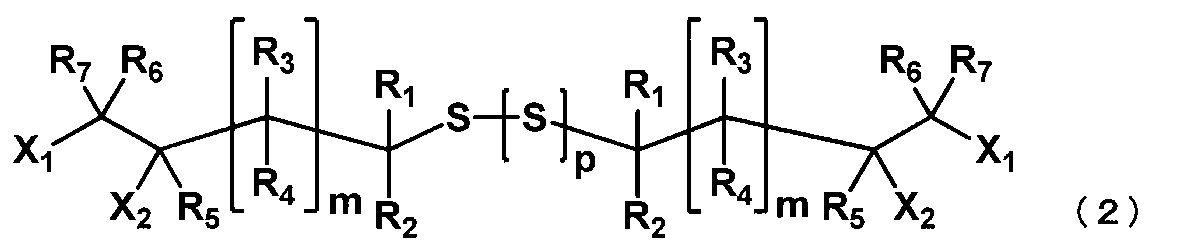
- the thiol compound represented by the general formula (1) is reacted in the presence of the base compound and sulfur as described above to obtain a (poly) sulfide compound represented by the following general formula (2).
- This step can be performed in a reaction solvent.
- aromatic solvents such as toluene, xylene, chlorobenzene, dichlorobenzene and nitrobenzene, aliphatic solvents such as dichloromethane, chloroform and dichloroethane, methanol , Ethanol, isopropanol, butanol, methoxyethanol, ethylene glycol, glycerol and other alcohols, water and the like are used. Particularly preferred is water. These may be used alone or in combination of two or more.
- the amount of sulfur used is preferably 0.96 to 1.12 equivalents, more preferably 0.98 to 1.02 equivalents, relative to the thiol compound represented by the general formula (1).
- the amount of the base compound used is preferably 1.5 to 3.5 mol%, more preferably 1.7 to 3.0 mol%, more preferably 1.7 to 2 with respect to the thiol compound represented by the general formula (1). 1 mol% is particularly preferable.
- the reaction temperature is preferably 3 to 20 ° C, more preferably 5 to 15 ° C.
- the reaction time is not particularly limited, but is about 3 to 20 hours.
- the reaction can be performed under atmospheric pressure or reduced pressure.
- reduced pressure 50 Torr to 600 Torr (6.7 kPa to 80.0 kPa) is preferable, 50 Torr to 200 Torr (6.7 kPa to 26.7 kPa) is more preferable, and 60 Torr to 80 Torr (8.0 kPa to 10.7 kPa). It is particularly preferable if it is present.
- By performing the reaction under reduced pressure by-produced hydrogen sulfide is discharged out of the system, the conversion rate is improved, and as a result, the yield is improved.
- By performing the reaction under reduced pressure by-produced hydrogen sulfide is discharged out of the system, the conversion rate is improved, and as a result, the yield is improved.
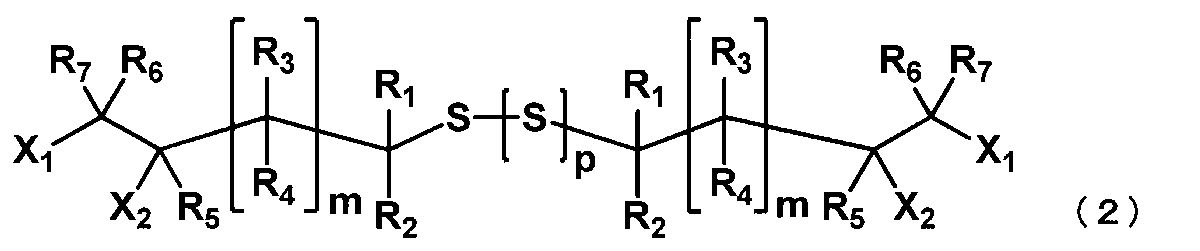
- X 1 to X 2 , R 1 to R 7 and m are as defined in the general formula (1), and a plurality of X 1 to X 2 , R 1 to R 7 and m are the same. May be different.
- p represents an integer of 0 to 4.
- the (poly) sulfide compound represented by the general formula (2) is preferably 1,8-dichloro-2,7-dihydroxy-4,5-dithiaoctane.
- R 1 to R 7 and m are as defined in the general formula (1).
- the sulfur-containing ring compound represented by the general formula (a) or the general formula (b) is a (poly) sulfide compound represented by the general formula (2) in the reaction solution after the step. Is contained in an area of 10 area% or less, preferably 0.1 to 5.0 area%, and the formation of sulfur-containing ring compounds is suppressed. This content is measured in high performance liquid chromatography (HPLC).
- the yield of the (poly) sulfide compound represented by the general formula (2) is preferably 80 to 95%.
- generation of the sulfur-containing ring compound which is a side reaction product is suppressed, and the (poly) sulfide compound represented by General formula (2) is used suitably as a monomer for optical materials. be able to.
- the manufacturing method of the episulfide compound of this embodiment includes the following processes. Step (i): The (poly) sulfide compound represented by the general formula (2) is epoxidized under basic conditions to obtain an epoxy compound represented by the following general formula (6).
- R 1 to R 7 and m have the same meaning as in general formula (1), and a plurality of R 1 to R 7 and m may be the same or different.
- p represents an integer of 0 to 4.
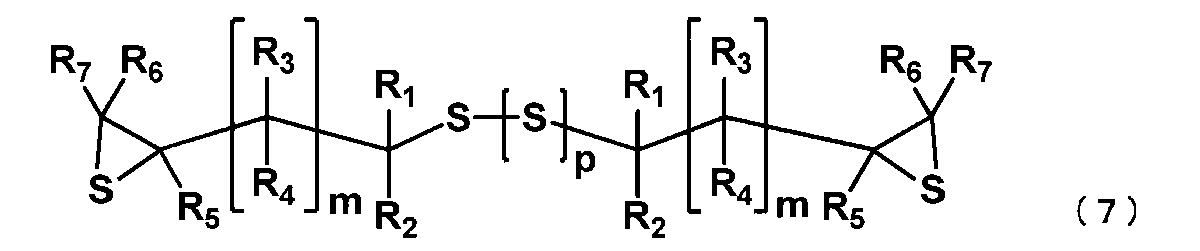
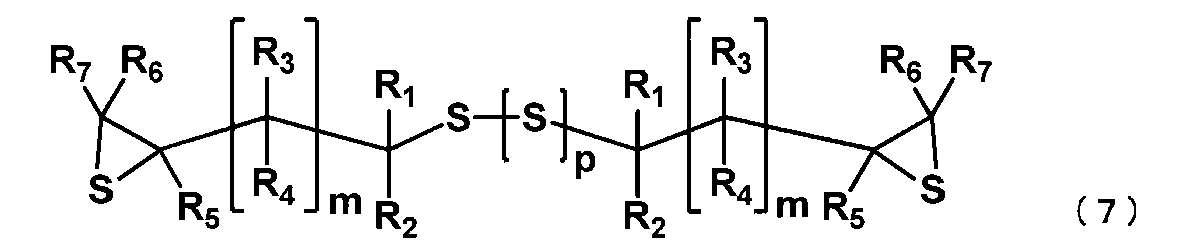
- R 1 to R 7 , m and p have the same meanings as in general formula (6). Since the manufacturing method of the episulfide compound of this embodiment includes the manufacturing method of a (poly) sulfide compound as one process, it is excellent in the productivity of an episulfide compound by extension, and can suppress manufacturing cost. Furthermore, a lens manufactured using the episulfide compound is also excellent in productivity and can suppress the manufacturing cost. In the present embodiment, unlike the conventional method, the (poly) sulfide compound is produced without using halogen, so the halogen content of the (poly) sulfide compound is low.
- the halogen content of the episulfide compound manufactured using the said (poly) sulfide compound is also low. Therefore, in the case of producing an optical material such as a lens using the episulfide compound, side reactions and by-products derived from halogen are suppressed, and an optical material having excellent quality can be obtained. These steps will be described in detail below.
- Step (i) In the general formula (2) obtained by reacting the thiol compounds represented by the general formula (1) in the presence of the base compound represented by the general formula (4) or the general formula (5) and sulfur.
- Organic / inorganic bases such as sodium methylate, potassium t-butoxy, disodium monohydrogen phosphate, sodium acetate are added to obtain a composition containing an epoxy compound.
- bases may be used alone or in combination of two or more.
- inorganic bases are more preferable than organic bases, and among inorganic bases, sodium hydroxide and potassium hydroxide are preferable.
- the amount of these bases used is preferably 1 to 10 equivalents, more preferably 2 to 5 equivalents, relative to the (poly) sulfide compound.
- the reaction temperature is preferably ⁇ 10 to 60 ° C., more preferably 5 to 30 ° C.
- This step can be performed in a reaction solvent.
- aromatic solvents such as toluene, xylene, chlorobenzene, dichlorobenzene and nitrobenzene
- aliphatic solvents such as dichloromethane, chloroform and dichloroethane
- methanol a solvent for converting dichloromethane to chloroform
- Ethanol isopropanol
- butanol methoxyethanol
- ethylene glycol, glycerol and other alcohols water and the like
- Particularly preferred is toluene or water. These may be used alone or in combination of two or more.
- Step (ii) The epoxy compound represented by the general formula (6) obtained in the step (i) is reacted with a sulfurizing agent to obtain an episulfide compound represented by the general formula (7).
- the sulfurizing agent include thiurea or thiocyanate such as sodium thiocyanate, potassium thiocyanate, ammonium thiocyanate, calcium thiocyanate, lead thiocyanate, and the like.
- sodium thiocyanate, potassium thiocyanate, and ammonium thiocyanate are preferable, and sodium thiocyanate is more preferable.
- the amount of thiourea or thiocyanate used as the sulfurizing agent is, for example, an equivalent amount or more with respect to the epoxy group, but is preferably 1 to 5 equivalents, more preferably 1 to 3 equivalents. If the amount is less than 1 equivalent, the purity may decrease, and if it exceeds 5 equivalents, it may be economically disadvantageous.
- the reaction temperature varies greatly depending on the type of thiurea or thiocyanate, and is not particularly limited. However, when thiurea is used, it is preferably about 10 to 30 ° C., and when thiocyanate is used, about 30 to 60 ° C. Is preferred.
- the same reaction solvent as that used for the synthesis of the epoxy compound is usually used.
- aromatic solvents such as toluene, xylene, chlorobenzene, dichlorobenzene, nitrobenzene, aliphatic solvents such as dichloromethane, chloroform, dichloroethane, methanol, ethanol, isopropanol, butanol, methoxyethanol, ethylene glycol, glycerin, etc.
- Alcohols are preferably used. These may be used alone or in combination of two or more. Unlike epoxidation, thioepoxidation is not preferably used because water tends to slow the reaction rate.
- the episulfide compound represented by the general formula (7) is preferably an episulfide compound represented by the following general formula (8), and is an episulfide compound represented by the following general formula (9). More preferably.
- p represents an integer of 0 to 4.
- the polymerizable composition for optical materials containing the episulfide compound obtained by the above production method can be prepared by a conventionally known method.
- the polymerizable composition for an optical material can contain a polyisocyanate compound and / or a polythiol compound together with the obtained episulfide compound.
- an optical material can be produced from a polymerizable composition for an optical material by a conventionally known method.
- the optical material include a plastic lens, a camera lens, a light emitting diode (LED), a prism, an optical fiber, an information recording substrate, a filter, a light emitting diode, an automobile optical lens, and a robot optical lens.
- it is suitable as an optical material and an optical element such as a plastic lens, a camera lens, and a light emitting diode.
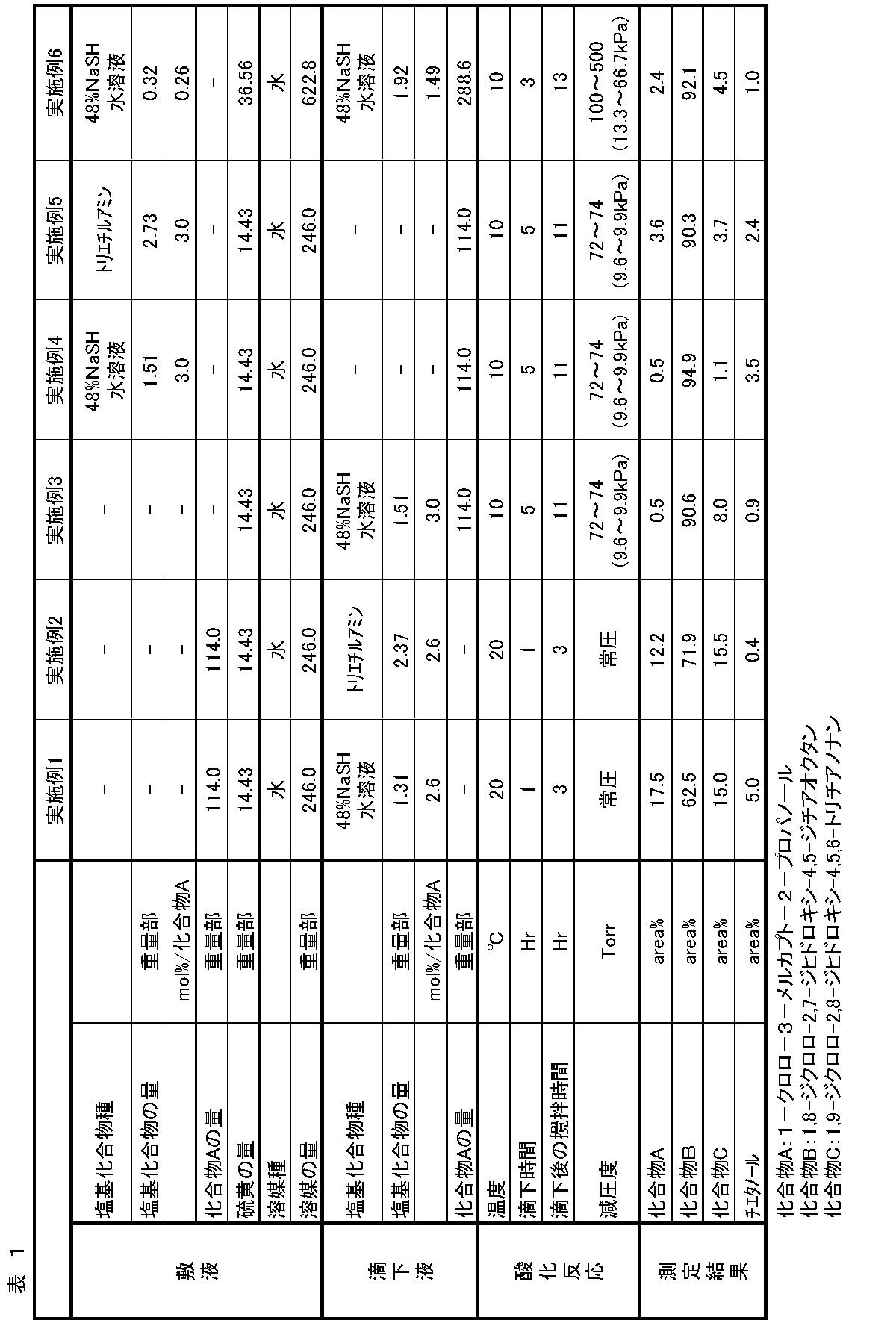
- Example 2 In a separable flask container, 246.0 parts by weight of distilled water, 14.43 parts by weight of sulfur powder, 123.5 parts by weight of 92.3 wt% 1-chloro-3-mercapto-2-propanol (compound: 114.0). Parts by weight) was stirred, and nitrogen gas was circulated through the gas phase part, and the internal temperature was adjusted to 20 ° C. Next, 2.37 parts by weight of triethylamine was charged over 1 hour. After charging, the mixture was stirred at an internal temperature of 20 ° C. for 3 hours. The obtained reaction solution was measured by the same method as in Example 1. As a result, it contained 71.9 area% of 1,8-dichloro-2,7-dihydroxy-4,5-dithiaoctane, which was the target product.
- Example 3 A separable flask vessel was charged with 246.0 parts by weight of distilled water and 14.43 parts by weight of sulfur powder, cooled to 10 ° C. with stirring, and the internal pressure was reduced to 70 Torr with a pump. Then, 122.3 parts by weight of 92.3 wt% 1-chloro-3-mercapto-2-propanol (compound: 114.0 parts by weight) and 3.15 parts by weight of 48% NaSH aqueous solution (NaSH: 1.51 parts by weight) was mixed, and dropped at an internal temperature of 10 ° C. for 5 hours. After dropping, the mixture was stirred for 11 hours at an internal temperature of 10 ° C. and an internal pressure of 72 Torr to 74 Torr. The obtained reaction solution was measured by the same method as in Example 1. As a result, it was found that the target product, 1,8-dichloro-2,7-dihydroxy-4,5-dithiaoctane, contained 90.6 area%.
- Example 4 A separable flask was charged with 246.0 parts by weight of distilled water, 14.43 parts by weight of sulfur powder, and 3.15 parts by weight of 48% NaSH aqueous solution (NaSH: 1.51 parts by weight). It was cooled to 0 ° C. and the internal pressure was reduced to 70 Torr with a pump. Subsequently, 92.3 wt% of 1-chloro-3-mercapto-2-propanol (123.5 parts by weight) (compound: 114.0 parts by weight) was charged in the dropping funnel in advance, and the internal temperature was 10 ° C. for 5 hours. Over time, it was dropped. After dropping, the mixture was stirred for 11 hours at an internal temperature of 10 ° C.
- the obtained reaction liquid was measured by the same method as in Example 1. As a result, it contained 94.9 area% of 1,8-dichloro-2,7-dihydroxy-4,5-dithiaoctane, which was the target product. Subsequently, 1,8-dichloro-2,7-dihydroxy-4,5-dithiaoctane is filtered off from the reaction solution, washed with water and dried, and then 1,8-dichloro-2,7-dihydroxy-4, 5-Dithiaoctane was obtained. The identification data of the obtained compound are shown below.
- Example 5 A separable flask container was charged with 246.0 parts by weight of distilled water, 14.43 parts by weight of sulfur powder, and 2.73 parts by weight of triethylamine, cooled to 10 ° C. with stirring, and the internal pressure was reduced to 70 Torr with a pump. did. Then, 123.5 parts by weight of 92.3 wt% of 1-chloro-3-mercapto-2-propanol (compound: 114.0 parts by weight was charged in advance in a dropping funnel over 5 hours at an internal temperature of 10 ° C. After the dropwise addition, the mixture was stirred for 11 hours at an internal temperature of 10 ° C. and an internal pressure of 72 to 74 Torr. It contained 90.3 area% 8-dichloro-2,7-dihydroxy-4,5-dithiaoctane.
- reaction solution was measured by the same method as in Example 1. As a result, it contained 92.1 area% 1,8-dichloro-2,7-dihydroxy-4,5-dithiaoctane, which was the target product.
- the organic layer and the aqueous layer are separated, and the aqueous layer is discharged. Then, 555.8 parts by weight of 13% NaCl aqueous solution, 6.3 parts by weight of acetic acid, and 180.3 parts by weight of methanol are charged.
- the organic layer was washed at 20 to 25 ° C. for 15 minutes and separated into an organic layer and an aqueous layer, and then the aqueous layer was discharged.
- the obtained organic layer was transferred to an eggplant flask, desolvated at 35 ° C. for 2 hours, and further topped at 35 ° C. for 5 hours to distill off methyl isobutyl ketone.
- a column tube was prepared in which a total amount of 38.4 parts by weight of silica gel wetted with methylcyclohexane was charged into the column tube. Purification was performed by passing the entire amount of the methylcyclohexyne solution through a column tube packed with silica gel. The purified methylcyclohexane solution was transferred to an eggplant flask, and the methylcyclohexane was distilled off at 35 ° C. for 2 hours, followed by topping at 35 ° C. for 3 hours, and 97.7 wt% bis (2,3-epithio). 118.3 parts by weight of propyl) disulfide were obtained.
Landscapes
- Chemical & Material Sciences (AREA)
- Organic Chemistry (AREA)
- Chemical Kinetics & Catalysis (AREA)
- Health & Medical Sciences (AREA)
- Medicinal Chemistry (AREA)
- Polymers & Plastics (AREA)
- Organic Low-Molecular-Weight Compounds And Preparation Thereof (AREA)
- Low-Molecular Organic Synthesis Reactions Using Catalysts (AREA)
- Epoxy Compounds (AREA)
Abstract
Description
スルフィド系樹脂からなる成形体においては、高屈折率化を目的として、樹脂中の硫黄含有率を向上させる方法が提案されている。当該目的のため、ジスルフィド結合(-S-S-)を備えるエピスルフィド化合物が使用されている(特許文献1~3)。特許文献1には、モノマーとして、分子内に1つ以上のジスルフィド結合と分子内に2つ以上の2,3-エピチオプロピル基を有するエピスルフィド化合物を用いることにより、屈折率が1.71を超えるスルフィド系樹脂が得られることが記載されている。
特許文献1の合成例1には、クロロメルカプトプロパノールを、炭酸水素ナトリウムとヨウ素の存在下で反応させ、次いで苛性ソーダ存在下で反応することによりビス(2,3-エポキシプロピル)ジスルフィドを得たこと記載されている。
特許文献6の実施例5や特許文献7の実施例5、6には、クロロメルカプトプロパノールを炭酸水素ナトリウムとヨウ素の存在下で反応させジスルフィド体を得たと記載されている。
特許文献8には、塩基性触媒の存在下、ポリチオール化合物と硫黄とを反応させてジスルフィド結合を介したポリチオールオリゴマーの製造方法が提案されている。実施例1には、具体的に2,5-ジメルカプトメチル-1,4-ジチアンを、硫黄と塩基性触媒であるトリエチルアミンとの存在下で反応させ、当該化合物のオリゴマー(ジスルフィド体等)を得たと記載されている。
しかしながら、硫黄および塩基化合物を用いたチオール化合物の酸化反応において、チオール化合物がメルカプト基以外の反応性官能基を同一分子内に有する場合、分子内での副反応により含硫環化合物が副生し、目的化合物であるジスルフィド化合物の選択率が低下することを見出した。
[1] 下記一般式(1)

で表されるチオール化合物同士を、下記一般式(4)または下記一般式(5)で表される塩基化合物および硫黄の存在下で反応させる、下記一般式(2)で表される(ポリ)スルフィド化合物の製造方法;
M(SH)n (4)
(一般式(4)中、Mは、アルカリ金属またはアルカリ土類金属を表す。nは、Mで表されるアルカリ金属またはアルカリ土類金属の価数を表す。)、

[2] 前記チオール化合物同士を、50Torr~600Torrの圧力下で反応させる、[1]に記載の(ポリ)スルフィド化合物の製造方法。
[3] X1およびX2における前記ハロゲン原子が塩素原子である、[1]または[2]に記載の(ポリ)スルフィド化合物の製造方法。
[4] 前記一般式(1)で表されるチオール化合物は、下記式(3)

[5] 前記一般式(4)で表される化合物が、硫化水素ナトリウムである、[1]~[4]のいずれかに記載の(ポリ)スルフィド化合物の製造方法。
[6] [1]~[5]のいずれかに記載の製造方法により得られた(ポリ)スルフィド化合物を、塩基条件下でエポキシ化し、下記一般式(6)

で表されるエポキシ化合物を得る工程と、
前記エポキシ化合物を硫化剤と反応させて下記一般式(7)
で表されるエピスルフィド化合物を得る工程と、
を含む、エピスルフィド化合物の製造方法。
[7] 前記エピスルフィド化合物が、下記一般式(8)

で表される化合物を含む、[6]に記載のエピスルフィド化合物の製造方法。
[8] 前記エピスルフィド化合物が、下記式(9)

なお、本発明において「一般式(1)で表されるチオール化合物同士を反応させる」とは、一般式(1)で表される同一のチオール化合物同士を反応させる態様、一般式(1)で表される異なるチオール化合物同士を反応させる態様のいずれも含むものである。
分子内にハロゲン原子と水酸基を有する特定のチオール化合物同士を、一般式(4)または一般式(5)で表される塩基化合物および硫黄の存在下で反応させて(ポリ)スルフィド化合物を得る工程を含む。
さらに、本発明のエピスルフィド化合物の製造方法は、
前記の方法で得られた(ポリ)スルフィド化合物を塩基条件下でエポキシ化する工程と、
前記工程で得られたエポキシ化合物を硫化剤と反応させて、エピスルフィド化合物を得る工程と、を含む。
以下、本発明の実施の形態を説明する。
本実施形態の(ポリ)スルフィドの製造方法は、
下記一般式(1)で表されるチオール化合物同士を、一般式(4)または一般式(5)で表される塩基化合物および硫黄の存在下で反応させ、一般式(2)で表される(ポリ)スルフィド化合物を得る工程を含む。
C1~C10の直鎖または分岐アルキル基としては、メチル基、エチル基、n-プロピル基、イソプロピル基、n-ブチル基、sec-ブチル基、tert-ブチル基、ペンチル基、ヘキシル基、ヘプチル基、オクチル基、ノニル基、デシル基等が挙げられる。
アリール基としては、フェニル、トリル、キシリル、ビフェニル、ナフチル、アントリル、フェナントリルなどの炭素数6~18のアリール基等が挙げられる。
置換アリール基の置換基としては、炭素原子数1~10のアルキル基、ハロゲン原子、ヒドロキシル基、炭素原子1~10のアルコキシル基またはアルキルチオ基、アミノ基等が挙げられる。
R1~R7は同一または異なっていてもよく、水素原子またはC1~C10の直鎖または分岐アルキル基が好ましく、いずれも水素原子であることが好ましい。
本実施形態において、チオール化合物としては、本発明の効果の観点から下記式(3)で表される化合物を好ましく用いることができる。

M(SH)n (4)
一般式(4)中、Mは、アルカリ金属またはアルカリ土類金属を表し、好ましくはリチウム、ナトリウム、カリウム等のアルカリ金属であり、より好ましくはナトリウムである。nは、Mで表されるアルカリ金属またはアルカリ土類金属の価数を表す。

炭素数3~20の脂環族基としては、シクロプロピル基、シクロペンチル基、シクロヘキシル基、シクロヘキセニル基、テトラヒドロピラニル基、テトラヒドロフラニル基、テトラヒドロチオピラニル基、テトラヒドロチオフラニル基、3-ブロモテトラヒドロピラニル基、4-メトキシテトラヒドロピラニル基、4-メトキシテトラヒドロチオピラニル基、3-テトラヒドロチオフェン-1,1-ジオキシド基、2-メチル-2-アダマンチル基、2-エチル-2-アダマンチル基等が挙げられる。
置換または無置換芳香族基としては、フェニル基、トリル基、キシリル基等が挙げられる。
本実施形態においては、Q1、Q2およびQ3は互いに同一であることが好ましく、炭素数1~20の直鎖または分枝状脂肪族基であることがより好ましく、エチル基が特に好ましい。
ジメチルアミン、ジエチルアミン、エチルメチルアミン、
アニリン、N-メチルアニリン、N-エチルアニリン、
トリメチルアミン、トリエチルアミン、トリn-プロピルアミン、トリイソプロピルアミン、トリn-ブチルアミン、トリn-ヘキシルアミン、N,N-ジイソプロピルエチルアミン、N,N-ジメチル-n-オクタデシルアミン、トリエチレンジアミン、トリフェニルアミン、N,N-ジメチルエタノールアミン、N,N-ジエチルエタノールアミン、トリエタノールアミン、N,N-ジメチルシクロヘキシルアミン、N,N-ジエチルシクロヘキシルアミン、N,N-ジメチルブチルアミン、N-メチルジシクロヘキシルアミン、N,N-ジメチルアニリン、N,N-ジエチルアニリン、テトラメチルエチレンジアミン等が挙げられる。本実施形態においては、トリエチルアミンを用いることが好ましい。
本実施形態においては、一般式(4)または一般式(5)で表される塩基化合物を用いており、上記のような問題が解消されているため、(ポリ)スルフィド化合物の生産性に優れ、製造コストを抑制することができる。
本工程は、反応溶媒中で行うことができ、反応溶媒としては、トルエン、キシレン、クロロベンゼン、ジクロロベンゼン、ニトロベンゼン等の芳香族系溶媒類、ジクロロメタン、クロロホルム、ジクロロエタン等の脂肪族系溶媒類、メタノール、エタノール、イソプロパノール、ブタノール、メトキシエタノール、エチレングリコール、グリセリン等のアルコール類、水等が用いられる。特に好ましくは水である。これらは単独で用いても、2種以上を混合して用いてもよい。
塩基化合物の使用量は、一般式(1)で表されるチオール化合物に対して、1.5~3.5mol%が好ましく、1.7~3.0mol%がさらに好ましく、1.7~2.1mol%であれば特に好ましい。
反応温度は3~20℃が好ましく、5~15℃であれば更に好ましい。
反応時間は、特に限定されないが3~20時間程度である。

本実施形態において、一般式(2)で表される(ポリ)スルフィド化合物としては、1,8-ジクロロ-2,7-ジヒドロキシ-4,5-ジチアオクタンが好ましい。
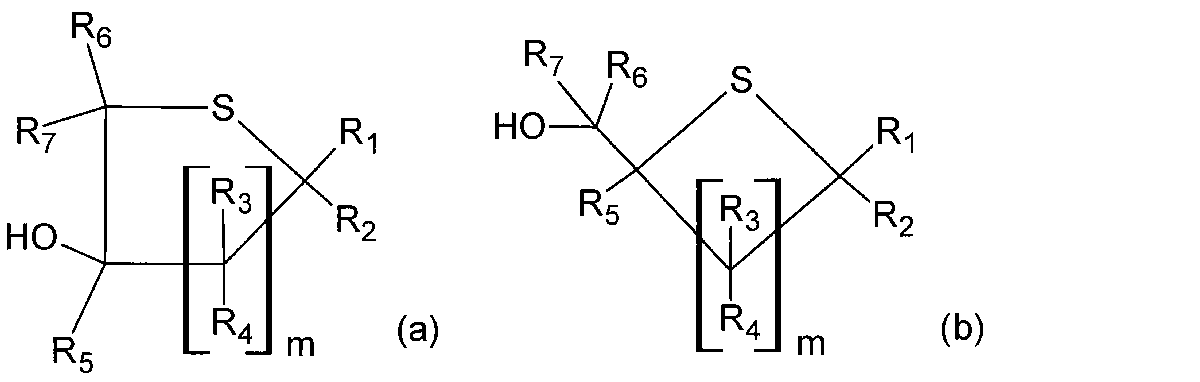
本実施形態においては、当該工程後の反応液中に、一般式(a)または一般式(b)で表される含硫環化合物が、一般式(2)で表される(ポリ)スルフィド化合物に対して10area%以下、好ましくは0.1~5.0area%で含まれており、含硫環化合物の生成が抑制される。この含有率は、高速液体クロマトグラフィー(HPLC)において測定される。
(測定方法)
・HPLC機種:島津製作所社製SPD-10A
・測定波長:210nm
・カラム:YMC A-312 S-5 ODS 6mmID×150mm
・温度条件:40℃
・移動相:アセトニトリル/水=2/3(vol/vol)
・注入量:2μL
・試料調整:反応液500mgをアセトニトリル10mLで溶解
このように、本実施形態においては、副反応物である含硫環化合物の生成が抑制されており、一般式(2)で表される(ポリ)スルフィド化合物を光学材料用モノマーとして好適に用いることができる。
本実施形態のエピスルフィド化合物の製造方法は、以下の工程を含む。
工程(i):一般式(2)で表される(ポリ)スルフィド化合物を塩基条件下でエポキシ化し、下記一般式(6)で表されるエポキシ化合物を得る。


本実施形態のエピスルフィド化合物の製造方法は、(ポリ)スルフィド化合物の製造方法を一工程として含むことから、ひいてはエピスルフィド化合物の生産性に優れ、製造コストを抑制することができる。さらに、当該エピスルフィド化合物を用いて製造されるレンズについても、生産性に優れ、製造コストを抑制することができる。
また、本実施形態においては、従来の方法と異なりハロゲンを用いることなく(ポリ)スルフィド化合物が製造されるため、(ポリ)スルフィド化合物のハロゲン含有量は低い。そして、当該(ポリ)スルフィド化合物を用いて製造されるエピスルフィド化合物のハロゲン含有量も低い。そのため、当該エピスルフィド化合物を用いてレンズ等の光学材料を製造する場合において、ハロゲンに由来する副反応や副生物の生成が抑制され、品質に優れた光学材料を得ることもできる。
これらの工程について、以下詳細に説明する。
一般式(1)で表されるチオール化合物同士を、一般式(4)または一般式(5)で表される塩基化合物および硫黄の存在下で反応させて得られた、一般式(2)で表される(ポリ)スルフィド化合物に、トリエチルアミン、トリブチルアミン、ジメチルシクロヘキシルアミン、ジエチルアニリン、ピリジン、水酸化ナトリウム、水酸化カリウム、水酸化マグネシウム、水酸化カルシウム、炭酸ナトリウム、炭酸水素ナトリウム、炭酸カリウム、ナトリウムメチラート、t-ブトキシカリウム、燐酸一水素二ナトリウム、酢酸ナトリウム等の有機・無機塩基類を加えて、エポキシ化合物を含む組成物を得る。
これらの塩基の使用量は、(ポリ)スルフィド化合物に対して、1~10当量が好ましく、2~5当量であれば更に好ましい。
また、反応温度は-10~60℃が好ましく、5~30℃であれば更に好ましい。
工程(i)で得られた一般式(6)で表されるエポキシ化合物を硫化剤と反応させ、一般式(7)で表されるエピスルフィド化合物を得る。
硫化剤としては、チオ尿素、又はチオシアン酸ナトリウム、チオシアン酸カリウム、チオシアン酸アンモニウム、チオシアン酸カルシウム、チオシアン酸鉛等のチオシアン酸塩等が挙げられる。チオシアン酸塩を使用する場合は、チオシアン酸ナトリウム、チオシアン酸カリウム、チオシアン酸アンモニウムが好ましく、チオシアン酸ナトリウムが更に好ましい。
反応温度はチオ尿素、又はチオシアン酸塩の種類によって大きく異なる為特に限定はできないが、チオ尿素を使用する場合は凡そ10~30℃が好ましく、チオシアン酸塩を使用する場合は凡そ30~60℃が好ましい。


さらに、光学材料用重合性組成物から従来公知の方法により光学材料を製造することができる。光学材料として、具体的には、プラスチックレンズ、カメラレンズ、発光ダイオード(LED)、プリズム、光ファイバー、情報記録基板、フィルター、発光ダイオード、自動車用光学レンズ、ロボット用光学レンズ等を挙げることができる。特に、プラスチックレンズ、カメラレンズ、発光ダイオード等の光学材料、光学素子として好適である。
・HPLC機種:島津製作所社製SPD-10A
・測定波長:210nm
・カラム:YMC A-312 S-5 ODS 6mmID×150mm
・温度条件:40℃
・移動相:アセトニトリル/水=2/3(vol/vol)
・注入量:2μL
・試料調整:反応液500mgをアセトニトリル10mLで溶解
[1,8-ジクロロ-2,7-ジヒドロキシ-4,5-ジチアオクタンの合成]
セパラブルフラスコ容器に、蒸留水246.0重量部、硫黄粉末を14.43重量部、92.3wt%の1-クロロ-3-メルカプト-2-プロパノール123.5重量部(化合物:114.0重量部)を装入し、気相部に窒素ガスを流通させながら撹拌し、内温を20℃にした。次に48wt%NaSH水溶液2.73重量部(NaSH:1.31重量部)を1時間かけて装入した。装入後、内温20℃で3時間撹拌した。得られた反応液を上記分析方法にて測定した結果、目的物である1,8-ジクロロ-2,7-ジヒドロキシ-4,5-ジチアオクタンを62.5area%含有していた。
セパラブルフラスコ容器に、蒸留水246.0重量部、硫黄粉末を14.43重量部、92.3wt%の1-クロロ-3-メルカプト-2-プロパノール123.5重量部(化合物:114.0重量部)を装入し、気相部に窒素ガスを流通させながら撹拌し、内温を20℃にした。次に、トリエチルアミン2.37重量部を1時間かけて装入した。装入後、内温20℃で3時間撹拌した。得られた反応液を実施例1と同方法にて測定した結果、目的物である1,8-ジクロロ-2,7-ジヒドロキシ-4,5-ジチアオクタンを71.9area%含有していた。
セパラブルフラスコ容器に、蒸留水246.0重量部、硫黄粉末を14.43重量部装入し、撹拌しながら10℃まで冷却させ、ポンプで内圧を70Torrまで減圧した。次いで、滴下ロートに予め92.3wt%の1-クロロ-3-メルカプト-2-プロパノール123.5重量部(化合物:114.0重量部)と、48%NaSH水溶液3.15重量部(NaSH:1.51重量部)を混合させた溶液を装入しておき、内温10℃で5時間かけて滴下装入した。滴下装入後、内温10℃、内圧72Torr~74Torrで11時間撹拌した。得られた反応液を実施例1と同方法にて測定した結果、目的物である1,8-ジクロロ-2,7-ジヒドロキシ-4,5-ジチアオクタンを90.6area%含有していた。
セパラブルフラスコ容器に、蒸留水246.0重量部、硫黄粉末を14.43重量部、48%NaSH水溶液3.15重量部(NaSH:1.51重量部)を装入し、撹拌しながら10℃まで冷却させ、ポンプで内圧を70Torrまで減圧した。次いで、滴下ロートに予め92.3wt%の1-クロロ-3-メルカプト-2-プロパノール123.5重量部(化合物:114.0重量部)を装入しておき、内温10℃で5時間かけて滴下装入した。滴下装入後、内温10℃、内圧72Torr~74Torrで11時間撹拌した。得られた反応液を実施例1と同方法にて測定した結果、目的物である1,8-ジクロロ-2,7-ジヒドロキシ-4,5-ジチアオクタンを94.9area%含有していた。
続いて、反応液から1,8-ジクロロ-2,7-ジヒドロキシ-4,5-ジチアオクタンを濾別後、水で洗浄、乾燥して、1,8-ジクロロ-2,7-ジヒドロキシ-4,5-ジチアオクタンを得た。
以下に、得られた化合物の同定データを示す。
1H-NMR(溶媒:CDCl3、内部標準物質:TMS)δ:2.64(2H)、2.96(4H)、3.71(4H)、4.15(2H)
13C-NMR(溶媒:CDCl3)δ:42.4、48.1、69.8
セパラブルフラスコ容器に、蒸留水246.0重量部、硫黄粉末を14.43重量部、トリエチルアミン2.73重量部を装入し、撹拌しながら10℃まで冷却させ、ポンプで内圧を70Torrまで減圧した。次いで、滴下ロートに予め92.3wt%の1-クロロ-3-メルカプト-2-プロパノール123.5重量部(化合物:114.0重量部を装入しておき、内温10℃で5時間かけて滴下装入した。滴下装入後、内温10℃、内圧72~74Torrで11時間撹拌した。得られた反応液を実施例1と同方法にて測定した結果、目的物である1,8-ジクロロ-2,7-ジヒドロキシ-4,5-ジチアオクタンを90.3area%含有していた。
[1,8-ジクロロ-2,7-ジヒドロキシ-4,5-ジチアオクタンの合成]
セパラブルフラスコ容器に、蒸留水622.8重量部、硫黄粉末を36.56重量部、48%NaSH水溶液0.66重量部(NaSH:0.32重量部)を装入し、撹拌しながら10℃まで冷却した。次いで、滴下ロートに予め92.3wt%の1-クロロ-3-メルカプト-2-プロパノール312.7重量部(化合物:288.6重量部)を装入しておき、内温10℃を保ちながら3時間で滴下装入した。滴下装入後、10℃で13時間撹拌した。この撹拌操作の間、反応系内の内圧をポンプで500Torrに減圧し、1時間で100Torrずつ減圧させていき、内圧100Torrになるまで減圧させた。また、攪拌開始から1時間目、5時間目、9時間目で48%NaSH水溶液を1.33重量部(NaSH:0.64重量部)ずつ追加装入した。得られた反応液を実施例1と同方法にて測定した結果、目的物である1,8-ジクロロ-2,7-ジヒドロキシ-4,5-ジチアオクタン92.1area%含有していた。
得られた反応液にトルエンを312.6重量部装入し、内温を10℃に保った。次いで滴下ロートに25%NaOH水溶液474.2重量部を装入し、10℃で2時間かけて滴下装入した。滴下終了後3時間、内温10℃を維持した状態で撹拌した。得られた反応液を一旦分液ロートに移液して水層を排出した。残ったトルエン層に13%NaCl水溶液152重量部を装入し、酢酸を加えて反応液pH=6.0~6.2へ撹拌しながら調整した。pH調整後、20℃で15分間洗浄を行い、水層を排出した。再度トルエン層に13%NaCl水溶液152重量部を装入し20℃で15分間洗浄し、水層を排出した。残ったトルエン層をナスフラスコへ移液させ、35℃で3時間脱トルエンを行い、ビス(2,3-エポキシプロピル)ジスルフィド94.1wt%(1.055mol)を含む生成物200重量部を得た。
ビス(2,3-エポキシプロピル)ジスルフィドを含む生成物198.9重量部を、滴下ロートに装入した。別途、5つ口フラスコを準備し、酢酸38.5重量部と、チオ尿素169.4重量部と、メタノール280重量部と、純水87.5重量部を装入しておき、内温15℃で撹拌させた状態で、ビス(2,3-エポキシプロピル)ジスルフィドを3時間で装入した。この滴下の間、滴下開始から30分後に88%蟻酸27.5重量部を装入、滴下開始から90分後に88%蟻酸27.5重量部を装入、滴下から150分後に88%蟻酸27.5重量部を装入した。ビス(2,3-エポキシプロピル)ジスルフィドを含む生成物の滴下終了後、内温を15℃に保ったまま更に3時間撹拌を継続した。撹拌終了後、内温10℃に調整し、メチルイソブチルケトンを400重量部装入した。その後、滴下ロートに10%アンモニア水を358.5重量部装入し、10℃のまま撹拌しながら2時間で滴下した。滴下終了後、内温10℃で2時間撹拌した。撹拌終了後、5つ口の底抜きフラスコへ反応液を全量移液し、有機層と水層とに分液した後、水層を排出した。次いで、純水13%NaCl水溶液555.8重量部と、10%アンモニア水8.3重量部を装入し20~25℃で有機層を15分洗浄した。洗浄終了後、有機層と水層とに分液し、水層を排出した後、13%NaCl水溶液555.8重量部と酢酸6.3重量部と、メタノール180.3重量部を装入し、20~25℃で有機層を15分洗浄して、有機層と水層とに分液した後、水層を排出した。得られた有機層をナスフラスコに移液し、35℃で2時間、脱溶媒させ、更に35℃で5時間トッピングを行い、メチルイソブチルケトンを留出させた。この時点で、ビス(2,3-エピチオプロピル)ジスルフィドを76.8wt%含む生成物213.2重量部を得た。
次いで、5つ口フラスコにメチルシクロヘキサン1700重量部を装入し内温を25℃に調整後、ビス(2,3-エピチオプロピル)ジスルフィドを含む生成物213.2重量部を全量装入し1時間撹拌した。撹拌終了後、沈殿した不溶解物を全量排出してメチルシクロヘキサン溶液1845.3重量部を得た。
別途、カラム管に、シリカゲル38.4重量部をメチルシクロヘキサンで湿潤させたものを全量装入させたカラム管を準備した。シリカゲルを充填したカラム管にメチルシクロヘキン溶液全量を通液させて精製を行った。精製したメチルシクロヘキサン溶液をナスフラスコに移液し、35℃で2時間かけてメチルシクロヘキサンを留去した後、更に35℃で3時間トッピングを行い、97.7wt%ビス(2,3-エピチオプロピル)ジスルフィド118.3重量部を得た。
[1,8-ジクロロ-2,7-ジヒドロキシ-4,5-ジチアオクタンの合成]
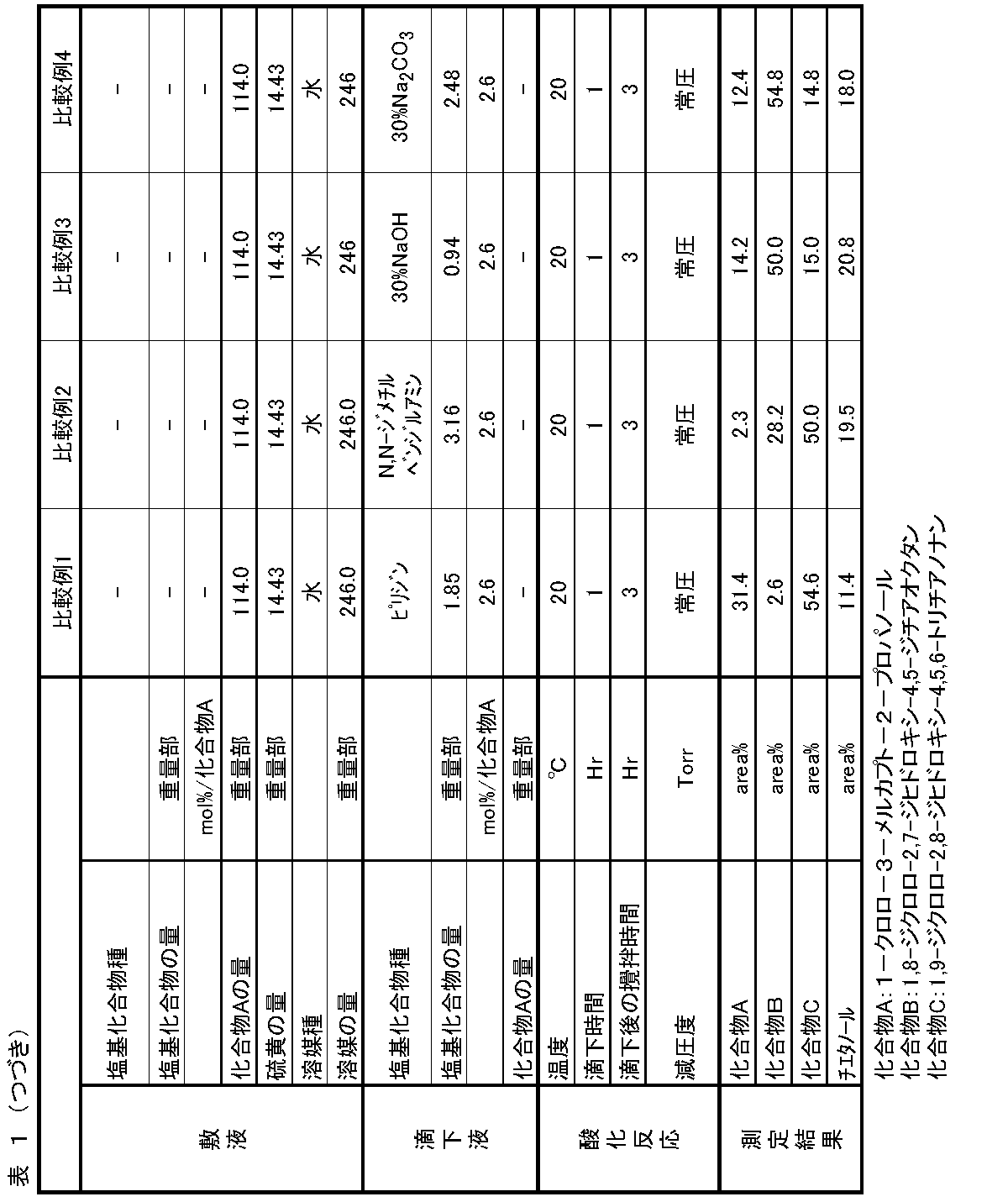
セパラブルフラスコ容器に、蒸留水246.0重量部、硫黄粉末を14.43重量部、92.3wt%の1-クロロ-3-メルカプト-2-プロパノール123.5重量部(化合物:114.0重量部)を装入し、気相部に窒素ガスを流通させながら撹拌し、内温を20℃にした。次にピリジン1.85重量部を1時間かけて装入した。装入後、内温20℃で3時間撹拌した。得られた反応液を実施例1と同方法にて測定した結果、目的物である1,8-ジクロロ-2,7-ジヒドロキシ-4,5-ジチアオクタンを2.6area%含有していた。
セパラブルフラスコ容器に、蒸留水246.0重量部、硫黄粉末を14.43重量部、92.3wt%の1-クロロ-3-メルカプト-2-プロパノール123.5重量部(化合物:114.0重量部)を装入し、気相部に窒素ガスを流通させながら撹拌し、内温を20℃にした。次にN,N-ジメチルベンジルアミン3.16重量部を1時間かけて装入した。装入後、内温20℃で3時間撹拌した。得られた反応液を実施例1と同方法にて測定した結果、目的物である1,8-ジクロロ-2,7-ジヒドロキシ-4,5-ジチアオクタンを28.2area%含有していた。
セパラブルフラスコ容器に、蒸留水246.0重量部、硫黄粉末を14.43重量部、92.3wt%の1-クロロ-3-メルカプト-2-プロパノール123.5重量部(化合物:114.0重量部)を装入し、気相部に窒素ガスを流通させながら撹拌し、内温を20℃にした。次に30wt%水酸化ナトリウム水溶液3.12重量部(NaOH:0.94重量部)を1時間かけて装入した。装入後、内温20℃で3時間撹拌した。得られた反応液を実施例1と同方法にて測定した結果、目的物である1,8-ジクロロ-2,7-ジヒドロキシ-4.5-ジチアオクタンを50.0area%含有していた。
セパラブルフラスコ容器に、蒸留水246.0重量部、硫黄粉末を14.43重量部、92.3wt%の1-クロロ-3-メルカプト-2-プロパノール123.5重量部(化合物:114.0重量部)を装入し、気相部に窒素ガスを流通させながら撹拌し、内温を20℃にした。次に、30wt%炭酸ナトリウム水溶液8.27重量部(Na2CO3:2.48重量部)を1時間かけて装入した。装入後、内温20℃で3時間撹拌した。得られた反応液を実施例1と同方法にて測定した結果、目的物である1,8-ジクロロ-2,7-ジヒドロキシ-4,5-ジチアオクタンを54.8area%含有していた。
Claims (8)
- 下記一般式(1)

で表されるチオール化合物同士を、下記一般式(4)または下記一般式(5)で表される塩基化合物および硫黄の存在下で反応させる、下記一般式(2)で表される(ポリ)スルフィド化合物の製造方法;
M(SH)n (4)
(一般式(4)中、Mは、アルカリ金属またはアルカリ土類金属を表す。nは、Mで表されるアルカリ金属またはアルカリ土類金属の価数を表す。)、

- 前記チオール化合物同士を、50Torr~600Torrの圧力下で反応させる、請求項1に記載の(ポリ)スルフィド化合物の製造方法。
- X1およびX2における前記ハロゲン原子が塩素原子である、請求項1または2に記載の(ポリ)スルフィド化合物の製造方法。
- 前記一般式(1)で表されるチオール化合物は、下記式(3)

- 前記一般式(4)で表される化合物が、硫化水素ナトリウムである、請求項1~4のいずれかに記載の(ポリ)スルフィド化合物の製造方法。
- 請求項1~5のいずれかに記載の製造方法により得られた(ポリ)スルフィド化合物を、塩基条件下でエポキシ化し、下記一般式(6)

で表されるエポキシ化合物を得る工程と、
前記エポキシ化合物を硫化剤と反応させて下記一般式(7)
で表されるエピスルフィド化合物を得る工程と、
を含む、エピスルフィド化合物の製造方法。 - 前記エピスルフィド化合物が、下記一般式(8)

で表される化合物を含む、請求項6に記載のエピスルフィド化合物の製造方法。 - 前記エピスルフィド化合物が、下記式(9)

Priority Applications (5)
| Application Number | Priority Date | Filing Date | Title |
|---|---|---|---|
| KR1020187026240A KR102072933B1 (ko) | 2016-03-18 | 2017-03-17 | (폴리)술피드 화합물의 제조 방법 및 에피술피드 화합물의 제조 방법 |
| US16/084,632 US10844010B2 (en) | 2016-03-18 | 2017-03-17 | Process for producing (poly)sulfide compound and process for producing episulfide compound |
| JP2017526151A JP6200124B1 (ja) | 2016-03-18 | 2017-03-17 | (ポリ)スルフィド化合物の製造方法およびエピスルフィド化合物の製造方法 |
| EP17766834.0A EP3431466B1 (en) | 2016-03-18 | 2017-03-17 | Method for producing (poly)sulfide compound, and method for producing episulfide compound |
| CN201780016235.1A CN108779068B (zh) | 2016-03-18 | 2017-03-17 | (多)硫醚化合物的制造方法及环硫化物化合物的制造方法 |
Applications Claiming Priority (2)
| Application Number | Priority Date | Filing Date | Title |
|---|---|---|---|
| JP2016054906 | 2016-03-18 | ||
| JP2016-054906 | 2016-03-18 |
Publications (1)
| Publication Number | Publication Date |
|---|---|
| WO2017159839A1 true WO2017159839A1 (ja) | 2017-09-21 |
Family
ID=59850274
Family Applications (1)
| Application Number | Title | Priority Date | Filing Date |
|---|---|---|---|
| PCT/JP2017/010845 Ceased WO2017159839A1 (ja) | 2016-03-18 | 2017-03-17 | (ポリ)スルフィド化合物の製造方法およびエピスルフィド化合物の製造方法 |
Country Status (6)
| Country | Link |
|---|---|
| US (1) | US10844010B2 (ja) |
| EP (1) | EP3431466B1 (ja) |
| JP (1) | JP6200124B1 (ja) |
| KR (1) | KR102072933B1 (ja) |
| CN (1) | CN108779068B (ja) |
| WO (1) | WO2017159839A1 (ja) |
Cited By (5)
| Publication number | Priority date | Publication date | Assignee | Title |
|---|---|---|---|---|
| JP2019104689A (ja) * | 2017-12-11 | 2019-06-27 | 三井化学株式会社 | (ポリ)スルフィド化合物の製造方法およびエピスルフィド化合物の製造方法 |
| WO2020170801A1 (ja) | 2019-02-18 | 2020-08-27 | 三井化学株式会社 | 光学部材、光学部材の製造方法及び光情報伝達装置 |
| WO2021054358A1 (ja) | 2019-09-20 | 2021-03-25 | 三井化学株式会社 | 光学部材の製造方法及び光学部材 |
| WO2023167262A1 (ja) | 2022-03-01 | 2023-09-07 | 三井化学株式会社 | 樹脂、成形体、光学材料、レンズ、2,5-ビス(イソシアナトメチル)フラン及び重合性組成物 |
| EP4397693A4 (en) * | 2021-09-01 | 2025-07-30 | Mitsui Chemicals Inc | EPISULFIDE COMPOSITION, POLYMERIZABLE COMPOSITION, CURED PRODUCT AND OPTICAL MATERIAL |
Citations (3)
| Publication number | Priority date | Publication date | Assignee | Title |
|---|---|---|---|---|
| JP2002530371A (ja) * | 1998-11-25 | 2002-09-17 | ビーエーエスエフ アクチェンゲゼルシャフト | 有機ジスルフィドの製法 |
| JP2007091652A (ja) * | 2005-09-29 | 2007-04-12 | Hoya Corp | ポリチオールオリゴマーの製造方法 |
| WO2013157490A1 (ja) * | 2012-04-16 | 2013-10-24 | 三菱瓦斯化学株式会社 | 含硫エポキシ化合物の製造方法 |
Family Cites Families (11)
| Publication number | Priority date | Publication date | Assignee | Title |
|---|---|---|---|---|
| JP3712653B2 (ja) | 1998-03-13 | 2005-11-02 | 三井化学株式会社 | 重合性組成物 |
| US6204311B1 (en) | 1998-03-13 | 2001-03-20 | Mitsui Chemicals, Inc. | Polymerizable composition |
| JP2000186086A (ja) | 1998-10-15 | 2000-07-04 | Mitsubishi Gas Chem Co Inc | エピスルフィド化合物の製造方法 |
| JP2000186087A (ja) * | 1998-10-15 | 2000-07-04 | Mitsubishi Gas Chem Co Inc | エピスルフィド化合物の製造方法 |
| JP3642973B2 (ja) | 1999-03-10 | 2005-04-27 | 三井化学株式会社 | 新規な光学用樹脂 |
| JP3457240B2 (ja) | 1999-12-08 | 2003-10-14 | 三井化学株式会社 | エピスルフィド化合物の製造方法 |
| JP2003048883A (ja) * | 2001-05-29 | 2003-02-21 | Mitsubishi Gas Chem Co Inc | エピスルフィド化合物の製造方法 |
| JP2009186087A (ja) * | 2008-02-06 | 2009-08-20 | Ntn Corp | 空気サイクル冷凍ユニット |
| JP2013142073A (ja) | 2012-01-11 | 2013-07-22 | Mitsubishi Gas Chemical Co Inc | 含硫エポキシ化合物及びその製造方法 |
| CN104080837B (zh) | 2012-02-02 | 2016-06-15 | 三菱瓦斯化学株式会社 | 光学材料用组合物的制造方法 |
| KR101857901B1 (ko) | 2014-03-11 | 2018-05-14 | 미쯔이가가꾸가부시끼가이샤 | 광학 재료용 에피술피드 화합물의 제조 방법, 에피술피드 함유 조성물, 및 해당 조성물을 포함하는 광학 재료용 중합성 조성물 |
-
2017
- 2017-03-17 WO PCT/JP2017/010845 patent/WO2017159839A1/ja not_active Ceased
- 2017-03-17 JP JP2017526151A patent/JP6200124B1/ja active Active
- 2017-03-17 EP EP17766834.0A patent/EP3431466B1/en active Active
- 2017-03-17 CN CN201780016235.1A patent/CN108779068B/zh active Active
- 2017-03-17 KR KR1020187026240A patent/KR102072933B1/ko active Active
- 2017-03-17 US US16/084,632 patent/US10844010B2/en active Active
Patent Citations (3)
| Publication number | Priority date | Publication date | Assignee | Title |
|---|---|---|---|---|
| JP2002530371A (ja) * | 1998-11-25 | 2002-09-17 | ビーエーエスエフ アクチェンゲゼルシャフト | 有機ジスルフィドの製法 |
| JP2007091652A (ja) * | 2005-09-29 | 2007-04-12 | Hoya Corp | ポリチオールオリゴマーの製造方法 |
| WO2013157490A1 (ja) * | 2012-04-16 | 2013-10-24 | 三菱瓦斯化学株式会社 | 含硫エポキシ化合物の製造方法 |
Cited By (6)
| Publication number | Priority date | Publication date | Assignee | Title |
|---|---|---|---|---|
| JP2019104689A (ja) * | 2017-12-11 | 2019-06-27 | 三井化学株式会社 | (ポリ)スルフィド化合物の製造方法およびエピスルフィド化合物の製造方法 |
| JP7064855B2 (ja) | 2017-12-11 | 2022-05-11 | 三井化学株式会社 | (ポリ)スルフィド化合物の製造方法およびエピスルフィド化合物の製造方法 |
| WO2020170801A1 (ja) | 2019-02-18 | 2020-08-27 | 三井化学株式会社 | 光学部材、光学部材の製造方法及び光情報伝達装置 |
| WO2021054358A1 (ja) | 2019-09-20 | 2021-03-25 | 三井化学株式会社 | 光学部材の製造方法及び光学部材 |
| EP4397693A4 (en) * | 2021-09-01 | 2025-07-30 | Mitsui Chemicals Inc | EPISULFIDE COMPOSITION, POLYMERIZABLE COMPOSITION, CURED PRODUCT AND OPTICAL MATERIAL |
| WO2023167262A1 (ja) | 2022-03-01 | 2023-09-07 | 三井化学株式会社 | 樹脂、成形体、光学材料、レンズ、2,5-ビス(イソシアナトメチル)フラン及び重合性組成物 |
Also Published As
| Publication number | Publication date |
|---|---|
| EP3431466B1 (en) | 2020-08-26 |
| CN108779068B (zh) | 2021-02-09 |
| US20190077751A1 (en) | 2019-03-14 |
| KR20180113569A (ko) | 2018-10-16 |
| JP6200124B1 (ja) | 2017-09-20 |
| KR102072933B1 (ko) | 2020-02-03 |
| EP3431466A4 (en) | 2019-10-23 |
| US10844010B2 (en) | 2020-11-24 |
| EP3431466A1 (en) | 2019-01-23 |
| JPWO2017159839A1 (ja) | 2018-03-22 |
| CN108779068A (zh) | 2018-11-09 |
Similar Documents
| Publication | Publication Date | Title |
|---|---|---|
| JP6200124B1 (ja) | (ポリ)スルフィド化合物の製造方法およびエピスルフィド化合物の製造方法 | |
| US9242947B2 (en) | Method for producing sulfur-containing epoxy compound | |
| EP2161296B1 (en) | Polymerisable compound und use thereof | |
| US9133151B2 (en) | Method for producing bis(β-epdxypropyl)sulfide and bis(β-epdxypropyl)polysulfide | |
| JP7064855B2 (ja) | (ポリ)スルフィド化合物の製造方法およびエピスルフィド化合物の製造方法 | |
| US11897835B2 (en) | Method for producing organic mercapto compound or intermediate thereof, (poly)thiol component, polymerizable composition for optical material, molded product, optical material, and lens | |
| JPH11140070A (ja) | 新規な(チオ)エポキシ化合物 | |
| US20120203011A1 (en) | Process for producing bis(thietanylthio)dithiastannolane | |
| JP7627257B2 (ja) | アルカンジスルホン酸化合物の製造方法 | |
| CN116390965A (zh) | 多硫醇组合物、光学组合物和光学产品 | |
| CN113372250A (zh) | 多硫醇化合物、其制备方法、由其制备的透明氨基甲酸酯类树脂以及光学体 | |
| JP5412879B2 (ja) | トリチオカーボネート化合物及びその製法 | |
| KR102544510B1 (ko) | 신규한 알콕시메틸 치환 비스페놀 화합물 | |
| US9040724B2 (en) | Diaryl sulfone compound, and manufacturing method for same | |
| JP7627256B2 (ja) | アルカンジスルホン酸化合物の製造方法 | |
| JP5630028B2 (ja) | 新規ジチオカルバメート化合物及びその製法 | |
| CN101787014A (zh) | 2,5-二巯基甲基-1,4-二噻烷的制备方法 | |
| KR20120084675A (ko) | 3-메르캅토(메타)프로피온산의 제조방법 및 이를 이용한 메르캅토기를 갖는 (메타)카르본산 에스테르 화합물 | |
| EP4644367A1 (en) | Method for producing polythiol composition, method for producing polymerizable composition, and method for producing resin | |
| WO2013176090A1 (ja) | 9,9-ビス(ヒドロキシアルコキシフェニル)フルオレン類の製造方法 |
Legal Events
| Date | Code | Title | Description |
|---|---|---|---|
| ENP | Entry into the national phase |
Ref document number: 2017526151 Country of ref document: JP Kind code of ref document: A |
|
| WWE | Wipo information: entry into national phase |
Ref document number: 1020187026240 Country of ref document: KR |
|
| NENP | Non-entry into the national phase |
Ref country code: DE |
|
| WWE | Wipo information: entry into national phase |
Ref document number: 2017766834 Country of ref document: EP |
|
| ENP | Entry into the national phase |
Ref document number: 2017766834 Country of ref document: EP Effective date: 20181018 |
|
| 121 | Ep: the epo has been informed by wipo that ep was designated in this application |
Ref document number: 17766834 Country of ref document: EP Kind code of ref document: A1 |