WO2017170342A1 - 細胞シート包埋剤、細胞シート含有組成物およびキット - Google Patents
細胞シート包埋剤、細胞シート含有組成物およびキット Download PDFInfo
- Publication number
- WO2017170342A1 WO2017170342A1 PCT/JP2017/012284 JP2017012284W WO2017170342A1 WO 2017170342 A1 WO2017170342 A1 WO 2017170342A1 JP 2017012284 W JP2017012284 W JP 2017012284W WO 2017170342 A1 WO2017170342 A1 WO 2017170342A1
- Authority
- WO
- WIPO (PCT)
- Prior art keywords
- cell sheet
- amino acid
- molecular weight
- embedding agent
- polypeptide
- Prior art date
- Legal status (The legal status is an assumption and is not a legal conclusion. Google has not performed a legal analysis and makes no representation as to the accuracy of the status listed.)
- Ceased
Links
Images


Classifications
-
- C—CHEMISTRY; METALLURGY
- C07—ORGANIC CHEMISTRY
- C07K—PEPTIDES
- C07K14/00—Peptides having more than 20 amino acids; Gastrins; Somatostatins; Melanotropins; Derivatives thereof
- C07K14/435—Peptides having more than 20 amino acids; Gastrins; Somatostatins; Melanotropins; Derivatives thereof from animals; from humans
- C07K14/78—Connective tissue peptides, e.g. collagen, elastin, laminin, fibronectin, vitronectin or cold insoluble globulin [CIG]
-
- A—HUMAN NECESSITIES
- A61—MEDICAL OR VETERINARY SCIENCE; HYGIENE
- A61L—METHODS OR APPARATUS FOR STERILISING MATERIALS OR OBJECTS IN GENERAL; DISINFECTION, STERILISATION OR DEODORISATION OF AIR; CHEMICAL ASPECTS OF BANDAGES, DRESSINGS, ABSORBENT PADS OR SURGICAL ARTICLES; MATERIALS FOR BANDAGES, DRESSINGS, ABSORBENT PADS OR SURGICAL ARTICLES
- A61L27/00—Materials for grafts or prostheses or for coating grafts or prostheses
-
- A—HUMAN NECESSITIES
- A61—MEDICAL OR VETERINARY SCIENCE; HYGIENE
- A61L—METHODS OR APPARATUS FOR STERILISING MATERIALS OR OBJECTS IN GENERAL; DISINFECTION, STERILISATION OR DEODORISATION OF AIR; CHEMICAL ASPECTS OF BANDAGES, DRESSINGS, ABSORBENT PADS OR SURGICAL ARTICLES; MATERIALS FOR BANDAGES, DRESSINGS, ABSORBENT PADS OR SURGICAL ARTICLES
- A61L27/00—Materials for grafts or prostheses or for coating grafts or prostheses
- A61L27/14—Macromolecular materials
- A61L27/22—Polypeptides or derivatives thereof, e.g. degradation products
- A61L27/222—Gelatin
-
- A—HUMAN NECESSITIES
- A61—MEDICAL OR VETERINARY SCIENCE; HYGIENE
- A61L—METHODS OR APPARATUS FOR STERILISING MATERIALS OR OBJECTS IN GENERAL; DISINFECTION, STERILISATION OR DEODORISATION OF AIR; CHEMICAL ASPECTS OF BANDAGES, DRESSINGS, ABSORBENT PADS OR SURGICAL ARTICLES; MATERIALS FOR BANDAGES, DRESSINGS, ABSORBENT PADS OR SURGICAL ARTICLES
- A61L27/00—Materials for grafts or prostheses or for coating grafts or prostheses
- A61L27/36—Materials for grafts or prostheses or for coating grafts or prostheses containing ingredients of undetermined constitution or reaction products thereof, e.g. transplant tissue, natural bone, extracellular matrix
- A61L27/38—Materials for grafts or prostheses or for coating grafts or prostheses containing ingredients of undetermined constitution or reaction products thereof, e.g. transplant tissue, natural bone, extracellular matrix containing added animal cells
-
- A—HUMAN NECESSITIES
- A61—MEDICAL OR VETERINARY SCIENCE; HYGIENE
- A61L—METHODS OR APPARATUS FOR STERILISING MATERIALS OR OBJECTS IN GENERAL; DISINFECTION, STERILISATION OR DEODORISATION OF AIR; CHEMICAL ASPECTS OF BANDAGES, DRESSINGS, ABSORBENT PADS OR SURGICAL ARTICLES; MATERIALS FOR BANDAGES, DRESSINGS, ABSORBENT PADS OR SURGICAL ARTICLES
- A61L27/00—Materials for grafts or prostheses or for coating grafts or prostheses
- A61L27/36—Materials for grafts or prostheses or for coating grafts or prostheses containing ingredients of undetermined constitution or reaction products thereof, e.g. transplant tissue, natural bone, extracellular matrix
- A61L27/38—Materials for grafts or prostheses or for coating grafts or prostheses containing ingredients of undetermined constitution or reaction products thereof, e.g. transplant tissue, natural bone, extracellular matrix containing added animal cells
- A61L27/3804—Materials for grafts or prostheses or for coating grafts or prostheses containing ingredients of undetermined constitution or reaction products thereof, e.g. transplant tissue, natural bone, extracellular matrix containing added animal cells characterised by specific cells or progenitors thereof, e.g. fibroblasts, connective tissue cells, kidney cells
-
- A—HUMAN NECESSITIES
- A61—MEDICAL OR VETERINARY SCIENCE; HYGIENE
- A61L—METHODS OR APPARATUS FOR STERILISING MATERIALS OR OBJECTS IN GENERAL; DISINFECTION, STERILISATION OR DEODORISATION OF AIR; CHEMICAL ASPECTS OF BANDAGES, DRESSINGS, ABSORBENT PADS OR SURGICAL ARTICLES; MATERIALS FOR BANDAGES, DRESSINGS, ABSORBENT PADS OR SURGICAL ARTICLES
- A61L27/00—Materials for grafts or prostheses or for coating grafts or prostheses
- A61L27/50—Materials characterised by their function or physical properties, e.g. injectable or lubricating compositions, shape-memory materials, surface modified materials
- A61L27/58—Materials at least partially resorbable by the body
-
- C—CHEMISTRY; METALLURGY
- C12—BIOCHEMISTRY; BEER; SPIRITS; WINE; VINEGAR; MICROBIOLOGY; ENZYMOLOGY; MUTATION OR GENETIC ENGINEERING
- C12M—APPARATUS FOR ENZYMOLOGY OR MICROBIOLOGY; APPARATUS FOR CULTURING MICROORGANISMS FOR PRODUCING BIOMASS, FOR GROWING CELLS OR FOR OBTAINING FERMENTATION OR METABOLIC PRODUCTS, i.e. BIOREACTORS OR FERMENTERS
- C12M1/00—Apparatus for enzymology or microbiology
-
- C—CHEMISTRY; METALLURGY
- C12—BIOCHEMISTRY; BEER; SPIRITS; WINE; VINEGAR; MICROBIOLOGY; ENZYMOLOGY; MUTATION OR GENETIC ENGINEERING
- C12M—APPARATUS FOR ENZYMOLOGY OR MICROBIOLOGY; APPARATUS FOR CULTURING MICROORGANISMS FOR PRODUCING BIOMASS, FOR GROWING CELLS OR FOR OBTAINING FERMENTATION OR METABOLIC PRODUCTS, i.e. BIOREACTORS OR FERMENTERS
- C12M25/00—Means for supporting, enclosing or fixing the microorganisms, e.g. immunocoatings
- C12M25/02—Membranes; Filters
-
- C—CHEMISTRY; METALLURGY
- C12—BIOCHEMISTRY; BEER; SPIRITS; WINE; VINEGAR; MICROBIOLOGY; ENZYMOLOGY; MUTATION OR GENETIC ENGINEERING
- C12N—MICROORGANISMS OR ENZYMES; COMPOSITIONS THEREOF; PROPAGATING, PRESERVING, OR MAINTAINING MICROORGANISMS; MUTATION OR GENETIC ENGINEERING; CULTURE MEDIA
- C12N15/00—Mutation or genetic engineering; DNA or RNA concerning genetic engineering, vectors, e.g. plasmids, or their isolation, preparation or purification; Use of hosts therefor
- C12N15/09—Recombinant DNA-technology
Definitions
- the present invention relates to a cell sheet embedding agent containing a polypeptide whose molecular weight distribution satisfies a predetermined condition.
- the present invention further relates to a cell sheet-containing composition and kit containing the cell sheet embedding agent.
- a cell sheet is formed without substantially proliferating for the purpose of providing a production method using a cell culture solution that does not contain an impurity component derived from a production process that impedes clinical application.
- a method for producing a cell sheet is described that comprises culturing cells of a resulting density in a cell culture medium that does not contain an effective amount of growth factors.
- Patent Document 2 describes a genetically modified gelatin that is particularly useful for several applications involving cell attachment, such as cell culture work, and applications involving cell culture of anchorage-dependent cells, and various medical applications. Has been.
- JP 2010-81829 A International Publication WO2008 / 103041
- the cell sheet is very fragile and is fragile during transportation, which is a problem when transporting to hospital facilities. In hospital facilities or the like, it is desirable that the cell sheet can be easily transplanted after the cell sheet is transported. In the transplantation of cell sheets, it is desired to solve the above problems.
- the present invention provides a cell sheet embedding agent that can stably transport a cell sheet during transportation at low temperature and can easily recover the cell sheet from the cell sheet embedding agent after transportation. It is a problem to be solved. It is another object of the present invention to provide a cell sheet-containing composition containing the cell sheet embedding agent and a kit containing the cell sheet embedding agent.
- the inventors of the present invention have a polypeptide having a specific sequence, and the area of the maximum molecular weight peak in the molecular weight distribution measurement is 80% of the total area of all molecular weight peaks.
- the cell sheet embedding agent containing the polypeptide as described above the cell sheet can be stably transported at the time of transport at a low temperature, and the cell sheet can be easily embedded at room temperature when transplanting the cell sheet after transport. It was found that the cell sheet can be recovered from the agent.
- the present invention has been completed based on these findings. According to the present invention, the following inventions are provided.
- a cell sheet embedding agent comprising a polypeptide represented by the following formula 1 and having a molecular weight distribution satisfying the following condition X:
- Formula 1 A-[(Gly-XY) n ] m -B
- each of n X independently represents any of amino acids
- each of N Y independently represents any of amino acids
- m is an integer of 2 to 10
- n is an integer of 3 to 100
- A represents any amino acid or amino acid sequence
- B represents any amino acid or amino acid sequence.
- Condition X The area of the maximum molecular weight peak in the molecular weight distribution measurement by gel permeation chromatography is 80% or more of the total area of all molecular weight peaks.
- the polypeptide has (1) the amino acid sequence set forth in SEQ ID NO: 1 or (2) an amino acid sequence having 80% or more sequence identity with the amino acid sequence set forth in SEQ ID NO: 1 and having biocompatibility
- [6] A cell sheet containing a cell sheet and the cell sheet embedding agent according to any one of [1] to [5], wherein the cell sheet is embedded with the cell sheet embedding agent Composition.
- a kit comprising a cell sheet and the cell sheet embedding agent according to any one of [1] to [5].
- Formula 1 A-[(Gly-XY) n ] m -B
- each of n X independently represents any of amino acids
- each of N Y independently represents any of amino acids
- m is an integer of 2 to 10
- n is an integer of 3 to 100
- A represents any amino acid or amino acid sequence
- B represents any amino acid or amino acid sequence.
- Condition X The area of the maximum molecular weight peak in the molecular weight distribution measurement by gel permeation chromatography is 80% or more of the total area of all molecular weight peaks.
- a method for embedding a cell sheet comprising embedding a cell sheet with a polypeptide represented by the following formula 1 and having a molecular weight distribution satisfying the following condition X:
- Formula 1 A-[(Gly-XY) n ] m -B
- each of n X independently represents any of amino acids
- each of N Y independently represents any of amino acids
- m is an integer of 2 to 10
- n is an integer of 3 to 100
- A represents any amino acid or amino acid sequence
- B represents any amino acid or amino acid sequence.
- Condition X The area of the maximum molecular weight peak in the molecular weight distribution measurement by gel permeation chromatography is 80% or more of the total area of all molecular weight peaks.
- the cell sheet can be stably transported at the time of transportation at a low temperature, and after the transportation, the cell sheet can be simply transferred from the cell sheet embedding agent. Can be recovered
- FIG. 1 shows the molecular weight distribution of recombinant gelatin.
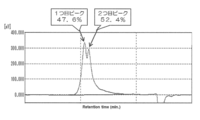
- FIG. 2 shows the molecular weight distribution of natural animal gelatin.
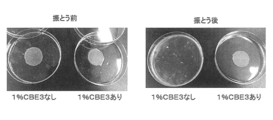
- FIG. 3 shows the shapes of the CBE3-embedded cell sheet and the cell sheet not containing CBE3 before and after shaking.
- FIG. 4 shows the results of staining the CBE3-embedded cell sheet before and after shaking.
- the cell sheet embedding agent of the present invention is a cell sheet embedding agent comprising a polypeptide represented by the following formula 1 and having a molecular weight distribution satisfying the following condition X.
- Formula 1 A-[(Gly-XY) n ] m -B
- each of n X independently represents any of amino acids
- each of N Y independently represents any of amino acids
- m is an integer of 2 to 10
- n is an integer of 3 to 100
- A represents any amino acid or amino acid sequence
- B represents any amino acid or amino acid sequence.
- Condition X The area of the maximum molecular weight peak in the molecular weight distribution measurement by gel permeation chromatography is 80% or more of the total area of all molecular weight peaks.
- the cell sheet embedding agent referred to in this specification is a substance capable of embedding a cell sheet.
- the embedding process is a process in which a cell sheet embedding agent is brought into contact with a part or all of the surface of the cell sheet by dipping or the like, and then a part or all of the surface of the cell sheet is coated with the cell sheet embedding agent. is there.
- polypeptide The polypeptide represented by the above formula 1 gels and becomes suitable for transportation by embedding a cell sheet in a solution state (conditions that are not low temperature) and lowering the temperature. From the viewpoint of cell preservation, it is necessary to lower the temperature during transportation.
- the polypeptide satisfies the condition X (the area of the maximum molecular weight peak in the molecular weight distribution measurement by gel permeation chromatography is 80% or more of the total area of all molecular weight peaks)
- Gelation at low temperature (4 ° C.) and dissolution at room temperature (25 ° C.) become sharp, and at the time of cell sheet transplantation, the cell sheet can be easily recovered from the cell sheet embedding agent. .
- the maximum molecular weight peak area in the molecular weight distribution measurement by gel permeation chromatography is 80% or more of the total area of all molecular weight peaks, more preferably 85% or more, particularly Preferably it is 90% or more.
- the molecular weight distribution measurement by gel permeation chromatography is performed using high performance liquid chromatography (HPLC) (Waters AQUITY UPLC system Empower2), and the buffer is 100 mmol / L phosphate buffer (pH 6.8). be able to.
- HPLC high performance liquid chromatography
- Empower2 Waters AQUITY UPLC system Empower2
- m is an integer of 2 to 10, preferably an integer of 3 to 5.
- n is an integer of 3 to 100, preferably an integer of 15 to 70, and more preferably an integer of 50 to 65.
- the polypeptide represented by Formula 1 used in the present invention may be any of a recombinant polypeptide, a chemically synthesized polypeptide, or a natural polypeptide.
- Chemically synthesized polypeptide means an artificially synthesized polypeptide.
- Polypeptide synthesis may be either solid phase synthesis or liquid phase synthesis, but is preferably solid phase synthesis.
- Solid-phase synthesis of polypeptides is known to those skilled in the art. For example, Fmoc group synthesis using Fmoc group (Fluorenyl-Methoxy-Carbonyl group) as amino group protection, and Boc group (tert- Boc group synthesis method using Butyl Oxy Carbonyl group).
- the polypeptide is preferably a recombinant polypeptide.
- the recombinant polypeptide represented by Formula 1 is referred to as recombinant gelatin. Recombinant gelatin will be described later in this specification.
- the hydrophilicity value “1 / IOB” value of the polypeptide used in the present invention is preferably 0 to 1.0. More preferably, it is 0 to 0.6, and still more preferably 0 to 0.4.
- IOB is an index of hydrophilicity / hydrophobicity based on an organic conceptual diagram representing the polarity / non-polarity of an organic compound proposed by Satoshi Fujita. Details thereof can be found in, for example, “Pharmaceutical Bulletin”, vol.2, 2, pp .163-173 (1954), “Area of Chemistry” vol.11, 10, pp.719-725 (1957), “Fragrance Journal”, vol.50, pp.79-82 (1981), etc. Yes.
- methane (CH 4 ) is the source of all organic compounds, and all other compounds are all methane derivatives, with certain numbers set for the number of carbon atoms, substituents, transformations, rings, etc. Then, the score is added to obtain an organic value (OV) and an inorganic value (IV), and these values are plotted on a diagram with the organic value on the X axis and the inorganic value on the Y axis. It is going.
- the IOB in the organic conceptual diagram refers to the ratio of the inorganic value (IV) to the organic value (OV) in the organic conceptual diagram, that is, “inorganic value (IV) / organic value (OV)”.
- hydrophilicity / hydrophobicity is represented by a “1 / IOB” value obtained by taking the reciprocal of IOB. The smaller the “1 / IOB” value (closer to 0), the more hydrophilic it is.
- the hydrophilicity / hydrophobicity index represented by the Grand average of hydropathicity (GRAVY) value is preferably 0.3 or less and minus 9.0 or more, preferably 0.0 or less, minus 7.0. More preferably, it is the above.
- Grand average of hydropathicity (GRAVY) values are based on Gasteiger E., Hoogland C., Gattiker A., Duvaud S., Wilkins MR, Appel RD, Bairoch A .; Protein Identification and Analysis Tools on the ExPASy Server; (In) John M. Walker (ed): The Proteomics Protocols Handbook, Humana Press (2005) .pp.
- the polypeptide used in the present invention is preferably recombinant gelatin.
- the recombinant gelatin for example, those described in EP1014176, US Pat. No. 6,992,172, International Publication WO2004 / 85473, International Publication WO2008 / 103041, and the like can be used, but the invention is not limited thereto.
- a preferable example of the recombinant gelatin used in the present invention is the recombinant gelatin of the following embodiment.
- Recombinant gelatin has excellent biocompatibility due to the inherent performance of natural gelatin, and is not naturally derived, so there is no concern about bovine spongiform encephalopathy (BSE) and excellent non-infectivity.
- BSE bovine spongiform encephalopathy
- the molecular weight of the recombinant gelatin is not particularly limited, but is preferably 2000 or more and 100000 or less (2 kDa (kilo dalton) or more and 100 kDa or less), more preferably 2500 or more and 95000 or less (2.5 kDa or more and 95 kDa or less), and further preferably. Is from 5,000 to 90,000 (5 kDa to 90 kDa), and most preferably from 10,000 to 90,000 (10 kDa to 90 kDa).
- Recombinant gelatin preferably has a repeating sequence represented by Gly-XY characteristic of collagen.
- the plurality of Gly-XY may be the same or different.
- Gly-XY Gly represents glycine
- X and Y represent any amino acid (preferably any amino acid other than glycine).
- the sequence represented by Gly-XY, which is characteristic of collagen, is a very specific partial structure in the amino acid composition and sequence of gelatin / collagen compared to other proteins. In this part, glycine accounts for about one third of the whole, and in the amino acid sequence, it is one in three repeats.
- Glycine is the simplest amino acid, has few constraints on the arrangement of molecular chains, and greatly contributes to the regeneration of the helix structure upon gelation.
- the amino acids represented by X and Y are rich in imino acids (proline, oxyproline), and preferably account for 10% to 45% of the total.
- 80% or more, more preferably 95% or more, and most preferably 99% or more of the amino acid sequence of the recombinant gelatin is a Gly-XY repeating structure.
- polar amino acids are charged and uncharged at 1: 1.
- the polar amino acid specifically refers to cysteine, aspartic acid, glutamic acid, histidine, lysine, asparagine, glutamine, serine, threonine, tyrosine and arginine, and among these polar uncharged amino acids are cysteine, asparagine, glutamine, serine. Refers to threonine and tyrosine.
- the proportion of polar amino acids is 10 to 40%, preferably 20 to 30%, of all the constituent amino acids.
- the proportion of uncharged amino acids in the polar amino acid is preferably 5% or more and less than 20%, more preferably 5% or more and less than 10%. Furthermore, it is preferable that any one amino acid, preferably two or more amino acids among serine, threonine, asparagine, tyrosine and cysteine are not included in the sequence.
- the minimum amino acid sequence that acts as a cell adhesion signal in a polypeptide is known (for example, “Pathophysiology”, Vol. 9, No. 7 (1990), page 527, published by Nagai Publishing Co., Ltd.).
- the recombinant gelatin used in the present invention may have two or more of these cell adhesion signals in one molecule.
- Specific sequences include RGD sequences, LDV sequences, REDV sequences, YIGSR sequences, PDSGR sequences, RYVVLPR sequences, LTITIPG sequences, RNIAEIIKDI sequences, which are represented by one-letter amino acid notation in that there are many types of cells that adhere.
- IKVAV, LRE, DGEA, and HAV sequences are preferred. More preferred are RGD sequence, YIGSR sequence, PDSGR sequence, LGTIPG sequence, IKVAV sequence and HAV sequence, and particularly preferred is RGD sequence. Of the RGD sequences, an ERGD sequence is preferred.
- the number of amino acids between RGDs is not uniform between 0 and 100, preferably between 25 and 60.
- the content of the minimum amino acid sequence is preferably 3 to 50, more preferably 4 to 30, and particularly preferably 5 to 20 per protein molecule. Most preferably, it is 12.
- the ratio of the RGD motif to the total number of amino acids is preferably at least 0.4%.
- each stretch of 350 amino acids contains at least one RGD motif.
- the ratio of the RGD motif to the total number of amino acids is more preferably at least 0.6%, even more preferably at least 0.8%, even more preferably at least 1.0%, particularly preferably at least 1.2%. %, Most preferably at least 1.5%.
- the number of RGD motifs in the recombinant peptide is preferably at least 4, more preferably 6, more preferably 8, even more preferably 12 or more and 16 or less per 250 amino acids.
- a ratio of 0.4% of the RGD motif corresponds to at least one RGD sequence per 250 amino acids. Since the number of RGD motifs is an integer, a gelatin of 251 amino acids must contain at least two RGD sequences to meet the 0.4% feature.
- the recombinant gelatin of the present invention comprises at least 2 RGD sequences per 250 amino acids, more preferably comprises at least 3 RGD sequences per 250 amino acids, more preferably at least 4 per 250 amino acids. Contains the RGD sequence. As a further aspect of the recombinant gelatin of the present invention, it contains at least 4 RGD motifs, preferably 6, more preferably 8, more preferably 12 or more and 16 or less.
- Recombinant gelatin may be partially hydrolyzed.
- the polypeptide used in the present invention is represented by the following formula 2.
- Formula 2 Gly-Ala-Pro-[(Gly-XY) 63 ] 3 -Gly
- 63 Xs each independently represent any amino acid
- 63 Ys each independently represent any amino acid.
- the 63 Gly-XY may be the same or different.
- the naturally occurring collagen referred to here may be any naturally occurring collagen, but is preferably type I, type II, type III, type IV, or type V collagen. More preferred is type I, type II, or type III collagen.
- the collagen origin is preferably human, bovine, porcine, mouse or rat, more preferably human.
- the isoelectric point of the recombinant gelatin used in the present invention is preferably 5 to 10, more preferably 6 to 10, and further preferably 7 to 9.5.
- the measurement of the isoelectric point of recombinant gelatin was described in the isoelectric focusing method (see Maxey, CR (1976; Phitogr. Gelatin 2, Editor Cox, PJ Academic, London, Engl.). Thus, it can be carried out by measuring the pH after passing a 1% by mass gelatin solution through a mixed crystal column of cation and anion exchange resin.
- the recombinant gelatin is not deaminated.
- the recombinant gelatin has no telopeptide.
- the recombinant gelatin is a substantially pure polypeptide prepared with a nucleic acid encoding an amino acid sequence.
- Recombinant gelatin is particularly preferably (1) the amino acid sequence shown in SEQ ID NO: 1; or (2) 80% or more (preferably 90% or more, more preferably 95% or more, particularly preferably 98% or more) with the amino acid sequence shown in SEQ ID NO: 1.
- Recombinant gelatin most preferably has the amino acid sequence set forth in SEQ ID NO: 1.
- sequence identity between two amino acid sequences can be determined by any method known to those skilled in the art, and the BLAST ((Basic Local Alignment Search Tool)) program (J. Mol. Biol. 215: 403-410, 1990) Etc. can be used to determine.
- Recombinant gelatin may be composed of an amino acid sequence in which one or several amino acids are deleted, substituted or added in the amino acid sequence shown in SEQ ID NO: 1 and have an amino acid sequence having biocompatibility.
- amino acid sequence in which one or several amino acids are deleted, substituted or added is preferably 1 to 20, more preferably 1 to 10, and further preferably 1 to 5. Means, particularly preferably 1 to 3.
- Recombinant gelatin can be produced by genetic recombination techniques known to those skilled in the art. For example, the method described in EP1014176A2, US Pat. No. 6,992,172, International Publication WO2004 / 85473, International Publication WO2008 / 103041, etc. It can be manufactured similarly. Specifically, a gene encoding the amino acid sequence of a predetermined recombinant gelatin is obtained, and this is incorporated into an expression vector to produce a recombinant expression vector, which is introduced into an appropriate host to produce a transformant. . Recombinant gelatin is produced by culturing the obtained transformant in an appropriate medium. Therefore, the recombinant gelatin used in the present invention can be prepared by recovering the recombinant gelatin produced from the culture. .
- the form of the cell sheet embedding agent of the present invention is not particularly limited, and can be any form as long as it includes a polypeptide represented by Formula 1 and having a molecular weight distribution satisfying the condition X.
- a solution such as an aqueous solution
- a suspension such as a powder
- a gel may be used.
- powder or gel it can be used by dissolving in a solvent such as water at the time of use.
- the content of the polypeptide in the cell sheet embedding agent of the present invention is not particularly limited, but is generally 0.1% by mass to 100% by mass, preferably 0.5% by mass to 100% by mass. .
- the cell sheet to which the cell sheet embedding agent of the present invention is applied will be described later in this specification.
- the present invention further relates to a cell sheet-containing composition comprising a cell sheet and the cell sheet embedding agent of the present invention, wherein the cell sheet is embedded with the cell sheet embedding agent.
- Cell sheet The cell sheet in the present invention means a sheet mainly composed of cells.
- the cell sheet is a sheet formed by connecting cells to each other, and the configuration is not particularly limited as long as it is in a sheet shape, a single-layer cell sheet, a sheet formed of two or more layers of cells, or Any of the sheets formed of the three-dimensionally cultured cells may be used.
- the cells may be connected to each other directly and / or via an intervening substance.
- the intervening substance is not particularly limited as long as it is a substance capable of mechanically connecting cells to each other, and examples thereof include an extracellular matrix.
- the intervening substance is preferably derived from cells, particularly derived from cells constituting the cell sheet.
- the cells are at least mechanically linked, but may be further functionally, eg, chemically or electrically linked.
- the cell sheet in the present invention includes any cell that can form a cell sheet.
- the cells are not particularly limited, and include cardiomyocytes, myoblasts (for example, skeletal myoblasts), fibroblasts, synoviocytes, epithelial cells, and endothelial cells. Among these, cardiomyocytes and skeletal myoblasts are preferable.
- the cells cells derived from any organism that can be treated with a cell sheet can be used.
- the organism is not particularly limited, and examples thereof include humans, non-human primates (such as monkeys), dogs, cats, pigs, horses, goats, sheep, rats, mice and hamsters. Further, only one type of cell may be used, but two or more types of cells can also be used.
- the cell sheet can be produced by a known cell sheet production method or a method analogous thereto.
- the cells are cultured in a culture dish, and when the cells become a sheet, the sheet may be recovered from the culture dish.
- the method for producing the cell sheet is not particularly limited, but as an example, the cell sheet can be produced by the method described in JP 2010-81829 A.
- the cell sheet is typically produced by a step of seeding cells in a culture solution and a step of culturing cells to form a cell sheet.
- Cell culture can be carried out under conditions usually used in this technical field.
- typical culture conditions include culture at 37 ° C. and 5% CO 2 .
- a cell sheet-containing composition can be produced by embedding the above-described cell sheet with the cell sheet embedding agent of the present invention.
- the embedding method is not particularly limited, but the solution is prepared by adding the embedding agent (preferably a solution) of the present invention to a container containing a cell sheet and cooling at a low temperature (eg, 2 to 12 ° C.). It can be gelled.
- a low temperature eg, 2 to 12 ° C.
- kits comprising the above cell sheet and the cell sheet embedding agent of the present invention. Details and preferred embodiments of the cell sheet and the cell sheet embedding agent are as described above in the present specification.
- the kit may further include a container for performing an embedding process, an instruction manual, and the like.
- CBE3 Recombinant gelatin
- CBE3 Molecular weight: 51.6 kD Structure: GAP [(GXY) 63 ] 3 G Number of amino acids: 571 RGD sequence: 12 Imino acid content: 33% Almost 100% of amino acids are GXY repeating structures.
- the amino acid sequence of CBE3 does not include serine, threonine, asparagine, tyrosine and cysteine.
- CBE3 has an ERGD sequence.
- Isoelectric point 9.34 GRAVY value: -0.682 1 / IOB value: 0.323 Amino acid sequence (SEQ ID NO: 1 in the sequence listing) (same as SEQ ID NO: 3 of International Publication WO2008 / 103041; however, the suffix X is corrected to “P”)
- GAP GAPGLQGAPGLQGMPGERGAAGLPGPKGERGDAGPKGADGAPGAPGLQGMPGERGAAGLPGPKGERGDAGPKGADGAPGKDGVRGLAGPIGPPGERGAAGLPGPKGERGDAGPKGADGAPGKDGVRGLAGPIGPPGPAGAPGAPGLQGMPGERGAAGLPGAPG
- the natural animal gelatin of Comparative Example 1 was gelled by moving to 4 ° C., but its rate was slower and slower than that of CBE3.
- the natural animal gelatin of Comparative Example 1 returns to liquid compared to CBE3 of Example 1. It was late. Specifically, in natural animal gelatin, gelation started after 60 minutes by moving to 4 ° C., but it became only a loose gel after 90 minutes. After that, it did not shift to a strong gel, but remained in a loose gel form that could easily be crushed when pressed by hand. When the gel was returned to room temperature of 25 ° C., it took 70 minutes for the natural animal gelatin to return to a complete liquid.
- CBE3-embedded cell sheet 6.0 ⁇ 10 7 human skeletal myoblasts were suspended in 10 mL of DMEM / F12 medium containing 20% (v / v) human serum, and a 10 cm dish temperature-responsive culture dish. (UpCell (registered trademark): Cell Seed Co., Ltd.). The cells were cultured overnight at 37 ° C. and 5% CO 2 to form cell sheets, which were detached at room temperature. 10 mL of HBSS + (Thermo Fisher Scientific) containing 1% by mass CBE3 was added to a temperature-responsive culture dish at room temperature and cooled to 2 to 8 ° C. for 1 hour to form a CBE3-embedded cell sheet. . HBSS is an abbreviation for Hanks' Balanced Salt solution.
- the cell sheet after shaking is a cell sheet in which the cells inside are alive as in the production and can fully demonstrate its performance. It was confirmed that.
Landscapes
- Health & Medical Sciences (AREA)
- Life Sciences & Earth Sciences (AREA)
- Chemical & Material Sciences (AREA)
- Engineering & Computer Science (AREA)
- General Health & Medical Sciences (AREA)
- Medicinal Chemistry (AREA)
- Zoology (AREA)
- Organic Chemistry (AREA)
- Biomedical Technology (AREA)
- Transplantation (AREA)
- Dermatology (AREA)
- Oral & Maxillofacial Surgery (AREA)
- Veterinary Medicine (AREA)
- Epidemiology (AREA)
- Animal Behavior & Ethology (AREA)
- Public Health (AREA)
- Genetics & Genomics (AREA)
- Bioinformatics & Cheminformatics (AREA)
- Wood Science & Technology (AREA)
- Biotechnology (AREA)
- Biochemistry (AREA)
- General Engineering & Computer Science (AREA)
- Molecular Biology (AREA)
- Biophysics (AREA)
- Microbiology (AREA)
- Gastroenterology & Hepatology (AREA)
- Cell Biology (AREA)
- Chemical Kinetics & Catalysis (AREA)
- Botany (AREA)
- Proteomics, Peptides & Aminoacids (AREA)
- Toxicology (AREA)
- Sustainable Development (AREA)
- Physics & Mathematics (AREA)
- Plant Pathology (AREA)
- Immunology (AREA)
- Urology & Nephrology (AREA)
- Peptides Or Proteins (AREA)
- Micro-Organisms Or Cultivation Processes Thereof (AREA)
Abstract
Description
式1: A-[(Gly-X-Y)n]m-B
式中、n個のXはそれぞれ独立にアミノ酸の何れかを示し、n個のYはそれぞれ独立にアミノ酸の何れかを示し、mは2~10の整数であり、nは3~100の整数であり、Aは任意のアミノ酸またはアミノ酸配列を示し、Bは任意のアミノ酸またはアミノ酸配列を示す。
条件X:ゲル浸透クロマトグラフィーによる分子量分布測定における最大の分子量ピークの面積が、全ての分子量ピークの合計面積の80%以上である。
[2] ポリペプチドがリコンビナントゼラチンである、[1]に記載の細胞シート包埋剤。
[3] ポリペプチドが、下記式2で示されるポリペプチドである、[1]または[2]に記載の細胞シート包埋剤。
式2: Gly-Ala-Pro-[(Gly-X-Y)63]3-Gly
式中、63個のXはそれぞれ独立にアミノ酸の何れかを示し、63個のYはそれぞれ独立にアミノ酸の何れかを示す。なお、63個のGly-X-Yはそれぞれ同一でも異なっていてもよい。
[4] ポリペプチドが、(1)配列番号1に記載のアミノ酸配列、または(2)配列番号1に記載のアミノ酸配列と80%以上の配列同一性を有し、生体親和性を有するアミノ酸配列を有する、[1]~[3]のいずれか一に記載の細胞シート包埋剤。
[5] ポリペプチドが、配列番号1に記載のアミノ酸配列を有する、[1]~[4]のいずれか一に記載の細胞シート包埋剤。
[6] 細胞シートと、[1]~[5]のいずれか一に記載の細胞シート包埋剤とを含み、上記細胞シートが上記細胞シート包埋剤により包埋されている、細胞シート含有組成物。
[7] 細胞シートと、[1]~[5]のいずれか一に記載の細胞シート包埋剤とを含む、キット。
式1: A-[(Gly-X-Y)n]m-B
式中、n個のXはそれぞれ独立にアミノ酸の何れかを示し、n個のYはそれぞれ独立にアミノ酸の何れかを示し、mは2~10の整数であり、nは3~100の整数であり、Aは任意のアミノ酸またはアミノ酸配列を示し、Bは任意のアミノ酸またはアミノ酸配列を示す。
条件X:ゲル浸透クロマトグラフィーによる分子量分布測定における最大の分子量ピークの面積が、全ての分子量ピークの合計面積の80%以上である。
[9] 細胞シート包埋剤の製造のための、下記式1で示され、かつ分子量分布が下記条件Xを満たすポリペプチドの使用。
式1: A-[(Gly-X-Y)n]m-B
式中、n個のXはそれぞれ独立にアミノ酸の何れかを示し、n個のYはそれぞれ独立にアミノ酸の何れかを示し、mは2~10の整数であり、nは3~100の整数であり、Aは任意のアミノ酸またはアミノ酸配列を示し、Bは任意のアミノ酸またはアミノ酸配列を示す。
条件X:ゲル浸透クロマトグラフィーによる分子量分布測定における最大の分子量ピークの面積が、全ての分子量ピークの合計面積の80%以上である。
[10] 細胞シートを、下記式1で示され、かつ分子量分布が下記条件Xを満たすポリペプチドで包埋することを含む、細胞シートの包埋方法。
式1: A-[(Gly-X-Y)n]m-B
式中、n個のXはそれぞれ独立にアミノ酸の何れかを示し、n個のYはそれぞれ独立にアミノ酸の何れかを示し、mは2~10の整数であり、nは3~100の整数であり、Aは任意のアミノ酸またはアミノ酸配列を示し、Bは任意のアミノ酸またはアミノ酸配列を示す。
条件X:ゲル浸透クロマトグラフィーによる分子量分布測定における最大の分子量ピークの面積が、全ての分子量ピークの合計面積の80%以上である。
<細胞シート包埋剤>
本発明の細胞シート包埋剤は、下記式1で示され、かつ分子量分布が下記条件Xを満たすポリペプチドを含む、細胞シート包埋剤である。
式1: A-[(Gly-X-Y)n]m-B
式中、n個のXはそれぞれ独立にアミノ酸の何れかを示し、n個のYはそれぞれ独立にアミノ酸の何れかを示し、mは2~10の整数であり、nは3~100の整数であり、Aは任意のアミノ酸またはアミノ酸配列を示し、Bは任意のアミノ酸またはアミノ酸配列を示す。
条件X:ゲル浸透クロマトグラフィーによる分子量分布測定における最大の分子量ピークの面積が、全ての分子量ピークの合計面積の80%以上である。
上記式1で示されるポリペプチドは、溶液の状態で(低温度ではない条件)細胞シートを包埋し、温度を低下させることにより、ゲル化し、輸送に適した状態となる。なお、細胞の保存の観点でも、輸送の際には低温とする必要がある。また、本発明においては、ポリペプチドが、条件X(ゲル浸透クロマトグラフィーによる分子量分布測定における最大の分子量ピークの面積が、全ての分子量ピークの合計面積の80%以上である)を満たすことにより、低温(4℃)でのゲル化と室温(25℃)での溶解とがシャープになり、細胞シート移植時に、室温において簡便に、細胞シート包埋剤から細胞シートを回収することが可能になる。
上記式1において、nは3~100の整数であり、好ましくは15~70の整数であり、より好ましくは50~65の整数である。
本発明で用いるポリペプチドのGRAVY値を上記範囲とすることにより、親水性が高く、かつ、吸水性が高くなる。
本発明で用いるポリペプチドは、好ましくはリコンビナントゼラチンである。
リコンビナントゼラチンとしては、例えばEP1014176、米国特許6992172号、国際公開WO2004/85473、国際公開WO2008/103041等に記載のものを用いることができるが、これらに限定されるものではない。本発明で用いるリコンビナントゼラチンとして好ましいものは、以下の態様のリコンビナントゼラチンである。
この最小アミノ酸配列の含有量は、タンパク質1分子中3~50個が好ましく、さらに好ましくは4~30個、特に好ましくは5~20個である。最も好ましくは12個である。
式2: Gly-Ala-Pro-[(Gly-X-Y)63]3-Gly
式中、63個のXはそれぞれ独立にアミノ酸の何れかを示し、63個のYはそれぞれ独立にアミノ酸の何れかを示す。なお、63個のGly-X-Yはそれぞれ同一でも異なっていてもよい。
好ましくは、リコンビナントゼラチンはテロペプタイドを有さない。
好ましくは、リコンビナントゼラチンは、アミノ酸配列をコードする核酸により調製された実質的に純粋なポリペプチドである。
(1)配列番号1に記載のアミノ酸配列;または
(2)配列番号1に記載のアミノ酸配列と80%以上(好ましくは90%以上、より好ましくは95%以上、特に好ましくは98%以上)の配列同一性を有し、生体親和性を有するアミノ酸配列:
を有する。
なお、生体親和性とは、生体に接触した際に、長期的かつ慢性的な炎症反応などのような顕著な有害反応を惹起しないことを意味する。
リコンビナントゼラチンは、最も好ましくは、配列番号1に記載のアミノ酸配列を有する。
%配列同一性=[(同一残基数)/(アラインメント長)]×100
2つのアミノ酸配列における配列同一性は当業者に公知の任意の方法で決定することができ、BLAST((Basic Local Alignment Search Tool))プログラム(J.Mol.Biol.215:403-410,1990)等を使用して決定することができる。
本発明の細胞シート包埋剤の形態は特に限定されず、式1で示され、かつ分子量分布が条件Xを満たすポリペプチドを含む限り、任意の形態とすることができる。例えば、溶液(水溶液など)、懸濁液、粉末、またはゲルなどの何れでもよい。粉末、またはゲル等の場合には使用時に、水などの溶媒に溶解して使用することができる。
本発明の細胞シート包埋剤を適用する細胞シートについては、本明細書中後記する。
本発明はさらに、細胞シートと、本発明の細胞シート包埋剤とを含み、上記細胞シートが上記細胞シート包埋剤により包埋されている、細胞シート含有組成物に関する。
[細胞シート]
本発明における細胞シートとは、細胞を主成分とするシートを意味する。細胞シートは、細胞が互いに連結してシート状になったものであり、シート形状である限り、その構成は特に限定されず、単層細胞シート、二層以上の細胞で形成されたシート、または三次元培養された細胞で形成されたシートの何れでもよい。
上記した細胞シートを本発明の細胞シート包埋剤により包埋することによって、細胞シート含有組成物を製造することができる。包埋の方法は特に限定されないが、細胞シートを含む容器に、本発明の包埋剤(好ましくは溶液)を添加して、低温(例えば、2~12℃)で冷却することによって、溶液をゲル化させることができる。上記により、細胞シートが細胞シート包埋剤により包埋されている細胞シート含有組成物を製造することができる。
本発明によればさらに、上記した細胞シートと、本発明の細胞シート包埋剤とを含む、キットが提供される。細胞シートおよび細胞シート包埋剤の詳細、好ましい態様は本明細書中上記した通りである。キットにはさらに、包埋処理を行うための容器、および取扱説明書などが含まれていてもよい。
リコンビナントゼラチンとして以下のCBE3を用意した(国際公開WO2008/103041号公報に記載)。
CBE3:
分子量:51.6kD
構造: GAP[(GXY)63]3G
アミノ酸数:571個
RGD配列:12個
イミノ酸含量:33%
ほぼ100%のアミノ酸がGXYの繰り返し構造である。CBE3のアミノ酸配列には、セリン、スレオニン、アスパラギン、チロシンおよびシステインは含まれていない。CBE3はERGD配列を有している。
等電点:9.34
GRAVY値:-0.682
1/IOB値:0.323
アミノ酸配列(配列表の配列番号1)(国際公開WO2008/103041号公報の配列番号3と同じ。但し末尾のXは「P」に修正)
GAP(GAPGLQGAPGLQGMPGERGAAGLPGPKGERGDAGPKGADGAPGAPGLQGMPGERGAAGLPGPKGERGDAGPKGADGAPGKDGVRGLAGPIGPPGERGAAGLPGPKGERGDAGPKGADGAPGKDGVRGLAGPIGPPGPAGAPGAPGLQGMPGERGAAGLPGPKGERGDAGPKGADGAPGKDGVRGLAGPP)3G
上記(1)に記載のリコンビナントゼラチンCBE3(実施例1)について、ゲル浸透クロマトグラフ(GPC)を用いて分子量分布の測定を実施した。分子量分布の測定はHPLC(Waters社製AQUITY UPLCシステムEmpower2)を使用し、緩衝液には100mmol/Lリン酸バッファー(pH6.8)を用いた。これらを用いてリコンビナントゼラチンの分子量分布の相対性を測定した。
比較として、天然動物ゼラチン(比較例1)について、上記(2)と同様にGPCを用いて分子量分布の測定を実施した。結果を図2に示す。天然動物ゼラチンの分子量ピークが2つ存在していた。それら2つのピークについて面積比から全ピーク中の占有率を計算したところ、1つ目のピークが47.6%、2つ目のピークが52.4%となっていた。このことから、天然動物ゼラチンは占有率の高いピークとして、52%の分子量ピークを有することが分かった。
細胞シートを輸送する際の包埋剤として使うためには、低温でのゲル化速度が速く、逆に可逆反応である常温下では素早く液体に戻る性能が重要となる。そこで1質量%濃度で、低温でのゲル化速度、常温での液体へ戻る速さを試験した。
具体的には、CBE3では4℃に移すことで40分後からゲル化が始まり50分後にはほぼ安定なゲルになった。また、そのゲルは強度があり、手で押してもつぶれることのないゲルであった。そのゲルを25℃の室温に戻すと、40分で完全な液体に戻った。
具体的には、天然動物ゼラチンでは、4℃に移すことで60分後からゲル化が始まるが、90分後でもゆるいゲル状にしかならなかった。その後も強度のあるゲルには移行せず、手で押すと簡単に潰れる程度のゆるいゲル状でとどまった。ゲル状のものを25℃の室温に戻した場合、天然動物ゼラチンでは完全な液体に戻るまでに、70分要した。
ヒト骨格筋芽細胞6.0×10⁷個を20%(v/v)ヒト血清を含むDMEM/F12培地 10mLに懸濁し、10cm dish温度応答性培養皿(UpCell(登録商標):株式会社セルシード)に播種した。37℃、5%CO2下で一晩培養して細胞シート化し、室温で剥離させた。室温にて1質量%CBE3を含むHBSS+(Thermo Fisher Scientific社製)10mLを温度応答性培養皿に添加し,2~8℃で1時間冷却してゲル化させ、CBE3包埋細胞シートを作製した。HBSSは、Hanks’ Balanced Salt solutionの略称である。
(6-1)
上記(5)で作製したCBE3包埋細胞シートを卓上シェイカー(NR-3,タイテック社製)に載せ、回転数100rpm(回転毎分:rotation per minute)に設定し2~8℃で2日間振とうさせた。対照として、10cmdish温度応答性培養皿で調製した細胞シートにCBE3を含まないHBSS+を添加して、同様に振とうさせた。振とう後,CBE3包埋細胞シートを室温に静置し、ゲルを融解して細胞シートを回収した。振とう前および振とう後の形状を図3に示す。
シート化直後の細胞シートおよび1質量%CBE3を含むHBSS+を添加して、振とうさせた後に回収した細胞シートを10質量%中性緩衝ホルマリンで一晩固定し,パラフィン包埋した。包埋サンプルは薄切して脱パラフィン後,カラッチのヘマトキシリンとエオジンで染色した。結果を図4に示す。
Claims (7)
- 下記式1で示され、かつ分子量分布が下記条件Xを満たすポリペプチドを含む、細胞シート包埋剤。
式1: A-[(Gly-X-Y)n]m-B
式中、n個のXはそれぞれ独立にアミノ酸の何れかを示し、n個のYはそれぞれ独立にアミノ酸の何れかを示し、mは2~10の整数であり、nは3~100の整数であり、Aは任意のアミノ酸またはアミノ酸配列を示し、Bは任意のアミノ酸またはアミノ酸配列を示す。
条件X:ゲル浸透クロマトグラフィーによる分子量分布測定における最大の分子量ピークの面積が、全ての分子量ピークの合計面積の80%以上である。 - ポリペプチドがリコンビナントゼラチンである、請求項1に記載の細胞シート包埋剤。
- ポリペプチドが、下記式2で示されるポリペプチドである、請求項1または2に記載の細胞シート包埋剤。
式2:Gly-Ala-Pro-[(Gly-X-Y)63]3-Gly
式中、63個のXはそれぞれ独立にアミノ酸の何れかを示し、63個のYはそれぞれ独立にアミノ酸の何れかを示す。なお、63個のGly-X-Yはそれぞれ同一でも異なっていてもよい。 - ポリペプチドが、(1)配列番号1に記載のアミノ酸配列、または(2)配列番号1に記載のアミノ酸配列と80%以上の配列同一性を有し、生体親和性を有するアミノ酸配列を有する、請求項1~3のいずれか一項に記載の細胞シート包埋剤。
- ポリペプチドが、配列番号1に記載のアミノ酸配列を有する、請求項1~4のいずれか一項に記載の細胞シート包埋剤。
- 細胞シートと、請求項1~5のいずれか一項に記載の細胞シート包埋剤とを含み、前記細胞シートが前記細胞シート包埋剤により包埋されている、細胞シート含有組成物。
- 細胞シートと、請求項1~5のいずれか一項に記載の細胞シート包埋剤とを含む、キット。
Priority Applications (5)
| Application Number | Priority Date | Filing Date | Title |
|---|---|---|---|
| CN201780019598.0A CN109071628A (zh) | 2016-03-29 | 2017-03-27 | 细胞片包埋剂、含细胞片的组合物及试剂盒 |
| EP17774879.5A EP3438124A4 (en) | 2016-03-29 | 2017-03-27 | CELL LAYER INSERTION, CELL LAYER INSERTION COMPOSITION AND KIT |
| JP2018509314A JPWO2017170342A1 (ja) | 2016-03-29 | 2017-03-27 | 細胞シート包埋剤、細胞シート含有組成物およびキット |
| US16/139,620 US20190010214A1 (en) | 2016-03-29 | 2018-09-24 | Cell sheet embedding agent, cell sheet-containing composition, and kit |
| US16/747,948 US20200148747A1 (en) | 2016-03-29 | 2020-01-21 | Cell sheet embedding agent, cell sheet-containing composition, and kit |
Applications Claiming Priority (2)
| Application Number | Priority Date | Filing Date | Title |
|---|---|---|---|
| JP2016065396 | 2016-03-29 | ||
| JP2016-065396 | 2016-03-29 |
Related Child Applications (1)
| Application Number | Title | Priority Date | Filing Date |
|---|---|---|---|
| US16/139,620 Continuation US20190010214A1 (en) | 2016-03-29 | 2018-09-24 | Cell sheet embedding agent, cell sheet-containing composition, and kit |
Publications (1)
| Publication Number | Publication Date |
|---|---|
| WO2017170342A1 true WO2017170342A1 (ja) | 2017-10-05 |
Family
ID=59964495
Family Applications (1)
| Application Number | Title | Priority Date | Filing Date |
|---|---|---|---|
| PCT/JP2017/012284 Ceased WO2017170342A1 (ja) | 2016-03-29 | 2017-03-27 | 細胞シート包埋剤、細胞シート含有組成物およびキット |
Country Status (5)
| Country | Link |
|---|---|
| US (2) | US20190010214A1 (ja) |
| EP (1) | EP3438124A4 (ja) |
| JP (1) | JPWO2017170342A1 (ja) |
| CN (1) | CN109071628A (ja) |
| WO (1) | WO2017170342A1 (ja) |
Cited By (2)
| Publication number | Priority date | Publication date | Assignee | Title |
|---|---|---|---|---|
| WO2018159797A1 (ja) * | 2017-03-02 | 2018-09-07 | 富士フイルム株式会社 | 細胞塊または細胞構造体の包埋剤、細胞塊または細胞構造体含有組成物およびキット |
| WO2021020268A1 (ja) | 2019-07-26 | 2021-02-04 | 富士フイルム株式会社 | 生体移植材料 |
Families Citing this family (1)
| Publication number | Priority date | Publication date | Assignee | Title |
|---|---|---|---|---|
| JP7333121B2 (ja) * | 2021-08-02 | 2023-08-24 | 株式会社Rainbow | 幹細胞を非凍結で保存または輸送するための方法 |
Citations (7)
| Publication number | Priority date | Publication date | Assignee | Title |
|---|---|---|---|---|
| JPH0823968A (ja) * | 1994-07-18 | 1996-01-30 | Gunze Ltd | 保存、輸送に供する培養皮膚の処理方法 |
| EP1014176A2 (en) | 1998-12-23 | 2000-06-28 | Fuji Photo Film B.V. | Silver halide emulsions containing recombinant gelatin-like proteins |
| WO2004085473A2 (en) | 2003-03-28 | 2004-10-07 | Fuji Photo Film B.V. | Rgd-enriched gelatine-like proteins with enhanced cell binding |
| US6992172B1 (en) | 1999-11-12 | 2006-01-31 | Fibrogen, Inc. | Recombinant gelatins |
| WO2008103041A1 (en) | 2007-02-21 | 2008-08-28 | Fujifilm Manufacturing Europe B.V. | Recombinant gelatins |
| JP2010081829A (ja) | 2008-09-30 | 2010-04-15 | Terumo Corp | 医療用細胞シートの製造方法 |
| JP2011172925A (ja) * | 2010-01-29 | 2011-09-08 | Terumo Corp | 医療用積層体 |
Family Cites Families (9)
| Publication number | Priority date | Publication date | Assignee | Title |
|---|---|---|---|---|
| CN85102852B (zh) * | 1985-04-01 | 1988-05-11 | 石代光 | 一种利用微生物快速催熟白酒的方法及其装置 |
| US8177942B2 (en) * | 2003-11-05 | 2012-05-15 | E Ink Corporation | Electro-optic displays, and materials for use therein |
| CN1322139C (zh) * | 2004-12-15 | 2007-06-20 | 南京大学 | 固定化细胞酶法制备l-鸟氨酸的方法 |
| EP1961411A1 (en) * | 2007-02-21 | 2008-08-27 | FUJIFILM Manufacturing Europe B.V. | A controlled release composition |
| JP5237714B2 (ja) * | 2008-07-29 | 2013-07-17 | BioROIS株式会社 | 細胞輸送用担体及びそれを使用した細胞の輸送方法 |
| WO2010027789A2 (en) * | 2008-08-25 | 2010-03-11 | University Of South Florida | Volume exclusion agent to enhance formation of extracelluar matrix |
| KR101744040B1 (ko) * | 2010-03-01 | 2017-06-07 | 후지필름 가부시키가이샤 | 생체 친화성을 갖는 고분자 블록과 세포로 이루어지는 세포 구조체 |
| JP5889780B2 (ja) * | 2010-03-02 | 2016-03-22 | 富士フイルム株式会社 | 細胞支持体及び骨再生材 |
| EP3077551B1 (en) * | 2013-12-06 | 2020-04-01 | President and Fellows of Harvard College | Paper-based synthetic gene networks |
-
2017
- 2017-03-27 JP JP2018509314A patent/JPWO2017170342A1/ja not_active Abandoned
- 2017-03-27 CN CN201780019598.0A patent/CN109071628A/zh active Pending
- 2017-03-27 WO PCT/JP2017/012284 patent/WO2017170342A1/ja not_active Ceased
- 2017-03-27 EP EP17774879.5A patent/EP3438124A4/en not_active Withdrawn
-
2018
- 2018-09-24 US US16/139,620 patent/US20190010214A1/en not_active Abandoned
-
2020
- 2020-01-21 US US16/747,948 patent/US20200148747A1/en not_active Abandoned
Patent Citations (8)
| Publication number | Priority date | Publication date | Assignee | Title |
|---|---|---|---|---|
| JPH0823968A (ja) * | 1994-07-18 | 1996-01-30 | Gunze Ltd | 保存、輸送に供する培養皮膚の処理方法 |
| EP1014176A2 (en) | 1998-12-23 | 2000-06-28 | Fuji Photo Film B.V. | Silver halide emulsions containing recombinant gelatin-like proteins |
| US6992172B1 (en) | 1999-11-12 | 2006-01-31 | Fibrogen, Inc. | Recombinant gelatins |
| WO2004085473A2 (en) | 2003-03-28 | 2004-10-07 | Fuji Photo Film B.V. | Rgd-enriched gelatine-like proteins with enhanced cell binding |
| WO2008103041A1 (en) | 2007-02-21 | 2008-08-28 | Fujifilm Manufacturing Europe B.V. | Recombinant gelatins |
| JP2010519251A (ja) * | 2007-02-21 | 2010-06-03 | フジフィルム・マニュファクチュアリング・ヨーロッパ・ベスローテン・フエンノートシャップ | 組換えゼラチン |
| JP2010081829A (ja) | 2008-09-30 | 2010-04-15 | Terumo Corp | 医療用細胞シートの製造方法 |
| JP2011172925A (ja) * | 2010-01-29 | 2011-09-08 | Terumo Corp | 医療用積層体 |
Non-Patent Citations (11)
| Title |
|---|
| "Pathophysiology", vol. 9, 1990, NAGAI PUBLISHING CO., LTD., pages: 527 |
| FRAGRANCE JOURNAL, vol. 50, 1981, pages 79 - 82 |
| GASTEIGER E.; GATTIKER A.; HOOGLAND C.; IVANYI I.; APPEL R.D.; BAIROCH A.: "ExPASy: the proteomics server for in-depth protein knowledge and analysis", NUCLEIC ACIDS RES., vol. 31, 2003, pages 3784 - 3788 |
| GASTEIGER E.; HOOGLAND C.; GATTIKER A.; DUVAUD S.; WILKINS M.R.; APPEL R.D.; BAIROCH A.: "The Proteomics Protocols Handbook", 2005, HUMANA PRESS, article "Protein Identification and Analysis Tools on the ExPASy Server", pages: 571 - 607 |
| J. MOL. BIOL., vol. 215, 1990, pages 403 - 410 |
| MAXEY, C. R.: "Phitogr. Gelatin", vol. 2, 1976 |
| PHARMACEUTICAL BULLETIN, vol. 2, no. 2, 1954, pages 163 - 173 |
| SCOPE OF CHEMISTRY, vol. 11, no. 10, 1957, pages 719 - 725 |
| See also references of EP3438124A4 |
| YOSHIKI KODA ET AL.: "Organic Conception Diagram-Fundamentals and Applications", 2008, SANKYO SHUPPAN CO., LTD. |
| YOSHIMI OYABU ET AL.: "Gel-ka Ondo ga Kojo shita Gelatin ni yoru Saibo Seat no Hogo", REGENERATIVE MEDICINE, vol. 15, no. 2016, 1 February 2016 (2016-02-01), pages 307, XP9511392 * |
Cited By (3)
| Publication number | Priority date | Publication date | Assignee | Title |
|---|---|---|---|---|
| WO2018159797A1 (ja) * | 2017-03-02 | 2018-09-07 | 富士フイルム株式会社 | 細胞塊または細胞構造体の包埋剤、細胞塊または細胞構造体含有組成物およびキット |
| EP3590952A4 (en) * | 2017-03-02 | 2020-03-11 | Fujifilm Corporation | EMBEDDING AGENTS FOR CELL MASS OR CELL STRUCTURE AND CELL MASS OR CELL STRUCTURAL COMPOSITION AND KIT |
| WO2021020268A1 (ja) | 2019-07-26 | 2021-02-04 | 富士フイルム株式会社 | 生体移植材料 |
Also Published As
| Publication number | Publication date |
|---|---|
| JPWO2017170342A1 (ja) | 2019-01-17 |
| US20200148747A1 (en) | 2020-05-14 |
| CN109071628A (zh) | 2018-12-21 |
| US20190010214A1 (en) | 2019-01-10 |
| EP3438124A1 (en) | 2019-02-06 |
| EP3438124A4 (en) | 2019-03-13 |
Similar Documents
| Publication | Publication Date | Title |
|---|---|---|
| TW321651B (ja) | ||
| Wang et al. | Delivery of MSCs with a hybrid β-sheet peptide hydrogel consisting IGF-1C domain and D-form peptide for acute kidney injury therapy | |
| US20200148747A1 (en) | Cell sheet embedding agent, cell sheet-containing composition, and kit | |
| JP6857857B2 (ja) | ペプチドおよびその自己集合方法、その集合体、これらを用いた細胞培養基材、並びに、細胞シートの製造方法 | |
| Daniell et al. | Hyperexpression of a synthetic protein-based polymer gene | |
| Rupert et al. | A new DNA-binding motif in the Skn-1 binding domain–DNA complex | |
| JP2017535259A (ja) | 凍結保存後の細胞生存率および保持率を改善させるための、細胞外マトリックス成分および/またはマトリックス細胞タンパク質の選択法 | |
| Trelstad | Native collagen fractionation | |
| Atterberry et al. | Sustained delivery of chemokine CXCL12 from chemically modified silk hydrogels | |
| JP6865265B2 (ja) | 細胞塊または細胞構造体の包埋剤、細胞塊または細胞構造体含有組成物およびキット | |
| JP5847418B2 (ja) | 細胞接着性タンパク質 | |
| JP2012126713A (ja) | ペプチドおよびその自己集合方法、その集合体、これらを用いた細胞培養基材、並びに、細胞シートの製造方法 | |
| Guncheva | Role of ionic liquids on stabilization of therapeutic proteins and model proteins | |
| JP6586160B2 (ja) | 軟骨再生材料 | |
| JP7078939B2 (ja) | 間葉系幹細胞からインスリン産生細胞を製造する方法、インスリン産生細胞、細胞構造体および医薬組成物 | |
| JP2012126707A (ja) | 化学修飾した細胞接着性ポリペプチド | |
| JP6820912B2 (ja) | 製剤、製剤用部材およびそれらの製造方法 | |
| JP6920499B2 (ja) | 細胞シートを含有する積層体、心疾患治療剤および細胞シート積層用フィルム | |
| CN114316065B (zh) | 小分子肽及其应用、细胞培养基、核酸分子 | |
| JP7731110B2 (ja) | セルロース多孔粒子及びこれからなる培養用マイクロキャリア | |
| Ning et al. | Building Thermosensitive Single-Component Protein Hydrogels from De Novo Designed Homodimers | |
| Fernandes et al. | Affinity-triggered hydrogels | |
| JP2022117483A (ja) | タンパク質のゲル化物の製造方法 | |
| JP7244001B2 (ja) | 自己集合能を有するペプチド | |
| JP2017186264A (ja) | タンパク質組成物 |
Legal Events
| Date | Code | Title | Description |
|---|---|---|---|
| WWE | Wipo information: entry into national phase |
Ref document number: 2018509314 Country of ref document: JP |
|
| NENP | Non-entry into the national phase |
Ref country code: DE |
|
| WWE | Wipo information: entry into national phase |
Ref document number: 2017774879 Country of ref document: EP |
|
| ENP | Entry into the national phase |
Ref document number: 2017774879 Country of ref document: EP Effective date: 20181029 |
|
| 121 | Ep: the epo has been informed by wipo that ep was designated in this application |
Ref document number: 17774879 Country of ref document: EP Kind code of ref document: A1 |