WO2017170826A1 - グルカゴン様ペプチド-1受容体作用増強活性を有する化合物 - Google Patents
グルカゴン様ペプチド-1受容体作用増強活性を有する化合物 Download PDFInfo
- Publication number
- WO2017170826A1 WO2017170826A1 PCT/JP2017/013158 JP2017013158W WO2017170826A1 WO 2017170826 A1 WO2017170826 A1 WO 2017170826A1 JP 2017013158 W JP2017013158 W JP 2017013158W WO 2017170826 A1 WO2017170826 A1 WO 2017170826A1
- Authority
- WO
- WIPO (PCT)
- Prior art keywords
- group
- optionally substituted
- substituted
- halogen atom
- alkoxy
- Prior art date
- Legal status (The legal status is an assumption and is not a legal conclusion. Google has not performed a legal analysis and makes no representation as to the accuracy of the status listed.)
- Ceased
Links
Images


Classifications
-
- A—HUMAN NECESSITIES
- A61—MEDICAL OR VETERINARY SCIENCE; HYGIENE
- A61K—PREPARATIONS FOR MEDICAL, DENTAL OR TOILETRY PURPOSES
- A61K31/00—Medicinal preparations containing organic active ingredients
- A61K31/16—Amides, e.g. hydroxamic acids
- A61K31/18—Sulfonamides
-
- A—HUMAN NECESSITIES
- A61—MEDICAL OR VETERINARY SCIENCE; HYGIENE
- A61K—PREPARATIONS FOR MEDICAL, DENTAL OR TOILETRY PURPOSES
- A61K31/00—Medicinal preparations containing organic active ingredients
- A61K31/275—Nitriles; Isonitriles
-
- A—HUMAN NECESSITIES
- A61—MEDICAL OR VETERINARY SCIENCE; HYGIENE
- A61K—PREPARATIONS FOR MEDICAL, DENTAL OR TOILETRY PURPOSES
- A61K31/00—Medicinal preparations containing organic active ingredients
- A61K31/33—Heterocyclic compounds
- A61K31/335—Heterocyclic compounds having oxygen as the only ring hetero atom, e.g. fungichromin
- A61K31/34—Heterocyclic compounds having oxygen as the only ring hetero atom, e.g. fungichromin having five-membered rings with one oxygen as the only ring hetero atom, e.g. isosorbide
- A61K31/341—Heterocyclic compounds having oxygen as the only ring hetero atom, e.g. fungichromin having five-membered rings with one oxygen as the only ring hetero atom, e.g. isosorbide not condensed with another ring, e.g. ranitidine, furosemide, bufetolol, muscarine
-
- A—HUMAN NECESSITIES
- A61—MEDICAL OR VETERINARY SCIENCE; HYGIENE
- A61K—PREPARATIONS FOR MEDICAL, DENTAL OR TOILETRY PURPOSES
- A61K31/00—Medicinal preparations containing organic active ingredients
- A61K31/33—Heterocyclic compounds
- A61K31/38—Heterocyclic compounds having sulfur as a ring hetero atom
- A61K31/381—Heterocyclic compounds having sulfur as a ring hetero atom having five-membered rings
-
- A—HUMAN NECESSITIES
- A61—MEDICAL OR VETERINARY SCIENCE; HYGIENE
- A61K—PREPARATIONS FOR MEDICAL, DENTAL OR TOILETRY PURPOSES
- A61K31/00—Medicinal preparations containing organic active ingredients
- A61K31/33—Heterocyclic compounds
- A61K31/395—Heterocyclic compounds having nitrogen as a ring hetero atom, e.g. guanethidine or rifamycins
- A61K31/40—Heterocyclic compounds having nitrogen as a ring hetero atom, e.g. guanethidine or rifamycins having five-membered rings with one nitrogen as the only ring hetero atom, e.g. sulpiride, succinimide, tolmetin, buflomedil
- A61K31/403—Heterocyclic compounds having nitrogen as a ring hetero atom, e.g. guanethidine or rifamycins having five-membered rings with one nitrogen as the only ring hetero atom, e.g. sulpiride, succinimide, tolmetin, buflomedil condensed with carbocyclic rings, e.g. carbazole
- A61K31/404—Indoles, e.g. pindolol
- A61K31/4045—Indole-alkylamines; Amides thereof, e.g. serotonin, melatonin
-
- A—HUMAN NECESSITIES
- A61—MEDICAL OR VETERINARY SCIENCE; HYGIENE
- A61K—PREPARATIONS FOR MEDICAL, DENTAL OR TOILETRY PURPOSES
- A61K31/00—Medicinal preparations containing organic active ingredients
- A61K31/33—Heterocyclic compounds
- A61K31/395—Heterocyclic compounds having nitrogen as a ring hetero atom, e.g. guanethidine or rifamycins
- A61K31/40—Heterocyclic compounds having nitrogen as a ring hetero atom, e.g. guanethidine or rifamycins having five-membered rings with one nitrogen as the only ring hetero atom, e.g. sulpiride, succinimide, tolmetin, buflomedil
- A61K31/403—Heterocyclic compounds having nitrogen as a ring hetero atom, e.g. guanethidine or rifamycins having five-membered rings with one nitrogen as the only ring hetero atom, e.g. sulpiride, succinimide, tolmetin, buflomedil condensed with carbocyclic rings, e.g. carbazole
- A61K31/404—Indoles, e.g. pindolol
- A61K31/405—Indole-alkanecarboxylic acids; Derivatives thereof, e.g. tryptophan, indomethacin
-
- A—HUMAN NECESSITIES
- A61—MEDICAL OR VETERINARY SCIENCE; HYGIENE
- A61K—PREPARATIONS FOR MEDICAL, DENTAL OR TOILETRY PURPOSES
- A61K31/00—Medicinal preparations containing organic active ingredients
- A61K31/33—Heterocyclic compounds
- A61K31/395—Heterocyclic compounds having nitrogen as a ring hetero atom, e.g. guanethidine or rifamycins
- A61K31/41—Heterocyclic compounds having nitrogen as a ring hetero atom, e.g. guanethidine or rifamycins having five-membered rings with two or more ring hetero atoms, at least one of which being nitrogen, e.g. tetrazole
- A61K31/4196—1,2,4-Triazoles
-
- A—HUMAN NECESSITIES
- A61—MEDICAL OR VETERINARY SCIENCE; HYGIENE
- A61K—PREPARATIONS FOR MEDICAL, DENTAL OR TOILETRY PURPOSES
- A61K31/00—Medicinal preparations containing organic active ingredients
- A61K31/33—Heterocyclic compounds
- A61K31/395—Heterocyclic compounds having nitrogen as a ring hetero atom, e.g. guanethidine or rifamycins
- A61K31/41—Heterocyclic compounds having nitrogen as a ring hetero atom, e.g. guanethidine or rifamycins having five-membered rings with two or more ring hetero atoms, at least one of which being nitrogen, e.g. tetrazole
- A61K31/4245—Oxadiazoles
-
- A—HUMAN NECESSITIES
- A61—MEDICAL OR VETERINARY SCIENCE; HYGIENE
- A61K—PREPARATIONS FOR MEDICAL, DENTAL OR TOILETRY PURPOSES
- A61K31/00—Medicinal preparations containing organic active ingredients
- A61K31/33—Heterocyclic compounds
- A61K31/395—Heterocyclic compounds having nitrogen as a ring hetero atom, e.g. guanethidine or rifamycins
- A61K31/435—Heterocyclic compounds having nitrogen as a ring hetero atom, e.g. guanethidine or rifamycins having six-membered rings with one nitrogen as the only ring hetero atom
- A61K31/44—Non condensed pyridines; Hydrogenated derivatives thereof
- A61K31/4406—Non condensed pyridines; Hydrogenated derivatives thereof only substituted in position 3, e.g. zimeldine
-
- A—HUMAN NECESSITIES
- A61—MEDICAL OR VETERINARY SCIENCE; HYGIENE
- A61K—PREPARATIONS FOR MEDICAL, DENTAL OR TOILETRY PURPOSES
- A61K31/00—Medicinal preparations containing organic active ingredients
- A61K31/33—Heterocyclic compounds
- A61K31/395—Heterocyclic compounds having nitrogen as a ring hetero atom, e.g. guanethidine or rifamycins
- A61K31/535—Heterocyclic compounds having nitrogen as a ring hetero atom, e.g. guanethidine or rifamycins having six-membered rings with at least one nitrogen and one oxygen as the ring hetero atoms, e.g. 1,2-oxazines
- A61K31/5375—1,4-Oxazines, e.g. morpholine
-
- A—HUMAN NECESSITIES
- A61—MEDICAL OR VETERINARY SCIENCE; HYGIENE
- A61K—PREPARATIONS FOR MEDICAL, DENTAL OR TOILETRY PURPOSES
- A61K31/00—Medicinal preparations containing organic active ingredients
- A61K31/33—Heterocyclic compounds
- A61K31/395—Heterocyclic compounds having nitrogen as a ring hetero atom, e.g. guanethidine or rifamycins
- A61K31/535—Heterocyclic compounds having nitrogen as a ring hetero atom, e.g. guanethidine or rifamycins having six-membered rings with at least one nitrogen and one oxygen as the ring hetero atoms, e.g. 1,2-oxazines
- A61K31/5375—1,4-Oxazines, e.g. morpholine
- A61K31/5377—1,4-Oxazines, e.g. morpholine not condensed and containing further heterocyclic rings, e.g. timolol
-
- A—HUMAN NECESSITIES
- A61—MEDICAL OR VETERINARY SCIENCE; HYGIENE
- A61K—PREPARATIONS FOR MEDICAL, DENTAL OR TOILETRY PURPOSES
- A61K45/00—Medicinal preparations containing active ingredients not provided for in groups A61K31/00 - A61K41/00
-
- A—HUMAN NECESSITIES
- A61—MEDICAL OR VETERINARY SCIENCE; HYGIENE
- A61K—PREPARATIONS FOR MEDICAL, DENTAL OR TOILETRY PURPOSES
- A61K45/00—Medicinal preparations containing active ingredients not provided for in groups A61K31/00 - A61K41/00
- A61K45/06—Mixtures of active ingredients without chemical characterisation, e.g. antiphlogistics and cardiaca
-
- A—HUMAN NECESSITIES
- A61—MEDICAL OR VETERINARY SCIENCE; HYGIENE
- A61P—SPECIFIC THERAPEUTIC ACTIVITY OF CHEMICAL COMPOUNDS OR MEDICINAL PREPARATIONS
- A61P3/00—Drugs for disorders of the metabolism
- A61P3/04—Anorexiants; Antiobesity agents
-
- A—HUMAN NECESSITIES
- A61—MEDICAL OR VETERINARY SCIENCE; HYGIENE
- A61P—SPECIFIC THERAPEUTIC ACTIVITY OF CHEMICAL COMPOUNDS OR MEDICINAL PREPARATIONS
- A61P3/00—Drugs for disorders of the metabolism
- A61P3/08—Drugs for disorders of the metabolism for glucose homeostasis
- A61P3/10—Drugs for disorders of the metabolism for glucose homeostasis for hyperglycaemia, e.g. antidiabetics
-
- C—CHEMISTRY; METALLURGY
- C07—ORGANIC CHEMISTRY
- C07C—ACYCLIC OR CARBOCYCLIC COMPOUNDS
- C07C311/00—Amides of sulfonic acids, i.e. compounds having singly-bound oxygen atoms of sulfo groups replaced by nitrogen atoms, not being part of nitro or nitroso groups
- C07C311/01—Sulfonamides having sulfur atoms of sulfonamide groups bound to acyclic carbon atoms
- C07C311/12—Sulfonamides having sulfur atoms of sulfonamide groups bound to acyclic carbon atoms of an unsaturated carbon skeleton containing rings
- C07C311/13—Sulfonamides having sulfur atoms of sulfonamide groups bound to acyclic carbon atoms of an unsaturated carbon skeleton containing rings the carbon skeleton containing six-membered aromatic rings
-
- C—CHEMISTRY; METALLURGY
- C07—ORGANIC CHEMISTRY
- C07C—ACYCLIC OR CARBOCYCLIC COMPOUNDS
- C07C311/00—Amides of sulfonic acids, i.e. compounds having singly-bound oxygen atoms of sulfo groups replaced by nitrogen atoms, not being part of nitro or nitroso groups
- C07C311/15—Sulfonamides having sulfur atoms of sulfonamide groups bound to carbon atoms of six-membered aromatic rings
- C07C311/21—Sulfonamides having sulfur atoms of sulfonamide groups bound to carbon atoms of six-membered aromatic rings having the nitrogen atom of at least one of the sulfonamide groups bound to a carbon atom of a six-membered aromatic ring
-
- C—CHEMISTRY; METALLURGY
- C07—ORGANIC CHEMISTRY
- C07C—ACYCLIC OR CARBOCYCLIC COMPOUNDS
- C07C321/00—Thiols, sulfides, hydropolysulfides or polysulfides
- C07C321/12—Sulfides, hydropolysulfides, or polysulfides having thio groups bound to acyclic carbon atoms
- C07C321/14—Sulfides, hydropolysulfides, or polysulfides having thio groups bound to acyclic carbon atoms of an acyclic saturated carbon skeleton
-
- C—CHEMISTRY; METALLURGY
- C07—ORGANIC CHEMISTRY
- C07C—ACYCLIC OR CARBOCYCLIC COMPOUNDS
- C07C335/00—Thioureas, i.e. compounds containing any of the groups, the nitrogen atoms not being part of nitro or nitroso groups
- C07C335/04—Derivatives of thiourea
- C07C335/16—Derivatives of thiourea having nitrogen atoms of thiourea groups bound to carbon atoms of six-membered aromatic rings of a carbon skeleton
- C07C335/20—Derivatives of thiourea having nitrogen atoms of thiourea groups bound to carbon atoms of six-membered aromatic rings of a carbon skeleton being further substituted by nitrogen atoms, not being part of nitro or nitroso groups
-
- C—CHEMISTRY; METALLURGY
- C07—ORGANIC CHEMISTRY
- C07D—HETEROCYCLIC COMPOUNDS
- C07D209/00—Heterocyclic compounds containing five-membered rings, condensed with other rings, with one nitrogen atom as the only ring hetero atom
- C07D209/02—Heterocyclic compounds containing five-membered rings, condensed with other rings, with one nitrogen atom as the only ring hetero atom condensed with one carbocyclic ring
- C07D209/04—Indoles; Hydrogenated indoles
- C07D209/10—Indoles; Hydrogenated indoles with substituted hydrocarbon radicals attached to carbon atoms of the hetero ring
- C07D209/18—Radicals substituted by carbon atoms having three bonds to hetero atoms with at the most one bond to halogen, e.g. ester or nitrile radicals
- C07D209/20—Radicals substituted by carbon atoms having three bonds to hetero atoms with at the most one bond to halogen, e.g. ester or nitrile radicals substituted additionally by nitrogen atoms, e.g. tryptophane
-
- C—CHEMISTRY; METALLURGY
- C07—ORGANIC CHEMISTRY
- C07D—HETEROCYCLIC COMPOUNDS
- C07D213/00—Heterocyclic compounds containing six-membered rings, not condensed with other rings, with one nitrogen atom as the only ring hetero atom and three or more double bonds between ring members or between ring members and non-ring members
- C07D213/02—Heterocyclic compounds containing six-membered rings, not condensed with other rings, with one nitrogen atom as the only ring hetero atom and three or more double bonds between ring members or between ring members and non-ring members having three double bonds between ring members or between ring members and non-ring members
- C07D213/04—Heterocyclic compounds containing six-membered rings, not condensed with other rings, with one nitrogen atom as the only ring hetero atom and three or more double bonds between ring members or between ring members and non-ring members having three double bonds between ring members or between ring members and non-ring members having no bond between the ring nitrogen atom and a non-ring member or having only hydrogen or carbon atoms directly attached to the ring nitrogen atom
- C07D213/24—Heterocyclic compounds containing six-membered rings, not condensed with other rings, with one nitrogen atom as the only ring hetero atom and three or more double bonds between ring members or between ring members and non-ring members having three double bonds between ring members or between ring members and non-ring members having no bond between the ring nitrogen atom and a non-ring member or having only hydrogen or carbon atoms directly attached to the ring nitrogen atom with substituted hydrocarbon radicals attached to ring carbon atoms
- C07D213/44—Radicals substituted by doubly-bound oxygen, sulfur, or nitrogen atoms, or by two such atoms singly-bound to the same carbon atom
- C07D213/46—Oxygen atoms
- C07D213/50—Ketonic radicals
-
- C—CHEMISTRY; METALLURGY
- C07—ORGANIC CHEMISTRY
- C07D—HETEROCYCLIC COMPOUNDS
- C07D213/00—Heterocyclic compounds containing six-membered rings, not condensed with other rings, with one nitrogen atom as the only ring hetero atom and three or more double bonds between ring members or between ring members and non-ring members
- C07D213/02—Heterocyclic compounds containing six-membered rings, not condensed with other rings, with one nitrogen atom as the only ring hetero atom and three or more double bonds between ring members or between ring members and non-ring members having three double bonds between ring members or between ring members and non-ring members
- C07D213/04—Heterocyclic compounds containing six-membered rings, not condensed with other rings, with one nitrogen atom as the only ring hetero atom and three or more double bonds between ring members or between ring members and non-ring members having three double bonds between ring members or between ring members and non-ring members having no bond between the ring nitrogen atom and a non-ring member or having only hydrogen or carbon atoms directly attached to the ring nitrogen atom
- C07D213/24—Heterocyclic compounds containing six-membered rings, not condensed with other rings, with one nitrogen atom as the only ring hetero atom and three or more double bonds between ring members or between ring members and non-ring members having three double bonds between ring members or between ring members and non-ring members having no bond between the ring nitrogen atom and a non-ring member or having only hydrogen or carbon atoms directly attached to the ring nitrogen atom with substituted hydrocarbon radicals attached to ring carbon atoms
- C07D213/54—Radicals substituted by carbon atoms having three bonds to hetero atoms with at the most one bond to halogen, e.g. ester or nitrile radicals
- C07D213/56—Amides
-
- C—CHEMISTRY; METALLURGY
- C07—ORGANIC CHEMISTRY
- C07D—HETEROCYCLIC COMPOUNDS
- C07D213/00—Heterocyclic compounds containing six-membered rings, not condensed with other rings, with one nitrogen atom as the only ring hetero atom and three or more double bonds between ring members or between ring members and non-ring members
- C07D213/02—Heterocyclic compounds containing six-membered rings, not condensed with other rings, with one nitrogen atom as the only ring hetero atom and three or more double bonds between ring members or between ring members and non-ring members having three double bonds between ring members or between ring members and non-ring members
- C07D213/04—Heterocyclic compounds containing six-membered rings, not condensed with other rings, with one nitrogen atom as the only ring hetero atom and three or more double bonds between ring members or between ring members and non-ring members having three double bonds between ring members or between ring members and non-ring members having no bond between the ring nitrogen atom and a non-ring member or having only hydrogen or carbon atoms directly attached to the ring nitrogen atom
- C07D213/60—Heterocyclic compounds containing six-membered rings, not condensed with other rings, with one nitrogen atom as the only ring hetero atom and three or more double bonds between ring members or between ring members and non-ring members having three double bonds between ring members or between ring members and non-ring members having no bond between the ring nitrogen atom and a non-ring member or having only hydrogen or carbon atoms directly attached to the ring nitrogen atom with hetero atoms or with carbon atoms having three bonds to hetero atoms with at the most one bond to halogen, e.g. ester or nitrile radicals, directly attached to ring carbon atoms
- C07D213/72—Nitrogen atoms
- C07D213/74—Amino or imino radicals substituted by hydrocarbon or substituted hydrocarbon radicals
-
- C—CHEMISTRY; METALLURGY
- C07—ORGANIC CHEMISTRY
- C07D—HETEROCYCLIC COMPOUNDS
- C07D249/00—Heterocyclic compounds containing five-membered rings having three nitrogen atoms as the only ring hetero atoms
- C07D249/02—Heterocyclic compounds containing five-membered rings having three nitrogen atoms as the only ring hetero atoms not condensed with other rings
- C07D249/08—1,2,4-Triazoles; Hydrogenated 1,2,4-triazoles
- C07D249/10—1,2,4-Triazoles; Hydrogenated 1,2,4-triazoles with hetero atoms or with carbon atoms having three bonds to hetero atoms with at the most one bond to halogen, e.g. ester or nitrile radicals, directly attached to ring carbon atoms
- C07D249/12—Oxygen or sulfur atoms
-
- C—CHEMISTRY; METALLURGY
- C07—ORGANIC CHEMISTRY
- C07D—HETEROCYCLIC COMPOUNDS
- C07D271/00—Heterocyclic compounds containing five-membered rings having two nitrogen atoms and one oxygen atom as the only ring hetero atoms
- C07D271/02—Heterocyclic compounds containing five-membered rings having two nitrogen atoms and one oxygen atom as the only ring hetero atoms not condensed with other rings
- C07D271/06—1,2,4-Oxadiazoles; Hydrogenated 1,2,4-oxadiazoles
-
- C—CHEMISTRY; METALLURGY
- C07—ORGANIC CHEMISTRY
- C07D—HETEROCYCLIC COMPOUNDS
- C07D295/00—Heterocyclic compounds containing polymethylene-imine rings with at least five ring members, 3-azabicyclo [3.2.2] nonane, piperazine, morpholine or thiomorpholine rings, having only hydrogen atoms directly attached to the ring carbon atoms
- C07D295/04—Heterocyclic compounds containing polymethylene-imine rings with at least five ring members, 3-azabicyclo [3.2.2] nonane, piperazine, morpholine or thiomorpholine rings, having only hydrogen atoms directly attached to the ring carbon atoms with substituted hydrocarbon radicals attached to ring nitrogen atoms
- C07D295/12—Heterocyclic compounds containing polymethylene-imine rings with at least five ring members, 3-azabicyclo [3.2.2] nonane, piperazine, morpholine or thiomorpholine rings, having only hydrogen atoms directly attached to the ring carbon atoms with substituted hydrocarbon radicals attached to ring nitrogen atoms substituted by singly or doubly bound nitrogen atoms
- C07D295/135—Heterocyclic compounds containing polymethylene-imine rings with at least five ring members, 3-azabicyclo [3.2.2] nonane, piperazine, morpholine or thiomorpholine rings, having only hydrogen atoms directly attached to the ring carbon atoms with substituted hydrocarbon radicals attached to ring nitrogen atoms substituted by singly or doubly bound nitrogen atoms with the ring nitrogen atoms and the substituent nitrogen atoms separated by carbocyclic rings or by carbon chains interrupted by carbocyclic rings
-
- C—CHEMISTRY; METALLURGY
- C07—ORGANIC CHEMISTRY
- C07D—HETEROCYCLIC COMPOUNDS
- C07D307/00—Heterocyclic compounds containing five-membered rings having one oxygen atom as the only ring hetero atom
- C07D307/02—Heterocyclic compounds containing five-membered rings having one oxygen atom as the only ring hetero atom not condensed with other rings
- C07D307/34—Heterocyclic compounds containing five-membered rings having one oxygen atom as the only ring hetero atom not condensed with other rings having two or three double bonds between ring members or between ring members and non-ring members
- C07D307/38—Heterocyclic compounds containing five-membered rings having one oxygen atom as the only ring hetero atom not condensed with other rings having two or three double bonds between ring members or between ring members and non-ring members with substituted hydrocarbon radicals attached to ring carbon atoms
- C07D307/52—Radicals substituted by nitrogen atoms not forming part of a nitro radical
-
- C—CHEMISTRY; METALLURGY
- C07—ORGANIC CHEMISTRY
- C07D—HETEROCYCLIC COMPOUNDS
- C07D333/00—Heterocyclic compounds containing five-membered rings having one sulfur atom as the only ring hetero atom
- C07D333/02—Heterocyclic compounds containing five-membered rings having one sulfur atom as the only ring hetero atom not condensed with other rings
- C07D333/04—Heterocyclic compounds containing five-membered rings having one sulfur atom as the only ring hetero atom not condensed with other rings not substituted on the ring sulphur atom
- C07D333/06—Heterocyclic compounds containing five-membered rings having one sulfur atom as the only ring hetero atom not condensed with other rings not substituted on the ring sulphur atom with only hydrogen atoms, hydrocarbon or substituted hydrocarbon radicals, directly attached to the ring carbon atoms
- C07D333/14—Radicals substituted by singly bound hetero atoms other than halogen
- C07D333/20—Radicals substituted by singly bound hetero atoms other than halogen by nitrogen atoms
Definitions
- the present invention relates to a compound having a glucagon-like peptide-1 (hereinafter sometimes referred to as “GLP-1”) receptor action enhancing activity.
- GLP-1 glucagon-like peptide-1
- the present invention also relates to a pharmaceutical composition (prophylactic or therapeutic agent) containing the compound and useful for the prevention or treatment of diabetes and obesity, and diseases associated therewith.
- GLP-1 is an incretin hormone released from L cells in the lower small intestine after food intake. GLP-1 promotes insulin secretion from pancreatic ⁇ cells in a glucose-dependent manner and exhibits an effect of increasing the amount of pancreatic ⁇ cells. GLP-1 also has an effect of decreasing the gastric emptying rate and enhancing satiety. On the other hand, GLP-1 is rapidly degraded and inactivated by dipeptidyl peptidase-4 (DPP-4). Therefore, GLP-1 receptor agonists and DPP-4 inhibitors are useful as antidiabetic agents or antiobesity agents.
- DPP-4 dipeptidyl peptidase-4
- GLP-1 receptor agonists are useful as anti-diabetic drugs or anti-obesity agents, but they are peptide preparations because they are peptide preparations and have low compliance.
- Non-Patent Document 1 discloses (4- (3-benzyloxyphenyl) -2-ethylsulfinyl-6- (trifluoromethyl) pyrimidine (BETP) as a compound that enhances the action of GLP-1 receptor. Yes.
- Patent Documents 1 and 2 Examples of the compound having a structure similar to the compound described in the present specification are disclosed in Patent Documents 1 and 2. However, neither document describes that they are GLP-1 receptor action enhancers.
- An object of the present invention is to provide a prophylactic or therapeutic agent for diabetes and obesity, and diseases related thereto, which can improve the GLP-1 deficiency state due to secretion failure by oral ingestion.
- A represents a cyclic group which may be further substituted
- B represents an optionally substituted benzene ring
- L represents a bond or an optionally substituted C 1-6 alkylene group
- R 1 represents a hydrogen atom, a hydroxy group, an optionally substituted C 1-6 alkoxy group, an optionally substituted amino group, or an optionally substituted C 1-6 alkyl group
- R 2 and R 3 are each independently the same or different and are each a hydrogen atom, a carboxy group, a hydroxy group, an optionally substituted C 1-10 alkoxy group, an optionally substituted amino group, or a substituted group
- Q represents an oxygen atom or a sulfur atom
- R 4 and R 5 are each independently the same or different and each represents a hydrogen atom or an optionally substituted C 1-6 alkyl group, or R 4 and R 5 represent a carbon atom to which they are bonded.
- n represents an integer of 1 to 6; and M represents an optionally substituted C 1-12 alkoxy-carbonyl group, an optionally substituted carbamoyl group, or an optionally substituted heterocyclic group.
- M represents an optionally substituted C 1-12 alkoxy-carbonyl group, an optionally substituted carbamoyl group, or an optionally substituted heterocyclic group. Show. However, 3- (3- (3- (phenylsulfonamido) phenyl) ureido) -4- (trimethylammonio) butanoic acid ester is excluded.
- A is a C 6-14 aryl group or a 5- or 6-membered monocyclic aromatic heterocyclic group, each of which may be further substituted, L is a bond or a methylene group; Q is an oxygen atom, [1] The above [1], wherein R 4 and R 5 are each independently the same or different and are a hydrogen atom or an optionally substituted C 1-6 alkyl group, and n is 1 or 2 The described compounds or salts thereof; [3] A is a C 6-14 aryl group which may be further substituted; L is a bond or a methylene group; Q is an oxygen atom, [1] The above [1], wherein R 4 and R 5 are each independently the same or different and are a hydrogen atom or an optionally substituted C 1-6 alkyl group, and n is 1 or 2 The described compounds or salts thereof; [4] A is a halogen atom, a hydroxy group, a carboxy group, a s
- a C 1-6 alkyl group which may be substituted with a substituent selected from the group consisting of optionally substituted C 1-6 alkylthio groups, R 2 and R 3 are each independently the same or different and are each a hydrogen atom; a carboxy group; a hydroxy group; or a halogen atom, a hydroxy group, a sulfanyl group, a carboxy group, a C 1-6 alkoxy group, a C 1-6 C 1 -optionally substituted with a substituent selected from the group consisting of an amino group optionally mono- or di-substituted with an alkyl group and a C 1-6 alkylthio group optionally substituted with a halogen atom.
- Q is an oxygen atom
- R 4 is a hydrogen atom
- R 5 is a halogen atom, a hydroxy group, a carboxy group, a guanidino group, a cyano group, a sulfanyl group, an optionally substituted amino group, an optionally substituted carbamoyl group, or an optionally substituted C atom.
- A is a halogen atom, a hydroxy group, a carboxy group, a sulfanyl group, an optionally substituted C 1-6 alkyl group, optionally substituted C 1-6 alkoxy group, may be substituted Further substituted with the same or different 1 to 5 substituents selected from the group consisting of an amino group,
- a C 1-6 alkyl group which may be substituted with a substituent selected from the group consisting of optionally substituted C 1-6 alkylthio groups, R 2 and R 3 are each independently the same or different and are each a hydrogen atom; a carboxy group; a hydroxy group; or a halogen atom, a hydroxy group, a sulfanyl group, a carboxy group, a C 1-6 alkoxy group, a C 1-6 C 1 -optionally substituted with a substituent selected from the group consisting of an amino group optionally mono- or di-substituted with an alkyl group and a C 1-6 alkylthio group optionally substituted with a halogen atom.
- Q is an oxygen atom
- R 4 is a hydrogen atom
- R 5 is a halogen atom, a hydroxy group, a carboxy group, a guanidino group, a cyano group, a sulfanyl group, an optionally substituted amino group, an optionally substituted carbamoyl group, or an optionally substituted C atom.
- A is a halogen atom, a carboxy group, a hydroxy group, a C 1-6 alkoxy-carbonyl group, a C 1-6 alkoxy group, an amino group optionally mono- or disubstituted with a C 1-6 alkyl group, And a phenyl group which may be further substituted
- a benzene ring that may be L is a bond
- R 1 is a hydrogen atom or a C 1-6 alkyl group substituted with a C 1-6 alkylthio group optionally substituted with a halogen atom
- R 2 and R 3 are each independently the same or different and are a hydrogen atom or a C 1-10 alkyl group which may be substituted with a carboxy group
- Q is an oxygen atom
- R 4 is a hydrogen atom
- R 5 is a halogen atom, hydroxy group, carboxy group, guanidino group, cyano group, sulfanyl group, optionally substituted amino group, optionally substituted carbamoyl group, C 1-6 alkoxy-carbonyl group, substituted An optionally substituted C 1-6 alkoxy group, an optionally substituted C 1-6 alkylthio group, an optionally substituted C 3-10 cycloalkyl group, and an optionally substituted aromatic A C 1-6 alkyl group which
- a C 1-4 alkyl group which may be substituted with a selected substituent The compound according to the above [1], wherein n is 1, and M is a carbamoyl group which may be mono- or di-substituted with a C 1-12 alkyl group, or an oxadiazolyl group which may be substituted Its salt; [11] The compound according to any one of [1] to [10] above, wherein the group —N (R 2 ) — is bonded to B at the para position relative to the bonding position of the group —N (R 1 ) —.
- a glucagon-like peptide-1 receptor potentiator comprising the compound according to any one of [1] to [11] above or a salt thereof;
- a pharmaceutical composition comprising the compound or a salt thereof according to any one of [1] to [11] above and a pharmaceutically acceptable carrier;
- Dipeptidyl peptidase-4 inhibitor, insulin secretagogue, ⁇ -glucosidase inhibitor, insulin resistance improver, sodium / glucose-coupled transporter-2 inhibitor, glucagon-like peptide-1 receptor agonist and lipase The pharmaceutical composition according to the above [14], further comprising at least one drug selected from the group consisting of inhibitors; Etc.
- a prophylactic or therapeutic agent for diabetes and / or obesity having excellent GLP-1 receptor action enhancing activity, applicable to a wide group of patients, and orally administrable.
- FIG. 1 shows the results of the glucose-responsive insulin secretion promoting action of GLP-1 of the compound of the present invention using isolated rat islets of Langerhans.
- FIG. 2A shows the results of the blood glucose elevation inhibitory action of the compound of the present invention using a diabetes model mouse.
- FIG. 2B shows the results of the inhibitory action on the blood glucose AUC value of the compound of the present invention for 180 minutes after glucose administration using a diabetes model mouse.
- FIG. 3 shows the results of the feeding suppression effect of the compound of the present invention using a diabetes model mouse.
- halogen atom in the present specification means a fluorine atom, a chlorine atom, a bromine atom and an iodine atom unless otherwise specified.
- C 1-6 alkyl (group) means methyl, ethyl, propyl, isopropyl, butyl, isobutyl, sec-butyl, tert-butyl, pentyl, isopentyl, neopentyl, unless otherwise specified.
- -Linear or branched alkyl having 1 to 6 carbon atoms such as ethylpropyl, hexyl, isohexyl, 1,1-dimethylbutyl, 2,2-dimethylbutyl, 3,3-dimethylbutyl, 2-ethylbutyl, etc. Means group.
- C 1-10 alkyl (group) means methyl, ethyl, propyl, isopropyl, butyl, isobutyl, sec-butyl, tert-butyl, pentyl, isopentyl, neopentyl, 1 -Linear or branched carbon such as ethylpropyl, hexyl, isohexyl, 1,1-dimethylbutyl, 2,2-dimethylbutyl, 3,3-dimethylbutyl, 2-ethylbutyl, heptyl, octyl, nonyl, decyl
- An alkyl group having 1 to 10 atoms is meant.
- C 1-12 alkyl (group) in the present specification is methyl, ethyl, propyl, isopropyl, butyl, isobutyl, sec-butyl, tert-butyl, pentyl, isopentyl, neopentyl, 1 -Linear or branched such as ethylpropyl, hexyl, isohexyl, 1,1-dimethylbutyl, 2,2-dimethylbutyl, 3,3-dimethylbutyl, 2-ethylbutyl, heptyl, octyl, nonyl, decyl, undecyl, dodecyl
- a chain-like alkyl group having 1 to 12 carbon atoms is meant.
- C 1-6 alkylene (group) means, unless otherwise specified, straight chain or branched chain carbon atoms such as methylene, ethylene, propylene, butylene, pentylene, neopentylene, hexylene, etc. 6 alkylene groups are meant.
- C 2-6 alkenyl (group) means ethenyl, 1-propenyl, 2-propenyl, 2-methyl-1-propenyl, 1-butenyl, 2-butenyl, unless otherwise specified.
- it means a branched alkenyl group having 2 to 6 carbon atoms.
- C 2-10 alkenyl (group) is ethenyl, 1-propenyl, 2-propenyl, 2-methyl-1-propenyl, 1-butenyl, 2-butenyl, unless otherwise specified. 3-butenyl, 3-methyl-2-butenyl, 1-pentenyl, 2-pentenyl, 3-pentenyl, 4-pentenyl, 4-methyl-3-pentenyl, 1-hexenyl, 3-hexenyl, 5-hexenyl, 1- A straight-chain or branched alkenyl group having 2 to 10 carbon atoms such as heptenyl and 1-octenyl is meant.
- C 2-6 alkynyl (group) means ethynyl, 1-propynyl, 2-propynyl, 1-butynyl, 2-butynyl, 3-butynyl, 1-pentynyl, unless otherwise specified.
- a linear or branched alkynyl group having 2 to 6 carbon atoms such as pentynyl, 3-pentynyl, 4-pentynyl, 1-hexynyl, 2-hexynyl, 3-hexynyl, 4-hexynyl, 5-hexynyl, etc. means.
- C 1-6 alkoxy (group) in the present specification is a straight chain or branched chain such as methoxy, ethoxy, propoxy, isopropoxy, butoxy, isobutoxy, sec-butoxy, tert-butoxy and the like. Means an alkoxy group having 1 to 6 carbon atoms.
- C 1-12 alkoxy-carbonyl (group) in the present specification is methoxycarbonyl, ethoxycarbonyl, propoxycarbonyl, isopropoxycarbonyl, butoxycarbonyl, isobutoxycarbonyl, sec-butoxycarbonyl, linear or branched alkoxy having 1 to 12 carbon atoms such as tert-butoxycarbonyl, pentyloxycarbonyl, hexyloxycarbonyl, heptyloxycarbonyl, octyloxycarbonyl, nonyloxycarbonyl, decyloxycarbonyl, dodecyloxycarbonyl, etc.
- C 1-6 alkylthio (group) in the present specification is linear or branched such as methylthio, ethylthio, propylthio, isopropylthio, butylthio, isobutylthio, sec-butylthio, tert-butylthio and the like.
- a chain-like alkylthio group having 1 to 6 carbon atoms is meant.
- Examples of the “cyclic group” of the “optionally substituted cyclic group” represented by A include, for example, a C 3-10 cycloalkyl group, a C 3-10 cycloalkenyl group, a C 4-10 cycloalkadienyl group, C 6-14 aryl group, heterocyclic group and the like may be mentioned, each of which may have one or more identical or different substituents at substitutable positions.
- C 3-10 cycloalkyl (group) examples include cyclopropyl, cyclobutyl, cyclopentyl, cyclohexyl, cycloheptyl, cyclooctyl, bicyclo [2.2.1] heptyl, bicyclo [2. 2.2] octyl, bicyclo [3.2.1] octyl, adamantyl and the like.
- C 3-10 cycloalkenyl (group) means, for example, cyclopropenyl (eg, 2-cyclopropen-1-yl), cyclobutenyl (eg, 2-cyclobuten-1-yl), cyclopentenyl (Eg, 2-cyclopenten-1-yl, 3-cyclopenten-1-yl), cyclohexenyl (eg, 2-cyclohexen-1-yl, 3-cyclohexen-1-yl) and the like.
- cyclopropenyl eg, 2-cyclopropen-1-yl
- cyclobutenyl eg, 2-cyclobuten-1-yl
- cyclopentenyl Eg, 2-cyclopenten-1-yl, 3-cyclopenten-1-yl
- cyclohexenyl eg, 2-cyclohexen-1-yl, 3-cyclohexen-1-yl
- C 4-10 cycloalkadienyl (group) includes, for example, 2,4-cyclopentadien-1-yl, 2,4-cyclohexadien-1-yl, 2,5-cyclo And hexadien-1-yl.
- C 6-14 aryl (group) examples include phenyl, naphthyl, anthryl, phenanthryl, acenaphthylenyl, biphenylyl and the like.
- the “C 6-14 aryl (group)” may be condensed with another ring, and examples thereof include fluorenyl, dihydronaphthyl, tetrahydronaphthyl and the like. Among them, a C 6-10 aryl group is preferable, and phenyl is particularly preferable.
- C 7-16 aralkyl (group) examples include benzyl, phenethyl, naphthylmethyl, biphenylylmethyl and the like. Among them, a C 7-10 aralkyl group is preferable, and a benzyl group is particularly preferable.
- heterocycle (group) examples include an aromatic heterocyclic group and a non-aromatic heterocyclic group.
- aromatic heterocyclic group examples include 4 to 7-membered (containing 1 to 4 heteroatoms selected from an oxygen atom, a sulfur atom and a nitrogen atom in addition to a carbon atom as a ring-constituting atom ( Preferable examples include 5- or 6-membered monocyclic aromatic heterocyclic groups and condensed aromatic heterocyclic groups.
- Examples of the condensed aromatic heterocyclic group include a ring corresponding to the 4- to 7-membered monocyclic aromatic heterocyclic group, and a 5- or 6-membered monocyclic aroma containing 1 or 2 nitrogen atoms.
- Group heterocycles eg, pyrrole, imidazole, pyrazole, pyrazine, pyridine, pyrimidine, etc.
- a group derived from a condensed ring eg, thiophene
- aromatic heterocyclic group 5- or 6-membered monocyclic aromatic heterocyclic groups such as furyl, thienyl, pyridyl, pyrimidinyl, pyrazinyl, pyrazinyl, pyrrolyl, imidazolyl, pyrazolyl, thiazolyl, isothiazolyl, oxazolyl, isoxazolyl, oxadiazolyl, thiadiazolyl, triazolyl, tetrazolyl, triazinyl ; Quinolyl, isoquinolyl, quinazolyl, quinoxalyl, benzofuranyl, benzothienyl, benzoxazolyl, benzisoxazolyl, benzothiazolyl, benzimidazolyl, benzotriazolyl, indolyl, indazolyl, carbazolyl, pyrrolopyrazinyl, imidazopyridyl, imidazolyl,
- non-aromatic heterocyclic group examples include, for example, 4 to 7 containing 1 to 4 heteroatoms selected from an oxygen atom, a sulfur atom and a nitrogen atom in addition to a carbon atom as a ring constituent atom.
- examples include a member (preferably 5 or 6 membered) monocyclic non-aromatic heterocyclic group and condensed non-aromatic heterocyclic group, and 7 to 10-membered heterocyclic bridged ring group.
- Examples of the fused non-aromatic heterocyclic group include a ring corresponding to the 4- to 7-membered monocyclic non-aromatic heterocyclic group, and a 5- or 6-membered monocyclic ring containing 1 or 2 nitrogen atoms.
- Aromatic heterocycles eg, pyrrole, imidazole, pyrazole, pyrazine, pyridine, pyrimidine, etc.
- 5-membered monocyclic aromatic heterocycles containing one sulfur atom eg, thiophene
- benzene rings examples thereof include a group derived from a ring in which one or two rings are condensed, and a group obtained by partial saturation of the group.
- non-aromatic heterocyclic group Azetidinyl, pyrrolidinyl, piperidyl, morpholinyl, thiomorpholinyl, piperazinyl, hexamethyleneiminyl, oxazolidinyl, thiazolidinyl, imidazolidinyl, oxazolinyl, thiazolinyl, imidazolinyl, dioxolyl, dioxolanyl, dihydrooxadiazolyl, thiol, pyranyl 4- to 7-membered monocyclic non-aromatic heterocyclic group such as, tetrahydrofuryl, pyrazolidinyl, pyrazolinyl, tetrahydropyrimidinyl, dihydrotriazolyl, tetrahydrotriazolyl; Dihydroindolyl, dihydroisoindolyl, dihydrobenz
- preferable examples of the “7 to 10-membered heterocyclic bridged ring group” include quinuclidinyl and 7-azabicyclo [2.2.1] heptanyl.
- examples of the “nitrogen-containing heterocyclic group” include those containing at least one nitrogen atom as a ring-constituting atom among the “heterocyclic groups”.
- aromatic ring (group) examples include the aforementioned C 6-14 aryl group and aromatic heterocyclic group.
- Examples of the “optionally substituted amino (group)” in the present specification include, for example, a C 1-10 alkyl group, a C 2-10 alkenyl group, and a C 3-10 cycloalkyl, each of which may be substituted. And an amino group which may be mono- or di-substituted with a substituent selected from a group, a C 3-10 cycloalkenyl group, a C 6-14 aryl group, a C 7-16 aralkyl group, a heterocyclic group, an acyl group and the like. It is done.
- acyl group exemplified as the substituent of “optionally substituted amino (group)” in the present specification include, for example, a linear or branched C 1-12 alkanoyl group, C 7-13.
- an optionally substituted C 1-6 alkanoyl group eg, formyl, acetyl, trifluoroacetyl, n-propionyl, isopropionyl, n-butyryl, isobutyryl, pivaloyl, valeryl
- an optionally substituted C 1-6 alkoxy-carbonyl group eg, methoxycarbonyl, ethoxycarbonyl, etc.
- an optionally substituted C 3-10 cycloalkyl-carbonyl group eg, cyclopentylcarbonyl) , Cyclohexylcarbonyl, etc.
- an optionally substituted C 3-10 cycloalkyloxy-carbonyl group an optionally substituted C 7-13 aroyl group (eg, benzoyl, 1-naphthoyl, 2-naphthoyl, etc.)
- optionally substituted C 1-6 alkanoyl group eg, formyl, ace
- the group and the heterocyclic group may have 1 to 5 substituents at substitutable positions.
- a substituent for example, (1) (a) a halogen atom, (b) a carboxy group, (c) a hydroxy group, (d) a C 1-6 alkoxy-carbonyl group optionally substituted with a halogen atom, (e) a C 1-6 alkoxy group optionally substituted with a halogen atom, (f) a halogen atom which may be substituted C 1-6 alkyl group mono- or di-optionally substituted amino group, and (g) to 1 selected from cyano group is substituted with 3 substituents
- the benzene ring represented by B in formula (I) may have 1 to 4 substituents at substitutable positions.
- substituents include the groups exemplified as the substituent in the aforementioned “cyclic group”. When there are two or more substituents, each substituent may be the same or different.
- the optionally substituted “substituent” may be, for example, (1) a C 1-6 alkoxy-carbonyl group optionally substituted by a halogen atom; (2) (a) a C 1-6 alkyl group which may be substituted with a halogen atom, (b) a C 1-6 alkanoyl group optionally substituted with a halogen atom, (c) a C 7-13 aroyl group optionally substituted with a halogen atom, (d) a C 1-6 alkylsulfonyl group which may be substituted with a halogen atom, (e) (i) a halogen atom, and (ii)
- a C 1-6 alkoxy group which may be substituted with one or more substituents selected from amino groups; (11) a C 1-6 alkylthio group optionally substituted with a halogen atom; (12) (a) a halogen atom, (b) a hydroxy group, (c) a C 1-6 alkoxy group that may be substituted with a halogen atom, and (d) a substituent selected from a C 1-6 alkyl group that may be substituted with a halogen atom.
- a C 3-10 cycloalkyl group (eg, cyclopropyl, cyclobutyl, cyclopentyl, cyclohexyl, etc.); (13) (a) (i) a halogen atom, (ii) a carboxy group, (iii) a hydroxy group, (iv) a C 1-6 alkoxy group which may be substituted with a halogen atom, (v) an amino group which may be mono- or di-substituted with a C 1-6 alkyl group which may be substituted with a halogen atom, and (vi) substituted with one or more substituents selected from a cyano group An optionally substituted C 1-6 alkyl group; (b) (i) a C 1-6 alkyl group optionally substituted with a halogen atom, (ii) a C 1-6 alkanoyl group optionally substituted with a halogen atom, (iii) a C 7-13
- Examples of the ring that can be formed as “R 4 and R 5 together with the carbon atom to which they are bonded” in the definition of R 4 and R 5 in formula (I) may be substituted.
- C 3-10 cycloalkyl group As the “substituent” which may be substituted in the ring, the same groups as the substituents in the “optionally substituted C 1-6 alkyl group” in the respective definitions of R 4 and R 5 described above, and (1) a halogen atom, (2) a carboxy group, (3) a hydroxy group, (4) a C 1-6 alkoxy-carbonyl group optionally substituted with a halogen atom, (5) a C 1-6 alkoxy group optionally substituted with a halogen atom, (6) an amino group which may be mono- or di-substituted with a C 1-6 alkyl group which may be substituted with a halogen atom, and (7) C 1-6 alkyl group which may be substituted with one or more
- Examples of the optionally substituted “substituent” in the “optionally substituted C 1-12 alkoxy-carbonyl group” in the definition of M in formula (I) include: (1) a halogen atom; (2) hydroxy group; (3) a carboxy group; (4) a cyano group; (5) a sulfanyl (SH) group; (6) (a) a C 1-6 alkyl group which may be substituted with a halogen atom, (b) a C 1-6 alkanoyl group optionally substituted with a halogen atom, (c) a C 7-13 aroyl group optionally substituted with a halogen atom, (d) a C 1-6 alkylsulfonyl group which may be substituted with a halogen atom, (e) (i) a halogen atom, and (ii) a C 6-10 arylsulfonyl group optionally substituted with a substituent selected from a C 1-6 al
- a C 1-6 alkoxy group which may be substituted with one or more substituents selected from amino groups; (9) a C 1-6 alkylthio group optionally substituted with a halogen atom; (10) (a) a halogen atom, (b) a hydroxy group, (c) a C 1-6 alkoxy group optionally substituted by a halogen atom, and (d) optionally substituted with a halogen atom is substituted with one or more substituents are also selected from a C 1-6 alkyl group
- An optionally substituted C 3-10 cycloalkyl group eg, cyclopropyl, cyclobutyl, cyclopentyl, cyclohexyl, bicyclo [2.2.1] heptyl, bicyclo [2.2.2] octyl, bicyclo [3.2.1 ] Octyl, adamantyl, etc.); (11) (a) (i) a halogen atom, (i
- substituted carbamoyl group for example, (1) (a) a halogen atom, (b) a carboxy group, (c) a hydroxy group, (d) a C 1-6 alkoxy-carbonyl group optionally substituted with a halogen atom, (e) a C 1-6 alkoxy group optionally substituted with a halogen atom, (f) a C 1-6 alkylthio group optionally substituted by a halogen atom, (g) (i) a halogen atom, (ii) a hydroxy group, (iii) substituted with one or more substituents selected from halogen optionally substituted with atoms C 1-6 alkoxy group, and (iv) a C 1-6 alkyl group optionally substituted by a halogen atom An optionally substituted C 3-10 cycloalkyl group (h)
- An amino group optionally mono- or di-substituted with a substituent selected from carbonyl groups (iii) (I) a halogen atom, (II) a C 1-6 alkoxy group which may be substituted with a halogen atom, (III) a carboxy group, and (IV) a C 1-6 alkoxy group optionally substituted with one or more substituents selected from a hydroxy group, (iv) a carbamoyl group optionally mono- or disubstituted with a C 1-6 alkyl group optionally substituted with a halogen atom, (v) a carboxy group, (vi) a hydroxy group, (vii) a halogen atom, (viii) a sulfanyl (SH) group, and (ix) a C 6-14 aryl group optionally substituted with one or more substituents selected from a C 1-6 alkylthio group optionally substituted with a halogen atom (Eg
- An amino group optionally mono- or di-substituted with a substituent selected from carbonyl groups (iii) (I) a halogen atom, (II) a C 1-6 alkoxy group which may be substituted with a halogen atom, (III) a carboxy group, and (IV) a C 1-6 alkoxy group optionally substituted with one or more substituents selected from a hydroxy group, (iv) a carbamoyl group optionally mono- or disubstituted with a C 1-6 alkyl group optionally substituted with a halogen atom, (v) a carboxy group, (vi) a hydroxy group, (vii) a halogen atom, (viii) a sulfanyl (SH) group, and (ix) a 5 or 6 membered single optionally substituted with one or more substituents selected from a C 1-6 alkylthio group optionally substituted with a halogen atom Cyclic
- each substituent may be the same or different.
- the carbamoyl group may be mono- or di-substituted with the optionally substituted C 1-12 alkyl group.
- the two substituents, together with the carbamoyl nitrogen atom to which they are attached are optionally substituted 4 to 7 membered non-aromatic.
- Nitrogen-containing heterocycles eg, azetidinyl, pyrrolidinyl, pyrrolinyl, piperidyl, azepanyl, morpholinyl, thiomorpholinyl, etc.
- Examples of the “substituent” which may be substituted in that case include those similar to the “substituent” which may be substituted in the “optionally substituted carbamoyl group” in the definition of M described above. It is done.
- optionally substituted “substituent” in the “optionally substituted heterocyclic group” in the definition of M in formula (I) for example, (1) (a) a halogen atom, (b) a carboxy group, (c) a hydroxy group, (d) a C 1-6 alkoxy group optionally substituted with a halogen atom, (e) an amino group which may be mono- or di-substituted with a C 1-6 alkyl group which may be substituted with a halogen atom, and (f) a cyano group, A C 1-6 alkyl group which may be substituted with one or more substituents selected from: (2) a C 7-16 aralkyl group optionally substituted with a halogen atom; (3) (a) a C 1-6 alkyl group which may be substituted with a halogen atom, (b) a C 1-6 alkanoyl group optionally substituted with a halogen atom, (c) a C
- a in formula (I) represents a cyclic group which may be further substituted.
- Examples of the “cyclic group” of the “optionally substituted cyclic group” for A include, for example, a C 3-10 cycloalkyl group, a C 3-10 cycloalkenyl group, a C 4-10 cycloalkadienyl group. , C 6-14 aryl group, heterocyclic group and the like, each of which may have the above-described substituent at a substitutable position.
- the number of substituents is not particularly limited as long as it can be substituted, but is preferably 1 to 5, more preferably 1 to 3. When a plurality of substituents are present, each substituent may be the same or different.
- examples of the “substituent” which may be substituted include the substituents exemplified as the “substituent” which may be substituted in A.
- A is preferably an optionally substituted C 6-14 aryl group.
- a preferred example of A is (1) a halogen atom; (2) hydroxy group; (3) a carboxy group; (4) a sulfanyl (SH) group; (5) (a) a halogen atom, (b) a carboxy group, (c) a hydroxy group, (d) a C 1-6 alkoxy-carbonyl group, (e) a C 1-6 alkoxy group, (f) an amino group which may be mono- or di-substituted with a C 1-6 alkyl group, and (g) a C 1-6 alkyl which may be substituted with 1 to 3 substituents selected from a cyano group Group; (6) (a) a halogen atom, (b) a carboxy group, (c) a hydroxy group, (d) a C 1-6 alkoxy group, (e) a C 1-6 alkoxy-carbonyl group, and (f) a C 1-6 alkyl group substituted with 1 to 3 substituents selected from an amino
- a good C 1-6 alkoxy group (7) (a) a C 1-6 alkyl group which may be substituted with a halogen atom, (b) a C 1-6 alkanoyl group optionally substituted with a halogen atom, (c) a C 7-13 aroyl group optionally substituted with a halogen atom, (d) a C 1-6 alkylsulfonyl group which may be substituted with a halogen atom, (e) (i) a halogen atom, and (ii) a C 6-10 arylsulfonyl group optionally substituted with a substituent selected from a C 1-6 alkyl group, and (f) substituted with a halogen atom.
- A is more preferably a phenyl group which may be further substituted.
- a more preferable specific example of A is (1) a halogen atom; (2) a carboxy group; (3) hydroxy group; (4) a C 1-6 alkoxy-carbonyl group; (5) a C 1-6 alkoxy group; (6) an amino group optionally mono- or disubstituted with a C 1-6 alkyl group; and (7) A phenyl group which may be further substituted with a C 1-6 alkyl group which may be substituted with 1 to 3 substituents selected from a cyano group.
- A is more preferably a phenyl group substituted with 1 to 3 C 1-6 alkyl groups (eg, 4-tert-butylphenyl, 4-propylphenyl, 4-methylphenyl, 4-isopropylphenyl, 4 -Ethylphenyl, etc.), with 4-tert-butylphenyl being particularly preferred.
- a phenyl group substituted with 1 to 3 C 1-6 alkyl groups eg, 4-tert-butylphenyl, 4-propylphenyl, 4-methylphenyl, 4-isopropylphenyl, 4 -Ethylphenyl, etc.
- Another preferred embodiment of A is an optionally substituted heterocyclic group.
- A is (1) a halogen atom; (2) hydroxy group; (3) a carboxy group; (4) a sulfanyl (SH) group; (5) (a) a halogen atom, (b) a carboxy group, (c) a hydroxy group, (d) a C 1-6 alkoxy-carbonyl group, (e) a C 1-6 alkoxy group, (f) an amino group which may be mono- or di-substituted with a C 1-6 alkyl group, and (g) a C 1-6 alkyl which may be substituted with 1 to 3 substituents selected from a cyano group Group; (6) (a) a halogen atom, (b) a carboxy group, (c) a hydroxy group, (d) a C 1-6 alkoxy group, (e) a C 1-6 alkoxy-carbonyl group, and (f) a C 1-6 alkyl group substituted with 1 to 3 substituents selected from an amino group
- a good C 1-6 alkoxy group (7) (a) a C 1-6 alkyl group which may be substituted with a halogen atom, (b) a C 1-6 alkanoyl group optionally substituted with a halogen atom, (c) a C 7-13 aroyl group optionally substituted with a halogen atom, (d) a C 1-6 alkylsulfonyl group which may be substituted with a halogen atom, (e) (i) a halogen atom, and (ii) a C 6-10 arylsulfonyl group optionally substituted with a substituent selected from a C 1-6 alkyl group, and (f) substituted with a halogen atom.
- a 5- or 6-membered monocyclic aromatic heterocyclic group (preferably a 5- or 6-membered monocyclic aromatic nitrogen-containing heterocyclic group) which may be further substituted with a substituent selected from It is.
- A is a pyridyl group which may be further substituted with the same or different 1 to 4 substituents.
- A is 1 to 3, (1) an amino group optionally mono- or disubstituted with a C 1-6 alkyl group; or (2) A pyridyl group (eg, 2-pyridyl, 3-pyridyl, 4-pyridyl) which may be further substituted with a 4- to 7-membered monocyclic non-aromatic nitrogen-containing heterocyclic group.
- a pyridyl group eg, 2-pyridyl, 3-pyridyl, 4-pyridyl
- A is a pyridyl group substituted with an n-hexylamino group or a 4-morpholinyl group (eg, 2-n-hexylaminopyridin-3-yl, 2- (morpholin-4-yl) Pyridin-3-yl, etc.).
- 4-morpholinyl group eg, 2-n-hexylaminopyridin-3-yl, 2- (morpholin-4-yl) Pyridin-3-yl, etc.
- B in Formula (I) represents a benzene ring which may be further substituted.
- a preferred example of B is (1) a halogen atom; (2) hydroxy group; (3) a sulfanyl (SH) group; (4) (a) a C 1-6 alkyl group optionally substituted with a halogen atom, (b) a C 1-6 alkanoyl group optionally substituted with a halogen atom, (c) a C 7-13 aroyl group optionally substituted with a halogen atom, (d) a C 1-6 alkylsulfonyl group which may be substituted with a halogen atom, (e) (i) a halogen atom, and (ii) a C 6-10 arylsulfonyl group optionally substituted with a substituent selected from a C 1-6 alkyl group optionally substituted with a halogen atom, and ( f) an amino group optionally mono- or di-substituted with a substituent selected from a C 1-6 alkoxy-carbonyl group optional
- a good C 1-6 alkoxy group (7) a C 1-6 alkylthio group optionally substituted with a halogen atom; and (8) C 1-3 alkylenedioxy group A benzene ring which may be further substituted with 1 to 4 substituents selected from
- a more preferable specific example of B is (1) halogen atoms (eg, fluorine atoms); and (2) C 1-6 alkoxy group (eg, methoxy etc.) A benzene ring which may be further substituted with 1 to 4 substituents selected from
- B is particularly preferably a benzene ring having no further substituent.
- B is (1) a halogen atom; (2) hydroxy group; (3) a sulfanyl (SH) group; (4) (a) a C 1-6 alkyl group optionally substituted with a halogen atom, (b) a C 1-6 alkanoyl group optionally substituted with a halogen atom, (c) a C 7-13 aroyl group optionally substituted with a halogen atom, (d) a C 1-6 alkylsulfonyl group which may be substituted with a halogen atom, (e) (i) a halogen atom, and (ii) a C 6-10 arylsulfonyl group optionally substituted with a substituent selected from a C 1-6 alkyl group optionally substituted with a halogen atom, and ( f) an amino group optionally mono- or di-substituted with a substituent selected from a C 1-6 alkoxy-carbonyl group optionally
- B is (1) Halogen atoms (eg, fluorine atoms); (2) a C 1-6 alkoxy group (eg, methoxy and the like); and (3) 4- to 7-membered monocyclic non-aromatic heterocyclic group (eg, 4-morpholinyl) A benzene ring which may be further substituted with 1 to 4 substituents selected from
- the position of the group —N (R 2 ) — bonded to B in the formula (I) is not particularly limited, but the position of the group —N (R 1 ) — is preferably in the meta or para position. It binds to B at the position, and more preferably binds to B at the para position.
- L in the formula (I) represents a bond or an optionally substituted C 1-6 alkylene group.
- L is preferably a bond or a methylene group, and more preferably a bond.
- R 1 in formula (I) represents a hydrogen atom, a hydroxy group, an optionally substituted C 1-6 alkoxy group, an optionally substituted amino group, or an optionally substituted C 1-6 alkyl group. Show. Examples of the “substituent” which may be substituted include the substituents exemplified as the “substituent” which may be substituted in R 1 .
- R 1 is preferably a hydrogen atom, or (1) a halogen atom; (2) hydroxy group; (3) a sulfanyl group; (4) a carboxy group; (5) a C 1-6 alkoxy group; (6) an amino group optionally mono- or disubstituted with a C 1-6 alkyl group; and (7) substituted with a halogen atom substituted with one or more substituents are also selected from a C 1-6 alkylthio group is also C 1-6 alkyl group, more preferably a hydrogen atom, Or a C 1-6 alkyl group substituted with a C 1-6 alkylthio group optionally substituted with a halogen atom, particularly preferably a hydrogen atom.
- Q in the formula (I) represents an oxygen atom or a sulfur atom.
- Q is preferably an oxygen atom.
- R 2 and R 3 in formula (I) are each independently the same or different and are each a hydrogen atom, a carboxy group, a hydroxy group, an optionally substituted C 1-10 alkoxy group, or an optionally substituted An amino group or an optionally substituted C 1-10 alkyl group is shown.
- substituents which may be substituted include the substituents exemplified as the “substituent” which may be substituted in R 2 and R 3 .
- R 2 and R 3 are preferably independently the same or different and each represents a hydrogen atom, a carboxy group, a hydroxy group, or (1) a halogen atom; (2) hydroxy group; (3) a sulfanyl group; (4) a carboxy group; (5) a C 1-6 alkoxy group; (6) an amino group optionally mono- or disubstituted with a C 1-6 alkyl group; and (7) a C 1-10 alkyl group optionally substituted with one or more substituents selected from a C 1-6 alkylthio group optionally substituted with a halogen atom, more preferably a hydrogen atom or A C 1-10 alkyl group optionally substituted by a carboxy group (eg, methyl, heptyl, carboxymethyl, etc.), particularly preferably a hydrogen atom or a C 1-10 alkyl group (eg, methyl, heptyl, etc.) It is.
- R 4 and R 5 in formula (I) are each independently the same or different and each represents a hydrogen atom or an optionally substituted C 1-6 alkyl group, or R 4 and R 5 are Together with the carbon atom to which they are attached, an optionally substituted ring (eg, a C 3-10 cycloalkyl group, etc.) is formed.
- an optionally substituted ring eg, a C 3-10 cycloalkyl group, etc.
- R 4 and R 5 are preferably independently the same or different, a hydrogen atom, or (1) a halogen atom; (2) hydroxy group; (3) a carboxy group; (4) a guanidino group; (5) a cyano group; (6) a sulfanyl (SH) group; (7) (a) a C 1-6 alkyl group which may be substituted with a halogen atom, (b) a C 1-6 alkanoyl group optionally substituted with a halogen atom, (c) a C 7-13 aroyl group optionally substituted with a halogen atom, (d) a C 1-6 alkylsulfonyl group which may be substituted with a halogen atom, (e) (i) a halogen atom, and (ii) a C 6-10 arylsulfonyl group optionally substituted with a substituent selected from a C 1-6 alkyl group, and (f) substituted with a
- R 4 is a hydrogen atom
- R 5 is (1) a halogen atom; (2) hydroxy group; (3) a carboxy group; (4) a guanidino group; (5) a cyano group; (6) a sulfanyl (SH) group; (7) (a) a C 1-6 alkyl group which may be substituted with a halogen atom, (b) a C 1-6 alkanoyl group optionally substituted with a halogen atom, (c) a C 7-13 aroyl group optionally substituted with a halogen atom, (d) a C 1-6 alkylsulfonyl group which may be substituted with a halogen atom, (e) (i) a halogen atom, and (ii) a C 6-10 arylsulfonyl group optionally substituted with a substituent selected from a C 1-6 alkyl group, and (f)
- R 4 is a hydrogen atom
- R 5 is (1) (a) a halogen atom, (b) a hydroxy group, (c) a C 1-6 alkoxy group, and (d) a C 3-10 cycloalkyl group (eg, cyclohexyl group, etc.) optionally substituted with a substituent selected from C 1-6 alkyl groups; (2) (a) a halogen atom, and (b) a C 1-6 alkoxy group, A phenyl group which may be substituted with one or more substituents selected from (eg, 4-fluorophenyl, 4-chlorophenyl, 4-tert-butylphenyl, etc.); (3) a C 1-6 alkylthio group (eg, methylthio etc.); (4) 8- to 14-membered condensed aromatic nitrogen-containing heterocyclic group (eg, indolyl group) A C 1-4 alkyl group
- R 4 and R 5 is independently the same or different, a hydrogen atom, or (1) a halogen atom; (2) hydroxy group; (3) a carboxy group; (4) a guanidino group; (5) a cyano group; (6) a sulfanyl (SH) group; (7) (a) a C 1-6 alkyl group which may be substituted with a halogen atom, (b) a C 1-6 alkanoyl group optionally substituted with a halogen atom, (c) a C 7-13 aroyl group optionally substituted with a halogen atom, (d) a C 1-6 alkylsulfonyl group which may be substituted with a halogen atom, (e) (i) a halogen atom, and (ii) a C 6-10 arylsulfonyl group optionally substituted with a substituent selected from a C 1-6 alkyl group, and (f) substituted with a hal
- R 4 is a hydrogen atom
- R 5 is (1) a halogen atom; (2) hydroxy group; (3) a carboxy group; (4) a guanidino group; (5) a cyano group; (6) a sulfanyl (SH) group; (7) (a) a C 1-6 alkyl group which may be substituted with a halogen atom, (b) a C 1-6 alkanoyl group optionally substituted with a halogen atom, (c) a C 7-13 aroyl group optionally substituted with a halogen atom, (d) a C 1-6 alkylsulfonyl group which may be substituted with a halogen atom, (e) (i) a halogen atom, and (ii) a C 6-10 arylsulfonyl group optionally substituted with a substituent selected from a C 1-6 alkyl group, and (f)
- R 4 is a hydrogen atom
- R 5 is (1) (a) a halogen atom, (b) a hydroxy group, (c) a C 1-6 alkoxy group, and (d) a C 3-10 cycloalkyl group (eg, cyclohexyl group, etc.) optionally substituted with a substituent selected from C 1-6 alkyl groups; (2) (a) a halogen atom, and (b) a C 1-6 alkoxy group, A phenyl group which may be substituted with one or more substituents selected from (eg, 4-fluorophenyl, 4-chlorophenyl, 4-tert-butylphenyl, etc.); (3) C 1-6 alkylthio group (eg, methylthio etc.); (4) 5- or 6-membered monocyclic aromatic nitrogen-containing heterocyclic group (eg, pyridyl group, etc.); (5) an 8- to 14-
- N in the formula (I) represents an integer of 1 to 6.
- N is preferably 1.
- M in the formula (I) represents an optionally substituted C 1-12 alkoxy-carbonyl group, an optionally substituted carbamoyl group, or an optionally substituted heterocyclic group.
- substituents which may be substituted include the substituents exemplified as the “substituent” which may be substituted in M.
- M is preferably (1) (a) a halogen atom, (b) a C 1-6 alkoxy group, (c) a carboxy group, and (d) a C 1-12 alkoxy-carbonyl group (eg, tert-butoxycarbonyl group, etc.) that may be substituted with one or more substituents selected from hydroxy groups; (2) (a) (i) a C 3-10 cycloalkyl group, (ii) a C 1-6 alkoxy group, (iii) a halogen atom, (iv) a cyano group, (v) a C 1-6 alkoxy-carbonyl group, (vi) (I) a halogen atom, and (II) a phenyl group optionally substituted with one or more substituents selected from C 1-6 alkoxy groups, and (vii) (I) a halogen atom, and ( II) C 1-12 alkyl optionally substituted with one or more substituents selected from aromatic heterocycl
- M is more preferably (1) (a) a halogen atom, (b) a C 1-6 alkoxy group, (c) a carboxy group, and (d) a C 1-12 alkoxy-carbonyl group optionally substituted with one or more substituents selected from a hydroxy group; (2) (a) (i) a C 3-10 cycloalkyl group, (ii) a C 1-6 alkoxy group, (iii) a phenyl group optionally substituted with one or more substituents selected from (I) a halogen atom, and (II) a C 1-6 alkoxy group, and (iv) a 5- or 6-membered monocyclic group C 1-8 alkyl group optionally substituted with one or more substituents selected from aromatic heterocyclic groups, and (b) mono- or di-substituted with substituents selected from C 3-10 cycloalkyl groups Carbamoyl groups (eg, 2-ethylhexylcar
- a 5- or 6-membered monocyclic aromatic heterocyclic group (eg, triazolyl group, isoxazolyl group, oxazolyl group, oxadiazolyl group) which may be substituted with 1 to 3 substituents selected from an optionally substituted phenyl group , Tetrazolyl group, etc.).
- M is more preferably A carbamoyl group monosubstituted with a C 1-12 alkyl group (eg, 2-ethylhexylcarbamoyl, 1,5-dimethylhexylcarbamoyl, 1-methylhexylcarbamoyl, octylcarbamoyl, hexyl (methyl) carbamoyl, etc.), or a halogen atom
- a 5-membered monocyclic aromatic heterocyclic group preferably an oxadiazolyl group
- a phenyl group optionally substituted with an optionally substituted C 1-6 alkoxy group
- example 3 -(4-propyloxyphenyl) -1,2,4-oxadiazoline-5-yl, 3- [4- (trifluoromethoxy) phenyl] -1,2,4-oxadiazoline-5-yl, etc.
- M (1) (a) a C 3-10 cycloalkyl group, (b) a C 1-6 alkoxy group, (c) a halogen atom, (d) a cyano group, (e) a C 1-6 alkoxy-carbonyl group, (f) a C 1-6 alkylthio group optionally substituted by a halogen atom, (g) (i) a halogen atom, and (ii) a phenyl group optionally substituted with one or more substituents selected from C 1-6 alkoxy groups, and (h) (i) a halogen atom, and ( ii) C 1-12 alkyl optionally substituted with one or more substituents selected from aromatic heterocyclic groups optionally substituted with one or more substituents selected from C 1-6 alkyl groups Group; and (2) a carbamoyl group which may be mono- or di-substituted with a substituent selected from a C 3-10 cycloal
- M (1) (a) a C 3-10 cycloalkyl group, (b) a C 1-6 alkoxy group, (c) a C 1-6 alkylthio group (d) (i) a halogen atom, and (ii) a phenyl group optionally substituted with one or more substituents selected from C 1-6 alkoxy groups, and (e ) A C 1-8 alkyl group optionally substituted with one or more substituents selected from 5- or 6-membered monocyclic aromatic heterocyclic groups, and (2) a carbamoyl group (eg, 2-ethylhexylcarbamoyl, 1,5-dimethylhexylcarbamoyl, 1-methylhexylcarbamoyl, octyl) which may be mono- or di-substituted with a substituent selected from C 3-10 cycloalkyl groups Carbamoyl, hexyl (methyl) carbamo
- A is (1) a halogen atom; (2) hydroxy group; (3) a carboxy group; (4) a sulfanyl (SH) group; (5) (a) a halogen atom, (b) a carboxy group, (c) a hydroxy group, (d) a C 1-6 alkoxy-carbonyl group, (e) a C 1-6 alkoxy group, (f) an amino group which may be mono- or di-substituted with a C 1-6 alkyl group, and (g) a C 1-6 alkyl which may be substituted with 1 to 3 substituents selected from a cyano group Group; (6) (a) a halogen atom, (b) a carboxy group, (c) a hydroxy group, (d) a C 1-6 alkoxy group, (e) a C 1-6 alkoxy-carbonyl group, and (f) a C 1-6 alkyl group substituted
- a good C 1-6 alkoxy group (7) (a) a C 1-6 alkyl group which may be substituted with a halogen atom, (b) a C 1-6 alkanoyl group optionally substituted with a halogen atom, (c) a C 7-13 aroyl group optionally substituted with a halogen atom, (d) a C 1-6 alkylsulfonyl group which may be substituted with a halogen atom, (e) (i) a halogen atom, and (ii) a C 6-10 arylsulfonyl group optionally substituted with a substituent selected from a C 1-6 alkyl group, and (f) substituted with a halogen atom.
- L is a bond or a methylene group;
- R 1 is a hydrogen atom, or (1) a halogen atom; (2) hydroxy group; (3) a sulfanyl group; (4) a carboxy group; (5) a C 1-6 alkoxy group; (6) an amino group optionally mono- or disubstituted with a C 1-6 alkyl group; and (7) is 1 or more may be substituted with a substituent C 1-6 alkyl group selected from a C 1-6 alkylthio group optionally substituted by a halogen atom;
- Q is an oxygen atom;
- R 2 and R 3 are each independently the same or different and each represents a hydrogen atom, a
- A is (1) a halogen atom; (2) a carboxy group; (3) hydroxy group; (4) a C 1-6 alkoxy-carbonyl group; (5) a C 1-6 alkoxy group; (6) an amino group optionally mono- or disubstituted with a C 1-6 alkyl group; and (7) a phenyl group which may be further substituted with a C 1-6 alkyl group which may be substituted with 1 to 3 substituents (preferably a halogen atom) selected from cyano groups; B (1) halogen atoms (eg, fluorine atoms); and (2) C 1-6 alkoxy group (eg, methoxy etc.)
- a benzene ring optionally substituted by 1 to 4 substituents selected from: L is a bond; R 1 is a hydrogen atom; Q is an oxygen atom; R 2 and R 3 are each independently the same or different and are a hydrogen atom or a C 1-10
- a 5- or 6-membered monocyclic aromatic heterocyclic group (eg, triazolyl group, isoxazolyl group, oxazolyl group, oxadiazolyl group) which may be substituted with 1 to 3 substituents selected from an optionally substituted phenyl group Compound (I) which is a tetrazolyl group or the like.
- A is a phenyl group substituted with 1 to 3 C 1-6 alkyl groups; B is a benzene ring with no further substituents; L is a bond; R 1 is a hydrogen atom; Q is an oxygen atom; R 2 and R 3 are each independently the same or different and are a hydrogen atom or a C 1-10 alkyl group (eg, methyl, heptyl, etc.); R 4 is a hydrogen atom; R 5 is (1) (a) a halogen atom, (b) a hydroxy group, (c) a C 1-6 alkoxy group, and (d) a C 3-10 cycloalkyl group (eg, cyclohexyl group, etc.) optionally substituted with a substituent selected from C 1-6 alkyl groups; (2) (a) a halogen atom, and (b) a C 1-6 alkoxy group, A phenyl group which may be
- A is a phenyl group substituted with 1 to 3 C 1-6 alkyl groups; B is a benzene ring with no further substituents; L is a bond; R 1 is a hydrogen atom; Q is an oxygen atom; R 2 and R 3 are each independently the same or different and are a hydrogen atom or a C 1-10 alkyl group (eg, methyl, heptyl, etc.); R 4 is a hydrogen atom, R 5 is (1) (a) a halogen atom, (b) a hydroxy group, (c) a C 1-6 alkoxy group, and (d) a C 3-10 cycloalkyl group (eg, cyclohexyl group) optionally substituted with a substituent selected from C 1-6 alkyl groups; (2) (a) a halogen atom, and (b) a C 1-6 alkoxy group, A phenyl group which may be substituted with
- A is a phenyl group substituted with 1 to 3 C 1-6 alkyl groups; B is a benzene ring with no further substituents; L is a bond; R 1 is a hydrogen atom; Q is an oxygen atom; R 2 and R 3 are each independently the same or different and are a hydrogen atom or a C 1-10 alkyl group (eg, methyl, heptyl, etc.); R 4 is a hydrogen atom, R 5 is (1) (a) a halogen atom, (b) a hydroxy group, (c) a C 1-6 alkoxy group, and (d) a C 3-10 cycloalkyl group (eg, cyclohexyl group, etc.) optionally substituted with a substituent selected from C 1-6 alkyl groups; (2) (a) a halogen atom, and (b) a C 1-6 alkoxy group, A phenyl group which may be
- A is (1) a halogen atom; (2) hydroxy group; (3) a carboxy group; (4) a sulfanyl (SH) group; (5) (a) a halogen atom, (b) a carboxy group, (c) a hydroxy group, (d) a C 1-6 alkoxy-carbonyl group, (e) a C 1-6 alkoxy group, (f) an amino group which may be mono- or di-substituted with a C 1-6 alkyl group, and (g) a C 1-6 alkyl which may be substituted with 1 to 3 substituents selected from a cyano group Group; (6) (a) a halogen atom, (b) a carboxy group, (c) a hydroxy group, (d) a C 1-6 alkoxy group, (e) a C 1-6 alkoxy-carbonyl group, and (f) a C 1-6 alkyl group
- a good C 1-6 alkoxy group (7) (a) a C 1-6 alkyl group which may be substituted with a halogen atom, (b) a C 1-6 alkanoyl group optionally substituted with a halogen atom, (c) a C 7-13 aroyl group optionally substituted with a halogen atom, (d) a C 1-6 alkylsulfonyl group which may be substituted with a halogen atom, (e) (i) a halogen atom, and (ii) a C 6-10 arylsulfonyl group optionally substituted with a substituent selected from a C 1-6 alkyl group, and (f) substituted with a halogen atom.
- a good C 1-6 alkoxy group (7) (a) a C 1-6 alkyl group which may be substituted with a halogen atom, (b) a C 1-6 alkanoyl group optionally substituted with a halogen atom, (c) a C 7-13 aroyl group optionally substituted with a halogen atom, (d) a C 1-6 alkylsulfonyl group which may be substituted with a halogen atom, (e) (i) a halogen atom, and (ii) a C 6-10 arylsulfonyl group optionally substituted with a substituent selected from a C 1-6 alkyl group, and (f) substituted with a halogen atom.
- a benzene ring which may be further substituted with 1 to 4 substituents selected from: L is a bond or a methylene group; R 1 is a hydrogen atom, or (1) a halogen atom; (2) hydroxy group; (3) a sulfanyl group; (4) a carboxy group; (5) a C 1-6 alkoxy group; (6) an amino group optionally mono- or disubstituted with a C 1-6 alkyl group; and (7) is 1 or more may be substituted with a substituent C 1-6 alkyl group selected from a C 1-6 alkylthio group optionally substituted by a halogen atom; Q is an oxygen
- A is (1) (a) a halogen atom, (b) a carboxy group, (c) a hydroxy group, (d) a C 1-6 alkoxy-carbonyl group, (e) a C 1-6 alkoxy group, (f) an amino group which may be mono- or di-substituted with a C 1-6 alkyl group, and (g) a C 1-6 alkyl which may be substituted with 1 to 3 substituents selected from a cyano group A phenyl group which may be further substituted with a group; or (2) 1 to 3 (a) an amino group which may be mono- or di-substituted with a C 1-6 alkyl group (eg, n-hexylamino), or (b) a 4- to 7-membered monocyclic non-aromatic nitrogen-containing heterocyclic group (Eg, 4-morpholinyl) An optionally substituted pyridyl
- a 5- or 6-membered monocyclic aromatic heterocyclic group (eg, triazolyl group, isoxazolyl group, oxazolyl group, oxadiazolyl group) which may be substituted with 1 to 3 substituents selected from an optionally substituted phenyl group Compound (I) which is a tetrazolyl group or the like.
- A is a phenyl group substituted with 1 to 3 C 1-6 alkyl groups; B is a benzene ring with no further substituents; L is a bond; R 1 is a hydrogen atom; Q is an oxygen atom; R 2 and R 3 are each independently the same or different and are a hydrogen atom or a C 1-10 alkyl group (eg, methyl, heptyl, etc.); R 4 is a hydrogen atom; R 5 is (1) (a) a halogen atom, (b) a hydroxy group, (c) a C 1-6 alkoxy group, and (d) a C 3-10 cycloalkyl group (eg, cyclohexyl group, etc.) optionally substituted with a substituent selected from C 1-6 alkyl groups; (2) (a) a halogen atom, and (b) a C 1-6 alkoxy group, A phenyl group which
- A is a phenyl group substituted with 1 to 3 C 1-6 alkyl groups; B is a benzene ring with no further substituents; L is a bond; R 1 is a hydrogen atom; Q is an oxygen atom; R 2 and R 3 are each independently the same or different and are a hydrogen atom or a C 1-10 alkyl group (eg, methyl, heptyl, etc.); R 4 is a hydrogen atom; R 5 is (1) (a) a halogen atom, (b) a hydroxy group, (c) a C 1-6 alkoxy group, and (d) a C 3-10 cycloalkyl group (eg, cyclohexyl group, etc.) optionally substituted with a substituent selected from C 1-6 alkyl groups; (2) (a) a halogen atom, and (b) a C 1-6 alkoxy group, A phenyl group which
- A is a phenyl group substituted with 1 to 3 C 1-6 alkyl groups; B is a benzene ring with no further substituents; L is a bond; R 1 is a hydrogen atom; Q is an oxygen atom; R 2 and R 3 are each independently the same or different and are a hydrogen atom or a C 1-10 alkyl group (eg, methyl, heptyl, etc.); R 4 is a hydrogen atom; R 5 is (1) (a) a halogen atom, (b) a hydroxy group, (c) a C 1-6 alkoxy group, and (d) a C 3-10 cycloalkyl group (eg, cyclohexyl group, etc.) optionally substituted with a substituent selected from C 1-6 alkyl groups; (2) (a) a halogen atom, and (b) a C 1-6 alkoxy group, A phenyl group which
- compound (I) include, for example, the compounds of Examples 1-114.
- examples of such a salt include a salt with an inorganic base, an ammonium salt, a salt with an organic base, a salt with an inorganic acid, a salt with an organic acid, basic or acidic Examples include salts with amino acids.
- the salt with an inorganic base include alkali metal salts such as sodium salt and potassium salt; alkaline earth metal salts such as calcium salt, magnesium salt and barium salt; aluminum salt and the like.
- salt with an organic base examples include salts with trimethylamine, triethylamine, pyridine, picoline, ethanolamine, diethanolamine, triethanolamine, dicyclohexylamine, N, N′-dibenzylethylenediamine and the like.
- salt with inorganic acid examples include salts with hydrochloric acid, hydrobromic acid, nitric acid, sulfuric acid, phosphoric acid and the like.
- the salt with organic acid include formic acid, acetic acid, trifluoroacetic acid, fumaric acid, oxalic acid, tartaric acid, maleic acid, citric acid, succinic acid, malic acid, methanesulfonic acid, benzenesulfonic acid, p- And salts with toluenesulfonic acid.
- salts with basic amino acids include salts with arginine, lysine, ornithine and the like.
- salt with acidic amino acid include salts with aspartic acid, glutamic acid and the like.
- pharmaceutically acceptable salts include, for example, a salt with an inorganic acid such as hydrochloric acid, hydrobromic acid, nitric acid, sulfuric acid, phosphoric acid, acetic acid, phthalic acid, etc., when the compound has a basic functional group.
- salts with organic acids such as acid, fumaric acid, oxalic acid, tartaric acid, maleic acid, citric acid, succinic acid, methanesulfonic acid and p-toluenesulfonic acid.
- inorganic salts such as alkali metal salts (eg, sodium salts, potassium salts, etc.) and alkaline earth metal salts (eg, calcium salts, magnesium salts, barium salts, etc.) And ammonium salts.
- the compound (I) may be a crystal, and it is included in the compound (I) regardless of whether the crystal form is single or a crystal form mixture.
- Compound (I) includes solvates (such as hydrates) and non-solvates (such as non-hydrates) within the scope thereof.
- Compound (I) may be a compound labeled or substituted with an isotope (eg, 2 H, 3 H, 11 C, 14 C, 18 F, 35 S, 125 I, etc.).
- the labeled or substituted compound can be used, for example, as a tracer (PET tracer) used in positron emission tomography (PET), and is useful in fields such as medical diagnosis.
- PET tracer positron emission tomography
- isomers such as enantiomers or diastereomers may exist. All such isomers and mixtures thereof are included within the scope of the present invention. In addition, isomers due to conformation or tautomerism may be produced, and such isomers or mixtures thereof are also included in the compound (I) of the present invention.
- the raw materials and reagents used in each step in the following production method and the obtained compound may each form a salt.
- Examples of such salts include those similar to the salts of the aforementioned compound of the present invention.
- the compound obtained in each step is a free compound, it can be converted into a target salt by a method known per se.
- the compound obtained in each step is a salt, it can be converted into a free form or other types of desired salts by a method known per se.
- the compound obtained in each step remains in the reaction solution or is obtained as a crude product and can be used in the next reaction.
- the compound obtained in each step is concentrated from the reaction mixture according to a conventional method. , Crystallization, recrystallization, distillation, solvent extraction, fractional distillation, chromatography and the like, and can be isolated and / or purified.
- the protection or deprotection reaction of the functional group is carried out by a method known per se, for example, “Protective Groups Organic y Synthesis, 4th Ed.” (Theodora W. Green, Peter G. The method described in Thimeme's 2004 “Protecting Groups 3rd Ed.” (By PJ Kocienski) or the like, or the method described in the examples.
- compound (I) contains optical isomers, stereoisomers, positional isomers, and rotational isomers, synthetic methods and separation methods known per se (concentration, solvent extraction, column chromatography, recrystallization, etc.) Thus, each can be obtained as a single product.
- the optical isomer can be produced by a method known per se. Specifically, an optical isomer is obtained by using an optically active synthetic intermediate or by optically resolving the final racemate according to a conventional method.
- the crystal can be produced by crystallization by applying a crystallization method known per se.
- Y represents an imidazolin-1-yl group or a 4-nitrophenoxy group, and other symbols are as defined above.
- Compound (1B) is reacted with intermediate (X) produced by reacting compound (1A) with compound (2A) or compound (2B) in the presence of a base in a solvent that does not adversely influence the reaction.
- Compound (I) can be produced.
- the amount of compound (2A) or compound (2B) to be used is generally 1-1.5 mol, preferably 1-1.2 mol, per 1 mol of compound (1A).
- the base include organic bases such as triethylamine, pyridine, N, N-diisopropylethylamine.
- the amount of the base to be used is generally 1 to 10 mol, preferably 2 to 5 mol, per 1 mol of compound (1A).
- the amount used is generally 0.01 to 0.2 mol, preferably 0.1 mol, per 1 mol of compound (1A).
- the solvent include nitrile solvents such as acetonitrile; amide solvents such as N, N-dimethylformamide and N, N-dimethylacetamide; halogenated hydrocarbons such as chloroform and dichloromethane.
- the amount of compound (1B) to be used is generally 1 to 4 mol, preferably 1 to 2.5 mol, per 1 mol of compound (1A).
- the reaction temperature is usually 0 ° C. to 60 ° C., preferably 15 ° C. to 30 ° C.
- the reaction time is usually 2 to 48 hours.
- PG 1 represents a protecting group (eg, tert-butoxycarbonyl group, benzyloxycarbonyl group, etc.), Y 1 represents a leaving group (eg, halogen atom, etc.), and the other symbols are (Same as above)
- This step is a step for producing compound (1A ′) by reacting compound (1A-1) with compound (1A-2) in the presence of a base in a solvent that does not adversely influence the reaction.
- the amount of compound (1A-2) to be used is generally 1-1.2 mol, preferably 1 mol, per 1 mol of compound (1A-1).
- the base include organic bases such as triethylamine, pyridine, N, N-diisopropylethylamine. If necessary, a catalytic amount of N, N-dimethylaminopyridine may be used in combination.
- the amount of the base to be used is generally 1 to 5 mol, preferably 1.2 to 2 mol, per 1 mol of compound (1A-1).
- the amount used is generally 0.01 to 0.2 mol, preferably 0.1 mol, per 1 mol of compound (1A-1).
- the solvent include nitrile solvents such as acetonitrile; amide solvents such as N, N-dimethylformamide and N, N-dimethylacetamide; halogenated hydrocarbons such as chloroform and dichloromethane.
- the reaction temperature is usually 0 ° C. to 60 ° C., preferably 15 ° C. to 30 ° C.
- the reaction time is usually 2 to 24 hours.
- This step is a step of producing compound (1A) by removing the amino-protecting group (PG 1 ) of compound (1A ′).
- the deprotection reaction can be carried out with reference to the aforementioned “Protective Groups in Organic Synthesis, 4th Ed.” (Theodora W. Greene, Peter G. M. Wuts) published by Wiley-Interscience in 2006. Specifically, for example, when PG 1 represents a tert-butoxycarbonyl group, a method using a protonic acid such as hydrochloric acid or trifluoroacetic acid, a method using a Lewis acid such as boron trifluoride or tin tetrachloride, etc. It is possible to remove.
- Y 2 represents a leaving group (eg, halogen atom (eg, chlorine atom, bromine atom, iodine atom)), alkylsulfonyloxy group (eg, methanesulfonyloxy, trifluoromethanesulfonyloxy, etc.), arylsulfonyl An oxy group (eg, p-toluenesulfonyloxy, etc.) and other symbols are as defined above.)
- halogen atom eg, chlorine atom, bromine atom, iodine atom
- alkylsulfonyloxy group eg, methanesulfonyloxy, trifluoromethanesulfonyloxy, etc.
- arylsulfonyl An oxy group eg, p-toluenesulfonyloxy, etc.
- This step is a step for producing compound (1A) by reacting compound (1A ′′) with compound (1A-3) in the presence of a base in a solvent that does not adversely influence the reaction.
- the amount of compound (1A-3) to be used is generally 1-1.2 mol, preferably 1 mol, per 1 mol of compound (1A ′′).
- the base include organic bases such as triethylamine, pyridine and N, N-diisopropylethylamine, and inorganic bases such as potassium carbonate, sodium carbonate and potassium hydroxide.
- the amount of the base to be used is generally 1 to 5 mol, preferably 1 to 1.5 mol, per 1 mol of compound (1A ′′).
- the solvent examples include nitrile solvents such as acetonitrile; amide solvents such as N, N-dimethylformamide and N, N-dimethylacetamide; halogenated hydrocarbons such as chloroform and dichloromethane; acetone and the like.
- the reaction temperature is usually 0 ° C. to 60 ° C., preferably 15 ° C. to 30 ° C.
- the reaction time is usually 2 to 48 hours.
- This step is a step for producing compound (1A-5) by reacting compound (1A-4) with compound (1A-2) in the presence of a base in a solvent that does not adversely influence the reaction.
- the amount of compound (1A-2) to be used is generally 1-1.2 mol, preferably 1 mol, per 1 mol of compound (1A-4).
- the base include organic bases such as triethylamine, pyridine, N, N-diisopropylethylamine, and inorganic bases such as sodium hydride. If necessary, a catalytic amount of N, N-dimethylaminopyridine may be used in combination.
- the amount of the base to be used is generally 1 to 5 mol, preferably 1.2 to 2 mol, per 1 mol of compound (1A-4).
- the amount used is generally 0.01 to 0.2 mol, preferably 0.1 mol, per 1 mol of compound (1A-4).
- the solvent include nitrile solvents such as acetonitrile; amide solvents such as N, N-dimethylformamide and N, N-dimethylacetamide; halogenated hydrocarbons such as chloroform and dichloromethane.
- the reaction temperature is usually 0 ° C. to 60 ° C., preferably 15 ° C. to 30 ° C.
- the reaction time is usually 2 to 24 hours.
- This step is a step of producing compound (1A ′′) by reducing the nitro group of compound (1A-5).
- Compound (1A-5) is reduced in a solvent that does not adversely influence the reaction in the presence of a metal catalyst in a hydrogen atmosphere at normal pressure or under pressure (1.0 to 10 atm).
- a metal catalyst include palladium / carbon and palladium hydroxide / carbon.
- the amount of the metal catalyst to be used is generally 0.05 to 1 mol, preferably 0.2 mol, per 1 mol of compound (1A-5).
- the solvent include alcohol solvents such as methanol and ethanol; acetic acid and the like.
- the reaction temperature is usually 0 ° C. to 60 ° C., preferably 15 ° C. to 30 ° C.
- the reaction time is usually 2 to 48 hours.
- R 6 represents an optionally substituted C 1-12 alkoxy group, and other symbols are as defined above.
- Compound (1A) is prepared in the same manner as in the production of Compound (I) from Compound (1A) described in Reaction Scheme 1, except that Compound (1C) is used in place of Compound (1B) of Reaction Scheme 1.
- Compound (I-1) can be produced from Compound (1C) can be obtained as a commercial product, or can also be produced according to a method known per se or a method analogous thereto.
- This step is a step for producing compound (I-2) by subjecting compound (I-1) to a hydrolysis reaction.
- Compound (I-2) can be produced by reacting compound (I-1) in the presence of a base in a solvent that does not adversely influence the reaction.
- the base include sodium hydroxide, potassium hydroxide, lithium hydroxide and the like.
- the amount of the base to be used is generally 1.0 to 10 mol, preferably 1.5 mol, per 1 mol of compound (I-1).
- the solvent include alcohol solvents such as methanol and ethanol; tetrahydrofuran; a mixed solvent system of these and water.
- the reaction temperature is usually 0 ° C. to 100 ° C., preferably 15 ° C. to 80 ° C.
- the reaction time is usually 2 to 48 hours.
- R 7 and R 8 are each independently the same or different and each represents an optionally substituted C 1-12 alkyl group or an optionally substituted C 3-10 cycloalkyl group; Other symbols are as defined above.
- compound (I-3) is produced by condensing compound (I-2) and compound (1D) with a condensing agent in the presence of a base and a condensation additive.
- the condensing agent include 1-ethyl-3- (3′-dimethylaminopropyl) carbodiimide (WSC), dicyclohexylcarbodiimide (DCC), diisopropylcarbodiimide (DIC), N-ethyl-N′-3-dimethylaminopropylcarbodiimide and Its hydrochloride (EDC.HCl), hexafluorophosphoric acid (benzotriazol-1-yloxy) tripyrrolidinophosphonium (PyBop), O- (benzotriazol-1-yl) -N, N, N ′, N′— Tetramethyluronium tetrafluoroborate (TBTU), 1- [bis (dimethylamino) methylene] -5-
- the amount of the condensing agent to be used is generally 1 to 10 mol, preferably 1 to 5 mol, per 1 mol of compound (I-2).
- Condensation additives include 1-hydroxybenzotriazole (HOBt), 1-hydroxy-1H-1,2,3-triazole-5-carboxylic acid ethyl ester (HOCt), 1-hydroxy-7-azabenzotriazole (HOAt) Etc.), but 1-hydroxy-7-azabenzotriazole (HOAt) is preferred.
- the amount of the condensation additive to be used is preferably 0.05 to 1.5 mol with respect to 1 mol of compound (I-2).
- Examples of the base include organic bases such as triethylamine, pyridine, N, N-diisopropylethylamine, and inorganic bases such as sodium hydride.
- the amount of the base to be used is generally 1 to 5 mol, preferably 1.5 mol, per 1 mol of compound (I-2).
- Examples of the solvent include aromatic hydrocarbons such as toluene and xylene; amide solvents such as N, N-dimethylformamide and N, N-dimethylacetamide; ethers such as diethyl ether, tetrahydrofuran and dioxane; chloroform and dichloromethane And halogenated hydrocarbons, etc., or a mixture thereof.
- the reaction temperature is usually ⁇ 10 to 30 ° C., preferably 0 ° C. to 20 ° C., and the reaction time is usually 1 to 30 hours.
- a compound in which Q of the raw material compound, intermediate or product (compound of formula (I)) is an oxygen atom is converted into Lawesson's reagent (2,4-bis (4) in a solvent that does not adversely influence the reaction. -Methoxyphenyl) -1,3,2,4-dithiadiphosphetane-2,4-disulfide) to produce a compound in which Q is a sulfur atom.
- the amount of the Lawesson reagent used is preferably about 1 to about 10 moles per mole of the compound in which Q is an oxygen atom.
- Examples of the solvent that does not adversely affect the reaction include ethers such as diethyl ether, tetrahydrofuran and dioxane; halogenated hydrocarbons such as chloroform and dichloromethane; aromatic hydrocarbons such as benzene, toluene and xylene; N, N -Amides such as dimethylformamide; Sulfoxides such as dimethyl sulfoxide; Nitriles such as acetonitrile. These solvents may be mixed and used at an appropriate ratio.
- the reaction temperature is generally about ⁇ 80 to about 150 ° C., preferably about ⁇ 10 to about 100 ° C.
- the reaction time is usually about 0.5 to about 20 hours.
- the compound of the present invention has low toxicity (eg, acute toxicity, chronic toxicity, genotoxicity, reproductive toxicity, cardiotoxicity, drug interaction, carcinogenicity, etc.) and is mixed as it is or with a pharmacologically acceptable carrier.
- toxicity eg, acute toxicity, chronic toxicity, genotoxicity, reproductive toxicity, cardiotoxicity, drug interaction, carcinogenicity, etc.
- mammals eg, humans, mice, rats, rabbits, dogs, cats, cows, horses, pigs, monkeys, etc.
- preventive and therapeutic agents for various diseases described below Or it can be used as a diagnostic agent.
- the pharmacologically acceptable carrier various organic or inorganic carrier substances commonly used as pharmaceutical materials are used, and excipients, lubricants, binders, disintegrants in solid preparations; solvents in liquid preparations , Solubilizing agents, suspending agents, isotonic agents, buffers, soothing agents and the like. If necessary, preparation additives such as preservatives, antioxidants, colorants, sweeteners and the like can also be used.
- excipients include lactose, sucrose, D-mannitol, D-sorbitol, starch, pregelatinized starch, dextrin, crystalline cellulose, low-substituted hydroxypropylcellulose, sodium carboxymethylcellulose, gum arabic, pullulan, light
- excipients include anhydrous silicic acid, synthetic aluminum silicate, and magnesium aluminate metasilicate.
- lubricant examples include magnesium stearate, calcium stearate, talc and colloidal silica.
- Preferred examples of the binder include pregelatinized starch, sucrose, gelatin, gum arabic, methylcellulose, carboxymethylcellulose, sodium carboxymethylcellulose, crystalline cellulose, sucrose, D-mannitol, trehalose, dextrin, pullulan, hydroxypropylcellulose, hydroxy Examples include propylmethylcellulose and polyvinylpyrrolidone.
- disintegrant examples include lactose, sucrose, starch, carboxymethyl cellulose, carboxymethyl cellulose calcium, croscarmellose sodium, carboxymethyl starch sodium, light anhydrous silicic acid, and low-substituted hydroxypropyl cellulose.
- Suitable examples of the solvent include water for injection, physiological saline, Ringer's solution, alcohol, propylene glycol, polyethylene glycol, sesame oil, corn oil, olive oil, and cottonseed oil.
- solubilizer examples include polyethylene glycol, propylene glycol, D-mannitol, trehalose, benzyl benzoate, ethanol, trisaminomethane, cholesterol, triethanolamine, sodium carbonate, sodium citrate, sodium salicylate, sodium acetate. Is mentioned.
- suspending agent examples include surfactants such as stearyltriethanolamine, sodium lauryl sulfate, laurylaminopropionic acid, lecithin, benzalkonium chloride, benzethonium chloride, glyceryl monostearate; polyvinyl alcohol, polyvinylpyrrolidone , Hydrophilic polymers such as sodium carboxymethylcellulose, methylcellulose, hydroxymethylcellulose, hydroxyethylcellulose, hydroxypropylcellulose; polysorbates, and polyoxyethylene hydrogenated castor oil.
- surfactants such as stearyltriethanolamine, sodium lauryl sulfate, laurylaminopropionic acid, lecithin, benzalkonium chloride, benzethonium chloride, glyceryl monostearate
- polyvinyl alcohol, polyvinylpyrrolidone Hydrophilic polymers such as sodium carboxymethylcellulose, methylcellulose, hydroxymethylcellulose, hydroxyethylcellulose,
- Preferable examples of the isotonic agent include sodium chloride, glycerin, D-mannitol, D-sorbitol and glucose.
- buffer solutions of phosphate, acetate, carbonate, citrate and the like Preferable examples of the buffer include buffer solutions of phosphate, acetate, carbonate, citrate and the like.
- a preferred example of the soothing agent is benzyl alcohol.
- Preferable examples of the preservative include paraoxybenzoates, chlorobutanol, benzyl alcohol, phenethyl alcohol, dehydroacetic acid, and sorbic acid.
- Preferable examples of the antioxidant include sulfite and ascorbate.
- the colorant examples include water-soluble edible tar dyes (eg, edible dyes such as edible red Nos. 2 and 3, edible yellows Nos. 4 and 5, edible blue Nos. 1 and 2, etc.), water-insoluble lake dyes (E.g., aluminum salts of the aforementioned water-soluble edible tar dyes) and natural dyes (e.g., ⁇ -carotene, chlorophyll, bengara, etc.).
- water-soluble edible tar dyes eg, edible dyes such as edible red Nos. 2 and 3, edible yellows Nos. 4 and 5, edible blue Nos. 1 and 2, etc.
- water-insoluble lake dyes E.g., aluminum salts of the aforementioned water-soluble edible tar dyes
- natural dyes e.g., ⁇ -carotene, chlorophyll, bengara, etc.
- Suitable examples of the sweetening agent include saccharin sodium, dipotassium glycyrrhizinate, aspartame, stevia and the like.
- Examples of the dosage form of the pharmaceutical composition include tablets (including sugar-coated tablets, film-coated tablets, sublingual tablets, orally disintegrating tablets), capsules (including soft capsules and microcapsules), granules, powders, and lozenges.
- Oral preparations such as syrup, emulsion, suspension, film (eg, orally disintegrating film); and injection (eg, subcutaneous injection, intravenous injection, intramuscular injection, intraperitoneal injection, Drops, etc.), external preparations (eg, transdermal preparations, ointments, etc.), suppositories (eg, rectal suppositories, vaginal suppositories, etc.), pellets, nasal preparations, pulmonary preparations (inhalants), eye drops And other parenteral agents. These can be safely administered orally or parenterally (eg, topical, rectal, intravenous administration).
- compositions may be controlled-release preparations (eg, sustained-release microcapsules) such as immediate-release preparations or sustained-release preparations.
- the pharmaceutical composition can be produced by a method commonly used in the field of pharmaceutical technology, for example, a method described in the Japanese Pharmacopoeia.
- the content of the compound of the present invention in the pharmaceutical composition varies depending on the dosage form, the dose of the compound of the present invention, etc., but is, for example, about 0.1 to 100% by weight.
- an oral preparation When manufacturing an oral preparation, it may be coated for the purpose of taste masking, enteric solubility or sustainability, if necessary.
- coating base used for coating examples include sugar coating base, water-soluble film coating base, enteric film coating base and sustained-release film coating base.
- sucrose is used, and one or more selected from talc, precipitated calcium carbonate, gelatin, gum arabic, pullulan, carnauba wax and the like may be used in combination.
- water-soluble film coating base examples include cellulose polymers such as hydroxypropylcellulose, hydroxypropylmethylcellulose, hydroxyethylcellulose, and methylhydroxyethylcellulose; polyvinyl acetal diethylaminoacetate, aminoalkyl methacrylate copolymer E [Eudragit E (trade name) ], Synthetic polymers such as polyvinylpyrrolidone; polysaccharides such as pullulan.
- enteric film coating bases include cellulose polymers such as hydroxypropylmethylcellulose phthalate, hydroxypropylmethylcellulose acetate succinate, carboxymethylethylcellulose, and cellulose acetate phthalate; methacrylic acid copolymer L [Eudragit L (trade name) ] Acrylic acid polymers such as methacrylic acid copolymer LD [Eudragit L-30D55 (trade name)], methacrylic acid copolymer S [Eudragit S (trade name)]; natural products such as shellac.
- cellulose polymers such as hydroxypropylmethylcellulose phthalate, hydroxypropylmethylcellulose acetate succinate, carboxymethylethylcellulose, and cellulose acetate phthalate
- methacrylic acid copolymer L (Eudragit L (trade name) ]
- Acrylic acid polymers such as methacrylic acid copolymer LD [Eudragit L-30D55 (trade name)], methacrylic acid copolymer
- sustained-release film coating base examples include cellulose polymers such as ethyl cellulose; aminoalkyl methacrylate copolymer RS [Eudragit RS (trade name)], ethyl acrylate-methyl methacrylate copolymer suspension [Eudragit Acrylic polymer such as NE (trade name)].
- cellulose polymers such as ethyl cellulose; aminoalkyl methacrylate copolymer RS [Eudragit RS (trade name)], ethyl acrylate-methyl methacrylate copolymer suspension [Eudragit Acrylic polymer such as NE (trade name)].
- the above-mentioned coating bases may be used by mixing two or more of them in an appropriate ratio. Moreover, you may use light-shielding agents, such as a titanium oxide, ferric oxide, etc. in the case of coating.
- the compound of the present invention has an excellent glucagon-like peptide-1 (GLP-1) receptor activity enhancing activity, for example, diabetes (eg, type 1 diabetes, type 2 diabetes, gestational diabetes, obesity type diabetes, etc.)
- GLP-1 glucagon-like peptide-1
- Preventive / therapeutic agent of hyperlipidemia eg, hypertriglyceridemia, hypercholesterolemia, hypoHDLemia, postprandial hyperlipidemia, etc.
- insulin resistance improving agent eg, insulin resistance improving agent
- insulin sensitivity It is useful as an enhancer; a preventive / therapeutic agent for impaired glucose tolerance [IGT (Impaired Glucose Tolerance)]; an inhibitor for the transition from impaired glucose tolerance to diabetes; and a prophylactic / therapeutic agent for obesity.
- ITT Impaired Glucose Tolerance
- the compound of the present invention can be used, for example, for diabetic complications [eg, neuropathy, nephropathy, retinopathy, cataract, macrovascular disorder, osteopenia, diabetic hyperosmotic coma, infection (eg, respiratory infection, Urinary tract infection, digestive organ infection, skin soft tissue infection, lower limb infection, etc.), diabetic gangrene, xerostomia, hearing loss, cerebrovascular disorder, peripheral blood circulation disorder, etc.], obesity, fatty liver, insulin It can also be used as a prophylactic / therapeutic agent for resistance syndrome, syndrome X, metabolic syndrome, hyperinsulinemia, sensory disturbance in hyperinsulinemia, visceral obesity syndrome and the like.
- diabetic complications eg, neuropathy, nephropathy, retinopathy, cataract, macrovascular disorder, osteopenia, diabetic hyperosmotic coma, infection (eg, respiratory infection, Urinary tract infection, digestive organ infection, skin soft tissue infection, lower limb infection, etc.), diabetic gangrene,
- the dose of the compound of the present invention varies depending on the administration subject, administration route, target disease, symptom, etc.
- the dose when orally administered to an adult diabetic patient, the dose is usually about 0.005 to 300 mg / kg body weight. It is preferably 0.01 to 10 mg / kg body weight, more preferably 0.025 to 5 mg / kg body weight, and it is desirable to administer this amount once to three times a day.
- the compound of the present invention comprises a therapeutic agent for diabetes, a therapeutic agent for diabetic complications, a therapeutic agent for hyperlipidemia, an antihypertensive agent, an anti-obesity agent, a diuretic agent, a chemotherapeutic agent, an immunotherapeutic agent, an antithrombotic agent, a therapeutic agent for osteoporosis, It can be used in combination with drugs (hereinafter abbreviated as concomitant drugs) such as dementia drugs, erectile dysfunction-improving drugs, urinary incontinence / frequent urination drugs, and dysuria drugs.
- concomitant drugs may be low molecular weight compounds, or may be macromolecular proteins, polypeptides, antibodies, nucleic acids (including antisense nucleic acids, siRNA, shRNA), or vaccines. .
- the administration timing of the compound of the present invention and the concomitant drug is not limited, and these may be administered to the administration subject at the same time or may be administered with a time difference.
- Examples of the dosage form include (1) administration of a single preparation obtained by simultaneously formulating the compound of the present invention and a concomitant drug, and (2) 2 obtained by separately formulating the compound of the present invention and the concomitant drug.
- the dose of the concomitant drug can be appropriately selected based on the clinically used dose.
- the compounding ratio of the compound of the present invention and the concomitant drug can be appropriately selected depending on the administration subject, administration route, target disease, symptom, combination and the like.
- the concomitant drug may be used in an amount of 0.01 to less than 100 parts by weight per 1 part by weight of the compound of the present invention.
- insulin preparations eg, animal insulin preparations extracted from bovine and porcine pancreas; human insulin preparations synthesized by genetic engineering using Escherichia coli and yeast; insulin zinc; protamine insulin zinc; insulin Fragment or derivative (eg, INS-1), oral insulin preparation
- insulin resistance improving agent eg, pioglitazone or a salt thereof (preferably hydrochloride), rosiglitazone or a salt thereof (preferably maleate), Tesaglitazar, Ragaglitazar, Muraglitazar, Edaglitazone, Metaglidasen, Naveglitazar, AMG-131, THR-0921 inhibitor, ⁇ -glucosidase , Acarbose, mig Tall, emiglitate, etc.), biguanides (eg, metformin, buformin or their salts (eg, hydrochloride, fumarate, succinate, etc.)), insulin secretagogues [s, metformin, buformin or
- Examples of therapeutic agents for diabetic complications include aldose reductase inhibitors (eg, tolrestat, epalrestat, zenarestat, zopolrestat, minalrestat, fidarestat, CT-112, ranirestat (AS-3201)), neurotrophic factor and its Increaser (eg, NGF, NT-3, BDNF, neurotrophin production / secretion promoter described in WO01 / 14372 (eg 4- (4-chlorophenyl) -2- (2-methyl-1-imidazolyl)) 5- [3- (2-methylphenoxy) propyl] oxazole)), PKC inhibitors (eg, ruboxistaurin mesylate), AGE inhibitors (eg, ALT946, pimagedin, N-phenacylthia) Zorium bromide (ALT766), EXO-226 Pyridoline (Pyridorin, pyridoxamine, etc.), active oxygen scavengers (eg, thioc
- an HMG-CoA reductase inhibitor eg, cerivastatin, pravastatin, simvastatin, lovastatin, atorvastatin, fluvastatin, itavastatin, rosuvastatin, pitavastatin or a salt thereof (eg, sodium salt, calcium salt)
- Squalene synthase inhibitors eg, lapaquistat or salts thereof (preferably acetate)
- fibrate compounds eg, bezafibrate, clofibrate, simfibrate, clinofibrate etc.
- ACAT inhibitors Eg, Avasimibe, Eflucimibe, etc.
- anion exchange resins eg, cholestyramine, etc.
- probucol nicotinic acid drugs (eg, nicomol, niceritrol), icosapentoic acid Chill, plant sterols (e.g., soysterol (
- Antihypertensive agents include angiotensin converting enzyme inhibitors (eg, captopril, enalapril, delapril, etc.), angiotensin II antagonists (eg, candesartan cilexetil, losartan, eprosartan, valsantan, telmisartan, irbesartan, olmesartan medoxomil, 1- ⁇ [2 ′-(2,5-dihydro-5-oxo-4H-1,2,4-oxadiazol-3-yl) biphenyl-4-yl] methyl ⁇ -2-ethoxy-1H-benzimidazole-7 -Carboxylic acid, etc.), calcium channel blockers (eg, manidipine, nifedipine, nicardipine, amlodipine, efonidipine, etc.), potassium channel openers (eg, levcromakalim, L-27152, AL0671, NIP
- Anti-obesity agents include, for example, central anti-obesity drugs (eg, dexfenfluramine, fenfluramine, phentermine, sibutramine, ampepramon, dexamphetamine, mazindol, phenylpropanolamine, clobenzorex; MCH receptor antagonist Drugs (eg, SB-568849; SNAP-7941; compounds described in WO01 / 82925 and WO01 / 87834); neuropeptide Y antagonists (eg, CP-422935, etc.); cannabinoid receptor antagonists (eg, SR- 141716, SR-147778, etc.); ghrelin antagonists; 11 ⁇ -hydroxysteroid dehydrogenase inhibitors (eg, BVT-3498, etc.), lipase inhibitors (eg, orlistat, cetilistat (ATL-962), etc.) ), ⁇ 3 Gonists (eg, AJ-9777
- diuretics examples include xanthine derivatives (eg, sodium salicylate theobromine, calcium salicylate theobromine, etc.), thiazide preparations (eg, etiazide, cyclopentiazide, trichloromethiazide, hydrochlorothiazide, hydroflumethiazide, benchylhydrochlorothiazide, pentfurizide, Polythiazide, methycrothiazide, etc.), anti-aldosterone preparations (eg, spironolactone, triamterene, etc.), carbonic anhydrase inhibitors (eg, acetazolamide, etc.), chlorobenzenesulfonamide preparations (eg, chlorthalidone, mefluside, indapamide, etc.), azosemide, Examples include isosorbide, ethacrynic acid, piretanide, bumetanide, furosemid
- chemotherapeutic agents include alkylating agents (eg, cyclophosphamide, ifosfamide, etc.), antimetabolites (eg, methotrexate, 5-fluorouracil and derivatives thereof), anticancer antibiotics (eg, mitomycin, Adriamycin, etc.), plant-derived anticancer agents (eg, vincristine, vindesine, taxol, etc.), cisplatin, carboplatin, etoposide and the like.
- alkylating agents eg, cyclophosphamide, ifosfamide, etc.
- antimetabolites eg, methotrexate, 5-fluorouracil and derivatives thereof
- anticancer antibiotics eg, mitomycin, Adriamycin, etc.
- plant-derived anticancer agents eg, vincristine, vindesine, taxol, etc.
- cisplatin carboplatin, etoposide and the like.
- immunotherapeutic agents include microorganisms or bacterial components (eg, muramyl dipeptide derivatives, picibanil, etc.), polysaccharides having immunopotentiating activity (eg, lentinan, schizophyllan, krestin, etc.), cytokines obtained by genetic engineering techniques (Eg, interferon, interleukin (IL), etc.), colony stimulating factors (eg, granulocyte colony stimulating factor, erythropoietin, etc.), etc., among them interleukins such as IL-1, IL-2, IL-12, etc. Is preferred.
- microorganisms or bacterial components eg, muramyl dipeptide derivatives, picibanil, etc.
- polysaccharides having immunopotentiating activity eg, lentinan, schizophyllan, krestin, etc.
- cytokines obtained by genetic engineering techniques
- Eg interferon, interleukin (IL), etc
- antithrombotic agent examples include heparin (eg, heparin sodium, heparin calcium, dalteparin sodium), warfarin (eg, warfarin potassium), antithrombin drug (eg, argatroban), thrombus Soluble drugs (eg, urokinase, tisokinase,reteplase, nateplase, monteplase, pamitepase, etc.), platelet aggregation inhibitors (eg, ticlopidine hydrochloride) Cilostazol, ethyl icosapentate, beraprost sodium, sarpogrelate hydrochloride, etc.).
- heparin eg, heparin sodium, heparin calcium, dalteparin sodium
- warfarin eg, warfarin potassium
- antithrombin drug eg, argatroban
- thrombus Soluble drugs eg, urokinas
- osteoporosis therapeutic agents include alfacalcidol, calcitriol, elcatonin, salmon calcitonin (calcitonin salmon), estriol, ipriflavone, risedronate disodium (risedronate) disodium), disodium pamidronate disodium, alendronate sodium hydrate, minderonate disodium and the like.
- anti-dementia agents examples include tacrine, donepezil, rivastigmine, galanthamine, and the like.
- erectile dysfunction ameliorating agent examples include apomorphine, sildenafil citrate, and the like.
- therapeutic agent for urinary incontinence / frequent urination examples include flavoxate hydrochloride, oxybutynin hydrochloride, propiverine hydrochloride and the like.
- dysuria therapeutic agent include acetylcholinesterase inhibitors (eg, distigmine).
- Concomitant drugs include drugs that have been shown to improve cachexia in animal models and clinically, ie, cyclooxygenase inhibitors (eg, indomethacin), progesterone derivatives (eg, megesterol acetate, etc.), carbohydrate steroids (Eg, dexamethasone, etc.), metoclopramide drugs, tetrahydrocannabinol drugs, fat metabolism improvers (eg, eicosapentaenoic acid, etc.), growth hormone, IGF-1, or TNF- ⁇ , a factor that induces cachexia And antibodies to LIF, IL-6, oncostatin M, and the like.
- cyclooxygenase inhibitors eg, indomethacin
- progesterone derivatives eg, megesterol acetate, etc.
- carbohydrate steroids Eg, dexamethasone, etc.
- metoclopramide drugs etrahydrocannabinol
- the concomitant drugs include nerve regeneration promoting drugs (eg, Y-128, VX-853, prosaptide etc.), antidepressants (eg, desipramine, amitriptyline, imipramine etc.), antiepileptic drugs (eg, lamotrigine etc.), Antiarrhythmic drugs (eg, mexiletine, etc.), acetylcholine receptor ligands (eg, ABT-594 etc.), endothelin receptor antagonists (eg, ABT-627 etc.), monoamine uptake inhibitors (eg, tramadol etc.), narcotic Analgesics (eg, morphine, etc.), GABA receptor agonists (eg, gabapentin, etc.), ⁇ 2 receptor agonists (eg, clonidine, etc.), local analgesics (eg, capsaicin, etc.), anxiolytics (eg, benzodiazepines) Etc.), dopamine agonist,
- the concomitant drug is preferably a dipeptidyl peptidase-4 inhibitor, an insulin secretagogue, an ⁇ -glucosidase inhibitor, an insulin resistance improving agent, a sodium / glucose-coupled transporter-2 inhibitor, a GLP-1 receptor agonist Lipase inhibitors and the like. Two or more of the above concomitant drugs may be used in combination at an appropriate ratio.
- the amount of each agent can be reduced within a safe range in consideration of the opposite effect of those agents.
- the insulin resistance improving agent, insulin secretagogue and biguanide can be reduced from the usual dose.
- the adverse effects that would be caused by these agents can be safely prevented.
- the dosage of diabetic complication therapeutics, hyperlipidemia therapeutics, antihypertensives can be reduced, and the adverse effects that would be caused by these agents can be effectively prevented.
- Step 1 Synthesis of N- (4-aminophenyl) -4-tert-butyl-benzenesulfonamide N- (4-aminophenyl) carbamate tert-butyl (2.23 g, 10.7 mmol) in dichloromethane (100 mL ) To the solution was added pyridine (1.30 mL, 16.1 mmol), dimethylaminopyridine (0.131 g, 1.07 mmol) and 4-tert-butylbenzenesulfonyl chloride (2.49 g, 10.7 mmol) and stirred overnight. did. To the reaction mixture was added 0.1N hydrochloric acid (10 mL), and the mixture was extracted with dichloromethane.
- Step 2 (2R) -2 - ( ⁇ 4 - [(4-tert- butylphenyl) sulfonylamino] phenyl ⁇ carbamoyl) -3- (4-chlorophenyl) N obtained in step 1 of propanoic acid
- dichloromethane 7.0 mL
- triethylamine 0.89 mL, 3.51 mmol
- carbonyldiimidazole 0.136 g, 0.841 mmol
- Examples 2 to 61 and 89 were produced using the corresponding raw materials.
- the corresponding raw material used a commercial item, or manufactured according to the method known per se or the method of the following manufacture example 1.
- Triethylamine (0 mL) was added to a solution of N- (4-aminophenyl) -4-methyl-benzenesulfonamide (0.119 g, 0.454 mmol) obtained in the same manner as in Step 1 of Example 1 in dichloromethane (4.5 mL). .316 mL, 2.27 mmol) and carbonyldiimidazole (CDI) (0.0882 g, 0.544 mmol) were added and stirred for 1 hour. To the reaction mixture, D-phenylalanine t-butyl ester hydrochloride (0.234 g, 0.907 mmol) was added and stirred overnight at room temperature.
- Examples 63 to 84 and 90 were produced using the corresponding raw materials.
- Step 1 N-((1R) -2-cyclohexyl-1- ⁇ 3- [4- (trifluoromethoxy) phenyl] -1,2,4-oxadiazol-5-yl ⁇ ethyl) carbamic acid tert - synthesis of butyl (2R) -2- (tert- butoxycarbonylamino) -3-cyclohexyl - propanoic acid (0.134 g, 0.464 mmol) in DMF (4.6 mL) solution of, WSC hydrochloride (0.134 g , 0.696 mmol), 1-hydroxy-7-azabenzotriazole (12.6 mg, 0.0928 mmol), triethylamine (0.129 mL, 0.928 mmol) and N′-hydroxy-4- (trifluoromethoxy) ) Benzamidine (0.112 g, 0.511 mmol) was added and stirred at room temperature for 2 hours.
- reaction mixture was then stirred at 80 ° C. for 4 hours.
- 0.1N hydrochloric acid 1.5 mL
- the residue obtained by distilling off the solvent was purified by high performance liquid chromatography (water-acetonitrile (each containing 0.1% trifluoroacetic acid)) to give the title compound (0.151 g, 0.332 mmol, 72% )
- Step 2 (1R) -2-Cyclohexyl-1- ⁇ 3- [4- (trifluoromethoxy) phenyl] -1,2,4-oxadiazol-5-yl ⁇ ethanamine obtained in Synthesis Step 1 N-((1R) -2-cyclohexyl-1- ⁇ 3- [4- (trifluoromethoxy) phenyl] -1,2,4-oxadiazol-5-yl ⁇ ethyl) carbamate tert-butyl ( Dichloromethane (1.6 mL) and trifluoroacetic acid (1.6 mL) were added to 50.4 mg, 0.333 mmol) and stirred overnight. The solvent of the reaction mixture was distilled off to obtain the trifluoroacetate salt of the title compound (0.142 g, 0.303 mmol, 91%). MS (ESI) m / z 356 (M + H) +
- Step 1 N-[4-(heptyl) phenyl] -4-methyl - obtained in the same manner as in Step 1 of Example 1 benzenesulfonamide N-(4-aminophenyl) -4-methyl -
- potassium carbonate 5.41 g, 39.1 mmol
- 1-bromoheptane 1.60 mL, 10.2 mmol
- Water 50 mL was added to the reaction solution, and the mixture was extracted with ethyl acetate.
- the residue obtained by distilling off the solvent was purified by silica gel column chromatography (hexane / ethyl acetate) to obtain the title compound (2.29 g, 6.35 mmol, 81%).
- Step 2 Synthesis of tert-butyl (2R) -2-( ⁇ heptyl- [4- (p-tolylsulfonylamino) phenyl] carbamoyl ⁇ amino) -3-phenyl-propanoic acid N- [4- (Heptylamino) phenyl] -4-methyl-benzenesulfonamide (44.0 mg, 0.122 mmol) in dichloromethane (2.4 mL) was added to pyridine (29.7 mL, 0.366 mmol), dimethylaminopyridine ( 1.50 mg, 0.0122 mmol) and 4-nitrophenyl chloroformate (34.2 g, 0.159 mmol) were added and stirred for 2 hours.
- Step 1 Synthesis of N- (2-fluoro-4-nitro-phenyl) -4-methyl-benzenesulfonamide 2-fluoro-4-nitro-aniline (0.167 g, 1.07 mmol) in dichloromethane (10. 0 mL) solution was added sodium hydride (70.0 mg, 1.61 mmol) and 4-methylbenzenesulfonyl chloride (0.306 g, 1.61 mmol) and stirred overnight. To the reaction mixture was added 0.1N hydrochloric acid (2.0 mL), and the mixture was extracted with dichloromethane. The residue obtained by distilling off the solvent was purified by silica gel column chromatography (hexane / ethyl acetate) to obtain the title compound (0.206 g, 0.663 mmol, 62%).
- Step 2 Synthesis of N- (4-amino-2-fluoro-phenyl) -4-methyl-benzenesulfonamide N- (2-fluoro-4-nitro-phenyl) -4-methyl obtained in Step 1 -Pd / C (70.1 mg) was added to a solution of benzenesulfonamide (0.206 g, 0.663 mmol) in methanol (13.2 mL) and stirred overnight under a hydrogen atmosphere. The catalyst was filtered off, the filtrate was concentrated under reduced pressure, and the resulting residue was purified by silica gel column chromatography (hexane / ethyl acetate) to give the title compound (0.112 g, 0.400 mmol, 60%).
- Step 3 (2R) -2- ⁇ [3-Fluoro-4- (p-tolylsulfonylamino) phenyl] carbamoylamino ⁇ -3-phenyl-propanoic acid N--obtained in synthesis step 2 of tert-butyl
- 4-amino-2-fluoro-phenyl) -4-methyl-benzenesulfonamide (42.7 mg, 0.152 mmol) in dichloromethane (1.5 mL) was added triethylamine (0.106 mL, 0.762 mmol) and carbonyl Imidazole (29.6 mg, 0.183 mmol) was added and stirred for 1 hour.
- Step 1 Synthesis of N- (3-methylsulfanylpropyl) -4-nitro-aniline Carbonate 1-fluoro-4-nitro-benzene (0.210 g, 1.49 mmol) in dimethyl sulfoxide (7.5 mL) Potassium (1.03 g, 7.46 mmol) and 3-methylsulfanylpropan-1-amine (0.327 mL, 2.98 mmol) were added and stirred at 90 ° C. for 4 hours. To the reaction mixture was added 0.1N hydrochloric acid (2.0 mL), and the mixture was extracted with ethyl acetate. The residue obtained by distilling off the solvent was purified by silica gel column chromatography (hexane / ethyl acetate) to obtain the title compound (0.280 g, 1.24 mmol, 83%).
- Step 2 Synthesis of 4-tert-butyl-N- (3-methylsulfanylpropyl) -N- (4-nitrophenyl) benzenesulfonamide Sodium hydride (20.3 mg, 0.508 mmol) in tetrahydrofuran (2. 5 mL) solution of N- (3-methylsulfanylpropyl) -4-nitro-aniline (57.5 mg, 0.254 mmol) obtained in step 1 in tetrahydrofuran (2.5 mL) was added dropwise at 0 ° C. After stirring for 4 minutes, 4-tert-butylbenzenesulfonyl chloride (70.9 mg, 0.305 mmol) was added and stirred for 3 hours.
- Step 3 Synthesis of N- (4-aminophenyl) -4-tert-butyl-N- (3-methylsulfanylpropyl) benzenesulfonamide 4-tert-butyl-N- (3- Pd / C (18.1 mg) was added to a solution of methylsulfanylpropyl) -N- (4-nitrophenyl) benzenesulfonamide (64.6 mg, 0.153 mmol) in methanol / ethyl acetate (1/1, 3.0 mL). In addition, the mixture was stirred overnight under a hydrogen atmosphere. The catalyst was filtered off and the filtrate was concentrated under reduced pressure to give the title compound (46.9 mg, 0.119 mmol, 78%).
- Step 4 (2R) -2-( ⁇ 4-[(4-tert-butylphenyl) sulfonyl- (3-methylsulfanylpropyl) amino] phenyl ⁇ carbamoylamino) -3-cyclohexyl-N- (1,5 Synthesis of -dimethylhexyl) propanamide
- Benzenesulfonamide (38.0 mg, 0.0968 mmol) was used to give the title compound (33.0 mg, 0.0474 mmol, 49%).
- Step 1 Synthesis of tert-butyl N- (4-amino-2-fluoro-phenyl) carbamate 2-fluoro-4 in a solution of sodium hydride (0.114 g, 2.60 mmol) in tetrahydrofuran (8.0 mL)
- a solution of nitro-aniline (0.203 g, 1.30 mmol) in tetrahydrofuran (5.0 mL) was added dropwise and stirred at 0 ° C. for 10 minutes.
- di-tert-butyl dicarbonate 0.369 g, 1.69 mmol
- Step 2 N- ⁇ 4-amino-2-((4-tert-butylphenyl) sulfonylamino] -2-fluoro-phenyl ⁇ carbamate
- pyridine 0.158 mL, 1.95 mmol
- dimethylaminopyridine 15.9 mg, 0.130 mmol
- 4-tert-butylbenzenesulfonyl chloride 0.303 g, 1.30 mmol
- Step 3 Synthesis of N- (4-amino-3-fluoro-phenyl) -4-tert-butyl-benzenesulfonamide N- ⁇ 4-[(4-tert-butylphenyl) sulfonyl obtained in Step 2 Trifluoroacetic acid (3.0 mL) was added to a dichloromethane (10 mL) solution of a mixture containing tert-butyl amino] -2-fluoro-phenyl ⁇ carbamate and stirred for 1 hour. The reaction mixture was concentrated under reduced pressure, 5.0 mL of saturated aqueous potassium carbonate solution was added to the residue, and the mixture was extracted with ethyl acetate. The residue obtained by distilling off the solvent was purified by silica gel column chromatography (hexane / ethyl acetate) to obtain the title compound (0.115 g, 0.357 mmol, 14% (3 steps)).
- Step 4 (2R) -2-( ⁇ 4-[(4-tert-butylphenyl) sulfonylamino] -2-fluoro-phenyl ⁇ carbamoylamino) -N- (2-ethylhexyl) -3- (1H- Synthesis of indol-3-yl) propanamide N- (4-amino-3-fluoro-phenyl) -4-tert-butyl-benzene obtained in Step 3 according to the method of Step 3 of Example 8 below The sulfonamide (0.115 g, 0.357 mmol) was used to give the title compound (14.6 mg, 0.0220 mmol, 6%).
- Step 1 4-tert-butyl-N-(2-fluoro-5-nitro - phenyl) Synthesis of sodium hydride benzenesulfonamide (0.116 g, 2.65 mmol) in tetrahydrofuran (15 mL) solution of 2-fluoro A solution of -4-nitro-aniline (0.207 g, 1.32 mmol) in tetrahydrofuran (5.0 mL) was added dropwise and stirred at 0 ° C. for 10 minutes. 4-tert-Butylbenzenesulfonyl chloride (0.399 g, 1.72 mmol) was added to the reaction mixture and stirred overnight.
- Step 2 Synthesis of 4-tert-butyl-N- (2-morpholino-5-nitro-phenyl) benzenesulfonamide 4-tert-butyl-N- (2-fluoro-5-nitro obtained in Step 1 -Potassium carbonate (0.523 g, 3.96 mmol) and morpholine (0.228 mL, 2.64 mmol) were added to a dimethyl sulfoxide (5.0 mL) solution of a mixture containing -phenyl) benzenesulfonamide, and the mixture was stirred at 90 ° C. for 4 hours. did. Water (5.0 mL) was added to the reaction mixture, and the mixture was extracted with ethyl acetate. From the residue obtained by distilling off the solvent, impurities were removed by silica gel column chromatography (hexane / ethyl acetate) to obtain a mixture containing the title compound.
- Step 3 Synthesis of N- (5-amino-2-morpholino-phenyl) -4-tert-butyl-benzenesulfonamide 4-tert-butyl-N- (2-morpholino-5-obtained in Step 2)
- Pd / C (31.1 mg) was added to a methanol (15 mL) solution of a mixture containing nitro-phenyl) benzenesulfonamide, and the mixture was stirred under a hydrogen atmosphere for 5 hours.
- the catalyst was filtered off, and the filtrate was concentrated under reduced pressure to give the title compound (74.2 mg, 0.190 mmol, 14% (3 steps)).
- Step 4 (2R) -2-( ⁇ 3-[(4-tert-butylphenyl) sulfonylamino] -4-morpholino-phenyl ⁇ carbamoylamino) -3-cyclohexyl-N- (2-ethylhexyl) propanamide
- N- (5-amino-2-morpholino-phenyl) -4-tert-butyl-benzenesulfonamide (74.2 mg, 0 .190 mmol)
- (2R) -2-amino-3-cyclohexyl-N- (2-ethylhexyl) propanamide hydrochloride (0.0911 g, 0.286 mmol) were used to give the title compound (84.1 mg, 0. 121 mmol, 63%).
- Step 1 Synthesis of tert-butyl N- ⁇ 4-[(6-morpholino-3-pyridyl) sulfonylamino] phenyl ⁇ carbamate N- [4- [obtained by the same method as in Step 1 of Example 1
- a solution of tert-butyl (6-chloro-3-pyridyl) sulfonylamino] phenyl] carbamate (0.121 g, 0.315 mmol) in 1,4-dioxane (3.2 mL) is morpholine (0.0543 mL, 0.630 mmol).
- Step 2 Synthesis of N- (4-aminophenyl) -6-morpholino-pyridine-3-sulfonamide N- ⁇ 4-[(6-morpholino-3-pyridyl) sulfonylamino] phenyl obtained in Step 1 ⁇
- Trifluoroacetic acid 2.5 mL was added to a solution of tert-butyl carbamate (0.112 g, 0.258 mmol) in dichloromethane (2.5 mL), and the mixture was stirred for 1 hour.
- the reaction mixture was concentrated under reduced pressure, saturated aqueous potassium carbonate solution (5.0 mL) was added to the residue, and the mixture was extracted with ethyl acetate.
- the title compound (77.6 mg, 0.232 mmol) was obtained by removing the solvent.
- Step 1 2- [4-[(4-tert-butylphenyl) sulfonylamino] -N-[[(1R) -1- (cyclohexylmethyl) -2- (1,5-dimethylhexylamino) -2 Synthesis of -oxo-ethyl] carbamoyl] anilino] acetic acid 2- ⁇ 4-[(4-tert-butylphenyl) sulfonylamino] anilino ⁇ ethyl acetate (0.192 g, 0) obtained by the method of Step 1 of Example 3 .352 mmol) in dichloromethane (3.5 mL), pyridine (57.2 mL, 0.705 mmol), dimethylaminopyridine (8.61 mg, 0.0705 mmol) and 4-nitrophenyl chloroformate (0.107 g, 0.529 mmol).
- Example 101 was produced using the corresponding raw materials according to the method of Example 9.
- Step 1 Synthesis of tert-butyl N-[(1R) -1- (cyclohexylmethyl) -2- (1,5-dimethylhexylamino) -2-oxo-ethyl] carbamate (2R) -2- ( tert-Butoxycarbonylamino) -3-cyclohexyl-propanoic acid (1.01 g, 3.49 mmol) in dichloromethane (35 mL) was added WSC hydrochloride (1.00 g, 5.24 mmol), 1-hydroxy-7-aza Benzotriazole (9.50 mg, 0.698 mmol), triethylamine (0.973 mL, 6.98 mmol) and 6-methylheptan-2-amine (1.17 mL, 6.98 mmol) were added and 4 hours at room temperature.
- Step 2 (2R)-2-amino-3-cyclohexyl-N-(1,5-dimethyl-hexyl) N obtained in Step 1
- propanamide - [(1R) -1- (cyclohexylmethyl) - 2- (1,5-Dimethylhexylamino) -2-oxo-ethyl] carbamate tert-butyl (1.15 g, 3.00 mmol) was added dichloromethane (25 mL) and trifluoroacetic acid (5.0 mL). Stir for hours.
- Example 1 Manufacture of capsules
- Example compound 10 mg 2) Fine powder cellulose 10 mg 3) Lactose 19 mg
- Magnesium stearate 1 mg 40 mg total 1), 2), 3) and 4) are mixed and filled into gelatin capsules.
- Formulation Example 2 Manufacture of tablets
- Test Example 1 GLP-1 receptor in vitro calcium assay (change in intracellular free calcium concentration induced through GLP-1 receptor) PEAK RAPID- derived G ⁇ 15-trans48LD stably expressing cells (PRG48) maintained in DMEM / Ham's F-12 (Nacalai Tesque) medium containing 10% Fetal bovine serum (Nichirei) and 1% Pen Strep (GIBCO) -After washing with PBS (-) (Nacalai Tesque), cells were collected from 15 cm dish (CORING) using 0.25% Trypsin EDTA (GIBCO).
- Human GLP-1R gene mixture solution (GLP-1R / pc.DNA3.1 (+) 60 ⁇ g) was slowly added to the cells, and the cells were cultured for 6 hours (37 ° C., 5% CO 2 ) to introduce the genes. After the gene introduction, the cells were washed with D-PBS ( ⁇ ), and then the cells were detached from the flask using 0.25% Trypsin-EDTA (GIBCO) and collected. After counting the number of cells, the cells are suspended in 5% FBS DMEM / Ham's F-12 medium so as to be 0.5 ⁇ 10 6 cells / mL, and then added to D-Lycine coat 96-well plate (BD Bioscience).
- FDSS ⁇ CELL (Hamamatsu Photonics) was used to add 250 pM GLP-1 and compounds and observe the Ca 2+ response. Each evaluation compound was dissolved in DMSO and further diluted with an assay buffer. In the evaluation, the change in intracellular free calcium concentration caused by the addition through the GLP-1R receptor was quantitatively examined by measuring the fluorescence values before and after the addition (Ex480: Em540). For measurement and analysis of fluorescence values, use the software (FDSS7000EX) included with FDSS ⁇ CELL to calculate ⁇ F / F value ((maximum fluorescence value after stimulation-minimum fluorescence value after stimulation) / fluorescence value before stimulation) did. EC 50 value was calculated by Prism 5 using the obtained ⁇ F / F value.
- Test Example 2 Activity evaluation of the compound of the present invention using isolated rat islets of Langerhans
- islets of Langerhans were isolated from the pancreas of male Wistar rats around 10 weeks old using a collagenase and Ficoll-Conray solution (Cryobiology). , 2006, 52: 90-8), and used to evaluate the activity of the compound.
- Isolated islets glucose-free Krebs Ringer Bicarbonate-Hepes buffer (KRBH : 129mM NaCl, 4.7mM KCl, 5.0mM NaHCO 3, 1.2mM MgSO 4, 12mM KH 2 PO 4, 2.5mM CaCl 2 , 10 mM HEPES, pH 7.4) was pre-cultured at 37 ° C.
- the isolated islets of Langerhans showed an increase in insulin secretion by about 5 times compared to 2.8 mM by increasing the glucose concentration in the buffer from 2.8 mM to 8.3 mM. Was confirmed to be maintained.
- Addition of 30 ⁇ M compound 50 or GLP-1 analog exendin-4 (1 nM) to a buffer containing 8.3 mM glucose did not affect insulin secretion, but 30 ⁇ M compound 50 and 1 nM exendin When -4 was added at the same time, the amount of insulin secretion increased about twice as much as that of 8.3 mM glucose alone (FIG. 1). From the above, it was confirmed that Compound 50 has an activity to enhance the glucose-responsive insulin secretion promoting action by GLP-1.
- Test Example 3 The present invention 23-week-old male KKAy mice fasting blood glucose increase inhibitory effect overnight compounds randomly divided into two groups, endogenous GLP-1 secretion in the mouse in order to induce the 3 g / kg Of whey protein was orally administered.
- 3 mg / kg of the compound of the present invention (Compound 50) or administration vehicle (vehicle) was intraperitoneally administered to each mouse, and immediately after that 2 g / kg of glucose was orally administered over time. Blood was collected from the tail vein and blood glucose level was measured. In mice administered with Vehicle, blood sugar fluctuations peaked at 30 minutes after glucose administration (470.4 ⁇ 34.9 mg / dL).
- Test Example 4 Feeding inhibitory effect of the compound of the present invention
- Male weekly KKAy mice of 11 weeks old were randomly divided into two groups and fasted overnight, followed by simulated intestinal fluid (10 mM taurocholic acid, 2 mM lecithin, 55 mM maleic acid, 81.6 mM).
- simulated intestinal fluid (10 mM taurocholic acid, 2 mM lecithin, 55 mM maleic acid, 81.6 mM).
- Sodium hydroxide, containing 125 mM sodium chloride) or the compound of the present invention (compound 96) (3 mg / kg) dissolved in simulated intestinal fluid is orally administered and fed with a commercial feed (CRF-1, oriental yeast)
- CRF-1 a commercial feed
- the amount change was monitored.
- When cumulative food intake was measured up to 4 hours after administration of Compound 96 significant suppression was observed in the Compound 96 administration group compared to the simulated intestinal fluid administration group (FIG. 3). From this, it was confirmed that the compound of
- the compound of the present invention has excellent GLP-1 receptor activity-enhancing activity and can be administered orally, it can be used for the prevention or treatment of diabetes and obesity, and diseases related to them (eg, diabetic complications). It is extremely useful as an agent.
Landscapes
- Chemical & Material Sciences (AREA)
- Health & Medical Sciences (AREA)
- Organic Chemistry (AREA)
- Medicinal Chemistry (AREA)
- Pharmacology & Pharmacy (AREA)
- Life Sciences & Earth Sciences (AREA)
- Animal Behavior & Ethology (AREA)
- General Health & Medical Sciences (AREA)
- Public Health (AREA)
- Veterinary Medicine (AREA)
- Epidemiology (AREA)
- Diabetes (AREA)
- Engineering & Computer Science (AREA)
- General Chemical & Material Sciences (AREA)
- Nuclear Medicine, Radiotherapy & Molecular Imaging (AREA)
- Bioinformatics & Cheminformatics (AREA)
- Hematology (AREA)
- Obesity (AREA)
- Chemical Kinetics & Catalysis (AREA)
- Child & Adolescent Psychology (AREA)
- Emergency Medicine (AREA)
- Endocrinology (AREA)
- Pharmaceuticals Containing Other Organic And Inorganic Compounds (AREA)
- Heterocyclic Compounds Containing Sulfur Atoms (AREA)
- Medicines That Contain Protein Lipid Enzymes And Other Medicines (AREA)
- Indole Compounds (AREA)
- Acyclic And Carbocyclic Compounds In Medicinal Compositions (AREA)
- Furan Compounds (AREA)
- Pyridine Compounds (AREA)
- Heterocyclic Carbon Compounds Containing A Hetero Ring Having Nitrogen And Oxygen As The Only Ring Hetero Atoms (AREA)
- Organic Low-Molecular-Weight Compounds And Preparation Thereof (AREA)
Abstract
Description
すなわち、本発明は以下の通りである。
[1]式(I):

Aは、さらに置換されていてもよい環状基を示し;
Bは、さらに置換されていてもよいベンゼン環を示し;
Lは、結合手または置換されていてもよいC1-6アルキレン基を示し;
R1は、水素原子、ヒドロキシ基、置換されていてもよいC1-6アルコキシ基、置換されていてもよいアミノ基、または置換されていてもよいC1-6アルキル基を示し;
R2およびR3は、それぞれ独立して、同一または異なって、水素原子、カルボキシ基、ヒドロキシ基、置換されていてもよいC1-10アルコキシ基、置換されていてもよいアミノ基、または置換されていてもよいC1-10アルキル基を示し;Qは、酸素原子または硫黄原子を示し;
R4およびR5は、それぞれ独立して、同一または異なって、水素原子もしくは置換されていてもよいC1-6アルキル基を示すか、またはR4およびR5は、それらが結合する炭素原子と一緒になって環を形成し;
nは、1~6の整数を示し;ならびに
Mは、置換されていてもよいC1-12アルコキシ-カルボニル基、置換されていてもよいカルバモイル基、または置換されていてもよい複素環基を示す。但し、3-(3-(3-(フェニルスルホンアミド)フェニル)ウレイド)-4-(トリメチルアンモニオ)ブタン酸エステルを除く。]
で表される化合物またはその塩;
[2]Aが、それぞれさらに置換されていてもよい、C6-14アリール基あるいは5または6員の単環式芳香族複素環基であり、
Lが、結合手またはメチレン基であり、
Qが、酸素原子であり、
R4およびR5が、それぞれ独立して、同一または異なって、水素原子、または置換されていてもよいC1-6アルキル基であり、ならびに
nが、1または2である、上記[1]記載の化合物またはその塩;
[3]Aが、さらに置換されていてもよいC6-14アリール基であり、
Lが、結合手またはメチレン基であり、
Qが、酸素原子であり、
R4およびR5が、それぞれ独立して、同一または異なって、水素原子、または置換されていてもよいC1-6アルキル基であり、ならびに
nが、1または2である、上記[1]記載の化合物またはその塩;
[4]Aが、ハロゲン原子、ヒドロキシ基、カルボキシ基、スルファニル基、置換されていてもよいC1-6アルキル基、置換されていてもよいC1-6アルコキシ基、置換されていてもよいアミノ基、ハロゲン原子で置換されていてもよいC1-6アルキルチオ基、およびC1-3アルキレンジオキシ基からなる群より選択される同一または異なる1ないし5個の置換基でさらに置換されていてもよいフェニル基、あるいはハロゲン原子、ヒドロキシ基、カルボキシ基、スルファニル基、置換されていてもよいC1-6アルキル基、置換されていてもよいC1-6アルコキシ基、置換されていてもよいアミノ基、4ないし7員の単環式非芳香族複素環基、ハロゲン原子で置換されていてもよいC1-6アルキルチオ基、およびC1-3アルキレンジオキシ基からなる群より選択される同一または異なる1ないし4個の置換基でさらに置換されていてもよいピリジル基であり、
Bが、ハロゲン原子、ヒドロキシ基、スルファニル基、置換されていてもよいC1-6アルキル基、置換されていてもよいC1-6アルコキシ基、置換されていてもよいアミノ基、ハロゲン原子で置換されていてもよいC1-6アルキルチオ基、C1-3アルキレンジオキシ基、および4ないし7員の単環式非芳香族複素環基からなる群より選択される同一または異なる1ないし4個の置換基でさらに置換されていてもよいベンゼン環であり、
Lが、結合手またはメチレン基であり、
R1が、水素原子、またはハロゲン原子、ヒドロキシ基、スルファニル基、カルボキシ基、C1-6アルコキシ基、C1-6アルキル基でモノまたはジ置換されていてもよいアミノ基、およびハロゲン原子で置換されていてもよいC1-6アルキルチオ基からなる群より選択される置換基で置換されていてもよいC1-6アルキル基であり、
R2およびR3が、それぞれ独立して、同一または異なって、水素原子;カルボキシ基;ヒドロキシ基;またはハロゲン原子、ヒドロキシ基、スルファニル基、カルボキシ基、C1-6アルコキシ基、C1-6アルキル基でモノまたはジ置換されていてもよいアミノ基、およびハロゲン原子で置換されていてもよいC1-6アルキルチオ基からなる群より選択される置換基で置換されていてもよいC1-10アルキル基であり、
Qが、酸素原子であり、
R4が、水素原子であり、
R5が、ハロゲン原子、ヒドロキシ基、カルボキシ基、グアニジノ基、シアノ基、スルファニル基、置換されていてもよいアミノ基、置換されていてもよいカルバモイル基、ハロゲン原子で置換されていてもよいC1-6アルコキシ-カルボニル基、置換されていてもよいC1-6アルコキシ基、ハロゲン原子で置換されていてもよいC1-6アルキルチオ基、置換されていてもよいC3-10シクロアルキル基、および置換されていてもよい芳香環基からなる群より選択される置換基で置換されていてもよいC1-6アルキル基であり、
nが、1であり、ならびに
Mが、置換されていてもよいC1-12アルコキシ-カルボニル基、置換されていてもよいカルバモイル基、または置換されていてもよい5または6員の単環式芳香族複素環基である、上記[1]記載の化合物またはその塩;
[5]Aが、ハロゲン原子、ヒドロキシ基、カルボキシ基、スルファニル基、置換されていてもよいC1-6アルキル基、置換されていてもよいC1-6アルコキシ基、置換されていてもよいアミノ基、ハロゲン原子で置換されていてもよいC1-6アルキルチオ基、およびC1-3アルキレンジオキシ基からなる群より選択される同一または異なる1ないし5個の置換基でさらに置換されていてもよいフェニル基であり、
Bが、ハロゲン原子、ヒドロキシ基、スルファニル基、置換されていてもよいC1-6アルキル基、置換されていてもよいC1-6アルコキシ基、置換されていてもよいアミノ基、ハロゲン原子で置換されていてもよいC1-6アルキルチオ基、およびC1-3アルキレンジオキシ基からなる群より選択される同一または異なる1ないし4個の置換基でさらに置換されていてもよいベンゼン環であり、
Lが、結合手であり、
R1が、水素原子、またはハロゲン原子、ヒドロキシ基、スルファニル基、カルボキシ基、C1-6アルコキシ基、C1-6アルキル基でモノまたはジ置換されていてもよいアミノ基、およびハロゲン原子で置換されていてもよいC1-6アルキルチオ基からなる群より選択される置換基で置換されていてもよいC1-6アルキル基であり、
R2およびR3が、それぞれ独立して、同一または異なって、水素原子;カルボキシ基;ヒドロキシ基;またはハロゲン原子、ヒドロキシ基、スルファニル基、カルボキシ基、C1-6アルコキシ基、C1-6アルキル基でモノまたはジ置換されていてもよいアミノ基、およびハロゲン原子で置換されていてもよいC1-6アルキルチオ基からなる群より選択される置換基で置換されていてもよいC1-10アルキル基であり、
Qが、酸素原子であり、
R4が、水素原子であり、
R5が、ハロゲン原子、ヒドロキシ基、カルボキシ基、グアニジノ基、シアノ基、スルファニル基、置換されていてもよいアミノ基、置換されていてもよいカルバモイル基、ハロゲン原子で置換されていてもよいC1-6アルコキシ-カルボニル基、置換されていてもよいC3-10シクロアルキル基、置換されていてもよいC1-6アルコキシ基、置換されていてもよい芳香環基、およびハロゲン原子で置換されていてもよいC1-6アルキルチオ基からなる群より選択される置換基で置換されていてもよいC1-6アルキル基であり、
nが、1であり、ならびに
Mが、置換されていてもよいC1-12アルコキシ-カルボニル基、置換されていてもよいカルバモイル基、または置換されていてもよい5または6員の単環式芳香族複素環基である、上記[1]記載の化合物またはその塩;
[6]Aが、ハロゲン原子、カルボキシ基、ヒドロキシ基、C1-6アルコキシ-カルボニル基、C1-6アルコキシ基、C1-6アルキル基でモノまたはジ置換されていてもよいアミノ基、およびシアノ基からなる群より選択される1ないし3個の置換基で置換されていてもよいC1-6アルキル基でさらに置換されていてもよいフェニル基、あるいは、C1-6アルキル基でモノまたはジ置換されていてもよいアミノ基、および4ないし7員の単環式非芳香族含窒素複素環基からなる群より選択される同一または異なる1ないし3個の置換基でさらに置換されていてもよいピリジル基であり、
Bが、ハロゲン原子、C1-6アルコキシ基、および4ないし7員の単環式非芳香族複素環基からなる群より選択される同一または異なる1ないし4個の置換基でさらに置換されていてもよいベンゼン環であり、
Lが、結合手であり、
R1が、水素原子、またはハロゲン原子で置換されていてもよいC1-6アルキルチオ基で置換されたC1-6アルキル基であり、
R2およびR3が、それぞれ独立して、同一または異なって、水素原子、またはカルボキシ基で置換されていてもよいC1-10アルキル基であり、
Qが、酸素原子であり、
R4が、水素原子であり、
R5が、ハロゲン原子、ヒドロキシ基、カルボキシ基、グアニジノ基、シアノ基、スルファニル基、置換されていてもよいアミノ基、置換されていてもよいカルバモイル基、C1-6アルコキシ-カルボニル基、置換されていてもよいC1-6アルコキシ基、ハロゲン原子で置換されていてもよいC1-6アルキルチオ基、置換されていてもよいC3-10シクロアルキル基、および置換されていてもよい芳香環基からなる群より選択される置換基で置換されていてもよいC1-6アルキル基であり、
nが、1であり、ならびに
Mが、置換されていてもよいC1-12アルコキシ-カルボニル基;置換されていてもよいC1-8アルキル基、およびC3-10シクロアルキル基からなる群より選択される置換基でモノまたはジ置換されていてもよいカルバモイル基;または置換されていてもよい5または6員の単環式芳香族複素環基である、上記[1]記載の化合物またはその塩;
[7]Aが、1ないし3個のハロゲン原子で置換されていてもよいC1-6アルキル基でさらに置換されていてもよいフェニル基であり、
Bが、ハロゲン原子およびC1-6アルコキシ基からなる群より選択される同一または異なる1ないし4個の置換基でさらに置換されていてもよいベンゼン環であり、
Lが、結合手であり、
R1が、水素原子であり、
R2およびR3が、それぞれ独立して、同一または異なって、水素原子、またはC1-10アルキル基であり、
Qが、酸素原子であり、
R4が、水素原子であり、
R5が、ハロゲン原子、ヒドロキシ基、カルボキシ基、グアニジノ基、シアノ基、スルファニル基、置換されていてもよいアミノ基、置換されていてもよいカルバモイル基、C1-6アルコキシ-カルボニル基、置換されていてもよいC3-10シクロアルキル基、置換されていてもよいC1-6アルコキシ基、置換されていてもよい芳香環基、およびハロゲン原子で置換されていてもよいC1-6アルキルチオ基からなる群より選択される置換基で置換されていてもよいC1-6アルキル基であり、
nが、1であり、ならびに
Mが、置換されていてもよいC1-12アルコキシ-カルボニル基、置換されていてもよいカルバモイル基、置換されていてもよいトリアゾリル基、置換されていてもよいイソオキサゾリル基、置換されていてもよいオキサゾリル基、置換されていてもよいオキサジアゾリル基、または置換されていてもよいテトラゾリル基である、上記[1]記載の化合物またはその塩;
[8]Aが、1ないし3個のハロゲン原子で置換されていてもよいC1-6アルキル基でさらに置換されていてもよいフェニル基であり、
Bが、さらなる置換基を有さないベンゼン環であり、
Lが、結合手であり、
R1が、水素原子であり、
R2およびR3が、それぞれ独立して、同一または異なって、水素原子またはC1-10アルキル基であり、
Qが、酸素原子であり、
R4が、水素原子であり、
R5が、置換されていてもよいC3-10シクロアルキル基、置換されていてもよいフェニル基、C1-6アルキルチオ基、5または6員の単環式芳香族含窒素複素環基、および8ないし14員の縮合芳香族含窒素複素環基からなる群より選択される置換基で置換されていてもよいC1-4アルキル基であり、
nが、1であり、ならびに
Mが、置換されていてもよいC1-12アルコキシ-カルボニル基、置換されていてもよいカルバモイル基、置換されていてもよいトリアゾリル基、置換されていてもよいイソオキサゾリル基、置換されていてもよいオキサゾリル基、置換されていてもよいオキサジアゾリル基、または置換されていてもよいテトラゾリル基である、上記[1]記載の化合物またはその塩;
[9]Aが、1ないし3個のC1-6アルキル基でさらに置換されていてもよいフェニル基であり、
Bが、さらなる置換基を有さないベンゼン環であり、
Lが、結合手であり、
R1が、水素原子であり、
R2およびR3が、それぞれ独立して、同一または異なって、水素原子またはC1-10アルキル基であり、
Qが、酸素原子であり、
R4が、水素原子であり、
R5が、置換されていてもよいC3-10シクロアルキル基、置換されていてもよいフェニル基、C1-6アルキルチオ基、5または6員の単環式芳香族含窒素複素環基、および8ないし14員の縮合芳香族含窒素複素環基からなる群より選択される置換基で置換されていてもよいC1-4アルキル基であり、
nが、1であり、ならびに
Mが、C1-12アルキル基でモノ置換されたカルバモイル基、または置換されていてもよいオキサジアゾリル基である、上記[1]記載の化合物またはその塩;
[10]Aが、1ないし3個のC1-6アルキル基でさらに置換されていてもよいフェニル基であり、
Bが、さらなる置換基を有さないベンゼン環であり、
Lが、結合手であり、
R1が、水素原子であり、
R2およびR3が、それぞれ独立して、同一または異なって、水素原子、またはC1-10アルキル基であり、
Qが、酸素原子であり、
R4が、水素原子であり、
R5が、置換されていてもよいC3-10シクロアルキル基、C1-6アルキルチオ基、置換されていてもよいフェニル基、および置換されていてもよい芳香族複素環基からなる群より選択される置換基で置換されていてもよいC1-4アルキル基であり、
nが、1であり、ならびに
Mが、C1-12アルキル基でモノまたはジ置換されていてもよいカルバモイル基、または置換されていてもよいオキサジアゾリル基である、上記[1]記載の化合物またはその塩;
[11]基-N(R2)-が、基-N(R1)-の結合位置に対してパラ位でBに結合する、上記[1]~[10]のいずれかに記載の化合物またはその塩;
[12]上記[1]~[11]のいずれかに記載の化合物またはその塩を含有するグルカゴン様ペプチド-1受容体作用増強剤;
[13]上記[1]~[11]のいずれかに記載の化合物またはその塩、ならびに医薬上許容される担体を含有する医薬組成物;
[14]糖尿病、肥満症および/またはそれらの合併症の予防または治療剤である、上記[13]記載の医薬組成物;
[15]ジペプチジルペプチダーゼ-4阻害剤、インスリン分泌促進剤、α-グルコシダーゼ阻害剤、インスリン抵抗性改善剤、ナトリウム・グルコース共役輸送体-2阻害剤、グルカゴン様ペプチド-1受容体作動薬およびリパーゼ阻害薬からなる群より選択される少なくとも1種の薬剤をさらに含有してなる、上記[14]記載の医薬組成物;
等に関する。
本明細書中の「ハロゲン原子」は、特に断りのない限り、フッ素原子、塩素原子、臭素原子およびヨウ素原子を意味する。
本明細書中の「芳香族複素環基」としては、例えば、環構成原子として炭素原子以外に酸素原子、硫黄原子および窒素原子から選ばれるヘテロ原子を1ないし4個含有する4ないし7員(好ましくは5または6員)の単環式芳香族複素環基および縮合芳香族複素環基が挙げられる。該縮合芳香族複素環基としては、例えば、これら4ないし7員の単環式芳香族複素環基に対応する環と、1または2個の窒素原子を含む5または6員の単環式芳香族複素環(例、ピロール、イミダゾール、ピラゾール、ピラジン、ピリジン、ピリミジン等)、1個の硫黄原子を含む5員の芳香族複素環(例、チオフェン)およびベンゼン環から選ばれる1または2個が縮合した環から誘導される基等が挙げられる。
フリル、チエニル、ピリジル、ピリミジニル、ピリダジニル、ピラジニル、ピロリル、イミダゾリル、ピラゾリル、チアゾリル、イソチアゾリル、オキサゾリル、イソオキサゾリル、オキサジアゾリル、チアジアゾリル、トリアゾリル、テトラゾリル、トリアジニル等の5または6員の単環式芳香族複素環基;
キノリル、イソキノリル、キナゾリル、キノキサリル、ベンゾフラニル、ベンゾチエニル、ベンズオキサゾリル、ベンズイソオキサゾリル、ベンゾチアゾリル、ベンズイミダゾリル、ベンゾトリアゾリル、インドリル、インダゾリル、カルバゾリル、ピロロピラジニル、イミダゾピリジル、チエノピリジル、イミダゾピラジニル、ピラゾロピリジル、ピラゾロチエニル、ピラゾロトリアジニル、ピリドピリジル、チエノピリジル等の8ないし14員の縮合芳香族複素環基;
等が挙げられる。
アゼチジニル、ピロリジニル、ピペリジル、モルホリニル、チオモルホリニル、ピペラジニル、ヘキサメチレンイミニル、オキサゾリジニル、チアゾリジニル、イミダゾリジニル、オキサゾリニル、チアゾリニル、イミダゾリニル、ジオキソリル、ジオキソラニル、ジヒドロオキサジアゾリル、ピラニル、テトラヒドロピラニル、チオピラニル、テトラヒドロチオピラニル、テトラヒドロフリル、ピラゾリジニル、ピラゾリニル、テトラヒドロピリミジニル、ジヒドロトリアゾリル、テトラヒドロトリアゾリル等の4ないし7員の単環式非芳香族複素環基;
ジヒドロインドリル、ジヒドロイソインドリル、ジヒドロベンゾフラニル、ジヒドロベンゾジオキシニル、ジヒドロベンゾジオキセピニル、テトラヒドロベンゾフラニル、クロメニル、ジヒドロクロメニル、ジヒドロキノリル、テトラヒドロキノリル、ジヒドロイソキノリル、テトラヒドロイソキノリル、ジヒドロフタラジニル等の9ないし14員の縮合非芳香族複素環基;
等が挙げられる。
本明細書中、「含窒素複素環基」としては、「複素環基」のうち、環構成原子として少なくとも1個以上の窒素原子を含有するものが挙げられる。
このような置換基としては、例えば、
(1) (a)ハロゲン原子、
(b)カルボキシ基、
(c)ヒドロキシ基、
(d)ハロゲン原子で置換されていてもよいC1-6アルコキシ-カルボニル基、
(e)ハロゲン原子で置換されていてもよいC1-6アルコキシ基、
(f)ハロゲン原子で置換されていてもよいC1-6アルキル基でモノまたはジ置換されていてもよいアミノ基、および
(g)シアノ基
から選ばれる1ないし3個の置換基で置換されていてもよいC1-6アルキル基;
(2)ハロゲン原子で置換されていてもよいC7-16アラルキル基;
(3) (a)ハロゲン原子で置換されていてもよいC1-6アルキル基、
(b)ハロゲン原子で置換されていてもよいC1-6アルカノイル基、
(c)ハロゲン原子で置換されていてもよいC7-13アロイル基、
(d)ハロゲン原子で置換されていてもよいC1-6アルキルスルホニル基、
(e)(i)ハロゲン原子、および
(ii)ハロゲン原子で置換されていてもよいC1-6アルキル基
から選ばれる置換基で置換されていてもよいC6-10アリールスルホニル基、および
(f)ハロゲン原子で置換されていてもよいC1-6アルコキシ-カルボニル基
から選ばれる置換基でモノまたはジ置換されていてもよいアミノ基;
(4)ハロゲン原子で置換されていてもよいC1-6アルカノイル基;
(5) (a)ハロゲン原子、および
(b)ハロゲン原子で置換されていてもよいC1-6アルコキシ基
から選ばれる1個以上の置換基で置換されていてもよいC1-6アルコキシ-カルボニル基;
(6)ハロゲン原子で置換されていてもよいC1-6アルキルスルホニル基;
(7)ハロゲン原子で置換されていてもよいC1-6アルキル基でモノまたはジ置換されていてもよいカルバモイル基;
(8)カルボキシ基;
(9)ヒドロキシ基;
(10) (a)ハロゲン原子、
(b)カルボキシ基、
(c)ヒドロキシ基、
(d)ハロゲン原子で置換されていてもよいC1-6アルコキシ基、
(e)ハロゲン原子で置換されていてもよいC1-6アルコキシ-カルボニル基、および
(f)ハロゲン原子で置換されていてもよいC1-6アルキル基でモノまたはジ置換されていてもよいアミノ基
から選ばれる1個以上の置換基で置換されていてもよいC1-6アルコキシ基;
(11)ハロゲン原子で置換されていてもよいC7-16アラルキルオキシ基;
(12)ハロゲン原子で置換されていてもよいC6-14アリールオキシ基;
(13)ハロゲン原子で置換されていてもよいC1-6アルカノイルオキシ基;
(14) (a)ハロゲン原子、および
(b)ハロゲン原子で置換されていてもよいC1-6アルキル基
から選ばれる1個以上の置換基で置換されていてもよいC6-14アロイル基;
(15)スルファニル(SH)基;
(16)ハロゲン原子で置換されていてもよいC1-6アルキルチオ基;
(17)ハロゲン原子で置換されていてもよいC7-16アラルキルチオ基(例、ベンジルチオ等);
(18)ハロゲン原子で置換されていてもよいC6-14アリールチオ基(例、フェニルチオ、ナフチルチオ等);
(19)シアノ基;
(20)ニトロ基;
(21)ハロゲン原子;
(22)C1-3アルキレンジオキシ基(例、メチレンジオキシ、エチレンジオキシ等);
(23)トリC1-6アルキルシリル基;
(24)4ないし7員の単環式非芳香族複素環基(例、4-モルホリニル等の単環式非芳香族含窒素複素環基);
等が挙げられる。置換基が2個以上である場合、各置換基は同一でも異なっていてもよい。
(1)ハロゲン原子で置換されていてもよいC1-6アルコキシ-カルボニル基;
(2) (a)ハロゲン原子で置換されていてもよいC1-6アルキル基、
(b)ハロゲン原子で置換されていてもよいC1-6アルカノイル基、
(c)ハロゲン原子で置換されていてもよいC7-13アロイル基、
(d)ハロゲン原子で置換されていてもよいC1-6アルキルスルホニル基、
(e) (i)ハロゲン原子、および
(ii)C1-6アルキル基
から選ばれる置換基で置換されていてもよいC6-10アリールスルホニル基、ならびに
(f)ハロゲン原子で置換されていてもよいC1-6アルコキシ-カルボニル基
から選ばれる置換基でモノまたはジ置換されていてもよいアミノ基;
(3)ハロゲン原子で置換されていてもよいC1-6アルキル基でモノまたはジ置換されていてもよいカルバモイル基;
(4)カルボキシ基;
(5)ヒドロキシ基;
(6)スルファニル(SH)基;
(7)ハロゲン原子で置換されていてもよいC1-6アルキルチオ基;
(8) (a)ハロゲン原子、
(b)カルボキシ基、
(c)ヒドロキシ基、
(d)ハロゲン原子で置換されていてもよいC1-6アルコキシ基、
(e)ハロゲン原子で置換されていてもよいC1-6アルコキシ-カルボニル基、および
(f)ハロゲン原子で置換されていてもよいC1-6アルキル基でモノまたはジ置換されていてもよいアミノ基
から選ばれる1個以上の置換基で置換されていてもよいC1-6アルコキシ基;
(9)シアノ基;
(10)ハロゲン原子;
(11)(a)(i)ハロゲン原子、
(ii)カルボキシ基、
(iii)ヒドロキシ基、
(iv)ハロゲン原子で置換されていてもよいC1-6アルコキシ基、
(v)ハロゲン原子で置換されていてもよいC1-6アルキル基でモノまたはジ置換されていてもよいアミノ基、および
(vi)シアノ基
から選ばれる1個以上の置換基で置換されていてもよいC1-6アルキル基;
(b)(i)ハロゲン原子で置換されていてもよいC1-6アルキル基、
(ii)ハロゲン原子で置換されていてもよいC1-6アルカノイル基、
(iii)ハロゲン原子で置換されていてもよいC7-13アロイル基、
(iv)ハロゲン原子で置換されていてもよいC1-6アルキルスルホニル基、
(v)(I)ハロゲン原子、および
(II)ハロゲン原子で置換されていてもよいC1-6アルキル基
から選ばれる置換基で置換されていてもよいC6-10アリールスルホニル基、ならびに
(vi)ハロゲン原子で置換されていてもよいC1-6アルコキシ-カルボニル基
から選ばれる置換基でモノまたはジ置換されていてもよいアミノ基、
(c)(i)ハロゲン原子、
(ii)ハロゲン原子で置換されていてもよいC1-6アルコキシ基、
(iii)カルボキシ基、および
(iv)ヒドロキシ基
から選ばれる1個以上の置換基で置換されていてもよいC1-6アルコキシ基、
(d)ハロゲン原子で置換されていてもよいC1-6アルキル基でモノまたはジ置換されていてもよいカルバモイル基、
(e)カルボキシ基、
(f)ヒドロキシ基、
(g)ハロゲン原子、
(h)スルファニル(SH)基、および
(i)ハロゲン原子で置換されていてもよいC1-6アルキルチオ基、
から選ばれる1個以上の置換基で置換されていてもよいC6-14アリール基
等が挙げられる。置換基が2個以上である場合、各置換基は同一でも異なっていてもよい。
(1)ハロゲン原子;
(2)ヒドロキシ基;
(3)カルボキシ基;
(4)グアニジノ基;
(5)シアノ基;
(6)スルファニル(SH)基;
(7) (a)ハロゲン原子で置換されていてもよいC1-6アルキル基、
(b)ハロゲン原子で置換されていてもよいC1-6アルカノイル基、
(c)ハロゲン原子で置換されていてもよいC7-13アロイル基、
(d)ハロゲン原子で置換されていてもよいC1-6アルキルスルホニル基、
(e)(i)ハロゲン原子、および
(ii)ハロゲン原子で置換されていてもよいC1-6アルキル基
から選ばれる置換基で置換されていてもよいC6-10アリールスルホニル基、ならびに
(f)ハロゲン原子で置換されていてもよいC1-6アルコキシ-カルボニル基
から選ばれる置換基でモノまたはジ置換されていてもよいアミノ基;
(8)ハロゲン原子で置換されていてもよいC1-6アルキル基でモノまたはジ置換されていてもよいカルバモイル基;
(9)ハロゲン原子で置換されていてもよいC1-6アルコキシ-カルボニル基;
(10) (a)ハロゲン原子、
(b)カルボキシ基、
(c)ヒドロキシ基、
(d)ハロゲン原子で置換されていてもよいC1-6アルコキシ基、
(e)ハロゲン原子で置換されていてもよいC1-6アルコキシ-カルボニル基、および
(f)ハロゲン原子で置換されていてもよいC1-6アルキル基でモノまたはジ置換されていてもよいアミノ基
から選ばれる1個以上の置換基で置換されていてもよいC1-6アルコキシ基;
(11)ハロゲン原子で置換されていてもよいC1-6アルキルチオ基;
(12) (a)ハロゲン原子、
(b)ヒドロキシ基、
(c)ハロゲン原子で置換されていてもよいC1-6アルコキシ基、および
(d)ハロゲン原子で置換されていてもよいC1-6アルキル基
から選ばれる置換基で置換されていてもよいC3-10シクロアルキル基(例、シクロプロピル、シクロブチル、シクロペンチル、シクロヘキシル等);
(13) (a)(i)ハロゲン原子、
(ii)カルボキシ基、
(iii)ヒドロキシ基、
(iv)ハロゲン原子で置換されていてもよいC1-6アルコキシ基、
(v)ハロゲン原子で置換されていてもよいC1-6アルキル基でモノまたはジ置換されていてもよいアミノ基、および
(vi)シアノ基
から選ばれる1個以上の置換基で置換されていてもよいC1-6アルキル基;
(b)(i)ハロゲン原子で置換されていてもよいC1-6アルキル基、
(ii)ハロゲン原子で置換されていてもよいC1-6アルカノイル基、
(iii)ハロゲン原子で置換されていてもよいC7-13アロイル基、
(iv)ハロゲン原子で置換されていてもよいC1-6アルキルスルホニル基、
(v)(I)ハロゲン原子、および
(II)ハロゲン原子で置換されていてもよいC1-6アルキル基
から選ばれる置換基で置換されていてもよいC6-10アリールスルホニル基、ならびに
(vi)ハロゲン原子で置換されていてもよいC1-6アルコキシ-カルボニル基
から選ばれる置換基でモノまたはジ置換されていてもよいアミノ基、
(c)(i)ハロゲン原子、
(ii)ハロゲン原子で置換されていてもよいC1-6アルコキシ基、
(iii)カルボキシ基、および
(iv)ヒドロキシ基
から選ばれる1個以上の置換基で置換されていてもよいC1-6アルコキシ基、
(d)ハロゲン原子で置換されていてもよいC1-6アルキル基でモノまたはジ置換されていてもよいカルバモイル基、
(e)カルボキシ基、
(f)ヒドロキシ基、
(g)ハロゲン原子、
(h)スルファニル(SH)基、ならびに
(i)ハロゲン原子で置換されていてもよいC1-6アルキルチオ基
から選ばれる1個以上の置換基で置換されていてもよい芳香環基(例、フェニル基、ナフチル基等のC6-14アリール基;イミダゾリル基、ピリジル基等の5または6員の単環式芳香族含窒素複素環基;インドリル基等の8ないし14員の縮合芳香族含窒素複素環基等);
等が挙げられる。置換基が2個以上である場合、各置換基は同一でも異なっていてもよい。
(1)ハロゲン原子、
(2)カルボキシ基、
(3)ヒドロキシ基、
(4)ハロゲン原子で置換されていてもよいC1-6アルコキシ-カルボニル基、
(5)ハロゲン原子で置換されていてもよいC1-6アルコキシ基、
(6)ハロゲン原子で置換されていてもよいC1-6アルキル基でモノまたはジ置換されていてもよいアミノ基、および
(7)シアノ基
から選ばれる1個以上の置換基で置換されていてもよいC1-6アルキル基が挙げられる。
(1)ハロゲン原子;
(2)ヒドロキシ基;
(3)カルボキシ基;
(4)シアノ基;
(5)スルファニル(SH)基;
(6) (a)ハロゲン原子で置換されていてもよいC1-6アルキル基、
(b)ハロゲン原子で置換されていてもよいC1-6アルカノイル基、
(c)ハロゲン原子で置換されていてもよいC7-13アロイル基、
(d)ハロゲン原子で置換されていてもよいC1-6アルキルスルホニル基、
(e)(i)ハロゲン原子、および
(ii)ハロゲン原子で置換されていてもよいC1-6アルキル基
から選ばれる置換基で置換されていてもよいC6-10アリールスルホニル基、ならびに
(f)ハロゲン原子で置換されていてもよいC1-6アルコキシ-カルボニル基
から選ばれる置換基でモノまたはジ置換されていてもよいアミノ基;
(7)ハロゲン原子で置換されていてもよいC1-6アルコキシ-カルボニル基;
(8) (a)ハロゲン原子、
(b)カルボキシ基、
(c)ヒドロキシ基、
(d)ハロゲン原子で置換されていてもよいC1-6アルコキシ基、
(e)ハロゲン原子で置換されていてもよいC1-6アルコキシ-カルボニル基、および
(f)ハロゲン原子で置換されていてもよいC1-6アルキル基でモノまたはジ置換されていてもよいアミノ基
から選ばれる1個以上の置換基で置換されていてもよいC1-6アルコキシ基;
(9)ハロゲン原子で置換されていてもよいC1-6アルキルチオ基;
(10) (a)ハロゲン原子、
(b)ヒドロキシ基、
(c)ハロゲン原子で置換されていてもよいC1-6アルコキシ基、および
(d)ハロゲン原子で置換されていてもよいC1-6アルキル基
から選ばれる1個以上の置換基で置換されていてもよいC3-10シクロアルキル基(例、シクロプロピル、シクロブチル、シクロペンチル、シクロヘキシル、ビシクロ[2.2.1]ヘプチル、ビシクロ[2.2.2]オクチル、ビシクロ[3.2.1]オクチル、アダマンチル等);
(11) (a)(i)ハロゲン原子、
(ii)カルボキシ基、
(iii)ヒドロキシ基、
(iv)ハロゲン原子で置換されていてもよいC1-6アルコキシ基、
(v)ハロゲン原子で置換されていてもよいC1-6アルキル基でモノまたはジ置換されていてもよいアミノ基、および
(vi)シアノ基、
から選ばれる1個以上の置換基で置換されていてもよいC1-6アルキル基、
(b)(i)ハロゲン原子で置換されていてもよいC1-6アルキル基、
(ii)ハロゲン原子で置換されていてもよいC1-6アルカノイル基、
(iii)ハロゲン原子で置換されていてもよいC7-13アロイル基、
(iv)ハロゲン原子で置換されていてもよいC1-6アルキルスルホニル基、
(v)(I)ハロゲン原子、および
(II)ハロゲン原子で置換されていてもよいC1-6アルキル基
から選ばれる置換基で置換されていてもよいC6-10アリールスルホニル基、ならびに
(vi)ハロゲン原子で置換されていてもよいC1-6アルコキシ-カルボニル基
から選ばれる置換基でモノまたはジ置換されていてもよいアミノ基、
(c)(i)ハロゲン原子、
(ii)ハロゲン原子で置換されていてもよいC1-6アルコキシ基、
(iii)カルボキシ基、および
(iv)ヒドロキシ基
から選ばれる1個以上の置換基で置換されていてもよいC1-6アルコキシ基、
(d)ハロゲン原子で置換されていてもよいC1-6アルキル基でモノまたはジ置換されていてもよいカルバモイル基、
(e)カルボキシ基、
(f)ヒドロキシ基、
(g)ハロゲン原子、
(h)スルファニル(SH)基、および
(i)ハロゲン原子で置換されていてもよいC1-6アルキルチオ基
から選ばれる1個以上の置換基で置換されていてもよいC6-14アリール基(例、フェニル基、ナフチル基等);
(12)(a)(i)ハロゲン原子、
(ii)カルボキシ基、
(iii)ヒドロキシ基、
(iv)ハロゲン原子で置換されていてもよいC1-6アルコキシ基、
(v)ハロゲン原子で置換されていてもよいC1-6アルキル基でモノまたはジ置換されていてもよいアミノ基、および
(vi)シアノ基
から選ばれる1個以上の置換基で置換されていてもよいC1-6アルキル基;
(b)(i)ハロゲン原子で置換されていてもよいC1-6アルキル基、
(ii)ハロゲン原子で置換されていてもよいC1-6アルカノイル基、
(iii)ハロゲン原子で置換されていてもよいC7-13アロイル基、
(iv)ハロゲン原子で置換されていてもよいC1-6アルキルスルホニル基、
(v)(I)ハロゲン原子、および
(II)ハロゲン原子で置換されていてもよいC1-6アルキル基
から選ばれる置換基で置換されていてもよいC6-10アリールスルホニル基、ならびに
(vi)ハロゲン原子で置換されていてもよいC1-6アルコキシ-カルボニル基
から選ばれる置換基でモノまたはジ置換されていてもよいアミノ基、
(c)(i)ハロゲン原子、
(ii)ハロゲン原子で置換されていてもよいC1-6アルコキシ基、
(iii)カルボキシ基、および
(iv)ヒドロキシ基
から選ばれる1個以上の置換基で置換されていてもよいC1-6アルコキシ基;
(d)ハロゲン原子で置換されていてもよいC1-6アルキル基でモノまたはジ置換されていてもよいカルバモイル基、
(e)カルボキシ基、
(f)ヒドロキシ基、
(g)ハロゲン原子、
(h)スルファニル(SH)基、および
(i)ハロゲン原子で置換されていてもよいC1-6アルキルチオ基
から選ばれる1個以上の置換基で置換されていてもよい複素環基
等が挙げられる。置換基が2個以上である場合、各置換基は同一でも異なっていてもよい。
(1) (a)ハロゲン原子、
(b)カルボキシ基、
(c)ヒドロキシ基、
(d)ハロゲン原子で置換されていてもよいC1-6アルコキシ-カルボニル基、
(e)ハロゲン原子で置換されていてもよいC1-6アルコキシ基、
(f)ハロゲン原子で置換されていてもよいC1-6アルキルチオ基、
(g)(i)ハロゲン原子、
(ii)ヒドロキシ基、
(iii)ハロゲン原子で置換されていてもよいC1-6アルコキシ基、および
(iv) ハロゲン原子で置換されていてもよいC1-6アルキル基
から選ばれる1個以上の置換基で置換されていてもよいC3-10シクロアルキル基
(h)ハロゲン原子で置換されていてもよいC1-6アルキル基でモノまたはジ置換されていてもよいアミノ基、
(i)シアノ基、
(j)(i)(I)ハロゲン原子、
(II)カルボキシ基、
(III)ヒドロキシ基、
(IV)ハロゲン原子で置換されていてもよいC1-6アルコキシ基、
(V)ハロゲン原子で置換されていてもよいC1-6アルキル基でモノまたはジ置換されていてもよいアミノ基、および
(VI)シアノ基、
から選ばれる1個以上の置換基で置換されていてもよいC1-6アルキル基、
(ii)(I)ハロゲン原子で置換されていてもよいC1-6アルキル基、
(II)ハロゲン原子で置換されていてもよいC1-6アルカノイル基、
(III)ハロゲン原子で置換されていてもよいC7-13アロイル基、
(IV)ハロゲン原子で置換されていてもよいC1-6アルキルスルホニル基、
(V)ハロゲン原子およびC1-6アルキル基から選ばれる置換基で置換されていてもよいC6-10アリールスルホニル基、および
(VI)ハロゲン原子で置換されていてもよいC1-6アルコキシ-カルボニル基
から選ばれる置換基でモノまたはジ置換されていてもよいアミノ基、
(iii)(I)ハロゲン原子、
(II)ハロゲン原子で置換されていてもよいC1-6アルコキシ基、
(III)カルボキシ基、および
(IV)ヒドロキシ基
から選ばれる1個以上の置換基で置換されていてもよいC1-6アルコキシ基、
(iv)ハロゲン原子で置換されていてもよいC1-6アルキル基でモノまたはジ置換されていてもよいカルバモイル基、
(v)カルボキシ基、
(vi)ヒドロキシ基、
(vii)ハロゲン原子、
(viii)スルファニル(SH)基、および
(ix)ハロゲン原子で置換されていてもよいC1-6アルキルチオ基
から選ばれる1個以上の置換基で置換されていてもよいC6-14アリール基(例、フェニル基、ナフチル基等)、ならびに
(k)(i)(I)ハロゲン原子、
(II)カルボキシ基、
(III)ヒドロキシ基、
(IV)ハロゲン原子で置換されていてもよいC1-6アルコキシ基、
(V)ハロゲン原子で置換されていてもよいC1-6アルキル基でモノまたはジ置換されていてもよいアミノ基、および
(VI)シアノ基、
から選ばれる1個以上の置換基で置換されていてもよいC1-6アルキル基、
(ii)(I)ハロゲン原子で置換されていてもよいC1-6アルキル基、
(II)ハロゲン原子で置換されていてもよいC1-6アルカノイル基、
(III)ハロゲン原子で置換されていてもよいC7-13アロイル基、
(IV)ハロゲン原子で置換されていてもよいC1-6アルキルスルホニル基、
(V)ハロゲン原子およびC1-6アルキル基から選ばれる置換基で置換されていてもよいC6-10アリールスルホニル基、および
(VI)ハロゲン原子で置換されていてもよいC1-6アルコキシ-カルボニル基
から選ばれる置換基でモノまたはジ置換されていてもよいアミノ基、
(iii)(I)ハロゲン原子、
(II)ハロゲン原子で置換されていてもよいC1-6アルコキシ基、
(III)カルボキシ基、および
(IV)ヒドロキシ基
から選ばれる1個以上の置換基で置換されていてもよいC1-6アルコキシ基、
(iv)ハロゲン原子で置換されていてもよいC1-6アルキル基でモノまたはジ置換されていてもよいカルバモイル基、
(v)カルボキシ基、
(vi)ヒドロキシ基、
(vii)ハロゲン原子、
(viii)スルファニル(SH)基、および
(ix)ハロゲン原子で置換されていてもよいC1-6アルキルチオ基
から選ばれる1個以上の置換基で置換されていてもよい5または6員の単環式芳香族複素環基(例、チエニル基、フリル基、等)
から選ばれる1個以上の置換基で置換されていてもよいC1-12アルキル基;
(2)(a)ハロゲン原子、
(b)ヒドロキシ基、
(c)ハロゲン原子で置換されていてもよいC1-6アルコキシ基、および
(d)ハロゲン原子で置換されていてもよいC1-6アルキル基
から選ばれる1個以上の置換基で置換されていてもよいC3-10シクロアルキル基;
等が挙げられる。置換基が2個以上である場合、各置換基は同一でも異なっていてもよい。当該カルバモイル基は、前記置換されていてもよいC1-12アルキル基でモノまたはジ置換されていてもよい。
「置換されていてもよいカルバモイル基」がジ置換の場合、2個の置換基は、それらが結合するカルバモイル窒素原子と一緒になって、置換されていてもよい4ないし7員の非芳香族含窒素複素環複素環(例、アゼチジニル、ピロリジニル、ピロリニル、ピペリジル、アゼパニル、モルホリニル、チオモルホリニル等)を形成してもよい。その場合の置換されていてもよい「置換基」としては、前記したMの定義中の「置換されていてもよいカルバモイル基」における置換されていてもよい「置換基」と同様のものが挙げられる。
(1) (a)ハロゲン原子、
(b)カルボキシ基、
(c)ヒドロキシ基、
(d)ハロゲン原子で置換されていてもよいC1-6アルコキシ基、
(e)ハロゲン原子で置換されていてもよいC1-6アルキル基でモノまたはジ置換されていてもよいアミノ基、および
(f)シアノ基、
から選ばれる1個以上の置換基で置換されていてもよいC1-6アルキル基;
(2)ハロゲン原子で置換されていてもよいC7-16アラルキル基;
(3) (a)ハロゲン原子で置換されていてもよいC1-6アルキル基、
(b)ハロゲン原子で置換されていてもよいC1-6アルカノイル基、
(c)ハロゲン原子で置換されていてもよいC7-13アロイル基、
(d)ハロゲン原子で置換されていてもよいC1-6アルキルスルホニル基、
(e)(i)ハロゲン原子、および
(ii)ハロゲン原子で置換されていてもよいC1-6アルキル基
から選ばれる置換基で置換されていてもよいC6-10アリールスルホニル基、ならびに
(f)ハロゲン原子で置換されていてもよいC1-6アルコキシ-カルボニル基
から選ばれる置換基でモノまたはジ置換されていてもよいアミノ基;
(4) (a)ハロゲン原子、
(b)ハロゲン原子で置換されていてもよいC1-6アルコキシ基、
(c)カルボキシ基、および
(d)ヒドロキシ基
から選ばれる1個以上の置換基で置換されていてもよいC1-6アルコキシ基;
(5)ハロゲン原子で置換されていてもよいC7-16アラルキルオキシ基;
(6)ハロゲン原子で置換されていてもよいC1-6アルキル基でモノまたはジ置換されていてもよいカルバモイル基;
(7)カルボキシ基;
(8)ヒドロキシ基;
(9)ハロゲン原子、
(10)スルファニル(SH)基;
(11)ハロゲン原子で置換されていてもよいC1-6アルキルチオ基;
(12)ハロゲン原子で置換されていてもよいC7-16アラルキルチオ基;
(13) (a)(i)ハロゲン原子、
(ii)カルボキシ基、
(iii)ヒドロキシ基、
(iv)ハロゲン原子で置換されていてもよいC1-6アルコキシ基、
(v)ハロゲン原子で置換されていてもよいC1-6アルキル基でモノまたはジ置換されていてもよいアミノ基、および
(vi)シアノ基、
から選ばれる1個以上の置換基で置換されていてもよいC1-6アルキル基、
(b)(i)ハロゲン原子で置換されていてもよいC1-6アルキル基、
(ii)ハロゲン原子で置換されていてもよいC1-6アルカノイル基、
(iii)ハロゲン原子で置換されていてもよいC7-13アロイル基、
(iv)ハロゲン原子で置換されていてもよいC1-6アルキルスルホニル基、
(v)(I)ハロゲン原子、および
(II)ハロゲン原子で置換されていてもよいC1-6アルキル基
から選ばれる置換基で置換されていてもよいC6-10アリールスルホニル基、ならびに
(vi)ハロゲン原子で置換されていてもよいC1-6アルコキシ-カルボニル基
から選ばれる置換基でモノまたはジ置換されていてもよいアミノ基、
(c)(i)ハロゲン原子、
(ii)ハロゲン原子で置換されていてもよいC1-6アルコキシ基、
(iii)カルボキシ基、および
(iv)ヒドロキシ基
から選ばれる1個以上の置換基で置換されていてもよいC1-6アルコキシ基、
(d)ハロゲン原子で置換されていてもよいC1-6アルキル基でモノまたはジ置換されていてもよいカルバモイル基、
(e)カルボキシ基、
(f)ヒドロキシ基、
(g)ハロゲン原子、
(h)スルファニル(SH)基、および
(i)ハロゲン原子で置換されていてもよいC1-6アルキルチオ基
から選ばれる1個以上の置換基で置換されていてもよいC6-14アリール基
等が挙げられる。置換基が2個以上である場合、各置換基は同一でも異なっていてもよい。
以下、式(I)の各置換基について説明する。
(1)ハロゲン原子;
(2)ヒドロキシ基;
(3)カルボキシ基;
(4)スルファニル(SH)基;
(5) (a)ハロゲン原子、
(b)カルボキシ基、
(c)ヒドロキシ基、
(d)C1-6アルコキシ-カルボニル基、
(e)C1-6アルコキシ基、
(f)C1-6アルキル基でモノまたはジ置換されていてもよいアミノ基、および
(g)シアノ基
から選ばれる1ないし3個の置換基で置換されていてもよいC1-6アルキル基;
(6) (a)ハロゲン原子、
(b)カルボキシ基、
(c)ヒドロキシ基、
(d)C1-6アルコキシ基、
(e)C1-6アルコキシ-カルボニル基、および
(f)C1-6アルキル基でモノまたはジ置換されていてもよいアミノ基
から選ばれる1ないし3個の置換基で置換されていてもよいC1-6アルコキシ基;
(7) (a)ハロゲン原子で置換されていてもよいC1-6アルキル基、
(b)ハロゲン原子で置換されていてもよいC1-6アルカノイル基、
(c)ハロゲン原子で置換されていてもよいC7-13アロイル基、
(d)ハロゲン原子で置換されていてもよいC1-6アルキルスルホニル基、
(e)(i)ハロゲン原子、および
(ii)C1-6アルキル基
から選ばれる置換基で置換されていてもよいC6-10アリールスルホニル基、および
(f)ハロゲン原子で置換されていてもよいC1-6アルコキシ-カルボニル基
から選ばれる置換基でモノまたはジ置換されていてもよいアミノ基;
(8)ハロゲン原子で置換されていてもよいC1-6アルキルチオ基;ならびに
(9)C1-3アルキレンジオキシ基;
から選ばれる置換基で、さらに置換されていてもよいC6-14アリール基
である。
(1)ハロゲン原子;
(2)カルボキシ基;
(3)ヒドロキシ基;
(4)C1-6アルコキシ-カルボニル基;
(5)C1-6アルコキシ基;
(6)C1-6アルキル基でモノまたはジ置換されていてもよいアミノ基;および
(7)シアノ基
から選ばれる1ないし3個の置換基で置換されていてもよいC1-6アルキル基
で、さらに置換されていてもよいフェニル基である。
(1)ハロゲン原子;
(2)ヒドロキシ基;
(3)カルボキシ基;
(4)スルファニル(SH)基;
(5) (a)ハロゲン原子、
(b)カルボキシ基、
(c)ヒドロキシ基、
(d)C1-6アルコキシ-カルボニル基、
(e)C1-6アルコキシ基、
(f)C1-6アルキル基でモノまたはジ置換されていてもよいアミノ基、および
(g)シアノ基
から選ばれる1ないし3個の置換基で置換されていてもよいC1-6アルキル基;
(6) (a)ハロゲン原子、
(b)カルボキシ基、
(c)ヒドロキシ基、
(d)C1-6アルコキシ基、
(e)C1-6アルコキシ-カルボニル基、および
(f)C1-6アルキル基でモノまたはジ置換されていてもよいアミノ基
から選ばれる1ないし3個の置換基で置換されていてもよいC1-6アルコキシ基;
(7) (a)ハロゲン原子で置換されていてもよいC1-6アルキル基、
(b)ハロゲン原子で置換されていてもよいC1-6アルカノイル基、
(c)ハロゲン原子で置換されていてもよいC7-13アロイル基、
(d)ハロゲン原子で置換されていてもよいC1-6アルキルスルホニル基、
(e)(i)ハロゲン原子、および
(ii)C1-6アルキル基
から選ばれる置換基で置換されていてもよいC6-10アリールスルホニル基、および
(f)ハロゲン原子で置換されていてもよいC1-6アルコキシ-カルボニル基
から選ばれる置換基でモノまたはジ置換されていてもよいアミノ基;
(8)4ないし7員の単環式非芳香族複素環基;
(9)ハロゲン原子で置換されていてもよいC1-6アルキルチオ基;ならびに
(10)C1-3アルキレンジオキシ基;
から選ばれる置換基で、さらに置換されていてもよい5または6員の単環式芳香族複素環基(好ましくは、5または6員の単環式芳香族含窒素複素環基)
である。
(1)C1-6アルキル基でモノまたはジ置換されていてもよいアミノ基;または
(2)4ないし7員の単環式非芳香族含窒素複素環基
で、さらに置換されていてもよいピリジル基(例、2-ピリジル、3-ピリジル、4-ピリジル)である。
(1)ハロゲン原子;
(2)ヒドロキシ基;
(3)スルファニル(SH)基;
(4) (a)ハロゲン原子で置換されていてもよいC1-6アルキル基、
(b)ハロゲン原子で置換されていてもよいC1-6アルカノイル基、
(c)ハロゲン原子で置換されていてもよいC7-13アロイル基、
(d)ハロゲン原子で置換されていてもよいC1-6アルキルスルホニル基、
(e)(i)ハロゲン原子、および
(ii)ハロゲン原子で置換されていてもよいC1-6アルキル基
から選ばれる置換基で置換されていてもよいC6-10アリールスルホニル基、および
(f)ハロゲン原子で置換されていてもよいC1-6アルコキシ-カルボニル基
から選ばれる置換基でモノまたはジ置換されていてもよいアミノ基;
(5) (a)ハロゲン原子、
(b)カルボキシ基、
(c)ヒドロキシ基、
(d)C1-6アルコキシ-カルボニル基、
(e)C1-6アルコキシ基、
(f)C1-6アルキル基でモノまたはジ置換されていてもよいアミノ基、および
(g)シアノ基
から選ばれる1ないし3個の置換基で置換されていてもよいC1-6アルキル基;
(6) (a)ハロゲン原子、
(b)カルボキシ基、
(c)ヒドロキシ基、
(d)C1-6アルコキシ基、
(e)C1-6アルコキシ-カルボニル基、および
(f)C1-6アルキル基でモノまたはジ置換されていてもよいアミノ基
から選ばれる1ないし3個の置換基で置換されていてもよいC1-6アルコキシ基;
(7)ハロゲン原子で置換されていてもよいC1-6アルキルチオ基;ならびに
(8)C1-3アルキレンジオキシ基
から選ばれる1ないし4個の置換基で、さらに置換されていてもよいベンゼン環
である。
(1)ハロゲン原子(例、フッ素原子等);および
(2)C1-6アルコキシ基(例、メトキシ等)
から選ばれる1ないし4個の置換基で、さらに置換されていてもよいベンゼン環である。
(1)ハロゲン原子;
(2)ヒドロキシ基;
(3)スルファニル(SH)基;
(4) (a)ハロゲン原子で置換されていてもよいC1-6アルキル基、
(b)ハロゲン原子で置換されていてもよいC1-6アルカノイル基、
(c)ハロゲン原子で置換されていてもよいC7-13アロイル基、
(d)ハロゲン原子で置換されていてもよいC1-6アルキルスルホニル基、
(e)(i)ハロゲン原子、および
(ii)ハロゲン原子で置換されていてもよいC1-6アルキル基
から選ばれる置換基で置換されていてもよいC6-10アリールスルホニル基、および
(f)ハロゲン原子で置換されていてもよいC1-6アルコキシ-カルボニル基
から選ばれる置換基でモノまたはジ置換されていてもよいアミノ基;
(5) (a)ハロゲン原子、
(b)カルボキシ基、
(c)ヒドロキシ基、
(d)C1-6アルコキシ-カルボニル基、
(e)C1-6アルコキシ基、
(f)C1-6アルキル基でモノまたはジ置換されていてもよいアミノ基、および
(g)シアノ基
から選ばれる1ないし3個の置換基で置換されていてもよいC1-6アルキル基;
(6) (a)ハロゲン原子、
(b)カルボキシ基、
(c)ヒドロキシ基、
(d)C1-6アルコキシ基、
(e)C1-6アルコキシ-カルボニル基、および
(f)C1-6アルキル基でモノまたはジ置換されていてもよいアミノ基
から選ばれる1ないし3個の置換基で置換されていてもよいC1-6アルコキシ基;
(7)ハロゲン原子で置換されていてもよいC1-6アルキルチオ基;
(8)C1-3アルキレンジオキシ基; ならびに
(9)4ないし7員の単環式非芳香族複素環基(例、4-モルホリニル)
から選ばれる1ないし4個の置換基で、さらに置換されていてもよいベンゼン環
である。
(1)ハロゲン原子(例、フッ素原子等);
(2)C1-6アルコキシ基(例、メトキシ等);および
(3)4ないし7員の単環式非芳香族複素環基(例、4-モルホリニル)
から選ばれる1ないし4個の置換基で、さらに置換されていてもよいベンゼン環である。
(1)ハロゲン原子;
(2)ヒドロキシ基;
(3)スルファニル基;
(4)カルボキシ基;
(5)C1-6アルコキシ基;
(6)C1-6アルキル基でモノまたはジ置換されていてもよいアミノ基;および
(7)ハロゲン原子で置換されていてもよいC1-6アルキルチオ基
から選ばれる1個以上の置換基で置換されていてもよいC1-6アルキル基であり、より好ましくは、水素原子、またはハロゲン原子で置換されていてもよいC1-6アルキルチオ基で置換されたC1-6アルキル基であり、特に好ましくは、水素原子である。
(1)ハロゲン原子;
(2)ヒドロキシ基;
(3)スルファニル基;
(4)カルボキシ基;
(5)C1-6アルコキシ基;
(6)C1-6アルキル基でモノまたはジ置換されていてもよいアミノ基;および
(7)ハロゲン原子で置換されていてもよいC1-6アルキルチオ基
から選ばれる1個以上の置換基で置換されていてもよいC1-10アルキル基であり、より好ましくは、水素原子またはカルボキシ基で置換されていてもよいC1-10アルキル基(例、メチル、ヘプチル、カルボキシメチル等)であり、特に好ましくは、水素原子またはC1-10アルキル基(例、メチル、ヘプチル等)である。
(1)ハロゲン原子;
(2)ヒドロキシ基;
(3)カルボキシ基;
(4)グアニジノ基;
(5)シアノ基;
(6)スルファニル(SH)基;
(7) (a)ハロゲン原子で置換されていてもよいC1-6アルキル基、
(b)ハロゲン原子で置換されていてもよいC1-6アルカノイル基、
(c)ハロゲン原子で置換されていてもよいC7-13アロイル基、
(d)ハロゲン原子で置換されていてもよいC1-6アルキルスルホニル基、
(e)(i)ハロゲン原子、および
(ii)C1-6アルキル基
から選ばれる置換基で置換されていてもよいC6-10アリールスルホニル基、ならびに
(f)ハロゲン原子で置換されていてもよいC1-6アルコキシ-カルボニル基
から選ばれる置換基でモノまたはジ置換されていてもよいアミノ基;
(8)ハロゲン原子で置換されていてもよいC1-6アルキル基でモノまたはジ置換され
ていてもよいカルバモイル基;
(9)ハロゲン原子で置換されていてもよいC1-6アルコキシ-カルボニル基;
(10) (a)ハロゲン原子、
(b)カルボキシ基、
(c)ヒドロキシ基、
(d)C1-6アルコキシ基、
(e)C1-6アルコキシ-カルボニル基、および
(f)C1-6アルキル基でモノまたはジ置換されていてもよいアミノ基
から選ばれる1個以上の置換基で置換されていてもよいC1-6アルコキシ基;
(11)ハロゲン原子で置換されていてもよいC1-6アルキルチオ基;
(12) (a)ハロゲン原子、
(b)ヒドロキシ基、
(c)C1-6アルコキシ基、および
(d)C1-6アルキル基
から選ばれる置換基で置換されていてもよいC3-10シクロアルキル基;ならびに
(13) (a)(i)ハロゲン原子、
(ii)カルボキシ基、
(iii)ヒドロキシ基、
(iv)C1-6アルコキシ基、
(v)C1-6アルキル基でモノまたはジ置換されていてもよいアミノ基、および
(vi)シアノ基
から選ばれる1個以上の置換基で置換されていてもよいC1-6アルキル基、
(b)(i)ハロゲン原子で置換されていてもよいC1-6アルキル基、
(ii)ハロゲン原子で置換されていてもよいC1-6アルカノイル基、
(iii)ハロゲン原子で置換されていてもよいC7-13アロイル基、
(iv)ハロゲン原子で置換されていてもよいC1-6アルキルスルホニル基、
(v)(I) ハロゲン原子、および
(II)C1-6アルキル基
から選ばれる置換基で置換されていてもよいC6-10アリールスルホニル基、ならびに
(vi)ハロゲン原子で置換されていてもよいC1-6アルコキシ-カルボニル基
から選ばれる置換基でモノまたはジ置換されていてもよいアミノ基、
(c)(i)ハロゲン原子、
(ii)C1-6アルコキシ基、
(iii)カルボキシ基、および
(iv)ヒドロキシ基
から選ばれる1個以上の置換基で置換されていてもよいC1-6アルコキシ基、
(d)ハロゲン原子で置換されていてもよいC1-6アルキル基でモノまたはジ置換されていてもよいカルバモイル基、
(e)カルボキシ基、
(f)ヒドロキシ基、
(g)ハロゲン原子、
(h)スルファニル(SH)基、および
(i)ハロゲン原子で置換されていてもよいC1-6アルキルチオ基
から選ばれる1個以上の置換基で置換されていてもよい芳香環基(例、フェニル基、ナフチル基等のC6-14アリール基;イミダゾリル基等の5または6員の単環式芳香族含窒素複素環基;インドリル基等の8ないし14員の縮合芳香族含窒素複素環基等)
から選ばれる1個以上の置換基で置換されていてもよいC1-6アルキル基である。
R4は、水素原子であり、且つR5は、
(1)ハロゲン原子;
(2)ヒドロキシ基;
(3)カルボキシ基;
(4)グアニジノ基;
(5)シアノ基;
(6)スルファニル(SH)基;
(7) (a)ハロゲン原子で置換されていてもよいC1-6アルキル基、
(b)ハロゲン原子で置換されていてもよいC1-6アルカノイル基、
(c)ハロゲン原子で置換されていてもよいC7-13アロイル基、
(d)ハロゲン原子で置換されていてもよいC1-6アルキルスルホニル基、
(e)(i)ハロゲン原子、および
(ii)C1-6アルキル基
から選ばれる置換基で置換されていてもよいC6-10アリールスルホニル基、ならびに
(f)ハロゲン原子で置換されていてもよいC1-6アルコキシ-カルボニル基
から選ばれる置換基でモノまたはジ置換されていてもよいアミノ基;
(8)ハロゲン原子で置換されていてもよいC1-6アルキル基でモノまたはジ置換されていてもよいカルバモイル基;
(9)C1-6アルコキシ-カルボニル基;
(10) (a)ハロゲン原子、
(b)カルボキシ基、
(c)ヒドロキシ基、
(d)C1-6アルコキシ基、
(e)C1-6アルコキシ-カルボニル基、および
(f)C1-6アルキル基でモノまたはジ置換されていてもよいアミノ基
から選ばれる1個以上の置換基で置換されていてもよいC1-6アルコキシ基;
(11)ハロゲン原子で置換されていてもよいC1-6アルキルチオ基;
(12) (a)ハロゲン原子、
(b)ヒドロキシ基、
(c)C1-6アルコキシ基、および
(d)C1-6アルキル基
から選ばれる置換基で置換されていてもよいC3-10シクロアルキル基;ならびに
(13) (a)(i)ハロゲン原子、
(ii)カルボキシ基、
(iii)ヒドロキシ基、
(iv)C1-6アルコキシ基、
(v)C1-6アルキル基でモノまたはジ置換されていてもよいアミノ基、および
(vi)シアノ基
から選ばれる1個以上の置換基で置換されていてもよいC1-6アルキル基、
(b)(i)ハロゲン原子で置換されていてもよいC1-6アルキル基、
(ii)ハロゲン原子で置換されていてもよいC1-6アルカノイル基、
(iii)ハロゲン原子で置換されていてもよいC7-13アロイル基、
(iv)ハロゲン原子で置換されていてもよいC1-6アルキルスルホニル基、
(v)(I)ハロゲン原子、および
(II)C1-6アルキル基
から選ばれる置換基で置換されていてもよいC6-10アリールスルホニル基、ならびに
(vi)ハロゲン原子で置換されていてもよいC1-6アルコキシ-カルボニル基
から選ばれる置換基でモノまたはジ置換されていてもよいアミノ基、
(c)(i)ハロゲン原子、
(ii)C1-6アルコキシ基、
(iii)カルボキシ基、および
(iv)ヒドロキシ基
から選ばれる1個以上の置換基で置換されていてもよいC1-6アルコキシ基、
(d)ハロゲン原子で置換されていてもよいC1-6アルキル基でモノまたはジ置換されていてもよいカルバモイル基、
(e)カルボキシ基、
(f)ヒドロキシ基、
(g)ハロゲン原子、
(h)スルファニル(SH)基、および
(i)ハロゲン原子で置換されていてもよいC1-6アルキルチオ基
から選ばれる1個以上の置換基で置換されていてもよい芳香環基(例、フェニル基、ナフチル基等のC6-14アリール基;イミダゾリル基等の5または6員の単環式芳香族含窒素複素環基;インドリル基等の8ないし14員の縮合芳香族含窒素複素環基等)
から選ばれる1個以上の置換基で置換されていてもよいC1-6アルキル基である。
R4は、水素原子であり、且つR5は、
(1) (a)ハロゲン原子、
(b)ヒドロキシ基、
(c)C1-6アルコキシ基、および
(d)C1-6アルキル基
から選ばれる置換基で置換されていてもよいC3-10シクロアルキル基(例、シクロヘキシル基等);
(2) (a)ハロゲン原子、および
(b)C1-6アルコキシ基、
から選ばれる1個以上の置換基で置換されていてもよいフェニル基(例、4-フルオロフェニル、4-クロロフェニル、4-tert-ブチルフェニル等);
(3)C1-6アルキルチオ基(例、メチルチオ等);ならびに
(4)8ないし14員の縮合芳香族含窒素複素環基(例、インドリル基等)
から選ばれる置換基で置換されていてもよいC1-4アルキル基(例、メチル、エチル、ブチル、イソブチル等)である。
(1)ハロゲン原子;
(2)ヒドロキシ基;
(3)カルボキシ基;
(4)グアニジノ基;
(5)シアノ基;
(6)スルファニル(SH)基;
(7) (a)ハロゲン原子で置換されていてもよいC1-6アルキル基、
(b)ハロゲン原子で置換されていてもよいC1-6アルカノイル基、
(c)ハロゲン原子で置換されていてもよいC7-13アロイル基、
(d)ハロゲン原子で置換されていてもよいC1-6アルキルスルホニル基、
(e)(i)ハロゲン原子、および
(ii)C1-6アルキル基
から選ばれる置換基で置換されていてもよいC6-10アリールスルホニル基、ならびに
(f)ハロゲン原子で置換されていてもよいC1-6アルコキシ-カルボニル基
から選ばれる置換基でモノまたはジ置換されていてもよいアミノ基;
(8)ハロゲン原子で置換されていてもよいC1-6アルキル基でモノまたはジ置換されていてもよいカルバモイル基;
(9)ハロゲン原子で置換されていてもよいC1-6アルコキシ-カルボニル基;
(10) (a)ハロゲン原子、
(b)カルボキシ基、
(c)ヒドロキシ基、
(d)C1-6アルコキシ基、
(e)C1-6アルコキシ-カルボニル基、および
(f)C1-6アルキル基でモノまたはジ置換されていてもよいアミノ基
から選ばれる1個以上の置換基で置換されていてもよいC1-6アルコキシ基;
(11)ハロゲン原子で置換されていてもよいC1-6アルキルチオ基;
(12) (a)ハロゲン原子、
(b)ヒドロキシ基、
(c)C1-6アルコキシ基、および
(d)C1-6アルキル基
から選ばれる置換基で置換されていてもよいC3-10シクロアルキル基;ならびに
(13) (a)(i)ハロゲン原子、
(ii)カルボキシ基、
(iii)ヒドロキシ基、
(iv)C1-6アルコキシ基、
(v)C1-6アルキル基でモノまたはジ置換されていてもよいアミノ基、および
(vi)シアノ基、
から選ばれる1個以上の置換基で置換されていてもよいC1-6アルキル基、
(b)(i)ハロゲン原子で置換されていてもよいC1-6アルキル基、
(ii)ハロゲン原子で置換されていてもよいC1-6アルカノイル基、
(iii)ハロゲン原子で置換されていてもよいC7-13アロイル基、
(iv)ハロゲン原子で置換されていてもよいC1-6アルキルスルホニル基、
(v)(I) ハロゲン原子、および
(II)C1-6アルキル基
から選ばれる置換基で置換されていてもよいC6-10アリールスルホニル基、ならびに
(vi)ハロゲン原子で置換されていてもよいC1-6アルコキシ-カルボニル基
から選ばれる置換基でモノまたはジ置換されていてもよいアミノ基、
(c)(i)ハロゲン原子、
(ii)C1-6アルコキシ基、
(iii)カルボキシ基、および
(iv)ヒドロキシ基
から選ばれる1個以上の置換基で置換されていてもよいC1-6アルコキシ基、
(d)ハロゲン原子で置換されていてもよいC1-6アルキル基でモノまたはジ置換されていてもよいカルバモイル基、
(e)カルボキシ基、
(f)ヒドロキシ基、
(g)ハロゲン原子、
(h)スルファニル(SH)基、および
(i)ハロゲン原子で置換されていてもよいC1-6アルキルチオ基
から選ばれる1個以上の置換基で置換されていてもよい芳香環基(例、フェニル基、ナフチル基等のC6-14アリール基;イミダゾリル基、ピリジル基等の5または6員の単環式芳香族含窒素複素環基;インドリル基等の8ないし14員の縮合芳香族含窒素複素環基等)
から選ばれる1個以上の置換基で置換されていてもよいC1-6アルキル基である。
R4は、水素原子であり、且つR5は、
(1)ハロゲン原子;
(2)ヒドロキシ基;
(3)カルボキシ基;
(4)グアニジノ基;
(5)シアノ基;
(6)スルファニル(SH)基;
(7) (a)ハロゲン原子で置換されていてもよいC1-6アルキル基、
(b)ハロゲン原子で置換されていてもよいC1-6アルカノイル基、
(c)ハロゲン原子で置換されていてもよいC7-13アロイル基、
(d)ハロゲン原子で置換されていてもよいC1-6アルキルスルホニル基、
(e)(i)ハロゲン原子、および
(ii)C1-6アルキル基
から選ばれる置換基で置換されていてもよいC6-10アリールスルホニル基、ならびに
(f)ハロゲン原子で置換されていてもよいC1-6アルコキシ-カルボニル基
から選ばれる置換基でモノまたはジ置換されていてもよいアミノ基;
(8)ハロゲン原子で置換されていてもよいC1-6アルキル基でモノまたはジ置換されていてもよいカルバモイル基;
(9)C1-6アルコキシ-カルボニル基;
(10) (a)ハロゲン原子、
(b)カルボキシ基、
(c)ヒドロキシ基、
(d)C1-6アルコキシ基、
(e)C1-6アルコキシ-カルボニル基、および
(f)C1-6アルキル基でモノまたはジ置換されていてもよいアミノ基
から選ばれる1個以上の置換基で置換されていてもよいC1-6アルコキシ基;
(11)ハロゲン原子で置換されていてもよいC1-6アルキルチオ基;
(12) (a)ハロゲン原子、
(b)ヒドロキシ基、
(c)C1-6アルコキシ基、および
(d)C1-6アルキル基
から選ばれる置換基で置換されていてもよいC3-10シクロアルキル基;ならびに
(13) (a)(i)ハロゲン原子、
(ii)カルボキシ基、
(iii)ヒドロキシ基、
(iv)C1-6アルコキシ基、
(v)C1-6アルキル基でモノまたはジ置換されていてもよいアミノ基、および
(vi)シアノ基、
から選ばれる1個以上の置換基で置換されていてもよいC1-6アルキル基、
(b)(i)ハロゲン原子で置換されていてもよいC1-6アルキル基、
(ii)ハロゲン原子で置換されていてもよいC1-6アルカノイル基、
(iii)ハロゲン原子で置換されていてもよいC7-13アロイル基、
(iv)ハロゲン原子で置換されていてもよいC1-6アルキルスルホニル基、
(v)(I)ハロゲン原子、および
(II)C1-6アルキル基
から選ばれる置換基で置換されていてもよいC6-10アリールスルホニル基、ならびに
(vi)ハロゲン原子で置換されていてもよいC1-6アルコキシ-カルボニル基
から選ばれる置換基でモノまたはジ置換されていてもよいアミノ基、
(c)(i)ハロゲン原子、
(ii)C1-6アルコキシ基、
(iii)カルボキシ基、および
(iv)ヒドロキシ基
から選ばれる1個以上の置換基で置換されていてもよいC1-6アルコキシ基、
(d)ハロゲン原子で置換されていてもよいC1-6アルキル基でモノまたはジ置換されていてもよいカルバモイル基、
(e)カルボキシ基、
(f)ヒドロキシ基、
(g)ハロゲン原子、
(h)スルファニル(SH)基、および
(i)ハロゲン原子で置換されていてもよいC1-6アルキルチオ基
から選ばれる1個以上の置換基で置換されていてもよい芳香環基(例、フェニル基、ナフチル基等のC6-14アリール基;イミダゾリル基、ピリジル基等の5または6員の単環式芳香族含窒素複素環基;インドリル基等の8ないし14員の縮合芳香族含窒素複素環基等)
から選ばれる1個以上の置換基で置換されていてもよいC1-6アルキル基である。
R4は、水素原子であり、且つR5は、
(1) (a)ハロゲン原子、
(b)ヒドロキシ基、
(c)C1-6アルコキシ基、および
(d)C1-6アルキル基
から選ばれる置換基で置換されていてもよいC3-10シクロアルキル基(例、シクロヘキシル基等);
(2) (a)ハロゲン原子、および
(b)C1-6アルコキシ基、
から選ばれる1個以上の置換基で置換されていてもよいフェニル基(例、4-フルオロフェニル、4-クロロフェニル、4-tert-ブチルフェニル等);
(3)C1-6アルキルチオ基(例、メチルチオ等);
(4)5または6員の単環式芳香族含窒素複素環基(例、ピリジル基等);ならびに
(5) (a)ハロゲン原子、および
(b)C1-6アルキル基
から選ばれる1個以上の置換基で置換されていてもよい8ないし14員の縮合芳香族含窒素複素環基(例、インドリル基等)
から選ばれる置換基で置換されていてもよいC1-4アルキル基(例、メチル、エチル、ブチル、イソブチル等)である。
(1) (a)ハロゲン原子、
(b)C1-6アルコキシ基、
(c)カルボキシ基、および
(d)ヒドロキシ基
から選ばれる1個以上の置換基で置換されていてもよいC1-12アルコキシ-カルボニル基(例、tert-ブトキシカルボニル基等);
(2) (a)(i)C3-10シクロアルキル基、
(ii)C1-6アルコキシ基、
(iii)ハロゲン原子、
(iv)シアノ基、
(v)C1-6アルコキシ-カルボニル基、
(vi) (I)ハロゲン原子、および
(II)C1-6アルコキシ基
から選ばれる1個以上の置換基で置換されていてもよいフェニル基、ならびに
(vii)(I)ハロゲン原子、および
(II)C1-6アルキル基
から選ばれる1個以上の置換基で置換されていてもよい芳香族複素環基
から選ばれる1個以上の置換基で置換されていてもよいC1-12アルキル基、ならびに
(b)C3-10シクロアルキル基
から選ばれる置換基でモノまたはジ置換されていてもよいカルバモイル基(例、2-エチルヘキシルカルバモイル、1,5-ジメチルヘキシルカルバモイル、1-メチルヘキシルカルバモイル、オクチルカルバモイル、ヘキシル(メチル)カルバモイル、ペンチルカルバモイル、ヘキシルカルバモイル、ヘプチルカルバモイル、2,2-ジメチルプロピルカルバモイル、2-エチルブチルカルバモイル、1-メチルヘキシルカルバモイル、シアノメチルカルバモイル、2,2,2-トリフルオロエチルカルバモイル、2-メチル-2-メトキシプロピルカルバモイル、1-メトキシカルボニルペンチルカルバモイル、シクロヘキシルメチルカルバモイル、シクロペンチルメチルカルバモイル、ベンジルカルバモイル、1-フェニルエチルカルバモイル、4-メトキシベンジルカルバモイル、4-フルオロベンジルカルバモイル、2-チエニルメチルカルバモイル、5-メチルフラン-2-イルメチルカルバモイル、シクロヘキシルエチルカルバモイル、2-フェニルエチルカルバモイル、2-チエニルエチルカルバモイル、1-アダマンチル-1-メチルエチルカルバモイル、6,6-ジメチルビシクロ[3.1.1]ヘプタン-2-イルカルバモイル、シクロヘキシルカルバモイル、シクロヘプチルカルバモイル、シクロオクチルカルバモイル等);または
(3) (a)C1-6アルキル基、
(b)スルファニル(SH)基、ならびに
(c)(i) ハロゲン原子、
(ii)ハロゲン原子で置換されていてもよいC1-6アルキル基、および
(iii)ハロゲン原子で置換されていてもよいC1-6アルコキシ基
から選ばれる1個以上の置換基で置換されていてもよいフェニル基
から選ばれる1ないし3個の置換基で置換されていてもよい単環式芳香族複素環基である。
(1) (a)ハロゲン原子、
(b)C1-6アルコキシ基、
(c)カルボキシ基、および
(d)ヒドロキシ基
から選ばれる1個以上の置換基で置換されていてもよいC1-12アルコキシ-カルボニル基;
(2)(a)(i)C3-10シクロアルキル基、
(ii)C1-6アルコキシ基、
(iii)(I)ハロゲン原子、および
(II)C1-6アルコキシ基
から選ばれる1個以上の置換基で置換されていてもよいフェニル基、ならびに
(iv)5または6員の単環式芳香族複素環基
から選ばれる1個以上の置換基で置換されていてもよいC1-8アルキル基、ならびに
(b)C3-10シクロアルキル基
から選ばれる置換基でモノまたはジ置換されていてもよいカルバモイル基(例、2-エチルヘキシルカルバモイル、1,5-ジメチルヘキシルカルバモイル、1-メチルヘキシルカルバモイル、オクチルカルバモイル、ヘキシル(メチル)カルバモイル、ペンチルカルバモイル、ヘキシルカルバモイル、ヘプチルカルバモイル、2,2-ジメチルプロピルカルバモイル、2-エチルブチルカルバモイル、1-メチルヘキシルカルバモイル、シアノメチルカルバモイル、2,2,2-トリフルオロエチルカルバモイル、2-メチル-2-メトキシプロピルカルバモイル、1-メトキシカルボニルペンチルカルバモイル、シクロヘキシルメチルカルバモイル、シクロペンチルメチルカルバモイル、ベンジルカルバモイル、1-フェニルエチルカルバモイル、4-メトキシベンジルカルバモイル、4-フルオロベンジルカルバモイル、2-チエニルメチルカルバモイル、5-メチルフラン-2-イルメチルカルバモイル、シクロヘキシルエチルカルバモイル、2-フェニルエチルカルバモイル、2-チエニルエチルカルバモイル、1-アダマンチル-1-メチルエチルカルバモイル、6,6-ジメチルビシクロ[3.1.1]ヘプタン-2-イルカルバモイル、シクロヘキシルカルバモイル、シクロヘプチルカルバモイル、シクロオクチルカルバモイル等);または
(3)(a)C1-4アルキル基;
(b)スルファニル(SH)基;ならびに
(c) (i)ハロゲン原子、
(ii)ハロゲン原子で置換されていてもよいC1-6アルキル基、および
(iii)ハロゲン原子で置換されていてもよいC1-6アルコキシ基
から選ばれる1個以上の置換基で置換されていてもよいフェニル基
から選ばれる1ないし3個の置換基で置換されていてもよい5または6員の単環式芳香族複素環基(例、トリアゾリル基、イソオキサゾリル基、オキサゾリル基、オキサジアゾリル基、テトラゾリル基等)である。
C1-12アルキル基でモノ置換されたカルバモイル基(例、2-エチルヘキシルカルバモイル、1,5-ジメチルヘキシルカルバモイル、1-メチルヘキシルカルバモイル、オクチルカルバモイル、ヘキシル(メチル)カルバモイル等)、またはハロゲン原子で置換されていてもよいC1-6アルコキシ基で置換されていてもよいフェニル基で置換されていてもよい5員の単環式芳香族複素環基(好ましくは、オキサジアゾリル基)(例、3-(4-プロピルオキシフェニル)-1,2,4-オキサジアゾリン-5-イル、3-[4-(トリフルオロメトキシ)フェニル]-1,2,4-オキサジアゾリン-5-イル等)である。
(1) (a)C3-10シクロアルキル基、
(b)C1-6アルコキシ基、
(c)ハロゲン原子、
(d)シアノ基、
(e)C1-6アルコキシ-カルボニル基、
(f)ハロゲン原子で置換されていてもよいC1-6アルキルチオ基、
(g)(i)ハロゲン原子、および
(ii)C1-6アルコキシ基
から選ばれる1個以上の置換基で置換されていてもよいフェニル基、ならびに
(h)(i)ハロゲン原子、および
(ii)C1-6アルキル基
から選ばれる1個以上の置換基で置換されていてもよい芳香族複素環基
から選ばれる1個以上の置換基で置換されていてもよいC1-12アルキル基; ならびに
(2)C3-10シクロアルキル基
から選ばれる置換基でモノまたはジ置換されていてもよいカルバモイル基(例、2-エチルヘキシルカルバモイル、1,5-ジメチルヘキシルカルバモイル、1-メチルヘキシルカルバモイル、オクチルカルバモイル、ヘキシル(メチル)カルバモイル、ペンチルカルバモイル、ヘキシルカルバモイル、ヘプチルカルバモイル、2,2-ジメチルプロピルカルバモイル、2-エチルブチルカルバモイル、1-メチルヘキシルカルバモイル、シアノメチルカルバモイル、2,2,2-トリフルオロエチルカルバモイル、2-メチル-2-メトキシプロピルカルバモイル、1-メトキシカルボニルペンチルカルバモイル、シクロヘキシルメチルカルバモイル、シクロペンチルメチルカルバモイル、ベンジルカルバモイル、1-フェニルエチルカルバモイル、4-メトキシベンジルカルバモイル、4-フルオロベンジルカルバモイル、2-チエニルメチルカルバモイル、5-メチルフラン-2-イルメチルカルバモイル、シクロヘキシルエチルカルバモイル、2-フェニルエチルカルバモイル、2-チエニルエチルカルバモイル、1-アダマンチル-1-メチルエチルカルバモイル、6,6-ジメチルビシクロ[3.1.1]ヘプタン-2-イルカルバモイル、シクロヘキシルカルバモイル、シクロヘプチルカルバモイル、シクロオクチルカルバモイル、3-メチルチオプロピルカルバモイル、5-t-ブチルチオペンチル、3-メトキシプロピルカルバモイル等)
である。
(1)(a)C3-10シクロアルキル基、
(b)C1-6アルコキシ基、
(c)C1-6アルキルチオ基
(d)(i)ハロゲン原子、および
(ii)C1-6アルコキシ基
から選ばれる1個以上の置換基で置換されていてもよいフェニル基、ならびに
(e)5または6員の単環式芳香族複素環基
から選ばれる1個以上の置換基で置換されていてもよいC1-8アルキル基、ならびに
(2)C3-10シクロアルキル基
から選ばれる置換基でモノまたはジ置換されていてもよいカルバモイル基(例、2-エチルヘキシルカルバモイル、1,5-ジメチルヘキシルカルバモイル、1-メチルヘキシルカルバモイル、オクチルカルバモイル、ヘキシル(メチル)カルバモイル、ペンチルカルバモイル、ヘキシルカルバモイル、ヘプチルカルバモイル、2,2-ジメチルプロピルカルバモイル、2-エチルブチルカルバモイル、1-メチルヘキシルカルバモイル、シアノメチルカルバモイル、2,2,2-トリフルオロエチルカルバモイル、2-メチル-2-メトキシプロピルカルバモイル、1-メトキシカルボニルペンチルカルバモイル、シクロヘキシルメチルカルバモイル、シクロペンチルメチルカルバモイル、ベンジルカルバモイル、1-フェニルエチルカルバモイル、4-メトキシベンジルカルバモイル、4-フルオロベンジルカルバモイル、2-チエニルメチルカルバモイル、5-メチルフラン-2-イルメチルカルバモイル、シクロヘキシルエチルカルバモイル、2-フェニルエチルカルバモイル、2-チエニルエチルカルバモイル、1-アダマンチル-1-メチルエチルカルバモイル、6,6-ジメチルビシクロ[3.1.1]ヘプタン-2-イルカルバモイル、シクロヘキシルカルバモイル、シクロヘプチルカルバモイル、シクロオクチルカルバモイル、3-メチルチオプロピルカルバモイル、5-t-ブチルチオペンチル、3-メトキシプロピルカルバモイル等)である。
式(I)において、
Aが、
(1)ハロゲン原子;
(2)ヒドロキシ基;
(3)カルボキシ基;
(4)スルファニル(SH)基;
(5) (a)ハロゲン原子、
(b)カルボキシ基、
(c)ヒドロキシ基、
(d)C1-6アルコキシ-カルボニル基、
(e)C1-6アルコキシ基、
(f)C1-6アルキル基でモノまたはジ置換されていてもよいアミノ基、および
(g)シアノ基
から選ばれる1ないし3個の置換基で置換されていてもよいC1-6アルキル基;
(6) (a)ハロゲン原子、
(b)カルボキシ基、
(c)ヒドロキシ基、
(d)C1-6アルコキシ基、
(e)C1-6アルコキシ-カルボニル基、および
(f)C1-6アルキル基でモノまたはジ置換されていてもよいアミノ基
から選ばれる1ないし3個の置換基で置換されていてもよいC1-6アルコキシ基;
(7) (a)ハロゲン原子で置換されていてもよいC1-6アルキル基、
(b)ハロゲン原子で置換されていてもよいC1-6アルカノイル基、
(c)ハロゲン原子で置換されていてもよいC7-13アロイル基、
(d)ハロゲン原子で置換されていてもよいC1-6アルキルスルホニル基、
(e)(i) ハロゲン原子、および
(ii)C1-6アルキル基
から選ばれる置換基で置換されていてもよいC6-10アリールスルホニル基、および
(f)ハロゲン原子で置換されていてもよいC1-6アルコキシ-カルボニル基
から選ばれる置換基でモノまたはジ置換されていてもよいアミノ基;
(8)ハロゲン原子で置換されていてもよいC1-6アルキルチオ基;ならびに
(9)C1-3アルキレンジオキシ基
から選ばれる同一または異なる1ないし5個の置換基で、さらに置換されていてもよいC6-14アリール基(好ましくは、フェニル基)であり;
Bが、
(1)ハロゲン原子;
(2)ヒドロキシ基;
(3)スルファニル(SH)基;
(4) (a)ハロゲン原子で置換されていてもよいC1-6アルキル基、
(b)ハロゲン原子で置換されていてもよいC1-6アルカノイル基、
(c)ハロゲン原子で置換されていてもよいC7-13アロイル基、
(d)ハロゲン原子で置換されていてもよいC1-6アルキルスルホニル基、
(e)(i)ハロゲン原子、および
(ii)ハロゲン原子で置換されていてもよいC1-6アルキル基
から選ばれる置換基で置換されていてもよいC6-10アリールスルホニル基、および
(f)ハロゲン原子で置換されていてもよいC1-6アルコキシ-カルボニル基
から選ばれる置換基でモノまたはジ置換されていてもよいアミノ基;
(5) (a)ハロゲン原子、
(b)カルボキシ基、
(c)ヒドロキシ基、
(d)C1-6アルコキシ-カルボニル基、
(e)C1-6アルコキシ基、
(f)C1-6アルキル基でモノまたはジ置換されていてもよいアミノ基、および
(g)シアノ基
から選ばれる1ないし3個の置換基で置換されていてもよいC1-6アルキル基;
(6) (a)ハロゲン原子、
(b)カルボキシ基、
(c)ヒドロキシ基、
(d)C1-6アルコキシ基、
(e)C1-6アルコキシ-カルボニル基、および
(f)C1-6アルキル基でモノまたはジ置換されていてもよいアミノ基
から選ばれる1ないし3個の置換基で置換されていてもよいC1-6アルコキシ基;
(7)ハロゲン原子で置換されていてもよいC1-6アルキルチオ基;ならびに
(8)C1-3アルキレンジオキシ基
から選ばれる1ないし4個の置換基で、さらに置換されていてもよいベンゼン環であり;
Lが、結合手またはメチレン基であり;
R1が、水素原子、または
(1)ハロゲン原子;
(2)ヒドロキシ基;
(3)スルファニル基;
(4)カルボキシ基;
(5)C1-6アルコキシ基;
(6)C1-6アルキル基でモノまたはジ置換されていてもよいアミノ基;および
(7)ハロゲン原子で置換されていてもよいC1-6アルキルチオ基
から選ばれる1個以上の置換基で置換されていてもよいC1-6アルキル基であり;
Qが、酸素原子であり;
R2およびR3が、それぞれ独立して、同一または異なって、水素原子、カルボキシ基、ヒドロキシ基、または
(1)ハロゲン原子;
(2)ヒドロキシ基;
(3)スルファニル基;
(4)カルボキシ基;
(5)C1-6アルコキシ基;
(6)C1-6アルキル基でモノまたはジ置換されていてもよいアミノ基;および
(7)ハロゲン原子で置換されていてもよいC1-6アルキルチオ基
から選ばれる1個以上の置換基で置換されていてもよいC1-10アルキル基であり;
R4およびR5が、それぞれ独立して、同一または異なって、水素原子、または
(1)ハロゲン原子;
(2)ヒドロキシ基;
(3)カルボキシ基;
(4)グアニジノ基;
(5)シアノ基;
(6)スルファニル(SH)基;
(7) (a)ハロゲン原子で置換されていてもよいC1-6アルキル基、
(b)ハロゲン原子で置換されていてもよいC1-6アルカノイル基、
(c)ハロゲン原子で置換されていてもよいC7-13アロイル基、
(d)ハロゲン原子で置換されていてもよいC1-6アルキルスルホニル基、
(e)(i)ハロゲン原子、および
(ii)C1-6アルキル基
から選ばれる置換基で置換されていてもよいC6-10アリールスルホニル基、ならびに
(f)ハロゲン原子で置換されていてもよいC1-6アルコキシ-カルボニル基
から選ばれる置換基でモノまたはジ置換されていてもよいアミノ基;
(8)ハロゲン原子で置換されていてもよいC1-6アルキル基でモノまたはジ置換されていてもよいカルバモイル基;
(9)ハロゲン原子で置換されていてもよいC1-6アルコキシ-カルボニル基;
(10)(a)ハロゲン原子、
(b)カルボキシ基、
(c)ヒドロキシ基、
(d)C1-6アルコキシ基、
(e)C1-6アルコキシ-カルボニル基、および
(f)C1-6アルキル基でモノまたはジ置換されていてもよいアミノ基
から選ばれる1個以上の置換基で置換されていてもよいC1-6アルコキシ基;
(11)ハロゲン原子で置換されていてもよいC1-6アルキルチオ基;
(12)(a)ハロゲン原子、
(b)ヒドロキシ基、
(c)C1-6アルコキシ基、および
(d)C1-6アルキル基
から選ばれる置換基で置換されていてもよいC3-10シクロアルキル基;ならびに
(13)(a)(i)ハロゲン原子、
(ii)カルボキシ基、
(iii)ヒドロキシ基、
(iv)C1-6アルコキシ基、
(v)C1-6アルキル基でモノまたはジ置換されていてもよいアミノ基、および
(vi)シアノ基
から選ばれる1個以上の置換基で置換されていてもよいC1-6アルキル基、
(b)(i)ハロゲン原子で置換されていてもよいC1-6アルキル基、
(ii)ハロゲン原子で置換されていてもよいC1-6アルカノイル基、
(iii)ハロゲン原子で置換されていてもよいC7-13アロイル基、
(iv)ハロゲン原子で置換されていてもよいC1-6アルキルスルホニル基、
(v)(I)ハロゲン原子、および
(II)C1-6アルキル基
から選ばれる置換基で置換されていてもよいC6-10アリールスルホニル基、ならびに
(vi)ハロゲン原子で置換されていてもよいC1-6アルコキシ-カルボニル基
から選ばれる置換基でモノまたはジ置換されていてもよいアミノ基、
(c)(i)ハロゲン原子、
(ii)C1-6アルコキシ基、
(iii)カルボキシ基、および
(iv)ヒドロキシ基
から選ばれる1個以上の置換基で置換されていてもよいC1-6アルコキシ基、
(d)ハロゲン原子で置換されていてもよいC1-6アルキル基でモノまたはジ置換されていてもよいカルバモイル基、
(e)カルボキシ基、
(f)ヒドロキシ基、
(g)ハロゲン原子、
(h)スルファニル(SH)基、ならびに
(i)ハロゲン原子で置換されていてもよいC1-6アルキルチオ基
から選ばれる1個以上の置換基で置換されていてもよい芳香環基(例、フェニル基、ナフチル基等のC6-14アリール基;イミダゾリル基等の5または6員の単環式芳香族含窒素複素環基;インドリル基等の8ないし14員の縮合芳香族含窒素複素環基等)
から選ばれる1個以上の置換基で置換されていてもよいC1-6アルキル基であり;
nが、1であり;ならびに
Mが、
(1) (a)ハロゲン原子、
(b)C1-6アルコキシ基、
(c)カルボキシ基、および
(d)ヒドロキシ基
から選ばれる1個以上の置換基で置換されていてもよいC1-12アルコキシ-カルボニル基(例、tert-ブトキシカルボニル基等);
(2) (a)(i)C3-10シクロアルキル基、
(ii)C1-6アルコキシ基、
(iii)ハロゲン原子、
(iv)シアノ基、
(v)C1-6アルコキシ-カルボニル基、
(vi)(I) ハロゲン原子、および
(II)C1-6アルコキシ基
から選ばれる1個以上の置換基で置換されていてもよいフェニル基、ならびに
(vii)(I)ハロゲン原子、および
(II)C1-6アルキル基
から選ばれる1個以上の置換基で置換されていてもよい芳香族複素環基
から選ばれる1個以上の置換基で置換されていてもよいC1-12アルキル基、ならびに
(b)C3-10シクロアルキル基
から選ばれる置換基でモノまたはジ置換されていてもよいカルバモイル基;または
(3) (a)C1-6アルキル基、
(b)スルファニル(SH)基、ならびに
(c)(i)ハロゲン原子、
(ii)ハロゲン原子で置換されていてもよいC1-6アルキル基、および
(iii)ハロゲン原子で置換されていてもよいC1-6アルコキシ基
から選ばれる1個以上の置換基で置換されていてもよいフェニル基
から選ばれる1ないし3個の置換基で置換されていてもよい単環式芳香族複素環基である、化合物(I)。
式(I)において、
Aが、
(1)ハロゲン原子;
(2)カルボキシ基;
(3)ヒドロキシ基;
(4)C1-6アルコキシ-カルボニル基;
(5)C1-6アルコキシ基;
(6)C1-6アルキル基でモノまたはジ置換されていてもよいアミノ基;および
(7)シアノ基
から選ばれる1ないし3個の置換基(好ましくは、ハロゲン原子)で置換されていてもよいC1-6アルキル基
でさらに置換されていてもよいフェニル基であり;
Bが、
(1)ハロゲン原子(例、フッ素原子等);および
(2)C1-6アルコキシ基(例、メトキシ等)
から選ばれる1ないし4個の置換基で置換されていてもよいベンゼン環であり;
Lが、結合手であり;
R1が、水素原子であり;
Qが、酸素原子であり;
R2およびR3が、それぞれ独立して、同一または異なって、水素原子またはC1-10アルキル基(例、メチル、ヘプチル等)であり;
R4が、水素原子であり;
R5が、
(1)ハロゲン原子;
(2)ヒドロキシ基;
(3)カルボキシ基;
(4)グアニジノ基;
(5)シアノ基;
(6)スルファニル(SH)基;
(7) (a)ハロゲン原子で置換されていてもよいC1-6アルキル基、
(b)ハロゲン原子で置換されていてもよいC1-6アルカノイル基、
(c)ハロゲン原子で置換されていてもよいC7-13アロイル基、
(d)ハロゲン原子で置換されていてもよいC1-6アルキルスルホニル基、
(e)(i)ハロゲン原子、および
(ii)C1-6アルキル基
から選ばれる置換基で置換されていてもよいC6-10アリールスルホニル基、ならびに
(f)ハロゲン原子で置換されていてもよいC1-6アルコキシ-カルボニル基
から選ばれる置換基でモノまたはジ置換されていてもよいアミノ基;
(8)ハロゲン原子で置換されていてもよいC1-6アルキル基でモノまたはジ置換されていてもよいカルバモイル基;
(9)C1-6アルコキシ-カルボニル基;
(10) (a)ハロゲン原子、
(b)カルボキシ基、
(c)ヒドロキシ基、
(d)C1-6アルコキシ基、
(e)C1-6アルコキシ-カルボニル基、および
(f)C1-6アルキル基でモノまたはジ置換されていてもよいアミノ基
から選ばれる1個以上の置換基で置換されていてもよいC1-6アルコキシ基;
(11)ハロゲン原子で置換されていてもよいC1-6アルキルチオ基;
(12) (a)ハロゲン原子、
(b)ヒドロキシ基、
(c)C1-6アルコキシ基、および
(d)C1-6アルキル基
から選ばれる置換基で置換されていてもよいC3-10シクロアルキル基;ならびに
(13) (a)(i)ハロゲン原子、
(ii)カルボキシ基、
(iii)ヒドロキシ基、
(iv)C1-6アルコキシ基、
(v)C1-6アルキル基でモノまたはジ置換されていてもよいアミノ基、および
(vi)シアノ基、
から選ばれる1個以上の置換基で置換されていてもよいC1-6アルキル基、
(b)(i)ハロゲン原子で置換されていてもよいC1-6アルキル基、
(ii)ハロゲン原子で置換されていてもよいC1-6アルカノイル基、
(iii)ハロゲン原子で置換されていてもよいC7-13アロイル基、
(iv)ハロゲン原子で置換されていてもよいC1-6アルキルスルホニル基、
(v)(I)ハロゲン原子、および
(II)C1-6アルキル基
から選ばれる置換基で置換されていてもよいC6-10アリールスルホニル基、ならびに
(vi)ハロゲン原子で置換されていてもよいC1-6アルコキシ-カルボニル基
から選ばれる置換基でモノまたはジ置換されていてもよいアミノ基、
(c)(i)ハロゲン原子、
(ii)C1-6アルコキシ基、
(iii)カルボキシ基、および
(iv)ヒドロキシ基
から選ばれる1個以上の置換基で置換されていてもよいC1-6アルコキシ基、
(d)ハロゲン原子で置換されていてもよいC1-6アルキル基でモノまたはジ置換されていてもよいカルバモイル基、
(e)カルボキシ基、
(f)ヒドロキシ基、
(g)ハロゲン原子、
(h)スルファニル(SH)基、および
(i)ハロゲン原子で置換されていてもよいC1-6アルキルチオ基
から選ばれる1個以上の置換基で置換されていてもよい芳香環基(例、フェニル基、ナフチル基等のC6-14アリール基;イミダゾリル基等の5または6員の単環式芳香族含窒素複素環基;インドリル基等の8ないし14員の縮合芳香族含窒素複素環基等)
から選ばれる1個以上の置換基で置換されていてもよいC1-6アルキル基であり;
nが、1であり;ならびに
Mが、
(1) (a)ハロゲン原子、
(b)C1-6アルコキシ基、
(c)カルボキシ基、および
(d)ヒドロキシ基
から選ばれる1個以上の置換基で置換されていてもよいC1-12アルコキシ-カルボニル基;
(2)(a)(i)C3-10シクロアルキル基、
(ii)C1-6アルコキシ基、
(iii) (I)ハロゲン原子、および
(II)C1-6アルコキシ基
から選ばれる1個以上の置換基で置換されていてもよいフェニル基、ならびに
(iv)5または6員の単環式芳香族複素環基
から選ばれる1個以上の置換基で置換されていてもよいC1-8アルキル基、ならびに
(b)C3-10シクロアルキル基
から選ばれる置換基でモノまたはジ置換されていてもよいカルバモイル基(例、2-エチルヘキシルカルバモイル、1,5-ジメチルヘキシルカルバモイル、1-メチルヘキシルカルバモイル、オクチルカルバモイル、ヘキシル(メチル)カルバモイル、ペンチルカルバモイル、ヘキシルカルバモイル、ヘプチルカルバモイル、2,2-ジメチルプロピルカルバモイル、2-エチルブチルカルバモイル、1-メチルヘキシルカルバモイル、シアノメチルカルバモイル、2,2,2-トリフルオロエチルカルバモイル、2-メチル-2-メトキシプロピルカルバモイル、1-メトキシカルボニルペンチルカルバモイル、シクロヘキシルメチルカルバモイル、シクロペンチルメチルカルバモイル、ベンジルカルバモイル、1-フェニルエチルカルバモイル、4-メトキシベンジルカルバモイル、4-フルオロベンジルカルバモイル、2-チエニルメチルカルバモイル、5-メチルフラン-2-イルメチルカルバモイル、シクロヘキシルエチルカルバモイル、2-フェニルエチルカルバモイル、2-チエニルエチルカルバモイル、1-アダマンチル-1-メチルエチルカルバモイル、6,6-ジメチルビシクロ[3.1.1]ヘプタン-2-イルカルバモイル、シクロヘキシルカルバモイル、シクロヘプチルカルバモイル、シクロオクチルカルバモイル等);または
(3)(a)C1-4アルキル基、
(b)スルファニル(SH)基、ならびに
(c)(i)ハロゲン原子、
(ii)ハロゲン原子で置換されていてもよいC1-6アルキル基、および
(iii)ハロゲン原子で置換されていてもよいC1-6アルコキシ基
から選ばれる1個以上の置換基で置換されていてもよいフェニル基
から選ばれる1ないし3個の置換基で置換されていてもよい5または6員の単環式芳香族複素環基(例、トリアゾリル基、イソオキサゾリル基、オキサゾリル基、オキサジアゾリル基、テトラゾリル基等)である、化合物(I)。
式(I)において、
Aが、1ないし3個のC1-6アルキル基で置換されたフェニル基であり;
Bが、さらなる置換基を有さないベンゼン環であり;
Lが、結合手であり;
R1が、水素原子であり;
Qが、酸素原子であり;
R2およびR3が、それぞれ独立して、同一または異なって、水素原子またはC1-10アルキル基(例、メチル、ヘプチル等)であり;
R4が、水素原子であり;
R5が、
(1) (a)ハロゲン原子、
(b)ヒドロキシ基、
(c)C1-6アルコキシ基、および
(d)C1-6アルキル基
から選ばれる置換基で置換されていてもよいC3-10シクロアルキル基(例、シクロヘキシル基等);
(2) (a)ハロゲン原子、および
(b)C1-6アルコキシ基、
から選ばれる1個以上の置換基で置換されていてもよいフェニル基(例、4-フルオロフェニル、4-クロロフェニル、4-tert-ブチルフェニル等);
(3)C1-6アルキルチオ基(例、メチルチオ等);ならびに
(4) (a)ハロゲン原子、および
(b)C1-6アルキル基
から選ばれる1個以上の置換基で置換されていてもよい8ないし14員の縮合芳香族含窒素複素環基(例、インドリル基等)
から選ばれる置換基で置換されていてもよいC1-4アルキル基(例、メチル、エチル、ブチル、イソブチル等)であり;
nが、1であり;ならびに
Mが、C1-12アルコキシ-カルボニル基(例、tert-ブトキシカルボニル等)である、化合物(I)。
式(I)において、
Aが、1ないし3個のC1-6アルキル基で置換されたフェニル基であり;
Bが、さらなる置換基を有さないベンゼン環であり;
Lが、結合手であり;
R1が、水素原子であり;
Qが、酸素原子であり;
R2およびR3が、それぞれ独立して、同一または異なって、水素原子またはC1-10アルキル基(例、メチル、ヘプチル等)であり;
R4が、水素原子であり、
R5が、
(1) (a)ハロゲン原子、
(b)ヒドロキシ基、
(c)C1-6アルコキシ基、および
(d)C1-6アルキル基
から選ばれる置換基で置換されていてもよいC3-10シクロアルキル基(例、シクロヘキシル基);
(2) (a)ハロゲン原子、および
(b)C1-6アルコキシ基、
から選ばれる1個以上の置換基で置換されていてもよいフェニル基(例、4-フルオロフェニル、4-クロロフェニル、4-tert-ブチルフェニル等);
(3)C1-6アルキルチオ基(例、メチルチオ等);ならびに
(4) (a)ハロゲン原子、および
(b)C1-6アルキル基
から選ばれる1個以上の置換基で置換されていてもよい8ないし14員の縮合芳香族含窒素複素環基(例、インドリル基等)
から選ばれる置換基で置換されていてもよいC1-4アルキル基(例、メチル、エチル、ブチル、イソブチル等)であり;
nが、1であり;ならびに
Mが、C1-12アルキル基でモノ置換されたカルバモイル基(例、2-エチルヘキシルカルバモイル、1,5-ジメチルヘキシルカルバモイル、1-メチルヘキシルカルバモイル、オクチルカルバモイル、ヘキシル(メチル)カルバモイル等)である、化合物(I)。
式(I)において、
Aが、1ないし3個のC1-6アルキル基で置換されたフェニル基であり;
Bが、さらなる置換基を有さないベンゼン環であり;
Lが、結合手であり;
R1が、水素原子であり;
Qが、酸素原子であり;
R2およびR3が、それぞれ独立して、同一または異なって、水素原子またはC1-10アルキル基(例、メチル、ヘプチル等)であり;
R4が、水素原子であり、
R5が、
(1) (a)ハロゲン原子、
(b)ヒドロキシ基、
(c)C1-6アルコキシ基、および
(d)C1-6アルキル基
から選ばれる置換基で置換されていてもよいC3-10シクロアルキル基(例、シクロヘキシル基等);
(2) (a)ハロゲン原子、および
(b)C1-6アルコキシ基、
から選ばれる1個以上の置換基で置換されていてもよいフェニル基(例、4-フルオロフェニル、4-クロロフェニル、4-tert-ブチルフェニル等);
(3)C1-6アルキルチオ基(例、メチルチオ等);ならびに
(4) (a)ハロゲン原子、および
(b)C1-6アルキル基
から選ばれる1個以上の置換基で置換されていてもよい8ないし14員の縮合芳香族含窒素複素環基(例、インドリル基等)
から選ばれる置換基で置換されていてもよいC1-4アルキル基(例、メチル、エチル、ブチル、イソブチル等)であり;
nが、1であり;ならびに
Mが、ハロゲン原子で置換されていてもよいC1-6アルコキシ基で置換されていてもよいフェニル基で置換されていてもよい5員の単環式芳香族複素環基(好ましくは、トリアゾリル基、イソオキサゾリル基、オキサゾリル基、オキサジアゾリル基、テトラゾリル基等であり、より好ましくは、オキサジアゾリル基である。)(例、3-(4-プロピルオキシフェニル)-1,2,4-オキサジアゾリン-5-イル、3-[4-(トリフルオロメトキシ)フェニル]-1,2,4-オキサジアゾリン-5-イル等)
である、化合物(I)。
式(I)において、
Aが、
(1)ハロゲン原子;
(2)ヒドロキシ基;
(3)カルボキシ基;
(4)スルファニル(SH)基;
(5) (a)ハロゲン原子、
(b)カルボキシ基、
(c)ヒドロキシ基、
(d)C1-6アルコキシ-カルボニル基、
(e)C1-6アルコキシ基、
(f)C1-6アルキル基でモノまたはジ置換されていてもよいアミノ基、および
(g)シアノ基
から選ばれる1ないし3個の置換基で置換されていてもよいC1-6アルキル基;
(6) (a)ハロゲン原子、
(b)カルボキシ基、
(c)ヒドロキシ基、
(d)C1-6アルコキシ基、
(e)C1-6アルコキシ-カルボニル基、および
(f)C1-6アルキル基でモノまたはジ置換されていてもよいアミノ基
から選ばれる1ないし3個の置換基で置換されていてもよいC1-6アルコキシ基;
(7) (a)ハロゲン原子で置換されていてもよいC1-6アルキル基、
(b)ハロゲン原子で置換されていてもよいC1-6アルカノイル基、
(c)ハロゲン原子で置換されていてもよいC7-13アロイル基、
(d)ハロゲン原子で置換されていてもよいC1-6アルキルスルホニル基、
(e) (i) ハロゲン原子、および
(ii)C1-6アルキル基
から選ばれる置換基で置換されていてもよいC6-10アリールスルホニル基、および
(f)ハロゲン原子で置換されていてもよいC1-6アルコキシ-カルボニル基
から選ばれる置換基でモノまたはジ置換されていてもよいアミノ基;
(8)ハロゲン原子で置換されていてもよいC1-6アルキルチオ基;ならびに
(9)C1-3アルキレンジオキシ基
から選ばれる同一または異なる1ないし5個の置換基で、さらに置換されていてもよいC6-14アリール基(好ましくは、フェニル基) 、または
(1)ハロゲン原子;
(2)ヒドロキシ基;
(3)カルボキシ基;
(4)スルファニル(SH)基;
(5)(a)ハロゲン原子、
(b)カルボキシ基、
(c)ヒドロキシ基、
(d)C1-6アルコキシ-カルボニル基、
(e)C1-6アルコキシ基、
(f)C1-6アルキル基でモノまたはジ置換されていてもよいアミノ基、および
(g)シアノ基
から選ばれる1ないし3個の置換基で置換されていてもよいC1-6アルキル基;
(6)(a)ハロゲン原子、
(b)カルボキシ基、
(c)ヒドロキシ基、
(d)C1-6アルコキシ基、
(e)C1-6アルコキシ-カルボニル基、および
(f)C1-6アルキル基でモノまたはジ置換されていてもよいアミノ基
から選ばれる1ないし3個の置換基で置換されていてもよいC1-6アルコキシ基;
(7)(a)ハロゲン原子で置換されていてもよいC1-6アルキル基、
(b)ハロゲン原子で置換されていてもよいC1-6アルカノイル基、
(c)ハロゲン原子で置換されていてもよいC7-13アロイル基、
(d)ハロゲン原子で置換されていてもよいC1-6アルキルスルホニル基、
(e) (i)ハロゲン原子、および
(ii)C1-6アルキル基
から選ばれる置換基で置換されていてもよいC6-10アリールスルホニル基、および
(f)ハロゲン原子で置換されていてもよいC1-6アルコキシ-カルボニル基
から選ばれる置換基でモノまたはジ置換されていてもよいアミノ基;
(8)4ないし7員の単環式非芳香族複素環基;
(9)ハロゲン原子で置換されていてもよいC1-6アルキルチオ基;ならびに
(10)C1-3アルキレンジオキシ基
から選ばれる置換基で、さらに置換されていてもよい5または6員の単環式芳香族複素環基(例、ピリジル基)であり;
Bが、
(1)ハロゲン原子;
(2)ヒドロキシ基;
(3)スルファニル(SH)基;
(4) (a)ハロゲン原子で置換されていてもよいC1-6アルキル基、
(b)ハロゲン原子で置換されていてもよいC1-6アルカノイル基、
(c)ハロゲン原子で置換されていてもよいC7-13アロイル基、
(d)ハロゲン原子で置換されていてもよいC1-6アルキルスルホニル基、
(e)(i)ハロゲン原子、および
(ii)ハロゲン原子で置換されていてもよいC1-6アルキル基
から選ばれる置換基で置換されていてもよいC6-10アリールスルホニル基、および
(f)ハロゲン原子で置換されていてもよいC1-6アルコキシ-カルボニル基
から選ばれる置換基でモノまたはジ置換されていてもよいアミノ基;
(5) (a)ハロゲン原子、
(b)カルボキシ基、
(c)ヒドロキシ基、
(d)C1-6アルコキシ-カルボニル基、
(e)C1-6アルコキシ基、
(f)C1-6アルキル基でモノまたはジ置換されていてもよいアミノ基、および
(g)シアノ基、
から選ばれる1ないし3個の置換基で置換されていてもよいC1-6アルキル基;
(6) (a)ハロゲン原子、
(b)カルボキシ基、
(c)ヒドロキシ基、
(d)C1-6アルコキシ基、
(e)C1-6アルコキシ-カルボニル基、および
(f)C1-6アルキル基でモノまたはジ置換されていてもよいアミノ基
から選ばれる1ないし3個の置換基で置換されていてもよいC1-6アルコキシ基;
(7)ハロゲン原子で置換されていてもよいC1-6アルキルチオ基;
(8)C1-3アルキレンジオキシ基; ならびに
(9)4ないし7員の単環式非芳香族複素環基(例、4-モルホリニル)
から選ばれる1ないし4個の置換基で、さらに置換されていてもよいベンゼン環であり;
Lが、結合手またはメチレン基であり;
R1が、水素原子、または
(1)ハロゲン原子;
(2)ヒドロキシ基;
(3)スルファニル基;
(4)カルボキシ基;
(5)C1-6アルコキシ基;
(6)C1-6アルキル基でモノまたはジ置換されていてもよいアミノ基;および
(7)ハロゲン原子で置換されていてもよいC1-6アルキルチオ基
から選ばれる1個以上の置換基で置換されていてもよいC1-6アルキル基であり;
Qが、酸素原子であり;
R2およびR3が、それぞれ独立して、同一または異なって、水素原子、カルボキシ基、ヒドロキシ基、または
(1)ハロゲン原子;
(2)ヒドロキシ基;
(3)スルファニル基;
(4)カルボキシ基;
(5)C1-6アルコキシ基;
(6)C1-6アルキル基でモノまたはジ置換されていてもよいアミノ基;および
(7)ハロゲン原子で置換されていてもよいC1-6アルキルチオ基
から選ばれる1個以上の置換基で置換されていてもよいC1-10アルキル基であり;
R4およびR5が、それぞれ独立して、同一または異なって、水素原子、または
(1)ハロゲン原子;
(2)ヒドロキシ基;
(3)カルボキシ基;
(4)グアニジノ基;
(5)シアノ基;
(6)スルファニル(SH)基;
(7) (a)ハロゲン原子で置換されていてもよいC1-6アルキル基、
(b)ハロゲン原子で置換されていてもよいC1-6アルカノイル基、
(c)ハロゲン原子で置換されていてもよいC7-13アロイル基、
(d)ハロゲン原子で置換されていてもよいC1-6アルキルスルホニル基、
(e)(i)ハロゲン原子、および
(ii)C1-6アルキル基
から選ばれる置換基で置換されていてもよいC6-10アリールスルホニル基、ならびに
(f)ハロゲン原子で置換されていてもよいC1-6アルコキシ-カルボニル基
から選ばれる置換基でモノまたはジ置換されていてもよいアミノ基;
(8)ハロゲン原子で置換されていてもよいC1-6アルキル基でモノまたはジ置換され
ていてもよいカルバモイル基;
(9)ハロゲン原子で置換されていてもよいC1-6アルコキシ-カルボニル基;
(10) (a)ハロゲン原子、
(b)カルボキシ基、
(c)ヒドロキシ基、
(d)C1-6アルコキシ基、
(e)C1-6アルコキシ-カルボニル基、および
(f)C1-6アルキル基でモノまたはジ置換されていてもよいアミノ基
から選ばれる1個以上の置換基で置換されていてもよいC1-6アルコキシ基;
(11)ハロゲン原子で置換されていてもよいC1-6アルキルチオ基;
(12) (a)ハロゲン原子、
(b)ヒドロキシ基、
(c)C1-6アルコキシ基、および
(d)C1-6アルキル基
から選ばれる置換基で置換されていてもよいC3-10シクロアルキル基;ならびに
(13) (a)(i)ハロゲン原子、
(ii)カルボキシ基、
(iii)ヒドロキシ基、
(iv)C1-6アルコキシ基、
(v)C1-6アルキル基でモノまたはジ置換されていてもよいアミノ基、および
(vi)シアノ基、
から選ばれる1個以上の置換基で置換されていてもよいC1-6アルキル基、
(b)(i)ハロゲン原子で置換されていてもよいC1-6アルキル基、
(ii)ハロゲン原子で置換されていてもよいC1-6アルカノイル基、
(iii)ハロゲン原子で置換されていてもよいC7-13アロイル基、
(iv)ハロゲン原子で置換されていてもよいC1-6アルキルスルホニル基、
(v)(I) ハロゲン原子、および
(II)C1-6アルキル基
から選ばれる置換基で置換されていてもよいC6-10アリールスルホニル基、ならびに
(vi)ハロゲン原子で置換されていてもよいC1-6アルコキシ-カルボニル基
から選ばれる置換基でモノまたはジ置換されていてもよいアミノ基、
(c)(i)ハロゲン原子、
(ii)C1-6アルコキシ基、
(iii)カルボキシ基、および
(iv)ヒドロキシ基
から選ばれる1個以上の置換基で置換されていてもよいC1-6アルコキシ基、
(d)ハロゲン原子で置換されていてもよいC1-6アルキル基でモノまたはジ置換されていてもよいカルバモイル基、
(e)カルボキシ基、
(f)ヒドロキシ基、
(g)ハロゲン原子、
(h)スルファニル(SH)基、および
(i)ハロゲン原子で置換されていてもよいC1-6アルキルチオ基
から選ばれる1個以上の置換基で置換されていてもよい芳香環基(例、フェニル基、ナフチル基等のC6-14アリール基;イミダゾリル基、ピリジル基等の5または6員の単環式芳香族含窒素複素環基;インドリル基等の8ないし14員の縮合芳香族含窒素複素環基等)
から選ばれる1個以上の置換基で置換されていてもよいC1-6アルキル基であり;
nが、1であり;ならびに
Mが、
(1) (a)ハロゲン原子、
(b)C1-6アルコキシ基、
(c)カルボキシ基、および
(d)ヒドロキシ基
から選ばれる1個以上の置換基で置換されていてもよいC1-12アルコキシ-カルボニル基(例、tert-ブトキシカルボニル基等);
(2) (a)(i)C3-10シクロアルキル基、
(ii)C1-6アルコキシ基、
(iii)ハロゲン原子、
(iv)シアノ基、
(v)C1-6アルコキシ-カルボニル基、
(vi)ハロゲン原子で置換されていてもよいC1-6アルキルチオ基、
(vii)(I) ハロゲン原子、および
(II)C1-6アルコキシ基
から選ばれる1個以上の置換基で置換されていてもよいフェニル基、ならびに
(viii)(I)ハロゲン原子、および
(II)C1-6アルキル基
から選ばれる1個以上の置換基で置換されていてもよい芳香族複素環基
から選ばれる1個以上の置換基で置換されていてもよいC1-12アルキル基、ならびに
(b)C3-10シクロアルキル基
から選ばれる置換基でモノまたはジ置換されていてもよいカルバモイル基;または
(3) (a)C1-6アルキル基、
(b)スルファニル(SH)基、ならびに
(c)(i)ハロゲン原子、
(ii)ハロゲン原子で置換されていてもよいC1-6アルキル基、および
(iii)ハロゲン原子で置換されていてもよいC1-6アルコキシ基
から選ばれる1個以上の置換基で置換されていてもよいフェニル基
から選ばれる1ないし3個の置換基で置換されていてもよい単環式芳香族複素環基である、化合物(I)。
式(I)において、
Aが、
(1) (a)ハロゲン原子、
(b)カルボキシ基、
(c)ヒドロキシ基、
(d)C1-6アルコキシ-カルボニル基、
(e)C1-6アルコキシ基、
(f)C1-6アルキル基でモノまたはジ置換されていてもよいアミノ基、および
(g)シアノ基
から選ばれる1ないし3個の置換基で置換されていてもよいC1-6アルキル基
で、さらに置換されていてもよいフェニル基;あるいは
(2) 1ないし3個の、
(a)C1-6アルキル基でモノまたはジ置換されていてもよいアミノ基(例、n-ヘキシルアミノ)、または
(b)4ないし7員の単環式非芳香族含窒素複素環基(例、4-モルホリニル)
で、さらに置換されていてもよいピリジル基(例、2-ピリジル、3-ピリジル、4-ピリジル)であり;
Bが、
(1)ハロゲン原子(例、フッ素原子等);
(2)C1-6アルコキシ基(例、メトキシ等);および
(3)4ないし7員の単環式非芳香族複素環基(例、4-モルホリニル)
から選ばれる1ないし4個の置換基で、さらに置換されていてもよいベンゼン環であり;
Lが、結合手であり;
R1が、水素原子、またはハロゲン原子で置換されていてもよいC1-6アルキルチオ基で置換されたC1-6アルキル基であり;
Qが、酸素原子であり;
R2およびR3が、それぞれ独立して、同一または異なって、水素原子、またはカルボキシ基で置換されていてもよいC1-10アルキル基(例、メチル、ヘプチル、カルボキシメチル等)であり;
R4が、水素原子であり;
R5が、
(1)ハロゲン原子;
(2)ヒドロキシ基;
(3)カルボキシ基;
(4)グアニジノ基;
(5)シアノ基;
(6)スルファニル(SH)基;
(7) (a)ハロゲン原子で置換されていてもよいC1-6アルキル基、
(b)ハロゲン原子で置換されていてもよいC1-6アルカノイル基、
(c)ハロゲン原子で置換されていてもよいC7-13アロイル基、
(d)ハロゲン原子で置換されていてもよいC1-6アルキルスルホニル基、
(e)(i)ハロゲン原子、および
(ii)C1-6アルキル基
から選ばれる置換基で置換されていてもよいC6-10アリールスルホニル基、ならびに
(f)ハロゲン原子で置換されていてもよいC1-6アルコキシ-カルボニル基
から選ばれる置換基でモノまたはジ置換されていてもよいアミノ基;
(8)ハロゲン原子で置換されていてもよいC1-6アルキル基でモノまたはジ置換されていてもよいカルバモイル基;
(9)C1-6アルコキシ-カルボニル基;
(10) (a)ハロゲン原子、
(b)カルボキシ基、
(c)ヒドロキシ基、
(d)C1-6アルコキシ基、
(e)C1-6アルコキシ-カルボニル基、および
(f)C1-6アルキル基でモノまたはジ置換されていてもよいアミノ基
から選ばれる1個以上の置換基で置換されていてもよいC1-6アルコキシ基;
(11)ハロゲン原子で置換されていてもよいC1-6アルキルチオ基;
(12) (a)ハロゲン原子、
(b)ヒドロキシ基、
(c)C1-6アルコキシ基、および
(d)C1-6アルキル基
から選ばれる置換基で置換されていてもよいC3-10シクロアルキル基;ならびに
(13) (a)(i)ハロゲン原子、
(ii)カルボキシ基、
(iii)ヒドロキシ基、
(iv)C1-6アルコキシ基、
(v)C1-6アルキル基でモノまたはジ置換されていてもよいアミノ基、および
(vi)シアノ基、
から選ばれる1個以上の置換基で置換されていてもよいC1-6アルキル基、
(b)(i)ハロゲン原子で置換されていてもよいC1-6アルキル基、
(ii)ハロゲン原子で置換されていてもよいC1-6アルカノイル基、
(iii)ハロゲン原子で置換されていてもよいC7-13アロイル基、
(iv)ハロゲン原子で置換されていてもよいC1-6アルキルスルホニル基、
(v)(I)ハロゲン原子、および
(II)C1-6アルキル基
から選ばれる置換基で置換されていてもよいC6-10アリールスルホニル基、ならびに
(vi)ハロゲン原子で置換されていてもよいC1-6アルコキシ-カルボニル基
から選ばれる置換基でモノまたはジ置換されていてもよいアミノ基、
(c)(i)ハロゲン原子、
(ii)C1-6アルコキシ基、
(iii)カルボキシ基、および
(iv)ヒドロキシ基
から選ばれる1個以上の置換基で置換されていてもよいC1-6アルコキシ基、
(d)ハロゲン原子で置換されていてもよいC1-6アルキル基でモノまたはジ置換されていてもよいカルバモイル基、
(e)カルボキシ基、
(f)ヒドロキシ基、
(g)ハロゲン原子、
(h)スルファニル(SH)基、および
(i)ハロゲン原子で置換されていてもよいC1-6アルキルチオ基
から選ばれる1個以上の置換基で置換されていてもよい芳香環基(例、フェニル基、ナフチル基等のC6-14アリール基;イミダゾリル基、ピリジル基等の5または6員の単環式芳香族含窒素複素環基;インドリル基等の8ないし14員の縮合芳香族含窒素複素環基等)
から選ばれる1個以上の置換基で置換されていてもよいC1-6アルキル基であり;
nが、1であり;ならびに
Mが、
(1)(a)ハロゲン原子、
(b)C1-6アルコキシ基、
(c)カルボキシ基、および
(d)ヒドロキシ基
から選ばれる1個以上の置換基で置換されていてもよいC1-12アルコキシ-カルボニル基;
(2)(a)(i)C3-10シクロアルキル基、
(ii)C1-6アルコキシ基、
(iii)C1-6アルキルチオ基
(iv) (I)ハロゲン原子、および
(II)C1-6アルコキシ基
から選ばれる1個以上の置換基で置換されていてもよいフェニル基、ならびに
(v) 5または6員の単環式芳香族複素環基
から選ばれる1個以上の置換基で置換されていてもよいC1-8アルキル基、ならびに
(b)C3-10シクロアルキル基
から選ばれる置換基でモノまたはジ置換されていてもよいカルバモイル基(例、2-エチルヘキシルカルバモイル、1,5-ジメチルヘキシルカルバモイル、1-メチルヘキシルカルバモイル、オクチルカルバモイル、ヘキシル(メチル)カルバモイル、ペンチルカルバモイル、ヘキシルカルバモイル、ヘプチルカルバモイル、2,2-ジメチルプロピルカルバモイル、2-エチルブチルカルバモイル、1-メチルヘキシルカルバモイル、シアノメチルカルバモイル、2,2,2-トリフルオロエチルカルバモイル、2-メチル-2-メトキシプロピルカルバモイル、1-メトキシカルボニルペンチルカルバモイル、シクロヘキシルメチルカルバモイル、シクロペンチルメチルカルバモイル、ベンジルカルバモイル、1-フェニルエチルカルバモイル、4-メトキシベンジルカルバモイル、4-フルオロベンジルカルバモイル、2-チエニルメチルカルバモイル、5-メチルフラン-2-イルメチルカルバモイル、シクロヘキシルエチルカルバモイル、2-フェニルエチルカルバモイル、2-チエニルエチルカルバモイル、1-アダマンチル-1-メチルエチルカルバモイル、6,6-ジメチルビシクロ[3.1.1]ヘプタン-2-イルカルバモイル、シクロヘキシルカルバモイル、シクロヘプチルカルバモイル、シクロオクチルカルバモイル、3-メチルチオプロピルカルバモイル、5-t-ブチルチオペンチル、3-メトキシプロピルカルバモイル等);または
(3)(a)C1-4アルキル基、
(b)スルファニル(SH)基、ならびに
(c)(i)ハロゲン原子、
(ii)ハロゲン原子で置換されていてもよいC1-6アルキル基、および
(iii)ハロゲン原子で置換されていてもよいC1-6アルコキシ基
から選ばれる1個以上の置換基で置換されていてもよいフェニル基
から選ばれる1ないし3個の置換基で置換されていてもよい5または6員の単環式芳香族複素環基(例、トリアゾリル基、イソオキサゾリル基、オキサゾリル基、オキサジアゾリル基、テトラゾリル基等)である、化合物(I)。
式(I)において、
Aが、1ないし3個のC1-6アルキル基で置換されたフェニル基であり;
Bが、さらなる置換基を有さないベンゼン環であり;
Lが、結合手であり;
R1が、水素原子であり;
Qが、酸素原子であり;
R2およびR3が、それぞれ独立して、同一または異なって、水素原子またはC1-10アルキル基(例、メチル、ヘプチル等)であり;
R4が、水素原子であり;
R5が、
(1) (a)ハロゲン原子、
(b)ヒドロキシ基、
(c)C1-6アルコキシ基、および
(d)C1-6アルキル基
から選ばれる置換基で置換されていてもよいC3-10シクロアルキル基(例、シクロヘキシル基等);
(2) (a)ハロゲン原子、および
(b)C1-6アルコキシ基、
から選ばれる1個以上の置換基で置換されていてもよいフェニル基(例、4-フルオロフェニル、4-クロロフェニル、4-tert-ブチルフェニル等);
(3)C1-6アルキルチオ基(例、メチルチオ等);
(4)5または6員の単環式芳香族含窒素複素環基(例、ピリジル基等);ならびに
(5)8ないし14員の縮合芳香族含窒素複素環基(例、インドリル基等)
から選ばれる置換基で置換されていてもよいC1-4アルキル基(例、メチル、エチル、ブチル、イソブチル等)であり;
nが、1であり;ならびに
Mが、C1-12アルコキシ-カルボニル基(例、tert-ブトキシカルボニル等)である、化合物(I)。
式(I)において、
Aが、1ないし3個のC1-6アルキル基で置換されたフェニル基であり;
Bが、さらなる置換基を有さないベンゼン環であり;
Lが、結合手であり;
R1が、水素原子であり;
Qが、酸素原子であり;
R2およびR3が、それぞれ独立して、同一または異なって、水素原子またはC1-10アルキル基(例、メチル、ヘプチル等)であり;
R4が、水素原子であり;
R5が、
(1) (a)ハロゲン原子、
(b)ヒドロキシ基、
(c)C1-6アルコキシ基、および
(d)C1-6アルキル基
から選ばれる置換基で置換されていてもよいC3-10シクロアルキル基(例、シクロヘキシル基等);
(2) (a)ハロゲン原子、および
(b)C1-6アルコキシ基、
から選ばれる1個以上の置換基で置換されていてもよいフェニル基(例、4-フルオロフェニル、4-クロロフェニル、4-tert-ブチルフェニル等);
(3)C1-6アルキルチオ基(例、メチルチオ等);
(4)5または6員の単環式芳香族含窒素複素環基(例、ピリジル基等);ならびに
(5)8ないし14員の縮合芳香族含窒素複素環基(例、インドリル基等)
から選ばれる置換基で置換されていてもよいC1-4アルキル基(例、メチル、エチル、ブチル、イソブチル等)であり;
nが、1であり;ならびに
Mが、C1-12アルキル基でモノ置換されたカルバモイル基(例、2-エチルヘキシルカルバモイル、1,5-ジメチルヘキシルカルバモイル、1-メチルヘキシルカルバモイル、オクチルカルバモイル、ヘキシル(メチル)カルバモイル等)である、化合物(I)。
式(I)において、
Aが、1ないし3個のC1-6アルキル基で置換されたフェニル基であり;
Bが、さらなる置換基を有さないベンゼン環であり;
Lが、結合手であり;
R1が、水素原子であり;
Qが、酸素原子であり;
R2およびR3が、それぞれ独立して、同一または異なって、水素原子またはC1-10アルキル基(例、メチル、ヘプチル等)であり;
R4が、水素原子であり;
R5が、
(1) (a)ハロゲン原子、
(b)ヒドロキシ基、
(c)C1-6アルコキシ基、および
(d)C1-6アルキル基
から選ばれる置換基で置換されていてもよいC3-10シクロアルキル基(例、シクロヘキシル基等);
(2) (a)ハロゲン原子、および
(b)C1-6アルコキシ基、
から選ばれる1個以上の置換基で置換されていてもよいフェニル基(例、4-フルオロフェニル、4-クロロフェニル、4-tert-ブチルフェニル等);
(3)C1-6アルキルチオ基(例、メチルチオ等);
(4)5または6員の単環式芳香族含窒素複素環基(例、ピリジル基等);ならびに
(5)8ないし14員の縮合芳香族含窒素複素環基(例、インドリル基等)
から選ばれる置換基で置換されていてもよいC1-4アルキル基(例、メチル、エチル、ブチル、イソブチル等)であり;
nが、1であり;ならびに
Mが、ハロゲン原子で置換されていてもよいC1-6アルコキシ基で置換されていてもよいフェニル基で置換されていてもよい5員の単環式芳香族複素環基(好ましくは、トリアゾリル基、イソオキサゾリル基、オキサゾリル基、オキサジアゾリル基、テトラゾリル基等であり、より好ましくは、オキサジアゾリル基である。)(例、3-(4-プロピルオキシフェニル)-1,2,4-オキサジアゾリン-5-イル、3-[4-(トリフルオロメトキシ)フェニル]-1,2,4-オキサジアゾリン-5-イル等)
である、化合物(I)。
反応式1

化合物(1A)を、反応に悪影響を及ぼさない溶媒中、塩基の存在下で、化合物(2A)または化合物(2B)と反応させることにより生成する中間体(X)に、化合物(1B)を反応させることにより、化合物(I)を製造することができる。
化合物(2A)または化合物(2B)の使用量は、化合物(1A)1モルに対して、通常1~1.5モル、好ましくは1~1.2モルである。
塩基としては、トリエチルアミン、ピリジン、N,N-ジイソプロピルエチルアミン等の有機塩基が挙げられる。化合物(2B)を使用する場合は、触媒量のN,N-ジメチルアミノピリジンを併用するのが好ましい。
塩基の使用量は、化合物(1A)1モルに対して、通常1~10モル、好ましくは2~5モルである。
N,N-ジメチルアミノピリジンを併用する場合の使用量は、化合物(1A)1モルに対して、通常0.01~0.2モル、好ましくは0.1モルである。
溶媒としては、アセトニトリル等のニトリル系溶媒;N,N-ジメチルホルムアミド、N,N-ジメチルアセトアミド等のアミド系溶媒;クロロホルム、ジクロロメタン等のハロゲン化炭化水素類等が挙げられる。
化合物(1B)の使用量は、化合物(1A)1モルに対して、通常1~4モル、好ましくは1~2.5モルである。
反応温度は、通常0℃~60℃、好ましくは15℃~30℃である。
反応時間は通常2~48時間である。
(原料合成1:化合物(1A)の製造法1)
反応式2

本工程は、化合物(1A-1)を、反応に悪影響を及ぼさない溶媒中、塩基の存在下で、化合物(1A-2)と反応させることにより化合物(1A’)を製造する工程である。
化合物(1A-2)の使用量は、化合物(1A-1)1モルに対して、通常1~1.2モル、好ましくは1モルである。
塩基としては、トリエチルアミン、ピリジン、N,N-ジイソプロピルエチルアミン等の有機塩基が挙げられる。必要に応じて、触媒量のN,N-ジメチルアミノピリジンを併用してもよい。
塩基の使用量は、化合物(1A-1)1モルに対して、通常1~5モル、好ましくは1.2~2モルである。
N,N-ジメチルアミノピリジンを併用する場合の使用量は、化合物(1A-1)1モルに対して、通常0.01~0.2モル、好ましくは0.1モルである。
溶媒としては、アセトニトリル等のニトリル系溶媒;N,N-ジメチルホルムアミド、N,N-ジメチルアセトアミド等のアミド系溶媒;クロロホルム、ジクロロメタン等のハロゲン化炭化水素類等が挙げられる。
反応温度は、通常0℃~60℃、好ましくは15℃~30℃である。
反応時間は通常2~24時間である。
本工程は、化合物(1A’)のアミノ基の保護基(PG1)を除去することにより化合物(1A)を製造する工程である。
脱保護反応は、前述のWiley-Interscience社2006年刊「Protective Groups in Organic Synthesis, 4th Ed.」(Theodora W. Greene, Peter G. M. Wuts著)を参照して実施することができる。具体的には、例えば、PG1がtert-ブトキシカルボニル基を示す場合は塩酸やトリフロオロ酢酸のようなプロトン酸を用いる方法や三フッ化ホウ素や四塩化スズのようなルイス酸を用いる方法等により除去することが可能である。
反応式3

化合物(1A-3)の使用量は、化合物(1A’’)1モルに対して、通常1~1.2モル、好ましくは1モルである。
塩基としては、トリエチルアミン、ピリジン、N,N-ジイソプロピルエチルアミン等の有機塩基、炭酸カリウム、炭酸ナトリウム、水酸化カリウム等の無機塩基等が挙げられる。
塩基の使用量は、化合物(1A’’)1モルに対して、通常1~5モル、好ましくは1~1.5モルである。
溶媒としては、アセトニトリル等のニトリル系溶媒;N,N-ジメチルホルムアミド、N,N-ジメチルアセトアミド等のアミド系溶媒;クロロホルム、ジクロロメタン等のハロゲン化炭化水素類;アセトン等が挙げられる。
反応温度は、通常0℃~60℃、好ましくは15℃~30℃である。
反応時間は通常2~48時間である。
反応式4

本工程は、化合物(1A-4)を、反応に悪影響を及ぼさない溶媒中、塩基の存在下で、化合物(1A-2)と反応させることにより化合物(1A-5)を製造する工程である。
化合物(1A-2)の使用量は、化合物(1A-4)1モルに対して、通常1~1.2モル、好ましくは1モルである。
塩基としては、トリエチルアミン、ピリジン、N,N-ジイソプロピルエチルアミン等の有機塩基、水素化ナトリウム等の無機塩基が挙げられる。必要に応じて、触媒量のN,N-ジメチルアミノピリジンを併用してもよい。
塩基の使用量は、化合物(1A-4)1モルに対して、通常1~5モル、好ましくは1.2~2モルである。
N,N-ジメチルアミノピリジンを併用する場合の使用量は、化合物(1A-4)1モルに対して、通常0.01~0.2モル、好ましくは0.1モルである。
溶媒としては、アセトニトリル等のニトリル系溶媒;N,N-ジメチルホルムアミド、N,N-ジメチルアセトアミド等のアミド系溶媒;クロロホルム、ジクロロメタン等のハロゲン化炭化水素類等が挙げられる。
反応温度は、通常0℃~60℃、好ましくは15℃~30℃である。
反応時間は通常2~24時間である。
本工程は、化合物(1A-5)のニトロ基を還元することにより化合物(1A’’)を製造する工程である。
化合物(1A-5)を、反応に悪影響を及ぼさない溶媒中、金属触媒存在下、常圧または加圧(1.0~10気圧)の水素雰囲気下で還元することにより、化合物(1A’’)を製造することができる。
金属触媒としては、パラジウム/炭素、水酸化パラジウム/炭素等が挙げられる。
金属触媒の使用量は、化合物(1A-5)1モルに対して、通常0.05~1モル、好ましく0.2モルである。
溶媒としては、メタノール、エタノール等のアルコール系溶媒;酢酸等が挙げられる。
反応温度は、通常0℃~60℃、好ましくは15℃~30℃である。
反応時間は通常2~48時間である。
反応式5

前記した反応式1の化合物(1B)に代えて化合物(1C)を用いた以外は、反応式1に記載の化合物(1A)から化合物(I)の製造と同様の方法により、化合物(1A)から化合物(I-1)を製造することができる。
化合物(1C)は、市販品にて入手できるか、また、自体公知の方法またはこれらに準じた方法に従って製造することもできる。
本工程は、化合物(I-1)を加水分解反応に付することにより化合物(I-2)を製造する工程である。
化合物(I-1)を、反応に悪影響を及ぼさない溶媒中、塩基存在下で反応させることにより、化合物(I-2)を製造することができる。
塩基としては、水酸化ナトリウム、水酸化カリウム、水酸化リチウム等が挙げられる。
塩基の使用量は、化合物(I-1)1モルに対して、通常1.0~10モル、好ましくは1.5モルである。
溶媒としては、メタノール、エタノール等のアルコール系溶媒;テトラヒドロフラン;それらと水との混合溶媒系等が挙げられる。
反応温度は、通常0℃~100℃、好ましくは15℃~80℃である。
反応時間は通常2~48時間である。
反応式6

縮合剤としては、1-エチル-3-(3’-ジメチルアミノプロピル)カルボジイミド(WSC)、ジシクロヘキシルカルボジイミド(DCC)、ジイソプロピルカルボジイミド(DIC)、N-エチル-N’-3-ジメチルアミノプロピルカルボジイミドおよびその塩酸塩(EDC・HCl)、ヘキサフルオロリン酸(ベンゾトリアゾール-1-イルオキシ)トリピロリジノホスホニウム(PyBop)、O-(ベンゾトリアゾール-1-イル)-N,N,N’,N’-テトラメチルウロニウム テトラフルオロボレート(TBTU)、1-[ビス(ジメチルアミノ)メチレン]-5-クロロ-1H-ベンゾトリアゾリウム3-オキシド ヘキサフルオロホスフェート(HCTU)、O-ベンゾトリアゾール-N,N,N’,N’-テトラメチルウロニウム ヘキサフルオロボレート(HBTU)等が挙げられる。
縮合剤の使用量は、化合物(I-2)1モルに対して、通常1~10モル使用することができ、好ましくは1~5モルである。
縮合添加剤としては、1-ヒドロキシベンゾトリアゾール(HOBt)、1-ヒドロキシ-1H-1,2,3-トリアゾール-5-カルボン酸エチルエステル(HOCt)、1-ヒドロキシ-7-アザベンゾトリアゾール(HOAt)等が挙げられるが、好ましくは、1-ヒドロキシ-7-アザベンゾトリアゾール(HOAt)である。
縮合添加剤の使用量は、化合物(I-2)1モルに対して、好ましくは0.05~1.5モルである。
塩基としては、トリエチルアミン、ピリジン、N,N-ジイソプロピルエチルアミン等の有機塩基、水素化ナトリウム等の無機塩基が挙げられる。
塩基の使用量は、化合物(I-2)1モルに対して、通常1~5モル、好ましくは1.5モルである。
溶媒としては、例えば、トルエン、キシレン等の芳香族炭化水素類;N,N-ジメチルホルムアミド、N,N-ジメチルアセトアミド等のアミド系溶媒;ジエチルエーテル、テトラヒドロフラン、ジオキサン等のエーテル類;クロロホルム、ジクロロメタン等のハロゲン化炭化水素類等あるいはそれらの混合物が挙げられ、中でも、N,N-ジメチルホルムアミド、ジクロロメタン等が好ましい。
反応温度は、通常-10~30℃、好ましくは0℃~20℃であり、反応時間は、通常1~30時間である。
Lawesson試薬の使用量は、Qが酸素原子である化合物1モルに対して、好ましくは約1~約10モルである。
反応に悪影響を及ぼさない溶媒としては、例えば、ジエチルエーテル、テトラヒドロフラン、ジオキサン等のエーテル類;クロロホルム、ジクロロメタン等のハロゲン化炭化水素類;ベンゼン、トルエン、キシレン等の芳香族炭化水素類;N,N-ジメチルホルムアミド等のアミド類;ジメチルスルホキシド等のスルホキシド類;アセトニトリル等のニトリル類等が挙げられる。これらの溶媒は、適宜の割合で混合して用いてもよい。
反応温度は、通常、約-80~約150℃、好ましくは約-10~約100℃である。
反応時間は、通常、約0.5~約20時間である。
無痛化剤の好適な例としては、ベンジルアルコールが挙げられる。
抗酸化剤の好適な例としては、亜硫酸塩、アスコルビン酸塩等が挙げられる。
これらはそれぞれ経口的あるいは非経口的(例、局所、直腸、静脈投与)に安全に投与できる。
投与形態としては、例えば、(1)本発明化合物と併用薬剤とを同時に製剤化して得られる単一の製剤の投与、(2)本発明化合物と併用薬剤とを別々に製剤化して得られる2種の製剤の同一投与経路での同時投与、(3)本発明化合物と併用薬剤とを別々に製剤化して得られる2種の製剤の同一投与経路での時間差をおいての投与、(4)本発明化合物と併用薬剤とを別々に製剤化して得られる2種の製剤の異なる投与経路での同時投与、(5)本発明化合物と併用薬剤とを別々に製剤化して得られる2種の製剤の異なる投与経路での時間差をおいての投与(例えば、本発明化合物および併用薬剤の順序での投与、あるいは逆の順序での投与)等が挙げられる。
勃起不全改善剤としては、例えば、アポモルフィン(apomorphine)、クエン酸シルデナフィル(sildenafil citrate)等が挙げられる。
尿失禁・頻尿治療剤としては、例えば、塩酸フラボキサート(flavoxate hydrochloride)、塩酸オキシブチニン(oxybutynin hydrochloride)、塩酸プロピベリン(propiverine hydrochloride)等が挙げられる。
排尿困難治療剤としては、例えば、アセチルコリンエステラーゼ阻害薬(例、ジスチグミン)等が挙げられる。
上記併用薬剤は、2種以上を適宜の割合で組み合わせて用いてもよい。
本実施例で用いる装置、試薬等は、特に断りのない限り、当該技術分野で通常実施されている方法に従って容易に入手又は調製可能か、あるいは商業的に入手可能なものである。
以下の実施例中の「室温」は、通常約10℃ないし約25℃を示す。また、標題化合物における%は、収率を示す。

N-(4-アミノフェニル)カルバミン酸 tert-ブチル(2.23g、10.7mmol)のジクロロメタン(100mL)溶液にピリジン(1.30mL、16.1mmol)、ジメチルアミノピリジン(0.131g、1.07mmol)および塩化 4-tert-ブチルベンゼンスルホニル(2.49g、10.7mmol)を加えて一晩撹拌した。反応混合物に0.1N塩酸(10mL)を加え、ジクロロメタンで抽出した。溶媒を留去することにより得られた残渣をシリカゲルカラムクロマトグラフィー(ヘキサン/酢酸エチル)にて精製してN-{4-[(4-tert-ブチルフェニル)スルホニルアミノ]フェニル}カルバミン酸 tert-ブチル(3.38g、8.35mmol、78%)を得た。得られた化合物にジクロロメタン(15mL)とトリフルオロ酢酸(15mL)を加え、一晩撹拌した。反応混合物の溶媒を留去し、飽和炭酸水素ナトリウム水溶液を加え、ジクロロメタンで抽出することにより標題化合物(2.51g、8.25mmol、98%)を得た。
工程1で得られたN-(4-アミノフェニル)-4-tert-ブチル-ベンゼンスルホンアミド(0.213g、0.701mmol)のジクロロメタン(7.0mL)溶液にトリエチルアミン(0.489mL、3.51mmol)およびカルボニルジイミダゾール(0.136g、0.841mmol)を加えて1時間撹拌した。反応混合物に、4-クロロ-D-フェニルアラニンメチルエステル塩酸塩(0.386g、1.54mmol)を加え室温で一晩撹拌した。反応混合物に0.1N塩酸(2.0mL)を加え、ジクロロメタンで抽出した。溶媒を留去することにより得られた残渣にテトラヒドロフラン(3.5mL)および1N水酸化ナトリウム溶液(3.5mL)を加え、室温で3時間撹拌した。酢酸エチルで抽出後、水層に1N塩酸を加え、pH2以下に調整し、酢酸エチルで抽出した。有機層を硫酸ナトリウムにて乾燥し、乾燥剤を濾別後、溶媒を留去し標題化合物(0.174g、0.328mmol、47%)を得た。
工程2で得られた(2R)-2-({4-[(4-tert-ブチルフェニル)スルホニルアミノ]フェニル}カルバモイルアミノ)-3-(4-クロロフェニル)プロパン酸(33.4mg、0.0630mmol)のDMF(1.2mL)溶液に、1-エチル-3-(3’-ジメチルアミノプロピル)カルボジイミド(WSC)塩酸塩(24.2g、0.126mmol)、1-ヒドロキシ-7-アザベンゾトリアゾ-ル(1.72mg、0.0126mmol)、トリエチルアミン(26.2mL、0.189mmol)および2-エチルヘキサン-1-アミン(20.6mL、0.126mmol)を加え室温で3時間撹拌した。反応混合物に0.1N塩酸(1.2mL)を加え、ジクロロメタンで抽出した。溶媒を留去することにより得られた残渣を高速液体クロマトグラフィー(水-アセトニトリル(それぞれ0.1%トリフルオロ酢酸含有))にて精製して標題化合物(22.4mg、0.0349mmol、55%)を得た。
MS (ESI) m/z 642 (M+H)+
1H NMR (400 MHz, DMSO-d6) δ 9.90 (s, 1H), 8.55 (s, 1H), 7.93 (t, J= 5.8 Hz, 1H), 7.64-7.59 (m, 2H), 7.57-7.52 (m, 2H), 7.34-7.28 (m, 2H), 7.21-7.14 (m, 4H), 6.96-6.90 (m, 2H), 6.29 (dd, J= 8.4, 2.1 Hz, 1H), 4.49-4.38 (m, 1H), 3.07-2.96 (m, 1H), 2.95-2.84 (m, 2H), 2.78 (dd, J= 13.7, 7.5 Hz, 1H), 1.34-1.07 (m, 18H), 0.87-0.74 (m, 6H).

MS (ESI) m/z 510 (M+H)+
1H NMR (400 MHz, DMSO-d6) δ 9.84 (s, 1H), 8.60 (s, 1H), 7.60-7.52 (m, 2H), 7.34-7.26 (m, 4H), 7.26-7.17 (m, 5H), 6.96-6.88 (m, 2H), 6.32 (d, J= 8.0 Hz, 1H), 4.36 (m, 1H), 3.01-2.89 (m, 2H), 2.32 (s, 3H), 1.34 (s, 9H).

(2R)-2-(tert-ブトキシカルボニルアミノ)-3-シクロヘキシル-プロパン酸(0.134g、0.464mmol)のDMF(4.6mL)溶液に、WSC塩酸塩(0.134g、0.696mmol)、1-ヒドロキシ-7-アザベンゾトリアゾ-ル(12.6mg、0.0928mmol)、トリエチルアミン(0.129mL、0.928mmol)およびN’-ヒドロキシ-4-(トリフルオロメトキシ)ベンズアミジン(0.112g、0.511mmol)を加え室温で2時間撹拌した。その後、反応混合物を80℃で4時間撹拌した。反応混合物に0.1N塩酸(1.5mL)を加え、ジクロロメタンで抽出した。溶媒を留去することにより得られた残渣を高速液体クロマトグラフィー(水-アセトニトリル(それぞれ0.1%トリフルオロ酢酸含有))にて精製して標題化合物(0.151g、0.332mmol、72%)を得た。
工程1で得られたN-((1R)-2-シクロヘキシル-1-{3-[4-(トリフルオロメトキシ)フェニル]-1,2,4-オキサジアゾール-5-イル}エチル)カルバミン酸 tert-ブチル(50.4mg、0.333mmol)にジクロロメタン(1.6mL)とトリフルオロ酢酸(1.6mL)を加え、一晩撹拌した。反応混合物の溶媒を留去することにより標題化合物のトリフルオロ酢酸塩(0.142g、0.303mmol、91%)を得た。
MS (ESI) m/z 356 (M+H)+
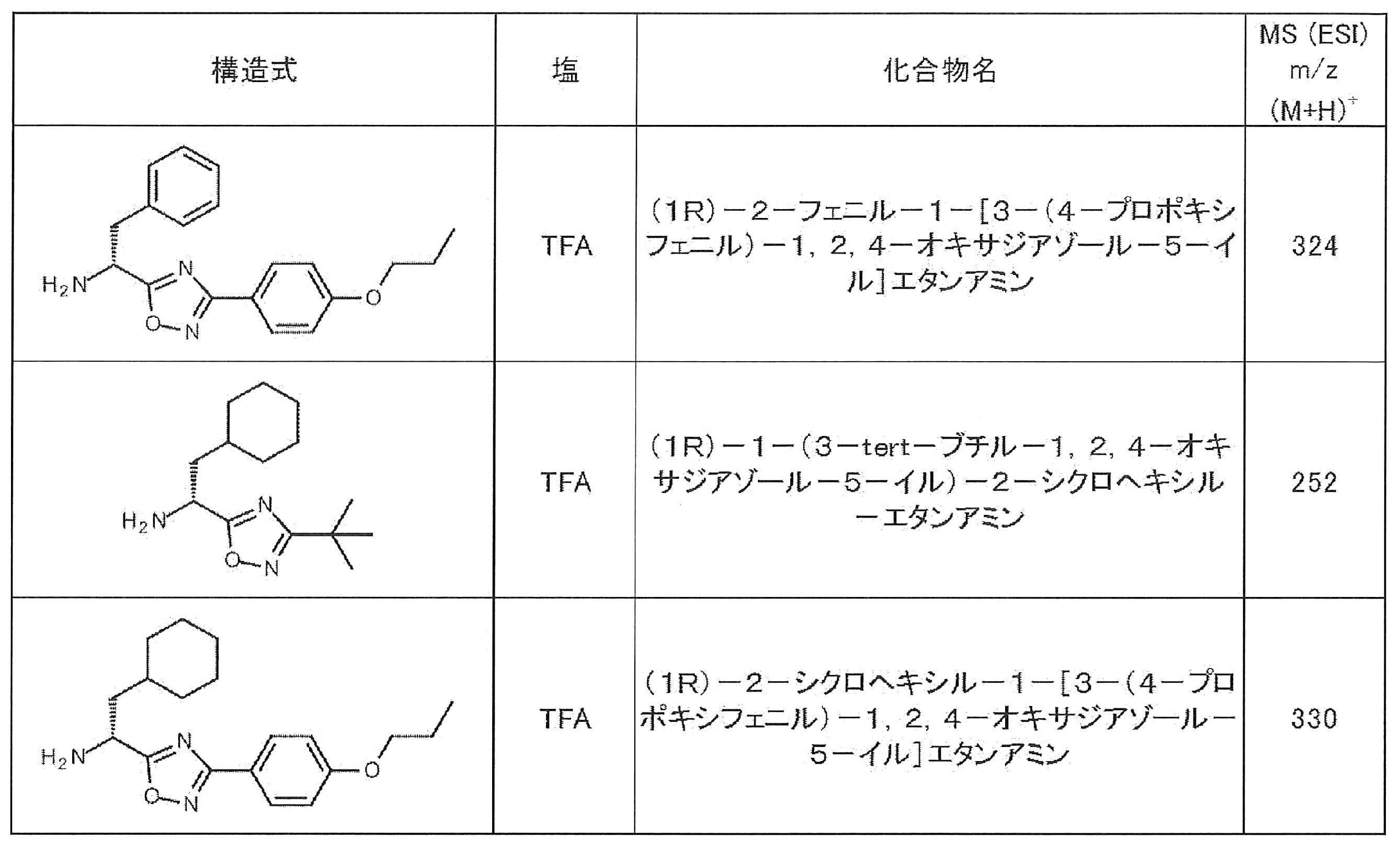

実施例1の工程1と同様にして得られるN-(4-アミノフェニル)-4-メチル-ベンゼンスルホンアミド(2.05g、7.83mmol)のアセトニトリル溶液(50mL)に、炭酸カリウム(5.41g、39.1mmol)及び1-ブロモヘプタン(1.60mL、10.2mmol)を加え80℃で一晩撹拌した。反応溶液に水(50mL)を加え酢酸エチルで抽出した。溶媒を留去することにより得られた残渣をシリカゲルカラムクロマトグラフィー(ヘキサン/酢酸エチル)にて精製して標題化合物(2.29g、6.35mmol、81%)を得た。
工程1で得られたN-[4-(ヘプチルアミノ)フェニル]-4-メチル-ベンゼンスルホンアミド(44.0mg、0.122mmol)のジクロロメタン(2.4mL)溶液にピリジン(29.7mL、0.366mmol)、ジメチルアミノピリジン(1.50mg、0.0122mmol)およびクロロギ酸4-ニトロフェニル(34.2g、0.159mmol)を加えて2時間撹拌した。反応混合物に、D-フェニルアラニンt-
ブチルエステル塩酸塩(62.9mg、0.244mmol)を加え室温で一晩撹拌した。反応混合物に0.1N塩酸(0.8mL)を加え、ジクロロメタンで抽出した。溶媒を留去することにより得られた残渣を高速液体クロマトグラフィー(水-アセトニトリル(それぞれ0.1%トリフルオロ酢酸含有))にて精製して標題化合物(41.5g、0.0683mmol、56%)を得た。
MS (ESI) m/z 608 (M+H)+
1H NMR (400 MHz, DMSO-d6) δ 8.74 (s, 1H), 7.38-7.33 (m, 2H), 7.33-7.28 (m, 2H), 7.28-7.20 (m, 4H), 7.20-7.13 (m, 3H), 6.83-6.75 (m, 2H), 6.35 (d, J= 8.0 Hz, 1H), 4.38-4.28 (m, 1H), 2.97-2.85 (m, 2H), 2.32 (s, 3H), 1.28 (s, 9H), 1.25-1.04 (m, 12H), 0.76 (t, J= 6.9 Hz, 3H).
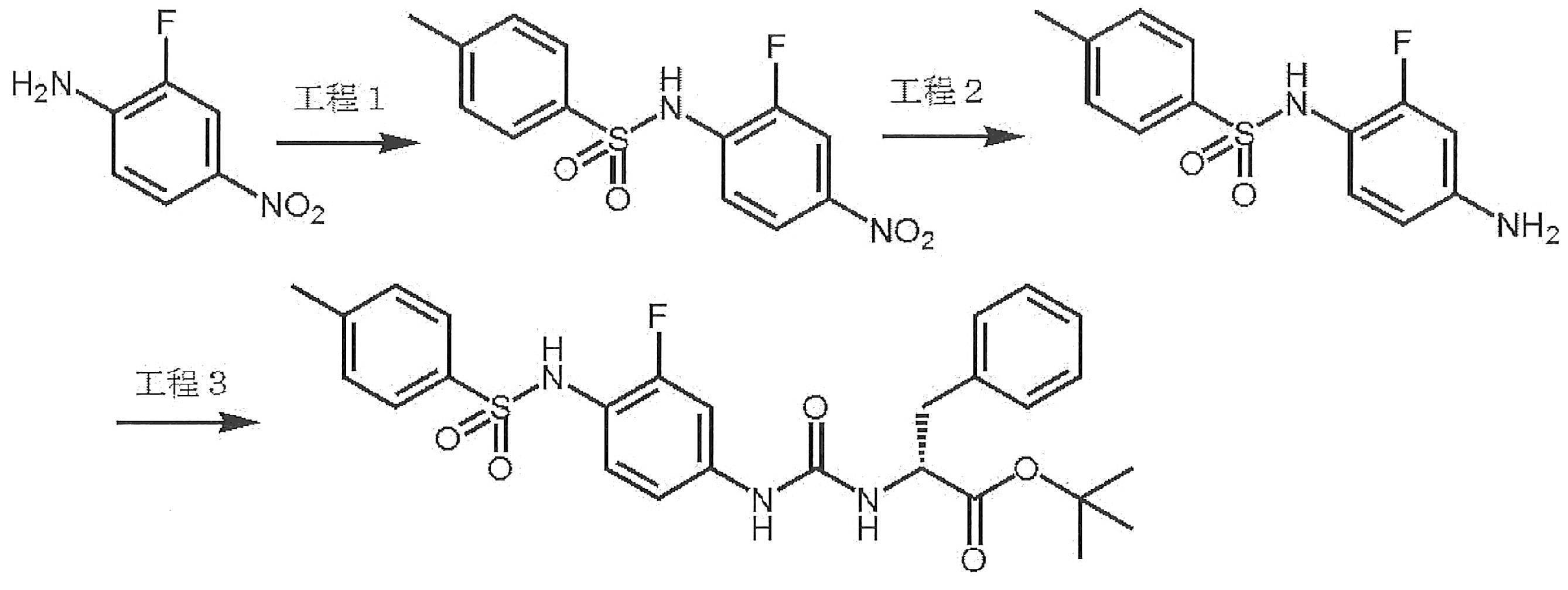
2-フルオロ-4-ニトロ-アニリン(0.167g、1.07mmol)のジクロロメタン(10.0mL)溶液に水素化ナトリウム(70.0mg、1.61mmol)および塩化4-メチルベンゼンスルホニル(0.306g、1.61mmol)を加えて一晩撹拌した。反応混合物に0.1N塩酸(2.0mL)を加え、ジクロロメタンで抽出した。溶媒を留去することにより得られた残渣をシリカゲルカラムクロマトグラフィー(ヘキサン/酢酸エチル)にて精製して標題化合物(0.206g、0.663mmol、62%)を得た。
工程1で得られたN-(2-フルオロ-4-ニトロ-フェニル)-4-メチル-ベンゼンスルホンアミド(0.206g、0.663mmol)のメタノール(13.2mL)溶液にPd/C(70.1mg)を加えて水素雰囲気下一晩撹拌した。触媒を濾別し濾液を減圧濃縮し、得られた残渣をシリカゲルカラムクロマトグラフィー(ヘキサン/酢酸エチル)にて精製して標題化合物(0.112g、0.400mmol、60%)を得た。
工程2で得られたN-(4-アミノ-2-フルオロ-フェニル)-4-メチル-ベンゼンスルホンアミド(42.7mg、0.152mmol)のジクロロメタン(1.5mL)溶液にトリエチルアミン(0.106mL、0.762mmol)およびカルボニルジイミダゾール(29.6mg、0.183mmol)を加えて1時間撹拌した。反応混合物に、D-フェニルアラニンt-ブチルエステル塩酸塩(86.4mg、0.335mmol)を加え室温で一晩撹拌した。反応混合物に0.1N塩酸(0.5mL)を加え、ジクロロメタンで抽出した。溶媒を留去することにより得られた残渣を高速液体クロマトグラフィー(水-アセトニトリル(それぞれ0.1%トリフルオロ酢酸含有))にて精製して標題化合物(2.2mg、0.00417mmol、3%)を得た。
MS (ESI) m/z 528 (M+H)+
1H NMR (400 MHz, DMSO-d6) δ 9.75 (s, 1H), 8.90 (s, 1H), 7.61-7.50 (m, 2H), 7.39-7.28 (m, 5H), 7.28-7.15 (m, 3H), 7.02 (t, J= 8.8 Hz, 1H), 6.94-6.84 (m, 1H), 6.45 (d, J= 7.9 Hz, 1H), 4.45-4.31 (m, 1H), 3.01-2.93 (m, 2H), 2.36 (s, 3H), 1.35 (s, 9H).

1-フルオロ-4-ニトロ-ベンゼン(0.210g、1.49mmol)のジメチルスルホキシド(7.5mL)溶液に炭酸カリウム(1.03g、7.46mmol)および3-メチルスルファニルプロパン-1-アミン(0.327mL、2.98mmol)を加えて90℃で4時間撹拌した。反応混合物に0.1N塩酸(2.0mL)を加え、酢酸エチルで抽出した。溶媒を留去することにより得られた残渣をシリカゲルカラムクロマトグラフィー(ヘキサン/酢酸エチル)にて精製して標題化合物(0.280g、1.24mmol、83%)を得た。
水素化ナトリウム(20.3mg、0.508mmol)のテトラヒドロフラン(2.5mL)溶液に工程1で得られたN-(3-メチルスルファニルプロピル)-4-ニトロ-アニリン(57.5mg、0.254mmol)のテトラヒドロフラン(2.5mL)溶液を0℃で滴下し、10分間撹拌した後に塩化4-tert-ブチルベンゼンスルホニル(70.9mg、0.305mmol)を加えて3時間撹拌した。反応混合物に0.1N塩酸(2.0mL)を加え、酢酸エチルで抽出した。得られた残渣をシリカゲルカラムクロマトグラフィー(ヘキサン/酢酸エチル)にて精製して標題化合物(64.6mg、0.153mmol、30%)を得た。
工程2で得られた4-tert-ブチル-N-(3-メチルスルファニルプロピル)-N-(4-ニトロフェニル)ベンゼンスルホンアミド(64.6mg、0.153mmol)のメタノール/酢酸エチル(1/1、3.0mL)溶液にPd/C(18.1mg)を加えて水素雰囲気下一晩撹拌した。触媒を濾別し濾液を減圧濃縮することで標題化合物(46.9mg、0.119mmol、78%)を得た。
実施例1の工程3の方法に準じて、工程3で得られたN-(4-アミノフェニル)-4-tert-ブチル-N-(3-メチルスルファニルプロピル)ベンゼンスルホンアミド(38.0mg、0.0968mmol)を使用して、標題化合物(33.0mg、0.0474mmol、49%)を得た。
MS (ESI) m/z 702 (M+H)+
1H NMR (400 MHz, DMSO-d6) δ 8.73 (d, J= 10.1 Hz, 1H), 7.87 (dd, J= 15.4, 8.4 Hz, 1H), 7.65-7.55 (m, 2H), 7.51-7.44 (m, 2H), 7.37-7.29 (m, 2H), 6.87 (dd, J= 8.8, 4.0 Hz, 2H), 6.31 (dd, J= 8.6, 4.4 Hz, 1H), 4.26-4.14 (m, 1H), 3.81-3.68 (m, 1H), 3.60-3.41 (m, 2H), 2.43 (t, J= 7.2 Hz, 2H), 1.95 (d, J= 0.6 Hz, 3H), 1.82-1.08 (m, 29H), 1.07-0.96 (m, 3H), 0.94-0.76 (m, 8H).

水素化ナトリウム(0.114g、2.60mmol)のテトラヒドロフラン(8.0mL)溶液に2-フルオロ-4-ニトロ-アニリン(0.203g、1.30mmol)のテトラヒドロフラン(5.0mL)溶液を滴下し0℃で10分間撹拌した。反応混合物に二炭酸ジ-tert-ブチル(0.369g、1.69mmol)を加え、一晩撹拌した。反応混合液に0.1%塩酸(10mL)を加え酢酸エチルで抽出した。溶媒を留去することにより得られた残渣のメタノール(13mL)溶液にPd/C(0.154g)を加えて水素雰囲気下、一晩撹拌した。触媒を濾別し濾液を減圧濃縮することで標題化合物を得た。
工程1で得られたN-(4-アミノ-2-フルオロ-フェニル)カルバミン酸 tert-ブチルのジクロロメタン(13mL)溶液にピリジン(0.158mL、1.95mmol)、ジメチルアミノピリジン(15.9mg、0.130mmol)、および塩化 4-tert-ブチルベンゼンスルホニル(0.303g、1.30mmol)を加え一晩撹拌した。反応混合液に0.1%塩酸(10mL)を加え酢酸エチルで抽出した。溶媒を留去することにより得られた残渣をシリカゲルカラムクロマトグラフィー(ヘキサン/酢酸エチル)にて不純物を取り除くことにより、標題化合物を含む混合物を得た。
工程2で得られたN-{4-[(4-tert-ブチルフェニル)スルホニルアミノ]-2-フルオロ-フェニル}カルバミン酸 tert-ブチルを含む混合物のジクロロメタン(10mL)溶液にトリフルオロ酢酸(3.0mL)を加え、1時間撹拌した。反応混合液を減圧濃縮し、残渣に飽和炭酸カリウム水溶液5.0mLを加え、酢酸エチルで抽出した。溶媒を留去することにより得られた残渣をシリカゲルカラムクロマトグラフィー(ヘキサン/酢酸エチル)にて精製して標題化合物(0.115g、0.357mmol、14%(3工程))得た。
下記実施例8の工程3の方法に準じて、工程3で得られたN-(4-アミノ-3-フルオロ-フェニル)-4-tert-ブチル-ベンゼンスルホンアミド(0.115g、0.357mmol)を使用して、標題化合物(14.6mg、0.0220mmol、6%)を得た。
MS (ESI) m/z 664 (M+H)+
1H NMR (400 MHz, DMSO-d6) δ 10.80 (d, J= 2.3 Hz, 1H), 10.17 (s, 1H), 8.43-8.35 (m, 1H), 7.97-7.80 (m, 2H), 7.71-7.60 (m, 2H), 7.60-7.50 (m, 3H), 7.30 (d, J= 8.0 Hz, 1H), 7.08 (d, J= 2.3 Hz, 1H), 7.07-7.01 (m, 1H), 6.94 (t, J= 7.6 Hz, 1H), 6.90 (dd, J= 12.8, 2.4 Hz, 1H), 6.82 (d, J= 8.0 Hz, 1H), 6.76 (dd, J= 9.3, 2.3 Hz, 1H), 4.54-4.41 (m, 1H), 3.15-2.85 (m, 4H), 1.41-1.05 (m, 18H), 0.88-0.70 (m, 6H).

水素化ナトリウム(0.116g、2.65mmol)のテトラヒドロフラン(15mL)溶液に2-フルオロ-4-ニトロ-アニリン(0.207g、1.32mmol)のテトラヒドロフラン(5.0mL)溶液を滴下し0℃で10分間撹拌した。反応混合物に塩化4-tert-ブチルベンゼンスルホニル(0.399g、1.72mmol)を加え、一晩撹拌した。反応混合液に0.1%塩酸(10mL)を加え酢酸エチルで抽出した。溶媒を留去することにより得られた残渣から、シリカゲルカラムクロマトグラフィー(ヘキサン/酢酸エチル)にて不純物を取り除くことにより、標題化合物を含む混合物を得た。
工程1で得られた4-tert-ブチル-N-(2-フルオロ-5-ニトロ-フェニル)ベンゼンスルホンアミドを含む混合物のジメチルスルホキシド(5.0mL)溶液に炭酸カリウム(0.523g、3.96mmol)とモルホリン(0.228mL、2.64mmol)を加えて90℃で4時間撹拌した。反応混合物に水(5.0mL)を加え、酢酸エチルで抽出した。溶媒を留去することにより得られた残渣から、シリカゲルカラムクロマトグラフィー(ヘキサン/酢酸エチル)にて不純物を取り除くことにより、標題化合物を含む混合物を得た。
工程2で得られた4-tert-ブチル-N-(2-モルホリノ-5-ニトロ-フェニル)ベンゼンスルホンアミドを含む混合物のメタノール(15mL)溶液にPd/C(31.1mg)を加えて水素雰囲気下、5時間撹拌した。触媒を濾別し濾液を減圧濃縮することで標題化合物(74.2mg、0.190mmol、14%(3工程))を得た。
下記実施例8の工程3の方法に準じて、工程3で得られたN-(5-アミノ-2-モルホリノ-フェニル)-4-tert-ブチル-ベンゼンスルホンアミド(74.2mg、0.190mmol)と(2R)-2-アミノ-3-シクロヘキシル-N-(2-エチルヘキシル)プロパンアミド塩酸塩(0.0911g、0.286mmol)を使用して、標題化合物(84.1mg、0.121mmol、63%)を得た。
MS (ESI) m/z 698 (M+H)+
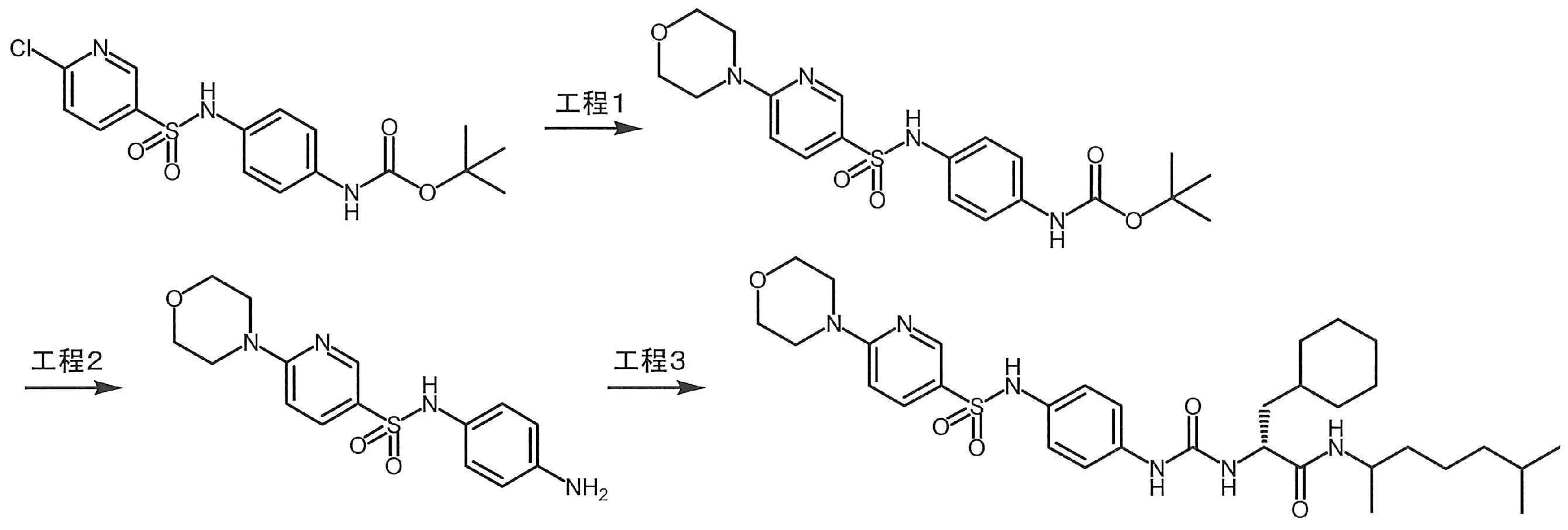
実施例1の工程1と同様の方法により得られるN-[4-[(6-クロロ-3-ピリジル)スルホニルアミノ]フェニル]カルバミン酸tert-ブチル(0.121g、0.315mmol)の1,4-ジオキサン(3.2mL)溶液にモルホリン(0.0543mL、0.630mmol)およびジイソプロピルエチルアミン(0.165mL、0.945mmol)を加えて90℃で4時間撹拌した。反応混合物に0.1N塩酸(0.5mL)を加え、酢酸エチルで抽出した。溶媒を留去することにより得られた残渣をシリカゲルカラムクロマトグラフィー(ヘキサン/酢酸エチル)にて精製して標題化合物(0.112g、0.258mmol、82%)を得た。
工程1で得られたN-{4-[(6-モルホリノ-3-ピリジル)スルホニルアミノ]フェニル}カルバミン酸tert-ブチル(0.112g、0.258mmol)のジクロロメタン(2.5mL)溶液にトリフルオロ酢酸(2.5mL)を加え1時間撹拌した。反応混合液を減圧濃縮し、残渣に飽和炭酸カリウム水溶液(5.0mL)を加え、酢酸エチルで抽出した。溶媒を留去することにより標題化合物(77.6mg、0.232mmol)を得た。
工程2で得られたN-(4-アミノフェニル)-6-モルホリノ-ピリジン-3-スルホンアミド(30.9mg、0.0887mmol)のジクロロメタン(1.8mL)溶液にトリエチルアミン(0.0742mL、0.532mmol)およびカルボニルジイミダゾール(21.6mg、0.133mmol)を加えて2時間撹拌した。反応混合物に、(2R)-2-アミノ-3-シクロヘキシル-N-(1,5-ジメチルヘキシル)プロパンアミド塩酸塩(42.4mg、0.133mmol)を加え室温で3時間撹拌した。反応混合物に0.1N塩酸(0.5mL)を加え、ジクロロメタンで抽出した。溶媒を留去することにより得られた残渣を高速液体クロマトグラフィー(水-アセトニトリル(それぞれ0.1%トリフルオロ酢酸含有))にて精製して標題化合物(29.7mg、0461mmol、52%)を得た。
MS (ESI) m/z 643 (M+H)+
1H NMR (400 MHz, DMSO-d6) δ 9.75 (d, J= 1.6 Hz, 1H), 8.59 (d, J= 8.0 Hz, 1H), 8.28 (d, J= 2.5 Hz, 1H), 7.83 (dd, J= 16.7, 8.3 Hz, 1H), 7.66 (dd, J= 9.1, 2.6 Hz, 1H), 7.26-7.16 (m, 2H), 6.97-6.91 (m, 2H), 6.87 (d, J= 9.2 Hz, 1H), 6.25 (d, J= 8.5 Hz, 1H), 4.23-4.08 (m, 1H), 3.80-3.67 (m, 1H), 3.61-3.50 (m, 4H), 1.80-1.54 (m, 6H), 1.52-1.03 (m, 16H), 1.03-0.95 (m, 3H), 0.94-0.73 (m, 8H).

実施例3の工程1の方法により得られる2-{4-[(4-tert-ブチルフェニル)スルホニルアミノ]アニリノ}酢酸エチル(0.192g、0.352mmol)のジクロロメタン(3.5mL)溶液にピリジン(57.2mL、0.705mmol)、ジメチルアミノピリジン(8.61mg、0.0705mmol)およびクロロギ酸4-ニトロフェニル(0.107g、0.529mmol)を加えて2時間撹拌した。反応混合物に、(2R)-2-アミノ-3-シクロヘキシル-N-(1,5-ジメチルヘキシル)プロパンアミド塩酸塩(0.149g、0.529mmol)を加え、室温で2時間撹拌した。反応混合物の溶媒を留去し、テトラヒドロフラン(1.8mL)と1N水酸化ナトリウム溶液(1.8mL)を加え、室温で3時間撹拌した。反応溶液に1N塩酸を加え、pH2以下に調整し、酢酸エチルで抽出した。溶媒を留去することにより得られた残渣を高速液体クロマトグラフィー(水-アセトニトリル(それぞれ0.1%トリフルオロ酢酸含有))にて精製して標題化合物(0.162g、0.241mmol、69%)を得た。
MS (ESI) m/z 671 (M+H)+

(2R)-2-(tert-ブトキシカルボニルアミノ)-3-シクロヘキシル-プロパン酸(1.01g、3.49mmol)のジクロロメタン(35mL)溶液に、WSC塩酸塩(1.00g、5.24mmol)、1-ヒドロキシ-7-アザベンゾトリアゾ-ル(9.50mg、0.698mmol)、トリエチルアミン(0.973mL、6.98mmol)および6-メチルヘプタン-2-アミン(1.17mL、6.98mmol)を加え、室温で4時間撹拌した。反応混合物に0.1N塩酸(10mL)を加え、ジクロロメタンで抽出した。溶媒を留去して得られた残渣をシリカゲルカラムクロマトグラフィー(ヘキサン/酢酸エチル)にて精製して標題化合物(1.15g、3.00mmol、86%)を得た。
工程1で得られたN-[(1R)-1-(シクロヘキシルメチル)-2-(1,5-ジメチルヘキシルアミノ)-2-オキソ-エチル]カルバミン酸 tert-ブチル(1.15g、3.00mmol)にジクロロメタン(25mL)とトリフルオロ酢酸(5.0mL)を加え、1時間撹拌した。反応混合物の溶媒を留去することにより得られた残渣に1N塩酸(5.0mL)を加え、凍結乾燥を行い、標題化合物の塩酸塩(0.869g、2.73mmol、91%)を得た。
MS (ESI) m/z 283 (M+H)+


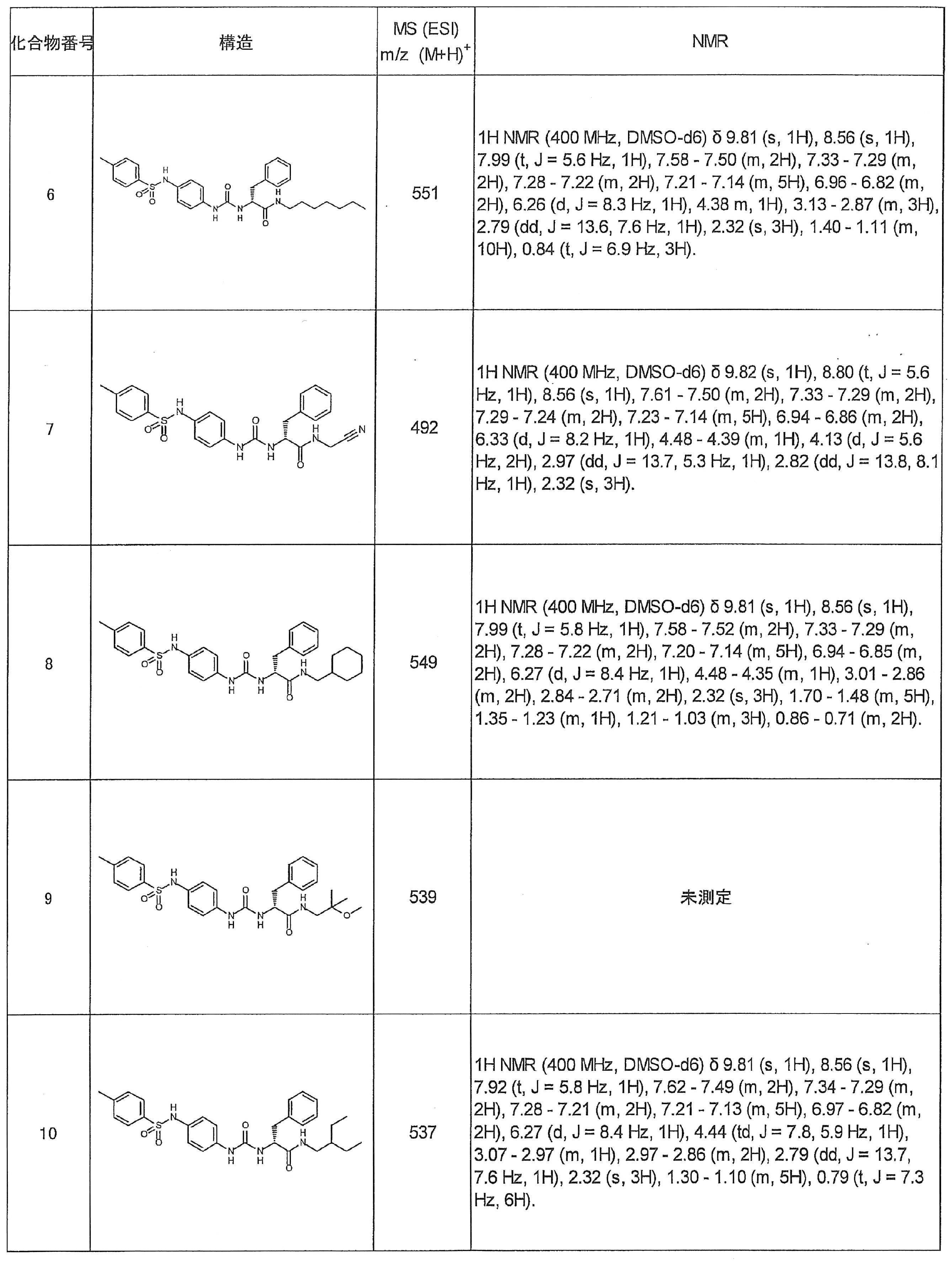
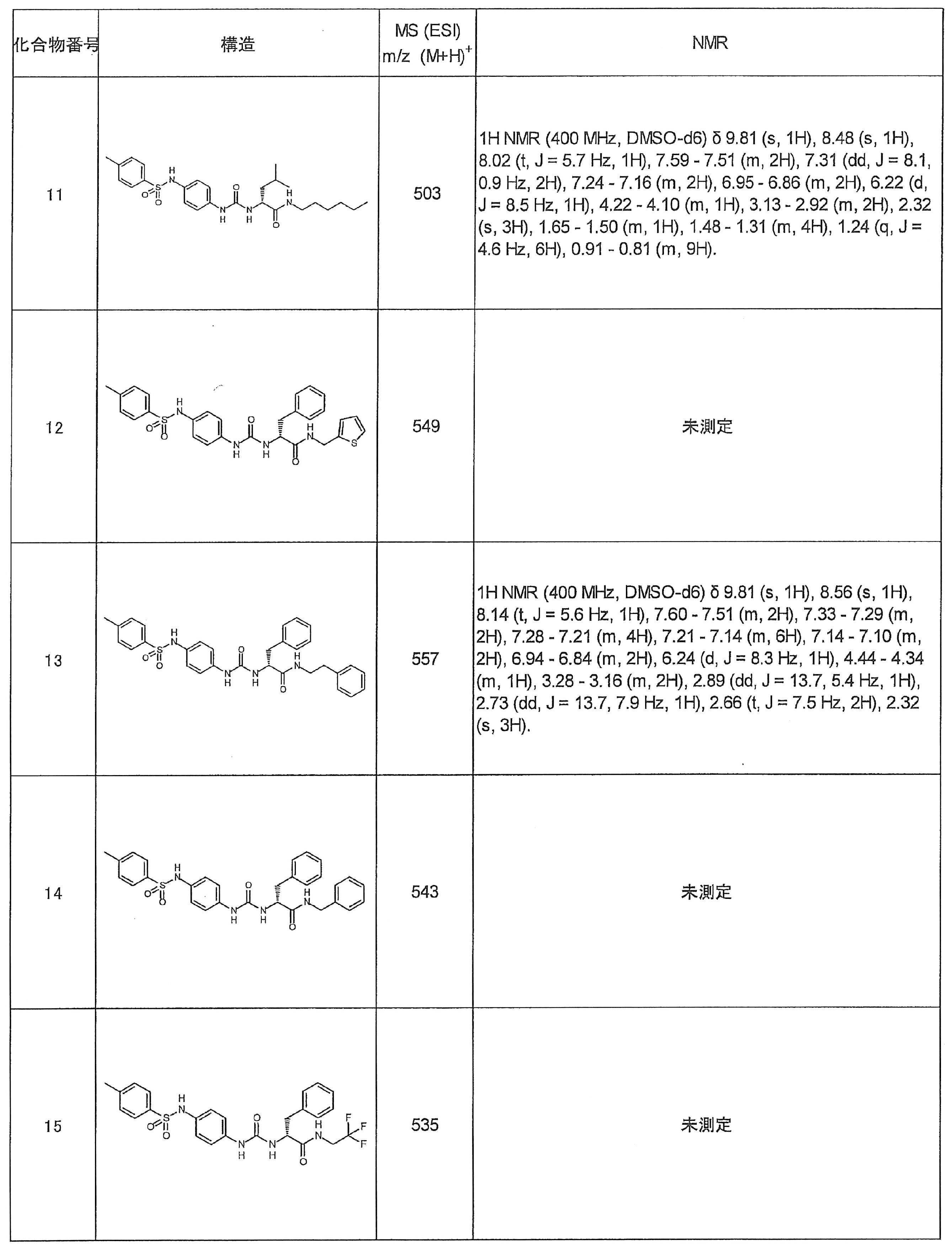


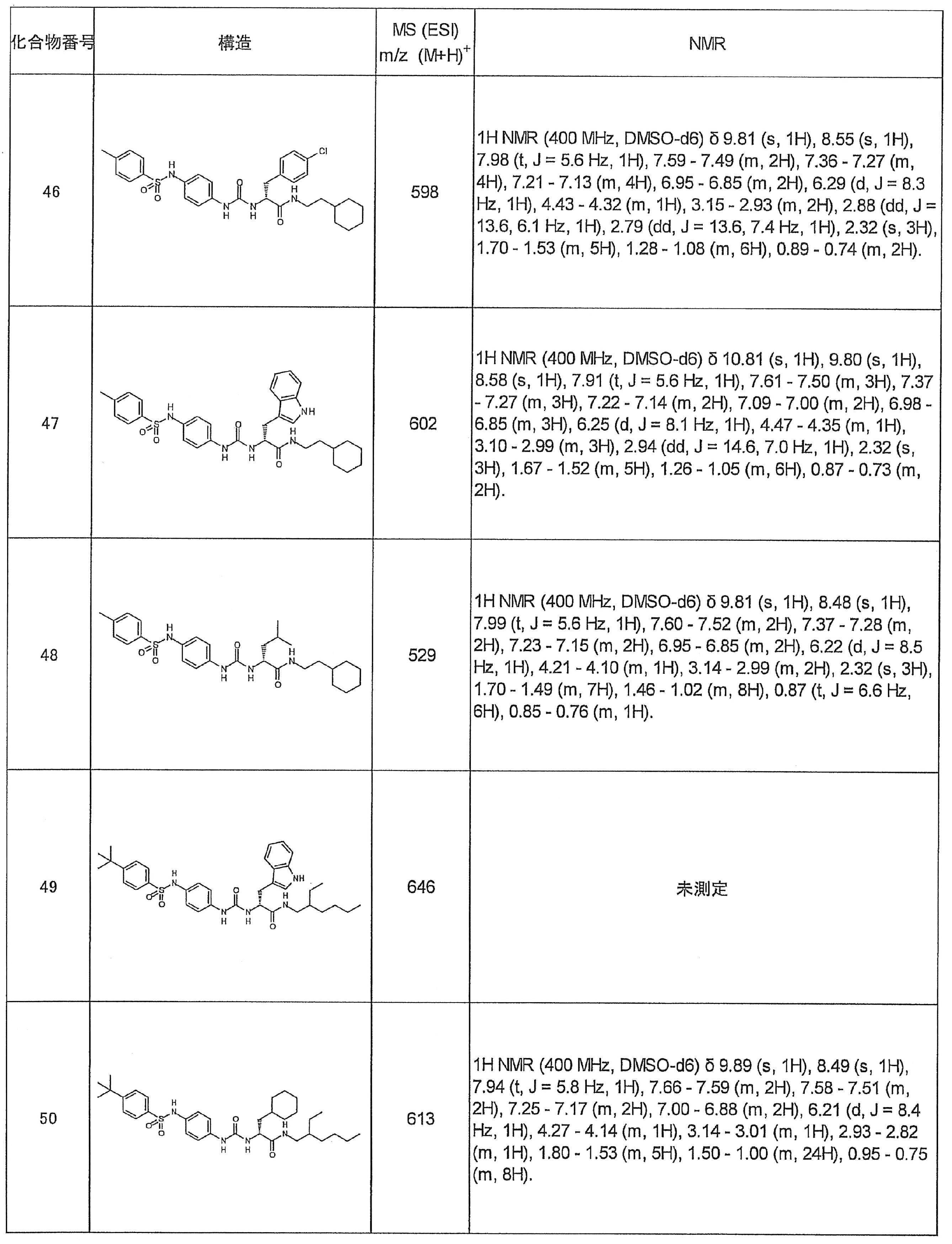
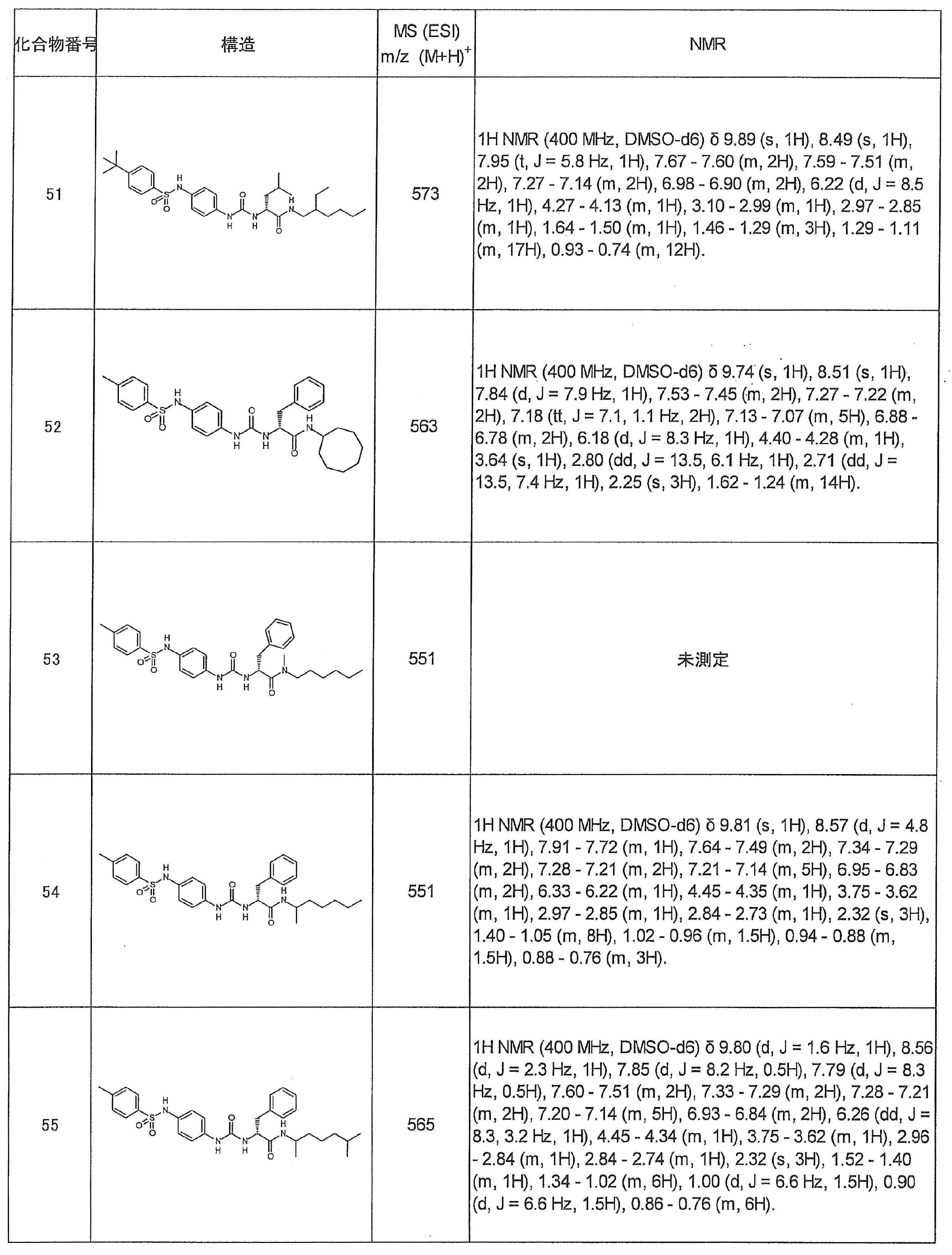
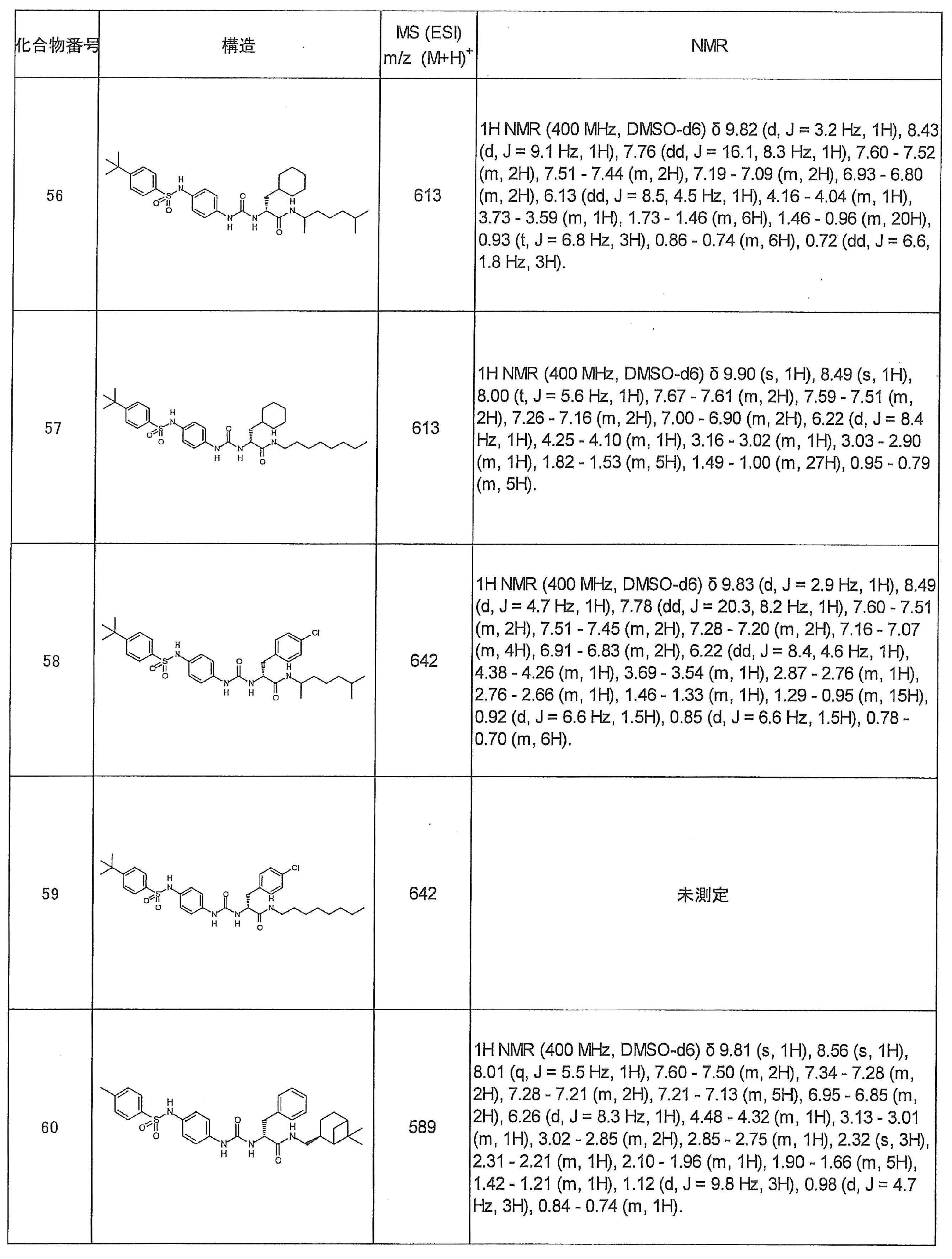


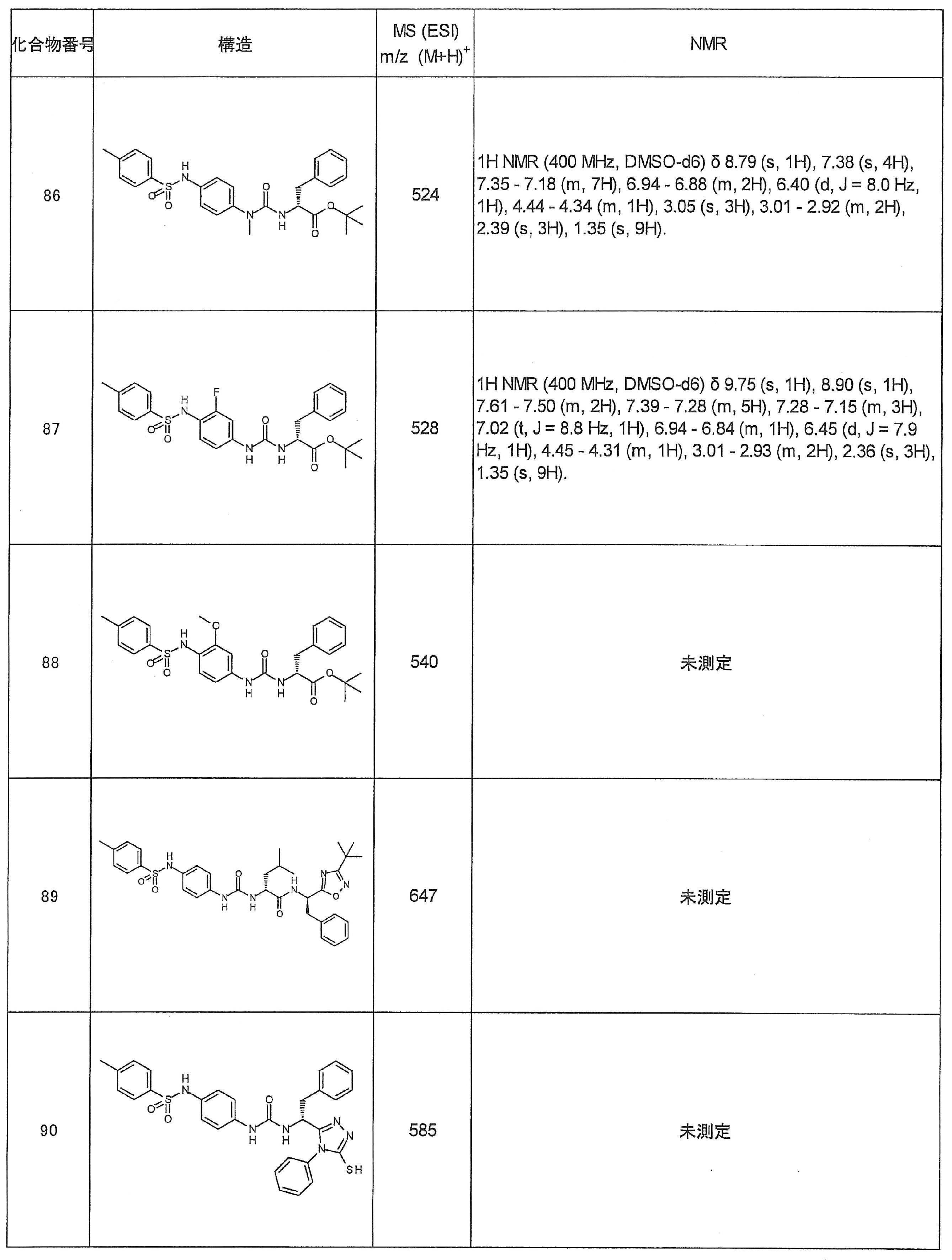
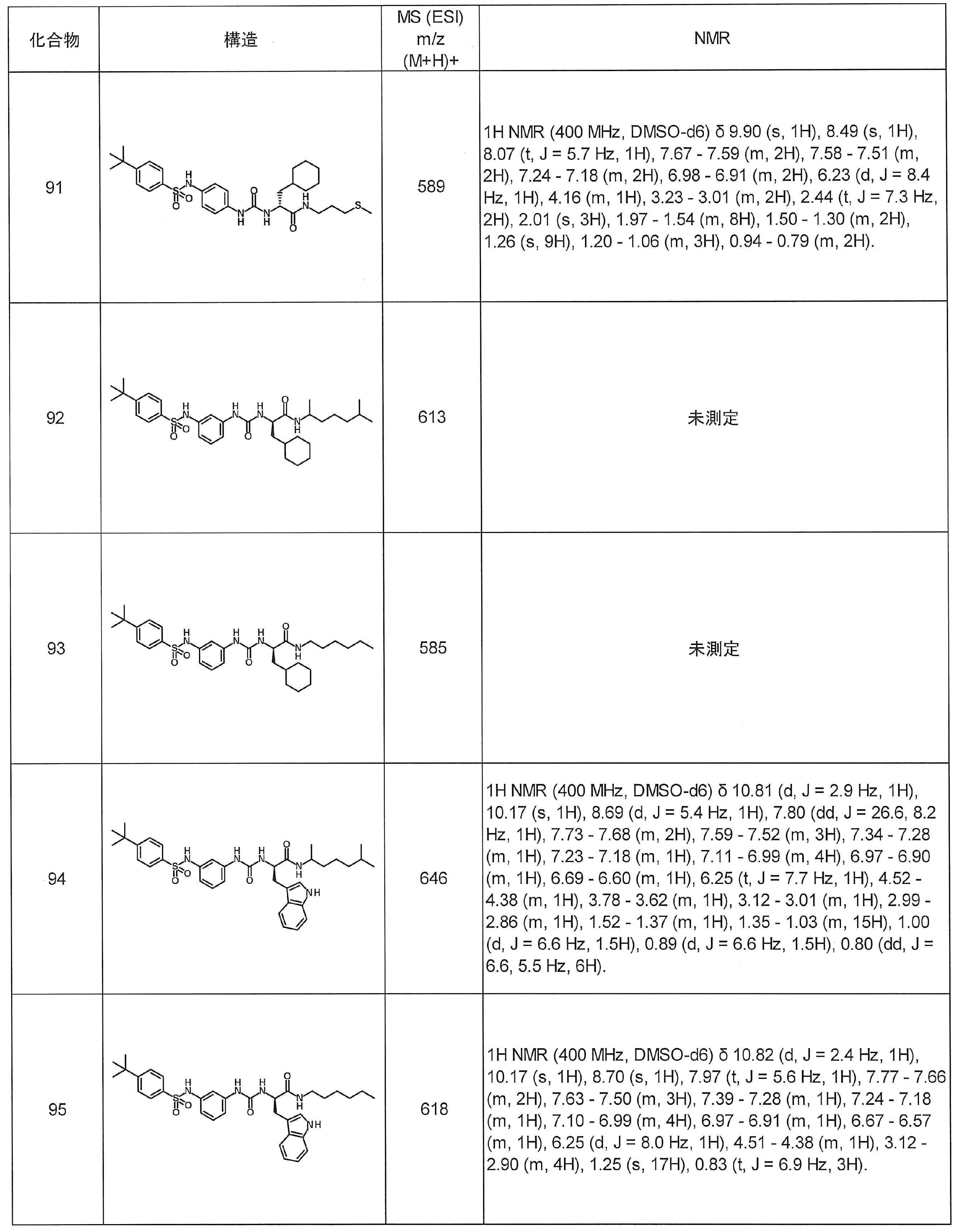


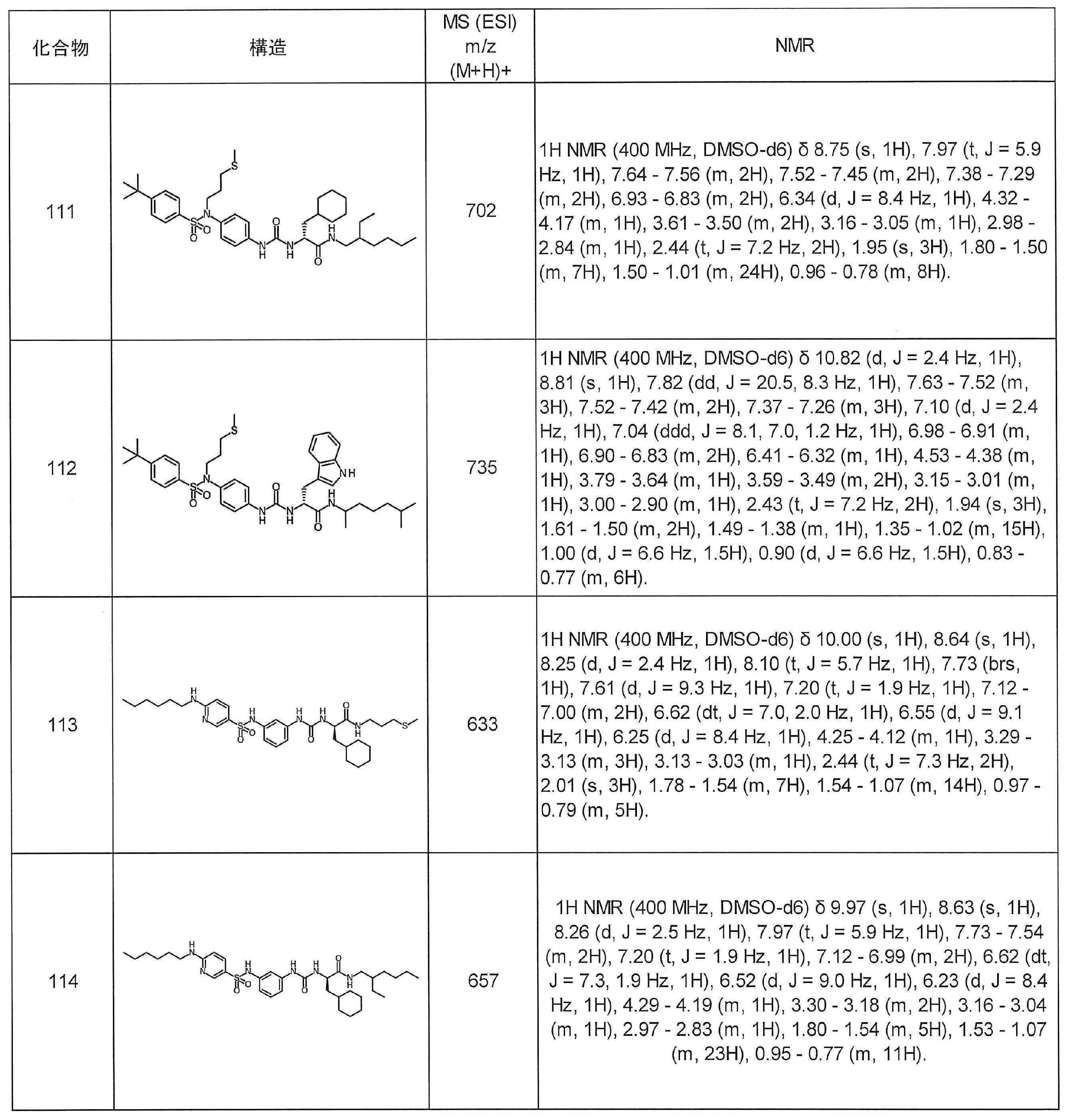
1)実施例化合物 10 mg
2)微粉末セルロース 10 mg
3)乳糖 19 mg
4)ステアリン酸マグネシウム 1 mg
計 40 mg
1)、2)、3)および4)を混合して、ゼラチンカプセルに充填する。
1)実施例化合物 10 g
2)乳糖 50 g
3)トウモロコシデンプン 15 g
4)カルボキシメチルセルロースカルシウム 44 g
5)ステアリン酸マグネシウム 1 g
1000錠 計 120 g
1)、2)、3)の全量および30gの4)を水で練合し、真空乾燥後、整粒を行う。この整粒末に14gの4)および1gの5)を混合し、打錠機により打錠する。このようにして、1錠あたり実施例化合物10mgを含有する錠剤1000錠を得る。
10%Fetal bovine serum(ニチレイ)、1%Pen Strep(GIBCO)を含むDMEM/Ham’s F-12(ナカライテスク)培地を用いて維持したPEAKRAPID由来Gα15-trans48LD安定発現細胞(PRG48)をD-PBS(-)(ナカライテスク)で洗浄後、0.25%Trypsin EDTA(GIBCO)を用いて細胞を15cm dish(CORING)から回収した。遠心分離(1,200rpm、3分)を行って上清を除去し、5%FBS DMEM/Ham’s F-12中で4×10⁶cell/mLになるように懸濁した。これを15cm dishに1.0mL播種し、一晩培養(37℃、5%CO2)した。翌日、培養したPRG48細胞の培地を5%FBS DMEM/Ham’s F-12培地、30mLに交換して、6.0mLのOpti-MEM(invitrogen)と120μLのLipofectamin2000(invitrogen)を用いて調製したヒトGLP-1R遺伝子混合物溶液(GLP-1R/pc.DNA3.1(+) 60μg)を細胞にゆっくり添加し、6時間培養(37℃、5%CO2)することで遺伝子を導入した。遺伝子導入後に、D-PBS(-)で細胞を洗浄後、0.25%Trypsin-EDTA(GIBCO)を用いて細胞をフラスコから剥がして回収した。細胞数をカウント後、5%FBS DMEM/Ham’s F-12培地中に0.5×10⁶cell/mLになるように懸濁し、D-Lysine coat 96well plate(BDバイオサイエンス)に7.0×10⁴cellになるように各ウェルに播種し、1時間室温で静置接着させた後に一晩培養(37℃、5%CO2)した。培養した96wellの培地を全て捨て、Assay用buffer(20mM HEPES、146mM NaCl、1mM MgSO4、1.39mM グルコース、1mM CaCl2、2.5mM Probenecid、0.05%Casein Enzymatic Hydrolysate)で80倍に希釈した細胞内カルシウム測定用染色液Calcium
5assay kit Express(Molecular Device)を150μL加え、37℃で30分、加えて室温にて45分静置し、染色を行った。染色後、FDSSμCELL(浜松ホトニクス)を用いて、250pM GLP-1および化合物の添加とCa2+応答の観察を行った。それぞれの評価化合物は、DMSOに溶解させ、さらにAssay用bufferで希釈して用いた。
評価は、添加前後の蛍光値(Ex480:Em540)を測定することで、添加によりGLP-1R受容体を介して引き起こされる細胞内遊離カルシウム濃度の変化を定量的に調べた。蛍光値の測定および解析には、FDSSμCELL付属のソフト(FDSS7000EX)を用いて、ΔF/F値((刺激後の蛍光最大値-刺激後の蛍光値最小値)/刺激前の蛍光値 )を算出した。得られたΔF/F値を用いてPrism5によりEC50値を算出した。
10週齢前後の雄性Wistar系ラットの膵臓より、定法に従い、コラゲナーゼおよびFicoll-Conray溶液を用いてランゲルハンス島を単離し(Cryobiology,2006,52:90-8)、化合物の活性評価に用いた。
単離したランゲルハンス島を、グルコースを含まないKrebs Ringer Bicarbonate-Hepes buffer (KRBH:129mM NaCl、4.7mM KCl、5.0mM NaHCO3、1.2mM MgSO4、12mM KH2PO4、 2.5mM CaCl2、10mM HEPES、pH7.4)にて37℃、5% CO2の条件下で30分間前培養を行った後に24wellプレートの各wellに5個ずつ播種した。播種後、2.8mMまたは8.3mMグルコース、1.0nM GLP-1アナログ(exendin-4)、および30μMの化合物50を含むKRBHを添加し、1時間培養した(37℃、5% CO2)。培養1時間後に各wellより培養上清を回収し、上清中に分泌されたインスリンの濃度を市販の測定キット((株)森永生科学研究所)を用いて測定した。各刺激条件におけるインスリン分泌量は、8.3mMグルコースにおける分泌量に対する相対分泌量として計算した。
単離したランゲルハンス島は、buffer中のグルコース濃度を2.8mMから8.3mMに上げることにより2.8mMの場合に比べて約5倍程度のインスリン分泌の上昇を示したことから、グルコース応答性が保たれていることを確認した。8.3mMのグルコースを含むbufferに30μMの化合物50またはGLP-1アナログであるexendin-4(1nM)のみを添加してもインスリン分泌に影響を与えなかったが、30μMの化合物50と1nMのexendin-4を同時に添加するとインスリン分泌量は8.3mMグルコース単独と比べて約2倍程度上昇した(図1)。以上より、化合物50にはGLP-1によるグルコース応答性インスリン分泌促進作用を増強する活性があることが確認された。


一晩絶食した23週齢の雄性KKAyマウスを無作為に2群に分け、内因性のGLP-1分泌を誘導する目的で各マウスに3g/kgのホエイタンパク質を経口投与した。ホエイタンパク質投与後30分の時点で各マウスに3mg/kgの本発明化合物(化合物50)または投与媒体(vehicle)を腹腔内に投与し、直後に2g/kgのグルコースを経口投与して経時的に尾静脈より採血し、血糖値を測定した。
Vehicleを投与したマウスでは、グルコース投与後30分をピーク(470.4±34.9mg/dL)とする血糖変動を示した。それに対し、本発明化合物(化合物50)を投与したマウスでは、ピーク時の血糖上昇が抑制され(図2A)、グルコース投与後180分間の血糖AUCの値は有意に低下していた(投与媒体群:1016±74.8mg・hr /dL、化合物50投与群:734.3±65.9mg・hr/dL、p<0.05)(図2B)。
以上の結果より、GLP-1受容体作用増強活性を有する本発明化合物(化合物50)には血糖上昇を抑制する作用があることが確認された。
11週齢の雄性KKAyマウスを無作為に2群に分けて一晩絶食後、擬似腸液(10mMタウロコール酸、2mMレシチン、55mMマレイン酸、81.6mM水酸化ナトリウム、125mM塩化ナトリウム含有)、または擬似腸液に溶解した本発明化合物(化合物96)(3mg/kg)を経口投与し、市販の飼料(CRF-1、オリエンタル酵母)を供与して摂餌量の変化をモニターした。
化合物96の投与後4時間までの累積摂餌量を測定したところ、化合物96投与群では擬似腸液投与群と比べて有意な抑制が認められた(図3)。このことから、GLP-1受容体作用増強活性を有する本発明化合物(化合物96)は、経口投与で食欲抑制作用を示すことが確認された。
Claims (11)
- 式(I):

Aは、さらに置換されていてもよい環状基を示し;
Bは、さらに置換されていてもよいベンゼン環を示し;
Lは、結合手または置換されていてもよいC1-6アルキレン基を示し;
R1は、水素原子、ヒドロキシ基、置換されていてもよいC1-6アルコキシ基、置換されていてもよいアミノ基、または置換されていてもよいC1-6アルキル基を示し;
R2およびR3は、それぞれ独立して、同一または異なって、水素原子、カルボキシ基、ヒドロキシ基、置換されていてもよいC1-10アルコキシ基、置換されていてもよいアミノ基または置換されていてもよいC1-10アルキル基を示し;
Qは、酸素原子または硫黄原子を示し;
R4およびR5は、それぞれ独立して、同一または異なって、水素原子もしくは置換されていてもよいC1-6アルキル基を示すか、またはR4およびR5は、それらが結合する炭素原子と一緒になって環を形成し;
nは、1~6の整数を示し;ならびに
Mは、置換されていてもよいC1-12アルコキシ-カルボニル基、置換されていてもよいカルバモイル基、または置換されていてもよい複素環基を示す。但し、3-(3-(3-(フェニルスルホンアミド)フェニル)ウレイド)-4-(トリメチルアンモニオ)ブタン酸エステルを除く。]
で表される化合物またはその塩。 - Aが、それぞれさらに置換されていてもよい、C6-14アリール基あるいは5または6員の単環式芳香族複素環基であり、
Lが、結合手またはメチレン基であり、
Qが、酸素原子であり、
R4およびR5が、それぞれ独立して、同一または異なって、水素原子または置換されていてもよいC1-6アルキル基であり、ならびに
nが、1または2である、請求項1記載の化合物またはその塩。 - Aが、ハロゲン原子、ヒドロキシ基、カルボキシ基、スルファニル基、置換されていてもよいC1-6アルキル基、置換されていてもよいC1-6アルコキシ基、置換されていてもよいアミノ基、ハロゲン原子で置換されていてもよいC1-6アルキルチオ基、およびC1-3アルキレンジオキシ基からなる群より選択される同一または異なる1ないし5個の置換基でさらに置換されていてもよいフェニル基、あるいはハロゲン原子、ヒドロキシ基、カルボキシ基、スルファニル基、置換されていてもよいC1-6アルキル基、置換されていてもよいC1-6アルコキシ基、置換されていてもよいアミノ基、4ないし7員の単環式非芳香族複素環基、ハロゲン原子で置換されていてもよいC1-6アルキルチオ基、およびC1-3アルキレンジオキシ基からなる群より選択される同一または異なる1ないし4個の置換基でさらに置換されていてもよいピリジル基であり、
Bが、ハロゲン原子、ヒドロキシ基、スルファニル基、置換されていてもよいC1-6アルキル基、置換されていてもよいC1-6アルコキシ基、置換されていてもよいアミノ基、ハロゲン原子で置換されていてもよいC1-6アルキルチオ基、C1-3アルキレンジオキシ基、および4ないし7員の単環式非芳香族複素環基からなる群より選択される同一または異なる1ないし4個の置換基でさらに置換されていてもよいベンゼン環であり、
Lが、結合手またはメチレン基であり、
R1が、水素原子、またはハロゲン原子、ヒドロキシ基、スルファニル基、カルボキシ基、C1-6アルコキシ基、C1-6アルキル基でモノまたはジ置換されていてもよいアミノ基、およびハロゲン原子で置換されていてもよいC1-6アルキルチオ基からなる群より選択される置換基で置換されていてもよいC1-6アルキル基であり、
R2およびR3が、それぞれ独立して、同一または異なって、水素原子;カルボキシ基;ヒドロキシ基;またはハロゲン原子、ヒドロキシ基、スルファニル基、カルボキシ基、C1-6アルコキシ基、C1-6アルキル基でモノまたはジ置換されていてもよいアミノ基、およびハロゲン原子で置換されていてもよいC1-6アルキルチオ基からなる群より選択される置換基で置換されていてもよいC1-10アルキル基であり、
Qが、酸素原子であり、
R4が、水素原子であり、
R5が、ハロゲン原子、ヒドロキシ基、カルボキシ基、グアニジノ基、シアノ基、スルファニル基、置換されていてもよいアミノ基、置換されていてもよいカルバモイル基、ハロゲン原子で置換されていてもよいC1-6アルコキシ-カルボニル基、置換されていてもよいC1-6アルコキシ基、ハロゲン原子で置換されていてもよいC1-6アルキルチオ基、置換されていてもよいC3-10シクロアルキル基、および置換されていてもよい芳香環基からなる群より選択される置換基で置換されていてもよいC1-6アルキル基であり、
nが、1であり、ならびに
Mが、置換されていてもよいC1-12アルコキシ-カルボニル基、置換されていてもよいカルバモイル基、または置換されていてもよい5または6員の単環式芳香族複素環基である、請求項1記載の化合物またはその塩。 - Aが、ハロゲン原子、カルボキシ基、ヒドロキシ基、C1-6アルコキシ-カルボニル基、C1-6アルコキシ基、C1-6アルキル基でモノまたはジ置換されていてもよいアミノ基、およびシアノ基からなる群より選択される1ないし3個の置換基で置換されていてもよいC1-6アルキル基でさらに置換されていてもよいフェニル基、あるいは、C1-6アルキル基でモノまたはジ置換されていてもよいアミノ基、および4ないし7員の単環式非芳香族含窒素複素環基からなる群より選択される同一または異なる1ないし3個の置換基でさらに置換されていてもよいピリジル基であり、
Bが、ハロゲン原子、C1-6アルコキシ基、および4ないし7員の単環式非芳香族複素環基からなる群より選択される同一または異なる1ないし4個の置換基でさらに置換されていてもよいベンゼン環であり、
Lが、結合手であり、
R1が、水素原子、またはハロゲン原子で置換されていてもよいC1-6アルキルチオ基で置換されたC1-6アルキル基であり、
R2およびR3が、それぞれ独立して、同一または異なって、水素原子、またはカルボキシ基で置換されていてもよいC1-10アルキル基であり、
Qが、酸素原子であり、
R4が、水素原子であり、
R5が、ハロゲン原子、ヒドロキシ基、カルボキシ基、グアニジノ基、シアノ基、スルファニル基、置換されていてもよいアミノ基、置換されていてもよいカルバモイル基、C1-6アルコキシ-カルボニル基、置換されていてもよいC1-6アルコキシ基、ハロゲン原子で置換されていてもよいC1-6アルキルチオ基、置換されていてもよいC3-10シクロアルキル基、および置換されていてもよい芳香環基からなる群より選択される置換基で置換されていてもよいC1-6アルキル基であり、
nが、1であり、ならびに
Mが、置換されていてもよいC1-12アルコキシ-カルボニル基;置換されていてもよいC1-8アルキル基およびC3-10シクロアルキル基からなる群より選択される置換基でモノまたはジ置換されていてもよいカルバモイル基;または置換されていてもよい5または6員の単環式芳香族複素環基である、請求項1記載の化合物またはその塩。 - Aが、1ないし3個のハロゲン原子で置換されていてもよいC1-6アルキル基でさらに置換されていてもよいフェニル基であり、
Bが、さらなる置換基を有さないベンゼン環であり、
Lが、結合手であり、
R1が、水素原子であり、
R2およびR3が、それぞれ独立して、同一または異なって、水素原子、またはC1-10アルキル基であり、
Qが、酸素原子であり、
R4が、水素原子であり、
R5が、置換されていてもよいC3-10シクロアルキル基、置換されていてもよいフェニル基、C1-6アルキルチオ基、5または6員の単環式芳香族含窒素複素環基、および8ないし14員の縮合芳香族含窒素複素環基からなる群より選択される置換基で置換されていてもよいC1-4アルキル基であり、
nが、1であり、ならびに
Mが、置換されていてもよいC1-12アルコキシ-カルボニル基、置換されていてもよいカルバモイル基、置換されていてもよいトリアゾリル基、置換されていてもよいイソオキサゾリル基、置換されていてもよいオキサゾリル基、置換されていてもよいオキサジアゾリル基、または置換されていてもよいテトラゾリル基である、請求項1記載の化合物またはその塩。 - Aが、1ないし3個のC1-6アルキル基でさらに置換されていてもよいフェニル基であり、
Bが、さらなる置換基を有さないベンゼン環であり、
Lが、結合手であり、
R1が、水素原子であり、
R2およびR3が、それぞれ独立して、同一または異なって、水素原子、またはC1-10アルキル基であり、
Qが、酸素原子であり、
R4が、水素原子であり、
R5が、置換されていてもよいC3-10シクロアルキル基、置換されていてもよいフェニル基、C1-6アルキルチオ基、5または6員の単環式芳香族含窒素複素環基、および8ないし14員の縮合芳香族含窒素複素環基からなる群より選択される置換基で置換されていてもよいC1-4アルキル基であり、
nが、1であり、ならびに
Mが、C1-12アルキル基でモノ置換されたカルバモイル基、または置換されていてもよいオキサジアゾリル基である、請求項1記載の化合物またはその塩。 - 基-N(R2)-が、基-N(R1)-の結合位置に対してパラ位でBに結合する、請求項1~6のいずれか一項に記載の化合物またはその塩。
- 請求項1~7のいずれか一項に記載の化合物またはその塩を含有するグルカゴン様ペプチド-1受容体作用増強剤。
- 請求項1~7のいずれか一項に記載の化合物またはその塩、ならびに医薬上許容される担体を含有する医薬組成物。
- 糖尿病、肥満症および/またはそれらの合併症の予防または治療剤である、請求項9記載の医薬組成物。
- ジペプチジルペプチダーゼ-4阻害剤、インスリン分泌促進剤、α-グルコシダーゼ阻害剤、インスリン抵抗性改善剤、ナトリウム・グルコース共役輸送体-2阻害剤、グルカゴン様ペプチド-1受容体作動薬、およびリパーゼ阻害薬からなる群より選択される少なくとも1種の薬剤をさらに含有してなる、請求項10記載の医薬組成物。
Priority Applications (4)
| Application Number | Priority Date | Filing Date | Title |
|---|---|---|---|
| EP17775360.5A EP3438091A4 (en) | 2016-03-30 | 2017-03-30 | CONNECTION WITH INCREASING ACTIVITY FOR ACTION OF GLUCAGON LIKE PEPTIDE-1 RECEPTOR |
| JP2018509412A JPWO2017170826A1 (ja) | 2016-03-30 | 2017-03-30 | グルカゴン様ペプチド−1受容体作用増強活性を有する化合物 |
| US16/144,314 US20190022039A1 (en) | 2016-03-30 | 2018-09-27 | Compound having enhancing activity for glucagon-like peptide-1 receptor actions |
| US16/728,836 US20200129458A1 (en) | 2016-03-30 | 2019-12-27 | Compound having enhancing activity for glucagon-like peptide-1 receptor actions |
Applications Claiming Priority (2)
| Application Number | Priority Date | Filing Date | Title |
|---|---|---|---|
| JP2016067130 | 2016-03-30 | ||
| JP2016-067130 | 2016-03-30 |
Related Child Applications (1)
| Application Number | Title | Priority Date | Filing Date |
|---|---|---|---|
| US16/144,314 Continuation US20190022039A1 (en) | 2016-03-30 | 2018-09-27 | Compound having enhancing activity for glucagon-like peptide-1 receptor actions |
Publications (1)
| Publication Number | Publication Date |
|---|---|
| WO2017170826A1 true WO2017170826A1 (ja) | 2017-10-05 |
Family
ID=59964668
Family Applications (1)
| Application Number | Title | Priority Date | Filing Date |
|---|---|---|---|
| PCT/JP2017/013158 Ceased WO2017170826A1 (ja) | 2016-03-30 | 2017-03-30 | グルカゴン様ペプチド-1受容体作用増強活性を有する化合物 |
Country Status (4)
| Country | Link |
|---|---|
| US (2) | US20190022039A1 (ja) |
| EP (1) | EP3438091A4 (ja) |
| JP (1) | JPWO2017170826A1 (ja) |
| WO (1) | WO2017170826A1 (ja) |
Cited By (3)
| Publication number | Priority date | Publication date | Assignee | Title |
|---|---|---|---|---|
| US20200129458A1 (en) * | 2016-03-30 | 2020-04-30 | Ajinomoto Co., Inc. | Compound having enhancing activity for glucagon-like peptide-1 receptor actions |
| US12234236B1 (en) | 2023-09-14 | 2025-02-25 | Ascletis Pharma (China) Co., Limited | GLP-1R agonist and therapeutic method thereof |
| US12291530B1 (en) | 2023-11-24 | 2025-05-06 | Ascletis Pharma (China) Co., Limited | GLP-1R agonist and therapeutic method thereof |
Families Citing this family (4)
| Publication number | Priority date | Publication date | Assignee | Title |
|---|---|---|---|---|
| CA3139063A1 (en) * | 2019-05-03 | 2020-11-12 | Praxis Precision Medicines, Inc. | Kcnt1 inhibitors and methods of use |
| CA3169779A1 (en) | 2020-02-28 | 2021-09-02 | Andrew Mark Griffin | Kcnt1 inhibitors and methods of use |
| CN111362844B (zh) * | 2020-03-16 | 2021-04-27 | 西南民族大学 | 一种薁磺酰胺的合成方法 |
| US11773088B2 (en) | 2020-11-02 | 2023-10-03 | Praxis Precision Medicines, Inc. | KCNT1 inhibitors and methods of use |
Citations (7)
| Publication number | Priority date | Publication date | Assignee | Title |
|---|---|---|---|---|
| WO1997038984A1 (en) * | 1996-04-17 | 1997-10-23 | Du Pont Pharmaceuticals Company | N-(amidinophenyl)-n'-(subst.)-3h-2,4-benzodiazepin-3-one derivatives as factor xa inhibitors |
| WO2000017159A1 (en) * | 1998-09-23 | 2000-03-30 | Tularik Inc. | Arylsulfonanilide ureas |
| WO2008109991A1 (en) * | 2007-03-09 | 2008-09-18 | University Health Network | Inhibitors of carnitine palmitoyltransferase and treating cancer |
| WO2010146236A1 (en) * | 2009-06-16 | 2010-12-23 | Biotie Therapies Corp. | Urea substituted sulphonamide derivatives |
| WO2011109441A1 (en) * | 2010-03-01 | 2011-09-09 | Myrexis, Inc. | Compounds and therapeutic uses thereof |
| WO2013170112A1 (en) * | 2012-05-11 | 2013-11-14 | Abbvie Inc. | Nampt inhibitors |
| WO2014004884A1 (en) * | 2012-06-27 | 2014-01-03 | Alzheimer's Institute Of America, Inc. | Compounds and therapeutic uses thereof |
Family Cites Families (2)
| Publication number | Priority date | Publication date | Assignee | Title |
|---|---|---|---|---|
| PL2511271T3 (pl) * | 2009-12-07 | 2015-06-30 | Ea Pharma Co Ltd | Pochodna estru kwasu heteroarylokarboksylowego |
| EP3438091A4 (en) * | 2016-03-30 | 2019-11-27 | Ajinomoto Co., Inc. | CONNECTION WITH INCREASING ACTIVITY FOR ACTION OF GLUCAGON LIKE PEPTIDE-1 RECEPTOR |
-
2017
- 2017-03-30 EP EP17775360.5A patent/EP3438091A4/en not_active Withdrawn
- 2017-03-30 JP JP2018509412A patent/JPWO2017170826A1/ja not_active Abandoned
- 2017-03-30 WO PCT/JP2017/013158 patent/WO2017170826A1/ja not_active Ceased
-
2018
- 2018-09-27 US US16/144,314 patent/US20190022039A1/en not_active Abandoned
-
2019
- 2019-12-27 US US16/728,836 patent/US20200129458A1/en not_active Abandoned
Patent Citations (7)
| Publication number | Priority date | Publication date | Assignee | Title |
|---|---|---|---|---|
| WO1997038984A1 (en) * | 1996-04-17 | 1997-10-23 | Du Pont Pharmaceuticals Company | N-(amidinophenyl)-n'-(subst.)-3h-2,4-benzodiazepin-3-one derivatives as factor xa inhibitors |
| WO2000017159A1 (en) * | 1998-09-23 | 2000-03-30 | Tularik Inc. | Arylsulfonanilide ureas |
| WO2008109991A1 (en) * | 2007-03-09 | 2008-09-18 | University Health Network | Inhibitors of carnitine palmitoyltransferase and treating cancer |
| WO2010146236A1 (en) * | 2009-06-16 | 2010-12-23 | Biotie Therapies Corp. | Urea substituted sulphonamide derivatives |
| WO2011109441A1 (en) * | 2010-03-01 | 2011-09-09 | Myrexis, Inc. | Compounds and therapeutic uses thereof |
| WO2013170112A1 (en) * | 2012-05-11 | 2013-11-14 | Abbvie Inc. | Nampt inhibitors |
| WO2014004884A1 (en) * | 2012-06-27 | 2014-01-03 | Alzheimer's Institute Of America, Inc. | Compounds and therapeutic uses thereof |
Non-Patent Citations (1)
| Title |
|---|
| See also references of EP3438091A4 * |
Cited By (3)
| Publication number | Priority date | Publication date | Assignee | Title |
|---|---|---|---|---|
| US20200129458A1 (en) * | 2016-03-30 | 2020-04-30 | Ajinomoto Co., Inc. | Compound having enhancing activity for glucagon-like peptide-1 receptor actions |
| US12234236B1 (en) | 2023-09-14 | 2025-02-25 | Ascletis Pharma (China) Co., Limited | GLP-1R agonist and therapeutic method thereof |
| US12291530B1 (en) | 2023-11-24 | 2025-05-06 | Ascletis Pharma (China) Co., Limited | GLP-1R agonist and therapeutic method thereof |
Also Published As
| Publication number | Publication date |
|---|---|
| US20200129458A1 (en) | 2020-04-30 |
| US20190022039A1 (en) | 2019-01-24 |
| EP3438091A1 (en) | 2019-02-06 |
| JPWO2017170826A1 (ja) | 2019-02-14 |
| EP3438091A4 (en) | 2019-11-27 |
Similar Documents
| Publication | Publication Date | Title |
|---|---|---|
| WO2017170826A1 (ja) | グルカゴン様ペプチド-1受容体作用増強活性を有する化合物 | |
| US10717764B2 (en) | Therapeutically active compounds and their methods of use | |
| JP6570705B2 (ja) | ペプチド化合物 | |
| JP2023012547A (ja) | Gip受容体活性化ペプチド | |
| JP6299591B2 (ja) | ソマトスタチン受容体作動活性を有する化合物およびその医薬用途 | |
| US9663466B2 (en) | Aryl dihydropyridinones and piperidinone MGAT2 inhibitors | |
| US8759334B2 (en) | Compounds useful for the treatment of metabolic and inflammatory diseases | |
| KR20090008217A (ko) | 질소 함유 복소환 유도체 및 이들을 유효 성분으로 하는 약제 | |
| CA2833493A1 (en) | Amide compound and pharmaceutical application therefor | |
| SK282753B6 (sk) | Deriváty 4-hydroxyfenylalkánových kyselín, spôsob ich výroby, farmaceutický prostriedok s ich obsahom a ich použitie | |
| EA022134B1 (ru) | 4-амино-4-оксобутаноил-пептиды как ингибиторы репликации вирусов | |
| CN1972907A (zh) | 磺酰胺化合物 | |
| TW201835081A (zh) | 具有體抑素受體促效活性之化合物及其醫藥用途 | |
| JP2022521453A (ja) | 複素環式の誘導体 | |
| JP5722892B2 (ja) | 複素環化合物 | |
| WO2016121782A1 (ja) | スルホンアミド化合物 | |
| TW201118070A (en) | Prodrugs of a piperidinyl derivative as modulators of chemokine receptor activity | |
| CN105308040A (zh) | 1,3-二氨基环戊烷甲酰胺衍生物 | |
| CA2506735A1 (en) | Indole derivatives as somatostatin agonists or antagonists | |
| US20070167490A1 (en) | Imino ether derivative compounds and drugs containing the compounds as the active ingredient | |
| JP5816626B2 (ja) | 糖尿病治療剤 | |
| WO2006095822A1 (ja) | スルホンアミド化合物およびその医薬 | |
| CN109071490A (zh) | 哌啶基衍生物 | |
| KR20250117821A (ko) | Hdac 억제제 및 이의 용도 | |
| JP2005023007A (ja) | 複素環化合物およびその用途 |
Legal Events
| Date | Code | Title | Description |
|---|---|---|---|
| WWE | Wipo information: entry into national phase |
Ref document number: 2018509412 Country of ref document: JP |
|
| NENP | Non-entry into the national phase |
Ref country code: DE |
|
| WWE | Wipo information: entry into national phase |
Ref document number: 2017775360 Country of ref document: EP |
|
| ENP | Entry into the national phase |
Ref document number: 2017775360 Country of ref document: EP Effective date: 20181030 |
|
| 121 | Ep: the epo has been informed by wipo that ep was designated in this application |
Ref document number: 17775360 Country of ref document: EP Kind code of ref document: A1 |