WO2017175705A1 - 軟質コンタクトレンズ、および軟質コンタクトレンズの角膜への吸着抑制方法 - Google Patents
軟質コンタクトレンズ、および軟質コンタクトレンズの角膜への吸着抑制方法 Download PDFInfo
- Publication number
- WO2017175705A1 WO2017175705A1 PCT/JP2017/013913 JP2017013913W WO2017175705A1 WO 2017175705 A1 WO2017175705 A1 WO 2017175705A1 JP 2017013913 W JP2017013913 W JP 2017013913W WO 2017175705 A1 WO2017175705 A1 WO 2017175705A1
- Authority
- WO
- WIPO (PCT)
- Prior art keywords
- contact lens
- group
- curvature
- soft contact
- radius
- Prior art date
- Legal status (The legal status is an assumption and is not a legal conclusion. Google has not performed a legal analysis and makes no representation as to the accuracy of the status listed.)
- Ceased
Links
Images


Classifications
-
- G—PHYSICS
- G02—OPTICS
- G02C—SPECTACLES; SUNGLASSES OR GOGGLES INSOFAR AS THEY HAVE THE SAME FEATURES AS SPECTACLES; CONTACT LENSES
- G02C7/00—Optical parts
- G02C7/02—Lenses; Lens systems ; Methods of designing lenses
- G02C7/04—Contact lenses for the eyes
- G02C7/047—Contact lens fitting; Contact lenses for orthokeratology; Contact lenses for specially shaped corneae
-
- G—PHYSICS
- G02—OPTICS
- G02C—SPECTACLES; SUNGLASSES OR GOGGLES INSOFAR AS THEY HAVE THE SAME FEATURES AS SPECTACLES; CONTACT LENSES
- G02C7/00—Optical parts
- G02C7/02—Lenses; Lens systems ; Methods of designing lenses
- G02C7/04—Contact lenses for the eyes
-
- C—CHEMISTRY; METALLURGY
- C08—ORGANIC MACROMOLECULAR COMPOUNDS; THEIR PREPARATION OR CHEMICAL WORKING-UP; COMPOSITIONS BASED THEREON
- C08F—MACROMOLECULAR COMPOUNDS OBTAINED BY REACTIONS ONLY INVOLVING CARBON-TO-CARBON UNSATURATED BONDS
- C08F290/00—Macromolecular compounds obtained by polymerising monomers on to polymers modified by introduction of aliphatic unsaturated end or side groups
- C08F290/02—Macromolecular compounds obtained by polymerising monomers on to polymers modified by introduction of aliphatic unsaturated end or side groups on to polymers modified by introduction of unsaturated end groups
- C08F290/06—Polymers provided for in subclass C08G
- C08F290/068—Polysiloxanes
-
- G—PHYSICS
- G02—OPTICS
- G02C—SPECTACLES; SUNGLASSES OR GOGGLES INSOFAR AS THEY HAVE THE SAME FEATURES AS SPECTACLES; CONTACT LENSES
- G02C7/00—Optical parts
- G02C7/02—Lenses; Lens systems ; Methods of designing lenses
- G02C7/04—Contact lenses for the eyes
- G02C7/049—Contact lenses having special fitting or structural features achieved by special materials or material structures
Definitions
- the present invention relates to a soft contact lens that is capable of suppressing adsorption to the cornea during wearing, and excellent in wearing feeling, and a method for suppressing adsorption of the soft contact lens to the cornea.
- SCL soft contact lenses
- HCL hard contact lenses
- Wearing feeling is the low foreign body feeling when wearing a contact lens, that is, comfort, and varies depending on the behavior and design on the cornea.
- tears exist between the base curve surface of the contact lens and the cornea. Tear fluid plays an important role in preventing contamination of the soft contact lens itself and assisting oxygen supply to the cornea, particularly when the soft contact lens is worn. The hindrance may cause medical problems such as corneal damage due to contamination of soft contact lenses and lack of oxygen.
- a contact lens having an annular gap for storing a liquid is disclosed (for example, see Patent Document 1).
- An optical zone providing a centrally-focused single-focus optical property for the purpose of reducing the disruption of normal eye metabolism by performing sufficient tear flow and thereby replacing tears;
- a contact lens having a peripheral zone surrounding an optical zone and having a three-dimensional pattern provided on the rear surface (side in contact with the cornea) of the peripheral zone is disclosed (for example, see Patent Document 2).
- the soft contact lens since the soft contact lens has a problem that the oxygen permeability is low although it is excellent in wearing feeling, in recent years, it has a silicone compound as a constituent component that is excellent in oxygen permeability and wearing feeling to the cornea.
- a low hydrous or non-hydrous soft contact lens has been developed (see, for example, Patent Document 3).
- the soft contact lens according to Patent Document 3 is excellent in oxygen permeability, it tends to be adsorbed to the cornea as compared with a hydrous soft contact lens.
- a method of designing a large base curve is used as a means for reducing the adhesion of soft contact lenses to the cornea.
- the diameter of the soft contact lens is the same as that of a soft contact lens that is generally used.
- Sagittal depth is a small value. When the sagittal depth is small, the position of the soft contact lens on the cornea during wearing is reduced, and so-called loose fitting is caused, so that the feeling of wearing is lowered and the effect of correcting visual acuity is lowered. .
- the present invention has been made in view of the above, and in a soft contact lens having a silicone compound as a constituent component, it is possible to suppress adsorption to the cornea during wearing, and a soft contact having good fitting properties A method for suppressing adsorption of a lens and a soft contact lens to the cornea is provided.
- the inventors of the present invention have a curvature radius that can suppress adsorption to the cornea and a sagittal depth that provides high wearing feeling and fitting properties for a low hydrous or non-hydrous soft contact lens.
- the present invention has been completed in the intensive study of the combined design.
- the soft contact lens according to the present invention is a non-hydrous or low hydrous soft contact lens, which has a circular central portion located at the center, An intermediate part that is coaxial with the central part located on the outer peripheral side of the central part, and an outer edge part that is coaxial with the central part located on the outer peripheral side of the intermediate part, ,
- the intermediate portion, and the outer edge have different radii of curvature, and the sagittal depth of the contact lens is obtained when the entire contact lens is formed within the range of the curvature radius of the outer rim ⁇ 0.2 mm. It is within the range of sagittal depth.
- the soft contact lens according to the present invention is characterized in that, in the above invention, the radius of curvature of the intermediate portion is smaller than the radius of curvature of the central portion and the outer edge portion.
- the radius of curvature of the central portion, the intermediate portion, and the outer edge portion satisfies the following formula. Center radius of curvature> Outer edge radius of curvature> Middle radius of curvature
- the radius of curvature of the outer edge portion is 60 to 97% of the radius of curvature of the central portion, and the radius of curvature of the intermediate portion is the radius of curvature of the outer edge portion. It is characterized by being 60 to 98%.
- the soft contact lens according to the present invention is characterized in that, in the above invention, at least one or more through-holes penetrating from the front surface side to the back surface side are provided.
- the soft contact lens according to the present invention is characterized in that, in the above invention, the through hole is provided in the intermediate portion.
- the method for suppressing adsorption of the soft contact lens to the cornea according to the present invention is characterized by using the soft contact lens described in any one of the above.
- the soft contact lens of the present invention since the adsorption of the soft contact lens to the cornea is suppressed, damage to the corneal cell can be suppressed.
- the soft contact lens of the present invention is excellent in oxygen permeability and has a good fitting property, and thus has an excellent visual acuity correction effect.
- FIG. 1A is a sectional view and FIG. 1B is a plan view showing a soft contact lens according to an embodiment of the present invention.
- FIG. 2 is a cross-sectional view in which the soft contact lens shown in FIG. 1 and the soft contact lens having a uniform radius of curvature according to the prior art are overlapped.
- FIG. 3 is a cross-sectional view in which the soft contact lens shown in FIG. 1 and the soft contact lens having a uniform radius of curvature according to the related art are overlapped.
- FIG. 4A is a cross-sectional view and FIG. 4B is a plan view when the soft contact lens according to the embodiment of the present invention is mounted.
- the contact lens 10 of the present invention is a non-hydrous or low hydrous soft contact lens, which is located at the center of a circular center 1 located at the center and on the outer peripheral side of the center 1.
- the center part 1 and the intermediate part 2 which makes the ring of a coaxial center and the center part 1 located in the outer peripheral side of the intermediate part 2, and the outer edge part 3 which makes a ring of a coaxial center are provided.
- the radius of curvature of the central portion 1, the intermediate portion 2, and the outer edge portion 3 of the contact lens 10 is different, and the sagittal depth E of the contact lens 10 is within the range of the radius of curvature ⁇ 0.2 mm of the outer edge portion 3, Within the range of possible values of the sagittal depth F obtained when the entire contact lens 10 ′ (10′-1, 10′-2) (see FIGS. 2 and 3) having a uniform radius of curvature is formed (F1 To F2).
- the curvature radius of the outer edge part 3 of the contact lens 10 is ⁇ 0.2 mm.
- a contact lens 10 ′ (10′-1, 10′-2) having a uniform radius of curvature in the range is designed temporarily, and the range of values (F1 to F2) that the sagittal depth F can take is determined as the contact lens 10 It was found that the contact lens 10 having excellent adsorption deterrence and fitting properties can be obtained by setting the value within the range of the sagittal depth E.
- the lens for orthokeratology is a contact lens used for orthokeratology in which the shape of the central portion, that is, the central portion on the side in contact with the cornea of the lens is flattened to reduce or eliminate refraction abnormality.
- An orthokeratology lens described in Japanese Patent Application Laid-Open No. 2007-195818 has a central part with a flat curvature radius and an outer peripheral part connected to the central part and having a curvature radius steeper than the curved surface of the cornea. It has a configuration having a combined curved surface.
- the orthokeratology lens has a flat central portion, and the cornea shape is corrected by mounting the lens. Since the lens for orthokeratology does not suppress the adsorption between the lens and the cornea due to the lens shape, the detailed design of the sagittal depth is not described, and an introduction hole penetrating from the front surface to the back surface is provided in the outer peripheral portion. This prevents the lens from adsorbing to the cornea.
- the contact lens according to the present invention is a soft contact lens, it can be expected to pump tears due to deformation of the contact lens by eyelid pressure.
- a contact lens 10 according to the present invention is a non-hydrous or low hydrous soft contact lens, wherein the substrate has a plurality of polymerizable functional groups per molecule and a number average molecular weight of 6000 or more. It is made of a polymer material containing a component (A) that is a siloxane compound, and the curvature radius of the central portion 1, the intermediate portion 2, and the outer edge portion 3 is different, and the sagittal depth value E of the contact lens 10 is set to the outer edge portion.
- a component (A) that is a siloxane compound
- the soft contact lens of the present invention is preferably a vision correction contact lens not intended for cornea correction.
- the soft contact lens of the present invention is very suitable as a contact lens for correcting vision because adsorption to the cornea during wearing is suppressed. This effect of suppressing adsorption to the cornea is achieved, in part, by the tear pumping effect associated with lens deformation and recovery.
- the soft contact lens of the present invention is preferably not intended for corneal correction. Since the soft contact lens of the present invention is a non-hydrous or low hydrous soft contact lens, a great effect cannot be expected for corneal correction in which a hard contact lens is usually used.
- the soft contact lens of the present invention suppresses the adsorption to the cornea by the pumping effect of tears accompanying the deformation / recovery of the lens, and is used for orthokeratology worn at bedtime when the lens hardly deforms / recovers.
- a contact lens is an invention with a different idea.
- the outer diameter A of the contact lens 10 of the present invention is not particularly limited as long as it does not interfere with wearing, but considering the insertability on the eyeball, wearability, and scleral surface coverage, It is preferably 15 mm, more preferably 13.5 to 14.5 mm.
- the inner diameter B of the central portion 1 is preferably 5 to 14 mm, and more preferably 6 to 11 mm in consideration of the ability to correct visual acuity and the ability to suppress adsorption to the cornea when the contact lens 10 is worn.
- the base curve 4 of the central portion 1 is preferably designed to have a curvature radius X of 8.5 to 15 mm, and more preferably 8.5 to 13 mm, from the viewpoint of the ability to suppress adsorption to the cornea.
- the preferred range of the radius of curvature X is preferably 8.7 to 12.8 mm, more preferably 9.0 to 12.5 mm, and most preferably 9.0 to 12.0 mm. These upper limit value and lower limit value can be arbitrarily combined.
- the width D of the outer edge portion 3 is preferably 0.1 to 5 mm, more preferably 0.1 to 2 mm, based on the outer edge of the contact lens 10. By designing the outer edge portion 3 within this range, the effect of improving the fitting property can be obtained without impairing the effect of suppressing corneal adsorption. Further, the base curve 6 of the outer edge 3 is preferably set to a curvature radius Z of 8.0 to 9.5 mm and designed to be 8.3 to 9.3 mm from the viewpoint of stability at the sclera. Is more preferable.
- the radius of curvature Z of the outer edge portion 3 is 60 to 97% with respect to the value of the radius of curvature X of the base curve 4 of the central portion 1, tear fluid can be contacted between the contact lens 10 and the cornea. It becomes easy to take in between, and acts suitably on adsorption
- the width C of the intermediate portion 2 is preferably 0.5 to 3.0 mm, more preferably 0.5 to 2.0 mm, based on the inner edge of the outer edge portion 3.
- the base curve 5 of the intermediate portion 2 is preferably formed such that the curvature radius Y is smaller than the curvature radius X of the center portion 1 and the curvature radius Z of the outer edge portion 3. By designing in this range, it works suitably for suppression of adsorption to the cornea.
- the value of the radius of curvature Y of the intermediate portion 2 to be 60 to 98% with respect to the value of the radius of curvature Z of the outer edge portion 3, it effectively acts to suppress adsorption to the cornea. More preferably, the radius of curvature Y is 65 to 95% of the radius of curvature Z, more preferably 67 to 92%, and most preferably 70 to 90%.
- the sagittal depth E of the contact lens 10 is formed to be 2.13 to 6.09 mm.
- the stability on the cornea at the time of wearing 10 is improved, and a good fitting is obtained.
- the value of the sagittal depth E of the contact lens 10 is the contact lens 10 ′ (10′-1, 10′-2) with the entire curvature radius being uniform, that is, the curvature radius is the base curve 6 of the outer edge 3.
- the sagittal depth F of the contact lens 10 ′ (10′-1, 10′-2) that is uniformly designed as a constant value within the range of the curvature radius Z ⁇ 0.2 mm (F1 to F2) By designing so as to be, it works suitably for adsorption suppression to the cornea.
- 2 and 3 are cross-sectional views in which the contact lens 10 of the present invention shown in FIG.
- FIG. 1 and the contact lens 10 ′ (10′-1, 10′-2) having a uniform radius of curvature according to the prior art are overlapped.
- 2 is a contact lens 10′-1 having a radius of curvature Z + 0.2 mm of the base curve 6 of the outer edge 3 in the entire portion
- FIG. 3 is a base curve 6 having the radius of curvature of the outer edge 3 in the entire portion.
- a contact lens 10'-2 having a radius of curvature of Z-0.2 mm.
- the value of the sagittal depth E of the contact lens 10 is within the range of sagittal depth F1 of the contact lens 10′-2 having a radius of curvature Z + 0.2 mm to the sagittal depth F2 of the contact lens 10′-2 having a radius of curvature Z ⁇ 0.2 mm.
- FIGS. 4A and 4B are (a) a sectional view and (b) a plan view when the contact lens 10 according to the embodiment of the present invention is mounted.
- a tear pool 8 is formed on the outer edge of the intermediate portion 2 and the central portion 1 having a small radius of curvature, and a larger amount of tear fluid than the conventional contact lens is formed in the tear pool 8.
- the contact lens 10 is a low hydrous or non-hydrous soft contact lens containing a silicone compound as a constituent component. It is assumed that the contact lens 10 can be prevented from being contaminated and adsorbed by replacing the tears when it is deformed so as to conform to the shape and restored to its original shape.
- the curvature radii X, Y, and Z of the central portion 1, the intermediate portion 2, and the outer edge portion 3 of the contact lens 10 are: the curvature radius X of the central portion 1> the curvature radius Z of the outer edge portion 3> the curvature radius Y of the intermediate portion 2. However, it is sufficient that the radius of curvature Y of the intermediate portion 2 is the smallest, and the radius of curvature Z of the outer edge portion 3 may be larger than the radius of curvature X of the central portion 1.
- the contact lens 10 of the present invention has different radii of curvature at the central portion 1, the intermediate portion 2, and the outer edge portion 3, and the sagittal depth of the contact lens 10 has a curvature radius of ⁇ 0.
- the outer periphery of the outer edge 3 is within the range of the sagittal depth F (F1 to F2) when the entire contact lens 10 ′ (10′-1, 10′-2) having a uniform curvature radius in the range of 2 mm is formed.
- a bevel may be formed on the side. In this case, the width of the bevel is not particularly limited as long as it is in a range normally used for forming a contact lens.
- the soft contact lens of the present invention is preferably provided with a hole (through hole) penetrating from the front surface to the back surface of the contact lens 10.
- a hole through hole
- the through hole is preferably provided in the intermediate portion 2 from the viewpoint of tear fluid exchange and tear fluid retention.
- the number of through holes is preferably 1 or more, more preferably 2 or more, and most preferably 3 or more.
- the number of through holes is preferably 120 or less, more preferably 60 or less, still more preferably 24 or less, and most preferably 12 or less. If the number of through holes is too small, the effect of the through holes may not be sufficiently exhibited, which is not preferable. If the number of through holes is too large, the strength of the contact lens and the wearing feeling may be adversely affected, which is not preferable.
- the through holes are provided at equal intervals. More preferably, the through holes are provided at equal intervals on the circumference of a (virtual) circle centered on the center of the contact lens 10.
- the circumference of the virtual circle in which the through hole is provided is preferably located at the intermediate portion 2.
- the through holes are not limited to being arranged on the circumference of one virtual circle, and may be arranged on the circumference of virtual circles having two or more different radii.
- the number of virtual circles is preferably 10 or less, more preferably 5 or less, further preferably 3 or less, and most preferably 2 or less. If the number of virtual circles is too large, the strength of the contact lens 10 and the feeling of wearing may be adversely affected.
- the shape of the through hole (cross section orthogonal to the hole axis of the through hole) can be arbitrarily set, but a circular shape or a substantially circular shape is preferable from the viewpoint of formation cost and efficiency of tear fluid exchange.
- the diameter of the through hole is preferably 300 ⁇ m or less, more preferably 200 ⁇ m or less, more preferably 100 ⁇ m or less, more preferably 50 ⁇ m or less, more preferably 30 ⁇ m or less, more preferably 20 ⁇ m or less, and even more preferably 10 ⁇ m or less.
- the diameter of the through hole is preferably 0.1 ⁇ m or more, more preferably 1 ⁇ m or more, more preferably 3 ⁇ m or more, and further preferably 5 ⁇ m or more. If the diameter of the through hole is too small, the effect of the through hole may not be sufficiently exhibited, which is not preferable.
- Water jet method, drill method, punching method, laser method, electron beam irradiation method, neutron beam irradiation method, etc. can be applied as the method for forming the through-hole, but in terms of processing accuracy and processing cost, punching method and laser method Is preferred.
- the base material of the contact lens 10 of the present invention is a non-hydrous or low hydrous soft substrate.
- Low water content means that the water content is 30% by mass or less.
- Non-hydrated means that the moisture content is 0% by mass.
- the soft means that the tensile elastic modulus is 10 MPa or less.
- the moisture content is, for example, the mass in a dry state of a contact lens-shaped test piece and the mass when the surface moisture of a wet test piece with a phosphate buffer is wiped off (mass in a wet state). ) And is given by the following equation.
- Moisture content (%) ⁇ [(mass in wet state) ⁇ (mass in dry state)] / (mass in wet state) ⁇ ⁇ 100
- the wet state means a state in which a test piece is immersed in pure water or a phosphate buffer solution at room temperature (25 ° C.) for 24 hours or more. The measurement of physical property values in a wet state is performed as soon as possible after the test piece is taken out from pure water or a phosphate buffer.
- the dry state means a state in which a wet test piece is vacuum-dried at 40 ° C. for 2 hours.
- the degree of vacuum in the vacuum drying is 2 hPa or less.
- the measurement of physical property values in a dry state is performed as soon as possible after the vacuum drying.
- the contact lens 10 When the contact lens 10 is low in water content or non-water content, the contact lens 10 has a feature that the eye feels dry and the wearer feels small. Moreover, it has the advantage that the risk of bacterial propagation is low. From this point of view, it is preferable that the water content of the contact lens 10 is low, but in the case of low water content, 25 mass% or less, 20 mass% or less, 15 mass% or less, 10 mass% or less, 5 mass% or less, or 2 mass%. % Or less and 1% by mass or less are preferable, and less than 1% by mass is most preferable.
- the contact lens 10 is non-hydrated when the moisture content is 0% by mass. An excessively high water content is not preferable because the dryness of the eyes of the wearer of the contact lens 10 increases and the risk of bacterial growth increases.
- the tensile elastic modulus of the contact lens 10 is preferably 0.01 to 5 MPa, more preferably 0.1 to 3 MPa, further preferably 0.1 to 2 MPa, still more preferably 0.1 to 1 MPa, and 0.1 to 0. .6 MPa is most preferred. If the tensile modulus is too small, it tends to be too soft and difficult to handle. If the tensile modulus is too large, it tends to be too hard to wear, and the tear pumping effect associated with lens deformation / recovery is small, so that the deterrence of adsorption is reduced. When the tensile modulus is 2 MPa or less, a good wearing feeling is obtained, and when it is 1 MPa or less, a further wearing feeling is obtained, which is preferable. The tensile elastic modulus is measured with a test piece wet with a phosphate buffer.
- the tensile elongation (breaking elongation) of the contact lens 10 is preferably 100% to 1500%, and more preferably 200% to 1000%. If the tensile elongation is small, the contact lens 10 is easily broken, which is not preferable. If the tensile elongation is too large, the contact lens 10 tends to be deformed, which is not preferable. The tensile elongation is measured with a test piece wet with a phosphate buffer.
- the contact lens 10 of the present invention preferably has a modified substrate surface.
- the reforming method is not particularly limited, and any appropriate material known or later developed can be used. Specifically, an LbL method (Layer by Layer method) that is a method of alternately coating two polymer materials having opposite charges one by one, a plasma treatment method, a ⁇ -ray irradiation method, and the like can be given.
- LbL method Layer by Layer method
- the stationary contact angle of the contact lens 10 of the present invention is preferably 100 ° or less, more preferably 90 ° or less, and further preferably 80 ° or less. From the viewpoint of preventing the wearer from sticking to the cornea, the static contact angle is preferably lower, preferably 70 ° or less, more preferably 65 ° or less, still more preferably 60 ° or less, and even more preferably 55 ° or less. Preferably, it is 50 ° or less.
- the static contact angle is measured at a site where the contact lens 10 is taken out of the phosphate buffer and nitrogen is blown for 5 seconds.
- the liquid film holding time on the surface of the contact lens 10 is long.
- the liquid film holding time refers to the liquid film on the surface of the contact lens 10 when the contact lens 10 immersed in the phosphate buffer is pulled up from the liquid and held in the air so that the diameter direction is vertical. It is the time that is kept without being cut.
- the liquid film holding time is preferably 5 seconds or longer, more preferably 10 seconds or longer, and most preferably 20 seconds or longer.
- the diameter is the diameter of a circle formed by the edge of the contact lens 10.
- the contact lens 10 of the present invention preferably has high oxygen permeability from the viewpoint of oxygen supply from the atmosphere to the eye of the wearer of the contact lens 10.
- the oxygen permeability coefficient [ ⁇ 10 ⁇ 11 (cm 2 / sec) mLO 2 / (mL ⁇ hPa)] is preferably 50 to 2000, more preferably 100 to 1500, still more preferably 150 to 1000, and most preferably 200 to 700. . If the oxygen permeability is excessively increased, other physical properties such as mechanical properties may be adversely affected, which is not preferable.
- the oxygen transmission coefficient is measured with a test piece in a dry state.
- the content of silicon atoms in the substrate can be measured by the following method.
- the sufficiently dried substrate is weighed in a platinum crucible, sulfuric acid is added, and heat ashing is performed with a hot plate and a burner.
- the ashed product is melted with sodium carbonate, and water is added to dissolve it by heating.
- nitric acid is added and the volume is adjusted with water.
- a silicon atom is measured by ICP emission spectrometry, and content in a base material is calculated
- the base material of the contact lens 10 of the present invention is a polymer of component A which is a polysiloxane compound having a plurality of polymerizable functional groups per molecule and having a number average molecular weight of 6000 or more, or the above component A and polymerizability. It is preferable that the main component is a copolymer having a functional group and a compound different from Component A.
- the main component means a component that is contained in an amount of 50% by mass or more based on the mass of the base material in a dry state (100% by mass).
- a polysiloxane compound is a compound having a bond represented by Si—O—Si—O—Si.
- the number average molecular weight of component A is preferably 6000 or more. When the number average molecular weight of component A is in this range, it is possible to obtain a low water content contact lens 10 which is flexible and excellent in wearing feeling and excellent in mechanical properties such as bending resistance.
- the number average molecular weight of the component A polysiloxane compound is preferably 8000 or more because a low water content contact lens 10 having excellent mechanical properties such as bending resistance can be obtained.
- the number average molecular weight of component A is preferably in the range of 8000 to 100,000, more preferably in the range of 9000 to 70000, and still more preferably in the range of 10,000 to 50000.
- the contact lens 10 of the present invention is an optical product, it is preferably highly transparent. As a criterion for transparency, it is preferable that the material is transparent and free from turbidity when visually observed. Further, the contact lens 10 is preferably observed with little or no turbidity when observed with a lens projector, and most preferably no turbidity is observed at all.
- the dispersity (the value obtained by dividing the mass average molecular weight by the number average molecular weight) of component A is preferably 6 or less, more preferably 3 or less, still more preferably 2 or less, and most preferably 1.5 or less.
- the shrinkage rate associated with lens molding can be evaluated by the following formula.
- Lens molding ratio [Lens diameter] / [Diameter of void in mold] The closer the lens molding ratio is to 1, the easier it is to manufacture a high-quality lens stably.
- the molding ratio is preferably in the range of 0.85 to 2.0, more preferably in the range of 0.9 to 1.5, and most preferably in the range of 0.91 to 1.3.
- the number average molecular weight of component A is a polystyrene-equivalent number average molecular weight measured by a gel permeation chromatography method (GPC method) using chloroform as a solvent.
- the mass average molecular weight and the dispersity are also measured by the same method.
- the number average molecular weight, the mass average molecular weight, and the degree of dispersion are measured in the same manner.
- a mass average molecular weight may be represented by Mw and a number average molecular weight may be represented by Mn.
- Component A is a polysiloxane compound having a plurality of polymerizable functional groups.
- the number of polymerizable functional groups of component A may be two or more per molecule, but two per molecule is preferable from the viewpoint that a more flexible (low elastic modulus) contact lens can be easily obtained.
- a structure having a polymerizable functional group at both ends of the molecular chain is preferable.
- polymerizable functional group of Component A a functional group capable of radical polymerization is preferable, and one having a carbon-carbon double bond is more preferable.
- preferred polymerizable functional groups include vinyl group, allyl group, (meth) acryloyl group, ⁇ -alkoxymethylacryloyl group, maleic acid residue, fumaric acid residue, itaconic acid residue, crotonic acid residue, isocrotonic acid Examples include acid residues and citraconic acid residues. Of these, a (meth) acryloyl group is most preferred because of its high polymerizability.
- (meth) acryloyl represents both methacryloyl and acryloyl, and the same applies to terms such as (meth) acryl and (meth) acrylate.
- Component A preferably has a structure represented by the following formula (A1).
- X 1 and X 2 each independently represent a polymerizable functional group.
- R 1 to R 6 each independently represents a substituent selected from the group consisting of hydrogen, an alkyl group having 1 to 20 carbon atoms, a phenyl group, and a fluoroalkyl group having 1 to 20 carbon atoms.
- L 1 and L 2 each independently represents a divalent group.
- a is the number of repeating siloxane units and represents an integer of 1 to 1500. The structure of each siloxane unit may be the same or different.
- the polymerizable functional group represented by X 1 and X 2 is preferably a radical polymerizable functional group, and preferably has a carbon-carbon double bond.
- preferred polymerizable functional groups include vinyl group, allyl group, (meth) acryloyl group, ⁇ -alkoxymethylacryloyl group, maleic acid residue, fumaric acid residue, itaconic acid residue, crotonic acid residue, isocrotonic acid Examples include acid residues and citraconic acid residues.
- a (meth) acryloyl group is most preferred because of its high polymerizability. That is, component A is most preferably a (meth) acrylic macromonomer.
- R 1 to R 6 include hydrogen; a C 1-20 carbon atom such as methyl group, ethyl group, propyl group, isopropyl group, butyl group, t-butyl group, decyl group, dodecyl group, octadecyl group, etc.
- L 1 and L 2 each independently represent a divalent group, preferably a divalent group having 1 to 20 carbon atoms.
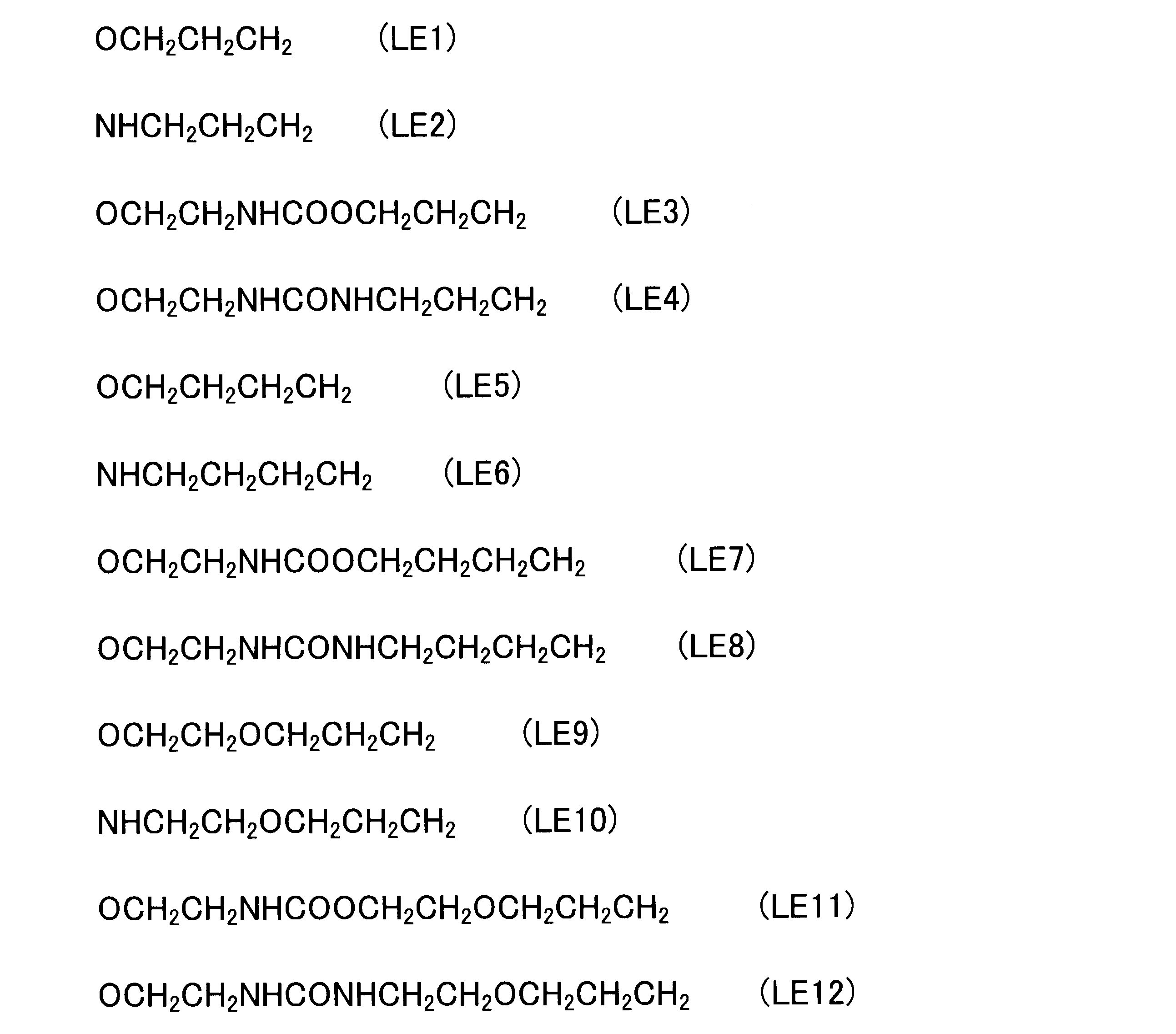
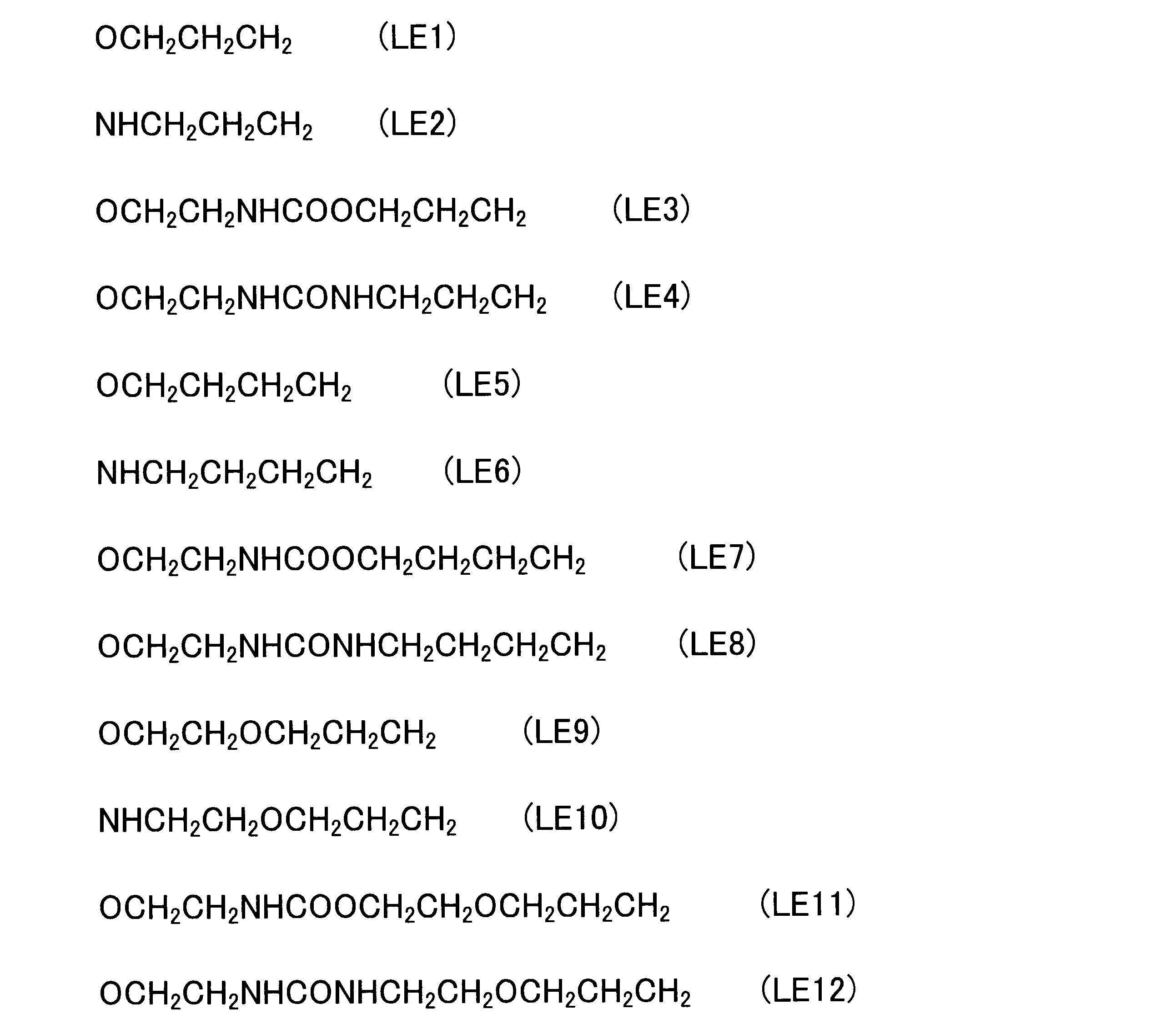
- the group represented by the following formulas (LE1) to (LE12) is preferable because the compound of the formula (A1) has an advantage that it can be easily obtained with high purity.
- a group represented by (LE11) is more preferred, a group represented by the following formula (LE1) or (LE3) is more preferred, and a group represented by the following formula (LE1) is most preferred.
- the following formula (LE1) ⁇ (LE12) the terminal of the left is attached to the polymerizable functional group X 1 or X 2, is depicted as an end of the right side is attached to a silicon atom.
- a is preferably 80 or more, more preferably 100 or more, more preferably 100 to 1400, more preferably 120 to 950, and still more preferably 130 to 700.
- the component A of the present invention may be used alone or in combination of two or more.
- Component B which is a polymerizable monomer having a fluoroalkyl group is preferable.
- Component B has water and oil repellency due to a decrease in the critical surface tension caused by the fluoroalkyl group, thereby preventing the ophthalmic lens surface from being contaminated by components such as proteins and lipids in tear fluid. effective.
- Component B has an effect of providing a low water content contact lens that is flexible and excellent in wearing feeling and excellent in mechanical properties such as bending resistance.
- fluoroalkyl group of Component B are trifluoromethyl group, trifluoroethyl group, trifluoropropyl group, tetrafluoropropyl group, hexafluoroisopropyl group, pentafluorobutyl group, heptafluoropentyl group, nonafluoro group.
- It is a fluoroalkyl group. More preferably, it is a C2-C8 fluoroalkyl group such as a trifluoroethyl group, a tetrafluoropropyl group, a hexafluoroisopropyl group, an octafluoropentyl group, and a dodecafluorooctyl group, most preferably trifluoroethyl group It is a group.
- the polymerizable functional group of Component B is preferably a radical polymerizable functional group, more preferably a carbon-carbon double bond.
- preferred polymerizable functional groups include vinyl group, allyl group, (meth) acryloyl group, ⁇ -alkoxymethylacryloyl group, maleic acid residue, fumaric acid residue, itaconic acid residue, crotonic acid residue, isocrotonic acid
- acid residue and citraconic acid residue include a (meth) acryloyl group because of high polymerizability among them.
- (Meth) acrylic acid fluoroalkyl ester is most preferred as Component B because it is highly effective in obtaining a low hydrous soft contact lens that is flexible and wearable and has excellent mechanical properties such as bending resistance. is there.
- Specific examples of such (meth) acrylic acid fluoroalkyl esters include trifluoroethyl (meth) acrylate, tetrafluoroethyl (meth) acrylate, trifluoropropyl (meth) acrylate, tetrafluoropropyl (meth) acrylate, and pentafluoropropyl.
- the content of Component B in the copolymer is preferably 10 to 500 parts by weight, more preferably 20 to 400 parts by weight, and still more preferably 20 to 200 parts by weight with respect to 100 parts by weight of Component A.
- the amount of component B used is too small, the resulting contact lens 10 tends to become cloudy or mechanical properties such as bending resistance tend to be insufficient.
- component C a copolymer obtained by further copolymerizing a component different from component A and component B (hereinafter referred to as component C) may be used as the copolymer used for the substrate.
- Component C is preferably one that lowers the glass transition point of the copolymer to room temperature or below 0 ° C. Since these reduce the cohesive energy, they have the effect of imparting rubber elasticity and softness to the copolymer.
- the polymerizable functional group of Component C is preferably a radical polymerizable functional group, and more preferably has a carbon-carbon double bond.
- preferred polymerizable functional groups include vinyl group, allyl group, (meth) acryloyl group, ⁇ -alkoxymethylacryloyl group, maleic acid residue, fumaric acid residue, itaconic acid residue, crotonic acid residue, isocrotonic acid
- acid residue and citraconic acid residue include a (meth) acryloyl group because of high polymerizability among them.
- component C suitable for improving mechanical properties such as flexibility and bending resistance are (meth) acrylic acid alkyl esters, preferably (meth) acrylic acid having an alkyl group having 1 to 20 carbon atoms. Specific examples thereof include methyl (meth) acrylate, ethyl (meth) acrylate, n-propyl (meth) acrylate, n-butyl (meth) acrylate, tert-butyl (meth) acrylate, isobutyl (meth) ) Acrylate, n-hexyl (meth) acrylate, n-octyl (meth) acrylate, 2-ethylhexyl (meth) acrylate, n-heptyl (meth) acrylate, n-nonyl (meth) acrylate, n-decyl (meth) acrylate , Isodecyl (meth) acrylate, n-lauryl (meth)
- (Meth) acrylate, n-octyl (meth) acrylate, n-lauryl (meth) acrylate, and n-stearyl (meth) acrylate are more preferred. If the carbon number of the alkyl group is too large, the transparency of the resulting lens may be lowered, which is not preferable.
- component M is “a monofunctional monomer having one polymerizable functional group and a siloxanyl group per molecule”.
- the siloxanyl group means a group having a Si—O—Si bond.
- the siloxanyl group of component M is preferably linear. If the siloxanyl group is linear, the shape recoverability of the resulting low hydrous soft contact lens 10 is improved.
- the term “linear” refers to a structure represented by a single linearly connected Si— (O—Si) n ⁇ 1 —O—Si bond starting from a silicon atom bonded to a group having a polymerizable group. (Where n represents an integer of 2 or more). In order for the obtained contact lens 10 to obtain sufficient shape recoverability, n is preferably an integer of 3 or more, more preferably 4 or more, still more preferably 5 or more, and most preferably 6 or more.
- “the siloxanyl group is linear” means that the siloxanyl group has the above linear structure and does not have a Si—O—Si bond that does not satisfy the conditions of the linear structure. means.
- the base material is preferably composed mainly of a copolymer containing the component M having a number average molecular weight of 300 to 120,000.
- the main component means a component that is contained in an amount of 50% by mass or more based on the mass of the base material in a dry state (100% by mass).
- the number average molecular weight of component M is preferably 300 to 120,000. When the number average molecular weight of the component M is in this range, a base material that is flexible (low elastic modulus), excellent in wearing feeling, and excellent in mechanical properties such as bending resistance can be obtained.
- the number average molecular weight of component M is more preferably 500 or more because a base material excellent in mechanical properties such as bending resistance and excellent in shape recoverability can be obtained.
- the number average molecular weight of the component M is more preferably in the range of 1000 to 25000, and still more preferably in the range of 5000 to 15000.
- the polymerizable functional group of Component M is preferably a radical polymerizable functional group, and more preferably has a carbon-carbon double bond.
- Examples of preferred polymerizable functional groups include vinyl group, allyl group, (meth) acryloyl group, ⁇ -alkoxymethylacryloyl group, maleic acid residue, fumaric acid residue, itaconic acid residue, crotonic acid residue, isocrotonic acid Examples include acid residues and citraconic acid residues. Of these, a (meth) acryloyl group is most preferred because of its high polymerizability.
- Component M preferably has a structure represented by the following formula (ML1).
- X 3 represents a polymerizable functional group.
- R 11 to R 17 each independently represents a substituent selected from hydrogen, an alkyl group having 1 to 20 carbon atoms, a phenyl group, and a fluoroalkyl group having 1 to 20 carbon atoms.
- L 3 represents a divalent group.
- c represents an integer of 0 to 700.
- X 3 is preferably a radical polymerizable functional group, and preferably has a carbon-carbon double bond.
- preferred polymerizable functional groups include vinyl group, allyl group, (meth) acryloyl group, ⁇ -alkoxymethylacryloyl group, maleic acid residue, fumaric acid residue, itaconic acid residue, crotonic acid residue, isocrotonic acid Examples include acid residues and citraconic acid residues. Of these, a (meth) acryloyl group is most preferred because of its high polymerizability.
- the polymerizable functional group of Component M is more preferably copolymerizable with the polymerizable functional group of Component A because it is easy to obtain a low water content soft contact lens 10 with good mechanical properties. Since it is easy to obtain a low hydrous soft contact lens 10 having good surface characteristics by uniformly copolymerizing M and component A, it is more preferably the same as the polymerizable functional group of component A.
- R 11 to R 17 are hydrogen; those having 1 to 20 carbon atoms such as methyl group, ethyl group, propyl group, isopropyl group, butyl group, t-butyl group, decyl group, dodecyl group, octadecyl group and the like.
- Alkyl group phenyl group, trifluoromethyl group, trifluoroethyl group, trifluoropropyl group, tetrafluoropropyl group, hexafluoroisopropyl group, pentafluorobutyl group, heptafluoropentyl group, nonafluorohexyl group, hexafluorobutyl group , Heptafluorobutyl group, octafluoropentyl group, nonafluoropentyl group, dodecafluoroheptyl group, tridecafluoroheptyl group, dodecafluorooctyl group, tridecafluorooctyl group, hexadecafluorodecyl group, heptadecafluorodecyl group, Pentafluo Propyl group, a tetra-tridecafluorooctyl group, pent
- L 3 is preferably a divalent group having 1 to 20 carbon atoms.
- the group represented by the following formulas (LE1) to (LE12) is preferable because the compound of the formula (ML1) has an advantage of being easily obtained with high purity, and among them, the following formulas (LE1), (LE3), (LE9) ) And (LE11) are more preferred, groups represented by the following formulas (LE1) and (LE3) are more preferred, and groups represented by the following formula (LE1) are most preferred.
- the following formula (LE1) ⁇ (LE12) the terminal of the left is attached to the polymerizable functional group X 3, is depicted as an end of the right side is attached to a silicon atom.
- c is preferably 3 or more, more preferably 10 or more, more preferably 10 to 500, more preferably 30 to 300, and still more preferably 50 to 200.
- the base material of the contact lens 10 of the present invention only one type of component M may be used, or two or more types may be used in combination.
- the base material of the contact lens 10 of the present invention contains an appropriate amount of the component M
- the crosslinking density is reduced, the degree of freedom of the polymer is increased, and an appropriately soft base material having a low elastic modulus can be realized. it can.
- a crosslinking density will become high and a base material will become hard.
- the mass ratio of the component M to the component A is such that the component M is 5 to 200 parts by mass, more preferably 7 to 150 parts by mass, most preferably 100 parts by mass of the component A.
- the amount is preferably 10 to 100 parts by mass.
- content of the component M is less than 5 mass parts with respect to 100 mass parts of component A, a crosslinking density will become high and a base material will become hard.
- content of Component M exceeds 200 parts by mass with respect to 100 parts by mass of Component A, it is not preferable because it becomes too soft and easily broken.
- the contact lens 10 of the present invention can be copolymerized with a monomer described below on a substrate as desired.
- Examples of the monomer for improving mechanical properties include aromatic vinyl compounds such as styrene, tert-butylstyrene, and ⁇ -methylstyrene.
- Examples of the monomer for improving the surface wettability include methacrylic acid, acrylic acid, itaconic acid, 2-hydroxyethyl methacrylate, 2-hydroxyethyl acrylate, 2-hydroxypropyl methacrylate, 2-hydroxypropyl acrylate, glycerol methacrylate, polyethylene Glycol methacrylate, N, N-dimethylacrylamide, N-methylacrylamide, dimethylaminoethyl methacrylate, methylenebisacrylamide, diacetone acrylamide, N-vinylpyrrolidone, N-vinylcaprolactam, N-vinylacetamide, and N-vinyl-N- And methyl acetamide.
- Examples of the monomer for improving the dimensional stability of the contact lens 10 include ethylene glycol dimethacrylate, diethylene glycol dimethacrylate, triethylene glycol dimethacrylate, polyethylene glycol dimethacrylate, trimethylolpropane trimethacrylate, pentaerythritol tetramethacrylate, and bisphenol A.
- Examples include dimethacrylate, vinyl methacrylate, acrylic methacrylate and acrylates corresponding to these methacrylates, divinylbenzene, triallyl isocyanurate, and the like.
- Component C is preferably used in an amount of 0.001 to 400 parts by weight, more preferably 0.01 to 300 parts by weight, still more preferably 0.01 to 200 parts by weight, and most preferably 0 to 100 parts by weight of Component A. 0.01 to 30 parts by mass.
- amount of component C used is too small, it is difficult to obtain the effect expected of component C.
- amount of component C used is too large, the resulting contact lens tends to become cloudy or mechanical properties such as bending resistance tend to be insufficient.
- the contact lens 10 of the present invention further includes components such as an ultraviolet absorber, a dye, a colorant, a wetting agent, a slip agent, a pharmaceutical and a nutritional supplement component, a compatibilizing component, an antibacterial component, and a release agent on a base material. Also good. Any of the above-described components can be contained in a non-reactive form or a copolymerized form.
- the eyes of the contact lens wearer can be protected from harmful ultraviolet rays.
- the ophthalmic lens is colored to facilitate identification and improve convenience during handling.
- the component is copolymerized and immobilized on the base material, so that elution is possible This is preferable because the property is reduced.
- the substrate preferably contains a component selected from an ultraviolet absorber and a colorant, and two or more types of components C (hereinafter referred to as component Ck) other than these components.
- component Ck is selected from at least one kind of (meth) acrylic acid alkyl ester having 1 to 10 carbon atoms and at least one kind from the monomer for improving the surface wettability.
- the preferred amount to be used is 0.01 to 20 parts by weight, more preferably 0.05 to 10 parts by weight, and even more preferably 0.1 to 2 parts by weight with respect to 100 parts by weight of Component A. It is.
- the preferred amount of use is 0.00001 to 5 parts by mass, more preferably 0.0001 to 1 part by mass, and still more preferably 0.001 to 0.5 parts by mass with respect to 100 parts by mass of Component A. Part.
- the amount of component Ck used is preferably 0.1 to 100 parts by weight, more preferably 1 to 80 parts by weight, and still more preferably 2 to 50 parts by weight with respect to 100 parts by weight of component A.
- the amount of the component Ck used is too small, there is a tendency that it becomes difficult to obtain a transparent substrate due to insufficient affinity with the ultraviolet absorber or the colorant. Even when the amount of the component Ck used is too large, the resulting contact lens 10 tends to be clouded or have insufficient mechanical properties such as bending resistance, which is not preferable.
- the base material of the contact lens 10 of the present invention preferably has a degree of crosslinking in the range of 2.0 to 18.3.
- the degree of crosslinking is represented by the following formula (Q1).
- Qn represents the total millimolar amount of monomers having n polymerizable groups per molecule
- Wn represents the total mass (kg) of monomers having n polymerizable groups per molecule.
- the degree of cross-linking of the base material according to the present invention is less than 2.0, it is too soft and difficult to handle, and if it exceeds 18.3, it is too hard and the wearing feeling tends to be unfavorable.
- a more preferable range of the degree of crosslinking is 3.5 to 16.0, a further preferable range is 8.0 to 15.0, and a most preferable range is 9.0 to 14.0.
- a method for producing a base material of the contact lens 10 of the present invention that is, a lens-shaped molded body
- a known method can be used. For example, a method of once obtaining a round bar or a plate-like polymer and processing it into a desired shape by cutting or the like, a mold polymerization method, a spin cast polymerization method, or the like can be used.
- the lens is obtained by cutting, freezing cutting at a low temperature is suitable.
- a method for producing an ophthalmic lens by polymerizing a raw material composition containing component A by a mold polymerization method will be described below.
- a raw material composition is filled in a gap between two mold members having a certain shape.
- the material for the mold member include resin, glass, ceramics, and metal.
- an optically transparent material is preferable, and therefore resin or glass is preferably used.
- a gasket may be used to give a constant thickness to the ophthalmic lens and prevent liquid leakage of the raw material composition filled in the gap.
- the mold filled with the raw material composition in the gap is subsequently irradiated with active light such as ultraviolet rays, visible light, or a combination thereof, or heated in an oven or a liquid tank, etc. Is polymerized.
- active light such as ultraviolet rays, visible light, or a combination thereof
- Is polymerized There may be a method in which two polymerization methods are used in combination. That is, heat polymerization can be performed after photopolymerization, or photopolymerization can be performed after heat polymerization.
- light containing ultraviolet rays such as a mercury lamp or an ultraviolet lamp (for example, FL15BL, manufactured by Toshiba Corporation) is irradiated for a short time (usually 1 hour or less).
- the conditions for gradually raising the temperature of the raw material composition from around room temperature and raising the temperature to 60 ° C. to 200 ° C. over several hours to several tens of hours are the optical conditions of the ophthalmic lens. It is preferred for maintaining uniformity and quality and enhancing reproducibility.
- a thermal polymerization initiator or a photopolymerization initiator typified by a peroxide or an azo compound in order to facilitate the polymerization.
- thermal polymerization those having optimum decomposition characteristics at a desired reaction temperature are selected.
- azo initiators and peroxide initiators having a 10-hour half-life temperature of 40 to 120 ° C. are suitable.
- the photopolymerization initiator for photopolymerization include carbonyl compounds, peroxides, azo compounds, sulfur compounds, halogen compounds, and metal salts. These polymerization initiators are used alone or in combination.
- the amount of the polymerization initiator is preferably up to 5% by mass with respect to the polymerization mixture.
- a polymerization solvent can be used.
- Various organic and inorganic solvents can be used as the solvent.
- solvents include water; methyl alcohol, ethyl alcohol, normal propyl alcohol, isopropyl alcohol, normal butyl alcohol, isobutyl alcohol, t-butyl alcohol, t-amyl alcohol, tetrahydrolinalol, ethylene glycol, diethylene glycol, triethylene glycol, Alcohol solvents such as tetraethylene glycol and polyethylene glycol; methyl cellosolve, ethyl cellosolve, isopropyl cellosolve, butyl cellosolve, propylene glycol monomethyl ether, diethylene glycol monomethyl ether, triethylene glycol monomethyl ether, polyethylene glycol monomethyl ether, ethylene glycol dimethyl ether, diethylene glycol di Glycol ether solvents such as tilether, triethylene glycol dimethyl ether and polyethylene glycol dimethyl ether; ester solvent
- any numerical value such as an upper limit, a preferable upper limit and a more preferable upper limit in each of the above items, a lower limit, a preferable lower limit, a more preferable lower limit, etc. Any numerical value range in combination with any numerical value may be used.
- a monomer mixture is injected into a contact lens mold on the front curve side made of a transparent resin (base curve side polypropylene, front curve side polypropylene) having the shape of Examples 1 to 9 or Comparative Examples 1 to 4 shown in Table 1.
- the base curve side contact lens molds having the shapes of Examples 1 to 9 or Comparative Examples 1 to 4 shown in Table 1 were respectively fitted and irradiated with light (wavelength 405 nm ( ⁇ 5 nm), illuminance: 0.8 mW / (cm 2 , 30 minutes).
- the mold on the front curve side was peeled off using tweezers, and then the mold on the base curve side was immersed in a 100% by mass isopropyl alcohol solution to peel off the contact lens-shaped molded body from the mold.
- the molded product thus obtained was immersed in a 100% by mass isopropyl alcohol solution at 60 ° C. for 2 hours to remove unpolymerized monomers.
- the obtained contact lens-shaped molding was lightly washed with a new 100% by mass isopropyl alcohol solution and air-dried overnight at room temperature (23 ° C.).
- TEARS91 N-dimethylacrylamide / acrylic acid
- Examples 1 to 5, Comparative Examples 1 to 4 The molded body obtained in Reference Example 1 was immersed in the PAA solution prepared in Reference Example 4 at room temperature (23 ° C.) for 30 minutes, and then lightly rinsed with pure water in a beaker. The operation of transferring the molded body to a beaker containing fresh pure water and rinsing lightly was repeated twice. Then, after repeating the same operation in the order of the PEI solution prepared in Reference Example 4 and the p (DMAA / AA) solution, the molded product coated in the phosphate buffer in the sealed vial was put in a dipped state, Autoclave (LSX-300, Tommy Seiko Co., Ltd.) was performed at 121 ° C. for 30 minutes. The obtained molded article had a tensile elastic modulus of 0.6 MPa, an elongation of 1000%, and a moisture content of 0.2%.
- Example 8 In the molded body obtained in Reference Example 1, 8 holes of ⁇ 0.3 mm were formed at equal intervals in the region of the intermediate portion 2 (FIG. 1) using a CO 2 laser (manufactured by Meiko Co., Ltd.). The center position of each hole was 9.75 mm from the center of the contact lens.
- the obtained molded product was immersed in the PAA solution prepared in Reference Example 30 at room temperature (23 ° C.) for 30 minutes, and then lightly rinsed with pure water in a beaker. The operation of transferring the molded body to a beaker containing fresh pure water and rinsing lightly was repeated twice.
- the molded product coated in the phosphate buffer in the sealed vial was put in a dipped state, Autoclave (LSX-300, Tommy Seiko Co., Ltd.) was performed at 121 ° C. for 30 minutes.
- the obtained molded article had a tensile elastic modulus of 0.6 MPa, an elongation of 1000%, and a moisture content of 0.2%.
- Example 9 In the molded body obtained in Reference Example 1, four through-holes with a diameter of 0.4 mm were formed at equal intervals in the region of the intermediate portion 2 (FIG. 1) using a punching device (Kudo Electron). The center position of each hole was 9.75 mm from the center of the contact lens.
- the obtained molded product was immersed in the PAA solution prepared in Reference Example 30 at room temperature (23 ° C.) for 30 minutes, and then lightly rinsed with pure water in a beaker. The operation of transferring the molded body to a beaker containing fresh pure water and rinsing lightly was repeated twice.
- the molded product coated in the phosphate buffer in the sealed vial was put in a dipped state, Autoclave (LSX-300, Tommy Seiko Co., Ltd.) was performed at 121 ° C. for 30 minutes.
- the obtained molded article had a tensile elastic modulus of 0.6 MPa, an elongation of 1000%, and a moisture content of 0.2%.
- Adsorbability ⁇ The movement of the lens can be confirmed at the time of blinking ⁇ : The lens moves by pressing the lens lightly from above the lower eyelid and pushing it upwards ⁇ : Lightly pressing the lens from above the lower eyelid and moving upward Wearing feeling that the lens does not move even when pushed up ⁇ : When the wearer feels good wearing without feeling foreign matter ⁇ : When feeling slightly foreign matter but does not hinder wearing ⁇ : When feeling foreign matter that cannot be worn Stability on the eyeball ⁇ : When it is held stably at the center of the eye during blinking ⁇ : When it is slightly displaced but does not touch the pupil ⁇ : When it falls off and falls on the pupil
- the contact lenses of Comparative Examples 5 and 6 have the same radius of curvature, outer diameter, and sagittal depth at the center as in Examples 1 and 2, but the elastic modulus is too high, so the wearing feeling is poor. The lens movement and stability were not excellent.
Landscapes
- Health & Medical Sciences (AREA)
- Ophthalmology & Optometry (AREA)
- Physics & Mathematics (AREA)
- General Health & Medical Sciences (AREA)
- General Physics & Mathematics (AREA)
- Optics & Photonics (AREA)
- Chemical & Material Sciences (AREA)
- Chemical Kinetics & Catalysis (AREA)
- Medicinal Chemistry (AREA)
- Polymers & Plastics (AREA)
- Organic Chemistry (AREA)
- Eyeglasses (AREA)
- Materials For Medical Uses (AREA)
Abstract
Description
中心部曲率半径>外縁部曲率半径>中間部曲率半径
本発明の軟質コンタクトレンズは、角膜矯正を目的としないことが好ましい。本発明の軟質コンタクトレンズは、非含水性或いは、低含水性の軟質コンタクトレンズであるため、通常は硬質コンタクトレンズが用いられる角膜矯正用としては大きな効果が期待できるものではない。また、本発明の軟質コンタクトレンズは、レンズの変形・回復に伴う涙液のポンピング効果によって角膜への吸着を抑止するものであり、レンズの変形・回復がほとんど起こらない就寝時に装用するオルソケラトロジー用コンタクトレンズとは、思想が異なる発明である。
貫通孔は、涙液交換および涙液保持の観点から、中間部2に設けられていることが好ましい。本発明の軟質コンタクトレンズを装用しているときには、中間部と角膜の間に涙液が特に多く存在する。閉瞼時には眼瞼圧によって軟質コンタクトレンズが変形して涙液が押し出され、開瞼時には眼瞼圧が解放されて軟質コンタクトレンズが元の形状に戻ることで再び涙液がコンタクトレンズと角膜の間に流入する(涙液のポンピング)。涙液が特に多く存在する中間部に貫通孔があると、涙液が貫通孔を通って容易に出入りできるので、前記ポンピングが極めてスムーズに行われるために好ましい。
貫通孔の数は、1以上が好ましく、2以上がより好ましく、3以上が最も好ましい。また貫通孔の数は、120以下が好ましく、60以下がより好ましく、24以下がさらに好ましく、12以下が最も好ましい。貫通孔の数が少なすぎると貫通孔の効果が十分に発現しない場合があり好ましくない。貫通孔の数が多すぎるとコンタクトレンズの強度や、装用感に悪影響を及ぼすことが考えられるため好ましくない。
貫通孔の形状(貫通孔の孔軸と直交する断面)は任意に設定できるが、形成コストの観点や、涙液交換の効率の観点からは円形または略円形が好ましい。
貫通孔を形成する方法は、ウォータジェット法、ドリル法、パンチング法、レーザー法、電子線照射法、および中性子線照射法などが適用できるが、加工精度や加工コストの観点ではパンチング法とレーザー法が好ましい。
含水率(%)={〔(湿潤状態での質量)-(乾燥状態での質量)〕/(湿潤状態での質量)}×100
本明細書において、湿潤状態とは、試験片を室温(25℃)の純水あるいはリン酸緩衝液中に24時間以上浸漬した状態を意味する。湿潤状態での物性値の測定は、試験片を純水中あるいはリン酸緩衝液中から取り出した後、可及的速やかに実施される。
レンズ成型比=[レンズ直径]/[モールドの空隙部の直径]
レンズ成型比は、1に近いほど高品位のレンズを安定に製造することが容易となる。成型比は0.85~2.0の範囲が好ましく、0.9~1.5の範囲がより好ましく、0.91~1.3の範囲が最も好ましい。

成分Mの重合性官能基としては、ラジカル重合可能な官能基が好ましく、炭素炭素二重結合を有するものがより好ましい。好ましい重合性官能基の例としては、ビニル基、アリル基、(メタ)アクリロイル基、α-アルコキシメチルアクリロイル基、マレイン酸残基、フマル酸残基、イタコン酸残基、クロトン酸残基、イソクロトン酸残基、およびシトラコン酸残基などである。これらの中でも高い重合性を有することから(メタ)アクリロイル基が最も好ましい。

本発明のコンタクトレンズ10の基材において、成分Mは1種類のみ用いてもよいし、2種類以上組み合わせて用いてもよい。
成分Cの好ましい使用量は、成分A100質量部に対して、0.001~400質量部、より好ましくは0.01~300質量部、さらに好ましくは0.01~200質量部、最も好ましくは0.01~30質量部である。成分Cの使用量が少なすぎる場合は成分Cに期待する効果が得られにくくなる。成分Cの使用量が多すぎる場合は得られるコンタクトレンズに白濁が生じたり耐折り曲げ性などの機械物性が不十分になったりする傾向がある。

なお、本明細書において上記した数値範囲で規定される全ての各項目については、上記各項目における上限、好ましい上限およびより好ましい上限等のいずれかの数値と、下限、好ましい下限またはより好ましい下限等のいずれかの数値とを組み合わせたいずれの数値範囲であってもよい。
成分Aとして両末端にメタクリロイル基を有するポリジメチルシロキサン(FM7726、JNC、式(M2)の化合物、質量平均分子量29000、数平均分子量26000)(28質量部)、成分Mとして片末端にメタクリロイル基を有するポリシロキサン(FM0721、JNC、式(M4)の化合物、質量平均分子量6600、数平均分子量6300)(7質量部)、成分Bとしてトリフルオロエチルアクリレート(“ビスコート(登録商標)”3F、大阪有機化学工業(株))(57.9質量部)、成分Cとして2-エチルヘキシルアクリレート(7質量部)、成分Cとしてジメチルアミノエチルアクリレート(0.1質量部)、成分Cとして重合性基を有する紫外線吸収剤(RUVA-93、大塚化学(株))(0.5質量部)、成分Cとして着色剤(RB246、Arran Chemical Company)(0.01質量部)、重合開始剤“イルガキュア(登録商標)”819(チバ・スペシャルティ・ケミカルズ(株)、0.5質量部)およびt-アミルアルコール(10質量部)を混合し撹拌した。メンブレンフィルター(孔径:0.45μm)でろ過して不溶分を除きモノマー混合物を得た。透明樹脂(ベースカーブ側ポリプロピレン、フロントカーブ側ポリプロピレン)製の、表1に示す実施例1~9、または比較例1~4の形状となるフロントカーブ側のコンタクトレンズ用モールドにモノマー混合物を注入し、表1に示す実施例1~9、または比較例1~4の形状となるベースカーブ側のコンタクトレンズ用モールドをそれぞれ嵌め合せ、光照射(波長405nm(±5nm)、照度:0.8mW/cm2、30分間)により重合した。重合後に、フロントカーブ側のモールドをピンセットを用い剥離した後、ベースカーブ側のモールドごと100質量%イソプロピルアルコール溶液中に浸漬して、モールドからコンタクトレンズ形状の成型体を剥離した。それによって得られた成型体を、100質量%イソプロピルアルコール溶液中に60℃、2時間浸漬して未重合モノマーを除去した。得られたコンタクトレンズ形状の成型体を新たな100質量%イソプロピルアルコール溶液で軽く洗浄し、室温(23℃)で一晩風乾した。

市販シリコーンゴム“SR-151”(登録商標)(タイガースポリマー(株))を、表1に示す比較例5~7のコンタクトレンズ形状にそれぞれ押出成形した。
市販シリコーンゴム“SR-70”(登録商標)(タイガースポリマー(株))を、表1に示す比較例8のコンタクトレンズ形状に押出成形した。
コーティング溶液の調製
<PAA溶液>
ポリアクリル酸(“Sokalan”(登録商標) PA 110S”、BASF、質量平均分子量250000)を純水に溶解して1.2質量%水溶液とした。
<PEI溶液>
ポリエチレンイミン(“PEI70000”(登録商標)、純正化学(株)製、質量平均分子量750000)を純水に溶解して1質量%水溶液とした。
<p(DMAA/AA)溶液>
N,N-ジメチルアクリルアミド/アクリル酸(“TEARS91”(登録商標)、大阪有機化学工業(株)製、質量平均分子量200000)を純水に溶解して0.1質量%水溶液とした。
参考例1で得られた成型体を参考例4で調整したPAA溶液に室温(23℃)で30分間浸漬した後、ビーカー中の純水で軽く濯ぎ洗いした。成型体を新しい純水が入ったビーカーに移し、軽く濯ぎ洗いする操作を2回繰り返した。次いで、参考例4で調整したPEI溶液、p(DMAA/AA)溶液の順に同様の操作を繰り返した後、密閉バイアル瓶中のリン酸緩衝液中にコーティングした成型体を浸漬した状態で入れ、121℃、30分間オートクレーブ(LSX-300、(株)トミー精工)した。得られた成型体の引張弾性率は0.6MPa、伸度は1000%、含水率は0.2%であった。
参考例2で得られた成型体を参考例4で調整したPAA溶液に室温(23℃)で30分間浸漬した後、ビーカー中の純水で軽く濯ぎ洗いした。成型体を新しい純水が入ったビーカーに移し、軽く濯ぎ洗いする操作を2回繰り返した。次いで、参考例4で調整したPEI溶液、p(DMAA/AA)溶液の順に同様の操作を繰り返した後、密閉バイアル瓶中のリン酸緩衝液中にコーティングした成型体を浸漬した状態で入れ121℃、30分間オートクレーブ(LSX-300、(株)トミー精工)した。得られた成型体の引張弾性率は10.8MPa、伸度は480%、含水率は0.2%であった。
参考例3で得られた成型体を参考例4で調整したPAA溶液に室温(23℃)で30分間浸漬した後、ビーカー中の純水で軽く濯ぎ洗いした。成型体を新しい純水が入ったビーカーに移し、軽く濯ぎ洗いする操作を2回繰り返した。次いで、参考例4で調整したPEI溶液、p(DMAA/AA)溶液の順に同様の操作を繰り返した後、密閉バイアル瓶中のリン酸緩衝液中にコーティングした成型体を浸漬した状態で入れ121℃、30分間オートクレーブ(LSX-300、(株)トミー精工)した。得られた成型体の引張弾性率は7.1MPa、伸度は290%、含水率は0.2%であった。
参考例1で得られた成形体に、CO2レーザー((株)メイコー製)を用いて中間部2の領域(図1)にφ0.3mmの貫通孔を等間隔で8孔あけた。孔の中心の位置はいずれもコンタクトレンズの中心から9.75mmとした。得られた成形体を参考例4で調整したPAA溶液に室温(23℃)で30分間浸漬した後、ビーカー中の純水で軽く濯ぎ洗いした。成型体を新しい純水が入ったビーカーに移し、軽く濯ぎ洗いする操作を2回繰り返した。次いで、参考例4で調整したPEI溶液、p(DMAA/AA)溶液の順に同様の操作を繰り返した後、密閉バイアル瓶中のリン酸緩衝液中にコーティングした成型体を浸漬した状態で入れ、121℃、30分間オートクレーブ(LSX-300、(株)トミー精工)した。得られた成型体の引張弾性率は0.6MPa、伸度は1000%、含水率は0.2%であった。
参考例1で得られた成形体に、パンチング装置((有)クドウ電子)によって中間部2の領域(図1)にφ0.4mmの貫通孔を等間隔で4孔あけた。孔の中心の位置はいずれもコンタクトレンズの中心から9.75mmとした。得られた成形体を参考例4で調整したPAA溶液に室温(23℃)で30分間浸漬した後、ビーカー中の純水で軽く濯ぎ洗いした。成型体を新しい純水が入ったビーカーに移し、軽く濯ぎ洗いする操作を2回繰り返した。次いで、参考例4で調整したPEI溶液、p(DMAA/AA)溶液の順に同様の操作を繰り返した後、密閉バイアル瓶中のリン酸緩衝液中にコーティングした成型体を浸漬した状態で入れ、121℃、30分間オートクレーブ(LSX-300、(株)トミー精工)した。得られた成型体の引張弾性率は0.6MPa、伸度は1000%、含水率は0.2%であった。
実施例1~9、および比較例1~8で作製したレンズを、装用者に3.5~8時間装用してもらい、レンズ吸着性、装用感、眼球上での安定性を評価した。
○:瞬目時にレンズの動きが確認できる
△:下眼瞼の上からレンズを軽く押さえて、上方に押し上げることで、レンズが動く
×:下眼瞼の上からレンズを軽く押さえて、上方に押し上げても、レンズが動かない
装用感
○:装用者が、異物を感じず良好な装用感の場合
△:若干異物を感じるが装用に支障がない場合
×:装用できない程度の異物を感じた場合
眼球上での安定性
○:瞬目の際に眼の中心に安定して保持されている場合
△:若干ずれるが瞳孔にかからない程度の場合
×:ずれて脱落するもしくは、瞳孔にかかる場合
一方、比較例1~4、7、及び8のコンタクトレンズを装用した場合においては、単一の曲率半径であるため、吸着が発生した。特に比較例2のコンタクトレンズは、外径、サジタルデプスは実施例1と同一であるが、単一の曲率半径であるため、レンズが角膜に吸着した。また、比較例5、6のコンタクトレンズは中心部における曲率半径、外径、サジタルデプスが、実施例1、2とそれぞれ同一であるが、弾性率が高すぎるため、装用感が悪く、また、レンズの動き、安定性も優れない結果となった。

B:中心部の内径
C:中間部の幅
D:外縁部の幅
E:本発明のコンタクトレンズのサジタルデプス
F、F1、F2:従来技術のコンタクトレンズのサジタルデプス
1:中心部
2:中間部
3:外縁部
4、5、6:ベースカーブ
7:眼球
10:本発明のコンタクトレンズ
10’、10’-1、10’-2:従来技術のコンタクトレンズ
Claims (7)
- 低含水性、或いは、非含水性の軟質コンタクトレンズであって、
中心に位置する円形の中心部と、
前記中心部の外周側に位置する前記中心部と同軸中心の環状をなす中間部と、
前記中間部の外周側に位置する前記中心部と同軸中心の環状をなす外縁部と、
を備え、
前記中心部、前記中間部、および前記外縁部の曲率半径はそれぞれ異なるものであって、前記軟質コンタクトレンズのサジタルデプスは、前記外縁部の曲率半径±0.2mmの範囲で軟質コンタクトレンズ全体を形成した場合のサジタルデプスの範囲内であることを特徴とする軟質コンタクトレンズ。 - 前記中間部の曲率半径は、前記中心部および前記外縁部の曲率半径より小さいことを特徴とする請求項1に記載の軟質コンタクトレンズ。
- 前記中心部、前記中間部、前記外縁部の曲率半径は、下記式を満たすことを特徴とする請求項1に記載の軟質コンタクトレンズ。
中心部曲率半径>外縁部曲率半径>中間部曲率半径 - 前記外縁部の曲率半径は前記中心部の曲率半径に対し60~97%であり、前記中間部の曲率半径は前記外縁部の曲率半径に対し60~98%であることを特徴とする請求項1~3のいずれか一つに記載の軟質コンタクトレンズ。
- 表面側から裏面側に貫通する少なくとも一つ以上の貫通孔が設けられていることを特徴とする請求項1~4のいずれか一つに記載の軟質コンタクトレンズ。
- 前記貫通孔が前記中間部に設けられていることを特徴とする請求項5に記載の軟質コンタクトレンズ。
- 請求項1~6のいずれか一つに記載の軟質コンタクトレンズを使用することを特徴とする軟質コンタクトレンズの角膜への吸着抑制方法。
Priority Applications (3)
| Application Number | Priority Date | Filing Date | Title |
|---|---|---|---|
| US16/089,771 US11119338B2 (en) | 2016-04-04 | 2017-04-03 | Soft contact lens and method for suppressing attachment of soft contact lens onto cornea |
| EP17779083.9A EP3441814B1 (en) | 2016-04-04 | 2017-04-03 | Soft contact lens and method for preventing adsorption of soft contact lens onto cornea |
| JP2017518378A JP6956633B2 (ja) | 2016-04-04 | 2017-04-03 | 軟質コンタクトレンズ |
Applications Claiming Priority (2)
| Application Number | Priority Date | Filing Date | Title |
|---|---|---|---|
| JP2016075439 | 2016-04-04 | ||
| JP2016-075439 | 2016-04-04 |
Publications (1)
| Publication Number | Publication Date |
|---|---|
| WO2017175705A1 true WO2017175705A1 (ja) | 2017-10-12 |
Family
ID=60001245
Family Applications (1)
| Application Number | Title | Priority Date | Filing Date |
|---|---|---|---|
| PCT/JP2017/013913 Ceased WO2017175705A1 (ja) | 2016-04-04 | 2017-04-03 | 軟質コンタクトレンズ、および軟質コンタクトレンズの角膜への吸着抑制方法 |
Country Status (4)
| Country | Link |
|---|---|
| US (1) | US11119338B2 (ja) |
| EP (1) | EP3441814B1 (ja) |
| JP (1) | JP6956633B2 (ja) |
| WO (1) | WO2017175705A1 (ja) |
Cited By (4)
| Publication number | Priority date | Publication date | Assignee | Title |
|---|---|---|---|---|
| TWI731544B (zh) * | 2020-01-08 | 2021-06-21 | 星歐光學股份有限公司 | 隱形眼鏡及隱形眼鏡產品 |
| WO2022224717A1 (ja) | 2021-04-19 | 2022-10-27 | 国立研究開発法人物質・材料研究機構 | 軟質眼用レンズ及びその製造方法 |
| TWI799867B (zh) * | 2020-01-08 | 2023-04-21 | 星歐光學股份有限公司 | 隱形眼鏡及隱形眼鏡產品 |
| TWI840174B (zh) * | 2020-01-08 | 2024-04-21 | 星歐光學股份有限公司 | 隱形眼鏡及隱形眼鏡產品 |
Families Citing this family (2)
| Publication number | Priority date | Publication date | Assignee | Title |
|---|---|---|---|---|
| CN116574020A (zh) * | 2022-06-09 | 2023-08-11 | 华诺森(湖北)光学有限公司 | 一种长期稳定的硅水凝胶隐形眼镜着色剂的制备及应用 |
| US20250102829A1 (en) * | 2023-09-27 | 2025-03-27 | Johnson & Johnson Vision Care, Inc. | Optimized Posterior Surface for Toric Contact Lenses |
Citations (6)
| Publication number | Priority date | Publication date | Assignee | Title |
|---|---|---|---|---|
| JPH0743698U (ja) | 1993-03-29 | 1995-09-05 | 株式会社レインボーオプチカル研究所 | コンタクトレンズ |
| JP2001516462A (ja) | 1996-01-02 | 2001-09-25 | ホロ オーアール リミテッド | 単焦点コンタクトレンズ |
| JP2006525530A (ja) * | 2003-05-02 | 2006-11-09 | ビジョン・シーアールシー・リミテッド | コンタクトレンズのレンズ背後圧力プロファイルの設計及び計算 |
| JP2007195818A (ja) | 2006-01-27 | 2007-08-09 | Akihiro Oguri | オルソケラトロジー用コンタクトレンズ |
| WO2011102356A1 (ja) | 2010-02-16 | 2011-08-25 | 東レ株式会社 | 低含水性軟質眼用レンズおよびその製造方法 |
| JP2013544132A (ja) * | 2010-10-25 | 2013-12-12 | ネクシスビジョン, インコーポレイテッド | 視力のための眼被覆物を特定するための方法および装置 |
Family Cites Families (17)
| Publication number | Priority date | Publication date | Assignee | Title |
|---|---|---|---|---|
| US4193672A (en) * | 1978-09-25 | 1980-03-18 | Dow Corning Corporation | Contact lens with improved interior surface |
| IT1217703B (it) * | 1988-05-24 | 1990-03-30 | Mario Giovanzana | Lente a contatto multifocale ad eccentricita' progressiva e procedimento per la sua fabbricazione |
| US4954586A (en) * | 1989-01-17 | 1990-09-04 | Menicon Co., Ltd | Soft ocular lens material |
| US4952045B1 (en) * | 1989-05-26 | 2000-08-08 | Contex Inc | Corneal contact lens and method for treating myopea |
| JP2986310B2 (ja) | 1993-07-27 | 1999-12-06 | シャープ株式会社 | 液晶表示装置 |
| US6010219A (en) * | 1996-06-28 | 2000-01-04 | Contex, Inc. | Fenestrated contact lens for treating myopia |
| AU4318800A (en) * | 1999-05-12 | 2000-12-05 | Menicon Co., Ltd | Ocular lens materials and process for producing the same |
| JP5148794B2 (ja) * | 1999-12-16 | 2013-02-20 | クーパーヴィジョン インターナショナル ホウルディング カンパニー リミテッド パートナーシップ | 長期装用できるソフトコンタクトレンズ |
| JP3929014B2 (ja) * | 2000-02-24 | 2007-06-13 | Hoyaヘルスケア株式会社 | 側鎖にポリシロキサン構造を有するマクロマーからなるコンタクトレンズ材料 |
| JP2002350787A (ja) * | 2001-03-21 | 2002-12-04 | Menicon Co Ltd | コンタクトレンズ |
| US7071274B2 (en) * | 2001-03-30 | 2006-07-04 | Johnson & Johnson Vision Care, Inc. | Monomer, polymer, and ocular lens and contact lens each obtained therefrom |
| JP2005031307A (ja) | 2003-07-10 | 2005-02-03 | Menicon Co Ltd | 低含水型ソフトコンタクトレンズ |
| KR20110020875A (ko) | 2008-06-06 | 2011-03-03 | 글로벌-오케이 비젼 인크. | 굴절 이상 치료용 소프트 콘택트렌즈 |
| US8827447B2 (en) * | 2009-07-09 | 2014-09-09 | Bausch & Lomb Incorporated | Mono ethylenically unsaturated polymerizable group containing polycarbosiloxane monomers |
| US8678584B2 (en) * | 2012-04-20 | 2014-03-25 | Nexisvision, Inc. | Contact lenses for refractive correction |
| ES2994608T3 (en) | 2012-08-10 | 2025-01-27 | Osio Corp D/B/A Yolia Health | Contact lens use in the treatment of an ophthalmologic condition |
| EP3822696B1 (en) * | 2015-05-29 | 2024-06-26 | Bausch & Lomb Incorporated | Method for obtaining contact lenses with dynamically controlled sagitta and clearance |
-
2017
- 2017-04-03 JP JP2017518378A patent/JP6956633B2/ja active Active
- 2017-04-03 WO PCT/JP2017/013913 patent/WO2017175705A1/ja not_active Ceased
- 2017-04-03 US US16/089,771 patent/US11119338B2/en active Active
- 2017-04-03 EP EP17779083.9A patent/EP3441814B1/en active Active
Patent Citations (6)
| Publication number | Priority date | Publication date | Assignee | Title |
|---|---|---|---|---|
| JPH0743698U (ja) | 1993-03-29 | 1995-09-05 | 株式会社レインボーオプチカル研究所 | コンタクトレンズ |
| JP2001516462A (ja) | 1996-01-02 | 2001-09-25 | ホロ オーアール リミテッド | 単焦点コンタクトレンズ |
| JP2006525530A (ja) * | 2003-05-02 | 2006-11-09 | ビジョン・シーアールシー・リミテッド | コンタクトレンズのレンズ背後圧力プロファイルの設計及び計算 |
| JP2007195818A (ja) | 2006-01-27 | 2007-08-09 | Akihiro Oguri | オルソケラトロジー用コンタクトレンズ |
| WO2011102356A1 (ja) | 2010-02-16 | 2011-08-25 | 東レ株式会社 | 低含水性軟質眼用レンズおよびその製造方法 |
| JP2013544132A (ja) * | 2010-10-25 | 2013-12-12 | ネクシスビジョン, インコーポレイテッド | 視力のための眼被覆物を特定するための方法および装置 |
Non-Patent Citations (1)
| Title |
|---|
| See also references of EP3441814A4 |
Cited By (4)
| Publication number | Priority date | Publication date | Assignee | Title |
|---|---|---|---|---|
| TWI731544B (zh) * | 2020-01-08 | 2021-06-21 | 星歐光學股份有限公司 | 隱形眼鏡及隱形眼鏡產品 |
| TWI799867B (zh) * | 2020-01-08 | 2023-04-21 | 星歐光學股份有限公司 | 隱形眼鏡及隱形眼鏡產品 |
| TWI840174B (zh) * | 2020-01-08 | 2024-04-21 | 星歐光學股份有限公司 | 隱形眼鏡及隱形眼鏡產品 |
| WO2022224717A1 (ja) | 2021-04-19 | 2022-10-27 | 国立研究開発法人物質・材料研究機構 | 軟質眼用レンズ及びその製造方法 |
Also Published As
| Publication number | Publication date |
|---|---|
| EP3441814B1 (en) | 2025-01-01 |
| EP3441814A1 (en) | 2019-02-13 |
| JP6956633B2 (ja) | 2021-11-02 |
| EP3441814A4 (en) | 2019-11-13 |
| US20200310161A1 (en) | 2020-10-01 |
| US11119338B2 (en) | 2021-09-14 |
| JPWO2017175705A1 (ja) | 2019-02-14 |
Similar Documents
| Publication | Publication Date | Title |
|---|---|---|
| JP6956633B2 (ja) | 軟質コンタクトレンズ | |
| CA2787888C (en) | Low water content soft lens for eye, and method for producing the same | |
| US10591749B2 (en) | Medical device, combination of coating solutions, and method for producing medical device | |
| US9632212B2 (en) | Medical device and method for producing the same | |
| JP6003653B2 (ja) | 医療デバイスおよびその製造方法 | |
| CN104508080A (zh) | 用于光学聚合物的光吸收化合物 | |
| US9753187B2 (en) | Low hydrous soft ophthalmic lens and method for manufacturing the same | |
| TW202402514A (zh) | 用於製造嵌入式水凝膠接觸鏡片之方法 | |
| WO2020121940A1 (ja) | 医療デバイスおよびその製造方法 | |
| JP6003082B2 (ja) | 低含水性軟質デバイス、低含水性軟質デバイス用組成物およびこれらの製造方法 | |
| JP2013057932A (ja) | 軟質樹脂デバイス | |
| JP6241042B2 (ja) | 医療デバイス |
Legal Events
| Date | Code | Title | Description |
|---|---|---|---|
| ENP | Entry into the national phase |
Ref document number: 2017518378 Country of ref document: JP Kind code of ref document: A |
|
| NENP | Non-entry into the national phase |
Ref country code: DE |
|
| WWE | Wipo information: entry into national phase |
Ref document number: 2017779083 Country of ref document: EP |
|
| ENP | Entry into the national phase |
Ref document number: 2017779083 Country of ref document: EP Effective date: 20181105 |
|
| 121 | Ep: the epo has been informed by wipo that ep was designated in this application |
Ref document number: 17779083 Country of ref document: EP Kind code of ref document: A1 |