WO2017175718A1 - 水産生物用飼料 - Google Patents
水産生物用飼料 Download PDFInfo
- Publication number
- WO2017175718A1 WO2017175718A1 PCT/JP2017/013947 JP2017013947W WO2017175718A1 WO 2017175718 A1 WO2017175718 A1 WO 2017175718A1 JP 2017013947 W JP2017013947 W JP 2017013947W WO 2017175718 A1 WO2017175718 A1 WO 2017175718A1
- Authority
- WO
- WIPO (PCT)
- Prior art keywords
- feed
- arginine derivative
- arginine
- aquatic
- aquatic product
- Prior art date
- Legal status (The legal status is an assumption and is not a legal conclusion. Google has not performed a legal analysis and makes no representation as to the accuracy of the status listed.)
- Ceased
Links
Classifications
-
- A—HUMAN NECESSITIES
- A23—FOODS OR FOODSTUFFS; TREATMENT THEREOF, NOT COVERED BY OTHER CLASSES
- A23K—FODDER
- A23K10/00—Animal feeding-stuffs
- A23K10/20—Animal feeding-stuffs from material of animal origin
- A23K10/22—Animal feeding-stuffs from material of animal origin from fish
-
- A—HUMAN NECESSITIES
- A23—FOODS OR FOODSTUFFS; TREATMENT THEREOF, NOT COVERED BY OTHER CLASSES
- A23K—FODDER
- A23K20/00—Accessory food factors for animal feeding-stuffs
- A23K20/10—Organic substances
- A23K20/105—Aliphatic or alicyclic compounds
-
- A—HUMAN NECESSITIES
- A23—FOODS OR FOODSTUFFS; TREATMENT THEREOF, NOT COVERED BY OTHER CLASSES
- A23K—FODDER
- A23K20/00—Accessory food factors for animal feeding-stuffs
- A23K20/10—Organic substances
- A23K20/142—Amino acids; Derivatives thereof
-
- A—HUMAN NECESSITIES
- A23—FOODS OR FOODSTUFFS; TREATMENT THEREOF, NOT COVERED BY OTHER CLASSES
- A23K—FODDER
- A23K50/00—Feeding-stuffs specially adapted for particular animals
- A23K50/80—Feeding-stuffs specially adapted for particular animals for aquatic animals, e.g. fish, crustaceans or molluscs
Definitions
- the present invention relates to a feed for aquatic products such as fish and crustaceans, and a method for culturing aquatic products.
- Fish meal is mainly blended into feed as a protein source. Therefore, vegetable protein such as soybean meal and corn gluten meal and animal protein such as chicken meal are used as fish meal substitute raw materials. However, when a feed containing these fish meal substitute raw materials is used, there arises a problem that the breeding performance is lowered.
- Patent Document 1 taurine
- Patent Document 2 inosine
- An object of the present invention is to provide a feed for aquatic products such as fish and crustaceans, and a method for culturing aquatic products.
- the present invention can be exemplified as follows.
- a feed for aquatic products containing an arginine derivative [2] The feed, which is a feed for aquatic products to which the arginine derivative is added.
- the feed which is a feed for aquatic products with an increased content of the arginine derivative.
- the feed, wherein the arginine derivative is agmatine.
- the feed, wherein the arginine derivative is putrescine.
- the feed, wherein the content of the arginine derivative is 0.02% (w / w) or more.
- the feed, wherein the content of the arginine derivative is 0.08% (w / w) or more.
- the said composition used together with the feed for aquatic products so that content of the said arginine derivative in a feed may be 0.02% (w / w) or more.
- the said composition used together with the feed for aquatic products so that content of the said arginine derivative in a feed may be 0.08% (w / w) or more.
- the said composition used together with the feed for aquatic products so that the addition amount of the said arginine derivative to a feed may be 0.01% (w / w) or more.
- the composition described above, wherein the aquatic feed is aquatic feed in which the amount of fish meal is reduced.
- the said composition whose content of the fish meal in the said feed for aquatic products is 60% (w / w) or less.
- the composition as described above, wherein the aquatic product is an aquatic product deficient in the biosynthesis system of the arginine derivative.
- the composition, wherein the aquatic product is fish or shellfish.
- the composition which is a breeding performance improving agent for the aquatic product.
- the said composition whose said breeding performance improvement is an increase in a body weight, an increase in body length, an improvement in feed conversion efficiency, a decrease in a caudal defect rate, or a combination thereof.
- a method of cultivating an aquatic product comprising feeding an arginine derivative to the aquatic product.
- the method, wherein the arginine derivative is fed to the aquatic product by feeding the feed or the composition to the aquatic product.
- an arginine derivative is used.
- the breeding performance of the aquatic product can be improved by feeding the arginine derivative to the aquatic product and culturing the aquatic product.
- Aquaculture is also called “breeding”.
- breeding performance improvement effect The effect of improving the breeding performance of the aquatic product is also referred to as “breeding performance improvement effect”.
- a decrease in breeding performance due to low fish meal can be prevented or reduced.
- Improvements in breeding results include an increase in body weight, an increase in body length, an improvement (decrease) in feed conversion efficiency, and a decrease in the caudal fin loss rate.
- the reduction in the caudal defect rate may be due to, for example, prevention of meshing.
- “Feed conversion ratio (FCR)” means the weight of feed necessary for the increase (growth) of unit weight.
- Feed conversion efficiency is also referred to as “feed request rate”.
- one kind of rearing result improving effect may be obtained, or two or more kinds of rearing result improving effects may be obtained.
- Arginine derivative is a general term for compounds that can be produced by metabolism of arginine. Specific examples of arginine derivatives include agmatine, putrescine, spermidine, spermine, ⁇ -guanidinobutyraldehyde, and ⁇ -guanidinobutyrate. ) And ⁇ -aminobutyrate. Preferred arginine derivatives include agmatine and putrescine. Preferred arginine derivatives also include arginine derivatives that lack the biosynthetic system of the target aquatic product. That is, for example, when the target aquatic product lacks an agmatine biosynthesis system, preferred arginine derivatives include agmatine and its metabolites. In the present invention, one arginine derivative may be used, or two or more arginine derivatives may be used in combination.
- the arginine derivative may be a free form, a salt, or a mixture thereof. That is, the term “arginine derivative” in the present invention means a free arginine derivative, a salt thereof, or a mixture thereof, unless otherwise specified.
- the salt include sulfate, hydrochloride, carbonate, ammonium salt, sodium salt, and potassium salt.
- the salt one type of salt may be used, or two or more types of salts may be used in combination.
- the amount of arginine derivative (content, addition amount, etc.) to be described later is converted into the mass of an equimolar free form unless otherwise specified, when the arginine derivative forms a salt. It shall be calculated as follows.
- arginine derivative a commercially available product may be used, or an appropriately produced and obtained product may be used.
- the production method of the arginine derivative is not particularly limited, and for example, a known method can be used.
- Arginine derivatives can be produced, for example, by chemical synthesis methods, enzymatic methods, fermentation methods, extraction methods, or combinations thereof.
- Arginine derivatives can be produced, for example, by conversion from arginine. Conversion from arginine to an arginine derivative can be carried out, for example, by an enzymatic method using a biosynthetic enzyme of the arginine derivative. Specifically, for example, a method for producing agmatine from arginine using arginine decarboxylase has been reported (Japanese Patent Laid-Open No. 2002-345496).
- Arginine can be produced, for example, by culturing a microorganism having an ability to produce arginine and recovering arginine from the culture. Specifically, for example, a method for producing arginine by fermentation using Escherichia coli with enhanced expression of argA gene encoding N-acetylglutamate synthase has been reported (Japanese Patent Laid-Open No. 2002-315571).
- the arginine derivative can be produced, for example, by culturing a microorganism capable of producing an arginine derivative and recovering the arginine derivative from the culture.
- agmatine can be produced by a fermentation method, for example, by using a strain having enhanced expression of an adiA gene encoding arginine decarboxylase in an arginine-producing bacterium such as Escherichia coli that enhanced expression of the argA gene. .
- Arginine derivative may or may not be a purified product. That is, as the arginine derivative, for example, a raw material containing the arginine derivative may be used as it is or after being appropriately subjected to treatments such as concentration, dilution, drying, fractionation, extraction, and purification. Specifically, as a material containing an arginine derivative, for example, an arginine derivative fermentation broth (a culture containing an arginine derivative obtained by culturing a microorganism capable of producing an arginine derivative), separated from the fermentation broth Examples include culture supernatant and bacterial cells separated from the fermentation broth. Arginine derivatives may be purified to the desired extent.
- an arginine derivative fermentation broth a culture containing an arginine derivative obtained by culturing a microorganism capable of producing an arginine derivative
- Arginine derivatives may be purified to the desired extent.
- the purity of the arginine derivative is, for example, 30% (w / w) or more, 50% (w / w) or more, 70% (w / w) or more, 90% (w / w) or more, or 95% (w / w). w) or more.
- aquatic product targeted in the present invention is not particularly limited as long as an effect of improving breeding results is obtained.
- Preferred aquatic products include aquatic products that lack the arginine derivative biosynthesis system.
- “Deficient in the biosynthesis system of arginine derivative” specifically refers to one or more enzymes selected from one or more enzymes constituting the metabolic pathway from arginine to the arginine derivative. That is missing.
- the aquatic product may be originally deficient in the biosynthesis system of the arginine derivative, or may be modified (breeding, etc.) so as to lack the biosynthesis system of the arginine derivative.
- the aquatic product may be deficient in the biosynthesis system of one arginine derivative or may be deficient in the biosynthesis system enzyme of two or more arginine derivatives.
- biosynthesis enzymes for arginine derivatives include arginine decarboxylase, agmatinase, spermidine synthase, spermine synthase, diamine oxidase, and aldehyde dehydrogenase. (Aldehyde dehydrogenase) and hydrolase.
- Arginine is converted to agmatine by arginine decarboxylase.
- Agmatine can be further converted to the remaining arginine derivatives exemplified above. Specifically, agmatine is sequentially converted to putrescine, spermidine, and spermine by agmatinase, spermidine synthase, and spermine synthase.
- Agmatine is converted in turn into ⁇ -guanidinobutyraldehyde, ⁇ -guanidinobutyric acid, and ⁇ -aminobutyric acid by diamine oxidase, aldehyde dehydrogenase, and hydrolase. That is, for example, “deficient in the biosynthesis system of agmatine” means that arginine decarboxylase is defective. For example, “deficient in the biosynthesis system of putrescine” means that arginine decarboxylase and / or agmatinase is defective. For example, “deficient in the spermine biosynthesis system” means that one or more enzymes selected from arginine decarboxylase, agmatinase, spermidine synthase, and spermine synthase are missing.
- Whether or not the aquatic product lacks the target enzyme can be determined based on, for example, genomic information of the aquatic product (WO2013180226A1). That is, it is possible to determine whether or not the target enzyme is possessed by estimating the function of the protein estimated to be possessed from the genome information of the aquatic product.
- the estimation of the function of a protein can be performed by comparing the amino acid sequence of the protein with the amino acid sequence of a known protein. Comparison of amino acid sequences can be performed using, for example, BLAST.
- the aquatic product encodes the target enzyme by comparing the genomic information of the aquatic product with the genomic information of other annotated organisms at the amino acid sequence level of the encoded protein. You can determine if you have a gene. When the possession of the gene encoding the target enzyme is not confirmed in the aquatic product, it can be determined that the aquatic product is deficient in the target enzyme.
- genome information of the organism to be compared for example, genome information of mammals such as humans can be used.
- Aquatic products include fish and crustaceans.
- specific examples of the fish include trough puffer fish, Japanese flounder, bluefin tuna, Atlantic salmon, rainbow trout, European eel, catfish, tilapia, red-footed lame, Atlantic cod, medaka, zebrafish and red sea bream. These fishes are fishes in which expression of a gene encoding arginine decarboxylase is not confirmed.
- crustaceans include shrimp and crabs.
- Specific examples of the crustacean include vanamae shrimp, tiger prawn, bovine shrimp, white leg shrimp, and crab.
- the feed of the present invention is a feed for aquatic products containing an arginine derivative.
- the feed of the present invention is specifically a feed for aquatic products to which an arginine derivative is added. That is, in other words, the feed of the present invention is a feed for aquatic products containing an added arginine derivative.
- the content of the arginine derivative is increased in the feed of the present invention by adding the arginine derivative. That is, in other words, the feed of the present invention is a feed for aquatic products with an increased content of arginine derivatives.
- the content of the arginine derivative was increased means that the content of the arginine derivative in the feed of the present invention is higher than the content of the arginine derivative in the control feed.
- Control feed refers to a feed for aquatic products to which no arginine derivative is added.
- Examples of the control feed include a normal feed for aquatic products such as fish meal-based aquatic product feed, to which no arginine derivative is added.
- Specific examples of the control feed include a feed to which the arginine derivative used in the examples is not added.
- “Addition” is also referred to as “compounding”.
- “For aquatic products” means to be used for aquaculture (breeding) of aquatic products.
- the feed of the present invention may contain one kind of arginine derivative, or may contain two or more kinds of arginine derivatives in combination. By feeding the feed of the present invention and culturing the aquatic product, the breeding performance of the aquatic product can be improved.
- composition of the feed of the present invention is not particularly limited as long as the feed of the present invention contains an arginine derivative and an effect of improving breeding results is obtained.
- the type of ingredients contained in the feed of the present invention can be appropriately selected according to various conditions such as the type of the target aquatic product, the growth stage, and the mode of use of the feed of the present invention.
- the feed of the present invention may contain the same components as those contained in a feed such as a normal feed for aquatic products.
- examples of such components include animal feed ingredients, plant feed ingredients, and various other feed ingredients.
- animal feed ingredients include fish meal, fish soluble, bone meal, and chicken meal.
- Specific examples of the plant feed ingredient include cereal flour (wheat flour and the like), vegetable protein (wheat gluten and corn gluten and the like), starch (corn starch and the like), and vegetable oil residue (soybean meal and the like).
- amino acid fermented koji lysine fermented koji
- binders carboxymethyl cellulose, alginic acid, etc.
- yeast eicosapentaenoic acid
- docosahexaenoic acid eicosapentaenoic acid and docosahexaenoic acid are preferable as components of feed for fry or juvenile fish.
- the feed of the present invention may contain, for example, an aquatic additive.
- the additive for aquatic products include erythromycin preparation, ampicillin preparation, praziquantel preparation, lysozyme chloride preparation, oxytetracycline hydrochloride preparation, spiramycin preparation, sodium niflustyrene ester preparation, lincomycin hydrochloride preparation, flumequin preparation, glutathione.
- Pharmaceutical products for marine products vitamins such as vitamin C, vitamin B1, vitamin A, vitamin D and vitamin E, nutritional supplements such as amino acids such as lysine, methionine and histidine, ⁇ -carotene, astaxanthin, canthaxanthin, etc. And the like.
- the content of the component contained in the feed of the present invention can be appropriately set according to various conditions such as the type and growth stage of the target aquatic product and the use mode of the feed of the present invention.
- the content of each component in the feed of the present invention may be the same as the content of each component in a normal aquatic product feed.
- the amount of fish meal may be reduced.
- the amount of fish meal being reduced is also referred to as “low fish meal”.
- the amount of fish meal is reduced means that the feed of the present invention does not contain all or part of the fish meal to be added to the feed for aquatic products. That is, in other words, “the amount of fish meal is reduced” means that the amount of fish meal contained in the feed of the present invention is smaller than the amount of fish meal to be added to the aquatic feed. This includes the case where the feed of the present invention does not contain any fish meal.
- “Fishmeal to be added to feed for aquatic products” refers to a decrease in growth under conditions that do not contain arginine derivatives, compared to the case where aquatic products are bred using general fish meal feeds. This is the minimum amount of fish meal that is not invited.
- the amount of fish meal to be added to the aquatic product feed can be appropriately determined according to various conditions such as the type of the target aquatic product and the growth stage (for example, fry stage or adult stage).
- the content (concentration) of fish meal in the feed of the present invention is, for example, 0% (w / w) or more, 5% (w / w) or more, 10% (w / w) or more, 20% (w / w) 30% (w / w) or more, 40% (w / w) or more, 50% (w / w) or more, 60% (w / w) or more, or 70% (w / w) or more 90% or less, 80% or less, 70% or less, 60% (w / w) or less, 50% (w / w) or less, or 40% (w / w) or less, It may be a combination that does not contradict.
- the content (concentration) of fish meal in the feed of the present invention is, for example, 0% (w / w) or more, 5% (w / w) or more, 10% (w / w) or more, 20% in the case of low fish meal. (W / w) or higher, 30% (w / w) or higher, or 40% (w / w) or higher, 60% (w / w) or lower, 50% (w / w) or lower, or It may be 40% (w / w) or less, or may be a combination that is consistent.
- the content (concentration) of the arginine derivative in the feed of the present invention is, for example, 0.011% (w / w) or more, 0.012% (w / w) or more, 0.013% (w / w) or more, 0.015% (w / w) or more, 0.017% (w / w) or more, 0.02% (w / w) or more, 0.024% (w / w) or more, 0.03% (w / W) or more, 0.04% (w / w) or more, 0.06% (w / w) or more, 0.08% (w / w) or more, 0.1% (w / w) or more, or It may be 0.11% (w / w) or more, 1% (w / w) or less, 0.7% (w / w) or less, 0.5% (w / w) or less, 0.4 % (W / w) or less, 0.32% (w /
- the content of the arginine derivative in the feed of the present invention is specifically 0.011 to 0.1% (w / w), 0.015 to 0.08% (w / w), for example. 0.02 to 0.06% (w / w), or 0.024 to 0.055% (w / w).
- the content of the arginine derivative in the feed of the present invention is, specifically, putrescine, specifically, for example, 0.08 to 1% (w / w), 0.1 to 0.5% (w / w) Or 0.11 to 0.32% (w / w).
- the content (concentration) of the arginine derivative in the feed of the present invention is, for example, 0.001% (w / w) or more and 0.002% (w / w) as compared with a normal feed for aquatic products. Or more, 0.003% (w / w) or more, 0.005% (w / w) or more, 0.007% (w / w) or more, 0.01% (w / w) or more, 0.014% (W / w) or more, 0.02% (w / w) or more, 0.03% (w / w) or more, 0.04% (w / w) or more, 0.05% (w / w) or more 0.06% (w / w) or higher, or 0.067% (w / w) or higher, 0.9% (w / w) or lower, 0.6% (w / w) or lower, 0.4% (w / w) or less, 0.3% (w / w) or less,
- the feed of the present invention can be produced by combining an arginine derivative and other components so that the arginine derivative is contained at a desired concentration.
- the method for producing the feed of the present invention is not particularly limited.
- the feed of the present invention can be produced by the same method using the same raw material as that of a normal feed for aquatic products except that an arginine derivative is added (blended).
- the arginine derivative may be added so that a desired arginine derivative content is obtained in total.
- a normal aquatic product feed such as a fish meal-based aquatic product feed may contain about 0.01% (w / w) agmatine derived from natural raw materials such as fish meal.
- the addition amount can be similarly set for other arginine derivatives.
- the amount of arginine derivative added is, for example, 0.001% (w / w) or more, 0.002% (w / w) or more, 0.003% (w / w) or more, 0.005% (w / w) ), 0.007% (w / w) or more, 0.01% (w / w) or more, 0.014% (w / w) or more, 0.02% (w / w) or more, 0.03 % (W / w) or more, 0.04% (w / w) or more, 0.05% (w / w) or more, 0.06% (w / w) or more, or 0.067% (w / w) ) 0.9% (w / w) or less, 0.6% (w / w) or less, 0.4% (w / w) or less, 0.3% (w / w) 0.25% (w / w) or less, 0.2% (w / w) or less,
- the addition amount of the arginine derivative is specifically 0.001 to 0.09% (w / w), 0.005 to 0.07% (w / w), 0.01 to It may be 0.05% (w / w), or 0.014 to 0.043% (w / w).
- the amount of arginine derivative added is specifically 0.02 to 0.9% (w / w), 0.04 to 0.4% (w / w), or 0.05, for example. It may be up to 0.2% (w / w).
- the “addition amount of the arginine derivative” here is a ratio of the weight of the added arginine derivative to the weight of the total feed components (including the added arginine derivative) constituting the feed of the present invention, in other words, It is content (concentration) of the arginine derivative added in the feed of this invention.
- the addition of the arginine derivative may be performed at any stage of the feed production process. That is, the arginine derivative may be added to the feed raw material, may be added to the feed in the middle of production, or may be added to the finished feed.
- the arginine derivative may be mixed with other raw materials and molded as necessary to obtain the feed of the present invention, or the prepared feed such as commercially available feed pellets may be coated with the arginine derivative to obtain the feed of the present invention.
- the feed of the present invention may be produced by adding an arginine derivative to fish mince or other blended raw materials.
- the form of the feed of the present invention is not particularly limited as long as the target aquatic product can be ingested. That is, the feed of the present invention may be in any form such as powder, granule, crumble, pellet, cube, paste, and liquid.
- the feed of this invention may be shape
- the form of the feed of the present invention can be appropriately set according to various conditions such as the type of the target aquatic product and the growth stage. For example, for fry, usually powdered or crumbled feed can be preferably used. For adult fish, dry pellets can usually be preferably used.
- the arginine derivative and other components may be mixed with each other and contained in the feed of the present invention, and each arginine derivative and other components are contained in the feed of the present invention separately or in any combination separately. It may be.
- the feed of the present invention may be provided as a set of arginine derivatives for addition and feeds before the addition of arginine derivatives, each packaged separately. In such a case, the components included in the set can be fed before or during feeding, or separately.
- the arginine derivative for addition may be formulated in a desired form as an arginine derivative preparation.
- the feed before addition of the arginine derivative may be a prepared feed such as a commercially available feed pellet. Such a prepared feed can be produced by blending a desired component such as a component contained in a normal aquatic product feed by a conventional method.
- composition of the present invention is a composition for aquaculture (breeding) of aquatic products containing an arginine derivative (that is, a composition used for aquaculture (breeding) of aquatic products).
- the composition of the present invention may contain one kind of arginine derivative, or may contain two or more kinds of arginine derivatives in combination. Feeding the composition of the present invention to cultivate (bred) aquatic products can improve the breeding performance of the aquatic products. That is, the composition of the present invention may be a breeding performance improving agent for aquatic products, for example.
- composition of the composition of the present invention is not particularly limited as long as the composition of the present invention contains an arginine derivative and an effect of improving breeding results is obtained.
- the kind of component which the composition of this invention contains can be suitably selected according to various conditions, such as the kind and growth stage of a target aquatic product, and the utilization aspect of the composition of this invention.
- Content of the component which the composition of this invention contains can be suitably set according to various conditions, such as the kind and growth stage of a target aquatic product, and the utilization aspect of the composition of this invention.
- the composition of the present invention may be composed of an arginine derivative and may contain components other than the arginine derivative.
- the components other than the arginine derivative include components usually used for food, feed, pharmaceutical use and the like.
- Specific examples of components other than arginine derivatives include components other than arginine derivatives in the feed of the present invention as described above. That is, the composition of the present invention may be configured as a feed for aquatic products. That is, one aspect of the composition of the present invention may be the feed of the present invention as described above.
- the content (concentration) of the arginine derivative in the composition of the present invention is, for example, 0.011% (w / w) or more, 0.012% (w / w) or more, 0.013% (w / w) or more.
- composition of the present invention may be provided, for example, as an arginine derivative preparation.
- the composition of the present invention may be in any form such as powder, granule, pellet, cube, paste, and liquid.
- the composition of the present invention may be used in combination with, for example, aquatic feed.
- the composition of the present invention is used in combination with a feed for aquatic products so that, for example, the content (concentration) of the arginine derivative in the feed becomes the content (concentration) of the arginine derivative in the feed of the present invention as described above. May be.
- the composition of this invention may be used together with the feed for aquatic products, for example so that the addition amount of the arginine derivative to a feed may become the addition amount of the arginine derivative in the feed of this invention as mentioned above.
- the description regarding the feed of this invention mentioned above can apply mutatis mutandis.
- the feed for aquatic products may be configured in the same manner as a normal feed for aquatic products, or the amount of fish meal may be reduced.
- the composition of this invention when the composition of this invention is comprised as a feed, you may use the composition itself of this invention as a feed for aquatic products.
- the present invention also provides a novel use of arginine derivatives.
- a novel use of an arginine derivative for example, use of an arginine derivative for producing a breeding performance improving agent for aquatic products can be mentioned.
- the method of the present invention is a method for culturing (breding) an aquatic product comprising feeding an arginine derivative to the aquatic product.
- one arginine derivative may be fed, or two or more arginine derivatives may be fed in combination.
- the farming performance of the aquatic product can be improved by culturing the aquatic product according to the method of the present invention. That is, the method of the present invention may be a method for improving the breeding performance of an aquatic product comprising feeding an arginine derivative to the aquatic product.
- the feeding mode of the arginine derivative is not particularly limited as long as an effect of improving the breeding performance is obtained.
- the arginine derivative can be fed to the aquatic product using, for example, the feed of the present invention (that is, by feeding the feed of the present invention). That is, one aspect of the method of the present invention may be a method for culturing aquatic products, including feeding the aquatic product with the feed of the present invention. “Feeding the feed of the present invention” is not limited to feeding the feed of the present invention prepared in advance, but feeding in combination with an arginine derivative and other components so as to satisfy the requirements of the feed of the present invention described above. Including the case. That is, one aspect of the method of the present invention may be a method for culturing aquatic products, including feeding the aquatic product in combination with an arginine derivative and a feed for aquatic product.
- an arginine derivative for addition and a feed before addition of the arginine derivative may be prepared, mixed before feeding or at the time of feeding, or fed separately.
- the feed amount of the arginine derivative can be set, for example, so that the content (concentration) of the arginine derivative in the feed becomes the content (concentration) of the arginine derivative in the feed of the present invention as described above.
- the amount of arginine derivative fed can be set, for example, such that the amount of arginine derivative added to the feed is the amount of arginine derivative added to the feed of the present invention as described above.
- the feed amount of the feed of the present invention is not particularly limited as long as an effect of improving the breeding performance is obtained.
- the feed amount of the feed of the present invention can be appropriately selected according to various conditions such as the type of the target aquatic product.
- the feed amount of the feed of the present invention may be a satiety amount, for example.
- the feed of the present invention may be fed once a day or divided into a plurality of times. Moreover, the feed of the present invention may be fed once every few days.
- the feed amount of the feed of the present invention at the time of each feed may or may not be constant in terms of the amount of arginine derivative.
- the arginine derivative concentration in the feed of the present invention at each feeding may or may not be constant.
- the period for feeding the feed of the present invention is not particularly limited as long as an effect of improving the breeding performance is obtained.
- the period for feeding the feed of the present invention can be appropriately selected according to various conditions such as the type of the target aquatic product.
- the feed of the present invention may be continuously fed during the entire period of aquaculture (breeding) or may be fed only during a part of the period.
- the “partial period” may be, for example, a period of 10% or more, 20% or more, 30% or more, 50% or more, 70% or more, or 90% or more of the entire period of aquaculture (breeding).
- the period of feeding the feed of the present invention may be, for example, 3 days or more, 1 week or more, 2 weeks or more, 3 weeks or more, 4 weeks or more, 2 months or more, or 3 months or more, or 1 year or less, It may be 6 months or less, 4 months or less, 3 months or less, 2 months or less, 4 weeks or less, or 3 weeks or less, or a non-conflicting combination thereof.
- the period for feeding the feed of the present invention may be, for example, 2 weeks to 2 months.
- the feed of the present invention may be repeatedly continued and interrupted for an arbitrary period.
- Aquaculture (breeding) of the aquatic product can be performed by the same method as a normal method for culturing (breding) the aquatic product, except that the feed of the present invention is fed.
- the aquaculture (breeding) can be performed in, for example, a marine ginger or an onshore water tank.
- “Aquaculture” includes both aquaculture where only seedling production (such as fry production) is performed and aquaculture where adult production (such as parent fish) is performed.
- an arginine derivative can be fed to an aquatic product, for example, using the composition of the present invention (that is, by feeding the composition of the present invention). That is, an aspect of the method of the present invention may be a method for culturing an aquatic product, including feeding the aquatic product with the composition of the present invention.
- the composition of the present invention can be fed, for example, alone or in combination with an aquatic feed.
- the description regarding the feeding aspect of the feed of this invention as mentioned above is applicable mutatis mutandis.
- the composition of the present invention is, for example, a feed for aquatic products so that the content (concentration) of the arginine derivative in the feed becomes the content (concentration) of the arginine derivative in the feed of the present invention as described above. Can be used in combination.
- the composition of the present invention is fed in combination with the feed for aquatic products so that, for example, the amount of arginine derivative added to the feed becomes the amount of arginine derivative added to the feed of the present invention as described above. be able to.
- Example 1 Effect of agmatine in tiger puffer
- the effect on the breeding results when feeding a feed supplemented with agmatine in tiger puffer was examined.
- test group 1 normal feed
- test group 2 low fish meal feed
- test group 3 normal feed
- test group 3 normal feed
- test group 3 normal feed
- test group 5 normal feed
- test group 6 normal feed
- the added agmatine is agmatine sulfate, and the added amount is converted to the weight of free agmatine.
- Table 1 The composition of each test feed is shown in Table 1.
- Example 2 Effect of putrescine in trough puffer
- the effect on breeding results when feeding a feed to which putrescine was added was examined.
- test group 1 normal feed
- test group 3 normal feed
- test group 1 normal feed
- test group 2 normal feed
- test group 3 normal feed
- test group 3 normal feed
- test group 3 normal feed
- test group 1 supplemented with 0.2% putrescine
- test group 3 low fish meal feed
- test group 3 normal feed
- test group 3 normal feed
- test group 1 supplemented with 0.2% putrescine
- test group 3 low fish meal feed
- test group 3 low fish meal feed
- test group 3 low fish meal feed
- test group 3 low fish meal feed
- test group 3 low fish meal feed
- test group 3 low fish meal feed
- test group 3 low fish meal feed
- test group 3 low fish meal feed
- test group 3 low fish meal feed
- test group 3 low fish meal feed
- test group 3 low fish meal feed
- test group 3 low fish meal feed
- test group 3 low fish meal feed
- test group 3 low fish meal feed
- test group 3 low fish meal feed
- test group 3 low fish meal feed
- test group 3 low fish meal feed
- test start day 28 body weight and body length were measured on the test start date, test start day 14 and test end date (test start day 28). The results are shown in Table 7.
- Example 3 Effect of agmatine in red sea bream
- the effect on breeding performance when fed a diet containing agmatine in red sea bream was examined.
- test group 1 a normal feed (test group 1), a low fish meal feed (test group 2), and a feed (0.03%) of agmatine added to a low fish meal feed (test group 3) were used.
- the added agmatine is agmatine sulfate, and the added amount is converted to the weight of free agmatine.
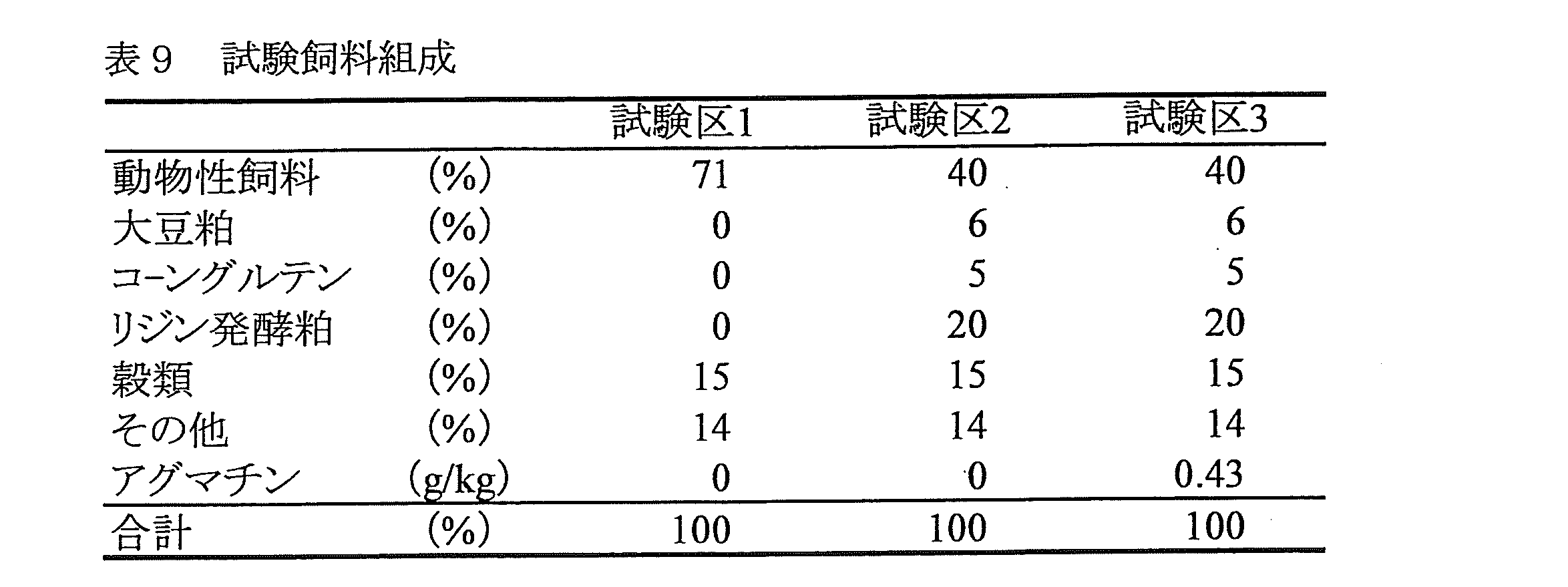
- Table 9 shows the composition of each test feed.
- Table 10 shows the analysis value of the amount of agmatine in the test feed.
- breeding results in aquaculture of fishery products such as fish and crustaceans can be improved.
Landscapes
- Life Sciences & Earth Sciences (AREA)
- Chemical & Material Sciences (AREA)
- Polymers & Plastics (AREA)
- Engineering & Computer Science (AREA)
- Food Science & Technology (AREA)
- Animal Husbandry (AREA)
- Zoology (AREA)
- Marine Sciences & Fisheries (AREA)
- Birds (AREA)
- Insects & Arthropods (AREA)
- Proteomics, Peptides & Aminoacids (AREA)
- Health & Medical Sciences (AREA)
- Biomedical Technology (AREA)
- Biotechnology (AREA)
- Molecular Biology (AREA)
- Physiology (AREA)
- Feed For Specific Animals (AREA)
- Fodder In General (AREA)
- Farming Of Fish And Shellfish (AREA)
Abstract
水産生物用の飼料、および水産生物の養殖方法を提供する。アグマチン等のアルギニン誘導体が添加された水産生物用飼料を水産生物に給餌して、水産生物を養殖する。
Description
本発明は、魚類や甲殻類等の水産生物用の飼料、および水産生物の養殖方法に関する。
近年、日本におけるマイワシ資源の急激な減少や、南米で発生したエルニーニョによるチリ及びペルーにおける原料魚の陸揚げ量の著減などの影響を受けて、世界の飼料用原料、特に魚粉や魚油、の需給は大変厳しい状況下に置かれている。このような状況から、従来の魚粉・魚油依存型の養魚飼料から脱却した新しいタイプの養魚飼料の開発が望まれている。
魚粉は、主としてタンパク質供給源として飼料に配合される。そのため、魚粉代替原料としては、大豆粕やコーングルテンミール等の植物性タンパク質や、チキンミール等の動物性タンパク質が用いられている。しかしながら、これらの魚粉代替原料を配合した飼料を用いた場合には、飼育成績が低下するという問題点が生じる。
これらの問題点を解決するために種々の試みがなされており、例えば、タウリンを配合すること(特許文献1)やイノシンを配合すること(特許文献2)により飼育成績が改善されることが報告されている。
本発明は、魚類や甲殻類等の水産生物用の飼料、および水産生物の養殖方法を提供することを課題とする。
本発明者は鋭意検討した結果、アグマチンやプトレシン等のアルギニン誘導体を添加した飼料を給餌することによりトラフグ等の魚類の飼育成績が向上することを見出し、本発明を完成させた。
すなわち、本発明は、以下の通り例示できる。
[1]
アルギニン誘導体を含有する水産生物用飼料。
[2]
前記アルギニン誘導体が添加された水産生物用飼料である、前記飼料。
[3]
前記アルギニン誘導体の含有量が高められた水産生物用飼料である、前記飼料。
[4]
前記アルギニン誘導体が、アグマチンである、前記飼料。
[5]
前記アルギニン誘導体が、プトレシンである、前記飼料。
[6]
前記アルギニン誘導体の含有量が、0.02%(w/w)以上である、前記飼料。
[7]
前記アルギニン誘導体の含有量が、0.08%(w/w)以上である、前記飼料。
[8]
魚粉の量が低減されている、前記飼料。
[9]
魚粉の含有量が60%(w/w)以下である、前記飼料。
[10]
前記水産生物が、前記アルギニン誘導体の生合成系を欠損した水産生物である、前記飼料。
[11]
前記水産生物が、魚類または甲殻類である、前記飼料。
[12]
前記水産生物が、トラフグ、ヒラメ、クロマグロ、タイセイヨウサケ、ニジマス、ヨーロッパウナギ、ナマズ、ティラピア、アカシタビラメ、タイセイヨウマダラ、メダカ、ゼブラフィッシュ、マダイ、またはエビである、前記飼料。
[13]
水産生物の養殖に用いられる、アルギニン誘導体を99.9%(w/w)以下の含有量で含有する組成物。
[14]
前記アルギニン誘導体が、アグマチンである、前記組成物。
[15]
前記アルギニン誘導体が、プトレシンである、前記組成物。
[16]
飼料中の前記アルギニン誘導体の含有量が0.02%(w/w)以上となるように水産生物用飼料と併用される、前記組成物。
[17]
飼料中の前記アルギニン誘導体の含有量が0.08%(w/w)以上となるように水産生物用飼料と併用される、前記組成物。
[18]
飼料への前記アルギニン誘導体の添加量が0.01%(w/w)以上となるように水産生物用飼料と併用される、前記組成物。
[19]
前記水産生物用飼料が、魚粉の量が低減された水産生物用飼料である、前記組成物。
[20]
前記水産生物用飼料における魚粉の含有量が60%(w/w)以下である、前記組成物。
[21]
前記水産生物が、前記アルギニン誘導体の生合成系を欠損した水産生物である、前記組成物。
[22]
前記水産生物が、魚類または甲殻類である、前記組成物。
[23]
前記水産生物が、トラフグ、ヒラメ、クロマグロ、タイセイヨウサケ、ニジマス、ヨーロッパウナギ、ナマズ、ティラピア、アカシタビラメ、タイセイヨウマダラ、メダカ、ゼブラフィッシュ、マダイ、またはエビである、前記組成物。
[24]
前記水産生物用の飼育成績改善剤である、前記組成物。
[25]
前記飼育成績改善が、体重の増加、体長の増加、飼料転換効率の改善、尾鰭欠損率の低下、またはそれらの組み合わせである、前記組成物。
[26]
水産生物にアルギニン誘導体を給餌することを含む、水産生物を養殖する方法。
[27]
前記飼料または前記組成物を水産生物に給餌することにより、前記アルギニン誘導体が水産生物に給餌される、前記方法。
[1]
アルギニン誘導体を含有する水産生物用飼料。
[2]
前記アルギニン誘導体が添加された水産生物用飼料である、前記飼料。
[3]
前記アルギニン誘導体の含有量が高められた水産生物用飼料である、前記飼料。
[4]
前記アルギニン誘導体が、アグマチンである、前記飼料。
[5]
前記アルギニン誘導体が、プトレシンである、前記飼料。
[6]
前記アルギニン誘導体の含有量が、0.02%(w/w)以上である、前記飼料。
[7]
前記アルギニン誘導体の含有量が、0.08%(w/w)以上である、前記飼料。
[8]
魚粉の量が低減されている、前記飼料。
[9]
魚粉の含有量が60%(w/w)以下である、前記飼料。
[10]
前記水産生物が、前記アルギニン誘導体の生合成系を欠損した水産生物である、前記飼料。
[11]
前記水産生物が、魚類または甲殻類である、前記飼料。
[12]
前記水産生物が、トラフグ、ヒラメ、クロマグロ、タイセイヨウサケ、ニジマス、ヨーロッパウナギ、ナマズ、ティラピア、アカシタビラメ、タイセイヨウマダラ、メダカ、ゼブラフィッシュ、マダイ、またはエビである、前記飼料。
[13]
水産生物の養殖に用いられる、アルギニン誘導体を99.9%(w/w)以下の含有量で含有する組成物。
[14]
前記アルギニン誘導体が、アグマチンである、前記組成物。
[15]
前記アルギニン誘導体が、プトレシンである、前記組成物。
[16]
飼料中の前記アルギニン誘導体の含有量が0.02%(w/w)以上となるように水産生物用飼料と併用される、前記組成物。
[17]
飼料中の前記アルギニン誘導体の含有量が0.08%(w/w)以上となるように水産生物用飼料と併用される、前記組成物。
[18]
飼料への前記アルギニン誘導体の添加量が0.01%(w/w)以上となるように水産生物用飼料と併用される、前記組成物。
[19]
前記水産生物用飼料が、魚粉の量が低減された水産生物用飼料である、前記組成物。
[20]
前記水産生物用飼料における魚粉の含有量が60%(w/w)以下である、前記組成物。
[21]
前記水産生物が、前記アルギニン誘導体の生合成系を欠損した水産生物である、前記組成物。
[22]
前記水産生物が、魚類または甲殻類である、前記組成物。
[23]
前記水産生物が、トラフグ、ヒラメ、クロマグロ、タイセイヨウサケ、ニジマス、ヨーロッパウナギ、ナマズ、ティラピア、アカシタビラメ、タイセイヨウマダラ、メダカ、ゼブラフィッシュ、マダイ、またはエビである、前記組成物。
[24]
前記水産生物用の飼育成績改善剤である、前記組成物。
[25]
前記飼育成績改善が、体重の増加、体長の増加、飼料転換効率の改善、尾鰭欠損率の低下、またはそれらの組み合わせである、前記組成物。
[26]
水産生物にアルギニン誘導体を給餌することを含む、水産生物を養殖する方法。
[27]
前記飼料または前記組成物を水産生物に給餌することにより、前記アルギニン誘導体が水産生物に給餌される、前記方法。
以下、本発明を詳細に説明する。
<1>アルギニン誘導体
本発明においてはアルギニン誘導体を利用する。アルギニン誘導体を利用することにより、具体的には、アルギニン誘導体を水産生物に給餌して水産生物を養殖することにより、水産生物の飼育成績を改善することができる。養殖を「飼育」ともいう。水産生物の飼育成績を改善する効果を「飼育成績改善効果」ともいう。特に、本発明の一態様においては、アルギニン誘導体を給餌して水産生物を養殖することで、低魚粉による飼育成績の低下を防止または軽減できる。飼育成績の改善としては、体重の増加、体長の増加、飼料転換効率の改善(低下)、尾鰭欠損率の低下が挙げられる。尾鰭欠損率の低下は、具体的には、例えば、噛み合いの防止によるものであってよい。「飼料転換効率」(Feed Conversion ratio;FCR)とは、単位重量の増体(生育)のために必要な飼料の重量を意味する。飼料転換効率を「飼料要求率」ともいう。本発明においては、1種の飼育成績改善効果が得られてもよく、2種またはそれ以上の飼育成績改善効果が得られてもよい。
本発明においてはアルギニン誘導体を利用する。アルギニン誘導体を利用することにより、具体的には、アルギニン誘導体を水産生物に給餌して水産生物を養殖することにより、水産生物の飼育成績を改善することができる。養殖を「飼育」ともいう。水産生物の飼育成績を改善する効果を「飼育成績改善効果」ともいう。特に、本発明の一態様においては、アルギニン誘導体を給餌して水産生物を養殖することで、低魚粉による飼育成績の低下を防止または軽減できる。飼育成績の改善としては、体重の増加、体長の増加、飼料転換効率の改善(低下)、尾鰭欠損率の低下が挙げられる。尾鰭欠損率の低下は、具体的には、例えば、噛み合いの防止によるものであってよい。「飼料転換効率」(Feed Conversion ratio;FCR)とは、単位重量の増体(生育)のために必要な飼料の重量を意味する。飼料転換効率を「飼料要求率」ともいう。本発明においては、1種の飼育成績改善効果が得られてもよく、2種またはそれ以上の飼育成績改善効果が得られてもよい。
「アルギニン誘導体」とは、アルギニンが代謝されて生成し得る化合物の総称である。アルギニン誘導体として、具体的には、例えば、アグマチン(agmatine)、プトレシン(putrescine)、スペルミジン(spermidine)、スペルミン(spermine)、γ-グアニジノブチルアルデヒド(γ-guanidinobutyraldehyde)、γ-グアニジノ酪酸(γ-guanidinobutyrate)、γ-アミノ酪酸(γ-aminobutyrate)が挙げられる。好ましいアルギニン誘導体としては、アグマチン及びプトレシンが挙げられる。また、好ましいアルギニン誘導体としては、対象の水産生物においてその生合成系が欠損しているアルギニン誘導体も挙げられる。すなわち、例えば、対象の水産生物がアグマチンの生合成系を欠損している場合には、好ましいアルギニン誘導体としては、アグマチン及びその代謝物が挙げられる。本発明においては、1種のアルギニン誘導体を用いてもよく、2種またはそれ以上のアルギニン誘導体を組み合わせて用いてもよい。
アルギニン誘導体は、フリー体であってもよく、塩であってもよく、それらの混合物であってもよい。すなわち、本発明における「アルギニン誘導体」という用語は、特記しない限り、フリー体のアルギニン誘導体、もしくはその塩、またはそれらの混合物を意味する。塩としては、例えば、硫酸塩、塩酸塩、炭酸塩、アンモニウム塩、ナトリウム塩、カリウム塩が挙げられる。塩としては、1種の塩を用いてもよく、2種またはそれ以上の塩を組み合わせて用いてもよい。なお、後述するアルギニン誘導体の量(含有量や添加量等)は、アルギニン誘導体が塩を形成している場合にあっては、特記しないかぎり、塩の質量を等モルのフリー体の質量に換算して算出されるものとする。
アルギニン誘導体としては、市販品を用いてもよく、適宜製造して取得したものを用いてもよい。
アルギニン誘導体の製造方法は特に制限されず、例えば公知の方法を利用できる。アルギニン誘導体は、例えば、化学合成法、酵素法、発酵法、抽出法、またはそれらの組み合わせにより製造することができる。アルギニン誘導体は、例えば、アルギニンからの変換により製造することができる。アルギニンからアルギニン誘導体への変換は、例えば、アルギニン誘導体の生合成系酵素を利用した酵素法により実施することができる。具体的には、例えば、アルギニンデカルボキシラーゼを利用してアルギニンからアグマチンを製造する方法が報告されている(特開2002-345496)。アルギニンは、例えば、アルギニンの生産能を有する微生物を培養し、培養物からアルギニンを回収することで製造することができる。具体的には、例えば、N-アセチルグルタミン酸合成酵素をコードするargA遺伝子の発現を増強したEscherichia coliを用いたアルギニンの発酵法による製造法が報告されている(特開2002-315571)。また、アルギニン誘導体は、例えば、アルギニン誘導体の生産能を有する微生物を培養し、培養物からアルギニン誘導体を回収することで製造することができる。具体的には、アグマチンは、例えば、argA遺伝子の発現を増強したEscherichia coli等のアルギニン生産菌においてさらにアルギニンデカルボキシラーゼをコードするadiA遺伝子の発現を増強した菌株を用いることにより、発酵法により製造できる。
アルギニン誘導体は、精製品であってもよく、そうでなくてもよい。すなわち、アルギニン誘導体としては、例えば、アルギニン誘導体を含有する素材を、そのまま、あるいは、適宜、濃縮、希釈、乾燥、分画、抽出、精製等の処理に供してから、利用してもよい。アルギニン誘導体を含有する素材として、具体的には、例えば、アルギニン誘導体発酵液(アルギニン誘導体の生産能を有する微生物を培養して得られたアルギニン誘導体を含有する培養物)、該発酵液から分離した培養上清、該発酵液から分離した菌体が挙げられる。アルギニン誘導体は、所望の程度に精製されていてよい。アルギニン誘導体の純度は、例えば、30%(w/w)以上、50%(w/w)以上、70%(w/w)以上、90%(w/w)以上、または95%(w/w)以上であってもよい。
<2>水産生物
本発明において対象とする水産生物は、飼育成績改善効果が得られる限り、特に制限されない。好ましい水産生物としては、アルギニン誘導体の生合成系を欠損した水産生物が挙げられる。「アルギニン誘導体の生合成系を欠損した」とは、具体的には、アルギニンから当該アルギニン誘導体への代謝経路を構成する1種またはそれ以上の酵素から選択される1種またはそれ以上の酵素を欠損していることをいう。水産生物は、本来的にアルギニン誘導体の生合成系を欠損していてもよいし、アルギニン誘導体の生合成系を欠損するように改変(育種等)されていてもよい。水産生物は、1種のアルギニン誘導体の生合成系を欠損していてもよく、2種またはそれ以上のアルギニン誘導体の生合成系酵素を欠損していてもよい。
本発明において対象とする水産生物は、飼育成績改善効果が得られる限り、特に制限されない。好ましい水産生物としては、アルギニン誘導体の生合成系を欠損した水産生物が挙げられる。「アルギニン誘導体の生合成系を欠損した」とは、具体的には、アルギニンから当該アルギニン誘導体への代謝経路を構成する1種またはそれ以上の酵素から選択される1種またはそれ以上の酵素を欠損していることをいう。水産生物は、本来的にアルギニン誘導体の生合成系を欠損していてもよいし、アルギニン誘導体の生合成系を欠損するように改変(育種等)されていてもよい。水産生物は、1種のアルギニン誘導体の生合成系を欠損していてもよく、2種またはそれ以上のアルギニン誘導体の生合成系酵素を欠損していてもよい。
アルギニン誘導体の生合成系酵素として、具体的には、アルギニンデカルボキシラーゼ(arginine decarboxylase)、アグマチナーゼ(agmatinase)、スペルミジンシンターゼ(spermidine synthase)、スペルミンシンターゼ(spermine synthase)、ジアミンオキシダーゼ(diamine oxidase)、アルデヒドデヒドロゲナーゼ(aldehyde dehydrogenase)、ハイドロラーゼ(hydrolase)が挙げられる。アルギニンは、アルギニンデカルボキシラーゼによりアグマチンへと変換される。アグマチンは、さらに、上記例示した残りのアルギニン誘導体に変換され得る。具体的には、アグマチンは、アグマチナーゼ、スペルミジンシンターゼ、スペルミンシンターゼにより、プトレシン、スペルミジン、スペルミンへと順に変換される。また、アグマチンは、ジアミンオキシダーゼ、アルデヒドデヒドロゲナーゼ、ハイドロラーゼにより、γ-グアニジノブチルアルデヒド、γ-グアニジノ酪酸、γ-アミノ酪酸へと順に変換される。すなわち、例えば、「アグマチンの生合成系を欠損した」とは、アルギニンデカルボキシラーゼを欠損していることをいう。また、例えば、「プトレシンの生合成系を欠損した」とは、アルギニンデカルボキシラーゼ及び/又はアグマチナーゼを欠損していることをいう。また、例えば、「スペルミンの生合成系を欠損した」とは、アルギニンデカルボキシラーゼ、アグマチナーゼ、スペルミジンシンターゼ、スペルミンシンターゼから選択される1種またはそれ以上の酵素を欠損していることをいう。
水産生物が対象の酵素を欠損しているか否かは、例えば、水産生物のゲノム情報に基づいて決定できる(WO2013180226A1)。すなわち、水産生物のゲノム情報から当該水産生物が保有すると推定されるタンパク質について機能の推定を行い、対象の酵素を保有しているかを決定できる。タンパク質の機能の推定は、当該タンパク質のアミノ酸配列を、既知のタンパク質のアミノ酸配列と比較することにより行うことができる。アミノ酸配列の比較は、例えば、BLASTを用いて実施できる。具体的には、例えば、水産生物のゲノム情報と、アノテーション済みの他の生物のゲノム情報とを、コードされるタンパク質のアミノ酸配列レベルで比較することにより、当該水産生物が対象の酵素をコードする遺伝子を保有しているかを決定できる。水産生物において対象の酵素をコードする遺伝子の保有が確認されない場合、当該水産生物が対象の酵素を欠損していると判断できる。比較対象の生物のゲノム情報としては、例えば、ヒト等の哺乳類のゲノム情報を利用できる。
水産生物としては、魚類や甲殻類が挙げられる。魚類として、具体的には、例えば、トラフグ、ヒラメ、クロマグロ、タイセイヨウサケ、ニジマス、ヨーロッパウナギ、ナマズ、ティラピア、アカシタビラメ、タイセイヨウマダラ、メダカ、ゼブラフィッシュ、マダイが挙げられる。なお、これらの魚類は、いずれも、アルギニンデカルボキシラーゼをコードする遺伝子の発現が確認されない魚類である。甲殻類としては、例えば、エビやカニが挙げられる。甲殻類として、具体的には、例えば、バナメイエビ、クルマエビ、ウシエビ、ホワイトレッグシュリンプ、ガザミが挙げられる。
<3>本発明の飼料
本発明の飼料は、アルギニン誘導体を含有する水産生物用飼料である。本発明の飼料は、具体的には、アルギニン誘導体が添加された水産生物用飼料である。すなわち、言い換えると、本発明の飼料は、添加されたアルギニン誘導体を含有する水産生物用飼料である。また、アルギニン誘導体が添加されたことにより、本発明の飼料においてはアルギニン誘導体の含有量が高められている。すなわち、言い換えると、本発明の飼料は、アルギニン誘導体の含有量が高められた水産生物用飼料である。「アルギニン誘導体の含有量が高められた」とは、本発明の飼料におけるアルギニン誘導体の含有量が、対照飼料におけるアルギニン誘導体の含有量と比較して、高いことをいう。「対照飼料」とは、アルギニン誘導体が添加されていない水産生物用飼料をいう。対照飼料としては、魚粉主体の水産生物用飼料等の通常の水産生物用飼料であって、アルギニン誘導体が添加されていないものが挙げられる。対照飼料として、具体的には、例えば、実施例で用いたアルギニン誘導体が添加されていない飼料が挙げられる。「添加」を「配合」ともいう。「水産生物用」とは、水産生物の養殖(飼育)に用いられることをいう。本発明の飼料は、1種のアルギニン誘導体を含有していてもよく、2種またはそれ以上のアルギニン誘導体を組み合わせて含有していてもよい。本発明の飼料を給餌して水産生物を養殖することで、水産生物の飼育成績を改善できる。
本発明の飼料は、アルギニン誘導体を含有する水産生物用飼料である。本発明の飼料は、具体的には、アルギニン誘導体が添加された水産生物用飼料である。すなわち、言い換えると、本発明の飼料は、添加されたアルギニン誘導体を含有する水産生物用飼料である。また、アルギニン誘導体が添加されたことにより、本発明の飼料においてはアルギニン誘導体の含有量が高められている。すなわち、言い換えると、本発明の飼料は、アルギニン誘導体の含有量が高められた水産生物用飼料である。「アルギニン誘導体の含有量が高められた」とは、本発明の飼料におけるアルギニン誘導体の含有量が、対照飼料におけるアルギニン誘導体の含有量と比較して、高いことをいう。「対照飼料」とは、アルギニン誘導体が添加されていない水産生物用飼料をいう。対照飼料としては、魚粉主体の水産生物用飼料等の通常の水産生物用飼料であって、アルギニン誘導体が添加されていないものが挙げられる。対照飼料として、具体的には、例えば、実施例で用いたアルギニン誘導体が添加されていない飼料が挙げられる。「添加」を「配合」ともいう。「水産生物用」とは、水産生物の養殖(飼育)に用いられることをいう。本発明の飼料は、1種のアルギニン誘導体を含有していてもよく、2種またはそれ以上のアルギニン誘導体を組み合わせて含有していてもよい。本発明の飼料を給餌して水産生物を養殖することで、水産生物の飼育成績を改善できる。
本発明の飼料の組成は、本発明の飼料がアルギニン誘導体を含有し、且つ、飼育成績改善効果が得られる限り、特に制限されない。
本発明の飼料が含有する成分の種類は、対象の水産生物の種類や生育ステージ、および本発明の飼料の利用態様等の諸条件に応じて適宜選択することができる。例えば、本発明の飼料は、アルギニン誘導体に加えて、通常の水産生物用飼料等の飼料が含有する成分と同様の成分を含有していてもよい。そのような成分としては、動物性飼料成分、植物性飼料成分、その他各種飼料成分が挙げられる。動物性飼料成分として、具体的には、例えば、魚粉、フィッシュソリュブル、骨粉、チキンミールが挙げられる。植物性飼料成分として、具体的には、例えば、穀類粉(小麦粉等)、植物性タンパク質(小麦グルテンやコーングルテン等)、デンプン(コーンスターチ等)、植物性油カス(大豆粕等)が挙げられる。その他の成分として、具体的には、例えば、アミノ酸発酵粕(リジン発酵粕等)、粘結剤(カルボキシメチルセルロースやアルギン酸等)、酵母、エイコサペンタエン酸、ドコサヘキサエン酸が挙げられる。これらの中で、例えば、エイコサペンタエン酸やドコサヘキサエン酸は、稚魚用または幼魚用の飼料の成分として好ましい。
また、本発明の飼料は、例えば、水産用添加物質を含有していてもよい。水産用添加物質として、具体的には、例えば、エリスロマイシン製剤、アンピシリン製剤、プラジクアンテル製剤、塩化リゾチーム製剤、塩酸オキシテトラサイクリン製剤、スピラマイシン製剤、ニフルスチレン酸ナトリウム製剤、塩酸リンコマイシン製剤、フルメキン製剤、グルタチオン製剤等の水産用医薬品、ビタミンC、ビタミンB1、ビタミンA、ビタミンD、ビタミンE等のビタミン類、リジン、メチオニン、ヒスチジン等のアミノ酸類等の栄養補給物質、β-カロチン、アスタキサンチン、カンタキサンチン等の色素等が挙げられる。
本発明の飼料が含有する成分の含有量は、対象の水産生物の種類や生育ステージ、および本発明の飼料の利用態様等の諸条件に応じて適宜設定することができる。例えば、本発明の飼料における各成分の含有量は、通常の水産生物飼料における各成分の含有量と同様であってもよい。また、例えば、本発明の飼料においては、魚粉の量が低減されていてもよい。なお、魚粉の量が低減されていることを「低魚粉」ともいう。
「魚粉の量が低減されている」とは、本発明の飼料が、水産生物用飼料に配合されるべき魚粉の全部あるいは一部を含有していないことをいう。すなわち、言い換えると、「魚粉の量が低減されている」とは、本発明の飼料に含有されている魚粉の量が、水産生物用飼料に配合されるべき魚粉の量よりも少ないことをいい、本発明の飼料が魚粉を全く含有しない場合も含む。「水産生物用飼料に配合されるべき魚粉」とは、一般的な魚粉主体の水産生物用飼料を用いて水産生物を飼育した場合と比較して、アルギニン誘導体を配合しない条件下で生育低下を招かない最低限の配合量の魚粉をいう。水産生物用飼料に配合されるべき魚粉の量は、対象の水産生物の種類や生育ステージ(例えば、稚魚期や成魚期)等の諸条件に応じて適宜決定することができる。
本発明の飼料における魚粉の含有量(濃度)は、例えば、0%(w/w)以上、5%(w/w)以上、10%(w/w)以上、20%(w/w)以上、30%(w/w)以上、40%(w/w)以上、50%(w/w)以上、60%(w/w)以上、または70%(w/w)以上であってもよく、90%以下、80%以下、70%以下、60%(w/w)以下、50%(w/w)以下、または40%(w/w)以下であってもよく、それらの矛盾しない組み合わせであってもよい。本発明の飼料における魚粉の含有量(濃度)は、低魚粉の場合、例えば、0%(w/w)以上、5%(w/w)以上、10%(w/w)以上、20%(w/w)以上、30%(w/w)以上、または40%(w/w)以上であってもよく、60%(w/w)以下、50%(w/w)以下、または40%(w/w)以下であってもよく、それらの矛盾しない組み合わせであってもよい。
本発明の飼料におけるアルギニン誘導体の含有量(濃度)は、例えば、0.011%(w/w)以上、0.012%(w/w)以上、0.013%(w/w)以上、0.015%(w/w)以上、0.017%(w/w)以上、0.02%(w/w)以上、0.024%(w/w)以上、0.03%(w/w)以上、0.04%(w/w)以上、0.06%(w/w)以上、0.08%(w/w)以上、0.1%(w/w)以上、または0.11%(w/w)以上であってもよく、1%(w/w)以下、0.7%(w/w)以下、0.5%(w/w)以下、0.4%(w/w)以下、0.32%(w/w)以下、0.27%(w/w)以下、0.2%(w/w)以下、0.15%(w/w)以下、0.1%(w/w)以下、0.09%(w/w)以下、0.08%(w/w)以下、0.07%(w/w)以下、0.06%(w/w)以下、または0.055%(w/w)以下であってもよく、それらの矛盾しない組み合わせであってもよい。本発明の飼料におけるアルギニン誘導体の含有量は、アグマチンの場合、具体的には、例えば、0.011~0.1%(w/w)、0.015~0.08%(w/w)、0.02~0.06%(w/w)、または0.024~0.055%(w/w)であってもよい。また、本発明の飼料におけるアルギニン誘導体の含有量は、プトレシンの場合、具体的には、例えば、0.08~1%(w/w)、0.1~0.5%(w/w)、または0.11~0.32%(w/w)であってもよい。また、本発明の飼料におけるアルギニン誘導体の含有量(濃度)は、通常の水産生物用飼料と比較して、例えば、0.001%(w/w)以上、0.002%(w/w)以上、0.003%(w/w)以上、0.005%(w/w)以上、0.007%(w/w)以上、0.01%(w/w)以上、0.014%(w/w)以上、0.02%(w/w)以上、0.03%(w/w)以上、0.04%(w/w)以上、0.05%(w/w)以上、0.06%(w/w)以上、または0.067%(w/w)以上高くてもよく、0.9%(w/w)以下、0.6%(w/w)以下、0.4%(w/w)以下、0.3%(w/w)以下、0.25%(w/w)以下、0.2%(w/w)以下、0.15%(w/w)以下、0.09%(w/w)以下、0.08%(w/w)以下、0.07%(w/w)以下、0.06%(w/w)以下、0.05%(w/w)以下、または0.043%(w/w)以下高くてもよく、それらの矛盾しない組み合わせの範囲で高くてもよい。
本発明の飼料は、所望の濃度でアルギニン誘導体が含有されるように、アルギニン誘導体およびその他の成分を組み合わせることにより製造できる。本発明の飼料の製造方法は特に制限されない。例えば、本発明の飼料は、アルギニン誘導体を添加(配合)すること以外は、通常の水産生物用飼料と同様の原料を用い、同様の方法によって製造することができる。なお、本発明の飼料に配合されるアルギニン誘導体以外の原料にアルギニン誘導体が含有されている場合、それと合計して所望のアルギニン誘導体含有量となるようにアルギニン誘導体を添加してよい。例えば、魚粉主体の水産生物用飼料等の通常の水産生物用飼料には、魚粉等の天然原料由来のアグマチンが約0.01%(w/w)含有され得る。その場合は、所望のアグマチン含有量から当該天然原料由来のアグマチンの含有量を減じた量のアグマチンを添加してよい。他のアルギニン誘導体についても同様に添加量を設定できる。アルギニン誘導体の添加量は、例えば、0.001%(w/w)以上、0.002%(w/w)以上、0.003%(w/w)以上、0.005%(w/w)以上、0.007%(w/w)以上、0.01%(w/w)以上、0.014%(w/w)以上、0.02%(w/w)以上、0.03%(w/w)以上、0.04%(w/w)以上、0.05%(w/w)以上、0.06%(w/w)以上、または0.067%(w/w)以上であってもよく、0.9%(w/w)以下、0.6%(w/w)以下、0.4%(w/w)以下、0.3%(w/w)以下、0.25%(w/w)以下、0.2%(w/w)以下、0.15%(w/w)以下、0.09%(w/w)以下、0.08%(w/w)以下、0.07%(w/w)以下、0.06%(w/w)以下、0.05%(w/w)以下、または0.043%(w/w)以下であってもよく、それらの矛盾しない組み合わせであってもよい。アルギニン誘導体の添加量は、アグマチンの場合、具体的には、例えば、0.001~0.09%(w/w)、0.005~0.07%(w/w)、0.01~0.05%(w/w)、または0.014~0.043%(w/w)であってもよい。アルギニン誘導体の添加量は、プトレシンの場合、具体的には、例えば、0.02~0.9%(w/w)、0.04~0.4%(w/w)、または0.05~0.2%(w/w)であってもよい。ここでいう「アルギニン誘導体の添加量」とは、本発明の飼料を構成する全飼料成分(添加されたアルギニン誘導体も含む)の重量に対する添加されたアルギニン誘導体の重量の比率であり、言い換えると、本発明の飼料における添加されたアルギニン誘導体の含有量(濃度)である。アルギニン誘導体の添加は、飼料の製造工程のいずれの段階で行われてもよい。すなわち、アルギニン誘導体は、飼料の原料に添加されてもよく、製造途中の飼料に添加されてもよく、完成した飼料に添加されてもよい。例えば、アルギニン誘導体を他の原料と混合し、必要により成型して、本発明の飼料としてもよいし、市販の飼料ペレット等の調製済み飼料にアルギニン誘導体をまぶす等して本発明の飼料としてもよい。具体的には、例えば、魚ミンチやその他の配合原料にアルギニン誘導体を添加して本発明の飼料を製造してもよい。
本発明の飼料の形態は、対象の水産生物が摂取可能な形態である限り、特に制限されない。すなわち、本発明の飼料は、粉末状、顆粒状、クランブル状、ペレット状、キューブ状、ペースト状、液状等のいかなる形態であってもよい。本発明の飼料は、例えば、ドライペレットやモイストペレット等のペレットとして成形されてよい。本発明の飼料の形態は、対象の水産生物の種類や生育ステージ等の諸条件に応じて適宜設定することができる。例えば、稚魚に対しては、通常、粉末またはクランブル状の飼料を好ましく用いることができる。また、成魚に対しては、通常、ドライペレットを好ましく用いることができる。
本発明の飼料において、アルギニン誘導体およびその他の成分は、互いに混合されて本発明の飼料に含まれていてもよく、それぞれ別個に、あるいは、任意の組み合わせで別個に、本発明の飼料に含まれていてもよい。例えば、本発明の飼料は、それぞれ別個にパッケージングされた、添加用のアルギニン誘導体とアルギニン誘導体添加前の飼料のセットとして提供されてもよい。このような場合、セットに含まれる成分は、給餌前または給餌時に混合して、あるいはそれぞれ別個に、給餌することができる。添加用のアルギニン誘導体は、アルギニン誘導体製剤として、所望の形態で製剤化されていてもよい。アルギニン誘導体添加前の飼料は、例えば、市販の飼料ペレット等の調製済み飼料であってよい。そのような調製済み飼料は、通常の水産生物用飼料が含有する成分等の所望の成分を常法により配合して製造することができる。
<4>本発明の組成物
本発明の組成物は、アルギニン誘導体を含有する水産生物の養殖(飼育)用組成物(すなわち、水産生物の養殖(飼育)に用いられる組成物)である。本発明の組成物は、1種のアルギニン誘導体を含有していてもよく、2種またはそれ以上のアルギニン誘導体を組み合わせて含有していてもよい。本発明の組成物を給餌して水産生物を養殖(飼育)することで、水産生物の飼育成績を改善できる。すなわち、本発明の組成物は、例えば、水産生物用の飼育成績改善剤であってよい。
本発明の組成物は、アルギニン誘導体を含有する水産生物の養殖(飼育)用組成物(すなわち、水産生物の養殖(飼育)に用いられる組成物)である。本発明の組成物は、1種のアルギニン誘導体を含有していてもよく、2種またはそれ以上のアルギニン誘導体を組み合わせて含有していてもよい。本発明の組成物を給餌して水産生物を養殖(飼育)することで、水産生物の飼育成績を改善できる。すなわち、本発明の組成物は、例えば、水産生物用の飼育成績改善剤であってよい。
本発明の組成物の組成は、本発明の組成物がアルギニン誘導体を含有し、且つ、飼育成績改善効果が得られる限り、特に制限されない。本発明の組成物が含有する成分の種類は、対象の水産生物の種類や生育ステージ、および本発明の組成物の利用態様等の諸条件に応じて適宜選択することができる。本発明の組成物が含有する成分の含有量は、対象の水産生物の種類や生育ステージ、および本発明の組成物の利用態様等の諸条件に応じて適宜設定することができる。
本発明の組成物は、アルギニン誘導体からなるものであってもよく、アルギニン誘導体以外の成分を含有していてもよい。アルギニン誘導体以外の成分としては、例えば、食用、飼料用、医薬用等の用途に通常用いられる成分が挙げられる。アルギニン誘導体以外の成分として、具体的には、例えば、上述したような本発明の飼料におけるアルギニン誘導体以外の成分が挙げられる。すなわち、本発明の組成物は、水産生物用飼料として構成されてもよい。すなわち、本発明の組成物の一態様は、上述したような本発明の飼料であってよい。
本発明の組成物におけるアルギニン誘導体の含有量(濃度)は、例えば、0.011%(w/w)以上、0.012%(w/w)以上、0.013%(w/w)以上、0.015%(w/w)以上、0.017%(w/w)以上、0.02%(w/w)以上、0.024%(w/w)以上、0.03%(w/w)以上、0.04%(w/w)以上、0.06%(w/w)以上、0.08%(w/w)以上、0.1%(w/w)以上、0.11%(w/w)以上、0.3%(w/w)以上、0.5%(w/w)以上、または1%(w/w)以上であってもよく、100%(w/w)以下、99.9%(w/w)以下、70%(w/w)以下、50%(w/w)以下、30%(w/w)以下、10%(w/w)以下、5%(w/w)以下、3%(w/w)以下、1%(w/w)以下、0.7%(w/w)以下、0.5%(w/w)以下、0.4%(w/w)以下、0.32%(w/w)以下、0.27%(w/w)以下、0.2%(w/w)以下、0.15%(w/w)以下、0.1%(w/w)以下、0.09%(w/w)以下、0.08%(w/w)以下、0.07%(w/w)以下、0.06%(w/w)以下、または0.055%(w/w)以下であってもよく、それらの矛盾しない組み合わせであってもよい。
本発明の組成物は、例えば、アルギニン誘導体製剤として提供されてもよい。本発明の組成物は、粉末状、顆粒状、ペレット状、キューブ状、ペースト状、液状等のいかなる形態であってもよい。
本発明の組成物は、例えば、水産生物用飼料と併用してよい。本発明の組成物は、例えば、飼料中のアルギニン誘導体の含有量(濃度)が、上述したような本発明の飼料におけるアルギニン誘導体の含有量(濃度)となるように、水産生物用飼料と併用されてよい。また、本発明の組成物は、例えば、飼料へのアルギニン誘導体の添加量が、上述したような本発明の飼料におけるアルギニン誘導体の添加量となるように、水産生物用飼料と併用されてよい。水産生物用飼料については、上述した本発明の飼料に関する記載を準用できる。例えば、水産生物用飼料は、通常の水産生物用飼料と同様に構成されたものであってもよく、魚粉の量が低減されたものであってもよい。また、本発明の組成物が飼料として構成される場合は、本発明の組成物自体を水産生物用飼料として使用してもよい。
また、本発明は、アルギニン誘導体の新規用途を提供する。アルギニン誘導体の新規用途としては、例えば、水産生物用の飼育成績改善剤の製造のためのアルギニン誘導体の使用が挙げられる。
<5>本発明の方法
本発明の方法は、アルギニン誘導体を水産生物に給餌することを含む、水産生物を養殖(飼育)する方法である。本発明の方法においては、1種のアルギニン誘導体を給餌してもよく、2種またはそれ以上のアルギニン誘導体を組み合わせて給餌してもよい。
本発明の方法は、アルギニン誘導体を水産生物に給餌することを含む、水産生物を養殖(飼育)する方法である。本発明の方法においては、1種のアルギニン誘導体を給餌してもよく、2種またはそれ以上のアルギニン誘導体を組み合わせて給餌してもよい。
本発明の方法により水産生物を養殖することで、水産生物の飼育成績を改善できる。すなわち、本発明の方法は、アルギニン誘導体を水産生物に給餌することを含む、水産生物の飼育成績を改善する方法であってもよい。
アルギニン誘導体の給餌態様は、飼育成績改善効果が得られる限り、特に制限されない。
アルギニン誘導体は、例えば、本発明の飼料を利用して(すなわち本発明の飼料を給餌することにより)、水産生物に給餌することができる。すなわち、本発明の方法の一態様は、本発明の飼料を水産生物に給餌することを含む、水産生物を養殖する方法であってよい。「本発明の飼料を給餌する」とは、予め調製された本発明の飼料を給餌する場合に限られず、上述した本発明の飼料の要件を満たすようにアルギニン誘導体およびその他の成分を組み合わせて給餌する場合を包含する。すなわち、本発明の方法の一態様は、アルギニン誘導体と水産生物用飼料とを組み合わせて水産生物に給餌することを含む、水産生物を養殖する方法であってよい。例えば、添加用のアルギニン誘導体とアルギニン誘導体添加前の飼料をそれぞれ準備し、給餌前または給餌時に混合して、あるいはそれぞれ別個に、給餌してもよい。アルギニン誘導体の給餌量は、例えば、飼料中のアルギニン誘導体の含有量(濃度)が、上述したような本発明の飼料におけるアルギニン誘導体の含有量(濃度)となるように、設定できる。また、アルギニン誘導体の給餌量は、例えば、飼料へのアルギニン誘導体の添加量が、上述したような本発明の飼料におけるアルギニン誘導体の添加量となるように、設定できる。
本発明の飼料の給餌量は、飼育成績改善効果が得られる限り、特に制限されない。本発明の飼料の給餌量は、対象の水産生物の種類等の諸条件に応じて適宜選択することができる。本発明の飼料の給餌量は、例えば、飽食量であってよい。本発明の飼料は、1日1回または複数回に分けて給餌されてよい。また、本発明の飼料は、数日に1回給餌されてもよい。各給餌時の本発明の飼料の給餌量は、アルギニン誘導体量に換算して、一定であってもよく、そうでなくてもよい。各給餌時の本発明の飼料におけるアルギニン誘導体濃度は、一定であってもよく、そうでなくてもよい。
本発明の飼料を給餌する期間は、飼育成績改善効果が得られる限り、特に制限されない。本発明の飼料を給餌する期間は、対象の水産生物の種類等の諸条件に応じて適宜選択することができる。本発明の飼料は、養殖(飼育)の全期間において継続して給餌されてもよく、一部の期間にのみ給餌されてもよい。「一部の期間」とは、例えば、養殖(飼育)の全期間の10%以上、20%以上、30%以上、50%以上、70%以上、または90%以上の期間であってよい。本発明の飼料を給餌する期間は、例えば、3日以上、1週間以上、2週間以上、3週間以上、4週間以上、2ヶ月以上、または3ヶ月以上であってもよく、1年以下、6ヶ月以下、4ヶ月以下、3ヶ月以下、2ヶ月以下、4週間以下、または3週間以下であってもよく、それらの矛盾しない組み合わせであってもよい。本発明の飼料を給餌する期間は、具体的には、例えば、2週間から2ヶ月であってもよい。また、本発明の飼料は、任意の期間で給餌の継続と中断を繰り返してもよい。
水産生物の養殖(飼育)は、本発明の飼料を給餌すること以外は、水産生物を養殖(飼育)する通常の方法と同一の方法により行うことができる。養殖(飼育)は、例えば、海上の生簀や陸上の水槽で行うことができる。なお「養殖」には、種苗生産(稚魚生産等)のみを行う増養殖および成体(親魚等)までの生産を行う養殖のいずれもが包含される。
同様に、アルギニン誘導体は、例えば、本発明の組成物を利用して(すなわち本発明の組成物を給餌することにより)、水産生物に給餌することができる。すなわち、本発明の方法の一態様は、本発明の組成物を水産生物に給餌することを含む、水産生物を養殖する方法であってもよい。本発明の組成物は、例えば、単独で、あるいは水産生物用飼料と併用して、給餌することができる。本発明の組成物の給餌態様については、上述したような本発明の飼料の給餌態様に関する記載を準用できる。すなわち、本発明の組成物は、例えば、飼料中のアルギニン誘導体の含有量(濃度)が、上述したような本発明の飼料におけるアルギニン誘導体の含有量(濃度)となるように、水産生物用飼料と併用して給餌することができる。また、本発明の組成物は、例えば、飼料へのアルギニン誘導体の添加量が、上述したような本発明の飼料におけるアルギニン誘導体の添加量となるように、水産生物用飼料と併用して給餌することができる。
上述したような本発明の飼料や本発明の組成物の給餌態様に関する記載は、アルギニン誘導体を給餌するその他のいずれの場合にも準用できる。
以下、実施例により本発明をさらに具体的に説明するが、これらの実施例はいかなる意味でも本発明を限定するものと解してはならない。
実施例1:トラフグにおけるアグマチンの効果
本実施例では、トラフグにおいて、アグマチンを添加した飼料を給餌した場合の飼育成績への効果を検討した。
本実施例では、トラフグにおいて、アグマチンを添加した飼料を給餌した場合の飼育成績への効果を検討した。
[実験手順]
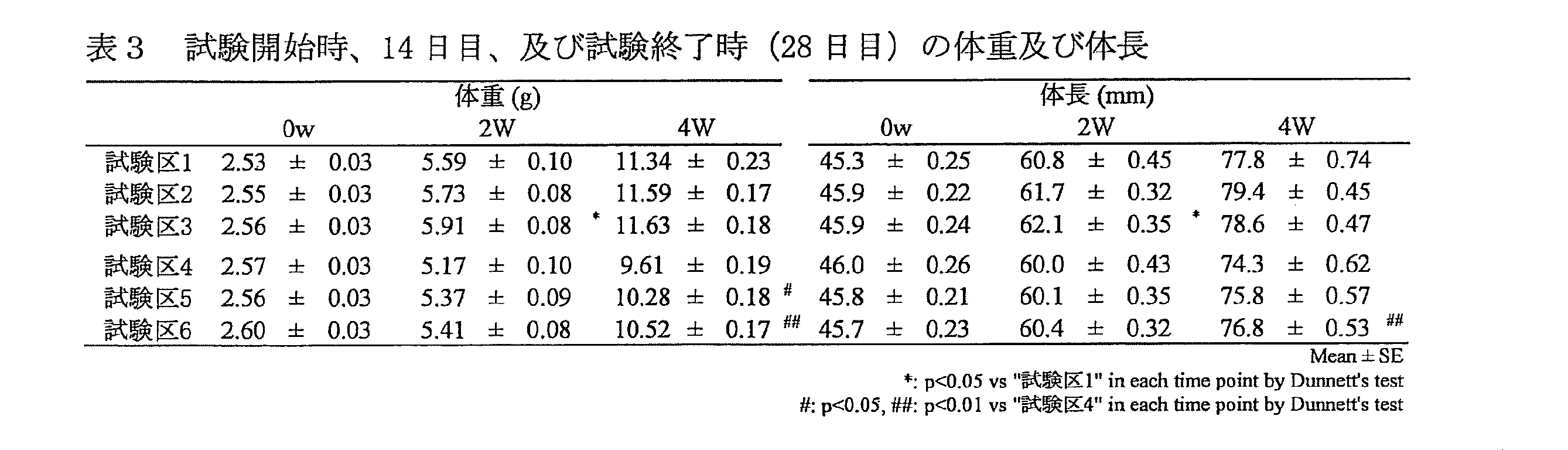
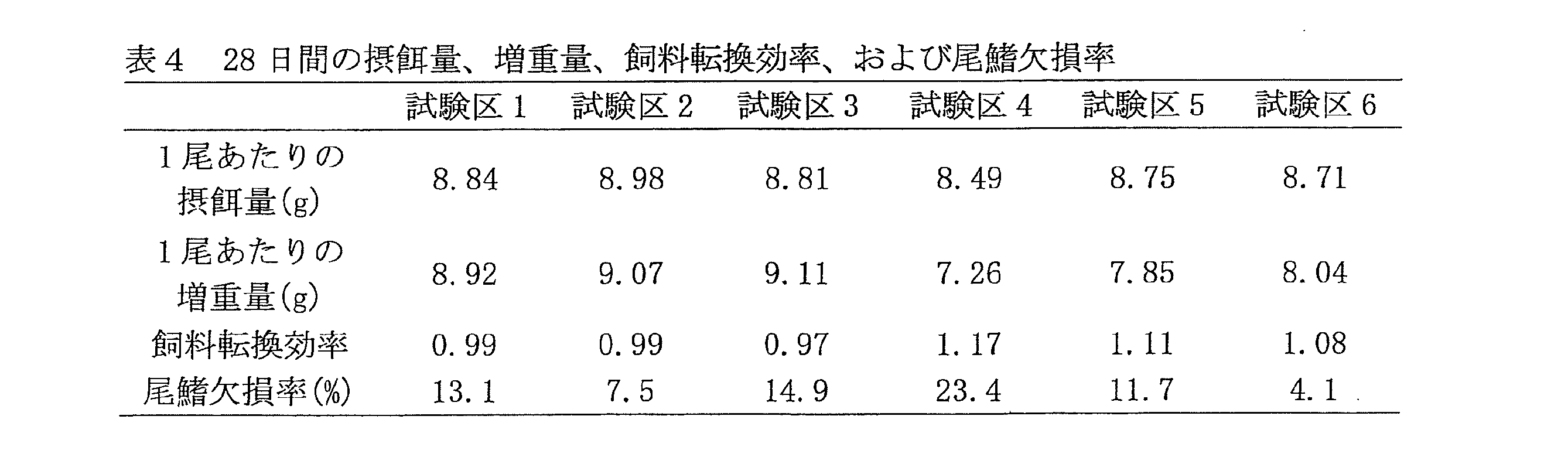
平均体重2.56±0.01gのトラフグ稚魚を用い、試験飼料を飽食量与え、28日間の飼育試験を行った。試験試料として、通常飼料(試験区1)、低魚粉飼料(試験区4)、通常飼料(試験区1)にアグマチンを0.014%(試験区2)あるいは0.043%(試験区3)添加した飼料、および低魚粉飼料(試験区4)にアグマチンを0.014%(試験区5)あるいは0.043%(試験区6)添加した飼料を用いた。添加したアグマチンはアグマチン硫酸塩であり、添加量はフリー体のアグマチンの重量に換算したものである。各試験飼料の組成を表1に示す。また、試験飼料中のアグマチン量の分析値を表2に示す。トラフグは各水槽に100尾ずつ収容し、試験区1および4は2反復、その他の試験区は3反復で試験を行った。飼育成績の指標として、試験開始日、試験開始14日目、および試験終了日(試験開始28日目)に体重および体長を測定した。その結果を表3に示す。また、28日間の各試験区における1尾あたりの増重量および摂餌量、飼料転換効率(=1尾あたりの摂餌量÷1尾あたりの増重量)、ならびに尾鰭欠損率を表4に示す。
平均体重2.56±0.01gのトラフグ稚魚を用い、試験飼料を飽食量与え、28日間の飼育試験を行った。試験試料として、通常飼料(試験区1)、低魚粉飼料(試験区4)、通常飼料(試験区1)にアグマチンを0.014%(試験区2)あるいは0.043%(試験区3)添加した飼料、および低魚粉飼料(試験区4)にアグマチンを0.014%(試験区5)あるいは0.043%(試験区6)添加した飼料を用いた。添加したアグマチンはアグマチン硫酸塩であり、添加量はフリー体のアグマチンの重量に換算したものである。各試験飼料の組成を表1に示す。また、試験飼料中のアグマチン量の分析値を表2に示す。トラフグは各水槽に100尾ずつ収容し、試験区1および4は2反復、その他の試験区は3反復で試験を行った。飼育成績の指標として、試験開始日、試験開始14日目、および試験終了日(試験開始28日目)に体重および体長を測定した。その結果を表3に示す。また、28日間の各試験区における1尾あたりの増重量および摂餌量、飼料転換効率(=1尾あたりの摂餌量÷1尾あたりの増重量)、ならびに尾鰭欠損率を表4に示す。


[結果および考察]
低魚粉飼料にアグマチンを添加した場合、すなわち試験区5および試験区6では、対照区(試験区4)と比較して、4週間の飼育で、体重及び体長の有意な増加あるいは増加傾向が認められた。また、通常飼料にアグマチンを添加した場合、すなわち試験区2および試験区3でも、対照区(試験区1)と比較して、4週間の飼育で、体重及び体長の増加傾向が認められた。試験区3では、対照区(試験区1)と比較して、飼育開始2週間の時点で一時的に体重及び体長の有意な増加も認められた。飼料転換効率については、通常飼料及び低魚粉飼料のいずれにおいても、アグマチンの添加により改善(低下)が認められた。低魚粉飼料(試験区4)では、通常飼料(試験区1)と比較して、尾鰭欠損率の上昇が認められた。これは、飼料の低魚粉化による噛み合いの増加に起因するものと考えられる。これに対し、低魚粉飼料(試験区4)にアグマチンを添加した場合、すなわち試験区5および試験区6では、アグマチンの添加濃度に関連して尾鰭欠損率が低下した。これらの飼育結果より、アグマチンには、トラフグに対して、飼料転換効率を改善(低下)する効果、成長を促進する効果、および尾鰭の欠損を抑制する効果等の飼育成績向上効果がある事が明らかとなった。
低魚粉飼料にアグマチンを添加した場合、すなわち試験区5および試験区6では、対照区(試験区4)と比較して、4週間の飼育で、体重及び体長の有意な増加あるいは増加傾向が認められた。また、通常飼料にアグマチンを添加した場合、すなわち試験区2および試験区3でも、対照区(試験区1)と比較して、4週間の飼育で、体重及び体長の増加傾向が認められた。試験区3では、対照区(試験区1)と比較して、飼育開始2週間の時点で一時的に体重及び体長の有意な増加も認められた。飼料転換効率については、通常飼料及び低魚粉飼料のいずれにおいても、アグマチンの添加により改善(低下)が認められた。低魚粉飼料(試験区4)では、通常飼料(試験区1)と比較して、尾鰭欠損率の上昇が認められた。これは、飼料の低魚粉化による噛み合いの増加に起因するものと考えられる。これに対し、低魚粉飼料(試験区4)にアグマチンを添加した場合、すなわち試験区5および試験区6では、アグマチンの添加濃度に関連して尾鰭欠損率が低下した。これらの飼育結果より、アグマチンには、トラフグに対して、飼料転換効率を改善(低下)する効果、成長を促進する効果、および尾鰭の欠損を抑制する効果等の飼育成績向上効果がある事が明らかとなった。
実施例2:トラフグにおけるプトレシンの効果
本実施例では、トラフグにおいて、プトレシンを添加した飼料を給餌した場合の飼育成績への効果を検討した。
本実施例では、トラフグにおいて、プトレシンを添加した飼料を給餌した場合の飼育成績への効果を検討した。
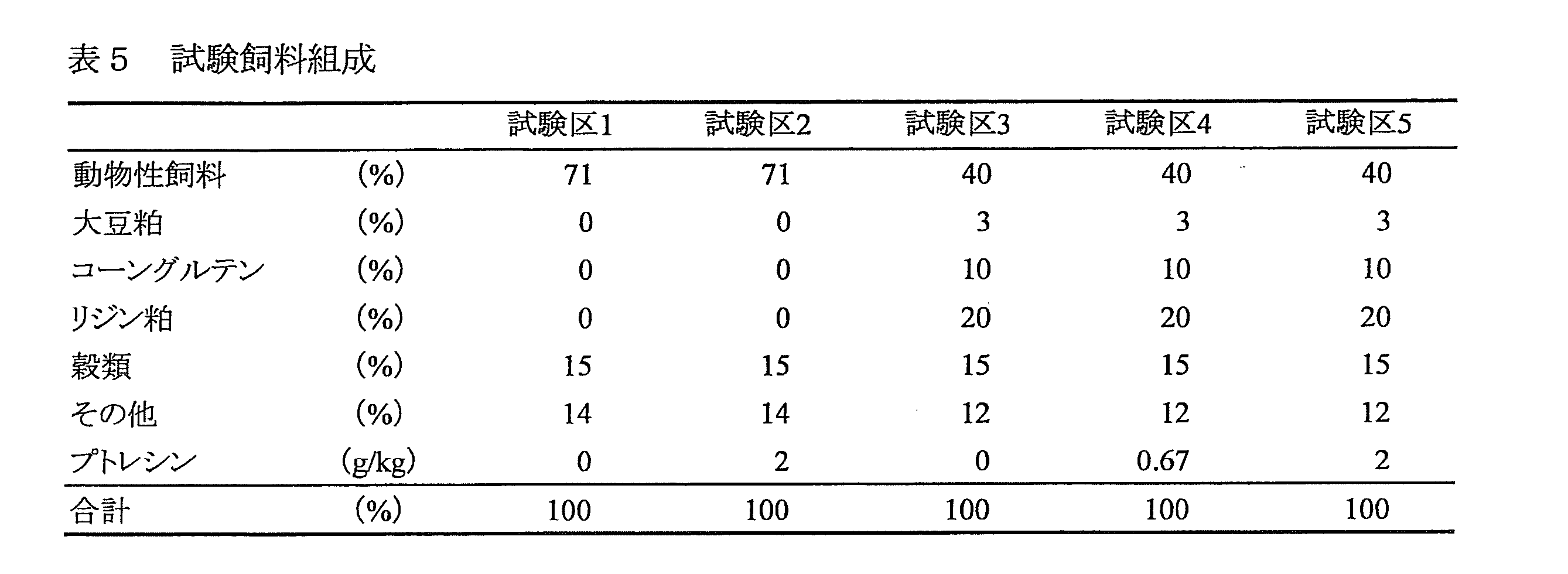
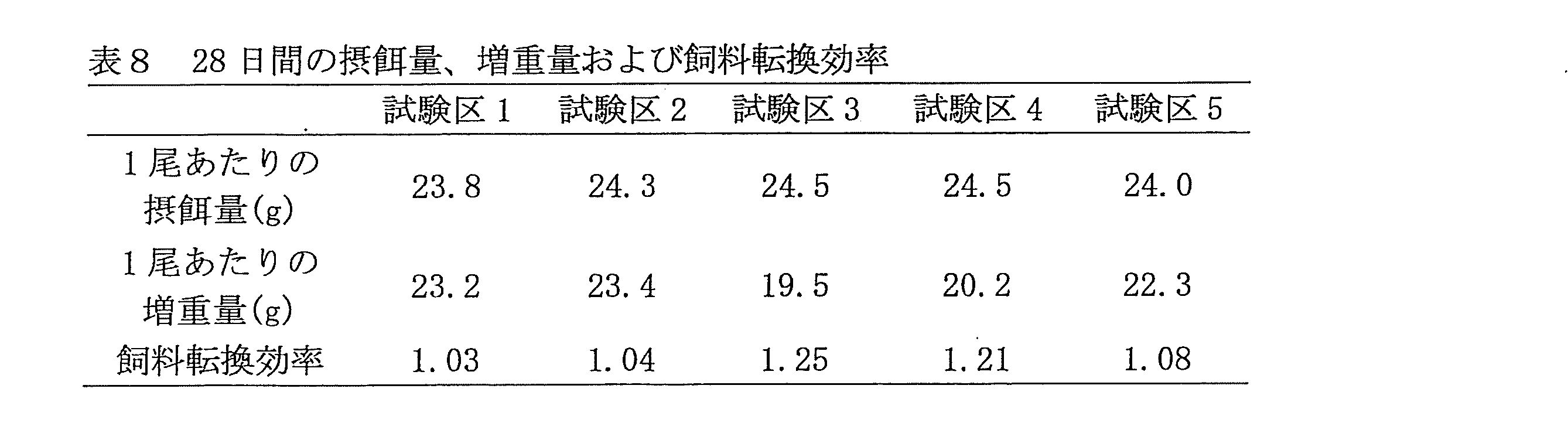
平均体重2.62±0.01gのトラフグ稚魚を用い、試験飼料を飽食量与え、28日間の飼育試験を行った。試験試料として、通常飼料(試験区1)、低魚粉飼料(試験区3)、通常飼料(試験区1)にプトレシンを0.2%(試験区2)添加した飼料、低魚粉飼料(試験区3)にプトレシンを0.067%(試験区4)あるいは0.2%(試験区5)添加した飼料を用いた。添加したプトレシンはプトレシン二塩基酸塩であり、添加量はフリー体のプトレシンの重量に換算したものである。各試験飼料の組成を表5に示す。また、試験飼料中のプトレシン量の分析値を表6に示す。トラフグは各水槽に50尾ずつ収容し、各試験区3反復で試験を行った。飼育成績の指標として、試験開始日、試験開始14日目、および試験終了日(試験開始28日目)に体重および体長を測定した。その結果を表7に示す。また、28日間の各試験区における1尾あたりの増重量および摂餌量及び飼料転換効率(=1尾あたりの摂餌量÷1尾あたりの増重量)を表8に示す。


[結果および考察]
低魚粉飼料にプトレシンを添加した場合、すなわち試験区4及び試験区5では、対照区(試験区3)と比較して、4週間飼育で、体長の増加傾向及び有意な増加がそれぞれ認められた。また、飼料転換効率についても、低魚粉飼料において、プトレシンの添加により改善(低下)が認められた。これらの飼育結果より、プトレシンには、トラフグに対して、飼料転換効率を改善(低下)する効果や成長を促進する効果等の飼育成績向上効果がある事が明らかとなった。
低魚粉飼料にプトレシンを添加した場合、すなわち試験区4及び試験区5では、対照区(試験区3)と比較して、4週間飼育で、体長の増加傾向及び有意な増加がそれぞれ認められた。また、飼料転換効率についても、低魚粉飼料において、プトレシンの添加により改善(低下)が認められた。これらの飼育結果より、プトレシンには、トラフグに対して、飼料転換効率を改善(低下)する効果や成長を促進する効果等の飼育成績向上効果がある事が明らかとなった。
実施例3:マダイにおけるアグマチンの効果
本実施例では、マダイにおいて、アグマチンを添加した飼料を給餌した場合の飼育成績への効果を検討した。
本実施例では、マダイにおいて、アグマチンを添加した飼料を給餌した場合の飼育成績への効果を検討した。
[実験手順]
平均体重1.45±0.01gのマダイ稚魚を用い、試験飼料を飽食量与えて28日間の飼育試験を行った。試験試料として、通常飼料(試験区1)、低魚粉飼料(試験区2)、低魚粉飼料にアグマチンを0.043%添加した飼料(試験区3)を用いた。添加したアグマチンはアグマチン硫酸塩であり、添加量はフリー体のアグマチンの重量に換算したものである。各試験飼料の組成を表9に示す。また、試験飼料中のアグマチン量の分析値を表10に示す。マダイは各水槽に50尾ずつ収容し、各試験区3反復で試験を行った。飼育成績の指標として、試験開始日、試験開始14日目、および試験終了日(試験開始28日目)に体重および体長を測定した。その結果を表11に示す。また、28日間の各試験区における1尾あたりの増重量、摂餌量および飼料転換効率(=1尾あたりの摂餌量÷1尾あたりの増重量)を表12に示す。
平均体重1.45±0.01gのマダイ稚魚を用い、試験飼料を飽食量与えて28日間の飼育試験を行った。試験試料として、通常飼料(試験区1)、低魚粉飼料(試験区2)、低魚粉飼料にアグマチンを0.043%添加した飼料(試験区3)を用いた。添加したアグマチンはアグマチン硫酸塩であり、添加量はフリー体のアグマチンの重量に換算したものである。各試験飼料の組成を表9に示す。また、試験飼料中のアグマチン量の分析値を表10に示す。マダイは各水槽に50尾ずつ収容し、各試験区3反復で試験を行った。飼育成績の指標として、試験開始日、試験開始14日目、および試験終了日(試験開始28日目)に体重および体長を測定した。その結果を表11に示す。また、28日間の各試験区における1尾あたりの増重量、摂餌量および飼料転換効率(=1尾あたりの摂餌量÷1尾あたりの増重量)を表12に示す。



[結果および考察]
低魚粉飼料にアグマチンを添加した場合、すなわち試験区3では、対照区(試験区2)と比較して、4週間の飼育で、体重の増加傾向が認められた。飼料転換効率についても、低魚粉飼料にアグマチンを添加することで改善(低下)が認められた。これらの飼育結果より、アグマチンには、マダイに対して、飼料転換効率を改善(低下)する効果および成長を促進する効果がある事が明らかとなった。
低魚粉飼料にアグマチンを添加した場合、すなわち試験区3では、対照区(試験区2)と比較して、4週間の飼育で、体重の増加傾向が認められた。飼料転換効率についても、低魚粉飼料にアグマチンを添加することで改善(低下)が認められた。これらの飼育結果より、アグマチンには、マダイに対して、飼料転換効率を改善(低下)する効果および成長を促進する効果がある事が明らかとなった。
本発明によれば、魚類や甲殻類等の水産生物の養殖における飼育成績を改善することができる。
Claims (27)
- アルギニン誘導体を含有する水産生物用飼料。
- 前記アルギニン誘導体が添加された水産生物用飼料である、請求項1に記載の飼料。
- 前記アルギニン誘導体の含有量が高められた水産生物用飼料である、請求項1または2に記載の飼料。
- 前記アルギニン誘導体が、アグマチンである、請求項1~3のいずれか1項に記載の飼料。
- 前記アルギニン誘導体が、プトレシンである、請求項1~3のいずれか1項に記載の飼料。
- 前記アルギニン誘導体の含有量が、0.02%(w/w)以上である、請求項1~5のいずれか1項に記載の飼料。
- 前記アルギニン誘導体の含有量が、0.08%(w/w)以上である、請求項1~6のいずれか1項に記載の飼料。
- 魚粉の量が低減されている、請求項1~7のいずれか1項に記載の飼料。
- 魚粉の含有量が60%(w/w)以下である、請求項1~8のいずれか1項に記載の飼料。
- 前記水産生物が、前記アルギニン誘導体の生合成系を欠損した水産生物である、請求項1~9のいずれか1項に記載の飼料。
- 前記水産生物が、魚類または甲殻類である、請求項1~10のいずれか1項に記載の飼料。
- 前記水産生物が、トラフグ、ヒラメ、クロマグロ、タイセイヨウサケ、ニジマス、ヨーロッパウナギ、ナマズ、ティラピア、アカシタビラメ、タイセイヨウマダラ、メダカ、ゼブラフィッシュ、マダイ、またはエビである、請求項1~11のいずれか1項に記載の飼料。
- 水産生物の養殖に用いられる、アルギニン誘導体を99.9%(w/w)以下の含有量で含有する組成物。
- 前記アルギニン誘導体が、アグマチンである、請求項13に記載の組成物。
- 前記アルギニン誘導体が、プトレシンである、請求項13に記載の組成物。
- 飼料中の前記アルギニン誘導体の含有量が0.02%(w/w)以上となるように水産生物用飼料と併用される、請求項13~15のいずれか1項に記載の組成物。
- 飼料中の前記アルギニン誘導体の含有量が0.08%(w/w)以上となるように水産生物用飼料と併用される、請求項13~16のいずれか1項に記載の組成物。
- 飼料への前記アルギニン誘導体の添加量が0.01%(w/w)以上となるように水産生物用飼料と併用される、請求項13~17のいずれか1項に記載の組成物。
- 前記水産生物用飼料が、魚粉の量が低減された水産生物用飼料である、請求項13~18のいずれか1項に記載の組成物。
- 前記水産生物用飼料における魚粉の含有量が60%(w/w)以下である、請求項13~19のいずれか1項に記載の組成物。
- 前記水産生物が、前記アルギニン誘導体の生合成系を欠損した水産生物である、請求項13~20のいずれか1項に記載の組成物。
- 前記水産生物が、魚類または甲殻類である、請求項13~21のいずれか1項に記載の組成物。
- 前記水産生物が、トラフグ、ヒラメ、クロマグロ、タイセイヨウサケ、ニジマス、ヨーロッパウナギ、ナマズ、ティラピア、アカシタビラメ、タイセイヨウマダラ、メダカ、ゼブラフィッシュ、マダイ、またはエビである、請求項13~22のいずれか1項に記載の組成物。
- 前記水産生物用の飼育成績改善剤である、請求項13~23のいずれか1項に記載の組成物。
- 前記飼育成績改善が、体重の増加、体長の増加、飼料転換効率の改善、尾鰭欠損率の低下、またはそれらの組み合わせである、請求項24に記載の組成物。
- 水産生物にアルギニン誘導体を給餌することを含む、水産生物を養殖する方法。
- 請求項1~12のいずれか1項に記載の飼料または請求項13~25のいずれか1項に記載の組成物を水産生物に給餌することにより、前記アルギニン誘導体が水産生物に給餌される、請求項26に記載の方法。
Priority Applications (1)
| Application Number | Priority Date | Filing Date | Title |
|---|---|---|---|
| EP17779096.1A EP3440943A4 (en) | 2016-04-04 | 2017-04-03 | FOOD FOR WATER LIFE |
Applications Claiming Priority (2)
| Application Number | Priority Date | Filing Date | Title |
|---|---|---|---|
| JP2016075383A JP2019092392A (ja) | 2016-04-04 | 2016-04-04 | 水産生物用飼料 |
| JP2016-075383 | 2016-04-04 |
Publications (1)
| Publication Number | Publication Date |
|---|---|
| WO2017175718A1 true WO2017175718A1 (ja) | 2017-10-12 |
Family
ID=60001153
Family Applications (1)
| Application Number | Title | Priority Date | Filing Date |
|---|---|---|---|
| PCT/JP2017/013947 Ceased WO2017175718A1 (ja) | 2016-04-04 | 2017-04-03 | 水産生物用飼料 |
Country Status (4)
| Country | Link |
|---|---|
| EP (1) | EP3440943A4 (ja) |
| JP (1) | JP2019092392A (ja) |
| CL (1) | CL2018002813A1 (ja) |
| WO (1) | WO2017175718A1 (ja) |
Families Citing this family (2)
| Publication number | Priority date | Publication date | Assignee | Title |
|---|---|---|---|---|
| CN110063284B (zh) * | 2019-05-23 | 2021-10-08 | 中国水产科学研究院南海水产研究所 | 一种耐粗饲料斑节对虾新品种(系)的培育方法 |
| KR102351106B1 (ko) * | 2019-09-05 | 2022-01-14 | 속초붉은대게산업 협동조합 | 게 껍질 함유 사료를 이용한 뱀장어 치어의 양성방법 |
Citations (5)
| Publication number | Priority date | Publication date | Assignee | Title |
|---|---|---|---|---|
| JP2001231461A (ja) * | 2000-02-28 | 2001-08-28 | San Baiorekkusu:Kk | 魚介類用飼料添加剤およびこれを含む魚介類用飼料 |
| WO2010010794A1 (ja) * | 2008-07-24 | 2010-01-28 | 協和発酵バイオ株式会社 | 魚介類の生存限界温度耐性付与剤および魚介類の養殖方法 |
| US20150208696A1 (en) * | 2012-08-03 | 2015-07-30 | Kyowa Hakko Bio Co., Ltd. | Feed for farmed fish and method for promoting growth of farmed fish using the same |
| JP2015142566A (ja) * | 2013-12-26 | 2015-08-06 | 国立大学法人 鹿児島大学 | 養魚用飼料 |
| JP2016029923A (ja) * | 2014-07-29 | 2016-03-07 | 日清丸紅飼料株式会社 | 魚粉を使用しない養魚用飼料およびその製造方法 |
Family Cites Families (4)
| Publication number | Priority date | Publication date | Assignee | Title |
|---|---|---|---|---|
| JPH04173060A (ja) * | 1990-11-08 | 1992-06-19 | Ajinomoto Co Inc | 水産飼料及びその製造法 |
| WO2001084949A2 (en) * | 2000-05-09 | 2001-11-15 | Her Majesty The Queen In Right Of Canada As Represented By The Minister Of Fisheries And Oceans | Protein and lipid sources for use in aquafeeds and animal feeds and a process for their preparation |
| US8916612B2 (en) * | 2008-09-11 | 2014-12-23 | Gad Gilad | Agmatine containing dietary supplements, nutraceuticals, and foods |
| NO333891B1 (no) * | 2009-01-28 | 2013-10-14 | Trouw Internat Bv | Fiskefôr med forhøyet innhold av arginin og framgangsmåte for å forhindre redusert tilvekst for anadrom fisk ved utsett til sjø ved å anvende et slikt fôr |
-
2016
- 2016-04-04 JP JP2016075383A patent/JP2019092392A/ja active Pending
-
2017
- 2017-04-03 EP EP17779096.1A patent/EP3440943A4/en not_active Withdrawn
- 2017-04-03 WO PCT/JP2017/013947 patent/WO2017175718A1/ja not_active Ceased
-
2018
- 2018-10-03 CL CL2018002813A patent/CL2018002813A1/es unknown
Patent Citations (5)
| Publication number | Priority date | Publication date | Assignee | Title |
|---|---|---|---|---|
| JP2001231461A (ja) * | 2000-02-28 | 2001-08-28 | San Baiorekkusu:Kk | 魚介類用飼料添加剤およびこれを含む魚介類用飼料 |
| WO2010010794A1 (ja) * | 2008-07-24 | 2010-01-28 | 協和発酵バイオ株式会社 | 魚介類の生存限界温度耐性付与剤および魚介類の養殖方法 |
| US20150208696A1 (en) * | 2012-08-03 | 2015-07-30 | Kyowa Hakko Bio Co., Ltd. | Feed for farmed fish and method for promoting growth of farmed fish using the same |
| JP2015142566A (ja) * | 2013-12-26 | 2015-08-06 | 国立大学法人 鹿児島大学 | 養魚用飼料 |
| JP2016029923A (ja) * | 2014-07-29 | 2016-03-07 | 日清丸紅飼料株式会社 | 魚粉を使用しない養魚用飼料およびその製造方法 |
Non-Patent Citations (1)
| Title |
|---|
| See also references of EP3440943A4 * |
Also Published As
| Publication number | Publication date |
|---|---|
| JP2019092392A (ja) | 2019-06-20 |
| EP3440943A4 (en) | 2019-11-20 |
| CL2018002813A1 (es) | 2018-12-21 |
| EP3440943A1 (en) | 2019-02-13 |
Similar Documents
| Publication | Publication Date | Title |
|---|---|---|
| JP6763453B2 (ja) | 養魚用飼料 | |
| DK181710B1 (en) | Method and use of a guanidinoacetic acid containing feedstock for feeding aquatic animals in aquaculture | |
| US20210127715A1 (en) | Feed supplement material for use in aquaculture feed | |
| Burns et al. | Dietary creatine requirement of red drum (Sciaenops ocellatus) and effects of water salinity on responses to creatine supplementation | |
| Castillo et al. | Growth responses of juvenile red drum Sciaenops ocellatus to dietary phenylalanine and tyrosine can be used to calculate the total aromatic amino acid requirement | |
| JP2004057156A (ja) | 養魚用飼料 | |
| CN107771034A (zh) | 鱼饲料、其制备方法和饲养鱼的方法 | |
| Kamalam et al. | Nutrition and feeding of rainbow trout (Oncorhynchusmykiss) | |
| Lim et al. | Nutrient requirements of penaeid shrimp | |
| Souto et al. | Pirarucu requires taurine to maximize growth and antioxidant status when fed diets high in plant-based ingredients | |
| JP2019092392A (ja) | 水産生物用飼料 | |
| JP2010187612A (ja) | 養殖魚用飼料 | |
| Pan et al. | Growth Enhancing Effects of Squid By-Product Hydrolysate in Plant Protein-Based Diet Fed to Black Tiger Shrimp, Penaeus monodon Fabricius, 1798. | |
| US20230180793A1 (en) | Fish food composition and its use | |
| Yu et al. | Organic rare earth feed additive to enhance Penaeus monodon’s muscle quality: A comprehensive insights into texture, amino acid, and fatty acid composition | |
| Aba | Valine Requirement of Different Fish Species | |
| CN109874926A (zh) | 一种替代海蜇粉的银鲳专用诱食剂 | |
| WO2023149509A1 (ja) | 魚類又は甲殻類用飼料 | |
| Vasquez-Anon et al. | The use of methionine hydroxy analog in aquaculture feeds | |
| Homayuni et al. | Effects of using multienzyme Natozyme and Betaine on blood biochemical factors in common carp (Cyprinus carpio) | |
| JP2024046898A (ja) | 養殖魚用配合飼料 | |
| Vijayagopal | Aquaculture nutrition and aquatic feed technology | |
| TR2022000724A2 (tr) | Ari sütü i̇çeren bi̇r balik yemi̇ ve söz konusu balik yemi̇ni̇n üreti̇m yöntemi̇ | |
| Satoh | Eel, Anguilla spp. | |
| BR112020019467B1 (pt) | Uso de um gênero alimentício, métodos de alimentação de animais aquáticos em aquicultura e gêneros alimentícios |
Legal Events
| Date | Code | Title | Description |
|---|---|---|---|
| NENP | Non-entry into the national phase |
Ref country code: DE |
|
| WWE | Wipo information: entry into national phase |
Ref document number: 2017779096 Country of ref document: EP |
|
| ENP | Entry into the national phase |
Ref document number: 2017779096 Country of ref document: EP Effective date: 20181105 |
|
| 121 | Ep: the epo has been informed by wipo that ep was designated in this application |
Ref document number: 17779096 Country of ref document: EP Kind code of ref document: A1 |
|
| NENP | Non-entry into the national phase |
Ref country code: JP |