WO2017179252A1 - 使用済み吸収性物品からパルプ繊維を回収する方法 - Google Patents
使用済み吸収性物品からパルプ繊維を回収する方法 Download PDFInfo
- Publication number
- WO2017179252A1 WO2017179252A1 PCT/JP2017/000862 JP2017000862W WO2017179252A1 WO 2017179252 A1 WO2017179252 A1 WO 2017179252A1 JP 2017000862 W JP2017000862 W JP 2017000862W WO 2017179252 A1 WO2017179252 A1 WO 2017179252A1
- Authority
- WO
- WIPO (PCT)
- Prior art keywords
- superabsorbent polymer
- water
- absorbent article
- pulp fiber
- mixture
- Prior art date
- Legal status (The legal status is an assumption and is not a legal conclusion. Google has not performed a legal analysis and makes no representation as to the accuracy of the status listed.)
- Ceased
Links
Images


Classifications
-
- A—HUMAN NECESSITIES
- A61—MEDICAL OR VETERINARY SCIENCE; HYGIENE
- A61L—METHODS OR APPARATUS FOR STERILISING MATERIALS OR OBJECTS IN GENERAL; DISINFECTION, STERILISATION OR DEODORISATION OF AIR; CHEMICAL ASPECTS OF BANDAGES, DRESSINGS, ABSORBENT PADS OR SURGICAL ARTICLES; MATERIALS FOR BANDAGES, DRESSINGS, ABSORBENT PADS OR SURGICAL ARTICLES
- A61L15/00—Chemical aspects of, or use of materials for, bandages, dressings or absorbent pads
- A61L15/16—Bandages, dressings or absorbent pads for physiological fluids such as urine or blood, e.g. sanitary towels, tampons
- A61L15/42—Use of materials characterised by their function or physical properties
- A61L15/60—Liquid-swellable gel-forming materials, e.g. super-absorbents
-
- A—HUMAN NECESSITIES
- A61—MEDICAL OR VETERINARY SCIENCE; HYGIENE
- A61L—METHODS OR APPARATUS FOR STERILISING MATERIALS OR OBJECTS IN GENERAL; DISINFECTION, STERILISATION OR DEODORISATION OF AIR; CHEMICAL ASPECTS OF BANDAGES, DRESSINGS, ABSORBENT PADS OR SURGICAL ARTICLES; MATERIALS FOR BANDAGES, DRESSINGS, ABSORBENT PADS OR SURGICAL ARTICLES
- A61L2/00—Disinfection or sterilisation of materials or objects, in general; Accessories therefor
- A61L2/02—Disinfection or sterilisation of materials or objects, in general; Accessories therefor using physical processes
- A61L2/03—Electric current
-
- A—HUMAN NECESSITIES
- A61—MEDICAL OR VETERINARY SCIENCE; HYGIENE
- A61L—METHODS OR APPARATUS FOR STERILISING MATERIALS OR OBJECTS IN GENERAL; DISINFECTION, STERILISATION OR DEODORISATION OF AIR; CHEMICAL ASPECTS OF BANDAGES, DRESSINGS, ABSORBENT PADS OR SURGICAL ARTICLES; MATERIALS FOR BANDAGES, DRESSINGS, ABSORBENT PADS OR SURGICAL ARTICLES
- A61L2/00—Disinfection or sterilisation of materials or objects, in general; Accessories therefor
- A61L2/16—Disinfection or sterilisation of materials or objects, in general; Accessories therefor using chemical substances
- A61L2/18—Liquid substances
-
- B—PERFORMING OPERATIONS; TRANSPORTING
- B09—DISPOSAL OF SOLID WASTE; RECLAMATION OF CONTAMINATED SOIL
- B09B—DISPOSAL OF SOLID WASTE NOT OTHERWISE PROVIDED FOR
- B09B3/00—Destroying solid waste or transforming solid waste into something useful or harmless
- B09B3/80—Destroying solid waste or transforming solid waste into something useful or harmless involving an extraction step
-
- B—PERFORMING OPERATIONS; TRANSPORTING
- B29—WORKING OF PLASTICS; WORKING OF SUBSTANCES IN A PLASTIC STATE IN GENERAL
- B29B—PREPARATION OR PRETREATMENT OF THE MATERIAL TO BE SHAPED; MAKING GRANULES OR PREFORMS; RECOVERY OF PLASTICS OR OTHER CONSTITUENTS OF WASTE MATERIAL CONTAINING PLASTICS
- B29B17/00—Recovery of plastics or other constituents of waste material containing plastics
- B29B17/02—Separating plastics from other materials
-
- C—CHEMISTRY; METALLURGY
- C02—TREATMENT OF WATER, WASTE WATER, SEWAGE, OR SLUDGE
- C02F—TREATMENT OF WATER, WASTE WATER, SEWAGE, OR SLUDGE
- C02F1/00—Treatment of water, waste water, or sewage
- C02F1/58—Treatment of water, waste water, or sewage by removing specified dissolved compounds
-
- C—CHEMISTRY; METALLURGY
- C02—TREATMENT OF WATER, WASTE WATER, SEWAGE, OR SLUDGE
- C02F—TREATMENT OF WATER, WASTE WATER, SEWAGE, OR SLUDGE
- C02F3/00—Biological treatment of water, waste water, or sewage
- C02F3/34—Biological treatment of water, waste water, or sewage characterised by the microorganisms used
-
- H—ELECTRICITY
- H01—ELECTRIC ELEMENTS
- H01M—PROCESSES OR MEANS, e.g. BATTERIES, FOR THE DIRECT CONVERSION OF CHEMICAL ENERGY INTO ELECTRICAL ENERGY
- H01M8/00—Fuel cells; Manufacture thereof
- H01M8/16—Biochemical fuel cells, i.e. cells in which microorganisms function as catalysts
-
- A—HUMAN NECESSITIES
- A61—MEDICAL OR VETERINARY SCIENCE; HYGIENE
- A61L—METHODS OR APPARATUS FOR STERILISING MATERIALS OR OBJECTS IN GENERAL; DISINFECTION, STERILISATION OR DEODORISATION OF AIR; CHEMICAL ASPECTS OF BANDAGES, DRESSINGS, ABSORBENT PADS OR SURGICAL ARTICLES; MATERIALS FOR BANDAGES, DRESSINGS, ABSORBENT PADS OR SURGICAL ARTICLES
- A61L2/00—Disinfection or sterilisation of materials or objects, in general; Accessories therefor
- A61L2/02—Disinfection or sterilisation of materials or objects, in general; Accessories therefor using physical processes
- A61L2/04—Heat
-
- A—HUMAN NECESSITIES
- A61—MEDICAL OR VETERINARY SCIENCE; HYGIENE
- A61L—METHODS OR APPARATUS FOR STERILISING MATERIALS OR OBJECTS IN GENERAL; DISINFECTION, STERILISATION OR DEODORISATION OF AIR; CHEMICAL ASPECTS OF BANDAGES, DRESSINGS, ABSORBENT PADS OR SURGICAL ARTICLES; MATERIALS FOR BANDAGES, DRESSINGS, ABSORBENT PADS OR SURGICAL ARTICLES
- A61L2/00—Disinfection or sterilisation of materials or objects, in general; Accessories therefor
- A61L2/02—Disinfection or sterilisation of materials or objects, in general; Accessories therefor using physical processes
- A61L2/08—Radiation
- A61L2/10—Ultraviolet [UV] radiation
-
- A—HUMAN NECESSITIES
- A61—MEDICAL OR VETERINARY SCIENCE; HYGIENE
- A61L—METHODS OR APPARATUS FOR STERILISING MATERIALS OR OBJECTS IN GENERAL; DISINFECTION, STERILISATION OR DEODORISATION OF AIR; CHEMICAL ASPECTS OF BANDAGES, DRESSINGS, ABSORBENT PADS OR SURGICAL ARTICLES; MATERIALS FOR BANDAGES, DRESSINGS, ABSORBENT PADS OR SURGICAL ARTICLES
- A61L2/00—Disinfection or sterilisation of materials or objects, in general; Accessories therefor
- A61L2/16—Disinfection or sterilisation of materials or objects, in general; Accessories therefor using chemical substances
- A61L2/20—Gaseous substances, e.g. vapours
- A61L2/202—Ozone
-
- B—PERFORMING OPERATIONS; TRANSPORTING
- B29—WORKING OF PLASTICS; WORKING OF SUBSTANCES IN A PLASTIC STATE IN GENERAL
- B29B—PREPARATION OR PRETREATMENT OF THE MATERIAL TO BE SHAPED; MAKING GRANULES OR PREFORMS; RECOVERY OF PLASTICS OR OTHER CONSTITUENTS OF WASTE MATERIAL CONTAINING PLASTICS
- B29B17/00—Recovery of plastics or other constituents of waste material containing plastics
- B29B17/02—Separating plastics from other materials
- B29B2017/0213—Specific separating techniques
- B29B2017/0262—Specific separating techniques using electrical caracteristics
-
- B—PERFORMING OPERATIONS; TRANSPORTING
- B29—WORKING OF PLASTICS; WORKING OF SUBSTANCES IN A PLASTIC STATE IN GENERAL
- B29B—PREPARATION OR PRETREATMENT OF THE MATERIAL TO BE SHAPED; MAKING GRANULES OR PREFORMS; RECOVERY OF PLASTICS OR OTHER CONSTITUENTS OF WASTE MATERIAL CONTAINING PLASTICS
- B29B17/00—Recovery of plastics or other constituents of waste material containing plastics
- B29B17/02—Separating plastics from other materials
- B29B2017/0213—Specific separating techniques
- B29B2017/0286—Cleaning means used for separation
- B29B2017/0289—Washing the materials in liquids
-
- B—PERFORMING OPERATIONS; TRANSPORTING
- B29—WORKING OF PLASTICS; WORKING OF SUBSTANCES IN A PLASTIC STATE IN GENERAL
- B29K—INDEXING SCHEME ASSOCIATED WITH SUBCLASSES B29B, B29C OR B29D, RELATING TO MOULDING MATERIALS OR TO MATERIALS FOR MOULDS, REINFORCEMENTS, FILLERS OR PREFORMED PARTS, e.g. INSERTS
- B29K2033/00—Use of polymers of unsaturated acids or derivatives thereof as moulding material
- B29K2033/04—Polymers of esters
- B29K2033/08—Polymers of acrylic acid esters, e.g. PMA, i.e. polymethylacrylate
-
- B—PERFORMING OPERATIONS; TRANSPORTING
- B29—WORKING OF PLASTICS; WORKING OF SUBSTANCES IN A PLASTIC STATE IN GENERAL
- B29K—INDEXING SCHEME ASSOCIATED WITH SUBCLASSES B29B, B29C OR B29D, RELATING TO MOULDING MATERIALS OR TO MATERIALS FOR MOULDS, REINFORCEMENTS, FILLERS OR PREFORMED PARTS, e.g. INSERTS
- B29K2401/00—Use of cellulose, modified cellulose or cellulose derivatives, e.g. viscose, as filler
- B29K2401/08—Cellulose derivatives
-
- B—PERFORMING OPERATIONS; TRANSPORTING
- B29—WORKING OF PLASTICS; WORKING OF SUBSTANCES IN A PLASTIC STATE IN GENERAL
- B29K—INDEXING SCHEME ASSOCIATED WITH SUBCLASSES B29B, B29C OR B29D, RELATING TO MOULDING MATERIALS OR TO MATERIALS FOR MOULDS, REINFORCEMENTS, FILLERS OR PREFORMED PARTS, e.g. INSERTS
- B29K2711/00—Use of natural products or their composites, not provided for in groups B29K2601/00 - B29K2709/00, for preformed parts, e.g. for inserts
- B29K2711/12—Paper, e.g. cardboard
-
- B—PERFORMING OPERATIONS; TRANSPORTING
- B29—WORKING OF PLASTICS; WORKING OF SUBSTANCES IN A PLASTIC STATE IN GENERAL
- B29L—INDEXING SCHEME ASSOCIATED WITH SUBCLASS B29C, RELATING TO PARTICULAR ARTICLES
- B29L2031/00—Other particular articles
- B29L2031/48—Wearing apparel
- B29L2031/4871—Underwear
- B29L2031/4878—Diapers, napkins
-
- D—TEXTILES; PAPER
- D21—PAPER-MAKING; PRODUCTION OF CELLULOSE
- D21C—PRODUCTION OF CELLULOSE BY REMOVING NON-CELLULOSE SUBSTANCES FROM CELLULOSE-CONTAINING MATERIALS; REGENERATION OF PULPING LIQUORS; APPARATUS THEREFOR
- D21C9/00—After-treatment of cellulose pulp, e.g. of wood pulp, or cotton linters ; Treatment of dilute or dewatered pulp or process improvement taking place after obtaining the raw cellulosic material and not provided for elsewhere
- D21C9/001—Modification of pulp properties
- D21C9/002—Modification of pulp properties by chemical means; preparation of dewatered pulp, e.g. in sheet or bulk form, containing special additives
-
- Y—GENERAL TAGGING OF NEW TECHNOLOGICAL DEVELOPMENTS; GENERAL TAGGING OF CROSS-SECTIONAL TECHNOLOGIES SPANNING OVER SEVERAL SECTIONS OF THE IPC; TECHNICAL SUBJECTS COVERED BY FORMER USPC CROSS-REFERENCE ART COLLECTIONS [XRACs] AND DIGESTS
- Y02—TECHNOLOGIES OR APPLICATIONS FOR MITIGATION OR ADAPTATION AGAINST CLIMATE CHANGE
- Y02E—REDUCTION OF GREENHOUSE GAS [GHG] EMISSIONS, RELATED TO ENERGY GENERATION, TRANSMISSION OR DISTRIBUTION
- Y02E50/00—Technologies for the production of fuel of non-fossil origin
- Y02E50/10—Biofuels, e.g. bio-diesel
-
- Y—GENERAL TAGGING OF NEW TECHNOLOGICAL DEVELOPMENTS; GENERAL TAGGING OF CROSS-SECTIONAL TECHNOLOGIES SPANNING OVER SEVERAL SECTIONS OF THE IPC; TECHNICAL SUBJECTS COVERED BY FORMER USPC CROSS-REFERENCE ART COLLECTIONS [XRACs] AND DIGESTS
- Y02—TECHNOLOGIES OR APPLICATIONS FOR MITIGATION OR ADAPTATION AGAINST CLIMATE CHANGE
- Y02E—REDUCTION OF GREENHOUSE GAS [GHG] EMISSIONS, RELATED TO ENERGY GENERATION, TRANSMISSION OR DISTRIBUTION
- Y02E50/00—Technologies for the production of fuel of non-fossil origin
- Y02E50/30—Fuel from waste, e.g. synthetic alcohol or diesel
-
- Y—GENERAL TAGGING OF NEW TECHNOLOGICAL DEVELOPMENTS; GENERAL TAGGING OF CROSS-SECTIONAL TECHNOLOGIES SPANNING OVER SEVERAL SECTIONS OF THE IPC; TECHNICAL SUBJECTS COVERED BY FORMER USPC CROSS-REFERENCE ART COLLECTIONS [XRACs] AND DIGESTS
- Y02—TECHNOLOGIES OR APPLICATIONS FOR MITIGATION OR ADAPTATION AGAINST CLIMATE CHANGE
- Y02E—REDUCTION OF GREENHOUSE GAS [GHG] EMISSIONS, RELATED TO ENERGY GENERATION, TRANSMISSION OR DISTRIBUTION
- Y02E60/00—Enabling technologies; Technologies with a potential or indirect contribution to GHG emissions mitigation
- Y02E60/30—Hydrogen technology
- Y02E60/50—Fuel cells
-
- Y—GENERAL TAGGING OF NEW TECHNOLOGICAL DEVELOPMENTS; GENERAL TAGGING OF CROSS-SECTIONAL TECHNOLOGIES SPANNING OVER SEVERAL SECTIONS OF THE IPC; TECHNICAL SUBJECTS COVERED BY FORMER USPC CROSS-REFERENCE ART COLLECTIONS [XRACs] AND DIGESTS
- Y02—TECHNOLOGIES OR APPLICATIONS FOR MITIGATION OR ADAPTATION AGAINST CLIMATE CHANGE
- Y02W—CLIMATE CHANGE MITIGATION TECHNOLOGIES RELATED TO WASTEWATER TREATMENT OR WASTE MANAGEMENT
- Y02W10/00—Technologies for wastewater treatment
- Y02W10/30—Wastewater or sewage treatment systems using renewable energies
-
- Y—GENERAL TAGGING OF NEW TECHNOLOGICAL DEVELOPMENTS; GENERAL TAGGING OF CROSS-SECTIONAL TECHNOLOGIES SPANNING OVER SEVERAL SECTIONS OF THE IPC; TECHNICAL SUBJECTS COVERED BY FORMER USPC CROSS-REFERENCE ART COLLECTIONS [XRACs] AND DIGESTS
- Y02—TECHNOLOGIES OR APPLICATIONS FOR MITIGATION OR ADAPTATION AGAINST CLIMATE CHANGE
- Y02W—CLIMATE CHANGE MITIGATION TECHNOLOGIES RELATED TO WASTEWATER TREATMENT OR WASTE MANAGEMENT
- Y02W30/00—Technologies for solid waste management
- Y02W30/20—Waste processing or separation
-
- Y—GENERAL TAGGING OF NEW TECHNOLOGICAL DEVELOPMENTS; GENERAL TAGGING OF CROSS-SECTIONAL TECHNOLOGIES SPANNING OVER SEVERAL SECTIONS OF THE IPC; TECHNICAL SUBJECTS COVERED BY FORMER USPC CROSS-REFERENCE ART COLLECTIONS [XRACs] AND DIGESTS
- Y02—TECHNOLOGIES OR APPLICATIONS FOR MITIGATION OR ADAPTATION AGAINST CLIMATE CHANGE
- Y02W—CLIMATE CHANGE MITIGATION TECHNOLOGIES RELATED TO WASTEWATER TREATMENT OR WASTE MANAGEMENT
- Y02W30/00—Technologies for solid waste management
- Y02W30/50—Reuse, recycling or recovery technologies
- Y02W30/62—Plastics recycling; Rubber recycling
Definitions
- the present invention relates to a method for recovering pulp fibers from used absorbent articles containing pulp fibers such as paper diapers and superabsorbent polymers.
- the present invention relates to a method for recovering pulp fibers from a used absorbent article with little damage to the recovered pulp fibers.
- Absorbent articles such as paper diapers are usually composed of an absorber containing pulp fibers and a superabsorbent polymer and an outer envelope such as a nonwoven fabric or a plastic film that wraps the absorbent. These absorbent articles are discarded and incinerated after use, but in recent years, from the consideration of the environment, it has been studied to collect and recycle materials constituting the absorbent articles.
- JP 2010-84031 A is a used paper diaper processing method for disinfecting and processing used paper diapers, and lime, hypochlorous acid, and used paper diapers can be put into a processing tank and stirred in the processing tank Stirring for a predetermined time while supplying a minimum amount of water, draining the liquid in the treatment tank to the outside of the treatment tank and dehydrating it, collecting the discharged waste water, performing water quality treatment and discarding it And a processing method of used paper diapers.
- a sufficient amount of lime is added to inactivate the superabsorbent polymer, and ozone or a chlorine-based compound is used as a disinfectant (disinfectant). Therefore, the lime causes a high pH (12.4) environment in the treatment tank, and the pulp fibers are not transformed into alkali cellulose and deteriorated.
- ozone or chlorinated compounds are used for sterilization, and the pulp fibers are damaged. Therefore, there is a possibility that the deterioration will progress by repeating the recycling, and it may deteriorate to a level at which recycling is difficult.
- the present invention provides a method for efficiently recovering highly safe pulp fibers without degradation of pulp fiber performance.
- the present inventors inactivate the superabsorbent polymer by ion exchange between the base dissociated ions (Na + ) of the superabsorbent polymer and hydrogen ions generated by the electrolysis of water by the electric field formed between the electrodes, Focusing on the fact that the cell membrane can be destroyed and sterilized by electric field energy, the present invention has been completed.
- the present invention is a method for recovering pulp fibers from a used absorbent article comprising pulp fibers and a superabsorbent polymer, the method comprising: Removing a mixture of pulp fiber, superabsorbent polymer and water from the used absorbent article; Applying a voltage to a mixture of pulp fiber, superabsorbent polymer and water using a pair of electrodes to inactivate the superabsorbent polymer, and a mixture of pulp fiber, inactivated superabsorbent polymer and water And a step of separating the pulp fiber from the base material.
- a method for recovering pulp fibers from a used absorbent article comprising pulp fibers and a superabsorbent polymer comprising: Removing a mixture of pulp fiber, superabsorbent polymer and water from the used absorbent article; Applying a voltage to a mixture of pulp fiber, superabsorbent polymer and water using a pair of electrodes to inactivate the superabsorbent polymer, and a mixture of pulp fiber, inactivated superabsorbent polymer and water Separating the pulp fibers from the process.
- the method further includes the step of filtering or dewatering the residue after taking out the mixture of the pulp fiber, the superabsorbent polymer and water from the used absorbent article, and collecting the effluent containing the urine-derived component [1].
- the mixture of the pulp fiber, the inactivated superabsorbent polymer and water is further dehydrated to include a component derived from urine
- the step of removing the mixture of pulp fiber, superabsorbent polymer, and water from the used absorbent article passes the used absorbent article between a pair of rollers, and the pulp from the envelope of the used absorbent article
- the step of separating the pulp fiber is a step of separating the pulp fiber and the deactivated superabsorbent polymer by suspending the pulp fiber in water and precipitating the deactivated superabsorbent polymer.
- the method further includes the step of converting the residue after the mixture of pulp fiber, the superabsorbent polymer and water from the used absorbent article or the inactivated superabsorbent polymer into a solid fuel [1] to [14] The method in any one of.
- the superabsorbent polymer is inactivated and desalted and dehydrated by applying a voltage, so that it is not necessary to use chemicals that deteriorate the performance (ash adhesion amount) of the pulp fiber for inactivating the superabsorbent polymer. .
- the bacterial cell membrane is destroyed and sterilized by applying voltage, it is not necessary to use chemicals that degrade pulp fibers for sterilization. That is, according to the present invention, since no chemicals are used, the pulp fiber performance is not degraded (molecular weight reduction, fiber breakage), and highly safe pulp fiber can be efficiently recovered.
- FIG. 1 is a schematic view of an example of an apparatus for carrying out the method of the present invention.
- FIG. 2 is a diagram for explaining a method of measuring the maximum absorption weight.
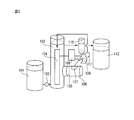
- FIG. 3 shows an example of the configuration of the microbial fuel cell.
- the present invention relates to a method for recovering pulp fibers from a used absorbent article containing pulp fibers and a superabsorbent polymer.
- the absorbent article is not particularly limited as long as it contains pulp fibers and a superabsorbent polymer, and examples thereof include disposable diapers, incontinence pads, urine-absorbing pads, sanitary napkins, panty liners, and the like. Of these, incontinence pads and disposable diapers that are collected together in a facility or the like are preferable because they do not require separation and have a relatively large amount of pulp.
- pulp fiber recovered by the method of the present invention is referred to as “recycled pulp”.
- Superabsorbent polymer also called SAP (Superabsorbent Polymer)
- SAP Superabsorbent Polymer
- an acrylic acid-based superabsorbent polymer is preferable from the viewpoint that polyacrylic acid can be obtained by inactivation and an effect of lowering the pH can be expected, and deterioration due to alkali cellulose conversion of pulp fibers is prevented.
- An acrylic acid-based superabsorbent polymer has a carboxyl group -COONa substituted with sodium.
- -COONa is ionized into -COO - and Na + to dissociate Na + ions, resulting in a superabsorbent polymer.
- concentration of dissociated ions in the polymer increases, and the water outside the superabsorbent polymer penetrates into the superabsorbent polymer due to the difference in osmotic pressure inside and outside the superabsorbent polymer. As a result, the superabsorbent polymer swells and a large amount Will retain water.
- the method of the present invention includes a step of taking out a mixture of pulp fibers, a superabsorbent polymer and water from a used absorbent article (hereinafter, also simply referred to as “takeout step”).
- the method of removing the mixture of pulp fiber, superabsorbent polymer and water from the used absorbent article is not limited, but the used absorbent article is passed between a pair of rollers (by a roller press) to use the used absorbent article.
- a method of squeezing a mixture of pulp fiber, superabsorbent polymer and water from the outer package (nonwoven fabric, film, rubber, etc.) of the article is preferable.
- the method of the present invention comprises a step of applying a voltage to a mixture of pulp fibers, a superabsorbent polymer and water using a pair of electrodes to inactivate the superabsorbent polymer (hereinafter simply referred to as “voltage application step”).
- voltage application step a step of applying a voltage to a mixture of pulp fibers, a superabsorbent polymer and water using a pair of electrodes to inactivate the superabsorbent polymer.
- the method of applying the voltage is not limited. For example, if a mixture of pulp fiber, superabsorbent polymer and water is sandwiched between two horizontally arranged wire meshes, the voltage is applied between the two wire meshes. Good.
- the voltage to be applied is not limited as long as the superabsorbent polymer can be inactivated.
- the drainage discharged from the superabsorbent polymer by application of voltage passes through the wire mesh and falls under the wire mesh due to gravity.
- the drained liquid that has fallen under the wire mesh is collected in a waste liquid collecting container disposed under the wire mesh.
- the drainage liquid includes Na + ions released from the superabsorbent polymer, OH 2 ⁇ ions generated by ionization of water, urine-derived salts, excrement-derived organic substances, and the like.
- the voltage application step may be carried out by a batch type (batch type) or a flow type.
- a batch type batch type
- a flow type When implemented in a flow system, it can be implemented, for example, with an apparatus as shown in FIG.
- the method of the present invention applies a voltage to the inactivation of the superabsorbent polymer. Since the treatment is used, the pH does not change excessively, so that the pulp fiber is not deteriorated. Even if the pulp fiber is regenerated from the used diaper, the deterioration can be suppressed. Therefore, even if it is regenerated repeatedly, the deterioration of the quality can be minimized.
- the method of the present invention includes a step of separating pulp fibers from a mixture of pulp fibers, inactivated superabsorbent polymer and water (hereinafter, also simply referred to as “separation step”).
- the method for separating the pulp fiber from the mixture of the pulp fiber, the deactivated superabsorbent polymer and the water is not limited, but the separation step is preferably performed by suspending the pulp fiber in water to deactivate the pulp fiber. This is a step of separating the pulp fiber and the inactivated superabsorbent polymer by precipitating the conductive polymer.
- Inactivated superabsorbent polymer has higher specific gravity than pulp fiber, so when pulp fiber and inactivated superabsorbent polymer are put into water, it is separated by specific gravity difference, and lighter specific pulp fiber floats and inactivates. As the superabsorbent polymer settles, the suspended pulp fibers are scraped and collected.
- the method of the present invention includes a step of applying water to a used absorbent article (hereinafter simply referred to as “water applying step”) before the step of taking out a mixture of pulp fiber, superabsorbent polymer and water from the used absorbent article. May also be included.
- water applying step By giving water to the used absorbent article and sufficiently swelling the superabsorbent polymer, it becomes easy to take out the pulp fiber and the superabsorbent polymer from the used absorbent article, and the pulp is applied in the voltage application step.
- the contact resistance between the fiber, the superabsorbent polymer and water mixture and the electrode can be reduced, and the presence of water facilitates the flow of electricity into the pulp fiber, superabsorbent polymer and water mixture. This increases the efficiency of the voltage application process.
- Absorbent articles such as paper diapers are usually sandwiched between upper and lower coating layers (outer packaging) and an absorbent body made of pulp fibers and a superabsorbent polymer.
- Cheap In addition, by adding water, it becomes easy to take out the pulp fiber and the superabsorbent polymer from the used absorbent article. As a result, the amount of the pulp fiber to be collected is reduced, and therefore it can be efficiently collected.
- the amount of water to be applied is not limited as long as the superabsorbent polymer can be inactivated in the voltage application step, but the weight of the used absorbent article after the application of water is 90% of the maximum absorption weight of the used absorbent article. % Or more is preferable.
- the absorbent article is swollen to 90% or more of the maximum absorbent weight of the used absorbent article, the used absorbent article swells in a pan, so that it is easy to extrude an absorber composed of pulp fibers and a superabsorbent polymer and can be efficiently taken out.
- the maximum absorption weight corresponds to the weight after the absorbent article is immersed in tap water in the following procedure.
- Measurement method of maximum absorption weight (1) As shown to Fig.2 (a), about the absorbent article 61, the notch 65 is made into the elastic material 63 and 64 which can form a pocket so that it may not reach the absorber 62, and is made flat. (2) Immerse it in a water bath filled with sufficient tap water with the absorption surface down and leave it for 30 minutes. (3) After standing, place the absorption surface 67 on the net 66 and let the weight after draining for 20 minutes be the maximum absorption weight (see FIG. 2B).
- the method to provide water is not limited, The method of immersing a used absorbent article in water is preferable. According to the method of immersing in water, the superabsorbent polymer can be swollen and washed at the same time. When the used absorbent article contains impurities such as stool, impurities such as stool can also be removed.
- the temperature of water is not limited, Preferably it is 55 degreeC or more and less than 100 degreeC, More preferably, it is 60 degreeC or more and less than 100 degreeC, More preferably, it is 70 degreeC or more and less than 100 degreeC.
- the immersion time is not limited as long as the superabsorbent polymer can be inactivated in the voltage application step, but is preferably 1 minute or more, more preferably 5 minutes or more, and further preferably 10 minutes or more.
- the method of the present invention further includes a step of recovering effluent containing components derived from urine discharged from the superabsorbent polymer in the step of inactivating the superabsorbent polymer (hereinafter also simply referred to as “drainage recovery step”). .).
- the drainage liquid includes Na + ions released from the superabsorbent polymer, OH 2 ⁇ ions generated by ionization of water, urine-derived salts, excrement-derived organic substances, and the like. This step can be performed simultaneously with the inactivation step.
- the recovered effluent can be sent to a nutrient recovery step and / or a microbial fuel cell step, which will be described later, for effective use.
- the recycling rate of used absorbent articles is increased by collecting and reusing other than pulp fibers.
- the method of the present invention further includes a step of filtering or dewatering the residue after taking out the mixture of pulp fiber, superabsorbent polymer and water from the used absorbent article, and recovering the effluent containing components derived from urine ( Hereinafter, it may be simply referred to as “residue filtration / dehydration step”.
- the effluent recovered by filtration or dehydration of the residue includes urine-derived salts, excrement-derived organic matter, and the like.
- the recovered effluent can be sent to a nutrient salt recovery step and / or a microbial fuel cell step described later for effective use.
- the recycling rate of used absorbent articles is increased by collecting and reusing other than pulp fibers.
- the method of the present invention further dehydrates the mixture of pulp fiber, deactivated superabsorbent polymer and water after the step of inactivating the superabsorbent polymer and before the step of separating the pulp fiber,
- a step of collecting the drainage liquid containing the derived component (hereinafter also simply referred to as “mixture dehydration step”) may be included.
- the drainage collected by dehydration of the mixture includes urine-derived salts, excrement-derived organic matter, and the like.
- the recovered effluent can be sent to a nutrient salt recovery step and / or a microbial fuel cell step described later for effective use.
- the recycling rate of used absorbent articles is increased by collecting and reusing other than pulp fibers.
- the method of dehydrating the residue after taking out the mixture of pulp fiber, superabsorbent polymer and water from the used absorbent article or the mixture of superabsorbent polymer and water deactivated with pulp fiber is not particularly limited. Examples thereof include a press, a belt press, and a screw press.
- the method of the present invention may further include a nutrient recovery step of recovering urine-derived nutrient salts from the effluent containing the urine-derived components.
- the nutrient salt refers to a salt containing nitrogen, phosphorus or potassium that can be used as a fertilizer, and more specifically, an ammonium salt, a phosphate, and the like.
- the recovered nutrient can be used as a fertilizer.
- the method for recovering nutrient salts is not limited, but a method for recovering nutrient salts containing phosphorus by crystallizing phosphorus in the drainage as hydroxyapatite (hereinafter also referred to as “HAP method”), A method of recovering nutrient salts containing phosphorus and / or nitrogen by crystallizing phosphorus and / or nitrogen in the effluent as magnesium ammonium phosphate (hereinafter also referred to as “MAP method”) can be exemplified. .
- HAP method a method for recovering nutrient salts containing phosphorus by crystallizing phosphorus in the drainage as hydroxyapatite
- MAP method magnesium ammonium phosphate
- the HAP method is a method utilizing the crystallization phenomenon of hydroxyapatite (Ca 10 (OH) 2 (PO 4 ) 6 ) generated by the reaction of PO 4 3 ⁇ , Ca 2+ and OH ⁇ in the drainage.
- the reaction formula is as follows. 10Ca 2+ + 2OH - + 6PO 4 3- ⁇ Ca 10 (OH) 2 (PO 4) 6 (1)
- Ca 2+ and OH ⁇ are added to an aqueous solution containing phosphorus and brought into contact with the seed crystal in a supersaturated state (metastable region), so that hydroxyapatite is crystallized on the surface of the seed crystal and phosphorus in the effluent is discharged. Is to be recovered.
- the seed crystal phosphate rock, bone charcoal, calcium silicate hydrate, or the like can be used.
- the Ca 2+ concentration is 5 mmol / liter or more
- the pH is 8 or more
- more preferably the Ca 2+ concentration is 10 mmol / liter or more
- the pH is 9 or more.
- the MAP method is a method utilizing the crystallization phenomenon of magnesium ammonium phosphate (MgNH 4 PO 4 .6H 2 O) generated by the reaction of PO 4 3 ⁇ , NH 4 + and Mg 2+ in the drainage.
- the reaction formula is as follows. Mg 2+ + NH 4 + + PO 4 3- + 6H 2 O ⁇ MgNH 4 PO 4 ⁇ 6H 2 O (2)
- the Mg 2+ concentration is preferably 30 to 60 mmol / liter, and the pH is preferably 6.8 to 7.7.
- the method of the present invention may further include a microbial fuel cell step in which waste liquid containing urine-derived components is introduced into the microbial fuel cell to reduce the TOC concentration in the wastewater and to collect power generated by power generation.
- the microbial fuel cell refers to a device that uses microorganisms to convert organic substances as fuel into electric energy.
- a microbial fuel cell immerses the negative electrode and the positive electrode in a solution of an organic substance as a fuel, and collects electrons generated when the organic substance is oxidatively decomposed by microorganisms in the negative electrode, and the electrons move to the positive electrode via an external circuit. In the positive electrode, electrons are consumed by the reduction reaction of the oxidizing agent.
- the effluent is introduced into the microbial fuel cell to reduce the TOC concentration in the wastewater and to recover the power generated by power generation.
- microorganisms oxidize and decompose organic matter such as filth and fine pulp contained in the effluent, thereby reducing the TOC concentration in the wastewater and generating power.
- the microorganism used in the microbial fuel cell is not particularly limited as long as it can contribute to oxidative decomposition of organic substances and generation of electric energy, but mainly hydrogen-producing microorganisms are used.
- a facultative anaerobic bacterium is preferably used.
- FIG. 1 An example of the configuration of the microbial fuel cell is shown in FIG.
- 101 is a drainage tank
- 102 is a pump
- 103 is a negative electrode reaction tank
- 104 is a negative electrode
- 105 is a proton exchange membrane
- 106 is a positive electrode tank
- 107 is a positive electrode
- 108 is a tester
- 109 is a personal computer
- 110 is sludge sedimentation.
- a tank, 111 is a pump
- 112 is a purified water tank.
- the pH of the waste water from the microbial fuel cell process is preferably less than 8.0. If the pH of the wastewater from the microbial fuel cell process is too high, the power generation efficiency of the microbial fuel cell process is reduced.
- the TOC concentration of the wastewater from the microbial fuel cell process is preferably 2000 mg / L or less. If the TOC concentration of the wastewater from the microbial fuel cell process is 2000 mg / L or less, the purification process can be easily performed in a general septic tank in the next process. Moreover, when draining directly from a microbial fuel cell process, it is preferable that the TOC density
- the method of the present invention may further include a sterilization step of sterilizing the mixture of the pulp fiber, the inactivated superabsorbent polymer and water before the step of separating the pulp fiber.
- a sterilization step of sterilizing the mixture of the pulp fiber, the inactivated superabsorbent polymer and water before the step of separating the pulp fiber.
- the voltage application step in the voltage application step, the cell membrane of bacteria is destroyed by the application of voltage, and the bacteria are killed. Therefore, the voltage application step also has a sterilization function and doubles as a sterilization step. Therefore, it is not always necessary to provide a sterilization process in addition to the voltage application process. However, when a pulp fiber with higher safety is desired, the sterilization process may be provided under conditions that do not deteriorate the performance of the pulp fiber. .
- the sterilization method is preferably not a chemical treatment but a sterilization method in which residues such as heat treatment, electricity, ultraviolet rays and ozone are not generated.
- the viable cell count of the mixture of the pulp fiber, the inactivated superabsorbent polymer and water after the sterilization step is preferably 1 ⁇ 10 3 or less. If the number of viable bacteria is 1 ⁇ 10 3 or less, highly safe pulp fibers can be obtained.
- the method of the present invention further comprises a step of converting the residue after the mixture of pulp fiber, superabsorbent polymer and water from the used absorbent article or the inactivated superabsorbent polymer into a solid fuel (hereinafter simply referred to as “ It may also be referred to as a “solid fuel conversion step”.
- a solid fuel hereinafter simply referred to as “ It may also be referred to as a “solid fuel conversion step”.
- Non-woven fabric, plastic film, rubber, etc. are contained in the residue after taking out the mixture of pulp fiber, super absorbent polymer and water from the used absorbent article.
- the plastic material collected from the used absorbent article can be recycled as a solid fuel.
- the recycling rate of used absorbent articles is increased by collecting and reusing other than pulp fibers.
- Solid fuel conversion can be performed by a so-called RPF conversion method.
- the method of the present invention may further include a step of washing the separated pulp fibers (hereinafter also simply referred to as “pulp fiber washing step”).
- the method for washing the separated pulp fibers is not limited, but for example, the separated pulp fibers can be put in a mesh bag and rinsed with water. Rinsing may be performed in a batch system, a semi-batch system, or a flow system. When performing by a batch type, it can rinse, for example using a washing machine.
- the washing conditions are not particularly limited as long as substances other than pulp fibers are sufficiently removed.
- the washing time is preferably 3 to 60 minutes, more preferably 5 to 50 minutes, and still more preferably. Is 10 to 40 minutes.
- the amount of water used is preferably 500 to 5000 parts by weight, more preferably 800 to 4000 parts by weight, and still more preferably 100 parts by weight (absolute dry weight) of pulp fibers. 1000 to 3000 parts by mass.
- the method of the present invention may further include a step of dewatering the washed pulp fiber (hereinafter referred to as “pulp fiber dehydration step”).
- the method for dewatering the washed pulp fibers is not limited.
- the washed pulp fibers contained in the mesh bag can be dehydrated with a dehydrator.
- the dehydration conditions are not particularly limited as long as the moisture content can be lowered to the target value.
- the dehydration time is preferably 1 to 10 minutes, and more preferably 2 to 8 minutes.
- the method of the present invention may further include a step of drying the dehydrated pulp fibers (hereinafter referred to as “pulp fiber drying step”).
- the method for drying the dehydrated pulp fibers is not limited, and can be performed using a dryer such as a hot air dryer.
- the drying conditions are not particularly limited as long as the pulp fibers are sufficiently dried.
- the drying temperature is preferably 100 to 200 ° C., more preferably 110 to 180 ° C., and still more preferably 120 to 160 ° C.
- the drying time is preferably 10 to 120 minutes, more preferably 20 to 80 minutes, and further preferably 30 to 60 minutes.
- the moisture content of the pulp fiber after drying is preferably 5 to 13%, more preferably 6 to 12%, and further preferably 7 to 11%. If the moisture content is too low, hydrogen bonds may become strong and become too hard. Conversely, if the moisture content is too high, mold or the like may occur.
- FIG. 1 is a schematic diagram of an example of an apparatus 1 for carrying out the present invention.
- the apparatus 1 includes an extraction process 2, a voltage application process 3, and a separation process 4.
- the take-out process 2 has a conveyor 21 and a pair of rollers 23.
- the used absorbent article 11 is placed on the conveyor 21 and conveyed, and is sent to a pair of rollers 23. Therefore, the envelope 12 constituting the used absorbent article passes between the pair of rollers 23, but the mixture of pulp fiber, superabsorbent polymer and water is squeezed out of the envelope by the pair of rollers 23. It collects in front of the roller 23.
- the mixture 13 of pulp fibers, superabsorbent polymer, and water collected before the pair of rollers 23 is periodically scraped and sent to the voltage application step 3.
- the voltage application step 3 includes a first electrode 31 and a second electrode 32.
- the second electrode 32 is installed on top of the first electrode 31.
- the first electrode 31 is a belt conveyor made of a wire mesh.
- the second electrode 32 is also belt-shaped and need only be made of a conductive material, and need not be a wire mesh, but may be a wire mesh.
- a predetermined voltage is applied between the first electrode 31 and the second electrode 32 (not shown). Either the first electrode 31 or the second electrode 32 may be a positive electrode.
- the lower half of the belt constituting the second electrode 32 moves at the same speed (from left to right in the drawing) as the upper half of the belt conveyor constituting the first electrode 31.
- the gap between the first electrode 31 and the second electrode 32 can be adjusted, and preferably the gap is narrowed as it moves from left to right.
- the mixture 13 of pulp fiber, superabsorbent polymer and water taken out from the used absorbent article in the take-out step is placed on the first electrode 31 and conveyed, and the first electrode 31 and the second electrode 32, and a voltage is applied.
- the drainage liquid 14 containing Na + ions, OH ⁇ ions, urine-derived salts, excrement-derived organic substances, and the like is discharged.
- the discharged waste liquid 14 passes through the wire mesh constituting the first electrode 31, falls into the drainage collection container 33 installed under the first electrode 31, and is stored.
- From the outlet of the voltage application step 3 the pulp fiber, the deactivated superabsorbent polymer and water mixture 15 are discharged and sent to the separation step 4.
- the separation process 4 has a separation tank 41.
- the separation tank 41 is charged with a mixture 15 of pulp fibers, inactivated superabsorbent polymer and water sent from the voltage application step 3.
- the deactivated superabsorbent polymer has a higher specific gravity than the pulp fiber. And the pulp fibers float. Skim off floating pulp fibers.
- the method of the present invention can be suitably used for recycling used absorbent articles such as disposable diapers.
Landscapes
- Life Sciences & Earth Sciences (AREA)
- Chemical & Material Sciences (AREA)
- Engineering & Computer Science (AREA)
- Health & Medical Sciences (AREA)
- Environmental & Geological Engineering (AREA)
- Microbiology (AREA)
- Veterinary Medicine (AREA)
- Epidemiology (AREA)
- Animal Behavior & Ethology (AREA)
- General Health & Medical Sciences (AREA)
- Public Health (AREA)
- Organic Chemistry (AREA)
- Water Supply & Treatment (AREA)
- Hydrology & Water Resources (AREA)
- General Chemical & Material Sciences (AREA)
- Chemical Kinetics & Catalysis (AREA)
- Sustainable Energy (AREA)
- Electrochemistry (AREA)
- Sustainable Development (AREA)
- Manufacturing & Machinery (AREA)
- Biochemistry (AREA)
- Biodiversity & Conservation Biology (AREA)
- Mechanical Engineering (AREA)
- Hematology (AREA)
- Materials Engineering (AREA)
- Dispersion Chemistry (AREA)
- Processing Of Solid Wastes (AREA)
- Separation, Recovery Or Treatment Of Waste Materials Containing Plastics (AREA)
- Removal Of Specific Substances (AREA)
- Purification Treatments By Anaerobic Or Anaerobic And Aerobic Bacteria Or Animals (AREA)
- Solid Fuels And Fuel-Associated Substances (AREA)
- Apparatus For Disinfection Or Sterilisation (AREA)
- Paper (AREA)
Abstract
Description
本発明は、パルプ繊維の性能劣化がなく、安全性の高いパルプ繊維を効率的に回収する方法を提供する。
本発明は、パルプ繊維および高吸水性ポリマーを含む使用済み吸収性物品からパルプ繊維を回収する方法であって、該方法が、
使用済み吸収性物品からパルプ繊維と高吸水性ポリマーと水の混合物を取り出す工程、
パルプ繊維と高吸水性ポリマーと水の混合物に、一対の電極を用いて電圧を印加して、高吸水性ポリマーを不活化する工程、および
パルプ繊維と不活化した高吸水性ポリマーと水の混合物からパルプ繊維を分離する工程
を含むことを特徴とする。
[1]パルプ繊維および高吸水性ポリマーを含む使用済み吸収性物品からパルプ繊維を回収する方法であって、該方法が、
使用済み吸収性物品からパルプ繊維と高吸水性ポリマーと水の混合物を取り出す工程、
パルプ繊維と高吸水性ポリマーと水の混合物に、一対の電極を用いて電圧を印加して、高吸水性ポリマーを不活化する工程、および
パルプ繊維と不活化した高吸水性ポリマーと水の混合物からパルプ繊維を分離する工程
を含む、方法。
[2]使用済み吸収性物品からパルプ繊維と高吸水性ポリマーと水の混合物を取り出す工程の前に、使用済み吸収性物品に水を付与する工程をさらに含む[1]に記載の方法。
[3]高吸水性ポリマーを不活化する工程において高吸水性ポリマーから排出される尿由来の成分を含む排液を回収する工程をさらに含む[1]または[2]に記載の方法。
[4]使用済み吸収性物品からパルプ繊維と高吸水性ポリマーと水の混合物を取り出した後の残渣を濾過または脱水し、尿由来の成分を含む排液を回収する工程をさらに含む[1]~[3]のいずれかに記載の方法。
[5]高吸水性ポリマーを不活化する工程の後、パルプ繊維を分離する工程の前に、パルプ繊維と不活化した高吸水性ポリマーと水の混合物をさらに脱水し、尿由来の成分を含む排液を回収する工程をさらに含む[1]~[4]のいずれかに記載の方法。
[6]尿由来の成分を含む排液から尿由来の栄養塩を回収する栄養塩回収工程をさらに含む[3]~[5]のいずれかに記載の方法。
[7]尿由来の成分を含む排液を微生物燃料電池に投入して排水中のTOC濃度を低減するとともに発電による電力を回収する微生物燃料電池工程をさらに含む[3]~[6]のいずれかに記載の方法。
[8]パルプ繊維を分離する工程の前に、パルプ繊維と不活化した高吸水性ポリマーと水の混合物を殺菌する殺菌工程をさらに含む[1]~[7]のいずれかに記載の方法。
[9]殺菌工程後の混合物の生菌数が1×10³以下である、[8]に記載の方法。
[10]高吸水性ポリマーがアクリル酸由来の高吸水性ポリマーである、[1]~[9]のいずれかに記載の方法。
[11]使用済み吸収性物品に水を付与する工程が、使用済み吸収性物品を50℃以上100℃未満の温水に浸漬する工程である、[2]~[10]のいずれかに記載の方法。
[12]使用済み吸収性物品に水を付与する工程において、水を付与した後の使用済み吸収性物品の重量が使用済み吸収性物品の最大吸収重量の90%以上である、[2]~[11]のいずれかに記載の方法。
[13]使用済み吸収性物品からパルプ繊維と高吸水性ポリマーと水の混合物を取り出す工程が、使用済み吸収性物品を一対のローラーの間に通して、使用済み吸収性物品の外包体からパルプ繊維と高吸水性ポリマーと水の混合物を搾り出す工程である、[3]~[12]のいずれかに記載の方法。
[14]パルプ繊維を分離する工程が、水の中で、パルプ繊維を浮遊させ、不活化した高吸水性ポリマーを沈降させることによって、パルプ繊維と不活化した高吸水性ポリマーを分離する工程である、[1]~[13]のいずれかに記載の方法。
[15]使用済み吸収性物品からパルプ繊維と高吸水性ポリマーと水の混合物を取り出した後の残渣または不活化した高吸水性ポリマーを固体燃料化する工程をさらに含む[1]~[14]のいずれかに記載の方法。
この明細書においては、本発明の方法によって回収されたパルプ繊維を「リサイクルパルプ」と称する。
使用済みおむつからパルプ繊維を再生しても、劣化を抑制できるため、繰り返し再生しても、品質の低下を最小限に留めることが可能となる。
パルプ繊維と不活化した高吸水性ポリマーと水の混合物からパルプ繊維を分離する方法は、限定されないが、分離工程は、好ましくは、水の中で、パルプ繊維を浮遊させ、不活化した高吸水性ポリマーを沈降させることによって、パルプ繊維と不活化した高吸水性ポリマーを分離する工程である。不活化した高吸水性ポリマーはパルプ繊維に比べ比重が大きいので、パルプ繊維と不活化した高吸水性ポリマーを水に入れると、比重差で分かれ、比重の軽いパルプ繊維は浮遊し、不活化した高吸水性ポリマーは沈降するので、浮遊するパルプ繊維をすくい取って回収する。
[最大吸収重量の測定方法]
(1)図2(a)に示すように、吸収性物品61について、吸収体62に達しないように、ポケットを形成しうる伸縮材料63,64に切り込み65を入れ、平らにする。
(2)十分な水道水で満たされた水浴に、吸収面を下にして浸漬し、30分間放置する。
(3)放置後、網66の上に、吸収面67を下にして置き、20分水切りした後の重量を最大吸収重量とする(図2(b)参照)。
水の温度は、限定されないが、好ましくは55℃以上100℃未満であり、より好ましくは60℃以上100℃未満であり、さらに好ましくは70℃以上100℃未満である。55℃以上の温水を使用することにより、高吸水性ポリマーへの吸水効率を上げ、また、一部の菌を一次殺菌し、さらに、吸収性物品に使用されているホットメルト接着剤を軟化させ、吸収体を押し出しやすくするので、パルプ繊維の回収効率が上がる。
浸漬時間は、電圧印加工程において高吸水性ポリマーの不活化ができる限り限定されないが、好ましくは1分以上であり、より好ましくは5分以上であり、さらに好ましくは10分以上である。
栄養塩を回収する方法は、限定するものではないが、排液中のリンをヒドロキシアパタイトとして晶析することによりリンを含む栄養塩を回収する方法(以下、「HAP法」ともいう。)、排液中のリンおよび/または窒素をリン酸マグネシウムアンモニウムとして晶析することによりリンおよび/または窒素を含む栄養塩を回収する方法(以下、「MAP法」ともいう。)を例示することができる。
10Ca2++2OH-+6PO4 3- → Ca10(OH)2(PO4)6 (1)
HAP法は、リンを含む水溶液にCa2+およびOH-を添加し、過飽和状態(準安定域)で種晶と接触させることで、種晶表面にヒドロキシアパタイトを晶析させ排液中のリンを回収するものである。種晶には、リン鉱石、骨炭、珪酸カルシウム水和物などを用いることができる。
この方法においてCa2+濃度は5ミリモル/リットル以上、pHは8以上、より好ましくはCa2+濃度は10ミリモル/リットル以上、pHは9以上が必要である。
Mg2++NH4 ++PO4 3-+6H2O → MgNH4PO4・6H2O (2)
この方法において、Mg2+濃度は30~60ミリモル/リットルが好ましく、pHは6.8~7.7が好ましい。
ここで、微生物燃料電池とは、微生物を利用して、燃料としての有機物を電気エネルギーに変換する装置をいう。微生物燃料電池は、燃料である有機物の溶液に負極と正極を浸し、負極では有機物が微生物により酸化分解されるときに発生する電子を回収し、その電子は外部回路を経由して正極に移動し、正極では電子が酸化剤の還元反応により消費される。負極で起こる化学反応と正極で起こる化学反応の酸化還元電位の差により電子が流れ、両極の電位差と外部回路を流れる電流の積に相当するエネルギーが外部回路において得られる。
微生物燃料電池工程では、排液を微生物燃料電池に投入して排水中のTOC濃度を低減するとともに発電による電力を回収する。微生物燃料電池内では、微生物が排液に含まれる汚物、微細パルプ等の有機物を酸化分解することにより、排水中のTOC濃度が低減され、かつ発電が行われる。
微生物燃料電池工程からの排水のTOC濃度は2000mg/L以下であることが好ましい。微生物燃料電池工程からの排水のTOC濃度が2000mg/L以下であれば、次工程の一般的な浄化槽等で簡単に浄化処理が可能である。また、微生物燃料電池工程から直接排水する場合は、排水のTOC濃度が30mg/L以下であることが好ましい。
本発明の方法によれば、電圧印加工程において、電圧の印加により細菌の細胞膜が破壊され、細菌が死滅するので、電圧印加工程は殺菌機能も有し、殺菌工程も兼ねる。したがって、必ずしも電圧印加工程の他に殺菌工程を設ける必要はないが、安全性のより高いパルプ繊維を求める場合には、パルプ繊維の性能を劣化させない範囲の条件で、殺菌工程を設けてもよい。
殺菌の方法は、薬品処理ではなく、熱処理、電気、紫外線、オゾン等の残留物が出ない殺菌方法が好ましい。
分離したパルプ繊維を洗浄する方法は、限定するものではないが、たとえば、分離したパルプ繊維をメッシュ袋に入れ、水ですすぎ洗いをすることにより行うことができる。すすぎ洗いは、回分式で行ってもよいし、半回分式で行ってもよいし、流通式で行ってもよい。回分式で行う場合は、たとえば洗濯機を用いてすすぎ洗いを行うことができる。
洗浄の条件は、パルプ繊維以外の物質が十分に除去される限り、特に限定されないが、たとえば、洗浄時間は、好ましくは3~60分であり、より好ましくは5~50分であり、さらに好ましくは10~40分である。回分式で行う場合、使用する水の量は、パルプ繊維100質量部(絶乾質量)に対し、好ましくは500~5000質量部であり、より好ましくは800~4000質量部であり、さらに好ましくは1000~3000質量部である。
洗浄したパルプ繊維を脱水する方法は、限定するものではないが、たとえば、メッシュ袋に入った洗浄したパルプ繊維を、脱水機で脱水することにより行うことができる。
脱水の条件は、水分率を目標とする値まで下げることができる限り、特に限定されないが、たとえば、脱水時間は、好ましくは1~10分であり、より好ましくは2~8分である。
脱水したパルプ繊維を乾燥する方法は、限定するものではないが、たとえば、熱風乾燥機等の乾燥機を用いて行うことができる。
乾燥の条件は、パルプ繊維が十分に乾燥される限り、特に限定されないが、たとえば、乾燥温度は、好ましくは100~200℃であり、より好ましくは110~180℃であり、さらに好ましくは120~160℃である。乾燥時間は、好ましくは10~120分であり、より好ましくは20~80分であり、さらに好ましくは30~60分である。
乾燥後のパルプ繊維の水分率は、好ましくは5~13%であり、より好ましくは6~12%であり、さらに好ましくは7~11%である。水分率が低すぎると、水素結合が強くなり、硬くなりすぎる場合があり、逆に、水分率が多すぎるとカビ等が発生する場合がある。
(1)測定対象サンプルを入れる容器(ふたの無い容器)の質量A(g)を測定する。
(2)測定対象サンプル約5gを準備し、(1)で質量を測定した容器内に入れ、サンプルの入った容器の質量B(g)を測定する。
(3)サンプルの入った容器を、105℃±3℃の温度とされたオーブン内に2時間置く。
(4)サンプルの入った容器をオーブンから取り出し、デシケータ(乾燥剤:着色シリカゲルの入ったもの)内に30分間置く。
(5)サンプルの入った容器をデシケータから取り出し、質量C(g)を測定する。
(6)水分率(%)を、次式により算出する。
水分率(%)=(B-C)/(C-A)×100
図1は、本発明を実施するための装置1の一例の模式図である。
装置1は、取り出し工程2、電圧印加工程3および分離工程4からなる。
2 取り出し工程
3 電圧印加工程
4 糖化工程
11 使用済み吸収性物品
12 外包体
13 パルプ繊維と高吸水性ポリマーと水の混合物
14 排液
15 パルプ繊維と不活化した高吸水性ポリマーと水の混合物
21 コンベアー
23 一対のローラー
31 第一の電極
32 第二の電極
33 排液回収用容器
41 分離槽
101 排液槽
102 ポンプ
103 負極反応槽
104 負極
105 プロトン交換膜
106 正極槽
107 正極
108 テスター
109 パソコン
110 汚泥沈降槽
111 ポンプ
112 浄化水槽
Claims (15)
- パルプ繊維および高吸水性ポリマーを含む使用済み吸収性物品からパルプ繊維を回収する方法であって、該方法が、
使用済み吸収性物品からパルプ繊維と高吸水性ポリマーと水の混合物を取り出す工程、
パルプ繊維と高吸水性ポリマーと水の混合物に、一対の電極を用いて電圧を印加して、高吸水性ポリマーを不活化する工程、および
パルプ繊維と不活化した高吸水性ポリマーと水の混合物からパルプ繊維を分離する工程
を含む、方法。 - 使用済み吸収性物品からパルプ繊維と高吸水性ポリマーと水の混合物を取り出す工程の前に、使用済み吸収性物品に水を付与する工程をさらに含む請求項1に記載の方法。
- 高吸水性ポリマーを不活化する工程において高吸水性ポリマーから排出される尿由来の成分を含む排液を回収する工程をさらに含む請求項1または2に記載の方法。
- 使用済み吸収性物品からパルプ繊維と高吸水性ポリマーと水の混合物を取り出した後の残渣を濾過または脱水し、尿由来の成分を含む排液を回収する工程をさらに含む請求項1~3のいずれか1項に記載の方法。
- 高吸水性ポリマーを不活化する工程の後、パルプ繊維を分離する工程の前に、パルプ繊維と不活化した高吸水性ポリマーと水の混合物をさらに脱水し、尿由来の成分を含む排液を回収する工程をさらに含む請求項1~4のいずれか1項に記載の方法。
- 尿由来の成分を含む排液から尿由来の栄養塩を回収する栄養塩回収工程をさらに含む請求項3~5のいずれか1項に記載の方法。
- 尿由来の成分を含む排液を微生物燃料電池に投入して排水中のTOC濃度を低減するとともに発電による電力を回収する微生物燃料電池工程をさらに含む請求項3~6のいずれか1項に記載の方法。
- パルプ繊維を分離する工程の前に、パルプ繊維と不活化した高吸水性ポリマーと水の混合物を殺菌する殺菌工程をさらに含む請求項1~7のいずれか1項に記載の方法。
- 殺菌工程後の混合物の生菌数が1×10³以下である、請求項8に記載の方法。
- 高吸水性ポリマーがアクリル酸由来の高吸水性ポリマーである、請求項1~9のいずれか1項に記載の方法。
- 使用済み吸収性物品に水を付与する工程が、使用済み吸収性物品を50℃以上100℃未満の温水に浸漬する工程である、請求項2~10のいずれか1項に記載の方法。
- 使用済み吸収性物品に水を付与する工程において、水を付与した後の使用済み吸収性物品の重量が使用済み吸収性物品の最大吸収重量の90%以上である、請求項2~11のいずれか1項に記載の方法。
- 使用済み吸収性物品からパルプ繊維と高吸水性ポリマーと水の混合物を取り出す工程が、使用済み吸収性物品を一対のローラーの間に通して、使用済み吸収性物品の外包体からパルプ繊維と高吸水性ポリマーと水の混合物を搾り出す工程である、請求項3~12のいずれか1項に記載の方法。
- パルプ繊維を分離する工程が、水の中で、パルプ繊維を浮遊させ、不活化した高吸水性ポリマーを沈降させることによって、パルプ繊維と不活化した高吸水性ポリマーを分離する工程である、請求項1~13のいずれか1項に記載の方法。
- 使用済み吸収性物品からパルプ繊維と高吸水性ポリマーと水の混合物を取り出した後の残渣または不活化した高吸水性ポリマーを固体燃料化する工程をさらに含む請求項1~14のいずれか1項に記載の方法。
Priority Applications (4)
| Application Number | Priority Date | Filing Date | Title |
|---|---|---|---|
| US16/092,562 US20190118233A1 (en) | 2016-04-11 | 2017-01-12 | Method for recovering pulp fibers from used absorbent articles |
| CN201780022047.XA CN108883446B (zh) | 2016-04-11 | 2017-01-12 | 从已使用吸收性物品回收浆粕纤维的方法 |
| AU2017250830A AU2017250830A1 (en) | 2016-04-11 | 2017-01-12 | Method for recovering pulp fibers from used absorbent articles |
| EP17782071.9A EP3417954B1 (en) | 2016-04-11 | 2017-01-12 | Method for recovering pulp fibers from used absorbent articles |
Applications Claiming Priority (2)
| Application Number | Priority Date | Filing Date | Title |
|---|---|---|---|
| JP2016079179A JP6505045B2 (ja) | 2016-04-11 | 2016-04-11 | 使用済み吸収性物品からパルプ繊維を回収する方法 |
| JP2016-079179 | 2016-04-11 |
Publications (1)
| Publication Number | Publication Date |
|---|---|
| WO2017179252A1 true WO2017179252A1 (ja) | 2017-10-19 |
Family
ID=60041647
Family Applications (1)
| Application Number | Title | Priority Date | Filing Date |
|---|---|---|---|
| PCT/JP2017/000862 Ceased WO2017179252A1 (ja) | 2016-04-11 | 2017-01-12 | 使用済み吸収性物品からパルプ繊維を回収する方法 |
Country Status (6)
| Country | Link |
|---|---|
| US (1) | US20190118233A1 (ja) |
| EP (1) | EP3417954B1 (ja) |
| JP (1) | JP6505045B2 (ja) |
| CN (1) | CN108883446B (ja) |
| AU (1) | AU2017250830A1 (ja) |
| WO (1) | WO2017179252A1 (ja) |
Cited By (2)
| Publication number | Priority date | Publication date | Assignee | Title |
|---|---|---|---|---|
| WO2019087489A1 (ja) * | 2017-11-01 | 2019-05-09 | ユニ・チャーム株式会社 | 使用済み吸収性物品からパルプ繊維を回収する方法及びシステム |
| WO2019123579A1 (ja) * | 2017-12-20 | 2019-06-27 | ユニ・チャーム株式会社 | 糖化用パルプ繊維の製造方法 |
Families Citing this family (5)
| Publication number | Priority date | Publication date | Assignee | Title |
|---|---|---|---|---|
| US10458047B2 (en) * | 2018-01-22 | 2019-10-29 | Novetex Textiles Limited | System and method for recycling fibers from textiles waste |
| CN111249490A (zh) * | 2020-02-18 | 2020-06-09 | 青岛大学附属医院 | 一种手术室护理器械消毒储存装置 |
| GB2615837B (en) * | 2022-03-15 | 2024-07-24 | Mdf Recovery Ltd | Method and apparatus for recovering fibres |
| CN114716055B (zh) * | 2022-03-22 | 2023-12-05 | 四川发展环境科学技术研究院有限公司 | 一种造纸工业污水处理设备 |
| WO2025177881A1 (ja) * | 2024-02-19 | 2025-08-28 | 住友精化株式会社 | 吸水性樹脂とパルプ繊維の分離方法、吸水性樹脂とパルプ繊維の分離装置、及び再生吸水性樹脂の製造方法 |
Citations (4)
| Publication number | Priority date | Publication date | Assignee | Title |
|---|---|---|---|---|
| JP2010084031A (ja) * | 2008-09-30 | 2010-04-15 | Samuzu:Kk | 使用済み紙オムツの処理方法 |
| JP2013197047A (ja) * | 2012-03-22 | 2013-09-30 | Uni Charm Corp | 生物燃料電池 |
| JP2015134845A (ja) * | 2014-01-16 | 2015-07-27 | 特定非営利活動法人広島循環型社会推進機構 | 使用済み高吸水性ポリマーの脱水脱塩方法及びその装置 |
| JP2015182246A (ja) * | 2014-03-20 | 2015-10-22 | ユニ・チャーム株式会社 | 使用済み紙おむつ等から尿由来の栄養塩を回収する方法 |
Family Cites Families (4)
| Publication number | Priority date | Publication date | Assignee | Title |
|---|---|---|---|---|
| JP3895081B2 (ja) * | 1999-10-05 | 2007-03-22 | 日本アサヒ機工販売株式会社 | 紙おむつ処理装置 |
| JP2002273731A (ja) * | 2001-03-16 | 2002-09-25 | Univ Fukuoka | 使用済み紙おむつの再利用のための紙おむつ分断前処理方法 |
| JP6038001B2 (ja) * | 2013-10-30 | 2016-12-07 | ユニ・チャーム株式会社 | 使用済み衛生用品からリサイクルパルプを製造する方法 |
| JP6199243B2 (ja) * | 2014-06-12 | 2017-09-20 | ユニ・チャーム株式会社 | 使用済み衛生用品からリサイクルパルプを製造する方法 |
-
2016
- 2016-04-11 JP JP2016079179A patent/JP6505045B2/ja active Active
-
2017
- 2017-01-12 WO PCT/JP2017/000862 patent/WO2017179252A1/ja not_active Ceased
- 2017-01-12 CN CN201780022047.XA patent/CN108883446B/zh active Active
- 2017-01-12 AU AU2017250830A patent/AU2017250830A1/en not_active Abandoned
- 2017-01-12 EP EP17782071.9A patent/EP3417954B1/en not_active Not-in-force
- 2017-01-12 US US16/092,562 patent/US20190118233A1/en not_active Abandoned
Patent Citations (4)
| Publication number | Priority date | Publication date | Assignee | Title |
|---|---|---|---|---|
| JP2010084031A (ja) * | 2008-09-30 | 2010-04-15 | Samuzu:Kk | 使用済み紙オムツの処理方法 |
| JP2013197047A (ja) * | 2012-03-22 | 2013-09-30 | Uni Charm Corp | 生物燃料電池 |
| JP2015134845A (ja) * | 2014-01-16 | 2015-07-27 | 特定非営利活動法人広島循環型社会推進機構 | 使用済み高吸水性ポリマーの脱水脱塩方法及びその装置 |
| JP2015182246A (ja) * | 2014-03-20 | 2015-10-22 | ユニ・チャーム株式会社 | 使用済み紙おむつ等から尿由来の栄養塩を回収する方法 |
Non-Patent Citations (1)
| Title |
|---|
| See also references of EP3417954A4 * |
Cited By (8)
| Publication number | Priority date | Publication date | Assignee | Title |
|---|---|---|---|---|
| WO2019087489A1 (ja) * | 2017-11-01 | 2019-05-09 | ユニ・チャーム株式会社 | 使用済み吸収性物品からパルプ繊維を回収する方法及びシステム |
| JP2019085447A (ja) * | 2017-11-01 | 2019-06-06 | ユニ・チャーム株式会社 | 使用済み吸収性物品からパルプ繊維を回収する方法及びシステム |
| AU2018360436B2 (en) * | 2017-11-01 | 2020-12-17 | Unicharm Corporation | Method and system for recovering pulp fibers from used absorbent articles |
| TWI726234B (zh) * | 2017-11-01 | 2021-05-01 | 日商優你 嬌美股份有限公司 | 從使用完畢的吸收性物品回收紙漿纖維的方法及系統 |
| WO2019123579A1 (ja) * | 2017-12-20 | 2019-06-27 | ユニ・チャーム株式会社 | 糖化用パルプ繊維の製造方法 |
| JPWO2019123579A1 (ja) * | 2017-12-20 | 2020-04-02 | ユニ・チャーム株式会社 | 糖化用パルプ繊維の製造方法 |
| EP3712324A4 (en) * | 2017-12-20 | 2020-11-04 | Unicharm Corporation | SACCHARIFIER PAPER PULP FIBER PRODUCTION PROCESS |
| US11299851B2 (en) | 2017-12-20 | 2022-04-12 | Unicharm Corporation | Method for producing pulp fibers to be saccharified |
Also Published As
| Publication number | Publication date |
|---|---|
| EP3417954A1 (en) | 2018-12-26 |
| JP2017189728A (ja) | 2017-10-19 |
| CN108883446B (zh) | 2021-06-29 |
| CN108883446A (zh) | 2018-11-23 |
| US20190118233A1 (en) | 2019-04-25 |
| EP3417954A4 (en) | 2019-04-03 |
| JP6505045B2 (ja) | 2019-04-24 |
| AU2017250830A1 (en) | 2018-10-25 |
| EP3417954B1 (en) | 2020-12-23 |
Similar Documents
| Publication | Publication Date | Title |
|---|---|---|
| JP6505045B2 (ja) | 使用済み吸収性物品からパルプ繊維を回収する方法 | |
| CN107107132B (zh) | 使用过的吸收性物品的再生方法 | |
| JP6698506B2 (ja) | 使用済み吸収性物品のリサイクル方法 | |
| EP3738686B1 (en) | Method for recovering pulp fiber from used sanitary product | |
| CN102849918B (zh) | 一种强化剩余活性污泥脱水性能的处理方法 | |
| CN108430657B (zh) | 自使用过的卫生用品回收浆粕纤维的方法 | |
| CN104582866B (zh) | 处理使用过的吸收性物品的方法 | |
| JP2015086483A (ja) | 使用済み衛生用品からリサイクルパルプを製造する方法 | |
| CN110055793A (zh) | 再生浆粕 | |
| EA036860B1 (ru) | Способ регенерации целлюлозных волокон из использованного впитывающего изделия | |
| WO2016103985A1 (ja) | 使用済み吸収性物品のリサイクル方法 | |
| JP7055164B2 (ja) | 使用済み吸収性物品のリサイクル方法 | |
| KR102379007B1 (ko) | 유기산 및 배설물의 회수 방법, 및 리사이클 펄프 섬유의 제조 방법 | |
| KR102413313B1 (ko) | 유기산의 회수 방법, 및 리사이클 펄프의 제조 방법 | |
| JP6640004B2 (ja) | 使用済み吸収性物品からグルコースを生産する方法 | |
| JP2017031550A (ja) | 使用済み衛生用品からリサイクルパルプを製造する方法 | |
| JP2018165423A (ja) | リサイクルパルプを含む衛生用品 | |
| JP6827438B2 (ja) | 使用済み吸収性物品の処理装置及び処理方法 |
Legal Events
| Date | Code | Title | Description |
|---|---|---|---|
| WWE | Wipo information: entry into national phase |
Ref document number: 2017782071 Country of ref document: EP |
|
| ENP | Entry into the national phase |
Ref document number: 2017782071 Country of ref document: EP Effective date: 20180919 |
|
| NENP | Non-entry into the national phase |
Ref country code: DE |
|
| ENP | Entry into the national phase |
Ref document number: 2017250830 Country of ref document: AU Date of ref document: 20170112 Kind code of ref document: A |
|
| 121 | Ep: the epo has been informed by wipo that ep was designated in this application |
Ref document number: 17782071 Country of ref document: EP Kind code of ref document: A1 |