WO2017179673A1 - アリールフェニルケトン系殺菌剤の植物病害防除効果の増強方法及び植物病害の防除方法 - Google Patents
アリールフェニルケトン系殺菌剤の植物病害防除効果の増強方法及び植物病害の防除方法 Download PDFInfo
- Publication number
- WO2017179673A1 WO2017179673A1 PCT/JP2017/015187 JP2017015187W WO2017179673A1 WO 2017179673 A1 WO2017179673 A1 WO 2017179673A1 JP 2017015187 W JP2017015187 W JP 2017015187W WO 2017179673 A1 WO2017179673 A1 WO 2017179673A1
- Authority
- WO
- WIPO (PCT)
- Prior art keywords
- component
- surfactants
- caused
- polyoxyethylene
- trade name
- Prior art date
- Legal status (The legal status is an assumption and is not a legal conclusion. Google has not performed a legal analysis and makes no representation as to the accuracy of the status listed.)
- Ceased
Links
Classifications
-
- A—HUMAN NECESSITIES
- A01—AGRICULTURE; FORESTRY; ANIMAL HUSBANDRY; HUNTING; TRAPPING; FISHING
- A01N—PRESERVATION OF BODIES OF HUMANS OR ANIMALS OR PLANTS OR PARTS THEREOF; BIOCIDES, e.g. AS DISINFECTANTS, AS PESTICIDES OR AS HERBICIDES; PEST REPELLANTS OR ATTRACTANTS; PLANT GROWTH REGULATORS
- A01N25/00—Biocides, pest repellants or attractants, or plant growth regulators, characterised by their forms, or by their non-active ingredients or by their methods of application, e.g. seed treatment or sequential application; Substances for reducing the noxious effect of the active ingredients to organisms other than pests
- A01N25/30—Biocides, pest repellants or attractants, or plant growth regulators, characterised by their forms, or by their non-active ingredients or by their methods of application, e.g. seed treatment or sequential application; Substances for reducing the noxious effect of the active ingredients to organisms other than pests characterised by the surfactants
-
- A—HUMAN NECESSITIES
- A01—AGRICULTURE; FORESTRY; ANIMAL HUSBANDRY; HUNTING; TRAPPING; FISHING
- A01N—PRESERVATION OF BODIES OF HUMANS OR ANIMALS OR PLANTS OR PARTS THEREOF; BIOCIDES, e.g. AS DISINFECTANTS, AS PESTICIDES OR AS HERBICIDES; PEST REPELLANTS OR ATTRACTANTS; PLANT GROWTH REGULATORS
- A01N35/00—Biocides, pest repellants or attractants, or plant growth regulators containing organic compounds containing a carbon atom having two bonds to hetero atoms with at the most one bond to halogen, e.g. aldehyde radical
- A01N35/04—Biocides, pest repellants or attractants, or plant growth regulators containing organic compounds containing a carbon atom having two bonds to hetero atoms with at the most one bond to halogen, e.g. aldehyde radical containing aldehyde or keto groups, or thio analogues thereof, directly attached to an aromatic ring system, e.g. acetophenone; Derivatives thereof, e.g. acetals
-
- A—HUMAN NECESSITIES
- A01—AGRICULTURE; FORESTRY; ANIMAL HUSBANDRY; HUNTING; TRAPPING; FISHING
- A01G—HORTICULTURE; CULTIVATION OF VEGETABLES, FLOWERS, RICE, FRUIT, VINES, HOPS OR SEAWEED; FORESTRY; WATERING
- A01G7/00—Botany in general
- A01G7/06—Treatment of growing trees or plants, e.g. for preventing decay of wood, for tingeing flowers or wood, for prolonging the life of plants
-
- A—HUMAN NECESSITIES
- A01—AGRICULTURE; FORESTRY; ANIMAL HUSBANDRY; HUNTING; TRAPPING; FISHING
- A01N—PRESERVATION OF BODIES OF HUMANS OR ANIMALS OR PLANTS OR PARTS THEREOF; BIOCIDES, e.g. AS DISINFECTANTS, AS PESTICIDES OR AS HERBICIDES; PEST REPELLANTS OR ATTRACTANTS; PLANT GROWTH REGULATORS
- A01N25/00—Biocides, pest repellants or attractants, or plant growth regulators, characterised by their forms, or by their non-active ingredients or by their methods of application, e.g. seed treatment or sequential application; Substances for reducing the noxious effect of the active ingredients to organisms other than pests
-
- A—HUMAN NECESSITIES
- A01—AGRICULTURE; FORESTRY; ANIMAL HUSBANDRY; HUNTING; TRAPPING; FISHING
- A01N—PRESERVATION OF BODIES OF HUMANS OR ANIMALS OR PLANTS OR PARTS THEREOF; BIOCIDES, e.g. AS DISINFECTANTS, AS PESTICIDES OR AS HERBICIDES; PEST REPELLANTS OR ATTRACTANTS; PLANT GROWTH REGULATORS
- A01N43/00—Biocides, pest repellants or attractants, or plant growth regulators containing heterocyclic compounds
- A01N43/34—Biocides, pest repellants or attractants, or plant growth regulators containing heterocyclic compounds having rings with one nitrogen atom as the only ring hetero atom
- A01N43/40—Biocides, pest repellants or attractants, or plant growth regulators containing heterocyclic compounds having rings with one nitrogen atom as the only ring hetero atom six-membered rings
Definitions
- the present invention uses a component such as a specific surfactant to significantly enhance the plant disease control effect of an arylphenyl ketone fungicide, particularly a penetration effect and a therapeutic effect, and a specific surfactant and the like.
- the present invention relates to a method for controlling plant diseases using an ingredient and an arylphenyl ketone fungicide.
- a compound having osmotic transferability and infiltration into a plant has an active metabolism in the plant body, and a growth temperature suitable for growth (for example, cucumber, eggplant, pepper, watermelon, melon, etc. is 25 to 30 ° C, wheat, barley, etc., 10-25 ° C, cabbage, Chinese cabbage, strawberries, lettuce, carrots, etc., 15-20 ° C, and tomatoes, etc., 15-25 ° C.
- a growth temperature suitable for growth for example, cucumber, eggplant, pepper, watermelon, melon, etc. is 25 to 30 ° C, wheat, barley, etc., 10-25 ° C, cabbage, Chinese cabbage, strawberries, lettuce, carrots, etc., 15-20 ° C, and tomatoes, etc., 15-25 ° C.
- the compound has high osmotic transferability and wettability, the osmotic transferability and wettability are lowered at a temperature lower than the optimum growth temperature, and it shows a practically sufficient control effect. It may disappear.
- powdery mildew pathogens (16 genera, about 900 species) are “epidermal parasites” that parasitize only on the surface of the plant.
- the pathogen itself remains outside the cell, and only the sucker is placed inside the plant cell. It takes the form of invasion and nutrient absorption.
- compounds that do not have osmotic migration or penetration into plants for example, sulfur, chlorothalonil, cresoxime methyl, etc.
- compounds that are not present for example, potassium bicarbonate, iminotadine, etc.
- powdery mildew fungi such as pepper powdery mildew and pear powdery mildew
- parasitic “internal parasitic fungi” that are parasitic on the inside of the plant body. Unless it is a compound having an osmotic transfer property and a penetration property, sufficient therapeutic effect, penetration effect and the like cannot be obtained.
- Typical compounds of aryl phenyl ketone fungicides include pyriophenone and metolaphenone. Both compounds are effective against various plant diseases, and are particularly known to have excellent preventive and therapeutic effects on powdery mildew. ing.
- Aryl phenyl ketone compounds have osmotic migration and penetration and are effective against endoparasitic powdery mildew.
- the practically sufficient control effect may not be exhibited.
- Patent Document 1 describes that a benzoylpyridine derivative containing pyriophenone, which is an active ingredient of the present invention, is useful as a bactericide, and if necessary, is mixed with various adjuvants to prepare various forms. It is described that it can be used. However, there is no specific description on a method for enhancing the control effect by combining a specific surfactant or the like with pyriophenone, and there is no description on a method for enhancing the control effect of metolaphenone.
- Patent Document 2 contains a benzoylpyridine derivative containing a pyriophenone which is an active ingredient of the present invention, or a salt thereof, and at least one selected from the group consisting of 8 types of efficacy enhancing ingredients. It is described that the fungicide composition improves the therapeutic effect and vapor effect on wheat powdery mildew. However, there is no specific description on how to enhance the infiltration effect, therapeutic effect, residual effect, etc. for powdery mildew other than wheat powdery mildew by combining a specific surfactant with pyriophenone, etc. There is no description on how to enhance the effect.
- Patent Document 3 describes a bactericidal 2-methoxybenzophenone compound containing metolaphenone, which is an active ingredient of the present invention, and a control effect against wheat powdery mildew and cucumber powdery mildew. However, there is no description regarding a method for enhancing the control effect of metolaphenone.
- the aryl phenyl ketone fungicide which is an active ingredient of the present invention has an effect on various plant diseases.
- the purpose of the present invention is to enhance the penetration effect, therapeutic effect, etc. by using components such as specific surfactants in combination with aryl phenyl ketone fungicides, and remarkably enhance the control effect against various plant diseases It is to let you.
- the present inventors have used an arylphenyl ketone fungicide alone when adding a component such as a specific surfactant during application of the arylphenyl ketone fungicide.
- the present invention was completed by obtaining knowledge that an excellent penetration effect, therapeutic effect and the like that could not be expected were obtained.
- the present invention includes at least one component selected from the group consisting of nonionic surfactants, anionic surfactants, cationic surfactants, vegetable oils, paraffins, resins, and terpenes (hereinafter simply referred to as “nonionic surfactants”).
- component also referred to as component
- component a) a method for enhancing the plant disease control effect of an arylphenyl ketone fungicide (hereinafter also referred to simply as (a) component), and (a) component and ( It relates to a method for controlling plant diseases characterized by applying the component b) to a plant or plant cultivation soil.
- the present invention exhibits a stable and high control effect against plant diseases, it is useful for controlling plant diseases.
- the component may be in the form of a salt.
- the salt is not particularly limited as long as it is agriculturally acceptable.
- alkali metal salts such as sodium salt and potassium salt
- alkaline earth metal salts such as magnesium salt and calcium salt
- Ammonium salts such as dimethylammonium salt and triethylammonium salt
- inorganic acid salts such as hydrochloride, perchlorate, sulfate and nitrate
- organic acid salts such as acetate, fumarate and methanesulfonate Is mentioned.
- Nonionic surfactants include silicone surfactants; polyoxyethylene surfactants; polyhydric alcohol surfactants; alkanolamide surfactants, and the like.
- Silicone surfactants include polyoxyethylene methylpolysiloxane, polyoxyethylene heptamethyltrisiloxane, polyoxyalkyleneoxypropylheptamethyltrisiloxane, polyoxyethylenepropylheptamethyltrisiloxane, polyalkylene oxide modified heptamethyltrisiloxane , Polyoxyethylene modified polydimethylsiloxane, polyalkylene oxide modified polydimethylsiloxane, polyether siloxane, polyether trisiloxane, polyether polymethylsiloxane copolymer, polyether polydimethylsiloxane copolymer, polyoxyethylenedimethylsiloxane, polyalkylene oxide modified Polymethylsiloxane, polyether-modified polysiloxane, hydroxypropyl Heptamethyltrisiloxane, such as a siloxane polyalkyleneoxide copolymers.
- the silicone surfactant can be used by mixing with a polyoxyethylene surfactant, vegetable oil or the like described later.
- polyoxyethylene-based surfactants are preferably polyoxyethylene octylphenyl ether, polyalkylene oxide, alkylphenol ethoxylates, etc., and vegetable oils are ethylated rapeseed oil, methylated seed oil, methylated rapeseed oil, and the like. preferable.
- silicone-based surfactants include polyether siloxane (trade name Break-Thru OE441; manufactured by Evonic), polyether trisiloxane (trade names Break-Thru S240, Break-Thru S233; manufactured by Deussa), poly Oxyethylenedimethylsiloxane (trade name Dyne-Amic (mixed with methylated seed oil); Helena Chemical), polyoxyethylene methylpolysiloxane (trade name KF-640; Shin-Etsu Chemical Co., Ltd., trade name Makika; Ishihara Sangyo Co., Ltd.), polyalkylene oxide modified polymethylsiloxane (trade name Kinetic; manufactured by Helena Chemical), polyoxyethylenepropyl heptamethyltrisiloxane (trade name Masil SF19; manufactured by Emerald), polyether modified polysiloxane (product) Name Quark (mixture with alkylphenol ethoxylate); manufactured by Simplot), hydroxypropylheptamethylate Resi
- polyether siloxane (trade name Break-Thru OE441; manufactured by Evonic), polyether trisiloxane (trade names Break-Thru S240, Break-Thru S233; manufactured by Deussa), polyoxyethylenedimethylsiloxane (trade name Dyne- Amic (mixed with methylated seed oil); Helena Chemical Co., polyalkylene oxide modified polymethylsiloxane (trade name Kinetic; Helena Chemical Co.), polyether modified polysiloxane (trade name Quark (nonionic surfactant) Simplot), hydroxypropyl heptamethyltrisiloxane (trade name: Silglow (mixture of ethoxylated acetate, polyethylene glycol monoallyl ether acetate and polyethylene glycol diacetate); Britiz, trade name: SYL-TAC) (Polyester and mixture of ethylated rapeseed oil and methylated rapeseed oil Mixture with x
- Polyoxyethylene surfactants include polyoxyethylene alkyl phenyl ether, polyoxyethylene fatty acid ester, polyoxyethylene alkyl phenyl ether formalin condensate, polyoxyethylene alkyl ether, polyoxyethylene aryl ether, polyoxyethylene ( Mono, di or tri) phenyl phenyl ether, polyoxyethylene (mono, di or tri) benzyl phenyl ether, polyoxypropylene (mono, di or tri) benzyl phenyl ether, polyoxyethylene (mono, di or tri) styrylphenyl Ether, polyoxypropylene (mono, di or tri) styryl phenyl ether, polyoxyethylene (mono, di or tri) styryl phenyl ether polymer, polyoxyethylene Polyoxypropylene block polymer, alkyl polyoxyethylene polyoxypropylene block polymer ether, alkylphenyl polyoxyethylene polyoxypropylene block polymer ether,
- polyoxyethylene alkylphenyl ether or polyoxyethylene alkyl ether is preferable.
- Polyoxyethylene surfactants should be used in combination with the silicone surfactants mentioned above, polyhydric alcohol surfactants, sulfonic acid surfactants, paraffins, vegetable oils, etc. Can do.
- hydroxypropyl heptamethyltrisiloxane, polyether-modified polysiloxane, siloxane polyalkylene oxide copolymer and the like are preferable as the silicone surfactant
- sorbitan fatty acid ester and the like are preferable as the polyhydric alcohol surfactant.
- As the acid-based surfactant sodium dimethylbenzenesulfonate and the like are preferable.
- paraffin oil paraffin oil and the like are preferable.
- vegetable oil tall oil, tall oil fatty acid, tall oil fatty acid ester, methylated rapeseed oil, ethyl Preferred are rapeseed oil, methylated canola oil, glycerin and the like.
- polyoxyethylene alkyl phenyl ether examples include polyoxyethylene nonyl phenyl ether (trade name Alsope 30; manufactured by Sumitomo Chemical Co., trade name Agral 90; manufactured by Syngenta), polyoxyethylene alkyl phenyl ether (trade name ADwet90 (diethylene glycol) And a product of Simplot, trade name Persist Ultra (mixture of methylated canola oil); a product of Simplot, trade name Ad-Max 90 (mixture of glycerin and sodium dimethylbenzenesulfonate); Simplot, trade name Prime Oil (mixture of tall oil and paraffin oil); WinField, polyoxyethylene nonyl phenoxy ether (trade name Agral; made by Syngenta), 4-nonylphenyl-polyethylene glycol (trade name) Arkopal N100 (manufactured by Clariant), octylphenoxypolyethoxyethanol (Trade name: Citowett; manufactured by BASF),
- polyoxyethylene fatty acid esters include lanolin fatty acid polyethylene glycol ester (trade name Lamigen ES-70; manufactured by Daiichi Kogyo Seiyaku Co., Ltd.), polyoxyethylene C16 to C18 fatty acid ester (trade name Emulan PS700; manufactured by BASF) , Polyoxyethylene resin acid ester (trade name KK sticker; manufactured by Agro Kanesha Co., Ltd., trade name squash (mixed with sorbitan fatty acid ester); manufactured by Kao Corporation), polyoxyethylene fatty acid ester (trade name Neugen ET-120E; first Manufactured by Kogyo Seiyaku Co., Ltd.).
- polyoxyethylene alkylamine examples include polyoxyethylene oleylamine (trade name: Pionein D-3605; Takemoto Yushi Co., Ltd.).
- polyoxyethylene alkyl ether examples include, for example, polyoxyethylene tridecyl ether (trade name Neugen TDS-70; manufactured by Daiichi Kogyo Seiyaku Co., Ltd.), alkylaryl polyoxyalkene ether (trade name Induce; manufactured by Helena) N, N-Bis2-omega-hydroxypolyoxyethylenealkylamine (trade name Entry (mixture with tall oil fatty acid methyl ester); manufactured by Simplot), and the like.
- polyoxyethylene alkylphenyl ether (trade name ADwet90 (mixture of diethylene glycol and tall oil fatty acid); Simplot, trade name Persist Ultra (mixture with methylated canola oil); Simplot, trade name Ad-Max 90 (mixture of glycerin and sodium dimethylbenzenesulfonate); manufactured by Simplot, trade name Prime Oil (mixture of tall oil and paraffin oil); manufactured by WinField, polyoxyethylene nonylphenol (trade name R-11; Wilbur -Ellis), alkylaryl polyoxyalkene ether (trade name Induce; Helena), polyoxyethylene octylphenyl ether (trade name SYL-TAC (mixture of ethylated rapeseed oil and methylated rapeseed oil and hydroxypropyl) Mixture with heptamethyltrisiloxane); manufactured by Wilbur-Ellis) or N, N-Bis2-omega-hydride Alk
- Polyhydric alcohol surfactants include polyoxyethylene hexitan fatty acid ester, sorbitan fatty acid ester, polyoxyethylene sorbitan fatty acid ester, polyethylene glycol fatty acid ester, polyhydric alcohol fatty acid ester or its ethylene oxide adduct, sucrose fatty acid ester Castor oil ethylene oxide adduct, hydrogenated castor oil ethylene oxide adduct, alkylamine ethylene oxide adduct, fatty acid amide ethylene oxide adduct, and the like.
- sorbitan fatty acid ester, polyhydric alcohol fatty acid ester or an ethylene oxide adduct thereof is preferable.
- the polyhydric alcohol surfactant can be used by mixing with the polyoxyethylene surfactant described above, the anionic surfactant described later, paraffins, and vegetable oil.
- polyoxyethylene surfactants are preferably polyoxyethylene resin acid esters, polyoxyethylene fatty acid esters, and the like, and anionic surfactants are preferably polynaphthylmethanesulfonate dialkyldimethylammonium and the like, paraffins
- paraffin-based petroleum or the like is preferable
- the vegetable oil methylated soybean oil or the like is preferable.
- polyhydric alcohol surfactant examples include polyoxyethylene hexitan fatty acid ester (trade name Approach BI; manufactured by Maruwa Biochemical Co., Ltd.), polyoxyethylene sorbitan fatty acid ester (trade name Tween 20; manufactured by Wako Pure Chemical Industries, Ltd.) Sorbitan fatty acid ester (trade name Destiny, trade name DestinyHC (mixture of methylated soybean oil and isomerized sugar); WinField, trade name squash (mixture with polyoxyethylene resin acid ester); Kao, product Name Sorgen 40; Daiichi Kogyo Seiyaku Co., Ltd., trade name Bravo (mixture of polyoxyethylene fatty acid ester and polynaphthylmethanesulfonate dialkyldimethylammonium); Agrokanesho), castor oil ethylene oxide adduct (trade name D -230; Takemoto Yushi Co., Ltd.), hydrogenated castor oil ethylene oxide adduct Trade name D-230kz
- sorbitan fatty acid ester (trade name Destiny, trade name DestinyHC (mixture of methylated soybean oil and isomerized sugar); manufactured by WinField) or a mixture of polyhydric alcohol fatty acid ester and polyhydric alcohol polyethylene oxide fatty acid ester (product)
- Agridex mixture with paraffin-based petroleum
- Bayer is preferred.
- alkanolamide surfactant examples include ethanolamine, triethanolamine, alkylalkanolamide, or a mixture thereof. Of these, ethanolamine, triethanolamine or a mixture thereof is preferable.
- the alkanolamide surfactant can be used by mixing with the polyoxyethylene surfactant described above or the sulfate ester surfactant described later. Of these, propylene glycol and the like are preferable as the polyoxyethylene surfactant, and polyoxyethylene alkylaryl sulfate and the like are preferable as the sulfate ester surfactant.
- alkanolamide surfactants include alkanolamine surfactant (mixture of ethanolamine and triethanolamine) (trade name Cohere (mixture of polyoxyethylene alkylaryl sulfate and propylene glycol); manufactured by Helena ), Alkyl alkanolamides (trade name Aminone PK-02S; manufactured by Kao Corporation) and the like.
- an alkanolamine surfactant (a mixture of ethanolamine and triethanolamine) (trade name Cohere (a mixture of polyoxyethylene alkylaryl sulfate and propylene glycol); manufactured by Helena) is preferable.
- anionic surfactant examples include sulfonic acid surfactants, sulfate ester surfactants, phosphate ester surfactants, and the like, and phosphate ester surfactants are preferable.
- sulfonic acid surfactants include dialkyl sulfosuccinate, dialkyl sulfosuccinic acid, alkylbenzene sulfonic acid, ⁇ -olefin sulfonic acid, polyoxyethylene alkyl phenyl ether sulfonic acid, polyoxyethylene alkyl ether sulfosuccinic acid half ester, and naphthalene sulfonic acid.
- alkylnaphthalenesulfonic acid dodecylbenzenesulfonic acid diethanolamine, polyoxyethylene alkylarylsulfonic acid, polynaphthylmethanesulfonic acid dialkyldimethylammonium, or salts thereof.
- sulfonic acid surfactant examples include dialkyl sulfosuccinate (trade name: New Calgen EP-70G; manufactured by Takemoto Yushi Co., Ltd., trade name: New Calgen EX-70; manufactured by Takemoto Yushi Co., Ltd.).
- Sulfate ester surfactants include higher alcohol sulfates, alkyl sulfates, polyoxyethylene alkyl ether sulfates, polyoxyethylene alkylaryl sulfates, polyoxyethylene alkylphenyl ether sulfates, polyoxyethylene alkylphenyl ethers.
- Sulfate of polymer polyoxyethylene benzyl phenyl ether sulfate, polyoxyethylene styryl phenyl ether sulfate, polyoxyethylene styryl phenyl ether polymer sulfate, polyoxyethylene polyoxypropylene block polymer sulfate, sulfate Examples thereof include olefins or salts thereof.
- polyoxyethylene alkylaryl sulfate is preferable.
- the sulfate ester surfactant can be used by mixing with the polyoxyethylene surfactant, alkanol surfactant and the like described above.
- examples of the alkanolamide surfactant include ethanolamine and triethanolamine.
- sulfate-based surfactants include polyoxyethylene alkylaryl sulfate (trade name Cohere (a mixture of alkanolamide surfactant (a mixture of ethanolamine and triethanolamine) and propylene glycol); manufactured by Helena ), Sodium lauryl sulfate (trade name: Monogen Y-100; manufactured by Daiichi Kogyo Seiyaku Co., Ltd.), alkyl sulfate (trade name: TRADER Pro (mixed with magnesium sulfate); manufactured by Comtorir Commercial Des Lubrifiants), and the like.
- polyoxyethylene alkylaryl sulfate trade name Cohere (alkanolamide surfactant (mixture of ethanolamine and triethanolamine) and propylene glycol); manufactured by Helena) is preferable.
- Phosphate ester surfactants include polyoxyethylene alkyl ether phosphate, polyoxyethylene alkyl phenyl ether phosphate, polyoxyethylene alkyl phenyl ether polymer phosphate, polyoxyethylene benzyl phenyl ether phosphate Examples thereof include esters, polyoxyethylene styryl phenyl ether phosphate esters, phosphate esters of polyoxyethylene styryl phenyl ether polymers, phosphate esters of polyoxyethylene polyoxypropylene block polymers, and salts of these phosphate esters. Of these, polyoxyethylene alkyl ether phosphates are preferable.
- phosphate ester surfactants include polyoxyethylene C12 to C15 alkyl ether phosphates (trade name Phospholan PS-222; manufactured by AkzoNobel), polyoxyethylene lauryl ether diphosphates (trade name Phos. Phanol ML-220; manufactured by Toho Chemical Co., Ltd.), polyoxyethylene lauryl ether tetraphosphate (trade name Phosphanol RD-510Y; manufactured by Toho Chemical Co., Ltd.), polyoxyethylene tridecyl ether phosphate (trade name Ply) Surf A212C; manufactured by Daiichi Kogyo Seiyaku Co., Ltd.).
- polyoxyethylene tridecyl ether phosphate ester (trade name PRISURF A212C; manufactured by Daiichi Kogyo Seiyaku Co., Ltd.) is preferable.
- a mixture of a nonionic surfactant and an anionic surfactant can also be used.
- the surfactant used in the embodiment include polyoxyethylene nonylphenyl ether, a mixture of polyoxyethylene fatty acid ester and sodium polynaphthylmethanesulfonate (trade name Grameen S; manufactured by Sankyo Chemical Co., Ltd.), and the like. Can be mentioned.
- cationic surfactants examples include ethoxylated aliphatic amine surfactants, dialkyl ammonium salt surfactants, and alkyl ammonium salt surfactants.
- ethoxylated aliphatic amine surfactants examples include ethoxylated fatty amines; beef tallow alkylamine ethoxylates; tallow amine ethoxylates and the like.
- Specific examples of the ethoxylated aliphatic amine surfactant include, for example, ethoxylated fatty amine (trade name Ethylan TT-15; manufactured by Akcros Chemicals), beef tallow alkylamine ethoxylate (trade name Genamin T-150; Clariant) And beef tallow amine ethoxylate (trade name Genamin T-200; manufactured by Clariant, trade name Ethomeen T / 25; manufactured by AkzoNobel), and the like.
- dialkylammonium salt surfactant examples include polynaphthylmethanesulfonate dialkyldimethylammonium and lauryltrimethylammonium chloride.
- dialkylammonium salt surfactants include dialkyldimethylammonium polynaphthylmethanesulfonate (trade name needs (mixed with polyoxyethylene fatty acid ester); manufactured by Kao Corporation), lauryltrimethylammonium chloride (trade name Catiogen TML) Manufactured by Daiichi Kogyo Seiyaku Co., Ltd.). Of these, lauryltrimethylammonium chloride (trade name Catiogen TML; manufactured by Daiichi Kogyo Seiyaku Co., Ltd.) is preferable.
- Vegetable oils include tall oil, palm oil, soybean oil, rapeseed oil, corn oil, linseed oil, sunflower oil, cottonseed oil, esterified rapeseed oil, olive oil, sunflower oil, palm oil, avocado oil, canola oil, tall oil fatty acid, And tall oil fatty acid methyl ester. Vegetable oils also include extracts from vegetable oils (glycerin, fatty acids, etc.), alkylated vegetable oils (methylated soybean oil, methylated rapeseed oil, methylated seed oil, ethylated rapeseed oil, methylated canola oil, etc.) It is.
- the vegetable oil can be used by mixing with the above-described silicone surfactant, polyoxyethylene surfactant, polyhydric alcohol surfactant, and paraffins described later.
- silicone surfactant polyoxyethylene surfactant, polyhydric alcohol surfactant, and paraffins described later.
- polyoxyethylene dimethylsiloxane and hydroxypropylheptamethyltrisiloxane are used as silicone surfactants
- polyoxyethylene alkylphenyl ether, N, N-Bis2-omega-hydroxypolysiloxane as polyoxyethylene surfactants.
- the oxyethylene alkylamine and polyoxyethylene octyl phenyl ether polyhydric alcohol surfactants include sorbitan fatty acid esters.
- vegetable oils include tall oil (trade name Prime Oil (mixture of polyoxyethylene alkylphenyl ether and paraffin oil); WinField), tall oil fatty acid (trade name ADwet90 (polyoxyethylene alkylphenyl ether and diethylene glycol) Simplot), tall oil fatty acid methyl ester (trade name Entry (mixture with N, N-Bis2-omega-hydroxypolyoxyethylenealkylamine); Simplot), methylated rapeseed oil (product) Name Tipo (Belchim), refined soybean oil (trade name Soy Oil Spray; UNITED SUPPLIERS), methylated soybean oil (trade name Destiny, trade name DestinyHC (mixture of sorbitan fatty acid ester and isomerized sugar); WinField Methylated seed oil (trade name Dyne-Amic (mixture with polyoxyethylenedimethylsiloxane)); Helena Chemical ), A mixture of ethylated rapeseed oil and methylated rapeseed
- tall oil (trade name Prime Oil (mixture of polyoxyethylene alkylphenyl ether and paraffin oil); WinField), tall oil fatty acid (trade name ADwet90 (mixture of polyoxyethylene alkylphenyl ether and diethylene glycol); Simplot), tall oil fatty acid methyl ester (trade name Entry (mixture with N, N-Bis2-omega-hydroxypolyoxyethylenealkylamine); Simplot), methylated soybean oil (trade name Destiny, trade name) DestinyHC (mixture of sorbitan fatty acid ester and isomerized sugar; manufactured by WinField), methylated seed oil (trade name Dyne-Amic (mixed with polyoxyethylenedimethylsiloxane); manufactured by Helena Chemical) or ethylated rapeseed oil Mixture with methylated rapeseed oil (trade name SYL-TAC (polyoxyethylene octylphenyl ether) Mixture of ether and hydroxypropy
- paraffins examples include paraffin, petroleum, mineral oil, paraffin-based petroleum, paraffin-based mineral oil, paraffin oil, machine oil, spindle oil, naphtha, liquid paraffin, and kerosene.
- paraffin-based petroleum, paraffin-based mineral oil or paraffin oil is preferable.
- paraffins include paraffin-based petroleum (trade name: Agridex (mixture of polyhydric alcohol fatty acid ester and polyhydric alcohol polyethylene oxide fatty acid ester); Bayer), paraffin-based mineral oil (trade name: Assist (surfactant) BASF), paraffin oil (trade name Prime Oil (mixture of polyoxyethylene alkylphenyl ether and tall oil); WinField), paraffin (trade name Petane V; Agrokanesho) And machine oil (trade name Rabisan Spray; manufactured by Nippon Soda Co., Ltd.).
- paraffin-based petroleum (trade name Agridex (mixture of polyhydric alcohol fatty acid ester and polyhydric alcohol polyethylene oxide fatty acid ester); Bayer), paraffin-based mineral oil (trade name Assist (mixture with surfactant); BASF) or paraffin oil (trade name Prime Oil (mixture of polyoxyethylene alkylphenyl ether and tall oil); WinField) is preferred.
- a mixture of a nonionic surfactant and paraffins can also be used.
- specific examples of the embodiment include paraffin-based petroleum, a mixture of a polyhydric alcohol fatty acid ester and a polyhydric alcohol polyethylene oxide fatty acid ester (trade name Agridex; manufactured by Bayer), and the like.
- Examples of the resins include alkyd resins, vinyl acetate resins, acrylic resins and the like. Of these, alkyd resins are preferred.
- resins include phthalic acid-modified glycerol alkyd resin (trade name Latron B-1956; manufactured by Simplot), vinyl acetate resin emulsion (trade name Vinibrand 1035F; manufactured by Nissin Chemical Industry Co., Ltd.), acrylic resin (trade name) Vinibrand ADH7102; manufactured by Nissin Chemical Industry Co., Ltd.).
- phthalic acid-modified glycerol alkyd resin (trade name Latron B-1956; manufactured by Simplot) is preferable.
- Examples of (b) terpenes include ⁇ -pinene, ⁇ -pinene, ⁇ -pinene polymer, pinene (diterpene) polymer, pinene (polyterpene) polymer, di-1-mentene, and limonene. Among them, ⁇ -pinene polymer, pinene (diterpene) polymer or pinene (polyterpene) polymer is preferable.
- terpenes include ⁇ -pinene polymer (trade name SURFIX; manufactured by Helena), pinene (diterpene) polymer (trade name NU FILM 17 (mixture of hydrocarbon resin and petrolatum polyalkyloxy compound); manufactured by Miller ), Pinene (polyterpene) polymer (trade name NU FILM P (mixture with polyalkyloxy compound); manufactured by Miller), di-1-mentene (trade name LASTICK; manufactured by Helena), and the like.
- ⁇ -pinene polymer (trade name SURFIX; manufactured by Helena), pinene (diterpene) polymer (trade name NU FILM 17 (mixture of hydrocarbon resin and petrolatum polyalkyloxy compound); Miller) or pinene (polyterpene) )
- Polymer (trade name NU FILM P (mixture with polyalkyloxy compound); manufactured by Miller) is preferred.
- the component (b) is preferably selected from the group consisting of nonionic surfactants, anionic surfactants, cationic surfactants, vegetable oils, paraffins, resins, and terpenes. , Silicone surfactants, polyoxyethylene surfactants, polyhydric alcohol surfactants, alkanolamide surfactants, sulfate ester surfactants, phosphate ester surfactants, ethoxylated aliphatic amines System surfactants, vegetable oils, paraffins, alkyd resins and terpenes. Among these, nonionic surfactants, vegetable oils, and paraffins are more preferable.
- the preferred component (b) include polyether siloxane, polyether trisiloxane, polyoxyethylene dimethyl siloxane, hydroxypropyl heptamethyl trisiloxane, polyalkylene oxide modified polymethyl siloxane, polyalkylene oxide modified heptamethyl trisiloxane, Polyether-modified polysiloxane, polyether polymethylsiloxane copolymer, siloxane polyalkylene oxide copolymer, polyoxyethylene alkylphenyl ether, polyoxyethylene alkyl ether, sorbitan fatty acid ester, polyhydric alcohol fatty acid ester, polyhydric alcohol polyethylene oxide fatty acid ester, Ethanolamine, triethanolamine, N, N-Bis2-omega-hydroxypolyoxyethyl Alkylamine, polyoxyethylene alkylaryl sulfate, polyoxyethylene alkyl ether phosphate, lauryltrimethylammonium chloride, tall oil, tall oil fatty acid,
- Siloxane polyalkylene oxide modified polymethylsiloxane, hydroxypropyl heptamethyltrisiloxane, polyalkylene oxide modified heptamethyltrisiloxane, polyether polymethylsiloxane copolymer, polyoxyethylene alkylphenyl ether, polyoxyethylene nonylphenol, siloxane polyalkylene oxide copolymer , Alkylaryl polyoxyalkene ether, sorbitan fatty acid ester Tall oil, methylated soya oil, methylated seed oils, methylated canola oil, paraffin-base oil, one or more can be mentioned which is selected from the group consisting of paraffin-base mineral oils and paraffin oils.
- the enhancement method of the present invention is effective for controlling various plant diseases.
- rice diseases such as rice blast disease caused by Magnaporte, sesame leaf blight caused by Cocriobora bacterium, blight caused by Rhizoctonia; powdery mildew caused by E.
- lucifer spot disease caused by Cercospora
- Diseases of lily family crops such as leaf blight caused by Botrytis, blight caused by Phytophthora, stem blight caused by homoposis
- Diseases of rotaceae crops such as downy mildew caused by Peronospora, powdery mildew caused by E.
- wheat such as Fusarium fungus, Fusarium fungus, Bacillus anthracis caused by Colletotrichum, Nagisa smut caused by Tillethia, Bare smut caused by Usttilago, Stripe disease caused by cephalosporum, Blight caused by Septoria Diseases: Corn disease such as sesame leaf blight caused by Vipolaris, anthracnose caused by Colletotrichum, seedling blight caused by Fusarium; red rot caused by Glomerella, black rot caused by Serratistis, downy mildew caused by sclerospola Diseases of gramineous crops such as sugarcane diseases such as; Of soybeans such as purpura caused by circospora, downy mildew caused by peronospora, blight caused by fusarium, brown spot caused by septoria, black spot caused by Diaporte, anthracnose caused by
- the plant that can be protected from various phytopathogenic fungi according to the present invention is not particularly limited as long as it is agriculturally useful.
- a gramineous crop rice, wheat, barley, oat, rye, corn, sugarcane, etc.
- legume Crop soybean, kidney bean, adzuki bean, etc.
- Brassicaceae crop cabbage, Chinese cabbage, Japanese radish, turnip, broccoli, cauliflower, nabana, rape, etc.
- cucurbits cucumbers, pumpkins, melons, watermelons, etc.
- leeks eg, leek, leek, rakkyo, garlic, etc.
- cereals celery, carrots, parsley, etc.
- Liliaceae crops laily, tulip, asparagus, etc.
- Gourdaceae (Sweet potato, etc.)
- Rabbitaceae spinach, sugar be
- the components (a) and (b) of the present invention may be used as they are as long as they meet the purpose of the present invention, and one component may be added to the other component.
- powders, granules, granule wettable powders, wettable powders, aqueous suspensions, oily suspensions, aqueous solvents, emulsions, liquids, pastes mixed with various adjuvants it may be used in the form of any formulation used in the normal field, such as aerosols and microdispersions.
- the components (a) and (b) of the present invention may be mixed together to prepare a preparation, or these may be prepared separately.
- Adjuvants used in the formulation include solid carriers such as diatomaceous earth, slaked lime, calcium carbonate, talc, white carbon, kaolin, bentonite, kaolinite and sericite, clay, sodium carbonate, sodium bicarbonate, sodium sulfate, zeolite, starch and the like; Water, toluene, xylene, solvent naphtha, dioxane, acetone, isophorone, methyl isobutyl ketone, chlorobenzene, cyclohexane, dimethyl sulfoxide, dimethylformamide, dimethylacetamide, N-methyl-2-pyrrolidone, alcohol and the like.
- solid carriers such as diatomaceous earth, slaked lime, calcium carbonate, talc, white carbon, kaolin, bentonite, kaolinite and sericite, clay, sodium carbonate, sodium bicarbonate, sodium sulfate, zeolite, starch and the like; Water
- adjuvants can be selected from those known in the art without departing from the object of the present invention.
- various commonly used adjuvants such as extenders, thickeners, anti-settling agents, antifreezing agents, dispersion stabilizers, safeners, and antifungal agents can also be used.
- the blending ratio of various adjuvants with respect to the total amount of the components (a) and (b) of the present invention is generally 0.005: 99.995 to 95: 5, preferably 0.2: 99.8 to 90:10, by weight. In actual use of these preparations, they can be used as they are, or diluted to a predetermined concentration with a diluent such as water, and various spreaders can be added as necessary.
- fungicides such as fungicides, insecticides, acaricides, nematicides, soil insecticides, antiviral agents, attractants, herbicides, plant growth preparations, microbial preparations, etc. Further, it can be used in combination, and in this case, a more excellent effect may be exhibited.
- the active ingredient compound (generic name or Japan Plant Protection Association test code) of the bactericide in the other agricultural chemicals can be appropriately selected from the following compound group, for example. Even when there is no particular description, when various structural isomers such as salts, alkyl esters, and optical isomers exist in these compounds, they are naturally included.
- Anilinopyrimidine compounds such as mepanipyrim, pyrimethanil, cyprodinil; Pyridinamine compounds such as fluazinam; Tria like 5-chloro-7- (4-methylpiperidin-1-yl) -6- (2,4,6-trifluorophenyl) [1,2,4] triazolo [1,5-a] pyrimidine Zolopyrimidine compounds; Triadimefon, bitertanol, triflumizole, etaconazole, propiconazole, penconazole, flusilazole, microbutanil, cyproconazole cyproconazole, tebuconazole, hexaconazole, furconazole-cis, prochloraz, metconazole, epoxiconazole, tetraconazole, o Oxpoconazole fumarate, prothioconazole, triadimenol, flutriafol, d
- microbicide examples include Bacillus amyloliqefaciens strain QST713, Bacillus amyloliqefaciens strain FZB24, Bacillus amyloliqefaciens strain MBI600, Bacillus amyloliqefaciens strain D747, Pseudomonas fluorescens, Bacillus subtilis, Trichoderma atroviride SKT.
- plant extracts include tea tree oil.
- an active ingredient compound (generic name or Japan Plant Protection Association test code) of an insecticide, acaricide, nematicide or soil insecticide, that is, an insecticide, for example, It can select suitably from a compound group. Even when there is no particular description, when various structural isomers such as salts, alkyl esters, and optical isomers exist in these compounds, they are naturally included.
- Microbial pesticides such as: Avermectin, emamectin benzoate, embectin, milbemyctin, milbemycin, spinosad, ivermectin, lepimectin, abamectin, emamectin, rammectin Antibiotics or semi-synthetic antibiotics; Natural products such as azadirachtin, rotenone, ryanodine; It can also be used in combination with a repellent such as a deet.
- Application of various preparations or dilutions thereof according to the present invention is usually performed by commonly used application methods, that is, application (for example, application, spraying, misting, atomizing, dusting, water surface application, etc.), soil application ( Mixing, irrigation, etc.), surface application (coating, powder coating, smearing, coating, etc.), seed treatment, etc. It can also be applied by the so-called ultra-low concentration low volume method. In this method, it is possible to contain 100% of the active ingredient.
- the application amount of the component (a) and the component (b), which are the active ingredients of the present invention varies depending on the conditions such as the target plant, treatment method, formulation form, treatment amount, treatment time, etc., and thus cannot be specified unconditionally.
- the total of the active ingredients of the present invention per hectare is usually 5 g to 10000 g, preferably 10 g to 5000 g, more preferably 100 g to 2500 g.
- the total application amount of the active ingredient of the present invention is usually 1 g to 2000 g, preferably 1 g to 1000 g, more preferably 1 g to 500 g per 100 kg of seed weight.
- the total application amount of the active ingredient of the present invention per hectare is usually 5 g to 10000 g, preferably 10 g to 5000 g, more preferably 100 g to 1000 g.
- the concentration of the active ingredient of the present invention varies depending on the conditions of the target plant, treatment method, formulation form, treatment amount, treatment time, etc., and thus cannot be specified unconditionally, for example, when applied to plant foliage or soil, Usually, it is 0.01 ppm to 100,000 ppm, preferably 0.1 ppm to 10,000 ppm, and more preferably 1 ppm to 1000 ppm. In the case of seed treatment, it is usually 0.25 to 500 g / 100 kg of seed, preferably 10 to 200 g / 100 kg of seed.
- the weight ratio of the component (a) to the component (b) is not particularly limited, and can be varied over a relatively wide range depending on the kind of plant, the application scene, and the application method.
- the weight ratio of component (a) to component (b) is usually 1: 10000 to 10000: 1, preferably 1: 5000 to 500: 1, more preferably 1: 500 to 50: 1.
- component (a) which is an arylphenyl ketone fungicide, selected from the group consisting of nonionic surfactants, anionic surfactants, cationic surfactants, vegetable oils, paraffins, resins and terpenes
- a method for enhancing the plant disease control effect of an arylphenyl ketone fungicide which comprises using at least one component (b).
- the component (a) is pliophenone.
- the component (a) is metolaphenone.
- the component (b) is at least one component selected from the group consisting of nonionic surfactants, paraffins and vegetable oils.
- the component (b) is a nonionic surfactant.
- the nonionic surfactant is at least one selected from the group consisting of silicone surfactants, polyoxyethylene surfactants, polyhydric alcohol surfactants, and alkanolamide surfactants.
- the cationic surfactant is at least one selected from the group consisting of ethoxylated aliphatic amine surfactants, dialkyl ammonium salt surfactants and alkyl ammonium salt surfactants.
- the cationic surfactant is at least one selected from the group consisting of ethoxylated aliphatic amine surfactants, dialkylammonium salt surfactants and alkylammonium salt surfactants.
- the vegetable oil is at least one selected from tall oil, tall oil fatty acid, tall oil fatty acid methyl ester, coconut oil, soybean oil, methylated soybean oil, rapeseed oil, methylated rapeseed oil and ethylated rapeseed oil.
- the method according to any one of (1) to (27), wherein the mixing weight ratio of the component (a) to the component (b) is 1: 5000 to 500: 1.
- the component (a) is pyriophenone, and the mixing weight ratio of the component (a) to the component (b) is 15: 1 to 1: 400, (1) to (3), (5) to ( 27)
- the component (a) is metolaphenone, and the mixing weight ratio of the component (a) to the component (b) is 50: 1 to 1: 150, (1), (2), (4) to ( 27)
- component (a) which is an arylphenyl ketone fungicide, selected from the group consisting of nonionic surfactants, anionic surfactants, cationic surfactants, vegetable oils, paraffins, resins and terpenes
- a method for controlling plant diseases comprising applying at least one component (b) to a plant or plant cultivation soil.
- the component (a) is at least one selected from the group consisting of pyriophenone and metolaphenone.
- the component (a) is pyriophenone.
- the component (a) is metolaphenone.
- the component (b) is at least one component selected from the group consisting of nonionic surfactants, paraffins, and vegetable oils.
- the component (b) is a nonionic surfactant.
- the nonionic surfactant is at least one selected from the group consisting of silicone surfactants, polyoxyethylene surfactants, polyhydric alcohol surfactants, and alkanolamide surfactants.
- the nonionic surfactant is a silicone surfactant.
- the method according to (35) The method according to (35).
- the cationic surfactant is at least one selected from the group consisting of ethoxylated aliphatic amine surfactants, dialkylammonium salt surfactants and alkylammonium salt surfactants.
- the vegetable oil is selected from the group consisting of tall oil, tall oil fatty acid, tall oil fatty acid methyl ester, coconut oil, soybean oil, methylated soybean oil, rapeseed oil, methylated rapeseed oil and ethylated rapeseed oil
- the method according to any one of (31) to (34), wherein the mixing weight ratio of the component (a) to the component (b) is 1: 5000 to 500: 1.
- the arylphenyl ketone fungicide may have a lower control value when the temperature is lower than when the temperature is high.
- component (b) by adding the component (b) as in the following test examples, it is possible to enhance the plant disease control effect of the arylphenyl ketone fungicide even when the temperature is low.
- Test Example 2 Cultivate cucumber (variety: Sagami Hansakusei) in a 7.5cm diameter plastic pot, and spray inoculate the leaf surface with a conidial suspension of cucumber powdery mildew (Sphaerotheca fuliginea) when it reaches 1.5 leaf stage, After raising seedlings for 3 days in a room at 20 ° C under lighting, prepare a spray solution of pliophenone in an aqueous solution (0.5v / v%) containing each product used (90g ai / ha dropped, 800L / ha sprayed) And sprayed on the leaf surface with a spray gun.
- Test Example 3 Cultivate cucumber (variety: Sagami Hansakusei) in a 7.5cm diameter plastic pot, and spray inoculate the leaf surface with a conidial suspension of cucumber powdery mildew (Sphaerotheca fuliginea) when it reaches 1.5 leaf stage, After raising seedlings in a room at 20 ° C for 3 days under lighting, prepare a spray solution of pliophenone in an aqueous solution (0.05 to 0.25v / v%) containing each product used (90g ai / ha dropped drug, 800L / sprayed liquid) ha), sprayed on leaf surface with spray gun.
- Control value (1-a / b) x 100 a: lesion area ratio in the treated area, b: lesion area ratio in the untreated area
- Test Example 4 Cultivate cucumber (variety: Sagami Hansakusei) in a 7.5cm diameter plastic pot, and spray inoculate the leaf surface with a conidial suspension of cucumber powdery mildew (Sphaerotheca fuliginea) when it reaches 1.5 leaf stage, After raising seedlings for 3 days in a room at 20 ° C under illumination, prepare a spray solution of pliophenone with an aqueous solution (0.025 to 0.25v / v%) containing each product used (90g ai / ha dropped drug, 800L / spreaded liquid) ha), sprayed on leaf surface with spray gun.
- Control value (1-a / b) x 100 a: lesion area ratio in the treated area, b: lesion area ratio in the untreated area
- Test Example 5 Cultivate cucumber (variety: Sagami Hansakusei) in a 7.5cm diameter plastic pot, and spray inoculate the leaf surface with a conidial suspension of cucumber powdery mildew (Sphaerotheca fuliginea) when it reaches 1.5 leaf stage, After raising seedlings in a room at 20 ° C for 3 days under lighting, a spray solution of pliophenone (drug 90g ai / ha) or metolaphenone (300g ai / ha) in an aqueous solution (0.025 to 4.0v / v%) containing each product used It was prepared (spraying liquid amount 800 L / ha) and sprayed on the leaf surface with a spray gun.
- pliophenone drug 90g ai / ha
- metolaphenone 300g ai / ha
- aqueous solution 0.025 to 4.0v / v%
- Control value (1-a / b) x 100 a: lesion area ratio in the treated area, b: lesion area ratio in the untreated area
- Test Example 6 Cultivate cucumber (variety: Sagami Hansakusei) in a 7.5cm diameter plastic pot, and spray inoculate the leaf surface with a conidial suspension of cucumber powdery mildew (Sphaerotheca fuliginea) when it reaches 1.5 leaf stage, After raising seedlings for 3 days in a room at 20 ° C under lighting, prepare a spray solution of pliophenone (drug 90g ai / ha) or metolaphenone (300g ai / ha) in an aqueous solution (0.01-5.0v / v%) containing the product used.
- pliophenone drug 90g ai / ha
- metolaphenone 300g ai / ha
- Control value (1-a / b) x 100 a: lesion area ratio in the treated area, b: lesion area ratio in the untreated area
- Test Example 7 Cultivate cucumber (variety: Sagami Hansakusei) in a 7.5cm diameter plastic pot, and spray inoculate the leaf surface with a conidial suspension of cucumber powdery mildew (Sphaerotheca fuliginea) when it reaches 1.5 leaf stage, After raising seedlings for 3 days in a room at 20 ° C under lighting, prepare a spray solution of pliophenone (drug 90g ai / ha) or metolaphenone (300g ai / ha) in an aqueous solution (0.02-0.07v / v%) containing the product used.
- pliophenone drug 90g ai / ha
- metolaphenone 300g ai / ha
- Control value (1-a / b) x 100 a: lesion area ratio in the treated area, b: lesion area ratio in the untreated area
- Test Example 8 Cultivate cucumber (variety: Sagami Hansakusei) in a 7.5cm diameter plastic pot, and spray inoculate the leaf surface with a conidial suspension of cucumber powdery mildew (Sphaerotheca fuliginea) when it reaches 1.5 leaf stage, After raising seedlings for 3 days under lighting in a room at 20 ° C, spray solution of pliophenone (drug 90g ai / ha) or metolaphenone (300g ai / ha) with aqueous solution (0.001-5.0v / v%) containing each product used.
- pliophenone drug 90g ai / ha
- metolaphenone 300g ai / ha
- Control value (1-a / b) x 100 a: lesion area ratio in the treated area, b: lesion area ratio in the untreated area
- Test Example 9 Cultivate cucumber (variety: Sagami Hansakusei) in a 7.5cm diameter plastic pot, and spray inoculate the leaf surface with a conidial suspension of cucumber powdery mildew (Sphaerotheca fuliginea) when it reaches 1.5 leaf stage, After raising seedlings for 3 days in a room at 20 ° C under illumination, spray solution of pliophenone (drug 90g ai / ha) or metolaphenone (300g ai / ha) with aqueous solution (0.005-1.0v / v%) containing each product used It was prepared (spraying liquid amount 800 L / ha) and sprayed on the leaf surface with a spray gun.
- Control value (1-a / b) x 100 a: lesion area ratio in the treated area, b: lesion area ratio in the untreated area
- Test Example 10 Cucumber powdery mildew / penetration test Cultivation (variety: Sagamihanshirobushi) is cultivated in a plastic pot with a diameter of 7.5cm, and when it reaches the 1.5 leaf stage, it is an aqueous solution (0.015-4.0v / v%) containing each used product, and pyriophenone (dose) 90 g ai / ha) spray solution was prepared (spray solution amount 800 L / ha) and sprayed on the leaf surface with a spray gun. After the chemical solution was dried, the seedlings were bred for 4 days under 20 ° C.
- Control value (1-a / b) x 100 a: lesion area ratio in the treated area, b: lesion area ratio in the untreated area
- Test Example 11 (Pepper powdery mildew / treatment effect test) Growing peppers (variety: Kyonami) in a 7.5cm diameter plastic pot, sprinkled with conidia of green powdery mildew (Oidiopsis sicula Scalia) at the 8.5 leaf stage, and in a greenhouse under illumination for 3 days After seedling, prepare a spray solution of pliophenone (drug 90, 110gai / ha) with an aqueous solution (0.07 to 4.0v / v%) containing each product used (spray solution amount 600L / ha), and leave with spray gun Sprinkled on the table. After the chemical solution was dried, the seedlings were grown for 17 days in a greenhouse and under lighting.
- Test Example 12 Cultivate cucumber (variety: Sagami Hansakusei) in a 7.5cm diameter plastic pot, and spray inoculate the leaf surface with a conidial suspension of cucumber powdery mildew (Sphaerotheca fuliginea) when it reaches 1.5 leaf stage, After raising seedlings in a room at 20 ° C for 4 days under lighting, prepare a spray solution of pliophenone (drug 90 g ai / ha) with an aqueous solution containing each product (0.015 to 0.5 v / v%) (spray solution volume 800 L / ha) ), Sprayed on the leaf surface with a spray gun.
- pliophenone drug 90 g ai / ha
- Control value (1-a / b) x 100 a: lesion area ratio in the treated area, b: lesion area ratio in the untreated area
- Test Example 13 (Cucumber powdery mildew / penetration test) Growing cucumber (variety: Sagamihanbushi nobunari) in a 7.5cm diameter plastic pot, and reaching the 1.5 leaf stage, aqueous solution containing each product (0.015-1.0v / v%), pyriophenone (drug 90g) ai / ha) spray liquid (spray liquid volume 800 L / ha) was prepared and sprayed on the leaf surface with a spray gun. After the chemical solution was dried, the seedlings were bred for 3 days under 20 ° C.
- Control value (1-a / b) x 100 a: lesion area ratio in the treated area, b: lesion area ratio in the untreated area
Landscapes
- Life Sciences & Earth Sciences (AREA)
- General Health & Medical Sciences (AREA)
- Health & Medical Sciences (AREA)
- Environmental Sciences (AREA)
- Engineering & Computer Science (AREA)
- Wood Science & Technology (AREA)
- Zoology (AREA)
- Dentistry (AREA)
- Plant Pathology (AREA)
- Agronomy & Crop Science (AREA)
- Pest Control & Pesticides (AREA)
- Toxicology (AREA)
- Biodiversity & Conservation Biology (AREA)
- Ecology (AREA)
- Forests & Forestry (AREA)
- Botany (AREA)
- Agricultural Chemicals And Associated Chemicals (AREA)
Abstract
Description
本発明の目的は、アリールフェニルケトン系殺菌剤に特定の界面活性剤等の成分を組み合わせて使用することにより、浸達効果、治療効果等を増強させ、各種植物病害に対する防除効果を顕著に増強させることである。
中でも、ポリエーテルシロキサン、ポリエーテルトリシロキサン、ポリオキシエチレンジメチルシロキサン、ヒドロキシプロピルヘプタメチルトリシロキサン、ポリアルキレンオキサイド変性ポリメチルシロキサン、ポリエーテル変性ポリシロキサン、ポリアルキレンオキサイド変性ヘプタメチルトリシロキサン、ポリエーテルポリメチルシロキサンコポリマーまたはシロキサンポリアルキレンオキサイドコポリマーが好ましい。
また、シリコーン系界面活性剤は、後に述べるポリオキシエチレン系界面活性剤、植物油等と混合して使用することができる。中でも、ポリオキシエチレン系界面活性剤としては、ポリオキシエチレンオクチルフェニルエーテル、ポリアルキレンオキサイド、アルキルフェノールエトキシレート等が好ましく、植物油としては、エチル化ナタネ油、メチル化シードオイル、メチル化ナタネ油などが好ましい。
中でも、ポリエーテルシロキサン(商品名Break-Thru OE441;Evonic社製)、ポリエーテルトリシロキサン(商品名Break-Thru S240、Break-Thru S233;Deussa社製)、ポリオキシエチレンジメチルシロキサン(商品名Dyne-Amic(メチル化シードオイルとの混合物);Helena Chemical社製)、ポリアルキレンオキサイド変性ポリメチルシロキサン(商品名Kinetic;Helena Chemical社製)、ポリエーテル変性ポリシロキサン(商品名Quark(ノニオン系界面活性剤との混合物);Simplot社製)、ヒドロキシプロピルヘプタメチルトリシロキサン(商品名Silglow(エトキシル化アセテート、ポリエチレングリコールモノアリルエーテルアセテート及びポリエチレングリコールジアセテートとの混合物);Britiz社製、商品名SYL-TAC(エチル化ナタネ油とメチル化ナタネ油との混合物とポリオキシエチレンオクチルフェニルエーテルとの混合物);Wilbur-Ellis社製)、ポリアルキレンオキサイド変性ヘプタメチルトリシロキサン(商品名Silwet L77;Helena Chemical社製)、ポリエーテルポリメチルシロキサンコポリマー(商品名Syl-Coat;Wilbur-Ellis社製)またはシロキサンポリアルキレンオキサイドコポリマー(商品名Vestis(ポリアルキレンオキサイドとの混合物);Simplot社製)が好ましい。
中でも、ポリオキシエチレンアルキルフェニルエーテルまたはポリオキシエチレンアルキルエーテルが好ましい。
また、ポリオキシエチレン系界面活性剤は、先に述べたシリコーン系界面活性剤、後に述べる多価アルコール系界面活性剤、スルホン酸系界面活性剤、パラフィン類、植物油等と混合して使用することができる。中でも、シリコーン系界面活性剤としては、ヒドロキシプロピルヘプタメチルトリシロキサン、ポリエーテル変性ポリシロキサン、シロキサンポリアルキレンオキサイドコポリマー等が好ましく、多価アルコール系界面活性剤としては、ソルビタン脂肪酸エステル等が好ましく、スルホン酸系界面活性剤としては、ジメチルベンゼンスルホン酸ナトリウム等が好ましく、パラフィン類としては、パラフィン油等が好ましく、植物油としては、トール油、トール油脂肪酸、トール油脂肪酸エステル、メチル化ナタネ油、エチル化ナタネ油、メチル化キャノーラ油、グリセリン等が好ましい。
ポリオキシエチレン脂肪酸エステルの具体例としては、ラノリン脂肪酸ポリエチレングリコールエステル(商品名ラミゲンES-70;第一工業製薬社製)、ポリオキシエチレンC16~C18脂肪酸エステル(商品名Emulan PS700;BASF社製)、ポリオキシエチレン樹脂酸エステル(商品名KKステッカー;アグロカネショウ社製、商品名スカッシュ(ソルビタン脂肪酸エステルとの混合物);花王社製)、ポリオキシエチレン脂肪酸エステル(商品名ノイゲンET-120E;第一工業製薬社製)等が挙げられる。
ポリオキシエチレンアルキルアミンの具体例としては、ポリオキシエチレンオレイルアミン(商品名パイオニンD-3605;竹本油脂社製)が挙げられる。
ポリオキシエチレンアルキルエーテルの具体例としては、例えば、ポリオキシエチレントリデシルエーテル(商品名ノイゲンTDS-70;第一工業製薬社製)、アルキルアリールポリオキシアルケンエーテル(商品名Induce;Helena社製)、N,N-Bis2-オメガ-ヒドロキシポリオキシエチレンアルキルアミン(商品名Entry(トール油脂肪酸メチルエステルとの混合物);Simplot社製)等が挙げられる。
中でも、ポリオキシエチレンアルキルフェニルエーテル(商品名ADwet90(ジエチレングリコールとトール油脂肪酸との混合物);Simplot社製、商品名Persist Ultra(メチル化キャノーラ油との混合物);Simplot社製、商品名Ad-Max 90(グリセリンとジメチルベンゼンスルホン酸ナトリウムとの混合物);Simplot社製、商品名Prime Oil(トール油とパラフィン油との混合物);WinField社製)、ポリオキシエチレンノニルフェノール(商品名R-11;Wilbur-Ellis社製)、アルキルアリールポリオキシアルケンエーテル(商品名Induce;Helena社製)、ポリオキシエチレンオクチルフェニルエーテル(商品名SYL-TAC(エチル化ナタネ油とメチル化ナタネ油との混合物とヒドロキシプロピルヘプタメチルトリシロキサンとの混合物);Wilbur-Ellis社製)またはN,N-Bis2-オメガ-ヒドロキシポリオキシエチレンアルキルアミン(商品名Entry(トール油脂肪酸メチルエステルとの混合物);Simplot社製)が好ましい。
中でも、ソルビタン脂肪酸エステル、もしくは多価アルコール脂肪酸エステル又はそのエチレンオキサイド付加物が好ましい。
また、多価アルコール系界面活性剤は、先に述べたポリオキシエチレン系界面活性剤、後に述べるアニオン系界面活性剤、パラフィン類、植物油と混合して使用することができる。中でも、ポリオキシエチレン系界面活性剤としては、ポリオキシエチレン樹脂酸エステル、ポリオキシエチレン脂肪酸エステル等が好ましく、アニオン系界面活性剤としては、ポリナフチルメタンスルホン酸ジアルキルジメチルアンモニウム等が好ましく、パラフィン類としてはパラフィンベース石油等が好ましく、植物油としては、メチル化ダイズ油等が好ましい。
中でも、ソルビタン脂肪酸エステル(商品名Destiny、商品名DestinyHC(メチル化ダイズ油と異性化糖との混合物);WinField社製)または多価アルコール脂肪酸エステルと多価アルコールポリエチレンオキサイド脂肪酸エステルとの混合物(商品名Agridex(パラフィンベース石油との混合物);Bayer社製)が好ましい。
中でも、エタノールアミン、トリエタノールアミンまたはそれらの混合物が好ましい。
また、アルカノールアミド系界面活性剤は、先に述べたポリオキシエチレン系界面活性剤または後に述べる硫酸エステル系界面活性剤と混合して使用することができる。中でも、ポリオキシエチレン系界面活性剤としては、プロピレングリコール等が好ましく、硫酸エステル系界面活性剤としては、ポリオキシエチレンアルキルアリール硫酸エステル等が好ましい。
中でも、アルカノールアミン界面活性剤(エタノールアミンとトリエタノールアミンの混合物)(商品名Cohere(ポリオキシエチレンアルキルアリール硫酸エステルとプロピレングリコールとの混合物);Helena社製)が好ましい。
中でも、ポリオキシエチレンアルキルアリール硫酸エステルが好ましい。
また、硫酸エステル系界面活性剤は、先に述べた、ポリオキシエチレン系界面活性剤、アルカノール系界面活性剤等と混合して使用することができる。中でもアルカノールアミド系界面活性剤としては、エタノールアミン、トリエタノールアミン等が挙げられる。
中でも、ポリオキシエチレンアルキルアリール硫酸エステル(商品名Cohere(アルカノールアミド界面活性剤(エタノールアミンとトリエタノールアミンの混合物)とプロピレングリコールとの混合物);Helena社製)が好ましい。
中でも、ポリオキシエチレンアルキルエーテルリン酸エステルが好ましい。
中でも、ポリオキシエチレントリデシルエーテルリン酸エステル(商品名プライサーフA212C;第一工業製薬社製)が好ましい。
エトキシル化脂肪族アミン系界面活性剤の具体例としては、例えば、エトキシル化脂肪アミン(商品名Ethylan TT‐15;Akcros chemicals社製)、牛脂アルキルアミンエトキシレート(商品名Genamin T‐150;Clariant社製)、牛脂アミンエトキシレート(商品名Genamin T‐200;Clariant社製、商品名Ethomeen T/25;AkzoNobel社製)等が挙げられる。
ジアルキルアンモニウム塩系界面活性剤としては、ポリナフチルメタンスルホン酸ジアルキルジメチルアンモニウム、ラウリルトリメチルアンモニウムクロライドなどが挙げられる。
ジアルキルアンモニウム塩系界面活性剤の具体例としては、ポリナフチルメタンスルホン酸ジアルキルジメチルアンモニウム(商品名ニーズ(ポリオキシエチレン脂肪酸エステルとの混合物);花王社製)、ラウリルトリメチルアンモニウムクロライド(商品名カチオーゲンTML;第一工業製薬社製)等が挙げられる。
中でも、ラウリルトリメチルアンモニウムクロライド(商品名カチオーゲンTML;第一工業製薬社製)が好ましい。
中でも、トール油、トール油脂肪酸、トール油脂肪酸メチルエステル、メチル化ダイズ油、メチル化シードオイル、メチル化ナタネ油及びエチル化ナタネ油が好ましい。
また、植物油は、先に述べたシリコーン系界面活性剤、ポリオキシエチレン系界面活性剤、多価アルコール系界面活性剤や後に述べるパラフィン類と混合して使用することができる。中でも、シリコーン系界面活性剤としては、ポリオキシエチレンジメチルシロキサン、ヒドロキシプロピルヘプタメチルトリシロキサン、ポリオキシエチレン系界面活性剤としては、ポリオキシエチレンアルキルフェニルエーテル、N,N-Bis2-オメガ-ヒドロキシポリオキシエチレンアルキルアミン、ポリオキシエチレンオクチルフェニルエーテル多価アルコール系界面活性剤としては、ソルビタン脂肪酸エステルが挙げられる。
中でも、トール油(商品名Prime Oil(ポリオキシエチレンアルキルフェニルエーテルとパラフィン油との混合物);WinField社製)、トール油脂肪酸(商品名ADwet90(ポリオキシエチレンアルキルフェニルエーテルとジエチレングリコールとの混合物);Simplot社製)、トール油脂肪酸メチルエステル(商品名Entry(N,N-Bis2-オメガ-ヒドロキシポリオキシエチレンアルキルアミンとの混合物);Simplot社製)、メチル化ダイズ油(商品名Destiny、商品名DestinyHC(ソルビタン脂肪酸エステルと異性化糖との混合物;WinField社製)、メチル化シードオイル(商品名Dyne-Amic(ポリオキシエチレンジメチルシロキサンとの混合物);Helena Chemical社製)またはエチル化ナタネ油とメチル化ナタネ油との混合物(商品名SYL-TAC(ポリオキシエチレンオクチルフェニルエーテルとヒドロキシプロピルヘプタメチルトリシロキサンとの混合物);Wilbur-Ellis社製)、メチル化キャノーラ油(商品名Persist Ultra(ポリオキシエチレンアルキルフェニルエーテルとの混合物);Simplot社製)が好ましい。
中でも、パラフィンベース石油、パラフィンベース鉱物油またはパラフィン油が好ましい。
中でも、パラフィンベース石油(商品名Agridex(多価アルコール脂肪酸エステルと多価アルコールポリエチレンオキサイド脂肪酸エステルとの混合物);Bayer社製)、パラフィンベース鉱物油(商品名Assist(界面活性剤との混合物);BASF社製)またはパラフィン油(商品名Prime Oil(ポリオキシエチレンアルキルフェニルエーテルとトール油との混合物);WinField社製)が好ましい。
中でも、アルキド樹脂が好ましい。
中でも、フタル酸変性グリセロールアルキド樹脂(商品名Latron B-1956;Simplot社製)が好ましい。
中でも、β-ピネンポリマー、ピネン(ジテルペン)ポリマーまたはピネン(ポリテルペン)ポリマーが好ましい。
中でも、β-ピネンポリマー(商品名SURFIX;Helena社製)、ピネン(ジテルペン)ポリマー(商品名NU FILM 17(炭化水素樹脂とペトロラタムポリアルキルオキシ化合物との混合物);Miller社製)またはピネン(ポリテルペン)ポリマー(商品名NU FILM P(ポリアルキルオキシ化合物との混合物);Miller社製)が好ましい。
中でも、ノニオン系界面活性剤、植物油及びパラフィン類がより好ましい。
より好ましい(b)成分の具体例としては、多価アルコール脂肪酸エステル、多価アルコールポリエチレンオキサイド脂肪酸エステル、エタノールアミン、トリエタノールアミン、ポリオキシエチレンアルキルアリール硫酸エステル、ポリエーテルトリシロキサン、ポリオキシエチレンジメチルシロキサン、ポリアルキレンオキサイド変性ポリメチルシロキサン、ヒドロキシプロピルヘプタメチルトリシロキサン、ポリアルキレンオキサイド変性ヘプタメチルトリシロキサン、ポリエーテルポリメチルシロキサンコポリマー、ポリオキシエチレンアルキルフェニルエーテル、ポリオキシエチレンノニルフェノール、シロキサンポリアルキレンオキサイドコポリマー、アルキルアリールポリオキシアルケンエーテル、ソルビタン脂肪酸エステル、トール油、メチル化ダイズ油、メチル化シードオイル、メチル化キャノーラ油、パラフィンベース石油、パラフィンベース鉱物油及びパラフィン油からなる群から選択される1種以上が挙げられる。
例えば、マグナポルテ菌によるいもち病、コクリオボラス菌によるごま葉枯病、リゾクトニア菌による紋枯病等のイネの病害;エリシフェ菌によるうどんこ病、フザリウム菌による赤かび病、パクシニア菌によるさび病、ピシウム菌による褐色雪腐病、ウスチラゴ菌による裸黒穂病、シュードサーコスポラ菌による眼紋病、セプトリア菌による葉枯病又はふ枯病等のムギ類の病害;ファエオスフェリア菌による斑点病、パクシニア菌によるさび病、セトファエリア菌によるすす紋病、コクリオボラス菌によるごま葉枯病、ピシウム菌による根腐病、ウスチラゴ菌による黒穂病等のトウモロコシの病害;ウスチラゴ菌による黒穂病、スタゴノスポラ菌による葉焼病、パクシニア菌によるさび病、ジベレラ菌による梢頭腐敗病、カルダリオミセス菌によるすす病、シュードサーコスポラ菌による葉枯病等のサトウキビの病害等のイネ科作物の病害;
オイディウム菌によるうどんこ病、ファコスポラ菌によるさび病、ペロノスポラ菌によるべと病、フィトフトラ菌による疫病、コレトトリカム菌による炭そ病、スクレロティニア菌による菌核病、ボトリティス菌による灰色かび病等のマメ科作物の病害;
ペロノスポラ菌によるべと病、アルタナリア菌による黒斑病等のアブラナ科作物の病害;
ブレミア菌によるべと病、フィトフトラ菌による疫病、ボトリティス菌による灰色かび病、スクレロティニア菌による菌核病、アエシジウム菌によるさび病等のキク科作物の病害;
アルタナリア菌による輪紋病、フルビア菌による葉かび病、フィトフトラ菌による疫病、ボトリティス菌による灰色かび病、オイディウム菌によるうどんこ病等のトマトの病害;アルタナリア菌による夏疫病、フィトフトラ菌による疫病、スクレロティニア菌による菌核病等のバレイショの病害等のナス科作物の病害;
コレトトリカム菌による炭そ病、スファエロテカ菌によるうどんこ病、ディディメラ菌によるつる枯病、シュードペロノスポラ菌によるべと病、フィトフトラ菌による疫病、コリネスポラ菌による褐斑病等のウリ科作物の病害;
ペロノスポラ菌によるべと病、フィトフトラ菌による疫病、ボトリティス菌による灰色かび病、スクレロティニア菌による菌核病、パクシニア菌によるさび病等のネギ科作物の病害;
アルタナリア菌による黒葉枯病又は黒斑病、ボトリティス菌による灰色かび病、スクレロティニア菌による菌核病、エリシフェ菌によるうどんこ病、サーコスポラ菌による斑点病等のセリ科作物の病害;
ボトリティス菌による葉枯病、フィトフトラ菌による疫病、ホモプシス菌による茎枯病等のユリ科作物の病害;
ペロノスポラ菌によるべと病、エリシフェ菌によるうどんこ病、リゾクトニア菌による立枯病等のタデ科作物の病害;
フザリウム菌によるつる割病、セラトシスティス菌による黒斑病、ストレプトマイセス菌による立枯病等のヒルガオ科作物の病害;
ペロノスポラ菌によるべと病、フィトフトラ菌による疫病、ボトリティス菌による灰色かび病、スクレロティニア菌による菌核病、オイディウム菌によるうどんこ病、サーコスポラ菌による褐斑病等のアカザ科作物の病害;
エルシノエ菌による黒とう病、コレトトリカム菌による晩腐病、エリシフェ菌によるうどんこ病、プラズモパラ菌によるべと病、ボトリティス菌による灰色かび病、シュードサーコスポラ菌による褐斑病、ディアポルテ菌による枝膨病等のブドウ科作物の病害;
スファエロテカ菌によるうどんこ病、ボトリティス菌による灰色かび病、グロメレラ菌による炭そ病等のイチゴの病害;モニリニア菌によるモニリア病、ポドスファエラ菌によるうどんこ病、アルタナリア菌による斑点落葉病、ヴェンチュリア菌による黒星病、グロメレラ菌による炭そ病、ディプロカーポン菌による褐斑病、ボトリオスファエリア菌による輪紋病、チゴフィアラ菌によるすす点病、グロエオデス菌によるすす斑病、ミコスファエレラ菌による黒点病等のリンゴの病害;ヴェンチュリア菌による黒星病、アルタナリア菌による黒斑病、フィラクチニア菌によるうどんこ病、フィトフトラ菌による疫病等のナシ類の病害;モニリニア菌による灰星病、クラドスポリウム菌による黒星病、ホモプシス菌によるホモプシス腐敗病等のモモの病害等のバラ科作物の病害;
ディアポルテ菌による黒点病、エルシノエ菌によるそうか病等のミカン科作物の病害;
グロエオスポリウム菌による炭そ病、サーコスポラ菌による落葉病、フィラクティニア菌によるうどんこ病、チゴフィアラ菌によるすす点病等のカキノキ科作物の病害;
コレトトリカム菌による炭そ病、ペスタロオチオプシス菌による輪斑病、シュードモナス菌による赤焼病、カメリア菌によるもち病等のツバキ科作物の病害;
などの植物病害の防除に有効である。
十分な治療効果や浸達効果等が得られるという点から、上記の植物病害のうち、好ましくはうどんこ病、より好ましくは内部寄生性うどんこ病、特に好ましくは、スファエロテカ菌、オイディウム菌またはフィラクチニア菌によるうどんこ病の防除に有効である。
また、フザリウム菌による赤かび病、コレトトリカム菌による炭そ病、チレチア菌によるなまぐさ黒穂病、ウスチラゴ菌による裸黒穂病、セファロスポリウム菌による条斑病、セプトリア菌によるふ枯病等のムギ類の病害;ビポラリス菌によるごま葉枯病、コレトトリカム菌による炭そ病、フザリウム菌による苗立枯病等のトウモロコシの病害;グロメレラ菌による赤腐病、セラトシスチス菌による黒腐病、スクレロスポラ菌によるべと病等のサトウキビの病害等のイネ科作物の病害;
サーコスポラ菌による紫斑病、ペロノスポラ菌によるべと病、フザリウム菌による立枯病、セプトリア菌による褐紋病、ディアポルテ菌による黒点病、コレトトリカム菌による炭そ病、セプトグロエウム菌によるねむり病等のダイズの病害等のマメ科作物の病害;
アルタナリア ブラシカエ菌による黒斑病、アルタナリア ブラシコラ菌による黒すす病、ペロノスポラ菌によるべと病、シュードモナス菌による黒斑細菌病、ザントモナス菌による黒腐病、フォーマ菌による根朽病等のキャベツの病害;アルタナリア菌による黒斑病、フザリウム菌による萎黄病、ザントモナス菌による黒腐病等のダイコンの病害;アルタナリア菌による黒斑病、ザントモナス菌による黒腐病、バーティシリウム菌による黄化病等のハクサイの病害等のアブラナ科作物の病害;
アルタナリア菌による輪紋病、クラビバクター菌によるかいよう病、ザントモナス菌による斑点細菌病等のトマトの病害;アルタナリア菌による褐斑病、ホモプシス菌による褐紋病等のナスの病害;ストレプトマイセス菌によるそうか病、ヘルミントスポリウム菌による銀か病、スポンゴスポラ菌による粉状そうか病等のバレイショの病害等ナス科作物の病害;
アルタナリア菌による黒斑病、シュードモナス菌による斑点細菌病、ザントモナス菌による褐斑細菌病等のキュウリの病害等のウリ科作物の病害;
アルタナリア菌による黒斑病、ボトリチス菌による灰色腐敗病又は菌糸性腐敗病、フザリウム菌による乾腐病、ペロノスポラ菌によるべと病等のタマネギの病害等のネギ科作物の病害;
アルタナリア菌による黒葉枯病又は黒斑病、ザントモナス菌による斑点細菌病;セルリーの、セプトリア菌による葉枯病、スクレロティニア菌による菌核病、シュードモナス菌による葉枯細菌病等のニンジンの病害等のセリ科作物の病害;
ペロノスポラ菌によるべと病、フザリウム菌による萎凋病、コレトトリカム菌による炭そ病等のホウレンソウの病害等のアカザ科作物の病害;
などの種子伝染性病害にも有効である。
さらに、フザリウム菌、ピシウム菌、リゾクトニア菌、バーティシリウム菌、プラズモディオホーラ菌、チエラビオプシス菌などの植物病原菌によって引き起こされる土壌病害の防除にも有効である。
製剤調製に際しては、本発明の(a)成分及び(b)成分を一緒に混合し製剤調製しても、これらを別々に製剤調製しても良い。
メパニピリム(mepanipyrim)、ピリメサニル(pyrimethanil)、シプロジニル(cyprodinil)のようなアニリノピリミジン系化合物;
フルアジナム(fluazinam)のようなピリジナミン系化合物;
5-クロロ-7-(4-メチルピペリジン-1-イル)-6-(2,4,6-トリフルオロフェニル)[1,2,4]トリアゾロ[1,5-a]ピリミジンのようなトリアゾロピリミジン系化合物;
トリアジメホン(triadimefon)、ビテルタノール(bitertanol)、トリフルミゾール(triflumizole)、エタコナゾール(etaconazole)、プロピコナゾール(propiconazole)、ペンコナゾール(penconazole)、フルシラゾール(flusilazole)、マイクロブタニル(myclobutanil)、シプロコナゾール(cyproconazole)、テブコナゾール(tebuconazole)、ヘキサコナゾール(hexaconazole)、ファーコナゾールシス(furconazole-cis)、プロクロラズ(prochloraz)、メトコナゾール(metconazole)、エポキシコナゾール(epoxiconazole)、テトラコナゾール(tetraconazole)、オキスポコナゾールフマル酸塩(oxpoconazole fumarate)、プロチオコナゾール(prothioconazole)、トリアジメノール(triadimenol)、フルトリアホール(flutriafol)、ジフェノコナゾール(difenoconazole)、フルキンコナゾール(fluquinconazole)、フェンブコナゾール(fenbuconazole)、ブロムコナゾール(bromuconazole)、ジニコナゾール(diniconazole)、トリシクラゾール(tricyclazole)、プロベナゾール(probenazole)、シメコナゾール(simeconazole)、ペフラゾエート(pefurazoate)、イプコナゾール(ipconazole)、イミベンコナゾール(imibenconazole)、アザコナゾール(azaconazole)、トリチコナゾール(triticonazole)、イマザリル(imazalil)、イプフェントリフルコナゾール(ipfentrifluconazole)、メフェントリフルコナゾール(mefentrifluconazole)のようなアゾール系化合物;
キノメチオネート(quinomethionate)のようなキノキサリン系化合物;
マンネブ(maneb)、ジネブ(zineb)、マンゼブ(mancozeb)、ポリカーバメート(polycarbamate)、メチラム(metiram)、プロピネブ(propineb)、チラム(thiram)のようなジチオカーバメート系化合物;
フサライド(fthalide)、クロロタロニル(chlorothalonil)、キントゼン(quintozene)のような有機塩素系化合物;
ベノミル(benomyl)、カーベンダジム(carbendazim)、チアベンダゾール(thiabendazole)、フベリアゾール(fuberiazole)のようなイミダゾール系化合物;
シモキサニル(cymoxanil)のようなシアノアセトアミド系化合物;
メタラキシル(metalaxyl)、メタラキシル-M(metalaxyl-M;別名メフェノキサム(mefenoxam))、オキサジキシル(oxadixyl)、オフレース(ofurace)、ベナラキシル(benalaxyl)、ベナラキシル-M(benalaxyl-M;別名キララキシル(kiralaxyl、chiralaxyl))、フララキシル(furalaxyl)、シプロフラム(cyprofuram)、カルボキシン(carboxin)、オキシカルボキシン(oxycarboxin)、チフルザミド(thifluzamide)、ボスカリド(boscalid)、ビキサフェン(bixafen)、イソチアニル(isotianil)、チアジニル(tiadinil)、セダキサン(sedaxane)、ピラジフルミド(pyraziflumid)のようなアニリド系化合物;
ジクロフルアニド(dichlofluanid)のようなスルファミド系化合物;
水酸化第二銅(cupric hydroxide)、有機銅(oxine copper)、無水硫酸銅、ノニルフェノールスルホン酸銅、8-ヒドロキシキノリン銅、ドデシルベンゼンスルホン酸ビスエチレンジアミン銅錯塩(II)、(別名DBEDC)のような銅系化合物;
ホセチルアルミニウム(fosetyl-Aluminium)、トルクロホスメチル(tolclofos-methyl)、エジフェンホス(edifenphos)、イプロベンホス(iprobenfos)のような有機リン系化合物;
キャプタン(captan)、キャプタホル(captafol)、フォルペット(folpet)のようなフタルイミド系化合物;
プロシミドン(procymidone)、イプロジオン(iprodione)、ビンクロゾリン(vinclozolin)のようなジカルボキシイミド系化合物;
フルトラニル(flutolanil)、メプロニル(mepronil)、ベノダニル(benodanil)のようなベンズアニリド系化合物;
ペンチオピラド(penthiopyrad)、ペンフルフェン(penflufen)、フラメトピル(furametpyr)、イソピラザム(isopyrazam)、シルチオファム(silthiopham)、フェノキサニル(fenoxanil)、フェンフラム(fenfuram)、フルキサピロキサド(fluxapyroxad)、ベンゾビンジフルピル(benzovindiflupyr)、ピジフルメトフェン(pydiflumetofen)のようなアミド系化合物;
フルオピラム(fluopyram)、ゾキサミド(zoxamide)のようなベンズアミド系化合物;
イソフェタミド(isofetamid)のようなチオフェンアミド系化合物;
トリホリン(triforine)のようなピペラジン系化合物;
ピリフェノックス(pyrifenox)、ピリソキサゾール(pyrisoxazole)のようなピリジン系化合物;
フェナリモル(fenarimol)、ヌアリモール(nuarimol)のようなカルビノール系化合物;
フェンプロピディン(fenpropidin)のようなピペリジン系化合物;
フェンプロピモルフ(fenpropimorph)、トリデモルフ(tridemorph)のようなモルホリン系化合物;
フェンチンヒドロキシド(fentin hydroxide)、フェンチンアセテート(fentin acetate)のような有機スズ系化合物;
ペンシキュロン(pencycuron)のような尿素系化合物;
ジメトモルフ(dimethomorph)、フルモルフ(flumorph)、ピリモルフ(pyrimorph)、イプロバリカルブ(iprovalicarb)、ベンチアバリカルブ-イソプロピル(benthiavalicarb-isopropyl)、バリフェナレート(valifenalate)、マンジプロパミド(mandipropamid)のようなカルボン酸アミド系化合物;
ジエトフェンカルブ(diethofencarb)のようなフェニルカーバメート系化合物;
フルジオキソニル(fludioxonil)、フェンピクロニル(fenpiclonil)のようなシアノピロール系化合物;
アゾキシストロビン(azoxystrobin)、クレソキシムメチル(kresoxim-methyl)、メトミノストロビン(metominostrobin)、トリフロキシストロビン(trifloxystrobin)、ピコキシストロビン(picoxystrobin)、オリザストロビン(oryzastrobin)、ジモキシストロビン(dimoxystrobin)、ピラクロストロビン(pyraclostrobin)、フルオキサストロビン(fluoxastrobin)、エネストロブリン(Enestroburin)、ピラオキシストロビン(Pyraoxystrobin)、ピラメトストロビン(Pyrametostrobin)、クモキシストロビン(coumoxystrobin)、エノキサストロビン(enoxastrobin)、フェナミンストロビン(fenaminstrobin)、フルフェノキシストロビン(flufenoxystrobin)、トリクロピリカルブ(triclopyricarb)、マンデストロビン(mandestrobin)のようなストロビルリン系化合物;
ファモキサドン(famoxadone)のようなオキサゾリジノン系化合物;
エタボキサム(ethaboxam)のようなチアゾールカルボキサミド系化合物;
フェナミドン(fenamidone)のようなイミダゾリノン系化合物;
フェンヘキサミド(fenhexamid)のようなハイドロキシアニリド系化合物;
フルスルファミド(flusulfamide)、アミスルブロム(amisulbrom)、シアゾファミド(cyazofamiid)のようなスルホンアミド系化合物;
シフルフェナミド(cyflufenamid)のようなオキシムエーテル系化合物;
ジチアノン(dithianon)のようなアントラキノン系化合物;
メプチルジノキャップ(meptyldinocap)のようなクロトン酸系化合物;
バリダマイシン(validamycin)、カスガマイシン(kasugamycin)、ポリオキシン(polyoxins)、フェンピコキサミド(fenpicoxamid)のような抗生物質;
イミノクタジン(iminoctadine)、ドディン(dodine)のようなグアニジン系化合物;
テブフロキン(tebufloquin)、キノキシフェン(quinoxyfen)、キノフメリン(quinofumelin)のようなキノリン系化合物;
フルチアニル(flutianil)のようなチアゾリジン系化合物;
プロパモカルブ塩酸塩(propamocarb hydrochloride)、ピリベンカルブ(pyribencarb)、トルプロカルブ(tolprocarb)、ピカルブトラゾクス(picarbutrazox)のようなカーバメート系化合物
硫黄(Sulfur)、石灰硫黄剤のような硫黄系化合物;
その他の化合物として、イソプロチオラン(isoprothiolane)、ピロキロン(pyroquilon)、ジクロメジン(diclomezine)、クロルピクリン(chloropicrin)、ダゾメット(dazomet)、メタムナトリウム塩(metam-sodium)、ニコビフェン(nicobifen)、ジクロシメット(diclocymet)、プロキンアジド(proquinazid)、フルオピコリド(fluopicolide)、カルプロパミド(carpropamid)、フェリムゾン(ferimzone)、スピロキサミン(spiroxamine)、フェンピラザミン(fenpyrazamine)、アメトクトラジン(ametoctradin)、オキサチアピプロリン(oxathiapiprolin)、ジピメチトロン(dipymetitrone)、アシベンゾラルSメチル(acibenzolar-s-methyl)、ジクロベンチアゾクス(dichlobentiazox)、SB-4303、BAF-1107、MIF-1002、KUF-1411、BAF-1120、BAF-1510、BAF-1511、NF-180、S-2399、SYJ-259、AKD-5195、BYF-1303、S-2367、S-2190、BAF-1401、KF-37、KYIF-1402などが挙げられる。
微生物殺菌剤として、Bacillus amyloliqefaciens strain QST713、Bacillus amyloliqefaciens strain FZB24、Bacillus amyloliqefaciens strain MBI600、Bacillus amyloliqefaciens strain D747、Pseudomonas fluorescens、Bacillus subtilis、Trichoderma atroviride SKT-1などが挙げられる。
植物抽出物として、ティーツリー油(Tea tree oil)などが挙げられる。
プロフェノホス(profenofos)、ジクロルボス(dichlorvos)、フェナミホス(fenamiphos)、フェニトロチオン(fenitrothion)、EPN((RS)-(O-ethyl O-4-nitrophenyl phenylphosphonothioate))、ダイアジノン(diazinon)、クロルピリホス(chlorpyrifos)、クロルピリホスメチル(chlorpyrifos-methyl)、アセフェート(acephate)、プロチオホス(prothiofos)、ホスチアゼート(fosthiazate)、カズサホス(cadusafos)、ジスルホトン(disulfoton)、イソキサチオン(isoxathion)、イソフェンホス(isofenphos)、エチオン(ethion)、エトリムホス(etrimfos)、キナルホス(quinalphos)、ジメチルビンホス(dimethylvinphos)、ジメトエート(dimethoate)、スルプロホス(sulprofos)、チオメトン(thiometon)、バミドチオン(vamidothion)、ピラクロホス(pyraclofos)、ピリダフェンチオン(pyridaphenthion)、ピリミホスメチル(pirimiphos-methyl)、プロパホス(propaphos)、ホサロン(phosalone)、ホルモチオン(formothion)、マラチオン(malathion)、テトラクロルビンホス(tetrachlorvinphos)、クロルフェンビンホス(chlorfenvinphos)、シアノホス(cyanophos)、トリクロルホン(trichlorfon)、メチダチオン(methidathion)、フェントエート(phenthoate)、オキシデプロホス(oxydeprofos;別名ESP)、アジンホスメチル(azinphos-methyl)、フェンチオン(fenthion)、ヘプテノホス(heptenophos)、メトキシクロル(methoxychlor)、パラチオン(parathion)、ホスホカルブ(phosphocarb)、デメトン-S-メチル(demeton-S-methyl)、モノクロトホス(monocrotophos)、メタミドホス(methamidophos)、イミシアホス(imicyafos)、パラチオン-メチル(parathion-methyl)、テルブホス(terbufos)、ホスファミドン(phosphamidon)、ホスメット(phosmet)、ホレート(phorate)のような有機リン酸エステル系化合物;
カルバリル(carbaryl)、プロポキスル(propoxur)、アルジカルブ(aldicarb)、カルボフラン(carbofuran)、チオジカルブ(thiodicarb)、メソミル(methomyl)、オキサミル(oxamyl)、エチオフェンカルブ(ethiofencarb)、ピリミカルブ(pirimicarb)、フェノブカルブ(fenobucarb)、カルボスルファン(carbosulfan)、ベンフラカルブ(benfuracarb)、ベンダイオカルブ(bendiocarb)、フラチオカルブ(furathiocarb)、イソプロカルブ(isoprocarb)、メトルカルブ(metolcarb)、キシリルカルブ(xylylcarb)、XMC(3,5-xylyl methylcarbamate)、フェノチオカルブ(fenothiocarb)のようなカーバメート系化合物;
カルタップ(cartap)、チオシクラム(thiocyclam)、シュウ酸水素チオシクラム(thiocyclam oxalate)、チオシクラム塩酸塩(thiocyclam hydrochloride)、ベンスルタップ(bensultap)、チオスルタップ(thiosultap)、モノスルタップ(monosultap;別名チオスルタップモノナトリウム(thiosultap-monosodium))、ビスルタップ(bisultap;別名チオスルタップジナトリウム(thiosultap-disodium))、ポリチアラン(polythialan)のようなネライストキシン誘導体;
酸化フェンブタスズ(fenbutatin oxide)、シヘキサチン(cyhexatin)のような有機金属系化合物;
フェンバレレート(fenvalerate)、ペルメトリン(permethrin)、シペルメトリン(cypermethrin)、アルファ-シペルメトリン(alpha-cypermethrin)、ゼータ-シペルメトリン(zeta-cypermethrin)、シータ-シペルメトリン(theta-cypermethrin)、ベータ-シペルメトリン(beta-cypermethrin)、デルタメトリン(deltamethrin)、シハロトリン(cyhalothrin)、ガンマ-シハロトリン(gamma-cyhalothrin)、ラムダ-シハロトリン(lambda-cyhalothrin)、テフルトリン(tefluthrin)、カッパ-テフルトリン(kappa-tefluthrin)、エトフェンプロックス(ethofenprox)、フルフェンプロックス(flufenprox)、シフルトリン(cyfluthrin)、ベータ-シフルトリン(beta-cyfluthrin)、フェンプロパトリン(fenpropathrin)、フルシトリネート(flucythrinate)、フルバリネート(fluvalinate)、シクロプロトリン(cycloprothrin)、ピレスリン(pyrethrins)、エスフェンバレレート(esfenvalerate)、テトラメスリン(tetramethrin)、レスメスリン(resmethrin)、プロトリフェンブト(protrifenbute)、ビフェントリン(bifenthrin)、カッパ-ビフェントリン(kappa-bifenthrin)、アクリナトリン(acrinathrin)、アレスリン(allethrin)、タウ-フルバリネート(tau-fluvalinate)、トラロメスリン(tralomethrin)、プロフルトリン(profluthrin)、メトフルトリン(metofluthrin)、イプシロンメトフルトリン(epsilon-metofluthrin)、ヘプタフルトリン(heptafluthrin)、フェノトリン(phenothrin)、フルメトリン(flumethrin)、モムフルオロトリン(momfluorothrin)、イプシロンモムフルオロトリン(epsilon-momfluorothrin)、シラフルオフェン(silafluofen)、クロロパレトリン(chloroprallethrin)のようなピレスロイド系化合物;
ジフルベンズロン(diflubenzuron)、クロルフルアズロン(chlorfluazuron)、テフルベンズロン(teflubenzuron)、フルフェノクスロン(flufenoxuron)、ルフェヌロン(lufenuron)、ノバルロン(novaluron)、トリフルムロン(triflumuron)、ヘキサフルムロン(hexaflumuron)、ビストリフルロン(bistrifluron)、ノビフルムロン(noviflumuron)、フルアズロン(fluazuron)のようなベンゾイルウレア系化合物;
メトプレン(methoprene)、ピリプロキシフェン(pyriproxyfen)、フェノキシカルブ(fenoxycarb)、ジオフェノラン(diofenolan)のような幼若ホルモン様化合物;
ピリダベン(pyridaben)のようなピリダジノン系化合物;
フェンピロキシメート(fenpyroximate)、フィプロニル(fipronil)、テブフェンピラド(tebufenpyrad)、エチプロール(ethiprole)、トルフェンピラド(tolfenpyrad)、アセトプロール(acetoprole)、ピラフルプロール(pyrafluprole)、ピリプロール(pyriprole)、シエノピラフェン(cyenopyrafen)、ピフルブミド(pyflubumide)、フルフィプロール(flufiprole)のようなピラゾール系化合物;
イミダクロプリド(imidacloprid)、ニテンピラム(nitenpyram)、アセタミプリド(acetamiprid)、チアクロプリド(thiacloprid)、チアメトキサム(thiamethoxam)、クロチアニジン(clothianidin)、ニジノテフラン(nidinotefuran)、ジノテフラン(dinotefuran)、ニチアジン(nithiazine)のようなネオニコチノイド系化合物;
テブフェノジド(tebufenozide)、メトキシフェノジド(methoxyfenozide)、クロマフェノジド(chromafenozide)、ハロフェノジド(halofenozide)のようなヒドラジン系化合物;
ピリダリル(pyridalyl)、フロニカミド(flonicamid)のようなピリジン系化合物;
スピロディクロフェン(spirodiclofen)、スピロメシフェン(spiromesifen)、スピロテトラマト(spirotetramat)のような環状ケトエノール系化合物;
フルアクリピリム(fluacrypyrim)、ピリミノストロビン(pyriminostrobin)のようなストロビルリン系化合物;
フルフェネリム(flufenerim)、ピリミジフェン(pyrimidifen)のようなピリミジナミン系化合物;
マラチオン(malathion)のような有機硫黄化合物;
シロマジン(cyromazine)のようなトリアジン系化合物;
ヒドラメチルノン(hydramethylnon)のようなヒドラゾン系化合物;
フルベンジアミド(flubendiamide)、クロラントラニリプロール(chlorantraniliprole)、シアントラニリプロール(cyantraniliprole)、シクラニリプロール(cyclaniliprole)、テトラニリプロール(tetraniliprole)、ブロフラニリド(broflanilide)、シハロジアミド(cyhalodiamide)のようなジアミド系化合物;
ジアフェンチウロン(diafenthiuron)、クロロメチウロン(chloromethiuron)のようなチオウレア系化合物;
アミトラズ(amitraz)、クロルジメホルム(chlordimeform)、クロロメブホルム(chloromebuform)のようなホルムアミジン系化合物;
フルピラジフロン(flupyradifurone)のようなブテノライド系化合物;
また、その他の化合物として、ブプロフェジン(buprofezin)、ヘキシチアゾクス(hexythiazox)、トリアザメート(triazamate)、ピメトロジン(pymetrozine)、クロルフェナピル(chlorfenapyr)、インドキサカルブ(indoxacarb)、アセキノシル(acequinocyl)、エトキサゾール(etoxazole)、1,3-ジクロロプロペン(1,3-dichloropropene)、ベンクロチアズ(benclothiaz)、ビフェナゼート(bifenazate)、プロパルギット(propargite)、クロフェンテジン(clofentezine)、メタフルミゾン(metaflumizone)、シフルメトフェン(cyflumetofen)、ピリフルキナゾン(pyrifluquinazone)、フェナザキン(fenazaquin)、アミドフルメト(amidoflumet)、スルフルラミド(sulfluramid)、ヒドラメチルノン(hydramethylnon)、メタルデヒド(metaldehyde)、スルホキサフロル(sulfoxaflor)、フルエンスルホン(fluensulfone)、ベルブチン(verbutin)、ジクロロメゾチアズ(dicloromezotiaz)、トリフルメゾピリム(triflumezopyrim)、フルヘキサホン(fluhexafon)、チオキサザフェン(tioxazafen)、アフィドピロペン(afidopyropen)、フロメトキン(flometoquin)、フルアザインドリジン(fluazaindolizine)、フルキサメタミド(fluxametamide)が挙げられる。
更に、Bacillus thuringiensis aizawai、Bacillus thuringiensis kurstaki、Bacillus thuringiensis israelensis、Bacillus thuringiensis japonensis、Bacillus thuringiensis tenebrionis又はBacillus thuringiensisが生成する結晶タンパク毒素、昆虫病原ウイルス剤、昆虫病原糸状菌剤、線虫病原糸状菌剤などのような微生物農薬;
アベルメクチン(avermectin)、エマメクチンベンゾエート(emamectin Benzoate)、ミルベメクチン(milbemectin)、ミルベマイシン(milbemycin)、スピノサド(spinosad)、イベルメクチン(ivermectin)、レピメクチン(lepimectin)、アバメクチン(abamectin)、エマメクチン(emamectin)、スピネトラム(spinetoram)のような抗生物質または半合成抗生物質;
アザディラクチン(azadirachtin)、ロテノン(rotenone)、リアノジン(ryanodine)のような天然物;
ディート(deet)のような忌避剤などと混用、併用することもできる。
(1) アリールフェニルケトン系殺菌剤である(a)成分とともに、ノニオン系界面活性剤、アニオン系界面活性剤、カチオン系界面活性剤、植物油、パラフィン類、樹脂類及びテルペン類からなる群から選択される少なくとも1種の(b)成分を使用することを特徴とする、アリールフェニルケトン系殺菌剤の植物病害の防除効果を増強する方法。
(2) (a)成分が、ピリオフェノン及びメトラフェノンからなる群から選択される少なくとも1種である、(1)に記載の方法。
(3) (a)成分が、ピリオフェノンである、(1)に記載の方法。
(4) (a)成分が、メトラフェノンである、(1)に記載の方法。
(5) (b)成分が、ノニオン系界面活性剤、パラフィン類及び植物油からなる群から選択される少なくとも1種の成分である、(1)~(4)に記載の方法。
(6) (b)成分が、ノニオン系界面活性剤である、(1)~(4)のいずれかに記載の方法。
(7) 当該ノニオン系界面活性剤が、シリコーン系界面活性剤、ポリオキシエチレン系界面活性剤、多価アルコール系界面活性剤及びアルカノールアミド系界面活性剤からなる群から選択される少なくとも1種である、(1)~(6)のいずれかに記載の方法。
(8) 当該ノニオン系界面活性剤が、シリコーン系界面活性剤である、(1)~(7)のいずれかに記載の方法。
(9) (b)成分が、シリコーン系界面活性剤である、(1)~(7)のいずれかに記載の方法。
(10) (b)成分が、シリコーン系界面活性剤及びポリオキシエチレン系界面活性剤である、(1)~(4)のいずれかに記載の方法。
(11) (b)成分が、シリコーン系界面活性剤及び植物油である、(1)~(4)のいずれかに記載の方法。
(12) (b)成分が、ポリオキシエチレン系界面活性剤及び植物油である、(1)~(4)のいずれかに記載の方法。
(13) (b)成分が、シリコーン系界面活性剤、ポリオキシエチレン系界面活性剤及び植物油である、(1)~(4)のいずれかに記載の方法。
(14) (b)成分が、ポリオキシエチレン系界面活性剤、植物油及びパラフィン類である、(1)~(4)のいずれかに記載の方法。
(15) (b)成分が、ポリオキシエチレン系界面活性剤、植物油及びスルホン酸系界面活性剤である、(1)~(4)のいずれかに記載の方法。
(16) (b)成分が、多価アルコール系界面活性剤である、(1)~(4)のいずれかに記載の方法。
(17) (b)成分が、多価アルコール系界面活性剤及び植物油である、(1)~(4)のいずれかに記載の方法。
(18) (b)成分が、多価アルコール系界面活性剤及びパラフィン類である、(1)~(4)のいずれかに記載の方法。
(19) 当該アニオン系界面活性剤が、硫酸エステル系界面活性剤及びリン酸エステル系界面活性剤からなる群から選択される少なくとも1種である、(1)~(4)のいずれかに記載の方法。
(20) 上記アニオン系界面活性剤が、硫酸エステル系界面活性剤及びリン酸エステル系界面活性剤からなる群から選択される少なくとも1種である、(1)~(4)のいずれかに記載の方法。
(21) (b)成分が、リン酸エステル系界面活性剤である、(1)~(4)のいずれかに記載の方法。
(22) (b)成分が、硫酸エステル系界面活性剤及びアルカノールアミド系界面活性剤である、(1)~(4)のいずれかに記載の方法。
(23) 上記カチオン系界面活性剤が、エトキシル化脂肪族アミン系界面活性剤、ジアルキルアンモニウム塩系界面活性剤及びアルキルアンモニウム塩系界面活性剤からなる群から選択される少なくとも1種である、(1)~(4)のいずれかに記載の方法。
(24) 上記カチオン系界面活性剤が、エトキシル化脂肪族アミン系界面活性剤、ジアルキルアンモニウム塩系界面活性剤及びアルキルアンモニウム塩系界面活性剤からなる群から選択される少なくとも1種である、(1)~(4)のいずれかに記載の方法。
(25) (b)成分が、植物油である、(1)~(4)のいずれかに記載の方法。
(26) 上記植物油が、トール油、トール油脂肪酸、トール油脂肪酸メチルエステル、ヤシ油、ダイズ油、メチル化ダイズ油、ナタネ油、メチル化ナタネ油及びエチル化ナタネ油から選択される少なくとも1種である、(1)~(4)又は(25)のいずれかに記載の方法。
(27) (b)成分が、パラフィン類である、(1)~(4)のいずれかに記載の方法。
(28) (a)成分と(b)成分との混合重量比が1:5000~500:1である、(1)~(27)のいずれかに記載の方法。
(29) (a)成分がピリオフェノンであり、(a)成分と(b)成分との混合重量比が15:1~1:400である、(1)~(3)、(5)~(27)のいずれかに記載の方法。
(30) (a)成分がメトラフェノンであり、(a)成分と(b)成分との混合重量比が50:1~1:150である、(1)、(2)、(4)~(27)のいずれかに記載の方法。
(32) (a)成分が、ピリオフェノン及びメトラフェノンからなる群から選択される少なくとも1種である、(31)に記載の方法。
(33) (a)成分が、ピリオフェノンである、(31)に記載の方法。
(34) (a)成分が、メトラフェノンである、(31)に記載の方法。
(35) (b)成分が、ノニオン系界面活性剤、パラフィン類及び植物油からなる群から選択される少なくとも1種の成分である、(31)~(34)のいずれかに記載の方法。
(36) (b)成分が、ノニオン系界面活性剤である、(31)~(34)のいずれかに記載の方法。
(37) 上記ノニオン系界面活性剤が、シリコーン系界面活性剤、ポリオキシエチレン系界面活性剤、多価アルコール系界面活性剤及びアルカノールアミド系界面活性剤からなる群から選択される少なくとも1種である、(31)~(34)のいずれかに記載の方法。
(38) 上記ノニオン系界面活性剤が、シリコーン系界面活性剤である、(31)~(34)のいずれかに記載の方法。
(39) (b)成分が、シリコーン系界面活性剤である、(31)~(34)のいずれかに記載の方法。
(40) (b)成分が、シリコーン系界面活性剤及びポリオキシエチレン系界面活性剤である、(32)~(35)のいずれかに記載の方法。
(41) (b)成分が、シリコーン系界面活性剤及び植物油である、(31)~(34)のいずれかに記載の方法。
(42) (b)成分が、ポリオキシエチレン系界面活性剤及び植物油である、(31)~(34)のいずれかに記載の方法。
(43) (b)成分が、シリコーン系界面活性剤、ポリオキシエチレン系界面活性剤及び植物油である、(31)~(34)のいずれかに記載の方法。
(44) (b)成分が、ポリオキシエチレン系界面活性剤、植物油及びパラフィン類である、(31)~(34)のいずれかに記載の方法。
(45) (b)成分が、ポリオキシエチレン系界面活性剤、植物油及びスルホン酸系界面活性剤である、(31)~(34)のいずれかに記載の方法。
(46) (b)成分が、多価アルコール系界面活性剤である、(31)~(34)のいずれかに記載の方法。
(47) (b)が、多価アルコール系界面活性剤及び植物油である、(31)~(34)のいずれかに記載の方法。
(48) (b)が、多価アルコール系界面活性剤及びパラフィン類である、(31)~(34)のいずれかに記載の方法。
(49) 上記アニオン系界面活性剤が、硫酸エステル系界面活性剤及びリン酸エステル系界面活性剤からなる群から選択される少なくとも1種である、(31)~(34)のいずれかに記載の方法。
(50) 上記カチオン系界面活性剤が、エトキシル化脂肪族アミン系界面活性剤、ジアルキルアンモニウム塩系界面活性剤及びアルキルアンモニウム塩系界面活性剤からなる群から選択される少なくとも1種である、(31)又は(35)に記載の方法。
(51) 上記カチオン系界面活性剤が、エトキシル化脂肪族アミン系界面活性剤、ジアルキルアンモニウム塩系界面活性剤及びアルキルアンモニウム塩系界面活性剤からなる群から選択される少なくとも1種である、(31)~(34)のいずれかに記載の方法。
(52) (b)成分が、植物油である、(31)~(34)のいずれかに記載の方法。
(53) 上記植物油が、トール油、トール油脂肪酸、トール油脂肪酸メチルエステル、ヤシ油、ダイズ油、メチル化ダイズ油、ナタネ油、メチル化ナタネ油及びエチル化ナタネ油からなる群から選択される少なくとも1種である(31)~(34)又は(52)のいずれかに記載の方法。
(54) (b)成分が、パラフィン類である、(31)~(34)のいずれかに記載の方法。
(55) (a)成分と(b)成分との混合重量比が1:5000~500:1である、(31)~(34)のいずれかに記載の方法。
(56) (a)成分がピリオフェノンであり、(a)成分と(b)成分との混合重量比が15:1~1:400である、(31)~(33)、(35)~(54)のいずれかに記載の方法。
(57) (a)成分がメトラフェノンであり、(a)成分と(b)成分との混合重量比が50:1~1:150である、(31)、(32)、(34)~(54)のいずれかに記載の方法。
(58)保護する作物がキュウリである、(1)~(57)のいずれかに記載の方法。
(59)保護する作物がピーマンである、(1)~(57)のいずれかに記載の方法。
(60)植物病害がうどんこ病である、(1)~(59)のいずれかに記載の方法。
直径7.5cmのポリ鉢でキュウリ(品種:相模半白節成)を栽培し、1.5葉期に達した時にキュウリうどんこ病菌(Sphaerotheca fuliginea)の分生子懸濁液を葉表に噴霧接種し、20℃及び28℃室内、照明下で3日間育苗後、ピリオフェノンの散布液を調製し(投下薬量90g ai/ha、散布液量800L/ha)、スプレーガンにて葉表に散布した。薬液乾燥後、20℃及び28℃室内、照明下で6日間育苗した。1葉目葉表の病斑面積率を調査し、下記の式から防除価を算出した。
防除価=(1-a/b)×100
a:処理区の病斑面積率、b:無処理区の病斑面積率
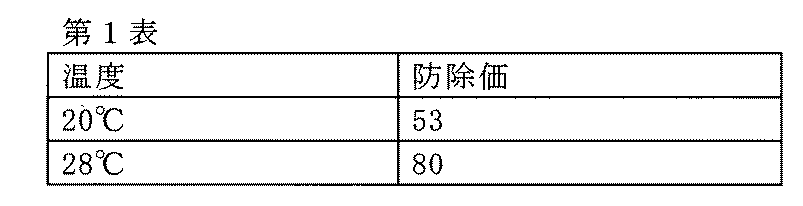
試験例2(キュウリうどんこ病・治療効果試験)
直径7.5cmのポリ鉢でキュウリ(品種:相模半白節成)を栽培し、1.5葉期に達した時にキュウリうどんこ病菌(Sphaerotheca fuliginea)の分生子懸濁液を葉表に噴霧接種し、20℃室内、照明下で3日間育苗後、各使用製品を含む水溶液(0.5v/v%)で、ピリオフェノンの散布液を調製し(投下薬量90g ai/ha、散布液量800L/ha)、スプレーガンにて葉表に散布した。薬液乾燥後、20℃室内、照明下で6日間育苗した。1葉目葉表の病斑面積率を調査し、下記の式から防除価を算出した。表中、無加用とは、(b)成分を加えずに上記の処理が行なわれたものである(以下、同様)。
防除価=(1-a/b)×100
a:処理区の病斑面積率、b:無処理区の病斑面積率

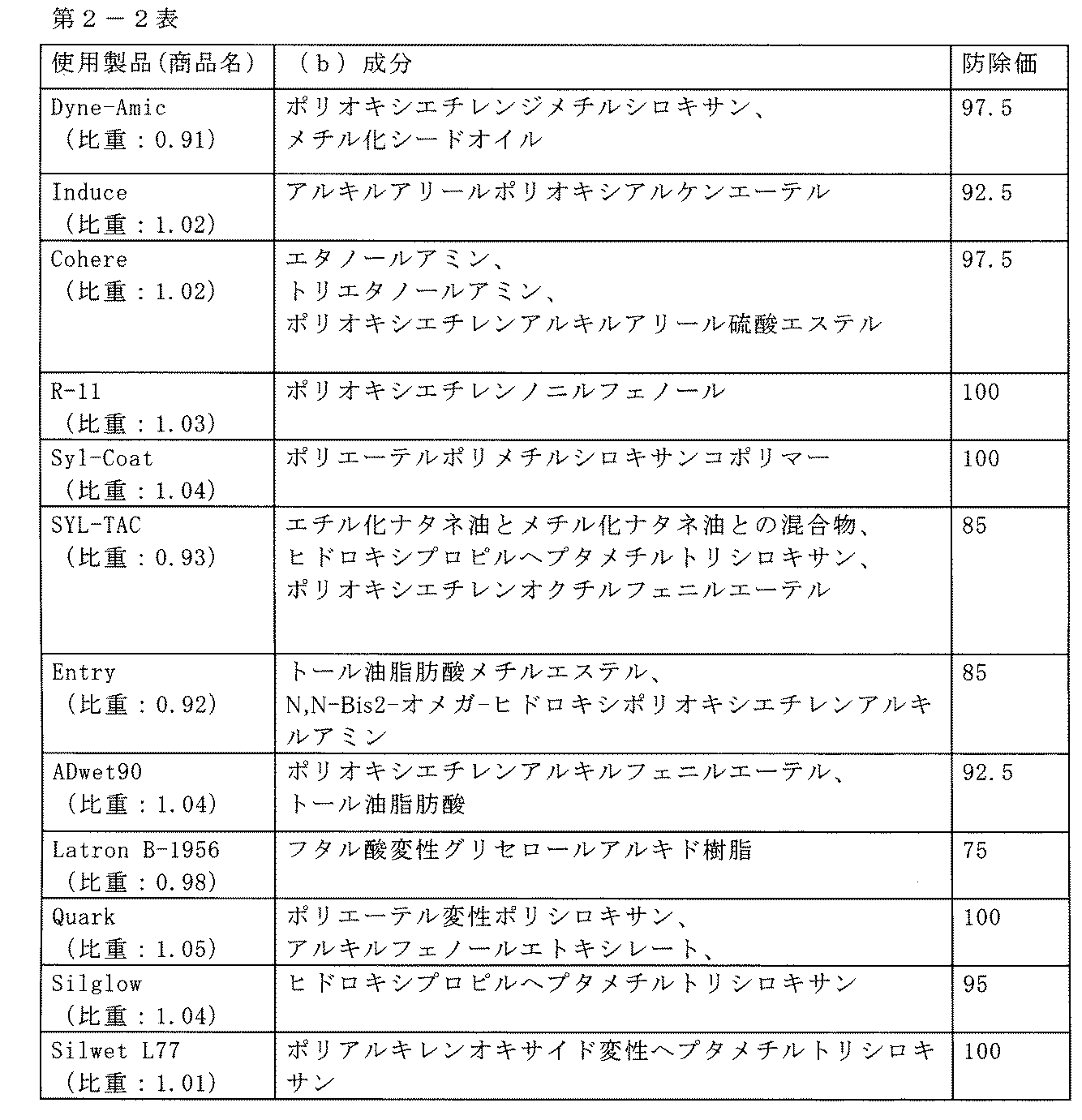
直径7.5cmのポリ鉢でキュウリ(品種:相模半白節成)を栽培し、1.5葉期に達した時にキュウリうどんこ病菌(Sphaerotheca fuliginea)の分生子懸濁液を葉表に噴霧接種し、20℃室内、照明下で3日間育苗後、各使用製品を含む水溶液(0.05~0.25v/v%)で、ピリオフェノンの散布液を調製し(投下薬量90g ai/ha、散布液量800L/ha)、スプレーガンにて葉表に散布した。薬液乾燥後、20℃室内、照明下で6日間育苗した。1葉目の病斑面積率を調査し、下記の式から防除価を算出した。
防除価=(1-a/b)×100
a:処理区の病斑面積率、b:無処理区の病斑面積率

直径7.5cmのポリ鉢でキュウリ(品種:相模半白節成)を栽培し、1.5葉期に達した時にキュウリうどんこ病菌(Sphaerotheca fuliginea)の分生子懸濁液を葉表に噴霧接種し、20℃室内、照明下で3日間育苗後、各使用製品を含む水溶液(0.025~0.25v/v%)で、ピリオフェノンの散布液を調製し(投下薬量90g ai/ha、散布液量800L/ha)、スプレーガンにて葉表に散布した。薬液乾燥後、温室内にて4日間育苗した後、20℃室内、照明下で5日間育苗した。1葉目の病斑面積率を調査し、下記の式から防除価を算出した。
防除価=(1-a/b)×100
a:処理区の病斑面積率、b:無処理区の病斑面積率

直径7.5cmのポリ鉢でキュウリ(品種:相模半白節成)を栽培し、1.5葉期に達した時にキュウリうどんこ病菌(Sphaerotheca fuliginea)の分生子懸濁液を葉表に噴霧接種し、20℃室内、照明下で3日間育苗後、各使用製品を含む水溶液(0.025~4.0v/v%)で、ピリオフェノン(薬量90g ai/ha)またはメトラフェノン(300g ai/ha)の散布液を調製し(散布液量800L/ha)、スプレーガンにて葉表に散布した。薬液乾燥後、20℃室内、照明下で7日間育苗した。1葉目の病斑面積率を調査し、下記の式から防除価を算出した。
防除価=(1-a/b)×100
a:処理区の病斑面積率、b:無処理区の病斑面積率
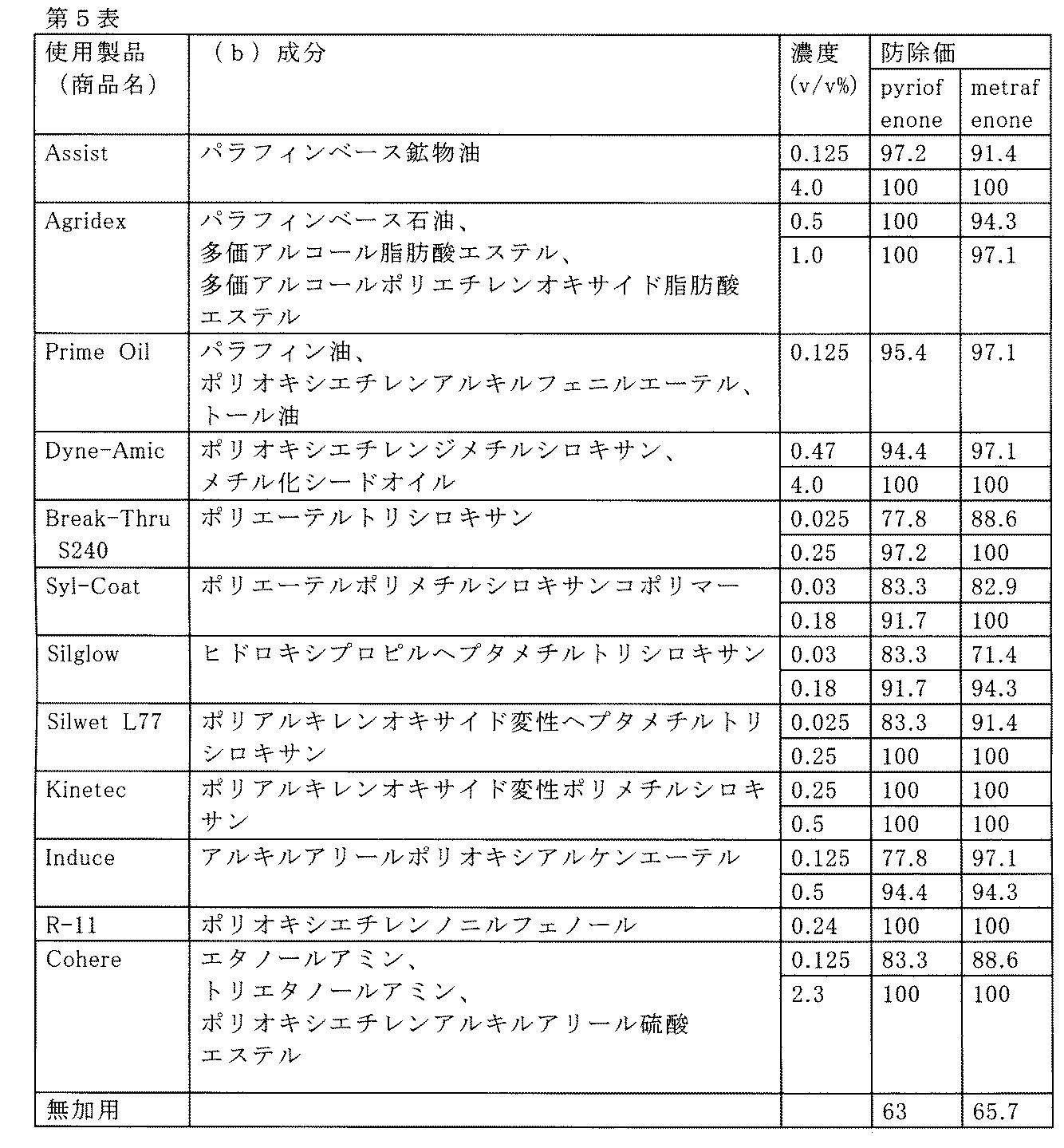
直径7.5cmのポリ鉢でキュウリ(品種:相模半白節成)を栽培し、1.5葉期に達した時にキュウリうどんこ病菌(Sphaerotheca fuliginea)の分生子懸濁液を葉表に噴霧接種し、20℃室内、照明下で3日間育苗後、使用製品を含む水溶液(0.01~5.0v/v%)で、ピリオフェノン(薬量90g ai/ha)またはメトラフェノン(300g ai/ha)の散布液を調製し(散布液量800L/ha)、スプレーガンにて葉表に散布した。薬液乾燥後、20℃室内、照明下で6日間育苗した。1葉目の病斑面積率を調査し、下記の式から防除価を算出した。
防除価=(1-a/b)×100
a:処理区の病斑面積率、b:無処理区の病斑面積率

直径7.5cmのポリ鉢でキュウリ(品種:相模半白節成)を栽培し、1.5葉期に達した時にキュウリうどんこ病菌(Sphaerotheca fuliginea)の分生子懸濁液を葉表に噴霧接種し、20℃室内、照明下で3日間育苗後、使用製品を含む水溶液(0.02~0.07v/v%)で、ピリオフェノン(薬量90g ai/ha)またはメトラフェノン(300g ai/ha)の散布液を調製し(散布液量800L/ha)、スプレーガンにて葉表に散布した。薬液乾燥後、20℃室内、照明下で5日間育苗した。1葉目の病斑面積率を調査し、下記の式から防除価を算出した。
防除価=(1-a/b)×100
a:処理区の病斑面積率、b:無処理区の病斑面積率
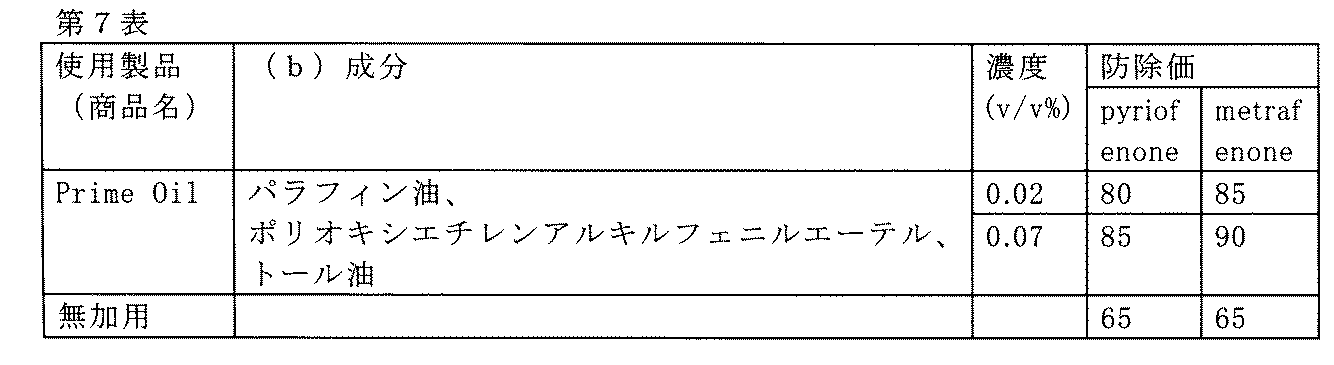
直径7.5cmのポリ鉢でキュウリ(品種:相模半白節成)を栽培し、1.5葉期に達した時にキュウリうどんこ病菌(Sphaerotheca fuliginea)の分生子懸濁液を葉表に噴霧接種し、20℃室内、照明下で3日間育苗後、各使用製品を含む水溶液(0.001~5.0v/v%)で、ピリオフェノン(薬量90g ai/ha)もしくはメトラフェノン(300g ai/ha)の散布液を調製し(散布液量800L/ha)、スプレーガンにて葉表に散布した。薬液乾燥後、20℃室内、照明下で7日間育苗した。1葉目の病斑面積率を調査し、下記の式から防除価を算出した。
防除価=(1-a/b)×100
a:処理区の病斑面積率、b:無処理区の病斑面積率

直径7.5cmのポリ鉢でキュウリ(品種:相模半白節成)を栽培し、1.5葉期に達した時にキュウリうどんこ病菌(Sphaerotheca fuliginea)の分生子懸濁液を葉表に噴霧接種し、20℃室内、照明下で3日間育苗後、各使用製品を含む水溶液(0.005~1.0v/v%)で、ピリオフェノン(薬量90g ai/ha)またはメトラフェノン(300g ai/ha)の散布液を調製し(散布液量800L/ha)、スプレーガンにて葉表に散布した。薬液乾燥後、20℃室内、照明下で7日間育苗した。1葉目の病斑面積率を調査し、下記の式から防除価を算出した。
防除価=(1-a/b)×100
a:処理区の病斑面積率、b:無処理区の病斑面積率

直径7.5cmのポリ鉢でキュウリ(品種:相模半白節成)を栽培し、1.5葉期に達した時に、各使用製品を含む水溶液(0.015~4.0v/v%)で、ピリオフェノン(薬量90g ai/ha)の散布液を調製し(散布液量800L/ha)、スプレーガンにて葉表に散布した。薬液乾燥後、20℃室内照明下で4日間育苗し、キュウリうどんこ病菌(Sphaerotheca fuliginea)の分生子懸濁液を葉裏に噴霧接種し、20℃室内、照明下で8日間育苗した。1葉目の葉裏の病斑面積率を調査し、下記の式から防除価を算出した。
防除価=(1-a/b)×100
a:処理区の病斑面積率、b:無処理区の病斑面積率

直径7.5cmのポリ鉢でピーマン(品種:京波)を栽培し、8.5葉期に達した時にピーマンうどんこ病菌(Oidiopsis sicula Scalia)の分生子を振り掛け接種し、温室内、照明下で3日間育苗後、各使用製品を含む水溶液(0.07~4.0v/v%)で、ピリオフェノン(薬量90、110gai/ha)の散布液を調製し(散布液量600L/ha)、スプレーガンにて葉表に散布した。薬液乾燥後、温室内、照明下で17日間育苗した後、下位葉から上位8葉を葉ごとに下記指数にて調査し発病度を算出した。また、発病度より防除価を算出した。
調査指数:
0:胞子形成なし
1:葉裏に10%未満の病斑形成(胞子、柄足細胞、分生子生産細胞)が認められる
2:葉裏に10%~25%の病斑形成(胞子、柄足細胞、分生子生産細胞)が認められる
3:葉裏に26%~50%の病斑形成(胞子、柄足細胞、分生子生産細胞)が認められる
4:葉裏に51%~75%の病斑形成(胞子、柄足細胞、分生子生産細胞)が認められる
5:葉裏に76%~100%の病斑形成(胞子、柄足細胞、分生子生産細胞)が認められる
発病度={Σ(程度別発病葉数×指数)}×100/(発病葉数×5)
防除価=(1-a/b)×100
a:処理区の発病度、b:無処理区の発病度

直径7.5cmのポリ鉢でキュウリ(品種:相模半白節成)を栽培し、1.5葉期に達した時にキュウリうどんこ病菌(Sphaerotheca fuliginea)の分生子懸濁液を葉表に噴霧接種し、20℃室内、照明下で4日間育苗後、各製品を含む水溶液(0.015~0.5v/v%)で、ピリオフェノン(薬量90g ai/ha)の散布液を調製し(散布液量800L/ha)、スプレーガンにて葉表に散布した。薬液乾燥後、20℃室内、照明下で6日間育苗した。1葉目の病斑面積率を調査し、下記の式から防除価を算出した。
防除価=(1-a/b)×100
a:処理区の病斑面積率、b:無処理区の病斑面積率

直径7.5cmのポリ鉢でキュウリ(品種:相模半白節成)を栽培し、1.5葉期に達した時に、各製品を含む水溶液(0.015~1.0v/v%)で、ピリオフェノン(薬量90g ai/ha)の散布液を調製し(散布液量800L/ha)、スプレーガンにて葉表に散布した。薬液乾燥後、20℃室内照明下で3日間育苗し、キュウリうどんこ病菌(Sphaerotheca fuliginea)の分生子懸濁液を葉裏に噴霧接種し、20℃室内、照明下で7日間育苗した。1葉目の葉裏の病斑面積率を調査し、下記の式から防除価を算出した。
防除価=(1-a/b)×100
a:処理区の病斑面積率、b:無処理区の病斑面積率

なお、2016年4月15日に出願された日本特許出願2016-81693号の明細書、特許請求の範囲、図面、及び要約書の全内容をここに引用し、本発明の明細書の開示として、取り入れるものである。
Claims (16)
- アリールフェニルケトン系殺菌剤である(a)成分とともに、ノニオン系界面活性剤、アニオン系界面活性剤、カチオン系界面活性剤、植物油、パラフィン類、樹脂類及びテルペン類からなる群から選択される少なくとも1種の(b)成分を使用することを特徴とする、アリールフェニルケトン系殺菌剤の植物病害の防除効果を増強する方法。
- (a)成分が、ピリオフェノン及びメトラフェノンからなる群から選択される少なくとも1種である、請求項1に記載の方法。
- (b)成分が、ノニオン系界面活性剤、パラフィン類及び植物油からなる群から選択される少なくとも1種の成分である、請求項1又は2に記載の方法。
- 上記ノニオン系界面活性剤が、シリコーン系界面活性剤、ポリオキシエチレン系界面活性剤、多価アルコール系界面活性剤及びアルカノールアミド系界面活性剤からなる群から選択される少なくとも1種の界面活性剤である、請求項1~3のいずれか1項に記載の方法。
- 上記ノニオン系界面活性剤が、シリコーン系界面活性剤である、請求項4に記載の方法。
- (a)成分がピリオフェノンであり、(b)成分が植物油である、請求項1に記載の方法。
- (a)成分がピリオフェノンであり、(b)成分がパラフィン類である、請求項1に記載の方法。
- (a)成分と(b)成分との混合重量比が1:5000~500:1である、請求項1~7のいずれか1項に記載の方法。
- アリールフェニルケトン系殺菌剤である(a)成分とともに、ノニオン系界面活性剤、アニオン系界面活性剤、カチオン系界面活性剤、植物油、パラフィン類、樹脂類及びテルペン類からなる群から選択される少なくとも1種の(b)成分を植物又は植物の栽培土壌に施用することを特徴とする植物病害の防除方法。
- (a)成分が、ピリオフェノン及びメトラフェノンからなる群から選択される少なくとも1種である、請求項9に記載の方法。
- (b)成分が、ノニオン系界面活性剤、パラフィン類及び植物油からなる群から選択される少なくとも1種の成分である、請求項9又は10に記載の方法。
- 上記ノニオン系界面活性剤が、シリコーン系界面活性剤、ポリオキシエチレン系界面活性剤、多価アルコール系界面活性剤及びアルカノールアミド系界面活性剤からなる群から選択される少なくとも1種である、請求項9~11のいずれか1項に記載の植物病害の防除方法。
- 上記ノニオン系界面活性剤が、シリコーン系界面活性剤である、請求項12に記載の方法。
- (a)成分がピリオフェノンであり、(b)成分が植物油である、請求項9に記載の方法。
- (a)成分がピリオフェノンであり、(b)成分がパラフィン類である、請求項9に記載の方法。
- (a)成分と(b)成分との混合重量比が1:5000~500:1である、請求項9~15のいずれか1項に記載の方法。
Priority Applications (19)
| Application Number | Priority Date | Filing Date | Title |
|---|---|---|---|
| RU2018138914A RU2735252C2 (ru) | 2016-04-15 | 2017-04-13 | Способ усиления эффектов борьбы с болезнями растений фунгицида арилфенилкетона и способ борьбы с болезнями растений |
| CN201780023472.0A CN109068640A (zh) | 2016-04-15 | 2017-04-13 | 芳基苯基酮系杀菌剂的植物病害防除效果的增强方法及植物病害防除方法 |
| IL262291A IL262291B2 (en) | 2016-04-15 | 2017-04-13 | Method for enhancing plant disease controlling effects of aryl phenyl ketone fungicide, and method for controlling plant diseases |
| EP17782486.9A EP3443842A4 (en) | 2016-04-15 | 2017-04-13 | METHOD FOR POTENTIATING THE PLANT-DISEASING EFFECT OF AN ARYLPHENYLKETONE FUNGICIDE AND METHOD FOR CONTROLLING PLANT DISEASES |
| BR112018067916-0A BR112018067916B1 (pt) | 2016-04-15 | 2017-04-13 | Método para melhorar a penetração de piriofenona |
| AU2017251168A AU2017251168B2 (en) | 2016-04-15 | 2017-04-13 | Method for potentiating plant disease-controlling effect of aryl phenyl ketone fungicide and method for controlling plant diseases |
| UAA201810885A UA124933C2 (uk) | 2016-04-15 | 2017-04-13 | Спосіб посилення ефектів боротьби із хворобами рослин фунгіциду арилфенілкетону і спосіб боротьби із хворобами рослин |
| CR20180486A CR20180486A (es) | 2016-04-15 | 2017-04-13 | Método para mejorar los efectos controladores del fungicida aril fenil cetona contra enfermedades en plantas y método para el control de enfermedades en plantas |
| CA3017461A CA3017461C (en) | 2016-04-15 | 2017-04-13 | Method for enhancing plant disease controlling effects of aryl phenyl ketone fungicide, and method for controlling plant diseases |
| US16/092,579 US11950592B2 (en) | 2016-04-15 | 2017-04-13 | Method for enhancing plant disease controlling effects of aryl phenyl ketone fungicide, and method for controlling plant diseases |
| GEAP201714917A GEP20207148B (en) | 2016-04-15 | 2017-04-13 | Methods for enchancing plant disease controlling effects of aryl phenyl ketone fungicide, and method for controlling plant diseases |
| PH1/2018/501946A PH12018501946B1 (en) | 2016-04-15 | 2017-04-13 | Method for enhancing plant disease controlling effects of aryl phenyl ketone fungicide, and method for controlling plant diseases |
| JP2018512076A JP6961908B2 (ja) | 2016-04-15 | 2017-04-13 | アリールフェニルケトン系殺菌剤の植物病害防除効果の増強方法及び植物病害の防除方法 |
| NZ746052A NZ746052B2 (en) | 2017-04-13 | Method for enhancing plant disease controlling effects of aryl phenyl ketone fungicide, and method for controlling plant diseases | |
| KR1020187031233A KR102368897B1 (ko) | 2016-04-15 | 2017-04-13 | 아릴페닐케톤계 살균제의 식물 병해 방제 효과의 증강 방법 및 식물 병해의 방제 방법 |
| MYPI2018703349A MY194527A (en) | 2016-04-15 | 2017-04-13 | Method for enhancing plant disease controlling effects of aryl phenyl ketone fungicide, and method for controlling plant diseases |
| MX2018012536A MX2018012536A (es) | 2016-04-15 | 2017-04-13 | Metodo para mejorar los efectos controladores del fungicida aril fenil cetona contra enfermedades en plantas y metodo para el control de enfermedades en plantas. |
| ZA2018/06298A ZA201806298B (en) | 2016-04-15 | 2018-09-19 | Method for enhancing plant disease controlling effects of aryl phenyl ketone fungicide, and method for controlling plant diseases |
| CONC2018/0010431A CO2018010431A2 (es) | 2016-04-15 | 2018-09-28 | Método para mejorar los efectos controladores del fungicida aril fenil cetona contra enfermedades en plantas y método para el control de enfermedades en plantas |
Applications Claiming Priority (2)
| Application Number | Priority Date | Filing Date | Title |
|---|---|---|---|
| JP2016081693 | 2016-04-15 | ||
| JP2016-081693 | 2016-04-15 |
Publications (1)
| Publication Number | Publication Date |
|---|---|
| WO2017179673A1 true WO2017179673A1 (ja) | 2017-10-19 |
Family
ID=60041795
Family Applications (1)
| Application Number | Title | Priority Date | Filing Date |
|---|---|---|---|
| PCT/JP2017/015187 Ceased WO2017179673A1 (ja) | 2016-04-15 | 2017-04-13 | アリールフェニルケトン系殺菌剤の植物病害防除効果の増強方法及び植物病害の防除方法 |
Country Status (22)
| Country | Link |
|---|---|
| US (1) | US11950592B2 (ja) |
| EP (1) | EP3443842A4 (ja) |
| JP (2) | JP6961908B2 (ja) |
| KR (1) | KR102368897B1 (ja) |
| CN (1) | CN109068640A (ja) |
| AU (1) | AU2017251168B2 (ja) |
| BR (1) | BR112018067916B1 (ja) |
| CA (1) | CA3017461C (ja) |
| CL (2) | CL2018002885A1 (ja) |
| CO (1) | CO2018010431A2 (ja) |
| CR (1) | CR20180486A (ja) |
| EC (1) | ECSP18076858A (ja) |
| GE (2) | GEP20207148B (ja) |
| IL (1) | IL262291B2 (ja) |
| MA (1) | MA43837A (ja) |
| MX (2) | MX2018012536A (ja) |
| MY (1) | MY194527A (ja) |
| PH (1) | PH12018501946B1 (ja) |
| RU (1) | RU2735252C2 (ja) |
| UA (1) | UA124933C2 (ja) |
| WO (1) | WO2017179673A1 (ja) |
| ZA (1) | ZA201806298B (ja) |
Cited By (1)
| Publication number | Priority date | Publication date | Assignee | Title |
|---|---|---|---|---|
| WO2019230789A1 (ja) * | 2018-05-30 | 2019-12-05 | 株式会社アクアソリューション | うどんこ病の防除方法 |
Families Citing this family (3)
| Publication number | Priority date | Publication date | Assignee | Title |
|---|---|---|---|---|
| PE20181791A1 (es) * | 2016-03-07 | 2018-11-15 | Ishihara Sangyo Kaisha | Metodo para mejorar los efectos controladores de isofetamid contra enfermedades en plantas y metodo para el control de enfermedades en plantas |
| UA124933C2 (uk) * | 2016-04-15 | 2021-12-15 | Ісіхара Сангіо Кайся, Лтд. | Спосіб посилення ефектів боротьби із хворобами рослин фунгіциду арилфенілкетону і спосіб боротьби із хворобами рослин |
| KR20220130701A (ko) * | 2020-01-23 | 2022-09-27 | 바스프 에스이 | 농약 제형을 위한 신규한 첨가제 |
Citations (7)
| Publication number | Priority date | Publication date | Assignee | Title |
|---|---|---|---|---|
| EP0897904A1 (en) | 1997-08-20 | 1999-02-24 | American Cyanamid Company | Fungicidal 2-methoxybenzophenones |
| JPH11171818A (ja) * | 1997-08-20 | 1999-06-29 | American Cyanamid Co | 殺菌・殺カビ性2−メトキシベンゾフエノン類 |
| WO2002002527A1 (en) | 2000-07-05 | 2002-01-10 | Ishihara Sangyo Kaisha, Ltd. | Benzoylpyridine derivative or its salt, fungicide containing it as an active ingredient, its production process and intermediate for producing it |
| WO2004039155A1 (ja) * | 2002-10-31 | 2004-05-13 | Ishihara Sangyo Kaisha, Ltd. | 3−ベンゾイル−2,4,5−置換ピリジン誘導体またはその塩及びそれらを含有する殺菌剤 |
| WO2008004596A1 (en) | 2006-07-05 | 2008-01-10 | Ishihara Sangyo Kaisha, Ltd. | Antibacterial composition and method for control of plant disease |
| WO2009128409A1 (ja) * | 2008-04-17 | 2009-10-22 | 石原産業株式会社 | 有害生物防除剤組成物及び有害生物の防除方法 |
| JP2016081693A (ja) | 2014-10-16 | 2016-05-16 | 株式会社アイ・ライティング・システム | 調光機能を備えた点灯装置 |
Family Cites Families (16)
| Publication number | Priority date | Publication date | Assignee | Title |
|---|---|---|---|---|
| IT1207996B (it) | 1986-03-18 | 1989-06-01 | Magis Farmaceutici | Composti contenenti ferro biodisponibile, procedimento per la loro preparazione e composizioni farmaceutiche che li contengono. |
| UA67739C2 (uk) * | 1997-04-25 | 2004-07-15 | Ісіхара Сангіо Кайся Лтд. | Композиція та спосіб боротьби з шкідливими біоорганізмами |
| JP4083366B2 (ja) | 2000-04-10 | 2008-04-30 | 花王株式会社 | 農薬用展着剤組成物 |
| EP1656019A1 (de) * | 2003-08-14 | 2006-05-17 | Basf Aktiengesellschaft | Verwendung von alkoholalkoxylaten als adjuvans für fungizide benzamidoxim-derivate, entsprechende mittel und kits |
| KR100897904B1 (ko) | 2007-08-02 | 2009-05-18 | 이원구 | 말린 연씨집을 이용한 학습교재 |
| WO2011110481A1 (en) * | 2010-03-08 | 2011-09-15 | Basf Se | Composition comprising an active substance and a polyalkyleneoxide vinylester graft polymer |
| CA3075333C (en) * | 2010-03-12 | 2021-10-19 | Monsanto Technology Llc | Plant health compositions comprising a water-soluble pesticide and a water-insoluble agrochemical |
| RU2558542C2 (ru) * | 2010-03-30 | 2015-08-10 | Басф Се | Применение сополимера для повышения активности пестицида |
| AU2011303970B2 (en) * | 2010-09-14 | 2015-08-13 | Basf Se | Composition containing a pyripyropene insecticide and an adjuvant |
| JP5940369B2 (ja) * | 2011-05-27 | 2016-06-29 | 石原産業株式会社 | 植物病害の防除方法 |
| JP6013032B2 (ja) * | 2011-07-08 | 2016-10-25 | 石原産業株式会社 | 殺菌剤組成物及び植物病害の防除方法 |
| EP2879494B1 (en) | 2012-08-03 | 2018-01-31 | Bayer CropScience AG | Composition comprising a pesticidal terpene mixture and a fungicide |
| US20150216163A1 (en) * | 2012-08-24 | 2015-08-06 | Bayer Cropscience Ag | Composition comprising a pesticidal terpene mixture and a biological control agent |
| JP6347334B2 (ja) * | 2013-06-27 | 2018-06-27 | 石原産業株式会社 | 植物安全性が向上した除草組成物 |
| CN105165828B (zh) * | 2015-10-28 | 2017-05-10 | 陕西上格之路生物科学有限公司 | 一种含苯菌酮和硝苯菌酯的杀菌组合物 |
| UA124933C2 (uk) * | 2016-04-15 | 2021-12-15 | Ісіхара Сангіо Кайся, Лтд. | Спосіб посилення ефектів боротьби із хворобами рослин фунгіциду арилфенілкетону і спосіб боротьби із хворобами рослин |
-
2017
- 2017-04-13 UA UAA201810885A patent/UA124933C2/uk unknown
- 2017-04-13 MA MA043837A patent/MA43837A/fr unknown
- 2017-04-13 PH PH1/2018/501946A patent/PH12018501946B1/en unknown
- 2017-04-13 KR KR1020187031233A patent/KR102368897B1/ko active Active
- 2017-04-13 GE GEAP201714917A patent/GEP20207148B/en unknown
- 2017-04-13 CN CN201780023472.0A patent/CN109068640A/zh active Pending
- 2017-04-13 AU AU2017251168A patent/AU2017251168B2/en active Active
- 2017-04-13 BR BR112018067916-0A patent/BR112018067916B1/pt active IP Right Grant
- 2017-04-13 WO PCT/JP2017/015187 patent/WO2017179673A1/ja not_active Ceased
- 2017-04-13 IL IL262291A patent/IL262291B2/en unknown
- 2017-04-13 EP EP17782486.9A patent/EP3443842A4/en active Pending
- 2017-04-13 RU RU2018138914A patent/RU2735252C2/ru active
- 2017-04-13 CA CA3017461A patent/CA3017461C/en active Active
- 2017-04-13 JP JP2018512076A patent/JP6961908B2/ja active Active
- 2017-04-13 GE GEAP202014917A patent/GEAP202014917A/en unknown
- 2017-04-13 CR CR20180486A patent/CR20180486A/es unknown
- 2017-04-13 MX MX2018012536A patent/MX2018012536A/es unknown
- 2017-04-13 US US16/092,579 patent/US11950592B2/en active Active
- 2017-04-13 MY MYPI2018703349A patent/MY194527A/en unknown
-
2018
- 2018-09-19 ZA ZA2018/06298A patent/ZA201806298B/en unknown
- 2018-09-28 CO CONC2018/0010431A patent/CO2018010431A2/es unknown
- 2018-10-10 CL CL2018002885A patent/CL2018002885A1/es unknown
- 2018-10-12 EC ECSENADI201876858A patent/ECSP18076858A/es unknown
- 2018-10-12 MX MX2023013576A patent/MX2023013576A/es unknown
-
2020
- 2020-12-29 CL CL2020003410A patent/CL2020003410A1/es unknown
-
2021
- 2021-10-11 JP JP2021166972A patent/JP7279297B2/ja active Active
Patent Citations (7)
| Publication number | Priority date | Publication date | Assignee | Title |
|---|---|---|---|---|
| EP0897904A1 (en) | 1997-08-20 | 1999-02-24 | American Cyanamid Company | Fungicidal 2-methoxybenzophenones |
| JPH11171818A (ja) * | 1997-08-20 | 1999-06-29 | American Cyanamid Co | 殺菌・殺カビ性2−メトキシベンゾフエノン類 |
| WO2002002527A1 (en) | 2000-07-05 | 2002-01-10 | Ishihara Sangyo Kaisha, Ltd. | Benzoylpyridine derivative or its salt, fungicide containing it as an active ingredient, its production process and intermediate for producing it |
| WO2004039155A1 (ja) * | 2002-10-31 | 2004-05-13 | Ishihara Sangyo Kaisha, Ltd. | 3−ベンゾイル−2,4,5−置換ピリジン誘導体またはその塩及びそれらを含有する殺菌剤 |
| WO2008004596A1 (en) | 2006-07-05 | 2008-01-10 | Ishihara Sangyo Kaisha, Ltd. | Antibacterial composition and method for control of plant disease |
| WO2009128409A1 (ja) * | 2008-04-17 | 2009-10-22 | 石原産業株式会社 | 有害生物防除剤組成物及び有害生物の防除方法 |
| JP2016081693A (ja) | 2014-10-16 | 2016-05-16 | 株式会社アイ・ライティング・システム | 調光機能を備えた点灯装置 |
Non-Patent Citations (1)
| Title |
|---|
| "The Pesticide Manual", BRITISH CROP PROTECTION COUNCIL, pages: 983 - 984 |
Cited By (2)
| Publication number | Priority date | Publication date | Assignee | Title |
|---|---|---|---|---|
| WO2019230789A1 (ja) * | 2018-05-30 | 2019-12-05 | 株式会社アクアソリューション | うどんこ病の防除方法 |
| JPWO2019230789A1 (ja) * | 2018-05-30 | 2021-02-25 | 株式会社アクアソリューション | うどんこ病の防除方法 |
Also Published As
Similar Documents
| Publication | Publication Date | Title |
|---|---|---|
| JP7279297B2 (ja) | アリールフェニルケトン系殺菌剤の植物病害防除効果の増強方法及び植物病害の防除方法 | |
| KR102317161B1 (ko) | 이소페타미드의 식물 병해 방제 효과의 증강 방법 및 식물 병해의 방제 방법 | |
| JPWO2016204160A1 (ja) | ダイズ病害防除用組成物及びダイズ病害の防除方法 | |
| TW202045007A (zh) | 含有待克利(Difenoconazole)之農藥製劑及該農藥製劑之安定化方法 | |
| WO2016194971A1 (ja) | 殺菌剤組成物及び植物病害の防除方法 | |
| CN101483999A (zh) | 杀菌剂组合物和植物病害的防除方法 | |
| JP6643690B2 (ja) | 農薬製剤 | |
| JPWO2016194741A1 (ja) | 殺菌剤組成物及び植物病害の防除方法 |
Legal Events
| Date | Code | Title | Description |
|---|---|---|---|
| ENP | Entry into the national phase |
Ref document number: 2018512076 Country of ref document: JP Kind code of ref document: A |
|
| ENP | Entry into the national phase |
Ref document number: 3017461 Country of ref document: CA |
|
| ENP | Entry into the national phase |
Ref document number: 2017251168 Country of ref document: AU Date of ref document: 20170413 Kind code of ref document: A |
|
| WWE | Wipo information: entry into national phase |
Ref document number: CR2018-000486 Country of ref document: CR |
|
| NENP | Non-entry into the national phase |
Ref country code: DE |
|
| REG | Reference to national code |
Ref country code: BR Ref legal event code: B01A Ref document number: 112018067916 Country of ref document: BR |
|
| ENP | Entry into the national phase |
Ref document number: 20187031233 Country of ref document: KR Kind code of ref document: A |
|
| ENP | Entry into the national phase |
Ref document number: 14917 Country of ref document: GE |
|
| WWE | Wipo information: entry into national phase |
Ref document number: 2017782486 Country of ref document: EP |
|
| ENP | Entry into the national phase |
Ref document number: 2017782486 Country of ref document: EP Effective date: 20181115 |
|
| 121 | Ep: the epo has been informed by wipo that ep was designated in this application |
Ref document number: 17782486 Country of ref document: EP Kind code of ref document: A1 |
|
| WWP | Wipo information: published in national office |
Ref document number: CR2018-000486 Country of ref document: CR |
|
| ENP | Entry into the national phase |
Ref document number: 112018067916 Country of ref document: BR Kind code of ref document: A2 Effective date: 20180905 |
|
| WWR | Wipo information: refused in national office |
Ref document number: CR2018-000486 Country of ref document: CR |