WO2017179897A1 - 티아민 모노포스페이트 키나아제를 이용한 항균물질의 스크리닝 키트 및 스크리닝 방법 - Google Patents
티아민 모노포스페이트 키나아제를 이용한 항균물질의 스크리닝 키트 및 스크리닝 방법 Download PDFInfo
- Publication number
- WO2017179897A1 WO2017179897A1 PCT/KR2017/003924 KR2017003924W WO2017179897A1 WO 2017179897 A1 WO2017179897 A1 WO 2017179897A1 KR 2017003924 W KR2017003924 W KR 2017003924W WO 2017179897 A1 WO2017179897 A1 WO 2017179897A1
- Authority
- WO
- WIPO (PCT)
- Prior art keywords
- thil
- atp
- screening
- antimicrobial
- protein
- Prior art date
- Legal status (The legal status is an assumption and is not a legal conclusion. Google has not performed a legal analysis and makes no representation as to the accuracy of the status listed.)
- Ceased
Links
- PFUAJVSUKRVYFD-UHFFFAOYSA-N CCC(C)C1CNC1 Chemical compound CCC(C)C1CNC1 PFUAJVSUKRVYFD-UHFFFAOYSA-N 0.000 description 1
Images



Classifications
-
- C—CHEMISTRY; METALLURGY
- C12—BIOCHEMISTRY; BEER; SPIRITS; WINE; VINEGAR; MICROBIOLOGY; ENZYMOLOGY; MUTATION OR GENETIC ENGINEERING
- C12Q—MEASURING OR TESTING PROCESSES INVOLVING ENZYMES, NUCLEIC ACIDS OR MICROORGANISMS; COMPOSITIONS OR TEST PAPERS THEREFOR; PROCESSES OF PREPARING SUCH COMPOSITIONS; CONDITION-RESPONSIVE CONTROL IN MICROBIOLOGICAL OR ENZYMOLOGICAL PROCESSES
- C12Q1/00—Measuring or testing processes involving enzymes, nucleic acids or microorganisms; Compositions therefor; Processes of preparing such compositions
- C12Q1/48—Measuring or testing processes involving enzymes, nucleic acids or microorganisms; Compositions therefor; Processes of preparing such compositions involving transferase
- C12Q1/485—Measuring or testing processes involving enzymes, nucleic acids or microorganisms; Compositions therefor; Processes of preparing such compositions involving transferase involving kinase
-
- C—CHEMISTRY; METALLURGY
- C12—BIOCHEMISTRY; BEER; SPIRITS; WINE; VINEGAR; MICROBIOLOGY; ENZYMOLOGY; MUTATION OR GENETIC ENGINEERING
- C12Q—MEASURING OR TESTING PROCESSES INVOLVING ENZYMES, NUCLEIC ACIDS OR MICROORGANISMS; COMPOSITIONS OR TEST PAPERS THEREFOR; PROCESSES OF PREPARING SUCH COMPOSITIONS; CONDITION-RESPONSIVE CONTROL IN MICROBIOLOGICAL OR ENZYMOLOGICAL PROCESSES
- C12Q1/00—Measuring or testing processes involving enzymes, nucleic acids or microorganisms; Compositions therefor; Processes of preparing such compositions
- C12Q1/02—Measuring or testing processes involving enzymes, nucleic acids or microorganisms; Compositions therefor; Processes of preparing such compositions involving viable microorganisms
- C12Q1/18—Testing for antimicrobial activity of a material
-
- C—CHEMISTRY; METALLURGY
- C12—BIOCHEMISTRY; BEER; SPIRITS; WINE; VINEGAR; MICROBIOLOGY; ENZYMOLOGY; MUTATION OR GENETIC ENGINEERING
- C12Q—MEASURING OR TESTING PROCESSES INVOLVING ENZYMES, NUCLEIC ACIDS OR MICROORGANISMS; COMPOSITIONS OR TEST PAPERS THEREFOR; PROCESSES OF PREPARING SUCH COMPOSITIONS; CONDITION-RESPONSIVE CONTROL IN MICROBIOLOGICAL OR ENZYMOLOGICAL PROCESSES
- C12Q1/00—Measuring or testing processes involving enzymes, nucleic acids or microorganisms; Compositions therefor; Processes of preparing such compositions
- C12Q1/48—Measuring or testing processes involving enzymes, nucleic acids or microorganisms; Compositions therefor; Processes of preparing such compositions involving transferase
-
- C—CHEMISTRY; METALLURGY
- C12—BIOCHEMISTRY; BEER; SPIRITS; WINE; VINEGAR; MICROBIOLOGY; ENZYMOLOGY; MUTATION OR GENETIC ENGINEERING
- C12Y—ENZYMES
- C12Y207/00—Transferases transferring phosphorus-containing groups (2.7)
- C12Y207/04—Phosphotransferases with a phosphate group as acceptor (2.7.4)
- C12Y207/04016—Thiamine-phosphate kinase (2.7.4.16)
-
- C—CHEMISTRY; METALLURGY
- C12—BIOCHEMISTRY; BEER; SPIRITS; WINE; VINEGAR; MICROBIOLOGY; ENZYMOLOGY; MUTATION OR GENETIC ENGINEERING
- C12Y—ENZYMES
- C12Y207/00—Transferases transferring phosphorus-containing groups (2.7)
- C12Y207/06—Diphosphotransferases (2.7.6)
- C12Y207/06002—Thiamine diphosphokinase (2.7.6.2)
Definitions
- the present invention relates to a screening kit and a screening method of an antimicrobial agent using thiamine monophosphate kinase (ThiL), and more particularly to screening a substance that inhibits ThiL involved in the thiamine biosynthetic pathway, an essential path of bacteria.
- Kits and methods can be screened for substances that are effective in inhibiting and killing bacteria to provide novel antimicrobials.
- antibiotics or antimicrobials
- antibiotics can often be ineffective because of their inevitable resistance to antibiotics.
- the selection and dissemination of intrinsic or acquired resistance to antibiotics between bacteria interferes with chemical treatment methods, including the various antibiotics known to date, and enhances the development of bacterial species with multiple antibiotic resistances. For this reason, the mortality rate of patients infected with bacteria has recently increased. Therefore, there is a strong need to develop new treatment and prevention strategies that can control infection by bacteria.
- Pseudomonas aeruginosa is known to be highly adaptable to the environment that promotes ecological aptitude despite the presence of traditional antibiotic treatment methods.
- alternatives such as phage treatment methods for treating Pseudomonas-mediated infection are emerging.
- Korean Patent Laid-Open Publication No. 10-2015-0015589 discloses that the protein expressed by PA4834 serves as a siderophore transporter associated with the iron transport mechanism essential for the growth of Pseudomonas aeruginosa. Although methods have been disclosed for screening Pseudomonas aeruginosa antibiotics, the discovery of new targets for antibiotics of Pseudomonas aeruginosa infection is still required.
- Biochemical pathways control the synthesis and metabolism of molecules required by all living things. Blocking metabolic pathways by inhibiting one or more enzymes in the pathway can sometimes lead to deleterious consequences for the organism or to certain afflictions or deaths, such as birth defects in metabolism. The suppression of pathways that ultimately cause the death of organisms is the priori inhibition of the pathways required for survival and is defined as an essential pathway.
- TPP Thiamine pyrophosphate
- TPK thiamine pyrophosphokinase
- the transported thiamin is first converted to thiamine monophosphate (TMP n) by ThiK, after which the second phosphorylation reaction is the last enzyme in the thiamin biosynthetic pathway, the thiamine monophosphate kinase (ThiL). Takes place).
- the present inventors have diligently sought to discover new targets of antimicrobial agents against Pseudomonas aeruginosa infections, suggesting that ThiL may be a good target for antimicrobial molecules since it is essential for TPP biosynthesis as well as thiamine salvage pathway.
- the present invention was completed by discovering and developing a ThiL kinase assay kit.
- the present invention has been made to solve the above problems, and provides a kit that can screen a substance that inhibits the activity of thiamine monophosphate kinase (ThiL).
- Another object of the present invention to provide a screening method of the antimicrobial material using the screening kit.
- thiamine monophosphate kinase thiamine monophosphate kinase, ThiL
- Adenosine triphosphate (ATP) thiamine monophosphate (TMP)
- TMP Thiamine monophosphate
- the antimicrobial material may exhibit antimicrobial activity against bacteria that do not have a thiamine pyrophosphokinase (TPK) protein or a gene encoding the same.
- TPK thiamine pyrophosphokinase
- the bacteria may be any one selected from the group consisting of Escherichia coli , Salmonella species and Pseudomonas aeruginosa belonging to the enterobacteria.
- the reagent capable of measuring the amount of ATP may indicate the amount of ATP through the intensity of luminescence.
- the present invention also provides a method for screening an antimicrobial substance using the screening kit.
- the screening method comprises the steps of: a) adding buffer, TMP and ATP in order to tube 1; b) adding distilled water, ThiL protein and candidates to tube 2; c) mixing tubes 1 and 2; d) adding the mixture of step c) to a test well comprising a reagent capable of measuring the amount of ATP; And e) measuring the light emission of the test well of step d).
- the activity of ThiL based on the intensity of luminescence measured in step e) is inhibited by more than 70% compared to the activity of ThiL measured in the control group without addition of the candidate
- the candidate substance may be determined as an antibacterial substance.
- the antimicrobial agent may exhibit antimicrobial activity against thiamine pyrophosphokinase (TPK) protein or bacteria that do not have a gene encoding the same.
- TPK thiamine pyrophosphokinase
- the bacteria may be any one selected from the group consisting of Escherichia coli , Salmonella species and Pseudomonas aeruginosa belonging to the enterobacteria.
- the screening kit provided in the present invention can be used to quickly and easily screen antimicrobial agents against bacteria that do not have thiamine pyrophosphokinase (TPK), including Pseudomonas aeruginosa, by measuring the level of inhibitory activity of ThiL.
- ThiL assays based on the screening methods of the present invention are substrate specific and potent, making them very useful for detecting ThiL inhibitors. Accordingly, the screening kit and method of the present invention may provide a novel antimicrobial agent that does not have a TPK protein or a gene encoding the same, thereby effectively inhibiting or killing an essential bacterium.
- 1 is a schematic diagram showing the thiamine biosynthetic pathway and TPP dependent enzymes of Pseudomonas aeruginosa.
- Figure 2 is a graph showing the growth rate of wild-type and thiE mutant Pseudomonas aeruginosa according to the concentration of TPP through the OD value and a table showing the concentration of TPP in humans.
- FIG. 3 shows a cleavage map of a recombinant vector expressing ThiL protein.
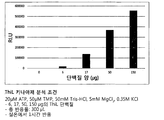
- Figure 4 shows the enzyme activity according to ThiL protein concentration when performing the ThiL kinase assay as RLU (Relative light unit) value indicating the ATP consumption.
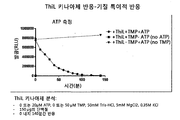
- 5 is a result showing the activity of ThiL by measuring the amount of ATP over time after reacting with different substrate conditions when performing the ThiL kinase assay.
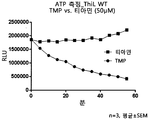
- Figure 6 shows the activity of ThiL by measuring the amount of ATP over time after the reaction using TMP and thiamine as a substrate when performing the ThiL kinase assay.
- FIG. 7 is a graph showing the growth rate of thiE variants at various thiamine concentrations.
- ThiL may be a good target for antimicrobial molecules and sought to solve the above-mentioned problems by providing a kit for screening antimicrobial agents by measuring ThiL kinase activity.
- TPK thiamine pyrophosphokinase
- the kit of the present invention it is possible to quickly and easily screen antimicrobial agents against bacteria that do not have thiamine pyrophosphokinase (TPK) including Pseudomonas aeruginosa.
- TPK thiamine pyrophosphokinase
- it can provide a novel antimicrobial material that can effectively inhibit or kill bacteria that do not have a gene encoding it.
- the present invention relates to thiamine monophosphate kinase (ThiL); Adenosine triphosphate (ATP); Thiamine monophosphate; It provides an antimicrobial screening kit comprising; and a reagent capable of measuring the amount of ATP.
- screening kit refers to a kit used to select a substance having a particular effect from among a plurality of candidates.
- the screening kit is not particularly limited thereto, but may be a kit used to select a substance capable of effectively inhibiting or killing bacteria by inhibiting the activity of ThiL.
- antimicrobial material in combination, but all means a material that exhibits antimicrobial activity to bacteria.
- Pseudomonas aeruginosa does not have a TPK homologous gene in a genome similar to Escherichia coli having only thiamine kinase (ThiK) instead of TPK.
- ThiK thiamine kinase
- the transported thiamin is first converted to Thiamine monophosphate by ThiK, and then the second phosphorylation reaction is via thiamine monophosphate kinase (ThiL), the last enzyme in the thiamin biosynthetic pathway.
- ThiL is essential for TPP biosynthesis as well as thiamine salvage pathway and may be a good target for antimicrobial molecules.
- FIG. 2 shows that thiE mutants that cannot produce TPP and must rely on extracellular TPP for growth require TPP supplementation above 100 uM for growth similar to wild type. However, ThiL inhibition will kill Pseudomonas aeruginosa in the human body because only 140 nM TPP is available for human blood.
- the antibacterial material screened with the kit of the present invention may not have a TPK protein or a gene encoding the same, and thus may exhibit antimicrobial activity against all bacteria in which ThiL is essential.
- Escherichia coli Salmonella belonging to the enterobacteria. ( Salmonella species) and Pseudomonas aeruginosa ( Pseudomonas aeruginosa ) may exhibit antimicrobial activity against any one selected from the group consisting of, but is not limited thereto.
- thiL gene sequence information used in the recombinant vector may be obtained from a known database, and specifically, the thiL gene sequence may be that disclosed in NCBI Reference Sequence NP_252740.1.
- the wild-type ThiL of Pseudomonas aeruginosa isolated through the expression of the recombinant vector was purified as a recombinant protein having a His tag, and as shown in FIG. 4, the consumption of ATP increased according to the throughput of the purified protein. It can be seen that ThiL protein isolated and purified through the activity.
- the reagent capable of measuring the amount of ATP is not particularly limited as long as it can measure the amount of ATP, but may be to measure the amount of ATP through the intensity of luminescence.
- the amount of ATP remaining after the reaction was measured using a commercially available Kinase-glo ® reagent (Promega).
- the present invention also provides a method for screening an antimicrobial substance using the screening kit.
- the screening method comprises the steps of: a) adding buffer, TMP and ATP to tube 1 in order; b) adding distilled water, ThiL protein and candidates to tube 2; c) mixing tubes 1 and 2; d) adding the mixture of step c) to a test well comprising a reagent capable of measuring the amount of ATP; And e) measuring the light emission of the test well of step d).
- step a) will be described.
- the buffer of step a) is not particularly limited as long as it is a commonly used reaction buffer, but preferably may be made of the composition of Table 2.
- ATP and TMP are used as substrates for ThiL, in particular ATP is used as a measure of the activity of ThiL. ATP and TMP can be used after diluting with distilled water in consideration of the amount of use.
- step b) will be described.
- ThiL in step b) is a kinase that produces TPP using ATP and TMP as substrates, and can be used commercially available or prepared.
- a pET 28b thiL (BL21) vector was prepared as described above to prepare a wild type ThiL recombinant protein of Pseudomonas aeruginosa having His tag.
- Candidate material in step b) refers to a substance that can be applied to a bacterial infection patient to improve or beneficially modify the patient's symptoms, and a substance that inhibits ThiL may be included without limitation.
- step c) will be described.
- Step c) is a step of mixing the tubes 1 and 2 prepared in step a) and b), for example, can be mixed using a pipette.
- step d) is added to add the mixture to a test well containing reagents capable of measuring the amount of ATP.
- the mixing time is set to time 0. In one embodiment of the present invention, every 5 minutes after time 0, the mixture is transferred to a test well containing a reagent capable of measuring the amount of ATP, and 10 minutes after the last test for stabilization of the luminescence signal. Step e) was performed.
- the step e) is to measure the amount of ATP remaining after the reaction in which ThiL produces TPP using ATP and TMP as a substrate, and the intensity of luminescence represented by the reagent for measuring the amount of ATP is measured using a photometer. Can be measured.
- the candidate When the activity of ThiL based on the intensity of luminescence measured in step e) is suppressed by 70% or more compared to the activity measured in the control group without adding the candidate, the candidate may be determined as an antimicrobial.
- FIG. 5 shows that the antimicrobial screening method of the present invention uses a substrate-specific ThiL kinase reaction to detect only ThiL activity by ATP and TMP.
- FIG. 6 shows that the ThiL protein (wild type) only reacts when TMP is used as a substrate and does not react when thiamin is used as a substrate.
- the experiment was carried out as described in Example 7 to establish a criterion for how much inhibition of the activity of ThiL can be judged to be a suitable antimicrobial agent for treating bacterial infections. As a result, as shown in FIG.
- the substance that inhibits the activity of ThiL by 70% or more inhibits the growth of Pseudomonas aeruginosa that is resistant to natural and existing antibiotics, and is an antibacterial substance suitable for combination treatment with single or other antimicrobial agents in the prevention or treatment of Pseudomonas aeruginosa infection.
- Thiamine-phosphate synthase (thiE) transposon variant Pseudomonas aeruginosa was purchased from the University of Washington, LB supplemented with 60 ⁇ g / ml tetracycline for variant selection and 50 ⁇ M thiamine for normal growth. (Luria-Bertani) medium was maintained. As a control, PAO1 (wild type) was maintained in LB medium without supplement. Both strains were shaken at 180 rpm at 37 ° C.
- TPP Thiamine and thiamine pyrophosphate
- PAO1 and thiE variants were purified using M9 glucose medium (Na 2 HPO 4 6.78 g / L, KH 2 PO 4 3 g / L, NH 4 Cl 1 g / L, NaCl 0.5 g / L, MgSO 4 0.49 g / L, CaCl 2 0.014 g / L, glucose 3.6 g / L) and M9 glucose thiamine 50 ⁇ M medium, respectively.
- M9 glucose medium Na 2 HPO 4 6.78 g / L, KH 2 PO 4 3 g / L, NH 4 Cl 1 g / L, NaCl 0.5 g / L, MgSO 4 0.49 g / L, CaCl 2 0.014 g / L, glucose 3.6 g / L
- M9 glucose thiamine 50 ⁇ M medium M9 glucose thiamine 50 ⁇ M medium
- bacterial cultures were diluted in M9 glucose mucin (2.5 / L) medium to obtain a final inoculation size of 0.00025 of OD 600 .
- 45 ⁇ l of the diluted culture was transferred to a testing well containing 5 ⁇ l of TPP.
- the test was performed in 384-well microplates (Greiner # 781091) with black transparent bottoms. Empty wells were filled with PBS to minimize edge effects by dehydration and heat distribution.
- the plate was placed in a 37 ° C. incubator for 18 hours. Growth was measured by absorbance (600 nm) using a spectrophotometer.
- FIG. 2 shows that thiE mutants that cannot produce TPP and must rely on extracellular TPP for growth require TPP supplementation above 100 uM for growth similar to wild type.
- ThiL inhibition will kill Pseudomonas aeruginosa in the human body because only 140 nM TPP is available in human blood as shown in the table of FIG. 2.
- pET 28b thiL (BL21) recombinant vector having a cleavage map of FIG. 3 was prepared by the following procedure.
- a thiL gene of Pseudomonas aeruginosa is amplified by a polymerase chain reaction (PCR) by constructing a primer (TAGGTTCATATGGGTGAGTTCGAGCTGATCCGCC, reverse primer: TAGGTTAAGCTTTCAGTCACGTTGGGTTCCGAAATGTTGG) to include NdeI and HindIII restriction endonuclease base sequences.
- the amplified thiL gene and the obtained pET28b vector are cut using restriction enzymes, and then ligation is performed to generate a recombinant vector.
- the recombinant vector was transformed into E.
- E. coli BL21 is then applied to LB agar containing 50 ⁇ g / ml of Kanamycin, a selection marker, to obtain transformed E. coli BL21. Transformation E. coli BL21 is confirmed by sequencing and PCR methods.
- the culture was transferred to a centrifuge tube (50 ml), centrifuged at 3300 rpm for 10 minutes and the supernatant was discarded.
- the cell pellet can then be stored at -20 ° C.
- Cell pellets were resuspended in 5 ml of DPBS with protease inhibitor. After 10 cycles (total 10 minutes) sonication at 4 ° C., the sonicated bacteria were transferred to a 2 ml tube and centrifuged for 1 minute at 14,000 rpm. Supernatants were collected in 50 ml tubes.
- the storage buffer in the column was removed and 10 ml of binding buffer was loaded.
- the collected supernatants were loaded on a column and 10 ml of wash buffer. 1.5 ml elution buffer was separated and loaded three times and only the last two eluates were collected.
- Protein concentration was measured by the Bradford method and the protein was diluted to 1 mg / ml. Once diluted, the protein was aliquoted in small doses. The protein was quickly frozen in liquid nitrogen and the frozen protein was stored in liquid nitrogen.
- the ThiL protein assay developed in the present invention is a kinase assay system designed specifically for isolated ThiL proteins.
- ThiL protein is a kinase that produces TPP based on both ATP and TMP. Therefore, measuring ATP remaining in the reaction quantifies kinase activity.
- This assay utilizes a Promega kinase-glo ® luminescent kinase assay platform.
- Kinase-glo ® is dissolved at room temperature by adding buffer (V379B) (dissolved in water for more rapid thawing). The buffer full dose was then added to the substrate bottle, gently shaken and inverted, and the frozen substrate was reconstituted. Kinase-glo ® reagents can be used immediately or aliquoted in small volumes (1 ml) and stored at -20 ° C.
- ThiL kinase assay conditions are shown in Table 1 below.
- the reaction buffer is prepared with the composition of Table 2 below.
- ATP 100 mM
- TMP 200 mM
- Tube 1 contains ATP, TMP and reaction buffer.
- Tube 2 contains the protein dissolved in distilled water.
- Tube 1 is prepared by adding buffer, TMP, ATP in this order (added in the capacity shown in Table 1), and tube 2 is prepared by adding protein to distilled water (added in the capacity shown in Table 1). Mix well by pipetting tubes 1 and 2 at least five times.
- tube 2 The entire volume of tube 2 was transferred to tube 1 and mixed well by pipetting.
- the reaction (tubes 1 and 2) of 50 ⁇ l immediately transferred to a test well containing the Kinase-glo reagent ®. This is time 0. Every 50 minutes, 50 ⁇ l of the reaction is then transferred to a test well containing Kinase-glo ® reagent, wait 10 minutes after the last test to stabilize the luminescence signal, and then at each reaction time using the available photometer (Spectra Max M5). Luminescence was measured. The light emission signal is maintained for at least 1 hour.
- Assay conditions 20 ⁇ M ATP; 50 ⁇ M TMP; 50 mM Tris-HCl, 5 mM MgCl 2 And a buffer comprising 0.35M KCl; 6, 17, 50 and 150 ⁇ g of ThiL protein dissolved in 300 ⁇ L of total reaction capacity, reaction at room temperature for 1 hour.
- Assay Condition 1 20 ⁇ M ATP, 50 ⁇ M TMP and 150 ⁇ g ThiL Protein
- Assay Condition 2 0 ⁇ M ATP, 50 ⁇ M TMP and 150 ⁇ g ThiL Protein (no ATP)
- Assay Condition 3 20 ⁇ M ATP, 0 ⁇ M TMP and 150 ⁇ g ThiL Protein (no TMP)
- the substrate specificity of ThiL was further verified using the ThiL protein assay of Example 3.
- the amount of ATP remaining in the case of reacting with TMP as a substrate and the reaction with thiamin as a substrate was measured and compared.
- the ThiL protein (wild type) reacted only when TMP was used as a substrate, but did not react when thiamin was used as a substrate. This suggests that the ThiL assay of the present invention is substrate specific and robust and useful for detecting ThiL inhibitors.
- the thiE variants do not synthesize TPP, their growth depends on thiamine transported from the same environment as the culture medium. On the basis of this fact, in the present Example, the thiE mutant growth rate was measured in a medium containing various concentrations of thiamine to confirm the minimum concentration of thiamine at which the growth of Pseudomonas aeruginosa began to be inhibited. Was estimated.
- M9 glucose Na 2 HPO 4 6.78 g / L, KH 2 PO 4 3 g / L supplemented with thiE variants of Pseudomonas aeruginosa described in Example 1, respectively, 50 ⁇ M, 16.7 ⁇ M, 5.6 ⁇ M and 0 ⁇ M thiamine, respectively.
- NH 4 Cl 1 g / L NaCl 0.5 g / L
- MgSO 4 0.49 g / L
- CaCl 2 0.014 g / L glucose 3.6 g / L).
- a substance that inhibits ThiL activity by more than 70% is an antimicrobial material suitable for concomitant treatment with single or other antimicrobial agents in the prevention or treatment of Pseudomonas aeruginosa infection by inhibiting the growth of Pseudomonas aeruginosa resistant to wild-type and conventional antibiotics. You can judge.
Landscapes
- Chemical & Material Sciences (AREA)
- Organic Chemistry (AREA)
- Life Sciences & Earth Sciences (AREA)
- Health & Medical Sciences (AREA)
- Zoology (AREA)
- Wood Science & Technology (AREA)
- Engineering & Computer Science (AREA)
- Proteomics, Peptides & Aminoacids (AREA)
- Biochemistry (AREA)
- Bioinformatics & Cheminformatics (AREA)
- Genetics & Genomics (AREA)
- General Health & Medical Sciences (AREA)
- General Engineering & Computer Science (AREA)
- Biotechnology (AREA)
- Analytical Chemistry (AREA)
- Physics & Mathematics (AREA)
- Biophysics (AREA)
- Immunology (AREA)
- Molecular Biology (AREA)
- Microbiology (AREA)
- Toxicology (AREA)
- Measuring Or Testing Involving Enzymes Or Micro-Organisms (AREA)
- Enzymes And Modification Thereof (AREA)
Abstract
본 발명은 티아민 모노포스페이트 키나아제(thiamine monophosphate kinase, ThiL)를 이용한 항균물질의 스크리닝 키트 및 스크리닝 방법에 관한 것으로, 보다 상세하게는 박테리아의 필수 경로인 티아민 생합성 경로에 관여하는 ThiL을 억제하는 물질을 스크리닝하는 키트 및 방법을 통해 박테리아의 억제 및 사멸에 효과적인 물질을 스크리닝하여 신규한 항균물질을 제공할 수 있다.
Description
본 출원은 2016년 4월 12일에 출원된 한국특허출원 제10-2016-0044958호에 기초한 우선권을 주장하며, 해당 출원의 명세서 및 도면에 개시된 모든 내용은 본 출원에 원용된다.
본 발명은 티아민 모노포스페이트 키나아제(thiamine monophosphate kinase, ThiL)를 이용한 항균물질의 스크리닝 키트 및 스크리닝 방법에 관한 것으로, 보다 상세하게는 박테리아의 필수 경로인 티아민 생합성 경로에 관여하는 ThiL을 억제하는 물질을 스크리닝하는 키트 및 방법을 통해 박테리아의 억제 및 사멸에 효과적인 물질을 스크리닝하여 신규한 항균물질을 제공할 수 있다.
박테리아의 감염을 조절하는데 사용되는 항생물질(또는 항균물질)이 다양하게 존재하지만, 항생물질에 대한 저항성이 부득이하게 발생할 수 있기 때문에 종종 그 항생물질은 효과적이지 못할 수 있다. 박테리아들 간의 고유한 또는 획득한 항생물질에 대한 저항성 기작의 선택 및 보급은 지금까지 밝혀진 다양한 항생물질을 포함한 화학적 치료 방법을 방해하고, 다수의 항생물질 저항성을 갖는 박테리아종의 발생을 증진시킨다. 이러한 이유로 최근 박테리아에 의한 감염 환자의 사망률이 증가하고 있다. 따라서, 박테리아에 의한 감염을 조절할 수 있는 새로운 치료 및 예방 전략의 개발이 강력하게 요구된다.
여러 박테리아들 중 녹농균(Pseudomonas aeruginosa)은 전통적인 항생 물질 치료 방법의 존재에도 불구하고 생태학적인 적성을 증진시키는 환경에 대한 적응력이 매우 강한 박테리아로 알려져 있다. 빠른 속도로 항생 물질-저항성의 임상 분리 녹농균들이 지속적으로 증가함에 따라 녹농균-매개성 감염을 치료하기 위한 파아지 치료 방법과 같은 대안이 강하게 대두되고 있다.
대한민국 공개특허 제10-2015-0015589호에서는 PA4834에 의해 발현되는 단백질이 녹농균의 생장에 필수적인 철의 운반 메카니즘과 관련된 시데로포어(siderophore) 운반체(transporter)의 역할을 함을 밝히고, 이를 이용하여 항-슈도모나스 애루지노사 항생제를 스크리닝할 수 있는 방법을 개시한 바 있으나, 그럼에도 불구하고 녹농균 감염증의 항생제에 대한 새로운 타겟의 발굴은 여전히 요구되고 있는 실정이다.
한편, 생화학적 경로는 모든 생물에서 요구되는 분자의 합성과 대사를 제어한다. 경로에서 하나 이상의 효소를 억제함으로써 대사경로를 차단하는 것은 때때로 해당 생물에 대해 해로운 결과, 또는 대사에서 선천성 이상과 같은 특정한 고통(affliction), 또는 사멸(death)을 초래할 수 있다. 궁극적으로 생물의 사멸을 야기하는 경로의 억제는 생존에 요구되는 경로의 선험적(priori) 억제이고, 필수 경로라고 정의된다.
티아민 피로포스페이트(thiamine pyrophosphate, TPP)는 박테리아에서 인간에 이르기까지 모든 생물에서 필수적인 보조인자(cofactor)로 박테리아는 그들 자체의 생합성 경로를 통해 TPP를 생산할 수 있지만, 인간을 포함한 포유동물은 음식물로부터 섭취해야한다. 대부분의 경우, 티아민은 세포에 의해 취해지는 형태이며, 이는 티아민피로포스포키나아제(thiamine pyrophosphokinase, TPK)에 의해 TPP로 변환되게 된다. 일부 박테리아는 또한 TPK를 가지며 수송된 티아민을 이용한다. 그러나, 녹농균(Pseudomonas aeruginosa)은 TPK 대신 티아민 키나아제(thiamine kinase, ThiK)만을 갖는 대장균(Escherichia coli)과 유사한 게놈에서 TPK 상동 유전자를 갖지 않는다. 이들 박테리아에서, 수송된 티아민은 첫 번째로 ThiK에 의해 티아민모노포스페이트(thiamine monophosphate, TMP n)로 변환되고, 이후 제2 인산화 반응이 티아민 생합성 경로에서 마지막 효소인 모노포스페이트 키나아제(thiamine monophosphate kinase, ThiL)를 통해 일어난다.
이에, 본 발명자들은 녹농균 감염증에 대한 항균제의 새로운 타겟을 발굴하고자 예의 노력한 결과, ThiL이 티아민 살비지 경로(salvage pathway)뿐만 아니라 TPP 생합성을 위해 필수적이므로, 항균성 분자에 대한 좋은 타겟이 될 수 있다는 것을 발견하고 ThiL 키나아제 어세이 키트를 개발함으로써 본 발명을 완성하였다.
본 발명은 상술한 문제점을 해결하기 위해 안출된 것으로, 티아민 모노포스페이트 키나아제(ThiL)의 활성을 억제하는 물질을 스크리닝할 수 있는 키트를 제공한다.
본 발명의 다른 목적은 상기 스크리닝 키트를 이용한 항균물질의 스크리닝 방법을 제공하는 것이다.
상술한 과제를 해결하기 위해 본 발명은, 티아민 모노포스페이트 키나아제(thiamine monophosphate kinase, ThiL); ATP(adenosine triphosphate); 티아민 모노포스페이트(thiamine monophosphate, TMP); 및 ATP의 양을 측정할 수 있는 시약;을 포함하는 항균물질 스크리닝 키트를 제공한다.
본 발명의 바람직한 일실시예에 따르면, 상기 항균물질은 티아민 피로포스포키나아제(thiamine pyrophosphokinase, TPK) 단백질 또는 이를 코딩하는 유전자를 갖지 않는 박테리아에 대해 항균 활성을 나타낼 수 있다.
본 발명의 바람직한 다른 일실시예에 따르면, 상기 박테리아는 엔테로박테리아에 속하는 대장균 (Escherichia coli), 살모넬라 (Salmonella species) 및 녹농균(Pseudomonas aeruginosa)으로 이루어진 군에서 선택된 어느 하나일 수 있다.
본 발명의 바람직한 또 다른 일실시예에 따르면, 상기 ATP의 양을 측정할 수 있는 시약은 발광의 세기를 통해 ATP의 양을 나타낼 수 있다.
본 발명은 또한, 상기 스크리닝 키트를 이용한 항균물질의 스크리닝 방법을 제공한다.
본 발명의 바람직한 일실시예에 따르면, 상기 스크리닝 방법은 a) 튜브 1에 버퍼, TMP 및 ATP를 순서대로 첨가하는 단계; b) 튜브 2에 증류수, ThiL 단백질 및 후보물질을 첨가하는 단계; c) 튜브 1과 2를 혼합하는 단계; d) 상기 c) 단계의 혼합물을 ATP의 양을 측정할 수 있는 시약을 포함하는 테스트 웰에 첨가하는 단계; 및 e) 상기 d) 단계의 테스트 웰의 발광을 측정하는 단계;를 포함할 수 있다.
본 발명의 바람직한 다른 일실시예에 따르면, 상기 e) 단계에서 측정된 발광의 세기를 바탕으로 나타나는 ThiL의 활성이 후보물질을 첨가하지 않은 대조군에서 측정된 ThiL의 활성과 비교하여 70% 이상 억제된 경우, 후보물질을 항균물질로 판단할 수 있다.
본 발명의 바람직한 또 다른 일실시예에 따르면, 상기 항균물질은 티아민 피로포스포키나아제(thiamine pyrophosphokinase, TPK) 단백질 또는 이를 코딩하는 유전자를 갖지 않는 박테리아에 대해 항균 활성을 나타낼 수 있다.
본 발명의 바람직한 다른 일실시예에 따르면, 상기 박테리아는 엔테로박테리아에 속하는 대장균 (Escherichia coli), 살모넬라 (Salmonella species) 및 녹농균(Pseudomonas aeruginosa)으로 이루어진 군에서 선택된 어느 하나일 수 있다.
본 발명에서 제공되는 스크리닝 키트를 이용하여 ThiL의 활성 억제 수준을 측정함으로써 녹농균을 포함한 티아민 피로포스포키나아제(thiamine pyrophosphokinase, TPK)를 갖지 않는 박테리아에 대한 항균물질을 신속하고 간편하게 스크리닝할 수 있다. 본 발명의 스크리닝 방법에 기반이 되는 ThiL 어세이는 기질 특이적이고 강력하여 ThiL 억제제 탐지에 매우 유용하다. 따라서, 본 발명의 스크리닝 키트 및 방법을 통해 TPK 단백질 또는 이를 코딩하는 유전자를 갖지 않아 ThiL이 필수적인 박테리아를 효과적으로 억제하거나 사멸시킬 수 있는 신규한 항균물질을 제공할 수 있다.
도 1은 녹농균의 티아민 생합성 경로 및 TPP 의존 효소들을 나타낸 모식도이다.
도 2는 TPP 투여 농도에 따른 야생형 및 thiE 변이체 녹농균의 성장율을 OD값을 통해 나타낸 그래프 및 인체 내 TPP의 농도를 나타낸 표이다.
도 3은 ThiL 단백질을 발현하는 재조합 벡터의 개열지도를 나타낸 것이다.
도 4는 ThiL 키나아제 어세이 수행 시 ThiL 단백질 농도에 따른 효소활성을 ATP 소비량을 표시하는 RLU(Relative light unit)값으로 나타낸 것이다.
도 5는 ThiL 키나아제 어세이 수행 시 각각 기질 조건을 달리하여 반응시킨 후 시간에 따라 ATP 양을 측정하여 ThiL의 활성을 보여주는 결과이다.
도 6은 ThiL 키나아제 어세이 수행 시 TMP와 티아민을 각각 기질로 사용하여 반응시킨 후 시간에 따라 ATP의 양을 측정하여 ThiL의 활성을 보여주는 결과이다.
도 7은 다양한 티아민 농도에서 thiE 변이체의 성장률을 보여주는 그래프이다.
이하, 본 발명을 보다 상세하게 설명한다.
상술한 바와 같이, 다수의 항생물질 저항성을 갖는 박테리아종의 발생 증가에 따라 최근 박테리아에 의한 감염 환자의 사망률이 증가하고 있어 박테리아 감염을 조절할 수 있는 새로운 치료 및 예방 전략의 개발이 강력하게 요구되고 있다.
이에 본 발명에서는 ThiL이 항균성 분자에 대한 좋은 타겟이 될 수 있다는 것을 발견하고 ThiL 키나아제 활성의 측정을 통해 항균물질을 스크리닝하는 키트를 제공함으로써 상술한 문제의 해결방안을 모색하였다. 본 발명의 키트를 이용하여 ThiL의 활성 억제 수준을 측정함으로써 녹농균을 포함한 티아민 피로포스포키나아제(thiamine pyrophosphokinase, TPK)를 갖지 않는 박테리아에 대한 항균물질을 신속하고 간편하게 스크리닝할 수 있으며, 이를 통해 TPK 단백질 또는 이를 코딩하는 유전자를 갖지 않는 박테리아를 효과적으로 억제하거나 사멸시킬 수 있는 신규한 항균물질을 제공할 수 있다.
본 발명은 티아민 모노포스페이트 키나아제(ThiL); ATP(adenosine triphosphate); 티아민 모노포스페이트(thiamine monophosphate); 및 ATP의 양을 측정할 수 있는 시약;을 포함하는 항균물질 스크리닝 키트를 제공한다.
본 발명의 용어 "스크리닝 키트"는 다수의 후보물질 중에서 특정한 효과를 나타내는 물질을 선발하는데 사용되는 키트를 의미한다. 본 발명의 목적상 상기 스크리닝 키트는 특별히 이에 제한되지는 않으나, 바람직하게는 ThiL의 활성을 억제하여 박테리아를 효과적으로 억제 또는 사멸시킬 수 있는 물질을 선발하는데 사용되는 키트가 될 수 있다.
본 발명에서는 용어 "항균물질", "항생물질" 또는 "항균분자"가 혼용되어 사용되었으나, 모두 박테리아에 항균활성을 나타내는 물질을 포괄적으로 의미한다.
도 1에 나타난 바와 같이, 녹농균은 TPK 대신 티아민 키나아제(thiamine kinase, ThiK)만을 갖는 대장균(Escherichia coli)과 유사한 게놈에서 TPK 상동 유전자를 갖지 않는다. 이들 박테리아에서, 수송된 티아민은 첫 번째로 ThiK에 의해 티아민모노포스페이트(Thiamine monophosphate)로 변환되고, 이후 제2 인산화 반응이 티아민 생합성 경로에서 마지막 효소인 모노포스페이트 키나아제(thiamine monophosphate kinase, ThiL)를 통해 일어난다. 따라서, ThiL은 티아민 살비지 경로(salvage pathway)뿐만 아니라 TPP 생합성을 위해 필수적이며, 항균성 분자에 대해 좋은 타겟이 될 수 있다.
세포 외 TPP의 추가가 ThiL을 우회(bypass)할 수 있으나, 도 2에 나타난 바와 같이 TPP는 박테리아로 용이하게 수송되지 않는다. 도 2는 TPP를 생산할 수 없고 성장을 위해 세포외 TPP에 의존해야하는 thiE 돌연변이체가 야생형과 비슷한 성장을 위해 100 uM를 초과하는 TPP 보충을 필요로 한다는 것을 보여준다. 그러나, 인체의 혈액에는 140nM의 TPP만이 이용가능하기 때문에 ThiL 억제는 인체에서 녹농균을 사멸시킬 것이다.
따라서, 본 발명의 키트로 스크리닝되는 항균물질은 TPK 단백질 또는 이를 코딩하는 유전자를 갖지 않아 ThiL이 필수적인 모든 박테리아에 대해 항균활성을 나타낼 수 있으며, 바람직하게는 엔테로박테리아에 속하는 대장균 (Escherichia coli), 살모넬라 (Salmonella species) 및 녹농균(Pseudomonas aeruginosa)로 이루어진 군에서 선택된 어느 하나에 대해 항균활성을 나타낼 수 있으나, 이로 제한되는 것은 아니다.
본 발명의 바람직한 일실시예에서는 상기 ThiL 단백질을 발현시키기 위한 pET 28b thiL (BL21) 벡터를 제작하였으며, 제작된 벡터의 개열지도는 도 3에 나타낸 바와 같다. 재조합 벡터에 사용된 thiL 유전자 서열 정보는 공지된 데이터베이스로부터 입수할 수 있으며, 구체적으로 thiL 유전자 서열은 NCBI Reference Sequence NP_252740.1에 개시된 것일 수 있다.
상기 재조합 벡터의 발현을 통해 분리된 녹농균의 야생형 ThiL은 His tag를 갖는 재조합 단백질로 정제되었으며, 도 4에 나타난 바와 같이 정제된 단백질의 처리량에 따라 ATP의 소비량이 증가하는 것으로 보아 본 발명의 재조합 벡터를 통해 분리 정제된 ThiL 단백질은 활성을 나타낸다는 것을 알 수 있다.
본 발명의 스크리닝 키트에 있어서, 상기 ATP의 양을 측정할 수 있는 시약은 ATP의 양을 측정할 수 있는 것이라면 특별히 제한하지 않으나, 발광의 세기를 통해 ATP의 양을 측정하는 것일 수 있다. 본 발명의 일실시예에서는 시판되고 있는 Kinase-glo® 시약(Promega)을 사용하여 반응 후 남아있는 ATP의 양을 측정하였다.
본 발명은 또한, 상기 스크리닝 키트를 이용한 항균물질의 스크리닝 방법을 제공한다.
상기 스크리닝 방법은 a) 튜브 1에 버퍼, TMP 및 ATP를 순서대로 첨가하는 단계; b) 튜브 2에 증류수, ThiL 단백질 및 후보물질을 첨가하는 단계; c) 튜브 1과 2를 혼합하는 단계; d) 상기 c) 단계의 혼합물을 ATP의 양을 측정할 수 있는 시약을 포함하는 테스트 웰에 첨가하는 단계; 및 e) 상기 d) 단계의 테스트 웰의 발광을 측정하는 단계;를 포함할 수 있다.
먼저, 상기 a) 단계에 대해 설명한다.
상기 a) 단계의 버퍼는 통상적으로 사용되는 반응 버퍼라면 특별히 제한하지 않으나, 바람직하게는 표 2의 조성으로 이루어질 수 있다. ATP와 TMP는 ThiL에 대한 기질(substrate)로 사용되며, 특히 ATP는 ThiL의 활성을 보여주는 척도로서 사용된다. ATP와 TMP는 사용량을 고려하여 증류수에 적합하게 희석하여 사용할 수 있다.
다음으로, b) 단계에 대해 설명한다.
상기 b) 단계의 ThiL은 ATP와 TMP를 기질로 하여 TPP를 생산하는 키나아제로, 시판되는 것을 사용하거나 제조하여 사용할 수 있다. 본 발명의 일실시예에서는 앞서 설명한 바와 같이 pET 28b thiL (BL21) 벡터를 제작하여 His tag를 갖는 녹농균의 야생형 ThiL 재조합 단백질을 제조하여 사용하였다.
상기 b) 단계의 후보물질은 박테리아 감염 환자에 적용하여 환자의 증세를 호전시키거나 이롭게 변경할 수 있는 물질을 의미하는 것으로, ThiL을 억제하는 물질은 제한없이 포함될 수 있다.
다음으로, c) 단계에 대해 설명한다.
상기 c) 단계는 상기 a) 및 b) 단계에서 각각 제조된 튜브 1과 2를 혼합하는 단계로 예를 들어 피펫을 이용하여 혼합할 수 있다. 혼합한 후 즉시 혼합물을 ATP의 양을 측정할 수 있는 시약을 포함하는 테스트 웰에 첨가하는 d) 단계를 수행한다. 이때 상기 혼합시점을 time 0으로 한다. 본 발명의 일실시예에서는 time 0 이후 5분마다 상기 혼합물을 ATP 양을 측정할 수 있는 시약을 포함하는 테스트 웰에 옮기고 발광신호 안정화를 위해 마지막 테스트 후 10분 간 기다렸다가 각각의 반응시간에서 발광을 측정하는 e) 단계를 수행하였다.
상기 e) 단계는 ThiL이 ATP와 TMP를 기질로 하여 TPP를 생산하는 반응이 모두 종료된 후 남아있는 ATP의 양을 측정하는 것으로, ATP의 양을 측정하는 시약이 나타내는 발광의 세기를 광도계를 이용하여 측정할 수 있다.
상기 e) 단계에서 측정된 발광의 세기를 바탕으로 나타나는 ThiL의 활성이 후보물질을 첨가하지 않은 대조군에서 측정된 활성과 비교하여 70% 이상 억제된 경우, 후보물질을 항균물질로 판단할 수 있다.
도 5는 본 발명의 항균물질 스크리닝 방법이 기질 특이적인 ThiL 키나아제 반응을 이용한 것으로, ATP 및 TMP로 ThiL의 활성만을 탐지한다는 것을 보여주고 있다.
나아가, 도 6은 ThiL 단백질(야생형)이 TMP를 기질로 사용한 경우에만 반응을 보이며 티아민을 기질로 사용한 경우에는 반응을 보이지 않음을 나타낸다. 이를 통해 본 발명의 스크리닝 키트 및 이를 이용한 스크리닝 방법은 기질 특이적이고 강력하여(robust) ThiL 억제제 탐지에 유용하다는 것을 입증한다.
본 발명의 일 실시예에서는 ThiL의 활성을 어느 정도 억제하는 것이 박테리아 감염증을 치료하는데 적합한 항균물질로 판단할 수 있는지에 대한 기준을 마련하기 위해 실시예 7에 기재된 바와 같이 실험을 수행하였다. 그 결과 도 7에 나타난 바와 같이, 50 μM 티아민을 함유하는 배지에서의 thiE 변이체 성장률을 100%로 하였을 때, 배지 내 티아민 농도가 1/3로 감소된 경우(16.7 μM, 약 70% 감소), thiE 변이체 녹농균의 성장이 약 35% 감소하는 것을 확인하였으며, 이를 통해 야생형을 비롯한 항생제 내성 녹농균에서 ThiL의 활성을 70% 이상 억제시키면 세포내(intracellular) TPP 생산의 70% 이상 감소를 야기하여 녹농균의 성장률을 적어도 35% 이상 억제시킨다는 것을 유추할 수 있었다.
따라서, ThiL의 활성을 70% 이상 억제하는 물질은 자연형 및 기존 항생제에 내성을 갖는 녹농균의 성장을 억제하여 녹농균 감염증을 예방 또는 치료에 있어 단일 혹은 다른 항균물질들과의 병용처리에 적합한 항균물질로 판단할 수 있다.
하기의 실시예를 통하여 본 발명을 더욱 구체적으로 설명하기로 하지만, 하기 실시예가 본 발명의 범위를 제한하는 것은 아니며, 이는 본 발명의 이해를 돕기 위한 것으로 해석되어야 할 것이다.
실시예
1: 박테리아 및 배지의 준비
티아민-포스페이트 합성효소(thiamine-phosphate synthase, thiE) 트랜스포존(transposon) 변이체 녹농균을 워싱턴 대학교로부터 구입하였고, 변이체 선별을 위한 60 μg/ml의 테트라사이클린과 정상 성장을 위한 50 μM의 티아민으로 보충된 LB(Luria-Bertani) 배지에 유지시켰다. 대조군으로, PAO1(야생형)을 보충물이 첨가되지 않은 LB 배지에 유지시켰다. 두 균주 모두 37℃에서 180rpm으로 진탕배양 하였다.
시약
티아민과 티아민 피로포스페이트(TPP)를 물에 용해시키고 M9 글루코스 배지로 희석하여 최종 농축물을 수득하였다. 4 mM의 TPP는 2배씩 14 포인트(points)로 희석되었고, 5 μl의 각 희석 포인트를 시험 웰에 추가하였다.
TPP 용량 반응 실험
실험 하루 전에, PAO1와 thiE 변이체를 M9 글루코스 배지(Na2HPO4 6.78 g/L, KH2PO4 3 g/L, NH4Cl 1 g/L, NaCl 0.5 g/L, MgSO4 0.49 g/L, CaCl2 0.014 g/L, glucose 3.6 g/L)와 M9 글루코스 티아민 50 μM 배지에 각각 접종하였다. 다음날, 밤새 배양한 두 배양물을 1 대 20 희석비로 신선한 동일 배지에 다시 접종하였다. 이들의 성장이 대수기(log-phase)에 도달하였을 때, 박테리아 배양물을 M9 글루코스 뮤신 (2.5/L) 배지에 희석하여 OD600의 0.00025로 최종 접종 크기를 수득하였다. 45 μl의 희석된 배양물을 5 μl의 TPP를 포함하는 테스팅 웰(testing well)로 옮겼다. 테스트는 검은 색 투명한 바닥의 384-웰 마이크로플레이트 (Greiner #781091)에서 수행되었다. 빈 웰은 PBS로 채워 탈수 및 열 분배에 의한 에지 효과(edge effect)를 최소화하였다. 시약 추가가 완료되었을 때, 플레이트를 37℃ 배양기에 18 시간 동안 두었다. 성장은 분광광도계를 이용하여 흡광도(600nm)에 의해 측정되었다.
그 결과, 도 2에 나타난 바와 같이 TPP는 박테리아로 용이하게 수송되지 않는다는 것을 확인하였다. 도 2는 TPP를 생산할 수 없고 성장을 위해 세포외 TPP에 의존해야하는 thiE 돌연변이체가 야생형과 비슷한 성장을 위해 100 uM를 초과하는 TPP 보충을 필요로 한다는 것을 보여준다. 그러나, 도 2의 표에 나타난 바와 같이 인체의 혈액에서는 140 nM의 TPP만이 이용가능하기 때문에 ThiL 억제는 인체에서 녹농균을 사멸시킬 것이다.
실시예
2: ThiL 단백질 발현 프로토콜
ThiL 단밸질을 발현시키기 위해 도 3의 개열지도를 갖는 pET
28b thiL (BL21) 재조합 벡터를 다음과 같은 과정으로 제작하였다.
벡터 제작 과정
녹농균의 thiL 유전자를 NdeI 과 HindIII 제한 효소(restriction endonuclease) 염기 서열을 포함하도록 프라이머(forward primer: TAGGTTCATATGGGTGAGTTCGAGCTGATCCGCC, reverse primer: TAGGTTAAGCTTTCAGTCACGTTGGGTTCCGAAATGTTGG)를 제작하여 중합 효소 연쇄 반응 (PCR) 으로 증폭 시킨다. 증폭된 thiL 유전자와 얻어진 pET28b 벡터를 제한 효소를 사용하여 자른 후, 결찰(ligation) 반응시켜 재조합 벡터를 만든다. 만들어진 재조합 벡터는 E.coli BL21에 형질 전환 한 후, 표식인자(selection marker)인 Kanamycin 50 μg/ml 를 포함하는 LB agar 에 도포하여 형질전환 된 E.coli BL21을 얻는다. 형질전환 E.coli BL21은 염기분석법 (sequencing)과 PCR 방법으로 확인한다.
접종 및 유도
Kanamycin 50 μg/ml 이 포함된 LB에 pET 28b thiL 벡터로 형질전환된 E. coli BL21을 초기 접종하고 37℃, 180rpm으로 밤새 진탕배양한 다음 배양물 3ml을 Kanamycin 50 μg/ml 이 포함된 LB 300ml에 후접종하여(1:100 희석) OD가 0.3 내지 0.5에 이를 때 까지(2시간 30분) 배양한 다음 IPTG 1mM을 첨가하고 37℃에서 3시간 동안 배양하였다.
초음파 분쇄
3시간 후, 배양물을 원심분리 튜브(50ml)로 옮기고 3300rpm에서 10분 동안 원심분리한 다음 상층액을 버렸다. 이때 세포 펠릿은 -20℃에서 저장될 수 있다. 세포 펠릿을 프로테아제 억제제(protease inhibitor)가 첨가된 DPBS 5ml에 재현탁시켰다. 4℃에서 10 사이클(총 10분) 초음파 분해한 후 초음파 분해된 박테리아를 2ml 튜브에 옮겨 14,000rpm에서 1분 동안 원심분리하였다. 상층액을 50ml 튜브에 모았다.
정제
컬럼 내 저장 버퍼(storage buffer)를 제거하고 10ml의 결합 버퍼를 로딩하였다. 수집된 상층액을 컬럼에 로딩하고 10ml의 워싱 버퍼를 로딩하였다. 1.5ml 용리 버퍼(elution buffer)를 분리하여 3회 로딩하고 마지막 2회 용리물만 수집하였다.
여과에 의한 탈염
용리된 모든 단백질(3ml) 샘플을 필터 컬럼(30K)으로 옮기고 1ml의 Tris HCl pH 8.0을 컬럼에 첨가하였다. 4,000rpm(최대 rpm)에서 15분 동안 원심분리하고 모든 남아있는 용량을 컬럼 내에서 피펫 팁을 스위핑(sweeping)하여 수집하였다. 수집물을 2ml의 Tris HCl에 재현탁시켰다.
단백질 희석
브래드포드 방법(Bradford method)으로 단백질 농도를 측정하고 단백질을 1mg/ml로 희석하였다. 일단 희석이 이루어지면 단백질은 적은 용량으로 분취(aliquot) 하였다. 단백질을 액체 질소에 빠르게 동결시키고, 동결된 단백질을 액체 질소에 저장하였다.
실시예
3: ThiL 단백질
어세이
프로토콜
본 발명에서 개발된 ThiL 단백질 어세이는 분리된 ThiL 단백질에 대해 특이적으로 고안된 키나아제 어세이 시스템이다. ThiL 단백질은 ATP와 TMP 둘 다를 기질로 하여 TPP를 생산하는 키나아제이다. 따라서 반응에서 남아있는 ATP를 측정하는 것은 키나아제 활성을 정량화한다. 이 어세이는 Promega kinase-glo® 발광 키나아제 어세이 플랫폼(luminescent kinase assay platform)을 이용한다.
Kinase-
glo
® 발광 키나아제 시약 준비
Kinase-glo®을 버퍼(V379B)를 첨가하여 실온에서 녹인다(좀 더 신속한 해빙을 위해 물에서 녹인다). 이후 버퍼 전체 용량을 기질 갈색병(bottle)에 첨가하고 부드럽게 진탕(shaking) 및 인버팅(inverting)한 후 동결된 기질을 재구성하였다. Kinase-glo® 시약은 즉시 사용하거나 적은 용량(1ml)으로 분취하여 -20℃에서 저장한다.
ThiL 키나아제 어세이 조건은 하기 표 1과 같다.

반응 버퍼는 하기 표 2의 조성으로 준비한다.
| stock (mM) | Final (mM) | For 20 ml (ml) | |
| Tris HCl (pH 8.0) | 1000 | 100 | 2 |
| MgCl2 | 1000 | 25 | 0.5 |
| KCl | 1000 | 700 | 14 |
| d.w | 3.5 | ||
| Total | 20 |
ATP(100mM)와 TMP(200mM)을 증류수에 용해하여 기질을 제조하고, 적합한 농도로 희석하였다.
반응 튜브 준비
반응을 위해 2 개의 1.5ml 튜브를 사용하였다. 튜브 1은 ATP, TMP 및 반응버퍼를 포함한다. 튜브 2는 증류수에 용해된 단백질을 포함한다. 버퍼, TMP, ATP 순서로 첨가하여 튜브 1을 준비하고(표 1에 기재된 용량으로 첨가한다), 증류수에 단백질을 첨가하여 튜브 2를 준비한다(표 1에 기재된 용량으로 첨가한다). 튜브 1과 2를 적어도 5회 피펫팅하여 잘 혼합한다.
Kinase-
glo
®에 의한 키나아제 반응 측정
백색 플레이트(BD#353296)를 준비하고, 50 μl의 Kinase-glo® 시약을 테스트 웰에 첨가하였다.
튜브 2의 용량 전체를 튜브 1에 옮기고 피펫팅으로 잘 혼합하였다. 50 μl의 반응물(튜브 1+2)을 즉시 Kinase-glo® 시약을 포함하는 테스트 웰에 옮겼다. 이때가 time 0이다. 이후 5분마다 50 μl의 반응물을 Kinase-glo® 시약을 포함하는 테스트 웰에 옮기고 발광신호 안정화를 위해 마지막 테스트 후 10분 간 기다렸다가 이용가능한 광도계(Spectra Max M5)를 이용하여 각각의 반응시간에서의 발광을 측정하였다. 발광신호는 적어도 1시간 동안은 유지된다.
실시예
4
상기 실시예 3의 ThiL 단백질 어세이를 이용하여 실시예 2에서 제조된 ThiL 단백질의 활성을 하기와 같이 검증하였으며, ThiL 키나아제 어세이 조건은 다음과 같다.
어세이 조건: 20μM의 ATP; 50μM의 TMP; 50mM의 Tris-HCl, 5mM MgCl2
및 0.35M KCl을 포함하는 버퍼; 전체 반응용량 300μL에 용해된 6, 17, 50 및 150μg의 ThiL 단백질, 실온에서 1시간 반응.
상기 조건으로 어세이를 수행한 결과, 도 4에 나타난 바와 같이 단백질의 양에 비례하여 ATP의 소비량이 증가하는 것을 확인하였다. 이를 통해, 실시예 2에서 제조된 ThiL 단백질은 활성을 나타냄을 알 수 있다.
실시예
5: ThiL 키나아제 반응의 기질 특이성 검증
ThiL 키나아제 반응의 기질 특이성을 검증하기 위해 실시예 3의 ThiL 단백질 어세이를 이용하여 하기 3가지의 조건으로 실험을 수행하였다.
어세이 조건 1: 20μM의 ATP, 50μM의 TMP 및 150μg의 ThiL 단백질
어세이 조건 2: 0μM의 ATP, 50μM의 TMP 및 150μg의 ThiL 단백질(no ATP)
어세이 조건 3: 20μM의 ATP, 0μM의 TMP 및 150μg의 ThiL 단백질(no TMP)
상기 3가지의 어세이 조건 모두 50mM의 Tris-HCl, 5mM MgCl2
및 0.35M KCl을 포함하는 버퍼를 사용하였으며 0 내지 140분동안 반응시켰다.
그 결과, 도 5에 나타난 바와 같이 어세이 조건 1에서는 ThiL 단백질이 ATP와 TMP를 기질로 사용하여 시간이 지날수록 ATP의 양이 감소되는 것을 확인할 수 있었다. 그러나, ATP 또는 TMP가 없는 어세이 조건 2 및 3의 경우에는 반응이 일어나지 않아 ATP의 양이 그대로 유지되거나(어세이 조건 2), 최소 백그라운드 신호(어세이 조건 3)를 나타내었다. 이를 통해, ThiL 키나아제 어세이는 ATP 및 TMP로 ThiL의 활성만을 탐지한다는 것을 확인하였다.
실시예
6
실시예 3의 ThiL 단백질 어세이를 이용하여 ThiL의 기질 특이성을 추가 검증하였다. 본 실시예에서는 구체적으로 TMP를 기질로 사용하여 반응시킨 경우와 티아민을 기질로 사용하여 반응시킨 경우의 남아있는 ATP 양을 측정하여 비교하였다.
티아민을 기질로 사용하는 경우는 TMP 대신 티아민을 기질로 사용한다는 것을 제외하고 TMP를 기질로 사용하는 경우와 동일한 조건으로 실험을 수행하였다.
그 결과, 도 6에 나타난 바와 같이 ThiL 단백질(야생형)은 TMP를 기질로 사용한 경우에만 반응을 보였으며, 티아민을 기질로 사용한 경우에는 반응을 보이지 않았다. 이를 통해 본 발명의 ThiL 어세이는 기질 특이적이고 강력하여(robust) ThiL 억제제 탐지에 유용하다는 것을 알 수 있다.
실시예
7: 다양한 티아민 농도에서의
thiE
변이체
성장률 측정
thiE 변이체는 TPP를 합성하지 못하기 때문에 이들의 성장은 배양 배지와 같은 환경으로부터 수송된 티아민에 의존한다. 이러한 사실에 입각하여 본 실시예에서는 다양한 농도의 티아민을 함유한 배지에서의 thiE 변이체 성장률을 측정하여 녹농균의 성장이 억제되기 시작하는 티아민의 최소농도를 확인하였고, 확인된 티아민 농도를 통해 ThiL 활성 억제율을 추정하였다.
이를 위해 상기 실시예 1에 기재된 녹농균의 thiE 변이체를 각각 50 μM, 16.7 μM, 5.6 μM 및 0 μM의 티아민이 보충된 M9 글루코스(Na2HPO4 6.78 g/L, KH2PO4 3 g/L, NH4Cl 1 g/L, NaCl 0.5 g/L, MgSO4 0.49 g/L, CaCl2 0.014 g/L, glucose 3.6 g/L) 배지에 성장시켰다.
그 결과 도 7에 나타난 바와 같이, 50 μM 티아민을 함유하는 배지에서의 thiE 변이체 성장률을 100%로 하였을 때, 배지 내 티아민 농도가 1/3로 감소된 경우(16.7 μM, 약 70% 감소), 녹농균의 성장이 약 35% 감소하는 것을 확인하였다. 이러한 결과를 바탕으로, 야생형을 비롯한 항생제 내성 녹농균에서 ThiL의 활성을 70% 이상 억제시키면 세포내(intracellular) TPP 생산의 70% 이상 감소를 야기하여 녹농균의 성장률을 적어도 35% 이상 억제시킨다는 것을 유추할 수 있었다.
따라서, ThiL의 활성을 70% 이상 억제하는 물질은 야생형 및 기존 항생제에 내성을 갖는 녹농균의 성장을 억제하여 녹농균 감염증을 예방 또는 치료에 있어 단일 혹은 다른 항균물질들과의 병용처리에 적합한 항균물질로 판단할 수 있다.
Claims (9)
- 티아민 모노포스페이트 키나아제(thiamine monophosphate kinase, ThiL);ATP(adenosine triphosphate);티아민 모노포스페이트(thiamine monophosphate); 및ATP의 양을 측정할 수 있는 시약;을 포함하는 항균물질 스크리닝 키트.
- 제1항에 있어서, 상기 항균물질은 티아민 피로포스포키나아제(thiamine pyrophosphokinase, TPK) 단백질 또는 이를 코딩하는 유전자를 갖지 않는 박테리아에 대해 항균 활성을 나타내는 것을 특징으로 하는 스크리닝 키트.
- 제2항에 있어서, 상기 박테리아는 엔테로박테리아에 속하는 대장균 (Escherichia coli), 살모넬라 (Salmonella species) 및 녹농균(Pseudomonas aeruginosa)으로 이루어진 군에서 선택된 어느 하나인 것을 특징으로 하는 스크리닝 키트.
- 제1항에 있어서, 상기 ATP의 양을 측정할 수 있는 시약은 발광의 세기를 통해 ATP의 양을 나타내는 것을 특징으로 하는 스크리닝 키트.
- 제1항의 스크리닝 키트를 이용한 항균물질의 스크리닝 방법.
- 제5항에 있어서,a) 튜브 1에 버퍼, TMP 및 ATP를 순서대로 첨가하는 단계;b) 튜브 2에 증류수, ThiL 단백질 및 후보물질을 첨가하는 단계;c) 튜브 1과 2를 혼합하는 단계;d) 상기 c) 단계의 혼합물을 ATP의 양을 측정할 수 있는 시약을 포함하는 테스트 웰에 첨가하는 단계; 및e) 상기 d) 단계의 테스트 웰의 발광을 측정하는 단계;를 포함하는 항균물질의 스크리닝 방법.
- 제6항에 있어서, 상기 e) 단계에서 측정된 발광의 세기를 바탕으로 나타나는 ThiL의 활성이 후보물질을 첨가하지 않은 대조군에서 측정된 ThiL 활성과 비교하여 70% 이상 억제된 경우, 후보물질을 항균물질로 판단하는 것을 특징으로 하는 스크리닝 방법.
- 제6항에 있어서, 상기 항균물질은 티아민 피로포스포키나아제(thiamine pyrophosphokinase, TPK) 단백질 또는 이를 코딩하는 유전자를 갖지 않는 박테리아에 대해 항균 활성을 나타내는 것을 특징으로 하는 스크리닝 방법.
- 제8항에 있어서, 상기 박테리아는 엔테로박테리아에 속하는 대장균 (Escherichia coli), 살모넬라 (Salmonella species) 및 녹농균(Pseudomonas aeruginosa)으로 이루어진 군에서 선택된 어느 하나인 것을 특징으로 하는 스크리닝 방법.
Applications Claiming Priority (2)
| Application Number | Priority Date | Filing Date | Title |
|---|---|---|---|
| KR1020160044958A KR101788096B1 (ko) | 2016-04-12 | 2016-04-12 | 티아민 모노포스페이트 키나아제를 이용한 항균물질의 스크리닝 키트 및 스크리닝 방법 |
| KR10-2016-0044958 | 2016-04-12 |
Publications (1)
| Publication Number | Publication Date |
|---|---|
| WO2017179897A1 true WO2017179897A1 (ko) | 2017-10-19 |
Family
ID=60041699
Family Applications (1)
| Application Number | Title | Priority Date | Filing Date |
|---|---|---|---|
| PCT/KR2017/003924 Ceased WO2017179897A1 (ko) | 2016-04-12 | 2017-04-11 | 티아민 모노포스페이트 키나아제를 이용한 항균물질의 스크리닝 키트 및 스크리닝 방법 |
Country Status (2)
| Country | Link |
|---|---|
| KR (1) | KR101788096B1 (ko) |
| WO (1) | WO2017179897A1 (ko) |
Families Citing this family (1)
| Publication number | Priority date | Publication date | Assignee | Title |
|---|---|---|---|---|
| WO2022225267A1 (ko) | 2021-04-19 | 2022-10-27 | 엠브릭스 주식회사 | 보툴리늄 독소 전위 도메인 및 엔도라이신을 포함하는 단백질 복합체 및 이를 포함하는 항균 조성물 |
Citations (1)
| Publication number | Priority date | Publication date | Assignee | Title |
|---|---|---|---|---|
| US6911319B2 (en) * | 2000-12-15 | 2005-06-28 | Lumitech (Uk) Limited | Methods and kits for detecting protein kinases |
Family Cites Families (2)
| Publication number | Priority date | Publication date | Assignee | Title |
|---|---|---|---|---|
| WO2002103513A1 (en) | 2001-06-15 | 2002-12-27 | Chiron Corporation | Essential and important genes of pseudomonas aeruginosa and the use thereof to design or identify antibacterial agents |
| KR101548981B1 (ko) | 2013-07-30 | 2015-09-02 | 연세대학교 산학협력단 | 녹농균 감염증의 예방 또는 치료용 물질의 스크리닝 방법 |
-
2016
- 2016-04-12 KR KR1020160044958A patent/KR101788096B1/ko active Active
-
2017
- 2017-04-11 WO PCT/KR2017/003924 patent/WO2017179897A1/ko not_active Ceased
Patent Citations (1)
| Publication number | Priority date | Publication date | Assignee | Title |
|---|---|---|---|---|
| US6911319B2 (en) * | 2000-12-15 | 2005-06-28 | Lumitech (Uk) Limited | Methods and kits for detecting protein kinases |
Non-Patent Citations (4)
| Title |
|---|
| DU ET AL.: "Thiamin (Vitamin B 1) Biosynthesis and Regulation: a Rich Source of Antimicrobial Drug Targets?", INTERNATIONAL JOURNAL OF BIOLOGICAL SCIENCES, vol. 7, no. 1, 2011, pages 41 - 52, XP055430924 * |
| JURGENSON ET AL.: "The Structural and Biochemical Foundations of Thiamin Biosynthesis", ANNUAL REVIEW OF BIOCHEMISTRY, vol. 78, 2009, pages 569 - 603, XP055278455 * |
| SOMBERG ET AL.: "A Universal Kinase Assay for a World of Kinases: Introducing the Kinase-GloTM Luminescent Kinase Assay", PROMEGA NOTES, vol. 83, 2003, pages 14 - 17 * |
| WEBB ET AL.: "Characterization of ThiL, Encoding Thiamin-monophospbate Kinase, in Salmonella Typhimurium", THE JOURNAL OF BIOLOGICAL CHEMISTRY, vol. 272, no. 25, 20 June 1997 (1997-06-20), pages 15702 - 15707, XP055430934 * |
Also Published As
| Publication number | Publication date |
|---|---|
| KR101788096B1 (ko) | 2017-10-19 |
Similar Documents
| Publication | Publication Date | Title |
|---|---|---|
| EP1049798B1 (en) | Antibiotic sensitivity testing | |
| Alfinete et al. | Virulence and phylogenetic analysis of enteric pathogenic Escherichia coli isolated from children with diarrhoea in South Africa | |
| Agnello et al. | Fitness cost of fluoroquinolone resistance in clinical isolates of Pseudomonas aeruginosa differs by type III secretion genotype | |
| Stein et al. | The ChvG-ChvI and NtrY-NtrX two-component systems coordinately regulate growth of Caulobacter crescentus | |
| Nepper et al. | Rcs phosphorelay activation in cardiolipin-deficient Escherichia coli reduces biofilm formation | |
| US7045291B2 (en) | Multiplex PCR for the detection of AmpC beta-lactamase genes | |
| Quintero-Yanes et al. | The two-component system ChvGI maintains cell envelope homeostasis in Caulobacter crescentus | |
| Geng et al. | The bifunctional enzyme SpoT is involved in the clarithromycin tolerance of Helicobacter pylori by upregulating the transporters HP0939, HP1017, HP0497, and HP0471 | |
| Cavanaugh et al. | Exiguobacterium sp. is endowed with antibiotic properties against Gram positive and negative bacteria | |
| WO2017176041A1 (ko) | 비단뱀으로부터 분리한 신규한 항균 펩타이드 및 이의 발굴 방법 | |
| Kalule et al. | Proteomic comparison of three clinical diarrhoeagenic drug-resistant Escherichia coli isolates grown on CHROMagar™ STEC media | |
| Qian et al. | Chemotaxis and shorter O-antigen chain length contribute to the strong desiccation tolerance of a food-isolated Cronobacter sakazakii strain | |
| Wei et al. | Mutational changes of conserved residues in the Q-loop region of transcription factor Rho greatly reduce secondary site RNA-binding | |
| Adenaya et al. | Occurrence of antibiotic-resistant bacteria in the sea surface microlayer of coastal waters in the southern North Sea | |
| Lopes et al. | Discriminating typical and atypical cystic fibrosis‐related bacteria by multiplex PNA‐FISH | |
| Hydorn et al. | Analysis of (p) ppGpp metabolism and signaling using a dynamic luminescent reporter | |
| Hauf et al. | Aurantimycin resistance genes contribute to survival of Listeria monocytogenes during life in the environment | |
| WO2012081906A2 (ko) | 살모넬라 티피뮤리움 균주의 ompC단백질에 대해 결합하는 RNA 앱타머 | |
| WO2017179897A1 (ko) | 티아민 모노포스페이트 키나아제를 이용한 항균물질의 스크리닝 키트 및 스크리닝 방법 | |
| EP3892734B1 (en) | Screening methods and therapeutic applications based on bacterial motility inhibition | |
| DeCenzo et al. | Identification of compounds that inhibit late steps of peptidoglycan synthesis in bacteria | |
| Parvathi et al. | Distribution of putative virulence genes and antimicrobial drug resistance in Vibrio harveyi | |
| Wei et al. | Genetic diversity of extended-spectrum cephalosporin resistance in Salmonella enterica and E. coli isolates in a single broiler chicken | |
| Sah et al. | Screening and molecular characterization of antibacterial secondary metabolite producing actinomycetes from soils of eastern mountain regions of Nepal | |
| CN116018518B (zh) | 用于检测耐甲氧西林金黄色葡萄球菌的组合物、方法和系统 |
Legal Events
| Date | Code | Title | Description |
|---|---|---|---|
| NENP | Non-entry into the national phase |
Ref country code: DE |
|
| 121 | Ep: the epo has been informed by wipo that ep was designated in this application |
Ref document number: 17782652 Country of ref document: EP Kind code of ref document: A1 |
|
| 122 | Ep: pct application non-entry in european phase |
Ref document number: 17782652 Country of ref document: EP Kind code of ref document: A1 |