WO2017183651A1 - 分離型液体調味料 - Google Patents
分離型液体調味料 Download PDFInfo
- Publication number
- WO2017183651A1 WO2017183651A1 PCT/JP2017/015657 JP2017015657W WO2017183651A1 WO 2017183651 A1 WO2017183651 A1 WO 2017183651A1 JP 2017015657 W JP2017015657 W JP 2017015657W WO 2017183651 A1 WO2017183651 A1 WO 2017183651A1
- Authority
- WO
- WIPO (PCT)
- Prior art keywords
- mass
- oil
- less
- liquid seasoning
- ppm
- Prior art date
- Legal status (The legal status is an assumption and is not a legal conclusion. Google has not performed a legal analysis and makes no representation as to the accuracy of the status listed.)
- Ceased
Links
Classifications
-
- A—HUMAN NECESSITIES
- A23—FOODS OR FOODSTUFFS; TREATMENT THEREOF, NOT COVERED BY OTHER CLASSES
- A23L—FOODS, FOODSTUFFS OR NON-ALCOHOLIC BEVERAGES, NOT OTHERWISE PROVIDED FOR; PREPARATION OR TREATMENT THEREOF
- A23L27/00—Spices; Flavouring agents or condiments; Artificial sweetening agents; Table salts; Dietetic salt substitutes; Preparation or treatment thereof
- A23L27/60—Salad dressings; Mayonnaise; Ketchup
-
- A—HUMAN NECESSITIES
- A23—FOODS OR FOODSTUFFS; TREATMENT THEREOF, NOT COVERED BY OTHER CLASSES
- A23D—EDIBLE OILS OR FATS, e.g. MARGARINES, SHORTENINGS OR COOKING OILS
- A23D7/00—Edible oil or fat compositions containing an aqueous phase, e.g. margarines
- A23D7/005—Edible oil or fat compositions containing an aqueous phase, e.g. margarines characterised by ingredients other than fatty acid triglycerides
- A23D7/0053—Compositions other than spreads
-
- A—HUMAN NECESSITIES
- A23—FOODS OR FOODSTUFFS; TREATMENT THEREOF, NOT COVERED BY OTHER CLASSES
- A23D—EDIBLE OILS OR FATS, e.g. MARGARINES, SHORTENINGS OR COOKING OILS
- A23D7/00—Edible oil or fat compositions containing an aqueous phase, e.g. margarines
- A23D7/005—Edible oil or fat compositions containing an aqueous phase, e.g. margarines characterised by ingredients other than fatty acid triglycerides
-
- A—HUMAN NECESSITIES
- A23—FOODS OR FOODSTUFFS; TREATMENT THEREOF, NOT COVERED BY OTHER CLASSES
- A23V—INDEXING SCHEME RELATING TO FOODS, FOODSTUFFS OR NON-ALCOHOLIC BEVERAGES AND LACTIC OR PROPIONIC ACID BACTERIA USED IN FOODSTUFFS OR FOOD PREPARATION
- A23V2002/00—Food compositions, function of food ingredients or processes for food or foodstuffs
Definitions
- the present invention relates to a separate liquid seasoning.
- polyunsaturated fatty acids represented by ⁇ 3 unsaturated fatty acids. Since polyunsaturated fatty acids have many unsaturated bonds, fats and oils rich in them are particularly unstable with respect to heat and light and easily generate off-flavors. Therefore, usually, an antioxidant is contained in the oil to prevent the flavor deterioration of the oil during storage.
- Patent Document 1 discloses a composition comprising an LC-PUFA-containing oil and lecithin in which lecithin is added to LC-PUFA at a weight ratio of at least about 25:75.
- rosemary extract is also known to have high antioxidant properties, for example, lipophilic antioxidant (Patent Document 2) containing bayberry extract, rosemary extract, etc., hexanal and antioxidant components
- An antioxidant (Patent Document 3) containing a rosemary extract in which the amounts of carnosol and carnosic acid are adjusted has been reported.
- glutathione is a tripeptide present in the living body, and is known to be involved in intracellular antioxidants and cell detoxification.
- an oil-soluble antioxidant (Patent Document 4), which has been prepared by treating water-soluble antioxidant components such as glutathione and catechins with hydrophilic and lipophilic emulsifiers, has been reported. Yes.
- Patent Document 1 JP 2010-535526 (Patent Document 2) JP 2007-185138 (Patent Document 3) JP 2004-204212 (Patent Document 4) JP 2013-159730 A
- the present invention includes the following components (A), (B) and (C): (A) 3 to 20% by mass of ⁇ 3 unsaturated fatty acid derived from fats and oils, (B) rosmarinic acid, (C)
- the present invention provides a separated liquid seasoning comprising (G) reduced glutathione and (D) a phospholipid content of 40 ppm or less.
- the present invention also includes (A) a fat-derived ⁇ 3-unsaturated fatty acid, (B) rosmarinic acid and (C) reduced glutathione, and (D) a step of blending phosphorus mass as necessary.
- a method for producing a liquid seasoning comprising: Production wherein the compounding amount of the component (A) is 3 to 20% by mass with respect to the total mass of all the compounding materials, and the compounding amount of the component (D) is 40 ppm or less with respect to the total mass of all the compounding materials.
- a method is provided.
- the present invention relates to providing a separation-type liquid seasoning in which flavor deterioration associated with storage is suppressed.
- the inventors of the present invention manufactured a separable liquid seasoning blended with fats and oils rich in ⁇ 3-unsaturated fatty acids, and examined its flavor retention.
- a separable liquid seasoning was obtained. It has been found that the deterioration of the flavor of the seasoning over time can be suppressed.
- the seasoning contains a large amount of phospholipid, not only does the oil phase and the aqueous phase return to the separated state after use (shaking), but also the deterioration tends to progress, and a deteriorated odor or odor occurs.
- the blending amount is suppressed to a certain amount or less, a separated liquid seasoning having a good flavor even after storage can be obtained.
- a separation-type liquid seasoning containing an oil phase and an aqueous phase that are excellent in storage stability and quality stability and have a good flavor while containing a large amount of ⁇ 3 unsaturated fatty acids.
- the separation-type liquid seasoning of the present invention is a separation-type liquid seasoning that has an oil phase portion and a water phase portion, which exist separately.
- the separable liquid seasoning of the present invention is blended with (A) an oil-derived ⁇ 3-unsaturated fatty acid.
- examples of the ⁇ 3 unsaturated fatty acid include ⁇ -linolenic acid (ALA, C18: 3), eicosapentaenoic acid (EPA, C20: 5), and docosahexaenoic acid (DHA, C22: 6).
- the ⁇ 3 unsaturated fatty acid may be one type or a combination of two or more types.
- the blending amount of the (A) oil-derived ⁇ 3-unsaturated fatty acid is 3 to 20% by mass.
- the blending amount of ⁇ 3-unsaturated fatty acid derived from fats and oils varies depending on the type of ⁇ 3-unsaturated fatty acid, it is further 4% by mass (hereinafter referred to as “%”) or more from the viewpoint of physiological effects. It is preferably 5% or more, more preferably 7% or more, and further preferably 10% or more, and further preferably 19% or less, further 18% or less, further 16% or less, and further 13% or less from the viewpoint of appropriate intake of lipid.
- the blending amount of the ⁇ 3-unsaturated fatty acid derived from (A) oil and fat in the separable liquid seasoning is further preferably 4 to 19%, more preferably 5 to 18%, further 7 to 16%, and further preferably 10 to 13%.
- the blended amount of the (A) oil and fat-derived ⁇ 3 unsaturated fatty acid in the separable liquid seasoning suppresses fish odor 10% or less, more preferably 8% or less, further 6% or less, further 5% or less, and further 4% or less from the viewpoint of reducing herbal odor, the feeling of persistence of aftertaste, and the shortening of oil-water separation time. .
- the blending amount of the (A) oil and fat-derived ⁇ 3 unsaturated fatty acid in the separable liquid seasoning is 3 to 10%. It is preferably 3 to 8%, more preferably 3 to 6%, further 3 to 5%, and further preferably 3 to 4%.
- the blending amount of the (A) oil and fat-derived ⁇ 3 unsaturated fatty acid in the separable liquid seasoning is derived from linseed oil 11% or less is preferable and 8% or less is more preferable from the viewpoint of suppressing the deterioration odor and shortening the oil-water separation time.
- the blending amount of the (A) oil and fat-derived ⁇ 3 unsaturated fatty acid in the separable liquid seasoning is 3 to 18%. More preferably, it is 3 to 13%, further 3 to 11%, and more preferably 3 to 8%.
- the blending amount in the separation-type liquid seasoning is an amount blended (added) to the separation-type liquid seasoning and is an amount in the total amount of the separation-type liquid seasoning including the oil phase and the water phase.
- the separable liquid seasoning contains (A1) oil and fat-derived eicosapentaenoic acid and docosahexaenoic acid and (A2) oil and fat-derived ⁇ -linolenic acid
- docosahexaenoic acid is preferably added in an amount of 0.1% or more, more preferably 0.5% or more, further 1% or more, further 2% or more, and further preferably 3% or more from the viewpoint of physiological effects.
- the separable liquid seasoning contains (A1) oil and fat-derived eicosapentaenoic acid and docosahexaenoic acid and (A2) oil and fat-derived ⁇ -linolenic acid, (A1) the oil and fat-derived eicosapentaenoic acid in the separable liquid seasoning And docosahexaenoic acid in a total amount of 0.1 to 8%, further 0.5 to 7.5%, further 0.5 to 7%, further 0.5 to 6%, further 0.5 to 5%, Further, 0.5 to 4%, further 0.5 to 3%, further 0.5 to 2%, and further 0.5 to 1.5% are preferable.
- the separable liquid seasoning contains (A1) oil-derived eicosapentaenoic acid and docosahexaenoic acid and (A2) oil-derived ⁇ -linolenic acid, (A2) oil-derived ⁇ -linolene in the separable liquid seasoning
- the amount of the acid is preferably 0.1% or more from the viewpoint of physiological effects, more preferably 0.5% or more, further 1% or more, and further 2% or more.
- the point of suppressing fish odor and deterioration derived from linseed oil From the viewpoint of odor suppression, 8% or less, further 6% or less, and further 4% or less are preferable.
- the separable liquid seasoning contains (A1) oil-derived eicosapentaenoic acid and docosahexaenoic acid and (A2) oil-derived ⁇ -linolenic acid, (A2) oil-derived ⁇ -linolene in the separable liquid seasoning
- the blending amount of the acid is preferably 0.1 to 8%, more preferably 0.5 to 6%, further 1 to 4%, and further preferably 2 to 4%.
- the blending amount of (A2) oil-derived ⁇ -linolenic acid in the separated liquid seasoning not containing (A1) oil-derived eicosapentaenoic acid and docosahexaenoic acid is 0.1% or more from the viewpoint of physiological effects 0.5% or more, further 1% or more, further 3% or more, more preferably 7% or more, 20% or less, further 19.5% or less, further 19% or less, further 17% or less, Further, it is preferably 13% or less, further 11% or less, and further preferably 8% or less.
- (A1) The blending amount of (A2) oil-derived ⁇ -linolenic acid in the separable liquid seasoning not containing oil-derived eicosapentaenoic acid and docosahexaenoic acid is 0.1-20%, and further 0.5-19 0.5%, further 1 to 19%, further 3 to 17%, further 3 to 13%, further 3 to 11%, further 3 to 8% are preferable.
- the amount of fats and oils is preferably 10% or more from the viewpoint of seasoning, more preferably 20% or more, and further preferably 25% or more, and 60% from the viewpoint of appropriate intake of lipids. Hereinafter, it is preferably 50% or less, and more preferably 40% or less.
- the blending amount of fats and oils in the separated liquid seasoning is preferably 10 to 60%, more preferably 20 to 50%, and further preferably 25 to 40%. Such fats and oils are used as an oil phase component of a separation type liquid seasoning.
- the fatty acid other than the ⁇ 3-unsaturated fatty acid constituting the fat is not particularly limited, and may be either a saturated fatty acid or an unsaturated fatty acid, but from the viewpoint of appearance, 60% or more of the constituent fatty acid, and further 70 % Or more, further 75% or more, and more preferably 80% or more are unsaturated fatty acids, and from the viewpoint of industrial productivity of fats and oils, 100% or less, further 99% or less, and further 98% or less are unsaturated. Fatty acids are preferred.
- the content of unsaturated fatty acids is preferably 60 to 100%, more preferably 70 to 100%, further 75 to 99%, and further preferably 80 to 98%.
- the number of carbon atoms of the unsaturated fatty acid is preferably 14 to 24, more preferably 16 to 22, from the viewpoint of physiological effects.
- the content of saturated fatty acids is preferably 40% or less from the viewpoint of appearance and physiological effects, preferably 30% or less, more preferably 25% or less, and further 20% or less. More preferred. Moreover, 0.5% or more is preferable at the point of industrial productivity of fats and oils. Saturated fatty acids having 14 to 24 carbon atoms, more preferably 16 to 22 carbon atoms are preferred.
- the substances constituting the oil and fat include not only triacylglycerol but also monoacylglycerol and diacylglycerol. That is, in the present invention, the fat / oil contains one or more of monoacylglycerol, diacylglycerol, and triacylglycerol. From the viewpoint of industrial productivity of fats and oils, the content of triacylglycerol in the fats and oils is preferably 78 to 100%, more preferably 88 to 100%, further 90 to 99.5%, and further 92 to 99%.
- the content of diacylglycerol in fats and oils is preferably 19% or less, more preferably 9% or less, further 0.1 to 7%, and further 0.2 to 5% in terms of industrial productivity of fats and oils.
- the content of monoacylglycerol in the fat is preferably 3% or less, more preferably 0 to 2% from the viewpoint of improving the flavor.
- the content of free fatty acids or salts thereof contained in the fats and oils is preferably 5% or less, more preferably 0 to 2%, and further preferably 0 to 1% from the viewpoint of flavor and industrial productivity of fats and oils.
- the fats and oils in the present invention are not particularly limited as long as they can be used as edible fats and oils.
- the edible oil / fat is preferably a refined oil / fat that has undergone a purification process.
- These oils may be used alone or in combination as appropriate.
- liquid oils and fats excellent in low temperature resistance and further, soybean oil, rapeseed oil, safflower oil, corn oil, sunflower oil, cottonseed oil, olive oil, sesame oil, peanut oil, pearl oil,
- vegetable oils such as wheat germ oil, perilla oil, flaxseed oil, and sesame oil, algal oil, and fish oil.
- the fat is one or more selected from linseed oil, sesame oil, algal oil and fish oil, and one selected from soybean oil, rapeseed oil, safflower oil, corn oil, sunflower oil, cottonseed oil, olive oil and sesame oil. Or it is preferable to mix and use 2 or more types.
- the ratio of one or more oils and fats selected from linseed oil, egoma oil, algal oil and fish oil is preferably 0.1 to 100% in the total amount of oils and fats.
- Fish oil is a marine animal fat, and can be collected from raw materials such as sardines, herring, saury, mackerel, tuna, squid, and liver.
- Algae oil can be collected from algae belonging to green algae, diatoms and the like.
- the liquid fat means a fat that is liquid at 20 ° C. when a cooling test according to the standard fat analysis method 2.3.8-27 is performed.
- the (B) rosmarinic acid blended in the separated liquid seasoning of the present invention has the chemical name (R) -2-[(E) -3- (3,4-dihydroxyphenyl) -1-oxo-2-propenyl. Oxy] -3- (3,4-dihydroxyphenyl) propanoic acid, a compound represented by the molecular formula C 18 H 16 O 8 , which is one of the phenolic acids contained in Lamiaceae plants such as rosemary.
- an extract extracted from rosemary or lemon balm by an extraction method.
- the blending amount of (B) rosmarinic acid is 1 ppm (parts per million by mass) or more from the viewpoint of suppressing flavor deterioration (fish odor, linseed oil-derived odor) associated with storage. 10 ppm or more, further 50 ppm or more, more preferably 100 ppm or more, and 400 ppm or less, further 390 ppm or less, further 350 ppm or less, further 300 ppm or less, and further 250 ppm or less are preferable from the viewpoint of suppressing herbal odor.
- the blending amount of (B) rosmarinic acid in the separable liquid seasoning is preferably 1 to 400 ppm, more preferably 10 to 390 ppm, further 50 to 350 ppm, further 100 to 300 ppm, and more preferably 100 to 250 ppm.
- the blending amount of (B) rosmarinic acid is 1 ppm (mass hundred) from the viewpoint of suppressing flavor deterioration accompanying storage. Or more), more preferably 10 ppm or more, further 50 ppm or more, more preferably 100 ppm or more, and 400 ppm or less, further 390 ppm or less, further 350 ppm or less, further 300 ppm or less, further 250 ppm from the viewpoint of herbal-like odor suppression.
- it is preferably 200 ppm or less, and more preferably 150 ppm or less.
- the blending amount of (B) rosmarinic acid in the separable liquid seasoning containing eicosapentaenoic acid and docosahexaenoic acid as component (A) is 1 to 400 ppm, more preferably 10 to 390 ppm, further 50 to 350 ppm, further 50 to 250 ppm, Further, 50 to 200 ppm, further 50 to 150 ppm, and more preferably 100 to 150 ppm are preferable.
- the blending amount of (B) rosmarinic acid is 1 ppm (mass hundred) from the viewpoint of suppressing flavor deterioration accompanying storage. Or more), more preferably 10 ppm or more, further 50 ppm or more, more preferably 100 ppm or more, and 400 ppm or less, further 300 ppm or less, further 200 ppm or less, and further 150 ppm or less from the viewpoint of herbal odor control.
- the blending amount of (B) rosmarinic acid in the separated liquid seasoning that does not contain eicosapentaenoic acid and docosahexaenoic acid as component (A) is 1 to 400 ppm, more preferably 10 to 300 ppm, further 50 to 200 ppm, and further 100 to 150 ppm. preferable.
- Carnosic acid, carnosol, or a combination thereof may be further added to the separated liquid seasoning of the present invention.
- Carnosic acid and carnosol are components contained in Lamiaceae plants such as rosemary and sage like (B) rosmarinic acid, and extracts extracted from plants by extraction methods may be used.
- Carnosic acid and carnosol are preferably blended in the oil phase of the separate liquid seasoning.
- the blending amount of carnosic acid, carnosol or a combination thereof is preferably 0.1 to 40 ppm, more preferably 10 to 30 ppm from the viewpoint of suppressing deterioration and herbal odor.
- HPLC high performance liquid chromatography
- Glutathione is a tripeptide (N- (NL- ⁇ -glutamyl-L-cysteinyl) glycine) consisting of glutamic acid, cysteine, and glycine, and is known to exist as a reduced form (GSH) and an oxidized form (GSSG). ing.
- the (C) reduced glutathione (GSH) blended in the separated seasoning of the present invention can be obtained by any known production method such as a synthesis method, an enzymatic method or an extraction method (BIO INDUSTRY vol 27, No. 8 (2010)). The extraction method is preferred for food applications.
- a method of adding a trace amount of zinc to a yeast of the genus Saccharomyces see Japanese Patent Application Laid-Open No. 1-141591
- a method of using yeast having resistance to cadmium and macrolide antibiotics Japanese Patent Application Laid-Open No. 2006-42637, JP-A-2006-42638.
- GSSG oxidized glutathione
- it may be converted to reduced glutathione by a reduction reaction (JP 2007-254325, JP 2007-254324, JP 2007-277109 A).
- the blending amount of (C) reduced glutathione is preferably 0.1 ppm or more, more preferably 0.5 ppm or more, further 1 ppm or more, and further 3 ppm, from the viewpoint of suppressing flavor deterioration accompanying storage.
- 5 ppm or more is further preferable, and from the viewpoint of the lasting feeling of aftertaste, 30 ppm or less, further 20 ppm or less, further 18 ppm or less, further 15 ppm or less, and further 12 ppm or less are preferable.
- the blending amount of (C) reduced glutathione in the separated liquid seasoning is preferably 0.1 to 30 ppm, more preferably 0.5 to 20 ppm, further 1 to 18 ppm, further 3 to 15 ppm, and further preferably 5 to 12 ppm.
- components (B) and (C) are analyzed in accordance with the method described in the examples below.
- separation-type liquid seasoning of the present invention when containing eicosapentaenoic acid and docosahexaenoic acid as the component (A), separation is performed with respect to the blending amount of the ⁇ 3-unsaturated fatty acid derived from (A) oil and fat in the separation-type liquid seasoning.
- the mass ratio [ ⁇ (B) + (C) ⁇ / (A)] of the total blending amount of (B) rosmarinic acid and (C) reduced glutathione in the liquid type liquid seasoning depends on the type of ⁇ 3 unsaturated fatty acid.
- it is preferably 1 ⁇ 10 ⁇ 4 or more, more preferably 5 ⁇ 10 ⁇ 4 or more, further 15 ⁇ 10 ⁇ 4 or more, and further preferably 25 ⁇ 10 ⁇ 4 or more, from the viewpoint of suppressing flavor deterioration accompanying storage.
- 100 ⁇ 10 ⁇ 4 or less, further 70 ⁇ 10 ⁇ 4 or less, further 50 ⁇ 10 ⁇ 4 or less, and further 35 ⁇ 10 ⁇ 4 or less are preferable.
- the mass ratio [ ⁇ (B) + (C) ⁇ / (A)] is 1 ⁇ 10 ⁇ 4 to 100 ⁇ 10 ⁇ 4 , further 5 ⁇ 10 ⁇ 4 to 70 ⁇ 10 ⁇ 4 , and further 15 ⁇ 10. -4 to 50 ⁇ 10 -4 and more preferably 25 ⁇ 10 -4 to 35 ⁇ 10 -4 .
- the total blending amount of (B) rosmarinic acid and (C) reduced glutathione in the separable liquid seasoning with respect to the total blending amount of (A1) oil-derived eicosapentaenoic acid and docosahexaenoic acid in the separable liquid seasoning is preferably 5 ⁇ 10 ⁇ 4 or more, more preferably 15 ⁇ 10 ⁇ 4 or more, further 70 ⁇ 10 ⁇ 4 or more, from the same point.
- the mass ratio [ ⁇ (B) + (C) ⁇ / (A1)] is 5 ⁇ 10 ⁇ 4 to 300 ⁇ 10 ⁇ 4 , further 15 ⁇ 10 ⁇ 4 to 200 ⁇ 10 ⁇ 4 , and further 70 ⁇ 10. -4 to 150 ⁇ 10 -4 and more preferably 85 ⁇ 10 -4 to 100 ⁇ 10 -4 .
- the separable liquid seasoning contains eicosapentaenoic acid and docosahexaenoic acid as components (A)
- the separable liquid with respect to the blending amount of (A2) oil-derived ⁇ -linolenic acid in the separable liquid seasoning The mass ratio [ ⁇ (B) + (C) ⁇ / (A2)] of the total blending amount of (B) rosmarinic acid and (C) reduced glutathione in the seasoning is 3 ⁇ 10 ⁇ 4 from the same point.
- Such mass ratio [ ⁇ (B) + (C) ⁇ / (A2)] is 3 ⁇ 10 ⁇ 4 to 300 ⁇ 10 ⁇ 4 , further 7 ⁇ 10 ⁇ 4 to 250 ⁇ 10 ⁇ 4 , and further 15 ⁇ 10. ⁇ 4 to 100 ⁇ 10 ⁇ 4 , 30 ⁇ 10 ⁇ 4 to 60 ⁇ 10 ⁇ 4 , and further 30 ⁇ 10 ⁇ 4 to 45 ⁇ 10 ⁇ 4 are preferable.
- the separable liquid seasoning of the present invention when the eicosapentaenoic acid and docosahexaenoic acid are not included as the component (A), the segregation with respect to the blended amount of the ⁇ 3 unsaturated fatty acid derived from the fat (A) in the separable liquid seasoning
- the mass ratio [ ⁇ (B) + (C) ⁇ / (A)] of the total blending amount of (B) rosmarinic acid and (C) reduced glutathione in the liquid type liquid seasoning depends on the type of ⁇ 3 unsaturated fatty acid.
- 1 ⁇ 10 ⁇ 4 or more is preferable, more preferably 5 ⁇ 10 ⁇ 4 or more, further 7 ⁇ 10 ⁇ 4 or more, and further preferably 9 ⁇ 10 ⁇ 4 or more, from the viewpoint of suppressing flavor deterioration accompanying storage.
- 50 ⁇ 10 ⁇ 4 or less, further 35 ⁇ 10 ⁇ 4 or less, further 30 ⁇ 10 ⁇ 4 or less, and further 25 ⁇ 10 ⁇ 4 or less are preferable.
- the mass ratio [ ⁇ (B) + (C) ⁇ / (A)] is 1 ⁇ 10 ⁇ 4 to 50 ⁇ 10 ⁇ 4 , further 5 ⁇ 10 ⁇ 4 to 35 ⁇ 10 ⁇ 4 , and further 7 ⁇ 10. -4 to 30 ⁇ 10 -4 and more preferably 9 ⁇ 10 -4 to 25 ⁇ 10 -4 .
- the amount of (A2) oil-derived ⁇ -linolenic acid in the separation-type liquid seasoning is 1 ⁇ 10 ⁇ 4 or more is preferable, 5 ⁇ 10 ⁇ 4 or more, further 7 ⁇ 10 ⁇ 4 or more, further 9 ⁇ 10 ⁇ 4 or more, further 12 ⁇ 10 ⁇ 4 or more, and further 20 ⁇ 10 ⁇ 4 or more is preferable.
- the mass ratio [ ⁇ (B) + (C) ⁇ / (A2)] is 1 ⁇ 10 ⁇ 4 to 50 ⁇ 10 ⁇ 4 , further 5 ⁇ 10 ⁇ 4 to 35 ⁇ 10 ⁇ 4 , and further 7 ⁇ 10. ⁇ 4 to 30 ⁇ 10 ⁇ 4 , further 9 ⁇ 10 ⁇ 4 to 30 ⁇ 10 ⁇ 4 , further 12 ⁇ 10 ⁇ 4 to 30 ⁇ 10 ⁇ 4 , and further 20 ⁇ 10 ⁇ 4 to 25 ⁇ 10 ⁇ 4 are preferable.
- (D) Phospholipid may be mix
- the blending amount of (D) phospholipid in the separated liquid seasoning is 40 ppm or less.
- the blending ratio is 40 ppm or less, flavor degradation associated with storage of separable liquid seasoning can be suppressed.
- the separation type liquid seasoning is used (shaken)
- the oil phase and the aqueous phase are prevented from being emulsified, and the separated state is easily maintained.
- the blending amount of the (D) phospholipid in the separate liquid seasoning is preferably 20 ppm or less, more preferably 15 ppm or less, and the viewpoint of suppressing flavor deterioration associated with storage. Therefore, 2 ppm or more is preferable, and 5 ppm or more is more preferable.
- the blending amount of (D) phospholipid in the separated liquid seasoning is 0 to 40 ppm, more preferably 0 to 20 ppm, further 2 to 20 ppm, further 2 to 15 ppm, and further preferably 5 to 15 ppm.
- the phospholipid may be a natural product extracted and purified from animals or plants, a chemically synthesized product, or a product obtained by processing such as hydrogenation or hydroxylation.
- a natural product lecithin, which is an extracted / purified product from soybeans, egg yolks, etc., is preferable in that it is easy to obtain a commercial product. Examples thereof include soybean lecithin, egg yolk lecithin, hydrogenated soybean lecithin, and egg yolk lecithin hydrogenated.
- Examples of the component of (D) phospholipid include glycerophospholipids such as phosphatidylcholine, phosphatidic acid, phosphatidylserine, phosphatidylethanolamine, and phosphatidylinositol; and sphingophospholipids such as sphingomyelin and ceramide serialine.
- glycerophospholipids such as phosphatidylcholine, phosphatidic acid, phosphatidylserine, phosphatidylethanolamine, and phosphatidylinositol
- sphingophospholipids such as sphingomyelin and ceramide serialine.
- emulsifier other than phospholipid is added to the separation-type liquid seasoning of the present invention.
- emulsifiers other than phospholipids include polyglycerin fatty acid esters, organic acid monoglycerides, and sucrose fatty acid esters.
- the blending amount of emulsifiers other than phospholipids in the separate liquid seasoning is preferably 30 ppm or less, more preferably substantially 0%.
- substantially 0% means a case where it is irreversibly blended from other components used in the separated liquid seasoning.
- Examples of the separable liquid seasoning of the present invention include semi-solid dressings and segregated liquid dressings defined by the Japanese Agricultural Standards (JAS), but are not particularly limited to these, and mayonnaises and mayonnaises are widely used. Applicable to foods, dressings and dressing-like foods.
- JS Japanese Agricultural Standards
- the pH (20 ° C.) of the aqueous phase of the separation-type liquid seasoning of the present invention is preferably pH 5.5 or less from the viewpoint of storage stability, further pH 2.5 to 5.5, further pH 3 to 5, and further pH 3
- the range of 2 to 4.5 is preferred.
- organic acids such as vinegar, citric acid, malic acid and gluconic acid, inorganic acids such as phosphoric acid, and acidulants such as lemon juice can be used. It is preferable to use the said vinegar from the point of improving and maintaining the flavor of the ingredients immediately after manufacture of a separation-type liquid seasoning.
- the separation-type liquid seasoning of the present invention has a [oil-water separation time after shaking] of 15 minutes or less, preferably 4 to 10 minutes as measured by the method described in the examples. From the viewpoint of maintaining
- the separation-type liquid seasoning of the present invention comprises (A) an ⁇ 3-unsaturated fatty acid derived from fats and oils, (B) rosmarinic acid and (C) reduced glutathione, and (D) phospholipid as necessary.
- it is produced by using an oil containing an ⁇ 3 unsaturated fatty acid as a constituent fatty acid as an oil phase, and contacting the oil phase with an aqueous phase containing (B) rosmarinic acid and (C) reduced glutathione.
- D When blending phospholipid, it may be added to either the oil phase or the aqueous phase, but it is preferably added to the oil phase.
- the oil phase and the water phase are preferably filled in a container.
- the separated liquid seasoning thus produced can be used as a food in a container in the same manner as a normal dressing or the like.
- it can be used for cooking sauces such as tartar sauce, sandwiches, salads, grilled foods, fried foods, and seasonings.
- the present invention further discloses the following separated liquid seasoning or use.
- ⁇ 2> The separation according to ⁇ 1>, wherein the (A) oil-derived ⁇ 3-unsaturated fatty acid is preferably one or a combination of two or more selected from ⁇ -linolenic acid, eicosapentaenoic acid and docosahexaenoic acid Type liquid seasoning.
- (A) The amount of ⁇ 3 unsaturated fatty acid derived from fat is preferably 4% by mass or more, more preferably 5% by mass or more, still more preferably 7% by mass or more, and further preferably 10% by mass or more.
- the separated liquid seasoning according to ⁇ 1> or ⁇ 2> which is 5 to 18% by mass, more preferably 7 to 16% by mass, and further preferably 10 to 13% by mass.
- the total blending amount of eicosapentaenoic acid and docosahexaenoic acid derived from fat is preferably 0.1% by mass or more, more preferably 0.5% by mass or more, still more preferably 1% by mass or more, and further preferably Is 2% by mass or more, more preferably 3% by mass or more, preferably 8% by mass or less, more preferably 7.5% by mass or less, still more preferably 7% by mass or less, and further preferably 6% by mass or less.
- the separation-type liquid seasoning according to any one of ⁇ 1> to ⁇ 3>, which is 6% by mass, more preferably 3 to 5% by mass.
- ⁇ 5> (A2)
- the amount of ⁇ -linolenic acid derived from fat is preferably 0.1% by mass or more, more preferably 0.5% by mass or more, still more preferably 1% by mass or more, and further preferably 3% by mass.
- the separation-type liquid seasoning according to any one of ⁇ 1> to ⁇ 4>, which is preferably 7 to 13% by mass.
- the blending amount of the (A) oil-derived ⁇ 3 unsaturated fatty acid in the separable liquid seasoning when the separable liquid seasoning contains (A1) oil-derived eicosapentaenoic acid and docosahexaenoic acid is preferable. Is 10% by mass or less, more preferably 8% by mass or less, further preferably 6% by mass or less, more preferably 5% by mass or less, still more preferably 4% by mass or less, and preferably 3 to 10% by mass, The separated liquid according to ⁇ 1> or ⁇ 2>, more preferably 3 to 8% by mass, still more preferably 3 to 6% by mass, further preferably 3 to 5% by mass, and further preferably 3 to 4% by mass.
- the blending amount of the (A) oil-derived ⁇ 3-unsaturated fatty acid in the separable liquid seasoning when the separable liquid seasoning does not contain (A1) oil-derived eicosapentaenoic acid and docosahexaenoic acid is preferable. Is 11 mass% or less, more preferably 8 mass% or less, preferably 3 to 18 mass%, more preferably 3 to 13 mass%, still more preferably 3 to 11 mass%, still more preferably 3 to 8 mass%.
- the separable liquid seasoning contains (A1) oil and fat in separable liquid seasoning when (A1) contains oil and fat-derived eicosapentaenoic acid and docosahexaenoic acid and (A2) oil and fat-derived ⁇ -linolenic acid
- the total amount of eicosapentaenoic acid and docosahexaenoic acid is preferably 0.1% by mass or more, more preferably 0.5% by mass or more, still more preferably 1% by mass or more, still more preferably 2% by mass or more, and still more preferably.
- the separable liquid seasoning contains (A1) oil and fat in separable liquid seasoning when (A1) contains oil and fat-derived eicosapentaenoic acid and docosahexaenoic acid and (A2) oil and fat-derived ⁇ -linolenic acid
- the blending amount of ⁇ -linolenic acid is preferably 0.1% by mass or more, more preferably 0.5% by mass or more, still more preferably 1% by mass or more, still more preferably 2% by mass or more, and preferably 8% by mass or less, more preferably 6% by mass or less, further preferably 4% by mass or less, preferably 0.1 to 8% by mass, more preferably 0.5 to 6% by mass, and still more preferably 1%.
- the separable liquid seasoning according to any one of ⁇ 1> to ⁇ 3>, ⁇ 6>, and ⁇ 8>, which is ⁇ 4 mass%, more preferably 2 to 4 mass%.
- the blended amount of ⁇ 11> fat is preferably 10% by mass or more, more preferably 20% by mass or more, still more preferably 25% by mass or more, and preferably 60% by mass or less, more preferably 50% by mass or less. Any one of ⁇ 1> to ⁇ 10>, more preferably 40% by mass or less, preferably 10 to 60% by mass, more preferably 20 to 50% by mass, and still more preferably 25 to 40% by mass. 2.
- the separate liquid seasoning according to 1.
- Fatty acids constituting the fats and oils are preferably 60% by mass or more, more preferably 70% by mass or more, further preferably 75% by mass or more, and further preferably 80% by mass or more are unsaturated fatty acids, and preferably
- the unsaturated fatty acid is 100% by mass or less, more preferably 99% by mass or less, and still more preferably 98% by mass or less, preferably 60 to 100% by mass, more preferably 70 to 100% by mass, and still more preferably 75%.
- the separable liquid seasoning according to any one of ⁇ 1> to ⁇ 11>, wherein 99% by mass, more preferably 80-98% by mass is an unsaturated fatty acid.
- the content of saturated fatty acid is preferably 40% by mass or less, more preferably 30% by mass or less, still more preferably 25% by mass or less, and further preferably 20% by mass or less.
- the separation-type liquid seasoning according to any one of ⁇ 1> to ⁇ 12>, which is preferably 0.5% by mass or more.
- the content of triacylglycerol in the fat is preferably 78 to 100% by mass, more preferably 88 to 100% by mass, still more preferably 90 to 99.5% by mass, and still more preferably 92 to 99% by mass.
- Oil is preferably vegetable oil such as soybean oil, rapeseed oil, safflower oil, corn oil, sunflower oil, cottonseed oil, olive oil, sesame oil, peanut oil, pearl barley oil, wheat germ oil, perilla oil, flaxseed oil, egoma oil ,
- One or more selected from alga oil and fish oil more preferably one or more selected from linseed oil, egoma oil, algae oil and fish oil and soybean oil, rapeseed oil, safflower oil, corn ⁇ 1>- ⁇ 14>
- the separated liquid seasoning according to any one of ⁇ 1> to ⁇ 14>, which is a mixed oil of one or more selected from oil, sunflower oil, cottonseed oil, olive oil and sesame oil.
- the amount of rosmarinic acid is preferably 1 ppm (parts per million by mass) or more, more preferably 10 ppm or more, still more preferably 50 ppm or more, still more preferably 100 ppm or more, and preferably 400 ppm. Or less, more preferably 390 ppm or less, further preferably 350 ppm or less, further preferably 300 ppm or less, further preferably 250 ppm, preferably 1 to 400 ppm, more preferably 10 to 390 ppm, still more preferably 50 to 350 ppm,
- the separated liquid seasoning according to any one of ⁇ 1> to ⁇ 15>, which is preferably 100 to 300 ppm, more preferably 100 to 250 ppm.
- the amount of (B) rosmarinic acid is preferably 1 ppm (parts per million by mass) or more, more preferably 10 ppm or more, more preferably 50 ppm or more, more preferably 100 ppm or more, preferably 400 ppm or less, more preferably 390 ppm or less, further preferably 350 ppm or less, more preferably 300 ppm or less, still more preferably 250 ppm or less, still more preferably Is 200 ppm or less, more preferably 150 ppm or less, preferably 1 to 400 ppm, more preferably 10 to 390 ppm, still more preferably 50 to 350 ppm, still more preferably 50 to 250 ppm, still more preferably 50 to 200 ppm.
- the blending amount of (B) rosmarinic acid is preferably 1 ppm (parts per million by mass) or more, more preferably 10 ppm or more, more preferably 50 ppm or more, more preferably 100 ppm or more, preferably 400 ppm or less, more preferably 300 ppm or less, still more preferably 200 ppm or less, still more preferably 150 ppm or less, and preferably 1 to 400 ppm, more preferably 10 to 300 ppm, still more preferably 50 to 200 ppm, still more preferably 100 to 150 ppm, according to any one of ⁇ 1> to ⁇
- ⁇ 19> The separate liquid seasoning according to any one of ⁇ 1> to ⁇ 18>, further comprising carnosic acid, carnosol, or a combination thereof.
- ⁇ 20> The separated liquid seasoning according to ⁇ 19>, wherein the blending amount of carnosic acid, carnosol or a combination thereof is preferably 0.1 to 40 ppm, more preferably 10 to 30 ppm.
- the blending amount of ⁇ 21> (C) reduced glutathione is preferably 0.1 ppm (parts per million by mass) or more, more preferably 0.5 ppm or more, still more preferably 1 ppm or more, still more preferably 3 ppm or more, and further preferably Is 5 ppm or more, preferably 30 ppm or less, more preferably 20 ppm or less, still more preferably 18 ppm or less, still more preferably 15 ppm or less, still more preferably 12 ppm or less, and preferably 0.1 to 30 ppm, more
- the separated liquid seasoning according to any one of ⁇ 1> to ⁇ 20>, preferably 0.5 to 20 ppm, more preferably 1 to 18 ppm, still more preferably 3 to 15 ppm, and still more preferably 5 to 12 ppm.
- the separable type for the blended amount of the ⁇ 3 unsaturated fatty acid derived from the fat (A) in the separable liquid seasoning is preferably 1 ⁇ 10 ⁇ 4 or more, More preferably 5 ⁇ 10 ⁇ 4 or more, further preferably 15 ⁇ 10 ⁇ 4 or more, further preferably 25 ⁇ 10 ⁇ 4 or more, preferably 100 ⁇ 10 ⁇ 4 or less, more preferably 70 ⁇ 10 ⁇ .
- the separable liquid seasoning contains eicosapentaenoic acid and docosahexaenoic acid as components (A), the separable liquid with respect to the blending amount of (A2) oil-derived ⁇ -linolenic acid in the separable liquid seasoning
- the mass ratio [ ⁇ (B) + (C) ⁇ / (A2)] of the total blended amount of (B) rosmarinic acid and (C) reduced glutathione in the seasoning is preferably 3 ⁇ 10 ⁇ 4 or more.
- it is 7 ⁇ 10 ⁇ 4 or more, more preferably 15 ⁇ 10 ⁇ 4 or more, further preferably 30 ⁇ 10 ⁇ 4 or more, preferably 300 ⁇ 10 ⁇ 4 or less, more preferably 250 ⁇ 10 ⁇ 4. Or less, more preferably 100 ⁇ 10 ⁇ 4 or less, further preferably 60 ⁇ 10 ⁇ 4 or less, further preferably 45 ⁇ 10 ⁇ 4 or less, and preferably 3 ⁇ 10 ⁇ 4 to 300 ⁇ 10 ⁇ 4 , more preferably 7 ⁇ 10 -4 ⁇ 250 ⁇ 10 -4 More preferably 15 ⁇ 10 -4 ⁇ 100 ⁇ 10 -4, more preferably 30 ⁇ 10 -4 ⁇ 60 ⁇ 10 -4, more preferably from 30 ⁇ 10 -4 ⁇ 45 ⁇ 10 -4 ⁇ 1> ⁇ ⁇ 6>, ⁇ 8>, ⁇ 9>, ⁇ 11> to ⁇ 15>, ⁇ 17>, ⁇ 19> to ⁇ 23> according to any one of ⁇ 19> to ⁇ 23>
- the separable type for the blended amount of the ⁇ 3-unsaturated fatty acid derived from (A) oil in the separable liquid seasoning is preferably 0.1 ⁇ 10 ⁇ 4.
- ⁇ 10 ⁇ 4 or more preferably 0.3 ⁇ 10 ⁇ 4 or more, still more preferably 0.5 ⁇ 10 ⁇ 4 or more, still more preferably 0.7 ⁇ 10 ⁇ 4 or more, still more preferably 1 ⁇ 10 ⁇ 4 or more, still more preferably.
- the separable liquid seasoning does not contain eicosapentaenoic acid and docosahexaenoic acid as components (A)
- the separable liquid with respect to the blending amount of (A2) oil-derived ⁇ -linolenic acid in the separable liquid seasoning is preferably 0.1 ⁇ 10 ⁇ 4 or more.
- ⁇ 27> The separation-type liquid seasoning according to any one of ⁇ 1> to ⁇ 26>, wherein no emulsifier other than phospholipid is blended.
- the content of the emulsifier other than phospholipid in the separated liquid seasoning is preferably 30 ppm or less, more preferably substantially 0% by mass, according to any one of ⁇ 1> to ⁇ 27> Separate liquid seasoning.
- the blending amount of ⁇ 29> (D) phospholipid is preferably 20 ppm or less, more preferably 15 ppm or less, preferably 2 ppm or more, more preferably 5 ppm or more, and preferably 0 to 40 ppm, more
- the separation-type liquid seasoning [oil-water separation time after shaking] measured by the method described in the examples of the present specification is preferably within 15 minutes, more preferably 4 to 10 minutes. ⁇ 1> ⁇ Separable liquid seasoning according to any one of ⁇ 30>.
- Rapeseed oil Nissin Rape Seed Salad Oil S (Nisshin Oilio Group Co., Ltd.), ALA content 9.1% by mass Fish oil: refined fish oil DHA-27 (manufactured by Nippon Suisan Co., Ltd.), ALA content 1.5% by mass, total content of DHA and EPA 36.9% by mass Linseed oil: Linseed oil (manufactured by Summit Essential Oil Co., Ltd.), ALA content 57.5% by mass Rosmarinic acid-containing preparation: RM-21A base (manufactured by Mitsubishi Chemical Foods), rosmarinic acid content 10% by mass, Carnosic acid and carnosol-containing preparation: Stavir Enhance OSR D4 (manufactured by NATUREX Co., Ltd.) Reduced glutathione (GSH) -containing yeast: Engevita GSH (manufactured by Laremande), reduced glutathione (GSH) content 1.0 mass%
- Examples 1 to 18 and Comparative Examples 1 to 5 [Preparation of separate liquid dressing]
- the raw materials for the aqueous phase were blended in the amounts shown in Table 1, and these raw materials were stirred and mixed to dissolve to prepare an aqueous phase.
- the raw materials for the oil phase were blended in the amounts shown in Table 1 and mixed with stirring.
- the aqueous phase was heated from room temperature to reach 80 ° C. and held for 4 minutes to perform heat treatment (sterilization treatment), and then cooled to room temperature.
- the pH of the aqueous phase was 3.7.
- a separation type liquid seasoning was prepared by laminating and filling the oil phase part in the water phase part.
- the prepared liquid seasoning was filled in a PET bottle with a lid.
- Comparative Example 1 The sensory evaluation of Comparative Example 1 was 8 points (very felt) for “fish odor”, the evaluation of Comparative Example 2 was 8 points (very felt) for “herbal odor”, and the persistence of aftertaste was that of Comparative Example 3 The evaluation was 8 points (very felt), and the scores for all Examples and Comparative Examples listed in Table 1 were determined by discussion. 0: Do not feel 1: Feel faint 2: Feel slightly 3: Feel a little 4: Feel a little 5: Feel 6: Feel quite 7: Feel very 8: Feel very
Landscapes
- Chemical & Material Sciences (AREA)
- Life Sciences & Earth Sciences (AREA)
- Engineering & Computer Science (AREA)
- Food Science & Technology (AREA)
- Polymers & Plastics (AREA)
- Health & Medical Sciences (AREA)
- Nutrition Science (AREA)
- Oil, Petroleum & Natural Gas (AREA)
- Seasonings (AREA)
- Fats And Perfumes (AREA)
Abstract
保存に伴う風味劣化が抑制された分離型液体調味料の提供。 次の成分(A)、(B)及び(C): (A)油脂由来のω3系不飽和脂肪酸 3~20質量%、 (B)ロスマリン酸、 (C)還元型グルタチオン を配合してなり、(D)リン脂質の配合量が40ppm以下である分離型液体調味料。
Description
本発明は、分離型液体調味料に関する。
近年、健康への関心が高まり、ω3系不飽和脂肪酸に代表される多価不飽和脂肪酸の生理機能に注目が集まっている。
多価不飽和脂肪酸は不飽和結合を多く有しているために、これらを豊富に含む油脂は特に熱や光に対して安定性が低く、容易に異臭を発生する。そこで通常、油脂に酸化防止剤を含有させて、保存中の油脂の風味劣化を防止することが行われている。
多価不飽和脂肪酸は不飽和結合を多く有しているために、これらを豊富に含む油脂は特に熱や光に対して安定性が低く、容易に異臭を発生する。そこで通常、油脂に酸化防止剤を含有させて、保存中の油脂の風味劣化を防止することが行われている。
油脂の酸化防止剤としては、トコフェロールやアスコルビン酸、アスコルビン酸脂肪酸エステル、レシチン等が広く用いられている。例えば、特許文献1には、レシチンをLC-PUFAに対して重量比で少なくとも約25:75で添加したLC-PUFA含有油及びレシチンを含む組成物が開示されている。
また、ローズマリー抽出物も高い抗酸化性を有することが知られ、例えば、ヤマモモ抽出物およびローズマリー抽出物等を含有する親油性酸化防止剤(特許文献2)、ヘキサナールと抗酸化成分であるカルノソール及びカルノジック酸の量を調整したローズマリー抽出物を含む酸化防止剤(特許文献3)が報告されている。
また、ローズマリー抽出物も高い抗酸化性を有することが知られ、例えば、ヤマモモ抽出物およびローズマリー抽出物等を含有する親油性酸化防止剤(特許文献2)、ヘキサナールと抗酸化成分であるカルノソール及びカルノジック酸の量を調整したローズマリー抽出物を含む酸化防止剤(特許文献3)が報告されている。
一方、グルタチオンは、生体内に存在するトリペプチドであり、細胞内の抗酸化や細胞の解毒に関与することが知られている。食用油脂への利用に関しては、グルタチオンやカテキン類等の水溶性の抗酸化成分を親水性及び親油性の乳化剤で処理して乳化物とした油溶性酸化防止剤(特許文献4)が報告されている。
(特許文献1)特開2010-535526号公報
(特許文献2)特開2007-185138号公報
(特許文献3)特開2004-204212号公報
(特許文献4)特開2013-159730号公報
(特許文献2)特開2007-185138号公報
(特許文献3)特開2004-204212号公報
(特許文献4)特開2013-159730号公報
本発明は、次の成分(A)、(B)及び(C):
(A)油脂由来のω3系不飽和脂肪酸 3~20質量%、
(B)ロスマリン酸、
(C)還元型グルタチオン
を配合してなり、(D)リン脂質の配合量が40ppm以下である分離型液体調味料を提供するものである。
また、本発明は、(A)油脂由来のω3系不飽和脂肪酸、(B)ロスマリン酸及び(C)還元型グルタチオン、並びに、必要に応じて(D)リン質量を配合する工程を含む分離型液体調味料の製造方法であって、
前記成分(A)の配合量が全配合原料の合計質量に対して3~20質量%であり、前記成分(D)の配合量が全配合原料の合計質量に対して40ppm以下である、製造方法を提供するものである。
(A)油脂由来のω3系不飽和脂肪酸 3~20質量%、
(B)ロスマリン酸、
(C)還元型グルタチオン
を配合してなり、(D)リン脂質の配合量が40ppm以下である分離型液体調味料を提供するものである。
また、本発明は、(A)油脂由来のω3系不飽和脂肪酸、(B)ロスマリン酸及び(C)還元型グルタチオン、並びに、必要に応じて(D)リン質量を配合する工程を含む分離型液体調味料の製造方法であって、
前記成分(A)の配合量が全配合原料の合計質量に対して3~20質量%であり、前記成分(D)の配合量が全配合原料の合計質量に対して40ppm以下である、製造方法を提供するものである。
しかしながら、特に油相としてω3系不飽和脂肪酸を豊富に含む油脂を使用した、油相及び水相を含有する分離型液体調味料においては、経時的に空気中の酸素によって、また水相の存在によって、油脂の酸化が促されやすく、従来の方法でも保存中の風味保持は十分ではない。
したがって、本発明は、保存に伴う風味劣化が抑制された分離型液体調味料を提供することに関する。
したがって、本発明は、保存に伴う風味劣化が抑制された分離型液体調味料を提供することに関する。
本発明者らは、ω3系不飽和脂肪酸を豊富に含む油脂を配合した分離型液体調味料を製造し、その風味保持について検討したところ、ロスマリン酸と還元型グルタチオンを配合すれば、分離型液体調味料の経時的な風味の劣化を抑制できることを見出した。また、意外にも、調味料中にリン脂質を多く含むと使用(振盪)後に油相と水相とが分離状態に戻り難くなるだけでなく、劣化が進み易く、劣化臭・異臭が発生し易くなるところ、その配合量を一定量以下に抑えれば、保存後も風味良好な分離型の液体調味料が得られることを見出した。
本発明によれば、ω3系不飽和脂肪酸を多く含みながらも、保存性や品質安定性に優れ、風味が良好な油相及び水相を含有する分離型液体調味料を提供することができる。
本発明の分離型液体調味料は、油相部と水相部とを有し、それらが分離して存在する、分離型の液体調味料である。
本発明の分離型液体調味料には、(A)油脂由来のω3系不飽和脂肪酸が配合される。ω3系不飽和脂肪酸としては、例えば、α-リノレン酸(ALA、C18:3)、エイコサペンタエン酸(EPA、C20:5)、ドコサヘキサエン酸(DHA、C22:6)が挙げられる。ω3系不飽和脂肪酸は、1種又は2種以上の組み合わせでもよい。
本発明の分離型液体調味料中、(A)油脂由来のω3系不飽和脂肪酸の配合量は3~20質量%である。(A)油脂由来のω3系不飽和脂肪酸の配合量は、ω3系不飽和脂肪酸の種類によって相違するものの、生理効果の点から、更に4質量%(以下、「%」とする)以上、更に5%以上、更に7%以上、更に10%以上が好ましく、また、脂質の適切な摂取量の点から、更に19%以下、更に18%以下、更に16%以下、更に13%以下が好ましい。
分離型液体調味料中の(A)油脂由来のω3系不飽和脂肪酸の配合量は、更に4~19%、更に5~18%、更に7~16%、更に10~13%が好ましい。
分離型液体調味料中の(A)油脂由来のω3系不飽和脂肪酸の配合量は、更に4~19%、更に5~18%、更に7~16%、更に10~13%が好ましい。
分離型液体調味料が(A1)油脂由来のエイコサペンタエン酸及びドコサヘキサエン酸を含有する場合、分離型液体調味料中の(A)油脂由来のω3系不飽和脂肪酸の配合量は、魚臭を抑制する点、薬草臭抑制の点、後味の持続感、油水分離時間の短縮の点から、10%以下が好ましく、更に8%以下、更に6%以下、更に5%以下、更に4%以下が好ましい。
分離型液体調味料が(A1)油脂由来のエイコサペンタエン酸及びドコサヘキサエン酸を含有する場合、分離型液体調味料中の(A)油脂由来のω3系不飽和脂肪酸の配合量は3~10%が好ましく、更に3~8%、更に3~6%、更に3~5%、更に3~4%が好ましい。
分離型液体調味料が(A1)油脂由来のエイコサペンタエン酸及びドコサヘキサエン酸を含有する場合、分離型液体調味料中の(A)油脂由来のω3系不飽和脂肪酸の配合量は3~10%が好ましく、更に3~8%、更に3~6%、更に3~5%、更に3~4%が好ましい。
分離型液体調味料が(A1)油脂由来のエイコサペンタエン酸及びドコサヘキサエン酸を含有しない場合、分離型液体調味料中の(A)油脂由来のω3系不飽和脂肪酸の配合量は、亜麻仁油由来の劣化臭を抑制する点、油水分離時間の短縮の点から、11%以下が好ましく、更に8%以下が好ましい。
分離型液体調味料が(A1)油脂由来のエイコサペンタエン酸及びドコサヘキサエン酸を含有しない場合、分離型液体調味料中の(A)油脂由来のω3系不飽和脂肪酸の配合量は3~18%が好ましく、更に3~13%、更に3~11%、更に3~8%が好ましい。
なお、分離型液体調味料中の配合量とは、分離型液体調味料に配合(添加)される量であり、油相及び水相をあわせた分離型液体調味料全量中の量である。
分離型液体調味料が(A1)油脂由来のエイコサペンタエン酸及びドコサヘキサエン酸を含有しない場合、分離型液体調味料中の(A)油脂由来のω3系不飽和脂肪酸の配合量は3~18%が好ましく、更に3~13%、更に3~11%、更に3~8%が好ましい。
なお、分離型液体調味料中の配合量とは、分離型液体調味料に配合(添加)される量であり、油相及び水相をあわせた分離型液体調味料全量中の量である。
分離型液体調味料が(A1)油脂由来のエイコサペンタエン酸及びドコサヘキサエン酸と(A2)油脂由来のα-リノレン酸を含有する場合、分離型液体調味料中の(A1)油脂由来のエイコサペンタエン酸及びドコサヘキサエン酸の合計配合量は、生理効果の点から、0.1%以上が好ましく、更に0.5%以上、更に1%以上、更に2%以上、更に3%以上が好ましく、また、魚臭抑制の点から、8%以下、更に7.5%以下、更に7%以下、更に6%以下、更に5%以下、更に4%以下、更に3%以下、更に2%以下、更に1.5%以下が好ましい。
分離型液体調味料が(A1)油脂由来のエイコサペンタエン酸及びドコサヘキサエン酸と(A2)油脂由来のα-リノレン酸を含有する場合、分離型液体調味料中の(A1)油脂由来のエイコサペンタエン酸及びドコサヘキサエン酸の合計配合量は、0.1~8%、更に0.5~7.5%、更に0.5~7%、更に0.5~6%、更に0.5~5%、更に0.5~4%、更に0.5~3%、更に0.5~2%、更に0.5~1.5%が好ましい。
分離型液体調味料が(A1)油脂由来のエイコサペンタエン酸及びドコサヘキサエン酸と(A2)油脂由来のα-リノレン酸を含有する場合、分離型液体調味料中の(A1)油脂由来のエイコサペンタエン酸及びドコサヘキサエン酸の合計配合量は、0.1~8%、更に0.5~7.5%、更に0.5~7%、更に0.5~6%、更に0.5~5%、更に0.5~4%、更に0.5~3%、更に0.5~2%、更に0.5~1.5%が好ましい。
分離型液体調味料が(A1)油脂由来のエイコサペンタエン酸及びドコサヘキサエン酸と(A2)油脂由来のα-リノレン酸を含有する場合、分離型液体調味料中の(A2)油脂由来のα-リノレン酸の配合量は、生理効果の点から、0.1%以上が好ましく、更に0.5%以上、更に1%以上、更に2%以上、また、魚臭抑制の点及び亜麻仁油由来の劣化臭抑制の点から、8%以下、更に6%以下、更に4%以下が好ましい。
分離型液体調味料が(A1)油脂由来のエイコサペンタエン酸及びドコサヘキサエン酸と(A2)油脂由来のα-リノレン酸を含有する場合、分離型液体調味料中の(A2)油脂由来のα-リノレン酸の配合量は、0.1~8%、更に0.5~6%、更に1~4%、更に2~4%が好ましい。
分離型液体調味料が(A1)油脂由来のエイコサペンタエン酸及びドコサヘキサエン酸と(A2)油脂由来のα-リノレン酸を含有する場合、分離型液体調味料中の(A2)油脂由来のα-リノレン酸の配合量は、0.1~8%、更に0.5~6%、更に1~4%、更に2~4%が好ましい。
また、(A1)油脂由来のエイコサペンタエン酸及びドコサヘキサエン酸を含有しない分離型液体調味料中の(A2)油脂由来のα-リノレン酸の配合量は、生理効果の点から、0.1%以上が好ましく、更に0.5%以上、更に1%以上、更に3%以上、更に7%以上が好ましく、また、20%以下、更に19.5%以下、更に19%以下、更に17%以下、更に13%以下、更に11%以下、更に8%以下が好ましい。
(A1)油脂由来のエイコサペンタエン酸及びドコサヘキサエン酸を含有しない分離型液体調味料中の(A2)油脂由来のα-リノレン酸の配合量は、0.1~20%、更に0.5~19.5%、更に1~19%、更に3~17%、更に3~13%、更に3~11%、更に3~8%が好ましい。
(A1)油脂由来のエイコサペンタエン酸及びドコサヘキサエン酸を含有しない分離型液体調味料中の(A2)油脂由来のα-リノレン酸の配合量は、0.1~20%、更に0.5~19.5%、更に1~19%、更に3~17%、更に3~13%、更に3~11%、更に3~8%が好ましい。
(A)油脂由来のω3系不飽和脂肪酸は、油脂を構成する脂肪酸として分離型液体調味料に配合されるのが好ましい。
分離型液体調味料中、油脂の配合量は、調味の観点から、10%以上が好ましく、更に20%以上、更に25%以上が好ましく、また、脂質の適切な摂取量の点から、60%以下、更に50%以下、更に40%以下が好ましい。
分離型液体調味料中の油脂の配合量は、10~60%、更に20~50%、更に25~40%が好ましい。
かかる油脂は、分離型液体調味料の油相成分として用いられるものである。
分離型液体調味料中、油脂の配合量は、調味の観点から、10%以上が好ましく、更に20%以上、更に25%以上が好ましく、また、脂質の適切な摂取量の点から、60%以下、更に50%以下、更に40%以下が好ましい。
分離型液体調味料中の油脂の配合量は、10~60%、更に20~50%、更に25~40%が好ましい。
かかる油脂は、分離型液体調味料の油相成分として用いられるものである。
油脂を構成するω3系不飽和脂肪酸以外の脂肪酸としては、特に限定されず、飽和脂肪酸又は不飽和脂肪酸のいずれであってもよいが、外観の点から、構成脂肪酸中の60%以上、更に70%以上、更に75%以上、更に80%以上が不飽和脂肪酸であることが好ましく、また、油脂の工業的生産性の点から、100%以下、更に99%以下、更に98%以下が不飽和脂肪酸であるのが好ましい。油脂を構成する脂肪酸のうち、不飽和脂肪酸の含有量は、60~100%、更に70~100%、更に75~99%、更に80~98%であるのが好ましい。不飽和脂肪酸の炭素数は14~24、更に16~22であるのが生理効果の点から好ましい。
また、油脂を構成する脂肪酸のうち、飽和脂肪酸の含有量は、外観、生理効果の点から40%以下であるのが好ましく、30%以下、更に25%以下、更に20%以下であるのがより好ましい。また、0.5%以上であるのが、油脂の工業的生産性の点で好ましい。飽和脂肪酸としては、炭素数14~24、更に16~22のものが好ましい。
本発明において油脂を構成する物質にはトリアシルグリセロールのみならずモノアシルグリセロールやジアシルグリセロールも含まれる。すなわち本発明において油脂は、モノアシルグリセロール、ジアシルグリセロール及びトリアシルグリセロールのいずれか1種以上を含むものである。
油脂中、トリアシルグリセロールの含有量は、78~100%、更に88~100%、更に90~99.5%、更に92~99%であるのが油脂の工業的生産性の点から好ましい。
また、油脂中、ジアシルグリセロールの含有量は、19%以下が好ましく、更に9%以下、更に0.1~7%、更に0.2~5%であるのが油脂の工業的生産性の点から好ましい。また、油脂中、モノアシルグリセロールの含有量は、風味を良好とする点から、3%以下が好ましく、更に0~2%が好ましい。
油脂中、トリアシルグリセロールの含有量は、78~100%、更に88~100%、更に90~99.5%、更に92~99%であるのが油脂の工業的生産性の点から好ましい。
また、油脂中、ジアシルグリセロールの含有量は、19%以下が好ましく、更に9%以下、更に0.1~7%、更に0.2~5%であるのが油脂の工業的生産性の点から好ましい。また、油脂中、モノアシルグリセロールの含有量は、風味を良好とする点から、3%以下が好ましく、更に0~2%が好ましい。
また、油脂に含まれる遊離脂肪酸又はその塩の含有量は、5%以下が好ましく、更に0~2%、更に0~1%であるのが風味、油脂の工業的生産性の点で好ましい。
本発明における油脂は食用油脂として使用できるものであれば特に制限はなく、例えば、大豆油、菜種油、サフラワー油、米油、コーン油、ヒマワリ油、綿実油、オリーブ油、ゴマ油、落花生油、ハトムギ油、小麦胚芽油、シソ油、アマニ油、エゴマ油、サチャインチ油、クルミ油、キウイ種子油、サルビア種子油、ブドウ種子油、マカデミアナッツ油、ヘーゼルナッツ油、カボチャ種子油、椿油、茶実油、ボラージ油、パーム油、パームオレイン、パームステアリン、やし油、パーム核油、カカオ脂、サル脂、シア脂、藻油等の植物性油脂;魚油、ラード、牛脂、バター脂等の動物性油脂;あるいはそれらのエステル交換油、水素添加油、分別油等の油脂類を挙げることができる。食用油脂は、精製工程を経た精製油脂であるのが好ましい。
これらの油は、それぞれ単独で用いてもよく、あるいは適宜混合して用いてもよい。なかでも、使用性の点から、低温耐性に優れた液状油脂を用いるのが好ましく、更に大豆油、菜種油、サフラワー油、コーン油、ヒマワリ油、綿実油、オリーブ油、ゴマ油、落花生油、ハトムギ油、小麦胚芽油、シソ油、アマニ油、エゴマ油等の植物油、藻油及び魚油から選ばれる1種又は2種以上を用いるのが好ましい。
更に、油脂は、アマニ油、エゴマ油、藻油及び魚油から選ばれる1種又は2種以上と大豆油、菜種油、サフラワー油、コーン油、ヒマワリ油、綿実油、オリーブ油及びゴマ油から選ばれる1種又は2種以上を混合して用いることが好ましい。
アマニ油、エゴマ油、藻油及び魚油から選ばれる1種又は2種以上油脂の割合は、油脂全量中、0.1~100%であることが好ましい。
なお、魚油とは、水産動物油脂であり、例えば、イワシ、ニシン、サンマ、サバ、マグロ、イカ、たら肝臓等の原料から採取することができる。藻油は、緑藻綱、珪藻綱等に属する藻類から採取することができる。また、液状油脂とは、基準油脂分析試験法2.3.8-27による冷却試験を実施した場合、20℃で液状である油脂をいう。
これらの油は、それぞれ単独で用いてもよく、あるいは適宜混合して用いてもよい。なかでも、使用性の点から、低温耐性に優れた液状油脂を用いるのが好ましく、更に大豆油、菜種油、サフラワー油、コーン油、ヒマワリ油、綿実油、オリーブ油、ゴマ油、落花生油、ハトムギ油、小麦胚芽油、シソ油、アマニ油、エゴマ油等の植物油、藻油及び魚油から選ばれる1種又は2種以上を用いるのが好ましい。
更に、油脂は、アマニ油、エゴマ油、藻油及び魚油から選ばれる1種又は2種以上と大豆油、菜種油、サフラワー油、コーン油、ヒマワリ油、綿実油、オリーブ油及びゴマ油から選ばれる1種又は2種以上を混合して用いることが好ましい。
アマニ油、エゴマ油、藻油及び魚油から選ばれる1種又は2種以上油脂の割合は、油脂全量中、0.1~100%であることが好ましい。
なお、魚油とは、水産動物油脂であり、例えば、イワシ、ニシン、サンマ、サバ、マグロ、イカ、たら肝臓等の原料から採取することができる。藻油は、緑藻綱、珪藻綱等に属する藻類から採取することができる。また、液状油脂とは、基準油脂分析試験法2.3.8-27による冷却試験を実施した場合、20℃で液状である油脂をいう。
本発明の分離型液体調味料に配合される(B)ロスマリン酸は、化学名(R)-2-[(E)-3-(3,4-ジヒドロキシフェニル)-1-オキソ-2-プロペニルオキシ]-3-(3,4-ジヒドロキシフェニル)プロパン酸、分子式C18H16O8で表される化合物で、ローズマリー等のシソ科植物に含まれるフェノール酸の一つである。本発明の分離型液体調味料に配合される(B)ロスマリン酸は、抽出法によりローズマリーやレモンバームから抽出した抽出物を用いるのが好ましい。
本発明の分離型液体調味料中、(B)ロスマリン酸の配合量は、保存に伴う香味劣化(魚臭、亜麻仁油由来の劣化臭)抑制の観点から、1ppm(質量百万分率)以上が好ましく、更に10ppm以上、更に50ppm以上、更に100ppm以上が好ましく、また、薬草様の臭い抑制の点から、400ppm以下、更に390ppm以下、更に350ppm以下、更に300ppm以下、更に250ppm以下が好ましい。分離型液体調味料中の(B)ロスマリン酸の配合量は、1~400ppm、更に10~390ppm、更に50~350ppm、更に100~300ppm、更に100~250ppmが好ましい。
本発明の分離型液体調味料中、(B)ロスマリン酸の配合量は、保存に伴う香味劣化(魚臭、亜麻仁油由来の劣化臭)抑制の観点から、1ppm(質量百万分率)以上が好ましく、更に10ppm以上、更に50ppm以上、更に100ppm以上が好ましく、また、薬草様の臭い抑制の点から、400ppm以下、更に390ppm以下、更に350ppm以下、更に300ppm以下、更に250ppm以下が好ましい。分離型液体調味料中の(B)ロスマリン酸の配合量は、1~400ppm、更に10~390ppm、更に50~350ppm、更に100~300ppm、更に100~250ppmが好ましい。
本発明の分離型液体調味料が、(A)成分としてエイコサペンタエン酸とドコサヘキサエン酸を含有するときには、(B)ロスマリン酸の配合量は、保存に伴う香味劣化抑制の観点から、1ppm(質量百万分率)以上が好ましく、更に10ppm以上、更に50ppm以上、更に100ppm以上が好ましく、また、薬草様の臭い抑制の点から、400ppm以下、更に390ppm以下、更に350ppm以下、更に300ppm以下、更に250ppm以下、更に200ppm以下、更に150ppm以下が好ましい。
(A)成分としてエイコサペンタエン酸とドコサヘキサエン酸を含有する分離型液体調味料中の(B)ロスマリン酸の配合量は、1~400ppm、更に10~390ppm、更に50~350ppm、更に50~250ppm、更に50~200ppm、更に50~150ppm、更に100~150ppmが好ましい。
(A)成分としてエイコサペンタエン酸とドコサヘキサエン酸を含有する分離型液体調味料中の(B)ロスマリン酸の配合量は、1~400ppm、更に10~390ppm、更に50~350ppm、更に50~250ppm、更に50~200ppm、更に50~150ppm、更に100~150ppmが好ましい。
本発明の分離型液体調味料が、(A)成分としてエイコサペンタエン酸とドコサヘキサエン酸を含有しないときには、(B)ロスマリン酸の配合量は、保存に伴う香味劣化抑制の観点から、1ppm(質量百万分率)以上が好ましく、更に10ppm以上、更に50ppm以上、更に100ppm以上が好ましく、また、薬草様の臭い抑制の点から、400ppm以下、更に300ppm以下、更に200ppm以下、更に150ppm以下が好ましい。
(A)成分としてエイコサペンタエン酸とドコサヘキサエン酸を含有しない分離型液体調味料中の(B)ロスマリン酸の配合量は、1~400ppm、更に10~300ppm、更に50~200ppm、更に100~150ppmが好ましい。
(A)成分としてエイコサペンタエン酸とドコサヘキサエン酸を含有しない分離型液体調味料中の(B)ロスマリン酸の配合量は、1~400ppm、更に10~300ppm、更に50~200ppm、更に100~150ppmが好ましい。
本発明の分離型液体調味料には、さらにカルノシン酸、カルノソール又はこれらの組み合わせが配合されてもよい。カルノシン酸及びカルノソールは(B)ロスマリン酸と同様にローズマリーやセージ等のシソ科植物に含まれる成分であり、植物から抽出法により抽出した抽出物を用いてもよい。カルノシン酸及びカルノソールは、分離型液体調味料の油相に配合されるのが好ましい。
本発明の分離型液体調味料中、カルノシン酸、カルノソール又はこれらの組み合わせの配合量は、劣化抑制の観点、薬草臭の観点から、0.1~40ppmが好ましく、更に10~30ppmが好ましい。カルノシン酸及びカルノソールの分析方法としては、高速液体クロマトグラフィー(HPLC)を用いることができる。
本発明の分離型液体調味料中、カルノシン酸、カルノソール又はこれらの組み合わせの配合量は、劣化抑制の観点、薬草臭の観点から、0.1~40ppmが好ましく、更に10~30ppmが好ましい。カルノシン酸及びカルノソールの分析方法としては、高速液体クロマトグラフィー(HPLC)を用いることができる。
グルタチオンは、グルタミン酸、システイン、グリシンからなるトリペプチド(N-(N-L-γ-グルタミル-L-システイニル)グリシン)で、還元型(GSH)と酸化型(GSSG)として存在することが知られている。本発明の分離型調味料に配合される(C)還元型グルタチオン(GSH)は、公知の製造法、例えば、合成法、酵素法又は抽出法のいずれによっても得ることができる(BIO INDUSTRY vol27,No.8(2010)参照)。食品用途としては抽出法が好ましい。例えば、サッカロミセス属の酵母に微量の亜鉛を添加する方法(特開平1-141591号公報参照)、カドミウム耐性やマクロライド系抗生物質耐性のある酵母を使用する方法(特開2006-42637号公報、特開2006-42638号公報)が挙げられる。これにより、グルタチオンを高含有する酵母エキスが得られる。得られた酵母エキス中に酸化型グルタチオン(GSSG)が含まれている場合には、還元反応にて還元型グルタチオンにしてもよい(特開2007-254325号公報、特開2007-254324号公報、特開2007-277109号公報)。
本発明の分離型液体調味料中、(C)還元型グルタチオンの配合量は、保存に伴う香味劣化抑制の観点から、0.1ppm以上が好ましく、更に0.5ppm以上、更に1ppm以上、更に3ppm以上、更に5ppm以上が好ましく、また、後味の持続感の点から、30ppm以下、更に20ppm以下、更に18ppm以下、更に15ppm以下、更に12ppm以下が好ましい。
分離型液体調味料中の(C)還元型グルタチオンの配合量は、0.1~30ppm、更に0.5~20ppm、更に1~18ppm、更に3~15ppm、更に5~12ppmが好ましい。
尚、本明細書において成分(B)と(C)の分析は、後掲の実施例に記載の方法にしたがうものとする。
分離型液体調味料中の(C)還元型グルタチオンの配合量は、0.1~30ppm、更に0.5~20ppm、更に1~18ppm、更に3~15ppm、更に5~12ppmが好ましい。
尚、本明細書において成分(B)と(C)の分析は、後掲の実施例に記載の方法にしたがうものとする。
本発明の分離型液体調味料において、(A)成分としてエイコサペンタエン酸とドコサヘキサエン酸を含有するときには、分離型液体調味料中の(A)油脂由来のω3系不飽和脂肪酸の配合量に対する、分離型液体調味料中の(B)ロスマリン酸と(C)還元型グルタチオンの合計配合量の質量比[{(B)+(C)}/(A)]は、ω3系不飽和脂肪酸の種類によって相違するものの、保存に伴う香味劣化抑制の観点から、1×10-4以上が好ましく、更に5×10-4以上、更に15×10-4以上、更に25×10-4以上が好ましく、また、(B)薬草様の臭い及び後味の持続感の点から、100×10-4以下、更に70×10-4以下、更に50×10-4以下、更に35×10-4以下が好ましい。
斯かる質量比[{(B)+(C)}/(A)]は、1×10-4~100×10-4、更に5×10-4~70×10-4、更に15×10-4~50×10-4、更に25×10-4~35×10-4が好ましい。
斯かる質量比[{(B)+(C)}/(A)]は、1×10-4~100×10-4、更に5×10-4~70×10-4、更に15×10-4~50×10-4、更に25×10-4~35×10-4が好ましい。
また、分離型液体調味料中の(A1)油脂由来のエイコサペンタエン酸及びドコサヘキサエン酸の合計配合量に対する、分離型液体調味料中の(B)ロスマリン酸と(C)還元型グルタチオンの合計配合量の質量比[{(B)+(C)}/(A1)]は、同様の点から、5×10-4以上が好ましく、更に15×10-4以上、更に70×10-4以上、更に85×10-4以上が好ましく、また、300×10-4以下、更に200×10-4以下、更に150×10-4以下、更に100×10-4以下が好ましい。
斯かる質量比[{(B)+(C)}/(A1)]は、5×10-4~300×10-4、更に15×10-4~200×10-4、更に70×10-4~150×10-4、更に85×10-4~100×10-4が好ましい。
斯かる質量比[{(B)+(C)}/(A1)]は、5×10-4~300×10-4、更に15×10-4~200×10-4、更に70×10-4~150×10-4、更に85×10-4~100×10-4が好ましい。
また、分離型液体調味料において、(A)成分としてエイコサペンタエン酸とドコサヘキサエン酸を含有するときには、分離型液体調味料中の(A2)油脂由来のα-リノレン酸の配合量に対する、分離型液体調味料中の(B)ロスマリン酸と(C)還元型グルタチオンの合計配合量の質量比[{(B)+(C)}/(A2)]は、同様の点から、3×10-4以上が好ましく、更に7×10-4以上、更に15×10-4以上、更に30×10-4以上が好ましく、また、300×10-4以下、更に250×10-4以下、更に100×10-4以下、更に60×10-4以下、更に45×10-4以下が好ましい。
斯かる質量比[{(B)+(C)}/(A2)]は、3×10-4~300×10-4、更に7×10-4~250×10-4、更に15×10-4~100×10-4、更に30×10-4~60×10-4、更に30×10-4~45×10-4が好ましい。
斯かる質量比[{(B)+(C)}/(A2)]は、3×10-4~300×10-4、更に7×10-4~250×10-4、更に15×10-4~100×10-4、更に30×10-4~60×10-4、更に30×10-4~45×10-4が好ましい。
本発明の分離型液体調味料において、(A)成分としてエイコサペンタエン酸とドコサヘキサエン酸を含有しないときには、分離型液体調味料中の(A)油脂由来のω3系不飽和脂肪酸の配合量に対する、分離型液体調味料中の(B)ロスマリン酸と(C)還元型グルタチオンの合計配合量の質量比[{(B)+(C)}/(A)]は、ω3系不飽和脂肪酸の種類によって相違するものの、保存に伴う香味劣化抑制の観点から、1×10-4以上が好ましく、更に5×10-4以上、更に7×10-4以上、更に9×10-4以上が好ましく、また、薬草様の臭い及び後味の持続感の点から、50×10-4以下、更に35×10-4以下、更に30×10-4以下、更に25×10-4以下が好ましい。
斯かる質量比[{(B)+(C)}/(A)]は、1×10-4~50×10-4、更に5×10-4~35×10-4、更に7×10-4~30×10-4、更に9×10-4~25×10-4が好ましい。
斯かる質量比[{(B)+(C)}/(A)]は、1×10-4~50×10-4、更に5×10-4~35×10-4、更に7×10-4~30×10-4、更に9×10-4~25×10-4が好ましい。
また、本発明の分離型液体調味料において、(A)成分としてエイコサペンタエン酸とドコサヘキサエン酸を含有しないときには、分離型液体調味料中の(A2)油脂由来のα-リノレン酸の配合量に対する、分離型液体調味料中の(B)ロスマリン酸と(C)還元型グルタチオンの合計配合量の質量比[{(B)+(C)}/(A2)]は、同様の点から、1×10-4以上が好ましく、更に5×10-4以上、更に7×10-4以上、更に9×10-4以上、更に12×10-4以上、更に20×10-4以上が好ましく、また、50×10-4以下、更に35×10-4以下、更に30×10-4以下、更に25×10-4以下が好ましい。
斯かる質量比[{(B)+(C)}/(A2)]は、1×10-4~50×10-4、更に5×10-4~35×10-4、更に7×10-4~30×10-4、更に9×10-4~30×10-4、更に12×10-4~30×10-4、更に20×10-4~25×10-4が好ましい。
斯かる質量比[{(B)+(C)}/(A2)]は、1×10-4~50×10-4、更に5×10-4~35×10-4、更に7×10-4~30×10-4、更に9×10-4~30×10-4、更に12×10-4~30×10-4、更に20×10-4~25×10-4が好ましい。
本発明の分離型液体調味料には(D)リン脂質が配合されてもよい。但し、分離型液体調味料中の(D)リン脂質の配合量は40ppm以下である。分離型液体調味料に(D)リン脂質を多く配合すると経時的に劣化が進み易くなるところ、その配合割合が40ppm以下であれば、分離型液体調味料の保存に伴う香味劣化を抑えることができ、また、分離型液体調味料を使用(振盪)した後、油相と水相とが乳化するのを防いで分離状態を維持し易くなる。
分離型液体調味料中の(D)リン脂質の配合量は、振盪後の分離状態を維持する観点から、更に20ppm以下が好ましく、更に15ppm以下が好ましく、また、保存に伴う香味劣化抑制の観点から、2ppm以上が好ましく、更に5ppm以上が好ましい。分離型液体調味料中の(D)リン脂質の配合量は、0~40ppmであり、更に0~20ppm、更に2~20ppm、更に2~15ppm、更に5~15ppmが好ましい。
分離型液体調味料中の(D)リン脂質の配合量は、振盪後の分離状態を維持する観点から、更に20ppm以下が好ましく、更に15ppm以下が好ましく、また、保存に伴う香味劣化抑制の観点から、2ppm以上が好ましく、更に5ppm以上が好ましい。分離型液体調味料中の(D)リン脂質の配合量は、0~40ppmであり、更に0~20ppm、更に2~20ppm、更に2~15ppm、更に5~15ppmが好ましい。
(D)リン脂質は、動植物から抽出、精製した天然物であっても、化学合成したものであっても良く、水素添加、水酸化処理等の加工を施したものであっても良い。天然物としては、大豆、卵黄等からの抽出・精製物であるレシチンが、市販品の入手が容易である点で好ましい。例えば、大豆レシチン、卵黄レシチン、大豆レシチン水素添加物、卵黄レシチン水素添加物が挙げられる。
(D)リン脂質の成分は、例えば、ホスファチジルコリン、ホスファチジン酸、ホスファチジルセリン、ホスファチジルエタノールアミン、ホスファチジルイノシトール等のグリセロリン脂質;スフィンゴミエリン、セラミドシリアチン等のスフィンゴリン脂質が挙げられる。
(D)リン脂質の成分は、例えば、ホスファチジルコリン、ホスファチジン酸、ホスファチジルセリン、ホスファチジルエタノールアミン、ホスファチジルイノシトール等のグリセロリン脂質;スフィンゴミエリン、セラミドシリアチン等のスフィンゴリン脂質が挙げられる。
本発明の分離型液状調味料にはリン脂質以外の乳化剤を配合しないことが好ましい。リン脂質以外の乳化剤としては、例えば、ポリグリセリン脂肪酸エステル、有機酸モノグリセリド、ショ糖脂肪酸エステルが挙げられる。分離型液状調味料中のリン脂質以外の乳化剤の配合量は30ppm以下が好ましく、更に好ましくは実質的に0%である。ここで実質的に0%とは、分離型液状調味料に用いられる他の成分から不可逆的に配合される場合をいう。
本発明の分離型液体調味料としては、日本農林規格(JAS)で定義される半固体状ドレッシング、分離液状ドレッシングが挙げられるが、特にこれらに限定されるものではなく、広くマヨネーズ類、マヨネーズ様食品、ドレッシング類、ドレッシング様食品といわれるものが該当する。
本発明の分離型液体調味料における油相と水相の配合比(質量比)は、油相/水相=10/90~80/20であるのが好ましく、更に20/80~80/20、更に20/80~70/30、更に30/70~70/30であるのが好ましい。
本発明の分離型液体調味料の水相には特に制限はなく、水;米酢、酒粕酢、リンゴ酢、ブドウ酢、穀物酢、合成酢等の食酢;食塩等の塩類;グルタミン酸ナトリウム等の調味料;砂糖、水飴等の糖類;酒、みりん等の呈味料;各種ビタミン;クエン酸等の有機酸及びその塩;香辛料;レモン果汁等の各種野菜又は果実の搾汁液;各種野菜類;各種果実類;キサンタンガム、ジェランガム、グァーガム、タマリンドガム、カラギーナン、ペクチン、トラガントガム等の増粘多糖類;馬鈴薯澱粉等の澱粉類、それらの分解物及びそれらを化工処理した澱粉類;牛乳等の乳製品;大豆タンパク質、乳タンパク質、小麦タンパク質等のタンパク質類、あるいはこれらタンパク質の分離物や分解物;各種リン酸塩等を含有させることができる。
本発明においては、目的とする組成物の粘度、物性等に応じて、これらを適宜配合することができる。
本発明においては、目的とする組成物の粘度、物性等に応じて、これらを適宜配合することができる。
本発明の分離型液体調味料の水相のpH(20℃)は、pH5.5以下であることが保存性の点から好ましく、更にpH2.5~5.5、更にpH3~5、更にpH3.2~4.5の範囲が好ましい。この範囲にpHを低下させるためには、食酢、クエン酸、リンゴ酸、グルコン酸等の有機酸、リン酸等の無機酸、レモン果汁等の酸味料を使用することができるが、保存性を良くする点、分離型液体調味料製造直後の具材の風味を維持する点から前記の食酢を用いることが好ましい。
また、本発明の分離型液体調味料は、実施例記載の方法で測定される〔振盪後の油水分離時間〕が15分以内、好ましくは4~10分であることが、振盪後の分離状態を維持する観点から好ましい。
本発明の分離型液体調味料は、(A)油脂由来のω3系不飽和脂肪酸、(B)ロスマリン酸及び(C)還元型グルタチオン、並びに、必要に応じて(D)リン脂質を配合して製造することができる。好ましくは、ω3系不飽和脂肪酸を構成脂肪酸として含む油脂を油相とし、該油相と、(B)ロスマリン酸及び(C)還元型グルタチオンを配合した水相とを接触させることにより製造する。(D)リン脂質を配合する場合は、油相、水相いずれへ添加してもよいが、油相へ添加することが好ましい。油相と水相は夫々を容器に充填することが好ましい。
このようにして製造された分離型液体調味料は、容器入り食品として、通常のドレッシング等と同様に使用することができる。例えば、タルタルソース等のソース、サンドイッチ、サラダの他、焼き物、炒め物、和え物といった調理に使用できる。
このようにして製造された分離型液体調味料は、容器入り食品として、通常のドレッシング等と同様に使用することができる。例えば、タルタルソース等のソース、サンドイッチ、サラダの他、焼き物、炒め物、和え物といった調理に使用できる。
上述した実施形態に関し、本発明はさらに以下の分離型液体調味料、或いは使用を開示する。
<1>次の成分(A)、(B)及び(C):
(A)油脂由来のω3系不飽和脂肪酸 3~20質量%、
(B)ロスマリン酸、
(C)還元型グルタチオン
を配合してなり、(D)リン脂質の配合量が40ppm以下である分離型液体調味料。
(A)油脂由来のω3系不飽和脂肪酸 3~20質量%、
(B)ロスマリン酸、
(C)還元型グルタチオン
を配合してなり、(D)リン脂質の配合量が40ppm以下である分離型液体調味料。
<2>(A)油脂由来のω3系不飽和脂肪酸が、好ましくはα-リノレン酸、エイコサペンタエン酸及びドコサヘキサエン酸から選択される1種又は2種以上の組み合わせである<1>に記載の分離型液体調味料。
<3>(A)油脂由来のω3系不飽和脂肪酸の配合量が、好ましくは4質量%以上、より好ましくは5質量%以上、更に好ましくは7質量%以上、更に好ましくは10質量%以上であり、また、好ましくは19質量%以下、より好ましくは18質量%以下、更に好ましくは16質量%以下、更に好ましくは13質量%以下であり、また、好ましくは4~19質量%、より好ましくは5~18質量%、更に好ましくは7~16質量%、更に好ましくは10~13質量%である<1>又は<2>に記載の分離型液体調味料。
<4>(A1)油脂由来のエイコサペンタエン酸及びドコサヘキサエン酸の合計配合量が、好ましくは0.1質量%以上、より好ましくは0.5質量%以上、更に好ましくは1質量%以上、更に好ましくは2質量%以上、更に好ましくは3質量%以上であり、また、好ましくは8質量%以下、より好ましくは7.5質量%以下、更に好ましくは7質量%以下、更に好ましくは6質量%以下、更に好ましくは5質量%以下であり、また、好ましくは0.1~8質量%、より好ましくは0.5~7.5質量%、更に好ましくは1~7質量%、更に好ましくは2~6質量%、更に好ましくは3~5質量%である<1>~<3>のいずれか1に記載の分離型液体調味料。
<5>(A2)油脂由来のα-リノレン酸の配合量が、好ましくは0.1質量%以上、より好ましくは0.5質量%以上、更に好ましくは1質量%以上、更に好ましくは3質量%以上、更に7質量%以上が好ましく、また、好ましくは20質量%以下、より好ましくは19.5質量%以下、更に好ましくは19質量%以下、更に好ましくは17質量%以下、更に好ましくは13質量%以下であり、また、好ましくは0.1~20質量%、より好ましくは0.5~19.5質量%、更に好ましくは1~19質量%、更に好ましくは3~17質量%、更に好ましくは7~13質量%である<1>~<4>のいずれか1に記載の分離型液体調味料。
<6>分離型液体調味料が(A1)油脂由来のエイコサペンタエン酸及びドコサヘキサエン酸を含有する場合の分離型液体調味料中の(A)油脂由来のω3系不飽和脂肪酸の配合量が、好ましくは10質量%以下、より好ましくは8質量%以下、更に好ましくは6質量%以下、更に好ましくは5質量%以下、更に好ましくは4質量%以下であり、また、好ましくは3~10質量%、より好ましくは3~8質量%、更に好ましくは3~6質量%、更に好ましくは3~5質量%、更に好ましくは3~4質量%である<1>又は<2>に記載の分離型液体調味料。
<7>分離型液体調味料が(A1)油脂由来のエイコサペンタエン酸及びドコサヘキサエン酸を含有しない場合の分離型液体調味料中の(A)油脂由来のω3系不飽和脂肪酸の配合量が、好ましくは11質量%以下、より好ましくは8質量%以下であり、また、好ましくは3~18質量%、より好ましくは3~13質量%、更に好ましくは3~11質量%、更に好ましくは3~8質量%である<1>又は<2>に記載の分離型液体調味料。
<8>分離型液体調味料が(A1)油脂由来のエイコサペンタエン酸及びドコサヘキサエン酸と(A2)油脂由来のα-リノレン酸を含有する場合の分離型液体調味料中の(A1)油脂由来のエイコサペンタエン酸及びドコサヘキサエン酸の合計配合量が、好ましくは0.1質量%以上、より好ましくは0.5質量%以上、更に好ましくは1質量%以上、更に好ましくは2質量%以上、更に好ましくは3質量%以上であり、また、好ましくは8質量%以下、より好ましくは7.5質量%以下、更に好ましくは7質量%以下、更に好ましくは6質量%以下、更に好ましくは5質量%以下、更に好ましくは4質量%以下、更に好ましくは3質量%以下、更に好ましくは2質量%以下、更に好ましくは1.5質量%以下であり、また、好ましくは0.1~8質量%、より好ましくは0.5~7.5質量%、更に好ましくは0.5~7質量%、更に好ましくは0.5~6質量%、更に好ましくは0.5~5質量%、更に好ましくは0.5~4質量%、更に好ましくは0.5~3質量%、更に好ましくは0.5~2質量%、更に好ましくは0.5~1.5質量%である<1>~<3>、<6>のいずれか1に記載の分離型液体調味料。
<9>分離型液体調味料が(A1)油脂由来のエイコサペンタエン酸及びドコサヘキサエン酸と(A2)油脂由来のα-リノレン酸を含有する場合の分離型液体調味料中の(A2)油脂由来のα-リノレン酸の配合量が、好ましくは0.1質量%以上、より好ましくは0.5質量%以上、更に好ましくは1質量%以上、更に好ましくは2質量%以上であり、また、好ましくは8質量%以下、より好ましくは6質量%以下、更に好ましくは4質量%以下であり、また、好ましくは0.1~8質量%、より好ましくは0.5~6質量%、更に好ましくは1~4質量%、更に好ましくは2~4質量%である<1>~<3>、<6>、<8>のいずれか1に記載の分離型液体調味料。
<10>分離型液体調味料が(A1)油脂由来のエイコサペンタエン酸及びドコサヘキサエン酸を含有しない場合の分離型液体調味料中の(A2)油脂由来のα-リノレン酸の配合量が、好ましくは0.1質量%以上、より好ましくは0.5質量%以上、更に好ましくは1質量%以上、更に好ましくは3質量%以上、更に好ましくは7質量%以上であり、また、好ましくは20質量%以下、より好ましくは19.5質量%以下、更に好ましくは19質量%以下、更に好ましくは17質量%以下、更に好ましくは13質量%以下、更に好ましくは11質量%以下、更に好ましくは8質量%以下であり、また、好ましくは0.1~20質量%、より好ましくは0.5~19.5質量%、更に好ましくは1~19質量%、更に好ましくは3~17質量%、更に好ましくは3~13質量%、更に好ましくは3~11質量%、更に好ましくは3~8質量%である<1>~<3>、<7>のいずれか1に記載の分離型液体調味料。
<11>油脂の配合量が、好ましくは10質量%以上、より好ましくは20質量%以上、更に好ましくは25質量%以上であり、また、好ましくは60質量%以下、より好ましくは50質量%以下、更に好ましくは40質量%以下であり、また、好ましくは10~60質量%、より好ましくは20~50質量%、更に好ましくは25~40質量%である<1>~<10>のいずれか1に記載の分離型液体調味料。
<12>油脂を構成する脂肪酸の好ましくは60質量%以上、より好ましくは70質量%以上、更に好ましくは75質量%以上、更に好ましくは80質量%以上が不飽和脂肪酸であり、また、好ましくは100質量%以下、より好ましくは99質量%以下、更に好ましくは98質量%以下が不飽和脂肪酸であり、また、好ましくは60~100質量%、より好ましくは70~100質量%、更に好ましくは75~99質量%、更に好ましくは80~98質量%が不飽和脂肪酸である<1>~<11>のいずれか1に記載の分離型液体調味料。
<13>油脂を構成する脂肪酸中、飽和脂肪酸の含有量が、好ましくは40質量%以下、より好ましくは30質量%以下、更に好ましくは25質量%以下、更に好ましくは20質量%以下であり、また、好ましくは0.5質量%以上である<1>~<12>のいずれか1に記載の分離型液体調味料。
<14>油脂中のトリアシルグリセロールの含有量が、好ましくは78~100質量%、より好ましくは88~100質量%、更に好ましくは90~99.5質量%、更に好ましくは92~99質量%である<1>~<13>のいずれか1に記載の分離型液体調味料。
<15>油脂が、好ましくは大豆油、菜種油、サフラワー油、コーン油、ヒマワリ油、綿実油、オリーブ油、ゴマ油、落花生油、ハトムギ油、小麦胚芽油、シソ油、アマニ油、エゴマ油等の植物油、藻油及び魚油から選ばれる1種又は2種以上であり、より好ましくはアマニ油、エゴマ油、藻油及び魚油から選ばれる1種又は2種以上と大豆油、菜種油、サフラワー油、コーン油、ヒマワリ油、綿実油、オリーブ油及びゴマ油から選ばれる1種又は2種以上との混合油である<1>~<14>のいずれか1に記載の分離型液体調味料。
<16>(B)ロスマリン酸の配合量が、好ましくは1ppm(質量百万分率)以上、より好ましくは10ppm以上、更に好ましくは50ppm以上、更に好ましくは100ppm以上であり、また、好ましくは400ppm以下、より好ましくは390ppm以下、更に好ましくは350ppm以下、更に好ましくは300ppm以下、更に好ましくは250ppmであり、また、好ましくは1~400ppm、より好ましくは10~390ppm、更に好ましくは50~350ppm、更に好ましくは100~300ppm、更に好ましくは100~250ppmである<1>~<15>のいずれか1に記載の分離型液体調味料。
<17>分離型液体調味料が(A)成分としてエイコサペンタエン酸とドコサヘキサエン酸を含有するとき、(B)ロスマリン酸の配合量が、好ましくは1ppm(質量百万分率)以上、より好ましくは10ppm以上、更に好ましくは50ppm以上、更に好ましくは100ppm以上であり、また、好ましくは400ppm以下、より好ましくは390ppm以下、更に好ましくは350ppm以下、更に好ましくは300ppm以下、更に好ましくは250ppm以下、更に好ましくは200ppm以下、更に好ましくは150ppm以下であり、また、好ましくは1~400ppm、より好ましくは10~390ppm、更に好ましくは50~350ppm、更に好ましくは50~250ppm、更に好ましくは50~200ppm、更に好ましくは50~150ppm、更に好ましくは100~150ppmである<1>~~<6>、<8>、<9>、<11>~<15>のいずれか1に記載の分離型液体調味料。
<18>分離型液体調味料が(A)成分としてエイコサペンタエン酸とドコサヘキサエン酸を含有しないとき、(B)ロスマリン酸の配合量が、好ましくは1ppm(質量百万分率)以上、より好ましくは10ppm以上、更に好ましくは50ppm以上、更に好ましくは100ppm以上であり、また、好ましくは400ppm以下、より好ましくは300ppm以下、更に好ましくは200ppm以下、更に好ましくは150ppm以下であり、また、好ましくは1~400ppm、より好ましくは10~300ppm、更に好ましくは50~200ppm、更に好ましくは100~150ppmである<1>~<3>、<7>、<10>~<15>のいずれか1に記載の分離型液体調味料。
<19>さらにカルノシン酸、カルノソール又はこれらの組み合わせを配合してなる<1>~<18>のいずれか1に記載の分離型液体調味料。
<20>カルノシン酸、カルノソール又はこれらの組み合わせの配合量が、好ましくは0.1~40ppm、より好ましくは10~30ppmである<19>記載の分離型液体調味料。
<21>(C)還元型グルタチオンの配合量が、好ましくは0.1ppm(質量百万分率)以上、より好ましくは0.5ppm以上、更に好ましくは1ppm以上、更に好ましくは3ppm以上、更に好ましくは5ppm以上であり、また、好ましくは30ppm以下、より好ましくは20ppm以下、更に好ましくは18ppm以下、更に好ましくは15ppm以下、更に好ましくは12ppm以下であり、また、好ましくは0.1~30ppm、より好ましくは0.5~20ppm、更に好ましくは1~18ppm、更に好ましくは3~15ppm、更に好ましくは5~12ppmである<1>~<20>のいずれか1に記載の分離型液体調味料。
<22>分離型液体調味料が(A)成分としてエイコサペンタエン酸とドコサヘキサエン酸を含有するとき、分離型液体調味料中の(A)油脂由来のω3系不飽和脂肪酸の配合量に対する、分離型液体調味料中の(B)ロスマリン酸と(C)還元型グルタチオンの合計配合量の質量比[{(B)+(C)}/(A)]が、好ましくは1×10-4以上、より好ましくは5×10-4以上、更に好ましくは15×10-4以上、更に好ましくは25×10-4以上であり、また、好ましくは100×10-4以下、より好ましくは70×10-4以下、更に好ましくは50×10-4以下、更に好ましくは35×10-4以下であり、また、好ましくは1×10-4~100×10-4、より好ましくは5×10-4~70×10-4、更に好ましくは15×10-4~50×10-4、更に好ましくは25×10-4~35×10-4である<1>~<6>、<8>、<9>、<11>~<15>、<17>、<19>~<21>のいずれか1に記載の分離型液体調味料。
<23>分離型液体調味料中の(A1)油脂由来のエイコサペンタエン酸及びドコサヘキサエン酸の合計配合量に対する、分離型液体調味料中の(B)ロスマリン酸と(C)還元型グルタチオンの合計配合量の質量比[{(B)+(C)}/(A1)]が、好ましくは5×10-4以上、より好ましくは15×10-4以上、更に好ましくは70×10-4以上、更に好ましくは85×10-4以上であり、また、好ましくは300×10-4以下、より好ましくは200×10-4以下、更に好ましくは150×10-4以下、更に好ましくは100×10-4以下であり、また、好ましくは5×10-4~300×10-4、より好ましくは15×10-4~200×10-4、更に好ましくは70×10-4~150×10-4、更に好ましくは85×10-4~100×10-4である<1>~<6>、<8>、<9>、<11>~<15>、<17>、<19>~<22>のいずれか1に記載の分離型液体調味料。
<24>分離型液体調味料が(A)成分としてエイコサペンタエン酸とドコサヘキサエン酸を含有するとき、分離型液体調味料中の(A2)油脂由来のα-リノレン酸の配合量に対する、分離型液体調味料中の(B)ロスマリン酸と(C)還元型グルタチオンの合計配合量の質量比[{(B)+(C)}/(A2)]が、好ましくは3×10-4以上、より好ましくは7×10-4以上、更に好ましくは15×10-4以上、更に好ましくは30×10-4以上であり、また、好ましくは300×10-4以下、より好ましくは250×10-4以下、更に好ましくは100×10-4以下、更に好ましくは60×10-4以下、更に好ましくは45×10-4以下であり、また、好ましくは3×10-4~300×10-4、より好ましくは7×10-4~250×10-4、更に好ましくは15×10-4~100×10-4、更に好ましくは30×10-4~60×10-4、更に好ましくは30×10-4~45×10-4である<1>~<6>、<8>、<9>、<11>~<15>、<17>、<19>~<23>のいずれか1に記載の分離型液体調味料。
<25>分離型液体調味料が(A)成分としてエイコサペンタエン酸とドコサヘキサエン酸を含有しないとき、分離型液体調味料中の(A)油脂由来のω3系不飽和脂肪酸の配合量に対する、分離型液体調味料中の(B)ロスマリン酸と(C)還元型グルタチオンの合計配合量の質量比[{(B)+(C)}/(A)]が、好ましくは0.1×10-4以上、より好ましくは0.3×10-4以上、更に好ましくは0.5×10-4以上、更に好ましくは0.7×10-4以上、更に好ましくは1×10-4以上、更に好ましくは5×10-4以上、更に好ましくは7×10-4以上、更に好ましくは9×10-4以上であり、また、好ましくは50×10-4以下、より好ましくは35×10-4以下、更に好ましくは30×10-4以下、更に好ましくは25×10-4以下であり、また、好ましくは1×10-4~50×10-4、より好ましくは5×10-4~35×10-4、更に好ましくは7×10-4~30×10-4、更に好ましくは9×10-4~25×10-4である<1>~<3>、<7>、<10>~<15>、<18>~<21>のいずれか1に記載の分離型液体調味料。
<26>分離型液体調味料が(A)成分としてエイコサペンタエン酸とドコサヘキサエン酸を含有しないとき、分離型液体調味料中の(A2)油脂由来のα-リノレン酸の配合量に対する、分離型液体調味料中の(B)ロスマリン酸と(C)還元型グルタチオンの合計配合量の質量比[{(B)+(C)}/(A2)]が、好ましくは0.1×10-4以上、より好ましくは0.3×10-4以上、更に好ましくは0.5×10-4以上、更に好ましくは0.7×10-4以上、更に好ましくは1×10-4以上、更に好ましくは5×10-4以上、更に好ましくは7×10-4以上、更に好ましくは9×10-4以上、更に好ましくは12×10-4以上、更に好ましくは20×10-4以上であり、また、好ましくは50×10-4以下、より好ましくは35×10-4以下、更に好ましくは30×10-4以下、更に好ましくは25×10-4以下であり、また、好ましくは1×10-4~50×10-4、より好ましくは5×10-4~35×10-4、更に好ましくは7×10-4~30×10-4、更に好ましくは9×10-4~30×10-4、更に好ましくは12×10-4~30×10-4、更に好ましくは20×10-4~25×10-4である<1>~<3>、<7>、<10>~<15>、<18>~<21>、<25>のいずれか1に記載の分離型液体調味料。
<27>リン脂質以外の乳化剤を配合していない<1>~<26>のいずれか1に記載の分離型液体調味料。
<28>分離型液状調味料中のリン脂質以外の乳化剤の配合量が、好ましくは30ppm以下、より好ましくは実質的に0質量%である<1>~<27>のいずれか1に記載の分離型液体調味料。
<29>(D)リン脂質の配合量が、好ましくは20ppm以下、より好ましくは15ppm以下であり、また、好ましくは2ppm以上、より好ましくは5ppm以上であり、また、好ましくは0~40ppm、より好ましくは0~20ppm、更に好ましくは2~20ppm、更に好ましくは2~15ppm、更に好ましくは5~15ppmである<1>~<28>のいずれか1に記載の分離型液体調味料。
<30>分離型液体調味料における油相と水相の配合比(質量比)が、好ましくは油相/水相=10/90~80/20、より好ましくは油相/水相=20/80~80/20、更に好ましくは油相/水相=20/80~70/30、更に好ましくは油相/水相=30/70~70~30である<1>~<29>のいずれか1に記載の分離型液体調味料。
<31>本願明細書の実施例記載の方法で測定される分離型液体調味料の〔振盪後の油水分離時間〕が、好ましくは15分以内、より好ましくは4~10分である<1>~<30>のいずれか1に記載の分離型液体調味料。
<32>(A)油脂由来のω3系不飽和脂肪酸、(B)ロスマリン酸及び(C)還元型グルタチオン、並びに、必要に応じて(D)リン質量を配合する工程を含む分離型液体調味料の製造方法であって、
前記成分(A)の配合量が全配合原料の合計質量に対して3~20質量%であり、前記成分(D)の配合量が全配合原料の合計質量に対して40ppm以下である、製造方法。
<3>(A)油脂由来のω3系不飽和脂肪酸の配合量が、好ましくは4質量%以上、より好ましくは5質量%以上、更に好ましくは7質量%以上、更に好ましくは10質量%以上であり、また、好ましくは19質量%以下、より好ましくは18質量%以下、更に好ましくは16質量%以下、更に好ましくは13質量%以下であり、また、好ましくは4~19質量%、より好ましくは5~18質量%、更に好ましくは7~16質量%、更に好ましくは10~13質量%である<1>又は<2>に記載の分離型液体調味料。
<4>(A1)油脂由来のエイコサペンタエン酸及びドコサヘキサエン酸の合計配合量が、好ましくは0.1質量%以上、より好ましくは0.5質量%以上、更に好ましくは1質量%以上、更に好ましくは2質量%以上、更に好ましくは3質量%以上であり、また、好ましくは8質量%以下、より好ましくは7.5質量%以下、更に好ましくは7質量%以下、更に好ましくは6質量%以下、更に好ましくは5質量%以下であり、また、好ましくは0.1~8質量%、より好ましくは0.5~7.5質量%、更に好ましくは1~7質量%、更に好ましくは2~6質量%、更に好ましくは3~5質量%である<1>~<3>のいずれか1に記載の分離型液体調味料。
<5>(A2)油脂由来のα-リノレン酸の配合量が、好ましくは0.1質量%以上、より好ましくは0.5質量%以上、更に好ましくは1質量%以上、更に好ましくは3質量%以上、更に7質量%以上が好ましく、また、好ましくは20質量%以下、より好ましくは19.5質量%以下、更に好ましくは19質量%以下、更に好ましくは17質量%以下、更に好ましくは13質量%以下であり、また、好ましくは0.1~20質量%、より好ましくは0.5~19.5質量%、更に好ましくは1~19質量%、更に好ましくは3~17質量%、更に好ましくは7~13質量%である<1>~<4>のいずれか1に記載の分離型液体調味料。
<6>分離型液体調味料が(A1)油脂由来のエイコサペンタエン酸及びドコサヘキサエン酸を含有する場合の分離型液体調味料中の(A)油脂由来のω3系不飽和脂肪酸の配合量が、好ましくは10質量%以下、より好ましくは8質量%以下、更に好ましくは6質量%以下、更に好ましくは5質量%以下、更に好ましくは4質量%以下であり、また、好ましくは3~10質量%、より好ましくは3~8質量%、更に好ましくは3~6質量%、更に好ましくは3~5質量%、更に好ましくは3~4質量%である<1>又は<2>に記載の分離型液体調味料。
<7>分離型液体調味料が(A1)油脂由来のエイコサペンタエン酸及びドコサヘキサエン酸を含有しない場合の分離型液体調味料中の(A)油脂由来のω3系不飽和脂肪酸の配合量が、好ましくは11質量%以下、より好ましくは8質量%以下であり、また、好ましくは3~18質量%、より好ましくは3~13質量%、更に好ましくは3~11質量%、更に好ましくは3~8質量%である<1>又は<2>に記載の分離型液体調味料。
<8>分離型液体調味料が(A1)油脂由来のエイコサペンタエン酸及びドコサヘキサエン酸と(A2)油脂由来のα-リノレン酸を含有する場合の分離型液体調味料中の(A1)油脂由来のエイコサペンタエン酸及びドコサヘキサエン酸の合計配合量が、好ましくは0.1質量%以上、より好ましくは0.5質量%以上、更に好ましくは1質量%以上、更に好ましくは2質量%以上、更に好ましくは3質量%以上であり、また、好ましくは8質量%以下、より好ましくは7.5質量%以下、更に好ましくは7質量%以下、更に好ましくは6質量%以下、更に好ましくは5質量%以下、更に好ましくは4質量%以下、更に好ましくは3質量%以下、更に好ましくは2質量%以下、更に好ましくは1.5質量%以下であり、また、好ましくは0.1~8質量%、より好ましくは0.5~7.5質量%、更に好ましくは0.5~7質量%、更に好ましくは0.5~6質量%、更に好ましくは0.5~5質量%、更に好ましくは0.5~4質量%、更に好ましくは0.5~3質量%、更に好ましくは0.5~2質量%、更に好ましくは0.5~1.5質量%である<1>~<3>、<6>のいずれか1に記載の分離型液体調味料。
<9>分離型液体調味料が(A1)油脂由来のエイコサペンタエン酸及びドコサヘキサエン酸と(A2)油脂由来のα-リノレン酸を含有する場合の分離型液体調味料中の(A2)油脂由来のα-リノレン酸の配合量が、好ましくは0.1質量%以上、より好ましくは0.5質量%以上、更に好ましくは1質量%以上、更に好ましくは2質量%以上であり、また、好ましくは8質量%以下、より好ましくは6質量%以下、更に好ましくは4質量%以下であり、また、好ましくは0.1~8質量%、より好ましくは0.5~6質量%、更に好ましくは1~4質量%、更に好ましくは2~4質量%である<1>~<3>、<6>、<8>のいずれか1に記載の分離型液体調味料。
<10>分離型液体調味料が(A1)油脂由来のエイコサペンタエン酸及びドコサヘキサエン酸を含有しない場合の分離型液体調味料中の(A2)油脂由来のα-リノレン酸の配合量が、好ましくは0.1質量%以上、より好ましくは0.5質量%以上、更に好ましくは1質量%以上、更に好ましくは3質量%以上、更に好ましくは7質量%以上であり、また、好ましくは20質量%以下、より好ましくは19.5質量%以下、更に好ましくは19質量%以下、更に好ましくは17質量%以下、更に好ましくは13質量%以下、更に好ましくは11質量%以下、更に好ましくは8質量%以下であり、また、好ましくは0.1~20質量%、より好ましくは0.5~19.5質量%、更に好ましくは1~19質量%、更に好ましくは3~17質量%、更に好ましくは3~13質量%、更に好ましくは3~11質量%、更に好ましくは3~8質量%である<1>~<3>、<7>のいずれか1に記載の分離型液体調味料。
<11>油脂の配合量が、好ましくは10質量%以上、より好ましくは20質量%以上、更に好ましくは25質量%以上であり、また、好ましくは60質量%以下、より好ましくは50質量%以下、更に好ましくは40質量%以下であり、また、好ましくは10~60質量%、より好ましくは20~50質量%、更に好ましくは25~40質量%である<1>~<10>のいずれか1に記載の分離型液体調味料。
<12>油脂を構成する脂肪酸の好ましくは60質量%以上、より好ましくは70質量%以上、更に好ましくは75質量%以上、更に好ましくは80質量%以上が不飽和脂肪酸であり、また、好ましくは100質量%以下、より好ましくは99質量%以下、更に好ましくは98質量%以下が不飽和脂肪酸であり、また、好ましくは60~100質量%、より好ましくは70~100質量%、更に好ましくは75~99質量%、更に好ましくは80~98質量%が不飽和脂肪酸である<1>~<11>のいずれか1に記載の分離型液体調味料。
<13>油脂を構成する脂肪酸中、飽和脂肪酸の含有量が、好ましくは40質量%以下、より好ましくは30質量%以下、更に好ましくは25質量%以下、更に好ましくは20質量%以下であり、また、好ましくは0.5質量%以上である<1>~<12>のいずれか1に記載の分離型液体調味料。
<14>油脂中のトリアシルグリセロールの含有量が、好ましくは78~100質量%、より好ましくは88~100質量%、更に好ましくは90~99.5質量%、更に好ましくは92~99質量%である<1>~<13>のいずれか1に記載の分離型液体調味料。
<15>油脂が、好ましくは大豆油、菜種油、サフラワー油、コーン油、ヒマワリ油、綿実油、オリーブ油、ゴマ油、落花生油、ハトムギ油、小麦胚芽油、シソ油、アマニ油、エゴマ油等の植物油、藻油及び魚油から選ばれる1種又は2種以上であり、より好ましくはアマニ油、エゴマ油、藻油及び魚油から選ばれる1種又は2種以上と大豆油、菜種油、サフラワー油、コーン油、ヒマワリ油、綿実油、オリーブ油及びゴマ油から選ばれる1種又は2種以上との混合油である<1>~<14>のいずれか1に記載の分離型液体調味料。
<16>(B)ロスマリン酸の配合量が、好ましくは1ppm(質量百万分率)以上、より好ましくは10ppm以上、更に好ましくは50ppm以上、更に好ましくは100ppm以上であり、また、好ましくは400ppm以下、より好ましくは390ppm以下、更に好ましくは350ppm以下、更に好ましくは300ppm以下、更に好ましくは250ppmであり、また、好ましくは1~400ppm、より好ましくは10~390ppm、更に好ましくは50~350ppm、更に好ましくは100~300ppm、更に好ましくは100~250ppmである<1>~<15>のいずれか1に記載の分離型液体調味料。
<17>分離型液体調味料が(A)成分としてエイコサペンタエン酸とドコサヘキサエン酸を含有するとき、(B)ロスマリン酸の配合量が、好ましくは1ppm(質量百万分率)以上、より好ましくは10ppm以上、更に好ましくは50ppm以上、更に好ましくは100ppm以上であり、また、好ましくは400ppm以下、より好ましくは390ppm以下、更に好ましくは350ppm以下、更に好ましくは300ppm以下、更に好ましくは250ppm以下、更に好ましくは200ppm以下、更に好ましくは150ppm以下であり、また、好ましくは1~400ppm、より好ましくは10~390ppm、更に好ましくは50~350ppm、更に好ましくは50~250ppm、更に好ましくは50~200ppm、更に好ましくは50~150ppm、更に好ましくは100~150ppmである<1>~~<6>、<8>、<9>、<11>~<15>のいずれか1に記載の分離型液体調味料。
<18>分離型液体調味料が(A)成分としてエイコサペンタエン酸とドコサヘキサエン酸を含有しないとき、(B)ロスマリン酸の配合量が、好ましくは1ppm(質量百万分率)以上、より好ましくは10ppm以上、更に好ましくは50ppm以上、更に好ましくは100ppm以上であり、また、好ましくは400ppm以下、より好ましくは300ppm以下、更に好ましくは200ppm以下、更に好ましくは150ppm以下であり、また、好ましくは1~400ppm、より好ましくは10~300ppm、更に好ましくは50~200ppm、更に好ましくは100~150ppmである<1>~<3>、<7>、<10>~<15>のいずれか1に記載の分離型液体調味料。
<19>さらにカルノシン酸、カルノソール又はこれらの組み合わせを配合してなる<1>~<18>のいずれか1に記載の分離型液体調味料。
<20>カルノシン酸、カルノソール又はこれらの組み合わせの配合量が、好ましくは0.1~40ppm、より好ましくは10~30ppmである<19>記載の分離型液体調味料。
<21>(C)還元型グルタチオンの配合量が、好ましくは0.1ppm(質量百万分率)以上、より好ましくは0.5ppm以上、更に好ましくは1ppm以上、更に好ましくは3ppm以上、更に好ましくは5ppm以上であり、また、好ましくは30ppm以下、より好ましくは20ppm以下、更に好ましくは18ppm以下、更に好ましくは15ppm以下、更に好ましくは12ppm以下であり、また、好ましくは0.1~30ppm、より好ましくは0.5~20ppm、更に好ましくは1~18ppm、更に好ましくは3~15ppm、更に好ましくは5~12ppmである<1>~<20>のいずれか1に記載の分離型液体調味料。
<22>分離型液体調味料が(A)成分としてエイコサペンタエン酸とドコサヘキサエン酸を含有するとき、分離型液体調味料中の(A)油脂由来のω3系不飽和脂肪酸の配合量に対する、分離型液体調味料中の(B)ロスマリン酸と(C)還元型グルタチオンの合計配合量の質量比[{(B)+(C)}/(A)]が、好ましくは1×10-4以上、より好ましくは5×10-4以上、更に好ましくは15×10-4以上、更に好ましくは25×10-4以上であり、また、好ましくは100×10-4以下、より好ましくは70×10-4以下、更に好ましくは50×10-4以下、更に好ましくは35×10-4以下であり、また、好ましくは1×10-4~100×10-4、より好ましくは5×10-4~70×10-4、更に好ましくは15×10-4~50×10-4、更に好ましくは25×10-4~35×10-4である<1>~<6>、<8>、<9>、<11>~<15>、<17>、<19>~<21>のいずれか1に記載の分離型液体調味料。
<23>分離型液体調味料中の(A1)油脂由来のエイコサペンタエン酸及びドコサヘキサエン酸の合計配合量に対する、分離型液体調味料中の(B)ロスマリン酸と(C)還元型グルタチオンの合計配合量の質量比[{(B)+(C)}/(A1)]が、好ましくは5×10-4以上、より好ましくは15×10-4以上、更に好ましくは70×10-4以上、更に好ましくは85×10-4以上であり、また、好ましくは300×10-4以下、より好ましくは200×10-4以下、更に好ましくは150×10-4以下、更に好ましくは100×10-4以下であり、また、好ましくは5×10-4~300×10-4、より好ましくは15×10-4~200×10-4、更に好ましくは70×10-4~150×10-4、更に好ましくは85×10-4~100×10-4である<1>~<6>、<8>、<9>、<11>~<15>、<17>、<19>~<22>のいずれか1に記載の分離型液体調味料。
<24>分離型液体調味料が(A)成分としてエイコサペンタエン酸とドコサヘキサエン酸を含有するとき、分離型液体調味料中の(A2)油脂由来のα-リノレン酸の配合量に対する、分離型液体調味料中の(B)ロスマリン酸と(C)還元型グルタチオンの合計配合量の質量比[{(B)+(C)}/(A2)]が、好ましくは3×10-4以上、より好ましくは7×10-4以上、更に好ましくは15×10-4以上、更に好ましくは30×10-4以上であり、また、好ましくは300×10-4以下、より好ましくは250×10-4以下、更に好ましくは100×10-4以下、更に好ましくは60×10-4以下、更に好ましくは45×10-4以下であり、また、好ましくは3×10-4~300×10-4、より好ましくは7×10-4~250×10-4、更に好ましくは15×10-4~100×10-4、更に好ましくは30×10-4~60×10-4、更に好ましくは30×10-4~45×10-4である<1>~<6>、<8>、<9>、<11>~<15>、<17>、<19>~<23>のいずれか1に記載の分離型液体調味料。
<25>分離型液体調味料が(A)成分としてエイコサペンタエン酸とドコサヘキサエン酸を含有しないとき、分離型液体調味料中の(A)油脂由来のω3系不飽和脂肪酸の配合量に対する、分離型液体調味料中の(B)ロスマリン酸と(C)還元型グルタチオンの合計配合量の質量比[{(B)+(C)}/(A)]が、好ましくは0.1×10-4以上、より好ましくは0.3×10-4以上、更に好ましくは0.5×10-4以上、更に好ましくは0.7×10-4以上、更に好ましくは1×10-4以上、更に好ましくは5×10-4以上、更に好ましくは7×10-4以上、更に好ましくは9×10-4以上であり、また、好ましくは50×10-4以下、より好ましくは35×10-4以下、更に好ましくは30×10-4以下、更に好ましくは25×10-4以下であり、また、好ましくは1×10-4~50×10-4、より好ましくは5×10-4~35×10-4、更に好ましくは7×10-4~30×10-4、更に好ましくは9×10-4~25×10-4である<1>~<3>、<7>、<10>~<15>、<18>~<21>のいずれか1に記載の分離型液体調味料。
<26>分離型液体調味料が(A)成分としてエイコサペンタエン酸とドコサヘキサエン酸を含有しないとき、分離型液体調味料中の(A2)油脂由来のα-リノレン酸の配合量に対する、分離型液体調味料中の(B)ロスマリン酸と(C)還元型グルタチオンの合計配合量の質量比[{(B)+(C)}/(A2)]が、好ましくは0.1×10-4以上、より好ましくは0.3×10-4以上、更に好ましくは0.5×10-4以上、更に好ましくは0.7×10-4以上、更に好ましくは1×10-4以上、更に好ましくは5×10-4以上、更に好ましくは7×10-4以上、更に好ましくは9×10-4以上、更に好ましくは12×10-4以上、更に好ましくは20×10-4以上であり、また、好ましくは50×10-4以下、より好ましくは35×10-4以下、更に好ましくは30×10-4以下、更に好ましくは25×10-4以下であり、また、好ましくは1×10-4~50×10-4、より好ましくは5×10-4~35×10-4、更に好ましくは7×10-4~30×10-4、更に好ましくは9×10-4~30×10-4、更に好ましくは12×10-4~30×10-4、更に好ましくは20×10-4~25×10-4である<1>~<3>、<7>、<10>~<15>、<18>~<21>、<25>のいずれか1に記載の分離型液体調味料。
<27>リン脂質以外の乳化剤を配合していない<1>~<26>のいずれか1に記載の分離型液体調味料。
<28>分離型液状調味料中のリン脂質以外の乳化剤の配合量が、好ましくは30ppm以下、より好ましくは実質的に0質量%である<1>~<27>のいずれか1に記載の分離型液体調味料。
<29>(D)リン脂質の配合量が、好ましくは20ppm以下、より好ましくは15ppm以下であり、また、好ましくは2ppm以上、より好ましくは5ppm以上であり、また、好ましくは0~40ppm、より好ましくは0~20ppm、更に好ましくは2~20ppm、更に好ましくは2~15ppm、更に好ましくは5~15ppmである<1>~<28>のいずれか1に記載の分離型液体調味料。
<30>分離型液体調味料における油相と水相の配合比(質量比)が、好ましくは油相/水相=10/90~80/20、より好ましくは油相/水相=20/80~80/20、更に好ましくは油相/水相=20/80~70/30、更に好ましくは油相/水相=30/70~70~30である<1>~<29>のいずれか1に記載の分離型液体調味料。
<31>本願明細書の実施例記載の方法で測定される分離型液体調味料の〔振盪後の油水分離時間〕が、好ましくは15分以内、より好ましくは4~10分である<1>~<30>のいずれか1に記載の分離型液体調味料。
<32>(A)油脂由来のω3系不飽和脂肪酸、(B)ロスマリン酸及び(C)還元型グルタチオン、並びに、必要に応じて(D)リン質量を配合する工程を含む分離型液体調味料の製造方法であって、
前記成分(A)の配合量が全配合原料の合計質量に対して3~20質量%であり、前記成分(D)の配合量が全配合原料の合計質量に対して40ppm以下である、製造方法。
〔分析方法〕
(1)油脂のグリセリド組成
ガラス製サンプル瓶に、油脂サンプル約10mgとトリメチルシリル化剤(「シリル化剤TH」、関東化学製)0.5mLを加え、密栓し、70℃で15分間加熱した。これに水1.0mLとヘキサン1.5mLを加え、振とうした。静置後、上層をガスクロマトグラフィー(GLC)に供して分析した。
<GLC分析条件>
(条件)
装置:アジレント6890シリーズ(アジレントテクノジー社製)
インテグレーター:ケミステーションB 02.01 SR2(アジレントテクノジー社製)
カラム:DB-1ht(Agilent J&W社製)
キャリアガス:1.0mL He/min
インジェクター:Split(1:50)、T=320℃
ディテクター:FID、T=350℃
オーブン温度:80℃から10℃/分で340℃まで昇温、15分間保持
(1)油脂のグリセリド組成
ガラス製サンプル瓶に、油脂サンプル約10mgとトリメチルシリル化剤(「シリル化剤TH」、関東化学製)0.5mLを加え、密栓し、70℃で15分間加熱した。これに水1.0mLとヘキサン1.5mLを加え、振とうした。静置後、上層をガスクロマトグラフィー(GLC)に供して分析した。
<GLC分析条件>
(条件)
装置:アジレント6890シリーズ(アジレントテクノジー社製)
インテグレーター:ケミステーションB 02.01 SR2(アジレントテクノジー社製)
カラム:DB-1ht(Agilent J&W社製)
キャリアガス:1.0mL He/min
インジェクター:Split(1:50)、T=320℃
ディテクター:FID、T=350℃
オーブン温度:80℃から10℃/分で340℃まで昇温、15分間保持
(2)油脂の構成脂肪酸組成
日本油化学会編「基準油脂分析試験法」中の「脂肪酸メチルエステルの調製法(2.4.1.-1996)」に従って脂肪酸メチルエステルを調製し、得られた油脂サンプルを、American Oil Chemists. Society Official Method Ce 1f-96(GLC法)により測定した。
<GLC分析条件>
カラム:CP-SIL88 100m×0.25mm×0.2μm (VARIAN)
キャリアガス:1.0mL He/min
インジェクター:Split(1:200)、T=250℃
ディテクター:FID、T=250℃
オーブン温度:174℃で50分保持後、5℃/分で220℃まで昇温、25分間保持
日本油化学会編「基準油脂分析試験法」中の「脂肪酸メチルエステルの調製法(2.4.1.-1996)」に従って脂肪酸メチルエステルを調製し、得られた油脂サンプルを、American Oil Chemists. Society Official Method Ce 1f-96(GLC法)により測定した。
<GLC分析条件>
カラム:CP-SIL88 100m×0.25mm×0.2μm (VARIAN)
キャリアガス:1.0mL He/min
インジェクター:Split(1:200)、T=250℃
ディテクター:FID、T=250℃
オーブン温度:174℃で50分保持後、5℃/分で220℃まで昇温、25分間保持
(3)ロスマリン酸
高速液体クロマトグラフィー(HPLC)によりロスマリン酸を測定した。
<HPLC分析条件>
装置:アジレント1100シリーズ(アジレントテクノロジー社製)
カラム:ZORBAX Eclipse XDB-C18 4.6×150mm、5μm(アジレントテクノロジー社製)
移動相溶媒:脱イオン水:アセトニトリル:メタノール:酢酸=840:150:111:8.5
流速:1.0mL/min
検出波長:340nm
高速液体クロマトグラフィー(HPLC)によりロスマリン酸を測定した。
<HPLC分析条件>
装置:アジレント1100シリーズ(アジレントテクノロジー社製)
カラム:ZORBAX Eclipse XDB-C18 4.6×150mm、5μm(アジレントテクノロジー社製)
移動相溶媒:脱イオン水:アセトニトリル:メタノール:酢酸=840:150:111:8.5
流速:1.0mL/min
検出波長:340nm
(4)カルノシン酸及びカルノソール
高速液体クロマトグラフィー(HPLC)によりカルノシン酸及びカルノソールを測定した。
<HPLC分析条件>
装置:アジレント1100シリーズ(アジレントテクノロジー社製)
カラム:Inertsil ODS-P 4.6x150mm, 5μm(GLサイエンス社製)
移動相溶媒:リン酸水溶液:アセトニトリル = 80:20(0~40min)、アセトニトリル(40min~)
流速:1.0mL/min
検出波長:284nm
高速液体クロマトグラフィー(HPLC)によりカルノシン酸及びカルノソールを測定した。
<HPLC分析条件>
装置:アジレント1100シリーズ(アジレントテクノロジー社製)
カラム:Inertsil ODS-P 4.6x150mm, 5μm(GLサイエンス社製)
移動相溶媒:リン酸水溶液:アセトニトリル = 80:20(0~40min)、アセトニトリル(40min~)
流速:1.0mL/min
検出波長:284nm
(5)還元型グルタチオン
高速液体クロマトグラフィー(HPLC)により還元型グルタチオンを測定した。
<HPLC分析条件>
装置:LC-20AD、SPD-20AV((株)島津製作所)
カラム:Develosil ODS-5(野村化学(株))
移動相溶媒:(A)0.025mol/L ギ酸アンモニウム(pH4.0)、(B)メタノール((A):(B)=9:1(v/v))
移動相溶媒の流速:0.7mL/分
検出波長:280nm
高速液体クロマトグラフィー(HPLC)により還元型グルタチオンを測定した。
<HPLC分析条件>
装置:LC-20AD、SPD-20AV((株)島津製作所)
カラム:Develosil ODS-5(野村化学(株))
移動相溶媒:(A)0.025mol/L ギ酸アンモニウム(pH4.0)、(B)メタノール((A):(B)=9:1(v/v))
移動相溶媒の流速:0.7mL/分
検出波長:280nm
(6)リン脂質
比色法により、リン脂質を測定した(ステアロ・オレオ・レシチンとして)。手順はリン脂質を含む試料を溶媒抽出し(クロロホルム:メタノール=2:1)、続いて乾式灰化(550℃)を行った後、モリブデンブルー発色試薬およびアスコルビン酸溶液を加え吸光度を測定(710nm)し、リン量を得た。
得られたリン量からリン脂質を算出した。換算計数は25.4とした。
比色法により、リン脂質を測定した(ステアロ・オレオ・レシチンとして)。手順はリン脂質を含む試料を溶媒抽出し(クロロホルム:メタノール=2:1)、続いて乾式灰化(550℃)を行った後、モリブデンブルー発色試薬およびアスコルビン酸溶液を加え吸光度を測定(710nm)し、リン量を得た。
得られたリン量からリン脂質を算出した。換算計数は25.4とした。
〔原料〕
菜種油:日清菜種サラダ油S(日清オイリオグループ(株)製)、ALA含有量9.1質量%
魚油:精製魚油 DHA-27(日本水産(株)製)、ALA含有量1.5質量%、DHAとEPAの合計含有量36.9質量%
亜麻仁油:亜麻仁油(サミット精油(株)製)、ALA含有量57.5質量%
ロスマリン酸含有製剤:RM-21Aベース(三菱化学フーズ(株)製)、ロスマリン酸含有量10質量%、
カルノシン酸及びカルノソール含有製剤:スタビルエンハンス OSR D4(NATUREX(株)製)
還元型グルタチオン(GSH)含有酵母:EngevitaGSH(ラレマンド(株)製)、還元型グルタチオン(GSH)含有量1.0質量%
菜種油:日清菜種サラダ油S(日清オイリオグループ(株)製)、ALA含有量9.1質量%
魚油:精製魚油 DHA-27(日本水産(株)製)、ALA含有量1.5質量%、DHAとEPAの合計含有量36.9質量%
亜麻仁油:亜麻仁油(サミット精油(株)製)、ALA含有量57.5質量%
ロスマリン酸含有製剤:RM-21Aベース(三菱化学フーズ(株)製)、ロスマリン酸含有量10質量%、
カルノシン酸及びカルノソール含有製剤:スタビルエンハンス OSR D4(NATUREX(株)製)
還元型グルタチオン(GSH)含有酵母:EngevitaGSH(ラレマンド(株)製)、還元型グルタチオン(GSH)含有量1.0質量%
実施例1~18及び比較例1~5
〔分離液状ドレッシングの調製〕
水相の原料を表1に示した量で配合し、これら原料を撹拌混合して溶解し、水相を調製した。他方、油相の原料を表1に示した量で配合、撹拌混合した。次に、水相を常温から加熱して80℃に到達してから4分間保持することにより加熱処理(殺菌処理)を行った後、常温まで冷却した。水相部のpHは3.7であった。次いで、水相部に油相部を積層充填することにより分離型の液体調味料を調製した。尚、調製した液体調味料は、蓋付きのPETボトルに充填した。
〔分離液状ドレッシングの調製〕
水相の原料を表1に示した量で配合し、これら原料を撹拌混合して溶解し、水相を調製した。他方、油相の原料を表1に示した量で配合、撹拌混合した。次に、水相を常温から加熱して80℃に到達してから4分間保持することにより加熱処理(殺菌処理)を行った後、常温まで冷却した。水相部のpHは3.7であった。次いで、水相部に油相部を積層充填することにより分離型の液体調味料を調製した。尚、調製した液体調味料は、蓋付きのPETボトルに充填した。
〔官能評価〕
サンプルを、暗所にて40℃で40日間保存した後、10℃に温調した。十分に振盪混合したサンプル7gをレタス20gに添加し、調理品の形態で喫食した。その調理品の魚臭・薬草臭・後味の持続感について専門パネル5名により、下記に示す判断基準に従って評価した。「魚臭」/「薬草臭」/「後味の持続感」について、0点(感じない)と定義した。「魚臭」について比較例1の官能評価を8点(非常に感じる)、「薬草臭」について比較例2の評価を8点(非常に感じる)、「後味の持続感」について比較例3の評価を8点(非常に感じる)とし、表1記載の全ての実施例、比較例について評点を協議により決定した。
0:感じない
1:かすかに感じる
2:わずかに感じる
3:少し感じる
4:やや感じる
5:感じる
6:かなり感じる
7:とても感じる
8:非常に感じる
サンプルを、暗所にて40℃で40日間保存した後、10℃に温調した。十分に振盪混合したサンプル7gをレタス20gに添加し、調理品の形態で喫食した。その調理品の魚臭・薬草臭・後味の持続感について専門パネル5名により、下記に示す判断基準に従って評価した。「魚臭」/「薬草臭」/「後味の持続感」について、0点(感じない)と定義した。「魚臭」について比較例1の官能評価を8点(非常に感じる)、「薬草臭」について比較例2の評価を8点(非常に感じる)、「後味の持続感」について比較例3の評価を8点(非常に感じる)とし、表1記載の全ての実施例、比較例について評点を協議により決定した。
0:感じない
1:かすかに感じる
2:わずかに感じる
3:少し感じる
4:やや感じる
5:感じる
6:かなり感じる
7:とても感じる
8:非常に感じる
〔振盪後の油水分離時間〕
暗所にて5℃で蓋付きのスクリューバイアル30mL容(透明ガラス製)に保存したサンプル20mLを振盪機(ダイレクトミキサーDM-301、アズワン(株)製)にて3,000r/min、20秒振盪した後、25℃で静置して、水相部が振盪前の高さを回復するまでの時間を油水分離時間(分)として測定した。
結果を表1に示す。
暗所にて5℃で蓋付きのスクリューバイアル30mL容(透明ガラス製)に保存したサンプル20mLを振盪機(ダイレクトミキサーDM-301、アズワン(株)製)にて3,000r/min、20秒振盪した後、25℃で静置して、水相部が振盪前の高さを回復するまでの時間を油水分離時間(分)として測定した。
結果を表1に示す。

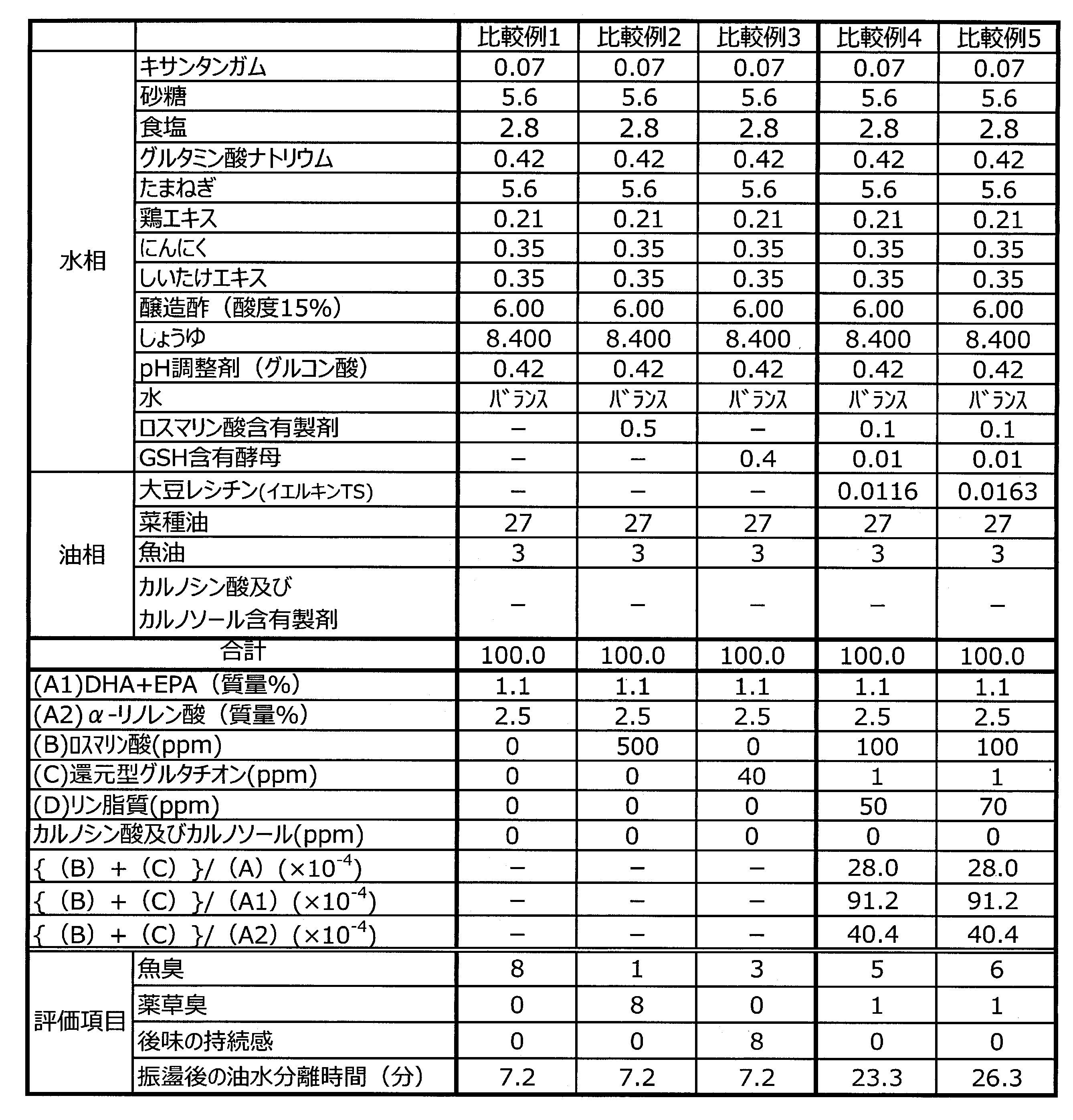
実施例19~24及び比較例6~7
〔分離液状ドレッシングの調製〕
先に示した実施例1と同じ手順で分離液状ドレッシングを調製した。
〔分離液状ドレッシングの調製〕
先に示した実施例1と同じ手順で分離液状ドレッシングを調製した。
〔官能評価と振盪後の油水分離時間〕
「魚臭」に代えて亜麻仁油に由来する劣化臭を評価した以外は先に示した方法と同じ手順で官能評価を実施した。「亜麻仁油由来の劣化臭」は比較例6の官能評価を8点(非常に感じる)とした。
また、先に示した方法と同じ手順で油水分離時間(分)を測定した。
結果を表2に示す。
「魚臭」に代えて亜麻仁油に由来する劣化臭を評価した以外は先に示した方法と同じ手順で官能評価を実施した。「亜麻仁油由来の劣化臭」は比較例6の官能評価を8点(非常に感じる)とした。
また、先に示した方法と同じ手順で油水分離時間(分)を測定した。
結果を表2に示す。
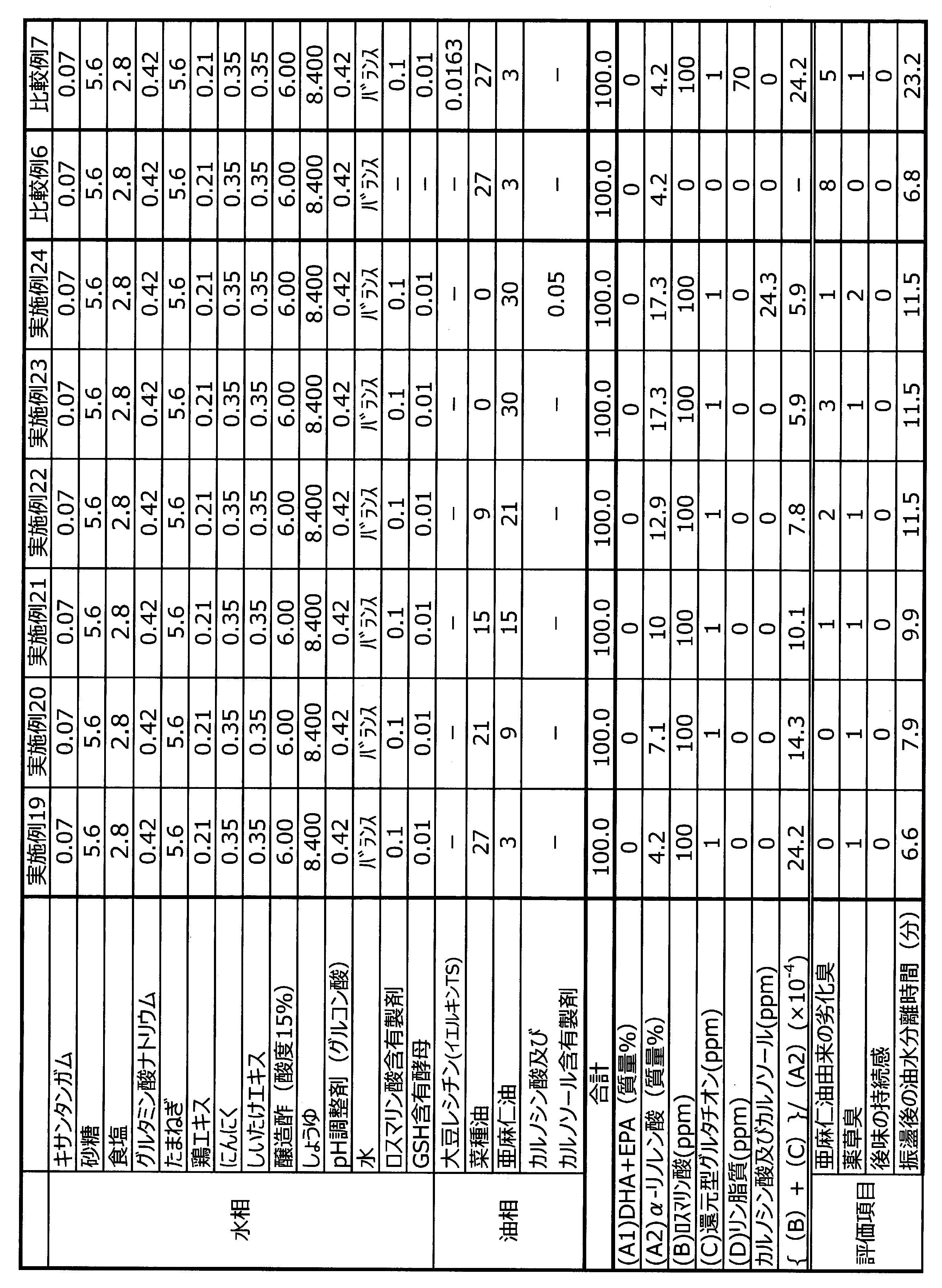
表1及び表2より明らかなように、ロスマリン酸と還元型グルタチオンを配合した本発明品は、比較品と比べ、保存後も魚臭・亜麻仁由来の劣化臭と薬草臭が少なく、後味の持続感も少なかった。また、分離型液体調味料を振盪した後でも油相と水相の分離状態を維持した。
これに対して、ロスマリン酸と還元型グルタチオンを配合しなかった比較例1~3及び6は保存に伴って風味劣化したり、薬草臭が強く感じられたり、後味が残った。また、リン脂質を所定量より多く含む比較例4、5及び7は、劣化が進み、魚臭・亜麻仁由来の劣化臭が強く感じられた。さらに、分離型液体調味料を振盪した後の油相と水相との分離時間が長く、分相状態に戻り難かった。
これに対して、ロスマリン酸と還元型グルタチオンを配合しなかった比較例1~3及び6は保存に伴って風味劣化したり、薬草臭が強く感じられたり、後味が残った。また、リン脂質を所定量より多く含む比較例4、5及び7は、劣化が進み、魚臭・亜麻仁由来の劣化臭が強く感じられた。さらに、分離型液体調味料を振盪した後の油相と水相との分離時間が長く、分相状態に戻り難かった。
Claims (11)
- 次の成分(A)、(B)及び(C):
(A)油脂由来のω3系不飽和脂肪酸 3~20質量%、
(B)ロスマリン酸、
(C)還元型グルタチオン
を配合してなり、(D)リン脂質の配合量が40ppm以下である分離型液体調味料。 - 振盪後の油水分離時間が15分以下である、請求項1記載の分離型液体調味料。
- リン脂質以外の乳化剤を実質的に含有しない、請求項1又は2記載の分離型液体調味料。
- (A)油脂由来のω3系不飽和脂肪酸が、α-リノレン酸、エイコサペンタエン酸及びドコサヘキサエン酸から選択される1種又は2種以上である請求項1~3のいずれか1項記載の分離型液体調味料。
- (B)ロスマリン酸の配合量が1~400ppmである請求項1~4のいずれか1項記載の分離型液体調味料。
- (C)還元型グルタチオンの配合量が0.1~30ppmである請求項1~5のいずれか1項記載の分離型液体調味料。
- (A)油脂由来のエイコサペンタエン酸及びドコサヘキサエン酸の合計配合量が0.1~8質量%である請求項1~6のいずれか1項記載の分離型液体調味料。
- (A)油脂由来のα-リノレン酸の配合量が0.1~20質量%である請求項1~7のいずれか1項記載の分離型液体調味料。
- (A)油脂由来のω3系不飽和脂肪酸の配合量に対する、(B)ロスマリン酸と(C)還元型グルタチオンの合計配合量の質量比[{(B)+(C)}/(A)]が1×10-4~100×10-4である請求項1~8のいずれか1項記載の分離型液体調味料。
- さらにカルノシン酸、カルノソール又はこれらの組み合わせを0.1~40ppm配合してなる請求項1~9のいずれか1項記載の分離型液体調味料。
- (A)油脂由来のω3系不飽和脂肪酸、(B)ロスマリン酸及び(C)還元型グルタチオン、並びに、必要に応じて(D)リン質量を配合する工程を含む分離型液体調味料の製造方法であって、
前記成分(A)の配合量が全配合原料の合計質量に対して3~20質量%であり、前記成分(D)の配合量が全配合原料の合計質量に対して40ppm以下である、製造方法。
Priority Applications (3)
| Application Number | Priority Date | Filing Date | Title |
|---|---|---|---|
| CN201780024321.7A CN109068706A (zh) | 2016-04-20 | 2017-04-19 | 分离型液体调味料 |
| US16/095,216 US11206858B2 (en) | 2016-04-20 | 2017-04-19 | Separated liquid seasoning |
| EP17785989.9A EP3446572A4 (en) | 2016-04-20 | 2017-04-19 | ISOLATED LIQUID SPICES |
Applications Claiming Priority (2)
| Application Number | Priority Date | Filing Date | Title |
|---|---|---|---|
| JP2016-084769 | 2016-04-20 | ||
| JP2016084769 | 2016-04-20 |
Publications (1)
| Publication Number | Publication Date |
|---|---|
| WO2017183651A1 true WO2017183651A1 (ja) | 2017-10-26 |
Family
ID=60116798
Family Applications (1)
| Application Number | Title | Priority Date | Filing Date |
|---|---|---|---|
| PCT/JP2017/015657 Ceased WO2017183651A1 (ja) | 2016-04-20 | 2017-04-19 | 分離型液体調味料 |
Country Status (6)
| Country | Link |
|---|---|
| US (1) | US11206858B2 (ja) |
| EP (1) | EP3446572A4 (ja) |
| JP (1) | JP6891032B2 (ja) |
| CN (1) | CN109068706A (ja) |
| TW (1) | TWI720184B (ja) |
| WO (1) | WO2017183651A1 (ja) |
Cited By (1)
| Publication number | Priority date | Publication date | Assignee | Title |
|---|---|---|---|---|
| JP2020110067A (ja) * | 2019-01-10 | 2020-07-27 | 日清オイリオグループ株式会社 | 分離液状調味料のスパイスの風味増強方法、及び分離液状調味料 |
Families Citing this family (4)
| Publication number | Priority date | Publication date | Assignee | Title |
|---|---|---|---|---|
| DE112018005136T5 (de) | 2017-09-14 | 2020-06-18 | AGC Inc. | Harzzusammensetzung, Formprodukt und Verfahren zu dessen Herstellung, Prepreg und Verfahren zu dessen Herstellung und faserverstärktes Formprodukt und Verfahren zu dessen Herstellung |
| CN108812934A (zh) * | 2018-05-31 | 2018-11-16 | 四川省丹丹郫县豆瓣集团股份有限公司 | 一种高不饱和脂肪酸调和油及其制备方法 |
| CN111642674A (zh) * | 2020-05-29 | 2020-09-11 | 江苏美鑫食品科技有限公司 | 一种从胡麻籽中提取α-亚麻酸制成基础复合调味料的工艺 |
| JP7008857B1 (ja) * | 2021-06-23 | 2022-01-25 | キユーピー株式会社 | 分離液状調味料 |
Citations (4)
| Publication number | Priority date | Publication date | Assignee | Title |
|---|---|---|---|---|
| JP2010162049A (ja) * | 2010-05-06 | 2010-07-29 | Kao Corp | 分離型液体調味料 |
| JP2013159730A (ja) * | 2012-02-07 | 2013-08-19 | Ogawa & Co Ltd | 油溶性酸化防止剤及びその製造方法 |
| WO2013172348A1 (ja) * | 2012-05-16 | 2013-11-21 | 不二製油株式会社 | 食用油脂及びそれを含有する食品並びにその製造方法 |
| WO2015072406A1 (ja) * | 2013-11-13 | 2015-05-21 | 不二製油株式会社 | 多価不飽和脂肪酸含有油脂 |
Family Cites Families (16)
| Publication number | Priority date | Publication date | Assignee | Title |
|---|---|---|---|---|
| JPH09176679A (ja) * | 1995-12-26 | 1997-07-08 | Okawa Shokuhin Kogyo Kk | 不飽和脂肪酸粉状体の耐酸化法、不飽和脂肪酸粉状体耐酸化性組成物および機能性食品 |
| JP4100750B2 (ja) | 1998-02-13 | 2008-06-11 | 株式会社Adeka | 乳化油脂組成物 |
| JP2004204212A (ja) | 2002-11-01 | 2004-07-22 | Mitsubishi Chemicals Corp | ハーブ系酸化防止剤及びその製造方法 |
| ES2254018B2 (es) * | 2004-11-16 | 2009-01-01 | Universidad Autonoma De Madrid | Mezcla oleosa de ingredientes bioactivos naturales para la preparacion de un producto alimenticio enriquecido. |
| JP2007185138A (ja) | 2006-01-13 | 2007-07-26 | Sanei Gen Ffi Inc | 親油性酸化防止剤、およびその製造方法 |
| EP2025237A1 (en) | 2007-08-15 | 2009-02-18 | Nestec S.A. | Lecithin and LC-PUFA |
| EP2496233A1 (en) * | 2009-11-06 | 2012-09-12 | Alcon Research, Ltd. | Nutritional supplements for relief of dry eye |
| JP2013209436A (ja) | 2012-03-30 | 2013-10-10 | Kao Corp | 抗酸化剤組成物 |
| US20140023712A1 (en) | 2012-07-20 | 2014-01-23 | Basf Se | Aqueous Transparent Oil-In-Water Emulsion Comprising an Emulsified Carotenoid |
| EP2687103B2 (en) * | 2012-07-20 | 2024-07-24 | Basf Se | Process for manufacturing an aqueous transparent oil-in-water emulsion comprising a carotenoid and emulsion produced |
| CN105228460B (zh) * | 2013-05-20 | 2019-05-07 | 花王株式会社 | 油脂组合物 |
| JP6325890B2 (ja) | 2013-05-20 | 2018-05-16 | 花王株式会社 | 油脂組成物 |
| JP6301636B2 (ja) | 2013-11-18 | 2018-03-28 | 花王株式会社 | 酸性水中油型乳化組成物 |
| US20160316810A1 (en) * | 2013-12-20 | 2016-11-03 | Abbott Laboratories | Nutritional composition containing oxidizable oil and rosmarinic acid |
| GB201505938D0 (en) * | 2015-04-08 | 2015-05-20 | Reckitt Benckiser Llc | Compositions comprising C0-Q10, krill oil and vitamin D |
| CN104911027A (zh) * | 2015-06-19 | 2015-09-16 | 江苏复生生物科技有限公司 | 用天然抗氧剂提高食用植物油或鱼油抗氧化性能的方法 |
-
2017
- 2017-04-19 CN CN201780024321.7A patent/CN109068706A/zh active Pending
- 2017-04-19 EP EP17785989.9A patent/EP3446572A4/en active Pending
- 2017-04-19 WO PCT/JP2017/015657 patent/WO2017183651A1/ja not_active Ceased
- 2017-04-19 JP JP2017082490A patent/JP6891032B2/ja active Active
- 2017-04-19 US US16/095,216 patent/US11206858B2/en active Active
- 2017-04-20 TW TW106113335A patent/TWI720184B/zh active
Patent Citations (4)
| Publication number | Priority date | Publication date | Assignee | Title |
|---|---|---|---|---|
| JP2010162049A (ja) * | 2010-05-06 | 2010-07-29 | Kao Corp | 分離型液体調味料 |
| JP2013159730A (ja) * | 2012-02-07 | 2013-08-19 | Ogawa & Co Ltd | 油溶性酸化防止剤及びその製造方法 |
| WO2013172348A1 (ja) * | 2012-05-16 | 2013-11-21 | 不二製油株式会社 | 食用油脂及びそれを含有する食品並びにその製造方法 |
| WO2015072406A1 (ja) * | 2013-11-13 | 2015-05-21 | 不二製油株式会社 | 多価不飽和脂肪酸含有油脂 |
Non-Patent Citations (2)
| Title |
|---|
| HIROTSUGU KIDO: "Rosemary Extract:Need to Extend Shelf of Life in Foods", OLEOSCIENCE, vol. 4, no. 10, 2004, pages 409 - 415, XP055580884 * |
| See also references of EP3446572A4 * |
Cited By (2)
| Publication number | Priority date | Publication date | Assignee | Title |
|---|---|---|---|---|
| JP2020110067A (ja) * | 2019-01-10 | 2020-07-27 | 日清オイリオグループ株式会社 | 分離液状調味料のスパイスの風味増強方法、及び分離液状調味料 |
| JP7286234B2 (ja) | 2019-01-10 | 2023-06-05 | 日清オイリオグループ株式会社 | 分離液状調味料のスパイスの風味増強方法、及び分離液状調味料 |
Also Published As
| Publication number | Publication date |
|---|---|
| JP6891032B2 (ja) | 2021-06-18 |
| TWI720184B (zh) | 2021-03-01 |
| US20190133169A1 (en) | 2019-05-09 |
| TW201737812A (zh) | 2017-11-01 |
| JP2017195880A (ja) | 2017-11-02 |
| EP3446572A1 (en) | 2019-02-27 |
| US11206858B2 (en) | 2021-12-28 |
| CN109068706A (zh) | 2018-12-21 |
| EP3446572A4 (en) | 2019-10-09 |
Similar Documents
| Publication | Publication Date | Title |
|---|---|---|
| JP6891032B2 (ja) | 分離型液体調味料 | |
| JP6058434B2 (ja) | 油脂組成物 | |
| JP6704683B2 (ja) | 油相及び水相を含有する液体調味料の製造方法 | |
| JP6301636B2 (ja) | 酸性水中油型乳化組成物 | |
| JP5925638B2 (ja) | 油脂組成物 | |
| JP6777527B2 (ja) | 油脂組成物 | |
| WO2013147130A1 (ja) | 油脂組成物 | |
| JP6891031B2 (ja) | 乳化液状調味料 | |
| JP2016123295A (ja) | 油脂組成物 | |
| JP6797269B2 (ja) | 油脂組成物 | |
| JP6933526B2 (ja) | 油脂組成物 | |
| JP6504814B2 (ja) | 油脂組成物 | |
| JP6777528B2 (ja) | 油脂組成物 | |
| JP6325866B2 (ja) | 油脂組成物 | |
| WO2015020236A1 (en) | Fat or oil composition | |
| JP2005105248A (ja) | 油脂組成物及び油脂組成物を利用した食品、ならびに油脂の精製方法 | |
| JP2015039369A (ja) | 油脂組成物の製造方法 |
Legal Events
| Date | Code | Title | Description |
|---|---|---|---|
| NENP | Non-entry into the national phase |
Ref country code: DE |
|
| WWE | Wipo information: entry into national phase |
Ref document number: 2017785989 Country of ref document: EP |
|
| ENP | Entry into the national phase |
Ref document number: 2017785989 Country of ref document: EP Effective date: 20181120 |
|
| 121 | Ep: the epo has been informed by wipo that ep was designated in this application |
Ref document number: 17785989 Country of ref document: EP Kind code of ref document: A1 |