WO2017183702A1 - ハイドロクロロフルオロカーボン及び/又はハイドロフルオロカーボンの製造方法 - Google Patents
ハイドロクロロフルオロカーボン及び/又はハイドロフルオロカーボンの製造方法 Download PDFInfo
- Publication number
- WO2017183702A1 WO2017183702A1 PCT/JP2017/015945 JP2017015945W WO2017183702A1 WO 2017183702 A1 WO2017183702 A1 WO 2017183702A1 JP 2017015945 W JP2017015945 W JP 2017015945W WO 2017183702 A1 WO2017183702 A1 WO 2017183702A1
- Authority
- WO
- WIPO (PCT)
- Prior art keywords
- hcfc
- hfc
- reaction
- reactors
- halogenated hydrocarbon
- Prior art date
- Legal status (The legal status is an assumption and is not a legal conclusion. Google has not performed a legal analysis and makes no representation as to the accuracy of the status listed.)
- Ceased
Links
Images

Classifications
-
- C—CHEMISTRY; METALLURGY
- C07—ORGANIC CHEMISTRY
- C07C—ACYCLIC OR CARBOCYCLIC COMPOUNDS
- C07C17/00—Preparation of halogenated hydrocarbons
- C07C17/093—Preparation of halogenated hydrocarbons by replacement by halogens
- C07C17/20—Preparation of halogenated hydrocarbons by replacement by halogens of halogen atoms by other halogen atoms
- C07C17/202—Preparation of halogenated hydrocarbons by replacement by halogens of halogen atoms by other halogen atoms two or more compounds being involved in the reaction
- C07C17/206—Preparation of halogenated hydrocarbons by replacement by halogens of halogen atoms by other halogen atoms two or more compounds being involved in the reaction the other compound being HX
-
- B—PERFORMING OPERATIONS; TRANSPORTING
- B01—PHYSICAL OR CHEMICAL PROCESSES OR APPARATUS IN GENERAL
- B01J—CHEMICAL OR PHYSICAL PROCESSES, e.g. CATALYSIS OR COLLOID CHEMISTRY; THEIR RELEVANT APPARATUS
- B01J19/00—Chemical, physical or physico-chemical processes in general; Their relevant apparatus
- B01J19/24—Stationary reactors without moving elements inside
- B01J19/2445—Stationary reactors without moving elements inside placed in parallel
-
- B—PERFORMING OPERATIONS; TRANSPORTING
- B01—PHYSICAL OR CHEMICAL PROCESSES OR APPARATUS IN GENERAL
- B01J—CHEMICAL OR PHYSICAL PROCESSES, e.g. CATALYSIS OR COLLOID CHEMISTRY; THEIR RELEVANT APPARATUS
- B01J23/00—Catalysts comprising metals or metal oxides or hydroxides, not provided for in group B01J21/00
- B01J23/90—Regeneration or reactivation
-
- C—CHEMISTRY; METALLURGY
- C07—ORGANIC CHEMISTRY
- C07C—ACYCLIC OR CARBOCYCLIC COMPOUNDS
- C07C17/00—Preparation of halogenated hydrocarbons
- C07C17/07—Preparation of halogenated hydrocarbons by addition of hydrogen halides
- C07C17/087—Preparation of halogenated hydrocarbons by addition of hydrogen halides to unsaturated halogenated hydrocarbons
-
- C—CHEMISTRY; METALLURGY
- C07—ORGANIC CHEMISTRY
- C07C—ACYCLIC OR CARBOCYCLIC COMPOUNDS
- C07C17/00—Preparation of halogenated hydrocarbons
- C07C17/093—Preparation of halogenated hydrocarbons by replacement by halogens
- C07C17/20—Preparation of halogenated hydrocarbons by replacement by halogens of halogen atoms by other halogen atoms
-
- C—CHEMISTRY; METALLURGY
- C07—ORGANIC CHEMISTRY
- C07C—ACYCLIC OR CARBOCYCLIC COMPOUNDS
- C07C17/00—Preparation of halogenated hydrocarbons
- C07C17/25—Preparation of halogenated hydrocarbons by splitting-off hydrogen halides from halogenated hydrocarbons
-
- C—CHEMISTRY; METALLURGY
- C07—ORGANIC CHEMISTRY
- C07C—ACYCLIC OR CARBOCYCLIC COMPOUNDS
- C07C21/00—Acyclic unsaturated compounds containing halogen atoms
- C07C21/02—Acyclic unsaturated compounds containing halogen atoms containing carbon-to-carbon double bonds
- C07C21/18—Acyclic unsaturated compounds containing halogen atoms containing carbon-to-carbon double bonds containing fluorine
-
- B—PERFORMING OPERATIONS; TRANSPORTING
- B01—PHYSICAL OR CHEMICAL PROCESSES OR APPARATUS IN GENERAL
- B01J—CHEMICAL OR PHYSICAL PROCESSES, e.g. CATALYSIS OR COLLOID CHEMISTRY; THEIR RELEVANT APPARATUS
- B01J2219/00—Chemical, physical or physico-chemical processes in general; Their relevant apparatus
- B01J2219/00002—Chemical plants
- B01J2219/00027—Process aspects
- B01J2219/00033—Continuous processes
-
- C—CHEMISTRY; METALLURGY
- C07—ORGANIC CHEMISTRY
- C07B—GENERAL METHODS OF ORGANIC CHEMISTRY; APPARATUS THEREFOR
- C07B61/00—Other general methods
-
- Y—GENERAL TAGGING OF NEW TECHNOLOGICAL DEVELOPMENTS; GENERAL TAGGING OF CROSS-SECTIONAL TECHNOLOGIES SPANNING OVER SEVERAL SECTIONS OF THE IPC; TECHNICAL SUBJECTS COVERED BY FORMER USPC CROSS-REFERENCE ART COLLECTIONS [XRACs] AND DIGESTS
- Y02—TECHNOLOGIES OR APPLICATIONS FOR MITIGATION OR ADAPTATION AGAINST CLIMATE CHANGE
- Y02P—CLIMATE CHANGE MITIGATION TECHNOLOGIES IN THE PRODUCTION OR PROCESSING OF GOODS
- Y02P20/00—Technologies relating to chemical industry
- Y02P20/50—Improvements relating to the production of bulk chemicals
- Y02P20/584—Recycling of catalysts
Definitions
- the present invention relates to a method for producing hydrochlorofluorocarbon and / or hydrofluorocarbon.
- hydrochlorofluorocarbons HCFCs
- hydrofluorocarbons HFCs
- HCFCs 2,3,3,3-tetrafluoropropene
- CF 3 CF ⁇ CH 2 which is a kind of hydrofluoroolefin (HFO)
- GWP global warming potential
- HFCs such as HFO-1234yf by using a halogenated hydrocarbon as a raw material compound and subjecting this and anhydrous hydrogen fluoride to a gas phase fluorination reaction in the presence of a catalyst
- a method for producing HFO-1234yf for example, 1,1,1,2,3-pentachloropropane (HCC-240db) is used as a raw material compound, and 2-chloro-3,3,3-trifluoropropene (HCFO-1233xf) and A method for producing HFO-1234yf has been proposed (Patent Documents 1 and 2).
- HCFO-1230xa 1,1,2,3-tetrachloropropene
- the reaction process was completely stopped and an operation for regeneration or recovery of the catalyst was performed.
- the reaction gas remaining in the reactor is purged and then the regeneration gas is circulated to regenerate the catalyst. After the regeneration is completed, the regeneration gas is purged and the reaction gas is circulated to start the reactor.
- the reaction process is completely stopped in this way, another problem is that production must be stopped every time regeneration is performed, resulting in very inefficient production and excessive equipment.
- the present inventors have a problem that, as a problem inherent in regeneration using a regeneration gas, there is a problem that a reactive gas is lost. Revealed.
- the present invention solves these problems in a method for obtaining HCFC and / or HFC by subjecting a halogenated hydrocarbon and anhydrous hydrogen fluoride to a gas phase fluorination reaction in the presence of a catalyst. Specifically, To provide a method capable of realizing efficient production without loss of reaction gas, without having to stop production every time regeneration or recovery of catalyst activity is performed, and without excessive facilities. Is an issue.
- the present inventors have used two or more reactors and a recovery device connected to them, and are required to continue the reaction in at least one reactor.
- the catalyst is regenerated or recovered after being put into a reaction halt state in at least one other reactor, so that the catalyst deteriorated with time can be recovered in a timely manner without losing the reaction gas and stopping the entire process.
- the present inventors have found that it can be regenerated or recovered, and have completed the present invention.
- Item 1 A method for producing hydrochlorofluorocarbon (HCFC) and / or hydrofluorocarbon (HFC) comprising: (A) a step of obtaining HCFC and / or HFC by subjecting a halogenated hydrocarbon to fluorination reaction in the presence of a catalyst in at least two reactors using anhydrous hydrogen fluoride; and (B) at least one of the above reactions.
- a method comprising the steps of obtaining HCFC and / or HFC by the reaction in at least one other reactor while the reaction is in a dormant state in the reactor.
- Item 2 Item 2.
- Item 3 The method according to Item 1 or 2, further comprising the following step (C): (C) A step of recovering the HCFC and / or HFC obtained in the step (A) using a recovery device connected to at least two of the reactors.
- Item 4 In the step (C), a composition containing HCFC and / or HFC obtained in the step (A), and a composition containing unreacted halogenated hydrocarbon and / or unreacted anhydrous hydrogen fluoride.
- Item 4. The method according to Item 3.
- Item 5 Item 5.
- the recovery device is at least one recovery device selected from the group consisting of a distillation column, a liquid separation device, and a flash column.
- the recovery device is at least one recovery device selected from the group consisting of a distillation column, a liquid separation device, and a flash column.
- a method for producing HCFC and / or HFC (A) obtaining HCFC and / or HFC by subjecting halogenated hydrocarbon to fluorination reaction in the presence of a catalyst in each of at least two reactors using anhydrous hydrogen fluoride; and (b) in step (a) A method comprising recovering the obtained HCFC and / or HFC using at least a recovery device connected to at least two of the reactors.
- Item 8 The method according to Item 7, further comprising the following step (c): (C) A step of recovering a composition containing unreacted halogenated hydrocarbon and / or unreacted anhydrous hydrogen fluoride using at least a recovery device connected to at least two of the reactors.
- step (d) A step of recycling the unreacted compound obtained in step (c) as a raw material compound in the reactor.
- Item 10. Item 10. The method according to any one of Items 7 to 9, wherein the step (a) is the following step (a ′): (a ′) while the reaction is stopped in at least one of the reactors, Obtaining HCFC and / or HFC by the reaction in at least one other reactor.
- Item 11. Item 11.
- the catalyst activity is regenerated or recovered in at least one reactor that is in a reaction dormant state.
- the halogenated hydrocarbon is 1,1,2,2,3-pentachloropropane (HCC-240aa), 1,1,1,2,3-pentachloropropane (HCC-240db), 1,1,1,3. , 3-pentachloropropane (HCC-240fa), 1,2,3-trichloro-1,1-difluoropropane (HCFC-242dc), 2,3-dichloro-1,1,1-trifluoropropane (HCFC-243db) ), 1,1,2,3-tetrachloropropene (HCO-1230xa), 2,3,3,3-tetrachloropropene (HCO-1230xf), 2,3-dichloro-3,3-difluoropropene (HCFO) -1232xf), 2-chloro-3,3,3-trifluoropropene (HCFO-1233xf) and 1-chloro-3,3,3-to Also less selected from the group consisting of tetraflu
- Item 18 The method according to any one of Items 1 to 14, wherein the halogenated hydrocarbon comprises HCFO-1233xf.
- Item 19 (A) at least two reactors comprising a catalyst suitable for the reaction of obtaining a HCFC and / or HFC by fluorinating a halogenated hydrocarbon with anhydrous hydrogen fluoride; (B) The system used for the method according to any one of Items 1 to 18, comprising a recovery device connected to at least two of the reactors (a). Item 20.
- the present invention in the production method of obtaining HCFC and / or HFC by using a halogenated hydrocarbon as a raw material compound and subjecting this and anhydrous hydrogen fluoride to a gas phase fluorination reaction in the presence of a catalyst, Without stopping, there is no loss of reaction gas, and the catalytic activity that has deteriorated over time can be recovered in a timely manner.
- hydrofluorocarbon HFC
- HFO hydrofluoroolefin
- hydrofluorocarbon HCFC
- HCFO hydrochlorofluoroolefin
- the raw material compound is not particularly limited as long as it is a halogenated hydrocarbon capable of generating HCFC and / or HFC by gas phase fluorination reaction with anhydrous hydrogen fluoride.
- the raw material compound one or a combination of the above-mentioned halogenated hydrocarbons can be used.
- the target HCFC and / or halogenated hydrocarbon having the same carbon number as that of the HFC produced by the production method of the present invention is used as a raw material compound.
- the halogenated hydrocarbon as the raw material compound, the halogenated carbon having 2 to 5 carbon atoms and optionally having an unsaturated bond substituted with at least one chlorine atom and / or fluorine atom Hydrogen etc. are mentioned.
- the unsaturated bond may be a double bond or a triple bond, but is preferably a double bond.
- the halogenated hydrocarbon having 2 to 5 carbon atoms which is substituted with at least one chlorine atom and / or fluorine atom as a raw material compound and has an unsaturated bond, is a halogenated terminal having an unsaturated bond.
- Hydrocarbons are preferred, and halogenated hydrocarbons having a double bond at the end are particularly preferred.
- the number of carbon atoms is preferably 2 to 4, More preferably it is 3.
- C3 halogenated hydrocarbons as starting compounds are 1,1,2,2,3-pentachloropropane (HCC-240aa), 1,1,1,2,3-pentachloropropane (HCC-240db), 1,1,1,3,3-pentachloropropane (HCC-240fa), 1,2,3-trichloro-1,1-difluoropropane (HCFC-242dc), 2,3-dichloro-1,1,1- Trifluoropropane (HCFC-243db), 1,1,2,3-tetrachloropropene (HCO-1230xa), 2,3,3,3-tetrachloropropene (HCO-1230xf), 2,3-dichloro-3 , 3-difluoropropene (HCFO-1232xf), 2-chloro-3,3,3-trifluoropropene (HCFO-1233xf) and - chloro-3,3,3-trifluoropropene (HCFO-1233zd)
- HCC-240db, HCO-1230xf, and HCO-1230xa are particularly advantageous in that they are easily available and inexpensive.
- the target HCFC and / or HFC produced by the production method of the present invention is not particularly limited.
- the HCFC and / or HFC to be produced by the production method of the present invention is not particularly limited, but since the global warming potential (GWP) is low, it is a refrigerant, foaming agent, heat medium, aerosol propulsion for car air conditioners and the like.
- An example is HFO-1234yf, which is regarded as a promising agent and solvent.
- Other examples include HFO-1234ze, HFO-1243zf, and their production intermediates, which are isomers thereof, which are useful as refrigerants, foaming agents, heat media, aerosol propellants, solvents, and the like.
- HCFO-1233zd and HCFO-1233xf which are regarded as useful as a refrigerant, a foaming agent, a heat medium, a solvent, and the like are also included.
- the target HCFC and / or HFC produced by the production method of the present invention is HFO-1234yf, it is not particularly limited, but it is preferable to use at least HCFO-1233xf as a raw material compound.
- Vapor phase fluorination reaction the raw material compound described above can be reacted with anhydrous hydrogen fluoride in the gas phase in the presence of a catalyst.
- the raw material compound and anhydrous hydrogen fluoride may be brought into contact with each other in the presence of a catalyst in a gas state, and the raw material compound may be in a liquid state when the raw material compound is supplied to the reactor.
- the raw material compound may be reacted with anhydrous hydrogen fluoride in the liquid phase in the presence of a catalyst (also referred to as a fluorinating agent).
- a catalyst also referred to as a fluorinating agent
- the liquid phase reactor is composed of SbCl 5 , TaCl 5 , NbCl 5 , SnCl 4 , TiCl 4 , MoCl 6 and FeCl 3 , and a group consisting of halides in which some and all of these chlorine atoms are replaced with fluorine atoms.
- Anhydrous hydrogen fluoride and a raw material compound can be reacted in the presence of at least one kind of catalyst selected.
- the reaction can be continuously carried out by continuously extracting the product out of the reaction system and additionally charging the raw materials.
- the halide has a valence that decreases during the reaction and loses its activity when it becomes SbCl 3 or the like. Therefore, it is preferable to perform a catalyst regeneration operation using an oxidizing substance such as chlorine to restore the original valence.
- the method for vaporizing the raw material compound in the reaction zone is not particularly limited.
- the reaction tube is filled with a material having good thermal conductivity, no catalytic activity for the reaction of the present invention, and stable to anhydrous hydrogen fluoride.
- the vaporizer can be used.
- the raw material compound is liquid at normal temperature and normal pressure
- the raw material compound is vaporized with a vaporizer and then passed through the preheating region, and then supplied to the mixing region where it is brought into contact with anhydrous hydrogen fluoride and mixed.
- the reaction can be carried out in the gas phase by making the temperature distribution uniform and supplying it to the reactor filled with the catalyst.
- the raw material compound is prepared by heating anhydrous hydrogen fluoride to a temperature equal to or higher than the vaporization temperature of the raw material compound and then supplying it together with the raw material compound in a liquid state to an apparatus for vaporization and mixing.
- the method etc. which vaporize and supply to a reactor as a gaseous-phase state are also mentioned.
- the material having good thermal conductivity is not particularly limited, and is a metal piece of a corrosion resistant material such as nickel beads, alumina beads, HASTALLOY, INCONEL, MONEL or INCOLOY. Etc. can be used.
- Anhydrous hydrogen fluoride is usually supplied to the reactor in a gas phase together with the raw material compound.
- the supply amount of anhydrous hydrogen fluoride it is usually preferable to set the total molar ratio of halogenated hydrocarbons as raw material compounds to anhydrous hydrogen fluoride to 10 or more in order to suppress deterioration of catalyst activity.
- the upper limit of the molar ratio can be adjusted to an optimum value so as to be advantageous in terms of energy efficiency.
- the molar ratio is preferably 100 or less, and more preferably 50 or less.
- the total molar ratio of halogenated hydrocarbons is 4 or more, and more preferable that the amount is 8 or more.
- the raw material compound and / or anhydrous hydrogen fluoride may be supplied to the reactor as it is, or may be supplied after being diluted with an inert gas such as nitrogen, helium and argon. Further, in order to suppress deterioration of the catalytic activity, at least one oxidizing gas such as fluorine, oxygen and chlorine may be added.
- the raw material may be accompanied by oxygen and supplied to the reactor.
- the supply amount of oxygen may be about 0.01 to 0.3 mol with respect to 1 mol of the halogenated hydrocarbon, based on the supply amount of the halogenated hydrocarbon that is the raw material compound.
- the fluorination catalyst a known catalyst that is active for the fluorination reaction with hydrogen fluoride can be used.
- metal oxides such as chromium oxide, chromium oxide fluoride, aluminum fluoride, and aluminum oxyfluoride, and metal oxyfluorides can be used.
- metal fluorides such as MgF 2 , TaF 5 , and SbF 5 can be used. Can also be used.
- chromium oxide is not particularly limited.
- Any shape of the chromium oxide catalyst can be used as long as it is suitable for the reaction, such as powder or pellets. Of these, pellets are preferred.
- the chromium oxide catalyst described above can be prepared, for example, by the method described in JP-A-5-146680.
- fluorinated chromium oxide can be prepared by the method described in JP-A-5-146680. For example, it can be obtained by fluorination (HF treatment) of chromium oxide obtained by the above-described method with hydrogen fluoride.
- the degree of fluorination is not particularly limited, but for example, a fluorine content of about 10 to 45% by weight can be suitably used.
- the main component is a chromium compound to which at least one metal element selected from the group consisting of indium, gallium, cobalt, nickel, zinc and aluminum described in JP-A-11-171806 is added,
- a chromium-based catalyst having an average valence number of chromium in the chromium compound of +3.5 or more and +5.0 or less and in an amorphous state is also used as a chromium oxide catalyst or a fluorinated chromium oxide catalyst. be able to.
- the above-described fluorination catalyst can be used by being supported on a carrier such as alumina or activated carbon.
- the form of the reactor is not particularly limited, and for example, an adiabatic reactor filled with a catalyst, a multitubular reactor removed with a heat medium, or the like can be used.
- the reactor a reactor made of an alloy containing 30% by weight or more of nickel is preferable.
- the reactor is made of a material resistant to the corrosive action of hydrogen fluoride, such as Hastelloy, Inconel, Monel, and Incoloy. It is preferable to use one.
- the reaction temperature is suitably about 200 to 500 ° C. and preferably about 250 to 450 ° C. as the temperature in the reactor.
- the substance yield is within the above temperature range.
- Select the optimum temperature for the surface By being below the upper limit of this temperature range, the selectivity of HFO improves, and when it is above the lower limit, the conversion rate of the raw material compound is improved.
- the pressure during the reaction is not particularly limited, and the reaction can be carried out at normal pressure or under pressure. That is, the reaction in the present invention can be carried out under atmospheric pressure (0.1 MPa), but may be carried out under a pressure up to about 1.0 MPa.
- the reaction time is not particularly limited.
- the catalyst filling amount W (g) and the total flow rate of the raw material gas supplied to the reactor (total amount of raw material compound and anhydrous hydrogen fluoride) Fo (0 ° C., 1 atm)
- the contact time represented by W / Fo may be in the range of about 5 to 20 g ⁇ sec / cc.
- a composition containing HCFC and / or HFC as the target compound can be obtained as the product composition.
- this product composition can be obtained at the reactor outlet.
- HCFC and / or HFC can be purified and recovered by a method such as distillation, adsorption, or membrane separation.
- the method for producing HCFC and / or HFC of the present invention is particularly useful as a method for producing hydrofluoroolefin (HFO). Therefore, in the present invention, the product composition is particularly preferably a composition containing HFO.
- the product composition usually contains by-products such as HCl in addition to the target compound HCFC and / or HFC as a reaction product. Further, the product composition may contain unreacted raw material compounds, anhydrous hydrogen fluoride, and the like.
- the main product composition is a composition mainly containing HCFC and / or HFC which are target compounds.
- the unreacted composition is a composition mainly containing a raw material compound and anhydrous hydrogen fluoride.
- the term “unreacted composition” means a composition mainly containing a raw material compound and anhydrous hydrogen fluoride. At least a part of the raw material compound contained therein is composed of a raw material compound and a substance. As long as it is the same, it may be a reaction by-product regardless of origin.
- the by-product composition is a composition mainly containing a by-product.
- compositions can be separated from each other by operations such as distillation and / or liquid separation.
- distillation includes flash distillation.
- the term “mainly contains” represents a concept reflecting the purity that can be achieved by a normal separation operation, and usually contains other components in a total amount of 10 mol% or less, preferably 5 mol% or less, and more. Preferably it contains 2 mol% or less.
- HFO-1233xf when HCFO-1233xf is used as a raw material compound, HFO-1234yf can be obtained as HFC, and 1,3,3,3-tetrafluoropropene (HFO-1234ze) can also be obtained in a relatively small amount. it can.
- HFO-1234ze 1,3,3,3-tetrafluoropropene
- HCl, 1,1,1,2,2-pentafluoropropane (HFC-245cb), HCFO-1233zd, and the like are obtained as by-products.
- the product composition obtained in this way is subjected to distillation and / or liquid separation, etc.
- A a main product composition comprising HCFC and / or HFC; It can be separated into (b) a composition containing unreacted halogenated hydrocarbon and anhydrous hydrogen fluoride and (c) a composition containing other by-products.
- the composition (b) is not limited to the unreacted material, and may further contain at least one kind of by-product.
- the product composition described above is obtained by means such as distillation and / or liquid separation.
- the unreacted composition means a composition mainly containing a raw material compound and anhydrous hydrogen fluoride
- the by-product composition means a composition mainly containing a by-product.
- the composition containing 1 type of HCFC or HFC may be isolate
- the target HCFC or HFC is only one of them, the other HCFCs and / or HFCs are treated as by-products, and the main production It may be contained in any one or more of the composition, the by-product composition and the unreacted composition.
- HCFC and / or HFC as such a by-product is treated as a by-product composition when the production amount is large, and is converted into a main product composition and / or an unreacted composition when the production amount is small. It may be included.
- (B2) An unreacted unreacted composition containing one kind of halogenated hydrocarbon and anhydrous hydrogen fluoride can also be separated.
- separation means such as distillation and / or liquid separation
- the proportion of the total of halogenated hydrocarbons and anhydrous hydrogen fluoride in the unreacted composition (b2) is relatively high.
- this unreacted composition (b2) contains other components in a total amount of 10 mol% or less, preferably 5 mol% or less, more preferably 2 mol% or less, based on the total composition.
- the respective compositions thus recovered can be recycled by supplying them again to the reactor as necessary.
- HFO as the target compound can be purified through a crude step and a purification step as necessary.
- a crude step and a purification step There are no particular limitations on the specific methods of the crude step and the purification step, and a variety of commonly used methods can be employed. For example, means such as water washing, dehydration (drying), distillation and liquid separation can be applied.
- the method includes a step of obtaining HCFC and / or HFC by putting at least one reactor into a reaction pause state and operating the remaining reactors.
- a recovery device connected to at least two reactors is used, and HCFC and / or HFC obtained by the gas phase fluorination reaction is recovered using at least the recovery device.
- Including the step of: thereby, like the said aspect, at least 1 reactor can be made into a reaction dormant state, and the remaining reactors can be made into an operation state.
- the catalytic activity can be regenerated or recovered in the reactor that is in the reaction dormant state. By doing so, the catalytic activity can be regenerated or recovered as necessary in some reactors without stopping the entire process for producing HCFC and / or HFC.
- the recovery device is not particularly limited and can be selected widely.
- a distillation column, a liquid separation device, a flash column, and the like can be used.
- one type of recovery device may be used, or a plurality of types of recovery devices may be used. Further, a plurality of recovery devices of the same type may be used.
- n groups three or more (n groups) reactors are used, for example, the x group is operating, and the (nx) group is in a reaction pause state (the state at this time is referred to as operation x: pause n ⁇ (represented as x) is always maintained in order, so that the reactors that are operating in order are changed.
- pause n ⁇ represented as x
- both n and x are integers, and x is smaller than n.
- (1) and (2) are given as examples of the partial reaction pause step in the embodiment using four reactors.
- Operation 1 While operating one reactor, the reaction is paused in three reactors (operation 1: pause 3). Operation 1: The reactors that are operating are sequentially changed while the pause 3 is maintained.
- Examples of the partial reaction pause step in the embodiment using six reactors include the following.
- the regeneration or recovery of the catalyst activity is not particularly limited, and can be performed, for example, by the following steps.
- Reacting the catalyst by changing the temperature of the reactor in the reaction stop state to an appropriate temperature and supplying a gas (sometimes called “regeneration gas”) obtained by diluting an oxidizing gas with an appropriate balance gas, or replacing the catalyst Or by recharging the catalyst, the production capacity of the reactor can be restored.
- a gas sometimes called “regeneration gas”
- the catalyst may be deteriorated due to the lapse of time of use, and the activity does not recover even by a regeneration operation, or the gas flow is deteriorated due to the accumulation of corrosive substances, and the productivity may be lowered. In such a case, catalyst replacement, refilling of the catalyst, etc. can be performed as necessary.
- the oxidizing gas is not particularly limited, and for example, fluorine, oxygen, chlorine and the like are used.
- fluorine, oxygen, chlorine and the like are used as the oxidizing gas.
- one kind of gas or a combination of plural kinds of gases may be used.
- the balance gas is not particularly limited, and for example, helium, nitrogen, hydrogen, argon, hydrogen fluoride, hydrogen chloride and the like are used.
- As the balance gas one kind of gas or a combination of plural kinds of gases may be used.
- the regenerated gas used for regeneration can be recovered and burned, and can be reused after removing impurities such as carbon monoxide and / or carbon dioxide produced.
- the recovery of the catalyst activity can also be performed by exchanging the catalyst or refilling the catalyst.
- System The system used for the method of manufacturing the HCFC and / or HFC of the present invention is: (A) at least two reactors comprising a catalyst suitable for the reaction of obtaining HCFC and / or HFC by fluorinating a halogenated hydrocarbon and anhydrous hydrogen fluoride; (B) including a recovery device connected to at least two of the reactors (a).
- the system of the present invention is characterized in that two reactors are connected in parallel to one recovery device.
- the catalytic activity can be regenerated or recovered as necessary in some reactors without stopping the entire process for producing HCFC and / or HFC.
- the number of reactors is not particularly limited, and can be appropriately set depending on the flow rate, the size and thickness of each reactor, and the like.
- a system including n reactors may be used, or one reactor may be considered as a spare and a total of n + 1
- a system including a basic reactor may be used.
- the system may further include two or more reactors.
- the system of the present invention can achieve the above-described effects as long as at least one recovery device is provided, and although not particularly limited, a plurality of recovery devices may be provided.
- all of the plurality of recovery devices may be connected in series with each other, all may be connected in parallel with each other, some are in series with each other, and some are connected in parallel with each other. May be.
- Example 1 A gas phase fluorination process of HCFO-1233xf with anhydrous hydrogen fluoride was performed.
- the reaction temperature was 365 ° C.
- the reaction pressure was 0.5 MPaG
- the molar ratio of HF to HCFO-1233xf was 10.
- 100 kg / month of HFO-1234yf can be obtained from this process.
- Figure 1 shows the process when the number of reactors is six. Symbols such as “S1” are names of each stream.
- Tables 1 to 3 show the flow rate (mol / h) of each stream in the process of Example 1.
- Table 4 shows examples of reactor operation patterns.
- Other reaction conditions are the same as in Example 1. As a result of this operation, 110 kg / month of HFO-1233xf can be obtained from this process.
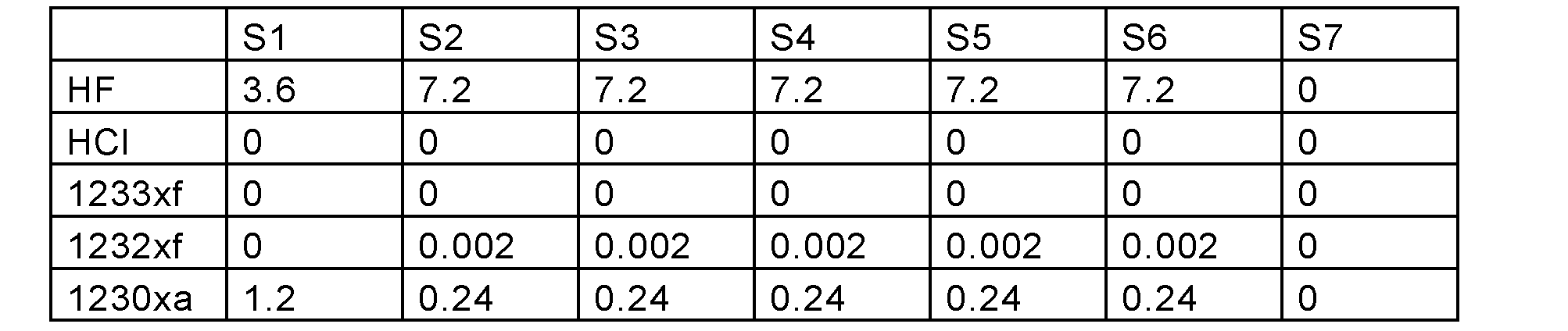
- Tables 5 to 7 show the flow rate (mol / h) of each stream in the process of Example 2.
- Other reaction conditions are the same as in Example 1. As a result of this operation, 110 kg / month of HFO-1233xf can be obtained from this process.
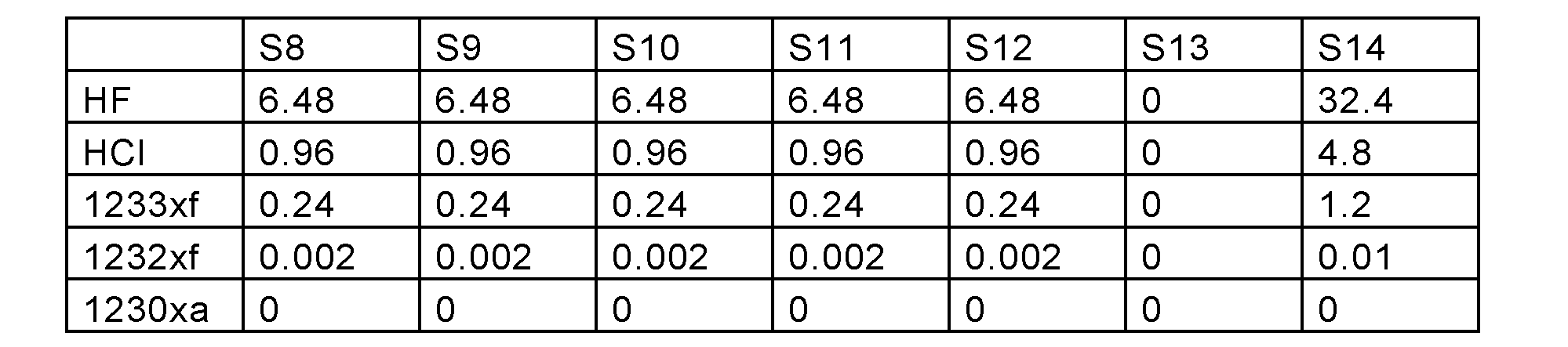
- Tables 8 to 10 show the flow rate (mol / h) of each stream in the process of Example 3.
Landscapes
- Chemical & Material Sciences (AREA)
- Organic Chemistry (AREA)
- Chemical Kinetics & Catalysis (AREA)
- Engineering & Computer Science (AREA)
- Materials Engineering (AREA)
- Organic Low-Molecular-Weight Compounds And Preparation Thereof (AREA)
- Low-Molecular Organic Synthesis Reactions Using Catalysts (AREA)
Abstract
ハロゲン化炭化水素と無水フッ化水素とを触媒存在下でフッ素化反応させることによりHCFC及び/又はHFCを製造する方法において、触媒活性の再生又は回復を行う度に生産を止める必要がなく、かつ設備が過大になることなく、効率的な生産を実現することのできる方法を提供する。その解決手段として、 (A)ハロゲン化炭化水素と無水フッ化水素とを少なくとも二つの反応器においてそれぞれ触媒存在下でフッ素化反応させることによりHCFC及び/又はHFCを得る工程;及び (B)少なくとも一つの前記反応器において前記反応を休止状態としつつ、少なくとも一つの別の前記反応器において前記反応によりHCFC及び/又はHFCを得る工程 を含む方法を提供する。
Description
本発明は、ハイドロクロロフルオロカーボン及び/又はハイドロフルオロカーボンの製造方法に関する。
種々のハイドロクロロフルオロカーボン(HCFC)及びハイドロフルオロカーボン(HFC)が有用化合物として利用されている。例えば、ハイドロフルオロオレフィン(HFO)の一種である化学式:CF3CF=CH2で示される2,3,3,3-テトラフルオロプロペン(HFO-1234yf)は、地球温暖化係数(GWP)が低いことから、カーエアコン等のための冷媒として有望視されている。
HFO-1234yfをはじめとするHFCの製造方法として、ハロゲン化炭化水素を原料化合物として用い、これと無水フッ化水素とを触媒存在下で気相フッ素化反応させることによりHFCを得る、様々な方法がこれまでに提案されている。このような方法としては例えば、1,1,1,2,3-ペンタクロロプロパン(HCC-240db)を原料化合物として用い、2-クロロ-3,3,3-トリフルオロプロペン(HCFO-1233xf)及びHFO-1234yfを製造する方法が提案されている(特許文献1、2)。また、原料化合物として1,1,2,3-テトラクロロプロペン(HCC-1230xa)を用い、HFO-1234yfを製造する方法も開示されている(特許文献3)。
ハロゲン化炭化水素と無水フッ化水素とを触媒存在下でフッ素化反応させることによりHCFC及び/又はHFCを得る方法においては、反応時間経過とともに触媒活性や選択性が低下し、生産性が低下していくという問題があることを本発明者らは見出した。
この課題の解決にあたっては、反応工程を全面的に停止して、触媒の再生又は回復のための操作を行うことが考えられた。具体例として、反応器内に残留した反応ガスをパージしてから再生ガスを流通させて触媒を再生させ、再生完了後に再生ガスをパージして反応ガスを流通させ、反応器を起動させることが挙げられる。しかし、このように反応工程を全面的に停止した場合には、別の問題点として、再生を行う度に生産を止める必要があるため、非常に非効率な生産となり、かつ設備が過大になったり、プロセス全体の安定運転において大きな支障となったりすること等があること、さらに再生ガスを用いる再生における固有の問題として、反応ガスがロスしてしまうという問題があること、を本発明者らは明らかにした。
本発明は、ハロゲン化炭化水素と無水フッ化水素とを触媒存在下で気相フッ素化反応させることによりHCFC及び/又はHFCを得る方法におけるこれらの課題を解決するものであり、具体的には、反応ガスがロスすることなく、触媒活性の再生又は回復を行う度に生産を止める必要がなく、かつ設備が過大になることなく、効率的な生産を実現することのできる方法を提供することを課題とする。
本発明者らは、上記した課題を解決すべく鋭意研究を重ねた結果、二以上の反応器とこれらに接続された回収装置とを用い、少なくとも一つの反応器において反応を継続しつつ、必要に応じて少なくとも一つの別の反応器において反応休止状態としたうえで触媒を再生又は回復することにより、反応ガスがロスすることなく、かつプロセス全体を止めることなく経時的に劣化した触媒を適時に再生又は回復できることを見出し、本発明を完成するに至った。
すなわち、本発明は、下記の実施形態を含む。
項1.
ハイドロクロロフルオロカーボン(HCFC)及び/又はハイドロフルオロカーボン(HFC)を製造する方法であって、
(A)ハロゲン化炭化水素を無水フッ化水素を用いて少なくとも二つの反応器においてそれぞれ触媒存在下でフッ素化反応させることによりHCFC及び/又はHFCを得る工程;及び
(B)少なくとも一つの前記反応器において前記反応を休止状態としつつ、少なくとも一つの別の前記反応器において前記反応によりHCFC及び/又はHFCを得る工程
を含む、方法。
項2
前記工程(B)において、反応休止状態となっている少なくとも一つの反応器で触媒活性を再生又は回復する、項1に記載の方法。
項3
さらに、以下の工程(C)を含む、項1又は2に記載の方法:
(C)前記工程(A)で得られたHCFC及び/又はHFCを、少なくとも二つの前記反応器と接続された回収装置を用いて回収する工程。
項4
前記工程(C)において、前記工程(A)で得られたHCFC及び/又はHFCを含む組成物と、未反応のハロゲン化炭化水素及び/又は未反応の無水フッ化水素を含む組成物とを分離する、項3に記載の方法。
項5
前記工程(C)において、前記回収装置が、蒸留塔、分液装置及びフラッシュ塔からなる群より選択される少なくとも一種の回収装置である、項3又は4に記載の方法。
項6.
さらに、以下の工程(D)を含む、項3~5のいずれか一項に記載の方法:
(D)工程(C)で得られた前記未反応化合物を、前記反応器内に原料化合物としてリサイクルする工程。
項7.
HCFC及び/又はHFCを製造する方法であって、
(a)ハロゲン化炭化水素を無水フッ化水素を用いて少なくとも二つの反応器においてそれぞれ触媒存在下でフッ素化反応させることによりHCFC及び/又はHFCを得る工程;及び
(b)工程(a)で得られたHCFC及び/又はHFCを、少なくとも二つの前記反応器と接続された回収装置を少なくとも用いて回収する工程
を含む、方法。
項8.
さらに、以下の工程(c)を含む、項7に記載の方法:
(c)少なくとも二つの前記反応器と接続された回収装置を少なくとも用いて、未反応のハロゲン化炭化水素及び/又は未反応の無水フッ化水素を含む組成物を回収する工程。
項9.
さらに、以下の工程(d)を含む、項8に記載の方法:
(d)工程(c)で得られた前記未反応化合物を、前記反応器内に原料化合物としてリサイクルする工程。
項10.
前記工程(a)が、以下の工程(a’)である、項7~9のいずれか一項に記載の方法:(a’)少なくとも一つの前記反応器において前記反応を休止状態としつつ、少なくとも一つの別の前記反応器において前記反応によりHCFC及び/又はHFCを得る工程。
項11.
前記工程(a’)において、反応休止状態となっている少なくとも一つの反応器で触媒活性を再生又は回復する、項10に記載の方法。
項12.
連続的にHCFC及び/又はHFCを製造する、項1~11のいずれか一項に記載の方法。
項13.
前記HCFC及びHFCが、それぞれ炭素数2~4のHCFC及びHFCを含む、項1~12のいずれか一項に記載の方法。
項14.
前記HFCが、2,3,3,3-テトラフルオロプロペン(HFO-1234yf)を含む、項1~12のいずれか一項に記載の方法。
項15.
前記ハロゲン化炭化水素が、少なくとも一つの塩素原子及び/又はフッ素原子で置換されている、不飽和結合を有していてもよい炭素数2~4のハロゲン化炭化水素である、項1~14のいずれか一項に記載の方法。
項16.
前記ハロゲン化炭化水素が、
一般式:CHgClhF(3-g-h)CHiCl(2-i)CHjCl(3-j);及び
一般式:CHkCllF(3-k-l)CHmCl(1-m)=CHnCl(2-n)
(両式中、g、k、i及びnは0~2のいずれかの整数であり、h、j及びlはそれぞれ0~3のいずれかの整数であり、mはそれぞれ0又は1である)
でそれぞれ示されるハロゲン化炭化水素からなる群より選択される少なくとも一種のハロゲン化炭化水素である、項1~14のいずれか一項に記載の方法。
項17.
前記ハロゲン化炭化水素が、1,1,2,2,3-ペンタクロロプロパン(HCC-240aa)、1,1,1,2,3-ペンタクロロプロパン(HCC-240db)、1,1,1,3,3-ペンタクロロプロパン(HCC-240fa)、1,2,3-トリクロロ-1,1-ジフルオロプロパン(HCFC-242dc)、2,3-ジクロロ-1,1,1-トリフルオロプロパン(HCFC-243db)、1,1,2,3-テトラクロロプロペン(HCO-1230xa)、2,3,3,3-テトラクロロプロペン(HCO-1230xf)、2,3-ジクロロ-3,3-ジフルオロプロペン(HCFO-1232xf)、2-クロロ-3,3,3-トリフルオロプロペン(HCFO-1233xf)及び1-クロロ-3,3,3-トリフルオロプロペン(HCFO-1233zd)からなる群より選択される少なくも一種のハロゲン化炭化水素である、項1~14のいずれか一項に記載の方法。
項18.
前記ハロゲン化炭化水素が、HCFO-1233xfを含む、項1~14のいずれか一項に記載の方法。
項19.
(a)ハロゲン化炭化水素を無水フッ化水素を用いてフッ素化反応させることによりHCFC及び/又はHFCを得る反応に適した触媒を含む、少なくとも二つの反応器;
(b)少なくとも二つの前記反応器(a)と接続された回収装置
を含む、項1~18のいずれか一項に記載の方法のために用いられるシステム。
項20.
(a)ハロゲン化炭化水素を無水フッ化水素を用いてフッ素化反応させることによりHCFC及び/又はHFCを得る反応に適した触媒を含む、少なくとも二つの反応器;
(b)少なくとも二つの前記反応器(a)と接続された回収装置
を含むシステムの、項1~18のいずれか一項に記載の方法のための使用。
項1.
ハイドロクロロフルオロカーボン(HCFC)及び/又はハイドロフルオロカーボン(HFC)を製造する方法であって、
(A)ハロゲン化炭化水素を無水フッ化水素を用いて少なくとも二つの反応器においてそれぞれ触媒存在下でフッ素化反応させることによりHCFC及び/又はHFCを得る工程;及び
(B)少なくとも一つの前記反応器において前記反応を休止状態としつつ、少なくとも一つの別の前記反応器において前記反応によりHCFC及び/又はHFCを得る工程
を含む、方法。
項2
前記工程(B)において、反応休止状態となっている少なくとも一つの反応器で触媒活性を再生又は回復する、項1に記載の方法。
項3
さらに、以下の工程(C)を含む、項1又は2に記載の方法:
(C)前記工程(A)で得られたHCFC及び/又はHFCを、少なくとも二つの前記反応器と接続された回収装置を用いて回収する工程。
項4
前記工程(C)において、前記工程(A)で得られたHCFC及び/又はHFCを含む組成物と、未反応のハロゲン化炭化水素及び/又は未反応の無水フッ化水素を含む組成物とを分離する、項3に記載の方法。
項5
前記工程(C)において、前記回収装置が、蒸留塔、分液装置及びフラッシュ塔からなる群より選択される少なくとも一種の回収装置である、項3又は4に記載の方法。
項6.
さらに、以下の工程(D)を含む、項3~5のいずれか一項に記載の方法:
(D)工程(C)で得られた前記未反応化合物を、前記反応器内に原料化合物としてリサイクルする工程。
項7.
HCFC及び/又はHFCを製造する方法であって、
(a)ハロゲン化炭化水素を無水フッ化水素を用いて少なくとも二つの反応器においてそれぞれ触媒存在下でフッ素化反応させることによりHCFC及び/又はHFCを得る工程;及び
(b)工程(a)で得られたHCFC及び/又はHFCを、少なくとも二つの前記反応器と接続された回収装置を少なくとも用いて回収する工程
を含む、方法。
項8.
さらに、以下の工程(c)を含む、項7に記載の方法:
(c)少なくとも二つの前記反応器と接続された回収装置を少なくとも用いて、未反応のハロゲン化炭化水素及び/又は未反応の無水フッ化水素を含む組成物を回収する工程。
項9.
さらに、以下の工程(d)を含む、項8に記載の方法:
(d)工程(c)で得られた前記未反応化合物を、前記反応器内に原料化合物としてリサイクルする工程。
項10.
前記工程(a)が、以下の工程(a’)である、項7~9のいずれか一項に記載の方法:(a’)少なくとも一つの前記反応器において前記反応を休止状態としつつ、少なくとも一つの別の前記反応器において前記反応によりHCFC及び/又はHFCを得る工程。
項11.
前記工程(a’)において、反応休止状態となっている少なくとも一つの反応器で触媒活性を再生又は回復する、項10に記載の方法。
項12.
連続的にHCFC及び/又はHFCを製造する、項1~11のいずれか一項に記載の方法。
項13.
前記HCFC及びHFCが、それぞれ炭素数2~4のHCFC及びHFCを含む、項1~12のいずれか一項に記載の方法。
項14.
前記HFCが、2,3,3,3-テトラフルオロプロペン(HFO-1234yf)を含む、項1~12のいずれか一項に記載の方法。
項15.
前記ハロゲン化炭化水素が、少なくとも一つの塩素原子及び/又はフッ素原子で置換されている、不飽和結合を有していてもよい炭素数2~4のハロゲン化炭化水素である、項1~14のいずれか一項に記載の方法。
項16.
前記ハロゲン化炭化水素が、
一般式:CHgClhF(3-g-h)CHiCl(2-i)CHjCl(3-j);及び
一般式:CHkCllF(3-k-l)CHmCl(1-m)=CHnCl(2-n)
(両式中、g、k、i及びnは0~2のいずれかの整数であり、h、j及びlはそれぞれ0~3のいずれかの整数であり、mはそれぞれ0又は1である)
でそれぞれ示されるハロゲン化炭化水素からなる群より選択される少なくとも一種のハロゲン化炭化水素である、項1~14のいずれか一項に記載の方法。
項17.
前記ハロゲン化炭化水素が、1,1,2,2,3-ペンタクロロプロパン(HCC-240aa)、1,1,1,2,3-ペンタクロロプロパン(HCC-240db)、1,1,1,3,3-ペンタクロロプロパン(HCC-240fa)、1,2,3-トリクロロ-1,1-ジフルオロプロパン(HCFC-242dc)、2,3-ジクロロ-1,1,1-トリフルオロプロパン(HCFC-243db)、1,1,2,3-テトラクロロプロペン(HCO-1230xa)、2,3,3,3-テトラクロロプロペン(HCO-1230xf)、2,3-ジクロロ-3,3-ジフルオロプロペン(HCFO-1232xf)、2-クロロ-3,3,3-トリフルオロプロペン(HCFO-1233xf)及び1-クロロ-3,3,3-トリフルオロプロペン(HCFO-1233zd)からなる群より選択される少なくも一種のハロゲン化炭化水素である、項1~14のいずれか一項に記載の方法。
項18.
前記ハロゲン化炭化水素が、HCFO-1233xfを含む、項1~14のいずれか一項に記載の方法。
項19.
(a)ハロゲン化炭化水素を無水フッ化水素を用いてフッ素化反応させることによりHCFC及び/又はHFCを得る反応に適した触媒を含む、少なくとも二つの反応器;
(b)少なくとも二つの前記反応器(a)と接続された回収装置
を含む、項1~18のいずれか一項に記載の方法のために用いられるシステム。
項20.
(a)ハロゲン化炭化水素を無水フッ化水素を用いてフッ素化反応させることによりHCFC及び/又はHFCを得る反応に適した触媒を含む、少なくとも二つの反応器;
(b)少なくとも二つの前記反応器(a)と接続された回収装置
を含むシステムの、項1~18のいずれか一項に記載の方法のための使用。
本発明によれば、ハロゲン化炭化水素を原料化合物として用い、これと無水フッ化水素とを触媒存在下で気相フッ素化反応させることによりHCFC及び/又はHFCを得る製造方法において、プロセス全体を止めることなく、反応ガスがロスすることなく、かつ経時的に劣化した触媒活性を適時に回復できる。
本明細書において、用語「ハイドロフルオロカーボン(HFC)」は「ハイドロフルオロオレフィン(HFO)」を含む用語として用いられる。
本明細書において、用語「ハイドロクロロフルオロカーボン(HCFC)」は「ハイドロクロロフルオロオレフィン(HCFO)」を含む用語として用いられる。
以下に、本明細書で多く使用するハロゲン化炭化水素の略号が表わしている化合物名と構造式をそれぞれ示す。
以下に、本明細書で多く使用するハロゲン化炭化水素の略号が表わしている化合物名と構造式をそれぞれ示す。
HCC-240aa
1,1,2,2,3-ペンタクロロプロパン
CHCl2CCl2CH2Cl
1,1,2,2,3-ペンタクロロプロパン
CHCl2CCl2CH2Cl
HCC-240db
1,1,1,2,3-ペンタクロロプロパン
CCl3CHClCH2Cl
1,1,1,2,3-ペンタクロロプロパン
CCl3CHClCH2Cl
HCC-240fa
1,1,1,3,3-ペンタクロロプロパン
CCl3CH2CHCl2
1,1,1,3,3-ペンタクロロプロパン
CCl3CH2CHCl2
HCFC-242dc
1,2,3-トリクロロ-1,1-ジフルオロプロパン
CClF2CHClCH2Cl
1,2,3-トリクロロ-1,1-ジフルオロプロパン
CClF2CHClCH2Cl
HCFC-243db
2,3-ジクロロ-1,1,1-トリフルオロプロパン
CF3CHClCH2Cl
2,3-ジクロロ-1,1,1-トリフルオロプロパン
CF3CHClCH2Cl
HCO-1230xa
1,1,2,3-テトラクロロプロペン
CH2ClCCl=CCl2
1,1,2,3-テトラクロロプロペン
CH2ClCCl=CCl2
HCO-1230xf
2,3,3,3-テトラクロロプロペン
CCl3CCl=CH2
2,3,3,3-テトラクロロプロペン
CCl3CCl=CH2
HCFO-1232xf
2,3-ジクロロ-3,3-ジフルオロプロペン
CClF2CCl=CH2
2,3-ジクロロ-3,3-ジフルオロプロペン
CClF2CCl=CH2
HCFO-1233xf
2-クロロ-3,3,3-トリフルオロプロペン
CF3CCl=CH2
2-クロロ-3,3,3-トリフルオロプロペン
CF3CCl=CH2
HCFO-1233zd
1-クロロ-3,3,3-トリフルオロプロペン
CF3CH=CHCl
1-クロロ-3,3,3-トリフルオロプロペン
CF3CH=CHCl
以下、本発明のHCFC及び/又はHFCの製造方法について具体的に説明する。
1.原料化合物
原料化合物は、無水フッ化水素と気相フッ素化反応させることにより、HCFC及び/又はHFCを生成することのできるハロゲン化炭化水素であればよく、特に限定されない。
原料化合物は、無水フッ化水素と気相フッ素化反応させることにより、HCFC及び/又はHFCを生成することのできるハロゲン化炭化水素であればよく、特に限定されない。
原料化合物としては、上記のハロゲン化炭化水素を一種又は複数種組み合わせて用いることができる。通常、本発明の製造方法により製造する目的のHCFC及び/又はHFCと炭素数が同一であるハロゲン化炭化水素を、原料化合物として用いる。
原料化合物としてのハロゲン化炭化水素の具体例として、少なくとも一つの塩素原子及び/又はフッ素原子で置換されている、不飽和結合を有していてもよい、炭素数2~5の、ハロゲン化炭化水素等が挙げられる。
上記において、不飽和結合は、二重結合であってもよく、また三重結合であってもよいが、好ましくは二重結合である。
原料化合物としての、少なくとも一つの塩素原子及び/又はフッ素原子で置換されており、かつ不飽和結合を有する、炭素数2~5のハロゲン化炭化水素としては、不飽和結合を末端に有するハロゲン化炭化水素が好ましく、特に、二重結合を末端に有するハロゲン化炭化水素が好ましい。
上記の、少なくとも一つの塩素原子及び/又はフッ素原子で置換されている、不飽和結合を有していてもよい炭素数2~5のハロゲン化炭化水素において、炭素数は好ましくは2~4、より好ましくは3である。
上記の炭素数3のハロゲン化炭化水素のより具体的な例として、
一般式(1):CHgClhF(3-g-h)CHiCl(2-i)CHjCl(3-j);又は
一般式(2):CHkCllF(3-k-l)CHmCl(1-m)=CHnCl(2-n)
(両式中、g、k、i及びnは0~2のいずれかの整数であり、h、j及びlはそれぞれ0~3のいずれかの整数であり、mはそれぞれ0又は1である)
で示されるハロゲン化炭化水素等が挙げられる。
一般式(1):CHgClhF(3-g-h)CHiCl(2-i)CHjCl(3-j);又は
一般式(2):CHkCllF(3-k-l)CHmCl(1-m)=CHnCl(2-n)
(両式中、g、k、i及びnは0~2のいずれかの整数であり、h、j及びlはそれぞれ0~3のいずれかの整数であり、mはそれぞれ0又は1である)
で示されるハロゲン化炭化水素等が挙げられる。
上記一般式(1)で示される炭素数3のハロゲン化炭化水素としては、さらに、
一般式(1a):CHgClhF(3-g-h)CHiCl(2-i)CH2Cl
(式中における各記号は前記のものと同意義である。)
で示されるハロゲン化炭化水素等が好ましい。
一般式(1a):CHgClhF(3-g-h)CHiCl(2-i)CH2Cl
(式中における各記号は前記のものと同意義である。)
で示されるハロゲン化炭化水素等が好ましい。
原料化合物としての炭素数3のハロゲン化炭化水素は、1,1,2,2,3-ペンタクロロプロパン(HCC-240aa)、1,1,1,2,3-ペンタクロロプロパン(HCC-240db)、1,1,1,3,3-ペンタクロロプロパン(HCC-240fa)、1,2,3-トリクロロ-1,1-ジフルオロプロパン(HCFC-242dc)、2,3-ジクロロ-1,1,1-トリフルオロプロパン(HCFC-243db)、1,1,2,3-テトラクロロプロペン(HCO-1230xa)、2,3,3,3-テトラクロロプロペン(HCO-1230xf)、2,3-ジクロロ-3,3-ジフルオロプロペン(HCFO-1232xf)、2-クロロ-3,3,3-トリフルオロプロペン(HCFO-1233xf)及び1-クロロ-3,3,3-トリフルオロプロペン(HCFO-1233zd)等が好ましい。
これらの原料化合物の内で、特に、HCC-240db、HCO-1230xf及びHCO-1230xaは、入手が容易であり、かつ安価である点において有利である。
本発明の製造方法により製造する目的のHCFC及び/又はHFCは、特に限定されない。炭素数3のハロゲン化炭化水素を原料化合物として得られるものとして、例えば、
一般式(3):CF3CHpClqF(2-p-q)CHrClsF(3-r-s);又は
一般式(4):CF3CHtCluF(1-t-u)=CHvClwF(2-v-w)
(両式中、p、q、v及びwはそれらの合計が2を超えない、0~2のいずれかの整数であり、r及びsはそれらの合計が3を超えない、0~3のいずれかの整数であり、t及びuはそれらの合計が1を超えない、0~1のいずれかの整数である)
で示されるHCFC及び/又はHFC等が挙げられる。
一般式(3):CF3CHpClqF(2-p-q)CHrClsF(3-r-s);又は
一般式(4):CF3CHtCluF(1-t-u)=CHvClwF(2-v-w)
(両式中、p、q、v及びwはそれらの合計が2を超えない、0~2のいずれかの整数であり、r及びsはそれらの合計が3を超えない、0~3のいずれかの整数であり、t及びuはそれらの合計が1を超えない、0~1のいずれかの整数である)
で示されるHCFC及び/又はHFC等が挙げられる。
本発明の製造方法により製造する目的のHCFC及び/又はHFCは、特に限定されないが、地球温暖化係数(GWP)が低いことから、カーエアコン等のための冷媒、発泡剤、熱媒体、エアゾール推進剤及び溶剤等として有望視されているHFO-1234yf等が一例として挙げられる。また、その異性体であり、冷媒、発泡剤、熱媒体、エアゾール推進剤及び溶剤等として有用視されているHFO-1234ze、HFO-1243zf、並びにこれらの製造中間体等が他の例として挙げられる。さらに、冷媒、発泡剤、熱媒体及び溶剤等として有用視されているHCFO-1233zd及びHCFO-1233xf等も挙げられる。
本発明の製造方法により製造する目的のHCFC及び/又はHFCがHFO-1234yfである場合、特に限定されないが、原料化合物として、少なくともHCFO-1233xfを用いることが好ましい。
2.気相フッ素化反応
本発明では、上記した原料化合物を気相中で触媒の存在下において、無水フッ化水素と反応させることができる。
本発明では、上記した原料化合物を気相中で触媒の存在下において、無水フッ化水素と反応させることができる。
原料化合物と無水フッ化水素とが気体状態で触媒の存在下で接触できればよく、原料化合物を反応器に供給する時点では、原料化合物が液体状態であってもよい。
3.液相フッ素化反応
本発明では、上記原料化合物を液相で触媒(フッ素化剤ともいう)の存在下において、無水フッ化水素と反応させることもできる。
本発明では、上記原料化合物を液相で触媒(フッ素化剤ともいう)の存在下において、無水フッ化水素と反応させることもできる。
この場合、液相反応器にSbCl5、TaCl5、NbCl5、SnCl4、TiCl4、MoCl6及びFeCl3、並びにこれらの塩素原子の一部および全部をフッ素原子に置き換えたハロゲン化物からなる群より選択される少なくとも一種の触媒の存在下、無水フッ化水素と原料化合物を反応させることができる。
生成物を連続的に反応系外に抜き出し、原料を追加仕込みすることで反応を連続的に行うことができる。なお、上記ハロゲン化物は反応中に価数が低下しSbCl3などになると活性を失うので、塩素などの酸化性物質を用いて触媒再生操作を行い、元の価数に戻すことが好ましい。
原料化合物を反応領域で気化させる方法については特に限定はなく、例えば、熱伝導性が良好で本発明の反応に対する触媒活性が無く、かつ無水フッ化水素に対して安定な材料を反応管内に充填した気化装置を用いることができる。例えば、原料化合物が常温、常圧で液状である場合には、原料化合物を気化器で気化させてから予熱領域を通過させ、無水フッ化水素と接触させる混合領域に供給して混合した後、温度分布を均一にし、触媒の充填された反応器に供給することによって気相状態で反応を行うことができる。
また、原料化合物の反応器への供給方法として、無水フッ化水素を原料化合物の気化温度以上に加熱したうえで、気化及び混合のための装置に液体状態の原料化合物とともに供給することにより原料化合物を気化させて気相状態として、反応器に供給する方法等も挙げられる。
上記において、熱伝導性が良好な材料としては、特に限定されず、ニッケルビーズ、アルミナビーズ、ハステロイ(HASTALLOY)、インコネル(INCONEL)、モネル(MONEL)又はインコロイ(INCOLLOY)等の耐食材料の金属片等を用いることができる。
無水フッ化水素は、通常、原料化合物と共に、気相状態で反応器に供給すればよい。無水フッ化水素の供給量については、通常、無水フッ化水素に対する原料化合物としてのハロゲン化炭化水素の総モル比が10以上となる量とすることが触媒活性の劣化を抑制するために好ましい。モル比の上限については、エネルギー効率的に有利となるよう、最適な値に調整しうる。モル比は、この点で、好ましくは100以下であり、より好ましくは50以下である。
上記において、触媒活性の劣化を抑制するために、ハロゲン化炭化水素の総モル比が4以上となる量とすることがより好ましく、8以上となる量とすることがさらに好ましい。
原料化合物及び/又は無水フッ化水素は、反応器にそのまま供給してもよく、あるいは、窒素、ヘリウム及びアルゴン等の不活性ガスで希釈して供給してもよい。また、触媒活性の劣化を抑制するためにフッ素、酸素及び塩素等の酸化性ガスを少なくとも一種添加してもよい。
長時間の触媒活性を維持するために、上記原料に酸素を同伴させて反応器に供給してもよい。この場合、酸素の供給量は、原料化合物であるハロゲン化炭化水素の供給量を基準として、該ハロゲン化炭化水素1モルに対して、0.01~0.3モル程度とすればよい。
フッ素化触媒としては、フッ化水素によるフッ素化反応に対して活性のある公知の触媒を用いることができる。例えば、酸化クロム、酸化フッ化クロム、フッ化アルミニウム、酸化フッ化アルミニウムなどの金属酸化物、金属酸化フッ化物を用いることができ、その他に、MgF2、TaF5、SbF5などの金属フッ化物も使用できる。
これらの触媒の内で、例えば、酸化クロムとしては、特に限定的ではないが、例えば、組成式:CrOmにおいて、mが1.5<m<3の範囲にあるものを用いることが好ましく、2<m<2.75の範囲にあるものがより好ましく、2<m<2.3の範囲にあるものが更に好ましい。酸化クロム触媒の形状は粉末状、ペレット状など反応に適していればいかなる形状のものも使用できる。なかでもペレット状のものが好ましい。上記した酸化クロム触媒は、例えば、特開平5-146680号明細書に記載された方法によって調製することができる。
また、フッ素化された酸化クロムについては、特開平5-146680号明細書に記載された方法によって調製することができる。例えば、上記した方法で得られる酸化クロムをフッ化水素によりフッ素化(HF処理)することによって得ることができる。
フッ素化の程度については、特に限定的ではないが、例えば、フッ素含有量が10~45重量%程度のものを好適に用いることができる。
更に、特開平11-171806号明細書に記載されている、インジウム、ガリウム、コバルト、ニッケル、亜鉛及びアルミニウムからなる群より選ばれる少なくとも1種の金属元素が添加されたクロム化合物を主成分とし、前記クロム化合物におけるクロムの平均原子価数が+3.5以上、+5.0以下であり、かつ、非晶質状態にあるクロム系触媒についても、酸化クロム触媒又はフッ素化された酸化クロム触媒として用いることができる。
上記したフッ素化触媒は、アルミナ、活性炭等の担体に担持して使用することもできる。
反応器の形態は特に限定されるものではなく、例えば、触媒を充填した断熱反応器、熱媒体を用いて除熱した多管型反応器等を用いることができる。
反応器としては、ニッケルを30重量%以上含有する合金からなる反応器が好ましく、具体的には、ハステロイ、インコネル、モネル、インコロイ等のフッ化水素の腐食作用に抵抗性がある材料によって構成されるものを用いることが好ましい。
反応温度は、反応器の中の温度として、200~500℃程度が適当であり、250~450℃程度が好ましいが、各反応によって最適な温度条件が異なるため、上記温度範囲で物質収率の面で最適な温度を選択する。この温度範囲の上限以下であることにより、HFOの選択率が向上し、下限以上であることにより、原料化合物の転化率が向上する。
反応時の圧力については、特に限定されるものではなく、常圧又は加圧下に反応を行うことができる。即ち、本発明における反応は、大気圧(0.1MPa)下で実施することが可能であるが、1.0MPa程度までの加圧下で行ってもよい。
反応時間については特に限定的ではないが、通常、触媒充填量W(g)と、反応器に供給する原料ガスの全流量(原料化合物と無水フッ化水素の合計量)Fo(0℃、1atmでの流量:cc/sec)との比率:W/Foで表される接触時間を5~20g・sec/cc程度の範囲とすればよい。
3.生成組成物
上記した気相フッ素化反応によれば、生成組成物として、目的化合物であるHCFC及び/又はHFCを含む組成物を得ることができる。具体的には反応器出口において、この生成組成物を得ることができる。得られた生成組成物からHCFC及び/又はHFCを、蒸留、吸着又は膜分離等の方法により精製して回収することができる。
上記した気相フッ素化反応によれば、生成組成物として、目的化合物であるHCFC及び/又はHFCを含む組成物を得ることができる。具体的には反応器出口において、この生成組成物を得ることができる。得られた生成組成物からHCFC及び/又はHFCを、蒸留、吸着又は膜分離等の方法により精製して回収することができる。
本発明のHCFC及び/又はHFCの製造方法は、特に、ハイドロフルオロオレフィン(HFO)を製造する方法として有用である。したがって、本発明において、生成組成物としては、HFOを含む組成物が特に好ましい。
生成組成物には、反応生成物として、目的化合物であるHCFC及び/又はHFCに加えて、通常、HClをはじめとする副生成物が含まれる。さらに、生成組成物には、未反応の、原料化合物及び無水フッ化水素等が含まれうる。
本明細書において、生成組成物に含まれる各種化合物を、以下の各群に分類する。
主生成組成物は、目的化合物であるHCFC及び/又はHFCを主に含む組成物である。
未反応組成物は、原料化合物及び無水フッ化水素を主に含む組成物である。なお、本明細書において、用語「未反応組成物」は、原料化合物及び無水フッ化水素を主に含む組成物を意味するが、そこに含まれる原料化合物の少なくとも一部は、原料化合物と物として同一である限り、由来を問わず、反応副生成物であってもよい。
副生成組成物は、副生成物を主に含む組成物である。
これらの組成物は、蒸留及び/又は分液等の操作により互いに分離することができる。
本明細書において用語「蒸留」は、フラッシュ蒸留を含む。用語「主に含む」は、通常の分離操作により達成できる純度を反映した概念を表し、通常、その他の成分を総量で組成物全体に対して10モル%以下、好ましくは5モル%以下、より好ましくは2モル%以下含む。
本明細書において用語「蒸留」は、フラッシュ蒸留を含む。用語「主に含む」は、通常の分離操作により達成できる純度を反映した概念を表し、通常、その他の成分を総量で組成物全体に対して10モル%以下、好ましくは5モル%以下、より好ましくは2モル%以下含む。
例えば、原料化合物としてHCFO-1233xfを用いた場合、HFCとしてHFO-1234yfが得られる他、比較的少量にではあるが1,3,3,3-テトラフルオロプロペン(HFO-1234ze)も得ることができる。また、この場合、副生成物として、HCl、1,1,1,2,2-ペンタフルオロプロパン(HFC-245cb)及びHCFO-1233zd等が得られる。
このようにして得られる生成組成物を、蒸留及び/又は分液等の手段により、
(a)HCFC及び/又はHFCを含む主生成組成物、
(b)未反応の、ハロゲン化炭化水素及び無水フッ化水素を含む組成物並びに
(c)その他の副生成物を含む組成物
にそれぞれ分離することができる。
上記において、組成物(b)は、未反応物に限らず、少なくとも一種の副生成物をさらに含んでいてもよい。
また、上記の生成組成物を、蒸留及び/又は分液等の手段により、
(a)HCFC及び/又はHFCを含む主生成組成物、
(b1)未反応の、ハロゲン化炭化水素及び無水フッ化水素を含む未反応組成物並びに
(c1)副生成組成物
にそれぞれ分離することもできる。先述の通り、上記において、未反応組成物は、原料化合物及び無水フッ化水素を主に含む組成物を、また、副生成組成物は、副生成物を主に含む組成物をそれぞれ意味する。
(a)HCFC及び/又はHFCを含む主生成組成物、
(b)未反応の、ハロゲン化炭化水素及び無水フッ化水素を含む組成物並びに
(c)その他の副生成物を含む組成物
にそれぞれ分離することができる。
上記において、組成物(b)は、未反応物に限らず、少なくとも一種の副生成物をさらに含んでいてもよい。
また、上記の生成組成物を、蒸留及び/又は分液等の手段により、
(a)HCFC及び/又はHFCを含む主生成組成物、
(b1)未反応の、ハロゲン化炭化水素及び無水フッ化水素を含む未反応組成物並びに
(c1)副生成組成物
にそれぞれ分離することもできる。先述の通り、上記において、未反応組成物は、原料化合物及び無水フッ化水素を主に含む組成物を、また、副生成組成物は、副生成物を主に含む組成物をそれぞれ意味する。
なお、上記の主生成組成物として、必要に応じて、HCFC又はHFCを一種含む組成物を分離してもよいし、HCFC及び/又はHFCを二種以上含む組成物を分離してもよい。二種以上のHCFC及び/又はHFCが生成する場合において、目的とするHCFC又はHFCがそれらのうち一種のみである場合には、その他のHCFC及び/又はHFCは副生成物として取り扱われ、主生成組成物、副生成組成物及び未反応組成物のいずれか一つ以上に含まれていてもよい。好ましくは、かかる副生成物としてのHCFC及び/又はHFCは、生成量が多い場合には副生成組成物として取り扱われ、生成量が少ない場合には主生成組成物及び/又は未反応組成物に含まれていてもよい。
あるいは、蒸留及び/又は分液等の手段により、
(b2)未反応の、ハロゲン化炭化水素を一種及び無水フッ化水素を含む未反応組成物
を分離することもできる。蒸留及び/又は分液等の分離手段を経ていることにより、この未反応組成物(b2)中においてハロゲン化炭化水素と無水フッ化水素との合計が占める割合は比較的高いものとなっている。通常、この未反応組成物(b2)は、その他の成分を総量で組成物全体に対して10モル%以下、好ましくは5モル%以下、より好ましくは2モル%以下含む。
このようにして回収される、それぞれの組成物を、必要に応じて再び反応器に供給することにより、リサイクルすることができる。
(b2)未反応の、ハロゲン化炭化水素を一種及び無水フッ化水素を含む未反応組成物
を分離することもできる。蒸留及び/又は分液等の分離手段を経ていることにより、この未反応組成物(b2)中においてハロゲン化炭化水素と無水フッ化水素との合計が占める割合は比較的高いものとなっている。通常、この未反応組成物(b2)は、その他の成分を総量で組成物全体に対して10モル%以下、好ましくは5モル%以下、より好ましくは2モル%以下含む。
このようにして回収される、それぞれの組成物を、必要に応じて再び反応器に供給することにより、リサイクルすることができる。
組成物(a)から、さらに必要に応じて、粗製工程及び精製工程を経て、目的化合物としてのHFOを精製ことができる。粗製工程及び精製工程の具体的な方法については、特に限定はなく、通常用いられる方法を幅広く採用することができる。例えば、水洗、脱水(乾燥)、蒸留及び分液等の手段を適用できる。
4.部分的反応休止工程
本発明のある態様においては、少なくとも一つの反応器を反応休止状態としつつ、残りの反応器を稼働状態としてHCFC及び/又はHFCを得る工程を含む。
本発明のある態様においては、少なくとも一つの反応器を反応休止状態としつつ、残りの反応器を稼働状態としてHCFC及び/又はHFCを得る工程を含む。
また、本発明のある別の態様においては、少なくとも二つの反応器と接続された回収装置を用い、気相フッ素化反応で得られたHCFC及び/又はHFCを、かかる回収装置を少なくとも用いて回収する工程を含むことを特徴とする。これにより、上記態様におけるのと同様に、少なくとも一つの反応器を反応休止状態としつつ、残りの反応器を稼働状態とすることができる。
いずれの態様においても、反応休止状態である反応器において、触媒活性を再生又は回復することができる。このようにすることにより、HCFC及び/又はHFCを製造するプロセス全体を止めることなく、一部の反応器において必要に応じて触媒活性の再生又は回復を行うことができる。
上記において、回収装置としては、特に限定されず、幅広く選択することができるが、例えば、蒸留塔、分液装置及びフラッシュ塔等を使用できる。これらのうち一種の回収装置を用いてもよいし、複数種の回収装置を用いてもよい。また、同一種の回収装置を複数器用いてもよい。
3つ以上(n基)の反応器を使用する態様においては、例えば、x基が稼働しており、(n-x)基において反応休止状態(このときの状態を、稼働x:休止n-x、と表現する)が常に保たれるように、順番に稼働している反応器を交代させていく、という態様が挙げられる。ただし、上記において、nとxはいずれも整数であり、xはnよりも小さい。
4つの反応器を使用する態様における、部分的反応休止工程の例として以下(1)及び(2)が挙げられる。
(1)1つの反応器を稼働させつつ、3つの反応器において反応を休止させる(稼働1:休止3)。稼働1:休止3を保ったまま、稼働している反応器を順次交代させる。
(2)3つの反応器を稼働させつつ、1つの反応器において反応を休止させる(稼働3:休止1)。稼働3:休止1を保ったまま、反応を休止している反応器を順次交代させる。
6つの反応器を使用する態様における、部分的反応休止工程の例として以下が挙げられる。
(3)3つの反応器を稼働させつつ、3つの反応器において触媒活性を休止させる(稼働3:休止3)。この態様の利点としては、仮に一つの反応器が故障等により使用不可能な状態となったとしても、残りの二つの反応器を使用すればプロセス全体を止める必要がない点にある。
触媒活性の再生又は回復は、特に限定されず、例えば、以下の工程により行うことができる。
反応休止状態である反応器を適当な温度に調節し、酸化性ガスを適当なバランスガスにより希釈したガス(「再生ガス」ということがある)を供給することにより触媒を再生するか、触媒交換や触媒の再充填を行うことにより、反応器の生産能力を回復させることができる。一般的に、触媒は使用時間の経過により再生操作によっても活性の回復しない劣化が生じ、又は腐食物の堆積などによりガスの流れが悪くなって生産性が低下することがある。このような場合は、必要に応じて、触媒交換、触媒の再充填等を行うことができる。
酸化性ガスとしては、特に限定されず、例えば、フッ素、酸素及び塩素等が用いられる。酸化性ガスとしては一種のガスを、又は複数種のガスを組み合わせて使用してもよい。
バランスガスとしては、特に限定されず、例えば、ヘリウム、窒素、水素、アルゴン、フッ化水素及び塩化水素等が用いられる。バランスガスとしては一種のガスを、又は複数種のガスを組み合わせて使用してもよい。
再生に使用した再生ガスは回収した後に燃焼させ、生成した一酸化炭素及び/又は二酸化炭素等の不純物を取り除いた後で再利用することができる。
また、触媒活性の回復は、触媒を交換すること、触媒を再充填すること等によっても行うことができる。
また、触媒活性の回復は、触媒を交換すること、触媒を再充填すること等によっても行うことができる。
5.システム
本発明のHCFC及び/又はHFCの製造の方法のために用いられるシステムは、
(a)ハロゲン化炭化水素と無水フッ化水素とをフッ素化反応させることによりHCFC及び/又はHFCを得る反応に適した触媒を含む、少なくとも二つの反応器;
(b)少なくとも二つの前記反応器(a)と接続された回収装置
を含む。
本発明のHCFC及び/又はHFCの製造の方法のために用いられるシステムは、
(a)ハロゲン化炭化水素と無水フッ化水素とをフッ素化反応させることによりHCFC及び/又はHFCを得る反応に適した触媒を含む、少なくとも二つの反応器;
(b)少なくとも二つの前記反応器(a)と接続された回収装置
を含む。
本発明のシステムは、二つの反応器が並列で一つの回収装置に接続されていることを特徴とする。これにより、先述のように、HCFC及び/又はHFCを製造するプロセス全体を止めることなく、一部の反応器において必要に応じて触媒活性の再生又は回復を行うことができる。
反応器の数については、特に限定はなく、流量、並びに個々の反応器の大きさ及び太さ等により適宜設定することができる。ある態様においては、上記の要因に照らして適切と考えられる個数として整数nを設定できる場合、n基の反応器を備えるシステムとしてもよいし、1つの反応器を予備として考えて、合計でn+1基の反応器を備えるシステムとしてもよい。予備として、2以上の反応器をさらに備えるシステムとすることもできる。
本発明のシステムは、回収装置を少なくとも一つ備えていれば、上述の効果を奏することができるものであり、特に限定されないが、回収装置を複数備えていてもよい。この場合、複数の回収装置は、全部が互いに直列で接続されていてもよいし、全部が互いに並列で接続されていてもよいし、一部が互いに直列で、かつ一部が互いに並列で接続されていてもよい。
以下、実施例を挙げて本発明をさらに具体的に説明するが、本発明はこれらの実施例に何ら限定されるものではない。
実施例1
HCFO-1233xfの無水フッ化水素による気相フッ素化プロセスを行った。反応温度365℃、反応圧力0.5MPaG、接触時間W/F0=20(F0は0℃、0.1013MPaにおけるフィード流量である)、HFとHCFO-1233xfのモル比10とした。この運転の結果、本プロセスからは100kg/月のHFO-1234yfを得ることができる。
HCFO-1233xfの無水フッ化水素による気相フッ素化プロセスを行った。反応温度365℃、反応圧力0.5MPaG、接触時間W/F0=20(F0は0℃、0.1013MPaにおけるフィード流量である)、HFとHCFO-1233xfのモル比10とした。この運転の結果、本プロセスからは100kg/月のHFO-1234yfを得ることができる。
反応器の基数を6基とした場合のプロセスを図1に示す。「S1」等の記号は、各ストリームの呼称である。
実施例1のプロセスにおける各ストリームの流量(mol/h)を表1~3に示す。

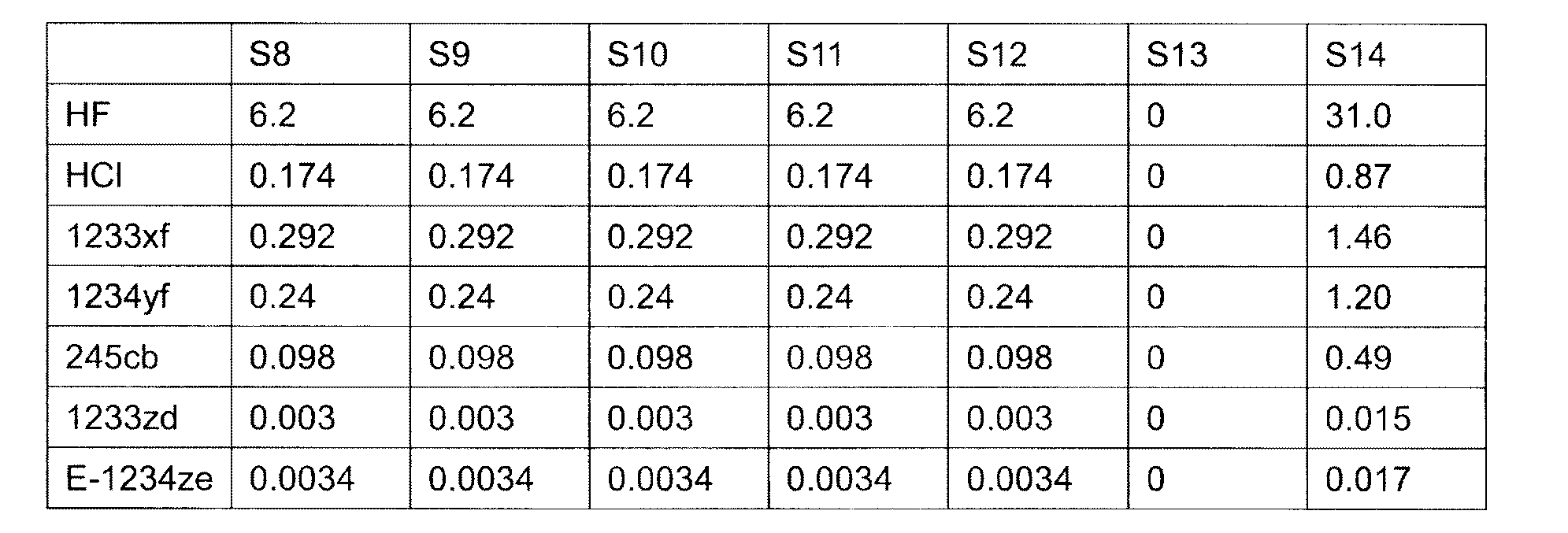

また、反応器の運転パターンの例を表4に示す。

実施例2
反応に用いる原料をHCC-240dbとし、反応温度280℃、接触時間W/F0=10(F0は0℃、0.1013MPaにおけるフィード流量である)、HFとHCC-240dbのモル比30とした。その他の反応条件は実施例1と同様である。この運転の結果、本プロセスからは110kg/月のHFO-1233xfを得ることができる。
反応に用いる原料をHCC-240dbとし、反応温度280℃、接触時間W/F0=10(F0は0℃、0.1013MPaにおけるフィード流量である)、HFとHCC-240dbのモル比30とした。その他の反応条件は実施例1と同様である。この運転の結果、本プロセスからは110kg/月のHFO-1233xfを得ることができる。
実施例2のプロセスにおける各ストリームの流量(mol/h)を表5~7に示す。


実施例3
反応に用いる原料をHCO-1230xaとし、反応温度280℃、接触時間W/F0=10(F0は0℃、0.1013MPaにおけるフィード流量である)、HFとHCFO-1233xfのモル比30とした。その他の反応条件は実施例1と同様である。この運転の結果、本プロセスからは110kg/月のHFO-1233xfを得ることができる。
反応に用いる原料をHCO-1230xaとし、反応温度280℃、接触時間W/F0=10(F0は0℃、0.1013MPaにおけるフィード流量である)、HFとHCFO-1233xfのモル比30とした。その他の反応条件は実施例1と同様である。この運転の結果、本プロセスからは110kg/月のHFO-1233xfを得ることができる。
実施例3のプロセスにおける各ストリームの流量(mol/h)を表8~10に示す。

Claims (20)
- ハイドロクロロフルオロカーボン(HCFC)及び/又はハイドロフルオロカーボン(HFC)を製造する方法であって、
(A)ハロゲン化炭化水素を無水フッ化水素を用いて少なくとも二つの反応器においてそれぞれ触媒存在下でフッ素化反応させることによりHCFC及び/又はHFCを得る工程;及び
(B)少なくとも一つの前記反応器において前記反応を休止状態としつつ、少なくとも一つの別の前記反応器において前記反応によりHCFC及び/又はHFCを得る工程
を含む、方法。 - 前記工程(B)において、反応休止状態となっている少なくとも一つの反応器で触媒活性を再生又は回復する、請求項1に記載の方法。
- さらに、以下の工程(C)を含む、請求項1又は2に記載の方法:
(C)前記工程(A)で得られたHCFC及び/又はHFCを、少なくとも二つの前記反応器と接続された回収装置を用いて回収する工程。 - 前記工程(C)において、前記工程(A)で得られたHCFC及び/又はHFCを含む組成物と、未反応のハロゲン化炭化水素及び/又は未反応の無水フッ化水素を含む組成物とを分離する、請求項3に記載の方法。
- 前記工程(C)において、前記回収装置が、蒸留塔、分液装置及びフラッシュ塔からなる群より選択される少なくとも一種の回収装置である、請求項3又は4に記載の方法。
- さらに、以下の工程(D)を含む、請求項3~5のいずれか一項に記載の方法:
(D)工程(C)で得られた前記未反応化合物を、前記反応器内に原料化合物としてリサイクルする工程。 - HCFC及び/又はHFCを製造する方法であって、
(a)ハロゲン化炭化水素を無水フッ化水素を用いて少なくとも二つの反応器においてそれぞれ触媒存在下でフッ素化反応させることによりHCFC及び/又はHFCを得る工程;及び
(b)工程(a)で得られたHCFC及び/又はHFCを、少なくとも二つの前記反応器と接続された回収装置を少なくとも用いて回収する工程
を含む、方法。 - さらに、以下の工程(c)を含む、請求項7に記載の方法:
(c)少なくとも二つの前記反応器と接続された回収装置を少なくとも用いて、未反応のハロゲン化炭化水素及び/又は未反応の無水フッ化水素を含む組成物を回収する工程。 - さらに、以下の工程(d)を含む、請求項8に記載の方法:
(d)工程(c)で得られた前記未反応化合物を、前記反応器内に原料化合物としてリサイクルする工程。 - 前記工程(a)が、以下の工程(a’)である、請求項7~9のいずれか一項に記載の方法:
(a’)少なくとも一つの前記反応器において前記反応を休止状態としつつ、少なくとも一つの別の前記反応器において前記反応によりHCFC及び/又はHFCを得る工程。 - 前記工程(a’)において、反応休止状態となっている少なくとも一つの反応器で触媒活性を再生又は回復する、請求項10に記載の方法。
- 連続的にHCFC及び/又はHFCを製造する、請求項1~11のいずれか一項に記載の方法。
- 前記HCFC及びHFCが、それぞれ炭素数2~4のHCFC及びHFCを含む、請求項1~12のいずれか一項に記載の方法。
- 前記HFCが、2,3,3,3-テトラフルオロプロペン(HFO-1234yf)を含む、請求項1~12のいずれか一項に記載の方法。
- 前記ハロゲン化炭化水素が、少なくとも一つの塩素原子及び/又はフッ素原子で置換されている、不飽和結合を有していてもよい炭素数2~4のハロゲン化炭化水素である、請求項1~14のいずれか一項に記載の方法。
- 前記ハロゲン化炭化水素が、
一般式:CHgClhF(3-g-h)CHiCl(2-i)CHjCl(3-j);及び
一般式:CHkCllF(3-k-l)CHmCl(1-m)=CHnCl(2-n)
(両式中、g、k、i及びnは0~2のいずれかの整数であり、h、j及びlはそれぞれ0~3のいずれかの整数であり、mはそれぞれ0又は1である)
でそれぞれ示されるハロゲン化炭化水素からなる群より選択される少なくとも一種のハロゲン化炭化水素である、請求項1~14のいずれか一項に記載の方法。 - 前記ハロゲン化炭化水素が、1,1,2,2,3-ペンタクロロプロパン(HCC-240aa)、1,1,1,2,3-ペンタクロロプロパン(HCC-240db)、1,1,1,3,3-ペンタクロロプロパン(HCC-240fa)、1,2,3-トリクロロ-1,1-ジフルオロプロパン(HCFC-242dc)、2,3-ジクロロ-1,1,1-トリフルオロプロパン(HCFC-243db)、2,3,3,3-テトラクロロプロペン(HCO-1230xa)、1,1,1,2-テトラクロロプロペン(HCO-1230xf)、2,3-ジクロロ-3,3-ジフルオロプロペン(HCFO-1232xf)、2-クロロ-3,3,3-トリフルオロプロペン(HCFO-1233xf)及び1-クロロ-3,3,3-トリフルオロプロペン(HCFO-1233zd)からなる群より選択される少なくも一種のハロゲン化炭化水素である、請求項1~14のいずれか一項に記載の方法。
- 前記ハロゲン化炭化水素が、HCFO-1233xfを含む、請求項1~14のいずれか一項に記載の方法。
- (a)ハロゲン化炭化水素を無水フッ化水素を用いてフッ素化反応させることによりHCFC及び/又はHFCを得る反応に適した触媒を含む、少なくとも二つの反応器;
(b)少なくとも二つの前記反応器(a)と接続された回収装置
を含む、請求項1~18のいずれか一項に記載の方法のために用いられるシステム。 - (a)ハロゲン化炭化水素を無水フッ化水素を用いてフッ素化反応させることによりHCFC及び/又はHFCを得る反応に適した触媒を含む、少なくとも二つの反応器;
(b)少なくとも二つの前記反応器(a)と接続された回収装置
を含むシステムの、請求項1~18のいずれか一項に記載の方法のための使用。
Priority Applications (2)
| Application Number | Priority Date | Filing Date | Title |
|---|---|---|---|
| EP17786039.2A EP3447041A4 (en) | 2016-04-21 | 2017-04-20 | METHOD FOR PRODUCING HYDROCHLORIC FLUORIDE AND / OR HYDROFLUORED CARBON |
| US16/094,256 US11124467B2 (en) | 2016-04-21 | 2017-04-20 | Method for producing hydrochlorofluorocarbon and/or hydrofluorocarbon |
Applications Claiming Priority (2)
| Application Number | Priority Date | Filing Date | Title |
|---|---|---|---|
| JP2016085289A JP2017193511A (ja) | 2016-04-21 | 2016-04-21 | ハイドロクロロフルオロカーボン及び/又はハイドロフルオロカーボンの製造方法 |
| JP2016-085289 | 2016-04-21 |
Publications (1)
| Publication Number | Publication Date |
|---|---|
| WO2017183702A1 true WO2017183702A1 (ja) | 2017-10-26 |
Family
ID=60116885
Family Applications (1)
| Application Number | Title | Priority Date | Filing Date |
|---|---|---|---|
| PCT/JP2017/015945 Ceased WO2017183702A1 (ja) | 2016-04-21 | 2017-04-20 | ハイドロクロロフルオロカーボン及び/又はハイドロフルオロカーボンの製造方法 |
Country Status (4)
| Country | Link |
|---|---|
| US (1) | US11124467B2 (ja) |
| EP (1) | EP3447041A4 (ja) |
| JP (1) | JP2017193511A (ja) |
| WO (1) | WO2017183702A1 (ja) |
Cited By (1)
| Publication number | Priority date | Publication date | Assignee | Title |
|---|---|---|---|---|
| JP6569019B1 (ja) * | 2018-07-02 | 2019-08-28 | 株式会社ダイセル | 酢酸の製造方法 |
Families Citing this family (4)
| Publication number | Priority date | Publication date | Assignee | Title |
|---|---|---|---|---|
| WO2020012393A1 (en) * | 2018-07-11 | 2020-01-16 | Sabic Global Technologies B.V. | Catalysts and methods for dimerizing propylene |
| EP3938095A1 (en) * | 2019-03-13 | 2022-01-19 | SABIC Global Technologies B.V. | Programmable logic controller for dehydrogenation process with reduced houdry lumps |
| JP2021138632A (ja) * | 2020-03-03 | 2021-09-16 | ダイキン工業株式会社 | ヨウ化フルオロアルカン及びフルオロオレフィンの製造方法 |
| CN115093306B (zh) * | 2022-08-25 | 2022-11-08 | 山东东岳化工有限公司 | 延长催化剂寿命的2-氯-3,3,3-三氟丙烯生产方法 |
Citations (9)
| Publication number | Priority date | Publication date | Assignee | Title |
|---|---|---|---|---|
| JPS59108726A (ja) * | 1982-12-15 | 1984-06-23 | Central Glass Co Ltd | 3.3.3.−トリフルオロプロペン−1の製造方法 |
| JP2003286207A (ja) * | 2002-03-26 | 2003-10-10 | Showa Denko Kk | ハイドロフルオロカーボンの製造方法 |
| WO2007079431A2 (en) | 2006-01-03 | 2007-07-12 | Honeywell International Inc. | Method for producing fluorinated organic compounds |
| JP2010047573A (ja) * | 2008-08-22 | 2010-03-04 | Honeywell Internatl Inc | ハロカーボンを分離するための方法 |
| JP2012082189A (ja) * | 2010-09-14 | 2012-04-26 | Central Glass Co Ltd | ヒドロフルオロカーボンまたはヒドロクロロフルオロカーボンの脱水方法、および該脱水方法を用いた1,3,3,3−テトラフルオロプロペンの製造方法 |
| WO2013111911A1 (en) | 2012-01-25 | 2013-08-01 | Daikin Industries, Ltd. | Process for producing fluorine-containing olefin |
| WO2013141409A1 (en) | 2012-03-22 | 2013-09-26 | Daikin Industries, Ltd. | Process for preparing 2-chloro-3,3,3-trifluoropropene |
| JP2014511351A (ja) * | 2011-01-21 | 2014-05-15 | アルケマ フランス | 気相触媒フッ素化 |
| JP2014511350A (ja) * | 2011-01-21 | 2014-05-15 | アルケマ フランス | 気相触媒フッ素化 |
Family Cites Families (5)
| Publication number | Priority date | Publication date | Assignee | Title |
|---|---|---|---|---|
| CN100400484C (zh) | 2001-07-06 | 2008-07-09 | 昭和电工株式会社 | 纯化四氯乙烯的方法和生产氢氟烃的方法 |
| HUE030760T2 (en) * | 2011-01-21 | 2017-05-29 | Arkema France | Process for the Preparation of 2,3,3,3-Tetrafluoropropene by Gas Phase Fluorination of Pentachloropropane \ t |
| FR3023286B1 (fr) * | 2014-07-02 | 2018-02-16 | Arkema France | Procede de fabrication de tetrafluoropropene |
| FR3051469B1 (fr) * | 2016-05-19 | 2018-05-11 | Arkema France | Procede de fabrication de tetrafluoropropene. |
| FR3051468B1 (fr) * | 2016-05-19 | 2019-07-26 | Arkema France | Procede de fabrication de tetrafluoropropene. |
-
2016
- 2016-04-21 JP JP2016085289A patent/JP2017193511A/ja active Pending
-
2017
- 2017-04-20 US US16/094,256 patent/US11124467B2/en active Active
- 2017-04-20 EP EP17786039.2A patent/EP3447041A4/en active Pending
- 2017-04-20 WO PCT/JP2017/015945 patent/WO2017183702A1/ja not_active Ceased
Patent Citations (9)
| Publication number | Priority date | Publication date | Assignee | Title |
|---|---|---|---|---|
| JPS59108726A (ja) * | 1982-12-15 | 1984-06-23 | Central Glass Co Ltd | 3.3.3.−トリフルオロプロペン−1の製造方法 |
| JP2003286207A (ja) * | 2002-03-26 | 2003-10-10 | Showa Denko Kk | ハイドロフルオロカーボンの製造方法 |
| WO2007079431A2 (en) | 2006-01-03 | 2007-07-12 | Honeywell International Inc. | Method for producing fluorinated organic compounds |
| JP2010047573A (ja) * | 2008-08-22 | 2010-03-04 | Honeywell Internatl Inc | ハロカーボンを分離するための方法 |
| JP2012082189A (ja) * | 2010-09-14 | 2012-04-26 | Central Glass Co Ltd | ヒドロフルオロカーボンまたはヒドロクロロフルオロカーボンの脱水方法、および該脱水方法を用いた1,3,3,3−テトラフルオロプロペンの製造方法 |
| JP2014511351A (ja) * | 2011-01-21 | 2014-05-15 | アルケマ フランス | 気相触媒フッ素化 |
| JP2014511350A (ja) * | 2011-01-21 | 2014-05-15 | アルケマ フランス | 気相触媒フッ素化 |
| WO2013111911A1 (en) | 2012-01-25 | 2013-08-01 | Daikin Industries, Ltd. | Process for producing fluorine-containing olefin |
| WO2013141409A1 (en) | 2012-03-22 | 2013-09-26 | Daikin Industries, Ltd. | Process for preparing 2-chloro-3,3,3-trifluoropropene |
Non-Patent Citations (1)
| Title |
|---|
| See also references of EP3447041A4 |
Cited By (3)
| Publication number | Priority date | Publication date | Assignee | Title |
|---|---|---|---|---|
| JP6569019B1 (ja) * | 2018-07-02 | 2019-08-28 | 株式会社ダイセル | 酢酸の製造方法 |
| WO2020008506A1 (ja) * | 2018-07-02 | 2020-01-09 | 株式会社ダイセル | 酢酸の製造方法 |
| US11884617B2 (en) | 2018-07-02 | 2024-01-30 | Daicel Corporation | Method for producing acetic acid |
Also Published As
| Publication number | Publication date |
|---|---|
| JP2017193511A (ja) | 2017-10-26 |
| US11124467B2 (en) | 2021-09-21 |
| EP3447041A1 (en) | 2019-02-27 |
| US20190127299A1 (en) | 2019-05-02 |
| EP3447041A4 (en) | 2019-12-18 |
Similar Documents
| Publication | Publication Date | Title |
|---|---|---|
| JP6847182B2 (ja) | テトラフルオロプロペンの製造方法 | |
| JP6673395B2 (ja) | 1,2−ジフルオロエチレン及び/又は1,1,2−トリフルオロエタンの製造方法 | |
| JP5971305B2 (ja) | 2,3,3,3−テトラフルオロプロペンの製造方法 | |
| CN105188909B (zh) | 氟化方法与反应器 | |
| JP6165061B2 (ja) | 気相触媒フッ素化 | |
| EP2773606B1 (en) | Process for producing 2,3,3,3-tetrafluoropropene | |
| JP6319535B1 (ja) | 含フッ素ハロゲン化炭化水素の製造方法 | |
| JP6463329B2 (ja) | 2−クロロ−1,1,1,2−テトラフルオロプロパン(HCFC−244bb)の製造方法 | |
| EP2766329B1 (en) | Process for producing 2,3,3,3-tetrafluoropropene | |
| US11124467B2 (en) | Method for producing hydrochlorofluorocarbon and/or hydrofluorocarbon | |
| US8846990B2 (en) | Process for producing 2,3,3,3-tetrafluoropropene | |
| KR102847526B1 (ko) | SbF5에 의한 1233xf의 244bb로의 히드로플루오린화 | |
| CN107973694A (zh) | 制备2,3,3,3-四氟丙烯的方法 | |
| EP3805189A1 (en) | Method for producing fluorine group-containing haloolefin compound and composition |
Legal Events
| Date | Code | Title | Description |
|---|---|---|---|
| NENP | Non-entry into the national phase |
Ref country code: DE |
|
| WWE | Wipo information: entry into national phase |
Ref document number: 2017786039 Country of ref document: EP |
|
| ENP | Entry into the national phase |
Ref document number: 2017786039 Country of ref document: EP Effective date: 20181121 |
|
| 121 | Ep: the epo has been informed by wipo that ep was designated in this application |
Ref document number: 17786039 Country of ref document: EP Kind code of ref document: A1 |